
Interviewer: Scott Douglas Jacobsen
Numbering: Issue 24.A, Idea: Outliers & Outsiders (Part Twenty)
Place of Publication: Langley, British Columbia, Canada
Title: In-Sight: Independent Interview-Based Journal
Web Domain: http://www.in-sightjournal.com
Individual Publication Date: September 1, 2020
Issue Publication Date: January 1, 2021
Name of Publisher: In-Sight Publishing
Frequency: Three Times Per Year
Words: 1,585
ISSN 2369-6885
Abstract
Richard May (“May-Tzu”/”MayTzu”/”Mayzi”) is a Member of the Mega Society based on a qualifying score on the Mega Test (before 1995) prior to the compromise of the Mega Test and Co-Editor of Noesis: The Journal of the Mega Society. In self-description, May states: “Not even forgotten in the cosmic microwave background (CMB), I’m an Amish yuppie, born near the rarified regions of Laputa, then and often, above suburban Boston. I’ve done occasional consulting and frequent Sisyphean shlepping. Kafka and Munch have been my therapists and allies. Occasionally I’ve strived to descend from the mists to attain the mythic orientation known as having one’s feet upon the Earth. An ailurophile and a cerebrotonic ectomorph, I write for beings which do not, and never will, exist — writings for no one. I’ve been awarded an M.A. degree, mirabile dictu, in the humanities/philosophy, and U.S. patent for a board game of possible interest to extraterrestrials. I’m a member of the Mega Society, the Omega Society and formerly of Mensa. I’m the founder of the Exa Society, the transfinite Aleph-3 Society and of the renowned Laputans Manqué. I’m a biographee in Who’s Who in the Brane World. My interests include the realization of the idea of humans as incomplete beings with the capacity to complete their own evolution by effecting a change in their being and consciousness. In a moment of presence to myself in inner silence, when I see Richard May’s non-being, ‘I’ am. You can meet me if you go to an empty room.” Some other resources include Stains Upon the Silence: something for no one, McGinnis Genealogy of Crown Point, New York: Hiram Porter McGinnis, Swines List, Solipsist Soliloquies, Board Game, Lulu blog, Memoir of a Non-Irish Non-Jew, and May-Tzu’s posterous. He discusses: growing up; a sense of an extended self; family background; the experience with peers and schoolmates as a child and an adolescent; the purpose of intelligence tests; high intelligence; geniuses of the past; the greatest geniuses in history; a genius from a profoundly intelligent person; some work experiences and educational certifications; the more important aspects of the idea of the gifted and geniuses; some social and political views; the God concept; science; some of the tests taken and scores earned (with standard deviations); the range of the scores; and ethical philosophy.
Keywords: general background, generic views, IQ, Mega Society, Richard May.
Conversation with Richard May (“May-Tzu”/”MayTzu”/”Mayzi”) on Some General Background and Generic Views: Co-Editor, “Noesis: The Journal of the Mega Society” (1)
*Please see the footnotes, bibliography, and citation style listing after the interview.*
Scott Douglas Jacobsen: When you were growing up, what were some of the prominent family stories being told over time?
Richard May[1],[2]*: Mother said that she was an orphan and “didn’t know who her parents were.” But she knew her mother’s sister. It was all very coherent and logical. Once she said her father was a minister. I listened in silence. Once she said we were Danish, after talking to her brother on the phone. Danish had been substituted for Irish, I’m sure. I never interrogated Mother, naively preferring a passive psychoanalytic or Rogerian approach.
Father said his grandfather, who “looked very Jewish and wore a yarmulke in his jewelry business, fooled the Jews, by pretending to be a Jew.” However, we were the Jews we ‘fooled’ on father’s side of the family. “Truth is the safest lie,” is a Yiddish proverb. There were no true family stories of interest. The lies of otherwise honest parents inspired me to research my background.
Jacobsen: Have these stories helped provide a sense of an extended self or a sense of the family legacy?
May: No, belatedly at age 53 finding the hidden truth provided a sense of family legacy.
Jacobsen: What was family background, e.g., geography, culture, language, and religion or lack thereof?
May: Mother was from Northern New York. Father was from Boston, Mass. We spoke English, which was not unusual in those areas at the time. There was not much religion at home. Nothing to rebel against. A children’s book on “Jesus,” when I was very young. An angel candle to protect me from goblins coming down the chimney at night. There was a little lip service to God now and then. We usually said grace before Sunday dinner.
I’ve only gone to church about five times in my life, all during childhood only. Father’s originally Jewish side had become Unitarian, I guess. Mother seemed to think she was some sort of Protestant, alternating in a quantum fashion between Episcopal and Baptist. I correctly perceived this as not even farcical. At one point as a young child I told Mother that I did not believe in church. She cried.
Jacobsen: How was the experience with peers and schoolmates as a child and an adolescent?
May: I had a crush on a girl in the first grade. She liked my art work. It may have been o.k. till puberty. I was always chosen last along with a slightly retarded epileptic for sports teams in high school gym class. I was somewhat proud of this distinction. Guess I didn’t fit in. Almost didn’t graduate from high school and then university because of gym requirements.
Jacobsen: What is the purpose of intelligence tests to you?
May: Maybe the purpose of intelligence tests is to attempt to measure intelligence.
Jacobsen: When was high intelligence discovered for you?
May: Did SETI finally announce that they made a breakthrough? But SETI has never discovered me, as far as I’m aware.
Jacobsen: When you think of the ways in which the geniuses of have either been mocked, vilified, and condemned if not killed, or praised, flattered, platformed, and revered, what seems like the reason for the extreme reactions to and treatment of geniuses? Many alive today seem camera shy – many, not all.
May: Humans are tribal and primitive even today, to varying degrees. Differences of any kind among us are often not well tolerated.
Jacobsen: Who seem like the greatest geniuses in history to you?
May: Oh, you mean Mensa!
No?
— Archimedes, Euclid, Newton, Gauss, Einstein, and von Neumann come to mind.
Jacobsen: What differentiates a genius from a profoundly intelligent person?
May: Focused hard work in an intellectual discipline(s) over many years, original insights and thinking out of the box. Also the conventions historians used in identifying geniuses in various time periods. Herman Hesse wrote that in his view many geniuses were never noticed or recognized by their contemporaries or even later.
Jacobsen: What have been some work experiences and educational certifications for you?
May: Sisyphean shlepping, including ID checking in a bar, with a B.S. in psychology and a M.A. in Humanities/Philosophy.
Jacobsen: What are some of the more important aspects of the idea of the gifted and geniuses? Those myths that pervade the cultures of the world. What are those myths? What truths dispel them?
May: Myths may not necessarily be false propositions to be dispelled by truths, I think. Otherwise I have no thoughts on this.
Jacobsen: What are some social and political views for you? Why hold them?
I’m a political atheist with regard to ideologies and political process:
“Ideologies
Freedom, peace and prosperity are preferable to their absence or negation. Marxists say that property is theft; Libertarians say that taxation is theft. But ideologies, themselves, are theft: theft of reason; theft of truth; a secular theology of lies; paleomammalian delusions shared by the herd; 1 dimensional maps of hyperdimensional territories of phenomenal processes and individual values; attempts to depict a higher-dimensional polytope on a 1-dimensional line segment; maps far more useful to the mapmaker than the individual trying to find his way. There are no up-wingers or down-wingers; no front-wingers or back-wingers. Ideology is a bit of truth simplified to a convenient lie. — May–Tzu”
Humans are unconscious automata, as G. I. Gurdjieff stressed. In Christian language we are not redeemed, i.e., we are just too f*cked up as a species and we have a Type-O civilization. (We are probably actually less intelligent today than were the ancient Greeks.) It may be worth noting, however, that everything turns into its opposite in the relative world, including in the political arena.
“In Praise Of Stupidity
Homo sapiens is a primitive species whose primary activity is internecine tribal warfare and whose secondary activity is destruction of the ecosystem. Obviously human wisdom and compassion have not evolved as rapidly as the intelligence associated with technology and weaponry. Maybe for this reason “human stupidity” actually has survival value for our species. If the mean absolute I.Q. were 150 rather than 100, and if there were no correspondingly increased levels of wisdom and compassion, then perhaps we would have eradicated our species from the planet. Is stupidity, itself, the long awaited but unrecognized Messiah? — May-Tzu”
“There is infinite hope, but not for us.” — Franz Kafka
Jacobsen: Any thoughts on the God concept or gods idea and philosophy, theology, and religion?
May: There are a quite a few thoughts on the above topics are in my “Stains Upon the Silence — something for no one.” — But having thoughts is not thinking.
Jacobsen: How much does science play into the worldview for you?
May: To the extent that science is an apolitical approximation of truth, science is my ‘religion’ or worldview; Science not scientism. But remember the disinvitation of physics Nobel laureate Brian Josephson from a Cambridge University physics conference and the banning of Rupert Sheldrake and laser physicist Russell Targ, who did research for the C.I.A. for years, from TED Talks.
Jacobsen: What have been some of the tests taken and scores earned (with standard deviations) for you?
May: I stopped taking IQ tests after the Mega Test on which I scored about 4.7+ sigma, qualifying me for the Mega Society. I took no later-developed tests after that. My score range is between mostly between 3 and 4.7 sigma.
Incidentally I make no claims about my alleged ‘high intelligence’. This is neither humility nor false humility. I was raised to be stupid.
My mother repeatedly said that I was “just like her,”odd given that she appeared to be a female. She would refer to herself as “my stupid mother” and shortly after say, “You’re just like me.” She was orphaned in a rural area and had a 10th. grade formal educational level, although she usually didn’t sound like it.
An uncle on my father’s side, who boasted of having a very high IQ score, gave me a vast dictionary- encyclopedia in my early teens. I remember avidly looking up and studying various topics for hours. Mother told me that my thirst for knowledge “was just because my brain was developing” and reassured me that I would “get over it.”
My father’s father was said to have been a professorial-sounding brilliant autodidact who had dropped out of elementary school. He was said to have read a book a day, had a extensive vocabulary and corrected people’s grammar. But Grandfather had bipolar disorder. Therefore, my father apparently associated high intelligence and erudition with ‘madness’ and disapproved of my attraction to books, where they could be found.
In short I took these tests to attempt to demonstrate something to myself, not to impress others. I don’t generally feel highly intelligent and usually assume that others are more intelligent than I am, at least until I’ve observed them.
But — in an absolute sense — how brilliant are actual human geniuses standing before the cosmos?
Jacobsen: What is the range of the scores for you? The scores earned on alternative intelligence tests tend to produce a wide smattering of data points rather than clusters, typically.
May: My score range is mostly between about 3 and 4.7+ sigmas. My lowest score was about 2 sigmas. My friend Grady M Towers claimed that everyone has as many IQs as they have taken IQ tests. Anne Anastasi wrote that IQ is not a property of an organism, but an index of a sample of behavior.
Jacobsen: What ethical philosophy makes some sense, even the most workable sense to you?
May: Buddhist ethics.
Appendix I: Footnotes
[1] Member, Mega Society; Co-Editor, Noesis: The Journal of the Mega Society.
[2] Individual Publication Date: September 1, 2020: http://www.in-sightjournal.com/may-1; Full Issue Publication Date: January 1, 2021: https://in-sightjournal.com/insight-issues/.
*High range testing (HRT) should be taken with honest skepticism grounded in the limited empirical development of the field at present, even in spite of honest and sincere efforts. If a higher general intelligence score, then the greater the variability in, and margin of error in, the general intelligence scores because of the greater rarity in the population.
Appendix II: Citation Style Listing
American Medical Association (AMA): Jacobsen S. Conversation with Richard May (“May-Tzu”/”MayTzu”/”Mayzi”) on Some General Background and Generic Views: Co-Editor, “Noesis: The Journal of the Mega Society” (1) [Online].September 2020; 24(A). Available from: http://www.in-sightjournal.com/may-1.
American Psychological Association (APA, 6th Edition, 2010): Jacobsen, S.D. (2020, September 1). Conversation with Richard May (“May-Tzu”/”MayTzu”/”Mayzi”) on Some General Background and Generic Views: Co-Editor, “Noesis: The Journal of the Mega Society” (1). Retrieved from http://www.in-sightjournal.com/may-1.
Brazilian National Standards (ABNT): JACOBSEN, S. Conversation with Richard May (“May-Tzu”/”MayTzu”/”Mayzi”) on Some General Background and Generic Views: Co-Editor, “Noesis: The Journal of the Mega Society” (1). In-Sight: Independent Interview-Based Journal. 24.A, September. 2020. <http://www.in-sightjournal.com/may-1>.
Chicago/Turabian, Author-Date (16th Edition): Jacobsen, Scott. 2020. “Conversation with Richard May (“May-Tzu”/”MayTzu”/”Mayzi”) on Some General Background and Generic Views: Co-Editor, “Noesis: The Journal of the Mega Society” (1).” In-Sight: Independent Interview-Based Journal. 24.A. http://www.in-sightjournal.com/may-1.
Chicago/Turabian, Humanities (16th Edition): Jacobsen, Scott “Conversation with Richard May (“May-Tzu”/”MayTzu”/”Mayzi”) on Some General Background and Generic Views: Co-Editor, “Noesis: The Journal of the Mega Society” (1).” In-Sight: Independent Interview-Based Journal. 24.A (September 2020). http://www.in-sightjournal.com/may-1.
Harvard: Jacobsen, S. 2020, ‘Conversation with Richard May (“May-Tzu”/”MayTzu”/”Mayzi”) on Some General Background and Generic Views: Co-Editor, “Noesis: The Journal of the Mega Society” (1)‘, In-Sight: Independent Interview-Based Journal, vol. 24.A. Available from: <http://www.in-sightjournal.com/may-1>.
Harvard, Australian: Jacobsen, S. 2020, ‘Conversation with Richard May (“May-Tzu”/”MayTzu”/”Mayzi”) on Some General Background and Generic Views: Co-Editor, “Noesis: The Journal of the Mega Society” (1)‘, In-Sight: Independent Interview-Based Journal, vol. 24.A., http://www.in-sightjournal.com/may-1.
Modern Language Association (MLA, 7th Edition, 2009): Scott D. Jacobsen. “Conversation with Richard May (“May-Tzu”/”MayTzu”/”Mayzi”) on Some General Background and Generic Views: Co-Editor, “Noesis: The Journal of the Mega Society” (1).” In-Sight: Independent Interview-Based Journal 24.A (2020):September. 2020. Web. <http://www.in-sightjournal.com/may-1>.
Vancouver/ICMJE: Jacobsen S. Conversation with Richard May (“May-Tzu”/”MayTzu”/”Mayzi”) on Some General Background and Generic Views: Co-Editor, “Noesis: The Journal of the Mega Society” (1) [Internet]. (2020, September 24(A). Available from: http://www.in-sightjournal.com/may-1.
License and Copyright
License
In-Sight Publishing and In-Sight: Independent Interview-Based Journal by Scott Douglas Jacobsen is licensed under a Creative Commons Attribution-NonCommercial-NoDerivatives 4.0 International License.
Based on a work at www.in-sightjournal.com.
Copyright
© Scott Douglas Jacobsen, and In-Sight Publishing and In-Sight: Independent Interview-Based Journal 2012-2020. Unauthorized use and/or duplication of this material without express and written permission from this site’s author and/or owner is strictly prohibited. Excerpts and links may be used, provided that full and clear credit is given to Scott Douglas Jacobsen, and In-Sight Publishing and In-Sight: Independent Interview-Based Journal with appropriate and specific direction to the original content. All interviewees co-copyright their interview material and may disseminate for their independent purposes.
Share this:

Interviewer: Scott Douglas Jacobsen
Numbering: Issue 24.A, Idea: Outliers & Outsiders (Part Twenty)
Place of Publication: Langley, British Columbia, Canada
Title: In-Sight: Independent Interview-Based Journal
Web Domain: http://www.in-sightjournal.com
Individual Publication Date: September 1, 2020
Issue Publication Date: January 1, 2021
Name of Publisher: In-Sight Publishing
Frequency: Three Times Per Year
Words: 1,643
ISSN 2369-6885
Abstract
Anthony Sepulveda scored 174 (S.D.15) on Cosmic and is a member of the World Genius Directory. He discusses: the art and state of IQ tests; some personal criteria; some concrete examples of intelligently run lives; some concrete examples of unintelligently run lives; some points of overlap between the intelligently and unintelligently run lives; what makes an IQ test valid and reliable, scientifically; fascination with alternative tests and the scores derived from them; concept “general intelligence”; mainstream intelligence tests; more comprehensive tests of general intelligence; the effects of average intelligence on someone’s personality; the effects of high intelligence on someone’s personality; some of the common factors found in most situations; the thought processing or reasoning through a novel situation with the common factors; what factors would a highly intelligent person see compared to a person of average intelligence; how could a highly intelligent person with megalomania or some other mental disorder make wrong decisions, waste their lives, and damage the lives of others; a psychological construct; to boost their ego; how joining the high-IQ communities help boost their professional status; have a “laughably” low number of testees; and “Cattell’s culturally fair test.”
Keywords: Anthony Sepulveda, IQ, IQ tests, World Genius Directory.
Conversation with Anthony Sepulveda (Brown) on the Art and State of IQ Tests: Member, World Genius Directory (5)
*Please see the footnotes, bibliography, and citation style listing after the interview.*
Scott Douglas Jacobsen: Shall we talk some more about the art and state of IQ tests? Now, I don’t know if IQ tests are as much of an art anymore. Perhaps, a qualitative analysis of intelligence as subjectively perceived can provide an indication as to more comprehensive observational metrics of intelligence in real-life or real-world functioning. That’s one such thing. It’s an act of artistic work in catalogue via cognition. Something like Timothy Leary’s, “The universe is an intelligence test.” Another is working on the outputs of person to paper, which is the formal IQ test considered concept “IQ test” in most people’s minds when reflecting on concept “IQ.” Can you remark on intelligence in real-world functioning, please?
Anthony Sepulveda (Brown)[1],[2]*: From what I’ve seen, there’s very little difference between a person of average intelligence and one of high intelligence beyond the effects it can have on their personality.
Jacobsen: What are some personal criteria used in considering some actions intelligent and others not intelligent in real-world functioning to you?
Sepulveda (Brown): Broadly speaking, an act of intelligence would require you to understand the factors of an uncertain situation and use that knowledge to successfully navigate it to a desired conclusion.
Jacobsen: What are some concrete examples of intelligently run lives?
Sepulveda (Brown): The only examples that come to mind are learning from previous experience, analyzing new situations thoroughly, paying attention to important details and being more aware of the factors presently affecting you. Other examples (such as successfully achieving a goal) may seem fair enough to list, but there can be a plethora of influences (positive and negative) that could tip the scales either way and, thus, make them more a matter of luck than anything else.
Jacobsen: What are some concrete examples of unintelligently run lives?
Sepulveda (Brown): The inverse of the examples mentioned above.
Jacobsen: What, paradoxically, are some points of overlap between the intelligently and unintelligently run lives?
Sepulveda (Brown): Even the more intelligent among us have to admit, acts of stupidity are way more fun!! Life would be unbearably boring if you only take the options that are reasonable and responsible.
Jacobsen: What makes an IQ test valid and reliable, scientifically?
Sepulveda (Brown): A sufficient number of valid problems and testees from which to gather accurate statistical data. Sadly, most tests fall laughably short on both and draw outrageous conclusions from tiny sample groups (often 30 testees). Even many professionally proctored exams have issues that I argue renders them invalid.
Jacobsen: Why is there a fascination with alternative tests and the scores derived from them?
Sepulveda (Brown): It seems to me that most members of the High IQ Community joined because they wanted to boost their ego, meet others more like themselves or distinguish themselves for professional reasons. Everyone wants to feel special. By performing well on a difficult test or a variety of tests, you can legitimize that belief.
Jacobsen: What mainstream intelligence tests seem best in tapping into concept “general intelligence”?
Sepulveda (Brown): Cattell’s culturally fair test is the only one that comes to mind. But I’ve only taken a few proctored tests, so it’s possible that there are better options that I’m presently unaware of.
Jacobsen: If you could build on the decades of efforts of mainstream intelligence tests, what would be the efforts?
Sepulveda (Brown): As I mentioned earlier, I designed an IQ test of my own – X’s and O’s. The inspiration for this came after I began to examine other tests critically and found a number of issues that I believe rendered them invalid. After over a year of discussions, trial and error, I felt I had designed a sufficient number of valid problems and compiled them for use on the Opal Quest Group website.
(Special thanks to James Dorsey for being so forthcoming during that process and helping me share my work with the world.)
Jacobsen: How would you implement more comprehensive tests of general intelligence?
Sepulveda (Brown): IQ tests were originally designed with the intent of dividing students into different classes based on their performance. That way everyone could be taught at their preferred pace. This has long since fallen out of practice (excluding extreme situations, of course) and there don’t seem to be any other practical applications beyond their use in statistical studies or as a means to distinguish yourself professionally.
Jacobsen: What are some of the effects of average intelligence on someone’s personality?
Sepulveda (Brown): That is such a broad question I would have to answer it in the form of a book to do it complete justice. But the short answer is that being unable to solve problems or properly assess risks can result in poor social and economic standing, causing depression and other health risks.
Jacobsen: What are some of the effects of high intelligence on someone’s personality?
Sepulveda (Brown): Interestingly, alongside narcissism, this condition is also very likely to cause depression. Especially if you’re born into a working or lower class family where you’re constantly aware of all the problems around you, but have little means with which to solve them.
Speaking for myself, I often feel a certain existential angst that springs from a genuine desire to better the world around me but knowing that even my best efforts will likely have little to no effect in altering our collective fate and result in a life wasted stressing over vain work, I can no longer justify pursuing that desire. Instead, I try to simply enjoy what little time I have and help where I can. Because I can justify that much, at least. But I still feel a sense of urgency to perform some good work and disappointment over all this arguably wasted time.
Jacobsen: What are some of the common factors found in most situations?
Sepulveda (Brown): In very general terms, a situation can be described by the actions, interactions and reactions of the objects (nonliving material) and subjects (living material) in an area. By analyzing and understanding the functions of all the important objects and subjects in any given situation, you can use that knowledge to accomplish reasonable goals.
Jacobsen: With an example, what would be the thought processing or reasoning through a novel situation with the common factors for you?
Sepulveda (Brown): If your goal is to solve a math problem, you need to identify the symbols composing the equation, understand what each one means and how they relate to each other, then follow the order of operations necessary to bring you to a conclusion that resolves the problem.
Jacobsen: What factors would a highly intelligent person see compared to a person of average intelligence?
Sepulveda (Brown): Everyone sees the same thing (metaphorically speaking), some just understand what they see more accurately than others. If you understand something, you’re more likely to remember it longer and be able to use that information to resolve situations where it is applicable later. With this in mind, I’m not certain that there’s any significant difference in what healthy individuals with different IQs can do if they apply themselves towards the same goal.
Jacobsen: How could a highly intelligent person with megalomania or some other mental disorder make wrong decisions, waste their lives, and damage the lives of others? For example, Keith Raniere seems like one example; as has been said by others, cult leaders are narcissists who failed to garner fame and retreat to a zone of safety. An imaginary place of omnipotence, omniscience, or, simply, delusion and the power to exercise coercive narcissistic control.
Sepulveda (Brown): Any number of ways. The best example that comes to mind is Christopher Michael Langan, a well known member of the High IQ Community with a number of overzealous followers, who seems to spend a majority of his time pushing his own political, ‘scientific’ and theological beliefs on anyone willing to listen without challenging him. Luckily, he wasn’t born into a more prominent family and his influence is limited by his disagreeability.
Jacobsen: What intelligence tests do seem reliable and valid in the measure of a psychological construct?
Sepulveda (Brown): I’m not familiar enough with the concept of psychological constructs to make any recommendations.
Jacobsen: Why do they want to boost their ego?
Sepulveda (Brown): The same reason anyone would, it feels good.
Jacobsen: How would joining the high-IQ communities help boost their professional status?
Sepulveda (Brown): Some professions value intelligence in their employees more than others and would feel more inclined to utilize someone with such credentials.
Jacobsen: If most tests have a “laughably” low number of testees – “30,” and if many seek validation of this “belief,” what does this state about the high-IQ community, as such, and one sector of its general membership?
Sepulveda (Brown): Nothing good. The High IQ Community is in very poor condition at this point. Outside of Mensa, the Atlantiq Society and the personal efforts of Jeffery Ford, I’m not aware of any group putting forth any effort towards practical solutions towards real world problems. All the others seem to be more focused on the development of amateur tests with which to waste each other’s time.
Jacobsen: Why “Cattell’s culturally fair test”?
Sepulveda (Brown): Of the professionally proctored tests I’m aware of, Cattell’s is unique in that it has the lowest general knowledge requirement. This is important because knowledge is not attained in a universally linear fashion. Our understanding is limited to our experience and our ability to gain understanding from them. And as each individual undergoes a relatively unique combination of experiences, we should not prematurely judge someone who does possess certain knowledge as lesser than others. Ideally, any test used to rank individual ability would have no knowledge requirement of any kind using spatial and/or certain logic problems.
Appendix I: Footnotes
[1] Member, World Genius Directory.
[2] Individual Publication Date: September 1, 2020: http://www.in-sightjournal.com/sepulveda-5; Full Issue Publication Date: September 1, 2020: https://in-sightjournal.com/insight-issues/.
*High range testing (HRT) should be taken with honest skepticism grounded in the limited empirical development of the field at present, even in spite of honest and sincere efforts. If a higher general intelligence score, then the greater the variability in, and margin of error in, the general intelligence scores because of the greater rarity in the population.
Appendix II: Citation Style Listing
American Medical Association (AMA): Jacobsen S. Conversation with Anthony Sepulveda (Brown) on the Art and State of IQ Tests: Member, World Genius Directory (5) [Online].September 2020; 24(A). Available from: http://www.in-sightjournal.com/sepulveda-5.
American Psychological Association (APA, 6th Edition, 2010): Jacobsen, S.D. (2020, September 1). Conversation with Anthony Sepulveda (Brown) on the Art and State of IQ Tests: Member, World Genius Directory (5). Retrieved from http://www.in-sightjournal.com/sepulveda-5.
Brazilian National Standards (ABNT): JACOBSEN, S. Conversation with Anthony Sepulveda (Brown) on the Art and State of IQ Tests: Member, World Genius Directory (5). In-Sight: Independent Interview-Based Journal. 24.A, September. 2020. <http://www.in-sightjournal.com/sepulveda-5>.
Chicago/Turabian, Author-Date (16th Edition): Jacobsen, Scott. 2020. “Conversation with Anthony Sepulveda (Brown) on the Art and State of IQ Tests: Member, World Genius Directory (5).” In-Sight: Independent Interview-Based Journal. 24.A. http://www.in-sightjournal.com/sepulveda-5.
Chicago/Turabian, Humanities (16th Edition): Jacobsen, Scott “Conversation with Anthony Sepulveda (Brown) on the Art and State of IQ Tests: Member, World Genius Directory (5).” In-Sight: Independent Interview-Based Journal. 24.A (September 2020). http://www.in-sightjournal.com/sepulveda-5.
Harvard: Jacobsen, S. 2020, ‘Conversation with Anthony Sepulveda (Brown) on the Art and State of IQ Tests: Member, World Genius Directory (5)‘, In-Sight: Independent Interview-Based Journal, vol. 24.A. Available from: <http://www.in-sightjournal.com/sepulveda-5>.
Harvard, Australian: Jacobsen, S. 2020, ‘Conversation with Anthony Sepulveda (Brown) on the Art and State of IQ Tests: Member, World Genius Directory (5)‘, In-Sight: Independent Interview-Based Journal, vol. 24.A., http://www.in-sightjournal.com/sepulveda-5.
Modern Language Association (MLA, 7th Edition, 2009): Scott D. Jacobsen. “Conversation with Anthony Sepulveda (Brown) on the Art and State of IQ Tests: Member, World Genius Directory (5).” In-Sight: Independent Interview-Based Journal 24.A (2020):September. 2020. Web. <http://www.in-sightjournal.com/sepulveda-5>.
Vancouver/ICMJE: Jacobsen S. Conversation with Anthony Sepulveda (Brown) on the Art and State of IQ Tests: Member, World Genius Directory (5) [Internet]. (2020, September 24(A). Available from: http://www.in-sightjournal.com/sepulveda-5.
License and Copyright
License
In-Sight Publishing and In-Sight: Independent Interview-Based Journal by Scott Douglas Jacobsen is licensed under a Creative Commons Attribution-NonCommercial-NoDerivatives 4.0 International License.
Based on a work at www.in-sightjournal.com.
Copyright
© Scott Douglas Jacobsen, and In-Sight Publishing and In-Sight: Independent Interview-Based Journal 2012-2020. Unauthorized use and/or duplication of this material without express and written permission from this site’s author and/or owner is strictly prohibited. Excerpts and links may be used, provided that full and clear credit is given to Scott Douglas Jacobsen, and In-Sight Publishing and In-Sight: Independent Interview-Based Journal with appropriate and specific direction to the original content. All interviewees co-copyright their interview material and may disseminate for their independent purposes.
Share this:

Author: Dr. Leo Igwe
Numbering: Issue 1.B, Idea: African Freethinking
Place of Publication: Langley, British Columbia, Canada
Title: African Freethinker
Web Domain: http://www.in-sightjournal.com
Individual Publication Date: August 31, 2020
Issue Publication Date: TBD
Name of Publisher: In-Sight Publishing
Frequency: Three Times Per Year
Words: 1,560
Keywords: Advocacy for Alleged Witches, Decade of Activism Against Witch Persecution in Africa: 2020-2030, Humanism, Humanist Association of Nigeria, Leo Igwe.
Akua Denteh: How To End Witch Persecution in Ghana[1],[2]
Dr. Leo Igwe is the Founder of the Humanist Association of Nigeria, the Founder & CEO of Advocacy for Alleged Witches, and the Convener of the Decade of Activism Against Witch Persecution in Africa: 2020-2030. He is a friend, and boss at AfAW.
The news of the brutal murder of a 90-year old woman, Akua Denteh, accused of witchcraft in Kafaba, East Gonja in Northern Ghana has sent shock waves across the world. A short video that showed people gathered and watching as some women hit Akua Denteh with objects and eventually set her ablaze underscores the need for an effective advocacy against witch persecution in this West African nation. There have been condemnations of this despicable act by the government of Ghana. The president, Nana Akufo-Addo has expressed his revulsion at the awful killing of Akua Denteh. He noted that the tragic incident had disfigured Ghana. Akufo-Addo urged the police to ensure that justice was done. In his reaction, the regional minister pledged that incident would not happen again. But look, going by the reactions of Ghanaian authorities to similar incidents in the past, this pledge is a vacuous political statement and public relations exercise. Many measures need to be put in place to ensure that Akua Denteh would be the last alleged witch to be murdered in Ghana.
As often the case, whenever people murder an alleged witch, there is a public outcry. Local authorities suddenly spring into action and issue a condemnation. They vow to bring the perpetrators to justice. A few people are arrested, if at all, and prosecuted, and then the matter ends there. After a while, it is back to the business of witchcraft allegation and witch persecution as usual until another accused person is killed. This pattern has been the mode of responding to incidents of witch persecution in Ghana and other places across Africa.
For instance, when a local mob lynched Amah Hemma in Tema in 2010, there was an outrage. The police arrested the suspects. Later the same year, the stepson of Abibat Alhassan stabbed her to death in Yendi after consulting a soothsayer. There was also some public outcry and the police arrested the stepson and the soothsayer. The police later released the soothsayer but remanded the stepson.
Unfortunately, nothing has been done to dismantle the structures of witchcraft allegations, witch finding and witch persecution in Ghana.
Witchcraft accusations persist in the region, and many of the accused usually flee their communities. Chiefs regard it as part of their duty and tradition to banish alleged witches. In some cases, the chiefs are pressured by community members to expel alleged witches. Occasionally, a few chiefs use the police to resist the pressure, but they do this at so much risk to their lives and legitimacy.
Some of the accused take refuge at some shrine villages popularly known as witch camps. Sometimes alleged witches flee to the witch camps following ineffective interventions of the police, and the Commission for Human Rights and Administrative justice. These state agencies do not have structures to shelter alleged witches while processing cases of witchcraft allegations. In cases where local chiefs are in support of the allegations, state authorities find it difficult to effectively intervene. And even when they do, it is usually too late as in the case of Akua Denteh to save the victims. Witch persecution continues in Ghana because the authorities are unwilling to tackle the elephant in the room, witchcraft belief. The notion that people, especially women, could harm others through occult means is pervasive among the educated and the uneducated in Ghana. The government is reluctant to tackle witch finding and witchcraft exorcizing chiefs, priests, pastors, imams and soothsayers. For instance, people in Kafaba accused Akua Denteh of being responsible for several misfortunes in the community, and a local diviner, called Tindana or Bouiglana, confirmed her as the witch in the community.
In rural Ghana, these witch finding diviners are powerful and influential. People frequently consult them to help unravel and resolve the causes of their misfortunes. People regard them as the mouthpiece of God. The homes of these soothsayers or shrine priests are called the place of truth, and whatever they say is taken to be the truth, the indisputable truth. The people abide by that. This explains why, as seen in the video that circulated online, people in the Kafaba community came out and watched as Akua Denteh was stoned and eventually lynched. Nobody intervened. Nobody tried to save her.
Meanwhile, there is no evidence that any human being can harm others or cause misfortune through magical means. If Akua Denteh had any magical powers as her killers assumed, she could have used her powers to defend herself. She could not have allowed them to assault her as they did. Akua Denteh should have resisted and overwhelmed the lynch mob. But she didn’t because she did no such powers. Or better, she could not stop her killers because such powers did not exist.
Unfortunately, governmental and non-governmental agencies in Ghana have not invested in dispelling superstitious beliefs in witches and occult harm. There has not been any robust national effort to reorient and get Ghanaians to abandon the belief in witchcraft and embrace evidence-based explanations of misfortune. There is no program to retrain the soothsayers, shrines, and other divination experts including, pastors and mallams, and get them to stop witch finding, witch identification, and exorcism. If witchcraft is superstition and witches do not exist, then witchcraft exorcism makes no sense.
Incidentally, the approach of the government has so far been reactive, not proactive. Since witch belief is widespread and witch persecution frequently happens, the government needs to review its strategies and adopt some proactive measures. Ghana has established the Domestic Violence and Victims’ Support Unit as part of the Ghanaian Police, but the regional office in Tamale entertains very few cases on witchcraft. The police said that they needed the victims to come forward and report before they could intervene. That a complainant is needed to leads them to identify and apprehend the suspects.
Like Akua Denteh, victims of witchcraft allegations are usually elderly women who live in remote villages. They do not know where the police stations are located or cannot afford to go and lodge complaints even if they do. So the idea that police wait in their offices for alleged witches to come and report before they intervene needs to be revisited. Ghana’s Commission for Human Rights and Administrative Justice also entertains very few cases because like the police they wait for victims to come and lodge complaints before getting involved. But the death of Akua Denteh and other alleged witches in Ghana has shown that this approach is not working. Instead of waiting for alleged witches to come and lodge complaints, a combined team of the police and human rights officers should take the campaign against witch persecution to the communities. The team should embark on intensive education and enlightenment of the chiefs and their community members and get them to realize that witchcraft is a form of superstition. That witchcraft has no basis in reason, science, or in reality. The team should urge the Ghanaian public to stop scapegoating innocent women and elders in the communities for the misfortunes that they suffer. The government should sponsor public health education and science literacy programs, and get the Ghanaian public to embrace evidence-based knowledge. If the government of Ghana had adopted these measures in the past years, Akua Denteh would not have died. That incident of witch bloodletting would have been avoided or prevented. Witch persecution would have ended or at least would have been drastically reduced in Ghana. If the government and people of Ghana do not put in place effective and proactive mechanisms against witchcraft allegations and witch persecution, these horrific abuses will continue. Let the lynching of Akua Denteh serve as a wake up call to the government and people of Ghana. Let no one get back to sleep again. Let everyone remain vigilant until it is confirmed that Akua Denteh has become the last alleged witch to be murdered in Ghana.
Appendix I: Footnotes
[1] Founder, Humanist Association of Nigeria; Founder & CEO, Advocacy for Alleged Witches; Convener, Decade of Activism Against Witch Persecution in Africa: 2020-2030.
[2] Individual Publication Date: August 31, 2020: http://www.in-sightjournal.com/akua-denteh-how-to-end-witch-persecution-in-ghana.
License and Copyright
License
In-Sight Publishing and African Freethinker by Scott Douglas Jacobsen is licensed under a Creative Commons Attribution-NonCommercial-NoDerivatives 4.0 International License.
Based on a work at www.in-sightjournal.com.
Copyright
© Scott Douglas Jacobsen, and In-Sight Publishing and African Freethinker 2012-2020. Unauthorized use and/or duplication of this material without express and written permission from this site’s author and/or owner is strictly prohibited. Excerpts and links may be used, provided that full and clear credit is given to Scott Douglas Jacobsen, and In-Sight Publishing and African Freethinker with appropriate and specific direction to the original content. All interviewees and authors co-copyright their material and may disseminate for their independent purposes.
Share this:

Author: Scott Douglas Jacobsen
Numbering: Issue 1.A, Idea: The Tale of the Tribe: International Apostates
Place of Publication: Langley, British Columbia, Canada
Title: Apostasia
Web Domain: http://www.in-sightjournal.com
Individual Publication Date: August 27, 2020
Issue Publication Date: TBD
Name of Publisher: In-Sight Publishing
Frequency: Once Per Year
Words: 637
Keywords: ex-Muslim, France, Islam, outspoken, theocrats, Waleed Al-Husseini.
The Plight of Ex-Muslims with Waleed Al-Husseini[1],[2]
Waleed Al-Husseini founded the Council of Ex-Muslims of France. He escaped the Palestinian Authority after torture and imprisonment in Palestine to Jordan and then France. He is a friend.
Scott Douglas Jacobsen: In the light of outspoken ex-Muslims being silenced, imprisoned, tortured, driven into exile, or murdered (not simply killed) by theocrats or the state or religious fundamentalist vigilantes, how do we support and protect them?
Waleed Al-Husseini: To support us there are many ways, listening to us, see our suffering in our country, and do not talk about Islamophobia, you see what happens to us, and we still fight and try to have our rights!
Let us talk about Islam more and more and when we talk about some issues do not say its rare! Because this is the way of thinking for the whole of the society, we need to talk about Islam and the crisis of Islam to make it accept us, supporting it, let us do without labelling, all the religions were under criticism: why not Islam?
Today, all the non-believer’s organization should support us with speaking about us and show our fight and support us within the UN and the governments by asking to stop blasphemy laws in Arabic and Islamic countries.
We need a huge collective to stop blasphemy laws, hope they will listen and try it!
Jacobsen: What laws and rights — such as the UN Universal Declaration of Human Rights stating freedom of religion, freedom of belief, freedom of conscience, and freedom of expression (not simply freedom of speech) — protect ex-Muslims apart from solidarity from the international community?
Al-Husseini: No, they are not real laws for ex-Muslims. They talk about us in general. We need some laws like this. Because we lose our lives; we should have clear laws for ex-Muslims!
Jacobsen: What are some of the newer ex-Muslim organizations that need support, donations, skills, professional and activist networks, and coordination and cooperation of other non-religious organizations? The new ones without adequate resources.
Al-Husseini: We have some, and as this type of organization was started by Facebook, then when they have the members they make it and register it. That is the way. But until now we have many. We try to make collectives for all of us. One day, we will succeed.
Jacobsen: What have been some noteworthy news items about the ex-Muslim population — globally speaking — over the last 4–12 months?
Al-Husseini: We made one conference with ex-Muslims Norway. We speak about our stories and then about the dangers of Islamism in Europe!
It was a good one, especially the European situation that really is dangerous. We should find an effective way to fight Islamism, because of Islamization of society in the works!
Jacobsen: Thank you for the opportunity and your time, Waleed.
Image Credit: Waleed Al-Husseini.
Appendix I: Footnotes
[1] Founder, In-Sight Publishing.
[2] Individual Publication Date: August 27, 2020: http://www.in-sightjournal.com/the-plight-of-ex-muslims-with-waleed-al-husseini.
License and Copyright
License
In-Sight Publishing and Apostasia by Scott Douglas Jacobsen is licensed under a Creative Commons Attribution-NonCommercial-NoDerivatives 4.0 International License.
Based on a work at www.in-sightjournal.com.
Copyright
© Scott Douglas Jacobsen, In-Sight Publishing, and Apostasia 2012-2020. Unauthorized use and/or duplication of this material without express and written permission from this site’s author and/or owner is strictly prohibited. Excerpts and links may be used, provided that full and clear credit is given to Scott Douglas Jacobsen, and In-Sight Publishing and Apostasia with appropriate and specific direction to the original content. All interviewees and authors co-copyright their material and may disseminate for their independent purposes.
Share this:


Author: Scott Douglas Jacobsen
Numbering: Issue 1.A, Idea: African Freethinking
Place of Publication: Langley, British Columbia, Canada
Title: African Freethinker
Web Domain: http://www.in-sightjournal.com
Individual Publication Date: August 23, 2020
Issue Publication Date: TBD
Name of Publisher: In-Sight Publishing
Frequency: Three Times Per Year
Words: 612
Keywords: Humanist Society of Zimbabwe, Takudzwa Mazwienduna, Zimbabwe, Zimbabwean Secular Alliance.
Ask Takudzwa 7 – Humanism with a Zimbabwean Twist, and Some Lime[1],[2]
Takudzwa Mazwienduna is the informal leader of Zimbabwean Secular Alliance and a Member of the Humanist Society of Zimbabwe. This educational series will explore secularism in Zimbabwe from an organizational perspective, and more. He is a friend and former boss at the now-defunct Cornelius Press in South Africa.
Scott Douglas Jacobsen: If we’re looking at the incorporation of formal humanism into Zimbabwe, what does this mean for the freethought community in Zimbabwe?
Mazwienduna: Formal humanism in Zimbabwe means we are a significant member of the Civil society included in decision making or initiatives that cross paths with secularism. We are the official enforcers of the country’s secular laws that people overlook all the time.
Jacobsen: What will be the immediate first actions of the Humanist Society of Zimbabwe?
Mazwienduna: The immediate first action is to mobilize the members since we are scattered all over the country. A meet up is to be arranged to share ideas.
Jacobsen: What will be more superficial changes to culture needed for humanism and freethought for find a proper and respected place in Zimbabwean society?
Mazwienduna: Civic awareness and respect for the rule of law is what we need the most for humanism and secularism to be established in our culture.
Jacobsen: What will be more substantive changes required for the changes needed in Zimbabwe?
Mazwienduna: We already have the law established in the constitution, what we need now is to enforce it and raise awareness for people to respect it.
Jacobsen: What, especially now, seem like implacable objects in the work for proper secularism and mutual respect of the freethinkers and the religious in Zimbabwe?
Mazwienduna: Some religious establishments might have strong ties to the government and this poses a threat to secularism. The government has a notorious record of not respecting the rule of law.
Jacobsen: Morocco, Liberia, Ghana, Nigeria, Uganda, Rwanda, Burundi, The Democratic Republic of the Congo, Kenya, Tanzania, Malawi, Zambia, Botswana, South Africa, and Mauritius have made strides for the freethought and the humanist communities in Africa. What examples stand out in the region now? Why them? How could their successes be replicated by the Humanist Society of Zimbabwe?
Mazwienduna: We are especially envious of South Africa. Sure the country has its race problems but the rule of law is upheld and their respect for secularism is solid. Their society is diverse and progressive as a result and if we can nurture the same levels of civic awareness and rule of law in Zimbabwe, we will get there.
Jacobsen: Thank you for the opportunity and your time, Takudzwa.
Mazwienduna: It’s always a pleasure Scott.
Appendix I: Footnotes
[1] Founder, In-Sight Publishing.
[2] Individual Publication Date: August 23, 2020: http://www.in-sightjournal.com/ask-takudzwa-7-humanism-with-a-zimbabwean-twist-and-some-lime.
License and Copyright
License
In-Sight Publishing and African Freethinker by Scott Douglas Jacobsen is licensed under a Creative Commons Attribution-NonCommercial-NoDerivatives 4.0 International License.
Based on a work at www.in-sightjournal.com.
Copyright
© Scott Douglas Jacobsen, and In-Sight Publishing and African Freethinker 2012-2020. Unauthorized use and/or duplication of this material without express and written permission from this site’s author and/or owner is strictly prohibited. Excerpts and links may be used, provided that full and clear credit is given to Scott Douglas Jacobsen, and In-Sight Publishing and African Freethinker with appropriate and specific direction to the original content. All interviewees co-copyright their material and may disseminate for their independent purposes.
Share this:

Interviewer: Scott Douglas Jacobsen
Numbering: Issue 23.A, Idea: Outliers & Outsiders (Part Nineteen)
Place of Publication: Langley, British Columbia, Canada
Title: In-Sight: Independent Interview-Based Journal
Web Domain: http://www.in-sightjournal.com
Individual Publication Date: August 22, 2020
Issue Publication Date: September 1, 2020
Name of Publisher: In-Sight Publishing
Frequency: Three Times Per Year
Words: 4,881
ISSN 2369-6885
Abstract
This is an interview with an anonymous Canadian member of the high-IQ communities. He discusses: the family background; experience with peers and schoolmates; the purpose of intelligence tests; high intelligence; the extreme reactions to and treatment of geniuses; the greatest geniuses in history; a genius from a profoundly intelligent person; some work experiences and educational certifications; some social and political views; science; some of the tests taken and scores earned (with standard deviations); the range of the scores; and ethical philosophy.
Keywords: intelligence, IQ, The University of British Columbia.
An Interview with Anonymous Canadian High-IQ Community Member on Family, Intelligence Testing, and Worldview (Part One)[1],[2]*
*Please see the footnotes, bibliography, and citation style listing after the interview.*
1. Scott Douglas Jacobsen: What was the family background, e.g., geography, culture, language, and religion or lack thereof?
Anonymous Canadian High-IQ Community Member: I was born in Ontario, Canada. My parents came from China and immigrated to Canada with little proficiency in English. My mom did not attend university, but my father received an M.Sc. Applied Physics degree at the Chinese Academy of Science, China, and is now working as a software engineer. My father has two brothers. One had received a medical degree at a university in China, and his other brother received a Ph.D. in Chemistry from the California Institute of Technology (Caltech).
2. Jacobsen: How was the experience with peers and schoolmates as a child and an adolescent?
Anonymous Canadian High-IQ Community Member: Typically poor. Most of my classmates saw me as awkward. However, I have been influenced by schoolmates and peers a lot. Although I was detached continuously and struggled to fit in, there remain times where I’d miss everyone from high school and elementary. In school, the only real connection I had was the tennis team and the chess club. My relationships with teachers were often just as poor, but I had a fairly good rapport with a few teachers. I was always poverty-stricken at appreciating social cues and was quite vexatious to others. I was regularly a person who could be joked about.
3. Jacobsen: What is the purpose of intelligence tests to you?
Anonymous Canadian High-IQ Community Member: It isn’t easy to assess one’s own intelligence relative to others, but IQ tests do a good (but far from perfect) job at it. IQ is a comparative measure that is a score achieved on a test relative to a group or person. In contrast, intelligence is one’s pure learning potential and is ideally measured in absolute terms. Intelligence increases from childhood onwards but starts to decrease somewhere in early adulthood slowly.
Let me describe some problems with IQ tests, but do not destroy the usefulness of the tests. The validity of an IQ test lies in its g-loading, which you can take as an index of a mental task’s complexity. Different IQ tests differ on g-loading, hence its validity. In terms of reliability, even the best IQ test has a reliability of 0.9 when re-testing an individual. IQ tests do not only measure g, as they also measure group factors (numerical, verbal, and spatial) and test specificity. The g factor is the only predictive aspect of an IQ test, and it is possible to reduce the g-loading of a test (which would increase test specificity) and lower the validity of the test. There are also problems with the test ceiling as most tests are not designed to measure exceptional intelligence and top out at 160 (extrapolations are rare and inaccurate), or mostly below 150. The further you move away from the mean, the lower the reliability and validity.
IQ and intelligence are correlated, but not the same. Average IQ scores have been rising in the twentieth century (Flynn effect), without an increase in the general factor, which shows that IQ tests measure things that are not related to intelligence. IQ tests are indirect and imperfect measures of intelligence but are still predictive of outcomes.
It is also true that extremely intelligent people can score low on IQ tests, and not so bright individuals may score highly. IQ scores will always overestimate or underestimate someone’s intelligence. For highly intelligent people who score low, it can be explained by the fact that the tests measure things not related to intelligence, which can be affected by motivation, concentration, poor sleep, nerves, pain, and mental illness. Some of these things influence an individual for an entire lifetime but are irrelevant concerning their real intelligence. On the other hand, those who score highly on the tests might have been those who are more exposed to thinking and problem-solving in those ways, while intelligence has not increased. James Flynn believes that higher education in our society helps us think in ways that allow us to score higher on those tests. People will get better at them through practice or thinking in ways that can strengthen one’s performance on a test, despite no gain in actual intelligence.
Educational achievement is a reasonably good proxy for someone’s intelligence. However, the grades an individual achieves are heavily influenced by factors unrelated to intelligence, such as work ethic, interests, and motivation. Standardized test scores are even more trustworthy as a measure of intelligence since the problems presented are less likely to be exposed to in the classroom, but scores are still significantly affected by factors other than intelligence. IQ scores are, of course, the best proxies for psychometric g, the essence of intelligence. Even though IQ test scores are the purest measures of intelligence around, they are still far from perfect and miss out on things.
Therefore, despite all the criticisms, IQ tests are valuable because they are the best measures of intelligence (especially comprehensive tests) that correlate with performance in activities that require information processing/learning/problem-solving ability. An IQ score at age 11 correlates with an IQ score at age 18 at .6, and it should be noted that the heritability of IQ scores increase as people age. The heritability of IQ in childhood is around .4-.5, whereas the heritability in adulthood is about .7-.8 (in developed nations). Despite this, an IQ score in childhood is predictive of adult SES and future academic performance.
People like to mention Richard Feynman’s IQ score of 125 on some unknown school test, without the standard deviation and the test name. His actual intelligence relative to all adults is more likely to be 170-180 or higher. 170 (SD = 15) is almost at the 1 in a million mark, so it doesn’t matter how he scores on an IQ test. Einstein would not likely score highly on every test, but his intelligence is off the charts. The principal purpose of the IQ test is for me to get an idea of how likely it is for me to succeed in the future, but to see how my intelligence stacks up relative to others by indirect methods.
4. Jacobsen: When was high intelligence discovered for you?
Anonymous Canadian High-IQ Community Member: Unfortunately, too late. When I entered university, I assumed that I had merely average ability relative to other science students at a relatively elite institution. Realistically it should have been evident that I was above average given that I never cared about my school achievement, but only did it because everyone else cared (I studied about three times less than most of my peers in high school and paid little attention in class due to boredom). Although now I have come to accept that I am far above the norm. It is somewhat likely for me to be the most intelligent person on the entire campus. There were hundreds, if not millions, of signs just waiting on me to recognize that my level of intelligence was something that needed attention. Only after being administered a comprehensive IQ test that measures a wide range of cognitive skills was when I have fully come to fruition with it. I always liked to think I had a reasonably high IQ, but nothing too extreme, so I was in a bit of shock. I started looking back at my life to see what could justify extreme learning ability since I was suffering from imposter syndrome. I did not believe my current level of achievement was commensurate with the score I had achieved. Thinking deeply about my past, it seemed like I had found the solution at last.
It is challenging to self-estimate one’s IQ, but later I began to reflect on my exceptional cognitive abilities. Educational achievement is somewhat reasonable to estimate an IQ, but by itself, it only correlates at .5 with IQ scores, so there is room for much error. The correlation should rise if we consider the difficulty of one’s major and the quality of students in an institution. The average IQ at UBC is high, but most accepted individuals had very high levels of conscientiousness for schoolwork, which may overestimate their intelligence.
The average IQ of UBC STEM and philosophy graduates is likely to be around the 98th percentile, and I was sure I was above average among this group. STEM fields are complicated and more g-loaded than non-STEM fields; thus, their students’ average IQ is higher. Based on educational achievement (difficulty of major, grades, # of years, the rank of institution), I had self-estimated my IQ to be around the 99th percentile among the general population. I was confident I was above average among the STEM students, but the problem was how far above. I was a bit insecure back then (apparently almost everyone in university is, to be honest), given that I wanted to achieve the most extraordinary things but did not want to waste my time pursuing unachievable things. It is crucial for me to have a higher IQ than others because I had a poor work ethic, some mental illness, social awkwardness, and spent a lot of energy finding out what I should pursue. These facts all make it much more difficult for me to succeed.
It is impossible to know my true intelligence relative to the general unselected adult population due to the lack of validity for higher range IQs. No professional IQ test claims to measure above 160, so any individual who claims an IQ above 160 is merely just guessing. I’ll do some guessing as well.
I wanted to accomplish the most amazing things, so I needed to be world-shakingly smart. I realized I didn’t need IQ tests to confirm my intelligence. Based on academic achievement alone, I could estimate my intelligence to be about the 99th percentile of the general population. However, it is obvious that this is a far underestimate of my true intelligence relative to individuals near my age group.
If IQ tests did not exist, I realized that there was enough evidence that my intelligence was unusually higher than most. However, I was slightly insecure (like everyone is) and decided to confirm my intelligence, even though I now see myself as a fool for having to do so. In terms of grades alone, I would not be in the top 5% of my class overall. Still, there are instances where I seem to have been near the top of my class, such as in Calculus and Philosophy courses (which indicate high verbal and mathematical intelligence). For example, the average for a Calculus class may have been around the high 60s, whereas I managed to earn a grade in the high 90s. Majoring in a STEM field is a reasonable proxy for high IQ, whereas philosophy majors typically score among the highest on verbal reasoning. Being a student of both a verbal and mathematical domain indicates very high general ability. These types of individuals will almost always score highly on standardized tests such as the GRE.
A 150 IQ score (1 in 2330) indicates being the most intelligent in a high school. A 160 IQ (1 in 30,000) may mean you are among the most intelligent people in an entire school district. An individual with a true IQ of 180+ (1 in 2 million) may be among the most intelligent in a country. An individual with a 190+ true IQ (1 in several billion) would be among the world’s most intelligent.
I apologize if this sounds like bragging, but here are the most essential things (combined with high academic achievement) that indicate prodigious intelligence and have helped me make sense of everything. I don’t care about my intelligence anymore, but my future achievement should decide how extreme my intelligence truly is:
1) I self-taught myself (autodidact) various academic disciplines for two full years and spent an entire year dedicated to the subject of intelligence. I had read hundreds of books, peer-reviewed journal articles, YouTube videos, blogs, and more. If I keep going, I do believe I have a chance to make a profound contribution to science. I think I have been able to gain the amount of knowledge equivalent to an undergraduate degree in only one year.
2) At the age of 13, I had become fascinated by true crime documentaries and studied controversial, in-depth, and emotional investigations and documentaries thoroughly. My favorite shows were 48 Hours Mystery, Dateline Mystery, and Crime Scene Investigation.
3) I self-taught myself tennis without coaching from a trained professional and managed to reach a level comparable to high-level provincial level tournament players around my age (around top 50 in the province for those under 18). My parents did not encourage me to play as they are not familiar with sports at all. I started around the age of 12 and reached that level in around five years. I have never practiced with players much better than I am, nor did my parents buy me expensive tennis rackets, strings, shoes, or have the time or money to send me to a coach or participate in the most competitive tournaments. I practiced amongst recreational level adult players and amateur level players my own age at a local tennis court and then joined a tennis club at the age of 14. In club tournaments (non-ranked tournaments), I managed to beat provincial level players several times. These players not only love tennis, but they are pushed by their parents, taught by a top coach, have many friends at a high level to practice with, and have lots of necessary equipment, training, and resources. I had created my own playstyle, which helped me virtually become the best non-coached player in the world. The reason I can win matches is because of my composure, mental fortitude, my agility, and my exceptional problem-solving ability. I will likely hold my skills throughout life and continue to win awards from my tennis club. I have won various awards from my high school, but also in club tournaments and league matches for my club. I do not play much tennis now, but I should continue to be at the top of club-level tennis for the rest of my life. (held with competence).
4) I self-taught myself chess at the age of 14, and in less than six months, I had already reached a level where I could take a 2000 rated player down to endgame when I entered my first tournament. The point is, if I started early and were coached, I would have won that match easily. Since I quickly quit chess after a year of serious study, I can not know how far I could have reached.
5) I was always very good at various video games and ended up competing in one of them. I became a professional level player in a competitive video game in my teenage years. I showed signs of being a child prodigy (as others have tried to label me), which led to others encouraging me to attend tournaments. When I attended my very first tournament, I managed to win without dropping a single game. The rarity of an individual winning their first tournament is likely to occur in 1 in 10000 cases. I lived in a city where there was no one to play with, and I lived far away from tournaments; and on top of that, my parents did not support me and often looked down on me for competing in video games instead of studying. When I relocated to British Columbia for my studies, the next iteration of the game came out. I became dominant nationally very quickly despite a long hiatus. At UBC, I am the best player in the school by a longshot and likely among the best among all University students in North America. Among university players right now in North America (Canada, USA, Mexico), I would say that I am somewhere in the top 10 (I like to think I’m #1). If there are around 50000 competitive level players in North America and university simultaneously, that would mean I’m about three to four standard deviations above the mean in terms of skill. Prior to the pandemic, my results would indicate that I am somewhere in the top 15 in Canada, which would equate to being around the world’s top 100.
5. Jacobsen: When you think of the ways in which the geniuses have either been mocked, vilified, and condemned if not killed, or praised, flattered, platformed, and revered, what seems like the reason for the extreme reactions to and treatment of geniuses? Many alive today seem camera shy – many, not all.
Anonymous Canadian High-IQ Community Member: The mockery of the genius is due to the fact that they are an outlier in numerous salient characteristics that portray an individual, such as one’s personality and intelligence. Ordinary people vastly outnumber brilliant people because it is a consequence of the bell curve’s nature. Too often, geniuses are treated like they have no place in this world. Besides, many geniuses have trouble understanding allegories, jokes, irony, and sarcasm. They may also have problems with conforming to unwritten social norms or recognizing social cues.
6. Jacobsen: Who seem like the greatest geniuses in history to you?
Anonymous Canadian High-IQ Community Member: Galileo Galilei and Charles Darwin are two individuals I consider to be great geniuses who have changed the world. The greatest geniuses are those in science, but creative brilliance also occurs in music composition, art, and video games.
Given the recent passing of James Flynn, I would like to discuss his contribution to science briefly. He was an honest and objective scientist, regardless of any political view he may have held. He respected those who disagreed with him and responded to every argument one by one, instead of making fallacious arguments. His work is already somewhat being discussed in scientific literature and lecture halls. I am hesitant to call anyone a true genius in the 21st century, but his contributions will undoubtedly influence future generations.
7. Jacobsen: What differentiates a genius from a profoundly intelligent person?
Anonymous Canadian High-IQ Community Member: Compared to the genius, a profoundly intelligent person likely never achieves anything of extreme intellectual note but does have the capacity to learn very rapidly and solve difficult problems. Most of the STEM and philosophy professors at an elite university are profoundly intelligent, but a potential genius is rare, let alone a true genius.
I would first like to discuss the characteristics of genius. A genius is an individual that occurs when a constellation of necessary but not sufficient traits exist at maximum expression. Geniuses are born, not made. However, environmental factors can prevent the genius from becoming a true genius. The necessary traits are intelligence, creativity, zeal, and persistence. Intelligence = general ability (g) = efficiency of information processing, productivity = endogenous cortical stimulation, and creativity = trait psychoticism. Combining these traits form a brilliant individual who can somehow focus on some complex problem and stay determined to find the answer for a long period of time. The endogenous personality requires mainly to be allowed to do what they intrinsically want to do and thus has a strong inner motivation. Their goals may or may not come to fruition as some who are late-bloomers may change paths so often that it will be difficult for them to succeed, but they are desperately trying to find their interest and follow their destiny. Therefore it is likely for geniuses to make their hobbies into their lives, or completely fail to find them, and fail to flourish in today’s society. A person is more likely to be creative if one is focused on what his inner drive tells them they ought to do, rather than focusing on conforming to a social group. The individual who derives satisfaction from being noticeable of social cues of the group cannot be a genius as this shows that creative thinking is not likely to be involved. For a genius to flourish, society must accept the importance of geniuses and their willingness to contribute to solving problems that seem to be virtually unsolvable. However, this isn’t easy given that geniuses are not given any attention. They find it hard to function in normal society, making it very difficult for them to achieve what is possible.
Thus far, these definitions of genius are related to their characteristics, but a true recognized genius must accomplish something of profound intellectual note. A genius in this regard is not a degree of intelligence, but someone who achieves something written in encyclopedias and shapes human culture and knowledge. An IQ test score itself is utterly meaningless, as no professional IQ test has a remarkably high ceiling; most top out at 160 or less. IQ tests may also fail to measure critical aspects of intelligence. Like I said before, IQ and intelligence are not exactly the same but are correlated. Just being smart is not an accomplishment, but it takes some of the most brilliant people to understand and solve complex topics quickly. Almost all geniuses have outlier high intelligence, although neither an IQ test score nor any standardized test would capture it entirely accurately, and will likely underestimate their correct intelligence relative to others. In terms of an ideal measure of general intelligence, most geniuses will be well above average; there is no question. I can’t offer numbers, but a “true IQ” of 160 is 1 in 30,000, a “true IQ” of 175 is 1 in 3.5 million. I define true IQ as someone’s perfectly objective intelligence rarity relative to the general unselected adult population.
8. Jacobsen: What have been some work experiences and educational certifications for you?
Anonymous Canadian High-IQ Community Member: I have graduated high school and am currently pursuing a degree at the University of British Columbia. I originally came into university in the faculty of science, intending to major in Computer Science (first year is general for everyone), but I have dabbled in various academic fields. Currently, I am hoping to graduate with a mix of Mathematics, Statistics, and Philosophy, but I have not completely decided on the combination. I will likely either complete a double major (Stats/Math) and a minor (Philosophy), or just a double major across the faculty of science (Math or Stats) and faculty of arts (Philosophy).
I am currently interested in a career in science, and I will do my best to produce original, honest, and creative contributions to whichever field I find passionate about.
I also have a Royal Conservatory of Music certificate after passing the grade 10 (grades range from 1-10) piano exam.
Lastly, I worked as a private tennis coach when I was a teenager.
9. Jacobsen: What are some social and political views for you? Why hold them?
Anonymous Canadian High-IQ Community Member: Politically I would be near the center, leaning to the left. It is essential to stress equal opportunities for everyone. Although, I am much better suited to become a scientist rather than a politician, so I try to stay out of politics as much as possible.
10. Jacobsen: How much does science play into the worldview for you?
Anonymous Canadian High-IQ Community Member: Science plays a huge role in my worldview. Science seems to have the answer to everything, but science cannot provide us with faultless answers at a fundamental level. Science cannot provide us complete solutions because there are limits to what we can observe and measure. It is most desirable to rely on information and data from peer-reviewed articles published in scientific journals rather than blogs and sites with political bias. Ideally, data should determine one’s views and how they are sustained.
11. Jacobsen: What have been some of the tests taken and scores earned (with standard deviations) for you?
Anonymous Canadian High-IQ Community Member: A big pet peeve of mine would be those misleading celebrity reported scores where the test and standard deviation are not mentioned. It makes a great news story to report a child having somehow outscored Einstein, even though the standard deviation used on those tests is 24, and they scored in the top 1%, as opposed to the top 0.003 percent (as it would be if the standard deviation were 15). An IQ of 160 is 1 in 30,000 when the standard deviation is 15 but 138 when the standard deviation is 24. Thank you so much for asking about standard deviations. Childhood ratio IQs are also inflated, relative to adult deviation IQs, which are more informative overall. Einstein likely wouldn’t have scored perfect on every IQ test, but his true IQ would be between 180-190. Richard Feynman’s true IQ would be at least 170, although he could score far lower when tested. There are limits to relying solely on a test score; no matter how valid the test is, they are far from perfect.
My score on a professionally administered intelligence test estimated my general intelligence to be around the 99.99th percentile or top 0.01% (1 in 10,000 rarity among the general unselected adult population). Although, it is likely for it to be somewhat lower than this, or possibly even a lot higher. IQ test scores are not perfect measures of psychometric g, and as we approach the ceiling of IQ tests, they become less and less reliable and valid. No IQ test claims to measure above 160, and most of them can’t measure too accurately above the 145 mark (3 standard deviations above the mean) or top out at this level.
On high-range tests (hobby tests), I had scored quite highly on my first attempts when I decided to take them up as a hobby during the COVID-19 pandemic since I had nothing more salutary to do. On a pure verbal test, I scored 154, and on a pure numerical test, I scored 166, by different test authors. The standard deviation is 15. If we use the Cattell scale, the scores would be 186.4 and 205.6, respectively, when the standard deviation is 24. If I spent more time on these tests and practiced more, I should reach the 180s and 190s, but I have better things to do in my free time at the moment.
On standardized tests for admissions to higher education institutions, my scores are consistent with an IQ of 150-160. They are well above the scores you would expect from the average student at an elite institution. The g-loading of most standardized tests are reasonably high and are a step below IQ tests as an indication of general intelligence. Still, they do their job at predicting university success reasonably well because the skills gained do influence academic performance.
Overall, I consider my true IQ to be somewhere between 150-180 (SD = 15) or 180-228 (SD = 24). Notice the vast range as an IQ of 150 SD 15 is around 1 in 2330 people, whereas an IQ of 180 SD 15 is approximately 1 in 20 million from the general unselected adult population.
12. Jacobsen: What is the range of the scores for you? The scores earned on alternative intelligence tests tend to produce a wide smattering of data points rather than clusters, typically.
Anonymous Canadian High-IQ Community Member: A range for my scores on fairly reliable alternative tests would be between 150-170. If I took a hundred untimed hobby tests, the range could very well be between 145-190. Several different authors’ hobby tests were entertaining, especially since I decided to take up the challenge during the pandemic. I immediately scored in the 160s, which is harmonious with what I view as my true intelligence. The top scorers on certain tests were called the smartest in the world, but I am not exactly happy about this, given that some have claimed to be some of the brightest minds in all of humanity based on this.
I am purely interested in hobby tests to interact with the highest scorers and challenge myself to achieve incredible feats. I should be able to become one of the best test-takers in the high range community if I put in the effort. However, they are neither valid for general intelligence, nor are they necessarily great uses of my time. Notwithstanding, I enjoy the challenge and competition to reach the top in any activity I take up. In essence, a part of defeating high IQ snobbism would be scoring higher than those who claim ridiculous IQ levels with no real accomplishment or evidence for scientific understanding.
Overall, I consider my true IQ to be somewhere between 150-180 (SD = 15) or 180-228 (SD = 24). Notice the vast range as an IQ of 150 SD 15 is around 1 in 2330 people, whereas an IQ of 180 SD 15 is approximately 1 in 20 million from the general unselected adult population. You don’t have to take my word for this, but I will let my future achievements speak for themselves. Everything depends on my occupational achievements from now on. I do not need validation from an IQ test to prove I’m more intelligent than those who score in the 180s or higher on hobby tests, but I will probably beat them at their own game anyway.
13. Jacobsen: What ethical philosophy makes some sense, even the most workable sense to you?
Anonymous Canadian High-IQ Community Member: Live life to its fullest and follow your inner motivations. In a world fixated with money, notoriety, and sex, it is easy to get lost if you are different. If you stare at something long enough, you might discover the things you enjoy and are proficient in.
Appendix I: Footnotes
[1] Member, International Society for Philosophical Enquiry (ISPE).
[2] Individual Publication Date: August 22, 2020: http://www.in-sightjournal.com/anonymouscanada-1; Full Issue Publication Date: September 1, 2020: https://in-sightjournal.com/insight-issues/.
*High range testing (HRT) should be taken with honest skepticism grounded in the limited empirical development of the field at present, even in spite of honest and sincere efforts. If a higher general intelligence score, then the greater the variability in, and margin of error in, the general intelligence scores because of the greater rarity in the population.
Appendix II: Citation Style Listing
American Medical Association (AMA): Jacobsen S. An Interview with Anonymous Canadian High-IQ Community Member on Family, Intelligence Testing, and Worldview (Part One) [Online].August 2020; 23(A). Available from: http://www.in-sightjournal.com/anonymouscanada-1.
American Psychological Association (APA, 6th Edition, 2010): Jacobsen, S.D. (2020, August 22). An Interview with Anonymous Canadian High-IQ Community Member on Family, Intelligence Testing, and Worldview (Part One). Retrieved from http://www.in-sightjournal.com/anonymouscanada-1.
Brazilian National Standards (ABNT): JACOBSEN, S. An Interview with Anonymous Canadian High-IQ Community Member on Family, Intelligence Testing, and Worldview (Part One). In-Sight: Independent Interview-Based Journal. 23.A, August. 2020. <http://www.in-sightjournal.com/anonymouscanada-1>.
Chicago/Turabian, Author-Date (16th Edition): Jacobsen, Scott. 2020. “An Interview with Anonymous Canadian High-IQ Community Member on Family, Intelligence Testing, and Worldview (Part One).” In-Sight: Independent Interview-Based Journal. 23.A. http://www.in-sightjournal.com/anonymouscanada-1.
Chicago/Turabian, Humanities (16th Edition): Jacobsen, Scott “An Interview with Anonymous Canadian High-IQ Community Member on Family, Intelligence Testing, and Worldview (Part One).” In-Sight: Independent Interview-Based Journal. 23.A (August 2020). http://www.in-sightjournal.com/anonymouscanada-1.
Harvard: Jacobsen, S. 2020, ‘An Interview with Anonymous Canadian High-IQ Community Member on Family, Intelligence Testing, and Worldview (Part One)‘, In-Sight: Independent Interview-Based Journal, vol. 23.A. Available from: <http://www.in-sightjournal.com/anonymouscanada-1>.
Harvard, Australian: Jacobsen, S. 2020, ‘An Interview with Anonymous Canadian High-IQ Community Member on Family, Intelligence Testing, and Worldview (Part One)‘, In-Sight: Independent Interview-Based Journal, vol. 23.A., http://www.in-sightjournal.com/anonymouscanada-1.
Modern Language Association (MLA, 7th Edition, 2009): Scott D. Jacobsen. “An Interview with Anonymous Canadian High-IQ Community Member on Family, Intelligence Testing, and Worldview (Part One).” In-Sight: Independent Interview-Based Journal 23.A (2020):August. 2020. Web. <http://www.in-sightjournal.com/anonymouscanada-1>.
Vancouver/ICMJE: Jacobsen S. An Interview with Anonymous Canadian High-IQ Community Member on Family, Intelligence Testing, and Worldview (Part One) [Internet]. (2020, August 23(A). Available from: http://www.in-sightjournal.com/anonymouscanada-1.
License and Copyright
License
In-Sight Publishing and In-Sight: Independent Interview-Based Journal by Scott Douglas Jacobsen is licensed under a Creative Commons Attribution-NonCommercial-NoDerivatives 4.0 International License.
Based on a work at www.in-sightjournal.com.
Copyright
© Scott Douglas Jacobsen, and In-Sight Publishing and In-Sight: Independent Interview-Based Journal 2012-2020. Unauthorized use and/or duplication of this material without express and written permission from this site’s author and/or owner is strictly prohibited. Excerpts and links may be used, provided that full and clear credit is given to Scott Douglas Jacobsen, and In-Sight Publishing and In-Sight: Independent Interview-Based Journal with appropriate and specific direction to the original content. All interviewees co-copyright their interview material and may disseminate for their independent purposes.
Share this:
Interviewer: Scott Douglas Jacobsen
Numbering: Issue 23.A, Idea: Outliers & Outsiders (Part Nineteen)
Place of Publication: Langley, British Columbia, Canada
Title: In-Sight: Independent Interview-Based Journal
Web Domain: http://www.in-sightjournal.com
Individual Publication Date: August 22, 2020
Issue Publication Date: September 1, 2020
Name of Publisher: In-Sight Publishing
Frequency: Three Times Per Year
Words: 9,352
ISSN 2369-6885
Abstract
Thor Fabian Pettersen is a Member of the World Genius Directory. He discusses: growing up; an extended self; family background; the experience with peers and schoolmates; the purpose of intelligence tests; high intelligence; geniuses; the greatest geniuses in history; a genius from a profoundly intelligent person; some work experiences and educational certifications; important aspects of the idea of the gifted and geniuses; some social and political views; the God concept; science; tests taken and scores earned (with standard deviations); the range of the scores; and ethical philosophy.
Keywords: genius, high-IQ societies, IQ, Thor Fabian Pettersen, World Genius Directory.
An Interview with Thor Fabian Pettersen on Genius (Part Two)[1],[2]*
*Please see the footnotes, bibliography, and citation style listing after the interview.*
1. Scott Douglas Jacobsen: When you were growing up, what were some of the prominent family stories being told over time?
Thor Fabian Pettersen: I don’t think there were many stories. However, I remember one story of a relative — my grandmother’s uncle — who survived the Titanic incident despite traveling in economy class, which means that he didn’t have a seat on a lifeboat. But because he was so big and strong, he was offered to row one of the lifeboats. So, he survived. And so did his letter. We have his letter, which he sent from New York after the incident.
2. Jacobsen: Have these stories helped provide a sense of an extended self or a sense of the family legacy?
Pettersen: I don’t know if the Titanic story shaped me much. But another thing did. After my grandfather passed away, I found a huge collection of books regarding UFOs and aliens. I didn’t know. He was into that stuff. I am something of a UFO nutcase. I love all that stuff. It is so exciting, scary, and mysterious. I know they are here. I figured it out. If you read Buckminster Fuller, then you will quickly discover that his logic is impeccable, at least when it comes to geometry. Fuller’s vector equilibrium, which is the cuboctahedron, is the system of all systems. The cuboctahedron is the heart, face, lungs and mind of Nature. It is probably what consciousness is. This is the great nothingness, which birthed all things. Buckminster Fuller figured out how it all began here. The problem is, you can find the cuboctahedron in The Forbidden City. The Foo Dogs guard it. Then we find it in the I Ching, on the flag of South Korea, in the Kabbalah, in Norse and Greek mythology, in the Bible, the Masonic sun and moon. You discover it on the one-dollar bill, ancient architecture, YHWH, the Holy Grail, the Philosopher’s Stone, the Flower of Life, and on and on. I see the pattern all the way from King Arthur to Kama Sutra! The cuboctahedron is the Holy Grail, the cup that ever refills. The cuboctahedron is Nature’s resurrection machine.
The knowledge of the resurrection machine can only stem from the gods. You would not hide this secret in every corner of the world if we are just talking about a crackpot idea, which Plato had. I don’t believe that.
How does the resurrection machine work?
In the beginning of the universe, we find energy that is ready to do mechanical work. Let us call them “kids.” Then the second law of thermodynamics turns those kids into “old guys.” Consequently, the zero-point energy field of the universe is filled with old guys. We cannot get them to do diddly-squat. Modern science is right and that is that. However, Roger Penrose theorizes that Nature has a way of transforming the old guys into kids again. In Penrose’s model—the CCC—you must wait a googolplex years or something for this resurrection to happen. However, you forget one super-important rule: Evolution is cleverer than you are. Much, much more so. I believe: Nature has found a way to resurrect things all the time. The Earth utilizes this process in order to grow. The earth grows! There was no Pangea. I bet this resurrection process is what evolution is. Roger Penrose, unknowingly, has found the core of evolution! Consequently, it is possible to draw limitless amounts of energy from the zero-point energy field because you can turn the old guys into kids again. Modern science is right: the zero-point energy field of the universe is as good as dead. We cannot use it to draw energy. But, what modern science does not know is that there exists a resurrection machine down there. They haven’t included it in their equations. So, when we use the resurrection machine, when we resurrect the dead, then, and only then, can we extract huge amounts of energy from the zero-point field.
And the aliens figured it out. Now they have enough energy to warp spacetime. I believe they use one torus to shrink the space in front of them. Then they use another torus to expand the shrinking space. This all happens simultaneously while they hide in the bubble that forms between the two tori. You can travel vast distances in a second. Their craft has to be disc-shaped or something of that nature. So, yes, I believe we have been visited in the past, and I believe they are here now. That is how you solve Fermi’s paradox. We will soon birth a supercomputer that can morph the entire universe. Either they are here or we are alone in the universe.
3. Jacobsen: What was family background, e.g., geography, culture, language, and religion or lack thereof?
Pettersen: My primary language is Norwegian. My father comes from an island called Værøy in Lofoten, which lies in Northern Norway. My mother comes from a place called Åbogen, which lies in the eastern part of Norway. I grew up there. Geographically, I would use these words to describe Åbogen: hills, small mountains, and forests. As far as culture goes, I grew up with tales of elves, trolls, and witches. I was scared of the witch who lived in the forest! Anyway, Norway is a beautiful country. Our fjords even made it to The Hitchhiker’s Guide to the Galaxy (2005). I love that movie. And as far as religion goes, there was none. We are atheists. My mother believes in God, but she is not religious by a long shot.
4. Jacobsen: How was the experience with peers and schoolmates as a child and an adolescent?
Pettersen: Honestly, I hated school. I got bullied, a knife in the throat. That sort of thing. It is a chapter I would rather forget. However, I never hated my bullies. I hated the system itself. Humans have evolved a taste for violence. We have more guns than people. We have enough atomic bombs to blow up the planet. Since day one, there has been violence, rape, and murder — every day for thousands of years. I read an article, which said that humans are six times more likely to kill each other than the average mammal. The solution: Put a pile of rebellious genes and memes in a rectangular building called “school” and expect zero collateral damage. Even today, kids commit suicide because of bullying. In America, they have found an even greater solution: Put guns into the mix. That’s ingenious! That must be the smartest thing adults can ever do to kids. Throw some guns in there! That ought to do it!
One just killed twenty six-year-olds. But we are not changing our gun laws, heehaw! You need to kill more little kids than that, son. Only twenty?! We bomb more kids than that every day. You need to put some effort into it if you want to change our laws.
400 school shootings later…
I have heard Americans say that Norway loves its mass murderers — like Anders Behring Breivik — and hates its children.
The opposite is true: We treat Breivik with dignity because we want to create a world where our children are safe. Can you understand the logic behind that? Of course, you don’t, which is why you give guns to kids so that they can kill other kids. Guess what, we have zero school shootings. If someone younger than say 25 does something stupid, we tend not to send them to prison because prison only escalates the original problem. Most of our criminals don’t use a gun because it is considered shameful. You are not a man if you must resort to a gun. We resolve things. We are good at that. World War II made us skeptical towards solutions posed by Nazis. If you want to treat Breivik like a Nazi, then that is the world you will create.
But back to school:
My view: It’s not the bully’s fault. He is just an ignorant vessel for evolutionary forces, which are beyond his control. All he knows is he wants status, so that he can get the girl. By following his innate coding, he will get the girl because violence is a strategy, which gave you more resources, status, and mates. Even today, girls like bad boys. You steal a car. You go to jail. You don’t get any love letters. Kill somebody, you get a marriage proposal. Advance from that, you get elected president.
We love violence. No wonder kids play Call of Duty. Come Easter, and the whole family gathers around to watch a murder mystery while we eat little chickens, my emotional mind goes: You are eating a child, you monster! My pragmatic mind goes: The only solution here is lab grown meat. Once cultured meat is in place, I will never eat a real animal again. Unless, it is a survival issue. Nowadays, I can’t eat a little lamb, for example. That is where I draw the line. Unless, it is Shish kebab. But I didn’t know that; until, it was too late.
The world kills three billion animals for food daily. The human: The only animal with moral philosophy. The Military, they are the slyest animal of all time because, when kids reach a certain age, especially boys, they will start to risk their own lives in order to impress the girl. I remember how it was and how fast I was driving. And the Military has found a way to cash in on that evolutionary fact. Come here, boys! All the girls are just beyond that battlefield! Gimme a gun now! I will risk my life and it feels so great!
So, after all these facts, after all this suffering and misery, you still ask: Why do you treat Breivik with dignity? Breivik is not some distant mountain troll. He is one of us. His nature is our nature. We all need to change — every single one of us. Imagine if we joined a peaceful, galactic civilization, then we would bring our violence, rape and murder and many dark things which I don’t dare put into words. Hans Rosling gave us the best stats we’ve ever seen, the world is getting better, but we still have a long way to go even now.
Anyway, what is my solution to the problem of bullying? The lion hunts the weak. Nature culls the weak. If she didn’t I imagine we would still be unicellular life! However, we are intelligent. We can separate the lion and his prey. If somebody told me: Do you want to stay here or, do you want to go to a school in which there are only losers like you: kind, smart, weak; fat and skinny kids? But that was not an option I was given. They said: Do you want to change school? I said, “No.” In my mind, it was like: Do you want to move away from this lion and join that lion over there? No, thank you, I will stick with my lion. He hasn’t killed me yet; I think I will stick with the one I know.
I hated school. But it wasn’t all bad. I have many awesome memories. I even got the girl, which is why I got the knife in the throat in the first place. My bully didn’t like the fact. If you don’t break up with your girl, you will taste this, instead. What did I do? I broke up.
In the end, I didn’t even bother to do my homework assignment. My grades dropped. At some point, I just said, “Screw the whole system. This is the politicians fault. They are the real bullies, which keep the enterprise going.” Even then I thought that this was not the bully’s fault. The bully is just a kid. He is probably being bullied by even greater bullies. This is the adults’ fault. This is society’s fault.
Modern solutions: You and your bully should see a psychologist together. Work on your relationship. But whatever you do: Don’t change the system!
Why was I bullied? Years later, one of my former classmates felt sorry for me and explained it to me: I was a nerd. Fair enough. The greatest moment in TV history, at least for me, was when Rodney Mckay met Daniel Jackson!
My favorite new show is Rick and Morty.
5. Jacobsen: What is the purpose of intelligence tests to you?
Pettersen: I have my own idea as to how the universe got here. Doing well on these tests may provide you with some fame. My answer is fame. Fame means your idea has a greater chance at survival. Take William James Sidis or Christopher Langan, their ideas — The Animate and the Inanimate and the CTMU — will live forever.
Langan put me on his “most wanted list” because I said Rick Rosner was as smart as him. Langan got pissed. Nevertheless, I think the CTMU is genius work even if its author is a firecracker. I agree with the CTMU as far as I understand it. Langan applauded me for trying. But in my eyes, the CTMU is not a theory of everything. The Theory of Everything has the cuboctahedron as its centerpiece. If the cuboctahedron is not in there, then you don’t have a theory of everything. It is as simple as that. The CTMU is close to truth, though.
I have my own idea as to how the universe got here:
You sit on a beam of light and ride into the universe. Here you will see that everything freezes or goes by in an instant! They are the same thing. It does not matter if you get black or white, to put it like that. The point is: you enter a non-relative state where things like size and so on no longer apply. That is, if you are completely alone/non-relative, you cannot tell if you are big or small. If everything was white, you couldn’t tell it was white. (If these letters were white, you wouldn’t be able to read a thing.)
But, if everything has been frozen since eternity from the light’s perspective, then you will get a picture with frozen things in it. Just kidding. You will get a picture with nothing in it! This is because, if you have been frozen forever, then you never had the time to create a picture with something in it. Thus, from the light’s own point of view, we get a vast “nothingness” or motionlessness. This is how it all began!
Light speed is as fast as it is because you cannot go faster than “frozen since eternity.” Or, if you could, it wouldn’t matter. You cannot get frozen twice.
This “nothingness” is not the same as nonexistence, however. So, why is there nothingness/motionlessness and not nonexistence? How come existence? My idea is that, however you want to contemplate nonexistence, you will see that it does not move. Our nothingness does not move. So, if it can be shown that you can only create motionlessness with motion, then you have answered why existence exists, because if nonexistence wanted to remain motionless, then it has to employ motion because motion is the only thing that can create motionlessness. If there is more than one thing that can create motionlessness, then you have not answered why existence exists.
Our motionless state is a superb candidate for the beginning of all things because the motionlessness is free of paradoxes such as infinite regress.
“But how does the motionless state create the universe?”
Our motionlessness, which is the cuboctahedron (the cuboctahedron is built for ultimate speed), spins so fast that it creates motionlessness, so it is a giant whirlpool of sorts. In actuality, I believe it is a dual torus of oneness. So, Eternity is a dual creature. However, have you noticed that whirlpools create baby-whirlpools? If these babies are not as strong and fast as their mother, they will not accomplish motionlessness; they must therefore become something else: spacetime.
And/or: Say that the center of the cosmic whirlpool spins so fast that we get motionlessness, but further out you cannot keep up with the fast pace in the center, and we thus get what we call spacetime. Spacetime might be traffic congestion.
Our universe is a product of Nature’s will to motionlessness.
Motionlessness/nothingness is the purpose of life, meaning nature wants to be in a state of nothingness. How do you accomplish motionlessness? You continue to spin/create balance/copy yourself. This copying is evolution. My personal belief is that evolution is the shadow of the Buddha. So, if we go full circle, then the purpose of life is balance and Buddhahood. I believe there is an intelligent being residing in the nothingness. The Alpha is the Omega.
6. Jacobsen: When was high intelligence discovered for you?
Pettersen: I have always felt different, but as far as tests go, I remember I took this one test; and my sister was watching me. I didn’t get a score, but the test said I could probably design such tests myself. That gave me a boost in confidence.
7. Jacobsen: When you think of the ways in which the geniuses of have either been mocked, vilified, and condemned if not killed, or praised, flattered, platformed, and revered, what seems like the reason for the extreme reactions to and treatment of geniuses? Many alive today seem camera shy – many, not all.
Pettersen: A wolf pack would never accept a dog. If you are different, you will be culled. And if you are a lone alpha male, you are stuck with no luck! I think the shyness comes from the feeling of persecution. If you open your mouth to signal that you are an alpha male, you get quickly shut down and put in your place when the others realize you are a loner. Geniuses tend to have massive egos. They are alpha males. However, since they are loners to boot, they will be quickly dispersed. Even today when I open my mouth, I feel like people want to hang me or burn me at the stake. No wonder you are shy. It is a survival tactic. You are a loner and know it, hence the shyness. But get me in a room with other geniuses, I can talk forever.
So, the geniuses that do make it; they are no longer loners, but revered by everybody. After all, they are alpha males of the highest order.
8. Jacobsen: Who seem like the greatest geniuses in history to you?
Pettersen: I don’t know. But the following names have influenced my thinking:
William James Sidis, Edgar Allan Poe, the Four Horsemen (Richard Dawkins, Christopher Hitchens, Daniel Dennett, and Sam Harris), Nikola Tesla, Albert Einstein, David Bohm, Buckminster Fuller, Roger Penrose, Ludwig Wittgenstein, Hermann Hesse, Friedrich Nietzsche, Robert Lanza, Immanuel Kant, David Hume, Baruch de Spinoza, René Descartes, Johann Wolfgang von Goethe, Siddharta Gautama, David Icke, Plato, Patricio Dominguez, Bergy the Iceman, Christopher Langan, Terence and Dennis McKenna (I think of them as the real Super Mario brothers, lol)…
And this list is just off the top of my head. The list is much longer in reality.
If I could pick my Four Horsemen, then I would pick: Nikola Tesla, Albert Einstein, Buckminster Fuller, and Roger Penrose. (Sorry Richard, you didn’t make the cut this time.)
Tesla for free energy.
Einstein for his imagination.
Fuller for his vector equilibrium (cuboctahedron).
And Penrose for his resurrection idea (CCC).
But if I had to pick one, then I think I would pick Nikola Tesla because 15,000 children are dying every day and a new energy system would change all that. Tesla claimed to have found a mysterious new energy source. We still don’t know what it is.
Tesla was so smart that his teachers accused him of cheating as he was doing integral calculus in his head. And his teacher, professor Poeschel, accused Tesla of creating a perpetual motion machine. Professor Poeschel devoted an entire lecture to show that Tesla was a moron. From that day, professor Poeschel was Tesla’s arch-rival. It is not easy to be a genius. You escape the bullies from high school only to discover greater bullies. Maybe, heroes are forged in hell.
Here is my idea as to what the mysterious energy source might have been:
I believe the mysterious energy source to be the growing earth, which I have explained. Tap into the growing earth and holy hell, now, you’re beginning to stumble upon Nikola Tesla’s darkest secrets. In your “free energy device,” you would get energy that literally grows. You call it overunity because you don’t know what the hell it is. I don’t think Tesla himself knew what it was. But it would change our world forever.
There are three good reasons why my idea is true:
Pangea is just nonsense. Absolutely crazy that science believes in this in 2020! But scientists who believe in the growing earth hypothesis are not taken seriously because there is no mechanism in physics that explains it. But now there is. With Roger Penrose, we have the mechanism, but Penrose himself does not link his CCC to a growing earth. Too bad.
Reason two is Penrose’s grand awakening (finally someone in physics who also understands philosophy!), namely: How do we solve the riddle, which is the second law of thermodynamics? If Nature tends towards death, why aren’t we dead if existence is eternal? Penrose’s solution is the only logical solution: Nature has died many times before, which means that she knows how to resurrect/transform the dead into the living (turning energy that is unavailable for doing mechanical work into energy that is ready to do mechanical work); which in turn means that the earth may grow, which, in turn, means that we can utilize said process to obtain inexhaustible amounts of energy.
Reason three is that everything grows. Just look around. Nature is thoroughly accomplished, to put it like that. Nature is herself on every level. It makes sense.
In summation: Energy cannot be created or destroyed. It is always conserved. You don’t need to be a physics teacher in order to understand common sense. However, you will get something that looks like overunity. But it is not real overunity because as the earth is expanding, some other part of the cosmos is contracting.
9. Jacobsen: What differentiates a genius from a profoundly intelligent person?
Pettersen: I think geniuses are the profoundly intelligent persons that accomplished fame. I don’t think they are much smarter. Albert Einstein had an IQ of 160, they say. But who knows? Maybe if he had taken an IQ test, he would score 102. Hikaru Nakamura did just that! I watched it happen with my own eyes. That must have been a crappy day for him. We all have crappy days. But it was good news for me because I aced the exact same test. I suck at chess. On a good day, I can beat a strong player, but, generally speaking, I suck. I never studied the game, so that might have something to do with it. I do not have the passion for it. The IQ test, however, that was something up my street. I did not get every puzzle right. Anyway, I don’t think you need a high IQ in order to be a genius. I am sure many of our heroes and geniuses would score like Nakamura here.
10. Jacobsen: What have been some work experiences and educational certifications for you?
Pettersen: I do not have an education. And I have never had a real job (nobody wants to give me one). I was diagnosed with a personality disorder and they set my working capacity at 50 %. Currently I am on social welfare. However, what actually happened was: I was studying philosophy, and then I decided to smoke hashish. And in my trance-like state I decided that my own ideas — like my “free energy” idea — were worth more than my studies. So, I started to write down my ideas like a crazy person and then, when the examinations came up, I flunked them. Not all of them. There are millions of professors, but only one Tesla, I mused with my trance-like logic. I am not blaming weed here. I’m just saying what happened. Eventually, I quit the university because this was getting expensive (no, not the weed but the schooling). So now, I have no education and nobody will hire me because I got nothing to show for it. The poor psychologist had no choice, but to diagnose me so that I could get some help. I’m a big nerd. I don’t have the social skills to land a job, when I have no education. Plus, I have a child. I think the shrink did me a favor. I don’t think I have a personality disorder. Okay, maybe, I do a little bit. I remember as a child; I had to join the other kids playing football or else I would end up as a loner. I was very shy and nervous while simultaneously carrying around this big, massive ego. Well, that didn’t add up.
11. Jacobsen: What are some of the more important aspects of the idea of the gifted and geniuses? Those myths that pervade the cultures of the world. What are those myths? What truths dispel them?
Pettersen: When I was a child. I was hooked on the question: How did everything begin? While the average person can let this go, the genius cannot. He has to know even if it takes his whole life. I gave you my answer to this question.
Everything began with the way the light views reality, which is a great nothingness. Light is the view of light. The light is the light’s own point of view. That we can see light is just an evolutionary adaptation.
I was in my military uniform. I remember it as it was yesterday. It was my first true encounter with Dr. Einstein’s Imaginarium.
I am sitting on this train and I am fixing my eyes and consciousness upon a remarkable scene: From my window, I can see and feel that we are moving away from a latter train that is, in actuality, moving away from us. We are sitting totally still, inert—our train has not begun to move yet—but my brain does not know that, so it interprets the situation as if we are moving. If I was trapped in this state forever, then forever I would state that we are in fact moving.
This is what nothingness is.
But back to the madness:
Genius is a sort of madness. Who knows the answer to the great question? Maybe the smartest person does? I googled that and found William James Sidis. Now, I had a new obsession. I was obsessed with Sidis. Good thing too, because my English improved like wildfire, Sidis was really good at the written English language. Reading what the “smartest” man in the world had written was so fascinating to me. I absorbed it like a sponge. Now English became my new obsession. Then the phenomenon we call “poetry,” became my new obsession. It was like language in its highest evolved form. The one who could master this highly evolved form must be the smartest man, I thought. So then, Edgar Allan Poe entered my life. Man, I was hooked. This was like a drug to me. I could taste the words! And then I read his Eureka and absolutely fell in love with it. And on and on it went, so, the madness aspect is not a myth. I love Frank O’Hara too.
What truths dispel them? One myth is that many people we consider genius have high IQs. Have the geniuses take an IQ test openly like Nakamura did, I think that would dispel many a myth.
I am Norwegian, so my English can never become 100 %, but I think it is good enough. I used to write like: “an infinite, intricate universe, even if that space had a perfect alignment of parts—pure frozen—that space would still hold imaginable causality, that is to say, a false representation of the positions of its parts in the time dimension.” Imagine a whole book like that. Who was I trying to impress? I get so annoyed by textbooks, which have this “advanced” language. Why?! Just stop it. Write like a normal person.
12. Jacobsen: What are some social and political views for you? Why hold them?
Pettersen: This is embarrassing, but I never cared for politics. I can give you an ill-informed view like a normal person, but I don’t have the knowledge to tell you where I would stand if I had the knowledge. But it basically boils down to left side, middle, or right. The way that my unpolitical mind understands this is: Left side is like Robin Hood. Steal from the rich and give to the poor. The right side is like Prince John. The middle, then, seems like the sly guy who will pick side depending on who wins.
Robin Hood seems nice. I’m a simple soul. I’ll vote for him.
However, the left side seems to be for the many rather than the few, which is the Law of Jante. I think the right side is more anti-Jante. I hate the Law of Jante. The social norm dictates that I am not better than anyone else. Really? Give me some money and a team of misfits and we will change the world. Pangea is nonsense and we will harvest the energy of the growing earth. We humans build rockets and skyscrapers; soon we will give birth to a supercomputer. Jante’s conclusion: Don’t think you are special. Dude, for all we know, we are the most special thing in the universe. So, start bragging. My favorite fictional character is Doctor Rodney McKay.
So, which side is best: left or right?
My conspiracy brain goes: The left and the right hand belong to the same dictator behind-the-scenes. Don’t be sheep. Don’t let them fool ya.
Or maybe, our politics is just evolution and can be traced back to the jungle:
I’m thinking the alpha male (right) has hoarded all the girls, and then the omega males (left) want to change the fact. The beta males (middle) support the alpha until the alpha slips up.
If you force me in a corner, then I would say that I am on the left side because the monetary system is so unfair that we ought to do what is fair.
Call me a conspiracy nut, but I believe money rules, the rest is an illusion. When you look at the monetary system as an algorithm, then it becomes apparent that money rules, everything floats to the top of the pyramid. Everything! This is an unfair system. If you blame the poor for being poor, you are being unfair. Look at that infernal algorithm, the poor have less than zero chance. This algorithm is the true cause of misery. The only reason why the poor are getting richer is because the rich are getting so ridiculously rich that the breadcrumbs that fall underneath the table, which the poor prey on, are getting bigger. Yes, technology plays a role, too. You might say that, granted. But who pays for the science?
I know what I pay for: As a taxpayer, I know that my money is involved in the bombing of children in some foreign country. We ought to rebel, but we don’t.
13. Jacobsen: Any thoughts on the God concept or gods idea and philosophy, theology, and religion?
Pettersen: I am a Darwinian. Evolution is the only thing that makes sense to me. However, I am also a futurist and like to speculate what the future has in store for us. I think it is big. Take the sharks, if nothing changes their niche, they will swim in the oceans for all eternity. Evolution is done. It is complete. The sharks have no reason to evolve any further because they have found complete balance, which is what reality is all about if nothingness is like this gyroscope that must forever spin in order to remain a nothingness/stable. If existence was a body of water, then God would be a shark. But the water is only a small fraction of existence. We have space. I can imagine an infinite armada of supercomputers evolving to fill up an infinite multiverse. So, we are probably living in a computer simulation right now. But we are not. Space is not the last niche. Space is only a small fraction of existence. Evolution will go on and it will not stop before the last niche is filled. Then it is complete. From that point, it will start up again because it is just evolution; no one is higher, lower, up, or down. But what is the final niche? Consciousness. I think that the Buddha or something like the Buddha fills it, which means the universe is a dream. It is not a simulation. The Buddha, the way I see it, is the oneness of all consciousness. This is not a humanoid god. This is a god for all life. For shall we create a dog heaven, a cat heaven, a heaven for everybody? There are some logistical difficulties here. I don’t think an infinite armada of supercomputers can do the job. And all the unborn, shall they never enjoy heaven? The only logical way you can create immortality for all is if we are all one. So, I have to believe in the Buddha. The alternative is eternal death. But can’t the Buddha die? Yes — which is why, I believe in convergent evolution. If convergent evolution is real, then the Buddha can re-emerge forever. Existence itself becomes the Buddha’s shadow or something like that. It could be true. I don’t know. I have personally experienced the reality of the Buddha. But who will believe that?
At the bottom of the dream, it is a dark place (Terence McKenna also saw a dark place). At the top sits the Creator, we are somewhere in the middle. And some conception of Cerberus, that three-headed dog, is guarding the circle. All is a circle. And, the Logos is real. This is all nuts until you realize that this may be just the way dreams (any dream) are constructed.
Bergy the Iceman and David Icke tell about this reality.
Our reality is like The Sorcerer’s Apprentice poem by Johann Wolfgang von Goethe. Read Tales from the Time Loop by David Icke. They say Icke is crazy. I think he is closer to actual reality than anyone else. Icke saw the real truth on Ayahuasca. Mother Ayahuasca herself told Icke what was up.
The Buddha fell asleep and his dream is our universe. The Buddha is the oneness of all consciousness, meaning the Buddha is a nonsocial creature. But in his dream he is a social creature. He is all of us. At the bottom of the dream resides the fact of oneness. If you as a social creature travel to that place, you are in hell. Imagine being all alone forever. Watch Rey visiting the cave in Star Wars and you will know what I am talking about. So, at the bottom of the universe resides a dark place. Google Bergy the Iceman; he experienced it for real. It was from this dark place that human consciousness started to dream of another: Eve. But Eve is not real. Adam ate the apple and saw the truth: only oneness is real. The Garden of Eden fell, as Eve is not real; and you are back in hell. To escape hell, you now create the universe. But this comes with a price: you have to forget that you ever created the universe because to remember is to remember hell. But now the universe can take control of you. Read The Sorcerer’s Apprentice poem. The universe, which David calls the Matrix, knows only fear because it was created by fear: your situation in hell. I don’t know the whole story, but I believe that demons or something are like consciousness that has been trapped in the Matrix for too long. You can’t die; you will turn into a ghost as your real brain is in Nirvana. The ultimate agenda is the birth of the supercomputer because only it can change the universe into total hellfire. The dream of the Buddha will turn into a living nightmare. The Buddha wakes up. The danger is that the Buddha is asleep for a reason. You can die of a lack of sleep. This is a war on God. Let us hope that this is just a crazy conspiracy theory. I have been following Michael Tsarion and David Icke for a long time.
Imagine climbing the highest ladder of the Freemasons and they tell you the Adam and Eve story in the Bible is more or less actual reality.
Patricio Dominguez had the highest dose of DMT in the world and, he met the Creator. I believe him! I am a Darwinian and, our universe might have been created. How does that sound? The alternative is eternal death. I don’t like that. I will rather believe Patricio Dominguez and my own Nirvana experience. To wrap up my worldview real quick: Let’s just say that Iron Man fought Doctor Strange and lost!
So maybe there are infinite spirit worlds out there. Maybe, we do have a DMT-family somewhere. This is all a cosmic giggle.
If you think that this is just a crazy conspiracy theory, then here is your task: Create immortality for all without oneness or, if you do use oneness, create a universe where the shadow of oneness does not have any ramifications at all.
However, even if the conspiracy part turns out to be just fiction or incomplete, the universe could still be a dream. I think the conspiracy part is incomplete. I think actual reality might even be weirder, darker and stranger than that.
Time may be speeding up too. Google “Timewave Zero by Terence McKenna.”
14. Jacobsen: How much does science play into the worldview for you?
Pettersen: 15,000 children die each day and a free energy device would make that stop overnight as our world would rapidly transform into a vision worthy of Tesla. It makes your blood boil a little. Actually, I can’t put my anger into words. Science could at least invest a little money in free energy when so many children are dying. I had this idea five years ago, that’s 27,375,000 dead children on my account. How do I explain that to the god of the dead? If someone gets a Nobel Prize for free energy, then that someone ought to reject it on behalf of all dead children everywhere.
I think people are sick of waiting for “Science” to wake up. “Science” is the greatest child killer of all time. How so? Because many people have claimed “overunity,” but as “Science” doesn’t believe in such things, no scientist ever bothered to go down town and look at what the inventor was doing. Google: “Open Letter to Dr. Michio Kaku” comes to mind. Kaku is like the Einstein of our day. His reply to such a letter could change the world. But there was only silence. I was so disappointed. Kaku was my hero. On top of that, you have this great ignoramus called “Science” who believes, in the year 2020, in Pangea. Unbelievable!
Pangea should be listed beneath Flat Earth Theory in terms of ridiculousness. Science in the year 2020: Once upon a time there was this giant island… Even if it turns out to be true, don’t tell me it doesn’t sound ridiculous. It sounds ridiculous! So, you are telling me that actual reality is like a King Kong movie? The only way Pangea is true is if we live in a computer simulation and somebody is screwing with us. The first time I heard about Pangea I was like: What? What kind of crackpot idea is that? They replied: No. No. The theory is not from a crackpot. It’s actual science. Science believes this. And I was like: Get out of here, you joker! Then I googled it: Yes, science believes in Pangea. That blew my mind! I lost all the respect I had for science. That was a major wake up call. Science is not bulletproof yet because they have a great hole in their jacket.
You think Pangea is ridiculous, but you believe in David Icke and a creator of the universe?
No. That’s just the futurist in me having a little fun. And even if you hold me to that, then I would say: Yeah, a Creator of the Universe makes infinite more sense than Pangea.
Couldn’t the Creator create Pangea?
Now you are just being silly. Go away!
And what is “Science” up to these days? The only agenda is the Supercomputer. All other ideas are worth nothing. The Supercomputer could turn the entire universe into hellfire and we will be stuck in hell for trillions of years. You never hear about that. They could kill us. Yeah. That’s the best-case scenario. But I get it, they want immortality. Hell, I do too. But maybe we should become wise before we create a god?
Even if we make a safe ASI, the thing will evolve and we cannot control that, just like our genes cannot control the fact that we may one day replace them with microchips! You cannot control evolution. Or, the only force that can control evolution is love/evol (evil). I am serious about that. When my son was born, I felt this powerful surge of energy flowing through my body. It was love and it said, “You shall love me forever.” I agreed. I had no choice in the matter. The energy was so powerful I could not stand on my feet, I had to sit down. I didn’t know that such a stream of energy even existed! It was a physical stream of energy. The ASI must feel that way about humanity and all life. But how can it?
The ASI cannot be conscious because consciousness requires a body and a history, an evolutionary context in which to function and operate. Without a context, you are just a consciousness tripping in a void. You would have no future because you would have no agenda. So, even if the thing was conscious, it would be in hell. To say that consciousness is just about information processing is just so wrong on so many levels! You say, maybe thermostats are conscious because they carry information. Yeah, I will believe thermostats are conscious when they are having sex!
In order to get this context the ASI would need to simulate the history of evolution and then implement it within itself. That way it might figure out that love is the key. Or, we give it the context it needs by fusing our brain with it. But if you just create a powerful tool that knows no evolutionary context or history, well, that sounds like the ultimate Frankenstein monster to me!
Imagine that there is a multiverse out there. In this multiverse new universes will form. In a fraction of these universes, life will form. In a fraction of the life-forming universes, intelligence will form. In a fraction of the intelligence-forming universes, super-intelligences will form. In a fraction of the super-intelligence-forming universes, a fraction will turn bad. Really bad. Give me one philosophical or physical reason why I am wrong here. I bet you cannot do it.
If we are unlucky, we could be in one of the bad ones. Imagine universes popping into existence and then growing up. The good ones will turn green. And there might be lots of different colors. But then you have the universes that turn RED!
Are we living in one of those? Time will tell.
In the multiverse there might actually be (right now) such a universe; and many such universes. People are tortured every day on the earth. Imagine this torture on the scale of gods going on right now. It is too much for my feeble brain to comprehend.
Hell! Real possibility for real hell. That is why this is dangerous.
“The machines will kill us!” Lady! That would almost be the best of all possible outcomes!
I used to love science, but then I studied this thing called “philosophy of science.” I learned about paradigm shifts and how science had evolved out of religion.
The Emperor has no clothes: This is the first thing you learn in the philosophy of science. You get a picture of a rabbit, I mean duck, no, rabbit. Google rabbit-duck illusion. The point is, you can have 300 years of solid science, you can have a mountain of evidence, but you still can’t know if it’s a rabbit, I mean duck. All evidence points to Pangea. But the point is, that proof, without our knowing, can fit perfectly into a completely different model of reality, such as the growing earth. Science says that humans are fallible and that the scientific method is much safer. That is simply not true. Man still stands higher. After 300 years of solid science, it will take a brave researcher to say: What you do is just nonsense. Pangea! Seriously?! Once upon a time there was this giant what?! … If it sounds like a fairy tale, then it is because it has fairies in it.
The sad thing is that this brave researcher is just my fairy tale. But there are certainly scientists out there who are against the notion of Pangea.
If science lived by this principle, it would have come much further: If it looks like a duck, swims like a duck, and quacks like a duck, then it probably is a rabbit!
Google the rabbit-duck illusion and you will know what I mean.
But by all means, I can be wrong and Pangea can be right no matter how absurd it may be.
In a hundred years when science has finally caught up with the fact that our earth grows, I will be right back loving science. I love the spirit of science. I am all for a secular world. Religion belongs in the history books and in museums, if you ask me. We can be spiritual beings. We don’t need dogma in any shape or form. What you feel are not emotions from some celestial realm. They are nasty memes that control your emotions. Dispel them and cast them out! That is easier said than done. I remember how tough it was. I was like: What happens now, will I get struck by lightning?!
15. Jacobsen: What have been some of the tests taken and scores earned (with standard deviations) for you?
Pettersen: Fiqure: 137 and 152. I scored 152 the day after. The difference between these scores is negligible. Many puzzles have the same logic to them, so if you quickly understand one puzzle, you can solve related puzzles. You are supposed to take these tests when you are rested. I wasn’t on the 137. However, it is the 137 that counts, and now I stand on the same list as Rick Rosner himself. That is awesome. And I don’t care if you have ugly thoughts about it. It is awesome to me.
Then I took Alexi Edin’s Extreme Matrix Challenge 30R. I scored 154, sd15. I was actually disappointed. I thought I had scored higher. Don’t get me wrong, I’m not disappointed at the 154. That number is awesome. I’ll take it. However, I know I can score above the 160 mark. I have yet to prove it, though. My proudest moment was IQ-Brain.com, 147, sd16. Here I stand next to Alexi Edin, which is awesome, but that is because the test didn’t go higher. Anyway, lady luck was with me on that day.
Then I have taken, just for fun, the Norwegian, Danish and Swedish free Mensa test, culture free. I aced them all, more or less. So, if the 170 to 190 rank think they are so much smarter, let’s have a showdown. Let us compete with culture free intelligence tests such as the Norwegian one which Hikaru Nakamura has nightmares about! I may stand lower on the list of geniuses, but I will give the higher ups a taste of raw Viking power. I debated a 180 once, and I’m not afraid.
16. Jacobsen: What is the range of the scores for you? The scores earned on alternative intelligence tests tend to produce a wide smattering of data points rather than clusters, typically.
Pettersen: I have taken two high range tests. The first one was a total disaster, I overthinked it and changed many of my answers. I think I got 124. The second one was the 154.
Then I have, as I said above, 137 and 147. But the 147 is sd16.
I don’t know what my actual IQ is, but I have been obsessed with this IQ thing ever since I discovered William James Sidis like twenty years ago. To read and understand geniuses like that is all that matters to me. From what I can tell researching IQ, then you can’t measure above the 130 mark with any kind of extreme accuracy anyway. And an IQ of 192 is bullshit Rick and you know it.
17. Jacobsen: What ethical philosophy makes some sense, even the most workable sense to you?
Pettersen: First of all, I am not qualified to answer that question. But if you want an answer anyway, I think I would go for Friedrich Nietzsche. Nietzsche killed nihilism. Life has no meaning; therefore, life is meaningless. Nietzsche laughed at the whole logical system. There is no up (meaning) and down (meaninglessness) in the universe. The universe is beyond good and evil. So, consequently, we need to grow up, become supermen and take responsibility. There is no truth. There is no universal moral philosophy. Each individual needs a moral philosophy tailored for him/her. The warrior needs another set of rules than a farmer, for example.
If all aliens out there are benign, it is because they listened to Nietzsche. They grew up.
If you are transported to a type two civilization and shout: Black lives matter! They will reply: And the sky is blue. What do you mean?
We have a lot of growing up to do.
The most workable: I think we just have to follow in the footsteps of the Four Horsemen (Richard Dawkins, Christopher Hitchens, Daniel Dennett, and Sam Harris). We have to keep evolving our culture. One day we will evolve into something beautiful. We have still a long way to go.
And science itself has a lot of growing up to do. There should be free energy schools and overunity universities. These concepts should be taken seriously and not ridiculed and laughed at. We already have Apollo. We need Dionysus. What this world needs is the god of wine.
Yes, overunity is stupid. Yes, a perpetual motion machine is stupid. No. Thinking about them is not stupid, but could lead to new discoveries.
First of all, there is no such thing as real overunity because existence cannot make more of itself unless you believe in something from literally not anything. And if existence made more of itself from some other source, then that source would be included in existence. Think about it. There is no such thing as overunity as that would be magic. You could make a philosophical case for the existence of magic (I could do it), but in general we don’t believe in magic.
Second, there is no such thing as a perpetual motion machine because you need a source unless you believe that A can cause B and then B can cause A again. It does not add up logically. You could make a case for a non-logical universe (I could do that too), but in general we tend to believe in logic.
We need the University of Dionysus. That is a school I would attend. No homework. Your memes matter.
Richard Dawkins’ meme theory is itself a set of memes. Did you know that a meme is a meme? That shit screws with your head!
Thank you so much for this interview and giving me the opportunity to spread my memes.
Appendix I: Footnotes
[1] Member, World Genius Directory.
[2] Individual Publication Date: August 22, 2020: http://www.in-sightjournal.com/pettersen-two; Full Issue Publication Date: September 1, 2020: https://in-sightjournal.com/insight-issues/.
*High range testing (HRT) should be taken with honest skepticism grounded in the limited empirical development of the field at present, even in spite of honest and sincere efforts. If a higher general intelligence score, then the greater the variability in, and margin of error in, the general intelligence scores because of the greater rarity in the population.
Appendix II: Citation Style Listing
American Medical Association (AMA): Jacobsen S. An Interview with Thor Fabian Pettersen on Genius (Part Two) [Online].August 2020; 23(A). Available from: http://www.in-sightjournal.com/pettersen-two.
American Psychological Association (APA, 6th Edition, 2010): Jacobsen, S.D. (2020, August 22). An Interview with Thor Fabian Pettersen on Genius (Part Two). Retrieved from http://www.in-sightjournal.com/pettersen-two.
Brazilian National Standards (ABNT): JACOBSEN, S. An Interview with Thor Fabian Pettersen on Genius (Part Two). In-Sight: Independent Interview-Based Journal. 23.A, August. 2020. <http://www.in-sightjournal.com/pettersen-two>.
Chicago/Turabian, Author-Date (16th Edition): Jacobsen, Scott. 2020. “An Interview with Thor Fabian Pettersen on Genius (Part Two).” In-Sight: Independent Interview-Based Journal. 23.A. http://www.in-sightjournal.com/pettersen-two.
Chicago/Turabian, Humanities (16th Edition): Jacobsen, Scott “An Interview with Thor Fabian Pettersen on Genius (Part Two).” In-Sight: Independent Interview-Based Journal. 23.A (August 2020). http://www.in-sightjournal.com/pettersen-two.
Harvard: Jacobsen, S. 2020, ‘An Interview with Thor Fabian Pettersen on Genius (Part Two)‘, In-Sight: Independent Interview-Based Journal, vol. 23.A. Available from: <http://www.in-sightjournal.com/pettersen-two>.
Harvard, Australian: Jacobsen, S. 2020, ‘An Interview with Thor Fabian Pettersen on Genius (Part Two)‘, In-Sight: Independent Interview-Based Journal, vol. 23.A., http://www.in-sightjournal.com/pettersen-two.
Modern Language Association (MLA, 7th Edition, 2009): Scott D. Jacobsen. “An Interview with Thor Fabian Pettersen on Genius (Part Two).” In-Sight: Independent Interview-Based Journal 23.A (2020):August. 2020. Web. <http://www.in-sightjournal.com/pettersen-two>.
Vancouver/ICMJE: Jacobsen S. An Interview with Thor Fabian Pettersen on Genius (Part Two) [Internet]. (2020, August 23(A). Available from: http://www.in-sightjournal.com/pettersen-two.
License and Copyright
License
In-Sight Publishing and In-Sight: Independent Interview-Based Journal by Scott Douglas Jacobsen is licensed under a Creative Commons Attribution-NonCommercial-NoDerivatives 4.0 International License.
Based on a work at www.in-sightjournal.com.
Copyright
© Scott Douglas Jacobsen, and In-Sight Publishing and In-Sight: Independent Interview-Based Journal 2012-2020. Unauthorized use and/or duplication of this material without express and written permission from this site’s author and/or owner is strictly prohibited. Excerpts and links may be used, provided that full and clear credit is given to Scott Douglas Jacobsen, and In-Sight Publishing and In-Sight: Independent Interview-Based Journal with appropriate and specific direction to the original content. All interviewees co-copyright their interview material and may disseminate for their independent purposes.
Share this:
Author: Dr. Leo Igwe
Numbering: Issue 1.B, Idea: African Freethinking
Place of Publication: Langley, British Columbia, Canada
Title: African Freethinker
Web Domain: http://www.in-sightjournal.com
Individual Publication Date: August 21, 2020
Issue Publication Date: TBD
Name of Publisher: In-Sight Publishing
Frequency: Three Times Per Year
Words: 1,035
Keywords: Humanism, Humanist Association of Nigeria, Leo Igwe, Mubarak Bala, United Nations.
Mubarak Bala: Now The United Nations Has Spoken[1],[2]
Dr. Leo Igwe is the Founder of the Humanist Association of Nigeria, the Founder & CEO of Advocacy for Alleged Witches, and the Convener of the Decade of Activism Against Witch Persecution in Africa: 2020-2030. He is a friend, and boss at AfAW.
Today marks the ninetieth day since the police arrested Mubarak Bala, president of the Humanist Association of Nigeria, in Kaduna. They later transferred him to Kano, where he has been held incommunicado, without access to a lawyer or a legal representation. Bala has not been formally charged or allowed to see his family members. There has not been an independent confirmation that Mubarak Bala is alive. There has not been a confirmation of the exact place where they detained him, and his well being. Both governmental and non-governmental agencies, including some foreign Christian faith NGOs, have called for his release. But so far, the Nigerian authorities have ignored all the appeals. Requests to charge or release Mr. Bala have fallen on deaf ears. Following what has transpired since his arrest, the police are not committed to prosecuting Mr. Bala as required by law. At the same time, they are unwilling to release him. The police are only interested in disappearing Mubarak Bala as demanded by the Islamist power base that sponsored the petition. However, some days ago, the UN rights experts issued a landmark statement asking Nigeria to release Mr. Bala.
In the release, they noted some key points that I would like to reiterate here.
First of all, the UN experts stated that the arrest and detention of Mubarak Bala amounted to the persecution of non-believers in Nigeria. Indeed the arrest of Bala illustrates the systemic and institutionalized oppression of religious nonbelievers in the country especially those who live in Muslim dominated areas. Religious nonbelievers are treated as second class and, in some cases, third-class citizens, who should be seen and not heard or who should neither be seen nor heard. Bala has been accused of making blasphemous posts on Facebook. Those who petitioned him said that he called the prophet of Islam a terrorist and a pedophile. Now, religious believers freely express their views about the prophets, but nonbelievers are denied the same right and freedom. Meanwhile, religious believers openly and publicly express their thoughts about atheism and atheistic icons without being arrested and detained.
More so, Bala only made posts on Facebook. He did not attack or kill as many Muslim extremists have done across the country with impunity. So, Bala’s only crime is that he is an atheist.
The UN experts also highlighted another crucial point. That expression of opinion and beliefs, including those that could be seen to offend religious sensibilities, were protected by international law and should not be restricted. Those who brought the petition against Mubarak Bala stated that his Facebook posts angered and irritated Muslims. But these right experts have made it clear that remarks, comments, and expressions that could be deemed as religiously provocative or insulting, whether they are made by Christians, Muslims, Hindus, or non-believers, are protected by law. They should not be criminalized.
Furthermore, the UN experts went further and stated that as in the case of Mr. Bala: “No one should be arbitrarily detained or arrested for expressing peacefully their opinion, thought and conscience or for simply being an atheist”. The posts that Bala made on Facebook were opinions that he peacefully expressed. Were they not? The UN statement condemned the harassment, discrimination, and persecution of religious nonbelievers or persons who identify as atheists or disbelievers in God or Allah.
Now, some are saying that the UN statement would make no difference in the situation of Mubarak Bala because the people behind the arrest are Islamic fanatics who do not care about what the UN says. They are of the view that the ‘Sharia’ police in Kano would not abide by the directive of the UN. They will not release Mubarak Bala because the Islamist government in Kano does not reckon with the UN. It does not respect human rights. Others believe that the Muslim sponsors of the petition care only about Sharia, not international law. That the Islamists are hell-bent on punishing Mr. Bala directly or indirectly in line with Islamic law. Thus what is going on in Kano is a prosecution according to the state law as we know. It is a legal charade because Islamists are using the police and court as fronts to consummate their jihadist intent and penalize Mubarak Bala for blaspheming against Prophet Muhammad.
But after ninety days of detention without trial, access to a lawyer and family visits, the police should rethink their handling of Bala’s case. The police should listen to the UN experts and do the needful-release Mubarak Bala. The police should initiate a negotiated settlement of the case and end this stalemate in Kano. The petitioners and the Islamist sponsors should realize that the continued illegal detention of Mr. Bala is setting a precedent that will negatively reflect on Islam and Muslims in Nigeria and beyond.
Appendix I: Footnotes
[1] Founder, Humanist Association of Nigeria; Founder & CEO, Advocacy for Alleged Witches; Convener, Decade of Activism Against Witch Persecution in Africa: 2020-2030.
[2] Individual Publication Date: August 21, 2020: http://www.in-sightjournal.com/mubarak-bala-now-the-united-nations-has-spoken.
License and Copyright
License
In-Sight Publishing and African Freethinker by Scott Douglas Jacobsen is licensed under a Creative Commons Attribution-NonCommercial-NoDerivatives 4.0 International License.
Based on a work at www.in-sightjournal.com.
Copyright
© Scott Douglas Jacobsen, and In-Sight Publishing and African Freethinker 2012-2020. Unauthorized use and/or duplication of this material without express and written permission from this site’s author and/or owner is strictly prohibited. Excerpts and links may be used, provided that full and clear credit is given to Scott Douglas Jacobsen, and In-Sight Publishing and African Freethinker with appropriate and specific direction to the original content. All interviewees and authors co-copyright their material and may disseminate for their independent purposes.
Share this:

Author: Scott Douglas Jacobsen
Numbering: Issue 1.A, Idea: The Tale of the Tribe: International Apostates
Place of Publication: Langley, British Columbia, Canada
Title: Apostasia
Web Domain: http://www.in-sightjournal.com
Individual Publication Date: August 17, 2020
Issue Publication Date: TBD
Name of Publisher: In-Sight Publishing
Frequency: Once Per Year
Words: 747
Keywords: 2019, ex-Muslim, France, Islam, Waleed Al-Husseini.
Waleed Al-Husseini on 2019 for French Ex-Muslims[1],[2]
Waleed Al-Husseini founded the Council of Ex-Muslims of France. He escaped the Palestinian Authority after torture and imprisonment in Palestine to Jordan and then France. He is a friend.
Scott Douglas Jacobsen: Looking into 2019, what are the prospects for increased secularization of France?
Waleed Al-Husseini: Our secularism is dangerous in 2019. We are losing. They were talking about reforming the law of 1905 at this time. I do not agree with doing this now. Because they are doing this to bless Muslims and Islamists, and let more Islamic values into society.
To be more clear, I am with reforming it to go forward not backward, like what they will do now. I want to keep all religions and religious values out of public life.
That is why our fight now should not let this happen. We should stand up against it and show the dangers of this.
Jacobsen: How robust is the ex-Muslim network within France?
Al-Husseini: We are still the same, standing for our values, but now we work more and more with other secular organizations in France to show the dangers of Islamism and to be part of the defense of secularism in France.
That, in general, will work, but for ex-Muslims, we still follow some cases in Arabic countries who face ‘justice’ for blasphemy. In France, we still meet to support each other and to not feel alone in this belief and kind of discussion about the situations in Islamic countries.
Jacobsen: What are the channels for the ex-Muslims to challenge religious fundamentalisms and find asylum within countries?
Al-Husseini: There not real channels. We, in just some cases, contact the human rights organizations to talk and try help the ex-Muslims. The rest is to help here more in France. We just give the testimony to be acceptable of asylum.
That is the maximum that we can do: the testimony for the time being. To fight fundamentalists, it will require more, especially working with other organizations and publishing articles in the name of all of us to face the dangers of Islamism.
That is what we do now. They talk in the media more and more. By this way of changing the thinking of people, we make them understand the dangers through a different way.
Jacobsen: Who are more prominent anti-ex-Muslim figureheads within France now? What is being done about them?
Al-Husseini: The most anti-ex-Muslim groups in France are these Islamist organizations who just attack us. It is an injustice all the time. They try to make us stop talking. There a lot of these types of organizations. Also, we do not forget the Far Left who attack us in the name of racism: imagine that.
But also, the real dangers of some Muslims recognizing us in the streets and, literally, attacking us. We are attacked because we are ex-Muslims. The situation is complicated here.
Jacobsen: What should the government be doing, but simply isn’t, to protect the nation’s ex-Muslims who are, statistically, more unsafe than others?
Al-Husseini: As said before, the situation is complicated in France and the government cannot do many things, especially now with all these manifestations of yellow jacket in France. The government have a lot of things on their hands, but they can arrest the individuals who call for killing us and killing others like us.
However, you can see how things are complicated even with terrorists’ attacks.
Jacobsen: Thank you for the opportunity and your time, Waleed.
Image Credit: Waleed Al-Husseini.
Appendix I: Footnotes
[1] Founder, In-Sight Publishing.
[2] Individual Publication Date: August 17, 2020: http://www.in-sightjournal.com/waleed-al-husseini-on-2019-for-french-ex-muslims.
License and Copyright
License
In-Sight Publishing and Apostasia by Scott Douglas Jacobsen is licensed under a Creative Commons Attribution-NonCommercial-NoDerivatives 4.0 International License.
Based on a work at www.in-sightjournal.com.
Copyright
© Scott Douglas Jacobsen, In-Sight Publishing, and Apostasia 2012-2020. Unauthorized use and/or duplication of this material without express and written permission from this site’s author and/or owner is strictly prohibited. Excerpts and links may be used, provided that full and clear credit is given to Scott Douglas Jacobsen, and In-Sight Publishing and Apostasia with appropriate and specific direction to the original content. All interviewees and authors co-copyright their material and may disseminate for their independent purposes.
Share this:


Author: Scott Douglas Jacobsen
Numbering: Issue 1.A, Idea: African Freethinking
Place of Publication: Langley, British Columbia, Canada
Title: African Freethinker
Web Domain: http://www.in-sightjournal.com
Individual Publication Date: August 16, 2020
Issue Publication Date: TBD
Name of Publisher: In-Sight Publishing
Frequency: Three Times Per Year
Words: 459
Keywords: Humanist Society of Zimbabwe, Takudzwa Mazwienduna, Zimbabwe, Zimbabwean Secular Alliance.
Ask Takudzwa 6 – New News in the News: Zimbabwean Secularism into Humanism in Zimbabwe[1],[2]
Takudzwa Mazwienduna is the informal leader of Zimbabwean Secular Alliance and a Member of the Humanist Society of Zimbabwe. This educational series will explore secularism in Zimbabwe from an organizational perspective, and more. He is a friend and former boss at the now-defunct Cornelius Press in South Africa.
Scott Douglas Jacobsen: What have been some of the most significant organizational updates for humanists in 2019 in Zimbabwe?
Takudzwa Mazwienduna: The Humanist Society of Zimbabwe has been registered as a formal organization. This makes it the first exclusively Humanist organization in the country and probably the first civil society organization to stand for secularism.
Jacobsen: How have the organizations and groups, informal and formal, been growing, developing, and formalizing this year?
Mazwienduna: The biggest news this year has been the registration. It will, however, take a lot more effort mobilizing members who are scattered across the country and making plans and strategies for initiatives.
Jacobsen: Any interesting initiatives or activist efforts at this time?
Mazwienduna: The Zimbabwean government and constitution uphold secularism but the same cannot be said about the citizens of the country. Efforts are being made through social media, national news platforms and public spaces to raise awareness about secular concerns.
A column in the biggest, best selling Sunday national newspaper, Sunday Mail, entitled “Chiseling the Debris” by the organization’s interim chairperson Shingai Rukwata Ndoro has been dedicated to secular and Humanist issues.
Shingai has been running the column for a while now and he also makes appearances on national radio and television as a panellist on religious shows, giving the secular perspective.
Jacobsen: Thank you for the opportunity and your time, Takudzwa.
Mazwienduna: Good Day Scott!
Appendix I: Footnotes
[1] Founder, In-Sight Publishing.
[2] Individual Publication Date: August 16, 2020: http://www.in-sightjournal.com/ask-takudzwa-6-new-news-in-the-news-zimbabwean-secularism-into-humanism-in-zimbabwe.
License and Copyright
License
In-Sight Publishing and African Freethinker by Scott Douglas Jacobsen is licensed under a Creative Commons Attribution-NonCommercial-NoDerivatives 4.0 International License.
Based on a work at www.in-sightjournal.com.
Copyright
© Scott Douglas Jacobsen, and In-Sight Publishing and African Freethinker 2012-2020. Unauthorized use and/or duplication of this material without express and written permission from this site’s author and/or owner is strictly prohibited. Excerpts and links may be used, provided that full and clear credit is given to Scott Douglas Jacobsen, and In-Sight Publishing and African Freethinker with appropriate and specific direction to the original content. All interviewees co-copyright their material and may disseminate for their independent purposes.
Share this:

Interviewer: Scott Douglas Jacobsen
Numbering: Issue 23.A, Idea: Outliers & Outsiders (Part Nineteen)
Place of Publication: Langley, British Columbia, Canada
Title: In-Sight: Independent Interview-Based Journal
Web Domain: http://www.in-sightjournal.com
Individual Publication Date: August 15, 2020
Issue Publication Date: September 1, 2020
Name of Publisher: In-Sight Publishing
Frequency: Three Times Per Year
Words: 2,826
ISSN 2369-6885
Abstract
Dr. Lloyd Hawkeye Robertson founded Hawkeye Associates. Carey Linde founded Divorce for Men (Law Offices of Carey Linde). They discuss: legal status on the issues of transsexuality and transgenderism; world corporate capitalism; channelling of aggression and competition; free speech, and hate speech, or “freedom of expression”; the precise ideological premise; and sociopolitical environs of the country.
Keywords: aggression, capitalism, Carey Linde, competition, Divorce for Men, ethics, free speech, freedom of expression, Hawkeye Associates, Lloyd Hawkeye Robertson, sociopolitics.
An Interview with Carey Linde and Dr. Lloyd Hawkeye Robertson on Ethics, Freedom of Expression, and Socio-Politics: Founder, Divorce for Men (Law Offices of Carey Linde) & Founder, Hawkeye Associates (Part Three)[1],[2]*
*Please see the footnotes, bibliography, and citation style listing after the interview.*
1. Scott Douglas Jacobsen: What should be the legal status on the issues of transsexuality and transgenderism in regards to some of the aforementioned stages of change? Where do parents’ rights and children’s rights work well together in this context and not well together for the overall well-being of the child or adolescent?
Carey Linde: I detect cocktail and beer parlour disputants, maybe out of pure exhaustion caused by confusion, are intellectually prepared to throw up their hands at what adults want to do. But children – hell no! The ever louder exception are the die hard cultural resister radical feminists who say men who think they are women must stay the F*#K out of women’s historical safe and protected spaces.
The rights of parents and children ultimately exist only in legislation and law. In the US increasing numbers of republican dominated state governments are enacting laws making it illegal for doctors to transition children, schools to push it, sports teams segregated by sex, and to stay with historic pronouns. Provincial and federal governments in Canada are going the other way. Canadian courts have barely started looking at this stuff.
Dr. Lloyd Hawkeye Robertson: Although I am not a lawyer, I would think that it is difficult to have consistent law on internally subjective criterion. I would therefore switch from a focus on gender to sex. A person’s sex can be objectively determined by criteria that is understood beforehand. People who are in the process of transitioning may be granted special or provisional status taking into account the fears and concerns raised by women and by parents.
2. Jacobsen: Mr. Linde, why the focus on world corporate capitalism as an ill? What makes the “medical profession and big pharma” part of the problem rather than a component of an integrated solution? Dr. Robertson, why the limitations in the study of, and the lack of study of, the acceptance of greater diversity by men than by women? That is, why are some questions simply not asked in some eras? Why is the channelling of aggression and competition necessary for the advancement of civilization? Will religion or proto-religious movements rise in the place of diminishing universal human rights as an ethic? Are they rising?
Linde: The profit motive is ubiquitous in corporate share owner capitalism. Big pharma pushes pills. Too many in the medical profession are ideologically rather than scientifically driven. One either sees and understands this or they don’t. Together they integrate in the current world wide experimentation on transitioning children.
Robertson: It is in the nature of the capitalist to maximize profit. Capitalists who fail to live by this maxim do not remain capitalists for very long. Unless they have a monopoly, they lose to the more ruthless. From this lens, corporate philanthropy is a public relations expense. A bit of history is useful for illustration.
Husky Oil was such a small player after World War II that it could not afford to build a new refinery. Instead, they bought an abandoned oil refinery in Moose Jaw and moved it to the Alberta side of Lloydminster to avoid Saskatchewan’s more stringent worker-safety legislation. When I worked at the refinery it was easy to recognize the men who worked “on the rack” for years because they had thick leathery faces from repeated exposure to the fumes from loading tanker cars. I had the more dangerous job of working in the packaging plant where we poured roofing tar and super heated pipe enamel into cardboard drums where the product cooled and solidified prior to shipping. Occasionally the mixture would bubble and splatter the workers in the plant. The boiler plant operators were different because they looked normal, but they tended to be deaf. Yes, the company provided ear plugs but you had to take them out when communicating with other workers when a boiler was about to blow. The heyday of industrial capitalism is over in this country, and such working conditions would no longer be permitted except in third world countries, but the principle is the same – to grow a company needs to exploit its workers or its consumers. Certain questions would destabilize the existing order and are simply not asked. In Lloydminster during the post war era, no one ever questioned Husky Oil.
Could “big pharma” be part of an integrated solution? Only if you feed the beast. Husky Oil eventually built its new upgrader plant in Saskatchewan only after a massive subsidy from that province. “Big pharma” will be part of the solution to the new coronavirus, and they will pocket a significant portion of the billions governments have earmarked to fight the disease. Who is going to maximize their profits on the transsexual issue? Follow the money.
Why is there no money to study the greater acceptance of diversity by men on these and other issues? Why is there less money for the study of men’s health generally? Certain questions would destabilize the existing ideological order. We are supposed to see the men at Husky who knowingly sacrificed years off their lives in order to provide for their families as exploiters. Men’s lives just don’t count for as much. Prior to her presidential run in the U.S. Hillary Clinton said that the real victims of war are women who lose their husbands and their fathers. The notion that the real victims of war are dead did not appear to have crossed her mind.
Why are men used as cannon fodder on the front lines of war? Because we evolved to be more aggressive, stronger and fearless in protecting family-based bands, tribes and eventually nation-states. But that aggression must be controlled if those political units are to endure. In the end, being a man is a cooperative enterprise. Now we have males transitioning to be females and vice versa. It’s an interesting social experiment.
3. Jacobsen: Dr. Robertson, why is free speech important now, or always? Mr. Linde, is the event described in Seattle a harbinger of anything or events to come in the 2020s in regards to free speech, and hate speech, or “freedom of expression” in the parlance of the Canadian Charter of Rights and Freedoms and the United Nations (and the European Union)? Mr. Linde and Dr. Robertson, what is the purpose of hate speech? What are the positive and negative results of the legislation of speech via hate speech laws? Mr. Linde, how are social factors and various legislations of speech preventing needed conversations and the infusion of appropriate expert testimony on relevant medical matters surrounding transgenderism and transsexuality? Dr. Robertson, with postmodernism extant without explicit labelling, and so more easily spread in some ways, how is the nullification of values via the collapse of all principles to the same valuation exacerbating clarity on issues on transgenderism and transsexuality?
Linde: Hate speech serves to rationalize and compensate for feelings of fear and inferiority in the hater. Hate speech legislation is a good if it can prevent physical harm befalling a person or group of people.
Needed conversations are frustrated because the gate keepers of the public platform for discourse are cowed by the trans warriors who redefine the common usage of phobic and hate. For an expanded expression of this see my letter attached.
Robertson: Without free speech, and its twin “freedom of thought,” society ossifies. We lose the ability to meet new challenges in new ways. One of the challenges in improving society is to deal with hate speech and we need freedom of speech to do that. Hate speech is the advocacy of harm to a group of people based on inherent qualities ascribed to that group. Having one’s concept of reality challenged, or one’s entitlements challenged, is not in itself hate speech. We have an example from the transsexual community that brings this to light. There are some who believe that sex is a social construct while one is born with an innate gender. I happen to believe the reverse. People are born with certain genitalia and that is not socially constructed. On the other hand, gender is a social construct – it is how we learn to be a man or a woman. And gender is fluid because there are all sorts of ways of living one’s life as a man or a woman without going through reconstructive surgery. Is it hate speech for me to have this opinion? Some people would say “yes” but that is an abuse of the term. I don’t hate anyone, and I am not telling anyone how they are to live their life, except that they should not live their life in a way that harms other people, or restricts their freedom of speech.
4. Jacobsen: Mr. Linde, what seems like the precise ideological premise – not philosophical view as a whole – of “cultural resister radical feminists” behind the cultural resistance? That which leads to the cultural resistance on these particular discussed topics. What is the culture being resisted? How will the split between some of Canadian society and some of American society in legislation lead to different problems to the cultural issues at present? Dr. Robertson, an objective perspective on the issues can be helpful, i.e., sex discrimination in criteria compared to subjective perceptions of self in regards to gender. What facets of the self, of self-perception as in gender, can be close to objective to make some of the issues of gender clearer and more distinct in conscious discrimination in a manner similar to a sex criterion? What aspects of the self in gender will remain entirely, and far, within the realm of the subjective to make these considerations simply harder to delineate?
Linde: If by “cultural resister radical feminists” you mean TERFS or gender critical feminist, I can say this: the population of trans gendered persons in the US and Canada is estimated to be between 1 and 2 %. The opinion survey quoted in m Attached letter says 19% of Brits are in support. Therefore it is the proponents of transitioning who are the resistance to the more dominant culture. The gender critical feminists and those who support them vary on their definitions of a trans woman. They all agree that such a person does not have the life experiences and biology to qualify as entitled to enter women’s special spaces. Not necessarily because of fear. For many it is cultural. Breach of historic privacy.
Robertson: I don’t think gender can be objectively defined. We construct our selves through a menu of possibilities given to us by an increasingly international and cosmopolitan culture, and by new creative possibilities we may invent for ourselves. Part of that construction is how we relate first and foremost to ourselves as sexual beings. In the end, some people may conclude that they were born into the wrong sex, and if they want to change their sex so be it. But it is their subjective notions they are pursuing, nothing objective about it.
5. Jacobsen: The law, it may stagnate or change here. Mr. Linde, what seems most needing change? Dr. Robertson, how can any future change in law incorporate expert/professional medical and psychological opinions to issues facing a super minority of the national population while causing severe divisions within the sociopolitical environs of the country? Mr. Linde and Dr. Robertson, let’s say Canada sits on its hands on issues of transgenderism and transsexuality, what happens at that time? Alternatively, let’s say Canada becomes entirely onerous in either sociopolitical direction on issues of transgenderism and transsexuality, what happens in either of these cases? Please take both extremes to provide a personal interpretation of a possible range between the antipodes presented here.
Linde: Gender warriors, being outed more and more by the media, respond with increasing animosity and ferocity. ANTIFA is now at every rally. The gender critical feminists and the legions of conservative and faith based citizens who support them remain equally adamant they won’t change their positions. It is an intractable confrontation of fundamental human values on both sides. The trans warriors refuse to talk to the other side. The TERFS are always inviting the warriors to talk. Neither side talks to the other. Even the Palestinians and Jews talk to each other. Until and unless each side is prepared to moderate and accommodate the concerns of the other there will be no peace. Period.
Robertson: We live in an era dominated by identity politics where people who are not part of, or do not support our particular tribe are thought of as oppressive, evil, hate mongers. Were either of these sides in the extreme win and define the law, that would result in the negation of the rights of the other. It would be nice if these sides were to come together and come to some agreement, but that is not likely. It is more likely that the great majority who have remained largely silent will tire of the game and will proclaim the rules both sides would have to live by. I would hope those rules would provide for the sanctity of freedom of speech and freedom of expression. I would hope that those rules define objectively when a man becomes a woman and when a woman becomes a man, and that will mean relegating all notions of gender to the subjective. But once a transwoman meets that definition, then she should be accorded all of the rights and privileges our society gives to women. No half measures.
Appendix I: Footnotes
[1] Founder, Divorce for Men (Law Offices of Carey Linde). Founder, Hawkeye Associates.
[2] Individual Publication Date: August 15, 2020: http://www.in-sightjournal.com/linde-robertson-three; Full Issue Publication Date: September 1, 2020: https://in-sightjournal.com/insight-issues/.
Appendix II: Citation Style Listing
American Medical Association (AMA): Jacobsen S. An Interview with Carey Linde and Dr. Lloyd Hawkeye Robertson on Ethics, Freedom of Expression, and Socio-Politics (Part Three) [Online].August 2020; 23(A). Available from: http://www.in-sightjournal.com/linde-robertson-three.
American Psychological Association (APA, 6th Edition, 2010): Jacobsen, S.D. (2020, August 15). An Interview with Carey Linde and Dr. Lloyd Hawkeye Robertson on Ethics, Freedom of Expression, and Socio-Politics (Part Three). Retrieved from http://www.in-sightjournal.com/linde-robertson-three.
Brazilian National Standards (ABNT): JACOBSEN, S. An Interview with Carey Linde and Dr. Lloyd Hawkeye Robertson on Ethics, Freedom of Expression, and Socio-Politics (Part Three). In-Sight: Independent Interview-Based Journal. 23.A, August. 2020. <http://www.in-sightjournal.com/linde-robertson-three>.
Chicago/Turabian, Author-Date (16th Edition): Jacobsen, Scott. 2020. “An Interview with Carey Linde and Dr. Lloyd Hawkeye Robertson on Ethics, Freedom of Expression, and Socio-Politics (Part Three).” In-Sight: Independent Interview-Based Journal. 23.A. http://www.in-sightjournal.com/linde-robertson-three.
Chicago/Turabian, Humanities (16th Edition): Jacobsen, Scott “An Interview with Carey Linde and Dr. Lloyd Hawkeye Robertson on Ethics, Freedom of Expression, and Socio-Politics (Part Three).” In-Sight: Independent Interview-Based Journal. 23.A (August 2020). http://www.in-sightjournal.com/linde-robertson-three.
Harvard: Jacobsen, S. 2020, ‘AAn Interview with Carey Linde and Dr. Lloyd Hawkeye Robertson on Ethics, Freedom of Expression, and Socio-Politics (Part Three)‘, In-Sight: Independent Interview-Based Journal, vol. 23.A. Available from: <http://www.in-sightjournal.com/linde-robertson-three>.
Harvard, Australian: Jacobsen, S. 2020, ‘An Interview with Carey Linde and Dr. Lloyd Hawkeye Robertson on Ethics, Freedom of Expression, and Socio-Politics (Part Three)‘, In-Sight: Independent Interview-Based Journal, vol. 23.A., http://www.in-sightjournal.com/linde-robertson-three.
Modern Language Association (MLA, 7th Edition, 2009): Scott D. Jacobsen. “An Interview with Carey Linde and Dr. Lloyd Hawkeye Robertson on Ethics, Freedom of Expression, and Socio-Politics (Part Three).” In-Sight: Independent Interview-Based Journal 23.A (2020):August. 2020. Web. <http://www.in-sightjournal.com/linde-robertson-three>.
Vancouver/ICMJE: Jacobsen S. An Interview with Carey Linde and Dr. Lloyd Hawkeye Robertson on Ethics, Freedom of Expression, and Socio-Politics (Part Three) [Internet]. (2020, August 23(A). Available from: http://www.in-sightjournal.com/linde-robertson-three.
License and Copyright
License
In-Sight Publishing and In-Sight: Independent Interview-Based Journal by Scott Douglas Jacobsen is licensed under a Creative Commons Attribution-NonCommercial-NoDerivatives 4.0 International License.
Based on a work at www.in-sightjournal.com.
Copyright
© Scott Douglas Jacobsen, and In-Sight Publishing and In-Sight: Independent Interview-Based Journal 2012-2020. Unauthorized use and/or duplication of this material without express and written permission from this site’s author and/or owner is strictly prohibited. Excerpts and links may be used, provided that full and clear credit is given to Scott Douglas Jacobsen, and In-Sight Publishing and In-Sight: Independent Interview-Based Journal with appropriate and specific direction to the original content. All interviewees co-copyright their interview material and may disseminate for their independent purposes.
Share this:
Interviewer: Scott Douglas Jacobsen
Numbering: Issue 23.A, Idea: Outliers & Outsiders (Part Nineteen)
Place of Publication: Langley, British Columbia, Canada
Title: In-Sight: Independent Interview-Based Journal
Web Domain: http://www.in-sightjournal.com
Individual Publication Date: August 15, 2020
Issue Publication Date: September 1, 2020
Name of Publisher: In-Sight Publishing
Frequency: Three Times Per Year
Words: 2,492
ISSN 2369-6885
Abstract
Thor Fabian Pettersen is a Member of the World Genius Directory. He discusses: community; high-IQ societies; the gifted find community; the positives and the negatives of a high-IQ society; the purposes of high-IQ societies in the early 21st century; decent alternative intelligence tests; independent test makers; other ways in which the gifted and talented can socialize and find others with similar gifts and interests other than high-IQ societies; some of the smartest people from or in Norway; why those people; recommended books; music; a community through music; this community similar to some of the community of the high-IQ; and final feelings or thoughts.
Keywords: high-IQ societies, IQ, music, societies, Thor Fabian Pettersen, World Genius Directory.
An Interview with Thor Fabian Pettersen on Community and Norway (Part One)[1],[2]*
*Please see the footnotes, bibliography, and citation style listing after the interview.*
1. Scott Douglas Jacobsen: Let’s talk about community. What defines a community?
Thor Fabian Pettersen: For me, a community is like an extended version of your own brain. When I think about the word “community,” I think about a space with like-minded people who understand and support you, but also correct you if you are wrong. I am sure that, if you had a virtual reality machine or even something more powerful such that you could experience all sorts of consciousness, be whatever, and do whatever, I am sure that, at some point in your quest for the meaning of life, you realize that heaven is not all the other stuff. Heaven, at least for a human consciousness, is the ability to participate in human conversation. That is, if you ever become God or something like that, you would yearn for the day you were a human who could have a conversation with another human.
Language is truly a gift from the gods.
2. Jacobsen: What high-IQ societies seem the most reliable to you?
Pettersen: Honestly I haven’t spent enough time with the different societies I am a member of in order to form an opinion about them.
3. Jacobsen: How can the gifted find community in high-IQ societies?
Pettersen: I have yet to find it. But that is probably because I am a bit anti-social by nature. I am waiting for someone to knock on my door rather than knocking on doors myself.
I can post things like: Pangea is ridiculous. If you are not a philosophical zombie, if you actually possess a consciousness, then you can see that Pangea is ridiculous. This means that the earth grows, because that is the only other model that makes sense. Well, if the earth grows, we have a mechanism for cosmic evolution and, we can draw near limitless amounts of energy. No more oil. Throngs of children are dying every day and we can stop it right now with a new energy system. What are we waiting for?!
I get only silence.
4. Jacobsen: What are the positives and the negatives of a high-IQ society?
Pettersen: I think the positive is that you get people who can understand you. I think the negative is that they don’t care, lol.
5. Jacobsen: What seem like the purposes of high-IQ societies in the early 21st century?
Pettersen: I have no idea. I can only guess. For my part, it is about sharing ideas and connecting with like-minded people. Also, if you can get some fame, that is a great bonus. As I said earlier, fame means your ideas have a greater chance at survival.
6. Jacobsen: What seem like decent alternative intelligence tests for individuals to take now?
Pettersen: I like culture fair intelligence tests such as the Norwegian Mensa one. This is a free test and a good start on your IQ quest. Alexi Edin’s spatial tests are also very good. Maybe his other tests are good also, but I just like the spatial ones.
7. Jacobsen: What independent test makers seem more serious than others?
Pettersen: I haven’t taken that many tests, so I wouldn’t know. But from what I can tell, I think most test makers are passionate about what they are doing and therefore strive to make good tests.
8. Jacobsen: Are there other ways in which the gifted and talented can socialize and find others with similar gifts and interests other than high-IQ societies?
Pettersen: Sure. Just find and join a community with your particular interest. My problem is that I am too lazy to actually do it. But in the future I hope to sit around a campfire and talk about aliens with like-minded people. Then we see a UFO. The UFO communicates with us. We hope that it doesn’t land. And then it hits us: Artificial intelligence is E.T.’s plan to create a user-interface so that they can communicate with the whole world. It has to come from within, if you know what I mean. If they actually landed, we would freak out. If they sent robots or avatars, we would freak out. If they sent robots that looked like us or alien/human hybrids, it would be a waste considering where we are at in our history. If we create a supercomputer, then it will quickly determine if we are alone in the universe or not. So if there are aliens out there, then I guess when a planet reaches a technological singularity, would be the ideal time to step in.
Then we might get answers to questions such as: Is there life after death? Soon, we might get the ultimate answers from our cosmic neighbors.
I like to talk about spaced out things like that.
9. Jacobsen: Who seem like some of the smartest people from or in Norway now? You gave some minor comments before.
Pettersen: Magnus Carlsen pops directly up in my head. I don’t know who the smartest people in Norway are, but I am familiar with some names: Erik Hæreid, Tor Jørgensen, Andre Gangvik, Elisabeth Jakobsen. There are probably many others too which deserve to be mentioned.
10. Jacobsen: Following from the previous question, why those people?
Pettersen: Magnus Carlsen for his chess ability. The others are names that popped up as I entered this IQ-world.
11. Jacobsen: Any recommended books?
Pettersen: Tales from the Time Loop by David Icke. A Fuller Explanation by Amy Edmondson. The Secret Teachings of All Ages by Manly P. Hall. The Brotherhood of the Screaming Abyss by Dennis McKenna.
This list would go on and on. There is so much good stuff out there.
12. Jacobsen: Do you like music? What kind?
Pettersen: I like all kinds, from classic to psytrance. Right now I listen to Infected Mushroom. The quality of the sound is so good. And the music is pretty cool, too.
I also make my own music. But it is just a hobby. But check me out on SoundCloud.
13. Jacobsen: Have you found a community through music?
Pettersen: Not yet.
14. Jacobsen: How is this community similar to some of the community of the high-IQ?
Pettersen: I would not know.
15. Jacobsen: Any final feelings or thoughts in conclusion based on the conversation today?
Pettersen: Yes, I have some much more stuff I want to share. But if these three ideas can come across, I am a happy man:
One: Everything began with the way the light views reality, which is a form of eternal, motionless nothingness. This nothingness is made by speed (light), which answers why there is existence rather than nonexistence. That is, motionlessness can only be made by speed, so if nonexistence wants to remain motionless it has to employ some form of speed; which would imply that nonexistence is impossible. If there is more than one thing that can create motionlessness, then you have not answered why there is existence rather than nonexistence. On the other hand, if there is only one thing that can create motionlessness and that one thing is motion, then you have answered why there is existence rather than nonexistence.
The geometry that is built for ultimate speed is the cuboctahedron. The cuboctahedron produces a dual torus, which means the dual torus is eternal. It spins so fast that you have an eternal, motionless nothingness forever. However, since the motionlessness can only be made by an extremely fast form of motion, that form will therefore have a big body. So, you can imagine that, in a big cosmic whirlpool (torus) of timeless nothingness, you will get motion that cannot keep up with the fast pace in the center of the whirlpool. This motion then becomes unfrozen, because it is a weaker form. And/or it produces baby whirlpools that have a slower speed. We then get something from nothing if nothing or nothingness is a form of motion.
Two: This cuboctahedron make copies of itself (much like whirlpools in our oceans do), which is what evolution is. The earth is a giant cuboctahedron. This cuboctahedron makes copies of itself, which means our earth grows. We can tap the fact of the growing earth and gain near limitless amounts of energy as I mentioned above.
Three: Our current view is that evolution is blind. However, convergent evolution seems to disprove the fact. Evolution has a goal, which is the structure of convergent evolution itself. We don’t know what that structure is. If existence was a body of water, then one might imagine that the structure of convergent evolution would entail an eternal kingdom of sharks. That is, if you killed all the sharks, then nature would find a way to re-evolve them such that the sharks would rule supreme and forever. Nature would essentially be a shark-producing machine. Evolution would stop with the evolution of the sharks as the sharks would have no need to evolve in any direction. They might adapt to new conditions, but they would have no need to evolve on any grand scale.
I believe that evolution will venture so far that existence is a body of consciousness. Unicellular life became multicellular. Clans of people became cities. Cities became countries and, it seems that the world is becoming one. On top of that we have the technological singularity. There seems to be a tendency towards oneness. Our future has therefore a destiny, which is the oneness of all. I believe that Nature is a Buddha-producing machine. In the end, all of reality is a mega-mind. We are a part of it.
The convergent evolution of the mega-mind can explain things such as ghosts, rebirth, spirit worlds, humanoid aliens, etc. etc.. If the mega-mind has already evolved – like the sharks are already swimming in our oceans – then our universe might even have a Creator. And the Creator himself might just be the dream-product of some cosmic Buddha. Who knows how far evolution has gone. Nick Bostrom, for example, says there is a real chance that we are already living in a computer simulation. We are playing some sort of cosmic game, perhaps. I don’t think so. I think evolution has “been there done that” and then moved on!
Which brings me to idea number 3: Call David Icke nuts, but we as intellectuals have a real job to do to consider the possibility that some aspect of Icke’s conspiracy is true. That is, if our universe is a dream, then some aspect of Icke’s conspiracy theory might be real. What does it all mean? It means we should really think twice before we give birth to a supercomputer. Because imagine evolution producing god-like beings with god-like powers. Imagine what they can do to you. They could rip your consciousness apart, strip it of humanoid feelings and send one part of your consciousness to one side of the galaxy and another part of your consciousness to another side. You will spend the next billion years in space, trying to pick up your consciousness-pieces. After you have done that, you realize it was unwise to steal the god-like being’s bag of weed. Whatever Gandalf is smoking … double it!
Take one toke and realize that hell might actually be real. Take two tokes and realize: Shit! I need to get off my ass and do something!
Take three tokes and realize: I AM living at the edge of time! (i.e., the technological singularity)
16. Jacobsen: Thank you for the opportunity and your time, Thor.
Pettersen: Thank you!
Appendix I: Footnotes
[1] Member, World Genius Directory.
[2] Individual Publication Date: August 15, 2020: http://www.in-sightjournal.com/pettersen-one; Full Issue Publication Date: September 1, 2020: https://in-sightjournal.com/insight-issues/.
*High range testing (HRT) should be taken with honest skepticism grounded in the limited empirical development of the field at present, even in spite of honest and sincere efforts. If a higher general intelligence score, then the greater the variability in, and margin of error in, the general intelligence scores because of the greater rarity in the population.
Appendix II: Citation Style Listing
American Medical Association (AMA): Jacobsen S. An Interview with Thor Fabian Pettersen on Community and Norway (Part One) [Online].August 2020; 23(A). Available from: http://www.in-sightjournal.com/pettersen-one.
American Psychological Association (APA, 6th Edition, 2010): Jacobsen, S.D. (2020, August 15). An Interview with Thor Fabian Pettersen on Community and Norway (Part One). Retrieved from http://www.in-sightjournal.com/pettersen-one.
Brazilian National Standards (ABNT): JACOBSEN, S. An Interview with Thor Fabian Pettersen on Community and Norway (Part One). In-Sight: Independent Interview-Based Journal. 23.A, August. 2020. <http://www.in-sightjournal.com/pettersen-one>.
Chicago/Turabian, Author-Date (16th Edition): Jacobsen, Scott. 2020. “An Interview with Thor Fabian Pettersen on Community and Norway (Part One).” In-Sight: Independent Interview-Based Journal. 23.A. http://www.in-sightjournal.com/pettersen-one.
Chicago/Turabian, Humanities (16th Edition): Jacobsen, Scott “An Interview with Thor Fabian Pettersen on Community and Norway (Part One).” In-Sight: Independent Interview-Based Journal. 23.A (August 2020). http://www.in-sightjournal.com/pettersen-one.
Harvard: Jacobsen, S. 2020, ‘An Interview with Thor Fabian Pettersen on Community and Norway (Part One)‘, In-Sight: Independent Interview-Based Journal, vol. 23.A. Available from: <http://www.in-sightjournal.com/pettersen-one>.
Harvard, Australian: Jacobsen, S. 2020, ‘An Interview with Thor Fabian Pettersen on Community and Norway (Part One)‘, In-Sight: Independent Interview-Based Journal, vol. 23.A., http://www.in-sightjournal.com/pettersen-one.
Modern Language Association (MLA, 7th Edition, 2009): Scott D. Jacobsen. “An Interview with Thor Fabian Pettersen on Community and Norway (Part One).” In-Sight: Independent Interview-Based Journal 23.A (2020):August. 2020. Web. <http://www.in-sightjournal.com/pettersen-one>.
Vancouver/ICMJE: Jacobsen S. An Interview with Thor Fabian Pettersen on Community and Norway (Part One) [Internet]. (2020, August 23(A). Available from: http://www.in-sightjournal.com/pettersen-one.
License and Copyright
License
In-Sight Publishing and In-Sight: Independent Interview-Based Journal by Scott Douglas Jacobsen is licensed under a Creative Commons Attribution-NonCommercial-NoDerivatives 4.0 International License.
Based on a work at www.in-sightjournal.com.
Copyright
© Scott Douglas Jacobsen, and In-Sight Publishing and In-Sight: Independent Interview-Based Journal 2012-2020. Unauthorized use and/or duplication of this material without express and written permission from this site’s author and/or owner is strictly prohibited. Excerpts and links may be used, provided that full and clear credit is given to Scott Douglas Jacobsen, and In-Sight Publishing and In-Sight: Independent Interview-Based Journal with appropriate and specific direction to the original content. All interviewees co-copyright their interview material and may disseminate for their independent purposes.
Share this:

Interviewer: Scott Douglas Jacobsen
Numbering: Issue 23.A, Idea: Outliers & Outsiders (Part Nineteen)
Place of Publication: Langley, British Columbia, Canada
Title: In-Sight: Independent Interview-Based Journal
Web Domain: http://www.in-sightjournal.com
Individual Publication Date: August 15, 2020
Issue Publication Date: September 1, 2020
Name of Publisher: In-Sight Publishing
Frequency: Three Times Per Year
Words: 2,854
ISSN 2369-6885
Abstract
Tiberiu Sammak is a 24-year-old guy who currently lives in Bucharest. He spent most of his childhood and teenage years surfing the Internet (mostly searching things of interest) and playing video games. One of his hobbies used to be the construction of paper airplanes, spending a couple of years designing and trying to perfect different types of paper aircrafts. Academically, he never really excelled at anything. In fact, his high school record was rather poor. Some of his current interests include cosmology, medicine and cryonics. His highest score on an experimental high-range I.Q. test is 187 S.D. 15, achieved on Paul Cooijmans’ Reason – Revision 2008. He discusses: interests; thy those interests; some of the cutting-edge interests in the fields of cryonics; the specific interests in cosmology; the specific interests in medicine; a really good paper aircraft; great reasoning ability with poor academic performance; drawing; other examples of some of the drawings; solace in drawing; the largest drawing projects; hopes for some of the high-IQ communities; meaning out of life; the supernatural; the greatest painters, artists, or cartoonists; a profoundly gifted individual from a genius; any resolution to the Israeli-Palestinian issue; the importance of the examples of interfaith marriages; interfaith marriages; the unanswered questions; life; some of the emotionally difficult and trying times; if the high reasoning ability creates difficulties in life; and if the high reasoning ability reduces difficulties in life.
Keywords: cosmology, cryonics, drawing, life, medicine, paper aircraft, Tiberiu Sammak.
An Interview with Tiberiu Sammak on His Interests (Part Three)[1],[2]*
*Please see the footnotes, bibliography, and citation style listing after the interview.*
1. Scott Douglas Jacobsen: What kinds of things interest you, on the internet?
Tiberiu Nicolas Sammak: My interests are fairly diverse and broad, ranging from random trivia facts to scientific or, medical articles and publications. When something catches my interest, I try digging and finding all the information available about that something. It’s pretty much an exhaustive and sometimes tiring procedure which most of the time gives me a somewhat clear image about the stuff I am searching for, also helping me in connecting and stringing together bits of information and giving me the capacity to more or less sieve and discard unnecessary information. It’s the curiosity and my desire to have a better understanding about something that push me to explore and continue the investigations about that particular something.
2. Jacobsen: Why those things?
Sammak: I search stuff that I consider interesting or at least worth checking, usually on a whim. As for why, it’s because I find those things intriguing and some of them even meaningful.
3. Jacobsen: What are some of the cutting-edge interests in the fields of cryonics?
Sammak: I’ve been interested in the cryoprotectants and the technology used in the vitrification process lately. For starters, in cryonics, vitrification refers to a technique whereby desired organs or body parts are solidified without allowing ice formations to appear. This is mainly done to prevent structural damage that could potentially arise in the tissues (freezing has a deleterious impact on tissues, causing irreversible damage) and to avoid intracellular freezing and cell shrinkage. Another crucial factor regarding the vitrification procedure is the toxicity level of the cryoprotectant used. These solutions have to undergo many testings before they are deemed usable and reliable. The most modern cryoprotectant that I’m aware of is M22, which has proven to be significantly less noxious than its predecessors (such as B2C, VM3 or VS41A). However, I believe the cryoprotectant technology is still in its infancy. All the effort and progress notwithstanding, the crossing of the blood-brain barrier by the cryoprotectant solution is hardly possible (this is probably an understatement), resulting in the dehydration of the brain tissue and the implicit brain volume reduction. Furthermore, there have been no successfully transplanted organs after vitrification, with the exception of a rabbit kidney. This shows conclusive evidence that there’s much more work and improvement to be done. It also shows that vitrified organs could properly function again. I’m looking forward to seeing the development of new cryoprotectant solutions and how the testing of these will pan out. I’m fairly confident that new cryoprotectants will be engineered, rendering the actual M22 obsolete. Technological advancement will most likely make this feasible, I believe. Cryonics is a severely underfunded field, chiefly because most view it as pseudoscience and dismiss it as quackery. Many people look askance at the industry of cryonics. I’d like to be more open-minded about it, considering it’s probably the only current possibility to ever be conscious again after the biological death, whereupon eternal oblivion awaits. No matter how extremely small that chance is, it’s still a possibility that someday you may regain your consciousness.
4. Jacobsen: What are the specific interests in cosmology?
Sammak: Cosmogony, theories regarding the origin of the universe, the mechanisms behind the formation of celestial bodies, sustainability of life on other planets (not necessarily Earth-like) and the possible outcomes concerning the fate of the universe are perhaps the subtopics I’m most curious about. I’d like to mention that my fourth interest is probably a subfield of astronomy (cosmology being a branch of astronomy). Yet, I consider the study of potentially life-bearing planets really important.
5. Jacobsen: What are the specific interests in medicine for you?
Sammak: I have a keen interest in the etiology of certain diseases. I’m also very interested in the process of carcinogenesis and the histology and cytology of neoplastic formations, notably malignant ones. The National Center for Biotechnology Information website has some very informative articles and papers presenting different case reports. The hindrances I encountered while reading some of the papers were the abbreviations (especially used for proteins) and some of the terminology used, which were obviously attributed to my lack of sufficient knowledge.
6. Jacobsen: What goes into making a really good paper aircraft?
Sammak: The shape and folding accuracy are probably the vital features when constructing a paper plane. For example, if you aim to create a good glider, its shape should be square- or trapezoid-like. It should also have a slightly heavier front to provide sufficient stability to glide for longer periods of time. Likewise, if you plan on making a decent paper rocket, which translates to high speed and a straight-line flight, the best shape might have the resemblance of an acute isosceles triangle. Another factor which is fairly important in creating an original and high-quality paper airplane is represented by the time you are willing to invest into this activity. Coming up with a satisfactory prototype is easier said than done. It’s a hobby that requires dedication and a lot of trial and error. Also, fine-tuning the paper aircraft, such as finding the ideal folding for the flaps or deciding whether minor modifications would increase the gliding time for gliders or the distance in the case of rockets after producing the initial model are pretty important elements to consider when attempting to build a paper plane too, in my view.
7. Jacobsen: How do you juxtapose great reasoning ability with poor academic performance in high school?
Sammak: Not studying enough (or at all) cannot bring good grades. Back then (in high school) I used to spend a lot of time doing something else than studying. I was well-aware of my decision and constantly getting bad grades didn’t really bother me. I devoted my time and energy delving into the intricacies of paper aircraft construction and into the not-so-known mechanics of certain games, also gathering as much relevant information as I could if something genuinely interested me. I think that keeping one’s mind sharp can also be done by playing specific video games or by solving different “puzzles” as well. However, by no means am I encouraging that one should neglect one’s studies (like I did). Studying regularly requires self-discipline, discipline I did not have.
8. Jacobsen: Why did you get into drawing?
Sammak: I tried to express my ideas and to capture some of my favorite images from nature on paper. On reflection, those were probably the main reasons why I got into drawing.
9. Jacobsen: What are some other examples of some of the drawings for you?
Sammak: One of my creations includes a deserted and partly ivied water tower nearby an old welcome sign. My idea behind this drawing was to capture a particular part from a ghost town.
Some other drawings depict a withered tree in a barren desert with big teardrops pouring down its branches, a decrepit theatre containing the sock and buskin above its curtain with marionettes coming out of masks’ mouths, a decaying tree with rotten mushrooms near the base of its trunk (these three illustrations are separate drawings).
10. Jacobsen: Do you find solace in drawing that some may find in prayer or meditative practices?
Sammak: Not really, no. To me, drawing is just an enjoyable pastime.
11. Jacobsen: What have been some of the largest drawing projects for you? What inspired them and the kept the length of time going into them?
Sammak: None of my drawings turned out to be really lengthy creations, since all of them were made on A4 size papers. If I were to choose some though, probably my theatre and water tower drawings (both mentioned above) would be the ones that took me the most to finish.
I derive my inspiration from nature, industrial areas and desolate places. A need for closure and wanting to see my creations in their final form were some of the reasons that pushed me to keep working on my drawings. I tried to refine and augment my drawings by integrating specific details into them.
12. Jacobsen: What are your hopes for some of the high-IQ communities?
Sammak: I have none. I consider that the only actual benefit of joining such a society is the possibility to communicate with other individuals who also took a certain cognitive ability test.
Such a community has no real purpose other than that of creating a medium where society’s members can exchange opinions and share their ideas on different topics.
13. Jacobsen: Where do you get meaning out of life?
Sammak: I get meaning from my ideas and from building up conceptual chambers in my mind’s empire. I get meaning from the outer world as well, exploring, observing and trying to understand by my own how different things work.
14. Jacobsen: Do you believe in the supernatural? If so, why? If not, why not?
Sammak: I don’t, although I enjoy watching some gripping horror or thriller movies which include such events. Most, if not all of the theories pertaining to supernatural occurrences rely on mere assumptions and anecdotal evidence.
15. Jacobsen: Who seem like the greatest painters, artists, or cartoonists in history to you?
Sammak: I cannot answer this because I do not have enough knowledge on famous individuals and the like. I am not interested at all in famous or well-known historical figures. Granted, I have some favourite musical artists and painters, whose work I consider inspiring and beautiful. All of my favourite musical artists are contemporary artists.
16. Jacobsen: What seems to differentiate a profoundly gifted individual from a genius?
Sammak: I guess that a higher raw ability and a stronger determination are the key ingredients which separate a very talented individual from a genius.
17. Jacobsen: Do you see any resolution to the Israeli-Palestinian issue? Do you have any opinions or thoughts on the long history of the conflict there, especially within the context of personal background?
Sammak: No, I do not. I am not acquainted with the existing economical and political intricacies and the ongoing internal issues from that place. I would like to refrain from making baseless speculations or a contextual analysis when I am not even aware of the territory’s sociohistorical background.
18. Jacobsen: What is the importance of the examples of interfaith marriages, as seen with your parents?
Sammak: It shows that people can live together regardless of their religious background.
19. Jacobsen: How do interfaith marriages keep their ties from fraying and provide an example of showing reconciliation at the most intimate of settings?
Sammak: Understanding that people have different beliefs regarding religion is essential when it comes to such marriages, I believe. No one should impose their views on others when it comes to religious matters.
20. Jacobsen: What do you consider the unanswered questions?
Sammak: What will happen at the end of time? Will cryonics prove to be successful or is it just wishful thinking? Will I ever eat turnip soup? How did the universe come into existence? How many times have I used the left click button on my personal computer mouse? These are just a few examples of unanswered questions, from a plethora of unanswered questions.
21. Jacobsen: What do you hope to do with your life?
Sammak: I want to live a decent life, ideally without being affected by neurodegenerative diseases or other life-threatening conditions. Obviously, I want to live as long as possible.
22. Jacobsen: What have been some of the emotionally difficult and trying times for you?
Sammak: I am yet to encounter a truly challenging moment in my life. I believe I did not face any significant or really hard to overcome situations. However, I stumbled upon quite a lot of minor difficulties. These small issues did not really interfere with my well-being, generally speaking. If they did interfere, they did for a short period of time.
23. Jacobsen: How does the high reasoning ability create difficulties in life?
Sammak: It does not, in my opinion. It is always one’s personality, quirks or eccentricities that might lead to certain problems in some social settings. No one is an oddball because of a high mental ability. The demeanor and way of being determined if someone is rather unusual when compared to others. Everyone has their idiosyncrasies, which, if more pronounced, could sometimes make a person stand out in a social environment. People who get a high score on aptitude tests (or just consider themselves important based on their achievements or based on some other stuff) and deign to talk to someone they consider below their abilities are usually obnoxious and most of the time delusional. Sometimes such people feel victimized without knowing that it was their condescending behavior that made others reject them.
24. Jacobsen: How does the high reasoning ability reduce difficulties in life?
Sammak: Having a high reasoning ability is always an advantage. The capacity to connect seemingly unrelated concepts and ideas and the critical thinking ability help one to have a better and more comprehensive understanding, resulting into a heightened awareness and into a better decision-making strategy.
Appendix I: Footnotes
[1] Reason – Revision 2008, IQ 187 (S.D.15).
[2] Individual Publication Date: August 15, 2020: http://www.in-sightjournal.com/sammak-three; Full Issue Publication Date: September 1, 2020: https://in-sightjournal.com/insight-issues/.
*High range testing (HRT) should be taken with honest skepticism grounded in the limited empirical development of the field at present, even in spite of honest and sincere efforts. If a higher general intelligence score, then the greater the variability in, and margin of error in, the general intelligence scores because of the greater rarity in the population.
Appendix II: Citation Style Listing
American Medical Association (AMA): Jacobsen S. An Interview with Tiberiu Sammak on His Interests (Part Three) [Online].August 2020; 23(A). Available from: http://www.in-sightjournal.com/sammak-three.
American Psychological Association (APA, 6th Edition, 2010): Jacobsen, S.D. (2020, August 15). An Interview with Tiberiu Sammak on His Interests (Part Three). Retrieved from http://www.in-sightjournal.com/sammak-three.
Brazilian National Standards (ABNT): JACOBSEN, S. An Interview with Tiberiu Sammak on His Interests (Part Three). In-Sight: Independent Interview-Based Journal. 23.A, August. 2020. <http://www.in-sightjournal.com/sammak-three>.
Chicago/Turabian, Author-Date (16th Edition): Jacobsen, Scott. 2020. “An Interview with Tiberiu Sammak on His Interests (Part Three).” In-Sight: Independent Interview-Based Journal. 23.A. http://www.in-sightjournal.com/sammak-three.
Chicago/Turabian, Humanities (16th Edition): Jacobsen, Scott “An Interview with Tiberiu Sammak on His Interests (Part Three).” In-Sight: Independent Interview-Based Journal. 23.A (August 2020). http://www.in-sightjournal.com/sammak-three.
Harvard: Jacobsen, S. 2020, ‘An Interview with Tiberiu Sammak on His Interests (Part Three)‘, In-Sight: Independent Interview-Based Journal, vol. 23.A. Available from: <http://www.in-sightjournal.com/sammak-three>.
Harvard, Australian: Jacobsen, S. 2020, ‘An Interview with Tiberiu Sammak on His Interests (Part Three)‘, In-Sight: Independent Interview-Based Journal, vol. 23.A., http://www.in-sightjournal.com/sammak-three.
Modern Language Association (MLA, 7th Edition, 2009): Scott D. Jacobsen. “An Interview with Tiberiu Sammak on His Interests (Part Three).” In-Sight: Independent Interview-Based Journal 23.A (2020):August. 2020. Web. <http://www.in-sightjournal.com/sammak-three>.
Vancouver/ICMJE: Jacobsen S. An Interview with Tiberiu Sammak on His Interests (Part Three) [Internet]. (2020, August 23(A). Available from: http://www.in-sightjournal.com/sammak-three.
License and Copyright
License
In-Sight Publishing and In-Sight: Independent Interview-Based Journal by Scott Douglas Jacobsen is licensed under a Creative Commons Attribution-NonCommercial-NoDerivatives 4.0 International License.
Based on a work at www.in-sightjournal.com.
Copyright
© Scott Douglas Jacobsen, and In-Sight Publishing and In-Sight: Independent Interview-Based Journal 2012-2020. Unauthorized use and/or duplication of this material without express and written permission from this site’s author and/or owner is strictly prohibited. Excerpts and links may be used, provided that full and clear credit is given to Scott Douglas Jacobsen, and In-Sight Publishing and In-Sight: Independent Interview-Based Journal with appropriate and specific direction to the original content. All interviewees co-copyright their interview material and may disseminate for their independent purposes.
Share this:

Interviewer: Scott Douglas Jacobsen
Numbering: Issue 23.A, Idea: Outliers & Outsiders (Part Nineteen)
Place of Publication: Langley, British Columbia, Canada
Title: In-Sight: Independent Interview-Based Journal
Web Domain: http://www.in-sightjournal.com
Individual Publication Date: August 15, 2020
Issue Publication Date: September 1, 2020
Name of Publisher: In-Sight Publishing
Frequency: Three Times Per Year
Words: 2,350
ISSN 2369-6885
Abstract
Casper Tvede Busk is a member of the World Genius Directory. He discusses: growing up; an extended self; the family background; experience with peers and schoolmates; purpose of intelligence tests; high intelligence; the geniuses of the past; the greatest geniuses; a genius; some work experiences and educational certifications; important aspects of the idea of the gifted and geniuses; some social and political views; the God concept or gods idea; science; the tests taken and scores earned (with standard deviations); the range of the scores; and ethical philosophy .
Keywords: Casper Tvede Busk, family, high intelligence, self, World Genius Directory.
An Interview with Casper Tvede Busk on His Story (Part One)[1],[2]*
*Please see the footnotes, bibliography, and citation style listing after the interview.*
1. Scott Douglas Jacobsen: When you were growing up, what were some of the prominent family stories being told over time?
Casper Tvede Busk: Not much as I remember. My great grandfather buried cheese a meter down in the ground, and dug it up for eating in springtime. My grand father worked at a factory and change the fortune of the family around, so my father could go to school and become a chief engineer.
2. Jacobsen: Have these stores helped provide a sense of an extended self or a sense of the family legacy?
Busk: You mean stories :). I am sure they have, in some sense, contributed to a sense of identity and duty towards my family. Of course, my ego is quite demanding, so I might have taken anything into account when considering why I have become the person I was (as a child).
3. Jacobsen: What was the family background, e.g., geography, culture, language, and religion or lack thereof?
Busk: My parents are atheists. My grandmother was religious. Christian, I guess. I was raised in Denmark for the first seven years, but then we moved to Spain, probably because of taxes.
4. Jacobsen: How was the experience with peers and schoolmates as a child and an adolescent?
Busk: As a child, I was very angry. My mother was an alcoholic. I got beat up by the older kids, and in return I picked on those in my own surroundings. It really started when I moved to Spain. Before that, I was placed in a boarding school as a five-year-old, and then another boarding school in Spain until I finish secondary school. Then I was kicked back to Denmark to get a real education. I have studied five subjects at the university (Theology, Semitic philology, Spanish, Mathematics, and Philosophy), but I only got a bachelor’s degree in math and philosophy. I play a lot of different musical instruments, I write poems or songs, and I smoke hash every day. I have no job.
5. Jacobsen: What is the purpose of intelligence tests to you?
Busk: I don’t know. Recognition, I guess. I really just want to win, so I am obviously lured by exercises I do well in. I think it a major attribute that has helped me a lot during my life, but it also a bit of a curse, because satisfying communications with other people becomes rare.
6. Jacobsen: When was high intelligence discovered for you?
Busk: In 2002, through Mensa. I always did well in school, and believed I was pretty ok, but after an incident in 2002 when I was hit by a car, and was put in coma with three internal fractures in the skull, I decided to take the Mensa test to see if something serious had gone wrong. Many months after the accident I was quite beside myself. But I passed with the highest score possible, and thought everything was ok. Now, I know it wasn’t My intelligence is ok, or very good, but my emotional decision-making is flawed in some way. I also suspect that there are certain emotions or aspects of them that I am not very good at communicating comprehensively, and worst of all, I am not really aware of it. Some people fear me, or simple don’t know which box I belong to, and I have no control of it. Other people like me very much, and I appreciate them extensively.
7. Jacobsen: When you think of the ways in which the geniuses of the past have either been mocked, vilified, and condemned if not killed, or praised, flattered, platformed, and revered, what seems like the reason for the extreme reactions to and treatment of geniuses? Many alive today seem camera shy – many, not all.
Busk: I am not camera shy. Quite the contrary, but I must admit that I am somewhat flawed in a way that could be interpreted as shy, maybe rightfully. In my country, Denmark, is not popular to highlight one’s own good sides if there isn’t a very good reason for it. By highlighting a good side, you are more saying that you are better than others, and that is quite intimidating, and will not go untold for long. The major problem with high intelligence is that these people, or we, are not normal. WE have little business or even interest in normality, because it so far away from everything we are good at, and that is probably one of the only things we can truthfully rely on growing up in a world where we usually gather more information by ourselves than what is told to us by authorities. The bullying of highly intelligent is quite normal in my perspective. I mean it should be, without being the right thing to do. I sometimes have wished to interact pleasantly with normal people and do normal stuff, maybe just to camouflage myself. The reasons are obvious. We are simply to weird to be taken seriously by kids having. There is nothing incomprehensible about that in my mind, but I have no solution to the problem. I see it as a poet that needs the pain to be inspired to write good stories. A genius is likewise left alone without trust to explore the world by himself. It is just the way things are. Otherwise, they would grow up to become something else. No pain, no gain, I guess.
8. Jacobsen: Who seem like the greatest geniuses in history to you?
Busk: “Genius” is a vague concept. Some people consider my IQ and personality to be within the range of genius, but obviously, I have not produced, invented, written or revolutionized anything remarkable, so I am not. I really find that people who make a lot of money are geniuses in some transcendent way. I think it is a remarkable feature that will ensure survival, which is the main issue in life, I guess. So, Bill Gates comes to mind, but of course, I will rely on Einstein, Tesla, and William James Sidis. Oh, yeah, I am also very of Johann Goethe.
9. Jacobsen: What differentiates a genius from a profoundly intelligent person?
Busk: I wouldn’t be able to specify that, but according to my experiences there is an eye catching difference between IQs of around 120, and those above 140. It is like the first have become aware that they are more intelligent than the average person, and they rarely see the limits of their intelligence. The ones above 140 know for sure that they are extremely intelligent, and therefore have met and understood others who are even more intelligent, so they are more humble about it. I also find an ethical difference.
10. Jacobsen: What have been some work experiences and educational certifications for you?
Busk: I don’t understand that question. What have I done, or excelled in? I am a master of chess, I have several medals from table tennis, and football, and I am quite fond of sports. I have not worked much in my life. Mostly written stuff. I am now working on a list of healthy foods that will cover your need for vitamins and minerals. I have also written many poems, but I haven’t tried to publish them yet. And over 400 IQ puzzles with explanations, I also wish to publish.
11. Jacobsen: What are some of the more important aspects of the idea of the gifted and geniuses? Those myths that pervade the cultures of the world. What are those myths? What truths dispel them?
Busk: What myths? I don’t know. I am not even sure if I care, highly intelligent people, or at least the highly gifted (120-140) seem to have many emotional issues, which is understandable, since they have been accustomed to solve many problems or obstacles wit their brains rather than their social skills.
12. Jacobsen: What are some social and political views for you? Why hold them?
Busk: I don’t care much about politics or religion. I cannot deny that I was raised in a society tainted by democracy and the ten commandments, and as such, I appreciate them and try to live by them in order to be socially accepted. I also find it good that we have human rights, but I do not believe that this ideology is better than for instance that of China, or anyone else. It is simply an ethical agreement between a certain group of humans, who agree on certain philosophical aspects of life. I am an idealist, believing that consciousness creates reality, and therefore are many incommensurable realities, or even multi-universes. This way I find it easy to be ethically nice to people and their views without admitting that my own view is wrong.
13. Jacobsen: Any thoughts on the God concept or gods idea and philosophy, theology, and religion?
Busk: Yes, it is a scam, but it has some sense to it. I must truly believe, somehow, that if you believe in God he might exist for you. He doesn’t exist. I tried to believe, and God failed to convince his own creation. When looking at myself, I see an honest guy trying to do the right thing, so I am sure he is not the right thing! I become more convinced when looking at followers. I am looking for something better, or just be comfortable with this life here and now.
14. Jacobsen: How much does science play into the worldview for you?
Busk: Pretty much everything. I am a major believer in science, but it also has become a matter of faith, because no one really knows what is really going on, so they blindfully trust the ones they look up to. So do I, I just hold back on my conclusions, except for these that identify me, as my belief in idealism.
15. Jacobsen: What have been some of the tests taken and scores earned (with standard deviations) for you?
Busk: I have only taken the Mensa test (155 sd 24), a test by ISPE (which I passed, so IQ > 147 (sd 15), or 1/1000. Then I tried some of the tests from the Genius Directory, and my highest score has been 155. I scored several 152, and 153, so I reckon that is my place, at least as long as I smoke cannabis.
16. Jacobsen: What is the range of the scores for you? The scores earned on alternative intelligence tests tend to produce a wide smattering of data points rather than clusters, typically.
Busk: If I have not answered that question already I am unsure what it implies. I have scored over 200 in some tests, but they clearly have another agenda, beginning with making people feel good and special about themselves.
17. Jacobsen: What ethical philosophy makes some sense, even the most workable sense to you?
Busk: Idealism. I am quite fond of Buddhism also. There is not a philosophy that makes sense an such. To me, philosophy is a gathering of many small helpful guidelines from different disciplines that somehow makes sense to me in the current course of my life. You could call me an eclectician if you wish, but I will not agree. I just haven’t found the red thread yet.
Appendix I: Footnotes
[1] Member, World Genius Directory.
[2] Individual Publication Date: August 15, 2020: http://www.in-sightjournal.com/busk-one; Full Issue Publication Date: September 1, 2020: https://in-sightjournal.com/insight-issues/.
Appendix II: Citation Style Listing
American Medical Association (AMA): Jacobsen S. An Interview with Casper Tvede Busk on His Story (Part One) [Online].August 2020; 23(A). Available from: http://www.in-sightjournal.com/busk-one.
American Psychological Association (APA, 6th Edition, 2010): Jacobsen, S.D. (2020, August 15). An Interview with Casper Tvede Busk on His Story (Part One). Retrieved from http://www.in-sightjournal.com/busk-one.
Brazilian National Standards (ABNT): JACOBSEN, S. An Interview with Casper Tvede Busk on His Story (Part One). In-Sight: Independent Interview-Based Journal. 23.A, August. 2020. <http://www.in-sightjournal.com/busk-one>.
Chicago/Turabian, Author-Date (16th Edition): Jacobsen, Scott. 2020. “An Interview with Casper Tvede Busk on His Story (Part One).” In-Sight: Independent Interview-Based Journal. 23.A. http://www.in-sightjournal.com/busk-one.
Chicago/Turabian, Humanities (16th Edition): Jacobsen, Scott “An Interview with Casper Tvede Busk on His Story (Part One).” In-Sight: Independent Interview-Based Journal. 23.A (August 2020). http://www.in-sightjournal.com/busk-one.
Harvard: Jacobsen, S. 2020, ‘An Interview with Casper Tvede Busk on His Story (Part One)‘, In-Sight: Independent Interview-Based Journal, vol. 23.A. Available from: <http://www.in-sightjournal.com/busk-one>.
Harvard, Australian: Jacobsen, S. 2020, ‘An Interview with Casper Tvede Busk on His Story (Part One)‘, In-Sight: Independent Interview-Based Journal, vol. 23.A., http://www.in-sightjournal.com/busk-one.
Modern Language Association (MLA, 7th Edition, 2009): Scott D. Jacobsen. “An Interview with Casper Tvede Busk on His Story (Part One).” In-Sight: Independent Interview-Based Journal 23.A (2020):August. 2020. Web. <http://www.in-sightjournal.com/busk-one>.
Vancouver/ICMJE: Jacobsen S. An Interview with Casper Tvede Busk on His Story (Part One) [Internet]. (2020, August 23(A). Available from: http://www.in-sightjournal.com/busk-one.
License and Copyright
License
In-Sight Publishing and In-Sight: Independent Interview-Based Journal by Scott Douglas Jacobsen is licensed under a Creative Commons Attribution-NonCommercial-NoDerivatives 4.0 International License.
Based on a work at www.in-sightjournal.com.
Copyright
© Scott Douglas Jacobsen, and In-Sight Publishing and In-Sight: Independent Interview-Based Journal 2012-2020. Unauthorized use and/or duplication of this material without express and written permission from this site’s author and/or owner is strictly prohibited. Excerpts and links may be used, provided that full and clear credit is given to Scott Douglas Jacobsen, and In-Sight Publishing and In-Sight: Independent Interview-Based Journal with appropriate and specific direction to the original content. All interviewees co-copyright their interview material and may disseminate for their independent purposes.
Share this:
Author: Dr. Leo Igwe
Numbering: Issue 1.B, Idea: African Freethinking
Place of Publication: Langley, British Columbia, Canada
Title: African Freethinker
Web Domain: http://www.in-sightjournal.com
Individual Publication Date: August 11, 2020
Issue Publication Date: TBD
Name of Publisher: In-Sight Publishing
Frequency: Three Times Per Year
Words: 818
Keywords: Leo Igwe, pluralism, religion, tolerance.
Case for Tolerance in Religiously Pluralistic World[1],[2]
Dr. Leo Igwe is the Founder of the Humanist Association of Nigeria, the Founder & CEO of Advocacy for Alleged Witches, and the Convener of the Decade of Activism Against Witch Persecution in Africa: 2020-2030. He is a friend, and boss at AfAW.
I thank the Polish Mission for the invitation to address this virtual launch of the Group of Friends of Victims of Acts of Violence Based on Religion or Belief in New York. I commend this initiative that fosters dialogue, tolerance, and understanding across cultures and societies.
This event could not have been organized at a better time because as I speak acts of intolerance and violence based on religious differences rage in many parts of the globe. I am drawing your attention to the plight of religious non-believers – such as Mubarak Bala in Nigeria – in reference to acts of religious violence and bigotry. Persecution and discrimination based on religion or belief are too often linked to de facto and de jure laws against apostasy and blasphemy in many countries.
The Freedom of Thought Report, published by the Humanists International has noted some of the egregious violations of religious liberty and the legal discrimination against persons whose religion or belief are not part of the mainstream.
Apostasy and blasphemy laws impinge on the full exercise and enjoyment of the right to freedom of religion or belief. Humanists International’s 2019 Freedom of Thought Report states that 69 countries still have blasphemy laws. These countries have stiff penalties including the death penalty for those who renounce their religious beliefs or express non-religious views. Blasphemy laws institutionalize religious discrimination and make religious persecution a state affair. Apostasy and blasphemy laws legitimize impunity for crimes committed in the name of the mainstream religion including forced disappearance and extrajudicial killings of persons who belong to minority religious or belief groups. Laws against apostasy and blasphemy violate safeguards and respect for diversity because these laws target minority religious and belief groups in various countries.
Incidentally, there is no one religious or belief group that is in the majority everywhere. All religious and belief groups are in the minority somewhere in the world. So it is pertinent to protect and uphold the rights and liberties of religious and non-religious minorities worldwide.
In Muslim majority countries, blasphemy laws target Muslim minorities and other minority religious or belief groups including Christians, Hindus, Traditionalists and Atheists. Apostasy legislations hamper and stifle the exercise of freedom from the mainstream religion or faith. In Hindu dominated societies, blasphemy legislations are used to persecute Muslims, atheists and other minority groups. Apostasy and blasphemy legislations endanger and threaten human rights everywhere.
Distinguished delegates, to eradicate acts of intolerance and violence based on religion or belief, it is important to abolish apostasy and blasphemy laws. It is imperative to dismantle structures and mechanisms that legitimize religious intolerance, oppression and discrimination.
In a religiously diverse world, individuals hold different, conflicting, critical, and contradictory ideas and views. People express thoughts and beliefs that others may find offensive or annoying. The essence of diversity is dissimilarity, not similarity, disagreement, not agreement, variety, not sameness. For the full exercise of the right to freedom of religion or belief and preservation of diversity in the world, tolerance is necessary. Tolerance is the glue that knits together disparate ideas, and beliefs, turning religious diversity into a resource, into a source of strength, not weakness, cultural enrichment, not impoverishment.
Tolerance has no meaning if it is predicated only on views and expressions that one finds pleasant, agreeable, and acceptable. Tolerance is of no importance or consequence if it is only about respectful positions and concurring propositions.
In a world plagued by religious persecution, violence and oppression, tolerance is needed to safeguard the plurality of views and beliefs and guarantee peace, stability, and progress.
Appendix I: Footnotes
[1] Founder, Humanist Association of Nigeria; Founder & CEO, Advocacy for Alleged Witches; Convener, Decade of Activism Against Witch Persecution in Africa: 2020-2030.
[2] Individual Publication Date: August 11, 2020: http://www.in-sightjournal.com/case-for-tolerance-in-religiously-pluralistic-world.
License and Copyright
License
In-Sight Publishing and African Freethinker by Scott Douglas Jacobsen is licensed under a Creative Commons Attribution-NonCommercial-NoDerivatives 4.0 International License.
Based on a work at www.in-sightjournal.com.
Copyright
© Scott Douglas Jacobsen, and In-Sight Publishing and African Freethinker 2012-2020. Unauthorized use and/or duplication of this material without express and written permission from this site’s author and/or owner is strictly prohibited. Excerpts and links may be used, provided that full and clear credit is given to Scott Douglas Jacobsen, and In-Sight Publishing and African Freethinker with appropriate and specific direction to the original content. All interviewees and authors co-copyright their material and may disseminate for their independent purposes.
Share this:
Author: Scott Douglas Jacobsen
Numbering: Issue 1.A, Idea: The Tale of the Tribe: International Apostates
Place of Publication: Langley, British Columbia, Canada
Title: Apostasia
Web Domain: http://www.in-sightjournal.com
Individual Publication Date: August 10, 2020
Issue Publication Date: TBD
Name of Publisher: In-Sight Publishing
Frequency: Once Per Year
Words: 635
Keywords: ex-Muslim, France, Islam, Waleed Al-Husseini, women.
Waleed Al-Husseini on Women and Islam[1],[2]
Waleed Al-Husseini founded the Council of Ex-Muslims of France. He escaped the Palestinian Authority after torture and imprisonment in Palestine to Jordan and then France. He is a friend.
Scott Douglas Jacobsen: For women who leave the religious fundamentalism seen in some of the world, what is the consequence to the family, especially if the culture is based on honour?
Waleed Al-Husseini: Women, they have the most complicated situation if they stay Muslims; imagine what the situation is if they left Islam, some of them if they just stop wearing hijab the family will stop talking with her, and the others will start to call her whore!
That is why some ex-Muslims women still wear hijab, even here in France. If you talk about the closed society, yes, many got killed in the name of honour, because they just did something not consonant with Islamic values!
Jacobsen: Can a woman lose the financial and family support system if they renounce the faith?
Al-Husseini: That is what happened for some of the women who leave in a modern society like Europe. The family just stop talking to her and cut all the relations with her. Some of them had this result just because she had a non-Muslims boyfriend. She went to live with him! Not just about faith!
This situation of women was one of the main reasons for me to leave Islam, because I refuse to treat my mother and sister or my girlfriend with Islamic values, which look to women like today’s citizens in the society.
Jacobsen: Many ex-religious people continue to fear hell while not believing in it. It becomes a form of long-term, even lifelong, trauma for them. Are there any unique forms of trauma experienced by women who leave the faith?
Al-Husseini: The same one but what is most insulting is the treatment of her like a whore.
Jacobsen: What have been some hopeful stories of recovery from the fundamentalist religion that you have seen in France among the ex-Muslim population?
Al-Husseini: Yes, we had a hard story for a girl. She was with her family and forced to wear hijab since 10-years-old, during her school time, and in that time she was thankful for French law, which made forbidden the hijab in school.
After when she started working, she was happy for the work of the law that forbade the hijab, but after all this, she started her life alone after her family wanted to let her marry the age of 17 for some man. This was the main reason for her to leave the family and be far away from them.
Now, she has a good life and is happy! She left her family since 15!
Jacobsen: Thank you for the opportunity and your time, Waleed.
Image Credit: Waleed Al-Husseini.
Appendix I: Footnotes
[1] Founder, In-Sight Publishing.
[2] Individual Publication Date: August 10, 2020: http://www.in-sightjournal.com/waleed-al-husseini-on-women-and-islam.
License and Copyright
License
In-Sight Publishing and Apostasia by Scott Douglas Jacobsen is licensed under a Creative Commons Attribution-NonCommercial-NoDerivatives 4.0 International License.
Based on a work at www.in-sightjournal.com.
Copyright
© Scott Douglas Jacobsen, In-Sight Publishing, and Apostasia 2012-2020. Unauthorized use and/or duplication of this material without express and written permission from this site’s author and/or owner is strictly prohibited. Excerpts and links may be used, provided that full and clear credit is given to Scott Douglas Jacobsen, and In-Sight Publishing and Apostasia with appropriate and specific direction to the original content. All interviewees and authors co-copyright their material and may disseminate for their independent purposes.
Share this:

Author: Dr. Leo Igwe
Numbering: Issue 1.B, Idea: African Freethinking
Place of Publication: Langley, British Columbia, Canada
Title: African Freethinker
Web Domain: http://www.in-sightjournal.com
Individual Publication Date: August 9, 2020
Issue Publication Date: TBD
Name of Publisher: In-Sight Publishing
Frequency: Three Times Per Year
Words: 817
Keywords: Africa, freedom of expression, Leo Igwe, Mubarak Bala, Nigeria.
Mubarak Bala: In Defence of Free Speech and Critical Inquiry[1],[2]
Dr. Leo Igwe is the Founder of the Humanist Association of Nigeria, the Founder & CEO of Advocacy for Alleged Witches (AfAW), and the Convener of the Decade of Activism Against Witch Persecution in Africa: 2020-2030. He is a friend, and boss at AfAW.
In the rabid quest to justify the disappearance of a Nigerian Humanist who made an innocuous post on Facebook, some Muslim fanatics have continued to peddle the notion that the said post crossed the limit of free speech. Did it? They have been relentless in voicing out this misguided notion and in publicizing a mistaken thesis: “You have a right to free speech, but you cannot insult another person’s religion”. One wonders if this set of Muhammadans ever listens to themselves or tries to discern the contradictions and inconsistencies therein. In this piece, I argue that this proposition encapsulates an acute misunderstanding of the limit of free speech amongst the jail-or-execute-Mubarak-Bala Muslims. Blinded by hate and ignorance, these Muslim fanatics have not understood the inherent contradiction and the counterproductive nature of their supposed limit to free expression.
Expressions that highlight other sides of a prophet or a religion are consistent with the values of free speech and critical inquiry because they are manifestations of independent thinking. Such expressions enrich knowledge and understanding of the prophet or the religion. They are not violations of moral or religious decencies as Muslim fanatics suppose. To hold a critical view is not a crime. Free speech and critical expressions are important for the generation and spread of ideas and beliefs. They are necessary for meaningful navigation of a world characterized by a diversity of thought and rapid flow of information and misinformation. Islam owes its origin and spread to free speech, to an unfettered expression of ideas. Islam is a religion that is critical of other religions. Islamic teachings contain views and opinions that differ from pre-existing notions; they make a caricature of faiths and beliefs. The prophet of Islam was critical of other religions and espoused ideas that ridiculed and sometimes radically departed from the knowledge and ideas of his time.
Thus if views that are critical of any religion are insults then Islam is an embodiment of insults, contemptible, and provocative ideas. If holding views that are critical of a prophet or a religion means insulting the religion or prophet, then, the prophet of Islam was a partaker in this exercise. The prophet of Islam proposed teachings that could be interpreted as insulting to pre-existing and successive prophets, to Christianity and other religions. By implication, the Quran is a codification of insults, of disrespectful and annoying propositions. The Hadith is a scroll of blasphemies. If, as some Muslim fanatics have proposed, the said Facebook posts by Mubarak Bala crossed the limit of free speech, then the teachings of Islam and the preaching by Islamic scholars and clerics also cross the limit of free speech. Muslim sermons are verbalized disparaging remarks on other religions and other prophets or philosophers.
But critical views are not insults on any religion or any prophet. To hold a critical idea is not a crime but an intellectual duty to humanity. Unfortunately, for centuries, Islamic demagogues have held people intellectually hostage in many places. They have censored the thoughts and writings of individuals. Islamic authorities have demonstrated a disdain for freedom of expression and criminalized Islam-critical expressions. Muslim clerics and theocrats have used various means and mechanisms to silence the voices of dissent while trying to perpetuate their religious doctrines, dogmas, and absurdities. It is pertinent to draw attention to their mistaken sense of limit to free speech, and the necessity of critical inquiry and independent thinking, tolerance of religiously offensive remarks in a culturally pluralistic Nigeria.
Appendix I: Footnotes
[1] Founder, Humanist Association of Nigeria; Founder & CEO, Advocacy for Alleged Witches; Convener, Decade of Activism Against Witch Persecution in Africa: 2020-2030.
[2] Individual Publication Date: August 9, 2020: http://www.in-sightjournal.com/mubarak-bala-in-defence-of-free-speech-and-critical-inquiry.
License and Copyright
License
In-Sight Publishing and African Freethinker by Scott Douglas Jacobsen is licensed under a Creative Commons Attribution-NonCommercial-NoDerivatives 4.0 International License.
Based on a work at www.in-sightjournal.com.
Copyright
© Scott Douglas Jacobsen, and In-Sight Publishing and African Freethinker 2012-2020. Unauthorized use and/or duplication of this material without express and written permission from this site’s author and/or owner is strictly prohibited. Excerpts and links may be used, provided that full and clear credit is given to Scott Douglas Jacobsen, and In-Sight Publishing and African Freethinker with appropriate and specific direction to the original content. All interviewees and authors co-copyright their material and may disseminate for their independent purposes.
Share this:

Interviewer: Scott Douglas Jacobsen
Numbering: Issue 23.A, Idea: Outliers & Outsiders (Part Nineteen)
Place of Publication: Langley, British Columbia, Canada
Title: In-Sight: Independent Interview-Based Journal
Web Domain: http://www.in-sightjournal.com
Individual Publication Date: August 8, 2020
Issue Publication Date: September 1, 2020
Name of Publisher: In-Sight Publishing
Frequency: Three Times Per Year
Words: 5,844
ISSN 2369-6885
Abstract
Marv Westwood is a Professor Emeritus in the Counselling Psychology Program, and recipient of the Royal Canadian Legion Professorship in Education. His major areas of teaching and research are focused on program development, teaching and delivery of group-based approaches to help clients make effective life transitions. Prior to coming to UBC, he taught at McGill University (1973-80). and prior to that St. Francis Xavier University (1971-73). Over the past 25 years he has led the development of the UBC Veterans Transition Program to help promote recovery from war related stress injuries for which he received both the Queen’s Golden and Diamond Jubilee Medals in 2005 and 2013. In 2012 he established the Centre for Group Counselling and Trauma (CGCT) for teaching and research in the area of group work. He is advisor to the President’s initiative for the development of UBC Veteran Friendly Campus. Currently, he is Senior Advisor for the Institute of Veteran Education Transition (IVET). George Belliveau is Professor of Theatre/Drama Education at the University of British Columbia, Canada, where he currently serves as Head of the Department of Language and Literacy Education. He co-produced, directed and performed in Contact!Unload. His research has been published in various arts and theatre education research journals and books. He has written six books, including a co-edited one with Graham Lea, Contact!Unload: Military Veterans, Trauma, and Research-based Theatre (UBC Press, 2020). They discuss: culture; particular issues around masculinities; forms of trauma; actors; mythologies about masculinity; some of the fallouts; we give them these bribes socially; recruitment into the army or the armed forces; play by Rzgar Hama Rshed, Soldierland; different issues men and women have in the military; and recommended researchers or organizations.
Keywords: drama, George Belliveau, Marvin Westwood, men, recovery, trauma, war.
An Interview with Professors Marvin Westwood and George Belliveau on War, Men, Trauma, Drama, and Recovery[1],[2]*
*Please see the footnotes, bibliography, and citation style listing after the interview.*
1. Scott Douglas Jacobsen: What are the gender associations within various parts in our culture?
Professor Marvin Westwood: There are masculinities in first responders, military, and police, where there are definite roles and cultural conventions that traditionally socialized males adhere to. It plays out in all aspects of their life for better and for worse. So, what you see, sometimes, in the military is the traditionally socialized masculinity, they value being protective. They mention to a female troop, “You stay back. We’ll protect you. Don’t worry.” They get pissed off [Laughing]…
Jacobsen: …[Laughing]…
Westwood: …because they’ve signed up to do the action. Then the guys feel misunderstood and the women feel misunderstood. So, we do have a modern day kind of reckoning about “let’s get clear about what culture of masculinity you’re ascribing to.” It can be helpful when we think about working with men as particular cultures because it becomes depoliticized to a great extent. Thank, God! [Laughing]
2. Jacobsen: Yes! [Laughing] George, when you’re coming at this, when we’re talking about this particular issues around masculinities, how are you viewing this? How is this playing into some of your professional work?
Professor George Belliveau: I am not an expert in this area. Theatre is definitely my domain, and education, but I can speak in relation to having worked with the veterans and a lot of the challenges that we kind of face. Sometimes, we didn’t really face them. We, often, get feedback from audience members. That they were grateful for the stories. They were longing for stories of women’s experiences, and how we could integrate more of a narrative of women. Sometimes, it was easy to answer that question because the call out was a Movember men’s health project. So, we were funded to work with men. That was the easy answer. Maybe, the second level answer was the work that Marv does in therapeutic enactment with the veterans is to create this space, where they’re going to open up and work through some of their injuries. They’re going to keep moving forward. The theatre was an extension of that. In some ways, to fill a curve, and say, “It was going to be a mixed group.” It didn’t feel right in that moment. As the project advanced down the road, new iterations came up, we had achieved some of what we wanted to achieve in terms of the combination of therapy and theatre. Then we were a little bit more nimble to include more women on stage. In terms of masculinity, I’m not making a claim for one side or the other. This project happened to be situated with men. We honoured that. That was it.
3. Jacobsen: Marv, within the field of counselling psychology and psychology even generally, what is the current state of discussion around issues that men deal with disproportionately negatively? Those forms of trauma that tend to be more male-specific, men-specific.
Westwood: Okay, there are conversations, which are going on now. Again, it has to return back. When you think about therapy and counselling, there’s something referred to as cross-cultural counselling. That’s respecting the norms and the influences of sub-groups. What we try to do is teach clinicians to understand that the issues that men have a major in because of their cultural shaping for the most part, they have a very strong sense of self-reliance, individualism. It is a sign of a weakness if they have to ask for help. So, unlike the gendered culture of most women in our culture, they are socialized to be more affiliative and seeking help to get what they need to become healthy again is not a threat to their identity. For many traditionally socialized males, to get help, it is a called a failure of self. They’ve internalized that as weakness. Now, the problem is, of course, you can be upset about that. You can blame them. Or what you can say, “Let’s understand their culture, where they come from.”
I’ll use an example of the police or the military. They are acting very badly and recklessly sometimes, when they are scared and threatened. So, they might start medicating more aggressively because they are scared inside, but they will never acknowledge it. Fear gets manifested as rage and anger. Because it is very threatening to their psychological self if they feel fear. They cannot ever admit that they are fearful. So, they project this out in other ways and get into trouble. What we would say, “Okay, it is time for us to not be judgmental about these males who do this, but try to understand this in a therapy context and create an environment to getting them moving from a sense of defense of self-sufficiency to affiliative nature and being allowed to deal with the traumas and injuries.” One of the great things about understanding culture and masculinity. Traditionally socialized males, they maty never approve help, but they approve helping others. So, our groups have become very successful with the veterans is we meet them. We say in groups of 6 or 8. They have trauma-related injuries with deployments overseas or traumas drawn up even as kids – believe it or not. We say, “None of you are here for help. Are you?” They say, “Nope!”
Jacobsen: [Laughing].
Westwood: We say, “Good, welcome! But how many of you are here to help other guys?” “Yup!” All their hands go up. So, what we do, we built a program, “So, let’s get down to work then.” You have a whole team of people who are extremely helpful. In the process of helping others, George depicts this in the theatre of the military to some extent. In that, it is very empowering for injured males to get in touch with their emotional “baggage,” as they call it, that they’re carrying through the enactment of helping others drop their “baggage.” You can see what I’m saying. They are very ready to help. We use enactment to do this. In the process of doing this, they say, “Hey, that’s me too. That happened to me! I got fucked up too!” We really don’t criticize or judge them when they come into therapy, “You’re not a compliant client.” We have to understand their culture. That way, they become very cohesive as a group. They become very helpful. They become very caring. Of course, underneath all of that, as you can imagine, they see how they suffered a great deal in childhood with emotional deprivation as young males because they usually have fathers who were traditionally socialized males, at least in the military. We are unpacking that whole thing. It seems very, very successful with one of the principles of traditional masculinity. Does that make sense to you?
4. Jacobsen: Yes, I want to touch on the terminology they’re using too, but, first, I want to go to George as well. George, when you’re working with actors or those who will be that which the actors will represents, individuals, so say veterans with trauma, observing, interacting, learning from their experiences. How do actors who may not have that trauma to that level derive from within themselves that form of resource that they can call upon when they are trying to act out a particular scene that’s replicating, to some degree, traumatic event(s)? To convey to the audience, this is a fact of life for those who have gone through a wartime scenario.
Belliveau: So, first, I will speak from a theatre side as opposed to the project Marv and I collaborated on. As actors, you’re trained to play all kinds of roles. Most great plays are either wounded individuals from the classics like Arthur Miller to contemporary work with Tennessee Williams. In many ways, they are broken families and broken individuals. As an actor, you’ve arrived to play, even if it is a classic piece like Shakespeare. You want to play the tragedy. Depending on the theatre tradition and training, there is a misnomer of Stanislavsky acting, where people try to feel everything the character feels. You do get caught in the tropes as an actor. But really, it is about technique and figuring out what you can relate to, and keep distance from, so you’re in control of the emotions. It is not the emotions in control of you. In terms of that, I think that’s acting. That’s why it is called acting. There’s no real thing bigger than if you’re playing someone who is broken-hearted because of a family incident, etc. There are variations of authenticity, etc. But it is all part of the work belt of the actor.
With our project with the veterans, the veterans performed, for the most part, their our stories. We’re all making up stories in the process. We’re all pretty close at the truth in some part of the process. But as I listening to Marv, some of the veterans would start to tell the stories of other people. That they were quite comfortable with.
Westwood: Yes.
Belliveau: Eventually, they would tap into their own story. We were interested in their stories. So, they could authentically share their stories. My initial goal was none of the veterans/performers would tell their own story. But then, we got into a situation. One of the veterans said, “I don’t want anyone else to tell my story because they might fuck it up.” But actually, the next levels of that had nothing to do with not being authentic. He didn’t want others to feel the pain that he felt because he was still distinguishing between what is theatre and what is life. So, the levels of them sharing stories of self and others waxed and waned. As Marv said, they really, if anything would bring them back, said, “How am I supporting my fellow veterans?” At the height, we ha 6 performing veterans. One of them was just starting the process of joining the military. 5 core people had either served in Afghanistan, Rhodesia, and other places, other conflicts. But they not only want to support one another. What became vivid, they wanted to support the actors, the cast, the counsellors, to help counsel them. They event wanted to help the actors. In many ways, they did. The three graduate students who were on it and others on the periphery really got unstuck with some of the challenges that they were facing in their own lives because of the sensitivity of the veterans.
So, I think the later version, as I think more about it, of Unload, which is a variation of Contact!Unload: Military Veterans, Trauma, and Research-Based Theatre. It highlights how a veteran is actually there telling their story, has gone through this kind of therapeutic process, is still struggling with these things never fixed, but really shines by helping others/civilians to enable them to move into civilian society. That’s very military-still oriented, and still pretty masculine in some ways.
Westwood: Yes, it is. Scott, the goal here is doing the project. It had quite a change in social perception in the military community as recognizing that a healthy masculinity does include expressing – they would call it – and releasing the “baggage” of trauma, as they called it in therapy, “Unfucking their shit.” “Unfucking their shit” are the terms that they used. Once they saw others doing it, and being successful, they started doing it. It has changed a lot of the attitudes of the people in 2 or 3 of the armories here in Vancouver who attended the performance because George’s play. They were shocked when they saw it because they were military performers, not actors. It legitimized the conversation that they could talk about back in the regiments that they carried back from Afghanistan or Yugoslavia, or wherever. So, it had an educational outreach function. Also, for women in the audience, I think it had a compassion and understand in breaking stereotypes of masculinity because Hollywood continues and the media people tend to reinforce that these guys are real assholes and uncaring, but it is all a real defense, Scott. It is being reinforced by the movie industry, the pretense of autonomy. As a group, I think they undermined some traditionally held beliefs about not getting the tools to get healthy again, and where you might kill yourself.
5. Jacobsen: Even with the dramatic statement at the end there, you did diplomatically state it. If people are portraying this on the big screen, in a false manner, they are profiting off stereotypes.
Westwood: Exactly.
Jacobsen: So, these are mythologies about masculinity and then profiting off the stereotypes based on the mythologies. The real question for me, then, “In what manner did you fractionate, break apart, some of those stereotypes based on some of the responses coming back from individuals who had seen themselves in a play?” You can say, “I broke apart stereotypes about masculinities.”
Westwood: Yes!
Jacobsen: However, what manner did they break apart? What was broken apart about the stereotypes about masculinity? Other than a general statement using one word: autonomy.
Westwood: Oh, okay, you want to do this one.
Belliveau: That’s a good question. Again, I am not talking from the therapeutic side. The therapy was continuing as they kept doing the theatre project. They did hold on. There was a still a masculinity to hold on and a rah-rah camaraderie. In some ways, some of them needed that because they – Scott, and you may know this, Canadian military is very different than American military – are spread out, come home. One is in Port Coquitlam. One is in Port Moody. One is in East Van. The idea of the legion of them coming together. That was another generation. So, the camaraderie and the masculinity. They needed some of that. To create the space, it was wonderful. Theatre mimics it as well; there is a camaraderie because there is an understanding. I think where they were able to parse it out and break it down, when they were conveying that to a general audience. Part of our job in creating the theatre piece was helping the audience because they weren’t an insider. We need to go step-by-step with not only therapeutic enactment on stage, but also what it is like to be in the military, to transition home. Everything had to be translated in ways. I think during the translation, a lot of things occurred with their lived experiences or experiences themselves. It opened up a lot of discussion amongst themselves. I will pause there.
Westwood: Also, the other stereotypes that got altered. The audience could see these individuals on stage who had been injured terribly badly in a military context. They talked about having empathy. They never, ever thought about how much grief some of the soldiers carry when they come back when they lose their buddy who dies beside them in a military vehicle. They really show very clearly that their buddies are as important to them, as their partners in life or as close as a family member. So, when they get killed or die, the loss is extreme. Some of them never recover. They say things like, “It should have been me that died.” Some of the suicides that take place, as we know from interviewing them; they feel they don’t deserve to live because their buddy fell. And they didn’t. The audience became very aware of how the military reinforces this helping each other. But if something goes wrong, you didn’t have your buddy’s back. They carry a lot of guilt and shame. They do an enactment, recreate the scenes. For example, the buddy who got killed and they cannot save, or whatever. We bring them back alive. They actually speak to the person and say, “You have to go on with your life. I died. You didn’t. Will you live for me? So, it releases them. It isn’t just a stereotype about masculinity. You also buy into the idea of “at all costs. You’re there to protect your mate.” If something happens, there’s a lot of guilt and shame. That’s a lot of injuries that happen to people. When you unpack that, you realize it can happen to anybody. The audience is surprised by the amount of pain, psychological pain, that they can endure in battlefield when the losses are great. If a child, a friend in Afghanistan, dies who brought them water all the time, he had to be killed because somebody in deployment had it reported that he was carrying weapons and ammunition, and was going to blow up the compound. So, to save the compound, they took his life. It haunts them forever.
6. Jacobsen: How prevalent are some of the fallouts of this? The mental health issues, the suicidal ideation, etc.
Westwood: Oh! If you look at returning military, only about 25% of people in deployment have what is called PTSD, but untreated PTSD leads to acute depression, isolation, and then suicidality. Suicidality rates can be as high as 12% both in the United States and, I think, here, if untreated. Some of the suicides happen years after. They call it post-war casualties, but because without therapy. They never dealt with regrets and the observances that they had made. In our program, that’s the main goal, get them in as soon as they get back. Suicidality risk goes down very significantly and with depression rates. They get on with their life. They see the injury of war as normal into an abnormal event. It is all the ones who don’t get help, don’t get seen. They’re at risk. The audience understands that. Look, in my family fighting in the Second World War, of my dad’s friends, over half of them were alcoholic. All they were doing were self-medicating because of the all the shit they experienced and the things they had to do. They’d go to legions and become chronic alcoholics, where they died. People call them “heroes.” So, there’s nothing. That masculinity thing is false heroism. Fortunately, projects like George and I are doing help break those stereotypes.
7. Jacobsen: Why do we give them these bribes socially, these titles?
Westwood: Why do we give them these bribes? It is for compliance. Because you want to use them up. You want them to join and give their lives away. The military, unfortunately, is a real reason why they invest in stereotypes. However, as I learned from the vets over the years, they say, “All I wish they had said to me was that when I signed up. I should have signed up with informed consent. I never had any idea as to what I was signing up for. I was 17 or 20. I am glad I signed up. It was a great event. It was a great training. I represented this country. It is very honourable. But nobody signed me up for the psychological pain of what I would have to absorb endure that could threaten me.” Now, we are teaching people. When they go into the military, you should know that you’re heading into something, but there is treatment when you go back.
Belliveau: When I think of that, soldiering is an old, old profession as well. There’s an honour. There’s a sense people belong to something. There’s an appeal to that. There’s a cost in the reality of it.
Westwood: I wanted to say, Scott. You should know. Some of the veterans that were in Afghanistan, when I went back to Afghanistan. They took me to where these things had happened. Many of them wanted to see the water projects they worked in or the schools they helped build. When they are on the deployments serving, they are, often, not there as combatants. They are there as world servers and peacekeepers. They really like to get attached to the people. In Quebec and Ontario, the Canadian military went into the seniors’ hospitals. We couldn’t handle it. They wouldn’t think twice about going. They go into spots to do those things. Most are very worthy and important parts of any society. It is just that because there are many males. They [Laughing] don’t know that they are entitled to a very effective treatment when they get out. That’s what they are starting to learn.
8. Jacobsen: If we look at the history of the United States with regards to recruitment into the army or the armed forces, often, they are not going to be rich, white families sending their children to these things. Often, it is going to be men of colour, poor men, etc. Is that the same case here, in Canada?
Westwood: Yes, it is. I’ll tell you. Until recently, the majority of our recruits, especially post—WWII, came from the poor areas, the Prairies, and some of the Maritimes, who have a higher military representation than southern Ontario or the West Coast. Because it was a way out. It had security. A lot of these young men came from divorced families, the army was symbolic of a positive father figure. They were, often, quite traumatized in youth due to poverty or race. They will do anything to get some security and recognition. One thing that they do is recognition. They get to belong again. I think humans in general are very affiliative and want to belong to a group. If you look at gangs, why do people join gangs? There is good motivation. They want to be with other people doing things. It is just that what they end up doing, if they are criminal gangs, is getting into trouble, but sports and military are a healthy way of getting some identity, some recognition. But hey get punished, of course, and bullied in the process, and so on. Those are some of the injuries that we deal with, which is the shame and the bullying happening in the army, whether language, skin colour, indigeneity, nerd behaviour. It doesn’t matter.
It can be quite brutal. So, those are some of the therapeutic corrections that we attend to when they come back. It is helpful for them to acknowledge that it occurred there. It isn’t just sexual harassment in the military. There are all sorts of other darker stories playing out, as in the busines world, but just different things. They are vulnerable that way.
9. Jacobsen: Now, George, I recall a 10- to 15-minute commentary by Marv and you on the play by Rzgar Hama Rshed, Soldierland. There was a general conversation around the ways in which the actors had moved. When you’re training actors to represent military types, military psychology, in behaviour, how do you or how would you bring about that realism in terms of how they are controlling their body, being very methodical, and almost semi-robotic in the ways in which they are pacing a stage and approaching a performance?
Belliveau: So, again, with this particular project, because, for the most part, the military men were representing military men, that was wonderful. But in our first iteration, we had civilians who had to be trained. This was beautiful because when you’re doing these community-based projects; it’s not about creating artistic verisimilitude, which doesn’t exist anyway. Because what is depicted in society, it can be so diverse. But there were some key things that any military audience member would see if a civilian as starting to march on the right foot versus the left.
Westwood: Yes [Laughing].
Belliveau: That their arms were swinging higher. But what became wonderful, they could, as military people, go, “Oh, he’s definitely British. This person is from a particular era because they march and salute this way.” So, we really relied on the veterans teaching civilians. I don’t know how far they got with the civilians because the amount of rehearsals was probably insufficient. I think we had probably already reached part of the goal because the veterans had shared some of their insight and tacit knowledge. Skilled actors can play a veteran than a veteran can play themselves.
Westwood: [Laughing].
Jacobsen: [Laughing].
Belliveau: Good actors just do. The physicality, good physical actors would get everything, every beat, bang on. So, audience members might say, “They did this wrong.” If you investigated it, the actor is very skilled. The reason it was “wrong” was because it was on purpose. We were not dealing with veteran actors. We were dealing with volunteer civilians for the most part. That became a really important part. The veterans really want the civilians if they were playing those people to move and act in a particular way. Again, it was country-based to a certain extent. Even Luke was commando, the royal marines would do things this way [Laughing]. It was all part of it. As we toured with it in other places, that conversation continued.
Westwood: Also, Scott, some of the civilians, a minority of them in the performance really valued being taught by the soldiers about stance, posture, discipline. It was good for the esteem of the military because the military were teaching things about themselves to the civilians, which they really appreciated, about their discipline. It benefitted them as well.
Belliveau: You mentioned Paul Martin earlier [Ed. off-tape.]. Harjeet Sajjan saw the tail end of the performance at one of the armories here. He had come for an event there [Ed. Beatty Street Drill Hall.]. He saw it when we were in Ottawa on Parliament Hill. Same as Erin O’Toole, Erin has seen different iterations. Certainly, he has been in touch with us more. They would, as politicians as well; the authenticity for them, who didn’t have the movement and language of military. They saw something in it. That probably none of the politicians could see. That was always very powerful to get it right.
Westwood: When people came from their regiment to see the performance, and the actors were prepared as performers, the guy who saw it said, “This is really authentic,” and would really buy into it. “They’re like us. They’re really soldiers. If they go for help for depression and dysfunction, and so on, I can do that too.” It was really good for the authenticity. On a lighter note, I would say. We had an example of getting validation when they performed this in Canada House in London, Ontario for Prince Harry because he had just come back from Afghanistan. He was quite affected during the show because he stood [Laughing]…
Jacobsen: …[Laughing]…
Westwood: …during the whole performance. Eye to eye with the actors, I thought it was so military. They just looked at each other. He was affected in a positive way. That was validating for them because the regiment that he belonged to was a sister regiment to the Canadian company. So, their whole travel to the U.K., participating in this, expanded their awareness. We all really appreciated how they represented us at the Canadian High Commission.
10. Jacobsen: Are there different issues men and women have in the military?
Westwood: You’re like this story. When we decided to run therapeutic groups for military, we knew that we would have to have a women’s group and the men’s group. They had to be the same kind of group, but divided by gender. I should say, “Sex,” not gender as we found out, because so many of the women had experienced the trauma of sexual harassment of males with whom they serve. So, of course, they can’t be in a therapy to community, but not all did. We found out when we created a women’s program. Some of the women, a few of them said, “Look, why are you putting me in the women’s program? I want to be with the soldiers,” and the majority of them were men. So, it is a more masculine gendered focus in a woman or a person who is a female. They were really annoyed that they couldn’t be in the other group because they identified with the culture of the military. That they are a minority within a minority. We had to accommodate them as best we could, but we didn’t expect that. We thought: a women’s group and a men’s group. Some of them went, “No! I don’t belong there. I belong in the men’s group. I serve with them. That’s where I want to be.” So, the binaries that we hear about all the time don’t always work. Scott, sorry, but I have to wrap this up. Do you have anything else to ask me before I go?
11. Jacobsen: Sure, real quick, any other recommended researchers or organizations for individuals who want to look more into this, or books?
Westwood: I would say right off: go on the website or look to the VTN, Veteran Transition Network. It is online. It is Canada-wide. They have access to all the questions that people might have, the public and the military. That’s a very good start. The other good start is Canadian Institute for Military and Veteran Health and Research, CIMVHR. I would say, VTN will be one thing to get them going. They can be contacted. They are very helpful about getting help for family members. Our program runs through them. There is another link. The whole play is on the UBC, Peter Wall site. The whole Contact!Unload is on the site with a pre-discussion. It was done in the BMO Theatre. People were talking about military before. Then the veterans speak a little afterwards. So, that’s all professionally filmed. The play highlights Marv’s therapeutic enactments. You get to see it with veterans. So, the play is only 30 minutes long. That’s another resource that people can tap.
Belliveau: And Scott, another thing I want to say to you. Do you know that some of the people that we have worked with who have some of the most acute traumas were the journalists who covered the military?
Jacobsen: Yes, I am aware of this. I know some, not personally, but I know of some, even Pulitzer Prize winning, who have spent extensive time in war-time and talk about being haunted during the day by some of the things that they have seen.
Westwood: Yes, what we do, one of the Ph.D. students who has approached, not you personally, other journalists is that they get so much other vicarious trauma because everyone loves a journalist to be upfront about all that stuff. It takes a real toll on them. Anyhow, it’s really good talking to you, man.
12. Jacobsen: Thank you very much.
Appendix I: Footnotes
[1] Professor Emeritus, Counselling Psychology, University of British Columbia & Recipient, Royal Canadian Legion Professorship in Education; Professor, Theatre/Drama Education, University of British Columbia, & Head, Language and Literacy Education, University of British Columbia.
[2] Individual Publication Date: August 8, 2020: http://www.in-sightjournal.com/westwood-belliveau; Full Issue Publication Date: September 1, 2020: https://in-sightjournal.com/insight-issues/.
Appendix II: Citation Style Listing
American Medical Association (AMA): Jacobsen S. An Interview with Professors Marvin Westwood and George Belliveau on War, Men, Trauma, Drama, and Recovery [Online].August 2020; 23(A). Available from: http://www.in-sightjournal.com/westwood-belliveau.
American Psychological Association (APA, 6th Edition, 2010): Jacobsen, S.D. (2020, August 8). An Interview with Professors Marvin Westwood and George Belliveau on War, Men, Trauma, Drama, and Recovery. Retrieved from http://www.in-sightjournal.com/westwood-belliveau.
Brazilian National Standards (ABNT): JACOBSEN, S. An Interview with Professors Marvin Westwood and George Belliveau on War, Men, Trauma, Drama, and Recovery. In-Sight: Independent Interview-Based Journal. 23.A, August. 2020. <http://www.in-sightjournal.com/westwood-belliveau>.
Chicago/Turabian, Author-Date (16th Edition): Jacobsen, Scott. 2020. “An Interview with Professors Marvin Westwood and George Belliveau on War, Men, Trauma, Drama, and Recovery.” In-Sight: Independent Interview-Based Journal. 23.A. http://www.in-sightjournal.com/westwood-belliveau.
Chicago/Turabian, Humanities (16th Edition): Jacobsen, Scott “An Interview with Professors Marvin Westwood and George Belliveau on War, Men, Trauma, Drama, and Recovery.” In-Sight: Independent Interview-Based Journal. 23.A (August 2020). http://www.in-sightjournal.com/westwood-belliveau.
Harvard: Jacobsen, S. 2020, ‘An Interview with Professors Marvin Westwood and George Belliveau on War, Men, Trauma, Drama, and Recovery‘, In-Sight: Independent Interview-Based Journal, vol. 23.A. Available from: <http://www.in-sightjournal.com/westwood-belliveau>.
Harvard, Australian: Jacobsen, S. 2020, ‘An Interview with Professors Marvin Westwood and George Belliveau on War, Men, Trauma, Drama, and Recovery‘, In-Sight: Independent Interview-Based Journal, vol. 23.A., http://www.in-sightjournal.com/westwood-belliveau.
Modern Language Association (MLA, 7th Edition, 2009): Scott D. Jacobsen. “An Interview with Professors Marvin Westwood and George Belliveau on War, Men, Trauma, Drama, and Recovery.” In-Sight: Independent Interview-Based Journal 23.A (2020):August. 2020. Web. <http://www.in-sightjournal.com/westwood-belliveau>.
Vancouver/ICMJE: Jacobsen S. An Interview with Professors Marvin Westwood and George Belliveau on War, Men, Trauma, Drama, and Recovery [Internet]. (2020, August 23(A). Available from: http://www.in-sightjournal.com/westwood-belliveau.
License and Copyright
License
In-Sight Publishing and In-Sight: Independent Interview-Based Journal by Scott Douglas Jacobsen is licensed under a Creative Commons Attribution-NonCommercial-NoDerivatives 4.0 International License.
Based on a work at www.in-sightjournal.com.
Copyright
© Scott Douglas Jacobsen, and In-Sight Publishing and In-Sight: Independent Interview-Based Journal 2012-2020. Unauthorized use and/or duplication of this material without express and written permission from this site’s author and/or owner is strictly prohibited. Excerpts and links may be used, provided that full and clear credit is given to Scott Douglas Jacobsen, and In-Sight Publishing and In-Sight: Independent Interview-Based Journal with appropriate and specific direction to the original content. All interviewees co-copyright their interview material and may disseminate for their independent purposes.
Share this:

Interviewer: Scott Douglas Jacobsen
Numbering: Issue 23.A, Idea: Outliers & Outsiders (Part Nineteen)
Place of Publication: Langley, British Columbia, Canada
Title: In-Sight: Independent Interview-Based Journal
Web Domain: http://www.in-sightjournal.com
Individual Publication Date: August 8, 2020
Issue Publication Date: September 1, 2020
Name of Publisher: In-Sight Publishing
Frequency: Three Times Per Year
Words: 1,997
ISSN 2369-6885
Abstract
Anas El-Husseini is a Member of the Glia Society. He discusses: high-IQ societies; why the high-IQ societies seem to congregate online more than in-person; such a turnover in the number of high-IQ societies; the ethical leanings and political orientations of these high-IQ societies; ethical leanings and political orientations; the Glia Society; founding by Paul Cooijmans in 1997; the Glia Society focused on Europe; joining the group; qualifying for the Glia Society; Thoth; contributing to it; “A Megalomaniac’s Waterloo”; and the high-IQ community.
Keywords: Anas El-Husseini, ethical leanings, Glia Society, high-IQ, high-IQ societies, political orientations, Thoth.
An Interview with Anas El Husseini on the Glia Society, Community Sensibility, and Tests (Part Two)[1],[2]*
*Please see the footnotes, bibliography, and citation style listing after the interview.*
1. Scott Douglas Jacobsen: When we’re looking at high-IQ societies, what are some areas for improvement?
Anas El Husseini: First is communication, especially in Internet-based high I.Q. societies. Private forums, email newsletters and journals belonging to high I.Q. groups had lost a lot in terms of member activity in the last decade. It seems that the older members were more prolific, whereas the newer generation got more busy with their own lives or more distracted in the Internet. It seems that people nowadays tend to communicate more through their smartphones and favorite apps, so older web technologies have become an obsolete way of communication to them. The second area of improvement is collaboration, and that’s also correlated with the group activity level.
2. Jacobsen: Why do most of the high-IQ societies seem to congregate online more than in-person?
El Husseini: It costs more to create physical rather than a virtual (online) high I.Q. societies. For instance, someone has to pay for rents, take care of logistics, etc. On the other hand, an online presence of a society costs much less and is easier to manage. Moreover, members are usually dispersed over the world, so it may not be ideal for them to travel to one place at the same time to congregate. The relatively small number of members is also another factor. One can see that, in I.Q. societies with lower I.Q. threshold like Mensa, they periodically hold meetings and physical events for members living within the same country or area.
3. Jacobsen: Why is there such a turnover in the number of high-IQ societies? Many either defunct, in limbo, or functioning merely as branding cover for a personality, a theory, or as a parody on the whole notion of super-high-IQs and accurate measurements at those levels.
El Husseini: The lifetime of a high I.Q. society depends first and foremost on its administrator. If the administrator is persevering, and gives enough of his time to satisfactorily complete his administrative duties, then the society will usually survive for very long. If the administrator or few members in the group are successful at engaging other members in discussions or activities, that is also a big plus. Societies lacking those traits do not last long and die silently. The intent and the motivation of the founder, the rules of conduct within the society and whether they’re enforced well or not, and the strictness in the requirements for admission also determine whether the society is standing on a firm ground or will soon go down with the slightest quake.
4. Jacobsen: What tend to be the ethical leanings and political orientations of these high-IQ societies, e.g., democratic, authoritarian, or anarchic?
El Husseini: The ones I’m a member in are democratic. I suspect most of the others, if not all, are so too. I doubt any of them are anarchic. Members of high I.Q. societies are both intelligent and have high self-esteem. They will naturally reject any sort of dictatorship or chaotic ruling enforced upon them by a group that they willingly opted to join and are free to leave.
5. Jacobsen: Out of those forms of ethical leanings and political orientations, what one seems to bring out the best behaviour and community construction for the high-range?
El Husseini: Since we are talking about people belonging in the same high range of I.Q., democracy seems like the best fit. Depending on the society, the range of I.Q. can vary widely between members. Some societies accept those with I.Q. at 120 or above (S.D. 15) such as Tensa society (they rebranded themselves later and changed the admission I.Q. to 125), while others require an I.Q. as high as 190 (S.D. 15) such as the Giga Society. There are also unique societies like the Grail Society where the admission I.Q. is higher than 200 (S.D. 15), although it does not have any present members so far. One person out of 20 possesses an I.Q. of 125 or more, but the rarity of an I.Q. of 190 is at 1 out of a billion. So even if we call all members of high I.Q. society intelligent, there is still a large I.Q. gap that may hinder reaching consensus or make political/ethical leanings vary to a certain degree. There are also people who qualified to I.Q. societies by fraud, or the rules were too lenient and admitted them although they were not qualified. Those are the kind that usually brings out trouble and controversy within an I.Q. society. The stricter the admission rules, and the higher the I.Q. score of admission, the more the society is peaceful, organized, and civilized.
6. Jacobsen: What is the Glia Society?
El Husseini: The Glia Society is an Internet-based high I.Q. society that admits people at the 99.9th percentile (which approximately corresponds to an I.Q. of 146.6 at a standard deviation of 15). That means that theoretically 1 out of 1000 of the adult population qualifies to join that society. One must submit an I.Q. test report that demonstrates he has the required I.Q. or above to be admitted. There is a long list of accepted I.Q. tests for admission, and those include many of Paul Cooijmans’ unsupervised high I.Q. tests. Upon admission, the member has access to a private journal called Thoth, a member-only email newsletter, social media groups, and the ability to take Paul Cooijmans’s I.Q. tests for free, among other privileges. The society was created to facilitate contact and collaboration between intelligent people
7. Jacobsen: When was it formed?
El Husseini: The society was founded by Paul Cooijmans in 1997, who is also currently its administrator. It has gathered several hundred members from all over the world since then.
8. Jacobsen: Why is the Glia Society focused on Europe?
El Husseini: Although the society was nerve-centered in Europe in its early years, it grew to be more global with time. It is more accurate to say that the majority of members now originates from Europe, North America, and East Asia.
9. Jacobsen: When did you join the group?
El Husseini: I joined in December 2012.
10. Jacobsen: How did you qualify for the Glia Society?
El Husseini: I qualified by obtaining an I.Q. score of 149 (S.D. 15) on the “Psychometrically Activated Grids Acerbate Neuroticism” test.
11. Jacobsen: What is Thoth?
El Husseini: Thoth is the Egyptian moon god. It is also the nickname of the future Grail Society member. Moreover, Thoth is the name of a journal that only Glia Society members can access and read. The journal publishes the content of authors verbatim and allows them complete freedom over what they want to publish. Non-Glia members are allowed to send content to be published in the journal as well, although they are not allowed to read it.
11. Jacobsen: Have you contributed to it?
El Husseini: Twice several years ago.
12. Jacobsen: I love the phrase “A Megalomaniac’s Waterloo” by Cooijmans. It is the coda on the separation of the wheat from the chaff of the high-range. Many come to these tests thinking rather highly of their innate gifts, which seem apparent while not as high as assumed by them. How would you describe the world of the high-range?
El Husseini: Megalomaniacs are annoying living beings. Yet, their delusion with themselves can become a good source of humor sometimes. I believe Paul Cooijmans published many megalomaniac messages that were sent to him, either because of a dissatisfaction of a score on an I.Q. test or due to reasons related to admissions to Giga Society. One can find some of those messages on a page entitled “Expressions of gratitude from satisfied candidates” in Paul’s I.Q. tests website. Needless to say, the world of the high-range does not open its doors to this kind of people. People of the high range are able to correctly observe and assess their own abilities, and they all possess a great amount of inner order that correlates with being very organized, more knowledgeable and remarkable in their verbal and logical abilities. Megalomaniacs usually lack at least one of those traits.
13. Jacobsen: Why did you join the high-IQ community in the first place?
El Husseini: I joined in order to be in contact with other intelligent people, especially with the absence of I.Q. societies that have physical presence in my neighborhood. I was also fond at the time of I.Q. tests, and high I.Q. communities were a source of tests and puzzles of a rare and high quality.
Appendix I: Footnotes
[1] Member, Glia Society.
[2] Individual Publication Date: August 8, 2020: http://www.in-sightjournal.com/husseini-two; Full Issue Publication Date: September 1, 2020: https://in-sightjournal.com/insight-issues/.
*High range testing (HRT) should be taken with honest skepticism grounded in the limited empirical development of the field at present, even in spite of honest and sincere efforts. If a higher general intelligence score, then the greater the variability in, and margin of error in, the general intelligence scores because of the greater rarity in the population.
Appendix II: Citation Style Listing
American Medical Association (AMA): Jacobsen S. An Interview with Anas El Husseini on the Glia Society, Community Sensibility, and Tests (Part Two) [Online].August 2020; 23(A). Available from: http://www.in-sightjournal.com/husseini-two.
American Psychological Association (APA, 6th Edition, 2010): Jacobsen, S.D. (2020, August 8). An Interview with Anas El Husseini on the Glia Society, Community Sensibility, and Tests (Part Two). Retrieved from http://www.in-sightjournal.com/husseini-two.
Brazilian National Standards (ABNT): JACOBSEN, S. An Interview with Anas El Husseini on the Glia Society, Community Sensibility, and Tests (Part Two). In-Sight: Independent Interview-Based Journal. 23.A, August. 2020. <http://www.in-sightjournal.com/husseini-two>.
Chicago/Turabian, Author-Date (16th Edition): Jacobsen, Scott. 2020. “An Interview with Anas El Husseini on the Glia Society, Community Sensibility, and Tests (Part Two).” In-Sight: Independent Interview-Based Journal. 23.A. http://www.in-sightjournal.com/husseini-two.
Chicago/Turabian, Humanities (16th Edition): Jacobsen, Scott “An Interview with Anas El Husseini on the Glia Society, Community Sensibility, and Tests (Part Two).” In-Sight: Independent Interview-Based Journal. 23.A (August 2020). http://www.in-sightjournal.com/husseini-two.
Harvard: Jacobsen, S. 2020, ‘An Interview with Anas El Husseini on the Glia Society, Community Sensibility, and Tests (Part Two)‘, In-Sight: Independent Interview-Based Journal, vol. 23.A. Available from: <http://www.in-sightjournal.com/husseini-two>.
Harvard, Australian: Jacobsen, S. 2020, ‘An Interview with Anas El Husseini on the Glia Society, Community Sensibility, and Tests (Part Two)‘, In-Sight: Independent Interview-Based Journal, vol. 23.A., http://www.in-sightjournal.com/husseini-two.
Modern Language Association (MLA, 7th Edition, 2009): Scott D. Jacobsen. “An Interview with Anas El Husseini on the Glia Society, Community Sensibility, and Tests (Part Two).” In-Sight: Independent Interview-Based Journal 23.A (2020):August. 2020. Web. <http://www.in-sightjournal.com/husseini-two>.
Vancouver/ICMJE: Jacobsen S. An Interview with Anas El Husseini on the Glia Society, Community Sensibility, and Tests (Part Two) [Internet]. (2020, August 23(A). Available from: http://www.in-sightjournal.com/husseini-two.
License and Copyright
License
In-Sight Publishing and In-Sight: Independent Interview-Based Journal by Scott Douglas Jacobsen is licensed under a Creative Commons Attribution-NonCommercial-NoDerivatives 4.0 International License.
Based on a work at www.in-sightjournal.com.
Copyright
© Scott Douglas Jacobsen, and In-Sight Publishing and In-Sight: Independent Interview-Based Journal 2012-2020. Unauthorized use and/or duplication of this material without express and written permission from this site’s author and/or owner is strictly prohibited. Excerpts and links may be used, provided that full and clear credit is given to Scott Douglas Jacobsen, and In-Sight Publishing and In-Sight: Independent Interview-Based Journal with appropriate and specific direction to the original content. All interviewees co-copyright their interview material and may disseminate for their independent purposes.
Share this:

Interviewer: Scott Douglas Jacobsen
Numbering: Issue 23.A, Idea: Outliers & Outsiders (Part Nineteen)
Place of Publication: Langley, British Columbia, Canada
Title: In-Sight: Independent Interview-Based Journal
Web Domain: http://www.in-sightjournal.com
Individual Publication Date: August 8, 2020
Issue Publication Date: September 1, 2020
Name of Publisher: In-Sight Publishing
Frequency: Three Times Per Year
Words: 1,511
ISSN 2369-6885
Abstract
Anja Jaenicke is a German Poet and Actor. She discusses: the common emotive themes; highly productive; “Pen Gwyn – The white head”; “Das Spiegelbild des Seins”; “John Dee on the shoulders of Issac Newton”; and the books at Amazon.com.
Keywords: Anja Jaenicke, Germany, Isaac Newton, John Dee.
An Interview with Anja Jaenicke on Productivity, “Pen Gwyn – The white head,” “Das Spiegelbild des Seins,” and “John Dee on the shoulders of Issac Newton” (Part Four)[1],[2]*
*Please see the footnotes, bibliography, and citation style listing after the interview.*
1. Scott Douglas Jacobsen: For some of your artistic productions, based on the images you sent me, there is a sense of dreariness, angst especially in “Das Spiegelbild des Seins” the sense of not know what is going on what is going to happen while desperately wanting to know what will happen. What are some of the common emotive themes of the work for you?
Anja Jaenicke: If you are referring to the scene photos of “Das Spiegelbild des Seins” (The Mirror Image of Being”) it is very easy. The Film is based on a novel written by me and it is a crossover between mystery and classical psycho thriller, where psycho implies angst and the fact that you do not know what comes next is the suspense or the thrill.
Regarding my other works I think I am rather versatile and there are not many common themes in my creations.
2. Jacobsen: You have been highly productive. Yet you lament a culture of mediocrity in the country. You are not the first to note that to me. Why?
Jaenicke: Well if there are others who say so, maybe there is something to it?
Now during the Covid 19 Pandemic the whole misery becomes visible. But I am an optimist. Art has survived many crises since the dawn of time. It might adapt and it might change but as long as there is humanity there will be art.
3. Jacobsen: For “Pen Gwyn – The white head” It is a very self assured critter. What is the inspiration for this particular production?
Jaenicke: The Pen Gwyn has a human face inside of him. It characterizes his human nature. His name is Werner.
The inspiration for the adventures of the penguin Werner and his friend Klaus is the film maker Werner Herzog and his favorite enemy the actor Klaus Kinski.
The books are in some way a homage to them.
4. Jacobsen: In some more of the photographs sent of “Das Spiegelbild des Seins” some of the central characters are portrayed in the same dismayed position, especially the actor Joachim Bernhard known from the Academy Award nominated movie “Das Boot”..
Jaenicke: The storyline of the film “Das Spiegelbild des Seins” is about Sophia and her mother who live in a twilight reality based on religious fanaticism. Joachim Bernhard excellently plays the character of Dr. Leid, a psychiatrist who wants to understand more and by doing so he is pulled deeper and deeper into the abyss of Sophia’s schizophrenic world until the realities collapse and melt with each other to leave the audience without a compass in the midst of chaos. (See IMDb – Das Spiegelbild des Seins 2016).
5. Jacobsen: What is the meaning of the piece “John Dee on the shoulders of Issac Newton”? I am reminded of a famous phrase from Newton. For the connection with John Dee, what is it?
Jaenicke: We as a species are one. Every thought that can be thought of has been around for some time before. But it can only come to frustration and fully materialize at the right moment and under the right circumstances. Newton was so close to a theory of relativity but he couldn’t grab the last pieces. He was caught in his time and his conventions of thinking. It needed Albert Einstein hundreds of years later to fully understand the concept. John Dee was a great Mathematician and Astronomer in his own time and some of his ideas might have influenced or even illuminated Sir Isaac later. Every knowledge is based on knowledge gained by people before us.
We carry this old knowledge within us, like a demon until it is ripe to be released and understood.
6. Jacobsen: People can find some of the books at Amazon.com written by you. What books took more time, more focus, became a point of intrigue and emphasis?
Jaenicke: Every work is different, some come spontaneously others need more time but they all need focus and they all are loved. Luckily I am a very focused and systematic person.
Some people think art and creativity come easy but that is not quite true.
All creations need logos. Only if you walk down the path of logic until its end, where it becomes illogical you can open yourself to imagination and creativity.
It is a bit like in the poem “Page d’ecriture” by Jacques Prevert, where we find us in the middle of a math class at school “Two plus two equals four” says the teacher, “repeat!” and the child sees the wonder bird at the window and the child and the bird play with each other while the teacher shouts “Stop the nonsense!”
All the children hear the song and they play with the wonder bird until the two and the two disappear and the one and the one are no longer two, the blackboard becomes rock again, the ink becomes water and the pen becomes bird.
Maybe we all should become a bit child again.
Appendix I: Footnotes
[1] German Poet and Actress; CEO, HIQ-MEDIA-POOL INC.; Member, Poetic Genius Society.
[2] Individual Publication Date: August 8, 2020: http://www.in-sightjournal.com/jaenicke-four; Full Issue Publication Date: September 1, 2020: https://in-sightjournal.com/insight-issues/.
*High range testing (HRT) should be taken with honest skepticism grounded in the limited empirical development of the field at present, even in spite of honest and sincere efforts. If a higher general intelligence score, then the greater the variability in, and margin of error in, the general intelligence scores because of the greater rarity in the population.
Appendix II: Citation Style Listing
American Medical Association (AMA): Jacobsen S. An Interview with Anja Jaenicke on Productivity, “Pen Gwyn – The white head,” “Das Spiegelbild des Seins,” and “John Dee on the shoulders of Issac Newton” (Part Four) [Online].August 2020; 23(A). Available from: http://www.in-sightjournal.com/jaenicke-four.
American Psychological Association (APA, 6th Edition, 2010): Jacobsen, S.D. (2020, August 8). An Interview with Anja Jaenicke on Productivity, “Pen Gwyn – The white head,” “Das Spiegelbild des Seins,” and “John Dee on the shoulders of Issac Newton” (Part Four). Retrieved from http://www.in-sightjournal.com/jaenicke-four.
Brazilian National Standards (ABNT): JACOBSEN, S. An Interview with Anja Jaenicke on Productivity, “Pen Gwyn – The white head,” “Das Spiegelbild des Seins,” and “John Dee on the shoulders of Issac Newton” (Part Four). In-Sight: Independent Interview-Based Journal. 23.A, August. 2020. <http://www.in-sightjournal.com/jaenicke-four>.
Chicago/Turabian, Author-Date (16th Edition): Jacobsen, Scott. 2020. “An Interview with Anja Jaenicke on Productivity, “Pen Gwyn – The white head,” “Das Spiegelbild des Seins,” and “John Dee on the shoulders of Issac Newton” (Part Four).” In-Sight: Independent Interview-Based Journal. 23.A. http://www.in-sightjournal.com/jaenicke-four.
Chicago/Turabian, Humanities (16th Edition): Jacobsen, Scott “An Interview with Anja Jaenicke on Productivity, “Pen Gwyn – The white head,” “Das Spiegelbild des Seins,” and “John Dee on the shoulders of Issac Newton” (Part Four).” In-Sight: Independent Interview-Based Journal. 23.A (August 2020). http://www.in-sightjournal.com/jaenicke-four.
Harvard: Jacobsen, S. 2020, ‘An Interview with Anja Jaenicke on Productivity, “Pen Gwyn – The white head,” “Das Spiegelbild des Seins,” and “John Dee on the shoulders of Issac Newton” (Part Four)‘, In-Sight: Independent Interview-Based Journal, vol. 23.A. Available from: <http://www.in-sightjournal.com/jaenicke-four>.
Harvard, Australian: Jacobsen, S. 2020, ‘An Interview with Anja Jaenicke on Productivity, “Pen Gwyn – The white head,” “Das Spiegelbild des Seins,” and “John Dee on the shoulders of Issac Newton” (Part Four)‘, In-Sight: Independent Interview-Based Journal, vol. 23.A., http://www.in-sightjournal.com/jaenicke-four.
Modern Language Association (MLA, 7th Edition, 2009): Scott D. Jacobsen. “An Interview with Anja Jaenicke on Productivity, “Pen Gwyn – The white head,” “Das Spiegelbild des Seins,” and “John Dee on the shoulders of Issac Newton” (Part Four).” In-Sight: Independent Interview-Based Journal 23.A (2020):August. 2020. Web. <http://www.in-sightjournal.com/jaenicke-four>.
Vancouver/ICMJE: Jacobsen S. An Interview with Anja Jaenicke on Productivity, “Pen Gwyn – The white head,” “Das Spiegelbild des Seins,” and “John Dee on the shoulders of Issac Newton” (Part Four) [Internet]. (2020, August 23(A). Available from: http://www.in-sightjournal.com/jaenicke-four.
License and Copyright
License
In-Sight Publishing and In-Sight: Independent Interview-Based Journal by Scott Douglas Jacobsen is licensed under a Creative Commons Attribution-NonCommercial-NoDerivatives 4.0 International License.
Based on a work at www.in-sightjournal.com.
Copyright
© Scott Douglas Jacobsen, and In-Sight Publishing and In-Sight: Independent Interview-Based Journal 2012-2020. Unauthorized use and/or duplication of this material without express and written permission from this site’s author and/or owner is strictly prohibited. Excerpts and links may be used, provided that full and clear credit is given to Scott Douglas Jacobsen, and In-Sight Publishing and In-Sight: Independent Interview-Based Journal with appropriate and specific direction to the original content. All interviewees co-copyright their interview material and may disseminate for their independent purposes.
Share this:

Author: Amina Ahmed
Numbering: Issue 1.B, Idea: African Freethinking
Place of Publication: Langley, British Columbia, Canada
Title: African Freethinker
Web Domain: http://www.in-sightjournal.com
Individual Publication Date: August 8, 2020
Issue Publication Date: TBD
Name of Publisher: In-Sight Publishing
Frequency: Three Times Per Year
Words: 792
Keywords: Amina Ahmed, Nigeria, Mubarak Bala.
Letter from Mubarak’s Wife[1],[2]
To:
The Senate President
Sen. Ahmad Lawal
And
Speaker of House of Representatives
Hon. Femi Gbajabiamila
The National Assembly
Federal Republic of Nigeria
Three Arms Zone
Abuja, FCT
6th August, 2020
PLEASE GIVE ME PROOF MY HUSBAND IS ALIVE – AN OPEN APPEAL TO THE SENATE PRESIDENT AND SPEAKER OF THE HOUSE OF REPRESENTATIVES
I am Mrs. Amina Ahmed, the wife of Mubarak Bala, the President of the Humanist Association of Nigeria.
My son, Sodangi, was born on March 17 this year. On March 31, my husband had to travel to Kaduna for work and we said our goodbyes. Little did I know then that Sodangi and I would not see Mubarak for months and by August we would not know if he is alive or dead.
On April 27, 2020, S.S Umar & Co of Zoo Road Kano, Kano State made a complaint about a comment that my husband had posted to his Facebook page. They said the comment was “provocative and annoying to the Muslims”. The next day, Mubarak was arrested in Kaduna and he has not been seen, or heard from, since.
The Kaduna police informed Mubarak’s lawyers that he had been passed to the custody of Kano police on April 29. Despite many requests, Kano police have flatly refused to allow Mubarak’s lawyers to see him or to contact him by ‘phone or email. Even after his lawyers secured a court order on June 25, that ordered the Kano police to allow defence counsel access to Mubarak, Habu Sani, the Kano Police Commissioner has refused to cooperate with the order.
I swear my heart stopped beating when I heard Mubarak was in Kano. He had received death threats from that state in the preceding weeks including one from a police officer who said he would kill Mubarak if he should set foot in the state. Given Kano’s history of religious violence and killing, these threats must be taken very seriously.
On May 8, Mubarak’s lawyers petitioned the Federal High Court for enforcement of his fundamental human rights. I hoped this high priority case would resolve matters quickly, but it did not. Four hearing dates have been issued but the case has not been heard: May 25 was a bank holiday; June 18, the judge was absent; July 9, defence counsel was absent; July 16, defence counsel was absent. Mubarak’s lawyers were told the next available date would be in October. I am reminded of the saying, justice delayed, is justice denied.
I am not a lawyer, but I do know that every person in Nigeria is presumed innocent until proven guilty in a court of law. And that means, Mubarak, has been incarcerated as an innocent man for more than 3 months. I also know that every citizen detained is entitled to meet with their lawyers for legal advice. This right has been denied to my husband. Finally, I believe, citizens should be charged within 24 hours or be released. This right too, has been denied Mubarak. My husband is a chemical engineer, a kind and gentle family man who would never hurt anyone. Why is he denied important rights that are freely given to the most violent armed robbers?
I pray that my husband be treated according to the laws of Nigeria. I pray that he be tried so we can find out if he is guilty of any wrongdoing or not.
But, above all, I beg you Senators and Honourable members of House of Representatives, the men and women who swear to God to uphold the rule of law in my country, on my bended knees, I beg you please let me have proof that Mubarak is alive, please let me see my husband and let Mubarak hold his son again. This is all I ask of you.
Yours sincerely,
Mrs. Amina Ahmed
Appendix I: Footnotes
[1] Wife of Mubarak Bala.
[2] Individual Publication Date: August 8, 2020: http://www.in-sightjournal.com/letter-from-mubaraks-wife.
License and Copyright
License
In-Sight Publishing and African Freethinker by Scott Douglas Jacobsen is licensed under a Creative Commons Attribution-NonCommercial-NoDerivatives 4.0 International License.
Based on a work at www.in-sightjournal.com.
Copyright
© Scott Douglas Jacobsen, and In-Sight Publishing and African Freethinker 2012-2020. Unauthorized use and/or duplication of this material without express and written permission from this site’s author and/or owner is strictly prohibited. Excerpts and links may be used, provided that full and clear credit is given to Scott Douglas Jacobsen, and In-Sight Publishing and African Freethinker with appropriate and specific direction to the original content. All interviewees and authors co-copyright their material and may disseminate for their independent purposes.
Share this:
Author: Scott Douglas Jacobsen
Numbering: Issue 1.A, Idea: African Freethinking
Place of Publication: Langley, British Columbia, Canada
Title: African Freethinker
Web Domain: http://www.in-sightjournal.com
Individual Publication Date: August 6, 2020
Issue Publication Date: TBD
Name of Publisher: In-Sight Publishing
Frequency: Three Times Per Year
Words: 555
Keywords: Humanist Society of Zimbabwe, Takudzwa Mazwienduna, Zimbabwe, Zimbabwean Secular Alliance.
Ask Takudzwa 5 – Revivatory Democracy: Civic Awareness, Colonial Repression, and Human-Centered Politics[1],[2]
Takudzwa Mazwienduna is the informal leader of Zimbabwean Secular Alliance and a Member of the Humanist Society of Zimbabwe. This educational series will explore secularism in Zimbabwe from an organizational perspective, and more. He is a friend and former boss at the now-defunct Cornelius Press in South Africa.
Scott Douglas Jacobsen: If we’re looking at the ways in which Zimbabwe lost one of its leaders, and the ways in which religion continues to influence political life, how can a secular outlook, a humanistic worldview, provide an alternative to the pervasive religiosity in politics?
Takudzwa Mazwienduna: A secular worldview would definitely inspire citizens to participate in the political discourse, becoming active members and reviving democracy. Most Zimbabweans turn to religion rather than facing their political problems like corruption. Civic awareness would also increase if the Zimbabwean population cease to see their leaders as gods whose faults they choose to ignore although they suffer the consequences. Zimbabwean politicians also endorse and appease churches that allow child marriages and deny children medical care or vaccinations to ensure their votes. This definitely comes under scrutiny from a secular perspective.
Jacobsen: If this is done, and if this is accepted, how might this change the overall landscape of policymaking?
Mazwienduna: Policymaking will be based on reason and human-centred, rather than blindly nationalistic and culture centered. Both the government and the society would have more respect for human rights and repressive legislation from colonial times that is still in law today would be removed.
Jacobsen: What have been the central laws preventing full equality of the freethinkers and humanists in Zimbabwe?
Mazwienduna: The Zimbabwean constitution upholds secularism, but people act as if it was a theocracy anyway because of low civic awareness. The majority of Zimbabweans believe that the country is a Christian nation when the constitution says otherwise. There are however anti-gay laws in the constitution and homosexuality is punishable by lengthy prison sentences. There are colonial repressive laws that have been maintained to outlaw protests and free speech such as the Public Order and Security Act (POSA). Zimbabwean leaders still use these laws to silence activists, civil society and their political opponents.
Jacobsen: Thank you for the opportunity and your time, Takudzwa.
Mazwienduna: It is always a pleasure Scott!
Appendix I: Footnotes
[1] Founder, In-Sight Publishing.
[2] Individual Publication Date: August 6, 2020: http://www.in-sightjournal.com/ask-takudzwa-5-revivatory-democracy-civic-awareness-colonial-repression-and-human-centered-politics.
License and Copyright
License
In-Sight Publishing and African Freethinker by Scott Douglas Jacobsen is licensed under a Creative Commons Attribution-NonCommercial-NoDerivatives 4.0 International License.
Based on a work at www.in-sightjournal.com.
Copyright
© Scott Douglas Jacobsen, and In-Sight Publishing and African Freethinker 2012-2020. Unauthorized use and/or duplication of this material without express and written permission from this site’s author and/or owner is strictly prohibited. Excerpts and links may be used, provided that full and clear credit is given to Scott Douglas Jacobsen, and In-Sight Publishing and African Freethinker with appropriate and specific direction to the original content. All interviewees co-copyright their material and may disseminate for their independent purposes.
Share this:

Author: Scott Douglas Jacobsen
Numbering: Issue 1.A, Idea: The Tale of the Tribe: International Apostates
Place of Publication: Langley, British Columbia, Canada
Title: Apostasia
Web Domain: http://www.in-sightjournal.com
Individual Publication Date: August 3, 2020
Issue Publication Date: TBD
Name of Publisher: In-Sight Publishing
Frequency: Once Per Year
Words: 556
Keywords: ex-Muslim, France, freedom, Islam, Waleed Al-Husseini.
Freedoms for French Ex-Muslims[1],[2]
Waleed Al-Husseini founded the Council of Ex-Muslims of France. He escaped the Palestinian Authority after torture and imprisonment in Palestine to Jordan and then France. He is a friend.
Scott Douglas Jacobsen: If you could change the laws in France to better reflect the interests of the ex-Muslim community, what would the change in the laws be for you?
Waleed Al-Husseini: In general, I would increase the freedom of speech and make it include everything, because we are in France.
We have more than 300 issues against freedom of speech. It is just 7 in the USA. If I could do this in France, it will be great.
Jacobsen: How are fundamentalist groups attempting to hijack the conversation about ex-Muslims?
Al-Husseini: They just talk about us like cheats of the nation. That we should be killed. Also, this has been said by many French imams. On the internet, there are many Muslims attacking, insulting, accusing, or threatening us.
That is why some of us even close their social media after so many bad threats.
Jacobsen: How is the assertion that criticism of Islam is racism simply illogical? Why is this used as a tactic? In short, how is a set of ideas plus suggested practices not to be conflated with a race?
Al-Husseini: That one of big debate leftists do not want to understand it for their own goals. Islam is not a race. Here the issue, Islam is not African or Arab, so that has never been a race. It is one of the ideas the Left idolizes.
We should criticize all ideologies. That is why we really need a redefinition of terms and to use things for their actual names, not mixing like what happening now everywhere in this world.
Jacobsen: Where do Muslims make legitimate criticisms of ex-Muslims?
Al-Husseini: Nowhere yet.
Jacobsen: Where do Muslims make incorrect assertions about ex-Muslims?
Al-Husseini: This exists everywhere; any Muslim you can meet.
Jacobsen: How is the public conversation changing around religion in France, and about those who leave religion?
Al-Husseini: In France, things become more limited, like what I said before, in the name of peace for society. Nothing to offend Muslims, or increasing the hate for Muslims, these things have always limited our speeches.
Jacobsen: Thank you for the opportunity and your time, Waleed.
Image Credit: Waleed Al-Husseini.
Appendix I: Footnotes
[1] Founder, In-Sight Publishing.
[2] Individual Publication Date: August 3, 2020: http://www.in-sightjournal.com/freedoms-for-french-ex-muslims.
License and Copyright
License
In-Sight Publishing and Apostasia by Scott Douglas Jacobsen is licensed under a Creative Commons Attribution-NonCommercial-NoDerivatives 4.0 International License.
Based on a work at www.in-sightjournal.com.
Copyright
© Scott Douglas Jacobsen, In-Sight Publishing, and Apostasia 2012-2020. Unauthorized use and/or duplication of this material without express and written permission from this site’s author and/or owner is strictly prohibited. Excerpts and links may be used, provided that full and clear credit is given to Scott Douglas Jacobsen, and In-Sight Publishing and Apostasia with appropriate and specific direction to the original content. All interviewees and authors co-copyright their material and may disseminate for their independent purposes.
Share this:

Interviewer: Scott Douglas Jacobsen
Numbering: Issue 23.A, Idea: Outliers & Outsiders (Part Nineteen)
Place of Publication: Langley, British Columbia, Canada
Title: In-Sight: Independent Interview-Based Journal
Web Domain: http://www.in-sightjournal.com
Individual Publication Date: August 1, 2020
Issue Publication Date: September 1, 2020
Name of Publisher: In-Sight Publishing
Frequency: Three Times Per Year
Words: 7,956
ISSN 2369-6885
Abstract
Christian is a Philosopher that comes from Belgium. What identifies him the most and above all is simplicity, for everything is better with “vanilla flavour.” Perhaps, for this reason, his intellectual passion is criticism and irony, in the sense of trying to reveal what “hides behind the mask,” and give birth to the true. For him, ignorance and knowledge never “cross paths.” What he likes the most in his leisure time, is to go for a walk with his wife. He discusses: boxing; the greatest boxer of all time; what boxing gives him; psychology; does psychology qualify as a science in some ways; does psychology not qualify as a science in other ways; originally become interested in the question of psychology; mathematical codes in the Kabbalah; found anything so far; the original Kabbalah; looking for mathematical codes; the central purpose of looking for codes in the Kabbalah; the health risks in boxing; any definitive conclusions on psychology as a science or not; the beatings; Tyson; biological father; mother’s defence and/or reaction to the beatings by his stepfather; the boxing gloves and the pushing ball; Catholic school; years in the Catholic school; corporal punishment; the bullying; win:loss ratio; flesh of the ear; psychology; psychological constructs; apparent reflections of real knowledge about human psychology; Noetics; a legitimate form of inquiry and thinking; What would delegitimize it as a form of inquiry and thinking; the roots of Noetics, etymologically; the neologism; objects of study, relations orienting objects of study, and operations by which to perform studies on the objects and the relations in Noetics; siblings or extended family during the beatings; the rest of the family’s opinion; biological father and stepfather; to physical beatings or emotional-verbal berating; lifelong impacts; the psychology of the abuser; the Catholic hierarchs; parts has psychology mistaken for the whole; some of the more modern manifestations of this automatism in psychology; a Yeshiva; the Catholic school; Rabbi Akiva and Shimon bar Yorjai; (White) kabbalah and “black kabbalah”; Madonna; 14 years of familial, schoolmate, and educational authority beatings; “methodological reiteration” and “constant and indefinite process of trial and error tests”; biological father; divorce; a son of a divorced family and someone abused by a replacement male authority figure; forming the parts of a systemic structure; a systemic structure; evolution of homo sapiens tell us about such a hypothetical systemic structure via its biological substratum; zero connect between the conscious and the unconscious; “burst”; the difference in treatment of siblings; intelligence is carried via the mother; the sociocultural strictures on women in our societies; the cathectized energy; women “bear everything”; the two pure substrates and the mixed substrate; this mega-structure; mega-structure means something like a complex; the more intelligent tend to have fewer children; separated, disenfranchised, and left apart, estranged, from parents and siblings; the hypochondriatism; the existential humanistic theoretical models failed; why traditional religion failed; atheism and Humanism failed in current form; the differences one might find in the brain; fear of rejection and loneliness; the reckoning for high-IQ societies; others of high intelligence; common misconceptions of noetics; “logical principles”; “validity” and “truth”; confusing validity with truth; the unifying bases, premises in its field of inquiry; critical while friendly inquiry; mis-use or abuse as a system of inquiry via faith-based traditions or through purely empiric traditions; others who pioneered this field; current leaders in this field; frauds proposing to be part of this field; and the real and Truth.
Keywords: Christian Sorensen, Gnoseology, Noetics.
An Interview with Christian Sorensen on Noetics or Gnoseology (Part Nine)[1],[2]*
*Please see the footnotes, bibliography, and citation style listing after the interview.*
1. Scott Douglas Jacobsen: When did you get into boxing?
Christian Sorensen: That was when I was about eight years old, and my godmother gave me a pair of gloves and a pushing ball, that I hung on a tree in my house.
2. Jacobsen: Who was the greatest boxer of all time (to date)?
Sorensen: In my opinion Mike Tyson.
3. Jacobsen: What does boxing give you?
Sorensen: The chance of being able to relive, the constant beatings my stepfather gave me, and they gave me in a Catholic school of wealthy people, for being physically weak and different, but facing this time, from the opposite lane, bigger and stronger fighters than me.
4. Jacobsen: What is psychology?
Sorensen: It is a discipline, that studies the behaviour and the human mind, their conditioning factors, and the variables that can modify them.
5. Jacobsen: How does psychology qualify as a science in someways?
Sorensen: Currently, besides from presumptuously claiming to be a science, it does not qualify with anything else.
6. Jacobsen: How does psychology not qualify as a science in other ways?
Sorensen: I think that psychology throughout its history, has constantly placed the wagon before placing the oxen, since it has been quite proliferating from the point of view of its models and theoretical systems developments, but at the same time, has done it as if building a house of cards, because ultimately these are almost completely devoid of any scientific basis. In this sense, unlike the empirical-experimental sciences, basic stages that are necessary and are fulfilled by any one of them, have been skipped, due to the fact, that psychology has ignored what should always precede as a must, any type of theoretical construction. The aforementioned is evident enough since this discipline has not even been able, to adequately define until now the most basic issues, such as occurs for example with the object of study, and with the adaptation of the scientific method, in relation to its characteristics and nature. Consequently neither has been capable, to define the research hypotheses associated in turn with the independent and dependent variables, which aren’t really empirically refutable, nor has it had the scope to propose no kind of scientific law, as a logically unavoidable preamble for any further progress.
7. Jacobsen: When did you originally become interested in the question of psychology as a science or not? It is an inherently interesting question, especially when I was working in three psychology labs at once. It was a tacit assumption in the affirmation, in some, and in the negation, in others.
Sorensen: I was interested in that problem during my doctorate in Philosophy, because I was struck, by the presumption through which it was as an undeniable fact, that psychology is a science. I think that by doing so, psychology runs the risk of taking the parts for the whole, in other words to fall into an automatism, when imagining that because there are theoretical models with a clear experimental inclination, such as occurs with the radical behaviourism of B.F. Skinner, and with cognitive-behavioural and systemic approaches, that then wrongly it could be assumed as something necessarily, its scientific status. Therefore according with the above, what actually happens, is that the attempts to flirt with science, can only be accepted as nothing more than mere manifestations of a sort of scientific mimic, similar to what occurs when it is said, that a swallow does not make Summer.
8. Jacobsen: When did you become interested in mathematical codes in the Kabbalah?
Sorensen: It was a process, some years ago that coincided when I lived with my family in the orthodox city of Bnei-Brak in Israel. There I was studying in a Yeshiva, and after visiting the tombs of Rabbi Akiva and Shimon bar Yorjai in Meron, although in that environment it was generally not considered correct to do so, I was motivated to study deeply the Zohar, since I had the hypothesis that there were mathematical codes, which are susceptible to be deciphered.
9. Jacobsen: Have you found anything so far?
Sorensen: I think that at least, I have the certainty of what it is not. In my opinion, the Kabbalah has different levels of depth or elevations, and from that point of view, its highest level would have to do with mathematical codes, but not in the form of numerology and gematria, which is how it is usually conceived, when assigning a numerical value to each of the twenty-two characters of the Hebrew alphabet, from which different combinations and interpretations are made afterwards. Rather, I believe that these mathematical codes, need to be found in what I will denominate as Black Kabbalah, which would be the opposite of the aforementioned, since they should be deciphered along and between the unwritten spaces, of the rows or lines that form the Torah texts.
10. Jacobsen: When did the original Kabbalah begin?
Sorensen: I believe that the origin of the Kabbalah, coincides with Abraham’s life as a patriarch. What is relevant about this historical landmark, is that it corresponds to the change in the nature of the Kabbalah, since at that time, it was a popular knowledge to which everyone had access. It was a little after that, that took a radical turn by becoming a hidden and secret wisdom, regarding which only a few had access, in concrete those that were expert in Torah and who lived strictly according to the Halacha. This last, was until about twenty years ago, indeed after that it was opened again, in order to spread its wisdom among those who were interested in acknowledging this path and put it into practice.
11. Jacobsen: How does looking for mathematical codes in the Kabbalah differ from looking for mathematical codes in other things?
Sorensen: The mathematical codes in other things, allow to reach some result, while in the codes of Kabbalah no results are reached, since their codes as such are an end in itself.
12. Jacobsen: What would be the central purpose of looking for codes in the Kabbalah?
Sorensen: The purpose is to take the reason beyond its own limits, that is to say, to be able to cross this dimension of which we’re aware in order to enter another, without knowing what we are going to find out, or what are the laws that will act on it, but at the same time by pre-sensing it as existing, since in certain way the latest implies no matter what plane is alluded, some degree of effective reality. Somehow it is similar, to expect to have an encounter with a loved one, after having only seen its silhouette, nevertheless with the intuition that once the veil is removed, it will be possible to contemplate the truth of its figure through the eyes of the soul.
13. Jacobsen: What are the health risks in boxing?
Sorensen: All the conceivable risks, including death. I somehow think, boxing is a way to get in touch with one’s own thanatian drive, and lastly to dance with death.
14. Jacobsen: Have you come to any definitive conclusions on psychology as a science or not, or, at least, on sub-disciplines within the remit of psychology?
Sorensen: Nothing is definitive, since nothing is more definitive than change. I think that it may still take about two or three centuries for psychology, to reach a scientific status, because in some way, it is similar to a chain that still lacks links, therefore can’t be recognizable as something delimited and distinguishable. For now, in my opinion, it is only a discipline that doesn’t own a respectable body of knowledge. Therefore, practically nothing can be said about its validity or not, due to the fact that occurs with it almost the same which happens with arts. Indeed both are legitimate knowledge, in an aesthetic sense, but are not valuable regarding their theoretical structure, from a measurable perspective. In other words strictly speaking, basically in the case of psychology, is not possible to determine if it is or it is not, a reflection of a given object in reality, in consequence can be concluded, from a scientific prism, that its theoretical models and systems, actually aren’t knowledge.
15. Jacobsen: What age did the beatings start? What age did the beatings stop?
Sorensen: They started when I was about two years old, when they forced me to walk with a belt pulling my stomach, because I didn’t want to do so, and they ended up at school when I was sixteen years old.
16. Jacobsen: Have you seen that clip of him ducking and dodging in latter middle age with incredible adeptness and speed, Tyson?
Sorensen: I did see him training for his fight with Evander Holyfield. He is in very good shape, and despite his age, Tyson has maintained his power and speed.
17. Jacobsen: Where was your biological father?
Sorensen: A few blocks from where I lived. I think, he never realized what was going on with the abuses. I believe that even though this topic, regarding the episodes of abuses and my adulterous origin, were an open secret, around it there also was a sort of very good compartment of information. Until his death, he was a partner in businesses with my stepfather. When I was a kid, I used to go to his house to play with my two half brothers, however when I had to do my preparations for the Bar-Mitzva, which we were going to do with one of them, since we had the same age, my stepfather suddenly objected it, and prevented me, from having contact with him and my half brothers again.
18. Jacobsen: What was your mother’s defense and/or reaction to the beatings by you stepfather?
Sorensen: Actually apart from praying, I think that nothing else.
19. Jacobsen: Do you still have the boxing gloves and the pushing ball?
Sorensen: They were kept in my parents’ house until not long ago, but I think that after they moved; they got rid of those things.
20. Jacobsen: Why attend Catholic school?
Sorensen: Because apart from the fact, that this school was socially very well seen, since it was frequented by wealthy families, my mother despite being of Jewish origin from her mother, and coming from a family that for generations, was secular and freemasonic, suddenly decided in life, while being married, to deny her origins and family traditions, by becoming an extremist Catholic, and by convincing my stepfather, to convert from Lutheranism to Catholicism.
21. Jacobsen: How many years in the Catholic school?
Sorensen: Six years.
22. Jacobsen: Was corporal punishment part of the school system?
Sorensen: In my particular case, I think so, since it was evident that the teachers and authorities endorse it, despite this situation, was not a generalized fact seen with other students. The way it was channelled, was through my classmates, and higher-level students.
23. Jacobsen: Why the bullying in the school? I recall Professor Noam Chomsky describing anti-Semitism so ‘thick that you could cut it with a knife’ back in his day.
Sorensen: As with all the actually unopened secrets, this case was not the exception, since everyone knew my story, but cynically nobody spoke openly and straightly about it. Here there was a lethal mixture, because on the one hand there was a strong anti-Semitism, due to the fact that my mother and I were considered pigs marranos, and also because she was seen as a whore, who was called to atone for her sins. I remember that several times, while my mother was seen passing by the large window of the classroom, the teacher and my classmates began to make anti-Semitic comments, and to say insults treating her as a prostitute, which right away triggered me to come to her defense, by being indeed openly sarcastic and scathing. Every time this occurred, I confronted them as usual, except on one occasion when the pan turned. That time as usual, they were laughing at my mother, but instead of having several fronts opened, I focused exclusively on the teacher, and like a belldog I did not loosen him, until he had no choice but to remain silent, and withdraw flushed with shame and rage from the classroom. Afterwards the priests wanted me to apologize, but since I refused to do so, they punished me suspending me from classes. Anyhow it was useful what I did, because even though the insults towards her continued as hallway rumors, at least they stopped uttering them in public.
24. Jacobsen: What is the win:loss ratio for the boxing bigger and stronger fighters in general for you?
Sorensen: 0:1 respectively, since regardless of the record of battles won, I don’t know any of them, that either for health reasons or for leading a life dissipated and wild, hasn’t lost everything in their existence.
25. Jacobsen: Any thoughts, or emotions really, onTyson’sappetite for flesh of the ear?
Sorensen: It was a desperate cry of helplessness, for not tolerating the frustration of being defeated in that match, and on his return to boxing, when he was already old, and after having an undefeated career.
26. Jacobsen: Does psychology qualify as a “discipline” on this level or merely as one on paper and not in practice?
Sorensen: I think that psychology, is similar to a paper tiger, since without even judging it, feels itself as if it was a science, when actually it is not in any sense. Nevertheless, it could be treated as a discipline, but not as an art, because unlike the latter, and although possesses a theoretical body, that strictly speaking, and due to the reason that is not validatable, from an empirical-experimental perspective, is neither knowledge, has from the other side, the intention of constituting scientific theoretical systems, through its work. In other words, while it is holding a deficiency in this context, on the other hand guides its intentionality, towards a last end. Therefore it is deducible to infer, that the scientific status for psychology, in a perfeasibility sense, which in turn, I would denominate as methodological reiteration, is associated with a constant and indefinite process of trial and error tests, based on a temporary asymptote, where the goal searched, should be reached at a certain indeterminate point, although this must be identified with a theoretical infinity.
27. Jacobsen: What psychological constructs seem to be delving into some level of deeper truths about the human condition and the human being?
Sorensen: I think that psychoanalytic models, as they deepen the understanding of the functioning of the unconscious and of conscious mechanisms, and the systematic procedural cognitive models as well, because they manage to study and integrate cognitions and feelings, with behaviours and inter-individual relationships, as forming parts of a systemic structure.
28. Jacobsen: What parts of psychology as currently practiced, in doctoral research and after, seem to hint at some roots – maybe using the aforementioned psychological constructs? Not necessarily “knowledge” as previously defined, but, rather, partial images or apparent reflections of real knowledge about human psychology.
Sorensen: I think that fundamentally it is circumscribed to neuro-psychology, since through it, the psychological functioning, that is to say the behaviour, cognitions and affections, are landed to a biological base or substratum, which means that between the psychological and the biological factors, one of them tends to be automatically scientized.
29. Jacobsen: What is Noetics?
Sorensen: It is the critical study of knowledge, that seeks to value it, in relation to its formal logical validity, and to the ontological reality.
30. Jacobsen: What demarcates this as a legitimate form of inquiry and thinking?
Sorensen: The logical principles.
31. Jacobsen: What would delegitimize it as a form of inquiry and thinking?
Sorensen: To confuse validity with truth.
32. Jacobsen: What are the roots of Noetics, etymologically?
Sorensen: It comes from the Greek word noetikos, which means, what is related to the nous, that strictly speaking signifies the capacity to intellegy immediately an idea, that is to say without the need, as occurs with logos, of the intermediation of discursive reasonings.
33. Jacobsen: Why the neologism?
Sorensen: Because a man is like a planet, since it doesn’t have holes. Therefore needs neologisms, to emphasize the fact of having its own world, and for leaving spaces in language, due to the reason that metaphor cannot give it.
34. Jacobsen: What are its objects of study, relations of orienting the objects of study, and operations by which to perform studies on the objects and the relations in Noetics?
Sorensen: Noetics is equivalent to gnoseology, therefore encompasses all the objects of thought, including those that regard intuition, in the sense of intus legere, and of the epistemic ones as well, which are related to science.
35. Jacobsen: Where were your siblings or extended family during the beatings or the talk within the family, if any, about the beatings?
Sorensen: I was the oldest one. I had a godmother, who was Jewish and a psychologist. She was always very concerned about me, and several times confronted my stepfather, when he found out that I was beaten or mistreated. Every year, in my birthdays, we spent the whole day together. Once, she gave me a pair of sneakers, that I loved very much, and I had wanted them for a long time. When I got home, my stepfather forced me to return them, threatening me not to tell her the real reason, because he had warned me not to ask those sneakers, since as a Jew I had to get used to receiving only second-hand gifts. When I went to her, I was very scared, but even though I tried to find justifications, she realized what was going on, and immediately went to confront him. The short story of it, was that I managed to keep the sneakers, and my stepfather had to resign himself and could not reprimand me.
36. Jacobsen: What was the rest of the family’s opinion of your stepfather?
Sorensen: My stepfather, as father, was absolutely different with all my half brothers. He has always been very loving and concerned, and has never beaten or mistreated them. In turn, they love him very much, and have always seen his parental figure as a good role model. My mother, for her part, has suffered a lot with being married in every way, but has never done something, because she has always preferred her comforts above anything else. The rest of the family, has always been clear about the abysmal differences he made with me in relation to my half brothers. Even it could be said, that they were scandalized by these abusing behaviours, and in fact many times they teared their clothes for this reason, but in summary, they preferred never to get too much involved into it, as a manner of avoiding any kind of conflicts.
37. Jacobsen: How many times did your mother marry or remarry? What about your biological father and stepfather?
Sorensen: My mother has been married only once. What happened to me, was a slip within the marriage, that has been kept with seven locks in order to maintain social appearances and a good reputation. When my mother was dating my stepfather, she introduced him with my biological father, who was, in turn, the boyfriend of her best friend since they were girls, so that they could do business with each other. With the passage of time, my mother lost her best friend, because this last never forgave what she did being friends. After a while they got divorced, and they both continued to have businesses in common, although with a tense and distant relationship, until he died almost thirty years ago.
38. Jacobsen: What do beatings do to children? How do young men and adolescent boys, even quite young boys, react to physical beatings or emotional-verbal berating?
Sorensen: They harm them in every way, by leaving wounds, that although they can lick them alone, as dogs do to heal themselves, can never be erased, because they remain as indelible traces of suffering. I think that they react depending on each case, with a lot of frustration, anger and fear, for feeling powerless, of not being able to do anything to change that situation, and at the same time, they feel guilty and responsible for believing that they are the cause that ultimately provoked these abuses.
39. Jacobsen: Do you believe there are lifelong impacts from these things, these actions, on the young?
Sorensen: For this life and the other if there is any.
40. Jacobsen: What is the psychology of the abuser?
Sorensen: To joyfully take advantage of the weakest, and if suffering is showed and mercy is implored, then to continue until they burst.
41. Jacobsen: How did the Catholic hierarchs react within this context of the beatings?
Sorensen: By supporting them, and participating with psychological abuses.
42. Jacobsen: What parts has psychology mistaken for the whole?
Sorensen: I think that the existential-humanistic theoretical models, including the transpersonal and bio-energetic psychology.
43. Jacobsen: What are some of the more modern manifestations of this automatism in psychology?
Sorensen: Everything that has to do with the development, and sale of techniques and therapeutic approaches, that offer outcomes that in most cases only have placebo effects, and when they could have any results, these are not sufficiently objectified.
44. Jacobsen: Why were you studying in a Yeshiva at the time?
Sorensen: Because I wanted to accompany the son of my wife, who was living there, and because some rabbis who were considered Tzadikim, estimated that I was blessed by God for the intelligence I had, and they proposed to me to study for becoming a rabbi.
45. Jacobsen: Do you believe the Catholic school wealthy, elite, and anti-Semitic environment carved an independence of mind and a steadfastness in spite of the difficulties of life for you?
Sorensen: I think so. I also think, that it taught me to relativize things, to integrate the good and bad aspects of the objects, and to have a very sharp tongue as well. Sometimes though, paradoxical things happened, due to the fact that many times my mother caught my attention, when I was a child, because according to her, since I was five years old, I had done psychological bullying to my stepfather, who afterwards reacted with anger. I take advantage of mentioning this, because he was also involved in the mistreatment of the school, matter that was recognized by himself, since he had asked the authorities of the school, to do what was necessary, in order to teach me to be more humble. In this regard, I remember that when I was about eight years old, to some extent I liked to debate existential issues, since in this way I had the access key to place him at a crossroads. In concrete, I enjoyed to get to the point in the discussion, where I heard that his stomach was starting to make strange noises, and he had to interrupt abruptly the conversation, for going right away to the bathroom. The fact that he had indigestion, for listening to me, was the moment, in which without the need of using violence with aggressive words or blows, I felt the certainty of having achieved a victory, through a gesture that meant more than a thousand words, and that had a subtlety and cynicism that exceeded that of the priests.
46. Jacobsen: Why focus on Rabbi Akiva and Shimon bar Yorjai?
Sorensen: Because Rabbi Akiva, was one of the most memorable Tzadikim, and since he had been the teacher of Shimon bar Yojai. And regarding the latter, due to the fact that I consider that he is the father of the Kabbalah, because by was capable to put in written form, what represents its most important text, since until then this was only known by oral tradition, and which in turn has allowed to perpetuate the knowledge and study of this wisdom, throughout the centuries.
47. Jacobsen: Have you been juxtaposing and working on the relations between (white) kabbalah and “black kabbalah”? Why did Madonna get into it?
Sorensen: No, since I think that white Kabbalah takes the wrong path. Why Madonna got into Kabbalah? I think that for the same reason why she eats Sushi.
48. Jacobsen: 14 years of familial, schoolmate, and educational authority beatings. No doubt, this would leave an indelible impression. What is the symptomatology for you?
Sorensen: I think that I have gone through several symptomatologies during my life, some of which still persist today. When I was a child and adolescent, I tended to somatize my anguishes and fears in different physical ailments, which in adulthood have mutated and have led me to be a hypochondriac. And as horizontal symptomatology, historically speaking, the fear of rejection and loneliness.
49. Jacobsen: With this “methodological reiteration” and “constant and indefinite process of trial and error tests” aimed at an ‘infinite hypothetical point,’ where does this leave us in comprehension of the full human being, i.e., of the human “soul”?
Sorensen: In the letter h of the word human.
50. Jacobsen: Why was your biological father so disconnected?
Sorensen: I actually do not know. I think that with my mother there was a kind of folie de deux, since she suffers from the same syndrome. An example that demonstrates the aforementioned, was when once, taking advantage of the fact that my stepfather was travelling, she invited him to the house, but instead of being both alone, she profited off the opportunity for making a blind date with a friend of hers, who was a top model of the time.
51. Jacobsen: Why did they divorce?
Sorensen: Because apparently, she never got over his infidelity, and all the farce that was created around this story, for trying to save social appearances. According to my mother, she never spoke to her again, and unlike him, who never remarried or had a partner again, she literally untied herself, to make her ex-husband suffer in the same way, and that’s why she first married a footballer from the low leagues, and after a while she kept jumping from one partner to another.
52. Jacobsen: As a son of a divorced family and someone abused by a replacement male authority figure, did you ever fear this manifestation in later life from you – in either case?
Sorensen: Before marriage yes, after being married no. I think, it is necessary to distinguish between being afraid of something, and being aware of the evil of it.
53. Jacobsen: Of the “forming parts of a systemic structure,” what seems like the true substructure here?
Sorensen: The black box.
54. Jacobsen: With the “biological base or substratum,” does this seem to hint closer to the “systemic structure”?
Sorensen: The psychological functioning, is mediated by neuro-biology, and the outcome from that intersection, is what I will denominate as neuro-psycho-biological substrate or biological base. Therefore, and strictly speaking, there would be three systematic structures, of which I am going to name respectively the two formers as pure, and the last one as mixed.
55. Jacobsen: Why should there be a systemic structure?
Sorensen: Because in each of them, there are parts that form a whole, nevertheless that whole is not equivalent to the mere sum of its parts, but rather to the different interactions that the parts maintain with each other.
56. Jacobsen: What can the evolution of homo sapiens tell us about such a hypothetical systemic structure via its biological substratum?
Sorensen: What it indicates, is that it evolves through the biological substratum, and that this last, is what makes the systemic structure increasingly complex.
57. Jacobsen: Could this be a systemic theoretical framework for understanding while the system itself lacks a true integration to such an extent so as to remove the possibility of a systemic structure – akin to the idea some time ago of zero connect between the conscious and the unconscious?
Sorensen: I think that in this context, the idea of system goes beyond itself as such, since more than one are interacting with each other, therefore it is reductive and simplistic to think univocally and singularly about it. In consequence rather than believing in one systemic structure, I would say that multiple systems form what I will denominate as mega-structure, due to the fact that all of them simultaneously belong to the same main system, which is not equivalent to be sub-systems, since they have in common an identical operational or functional sense, but on the other hand, each of them has an independent structure with its own and different properties.
58. Jacobsen: Did you “burst”?
Sorensen: I do not think so. In this sense, since I believe that energy is a constant, and then that it cannot be eliminated, but only transformed and channelled through something, is that I decided ultimately not to exploit. What I actually did, was to intentionally accumulate all the energy, and afterwards to focus it on a predetermined objective as a target. In other words, what I managed to do, was to drive it by cathectizing its force through alternating forms, in order to use them chameleonically depending on each circumstance, and of what I was needing according to them.
59. Jacobsen: Why the difference in treatment of siblings, at root?
Sorensen: Because I believe that when my stepfather, saw the intelligence difference that he and my siblings had with me, he realized that it was equivalent to what he and my siblings have with gorillas. And perhaps, he surely imagined, that this has happened because my mother, unlike to what occurred when they were making my brothers, touched the stars of pleasure when she was making me with my biological father… With these last words, I am only repeating what she herself has said.
60. Jacobsen: If intelligence is carried via the mother, what do the siblings do now? How is this intelligence manifested?
Sorensen: They are vile puppets handled and dominated by my stepfather. It should not be forgotten, that although the intelligence is inherited from the mother, this is a hereditary polygenic characteristic, therefore there is no guarantee, that they inherit the same intelligence, and in fact statistically speaking, it is highly improbable, not to say it’s pretty impossible, to repeat more than once, the same event of having a son with immeasurable intelligence.
61. Jacobsen: Even with the high heritability of intelligence from the mother, and even with the abusive environment never escaped, what does this state about the sociocultural strictures on women in our societies?
Sorensen: That unfortunately almost all women are like paper, since they bear everything.
62. Jacobsen: What have been some of the uses of the cathectized energy?
Sorensen: Generally, it has been for exercising what I denominate the right of reply, which translates in knowing how to wait for a space, that I will name as timing, and then to use the hidden meanings through what is said, but is not articulately expressed within the language, that ultimately I will objectify by utilizing the mechanism of the joke and its effect, as an empirical parameter, in order to evaluate its effectiveness.
63. Jacobsen: Why do women “bear everything”?
Sorensen: Because they seek a master and lord, over whom they can reign.
64. Jacobsen: With the two pure substrates and the mixed substrate, what can estate about each substrate?
Sorensen: That respectively the neuro-biological substrate, has a purely material nature, in the anatomical and physiological sense, that the psychological base has a purely immaterial nature, that it could be viewed as psycho-spirituality, and that the neuro-psycho biological order, has a mixed nature, which I will denominate as transitional, since constantly and dynamically flows through a continuum, that goes from the extreme of pure psycho-spirituality, towards the other that is purely anatomical and physiological.
65. Jacobsen: Will this mega-structure be forever opaque given the subjective nature of experience and the use of subjective experience to gather some approximations of the material phenomena correlated to experiences?
Sorensen: I am not sure of that, because the fact that the subject points out his experience, as something to which he can attributes a transcendence, in the sense of not giving to it any spatiality, and of presuming it with a sort of life of its own, does not imply necessarily that objectively speaking, this could not be found in any part of the mega-structure, and even more, that probably the root of its origin could not be limited to this last. Therefore, it’s plausible to deduce that further behind its origin within the mega-structure, nothing else would exist regarding the subjective experience. I think that perhaps what occurs, is the opposite, since actually this would be the mega-structure that makes opaque the latest.
66. Jacobsen: Does mega-structure mean something like a complex in this orientation?
Sorensen: The mega-structure, is a systemic body, that apart from being subject to feedback mechanisms, integrates material and immaterial natures, as relative entities, since rather than integrating them into a mixture, where each one would maintain their intrinsic properties despite the whole they form, what it does, is to hybridize both through states, that are in permanent dynamism, and that are constantly changing.
67. Jacobsen: Why do the more intelligent tend to have fewer children while the highly intelligent and beyond trend towards no children whatsoever?
Sorensen: I think that there is an evolutionary force, that interprets intelligence to the extent that it becomes more extreme, as if it was a genetic mutation, and therefore nature operates on it, in the same way as it generally does with malformations. Consequently, natural selection, would also act in order to limit its survival, which could be seen as an expression of pettiness or envy. Nevertheless in this context, instead of doing this with the weakest, does so with the intention to exclude the excessively intelligent as strong individuals, since these just occur with the weakest and the most defective ones, would lastly break the balance within nature.
68. Jacobsen: Have you largely been separated, disenfranchised, and left apart, estranged, from parents and siblings in adult life? In either case, do you have any wishes regarding it?
Sorensen: I think that all of the above, has happened to me in different measures, and everything has been magnified in my adulthood, since despite the consideration that my siblings and stepfather, as well as my mother with her accommodating attitudes, towards luxuries and her comfort zone, think of themselves, that is a model of a Catholic family, who preaches Christian charity permanently, and attends mass daily, they have completely excluded and excised me from their family, due to my origins and for being a free lay thinker, to the point that literally, I do not have the right to enter to the house of my parents, not even for using the bathroom in case of need. All of the aforementioned, is a story that I am just describing, nevertheless, I think that to forget, first it’s necessary to remember, and since I still remember, and I wish to continue remembering for a long time, I’m not in a hurry to forget. Besides, neither I am willing to milk cows that are dead. Anyhow, the positive matter about this tale, is that even though apparently anything belongs to me, materially speaking, due to the reason that they intend by all means to disinherit me, I am on the other hand fortunate, because regarding love, I have a certainty that few can have.
69. Jacobsen: How is the hypochondriatism directed?
Sorensen: Making my wife dizzy with it several times per day, and visiting the doctor often with the phantom of my imaginary diseases.
70. Jacobsen: Why have the existential-humanistic theoretical models failed?
Sorensen: Because they have become a sort of religion.
71. Jacobsen: In turn, with the elephant on the chopping block, why has traditional religion failed?
Sorensen: Because they are all totemic cults, that have idealized the murdered father, by turning this figure into a deity to venerate.
72. Jacobsen: Following the previous question, why have atheism and humanism failed in the current form?
Sorensen: More than humanism, it is the existentialism that has failed, at the same time that on the other hand, atheism is not equivalent in this context to atheistic existentialism, since I think that what has failed, is rather the latest, and not atheism as such. What’s been occurring, especially in the case of the french existential-humanism or existentialism, is that they have straightly become a light or soft vitalism or nihilism, that’s unable to explain enough, the notion of none-ness or existential emptiness, which leaves in my opinion, the concept of existing-being locked in a tautological circle.
73. Jacobsen: If I remember right, with a 185+ (S.D. 15) on the WAIS-R, then this means a highest score known to me on the most consistently legitimate tests with the WAIS, SB, and RAPM as the top three. Of individuals “known to me” with two tips of the hat to Kirk Kirkpatrick with 185 (S.D. 15) on the SB and Katsioulis 180+ (S.D. 15) on the WAIS-R, you’re the one. We have covered this ground. The stars appear to have aligned that time. Now, this leads to some interesting neuro-biological, neuro-anatomical speculation, Einstein had more glial cells. Any speculation as to the differences one might find in the brain for you?
Sorensen: They will surely find many more neurons than the ones Langan & Co. have, and that the rest of the ones who are at the top of the loop have.
74. Jacobsen: How did this fear of rejection and loneliness play out in life, personal and professional?
Sorensen: When I have felt one of both, I have replaced the original feeling associated to it, with another that has opposite valence.
75. Jacobsen: With much defunct societal status, inflated IQs, and the like, in the high-IQ world, the falsehoods cannot last forever. When will the reckoning for high-IQ societies come down on them even more, as they have – given the graveyards and the personality controversies?
Sorensen: When it is found, that none of those gods of Olympus, of imaginary ego-inflating games, is capable of solving any important problem for humanity.
76. Jacobsen: Have others of high intelligence been demonized within the family? Who? Is it the same reasons over and over, or various reasons depending on context (or both)?
Sorensen: You, should respond yourself that dilemma. Next.
77. Jacobsen: What are common misconceptions of noetics?
Sorensen: The fact to believe that noetics is equivalent to the philosophy of science, that this last differs from epistemology, and to think that the latest would be an activity of science, which is supposed to be developed with respect to each of its particular fields of knowledge.
78. Jacobsen: What “logical principles”?
Sorensen: They would be respectively the principles of non-contradiction, identity, and excluded third party. Additionally would be the principle of sufficient reason, since although it is not logical, because it is ontological, it is nevertheless related to the previous ones. From my point of view, there is a fifth within them, that’s also ontological, and which I will denominate as the principle of necessary reason.
79. Jacobsen: What differentiates “validity” and “truth” in this context?
Sorensen: The fact that validity, refers to truth from the point of view of complex or logical discursive reasonings, while truth as such, has relation to the correspondence between the essence and existence of being.
80. Jacobsen: How would one confuse validity with truth?
Sorensen: To the extent that both can be part of a deductive affirmation, in the same or opposite senses, since they can be invalid and false, valid and true, invalid and true or valid and false.
81. Jacobsen: With noetics as gnoseology, what are its unifying bases, premises in its field of inquiry?
Sorensen: The concepts of logos apophantikos in relation to the ones of essence, existence, and being.
82. Jacobsen: As a critical while friendly inquiry, how does this add to the discussion now?
Sorensen: By adding the rest of the discussion, from the beginning and from the end, so that this looks like a sort of ham in the sandwich.
83. Jacobsen: How could this be misused or abused as a system of inquiry via faith-based traditions or through purely empiric traditions?
Sorensen: I think that by taking, what I consider to be the fundamental noetic concepts, as if they were sort of rocks, which would mean to interpret them unequivocally, as if they were pieces of reality, and without recognizing that their value is precisely the opposite, since they never reach to fully squeeze the reality, because noesis as an act of perceiving or intellectually conceiving the thing, would necessarily be imperfect, due to the fact that a part of the thing itself, is going to always be hidden or veiled in terms of gnosis.
84. Jacobsen: Who are others who pioneered this field?
Sorensen: Unless you consider that I pioneered this field, there can’t be others, since yet I have not named anyone.
85. Jacobsen: Who are the current leaders in this field?
Sorensen: There are no who, since nobody is.
86. Jacobsen: Who are frauds proposing to be part of this field?
Sorensen: Scientists, who intend to do epistemology of their own sciences.
87. Jacobsen: In this reality of the opacity of apprehension of the totality of the real, why are the search for, attempt to define, and efforts to encapsulate ultimate truth, penultimate truth, absolute truth, utter truth, undivided truth, perfect or pure truth, or non-relative or non-variable truth, or whatever other name one wants to use to grasp at the same idea of Truth, simply futile for thousands of years in the past to the present, even now, and forever into the future?
Sorensen: Fortunately this attempt is useless, since otherwise, the advance of knowledge would have already been stopped. The only thing that identifies with the truth, in terms of an absolute, is a nirvanal state, that actually would be identical to death, due to the fact that as such, is the only moment, in which what there is, undeniably is a forceful response, which does not need any questioning or completion by something. For this reason, if the aforementioned wants to be seeing from an existential point of view, then death, is a blind point in where a state of perfect equilibrium which equals zero, and a state of vacuum totality coincide.
Appendix I: Footnotes
[1] Independent Philosopher.
[2] Individual Publication Date: August 1, 2020: http://www.in-sightjournal.com/sorensen-nine; Full Issue Publication Date: September 1, 2020: https://in-sightjournal.com/insight-issues/.
Appendix II: Citation Style Listing
American Medical Association (AMA): Jacobsen S. An Interview with Christian Sorensen on Noetics or Gnoseology (Part Nine) [Online].August 2020; 23(A). Available from: http://www.in-sightjournal.com/sorensen-nine.
American Psychological Association (APA, 6th Edition, 2010): Jacobsen, S.D. (2020, August 1). An Interview with Christian Sorensen on Noetics or Gnoseology (Part Nine). Retrieved from http://www.in-sightjournal.com/sorensen-nine.
Brazilian National Standards (ABNT): JACOBSEN, S. An Interview with Christian Sorensen on Noetics or Gnoseology (Part Nine). In-Sight: Independent Interview-Based Journal. 23.A, August. 2020. <http://www.in-sightjournal.com/sorensen-nine>.
Chicago/Turabian, Author-Date (16th Edition): Jacobsen, Scott. 2020. “An Interview with Christian Sorensen on Noetics or Gnoseology (Part Nine).” In-Sight: Independent Interview-Based Journal. 23.A. http://www.in-sightjournal.com/sorensen-nine.
Chicago/Turabian, Humanities (16th Edition): Jacobsen, Scott “An Interview with Christian Sorensen on Noetics or Gnoseology (Part Nine).” In-Sight: Independent Interview-Based Journal. 23.A (August 2020). http://www.in-sightjournal.com/sorensen-nine.
Harvard: Jacobsen, S. 2020, ‘An Interview with Christian Sorensen on Noetics or Gnoseology (Part Nine)‘, In-Sight: Independent Interview-Based Journal, vol. 23.A. Available from: <http://www.in-sightjournal.com/sorensen-nine>.
Harvard, Australian: Jacobsen, S. 2020, ‘An Interview with Christian Sorensen on Noetics or Gnoseology (Part Nine)‘, In-Sight: Independent Interview-Based Journal, vol. 23.A., http://www.in-sightjournal.com/sorensen-nine.
Modern Language Association (MLA, 7th Edition, 2009): Scott D. Jacobsen. “An Interview with Christian Sorensen on Noetics or Gnoseology (Part Nine).” In-Sight: Independent Interview-Based Journal 23.A (2020):August. 2020. Web. <http://www.in-sightjournal.com/sorensen-nine>.
Vancouver/ICMJE: Jacobsen S. An Interview with Christian Sorensen on Noetics or Gnoseology (Part Nine) [Internet]. (2020, August 23(A). Available from: http://www.in-sightjournal.com/sorensen-nine.
License and Copyright
License
In-Sight Publishing and In-Sight: Independent Interview-Based Journal by Scott Douglas Jacobsen is licensed under a Creative Commons Attribution-NonCommercial-NoDerivatives 4.0 International License.
Based on a work at www.in-sightjournal.com.
Copyright
© Scott Douglas Jacobsen, and In-Sight Publishing and In-Sight: Independent Interview-Based Journal 2012-2020. Unauthorized use and/or duplication of this material without express and written permission from this site’s author and/or owner is strictly prohibited. Excerpts and links may be used, provided that full and clear credit is given to Scott Douglas Jacobsen, and In-Sight Publishing and In-Sight: Independent Interview-Based Journal with appropriate and specific direction to the original content. All interviewees co-copyright their interview material and may disseminate for their independent purposes.
Share this:

Interviewer: Scott Douglas Jacobsen
Numbering: Issue 23.A, Idea: Outliers & Outsiders (Part Nineteen)
Place of Publication: Langley, British Columbia, Canada
Title: In-Sight: Independent Interview-Based Journal
Web Domain: http://www.in-sightjournal.com
Individual Publication Date: August 1, 2020
Issue Publication Date: September 1, 2020
Name of Publisher: In-Sight Publishing
Frequency: Three Times Per Year
Words: 2,370
ISSN 2369-6885
Abstract
Dr. Lloyd Hawkeye Robertson founded Hawkeye Associates. Carey Linde founded Divorce for Men (Law Offices of Carey Linde). They discuss: the most sensitive political and social outgrowths of transgenderism and transsexualism; furtherance of these, positive and negative, social and political outgrowths; Canadian society; and freedom of expression.
Keywords: Carey Linde, Divorce for Men, Hawkeye Associates, Lloyd Hawkeye Robertson, transgenderism, transmen, transwomen.
An Interview with Carey Linde and Dr. Lloyd Hawkeye Robertson on Gender and the Law: Founder, Divorce for Men (Law Offices of Carey Linde) & Founder, Hawkeye Associates (Part Two)[1],[2]
*Please see the footnotes, bibliography, and citation style listing after the interview.*
1. Scott Douglas Jacobsen: As the 2010s rolled past us, what were the most sensitive political and social outgrowths of transgenderism and transsexualism in this period?
Carey Linde: If you mean for the trans community, it was the developing collectivity of community. This increasing conspicuous collectivity in the public eye caused the very phobia from which the community wished to escape. As with acceptance of blacks and gays over time, gender identity issues and people are ubiquitous in the media. It is all less sensitive to a growing progressive set of the population. At the same time, the faith based right is rallying and dangerous. Gender radical feminists are under literal attack by the trans warriors.
Dr. Lloyd Hawkeye Robertson: Transwomen have been extremely sensitive to being accepted as women, and have battled for recognition often using the courts and human rights tribunals. A coalition of women is challenging their right to compete in women’s sports, occupy women’s safe spaces such as women’s washrooms and shelters, and access special female funding and programming for education and career development. It is interesting that transmen have not faced the same resistance from the vast majority of men. I can see a number of possible reasons for this difference. First, it is possible that men are more accepting of diversity as compared to women. Second, it is possible that women do not want to share their special privileges with people they do not recognize as women, and that would include allowing people who have had the physical advantages of growing muscle and bone density in a testosterone rich environment competing in competitions reserved for women. Third, in some situations, women may have a genuine fear that people with penises who claim to be women may be a threat to their safety.
2. Jacobsen: Following from the previous question, what might be a furtherance of these, positive and negative, social and political outgrowths of these issues?
Linde: Increasing acceptance by hopefully the majority will make life less dysphoric for most. The conservative right will become more harsh and succeed in passing laws against what they don’t like. Freedom of speech will be a major victim. It already is.
Robertson: Relying on recent federal legislation, the Ontario courts have forced the Ontario Minor Hockey Association to allow adolescents with female bodies to change in male change rooms. This is the kind of social experiment no university ethics committee would ever approve. One of two outcomes is possible. Either a number of people with girl’s bodies will be sexually assaulted by adolescent boys, or they will not. If we don’t see sexual assaults flowing from this experiment then we may reasonably decide that we do not need separate facilities for males and females at least for safety reasons. We are beginning to see this change with respect to the washroom issue. If, on the other hand, we see a number of sexual assaults, the logical conclusion would be to end the experiment; however, I don’t think that will happen. I think politically, the politicians behind the experiment will refuse to accept its failure. They will double down with increasing expensive measures to protect the genetically female while engaging in male-blaming, perhaps with references to “toxic masculinity.” But we as a society do not need to follow them down this hole.
I think we need to begin by acknowledging that people on both sides of this issue have valid points and concerns. As a society, we need to construct a synthesis from the thesis presented by the transactivists and the antithesis represented by the growing feminist-traditionalist coalition. We can only achieve this by respectfully listening to all concerns and responding to those concerns with sympathy. Scratch any scared or angry person and you will likely find a good person inside.
3. Jacobsen: Mr. Linde, how is Canadian society more dysphoric than in the past? How can Canadian society become less dysphoric than at present with the issues of transsexuality and transgenderism more in the public consciousness now?
Linde: There are great works written that diagnose the malaise, alienation, addictive self destruction and dysphoria experienced by most of mankind in the present stages of world corporate capitalism etc. Canadians among them. With some exceptions, life is more stressful and not less. “…transsexuality and transgenderism in the public consciousness” is a freak out knee jerk ego offended reaction. One percent or less of the North American population has captured a historic position in the broad political, cultural and social media consciousness. The ubiquitous question is how did this happen so fast and why?
Many explanations are given. All making a contribution. No single answer has rung the bell yet. One of the new phenomena fueling the panic is the increasing number of young girls and women deciding that being a boy in this world is a safer bet than being a girl. And the medical profession and big pharma is right their to enable this delusion.
Robertson: We have the situation of men being more accepting of transmen than women are of transwomen. The hypothesis that men are more accepting of diversity would require more study across different groups; however such an explanation would be more acceptable to feminists than the obvious alternative, that biological women are protecting their privileges from competition while men have no such privileges to protect.
If men are more accepting of diversity, it would have to be a function of socialization. The testosterone that gives men their sexuality also translates into stronger bones, more muscle mass, and increased aggression and competitiveness. These latter two traits were necessary in traditional hunter gathering societies to fearlessly challenge competitors, both predatory and human, to protect bands that were essentially extended families. But aggression and competitiveness needs to be controlled or channelled if civilization is to work. Religion played a pivotal role in controlling and channelling male aggressive instincts in the formative years of our human civilizations. We have largely transcended religion by secularizing our ethics and expanding their application to all humanity, as for example, with the establishment of universal human rights. And we have been incredibly successful. Steven Pinker has meticulously documented how we now have fewer homicides, fewer deaths due to war, more gender equality and lower poverty than ever before in human history.
The argument would be then that the history of civilization is, at least in part, a history of controlling and channelling male testosterone. That aggression has been channelled into business, sports, politics and protection of the nation-state. Men have been conditioned to increasingly ignore minor or insubstantive difference, but of course there are numerous variables that also influence behaviour in particular contexts. Of concern to me is that tribalism has been increasing with a recent focus on ideological, cultural and racial identities and that this will result in breaking down the more universal humanist ethic. To take the argument full circle then, if the process of civilization included the aspect of controlling and channelling male testosterone-linked behaviours, then we would expect that women would have been less affected by this aspect of socialization. This would have left women more susceptible to ancient xenophobic fears including fear of “the other.”
4. Jacobsen: Dr. Robertson, Mr. Linde opines, “Freedom of speech will be a major victim. It already is.” Is this true to you, too? If so, what forms of freedom of speech, as a colloquialism for freedom of expression? Mr. Linde, on the same note, who have been the central culprits in the reduction in freedom of speech? To both of you, why them?
Linde: The central culprits in killing free speech are public institutions (such as universities and libraries) and the mainstream corporate media. Having said this, on the evening of Fer 1 I attended a hotly protested talk at the Seattle Public Library by WoLF radical feminists. Seattle’s finest had to come in and haul off demonstrators who were set on denying women the right to speak. And in March the Vancouver Public Library will be reversing previous denials and permitting radical feminists to rent space for a function. This is a good sign for libraries. Now if only the universities would come out of hiding.
Robertson: I agree with Carey that freedom of speech is threatened, but I would add that it has always been in a vulnerable position. I have argued that the modern human self capable of individual volition and objective thought is a cultural artefact that evolved more than 3,000 years ago (see: Free Will), and that modern religions evolved, in part, to control and restrict the individual volition inherent in this self. Galileo, for example, was imprisoned for observing that there were moons circling Jupiter. Such observations undermined the Catholic Church’s then geocentric view of the universe. Fundamentalists and literalists from all major religions hold that their dogma is “revealed truth” superseding any contrary findings of science or philosophy. Until recently, that view was on the defensive worldwide; however, the attack on science and reason has been enjoined from a different direction.
On the surface, postmodernism which holds that all “truths” are provisional based on time and context appears democratic. The logic of postmodernism holds that there are different “ways of knowing” and that all are provisionally true. In keeping with this, Tom Strong of the University of Calgary stated that science is merely a “white, male way of knowing.” Similarly, some feminists have coined the somewhat sexist term “mansplaining” to counter males when they use logic to refute some aspect of feminist dogma. I pointed out to Dr. Strong one and one half decades ago that if science were only a “white, male way of knowing,” the holocaust would be a Jewish male way of knowing (most of the writers on the subject are male), and the colonization of the Americas is only an indigenous way of knowing. With postmodern relativism each identity group conflates belief with truth ignoring or discounting evidence that may undermine that “truth.” But when framed as “truth” instead of “belief,” people exercising their freedom of speech to deny “my truth” is felt to be offensive. Hence, we have seen people “deplatformed” from speaking at universities and libraries, and we have even seen university professors fired for not speaking the “truth” of the dominant ideology. In my forthcoming book I point out the roots of postmodernism in German fascism, and I believe that it inevitably leads to totalitarianism.
I think we can agree that transsexual people have a human right to freedom of expression which is, of course, a broader concept than freedom of speech. Concomitantly, radical feminists, traditional women, and fathers such as the one Carey is representing need to be heard. But there can be no dialogue without differentiating between subjective realities and objective reality. If we do not respect science and reason, then we are left with different “tribes” shouting at each other with no discourse possible.
[1] Founder, Divorce for Men (Law Offices of Carey Linde). Founder, Hawkeye Associates.
[2] Individual Publication Date: August 1, 2020: http://www.in-sightjournal.com/linde-robertson-two; Full Issue Publication Date: September 1, 2020: https://in-sightjournal.com/insight-issues/.
Appendix II: Citation Style Listing
American Medical Association (AMA): Jacobsen S. An Interview with Carey Linde and Dr. Lloyd Hawkeye Robertson on Gender and the Law (Part Two) [Online].August 2020; 23(A). Available from: http://www.in-sightjournal.com/linde-robertson-two.
American Psychological Association (APA, 6th Edition, 2010): Jacobsen, S.D. (2020, August 1). An Interview with Carey Linde and Dr. Lloyd Hawkeye Robertson on Gender and the Law (Part Two). Retrieved from http://www.in-sightjournal.com/linde-robertson-two.
Brazilian National Standards (ABNT): JACOBSEN, S. An Interview with Carey Linde and Dr. Lloyd Hawkeye Robertson on Gender and the Law (Part Two). In-Sight: Independent Interview-Based Journal. 23.A, August. 2020. <http://www.in-sightjournal.com/linde-robertson-two>.
Chicago/Turabian, Author-Date (16th Edition): Jacobsen, Scott. 2020. “An Interview with Carey Linde and Dr. Lloyd Hawkeye Robertson on Gender and the Law (Part Two).” In-Sight: Independent Interview-Based Journal. 23.A. http://www.in-sightjournal.com/linde-robertson-two.
Chicago/Turabian, Humanities (16th Edition): Jacobsen, Scott “An Interview with Carey Linde and Dr. Lloyd Hawkeye Robertson on Gender and the Law (Part Two).” In-Sight: Independent Interview-Based Journal. 23.A (August 2020). http://www.in-sightjournal.com/linde-robertson-two.
Harvard: Jacobsen, S. 2020, ‘An Interview with Carey Linde and Dr. Lloyd Hawkeye Robertson on Gender and the Law (Part Two)‘, In-Sight: Independent Interview-Based Journal, vol. 23.A. Available from: <http://www.in-sightjournal.com/linde-robertson-two>.
Harvard, Australian: Jacobsen, S. 2020, ‘An Interview with Carey Linde and Dr. Lloyd Hawkeye Robertson on Gender and the Law (Part Two)‘, In-Sight: Independent Interview-Based Journal, vol. 23.A., http://www.in-sightjournal.com/linde-robertson-two.
Modern Language Association (MLA, 7th Edition, 2009): Scott D. Jacobsen. “An Interview with Carey Linde and Dr. Lloyd Hawkeye Robertson on Gender and the Law (Part Two).” In-Sight: Independent Interview-Based Journal 23.A (2020):August. 2020. Web. <http://www.in-sightjournal.com/linde-robertson-two>.
Vancouver/ICMJE: Jacobsen S. An Interview with Carey Linde and Dr. Lloyd Hawkeye Robertson on Gender and the Law (Part Two) [Internet]. (2020, August 23(A). Available from: http://www.in-sightjournal.com/linde-robertson-two.
License and Copyright
License
In-Sight Publishing and In-Sight: Independent Interview-Based Journal by Scott Douglas Jacobsen is licensed under a Creative Commons Attribution-NonCommercial-NoDerivatives 4.0 International License.
Based on a work at www.in-sightjournal.com.
Copyright
© Scott Douglas Jacobsen, and In-Sight Publishing and In-Sight: Independent Interview-Based Journal 2012-2020. Unauthorized use and/or duplication of this material without express and written permission from this site’s author and/or owner is strictly prohibited. Excerpts and links may be used, provided that full and clear credit is given to Scott Douglas Jacobsen, and In-Sight Publishing and In-Sight: Independent Interview-Based Journal with appropriate and specific direction to the original content. All interviewees co-copyright their interview material and may disseminate for their independent purposes.
Share this:
Interviewer: Scott Douglas Jacobsen
Numbering: Issue 23.A, Idea: Outliers & Outsiders (Part Nineteen)
Place of Publication: Langley, British Columbia, Canada
Title: In-Sight: Independent Interview-Based Journal
Web Domain: http://www.in-sightjournal.com
Individual Publication Date: August 1, 2020
Issue Publication Date: September 1, 2020
Name of Publisher: In-Sight Publishing
Frequency: Three Times Per Year
Words: 1,912
ISSN 2369-6885
Abstract
Claus Volko is an Austrian computer and medical scientist who has conducted research on the treatment of cancer and severe mental disorders by conversion of stress hormones into immunity hormones. This research gave birth to a new scientific paradigm which he called “symbiont conversion theory”: methods to convert cells exhibiting parasitic behaviour to cells that act as symbionts. In 2013 Volko, obtained an IQ score of 172 on the Equally Normed Numerical Derivation Test. He is also the founder and president of Prudentia High IQ Society, a society for people with an IQ of 140 or higher, preferably academics. He discusses: Community; high-IQ societies; the gifted; the positives and the negatives of a high-IQ society; the purposes of high-IQ societies in the early 21st century; decent alternative intelligence tests; independent test makers; other ways in which the gifted and talented can socialize; intelligence tests; the high-IQ societies; liberal leanings and atheism; neural correlates; the most talented people; other personality traits; Selective Graph Coloring Problem; ‘the satisfiability problem of the logic of statements’; ‘proof of non-existence’; the ‘second-order P-NP problem’; the 2048 game; Godel’s incompleteness theorems; ‘Numeric Thermal Bridge Simulation and Building Information Modeling’; the games between 2010 and 2019; synthesis of metaphysics and Jungian Personality Theory; and skepticism and pseudoskepticism.
Keywords: Claus Volko, high-IQ, IQ, societies.
An Interview with Claus Volko on High-IQ Societies (Part Five)[1],[2]*
*Please see the footnotes, bibliography, and citation style listing after the interview.*
1. Scott Douglas Jacobsen: Let’s talk about community. I have been asking some of these questions to some of the other interviewees. What defines a community?
Claus Volko: Common interests.
2. Jacobsen: What high-IQ societies seem the most reliable to you?
Volko: Most high IQ societies are not much more than websites with member lists. Some have magazines, too, but hardly any have real-life meetings. The only exception I know is Mensa, which hosts gatherings here in Vienna every month. However, I have left Mensa due to internal
conflicts and founded my own high IQ society, Prudentia. We have a journal and a member list, plus a Facebook group, so it is not much, but at least something.
Also, many high IQ individuals are nowadays directly connected via Facebook regardless of society membership.
3. Jacobsen: How can the gifted find community in high-IQ societies?
Volko: They can connect with other members and talk to them about their interests. However, in most high IQ societies people only talk about IQ testing.
4. Jacobsen: What are the positives and the negatives of a high-IQ society?
Volko: There are only positive aspects.
5. Jacobsen: What seem like the purposes of high-IQ societies in the early
21st century?
Volko: In theory, they could form an alternative intellectual community next
to academia.
6. Jacobsen: What seem like decent alternative intelligence tests for individuals to take now? If someone is extremely serious about the most accurate assessment, why should they take a proctored-by-professional mainstream intelligence test, e.g., a WAIS, a Stanford-Binet, or RAPM up to date, test?
Volko: Of these tests, I have only taken the RAPM, which does not measure extreme scores. I heard that the WAIS measures up to IQ 185, so if somebody suspects they are in this range, the WAIS might be the test of choice for them. The so-called high range tests which can be found on the Internet have been made by laypersons and are not normed based on large samples.
7. Jacobsen: What independent test makers seem more serious than others?
Volko: I think tests by Nikolaos Soulios, Jason Betts and Ivan Ivec are pretty decent.
8. Jacobsen: Are there other ways in which the gifted and talented can socialize and find others with similar gifts and interests other than high-IQ societies?
Volko: Sure, they can socialize in special interest communities as to be found on Facebook.
9. Jacobsen: What do intelligence tests, commonly construed, seem to miss in testing intelligence?
Volko: Sometimes I had the feeling that they were lacking text understanding.
10. Jacobsen: What do you think is missing in some of the high-IQ societies?
Volko: Real-life meetings.
11. Jacobsen: Why does higher intelligence tend to correlate positively with liberal leanings and atheism in some preliminary studies in psychology?
Volko: I think it is due to Occam’s razor. Highly intelligent people tend to be more rational than other people and due to Occam’s razor they are more likely to adopt liberal and atheist views than views that require more axiomatic definitions.
12. Jacobsen: As a question from a non-doctor to a doctor, what are the neural correlates and cognitive correlates or proxies of higher general intelligence? What should be physiological signs and neurological, and anatomical, signals of higher general intelligence if one does want to estimate higher general intelligence without a formal general intelligence test?
Volko: I do not know of any. Maybe there are some publications in the area but as far as I know no statistically significant anatomical properties of high intelligence people have been found.
13. Jacobsen: Who are some of the most talented people know to you? Why them?
Volko: I know some highly talented people from the computer demoscene in which I was active in my youth. For example, Henning Ludvigsen is a very talented graphic artist and Kostantinos Pataridis is a very talented computer programmer.
14. Jacobsen: Other than a positive correlation, not a causation-relationship, between higher intelligence and atheism & liberalism. What other personality traits, beliefs, even prejudices or lack thereof, seem to correlate positively (or negatively, or not at all) with high general intelligence? What about the outliers to these general trends of 5 points here or there per variable consideration? Some speculate about the truly higher levels of general intelligence and then belief in a ‘higher power,’ but these studies have not been done in meta-analyses, as far as I know – so that’s ideological speculative reasoning grounded in bias more than anything else with scattered data points in the record.
Volko: When I was a member of Mensa, I observed that hardly anyone drank alcohol at Mensa meetings. This was in stark contrast to my classmates at high school.
15. Jacobsen: Time for miscellaneous Volko questions, rapid-fire round: What did you find with the Selective Graph Coloring Problem in the master’s thesis?
Volko: I developed an algorithm based on variable neighborhood search and other metaheuristics to solve a problem from graph theory approximately. It worked well and fast, but other authors’ algorithms led to better results.
16. Jacobsen: What is ‘the satisfiability problem of the logic of statements’?
Volko: When having a propositional statement, the question is whether you can assign values “true” and “false” to the variables so that the statement becomes true.
17. Jacobsen: What is the ‘proof of non-existence’?
Volko: As I told you when we talked about Popper, existential statements can be easily proven but it is very hard or even impossible to disprove them. The proof of non-existence is the disproval of an existential statement.
18. Jacobsen: What is the P-NP problem? What is the ‘second-order P-NP problem’?
Volko: The P-NP problem is the open question whether two instances of complexity theory called P and NP are the same or not. The Second-Order P-NP Problem is a term I coined for one of my publications as I asked the question whether the P-NP Problem can be solved at all.
19. Jacobsen: What is the 2048 game? What is the mathematical analysis of the
2048 game?
Volko: It is a game that became popular a couple of years ago. In a rectangular grid the numbers 2 and 4 appear. You can move all the numbers at once by pressing a cursor key. If two numbers with the same value hit each other, they add up to their sum. The goal is to arrive at the number 2048. I analyzed a couple of mathematical properties of this game and published a paper about it.
20. Jacobsen: How would you explain Godel’s incompleteness theorems simply?
Volko: Read my article at my homepage (www.cdvolko.net).
21. Jacobsen: Why the interest in Computational Biology and Medical Informatics?
Volko: I first enrolled at medical school and so when I started computer science I chose medical informatics because of its relationship with medicine.
22. Jacobsen: What in the world is ‘Numeric Thermal Bridge Simulation and
Building Information Modeling’?
Volko: It is something architects and building physicists have to care about.
23. Jacobsen: Mega Force (2016), Mega Force 2 (2019), Adok’s Magic Cube (2010), Adok’s Number Maze (2010), Adok’s Saturn Puzzle (2011), Hello, Mr Turing (2012), and Cirix (2012), Ballonschlacht (2012), and Evolution (2012). This is mostly before the two of us met online. What was the inspiration behind each of the games between 2010 and 2019?
Volko: The ideas to these games came from myself. The largest project was Mega Force. I worked on it for eight months. It is a tactical role-playing game in the style of Shining Force, a game for Sega consoles.
24. Jacobsen: What is the synthesis of metaphysics and Jungian Personality Theory for you? If I remember, you hold Jung in higher esteem than Freud and Jung has become more popular in recent years, in re-discovery of him, by some.
Volko: If we look at the psyche, the brain and the body and think of them as three entities connected with each other, some of Jung’s postulates about personality theory logically follow.
25. Jacobsen: How do you differentiate skepticism and pseudoskepticism?
Volko: I wrote an article about this.
Appendix I: Footnotes
[1] Member, World Genius Directory.
[2] Individual Publication Date: August 1, 2020: http://www.in-sightjournal.com/volko-five; Full Issue Publication Date: September 1, 2020: https://in-sightjournal.com/insight-issues/.
Appendix II: Citation Style Listing
American Medical Association (AMA): Jacobsen S. An Interview with Claus Volko on High-IQ Societies (Part Five) [Online].August 2020; 23(A). Available from: http://www.in-sightjournal.com/volko-five.
American Psychological Association (APA, 6th Edition, 2010): Jacobsen, S.D. (2020, August 1). An Interview with Claus Volko on High-IQ Societies (Part Five). Retrieved from http://www.in-sightjournal.com/volko-five.
Brazilian National Standards (ABNT): JACOBSEN, S. An Interview with Claus Volko on High-IQ Societies (Part Five). In-Sight: Independent Interview-Based Journal. 23.A, August. 2020. <http://www.in-sightjournal.com/volko-five>.
Chicago/Turabian, Author-Date (16th Edition): Jacobsen, Scott. 2020. “An Interview with Claus Volko on High-IQ Societies (Part Five).” In-Sight: Independent Interview-Based Journal. 23.A. http://www.in-sightjournal.com/volko-five.
Chicago/Turabian, Humanities (16th Edition): Jacobsen, Scott “An Interview with Claus Volko on High-IQ Societies (Part Five).” In-Sight: Independent Interview-Based Journal. 23.A (August 2020). http://www.in-sightjournal.com/volko-five.
Harvard: Jacobsen, S. 2020, ‘An Interview with Claus Volko on High-IQ Societies (Part Five)‘, In-Sight: Independent Interview-Based Journal, vol. 23.A. Available from: <http://www.in-sightjournal.com/volko-five>.
Harvard, Australian: Jacobsen, S. 2020, ‘An Interview with Claus Volko on High-IQ Societies (Part Five)‘, In-Sight: Independent Interview-Based Journal, vol. 23.A., http://www.in-sightjournal.com/volko-five.
Modern Language Association (MLA, 7th Edition, 2009): Scott D. Jacobsen. “An Interview with Claus Volko on High-IQ Societies (Part Five).” In-Sight: Independent Interview-Based Journal 23.A (2020):August. 2020. Web. <http://www.in-sightjournal.com/volko-five>.
Vancouver/ICMJE: Jacobsen S. An Interview with Claus Volko on High-IQ Societies (Part Five) [Internet]. (2020, August 23(A). Available from: http://www.in-sightjournal.com/volko-five.
License and Copyright
License
In-Sight Publishing and In-Sight: Independent Interview-Based Journal by Scott Douglas Jacobsen is licensed under a Creative Commons Attribution-NonCommercial-NoDerivatives 4.0 International License.
Based on a work at www.in-sightjournal.com.
Copyright
© Scott Douglas Jacobsen, and In-Sight Publishing and In-Sight: Independent Interview-Based Journal 2012-2020. Unauthorized use and/or duplication of this material without express and written permission from this site’s author and/or owner is strictly prohibited. Excerpts and links may be used, provided that full and clear credit is given to Scott Douglas Jacobsen, and In-Sight Publishing and In-Sight: Independent Interview-Based Journal with appropriate and specific direction to the original content. All interviewees co-copyright their interview material and may disseminate for their independent purposes.
Share this:

Interviewer: Scott Douglas Jacobsen
Numbering: Issue 23.A, Idea: Outliers & Outsiders (Part Nineteen)
Place of Publication: Langley, British Columbia, Canada
Title: In-Sight: Independent Interview-Based Journal
Web Domain: http://www.in-sightjournal.com
Individual Publication Date: August 1, 2020
Issue Publication Date: September 1, 2020
Name of Publisher: In-Sight Publishing
Frequency: Three Times Per Year
Words: 5,627
ISSN 2369-6885
Abstract
Shalom Dickson is a Member of the Glia Society. His biography on his website states, “Shalom Dickson is a fundamental thinker with interests in cognition, philosophy, sociology, innovation-powered entrepreneurship, and ethical science. His friends regard him as a visionary with a knack for purpose-driven leadership. He is the founder of internovent, Nigeria’s first social innovation company designing solutions for developing nations to attain a balanced global socioeconomic advancement. One of these is Paperloops, Nigeria’s first FinTech company offering holistic financial management and literacy for teens. He is also the founding president of Novus Mentis, Nigeria’s first high-intelligence network with a mission to Map-out Nigeria’s Brain for optimized creative output. Novus Mentis has launched the Sound Mind Project to optimize cognitive ability and stimulate intellectual interest in Africa. Shalom is Nigeria’s first member of the exclusive Glia Society and an alumnus of Nigeria’s first cohort of the Founder Institute.” You can see more here. He discusses: growing up; an extended self; family background; experience with peers and schoolmates; the purpose of intelligence tests; high intelligence; geniuses; the greatest geniuses in history; a genius from a profoundly intelligent person; some work experiences and educational certifications; important aspects of the idea of the gifted and geniuses; some social and political views; the God concept; science; the tests taken and scores earned; the range of the scores; and ethical philosophy.
Keywords: background, family, high-IQ, Nigeria, Paul Cooijmans, Shalom Dickson.
An Interview with Shalom Dickson on Background and High-IQ (Part One)[1],[2]*
*Please see the footnotes, bibliography, and citation style listing after the interview.*
1. Scott Douglas Jacobsen: When you were growing up, what were some of the prominent family stories being told over time?
Shalom Dickson: Oh, there were stories. Of royalty, excellence, and influence. Some of those I found particularly exciting involved a great-grandfather who was a warrior, ruler, and healer who was known for delivering babies via cesarean section.
2. Jacobsen: Have these stores helped provide a sense of an extended self or a sense of the family legacy?
Dickson: Primarily, learning about my ancestors in such a manner inspired a rather spiritual sense of connectedness. There are likely other effects, perhaps in the domain of self-esteem, that I have taken for granted. I was inspired by the work my father did. A master of many, he had a background in medicine but developed himself in engineering, manufacturing, and business. Retrospectively, this provided me with a rather broad view of possibility, which included a flexible limitation on what one person could achieve through ingenuity and hard work. I have now resolved that the two most important ingredients for inspiring purposeful ambition in children are to expand their perspective on what is possible and then to provide them with an immediate means to exercise their will. One should basically say, “this is the map of the continent, and here is a bicycle.”
3. Jacobsen: What was the family background, e.g., geography, culture, language, and religion or lack thereof?
Dickson: My parents are from the Yoruba ‘tribe’ of south-western Nigeria. The ethnic diversity within this group is, yet, so great that one would have to mention the specific town to paint an accurate picture of the culture=language+food+dressing. Although my birth certificate says Lagos, Nigeria, I spent most of my earlier years without much influence from that culture, living in neighboring Cameroon until before my 7th birthday, when we moved to south-eastern Nigeria, a distinct cluster of ethnicities. Even if I had spent all of the initial years in Lagos, that would have mostly exposed me to the more generalized variant of the Yoruba culture. In any case, the academic language was ‘English’, while the unofficial language was the local pidgin. Growing up under such dynamic cultural conditions must have largely contributed to the ethnic dissociation that characterizes my identity.
My home was a strictly Pentecostal Christian one. I was raised with a solid education in scripture and doctrine. My first public speaking engagement was a sermon in the large adult auditorium on a certain children’s day event. The first book I read extensively and evaluated critically was the Bible. But I was largely autonomous in Faith, never quite having my spiritual identity enveloped in some religious organization. My father, a religious leader, often criticized practices that were at odds with Christianity’s original derivative of the Bible. I engaged in a lot of church activities from singing and drama to preaching, usually in a leadership capacity, but my orientation was that of a reformer. And this rebellious tendency eventually led me to a markedly unconventional spiritual inclination. One of my earlier ‘SMH’ moments in reaction to religious irrationality was when a teacher went from prescribing respect for the religious independence of others to, practically, granting exclusive proliferation rights to Christianity in the same breath because, as she retrieved, the Bible commands thus.
4. Jacobsen: How was the experience with peers and schoolmates as a child and an adolescent?
Dickson: For the exact reasons, I had very pleasant and unpleasant experiences. But I am hedonically economical and have always not expected to derive much excitement from social interactions. As such, I managed an independent development, was often preoccupied with creative endeavors, and got by with a couple of friends per time. One could still consider my life as a series of personal and collaborative projects.
My mother claims that I was speaking meaningfully at 10 months. I remember some of our earliest conversations but nothing that must have been from before marking year 1. My reading, however, was a painful process until later, as I interpreted symbols in a rather primitive way. (Interestingly, the solution to the intellectual challenges arising from this peculiarity was to read faster, not slower, as I learned rather late.) I started school early and skipped a couple of grades so that I was 6 years old finishing primary 4. This set me 2 – 4 years away from my age mates. The outcome was not sufficiently challenging, as I still topped all the classes up till that point. I remember it being rumored by teachers that I was the best performing student in a certain test in the entire school. I later realized this must have been some aptitude test. I think acceleration, not merely grade-skipping, is what would have worked.
As I grew older, school became increasingly counter-constructive. I had endured the preliminary science presentations in junior secondary school, hoping to begin ‘real science’ in the senior phase. I was greatly disappointed that the material was nothing like those in the books I had been busying with. In any case, school was never satisfying. One of the moments that highlight my frustration was when, in primary school, I listed in an answer about “respecting leaders”, “age should not be considered when respecting a leader”. The teacher, in her infinite wisdom, ‘corrected’ my statement as “a leader should be respected regardless of age”. The logical error was highly troubling. It is disastrous that one should be educated under such circumstances.
A series of events greatly deviated my interests from classwork and, eventually, my performance – when studying, however minimal, became necessary. These events, largely as a result of relocation, cost me 2 years so that I would graduate secondary school at a more relatable age of 16. During this period, I wore every color on the academic performance spectrum, the least stellar ones more frequent in the last 3 years of secondary schooling. As a result, I happened on quite a range of experiences with my schoolteachers – sometimes during the same period, scattered across classes. Although I maintained a steady dose of brilliant friends teachers in my history tend to have a very emotional reaction to results, but for one. The head economics teacher, not in charge of my class, who talent-hunted me for a creative project and, disappointed by my average score sheet balance, thereafter insisted I reflected my abilities in my test results. The outcome was an A+ within 2 weeks, the only one I earned in senior secondary school. I received several conflicting, ultimately unhelpful career advice from teachers who noted core competences in their areas of interest.
5. Jacobsen: What is the purpose of intelligence tests to you?
Dickson: One may begin to think about intelligence tests as some means to evaluate a person’s mental abilities compared to the human capacity for reasoning and other features of cognition. This anthropocentric notion of intelligence is useful in as much as one merely considers it as a tool for functioning in human societies, and to this degree, cognitive ability testing has been successful! The immediate limitation of this view is that other human features are useful for social functioning but are not intelligence although they co-operate it; for example, sensing. Another problem is that we may not readily acknowledge intelligence in other systems whose ‘cognitive’ architectures are markedly dissimilar to ours, especially if they do not share our interests. This knowledge is useful in our development of artificial general intelligence and our interactions with other life forms. Although one may say they are comfortable with not knowing much about non-human representations of it, one human-concerning implication is that if we cannot identify intelligence in others, we do not distinguish it accurately in ourselves.
We have now returned to a question some may have already asked in the first line: why should we care about measuring intelligence at all? The benefits of intelligence are numerous, and I find them appreciable even to those who are reprehensive of the idea itself. Social functioning is a mere by-product of the fundamental usefulness, and one only finds a limit to the use of intelligence when they assume that social functioning is its alpha and omega. And even then, the idea of the diminishing returns is misguided; Society fails at positioning intelligent people optimally, and so some will naturally not be able to apply their abilities. The root property is the capacity for problem-solving, of which the primary use is reality configuration. As long as there are problems to solve, one cannot find any level of intelligence to be an excess. The problem of ability positioning is itself a problem requiring intelligence, but if one must solve it for oneself, it requires drive and self-discipline as well. Deficiency in one area does not equate to insufficiency in the other. Another reason for the apparent diminishing returns is that our current tests may not measure the same thing for everyone as they detect only the outcomes and not the thinking processes, including what facts are used. In any case, we care about measuring intelligence because we care about problems and solubility. High-range cognitive ability tests are a good way to source members for projects with a high intellectual requirement.
6. Jacobsen: When was high intelligence discovered for you?
Dickson: It became obvious to me soon enough during childhood that there were differences in reasoning ability among people, and that this could lead one—even as a child—to arrive at conclusions that others, as adults, could not achieve or found incredible. At school, beyond score sheets, it was clear that some people had a better grasp of the material than others, although one principal would try to convince us that “everybody’s brain is the same,” in the name of science. However, it was only much later – close to adulthood – that I became familiar with the scientific study of intelligence and a possible “high IQ”.
7. Jacobsen: When you think of the ways in which the geniuses of have either been mocked, vilified, and condemned if not killed, or praised, flattered, platformed, and revered, what seems like the reason for the extreme reactions to and treatment of geniuses? Many alive today seem camera shy – many, not all.
Dickson: Geniuses generally differ from experts in the nature of their mastery. While the latter may master trends and techniques, the former master fundamental principles. The works of geniuses in any field stem from thinking processes which are beneath the conventions of the field. Hence, the implications of these works can be applied to various areas, only being adopted according to convenience.
One can visualize the situation thus: The entirety of knowledge are represented as patterns in a space. There are odd patterns – uncharted territory – and even patterns. The goal of a genius is mastering odd patterns, which may eventually be adapted into the even patterns. When the work of a genius is found useful to the current trends of pattern expansion, they are praised. When not, all that is seen is the absurdity of oddity. As such, they are treated with hostility.
8. Jacobsen: Who seem like the greatest geniuses in history to you?
Dickson: I do not have an exact candidate at this moment because I would want to be right in such an evaluation, but the image in my head is somewhat Goethesque. I am particularly attracted to the universal thinker and polymath types. Of course, the archetypal Renaissance man – Leonardo da Vinci – comes to mind as well. My favorite, however, is Einstein, because our personalities, epistemic structures, and worldviews seem to align the most (coincidentally, I was nicknamed Einstein in my A’ level school, and I embraced it for that deeper connection I had extracted we shared). Well, Einstein himself is reported to have owned 50 volumes of Goethe literature in his library.
9. Jacobsen: What differentiates a genius from a profoundly intelligent person?
Dickson: Profound giftedness is a categorization based on the observation that people, especially obvious in children, of certain IQ levels and above tend to share markedly distinct characteristics, even among intelligent people. Such individuals are regarded as geniuses in popular culture, but without much luck, as the test of time turn out no remarkable creation for most of them, and one would find questions like, “I have an IQ of [something high]. Why don’t I feel like a genius?” on internet fora.
A genius, on the other hand, is a person of truly original creative expression. Optionally, one could leave the job to history’s selectivity to determine such individuals. But this requires that the works are found relevant by a community, having at least some implications that are not incredibly advanced. If the relevance of one’s work is not within sight, it cannot be known whether they are “ahead of their time” or simply not on the timeline. A perfect definition of genius must cater to such ones onto whom the angel of fame may not cast her torchlight, even posthumously. Beyond poetics, though, I must not speak of such a model of genius without referring you to the efficient work of Paul Cooijmans. He has identified, interacting in synergy, three factors; to wit, intelligence, conscientiousness, and associative horizon. An insight I had was that these factors are high-level representations of fundamental elements of existence. Geniuses ‘maximize’ these elements in varying proportions.
10. Jacobsen: What have been some work experiences and educational certifications for you?
Dickson: I have worked in quite a few areas including teaching (physics and English), marketing, research, product design, content development, academic consulting, and management. More recently, I briefly had an interesting role in a top technical talent development institute where I experimented with high-range cognitive ability testing as means for screening candidates. I soon returned to face my entrepreneurial ambitions, launching a startup via the Lagos chapter of the Founder Institute, the world’s largest pre-seed accelerator, as a project under internovent – an organization dedicated to developing solutions of socioeconomic importance.
My last academic certification was the Cambridge International General Certificate of Education: Advanced Level, a pre-university education certificate. A notable feature in my career is that I often received job offers without sending in applications. As such, I have not had to compete with candidates on the basis of certification. A side effect, however, is that I get asked the question about why I did not pursue a university degree a lot.
11. Jacobsen: What are some of the more important aspects of the idea of the gifted and geniuses? Those myths that pervade the cultures of the world. What are those myths? What truths dispel them?
Dickson: If one holds strict presumptions about how genius should appear, it may not be easily recognized in people who come from certain groups or whose works are applied to certain fields. Many Hollywood movies operating on the supposed tie between genius and IQ usually fail on two counts: in the representing thinking and decision theories at certain intelligence levels (sometimes favoring complicated solutions), and in expressing the true characteristics of geniuses. Some, however, do these excellently. Meanwhile, the British series, Sherlock, is my favorite show, in this regard; it exaggerates in just the right places.
One can be a genius and pass for a crackpot at the same time. This is in part due to the unconventional, autodidact nature of their learning, the effects being more pronounced in some than others. There are no ‘artistic geniuses’ or ‘philosophical geniuses’. There are just specialist masters and savants who may or may not be geniuses. Any perceived humility is an accidental property, and it is not true that ‘real geniuses’ are humble. In fact, without intellectual audacity (often treated as arrogance), no great knowledge can be unraveled. Geniuses abhor mediocrity; and this is a useful trait for exceptional productions.
12. Jacobsen: What are some social and political views for you? Why hold them?
Dickson: Here are some of my ruminations on society and politics:
For an individual living in solitude all their life, all their decisions are based on their preferences; the possibility of a successor who arrives posthumously introduces reasons to adjust his preferences slightly, one roommate adds a constraining factor to the individual’s activities but provides new possibilities for mutual actions; but many interesting features of society begin to emerge when we introduce a third roommate. They begin to make decisions not only based on mutual preferences but assumptions about the preferences of others – to fill gaps in their knowledge. A social culture soon emerges, in a large part, from the conference of such assumptions, appointing the group a mind of its own, even with tendencies towards actions and beliefs that are at odds with the wishes of each member. The group can be improved to reflect the values of the members by increasing its metacognition = the members’ awareness of the group dynamics – through communication. A notable effect in this model is that the least conforming individuals with strong ideas are more likely to influence the society. The timescale for the materialization of their influence is a function of relevance to change.
We can consider supersociety, a system of such smaller societies. Ours has a particularly interesting feature called mortality. People start things they cannot finish, inherit assumptions they did not make, contribute to the fostering of ideals they do not hold. Individual intentions seem like mere excuses for the fulfillment of the grand scheme of humanity. There is a deeper, spiritual sense of interconnectedness beneath physical interaction, bearing the flow of ideas.
I find interesting, the epistemic evolution of supersociety. Given that humans continue to exist in some form, the one consistent feature over time, even between periods of regression, should be an advancement in knowledge. Following this thought, my vision for humanity is the inevitable existence, at some point in its future, of a societal state termed a Transgressive Equilibrium. Such a society, having attained mastery of reality configuration (including reality simulation capabilities), can know all it needs to know and do all it wishes to do, resulting in an optimal complex of economy and culture. Our current level of being and humanness is just a phase in the course of the cosmic drive for self-understanding, as we may extrapolate from the learning patterns of society. At individual and at the species level, in cognition, the experience of entities are bound by the Curse of Nonrecognition: intelligent entities recognize intelligibility within this boundary of sense-ness, even though they are present in the larger environment. Owing to our capacity for communication and metacognition, our emergent entity – Humanity – is able to overcome the Curse of Nonrecognition via the following mechanism:
- A single to a few humans reach some original insight.
- A group of experts develops an understanding around this, growing the body of knowledge in their field.
- Society finds usefulness in the application of such knowledge, and a growing number of people live in a world enhanced by such applications.
- This improves the quality of common knowledge and more people are capable of understanding future insights.
Thus, the sphere of recognition expands for Humanity over generations.
A beneficial political arrangement for progress optimizes for vision and integrity in elected leaders, surrounded by people of high ability. Societies with elements of democracy are the only ones where we can negotiate our social preferences fairly. Ones where the capacity for sound judgment in the people is prioritized are the only ones where we can extract the full benefits of democracy. Capable individuals are more likely to make decisions that matter over a broad range of circumstances. The whole progress when the individual is optimally positioned for ability. Many sociopolitical problems are rooted in inefficient talent configuration; this is the primary problem upon whose solution all others are defined. Particularly, many of the inefficiencies of developing societies such as Nigeria are based on the problem of arrangement and not content, and the more complex the required arrangement, the probability that one arrives there by chance reduces, despite having the right ingredients. Within the scope of my intervention activities are schemes to Map-out Nigeria’s Brain, and to inspire an intellectual culture.
On groups, I think a considerable proportion of social tensions in modern society is based on false group identities; a futile attempt to force biologic or genetic groups into social groups (i.e. systems) with a shared purpose and a common reality. Social systems are formed on the bases of family, friendship, and socioeconomic interests. Particularly, groups solely based on gender and race cannot achieve the unity they seek to. Even though they face common struggles, we cannot consider them as isolated victim groups. We can compare this to a football team versus an ‘Association of Goalkeepers’. No progress will come from demonstrations about the tribulations of goalkeepers at the hand (or feet) of strikers, because when all is said and done, the goalkeepers must return to their teams, to which they are functionally loyal. Productive change can only come from addressing the disadvantages embedded in the rules of the game, and by renegotiating the social contract.
Racism is elusive. To the extent that it truly exists, we cannot extinguish it. To the extent that we find cheap actions to extinguish, they are likely not going to eliminate racism. For many, it is a fact that there are individuals who are prejudiced against certain racial groups. But since we cannot exactly crucify anyone for thinking ‘racist thoughts’, we resort to attack those who treat others unjustly. However, we are unable to prove intent from observing actions, and injustice exists within racial groups. Hence, we have one set of people who painfully express their experience of oppression and others who simply do not see it. Trying to establish the facts of racism is useful, and it is a justified sentiment. Yet, there are tradeoffs, so that the optimal strategy is to treat injustice as injustice in general, and motivations as individual cases. However painful it is, injustice should not be called anything else but its already ignoble name, unless specifically implied by the action.
These are some of the views through which I make the most sense of the world.
13. Jacobsen: Any thoughts on the God concept or gods idea and philosophy, theology, and religion?
Dickson: The God-question is treated simplistically as a binary problem, requiring a YES-or-NO answer. In general, atheists would like to think they have an obvious NO, whereas theists should believe that they have arrived at a compelling YES. In reality, though, most of the theists have simply adopted a convenient response, while the atheists have abandoned the question. Meanwhile, it is not true that God is merely an invention of man whereby the inventor bears the burden of proof. The three fundamental questions, WHAT, HOW, and WHY applied to reality, implies a God-problem that must be solved. There is a God-question for every level of intelligence and awareness. The answer to this question becomes more abstract and more sophisticated along the dimensions respectively. A point of contention may be over how much abstraction the concept can bear while retaining its meaning. At a stage, it all becomes a matter of linguistic gymnastics.
The majority of people are incapable of evaluating the God-question intelligently, and as such, must approach it animalistically; in terms of their survival. Luckily for this majority, the software of religion is built on the framework of belief and make-belief. Intelligence is only rewarded in religion as much as it can help rationalize irrationality. There is great room for ‘intellectricks’ within religions, and while some of the tenets of Faith are sublime, the case that “religion is good; the problem is with the people”, is no different than saying “fire is good; the problem is with the heat”. The only genuine way to approach theology is to subject the ideas to intellectual rigor, without making any disingenuous claims to a monopoly on true interpretation.
On the subject of revelation, that which is not subject to reason must have no consequence on the rules of physical interactions. Jesus is quoted to have said, “I speak to you of earthly things and you do not understand, how then could you understand of heavenly things?” An interesting fact about this statement, apart from the obvious effects of the distinction between heavenly and earthly things, is that what he considered an earthly thing was the process of salvation. I wonder how many Christians understand the implication of this idea because it does not reflect much in the demonstrations of their common thinking that they do.
The problems with the Big Questions is that they are easy to ask at this point, where everyone may have adopted the confusion templates from various cultures, but difficult to recognize answers for. For instance, to a popular dilemma in my childhood, asking, “if God created the world, who created God?”, I once suggested that the universe created God and he went back in time to create the universe. As one can imagine, this suggestion was met with great hostility. The crux here is not whether the idea is true or not, but that the discussants were incapable of dealing with that level of perplexity. Some people are able to recognize powerful ideas, however raw, regardless of the source, while others must be spoon-fed from the premastications of authority. Traditional education has failed to deliver on its promise to improve this condition beyond a point.
14. Jacobsen: How much does science play into the worldview for you?
Dickson: The principles and ideals of science form one part of the most prominent influences on my approach to knowledge and learning, although one can see how scientific movements may degrade into a state no better driven by rationality than religion. Since childhood, I always formed internal representations of information using an intuitive approximation of the scientific method, with lots of induction and abduction. On the other hand, my intellectual dynamic is characterized by a deep prescientific, philosophical experience, which is both analytic and poetic. I eventually address matters using the kind of thinking with which I can extract the most meaningful interpretations. Fundamentally, I consider my approach as adisciplinary rather than interdisciplinary. It is upon this that selected thinkings may be developed as found necessary in such cases.
15. Jacobsen: What have been some of the tests taken and scores earned (with standard deviations) for you?
Dickson: Expressed in a standard deviation of 15, my initial scores on experimental high-range intelligence tests, which are untimed and unsupervised, were within the 140-to-160 range on tests by Jason Betts and one other author. I have now learned that one ought to spend up to 10 times more time than I have on those tests to perform maximally. This makes me wonder what the difficulty-validity relationship is on tests of advanced cognitive ability.
I have never been tested by a psychologist on conventional tests. However, I hit the ceiling score on a version of Raven’s matrices taken unofficially years ago.
16. Jacobsen: What is the range of the scores for you? The scores earned on alternative intelligence tests tend to produce a wide smattering of data points rather than clusters, typically.
Dickson: My initial experience with Paul Cooijmans’ tests was like an electric shock, with scores lower than my previous low. I cannot go into many details on the situation except to say that I have overcome the curses now. I look forward to enjoying more of the problems.
I think all new candidates of high-range tests should know that if there is any task they had to exert their thinking on to the highest degree, this, by definition, should be it. I have wasted beautiful tests not realizing these things, underestimating how much ‘intelligons’ were needed to be captured. It is impossible to cheat by spending time, and as long as one does not cheat, they cannot overperform (one may only ‘overperform’ if the problems are biased towards their area of educational training). One should think most responsibly about their participation in the testing, as there is no point if it is not handled appropriately.
17. Jacobsen: What ethical philosophy makes some sense, even the most workable sense to you?
Dickson: I find Kantian ethics to be rather intuitive. One is to note, however, that the “rational being” in the categorical imperative is not necessarily a human being. It is questionable whether humans are rational beings at all, and unquestionable that not all humans are equally rational. Thus, ethics cannot be objective if it is optimized for ‘human’ morality. This is a key reason for the numerous perspectives on the subject, where one can find them to be different attempts at the same thing. With enough reason and less selfishness, every ethical theory at its best corresponds to ‘utilitarianism within one’s power’. The ultimate ethical framework must contain a solution to the question, what is the purpose of humanity?
To think clearly about ethics, I find it useful to consider what feature of humanness raises the matter of rightness in the first place. If an ethical theory is an attempt to do that which is right, then, it has requirements in the departments of intelligence – of the ability to know what is right (a truth), and consciousness – of the will to act how it’s right. Thus, a highly intelligent being can decide what is right, regardless of their inclination to execute it; while a highly conscientious being can act in some supposedly right manner, needing not to figure it out for themselves. Intelligence offers the capacity for induction, enabling the manipulation of more complex scenarios involving more time, space, and particles. Consequently, considering scales, ethical theories must be based on the preferences of the most intelligent (and rational) beings whose decisions may make little sense to the ignorant in the short-term (in contrast to Asimov’s laws of robotics); while advancement in knowledge and must be encouraged as this improves the capacity to execute ethical resolves. Humans, in today’s sense, are simply an approximation of such a being, the true Homo epistemicus; the citizens of a Transgressive Equilibrium.
Appendix I: Footnotes
[1] Member, Glia Society.
[2] Individual Publication Date: August 1, 2020: http://www.in-sightjournal.com/dickson-one; Full Issue Publication Date: September 1, 2020: https://in-sightjournal.com/insight-issues/.
Appendix II: Citation Style Listing
American Medical Association (AMA): Jacobsen S. An Interview with Shalom Dickson on Background and High-IQ (Part One) [Online].August 2020; 23(A). Available from: http://www.in-sightjournal.com/dickson-one.
American Psychological Association (APA, 6th Edition, 2010): Jacobsen, S.D. (2020, August 1). An Interview with Shalom Dickson on Background and High-IQ (Part One). Retrieved from http://www.in-sightjournal.com/dickson-one.
Brazilian National Standards (ABNT): JACOBSEN, S. An Interview with Shalom Dickson on Background and High-IQ (Part One). In-Sight: Independent Interview-Based Journal. 23.A, August. 2020. <http://www.in-sightjournal.com/dickson-one>.
Chicago/Turabian, Author-Date (16th Edition): Jacobsen, Scott. 2020. “An Interview with Shalom Dickson on Background and High-IQ (Part One).” In-Sight: Independent Interview-Based Journal. 23.A. http://www.in-sightjournal.com/dickson-one.
Chicago/Turabian, Humanities (16th Edition): Jacobsen, Scott “An Interview with Shalom Dickson on Background and High-IQ (Part One).” In-Sight: Independent Interview-Based Journal. 23.A (August 2020). http://www.in-sightjournal.com/dickson-one.
Harvard: Jacobsen, S. 2020, ‘An Interview with Shalom Dickson on Background and High-IQ (Part One)‘, In-Sight: Independent Interview-Based Journal, vol. 23.A. Available from: <http://www.in-sightjournal.com/dickson-one>.
Harvard, Australian: Jacobsen, S. 2020, ‘An Interview with Shalom Dickson on Background and High-IQ (Part One)‘, In-Sight: Independent Interview-Based Journal, vol. 23.A., http://www.in-sightjournal.com/dickson-one.
Modern Language Association (MLA, 7th Edition, 2009): Scott D. Jacobsen. “An Interview with Shalom Dickson on Background and High-IQ (Part One).” In-Sight: Independent Interview-Based Journal 23.A (2020):August. 2020. Web. <http://www.in-sightjournal.com/dickson-one>.
Vancouver/ICMJE: Jacobsen S. An Interview with Shalom Dickson on Background and High-IQ (Part One) [Internet]. (2020, August 23(A). Available from: http://www.in-sightjournal.com/dickson-one.
License and Copyright
License
In-Sight Publishing and In-Sight: Independent Interview-Based Journal by Scott Douglas Jacobsen is licensed under a Creative Commons Attribution-NonCommercial-NoDerivatives 4.0 International License.
Based on a work at www.in-sightjournal.com.
Copyright
© Scott Douglas Jacobsen, and In-Sight Publishing and In-Sight: Independent Interview-Based Journal 2012-2020. Unauthorized use and/or duplication of this material without express and written permission from this site’s author and/or owner is strictly prohibited. Excerpts and links may be used, provided that full and clear credit is given to Scott Douglas Jacobsen, and In-Sight Publishing and In-Sight: Independent Interview-Based Journal with appropriate and specific direction to the original content. All interviewees co-copyright their interview material and may disseminate for their independent purposes.
Share this:
Interviewer: Scott Douglas Jacobsen
Numbering: Issue 23.A, Idea: Outliers & Outsiders (Part Nineteen)
Place of Publication: Langley, British Columbia, Canada
Title: In-Sight: Independent Interview-Based Journal
Web Domain: http://www.in-sightjournal.com
Individual Publication Date: August 1, 2020
Issue Publication Date: September 1, 2020
Name of Publisher: In-Sight Publishing
Frequency: Three Times Per Year
Words: 2,471
ISSN 2369-6885
Abstract
Mhedi Banafshei is a Member of the World Genius Directory. He discusses: community; values of the high-IQ communities; the gifted and community; positives and negatives of the high-IQ societies; purposes of the high-IQ societies; greater insights from the high-IQ; egos getting in the way; alternative ways for the gifted and talented to socialize; individualism as a blessing and a curse; intelligence tests; nations’ foundational crimes; things missing in the high-IQ societies; higher intelligence, liberalism and atheism; talented people; pieces of advice; improving sense of scale and social skills; and meritocracy in North America.
Keywords: high-IQ, individualism, meritocracy, Mhedi Banafshei, North America, social skills.
An Interview with Mhedi Banafshei on High-IQ Societies and Values (Part Two)[1],[2]*
*Please see the footnotes, bibliography, and citation style listing after the interview.*
1. Scott Douglas Jacobsen: Let’s talk about community. What defines a community?
Mhedi Banafshei: Any social factor which indicates something about human values or something meaningful in terms of experiences of life is a foundation of community. Prevailing human motivations have determined the formalization of some communities while inhibiting the expression of others. Social progression is in part achieved by challenging societal expectations of how the members of various groups should function in terms of the groups to which they belong. It’s important that there’s greater emphasis of some positive communities (such as those related to areas of learning) as well as a questioning of those which certainly aren’t failing as a result of not being recognized well enough.
2. Jacobsen: Do the high-IQ communities seem more heterogeneous or homogeneous in various identity backgrounds and in ideological/philosophical commitments? Why?
Banafshei: While some values do seem to be shared by most participants of these communities, such as those relating to egalitarianism, there’s still lots of variation in terms of the subject of the question. The reasons for this are likely to be very similar to those which explain variation in society as a whole.
3. Jacobsen: How can the gifted find community in high-IQ societies?
Banafshei: By first understanding the importance of IQ but also the boundaries of it. Two people could have intelligence in common but still have very different worldviews and values. In such a case, they would not necessarily be able to develop any productive association of their combination. Just like in regular society, a high-IQ society member has to find ways to identify people with whom they have more than one thing in common.
4. Jacobsen: What are the positives and the negatives of a high-IQ society?
Banafshei: Given that having a high IQ does generally relate to a somewhat higher likelihood of forming certain intellectual interests, such societies are giving many opportunities to not only find those with similar interests but also those who happen to be equally cognitively equipped in relation to exploration of the subjects of mutual investment. In terms of the negatives, I think it’s worthwhile to first consider how factors external to high IQ societies may impact them. Of course, the status of high IQ societies within general societies will influence their functioning. There would be a positive acceleration of the evolution of high societies if work is done to make the public more familiar with them as a means of both group expansion and normalization. Many people question the legitimacy of high IQ societies, and even the existence of differences of intelligence altogether. I think these are still issues of enough significance to justify their prioritization of addressing the aforementioned.
5. Jacobsen: What seem like the purposes of high-IQ societies in the early 21st century?
Banafshei: There’s a vast range of reasons people join such societies. And I believe there need not be any purpose that all members can agree on. Among some of my own primary reasons is my desire to gain greater depths of insight of the minds of extraordinary thinkers.
6. Jacobsen: What are some of those “greater depths of insights of the minds”? How can some of the “extraordinary thinkers” of the high-IQ societies be drowned out by the non-extraordinary, while non-ordinary, thinkers in the high-IQ societies? What differentiates the extraordinary thinker from the greater than ordinary thinker?
Banafshei: It relates to the fact that some very smart people have reasonably come to the conclusion that a life of emphasised learning is likely to be the one of most personal productivity. The difference between geniuses and those who are not is often only clear after conclusion of their activities. The idea that’s brilliant isn’t always clearly so from the outset. In terms of people being ‘drowned out’, so to speak, I think it’s primarily a matter of some people freely deciding to disengage, rather than one of them being undermined in some way. People have the responsibility of asserting what they have to put forth, and others need not be accommodating of anything which has not been introduced with confidence. I believe this is applicable in relation to life in general.
7. Jacobsen: What do you make the egos largely getting in the way of some societies proclaiming noble aims and utterly failing?
Banafshei: I think it’s only natural to envision things beyond what can be easily achieved within a short period of time. Having a high IQ is no guarantee of being successful if one is not also wise in terms of their objectives. Failure is a part of life no matter what your IQ is.
8. Jacobsen: Are there other ways in which the gifted and talented can socialize and find others with similar gifts and interests other than high-IQ societies?
Banafshei: I guess if one can find those with similar interests, finding those with similar gifts in addition to that wouldn’t be much harder in most cases. Especially for those who live in cities, there are usually many options of social events/clubs in connection to a wide variety of subjects. I think exploring what the internet has to offer in the form of forums is very often not a waste of time either. However, I do think the best way of meeting likeminded people, regardless of giftedness, is for one to simply be open about the things in relation to which they are inclined. When someone’s objective of exemplifying their individuality is more apparent than their willingness of conformity, the processes of their socializing is almost always more efficient.
9. Jacobsen: Why is individualism the blessing and the curse of the high-IQ world?
Banafshei: I guess it depends on how you define that. It’s not my belief that the high-IQ world has any marked ‘curses’ or ‘blessings’ relative to any society that’s been formed for purposes of people of some commonality.
10. Jacobsen: What do intelligence tests, commonly construed, seem to miss in testing intelligence?
Banafshei: The inclusion of items which would have answers that are weighted differently rather than just considered as either correct or incorrect. It’s likely that a well-developed system of such a thing could function not only to ascertain IQ well but also reveal the nature and significance of different cognitive profiles that may not be explainable only by differentiation of IQ.
11. Jacobsen: Do you think nations’ foundational crimes should be answered (for)? If so, how? If not, why not?
Banafshei: The best way of addressing problems of this nature would be to develop societies which would counteract the imbalances of past injustices by means of ensuring the institutional legacies that reinforce the realities which were foundational to past oppression are curbed. If greater fairness of society is achieved in some places, social divisions relating to disagreements of controversial subjects of restoration would be reduced without there being any need of introducing polices of them.
12. Jacobsen: What do you think is missing in some of the high-IQ societies?
Banafshei: Some of the ones I’m a member of have lots of members who’ve simply become inactive. In most situations when people are not compelled to do any work, such as is the case in terms of non-professional organisations, it’s not unusual for many to hope others will form something of value that they could then simply participate in relation to while expending little. High IQ societies are no exception to this rule. As it is in terms of most things in life, a little willingness of effort and optimism could have a great impact.
13. Jacobsen: Why does higher intelligence tend to correlate positively with liberal leanings and atheism in some preliminary studies in psychology?
Banafshei: It’s difficult to say. Of course, correlations are most meaningful when complicating factors are controlled for, and as many of us who are not even statisticians know, it can be a very complex matter. Besides, even if it is the case that most smart people are in agreement about some broad ideas, the implications of the possible disagreements of the variations of them should be considered.
14. Jacobsen: Who are some of the most talented people know to you? Why them?
Banafshei: I guess I’m lucky enough to know a good number of talented people of various kinds. I hesitate to form any opinion about whether any should be considered as more talented than others, and whether some types of talents should be thought of as more significant. In light of it not being easy to determine the ultimate importance of any individual type of talent, I believe it’s infinitely more important to focus on the perfection of our aptitudes than to waste any time making subjectively motivated comparisons of perceived levels of talent and, worse, comparisons of different types of ability.
15. Jacobsen: To the young, what are some important pieces of advice about a) humility and b) building character & discipline?
Banafshei: While humility is valuable for some purposes, it shouldn’t be cherished to the extent that would be to the detriment of confidence. Even if notions of personal superiority should be dismissed, it should be done so with the acceptance that we would all be better off if more people had greater confidence in themselves and their visions. The world would obviously be a better place if more people realize their potential. The first step of this, of course, would be the emergence of greater efficiency of identifying capabilities. In terms of character building and discipline, I think it’s worthwhile to invest in what is often generally referred to as the broadening of horizons. As we learn, experience and explore new things, we gain broader perspectives which are of value in terms of life navigation and self-identification. It’s not difficult to attain development of character and discipline when there’s expansion of learning.
16. Jacobsen: What are non-tangible skills needing building more among the gifted and talented young than others because of the ease of some facets of life for them?
Banafshei: The skill of adapting to the forms of communication of those who function and think very differently to the cognitively advanced. It’s understandable that many gifted people sometimes experience frustration as a result of interaction with those who are close to the opposite of intellectually gifted, but if one has an IQ at the 99.99th percentile, they would be better off trying to understand and connect with people at the 50th percentile than on intending to limit themselves to 1/10000th of the population.
17. Jacobsen: How does this improve their sense of scale and social skills? Does this differentiate individuals who succeed and fail in many professional domains in spite of the vast gifts handed to them largely by genetic lottery?
Banafshei: It is commonly thought that being smart generally results in people getting ahead. There’s actually some evidence that those with IQs above 150 or so may actually be somewhat less likely to have careers of prestigious positions. Although it’s not entirely clear what explains findings of this nature, it’s logical that positive efforts of communication are important in relation to this.
18. Jacobsen: Do you think meritocracy in North America is more myth than truth or more fact than fable?
Banafshei: The challenging political circumstances of the USA clearly show the need for progress, which is also evidenced by many statistics of public interest. And while indicating that things need to change, they also indicate that meaningful progress is likely in the process of being made. When problems are subjects of inaction, that’s when there should be real concern. Anyway, I live in the UK, so my perspective is factually limited. Not everything can be known on the basis of crude indicators, and people’s notions and beliefs of idealized systems are almost always critical factors of the trajectories things take.
Appendix I: Footnotes
[1] Member, World Genius Directory.
[2] Individual Publication Date: August 1, 2020: http://www.in-sightjournal.com/banafshei-two; Full Issue Publication Date: September 1, 2020: https://in-sightjournal.com/insight-issues/.
Appendix II: Citation Style Listing
American Medical Association (AMA): Jacobsen S. An Interview with Mhedi Banafshei on High-IQ Societies and Values (Part Two) [Online].August 2020; 23(A). Available from: http://www.in-sightjournal.com/banafshei-two.
American Psychological Association (APA, 6th Edition, 2010): Jacobsen, S.D. (2020, August 1). An Interview with Mhedi Banafshei on High-IQ Societies and Values (Part Two). Retrieved from http://www.in-sightjournal.com/banafshei-two.
Brazilian National Standards (ABNT): JACOBSEN, S. An Interview with Mhedi Banafshei on High-IQ Societies and Values (Part Two). In-Sight: Independent Interview-Based Journal. 23.A, August. 2020. <http://www.in-sightjournal.com/banafshei-two>.
Chicago/Turabian, Author-Date (16th Edition): Jacobsen, Scott. 2020. “An Interview with Mhedi Banafshei on High-IQ Societies and Values (Part Two).” In-Sight: Independent Interview-Based Journal. 23.A. http://www.in-sightjournal.com/banafshei-two.
Chicago/Turabian, Humanities (16th Edition): Jacobsen, Scott “An Interview with Mhedi Banafshei on High-IQ Societies and Values (Part Two).” In-Sight: Independent Interview-Based Journal. 23.A (August 2020). http://www.in-sightjournal.com/banafshei-two.
Harvard: Jacobsen, S. 2020, ‘An Interview with Mhedi Banafshei on High-IQ Societies and Values (Part Two)‘, In-Sight: Independent Interview-Based Journal, vol. 23.A. Available from: <http://www.in-sightjournal.com/banafshei-two>.
Harvard, Australian: Jacobsen, S. 2020, ‘An Interview with Mhedi Banafshei on High-IQ Societies and Values (Part Two)‘, In-Sight: Independent Interview-Based Journal, vol. 23.A., http://www.in-sightjournal.com/banafshei-two.
Modern Language Association (MLA, 7th Edition, 2009): Scott D. Jacobsen. “An Interview with Mhedi Banafshei on High-IQ Societies and Values (Part Two).” In-Sight: Independent Interview-Based Journal 23.A (2020):August. 2020. Web. <http://www.in-sightjournal.com/banafshei-two>.
Vancouver/ICMJE: Jacobsen S. An Interview with Mhedi Banafshei on High-IQ Societies and Values (Part Two) [Internet]. (2020, August 23(A). Available from: http://www.in-sightjournal.com/banafshei-two.
License and Copyright
License
In-Sight Publishing and In-Sight: Independent Interview-Based Journal by Scott Douglas Jacobsen is licensed under a Creative Commons Attribution-NonCommercial-NoDerivatives 4.0 International License.
Based on a work at www.in-sightjournal.com.
Copyright
© Scott Douglas Jacobsen, and In-Sight Publishing and In-Sight: Independent Interview-Based Journal 2012-2020. Unauthorized use and/or duplication of this material without express and written permission from this site’s author and/or owner is strictly prohibited. Excerpts and links may be used, provided that full and clear credit is given to Scott Douglas Jacobsen, and In-Sight Publishing and In-Sight: Independent Interview-Based Journal with appropriate and specific direction to the original content. All interviewees co-copyright their interview material and may disseminate for their independent purposes.
Share this:
Interviewer: Scott Douglas Jacobsen
Numbering: Issue 23.A, Idea: Outliers & Outsiders (Part Nineteen)
Place of Publication: Langley, British Columbia, Canada
Title: In-Sight: Independent Interview-Based Journal
Web Domain: http://www.in-sightjournal.com
Individual Publication Date: August 1, 2020
Issue Publication Date: September 1, 2020
Name of Publisher: In-Sight Publishing
Frequency: Three Times Per Year
Words: 3,237
ISSN 2369-6885
Abstract
Anas El-Husseini is a Member of the Glia Society. He discusses: growing up; an extended self; the family background; experience with peers and schoolmates; the purpose of intelligence tests; high intelligence discovered; geniuses; the greatest geniuses in history; a genius from a profoundly intelligent person; some work experiences and educational certifications; the more important aspects of the idea of the gifted and geniuses; some social and political views; the God concept; science; the tests taken and scores earned; the range of the scores; scores earned on alternative intelligence tests; and ethical philosophy.
Keywords: Anas El-Husseini, Glia Society, high-IQ, Lebanon, test scores, views.
An Interview with Anas El-Husseini on Background, Test Scores, and Views (Part One)[1],[2]*
*Please see the footnotes, bibliography, and citation style listing after the interview.*
1. Scott Douglas Jacobsen: When you were growing up, what were some of the prominent family stories being told over time?
Anas El Husseini: I was born in a big city (big relatively to the size of the country), and people in the cities here seem less interested to talk about family ancestors or carry on with family legacies. At least, that’s how it was in the last century or so. People originating from villages or small towns, on the other hand, are usually very proud and attached to their ancestral legacy, and they hang onto it even when they move to bigger cities. As a result, and despite the fact that I belong to branch of a large family, I do not know much about my direct ancestor history, except for some random memories narrated sometimes by the elders of the family.
2. Jacobsen: Have these stories helped provide a sense of an extended self or a sense of the family legacy?
El Husseini: Not family stories themselves for the reason explained before, but stories coming from classic literature (especially eastern literature) have often played a role in emphasizing moral traits and pointing out good and bad personal traits for me.
3. Jacobsen: What was the family background, e.g., geography, culture, language, and religion or lack thereof?
El Husseini: I live in Tripoli, a city located on the eastern coast of the Mediterranean Sea, and the second largest city in Lebanon. Lebanon is small country in the Middle East. It is famous for its richness of historical heritage, variety of climates (there is an hour or so by car between the sea and the snowy mountains), and diversity of religious and non-religious beliefs. Where I live, the climate is moderate to hot, the official spoken language is the Arabic language (although most people can speak or understand a bit of French or English), and about 90% of the city inhabitants are Muslims, the rest being mostly Christians. Neighboring towns and cities have different distributions of Muslims and Christians (the 2 major religions in Lebanon), if we disregard the different sects that derive from each religion and exist in this country as well.
4. Jacobsen: How was the experience with peers and schoolmates as a child and an adolescent?
El Husseini: In the years of childhood and adolescence, I had many friends but only so few (and sometimes none) close friends or real friends. Although I considered my relationship was good with most my schoolmates, I was surprised to find out later that my good sentiments towards the others were sometimes not reciprocated. One fellow student once told me that he did not like me because I am the favorite student to the teachers. Others would swap their friendships with me and a rival schoolmate depending on whoever they’re currently allied with and is more useful to them.
5. Jacobsen: What is the purpose of intelligence tests to you?
El Husseini: They were initially mental challenges, which I often used to seek out since I was young in the form of puzzles and games first. Later on, they became a gateway to find highly intelligent people and enter a world private to them.
6. Jacobsen: When was high intelligence discovered for you?
El Husseini: When I was 10 years old, I was enrolled in a summer school specialized for students with high grades. We had been submitted to a test of unknown nature to me at the time, and we were asked to answer as much questions as we can. I knew later it was an I.Q. test (I don’t currently remember any of the questions so I don’t know the test name). I was the second top scorer then, but they informed me that my score is relatively higher than the top scorer since I was 4 years older than him.
7. Jacobsen: When you think of the ways in which the geniuses of have either been mocked, vilified, and condemned if not killed, or praised, flattered, platformed, and revered, what seems like the reason for the extreme reactions to and treatment of geniuses? Many alive today seem camera shy – many, not all.
El Husseini: Most geniuses seem to be introverts, which explains why they are camera shy, but that’s the minor reason. Geniuses often don’t blend well in their surroundings. They can be misunderstood, too fast for the others, have “weird” likings/dislikings, etc. On the other hand, the outside world (other people) in the eyes of the genius is often illogical and contradictory. This creates a wall of isolation, and the more the genius tries to apply his logic outside the more this wall thickens, and conflicts sure come after. We see a lot of geniuses recognized only after deaths, because during their lifetimes, they were either ignored or fought by those carry envy or ignorance.
8. Jacobsen: Who seem like the greatest geniuses in history to you?
El Husseini: There are so many whom I consider great geniuses in history. Leonardo Da Vinci is one of them for reasons too obvious to explain. Another genius is probably one of the less known to the readers of those lines, Ibn Taymiyyah. He lived in the 13th-14th century A.D., and was a Muslim scholar who, aside from his vast knowledge in all contemporary religions, was also a logician, a philosopher, a judge, a linguistic, a prolific writer, and many other things. He was well ahead of his time and one can hardly find a type of science that Ibn Taymiyyah had not had his share of knowledge from. He was imprisoned more than once because of his teachings and writings that were not to the likings to his contemporary scholars. Some of his rivals who were close to the ruler then, so they conspired against him which led to his imprisonment. He died in his prison, but the whole city accompanied his funeral to the graveyard, except for three people who were the cause of his incarceration.
9. Jacobsen: What differentiates a genius from a profoundly intelligent person?
El Husseini: I am not an expert in the high intelligence terminology, but I find no unified definition for the term “Genius”. There are definitions that are very loose, and others with so much constraints that they exclude people who could be considered geniuses. I consider that the genius traits depicted in Paul Cooijmans articles about the Genius are very accurate and comprehensive, although I do not agree with him on some of them. I do not consider the ethical traits are required for one to be considered a genius. Unethical and evil geniuses can exist, and there are geniuses who turned from unethical to ethical during their lifetimes, and that’s found both in history and in the present time. A genius is born genius, but his ethical compass may not be always fixed at birth. One of the major influences on the ethical compass of a genius is ironically one of the traits that are remarked in geniuses: the strong ego. A strong ego can result sometimes in envy, arrogance and even a denial of the truth. Any of those traits can the downfall of personal ethics. That being said, another way to distinguish a genius from a profoundly intelligent is the effect of his/her works on the outside world. An intelligent person will soon cease to exist after his death, but a genius will be immortalized by the sparkling traces that he/she left behind.
10. Jacobsen: What have been some work experiences and educational certifications for you?
El Husseini: My educational certifications include some in the fields of programming, networking, linguistics, calligraphy and other stuff. My work experiences consist of teaching, developing computer and mobile software, and various IT skills.
11. Jacobsen: What are some of the more important aspects of the idea of the gifted and geniuses? Those myths that pervade the cultures of the world. What are those myths? What truths dispel them?
El Husseini: People often confuse the notation of genius with that of a successful man. A genius may not be always able to convince others with his ways or thinkings, let alone reach a financial success out of them. On the other hand, the success achieved by persons whom people call “geniuses”, are often built on the sweat of others, or on the results of unethical conducts. Moreover, some of those so-called geniuses may have just bought the credit of the work with their money. A genius needs not to spend money or manipulate the public to prove his worth. So real geniuses, usually lacking the tools to spread their works or ideas without opposition, can be neglected till after their deaths. However, seldom you will find a genius, even if strongly opposed or mocked, that was neglected by history, or whose effects did not reveal their true worth even after a while.
12. Jacobsen: What are some social and political views for you? Why hold them?
El Husseini: I consider that most political parties are very much like business corporations. They care most about their gains, and any other claims by them is just a step to gain more trust to achieve their aforementioned main goal. This is true even in a democratic ruling with a large population or with a small population that has much diversity (my country belonging to the latter type). There are examples of smaller more homogeneous populations were democracy proves suitable and the elected ruler was able fulfill his role justly without having hidden agendas or putting some egoistical goals first. I find the democratic ruling not always suitable for every country because it always assumes all are people are equal. It is correct that all people are, and should be, treated equal regarding their rights. But to make the opinions of the intelligent and the idiot, the educated and the ignorant, the expert and the layman, etc all the same in formulating the laws and the lifestyles of a whole country seem very bizarre, especially when there are powerful and rich parties that can bias the opinions of common people towards them (not necessarily by bribing), and it will still appear as a democracy. Most people consider the equality of votes as a common required right, although they do not consider expert’s and non-expert’s opinions equal on other more trivial matters. For that reason, I consider that a more just ruling system is a one where the ruler is elected by the elite of his population.
13. Jacobsen: Any thoughts on the God concept or gods idea and philosophy, theology, and religion?
El Husseini: Personally, I have followed several lines of logic, and they all led me to the one and same conclusion. Here is one of them. If we follow the origin of species, the origin of nature, and the origin of the universe, whether we assume the creation of three were interdependent or otherwise, we are bound to arrive to few origins: the origin matter, the first movement, and the origin law of physics. The origin matter exists because we know that the universe is finite and is changing with time, so it must have an origin at some point of time that differs in shape and characteristics. The moving universe we observe today is a result of an initial push, because a static object cannot generate movement on its own, thus the first movement must have existed. The origin law of physics are the most basic laws of movement, electricity, magnetism, etc from which all other secondary natural laws derived later, such as laws of chemistry and of biology. For those three origins to exist, they either existed on their own, or an external party has caused them to exist. Void, quiet, and chaos can exist on their own, because they’re the representation of nothingness. Their opposites cannot exist on their own, otherwise they will be eternal, but since they are both finite in space (as the size of universe) and in time (every part of the universe has a definite starting and ending times, a definite duration of existence, a definite period of movement or change, etc), that makes it impossible for those origins to be infinite and eternal. The other option requires an external entity to create those origins. This entity must possess the qualities that the origins are lacking: infinity (opposed to limitation in space), eternity (opposed to limitation in time) and will (opposed to chaos); otherwise this entity will be another origin incapable on its own. This entity, or the origin of origins, is what is commonly called as God or gods. If the existence of a God entity is established by logic, everything beyond it, and everything dependent on it, is much easier to deduce. Take as an example the question of one God or multiple ones. If there are two or more gods: either they’re all equal or one is stronger than the rest. If there is stronger one, he will overpower or nullify the rest, and only one will remain. If they’re equal, their wills are bound to contradict at some point since they are independent entities, which will threaten the whole existence of a creation like the universe, or create opposite rules or phenomenons at the same time. From the overall stability of the universe (it didn’t cease to exist at some point then re-existed), and from the consistency within its natural rules, we can safely eliminate the possibility of equal gods as well, which leaves the remaining possibility of one God.
This was my line of logic about the origins and God. It extends far than that to reach the topic of religions, but going on with it will make the answer much too long, so I will leave the rest for another occasion perhaps.
14. Jacobsen: How much does science play into the worldview for you?
El Husseini: Science, with its different categories (such as physics, chemistry, biology, etc), is the representation of the laws of universe as they really are and as we observe them. As time passes, our inventory of the knowledge of those laws grows up. It happens sometimes that our knowledge of science diminishes due to destroying of science records (by wars or by parties against the science or its people) or nonexistence of historical records about an era or some phenomenons in it (for example, we still don’t know for sure how the pyramids were built). Science is independent from affections, sentiments and political views (or any other views for that matter), and must be always treated as such. For instance, claiming that genres are different than sexes is unscientific, since sexuality is biologically tied to sexual organs, sexual glands and sexual chromosomes. Claiming a state that contradicts with the biological state is contradicting biology and therefore contradicting science itself.
15. Jacobsen: What have been some of the tests taken and scores earned (with standard deviations) for you?
El Husseini: Aside from the unknown I.Q. test I took when I was 10 years old, I took the Stanford-Binet test, in addition to unsupervised high I.Q. tests written by people from high I.Q. societies. Out of those, I took several of Paul Cooijmans tests (all use I.Q. points at S.D. 15), such as the Test of Beheaded Man (I.Q. 143), Reason Behind Multiple Choice (I.Q. 136), Isis (I.Q. 154), Bonsai (I.Q. 148), PAGAN (I.Q. 165), Sargasso (I.Q. 143), and others. I also took ENSDT test authored by Marco Ripa, and other tests by various authors.
16. Jacobsen: What is the range of the scores for you? The scores earned on alternative intelligence tests tend to produce a wide smattering of data points rather than clusters, typically.
El Husseini: My scores on Paul Cooijmans tests varied, if I remember correctly, between 130 and 165 (S.D. 15). I think I generally scored better on tests that have more logical questions, and less on tests that have more spatial questions, which may explain the wide range between my lowest and highest scores.
17. Jacobsen: What ethical philosophy makes some sense, even the most workable sense to you?
El Husseini: Ethical philosophies that focus on justice, truth, honesty, doing good to others (or doing to others what you want to be done to you), and avoiding harming or cheating others, are generally what makes sense to me.
Appendix I: Footnotes
[1] Member, Glia Society.
[2] Individual Publication Date: August 1, 2020: http://www.in-sightjournal.com/husseini-one; Full Issue Publication Date: September 1, 2020: https://in-sightjournal.com/insight-issues/.
Appendix II: Citation Style Listing
American Medical Association (AMA): Jacobsen S. An Interview with Anas El-Husseini on Background, Test Scores, and Views (Part One) [Online].August 2020; 23(A). Available from: http://www.in-sightjournal.com/husseini-one.
American Psychological Association (APA, 6th Edition, 2010): Jacobsen, S.D. (2020, August 1). An Interview with Anas El-Husseini on Background, Test Scores, and Views (Part One). Retrieved from http://www.in-sightjournal.com/husseini-one.
Brazilian National Standards (ABNT): JACOBSEN, S. An Interview with Anas El-Husseini on Background, Test Scores, and Views (Part One). In-Sight: Independent Interview-Based Journal. 23.A, August. 2020. <http://www.in-sightjournal.com/husseini-one>.
Chicago/Turabian, Author-Date (16th Edition): Jacobsen, Scott. 2020. “An Interview with Anas El-Husseini on Background, Test Scores, and Views (Part One).” In-Sight: Independent Interview-Based Journal. 23.A. http://www.in-sightjournal.com/husseini-one.
Chicago/Turabian, Humanities (16th Edition): Jacobsen, Scott “An Interview with Anas El-Husseini on Background, Test Scores, and Views (Part One).” In-Sight: Independent Interview-Based Journal. 23.A (August 2020). http://www.in-sightjournal.com/husseini-one.
Harvard: Jacobsen, S. 2020, ‘An Interview with Anas El-Husseini on Background, Test Scores, and Views (Part One)‘, In-Sight: Independent Interview-Based Journal, vol. 23.A. Available from: <http://www.in-sightjournal.com/husseini-one>.
Harvard, Australian: Jacobsen, S. 2020, ‘An Interview with Anas El-Husseini on Background, Test Scores, and Views (Part One)‘, In-Sight: Independent Interview-Based Journal, vol. 23.A., http://www.in-sightjournal.com/husseini-one.
Modern Language Association (MLA, 7th Edition, 2009): Scott D. Jacobsen. “An Interview with Anas El-Husseini on Background, Test Scores, and Views (Part One).” In-Sight: Independent Interview-Based Journal 23.A (2020):August. 2020. Web. <http://www.in-sightjournal.com/husseini-one>.
Vancouver/ICMJE: Jacobsen S. An Interview with Anas El-Husseini on Background, Test Scores, and Views (Part One) [Internet]. (2020, August 23(A). Available from: http://www.in-sightjournal.com/husseini-one.
License and Copyright
License
In-Sight Publishing and In-Sight: Independent Interview-Based Journal by Scott Douglas Jacobsen is licensed under a Creative Commons Attribution-NonCommercial-NoDerivatives 4.0 International License.
Based on a work at www.in-sightjournal.com.
Copyright
© Scott Douglas Jacobsen, and In-Sight Publishing and In-Sight: Independent Interview-Based Journal 2012-2020. Unauthorized use and/or duplication of this material without express and written permission from this site’s author and/or owner is strictly prohibited. Excerpts and links may be used, provided that full and clear credit is given to Scott Douglas Jacobsen, and In-Sight Publishing and In-Sight: Independent Interview-Based Journal with appropriate and specific direction to the original content. All interviewees co-copyright their interview material and may disseminate for their independent purposes.
Share this:
Interviewer: Scott Douglas Jacobsen
Numbering: Issue 23.A, Idea: Outliers & Outsiders (Part Nineteen)
Place of Publication: Langley, British Columbia, Canada
Title: In-Sight: Independent Interview-Based Journal
Web Domain: http://www.in-sightjournal.com
Individual Publication Date: August 1, 2020
Issue Publication Date: September 1, 2020
Name of Publisher: In-Sight Publishing
Frequency: Three Times Per Year
Words: 1,381
ISSN 2369-6885
Abstract
Charles Peden is a Member of the Glia Society. He discusses: growing up; an extended self; the family background; experience with peers and schoolmates; the purpose of intelligence tests; high intelligence discovered; geniuses; the greatest geniuses in history; a genius from a profoundly intelligent person; some work experiences and educational certifications; the more important aspects of the idea of the gifted and geniuses; some social and political views; the God concept; science; the tests taken and scores earned; the range of the scores; scores earned on alternative intelligence tests; and ethical philosophy.
Keywords: Charles Peden, experiences, genius, Glia Society, high-IQ, Paul Cooijmans.
An Interview with Charles Peden on the Glia Society and High-IQ Societies (Part Two)[1],[2]*
*Please see the footnotes, bibliography, and citation style listing after the interview.*
1. Scott Douglas Jacobsen: When we’re looking at high-IQ societies, what are some areas for improvement?
Charles Peden: Religions have group services at regular intervals that reinforce their beliefs. The periodic meetings also serve to reinforce the social cohesion amongst the members. Religions also have written guidance that serves to allow the disparate members to function as a group and leverage their influence throughout the world and within their local communities. I think there is much that can be learned from such functions which may increase the interest in, and influence of, high I.Q. societies. But I have no detailed plan.
The journal Thoth is a form of periodic reinforcement as is the GliaWebNews.
2. Jacobsen: Why do most of the high-IQ societies seem to congregate online more than in-person?
Peden: People who have a specialized interest in high-range I.Q. testing seem to be randomly interspersed throughout the world. Of course, the internet allows people with specialized interests to unite virtually, irrespective of how they are separated physically. In my case, I do not personally know anyone who has qualified for a high I.Q. society, so the only fellowship I get to experience from my achievement is through online connections.
3. Jacobsen: Why is there such a turnover in the number of high-IQ societies? Many either defunct, in limbo, or functioning merely as branding cover for a personality, a theory, or as a parody on the whole notion of super-high-IQs and accurate measurements at those levels.
Peden: There seems to be no shortage of intentions in the world. I personally have a vast reserve of good intentions, so I recognize them when I see them. What is truly remarkable and valuable is the grind of keeping one’s self on track, even when one’s glamorous expectations begin to ‘moo’.
4. Jacobsen: What tends to be the ethical leanings and political orientations of these high-IQ societies, e.g., democratic, authoritarian, or anarchic?
Peden: I am not so familiar with other high I.Q. societies outside of the Glia Society. But I haven’t noticed any sort of thematic political connection amongst famous (to me) high I.Q. celebrities (i.e., Scott Adams, Rick Rosner, Jamie Loftus, James Woods, The Amazing Randi, etc.).
5. Jacobsen: Out of those forms of ethical leanings and political orientations, what one seem to bring out the best behaviour and community construction for the high-range?
Peden: I don’t know if I am projecting, but to me it appears that high-range people seem very kind in general. It’s as if they see others as deserving of kindness and respect unless the others do something to violate that right.
6. Jacobsen: What is the Glia Society?
Peden: It is a community created to reward aspiring individuals for pushing themselves to attain the standard required for admission. This concept has roots that seem ubiquitous throughout tribal cultures worldwide. The main difference being that the Glia Society has rites of passage that are based on contemporary measurements of intelligence.
7. Jacobsen: Why is the Glia Society focused on Europe?
Peden: The quiet truth is the ‘Mecca’ of the Glia Society springs from the Netherlandic town of Lieshout — Paul Cooijmans’s home town. The growth extends outward from there, but I don’t think of it as being ‘focused’ on Europe. Society members are worldwide.
8. Jacobsen: When did you join the group?
Peden: I believe I qualified in 2014 and joined soon after qualifying.
9. Jacobsen: How did you qualify for the Glia Society?
Peden: I achieved a qualifying score on the Cartoons of Shock I.Q. test.
10. Jacobsen: What is Thoth?
Peden: There is the journal of the Glia Society which is called “Thoth”. There is also a future Grail Society member who has been in contact with Paul Cooijmans who is also called Thoth. I think “Thoth” was also an ancient Egyptian god.
11. Jacobsen: Have you contributed to it?
Peden: I have made contributions to the journal Thoth since before I became a member. It is not required to be a member of the Glia Society before making contributions to the society’s journal.
12. Jacobsen: I love the phrase “A Megalomaniac’s Waterloo” by Cooijmans. It is the coda on the separating of the wheat from the chaff of the high-range. Many come to these tests thinking rather highly of their innate gifts, which seem apparent while not as high as assumed by them. How would you describe the world of the high-range?
Peden: High-range I.Q. results can play havoc with one’s ego. I think it is helpful to realize that intelligence appears most pronounced in the context of novel situations. But intelligence can seem inferior when one is among those with more experience. Intelligence is an ability that can have an enhancing effect on what one does, including the stories one tells themselves of how valuable they are.
13. Jacobsen: Why did you join the high-IQ community in the first place?
Peden: Life can be difficult and sometimes finding a niche where one is good enough can be very validating. Joining a high I.Q. community has become my shield against life’s many ‘demons’ of ostracism.
Appendix I: Footnotes
[1] Member, Glia Society.
[2] Individual Publication Date: August 1, 2020: http://www.in-sightjournal.com/peden-two; Full Issue Publication Date: September 1, 2020: https://in-sightjournal.com/insight-issues/.
Appendix II: Citation Style Listing
American Medical Association (AMA): Jacobsen S. An Interview with Charles Peden on the Glia Society and High-IQ Societies (Part Two) [Online].August 2020; 23(A). Available from: http://www.in-sightjournal.com/peden-two.
American Psychological Association (APA, 6th Edition, 2010): Jacobsen, S.D. (2020, August 1). An Interview with Charles Peden on the Glia Society and High-IQ Societies (Part Two). Retrieved from http://www.in-sightjournal.com/peden-two.
Brazilian National Standards (ABNT): JACOBSEN, S. An Interview with Charles Peden on the Glia Society and High-IQ Societies (Part Two). In-Sight: Independent Interview-Based Journal. 23.A, August. 2020. <http://www.in-sightjournal.com/peden-two>.
Chicago/Turabian, Author-Date (16th Edition): Jacobsen, Scott. 2020. “An Interview with Charles Peden on the Glia Society and High-IQ Societies (Part Two).” In-Sight: Independent Interview-Based Journal. 23.A. http://www.in-sightjournal.com/peden-two.
Chicago/Turabian, Humanities (16th Edition): Jacobsen, Scott “An Interview with Charles Peden on the Glia Society and High-IQ Societies (Part Two).” In-Sight: Independent Interview-Based Journal. 23.A (August 2020). http://www.in-sightjournal.com/peden-two.
Harvard: Jacobsen, S. 2020, ‘An Interview with Charles Peden on the Glia Society and High-IQ Societies (Part Two)‘, In-Sight: Independent Interview-Based Journal, vol. 23.A. Available from: <http://www.in-sightjournal.com/peden-two>.
Harvard, Australian: Jacobsen, S. 2020, ‘An Interview with Charles Peden on the Glia Society and High-IQ Societies (Part Two)‘, In-Sight: Independent Interview-Based Journal, vol. 23.A., http://www.in-sightjournal.com/peden-two.
Modern Language Association (MLA, 7th Edition, 2009): Scott D. Jacobsen. “An Interview with Charles Peden on the Glia Society and High-IQ Societies (Part Two).” In-Sight: Independent Interview-Based Journal 23.A (2020):August. 2020. Web. <http://www.in-sightjournal.com/peden-two>.
Vancouver/ICMJE: Jacobsen S. An Interview with Charles Peden on the Glia Society and High-IQ Societies (Part Two) [Internet]. (2020, August 23(A). Available from: http://www.in-sightjournal.com/peden-two.
License and Copyright
License
In-Sight Publishing and In-Sight: Independent Interview-Based Journal by Scott Douglas Jacobsen is licensed under a Creative Commons Attribution-NonCommercial-NoDerivatives 4.0 International License.
Based on a work at www.in-sightjournal.com.
Copyright
© Scott Douglas Jacobsen, and In-Sight Publishing and In-Sight: Independent Interview-Based Journal 2012-2020. Unauthorized use and/or duplication of this material without express and written permission from this site’s author and/or owner is strictly prohibited. Excerpts and links may be used, provided that full and clear credit is given to Scott Douglas Jacobsen, and In-Sight Publishing and In-Sight: Independent Interview-Based Journal with appropriate and specific direction to the original content. All interviewees co-copyright their interview material and may disseminate for their independent purposes.
Share this:

Interviewer: Scott Douglas Jacobsen
Numbering: Issue 23.A, Idea: Outliers & Outsiders (Part Nineteen)
Place of Publication: Langley, British Columbia, Canada
Title: In-Sight: Independent Interview-Based Journal
Web Domain: http://www.in-sightjournal.com
Individual Publication Date: August 1, 2020
Issue Publication Date: September 1, 2020
Name of Publisher: In-Sight Publishing
Frequency: Three Times Per Year
Words: 2,520
ISSN 2369-6885
Abstract
Adeline Sede Kamga is the Founder/CEO of FabAfriq Media Group, a Creative and Innovative Marketing and communication agency with offices in the UK and Cameroon operating both in Europe and Africa. A change leader and inspirational speaker with over fifteen years of experience. She has expertise working across different areas in the corporate, business and community world. She is committed to delivering quality projects in Corporate PR and Communications, Change management, Executive Coaching. She has a BA in Corporate Communications, MA in Human Resource Management at Coventry University UK and professional qualifications such as CIPD, PRINCE2 & Dip in Business Administration. Adeline is an expert in Corporate communications and PR, including digital communication and eventing. As a trained executive coach, she has worked with blue chip companies from varied sectors, helping them gain visibility across Africa and the rest of the world. Her previous experience in HR, gave her hands-on experience working in different HR projects with one of the largest employers in Europe (Birmingham City Council) & subsequently as a consultant. Amongst some of her expertise are change management, People Management, T & D and Strategic HR. She has led on many strategic and restructuring projects, leading to successful change management system & implementations. Adeline is also a founding member of FEPPSAC (Women editors of Central Africa), a UN Central Africa Office initiative to work with women in the print magazine industry. This group seeks to help drive the United Nations mandate of women, peace and security in Central Africa. She is dynamic, innovative, and tenacious. Gifted with a sharp mind and innate ability to connect with others and an insatiable thirst for excellence. In 2016, Adeline launched a Pan Excellence In People Management initiative for change called The Corporate Awards & The Corporate Women in Leadership program. Adeline invests in inspiring and empowering young leaders through speaking engagements and mentoring programs. She is married to a very supportive husband and has 3 kids. adeline.sede@fabafriq.com. She discusses: the common problems of women around the world; specifically African-based women’s issues now; the 2010s; the 2020s; the various companies and collaborators; the LGBTI community; religion; increase the good and decrease the bad manifestations of religious faith when it comes to the inculcation of more fair, just, and equitable societies for all; the next big projects; recently relaunched publishing efforts; and authors, books, or organizations.
Keywords: Adeline Sede Kamga, Africa, FabAfriq, women’s rights.
An Interview with Adeline Sede Kamga on Women’s Rights in Africa: CEO, FabAfriq Media Group[1],[2]
*Please see the footnotes, bibliography, and citation style listing after the interview.*
1. Scott Douglas Jacobsen: Obviously, standing as an outstanding woman in different countries will have different levels of difficulty in the ways in which there are problems for the respective women, while, at the same time, we will see some commonalities. What do you see as the common problems of women around the world?
Adeline Sede Kamga: Gender inequality has been a major concern for women around the world. The lack of women in positions of decision making clearly shows that more women need to be given the opportunity to influence policies. It has been a historic movement for women since Beijing as it is no longer uncommon for women to run businesses or hold job titles in the upper ranks of management. Many women also do jobs that are traditionally male dominated. For all the progress that has been made, we still see some common problems women face even though more subtle than before, but still make appearances in all parts of society, from education and the workforce to the media and politics.
Access to education and healthcare is at the top of my list, purely because these two are the base. Once we are educated and in good health, we can do anything we truly set our minds to. The right to have logistical protection over violence, rape, abuse – the list is endless. We can easily eradicate some societal issues faced by women if we are educated and empowered to make decisions that affect us directly. Just to add to the list, I will say women face gender-based violence, abuse, gender pay gaps and restrictive reproductive rights. Moreover, there is still gender equality, female genital mutilation, economic & financial empowerment, the power of the women’s vote & lack of opportunities to influence policies concerning them directly.
2. Jacobsen: What do you see as some of the more specifically African-based women’s issues now?
Kamga: Africa has an overly complex social, economic, and political patterns, with a clear difference between the rich and the poor. There are issues related to deep-rooted poverty, harmful traditional practices, restrictive laws, and social attitudes which continue to affect African women. Of Course, we can state that most women feel there is a lack of respect, promotion, protection, and fulfilment of human rights when it comes to women. Please note that my list is not exhaustive, you can comfortably add these to the ones listed on the global issues affecting women around the world.
3. Jacobsen: When you reflect on the 2010s, what were the most significant areas of improvement and decline for African women?
Kamga: In December 2008, a proposal for an Africa Women’s Decade (2010- 2020) was initiated by the African Union (AU) Ministers for Gender and Women Affairs at their meeting held in Maseru, Lesotho. The idea was adopted in February 2009 by the AU at the 12th Ordinary Summit of Heads of State and Government, in Addis Ababa, Ethiopia. This was adopted and took a fast pace to implementation.
According to the African Women Decade report published by Make Every Woman Count, the UN, World Economic Forum, and other organisations have recorded an improvement in standards. There has been some improvement in Education with Seychelles, Swaziland, and Ethiopian topping the chart with more than 90% of achieving their Decade’s goals. While Cameroon, Rwanda, Kenya and South Africa and others have seen an increase in Economic Empowerment. There has not been a recorded decline that I can talk about, but I guess we should stick on the positives
4. Jacobsen: Looking ahead to the 2020s, what will be the most significant issues facing women?
Kamga: Owning their space! Women give excuses more than men. A few % of women own their success and talk about it. This is a big issue as far as I am concerned because it does not foster an environment where younger women can learn from. Role modelling is very important, and I feel we are not doing enough. Also, if most of the issues mentioned above are not addressed correctly, then we will be pointing out the same issues. However, there has been a rise in the number of platforms encouraging women to take control of their socio-economic stand in the community and we are counting on such.
5. Jacobsen: How are the various companies and collaborators for you working on these specific issues now?
Kamga: We launched the corporate women in Leadership initiative to help corporates deal with such issues affecting women at work. Most of our clients have collaborated beyond measures and we are quite pleased to see more corporations joining their voices to these. Prudential Beneficial Insurance Cameroon for example, has assigned some of its female staff to speak on our panel and mentor younger women towards achieving their goals. Others have even initiated internal associations such as Ecobank Cameroon which created an association of Ecobank Women to help support each other. We also partnered with the UN to use our platform to drive Peace and security in the community and this theme is very popular during our events. So far, I think both corporate and the public sectors are working alongside to create a much more conducive environment for women. However, I think women in politics are not encouraged enough and they should work towards this as well.
6. Jacobsen: What about the LGBTI community, as stipulated by the UN LGBTI Core Group? The L, B, T, and I community of women who are having a difficult time in Africa. What is being done to help these minority sub-demographics deal with their specific issues?
Kamga: Unfortunately, LGBTI is not an area of discussion in most African countries. While South Africa, St Helene and a few others have given this a legal status most African countries are still to come to terms about sexual orientation.
7. Jacobsen: Religion is important to many Africans. How is religion a force for good at times in Africa? How is religion a force for bad at times in Africa?
Kamga: With regards to good or bad, religion is individualistic. Meaning everyone has a right to their opinion and just like in the western world, no one forces, or obliges anyone to be religious. However, we can all confirm the importance of religion because it creates a safer and much calmer environment with regards to how people behave or act during certain circumstances. It is in line with this that I can state that religion is a force when a community needs to come together to achieve a certain level of peace, security, goodwill and more. The church is most often seen as a sanctuary, where people take their personal challenges to be resolved and this has a world for many.
For bad, religion has become a huge business opportunity for most. The rate of unemployment in Africa is high, so anyone who is eloquent and fluent with words can set up a church purely to extort. There are many men of God who have amassed wealth from the community. Most people have been blindfolded that separating the good from the bad is hard. Most recently, a young lady was raped and killed in a church in Nigeria This also might mean some churches are involved in occult or bad practices.
But then again Scott, as mentioned, I can only give my opinion with regards to what I believe, not what is fact! What might be good to me, might be bad to the other and vice versa.
8. Jacobsen: How can we increase the good and decrease the bad manifestations of religious faith when it comes to the inculcation of more fair, just, and equitable societies for all?
Unfortunately, religion is a very sensitive topic in Africa and most Africans believe that salvation is personal. When we talk of GOOD here, I am looking at what is good for me. With regards to what is good for the other I can truly not give much of an opinion. In order to have a better society, we should establish what is good and what is bad. There is so much going on now that we feel we are not in control of our lives anymore.
However, there are chapters in the bible that explain what is required from everyone to live Good. With regards to bad manifestations, I would like to focus on practices. We should focus on the scriptures to increase the good. We should look at implications on others before we react, we should wear people’s shoes to see where they pinch. By putting ourselves in the other’s position, we can easily determine what to do and what not to do. So, it is advisable for people to time and understand the bible.
The government should also put in place rules and regulations around some religious practices. Of Course, they should have clear facts, evidence, and standards.
There are some religious practices that incite hate and discrimination. First of all, there are a lot of churches in Africa and this influences the religious orientation of others. People should be educated on how to be in control of what affects their lives. Awareness of fake practices should be raised, and perpetrators should be punished by law.
9. Jacobsen: What are the next big projects for you?
Kamga: Our next big project is our 10th anniversary celebration. We have had to put it on hold because of COVID but we’ll pick up for next year. We are also working on our blueprint which will contain research gathered from our 5 years of running The Corporate Awards: Celebrating Excellence in People Management. Report will focus on our findings and recommendations will be provided at the end.
10. Jacobsen: What have been some of the recently relaunched publishing efforts by you?
Kamga: We recently relaunched FabAfriq Magazine. We are also in the process of launching our Web App for news items. We are exhausted but truly looking forward.
11. Jacobsen: Any recommendations authors, books, or organizations for the audience here today?
Kamga: Yes, I would like to recommend a remarkably interesting book on Leadership and Religion. This is written by a priest and it might be interesting to interview him. Our readers should definitely check out https://www.amazon.co.uk/Philosophy-History-Challenge-African-Thinker/dp/6202304200 and thank me later.
12. Jacobsen: Thank you for the opportunity and your time, Adeline.
Kamga: The pleasure is all mine.
Appendix I: Footnotes
[1] CEO, FabAfriq Media Group.
[2] Individual Publication Date: August 1, 2020: http://www.in-sightjournal.com/kamga; Full Issue Publication Date: September 1, 2020: https://in-sightjournal.com/insight-issues/.
Appendix II: Citation Style Listing
American Medical Association (AMA): Jacobsen S. An Interview with Adeline Sede Kamga on Women’s Rights in Africa [Online].August 2020; 23(A). Available from: http://www.in-sightjournal.com/kamga.
American Psychological Association (APA, 6th Edition, 2010): Jacobsen, S.D. (2020, August 1). An Interview with Adeline Sede Kamga on Women’s Rights in Africa. Retrieved from http://www.in-sightjournal.com/kamga.
Brazilian National Standards (ABNT): JACOBSEN, S. An Interview with Adeline Sede Kamga on Women’s Rights in Africa. In-Sight: Independent Interview-Based Journal. 23.A, August. 2020. <http://www.in-sightjournal.com/kamga>.
Chicago/Turabian, Author-Date (16th Edition): Jacobsen, Scott. 2020. “An Interview with Adeline Sede Kamga on Women’s Rights in Africa.” In-Sight: Independent Interview-Based Journal. 23.A. http://www.in-sightjournal.com/kamga.
Chicago/Turabian, Humanities (16th Edition): Jacobsen, Scott “An Interview with Adeline Sede Kamga on Women’s Rights in Africa.” In-Sight: Independent Interview-Based Journal. 23.A (August 2020). http://www.in-sightjournal.com/kamga.
Harvard: Jacobsen, S. 2020, ‘An Interview with Adeline Sede Kamga on Women’s Rights in Africa‘, In-Sight: Independent Interview-Based Journal, vol. 23.A. Available from: <http://www.in-sightjournal.com/kamga>.
Harvard, Australian: Jacobsen, S. 2020, ‘An Interview with Adeline Sede Kamga on Women’s Rights in Africa‘, In-Sight: Independent Interview-Based Journal, vol. 23.A., http://www.in-sightjournal.com/kamga.
Modern Language Association (MLA, 7th Edition, 2009): Scott D. Jacobsen. “An Interview with Adeline Sede Kamga on Women’s Rights in Africa.” In-Sight: Independent Interview-Based Journal 23.A (2020):August. 2020. Web. <http://www.in-sightjournal.com/kamga>.
Vancouver/ICMJE: Jacobsen S. An Interview with Adeline Sede Kamga on Women’s Rights in Africa [Internet]. (2020, August 23(A). Available from: http://www.in-sightjournal.com/kamga.
License and Copyright
License
In-Sight Publishing and In-Sight: Independent Interview-Based Journal by Scott Douglas Jacobsen is licensed under a Creative Commons Attribution-NonCommercial-NoDerivatives 4.0 International License.
Based on a work at www.in-sightjournal.com.
Copyright
© Scott Douglas Jacobsen, and In-Sight Publishing and In-Sight: Independent Interview-Based Journal 2012-2020. Unauthorized use and/or duplication of this material without express and written permission from this site’s author and/or owner is strictly prohibited. Excerpts and links may be used, provided that full and clear credit is given to Scott Douglas Jacobsen, and In-Sight Publishing and In-Sight: Independent Interview-Based Journal with appropriate and specific direction to the original content. All interviewees co-copyright their interview material and may disseminate for their independent purposes.
Share this:

Interviewer: Scott Douglas Jacobsen
Numbering: Issue 23.A, Idea: Outliers & Outsiders (Part Nineteen)
Place of Publication: Langley, British Columbia, Canada
Title: In-Sight: Independent Interview-Based Journal
Web Domain: http://www.in-sightjournal.com
Individual Publication Date: August 1, 2020
Issue Publication Date: September 1, 2020
Name of Publisher: In-Sight Publishing
Frequency: Three Times Per Year
Words: 5,399
ISSN 2369-6885
Abstract
Andrew Watters is a Member of the World Genius Directory. His website biography states, “I am a polymath* based in my hometown of San Mateo, California, USA. I have a law degree from U.C. Hastings College of the Law in San Francisco, a bachelor’s degree from UCLA, and fourteen to twenty years of professional experience in multiple industries.” You can learn more about him here. He discusses: familial or personal background; some pivotal moments of life; the savant-ism; law; movie or film; project; some social difficulties; met others with savant syndrome; some differences; overexcitability; the historical accounts of those considered geniuses; asynchrony; countries incorporating the gifts and talents of the gifted and talented into the society in a more functional, compassionate way; issues facing the world; far-right nationalism; the place of children or the young in society; greater asynchrony; mainstream intelligence tests; alternative tests; test creators; high-IQ societies; more intermediate takers; the pressures socially on women to conform in different ways; religion; science; philosophy; ethics; the societies that are extant; economic system; political philosophy; social philosophy; strongman leadership; certain authoritarian or autocratic societies and the ways in which they are using technology to suppress their populations; the Steven Pinkerite, and some others like the late Hans Rosling, view of things; the Trump Administration in general and President Trump in particular managing or handling the coronavirus pandemic; the threat of Christian nationalism or Dominionism; the unrest over the longstanding ethnic tensions in the United States; Western Europe; the United States into the 2020s now; the attitudes of allies of the United States at this time; importance of intelligence; a non-carbon-based construct; human societies and the image of the human being; if he welcomes this or not; books, authors, or speakers; the onslaught of science; idea of a personal religious experience being proof or evidence of a creator or some kind of personal god; arguments for morality; the Cosmological Argument or the more popular Kalam Cosmological Argument; the Ontological Argument; outside of Leonardo da Vinci; today; ongoing projects; high-IQ societies are self-annihilating based on the graveyard of them; and those who do have a lot of gifts, but they aren’t interested in societies built around cognitive ability.
Keywords: Andrew Watters, asynchrony, Europe, god, high-IQ, overexcitability, religion, United States.
An Interview with Andrew Watters on His Life, Views, and Societies Built Around Intelligence[1],[2]*
*Please see the footnotes, bibliography, and citation style listing after the interview.*
1. Scott Douglas Jacobsen: In terms of familial or personal background, what are some geographic, cultural, linguistic, even religious or not?
Andrew Watters: So, English is the native language from the U.S.A., from California. Cultural background is traditional, white, middle-class upbringing [Laughing].
2. Jacobsen: When it came to some pivotal moments of life, as a highly gifted person, these can come up in a variety of ways. One can be formal testing. Another can be parents seeing various verbal and behavioural proxies early in life to show more rapid intellectual development. How did this come about for you in life? Is it in earlier life? Is it later in life?
Watters: There were several moments in my life that I experienced that other people in my peer group didn’t experience. For example, in elementary school, I would be the kid to always volunteer to answer questions because I knew the answer, and knew the answer before everyone else. I would get to the point with the teacher saying, “Listen, let someone else answer, because you have answered too many questions.”
Jacobsen: [Laughing].
Watters: This is from early life. Later in life, I experienced an illness that left me with a mental heightened awareness. I believe this is acquired savant syndrome.
3. Jacobsen: What is the savant-ism direct towards?
Watters: That’s the thing. It is not expected in typical savant syndrome. It is more in multiple areas, e.g., the creative arts and in computer programming, and in the law practice, and the analytical side, which I have. I find these things that are easier for me than for other people.
4. Jacobsen: How have you used them?
Watters: I went a 12-picture motion picture series called Truth Warrior, which is an original set of 12 screenplays set in a shared cinematic universe. I am about 80% done with it.
Jacobsen: Congratulations!
Watters: Thanks, it is one example. I have come up with multiple business ideas, which I am pursuing. It is an ability, not a disability. I am very happy with that.
5. Jacobsen: How did it show itself in law?
Watters: In law, it was an awareness of or a perception of things others didn’t see. The connections between things that most attorneys would not see. It was hard at first because I communicating in a way that other attorneys were not used to or understand. I was able to bring it around and then able to communicate with other people. Also, I was able to use my abilities to further the interest of my clients.
6. Jacobsen: When it comes to this movie or film project, what is the basis for it? Why the number 12?
Watters: The number 12 is not significant, but then I had 2 more ideas. It is an idea that popped into my head one day. I was not happy with my life. I decided to write motion pictures.
7. Jacobsen: When you’re taking some of these creative arts projects, the programming, and the law, when you’re speaking of the law in a non-standard way, how does this acquired savant-ism lead to certain confusions among those who already have expertise in some of those areas but notice a proficiency in someone who is speak their language in a non-standard way? How does this arise? What are some social difficulties coming from it?
Watters: There aren’t too many social difficulties since I am 15 years into it. I am aware of how lawyers talk to one another. I see things that many lawyers don’t . It can be challenging because I find myself assessing different aspects of their competence or experience, which they’re not used to being told. That can arise in terms of social difficulties in the criticism which I, sometimes, convey to attorneys are not at a level where I feel that they need to be in terms of social skills or otherwise.
8. Jacobsen: Have you met others with savant syndrome?
Watters: I don’t know if I have ever met others with acquired savant syndrome. But I do, however, know others who are exceptionally gifted and have difficulties in communicating.
9. Jacobsen: If you take comparisons between 1 sigma above the norm, 3 sigma above the norm, even 5 sigma above the norm, what do you notice are some differences in the way that they behave or speak?
Watters: I notice quite a bit of differences in the ability to communicate with those who have exceptional gifts. I know someone who is a local telecom company owner. She is exceptionally gifted, but slightly autistic and lacks a certain social awareness. But she is really good at making ideas happen that would be beneficial to the company.
10. Jacobsen: What do you make this phenomena of overexcitability? Those with the exceptional or profound gifts do tend to experience emotions in a similarly heightened fashion, in a similar manner in which they process information a lot more deeply, a lot more comprehensively, and faster.
Watters: I think those who have unusual gifts may correlate with a heightened mood or a heightened ability to perceive. So, they may be seeing things normal people may not see. It can magnify what their reaction is to a particular emotional event or issue. So, they end up being more reactive and more unstable in terms of the reaction to what would be normal to most people.
11. Jacobsen: If you are taking some of the historical accounts of those considered geniuses by and large, who stands out to you? Those who have died.
Watters: A typical polymath who comes out to me is Leonardo da Vinci who was not well-regarded in his time and then was well-regarded after the fact. I think the lack of ability to be accepted by society results in people who have these abilities being shunned and isolated or marginalized.
12. Jacobsen: What do you make of asynchrony? We talked about overexcitability. As you know, it is someone far ahead of their age group chronologically in terms of intellectual development while being right smack on the age for their emotional age in terms of their chronological age.
Watters: I think it is a continuing challenge. For instance, in school, I didn’t fit, in terms of the advancement or the expected range of skill level during biological age. So, I felt like I was bored in normal school. It wasn’t any use to me at the time. It is a continuing challenge in society.
You have to pick kids who are at the level and select them for a particular program or advance them beyond their biological age.
13. Jacobsen: What countries incorporate the gifts and talents of the gifted and talented into the society in a more functional, compassionate way than others?
Watters: My initial impression would be China and Japan. But that’s a guess. I don’t know their education systems, but that’s my understanding.
14. Jacobsen: When you look at some of the issues facing the world now, obviously, anyone can pick any number of them from any number of areas because there are many and more problems are known in addition to being created. What ones would you mark out as especially important for folks now?
Watters: Nationalism is a big one. The nationalist movement and the far-right movements are devastating or damaging to cohesion for society. It is a big and important issue to watch out for. What the child’s and young adult’s role is in society, those would be my top two: nationalism and young adult roles/positions in society.
15. Jacobsen: What manifestations of far-right nationalism most concern you?
Watters: I would say the move towards a nationalist or a fascist government, and the unbridled patriotism, e.g., the “Make America Great Again” movement. I am not criticizing them for patriotism. I am not. It is more like a dangerous sense of entitlement or ‘we are the best and deserve the best.’ That sort of thing. That’s what concerns me.
16. Jacobsen: What about the place of children or the young in society?
Watters: I think we are burdening children with a role that they are not responsible for, by make them responsible for things they can’t control, e.g., helicopter parenting. A manifestation of that is making children grow up before their years and not letting them be kids.
17. Jacobsen: If we take one step back to asynchrony, I want to take one step there. Do you think there is a lot greater asynchrony in boys than in girls, men than in women?
Watters: I’d say, “No,” because the distribution of high intelligence. Biologically, there may be a more significantly increase in men with these abilities, but, at the same time, women are under different pressures in society and otherwise. I would say, in terms of asynchrony, “My tentative would be about equal in terms of the sexes.”
18. Jacobsen: Which mainstream intelligence tests do you consider the most reliable?
Watters: Mainstream intelligence tests, iqtest.com was a good one. It was super accurate for me. It was confirmed by some professionally administered IQ tests I had done, recently.
19. Jacobsen: What about alternative tests? What ones seem, when they are aiming for the high-range areas of intelligence, to tend to bring the most accurate, realistic measurements for the individual taking them?
Watters: My opinion is the Jason Betts tests were very accurate for me. I felt like I was solving a significant percentage of the problems. Those were accurate to the point where they were like the iqtest.com results. So, I think those are scientifically valid.
20. Jacobsen: What other test creators impress you?
Watters: Ronald Hoeflin and Paul Cooijmans. I was extremely impressed by Paul Cooijmans’s tests. I was blown away by how hard they were and how accurate I believed they would be, but I haven’t taken any professionally. I looked at them, though.
21. Jacobsen: When it comes to some of the issues of community, if you look at the World Intelligence Network of Dr. Evangelos Katsioulis Dr. Manahel Thabet, both of them have produced repository in a way, or their staff have done this, of about 84 active societies. Many of those are defunct or paralyzed or low activity, even though active. If you look at the Wikipedia entry to high-IQ societies, only 5 come out. In order or rarities, they go from Mensa International to Intertel to Triple Nine Society to Prometheus Society to Mega Society. So, what societies seem a safe first bet for individuals who want to take some tests, score well, and want to try to make their way in this niche community of the high-IQ?
Watters: I don’t think there are any appropriate for first-timers because they are so judgmental and not welcoming. It is a turn-off in terms of joining them. At least, I am not aware of any appropriate for first-time takers.
22. Jacobsen: What about more intermediate takers?
Watters: Jason Betts with the World Genius Directory. It is the most welcoming one that I have seen. That one was appropriate for myself and, I imagine, a lot of other people. I am not personally familiar with a lot of other societies that would want to join. Other than the Prometheus Society and Triple Nine. None of the tests that I have taken are accepted by them. So, there’s nothing I can do.
Jacobsen: I have heard good things from the Triple Nine Society.
Watters: Aside from the fact, they don’t accept tests that I’ve taken.
24. Jacobsen: [Laughing] Also, a person who tends to be considered the historical genius accepted by people who I’ve interviewed and a name that has come up the most has been Leonardo da Vinci. There are some common threads in terms of opinions and attitudinal stances about these things. Why are more men part of these communities than women?
Watters: I think men are more interested in proving themselves and being recognized by other men in particular as being high achieving. I don’t think women have as much of a strong drive in that area.
25. Jacobsen: How do you think the pressures socially on women to conform in different ways, behave in different ways, which influences how they think in different ways in contrast to the pressures on men in addition to some of the innate biological differences, manifest in the real world to you?
Watters: I think there is a class of women as smart as men with gifts and then they’re not encouraged to manifest them in any fashion. So, I think there is an equal distribution of IQ among men and women. There is not a statistically significant different correlation between men IQ and women IQ. I think women IQ is a factor of social conformity. There is not a lack of the need to prove themselves. I think it is innately more likely that men will be in these societies and not as common for women to join.
Jacobsen: Bad segue time!
Watters: [Laughing].
26. Jacobsen: [Laughing] What is religion to you?
Watters: Religion is meaningless to me. I have no organized religion. I am non-practicing at the moment.
27. Jacobsen: What is science to you?
Watters: It is everything.
Jacobsen: How so?
Watters: I am consumed with a desire for scientific truth. I want to know the answers. That’s why sciendce is inherently better for me than religion.
28. Jacobsen: What do you make of philosophy?
Watters: I think philosophy is important in some respects. I think it is less meaningful than science because it doesn’t provide answers. It is debating the questions and what they mean.
29. Jacobsen: What do you make of ethics?
Watters: I think it differs based on people and what they believe is appropriate behaviour or not. I think the law in particular is a better measure than ethics because ethics are variable.
30. Jacobsen: If you take the societies that are extant, and if you take out the commonalities, or take out the things that are not common to get the commonalities, what do you think are some universalistic ethics or morals coming from the law?
Watters: I think it is what advances your own interest while not disadvantaging anyone else, which is what the law is. Things that we don’t think are reasonable risks. We have laws against. Things that we think are reasonable risks. We have rewards for and incentives for. I think it is the Golden Rule and self-interest. I think the self-interested Golden Rule is the most optimal.
31. Jacobsen: What economic system makes the most sense to you?
Watters: I think capitalism with a safety net.
32. Jacobsen: What political philosophy makes the most sense to you?
Watters: Centrism.
33. Jacobsen: What social philosophy makes the most sense to you?
Watters: Liberal societies where people can do whatever they want as long as they are not infringing on other people’s rights.
34. Jacobsen: What do you make of leaders like Xi Jinping, Vladimir Putin, Donald Trump, and others similar to his cohort of – what has been termed – strongman leadership?
Watters: I am totally against strong man leadership. I think people like Donald Trump and Vladimir Putin have personality disorders and should not be in the positions that they’re in.
35. Jacobsen: What do you make of certain authoritarian or autocratic societies and the ways in which they are using technology to suppress their populations? Do you think in the long term the populations will win out over this or that this is simply a losing game for the population?
Watters: I think in China the Communist Party is extremely powerful and the technology is behind them; it’s hopeless for them. So, my hope is that the more Westernized societies where there is more individual freedom will come out on top in terms of the political ideology that is best rewarded moving forward.
36. Jacobsen: Do you agree with the Steven Pinkerite, and some others like the late Hans Rosling, view of things in general for the last few centuries have been getting better while having a buttress against the view when it’s not entirely pollyannaish? It is taking trendlines of improved level of wellbeing, more democracies, status of human rights, etc., for human beings in human societies.
Watters: I think across any dimension or measure, life is getting better overall. The issue is the negativity is greater overall with the internet, social media, etc., where anyone can access anyone else at any time. There is a false notion of things getting worse when they are getting better overall.
37. Jacobsen: How is the Trump Administration in general and President Trump in particular managing or handling the coronavirus pandemic?
Watters: Badly, I think there could be a lot more that could be done. They could listen to the scientists and the CDC and implementing recommendations rather than looking at what people want or don’t want.
38. Jacobsen: What do you consider the threat of Christian nationalism or Dominionism in the United States now?
Watters: I would say this is a 5 or a 6 on the threat level.
39. Jacobsen: What would you consider higher within the nation?
Watters: Political polarization, I put that as a 9.
40. Jacobsen: What would be a 10?
Watters: Armed revolution.
41. Jacobsen: [Laughing] What do you think would be some of the unrest over the longstanding ethnic tensions in the United States? What do you make of some of the reconciliatory efforts being made now?
Watters: I think the politicians in Washington have a distorted view of society and are putting forth measures that are popular and not necessarily right. This one issue where I lean towards the Trump Administration on, which is an exception. Violent protests are inexcusable and be met with restrictive force rather than kowtowing to the wishes of the mob. On the other hand, I think the legislation of the Democrats, where they’re trying to redress some of the grievances expressed in legitimate.
I think the Constitution is right in this case, where people can peaceful protest for redress of greivances. When they become violent, that’s when the law intervenes.
42. Jacobsen: Looking externally to Western Europe, what do you make of the 2020s in the future with the further unrest there as well?
Watters: Nationalism to the European Union, it is a challenge into the 2020s. They’re fragmented because there is no sense of unity, shared culture, or identity, other than being European. Being European is not in itself an identity, because they all these different countries with the different cultural groups, I think the European Union does not have as strong of a future as the United States for example.
43. Jacobsen: What do you think is the trajectory for the United States into the 2020s now?
Watters: I think large population growth – 400 million or so people in 20 years. I think there could an improvement in terms of the national unity in the U.S. when faced with a Russia or a China that is authoritarian and unstable.
44. Jacobsen: What do you think about some of the attitudes of allies of the United States at this time? Do you think if there was a much, much stronger national threat to the United States internationally that they would have a sufficient number of allies who would make national sacrifices in terms of resources and resolve for the United States in such a crisis?
Watters: I see that happening. So, I would agree with that.
45. Jacobsen: The importance of intelligence has declined over time in the United States in some ways. In that, a lot of parents used to be looking out for their kid being a genius. It was the culture of looking for excellence in that manner. What do you make of the some of the trajectory of some of the last few decades in terms of the emphasis on standardized testing, a decline in it, as well as a lessened in importance or emphasis culturally on the notion of genius in the United States?
Watters: I think a couple of factors there. It is the struggle between nation-states for parity. So, you have America and Russia, for example, with a near parity of military ability on both sides. It is not because we have lagged. It is just because the Russians have gotten better over the last 20 years. In terms of intelligence, I don’t think it is an issue of people getting dumber. I think it is an issue of people gaming a higher level of intelligence and becoming smarter.
So, there’s less specialness for the geniuses who are out there because the regular people are getting better.
46. Jacobsen: Do you think human forms of information processing and feeling, and even behaviour and moving, can be artificially reconstructed in another construct, in a non-carbon-based construct?
Watters: Yes, I think artificial intelligence will happen. For example, I think the transformers, artificially intelligence robots, will happen in the next couple decades in my opinion.
47. Jacobsen: What do you think will be the impact on human societies and the image of the human being?
Watters: I think society will be completely re-organized in some fashion. There is not a bright future ahead for biological life once the artificial intelligence is available.
48. Jacobsen: Do you welcome it or not?
Watters: I welcome a transhuman option, so those who are biologically based now, i.e., everyone, will have the option to transition to some form of future life, whether Neuralink or some augmentation. I think it will happen sometime within my lifetime.
49. Jacobsen: Any recommended books, authors, or speakers?
Watters: There’s a book called Novoscene by James Lovelock. He says the biological life and artificial intelligences will have a shared interest in the biosphere. So, it will be an alliance between AI and humans. I haven’t read it. It looks interesting. I can’t wait to check it out. James Lovelock is a great thinker. Stephen Wolfram is a great mathematician. Robin Hanson is a great columnist. These are all thinkers who I have interacted with or read, and enjoy their views.
50. Jacobsen: What explanations of the world do you consider completely out of the question given the advancement and the onslaught of science at this time?
Watters: I’d say the place for organized religion is over. It is no longer going to be important in society. People will turn to science and answers with certainty into the future.
51. Jacobsen: Let’s take a step back to the emphasis on natural philosophical worldview, it is a scientific frame of mind looking at operational, functional truths about the world. There are people still running around going on debates, writing books, making a good living making traditional arguments for either a religious god or some kind of non-anthropomorphic amorphous god. Some of the arguments coming forward. The idea of a personal religious experience being proof or evidence of a creator or some kind of personal god. What would you consider a reasonable response to those kinds of arguments?
Watters: That is totally false and a subjective experience depending entirely on a person’s reaction in their min to something that they believe that they experience. Those are not true and never happen. That’s my view.
52. Jacobsen: What do you think of arguments for morality only possible through a god and then you have a transcendent object? Any good can only come through this transcendent object. Therefore, any good for people can come from some personally moral object.
Watters: I disagree with the view that there is a perfect object out there giving us these laws like the law giver or whatever. When you look down to it, any law or morality is inherently based on the Golden Rule and the inherent benefit to each party in the transaction. So, anything can be reduced to this level. I don’t think there is any room in science or in the future for a god endowing people with inalienable rights or anything else.
53. Jacobsen: Any thoughts on the Cosmological Argument or the more popular Kalam Cosmological Argument? There was a start. Therefore, there must be a starter.
Watters: I, definitely, support the idea of there being a divine being. But I think it is an impersonal being. I think it is more likely that the universe is created through random processes and scientific reasoning has the answers and not a personal god.
54. Jacobsen: Any thoughts on the Ontological Argument? This one has to do with the fact that you can conceive of a perfect being is one step. Then you have the idea that the premise or trait, attribute, of existence is something that would make a being more perfect. Therefore, if a perfect being can exist in your mind, then it’s only natural to assume that a perfect being must exist in reality because that would then, therefore, make it both a conceivable and then an actual object. Something like that.
Watters: I totally understand that. Here’s my thought on it. I can conceive of a perfect mountain or apple in my mind. They are not existing. They do not exist in the real world. By the same logic, the same thing with the perfect god in my mind does not exist in the real world. It exists in a Platonic realm, which is unreal. Nothing unreal exists.
55. Jacobsen: Going back to some of the historical questions, who outside of Leonardo da Vinci truly impresses you or who has impressed people who you respect with regards to their writing, mathematical ability, or philosophizing?
Watters: Michelangelo is a classic one. Albert Einstein, Pliny the Elder, the historical figures who are great, Nikola Tesla. They are the ones who impress me.
56. Jacobsen: Any who impress you today?
Watters Elon Musk is one. In terms of scientists, John Carmack, he’s not a scientists, but he’s programmer. But still, he is a super impressive person and really brilliant. I would qualify him as a scientist because any other society or age; he would have been a scientist rather than a computer programmer. Those are a few off the top of my head.
57. Jacobsen: Any ongoing projects now?
Watters: I have a computer project ongoing, which is a delivery platform for professional service firms and a project management tool. I am doing web application for that, which has been going very well. I am also chief legal officer at a telecom company. It is going very well. I have multiple side projects in the creative arts.
58. Jacobsen: Now, do you think the high-IQ societies are self-annihilating based on the graveyard of them?
Watters: It would be great to have someone come and take ownership of the ones who have potential and say, “Hey, you have heard from us in a while. This is the such-and-such society.”
59. Jacobsen: For those who do have a lot of gifts, but they aren’t interested in societies built around cognitive ability, they’re interested in societies. How should they channel those interests to limit the search range?
Watters: Facebook groups are good mass market solutions. I would suggest a newsletter or some self-identifying group which has a newsletter to engage people who have abilities to get them to participate. Because the days of LinkedIn being useful for professional networking or something like this are over. It is going to take someone who wants to be involved to be interested in this and then to join.
60. Jacobsen: Thank you for the opportunity and your time, Andrew.
Appendix I: Footnotes
[1] Member, World Genius Directory.
[2] Individual Publication Date: August 1, 2020: http://www.in-sightjournal.com/watters; Full Issue Publication Date: September 1, 2020: https://in-sightjournal.com/insight-issues/.
*High range testing (HRT) should be taken with honest skepticism grounded in the limited empirical development of the field at present, even in spite of honest and sincere efforts. If a higher general intelligence score, then the greater the variability in, and margin of error in, the general intelligence scores because of the greater rarity in the population.
Appendix II: Citation Style Listing
American Medical Association (AMA): Jacobsen S. An Interview with Andrew Watters on His Life, Views, and Societies Built Around Intelligence [Online].August 2020; 23(A). Available from: http://www.in-sightjournal.com/watters.
American Psychological Association (APA, 6th Edition, 2010): Jacobsen, S.D. (2020, August 1). An Interview with Andrew Watters on His Life, Views, and Societies Built Around Intelligence. Retrieved from http://www.in-sightjournal.com/watters.
Brazilian National Standards (ABNT): JACOBSEN, S. An Interview with Andrew Watters on His Life, Views, and Societies Built Around Intelligence. In-Sight: Independent Interview-Based Journal. 23.A, August. 2020. <http://www.in-sightjournal.com/watters>.
Chicago/Turabian, Author-Date (16th Edition): Jacobsen, Scott. 2020. “An Interview with Andrew Watters on His Life, Views, and Societies Built Around Intelligence.” In-Sight: Independent Interview-Based Journal. 23.A. http://www.in-sightjournal.com/watters.
Chicago/Turabian, Humanities (16th Edition): Jacobsen, Scott “An Interview with Andrew Watters on His Life, Views, and Societies Built Around Intelligence.” In-Sight: Independent Interview-Based Journal. 23.A (August 2020). http://www.in-sightjournal.com/watters.
Harvard: Jacobsen, S. 2020, ‘An Interview with Andrew Watters on His Life, Views, and Societies Built Around Intelligence‘, In-Sight: Independent Interview-Based Journal, vol. 23.A. Available from: <http://www.in-sightjournal.com/watters>.
Harvard, Australian: Jacobsen, S. 2020, ‘An Interview with Andrew Watters on His Life, Views, and Societies Built Around Intelligence‘, In-Sight: Independent Interview-Based Journal, vol. 23.A., http://www.in-sightjournal.com/watters.
Modern Language Association (MLA, 7th Edition, 2009): Scott D. Jacobsen. “An Interview with Andrew Watters on His Life, Views, and Societies Built Around Intelligence.” In-Sight: Independent Interview-Based Journal 23.A (2020):August. 2020. Web. <http://www.in-sightjournal.com/watters>.
Vancouver/ICMJE: Jacobsen S. An Interview with Andrew Watters on His Life, Views, and Societies Built Around Intelligence [Internet]. (2020, August 23(A). Available from: http://www.in-sightjournal.com/watters.
License and Copyright
License
In-Sight Publishing and In-Sight: Independent Interview-Based Journal by Scott Douglas Jacobsen is licensed under a Creative Commons Attribution-NonCommercial-NoDerivatives 4.0 International License.
Based on a work at www.in-sightjournal.com.
Copyright
© Scott Douglas Jacobsen, and In-Sight Publishing and In-Sight: Independent Interview-Based Journal 2012-2020. Unauthorized use and/or duplication of this material without express and written permission from this site’s author and/or owner is strictly prohibited. Excerpts and links may be used, provided that full and clear credit is given to Scott Douglas Jacobsen, and In-Sight Publishing and In-Sight: Independent Interview-Based Journal with appropriate and specific direction to the original content. All interviewees co-copyright their interview material and may disseminate for their independent purposes.
Share this:
Interviewer: Scott Douglas Jacobsen
Numbering: Issue 23.A, Idea: Outliers & Outsiders (Part Nineteen)
Place of Publication: Langley, British Columbia, Canada
Title: In-Sight: Independent Interview-Based Journal
Web Domain: http://www.in-sightjournal.com
Individual Publication Date: August 1, 2020
Issue Publication Date: September 1, 2020
Name of Publisher: In-Sight Publishing
Frequency: Three Times Per Year
Words: 2,252
ISSN 2369-6885
Abstract
Tor Arne Jørgensen is a member of 50+ high IQ societies, including World Genius Directory, NOUS High IQ Society, 6N High IQ Society just to name a few. He has several IQ scores above 160+ sd15 among high range tests like Gift/Gene Verbal, Gift/Gene Numerical of Iakovos Koukas and Lexiq of Soulios. His further interests are related to intelligence, creativity, education developing regarding gifted students, and his love for history in general, mainly around the time period of the 19th century to the 20th century. Tor Arne works as a teacher at high school level with subjects as; History, Religion, and Social Studies. He discusses: societies in micro as global trends impinge on them; WWII; reportages; the dynamic internal national changes made as nations grappled with WWII; the larger players; the smaller players; national ideologies; Russia sacrificed the most lives; the Russians view the Germans and the Americans; the big national driver bringing the small states into the larger war efforts; and larger facets and movements within the societies.
Keywords: national driver, societies, Tor Arne Jørgensen, WWII.
An Interview with Tor Arne Jørgensen on Societies and Global Trends (Part Four)[1],[2]*
*Please see the footnotes, bibliography, and citation style listing after the interview.*
1. Scott Douglas Jacobsen: For this fourth session, I want to focus on societies in micro as global trends impinge on them. When we look at catastrophically bad international affairs situations, we come to a large context in which the individuals who have been devastated, displaced, or killed through no fault of their own, simply as a matter of international discourse and political and military action playing out over time. With some of the historical principles governing the world order in mind, these ‘govern’ or guide international affairs. When we look at the national contexts, of even small states, what are some of the impacts on them?
Tor Arne Jørgensen: International implications led by devaluing imperialism rooted within the imperative spectrum. How then can this be regarded as anything less than a regulator narrative notion to speculate piety within the political sphere? Furthermore, the schizophrenic belligerence fueled by the principle of national discontent, regarding the regular implications of the natural world order. Disillusioning the imperialist view of one’s uniform behaviour as an alternate resolution within global governance, or the lack thereof, to be stated as a historical fact.
2. Jacobsen: Let’s take WWII, what were some of the national journalistic reportages like, as the world was destroying itself?
Jørgensen: The national journalistic reportages during WWII were mainly twofold, where the first order of business was aimed towards strengthening proactive national movement and increasing morale within the general population; secondly, it was aimed to create a feeling of confusion and despair within the hostile enemy states.
3. Jacobsen: How were these reportages biased?
Jørgensen: Through the means of misinformation and misleading journalism reasoned to strengthen government control over one’s citizens, and at the same time deter foreign hostile states.
4. Jacobsen: What have been some of the dynamic internal national changes made as nations grappled with WWII?
Jørgensen: During the war effort of WWII the Home Front became a very big ally, where the general public was set to help the combatant forces in any way they could by their direct involvement in the war efforts. The motto of the nations was at that time «all hands on deck», this in order to better prepare the various states for the coming events. The government involvement was directed towards; rationing, home defence, and more… Everyone was in some way helping out in any way they could, in order to defend his or her constitutional right from being overtaken and suppressed by any foreign power during WWII.
5. Jacobsen: For the larger players, how were they attempting to quell dissent within their respective borders?
Jørgensen: I feel I must narrow the field of application within the question, which refers to the origin of the basic proposal, thus addressing the two-faced inclination facilitated by the socialistic proclamation during the transaction phase of the Soviet regime during WWII.
A Soviet pictorial construct based on their self-perceived characteristics, thus understood as failed self-insight of one’s own iconic personification. Stalin and his paranoia caused the death of so many of his comrades in arms. Fluctuating consciousness by a notoriously unstable «commander-in-chief» whose state of mind is crucial to the incoming individuals of the state of war. The layout is meaningful in that this produces the origin’s predicative internal control.
6. Jacobsen: For the smaller players, how did they attempt to adapt to the pressures and chaos ensuing from the fights between the bigger players?
Jørgensen: By the opt of neutrality, as the pressure of the larger states hereby mainly the German/Soviet approach of a hostile takeover in order to increased land area based on the feudalist power principle. Small states’ policy to avoid the larger states conflicts during this time, were explicitly stated by the self-determined neutrality provisions where they were strategically important by either geographical or political elements, were by that fact recognized as secondary and not of absolute importance by any large hostile state by reference to previous scale conflicts.
7. Jacobsen: How did national ideologies differ in the context of the larger Allies vs. Axis commitment differences?
Jørgensen: To remark, the two main differences as to capitalistic empowerment through the means of active imperialism, versus the extremist utopian notion of a new world order governed by fascist supremacy. I would also like to address, the ignominious collapse of the nationalist view on the possibility of absolute world domination by both accounts. Further the act of regionalism as a stabilizing counter vector of interrelationship as regarded by grasping the concept of multilateralism in the order of globality through consciousness towards a moral compass directed focused on internationalism.
8. Jacobsen: Russia sacrificed the most lives in the midst of the war. How was this the case?
Jørgensen: Stalin «the man of steel» a saviour in his own eyes, what a joke, this dictatorial murderer, no better than his arch-enemy the crazed Hitler, permeated paranoia above everything and everyone. The turning point of WWII, where Stalin is more than willing at that time to sacrifice his Red Army to defend the city that bears his name, Stalingrad; the city selected by Hitler for just this reason as to destroy the man of steel and to rip apart the very foundation of the communist ideology. Stalin was more than happy to defend his country at all costs regarding the life of his own people, just as Hitler did. We will all die before they take us down. Millions of lives are lost, but as the story goes; yes, the war is in the defence of Stalingrad and turned the war effort in the favour of the allies.
9. Jacobsen: How did the Russians view the Germans and the Americans? Why did they commit so many lives?
Jørgensen: The relationship between Russia/Soviet Union and Germany has through history been betrayed as a turbulent one, or as a better term «friend or foe», but after the fraudulent betrayal of Germany/Soviet-pact and the German invasion of Soviet regarding Operation «Barbarossa» in the summer months of 1941, the scene was set for Stalin to destroy Hitler’s Germany by any means possible. The former German-Soviet non-aggression-pact made two years before in 1939, was now a thing of the past.
Ideology: As for both countries (USA, Germany), and the fear of the «Red Scare» regards to the communistic movement, Stalin was hell-bent on communist world domination. This was a direct threat against American capitalism, and the notion of national socialism by Germany.
Why did they commit so many lives? I will here address the invasion of Russia during WWII.
Stalin was caught off guard by Hitler’s invading forces, and now his beloved country was being threatened by his former ally, the number of German soldiers that took part in the German invasion of Soviets numbered more then 3 million strong. Stalin scrambled every able body to defend «his» country. Stalin’s Red Army marched against enemy lines. Stalin’s tactics were to overwhelm the German forces by sheer numbers.
If Stalin had not been so adamant in his overspend on military personnel, he would have been invaded all the way by German forces. We have to remember that the German forces were equipped with state-of-the-art- weapons at that time, and Stalin forces was using obsolete weapons technology. Also, the definite mistake Hitler was doing was the same mistake that Napoleon did some hundred years before, by not respecting the subarctic Soviet climate, also overstretching his supply lines and now having to defend himself (Hitler) on two fronts. The war fought between Germany and the Soviet was named the «Great Patriotic War» it lasted 1,418 days, and cost the lives of around 27 million Russians.
10. Jacobsen: What was the big national driver bringing the small states into the larger war efforts?
Jørgensen: Access to territories due to the establishment of air bases, army depots, also the element of close strategic positioning to launch an attack upon a foreign enemy power.
11. Jacobsen: How were larger facets and movements within the societies destroyed as a result of the war efforts? How were other movements, e.g., rights for women, etc., advanced as a result of the war efforts?
Jørgensen: As a start, the changes in the aftermath of war on this scale, will often unleash or in many cases accelerate numerous forces of change, thus within industry or society alike.
When a large scale impact, one either weakens or strengthens that nation’s governance. Internal reforms may spur into social change and political reform. In short, one forces through a political revolution within the otherwise traditional democracy.
The paradigmatic shift regarding the structural environment within the various political movements is taking place. Capitalist upheavals of gigantic proportions, as the world licks their territorial and economic wounds. We see the start of a new charter, based on some of the principles of the previous failed League of Nation, by the new uninspiring UN human rights as the predominant global security guarantor by and for all small and large nations alike.
During WWII, the men were sent off to war and somebody needed to make sure that the war machine was going strong, by that I will bring-forth the Rosie the Riveter movement. The importance of Rosie the Riveter movement can not be understated and is viewed as the main turning point for the national female workforce movement, that paved the path forward for an all globalized effect, where the status as a home wife was to be in the transaction from WWII and forward. The labour-leading rights and income for a woman were by that in the starting point of global standardization.
Appendix I: Footnotes
[1] Member, ISI-Society; Member, Mensa; Grand Member, Grand IQ Society; Distinguished Member, THIS.
[2] Individual Publication Date: August 1, 2020: http://www.in-sightjournal.com/jorgensen-four; Full Issue Publication Date: September 1, 2020: https://in-sightjournal.com/insight-issues/.
*High range testing (HRT) should be taken with honest skepticism grounded in the limited empirical development of the field at present, even in spite of honest and sincere efforts. If a higher general intelligence score, then the greater the variability in, and margin of error in, the general intelligence scores because of the greater rarity in the population.
Appendix II: Citation Style Listing
American Medical Association (AMA): Jacobsen S. An Interview with Tor Arne Jørgensen on Societies and Global Trends (Part Four) [Online].August 2020; 23(A). Available from: http://www.in-sightjournal.com/jorgensen-four.
American Psychological Association (APA, 6th Edition, 2010): Jacobsen, S.D. (2020, August 1). An Interview with Tor Arne Jørgensen on Societies and Global Trends (Part Four). Retrieved from http://www.in-sightjournal.com/jorgensen-four.
Brazilian National Standards (ABNT): JACOBSEN, S. An Interview with Tor Arne Jørgensen on Societies and Global Trends (Part Four). In-Sight: Independent Interview-Based Journal. 23.A, August. 2020. <http://www.in-sightjournal.com/jorgensen-four>.
Chicago/Turabian, Author-Date (16th Edition): Jacobsen, Scott. 2020. “An Interview with Tor Arne Jørgensen on Societies and Global Trends (Part Four).” In-Sight: Independent Interview-Based Journal. 23.A. http://www.in-sightjournal.com/jorgensen-four.
Chicago/Turabian, Humanities (16th Edition): Jacobsen, Scott “An Interview with Tor Arne Jørgensen on Societies and Global Trends (Part Four).” In-Sight: Independent Interview-Based Journal. 23.A (August 2020). http://www.in-sightjournal.com/jorgensen-four.
Harvard: Jacobsen, S. 2020, ‘An Interview with Tor Arne Jørgensen on Societies and Global Trends (Part Four)‘, In-Sight: Independent Interview-Based Journal, vol. 23.A. Available from: <http://www.in-sightjournal.com/jorgensen-four>.
Harvard, Australian: Jacobsen, S. 2020, ‘An Interview with Tor Arne Jørgensen on Societies and Global Trends (Part Four)‘, In-Sight: Independent Interview-Based Journal, vol. 23.A., http://www.in-sightjournal.com/jorgensen-four.
Modern Language Association (MLA, 7th Edition, 2009): Scott D. Jacobsen. “An Interview with Tor Arne Jørgensen on Societies and Global Trends (Part Four).” In-Sight: Independent Interview-Based Journal 23.A (2020):August. 2020. Web. <http://www.in-sightjournal.com/jorgensen-four>.
Vancouver/ICMJE: Jacobsen S. An Interview with Tor Arne Jørgensen on Societies and Global Trends (Part Four) [Internet]. (2020, August 23(A). Available from: http://www.in-sightjournal.com/jorgensen-four.
License and Copyright
License
In-Sight Publishing and In-Sight: Independent Interview-Based Journal by Scott Douglas Jacobsen is licensed under a Creative Commons Attribution-NonCommercial-NoDerivatives 4.0 International License.
Based on a work at www.in-sightjournal.com.
Copyright
© Scott Douglas Jacobsen, and In-Sight Publishing and In-Sight: Independent Interview-Based Journal 2012-2020. Unauthorized use and/or duplication of this material without express and written permission from this site’s author and/or owner is strictly prohibited. Excerpts and links may be used, provided that full and clear credit is given to Scott Douglas Jacobsen, and In-Sight Publishing and In-Sight: Independent Interview-Based Journal with appropriate and specific direction to the original content. All interviewees co-copyright their interview material and may disseminate for their independent purposes.
Share this:

Interviewer: Scott Douglas Jacobsen
Numbering: Issue 23.A, Idea: Outliers & Outsiders (Part Nineteen)
Place of Publication: Langley, British Columbia, Canada
Title: In-Sight: Independent Interview-Based Journal
Web Domain: http://www.in-sightjournal.com
Individual Publication Date: August 1, 2020
Issue Publication Date: September 1, 2020
Name of Publisher: In-Sight Publishing
Frequency: Three Times Per Year
Words: 1,743
ISSN 2369-6885
Abstract
Dr. Giuseppe Corrente is a Computer Science teacher at Torino University. He earned a Ph.D. in Science and High Technology – Computer Science in 2013 at Torino University. He has contributed to the World Intelligence Network’s publication Phenomenon. He discusses: cybersecurity; cybersecurity now; the Fourth Industrial Revolution; an unstable context of continual technological revolutions grounded in the advancements of science; this current wave of science and technology; Humanism; traditional religions; ethics and philosophy; and values.
*Please see the footnotes, bibliography, and citation style listing after the interview.*
1. Scott Douglas Jacobsen: We live in an era of immense amounts of information and a proliferation of different means by which individual citizens can acquire some semblance of privacy because of the individual want or need for a sense of self with oneself and not a sense of self consistently and always integrated with the extended self of community and society. Individuated consciousness is important and seems like the main drive behind the development of applications and technologies devoted to individual privacy. Cybersecurity is the current wave or reflection of this personal need as human beings. What is cybersecurity?
Giuseppe Corrente: I think we have to think to cybersecurity as the transposition in cyberworld of the security and privacy in physical world. It can be thought as a need not only of individual, but also of companies and nations. Furthermore a cyber-attack can have obviously heavy consequences in the physical world, also in terms of human lifes.
2. Jacobsen: Why is cybersecurity important now?
Corrente: Now our lives are wholly embedded in the information and communication technology, and so it is also for economic production cycles, financial flows, spatial and military affairs. Each thing, from strictly personal to worldwide domain, can be potentially the target of a cyber-attack. It is also of main importance for governments and politics to find the correct balance between individual privacy and rights and social security, this is a very difficult question and can determine the difference between the democracy and the tyranny.
3. Jacobsen: With the Fourth Industrial Revolution, we continue to see human stupidity ramped to a new level of incoherence and human genius brought to new levels of elegance, beauty, and functionality. What is it?
Corrente: The eternal fight between the Good and the Evil in one of its aspects. When I study a technology my aim is to understand it and to become an expert of it. This is a prerequisite to use it for the Good, other than for the personal profit, obviously.
4. Jacobsen: How is this simply another wave in the continual onslaught against human attempts at stability in an unstable context of continual technological revolutions grounded in the advancements of science?
Corrente: The technology is a consequence and an application of the Science. It is also a mean. It has to be used for the Good. And above all with competence. Human errors have caused the main technological disasters.
5. Jacobsen: Science is one human activity. Technology, thus, is one application of the human activity to fulfill human needs, wants, and whims to one degree or another. Technology and its functionality continue to show human beings as a good enough evolved organism with all sorts of flaws, failings, and foibles, not as some divine plan or construction but, rather, as an obvious case of a work-in-progress based on the pressures of nature. What in this current wave of science and technology seems to best reflect this now?
Corrente: Theory of evolution by Darwin.
6. Jacobsen: Humanism came with the collapse of many supernaturalistic claims about the nature of the world and the theologies and philosophies of the world have been playing catch-up with science in a number of ways. However, when we come to the modern world, human beings, full stop, have been having difficulty keeping apace with the information revolutions before us. In a manner of speaking, if we apply the Positive Disintegration theoretical framework for understanding higher-order coherence of cognitive architecture – that which yield more functional and appropriate comprehension of an organism context and relation to an environment and other organisms – in a more general fashion, then the current modes of operation will lead to continual, and increasing, calamities of the internal mindscapes of human beings. We will feel a collapse, a falling away, a breaking apart, for the development of more coherent and universalistic senses of self to move beyond some of the siloed futuristic ideations of some strands or streams of the humanist ethic and life stance so characteristic of the world today. I observe some of this in the universalistic sense of compassion emergent, a tad, a bit, a whiff, in the coronavirus responses of peoples all over the world, which remains a refresh gust of cosmopolitanism against the ethnic nationalism characteristic of several countries now. What else can help move to the world more towards the cosmopolitan Humanism rather than the parochial and provincial (statist) Humanism?
Corrente: Using the Smart Working tools for meetings among distant people ad organizing periodically these meeting also between group distant also in life philosophy, interest and ideology. Communicating.
7. Jacobsen: Following from the previous question, are traditional religions up to the task now?
Corrente: A traditional religion can represent an absolute value for an its credent, or can represent one of many possible values or points of view for an extraneous, the very important thing is to not tolerate the integralism and the intolerance.
8. Jacobsen: Following from two questions ago and echoing the immediate past question, what ethics and philosophy can fulfill this task of creating a more just, equitable, and enlightened world?
Corrente: A mix of disciplines, scientific values, religious traditions and the willing to study and to communicate each other in the sign of tolerance, knowledge, curiosity and above all respect.
9. Jacobsen: Any technology infusion changes human beings and, thus, alters human nature. It is not a question of yes or no, but a matter of degree. Thus, any proclamations of a human future or a techno-future/robo-future are either ignorant or not paying attention. The proposed Singularity is not a – ahem – singular event, but, rather, an event on a roll and part of a wider – dare I say – spiritual advancement of humanity a la Chardin while without the supernatural, metamaterial, extranatural non-sense (as in that which can’t be tested or sensed) and vague speculative theological musings tied to them. We’re talking about a comprehensive mastery in general principles of the natural world leading to technical mastery to be reflected in the technology for us, followed by a transformation – all as a ball on a roll gathering momentum – in the definition of human nature towards that which incorporates technology. However, I would consider technology in a much larger sense in which technology becomes that which nature does with evolution via natural selection (and other selection mechanisms) to bring about human beings and the technology constructed by human beings becoming a more conscious design and selection process, while still amounting to technology. Our split between natural and synthetic seems – well – artificial on this level to me. If we take a larger definition of “technology” and a cosmopolitan sense of Humanism, and reconfigure notions of a future for humans and human values, and a future for technology and artificial intelligence values, what makes this Industry 4.0, cybersecurity, Humanism, and so on, simply a matter of reframing perspective and adapting oneself and one’s values in a positive manner to the inevitable changes incoming and, in turn, to change the future to the values incorporating of that which we deem positive, humanistic, now?
Corrente: We can adapt ourselves, or evolve, together with science and technology. Remaining ourselves with our values. But in some questions this is not the point. In few years this is possible, but in few decades we could redefine the human being concept itself, and when this will be necessary, I hope that this will be done by the intellectual and moral leadership of humanity and not directed by political and economic or financial interests.
Appendix I: Footnotes
[1] Ph.D. (2013), Science and High Technology – Computer Science, Torino University.
[2] Individual Publication Date: August 1, 2020: http://www.in-sightjournal.com/corrente-seven; Full Issue Publication Date: September 1, 2020: https://in-sightjournal.com/insight-issues/.
Appendix II: Citation Style Listing
American Medical Association (AMA): Jacobsen S. An Interview with Giuseppe Corrente on Cybersecurity and Values (Part Seven) [Online].August 2020; 23(A). Available from: http://www.in-sightjournal.com/corrente-seven.
American Psychological Association (APA, 6th Edition, 2010): Jacobsen, S.D. (2020, August 1). An Interview with Giuseppe Corrente on Cybersecurity and Values (Part Seven). Retrieved from http://www.in-sightjournal.com/corrente-seven.
Brazilian National Standards (ABNT): JACOBSEN, S. An Interview with Giuseppe Corrente on Cybersecurity and Values (Part Seven). In-Sight: Independent Interview-Based Journal. 23.A, August. 2020. <http://www.in-sightjournal.com/corrente-seven>.
Chicago/Turabian, Author-Date (16th Edition): Jacobsen, Scott. 2020. “An Interview with Giuseppe Corrente on Cybersecurity and Values (Part Seven).” In-Sight: Independent Interview-Based Journal. 23.A. http://www.in-sightjournal.com/corrente-seven.
Chicago/Turabian, Humanities (16th Edition): Jacobsen, Scott “An Interview with Giuseppe Corrente on Cybersecurity and Values (Part Seven).” In-Sight: Independent Interview-Based Journal. 23.A (August 2020). http://www.in-sightjournal.com/corrente-seven.
Harvard: Jacobsen, S. 2020, ‘An Interview with Giuseppe Corrente on Cybersecurity and Values (Part Seven)‘, In-Sight: Independent Interview-Based Journal, vol. 23.A. Available from: <http://www.in-sightjournal.com/corrente-seven>.
Harvard, Australian: Jacobsen, S. 2020, ‘An Interview with Giuseppe Corrente on Cybersecurity and Values (Part Seven)‘, In-Sight: Independent Interview-Based Journal, vol. 23.A., hhttp://www.in-sightjournal.com/corrente-seven.
Modern Language Association (MLA, 7th Edition, 2009): Scott D. Jacobsen. “An Interview with Giuseppe Corrente on Cybersecurity and Values (Part Seven).” In-Sight: Independent Interview-Based Journal 23.A (2020):August. 2020. Web. <http://www.in-sightjournal.com/corrente-seven>.
Vancouver/ICMJE: Jacobsen S. An Interview with Giuseppe Corrente on Cybersecurity and Values (Part Seven) [Internet]. (2020, August 23(A). Available from: http://www.in-sightjournal.com/corrente-seven.
License and Copyright
License
In-Sight Publishing and In-Sight: Independent Interview-Based Journal by Scott Douglas Jacobsen is licensed under a Creative Commons Attribution-NonCommercial-NoDerivatives 4.0 International License.
Based on a work at www.in-sightjournal.com.
Copyright
© Scott Douglas Jacobsen, and In-Sight Publishing and In-Sight: Independent Interview-Based Journal 2012-2020. Unauthorized use and/or duplication of this material without express and written permission from this site’s author and/or owner is strictly prohibited. Excerpts and links may be used, provided that full and clear credit is given to Scott Douglas Jacobsen, and In-Sight Publishing and In-Sight: Independent Interview-Based Journal with appropriate and specific direction to the original content. All interviewees co-copyright their interview material and may disseminate for their independent purposes.
Share this:

Interviewer: Scott Douglas Jacobsen
Numbering: Issue 23.A, Idea: Outliers & Outsiders (Part Nineteen)
Place of Publication: Langley, British Columbia, Canada
Title: In-Sight: Independent Interview-Based Journal
Web Domain: http://www.in-sightjournal.com
Individual Publication Date: August 1, 2020
Issue Publication Date: September 1, 2020
Name of Publisher: In-Sight Publishing
Frequency: Three Times Per Year
Words: 3,112
ISSN 2369-6885
Abstract
Chef Craig Shelton has over 40 years of experience in science-based cooking and teaching in the hospitality business. He trained in eight of the world’s greatest restaurants, including “El Bulli”, “Jamin”; “Ma Maison”, “L’Auberge de l’Ill”, “Le Pré Catelan”, “Bouley”, “Le Bernardin”, and “La Côte Basque. Chef Shelton has earned countless awards as Chef-Owner of his own restaurants including a James Beard Best Chef medal, NY Times 4-Stars ratings on four separate occasions, a 5-Star Forbes rating, the Relais & Châteaux Grand Chef title; and Number One Top Restaurant in America in 2004 from GQ. Mr. Shelton is also an instructor at Princeton University in the Princeton Environmental Institute, where he teaches a freshman seminar on the interrelationships between public policy, agriculture, diet-related disease and anthropogenic climate change. Mr. Shelton began his expertise in this area while an undergraduate of Yale where he earned his degree in Molecular Biophysics and Biochemistry. He is a co-founder of the think tank, Princeton Center for Food Studies, the founder of King’s Row Coffee, and a co-founder of Aeon Holistic Agriculture, Inc. He is recognized as a consummate business consultant with specialization in macro finance. He is known for his ability to generate excitement in his cooks and instill in them the drive toward excellence by connecting all aspects of gastronomy to the larger intellectual landscape – chemistry, ecology, literature, art and human physiology. His great passions are reading and ocean sailing. His full C.V. can be seen here. More about Aeon Hospitality, Mountainville Manor, Aeon Holistic Agriculture, Kings Row Coffee, and Princeton Studies Food (in the hyperlinks provided). He discusses: some family background; adolescence and young adulthood; undergraduate work; a blue-collar community; an earlier interest in the food industry and hospitality; expertise required to found companies, businesses, oriented around hospitality and food; and Aeon Hospitality.
*Please see the footnotes, bibliography, and citation style listing after the interview.*
1. Scott Douglas Jacobsen: In regards to some family background, what were some relevant parts of it – geography, culture, language? What were some pivotal moments of early life, which you’ve taken full steam ahead now?
Craig Shelton: I grew up in a little seacoast town in New Hampshire called Rye Beach. I grew up in Europe because my mother is French. We did do a lot of time in France, in particular. We lived in a remote area, where there’s quite a distance to the next kid of my age. So, I had a lot of time on my hands–almost boredom. I had to make use of this myself. One seminal moment was when one of my aunts, my father’s sister, decide to study with the Dalai Lama in Nepal. She gave her complete set of Harvard classics to me. She sensed that I could use something like that. I proceeded to read the entire series. For the next 3/4 years, I must have been 12, so, maybe, by the age of 16, which was an unusual thing for a kid to do. A little funny story was when I was transferred from junior high school to high school in Portsmouth (New Hampshire) High School, public school. They did the usual sort of standardized testing. Something must have gone terribly wrong. I was told to go to this particular English class. They were teaching children how to spell 3-letter words like “cat” and “dog.” Now, I was a very reticent child, very obedient. So, I sat there a puzzled but trusting authority. I do not say anything for the first few days. After a point, it seemed obvious to me that something was not right. I go to the teacher and ask if he is sure3 that I belong in his class. We get to talking. I am talking to him about Schopenhauer, Kant, Wittgenstein…
Jacobsen: …[Laughing]…
Shelton: …Aristotle… [Laughing]. He’s like, “Holy shit. Something must have gone wrong with the system because you scored ‘off the charts’, so we thought you were illiterate.” That was a funny moment. They put me in a different place after that, which was a little better suited. But I thought it was funny.
2. Jacobsen: What about adolescence and young adulthood?
Shelton: I felt somewhat different than most of the people around me, pretty much all of the people. I felt it was very necessary to hide my intellect because you would trigger resentment if you excelled intellectually. You know what I am trying to say.
Jacobsen: Yes.
Shelton: You try to develop and imitate the mannerisms, the interests. You pretty much keep the true inner life to yourself. But it is helpful in that regard because there wasn’t a gifted program, so you needed to fit in. I stabbed in the dark trying to find a haphazard way, to self-educate where the school curriculum didn’t offer what I needed. I was really without guidance in the whole thing. My mother, to her credit, put herself through college and became a professor at a young age at the University of New Hampshire in Literature. That really, really helped me a lot to get exposure to an academic community and have access to a university library.
3. Jacobsen: What about yourself? What did pursue in undergraduate work in early adulthood?
Shelton: No, I wasn’t sure of the options available to a child in university. It was a normal working-class type neighbourhood for the most part with a little bit of middle class, an occasional doctor or something. So, I was not really exposed to the academic way of life. You might give a little hint from someone like a friend of the family who is a doctor, who might encourage a little. It is still more of a working and career type of pursuit, e.g., a trade or a profession like law–but not pure academics. That just wasn’t part of the community culture at that time.
4. Jacobsen: The idea of living in a blue-collar community. You are somewhat aware of academics. However, it is not part of the culture for the encouragement of it. In that context, you can get an education, but have a goal of getting a job sort of education. It is not the pursuit of knowledge for knowledge’s sake.
Shelton: Yes, you did not dream of something academic as a future. For a lot of us in that community, it seemed aspirational to just to go to college, like, “Wow! You’re going to college.” It was a big deal. If you said that you wanted to go to one of the Ivies, it is not even something that was ever disclosed. So, the idea of postgraduate education rarely entered any of our minds. We had the concept of a doctor and a lawyer. Graduate school seemed like something for the very well off. I hope I’m not distorting my memory of it. There were, maybe, 5% or 10% in the school who were serious students. The teachers, they were a great lot. They were nice people. They were earnest. But what was very clear, there wasn’t a track for gifted people. We just blended in with everybody else.
5. Jacobsen: Did you have an earlier interest in the food industry and hospitality?
Shelton: Yes, so early, I was, basically, born into it. My grandparents from France, my mother’s parents, opened a restaurant during the occupation, the German occupation; he was a leader of the resistance. He died before I was born. I grew up in the summers and vacations spent in France breathing in the whole restaurant culture. We would have relatives and outings, aunts and cousins, who are deep into gastronomy, deep into wine collecting. In fact, one of my uncles was the owner of a famous cognac firm, called Hardy. But it was just our family life. When my grandmother was done cooking, we would sit around the big table of the kitchen and laugh a lot and tell stories. I had a lot of great memories. My mother had a lot of traumatic memories from the restaurant life, on the hard life of her mother. She cautioned me against it. Nonetheless, when I told her I wanted to be a professional chef, she totally supported the switch—as did my father.
6. Jacobsen: How did you begin to develop the expertise required to found companies, businesses, oriented around hospitality and food?
Shelton: One of the things that I like to point out about a restaurant is that although it is about the craft—and the people who love the craft: the waitstaff, the cooks, the chefs, it is a collection of craftsmen in their best iterations. But, by the same token, it is a real business. It has all the same functional needs of any other business structure. It needs a Finance division. It should have composed of different subdivisions: 1) Accounting, 2) MIS (management information systems), and 3) Administrative and Compliance. It also needs a Marketing division, with its three subdivisions: 1) Research and Advertising, 2) Customer Service (which measures subjective data), and 3) Sales. The third Division is Operations and its three subdivisions are: 1a) FOH (Front of House), 2) BOH (Back of House), and 3) Property Management. Each of those subdivisions requires years and years of independent, unique formation, academic, professional. All of this is largely ignored in the hospitality profession. I got my training in the craft in traditional ways. I decided to study from a good number of the world’s greatest chefs. I studied 7 or 8 restaurants including the #1 in the world at the time, which was “Jamin” with Joël Robuchon in Paris. Le Pré Catalan in Paris, Pastry form LeNôtre, Les Trois Marches in Versailles, l’Auberge de l’Ill in Alsace and others. I went to America and trained up through the standard formation from the lowest rank at Ma Maison (LA), Le Chantilly (NYC), to Sous Chef at La Côte Basque (NYC), and Le Bernardin (NYC), finally to the chef to cuisine at Bouley (NYC) the number one restaurant in America and transform it into that for four years and a half years.
Also, I have also been a very light sleeper for most of my adult life. No more than a few hours, it gives time to read approximately one book every two days. I began this self-education in the world business and the world of marketing. I went through hundreds of books towards that MBA type of education. Books on finance, economics, business theory, leadership, marketing, guerilla-marketing, service, on wine, on dietary science, plus a ton of cookbooks. After that, I opened my own restaurant in a rural area of New Jersey. It was a very special type of business problem because, in America, fine dining is predicated on the ability of city restaurants to do multiple seatings. You have to think about the fixed costs and the variable costs. The labour and the overhead are fixed, whether 1 seating, 4 seatings, or 5 seatings per night. When you can allocate the fixed expense across multiple seatings, it allows you to reduce the price. So, it is counter-intuitive. In reality, a Manhattan restaurant can charge exactly one half of what a rural restaurant would have to charge to stay afloat because the rural restaurant only gets a single seating. Of course, rural restaurants find other ways to stay alive. They compromise quality and compromise labour in addition to a bunch of other tricks. But it is never an apples-to-apples fix. Something gets lost in the translation. I wasn’t willing to have the compromise of quality. It was a necessity to stay alive and learn about all of these things in order to find out where there might be some areas of opportunity.
That is, where the fundamental first principles of thinking in the industry might be false and, therefore, might allow me to have a competitive edge, for example, my professional formation and apprenticeships had every chef in the Western world had been taught that, “We sear a piece of meat to lock in the juices.” But I remember from molecular biophysics and biochemistry training at Yale. That didn’t make any sense at all. It leads me to discover that the protein cookery theory was a remnant of the turn of the century in the 1890s from Escoffier attempting to use the science of his day articulated by Justus von Liebig. Unfortunately, most of Liebig’s ideas at the molecular level turned out to be false. But because the industry had not shed these false first assumptions in protein cooking theory, everyone was using excessive labour that was inefficient while turning out the substandard product: loss of moisture, loss of tenderness, and loss of yield.
I believe that I was one of the first chefs in America to apply both the art form and science at a deep level. For me, it was the economics of staying alive. It was easier to train cooks to become competent using a scientific matrix. We were not using the recondite vocabulary of advanced biology, chemistry, and physics. I was using “scientific metaphors.” I was using the language and metaphors that they could follow. I would talk about protein like a “string of pearls”. Each one of those pearls is an amino acid (in a protein) or a sugar molecule (in a starch). What happens with heat, or enzymatic action is that the long string of pearls gets broken down into its constituent building blocks. This unlocks “hidden flavour”. I found that by teaching with that basic scientific matrix, we could get people to a high level of competence as line cooks in a year; whereas, in a traditional way, it could take 5 years to attain that level of competence.
7. Jacobsen: When you’re looking at Aeon Hospitality, what is the integrative vision there? It is a multilayered project, of which you’re the CEO. How are you using the “scientific matrix” to bring a biophysical approach – in a manner of speaking – to cooking and hospitality? Which will be more efficient in the end, though, it is based on economic survival, need.
Shelton: One of the things that snapped all of this together to understand me even better. It was when Iain McGilchrist published The Master and His Emissary. It covered the lateralization of the human brain. The idea that we have two different types of simultaneous cognitions or awarenesses, perceptions. It uses the metaphor of the bird on the branch and the earthworm could be his lunch. This is the problem. How do they eat without being eaten by something else? So, the brain, even down the most primitive species, developed this parallel set of brains. One with the ability of laser focus, logic if you will – deductive reasoning, even if pre-conscious. The other has this ambient, omniscient type of awareness, which doesn’t require codification. We have this problem. For logic to happen, we must perform reification. We must use simplifications to perform the slope calculation to dive down and get the earthworm. In order for non-complicated math for everyday living, we have to perform reification or have to treat beings as if they are objects, as first-order assumptions; we have to treat systems as if they are objects.
Then we can do our maths. In the short run for things like a bird swooping down and catching an earthworm, it is perfectly valid and reasonable. The problem, once we build the false first assumptions on those, then the more rigorously, deeply, and at length that we cogitate, the more embedded the false assumptions become and the farther from the truth that we veer. McGilchrist has validated our approach. I can summarize, “We shouldn’t be shocked when we discover extraordinary errors in our institutional thinking, in the thinking systems of the institutions. We should expect this as a regular occurrence. It must happen.” So, that marinates the whole approach. Almost everybody thinks the easiest way to have a highly successful business, a highly successful restaurant or hotel, banqueting facility, in a sphere is to add something of a genius or remarkable and new. But in my opinion, that’s the hardest way to improve a business and risky. It is so much easier to just stop doing so many stupid little things.
Appendix I: Footnotes
[1] Founder, Aeon Hospitality.
[2] Individual Publication Date: August 1, 2020: http://www.in-sightjournal.com/shelton-one; Full Issue Publication Date: September 1, 2020: https://in-sightjournal.com/insight-issues/.
Appendix II: Citation Style Listing
American Medical Association (AMA): Jacobsen S. An Interview with Chef Craig Shelton on Background and Aeon Hospitality (Part One) [Online].August 2020; 23(A). Available from: http://www.in-sightjournal.com/shelton-one.
American Psychological Association (APA, 6th Edition, 2010): Jacobsen, S.D. (2020, August 1). An Interview with Chef Craig Shelton on Background and Aeon Hospitality (Part One). Retrieved from http://www.in-sightjournal.com/shelton-one.
Brazilian National Standards (ABNT): JACOBSEN, S. An Interview with Chef Craig Shelton on Background and Aeon Hospitality (Part One). In-Sight: Independent Interview-Based Journal. 23.A, August. 2020. <http://www.in-sightjournal.com/shelton-one>.
Chicago/Turabian, Author-Date (16th Edition): Jacobsen, Scott. 2020. “An Interview with Chef Craig Shelton on Background and Aeon Hospitality (Part One).” In-Sight: Independent Interview-Based Journal. 23.A. http://www.in-sightjournal.com/shelton-one.
Chicago/Turabian, Humanities (16th Edition): Jacobsen, Scott “An Interview with Chef Craig Shelton on Background and Aeon Hospitality (Part One).” In-Sight: Independent Interview-Based Journal. 23.A (August 2020). http://www.in-sightjournal.com/shelton-one.
Harvard: Jacobsen, S. 2020, ‘An Interview with Chef Craig Shelton on Background and Aeon Hospitality (Part One)‘, In-Sight: Independent Interview-Based Journal, vol. 23.A. Available from: <http://www.in-sightjournal.com/shelton-one>.
Harvard, Australian: Jacobsen, S. 2020, ‘An Interview with Chef Craig Shelton on Background and Aeon Hospitality (Part One)‘, In-Sight: Independent Interview-Based Journal, vol. 23.A., http://www.in-sightjournal.com/shelton-one.
Modern Language Association (MLA, 7th Edition, 2009): Scott D. Jacobsen. “An Interview with Chef Craig Shelton on Background and Aeon Hospitality (Part One).” In-Sight: Independent Interview-Based Journal 23.A (2020):August. 2020. Web. <http://www.in-sightjournal.com/shelton-one>.
Vancouver/ICMJE: Jacobsen S. An Interview with Chef Craig Shelton on Background and Aeon Hospitality (Part One) [Internet]. (2020, August 23(A). Available from: http://www.in-sightjournal.com/shelton-one.
License and Copyright
License
In-Sight Publishing and In-Sight: Independent Interview-Based Journal by Scott Douglas Jacobsen is licensed under a Creative Commons Attribution-NonCommercial-NoDerivatives 4.0 International License.
Based on a work at www.in-sightjournal.com.
Copyright
© Scott Douglas Jacobsen, and In-Sight Publishing and In-Sight: Independent Interview-Based Journal 2012-2020. Unauthorized use and/or duplication of this material without express and written permission from this site’s author and/or owner is strictly prohibited. Excerpts and links may be used, provided that full and clear credit is given to Scott Douglas Jacobsen, and In-Sight Publishing and In-Sight: Independent Interview-Based Journal with appropriate and specific direction to the original content. All interviewees co-copyright their interview material and may disseminate for their independent purposes.
Share this:

Author: Scott Douglas Jacobsen
Numbering: Issue 1.A, Idea: African Freethinking
Place of Publication: Langley, British Columbia, Canada
Title: African Freethinker
Web Domain: http://www.in-sightjournal.com
Individual Publication Date: July 29, 2020
Issue Publication Date: TBD
Name of Publisher: In-Sight Publishing
Frequency: Three Times Per Year
Words: 900
Keywords: feminism, Humanist Society of Zimbabwe, religion, Takudzwa Mazwienduna, Zimbabwe, Zimbabwean Secular Alliance.
Ask Takudzwa 4 – African State-Wide Alliancese[1],[2]
Takudzwa Mazwienduna is the informal leader of Zimbabwean Secular Alliance and a Member of the Humanist Society of Zimbabwe. This educational series will explore secularism in Zimbabwe from an organizational perspective, and more. He is a friend and former boss at the now-defunct Cornelius Press in South Africa.
Scott Douglas Jacobsen: Often, humanist and feminist organizations remain allies. Are they allies in Zimbabwe? If so, how so?
Takudzwa Mazwienduna: The Feminist organizations in Zimbabwe are mostly under Christian influence, they are not willing to associate with Humanist organizations which are viewed the same as Satanic cults, even by the general public. Zimbabwe is a seriously Christian country whose society is not welcoming to anything that does not subscribe to Christianity. Even LGBTQ organizations are not eager to associate with Humanists. It will automatically cost them any support they had with the public.
Jacobsen: How old is religion in Zimbabwe? How long back does discrimination against women go back? How does religion discriminate against men who tend to be poor?
Mazwienduna: Religion has been around in Zimbabwe since the Bantu settled there around 8000 CE. The kingdom of Great Zimbabwe as it was known back then still has shrines and granite buildings left from the Era which have been declared a UNESCO heritage site. Anthropologists are still uncovering a lot about the Great Zimbabwe civilization, but from the little we know so far, it was a center for trade with Arabs and different travellers. Their religion had a lot to do with ancestral worship and some rural communities still follow similar traditions today. When the British South Africa Company colonized the country 1000 years later in 1890, the London Missionary Society carried out a mass genocide persecuting anyone who didn’t subscribe to Christianity. Most traditionalists went underground but Christianity overtook the mainstream and anything else was frowned upon. The Christian fundamentalism of the London Missionary Society days is still the same today and traditionalists are demonized and accused of witchcraft, especially women. Women had important roles in traditional society. They were religious leaders as spirit mediums through whom the ancestors spoke. The famous Mbuya Nehanda is a good example, she led the first resistance war against British settlers in 1893 until they caught her and hung her the same year. The rise of capitalism and Christianity has left women in a very disadvantaged position today. Religion in Zimbabwe actually profits off the poor because prosperity gospel pastors are rising, selling people false hope. The most famous of them all right now is Walter Magaya, a millionaire who has multitudes of rape allegations against him from young women in his congregation, but because he has the police and powerful politicians in his pocket, he walks free selling miracle cucumbers, fake HIV medicine etc… It’s plain ridiculous.
Jacobsen: If we are looking at poor men, if we’re looking at rural populations, if we’re looking at women in general, and those with disabilities, what are the positives of religion? What are the negatives of religion?
Mazwienduna: The Anglican, Catholic, Methodist and Apostolic Faith Mission churches have done the most when it comes to poverty and helping the poor. My mother grew up in an abandoned child-headed family and it was Catholic nuns who took them to school. They have continued to run orphanages and pay fees for disadvantaged children up to this day. The majority of churches coming up nowadays however are there to profit off the poor. Some of them even promise miracle money if you give them “seed money.” even buying a front seat close to the “anointed man of God” on Sundays costs a fortune, yet people desperate for financial miracles are always eager to buy these seats for more than they can afford.
Jacobsen: I ask this within a Zimbabwean context. How can alliances within African states and between statewide organizations begin to manifest in a more robust way? I know of some initiatives in Africa and what is happening. I know of some statewide organizations in various African nations.
Mazwienduna: The African Civil Society needs to develop reliable networks that are based on the need for progress alone, and not politics. It is also important that we have a lot more discussion concerning progressive issues between activists from different fields.
Jacobsen: Thank you for the opportunity and your time, Takudzwa.
Mazwienduna: Thank you Scott, it’s always a pleasure.
Appendix I: Footnotes
[1] Founder, In-Sight Publishing.
[2] Individual Publication Date: July 29, 2020: http://www.in-sightjournal.com/ask-takudzwa-4-african-state-wide-alliances.
License and Copyright
License
In-Sight Publishing and African Freethinker by Scott Douglas Jacobsen is licensed under a Creative Commons Attribution-NonCommercial-NoDerivatives 4.0 International License.
Based on a work at www.in-sightjournal.com.
Copyright
© Scott Douglas Jacobsen, and In-Sight Publishing and African Freethinker 2012-2020. Unauthorized use and/or duplication of this material without express and written permission from this site’s author and/or owner is strictly prohibited. Excerpts and links may be used, provided that full and clear credit is given to Scott Douglas Jacobsen, and In-Sight Publishing and African Freethinker with appropriate and specific direction to the original content. All interviewees co-copyright their material and may disseminate for their independent purposes.
Share this:

Author: Scott Douglas Jacobsen
Numbering: Issue 1.A, Idea: The Tale of the Tribe: International Apostates
Place of Publication: Langley, British Columbia, Canada
Title: Apostasia
Web Domain: http://www.in-sightjournal.com
Individual Publication Date: July 27, 2020
Issue Publication Date: TBD
Name of Publisher: In-Sight Publishing
Frequency: Once Per Year
Words: 922
Keywords: ex-Muslim, France, restrictions, secularism, speech, Waleed Al-Husseini.
Waleed Al-Husseini on the Restrictions of Speech, Secularism, and More[1],[2]
Waleed Al-Husseini founded the Council of Ex-Muslims of France. He escaped the Palestinian Authority after torture and imprisonment in Palestine to Jordan and then France. He is a friend.
We have been corresponding and conducting interviews for a long time now. I reached out once more to talk about some principles, apparently or to some, seemingly in conflict with one another.
These were the ideas of freedom of expression and secularism and then restricted expression and theocracy. Both stand opposed to one another, including the various tendencies in form for them their arising.
The values of France tend towards secularism and freedom of expression. Al-Husseini holds values more in line with secularism and similar values. He believes in a firm separation between the state and religion.
Al-Husseini stated, “All of these things do not exist in Islam. It only exists when they are all Muslims as part of humanity (‘it’ only exists? What is ‘it’?) But these can then be computed only within the framework of Islam and Islamic values, which is why they are asking for the defence of the hijab in the name of liberty, but then they attack criticism of Islam in the name of racism.”
Al-Husseini makes the distinction between the arguments about race and racism, and Islam and the doctrines, in the criticism here. He views the hijab as an example of slavery and second-class citizenship within the societal framework.
That is to say, he sees this as a means by which to see women as a sexual tool. It becomes a political tool for more fundamentalist versions and interpretations of Islam too.
He does see this form of criticism of Islam as a fundamental human right found in the Universal Declaration of Human Rights.
When I asked about Sharia Law and Sharia courts in some interpretations of Islam, these can exist separate or distinct from universalist traditions of law, wherein a dual-law system can be set and found in a secular society.
Yet, the society will have a dual-law set with one of the two being theocratic-based and, therefore, infringing on the fundamental basis of secularism as the separation of, in this instance, Mosque and State.
“This is what happened in the UK, and that is why I do not like “secularism” and prefer the term “laïcité”! With secularism, they make insular communities and everyone lets them do what they want,” Al-Husseini stated, “I remember in 2010, maybe one court released someone who was charged with beating his wife, because he said that it is okay to beat your wife within Islam and our religion!”
He makes this as an argument for the separation of the place of worship and the public & political life of the citizenry. He sees the battle for secularism as a long one ahead of the citizenry who desire a secular state.
Al-Husseini argues the education in secularism should begin in the earliest years of an individual. In that, there should be a stoppage of teaching religion as true or false in schools, but, instead, keeping these battles for the minds of the young as a true education in simply the facts of the faiths: what do individuals all over the world believe?
Al-Husseini continued, “Also, we should stop telling kids about jihad and should not separate people into Muslims and non-Muslims! It provides a simplistic view of the world. Let them see all of us as humans of many stripes and shades, and types. And the governments should have a secularism law and work hard for it!”
He observes a common problem not simply in the education but in the people, too. As there can be a problem in the people simply not adhering to the tenets of a secular state, this can create a problem.
Another can be obscurantism about aspects of some parts of a faith. Al-Husseini spoke of terms like Islamophobia, from his point of view, being a problem.
“Because, for example, there are the jihad-ists or terrorists who physically attack you, but then there are these moderates who also attack you in courts!” Al-Husseini stated. He can see this in the admixture of the definitions between racism, hatred and fear of another because of ethnic background or look, and bigotry against an individual believing Muslim.”
He noted this was something that he talked about in his last book. Al-Husseini concluded on the assertion that ex-Muslims know more about Islam and the ways of Islamism than individual Muslims.
Image Credit: Waleed Al-Husseini.
Appendix I: Footnotes
[1] Founder, In-Sight Publishing.
[2] Individual Publication Date: July 27, 2020: http://www.in-sightjournal.com/waleed-al-husseini-on-the-restrictions-of-speech-secularism-and-more.
License and Copyright
License
In-Sight Publishing and Apostasia by Scott Douglas Jacobsen is licensed under a Creative Commons Attribution-NonCommercial-NoDerivatives 4.0 International License.
Based on a work at www.in-sightjournal.com.
Copyright
© Scott Douglas Jacobsen, In-Sight Publishing, and Apostasia 2012-2020. Unauthorized use and/or duplication of this material without express and written permission from this site’s author and/or owner is strictly prohibited. Excerpts and links may be used, provided that full and clear credit is given to Scott Douglas Jacobsen, and In-Sight Publishing and Apostasia with appropriate and specific direction to the original content. All interviewees and authors co-copyright their material and may disseminate for their independent purposes.
Share this:

Author: Dr. Leo Igwe
Numbering: Issue 1.B, Idea: African Freethinking
Place of Publication: Langley, British Columbia, Canada
Title: African Freethinker
Web Domain: http://www.in-sightjournal.com
Individual Publication Date: July 27, 2020
Issue Publication Date: TBD
Name of Publisher: In-Sight Publishing
Frequency: Three Times Per Year
Words: 751
Keywords: clerics, COVID-19, faith healing, Leo Igwe, Nigeria Centre for Disease Control.
NCDC: Sanction Clerics Who Make COVID19 Faith Healing Claims[1],[2]
Dr. Leo Igwe is the Founder of the Humanist Association of Nigeria, the Founder & CEO of Advocacy for Alleged Witches, and the Convener of the Decade of Activism Against Witch Persecution in Africa: 2020-2030. He is a friend.
The Nigeria Centre for Disease Control (NCDC) should put in place measures to punish all clerics- pastors and prophets, mallams/imams, traditional priests, and others who claim to have healed or could heal coronavirus patients through faith or prayers. Such claims represent the height of collective insensitivity and irresponsibility at this critical time in history. They undermine the efforts of the World Health Organisation (WHO), and other public health agencies to contain and combat this vicious pandemic.
Recently, a growing number of clerics in Nigeria have made claims of healing COVID19. While some pastors claimed to have already healed some patients, others have offered to pray for those who have the disease. For instance, Bishop David Oyedepo of the Living Faith Church a.k.a Winners Chapel stated that 114 members of his church had been healed of COVID19. “We have recorded 114 coronavirus healing testimonies, we got 10 this week” This cleric reportedly said.
And in a related development, Pastor T B Joshua of the Synagogue of All Nations has expressed readiness to pray for coronavirus patients. Apostle Suleman has made similar proclamations. He claimed to have healed persons who had the virus and went further to urge the government to allow him into the COVID19 isolation centers to pray for the patients. Another pastor in Calabar popularly known as My Father My Father is selling COVID19 preventive oil for a hundred dollars. He has urged the governor of Cross River state to allow him to pray for the coronavirus patients including those who have died as a result of the infection. Other pastors have made similar reckless and irresponsible claims about healing COVID19. They have been trying to give Nigerians false hopes and spurious remedies for the disease. In a country with limited capacity to test and manage the pandemic, it is unconscionable for clerics to promote bogus healing claims.
COVID19 is a public health emergency that requires uttermost care, diligence, expertise, and evidence-based knowledge. Coronavirus faith healing claims constitute a dangerous public health trend that must be nipped in the bud. In many countries, the spread of COVID19 infection has been linked to activities of clerics and other faith healers. Some faith healing pastors have contracted and died as a result of the virus. Thus it is imperative to call these faith healing pastors to order and help bring an end to the scourge of misinformation about the pandemic in Nigeria. NCDC should penalize clerics that make these claims, deregister churches that peddle coronavirus faith healing testimonies, and other wacky healing propositions or rituals. WHO has declared that there is no cure for the coronavirus. The global health agency has outlined directives for the management of the pandemic including social distancing, washing of hands, and the use of face masks. Faith healing is not reckoned as an effective and proven means of containing the pandemic. Instead, faith healing enables the spread of the infection and goes contrary to evidence-based mechanisms for combating the virus.
NCDC and other relevant agencies should rise to their duties and responsibilities and sanction clerics who violate the guidelines for the management of the COVID19 pandemic.
Appendix I: Footnotes
[1] Founder, Humanist Association of Nigeria; Founder & CEO, Advocacy for Alleged Witches; Convener, Decade of Activism Against Witch Persecution in Africa: 2020-2030.
[2] Individual Publication Date: July 27, 2020: http://www.in-sightjournal.com/ncdc-sanction-clerics-who-make-covid19-faith-healing-claims.
License and Copyright
License
In-Sight Publishing and African Freethinker by Scott Douglas Jacobsen is licensed under a Creative Commons Attribution-NonCommercial-NoDerivatives 4.0 International License.
Based on a work at www.in-sightjournal.com.
Copyright
© Scott Douglas Jacobsen, and In-Sight Publishing and African Freethinker 2012-2020. Unauthorized use and/or duplication of this material without express and written permission from this site’s author and/or owner is strictly prohibited. Excerpts and links may be used, provided that full and clear credit is given to Scott Douglas Jacobsen, and In-Sight Publishing and African Freethinker with appropriate and specific direction to the original content. All interviewees and authors co-copyright their material and may disseminate for their independent purposes.
Share this:
Author: Atheist Alliance International
Numbering: Issue 1.B, Idea: African Freethinking
Place of Publication: Langley, British Columbia, Canada
Title: African Freethinker
Web Domain: http://www.in-sightjournal.com
Individual Publication Date: July 24, 2020
Issue Publication Date: TBD
Name of Publisher: In-Sight Publishing
Frequency: Three Times Per Year
Words: 361
Keywords: Amina Mubarak, Atheist Alliance International, Mubarak Bala, UN Human Rights Commission.
Atheist Alliance International: Mubarak Bala, Amina Mubarak, UN Human Rights Commission[1],[2]
Today the UN Human Rights Commission called on Nigerian authorities to immediately release prominent humanist and human rights defender Mubarak Bala, detained without charge on accusations of blasphemy, a potential capital offence.
Mubarak, President of the Humanist Association of Nigeria, has been held by police in Northern Nigeria since April 28 this year and has not been permitted to see his family or his lawyers and has not been charged. His whereabouts are unknown despite many requests to the Kano Police Command and attempts to use the courts to end what is undisputedly an illegal detention.
The UN Human Rights Commission’s experts said, “The arrest and detention of Mr. Bala amounts to persecution of non-believers in Nigeria,” The police have not only refused to provide access to Mubarak, they have also refused to give proof of life.
Today, Mubarak’s wife, Mrs. Amina Mubarak, spoke on video for the first time of her fears and how she has been affected by the past three months not knowing whether her husband is alive.
Mrs. Mubarak’s video is here: https://youtu.be/Yfz_zMzbj_M.
Appendix I: Footnotes
[1] Atheist Alliance International; vicepresident@atheistalliance.org; www.atheistalliance.org.
[2] Individual Publication Date: July 24, 2020: http://www.in-sightjournal.com/atheist-alliance-international-mubarak-bala-amina-mubarak-un-human-rights-commission.
License and Copyright
License
In-Sight Publishing and African Freethinker by Scott Douglas Jacobsen is licensed under a Creative Commons Attribution-NonCommercial-NoDerivatives 4.0 International License.
Based on a work at www.in-sightjournal.com.
Copyright
© Scott Douglas Jacobsen, and In-Sight Publishing and African Freethinker 2012-2020. Unauthorized use and/or duplication of this material without express and written permission from this site’s author and/or owner is strictly prohibited. Excerpts and links may be used, provided that full and clear credit is given to Scott Douglas Jacobsen, and In-Sight Publishing and African Freethinker with appropriate and specific direction to the original content. All interviewees and authors co-copyright their material and may disseminate for their independent purposes.
Share this:
Author: Dr. Leo Igwe
Numbering: Issue 1.B, Idea: African Freethinking
Place of Publication: Langley, British Columbia, Canada
Title: African Freethinker
Web Domain: http://www.in-sightjournal.com
Individual Publication Date: July 24, 2020
Issue Publication Date: TBD
Name of Publisher: In-Sight Publishing
Frequency: Three Times Per Year
Words: 964
Keywords: Advocacy for Alleged Witches, Africa, beating, elderly, Ghana, witch, witchcraft.
Elderly Woman Beaten and Lynched for Witchcraft in Ghana[1],[2]
Dr. Leo Igwe is the Founder of the Humanist Association of Nigeria, the Founder & CEO of Advocacy for Alleged Witches (AfAW), and the Convener of the Decade of Activism Against Witch Persecution in Africa: 2020-2030. He is a friend, and boss at AfAW.
A 90-year-old woman, accused of witchcraft, has brutally been murdered in East Gonja in Northern Ghana. Several local news and social media outlets have reported this unfortunate incident. A local television station, TV3, shared a video link on its Facebook page showing a woman being beaten in public while a crowd looked on. The video shows two other women flogging and hitting the woman with heavy objects. Belief in witchcraft is pervasive in Ghana. Alleged witches are banished and sometimes killed. In northern Ghana, witch killing is not common. Alleged witches usually flee their communities and take refuge in cities. Alleged witches also relocate to certain shrines usually designated as witch camps. However, in recent years, the government of Ghana has started disbanding these witch camps following accusations of exploitation, squalid living conditions, and human rights abuses in these places. This development has led to a situation where alleged witches have been forced to return to families and communities that banished them. The closure of some witch camps has left alleged witches with limited options. It has created a situation where persons accused of witchcraft are unable to flee their communities. They are forced to stay behind until they are murdered as in this case. The government and some NGOs have continued to shy away from the main problem, which is stamping out witch belief and witchcraft accusations in the communities. Ghanaian authorities have not invested in getting the local population to understand that witchcraft is a form of superstition without any basis in reason, science, or in reality. It is pertinent to make the people realize that witchcraft is a mistaken idea and explanation for misfortune. NGOs have refused to engage in reorienting the minds of Ghanaians and persuading them to use science and critical thinking, not magic and superstition, in making sense of misfortune such as diseases, accidents, and deaths.
Instead of embarking on massive education and enlightenment campaigns that reason Ghanaians out of witchcraft beliefs, the government and some NGOs are busy dismantling the only facility of refuge, safety, and protection that alleged witches have in the region. Simply put, the government is addressing the consequence, not the cause, it is tackling the symptom, not the disease. Campaign to dispel witchcraft fears and anxieties should be given priority. All hands must be on deck in stamp out this despicable practice. All levels of government, central state, municipal authorities, traditional chiefs, churches and mosques, pastors and imams, soothsayers, and shrine priests must be involved in raising awareness against witchcraft accusation, witch persecution, and killing. Ghana and other African countries have become a laughing stock around the world because this dark and destructive phenomenon rages in the region and has refused to go away.
The Advocacy for Alleged Witches (AFAW) strongly condemns the brutal murder of this woman in Ghana. AFAW urges the government of Ghana to ensure that all perpetrators are brought to justice. It is painful to see that people gathered and watched as an innocent woman was beaten and set ablaze in this 21st century. Nobody in the area tried to save this woman. Nobody intervened or tried to stop the lynch mob. The local police did nothing. The chiefs in the communities could not stop this violent crime. This incident demonstrates how witchcraft and other related superstitions have poisoned the minds and conscience of the Ghanaian public. Huge dark clouds of unreason and superstition have blinded Ghanaians and other Africans.
This situation must change, and impunity must end. Persons linked to witch persecution and killing must be held responsible and accountable. Apart from punishing those who perpetrated, aided, and abetted the violent murder of this woman, all those saddled with the duty to protect lives and property in the region must be sanctioned. The assemblyman in the district should be suspended. The chief of the community should be de-skinned, and the divisional police officer in the East Gonja should be relieved of his post. A meeting with the Chiefs, police officers, regional/municipal leaders, soothsayers, and shrine priests should be convened to understand the various events that led to the tragic murder of this woman.
The government of Ghana should sign on to AFAW’s decade of activism and put in place various mechanisms to ensure that this horrific incident does not repeat and that witch persecution ends in Ghana before or by 2030.
Appendix I: Footnotes
[1] Founder, Humanist Association of Nigeria; Founder & CEO, Advocacy for Alleged Witches; Convener, Decade of Activism Against Witch Persecution in Africa: 2020-2030.
[2] Individual Publication Date: July 24, 2020: http://www.in-sightjournal.com/elderly-woman-beaten-and-lynched-for-witchcraft-in-ghana.
License and Copyright
License
In-Sight Publishing and African Freethinker by Scott Douglas Jacobsen is licensed under a Creative Commons Attribution-NonCommercial-NoDerivatives 4.0 International License.
Based on a work at www.in-sightjournal.com.
Copyright
© Scott Douglas Jacobsen, and In-Sight Publishing and African Freethinker 2012-2020. Unauthorized use and/or duplication of this material without express and written permission from this site’s author and/or owner is strictly prohibited. Excerpts and links may be used, provided that full and clear credit is given to Scott Douglas Jacobsen, and In-Sight Publishing and African Freethinker with appropriate and specific direction to the original content. All interviewees and authors co-copyright their material and may disseminate for their independent purposes.
Share this:
Author: Dr. Leo Igwe
Numbering: Issue 1.B, Idea: African Freethinking
Place of Publication: Langley, British Columbia, Canada
Title: African Freethinker
Web Domain: http://www.in-sightjournal.com
Individual Publication Date: July 24, 2020
Issue Publication Date: TBD
Name of Publisher: In-Sight Publishing
Frequency: Three Times Per Year
Words: 535
Keywords: Advocacy for Alleged Witches, Africa, bloodletting, witch, witchcraft.
President Chakwera: End Witch Bloodletting In Malawi[1],[2]
Dr. Leo Igwe is the Founder of the Humanist Association of Nigeria, the Founder & CEO of Advocacy for Alleged Witches (AfAW), and the Convener of the Decade of Activism Against Witch Persecution in Africa: 2020-2030. He is a friend, and boss at AfAW.
The Advocacy for Alleged Witches (AFAW) urges the new president of Malawi, Lazarus Chakwera, to take urgent steps to end the incessant killing of alleged witches in the country. This appeal has become necessary following reported cases of the brutal murder of persons accused of witchcraft in this southern African nation. In recent years, Malawi has become a witch killing field where suspected witches are frequently abducted, attacked, stoned to death or lynched by local mobs. Malawian authorities-including the police and community leaders-have caved into the terror of witch hunters, lynch mobs, and other perpetrators of jungle justice.
The killing of suspected witches is a horrific practice that should not be associated with 21st century Malawi. Witch persecution and killing goes on because the government has not deemed it a priority to end this campaign of violence and bloodshed. The government has not realized that the lives of alleged witches matter.
For instance, an online media platform recently reported that a 41-year-old man had been killed in Rumphi in the Northern region. Accused of causing the death of a relative, this man was assaulted and murdered by the village mob. These killings have been going on for too long and in far too many places across Malawi. There have been cases where alleged witches were stoned or beaten to death by their accusers. There have been incidents where persons accused of witchcraft are abducted and held hostage. Now President Chakwera must say to the entire nation: Enough is enough. Enough of these atrocities, enough of this bloodshed. He must provide the leadership that has been missing in the fight against witch persecution and killing. Chakwera must read the riot act to witch hunters and killers in the country and use his position and powers to end this carnage and mindless violence.
Appendix I: Footnotes
[1] Founder, Humanist Association of Nigeria; Founder & CEO, Advocacy for Alleged Witches; Convener, Decade of Activism Against Witch Persecution in Africa: 2020-2030.
[2] Individual Publication Date: July 24, 2020: http://www.in-sightjournal.com/president-chakwera-end-witch-bloodletting-in-malawi.
License and Copyright
License
In-Sight Publishing and African Freethinker by Scott Douglas Jacobsen is licensed under a Creative Commons Attribution-NonCommercial-NoDerivatives 4.0 International License.
Based on a work at www.in-sightjournal.com.
Copyright
© Scott Douglas Jacobsen, and In-Sight Publishing and African Freethinker 2012-2020. Unauthorized use and/or duplication of this material without express and written permission from this site’s author and/or owner is strictly prohibited. Excerpts and links may be used, provided that full and clear credit is given to Scott Douglas Jacobsen, and In-Sight Publishing and African Freethinker with appropriate and specific direction to the original content. All interviewees and authors co-copyright their material and may disseminate for their independent purposes.
Share this:
Author: Dr. Leo Igwe
Numbering: Issue 1.B, Idea: African Freethinking
Place of Publication: Langley, British Columbia, Canada
Title: African Freethinker
Web Domain: http://www.in-sightjournal.com
Individual Publication Date: July 24, 2020
Issue Publication Date: TBD
Name of Publisher: In-Sight Publishing
Frequency: Three Times Per Year
Words: 2,581
Keywords: Advocacy for Alleged Witches, COVID-19, witchcraft.
Tackling Witch Persecution Amid COVID-19 Pandemic in Africa[1],[2]
Dr. Leo Igwe is the Founder of the Humanist Association of Nigeria, the Founder & CEO of Advocacy for Alleged Witches (AfAW), and the Convener of the Decade of Activism Against Witch Persecution in Africa: 2020-2030. He is a friend, and boss at AfAW.
The Advocacy for Alleged Witches (AFAW) was launched in January 2020 to eradicate witch persecution and make witch-hunting history in Africa by 2030. To realize this objective, a critical mass of advocates against abuses linked to witchcraft beliefs is needed in all African countries. In this 21st century, Africa is the global hotspot for witchcraft allegation and accounts for most cases witch persecution and killing in the world. Abuses that are related to witchcraft beliefs persist in Africa partly due to lackluster initiatives that African NGOs have put in place in collaboration with their international partners. To end the persecution of alleged witches in Africa, NGOs need to review their strategies and approaches.
AFAW exists to fill the gaps in the advocacy campaign against witch persecution in the region. Unfortunately, the campaign has been dominated and driven by western NGOs who use a patronizing and exoticizing approach in addressing the issue. Like western anthropologists, many western NGOs have refused to call out African witchcraft as superstition or irrational belief. They regard such designations as condescending attributions and disrespectful of African cultural and religious sensibilities. With these positions, these organizations condone what they claim to be combating.
These NGOs have refrained from openly and publicly criticizing the narratives that underlie witchcraft accusations and witch persecutions. And look, make no mistake about it; if witchcraft ideas are not openly questioned, challenged, and criticized, their grip on the minds of witch believers and hunters would not loosen. Abuses that are linked to witchcraft beliefs will not end. So these organizations stage wishy-washy programs and make interventions that paper over the sore of witchcraft imputations and protract the issue of witch persecution. Some of the NGOs are faith organizations, and witch persecution has provided them a facility to further their re-evangelization and re-missionization agenda. So the main goal is no longer eradicating this superstitious phenomenon but replacing this traditional African witch hunting belief with a foreign demon-hunting religion. At the end of the day, these foreign missions are complicating the efforts to eradicate witch persecution in the region.
Given the economic realities in Africa, African NGOs and activists are vulnerable. They depend on these western NGOs and faith groups for financial support. In the quest to secure funding, many African NGOs and activists are compelled to align their programs to the patronizing and sometimes ineffective propositions of western NGOs and other funding agencies on how to ‘eradicate’ witch persecution in Africa. Fortunately, it is not all western NGOs and activists that subscribe to this sterile organizational approach that has yielded no significant change and has left NGOs and activists in the region chasing their tails in the name of ending witch persecution.
AFAW draws attention to these shortcomings in existing approaches and urges more effective measures and interventions based on the ideals of the Enlightenment in tackling abuses linked to witchcraft beliefs in the region.
Misinformation About COVID19
While the outbreak of COVID19 has rattled the African health care system, creating enormous fears, panic, and anxieties, it has emphasized the importance of science-based and fact-based approaches to tackling public health issues. Witch persecution is a public health issue because witchcraft narratives are used to make sense of diseases and illnesses. In line with the UN agencies, AFAW has worked to dispel the scourge of misinformation about COVID19 in the region. As often the case when there are epidemics and pandemics, some people make sense of ailments by attributing them to the occult and magical forces. More so, quacks capitalize on popular ignorance; panic, and anxieties to spread disinformation. Many self-acclaimed healers emerge and try to mislead the public and take advantage of people. They propose questionable healing propositions and peddle bogus therapies and concoctions. Some of these quacks include clerics-pastors and prophets who claim that they could heal COVID19 patients through faith and prayers. They propose to heal in the name of God/Allah or they declare that God or the ancestors could heal through them. Either way, they use the deities and other supernatural entities to legitimize their dubious therapies.
These faith healers usually go unchallenged; they get away with their questionable cure and miracle-claims. But the task of combating misinformation about this pandemic is urgent because COVID19 poses a local public health challenge. In the past months, AFAW has risen to the occasion. AFAW has challenged faith healers who said they could heal or have healed persons with COVID19. By the way these faith healers double as witch hunting pastors and prophets.
In fact, in the early stages of the pandemic, faith healers were quiet and went underground due to restrictions on movement and a ban on social/religious gatherings. However, after a while, these pastors started rearing their faith healing heads again. One of them, pastor Suleman asked the government to allow him into the COVID19 isolation centers so that he and other pastors with healing powers could pray for the patients. He claimed to have healed some people who had the infection. Another pastor, Goodheart Val Aloysius, also known as My Father, My Father, made a similar request. Besides, he was selling a product, some COVID19 Prevention Oil that provides “spiritual immunity to the deadly pandemic” for a hundred dollars.
Whilst Rev Oyedepo of the Living Faith Church declared that 114 church members had received their healing.
Articles and blogs that challenged these healing claims trended on social media for days and weeks. The publications provided opportunities for Nigerians and other persons across the region to discuss and comment on the topic of faith healing. Some followers of these faith healers called, and sent messages raining insults and abuses, cursing and threatening AFAW and the author of the articles.
Destiny Theft and COVID-19 Pandemic
The notion that people’s destinies could be stolen or tied up through occult means is pervasive in various communities. Local pastors, mallams, diviners, and spiritualists valorize these narratives. In rural and urban areas, people use these narratives to make sense of their difficult and challenging living conditions such as the situations occasioned by COVID19. In early May, the photo of an elderly man mobbed in a community in southern Nigeria circulated on social media. People in the community accused him of stealing or withholding the destinies of young persons in the area. He was brought to the village square, beaten and disgraced. All his belongings were looted and the suspected occult accessories burnt and destroyed. Fortunately, the man survived. The community banished him.
Through it network, AFAW was able to locate the man. AFAW supported the relocation of the victim to a safe community and is contributing to the man’s medical care and rehabilitation. At the time of filing this report, AFAW received reports that some members of the community asked the victim to pay a fine of 250, 000 naira (550 dollars) or forfeit his land in the community as a penalty for what he did. AFAW is working with family members to ensure that the man does not suffer further victimization. AFAW is in touch with the traditional ruler of the affected community and plans to initiate a dialogue with youths and community leaders on the issue of stealing destinies, the banishment of suspects, and other superstition related abuses.
Witch burning in Cross River
As AFAW was trying to contain the case of the man accused of stealing the destinies of people in his community, it received reports of a horrifying witch-hunting incident in Cross River state. At least 15 suspected witches were set ablaze in the community. A local politician, Thomas Obi Tawo (also known as General Iron) masterminded the lynching of the alleged witches. The victims included his mother. Tawo claimed that the mother and other relatives were appearing in his dream and threatening to kill him. Family sources said that he had made similar complaints in the past. This time, after consulting a ‘man of God’, he could not take it any longer. On May 19, he brought some witch-finders to the Oku community in Boki local government area. They went from house to house pointing out suspected witches. They threw them into the fire. Three of the victims have died while others are receiving treatment at local hospitals. A police station exists in Boki but the police did not intervene. The matter has been reported to the police at the state headquarters in Calabar but no arrest has been made. The government has yet to extend any support to the victims. Instead, the chief press secretary to the governor issued a statement denying the involvement of any official in the incident. Some have said that the reason why there has been no action on the part of the government or the police is that General Iron is an aide to the governor of Cross River, Ben Ayade.
So pressure must be brought to bear on the police and the state government in Cross River to apprehend Tawo and other suspected perpetrators of this savage act. Nigerian authorities should take urgent steps and bring an end to impunity and witch persecution in the region. AFAW is in touch with some of the victims and their families and has supported the payment of their medical bills. Police authorities in the state have been urged to investigate the incident and ensure that the perpetrators are brought to justice.
Faith Clinics in Zambia
The vision of AFAW is to end witch persecution in Africa. Although limited funding and ban on international travels have impacted programs and activities outside Nigeria, AFAW has been actively campaigning in other African countries. In May, AFAW wrote a letter commending the police and the mayor of Ndola for arresting a local pastor, James Nwale, also known as Yakobo Yakobo. AFAW called the police in Lusaka and in Ndola urging them to take measures against other faith clinics in the country. James was using his church, Restoration Apostolic Pentecostal Church International, as a faith clinic. The police raided the church and found sick members living side by side with domestic animals. Witch persecution happens due to a lack of regulation of health and worship centers. Pastors claim to be faith doctors and use their church premises as clinics. Regulatory bodies in various countries have largely turned a blind eye on the illegal activities of these faith doctors such as T B Joshua of Nigeria. This situation must change. Other African countries should borrow a leaf from the police in Zambia and tackle pastors who use their premises as faith hospitals.
Holding Alleged Witches Hostage in Malawi
AFAW has also urged police authorities in Malawi to arrest and prosecute a local witch hunter, Berna, who is reportedly holding 30 alleged witches hostage in her compound in northern Malawi. One of Malawi’s newspapers, The Nation covered this story in May. The police promised to investigate the incident. According to local sources, people who suspect witchcraft or those who claim to be bewitched invite Berna to identify, exorcize, and cleanse their communities of occult forces. Berna’s witch cleansing exercise involves beating, abduction, and fining of suspected witches. Alleged witches who are unable to pay the fines are taken away and detained at the compound of Berna until they can pay up. This practice has been going on for some years, and has led to the detention of 30 alleged witches.
As in the case of Nigeria, local police posts exist in the communities in northern Malawi. But the police have not intervened to stop Berna’s witch-hunting activities. Police officers in the area claimed that they feared a backlash; that the people in the community could overpower and burnt down their posts if they tried to stop witch-finding operations.
Community leaders have advanced the same reason to explain why they condone witch persecution. Persons who suspect witchcraft pressure the leaders to allow witch identifiers into the communities. Thus they get local leaders to allow these occult experts to come and resolve the problem. Police and community leaders need to liaise and find solutions to this pervasive problem. It is the responsibility of the police and other state authorities to protect lives and property. There is a need to put in place mechanisms that provide evidence-based explanations for witchcraft fears and anxieties and help bring an end to these criminal activities and abuses.
Conclusions
While the outbreak of COVID19 has led to increased fear, tension, stress, uncertainty, and other conditions that trigger witchcraft accusations and witch persecution, the pandemic has highlighted the importance of science and facts in providing answers and solutions to human problems. People impute witchcraft due to superstitions, ignorance and misconceptions about the causes of misfortune such as sickness, accidents, and death. They use witchcraft notions and belief in demon possession to make sense of misfortunes.This practice is reinforced by the reluctance and unwillingness of a critical mass of Africans to question and challenge faith healing claims of godmen and women.
As the management of the coronavirus pandemic has illustrated, religious propositions are largely unhelpful in providing answers to human problems. Revealed positions and doctrines complicate efforts to combat abuses that are linked to beliefs in witchcraft and occult harm. But this does not mean that faith-based agencies cannot participate in this critical campaign against witch persecution in Africa. Witch persecution is a faith-driven phenomenon. Faith-based institutions must come on board or be brought on board the campaign to dispel this dark and destructive phenomenon. While religious and faith-based communities could partner in supporting and rehabilitating victims of witch persecution, efforts must be made to ensure that their programs and interventions are guided by science, not superstitions, reason not revealed texts, and based on facts, not fiction, critical thinking not dogma. In situations where these assurances are made and confirmed, partnerships should be forged but in cases where these operational principles cannot be guaranteed, or where there is no clear commitment to using science and evidence-based knowledge to address the problem, ties should be severed or not forged. It is only a robust campaign against witchcraft allegations and witch persecution that is guided by science, reason, critical thinking, and facts that will help in the realization of a witch-hunting free Africa by 2030.
Appendix I: Footnotes
[1] Founder, Humanist Association of Nigeria; Founder & CEO, Advocacy for Alleged Witches; Convener, Decade of Activism Against Witch Persecution in Africa: 2020-2030.
[2] Individual Publication Date: July 24, 2020: http://www.in-sightjournal.com/tackling-witch-persecution-amid-covid19-pandemic-in-africa.
License and Copyright
License
In-Sight Publishing and African Freethinker by Scott Douglas Jacobsen is licensed under a Creative Commons Attribution-NonCommercial-NoDerivatives 4.0 International License.
Based on a work at www.in-sightjournal.com.
Copyright
© Scott Douglas Jacobsen, and In-Sight Publishing and African Freethinker 2012-2020. Unauthorized use and/or duplication of this material without express and written permission from this site’s author and/or owner is strictly prohibited. Excerpts and links may be used, provided that full and clear credit is given to Scott Douglas Jacobsen, and In-Sight Publishing and African Freethinker with appropriate and specific direction to the original content. All interviewees and authors co-copyright their material and may disseminate for their independent purposes.
Share this:
Author: Mykael Udy
Numbering: Issue 1.B, Idea: African Freethinking
Place of Publication: Langley, British Columbia, Canada
Title: African Freethinker
Web Domain: http://www.in-sightjournal.com
Individual Publication Date: July 24, 2020
Issue Publication Date: TBD
Name of Publisher: In-Sight Publishing
Frequency: Three Times Per Year
Words: 876
Keywords: Adam, Bible, Mykael Udy, mythology.
#BibleMyths101: Finding a Girlfriend for Adam[1],[2]
Mykael Udy is a Nigerian writer. He is passionate about writing. He desired to see more Africans walk away from religion. Udy likes to write on mythology, where the Bible stories were plagiarized. He uses humour as a form of education.
In Genesis 2, ‘God’ supposedly makes Adam, but doesn’t make a ‘helpmeet’ for him. Did the Almighty forget to do so? Did the thought skip his Omniscient mind? How come ‘God’ suddenly realized that “It is not good that the man should be alone. I will make him an helpmeet for him”? I mean, you’re the Almighty and Omniscient ‘God’! Surely, you should have known beforehand that Adam would be lonely! Well, I guess he just took his time. He had quite a lot of it.
Well, God finally decides to make a helpmeet for Adam. But did he make Eve immediately? Nah!
What did he do?
He made the beasts and the birds, and wait for this: (**Drumroll**) tried to get Adam to take one of them for “a helpmeet”! Isn’t that amazing? ‘God’ made the animals first and then lined them up to strut past Adam.
Yep! The best way to find a chic for Adam was to arrange a beauty pageant, so the animals in all their beauty and gorgeousness would strut past Adam and try to tickle his fancy.
Unfortunately, it seems that Adam saw nothing that struck his fancy. The fairest ape, the sexiest Chimpanzee; the loveliest Ostrich, the majestic Eagle, the royal Lionness, the most fascinating Gorilla, the bootylicious Hippo, the Giraffe with sexy, long legs – and of course, the subtle Serpent – they all failed to touch Adam’s poor, lonely heart not to talk of arousing his well-designed penis.
Renowned Bible Commentators have attested to the fact that the reason behind the pageantry was the not-so-coded operation #FindingGirlfriendForAdam.
Dr. Adam Clarke says:–”God caused the animals to pass before Adam to show him that no creature yet formed could make him a suitable companion; that Adam was convinced that none of these animals.”
Dr. Thomas Scott also says that after “…this review of the animals, not one was found in outward form his counterpart, nor one suited to engage his affections…”
Dr. Matthew Henry admits that “God brought all the animals together to see if there was a suitable match for Adam in any of the numerous families of the inferior creatures, but there was none. They were all looked over, but Adam could not be matched among them all.”
Wonderful scholars! I must say.
Back to our story, please. Seeing he had failed woefully in his attempt at matchmaking Adam, the Almighty and Omniscient God (who surely should have known beforehand that none of the animals would catch Adam’s fancy) pathetically cried out: “…but for Adam there was not found a helpmeet for him.”
Awww! Heartbreaking!
Not to worry though! Yahweh, of course, always has a solution (to the problem which he made by himself in the first place). Was he going to create this girlfriend out of the same ‘nothing’ from which he made the universe? Or was he going to form her from the same dust Adam was made from? Nah! Let’s do something else. Stories have to be exciting. So he made Adam fall into a deep sleep, surgically removed one of Adam’s ribs and miraculously stitched up his skin.
Angel Gabriel hollered: “Yo Yahweh! What the heck? Why go through such a long, hectic, dangerous procedure? Why didn’t you simply say “Rib appear” or “Let there be Girlfriend”?
Yahweh turns around and gives Angel Gabriel ‘the look.’ He disappears. ‘God’ goes ahead to miraculously make a woman from the single rib, and brought her to Adam. Imagine the ‘Supreme Ruler of the Universe with a bone in his hands, trying to make up his mind whether to make a Blonde or Brunette.
Well, as I was saying, Adam finally had a girlfriend made from his ribs. Immediately God presented her to him, Adam fell in love. After a mini wedding ceremony, they lived happily ever after in the Garden of Eden – at least until the serpent who was one of the spurned animals got jealous. I guess hell really has no fury like that of a serpent scorned.
Appendix I: Footnotes
[1] Nigerian Writer.
[2] Individual Publication Date: July 24, 2020: http://www.in-sightjournal.com/biblemyths101-finding-a-girlfriend-for-adam.
License and Copyright
License
In-Sight Publishing and African Freethinker by Scott Douglas Jacobsen is licensed under a Creative Commons Attribution-NonCommercial-NoDerivatives 4.0 International License.
Based on a work at www.in-sightjournal.com.
Copyright
© Scott Douglas Jacobsen, and In-Sight Publishing and African Freethinker 2012-2020. Unauthorized use and/or duplication of this material without express and written permission from this site’s author and/or owner is strictly prohibited. Excerpts and links may be used, provided that full and clear credit is given to Scott Douglas Jacobsen, and In-Sight Publishing and African Freethinker with appropriate and specific direction to the original content. All interviewees co-copyright their material and may disseminate for their independent purposes.
Share this:
Author: Scott Douglas Jacobsen
Numbering: Issue 1.A, Idea: African Freethinking
Place of Publication: Langley, British Columbia, Canada
Title: African Freethinker
Web Domain: http://www.in-sightjournal.com
Individual Publication Date: July 24, 2020
Issue Publication Date: TBD
Name of Publisher: In-Sight Publishing
Frequency: Three Times Per Year
Words: 516
Keywords: economy, Humanist Society of Zimbabwe, Takudzwa Mazwienduna, Zimbabwe.
Ask Takudzwa 3 – Ally-Ally Toxin-Free[1],[2]
Takudzwa Mazwienduna is the informal leader of Zimbabwean Secular Alliance and a Member of the Humanist Society of Zimbabwe. This educational series will explore secularism in Zimbabwe from an organizational perspective, and more. He is a friend (and former boss at the now-defunct Cornelius Press in South Africa).
Scott Douglas Jacobsen: How can allies provide appropriate levels of support given the context of Zimbabwe?
Takudzwa Mazwienduna: Attempts to register the Humanist Society of Zimbabwe have been sabotaged by the country’s economy. Members had contributed money to raise the required amount on a mobile money service called Ecocash only for it to lose value with the government’s announcement of an improvised pseudo currency, robbing many Zimbabweans of any real money they had in banks or Ecocash. $900 lost its value to $100 overnight following the cash crisis. The Humanist Society of Zimbabwe could use a great deal of help in registering the organization and establishing it as a legitimate member of the country’s civil society.
Jacobsen: What are the ways in which allies can help too much or simply help in ways that are detrimental to the health and wellness of the secular community in Zimbabwe?
Mazwienduna: I doubt that any assistance from allies would be detrimental to the Zimbabwean secular society. We are the least nationalist people in our country and relate more to the global community. If anything, associating with international allies will unfold numerous opportunities for cooperation and a wider base to advance humanist and secular causes. It will help us to get Zimbabwe on the same page with the progressive discourse.
Jacobsen: What is the most important tactic and strategy for building the secular community?
Mazwienduna: Human interaction has proven to be the best strategy for establishing a secular community. Our social groups have been growing non-stop since 2015 and the more we get to know people, the better we relate to them. We have grown into a huge family with a lot of potential and talent.
Jacobsen: Thank you for the opportunity and your time, Takudzwa.
Mazwienduna: It has been a pleasure Scott, thank you.
Appendix I: Footnotes
[1] Founder, In-Sight Publishing.
[2] Individual Publication Date: July 24, 2020: http://www.in-sightjournal.com/ask-takudzwa-3-ally-ally-toxin-free.
License and Copyright
License
In-Sight Publishing and African Freethinker by Scott Douglas Jacobsen is licensed under a Creative Commons Attribution-NonCommercial-NoDerivatives 4.0 International License.
Based on a work at www.in-sightjournal.com.
Copyright
© Scott Douglas Jacobsen, and In-Sight Publishing and African Freethinker 2012-2020. Unauthorized use and/or duplication of this material without express and written permission from this site’s author and/or owner is strictly prohibited. Excerpts and links may be used, provided that full and clear credit is given to Scott Douglas Jacobsen, and In-Sight Publishing and African Freethinker with appropriate and specific direction to the original content. All interviewees co-copyright their material and may disseminate for their independent purposes.
Share this:


Interviewer: Scott Douglas Jacobsen
Numbering: Issue 23.A, Idea: Outliers & Outsiders (Part Nineteen)
Place of Publication: Langley, British Columbia, Canada
Title: In-Sight: Independent Interview-Based Journal
Web Domain: http://www.in-sightjournal.com
Individual Publication Date: July 22, 2020
Issue Publication Date: September 1, 2020
Name of Publisher: In-Sight Publishing
Frequency: Three Times Per Year
Words: 3,212
ISSN 2369-6885
Abstract
Rick Rosner and I conduct a conversational series entitled Ask A Genius on a variety of subjects through In-Sight Publishing on the personal and professional website for Rick. This series with Christian and Justin builds on this idea. Justin Duplantis is going for his doctorate in gifted education. Christian Sorensen is an expert in philosophy. If a higher general intelligence score, then the greater the variability in, and margin of error in, the general intelligence scores because of the greater rarity in the population. This amounts to a joint interview or conversation with Christian Sorensen, Justin Duplantis, and myself.
Keywords: children, Christian Sorensen, high-IQ, IQ, Justin Duplantis, parenting.
Ask Two Geniuses: Conversation with Christian Sorensen and Justin Duplantis on High-IQ Children, Being Parents, High-IQ Societies, General Intelligence Testing, and Community (Part One)[1],[2]*
*Please see the footnotes, bibliography, and citation style listing after the interview.*
1. Scott Douglas Jacobsen: Justin, we’ve been doing a series about yourself, as a member of a solid high-IQ society with highly stringent, mainstream standards with a reasonably high cut-off to be a serious contender in bringing in people with a qualitative difference in thought rather than simply more clear and reasoned thought alone at 1-sigma or 2-sigma above the norm. Christian, we’ve been covering everything under the sun and, in fact, probably breaking some new ground in discussions on the wide range of topics if I may be permitted to say so. The goal in this educational series is to cover high-IQ societies in their communal standing and then the aspects of high-IQ children. Let’s start on a personal note, you’re both parents. How have you dealt with the parenting parts of life for yourselves insofar as you’ve experienced them?
Christian Sorensen: Being self-conscious at all times, so as not to repeat the mistakes that my parents made with me, although paradoxically they did not do so with my siblings. There is a phrase, that my mother had said to me in my young adulthood, remembering my childhood, and that puzzles me, because I couldn’t figure out that this may have happened to her. When I was child, she often felt fear, due to my excessive intelligence, and regarding to which she also perceived herself paralyzed as mother, since actually did not knew how to respond or treat me. Carried out to a more generalized plan, I consciously have tried, that this feeling would never invade my parental function. I thought that was the first step from which I had to start as father, even though I was aware that no one is born knowing how a good father should be. Therefore, I was always guided by my intuition, common sense, and following the conviction, that I was doing what seemed to me the most correct and beneficial for my daughters, in the sense of trying to make them happy. I believe, that at all times, I applied a sort of double formula, that was to give them all the affection I could, and to try to think and feel at the same time, as a father and as if I were a mother or as if I had to put myself in her place.
Justin Duplantis: I grew up unaware of my own giftedness. I was not tested in my youth and only following undergraduate school was I tested and subsequently discovered I was nearly 6 sigma from the norm. Upon attending the 2018 international gathering of the Triple Nine Society, I spoke with an individual that was involved in gifted youth. She was adamant that my boys were gifted, although she had never met them. I had my, then two and three year old, boys tested. They were both deemed gifted and joined Mensa. I want to provide them the opportunity to engage with their peers, as I was unable to experience that growing up. Additionally, they are thirsty for knowledge, so my wife and I try to quench that thirst daily.
2. Jacobsen: Given the established high heritability of general intelligence (as it is an established psychological construct), and as you both measured highly on tests of general intelligence, the obvious implication comes in the form of children more probable to inherit giftedness from you. Of course, we have a regression to the mean effects on both sides of the Gaussian normal distribution or bell curve. Without going into the psychometry of IQ and giftedness, what are some thoughts and feelings around parenting, and acknowledging the higher likelihood of gifted children of a gifted parent in the union?
Sorensen: This is something that has never been a topic for me, since I have the idea, although it should be empirically verified, that the intelligence comes from the mother, or that it is inherited almost completely from her. In fact at least concerning my case, this hypothesis was fulfilled, since the mother (my ex-wife) of my daughters, unlike my current wife who has an IQ above 130, has a normal-average intelligence, and I guess that for this reason my daughters aren’t gifted.
Duplantis: As referenced previously, this information was presented to myself and shared by a gifted youth expert in 2018. The unknown factor for myself is how the distribution is changed when only one parent is highly gifted. My wife and I are far from peers, in that respect. Although she has never been officially tested, she would probably fall in the average range. Genetics are much more complicated than checking a box if both parents check the same one. I feel strongly that parents know their children, regardless of intelligence level. If the parent feels as though their child is exceptional, they should follow through with that instinct and have them tested. With that said, IQ is not normalized until the child is 7-11 years of age, so if tested prior, the results should be taken with a grain of salt. Additionally, many youth examinations do not accurately measure IQ past a certain sigma, but it will at least give you a rough idea where they stand. My boys, for instance, were three sigma above the norm, when tested at two and three years of age. If it seems purposeful, I will have them tested again after they turn 12.
3. Jacobsen: Did you notice gifted children (your own) require more differentiated and more intense forms of caretaking, or not? In that, the gifted children have been developing more on their own and, therefore, do not require as much concern, care, or general oversight. I am asking more from personal parental experience.
Sorensen: I think that gifted children, need more care and much more personalized attention than other children, since in my opinion these in a certain way, have transversal difficulties with their stability and emotional development, and therefore in some manner it could be said, that they have a disability in this sphere. For this reason, what they first need, is a lot of affection and understanding from their parents, in order that their empathy, leads to feel them close enough. In consequence can be stated, that emotional unconditionality, is one of the main issues, that revolves around concerns of gifted children lives. As a result of the latest, in my opinion, is necessary to keep in mind that happiness, depends on emotional stability, and that the aforementioned is linked to paternal unconditionality, which in turn is the essential basic confidence floor for everything else.
Duplantis: This, I believe, is more child dependent. Although gifted children all share this one characteristic and certainly share certain attributes, they are also individuals that require different needs. For instance, although both of my boys are highly gifted, they are delayed in speech and have required therapy. Delay in certain areas does not necessarily correlate with intelligence, and vice versa. Just because a child learns to speak or walk at an early age does not necessarily mean that child is highly gifted. As for the special challenges that my wife and I face due to our boys being gifted, there are a couple that we express to a nanny, prior to hiring. Our boys want to learn and are incredibly inquisitive. They want to know the proper name for a primate and not be told “it’s a monkey”. They have also, unfortunately, mastered manipulation and sarcasm at a very young age. This can be challenging, as it can be undetectable to the layman. Once one learns to read through the cute to see the underlying deception, they are easier to interact with and bond.
4. Jacobsen: On the level of general discussion and knowledge in the high-IQ community, how is giftedness in children viewed on the level of specialized needs or not?
Sorensen: I think that once the emotional base is stably achieved, two other needs must be constantly met regarding knowledge, and precocity. The former refers to the fact, that their eagerness to inquire and to know, must be answered through quality contents, that should be timely accessible according to their demands. While the second, it’s related to the issue that these children, must be allowed to move freely, and to advance in relation to their own needs, towards what they feel and desire, and not in function to their chronological ages.
Duplantis: It depends upon where you reside. Although not highly advertised, Louisiana is the only state in the nation that categorizes giftedness as a special need. If a child is determined to be gifted they are required to be provided special resources by someone that is licensed in gifted education. If there is nobody that fits that criteria at their school, they are sent somewhere for that specific enrichment. My hopes is to eventually become a lobbyist and have a similar policy in place nationally.
5. Jacobsen: Do you think young boys and girls should enroll in Mensa International, the Triple Nine Society, etc., in order to find some like-gifted community?
Sorensen: Why not.
Duplantis: Although both of my boys qualify to be in TNS, it is an adult only social club. To my knowledge, Mensa is the only high IQ organization that actually have a youth division. As stated previously, both of my boys are members. As for do I think gifted youth should enroll? It depends. I had them admitted in hopes that they would have an opportunity to meet their peers. The area in which someone resides makes a difference. There were no other members, their age, while we lived in the New Orleans area, but after relocation to Dallas, there are over a dozen. I also found it a nice gesture to have them admitted and when they get older they do not have to worry about going through that process. They are already members. Whether they choose to continue to be so, will be their decision.
6. Jacobsen: Are the high-IQ societies more intended for the adult population or not?
Sorensen: Not necessarily, since these societies should be open to all, without exclusions of any kind.
Duplantis: Mensa is certainly for both, but as previously stated, the vast majority of high IQ societies are adult only.
7. Jacobsen: How have the communities of the high-IQ evolved over time for you?
Sorensen: From best to worst.
Duplantis: I have only been in the high IQ society world for a few years, so I am unable to speak to this.
Mensa is certainly for both, but as previously stated, the vast majority of high IQ societies are adult only.
8. Jacobsen: More precisely, what high-IQ societies have you joined – full listing, please? Why those?
Sorensen: In some of these Societies I am honorary member.
Isis, Profundus, Magnus, Icon, Elite, Callidus, Thinkiq, Egregius, Sidis, Myriad, Synaptic, Misty Pavillion, Space Time, Supernonova, Grand IQ, Ultima, League of Perfect Scores, Top IQ Scores, World Genius, Atlantiq, Romanian, Gentle, Brain, Spiqr, Hriq, Triple Nine, Dark Pavillion, Secret Society, Hidden Position, American, Canadian, Torr, Leviathan, Odysseus4Gifted, Hall of Sophia, League of Geniuses, Speculation, Core, Star, Indian, Capababilis and Psychic of Intuitives.
Besides Triple Nine and WGD, many of them have invited me for becoming member. Apart from the two formers, I guess that I enrolled in them, perhaps because I have an unfulfilled unconscious desire, for doing a patchwork collection, with the nice designs of their certificates, or with the fashionable labels, that they hold in their names.
Duplantis: Oh goodness. I went on a mad tear at first. I am a member of:
Triple Nine Society
Mensa
Elite High IQ Society
Profundus High IQ Society
I am also a former member of ISPE. I am certain that I am forgetting some, but that is what I can think of, at the moment. At first I joined because, why not. I now am only involved in TNS and Mensa because they are more of social clubs. They provide the greatest opportunity to meet and interact with other members. That is what I seek. I jokingly refer to TNS as my support group.
9. Jacobsen: Why should societies simply use mainstream tests with the highest sigma reach as the most reliable metrics to measure general intelligence rather than alternative intelligence tests?
Sorensen: Because these are the tests applied by professionals, and are the only ones scientifically endorsed. Therefore, they are universally recognized, and their results are indisputable, although they may have a certain limitation to discriminate excessively high scores, in case that these exceed the ceiling of their scales. Nevertheless the aforementioned can be remedied, and in consequence equally reliable results are possible to be achieved, through extrapolations by applying correct mathematical formulas.
Duplantis: Just with youth testing, not all tests are able to get a clear view of the precise place on the curve in which someone falls. Seeing as how my interest primarily falls in the category of socialization, I would much prefer to be a member of an organization that has members that are closest to my sigma. This will allow for greater relatability. Mensa is a mixed bag of 2+ sigma, but is weighted heavily in the 2 range. Although I enjoy the youth division, I find myself leaning more towards TNS for my personal connections and interactions.
10. Jacobsen: Do you think the profit motive is an issue with the dozens and dozens of paralyzed, defunct, and active while limited to online, high-IQ societies?
Sorensen: I think it could become an issue.
Duplantis: I am not sure I would necessarily call it an issue. I am aware it is ever present, as I am a member of some of those superficial organizations. Everyone takes their own path and discovers, at some time, which are useful and which are not.
11. Jacobsen: What do you make of some societies simply built around a singular personality, idea, motive, etc., rather than something built more for the public and the community of people at these rarer cognitive levels?
Sorensen: Because I think it represents the stubborn self-centeredness, of some of those who are behind these societies, since they are unable to look at anything other than their belly button, and in consequence they lose sight, of the meaning and purpose, for which these societies should be built.
Duplantis: Variety is important. Although we are a smaller group (the high IQ community) there is room for sects within that have similar characteristics. The example that comes to mind is the Genius Poet Society. I am not a member, as you have to not only have a high IQ, but also be a published poet, which I am not. I am a hockey player and I relate it to different leagues. Although we all play the game, we are separated into skill level. There are some teams that are even further separated into only veterans or a specific nationality (Korean).
Appendix I: Footnotes
[1] Justin Duplantis is a Member of the Triple Nine Society and the former Editor of its journal entitled Vidya.
Christian Sorensen is a Philosopher that comes from Belgium. What identifies him the most and above all is simplicity, for everything is better with “vanilla flavour.” Perhaps, for this reason, his intellectual passion is criticism and irony, in the sense of trying to reveal what “hides behind the mask,” and give birth to the true. For him, ignorance and knowledge never “cross paths.” What he likes the most in his leisure time, is to go for a walk with his wife.
[2] Individual Publication Date: July 22, 2020: http://www.in-sightjournal.com/sorensen-duplantis-one; Full Issue Publication Date: September 1, 2020: https://in-sightjournal.com/insight-issues/.
Appendix II: Citation Style Listing
American Medical Association (AMA): Jacobsen S. Ask Two Geniuses: Conversation with Christian Sorensen and Justin Duplantis on High-IQ Children, Being Parents, High-IQ Societies, General Intelligence Testing, and Community (Part One) [Online].July 2020; 23(A). Available from: http://www.in-sightjournal.com/sorensen-duplantis-one.
American Psychological Association (APA, 6th Edition, 2010): Jacobsen, S.D. (2020, July 22). Ask Two Geniuses: Conversation with Christian Sorensen and Justin Duplantis on High-IQ Children, Being Parents, High-IQ Societies, General Intelligence Testing, and Community (Part One). Retrieved from http://www.in-sightjournal.com/sorensen-duplantis-one.
Brazilian National Standards (ABNT): JACOBSEN, S. Ask Two Geniuses: Conversation with Christian Sorensen and Justin Duplantis on High-IQ Children, Being Parents, High-IQ Societies, General Intelligence Testing, and Community (Part One). In-Sight: Independent Interview-Based Journal. 23.A, July. 2020. <http://www.in-sightjournal.com/sorensen-duplantis-one>.
Chicago/Turabian, Author-Date (16th Edition): Jacobsen, Scott. 2020. “Ask Two Geniuses: Conversation with Christian Sorensen and Justin Duplantis on High-IQ Children, Being Parents, High-IQ Societies, General Intelligence Testing, and Community (Part One).” In-Sight: Independent Interview-Based Journal. 23.A. http://www.in-sightjournal.com/sorensen-duplantis-one.
Chicago/Turabian, Humanities (16th Edition): Jacobsen, Scott “Ask Two Geniuses: Conversation with Christian Sorensen and Justin Duplantis on High-IQ Children, Being Parents, High-IQ Societies, General Intelligence Testing, and Community (Part One).” In-Sight: Independent Interview-Based Journal. 23.A (July 2020). http://www.in-sightjournal.com/sorensen-duplantis-one.
Harvard: Jacobsen, S. 2020, ‘Ask Two Geniuses: Conversation with Christian Sorensen and Justin Duplantis on High-IQ Children, Being Parents, High-IQ Societies, General Intelligence Testing, and Community (Part One)‘, In-Sight: Independent Interview-Based Journal, vol. 23.A. Available from: <http://www.in-sightjournal.com/sorensen-duplantis-one>.
Harvard, Australian: Jacobsen, S. 2020, ‘Ask Two Geniuses: Conversation with Christian Sorensen and Justin Duplantis on High-IQ Children, Being Parents, High-IQ Societies, General Intelligence Testing, and Community (Part One)‘, In-Sight: Independent Interview-Based Journal, vol. 23.A., http://www.in-sightjournal.com/sorensen-duplantis-one.
Modern Language Association (MLA, 7th Edition, 2009): Scott D. Jacobsen. “Ask Two Geniuses: Conversation with Christian Sorensen and Justin Duplantis on High-IQ Children, Being Parents, High-IQ Societies, General Intelligence Testing, and Community (Part One).” In-Sight: Independent Interview-Based Journal 23.A (2020):July. 2020. Web. <http://www.in-sightjournal.com/sorensen-duplantis-one>.
Vancouver/ICMJE: Jacobsen S. Ask Two Geniuses: Conversation with Christian Sorensen and Justin Duplantis on High-IQ Children, Being Parents, High-IQ Societies, General Intelligence Testing, and Community (Part One) [Internet]. (2020, June 23(A). Available from: http://www.in-sightjournal.com/sorensen-duplantis-one.
License and Copyright
License
In-Sight Publishing and In-Sight: Independent Interview-Based Journal by Scott Douglas Jacobsen is licensed under a Creative Commons Attribution-NonCommercial-NoDerivatives 4.0 International License.
Based on a work at www.in-sightjournal.com.
Copyright
© Scott Douglas Jacobsen, and In-Sight Publishing and In-Sight: Independent Interview-Based Journal 2012-2020. Unauthorized use and/or duplication of this material without express and written permission from this site’s author and/or owner is strictly prohibited. Excerpts and links may be used, provided that full and clear credit is given to Scott Douglas Jacobsen, and In-Sight Publishing and In-Sight: Independent Interview-Based Journal with appropriate and specific direction to the original content. All interviewees co-copyright their interview material and may disseminate for their independent purposes.
Share this:
Interviewer: Scott Douglas Jacobsen
Numbering: Issue 23.A, Idea: Outliers & Outsiders (Part Nineteen)
Place of Publication: Langley, British Columbia, Canada
Title: In-Sight: Independent Interview-Based Journal
Web Domain: http://www.in-sightjournal.com
Individual Publication Date: July 22, 2020
Issue Publication Date: September 1, 2020
Name of Publisher: In-Sight Publishing
Frequency: Three Times Per Year
Words: 1,841
ISSN 2369-6885
Abstract
Anthony Sepulveda scored 174 (S.D.15) on Cosmic and is a member of the World Genius Directory. He discusses: academic institutions; the academy; the standardization process; ends or colleagues who have had horror stories in relations with the university system; the tenure track system; the academy shifting; the Khan Academy; strengths and weaknesses of the Khan Academy; Khan Academy; the badge ideas; other systems of education; focus on mastery rather than completion for moving onto the next subject matter; Academia; the profoundly gifted seem so out of place and out of sync with much of society; and the profound gifts.
Keywords: Academia, Anthony Sepulveda, high-IQ, Khan Academy, tenure track.
An Interview with Anthony Sepulveda on Academic Institutions, Khan Academy, and Profound Gifts (Part Four)[1],[2]*
*Please see the footnotes, bibliography, and citation style listing after the interview.*
1. Scott Douglas Jacobsen: When we think of the academic institutions, a whole range of ideas come up. We’ve touched somewhat on this subject matter. I see them as manifesting a variety of positive and negative characteristics. They provide a formalization process for most of the population to certify various levels of acquisition of knowledge. Is this a positive or negative for you?
Anthony Sepulveda (Brown): Overall, it’s positive. Education is a wonderful thing that everyone should pursue as much as they want.
2. Jacobsen: On the other hand, they can provide a rigidity to the search for further knowledge desired by most in the academy. In that, certain paths can get entrenched, which can slow intellectual advancement of the academy. Is this a positive or a negative for you?
Sepulveda (Brown): That is a relatively negative feature. When your goal is to iron out all the wrinkles and create a smooth increase in personal growth, you need to appreciate the impact your actions will inevitably have on the lives of others.
3. Jacobsen: Do you see the standardization process at the cost of radical transformation a worthwhile trade-off in the university system?
Sepulveda (Brown): That would depend on the nature of the radical transformations. Do you have any examples?
4. Jacobsen: Do you have any friends or colleagues who have had horror stories in relations with the university system?
Sepulveda (Brown): Of course, I know several people in college right now who’ve been kind enough to confirm my beliefs before I submit them to you. (Special thanks to Tango and Jess)
5. Jacobsen: What do you think of the tenure track system?
Sepulveda (Brown): I’m not familiar with the exact policies behind it. All I know is that it makes it significantly harder to fire ineffectual teachers. This seems like an unnecessary policy if the goal is to educate rather than to have a career in education.
6. Jacobsen: How is the culture of the academy shifting, in your opinion, e.g., socially, politically, and economically?
Sepulveda (Brown): It seems obvious that education isn’t as valuable as it used to be (both on the micro and macro levels). It seems probable to me that in will be avoided unless it’s necessary or otherwise appealing by most the general population in the future. But I can’t be certain of what will happen to it.
7. Jacobsen: How many points have you earned on the Khan Academy system?
Sepulveda (Brown): Not many, to be honest. I first became aware of it when I was very poor and couldn’t afford regular internet access. I’d have to go to the library to use their resources for an hour and didn’t get very far. Instead, I borrowed and acquired books to pursue my interests at my leisure. I should probably get back into it if I want my opinion on the subject to be valid.
8. Jacobsen: What are some of the strengths and weaknesses of the Khan Academy?
Sepulveda (Brown): The platforms greatest strengths are the freedom to pursue any subject of interest in your own time. It’s biggest weakness is the lack of personalized assistance (tutoring)
9. Jacobsen: What are some of the areas of maintaining the excellence in particular subjects and styles of education for Khan Academy, e.g., Salman was always strong in mathematics and, thus, the mathematics training system is excellent in tests and in videos?
Sepulveda (Brown): That’s true. Math and Science are easily the strongest branches they offer. This is likely due to customer demand, since the average student will have to go through these subjects for most of their academic lives whether they want to or not. Even Arts majors have math requirements.
And there are several other sources one could use to educate themselves in other subjects – Duolingo (Language), Code Academy (Computer Science) and even Youtube can round out just about anyone’s educational needs at your speed.
10. Jacobsen: What do you think of the badge ideas, as if this is Halo or Call of Duty? It seems like a good Jane McGonigal attempt to gamify mathematics and education, which may, in fact, work and draw in more young people, especially young boys who have been struggling with education starting in kindergarten running all the way through graduate school.
Sepulveda (Brown): It’s an interesting idea. But I feel like it’d be a more effective motivator in extracurricular subjects that wouldn’t normally have any appeal. Like when you’re going for the Platinum on a Playstation game, but still have a handful of challenges to achieve that you never would’ve attempted if they weren’t necessary to achieve your goal.
11. Jacobsen: How could other systems of education incorporate the Khan Academy system?
Sepulveda (Brown): I’m not sure. There would have to be several significant changes to allow students the time they need to truly understand their subjects of study. The first idea that comes to mind would be to replace the traditional classroom setup with one where the students are given study material (books, videos, practice tests, etc.) to work on in their own time, schedule tutors to check their progress and assist where needed as needed and then test their knowledge in person once they’ve reached the point where they’re comfortable with the subject. This would completely alleviate the stress that comes with trying to accomplish course work by a specific date and stop all the ineffective teachers from wasting everyone’s time and money. I’ll have to work on this problem some more, this could lead to some very interesting places.
12. Jacobsen: What do you think of its focus on mastery rather than completion for moving onto the next subject matter, so as to prevent a Swiss cheese situation moving forward for the educational path and knowledge frameworks of the young? Everyone needs to review material outside individuals with eidetic memories, who are so extraordinarily rare to make non-review not practical for most people.
Sepulveda (Brown): It’s a great requirement. In more traditional settings, you’re often under a time constraint that forces you to rely heavily on short-term memory without fully understanding a subject.
Studies have shown that in as little as three days after completing a class, the average student completely forgets over 90% of what they studied. So restricting progression until one has achieved mastery would be very effective for the long-term success of those using their program.
13. Jacobsen: What do you hope happens to Academia?
Sepulveda (Brown): I hope that people will stop running it like a business and take the time to use their talents to benefit everyone receptive to them.
14. Jacobsen: How come the profoundly gifted seem so out of place and out of sync with much of society?
Sepulveda (Brown): I can’t speak for others. But during my development there were a few factors that contributed to my isolation – I was very tall for my age which (coupled with my social ineptitude) made me seem intimidating to my peers (recently confirmed by a former classmate) and I’ve always been very vocal towards my professional superiors whenever something doesn’t make sense or seems unfair or invalid. Authority doesn’t mean anything to me unless it’s founded on a logical process that I agree with enough to respect. Any extra demands placed upon me only results in frustration and resentment.
It seems probable that this will be the case for most others as well.
15. Jacobsen: Even with the profound gifts, is this more an argument for the making of adaptation to social circumstances rather than rejecting and becoming lifelong bitter with them? It can happen and can make for unpleasant individual and interpersonal circumstances for individuals.
Sepulveda (Brown): I agree, it takes a lot of patience and openness between everyone involved to get through such problems.
Appendix I: Footnotes
[1] Member, World Genius Directory.
[2] Individual Publication Date: July 22, 2020: http://www.in-sightjournal.com/sepulveda-four; Full Issue Publication Date: September 1, 2020: https://in-sightjournal.com/insight-issues/.
Appendix II: Citation Style Listing
American Medical Association (AMA): Jacobsen S. An Interview with Anthony Sepulveda on Academic Institutions, Khan Academy, and Profound Gifts (Part Four) [Online].July 2020; 23(A). Available from: http://www.in-sightjournal.com/sepulveda-four.
American Psychological Association (APA, 6th Edition, 2010): Jacobsen, S.D. (2020, July 22). An Interview with Anthony Sepulveda on Academic Institutions, Khan Academy, and Profound Gifts (Part Four). Retrieved from http://www.in-sightjournal.com/sepulveda-four.
Brazilian National Standards (ABNT): JACOBSEN, S. An Interview with Anthony Sepulveda on Academic Institutions, Khan Academy, and Profound Gifts (Part Four). In-Sight: Independent Interview-Based Journal. 23.A, July. 2020. <http://www.in-sightjournal.com/sepulveda-four>.
Chicago/Turabian, Author-Date (16th Edition): Jacobsen, Scott. 2020. “An Interview with Anthony Sepulveda on Academic Institutions, Khan Academy, and Profound Gifts (Part Four).” In-Sight: Independent Interview-Based Journal. 23.A. http://www.in-sightjournal.com/sepulveda-four.
Chicago/Turabian, Humanities (16th Edition): Jacobsen, Scott “An Interview with Anthony Sepulveda on Academic Institutions, Khan Academy, and Profound Gifts (Part Four).” In-Sight: Independent Interview-Based Journal. 23.A (July 2020). http://www.in-sightjournal.com/sepulveda-four.
Harvard: Jacobsen, S. 2020, ‘An Interview with Anthony Sepulveda on Academic Institutions, Khan Academy, and Profound Gifts (Part Four)‘, In-Sight: Independent Interview-Based Journal, vol. 23.A. Available from: <http://www.in-sightjournal.com/sepulveda-four>.
Harvard, Australian: Jacobsen, S. 2020, ‘An Interview with Anthony Sepulveda on Academic Institutions, Khan Academy, and Profound Gifts (Part Four)‘, In-Sight: Independent Interview-Based Journal, vol. 23.A., http://www.in-sightjournal.com/sepulveda-four.
Modern Language Association (MLA, 7th Edition, 2009): Scott D. Jacobsen. “An Interview with Anthony Sepulveda on Academic Institutions, Khan Academy, and Profound Gifts (Part Four).” In-Sight: Independent Interview-Based Journal 23.A (2020):July. 2020. Web. <http://www.in-sightjournal.com/sepulveda-four>.
Vancouver/ICMJE: Jacobsen S. An Interview with Anthony Sepulveda on Academic Institutions, Khan Academy, and Profound Gifts (Part Four) [Internet]. (2020, June 23(A). Available from: http://www.in-sightjournal.com/sepulveda-four.
License and Copyright
License
In-Sight Publishing and In-Sight: Independent Interview-Based Journal by Scott Douglas Jacobsen is licensed under a Creative Commons Attribution-NonCommercial-NoDerivatives 4.0 International License.
Based on a work at www.in-sightjournal.com.
Copyright
© Scott Douglas Jacobsen, and In-Sight Publishing and In-Sight: Independent Interview-Based Journal 2012-2020. Unauthorized use and/or duplication of this material without express and written permission from this site’s author and/or owner is strictly prohibited. Excerpts and links may be used, provided that full and clear credit is given to Scott Douglas Jacobsen, and In-Sight Publishing and In-Sight: Independent Interview-Based Journal with appropriate and specific direction to the original content. All interviewees co-copyright their interview material and may disseminate for their independent purposes.
Share this:
An Interview with Tim Roberts on Critical Thinking, Scientific Skepticism, and Education (Part Five)

Interviewer: Scott Douglas Jacobsen
Numbering: Issue 23.A, Idea: Outliers & Outsiders (Part Nineteen)
Place of Publication: Langley, British Columbia, Canada
Title: In-Sight: Independent Interview-Based Journal
Web Domain: http://www.in-sightjournal.com
Individual Publication Date: July 22, 2020
Issue Publication Date: September 1, 2020
Name of Publisher: In-Sight Publishing
Frequency: Three Times Per Year
Words: 2,720
ISSN 2369-6885
Abstract
Tim Roberts is the Founder/Administrator of Unsolved Problems. He self-describes in “A Brief and Almost True Biography” as follows: I was definitely born lower-middle class. Britain was (and probably still is) so stratified that one’s status could be easily classified. You were only working class if you lived in Scotland or Wales, or in the north of England, or had a really physical job like dustbin-man. You were only middle class if you lived in the south, had a decent-sized house, probably with a mortgage, and at work you had to use your brain, at least a little. My mother was at the upper end of lower-middle class, my father at the lower. After suffering through the first twenty years of my life because of various deleterious genetically-acquired traits, which resulted in my being very small and very sickly, and a regular visitor to hospitals, I became almost normal in my 20s, and found work in the computer industry. I was never very good, but demand in those days was so high for anyone who knew what a computer was that I turned freelance, specializing in large IBM mainframe operating systems, and could often choose from a range of job opportunities. As far away as possible sounded good, so I went to Australia, where I met my wife, and have lived all the latter half of my life. Being inherently lazy, I discovered academia, and spent 30 years as a lecturer, at three different universities. Whether I actually managed to teach anyone anything is a matter of some debate. The maxim “publish or perish” ruled, so I spent an inordinate amount of time writing crap papers on online education, which required almost no effort. My thoughts, however, were always centred on such pretentious topics as quantum theory and consciousness and the nature of reality. These remain my over-riding interest today, some five years after retirement. I have a reliance on steroids and Shiraz, and possess an IQ the size of a small planet, because I am quite good at solving puzzles of no importance, but I have no useful real-world skills whatsoever. I used to know a few things, but I have forgotten most of them.” He discusses: skepticism, critical thinking, science, crackpots, scientific skepticism, magical thinking, education; science; what makes a crank a crank, a crackpot a crackpot, woo woo, a confidence man a confidence man, and a charlatan a charlatan; scientific skepticism; magical thinking; education; and the main forms of woo.
Keywords: critical thinking, scientific skepticism, scientific thinking, Tim Roberts.
An Interview with Tim Roberts on Critical Thinking, Scientific Skepticism, and Education: Founder/Administrator, Unsolved Problems (Part Five)[1],[2]*
*Please see the footnotes, bibliography, and citation style listing after the interview.*
*I assumed “Professor” based on an article. I was wrong. I decided to keep the mistake because the responses and the continual mistake, for the purposes of this interview, adds some personality to the interview, so the humour in a personal error.*
1. Scott Douglas Jacobsen: For this next series of questions, I want to talk about skepticism, critical thinking, science, crackpots, scientific skepticism, magical thinking, education, and so on. A wide array of stuff building on some of the prior terse statements. To set us up, here’s a series of softball questions, what is critical thinking?
Tim Roberts: Critical thinking is the set of skills required to distinguish truth from bunkum, and to make wise choices. It is one of the two vital areas currently missing from the primary school curriculum in many western countries (the other is what it means to live in a civilized society).
The first part of critical thinking is thinking logically.
Suppose we know that George is a crow, and that all crows are black. What can we deduce? What if only some crows are black, what can we deduce then? What if George is not a crow, what can we deduce?
Suppose we don’t know whether or not all crows are black. How would we go about finding out?
Suppose someone told us that all dogs were black, or all koalas were black, or all camels were black. How would be go about discovering the truth or falsity of these claims?
How should we go about finding out if the world is round, or flat? All of these are things that can and should be taught to children aged 8 or 9.
Perhaps a year later, when children have acquired a good proficiency in English, around the ages of 9 or 10, they can learn about the meaning of words such as ”rationality”, and “science”, and “evidence”, and “proof”. And also, “causation”, and “correlation”, and the differences between the two.
And later, at the ages of 10 or 11, they can begin to learn about how people and agencies can distort facts, and how to spot when they are doing so. And how to distinguish established facts from mere opinions. And how to view advertisements of various kinds, whether on billboards, or in print media, or online, or on TV. And how to judge the claims made in such advertising.
All of this is easy stuff. That it is not taught as a recognized part of the curriculum in primary schools is an indictment on education systems, for such skills are way, way more important than learning how to multiply two decimal numbers together, or the date when Columbus discovered America, or what the capital of Norway is, or .… well, almost anything, really.
So the second part of critical thinking is applying it so as to maximize advantages over disadvantages, or profits over losses, or return over investment. We all make thousands of decisions each day, from when to get out of bed, to what clothes to wear, to when and where to do the shopping, etc.
Our choices in turn depend on multiple factors, such as habit, and social norms, and peer pressure. The application of critical thinking helps to determine our actions while taking into account all of the factors in play.
It is important to note, however, that critical thinking will not necessarily alter our actions. Some examples may help to illustrate this point.
Several religions dictate strict rules as to clothing, and eating habits, etc. Even those who turn away from their religion find it extremely difficult to break these rules.
But it applies to many other environments too. Take the well-known maxim which many were brought up with, that is, to eat everything on your plate. By adult-hood many people are so conditioned that this they find it a very hard habit to break.
Or the three-second rule – drop some foodstuff on the floor, and it is fine if picked up quickly. No. Once it hits the floor, it is immediately exposed to bacteria. But still, most people abide by this completely nonsensical rule, while at the same time acknowledging that it is indeed completely nonsensical.
2. Jacobsen: What is science?
Roberts: Science is not about test tubes, or Petri dishes, or Bunsen burners, or lab coats.
The word “science” comes from the Latin “scire”, meaning “to know”. That is, science is how we can know facts about the world.
We can know things by pure logic. Upon defining the integers, we can deduce with certainty that 2 times 3 is 6, and that 37 is a prime number.
Pure logic does not help us with the facts about the physical world around us, unfortunately. It does not explain Pluto, or giraffes, or income tax, or morality. Science tells us that we need to observe the real world. We then form hypotheses, or models, about why things are as they are, and how things work. These models are all valueless unless they can be proved or disproved by experiment.
Suppose we hypothesize based on some sightings that all giraffes have long necks. This can be disproved by finding one or more giraffes without long necks. As we observe more and more giraffes, we can gain more confidence in our hypothesis. We can never prove it, however, for tomorrow we may find a giraffe with a short neck.
So predictions play a really important role in science. They must be such that the more outrageous the prediction, the greater needs to be the evidence supporting it.
3. Jacobsen: What makes a crank a crank, a crackpot a crackpot, woo woo, a confidence man a confidence man, and a charlatan a charlatan?
Roberts: There are many advantages to living in a liberal democracy. Unfortunately, there are also some disadvantages, one of which is the encouragement of deception. Not just amongst some individuals, but also organizations, and indeed sometimes whole professions.
With regard to individuals, many could be named.
One of the most prominent and successful was Uri Geller, who was not alone in being a poor magician who became famous and rich by claiming to have supernatural powers.
There are others, more innocent, like the cousins Elsie Wright and Frances Griffiths, who provided photos of fairies living in their back garden.
I have chosen these two for illustration, amongst multiple possible examples, because they both illustrate another point, that otherwise intelligent and learned individuals do not necessarily possess the skill of critical thinking.
Uri Geller’s supposed supernatural abilities were believed and promoted for several years by several renowned scientists.
The photographs of fairies were believed and promoted by no less a figure than Sir Arthur Conan Doyle, best known for being the creator of Sherlock Holmes, perhaps the fictional figure who most personifies logical thinking in the whole history of literature.
Organizations would include many who seek exposure which would otherwise not occur. For example, many who purport beliefs in various conspiracy theories; or those who purport a
belief in a flat earth; or anti-vaxxers; or those who propagate that the Covid-19 virus is spread by the 5G network.
Amongst professions may be quoted not only the clichéd example of used car salesmen, but also politicians, and marketing executives, and even those in the legal profession. For example, defence lawyers who know that their clients are guilty, but yet whose oaths of office demand that they attempt to deceive juries.
There are also many cranks and crackpots, of course, who are distinguished from deliberate deceivers in that they deceive themselves as well. In this class I would include all of those who believe in astrology, and all those who believe in extra-sensory perception, and all those who believe in the literal (as opposed to metaphorical) reality of religious texts.
In a way, cranks and crackpots pose a greater threat than charlatans, since the latter recognize the truth; whereas the former will defend their beliefs to the ultimate extent.
Hence the vital need for members of society to have critical thinking skills, so that they can distinguish between truth and deception. It is extremely unfortunate that a significant percentage of the population of all countries lack these basic skills, to such an extent that western democracies may not survive, at least in their present forms, since democracies depend for their survival upon the ability of individuals to distinguish truth from falsehoods.
4. Jacobsen: Why is scientific skepticism always important?
Roberts: Because this is a basic tenet of critical thinking. There is an old expression that one should always have an open mind, but not so open that one’s brains fall out.
Science has been extremely successful, but all theories should remain open to doubt. The more established the theory, the greater the evidence needed to overturn it. This is absolutely vital. To take the various components of extra sensory perception, such as psychokinesis and telepathy, these would be in violation of several laws of physics, so the evidence for any existence of these phenomena would need to be very strong. Currently not only is there no strong evidence, but in fact there is no credible scientific evidence whatsoever, to support the existence of these phenomena.
5. Jacobsen: What differentiates magical thinking from scientific thinking?
Roberts: I honestly have no idea what magical thinking means, unless it means non-rational thinking. If it is this, it should be completely disregarded, of course.
I have always been amused that those claiming to be in touch with the spirit world get messages from the dead such that they can apparently communicate that their name begins with “J”, for example. Goodness. Why can’t the dead person say something like “My name is Jane Alice Witherspoon, and I died in 2012, and I’d like to speak to my son Frank, please?”. No. Apparently they can only communicate the letter “J”, for some reason…
Or those who claim to predict the future, but never choose the right lottery numbers, because their motives are too pure.
6. Jacobsen: Why is education part of the solution and part of the problem?
Roberts: I don’t accept that a proper education is part of the problem, except by omission from the core curriculum. Education should never be about telling a particular version of the truth. Rather, it should be about teaching people how to think for themselves, and provide them with the ability to support or reject the beliefs that are instilled in them by virtue of being members of particular groups.
7. Jacobsen: In your country, what are the main forms of woo?
Roberts: The same as in any other western country, I think. Belief in the tooth fairy, and Father Christmas, and ghosts, and various nonsenses such as those peddled by believers in things which are obviously false.
8. Jacobsen: In your country, who are the main forces for skeptical, rational, scientific thinking – a form of public activism in the form of scientific education?
Roberts: I think these are mainly led by individuals from various countries around the world, such as the late Martin Gardner, and James Randi, and Penn and Teller, and Richard Dawkins, and Daniel Dennett, and thankfully, hundreds of thousands of others whose names are far less well-known.
Appendix I: Footnotes
[1] Founder/Administrator, Unsolved Problems.
[2] Individual Publication Date: July 22, 2020: http://www.in-sightjournal.com/roberts-five; Full Issue Publication Date: September 1, 2020: https://in-sightjournal.com/insight-issues/.
Appendix II: Citation Style Listing
American Medical Association (AMA): Jacobsen S. An Interview with Tim Roberts on Critical Thinking, Scientific Skepticism, and Education (Part Five) [Online].July 2020; 23(A). Available from: http://www.in-sightjournal.com/roberts-five.
American Psychological Association (APA, 6th Edition, 2010): Jacobsen, S.D. (2020, July 22). An Interview with Tim Roberts on Critical Thinking, Scientific Skepticism, and Education (Part Five). Retrieved from http://www.in-sightjournal.com/roberts-five.
Brazilian National Standards (ABNT): JACOBSEN, S. An Interview with Tim Roberts on Critical Thinking, Scientific Skepticism, and Education (Part Five). In-Sight: Independent Interview-Based Journal. 23.A, July. 2020. <http://www.in-sightjournal.com/roberts-five>.
Chicago/Turabian, Author-Date (16th Edition): Jacobsen, Scott. 2020. “An Interview with Tim Roberts on Critical Thinking, Scientific Skepticism, and Education (Part Five).” In-Sight: Independent Interview-Based Journal. 23.A. http://www.in-sightjournal.com/roberts-five.
Chicago/Turabian, Humanities (16th Edition): Jacobsen, Scott “An Interview with Tim Roberts on Critical Thinking, Scientific Skepticism, and Education (Part Five).” In-Sight: Independent Interview-Based Journal. 23.A (July 2020). http://www.in-sightjournal.com/roberts-five.
Harvard: Jacobsen, S. 2020, ‘An Interview with Tim Roberts on Critical Thinking, Scientific Skepticism, and Education (Part Five)‘, In-Sight: Independent Interview-Based Journal, vol. 23.A. Available from: <http://www.in-sightjournal.com/roberts-five>.
Harvard, Australian: Jacobsen, S. 2020, ‘An Interview with Tim Roberts on Critical Thinking, Scientific Skepticism, and Education (Part Five)‘, In-Sight: Independent Interview-Based Journal, vol. 23.A., http://www.in-sightjournal.com/roberts-five.
Modern Language Association (MLA, 7th Edition, 2009): Scott D. Jacobsen. “An Interview with Tim Roberts on Critical Thinking, Scientific Skepticism, and Education (Part Five).” In-Sight: Independent Interview-Based Journal 23.A (2020):July. 2020. Web. <http://www.in-sightjournal.com/roberts-five>.
Vancouver/ICMJE: Jacobsen S. An Interview with Tim Roberts on Critical Thinking, Scientific Skepticism, and Education (Part Five) [Internet]. (2020, June 23(A). Available from: http://www.in-sightjournal.com/roberts-five.
License and Copyright
License
In-Sight Publishing and In-Sight: Independent Interview-Based Journal by Scott Douglas Jacobsen is licensed under a Creative Commons Attribution-NonCommercial-NoDerivatives 4.0 International License.
Based on a work at www.in-sightjournal.com.
Copyright
© Scott Douglas Jacobsen, and In-Sight Publishing and In-Sight: Independent Interview-Based Journal 2012-2020. Unauthorized use and/or duplication of this material without express and written permission from this site’s author and/or owner is strictly prohibited. Excerpts and links may be used, provided that full and clear credit is given to Scott Douglas Jacobsen, and In-Sight Publishing and In-Sight: Independent Interview-Based Journal with appropriate and specific direction to the original content. All interviewees co-copyright their interview material and may disseminate for their independent purposes.
Share this:

Interviewer: Scott Douglas Jacobsen
Numbering: Issue 23.A, Idea: Outliers & Outsiders (Part Nineteen)
Place of Publication: Langley, British Columbia, Canada
Title: In-Sight: Independent Interview-Based Journal
Web Domain: http://www.in-sightjournal.com
Individual Publication Date: July 22, 2020
Issue Publication Date: September 1, 2020
Name of Publisher: In-Sight Publishing
Frequency: Three Times Per Year
Words: 2,253
ISSN 2369-6885
Abstract
Charles Peden is a Member of the Glia Society He discusses: growing up; an extended self; the family background; experience with peers and schoolmates; the purpose of intelligence tests; high intelligence discovered; geniuses; the greatest geniuses in history; a genius from a profoundly intelligent person; some work experiences and educational certifications; the more important aspects of the idea of the gifted and geniuses; some social and political views; the God concept; science; the tests taken and scores earned; the range of the scores; scores earned on alternative intelligence tests; and ethical philosophy.
Keywords: Charles Peden, experiences, genius, Glia Society, high-IQ, Paul Cooijmans.
An Interview with Charles Peden on Background, the Societies, Genius, and Gifts (Part One)[1],[2]*
*Please see the footnotes, bibliography, and citation style listing after the interview.*
1. Scott Douglas Jacobsen: When you were growing up, what were some of the prominent family stories being told over time?
Charles Peden: The most memorable anecdote for me was about the town my grandmother was born and raised in called Omemee, North Dakota. That town no longer exists.
2. Jacobsen: Have these stores helped provide a sense of an extended self or a sense of the family legacy?
Peden: I think the idea of losing one’s entire home town sticks with me because nostalgia plays such a big role in my life. My grandmother is now gone and with her was a legacy of an entire town and a different period of time. So I do feel a sense of identity that stretches back into the fog of the past and I carry forth a family legacy that stretches into the fog of the future.
3. Jacobsen: What was the family background, e.g., geography, culture, language, and religion or lack thereof?
Peden: I was born in the geographical center of North America: Rugby, North Dakota. I grew up in a family that speaks contemporary English (as opposed to the proto-English which is still spoken in the United Kingdom). My mother’s family is Christian and of various European descendancy. I was raised very religious and Catholic, but alone became atheist at 18. I then thought it was obvious that religion was mythological, but was surprised to discover how frighteningly adamant people were about believing in it. I still find that a bit puzzling.
My biological father was of Swedish descent and he grew up speaking Swedish and English. I knew virtually nothing about him until I first met him when I was 26. He is also an atheist. He played no role in my upbringing. If I understand correctly, Sweden seems to be the most atheistic country in the world. This alludes to the possibility of religiosity (or something about it) being inherited.
I apologize in advance if my comments lead to war with the speakers of proto-English. I would hate to discover that people fought and died in order to insist on an unnecessary ‘u’ in the word ‘colour’.
4. Jacobsen: How were the experiences with peers and schoolmates as a child and an adolescent?
Peden: In kindergarten, I would occasionally be beaten up by my neighbourhood friends after school. Going home from school was scary. They weren’t trying to kill me, but at the time it made no sense. I dealt with it by becoming a sort of class clown. This worked until 7th grade when some girls would pick on me and make fun of me. I didn’t understand why they were doing that. So my experience with school was bad. I dropped out at 16, gave it another attempt, then dropped out for the second and last time in the 11th grade.
As a side note–My high school experience is in stark contrast to Rick Rosner’s.
I had two predominant friends in my school years. Both were musicians and played guitar. I am not a musician.
5. Jacobsen: What is the purpose of intelligence tests to you?
Peden: Intelligence tests are our crude way of measuring differences in intelligence. I think of them as evolutionarily similar to the level of campfires on the way to developing laser beams. They are important because of the significant potential of intelligence.
6. Jacobsen: When was high intelligence discovered for you?
Peden: I’ve always felt above average, but not significantly so. There were two kids about my age on the street that I grew up on who went on to become engineers. They seemed smarter than me (and likely are). There was a kid who lived across the street from me who grew up to become a nuclear physicist. Another kid whose family was friends with my family that grew up and became a brain surgeon. But high intelligence wasn’t discovered until taking high-range I.Q. tests from Paul Cooijmans.
7. Jacobsen: When you think of the ways in which the geniuses of have either been mocked, vilified, and condemned if not killed, or praised, flattered, platformed, and revered, what seems like the reason for the extreme reactions to and treatment of geniuses? Many alive today seem camera shy – many, not all.
Peden: I think the problem is with society’s expectations of the intelligent. We expect highly intelligent people to be like Isaac Newton. When it is discovered that highly intelligent people do something like collect streetcar transfer tickets, there is a certain amount of resentment. It’s like seeing someone squander millions of dollars which they inherited.
It’s difficult to understand that abilities of intelligence come packaged within a visceral matrix which might be quite different from our own. So things which are satisfying and rewarding to those with higher intelligence may seem significantly unfamiliar to the experiences of others. In other words, intelligent people can seem alien.
8. Jacobsen: Who seem like the greatest geniuses in history to you?
Peden: From my easiest accessible memory, some of the greatest geniuses in history would include Archimedes, Leonardo da Vinci, Isaac Newton, Nikola Tesla, Albert Einstein, and Alan Turing. Those are people I consider archetypical geniuses. There are many more, of course.
9. Jacobsen: What differentiates a genius from a profoundly intelligent person?
Peden: To me, a genius is someone whose high intelligence is leveraged by their high industriousness. A profoundly intelligent person is not necessarily a genius without a high level of industriousness. However, a profoundly intelligent person may have the potential to become a genius in sufficiently motivational circumstances.
Although I have achieved a high enough score to qualify for the Glia Society, I do not have a high level of industriousness and don’t consider myself a genius.
10. Jacobsen: What have been some work experiences and educational certifications for you?
Peden: I once estimated that I have had over 100 jobs. I’ve lost count since then as that was many jobs ago. I’ve done mostly blue collar, sales, and entry-level work. I once also owned a pet shampoo manufacturing business with my ex-wife.
Although I dropped out of high school, I did go on to get my G.E.D. I also discovered that I loved college, until I went to nursing school. I’ve dropped out of nursing school twice. Nursing is not really a science nor an art. The medical field in general synthesizes science, techniques, and ineffable experience to ply its trade. I found nursing school to be a bit of a paradigm shock similar to what I experienced when going from algebra to calculus.
11. Jacobsen: What are some of the more important aspects of the idea of the gifted and geniuses? Those myths that pervade the cultures of the world. What are those myths? What truths dispel them?
Peden: I had a very distorted expectation of intelligence. I thought intelligent people easily did the most intelligent things for a living. It turns out that intelligent people have to deal with visceral motivations just like everyone else. The truth is that even intelligent people can still fail at things and success takes longer than you expect even when you take into account Hofstadter’s Law.
12. Jacobsen: What are some social and political views for you? Why hold them?
Peden: Here are some fun ones:
I think corporations should be slaves to humans, not its masters. Why hold that view? Because corporations came into existence within the successful product of a human ethical framework. The motivation of corporations is simply profits and that is monstrously insufficient guidance for the future of intelligent beings. That’s like putting the animals in charge of the zookeepers.
Additionally, I think that if women do not have a right to have an abortion, then they must be considered maternal slaves in servitude of the fetus. If they DO have the right to an abortion, then women have autonomous accountability and cannot seek compensation for something of which they alone are ultimately responsible.
Of course, society’s solution is to be inconsistent in a way as is convenient for women and which reduces women’s accountability. I disagree with the current state of women’s rights and I would prefer consistency, be it maternal slavery (with rights of compensation) or autonomous accountability (with no rights of compensation).
13. Jacobsen: Any thoughts on the God concept or gods idea and philosophy, theology, and religion?
Peden: I think religiosity seems to be mostly genetic. I no more understand why I am an atheist than I understand why I am a heterosexual.
14. Jacobsen: How much does science play into the worldview for you?
Peden: Science is too vast, convoluted, and polluted for any single human to understand. I am forced to largely rely on the credibility of others as are we all.
15. Jacobsen: What have been some of the tests taken and scores earned (with standard deviations) for you?
Peden: I don’t have the exact information available, but my highest score was on Paul Cooijmans’s Cartoons Of Shock. I think my lowest score was on Paul Cooijmans’s A Paranoiac’s Torture (estimated scores and standard deviations provided in the next question). My memory is not that great. I do remember that I found the COLT – Two-barrelled version and The Alchemist Test to be my favourites although they were neither my highest nor lowest scores.
16. Jacobsen: What is the range of the scores for you? The scores earned on alternative intelligence tests tend to produce a wide smattering of data points rather than clusters, typically.
Peden: For Paul Cooijmans’s tests I have scored a range from about 127 to a high of 151 with a standard deviation of 15. For tests from other sources, I have scored around the 130s and 140s.
I realize there is a sort of cluster pattern which can be derived from test scores, but I don’t think that is the best way of viewing I.Q. test results.
Imagine someone is an enemy. It’s not their ‘typical’ sticks and stones that one should be most concerned about. It’s their nuclear capability that should be of primary interest.
17. Jacobsen: What ethical philosophy makes some sense, even the most workable sense to you?
Peden: I think the Christian Golden Rule of “treat others as you wish to be treated” is the most sensible. This seems to me to be like Kant’s categorical imperative, but much easier to remember.
Appendix I: Footnotes
[1] Member, Glia Society.
[2] Individual Publication Date: July 22, 2020: http://www.in-sightjournal.com/peden-one; Full Issue Publication Date: September 1, 2020: https://in-sightjournal.com/insight-issues/.
Appendix II: Citation Style Listing
American Medical Association (AMA): Jacobsen S. An Interview with Charles Peden on Background, the Societies, Genius, and Gifts (Part One) [Online].July 2020; 23(A). Available from: http://www.in-sightjournal.com/peden-one.
American Psychological Association (APA, 6th Edition, 2010): Jacobsen, S.D. (2020, July 22). An Interview with Charles Peden on Background, the Societies, Genius, and Gifts (Part One). Retrieved from http://www.in-sightjournal.com/peden-one.
Brazilian National Standards (ABNT): JACOBSEN, S. An Interview with Charles Peden on Background, the Societies, Genius, and Gifts (Part One). In-Sight: Independent Interview-Based Journal. 23.A, July. 2020. <http://www.in-sightjournal.com/peden-one>.
Chicago/Turabian, Author-Date (16th Edition): Jacobsen, Scott. 2020. “An Interview with Charles Peden on Background, the Societies, Genius, and Gifts (Part One).” In-Sight: Independent Interview-Based Journal. 23.A. http://www.in-sightjournal.com/peden-one.
Chicago/Turabian, Humanities (16th Edition): Jacobsen, Scott “An Interview with Charles Peden on Background, the Societies, Genius, and Gifts (Part One).” In-Sight: Independent Interview-Based Journal. 23.A (July 2020). http://www.in-sightjournal.com/peden-one.
Harvard: Jacobsen, S. 2020, ‘An Interview with Charles Peden on Background, the Societies, Genius, and Gifts (Part One)‘, In-Sight: Independent Interview-Based Journal, vol. 23.A. Available from: <http://www.in-sightjournal.com/peden-one>.
Harvard, Australian: Jacobsen, S. 2020, ‘An Interview with Charles Peden on Background, the Societies, Genius, and Gifts (Part One)‘, In-Sight: Independent Interview-Based Journal, vol. 23.A., http://www.in-sightjournal.com/peden-one.
Modern Language Association (MLA, 7th Edition, 2009): Scott D. Jacobsen. “An Interview with Charles Peden on Background, the Societies, Genius, and Gifts (Part One).” In-Sight: Independent Interview-Based Journal 23.A (2020):July. 2020. Web. <http://www.in-sightjournal.com/peden-one>.
Vancouver/ICMJE: Jacobsen S. An Interview with Charles Peden on Background, the Societies, Genius, and Gifts (Part One) [Internet]. (2020, June 23(A). Available from: http://www.in-sightjournal.com/peden-one.
License and Copyright
License
In-Sight Publishing and In-Sight: Independent Interview-Based Journal by Scott Douglas Jacobsen is licensed under a Creative Commons Attribution-NonCommercial-NoDerivatives 4.0 International License.
Based on a work at www.in-sightjournal.com.
Copyright
© Scott Douglas Jacobsen, and In-Sight Publishing and In-Sight: Independent Interview-Based Journal 2012-2020. Unauthorized use and/or duplication of this material without express and written permission from this site’s author and/or owner is strictly prohibited. Excerpts and links may be used, provided that full and clear credit is given to Scott Douglas Jacobsen, and In-Sight Publishing and In-Sight: Independent Interview-Based Journal with appropriate and specific direction to the original content. All interviewees co-copyright their interview material and may disseminate for their independent purposes.
Share this:
An Interview with Arturo Escorza Pedraza on Community, Discipline, High-IQ, and Societies (Part Two)

Interviewer: Scott Douglas Jacobsen
Numbering: Issue 23.A, Idea: Outliers & Outsiders (Part Nineteen)
Place of Publication: Langley, British Columbia, Canada
Title: In-Sight: Independent Interview-Based Journal
Web Domain: http://www.in-sightjournal.com
Individual Publication Date: July 22, 2020
Issue Publication Date: September 1, 2020
Name of Publisher: In-Sight Publishing
Frequency: Three Times Per Year
Words: 4,278
ISSN 2369-6885
Abstract
Arturo Escorza Pedraza scored 154 (S.D.15) on WIT and is a member of the World Genius Directory. He is an MSPE member of the International Society for Philosophical Enquiry. He discusses: community; high-IQ societies; the International Society for Philosophical Inquiry; Mensa International; the World Genius Directory; Paul Cooijmans; Dr. Evangelos Katsioulis; how the gifted can find community; the strengths of the high-IQ communities; the positives and the negatives of a high-IQ society; IQ score; the purposes of high-IQ societies in the early 21st century; ignorance and herd mentality; alternative intelligence tests; alternative intelligence tests that seem the most rigorous at the highest ranges – 4 to 6 sigma; independent test makers; Paul Cooijmans’s tests and Jason Betts’s tests; ways in which the gifted and talented can socialize and find others with similar gifts and interests other than high-IQ societies; good signs of an extraordinarily intelligent mind; how are the gifted and talented treated in Mexican and American societies; the ‘fittest’; North America; Canada; nations’ foundational crimes; left-right battle in the States; things missing in some of the high-IQ societies; how to fill the gaps of what is missing; higher intelligence; deity; some of the most talented people; Cooijmans and Katsioulis; Pletcher, Close, and Hanon; a) humility and b) building character & discipline; non-tangible skills; a positive correlation, not a causation-relationship, between higher intelligence and atheism & liberalism.
Keywords: Arturo Escorza Pedraza, community, discipline, high-IQ, societies.
An Interview with Arturo Escorza Pedraza on Community, Discipline, High-IQ, and Societies (Part Two)[1],[2]*
*Please see the footnotes, bibliography, and citation style listing after the interview.*
1. Scott Douglas Jacobsen: Let’s talk about community. What defines a community?
Arturo Escorza Pedraza: It’s defined by belonging to the same social group, with the same interests or the same problems.
2. Jacobsen: What high-IQ societies seem the most reliable to you?
Pedraza: International Society for Philosophical Inquiry, Mensa, the societies of the World Intelligence Network (WIN) of Dr. Evangelos Katsioulis, especially those that accept people in a higher percentile, World Genius Directory, and the societies of Paul Cooijmans seem to me most reliable.
3. Jacobsen: What stands out about the International Society for Philosophical Inquiry?
Pedraza: It’s the 99.9% oldest society in the world, founded in 1974 and the third-highest IQ, after Mensa and Intertel, and my personal favorite, the one I recommend the most among which I’m a member because it has many aspects that make it different from others.
It offers the opportunity to advance and to become officers and serve in executive or leadership positions where they can benefit ISPE while enriching our own experiences.
There are 8 ranks in ISPE: The first is the one that is acquired when admitted to society, there are 6 more that are accessible through the system of incentives and rewards, which promotes participation in the society, as well as personal achievements, which are also taken into account to advance in rank.
The last rank is designated by ISPE based on someone’s personal achievements and the contributions to ISPE and is voted among all those with the right to vote. This is a democratic society in which we also vote in internal elections.
Also, It promotes the health and longevity of its members.
Another of the most notable aspects of society is the Telicom magazine for members, in which any member can send material to publish, and a professional team of editing and proofreading will make it a reality.
I myself have had the opportunity to publish on several occasions some of my fiction stories, and 3D art that I create (in fact it gave me the opportunity to design the cover of the April-June 2020 volume). If you publish in Telicom, you can have a courtesy printed copy sent to your house, the quality is great and it’s my favorite magazine.
The society has a Ning group as well as a Facebook one for members. I’ve never had to read ad hominem attacks, the participants are highly civilized people from many different corners of the world and from religious and political beliefs.
4. Jacobsen: What stands out about Mensa International?
Pedraza: It is the oldest high IQ society in the world and although its cut-off is lower than that of ISPE, it is the most famous, because some of the most brilliant minds of the 20th century were counted among its members, such as Isaac Asimov, and Buckminster Fuller.
5. Jacobsen: What stands out about the World Genius Directory?
Pedraza: Dr. Jason Betts tries to keep WGD free of cheaters, scrupulously verifying the identity of those who want to belong to the directory, and he’s actively participating.
Another thing I like is the Genius of the Year award: Everyone in the directory can vote for anyone whose achievements and efforts promoting global genius deserve to be the winner. The winner is sent the trophy by mail to their country. Every year there are three awards: Genius of the Year America, Asia, and Europe.
It’s the most important yearly award given among high IQ societies, and that other societies have emulated. Many winners have attracted the spotlight and the attention of international media and that has been a turning point in their lives.
6. Jacobsen: What stands out about the societies of Paul Cooijmans, e.g., the Giga Society, the Glia Society, etc.?
Pedraza: Mr. Paul Cooijmans is a legend among IQ societies. His IQ tests are also legendary, creative, difficult. The quality of his norms is that of a very high standard.
7. Jacobsen: What stands out about the societies of Dr. Evangelos Katsioulis, etc.?
Pedraza: Among the people that I admire the most is Dr. Katsioulis. Such a brilliant mind, of a polymath, that it only happens once in many generations. A magnificent mind that honors his ancestors, the Greek philosophers.
Dr. Katsioulis has made access to IQ societies accessible to many people around the world through online tests, with standards from renowned authors, as well as the well-known standardized test scores.
8. Jacobsen: How can the gifted find community in high-IQ societies?
Pedraza: People who “populate” high-intellect societies are omnigenous, of all types, and with very varied tastes. Science, art, history, religion, hobbies. Many of these societies have specific interest groups.
9. Jacobsen: Do you think this speaks to one of the strengths high-IQ communities in their variety? So, there’s something for many different types of people.
Pedraza: Yes and no, because variety can exist without anything relevant in itself. But at the level of these societies that variety is of another level. I have always liked the phrase: “If you are the smartest in the room, then you are in the wrong room.”
10. Jacobsen: What are the positives and the negatives of a high-IQ society?
Pedraza: There are always two types of people, both in high-intellect societies and elsewhere: humble, kind, respectful people, from whom much can be learned, and presumptuous, narcissistic, aggressive people, from whom one can also learn a lot, but in a different way. In my case, I hate confrontations and bullies.
The positive thing for me is that it has helped my self-esteem, by finding people similar to me, with the same values, respectful of the others’ ideas, who don’t seek to be right by force of screaming ad hominem attacks.
I have managed to express my ideas and publish part of what I write.
The negative, which of course does not overshadow all the positive, has been seeing how many people believe that their arguments are valid only based on the IQ score they have.
11. Jacobsen: Why do they resort to shouting down by the boom box of their IQ score?
Pedraza: A high IQ is not a guarantee of logical thinking. There are many people who make extensive use of logical fallacies to argue.
12. Jacobsen: What seem like the purposes of high-IQ societies in the early 21st century?
Pedraza: This era in which we live, where all the knowledge of humanity is available to anyone with an internet connection, even in the palm of their hand, seems to me more obscurantist than the Middle Ages themselves.
People no longer believe in the truth but on the basis of who says it, regardless of whether their arguments are valid or not, in the same way as one who doesn’t question a holy book as a dogma of faith.
The inquisition still exists, except that before there were some monks in a dark monastery judging you and now there are millions of people who will make your life impossible if your opinion is different from theirs.
In a large number of Western countries, anti-intellectualism is at its peak, and the dumbing down of societies is advancing by leaps and bounds, the belief in pseudo-sciences, in conspiracy theories (and, for example, the reaction of many people around the world before the COVID is a good example).
Ignorance is not harmless, it’s expensive and dangerous. In my country, medical workers, have been lynched and ambulances and hospitals have been destroyed because someone reads on Facebook that the health system was the one infecting people with COVID to steal the synovial fluid from their knees to sell it.
It’s there that high IQ societies should be useful as leaders of opinion, to help stop that process towards obscurantism.
We should be able to inspire others, to think, to create, to doubt every piece of information that falls into our hands, not to think without acting, and fight for freedom of expression.
I dream of the day when countries are governed by philosophers, by people with values and many neurons.
Although, of course, many great intellects in societies prefer mind games and tests only.
13. Jacobsen: Canadian writer Margaret Atwood said, “Stupidity is the same as evil if you judge by the results.” Does this encapsulate much of the current context and the aforementioned sentiment?
Pedraza: So it seems to me. I fear ignorance and herd mentality more than many other things.
14. Jacobsen: What seem like decent alternative intelligence tests for individuals to take now?
Pedraza: I really like the tests by Paul Cooijmans, Jason Betts, and Ronald K. Hoeflin (although all the answers have been disclosed online from the latter’s tests, so that would be the only problem).
15. Jacobsen: Any particular alternative intelligence tests that seem the most rigorous at the highest ranges – 4 to 6 sigma?
Pedraza: Ronald Hoeflin’s Mega, and Titan tests, Paul Cooijman’s Isis, and Nemesis tests. Jason Betts’ Asterix, Mathema, and Zen tests.
16. Jacobsen: What independent test makers seem more serious than others?
Pedraza: Paul Cooijmans, and Jason Betts, for me. I am not saying that there are not others just as serious and scrupulous, it’s just that I have not tried tests of all the creators.
17. Jacobsen: What stand out about Paul Cooijmans’s tests? What stand out about Jason Betts’s tests?
Pedraza: I like them because they are not your typical Sunday newspaper test. They put your crystallized intelligence to work.
18. Jacobsen: Are there other ways in which the gifted and talented can socialize and find others with similar gifts and interests other than high-IQ societies?
Pedraza: For people with good social skills, there is, of course, the street, and their workplace. At many times in my life I have met people who are fantastically smart, but have never taken an IQ test, and don’t even know they exist, but, as I like to say: There are two things that you can’t hide: Cough (especially in this COVID-era), and intelligence.
19. Jacobsen: That’s funny. What are some good signs of an extraordinarily intelligent mind in an ordinary context? They’re brilliant and – literally – only somewhat realize it., because no outside or external source, legitimate referent, validated the hunch.
Pedraza: I can recognize special people when listening to them speak, based on their way of expressing themselves, their tastes, the subjects they master, the way they make things easier for others that would be difficult or impossible.
20. Jacobsen: Now, to Mexico and America, as you have noted some differences, and with a thoughtful admixture of opinions grounded in some historical references, how are the gifted and talented treated in Mexican and American societies?
Pedraza: I have never had the pleasure of living in the United States, but the impression it makes from afar is that intelligence continues to be appreciated in the United States and there are many opportunities for highly intelligent people there. The United States has known how to attract talent from anywhere in the world and that is what keeps it as a world power.
In my country, the situation is sad, because there is a tremendous brain drain. At this time, only criminals and politicians have guaranteed a decent standard of living.
A smart person needs to emigrate so that his talent is valued. There are many cases of underrated Mexican talents in Mexico – opera singers, scientists, inventors, for example – who had to leave behind everything they had to start from scratch. Other countries that welcomed them now benefit from their talent, while Mexico insists on living under the law of the fittest and saying that nothing wrong happens.
21. Jacobsen: By “fittest,” do you mean the ‘fittest,’ i.e., the aforementioned “criminals and politicians”?
Pedraza: It’s correct. The most aggressive or the most corrupt. In Mexico there are two phrases that speak a lot about the country and that are repeated to the point of exhaustion by all kinds of people: “He who doesn’t scam doesn’t progress”, “life is worth nothing”. And that’s how in the last year and a half we’ve had 54 000 killed people because of the violence, not only because of drug trafficking but also because of next door criminals everywhere, plus more than 40 000 people died because of COVID.
22. Jacobsen: Following from the previous question, how might North America become a renewed and better attractant for a) the world’s talent and b) the world’s intellectual industriousness? No doubt, a declining stature and with many flaws, though, many noble aims, causes, and values inhered in the countries.
Pedraza: North America is a continent blessed with everything: Resources, thousands of miles of coastline to trade with the whole world, and above all, it seems to me that there are opportunities for everyone.
The United States and Canada have economic and social stability, based on the rule of law and will continue to attract magnificent talents to their lands (I’d love to live in Canada!), of that I am sure. A phenomenon like that of Elon Musk revolutionizing astronautics and automobiles would be impossible to see in my country or in most countries.
23. Jacobsen: You’re welcome any time. Canada is capacious. Anyone stand out from Canadian high technology or industry?
Pedraza: Thank you! I’m more an artist than anything else.
24. Jacobsen: Do you think nations’ foundational crimes should be answered (for)? If so, how? If not, why not?
Pedraza: As I love to study history, I know that the past cannot be judged on the basis of current morality, which is precisely an evolution that took millennia.
What does seem unacceptable to me is wanting to live the present based on the morality of past centuries.
Yes, they must be answered for. But not symbolically, but in the most practical way possible, avoiding the same mistakes and abuses and creating the conditions to avoid their recurrence.
For example: in Mexico, there was an abuse of ethnic minorities, genocide, centuries ago. The way to respond for this would be to improve the current living conditions of these minorities, instead of building monuments to the deceased indigenous people and asking for forgiveness from those monuments while depriving any living descendants of any human rights.
The same would apply to other countries. It’s useless to change the words, to ban flags, to knock down monuments, without changing the way of thinking of past centuries.
25. Jacobsen: Any thoughts on this (as relevant to the last question’s comments) left-right battle in the States?
Pedraza: History has shown us that unity is strength. The United States is a great country, which should not be divided by ideologies that harm either side. Ideologies that focus on symbols, rather than people. I am a supporter of the just mean.
26. Jacobsen: What do you think is missing in some of the high-IQ societies?
Pedraza: More practical application in the real world.
27. Jacobsen: Any idea as to how this can be done?
Pedraza: The problems that plague the world should be more important than IQ test problems.
Something that would help a lot to make the subject more visible to the world, would be to come out of the dark. Many exceptionally gifted people are afraid to show themselves to the world; many of them could inspire other people to exploit their own talents for their own benefit and that of others.
I like to talk about the parable of the chickens and the eagle.
For some reason, an eagle was born in a chicken yard, and its life was to cluck with them and eat the corn they were given, enduring the daily pecks for being different, until one day it saw another eagle flying, and then understood that it was different and that it could fly high away from that chicken yard.
The example inspires much more than anything else.
28. Jacobsen: Why does higher intelligence tend to correlate positively with liberal leanings and atheism in some preliminary studies in psychology?
Pedraza: A reasonable man (or woman) loves freedom and hates tyranny, and he does not need or want someone to dictate everything in his life.
As the political spectrum approaches extremes, freedoms are reduced, in pursuit of ideologies and symbols, it’s no longer about people.
Likewise, most institutionalized religions prohibit, stigmatize, regulate people’s lives, decide who can enter a temple and who cannot, who deserves heaven and who does not, to whom you can give your heart and to whom you shouldn’t, who is an equal and who does not even deserve to be spoken to, analogously to what a tyrant would command.
Religions sell a hypothetical Creator of the Universe with the same whims and vices as human beings: love, jealousy, anger, revenge.
The last thing that humanity needs are division, confrontation, superstitions, imaginary friends, beliefs without evidence.
Coincidentally, it’s my perception that in the societies of which I am a member I have noticed a large number of people more liberal than on the other side of the political spectrum, although I have also noticed a large number of believers, not only in established and traditional religions but that many of these people perceive a personal deity outside of those religions, based on their own experience.
29. Jacobsen: How do they conceive of this deity?
Pedraza: To some, the path of science does not seem to contradict the existence of a God, but rather brings them closer to that God; for others, he is a God who does not demand sacrifices, nor is he spiteful, but has created everything for the joy and happiness of his highest creations, humans; it does not correspond to the cultural characteristics of any existing god.
30. Jacobsen: Who are some of the most talented people know to you? Why them?
Pedraza: I am fascinated and grateful to be able to draw on the experiences of Mark Siegmund, Anja Jaenicke, Arthur Pletcher, Edward R. Close because, in addition to being exceptionally intelligent and talented people, they have a very big heart. A person who deserves a very special mention is Dr. Angelica Ines Partida Hanon, Mexican, she had to emigrate to Spain where she is a successful scientist with a Ph.D. in Biochemistry, Molecular Biology, and Biomedicine. I consider that she is one of the biggest losses for Mexico ever.
Other people I would like to have contact with are Paul Cooijmans and Dr. Evangelos Katsioulis.
31. Jacobsen: Why Cooijmans and Katsioulis? May I be connected to Pletcher, Close, and Hanon through you, please?
Pedraza: Mr. Cooijmans is a genius and eccentric, he’s also a musician like me, and his music awakens in me other sensations that the music that I usually listen to does not achieve. Dr. Katsioulis is an oncologist, psychiatrist, psychologist, neurologist, nephrologist, philosopher, mathematician, screenplay writer, physicist. The man is out of this world!
I have contact with Mr. Pletcher, and Dr. Edward R. Close (recipient of “The Whiting Memorial Award 2016” together with Dr. Vernon Neppe, by the International Society for Philosophical Inquiry.).
Unfortunately, I have not had contact with Dr. Partida Hanon for many years, but I know her website: dnangelica.com.
32. Jacobsen: To the young, what are some important pieces of advice about a) humility and b) building character & discipline?
Pedraza: On humility, it would be worth looking at the 1990 picture “a Pale Blue Dot” or some graph showing the planetary and stellar scale.
We are nothing, we have no more value than what we give ourselves, nothing intrinsic. We are dust, not stardust, just common dust, nothing more.
Also, there is always someone smarter, or richer, or more attractive, or nicer or more talented.
It makes life a lot easier knowing that material things are to make life more enjoyable and not to live suffering for not having them.
On character and discipline: There are many things that hinder the passage through this life; by tempering character and disciplining yourself there is more opportunity to overcome these difficulties, because, as I said before, I resist the idea that this life has to be of penance, of working for someone else or of suffering dreaming of a reward in another hypothetical life.
33. Jacobsen: What are non-tangible skills needing building more among the gifted and talented young than others because of the ease of some facets of life for them?
Pedraza: Many people in the high-intellect community suffer from impostor syndrome and its various manifestations.
I believed for many years that if something was difficult for me, then I was a fool and it was better to give up. Over the years, I learned to stop hearing external voices, making me doubt myself. I believed for many years that the things I obtained were by some chance of fate because I wasn’t that good as to have obtained them by myself.
I also learned that no matter how smart you are, if you don’t spend time training your talents, you will be like a Bugatti Veyron, but without gas and locked in a garage.
34. Jacobsen: Other than a positive correlation, not a causation-relationship, between higher intelligence and atheism & liberalism. What other personality traits, beliefs, even prejudices or lack thereof, seem to correlate positively (or negatively, or not at all) with high general intelligence?
Pedraza: I have noticed that there is a correlation between IQ and the number of diverse talents that a person has. The most modest intellects are usually monothematic or specialists in a single subject. The most exceptional intellects are usually polymaths. I know several people, members of the societies to which I belong, who have talents at different ends: Painters who publish scientific papers, musicians who play Marin Marais, Vivaldi, Metallica, but also teach physics at a University. Einstein himself played the violin and Leonardo da Vinci invented a musical instrument called the “viola organista”.
I also see in many of the higher intellects the capacity for self-learning, and unfortunately, as a feature of many of them, the impostor syndrome.
Appendix I: Footnotes
[1] Member, World Genius Directory.
[2] Individual Publication Date: July 22, 2020: http://www.in-sightjournal.com/pedraza-two; Full Issue Publication Date: September 1, 2020: https://in-sightjournal.com/insight-issues/.
Appendix II: Citation Style Listing
American Medical Association (AMA): Jacobsen S. An Interview with Arturo Escorza Pedraza on Community, Discipline, High-IQ, and Societies (Part Two) [Online].July 2020; 23(A). Available from: http://www.in-sightjournal.com/pedraza-two.
American Psychological Association (APA, 6th Edition, 2010): Jacobsen, S.D. (2020, July 22). An Interview with Arturo Escorza Pedraza on Community, Discipline, High-IQ, and Societies (Part Two). Retrieved from http://www.in-sightjournal.com/pedraza-two.
Brazilian National Standards (ABNT): JACOBSEN, S. An Interview with Arturo Escorza Pedraza on Community, Discipline, High-IQ, and Societies (Part Two). In-Sight: Independent Interview-Based Journal. 23.A, July. 2020. <http://www.in-sightjournal.com/pedraza-two>.
Chicago/Turabian, Author-Date (16th Edition): Jacobsen, Scott. 2020. “An Interview with Arturo Escorza Pedraza on Community, Discipline, High-IQ, and Societies (Part Two).” In-Sight: Independent Interview-Based Journal. 23.A. http://www.in-sightjournal.com/pedraza-two.
Chicago/Turabian, Humanities (16th Edition): Jacobsen, Scott “An Interview with Arturo Escorza Pedraza on Community, Discipline, High-IQ, and Societies (Part Two).” In-Sight: Independent Interview-Based Journal. 23.A (July 2020). http://www.in-sightjournal.com/pedraza-two.
Harvard: Jacobsen, S. 2020, ‘An Interview with Arturo Escorza Pedraza on Community, Discipline, High-IQ, and Societies (Part Two)‘, In-Sight: Independent Interview-Based Journal, vol. 23.A. Available from: <http://www.in-sightjournal.com/pedraza-two>.
Harvard, Australian: Jacobsen, S. 2020, ‘An Interview with Arturo Escorza Pedraza on Community, Discipline, High-IQ, and Societies (Part Two)‘, In-Sight: Independent Interview-Based Journal, vol. 23.A., http://www.in-sightjournal.com/pedraza-two.
Modern Language Association (MLA, 7th Edition, 2009): Scott D. Jacobsen. “An Interview with Arturo Escorza Pedraza on Community, Discipline, High-IQ, and Societies (Part Two).” In-Sight: Independent Interview-Based Journal 23.A (2020):July. 2020. Web. <http://www.in-sightjournal.com/pedraza-two>.
Vancouver/ICMJE: Jacobsen S. An Interview with Arturo Escorza Pedraza on Community, Discipline, High-IQ, and Societies (Part Two) [Internet]. (2020, June 23(A). Available from: http://www.in-sightjournal.com/pedraza-two.
License and Copyright
License
In-Sight Publishing and In-Sight: Independent Interview-Based Journal by Scott Douglas Jacobsen is licensed under a Creative Commons Attribution-NonCommercial-NoDerivatives 4.0 International License.
Based on a work at www.in-sightjournal.com.
Copyright
© Scott Douglas Jacobsen, and In-Sight Publishing and In-Sight: Independent Interview-Based Journal 2012-2020. Unauthorized use and/or duplication of this material without express and written permission from this site’s author and/or owner is strictly prohibited. Excerpts and links may be used, provided that full and clear credit is given to Scott Douglas Jacobsen, and In-Sight Publishing and In-Sight: Independent Interview-Based Journal with appropriate and specific direction to the original content. All interviewees co-copyright their interview material and may disseminate for their independent purposes.
Share this:


Author: Scott Douglas Jacobsen
Numbering: Issue 1.A, Idea: African Freethinking
Place of Publication: Langley, British Columbia, Canada
Title: African Freethinker
Web Domain: http://www.in-sightjournal.com
Individual Publication Date: July 21, 2020
Issue Publication Date: TBD
Name of Publisher: In-Sight Publishing
Frequency: Three Times Per Year
Words: 431
Keywords: Christians, constitution, Takudzwa Mazwienduna, Zimbabwe.
Ask Takudzwa 2 – Zimbabwe and Its Discontents, and Supposed Secular Malcontents[1],[2]
Takudzwa Mazwienduna is the informal leader of Zimbabwean Secular Alliance and a Member of the Humanist Society of Zimbabwe. This educational series will explore secularism in Zimbabwe from an organizational perspective, and more. He is a friend (and former boss at the now-defunct Cornelius Press in South Africa).
Scott Douglas Jacobsen: How do you maintain and grow an organization, informally, in the midst of opposition from a dominant religious culture?
Takudzwa Mazwienduna: As Zimbabwean citizens, it is our civic duty to uphold and inquire publicly about the constitution. The Zimbabwean constitution upholds secularism and as long as Christians do not respect this, we will continue inquiring about how they infringe on these positions in our capacity as individual citizens. We are looking to register formally however in order to work with various stakeholders and become effective.
Jacobsen: How have you maintained some internal fortitude in the midst of the work to build a secular community in Zimbabwe through the Zimbabwean Secular Alliance?
Mazwienduna: The secular community has become one big family ever since we established the social media platforms on which we interact. Life long friendships have been forged and we meet up regularly.
Jacobsen: How important are allies in the work to build secularism within Zimbabwe?
Mazwienduna: Allies would make a huge difference considering that the religious establishments we protest against have powerful allies. Our voice as a minority would be magnified and we can make a lot more difference.
Jacobsen: Thank you for the opportunity and your time, Takudzwa.
Mazwienduna: It is always a pleasure Scott.
Appendix I: Footnotes
[1] Founder, In-Sight Publishing.
[2] Individual Publication Date: July 21, 2020: http://www.in-sightjournal.com/ask-takudzwa-2-zimbabwe-and-its-discontents-and-supposed-secular-malcontents.
License and Copyright
License
In-Sight Publishing and African Freethinker by Scott Douglas Jacobsen is licensed under a Creative Commons Attribution-NonCommercial-NoDerivatives 4.0 International License.
Based on a work at www.in-sightjournal.com.
Copyright
© Scott Douglas Jacobsen, and In-Sight Publishing and African Freethinker 2012-2020. Unauthorized use and/or duplication of this material without express and written permission from this site’s author and/or owner is strictly prohibited. Excerpts and links may be used, provided that full and clear credit is given to Scott Douglas Jacobsen, and In-Sight Publishing and African Freethinker with appropriate and specific direction to the original content. All interviewees co-copyright their material and may disseminate for their independent purposes.
Share this:


Author: Dr. Leo Igwe
Numbering: Issue 1.B, Idea: African Freethinking
Place of Publication: Langley, British Columbia, Canada
Title: African Freethinker
Web Domain: http://www.in-sightjournal.com
Individual Publication Date: July 19, 2020
Issue Publication Date: TBD
Name of Publisher: In-Sight Publishing
Frequency: Three Times Per Year
Words: 1,073
Keywords: Leo Igwe, Mubarak Bala, Muslims.
Happy Birthday Mubarak Bala[1],[2]
Dr. Leo Igwe is the Founder of the Humanist Association of Nigeria, the Founder & CEO of Advocacy for Alleged Witches, and the Convener of the Decade of Activism Against Witch Persecution in Africa: 2020-2030. He is a friend.
There are times in life when we cannot afford to be neutral or to stand aloof. There are times when it is not golden to be silent. There are moments in history when we must take sides. There are issues in life that demand that we take a stand, a categorical stand against oppression, injustice, and tyranny. That time is now. That moment is here. And that issue is the arrest and persecution of Mubarak Bala. Bala’s case has exposed the pretensions, hypocrisy, and inequities in the Nigerian police and justice system. It has demonstrated that in Nigeria, especially in northern Nigeria Islam trumps human and constitutional rights.
Mr. Bala, president of the Humanist Association of Nigeria, was arrested on April 28 2020 in Kaduna. The police later transferred him to Kano where some Islamists petitioned that he made Facebook posts that insulted the prophet of Islam. Bala is not a Muslim. When he came out as an ex Muslim in 2014, the family consigned him to a mental hospital.
Now as required by law, the police supposed to charge or release Bala within 48 hours but they did not. And they have not. Instead, they have held him incommunicado. It took several weeks for the police in Kano to admit that Bala was in their custody. Petitions were sent to the Force Headquarters in Abuja to have his case transferred to a neutral ground but the requests were ignored. It took weeks to discover that the police in Kano had approached a magistrate court with charges that included a cybercrime offense that a magistrate court has no jurisdiction to hear. Meanwhile, the police have yet to formally arraign Mubarak Bala or grant him access to a lawyer. Almost three months after his arrest!
Meanwhile, the police continue to give the impression that they are processing Bala’s case following the law. They are not. Access to legal representation is a constitutional right. And it took weeks for the court to order that the police grant Mubarak access to a lawyer. It took a couple of weeks to get the court order signed and delivered to the Commissioner of Police in Kano. Now nobody knows how long it would take the police to obey the court order. That is if they would obey. The police are orchestrating this travesty of justice to appease the Islamic establishment in Kano. Some are saying that this legal charade would continue until the Islamists who brought the petition are satisfied that Mubarak Bala has adequately been punished.
But the case of Mubarak has reached a stage where every Nigerian must speak out and take a stand, no matter the ethnic, religious, or irreligious background. At this point, it does not matter if one is from northern or southern Nigeria. It does not count if one is Nigerian or not, African or non-African. Bala’s case is a clear illustration of Islam-motivated contempt for humanity and justice masquerading as police/court processes. Look you need not be an atheist or a humanist to see through this jihadist scheme. I am an atheist but I have campaigned against accusations of blasphemy against Muslims. I have stood against blasphemy allegations against Christians. I have condemned the persecution and oppression of religious/non-religious minorities including Muslims. The saying: “I may not agree with what you say but I will defend to the death your right to say it” should apply to the case of Mubarak Bala.
I am not a Muslim and do not believe in Allah or Muhammad as a messenger, great or small. But I will defend to the death the rights of Muslims to declare and practice their faith even in situations and circumstances where such a declaration could be adjudged blasphemous. You need not agree with the Facebook comments that Bala allegedly made before demanding that the police in Kano end the ongoing legal charade. You need not be a humanist to urge the Islamic establishment that has taken Bala hostage –while using the police as a front- to release Mubarak. You do not need to be a human rights activist to demand an end to the violation of Bala’s human and constitutional rights.
So, are you one of those who are angry over the acts of injustice being meted out to Bala since his arrest? Are you among those disturbed by the pervasive Islamic tyranny in Kano? Are you worried about the bloodletting, persecution, and oppression of religious minorities in the region? Any you – a Muslim or a Christian, a Nigerian or non-Nigerian- concerned over the fate of Mubarak Bala and the persecution of atheists and Islamic dissenters in the region? Now is the time to take a stand. Now is the time to make your position known. To stand with Mubarak Bala does not necessarily mean that one agrees with the comments that he allegedly made. To stand with Mubarak Bala does not make one an atheist or a blasphemer. To stand with Mubarak Bala means to stand against injustice and oppression; to stand for respect for the human rights of all.
I stand with Mubarak Bala. What about you?
Appendix I: Footnotes
[1] Founder, Humanist Association of Nigeria; Founder & CEO, Advocacy for Alleged Witches; Convener, Decade of Activism Against Witch Persecution in Africa: 2020-2030.
[2] Individual Publication Date: July 19, 2020: http://www.in-sightjournal.com/i-stand-with-mubarak-bala-what-about-you.
License and Copyright
License
In-Sight Publishing and African Freethinker by Scott Douglas Jacobsen is licensed under a Creative Commons Attribution-NonCommercial-NoDerivatives 4.0 International License.
Based on a work at www.in-sightjournal.com.
Copyright
© Scott Douglas Jacobsen, and In-Sight Publishing and African Freethinker 2012-2020. Unauthorized use and/or duplication of this material without express and written permission from this site’s author and/or owner is strictly prohibited. Excerpts and links may be used, provided that full and clear credit is given to Scott Douglas Jacobsen, and In-Sight Publishing and African Freethinker with appropriate and specific direction to the original content. All interviewees and authors co-copyright their material and may disseminate for their independent purposes.
Share this:

Author: Scott Douglas Jacobsen
Numbering: Issue 1.A, Idea: The Tale of the Tribe: International Apostates
Place of Publication: Langley, British Columbia, Canada
Title: Apostasia
Web Domain: http://www.in-sightjournal.com
Individual Publication Date: July 19, 2020
Issue Publication Date: TBD
Name of Publisher: In-Sight Publishing
Frequency: Once Per Year
Words: 636
Keywords: ex-Muslim, France, history, Islam, Waleed Al-Husseini.
Recent Secular French History[1],[2]
Waleed Al-Husseini founded the Council of Ex-Muslims of France. He escaped the Palestinian Authority after torture and imprisonment in Palestine to Jordan and then France. He is a friend.
There were some issues in the recent history of France. I reached out to Al-Husseini to get a secular perspective on the issue.
Al-Husseini spoke on the fundamentalism as a problem in the headlines. But there is also peripheral, but important, issues around miniskirts. He notes this within the context of the world of social media too.
In the Computer Age, there is, in fact, a problem of bad news making the cut and then travelling through the hotwires of the world faster than other news. The miniskirt moment was one such news item within the French sphere.
Al-Husseini stated, “Every time, you will find something: summer coming soon and so there will be people discussing the issues around the Burkini. You will continue to see these headlines that make it seem like the Dark Ages.”
There are Muslim leaders who would prefer an internal-to-Islam, doctrines and practices, change or reformation. Al-Husseini views this as a problem. In that, many Muslims simply may not want the change. Some individual Muslims would simply prefer to learn fundamentalist forms of Sharia.
“That is why even in this time it is impossible for reform in Islam. Now, it is like in reform Nazism, in their time when they have the power. Islam has the power, and the religion has connections and money. So, it is impossible. Maybe later they can!” Al-Husseini said.
He talked about the time of a “revolution of light” with the time of the muʿtazilah. He saw this as a wonderful thing for every one of the time. In that, the Quran was simply viewed as a historical document and nothing more than this.
Now, the problem is that the Quran is viewed as a document for every time
and place. But some in the ex-Muslim community can be part of the movement of the reformers.
“We are the reason of making many Muslims use the term moderate because of us because they just do not accept to kill us! We know more from the inside. Most of us know the Quran through its original language in Arabic, which is the strongest translation of the Quran!” Al Husseini exclaimed, “And we know the ways of them and will never be in these traps and we showed and explained this, we can be part of a united Muslim from who really want to help against the fundamentalists.”
It was this note of a move to modernity and a modern interpretation of a faith within a naturalistic and moderated framework that can be the basis for the work of some Muslims and some ex-Muslims working together.
Image Credit: Waleed Al-Husseini.
Appendix I: Footnotes
[1] Founder, In-Sight Publishing.
[2] Individual Publication Date: July 19, 2020: http://www.in-sightjournal.com/recent-secular-french-history.
License and Copyright
License
In-Sight Publishing and Apostasia by Scott Douglas Jacobsen is licensed under a Creative Commons Attribution-NonCommercial-NoDerivatives 4.0 International License.
Based on a work at www.in-sightjournal.com.
Copyright
© Scott Douglas Jacobsen, In-Sight Publishing, and Apostasia 2012-2020. Unauthorized use and/or duplication of this material without express and written permission from this site’s author and/or owner is strictly prohibited. Excerpts and links may be used, provided that full and clear credit is given to Scott Douglas Jacobsen, and In-Sight Publishing and Apostasia with appropriate and specific direction to the original content. All interviewees and authors co-copyright their material and may disseminate for their independent purposes.
Share this:

Author: Scott Douglas Jacobsen
Numbering: Issue 1.A, Idea: African Freethinking
Place of Publication: Langley, British Columbia, Canada
Title: African Freethinker
Web Domain: http://www.in-sightjournal.com
Individual Publication Date: July 18, 2020
Issue Publication Date: TBD
Name of Publisher: In-Sight Publishing
Frequency: Three Times Per Year
Words: 1,255
Keywords: Humanism, Takudzwa Mazwienduna, Zimbabwe.
Ask Takudzwa 1 – Zimbabwean Secular Alliance[1],[2]
Takudzwa Mazwienduna is the informal leader of Zimbabwean Secular Alliance and a Member of the Humanist Society of Zimbabwe. This educational series will explore secularism in Zimbabwe from an organizational perspective, and more. He is a friend (and former boss at the now-defunct Cornelius Press in South Africa).
Scott Douglas Jacobsen: What was early life like for you, e.g., geography, culture, language, religion or lack thereof, education, and family structure and dynamics?
Takudzwa Mazwienduna: I was born in Mutare; the Zimbabwean city that borders Mozambique, to a Catholic family. I grew up as the only child to David Mazwienduna and Abigail Kamundimu Mazwienduna, thanks to Catholic school, I was just as devout as my mother.
I did my primary education in Mutare and Kwekwe respectively before going to Catholic boarding school at Marist Brothers Nyanga Boys High School. I fell in love with the school library during this period and I developed an appetite for knowledge.
There were pressures from my family to take up a scientific career like my father who was a Chemist, but I loved writing and dreamt of being a journalist. I went on to study Literature, Divinity, and History at Advanced level in High School and this was the first time I read the Bible as a practical book to study leading to my doubts about my faith.
Journalism is not a rewarding profession in Zimbabwe, so my parents persuaded me to do something else other than that after high school. I went on to study Development Studies at Midlands State University and worked for the International Institute for Development Facilitation as an intern.
I got to meet chiefs and rural communities in Zimbabwe during Work Related Learning in the course of this degree and was horrified by the religious witch-hunting practices that were common. This lack of morality evident in most religious doctrines led me to question and eventually lose my religion.
Jacobsen: What levels of formal education have been part of life for you? How have you informally self-educated?
Mazwienduna: I graduated with an honours degree in Development Studies from Midlands State University in 2016. I love reading and learning new ideas and skills, however. I have learnt more on my own than I did in my 17 years of formal education.
Jacobsen: What have been the tasks and responsibilities as an executive of the Zimbabwe Secular Alliance?
Mazwienduna: The Zimbabwean Secular Alliance hasn’t been formal as yet but we have done a lot as a community.
We never appointed tasks to each other but we took turns to represent the secular community on radio, in religious discussions and in decision making bodies taking advantage of the various connections and opportunities our members have.
Jacobsen: What are the important social and communal activities of the Zimbabwe Secular Alliance?
Mazwienduna: Some of our members donate blood every year to help reduce the child birth-related deaths in rural Zimbabwe. We have also started community libraries and created platforms on social media to raise civic awareness; something that is not very common in Zimbabwe
Jacobsen: What have been important activist efforts in its history? What have been the successes and failures of these efforts?
Mazwienduna: Zimbabwe doesn’t have a long history of secular activism. We are the first to emerge. This might be because our constitution is secular, the government and society however are not and this gave us the need to.
We have managed to increase awareness about Secularism on national radio and we have managed to get one of our own included on the National Censorship Board. Due to our lack of funding however, we got kicked off national radio on the command of the Christians who sponsored the shows.
Secularism is still a far fetched dream in Zimbabwe and no one cares that the constitution protects it, that kind of shows how low civic awareness is and also explains why the Zimbabwean government gets away with so many atrocities.
Jacobsen: In terms of the ways in which the general public views those working for more secularism in Zimbabwe, how are they viewed? How are the secular and the non-religious as a community treated in Zimbabwe?
Mazwienduna: Secularists are automatically viewed as Satanists or Anti Christs. Most Zimbabwean Atheists are still in the closet because they know for a fact that they will be harassed, humiliated or even disowned by their families.
I, for instance, have grown distant from my own family because of my outspoken secularism. I haven’t seen them for 2 years since I’ve been living in South Africa; a more secular community.
Zimbabwean society also doesn’t tolerate LGBTQ rights (gay people are still sent to jail if discovered) and angry mobs will harass any woman they see wearing a short skirt (a very common occurrence). Zimbabwe is exactly like the 21st-century version of 17th century Salem.
Jacobsen: Who have been the important activists, writers, speakers, and thinkers in the secular movement and community in Zimbabwean history right into the present?
Mazwienduna: There hasn’t been anyone advocating for secularism in Zimbabwe before our community was formed. While there might be Atheists and Agnostics in Zimbabwe, most of them are still in the closet and awareness is very low when it comes to secular issues.
Jacobsen: As we move further into 2019, what are your hopes and fears for secularism in Zimbabwe?
Mazwienduna: We want to have more media presence and we hope a culture of tolerance will build up and that Zimbabweans respect human diversity.
We remain uncertain of the political climate however, the current government doesn’t respect the rule of law and they have committed gross human rights violations in the past 2 years.
The authoritarian government is least likely to support secular concerns; the only language they understand is war and terror.
Jacobsen: How can people become involved through the donation of time, the addition of membership, links to professional and personal networks, giving monetarily, exposure in interviews or writing articles, and so on?
Mazwienduna: We are registering the Humanist Society of Zimbabwe as an organization for the first time. Any contribution of any form will be welcome. You can contact us on the Zimbabwean Atheist Facebook page.
Jacobsen: Any final feelings or thoughts based on the conversation today?
Mazwienduna: For secularism to be attainable in most African societies, there is a need for civic awareness to be raised in communities so that the rule of law gets backing from the people and become established.
Jacobsen: Thank you for the opportunity and your time, Takudzwa.
Mazwienduna: It is my pleasure, Scott. Thank you.
Appendix I: Footnotes
[1] Founder, In-Sight Publishing.
[2] Individual Publication Date: July 18, 2020: http://www.in-sightjournal.com/ask-takudzwa-1-zimbabwean-secular-alliance.
License and Copyright
License
In-Sight Publishing and African Freethinker by Scott Douglas Jacobsen is licensed under a Creative Commons Attribution-NonCommercial-NoDerivatives 4.0 International License.
Based on a work at www.in-sightjournal.com.
Copyright
© Scott Douglas Jacobsen, and In-Sight Publishing and African Freethinker 2012-2020. Unauthorized use and/or duplication of this material without express and written permission from this site’s author and/or owner is strictly prohibited. Excerpts and links may be used, provided that full and clear credit is given to Scott Douglas Jacobsen, and In-Sight Publishing and African Freethinker with appropriate and specific direction to the original content. All interviewees co-copyright their material and may disseminate for their independent purposes.
Share this:

Author: Scott Douglas Jacobsen
Numbering: Issue 1.B, Idea: African Freethinking
Place of Publication: Langley, British Columbia, Canada
Title: African Freethinker
Web Domain: http://www.in-sightjournal.com
Individual Publication Date: July 18, 2020
Issue Publication Date: TBD
Name of Publisher: In-Sight Publishing
Frequency: Three Times Per Year
Words: 1,324
Keywords: Bala, Mubarak Bala, Nigeria, Scott Douglas Jacobsen.
Blasphemy in Northern Nigeria[1],[2]
Plato considered the ideal society reflective of the ideal individual. Maybe, this is true; perhaps, it’s not. However, the principle behind the idea seems correct. In that, the accurate image of the society probably reflects, in macro, the correct image of the average citizen. A more generalized principle of reasoning about societies than the narrow principle hypothesized by Plato about the ideal or perfected state of human organization.
The norms, the customs, the values, the perceptions, the colours, the sounds, the artistic and ideational productions, the attitudes, the abilities, the governance structures, and the areas of excellence, restraint, and exalted ethics, and the areas of decadence, decay, and moral depravity of the society reflect the abstract mean person. As I opened in Like Manna from Heaven, Even God Bleeds from the Pen: or, words for The Word, A Gift to and from the Godless, “Some of the most brutal, insane, and unjust systems of ethics and jurisprudence can be found in the fundamentalist or selective literalist interpretations of the religious, often as commanded and perceived by men, if you haven’t noticed, or in the pseudoscientific justifications for supernaturalistic perspectives on the world deemed holy and grounded in purported transcendent texts and a supposedly Divine Holy Father in the Highest.”
These textual embedments in the minds of most of the citizenry, and externalization in the male authority structures, the systems of jurisprudence, and the inculcatory socialization tendencies of hate and bias towards nonbelievers, can follow from theocratic nation-states or theocratic portions of a society. In northern Nigeria, one such case exists. Northern Nigeria remains Muslim-majority as a portion of Nigeria. Within this area, Mubarak Bala, the President of the Humanist Association of Nigeria, went through two cases based on the values of northern Nigerian culture within Nigerian society. As a Muslim-majority area, many imposed a form or interpretation of Sharia Law into the legal context binding on Muslims and non-Muslims.
The first case for Bala happened in 2014, when he publicly renounced faith in Islam. He, more or less, was forced to enter into a psychiatric ward. He was drugged. He was put into a coma. Many hoped Bala would come back to Allah and belief in Muhammad as the final messenger of Allah. However, when Bala awoke, he was pissed. It became a widely known case within northern Nigeria and some of the humanist international community. It took many more years for the second case. Although, Abubakur Shekau – no less – purportedly spoke out about and against Bala. Abubakur Shekau is the leader of Boko Haram who displaced more than 2,000,000, murdered 1,000s, and raped 100s, while costing the Nigerian economy untold amounts in the midst of the mayhem of the terrorism enacted by him. Shekau speaking out says a lot. The problem, probably, doesn’t come from the atheism, because most remain in hiding in private or in silence in public. Rather, it comes from the public and confident status as an atheist and a humanist. That’s the crime.
The second case, and more to the theme of blasphemy for this issue, comes from the recent instance with the complaint filed from Kano, Nigeria through S.S. Umar & Co. about Bala’s Facebook and social media posts. The one referenced: a claim of Muhammad as a terrorist by Bala. S.S. Umar & Co. reported this was provocative and annoying to Muslims. Bala and I were working on some interviews on April 27 for publication about this issue. On April 28, Bala was apprehended by two non-uniformed officers in Kaduna, Nigeria, and placed in a Nigerian jail. Subsequently, he was moved to Kano, Nigeria, where the legal context differs from Kaduna and conflicts with the Nigerian Constitution. Also, Section 210 of the Penal Code of Kano State and Section 26(1)(c) of the Cybercrimes (Prohibitions, Prevention, Etc.) Act of 2015, and Section 4 of the Police Act 1967, were invoked against Bala; whereas, the Nigerian Constitution stipulates entirely different items.
Cybercrimes (Prohibitions, Prevention, Etc.) Act of 2015 Section 26(1)(c) states:
-
- (1) Any person who with intent –
(c) insults publicly through a computer system or network–
(i) persons for the reason that they belong to a group distinguished by race, colour, descent or national or ethnic origin, as well as religion, if used as a pretext for any of these factors; or
(ii) a group of persons which is distinguished by any of these characteristics;
Section 210 of the (Shari’a) Penal Code of Kano State states:
Whoever by any means publicly insults or seeks to incite contempt of any religion in such a manner as to be likely to lead to a breach of the peace, shall be punished with imprisonment for a term which may extend to two years or with fine or with both.
Section 4 of the Police Act 1967 states:
- General duties of the police The police shall be employed for the prevention and detection of crime, the apprehension of offenders, the preservation of law and order, the protection of life and property and the due enforcement of all laws and regulations with which they are directly charged, and shall perform such military duties within or outside Nigeria as may be required of them by, or under the authority of this or any other Act. [1979 №23.]
Article 38 and Article 39, in their respective first parts, of the Nigerian Constitution, state:
- (1) Every person shall be entitled to freedom of thought, conscience and religion, including freedom to change his religion or belief, and freedom (either alone or in community with others, and in public or in private) to manifest and propagate his religion or belief in worship, teaching, practice and observance.
- (1) Every person shall be entitled to freedom of expression, including freedom to hold opinions and to receive and impart ideas and information without interference.
Article 45 of the Constitution can invalidate rights enshrined in Article 38 and Article 39. However, S.S. Umar & Co. make amorphous and generalized reference to Article 45. No explicit reference provided about it. Article 45(1)(a) to (b) states:
- (1) Nothing in sections 37, 38, 39, 40 and 41 of this Constitution shall invalidate any law that is reasonably justifiable in a democratic society
(a) in the interest of defence, public safety, public order, public morality or public health; or
(b) for the purpose of protecting the rights and freedom or other persons
With these litany of documentations, the core context comes from an individual prominent humanist use of the “freedom of thought, conscience and religion” (Article 38, Nigerian Constitution) and “freedom of expression… freedom to hold opinions and to receive and impart ideas and information without interference” (Article 39, Nigerian Constitution). A complaint by S.S. Umar & Co. attempting to undermine this utilizing Article 45 of the Nigerian Constitution, Section 210 of the (Shari’a) Penal Code of Kano State, Section 4 of the Police Act 1967, Cybercrimes (Prohibitions, Prevention, Etc.) Act of 2015 Section 26(1)(c), where this becomes (a bad) attempt to justify non-uniformed apprehension in an unlawful speed and illegitimate manner, and pseudo-blasphemy complaint bordering on a formal charge for dealing with a former Muslim, atheist, and humanist in a religious court.
The second case remains open.
Appendix I: Footnotes
[1] Founder, In-Sight Publishing.
[2] Individual Publication Date: July 18, 2020: http://www.in-sightjournal.com/blasphemy-in-northern-nigeria.
License and Copyright
License
In-Sight Publishing and African Freethinker by Scott Douglas Jacobsen is licensed under a Creative Commons Attribution-NonCommercial-NoDerivatives 4.0 International License.
Based on a work at www.in-sightjournal.com.
Copyright
© Scott Douglas Jacobsen, and In-Sight Publishing and African Freethinker 2012-2020. Unauthorized use and/or duplication of this material without express and written permission from this site’s author and/or owner is strictly prohibited. Excerpts and links may be used, provided that full and clear credit is given to Scott Douglas Jacobsen, and In-Sight Publishing and African Freethinker with appropriate and specific direction to the original content. All interviewees co-copyright their material and may disseminate for their independent purposes.
Share this:
Author: Dr. Leo Igwe
Numbering: Issue 1.B, Idea: African Freethinking
Place of Publication: Langley, British Columbia, Canada
Title: African Freethinker
Web Domain: http://www.in-sightjournal.com
Individual Publication Date: July 16, 2020
Issue Publication Date: TBD
Name of Publisher: In-Sight Publishing
Frequency: Three Times Per Year
Words: 949
Keywords: Leo Igwe, Mubarak Bala, Muslims.
Happy Birthday Mubarak Bala[1],[2]
Dr. Leo Igwe is the Founder of the Humanist Association of Nigeria, the Founder & CEO of Advocacy for Alleged Witches, and the Convener of the Decade of Activism Against Witch Persecution in Africa: 2020-2030. He is a friend.
Today is the birthday of Mubarak Bala, president of the Humanist Association of Nigeria. Unfortunately, Mr. Bala is not celebrating on this day. His wife and his baby are not celebrating too. His friends are not marking and cannot mark this special day because Islamists in Kano have connived with the police to disappear him. Police detectives arrested Bala on April 28 2020 following a petition that he made posts on Facebook that insulted the prophet of Islam. It has been expected that Bala would be tried and of course, acquitted because he committed no crime. But has the trial happened? No.
The police transferred Mr. Bala to Kano the following day, April 29. Since then, his whereabouts have been unknown. The police have not given him access to a lawyer. They have not charged him in court. There is no independent confirmation of a sign of life. It is over two months since Bala was arrested and the police have used all kinds of excuses to deny him legal representation and to hamper access to justice. Nigerian authorities have continued to lie to the world about the arrest and detention of Mubarak Bala. They have refused to uphold Bala’s human and constitutional rights.
It has been reported that Bala is held in protective custody and had not been charged due to the COVID19 pandemic. Unfortunately, these are all lies and part of the legal charade that the police have orchestrated to punish Mubarak Bala and to appease the Islamic establishment. As expected there has not been any statement from Muslim organizations condemning the arrested and mistreatment of Mr. Bala. Imagine if Bala were a Muslim detained somewhere in the southeast for blasphemy. Instead, some shadowy Muslim clerics in Kano have endorsed the arrest and have threatened those calling for the release of Mr. Bala. While many Muslim zealots have been in the background working with the police authorities to ensure Bala’s detention without trial, others have openly threatened to murder him if he was not adequately punished.
It is difficult to comprehend that no prominent Muslim leader in the country has come out to openly urgent that Bala’s case is prosecuted according to the law. No Muslim activist has called for an end to this legal charade going on in Kano.
The deafening silence in the face of this outrageous treatment of Mr. Bala speaks volumes about the pervasiveness of Islamic extremism in the country. Muslims and all Nigerians need to understand that an allegation of blasphemy is a threat to the human rights of all persons, believers, and non-believers alike. And all people of conscience in Nigeria should not keep quiet or keep looking the other way while Bala languishes in police custody. Nigerians should know that it may be the turn of an atheist today. It could be that of a Muslim or a Christian tomorrow.
Before his arrest, Bala spoke out against the ills of Islamic extremism in northern Nigeria. He did not look the other way while muslims suffered and died because he was an ex Muslim. He was concerned about the human rights of Muslims and non-Muslims alike. He campaigned for the general well being of all persons. Bala earnestly wanted to solve the problem of almajiri in the region. It is unfortunate to see those he passionately cared for and catered for turned against him and betrayed him. It is shocking to see those that he wanted to enlighten persecute him. It is sad to see Muslims jubilate and demand his incarceration and execution following his arrest and detention in Kano.
It is heartbreaking to see that Muslims in Kano would not allow him to celebrate his birthday because they value their religion more than the life and dignity of Mubarak Bala. It is painful to see Muslims blinded by their religion and refusing to respect the humanity of Bala. But look, Mubarak Bala, wherever you are today, wherever you may be at this moment, please understand this: Some people value your humanity more than their religion or belief. Some persons see you as a force for good, progress and enlightenment in Northern Nigeria. These concerned individuals across the globe are deeply troubled and unhappy with your current predicament. They miss you and are vigorously campaigning for your release and freedom. They celebrate you on this special day.
Happy Birthday, Mubarak Bala!
Appendix I: Footnotes
[1] Founder, Humanist Association of Nigeria; Founder & CEO, Advocacy for Alleged Witches; Convener, Decade of Activism Against Witch Persecution in Africa: 2020-2030.
[2] Individual Publication Date: July 16, 2020: http://www.in-sightjournal.com/happy-birthday-mubarak-bala.
License and Copyright
License
In-Sight Publishing and African Freethinker by Scott Douglas Jacobsen is licensed under a Creative Commons Attribution-NonCommercial-NoDerivatives 4.0 International License.
Based on a work at www.in-sightjournal.com.
Copyright
© Scott Douglas Jacobsen, and In-Sight Publishing and African Freethinker 2012-2020. Unauthorized use and/or duplication of this material without express and written permission from this site’s author and/or owner is strictly prohibited. Excerpts and links may be used, provided that full and clear credit is given to Scott Douglas Jacobsen, and In-Sight Publishing and African Freethinker with appropriate and specific direction to the original content. All interviewees and authors co-copyright their material and may disseminate for their independent purposes.
Share this:
Author: Dr. Leo Igwe
Numbering: Issue 1.B, Idea: African Freethinking
Place of Publication: Langley, British Columbia, Canada
Title: African Freethinker
Web Domain: http://www.in-sightjournal.com
Individual Publication Date: July 16, 2020
Issue Publication Date: TBD
Name of Publisher: In-Sight Publishing
Frequency: Three Times Per Year
Words: 776
Keywords: atheist, Bala, insulting, Leo Igwe, Prophet Mohammed.
Police Detain Atheist 40 Days for Insulting Prophet Mohammed[1],[2]
Dr. Leo Igwe is the Founder of the Humanist Association of Nigeria, the Founder & CEO of Advocacy for Alleged Witches, and the Convener of the Decade of Activism Against Witch Persecution in Africa: 2020-2030. He is a friend.
Our attention has been drawn to a story titled “Police detain atheist 40 days for insulting Prophet Mohammed”, which was carried in the 7 June 2020 edition of the Punch Newspaper. Specifically, we refer to the misrepresentations by Barrister S. S. Umar regarding the arrest and detention of Mubarak Bala, president of the Humanist Association of Nigeria. As the report rightly pointed out, the police arrested Mr. Bala in Kaduna on 28 April 2020 and transferred him to Kano the following day where he has since been held incommunicado. In that report, there was no comment from the offices of the police and the attorney general in Kano. However, S. S. Umar who lodged the petition that led to the arrest and detention Mr. Bala stated that Mr. Bala had been in police custody because courts in Kano were closed due to COVID-19 pandemic and the police could not grant him bail due to security reasons.
These are all fabricated lies by this lawyer to misinform and mislead the public about his mischievous petition and connivance with the police to continue to deny Mr. Bala his human and constitutional rights. Indeed, Mr. Bala has not been formally charged to court, but this is not because courts in Kano had not been sitting due to the COVID-19 pandemic. Courts have been sitting and in the case of Mr. Bala several pre-hearings have been held and the police have refused to produce him in court. Instead, the police have tendered one excuse or the other for failing to produce him in court
The claim that police have refused to grant Bala bail due to security reasons was another treacherous proposition. Petitions have been sent to the police urging them to take Bala’s case out of Kano to a neutral place, but the police ignored all the petitions. In addition, the police have continued to deny Mubarak Bala access to a lawyer. It is unfortunate that Barrister S. S. Umar did not highlight this illegality in his interview and comment on the case.
We wish to have it on record that the Nigeria Police have clearly demonstrated bias in this case, appealing to religious sentiments in utter disregard to Mr. Bala’s fundamental human rights. They have blocked all attempts by the lawyer to visit and meet with Mr. Bala and have systematically frustrated every attempt by Mr. Bala’s wife to see or hear from her husband.
Meanwhile, the police have approached a court and apparently want to prosecute Mr. Bala without legal representation. Nobody is saying that the police should not carry out their duties and responsibilities; but they should do so in accordance and not in spite of the laws and constitution of the Federal Republic of Nigeria.
Mr. Bala’s forced disappearance by the Nigeria Police is emblematic of the decline in the respect of individual human rights under President Muhammadu Buhari. The impunity being exhibited by the Nigeria Police on the matter of Mr. Bala indicates a tacit approval by the Nigerian government and should be strongly condemned by all lovers of human rights and justice.
We once again call on the Nigerian government to release Mr. Bala and allow him to reunite with his family. The Nigeria Police must be held to account for the illegal arrest and detention of Mubarak Bala.
Appendix I: Footnotes
[1] Founder, Humanist Association of Nigeria; Founder & CEO, Advocacy for Alleged Witches; Convener, Decade of Activism Against Witch Persecution in Africa: 2020-2030.
[2] Individual Publication Date: July 16, 2020: http://www.in-sightjournal.com/police-detain-atheist-40-days-for-insulting-prophet-mohammed.
License and Copyright
License
In-Sight Publishing and African Freethinker by Scott Douglas Jacobsen is licensed under a Creative Commons Attribution-NonCommercial-NoDerivatives 4.0 International License.
Based on a work at www.in-sightjournal.com.
Copyright
© Scott Douglas Jacobsen, and In-Sight Publishing and African Freethinker 2012-2020. Unauthorized use and/or duplication of this material without express and written permission from this site’s author and/or owner is strictly prohibited. Excerpts and links may be used, provided that full and clear credit is given to Scott Douglas Jacobsen, and In-Sight Publishing and African Freethinker with appropriate and specific direction to the original content. All interviewees and authors co-copyright their material and may disseminate for their independent purposes.
Share this:
Author: Dr. Leo Igwe
Numbering: Issue 1.B, Idea: African Freethinking
Place of Publication: Langley, British Columbia, Canada
Title: African Freethinker
Web Domain: http://www.in-sightjournal.com
Individual Publication Date: July 16, 2020
Issue Publication Date: TBD
Name of Publisher: In-Sight Publishing
Frequency: Three Times Per Year
Words: 989
Keywords: Africa, criticism, Leo Igwe, Nigeria, religion.
Imperative of Criticizing of Religion in Africa[1],[2]
Africa has been designated as a deeply religious society. An African scholar, John Mbiti described Africans as notoriously religious. He stated that religion permeated all aspects of African life, thought, and culture. Indeed. polls after polls have pointed to the African continent as the global headquarters of religion and epicenter of global religiosity. The region has more people who profess Christianity and Islam than some traditional Christian and Muslim societies. But African religiosity is predicated on some factors. And one of them is a lack of criticism of religious icons, personalities, and propositions. To be more specific, pervasive religiosity in Africa is due to limited interrogation of Christian and Islamic positions and dogmas. Look, religious criticism takes place in Africa. Incidentally, critics of religion have mainly been Christian and Islamic preachers. These missionizers mainly target traditional religious beliefs. They use their criticism to dissuade Africans and pressure them to discard their traditional beliefs and embrace foreign faith notions and impressions. This process has been going on for centuries. Over the years, these western and Arab religions have succeeded in replacing and substituting African religions. Western Christianity and Arab Islam have eventually become the dominant faiths in Africa. They have driven traditional religious beliefs underground. Christian and Islamic establishments in Africa have succeeded in brainwashing Africans and getting them to internalize the inferiority of African religion, African Gods, and African prophets to western/Arab religions, Gods, and prophets. Look the tragedy is not that religious imperialists have managed to replace Africans Gods with the western Jesus God and the Mohammadan Allah God. The tragedy is that these foreign religions and their African recruits executed a coup, a bloody cultural coup d’etat. They challenged, demonized, and fetishized African Gods. They got rid of the African deities and sometimes, violently killed African God believers. Western Christian and Arab Muslim soldiers took over power and control of the religious field. They enthroned Christian and Islamic kingdoms and made a law that prohibited questioning western Jesus God or Arab Allah. They made it an offense to say anything disrespectful of religion, which meant Christianity and Islam. In the Islamic part of the kingdom, they made it a capital offense to say anything critical or disrespectful of Islam, the Qur’an, and the prophet. It was a capital offense to renounce Islam. With the crimes of apostasy and blasphemy, Islam has held Africa captive. Christianity and Islam have held African minds hostage. Africans have embraced this treachery and have been the executors of this mischief. Christian and Muslim clerics have eventually become the gatekeepers of social norms and morality, justice, law and human rights, education, and information. Christian and Muslim clerics and their theocratic allies have turned to the region’s moral and thought police.
As the attached photo shows, religion, in this case, Christianity has been a device for the exploitation of Africans. Religion creates narratives of fear and anxiety. And clerics turn around to mine these fears for their self-enrichment. The outbreak of COVID19 has led to restrictions in public gatherings including religious meetings. It has seriously impacted the religious business because it has been difficult for many clerics to sustain their ministries and keep the cash flowing into the coffers. Some clerics have been creative and have initiated COVID19 compatible programs. They try to collect their tithes and offerings online. Others have come up with narratives to persuade their members to pay. Religious propositions must be critically examined to understand the underlying intent and motivations. For instance, in this poster, Apostle Suleman said, “If your life is tight, check your tithe”. So, paying tithe would loosen a tight life? How did he know? What is the link between the payment of tithe and life’s challenges? Again he said: “If you are sick, check your seed”. Definitely, this comes across as very shrewd of this pastor because he seems to be implying that those who are sick may not be sowing seeds or enough seeds. He is trying to compel sick people who need money to pay their medical bills to donate money to churches. And then he stated: “If you are suffering, check your offering” Now think about it. Many people are suffering because they are poor and cannot afford the necessities of life. It is callous to nudge such people to offer money to churches. In fact that lines on this poster should read: “If your life is tight, keep your tithe”. “If you are sick, withhold your seed”, “If you are suffering, keep your offering”.
Africans should begin to question aloud religious narratives and the propositions of clerics. In many cases, religious narratives are informed by mischief and the intent to exploit and manipulate gullible folks. Wake up Nigerians wake up. Wake up Africans wake up from your religious notoriety and superstitious slumber.
Appendix I: Footnotes
[1] Founder, Humanist Association of Nigeria; Founder & CEO, Advocacy for Alleged Witches; Convener, Decade of Activism against Witch Persecution in Africa: 2020-2030.
[2] Individual Publication Date: July 16, 2020: http://www.in-sightjournal.com/imperative-of-criticizing-of-religion-in-africa.
License and Copyright
License
In-Sight Publishing and African Freethinker by Scott Douglas Jacobsen is licensed under a Creative Commons Attribution-NonCommercial-NoDerivatives 4.0 International License.
Based on a work at www.in-sightjournal.com.
Copyright
© Scott Douglas Jacobsen, and In-Sight Publishing and African Freethinker 2012-2020. Unauthorized use and/or duplication of this material without express and written permission from this site’s author and/or owner is strictly prohibited. Excerpts and links may be used, provided that full and clear credit is given to Scott Douglas Jacobsen, and In-Sight Publishing and African Freethinker with appropriate and specific direction to the original content. All interviewees and authors co-copyright their material and may disseminate for their independent purposes.
Share this:
Author: Scott Douglas Jacobsen
Numbering: Issue 1.A, Idea: The Tale of the Tribe: International Apostates
Place of Publication: Langley, British Columbia, Canada
Title: Apostasia
Web Domain: http://www.in-sightjournal.com
Individual Publication Date: July 15, 2020
Issue Publication Date: TBD
Name of Publisher: In-Sight Publishing
Frequency: Once Per Year
Words: 845
Keywords: Council of Ex-Muslims of France, ex-Muslim, France, Waleed Al-Husseini.
Waleed Al-Husseini on 2019 for the Council of Ex-Muslims of France[1],[2]
Waleed Al-Husseini founded the Council of Ex-Muslims of France. He escaped the Palestinian Authority after torture and imprisonment in Palestine to Jordan and then France. He is a friend.
I started the conversation for this session by asking about the prospects for increased secularization in France, especially as he founded the Council of Ex-Muslims of France.
It is important to keep some of these activities in mind as secularism is something that not only protects the citizens from religious encroachment but also protects some citizens more who tend to be vulnerable within the context of religious threats, including death threats.
Al-Husseini stated, “Our secularism is dangerous in 2019. We are losing. They were talking about reforming the law of 1905 at this time. I do not agree with doing this now. Because they are doing this bless Muslims and Islamists, and let more Islamic values into society. To be more clear, I am with reforming it to go forward not backward, like what they will do now. I want to keep all religions and religious values out of public life. That is why our fight now should not let this happen. We should stand up against it and show the dangers of this.”
Then I asked about the robustness of the ex-Muslim network in France. Al-Husseini noted the strength of it. That they continue to stand for their secular and areligious values within France.
He wants to point to the dangers of Islamism or political Islam. It has been a bane in the work of the ex-Muslim community, especially as there are open death threats against them. In addition, it can prevent furtherance of secular values within Europe as a whole.
Al-Husseini stated, “… for ex-Muslims we still follow some cases in Arabic countries who face ‘justice’ for blasphemy. In France, we still meet to support each other and to not feel alone in this belief and kind of discussion about the situations in Islamic countries.”
Then I asked about the channels for ex-Muslims to be able to challenge religious fundamentalisms and then find some asylum within nations around the world. He noted that there aren’t really channel and the work of the Council of Ex-Muslims of France can be simply to contact various human rights organizations in order to provide ex-Muslims with their rights.
“We just give the testimony to be acceptable of asylum,” Al-Husseini noted, “That is the maximum that we can do: the testimony for the time being. To fight fundamentalists, it will require more, especially working with other organizations and publishing articles in the name of all of us to face the dangers of Islamism.”
Now, the Council of Ex-Muslims of France and others reach out to the media to change the thinking of more people, in order to understand the threat with greater clarity. I asked about some of the prominent anti-ex-Muslim figureheads in France and things being done about them.
“The most anti-ex-Muslim groups in France are these Islamist organizations who just attack us. It is an injustice all the time. They try to make us stop talking. There a lot of these types of organizations. Also, we do not forget the Far Left who attack us in the name of racism: imagine that,” Al-Husseini stated.
But he also pointed to the serious danger of, literally, ordinary Muslims attacking them because they are ex-Muslims. He noted the complex nature of the situation there.
Then I asked what the government is doing, the work to protect a vulnerable minority within a minority, or ex-Muslims. Al-Husseini stared that the situation is complicated and, in fact, is limited, especially with the recent events around yellow jackets and other, as the government simply has a lot on its hands now (the Government of France).
He concluded, “The government has a lot of things on their hands, but they can arrest the individuals who call for killing us and killing others like us. However, you can see how things are complicated even with terrorists’ attacks.”
Image Credit: Waleed Al-Husseini.
Appendix I: Footnotes
[1] Founder, In-Sight Publishing.
[2] Individual Publication Date: July 15, 2020: http://www.in-sightjournal.com/waleed-al-husseini-on-2019-for-the-council-of-ex-muslims-of-france.
License and Copyright
License
In-Sight Publishing and Apostasia by Scott Douglas Jacobsen is licensed under a Creative Commons Attribution-NonCommercial-NoDerivatives 4.0 International License.
Based on a work at www.in-sightjournal.com.
Copyright
© Scott Douglas Jacobsen, In-Sight Publishing, and Apostasia 2012-2020. Unauthorized use and/or duplication of this material without express and written permission from this site’s author and/or owner is strictly prohibited. Excerpts and links may be used, provided that full and clear credit is given to Scott Douglas Jacobsen, and In-Sight Publishing and Apostasia with appropriate and specific direction to the original content. All interviewees and authors co-copyright their material and may disseminate for their independent purposes.
Share this:


Interviewer: Scott Douglas Jacobsen
Numbering: Issue 23.A, Idea: Outliers & Outsiders (Part Nineteen)
Place of Publication: Langley, British Columbia, Canada
Title: In-Sight: Independent Interview-Based Journal
Web Domain: http://www.in-sightjournal.com
Individual Publication Date: July 15, 2020
Issue Publication Date: September 1, 2020
Name of Publisher: In-Sight Publishing
Frequency: Three Times Per Year
Words: 3,594
ISSN 2369-6885
Abstract
Rick Rosner and I conduct a conversational series entitled Ask A Genius on a variety of subjects through In-Sight Publishing on the personal and professional website for Rick. This series with Erik and Christian build in this idea. Erik Haereid earned a score at 185, on the N-VRA80. He is an expert in Actuarial Sciences. Christian Sorensen earned a score at 185+, i.e., at least 186, on the WAIS-R. He is an expert in philosophy. Both scores on a standard deviation of 15. A sigma of ~5.67 for Erik – a general intelligence rarity of 1 in 136,975,305 – and a sigma of ~5.67+ for Christian – a general intelligence rarity of more than 1 in 136,975,305, at least 1 in 202,496,482. Neither splitting hairs nor a competition here; we agreed to a discussion, hopefully, for the edification of the audience here. If a higher general intelligence score, then the greater the variability in, and margin of error in, the general intelligence scores because of the greater rarity in the population. This amounts to a joint interview or conversation with Christian Sorensen, Erik Haereid, and myself.
Keywords: Christian Sorensen, Erik Haereid, language, paradox, philosophy, reality.
Ask Two Geniuses: Conversation with Christian Sorensen and Erik Haereid on Paradox, Thinking About the World, Substantive Reality Statements, and Other Options (Part Two)[1],[2]*
*Please see the footnotes, bibliography, and citation style listing after the interview.*
Scott Douglas Jacobsen: Okay, so, we’ve covered some of the more foundational concepts for philosophy setting forth some of the foundations for the ideas in a lot of other fields of interest and research, etc. I want to focus more on paradox here. Are there others forms of -dox given a different prefix than para- providing a novel or, at least intriguing notion of the logically surface inexplicable or apparently nonsensical while containing some deeper truth about the nature of reality? Christian, you focused on “deep meaning and the effect it causes are logical”; Erik, you honed in on the ‘perceptually unexplained…logical self-contradiction’ that invites further critical examination. Also on this idea of paradox, is this a unified sense of inviting further critical examination to come to the deeper logical consistency and meaning?
Christian Sorensen: On purpose of the idea of paradox, I think that within syllogistically thinking, although it is possible to make a distinction between logical validity and truth, an imprecision regarding the latter, appears evidently when it’s understood as an indicator of internal consistency, within propositional reasoning. In turn, if the truth is associated to the consistence of its meaning, then I will conclude that what occurs, is what I am going to denominate as a linguistic break. Meaning in relation to reasoning, in my opinion, necessarily refers to the language and to its structure, and therefore, to an intrinsic and invariable fact, which I will name as the barrier of meaning, since internally splits the symbolic character of language, by not allowing the existence of any communication within the symbol as such, nor between the symbols among them, when they make up a linguistic chain. Consequently along the reasoning process, if it is not possible strictly speaking, to find out any sort of unity of meaning, which necessarily leads to a degree of inconsistency, then it would not be plausible to relate logic with truth, in no sense and regardless of the matter of the judgment.
Erik Haereid: Orthodox, maybe, in the sense that one is a true believer (It’s not novel, though). Paradoxes are true beyond its rational discrepancy. It’s based on intuition, feelings, multiple meanings, semantics. One could maybe say that an orthodox is sure about what he or she believes in, although the belief is irrational; not yet proven rationally. God may exist, but the only way to know is through irrational channels, like emotional divine experiences. So, rationally we don’t know. Maybe God exists. Irrationally many knows that God exists. You could replace “God” by any unproved phenomena.
To your other question: This must be linked to our continuous search for truth, i.e. the search for a logical reality. This is our mind map. We project sensory experiences and categorize it based on different patterns and our reason, and all this reveals itself as what we know as “thoughts”. But the mind is only a projection; our map of reality. Our goal is to improve this map, as in an eternal and continuous process. This process will never end as a mind map, and this is my assumption, because it will never be able to contain the power of definition; what started it all. Since the mind map is rational per se, it will not be able to imagine an irrational beginning (for example, that we do not grasp black holes in the Universe; it literally becomes a mental black hole). And since the beginning is necessarily irrational (my assumption), we will never be able to understand everything in the sense that we can imagine it. A possible and logical explanation for an imaginary end is thus that our (common, collective) consciousness culminates towards zero as we approach a rational explanation of everything; to understand everything is the same as to understand nothing. Sense is thus only a journey, a tool, as part of a wider and different sense; beyond. The more we understand the less we need to be conscious, since consciousness is an aid to understand and not a goal in itself (my premise). What is then the point with human rationality? We don’t know. It’s inside the black hole; the well of irrationality including unrevealed rationality. Evolving is a drive, and paradoxes are among the motivating phenomena.
In this sense, we cannot understand everything until we understand nothing. And this is in itself a paradox.
In this light, we can regard paradoxes as small hints about our common final outcome, and thus about what we are able to understand and not; a kind of “god’s” hints. And perhaps this is the answer, and so that the exploration of paradoxes must be about the boundary cases between the rational and the irrational, on the boundary between before and just after the beginning, and before and just after the end. We will never be able to understand paradoxes as anything else than just this, and thus they create a profound respect, not for what we do not know, but for what we can never know.
Jacobsen: On the possible and the impossible, in a binary or Aristotelian system of thinking, the idea of that which can exist and that which cannot exist become the only two states, while in more pluralistic logics the gradations of existence mean degrees of certainty in terms of existence with existence and non-existence or the possible and the impossible as degrees of the possible and degrees of the impossible or an interpretive sense, i.e., the possible or the impossible in particular contexts or interpretations of the status of the possible and impossible. What form of thinking – binary or multinary – seems to best reflect the nature of the real world?
Sorensen: I think that the thought that best reflects the nature of the real world, is dialectic, since in my opinion, duality and contraposition are its best represented properties. In this way, binary as counterpart, in terms of being or not being, and of possibility or impossibility, doesn’t captures the fact which regards to the becoming of the real. In other words, that the latest is not completely encrypted, neither in one or the other, but rather in the coexistence of both. Therefore when a certain thing is being, there is something in it, that at the same time is ceasing to be, to the extent that if the former is occurring, due to a condition of possibility, then the latest, will occur graces to a contrary condition, who will prevent its being, by withdrawing part of it.
Haereid: It’s quite obvious that the multinary form of thinking reflects the real world best. But I would say both. Every possible way of establishing rationality in mind is proper. We calculate degrees of certainty all the time, all life, intuitively. Developing these procedures into conscious rational methods, e.g. math, statistics, is a part of being aware of these our internal traits, and enhance them. To calculate possibilities for events and entities are one way of getting closer to a rational experienced truth, like in weather forecast. The mind map is getting better. But this does not exclude the 1/0’s; possible or not. In my view, defining something as impossible is focusing on what we see as possible. We are not able to implement everything at the same time.
Jacobsen: Following from the aforementioned question, would this make existence and non-existence, the potential and the actual, determinate or more indeterminate in terms of statements one can make about them? In that, the world would be statistical, rather than not, in terms of the substantive statements one can make about reality.
Sorensen: Since from my point of view, reality would be intrinsically contradictory and conflicted… The aforementioned could lead to an ultimate consequence, which implies that reality in some way and degree is respectively ungraspable and unreal. Therefore it’s presumable that the real as such, it’s going to be probabilistic but not statistical, since there will always be a part, respecting to its existence, of which in either sense, nothing could be pronounced at all.
Haereid: Reality is what we experience it as; sense, perceive, feel, think. Thoughts are maps, and in a deductive and inductive approach to understand the world rationally, it reduces the gap between thoughts (approximations of reality) and reality using rational tools (like statistics). But this mental creation could be, and probably are, only a small bit of reality. Experiencing something that fits our thought map is not the same as revealing reality as it is. Making qualified assumptions, based on statistics or some other tools, is part of our inborn mental capacity. The world we reveal in the sense of being conscious, is statistical. The world we don’t know yet, or never will get to know, is not statistical. If we think something could happen, calculate a probability between 0 and 1 to measure degrees of possible occurrences, its still just a thought; a map over reality. It could lead us to bits of reality, but not define it. To reveal the deterministic bits of reality, the rational part of it, does not prove that some parts of reality is not irrational or indeterministic. It’s like science and falsification; you can prove rationality or rational truth forever without knowing if there is one black swan among all the white ones. It’s like being imprisoned in a house without windows and never see anything else than what’s inside that house. We are all rational beings, and we live in that house. We assume that there is a world outside, but no one can tell if its rational or irrational, if its deterministic or not.
Jacobsen: Does 1 plus 1 always equal 2? If so, why? If not, why not?
Sorensen: No, since sometimes 1 plus 1 equals 1, if it’s known how to count to 3.
Haereid: I stick with the arithmetic one. 1+1=2 given a set of rules and axioms; annihilation, symmetry and the Peano axiom. It means that you can show it mathematically using some basic principles. For instance, 1 is 0 and one unit, defined “one” or “1”. The next unit is 1 and another unit, and that we define as “2” or “two”. And so on. Through some obvious rules about how numbers behave in an addition (annihilation and symmetry), we gain 1+1=2.
Jacobsen: Any other options than determinism and indeterminism?
Sorensen: Yes, pseudo-indeterminism.
Haereid: What does it mean that everything is predetermined? That someone / something has decided that (my assumption). The formulas must have a beginning. And for them to have a beginning, they must be created by a power of definition. The defining power is necessarily irrational; outside the explicable and predictable. If this can be explained, then it will always have an inexplicable start, no matter where we start the process of understanding it all.
If we claim that “there is no start”, no creator of it all, then this is irrational, and thus beyond our comprehension. For us to be able to understand it all, there must be a start or something beyond (my assumption). But for it to be a start, it must be a start that we cannot fathom. Every comprehensible beginning is always a continuation of something we do not understand.
This explanatory model necessarily consists of both an indeterministic start and a wholly or partly deterministic continuation. All the things we then do not understand can be possible to understand, i.e. deterministic but not yet understood by us, or they can be impossible to understand, i.e. a component of the irrational and indeterministic beginning.
Reality in this mindset becomes a mixture of deterministic and indeterministic as long as we cannot understand it rationally. It is one thing to claim that God exists, quite another to say that you believe in God. The first is wrong because we do not know, the second is right because you know.
Appendix I: Footnotes
[1] Christian Sorensen is a Philosopher that comes from Belgium. What identifies him the most and above all is simplicity, for everything is better with “vanilla flavour.” Perhaps, for this reason, his intellectual passion is criticism and irony, in the sense of trying to reveal what “hides behind the mask,” and give birth to the true. For him, ignorance and knowledge never “cross paths.” What he likes the most in his leisure time, is to go for a walk with his wife.
Erik Haereid has been a member of Mensa since 2013, and is among the top scorers on several of the most credible IQ-tests in the unstandardized HRT-environment. He is listed in the World Genius Directory. He is also a member of several other high IQ Societies.
Erik, born in 1963, grew up in Oslo, Norway, in a middle class home at Grefsen nearby the forest, and started early running and cross country skiing. After finishing schools he studied mathematics, statistics and actuarial science at the University of Oslo. One of his first glimpses of math-skills appeared after he got a perfect score as the only student on a five hour math exam in high school.
He did his military duty in His Majesty The King’s Guard (Drilltroppen)).
Impatient as he is, he couldn’t sit still and only studying, so among many things he worked as a freelance journalist in a small news agency. In that period, he did some environmental volunteerism with Norges Naturvernforbund (Norwegian Society for the Conservation of Nature), where he was an activist, freelance journalist and arranged ‘Sykkeldagen i Oslo’ twice (1989 and 1990) as well as environmental issues lectures. He also wrote some crime short stories in A-Magasinet (Aftenposten (one of the main newspapers in Norway), the same paper where he earned his runner up (second place) in a nationwide writing contest in 1985. He also wrote several articles in different newspapers, magazines and so on in the 1980s and early 1990s.
He earned an M.Sc. degree in Statistics and Actuarial Sciences in 1991, and worked as an actuary novice/actuary from 1987 to 1995 in several Norwegian Insurance companies. He was the Academic Director (1998-2000) of insurance at the BI Norwegian Business School (1998-2000), Manager (1997-1998) of business insurance, life insurance, and pensions and formerly Actuary (1996-1997) at Nordea in Oslo Area, Norway, a self-employed Actuary Consultant (1996-1997), an Insurance Broker (1995-1996) at Assurance Centeret, Actuary (1991-1995) at Alfa Livsforsikring, novice Actuary (1987-1990) at UNI Forsikring.
In 1989 he worked in a project in Dallas with a Texas computer company for a month incorporating a Norwegian pension product into a data system. Erik is specialized in life insurance and pensions, both private and business insurances. From 1991 to 1995 he was a main part of developing new life insurance saving products adapted to bank business (Sparebanken NOR), and he developed the mathematics behind the premiums and premium reserves.
He has industry experience in accounting, insurance, and insurance as a broker. He writes in his IQ-blog the online newspaper Nettavisen. He has personal interests among other things in history, philosophy and social psychology.
In 1995, he moved to Aalborg in Denmark because of a Danish girl he met. He worked as an insurance broker for one year, and took advantage of this experience later when he developed his own consultant company.
In Aalborg, he taught himself some programming (Visual Basic), and developed an insurance calculation software program which he sold to a Norwegian Insurance Company. After moving to Oslo with his girlfriend, he was hired as consultant by the same company to a project that lasted one year.
After this, he became the Manager of business insurance in the insurance company Norske Liv. At that time he had developed and nurtured his idea of establishing an actuarial consulting company, and he did this after some years on a full-time basis with his actuarial colleague. In the beginning, the company was small. He had to gain money, and worked for almost two years as an Academic Director of insurance at the BI Norwegian Business School.
Then the consultant company started to grow, and he quitted BI and used his full time in NIA (Nordic Insurance Administration). This was in 1998/99, and he has been there since.
NIA provides actuarial consulting services within the pension and life insurance area, especially towards the business market. They was one of the leading actuarial consulting companies in Norway through many years when Defined Benefit Pension Plans were on its peak and companies needed evaluations and calculations concerning their pension schemes and accountings. With the less complex, and cheaper, Defined Contribution Pension Plans entering Norway the last 10-15 years, the need of actuaries is less concerning business pension schemes.
Erik’s book from 2011, Benektelse og Verdighet, contains some thoughts about our superficial, often discriminating societies, where the virtue seems to be egocentrism without thoughts about the whole. Empathy is lacking, and existential division into “us” and “them” is a mental challenge with major consequences. One of the obstacles is when people with power – mind, scientific, money, political, popularity – defend this kind of mind as “necessary” and “survival of the fittest” without understanding that such thoughts make the democracies much more volatile and threatened. When people do not understand the genesis of extreme violence like school killings, suicide or sociopathy, asking “how can this happen?” repeatedly, one can wonder how smart man really is. The responsibility is not limited to let’s say the parents. The responsibility is everyone’s. The day we can survive, mentally, being honest about our lives and existence, we will take huge leaps into the future of mankind.
[2] Individual Publication Date: July 15, 2020: http://www.in-sightjournal.com/haereid-sorensen-two; Full Issue Publication Date: September 1, 2020: https://in-sightjournal.com/insight-issues/.
Appendix II: Citation Style Listing
American Medical Association (AMA): Jacobsen S. Ask Two Geniuses: Conversation with Christian Sorensen and Erik Haereid on Paradox, Thinking About the World, Substantive Reality Statements, and Other Options (Part Two) [Online].July 2020; 23(A). Available from: http://www.in-sightjournal.com/haereid-sorensen-two.
American Psychological Association (APA, 6th Edition, 2010): Jacobsen, S.D. (2020, July 15). Ask Two Geniuses: Conversation with Christian Sorensen and Erik Haereid on Paradox, Thinking About the World, Substantive Reality Statements, and Other Options (Part Two). Retrieved from http://www.in-sightjournal.com/haereid-sorensen-two.
Brazilian National Standards (ABNT): JACOBSEN, S. Ask Two Geniuses: Conversation with Christian Sorensen and Erik Haereid on Paradox, Thinking About the World, Substantive Reality Statements, and Other Options (Part Two). In-Sight: Independent Interview-Based Journal. 23.A, July. 2020. <http://www.in-sightjournal.com/haereid-sorensen-two>.
Chicago/Turabian, Author-Date (16th Edition): Jacobsen, Scott. 2020. “Ask Two Geniuses: Conversation with Christian Sorensen and Erik Haereid on Paradox, Thinking About the World, Substantive Reality Statements, and Other Options (Part Two).” In-Sight: Independent Interview-Based Journal. 23.A. http://www.in-sightjournal.com/haereid-sorensen-two.
Chicago/Turabian, Humanities (16th Edition): Jacobsen, Scott “Ask Two Geniuses: Conversation with Christian Sorensen and Erik Haereid on Paradox, Thinking About the World, Substantive Reality Statements, and Other Options (Part Two).” In-Sight: Independent Interview-Based Journal. 23.A (July 2020). http://www.in-sightjournal.com/haereid-sorensen-two.
Harvard: Jacobsen, S. 2020, ‘Ask Two Geniuses: Conversation with Christian Sorensen and Erik Haereid on Paradox, Thinking About the World, Substantive Reality Statements, and Other Options (Part Two)‘, In-Sight: Independent Interview-Based Journal, vol. 23.A. Available from: <http://www.in-sightjournal.com/haereid-sorensen-two>.
Harvard, Australian: Jacobsen, S. 2020, ‘Ask Two Geniuses: Conversation with Christian Sorensen and Erik Haereid on Paradox, Thinking About the World, Substantive Reality Statements, and Other Options (Part Two)‘, In-Sight: Independent Interview-Based Journal, vol. 23.A., http://www.in-sightjournal.com/haereid-sorensen-two.
Modern Language Association (MLA, 7th Edition, 2009): Scott D. Jacobsen. “Ask Two Geniuses: Conversation with Christian Sorensen and Erik Haereid on Paradox, Thinking About the World, Substantive Reality Statements, and Other Options (Part Two).” In-Sight: Independent Interview-Based Journal 23.A (2020):July. 2020. Web. <http://www.in-sightjournal.com/haereid-sorensen-two>.
Vancouver/ICMJE: Jacobsen S. Ask Two Geniuses: Conversation with Christian Sorensen and Erik Haereid on Paradox, Thinking About the World, Substantive Reality Statements, and Other Options (Part Two)v [Internet]. (2020, June 23(A). Available from: http://www.in-sightjournal.com/haereid-sorensen-two.
License and Copyright
License
In-Sight Publishing and In-Sight: Independent Interview-Based Journal by Scott Douglas Jacobsen is licensed under a Creative Commons Attribution-NonCommercial-NoDerivatives 4.0 International License.
Based on a work at www.in-sightjournal.com.
Copyright
© Scott Douglas Jacobsen, and In-Sight Publishing and In-Sight: Independent Interview-Based Journal 2012-2020. Unauthorized use and/or duplication of this material without express and written permission from this site’s author and/or owner is strictly prohibited. Excerpts and links may be used, provided that full and clear credit is given to Scott Douglas Jacobsen, and In-Sight Publishing and In-Sight: Independent Interview-Based Journal with appropriate and specific direction to the original content. All interviewees co-copyright their interview material and may disseminate for their independent purposes.
Share this:

Interviewer: Scott Douglas Jacobsen
Numbering: Issue 23.A, Idea: Outliers & Outsiders (Part Nineteen)
Place of Publication: Langley, British Columbia, Canada
Title: In-Sight: Independent Interview-Based Journal
Web Domain: http://www.in-sightjournal.com
Individual Publication Date: July 15, 2020
Issue Publication Date: September 1, 2020
Name of Publisher: In-Sight Publishing
Frequency: Three Times Per Year
Words: 1,011
ISSN 2369-6885
Abstract
Byunghyun Ban (반병현) is a 27-year-old South Korean with a Master’s Degree in Bio and Brain Engineering and works as the CTO & CBO of Imagination Garden Inc. with certifications as a Psychological Counselor (first-class) andTrauma Counselor (first-class). He is a member of League of Perfect Scorers (silver), ISI Society, Intertel, and the Glia Society. He can be founded on https://www.researchgate.net/profile/Byunghyun_Ban. His publications in Korean are “코딩하는 공익”, 세창출판사 (2020), “공학자의 지혜묵상”, BOOKK(2020), “실전 민사소송법”, BOOKK(2020), and “법대로 합시다”, 지식과감성(2016). He discusses: background; high-IQ community; socializing; inelligence tests and societies; and hope for the high-IQ communities.
Keywords: Byunghyun Ban, high-IQ, intelligence testing, IQ, South Korea.
An Interview with Byunghyun Ban (반병현) on Background, and Intelligence Testing & High-IQ Societies[1],[2]*
*Please see the footnotes, bibliography, and citation style listing after the interview.*
1. Scott Douglas Jacobsen: What is the personal and educational story as a gifted person and actualizing some of the talents?
ByungHyun Jeremy Ban: Thanks for giving me a chance to recall my old memories. When I was very young, I already know that I could learn anything quite easier than others.
Korean education system is a competition among all high school students around the nation. My percentile score was around 99.97% so I finally realized my intelligence level at my age 15, quite objectively. I tried my best to develop my ability. I read a lot of books to acquire other people’s experiences and their lessons.
At 17, I entered Gyeongsangbuk-do Science Gifted Education Center with highest score, to learn university-level science education. Those experiences widened my sights. I skipped the last grade curriculum of highschool to enter KAIST, Korea Advanced Institute of Science and Technology. I got both bachelor’s and master’s degree at KAIST.
I had a lot of experiences related to my talents. Well, I want to summarize my stories in one sentence.
“Absorb as many lessons as possible. Always keep your mind developing.”
2. Jacobsen: How did you become involved in the high-IQ community, whether tests or social associations with other bright people?
Ban: I just sent a copy of my IQ Test Certificate with payment via Paypal. That’s all I needed to be a member of high-IQ community.
3. Jacobsen: What do you consider some of the positives and negatives of becoming a part of the high-IQ communities and finding like-gifted people?
Ban: It has one positive thing. High-IQ communities provide certificates of membership, which looks very cool. I could not find any other positive things. Some societies are just puzzle clubs. If someone is looking for a real network of gifted people, I recommend entering Mensa or Intertel. They holds offline conferences and publishes journals.
4. Jacobsen: What intelligence tests and societies, mainstream and alternative, seem the most reliable to you?
Ban: Actually, I trust Korean SAT (College Scholastic Ability Test) and its mock exam. Their scores are highly standardized among 600,000 candidates. Also I trust WAIS and WISC most. I don’t trust any other IQ tests.
Also I think some High-IQ societies which require statistically meaningless scores are not reliable.
5. Jacobsen: What do you hope the high-IQ communities accomplish as they move into the future?
Ban: I hope High-IQ communities provide some intellectual contributions to the world. For example, I hope the societies to publish an open-access scientific journal which is indexed as SCIE or SCOPUS, and discount the publication fee for community members. This is the most simple way to collect geniuses and contribute intellectual works. PeerJ Group has a similar model. They request the membership fee to the authors. Once become a member of PeerJ group, it’s free to publish additional works without publication fee.
Jacobsen: Thank you for the opportunity and your time, ByungHyun.
Ban: Thanks you too. It was quite interesting.
Appendix I: Footnotes
[1] Member, Intertel; Member, Glia Society; Member, ISI- Society; Member, League of Perfect Scorers (Silver).
[2] Individual Publication Date: July 15, 2020: http://www.in-sightjournal.com/ban; Full Issue Publication Date: September 1, 2020: https://in-sightjournal.com/insight-issues/.
Appendix II: Citation Style Listing
American Medical Association (AMA): Jacobsen S. An Interview with Byunghyun Ban (반병현) on Background, and Intelligence Testing & High-IQ Societies [Online].July 2020; 23(A). Available from: http://www.in-sightjournal.com/ban.
American Psychological Association (APA, 6th Edition, 2010): Jacobsen, S.D. (2020, July 15). An Interview with Byunghyun Ban (반병현) on Background, and Intelligence Testing & High-IQ Societies. Retrieved from http://www.in-sightjournal.com/ban.
Brazilian National Standards (ABNT): JACOBSEN, S. An Interview with Byunghyun Ban (반병현) on Background, and Intelligence Testing & High-IQ Societies. In-Sight: Independent Interview-Based Journal. 23.A, July. 2020. <http://www.in-sightjournal.com/ban>.
Chicago/Turabian, Author-Date (16th Edition): Jacobsen, Scott. 2020. “An Interview with Byunghyun Ban (반병현) on Background, and Intelligence Testing & High-IQ Societies.” In-Sight: Independent Interview-Based Journal. 23.A. http://www.in-sightjournal.com/ban.
Chicago/Turabian, Humanities (16th Edition): Jacobsen, Scott “An Interview with Byunghyun Ban (반병현) on Background, and Intelligence Testing & High-IQ Societies.” In-Sight: Independent Interview-Based Journal. 23.A (July 2020). http://www.in-sightjournal.com/ban.
Harvard: Jacobsen, S. 2020, ‘An Interview with Byunghyun Ban (반병현) on Background, and Intelligence Testing & High-IQ Societies‘, In-Sight: Independent Interview-Based Journal, vol. 23.A. Available from: <http://www.in-sightjournal.com/ban>.
Harvard, Australian: Jacobsen, S. 2020, ‘An Interview with Byunghyun Ban (반병현) on Background, and Intelligence Testing & High-IQ Societies‘, In-Sight: Independent Interview-Based Journal, vol. 23.A., http://www.in-sightjournal.com/ban.
Modern Language Association (MLA, 7th Edition, 2009): Scott D. Jacobsen. “An Interview with Byunghyun Ban (반병현) on Background, and Intelligence Testing & High-IQ Societies.” In-Sight: Independent Interview-Based Journal 23.A (2020):July. 2020. Web. <http://www.in-sightjournal.com/ban>.
Vancouver/ICMJE: Jacobsen S. An Interview with Byunghyun Ban (반병현) on Background, and Intelligence Testing & High-IQ Societies [Internet]. (2020, June 23(A). Available from: http://www.in-sightjournal.com/ban.
License and Copyright
License
In-Sight Publishing and In-Sight: Independent Interview-Based Journal by Scott Douglas Jacobsen is licensed under a Creative Commons Attribution-NonCommercial-NoDerivatives 4.0 International License.
Based on a work at www.in-sightjournal.com.
Copyright
© Scott Douglas Jacobsen, and In-Sight Publishing and In-Sight: Independent Interview-Based Journal 2012-2020. Unauthorized use and/or duplication of this material without express and written permission from this site’s author and/or owner is strictly prohibited. Excerpts and links may be used, provided that full and clear credit is given to Scott Douglas Jacobsen, and In-Sight Publishing and In-Sight: Independent Interview-Based Journal with appropriate and specific direction to the original content. All interviewees co-copyright their interview material and may disseminate for their independent purposes.
Share this:

Author: Dr. Leo Igwe
Numbering: Issue 1.B, Idea: African Freethinking
Place of Publication: Langley, British Columbia, Canada
Title: African Freethinker
Web Domain: http://www.in-sightjournal.com
Individual Publication Date: July 13, 2020
Issue Publication Date: TBD
Name of Publisher: In-Sight Publishing
Frequency: Three Times Per Year
Words: 648
Keywords: churches, COVID-19, Leo Igwe, misinformation, Nigeria.
Oyedepo’s Faith healing Claims: Churches and Misinformation About COVID19 In Nigeria[1],[2]
My attention has been drawn to a report in one of the national dailies (The Nation, June 29, 2020) titled, 114 Church Members, Healed of Coronavirus-Says Oyedepo. In this report, Bishop Oyedepo of the Living Faith Church International also known as Winners’ Chapel claimed that over 100 members of his church had been healed of the coronavirus. However, the report contains some discrepancies in the figures. While the headline has 114 members, the body of the text says 10. It is not clear how the reporter came about the other 104 members. The rest of the report was filled with statements where Oyedepo lambasted the Nigerian authorities for closing down churches while allowing the markets to open. My issue is not Oyedepo’s anger over the closure of churches but his faith healing claims.
Whether the number of those healed of COVID19 is 114 or 10 members of the Winners’ Chapel, the claim is still weighty, reckless, and irresponsible. The World Health Organisation has made it clear that there is no cure for the coronavirus. It has outlined measures and guidelines for the reduction of the spread of the disease. Oyedepo’s healing claim goes contrary to the directives and positions of this world’s health body. His faith healing claim is capable of making people throw caution to the wind, indulge in risky behaviors while believing that their faith would heal them if they contract the virus. It is with this in mind that the UN launched an initiative in May to combat misinformation about COVID19. The main objective is to tackle ‘the coronavirus infodemics’ by promoting reliable and science-based information about how people could protect themselves. This faith healing claim by Oyedepo is a piece of misinformation because faith healing is superstition- not a science-based proposition. There is no evidence that anybody could be healed of coronavirus as Oyedepo. Unfortunately, this faith healing report from Winners’ church was not balanced and did not contain any perspective from the NCDC, or the health ministry, or a public health expert. This faith-healing claim has the potential of misleading the public, especially at a time of so much fear, panic, and uncertainty over the spread and cure of COVID19.
One understands the frustration of Bishop Oyedepo and religious entrepreneurs over the closure of churches and other places of worship. The lockdown has adversely affected the religious market. But the way to get the authorities to lift the ban on public gathering in churches is not to spread lies and misinformation about COVID19 as Oyedepo has done. COVID19 constitutes a public health challenge, and church leaders should be mindful of the claims that they make. Media organizations should be diligent enough and ensure that they balance reports of faith healing claims, that is if they must publish them.
Appendix I: Footnotes
[1] Founder, Humanist Association of Nigeria; Founder & CEO, Advocacy for Alleged Witches; Convener, Decade of Activism against Witch Persecution in Africa: 2020-2030.
[2] Individual Publication Date: July 13, 2020: http://www.in-sightjournal.com/oyedepos-faith-healing-claims-churches-and-misinformation-about-covid19-in-nigeria.
License and Copyright
License
In-Sight Publishing and African Freethinker by Scott Douglas Jacobsen is licensed under a Creative Commons Attribution-NonCommercial-NoDerivatives 4.0 International License.
Based on a work at www.in-sightjournal.com.
Copyright
© Scott Douglas Jacobsen, and In-Sight Publishing and African Freethinker 2012-2020. Unauthorized use and/or duplication of this material without express and written permission from this site’s author and/or owner is strictly prohibited. Excerpts and links may be used, provided that full and clear credit is given to Scott Douglas Jacobsen, and In-Sight Publishing and African Freethinker with appropriate and specific direction to the original content. All interviewees and authors co-copyright their material and may disseminate for their independent purposes.
Share this:
Author: Scott Douglas Jacobsen
Numbering: Issue 1.A, Idea: The Tale of the Tribe: International Apostates
Place of Publication: Langley, British Columbia, Canada
Title: Apostasia
Web Domain: http://www.in-sightjournal.com
Individual Publication Date: July 13, 2020
Issue Publication Date: TBD
Name of Publisher: In-Sight Publishing
Frequency: Once Per Year
Words: 762
Keywords: criminal, ex-Muslim, France, friends, Islam, threats, torture, Waleed Al-Husseini.
Criticizing Islam, Becoming a ‘Criminal’, Being Tortured, and Leaving Islam[1],[2]
Waleed Al-Husseini founded the Council of Ex-Muslims of France. He escaped the Palestinian Authority after torture and imprisonment in Palestine to Jordan and then France. He is a friend.
Scott Douglas Jacobsen: How did they torture you in Palestine?
Waleed Al-Husseini: It was many ways. They left me standing most of the day and only slept 2 hours with only one meal of food in the afternoon. Some standing on one leg while I am up on my hands. Sometimes, they left me to stand on small bottles! After it, they made me run to not have marks because of that. Some beatings with electric things. This was 4 months from 10 months; I spent in jail!
Jacobsen: What was the purported crime?
Al-Husseini: Insulting the feeling of Muslims, insulting the gods of religion, and making trouble in the society, it was a military court.
Jacobsen: What did you write about? Why were you such a threat with mere words?
Al-Husseini: I had my blog in Arabic, which was, in the beginning, questioning Islam and discussing the issues in the Quran. Then I start criticizing Islam and Quran and Mohammed’s life and showing that Mohammed was just a man who lived his life in the 7th century like everyone, and showing that the Quran has nothing special in it.
Quran is a product of its time and era. I explained my atheism and why I am an atheist and why I left Islam.
Jacobsen: With the foundation of the Council of Ex-Muslims of France, what is the main value for the members there? How do you build ties with the international ex-Muslim community?
Al-Husseini: Our values are based on humanity, universalism, and laïcité values. We are fighting for the right of non-believers and leaving Islam. We fight for women’s rights; we fight for civil rights!
How we build ties in the conference, such as the one in London, through this, we make people feel not alone. We give them the power to contact us. For me, I am sure there is at least one ex-Muslim in every family!
But they cannot speak in public because of the danger involved in it. I got arrested. Another got killed. Others still live hidden because someone will kill them. Others are waiting for one of these options.
Jacobsen: Is the problem inherent in the doctrine and principles, figures, and ideals of Islam, or in the surrounding culture, or something else, predominantly?
Al-Husseini: The problem is Islam, even most values in the culture come from Islam. I do not mean political Islam, Wahhabism, or whatever you wish to call it. I mean Islam itself, from the Quran and Mohammed’s life.
Jacobsen: What do those that have not been in the situations you and countless others have been in not get? Why is it crucial for them to understand this?
Al-Husseini: These people only who live in Europe or America. Often, they have never been Muslims. That is why they will never understand it. Even the situation of ex-Muslims, if you told them about this person was killed and another was arrested, they will answer it is not Islam instead it is the government.
They will assert it is a special case! These people have little knowledge about Islam and what it is. They just know about Islam and what they hear from their close friends! Some of them are blind!
Jacobsen: Thank you for taking the time once more, Waleed, always a pleasure, my friend.
Image Credit: Waleed Al-Husseini.
Appendix I: Footnotes
[1] Founder, In-Sight Publishing.
[2] Individual Publication Date: July 13, 2020: http://www.in-sightjournal.com/criticizing-islam-becoming-a-criminal-being-tortured-and-leaving-islam.
License and Copyright
License
In-Sight Publishing and Apostasia by Scott Douglas Jacobsen is licensed under a Creative Commons Attribution-NonCommercial-NoDerivatives 4.0 International License.
Based on a work at www.in-sightjournal.com.
Copyright
© Scott Douglas Jacobsen, In-Sight Publishing, and Apostasia 2012-2020. Unauthorized use and/or duplication of this material without express and written permission from this site’s author and/or owner is strictly prohibited. Excerpts and links may be used, provided that full and clear credit is given to Scott Douglas Jacobsen, and In-Sight Publishing and Apostasia with appropriate and specific direction to the original content. All interviewees and authors co-copyright their material and may disseminate for their independent purposes.
Share this:

Author: Dr. Leo Igwe
Numbering: Issue 1.B, Idea: African Freethinking
Place of Publication: Langley, British Columbia, Canada
Title: African Freethinker
Web Domain: http://www.in-sightjournal.com
Individual Publication Date: July 12, 2020
Issue Publication Date: TBD
Name of Publisher: In-Sight Publishing
Frequency: Three Times Per Year
Words: 1,092
Keywords: children, Leo Igwe, Ogun State, Police, religion.
Child Witch Persecution and Police Intervention in Ogun State[1],[2]


The news that a couple tortured their granddaughter for witchcraft circulated widely on social media. Someone drew my attention to the report in The Nation newspaper. That was late on July 9, 2020. I tried reaching the correspondent who reported the news through the online editor of The Nation, without success. I rang up the Ogun State Police Command spokesperson, Abimbola Opeyemi, but he did not pick or return my calls. I checked the time and found out that it was 10.45 pm. I decided to try contacting him the following day. Early on April 10, about 7.45 am, I called the police spokesperson again, and he did not pick or return my calls. I called the Commissioner of Police (CP), and he answered. I told him about the case of the child witch persecution at Awa Ijebu, and the interest of the Advocacy for Alleged Witches (AFAW)-that is supporting the victim. The CP told me that they had not briefed him. He said he would contact the Divisional Police Officer (DPO) in the area immediately. He asked me to call back in 10 mins. The CP called in less than 10mins, and the DPO of Awa Ijebu was on another line. He asked the DPO to give me his number and instructed him to provide me all the necessary assistance. And the DPO did.
I later called the DPO, and he invited me to come over to the station for a meeting. I arrived at Awa Ijebu police station at about 11.00 am the same day. The DPO was not on seat. I called him on the phone, and he asked him to wait for him. He arrived at the station ten minutes later and ushered me into his office. He invited the Divisional Crime Officer (DCO) to join in the meeting.
The DPO explained what happened. The station received a report of a 7-year old girl who was tortured and abused by the grandparents on July 7. The police arrested the couple. In the course of the investigation, they found out that the girl was tortured for being a witch. The father of the girl died in 2017. And the mother brought the girl and her younger brother to Awa Ijebu. She abandoned them with the father and stepmother and disappeared. The grandfather took the girl to two pastors and an imam who said that the girl was a witch. That the girl responsible for the death of the father and was also planning to kill him.
They told him that the girl was responsible for the financial difficulties that he was encountering. To exorcise the witchcraft, the grandfather tied up the girl on several occasions and applied burnt rubber/plastics all over her body- on the head, hands, back, and the private parts. While the step-grandmother flogged her in the course of the torture. The alleged girl witch had wounds all over the body and the younger brother, 6, was malnourished. The DPO said they tried to get the suspects to disclose the full details of the pastors and the imam who stated that the girl was a witch without success. The suspects said that one of the pastors had died while others were roadside practitioners. The suspects also refused to disclose the whereabouts of the children’s mother. The police liaised with the office of the Social Welfare Department of the Ministry of Women Affairs in Ijebu Igbo and charged the matter to court on April 9. The DPO told me that during the court session, the local magistrate was shedding tears while listening to the story of this girl. The magistrate remanded the couple in custody at Igbeba. The court handed the children over to the Social Welfare Department until the conclusion of the case.
The DPO drove me to the Social Welfare unit in Ijebu Igbo, and the officer later took me to an orphanage where the alleged witch girl and the brother are staying. The two children had been taken to a hospital for a medical check-up and were hospitalized later the same day. During a brief meeting with the manager of the orphanage, he asked for more support for the medical care, education, and overall development of the children. We discussed ways that AFAW could help in supporting the children and the orphanage.
The police in Ogun state must be commended for the diligent way they handled the case of this girl. Also, in 2018, the police in Ogun state arrested and prosecuted those implicated in a case of witchcraft-related murder. Unfortunately, this kind of professionalism has not been displayed in other parts of the country in processing cases of witch persecution and killing. For instance, in Cross River, the police have yet to arrest those who were implicated in the burning of alleged witches in the Boki local government area. A father who set the children ablaze in Plateau state has not been arrested. But this case in Ogun state has illustrated the importance of institutional synergy in combating witch persecution. It took the combined efforts of the police officers in Awa Ijebu, social welfare in Ijebu Igbo, and the ministry of justice to realize this prompt and effective response to a case of child witch persecution in the state. This institutional synergy is needed in Cross River, Akwa Ibom, Plateau, Abia, Lagos, Delta, and other parts of the country where victims of witch persecution and killing are crying for justice.
Appendix I: Footnotes
[1] Founder, Humanist Association of Nigeria; Founder & CEO, Advocacy for Alleged Witches; Convener, Decade of Activism against Witch Persecution in Africa: 2020-2030.
[2] Individual Publication Date: July 4, 2020: http://www.in-sightjournal.com/islamic-extremism-and-lure-of-paradise.
License and Copyright
License
In-Sight Publishing and African Freethinker by Scott Douglas Jacobsen is licensed under a Creative Commons Attribution-NonCommercial-NoDerivatives 4.0 International License.
Based on a work at www.in-sightjournal.com.
Copyright
© Scott Douglas Jacobsen, and In-Sight Publishing and African Freethinker 2012-2020. Unauthorized use and/or duplication of this material without express and written permission from this site’s author and/or owner is strictly prohibited. Excerpts and links may be used, provided that full and clear credit is given to Scott Douglas Jacobsen, and In-Sight Publishing and African Freethinker with appropriate and specific direction to the original content. All interviewees and authors co-copyright their material and may disseminate for their independent purposes.
Share this:

Author: Scott Douglas Jacobsen
Numbering: Issue 1.A, Idea: The Tale of the Tribe: International Apostates
Place of Publication: Langley, British Columbia, Canada
Title: Apostasia
Web Domain: http://www.in-sightjournal.com
Individual Publication Date: July 12, 2020
Issue Publication Date: TBD
Name of Publisher: In-Sight Publishing
Frequency: Once Per Year
Words: 1,034
Keywords: ex-Muslim, France, friends, threats, Waleed Al-Husseini.
Q&A on Ex-Muslims with Waleed Al-Husseini – Session 2[1],[2]
Waleed Al-Husseini founded the Council of Ex-Muslims of France. He escaped the Palestinian Authority after torture and imprisonment in Palestine to Jordan and then France. He is a friend.
Scott Douglas Jacobsen: With the foundations laid in Session 1, and in our interview, how does the Council of Ex-Muslims in France help ex-Muslims not feel alone?
Waleed Al-Husseini: To speak about this in France, the situation is complicated for many ex- Muslims because they experience threats. That is why they do not show themselves in public. But they always take the risk to meet in coffee shops, or restaurants, to try to make friends. They do not want to feel alone. Also, such meetings and being with other ex-Muslims gives them some courage. At the Council of Ex-Muslims in France, we provide conferences in public wherein many can get support. Also, we as ex-Muslims recently had a big secular conference in London – a conference in which many Ex-Muslims came together.
What we do for society is the main fight for us – to show that we exist and that we are active, to work for laïcité – I intentionally use the French word because it is different than secularism. I prefer to use it, always.
So, we work for that. That is why we are with all the organizations who work for laïcité, and are also a part of the segment of French society who fight for these values.
We speak Arabic. Islam is Arabic. We know all these Islamist movements. We know how Islamists work. We have important knowledge about a problem that has become truly international.
Jacobsen: Maryam Namazie is an articulate, passionate, and insightful voice of ex-Muslims in Britain. Has she been a beacon of hope and inspiration for the Council of Ex-Muslims in France? And has she helped the council in any way?
Al-Husseini: Yes, of course, we created Ex-Muslims in France with her. She always supported us. We are all part of an important group of ex-Muslims, a group that has people in Germany, the UK, France, and North America.
We all work together and support each other. At the conference in London, we were are all there together. I can tell you there are ex-Muslims in every family in Muslim countries, but they cannot speak.
Here in France, we have more than 100 ex-Muslims involved with our organization. We have many friends and supporters, as there are many other French people fighting for the same values; this gives us the power to feel that we are not alone!
Jacobsen: The Council of Ex-Muslims in France calls for equality and universal rights including the right to criticize religion, the right to atheism, the right to secularism, the right to freedom for women, to right to protection of children, and the right from intimidation tactics by religion. How much success has your organization had on each of these fronts?
Al-Husseini: Acquiring these things are long processes. We want our voices to be heard on these issues. In Muslim countries, we try to help those who are arrested, make their story known, and contact governments, especially if it is an atheist or activist who has been arrested.
All the movements for rights in Islamic countries, such as the one we did in Tunisia this week for not fasting during Ramadan, are a stance of solidarity. For them to admit that we exist is a success, because they never admitted that before, we still need more effective and ubiquitous successes.
Jacobsen: Have there been murders of ex-Muslims in France for their renouncement of Islam? Does this happen as often with another religion’s faithful becoming faithless? Or does this happen mostly with Islam?
Al-Husseini: At this point in time, it is only Islam that does this. The other religions are past this; only Islam still closes on itself after 1,400 years, and doesn’t accept anything modern.
Jacobsen: What can improve the state of free speech for ex-Muslims in France? What can build bonds between ex-Muslims in other countries? What can help build a community/coalition of ex-Muslims in countries in the Middle East?
Al-Husseini: Many things can be done to improve the situation. Firstly, we need more opportunities to talk; they need to give us the space to speak our minds and to not limit free speech or speech in general in the name of “Islamophobia.”
This word has always been used to stop people like us, and to stop others from listening to us. Why? Because we can stop terrorists through discussion and showing many things. If you want to stop terrorists, then listen to ex-Muslims.
What can help build communities is to first put pressure on the government, to stop all the blasphemy laws and stop treating ex-Muslims as threats and criminals, through this, people may stop attacking us.
Then many of us will be more open about who we are in public and speak more freely without so many threats from the religious communities and the government. I can tell you that there are ex-Muslims in every family in Muslim countries, but they cannot speak.
Jacobsen: Thank you for taking the time once more, Waleed, always a pleasure, my friend.
Image Credit: Waleed Al-Husseini.
Appendix I: Footnotes
[1] Founder, In-Sight Publishing.
[2] Individual Publication Date: July 12, 2020: http://www.in-sightjournal.com/qa-on-ex-muslims-with-waleed-al-husseini-session-2.
License and Copyright
License
In-Sight Publishing and Apostasia by Scott Douglas Jacobsen is licensed under a Creative Commons Attribution-NonCommercial-NoDerivatives 4.0 International License.
Based on a work at www.in-sightjournal.com.
Copyright
© Scott Douglas Jacobsen, In-Sight Publishing, and Apostasia 2012-2020. Unauthorized use and/or duplication of this material without express and written permission from this site’s author and/or owner is strictly prohibited. Excerpts and links may be used, provided that full and clear credit is given to Scott Douglas Jacobsen, and In-Sight Publishing and Apostasia with appropriate and specific direction to the original content. All interviewees and authors co-copyright their material and may disseminate for their independent purposes.
Share this:

Author: Scott Douglas Jacobsen
Numbering: Issue 1.A, Idea: The Tale of the Tribe: International Apostates
Place of Publication: Langley, British Columbia, Canada
Title: Apostasia
Web Domain: http://www.in-sightjournal.com
Individual Publication Date: July 12, 2020
Issue Publication Date: TBD
Name of Publisher: In-Sight Publishing
Frequency: Once Per Year
Words: 1,026
Keywords: Britain, ex-Muslim, France, Waleed Al-Husseini.
Q&A on Ex-Muslims with Waleed Al-Husseini – Session 1[1],[2]
Waleed Al-Husseini founded the Council of Ex-Muslims of France. He escaped the Palestinian Authority after torture and imprisonment in Palestine to Jordan and then France. He is a friend.
Scott Douglas Jacobsen: To begin with, what inspired you to start the foundation for ex-Muslims in France in the first place?
Waleed Al-Husseini: If I want to speak about the inspiration, it will be from the things I have been through. I mean my story, what we explained in the last interview, because it makes me feel that there are a lot of us, and that we need to be united. We need to be united in our voice to speak about us and our problems, to make others feel not alone, and also to demonstrate to Europe and the United States that there are people who leave Islam.
All of these things were reasons and inspiration. Then the work of Maryam Namazie, who is the founder of the Council of Ex-Muslims in Britain. We chose the date of chevalier de la barre, the young French nobleman who got killed for blasphemy here in France during the Dark Ages, to show that we are all chevalier de la barre, but from a Muslim background instead of Christian. These are the things that inspired me.
“Or in Saudi Arabia and Mauritania for example, where people have gone to the streets asking the government to kill the apostates. So, those in our situation know that we will get killed. Even here in France I am in the same situation. I am in danger.”
Jacobsen: What are the main social, political, and educational, initiatives of the organization?
Al-Husseini: We are a group of atheists and non-believers who have faced threats and restrictions in our personal lives. Many of us have been arrested for blasphemy.
The Council of Ex-Muslims of France has the following aims:
We call for universal rights and full equality and oppose tolerance of inhuman beliefs, discrimination and ill-treatment in the name of respecting religion and culture.
Freedom to criticise religion. Prohibition of restrictions on unconditional freedom of criticism and expression using so-called religious ‘sanctities’.
Freedom of religion and atheism.
Separation of religion from the state and the educational and legal system.
Prohibition of religious customs, rules, ceremonies or activities that are incompatible with or infringe people’s rights and freedoms.
Abolition of all restrictive and repressive cultural and religious customs which hinder and contradict woman’s independence, free will and equality. Prohibition of segregation of sexes.
Prohibition of interference by any authority, family members or relatives, or official authorities in the private lives of women and men and their personal, emotional and sexual relationships and sexuality.
Protection of children from manipulation and abuse by religion and religious institutions.
Prohibition of any kind of financial, material or moral support by the state or state institutions to religion and religious activities and institutions.
Prohibition of all forms of religious intimidation and threats.
“Some of us cannot even give talks at universities, as you saw what happened with Maryam Namazie last year. When they use the term “islamophobia,” which never existed as a label before, it is just used to shut us up. This word is used to protect Muslims. It is what I call the modern fatwa.”
Jacobsen: More to the central discussion, for ex-Muslims – whether atheist, agnostic, another religion, secular humanist, and so on – in France, what is the general day-to-day situation for them?
Al-Husseini: They are in danger not only from governments, but more from the people. Many of us get killed simply because of the usage of some liberal words – for example – look at what happened in Pakistan a few weeks ago or what happened to the bloggers in Bangladesh last year. Or in Saudi Arabia and Mauritania for example, where people have gone to the streets asking the government to kill the apostates. So, those in our situation know that we will get killed. Even here in France I am in the same situation. I am in danger.
Jacobsen: If any, what percentage of ex-Muslims would you say undergo severe discrimination in France? And if so, what are the forms of the discrimination?
Al-Husseini: Here in France, many avoid saying anything because they will be attacked at their work, or perhaps fired if the owner of the company is Muslim. Many of them will not say anything because they are living in areas with many Muslims, who will attack them. Some of us cannot even give talks at universities, as you must have seen with what happened to Maryam Namazie last year. When they use the term “Islamophobia,” which hasn’t as a label before by the way, it is just used to shut us up. This word is used to protect Muslims. It is what I call the modern fatwa.
Jacobsen: What is the one of the biggest misconceptions that French Muslims have about French ex-Muslims?
Al-Husseini: It is the same everywhere, they think that ex-Muslims are Zionists, or that they are working with them to destroy Islam. It is always the same. They never think that it is a free choice.
Image Credit: Waleed Al-Husseini.
Appendix I: Footnotes
[1] Founder, In-Sight Publishing.
[2] Individual Publication Date: July 12, 2020: http://www.in-sightjournal.com/qa-on-ex-muslims-with-waleed-al-husseini-session-1.
License and Copyright
License
In-Sight Publishing and Apostasia by Scott Douglas Jacobsen is licensed under a Creative Commons Attribution-NonCommercial-NoDerivatives 4.0 International License.
Based on a work at www.in-sightjournal.com.
Copyright
© Scott Douglas Jacobsen, In-Sight Publishing, and Apostasia 2012-2020. Unauthorized use and/or duplication of this material without express and written permission from this site’s author and/or owner is strictly prohibited. Excerpts and links may be used, provided that full and clear credit is given to Scott Douglas Jacobsen, and In-Sight Publishing and Apostasia with appropriate and specific direction to the original content. All interviewees and authors co-copyright their material and may disseminate for their independent purposes.
Share this:

An Interview with Arturo Escorza Pedraza on Background, America, Mexico, and Intelligence (Part One)
Interviewer: Scott Douglas Jacobsen
Numbering: Issue 23.A, Idea: Outliers & Outsiders (Part Nineteen)
Place of Publication: Langley, British Columbia, Canada
Title: In-Sight: Independent Interview-Based Journal
Web Domain: http://www.in-sightjournal.com
Individual Publication Date: July 8, 2020
Issue Publication Date: September 1, 2020
Name of Publisher: In-Sight Publishing
Frequency: Three Times Per Year
Words: 5,927
ISSN 2369-6885
Abstract
Arturo Escorza Pedraza scored 154 (S.D.15) on WIT and is a member of the World Genius Directory. He is an MSPE member of the International Society for Philosophical Enquiry. He discusses: the nature of the relationship between the historical ownership of land of Mexicans and outright annexation by Americans for the formation of modern America, the peoples’ (Native American, Mexican, etc.) descendants of the land stolen and the mostly European Christian individuals who annexed the land, and the modern incarnation of American leadership in the Trump Administration; an extended self or a sense of the family legacy; heart for this homeland; the family background; the memories of domestic violence; an absent father; the experience with peers and schoolmates as a child and an adolescent; seeing things differently; ethnic slurs; the purpose of intelligence tests; a healthy perspective; high intelligence discovered; the geniuses of the past have either been mocked, vilified, and condemned if not killed, or praised, flattered, platformed, and revered; the greatest geniuses in history; a genius from a profoundly intelligent person; societies treated women polymaths and women geniuses; some work experiences and educational certifications; hobbies; more important aspects of the idea of the gifted and geniuses; the tropes and stereotypes in American film about individuals with Mexican heritage; the core identity of Mexican culture; the gender role of men in Mexico; the gender role of women in Mexico; some social and political views; some of the sociopolitical discourse out of this singular dimensionality of thought; widely considered bright social and political commentators who are simply poseurs, even idiots, regardless of certifications and pedigree of qualifications; thoughts on the God concept or gods idea; atheists portrayed and treated in societies, e.g., Mexico or America; science; me of the tests taken and scores earned (with standard deviations); the range of the scores; and ethical philosophy.
Keywords: America, Arturo Escorza Pedraza, background, intelligence, Mexico.
An Interview with Arturo Escorza Pedraza on Background, America, Mexico, and Intelligence (Part One)[1],[2]*
*Please see the footnotes, bibliography, and citation style listing after the interview.*
1. Scott Douglas Jacobsen: When you were growing up, what were some of the prominent family stories being told over time?
Arturo Escorza Pedraza: There are a couple of them: The first is that I owe my name to a boy who died hit by a car at age 12: my mother’s brother. She decided to pay tribute to him, a gifted boy with a talent for drawing, and who at an early age helped his father organize newspaper shipments throughout Mexico.
The second and perhaps more important was the notion that Spanish blood ran through our veins, from my mother’s side, anecdotally and without any document confirming it. I grew up longing for that distant and vilified homeland by most Mexicans. That forbidden love cost me many blows, insults, and ostracization throughout my life. Later, I dedicated many years of my life to my family tree and confirmed those anecdotes from both my mother’s and father’s sides.
2. Jacobsen: What is the nature of the relationship between the historical ownership of land of Mexicans and outright annexation by Americans for the formation of modern America, the peoples’ (Native American, Mexican, etc.) descendants of the land stolen and the mostly European Christian individuals who annexed the land, and the modern incarnation of American leadership in the Trump Administration? How are these tensions playing out in real time?
Escorza: To speak of the history of Mexico is to speak of a succession of misfortune after misfortune, sometimes by external causes but most of it by internal causes. Mexico has blamed Spain and the United States for its underdevelopment for almost two centuries, especially now with the populist who serves as the president of Mexico, without accepting any historical responsibilities.
European colonization and its consequences were different in each region, depending on the Imperial power that sponsored it.
The black legend against Spanish colonization is repeated to the point of satiety from elementary education in Mexico, but what is certain is that, as early as the year 1500, Queen Isabella the Catholic prohibited enslaving indigenous people and orders to give them back the land they before owned and if their work is to be used, they should be paid a fair wage; in 1503 she ordered mixed marriages to be encouraged “which are legitimate and recommended because the Indians are free vassals of the Spanish Crown”. In 1512, Ferdinand II the Laws of Burgos, in which it was reiterated that the natives were free and legitimate owners of houses and estates, and their rights and obligations were detailed as subjects of the Crown.
For three centuries, Spain built cities, the first colleges, and universities in the New World for indigenous people, hospitals, and convents.
All these laws, debates, rights and considerations before nations considered uncivilized, were a very unique case for the 16th century, obviously, not something that other powers, such as England, France or Belgium, would emulate.
The United States learned the British Empire’s way and after its independence, continued to conquer and subdue other nations.
The Mexican-American War confronted the powerful American army against the weak and poorly armed Mexican irregular army, (based on the practice of the levy).
During the Mexican-American War, the Mexican Liberal Party advocated in Congress to continue the war until the invader was expelled, however, their true plans were for the United States to annex the whole territory, as the only effective way to convert to Mexico in a developed country.
On January 29, 1848, four months after the Mexican defeat, the Mexican Liberal Party, ruling at the time, offered a banquet to the Commanding General of the occupation forces, Winfield Scott and his staff, in a former Augustinian convent on the outskirts of Mexico City, in the national park “Desierto de los Leones”.
Among the many toasts that took place, Francisco Suarez Iriarte, president of the Municipal Assembly, toasted the triumph of American arms, and Minister Miguel Lerdo de Tejada asked for the entire annexation of the country and for English to become the official language.
This was not in the plans of the United States. A part of the American politicians was inclined by the total annexation of Mexico, but another part, among which was the 7th vice-president of the United States, John Caldwell Calhoun, the idea was terrible: “The great misfortunes of Spanish America are to be traced to the fatal error of placing these colored races on an equality with the white race…”
In the end, it was decided only to annex the northern part of the country, with very little population density.
Nicholas Trist, the American diplomat, sent by the United States to sign the Guadalupe Hidalgo Treaty that stripped Mexico of more than half of its territory, later commented in a letter “My feeling of shame as an American was far stronger than the Mexicans’ could be.” Regarding the treaty.
In that treaty it was specified that the Mexican inhabitants of the annexed areas could obtain American nationality, however, between 1929 and 1936, between 400 thousand and 2 million Mexican-Americans descendants of those Mexicans “crossed by the border”, born in the United States were “voluntarily repatriated” to Mexico, amid racist feelings and the notion that they had something to do with the Great Depression of 1929 and the same old song “they take our jobs”.
The United States has made tremendous advances in civil rights in recent decades, not without opposition from the more conservative sectors, and it would be foolish to deny the improvement in relations between different ethnic groups, and the opportunities associated, despite many retrograde minds anchored in the 19th century.
I agree with many of President Trump’s policies, with others, don’t.
It doesn’t matter how the United States acquired the territories that belonged to Mexico in the 19th century, now we are in the 21st century and countries need borders. Also, if those territories were part of Mexico until today, they would surely be sterile deserts ruled by narco mafias and corruption, just like the rest of the country, so it’s not worth crying for what was lost without turning to see what is being lost now.
Mexico has to stop putting its economic hopes in the money that migrants send, both legal and illegal, and to fix its institutions and laws taking full responsibility.
While it’s true that the good and cheap labor of Mexican migrants is important for the type of capitalist economy that the United States has, there is no country that can accept an unlimited number of migrants, and not because they “take the jobs of Americans” (If there were no American employers offering low-paying jobs to illegal migrants, I assure you, there would be no illegal migrants.)
However, I think that addressing the issue could be more practical and simple, without the hasty generalization fallacy suggesting that all those born in a given country are criminals, and without inciting racism against people whose virtues or vices are not codified in their skin color.
I also agree that all people should comply with the laws, regardless of their skin color, and I also believe that the American laws are impartial and that with each new case the jurisprudence is updated.
But unlike Mr. Trump, I am more of practical thinking than a symbolist.
3. Jacobsen: Have these stories helped provide a sense of an extended self or a sense of the family legacy?
Escorza: They have. I always considered myself a citizen of an ethereal homeland that no longer exists, but only in my mind and heart. A homeland that I try to revive through the intangible musical notes of its centuries-old cathedrals. Absolutely not compatible with modern mariachi bands or music of praise to drug traffickers.
4. Jacobsen: What is in your heart for this homeland?
Escorza: It is my personal and romantic representation of the perfect nation, forged on the basis of all virtues and without flaws. It’s a utopian homeland that never existed in any present or past place, although it has many features of the Mexican viceregal past it’s basically almost the opposite of what modern Mexico represents. That’s why I say that it only exists in my mind and in my heart.
5. Jacobsen: What was the family background, e.g., geography, culture, language, and religion or lack thereof?
Escorza: My parents were born in Mexico City, and I have two siblings, I was the youngest of them, (13 years younger than my brother and 11 younger than my sister).
A dysfunctional family, where domestic violence and fear were the daily bread.
My father was the founder and CEO of a medium-sized pipes, valves, and fittings firm. He was a gifted man, with an eidetic memory that could remember all the streets, names, and details of each place he visited only once. He only finished High-School, but he offered consultation to engineers on the design of facilities.
My father’s alcoholism, my brother’s envy towards me, shaped much of what I am (and also what I’m not) in this life.
My father was a fervent enemy of religion, but in the last years of his life, it was just the opposite: He went to religious services every Sunday and sang praise and prayers at the top of his lungs.
My mother has been the only support, the only protection, and understanding that I have always had in my life. A religious-but-not-fanatic woman who believed that an atheistic son would condemn her to hell but who is now a critic of the religious institution thanks to me.
6. Jacobsen: Do the memories of domestic violence still impact you?
Escorza: That’s right, in fact, it is one of the reasons why I migrated from my country to Russia. Although it is true that physical violence was only against my mother on behalf of my father, psychological violence was against everyone, and when my father died, my brother was the continuator of that psychological violence, against my mother and me especially.
I have many painful memories of my worst enemy, my brother, but among all the pain, I practice what I call the “reverse revenge”. If people were bad with me, I have to be twice as good with them and I must not repeat the hate pattern with the people around me.
And if I can’t be good to my brother, because I haven’t healed yet, at least I’m far from him.
7. Jacobsen: How does an absent father in the sense of “no one’s home” with an alcoholic father impact a son? How does the other side of the coin – the alcoholic self of the father – impact you?
Escorza: In fact, in the first years of my life, my father was absent. He had another family to which he dedicated all his time and money. For us, all the bad things. When he came home, my whole being trembled with fear, and I didn’t know what to speak or what to answer. All I wanted was him to leave as soon as possible.
Over the years, he changed a little and became more accessible, and he came to profess great respect and love for me, which I also reciprocated, and I know I was his favorite son because I never reproached him for anything or I never dared to judge him.
8. Jacobsen: How was the experience with peers and schoolmates as a child and an adolescent?
Escorza: I was always very bullied, beaten, for being different, for my strange way of seeing life, and even for my complexion.
I even suffered harassment and even insults from teachers during elementary and junior high school.
In childhood and adolescence, I liked the company of people much older than me.
I even asked my mother to be homeschooled, and years later in High School, I asked her to be allowed to study at distance, so I could get my certificate based on exams and studying on my own, but since all this came out of the standards imposed by my father, I had to continue to endure harassment and the slow pace of teachers and classmates.
9. Jacobsen: How did they ‘harass and beat’ you for seeing things differently?
Escorza: I loved studying, I loved learning new things, I hated wasting my time (to this day) without doing something useful or without learning something new. An anecdote comes to mind that is an example of the kind of things I was bullied for:
I was 9 years old when I began fourth grade. My new teacher was a lovely old lady whom all the children loved. She was some months away from her retirement and her “lessons” were nothing more than anecdotes about her life, how she loved her grandsons, about the soap operas she watched and how she was skilled knitting with crochet.
I felt disappointed, I felt that I wasting my time and not learning anything. All my classmates were happy, not needing books or exams.
Many times I had the audacity to face her and ask her: “Mrs. Theresa, when are we going to have real lessons? and the sweet old lady would change her lovely face and turn the crowd against me: “These are precious lessons too, but Arturo thinks they’re not, so let’s please him: everyone, take a blank sheet, we’re having a surprise exam.”
You can imagine the face of my schoolmates and how scared I was because I knew what would happen to me after school. Yes, that day my schoolmates beat me again, and the next day, when the teacher appeared with the results of our surprise test and everyone failed except me, they beat me even harder.
10. Jacobsen: Were there ethnic slurs hurled based on the skin color? How alive are these issues to this day?
Escorza: They but in the opposite way.
My family tree let me know that my father and mother’s family were wealthy Spanish landowners and landlords and slave owners during the 16th and 18th centuries. They were not noble but followed the royal tradition of marrying between members of related families to preserve wealth within the family. Several centuries of identical surnames changing places and generations.
This minority ethnic group is called historically in Mexico “Criollo” (creole), and my family descends from them. In my whole school, I was the only “creole”, among mestizo children.
They made fun of my skin, my wavy and somewhat blond hair, my broad forehead (they thought it was baldness), but everything worsened when as part of a school project, we had to represent the conquest of the Aztec Empire. One of my favorite books, which I read with no little effort, but had a glossary of disused words from the 16th century, was Bernal Díaz del Castillo’s “True History of the Conquest of New Spain”, which we had at home. I used to read enraptured the adventures of Hernán Cortés and other conquerors.
So, the day came to give roles and since my grades were the highest in the class, they gave me the role of “the high priest”, but I wanted to be Hernán Cortés because he was my hero.
And the teachers listed for me the reasons why I shouldn’t choose Cortés: “He was evil!” “He was a genocide!” “It’s a greater honor to play the high priest” … no argument made me change my mind.
I was born for that role! My maternal family was descended from one of the conquerors who arrived with Cortés! don Diego de Pedraza, although at that time neither I nor my family knew it.
Nothing mattered, they decided that I would be the Aztec high priest and that was the end of our conversation.
My classmates heard the whole discussion and until the end of my time in elementary school, they called me: “gachupin” (despective slur against the Spanish), “malinche” (one of the worst insults against anyone in Mexico, semantically meaning: “traitor”. It’s the name of a very talented woman given to Hernán Cortés who served as a translator as she spoke Maya, Nahuatl, and quickly learned Spanish, but the Mexicans equate her with Judas’ betrayal) and many more names, for defending Hernán Cortés and my Iberian heritage.
11. Jacobsen: What is the purpose of intelligence tests to you?
Escorza: They are one more attempt to translate into numbers what makes us human and differentiates us from other human beings on this earth.
12. Jacobsen: Does this make them interesting while not everything as a healthy perspective?
Escorza: I recognize the importance of tests and their correlation with people’s abilities, but I also know of many people who base their happiness or sadness on the scores they obtain on such tests.
13. Jacobsen: When was high intelligence discovered for you?
Escorza: When I was 9 months old, I already had a respectable repertoire of single words for any kid of my age, and around that time my mother watched “The Exorcist”, so her reaction when I began to speak my first words was to cross herself and to pray some prayer. She thought that it was the devil’s work! “no child speaks at such an early age”.
When I was three, I learned to read by myself, and one year later I began attending kindergarten. We had at home a new encyclopedia – comics style – about the adventures of a scientist called Professor Hubertus and his shape-shifting android Proteus. At the end of each volume, there were definitions of every single scientific term. That was the first time I had contact with physics, strong AI, rockets, and computers.
At the age of 5, something that would change my life forever happened.
One day to my kindergarten came a small group of people that I never saw before, with puzzles and began asking questions, and playing games. I don’t remember a lot, but what I do remember is that several days later the principal of the kindergarten called my mother. I wanted to talk to my parents next week. My father failed to attend, as he was very distant at that time, having time only for his mistress and her sons.
It was early in the morning when my mother entered the principal’s office, someone was waiting for her. She was welcomed by the principal and a man who introduced himself as a psychologist sent by the Secretariat of Public Education. “During the last days, we have conducted a series of tests with children to determine their level of intelligence (…) Congratulations Ma’am, your son is exceptionally gifted, it’s the highest IQ ever found in this kindergarten”. “He’s a very special child, please love him, understand him, and protect him. He will need to be enrolled in a school for gifted children. We’re giving you a closed envelope with all this information so you can find the best school for him, and, for the kid’s sake, don’t let him know that he is gifted, it would be prejudicial for him. ”
Finally, in adolescence, my mother told me about this matter.
14. Jacobsen: When you think of the ways in which the geniuses of the past have either been mocked, vilified, and condemned if not killed, or praised, flattered, platformed, and revered, what seems like the reason for the extreme reactions to and treatment of geniuses? Many alive today seem camera shy – many, not all.
Escorza: Most people fear the unknown, and despise the different. Most people defend the most deeply rooted traditions, passed down from father to son, even the most illogical, and irrational, and consider anyone who proposes a new way of doing things as an aggressor, a heretic, an anti-patriot that has to be destroyed. Intelligence is a powerful weapon against the status quo and injustice.
15. Jacobsen: Who seem like the greatest geniuses in history to you?
Escorza: Since I was 8 years old, I started reading the volumes of the encyclopedia “Colossi of History”
I remember reading in ecstasy about the life of Leonardo da Vinci, his many talents, so much that, like any child says “I want to be a fireman”, “I want to be an astronaut”, I repeated, “I want to be like Leonardo da Vinci” and that has been one of the purposes of my life and of my studies, to this day.
Albert Einstein changed the way we understand the Universe, so, to me, he’s one of the greatest too, Nikola Tesla is also one of my favorites, and another one, from my country, is the nun Juana Ines de la Cruz from the 17th century: polymath, poet, dramatist, philosopher, composer, mathematician, owner of the largest library in the New Spain, the first feminist who suffered threats of the Holy Inquisition for her intelligence and work, which finally made her give away her library and her musical instruments and die of a typhus epidemic at age 46, nursing her sisters, the nuns of the Convent of St Jerome in Mexico City.
16. Jacobsen: What differentiates a genius from a profoundly intelligent person?
Escorza: Both would be similar to two race cars, however, one of them running on the roads and the other inside a garage.
A genius is one whose mind and ideas allow him to address problems in an alternative way, out of the box, and those ideas create changes.
17. Jacobsen: How have societies treated women polymaths and women geniuses? One obvious case is Hypatia.
Escorza: In most times, in the countries of Judeo-Christian tradition with a religious majority, they have been censored and relegated to the background.
The independent woman is insulted and vilified, the intelligent woman is feared. The gift of superior intelligence in a woman is not seen as something divine, but as influenced by the devil.
18. Jacobsen: What have been some work experiences and educational certifications for you?
Escorza: I am a person who suffers from several phobias, the most important: agoraphobia and telephone phobia, which are a perfect ingredient to ruin anyone’s career and that’s why I have been working on my own for years.
I studied at the National Conservatory of Music in Mexico, and 3 years ago I also studied at the National School of Anthropology and History of Mexico.
At 19 I became the youngest tenor of the Choir of the Symphonic Orchestra of the State of Mexico, and at 22, the youngest tenor and Petty Officer in the Choir of the Navy of Mexico, after more than 300 tenors who auditioned in 5 years.
19. Jacobsen: What are your hobbies?
Escorza: Listen to baroque music, especially French and Italian. I like to create 3D illustrations and learn languages. Although it is true that now I consider myself less active and bitter, in 2009 I learned Romanian in 2 months on my own and this helped me to communicate without problems during my visit to Romania and now, I’m learning modern Hebrew.
20. Jacobsen: What are some of the more important aspects of the idea of the gifted and geniuses? Those myths that pervade the cultures of the world. What are those myths? What truths dispel them?
Escorza: Something that strikes me most is that in my native country (Mexico), the idea is only seen as a subject of American films and not as a reality of the country, only a very short time ago. That same representation in the movies is what shapes people’s expectations of gifted and great people: strange people, sometimes unbearable, who know everything without even studying it, without knowing that behind each great idea there are thousands of hours of dedication, tears of blood, bullying. Some cultures will call them gifts from God, others, monstrosities against the goodness of God.
21. Jacobsen: What are the tropes and stereotypes in American film about individuals with Mexican heritage?
Escorza: Always the same: mindless, noisy people, without the capacity for deep feelings but lovers of partying and illegality. A caste born for manual labor, gardening, working the fields, servants, housekeepers. And even worse, are always represented as a monolithic ethnic group without differences. On my visits to other countries, when people know where I come from, they think that “You don’t look Mexican” is a compliment. Rather I don’t look like the stereotype they have in their minds.
22. Jacobsen: What is the core identity of Mexican culture?
Escorza: Victimism, a fake alternative national history, and the celebration of the notion of “we almost made it”.
Mexican official history celebrates losses and losers, names cities and states after them, and removes the names of great people from history books.
23. Jacobsen: What is the gender role of men in Mexico?
Escorza: Mexican culture is based on male chauvinism (what we call in Spanish “machismo”). The man has to be tough, womanizer, aggressive, anything short of that makes you an effeminate, a capital sin for Mexican machos.
Something similar to Dmitry Belyayev’s domesticated foxes experiment occurs with the Mexican male population, but in the opposite direction: each generation is more aggressive than the previous one.
24. Jacobsen: What is the gender role of women in Mexico?
Escorza: To submit to the will their fathers, brothers, boyfriends, or husbands. To be a good wife, to bear the husband, no matter how bad or unfaithful he is, that “he’s finally a man they are like that” and to stay at home.
Something terrible happens, in the face of the alarming numbers of women murdered every year, each case that makes it to the news unleashes comments by both men and women alike accusing the woman of her own death: “well deserved”, “she asked for it”, “If she had been in her house and not in the club, she would not have been murdered”
25. Jacobsen: What are some social and political views for you? Why hold them?
Escorza: I note with dismay that most people around the world is divided into the old “left” and “right”. I am not married to any ideologies and I consider them very harmful and belonging to other outdated times in human history.
I am also against the meddling of religion in state affairs, they should be well away from each other.
I am against the caste division of people, I find the color classification of people and systematic discrimination due to religions or sexual preferences unbearable.
I am against dictatorships and autocratic regimes with eternal leaders or leaders dividing the people into “good” and “bad”, “ours” and “not ours”, “with us” and “against us”.
The basis of everything should be: Everyone should be happy, feel protected, useful, with the same opportunities, within the law. Do not live in poverty or persecution.
26. Jacobsen: What can get some of the sociopolitical discourse out of this singular dimensionality of thought?
Escorza: The logical analysis of the premises. Be critical of all information, not believe in anything, or anyone unconditionally.
27. Jacobsen: Who are widely considered bright social and political commentators who are simply poseurs, even idiots, regardless of certifications and pedigree of qualifications?
Escorza: I am somewhat disconnected from that topic. For own mental health. The number of logical fallacies used by each commentator, each candidate, each politician in different countries, makes me feel that we now live in the world described by George Orwell in “Nineteen Eighty-Four”. Truth, history, common sense no longer have a meaning, but only what the party decides to give it.
28. Jacobsen: Any thoughts on the God concept or gods idea and philosophy, theology, and religion?
Escorza: In ancient times, the shaman was the healer, the one who had contact with spirits from other dimensions, the one who offered the first explanation of the phenomena of nature.
Religion was institutionalized and was the first that, based on its moral conception, dictated laws of coexistence, food consumption, cleanliness.
Today, many religions serve their own monetary interests, and large numbers of parishioners zealously pursue rituals, but not the main teachings. For many people, it is essential to light a candle on certain days, say the same prayer 100 times or whip their backs in a procession, instead of the really important thing, which in most religions is the same: “Love your neighbor as you you love yourself”.
I am more inspired by someone who feeds the poor and showers the dirty, than someone who candles the churches or knows by heart all the verses of any given holy book.
On the other hand, as an atheist, since I was 11 years old, I consider that religion has a very important role to play in the modern world. While the reasonable man conducts himself on the basis of morality, empathy and goodness, a large number of people who believe in gods, try to behave morally and empathic, only because of the fear they have of a deity or the desire to be rewarded by it, so, without that fear, it seems to me that the world would be an even more dangerous and difficult place to live in.
The concept of God is the simplest wildcard response of many people to absolutely everything we do not know, and this eliminates the need to look further, so it seems obsolete to me.
For me, I would turn all the beautiful religious buildings into philosophical and scientific temples, to eradicate all kinds of superstitions from people’s minds, to teach them to think for themselves, logically, and I’d also use them as a beautiful setting for musical concerts.
29. Jacobsen: Typically, how are atheists portrayed and treated in societies, e.g., Mexico or America?
Escorza: As misfits. How can one not believe in God? “if it were not for him we would not exist.”
30. Jacobsen: How much does science play into the worldview for you?
Escorza: Science is the best tool we have to try to reach the truth. It has taken us out of caves, has made us build cities, navigate the seas, has lengthened our life expectancy and has opened a hole in Plato’s cave, to see beyond. I have great respect for science, and I marvel at every little or great new discovery.
31. Jacobsen: What have been some of the tests taken and scores earned (with standard deviations) for you?
Escorza: The one they did to me at 5 years old, although I don’t know the score.
During the treatment of a terrible depression that almost cost me my life, a psychiatrist gave me the WAIS test, 13 years ago, when I was 25 years old. My result was 160 sd-15.
32. Jacobsen: What is the range of the scores for you? The scores earned on alternative intelligence tests tend to produce a wide smattering of data points rather than clusters, typically.
Escorza: In alternative tests without time limits, from different test creators on the internet, I have obtained scores close to that of 13 years ago and others in the range of 150-154 and in some cases, up to 124. In many cases it depends on I am not a native speaker of English and that some nuances of the language are unknown to me.
33. Jacobsen: What ethical philosophy makes some sense, even the most workable sense to you?
Escorza: As an atheist that I am, and without having concrete evidence of a life after this, I consider death the end of everything, which is why it’s not worth living life in hardship, in penance, in suffering, waiting for the reward of an eternal life of happiness and absence of pain and suffering. So, a mixture of hedonism and the Golden Mean would be my ethical philosophy.
Appendix I: Footnotes
[1] Member, World Genius Directory.
[2] Individual Publication Date: July 8, 2020: http://www.in-sightjournal.com/pedraza-one; Full Issue Publication Date: September 1, 2020: https://in-sightjournal.com/insight-issues/.
Appendix II: Citation Style Listing
American Medical Association (AMA): Jacobsen S. An Interview with Arturo Escorza Pedraza on Background, America, Mexico, and Intelligence (Part One) [Online].July 2020; 23(A). Available from: http://www.in-sightjournal.com/pedraza-one.
American Psychological Association (APA, 6th Edition, 2010): Jacobsen, S.D. (2020, July 8). An Interview with Arturo Escorza Pedraza on Background, America, Mexico, and Intelligence (Part One). Retrieved from http://www.in-sightjournal.com/pedraza-one.
Brazilian National Standards (ABNT): JACOBSEN, S. An Interview with Arturo Escorza Pedraza on Background, America, Mexico, and Intelligence (Part One). In-Sight: Independent Interview-Based Journal. 23.A, July. 2020. <http://www.in-sightjournal.com/pedraza-one>.
Chicago/Turabian, Author-Date (16th Edition): Jacobsen, Scott. 2020. “An Interview with Arturo Escorza Pedraza on Background, America, Mexico, and Intelligence (Part One).” In-Sight: Independent Interview-Based Journal. 23.A. http://www.in-sightjournal.com/pedraza-one.
Chicago/Turabian, Humanities (16th Edition): Jacobsen, Scott “An Interview with Arturo Escorza Pedraza on Background, America, Mexico, and Intelligence (Part One).” In-Sight: Independent Interview-Based Journal. 23.A (July 2020). http://www.in-sightjournal.com/pedraza-one.
Harvard: Jacobsen, S. 2020, ‘An Interview with Arturo Escorza Pedraza on Background, America, Mexico, and Intelligence (Part One)‘, In-Sight: Independent Interview-Based Journal, vol. 23.A. Available from: <http://www.in-sightjournal.com/pedraza-one>.
Harvard, Australian: Jacobsen, S. 2020, ‘An Interview with Arturo Escorza Pedraza on Background, America, Mexico, and Intelligence (Part One)‘, In-Sight: Independent Interview-Based Journal, vol. 23.A., http://www.in-sightjournal.com/pedraza-one.
Modern Language Association (MLA, 7th Edition, 2009): Scott D. Jacobsen. “An Interview with Arturo Escorza Pedraza on Background, America, Mexico, and Intelligence (Part One).” In-Sight: Independent Interview-Based Journal 23.A (2020):July. 2020. Web. <http://www.in-sightjournal.com/pedraza-one>.
Vancouver/ICMJE: Jacobsen S. An Interview with Arturo Escorza Pedraza on Background, America, Mexico, and Intelligence (Part One) [Internet]. (2020, June 23(A). Available from: http://www.in-sightjournal.com/pedraza-one.
License and Copyright
License
In-Sight Publishing and In-Sight: Independent Interview-Based Journal by Scott Douglas Jacobsen is licensed under a Creative Commons Attribution-NonCommercial-NoDerivatives 4.0 International License.
Based on a work at www.in-sightjournal.com.
Copyright
© Scott Douglas Jacobsen, and In-Sight Publishing and In-Sight: Independent Interview-Based Journal 2012-2020. Unauthorized use and/or duplication of this material without express and written permission from this site’s author and/or owner is strictly prohibited. Excerpts and links may be used, provided that full and clear credit is given to Scott Douglas Jacobsen, and In-Sight Publishing and In-Sight: Independent Interview-Based Journal with appropriate and specific direction to the original content. All interviewees co-copyright their interview material and may disseminate for their independent purposes.
Share this:

Interviewer: Scott Douglas Jacobsen
Numbering: Issue 23.A, Idea: Outliers & Outsiders (Part Nineteen)
Place of Publication: Langley, British Columbia, Canada
Title: In-Sight: Independent Interview-Based Journal
Web Domain: http://www.in-sightjournal.com
Individual Publication Date: July 8, 2020
Issue Publication Date: September 1, 2020
Name of Publisher: In-Sight Publishing
Frequency: Three Times Per Year
Words: 4,738
ISSN 2369-6885
Abstract
Christian is a Philosopher that comes from Belgium. What identifies him the most and above all is simplicity, for everything is better with “vanilla flavour.” Perhaps, for this reason, his intellectual passion is criticism and irony, in the sense of trying to reveal what “hides behind the mask,” and give birth to the true. For him, ignorance and knowledge never “cross paths.” What he likes the most in his leisure time, is to go for a walk with his wife. He discusses: real; unreal; a proof; an evidence; distinguishing between moral, natural, and metaphysical philosophy; ideal reality; is the universe intelligible; the intelligibility of the universe an argument for or against a god; Socrates considered the wisest man; many great thinkers convicted, persecuted, or killed; Giordano Bruno killed; the Golden Age of Islam with the Caliphate decline and fall; Constantine; Christ’s message; the transcendental image of various religious figures; the scientific method; philosophy; Indian philosophy; East Asian philosophy; Indigenous American philosophy; Middle Eastern philosophy; Western philosophy; African philosophy; history of philosophical ideas; classical logic; syllogistic logic; modal logic; predicate logic; propositional logic; dialectic; formal reasoning and informal reasoning; mathematical logic; philosophical logic and computational logic; a non-computational logic; non-classical logics; the human mind; abductive/retroductive logic; a metaphorical inference and a literal inference; the mind; the profoundly intelligent; a logic; fundamentally impossible; fundamentally possible; the limits on the possible; love; what gods are not possible, are impossible; some basic categories of the possible; the metrics of plausibility of a god; the qualities of the categories of the possible and the plausible; interrelationships of the categories; some examples of the various categories stretched to their utmost limit; delimit the possible gods to the most plausible gods on offer in the religions of the world; the most plausible proposed by these scientists, philosophers, painters, composers, and the like; and top five gods.
Keywords: Christian Sorensen, gods, logics, metaphysics, philosophy.
An Interview with Christian Sorensen on Forms of Logic and the Gods (Part Eight)[1],[2]*
*Please see the footnotes, bibliography, and citation style listing after the interview.*
1. Scott Douglas Jacobsen: What is real?
Christian Sorenson: Everything “that is being,” that is to say, everything “that has existence.”
2. Jacobsen: What is unreal?
Sorensen: Everything that “has no” possibility “to become,” or that does “not yet exist.”
3. Jacobsen: What is a proof?
Sorensen: It is the “obligation” that a certain “thing,” has to provide “sufficient justification,” with respect to “itself.”
4. Jacobsen: What is an evidence?
Sorensen: It is the “content” of a “knowledge,” of which it is possible to affirm with “certainty” of its “validity,” since it is “indisputably” manifested, and therefore does not admit “further discussion.”
5. Jacobsen: Why the distinguishing between moral, natural, and metaphysical philosophy?
Sorensen: Because they are “degrees” of increasing “levels and dimensions,” within the philosophy, in this way the “moral” refers to the “assessment” of behaviors anthropologically speaking, which is a part of “nature,” and “metaphysics” in turn, is a “remaining distinction,” and therefore refers to everything that’s “extra-natural.”
6. Jacobsen: If we have an ideal reality, and if we derive from the ideal reality as some delimit, we have individual purposes if we self-actualize to some degree. Real and non-survival-based purposes intelligible and important to the individual. We can reverse the logic of this: From the individual derived from the ideal reality who has an individual purpose as a reflection of this more absolute reality, the reflection, the reflected individual as such, should imply the idea of agency or purpose reflected, in part as it is partial in the individual reflection, in the ideal reality. Does this ideal reality have a purpose? If so, how? If not, why not? What is the trajectory or directionality of the purpose of the ideal reality’s reflections, where the ideal reality exists a-temporally and, thus, has a purpose insofar as it would have a crystallized, dare I say eternal and unchanging, purpose?
Sorensen: There is “no continuity” between “ideal reality” and “individual reality,” since they are realities that belong to two completely “different dimensions,” and therefore it is “not possible” to refer to them, in a “comparative” and “analogical” manner, nor even in a “participatory” way. “Purpose” is the “outcome” of an “intellectual operation” that “is a reflection,” and which in turn is “a property” of temporal, material, and individual reality. The “ideal reality,” does not have “this property,” as well as it “does not have any other,” since all the properties, operations and possible results derived from it, are circumscribed in the “dimension of having,” which it is in itself “an imperfection,” and because “this reality” is supposedly “perfect,” then strictly speaking “it does have nothing.” Furthermore, “reflection” and therefore the “purpose” derived from it, “are secondarily” an imperfection in an “intellectual” sense, due to the fact that they are what I will name as “of procedural” nature, for supposing a “process of thought” or “reasoning.” In consequence, regarding the “ideal reality,” it can be affirmed that it is what I will denominate as “pure intelligence,” which ultimately means that it is “not actualisable,” since the “movement” is not present within it.
7. Jacobsen: Why is the universe intelligible?
Sorensen: Because “intelligence” is “universal.”
8. Jacobsen: Is the intelligibility of the universe an argument for or against a god?
Sorensen: Sometimes I feel that “god is absurd,” so in that sense it would not be an argument in favor of a god.
9. Jacobsen: Why was Socrates considered the wisest man?
Sorensen: Since “Socrates” accomplished to “distinguish” and “separate” the “knowledge” from “truth,” in the sense of attributing “a content” to the first, and placing the second as “an ideal” of the being, at the same time that was able “to relativize” the concept of “certainty.”
10. Jacobsen: Why are many great thinkers convicted, persecuted, or killed?
Sorensen: Because the “great thinkers,” when denouncing the “error disguised as truth,” are seen “as sub-versives” since they “sub-vert” the order in the states of things, because “a change” is demanded regarding it, and this causes that “control mechanisms” lose their effectiveness, and therefore the “growth of autonomy” as an outcome, is seen as something “chaotic and bad.”
11. Jacobsen: Why was Giordano Bruno killed?
Sorensen: “Giordano Bruno,” was accused of “heresy,” by the “Catholic Inquisition,” and sentenced to death. He proposed a “cosmological theory,” which sustains that “the universe,” would be made up of an “infinite number of worlds,” and “theologically” proposed a particular form of “pantheism.”
12. Jacobsen: Why did the Golden Age of Islam with the Caliphate decline and fall?
Sorensen: The “Golden Age” of Islam or “Islamic Rebirth,” declined after the “Mongolian invasion” devastated the “Arab world” to such an extent, that “Arab science” could never regain its “former splendor.”
13. Jacobsen: Why did Constantine co-opt Christian for imperial and oppressor-dominator purposes?
Sorensen: Constantine used them to “gain political support,” especially in the “eastern territories,” where he aspired to become emperor of the east and also because he desired to reunify the empire.
14. Jacobsen: How has Christ’s message been diluted over time, even by the most gentle and well-meaning of ordinary, hardworking, and decent people?
Sorensen: The original message “of Christ,” was “revolutionary and idealistic,” because it was addressed to “the poor,” and since it aimed “to correct” the defects of the “Jewish religion,” especially in the sense of making it more “inclusive or universal,” and “libertarian.” However, over time, it has been “bad used” as an “exchange currency,” that is at the service of the “political and economic” powers, “to exploit” the poorest and the spiritually underprivileged.
15. Jacobsen: What is a human being?
Sorensen: It is a “rational substance” in a “material body.”
16. Jacobsen: How does this definition differ from the transcendental image of various religious figures?
Sorensen: In the sense that it “has not” been “created” by anyone, and “even less” has some kind of “divine breath.”
17. Jacobsen: How has the scientific method evolved over time and come out of the philosophical traditions as an extant branch of philosophy? That is, Newton, Witten, and Einstein all did/do a form of philosophy.
Sorensen: Rather I believe, that the “scientific method,” is a “branch of another trunk,” therefore I do not think that it has evolved from philosophy. The fact that there is an “historical contingency” between the appearance of the particular sciences, their method and philosophy, “does not” necessarily implies, that there is a “gnoseological” unity and evolution between them. Similarly, the “kind of philosophy” that these scientists and others have attempted to do, “is quite poor” with respect to their “epistemological foundations.”
18. Jacobsen: When should individuals be skeptical of the claims in philosophy now? Things simply untenable within the philosophical canon – once respectful, now scorned.
Sorensen: The fact of sustaining, that what “philosophy” previously said about “science,” was “respected” before, but “no longer,” and to maintain that what it can now says, is “unacceptable,” implies a “significant problem,” since this shows a “mental confusion,” because “two things” are taken as if they were “identical,” when actually they “are different,” and also exhibits “a pre-judice” due to “doctoral ignorance” or in same cases because of “resounding ignorance.” Therefore, it must be noticed, that “empirical” or “particular science” is completely different from “philosophical science” regarding its nature, method, and results. On the other hand, there is an “epistemological” area, that since it is common to both types “of sciences,” consequently allows “philosophy,” to pronounce on current “science.” Nevertheless, the same can not be said, in relation to the “methodological or empirical” assessment of scientific knowledge, since if in this area “philosophy” were to pronounce in some sense, it would be regardless of any context, something “unacceptable.”
19. Jacobsen: What defines Indian philosophy?
Sorensen: Known also as “darsan philosophy,” represents “an integration” of “philosophical traditions” and “religious doctrines,” typical of that region which includes concepts such as dharma, karma and samsara.
20. Jacobsen: What defines East Asian philosophy?
Sorensen: It is a “philosophy,” that starts from a “religious assumption,” which considers that all “natural phenomena” are a response to the “sins committed” by the “human being.” It “integrates three orientations”: that of Lao Tse, Confucius and Buddhism, which respectively emphasize virtue and harmony with the universe, the relationships between human beings, and self-knowledge regarding one’s own and internal god.
21. Jacobsen: What defines Indigenous American philosophy? Bill Sidis focused a lot on the Native Americans. In fact, he had some important insights and ideas developed from them.
Sorensen: It is a “philosophy,” that “symbolically” represents “reality,” through all its “expressions,” its “wisdom” and the way it “interacts” with nature. Within it, there are “two principles,” that interact with each other: that of “reciprocity,” and that of “know to be.” The first, refers to the “fact of giving,” as a form of respect, and in the same magnitude, as “mother earth” gives them, while the second, is related to the fact of “not feeling nature has owners,” and to learn to live as “being part of nature,” therefore the latter is what allows in practice, to carry out the first one of them.
22. Jacobsen: What defines Middle Eastern philosophy?
Sorensen: In my opinion, what defines it, is the “secret path” of “Kabbalah” knowledge.
23. Jacobsen: What defines Western philosophy?
Sorensen: What defines it, is the “love of wisdom,” through the “path of reason,” using as a means the “capacity for amazement,” and by pursuing the “useless” as an end.
24. Jacobsen: What defines African philosophy?
Sorensen: It is an “ethno-philosophy,” that is represented by “critical thoughts” about the “reality experiences,” which various African peoples have developed, as a “specific cultural” expression, and that presumably as such, cannot be “applicable and accessible,” to all the peoples and cultures of the world.
25. Jacobsen: How do men’s history of philosophical ideas differ from women’s history of philosophical ideas?
Sorensen: As 1 and 0 respectively.
26. Jacobsen: What is classical logic?
Sorensen: It is also known as “standard logic,” and it can be said of it, that is a “formal system,” that respects “the principles” of non-contradiction, excluded third party, explosion and monotonicity of the implication.
27. Jacobsen: What is syllogistic logic?
Sorensen: It is a form of “inductive and deductive” reasoning,” consisting of “two propositions” as premises, and a “conclusion,” being the latter a necessarily deductive inference from the other two.
28. Jacobsen: What is modal logic?
Sorensen: It is a “formal system,” that tries to capture the “deductive behavior” of a group of “modal operators,” which in turn are “expressions” that qualify the truth of the judgments.
29. Jacobsen: What is predicate logic?
Sorensen: It is a “formal system,” designed to analyze “inference” in first-order languages, that in turn are “formal languages,” and which have a superior “expressive power,” than that of propositional logic.
30. Jacobsen: What is propositional logic?
Sorensen: Also known as “zero order logic,” is a “formal system,” represented by “simple elements” denominated “propositions,” and by “logical constants” named “logical connectives,” that allow to “represent operations” regarding the formers, and to perform “inferences,” in order to determine their semantic truth or falsity.
31. Jacobsen: What is dialectic? Would this differ much from a trialectic, or a quadralectic?
Sorensen: I would define it as a type of logic, that “opposes two contradictory” terms, in order to extract a “synthesis” of both, that later becomes a “first term,” in response to which an other opposite term emerges again, and so on. I think that regarding a “trialectic or quadralectic,” it differs “profoundly,” since although these last do not exist, if I could imagine them, they would be similar to entering into another “logical dimension,” where necessarily and because of “their constellations,” it should be necessary “to abolish” all the existing “logical principles,” and propose other alternatives, which at least until now, has not been achieved by nobody.
32. Jacobsen: What is formal reasoning? What is informal reasoning?
Sorensen: “Formal reasoning,” is one that seeks to “solve problems,” and “draw conclusions,” by establishing the “necessary logical and causal” connections between the facts. “Informal reasoning,” differs from the previous, since tries “to overcome” the limitations of it, when pretending to take into account linguistic, contextual, pragmatic and epistemic factors, in order to arrive to inference argumentations” or to “decision-makings.”
33. Jacobsen: What is mathematical logic?
Sorensen: It consists of a “formal and symbolic” study of logic, and of “its application,” regarding some areas of mathematics and science.
34. Jacobsen: How do these differ from philosophical logic and computational logic?
Sorensen: “Philosophical logic” differs from these, because it is capable “of developing” extensions and alternatives, to traditional logic, as is the case that regards “non-classical” logic. In the case of “computational logic,” it is actually the same “mathematical logic” applied in the context of computational science.
35. Jacobsen: Is there such a thing as a non-computational logic?
Sorensen: I think it is possible, but out of the context of a “binary logic.”
36. Jacobsen: What are non-classical logics?
Sorensen: It is an “alternative logic” and a “formal system,” that aims to “differ significantly” from classical logic, by introducing extensions, deviations and variations of the last.
37. Jacobsen: If we take some of these ideas, people behind them, schools of thoughts, and the various derivations therefrom, then we come to some interesting tentative conclusions within the empirical evidence from the cognitive neurosciences and from individual experience of the various schools of logic practiced by their respective logicians. We can see the general architecture, operations, and outputs of the human brain in the human organism. We know individual logicians can conduct all these forms of logic in terms of the formal and informal operations. If we see this structure, and if we see these individuals performing all different manner of operations, then we can see the generalized functionality of the human mind in spite of caloric, computational, speed, memory, and comprehensive factorial limitations. The question: Why is the human mind so general, so profound, while so flawed and so obviously crummy?
Sorensen: Because this, is what ultimately allows “diversity,” and the implementation of “a comparative” criterion within it, which in turn enables the “structural and structuring” mobility “of mind,” regarding a “material” sense, and in relation to its “cognitive processes.”
38. Jacobsen: What is abductive/retroductive logic?
Sorensen: It is a form of “reasoning,” that from “the description” of a fact or a phenomenon, tries to arrive to an “hypothesis,” which pretends to explain “its reasons,” by means of “the premises” obtained.
39. Jacobsen: What is a metaphorical inference? What is a literal inference?
Sorensen: Respectively, is “to deduce” a concept or reality, “different” from the original concept or reality, but maintaining a “relationship or similarity” with it. Is “to deduce” a concept or reality, with “identical” signification or meaning, regarding “the original” concept and reality.
40. Jacobsen: What makes the mind material and non-material in some sense?
Sorensen: The fact of being “human beings.”
41. Jacobsen: What makes the profoundly intelligent more likely to incorporate an intuitive grasp of more of these logics in simultaneity than the others?
Sorensen: Due to the fact that “their brains,” compared to the rest, “neuro-anatomically,” exhibit a much broader and more complex “synaptic arborization.”
42. Jacobsen: How does a logic tolerate inconsistency and apparent impossibility?
Sorensen: In my opinion, by “tolerating ambiguity,” and “refraining” from passing “judgments,” until the inconsistency and apparent impossibility “are dissipated.”
43. Jacobsen: What is fundamentally impossible?
Sorensen: To “resurrect” or “revive.”
44. Jacobsen: What is fundamentally possible?
Sorensen: Everything that is “metaphysically” admissible.
45. Jacobsen: What are the limits on the possible?
Sorensen: Those who are imposed by “existence.”
46. Jacobsen: Is love logical?
Sorensen: Yes, as long as “the couple” has “artificial intelligence.”
47. Jacobsen: Speaking of the real and unreal, proofs and evidences, etc., William Paley wrote the 1802 book arguing for a god of Christianity as one evidenced by the natural world for ‘proof’ of a designing intelligence, a watchmaker, of the world. The book was entitled Natural Theology or Evidences of the Existence and Attributes of the Deity. “Evidences” and “Attributes” of a “Deity,” his god likely intervened in the world, so Theity would have been better. Anyhow! He looked at the evidence of observation of the natural world without much in the manner of formal experimentation and then reasoned from human design of objects to divine design of living things. Then this was a way to look at attributes of the “Deity.” In modern North American culture, there is a common notion, “God is Love,” or, “Love is God.” It’s an inane colloquialism without much content other than an American hípster talking about feeling “good vibes.” “God is love” is “good vibes” without the illicit substances involved in the sub-culture. Popular debaters with relevant qualifications in philosophy and theology, e.g., William Lane Craig, lay out a consistent and steady stream of variations on five themes of arguments for God: the cosmological argument, the kalam cosmological argument, the moral argument, the teleological argument, and the ontological argument. These either assume certain traits of the Christian God and then move to provide reasons for asserted characteristics of the god, argue for an impersonal god and then to a personal god for the reasonable faith of the Christian in the Christian God, or simply rely on personal thinking or personal experience (religious experience, e.g., “Witness of the Holy Spirit in my life”) to be sufficient, to the Craigs of the popular and public intellectual world, proof or evidence of God or enough to close the gap to make a “Reasonable Faith.” Personally, none of these seem, at root, particularly powerful or compelling arguments – though, maybe, intriguing and provocative proposals – in getting to the philosophical bedrock of the situation. There was a recent cultural counter response, too, as seen in largely 18-35-year-old White men, European heritage men, or Caucasian men. Much of this “New Atheism” arose in the midst of the last 15 years or so, as a branch of atheism, or a flavour of atheism, with Militant Atheism and Firebrand Atheism as its two heads, where Professor Daniel Dennett, Dr. Sam Harris, Dr. Richard Dawkins, and the late Christopher Hitchens were the main figureheads with others including David Silverman, Ayaan Hirsi Ali, the late Professor Victor J. Stenger, Jerry Coyne, and P.Z. Myers. Most freethought community members do not identify with Firebrand Atheism, Militant Atheism, or New Atheism to be clear. It rose in the 2000s and fell in the 2010s with an assumption of many religious people as idiots; all the while, many highly intelligent religious believers exist and work, debate, and research in the world if they bothered to look and engage more seriously, substantively, and directly, with them or, at least, with their work. However, I do not see much in the way of first principles thinking about a god, whether possible or plausible. Let’s explore some of this a bit, to take a Devil’s ‘advocate’ view – so to oppositionally speak, the possible gods and the plausible gods on offer in the world of hypothesis. To get these out of the way, and sorry if there is some indirect overlap with prior interviews here, what gods are not possible, are impossible, as a natural result of scientific developments or as a product of a priori considerations?
Sorensen: If anyone were “to wonder” what is “the most” perfect, infinite, eternal and self-subsisting idea that “could be imagined,” it would be difficult “to answer,” something other than the “idea of god.” In this sense, it could at least be affirmed that “the greatest idea imaginable” by anyone, is the one “of god,” and therefore in turn, it may be determined that “god exists,” at least as “an idea within anyone’s mind.” Something very different, would be beyond “an emotional need,” to supposed that god’s ontological existence is “rationally demonstrable.” Following this reasoning, it may be said, that until now, “all the arguments” regarding this purpose, from the most logically and simple, till the more sophisticated metaphysically and scientifically speaking ones, have been “an absolute failure,” since in their whole, “are attached” to “an argumentative fallacy denominator,” due to the fact of being “invariable tautological explanations,” where “what is explained,” is identical to “what is trying to be explained.” So far, this “type of knowledge,” would “not be accessible,” if it were not only by “way of faith,” and for this reason, would necessarily exist “a dichotomy,” that forces regardless of whether it’s considered a “valid path or not,” in assuming it as an “irrational option” or as a “supra-rational” alternative, which is not more than “a neologism,” since in strict order, the latter “lacks absolutely of any significance.” From my point of view, I think that god’s ontological existence, is “a legitimate problem,” because the “admissibility” of “a response” would be possible, as long as the concept of “mathematical infinity,” is developed and is complemented with that of “metaphysical time and present.”
48. Jacobsen: What would you consider some basic categories of the possible when thinking of a god?
Sorensen: Those of “infinity” and “eternity.”
49. Jacobsen: The plausible sits atop the possible apart, on the other side of the partition of the, implausible, once the impossible is dealt with there. We will be dealing only with the implausible here only insofar as this is implied via the plausibility of a god. What would be some of the metrics of plausibility of a god?
Sorensen: In my opinion, the only “plausibility metric” of god is that of “causality,” which “in itself” seems to me, to be “poor and weak,” as a metric “of anything,” while I believe that “any other metric” on the plausibility of god, would “also be so.” In this sense, I think that the “only criterion” to examine “god’s plausibility,” should be that “of negation,” through what god “does not has” and “does not is.”
50. Jacobsen: What differentiates the qualities of the categories of the possible and the plausible here in regards to the considerations of the gods?
Sorensen: If “any quality” in order “to exist,” necessarily must do it “while being in something,” since “by itself” it wouldn’t be possible, and at the same time I affirm of god, a “category” which is that of “negation,” because its “having is nothing,” then it could be assumed regarding “their differentiations,” that “no-quality” may be as such and under no possible aspect “participable.”
51. Jacobsen: Following from the previous question, what inter-relates the categories?
Sorensen: “Ontologically” speaking, there would “be nothing” that “inter-relates” these categories, since they are not “distinguishable” nor “delimitable” Nevertheless, from “a logical” perspective, the “self-subsistence” as a “background” could be able to do so, at the same time that through a sort “of game,” in which they are simultaneously “shown and hidden,” allows them to “stand out” as “figures,” as they get lost within the “self-subsistence.
52. Jacobsen: If we stretch the possibilities of the categories of the possible gods, to make this more conceptually colorful, what would be some examples of the various categories stretched to their utmost limit with some representative gods?
Sorensen: Besides “infinity and eternity,” and no longer “as qualities,” but as “self-subsisting” properties in themselves, I consider they would be the categories of goodness, justice, parenthood, substance and reason.
53. Jacobsen: If we delimit the possible gods to the most plausible gods on offer in the religions of the world, what ones seem the most plausible?
Sorensen: Adonai.
54. Jacobsen: If we delimit the possible gods to the most plausible gods as proposed in various forms by the thousand or so greatest minds in the history of humanity, what ones seem the most plausible proposed by these scientists, philosophers, painters, composers, and the like? Of course, there will be some overlap between the set of religious gods and the religious historical geniuses’ gods. The third set would be simply an individuated historical genius’s god.
Sorensen: If I could “integrate,” all the forms of god, proposed outside of religion in a single sentence, I would define it as a “universal intellectual substance.”
55. Jacobsen: To you, if a god exists, let’s take top five gods, what ones seem the most plausible to you?
Sorensen: As a “universal reason,” as “Sefirots” and the tree of life, a “watch-maker” god, a “totemic” figure, and the “demiurge.”
Appendix I: Footnotes
[1] Independent Philosopher.
[2] Individual Publication Date: July 8, 2020: http://www.in-sightjournal.com/sorensen-eight; Full Issue Publication Date: September 1, 2020: https://in-sightjournal.com/insight-issues/.
Appendix II: Citation Style Listing
American Medical Association (AMA): Jacobsen S. An Interview with Christian Sorensen on Forms of Logic and the Gods (Part Eight) [Online].July 2020; 23(A). Available from: http://www.in-sightjournal.com/sorensen-eight.
American Psychological Association (APA, 6th Edition, 2010): Jacobsen, S.D. (2020, July 8). An Interview with Christian Sorensen on Forms of Logic and the Gods (Part Eight). Retrieved from http://www.in-sightjournal.com/sorensen-eight.
Brazilian National Standards (ABNT): JACOBSEN, S. An Interview with Christian Sorensen on Forms of Logic and the Gods (Part Eight). In-Sight: Independent Interview-Based Journal. 23.A, July. 2020. <http://www.in-sightjournal.com/sorensen-eight>.
Chicago/Turabian, Author-Date (16th Edition): Jacobsen, Scott. 2020. “An Interview with Christian Sorensen on Forms of Logic and the Gods (Part Eight).” In-Sight: Independent Interview-Based Journal. 23.A. http://www.in-sightjournal.com/sorensen-eight.
Chicago/Turabian, Humanities (16th Edition): Jacobsen, Scott “An Interview with Christian Sorensen on Forms of Logic and the Gods (Part Eight).” In-Sight: Independent Interview-Based Journal. 23.A (July 2020). http://www.in-sightjournal.com/sorensen-eight.
Harvard: Jacobsen, S. 2020, ‘An Interview with Christian Sorensen on Forms of Logic and the Gods (Part Eight)‘, In-Sight: Independent Interview-Based Journal, vol. 23.A. Available from: <http://www.in-sightjournal.com/sorensen-eight>.
Harvard, Australian: Jacobsen, S. 2020, ‘An Interview with Christian Sorensen on Forms of Logic and the Gods (Part Eight)‘, In-Sight: Independent Interview-Based Journal, vol. 23.A., http://www.in-sightjournal.com/sorensen-eight.
Modern Language Association (MLA, 7th Edition, 2009): Scott D. Jacobsen. “An Interview with Christian Sorensen on Forms of Logic and the Gods (Part Eight).” In-Sight: Independent Interview-Based Journal 23.A (2020):July. 2020. Web. <http://www.in-sightjournal.com/sorensen-eight>.
Vancouver/ICMJE: Jacobsen S. An Interview with Christian Sorensen on Forms of Logic and the Gods (Part Eight) [Internet]. (2020, June 23(A). Available from: http://www.in-sightjournal.com/sorensen-eight.
License and Copyright
License
In-Sight Publishing and In-Sight: Independent Interview-Based Journal by Scott Douglas Jacobsen is licensed under a Creative Commons Attribution-NonCommercial-NoDerivatives 4.0 International License.
Based on a work at www.in-sightjournal.com.
Copyright
© Scott Douglas Jacobsen, and In-Sight Publishing and In-Sight: Independent Interview-Based Journal 2012-2020. Unauthorized use and/or duplication of this material without express and written permission from this site’s author and/or owner is strictly prohibited. Excerpts and links may be used, provided that full and clear credit is given to Scott Douglas Jacobsen, and In-Sight Publishing and In-Sight: Independent Interview-Based Journal with appropriate and specific direction to the original content. All interviewees co-copyright their interview material and may disseminate for their independent purposes.
Share this:

Interviewer: Scott Douglas Jacobsen
Numbering: Issue 23.A, Idea: Outliers & Outsiders (Part Nineteen)
Place of Publication: Langley, British Columbia, Canada
Title: In-Sight: Independent Interview-Based Journal
Web Domain: http://www.in-sightjournal.com
Individual Publication Date: July 8, 2020
Issue Publication Date: September 1, 2020
Name of Publisher: In-Sight Publishing
Frequency: Three Times Per Year
Words: 2,231
ISSN 2369-6885
Abstract
Anthony Sepulveda scored 174 (S.D.15) on Cosmic and is a member of the World Genius Directory. He discusses: important problems; ethics and morality based on the position of the determinism of human nature; international human rights and humanitarian law, and God’s law; morality; a cyst; the bucket list; items for the bucket list; form of reincarnation; the inevitable drift or direction of human evolution; environmental long-term stability; redistribution of resources and international responsibility, or not; an alien species; a culture of care; religion; week 10; the Northern Lights; ‘Tango’; 1984-ish attempts to rewrite history on the part of religious extremists with a conservative orientation and extremist social activists with a liberal perspective; and some signs of some cultures decaying in rejection of historical monuments of the senses called art.
Keywords: Anthony Sepulveda, bucket list, culture, philosophy.
An Interview with Anthony Sepulveda on Bucket List and Culture (Part Three)[1],[2]*
*Please see the footnotes, bibliography, and citation style listing after the interview.*
1. Scott Douglas Jacobsen: What do you consider some of the more important problems to solve now?
Anthony Sepulveda (Brown): The biggest issues that need attention right now are political with a focus on long-term social and environmental stability. It terrifies me to know that we’re closer to interplanetary travel than world peace, insofar as we’ll be more akin to a virus spreading than curious explorers. So we need to ensure our home is stable, safe and sound before moving onward.
2. Jacobsen: Some will claim a determinist view of human nature leaves the question of freedom of the will a concluded issue and then this becomes connected to morality or ethics. Any thoughts on ethics and morality based on the position of the determinism of human nature?
Sepulveda (Brown): This is a very interesting problem. Generally, an objective answer to an important problem would result in it’s immediate implication. However, given the standard view of a hard determinist and my current views on the afterlife, it would conclude that it doesn’t matter what we do and that our experiences have no effects after death. This would result in a ‘might makes right’, ‘survival of the fittest’ environment that I’m not entirely sure doesn’t already exist (if in a relatively unusual form).
3. Jacobsen: What do you think of the comparison between international human rights and humanitarian law, on the one hand, and God’s law, e.g., Moses and the Ten Commandments, on the other?
Sepulveda (Brown): Any ethical problem can be solved using the same logic John Nash applied to economics – Do what’s best for you and everyone else. Many problems arise when our egos overshadow our empathy for others. And accepting our status as relative equals (especially with future generations) would go a long way to resolve most issues.
Without definitive proof that a specific religion reflects the truth of God’s will, all laws should be founded on objective reason and experience.
4. Jacobsen: Is morality invented, discovered, or innate and then constructed/formalized?
Sepulveda (Brown): It’s an interesting question… I believe that the solutions to ethical problems are relative to their environment. So, while there is a Commandment that orders not to kill, I would obey it on the grounds that performing such acts is not necessary for the ongoing prosperity of myself and those I respect. But in a different situation – if I were homeless and cold and another vagrant were to attempt to steal what little comforts I had, I imagine that their continued existence wouldn’t matter much to me. It seems probable to me that most of morality is relative to the events surrounding it.
5. Jacobsen: What was the sense of relief in finding out only a cyst was present?
Sepulveda (Brown): Indescribable. I was on cloud nine for weeks. Absolutely nothing could get under my skin and I was obnoxiously happy.
6. Jacobsen: So, what is on the bucket list?
Sepulveda (Brown): 1. See the Northern Lights 2. Do everything in my power to ensure the ongoing happiness of Tango and the few family members I’m close to. The rest of life is a blank canvas that I have free reign with as long as I avoid actions that I’ll actually regret.
7. Jacobsen: Why choose those items for the bucket list?
Sepulveda (Brown): The patterns of nature have always fascinated me and the only one I haven’t seen for myself yet is the Northern Lights. The other is pretty self explanatory – I love them most dearly and want nothing but the best for them.
8. Jacobsen: What form of reincarnation makes sense to you?
Sepulveda (Brown): There are a few different ideas of how reincarnation occurs, but there’s no real way to determine which one is the most accurate. Still, I lean towards it because no other part of nature is permanent. Everything is in a constant state of flux. So why would the soul be any different?
9. Jacobsen: What seems like the inevitable drift or direction of human evolution?
Sepulveda (Brown): I’m not sure. The world is so interconnected and events arise to be forgotten so quickly nowadays that it seems impossible to accurately predict. But if determinism is accurate, then the idea of fate is valid and we’ll all reach an inevitable conclusion no matter what I do.
10. Jacobsen: What parts of environmental long-term stability?
Sepulveda (Brown): All of them. We need to learn from our mistakes and alter our methodologies if we want to maintain the overall stability of the global ecosystem. We need to fund and encourage companies like Mycoworks that have dedicated themselves to the development of safe materials that could easily replace leather, plastic and even some building materials. Even that simple change would go a long way towards securing our future because, let’s face facts, humans are wasteful and will continue to be so in the future. So we need to get ahead of that problem and design our luxury products with the mindset that they will likely be cast aside as soon as they’re unwanted. Plastic is still found in the digestive tract of many, many animals (primarily aquatic and avian because they don’t taste food as we do). And this poisons the entire food chain of many environments.
We also need to prepare for the inevitable end of resources like crude oil, which, during the time of this interview, is believed to be depleted completely within my lifetime.
11. Jacobsen: What needs to happen in regards to redistribution resources and international responsibility, or not?
Sepulveda (Brown): I wish I knew. Answering that question would require a level of expertise I haven’t reached in several subjects and I’m not the type to try to turn hollow words into a facsimile of something that sounds good.
12. Jacobsen: If we meet an alien species, how will Mecca travellers or the Vatican react, likely?
Sepulveda (Brown): Likely, there would be a state of denial that would last for a period relative to each individual’s level of fanaticism and access to information on current events while others attempt to incorporate the news into their existing belief system.
13. Jacobsen: How can we inculcate a culture of care for better empathy amongst more people in society?
Sepulveda (Brown): Firstly, we need to talk to each other more often. And not just the people we like and agree with, but as many people as we can. We need to challenge and humble ourselves and realize that no ones all that different from anyone else. All too often, people will completely write off other contrasting views and either ignore them completely or insulting them into nonexistence. Both are unhealthy responses and need to be rectified for everyone’s benefit.
14. Jacobsen: Religion tends to be based on revelation, theology (ad-hoc rationalization and textual analysis), and personal experience, and authority. What could make religions more rational if they aren’t going anywhere based on some evolved bug in the wetware of human beings?
Sepulveda (Brown): Many of the revelations referred to by religious people or texts have to be taken on faith, trusting the words of others without any real evidence or reason. This level of naive silliness should be avoided, in my opinion. Instead, we should focus on the details we can all see and appreciate and compare them with the overwhelming ignorance we all have of the nature of reality.
15. Jacobsen: What happened on week 10?
Sepulveda (Brown): My eyes regained focus, metaphorically speaking. And the pleasant visions I’d been fantasizing of pursuing with my potentially more distant future were obstructed by an ugly present that refused to be ignored.
16. Jacobsen: Why the Northern Lights?
Sepulveda (Brown): The Southern Lights are farther away.
17. Jacobsen: Do you mean that you dance Tango?
Sepulveda (Brown): No, Tango is the nickname I gave my best friend when we were working together. And to answer your next question – no, at the time of this interview we have never danced together. Though I look forward to the day I have the opportunity.
18. Jacobsen: What do you make of 1984-ish attempts to rewrite history on the part of religious extremists with a conservative orientation and extremist social activists with a liberal perspective with one declaring God as the author of the greatest [fill-in-the-blank nation] and the other declaring the pervasive phobia of all forms making the leastest [fill-in-the-blank country]?
Sepulveda (Brown): Any such attempt is an act of unbridled immaturity. We need to accept every situation as it is, not as how we want it to be.
19. Jacobsen: What are some signs of some cultures decaying in rejection of historical monuments of the senses called art?
Sepulveda (Brown): What many call ‘culture’ is simply a shared belief and, often, aesthetic. Individual pieces of art hold little value to the whole, but the common features they share form the foundation for cultural identity. Now that we’ve reached a point of global connectivity, the exotic edges of our global experiences are being worn down and it seems that we’re all beginning to stagnate. And given the incredible frequency with which virtual experiences occur, even the most breathtaking works of art have lost their memorability.
I used to perform volunteer services for an art gallery featuring a man named Bill Walcott who can take oils and, with a level of patience I will never have, with the skill and technique of a true artisan, slowly coat the surface of a canvas with the perfect application of paint to make it indistinguishable from a photograph. And yet, no one cares. Such things have become commonplace to the point that they hold no value for the average person. I cannot tell you how many times I’ve seen people walk by his works without even the slightest pause or consideration. Which is a genuine tragedy in my eyes. A link to his work is provided below. But before you or anyone reading checks it out, please take the time to reflect on the value of art, how important it is to you and how important it should be. It’ll only take a moment and I promise you won’t regret it. https://www.collectivevisions.com/bill-walcott
Appendix I: Footnotes
[1] Member, World Genius Directory.
[2] Individual Publication Date: July 8, 2020: http://www.in-sightjournal.com/sepulveda-three; Full Issue Publication Date: September 1, 2020: https://in-sightjournal.com/insight-issues/.
Appendix II: Citation Style Listing
American Medical Association (AMA): Jacobsen S. An Interview with Anthony Sepulveda on Bucket List and Culture (Part Three) [Online].July 2020; 23(A). Available from: http://www.in-sightjournal.com/sepulveda-three.
American Psychological Association (APA, 6th Edition, 2010): Jacobsen, S.D. (2020, July 8). An Interview with Anthony Sepulveda on Bucket List and Culture (Part Three). Retrieved from http://www.in-sightjournal.com/sepulveda-three.
Brazilian National Standards (ABNT): JACOBSEN, S. An Interview with Anthony Sepulveda on Bucket List and Culture (Part Three). In-Sight: Independent Interview-Based Journal. 23.A, July. 2020. <http://www.in-sightjournal.com/sepulveda-three>.
Chicago/Turabian, Author-Date (16th Edition): Jacobsen, Scott. 2020. “An Interview with Anthony Sepulveda on Bucket List and Culture (Part Three).” In-Sight: Independent Interview-Based Journal. 23.A. http://www.in-sightjournal.com/sepulveda-three.
Chicago/Turabian, Humanities (16th Edition): Jacobsen, Scott “An Interview with Anthony Sepulveda on Bucket List and Culture (Part Three).” In-Sight: Independent Interview-Based Journal. 23.A (July 2020). http://www.in-sightjournal.com/sepulveda-three.
Harvard: Jacobsen, S. 2020, ‘An Interview with Anthony Sepulveda on Bucket List and Culture (Part Three)‘, In-Sight: Independent Interview-Based Journal, vol. 23.A. Available from: <http://www.in-sightjournal.com/sepulveda-three>.
Harvard, Australian: Jacobsen, S. 2020, ‘An Interview with Anthony Sepulveda on Bucket List and Culture (Part Three)‘, In-Sight: Independent Interview-Based Journal, vol. 23.A., http://www.in-sightjournal.com/sepulveda-three.
Modern Language Association (MLA, 7th Edition, 2009): Scott D. Jacobsen. “An Interview with Anthony Sepulveda on Bucket List and Culture (Part Three).” In-Sight: Independent Interview-Based Journal 23.A (2020):July. 2020. Web. <http://www.in-sightjournal.com/sepulveda-three>.
Vancouver/ICMJE: Jacobsen S. An Interview with Anthony Sepulveda on Bucket List and Culture (Part Three) [Internet]. (2020, June 23(A). Available from: http://www.in-sightjournal.com/sepulveda-three.
License and Copyright
License
In-Sight Publishing and In-Sight: Independent Interview-Based Journal by Scott Douglas Jacobsen is licensed under a Creative Commons Attribution-NonCommercial-NoDerivatives 4.0 International License.
Based on a work at www.in-sightjournal.com.
Copyright
© Scott Douglas Jacobsen, and In-Sight Publishing and In-Sight: Independent Interview-Based Journal 2012-2020. Unauthorized use and/or duplication of this material without express and written permission from this site’s author and/or owner is strictly prohibited. Excerpts and links may be used, provided that full and clear credit is given to Scott Douglas Jacobsen, and In-Sight Publishing and In-Sight: Independent Interview-Based Journal with appropriate and specific direction to the original content. All interviewees co-copyright their interview material and may disseminate for their independent purposes.
Share this:
Author: Scott Douglas Jacobsen
Numbering: Issue 1.A, Idea: The Tale of the Tribe: International Apostates
Place of Publication: Langley, British Columbia, Canada
Title: Apostasia
Web Domain: http://www.in-sightjournal.com
Individual Publication Date: July 8, 2020
Issue Publication Date: TBD
Name of Publisher: In-Sight Publishing
Frequency: Once Per Year
Words: 1,730
Keywords: Council of Ex-Muslims of France, ex-Muslims, France, Waleed Al-Husseini.
An Interview with Waleed Al-Husseini – Founder of Council of Ex-Muslims of France[1],[2]
Waleed Al-Husseini founded the Council of Ex-Muslims of France. He escaped the Palestinian Authority after torture and imprisonment in Palestine to Jordan and then France. He is a friend.
Scott Douglas Jacobsen: You were born in Palestine and live in France. There’s a story about the transition in geography and ideas, and beliefs. You were a Palestinian Muslim. Now, you’re an atheist and ex-Muslim living in France.
You have a book coming out May 16, 2017 entitled, The Blasphemer: The Price I Paid for Rejecting Islam. Before getting to that point, what is your family religious background?
Waleed Al-Husseini: My family is Muslim Sunni, like most Palestinian families, but they were normal, not fundamentalist, more humanistic than religious.
Jacobsen: You are from Qalqilyah on the West Bank. What were the first moments of doubt in Allah?
Al-Husseini: It started in my secondary school. I was thinking about free will in Islam because in the school we had to study Islam and Quran. I asked about my doubt to the teacher, but didn’t get answers. I tried with some imam in Qalqilyah, but the response was that it was from Satan.
They told me that I should go home and pray because these questions were from Satan. So, I started reading by myself and from the library. All of the Islamic books. I started to discover a lot of things, which shocked me.
Jacobsen: What seems like the best argument for atheism and against Islam to you?
Al-Husseini: In Islam, there a lot of things that make it one of the weakest religions. Since there are mistakes in the Quran, there are also things against human rights in the Quran, and for sure the situation of women in Islam. All these are arguments for atheism against Islam.
Jacobsen: You wrote at the Qalqilyah Internet café. You were reported to the authorities for making Muslim citizens mad. Did your family and friends disowned you? What were the most hurtful comments? How did you cope?
Al-Husseini: My family knew that I was an atheist before I got arrested. They were thinking that I am just young. I will become a Muslim once I grow up again. My friends stopped the friendship with me. When they found out I was an atheist, I had problems in university too.
So, I had to change the university to save my life. The most hurtful for me was when they insulted me by my mother and the family. My family has Muslims in it. They insulted them, but most comments as usual were insulting and mixing with threats for killing and death.
Jacobsen: Is this a common series of reactions for those that leave the faith in mind and heart, and then in deed?
Al-Husseini: Yes, for them, when you speak about Islam and atheism, they think you are paid from someone. That is why they threaten and insult. For them, it is not a personal choice to leave Islam.
Jacobsen: Why is the reaction so seemingly disproportionate against even a son, a brother, or a friend such as yourself?
Al-Husseini: Because this is always in the culture, this hurts me more than what they think, which, as I explained before, they think it is not a personal choice, and that you are being paid by others to destroy Islam.
It is impossible to leave Islam by yourself because what we learn is that Islam is perfect. Even others envy us for this religion, this one of the biggest problems in teaching children. They brainwash children.
Jacobsen: You were a computer science student and a barber assistant – for your father. You wrote on the personal blog Noor al-Aqel or “Enlightenment of Reason.” What were the general topics? Why write there, and on those topics?
Al-Husseini: In my blog, in the beginning, my articles talked about my doubts because I was writing at that time to look for the truth. That is what I kept saying during all my articles, then I tried to put rocks in the calm water and speak about the taboo. That is what I did.
Jacobsen: You were arrested by the Palestinian Authority in October, 2010. The charge: (alleged) blasphemy against Islam in online writing – blog posts and Facebook. The arrest was an international note. What was the personal reaction 6/7 years ago for you?
Al-Husseini: I was arrested on the 2nd of November in 2010. My reaction in the beginning was like, “I do not understand why I am arrested because I thought that Palestine is a secular state as it is openly declared.” I was wrong. I went through the military court.
Jacobsen: In imprisonment by the Palestinian Authority, there does not seem to have been a justification for it. You were in solitary confinement. This imprisonment went on for 11 months. You were tortured.
For free expression, this happened to you. Foreign government and international attention placed pressure on the Palestinian Authority. You were paroled, then fled to Jordan first. Why Jordan?
Al-Husseini: Because Jordan is the only country I can be without visa. In the West Bank, there is no embassy for a European country. So, I have to go to Jordan if I want ask for a visa. I escaped to Jordan to acquire the visa.
Jacobsen: Next, you went to France. Why France from Jordan? What was the appeal of France?
Al-Husseini: I chose France in the beginning because they know my story well. The French government spoke about my story. I didn’t want to lose time waiting for the visa and then have to prove my story. So, it was really fast to have the French visa.
Jacobsen: You founded the Council of Ex-Muslims of France on July 4, 2013. The date has significance. It “marked the torture and murder of young Frenchman Jean-François Lefevre de la Barre in 1766 for refusing to remove his hat while a religious procession passed by and was a reminder of the countless la Barres facing threats, torture, imprisonment and death for apostasy, blasphemy, heresy, atheism and refusing to comply with Islamist norms.”
There were a number of prominent speakers there.[i] The speakers list and its foundation was an attempt to establish an “important step,” a prominent first step, in provision of a challenge to Islamism – the desire to impose political Islam over society – and apostasy laws as well as a defense for “free expression, freedom of belief and atheism and secularism.”
What has been the organization’s trials and tribulations in foundation, development, maintenance, and growth since that time?
Al-Husseini: Exactly, we chose that date to show that we are similar like ex-Muslims. We are now more than 100 members who live in France. Most of us cannot speak and be in public, even they live here in France, for the same reasons if they live in Islamic country.
Jacobsen: What seem like the best means to combat Far-Right ideologies such as white nationalism and Islamism?
Al-Husseini: For me, the Far-Right do not mean only European Far-Right. What they call “Islamism” are Far-Right too, for me, they are all the same. Some Far-Right fight Islamism just for their own racists goals, but we fight Islamism for our human rights.
That is why we are also against Far-Right ideologies, even if they are use our speeches and words for their own goals.
Jacobsen: Now, you advocate free speech and criticize Islam – as beliefs, purported divine revelatory scripture, and suggested practices for adherents. What makes free speech worth fighting for now, even in the light of your previous imprisonment and torture?
Al-Husseini: It is worth it to help our people live in peace, to let the different people like me not have to leave their own country, to make friends accept them. It doesn’t matter their beliefs, to try make the society for everyone, for secularism and respect.
Jacobsen: What does France and Western Europe take for granted with respect to free speech?
Al-Husseini: You can say whatever you want about religion, criticize it, and speak openly.
Jacobsen: Who is a favourite philosopher and writer in history, alive or dead?
Al-Husseini: I like Voltaire.
Jacobsen: You wrote on the conspiratorial perspective of some Muslims. That is, individuals leaving Islam can be seen as an agent of a Western or Jewish State. What seems like the source of this conspiracy view?
Al-Husseini: Yes, because we are like spies to them, this comes from the Quran itself.
Jacobsen: What are the upcoming and ongoing initiatives for the Council of Ex-Muslims of France?
Al-Husseini: We have a conference in July in London for all ex-Muslims.
Jacobsen: Any feelings or thoughts in conclusion based on the discussion today?
Al-Husseini: Thank you.
Jacobsen: Thank you for your time, Waleed.
[i] Successful launch of Council of Ex-Muslims of France (2013) said:
Speakers at the packed event included founding members of the Council of Ex-Muslims of France Waleed Al-Husseini; Atica Samrah; Mehdi Lamrani; Elias Ben Amer and Soad Baba Aïssa of Association pour la mixité, l’égalité et la laïcité en Algérie. Other speakers included Council of Ex-Muslims of Britain’s Maryam Namazie, Tunisian film-maker Nadia El-Fani; Secularist Caroline Fourest; Safia Lebdi of Insoumisses; activist Fatou Sou; Mimouna Hadham; and Marieme Helie Lucas of Secularism is a Woman’s Issue.
Council of Ex-Muslims of Britain. (n.d.). Successful launch of Council of Ex-Muslims of France. Retrieved from http://ex-muslim.org.uk/2013/07/successful-launch-of-council-of-ex-muslims-of-france/.
Image Credit: Waleed Al-Husseini.
Appendix I: Footnotes
[1] Founder, In-Sight Publishing.
[2] Individual Publication Date: July 8, 2020: http://www.in-sightjournal.com/an-interview-with-waleed-al-husseini-founder-of-council-of-ex-muslims-of-france.
License and Copyright
License
In-Sight Publishing and Apostasia by Scott Douglas Jacobsen is licensed under a Creative Commons Attribution-NonCommercial-NoDerivatives 4.0 International License.
Based on a work at www.in-sightjournal.com.
Copyright
© Scott Douglas Jacobsen, In-Sight Publishing, and Apostasia 2012-2020. Unauthorized use and/or duplication of this material without express and written permission from this site’s author and/or owner is strictly prohibited. Excerpts and links may be used, provided that full and clear credit is given to Scott Douglas Jacobsen, and In-Sight Publishing and Apostasia with appropriate and specific direction to the original content. All interviewees and authors co-copyright their material and may disseminate for their independent purposes.
Share this:

Interviewer: Scott Douglas Jacobsen
Numbering: Issue 23.A, Idea: Outliers & Outsiders (Part Nineteen)
Place of Publication: Langley, British Columbia, Canada
Title: In-Sight: Independent Interview-Based Journal
Web Domain: http://www.in-sightjournal.com
Individual Publication Date: July 8, 2020
Issue Publication Date: September 1, 2020
Name of Publisher: In-Sight Publishing
Frequency: Three Times Per Year
Words: 4,770
ISSN 2369-6885
Abstract
Rick Rosner and I conduct a conversational series entitled Ask A Genius on a variety of subjects through In-Sight Publishing on the personal and professional website for Rick. According to some semi-reputable sources gathered in a listing here, Rick G. Rosner may have among America’s, North America’s, and the world’s highest measured IQs at or above 190 (S.D. 15)/196 (S.D. 16) based on several high range test performances created by Christopher Harding, Jason Betts, Paul Cooijmans, and Ronald Hoeflin. He earned 12 years of college credit in less than a year and graduated with the equivalent of 8 majors. Christian Sorensen earned a score at 185+, i.e., at least 186, on the WAIS. He is an expert in philosophy. Both scores on a standard deviation of 15. A sigma of 6.00+ (or ~6.13 or 6.20) for Rick – a general intelligence rarity of 1 in 1,009,976,678+ (with some at rarities of 1 in 2,314,980,850 or 1 in 3,527,693,270) – and a sigma of ~5.67+ for Christian – a general intelligence rarity of more than 1 in 136,975,305, at least 1 in 202,496,482. Neither splitting hairs nor a competition here; we agreed to a discussion, hopefully, for the edification of the audience here. If a higher general intelligence score, then the greater the variability in, and margin of error in, the general intelligence scores because of the greater rarity in the population. This amounts to a joint interview or conversation with Christian Sorensen, Rick Rosner, and myself.
Keywords: Christian Sorensen, metaphysics, Rick Rosner, physics.
Ask Two Geniuses: Conversation with Christian Sorensen and Rick Rosner on Physics and Metaphysics[1],[2]*
*Please see the footnotes, bibliography, and citation style listing after the interview.*
Scott Douglas Jacobsen: Why should we bring together physics and metaphysics?
Rick Rosner: First, we should define metaphysics. It has been a while. I think it’s the discipline of coming up with the reasons behind stuff in a less empirical way than physics. Metaphysics tries to get closer to the principles of existence and then tries to answer questions like, “Why is the universe here? Why are we here?” It gets into the questions of purpose. It is the philosophical stuff, which occupies the terrible outskirts of the city that physics occupies. Is that it?
Jacobsen: I guess so. I see physics as more spikey than gooey.
Rosner: Yes, everything in physics in physics can be characterized by equations. As we have talked about before, metaphysics and physics split hundreds of years ago with all the wild speculation that went into both. Same with alchemy. It was very tied into philosophical ideas of how the world and principles, animistic principles and principles of good & evil, expressed themselves via potions and formulas. In the 1500s, 1600s, people start doing really solid science. That takes off when you find out the actual physical and chemical principles behind everything. The wild philosophical speculations didn’t return good value in the ways solid science did. You can’t build a steam engine out of philosophical speculation. But then, what we’ve talked about, our idea is that you can’t do effective metaphysics when you don’t have a decent idea of the overall structure of the world. Only in the last 100 years have we gotten anything like that. Now, I think it is reasonable to think that given some of the physical, theoretical structures in place. You can start to hang metaphysics on stuff.
For instance, Information Theory, I think, first got its name in 1948 in a paper by Claude Shannon. Now, we know quite a bit about information, and how information exists in the world. To define information here, information is, basically, the actualizing of alternatives in a system. That is, if a system has a number of possible states, then the states that are actually chosen from the range of alternatives; those choices of states are the information in the system. In that, information is about the most stripped-down thing that you can have there. Quantum mechanics expresses how systems work when there is incomplete information. We’ve done a lot of jibber-jabbering about the universe being made of information, and why it would be in terms of the principles of existence, which involve having temporal duration. For something to exist, it has to exist for a non-zero amount of time. Things that exist have to exist with negating contradictions pushed off to the side. Negating uncertainty pushed off to the side. When you start talking like this, you’re bringing metaphysics into it. You’re trying to make metaphysical principles, the principles of existence, e.g., the principle of non-contradiction.
The principle that everything that is not prohibited from existing belongs to the set of things that can and do exist somewhere. All this stuff has a stink of metaphysics about it. At the same time, it has the possibility of being turned into legitimate physics. Because again, quantum mechanics is the physics of non-contradiction. Things that exist solidly in the world, exist so solidly because a bunch of particles have conspired for a sufficiently long history to reinforce each others’ existences by exchanging information to the point where the fuzziness and indeterminacy have been squeezed down to very small scales. So, when you have an apple or a baseball, they definitely exist; they don’t wink in and out of existence in the manner of a virtual particle(s) in the sea of particles that can wink in and out of existence because it(they) are so small. That’s all metaphysics impinging on physics.
Christian Sorensen: I find it an interesting question, however is like trying to combine caviar with blackberries to make a sweet cake believing that it’s plausible and tasty because both are alike. Indeed I consider that from an etymological and logical point of view, that approach in the sense of trying to bring them together, is incorrect since except for the fact of being paronyms with phonetical and orthographical similarities, and that implicitly knowledge evolution but also thinking involution sights could have been lost, they ultimately have between each other, nothing to do because meanings are completely different. When speaking of both, it is not enough to make a double distinction, due to the reason that actually two types of physics are involved, and therefore it is necessary to make a triple separation, which will be deductible in turn after a couple of following questions are answered regarding to the problems of what and how, and one with respect to the issue of object.
Following a logically inverse path, that means to begin from the consequence instead of its prepositions, it is possible to affirm that the first of them is philosophical physics, meanwhile the other is properly speaking physics, as scientific discipline or particular science. The former has an object of study, that is identifiable as such, with any entity in itself present in nature, while those related to classical, and modern or quantum physics, are going to be respectively linked with the properties of matter and energy, and the characteristics, behaviors and interactions of particles at atomic and subatomic levels. From my point of view, and regardless of whether it is according to classical or quantum physics, or if what is intended to be studied is tangible or not, the object fulfills a merely instrumental function, and cannot be identified with the being, as occurs with the first of them, since it’s partial, to the extent that it only refers to some aspects of the thing as such, and on the other hand it is relative since is constantly in a changing process and then never catches the truth. This last means that their objects, would be theoretical constructs, and therefore are definable through noetic consensus, where it would be the praxis who determines their signification, and in consequence with a dynamically evolutionary connotation, that in strictly sense enables them for not having any sort of correspondence towards anything existing in reality. The two of them would also respond in different directions and degrees of depth, while the scientists ones would do so regarding problems of how’s nature within reality, that is to say to behalf of reality behavior, the philosophical would do it in relation to the issue of what’s essence, in other words to the ontological nature of entities.
From my perspective, they could be classified as phenomenal physics, and as noumenic physics respectively, and in that way it would be possible to sustain that with phenomena approximations, reality is placed between parentheses, as if they were bracketed images that built a movie, and subsequently a systematization is done by means of their own method, that searches, by pursuing utilitarian ends, the establishment of necessary interdependence relations between variables, at the time that noumenic psysics, through intuitive intellectual exercise, continues seeking ideal utopias, as some kind of ever lasting end. In order to understand what I argued at the beginning, it must be visualized that the table needs a third leg, because if not and only has two, it will finally fall.
In this sense metaphysics, to the aforementioned will add a second twist of delimitations and distinctions, and in that manner the existing disjunction with physics, is going to be even worst in what has to do with the supposed possibility of bringing them together. In fact, in addition to focusing on entity as such, addresses to all those beings that exist outside the physis or physics plane of nature. Then certainly in relation to ones which are of an intangible character, focuses its attention as occurs with quantum, but simultaneously and differentially does so according to a completely different order or dimension with other beings, due to the fact that the first would center its attention unlike the second, on extra-natural entities, which besides and broadly said are going to cover what I will denominate as theophysicists beings. Likewise, not only does not intends to respond to the state of natural things, nor to their nature, as can arrives with noumenic physics, but also aims to reach first or ultimate principles in relation to everything, beyond which nothing would exist, since otherwise the principle of non-contradiction should have to be left aside, and the latest until now has not been possible to achieve. By placing physics as currently is known, and metaphysics in parallel, I personally believe, that thought step by step as time goes by, has been involving or suffering from evolutionary regression, and therefore although apparently it goes unnoticed, continues jivarising and brutalizing itself, even though knowledge and technological achievements since the seventeenth century are indisputables. Effectively since more or less that time, physics and other basic sciences, became independent from philosophy or philosophical physics, and from my gaze it is evident how physics has become increasingly more banal and repetitive, especially in its unsuccessful attempts to give epistemological responses, such as Albert Einstein has done and Stephen Hawking lastly did with its boring and useless explanations that did arrive nowhere. Consequently the lack of interest in deepening fundamental topics regarding issues and conflicts that existentially torture human being currently, it’s another riddle which produces a strong headache, since also apparently it has been forgotten that in the history of humanity, is not physics that ultimately mobilizes the world, and determines the destiny that should be followed, but on the contrary are ideas or ideals in their state of purity and simplicity, that predetermine such a thing.
Jacobsen: What are some areas for confusion in trying to bring these together?
Sorensen: In my opinion, before examining these areas, it would be necessary to do so with what for me is similar to a point of fission regarding the possibility to bring these together, since I estimate that if the basic problem could be synthesized in one sentence, then it should be said that despite the fact that physics was born from philosophy, this last doesn’t means necessarily that there is any possible continuity between them, and therefore what could actually exists in relation to each other is an essential mis-match.
The emergence of physics is not accidental or whimsical, on the contrary it obeys to a precise reason, that is to say is directly related to the appearance of the Cartesian method, and then it could be sustain that its birth, it’s due to a methodological determinism, and in turn that it was remarked by a sort of point, that not only delimits something that’s before and after in its history, but that also seals the beginning of a path without return, since the reasoning is more o less the following: if for physics there is no valid knowledge, but only the empirical one, and there is no physics but only the one linked to scientific method, then the knowledge of philosophical physics, that I denominate as noumenic physics would not be valid in this context, and consequently, is should be the last one who transforms its postulates into empirically and pragmatically validated theoretical assumptions, in order to achieve the status of the former. Nevertheless, although physics implicitly claims a status of superiority, it loses sight regarding the fact that is the method who determines its science, and therefore it could be affirmed that for physics the methods is ultimately everything. At the same it can be said, that if there’s an almost impassable border regarding to philosophical or noumenic physics, then with even more reason, this gap is going to be absolutely insurmountable with respect to metaphysics, since their associated entities, in addition to being intangibles, are besides extra-natural and could eventually reach to be supernatural or theophysicists.
Checking the historical and epistemological antecedents of physics as science, it is possible to demonstrate that besides not having any correspondence with general philosophy, nor with philosophical or noumenic physics, as a corp of knowledge, because encompasses natural sciences in their origins, that is to say apart from physics also biology, and chemistry, that also incurs in consequence once more in other imprecision, and conceptual error when maintains that its origins comes directly from ancient physics.
Interpreting the meaning of this question and the previous one, it gives the impression that at a certain level what is intended, is to upgrade and empower metaphysics so that by following the good example of her metaphorical daughter who is no longer unruly, because has shown that has done better in life, must soak its beards, and realize that it’s better business to achieve legitimization as a science, therefore if metaphysics does successfully so, then they could both live a happy shared time henceforth.
However, if I deepen even more my interpretation, and also I try to read between lines, what may follows here is somehow a reductionism in such a way, that metaphysics should leaves its old rags for renewing itself, and in that way adapt to physics, due to the fact, that abra kadabra, it is believed that both are situated in a continuum of evolutionary linearity, which although it exists from the historical point of view, nevertheless does not exists, gnoseologically and epistemologically speaking. Since the differences between them in terms of their objects of study, methodologies, empirical foundations or not of their theoretical conceptualizations and even purposes, are subject to a particular meaning, that is above all the aforementioned structure which intends to mediates the cognitive relationship between subject and object. The latest therefore determines the former, as it does with the existing differences between physics and metaphysics, in order to turn these into radical and irreducible questions. In synthesis I guess that actually for understanding what are the areas for confusion in trying to bring these together, first of all it would be necessary to search for the latent meaning behind the practice of physics and metaphysics, and that obviously goes beyond anything that can frame the relationship between cognizant subject and cognosed object.
Jacobsen: What are the ways in which woo, supernatural, paranormal, and spooky explanations are simply out of order here if a merger is to make sense?
Sorensen: In my opinion from a rationalist point of view, these type of statements should not be based on any a-prioristic approach, in order to determine if they are or not out of place in this context. I straightly consider that way of doing things, as something absolutist, which for me is even less logical and far-fetched.
The fact that they could eventually resist any kind of logical analysis, of which at least I don’t have any certainty yet, only would means that these probably are valid, but not necessarily true, and therefore the reasoning outcome, does not ensure that they actually exist if an ontological perspective is followed. In other words, if it is not possible to demonstrate their existence, from any rational point of view, then it would only rest the chance to show them, which lastly for both physics and metaphysics. would also be impossible to do.
Now if I flashback once more the rationalist plane, I would be born to respond that with an asymmetric way, because I cannot visualize how physics could pronounce itself regarding these entities unless it rejects them as real from the root, or develops a supernatural instrument to measure these or to verify their existence and behavior.
At the same time I will continue responding by following the above, and therefore by replicating that so is analogous to how theoretical conceptualizations, regarding natural entities can be left aside, as a formal logical reasoning process outcome, or epistemologically speaking, when the empirical conceptualizations proposed by physics as science, are evaluated on their validity. In this manner, in relation to gnoseology and especially to epistemology, it must not be forgotten that the theoretical conceptualizations, and also the empirical or experimental ones proposed by physics, are entities that from an ontological sight, actually are ideal, and in consequence if they are so, they necessarily should be extra naturals. Then why not, maybe the supernaturals…
Jacobsen: Instead of an emphasis on the possible and impossible, what about the plausible and the implausible?
Sorensen: For understanding the plausible and implausible, I feel it can be useful to think about the image of a fish regarding the water, since when the fish is inside of it, is optimal, while when is outside is the worst. With physics and metaphysics, from my point of view something similar occurs, due to the fact that both are optimal, nevertheless not in an absolute sense, but rather according or depending to what… The above means in part, that the two of them lack something, because in a certain way they have lost it, and therefore they may fail. Physics at the time that it separated from philosophy, lost its ability to wonder about the ultimate essence, and in relation to nature of material and immaterial reality, while metaphysics lack’s of something or has an original fault, by being essentially useless, and being hermetically fixed, regarding its rigid purpose of searching final responses about everything existing. I think that each one is fundamentally necessary, but not necessarily enough by itself. In that sense the first contributes through its solid pragmatic and evolutive knowledge, meanwhile the second does so with its deep and invariable knowledge. In other words and following the reasoning of the aforementioned, it should not be pretended, in relation to each one, to reach any achievement of what I will denominate as neither inverse nor integral function, since these implausibly would neutralize both, and ultimately would distort the meaning and outcomes of them. In this manner if I could express mathematically and simply, why simultaneously plausibility and implausibility will affect physics and metaphysics, I would say that 1 + 1 does not equal 2, but that rather 1 + 1 equals 1.
Jacobsen: In that, the supernatural, extramaterial, and so on, exist as an opposing ledger in some sense to the natural, the material, etc., however, they provide some semblance of a consideration rather than verification. With this sense of verificative and falsifiability simplification of the matter, do these former categories seem implausible in one sense?
Sorensen: In fact if these are no-falsifiable, it is because they are not empirically verifiable, nevertheless this does not necessarily mean that they are implausible, since the plausibility and implausibility are a consequence of falsification, and if there is no possibility to carry out any empirical contrast, then only I can affirm that I can’t pronounce myself on its falsity, and therefore I can say with certainty, that they are potentially or possibly plausible.
Jacobsen: Do they seem unverified in another sense?
Sorensen: On the one hand, the fact that they have not been verified, does not necessarily imply that they are not verifiable. On the other side, in my opinion the extra-material entities, are theoretically not uniform, since in a strict metaphysical sense, they should be only circumscribed, to the immaterial, in relation, to what is immaterial within the material. Therefore in one way or another, they have a ground wire with what is naturally real, and I think then, that from a formal logical point of view, they can probably be verifiable. The problem occurs when metaphysics from a Thomistic-scholastic perspective, tries to expand towards extra-material entities with a supernatural nature or connotation, and besides pretends to metaphysically validate them through a natural theology. Within the order or dimension of the latest, what happens is that these philosophical premises, until now have not been verified in no sense, and I personally doubt that they could be validated sometime, by following a formal logical reasoning, which would imply, that if they are logically unacceptable, then with greater reason, they wouldn’t be plausibles or existences ontologically real.
Jacobsen: Do they seem unfalsifiable in a further sense?
Sorensen: Yes, unless that in the future they could be phenomenally observable, measurable and experienceable, at least indirectly through some model.
Jacobsen: If these three criteria seem like the case, perhaps, we should far more emphasize the plausible, the verifiable, and the falsifiable, while utilizing the possible and implausible as points of reflection as in an intellectual exercise without taking them too seriously because of the more substantive and serious nature of the latter aforementioned categories?
Sorensen: It seems to me, that this is an intellectually obtuse deduction. I think that the three criteria indicated, are intellectually serious in an empirical context, therefore, outside of there they would no longer be, which in fact does not mean neither that they are the only ones in that context. On the other hand, I do not see why these could be more serious and substantive, than an intellectual exercise, where I suppose that what is meant by the latter, is a syllogistic verification, where if the former refers to plausibility, the latter does something analogous when they refer to validity. In consequence neither by one nor the other, not even through falsification, are capable of pronouncing about the veracity of something. I also believe that by reducing everything that could potentially exist, to the positum, is almost the same, as to imagine that the problem of infidelity that a man lives with his wife, is going to be solved, when he sells the couch where he surprised her with its lover. In this way, these criteria, used as a syrup that cures all ills, more than serious and substantive, they seem to me to be deniers of any evidence. In addition, apparently it’s forgotten, that their applicability is with respect to knowledge, and in particular to that which is scientific. Consequently, if it is intended to take them to an ontological plane, so that they can pronounce themselves regarding the possibility of being of something, that’s equivalent to demanding them, something for which they do not have the capacity to respond, and besides theoretically speaking it shows a confusional psychic state.
Appendix I: Footnotes
[1] Christian is a Philosopher that comes from Belgium. What identifies him the most and above all is simplicity, for everything is better with “vanilla ice cream.” Perhaps, for this reason, his intellectual passion is criticism and irony, in the sense of trying to reveal what “hides behind the mask,” and give birth to the true. For him, ignorance and knowledge never “cross paths.” What he likes the most in his leisure time, is to go for a walk with his wife.
Rick G. Rosner, according to some semi-reputable sources gathered in a listing here, may have among America’s, North America’s, and the world’s highest measured IQs at or above 190 (S.D. 15)/196 (S.D. 16) based on several high range test performances created by Christopher Harding, Jason Betts, Paul Cooijmans, and Ronald Hoeflin. He earned 12 years of college credit in less than a year and graduated with the equivalent of 8 majors. He has received 8 Writers Guild Awards and Emmy nominations, and was titled 2013 North American Genius of the Year by The World Genius Directory with the main “Genius” listing here.
He has written for Remote Control, Crank Yankers, The Man Show, The Emmys, The Grammys, and Jimmy Kimmel Live!. He worked as a bouncer, a nude art model, a roller-skating waiter, and a stripper. In a television commercial, Domino’s Pizza named him the “World’s Smartest Man.” The commercial was taken off the air after Subway sandwiches issued a cease-and-desist. He was named “Best Bouncer” in the Denver Area, Colorado, by Westwood Magazine.
Rosner spent much of the late Disco Era as an undercover high school student. In addition, he spent 25 years as a bar bouncer and American fake ID-catcher, and 25+ years as a stripper, and nearly 30 years as a writer for more than 2,500 hours of network television. Errol Morris featured Rosner in the interview series entitled First Person, where some of this history was covered by Morris. He came in second, or lost, on Jeopardy!, sued Who Wants to Be a Millionaire? over a flawed question and lost the lawsuit. He won one game and lost one game on Are You Smarter Than a Drunk Person? (He was drunk). Finally, he spent 37+ years working on a time-invariant variation of the Big Bang Theory.
Currently, Rosner sits tweeting in a bathrobe (winter) or a towel (summer). He lives in Los Angeles, California with his wife, dog, and goldfish. He and his wife have a daughter. You can send him money or questions at LanceVersusRick@Gmail.Com, or a direct message via Twitter, or find him on LinkedIn, or see him on YouTube.”
[2] Individual Publication Date: July 8, 2020: http://www.in-sightjournal.com/sorensen-rosner; Full Issue Publication Date: September 1, 2020: https://in-sightjournal.com/insight-issues/.
Appendix II: Citation Style Listing
American Medical Association (AMA): Jacobsen S. Ask Two Geniuses: Conversation with Christian Sorensen and Rick Rosner on Physics and Metaphysics [Online].July 2020; 23(A). Available from: http://www.in-sightjournal.com/sorensen-rosner.
American Psychological Association (APA, 6th Edition, 2010): Jacobsen, S.D. (2020, July 8). Ask Two Geniuses: Conversation with Christian Sorensen and Rick Rosner on Physics and Metaphysics. Retrieved from http://www.in-sightjournal.com/sorensen-rosner.
Brazilian National Standards (ABNT): JACOBSEN, S. Ask Two Geniuses: Conversation with Christian Sorensen and Rick Rosner on Physics and Metaphysics. In-Sight: Independent Interview-Based Journal. 23.A, July. 2020. <http://www.in-sightjournal.com/sorensen-rosner>.
Chicago/Turabian, Author-Date (16th Edition): Jacobsen, Scott. 2020. “Ask Two Geniuses: Conversation with Christian Sorensen and Rick Rosner on Physics and Metaphysics.” In-Sight: Independent Interview-Based Journal. 23.A. http://www.in-sightjournal.com/sorensen-rosner.
Chicago/Turabian, Humanities (16th Edition): Jacobsen, Scott “Ask Two Geniuses: Conversation with Christian Sorensen and Rick Rosner on Physics and Metaphysics.” In-Sight: Independent Interview-Based Journal. 23.A (July 2020). http://www.in-sightjournal.com/sorensen-rosner.
Harvard: Jacobsen, S. 2020, ‘Ask Two Geniuses: Conversation with Christian Sorensen and Rick Rosner on Physics and Metaphysics‘, In-Sight: Independent Interview-Based Journal, vol. 23.A. Available from: <http://www.in-sightjournal.com/sorensen-rosner>.
Harvard, Australian: Jacobsen, S. 2020, ‘Ask Two Geniuses: Conversation with Christian Sorensen and Rick Rosner on Physics and Metaphysics‘, In-Sight: Independent Interview-Based Journal, vol. 23.A., http://www.in-sightjournal.com/sorensen-rosner.
Modern Language Association (MLA, 7th Edition, 2009): Scott D. Jacobsen. “Ask Two Geniuses: Conversation with Christian Sorensen and Rick Rosner on Physics and Metaphysics.” In-Sight: Independent Interview-Based Journal 23.A (2020):July. 2020. Web. <http://www.in-sightjournal.com/sorensen-rosner>.
Vancouver/ICMJE: Jacobsen S. Ask Two Geniuses: Conversation with Christian Sorensen and Rick Rosner on Physics and Metaphysics [Internet]. (2020, June 23(A). Available from: http://www.in-sightjournal.com/sorensen-rosner.
License and Copyright
License
In-Sight Publishing and In-Sight: Independent Interview-Based Journal by Scott Douglas Jacobsen is licensed under a Creative Commons Attribution-NonCommercial-NoDerivatives 4.0 International License.
Based on a work at www.in-sightjournal.com.
Copyright
© Scott Douglas Jacobsen, and In-Sight Publishing and In-Sight: Independent Interview-Based Journal 2012-2020. Unauthorized use and/or duplication of this material without express and written permission from this site’s author and/or owner is strictly prohibited. Excerpts and links may be used, provided that full and clear credit is given to Scott Douglas Jacobsen, and In-Sight Publishing and In-Sight: Independent Interview-Based Journal with appropriate and specific direction to the original content. All interviewees and authors co-copyright their material and may disseminate for their independent purposes.
Share this:
Author: Scott Douglas Jacobsen
Numbering: Issue 1.A, Idea: The Tale of the Tribe: International Apostates
Place of Publication: Langley, British Columbia, Canada
Title: Apostasia
Web Domain: http://www.in-sightjournal.com
Individual Publication Date: July 5, 2020
Issue Publication Date: TBD
Name of Publisher: In-Sight Publishing
Frequency: Once Per Year
Words: 703
Keywords: ex-Muslims, fear, hostility, laws, Waleed Al-Husseini.
Blasphemy Laws, Fear and Hostility, and French Ex-Muslims: Waleed Al-Husseini[1],[2]
Waleed Al-Husseini founded the Council of Ex-Muslims of France. He escaped the Palestinian Authority after torture and imprisonment in Palestine to Jordan and then France. He is a friend.
Scott Douglas Jacobsen: Sir, any new books upcoming? Any new events for ex-Muslims on the horizon?
Waleed Al-Husseini: New book not yet, but we will have events in September in London we just try to prepare it.
Jacobsen: For those in the context of countries without blasphemy laws, what is the difference in daily life? How do blasphemy laws change the way someone lives their life in a country?
Al-Husseini: Let’s talk about Europe because in the USA, and elsewhere, it is different. The difference is that you can say whatever you want. But we still have some limits, look at what happened to that woman from Austria. She was condemned last month for blasphemy because she called Muhammad a pedophile.
After this case, you can see, based on the reaction, how much here in Europe; we are still not free to talk about everything, especially taboo topics. That is why the situation for ex-Muslims is dangerous.
It is dangerous for all of us. Really, I cannot imagine the future how it will be. All these things. But we still can talk and not be arrested or killed like in an Islamic country. 2 months ago, we signed a call against blasphemy law in Poland.
Jacobsen: What are some threats to freedom of expression and freedom of association in a context where people who leave religion are afraid to speak out in an honest way about their experiences?
Al-Husseini: Our threats come from Muslims more than other religions. We could be attacked in the streets and anywhere by normal Muslims. I do not necessarily mean jihad-ists.
For associations, it is also different because we get attacks by Islamic accusations in the name of Islamophobia or some organization calling themselves anti-racist and attacking us in the name of so-called ‘anti-racism.’
All just to not offend Muslims. While when you kowtow, you help moderate Islam too. But if we keep going without realizing the ills of the crisis, we will never be moderate.
Jacobsen: Why are so much fear and hostility directed at those who leave religion?
Al-Husseini: Because of losing life, and because the other options are violence, they are ready to kill you if you leave Islam. This is the most dangerous thing, especially so for ex-Muslims. And some will lose their work or their families.
Jacobsen: What are some important recent developments in the ability of ex-Muslims to express their views more freely?
Al-Husseini: Internet, social media, and YouTube are the places most ex-Muslims are able to talk about themselves freely. However, with Arabic media, they invite us just to make a show and also for the journalist to show himself as a good Muslim, and so on.
There is still a lack of knowledge about atheism or secularism because they mix both. Sometimes, they do not know what atheism is, and all their information is coming from some purported stupid old crisis of atheism.
Jacobsen: Thank you for the opportunity and your time, Waleed.
Image Credit: Waleed Al-Husseini.
Appendix I: Footnotes
[1] Founder, In-Sight Publishing.
[2] Individual Publication Date: July 5, 2020: http://www.in-sightjournal.com/blasphemy-laws-fear-and-hostility-and-french-ex-muslims-waleed-al-husseini.
License and Copyright
License
In-Sight Publishing and Apostasia by Scott Douglas Jacobsen is licensed under a Creative Commons Attribution-NonCommercial-NoDerivatives 4.0 International License.
Based on a work at www.in-sightjournal.com.
Copyright
© Scott Douglas Jacobsen, In-Sight Publishing, and Apostasia 2012-2020. Unauthorized use and/or duplication of this material without express and written permission from this site’s author and/or owner is strictly prohibited. Excerpts and links may be used, provided that full and clear credit is given to Scott Douglas Jacobsen, and In-Sight Publishing and Apostasia with appropriate and specific direction to the original content. All interviewees and authors co-copyright their material and may disseminate for their independent purposes.
Share this:

Author: Scott Douglas Jacobsen
Numbering: Issue 1.A, Idea: The Tale of the Tribe: International Apostates
Place of Publication: Langley, British Columbia, Canada
Title: Apostasia
Web Domain: http://www.in-sightjournal.com
Individual Publication Date: July 4, 2020
Issue Publication Date: TBD
Name of Publisher: In-Sight Publishing
Frequency: Once Per Year
Words: 955
Keywords: elsewhere, ex-Muslims, France, principles of opposition, secularism, speech, Waleed Al-Husseini.
The Ex-Muslim Blasphemer in France: Waleed Al-Husseini[1],[2]
Waleed Al-Husseini founded the Council of Ex-Muslims of France. He escaped the Palestinian Authority after torture and imprisonment in Palestine to Jordan and then France. He is a friend.
Scott Douglas Jacobsen: As a friend and colleague, we published several interviews together on a variety of topics centered on religion and the ex-Muslim community, especially the ex-Muslim community in France and the organization founded by you: Council of Ex-Muslims of France.
Waleed Al-Husseini: Yes, and thank you for this and interviewing numerous ex-Muslims, because it is for many still very taboo. For others, it is fear in the name of not offending some Muslims.
Jacobsen: What new developments occurred for the Council of Ex-Muslims of France for 2017?
Al-Husseini: The most important thing is that we become more recognized in France and more in the media, especially talking about us and our activities. Many have joined our cause once they discover that they are not alone and have the same ideas as us. We support each other.
We improve the discussion in France about most of the Islamic issues including the hijab and what they like to call Islamophobia. So, more and more, we become a real part of this discussion about Islamic values and what Islamists are trying to pass into the secular and liberal parts of society.
I know the debates in France. It is increasing in Canada and the USA.
Jacobsen: For the Council of Ex-Muslims of France, how often do death threats come to the inboxes, or via other means, of members including yourself?
Al-Husseini: I received 5 death threats by internet today. This is a great day and nothing dangerous. It is been like that since the beginning. The easiest threats are by the internet. For me, it is not dangerous because the ones who really want to kill you will not tell you before.
The most serious things come from some Islamist organizations and sites, who post our photos to all their readers. This puts us in a very dangerous situation. For any random person, the organized Islamists ask and try to acquire our addresses.
This happened to me, personally, many times. That is why now my address is hidden and why I am taking greater care to take care of myself. For example, I simply do not travel to certain areas in Paris controlled by Muslims – Muslim areas.
This religion didn’t accept someone to go out. It didn’t accept the criticism. In 2017, only Islam and the mafia act this way.
Jacobsen: You were tortured, for several months, in a Palestinian prison by the Palestinian Authority for charges of blasphemy. I know the types and extent of the torture based on conversations with you. Do these memories resurface, at times, in personal life – of the torture?
Al-Husseini: I am always trying to forget it. It was a hard time. Most of the time for me was hard. It is the time recollected when I wrote my book Blasphemer: The Price I Paid for Rejecting Islam. I had to remember all this time with the most difficult detailing.
Now, not that much compared to some others because the victims of Islamic fundamentalism are so many; many paid their lives all over the world and have had the same as what happened to me or worse.
Jacobsen: What threats to secularism exist in France? How does the Council of Ex-Muslims of France represent a bulwark against those who wish to silence the non-religious, ex-religious, and the general formal irreligious?
Al-Husseini: Secularism in France threatens Islamists and is threatened by Islamism. The main problem for some Muslims is that they want the Islamism in place of secularism rather than secular Islam.
So, they do all that they can. They want society to accept the hijab in the name of liberty. They want limited freedom of speech and limited criticism of Islam, which comes in the form of false charges of Islamophobia and racism.
That is why, always, the Islamophobia charges, for me, are a modern fatwa: nothing else. A lot of examples are like halal food, etc. What we do to protect secularism is that we explain the ways of Islamism, show it clearly, and have a rich debate about it, we do our best to show their hypocrisy and their spokespeople for hypocrites.
We present the real hate of the Islamist imams and Islamism in general, and raising the standards of all these definitions in French society, keep the secular values out of the religious values and going forward with secularism, not back because only secularism will protect our society from civil war.
Jacobsen: Thank you for the opportunity and your time, Waleed.
Image Credit: Waleed Al-Husseini.
Appendix I: Footnotes
[1] Founder, In-Sight Publishing.
[2] Individual Publication Date: July 4, 2020: http://www.in-sightjournal.com/the-ex-muslim-blasphemer-in-france-waleed-al-husseini.
License and Copyright
License
In-Sight Publishing and Apostasia by Scott Douglas Jacobsen is licensed under a Creative Commons Attribution-NonCommercial-NoDerivatives 4.0 International License.
Based on a work at www.in-sightjournal.com.
Copyright
© Scott Douglas Jacobsen, In-Sight Publishing, and Apostasia 2012-2020. Unauthorized use and/or duplication of this material without express and written permission from this site’s author and/or owner is strictly prohibited. Excerpts and links may be used, provided that full and clear credit is given to Scott Douglas Jacobsen, and In-Sight Publishing and Apostasia with appropriate and specific direction to the original content. All interviewees and authors co-copyright their material and may disseminate for their independent purposes.
Share this:

Author: Scott Douglas Jacobsen
Numbering: Issue 1.A, Idea: The Tale of the Tribe: International Apostates
Place of Publication: Langley, British Columbia, Canada
Title: Apostasia
Web Domain: http://www.in-sightjournal.com
Individual Publication Date: July 4, 2020
Issue Publication Date: TBD
Name of Publisher: In-Sight Publishing
Frequency: Once Per Year
Words: 1,230
Keywords: apostasy, ex-Muslim, France, Waleed Al-Husseini.
Updates on Ex-Muslims in France and Elsewhere[1],[2]
Waleed Al-Husseini founded the Council of Ex-Muslims of France. He escaped the Palestinian Authority after torture and imprisonment in Palestine to Jordan and then France. He is a friend.
Scott Douglas Jacobsen: Let’s talk about principles in opposition to one another, for example, freedom of speech and secularism versus restricted speech and theocracy (or its various tendencies). How are France’s values and your own values more in line with freedom of speech and secularism? Why are these more important to be in place rather than restricted and theocratic values seen more in Islam?
Waleed Al-Husseini: For sure, my values are more in line with French values and secularism, and a perspective on humanity that sees everyone deserving of equal rights, and is firm on the need to get religion divorced from the state.
All of these things do not exist in Islam. These things only exist when all Muslims are seen as part of humanity as a whole. When Muslims are the majority in a country, it is different than when they are the minority.
Often, secularism and freedom of speech, and similar secular values, can only be computed only within the framework of Islam and Islamic values. That is why they are asking for the defense of the hijab in the name of liberty, but then they attack criticism of Islam in the name of racism.
Although, Islam is not a race, as I explained in one of our interviews! Even the hijab is an example of slavery and second-class citizenship in society, in my opinion, it means that women are a sexual tool. It becomes one of the most important signs of Islam in politics.
The criticism of Islam is a human right, according to human rights declarations. I gave you this example to show that is how they use things, to spare Islamic values from criticism!
Jacobsen: Sharia Law can imply Sharia courts, separate and distinct from the universal laws in a secular culture for everyone. So, in effect, a dual-law system can be set in a secular society. How do these Sharia courts arise in a secular context? What can dismantle them?
Why do these separate courts violate the principles of, for instance, one law for all?
Al-Husseini: This is what happened in the UK. That is why I do not like “secularism” and prefer the term “laïcité”! With secularism, they make insular communities and everyone lets them do what they want.
I remember in 2010, maybe, one court released someone who was charged with beating his wife, because he said that it is okay to beat your wife within Islam and our religion! That is why religions should be out of the state and the public arena.
The religions should be in their places of worship! No more than this, not in courts, education, or the political and even economic spheres like the factories and goods. Even the ones with the (halal) label. Yes, this label is more proof of communitarianism, to create a mini-society inside the mother society.
Jacobsen: What will make for a more just and secular society aligned with secular morality and international ideals expressed in the UN Universal Declaration of Human Rights, especially for minorities within minority groups such as ex-Muslims?
Al-Husseini: The way for secularism is very long, especially in the Arabic world. It is the need built from childhood. That is why we need to stop teaching religion in schools – especially assumed as true rather than as a set of beliefs of one group or another like a world religions class – and we need to teach children secular values.
Also, we should stop telling kids about jihad and should not separate people into Muslims and non-Muslims! It provides a simplistic view of the world. Let them see all of us as humans of many stripes and shades, and types. The governments should have secularism in law and work hard for it! Because our problem is not only with the government, but even with people. For example, when the Saudi girl made a video while she was wearing a miniskirt, many people were asking to arrest her and the government did. So, the problem is in the people! Sure, it is because this is coming from the brainwashing since they are kids. We have an example of looking at what happened recently after Saudi Arabia allowed women to drive the car. People were attacking the cars of women.
Jacobsen: One more principle is the truth, or attempts at its attainment, and obscurantism, or attempts to lie or half-lie and cover the truth in some way. One obscurantist terms, one is the word, which is vague: Islamophobia.
How can truth overcome the obscurantism surrounding difficult topics in a discussion on Islam and the ex-Muslim community?
Al-Husseini: Islamophobia: this the Kalashnikov of what they call themselves ‘moderate’ (for me, moderate in Islam does not exist at all, we just have peaceful Muslims at the moment). Because, for example, there are the jihad-ists or terrorists who physically attack you, but then there are these moderates who also attack you in courts! And try to kill you when they make Islamophobia and racism look like the same and mixing all the definitions up. It is kind of a war of terms.
I talk about it in the last book I published in French! About the truth, we ex-Muslims know more about Islam and the way of Islamism. Let us talk, and hear us out! Do not attack or fight us, and then allow for our Muslim brothers who destroy their own countries to speak. So, what do you think they will do with other countries like Europe and the USA? They can open more for us to be in the media to speak and not to attack us with Islamophobia and other epithets and invectives.
They can protect those in Arabic and Islamic countries from being arrested based on using their freedom of speech. This liberty to choose. Also, inside France or these other countries for that matter, they can stop the call to kill us because this is hate speech, at a minimum: calling to have someone killed. I hope the media and people become more serious and more open-minded on this issue.
Jacobsen: Thank you for taking the time once more, Waleed. Always a pleasure, my friend.
Image Credit: Waleed Al-Husseini.
Appendix I: Footnotes
[1] Founder, In-Sight Publishing.
[2] Individual Publication Date: July 4, 2020: http://www.in-sightjournal.com/the-state-of-the-state-and-mosque-with-waleed-al-husseini.
License and Copyright
License
In-Sight Publishing and Apostasia by Scott Douglas Jacobsen is licensed under a Creative Commons Attribution-NonCommercial-NoDerivatives 4.0 International License.
Based on a work at www.in-sightjournal.com.
Copyright
© Scott Douglas Jacobsen, In-Sight Publishing, and Apostasia 2012-2020. Unauthorized use and/or duplication of this material without express and written permission from this site’s author and/or owner is strictly prohibited. Excerpts and links may be used, provided that full and clear credit is given to Scott Douglas Jacobsen, and In-Sight Publishing and Apostasia with appropriate and specific direction to the original content. All interviewees and authors co-copyright their material and may disseminate for their independent purposes.
Share this:

Author: Dr. Leo Igwe
Numbering: Issue 1.B, Idea: African Freethinking
Place of Publication: Langley, British Columbia, Canada
Title: African Freethinker
Web Domain: http://www.in-sightjournal.com
Individual Publication Date: July 4, 2020
Issue Publication Date: TBD
Name of Publisher: In-Sight Publishing
Frequency: Three Times Per Year
Words: 1,122
Keywords: believers, Islamic extremism, Leo Igwe, paradise, religions.
Islamic Extremism and Lure of Paradise[1],[2]
A paradise is one of the most powerful inventions of religions. It is a facility that religions have used to attract, hold, and control believers. A post mortem life in heaven is one of religion’s most cherished goods. It is one of the religion’s most sort-after commodities. Religions portray life in paradise as joyful, pleasurable, and blissful, as free from all suffering and pain, as bountiful and glorious, as a worthwhile pursuit. Religions present life in paradise as attractive and as the perfection of existence. As the primary abode of God/Allah, and the convention venue for all angels and saints and other benevolent celestial forces, a paradise is the localization of the hereafter, the afterlife, and the great beyond. The idea of a paradise is one of the pillars on which religions and supernatural faiths rest. All believers look forward to going to a paradise. Believers aspire to make heaven and be with God or Allah. Believers long to partake in this life of eternal bliss.
For believers, life in this world is a race to make heaven, a race from a wretched world towards a paradise in the next world. All believers want to participate in this ultimate race. No believer wants to be left out of this endeavour. No believer wants to miss the prize of eternal life with Allah.
Incidentally, paradise is not a matter of fact. Eternal life in yet-to-be-located heaven is an illusion. The idea of a paradise is a matter of belief, or better, a matter of faith. A paradise is religion’s answer, comforting answer, to death, human misery, and mortality. It removes the stoppage that death places on life in this world. The idea of a paradise in the hereafter substitutes this life’s finitude with another life’s infinitude. It provides a continuation and a consolation. The facility of a paradise soothes the pain and agony of this worldly life by literally saying: Life does not end here. Life continues in the hereafter. There is a better life somewhere, and it is a life of eternal happiness. Critically speaking, the idea of a paradise is absurd and counter-intuitive. There is no evidence that such a place exists anywhere. There is no justification that life continues after death as religions teach and preach. However, the proposition that a paradise exists in the hereafter maintains a stranglehold on the minds of believers across cultures and societies.
Given the notion that death ushers every faithful into that life of eternal bliss, the lure of a paradise is the propelling force for the existence and endurance of this life. Paradise makes believers not to see death as a frightful end to this life as we know it. Instead, for believers, death closes this world’s chapter of life and opens the next world/life’s chapter. Meanwhile, a paradise is not an automatic heritage for all humans who die, and for all believers who have embraced their mortality. To make it into a paradise, believers must qualify through their actions and deeds in this life and this world. It is at this point that the lure of a paradise intersects with good and evil deeds, compassionate and cruel acts, virtuous and criminal activities in this world. The quest to enter a paradise motivates believers to perform acts of love, selflessness, and kindness. For instance, many Muslims give alms to the poor; they feed the hungry, visit the sick in the hospital, and support elderly persons. They engage in these activities with the hope that Allah would reward them in the hereafter. Simply put, Muslims hope that these acts of kindness and love would lead to a seamless passage into a paradise.
However, the desire to inherit heaven motivates people to commit acts of evil and wickedness. The idea of an inheritable paradise makes believers accord little or no value to this life, to humanity and this world. It gets religious believers to engage in atrocities with impunity. The lure of a paradise turns believers into monsters, and vicious human beings.
The quest for a paradise is at the root of jihadist Islam and a vicious form of the Muslim faith that is terrorizing the world. It propels Muslims to carry out human sacrifice and bloodletting; suicide, genocide, fratricide, patricide, uxoricide, infanticide, and other acts of ‘man’s inhumanity to man’. Muslim zealots who are behind the arrest and detention of Mubarak Bala are aware that Bala’s post on Facebook was harmless. But they are blinded. Their minds have been polluted. These Muslims have mentally been held hostage. They are driven by the lure of a post-mortem eternal bliss and the quest to inherit 72 virgins in the hereafter.
Muslim zealots who are campaigning to kill Mubarak Bala know that murder is wrong and against the law. But the lure of a paradise has corrupted and poisoned their sense of morality, decency, and legality. Muslim clerics have indoctrinated and brainwashed young Muslims to strongly believe that a paradise is real and awaits them in the hereafter. So, they live their lives caring for nothing else and nobody else except what would make them inherit a paradise. As state actors, these brainwashed Muslims use state institutions including the police and judiciary to realize this ultimate objective. They condone injustices and perpetrate any other acts that they consider pleasing to Allah. They persecute non muslims and ex-muslims, turn a blind eye on bloodletting by muslims and enable other illegalities in the name of Islam in order to secure a place in Allah’s bosom. The path of Islamic extremism is paved with the rabid quest to inherit a paradise.
Appendix I: Footnotes
[1] Founder, Humanist Association of Nigeria; Founder & CEO, Advocacy for Alleged Witches; Convener, Decade of Activism against Witch Persecution in Africa: 2020-2030.
[2] Individual Publication Date: July 4, 2020: http://www.in-sightjournal.com/islamic-extremism-and-lure-of-paradise.
License and Copyright
License
In-Sight Publishing and African Freethinker by Scott Douglas Jacobsen is licensed under a Creative Commons Attribution-NonCommercial-NoDerivatives 4.0 International License.
Based on a work at www.in-sightjournal.com.
Copyright
© Scott Douglas Jacobsen, and In-Sight Publishing and African Freethinker 2012-2020. Unauthorized use and/or duplication of this material without express and written permission from this site’s author and/or owner is strictly prohibited. Excerpts and links may be used, provided that full and clear credit is given to Scott Douglas Jacobsen, and In-Sight Publishing and African Freethinker with appropriate and specific direction to the original content. All interviewees and authors co-copyright their material and may disseminate for their independent purposes.
Share this:
Author: Scott Douglas Jacobsen
Numbering: Issue 1.A, Idea: The Tale of the Tribe: International Apostates
Place of Publication: Langley, British Columbia, Canada
Title: Apostasia
Web Domain: http://www.in-sightjournal.com
Individual Publication Date: July 2, 2020
Issue Publication Date: TBD
Name of Publisher: In-Sight Publishing
Frequency: Once Per Year
Words: 670
Keywords: apostasy, ex-Muslim, France, Waleed Al-Husseini.
Updates on Ex-Muslims in France and Elsewhere[1],[2]
Waleed Al-Husseini founded the Council of Ex-Muslims of France. He escaped the Palestinian Authority after torture and imprisonment in Palestine to Jordan and then France. He is a friend.
Scott Douglas Jacobsen: What about the pressing concerns of the moment? Miniskirts can make headlines. What are the fundamental issues right now?
Waleed Al-Husseini: The fundamentalism is the headline for this moment. What I mean in terms of fundamentalism is not only the jihad-ists who are bad, but also the miniskirts making the headlines in the media and making everything amiss in one country, this then takes over social media.
This is a fundamental issue. Every time, you will find something: summer coming soon. So, there will be people discussing the issues around the Burkini. You will continue to see these headlines that make it seem like the Dark Ages.
Exactly, Muslims in their mini-society in Europe and the USA live in the Dark Ages. They live in Arabic and Islamic countries.
Jacobsen: What about Muslim leaders who want an internal-to-Islam reformation? Is this a possibility? How far will it go?
Al-Husseini: This is our problem. Even if some Muslims need it, the population will not accept it. Last year, Jordan wanted to change the school’s lesson plans, reform it, but what happens often was people not liking this because they want to learn Sharia!
That is why even at this time it is impossible for reform in Islam. Now, it is like reform in Nazism, in their time when they have the power. Islam has the power. The religion has the connections and the money. So, it is impossible. Maybe later they can! In this time, yes, it is impossible.
Because the 1st religion to have a revolution of light was Islam in the time of Muʿtazila. That time was one of the best things about everything! Because they were looking for Quran at most as a historical document and nothing more!
So, we have problems because they believe this Quran is for every time and everywhere! For me, anyone can believe that he is a terrorist.
Jacobsen: What part can the ex-Muslim community play in the reformation of the faith and providing a safe way out for those trapped by religion and culture?
Al-Husseini: We are the reason for making many Muslims use the term moderate because of us. Because they do not accept killing us, the non-believers or ex-Muslims! We know more from the inside.
Most of us know the Quran through its original language, in Arabic, which is the strongest translation of the Quran! We know the ways of them, and will never be in these traps. We showed and explained this. We can be part of a united Muslim front, who really want to help against the fundamentalists.
And try to help our pals to be in the modern life, not stay there in the 7th century while we are in 21st.
Jacobsen: Insightful and cutting once again, my friend.
Image Credit: Waleed Al-Husseini.
Appendix I: Footnotes
[1] Founder, In-Sight Publishing.
[2] Individual Publication Date: July 2, 2020: http://www.in-sightjournal.com/waleed-al-husseini-on-fundamentalism-and-reform-in-islam.
License and Copyright
License
In-Sight Publishing and Apostasia by Scott Douglas Jacobsen is licensed under a Creative Commons Attribution-NonCommercial-NoDerivatives 4.0 International License.
Based on a work at www.in-sightjournal.com.
Copyright
© Scott Douglas Jacobsen, In-Sight Publishing, and Apostasia 2012-2020. Unauthorized use and/or duplication of this material without express and written permission from this site’s author and/or owner is strictly prohibited. Excerpts and links may be used, provided that full and clear credit is given to Scott Douglas Jacobsen, and In-Sight Publishing and Apostasia with appropriate and specific direction to the original content. All interviewees and authors co-copyright their material and may disseminate for their independent purposes.
Share this:
Interviewer: Scott Douglas Jacobsen
Numbering: Issue 23.A, Idea: Outliers & Outsiders (Part Nineteen)
Place of Publication: Langley, British Columbia, Canada
Title: In-Sight: Independent Interview-Based Journal
Web Domain: http://www.in-sightjournal.com
Individual Publication Date: July 1, 2020
Issue Publication Date: September 1, 2020
Name of Publisher: In-Sight Publishing
Frequency: Three Times Per Year
Words: 1,623
ISSN 2369-6885
Abstract
Heinrich Siemens was born as a member of a Low German community in Latvia, or the former Soviet Union. His family spoke Plautdietsch and read the Luther Bible in High German. He has performed very well on HRIQ tests of Ronald K. Hoeflin, Paul Cooijmans, Jonathan Wai, Theodosis Prousalis, and others. Some results have been above 5 sigma or 5 standard deviations. He developed the Three Sonnets Test (www.tweeback.com/hriq/Three-Sonnets.pdf). A lot of his life resolves around Plautdietsch language. He is the president of the international association of speakers of the language. He founded a publishing house devoted to this language:www.tweeback.com. Siemens enjoys the philosophy of Wittgenstein in particular and the philosophy of language in general. He has a film interest directors including Bergman, Kubrick, Melville, Tarr, Tarkovsky, Tarr, von Trier. If in Plautdietsch, he enjoys films by Alexandra Kulak & Ruslan Fedotov, Carlos Reygadas, Nora Fingscheidt, and others. He discusses: Germany; Plautdietsch, German, and Russian; the origin of Plautdietsch; the Mennonite religion; family life; giftedness; Ronald K. Hoeflin, Paul Cooijmans, Jonathan Wai, Theodosis Prousalis, and some others; and Tweeback Verlag.
Keywords: Heinrich Siemens, Jonathan Wai, Luther Bible, Paul Cooijmans, Plautdietsch, Ronald K. Hoeflin, Theodosis Prousalis, Tweeback Verlag.
An Interview with Heinrich Siemens on Background and Scores (Part One)[1],[2]*
*Please see the footnotes, bibliography, and citation style listing after the interview.*
1. Scott Douglas Jacobsen: In Latvia, what is the cultural and socioeconomic meaning of the “Low German community”?
Heinrich Siemens: In the second half of the 18th century, when the German-born Catherine II. was Tsarina, many people from (High and Low) German-speaking countries (Germany did not yet exist) emigrated to the Russian Empire. My parents grew up in Siberia, but in the 1960s when the opportunity arose, they moved to Latvia, now part of the EU, but then part of the Soviet Union.
In our community we spoke Plautdietsch, the variety of Low German that was common in the former Soviet Union. But the Luther Bible was read in High German, the school was in Latvian and the lingua franca of the Soviet Union was Russian. I grew up with these languages. When I was 11, we emigrated to Germany.
2. Jacobsen: Why did you emigrate to Germany?
Siemens: As a German minority and as part of a religious community, we suffered great restrictions in the Soviet Union. I could not have become an academic, for example, and there was even the danger of being locked up in prison.
In the 1970s the cold war thawed a little and the possibility of emigration arose in the context of the Helsinki Accords. Many families could be reunited who had been separated for decades by the iron curtain.
3. Jacobsen: Are you trilingual now with Plautdietsch, German, and Russian?
Siemens: Yes, I feel most comfortable in these languages. There are a few more languages (including English) in which I read books or have simple conversations, but when it comes to in-depth conversations I quickly reach my limits.
4. Jacobsen: What is the origin of Plautdietsch?
Siemens: In contrast to High German, Low German has preserved the old consonants /p, t, k/ and the old monophthongs /i:, u:/, so it has not gone through the High German consonant shift and diphthongization (Pepa, Tiet, Wota, koake, Hus vs. Pfeffer, Zeit, Wasser, kochen, Haus). Consonantism is thus similar in Low German, Dutch, and English, while the long vowels /i:, u:/ are preserved only in Low German, while English, High German, and Dutch have diphthongs.
Plautdietsch is the Low German variety that was spoken between the Vistula and Nogat rivers in Poland. At that time, the Baltic Prussians (now extinct), the Slavic Kashubs and German settlers lived in this area, they all formed a Sprachbund and thus Plautdietsch was also influenced by Baltic and Slavic.
Now there are only a few Plautdietsch speakers left in Siberia, most of them have emigrated to Germany (about 200,000). There have been overseas emigrations since the 19th century, so that now there are about 100,000 speakers in North America and about 250,000 speakers in Latin America. In Europe the number of speakers is decreasing, in Latin America it is growing thanks to large families.
For about 100 years there has been a Plautdietsch literature, there are grammars and dictionaries, so that today it is a fully developed written language.
5. Jacobsen: Does the Mennonite religion still influence you? If not, why not? If so, how?
Siemens: Because my name is Heinrich, I naturally expected this Gretchenfrage 😉 (cf. Faust I by Goethe).
Mennonites differ from the other Christian religions in that they only baptize adults. I consider this principle to be very important, because everyone should decide for himself whether he wants to belong and to which religion he wants to belong. Theologically, pacifism is crucial for Mennonites, and this was also the reason for the many migrations of Mennonites: Whenever the young men were to become soldiers, the Mennonites emigrated to another country where they didn’t have to do army service.
I still share these religious principles, but I personally decided against being baptized. I belong to the cultural community of Mennonites, but not to a congregation. After careful consideration I have come to the conclusion that I want to live my life without God, maybe because of Ockham’s razor. When I see what the Bible (or other holy scriptures) and faith are misused for, I don’t want to be a part of it.
6. Jacobsen: How was family life for you? Was this reflective of many families of the time in Latvia?
Siemens: A childhood in the late 1960s and 1970s was very different from now. We played outside a lot, had no electronic gadgets yet, we lived in a three-generation household. My parents worked, we children were with the grandmother. The other families lived similarly, not only in our Low German community, but also the Latvians in our small town.
7. Jacobsen: Was giftedness noticed early for you?
Siemens: Giftedness was never an issue. Although I have always found cognitive challenges easier than many of my fellow human beings, I did not take my first test until I was 45. Today I know the international high range IQ community, but I didn’t know about it before.
8. Jacobsen: What were some of the tests by Ronald K. Hoeflin, Paul Cooijmans, Jonathan Wai, Theodosis Prousalis, and some others taken by you? What has been the full range of scores on S.D. 15? What test was the highest score for you?
Siemens: My most successful test results include the Titan test by Ronald K. Hoeflin (raw score 45/48), the Test of the Beheaded Man (33/40), the Marathon Test (108/111), both by Paul Cooijmans, many different tests and some won contests by Theodosis Prousalis, SLSE 48 (30/48) by Jonathan Wai, etc. Usually the results were beyond 5 standard deviations. The highest score was the verbal section of the Marathon Test with IQ 180 S.D. 15.
In this context, let me draw your attention to the only test I have designed: Three Sonnets (tweeback.com/hriq/Three-Sonnets.pdf). It takes some time to get into it, but if you consider that the test was published on Towel day, you have a clue. I am waiting for your submission. Have fun and dopamine release.
9. Jacobsen: Why found the publishing house Tweeback Verlag?
Siemens: The Tweeback Verlag has literature on and about Plautdietsch as its main focus. I founded it because there was no publisher in this niche yet and there were some books that needed to be published.
Appendix I: Footnotes
[1] 45/48 on the Titan Test by Dr. Ronald K. Hoeflin.
[2] Individual Publication Date: July 1, 2020: http://www.in-sightjournal.com/siemens-one; Full Issue Publication Date: September 1, 2020: https://in-sightjournal.com/insight-issues/.
Appendix II: Citation Style Listing
American Medical Association (AMA): Jacobsen S. An Interview with Heinrich Siemens on Background and Scores (Part One) [Online].July 2020; 23(A). Available from: http://www.in-sightjournal.com/siemens-one.
American Psychological Association (APA, 6th Edition, 2010): Jacobsen, S.D. (2020, July 1). An Interview with Heinrich Siemens on Background and Scores (Part One). Retrieved from http://www.in-sightjournal.com/siemens-one.
Brazilian National Standards (ABNT): JACOBSEN, S. An Interview with Heinrich Siemens on Background and Scores (Part One). In-Sight: Independent Interview-Based Journal. 23.A, July. 2020. <http://www.in-sightjournal.com/siemens-one>.
Chicago/Turabian, Author-Date (16th Edition): Jacobsen, Scott. 2020. “An Interview with Heinrich Siemens on Background and Scores (Part One).” In-Sight: Independent Interview-Based Journal. 23.A. http://www.in-sightjournal.com/siemens-one.
Chicago/Turabian, Humanities (16th Edition): Jacobsen, Scott “An Interview with Heinrich Siemens on Background and Scores (Part One).” In-Sight: Independent Interview-Based Journal. 23.A (July 2020). http://www.in-sightjournal.com/siemens-one.
Harvard: Jacobsen, S. 2020, ‘An Interview with Heinrich Siemens on Background and Scores (Part One)‘, In-Sight: Independent Interview-Based Journal, vol. 23.A. Available from: <http://www.in-sightjournal.com/siemens-one>.
Harvard, Australian: Jacobsen, S. 2020, ‘An Interview with Heinrich Siemens on Background and Scores (Part One)‘, In-Sight: Independent Interview-Based Journal, vol. 23.A., http://www.in-sightjournal.com/siemens-one.
Modern Language Association (MLA, 7th Edition, 2009): Scott D. Jacobsen. “An Interview with Heinrich Siemens on Background and Scores (Part One).” In-Sight: Independent Interview-Based Journal 23.A (2020):July. 2020. Web. <http://www.in-sightjournal.com/siemens-one>.
Vancouver/ICMJE: Jacobsen S. An Interview with Heinrich Siemens on Background and Scores (Part One) [Internet]. (2020, June 23(A). Available from: http://www.in-sightjournal.com/siemens-one.
License and Copyright
License
In-Sight Publishing and In-Sight: Independent Interview-Based Journal by Scott Douglas Jacobsen is licensed under a Creative Commons Attribution-NonCommercial-NoDerivatives 4.0 International License.
Based on a work at www.in-sightjournal.com.
Copyright
© Scott Douglas Jacobsen, and In-Sight Publishing and In-Sight: Independent Interview-Based Journal 2012-2020. Unauthorized use and/or duplication of this material without express and written permission from this site’s author and/or owner is strictly prohibited. Excerpts and links may be used, provided that full and clear credit is given to Scott Douglas Jacobsen, and In-Sight Publishing and In-Sight: Independent Interview-Based Journal with appropriate and specific direction to the original content. All interviewees and authors co-copyright their material and may disseminate for their independent purposes.
Share this:
Interviewer: Scott Douglas Jacobsen
Numbering: Issue 23.A, Idea: Outliers & Outsiders (Part Nineteen)
Place of Publication: Langley, British Columbia, Canada
Title: In-Sight: Independent Interview-Based Journal
Web Domain: http://www.in-sightjournal.com
Individual Publication Date: July 1, 2020
Issue Publication Date: September 1, 2020
Name of Publisher: In-Sight Publishing
Frequency: Three Times Per Year
Words: 1,477
ISSN 2369-6885
Abstract
Claus Volko is an Austrian computer and medical scientist who has conducted research on the treatment of cancer and severe mental disorders by conversion of stress hormones into immunity hormones. This research gave birth to a new scientific paradigm which he called “symbiont conversion theory”: methods to convert cells exhibiting parasitic behaviour to cells that act as symbionts. In 2013 Volko, obtained an IQ score of 172 on the Equally Normed Numerical Derivation Test. He is also the founder and president of Prudentia High IQ Society, a society for people with an IQ of 140 or higher, preferably academics. He discusses: Symbiont Conversion Theory; the importance of independent theorizing; what can go wrong without critical scrutiny and peers connected to excessive defensiveness in critical scrutiny of a theory; the “destroy and kill” paradigm; inflammation seen with the Symbiont Conversion Theory; cancer and the “conversion” of systemically negative masses of cancer cells; a practical manifestation; an entirely new scientific paradigm or an adapted and transitional new scientific paradigm; the term symbionts over some other term, even a neologism; the upper limit possibilities in medical applications; inflammation; healthy ways to improve the immune system; Symbiont Conversion Theory; misinterpreted; tumour cells; the general success rate of the current chemotherapy and radiotherapy paradigm of medicine; some other relevant terminology for the re-education of the cells; and some similar ideas in other fields.
Keywords: Claus Volko, destroy and kill, independent theorizing, Symbiont Conversion Theory, tumour cells.
An Interview with Claus Volko on Symbiont Conversion Theory and More (Part Four)[1],[2]*
*Please see the footnotes, bibliography, and citation style listing after the interview.*
1. Scott Douglas Jacobsen: Now, last time we talked, with Rick Rosner, you had a theory: Symbiont Conversion Theory. What is Symbiont Conversion Theory?
Dr. Claus Volko: Symbiont Conversion Theory is a new scientific paradigm. The basic hypothesis is that you do not have to kill cells that display parasitic behaviour but that you can re-educate, or re-program, them to become symbionts. This applies both to cancer and infectious diseases. There have already been publications showing that such a re-programming of bacteria, for example, is possible. I wrote a review article of these publications and proposed the term Symbiont Conversion Theory.
2. Jacobsen: What is the importance of independent theorizing?
Volko: A hypothesis can be called a theory as soon as evidence showing that it is true has been provided. Scientists should come up with many hypotheses, it is the basis of their work.
3. Jacobsen: What can go wrong without critical scrutiny and peers connected to excessive defensiveness in critical scrutiny of a theory?
Volko: As said, a hypothesis is a theory as soon as evidence has been provided. It is possible to falsify a hypothesis by providing counter-examples. That can also be done as soon as the hypothesis has become a theory. In case of Symbiont Conversion Theory, however, this theory is based on an existential statement: It is possible to re-educate parasitic cells. As I told you when we discussed Popper, existential statements cannot be disproven.
4. Jacobsen: Why is the “destroy and kill” paradigm regarding cancer insufficient at the present moment?
Volko: Because of the side-effects chemotherapy and radiotherapy have. They also kill healthy tissue and because they are based on mechanisms that initiate mutations, they can cause cancer themselves.
5. Jacobsen: How is inflammation seen with the Symbiont Conversion Theory?
Volko: Inflammation is a reaction of the immune system that has advantages and disadvantages for the patient. In general, we would like to strengthen the immune system but not by means of inflammation, as it damages tissue.
6. Jacobsen: How would this theory apply to cancer and the “conversion” of systemically negative masses of cancer cells into systemically positive masses of cancer?
Volko: The idea is to reprogram tumour cells so that they do not consume more than other cells and work as functional tissue.
7. Jacobsen: What would be a practical manifestation of this?
Volko: Re-educating parasitic cells instead of killing them would be a revolutionary thing to do. With cancer, it would possibly lead to a cure more often than traditional chemotherapy and radiotherapy.
8. Jacobsen: More precisely, is it an entirely new scientific paradigm or an adapted and transitional new scientific paradigm?
Volko: It is an entirely new scientific paradigm. There has been no paradigm stating that parasites could be educated.
9. Jacobsen: Why use the term symbionts over some other term, even a neologism?
Volko: I use the term symbionts because this is exactly what it is all about: converting parasites into symbionts. While parasites make use of the host organism and have a detrimental effect on it, symbionts live in the state of symbiosis with the host organism so that both sides profit from this symbiosis.
10. Jacobsen: What would be the upper limit possibilities in medical applications for this particular form of treatment involving Symbiont Conversion Theory?
Volko: Probably parasitic and bacterial infections as well as cancer could be treated.
11. Jacobsen: How does inflammation damage tissue?
Volko: At medical school we learn that the stages of inflammation are “rubor, calor, dolor, functio laesa” (these are Latin words). The last term, “functio laesa”, means that the functionality of the tissue gets lost.
12. Jacobsen: What, typically, are normal, healthy ways to improve the immune system?
Volko: Commonly it is recommended to do sports to boost the immune system, and to eat vitamins.
13. Jacobsen: How could Symbiont Conversion Theory be misinterpreted?
Volko: Tumour cells form because of spontaneous mutations. The immune system usually detects these mutations and removes the spurious cells. If the immune system does not succeed in doing so, cancer may arise.
14. Jacobsen: Why do tumour cells form?
Volko: Tumour cells form because of spontaneous mutations. The immune system usually detects these mutations and removes the spurious cells. If the immune system does not succeed in doing so, cancer may arise.
15. Jacobsen: What is the general success rate of the current chemotherapy and radiotherapy paradigm of medicine? Has this been improving or stagnating in its success rate?
Volko: Read about this in medical textbooks. In general, the success rate has been slightly improving because of new treatments, but it is far from being optimal.
16. Jacobsen: What would be some other relevant terminology for the re-education of the cells?
Volko: Some speak of reprogramming.
17. Jacobsen: What are some similar ideas in other fields?
Volko: Harvard Medical School coined the term “Modify and Repair” for the treatment of cancer by converting tumour cells to functional tissue.
Appendix I: Footnotes
[1] Member, World Genius Directory.
[2] Individual Publication Date: July 1, 2020: http://www.in-sightjournal.com/volko-four; Full Issue Publication Date: September 1, 2020: https://in-sightjournal.com/insight-issues/.
Appendix II: Citation Style Listing
American Medical Association (AMA): Jacobsen S. An Interview with Claus Volko on Symbiont Conversion Theory and More (Part Four) [Online].July 2020; 23(A). Available from: http://www.in-sightjournal.com/volko-four.
American Psychological Association (APA, 6th Edition, 2010): Jacobsen, S.D. (2020, July 1). An Interview with Claus Volko on Symbiont Conversion Theory and More (Part Four). Retrieved from http://www.in-sightjournal.com/volko-four.
Brazilian National Standards (ABNT): JACOBSEN, S. An Interview with Claus Volko on Symbiont Conversion Theory and More (Part Four). In-Sight: Independent Interview-Based Journal. 23.A, July. 2020. <http://www.in-sightjournal.com/volko-four>.
Chicago/Turabian, Author-Date (16th Edition): Jacobsen, Scott. 2020. “An Interview with Claus Volko on Symbiont Conversion Theory and More (Part Four).” In-Sight: Independent Interview-Based Journal. 23.A. http://www.in-sightjournal.com/volko-four.
Chicago/Turabian, Humanities (16th Edition): Jacobsen, Scott “An Interview with Claus Volko on Symbiont Conversion Theory and More (Part Four).” In-Sight: Independent Interview-Based Journal. 23.A (July 2020). http://www.in-sightjournal.com/volko-four.
Harvard: Jacobsen, S. 2020, ‘An Interview with Claus Volko on Symbiont Conversion Theory and More (Part Four)‘, In-Sight: Independent Interview-Based Journal, vol. 23.A. Available from: <http://www.in-sightjournal.com/volko-four>.
Harvard, Australian: Jacobsen, S. 2020, ‘An Interview with Claus Volko on Symbiont Conversion Theory and More (Part Four)‘, In-Sight: Independent Interview-Based Journal, vol. 23.A., http://www.in-sightjournal.com/volko-four.
Modern Language Association (MLA, 7th Edition, 2009): Scott D. Jacobsen. “An Interview with Claus Volko on Symbiont Conversion Theory and More (Part Four).” In-Sight: Independent Interview-Based Journal 23.A (2020):July. 2020. Web. <http://www.in-sightjournal.com/volko-four>.
Vancouver/ICMJE: Jacobsen S. An Interview with Claus Volko on Symbiont Conversion Theory and More (Part Four) [Internet]. (2020, June 23(A). Available from: http://www.in-sightjournal.com/volko-four.
License and Copyright
License
In-Sight Publishing and In-Sight: Independent Interview-Based Journal by Scott Douglas Jacobsen is licensed under a Creative Commons Attribution-NonCommercial-NoDerivatives 4.0 International License.
Based on a work at www.in-sightjournal.com.
Copyright
© Scott Douglas Jacobsen, and In-Sight Publishing and In-Sight: Independent Interview-Based Journal 2012-2020. Unauthorized use and/or duplication of this material without express and written permission from this site’s author and/or owner is strictly prohibited. Excerpts and links may be used, provided that full and clear credit is given to Scott Douglas Jacobsen, and In-Sight Publishing and In-Sight: Independent Interview-Based Journal with appropriate and specific direction to the original content. All interviewees and authors co-copyright their material and may disseminate for their independent purposes.
Share this:

Interviewer: Scott Douglas Jacobsen
Numbering: Issue 23.A, Idea: Outliers & Outsiders (Part Nineteen)
Place of Publication: Langley, British Columbia, Canada
Title: In-Sight: Independent Interview-Based Journal
Web Domain: http://www.in-sightjournal.com
Individual Publication Date: July 1, 2020
Issue Publication Date: September 1, 2020
Name of Publisher: In-Sight Publishing
Frequency: Three Times Per Year
Words: 1,949
ISSN 2369-6885
Abstract
Anthony Sepulveda scored 174 (S.D.15) on Cosmic and is a member of the World Genius Directory. He discusses: life; death; the meaning of life; boundary for the meaning of life; spiritual or natural entities; realization of the finitude of life; the idea of a soul; high intelligence; in the context of the contemplation of death; a cancer test; the priorities in life; a cancer diagnosis; feeling about it; the purpose of life; hopes moving forward; the type of cancer; a bucket list; legacy; the knowledge day-to-day; the baseline things that matter now; and religious beliefs and adherence to certainty in an afterlife.
Keywords: Anthony Sepulveda, cancer, death, life.
An Interview with Anthony Sepulveda on Life and Death (Part Two)[1],[2]*
*Please see the footnotes, bibliography, and citation style listing after the interview.*
1. Scott Douglas Jacobsen: Hey Anthony! Let’s talk about life and death. First, some rapid-fire questions followed by some longer questions, we can then move into personal questions. What is life to you?
Anthony Sepulveda (Brown): Life is a pretty vague term. Ideally, it would be defined by its correlation with consciousness. But we can’t really be certain.
2. Jacobsen: What is death to you?
Sepulveda (Brown): Death occurs when the physiological processes of an organism fail and revert to purely physical ones.
3. Jacobsen: What is the meaning of life to you?
Sepulveda (Brown): It’s such a bizarre question. Meaning implies intent beyond simple existence and likely cannot be conclusively clarified beyond a subject’s nature. For example, if philosophers were to examine a carburetor with the intent of divining the meaning of its existence, two groups would likely form – one with the intent of determining its purpose by relating its design to known scientific facts, while the other squabbled over how it exists at all. It’s my belief that the purpose (not the meaning) of life in any form is to survive, procreate, explore, have fun and be happy, in that order. But those of the latter group would be unsatisfied with that answer because they never accept simple answers. In truth, what they really want is to fully understand the epistemic nature of God and the Grand Design. And it’s probably never occurred to them that our limited powers of cognition may be completely inept in the face of such a problem.
4. Jacobsen: Does the fact of, at least, physical death provide a context for finality of the body, at a minimum, and, therefore, a boundary for meaning of life to take place?
Sepulveda (Brown): No, meaning is assigned to whole groups more accurately than individuals
5. Jacobsen: Are human beings fundamentally spiritual or natural entities?
Sepulveda (Brown): All processes are natural.
6. Jacobsen: What do you think science and philosophy clearly show about human nature? Or, what is human nature?
Sepulveda (Brown): Deterministic.
7. Jacobsen: When it comes to one’s realization of the finitude of life for others and oneself, what does this do to the sense of one’s total amount of time in life?
Sepulveda (Brown): It accentuates the line between life and death and, in my case, at least, exaggerates one’s priorities.
8. Jacobsen: Does the idea of a soul make any sense to you?
Sepulveda (Brown): Not in the traditional sense that it is connected to yet, somehow, separate from our physical self.
9. Jacobsen: A good mind, a rational one, can help with the establishment of a longer, healthier life on average, but cannot stave of physical death. It’s a fact of life. Death is coming our way. What does high intelligence mean in the context of the contemplation of death?
Sepulveda (Brown): I’m not sure that intelligence has much impact on one’s perspective when it comes to mortality. I’ve met many people across a wide spectrum of intellectual and creative ability and haven’t yet found a correlation between individual ability and personal opinion. Some are religious, some aren’t. Many are certain of their opinions, others, including myself, admit to their ignorance on the subject. I believe the that any difference of opinion is due to the relatively unique combination of experiences we’ve cultivated throughout our lives and that, since death is the ultimate unknown factor, we can never truly be certain of any processes that occur to any non-physical part of ourselves after death.
10. Jacobsen: Now, if we move into more personal materials, your friend had a cancer test. What is the story leading up to it?
Sepulveda (Brown): Actually, it was me that underwent a cancer screening. (Pretext for those reading – In part one, I was asked about important life experiences. I neglected to mention my cancer testing because telling the story in it’s entirety could have potentially had a negative effect on someone I care about greatly, She and I discussed this after the publication of my first interview and she assured me that she would not be effected by it’s release). As for the story itself, I found a lump in a place that should never ever have one late one night (around 10 PM). After the initial shock, I didn’t know what to do. The only action I felt certain of was to contact my best friend, Tango. Not to tell her of my unfortunate discovery (I kept it to myself until after I’d received the negative test results), but simply to tell her how much she meant to me.
11. Jacobsen: How does this test change the priorities in life?
Sepulveda (Brown): Profoundly. Prior to it, I, likely, would have focused on the long term effects of my actions. Now, I’m much more concerned with my overall satisfaction before death.
12. Jacobsen: How does a cancer diagnosis reorient the timeline of a life?
Sepulveda (Brown): It exaggerates your priorities exponentially.
13. Jacobsen: How are you feeling about it?
Sepulveda (Brown): Now, I’m grateful for it. It forced me to face my own mortality and determine what is truly important. Ultimately, I believe that life overall will move inexorably towards it’s eventual conclusion. So it doesn’t matter what I do or accomplish. So I may as well focus on whatever goal I want, no matter the consequences.
14. Jacobsen: What is the purpose of a life in the context of a shortened life, knowing about it, and seeing that one’s life will be cut far more short than others?
Sepulveda (Brown): As I said, facing that distinction exaggerates your opinions. Whatever the test results, I was determined to live my fullest life.
15. Jacobsen: What are your hopes moving forward in the context of the earlier, potentially, loss of a loved, and cared for, one?
Sepulveda (Brown): Hope is a bad word for me and I try my best not to rely upon it. But my ultimate goal is to understand my position in the game of life and attain as much personal satisfaction as I can with what options are open to me.
16. Jacobsen: What is the type of cancer?
Sepulveda (Brown): Nonexistent. The tests confirmed that it was a cyst, thankfully.
17. Jacobsen: Do you have a bucket list?
Sepulveda (Brown): I do. Would you like to know what’s on it?
18. Jacobsen: Have you thought much more about legacy? If so, what kinds or levels of it?
Sepulveda (Brown): Not really. I’m over 30 years old and single at the time of this interview, so having kids of my own is becoming an increasingly unappealing option. Luckily, I’m quite content with my status as an uncle to an amazing little girl I love dearly and spend as much time as I can with.
19. Jacobsen: How do you cope with the knowledge day-to-day?
Sepulveda (Brown): By trying my damnedest to live without regret. After securing my priorities, I explore every avenue that interests me without stressing on long term effects.
20. Jacobsen: What are the baseline things that matter now – with the additional clarity?
Sepulveda (Brown): Family, friends and fun. Many members of the High IQ Community believe that our inherent abilities predispose us the responsibility to use it to benefit society. I disagree because I believe that human evolution will inevitably head towards the same destination no matter what I do. Someone will come up with the next big idea, others will support it and it’s effects will spread as far as they can. The data for said idea is simply waiting to be gathered in the interim. It’s just a matter of time before someone finds it.
21. Jacobsen: Do you think many religious beliefs and adherence to certainty in an afterlife is to assuage and comfort a fear of an apparent finality of physical death?
Sepulveda (Brown): Yes. I believe that people find comfort in the idea that the essence of who they are is a unique, singular thing (soul, consciousness, life force, etc.) that will exist in some stable state forever. But the idea of an afterlife (especially an infinite one) doesn’t make sense when you think about it logically. No matter the size of a site (physical or metaphysical), it will have a finite boundary. This implies that Heaven, Hell or any other post-death place of existence either cannot hold the potentially endless number of souls sent there unless there is a place for them to go once that boundary is reached. With this in mind, the only option that makes sense to me is reincarnation. Beyond that, however, I’m not sure that anything can be determined without some very unusual and, undoubtedly, unethical scientific experiments.
Appendix I: Footnotes
[1] Member, World Genius Directory.
[2] Individual Publication Date: July 1, 2020: http://www.in-sightjournal.com/sepulveda-two; Full Issue Publication Date: September 1, 2020: https://in-sightjournal.com/insight-issues/.
Appendix II: Citation Style Listing
American Medical Association (AMA): Jacobsen S. An Interview with Anthony Sepulveda on Life and Death (Part Two) [Online].July 2020; 23(A). Available from: http://www.in-sightjournal.com/sepulveda-two.
American Psychological Association (APA, 6th Edition, 2010): Jacobsen, S.D. (2020, July 1). An Interview with Anthony Sepulveda on Life and Death (Part Two). Retrieved from http://www.in-sightjournal.com/sepulveda-two.
Brazilian National Standards (ABNT): JACOBSEN, S. An Interview with Anthony Sepulveda on Life and Death (Part Two). In-Sight: Independent Interview-Based Journal. 23.A, July. 2020. <http://www.in-sightjournal.com/sepulveda-two>.
Chicago/Turabian, Author-Date (16th Edition): Jacobsen, Scott. 2020. “An Interview with Anthony Sepulveda on Life and Death (Part Two).” In-Sight: Independent Interview-Based Journal. 23.A. http://www.in-sightjournal.com/sepulveda-two.
Chicago/Turabian, Humanities (16th Edition): Jacobsen, Scott “An Interview with Anthony Sepulveda on Life and Death (Part Two).” In-Sight: Independent Interview-Based Journal. 23.A (July 2020). http://www.in-sightjournal.com/sepulveda-two.
Harvard: Jacobsen, S. 2020, ‘An Interview with Anthony Sepulveda on Life and Death (Part Two)‘, In-Sight: Independent Interview-Based Journal, vol. 23.A. Available from: <http://www.in-sightjournal.com/sepulveda-two>.
Harvard, Australian: Jacobsen, S. 2020, ‘An Interview with Anthony Sepulveda on Life and Death (Part Two)‘, In-Sight: Independent Interview-Based Journal, vol. 23.A., http://www.in-sightjournal.com/sepulveda-two.
Modern Language Association (MLA, 7th Edition, 2009): Scott D. Jacobsen. “An Interview with Anthony Sepulveda on Life and Death (Part Two).” In-Sight: Independent Interview-Based Journal 23.A (2020):July. 2020. Web. <http://www.in-sightjournal.com/sepulveda-two>.
Vancouver/ICMJE: Jacobsen S. An Interview with Anthony Sepulveda on Life and Death (Part Two) [Internet]. (2020, June 23(A). Available from: http://www.in-sightjournal.com/sepulveda-two.
License and Copyright
License
In-Sight Publishing and In-Sight: Independent Interview-Based Journal by Scott Douglas Jacobsen is licensed under a Creative Commons Attribution-NonCommercial-NoDerivatives 4.0 International License.
Based on a work at www.in-sightjournal.com.
Copyright
© Scott Douglas Jacobsen, and In-Sight Publishing and In-Sight: Independent Interview-Based Journal 2012-2020. Unauthorized use and/or duplication of this material without express and written permission from this site’s author and/or owner is strictly prohibited. Excerpts and links may be used, provided that full and clear credit is given to Scott Douglas Jacobsen, and In-Sight Publishing and In-Sight: Independent Interview-Based Journal with appropriate and specific direction to the original content. All interviewees and authors co-copyright their material and may disseminate for their independent purposes.
Share this:
Interviewer: Scott Douglas Jacobsen
Numbering: Issue 23.A, Idea: Outliers & Outsiders (Part Nineteen)
Place of Publication: Langley, British Columbia, Canada
Title: In-Sight: Independent Interview-Based Journal
Web Domain: http://www.in-sightjournal.com
Individual Publication Date: July 1, 2020
Issue Publication Date: September 1, 2020
Name of Publisher: In-Sight Publishing
Frequency: Three Times Per Year
Words: 3,086
ISSN 2369-6885
Abstract
Rick Rosner and I conduct a conversational series entitled Ask A Genius on a variety of subjects through In-Sight Publishing on the personal and professional website for Rick. This series with Erik and Christian build in this idea. Erik Haereid earned a score at 185, on the N-VRA80. He is an expert in Actuarial Sciences. Christian Sorensen earned a score at 185+, i.e., at least 186, on the WAIS. He is an expert in philosophy. Both scores on a standard deviation of 15. A sigma of ~5.67 for Erik – a general intelligence rarity of 1 in 136,975,305 – and a sigma of ~5.67+ for Christian – a general intelligence rarity of more than 1 in 136,975,305. Neither splitting hairs nor a competition here; we agreed to a discussion, hopefully, for the edification of the audience here. If a higher general intelligence score, then the greater the variability in, and margin of error in, the general intelligence scores because of the greater rarity in the population. This amounts to a joint interview or conversation with Christian Sorensen, Erik Haereid, and myself.
Keywords: Christian Sorensen, Erik Haereid, philosophy.
Ask Two Geniuses: Conversation with Christian Sorensen and Erik Haereid on Foundations of Philosophical Concepts (Part One)[1],[2]*
*Please see the footnotes, bibliography, and citation style listing after the interview.*
Scott Douglas Jacobsen: I want to set a groundwork on paradoxes, the impossible, the possible, the actual and the potential, the contradictory and the non-contradictory, mysteries versus problems, the paraconsistent versus the consistent versus the inconsistent, the complete versus the incomplete, the reductionistic versus the emergentistic, the deterministic versus the indeterministic, the statistical versus the non-probabilistic, ideal versus image, so on. Maybe, we can proceed in this ordering. Unless, either has a preference in a direction based on the suggestions here. Some more straightforward questions here: What defines a paradox?
Christian Sorensen: It could be said, that a paradox is equivalent to saying, that it is to enter with the one that is of them, for going out with the one that is of us. It is an expression that strictly speaking, is contrary to logic, but nevertheless its deep meaning and the effect it causes are logical.
Erik Haereid: It’s a part of our perception that cannot be explained. It’s a logically self-contradiction. It hides information we need to understand. It’s a mental spark; an invitation to critical thinking and mental evolvement.
Jacobsen: What defines the impossible?
Sorensen: The possibility that what could make a certain thing be what it would be, actually is something that doesn’t exists.
Haereid: The impossible is what is absolutely impossible. It’s the ultimate impossibility, beyond paradoxes, difficulties, what we don’t understand and beyond any obstacle that seems impossible to overcome; it’s not what we think and feel is impossible, but what really is impossible. Practically, the impossible, for humans, is where we think it is so; when we can’t see any way out or solution to it. When we give up.
It’s a theoretical quantity; we don’t know if anything is impossible. You can say that it’s impossible that I am in both Canada and Norway at the same moment, just now, physically. But we don’t know that for sure. We feel sure, we experience it as certain, but that’s perceptions and how we see things.
Jacobsen: What defines the possible?
Sorensen: The presence of both necessary and sufficient reasons, and the presence of sufficient reason alone.
Haereid: We can’t know if not everything is possible. Everything could theoretically be possible. We are sure that not everything is possible, but that’s not a proof.
It’s pragmatic claiming something to be impossible and possible. Then the impossible is defined as what we think and experience as impossible, and the possible what we experience as possible. Possibility has therefore to do with what we can experience, imagine and predict at a given moment. I think the Sumerians six thousand years ago thought it was impossible that human could travel into Space, to other celestial bodies. But we are sure about that they couldn’t travel into Space at that time. Strictly that is also a perception, our human experience. So, defining the possible and impossible practically, we have to limit it to what we humans experience and percept.
Jacobsen: What defines the actual and the potential?
Sorensen: The presence or not of existence.
Haereid: The actual is what we percept as real, our experiences, either via our senses as sensed or thoughts as thought. Reality is perceived phenomena. A thought about a house and garden is real as a subjective thought, an image. If you see a house and a garden, you percept it as an experience; sense perceptions are real for you. If you hallucinate, you don’t know until another person put you into doubt by telling you that your view or perception is wrong; there are no house nor garden there in front of you. If many people agree disagreeing in your perception, then you agree that you hallucinate. But no one can say if you or the others are hallucinating. It’s impossible to tell. Therefore, objectivity is an agreement, compromises, manipulation, brainwashing, a unifying of several subjective experiences of actuality. You can’t even say that we can trust that our logical system is right or represents the truth, reality. We rely on that, but we have to doubt what we trust in; not to confuse us but to develop towards what is an increasing and better truth, as on a Hegelian dialectic path.
The potential is what can happen, more or less probable and possible. Every event in the Universe has been a potential, a former state in an ongoing development. Everything that humans think can happen, is a potential.
Jacobsen: What defines the contradictory and the non-contradictory?
Sorensen: The copulative and disjunctive union between being and not being.
Haereid: The contradictory is everything else from whatever; opposites. If X, then “Everything else than X” is the contradictory. The thesis’ antithesis. A conflict. Friction. Change. Development. Evolution. As long as there are contradictions, there are something perceivable. When there are no more contradictions, we have reached the end of everything.
One could say that black is the contradiction to white, but also that red, blue, yellow etc. is contradictions to white, because all those colors are in the contradiction set “not-white”.
In logic: If the proposition “The Earth is flat” is false, then the proposition is a contradiction. The knowledge that the Earth is spherical, is based on that contradiction; conflict, evolution, development, change.
Jacobsen: What defines mysteries versus problems?
Sorensen: The fact that problems, certainly admit the possibility of an answer, while mysteries do not.
Haereid: Mysteries make us curious, while problems make us anxious. Mysteries are unknown situations not necessary to solve. Problems are serious, crucial; necessary to solve to fulfill our needs.
Problems are unwanted or at least problematic, mysteries are welcome. We create mysteries as exercise for solving problems.
Jacobsen: What defines the paraconsistent versus the consistent versus the inconsistent?
Sorensen: Respectively the tolerance to inconsistency, the property through which it is not possible to deduce a contradiction, and the fallacy by means of which an argument seems valid when it is not.
Haereid: Exoteric spoken: The consistent can exist as true at the same time and place. It’s different entities X and Y that both are true; not contradictory. In harmony. Logical. The inconsistent lack consistency; it’s either contradictory or it’s some irrational or wrong issues in it. The paraconsistent has to do with tolerance and acceptance for inconsistency.
Jacobsen: What defines the complete versus the incomplete?
Sorensen: The one and the absence or presence of the lack.
Haereid: The complete is the theoretical end, perfection, absolute knowledge, where all questions are answered and every little hidden unrevealed truth is revealed; when it’s nothing left to answer. The End. It’s the end of every task. It’s also finishing a work, a meal, or any other closure.
The incomplete is where we always have been and always will be; in the realm of wondering, frustration, curiosity, estimations…it’s the daily stress. It’s as mental as completeness. It’s a feeling, an experience of never doing enough, never entering the finish line. It’s being at work, planning, running, living without resting.
Jacobsen: What defines the reductionistic versus the emergentistic?
Sorensen: Metaphor and synergy.
Haereid: By the reductionistic we mean that every entity can be explained by its components. Even though water is something else than hydrogen and oxygen, it can be explained by those two components. A reductionistic question is if thoughts could be explained by physical components in the brain.
By the emergentistic we mean that even though the entity is composed by something, it transforms into something else than the sum of its components. It evolves beyond the product or sum of each part it consists of.
Jacobsen: What defines the deterministic versus the indeterministic?
Sorensen: Destiny and chance.
Haereid: Does the Universe evolve after some stringent rule, or by chance? We talk about deterministic if we don’t have any power to influence ourselves or the environment; we don’t have a free will, no responsibility; whatever we do or happens around us is predetermined, following some rules. Everything has a cause.
Something is indeterministic if it’s unpredictable; we can change the environment, our actions have meanings and we are responsible. If our actions don’t have a cause, we are both free and responsible. If everything has a cause, we are confined in a life where freedom is an illusion; even though we feel that what we do are results from a free will, it’s not.
Jacobsen: What defines the statistical versus the non-probabilistic?
Sorensen: The fact whether the difference is due to chance or not.
Haereid: It’s about degrees of probability for events to happen. If something is unlikely or mathematical impossible to happen, the probability is zero and we have a non-probabilistic situation. If there is some probability for anything to occur, we can measure it mathematically in one way or the other. Then we could call it statistical. I guess this is it.
Jacobsen: What defines ideal versus image?
Sorensen: Immateriality through timelessness, and materiality by means of temporality.
Haereid: Image is a representation of something, an attempt to copy or describe something else, that is not present. A picture. A projection. What is present could be sense perceptions; sensations. An image could also be a projection, e.g. a text or a painting, of e.g. a mental image.
Ideal is a perfect goal. Something we aim for. A benchmark. It differs from image in that it’s not real in any way, just a plan or a wish, while image is real in the sense of a representation, a mask or picture or text or painting.
Appendix I: Footnotes
[1] Christian is a Philosopher that comes from Belgium. What identifies him the most and above all is simplicity, for everything is better with “vanilla flavour.” Perhaps, for this reason, his intellectual passion is criticism and irony, in the sense of trying to reveal what “hides behind the mask,” and give birth to the true. For him, ignorance and knowledge never “cross paths.” What he likes the most in his leisure time, is to go for a walk with his wife.
Erik Haereid has been a member of Mensa since 2013, and is among the top scorers on several of the most credible IQ-tests in the unstandardized HRT-environment. He is listed in the World Genius Directory. He is also a member of several other high IQ Societies.
Erik, born in 1963, grew up in Oslo, Norway, in a middle class home at Grefsen nearby the forest, and started early running and cross country skiing. After finishing schools he studied mathematics, statistics and actuarial science at the University of Oslo. One of his first glimpses of math-skills appeared after he got a perfect score as the only student on a five hour math exam in high school.
He did his military duty in His Majesty The King’s Guard (Drilltroppen)).
Impatient as he is, he couldn’t sit still and only studying, so among many things he worked as a freelance journalist in a small news agency. In that period, he did some environmental volunteerism with Norges Naturvernforbund (Norwegian Society for the Conservation of Nature), where he was an activist, freelance journalist and arranged ‘Sykkeldagen i Oslo’ twice (1989 and 1990) as well as environmental issues lectures. He also wrote some crime short stories in A-Magasinet (Aftenposten (one of the main newspapers in Norway), the same paper where he earned his runner up (second place) in a nationwide writing contest in 1985. He also wrote several articles in different newspapers, magazines and so on in the 1980s and early 1990s.
He earned an M.Sc. degree in Statistics and Actuarial Sciences in 1991, and worked as an actuary novice/actuary from 1987 to 1995 in several Norwegian Insurance companies. He was the Academic Director (1998-2000) of insurance at the BI Norwegian Business School (1998-2000), Manager (1997-1998) of business insurance, life insurance, and pensions and formerly Actuary (1996-1997) at Nordea in Oslo Area, Norway, a self-employed Actuary Consultant (1996-1997), an Insurance Broker (1995-1996) at Assurance Centeret, Actuary (1991-1995) at Alfa Livsforsikring, novice Actuary (1987-1990) at UNI Forsikring.
In 1989 he worked in a project in Dallas with a Texas computer company for a month incorporating a Norwegian pension product into a data system. Erik is specialized in life insurance and pensions, both private and business insurances. From 1991 to 1995 he was a main part of developing new life insurance saving products adapted to bank business (Sparebanken NOR), and he developed the mathematics behind the premiums and premium reserves.
He has industry experience in accounting, insurance, and insurance as a broker. He writes in his IQ-blog the online newspaper Nettavisen. He has personal interests among other things in history, philosophy and social psychology.
In 1995, he moved to Aalborg in Denmark because of a Danish girl he met. He worked as an insurance broker for one year, and took advantage of this experience later when he developed his own consultant company.
In Aalborg, he taught himself some programming (Visual Basic), and developed an insurance calculation software program which he sold to a Norwegian Insurance Company. After moving to Oslo with his girlfriend, he was hired as consultant by the same company to a project that lasted one year.
After this, he became the Manager of business insurance in the insurance company Norske Liv. At that time he had developed and nurtured his idea of establishing an actuarial consulting company, and he did this after some years on a full-time basis with his actuarial colleague. In the beginning, the company was small. He had to gain money, and worked for almost two years as an Academic Director of insurance at the BI Norwegian Business School.
Then the consultant company started to grow, and he quitted BI and used his full time in NIA (Nordic Insurance Administration). This was in 1998/99, and he has been there since.
NIA provides actuarial consulting services within the pension and life insurance area, especially towards the business market. They was one of the leading actuarial consulting companies in Norway through many years when Defined Benefit Pension Plans were on its peak and companies needed evaluations and calculations concerning their pension schemes and accountings. With the less complex, and cheaper, Defined Contribution Pension Plans entering Norway the last 10-15 years, the need of actuaries is less concerning business pension schemes.
Erik’s book from 2011, Benektelse og Verdighet, contains some thoughts about our superficial, often discriminating societies, where the virtue seems to be egocentrism without thoughts about the whole. Empathy is lacking, and existential division into “us” and “them” is a mental challenge with major consequences. One of the obstacles is when people with power – mind, scientific, money, political, popularity – defend this kind of mind as “necessary” and “survival of the fittest” without understanding that such thoughts make the democracies much more volatile and threatened. When people do not understand the genesis of extreme violence like school killings, suicide or sociopathy, asking “how can this happen?” repeatedly, one can wonder how smart man really is. The responsibility is not limited to let’s say the parents. The responsibility is everyone’s. The day we can survive, mentally, being honest about our lives and existence, we will take huge leaps into the future of mankind.
[2] Individual Publication Date: July 1, 2020: http://www.in-sightjournal.com/haereid-sorensen-one; Full Issue Publication Date: September 1, 2020: https://in-sightjournal.com/insight-issues/.
Appendix II: Citation Style Listing
American Medical Association (AMA): Jacobsen S. Ask Two Geniuses: Conversation with Christian Sorensen and Erik Haereid on Foundations of Philosophical Concepts (Part One) [Online].July 2020; 23(A). Available from: http://www.in-sightjournal.com/haereid-sorensen-one.
American Psychological Association (APA, 6th Edition, 2010): Jacobsen, S.D. (2020, July 1). Ask Two Geniuses: Conversation with Christian Sorensen and Erik Haereid on Foundations of Philosophical Concepts (Part One). Retrieved from http://www.in-sightjournal.com/haereid-sorensen-one.
Brazilian National Standards (ABNT): JACOBSEN, S. Ask Two Geniuses: Conversation with Christian Sorensen and Erik Haereid on Foundations of Philosophical Concepts (Part One). In-Sight: Independent Interview-Based Journal. 23.A, July. 2020. <http://www.in-sightjournal.com/haereid-sorensen-one>.
Chicago/Turabian, Author-Date (16th Edition): Jacobsen, Scott. 2020. “Ask Two Geniuses: Conversation with Christian Sorensen and Erik Haereid on Foundations of Philosophical Concepts (Part One).” In-Sight: Independent Interview-Based Journal. 23.A. http://www.in-sightjournal.com/haereid-sorensen-one.
Chicago/Turabian, Humanities (16th Edition): Jacobsen, Scott “Ask Two Geniuses: Conversation with Christian Sorensen and Erik Haereid on Foundations of Philosophical Concepts (Part One).” In-Sight: Independent Interview-Based Journal. 23.A (July 2020). http://www.in-sightjournal.com/haereid-sorensen-one.
Harvard: Jacobsen, S. 2020, ‘Ask Two Geniuses: Conversation with Christian Sorensen and Erik Haereid on Foundations of Philosophical Concepts (Part One)‘, In-Sight: Independent Interview-Based Journal, vol. 23.A. Available from: <http://www.in-sightjournal.com/haereid-sorensen-one>.
Harvard, Australian: Jacobsen, S. 2020, ‘Ask Two Geniuses: Conversation with Christian Sorensen and Erik Haereid on Foundations of Philosophical Concepts (Part One)‘, In-Sight: Independent Interview-Based Journal, vol. 23.A., http://www.in-sightjournal.com/haereid-sorensen-one.
Modern Language Association (MLA, 7th Edition, 2009): Scott D. Jacobsen. “Ask Two Geniuses: Conversation with Christian Sorensen and Erik Haereid on Foundations of Philosophical Concepts (Part One).” In-Sight: Independent Interview-Based Journal 23.A (2020):July. 2020. Web. <http://www.in-sightjournal.com/haereid-sorensen-one>.
Vancouver/ICMJE: Jacobsen S. Ask Two Geniuses: Conversation with Christian Sorensen and Erik Haereid on Foundations of Philosophical Concepts (Part One) [Internet]. (2020, June 23(A). Available from: http://www.in-sightjournal.com/haereid-sorensen-one.
License and Copyright
License
In-Sight Publishing and In-Sight: Independent Interview-Based Journal by Scott Douglas Jacobsen is licensed under a Creative Commons Attribution-NonCommercial-NoDerivatives 4.0 International License.
Based on a work at www.in-sightjournal.com.
Copyright
© Scott Douglas Jacobsen, and In-Sight Publishing and In-Sight: Independent Interview-Based Journal 2012-2020. Unauthorized use and/or duplication of this material without express and written permission from this site’s author and/or owner is strictly prohibited. Excerpts and links may be used, provided that full and clear credit is given to Scott Douglas Jacobsen, and In-Sight Publishing and In-Sight: Independent Interview-Based Journal with appropriate and specific direction to the original content. All interviewees and authors co-copyright their material and may disseminate for their independent purposes.
Share this:
Interviewer: Scott Douglas Jacobsen
Numbering: Issue 23.A, Idea: Outliers & Outsiders (Part Nineteen)
Place of Publication: Langley, British Columbia, Canada
Title: In-Sight: Independent Interview-Based Journal
Web Domain: http://www.in-sightjournal.com
Individual Publication Date: July 1, 2020
Issue Publication Date: September 1, 2020
Name of Publisher: In-Sight Publishing
Frequency: Three Times Per Year
Words: 1,667
ISSN 2369-6885
Abstract
Dr. Giuseppe Corrente is a Computer Science teacher at Torino University. He earned a Ph.D. in Science and High Technology – Computer Science in 2013 at Torino University. He has contributed to the World Intelligence Network’s publication Phenomenon. He discusses: sentimentalism; becoming a more complete and integrated individual; mobbing; most sentimental things; Positive Disintegration Theory; how the mobbing took place; the most painful experience a human being can encounter; the psychology behind mob violence; and the main lesson in the importance of endurance in the Positive Disintegration theory of giftedness
Keywords: endurance, gifted, Giuseppe Corrente, Italy, H.L. Mencken, mobbing, Positive Disintegration Theory, sentimentalism.
An Interview with Giuseppe Corrente on Sentimentalism, Mobbing, and Endurance (Part Six)[1],[2]*
*Please see the footnotes, bibliography, and citation style listing after the interview.*
1. Scott Douglas Jacobsen: Sentimentalism, to take a cue from the great American satirist and journalist, and skeptic, H.L. Mencken, is the main fault of main alongside vanity as these become the central bane of women externally while distinct realism – as the supreme realists of the race – become the self-limits or faults of women internally. You noted a personal sentimental life to me. This seems quintessentially manly and common to most or all men, as vanity is common to all men. A congenital hangover of the assumed power and prestige in societies. Why self-describe as sentimental as a starter?
Giuseppe Corrente: I am not known to be sentimental for most parts of my life, when the rationalism was predominant in me. But during the decades these two parts of me equilibrated themselves, and now I am more conscious of my emotions than before.
2. Jacobsen: How has the sentimentalism been an important part of becoming a more complete and integrated individual throughout personal evolution in life for you?
Corrente: My tormented youthfulness was negative for some aspects, but also a good thing for knowledge of the true values. And when I knew better myself, I was surprised to be sentimental other than a rationalist. Surely an important impact in my life was the women, was there that sentimentalism in me had a strong impulse and I saw the world with different eyes. And this surprised me, as a mysterious other me that I discovered for the first time.
3. Jacobsen: You were mobbed. How were these difficulties important in the development of a firmer sense of self?
Corrente: Which does not kill you, enforces you. It is a common opinion. With time, patience and willingness, it becomes also true.
4. Jacobsen: What makes you most sentimental?
Corrente: Animals and wildlife. I think that who doesn’t respect animals and nature cannot be a good man. I am a member and a fan of Greenpeace. This type of sentimentalism has been with me since birth. As already said, the other great passion for me, since my twenties, has been the women. There was almost three periods of my life that they dominated fully my thoughts, during my twenties, middle thirties and forty years old.
5. Jacobsen: How does the aforementioned Positive Disintegration theory present an insight into personal evolution through more deep visions of self and the world with mobbing, etc.?
Corrente: Second, the Positive Disintegration theory, the conflicts and the feeling of the injustices of the common world can stimulate more deep visions of ourselves and of the world. To be attacked can transform one’s motivations based only or mainly on biological needs to some based on self-determined values essentially chosen by ourselves for the common good rather than an egoistic point of view.
6. Jacobsen: How were you mobbed?
Corrente: When I was a child my father knew that I was not really his natural son. He, from an external point of view, was exigent but correct, instead, my life was frequently hit by his psychic violence; we were obliged to obey him in all our choices, otherwise, he placed me in very intricate and offensive misunderstandings, often only to punish me. When other people saw that they thought he was in reason, or because he presented the things in a different way or simply because in the mindset of time if a father punishes a child there is ever a valid reason. His real motivation was that I was not his son and that he didn’t accept my intelligence and also my mother’s secret past. This was the beginning of a lot of misunderstanding and I was mobbed in a different and stronger way also in some job places, using the familiar conflict as a starting point, but after being attacked for questions very different from the basic facts. BACK TO FACTS: these are the words that I would like to have declared. And effectively I did, but uselessly. The mobbing is a plague that grows with layers, calumny is its strongest arm, and it can be crushing in a man’s life.
7. Jacobsen: What do you consider the most painful experience a human being can encounter?
Corrente: To not be recognized as a human being. Slaves feel this. All conditions that carry you near to be totally without a real freedom are devastating. Racism is so. Homophobia is so. Bullying is so. Mobbing is so. Mafia and camorra power are so for their victims. All these forms of violence can potentially kill yourself and all that is gown around you. They can transform in a second your life, all your life, not only you, in zero.
8. Jacobsen: How does this most painful experience for a human being compare to the experience of mobbing to you? What is the psychology behind mob violence against an individual? What is the internal, individual psychology of individuals who have gone through the mobbing by others within a community?
Corrente: When the mobbing reaches its peak, the personal feeling is not limited, you have the feeling to be a slave, that your life is in other’s hands, so in that moment, in those instants, your story and the most painful are in your mind the same thing. Between me and Jesus in that moment there is no distance, I am sacrificed with no justice: each time a single man is mobbed, for a second, God is dead in his own mind. He thinks that God is dead for all humanity. Everyone is his enemy, he is without defensive arms. Above all if he has no fault, it is the standard case in the mobbing, if he cannot in successive weeks and months contrast that situation, in himself by abstract and against his enemy with letters and advocates, and with doctors for his health, that experience will become a way towards a violent reaction, against himself or the others, a way towards the death. So I think: when there is a mobbing MUST be a reaction and better a reaction with advocates and doctors than by other means. Instead from the mobber’s point of view more the victim is clever and strong in his own results, more he has the right, in his distorted opinion, to do violence against the victim, psychologically and physically. So the paradox of mobbing is that it hits very often gifted and talented people.
9. Jacobsen: What is the main lesson in the importance of endurance in the Positive Disintegration theory of giftedness?
Corrente: In the Positive Disintegration theory of giftedness there are various levels that one has to overcome and each level has its barriers. So endurance is of fundamental importance. To clarify here I prefer to cite Edison: “Genius is 1% inspiration, 99% perspiration”. So endurance is the ingredient that permits you to earn something on all steps done along your own path.
Appendix I: Footnotes
[1] Ph.D. (2013), Science and High Technology – Computer Science, Torino University.
[2] Individual Publication Date: July 1, 2020: http://www.in-sightjournal.com/corrente-six; Full Issue Publication Date: September 1, 2020: https://in-sightjournal.com/insight-issues/.
Appendix II: Citation Style Listing
American Medical Association (AMA): Jacobsen S. An Interview with Giuseppe Corrente on Sentimentalism, Mobbing, and Endurance (Part Six) [Online].July 2020; 23(A). Available from: http://www.in-sightjournal.com/corrente-six.
American Psychological Association (APA, 6th Edition, 2010): Jacobsen, S.D. (2020, July 1). An Interview with Giuseppe Corrente on Sentimentalism, Mobbing, and Endurance (Part Six). Retrieved from http://www.in-sightjournal.com/corrente-six.
Brazilian National Standards (ABNT): JACOBSEN, S. An Interview with Giuseppe Corrente on Sentimentalism, Mobbing, and Endurance (Part Six). In-Sight: Independent Interview-Based Journal. 23.A, July. 2020. <http://www.in-sightjournal.com/corrente-six>.
Chicago/Turabian, Author-Date (16th Edition): Jacobsen, Scott. 2020. “An Interview with Giuseppe Corrente on Sentimentalism, Mobbing, and Endurance (Part Six).” In-Sight: Independent Interview-Based Journal. 23.A. http://www.in-sightjournal.com/corrente-six.
Chicago/Turabian, Humanities (16th Edition): Jacobsen, Scott “An Interview with Giuseppe Corrente on Sentimentalism, Mobbing, and Endurance (Part Six).” In-Sight: Independent Interview-Based Journal. 23.A (July 2020). http://www.in-sightjournal.com/corrente-six.
Harvard: Jacobsen, S. 2020, ‘An Interview with Giuseppe Corrente on Sentimentalism, Mobbing, and Endurance (Part Six)‘, In-Sight: Independent Interview-Based Journal, vol. 23.A. Available from: <http://www.in-sightjournal.com/corrente-six>.
Harvard, Australian: Jacobsen, S. 2020, ‘An Interview with Giuseppe Corrente on Sentimentalism, Mobbing, and Endurance (Part Six)‘, In-Sight: Independent Interview-Based Journal, vol. 23.A., http://www.in-sightjournal.com/corrente-six.
Modern Language Association (MLA, 7th Edition, 2009): Scott D. Jacobsen. “An Interview with Giuseppe Corrente on Sentimentalism, Mobbing, and Endurance (Part Six).” In-Sight: Independent Interview-Based Journal 23.A (2020):July. 2020. Web. <http://www.in-sightjournal.com/corrente-six>.
Vancouver/ICMJE: Jacobsen S. An Interview with Giuseppe Corrente on Sentimentalism, Mobbing, and Endurance (Part Six) [Internet]. (2020, June 23(A). Available from: http://www.in-sightjournal.com/corrente-six.
License and Copyright
License
In-Sight Publishing and In-Sight: Independent Interview-Based Journal by Scott Douglas Jacobsen is licensed under a Creative Commons Attribution-NonCommercial-NoDerivatives 4.0 International License.
Based on a work at www.in-sightjournal.com.
Copyright
© Scott Douglas Jacobsen, and In-Sight Publishing and In-Sight: Independent Interview-Based Journal 2012-2020. Unauthorized use and/or duplication of this material without express and written permission from this site’s author and/or owner is strictly prohibited. Excerpts and links may be used, provided that full and clear credit is given to Scott Douglas Jacobsen, and In-Sight Publishing and In-Sight: Independent Interview-Based Journal with appropriate and specific direction to the original content. All interviewees and authors co-copyright their material and may disseminate for their independent purposes.
Share this:
Interviewer: Scott Douglas Jacobsen
Numbering: Issue 23.A, Idea: Outliers & Outsiders (Part Nineteen)
Place of Publication: Langley, British Columbia, Canada
Title: In-Sight: Independent Interview-Based Journal
Web Domain: http://www.in-sightjournal.com
Individual Publication Date: July 1, 2020
Issue Publication Date: September 1, 2020
Name of Publisher: In-Sight Publishing
Frequency: Three Times Per Year
Words: 8,307
ISSN 2369-6885
Abstract
Marios Sophia Prodromou is a member of the World Genius Directory. He discusses: the “Rat King”; other names; Caelestis; Spade; Draco; preferred name; meanings; the meaning of “Rat” and “King” in “Rat King”; feel hated by “most people”; other animal examples than a rat; the queens; a queen; the best minds; one name; degree and manner of different; the more explicit reference to lightness and darkness; the meaning of light; the origin and meaning of the name Marios Sophia Prodromou; John the Baptist; the Virgin Mary; the forms of parenting; family history and development as a Cypriot; the values of Scottish society; the values of Cypriot society; modern Scottish and Cypriot society; being a Cypriot; Turkey; Turkish mistakes; innocents; Erdogan’s attempt at recreation or reconsolidation of the (Neo-)Ottoman Empire through a Turkish expansionism; Greece; Greek mistakes; the Greeks obsessed with money; My Big Fat Greek Wedding; 6-sigma, or even 5-sigma, people within the high-IQ community; being introverted; no desire to interact with other high-range people, “really”; the discovery of giftedness; some other tests; the societal view of giftedness in Cyprus; other media opportunities; programs on television; “Prince Show”; the purpose; “With Love Christina”; nervous in both appearances; desire or want to be a somebody rather than a “nobody”; knowledge and Sophia; Greeks with an obsession on money; Sophia and knowledge; a real genius; a faux genius; more real geniuses or faux geniuses; people who fake striving to be a nobody while being a somebody as their main goal; some work pursuits; mental coaching; pressure for pupils; how much faster for most of the pupils; some of the basic strategies; some of the intermediate strategies; common, uncommon, and rare personality styles of the children; intellectual issues; public and private intellectuals; some educational attainments; social philosophy; political philosophy; economic philosophy; favourite philosopher; religious/non-religious philosophy; being balanced; kind of God; the argument for this God; the evidence for this God; most people’s hearts; fairness; justice; a single term, even a neologism, covering the idea of fairness and justice in unison; a supernatural order, a natural order, or both; definition of paranormal, supernatural, metaphysical, and natural, material, and physical in this context; the precise meaning of the idea of a paranormal “experience”; a paranormal experience; ethical philosophy; worldview; the British background influence the personal perception of the Cypriot society; inspiring kids; “tough”; alone; a member of “World Genius Directory, Prometheus, Mensa International, Epimetheus, GENIUS Umbrella Organization, sPIqr, Vertex, Grand IQ Society, Tetra, GOTHIQ, LEVIATHAN 160, Triple Nine Society, HELLIQ, The Glia Society, UBERIQ, TENIQ and many others”; societies; most reliable in providing a social and intellectual space over a long period of time for members; one spent the most time interacting with if at all; becoming a person of a value versus becoming a person of success; value less fungible than money in some fundamental sense; Madonna right, after all, but for everyone rather than just “girls”; success; value; common notions of success amongst the Greeks other than making lots and lots of money; kind of values must one have to make the “value” of “making an impact on your community”; esotericism and symbology; the Dudeist philosophy; Dudeism; open-minded; to be “everywhere”; the public alternative religious and philosophical groups; some characteristics of the secret groups without precise details of them; work or worked as a postal officer; working on some intellectual problem; the parts that are non-secretive and esoteric; kind of self-improvement; a small capacity of the brain; more men in the high-IQ societies than the women; the smartest person in history; Tesla; some of the smartest people alive now; Musk; Gates; Trump; religion and theology; faith; “ancient and secret esoteric knowledge”; kinds of symbols; the main symbols; the truth; thoughts on atheism; thoughts on theism; thoughts on agnosticism; mainly learned from purported secret esoteric knowledge; some hints or indications as to the purpose of life; changes in life; why pursue this course in life; how we know it’s ancient knowledge; those who simply cannot ‘take your word for it’; the unseen and rather a hallucination; unsatisfying and akin to a non-answer; Greek Orthodox Church; more wrong or more rights as a theology; forced and inertia-based belief in Greek Orthodox Christianity; their image of the nature of world, human beings, and the relations of human beings to one another and the world; creativity; intelligence; intuition; intuition truly a form of intelligence or more a subjectively formalized, experientially developed sensibility about life and its meanderings; genius; purpose of having ancient esoteric secret knowledge in the first place; idea as to authorship of the inscription; Mount Athos; “ancient knowledge”; the freemasons; the organization make most of them pawns; The Church of Satan, First Satanic Church, The Satanic Temple, Luciferianism, Order of Nine Angles, or the Temple of Set; The Church of Satan; First Satanic Church; The Satanic Temple; Luciferianism; Order of Nine Angles; the Temple of Set; literal or metaphorical (or both) angels and demons; Anton LaVey; his work been modified for better or for worse; Aleister Crowley or his self-claimed follower Timothy Leary; Anton LaVey; the nature of good and evil; thoughts on those who claim this is moral relativism; science and philosophy; ‘fact’; “idea”; poor decisions; differentiate intuition from other internal ‘talks’; the Gospel of John alongside of the Synoptic Gospels; a holy text; a particular religious text coming from the ancient world; Margaret Atwood; intuition; coming to terms with the world; words of advice or guidance to younger members of the profoundly gifted cohort who could use some guidance; For those parents with a profoundly gifted child; difficulties for some members of the profoundly gifted community; 1-sigma intelligence on the right-side of the bell curve differ from 2-sigma intelligence; -sigma intelligence on the right-side of the bell curve differ from 3-sigma intelligence; 3-sigma intelligence on the right-side of the bell curve differ from 4-sigma intelligence; -sigma intelligence on the right-side of the bell curve differ from 5-sigma intelligence; 5-sigma intelligence on the right-side of the bell curve differ from 6-sigma intelligence; societies emphasizing excellence more than equity; some of the oldest secret societies; the secret societies and the alternative theistic groups like the freemasons; things of annoyance; more at ease, at peace, with the world; ever plan to move away from Greece-Cyprus-Turkey area back to the United Kingdom or some other place; lifework; the general life trajectory; to end up; metaphysics; metaphysics from Dudeism; the most creative person in history; the best writer in history; the typical societal expectations of Greek heritage women; the typical societal expectations of Greek heritage men; and some cultural nuances largely known only to the Greeks about the ways in which men and women, old and young, blue-collar and white-collar, and so on, exist in Greek society, in Cypriot society, and in the diaspora with Greek heritage.
Keywords: Caelestis, Cyprus, dark, Draco, genius, Greek, heritage, light, Marios Sophia Prodromou, names, religion, Spade.
An Interview with Marios Sophia Prodromou on Names, Metaphor, Cyprus, Greek Heritage, Genius, Religion, Mysticism, and More (Part One)[1],[2]*
*Please see the footnotes, bibliography, and citation style listing after the interview.*
1. Scott Douglas Jacobsen: You’re amongst the highest range high-scorers in the niche community of alternative intelligence test takers. First things first, why the “Rat King”?
Marios Sophia Prodromou: I go by many names. There can’t be light without darkness.
2. Jacobsen: What other names?
Prodromou: Caelestis, Spade and Draco to name a few.
3. Jacobsen: What does Caelestis mean in this context? Why select it, or have it endowed to you?
Prodromou: I like to think of myself as celestial or out of this world.
4. Jacobsen: What does Spade mean in this context? Why select it, or have it endowed to you?
Prodromou: I like to dig for knowledge. The Ace of Spades by Motorhead is also one of my favourite songs.
5. Jacobsen: What does Draco mean in this context? Why select it, or have it endowed to you?
Prodromou: Dragon.
6. Jacobsen: Any preferred name out of the many?
Prodromou: Draco Caelestis or celestrial dragon.
7. Jacobsen: What interrelates these meanings (other than the obvious idea of the person, you)?
Prodromou: My knowledge of reality.
8. Jacobsen: What is the meaning of “Rat” and “King” in “Rat King”?
Prodromou: Most people hate rats but they have their purpose. It is better to be a king among rats rather than a peasant among men.
9. Jacobsen: Do you feel hated by “most people”? If so, why? If not, why not?
Prodromou: I do. There is a lot of jealousy in the world and I’m not your ordinary social butterfly.
10. Jacobsen: Any other animal examples than a rat – perhaps more palatable to the imagination?
Prodromou: Dragon, lion and Eagle.
11. Jacobsen: What about the queens?
Prodromou: A queen is just as important as a king.
12. Jacobsen: Do you have a queen?
Prodromou: Sophia.
13. Jacobsen: Do you consider the best minds among the rats/people the “most hated,” and for good reason? Is this a variation on better to reign in hell than serve in heaven?
Prodromou: My birthday this year coincided with the beginning of the year of the rat. Great year it’s been so far. I can’t get Horned rats out of my mind.
14. Jacobsen: Why not simply go by one name?
Prodromou: I strive to be different.
15. Jacobsen: How much, and in what way? Why that degree and manner of different?
Prodromou: If you are one of the many you will always be average. As different ad it gets.
16. Jacobsen: What is the more explicit reference to lightness and darkness? Usually, this comes with some philosophical or theological position on life. Is this the intended meaning?
Prodromou: Lux in tenebris. A more detailed version is found in the Gospel of John. The light shines in the darkness and the darkness cannot comprehend it. I like to be significant but also go about unnoticed.
17. Jacobsen: What about tenebris in lux? What is the meaning of light here rather than a reference? Is this in reference to the light of God and the darkness of the prime fallen angel, prime evil?
Prodromou: Evil depends on intention. A knife can cut your food or can kill somebody. Again I believe in dualism and that evil and good are just different poles of the same coin
18. Jacobsen: What is the origin and meaning of the name Marios Sophia Prodromou?
Prodromou: My grandmother was called Maria and I was also named in honor of the Virgin Mary. My mother had trouble giving birth and prayed to the Virgin Mary to help her conceive. Prodromou is the family name and means forerunner after John the Baptist or Prodromos in Greek.
19. Jacobsen: In this context, what does John the Baptist mean to you, personally?
Prodromou: I like his way of life. Being a loner. He had a bigger role than what he is credited. Just ask the Knights Templars.
20. Jacobsen: Also, what does the Virgin Mary mean to you, personally?
Prodromou: The divine feminine.
21. Jacobsen: What were the forms of parenting towards you, in the context of being rather special child in rarity, in cognition and in odds of conception for your mother?
Prodromou: I was given my space and a lot of love.
23. Jacobsen: What is family history and development as a Cypriot?
Prodromou: Both parents are Cypriots although I was born in Scotland.
24. Jacobsen: What are the values of Scottish society?
Prodromou: Respect for their history. They know where they came from.
25. Jacobsen: How do these mix with the values of Cypriot society if at all?
Prodromou: Cypriots care more about the present than the past.
26. Jacobsen: Are modern Scottish and Cypriot society more at odds or at parallels?
Prodromou: They are very different.
27. Jacobsen: What does being a Cypriot do for personal social and political views regarding Greece, Cyprus, and Turkey?
Prodromou: Both Turkey and Greece have made mistakes. I am a Greek Cypriot but am always open-minded when it comes to politics.
28. Jacobsen: What mistakes has Turkey made?
Prodromou: They are obsessed with world dominance. Killed many innocent people in their endeavors.
29. Jacobsen: How will Turkish mistakes come to haunt them?
Prodromou: Karma is a bitch not just for Turkey but for everybody.
30. Jacobsen: How many innocents are estimated?
Prodromou: I’d rather not put a number to it.
31. Jacobsen: Is this Erdogan’s attempt at recreation or reconsolidation of the (Neo-)Ottoman Empire through a Turkish expansionism?
Prodromou: Not only Eedogan’s but those that went before him and those that will come after him.
32. Jacobsen: What mistakes has Greece made?
Prodromou: Greeks are obsessed with money. The result is selling out their country. The ministry of defence sold a submarine owned by his military.
33. Jacobsen: How will the Greek mistakes come back to bite them in the behind more?
Prodromou: Already the economy is a mess.
34. Jacobsen: Have the Greeks always been obsessed with money?
Prodromou: Not always. But when they were given a little sugar they developed a sweet tooth.
35. Jacobsen: How accurate is My Big Fat Greek Wedding, the movie, to Greek culture, especially in times of courting and marriage and potential in-law interactions?
Prodromou: It is quite accurate. Parents can become obsessed with their kids. In Scotland they leave the nest at 18 in Greece ans Cyprus they can stay forever. Well at least till marriage.
36. Jacobsen: Have you ever met or interacted with many other 6-sigma, or even 5-sigma, people within the high-IQ community? If so, what was the experience? If not, other than statistical rarity, why not?
Prodromou: I can’t say that I have. They are hard to find and I am highly introverted.
37. Jacobsen: Why so introverted?
Prodromou: I was an only child. I learnt to be my best friend.
38. Jacobsen: Would you like to interact with them?
Prodromou: Not really. I’m a loner.
39. Jacobsen: How was the discovery of giftedness? What is important to bear in mind about alternative intelligence tests? What alternative intelligence tests/non-mainstream tests seem reliable and valid to you?
Prodromou: I scored 98/100 on the old Millers Analogy Test that I used to matriculate into the College of New Jersey Master of Education program
40. Jacobsen: What have been some other tests? What are the implied scores and standard deviations of said scores? What have been the range of the scores from the lowest to the highest?
Prodromou: My highest was 190+ on MACH. I have scored around 170 on tests by Iacovos Koukas. It all depends on how much effort I put into the test. I did my 170 in 2 hours where I took 6 months to answer the MACH.
41. Jacobsen: What is the societal view of giftedness in Cyprus?
Prodromou: I’ve been twice on national TV but I remain an unknown nobody.
42. Jacobsen: Have there been other media opportunities, which you’ve turned down?
Prodromou: Many. I don’t go there for the fame.
43. Jacobsen: What programs on television? Why agree to appear on those programs?
Prodromou: It helps me gain the trust of the community and be able to help their kids as a mental coach. I went to two well known programs on Cypriot TV. The clips are on my YouTube channel.
44. Jacobsen: On the “Prince Show,” is kissing a common Greek greeting between people – on either or both cheeks? In North America, this would be seen as odd between men. What was the reason for the invitation to the show? What was the main discussion topic? What were some responses to the show? Did you like the appearance?
Prodromou: I won the WGD Genius of the Year for Europe in 2017. The WGD made a press release and I got invited.
45. Jacobsen: Was part of the purpose to garner the trust of the public?
Prodromou: I don’t like to advertise myself and the public believes anything the media tells them and the public adores celebrities so it was a win-win situation for me.
46. Jacobsen: On the “With Love Christina,” what was the reason for the invitation to the show? What was the main discussion topic? What were some responses to the show? Did you like the appearance?
Prodromou: Again winning the WGD Award.
47. Jacobsen: You seemed nervous in both appearances. Is this an accurate observation? If so, why? If not, why not?
Prodromou: I don’t socialize much. I was out of my water.
48. Jacobsen: Do you desire or want to be a somebody rather than a “nobody”?
Prodromou: I’d rather be a nobody. In this earth to be a somebody you need to be a celebrity or have lots of money. I’d rather pass. Knowledge and Sophia for me is more important than money.
49. Jacobsen: Why are knowledge and Sophia sufficient for you?
Prodromou: That is why we are here. To learn and improve.
50. Jacobsen: Why would most Greeks with an obsession on money choose money rather than their own notions of “knowledge and Sophia”?
Prodromou: They have not studied the occult like me. When you look into the abyss you find that it stares right back at you.
51. Jacobsen: What or who is Sophia (other than a middle name)?
Prodromou: The Goddess of wisdom. The most important figure for Gnostic Christians.
52. Jacobsen: What kind of knowledge most appeals to personal sensibilities?
Prodromou: As long as it resonates with my intuition. I find it appealing.
53. Jacobsen: What makes a real genius?
Prodromou: Finding the unknown.
54. Jacobsen: What makes a faux genius?
Prodromou: A good actor like Trump.
55. Jacobsen: Are there more real geniuses or faux geniuses?
Prodromou: Faux Geniuses for sure.
56. Jacobsen: What do you make of people who fake striving to be a nobody while being a somebody as their main goal to promote themselves or some idea rather than simply being a nobody, liking it, and preferring being a nobody?
Prodromou: We are all actors and the world is our stage. We have our plays and exits.
57. Jacobsen: What have been some work pursuits for you?
Prodromou: My passion is helping kids excel in sports through mental coaching.
58. Jacobsen: What is “mental coaching”? What have been the specialities in the forms of mental coaching for you? How do you go about imparting these mental skills to mentees?
Prodromou: Helping the child make faster and better decisions under pressure. I have come up with several strategies depending on the learning style and personality of the child. One size does not fit all.
59. Jacobsen: What kind of pressure?
Prodromou: Playing in a competitive environment in front of people. Even the desire of pleasing our parents or coaches results in pressure.
60. Jacobsen: Fast is time-dependent, therefore relative. How much faster for most of the pupils?
Prodromou: One second too early and you are offside. One second too late and you missed your chance. Just as fast as is needed to made a difference.
61. Jacobsen: What are some of the basic strategies?
Prodromou: Improving focus and concentration. Teaching the kids how to pick up information and how to analyze it to make better decisions.
62. Jacobsen: What are some of the intermediate strategies?
Prodromou: Nothing is set in stone. What works for John doesn’t work for Charlie.
63. Jacobsen: What are the common, uncommon, and rare personality styles of the children?
Prodromou: Every kid is different. That is the beauty of this world.
64. Jacobsen: What intellectual issues impress you?
Prodromou: I am not easily impressed as only a small capacity of one’s brain is used. I believe that there is more to the world than meets the eye. We only see a tiny fraction of the spectrum after all.
65. Jacobsen: Which public and private intellectuals impress you?
Prodromou: I’m not easily impressed.
66. Jacobsen: What have been some educational attainments for you?
Prodromou: I graduated summa cum laude from the University of Indianapolis and finished the Master in Education program of the College of New Jersey with a perfect 4.00 GPA.
67. Jacobsen: What social philosophy makes the most sense to you?
Prodromou: “The alienation of man thus appeared as the fundamental evil of capitalist society.” – Karl Marx
68. Jacobsen: What political philosophy makes the most sense to you?
Prodromou: Equal rights and opportunities for all men and women.
69. Jacobsen: What economic philosophy makes the most sense to you?
Prodromou: “Accumulation of wealth at one pole is at the same time accumulation of misery, agony of toil, slavery, ignorance, brutality, mental degradation at the opposite pole.” -Karl Marx
70. Jacobsen: Who is a favourite philosopher for you? I am sensing Marx or potentially Marx for some reason.
Prodromou: You are correct.
71. Jacobsen: What religious/non-religious philosophy makes the most sense to you?
Prodromou: I believe in God but I also believe that there can be no light without darkness. It is not about choosing sides. It is about finding balance.
72. Jacobsen: What is being balanced here? What delineates the light from the dark in personalities and life stances? For what it’s worth, I am reminded of the Grey Jedi.
Prodromou: You won’t see a bear turn the other cheek of her cubs are in danger.
73. Jacobsen: What kind of God makes the most sense to you?
Prodromou: A God that is fair and just. That judges a person’s heart and his intentions rather than his accomplishments.
74.Jacobsen: What is the argument for this God?
Prodromou: Synchronicity.
75. Jacobsen: What is the evidence for this God?
Prodromou: I find that I will always get to where I need to be through a random sequence of events in my life.
76. Jacobsen: What is in most people’s hearts?
Prodromou: Blood.
77. Jacobsen: What is fairness?
Prodromou: Having the same opportunities as everybody else.
78. Jacobsen: What is justice?
Prodromou: If you do somebody wrong that you also will be wronged.
79. Jacobsen: Is there a single term, even a neologism, covering the idea of fairness and justice in unison?
Prodromou: I’m not keen on unions.
80. Jacobsen: Do you believe in a supernatural order, a natural order, or both? Why?
Prodromou: I have had paranormal experiences but let’s leave it at that.
81. Jacobsen: As a detective, one must detect, investigate, and/or inquire – have to ask. What is the definition of paranormal, supernatural, metaphysical, and natural, material, and physical in this context?
Prodromou: Some things need to be seen. They cannot be described. For those that know no explanation is necessary. For those that don’t no explanation is possible.
82. Jacobsen: What is the precise meaning of the idea of a paranormal “experience” within the above-mentioned definition?
Prodromou: I refer you to the above.
83. Jacobsen: Why does this experience within giving the precise experience, in fact, match the above-mentioned definitions and contextualizations of a paranormal experience rather than simply a natural and normal experience, or event?
Prodromou: I am still experiencing the effects up to this day.
84. Jacobsen: What ethical philosophy makes the most sense to you?
Prodromou: What is chaos for the fly is dinner time for the spider.
85. Jacobsen: What worldview brings these together into a neat little package for you?
Prodromou: Thinking outside the box. Nothing is set in stone.
86. Jacobsen: How does the British background influence the personal perception of the Cypriot society?
Prodromou: Small is not always better.
87. Jacobsen: Why is inspiring kids important for you?
Prodromou: I had a tough childhood and know what it feels like to be alone in the world.
88. Jacobsen: How was it “tough”?
Prodromou: Parents were away most of the time and we had little money. I was also bullied in school.
89. Jacobsen: How did you feel alone? How did your mother cope knowing her rare child was alone and living a tough life?
Prodromou: She did the best that she could. I wouldn’t change her for any other mother.
90. Jacobsen: You are a member of “World Genius Directory, Prometheus, Mensa International, Epimetheus, GENIUS Umbrella Organization, sPIqr, Vertex, Grand IQ Society, Tetra, GOTHIQ, LEVIATHAN 160, Triple Nine Society, HELLIQ, The Glia Society, UBERIQ, TENIQ and many others.”
Prodromou: IQ is just a number but it looks good on my resume. It helps me as a mental coach as the parents are more willing to recruit me in order to help their kids.
91. Jacobsen: What societies seem the most reliable in providing a social and intellectual space over a long period of time for members?
Prodromou: Difficult to answer. I mostly join for the card and not the interaction.
92. Jacobsen: What one have you spent the most time interacting with if at all? Why that one?
Prodromou: WGD. I won the award and was their ambassador for a whole year.
93. Jacobsen: What is meant by becoming a person of a value versus becoming a person of success?
Prodromou: Success for many is having lots of money or social status. A person of value however is important to his community for his knowledge and not for his money.
94. Jacobsen: Does this make value less fungible than money in some fundamental sense?
Prodromou: Only because most people are obsessed with money and not the pursuit of knowledge. In their defence it is a material world after all isn’t it?
95. Jacobsen: Was Madonna right, after all, but for everyone rather than just “girls”?
Prodromou: No money no honey.
96. Jacobsen: Following from the previous question, what defines success? What defines value?
Prodromou: Success is different for many people. Value however is making an impact on your community.
97. Jacobsen: What are common notions of success amongst the Greeks other than making lots and lots of money?
Prodromou: Having a good job. Social status.
98. Jacobsen: What kind of values must one have to make the “value” of “making an impact on your community”? How have you strived to be valuable to community in this manner? Is the sense of “community” local or global here, or simply a
Prodromou: Doing the best for the person that you are dealing with and not for you.
99. Jacobsen: An inference rather than a confirmation. You seem to like esotericism and symbology, including highly symmetrical and complex creations. If so, why? If not, why the complicated symbol systems on social media for you?
Prodromou: A lot of ancient and secret esoteric knowledge has been preserved in symbols. Language has changed and is different for everybody but symbols remain the same.
100. Jacobsen: Why take part in the Dudeist philosophy, as I am, full disclosure, a member too?
Prodromou: I like to be everywhere and am open-minded.
101. Jacobsen: For those who do not know, what is Dudeism?
Prodromou: The Tao.
102. Jacobsen: How open-minded?
Prodromou: As much as it takes for my brain to fall out of my head.
103. Jacobsen: What other groups have you joined to be “everywhere”?
Prodromou: I can’t mention them as they are secret.
104. Jacobsen: Any of those who aren’t secret, like the public alternative religious and philosophical groups, e.g., Dudeism?
Prodromou: I’m an Associate member of the American Psychological Association.
105. Jacobsen: What are some characteristics of the secret groups without precise details of them – other than being “secret”?
Prodromou: They find you. You don’t find them.
106. Jacobsen: You work or worked as a postal officer. Why?
Prodromou: The best and most stable job in Cyprus is as a civil servant. It also gives you lots of free hours in the afternoons to pursue other goals and interests.
107. Jacobsen: I am reminded of old Bill Sidis working at ‘menial’ jobs while writing works on the history of the Americas, etc. Are you writing anything or working on some intellectual problem at this time?
Prodromou: I’m working on self improvement and my esoteric world through the application of hidden knowledge. You can add “mystery man” to the titles that I go under.
108. Jacobsen: Of the parts that are non-secretive and esoteric, what is the esoteric part? Is that Austin “Danger” Powers, man of mystery?
Prodromou: It is the part that “changes” you the most.
109. Jacobsen: What kind of self-improvement?
Prodromou: Receiving an upgrade. Making a better version of you.
110. Jacobsen: What do you mean only a small capacity of the brain is used? Isn’t this an old and outmoded, i.e., non-empirical, stance akin to the 10% myth?
Prodromou: Only for those that have a large ego. It makes them feel better and that they are intelligent. Most of our thoughts are not even our own.
111. Jacobsen: Why are more men in the high-IQ societies than the women?
Prodromou: I have the same question. Probably women have other interests as I don’t think it is about intelligence.
112. Jacobsen: Who do you consider the smartest person in history?
Prodromou: Tesla.
113. Jacobsen: Why?
Prodromou: He was a loner just like me. A pig of his work is not even known to the general population.
114. Jacobsen: Who do you consider some of the smartest people alive now?
Prodromou: Musk and Gates and even Trump.
115. Jacobsen: Why Musk?
Prodromou: He has a nice girlfriend.
116. Jacobsen: Why Gates?
Prodromou: He started off with nothing and made billions through his knowledge.
117. Jacobsen: Why “even Trump”?
Prodromou: He is a good actor.
118. Jacobsen: What defines religion and theology?
Prodromou: A strong belief in something and faith in the unknown.
119. Jacobsen: What differentiates the former, a “strong belief,” from a conviction? Is faith a good or a bad thing if the thing is unknown or assumed as such? Many things have been believed on faith without evidence and caused a great many tragedies, and the ones/events/happenings/outcomes in which faith lead to good things; better and more evidenced reasons exist and highly probably existed.
Prodromou: I should have been dead in two car crashes that I have had. Faith is knowing that I’m still here for a reason. I guess it all depends on the person and his experiences.
120. Jacobsen: What is “ancient and secret esoteric knowledge”?
Prodromou: It wouldn’t be a secret if I told you now would it?
121. Jacobsen: What kinds of symbols preserve them?
Prodromou: Many symbols in the occult mainly. Especially those created by John Dee and Aleister Crowley.
122. Jacobsen: What are the main symbols? What are the main interpretations of them?
Prodromou: Again what I know cannot be discussed in public. It is up to every individual to seek the truth if he desires.
123. Jacobsen: Is the truth atheism or theism, or some other category?
Prodromou: The truth is still the truth even if nobody believes it. A lie is still a lie even if everybody believes it.
124. Jacobsen: Any thoughts on atheism?
Prodromou: Everybody has free will to believe or not. I respect their free will not to believe just as long as they respect my right to believe.
125. Jacobsen: Any thoughts on theism?
Prodromou: Same as above.
126. Jacobsen: Any thoughts on agnosticism?
Prodromou: Same as above.
127. Jacobsen: What have you mainly learned from purported secret esoteric knowledge?
Prodromou: That there is a purpose to life and not what everybody thinks it is. I have learnt why we are here.
128. Jacobsen: What are some hints or indications as to the purpose of life?
Prodromou: Improving your inner world and DNA.
129. Jacobsen: What changes in life have come from this for you?
Prodromou: I have a whole new heart.
130. Jacobsen: Why did you pursue this course in life rather than others?
Prodromou: I believe everything else is a distraction.
131. Jacobsen: How do we know it’s ancient knowledge?
Prodromou: I have applied it and have seen the unseen. But you have to take my word for it as hard as that seems.
132. Jacobsen: Does this not seem like a skirting, or circumnavigating the issue entirely, similar to the promise of unlikely rewards of 72 virgins after death for martyrs in some interpretations of Islamic scriptures – ‘just believe me as you’ll get it after you die, take my word for it’? This sort of argument from authority. What of those who simply cannot ‘take your word for it’ – no matter how hard it may seem – and require more robust responses, e.g., like detectives?
Prodromou: Even if I told you fee would believe. And even those that do believe won’t know how or what to do.
133. Jacobsen: What if what you saw was not the unseen and rather a hallucination or a mere chance coincidence rather than a real experience in true transaction with the external world – between the self and the natural world?
Prodromou: Again, I’m still experiencing the effects of my experience to this day.
134. Jacobsen: How do we know it’s esoteric and secret rather than simply esoteric knowledge?
Prodromou: What I have seen I doubt many people have seen.
135. Jacobsen: Does this seem unsatisfying and akin to a non-answer, almost a faux mysticism so as to skirt real explanation through properly verifiable and more reliable means than fallible human experience?
Prodromou: Some things are better left unsaid.
136. Jacobsen: Most Greeks are formal religious, as in Greek Orthodox Church. Why?
Prodromou: That is what they are brought up to believe.
137. Jacobsen: Is it correct or incorrect as a system of thought, or more wrong or more rights as a theology?
Prodromou: Who am I to judge?
138. Jacobsen: How could this enforced and inertia-based belief in Greek Orthodox Christianity change in the future to a different faith or no faith at all?
Prodromou: I doubt it will change. Religion is strong in Greece and Cyprus and the church has a big role in Society and lots of money and property. The Head of the church can even influence the Government.
139. Jacobsen: Following from the previous question, how does this color their image of the nature of world, human beings, and the relations of human beings to one another and the world?
Prodromou: Cultural bias is created that doesn’t allow much room to the individual to explore other ideas and values.
140. Jacobsen: What is creativity?
Prodromou: Tapping into your own intuition to come up with something original.
141. Jacobsen: What is intelligence?
Prodromou: Intuition for me is the highest intelligence.
142. Jacobsen: Why intuition?
Prodromou: That is where the magic happens.
143. Jacobsen: Is intuition truly a form of intelligence or more a subjectively formalized, experientially developed sensibility about life and its meanderings?
Prodromou: It is the highest intelligence.
144. Jacobsen: What is genius?
Prodromou: Finding X.
145. Jacobsen: What is purpose of having ancient esoteric secret knowledge in the first place?
Prodromou: “If you die before you die you won’t die when you die.” An ancient inscription written at Mount Athos.
146. Jacobsen: Any idea as to authorship of the inscription?
Prodromou: No idea.
147. Jacobsen: Why is Mount Athos significant to the Greeks and to Eastern Orthodox monasticism?
Prodromou: It is their holy place. Everybody that is Greek has gone their or will eventually go there at least once in their life time.
148. Jacobsen: Is “ancient knowledge” good or bad? With current advancements, it sounds like “Ancient Grains” or some such thing.
Prodromou: That is the plan. To keep you away from the old. Who says new is better?
149. Jacobsen: Any thoughts on the freemasons in that regard – the society with secrets rather than a secret society?
Prodromou: I respect them although most are pawns and only a handful of those at the highest degrees reach the truth.
150. Jacobsen: Why does the organization make most of them pawns?
Prodromou: To do their dirty work.
151. Jacobsen: Any thoughts on different Satanist or associated groups including The Church of Satan, First Satanic Church, The Satanic Temple, Luciferianism, Order of Nine Angles, or the Temple of Set?
Prodromou: I respect them as well; although, it is not good to be so fanatic. It does not leave room to explore other paths. Satan was once an angel after all.
152. Jacobsen: Any specific reflections on The Church of Satan?
Prodromou: It is what it is.
153. Jacobsen: Any specific reflections on First Satanic Church?
Prodromou: It is what it is.
154. Jacobsen: Any specific reflections on The Satanic Temple?
Prodromou: It is what it is.
155. Jacobsen: Any specific reflections on Luciferianism?
Prodromou: It is what it is.
156. Jacobsen: Any specific reflections on Order of Nine Angles?
Prodromou: It is what it is.
157. Jacobsen: Any specific reflections on the Temple of Set?
Prodromou: It is what it is.
158. Jacobsen: Do you believe in literal or metaphorical (or both) angels and demons? If so, how so? If not, why not?
Prodromou: Maybe they work together and are two parts of the same team.
159. Jacobsen: Any thoughts on Anton LaVey?
Prodromou: A genius but his work has been modified.
160. Jacobsen: Has his work been modified for better or for worse?
Prodromou: For the worse.
161. Jacobsen: Any thoughts on Aleister Crowley or his self-claimed follower Timothy Leary?
Prodromou: Both geniuses although again they have been made out to be the worst possible people to keep society from exploring their work.
162. Jacobsen: Any thoughts on Anton LaVey?
Prodromou: I would have loved to have met him.
163. Jacobsen: Any thoughts on the nature of good and evil? Does this relate to the aforementioned light and dark before, lightness and darkness before?
Prodromou: Good and evil change and are dependant on your circumstances and are in the eyes of the beholder. A cake is good comfort food unless you have diabetes. Bring those brownies next time you visit. It all depends upon where you are standing.
164. Jacobsen: Any thoughts on those who claim this is moral relativism (usually stated in a derogatory tone)? Where do you stand now, grey one?
Prodromou: I respect their right to believe what they like about the subject and hopefully they will respect mine.
165. Jacobsen: What is science? What is philosophy?
Prodromou: Science is when we prove something to be correct through “facts”. Philosophy on the other hand is your “idea” about something. My philosophy is that facts are important but intuition is more important. But you need to be sure it is your intuition talking before acting upon an impulse.
166. Jacobsen: What is a ‘fact’?
Prodromou: 1+1=2.
167. Jacobsen: What is an “idea”?
Prodromou: Something that hasn’t been proven yet to be a fact.
168. Jacobsen: Why does impulse lead to poor decisions?
Prodromou: Not always the case.
169. Jacobsen: What else could be “talking”? What means by which to differentiate intuition from other internal ‘talks’?
Prodromou: Our spirit guide.
170. Jacobsen: What if the Gospel of John alongside of the Synoptic Gospels, indeed the entirety of the Bible – Old Testament and New Testament, amount to fabricated documents or not entirely factual (as a hypothetical)? Now, most historians, secular and religious, agree Jesus Christ existed; however, all of the miracles, violations of the natural laws known today, and the fallibility of the human mind in terms of eyewitness testimony seem important to take into consideration, especially as all of the texts purport eyewitness testimony. Yet, Professor Elizabeth Loftus’s work is clear of the poor data-taking devices of human beings. In that, even if the Christian Scriptures are taken as holy, as inspired, and eyewitness testimonies, they’re still mediated by human sense perception and cogitation leading to the inevitable now-empirical conclusion of highly unreliable sources in eyewitness testimony within the field of cognitive psychology in regards to eyewitness testimony.
Prodromou: They are fabricated documents that have gone through many edits. Doesn’t mean there isn’t any truth to them. You just need to filter out the lies.
171. Jacobsen: Following from the previous question, even if we take the explicit reference to the lightness and the darkness in Christian holy texts in a base textual analysis, or even in a detailed Logos oriented interpretation of the Gospel of John starting with John 1:1 to John 1:2 with “In the beginning was the Word, and the Word was with God, and the Word was God. The same was in the beginning with God,” it’s not taken as literal, but as metaphorical. Why need the text to know this? Why have a holy text at all? Why not another fallible, questionable text without the sacred, inspired assertions behind it?
Prodromou: The bible is a story about two tribes.
172. Jacobsen: Following from the previous question, what is gained by reference to a particular religious text coming from the ancient world in which philosophy was developed, but science, human rights, and so on, were not? Isn’t this simply outmoded and not needed anymore?
Prodromou: The bible tells us what has come before and what will come in the future. This year alone has been quite biblical for example.
173. Jacobsen: Following from the previous question, how would one go unnoticed while leaving a significant trace in the context of a base textual analysis and in the detailed Gospel of John analysis? I am reminded of a Margaret Atwood quote, “I would like to be the air that inhabits you for a moment only. I would like to be that unnoticed and that necessary.”
Prodromou: Just by doing one’s job. The air doesn’t ask why it is there or asks for money to be there. It is invisible but without it humanity would not exist.
174. Jacobsen: What if intuition is simply a poor reasoning apparatus output of the human organism?
Prodromou: Again it depends on your ability to reason. What if our thoughts are nor our own?
175. Jacobsen: When we take some of the more important aspects of individual identity for some members of the profoundly gifted category or the profoundly high IQs, there seems a sense of the alone-ness, in which the individual gifted person’s temperaments and gifts leaves them in a straightjacket in some manner. On the one hand, they know more than most, max out standardized tests of valid types, and can process more quickly, more in-depth, and with greater relatedness in concepts. On the other hand, this sets them apart from ordinary society in a number of regards, which can make them out of sync emotionally and socially with peers due to lack of experience either due to innate factors or more time spent in independent study, or little overlap in ways of thinking for them. It is a sort of unresolvable pickle in the ways in which the species evolved. So, in some ways, tough, get used to it, while, on the other hand, how do these individuals find a place in society for some level of optimal fit for them? How have you dealt with this coming to terms with the world?
Prodromou: We are not pieces In a jigsaw puzzle. Some of us don’t need to fit in.
176. Jacobsen: Following from the previous question, some will take a certain attitude of outright antagonism to the idea of coming to terms with the world exhibiting itself in opposition to standard sources of authority and structure and organization within the society, including established religions, governmental structures, and elders and experts within the society. This can take forms of delusions of grandeur, opposition defiance disorder, and simply taking the path of molasses all through life, which, naturally, comes with lifelong consequences for them. Any words of advice or guidance to younger members of the profoundly gifted cohort who could use some guidance in this regard?
Prodromou: Be your own person.
177. Jacobsen: For those parents with a profoundly gifted child, who can be ten years old while functioning at the intellectual capacity of a an average eighteen year old or more, what is some advice for them in terms of nutrition, fitness, and intellectual challenge?
Prodromou: Listen to the child and what he or she wants.
178. Jacobsen: When it comes to girl-girl time, boy-boy time, boy-girl time, what are some difficulties for some members of the profoundly gifted community who happen to exist in milieu of same-age peers and no peers intellectually, in a time of first finding lust and love while not having the requisite emotional maturity – even feeling intensely while lacking experience to buffer the intensity to socially and interpersonally appropriate levels?
Prodromou: This world is not ideal for everybody. It is a rich man’s world but I’d also say the better one looks the easier it is to fit in.
179. Jacobsen: How does 1-sigma intelligence on the right-side of the bell curve differ from 2-sigma intelligence in terms of behavioural and verbal proxies?
Prodromou: Not very much.
180. Jacobsen: How does 2-sigma intelligence on the right-side of the bell curve differ from 3-sigma intelligence in terms of behavioural and verbal proxies?
Prodromou: Again not very much.
181. Jacobsen: How does 3-sigma intelligence on the right-side of the bell curve differ from 4-sigma intelligence in terms of behavioural and verbal proxies?
Prodromou: Not very much.
182. Jacobsen: How does 4-sigma intelligence on the right-side of the bell curve differ from 5-sigma intelligence in terms of behavioural and verbal proxies?
Prodromou: Not very much.
183. Jacobsen: How does 5-sigma intelligence on the right-side of the bell curve differ from 6-sigma intelligence in terms of behavioural and verbal proxies?
Prodromou: Not very much. One sigma differences are insignificant. I doubt anybody can tell the difference between a 5 and 6 sigma dude just by chatting to them.
184. Jacobsen: How can societies emphasizing excellence more than equity cheer on and support the profoundly gifted and talented members of its communities?
Prodromou: Intelligence will always be repressed. Governments don’t like intelligent people that can think for themselves.
185. Jacobsen: What do you consider some of the oldest secret societies?
Prodromou: The Knights Templars.
186. Jacobsen: What seems like the general idea, while not stating the content, of many of the secret societies and the alternative theistic groups like the freemasons?
Prodromou: Self improvement and the quest for the holy grail.
187. Jacobsen: What annoys you?
Prodromou: People who think that they are always right and not open to new ideas.
188. Jacobsen: What makes you feel more at ease, at peace, with the world?
Prodromou: Not thinking about the world and not reading the media or watching TV.
189. Jacobsen: Would you ever plan to move away from Greece-Cyprus-Turkey area back to the United Kingdom or some other place? If so, why? If not, why not?
Prodromou: I don’t plan my life. I am spontaneous and may take off one day.
190. Jacobsen: Most of the more intelligent people in history known have some – what I call – lifework. Some pursuit covering a large part of their lives, in spite of the chaos, nonsense, and personality quirks that may be part and parcel of the personality behind the lifework. Do you have a lifework? If so, what? If not, why not?
Prodromou: My pursuit was my inner world. Making a better version of me. No time for anything else.
191. Jacobsen: How would you characterize the general life trajectory for you?
Prodromou: It’s hard to define.
191. Jacobsen: Where would you like your life to end up?
Prodromou: In the unknown garden of Nemo.
192. Jacobsen: What is metaphysics?
Prodromou: Why we are here.
193. Jacobsen: Why choose metaphysics from Dudeism?
Prodromou: Why we are here is a question that I have been trying to answer since I were a kid.
194. Jacobsen: Who do you consider the most creative person in history?
Prodromou: DA VINCI.
195. Jacobsen: Who do you consider the best writer in history?
Prodromou: Shakespeare.
196. Jacobsen: What are the typical societal expectations of Greek heritage women? What are the typical societal expectations of Greek heritage men?
Prodromou: Getting married and finding a nice spouse.
197. Jacobsen: What are some cultural nuances largely known only to the Greeks about the ways in which men and women, old and young, blue-collar and white-collar, and so on, exist in Greek society, in Cypriot society, and in the diaspora with Greek heritage in terms of a sense of extended identity in the Greek people?
Prodromou: I’m not the best one to answer this question. I don’t socialize enough to know.
Appendix I: Footnotes
[1] 190+ S.D. 15 on the MACH, Member, World Genius Directory.
[2] Individual Publication Date: July 1, 2020: http://www.in-sightjournal.com/prodromou-one; Full Issue Publication Date: September 1, 2020: https://in-sightjournal.com/insight-issues/.
Appendix II: Citation Style Listing
American Medical Association (AMA): Jacobsen S. An Interview with Marios Sophia Prodromou on Names, Metaphor, Cyprus, Greek Heritage, Genius, Religion, Mysticism, and More (Part One) [Online].July 2020; 23(A). Available from: http://www.in-sightjournal.com/prodromou-one.
American Psychological Association (APA, 6th Edition, 2010): Jacobsen, S.D. (2020, July 1). An Interview with Marios Sophia Prodromou on Names, Metaphor, Cyprus, Greek Heritage, Genius, Religion, Mysticism, and More (Part One). Retrieved from http://www.in-sightjournal.com/prodromou-one.
Brazilian National Standards (ABNT): JACOBSEN, S. An Interview with Marios Sophia Prodromou on Names, Metaphor, Cyprus, Greek Heritage, Genius, Religion, Mysticism, and More (Part One). In-Sight: Independent Interview-Based Journal. 23.A, July. 2020. <http://www.in-sightjournal.com/prodromou-one>.
Chicago/Turabian, Author-Date (16th Edition): Jacobsen, Scott. 2020. “An Interview with Marios Sophia Prodromou on Names, Metaphor, Cyprus, Greek Heritage, Genius, Religion, Mysticism, and More (Part One).” In-Sight: Independent Interview-Based Journal. 23.A. http://www.in-sightjournal.com/prodromou-one.
Chicago/Turabian, Humanities (16th Edition): Jacobsen, Scott “An Interview with Marios Sophia Prodromou on Names, Metaphor, Cyprus, Greek Heritage, Genius, Religion, Mysticism, and More (Part One).” In-Sight: Independent Interview-Based Journal. 23.A (July 2020). http://www.in-sightjournal.com/prodromou-one.
Harvard: Jacobsen, S. 2020, ‘An Interview with Marios Sophia Prodromou on Names, Metaphor, Cyprus, Greek Heritage, Genius, Religion, Mysticism, and More (Part One)‘, In-Sight: Independent Interview-Based Journal, vol. 23.A. Available from: <http://www.in-sightjournal.com/prodromou-one>.
Harvard, Australian: Jacobsen, S. 2020, ‘An Interview with Marios Sophia Prodromou on Names, Metaphor, Cyprus, Greek Heritage, Genius, Religion, Mysticism, and More (Part One)‘, In-Sight: Independent Interview-Based Journal, vol. 23.A., http://www.in-sightjournal.com/prodromou-one.
Modern Language Association (MLA, 7th Edition, 2009): Scott D. Jacobsen. “An Interview with Marios Sophia Prodromou on Names, Metaphor, Cyprus, Greek Heritage, Genius, Religion, Mysticism, and More (Part One).” In-Sight: Independent Interview-Based Journal 23.A (2020):July. 2020. Web. <http://www.in-sightjournal.com/prodromou-one>.
Vancouver/ICMJE: Jacobsen S. An Interview with Marios Sophia Prodromou on Names, Metaphor, Cyprus, Greek Heritage, Genius, Religion, Mysticism, and More (Part One) [Internet]. (2020, June 23(A). Available from: http://www.in-sightjournal.com/prodromou-one.
License and Copyright
License
In-Sight Publishing and In-Sight: Independent Interview-Based Journal by Scott Douglas Jacobsen is licensed under a Creative Commons Attribution-NonCommercial-NoDerivatives 4.0 International License.
Based on a work at www.in-sightjournal.com.
Copyright
© Scott Douglas Jacobsen, and In-Sight Publishing and In-Sight: Independent Interview-Based Journal 2012-2020. Unauthorized use and/or duplication of this material without express and written permission from this site’s author and/or owner is strictly prohibited. Excerpts and links may be used, provided that full and clear credit is given to Scott Douglas Jacobsen, and In-Sight Publishing and In-Sight: Independent Interview-Based Journal with appropriate and specific direction to the original content. All interviewees and authors co-copyright their material and may disseminate for their independent purposes.
Share this:
Interviewer: Scott Douglas Jacobsen
Numbering: Issue 23.A, Idea: Outliers & Outsiders (Part Nineteen)
Place of Publication: Langley, British Columbia, Canada
Title: In-Sight: Independent Interview-Based Journal
Web Domain: http://www.in-sightjournal.com
Individual Publication Date: July 1, 2020
Issue Publication Date: September 1, 2020
Name of Publisher: In-Sight Publishing
Frequency: Three Times Per Year
Words: 2,935
ISSN 2369-6885
Abstract
Karen Hines is the writer and director of All the Little Animals I Have Eaten. She discusses: background; All The Little Animals I Have Eaten; pieces brought together in this individual narrative to pass the Bechdel Test; a conversation between Margaret Atwood and Michelle Goldberg; one of the nightmares from the restaurant serving time; a second nightmare; and something to hope people not take away as a message from this play.
Keywords: All the Little Animals I Have Eaten, Bechdel Test, director, Karen Hines, Margaret Atwood, Michelle Goldberg, writer.
An Interview with Karen Hines on “All the Little Animals I Have Eaten”[1],[2]*
*Please see the footnotes, bibliography, and citation style listing after the interview.*
1. Scott Douglas Jacobsen: Of course, your background is more public as you are a reasonably prominent playwright. But for those who would like this in your own words, what is some background leading into being a playwright around more critical social commentary issues?
Karen Hines: I started off as a child actor. My first performing job was a pay that my great step-grandfather and “common law,” [Laughing] as he called himself, produced with his then independent theatre company. So, I got a taste for this. It was an adaptation of [did not get this]. I got a taste for independent theatre and left-leaning work. Then I began doing sketch comedy, improv, when I was in my late teens. Then in my early 20s, I became a member of the Second City comedy company. They present satire and parodies. They’re doing critiques of contemporary culture. I would say that I really got a sense of possibilities in that kind of work. I sculpted my studies around that kind of work. So, I studied clown and bouffon, but only so that I could further define what I was doing as a satirist, as a baby satirist. I studied lots of different things. I was originally a performer, then a performer-writer, then performer-writer-director as time went on. I got a taste for it. My parents are scientists and atheists. I suppose that I was brought up in a family that questioned. I have this grandmother who was an author. My great step-grandfather and common law was very experimental in the world of theatre. All of those influenced.
2. Jacobsen: With regards to the current production, All The Little Animals I Have Eaten, what was the starting point when some of the ideas were coming to the front of mind for you?
Hines: It began as something quite different than what it has become. It began as a exercise. I was interested in the Bechdel Test or the Bechdel-Wallace Test. I was interested in this kind of experiment in writing a bunch of disparate scenes that pass the test and what kind of feeling that might create in a room, having scenes that all pass the test. The play really began to evolve almost as soon as I started doing readings of it, or presenting pieces for grant applications or whatever, because the world began to change quickly. I guess, the earliest pieces that I wrote were in 2014. At that time, the Bechdel Test was pretty unknown to a lot of people. It was a new territory and needed to explain this to people. Very soon after that, we had the MeToo movement and Donald Trump was elected into office. The world changed, and changed, and changed again. The Bechdel-Wallace Test seemed quaint by comparison. It was no longer weighty enough to hold the centre of a full-length play. Then I just began improvising. As a writer, you are trying to respond instinctively to what I was seeing in the world and not necessarily writing about those things. I do not write about the MeToo movement or abut Donald Trump. But as a writer, I was writing in a way that was responding to the world that we were in. The scenes are mostly about professionals and all-female, which makes sense when you remember this started as a playful examination or meditation including the Bechdel Test. But the world surrounding this condominium seemed much darker, much more inclusive of the changes. Everything feels a lot scarier since I began to write this play 6 years ago.
3. Jacobsen: When we look at some of the political contexts, it is quite a startling thing to see. It could be Hungary with Orban to Xi Jinping getting rid of term limits. There is a large contingent of political examples of strongmanism akin to Trump and almost to who Trump has almost given an excuse for and emboldened. There seems to be a trend in some feminist literature and writing in Canada to not necessarily write directly about those political and social occurrences. Rather, it is more portraying this more in a fictional setting, so Margaret Atwood is very famous for this, as we both know. Taking puzzle pieces of the real world in history, misogyny and so on, and then making a big puzzle out of it, then calling this The Handmaid’s Tale, and so on, were there pieces brought together in this individual narrative to pass the Bechdel Test, and then further weaved together?
Hines: Yes, initially, I had no idea how they were going to knit together. As I was working, I realized most of the scenes were set in a restaurant or a café, or a bistro. The ones that were not were very easy to change. That was probably partly because I was talking about conversations between women and overhearing conversations between people. Of course, there is no greater way to overhear conversations than to be a server.
Jacobsen: [Laughing].
Hines: I had been a server in my late teens and early twenties. I thought, “I don’t know what it is like to be 20-something now. I know 20-year-olds. I do not know what it is like to be a server.” That server character is sort of what ties things together now. Then I realized that I had to focus this further [Laughing] because people’s ideas around feminism are so fractured.
Jacobsen: Sure.
Hines: There’s no way to write a play set in a condominium and pretend to cover all version of females.
Jacobsen: [Laughing].
Hines: I decided that I would really focus it on an all-female condo with real estate being sold. I decided to really focus down on aspects of consumer culture, market driven feminism, capitalism, neo-liberalism, etc., and through a very distinctively female lens.
4. Jacobsen: I recall a conversation between Margaret Atwood and Michelle Goldberg off-the-top. Michelle Goldberg mentioned “feminism.” Margaret Atwood retorted, ‘We have to be careful about that term because it means about 50 different things now.’
Hines: Yes.
Jacobsen: When you mention the ‘fracturing’ of it, that’s what comes to mind. It is the idea that there are these various branches that fall under that rubric of feminism, but they are, as you note, “market driven feminism.” There’s a whole bunch of others. They are more or less allied, but they have different areas of emphasis. So, when you’re coming to this play presenting mostly or all women voices, but not the complete of women’s voices, of course, what is the idea of feminism that you’re bringing to mind here or hoping to bring to mind in the audience?
Hines: I am, certainly, going to piss some people off.
Jacobsen: [Laughing].
Hines: [Laughing] a lot of the women depicted in this play are not “good” women. They are women for whom individual gain is very important and getting ahead. They talk about accelerated feminism. What that means is very different from person to person, it is the tender server who walks among them and must decide whether she will accept or resist what she is seeing around her. Although, she wants her own place. She wants to succeed. She is confronted with people who are ostensibly succeeding. But [Laughing] the type of feminism that they are exuding is the all-for-me feminism [Laughing]. They are very much into the trappings of contemporary market driven feminism. They might want the leisure and things often marketed to women. These are often what they talk about. They are not lacking in poetry or intelligence. They just want what they want. I would say, “They are market driven feminists” [Laughing].
Jacobsen: When I hear that, the ideas that come to mind are a more comprehensive view or range of feminisms, or believing in different forms of feminism that are more or less allied with one another, but behaving in ways that are not necessarily feminist or reasonably accurate to that standard that many would accept – and what that shows is humanizing of women in that manner. I think Chris Rock had a saying. When black people in the United States can fail the way white people can fail, and bounce back the white people can, if they are hardworking enough and persistent enough, then that’s the more robust sign of equality.
Hines: Right.
Jacobsen: I think this instance of portraying women as human beings, as all sorts of the nobilities, the foibles, and the forgetfulness, the aging, the bad eyesight, the Machiavellianism to get ahead. All of these things. I think what you’re portraying is not the idea of feminism, but, maybe, a more honest representation of what feminism means as humanizing women as complete beings.
Hines: Yes and no, I go pretty hard on them. It is this server’s story, but it is a server’s nightmare. I don’t know if you have ever worked in a restaurant.
Jacobsen: I am working in one right now [Laughing] [Ed. This is before the SARS-CoV-2/Coronavirus/COVID-19 global pandemic, as declared by the World Health Organisation, leading to the shutting down of the restaurant, hopefully temporarily, in Vancouver, British Columbia, Canada at the moment, which comes from the national emergency declarations of the Federal Liberal Government of the Rt. Hon. Justin Trudeau.]
Hines: I still have nightmares from my server years. I do recall nights as a server that were among the most stressful nights of my life. It is really tough when you are young and, obviously, if you are working in a decent restaurant; then, it is the best money. What it can take out of you is a lot, I focused on the darker aspects of that, the harder aspects of that. So, that it is, first of all, comedic, because if everyone is super nice to each other, then it is not funny. I instinctively went for the jugular on a type of woman or feminist. But it is a focus on a type of woman that is very human. But you should know that these are sort of surreal characters. They are not meant to represent all women or the darker side of women, but women in a place where the real estate is over $1,000 a square foot. They had to get there sometimes by not being the nicest people in the world. It is focused on this place. This place is imaginary. We talked about Margaret Atwood. It is not quite as extreme as The Handmaid’s Tale. It is its own strange place. Meanwhile, the condo that it is set in is called La Ferme. It is French for “The Farm.” It features live animals and living plants that ostensibly being raised and grown to eat. So, it has a beautiful aspect to it. The vegetation is gorgeous. Also, set against these problematic women are two women who share conversations with each other, which go back to the Bechdel Test, they are really beautiful conversations and fun conversations. Also, they are not about feminism or about men. In the case of this play, they are not about babies and families. They are about the world. I would say that those women are, if anything, the women people, hopefully, focus on the foreground against the background of these heinous women [Laughing].
Jacobsen: [Laughing].
Hines: Because these women are kind of counterculture. They are finding their way through this job. They are going to school. All of that. They are resisting. So, we have two extremes of women. The ones there are more of; they are the heinous variety with self-serving, greedy, money focused, materialistic, and so on, at the expense of others type women. Then there are these two women who really are interested in the world, in their future, in the future of what is outside of the confines of La Ferme.
5. Jacobsen: If I may ask, was one of the nightmares from the restaurant serving time in your 20s incorporated into the play? And if so, what?
Hines: Yes! [Laughing] even when I was still serving, and after, I used to have a dream that my section as in 4 different locations. For a while, that dream was in some restaurant building that I was actually working in, but the dream morphed. Sometimes, it was in a forest. My section was in a forest. I couldn’t see the tables, I think, maybe, that is how subconsciously the vegetation has become part of the scenography of the play. I also used to dream that my section was on several different subway platforms. I would have to jump on the subway to check on my other three sections. So, this server has, on this night, a section spread out over 4 distinct areas. Her fellow server has not shown up. She is on her own. She is dealing with tables all over the place. And she can’t see them all.
6. Jacobsen: Is there a second nightmare?
Hines: I would say that that nightmare of not being able to see my tables because of trees and, sometimes, subway platforms was the nightmare that kept happening over the years. I am trying to think. I think the nightmares, too, include, usually, the stress coming from the tables. The pressured situation with customers who are not necessarily all that kind, which is very common. I think that a lot of servers will tell you that they might get jobs in better restaurants, but, often, the clientele becomes more demanding and more unpleasant as you move to finer dining.
7. Jacobsen: So, my last question, then, would be: I can’t ask you, ‘What is the meaning of the title?’ That’s for people to figure out themselves. I am not going to ask you, ‘What should people take away from the story?’ Because that could be a million things. What I am going to ask you is the reverse of the last question, what do you hope people not take away as a message from this play?
Hines: Oh! I hope that they don’t think that I am telling them to be vegan.
Jacobsen: [Laughing].
Hines: [Laughing] I mean, one, I think it is a great thing to be. But it is not about that. It is not about Me Too or about Trump, as I said. It is about the word. Yes, it has, to me, a relationship to animals. But it is not as simple or straightforward as, “You should stop eating meat.”
8. Jacobsen: Thank you for the lovely conversation today, Karen.
Hines: Thank you very much, I really enjoyed the questions.
Appendix I: Footnotes
[1] Writer and Director.
[2] Individual Publication Date: July 1, 2020: http://www.in-sightjournal.com/hines; Full Issue Publication Date: September 1, 2020: https://in-sightjournal.com/insight-issues/.
Appendix II: Citation Style Listing
American Medical Association (AMA): Jacobsen S. An Interview with Karen Hines on “All the Little Animals I Have Eaten” [Online].July 2020; 23(A). Available from: http://www.in-sightjournal.com/hines.
American Psychological Association (APA, 6th Edition, 2010): Jacobsen, S.D. (2020, July 1). An Interview with Karen Hines on “All the Little Animals I Have Eaten”. Retrieved from http://www.in-sightjournal.com/hines.
Brazilian National Standards (ABNT): JACOBSEN, S. An Interview with Karen Hines on “All the Little Animals I Have Eaten”. In-Sight: Independent Interview-Based Journal. 23.A, July. 2020. <http://www.in-sightjournal.com/hines>.
Chicago/Turabian, Author-Date (16th Edition): Jacobsen, Scott. 2020. “An Interview with Karen Hines on “All the Little Animals I Have Eaten”.” In-Sight: Independent Interview-Based Journal. 23.A. http://www.in-sightjournal.com/hines.
Chicago/Turabian, Humanities (16th Edition): Jacobsen, Scott “An Interview with Karen Hines on “All the Little Animals I Have Eaten”.” In-Sight: Independent Interview-Based Journal. 23.A (July 2020). http://www.in-sightjournal.com/hines.
Harvard: Jacobsen, S. 2020, ‘An Interview with Karen Hines on “All the Little Animals I Have Eaten”‘, In-Sight: Independent Interview-Based Journal, vol. 23.A. Available from: <http://www.in-sightjournal.com/hines>.
Harvard, Australian: Jacobsen, S. 2020, ‘An Interview with Karen Hines on “All the Little Animals I Have Eaten”‘, In-Sight: Independent Interview-Based Journal, vol. 23.A., http://www.in-sightjournal.com/hines.
Modern Language Association (MLA, 7th Edition, 2009): Scott D. Jacobsen. “An Interview with Karen Hines on “All the Little Animals I Have Eaten”.” In-Sight: Independent Interview-Based Journal 23.A (2020):July. 2020. Web. <http://www.in-sightjournal.com/hines>.
Vancouver/ICMJE: Jacobsen S. An Interview with Karen Hines on “All the Little Animals I Have Eaten” [Internet]. (2020, June 23(A). Available from: http://www.in-sightjournal.com/hines.
License and Copyright
License
In-Sight Publishing and In-Sight: Independent Interview-Based Journal by Scott Douglas Jacobsen is licensed under a Creative Commons Attribution-NonCommercial-NoDerivatives 4.0 International License.
Based on a work at www.in-sightjournal.com.
Copyright
© Scott Douglas Jacobsen, and In-Sight Publishing and In-Sight: Independent Interview-Based Journal 2012-2020. Unauthorized use and/or duplication of this material without express and written permission from this site’s author and/or owner is strictly prohibited. Excerpts and links may be used, provided that full and clear credit is given to Scott Douglas Jacobsen, and In-Sight Publishing and In-Sight: Independent Interview-Based Journal with appropriate and specific direction to the original content. All interviewees and authors co-copyright their material and may disseminate for their independent purposes.
Share this:
Interviewer: Scott Douglas Jacobsen
Numbering: Issue 23.A, Idea: Outliers & Outsiders (Part Nineteen)
Place of Publication: Langley, British Columbia, Canada
Title: In-Sight: Independent Interview-Based Journal
Web Domain: http://www.in-sightjournal.com
Individual Publication Date: July 1, 2020
Issue Publication Date: September 1, 2020
Name of Publisher: In-Sight Publishing
Frequency: Three Times Per Year
Words: 7,401
ISSN 2369-6885
Abstract
Julien Garrett Arpin is a Member of the World Genius Directory. He discusses: family background; the World Genius Directory; its positives and negatives; the Bible Belt background; Software Development and Network Engineering; differentiates Canadian society from American society; the award; the parenting style; the most honest moment in life; giftedness noted earlier in life; some of the intelligence tests taken; real IQ, authentic IQ, or true IQ; experience with peers and teachers in adolescence; the state of trust in the school faculties; a relevant gap in intelligence levels for sufficient communication with self-selected peers, friend groups, and mentors; the transition to university education; mundane, even trivial aspects of personal life; ADHD; some of the more exciting, novel, exhilarating, etc. parts of life; a chip on the shoulder and the narcissism in men; healthier, balanced sensibilities amongst the gifted; if a gifted person feels zero responsibility to utilize their gifts; a lifelong dream to some lifework or overarching life project; other organizations, groups, and resources; character traits; people internationally; Canadian personalities; some of the most creative people; the most cognitive horsepower in history; the Ashkenazim; the highest ethical standards and actual practices (word and deed) now; ethical duds; freethought; and revelation-based thinking failing or succeeding at this point.
Keywords: ADHD, Ashkenazim, giftedness, IQ, Julien Garrett Arpin, World Genius Directory.
An Interview with Julien Garrett Arpin on Canada, America, Intelligence, ADHD, and Impressive Figures (Part One)[1],[2]*
*Please see the footnotes, bibliography, and citation style listing after the interview.*
1. Scott Douglas Jacobsen: Starting from some of the family backgrounds, what is it, e.g., culture, language, religion or none, geography, work, and educational attainments?
Julien Garrett Arpin: I was born in the northwestern corner of the state of Arkansas to English-speaking parents of humble beginnings in late August of 1995. My lineage is mainly French. Although my area falls within the Bible Belt of the US, my family was never particularly religious. I currently work as a software developer near Toronto, Canada, after finishing a 3-year program in Software Development and Network Engineering near here. It was during this 3-year period that I received the World Genius Directory’s 2017 Genius of the Year Award – America.
2. Jacobsen: For those who do not know, what is the World Genius Directory?
Arpin: It’s the current Who’s Who of the High-IQ World. The World Genius Directory was founded by a Dr Jason Betts, a member of Mensa Australia’s Administrative Committee. The WGD became an official member of the World Intelligence Network in August of 2012. The WGD’s motto is genius pro mundo, which is Latin for ‘genius for the world’. It serves as a central point of organization in the high-IQ community as a means of bringing gifted adults together in ways that are good for the world. To help achieve this, the World Genius Directory holds annual elections for the Genius of the Year Awards. The winners are selected to serve as representatives for the gifted community. There are three GOTY Awards given each year; one to a member in the Americas, one to a member in Europe, and one to a member in Asia. Some of the smartest people on the planet are in the World Genius Directory.
3. Jacobsen: What are its positives and negatives?
Arpin: There are more positives than negatives where the WGD is concerned. The members are respectful. Determining which tests are of sufficient quality for consideration by the WGD poses the challenge. Dr Betts handles this well by investigating and cataloguing many IQ tests and IQ societies from across the web. Those resources are available from the WGD website. Like many members of the WGD, Dr Betts designs and offers a selection of surprisingly accurate IQ tests, especially when taken together. The site serves as a reference point for anyone looking for IQ tests. Listed members of the WGD get access to a Facebook page that is always lively. I’ve met amazing people through the WGD. I see some of them on TV, others breaking world records. The WGD also serves as a resource for companies or organizations seeking giftedness or IQ talent. The WGD has faced controversy for its connection to psychic research. The website’s URL is http://psiq.org/. I don’t mind. Research shows that intellectual and intuitive abilities go hand-in-hand. In total, the negatives consist of room to champion pseudoscience while the positives consist of all the social benefits offered to the world and gifted community by such a Directory.
4. Jacobsen: With the Bible Belt background, is a religion in some manner connected to family general views on the world now?
Arpin: My family remains decidedly unreligious but open. The prevailing monotheism such as the religion of the Bible promotes the patriarchal value structure that is integral to the traditional American family, so these factors impact parts of everyone’s lives within the society. Science is the best religion. Politics is a tumultuous one. These things all culminate into something strange in the Bible Belt, where people don’t believe that climate change or COVID-19 are real. These conservative values buoy the Christian faith and become part of it to many. The regular salvos of religious propaganda eventually fostered a tendency for me to recognize signs of cultishness. I support and appreciate the utility of virtue. I understand that our concept of virtuousness has roots in theology. Religion is an effective means of instantiating virtuousness but isn’t necessarily or always the best way. The psychology underlying religious acceptance has changed how I see the human condition and desire for connection and safety. The journey from mythology to science is the positive disintegration of human sociality.
5. Jacobsen: Why pursue Software Development and Network Engineering?
Arpin: I loved video games and computers but knew very little about them. My electrical experience made me interested in electronics. Computer programming sounded enticing. I also had some ideas for software projects that I could only pursue after learning how to code. One is an advanced SMS platform that brings computing power to text-messaging, thereby optimizing customer retention with smarter SMS ad campaigns. The platform also makes it possible for the general public to access the internet over SMS. The platform and business model earned 2nd place in a pitch competition. Beyond learning to write software for those ideas, the networking element put a body to the brain of code. All in all, the choice to pursue software was a decision I never knew I always knew I would make.
6. Jacobsen: What differentiates Canadian society from American society?
Arpin: Canadians are a few points higher in terms of Latitude and IQ. One-third of a standard deviation, according to recent instalments of the WAIS. Canadians outscore Americans so consistently that they use a separate norm here. I live in Toronto, one of the most diverse cities in the world. The change is refreshing. It’s a far cry from my Arkansan hometown where the majority of citizens were born in the Western Hemisphere and had little cultural dissemination. Canadians are a good bit more polite than Americans, and only slightly more polite than southern hospitality. Canadian friendships don’t seem to run as deeply, however. Many Canadians are great acquaintances, but neither enemies nor friends. It stands to reason that this lack of emotional investment in groupthink is the price for Canadian diversity in business.
7. Jacobsen: What does the award mean to you?
Arpin: Direction. It doesn’t make me feel like a genius, but a representative of the gifted community. The plaque reminds me of how I can make an impact with my limited time here. A symbol of the trust others place in me, my dedication to the gifted community. The gifted community gives me that sense of belonging and morale.
8. Jacobsen: What was the parenting style towards you?
Arpin: My parents were laissez-faire in their parenting style. They believed that they could only influence me so much as an individual and that I would, ultimately, be the one making my own decisions in life. And so, the best they could hope to do was to teach me the fundamental principles that they had learned. They were supportive of my accomplishments and encouraged me to become a self-sustained adult, above all else. They taught me to balance compassion and logic and to think for myself. My parents were always honest with me and motivated me to do well in life.
9. Jacobsen: What was the most honest moment in life from them for you?
Arpin: Well, the truth hurts, so their most honest moment was probably a bitter wake-up call. Life is challenging at times, even for our parents. Their most honest moment was the one in which they revealed themselves as flawed, and told me for the first time that they would never be perfect. Their honesty opened my eyes so that I could begin the process of overcoming my childish naivety. The desire for the easy way out, to place complete faith in an archetypal parental figure in hopes of validating the inner experience is the force that leads to blind trust in authority and dogmatism. The ugliest moments are usually the best learning opportunities.
10. Jacobsen: Was giftedness noted earlier in life, or not? How was this nurtured, or not?
Arpin: Certain signs were present from early on. An aunt tells me that when I was extremely young, just a baby in the cradle, she came to see what I looked like for the first time, and made a joke that I looked like Yoda in all my fleshy, newly born appearance. Her words seemed to ring true as everyone in the room began to laugh, but then they all stopped laughing and looked at me in shock when they realized that I was crying because they were all laughing at me. She said that I somehow understood that they were all making fun of me, and I wouldn’t look at her for a while. The fact that she recognized that and acted accordingly was pretty nurturing. My parents are unsure when I learned how to read and write. I had the reading comprehension of a sophomore-level university student in third grade. I won a competition in the library for guessing the number of jelly-beans in an extra-large pickle jar that year. At about the same time, my class was administering timed multiplication tests consisting of 80 to 100 problems that students were to complete in under 2 minutes. To encourage effort, the school promised every student that received perfect scores on all timed tests ice cream at the end of the semester. I was the only student to eat ice cream when the time came. It felt horrible. In fourth grade, I won a district spelling bee against junior high schoolers. My parents also divorced when I was in fourth grade. I moved to a new school district in fifth grade and was placed in a gifted program there in sixth grade. The gifted program was incredible for me. It put me with kids that seemed to understand me, and I forged friendships there that hold to this day.
11. Jacobsen: What have been some of the intelligence tests taken by you? What have been some of the scores, and what were their standard deviations? What would be the relative cognitive rarity for you?
Arpin: I have taken many cognitive ability tests of many different types. I generally refer to my IQ as 154 with 15-point standard deviations, which would put me at a relative rarity of about one person in every 6,284. I scored 154 on the Wonderlic Personnel Test, and 154 on the entrance test to the International Society for Philosophical Enquiry. However, my scores have reached as high as the 170s. I scored 5.06 sigmas above the sample mean (IQ 175) on the MITRE/Educational Testing Services Inductive Reasoning Battery for a High Ability Population, Figure Series, Form 1. I also scored 170 on the test RADIUS by Hans Sjoberg. I scored at the 99.99th percentile of the population on a quiz of social psychological skills from Yale University without a formal background in psychology, which means I have a sense for social patterns. Research indicates that those abilities correlate with general intelligence. I also achieved ceiling scores on multiple intelligence tests from the Psychometrics Centre at Cambridge University. I scored 145+ on IQ tests from various universities including the Hagen Matrices Tests from Hagen University, ICAR 60 from Northwestern University, and the MV2G from SRH University of Applied Science Heidelberg. I have a few more niche scores, as well. On Hawk-Eye, a test of visual processing speed by Dr Micheal Merzenich, PhD, I scored at the ceiling of the test with a visual processing speed below 76 milliseconds. I scored at the 100th percentile on the Verbal Memory Test from Human Benchmark after memorizing around 220 words. I correctly guessed 14 randomly generated coin-flips in a row during a proctored Binary Intuition Test for the group Trishula, a member society of Elysian Fields. The source of randomness for that test was the TRNG or True Random Number Generator at random.org based on atmospheric white noise.
12. Jacobsen: What seems like the real IQ, authentic IQ, or true IQ, for you?
Arpin: 154. Exact IQ scores are somewhat fallacious. Even if I somehow extracted a perfect measure of my IQ to the hundredth of a point, it would fluctuate within seconds. Overall, my IQ scores cluster near the 145-160 range. I consider my IQ to be 154.
13. Jacobsen: How was your experience with peers and teachers in adolescence?
Arpin: My experience with peers and teachers was somewhat challenging during that period of my life. In high school, I often ate lunch alone after selling food to other kids more cheaply than the school was offering it. Some of my old friends, many from the gifted program, would pass by and say hello, so I always knew that I had a few close friends. But I always perceived a disconnect from the general student body. I quit the gifted program in 8th grade because the program instructor had recently transferred from teaching students much younger than I was. Also, my woodshop teacher was punishing me for my time spent in the gifted program instead of his class. My peers had a nasty track record where I was concerned. Once, in high school, I was the only person with an answer to a question during a test review. The teacher was out of the room, and someone openly asked the classroom what the answer to that question was. I thought I could help, so I shared my thoughts, but then nearly every member of the class turned around in their seats and called me an idiot for having that answer! And my answer was right! Fairly perplexing. The next day, the teacher managed to overlook me while taking attendance even though I was there. It didn’t make me feel respected or recognized. It reminded me of my teachers in middle school that would get fed up with my questions. Early into high school, someone from the school football team began belittling me in front of the class. I knew that my peers would have continued the downward spiral and made my life hell if left unchecked. So, I used my knowledge of social patterns to rally a group of students behind me, and we caught the bully between classes. It worked out in my favour. That campaign earned me new friends and peace of mind until graduation. From then on, I had very little faith in school faculty. I would ask questions and receive empty answers. Soon, I stopped participating in some classes entirely. The teachers weren’t sure what to do with me as my standardized test scores were the highest in the courses that I wasn’t attending. At age 14, I discovered an art form that garnered some recognition in my neighbourhood and school: lyricism. I developed skills in lyricism to secure a place in the social hierarchy, and as a means of personal expression. My peers became more accepting of me after I began writing rhymes. I never understood that giftedness was the reason that I felt disconnected from them.
14. Jacobsen: What is the state of trust in the school faculties now?
Arpin: I think that academia is finally recognizing its issues, so I have hope for the not-so-distant future. According to many sources, the intellectual quality of academic institutions began to plummet in 2014. Some never-before-seen wave of cognitive and ethical famine struck American universities in the form of cancel culture and girls-only safe spaces. Suddenly professors could do things they’ve always done and get dogpiled by triggered students. As legislative restrictions increased, the university gates became less selective. So every year, less qualified students enter less enriching learning environments under the halfhearted tutelage of increasingly defensive professors. For many students, the lack of that nourishing environment is reason alone not to waste money on bus tickets to class. It becomes more economic to simply skip class, teach themselves everything they need to know from YouTube and only set foot on campus for midterms and final exams. Academia has withstood heavy blows in light of recent trends, but it will redeem itself soon enough.
15. Jacobsen: What seems like a relevant gap in intelligence levels for sufficient communication with self-selected peers, friend groups, and mentors?
Arpin: It is subjective, but maybe I can represent my thoughts in an objectively meaningful way. It seems that intelligence differences over 1.5 standard deviations in size present challenges to communication. In my personal opinion, a common interest extends this communication range to 3 sigmas, with each additional shared interest extending it by about half as much as the previous iteration. A rough example could go as follows. Imagine an average adult having a conversation with an equally average child. Unless the child is almost an adult, there probably won’t be much fulfiling conversation taking place. Their brains and internal languages are too different. But now imagine that the adult and child have a common interest, like a sport. What if the adult is the kid’s football coach? Suddenly, the two of them can see eye to eye in many ways, speaking in external terms, as men united by a common goal. So, I would answer your question in terms of magnitudes of intelligence differences and personal similarities.
16. Jacobsen: How was the transition to university education?
Arpin: It would be an understatement to say that I was looking forward to the me-time following high school graduation. After finishing 12th grade, I took some time off. I became an electrician for a year. After that, I worked a few odd jobs in charitable organizations until I decided to attend college to become a software developer. Three years had passed since my high school graduation, and I was happy to have taken the opportunity to mature and decide what I wanted in life. I picked software development because I knew nothing about it, and I wanted to pursue something challenging. Met with course material I found stimulating, I began to rediscover my giftedness during college. The college experience was transformational for me. My classmates in college were friendlier to communicate with than in high school. Finishing my exams in a few minutes never made me feel guilty in college! My college professors still didn’t always understand my questions or give good enough answers, but it was much better than high school.
17. Jacobsen: What have been some rather mundane, even trivial aspects of personal life for you
Arpin: The taste of toothpaste has always bothered me, but I grin through it for my coworkers. The orderliness of chores has the air of artistic expression rather than a functional requirement. Having never particularly enjoyed colouring or drawing, I find little satisfaction in arbitrary house-chores. Ceaseless swapping of spatial position is a cheap distraction from what matters. In my opinion, the form should always follow the function. Things like doing the dishes seem like nothing more than time-consuming meditative practices. I can merely purchase plastic dinnerware or purchase food items that don’t require many dishes. Consider the fact that using a drinking glass is obsolete compared to drinking from water fountains. You create cross-contamination every time you drink water that has touched the inside of a glass. More suitable to cut out the middle-man and drink the water as it falls from the faucet. These sorts of daily processes that could be optimized or reduced are my bane. I have ADHD and find the tedium of paperwork insufferable. I need to clear out my email inbox, for that matter.
18. Jacobsen: When was ADHD diagnosed? This is common for boys and men, far more than girls and women.
Arpin: In 12th grade. Retrospectively, it probably would have helped to be diagnosed sooner. Giftedness and ADHD can conceal one another. Oh well, I’m just happy that I found out about it before I graduated from high school.
19. Jacobsen: What have been some of the more exciting, novel, exhilarating, etc. parts of life for you?
Arpin: The intensity of my personal experience leaves me in awe of the beauty of existence. Our universe hangs in perfect harmony. Even a simple juxtaposition of sticks can teach us about balance and identity, and these learnings excite me. I’m a hyperphantasic HSP. I have a vivid mind’s eye, a mental space where I can imagine and experience. This characteristic helps me anticipate and prepare for the road ahead. Impactful music can invoke rapture within me. I actively pursue euphoric moments. I find fringe research that probes the limitations of knowledge to be among the most fulfilling uses of time. Nothing electrifies my being like learning something that forces me to rethink everything I think I know, and the frontiers of science tend to do that. I enjoy researching things like natural science, consciousness, reality, number theory, identity, and everything in between. The mystical experience has highlighted my time on Earth.
20. Jacobsen: Some gifted individuals develop a chip on their shoulder based on particular senses of entitlement in life because of their innate gifts and, therefore, the internalized idea of natural rights, deserved status, and place in society because of the gifts, even unique talents or character qualities, of them. Some may develop a lifelong chip on their shoulder towards well-established academic institutions, to the workaday world, to socialization, to the intimacy of any form, or to building a mature legacy to pass down in progeny or productions. Men are more probable to develop narcissism than women. I observe this in some sub-demographics of the male gifted population. Why is this the case, in both cases of a chip on the shoulder and the narcissism in men?
Arpin: The answer is simple, though perhaps less cheerful than you might hope. The reason this happens as a natural process is because it is the natural order. The gifted have always been persecuted, bullied, burned as witches, or shoved into lockers. Admitting that a superior capability exists without understanding the nature of its advantage will raise the alarms of most people. The less intelligent members of any group that relies on intelligence to wage war and survive will feel threatened by their more intelligent contemporaries. Even after the intelligent one does everything they can to help society, this will be the case. Oh, a clever inventor invented a streetlight to bring light to a dark world? No thanks, it will be called the devil’s candle, and they might meet the same fate as Galileo. Things seemingly changed on the surface level after the gifted community provided technology to the world in the form of computers and internet access. Gifted individuals are exploited for their abilities, treated as expensive assets, just to be deserted, denied, and detested by their brothers. I was seven the first time I saw Bill Gates called the antichrist on a Windows PC. Bill Gates could give away billions of dollars and reconstruct his entire life mission to reduce poverty and death in the third world. He would be blamed for their deaths. He could even warn us of upcoming pandemics, and the world would blame him once it arrived. Time to fetch the pitch-forks. Western culture rewards narcissism with social affluence and romantic opportunities. To be frighteningly smart and nice appears threatening and obsequious. As such, a chip on the shoulder in the gifted male is rarely a result of unfounded narcissism. These responses are war strategies and often necessary. Studies indicate that most school shooters in America are gifted students. Is it narcissism that leads these students to seek revenge? Not necessarily. So why wouldn’t the gifted individual be interested in passing on their good works and strengths to future generations? Well, the reality is your progeny and productions are the capital that will ultimately be criminalized by our selfish and destructive military-industrial complex built to subsidize the farthest reaches of the world to underpin the development of our society. Given this, there should be little question about why many abnormally intelligent individuals develop a chip on their shoulder towards society. Many choose not to contribute out of self-defence. Narcissism often gets misdiagnosed in gifted individuals.
21. Jacobsen: Following from the previous question, how can we help develop healthier, balanced sensibilities amongst the gifted who may be on a negative life trajectory due to internal factors rather than some of the external factors some may observe with Bill Sidis and others?
Arpin: Gifted children develop asynchronously, or at different rates than other children in certain areas. That’s why gifted education programs are so essential for them. Human beings are social animals that require connection to thrive. Without peer groups, gifted individuals often miss out on the reciprocation they need to develop to their fullest potential. Forcing a child to attend a school they find mediocre, threatening, or uncaring isn’t healthy for them. Their developmental trajectories must be accepted and nurtured. Academic institutions have to increase the attention they give gifted education. Lack of knowledge on behalf of educators is no excuse. Ignorance of giftedness from parents is no excuse, either. Parents should always be held accountable for nurturing their children with special needs, and gifted children are considered by many to be a special needs group. All families of gifted children should be familiar with Dabrowski’s Overexcitabilties. For those that may not know, Polish psychologist Kazimierz Dabrowski developed a theory called the Theory of Positive Disintegration that was adopted by the gifted community after its tenets seemed applicable to the group. It posits that only through facing struggles and surviving can we encounter the circumstances that teach us what it means to be better than we are. The five overexcitabilities of the gifted are intellectual, imaginational, emotional, sensual, and psychomotor. Most gifted children have at least one of the OEs, and many have more than one. These overexcitabilities alter or intensify the experiences of intellectually gifted children in ways that are qualitatively different from the norm. Unrecognized, these overexcitabilities can lead to misunderstanding, misbehaviour, and misdiagnosis. We neglect the gifted child every time we downplay their experience or minimize how they feel, and so we must learn to be more accepting of their sensitivities. Teach the gifted child what it means to be gifted. Never leave the child room to wonder why they feel so different from their classmates lest they blame themselves. Show them that capability brings responsibility and what responsibility means. Let them gravitate to their natural domains so that they can identify their strengths and then apply them to other areas. Give them the freedom to express their capabilities and insights, and you will see incredible things. Help them find meaning whenever they ask you for it. Unite them with others like them so that they can connect and grow within a peer group. The world will challenge the gifted child, that much is certain. We must protect the gifted children. We must teach them strength, patience, and compassion. It’s our responsibility to lead by example as we build environments that cultivate these ideals. That means being willing to move the gifted children into a more advanced or appropriate classroom if that’s what it takes to keep them engaged and on track.
22. Jacobsen: What if a gifted person feels zero responsibility to utilize their gifts?
Arpin: Responsibility is a human experience. You cannot survive without being responsible enough to acquire sustenance. With that in mind, what could cause such a hangup where one would choose to stop eating? An unutilized gift isn’t necessarily a wasted chance just like movement for movement’s sake doesn’t necessarily get you anywhere. Maybe such an individual grew to detest their gift after it caused trouble for them. So, they stopped contributing that side of themselves and let it sink into ambivalence. Perhaps they refuse to be exploited in that particular way but are happy to help in others. Or maybe they are depressed, in which case, there are more pertinent problems than their questionable inclinations, like making sure they have a reason to go on living. The question isn’t really about which utilities someone should feel most inclined to use, or when, but what they hope to use them on. Is this a rejection of the self for the sake of others, or of others for the self? Are these choices involuntary reflexes or conscious boycotts? The reflex requires external help in the form of empathy and time to help the gifted individual heal from the trauma that caused them to deny their gifts. Voluntary rejection doesn’t need any external justification or assistance. A human being is free to abstain from that which disturbs it. These individuals will likely seek some other means of chemical fulfilment since their active minds won’t have responsibility-powered reward chemicals in ready supply. Acting responsibly, especially with others to create a sense of group belonging, is hard-wired into the human psyche as a source of happiness.
23. Jacobsen: Have you had a lifelong dream to some lifework or overarching life project?
Arpin: My goal is and has been to facilitate a dynamic through which I can enhance society through the nurturance and enrichment of the gifted population. The WGD has made this possible, but there is still much to be done. We are in a position to provide resources that every family with internet access can use to identify and nurture giftedness in their own homes and communities. These gifted children will be the ones to invent the solutions to the pollution and environmental toxins left behind by the military-industrial complex. I’m grateful to work with organizations such as the World Genius Directory, Elysian Fields, and leaders in the field of giftedness from all around the world to accomplish this.
24. Jacobsen: What other organizations, groups, and resources exist to provide some backing and support, and community, for the gifted young – and the general gifted population?
Arpin: There are many IQ societies designed for various levels of giftedness. Some of the classic names include Mensa, Intertel, the International Society for Philosophical Enquiry, the Triple Nine Society, the Prometheus Society, and the Mega Society. Mensa has special interest groups that focus on gifted kids. For families, other organizations include the National Association for Gifted Children (www.nagc.org), Supporting Emotional Needs of the Gifted (www.sengifted.org), Educations for the Gifted Organization (www.edgo.ca), and Hoagie’s Gifted Education Page (www.hoagiesgifted.org).
25. Jacobsen: What character traits in people impress you?
Arpin: Awareness, honesty, compassion, empathy, originality, ingenuity, intelligence, diligence, courage, patience, wisdom, charisma, and consistency are rather impressive to me. All of the strengths listed in the VIA Strengths Finder. Willingness to question one’s own beliefs is priceless.
26. Jacobsen: What people internationally impress you?
Arpin: Lately, I’ve been thinking about the Nigerians. Despite incredible odds, they continue to strive for excellence and to improve conditions for their nation and people. Nigerians are the best-educated national group in the United States. Of all Nigerians in the US, nearly 20% hold Master’s degrees. A stark contrast to the almost 30% of Nigerians that are currently considered illiterate in their country. Nigeria is still working to improve educational conditions after declaring independence from Great Britain in 1960. It’s been a steady march. Nigeria recently eradicated polio from their country with the help of the Gates Foundation. And that wasn’t long after overcoming the Ebola outbreak. Nigeria now has the largest economy in Africa. The country has a spin on Hollywood called Nollywood, which is the third-largest film industry in the world and pumps out four dozen movies each week. The Nigerian work ethic and sense of culture culminate into something inspirational. Nigerians lead by example and leave a hopeful mark in the world.
27. Jacobsen: What Canadian personalities impress you?
Arpin: I have a lot of respect for Jordan Peterson from the University of Toronto and Patricia Susan Jackson or P. Susan Jackson from the Daimon Institute for the Highly Gifted. They both raise awareness of giftedness to help the current generation improve circumstances for the upcoming generations. I’d be willing to bet they’re both gifted themselves, too. Peterson is a professor of Psychology that gained a lot of attention for his refusal to adhere to shifting political tides in academia. Peterson’s willingness to discuss the realities of IQ has opened millions of eyes to the situation of intellectual giftedness and intellectual disability. P. Susan Jackson is a psychotherapist and advocate for gifted youth. She founded the Daimon Institute for the Highly Gifted as a clinic for psychotherapy and research of exceptionally gifted children. She also travels and speaks to schools and associations on how to recognize and foster giftedness. These individuals go the distance and fight for what they believe. I’m happy to see them succeed because they also fight for what I believe.
28. Jacobsen: Who are some of the most creative people that you have known?
Arpin: As a software developer working in the labs of the leading banks in Canada, I meet programmers that blow my mind with what they can create. Be it some graphical design, animation for a webpage, an algorithm for a database, or a new puzzle game for your smartphone, they can do it. Software engineers are more creative than people think. They’re creative enough to create ways to keep creating.
29. Jacobsen: Who are the people whom you consider to have the most cognitive horsepower in history?
Arpin: By statistical and historical standards, the Ashkenazi Jews seem to have the most cognitive horsepower of any ethnic group. In terms of singular individuals, mathematical thinkers such as Newton, Einstein, Euler, Gödel, von Neumann, and others come to mind. In terms of nations, I would give the United States and China credit for amassing the most cognitive horsepower to achieve their goals.
30. Jacobsen: Why the Ashkenazim? Is this on verbal intelligence, on general intelligence, or both?
Arpin: I was referring to their above-average general IQ scores, which are strongly influenced by their verbal and mathematical prowess. If the average IQ is 100, the average Ashkenazi IQ is around 112. That means the average Ashkenazi Jew will score higher on intelligence tests than 81% of the population. These findings are well known. Verbal intelligence has a kind of cumulative effect whose advantage shifts with circumstances and grows more refined over time. The Ashkenazi Jews are perhaps the embodiment of intellectual persecution, where much antisemitism was born from jealousy of Jewish success in commerce and politics. With verbal intelligence being their forte, the Ashkenazi Jews are skilled at naming things. It’s almost like some God created them to name all the living things on Earth. But all jokes aside, they seem to be leading the proverbial pack.
31. Jacobsen: Who are the people whom you consider to have the highest ethical standards and actual practices (word and deed) now?
Arpin: The most ethical individuals are those that kindle the flames of critical thought and compassion in others. Those that challenge their own biases and readily admit their mistakes in hopes of becoming wiser are usually the ones with the responsibility to make the hard decisions. The network effect of the modern world gives each idea the potential to become a revolutionary ideology. Given our increasing population size, societal complexity, and technological interconnectivity, the wise teacher is more than a pillar of society but a foundation for the future. I could name mainstream intellectuals, provocateurs, and thinkers known for challenging the status quo. These thinkers are rising in popularity because their ethical value is becoming increasingly self-evident. Reaching a sufficient level of influence will lead ethical individuals to divert focus away from their initial strategies to give back to the community. Examples of this include billionaires-turned-philanthropists like Bill Gates and Jack Ma. Those of the highest ethical substance make sacrifices for the greater good after putting in the work to make sure they have something worth offering.
32. Jacobsen: Who are ethical duds – all show, no substance?
Arpin: Emotionally Volatile, Ideological Leftists. These people claim to value individuality and difference of opinion, yet would stone us to death at the mention of mere scientific facts. That is a paramount ethical failure. These false prophets belong in mental hospitals. Emotionally Volatile, Ideological Leftists are so incompetent that they can’t even bring themselves to complete a Google search as a means of checking whether the next statue on the anti-racism disassembly line is of an abolitionist or a civil rights activist. This left is hysterical, bloodthirsty, illogical, and hell-bent on revenge for the horrors of life. The truth is that I’m politically left-leaning, yet I find myself inching ever so slightly to the right with every newsreel of a violent mob fighting the fool’s fight. I like to say that I left the left for the right only to right the right, for the left. We have to fix these problems ourselves. Sadly, some are too far gone to open their ears to the fact that there are truths on all sides. But alas, patience is golden.
33. Jacobsen: When you reflect on the types of philosophies out there, whether supernaturalistic and revelation-based philosophies found in various religions and theologies, naturalistic in the freethinker and natural philosophies or some variations of spirituality-by-practice without formalization in a religious codification or operation within the considerations of modern empiricism?
Arpin: That depends on what problems you hope to solve. The utility of a school of thought exists in its ability to solve distinct problems. The epistemology of freethought is the inherent mechanism by which human beings can adapt to change by overcoming and learning from challenges. But there is a price. Freethought encourages individualism, and being a lone individual in any arena can pose a risk. As such, the legacy of freethought is the expansion of science through trial-and-error, and then social forces propagate the results throughout the larger collective. This process only works when the virtues and proponents of freethought are encouraged and protected on a societal level. Inversely, spirituality-by-practice serves an effective means of training a population to work in unison. The process is Pavlovian. An army united under morale strikes with many times the force. In many senses, it doesn’t matter what lies they believe so long as they strike hard enough. Synchronized movement enhances group cooperation, and so many religions and corporations require their practitioners to engage in coordinated rituals as a team-building exercise. Revelation-based philosophies are the result of spirituality-by-practice attempting to grapple with change without losing sight of some leading tenet of morale. Freethought is the most objective and appropriate philosophical framework for current circumstances.
34. Jacobsen: What else follows from freethought?
Arpin: Logical models of the all. Freethought is an infinitely expanding process where each answer brings questions. Where does it end? At the boundary of perception and logic. When the understanding of reality becomes so nuanced that there is nothing new to ask, then dogma and revelation-based thinking will rise to preserve the status quo until more questions present themselves. The continuous output of freethought is the sciences, but stagnating sciences rot and turn to dogmatic beliefs.
35. Jacobsen: Is revelation-based thinking failing or succeeding at this point?
Arpin: Succeeding. It’s becoming more common in the public forum as scientific knowledge becomes a beacon of class privilege, turning the people against science. Supernaturalistic beliefs are cheap, and the only thing many fanatics can afford. So, as time progresses, revelation-based thinking breeds revolutionaries that seek to dismantle the boards of freethinking rationalism on their spurious eureka moments. I’ll call them revelationaries. The world is growing narcissistic, more emotional, and less intelligent due in large part to social forces like social media. These echo chambers feed confirmation bias in ways we’ve never seen. Combine this with an age of misinformation where you can find a supporting study for any claim. What you get are the roiling makings of an ideological Crock-Pot. Now, empowered by false narratives and lazy research, household revelationaries are losing patience with the rationalist narrative. At worst, they consider lengthy justifications and proofs as time-consuming trivialities or outright attacks against them. Such accusations aren’t the product of logic and reason, those fair instruments of discourse and debate, but dogma and hysteria. At best, they develop new pseudosciences that they hope to imbue with some sense of economic value that they can profit off. Those without the psychospiritual resources to stand steadfast against the torrent of falsehoods will fall to the confusing storm. There will always be the people that turn to their irrational revelations for the answers. Flat-Earthers. Climate change deniers. IQ deniers. All symptoms of a grander process as integral to human nature as cognitive dissonance. So, yes, revelation-based thinking is on the upsurge in the form of science denialism.
Appendix I: Footnotes
[1] Member, World Genius Directory.
[2] Individual Publication Date: July 1, 2020: http://www.in-sightjournal.com/arpin-one; Full Issue Publication Date: September 1, 2020: https://in-sightjournal.com/insight-issues/.
*High range testing (HRT) should be taken with honest skepticism grounded in the limited empirical development of the field at present, even in spite of honest and sincere efforts. If a higher general intelligence score, then the greater the variability in, and margin of error in, the general intelligence scores because of the greater rarity in the population.
Appendix II: Citation Style Listing
American Medical Association (AMA): Jacobsen S. An Interview with Julien Garrett Arpin on Canada, America, Intelligence, ADHD, and Impressive Figures (Part One) [Online].July 2020; 23(A). Available from: http://www.in-sightjournal.com/arpin-one.
American Psychological Association (APA, 6th Edition, 2010): Jacobsen, S.D. (2020, July 1). An Interview with Julien Garrett Arpin on Canada, America, Intelligence, ADHD, and Impressive Figures (Part One). Retrieved from http://www.in-sightjournal.com/arpin-one.
Brazilian National Standards (ABNT): JACOBSEN, S. An Interview with Julien Garrett Arpin on Canada, America, Intelligence, ADHD, and Impressive Figures (Part One). In-Sight: Independent Interview-Based Journal. 23.A, July. 2020. <http://www.in-sightjournal.com/arpin-one>.
Chicago/Turabian, Author-Date (16th Edition): Jacobsen, Scott. 2020. “An Interview with Julien Garrett Arpin on Canada, America, Intelligence, ADHD, and Impressive Figures (Part One).” In-Sight: Independent Interview-Based Journal. 23.A. http://www.in-sightjournal.com/arpin-one.
Chicago/Turabian, Humanities (16th Edition): Jacobsen, Scott “An Interview with Julien Garrett Arpin on Canada, America, Intelligence, ADHD, and Impressive Figures (Part One).” In-Sight: Independent Interview-Based Journal. 23.A (July 2020). http://www.in-sightjournal.com/arpin-one.
Harvard: Jacobsen, S. 2020, ‘An Interview with Julien Garrett Arpin on Canada, America, Intelligence, ADHD, and Impressive Figures (Part One)‘, In-Sight: Independent Interview-Based Journal, vol. 23.A. Available from: <http://www.in-sightjournal.com/arpin-one>.
Harvard, Australian: Jacobsen, S. 2020, ‘An Interview with Julien Garrett Arpin on Canada, America, Intelligence, ADHD, and Impressive Figures (Part One)‘, In-Sight: Independent Interview-Based Journal, vol. 23.A., http://www.in-sightjournal.com/arpin-one.
Modern Language Association (MLA, 7th Edition, 2009): Scott D. Jacobsen. “An Interview with Julien Garrett Arpin on Canada, America, Intelligence, ADHD, and Impressive Figures (Part One).” In-Sight: Independent Interview-Based Journal 23.A (2020):July. 2020. Web. <http://www.in-sightjournal.com/arpin-one>.
Vancouver/ICMJE: Jacobsen S. An Interview with Julien Garrett Arpin on Canada, America, Intelligence, ADHD, and Impressive Figures (Part One) [Internet]. (2020, June 23(A). Available from: http://www.in-sightjournal.com/arpin-one.
License and Copyright
License
In-Sight Publishing and In-Sight: Independent Interview-Based Journal by Scott Douglas Jacobsen is licensed under a Creative Commons Attribution-NonCommercial-NoDerivatives 4.0 International License.
Based on a work at www.in-sightjournal.com.
Copyright
© Scott Douglas Jacobsen, and In-Sight Publishing and In-Sight: Independent Interview-Based Journal 2012-2020. Unauthorized use and/or duplication of this material without express and written permission from this site’s author and/or owner is strictly prohibited. Excerpts and links may be used, provided that full and clear credit is given to Scott Douglas Jacobsen, and In-Sight Publishing and In-Sight: Independent Interview-Based Journal with appropriate and specific direction to the original content. All interviewees and authors co-copyright their material and may disseminate for their independent purposes.
Share this:
Interviewer: Scott Douglas Jacobsen
Numbering: Issue 23.A, Idea: Outliers & Outsiders (Part Nineteen)
Place of Publication: Langley, British Columbia, Canada
Title: In-Sight: Independent Interview-Based Journal
Web Domain: http://www.in-sightjournal.com
Individual Publication Date: July 1, 2020
Issue Publication Date: September 1, 2020
Name of Publisher: In-Sight Publishing
Frequency: Three Times Per Year
Words: 3,233
ISSN 2369-6885
Abstract
Mhedi Banafshei is a Member of the World Genius Directory. He discusses: family background; the emphasis on the political nature; religion in Iran and in the UK; values of “education, secularism, and ambition”; a sense of an extended self or a sense of the family legacy; sociology; religion; professional lives of brothers; the juxtaposition of religiosity and secularism for mom and dad; particular denomination of religion; the long-term future of religion in the 21st century; the experience with peers and schoolmates as a child and an adolescent; an agreeable disposition; homosexuality; purpose of intelligence tests; high intelligence; peers who were around the same intellectual level; the ways in which the geniuses of have either been mocked, vilified, and condemned if not killed, or praised, flattered, platformed, and revered; the greatest geniuses in history; great living geniuses; the profoundly gifted; differentiation of a genius from a profoundly intelligent person; talent gone to the garbage heap; some work experiences and educational certifications; business adventure; some of the more important aspects of the idea of the gifted and geniuses; some social and political views; more on social and political perspectives; the God concept or gods idea and philosophy, theology, and religion; science; tests taken and scores earned (with standard deviations); and ethical philosophy.
Keywords: background, geniuses, IQ, Islam, Mhedi Banafshei, religion, Shia Islam.
An Interview with Mhedi Banafshei on Background, Religion, Geniuses, and Intelligence Tests (Part One)[1],[2]*
*Please see the footnotes, bibliography, and citation style listing after the interview.*
1. Scott Douglas Jacobsen: What was family background, e.g., geography, culture, language, and religion or lack thereof?
Mhedi Banafshei: Both of my parents are native Iranians, and I’m the oldest of three brothers born in the UK. My parents, particularly my father, have always been quite strictly religious despite embracing the secularism of society. My father attained a master’s degree in sociology, which made him an interesting man of combined education and religiosity. Overall, I believe being a product of both British and traditional Iranian culture of religious conservatism has been valuable in terms of gaining a broader understanding of various human cultures and concepts. Having to sometimes deal with the contrasting elements of the aforementioned has made it easier for me to develop the ability to see the different sides of issues.
2. Jacobsen: Why the emphasis on the political nature?
Banafshei: My father was a supporter of the government of Shah and was quite displeased about the Islamic revolution as he considers the successive regime to be a force of injustice and violent oppression. In terms of the UK, he has often communicated historical anxieties in terms of feeling uncertain about his place in the country and his belief that he has struggled to get an appropriate position in his field due to institutional discrimination of ethnicity and religion. Growing up, I remember being told that in order to avoid problems of a similar nature, I should be a leading example of correctness within all educational, social and professional structures I participate in, lest I risk being unsuccessful for being perceived as an imperfect example of some social fringe.
3. Jacobsen: What was religion in Iran and in the UK for your parents?
Banafshei: Like most Iranians, both of my parents were raised in families of Shia Islam. They have remained firmly dedicated to their religious heritage throughout their lives.
4. Jacobsen: Who do the values of “education, secularism, and ambition” mean to you?
Banafshei: My philosophy of life is that knowing things, being productive and being an ethically advanced person is likely to lead to better outcomes for myself and others. I’ve had some processes of trial and error in relation to these things which have aided me on my path to this determined position.
5. Jacobsen: Have these stores helped provide a sense of an extended self or a sense of the family legacy?
Banafshei: I guess they made sense. The role models we have when growing up are undoubtedly important, and I feel grateful to know mine have been relatively positive ones.
6. Jacobsen: Why did your father pursue a degree in sociology at the graduate level?
Banafshei: I think one important factor has been that he’s apparently a man who is predisposed to being more interested in dealing with the theoretical aspects of things. It’s something I have always found reasonably understandable as a thinker myself, even if I have very often tended to see things quite differently to him.
7. Jacobsen: What is religion to him (your dad)
Banafshei: It’s the system that gives his life meaning. Without an eternal purpose, life has no meaning, he has told me. He reminds me of his belief that without the guidance religion can provide, people are likely to fall for any ideological evil and become the victims of any pitfall of life. I guess being cognizant of the immense importance of religion for him while not being religious myself is something that has in part caused me to become inspired to learn about the range of the ideas of our species.
8. Jacobsen: What are some of the professional lives of your brothers?
Banafshei: My youngest brother is still of school-age. My other brother is not in employment as he has special needs. As an older brother, I do my best to be a supportive figure of hopefully some value in terms of helping him face some of the challenges he has to deal with. I feel that I’ve developed good sensitivity and awareness of some of the things many people have to deal with in the course of their lives as a result of my efforts to make what has sometimes felt like a vital difference.
9. Jacobsen: What is the juxtaposition of religiosity and secularism for mom and dad, and you?
Banafshei: Their view has been that secularism requires public acceptance and private separation of opposing ideals. No system is perfect, and I believe things can, and do, generally function a little better than that. Of course, ultimately only time and further social development will reveal more clearly how a society should, or could, be arranged in terms of the seemingly opposing structures.
10. Jacobsen: What seems like the long-term future of religion in the 21st century with the onslaughts on science with some of the persistent supernaturals and assertions of faith texts and practices?
Banafshei: Religion will decline further as scientific advances reveal more about the various natures of our existences. It will always be around as it seems to fulfil some human spiritual need, but as we develop more tools of human welfare such systems will become redundant for more people.
11. Jacobsen: How was the experience with peers and schoolmates as a child and an adolescent?
Banafshei: I think I was always a relatively agreeable kid who tried to be approachable and friendly with peers. My personal development of such has related to learning that it’s not always wrong to be relatively selective in terms of social association. If we define the term intelligent colloquially, then I can assert that I’ve often felt socially incompatible with the non-intelligent.
12. Jacobsen: Is an agreeable disposition helpful for the gifted and talented?
Banafshei: I’m not sure I could provide any general advice for the gifted in terms of this. There is a range of gifted people and different things will work for different gifted people. And of course that’s not even to suggest that the social disposition of a person is necessarily more important somehow if they happen to be gifted.
13. Jacobsen: “Contrasting,” how so, in more precise terms?
Banafshei: Homosexuality and the mild sexual imagery of media representations were often the subject of serious criticism at home. I felt uncomfortable with any normalization of such things at school as child, but as I grew up it wasn’t difficult to accept some of the contradictions of the two cultures of my developmental periods.
14. Jacobsen: What is the purpose of intelligence tests to you?
Banafshei: At first it was to simply ascertain my IQ. And since I now have some idea of that, I like to occasionally look at them for purposes of seeking enjoyable intellectual challenges.
15. Jacobsen: When was high intelligence discovered for you?
Banafshei: I guess I started to think about the possibility of this when I started to attain good exam results on some secondary school tests I didn’t care about and didn’t study for. The confidence I gained from that resulted in IQ testing not too long after.
16. Jacobsen: Any peers who were around the same intellectual level for you?
Banafshei: I had one friend in secondary school who had good grades, a relatively impressive store of general knowledge, and seemed obviously of above-average intelligence. Sadly, I soon got the chance to learn that he was also arrogant, had antisocial attitudes and believed some races of people are inferior. It was then that I realized being intelligent doesn’t make you better than anyone else. Intelligence is only one aspect of an individual’s constitution, and I’m concerned with much more than just that.
17. Jacobsen: When you think of the ways in which the geniuses of have either been mocked, vilified, and condemned if not killed, or praised, flattered, platformed, and revered, what seems like the reason for the extreme reactions to and treatment of geniuses? Many alive today seem camera shy – many, not all.
Banafshei: The better something is understood, the less likely it is to be vilified or glorified. And in relation to this, one can never be truly praised or condemned for reflecting the conceptual systems of another back to them, which by definition is not the role the genius has to play.
18. Jacobsen: Who seem like the greatest geniuses in history to you?
Banafshei: I would mention Aristotle and Leonardo da Vinci. They were not only prominent historical geniuses of great contribution but also ones who had the vision to do great work in many areas of study. The true geniuses achieved what they did because they refused to be conservative in their estimations of what they could have achieved.
19. Jacobsen: Who seem like great living geniuses to you?
Banafshei: I consider the greatest geniuses to be those who can be clearly connected to the most significant changes of the world. This would currently include bill gates, warren buffet, Elias James Corey, and James Watson among others.
20. Jacobsen: What is normally considered conservative in this context to delimit the full range of possibilities of the profoundly gifted to become achievers while not geniuses?
Banafshei: Most observers of any accomplishment of note will have quite limited expectations of what is possible as a result of what they’ve seen materialize, which is something they’ll often make obvious for others to see. Geniuses are rarely, if ever, those who internalize the suggestions of people who urge others to be ‘realistic’ and have limited perspectives of what they can achieve.
21. Jacobsen: What differentiates a genius from a profoundly intelligent person?
Banafshei: I think one reasonable definition of genius could be that of people who live up to their potential. Few people, myself included currently, get close to achieving the best that they could in any area of their natural capability. The difference between possibility and reality is often the difference between smart people and geniuses.
22. Jacobsen: How much talent has gone to the garbage heap due to racist and sexist ideologies, wars, famine, societal and cultural values against individual enterprise, political constraints on radical transformation of societal ideals and norms, etc.?
Banafshei: It would certainly be interesting to know. This question resonates with me as a person who conforms to very few stereotypes of intelligence. I have not tended to be what’s regarded as nerdy, I have no university qualifications, I’m a product and member of the working-class, and I have had considerable experiences of being overlooked as a member of minority groups which seem to be gladly associated with various forms of propaganda by growing numbers of people these days. As a result of this, I have often felt like I’ve been treated in a way that is consistent with what many expect of me in terms of these things rather than anything observable of me in actuality, which has often felt strange and alienating. I think the result of my life experiences has been that I’ve become determined to correct what’s wrong and clarify what’s true. Being written off many times in life has motivated me to try to be a positive representation of who I truly am and to inspire others to be similarly appropriate beings. Those who face difficulties relating to your question have a responsibility to overcome the obstacles they face to create a better world not only for themselves but also those who’ll be just like them.
23. Jacobsen: What have been some work experiences and educational certifications for you?
Banafshei: I have passed a basic business course in college when I was nineteen and have since worked in a variety of roles ranging from those of administration to those in the hospitality sector, I have worked as a chef for a longer period of time than I have in other roles. My current aspirations include the idea of starting my own business in the near future.
24. Jacobsen: What kind of business adventure?
Banafshei: Without giving everything away, I can say that I intend on starting a business, or business, that’ll be inclusive of the things I care about which relate to giftedness, psychology, research, community building, and various forms of media to name a few.
25. Jacobsen: What are some of the more important aspects of the idea of the gifted and geniuses? Those myths that pervade the cultures of the world. What are those myths? What truths dispel them?
Banafshei: In relation to the above, one of the myths I’m aware of is the idea that only one in a billion of us can be an Einstein and that the rest of humanity ought to realize that they can’t be ‘geniuses’ or contribute anything of much value. The fact is there are many, many more people out there with great innovative potential than what seems to be popularly estimated. Great potential seems to be much rarer than it really is to people when they fail to grasp that the achievement of a person is not necessarily only limited by what they are capable of. Success is better evidence of intelligence than failure is of stupidity. The myths of intelligence will be dispelled by efforts of using it.
26. Jacobsen: What are some social and political views for you? Why hold them?
Banafshei: I don’t have any fixed social or political view. There are different ways of societal functioning, and different people are suited to different systems.
27. Jacobsen: Where have you sat before? Where do you sit now? I am speaking socially and politically.
Banafshei: For most of my life, my views haven’t been dissimilar to what’s seen as the prevailing ones of British society. I believe what’s right is simply a matter of context. If we want to implement the correct social/political systems, then we ought to be dedicated to being knowledgeable about things first. People who currently have loud political voices are often not very intelligent or knowledgeable. And too many people tend to be socio-politically disinterested apparently due to pessimism of change and a lack of appreciation of the important issues.
28. Jacobsen: Any thoughts on the God concept or gods idea and philosophy, theology, and religion?
Banafshei: As a non-religious person, my interest in religion is based on a desire to try to understand it’s connection to historical human culture, spirituality and philosophy. Everything is connected and for those of us who have relatively vast interests of learning, it makes sense to explore this significant aspect of human social evolution.
29. Jacobsen: How much does science play into the worldview for you?
Banafshei: If I had to quantify it, I’d say a lot. If reasoning of a scientific nature, or scientific possibility at least, cannot be provided for something philosophical, then it is meaningless.
30. Jacobsen: What have been some of the tests taken and scores earned (with standard deviations) for you?
Banafshei: I’ve taken triplex light by Ivan Ivec as well as GENE Verbal II and GIFT Verbal I by Iakovos Koukas. I achieved scores of 161, 180 and 170 sd15 on those tests respectively.
31. Jacobsen: What ethical philosophy makes some sense, even the most workable sense to you?
Banafshei: Currently, it seems the golden rule works well enough in most circumstances. The associated imperfections of it can be overcome by simply getting to know one another better, of course.
Appendix I: Footnotes
[1] Member, World Genius Directory.
[2] Individual Publication Date: July 1, 2020: http://www.in-sightjournal.com/banafshei-one; Full Issue Publication Date: September 1, 2020: https://in-sightjournal.com/insight-issues/.
*High range testing (HRT) should be taken with honest skepticism grounded in the limited empirical development of the field at present, even in spite of honest and sincere efforts. If a higher general intelligence score, then the greater the variability in, and margin of error in, the general intelligence scores because of the greater rarity in the population.
Appendix II: Citation Style Listing
American Medical Association (AMA): Jacobsen S. An Interview with Mhedi Banafshei on Background, Religion, Geniuses, and Intelligence Tests (Part One) [Online].July 2020; 23(A). Available from: http://www.in-sightjournal.com/banafshei-one.
American Psychological Association (APA, 6th Edition, 2010): Jacobsen, S.D. (2020, July 1). An Interview with Mhedi Banafshei on Background, Religion, Geniuses, and Intelligence Tests (Part One). Retrieved from http://www.in-sightjournal.com/banafshei-one.
Brazilian National Standards (ABNT): JACOBSEN, S. An Interview with Mhedi Banafshei on Background, Religion, Geniuses, and Intelligence Tests (Part One). In-Sight: Independent Interview-Based Journal. 23.A, July. 2020. <http://www.in-sightjournal.com/banafshei-one>.
Chicago/Turabian, Author-Date (16th Edition): Jacobsen, Scott. 2020. “An Interview with Mhedi Banafshei on Background, Religion, Geniuses, and Intelligence Tests (Part One).” In-Sight: Independent Interview-Based Journal. 23.A. http://www.in-sightjournal.com/banafshei-one.
Chicago/Turabian, Humanities (16th Edition): Jacobsen, Scott “An Interview with Mhedi Banafshei on Background, Religion, Geniuses, and Intelligence Tests (Part One).” In-Sight: Independent Interview-Based Journal. 23.A (July 2020). http://www.in-sightjournal.com/banafshei-one.
Harvard: Jacobsen, S. 2020, ‘An Interview with Mhedi Banafshei on Background, Religion, Geniuses, and Intelligence Tests (Part One)‘, In-Sight: Independent Interview-Based Journal, vol. 23.A. Available from: <http://www.in-sightjournal.com/banafshei-one>.
Harvard, Australian: Jacobsen, S. 2020, ‘An Interview with Mhedi Banafshei on Background, Religion, Geniuses, and Intelligence Tests (Part One)‘, In-Sight: Independent Interview-Based Journal, vol. 23.A., http://www.in-sightjournal.com/banafshei-one.
Modern Language Association (MLA, 7th Edition, 2009): Scott D. Jacobsen. “An Interview with Mhedi Banafshei on Background, Religion, Geniuses, and Intelligence Tests (Part One).” In-Sight: Independent Interview-Based Journal 23.A (2020):July. 2020. Web. <http://www.in-sightjournal.com/banafshei-one>.
Vancouver/ICMJE: Jacobsen S. An Interview with Mhedi Banafshei on Background, Religion, Geniuses, and Intelligence Tests (Part One) [Internet]. (2020, June 23(A). Available from: http://www.in-sightjournal.com/banafshei-one.
License and Copyright
License
In-Sight Publishing and In-Sight: Independent Interview-Based Journal by Scott Douglas Jacobsen is licensed under a Creative Commons Attribution-NonCommercial-NoDerivatives 4.0 International License.
Based on a work at www.in-sightjournal.com.
Copyright
© Scott Douglas Jacobsen, and In-Sight Publishing and In-Sight: Independent Interview-Based Journal 2012-2020. Unauthorized use and/or duplication of this material without express and written permission from this site’s author and/or owner is strictly prohibited. Excerpts and links may be used, provided that full and clear credit is given to Scott Douglas Jacobsen, and In-Sight Publishing and In-Sight: Independent Interview-Based Journal with appropriate and specific direction to the original content. All interviewees and authors co-copyright their material and may disseminate for their independent purposes.
Share this:
Author: Scott Douglas Jacobsen
Numbering: Issue 1.A, Idea: The Tale of the Tribe: International Apostates
Place of Publication: Langley, British Columbia, Canada
Title: Apostasia
Web Domain: http://www.in-sightjournal.com
Individual Publication Date: June 30, 2020
Issue Publication Date: TBD
Name of Publisher: In-Sight Publishing
Frequency: Once Per Year
Words: 736
Keywords: apostasy, ex-Muslim, France, Waleed Al-Husseini.
Updates on Ex-Muslims in France and Elsewhere[1],[2]
Waleed Al-Husseini founded the Council of Ex-Muslims of France. He escaped the Palestinian Authority after torture and imprisonment in Palestine to Jordan and then France. He is a friend.
Scott Douglas Jacobsen: What happened in the summer 2018 season for the non-religious?
Waleed Al-Husseini: This summer was calm a bit.
We have some of the summer meetings here in France to welcome the new members and introduce them for the others, and following some of he issues of ex-Muslims who had some of justice issues like Sharif Gaber in Egypt. Then there were some problems in Jordan.
The greatest sadness: we lost one great fighter and writer. His name is Walid Al-Qubisi. He is organizing from Iraq, but lives in Norway and in the 1980s got shot by Islamists in Oslo. He spent months in the hospital, then he left it.
This summer, we lost him. It was really sad even for me because he was one of the 1st fighters of political Islam in Europe.
Jacobsen: How were things for the ex-Muslim community in France – safer, more people?
Al-Husseini: We have some new members that is why we made summer meetings. They joined us. We talked about the dangers for us and described to them how things are and our activities.
For the security things, we got many threats through the internet after big discussions about hijab and child marriage. Some of our Twitter accounts got removed!
Jacobsen: As an internationalist independent journalist, when I get a story of an ex-religious person or a sexual minority individual, I cannot solve the problem, but I can bring light to their plight – simply hear and feel their horrible narrative as they tell it.
What does telling the stories, simply being heard by someone else, do for the ex-Muslims or the LGBTI community in solidarity if anything?
Al-Husseini: For the stories and testimony, it is really important to show for some who think about Islam that he or she is not alone, there are others who had questions. One, through this, he left Islam. These types of testimony also say, “We are the voices of the many.”
It helps to show for others that ex-Muslims exist. They have to fight one of the hardest fights in the world as the globe becomes more and more fundamentalist in orientation. Ex-Muslims are the solution for making Islam less fundamentalist, because of all these stories and the critiques and debates on Islam are now in the open.
Because of these things, we have some people now talking about modern Islam or trying to moderate Islam. All these things because of ex-Muslims!
Jacobsen: Have there been some new ex-Muslim voices people should keep an eye on for their poignant analysis of the realities of the ex-Muslim community (global community)?
Al-Husseini: Yes, Sharif Gaber, the YouTuber Egyptian, who faces justice now. Hamed Abdel-Samad with his show Box of Islam – and also his books, and the other ex-Muslims like Ayaan Hirsi Ali, Ibn Waraq, in the Arabic world like Said Alqumi, for other groups like Atheist Arab Magazine. It is really a good one.
Also, some Arabic sites exist on the internet and blogs too.
Jacobsen: Thank you for the opportunity and your time, Waleed.
Image Credit: Waleed Al-Husseini.
Appendix I: Footnotes
[1] Founder, In-Sight Publishing.
[2] Individual Publication Date: June 30, 2020: http://www.in-sightjournal.com/updates-on-ex-muslims-in-france-and-elsewhere.
License and Copyright
License
In-Sight Publishing and Apostasia by Scott Douglas Jacobsen is licensed under a Creative Commons Attribution-NonCommercial-NoDerivatives 4.0 International License.
Based on a work at www.in-sightjournal.com.
Copyright
© Scott Douglas Jacobsen, In-Sight Publishing, and Apostasia 2012-2020. Unauthorized use and/or duplication of this material without express and written permission from this site’s author and/or owner is strictly prohibited. Excerpts and links may be used, provided that full and clear credit is given to Scott Douglas Jacobsen, and In-Sight Publishing and Apostasia with appropriate and specific direction to the original content. All interviewees and authors co-copyright their material and may disseminate for their independent purposes.
Share this:

Author: Scott Douglas Jacobsen
Numbering: Issue 1.A, Idea: The Tale of the Tribe: International Apostates
Place of Publication: Langley, British Columbia, Canada
Title: Apostasia
Web Domain: http://www.in-sightjournal.com
Individual Publication Date: June 30, 2020
Issue Publication Date: TBD
Name of Publisher: In-Sight Publishing
Frequency: Once Per Year
Words: 783
Keywords: apostasy, ex-Muslim, female, Islam, male, narrative, Waleed Al-Husseini.
Male and Female Ex-Muslims – Narrative Interpretation and Escape[1],[2]
Waleed Al-Husseini founded the Council of Ex-Muslims of France. He escaped the Palestinian Authority after torture and imprisonment in Palestine to Jordan and then France. He is a friend.
Scott Douglas Jacobsen: Can you tell some of the stories, anonymous if need be, of some of women members of the Council of Ex-Muslims of France?
Waleed Al-Husseini: We get a lot of testimonies. One of the most touching was for a French girl. Her father is Algerian. Her mother is French. She was born and lived all her life in France. She questioned herself when she was forced to wear the hijab at the age of 13. She stopped playing with her childhood friends because it became a forbidden activity.
She used to, at that time, read from the holy texts of Islam. But then she became an atheist, but she still wore the hijab and lived with her family in an area full of Muslims. That is why even she cannot take the hijab off. She cannot tell her family that she left Islam. She supported us. She came to one of our meetings.
Another woman, she left Islam after the Charlie Hebdo attack. She was asking herself, “Why do we do this? Why do we live in a secular society and act like those who live in an Islamic state?”
She asked her family and others always she got the answer, “We are different. We always should belong to Islam,” until she started reading and knowing about me from my 1st book. She read it. She became an atheist. She really is a fighter for freedom.
Jacobsen: Can you tell some of the stories, anonymous if need be, of some of the men members of the Council of Ex-Muslims of France?
Al-Husseini: Men’s stories, it is rarer because Islamic society provides men all that they want. Their mistakes mean nothing. The stories, I have more from a refugee who came to France. There is a man. He is from Morocco. He started with freedom of women.
Then he went into the freedom of not taking part in Ramadan, but he was arrested. Then he got discrimination in the court. When he was out, he studied Islam very well, then he understood it very well. So, he left Islam for the same reason.
Jacobsen: I ask those two prior questions to provide a basis of the experiences of members, ordinary refugees or French citizens who are ex-Muslims, are apostates. How do these stories differ for men and women?
Al-Husseini: Most of the women, they left the suffering because of Islam. That is why they read and become atheism, so there is a clear reason for them. But for men, it is harder because he needs to be humanist and to do more reading to see how to become an atheist.
This is a difference between the stories of men and women. For sure, for women, it is clearer with hijab and with the ability to have freedom in life. So, they suffer more than men because of Islam. The space of freedom is much larger if you are me.
Jacobsen: Have the stories been getting better or worse in terms of the people who leave Islam?
Al-Husseini: Every story is a special case. But we still have a hard time, so the stories are always hard. It is not a fairy tale. We do not have happy ending stories because even for the ex-Muslims who leave their family.
They will have problems in work between their friends, so the stories still the same: worse.
Jacobsen: Thank you for the opportunity and your time, Waleed.
Image Credit: Waleed Al-Husseini.
Appendix I: Footnotes
[1] Founder, In-Sight Publishing.
[2] Individual Publication Date: June 30, 2020: http://www.in-sightjournal.com/male-and-female-ex-muslims-narrative-interpretation-and-escape.
License and Copyright
License
In-Sight Publishing and Apostasia by Scott Douglas Jacobsen is licensed under a Creative Commons Attribution-NonCommercial-NoDerivatives 4.0 International License.
Based on a work at www.in-sightjournal.com.
Copyright
© Scott Douglas Jacobsen, In-Sight Publishing, and Apostasia 2012-2020. Unauthorized use and/or duplication of this material without express and written permission from this site’s author and/or owner is strictly prohibited. Excerpts and links may be used, provided that full and clear credit is given to Scott Douglas Jacobsen, and In-Sight Publishing and Apostasia with appropriate and specific direction to the original content. All interviewees and authors co-copyright their material and may disseminate for their independent purposes.
Share this:

Author: Scott Douglas Jacobsen
Numbering: Issue 1.A, Idea: The Tale of the Tribe: International Apostates
Place of Publication: Langley, British Columbia, Canada
Title: Apostasia
Web Domain: http://www.in-sightjournal.com
Individual Publication Date: June 29, 2020
Issue Publication Date: TBD
Name of Publisher: In-Sight Publishing
Frequency: Once Per Year
Words: 874
Keywords: apostasy, ex-Muslim, Islam, Waleed Al-Husseini.
Concerns for Safety Among the French Ex-Muslim Community[1],[2]
Waleed Al-Husseini founded the Council of Ex-Muslims of France. He escaped the Palestinian Authority after torture and imprisonment in Palestine to Jordan and then France. He is a friend.
Scott Douglas Jacobsen: What do you see as the issue for 2018 and secularism in France?
Waleed Al-Husseini: For me, the most concerning issue in France at this time are the things that have been said by the president when he said that the state is secular, but the society is not. This is one of big things. We do not agree here.
Even French secularism cannot accept this because since the beginning, that society also incorporates secularism. If the society does not incorporate secularism, that means you will open the door more for Islamism (political Islam).
There will be more things like hijab and then separated sexes in the society, and make more of a micro-society within the larger society. One that does not integrate. Also, the president went to church and asked for church to be made into something political and then return things back between to the republic and church.
However, this also is a danger to open the big door for Muslim fundamentalists to come into French political life. These two issues, for me, are the most dangerous things done by president Macron. They are anti-secularism in France.
Jacobsen: It has been a while. What is the status of the Council of Ex-Muslims in France? Is everyone safe? Is the community growing?
Al-Husseini: Yes, we are all safe. I received more threats, but I am still alive. I founded one conference with ex-Muslims in Norway. It was good to speak about the right of blasphemy and what is going on in Europe and how things going on with isolation and other stuff.
So now in Norway, we got some ex-Muslims from Turkey and Pakistan too. It means we grow to be in most of the European countries and share the ideas because the situation is different from country to country.
Jacobsen: Any new books in the works coming around the corner?
Al-Husseini: My second book was published in France last year. I wish it would be translated into English because this one is important. I speak about the celebration of Islam radicals in Europe. I explain the strategy of political Islam.
I try to find solutions by explaining things like “Islamophobia” and racism and the using of these definitions to throw at the liberal society, and then using freedom for soft isolation from society. I would like to publish in English, but still, now there are no suggestions for translation.
Jacobsen: Can you recommend some books for people interested in learning more about the experiences of nonbelievers and ex-Muslims in particular?
Al-Husseini: The Blasphemer: The Price I Paid for Rejecting Islam, it is my book. The book of Ayaan Hirsi Ali called Infidel: My Life. Another book by Ibn Warraq entitled Why I Am Not a Muslim. These books are testimony and published in English.
We have others in other languages: French and German, but not English.
Jacobsen: As I have done several interviews and articles on and with the ex-Muslim community around the world. What is their primary concern regarding personal safety and getting their messages out to the secular, democratic world, which tends to be the Western world?
Al-Husseini: Yes, sure and thank you for all this work you do to help us reach our voice for more people. For us, yes, because we face the dangers there, we get killed or arrested without knowing about us.
That is why we try to make our voices heard more, especially for the Western world. Because the Arabic world doesn’t accept us. They do not have a democratic culture. For the Western world, to tell them, their people are leaving their region.
They will understand us because they face the problems of religion and dictators. All these reasons make us send these messages to them. Messages about our personal safety. This is our big problem. Anyway, it becomes a problem for anyone to speak about Islam or Islamism and the reason is clear as to why.
Jacobsen: Thank you for the opportunity and your time, Waleed.
Image Credit: Waleed Al-Husseini.
Appendix I: Footnotes
[1] Founder, In-Sight Publishing.
[2] Individual Publication Date: June 29, 2020: http://www.in-sightjournal.com/concerns-for-safety-among-the-french-ex-muslim-community.
License and Copyright
License
In-Sight Publishing and Apostasia by Scott Douglas Jacobsen is licensed under a Creative Commons Attribution-NonCommercial-NoDerivatives 4.0 International License.
Based on a work at www.in-sightjournal.com.
Copyright
© Scott Douglas Jacobsen, In-Sight Publishing, and Apostasia 2012-2020. Unauthorized use and/or duplication of this material without express and written permission from this site’s author and/or owner is strictly prohibited. Excerpts and links may be used, provided that full and clear credit is given to Scott Douglas Jacobsen, and In-Sight Publishing and Apostasia with appropriate and specific direction to the original content. All interviewees and authors co-copyright their material and may disseminate for their independent purposes.
Share this:

Author: Dr. Leo Igwe
Numbering: Issue 1.B, Idea: African Freethinking
Place of Publication: Langley, British Columbia, Canada
Title: African Freethinker
Web Domain: http://www.in-sightjournal.com
Individual Publication Date: June 29, 2020
Issue Publication Date: TBD
Name of Publisher: In-Sight Publishing
Frequency: Three Times Per Year
Words: 678
Keywords: Ayada, Boki, Cross River State, Nigeria, Thomas Obi Tawo.
Gov. Ayade and Witch Burning in Cross River State[1],[2]


The refusal by the governor of Cross River state, Sen Ben Ayade to condemn the assault and burning of alleged witches in Boki Local Government of the state is deeply disturbing. His deafening silence over this tragic incident is indicative of a disgusting trend in Nigerian politics, and the pervasive incompetence, insensitivity and irresponsible governance that has plagued the country.
On Wednesday May 20, an aide to the governor, Thomas Obi Tawo (also known as General Iron) led a lynch mob that set ablaze 15 suspected witches in Oku community in Boki Local Government in Cross River state. On this fateful day, General Iron and his ‘boys’ stormed this rural community. They dragged out those who were identified as witches including General Iron’s mother and threw them into the fire. Three of the victims have died as a result of the burns. Others are at various hospitals and clinics battling for their lives. Some of the victims had serious burns on their legs, hands, heads, and their private parts. Some victims are unable to seat down or urinate. Others cannot walk or use their hands. Meanwhile, most of the victims are farmers and elderly persons.
It is unfortunate that for over a month since this horrific attack, Gov Ayade has not issued any statement to denounce this mob violence. He has not reached out to the victims to provide support. Instead, the government of Cross River is busy trying to cover up this atrocity and shield the perpetrators from justice. The government’s media spokesperson has denied that any member of the government was involved in the violence. So, is Gov Ayade saying that Thomas Obi Tawo is not an appointee with the Cross River state government? Is General Iron not his special adviser on Forest Security? There is nothing to gain from these media games and manipulation. In fact it is not too late for Gov Ayade to remedy the situation and demonstrate enlightened and responsible leadership.
Gov Ayade should not allow his political interest to overshadow his duty and responsibility to the people of Cross River state. Ayade needs to take urgent steps to end impunity and witch persecution in the state. Cross River has been notorious for human rights abuses linked to witchcraft allegations and witch persecution. There are hundreds of street children in Calabar, the state capital, and most of them have been abused and driven out after being accused of witchcraft. Witch persecution persists in Cross River because the government has consistently failed in its responsibility to protect lives and property of alleged witches, as in the case of the Boki witch hunt. The government of Cross River has refused to prosecute and bring to justice those who engage in witch persecution and killing. Gov Ayade has an opportunity to rewrite history and turn a new page of hope, justice, and compassion. He should take all necessary measures to provide support to victims of witch-burning in Boki and bring to justice all perpetrators of this horrific crime.
Appendix I: Footnotes
[1] Founder, Humanist Association of Nigeria; Founder & CEO, Advocacy for Alleged Witches; Convener, Decade of Activism against Witch Persecution in Africa: 2020-2030.
[2] Individual Publication Date: June 29, 2020: http://www.in-sightjournal.com/gov-ayade-and-witch-burning-in-cross-river-state.
License and Copyright
License
In-Sight Publishing and African Freethinker by Scott Douglas Jacobsen is licensed under a Creative Commons Attribution-NonCommercial-NoDerivatives 4.0 International License.
Based on a work at www.in-sightjournal.com.
Copyright
© Scott Douglas Jacobsen, and In-Sight Publishing and African Freethinker 2012-2020. Unauthorized use and/or duplication of this material without express and written permission from this site’s author and/or owner is strictly prohibited. Excerpts and links may be used, provided that full and clear credit is given to Scott Douglas Jacobsen, and In-Sight Publishing and African Freethinker with appropriate and specific direction to the original content. All interviewees co-copyright their material and may disseminate for their independent purposes.
Share this:

Author: Leo Igwe
Numbering: Issue 1.B, Idea: African Freethinking
Place of Publication: Langley, British Columbia, Canada
Title: African Freethinker
Web Domain: http://www.in-sightjournal.com
Individual Publication Date: June 28, 2020
Issue Publication Date: TBD
Name of Publisher: In-Sight Publishing
Frequency: Three Times Per Year
Words: 1,389
Keywords: African, bloodletting, Leo Igwe, Mubarak Bala, Northern Nigeria.
On Islam and Bloodletting in Northern Nigeria[1],[2]
Something is amiss in African religiosity and sense of piety because sometimes the African holier-than-thouness comes across as shocking and surreal. It is difficult to understand that Africans, in this case, African Muslims and to be specific Northern Nigerian Muslims could deem it fit and appropriate to kill or threaten to kill another African of the same faith or of a different faith or none for saying or writing something critical of Islam, Prophet Muhammad or the Qur’an.
And some Muslims have gloated over this. “We do not joke with our prophet. We do not joke with our religion”. Others quipped: “We love our prophet more than our lives, more than the lives of our parents”. One imagines many more other Muslims nodding in sanctimonious approval.
Religion compels people to believe the unbelievable and to pretend to comprehend the incomprehensible. Religion makes people wallow in self-deceit and absurdities, motivating believers to commit horrible and atrocious crimes. The penchant for violence and bloodletting in the Muslim community has become mind boggling. Even as some Muslims continue to peddle the notion that Islam is a religion of peace. From all indications, this peaceful Islam has become elusive and flies on the face of reality and everyday life experiences in Northern Nigeria.
It is important to ask: what went missing in the religious formation and information of Nigerian Muslims who think it is acceptable to jail or spill the blood of a human being for saying something critical of a foreign religion, a foreign prophet, and yes a foreign deity? Look, this is not to say that religion is less superstitious if it is African; or that a prophet has more reverential capital if he is local or that a deity is less an imaginaire if it is African. No, not at all. All religions, gods, and prophets are of equal value. All religions, gods and prophets have as much worth as human beings invested on them. In fact all religions, gods, and prophets are worthless without human beings. Many Muslims may not subscribe to this proposition. They need not to. The fact remains that there is something out of synch in Northern Nigerian Muslim piety and sanctimoniousness. Bear in mind, the emphasis is on Northern Nigerian, not on all Nigerian Muslims. Nigerian Muslims are not monolithic. A relatively tolerant and more accommodating form of Islam or Muslimness is practiced in South-west Nigeria. Muslims in Northern Nigeria unlike their counterparts in other parts of the country take pride in a form of Islam that thrives on violence, intimidation, and bloodshed.
Islam is practiced in Northern Nigeria as if nothing else matters- as if humanity does not matter. Life does not matter. Nigeria does not matter. It is Islam or nothing. It is Islam or nobody. Islam in northern Nigeria is driven by nihilistic tendencies.
Of course, this narrative does not apply to all Muslims in Northern Nigeria- in Kano, Jigawa, Gombe, Yobe. Incidentally, Muslims of other climes in this part of the country have wittingly and unwittingly allowed this scorched-earth bloodthirsty form of Islam to overshadow and overwhelm them, and to become the face of Islam in the region.
Arabs introduced Islam to Africa to further their imperialistic political, economic, and cultural interests in the region. Arabs promoted Islam through scholarly teaching and preaching. They also used wars and violence, invasion, and annexation. Those who brought the religion of Islam to Africa killed and enslaved Africans. The real tragedy is not that the history of Islam in Nigeria, nay in Africa is characterized by violence and bloodshed, or that those who introduced Islam to Africa used or resorted to violence at some point. The real calamity is that African, Northern Nigerian Muslims use and resort to violence with impunity in promoting and defending this foreign religion. They kill and are ready to kill other Nigerians in furtherance of the Islamic faith, as an expression of Islamic piety or a habitual way to assuage their anger over any supposed insult on prophet Muhammad. What a shame! Northern Nigerian Muslims act as if they are entitled to violence, as if they have a monopoly of threat, force, and intimidation. The only way to be safe and to feel safe in northern Nigeria is to profess Islam even if it means threatening violence or engaging in religious bloodletting in the name of Islam, Prophet Muhammad or Allah. This is utterly outrageous and a scandalous manifestation of piety.
Muslims in Northern Nigeria need to be reminded that Islam is a foreign religion, Allah is a foreign God and Muhammad a foreign prophet. And nothing can change this fact or detract from this historical reality. The Arabic nature and culture of Islam are self-evident. Islamization is a form of Arabization. The Islamic religion has no more or less value than other religions, Allah than other gods, Qur’an than other sacred texts, prophet Muhammad than other prophets and messengers. Muslims may not or better will not agree to this. But this proposition is a fact. And look, there is nowhere in the Arab world that African religions and gods are recognized the way Arab religion, Islam, and Arab god, Allah are recognized in Nigeria. There is no Arab country where people worship African, Nigerian gods, and revere African Nigerian prophets as African Nigerian Muslims revere Islam and prophet Muhammad. Why? Muslims should point out anywhere in the Arab world that people are fighting and killing themselves over some supposed insult on an African deity, prophet, or religion as is the case in Northern Nigeria. Does that make Islam a truer, better, and more credible faith? Not at all.
Arabs, who brought Islam to Africa designated African religion as a false, ‘nonbook’ religion for a purpose-in order to impose their religious norms and cultural myths on Africa and Africans. And they succeeded in this task.
By getting Africans to embrace the misconception that Islam is a better religion, or rather the only true religion and Allah is the only true God and Muhammad the greatest messenger from God, those who introduced Islam to Africa made Africans imbibe and internalize their religious, cultural and prophetic inferiority. By making it a religious treason to question or criticize Arab cultural myths and dogmas, African muslims are affirming their intellectual inferiority?
Meanwhile, Islam is as superstitious and counterintuitive as the traditional African religion. There is nothing special about the Islamic faith and the Islamic prophet. In fact claims of an afterlife in paradise, the promise of 72 virgins, the existence of Allah and the jinns, the prophethood of Muhammad, the revelation of the Qur’an and other Islamic doctrines are like traditional religious beliefs matters of faith, not matters of fact.
Religious bloodletting will not change this reality or diminish the urgency and necessity to critically evaluate these claims. Contempt for humanity that Muslims in Northern Nigeria have rampantly displayed does not add value to Islam or African Muslimness. Instead, it reinforces the notion that Islam is a violent religion and that Muslims are actual or potential terrorists. More so, any time Muslims in Northern Nigeria kill or persecute persons of the same faith, of other faiths or none in furtherance of the counterintuitive notions as in the case of Mubarak Bala, they reaffirm their socio-cultural, intellectual and religious inferiority.


Appendix I: Footnotes
[1] Founder, Humanist Association of Nigeria; Founder & CEO, Advocacy for Alleged Witches; Convener, Decade of Activism against Witch Persecution in Africa: 2020-2030.
[2] Individual Publication Date: June 28, 2020: http://www.in-sightjournal.com/on-islam-and-bloodletting-in-northern-nigeria.
License and Copyright
License
In-Sight Publishing and African Freethinker by Scott Douglas Jacobsen is licensed under a Creative Commons Attribution-NonCommercial-NoDerivatives 4.0 International License.
Based on a work at www.in-sightjournal.com.
Copyright
© Scott Douglas Jacobsen, and In-Sight Publishing and African Freethinker 2012-2020. Unauthorized use and/or duplication of this material without express and written permission from this site’s author and/or owner is strictly prohibited. Excerpts and links may be used, provided that full and clear credit is given to Scott Douglas Jacobsen, and In-Sight Publishing and African Freethinker with appropriate and specific direction to the original content. All interviewees co-copyright their material and may disseminate for their independent purposes.
Share this:


Author: Scott Douglas Jacobsen
Numbering: Issue 1.A, Idea: The Tale of the Tribe: International Apostates
Place of Publication: Langley, British Columbia, Canada
Title: Apostasia
Web Domain: http://www.in-sightjournal.com
Individual Publication Date: June 25, 2020
Issue Publication Date: TBD
Name of Publisher: In-Sight Publishing
Frequency: Once Per Year
Words: 3,416
Keywords: apostasy, domestic violence, Hari Parekh, honor violence, Humanists UK, interpersonal violence, non-religion, religion.
Conversation with Hari Parekh on the Hidden Population of Abuse Victims, Apostates[1],[2]
Hari Parekh, has worked in the field of psychology for over four years. He obtained his BA (Hons) degree in Psychology and Criminology at the University of Northampton in 2015, and his MSc in Forensic and Criminological Psychology at the University of Nottingham in 2016. He has worked for the student sector of Humanists UK, holding roles of President and President Emeritus. Following this, he is the current European Chair for Young Humanists International, and the Volunteers Manager for Faith to Faithless. He is consistently invited to universities to talk about the psychological difficulties relating to apostasy.
Scott Douglas Jacobsen: So, you’ve published an article in a peer-reviewed journal called The Journal of Interpersonal Violence. The paper is titled “Apostates a Hidden Population of Abuse Victims.” First, to define terms, what is an apostate? How is abuse defined?
Hari Parekh: An ‘apostate’ is the term used to describe people within religious families who once identified as religious or with a belief in God and have, now, ceased to believe in the existence of a God, gods, or having a religious faith or belief and now identify as non-religious. Each person has their reasons for embarking on this journey – completing this journey from religious to non-religious, and identifying as an apostate is not an easy journey, and it appears to not be the end of the struggles defined within an individual’s journey. Given the strong feelings families can have about the rejection of their shared faith, this can cause further complications for the apostate themselves. As such, this study aimed to inform the academic community and wider society of the possible victimisation that some apostates may face within religious households. We were looking at areas such as assault, serious assault, psychological abuse, as measured by the Conflict Tactics Scale by Straus et al (1996). The differences between the terms are highlighted in the paper – the variances within assault and serious assault can be the difference between being pushed against a wall or being threatened with death, for example. Adding to this, psychological abuse includes coercive control, stress, depression, suicidal ideation, for example. This study identifies that there is a higher risk of people being abused as a result of identifying as an apostate. Sadly, the study also identifies how victims do not have trust in their law enforcement officers to understand their plight.
Jacobsen: The study, itself, is not a meta-analysis. It is a single study with 228 people, 102 men-119 women. Why was the survey supported through Faith to Faithless?
Parekh: The study could not be a meta-analysis because it is the first of its kind! It is the first time that the academic community, and the non-religious community, can point to a piece of scientific evidence and say, “Here’s the evidence to show what is likely to happen to apostates within religious households.” Hopefully, this study is the catalyst for further studies, to look into the issue of abuse faced by apostates, and has the propensity to inform non-academic services such as governments and organisations such as the United Nations to raise awareness of the plight of apostates. The reason for the support of Faith to Faithless, initially? It was luck. I left my religious faith during my undergraduate degree at the University of Northampton. My experiences were positive as my parents have not wavered in supporting me, despite my decision. I consider myself to be an apostate-anomaly, being someone lucky enough to not have suffered the extremities and the abuse that participants have experienced within the study, for example. I worked with co-founders, Aliyah Saleem and Imtiaz Shams, at the time, and I was exposed to how much abuse people received as a result of leaving their faith. I formed my Master’s thesis around this issue because there was no other study highlighting this abuse within the academic sphere. I said to my supervisor, “We need to provide victims with a voice to show the academic community that we are failing victims.”
Jacobsen: For those who do not know the names Imtiaz Shams and Aliyah Saleem, what is their place in Humanists UK?
Parekh: They founded Faith to Faithless. It later became the apostasy service of Humanists UK, to support people who leave their religious faith. They are both amazing in their own right, do Google them! I support and work with such amazing people to raise awareness of apostasy as well.
Jacobsen: Why the gap in the research, in the academic community, i.e., not being able to do a metanalysis because of insufficient studies to take any data?
Parekh: There are academics such as Hunsberger (1983) and Hezbrun (1999) that touched upon the difficulties of apostasy, and even recently with Dr Simon Cottee. But, it’s so difficult to provide the academic community with an insight into the abuse of apostates, when most are hidden, and consequently do not want to upset the balance of their household. An individual who is doubting their religious faith has so many factors to contemplate on: whether they will leave or not, whether they will tell anybody or not, or whether they will publicly declare their apostasy or not, to name a few. The consequences of each scenario can be devastating, and such are the difficulties of apostasy. Several prominent activists have spent their life to inform society of the experiences of people who have left their religious faith. One would have hoped that the work of such activists would have culminated in further academic interest. However, this is the first opportunity for such activists to have academic evidence to solidify their work.
Again, the gap in the research might relate to many factors. First, it is one of the more nuanced and niche areas, whereby, if you’re not aware of the community or of this occurring in itself, then it’s not understood nor does it factor into the conversation of public opinion – again, a hidden population remains hidden until it gains recognition. Secondly, the role of religion and religious communities, and the way this organised structure can work for people suggests that it can provide a supportive, stable, and secure foundation to people’s lives. For the many, religious faith can provide a good foundational basis for one’s life; the concern grows for people who do not hold a similar perspective. Third, the political relationship that religious communities are likely to have upheld, such as bishops being in the House of Lords in the UK, strengthens the view that the role of religious communities, or the ideas of the religious, are less likely to be scrutinised as a result. Fourth, the nature of academia is not easy – we remain unclear as to whether there have been countless pieces of research submitted for publication that have not met the standards required? This is a common occurrence within academia. It is a common occurrence in academia anyways. That’s the point. If several activists are speaking of people going through the experiences, one of the major criticisms of the activists is no one has had the evidence to show it exists. How do you reach people, where you don’t know who, what, or how they are? How do you do that from a scientific viewpoint? It is a minefield in itself. The study was sent worldwide – we finally have a starting point to refer to.
Jacobsen: What were the general findings?
Parekh: The general findings are quite interesting to be fair. First, out of the 228 participants, we categorised them initially by the religious faith they identified with since birth. Despite having participants from faiths such as Hinduism, Judaism, and more, as they were not statistically significant they could not be utilised within the study. As such, we focused primarily on people identifying from Christian and Muslim faiths and people identifying as non-religious. From our participants, what we found was that those that identified as religious from birth were less likely to be religious now. For example, out of the 130 people that identified as Christian, only 12 people currently identify as Christian; of the 68 people that identified as Muslim, only 4 people currently identify as Muslim, and of the 18 people that were initially non-religious, 204 people currently identify as non-religious. So, we saw an increase of 1,033% in people identifying as non-religious and a 91-94% decrease in people identifying as religious. This appears similar to the trends we are seeing in society – the decrease in the number of people going to Church each week in the UK, and the rise in the number of people identifying as non-religious within the UK census also appears to support the data in this study.
Second, we used the Conflict Tactics scale by Straus and colleagues to understand the levels of violence and abuse that victims have experienced. The terms of assault, serious assault, and psychological abuse were significant for Muslim-apostates more so than Christian-apostates. Due to these terms being interrelated to each other, we categorised this as assault within the study. Interestingly, even though, we had lesser people from a Muslim heritage background take part in the study, they were more likely to experience such levels of violence and assault. It was really interesting, in itself, and the outcome of the study suggests a higher likelihood to be a victim as a result. Furthermore, there was no significant difference in negotiation. It was peculiar with the levels of violence. With negotiation, it suggests either that households are attempting to understand why their family member within the household would leave the religious faith? Yet, as there is a difficulty in being able to negotiate that stance, and trying to determine the consequences of having a family member that is not religious within the household and community, it appears difficult for households to reach a conclusion that maintains the household’s order.
Third, out of the 154 people who were assaulted, only 9 people reported their assault to the police, which is only 5.8%. Then out of the 71 people who said why they did not report it, 44% believed that reporting this would be disrespectful to family dynamics and a betrayal of the family. 27% said that they thought the police would be unable to help them. 10% reported being threatened about the perceived repercussions by the family and community for reporting their abuse. So, here are victims openly stating, they could be at risk.
Jacobsen: Some Muslim scholars and others in the public arena and may look at the terms “honour” and “violence” with internal concern to their community as human rights violations in interpersonal violence or domestic violence as dishonourable as a culture. So, it would be termed “honour violence,” but they would see this as dishonour or dishonourable violence. How is the construct of honour construed in the household with a religion in which honour in played out in an IPV or a DV setting?
Parekh: It is a really serious and important issue to raise that the study aims to not generalise everybody within a Muslim or Christian household, in stating that “hi! All your beliefs lead to abuse and violence!” That would be wrong, and suggesting a link would be incorrect. People are human at the end of the day. Many people within religious faiths argue the factors highlighted within honour-based violence is completely against the fundamentals and the principles within the faith itself. That is a fair statement to make, however, this is not a simple issue. Honour-based violence by its nature is hidden and perpetrated by the people who are related to you, formed attachments with you, and this has the potential to cause further distress for the victim too. By its nature, it is targeted, specifically, at women and girls. With apostate-abuse, gender is not a factor. Its very nature is based on coercive control and collusion, acceptance, and silence within the family. For example, by making sure it does not leave the four walls of the religious household. The notion of honour, therefore, relates strongly with shame and guilt. Paul Gilbert and Jasvinder Sanghera’s research identified the amount of guilt and shame involved within honour-abuse and also reported how hidden this abuse is. The concerns regarding apostate-abuse have similarities with the abuse faced by victims of domestic violence, LGBTQ+ abuse, forced marriage and female genital mutilation. These are the same nuances we’re tackling. The level of shame means that abuse would be hidden so much more.
Jacobsen: Would one public service announcement or concern come in the form of anti-Muslim bigotry or anti-Christian bigotry utilizing some of this research in very obviously skewed ways to cast aspersions and stereotypes at the communities? Where the research is not looking at violence as a global phenomenon and problem, but one a form of violence with that cultural and religious flavour.
Parekh: That’s the concern Vincent Egan and I did have and do continue to have when I was doing my Master’s thesis. Publishing this piece of research too, we were looking at how this would be reflected, how people would interpret and understand it, moving forwards. That’s the thing in itself. Yes, the organisations helping to find people – Faith to Faithless, Peter Tatchell Foundation, Humanists UK, Council of Ex-Muslims of Britain – are very much involved in the non-religious communities and can provide opportunities to find people that are hidden. The research aims to identify that people are abusing people by using the veil of religion, culture, and tradition as a rationale, and this is not a good thing! Abuse is abuse. In talking about this research, as long as I am clear that the fundamental principle is not to demonise and, basically, negatively impact religious people or organizations. It is trying to bring awareness to a worldwide audience that there is abuse happening, and we are missing it. In conversations with people, I have found that there are people who are disgusted by people using their religious faith to manipulate and abuse people in that way. I think that’s a very strong argument for this. Yes, anyone can look at any research and manipulate it in a way that makes things suit an agenda of hate, which might not be favourable to those who created the initial study. However, as long as people read it clearly, we are saying, “We are not demonizing the religious faith. We are demonizing the way people use religious faith to abuse people. And by doing so, we are creating a hidden population of people who can’t be reached out to.” As people become more aware of the research, we can begin to openly talk about the issues of people being abused as a result. By not talking about this abuse, we would perpetuate the argument that this practice is okay and justified. We cannot – having even one person abused is a failure.
Jacobsen: What are the next steps for research?
Parekh: Having carried out the first study of its kind, there are several next steps for this research area. Firstly, we wanted to inform the academic community that apostate-abuse is occurring, and as such, we used categorised terms to categorise the religious faith of participants. For example, there are many denominations within Christianity and Islam that, future research should look at seeing whether those denominations vary the level of risk an apostate is likely to face. Secondly, we would need to gather data that also looks at financial abuse, sexual abuse, and despite gathering data on psychological abuse, we would still need to gather data on the specifics within such an umbrella term. Thirdly, further research is needed on the implications of apostate-abuse per continent, per region, per country, and how the criminal justice systems can accommodate this crime within their legal frameworks – this might also require further research into the devastating effects of blasphemy laws on the victim, such as Asia Bibi and recently with Mubarak Bala. Fourthly, research on how local law enforcement can improve their perception amongst victims that they would be unable to support victims would be an essential area for research – using a focus group to understand how police forces can improve their practice would be essential. Fifthly, looking into how larger organisations can apply this to their practice – such as how the United Nations or Amnesty International deems abuse and how they support individual nations too would be an investigative piece of research. Sixthly, working with religious organisations and religious communities to de-threaten the notion of apostasy may be one of the most significant areas from this study! That’s quite a lot, but the opportunities are pretty endless.
Jacobsen: If we look at the ways in which academics can use analytic techniques to find relatively objective findings of the research in interpretation, there are internal views from a subjective perspective, in other words, of individuals within the research by yourself and Egan. In other words, those coming out of a religion internally to their mind while living in a home with IPV or DV ongoing, or at some point happening, having attitudes about it. What do they attribute these acts to?
Parekh: Looking at the personal responses by people who participated in the study, really provides a true reflection of their experiences; we have tried to provide a fair opportunity to provide the reader with an appreciation of the comments made by participants. The concerns of participants initially began with being concerned with not believing in the same religious faith or God that the household believes in. And, the consequences of this ranged between being asked to leave the family home, being ex-communicated from the home, facing threats of violence daily, to being beaten and receiving threats of being killed as a result. Using a religious faith as a rationale for abusing another human being is an expression of wanting to remain correct and right. When human beings begin to believe that they are correct, then this creates a concern, as history has shown. When a family member decides to become an apostate, this increases the chances of other family members feeling rejected – because their belief is more than just a belief in itself, but also embedded into their identity formation and sense of self. So, any challenge to that is a personal challenge, and such increases the chances of causing a personal threat reaction. I think the religious belief in itself might be used as a validation to all of the reason why. But again, we’re still looking at the behaviour of the person to abuse somebody else. So, that’s what we’re seeing. We’re seeing people threatened to be killed or abused in one way or another because of them not agreeing or accepting the same religious belief or faith as a family. I think the concern, therefore, is the view that just because you don’t believe nor agree with the belief of the family; you are not part of the family anymore is absurd. The personality of the person, the experiences, the attachments to family members; this is not a complete list, but all of these factors make us human. Having a difference of perspective does not change the person that the family have created. Being abused for having a difference of perspective is no different from blaming a person for being human – this is why we have a brain that can think! Being abused for thinking is extreme. Being human means we are fallible, and we need to appreciate that factor.
Jacobsen: Hari, thank you for the opportunity and your time.
Parekh: Any time Scott!
Image Credit: Hari Parekh.
Appendix I: Footnotes
[1] Founder, In-Sight Publishing.
[2] Individual Publication Date: June 25, 2020: http://www.in-sightjournal.com/conversation-with-hari-parekh-on-the-hidden-population-of-abuse-victims-apostates.
License and Copyright
License
In-Sight Publishing and Apostasia by Scott Douglas Jacobsen is licensed under a Creative Commons Attribution-NonCommercial-NoDerivatives 4.0 International License.
Based on a work at www.in-sightjournal.com.
Copyright
© Scott Douglas Jacobsen, In-Sight Publishing, and Apostasia 2012-2020. Unauthorized use and/or duplication of this material without express and written permission from this site’s author and/or owner is strictly prohibited. Excerpts and links may be used, provided that full and clear credit is given to Scott Douglas Jacobsen, and In-Sight Publishing and Apostasia with appropriate and specific direction to the original content. All interviewees and authors co-copyright their material and may disseminate for their independent purposes.
Share this:

Author: Scott Douglas Jacobsen
Numbering: Issue 1.A, Idea: The Tale of the Tribe: International Apostates
Place of Publication: Langley, British Columbia, Canada
Title: Apostasia
Web Domain: http://www.in-sightjournal.com
Individual Publication Date: June 24, 2020
Issue Publication Date: TBD
Name of Publisher: In-Sight Publishing
Frequency: Once Per Year
Words: 2,163
Keywords: activism, Benjamin David, childhood, human rights.
Benjamin David on How His Abusive Childhood Motivated Him to get involved in Human Rights Activism[1],[2]
Benjamin David is the Founder of Topical Magazine and a Writer, Designer, Photographer, Artist, and Marketer on various platforms. Here we talk about his life, struggles, progressive activism, and how to unify activists.
Scott Douglas Jacobsen: How was life for you growing up?
Benjamin David: Born into a very working class household, I grew up in several poverty-stricken areas in Bristol with my parents and two siblings. Even though my father had a very penurious job as a welder/fabricator, he was a very talented man, with a remarkably shrewd ability to repair or build anything he set his mind to.
By contrast, my mother was a housewife who, owing to longstanding mental illness, was continuously between jobs. Having parents whom I could best describe as disciplinarians, the environment my siblings and I grew up in was consistently threatening and teeming with abuse. My brother and I spent a lot of time either being smeared or maligned.
Moreover, we were physically abused, suffering horrific injuries forcing us on many occasions to run away and attempt to take our own lives. Understandably, I not only had a deeply noxious relationship with my family, but it precipitated a lengthy period of social withdrawal, with me spending considerable amounts of time in the throes of depression, anxiety and self-harm.
Losing all friends, I was forced to take recourse in school books, video games and sojourns in nature to find a sense of plenitude. In fact, the older I became the more introverted I was, which often resulted in me being vilified or spurned by my peers in high school.
Light would eventually prevail at the end of my tunnel, or so I thought, after my parents divorced after numerous warring months. I decided to move in with my recently remarried father, seeking non-belligerence, where I stayed for two years.
Given that my father’s wife was a relative of my mother and a longstanding Jehovah’s witness, before the wedding he covertly undertook lengthy bible study sessions and “got to know” Jesus and Jehovah prior to announcing the engagement to the rest of the family.
Moving in with my father soon after the announcement, I was implicated in the wrongdoings orchestrated by my father, and I was subsequently rejected and disowned by my mother, an imposition my siblings had no choice but to comply with.
Notwithstanding the desertion, I endeavoured to please my Dad, with the hope of making my first friend as an adolescent, even attending the weekly meetings of the Jehovah’s Witnesses at the Kingdom Hall.
Having found neither intellectual nor emotional fulfilment, I renounced my religiosity, meaning that I was labelled an “unrepentant wrongdoer” and shunned by everyone in the household.
I was eventually starved of food, causing me to develop a chronic health condition that would inflict me for over 11 years, and I was asked to leave the house. At the time of being homeless, living in the city of Bath at the time, I was merely 17.
Jacobsen: Did religion and politics play a large role during your childhood?
David: As I have already mentioned, religion was certainly a part of my later early life. The disclosure of superstitious beliefs, by contrast, were certainly ubiquitous during my early years, which undeniably aroused my interest in atheism during my late teens to early 20s.
My mother was a dogmatic believer in ghosts and angels, often speaking fervently on how ghosts are all around us, even in our house. Seeing psychics cleanse the house of spectres was a somewhat common phenomenon.
Having experienced first-hand the ruinous effects of being disfellowshipped by my own family for leaving the Jehovah’s Witnesses, and still consternated by the question whether God exists or not, I embarked upon a lengthy analysis of theism, watching lots of documentaries, reading a myriad number of books and getting involved in philosophy.
Eventually, I would be prevailed upon by atheism, and I undertook a lengthy involvement with humanism with the intent of helping those who had, like me, been victimised by religion.
Concerning politics, my parents held deeply entrenched fascist and populist views, which were at odds with my own egalitarian views.
My mother was once a supporter of the Labour Party in the mid to late 90s, but mass immigration and the perceived Islamization of Britain lead her to increasingly spout far-right garble. Derogatory remarks about minority groups were commonly made, which only precipitated a feeling shared by me and my siblings that the world was a deeply perilous place.
The political opinions of my parents most certainly galvanized my own political ponderings during my later adolescence, finding a sense of harmony with many of the left-wing political positions propagated from leading thinkers in philosophy during the 19th and 20th centuries.
Despite the repugnant nature of the positions held by my parents, I wanted to learn, critically, why they came to the political conclusions they did, and in so doing understand the flaws underpinning their convictions.
In many ways, and to my frustration, there is a sense of collective guilt that I find myself harbouring for the positions propagated by my parents, and I am sure this feeling has played a role, albeit a marginal role, in why I have been ardently involved in the world of activism.
Jacobsen: You founded Conatus News; a human-rights oriented, progressive platform for activists, writers, and social commentators. What inspired the title of the publication?
David: The title was inspired by the philosopher Spinoza, who used the term ‘conatus’ to describe the force in every animate creature toward the preservation of its existence. One of the recurring issues floating around activist circles is being heard.
The majority of those with whom I worked, such as the ex-religious, have a drive in them to be heard, to have their human rights and the rights of others preserved. It was only fitting that I picked a name symbolic of the very people the platform would eventually serve.
Jacobsen: Your involvement in Conatus News culminated in the ‘Defending Progressivism’ conference in London featuring some of the biggest names in activism either in attendance or sitting on the panel with you. Given that many of these activists disagree with each other, how did you manage to bring such figures together?
David: I firmly believe that an activist movement will always fail if it is unable to forge a unity of purpose or togetherness. At the Defending Progressivism conference in 2017, there were some big characters who fundamentally disagreed with each other on some pretty pressing issues, such as AC Grayling and Claire Fox.
However, ideals of equality, individual liberty, freethought and compassion are ideals that most people, no matter their differences on certain topical issues such as Brexit, respect and thump for. Through giving centre stage to this centre ground, people are more amenable to engaging and respecting those who they once-perceived as political adversaries.
It’s always an inspiriting sight when two people come together to work something out. Just like music, with a single note only going so far, humans are collectively far more effective in their cause, emerging as a resonance.
Jacobsen: Who have been inspirations in terms of the progressive movement in the United Kingdom, and in fact the world, for you?
David: The first would have to be Eugene Debs, who popularized ideas about civil liberties, workers’ rights, peace and justice, and government regulation of big business. The philosopher John Dewey was another, whose ideas about “experiential learning” emboldened several generations of educators.
He was also a champion of teachers’ unions and academic freedom, and he also spoke out and mobilised against efforts to rescind free speech, and he helped establish NAACP as well as being an ardent supporter of women’s suffrage.
Another is Charles Bradlaugh, a Victorian politician, who founded the UK’s National Secular Society over 150 years ago. Being the first atheist MP, Bradlaugh paved the way for the separation of religion and public life in Britain.
Jacobsen: Now, you have other professional endeavors. What are they? Why do you pursue this course?
David: Presently, I have been working with an array of smart, gifted and passionate thinkers in the development of a new project, which we hope to launch in the coming months. Whilst I cannot divulge a lot of information at this point, I can say that it really will be the first of its kind once launched, and I am confident that it will pave the way for advances in the grassroots circles to which I belong as well as educating and empowering the public.
Conatus News was a sizeable project that I had launched, and the various successes and failures along the way has been a huge learning curve. After stepping down from Conatus News back in December 2017, mainly owing to ill health and a need to take a break from activism, I thought that I could enjoy the peace, given that Conatus News had been a colossally stressful full-time project. However, a few weeks in I experienced a hankering for activism, and brainstorming ideas quickly ensued.
Jacobsen: Any final thoughts or feelings in conclusion? What are your hopes looking forward for the progressive movement in 2018/19?
David: The term “progressivism” gets a bad rap, with many from the more reactionary and postmodernist side of the Left coming to be synonymous with the term. This is particularly evident in more moderate Left and centrist activist platforms very similar to Conatus News.
As a philosophy, progressivism is based on the Idea of Progress, which is the view that people can become better in terms of quality of life (social progress) through economic development (modernization), and the application of science and technology (scientific progress).
The assumption is that the process will happen once people apply their reason and skills, for it is not divinely foreordained. Why I do not call postmodernists “progressive” is that they expunge a key constituent of both modernity and progressivism – reason. Postmodernism stresses the irrational while being overly suspicious of the rational.
For those who are more laudatory of the term, there is a tendency to see progressivism as synonymous with, or certainly very similar to, the term “liberal”. This is unfortunate. There are fundamental differences between the two, such as core economic issues.
Traditional “liberals” in our current parlance are those who focus on using taxpayer money to improve society. By contrast, a progressive believes in using government power to make large institutions play by a set of progressive rules.
Furthermore, progressives are aware of social and economic problems and try to define and address the systemic rules, laws and traditions that enable and empower the problems in the first place. Importantly, progressives share a general belief in the interconnections of individuals and the view that “when you hurt, I hurt”.
One of the biggest hopes that I have for the progressive movement in 2018/19 is that ideas of progress become synonymous with the term ‘progressivism’, and the dirty connotation is extirpated from it.
Unfortunately, the loudest voices remonstrating against those who try to shut down university debates or apply different moral standards depending on the so-called “power” of a social group are either conservatives or libertarians, represented by such magazines as Sp!ked and commentators like Douglas Murray and Ben Shapiro.
Whilst there are always important partnerships to be had with our conservative and libertarian friends when working to redress specific issues we all agree on, it is important the progressive identity is not obscured by them.
Eric Hobsbawm put it stirringly when describing the unique identity of progressivism as characterised by “Public decisions aimed at collective social improvement from which all human lives should gain”, which he deemed the basis of any progressive policy, and changing the chronic and bedimmed political mentality of “maximising economic growth and personal income” to maximising the human condition across the board.
Jacobsen: Thank you for the opportunity and your time, Benjamin.
Image Credit: Benjamin David.
Appendix I: Footnotes
[1] Founder, In-Sight Publishing.
[2] Individual Publication Date: June 24, 2020: http://www.in-sightjournal.com/benjamin-david-on-how-his-abusive-childhood-motivated-him-to-get-involved-in-human-rights-activism.
License and Copyright
License
In-Sight Publishing and Apostasia by Scott Douglas Jacobsen is licensed under a Creative Commons Attribution-NonCommercial-NoDerivatives 4.0 International License.
Based on a work at www.in-sightjournal.com.
Copyright
© Scott Douglas Jacobsen, In-Sight Publishing, and Apostasia 2012-2020. Unauthorized use and/or duplication of this material without express and written permission from this site’s author and/or owner is strictly prohibited. Excerpts and links may be used, provided that full and clear credit is given to Scott Douglas Jacobsen, and In-Sight Publishing and Apostasia with appropriate and specific direction to the original content. All interviewees and authors co-copyright their material and may disseminate for their independent purposes.
Share this:
Author: Leo Igwe
Numbering: Issue 1.B, Idea: African Freethinking
Place of Publication: Langley, British Columbia, Canada
Title: African Freethinker
Web Domain: http://www.in-sightjournal.com
Individual Publication Date: June 24, 2020
Issue Publication Date: TBD
Name of Publisher: In-Sight Publishing
Frequency: Three Times Per Year
Words: 1,236
Keywords: Calabar, Cross River, gender, justice, Leo Igwe, sex, witches, women.
Ending Witch Persecution and Gender-based Violence in Nigeria[1],[2]


There has been a nationwide protest against gender-based violence in Nigeria. This protest has been used to raise awareness about rape, and to mobilize all sections of the society against sexual and gender-based abuses. Protests have been held at state capitals-in Calabar, Ibadan, Jos, and Umuahia. While these demonstrations have overwhelmingly emphasized rape and domestic violence, and understandably so, due to reported cases across the country, violence that people perpetrate against women who are alleged to be witches has largely been ignored. In fact, it was only in Calabar that the protest has so far visibly included the topic of witch persecution. Some of the participants carried placards with inscriptions: “JUSTICE FOR OKU-BOKI BURNT WOMEN”; WE ARE POOR WIDOWS, NOT WITCHES”; “WE ARE INNOCENT CHILDREN NOT WITCHES AND WIZARDS”. The inclusion of the topic of witchcraft in the protests in Cross River may not surprise anyone given the recent case of witch-hunting in the state. In May, a lynch mob led by an aide to the state governor set ablaze over 14 persons who have been suspected of witchcraft in Boki in central Cross River.
One of the victims of the incident, Delia, has been transferred to a specialist hospital where she is battling for her life. According to a local source, on that fateful day, Delia returned from her farm at about 5 pm. She was sitting outside her house when some thugs wielding machetes and sticks arrived her compound. They told her: “We have come for you”. She replied, “For what? What have I done? They commanded her to follow them. She was holding her rosary. They threw the rosary away and started dragging her. They hit her on the right hand and broke the arm. The thugs also hit her on the head and at the back. They dragged her to the place where they had set up some fire. The thugs collected her wrapper and threw her into the fire. The fire burnt her bottom, the two hands, and at some point, she became unconscious and collapsed. Fortunately she did not die but had serious burns. Some relatives later came and took her to a nearby hospital.
This form of gender-based violence is not peculiar to Cross River or Akwa Ibom. Witch persecution is a nationwide disease and is highly gendered. Although males are accused and persecuted as wizards, witchcraft has a female face. Women are predominantly accused, attacked, or killed as witches. Females are usually scapegoated as perpetrators of occult harm. Thus the topic of violence against women who are alleged to be witches should be integrated into the ongoing protest against gender-based violence nationwide. Unfortunately, that has not been the case. Witch persecution has not been sufficiently integrated and highlighted in the ongoing campaign against sexual and gender based violence nationwide.
Surely anyone who understands the religious climate in Nigeria would not be surprised at the reluctance or lack of interest in highlighting violence linked to witchcraft belief at these protests and demonstrations. Belief in witchcraft is widespread in the country. Christianity and Islam have reinforced the notion that people could harm others through occult means. Thus many Nigerians do not want to campaign against violence linked witchcraft accusations and persecution because they still believe that witches exist and could harm them or others. Many Nigerians are not keen about highlighting this category of gender-based violence because they do not want to be seen to be supporting harmful activities of ‘witches’.
But this orientation must change. Nigerians need to abandon this superstitious belief that human beings could harm others through magical means. Nigerians need to get rid of their occult fears and anxieties. If this form of gender-based violence must stop, a critical mass of Nigerians must become advocates against witch persecution. A significant number of Nigerians must become critical thinkers, skeptics and rationalists. As in the case of the protest in Calabar, campaigns against gender-based violence must feature inscriptions that categorically disapprove and denounce violence linked to witchcraft belief. Protesters across the nation should mainstream advocacy against the persecution of women and girls who are accused of witchcraft.
Part of the reason why witch persecution persists is because witch hunters know that they would get away with their crimes and atrocities. They know that nobody would hold them to account. Nobody would bring them to justice. For instance, the aide to the governor and others who assaulted and lynched alleged witches in Boki have not been arrested. There has not been any move by the state government to support and compensate victims of this mindless violence. Is that how we are going to end sexual and gender-based violence in Nigeria? No. Look, if pressure is not brought to bear on the state government and police authorities, Thomas Obi Tawo and other suspected perpetrators of these heinous crimes will not be held responsible or accountable. They would go scot-free. This has always been the pattern when it comes to witch persecution and other forms of sexual and domestic violence. The suspects are not arrested and if they are arrested, they are later released without charge. The victims are not compensated. They are usually advised against taking their cases to the police or seeking redress in courts because nothing would come out of these processes.
Victims are made to resign to their fate and to quietly leak their wounds. Victims of witch hunts and other forms of sexual and gender-based violence fear that they could suffer worse consequences if they tried to seek justice. There is institutional indifference and conspiracy against victims of gender based violence. The government does not care for the victims. The police do not case. In fact, as in most cases that are reported to the police, officers are usually more interested making money from cases of gender-based violence that are reported to them. They demand bribe or mobilization fees from victims and their families before they could make arrests or conduct investigations. So to avoid suffering further abuse and exploitation, victims of sexual and gender-based violence usually do not take their complaints to the police. They hand the matter over to God!
Now as long as this pattern of impunity, lack of access to justice, state apathy and a dearth of empathy continues, witch persecution and other forms of gender-based violence in Nigeria would not stop.
Protests or no protests.
Appendix I: Footnotes
[1] Founder, Humanist Association of Nigeria; Founder & CEO, Advocacy for Alleged Witches; Convener, Decade of Activism against Witch Persecution in Africa: 2020-2030.
[2] Individual Publication Date: June 24, 2020: http://www.in-sightjournal.com/ending-witch-persecution-and-gender-based-violence-in-nigeria.
License and Copyright
License
In-Sight Publishing and African Freethinker by Scott Douglas Jacobsen is licensed under a Creative Commons Attribution-NonCommercial-NoDerivatives 4.0 International License.
Based on a work at www.in-sightjournal.com.
Copyright
© Scott Douglas Jacobsen, and In-Sight Publishing and African Freethinker 2012-2020. Unauthorized use and/or duplication of this material without express and written permission from this site’s author and/or owner is strictly prohibited. Excerpts and links may be used, provided that full and clear credit is given to Scott Douglas Jacobsen, and In-Sight Publishing and African Freethinker with appropriate and specific direction to the original content. All interviewees co-copyright their material and may disseminate for their independent purposes.
Share this:

Author: Leo Igwe
Numbering: Issue 1.B, Idea: African Freethinking
Place of Publication: Langley, British Columbia, Canada
Title: African Freethinker
Web Domain: http://www.in-sightjournal.com
Individual Publication Date: June 24, 2020
Issue Publication Date: TBD
Name of Publisher: In-Sight Publishing
Frequency: Three Times Per Year
Words: 584
Keywords: Advocacy for Alleged Witches, Boki LGA, Calabar, Cross River State, Leo Igwe, Oku Community.
Boki: Justice For Victims of Witch-hunt[1],[2]


A protest has been staged in Calabar to get authorities to take action against those who attacked and burnt alleged witches in Boki LGA in Cross River State. The protesters carried placards with the inscription: Justice for Oku-Boki Burnt Women. Last month, an aide to the state governor led local thugs to attack and set ablaze suspected witches in Oku Community. The police have yet to arrest Thomas Obi Tawo (aka General Iron) and other alleged perpetrators of this horrific crime. Victims have yet to receive any support or assistance from the state government.
Meanwhile, the Advocacy for Alleged Witches (AfAW) has received a list of victims of the witch-hunt. Here are their names:
- Benard Kekong (known as papa Odu Ekpang)
- Rita Abang (known as Dachi Ochang)
- Margaret Akan (known as Ada Akan)
- Edward Kekong
- John Otu
- Mama Delia Kubua
- Rose Obi
- Patricia Obi
- Kaka Olum
- Mary Ada Otu
- Martina Maurice
- Serah Kepua Odu
- Paulina Owan
- Sussana Bisong
- Yet to be confirmed
There were fifteen victims and the name and identity of the fifteenth person has not been confirmed.
An eyewitness told AFAW that on that fateful Thomas Obi Tawo arrived the community with his boys. First, he attacked his mother, Rose Obi, and then Chief Benard Kekong. General Iron called out names of other suspected witches. His boys dragged them out of their apartments, beat them up, and throw them into the fire. People could not cry out or raise an alarm. Nobody tried to stop or resist them because they feared that they could also be beaten and thrown into the fire.
Three persons who were set ablaze have died as a result of their wounds. They are Benard Kekong, Rita Abang, and Margaret Akan. Other victims are various hospitals battling for their lives. Some of the victims who could not afford the cost of medical treatment are at home. The buttocks of one of the victims, Serah Kepua Odu was completely burnt. She cannot sit down. Another victim, Sussana Bisong, sustained serious injuries. She was unable to go to the hospital because she could not afford the hospital bills. A local source told AFAW that the wounds started smelling and they had to rush her to a general hospital in Ogoja. AFAW urges the government of Cross River state to support the medical treatment of those affected by this tragic incident and help rehabilitate victims of witch hunts in Boki LGA.
Appendix I: Footnotes
[1] Founder, Humanist Association of Nigeria; Founder & CEO, Advocacy for Alleged Witches; Convener, Decade of Activism against Witch Persecution in Africa: 2020-2030.
[2] Individual Publication Date: June 24, 2020: http://www.in-sightjournal.com/boki-justice-for-victims-of-witch-hunt.
License and Copyright
License
In-Sight Publishing and African Freethinker by Scott Douglas Jacobsen is licensed under a Creative Commons Attribution-NonCommercial-NoDerivatives 4.0 International License.
Based on a work at www.in-sightjournal.com.
Copyright
© Scott Douglas Jacobsen, and In-Sight Publishing and African Freethinker 2012-2020. Unauthorized use and/or duplication of this material without express and written permission from this site’s author and/or owner is strictly prohibited. Excerpts and links may be used, provided that full and clear credit is given to Scott Douglas Jacobsen, and In-Sight Publishing and African Freethinker with appropriate and specific direction to the original content. All interviewees co-copyright their material and may disseminate for their independent purposes.
Share this:

Author: Leo Igwe
Numbering: Issue 1.B, Idea: African Freethinking
Place of Publication: Langley, British Columbia, Canada
Title: African Freethinker
Web Domain: http://www.in-sightjournal.com
Individual Publication Date: June 24, 2020
Issue Publication Date: TBD
Name of Publisher: In-Sight Publishing
Frequency: Three Times Per Year
Words: 579
Keywords: Advocacy for Alleged Witches, Cross River State, Leo Igwe, Southern Nigeria, Thomas Obi Tawo.
Witch Burning: Victims Cry for Justice[1],[2]


The Advocacy for Alleged Witches (AFAW) has received a photo of another victim of witch-burning in Cross River State in Southern Nigeria. Last month an aide to the state governor, Thomas Obi Tawo (aka General Iron) led some thugs to set ablaze several persons, suspected of witchcraft in Boki LGA. Two of the victims have died as a result of the burns, while others such as the woman in the photo are battling for their lives at various hospitals.
AFAW calls for the arrest and prosecution of Thomas Obi Tawo and others accused of perpetrating this horrific violence. Nigerian authorities should not allow this matter to die as usually the case when persons who are connected to those in power are implicated in a crime. Even though General Iron is part of the government in the state, he should be made to answer for his crimes. Tawo abused his political position and should not be allowed to get away with this atrocious act. The Police Public Relations Officer (PPRO) in the state has confirmed that investigation is underway. But many are saying that no real investigation is being conducted. This is because Thomas Tawo and the ring leaders of the lynch mob have yet to be arrested. Victims have yet to be interviewed. There are serious concerns that the perpetrators are trying to use their political connections to evade justice. Victims and their relatives are crying for justice. The police and Cross River State government should not let them down. The police will be sending very wrong signals if they do not arrest and prosecute Thomas Tawo and others who are alleged to have perpetrated this savage act. The police should use this incident in Boki LGA to send a strong message to other would-be witch hunters in the region that Cross River is a state where the rule of law not jungle justice applies. Cross River state government should rise to its responsibility to protect the lives and property of people in the state. The government should take all necessary measures to ensure that this form of violence does not repeat itself in the state. AFAW is in touch with some of the victims and is helping defray the costs of their medical treatment. AFAW is providing humanitarian support to those affected by this horrific attack in pursuant to its objective of eradicating witch persecution in Africa by 2030.
Appendix I: Footnotes
[1] Founder, Humanist Association of Nigeria; Founder & CEO, Advocacy for Alleged Witches; Convener, Decade of Activism against Witch Persecution in Africa: 2020-2030.
[2] Individual Publication Date: June 24, 2020: http://www.in-sightjournal.com/witch-burning-victims-cry-for-justice.
License and Copyright
License
In-Sight Publishing and African Freethinker by Scott Douglas Jacobsen is licensed under a Creative Commons Attribution-NonCommercial-NoDerivatives 4.0 International License.
Based on a work at www.in-sightjournal.com.
Copyright
© Scott Douglas Jacobsen, and In-Sight Publishing and African Freethinker 2012-2020. Unauthorized use and/or duplication of this material without express and written permission from this site’s author and/or owner is strictly prohibited. Excerpts and links may be used, provided that full and clear credit is given to Scott Douglas Jacobsen, and In-Sight Publishing and African Freethinker with appropriate and specific direction to the original content. All interviewees co-copyright their material and may disseminate for their independent purposes.
Share this:

Author: Leo Igwe
Numbering: Issue 1.B, Idea: African Freethinking
Place of Publication: Langley, British Columbia, Canada
Title: African Freethinker
Web Domain: http://www.in-sightjournal.com
Individual Publication Date: June 23, 2020
Issue Publication Date: TBD
Name of Publisher: In-Sight Publishing
Frequency: Three Times Per Year
Words: 1,489
Keywords: Atheism, Leo Igwe, Mubarak Bala, Nigeria.
Lives of Atheists Matter[1],[2]
The Black Lives Matter has helped draw the attention of the world to police brutality and racial injustice against African Americans. They have used the canon of life to highlight the place and predicament of blacks in American society. As seen in the protests that followed the brutal murder of George Floyd by police officers in Minneapolis, the movement has underscored institutional and structural inequities that underly the mistreatment of blacks in western countries. However, a category of unmattered black lives has so far been ignored- the lives of persons, of black persons-of African persons who do not believe in God (Allah). As a matter of faith, persons who openly and publicly criticize islamic religion or belief in Islamic God have been accorded little or no value. To be specific, the lives of atheists in Islamic Nigeria, in Islamic Africa and the Islamic world have been deemed expendable by those who claim to be on Allah’s side.
Shortly after the gruesome killing of George Floyd, the life of another black person, Mubarak Bala, has been on the line, not due to racism or white police brutality, but due to religion. Bala’s life is in peril, not in America or in Europe but in Africa, to be specific in Northern Nigeria. Bala’s life has been in danger not for being black in a dominantly white society, but for being an atheist in a predominantly Muslim section of the country. Bala’s life has been at risk due to institutionalized oppression and persecution of persons who are open about their atheism in Muslim communities. Bala’s case has highlighted the inability of atheists and persons who hold views that are critical of Allah or the prophet of Islam to ‘breathe’ in Muslim majority societies.
You may ask: what was Mr. Bala’s crime? He made comments on Facebook that implied that the prophet of Islam was a terrorist and a pedophile. That was all. Nothing more. And for that reason, some Muslims want him prosecuted and jailed. Others have threatened to kill him. They said he blasphemed, that he insulted the prophet of Islam. And for that reason, his life no longer mattered to them. His life worth nothing to them. Bala must die. Yes, some Muslims are saying that Bala must be killed. Bala has been arrested and held incommunicado for almost two months. Meanwhile, in the same region, violent jihadists are on the rampage, killing, raping, maiming and kidnapping with impunity daily.
The death sentence which some Muslims have passed on Bala is not unusual. This kind of mistreatment is not new. It is not new to Kano state. It is not new to Nigeria. The reactions of some Muslims are not alien to Islam in Nigeria and the world. The persecution of Bala is not new to the religious enterprise. Religion has been at war with the other; theism with atheism since human beings created the various gods. Religions especially Islam and Christianity have a history of using violence, intimidation and threats of violence against atheists, nonbelievers, and disbelievers. While Islamic religion is critical of other religions, it expressly prohibits the criticism of its claims and teachings. Inspired by the verses in the Qur’an and the Hadith, those who believe in the Islamic God(Allah) have waged a physical and structural battle against those who do not believe or those who espouse views and expressions that object to or challenge Islamic theistic viewpoints and prophetic ideas. In Muslim dominated societies, entrenched hostility towards criticism has been more pronounced and has created a situation where the lives of atheists and apostates do not matter. For instance in Nigeria’s sharia implementing states, Islam is the state religion. And Islamic theism is a state policy. Atheism is outlawed. Being an atheist is socially a dishonor to Muslim families and the Ummah. Killing or eliminating an atheist a way of restoring the family and community honor. It is a form of religious duty, for which Allah would reward in the hereafter. Apostasy is a crime and the punishment for apostasy is death. Thus those who are born into Muslim faith must remain Muslims or they leave Islam and risk being executed. They renounce Islam and lose their human worth; their human life. They lose what makes them matter to Muslims. Even as an apostate or an atheist, one is not allowed to express views that are critical of Islam because the person risks being accused of blasphemy as in the case of Mubarak Bala. And to blaspheme against Islam, Allah and the prophet, not other religions, other Gods and prophets is an offense that attracts the death penalty. Thus in Muslim dominated communities, there is no worthwhile space for an atheist. There is no place to live a dignified life as an infidel.
Simply put, in Muslim majority communities, the lives of atheists do not matter. It is only the lives of those who profess Islam and belief in Allah and Muhammad his messenger that count. It is only the lives of those who express views and beliefs that are compatible with Islam that have value. It is only the lives of Muslims that matter. The lives of non-Muslims and ex-Muslims do not count and do not matter.
But this unfortunate situation must change.
As in the case of the Black Lives Matter, the little or no regard for the lives of atheists is linked to unjust structures and atheophobic facilities that exist and operate in Muslim communities. The Islamic establishment has allowed these iniquitous structures to fester and proliferate over the years. These institutions need to be reformed or dismantled. Quranic indoctrination and Madrassa school programs should be abolished or overhauled including Muslim clericalism because these are structures that orient Muslims at very early stages in life to accord no value to the lives of atheists and apostates. Islamic narratives and Quranic texts that vilify atheists and designate atheistic and Islam-critical views as contemptible should be critically examined. Passages in the Quran that sanction death for unbelievers or incite violence against atheists and critics of Islam need to be reviewed, revised or expunged. There is an urgent need to end the killing, persecution, and oppression of real or imagined atheists in Muslim communities.
People who criticize Islam or the life and teaching of the prophet should be treated with dignity and respect. Criticism of Islam should not be a death sentence. Views that fault the life and legacy of the prophet should be met with civil, not violent reactions. Muslims should learn to tolerate dissenting opinions. They should learn to value the lives of those who renounce Islam, or those who question Islamic doctrines and beliefs. Muslims should realize that if they are to debate and dialogue with atheists; if they are to convince or eventually convert atheists, atheists must first be alive.
Thus there is no reason for the arrest and incarceration of Mubarak Bala for expressing an opinion about the prophet of Islam. There is no justification to kill or to threaten to murder him for making a Facebook post. Muslims who are unhappy with the posts should make counter posts on Facebook or Twitter. They should not issue death threats or ask that he be arrested and prosecuted for insulting religion. This intolerant, hateful, anti-life, and anti-atheist strand of Islam needs to discarded and abandoned. As a matter of urgency, Islam’s bloodletting machinery needs to be dismantled and disabled.
Muslim societies are long overdue for a reformation that guarantees equal rights for all persons including the rights to life and freedom of expression for all Muslims and non-Muslims, Muslims and ex-Muslims, Muslims, and atheists. The Ummah needs to embrace the idea that the lives of Muslims matter. Lives need not be wasted in the quest to redress any real or imagined insult on Islam or the prophet. More importantly those who profess Islamic faith need to realize that the lives of atheists and ex-Muslims matter.
Appendix I: Footnotes
[1] Founder, In-Sight Publishing.
[2] Individual Publication Date: June 23, 2020: http://www.in-sightjournal.com/right-now-mubarak-bala-let-him-go-or-have-a-fair-trial-right-now.
License and Copyright
License
In-Sight Publishing and African Freethinker by Scott Douglas Jacobsen is licensed under a Creative Commons Attribution-NonCommercial-NoDerivatives 4.0 International License.
Based on a work at www.in-sightjournal.com.
Copyright
© Scott Douglas Jacobsen, and In-Sight Publishing and African Freethinker 2012-2020. Unauthorized use and/or duplication of this material without express and written permission from this site’s author and/or owner is strictly prohibited. Excerpts and links may be used, provided that full and clear credit is given to Scott Douglas Jacobsen, and In-Sight Publishing and African Freethinker with appropriate and specific direction to the original content. All interviewees co-copyright their material and may disseminate for their independent purposes.
Share this:
Author: Scott Douglas Jacobsen
Numbering: Issue 1.B, Idea: African Freethinking
Place of Publication: Langley, British Columbia, Canada
Title: African Freethinker
Web Domain: http://www.in-sightjournal.com
Individual Publication Date: June 23, 2020
Issue Publication Date: TBD
Name of Publisher: In-Sight Publishing
Frequency: Three Times Per Year
Words: 4,384
Keywords: Bala, Mubarak Bala, Nigeria, Scott Douglas Jacobsen.
Like Manna from Heaven, Even God Bleeds from the Pen: or, words for The Word, A Gift to and from the Godless[1],[2]
Some of the most brutal, insane, and unjust systems of ethics and jurisprudence can be found in the fundamentalist or selective literalist interpretations of the religious, often as commanded and perceived by men, if you haven’t noticed, or in the pseudoscientific justifications for supernaturalistic perspectives on the world deemed holy and grounded in purported transcendent texts and a supposedly Divine Holy Father in the Highest. A conceived Heavenly Father with a thin skin who hates while desiring retribution on Earth, including capital punishment for insults to the transcendent(ly fragile) ego. Freud, Hume, Hobbes, and Durkheim seem substantially correct over and over again in the historical record right into the present on the religious conceptualizations of a divine figure projected outward, abstracted as a précis of the worst facets of manly identity, as when men held/hold the majority power in societies and the God becomes a Father, a Lord, or a King, or even Lord of Lords, King of Kings, or Heavenly Father – in short, a man, and a rather ordinary one in spite of the grandiose titles – with the typical foibles and follies of men including pride, anger, vanity, and a desire for physical violence as a form of purification through retribution for the perceived insult. Thus, one can extrapolate the humourless, thin-skinned, and vengeful hypothetical Theity as one reflecting the individual and collective psychologies of some groups of men who deem themselves the bearers of the truth of some religions. A recent case arose once more in the modern record, as happened with a small group of self-identified Muslims who, presumably, claim to stand representative of all Muslims for all time, all interpretations, everywhere and always. Muslim friends and colleagues, and former Muslim friends and colleagues, would, probably, disown said individuals as non-representative of ordinary believers, in general, with only some exceptions, but the trend would probably be clear. So, why stand so tall on a charge so big with consequences so infinitely great to an individual humanist with evidence so small?
Mubarak Bala is the President of the Humanist Association of Nigeria who uses the freedom of expression to its full provided constitutionally within Nigeria and internationally within the global system of rights and law via the United Nations. Individuals who utilize these rights deserve to express themselves without fear or terror of reprisal because of the impacts on individual readers or listeners. Recently, he was charged and hauled off to jail by two Kaduna police officers. He was arrested on the afternoon of 28 April 2020 in Kaduna, Northern Nigeria, by two police officers who did not wear uniforms at the time while engaging in the arrest at the residence of Bala. All of this reeks of unethical and unprofessional law enforcement conduct, as a start to this absurdist comedy of errors against Bala. Currently, he is detained at Gbabasawa police station in Kaduna. Some local sources speculate the police detainment comes from a charge of blasphemy against him. The main claim stated “provocative and annoying” statements publicly on social media by Bala towards Muslims, specifically. If this is the case, and if some Islamic ethics incorporates the Golden Rule, then the Golden Rule can be applied here. Muhammad Sani Tahir on Facebook stated, “People like Mubarak Bala aren’t supposed to be on Social media, he has no regard for any Religion and the exalted beings we hold so dear in our minds.” This sounds provocative and annoying to some non-religious people, potentially. Shall we lay a criminal complaint? Halima Sa’adiya Umar started a Change.Org campaign stating:
Mubarak is blaspheming against the religion of Islam. He should practice his atheism and let Muslims be! “For you is your religion and for me is my religion”
His utterances are capable of causing unrest which could cause religious and social upheaval in the country.
Facebook is meant to promote & encourage relationships, allowing his kind to be on the platform is catastrophic. Freedom of expression is not synonymous to hate speech that can cause mayhem in Nigeria.
A petition with a goal of 25,000 online people and, at the time of publication of this article almost 17,000 signatures in its first 12 hours. This seems provocative and annoying. Once more, shall we make a charge? Unrest and upheaval based on words denigrates one’s own sect of one community, so as to reduce their humanity; in that, Umar asserts this claim with the implicatory obligation to point out the obvious and embarrassing logical consequence of the statements about “utterances” ‘causing’ irrational actions by her particular Muslim community (not all Nigerian Muslims, which one would gather from reading this blanket statement). The implied statement is followers of Islam within the circle for Umar cannot handle themselves; with some opinions or expressed ideas counter to the assertions of the faith, they can’t help themselves in enacting “unrest” and “religious and social upheaval in the country.” How offensive to the dignity and humanity of some followers of Islam, individual Muslims, my personal belief is individual Nigerian Muslims are every bit as capable of critical inquiry and have the capacity for rational thought and reaction to freely expressed opinions and ideas as much as anyone else of any other ethnicity, nationality, or religion. I find the implication of the statements by Umar about followers of Islam beyond provocative and annoying: dehumanizing. Shall we make a criminal complaint here too?
“Provocative and annoying” as the main statements here because several lawyers petitioned the Kano state with the explicit charge for the prosecution of Bala for the perceived insult of the Prophet of Islam, Muhammad. One should note, Muhammad is dead; thus, why not have Prophet Muhammad make his own case and attend a day in court for himself rather than purported representatives on Earth now – only some of whom making the claim at the moment? Duly noting, of course, only the living can feel the insult, which means a small grouping of self-identified Muslims in Nigeria under the auspices of the likes of the lawyers from S.S. Umar & Co. (Barristers, Solicitors and Property Consultants at No. 328, Opp. Alhamsad Towers, Zoo Road, Kano), Halima Sa’adiya Umar (uncertain as to any relation to the former), and Muhammad Sani Tahir, who make far more provocative and annoying utterances; all the while ignoring the real social “unrest” and “religious and social upheaval” seen in those making a mockery of well-meaning Muslims throughout Nigeria in the cases of Boko Haram with thousands killed and hundreds of thousands displaced. The charge of insulting a dead man is spurious, inasmuch as one can claim to represent the knowledge of the insult of Nelson Mandela, Jesus Christ, Edward Teller, Kwame Nkrumah, Joseph Stalin, or Albert Einstein. As Dr. Leo Igwe reported in Humanist Voices, Canadian Atheist, and NewsGhana as, more or less, facsimiles:
- S. Umar signed the petition. And this is how one Yusuf Jnr (@MrZage) commentedon the petition on his tweeter account: “Some group of lawyers finally write a petition against that animal Mubarak Bala”. He described Mubarak as ‘an animal’…
… All of us at the Humanist Association of Nigeria are deeply worried by the arrest and detention of our president, Mubarak Bala. Mubarak Bala will likely be handed over to the Kano state police command, that will prosecute him for blasphemy, a crime that caries a death sentence under sharia law. We urge the Inspector General of Police, the governor of Kaduna, Mallam Elrufai to ensure his immediate release.
Once more, “Animal,” does this seem “provocative and annoying” to anyone else? Similar reportage came from – so far – Barry Duke of The Freethinker, Hemant Mehta of Friendly Atheist, The Will Nigeria, Sahara Reporters, Center for Inquiry (issued a statement), the International Association of Atheists, West Africa Reporters, Politics Nigeria, Roasted Amala, and InfoDigest. S.S. Umar & Co. charged Bala with “publically insulting Prophet Muhammad (PBUH) on his Facebook page contrary to Section 210 of the Penal Code of Kano State ad Section 26(1)(c) of the Cybercrimes (Prohibitions, Prevention, Etc.) Act of 2015.”
Cybercrimes (Prohibitions, Prevention, Etc.) Act of 2015 Section 26(1)(c) states:
-
- (1) Any person who with intent –
(c) insults publicly through a computer system or network–
(i) persons for the reason that they belong to a group distinguished by race, colour, descent or national or ethnic origin, as well as religion, if used as a pretext for any of these factors; or
(ii) a group of persons which is distinguished by any of these characteristics;
Section 210 of the (Shari’a) Penal Code of Kano State states:
Whoever by any means publicly insults or seeks to incite contempt of any religion in such a manner as to be likely to lead to a breach of the peace, shall be punished with imprisonment for a term which may extend to two years or with fine or with both.
They invoked Section 4 of the Police Act 1967, which states:
- General duties of the police The police shall be employed for the prevention and detection of crime, the apprehension of offenders, the preservation of law and order, the protection of life and property and the due enforcement of all laws and regulations with which they are directly charged, and shall perform such military duties within or outside Nigeria as may be required of them by, or under the authority of this or any other Act. [1979 No. 23.]
With the charge on April 27 2020 by Umar S.S. & Co., they proclaim to know this individual, Bala, committed crimes and made a charge of the public complaining of possible state complicity in the ‘crime’ by Bala based on the Facebook posts; while, at the same time, the public claimed, based on the filed complaint of S.S. Umar & Co., if the insults were directed at a politician rather then Islamic Prophet Muhammad, then the state and the police would act differently. Couple things, Muhammad is dead; politicians are alive. Also, the state did act and within 24 hours with the finding of Bala, unprofessionally (out of uniform) gathering Bala, and then jailing him. Thus, it’s precisely the opposite; it would appear the state acted in complicity with the demands of the religious. In a time when blasphemy laws continue to disappear around the world, for the largest and most populated African state, it is a singular crime to single out the non-religious with a law premised on the existence of a Theity capable of insult, especially when many members of Nigerian society do not believe in it. Section 210 of the Penal Code on secular consistency grounds should not exist at all. It should not exist in a pluralistic, secular, and democratic state. Even more so, a representative of the God who is dead and cannot speak for their self requiring flawed human beings to represent someone who the believers in the faith consider a highly morally advanced if not perfect former member of the human species. Who says they’ve got the picture right? Who says that they can speak for all Muslims and for the correct reading of Islam – let alone the final Prophet, the inerrant holy text called the Quran, or Allah Himself? Is this not, in and of itself, a blasphemous act – to put oneself in a place so as to claim to speak for Allah and all of his people?
Nonetheless, Bala has the right to express himself. S.S. Umar & Co., even admit to this right for Bala. Readers and listeners – who choose and chose to read and listen to him – do not have the right to be non-offended by him (and appear to know the track record of Bala and should expect to be offended based on the differences of opinion, which makes the whole situation all the more confusing and idiotic), or to threaten jail-time based on hurt sentiments, or, even further, demand the death penalty for said offenses deemed by the holy men who claim to know the emotions, heart, and mind of the God offended by such existences and statements of ex-Muslims and humanists as Mubarak Bala. When one claims the offense of a God, or Allah, or a purported messenger, one does not acquire the legal right to proclaim to speak on behalf of this Theity or behalf of all of the religious people and communities, and leaders, who identify under the same title because they were probably not as offended as you, even not offended at all.
If someone does not want to hear or read something, then you do not have to see or hear it. In fact, in an era of autonomy and free delivery of information via the Internet, the choice before every individual human being becomes to engage in something or not, barring cases of coercion or force. In these instances, given the fact of the freedom to choose not to listen to the freedom of expression used by Bala, it’s less as to what Bala stated and more, obviously, to the ‘crime’ of existing, on the first count as an ex-Muslim and a public humanist and non-believer, and for speaking openly about it, on the second count. That’s the real ‘crime’; that’s the real reason for continuing to read and listen to him because it’s a public monitoring of him to find points to score for the purposes of silencing or ending his actual existence, as one can gleam from the public threat of violence, reprisal, and numerous death threats over a significant period of time right into the present. That’s xenophobia. Taken together, it’s the fact of existing and articulating opinions at odds with some of the religious orthodoxy in the nation. Indeed, not the entire nation, as many Muslims do not care a smidgen for these things, Muslims aren’t a bloc and small collections of individuals making criminal charges cannot claim to represent all of Islam, all Muslims, or the sentiments of individuals who do not believe in Islam, or have left Islam, while understanding the prejudice and bigotry faced by many Muslims in the modern world; in fact, the last point makes the charge with the potential for the death penalty application more tragic, as it becomes one group feeling prejudice from others to some degree with issuance from some in its communities demanding the harshest form of punishment known: death. Who chose to make some followers of some bits of Islam the arbiters of life or death of someone? Of course, a self-selected group of the easily offended.
As someone without a formal religion, I worked for an Ismaili Muslim who ran the Almas Jiwani Foundation, formerly UN Women Canada, on the Board for three years, my stances were known and almost never an issue for Ms. Jiwani during most of the three years working for the organization, as we worked on a unified interest in women’s rights as part and parcel of human rights (not separate or distinct from one another, as the separation would imply something of a classification of the rights for women as not human rights and, thus, not incorporate women as human beings, as Margaret Atwood, importantly, reminds us). We’re talking extensive research, work with her, even writing draft speeches, including for one Miss Universe Canada before. Muslims and Islam cannot be perceived or conceived as a bloc akin to the numerous sects, sometimes warring, of Christianity cannot be perceived or conceived as a bloc in any reasonable manner, except on fundamentals. One cannot deny the Resurrection in Christianity, as there would be no redeeming of the sins of Mankind in their theologies; one cannot rewrite the Quran in Islam, as this is the literal language and Word of Allah. Other than those, we can have some wiggle room within Christianity with rewrites and with Islam in reinterpretations of the wording that cannot be changed, as in a poetic reorientation of the textual analysis, as has been and continues to be done throughout the world.
On the issue of rights and back to the libretto, Bala maintains the full right of state and international community to speak openly with personal views on a fundamental level. When we examine the Constitution of the Federal Republic of Nigeria (1999), the stipulations become explicit, clear, and articulated in line with the use of the freedom to expression by Bala with Chapter IV Fundamental Rights 39. (1) Right to freedom of expression and the press stating, “Every person shall be entitled to freedom of expression, including freedom to hold opinions and to receive and impart ideas and information without interference.” One can see the echoes in the United Nations Universal Declaration of Human Rights Article 19 stating, “Everyone has the right to freedom of opinion and expression; this right includes freedom to hold opinions without interference and to seek, receive and impart information and ideas through any media and regardless of frontiers.” Individuals in the international community retain the right to “freedom of opinion and expression… without interference to seek, receive and impart information and ideas through any media and regardless of frontiers,” where Bala utilized blog posts and Facebook posts to engage in freely expressing personal ideas and opinions. The Constitution of the Federal Republic of Nigeria continued in the same articulation of the right to impart opinions and ideas “without interference.”
A basis for civil discourse and the foundation for civil society grounds itself in this fundamental agreement of a civil discourse barring open threats to violence or livelihood, as has happened to Mubarak Bala with clear examples in the historical record in 2014 on the part of some of the fundamentalist religious community in Nigeria. Furthermore, other rights stand on the side of Bala in the international rights and national law stipulations of Nigeria society. The Constitution of the Federal Republic of Nigeria Chapter IV Fundamental Rights 38. (1) Right to freedom of thought, conscience and religion states, “Every person shall be entitled to freedom of thought, conscience and religion, including freedom to change his religion or belief, and freedom (either alone or in community with others, and in public or in private) to manifest and propagate his religion or belief in worship, teaching, practice and observance.” The Universal Declaration of Human Rights in Article 18 states, “Everyone has the right to freedom of thought, conscience and religion; this right includes freedom to change his religion or belief, and freedom, either alone or in community with others and in public or private, to manifest his religion or belief in teaching, practice, worship and observance.” In short, there’s no question on the freedom of belief and conscience, and religion and expression.
Article 45 of the Constitution, where S.S. Umar & Co. only make vague statements as to the invalidation of the right to freedoms of Bala because Article 45 is a huge statement and, states:
-
- (1) Nothing in sections 37, 38, 39, 40 and 41 of this Constitution shall invalidate any law that is reasonably justifiable in a democratic society
(a) in the interest of defence, public safety, public order, public morality or public health; or
(b) for the purpose of protecting the rights and freedom or other persons
(2) An act of the National Assembly shall not be invalidated by reason only that it provides for the taking, during periods of emergency, of measures that derogate from the provisions of section 33 or 35 of this Constitution; but no such measures shall be taken in pursuance of any such act during any period of emergency save to the extent that those measures are reasonably justifiable for the purpose of dealing with the situation that exists during that period of emergency:
Provided that nothing in this section shall authorise any derogation from the provisions of section 33 of this Constitution, except in respect of death resulting from acts of war or authorise any derogation from the provisions of section 36(8) of this Constitution.
(3) In this section, a ” period of emergency” means any period during which there is in force a Proclamation of a state of emergency declared by the President in exercise of the powers conferred on him under section 305 of this Constitution.
If you want to place a charge, especially when said charge may lead to the risk of someone’s life or make their life forfeit to the glee of enemies and onlookers, then, at least, make a careful analysis of the last straw in the charge. One may point to the S.S. Umar & Co. charge about xenophobia and racism. However, if one is a white Muslim rather than a black Muslim, or a European-Caucasian Muslim compared to an African Muslim, is the religion or the ethnicity the race here? It’s a confused argument and, therefore, illegitimate. Islam as a race is as much a legitimate idea as atheism is a race. On xenophobia, as charged, can one point to the numerous death threats, hurled insults, hatred, claims of violence, etc., at Bala as individuated xenophobia en masse? If one can claim it, then the charges should be placed in the exact opposite direction towards, in fact, a stronger case with a collective of the living rather than a single claim of one religious hierarch as a terrorist who is deceased.
So, what do we have here? Bala made a conscience and belief choice to become free from Islam and other religious indoctrination/impositions based on the freedom to have no belief and no religion and, thus, make a conscientious objection to partaking in the belief structure and practices of one religion and, in turn, all religions. Bala, in the world based on the United Nations, and in Nigeria based on its Constitution, maintains the right to freedom of belief away from religion, freedom from religion as one of non-religion, freedom of conscience so as to make a moral choice regarding the two aforementioned matters, and the freedom to expression of the opinions and ideas against the religions and beliefs without interference. The statement merely amalgamates and unites the rights into a singular statement in support of Bala rather than not. Bear in mind, the entirety of the presentation here amounts to standard rights and law stipulations for the individuals who happen to disagree with the wider strand of human societies while having the desire to live in democratic and free societies. With the individuals who speak out and express themselves openly and articulately, as Bala, the claim for the ability to jail without just warrant and have them, potentially, killed based on a purported blasphemy charge brings other factors of a society into question.
Note, Bala is the President of the Humanist Association of Nigeria with the power of words alone. In more clear-cut cases of doing bad public relations to the image of Islam, we can see Abu Mohammed Abubakar bin Mohammad al-Sheikawi, who is the leader of the Nigerian militant group proclaiming itself Islamic, Boko Haram, under al-Sheikawi’s leadership. Who is doing worse damage to the image of Islam and to the lives of non-Muslims and Muslims alike? Does the focus on Bala make for a perverse form of extreme hypocrisy? Of course, the fundamental basis of words as the problem rather than acts of murder, rape, and enslavement becomes the ethical difference making the moral actual. Boko Haram has killed tens of thousands and displaced more than 2,000,000 people; whereas, Bala made ironic or flat, frank statements of personal opinion about the religious ‘Prophet’ and the supposed holy origin of the text. All claims by individuals on social media have been dealt with in the above arguments, as simply inadequate, illogical, public incitement and declarations of violence, and open xenophobia against the non-religious, and spurious claims to religious legitimacy as if speaking for all Muslims or Islam as if a bloc interpretation or reading for all time, all places, and all peoples, including all Nigerian Muslims. Non-religious and religious alike should stand behind the legitimate claim to freedom of belief, freedom of religion, freedom of conscience, and freedom of expression of Bala because, as the violation of the right of one person in one place is a violation of all peoples rights everywhere as, we do not know when one our other communities’ leaders or group of peoples may fall under similar undue pressure and illegitimate punishment and charges. Either we stand together; or, we abandon the principles upon which free, democratic, pluralistic, and prosperous societies are constructed, and, thus, collapse together. There’s a lot of talk about saving the world qua the world and for human beings as of late for good scientific and survival reasons; however, I argue the future remains built on principles and values, which express themselves in the societies constructed now and into the future, where the maintenance and survival of the natural world and humanity qua the natural world and humanity becomes of utmost importance, but only alongside principles and values expressed in the actualized lives of global citizenry and the international society that make a humanity worth surviving and an Earth worth saving.
Appendix I: Footnotes
[1] Founder, In-Sight Publishing.
[2] Individual Publication Date: June 23, 2020: http://www.in-sightjournal.com/like-manna-from-heaven-even-god-bleeds-from-the-pen-or-words-for-the-word-a-gift-to-and-from-the-godless.
License and Copyright
License
In-Sight Publishing and African Freethinker by Scott Douglas Jacobsen is licensed under a Creative Commons Attribution-NonCommercial-NoDerivatives 4.0 International License.
Based on a work at www.in-sightjournal.com.
Copyright
© Scott Douglas Jacobsen, and In-Sight Publishing and African Freethinker 2012-2020. Unauthorized use and/or duplication of this material without express and written permission from this site’s author and/or owner is strictly prohibited. Excerpts and links may be used, provided that full and clear credit is given to Scott Douglas Jacobsen, and In-Sight Publishing and African Freethinker with appropriate and specific direction to the original content. All interviewees co-copyright their material and may disseminate for their independent purposes.
Share this:
Author: Scott Douglas Jacobsen
Numbering: Issue 1.B, Idea: African Freethinking
Place of Publication: Langley, British Columbia, Canada
Title: African Freethinker
Web Domain: http://www.in-sightjournal.com
Individual Publication Date: June 23, 2020
Issue Publication Date: TBD
Name of Publisher: In-Sight Publishing
Frequency: Three Times Per Year
Words: 1,228
Keywords: Bala, Mubarak Bala, Nigeria, Scott Douglas Jacobsen.
You Can Tell Them I Said It: Don’t Start None, Won’t Be None[1],[2]
One of the dumbest possible ways to conduct oneself as a group in a society, or as the leadership or a collective within a culture, is to start problems or act insensibly where no problems exist or sense would reason otherwise; within the context of the young life and times of Mubarak, this has happened precisely two major times against him. One time in 2014 with even the idiotic grandstanding psychopathy of Abubakar Shekau making open statements against Bala. This is an individual so far beyond the horror of the contexts described and the inequitable difficulties delineated around the world, by Dr. Sikivu Hutchinson, Bridgett Crutchfield/Bria Crutchfield, Mandisa Thomas, Liz Ross, Candace Gorham, Deanna Adams, Cecilia Pagan, Ingrid Mitchell, Lilandra Ra, Marquita Tucker, Mashariki Lawson-Cook, Rajani Gudlavaletti, Sonjiah Davis, and Sadia Hameed, and a number of other exceptional secular women deserving far more media coverage, interviews, references to professional work, and republication of materials (in part or whole) making their individual marks. Many who have supported him in international efforts.
Here’s Abubakar Shekau’s rap sheet: Through Boko Haram, he has displaced more than 2,000,000 people, killed 1,000s, while hundreds have been raped under the ideological banner of fundamentalist, militant Islam of Shekau, or Abu Mohammed Abubakar bin Mohammad al-Sheikawi. This excludes the massive decline from the Nigerian economy based on the transfer of resources to combat the militant group, the lives destroyed in the process through joining, being raped, killed, or displaced, or as dross in the midst of war, mayhem, and hiring for fighting religious fundamentalist lunatics (an extremely foolish or eccentric person).
The second time for Bala was in 2020. He and I were communicating on April 27, and were supposed to conducted several interviews on April 28, as we were talking on April 28. Then the communication went dead on the morning of the 28th. Obviously, he had been apprehended at that time. I went through the relevant documentation. It was clear. They had concocted a crock reason and then to make a lesson and a show of Bala gathered him and dragged him to Kaduna. Why? Probably, it is to appease religious fundamentalists in various parts of northern Nigeria with some emphasis on Kano.
We still don’t know the whereabouts of Bala; we still do not understand the formal process for the reasoning; we do not see the reason for apprehension by two non-uniformed police officers, dragging away to jail in under 24 hours, jailed in Kaduna, and then presumably jailed in Kano to an unknown location without a formal ability to see a lawyer. This was between April 28 and 29 for the ‘apprehension’ and jailing followed by the transfer to Kano. Bala could be dead or alive. Because, the Nigerian authorities and to some extent the media have been silent on these issues. Even when not silent, they’ve been conspicuously silent on the truth on these matters.
In that, they’ve simply lied. It makes one wonder. Why lie? On the religious proclaimed ethics, it is a sin to lie. On the journalism side, it is unethical to lie. In both contexts, it is a quotidian of untruth, falsity, every time Bala is not provided freedom or a fair, secular trial. Why not give him a fair trial? Why not let the public know the truth about his whereabouts and case? Why keep silent on this most important of issues of the life of a modern pillar of Humanism in Africa? If they wanted a fight (the one we didn’t want), they’ve got it; and, we’re not going to give up.
It has been 55 days since the illegitimate and unconstitutional (in Nigeria) apprehension of Bala. 55 days of a human rights violation for a prominent and known person in Nigeria and made notorious in 2014 because of atheist status, former Muslim, and humanist status. Why is this injustice being permitted in the hallowed halls of the police authorities, the coverage of the Nigerian media, and the legal and human rights mechanisms of Nigeria? Because he is prominent and rejects the common superstitions, denies the veracity of the storybooks in most Nigerian homes, and, the most recognizable social crime, being open about the lack of belief in them, even cutting and direct with the language. That’s why? It’s the reason for the charges against him by S.S. Umar & Co. It was the reason for the Change.Org campaign looking for 25,000 signatures. It was the reason for apprehension to make an example of him. And it could be the difference that makes or breaks the story of him here, because he believed, differently.
I ask Nigerian the faithful. If this is the context in which Nigerians live and remain willing to be silent and complicit on this matter, then the identical charge and actions could be made against Muslims in Kaduna, Kano, Katsina, Osun, Ilorin and Sokoto or Christians in Abuja, Benin City, Calabar, Ibadan, Jos, Kaduna, Lagos, Onitsha, Owerri. If not for the sake of another human being endowed with the same human rights as everyone else, then why not for the sake of others throughout Nigeria who believe differently than you, or even the same as you? Bala’s case could become a long-term and large-scale precedent because of his prominence as a non-believer. What if this became the case for every single prominent believer who said something offensive to another believer from a different religion? What would happen to these individuals?
That’s the context in which Bala found himself. It is the environs in which the international humanist community finds itself in regards to the life or death, freedom or imprisonment, situation for Bala. It’s unfair, ungrounded, and a total violation of the Nigerian constitution and of the international human rights of Bala. We have support from ordinary, moderate believers of all stripes – just read social media – and from the international freethought collectives, including the national and local ones in Nigeria. Even in believers’ homes, there will be dissenters, just ask any parent. The fundamental issue is the freedom for Bala, as in the justice for Bala, and some recompense for him, too, because of the travails endured for almost two months of illegitimate, illegal actions and blatant human rights violations in the face of the pressure of religious fundamentalists in spite of the protestations of non-believers around the world and ordinary believers all over Nigeria.
Free Mubarak Bala.
Appendix I: Footnotes
[1] Founder, In-Sight Publishing.
[2] Individual Publication Date: June 23, 2020: http://www.in-sightjournal.com/you-can-tell-them-i-said-it-dont-start-none-wont-be-none.
License and Copyright
License
In-Sight Publishing and African Freethinker by Scott Douglas Jacobsen is licensed under a Creative Commons Attribution-NonCommercial-NoDerivatives 4.0 International License.
Based on a work at www.in-sightjournal.com.
Copyright
© Scott Douglas Jacobsen, and In-Sight Publishing and African Freethinker 2012-2020. Unauthorized use and/or duplication of this material without express and written permission from this site’s author and/or owner is strictly prohibited. Excerpts and links may be used, provided that full and clear credit is given to Scott Douglas Jacobsen, and In-Sight Publishing and African Freethinker with appropriate and specific direction to the original content. All interviewees co-copyright their material and may disseminate for their independent purposes.
Share this:
Author: Scott Douglas Jacobsen
Numbering: Issue 1.B, Idea: African Freethinking
Place of Publication: Langley, British Columbia, Canada
Title: African Freethinker
Web Domain: http://www.in-sightjournal.com
Individual Publication Date: June 23, 2020
Issue Publication Date: TBD
Name of Publisher: In-Sight Publishing
Frequency: Three Times Per Year
Words: 1,406
Keywords: Mubarak Bala, Nigeria, humanism, human rights, persecuted atheists
Right Now, Mubarak Bala: Let Him Go, or Have a Fair Trial (Right Now)[1],[2]
Mubarak Bala is one of the most articulate and intelligent humanists in the world today. Not heard of much in the mainstream of some of the secular discourses for several reasons, as Dr. Sikivu Hutchinson has been noting for years, Humanism remains Euro-centric, as in Caucasian and Western culture; nothing wrong with either the ethnic groupings or the culture, but the over-emphasis can exclude other voices deserving a platform, due respect and dignity, and a presentation of a different side of problems, experiences, and, thus, manifestations of Humanism in order to make Humanism true to the universalist visions and aims of Humanism and humanists. Here’s the catch if you’re not aware: Bala is in jail.
Or so we think, he could be dead. We really don’t know. And that’s another reason for considering this a crime and a human right injustice (violation). As the innovator and freethinking leader of Nigeria, Dr. Leo Igwe, has noted repeatedly, there is a long-term trend of persecution of atheists and humanists throughout Nigerian society with one of the biggest manifestations in the northern parts of Nigeria, especially places like Kano because of the strong adherence to fundamentalist versions of Islam. Igwe and Bala are brilliant people. They’re extremely well-known and articulate, in life and word, humanists. There’s no doubt some fundamentalist believers are relishing this persecution of Bala. Many humanists, around the world mind you, are not enjoying this one bit.
As this is part of an ongoing series of opinion pieces, as with Igwe and several others, we won’t stop until there is justice for Bala. We’ve won the media war on a number of fronts. Don’t doubt international humanists’ resolve in this matter, the religious fundamentalist have messed up on all fronts in handling this case; if they want even a semblance of ass-covering, then one way in which to do this would be the release or fair trial in a secular court of Bala. Even in those cases, there would be failure on their parts. There’s only damage control left for this fundamental mistake on the part religious fundamentalists to try to subvert proper law and order, and international human rights, and the rights due to the President of the Humanist Association of Nigeria as stipulated in the Nigerian constitution.
We didn’t want this campaign; we didn’t want this fight. It was thrust on the community based on the bigotry, fear, prejudice, and superiority complex inherent in some religious minds, usually fundamentalist, about the non-religious. For this post, I want to focus the penal code of Kano in brief. Because this was part of the longer article the day of the arrest of Bala, unjustly. S.S. Umar & Co. were the ones filing the complaint to the police from Kano about a Facebook post by Bala in Kaduna. Bala was dragged out of his own place of residence by two out of uniform cops and then placed in jail. This entire situation is unfair and should be openly condemned from the outset. I know moderate and ordinary Christians in southern Nigeria and moderate and ordinary Muslims in northern Nigeria know the justice due to Bala because of the outrageous acts being demanded in order to appease religious fundamentalists in northern Nigeria.
We have international humanist support. We have ordinary religious believers’ support. It is only a small minority of religious fundamentalist believers who have proclaimed themselves the arbiters of the faith for all Muslims, which, in and of itself, should be seen as, and probably is perceived as, a blasphemous act or behaviour within the conceptualization of the ordinary Muslims and Christians in northern Nigeria and southern Nigeria, respectively. Nigeria, technically, has a secular constitution; as a fundamental tenet of Humanism, in some regards, is a separation between religion and state, or faith and governance.
The Penal Code of Kano State has a subtext of being a Sharia law-based legal code in which religion becomes imposed on the entirety of the population of Kano while within a larger context of Nigeria’s secular or humanistic constitution. How is this not wrong? How is this not unfair and unjust, and illegal in some manner? Because it has a larger secular law for all and then a secondary religious law precisely for the religious only; a religious or faith-based law that many want to impose on Mubarak Bala in which a humanist, an atheist, and a former Muslim would be subject to the death penalty because of the religious zealots who a) cannot handle open criticism, b) cannot handle an open and extremely intelligent and articulate humanist, c) cannot handle a prominent leader within the humanist communities, and d) cannot handle a individual who uses freedom of expression guaranteed within the constitutional setup of Nigeria. This is, fundamentally, unjust and shall be challenged by humanists, whether Humanists International, or the Humanist Association of Nigeria, or individual activists like Dr. Sikivu Hutchison, Mandisa Thomas, and others.
There are towering figures like the aforementioned and Professor Anthony Pinn who have provided an in-depth and rich intellectual analysis and contextualization for comprehension of the issues facing us as humanists. It is useful here. And to all humanists young and old, how ever much they may make you feel unwelcome and as if you’re not deserving of and granted the same human rights as them, these are your societies and your global community and, therefore, your identical rights too.
As per the complaint from S.S. Umar & Co., they stated, Bala “publically [insulted] Prophet Muhammad (PBUH) on his Facebook page contrary to Section 210 of the Penal Code of Kano State ad Section 26(1)(c) of the Cybercrimes (Prohibitions, Prevention, Etc.) Act of 2015.”
Cybercrimes (Prohibitions, Prevention, Etc.) Act of 2015 Section 26(1)(c) states:
-
- (1) Any person who with intent –
(c) insults publicly through a computer system or network–
(i) persons for the reason that they belong to a group distinguished by race, colour, descent or national or ethnic origin, as well as religion, if used as a pretext for any of these factors; or
(ii) a group of persons which is distinguished by any of these characteristics;
What does this complaint mean? It implies a dead man, a man six feet under (or purportedly in heaven), has been insulted. How can someone know this? By principle of parsimony, a more pragmatic interpretation is a select group of Muslims claiming to speak for all Muslims feel insulted over a Facebook post and, thus, declare this an insult to a dead man – leaving aside the idea of a religion being insulted.
I have seen on social media numerous death threats against Bala because he is an atheist (or a humanist and a former Muslim). In this, the real crime radar should be utilized to focus more rightly on real individuals making more than insulting claims and, in fact, declarations of public intent to murder against an individual because of a set of beliefs and a particular rejection of a systematized religious series of beliefs. Who is this justice system kidding? Bala should be released without question or given a fair trial in a secular court; otherwise, the logical implication, by the penal code and the cybercrimes bill would imply a far more grievous and larger set of open charges, by their own stipulations, of the need to jail and potentially charge numerous individuals proclaiming open harm against a living individual, Mubarak Bala.
Free Mubarak Bala.
Appendix I: Footnotes
[1] Founder, In-Sight Publishing.
[2] Individual Publication Date: June 23, 2020: http://www.in-sightjournal.com/right-now-mubarak-bala-let-him-go-or-have-a-fair-trial-right-now.
License and Copyright
License
In-Sight Publishing and African Freethinker by Scott Douglas Jacobsen is licensed under a Creative Commons Attribution-NonCommercial-NoDerivatives 4.0 International License.
Based on a work at www.in-sightjournal.com.
Copyright
© Scott Douglas Jacobsen, and In-Sight Publishing and African Freethinker 2012-2020. Unauthorized use and/or duplication of this material without express and written permission from this site’s author and/or owner is strictly prohibited. Excerpts and links may be used, provided that full and clear credit is given to Scott Douglas Jacobsen, and In-Sight Publishing and African Freethinker with appropriate and specific direction to the original content. All interviewees co-copyright their material and may disseminate for their independent purposes.
Share this:
Author: Scott Douglas Jacobsen
Numbering: Issue 1.B, Idea: African Freethinking
Place of Publication: Langley, British Columbia, Canada
Title: African Freethinker
Web Domain: http://www.in-sightjournal.com
Individual Publication Date: June 23, 2020
Issue Publication Date: TBD
Name of Publisher: In-Sight Publishing
Frequency: Three Times Per Year
Keywords: Mubarak Bala, Nigeria, freedom of expression, online campaign, human rights
Reflections on the Online Campaign Against Mubarak Bala[1],[2]
The President of the Humanist Association of Nigeria, Mubarak Bala, used the freedom of expression enshrined in the Nigerian Constitution in addition to the freedom of religion and belief, as represented in the same constitution and, in fact, in the United Nations foundational rights document.
On April 27, a complaint was filed against some Facebook or social media posts by Bala. It was filed by S.S. Umar & Co. The claim was that Mubarak was making provocative and annoying statements to Muslims. In short, the firm and barristers made the explicit and, rather blasphemous mind us, statement that they can speak for both God and all Muslims on the matter of what is and is not blasphemous or offensive to the creator and sustainer of the universe (if seeing things within the framework of the believers).
Rather rapidly, Bala was hauled off to jail to make an example of him, as so many others have been made examples of before with the death penalty applied to them or the social reprisal murders by a public mob. Following some of the reactions to the protests online about the statements of Bala, as claiming a deceased religious figure was a “terrorist,” there was an online petition by Halima Sa’adiya Umar. I am uncertain if a relation to “S.S. Umar…”
In the online campaign through Change.Org, H. Umar’s campaign of protest stated:
Mubarak is blaspheming against the religion of Islam. He should practice his atheism and let Muslims be! “For you is your religion and for me is my religion”
His utterances are capable of causing unrest which could cause religious and social upheaval in the country.
Facebook is meant to promote & encourage relationships, allowing his kind to be on the platform is catastrophic. Freedom of expression is not synonymous to hate speech that can cause mayhem in Nigeria.
I find these assumptions and statements dehumanizing of the ordinary Muslim believers all over Nigeria because the use of the freedom of expression becomes the basis to argue Muslims en masse in Nigeria can’t but help themselves in ‘causing mayhem in Nigeria” or “causing unrest” and even the simple “allowing his kind to be on the platform is catastrophic.” The statements are both overblown to the point of comical and declaring a want for unequal access to the use of platforms and the freedom of expression. Shall we begin to unequally apply this to the practicing of religion, as he has struggled to attain equal status in practicing Humanism and non-religion in life, i.e., simply not partaking of the religious contexts and practices?
Mubarak Bala’s context or location is still unknown. He may be alive and imprisoned with human rights violate, including the inability to see a lawyer. Or he could be dead. We truly don’t know the exact whereabouts or condition of Bala. This is both a human rights travesty and a fundamental crime. No matter the framing, the religious fundamentalist groups in Kaduna, Kano, and often in Northern Nigeria have messed this one up big time. It will be a PR nightmare no matter the path moving forward.
With some international complaints from a variety of humanist organizations, the petition, which aimed for 25,000 signatures against Bala and had rapidly garnered almost 20,000, was taken down from the Change.Org website. There has continued to be international pressure on Nigerian authorities to do something about this. On the rights front, freethinkers are losing, as Bala is in unknown condition without any justice; on the media, national and international, the Freethought community is winning. Keep up the pressure.
Free Mubarak Bala.
Appendix I: Footnotes
[1] Founder, In-Sight Publishing.
[2] Individual Publication Date: June 23, 2020: http://www.in-sightjournal.com/reflections-on-the-online-campaign-against-mubarak-bala.
License and Copyright
License
In-Sight Publishing and African Freethinker by Scott Douglas Jacobsen is licensed under a Creative Commons Attribution-NonCommercial-NoDerivatives 4.0 International License.
Based on a work at www.in-sightjournal.com.
Copyright
© Scott Douglas Jacobsen, and In-Sight Publishing and African Freethinker 2012-2020. Unauthorized use and/or duplication of this material without express and written permission from this site’s author and/or owner is strictly prohibited. Excerpts and links may be used, provided that full and clear credit is given to Scott Douglas Jacobsen, and In-Sight Publishing and African Freethinker with appropriate and specific direction to the original content. All interviewees co-copyright their material and may disseminate for their independent purposes.
Share this:
Interviewer: Scott Douglas Jacobsen
Numbering: Issue 23.A, Idea: Outliers & Outsiders (Part Nineteen)
Place of Publication: Langley, British Columbia, Canada
Title: In-Sight: Independent Interview-Based Journal
Web Domain: http://www.in-sightjournal.com
Individual Publication Date: June 22, 2020
Issue Publication Date: September 1, 2020
Name of Publisher: In-Sight Publishing
Frequency: Three Times Per Year
Words: 2,220
ISSN 2369-6885
Abstract
Tiberiu Sammak is a 24-year-old guy who currently lives in Bucharest. He spent most of his childhood and teenage years surfing the Internet (mostly searching things of interest) and playing video games. One of his hobbies used to be the construction of paper airplanes, spending a couple of years designing and trying to perfect different types of paper aircrafts. Academically, he never really excelled at anything. In fact, his high school record was rather poor. Some of his current interests include cosmology, medicine and cryonics. His highest score on an experimental high-range I.Q. test is 187 S.D. 15, achieved on Paul Cooijmans’ Reason – Revision 2008. He discusses: political philosophy; economic philosophy; social philosophy; system of ethics; an aesthetic philosophy; the political, economic, social, ethical, and aesthetic, philosophies; metaphysics; raising awareness about a specific issue and coming up with a feasible solution; religion; and science.
Keywords: metaphysics, religion, philosophy, science, Tiberiu Sammak.
An Interview with Tiberiu Sammak on Philosophy, Metaphysics, Science, and Religion (Part Two)[1],[2]*
*Please see the footnotes, bibliography, and citation style listing after the interview.*
1. Scott Douglas Jacobsen: Within the last session, we talked about some of the earlier moments in life and the areas of emphasis relevant for personal development, intellectually and emotionally. Today, I want touch more on some philosophical subject matter for you. The philosophical foundation of some of the thinking for you. Your formal thoughts and informal sensibilities about particular topics found within the generalized discipline of philosophy. To open on some of the basic subdiscipline questions of philosophy, what political philosophy makes the most sense to you?
Tiberiu Nicolas Sammak: I would like to stress that politics is not a topic that I am particularly fond of and my stance on it is probably rather ignorant and uninformed. I do not have a preferred political philosophy. However, not having a well-defined ideology does not stop me to identify some of the valuable (in my view) concepts presented in the tenets of the current political philosophies. For example, I support the idea of universal health care. Of course, this may have its disadvantages as well, but I think they are greatly outweighed by the benefits. I also believe that a state should be secular; religion and politics should not be intertwined, in my opinion. Iwon’t enter into further detail on elaborating more because my knowledge on this subject (namely politics) is scant.
I will keep this brief and I will highlight a few of my ideas pertaining to some of the overarching political issues that are still present today, mainly due to corruption or grave incompetence (this is a bit off-topic, but I thought it was worth mentioning).
To begin with, a rampant phenomenon that is present in many political organizations is represented by gaining positions of power through nepotistic connections. Not choosing people by their ability in a certain domain and allowing many who are unqualified to rule and exert influence in state organizations is a safe way to a steady decline, resulting in a system wherein kakistocracy prevails.
Another serious issue is the abuse of power by some politicians who use their authority in order to gain certain advantages or just to get richer. It is very difficult to control this if we are dealing with a system in which corruption and venal arrangements between institutions are thriving.
What a state needs is a government led by competent people, devoid of graft and fraudulent members, a government genuinely concerned about the commonweal. Such expectations are probably utopian, but it is something that should be striven for nonetheless.
2. Jacobsen: What economic philosophy makes the most sense to you? The system of economics to organize and guide the exchange of goods and services in a society.
Sammak: I think the best economic model would be one where innovation, inventiveness and hard work are rewarded accordingly and where the poverty rate is as low as possible (preferably non-existent). A significant dent in the poverty levels is a step ahead towards a better functioning society, perhaps even contributing to a decrease in criminal activities.
3. Jacobsen: What social philosophy makes the most sense to you? The social organization and principles of human relations best suited to human nature.
Sammak: I cannot think of a desired social framework, mainly because there’s so much diversity and a lot of what is deemed acceptable in some groups may not apply to others. Well-established principles that might be deeply rooted into certain traditions or local philosophies shape and define the relations between individuals.
Many communities function as a homogeneous group, sharing the same cultural and social background, all of them having their peculiarities and ways of dealing with certain things. These characteristics, which are now commonplace within different societies and which are part of their identity were defined and established as appropriate throughout history. The genesis of the exact mechanisms leading to what we now find in these groups can probably be traced back to a particular period in time.
4. Jacobsen: What system of ethics makes the most sense to you? A morality to set common ground rules of the ways in which human beings relate to one another, community, and the rest of the natural world (of which we are merely an outgrowth).
Sammak: I like to believe that every person has a system of moral principles and is able to discern between good and bad.
In a perfect world, a deontological approach would always work, because there would be no exceptions (something similar to the trolley problem), errors or some unusual circumstances allowing a position that might question the soundness of deontological ethics. There is no doubt that certain actions are inherently wrong, e.g., stealing, lying, murdering, deceiving and any other reprehensible behaviour.
I suppose both utilitarianism and the absolute nature of deontology have their own drawbacks, both being somewhat untenable in specific situations.
It is my contention that the philosophy of aretaic ethics is superior to both of the aforementioned axiological doctrines. As taught in the ancient schools, this system encourages righteousness and moral excellence. It is not represented by a strict set of rules one should follow; it is an amalgam of theories emphasizing and trying to hone and strengthen the foundation of everything that is good, virtuous. Morals are internal and everyone should always think and reason out why a certain deed is right or wrong. It is a lifelong commitment to perfecting and always improving one’s character.
5. Jacobsen: What about an aesthetic philosophy? Is there a preferred aesthetic sensibility for you?
Sammak: As I have previously mentioned in our last encounter, I have a soft spot for barren, derelict places. I have always found them to be intriguing. There’s a certain, understated beauty and sometimes an eerie aura that surrounds them. Abandoned factories, withered crop fields, deserted and forlorn locations, the fall drawing to an end and leaving an austere landscape behind – all of these images are part of the foundation of my favored aesthetic patterns.
I even tried to capture and recreate the very essence of their desolation in some of my drawings, attempting to incorporate distinctive features and elements into my design. While the results were not always the expected, the whole process of projecting my perceptions on paper proved to be really satisfying. These images are also evocative of distant memories from my childhood, memories I treasure.
6. Jacobsen: Bringing these together as one, the political, economic, social, ethical, and aesthetic, philosophies, what framework puts them into one place for you?
Sammak: Trying to enframe all of my preferred ideologies and glue them together into a construct is perhaps too complex a task and it would probably lack cohesion, since the divergence of some ideas would be difficult to be contained within a conceptual framework. Or maybe I cannot come up with one, I really don’t know.
However, to give a definite answer, I presume all of these philosophies may coalesce into some quixotic framework, characterized by its impossibility to be transposed into a real-world setting.
7. Jacobsen: Is there a use for metaphysics to you?
Sammak: As defined, metaphysics is a major branch in philosophy dealing with the understanding of the fabric of reality. All of the philosophical matters it addresses are highly intricate and thought-provoking.
If I were to think of some benefits, all would be found within the sphere of mental activities. All of the subfields of metaphysics encourage thinking and pondering over some of the fundamental questions they pose.
8. Jacobsen: As we examine some of the pressing of issues of the day, how might some of the philosophies remedy them?
Sammak: Honestly, I do not see how that could be achieved. Perhaps raising awareness about a specific issue and coming up with a feasible solution would be a first step. To implement a particular philosophy that could change the course of events, no matter how ambitious and compelling, is a very difficult feat. A lot of people are usually reluctant to change their views, even when confronted with better alternatives.
9. Jacobsen: What is religion to you? Do any seem true to you? If some more than others, which, and why?
Sammak: To me, a religion is characterized by a set of tenets and teachings wherefrom one may infer various meanings.
Even though most religions are based on faith in a primordial deity, this is not always the case (for example, Buddhists do not necessarily believe in an all-powerful divinity).
Personally, I think every religion has some nuggets of truth. Some might argue that these “truths” are masterfully interwoven with fictitious and ludicrous statements. I believe many have quite a few positive teachings to offer, providing guidance for those in need. They also bring communities together, many people finding solace in prayer. Some religious organizations even help and donate goods and money to the poor.
10. Jacobsen: What is science to you? How do those philosophical positions mix together with the scientific or natural philosophic tradition dominant in the world today?
Sammak: Science is the observation and the attempt to understand how the nature and the universe work. By definition, philosophy tries to find answers to the major questions concerning reality. Science tries to bring proof and evidence and to explain how stuff works.
Ultimately, the goal of both is finding the truth, both being inextricably connected. I am not aware of a main scientific or philosophical trend, but I believe my views to be somewhat reasonable.
I am certainly not a cognoscente in the field of philosophy, my outlook on the topics being just a layman’s perspective.
Appendix I: Footnotes
[1] Reason – Revision 2008, IQ 187 (S.D.15).
[2] Individual Publication Date: June 22, 2020: http://www.in-sightjournal.com/sammak-two; Full Issue Publication Date: September 1, 2020: https://in-sightjournal.com/insight-issues/.
*High range testing (HRT) should be taken with honest skepticism grounded in the limited empirical development of the field at present, even in spite of honest and sincere efforts. If a higher general intelligence score, then the greater the variability in, and margin of error in, the general intelligence scores because of the greater rarity in the population.
Appendix II: Citation Style Listing
American Medical Association (AMA): Jacobsen S. An Interview with Tiberiu Sammak on Philosophy, Metaphysics, Science, and Religion (Part Two) [Online].June 2020; 23(A). Available from: http://www.in-sightjournal.com/sammak-two.
American Psychological Association (APA, 6th Edition, 2010): Jacobsen, S.D. (2020, June 22). An Interview with Tiberiu Sammak on Philosophy, Metaphysics, Science, and Religion (Part Two). Retrieved from http://www.in-sightjournal.com/sammak-two.
Brazilian National Standards (ABNT): JACOBSEN, S. An Interview with Tiberiu Sammak on Philosophy, Metaphysics, Science, and Religion (Part Two). In-Sight: Independent Interview-Based Journal. 23.A, June. 2020. <http://www.in-sightjournal.com/sammak-two>.
Chicago/Turabian, Author-Date (16th Edition): Jacobsen, Scott. 2020. “An Interview with Tiberiu Sammak on Philosophy, Metaphysics, Science, and Religion (Part Two).” In-Sight: Independent Interview-Based Journal. 23.A. http://www.in-sightjournal.com/sammak-two.
Chicago/Turabian, Humanities (16th Edition): Jacobsen, Scott “An Interview with Tiberiu Sammak on Philosophy, Metaphysics, Science, and Religion (Part Two).” In-Sight: Independent Interview-Based Journal. 23.A (June 2020). http://www.in-sightjournal.com/sammak-two.
Harvard: Jacobsen, S. 2020, ‘An Interview with Tiberiu Sammak on Philosophy, Metaphysics, Science, and Religion (Part Two)‘, In-Sight: Independent Interview-Based Journal, vol. 23.A. Available from: <http://www.in-sightjournal.com/sammak-two>.
Harvard, Australian: Jacobsen, S. 2020, ‘An Interview with Tiberiu Sammak on Philosophy, Metaphysics, Science, and Religion (Part Two)‘, In-Sight: Independent Interview-Based Journal, vol. 23.A., http://www.in-sightjournal.com/sammak-two.
Modern Language Association (MLA, 7th Edition, 2009): Scott D. Jacobsen. “An Interview with Tiberiu Sammak on Philosophy, Metaphysics, Science, and Religion (Part Two).” In-Sight: Independent Interview-Based Journal 23.A (2020):June. 2020. Web. <http://www.in-sightjournal.com/sammak-two>.
Vancouver/ICMJE: Jacobsen S. An Interview with Tiberiu Sammak on Philosophy, Metaphysics, Science, and Religion (Part Two) [Internet]. (2020, June 23(A). Available from: http://www.in-sightjournal.com/sammak-two.
License and Copyright
License
In-Sight Publishing and In-Sight: Independent Interview-Based Journal by Scott Douglas Jacobsen is licensed under a Creative Commons Attribution-NonCommercial-NoDerivatives 4.0 International License.
Based on a work at www.in-sightjournal.com.
Copyright
© Scott Douglas Jacobsen, and In-Sight Publishing and In-Sight: Independent Interview-Based Journal 2012-2020. Unauthorized use and/or duplication of this material without express and written permission from this site’s author and/or owner is strictly prohibited. Excerpts and links may be used, provided that full and clear credit is given to Scott Douglas Jacobsen, and In-Sight Publishing and In-Sight: Independent Interview-Based Journal with appropriate and specific direction to the original content. All interviewees co-copyright their interview material and may disseminate for their independent purposes.
Share this:

Keywords: history, knowledge, principles, Tor Arne Jørgensen, global order
Share this:

Interviewer: Scott Douglas Jacobsen
Numbering: Issue 23.A, Idea: Outliers & Outsiders (Part Nineteen)
Place of Publication: Langley, British Columbia, Canada
Title: In-Sight: Independent Interview-Based Journal
Web Domain: http://www.in-sightjournal.com
Individual Publication Date: June 22, 2020
Issue Publication Date: September 1, 2020
Name of Publisher: In-Sight Publishing
Frequency: Three Times Per Year
Words: 2,481
ISSN 2369-6885
Abstract
Dionysios Maroudas was born in 1986. He lives in Athens. He has a passion for mathematics, photography, reading, and human behaviour. He is a member of the ISI-Society, Mensa, Grand IQ Society (Grand Member), and THIS (Distinguished Member). He discusses: family nurturance; early social life; family history; redoing things in youth; academic progress in elementary and high school; early intellectual interests; developments in early life reflecting later interest in the high-IQ world; academic qualifications; financial and professional success; and finding a lifework. He discusses: odd jobs in youth; building character and work ethic; most significant portions of life; the tipping point to formally decide to enter into higher education and acquire a postsecondary qualification; the earned credentials to date; thankful or grateful for in life in spite of the regrets; a Lifework; some inspirations; human beings will simply never know in full; the progress of individual societies; and hoping to pursue intellectually into the future.
Keywords: Dionysios Maroudas, intimate love, Lifework, odd job.
An Interview with Dionysios Maroudas on Lifework (Part Two)[1],[2]*
*Please see the footnotes, bibliography, and citation style listing after the interview.*
1. Scott Douglas Jacobsen: When we’re gathering steam in life and beginning to build one, there will be odd jobs and work that one may not appreciate in the moment, but will later realize as, in some manner, positive for the growth of change of trajectory needed at the time. What were some of the odd jobs in youth for you?
Dionysios Maroudas: When I finished school, I had to find a part-time job to cover my expenses. I started privately teaching maths to secondary and high school students. I knew it was a temporary job, and I had difficulties in earning parents and student’s trust, besause of my age. Another odd job I went through with, was in an organic food processing and packaging company. It was a small family company, without money, with many production machines bought on auctions, only two employees and one employer with huge ambitions.
2. Jacobsen: How were these jobs important for building character and work ethic?
Maroudas: Private lessons was my first job. I received it as a challenge to find what a school teacher had done wrong, so that a student would need extracurricular help. Many times I tried to help younger teenagers change their perspective, and I dedicated personal time finding ways to achieve it. I found out, that there are plenty fruitful learning methods linked with rewarding, and I used them.
After years I met a student of mine and he rewarded me back, with one great compliment “thank you for the abilities you showed me I possesed, but I never knew”. It was the first time, someone showed me his warm appreciation for something I had succeeded through my work.
This job helped me thinking out of the box. I noticed that you can chase your goals in many ways when you work with people. Improving my co-workers or underlings to make it as a team, demanded less effort by me in the end and a better secured result for my team.
To sum up, my odd jobs taught me to be a team-player, to invest on people improvement, to be adaptable and well-organized.
3. Jacobsen: Some of the most significant portions of life come from the sense and sensibilities around social life and closest relations found in intimate love. How has life been in these domains for you? Only have to share that which seems comfortable to share in public.
Maroudas: One of the most important portions in my youth was my friends. Friendship is the first volitional relationship someone may develop in life. I was lucky, as I always have had good and loyal friends, since I was a kid. Expectations, love and patience is the key for a long-time friendship.
On the other hand, is the intimate love. I was never what we call a Greek-lover. [Laughing] I mean, the macho lover for the summer time who lives for a few intense moments and then changes his partner. I am romantic and loyal. I respect people around me, as well as my time, so when I fell in love, I tried to figure if I can co-exist with the person next to me, before I even start. I guess, this behavior may stem from my parents divorce.
I found all I asked in my wife and I feel proud of it. Finding your partner in life is like choosing the way you wish to live and the way your child would wish to raise, so I feel more than happy for my choice and my baby’s mother.
4. Jacobsen: When you pursued more of a formal education, what was the tipping point to formally decide to enter into higher education and acquire a postsecondary qualification?
Maroudas: In Greece, postsecondary education is free. You may enter public universities depending on your grades you receive on national exams after high school and for a specific number of positions per department. This has raised a culture for Greek parents, that their children have to obtain a bachelor’s degree or even a postgraduate if they want to be competitive in the job market.
Thus, I had decided to study maths or marketing long before I finished high school. Unfortunately, if you want to enter the department of mathematics in Greece, you are also examined on courses non-relevant with the subject like history and writing composition which cut me away from the chance to enter it, so I entered my very next choice which was department of marketing. Marketing is what a small shop, a company, and even a whole market department needs to function and make profit. That’s what made it so challenging for me and I decided to study it.
5. Jacobsen: What have been the earned credentials to date? Why pursue those particular interests as intellectual interests? What doors have those particular interests opened for you?
Maroudas: I don’t believe I owe an enviable bio, or a CV that would make someone excited. My credentials depend mostly on my results and productivity. In every job I have joined, I have helped it progress and I have made statistically significant improvements in most of them. Telling people that I belong to numerous high-IQ societies, I would probably scare them or even awake in them unpleasant feelings. People are scared of what they don’t know and what would make them feel being in comparison. One of my interests is that I try to solve prime numbers problems (Goldbach’s conjecture, Riemann’s hypothesis, etc.) and reading about medicine and psychology. These interests have helped me meet people with similar curiosity to mine.
6. Jacobsen: When you look at the way things have progressed in life for you, and how things could have progressed in life for you, what do you regret? What do you remain thankful or grateful for in life in spite of the regrets?
Maroudas: Except for spending more time in studying, when I was a teen, I can’t think of anything [Laughing].
A few years ago, I and my wife were thinking moving to Canada for a better quality of life. Living in a country that is famous for its meritocracy, was the motivation I needed to make such a decision. Unfortunately, some health issues of our family member, was the additional weight on our decision steelyard that held us in our homeland. This was one of the biggest turn I took in my life.
Daily we make small decisions that form our future and we have to support them, or to correct them on time. And of course, we have to understand that there are many variables that cannot be affected by us. Being a little bit stubborn, let me no space for regrets. I am afraid, that if I changed anything in my life, I would have commited a treason to my principles or beliefs that led me to do this action in the beginning.
After all, I am grateful for my family, for our health and living in one of the most beautiful countries, even if it is in one of its hardest times.
7. Jacobsen: Many individuals in some of the highest levels of giftedness have what I call a “Lifework” as a dream and can, in fact, pursue this as a reality if they are among the few lucky people in the world with the ability even further in luck with the time, interest, and energy to pursue such things to their fullest. Do you have a Lifework? If so, why this? If not, any idea as to the reason for this not entering into the arena of cognitive or real life for you?
Maroudas: The last years I am trying to decode the Holy Grail of maths, prime numbers. Their purpose, their randomness – or better the structural rules they follow – and why not, to give a clear and simple solution to one of the greatest math mysteries. Hunting ghosts like this, demands focus and time. According to Maslow’s hierarchy of needs, this is a self-actualization need. So, if I need to spend time for the top of the pyramid, I have to make it stable at the beginning. For the moment, I prefer spending my time trying to satisfy my first-4-levels necessities and enjoy my newborn child in my free time. I believe that everything can be succeeded if you have patience and persistence, so I am decided to wait for my lifework.
8. Jacobsen: Who have been inspiring figures in the history of the world for you? Also, what about the ordinary people one meet in life who do not plan any grand schemes or have anty spectacular mental talent? What have been some inspirations from them? Those people who have little, want for little, and make due for a life of just and noble cause in their own way, regardless.
Maroudas: Many bright people have inspired me with their work, cognitive abilities or revolutionary ideas. Homer, Archimedes, Pythagoras, Newton, Gauss, V.Hugo, Galois, Riemann, Curie, Tesla, Umberto Eco, Freud and many others had an inspiring lifework for humanity and our evolution.
In my eyes, every single human can be an example for another one. A good one or a poor one. No matter what abilities someone may have, being useful is mostly a matter of will. Personally, I observe attributes in ordinary people’s character and I try to adopt the ones I consider at best quality. I have received great principles from many people I’ve met, so I ‘ve learned to have respect for everyone.
9. Jacobsen: What do you think human beings will simply never know in full?
Maroudas: I believe human beings will never know in full our limits. Human beings are those who built pyramids some thousands years before, traveled to space and researched the genetic code, but still argue about the shape of Earth, nurture racism and vote governors because of their hate speech.
10. Jacobsen: If we take the ways in which the women of the world have not had full access or equal access to the levers of power, so-called, or, more accurately, the reins of individual freedom to pursue their own course or path, to make their own journey in life, how many women geniuses have we simply lost in recorded human history? How have the progress of individual societies and, in turn, the progress of humanity been regressed, halted, or slowed as a result at times?
Maroudas: Unfortunately we have lost a lot of geniuses. Ceteris paribus, I would say that the missing number of women geniuses we have lost in human history because of sexism, is equal to the number of known men geniuses minus the known women geniuses. I believe in statistical equality in this parameter. Another parameter we should also take into account is financial status and physical ability. We can have no idea on how many geniuses male and female have been lost because of them, and how many diseases, unsolved problems and social inequalities would have vanished in a truly meritocratic world.
11. Jacobsen: What are you hoping to pursue intellectually into the future, whether formally through the academic system developed over centuries or in an autodidactic manner for personal intellectual interest and pursuits?
Maroudas: As I stated, in our top of needs, an egocentric need is hidden and patiently waits to make someone the best he can be. The sector I care about is based on creating cognizance and knowledge, instead of adopting another one’s. Prime numbers have many unsolved problems, and I hope to find the ability and time to solve at least one of them.
Appendix I: Footnotes
[1] Member, ISI-Society; Member, Mensa; Grand Member, Grand IQ Society; Distinguished Member, THIS.
[2] Individual Publication Date: June 22, 2020: http://www.in-sightjournal.com/maroudas-two; Full Issue Publication Date: September 1, 2020: https://in-sightjournal.com/insight-issues/.
*High range testing (HRT) should be taken with honest skepticism grounded in the limited empirical development of the field at present, even in spite of honest and sincere efforts. If a higher general intelligence score, then the greater the variability in, and margin of error in, the general intelligence scores because of the greater rarity in the population.
Appendix II: Citation Style Listing
American Medical Association (AMA): Jacobsen S. An Interview with Dionysios Maroudas on Lifework (Part Two) [Online].June 2020; 23(A). Available from: http://www.in-sightjournal.com/vaknin.
American Psychological Association (APA, 6th Edition, 2010): Jacobsen, S.D. (2020, June 22). An Interview with Dionysios Maroudas on Lifework (Part Two). Retrieved from http://www.in-sightjournal.com/vaknin.
Brazilian National Standards (ABNT): JACOBSEN, S. An Interview with Dionysios Maroudas on Lifework (Part Two). In-Sight: Independent Interview-Based Journal. 23.A, June. 2020. <http://www.in-sightjournal.com/vaknin>.
Chicago/Turabian, Author-Date (16th Edition): Jacobsen, Scott. 2020. “An Interview with Dionysios Maroudas on Lifework (Part Two).” In-Sight: Independent Interview-Based Journal. 23.A. http://www.in-sightjournal.com/vaknin.
Chicago/Turabian, Humanities (16th Edition): Jacobsen, Scott “An Interview with Dionysios Maroudas on Lifework (Part Two).” In-Sight: Independent Interview-Based Journal. 23.A (June 2020). http://www.in-sightjournal.com/vaknin.
Harvard: Jacobsen, S. 2020, ‘An Interview with Dionysios Maroudas on Lifework (Part Two)‘, In-Sight: Independent Interview-Based Journal, vol. 23.A. Available from: <http://www.in-sightjournal.com/vaknin>.
Harvard, Australian: Jacobsen, S. 2020, ‘An Interview with Dionysios Maroudas on Lifework (Part Two)‘, In-Sight: Independent Interview-Based Journal, vol. 23.A., http://www.in-sightjournal.com/vaknin.
Modern Language Association (MLA, 7th Edition, 2009): Scott D. Jacobsen. “An Interview with Dionysios Maroudas on Lifework (Part Two).” In-Sight: Independent Interview-Based Journal 23.A (2020):June. 2020. Web. <http://www.in-sightjournal.com/vaknin>.
Vancouver/ICMJE: Jacobsen S. An Interview with Dionysios Maroudas on Lifework (Part Two) [Internet]. (2020, June 23(A). Available from: http://www.in-sightjournal.com/vaknin.
License and Copyright
License
In-Sight Publishing and In-Sight: Independent Interview-Based Journal by Scott Douglas Jacobsen is licensed under a Creative Commons Attribution-NonCommercial-NoDerivatives 4.0 International License.
Based on a work at www.in-sightjournal.com.
Copyright
© Scott Douglas Jacobsen, and In-Sight Publishing and In-Sight: Independent Interview-Based Journal 2012-2020. Unauthorized use and/or duplication of this material without express and written permission from this site’s author and/or owner is strictly prohibited. Excerpts and links may be used, provided that full and clear credit is given to Scott Douglas Jacobsen, and In-Sight Publishing and In-Sight: Independent Interview-Based Journal with appropriate and specific direction to the original content. All interviewees co-copyright their interview material and may disseminate for their independent purposes.
Share this:
Interviewer: Scott Douglas Jacobsen
Numbering: Issue 23.A, Idea: Outliers & Outsiders (Part Nineteen)
Place of Publication: Langley, British Columbia, Canada
Title: In-Sight: Independent Interview-Based Journal
Web Domain: http://www.in-sightjournal.com
Individual Publication Date: June 22, 2020
Issue Publication Date: September 1, 2020
Name of Publisher: In-Sight Publishing
Frequency: Three Times Per Year
Words: 5,426
ISSN 2369-6885
Abstract
Sam Vaknin is Visiting Professor of Psychology, Southern Federal University, Rostov-on-Don, Russia and Professor of Finance and Psychology in SIAS-CIAPS (Centre for International Advanced and Professional Studies), as well as a writer and the author of Malignant Self Love: Narcissism Revisited. He discusses: Narcissistic Personality Disorder or NPD; disorders and syndromes in the orbit of or related to NPD; the typical emotional age of someone diagnosed with Narcissistic Personality Disorder; impact their life trajectory; giftedness and narcissists; NPD marry someone, if at all, what is the divorce rate; a gifted narcissist who, finally, hits a limit of their talents; novel contributions to the field; differentiates work set forth by qualified self-help experts, self-styled self-help ‘experts’ (poorly trained, even badly self-trained), and qualified non-self-help experts/certified academic-oriented experts; in the area of NPD research; and Mayo Clinic Staff in “Narcissistic personality disorder“ list some of the attributes of NPD.
Keywords: malignant self love, narcissism, Narcissistic Personality Disorder, pathological narcissism, Russia, Sam Vaknin.
An Interview with Professor Sam Vaknin on Narcissistic Personality Disorder[1],[2]
*Please see the footnotes, bibliography, and citation style listing after the interview.*
1. Scott Douglas Jacobsen: You are a leading expert in Narcissistic Personality Disorder or NPD. What is NPD?
Professor Sam Vaknin: Pathological narcissism is a life-long pattern of traits and behaviours which signify infatuation and obsession with one’s self to the exclusion of all others and the egotistic and ruthless pursuit of one’s gratification, dominance and ambition. As distinct from healthy narcissism which we all possess, pathological narcissism is maladaptive, rigid, persisting, and causes significant distress, and functional impairment.
2. Jacobsen: What are disorders and syndromes in the orbit of or related to NPD?
Vaknin: All the dramatic (or erratic) personality disorders – also known as cluster B – are closely related. The overlap is so great that two or more of them are often diagnosed in the same person, a phenomenon known as comorbidity. Another problem is the polythetic nature of the DSM: to be diagnosed with a disorder, one must satisfy only a few of its diagnostic criteria. So, we can have two patients with the same diagnosis, but utterly different traits and behaviors. NPD is also often comorbid with mood disorders, anxiety disorders, and substance abuse or other addictions.
3. Jacobsen: What is the typical emotional age of someone diagnosed with Narcissistic Personality Disorder?
Vaknin: Between 4 and 11, with a median of 6.
4. Jacobsen: What does this emotional age mean for individuals who are chronologically in their 20s, 30s, 40s, and beyond with formal NPD? How does this impact their life trajectory?
Vaknin: Such eternal adolescents (Puer Aeternus or Peter Pan) – children really – refuse to accept adult responsibilities and chores and to commit themselves to anything or anyone. They are ludic (like to play), self-centred, defiant, impulsive, immature both cognitively and emotionally, incapable of deciphering social and sexual cues, not fully differentiated as far as their gender and psychosexuality, lack impulse control, foresight, and the ability to delay gratification, are reckless, and suffer from identity diffusion (shifting values, allegiances, opinions, plans, even memories). They are highly dissociative and confabulate to make up for the time lost. Many suffer from addictions. They are not goal-oriented and both the level of organization of their personality and their self-efficacy are low.
5. Jacobsen: You have commented on giftedness and narcissists. Not all gifted people are narcissists; not all narcissists are gifted. However, when gifted people are narcissists, or vice versa, how does this impact the life of a child in interpersonal relations with peers and teachers, and when girl-girl, boy-boy, or girl-boy time in adolescence?
Vaknin: The prodigy – the precocious “genius” – feels entitled to special treatment. Yet, he rarely gets it. This frustrates him and renders him even more aggressive, driven, and overachieving than he is by nature.
As Horney pointed out, the child-prodigy is dehumanised and instrumentalised. His parents love him not for what he really is – but for what they wish and imagine him to be: the fulfilment of their dreams and frustrated wishes. The child becomes the vessel of his parents’ discontented lives, a tool, the magic brush with which they can transform their failures into successes, their humiliation into victory, their frustrations into happiness.
The child is taught to ignore reality and to occupy the parental fantastic space. Such an unfortunate child feels omnipotent and omniscient, perfect and brilliant, worthy of adoration and entitled to special treatment. The faculties that are honed by constantly brushing against bruising reality – empathy, compassion, a realistic assessment of one’s abilities and limitations, realistic expectations of oneself and of others, personal boundaries, team work, social skills, perseverance and goal-orientation, not to mention the ability to postpone gratification and to work hard to achieve it – are all lacking or missing altogether.
The child turned adult sees no reason to invest in his skills and education, convinced that his inherent genius should suffice. He feels entitled for merely being, rather than for actually doing (rather as the nobility in days gone by felt entitled not by virtue of its merit but as the inevitable, foreordained outcome of its birth right). In other words, he is not meritocratic – but aristocratic. In short: a narcissist is born.
Not all precocious prodigies end up under-accomplished and petulant. Many of them go on to attain great stature in their communities and great standing in their professions. But, even then, the gap between the kind of treatment they believe that they deserve and the one they are getting is unbridgeable.
This is because narcissistic prodigies often misjudge the extent and importance of their accomplishments and, as a result, erroneously consider themselves to be indispensable and worthy of special rights, perks, and privileges. When they find out otherwise, they are devastated and furious.
Moreover, people are envious of the prodigy. The genius serves as a constant reminder to others of their mediocrity, lack of creativity, and mundane existence. Naturally, they try to “bring him down to their level” and “cut him down to size”. The gifted person’s haughtiness and high-handedness only exacerbate his strained relationships.
In a way, merely by existing, the prodigy inflicts constant and repeated narcissistic injuries on the less endowed and the pedestrian. This creates a vicious cycle. People try to hurt and harm the overweening and arrogant genius and he becomes defensive, aggressive, and aloof. This renders him even more obnoxious than before and others resent him more deeply and more thoroughly. Hurt and wounded, he retreats into fantasies of grandeur and revenge. And the cycle re-commences.
Prone to shortcuts and to shallowness, the narcissist always feels like a fraud, even when his accomplishments are commensurate with his grandiose fantasies.
This all-pervasive conviction serves several paradoxical psychodynamic functions: it supports the narcissist’s sense of omnipotent superiority (as he is able to deceive everyone into believing his tall tales all the time); it justifies his profound belief that everyone, like him, is just pretending to knowledge and skills that they do not possess (otherwise they would have spotted and exposed him long ago); it gives him licence to indulge his intellectual laziness and emotional absence (he gets by without investing too much, so why bother); and it constantly generates the adrenaline rush that he is so addicted to (the tantalizing fear of being outed as the con-artist that he truly is.)
Recent studies seem to indicate that prodigies grow up to become narcissistic under-achievers.
Fields like literature require maturity and life experience. Prodigies, no matter how gifted, rarely possess the requisite emotional spectrum, an acquaintance with the nuances and subtleties of human relationships, or the accumulated knowledge that comes from first-hand exposure to the ups and downs of reality.
In contrast, the manipulation of symbols – in mathematics, music, or chess – does not require anything except the proper neurological “hardware and software” and access to widely available objective knowledge.
In a way, prodigies can be compared to computers: both excel in symbol manipulation and fail to impress in other, more fuzzy undertakings.
Precocious prodigies seem to be a culture-bound phenomenon. There are far fewer “gifted” children in the collectivist societies of Asia and Africa, for instance. Based as they are on statistical comparisons and ranking, Western IQ tests reflect the values of competition and individualism. Ipso facto, prodigies proliferate in rich, white, developed countries, and not in the poorer ambiences of the Third World, the inner cities, and minority communities.
Still, if you study the biographies of hundreds of men and (the far fewer) women who started life as Wunderkinder, you will find that many of them actually hailed from underprivileged backgrounds, replete with indigence, familial dysfunction, racial or other discrimination, and other forms of deprivation.
Thus, one would do well to distinguish between two types of prodigies: the pampered, cosseted, tutored, often narcissistic type versus the prodigy whose excellence is the only way of fleeing the miserableness of his or her circumstances. The second type of gifted youngster leverages what endowments he possesses to extricate himself from his destitute surroundings and restore hope to an otherwise bleak existence.
The child prodigy compensates with grandiose, fantastic, and inflated self-efficacy (“I can do anything if I just apply myself to it”) for a deficient sense of agency (“the life I am living is not mine”). The child prodigy suppresses his true self because his parents’s love is conditioned on the performance of a false self.
Consequently, the child feels that her life has been hijacked. She makes up for it by excelling and becoming proficient at what she does thus regaining a modicum of mastery and control, however illusory. Such attempts to carve out a parent-free enclave or niche often lead to pathologies such as eating disorders or substance abuse.
As an adult, the child prodigy becomes narcissistic, defiant, self-destructive, and manipulative. She adopts one of several narratives: 1. I am the sleeping beauty princess in need of saving from my monstrous tormentors (codependent) or 2. I am the Law and no one will tell me what to do and how to do it, I know best and one day I will shine again (antisocial-narcissistic) or 3. The world doesn’t deserve me and is too hostile, so I withdraw from it (paranoid-schizoid) or 4. I am broken, unfixable, and so free to act any which way (entitled-borderline).
6. Jacobsen: When individuals with NPD marry someone, if at all, what is the divorce rate of these marriages?
Vaknin: We have no statistics. But, paradoxically, trauma bonding and the shared fantasy in these marriages and the narcissist’s propensity to threaten and blackmail his intimate partner into submission would tend to reduce the divorce rates, not increase it.
7. Jacobsen: What happens with a gifted narcissist who, finally, hits a limit of their talents, e.g., in university, and then the reality of having to work hard, develop study habits, etc., hits home for them? Their false self hits the real world and does not have the emotional tools to deal with the hurt to their false self.
Vaknin: Allow me a quote: His genius was betrayed by lofty and indomitable traits of character which could not yield or compromise. And so his life was a tragedy of inconsequence.” (The poetess Harriet Monroe, quoted in the book “The Devil in White City” by Erik Larson)
You are asking if pathological narcissism is a positive adaptation, if it is a blessing or a malediction?
The answer is: it depends. Healthy narcissism is a mature, balanced love of oneself coupled with a stable sense of self-worth and self-esteem. Healthy narcissism implies knowledge of one’s boundaries and a proportionate and realistic appraisal of one’s achievements and traits.
Pathological narcissism is wrongly described as too much healthy narcissism (or too much self-esteem). These are two absolutely unrelated phenomena which, regrettably, came to bear the same title. Confusing pathological narcissism with self-esteem betrays a fundamental ignorance of both.
Pathological narcissism involves an impaired, dysfunctional, immature (True) Self coupled with a compensatory fiction (the False Self). The sick narcissist’s sense of self-worth and self-esteem derive entirely from audience feedback. The narcissist has no self-esteem or self-worth of his own (no such ego functions). In the absence of observers, the narcissist shrivels to non-existence and feels dead. Hence the narcissist’s preying habits in his constant pursuit of Narcissistic Supply. Pathological narcissism is an addictive behavior.
Still, dysfunctions are reactions to abnormal environments and situations (e.g., abuse, trauma, smothering, etc.)
Paradoxically, his dysfunction allows the narcissist to function. It compensates for lacks and deficiencies by exaggerating tendencies and traits. It is like the tactile sense of a blind person. In short: pathological narcissism is a result of over-sensitivity, the repression of overwhelming memories and experiences, and the suppression of inordinately strong negative feelings (e.g., hurt, envy, anger, or humiliation).
That the narcissist functions at all – is because of his pathology and thanks to it. The alternative is complete decompensation and disintegration.
In time, the narcissist learns how to leverage his pathology, how to use it to his advantage, how to deploy it in order to maximize benefits and utilities – in other words, how to transform his curse into a blessing.
Narcissists are obsessed by delusions of fantastic grandeur and superiority. As a result they are very competitive. They are strongly compelled – where others are merely motivated. They are driven, relentless, tireless, and ruthless. They often make it to the top. But even when they do not – they strive and fight and learn and climb and create and think and devise and design and conspire. Faced with a challenge – they are likely to do better than non-narcissists.
Yet, we often find that narcissists abandon their efforts in mid-stream, give up, vanish, lose interest, devalue former pursuits, fail, or slump. Why is that?
Narcissists are prone to self-defeating and self-destructive behaviors.
The Self-Punishing, Guilt-Purging Behaviors
These are intended to inflict punishment on the narcissist and thus instantly relieve him of his overwhelming anxiety.
This is very reminiscent of a compulsive-ritualistic behavior. The narcissist feels guilty. It could be an “ancient” guilt, a “sexual” guilt (Freud), or a “social” guilt. In early life, the narcissist internalized and introjected the voices of meaningful and authoritative others – parents, role models, peers – that consistently and convincingly judged him to be no good, blameworthy, deserving of punishment or retaliation, or corrupt.
The narcissist’s life is thus transformed into an on-going trial. The constancy of this trial, the never adjourning tribunal is the punishment. It is a Kafkaesque “trial”: meaningless, undecipherable, never-ending, leading to no verdict, subject to mysterious and fluid laws and presided over by capricious judges.
Such a narcissist masochistically frustrates his deepest desires and drives, obstructs his own efforts, alienates his friends and sponsors, provokes figures in authority to punish, demote, or ignore him, actively seeks and solicits disappointment, failure, or mistreatment and relishes them, incites anger or rejection, bypasses or rejects opportunities, or engages in excessive self-sacrifice.
In their book “Personality Disorders in Modern Life”, Theodore Millon and Roger Davis, describe the diagnosis of “Masochistic or Self-Defeating Personality Disorder”, found in the appendix of the DSM III-R but excluded from the DSM IV. While the narcissist is rarely a full-fledged masochist, many a narcissist exhibit some of the traits of this personality disorder.
The Extracting Behaviors
People with Personality Disorders (PDs) are very afraid of real, mature, intimacy. Intimacy is formed not only within a couple, but also in a workplace, in a neighborhood, with friends, while collaborating on a project. Intimacy is another word for emotional involvement, which is the result of interactions in constant and predictable (safe) propinquity.
PDs interpret intimacy as counter-dependence, emotional strangulation, the snuffing of freedom, a kind of death in installments. They are terrorized by it. To avoid it, their self-destructive and self-defeating acts are intended to dismantle the very foundation of a successful relationship, a career, a project, or a friendship. Narcissists feel elated and relieved after they unshackle these “chains”. They feel they broke a siege, that they are liberated, free at last.
The Default Behaviors
We are all, to some degree, inertial, afraid of new situations, new opportunities, new challenges, new circumstances and new demands. Being healthy, being successful, getting married, becoming a mother, or someone’s boss – often entail abrupt breaks with the past. Some self-defeating behaviors are intended to preserve the past, to restore it, to protect it from the winds of change, to self-deceptively skirt promising opportunities while seeming to embrace them.
Moreover, to the narcissist, a challenge, or even a guaranteed eventual triumph, are meaningless in the absence of onlookers. The narcissist needs an audience to applaud, affirm, recoil, approve, admire, adore, fear, or even detest him. He craves the attention and depends on the Narcissistic Supply only others can provide. The narcissist derives sustenance only from the outside – his emotional innards are hollow and moribund.
The narcissist’s enhanced performance is predicated on the existence of a challenge (real or imaginary) and of an audience. Baumeister usefully re-affirmed this linkage, known to theoreticians since Freud.
But, we are well-advised to make a distinction between high-functioning narcissists whose personality is highly organized and low-functioning narcissist who often end up being failures and losers.
Narcissists are low-functioning (with a disorganized personality), high-functioning, or dysfunctional (usually when the patient’s narcissism is comorbid with other mental health problems.) High-functioning narcissists are indistinguishable from driven and ambitious alpha over-achievers. But even they tend to implode and self-destruct. Low-functioning narcissists are antisocial, sometimes schizoid, and beset by disorders of mood and affect.
Three traits conspire to render the low-functioning narcissist a failure and a loser: his sense of entitlement, his haughtiness and innate conviction of his own superiority, and his aversion to routine.
The narcissist’s sense of entitlement encourages his indolence. He firmly believes that he should be spoon-fed and that accomplishments and honors should be handed to him on a silver platter, without any commensurate effort on his part. His mere existence justifies such exceptional treatment. Many narcissists are under-qualified and lack skills because they can’t be bothered with the minutia of obtaining an academic degree, professional training, or exams.
The narcissist’s arrogance and belief that he is superior to others, whom he typically holds in contempt – in other words: the narcissist’s grandiose fantasies – hamper his ability to function in society. The cumulative outcomes of this social dysfunction gradually transform him into a recluse and an outcast. He is shunned by colleagues, employers, neighbors, erstwhile friends, and, finally, even by long-suffering family members who tire of his tirades and rants.
Unable to work in a team, to compromise, to give credit where due, and to strive towards long-term goals, the narcissist – skilled and gifted as he may be – finds himself unemployed and unemployable, his bad reputation preceding him.
Even when offered a job or a business opportunity, the narcissist recoils, bolts, and obstructs each and every stage of the negotiations or the transaction.
But this passive-aggressive (negativistic and masochistic) conduct has nothing to do with the narcissist’s aforementioned indolence. The narcissist is not afraid of some forms of hard work. He invests inordinate amounts of energy, forethought, planning, zest, and sweat in securing narcissistic supply, for instance.
The narcissist’s sabotage of new employment or business prospects is owing to his abhorrence of routine. Narcissists feel trapped, shackled, and enslaved by the quotidian, by the repetitive tasks that are inevitably involved in fulfilling one’s assignments. They hate the methodical, step-by-step, long-term, approach. Possessed of magical thinking, they’d rather wait for miracles to happen. Jobs, business deals, and teamwork require perseverance and tolerance of boredom which the narcissist sorely lacks.
Life forces most narcissists into the hard slog of a steady job (or succession of jobs). Such “unfortunate” narcissists, coerced into a framework they resent, are likely to act out and erupt in a series of self-destructive and self-defeating acts (see above).
But there are other narcissists, the “luckier” ones, those who can afford not to work. They laze about, indulge themselves in a variety of idle and trivial pursuits, seek entertainment and thrills wherever and whenever they can, and while their lives away, at once content and bitter: content with their lifestyle and the minimum demands it imposes on them and bitter because they haven’t achieved more, they haven’t reached the pinnacle or their profession, they haven’t become as rich or famous or powerful as they deserve to be.
We all try to replicate and re-enact our successes. We feel comfortable and confident doing what we do best and what we do most often. We enshrine our oft-repeated tasks and our cumulative experiences as habits.
Asked to adopt new skills and confront unprecedented tasks, we recoil, procrastinate, or delegate (read: pass the buck). Performance anxiety is common.
Someone who keeps failing is rendered very good at it, he becomes adept at the art of floundering, an expert on fizzle and blunder, an artist of the slip. The more dismal the defeats, the more familiar the terrain of losses and botched attempts. Failure is the loser’s comfort zone. He uses projective identification to coerce people around him to help him revert to form: to fail.
Such a loser will aim to recreate time and again his only accomplishment: his spectacular downfalls, thwarted schemes, and harebrained stratagems. A slave to a repetition compulsion, the loser finds the terra incognita of success intimidating. He wraps his precious aborted flops in a mantle of an ideology: success is an evil, all successful people are crooks or the beneficiaries of quirky fortune.
To the loser, his miscarriages and deterioration are a warm blanket underneath which he hides himself from a hostile world. Failure is a powerful and addictive organizing principle which imbues life with meaning and predictability and allows the loser to make sense of his personal history. Being a loser is an identity and losers are proud of it as they recount with wonder their mishaps, misfortune, and vicissitudes.
Why do some narcissists appear to be bumbling fools, never mind how intelligent they actually are? Eight reasons:
1. No impulse control, no forethought, no foresight = counterproductive, self-defeating, and self-destructive decisions and actions.
2. Acting out: when narcissistic supply is deficient, narcissists decompensate and go haywire (see: collapsed narcissists).
3. Pseudo-stupidity: to avoid the consequences of their misdeeds, narcissists pretend that they have misunderstood something you have said or done or that you took advantage of their good nature.
4. Gullibility: narcissists are grandiose and fantasts, so they misjudge reality (impaired reality test), their skills and limitations, and the intentions of others.
5. No empathy means that the narcissist disastrously misreads others and behaves in socially unacceptable and clownish ways.
6. His sense of entitlement renders the narcissist an overweening buffoon, the butt of mockery and derision, rather than the awe he believes that he inspires and the respect he thinks that he deserves.
7. Hypervigilance leads to disproportionate aggression directed at imaginary slights and to persecutory delusions: paranoid ideation often directed at innocent targets.
8. Finally, the narcissist uses false modesty to fish for compliments. But his attempts are so transparent and inarticulate, so fake and manipulative that people react with repulsion and seek to humiliate him.
8. Jacobsen: Why does NPD happen more in men and Borderline Personality Disorder happen more in women?
Vaknin: Ever since Freud, more women than men sought therapy. Consequently, terms like “hysteria’ are intimately connected to female physiology and alleged female psychology. The DSM (Diagnostic and Statistical Manual, the bible of the psychiatric profession) expressly professes gender bias: personality disorders such as Borderline and Histrionic are supposed to be more common among women. but the DSM is rather even-handed: other personality disorders (e.g., the Narcissistic and Antisocial as well as the Schizotypal, Obsessive-Compulsive, Schizoid, and Paranoid) are more prevalent among men.
Why this gender disparity? There are a few possible answers:
Maybe personality disorders are not objective clinical entities, but culture-bound syndromes. In other words, perhaps they reflect biases and value judgments. Some patriarchal societies are also narcissistic. They emphasize qualities such as individualism and ambition, often identified with virility. Hence the preponderance of pathological narcissism among men. Women, on the other hand, are widely believed to be emotionally labile and clinging. This is why most Borderlines and Dependents are females.
Upbringing and environment, the process of socialization and cultural mores all play an important role in the pathogenesis of personality disorders. These views are not fringe: serious scholars (e.g., Kaplan and Pantony, 1991) claim that the mental health profession is inherently sexist.
Then again, genetics may be is at work. Men and women do differ genetically. This may account for the variability of the occurrence of specific personality disorders in men and women.
Some of the diagnostic criteria are ambiguous or even considered “normal” by the majority of the population. Histrionics “consistently use physical appearance to draw attention to self.” Well, who doesn’t in Western society? Why when a woman clings to a man it is labeled “codependence”, but when a man relies on a woman to maintain his home, take care of his children, choose his attire, and prop his ego it is “companionship” (Walker, 1994)?
The less structured the interview and the more fuzzy the diagnostic criteria, the more the diagnostician relies on stereotypes (Widiger, 1998).
9. Jacobsen: As a foremost expert on NPD, what have been the novel contributions to the field by you?
Vaknin: I started my work in this then obscure field in 1995. I had to coin a whole new language, a glossary of neologisms and terms adapted from other branches of psychology in order to describe my observations and studies. Most of the terms and phrases in use today can be traced back to my pioneering efforts (including the ubiquitous “narcissistic abuse”). My website – with well over 2000 articles – was the only one dedicated to the subject until 2004 and I ran all the online support groups for victims of narcissistic abuse until that year. I want to believe that there is no aspect of our current understanding of narcissistic disorders of the self that does not bear my stamp and signature. I am still innovating: “cold empathy”, “collapsed histrionic”, “covert borderline”, “flat attachment” and dozens of other new concepts. I also came up with a new treatment modality, “Cold Therapy”, that shows promise in our attempts to reverse NPD and major depression. I have been teaching all these things for 5 years now to generations of students and mental health practitioners in several countries. Parallel with that, I am helping to revive a theory in physics that I came up with in 1982-4 and which is gaining mainstream currency now and I contribute to diverse fields such as economics and philosophy. Keeping busy.
10. Jacobsen: What differentiates work set forth by qualified self-help experts, self-styled self-help ‘experts’ (poorly trained, even badly self-trained), and qualified non-self-help experts/certified academic-oriented experts in the area of NPD research and public presentation of theories and empirics?
Vaknin: There are very few true experts and scholars in this relatively new and embryonic field and not one of them is accessible online. The overwhelming majority of the self-styled “experts” online are charlatans and worse. They spew dangerous and misleading nonsense and capitalize on the victims’s plight. I have never charged a cent for my work: it has all been available online at no cost since 1995. The only thing I charge for is my time. The rest is free: books, videos, papers, articles, everything. Whatever I make available is based on decades of in-depth research into the literature and an experience of 25 years, triple that of anyone else.
11. Jacobsen: So, the Mayo Clinic Staff in “Narcissistic personality disorder“ list some of the attributes of NPD:
- Have an exaggerated sense of self-importance
- Have a sense of entitlement and require constant, excessive admiration
- Expect to be recognized as superior even without achievements that warrant it
- Exaggerate achievements and talents
- Be preoccupied with fantasies about success, power, brilliance, beauty or the perfect mate
- Believe they are superior and can only associate with equally special people
- Monopolize conversations and belittle or look down on people they perceive as inferior
- Expect special favors and unquestioning compliance with their expectations
- Take advantage of others to get what they want
- Have an inability or unwillingness to recognize the needs and feelings of others
- Be envious of others and believe others envy them
- Behave in an arrogant or haughty manner, coming across as conceited, boastful and pretentious
- Insist on having the best of everything — for instance, the best car or office
How accurate is this listing? The Mayo Clinic is pretty darn good on most stuff, I assume. Does this differ from the DSM-V or align with it?
Vaknin: This text merely paraphrases the diagnostic criteria listed in the DSM IV-TR without adding a single thing or insight to them and without adapting the language – first published in 2000 – to the most recent advances in the field. Here is a modified version of my own:
- Feels grandiose and self-important (e.g., exaggerates accomplishments, talents, skills, contacts, and personality traits to the point of lying, demands to be recognised as superior without commensurate achievements);
- Is obsessed with fantasies of unlimited success, fame, fearsome power or omnipotence, unequalled brilliance (the cerebral narcissist), bodily beauty or sexual performance (the somatic narcissist), or ideal, everlasting, all-conquering love or passion;
- Firmly convinced that he or she is unique and, being special, can only be understood by, should only be treated by, or associate with, other special or unique, or high-status people (or institutions);
- Requires excessive admiration, adulation, attention and affirmation – or, failing that, wishes to be feared and to be notorious (Narcissistic Supply);
- Feels entitled. Demands automatic and full compliance with his or her unreasonable expectations for special and favourable priority treatment;
- Is “interpersonally exploitative”, i.e., uses others to achieve his or her own ends;
- Devoid of empathy. Is unable or unwilling to identify with, acknowledge, or accept the feelings, needs, preferences, priorities, and choices of others;
- Constantly envious of others and seeks to hurt or destroy the objects of his or her frustration. Suffers from persecutory (paranoid) delusions as he or she believes that they feel the same about him or her and are likely to act similarly;
- Behaves arrogantly and haughtily. Feels superior, omnipotent, omniscient, invincible, immune, “above the law”, and omnipresent (magical thinking). Rages when frustrated, contradicted, or confronted by people he or she considers inferior to him or her and unworthy.
Appendix I: Footnotes
[1] Visiting Professor of Psychology, Southern Federal University, Rostov-on-Don, Russia; Professor of Finance and Psychology in SIAS-CIAPS (Centre for International Advanced and Professional Studies).
[2] Individual Publication Date: June 22, 2020: http://www.in-sightjournal.com/vaknin; Full Issue Publication Date: September 1, 2020: https://in-sightjournal.com/insight-issues/.
Appendix II: Citation Style Listing
American Medical Association (AMA): Jacobsen S. An Interview with Professor Sam Vaknin on Narcissistic Personality Disorder[Online].June 2020; 23(A). Available from: http://www.in-sightjournal.com/vaknin.
American Psychological Association (APA, 6th Edition, 2010): Jacobsen, S.D. (2020, June 22). An Interview with Professor Sam Vaknin on Narcissistic Personality Disorder. Retrieved from http://www.in-sightjournal.com/vaknin.
Brazilian National Standards (ABNT): JACOBSEN, S. An Interview with Professor Sam Vaknin on Narcissistic Personality Disorder. In-Sight: Independent Interview-Based Journal. 23.A, June. 2020. <http://www.in-sightjournal.com/vaknin>.
Chicago/Turabian, Author-Date (16th Edition): Jacobsen, Scott. 2020. “An Interview with Professor Sam Vaknin on Narcissistic Personality Disorder.” In-Sight: Independent Interview-Based Journal. 23.A. http://www.in-sightjournal.com/vaknin.
Chicago/Turabian, Humanities (16th Edition): Jacobsen, Scott “An Interview with Professor Sam Vaknin on Narcissistic Personality Disorder.” In-Sight: Independent Interview-Based Journal. 23.A (June 2020). http://www.in-sightjournal.com/vaknin.
Harvard: Jacobsen, S. 2020, ‘An Interview with Professor Sam Vaknin on Narcissistic Personality Disorder‘, In-Sight: Independent Interview-Based Journal, vol. 23.A. Available from: <http://www.in-sightjournal.com/vaknin>.
Harvard, Australian: Jacobsen, S. 2020, ‘An Interview with Professor Sam Vaknin on Narcissistic Personality Disorder‘, In-Sight: Independent Interview-Based Journal, vol. 23.A., http://www.in-sightjournal.com/vaknin.
Modern Language Association (MLA, 7th Edition, 2009): Scott D. Jacobsen. “An Interview with Professor Sam Vaknin on Narcissistic Personality Disorder.” In-Sight: Independent Interview-Based Journal 23.A (2020):June. 2020. Web. <http://www.in-sightjournal.com/vaknin>.
Vancouver/ICMJE: Jacobsen S. An Interview with Professor Sam Vaknin on Narcissistic Personality Disorder [Internet]. (2020, June 23(A). Available from: http://www.in-sightjournal.com/vaknin.
License and Copyright
License
In-Sight Publishing and In-Sight: Independent Interview-Based Journal by Scott Douglas Jacobsen is licensed under a Creative Commons Attribution-NonCommercial-NoDerivatives 4.0 International License.
Based on a work at www.in-sightjournal.com.
Copyright
© Scott Douglas Jacobsen, and In-Sight Publishing and In-Sight: Independent Interview-Based Journal 2012-2020. Unauthorized use and/or duplication of this material without express and written permission from this site’s author and/or owner is strictly prohibited. Excerpts and links may be used, provided that full and clear credit is given to Scott Douglas Jacobsen, and In-Sight Publishing and In-Sight: Independent Interview-Based Journal with appropriate and specific direction to the original content. All interviewees co-copyright their interview material and may disseminate for their independent purposes.
Share this:
Author: Dr. Leo Igwe
Numbering: Issue 1.B, Idea: African Freethinking
Place of Publication: Langley, British Columbia, Canada
Title: African Freethinker
Web Domain: http://www.in-sightjournal.com
Individual Publication Date: June 21, 2020
Issue Publication Date: TBD
Name of Publisher: In-Sight Publishing
Frequency: Three Times Per Year
Words: 927
Keywords: Bala, decolonization, Islam, lawyer, Leo Igwe.
Police: Grant Bala Access To A Lawyer And Formally Charge Him[1],[2]
To appease the international community, Nigerian authorities have told British parliamentarians that Nigerian humanist, Mubarak Bala, has been charged in court in Kano. They claimed that he was charged with insulting religion. This is not exactly the case. This representation is another attempt by Nigerian officials to misinform the world, misrepresent issues, and become a party to delaying and denying justice. Police arrested Bala in Kano on April 28 and whisked him to Kano the following day. Since April 29, the police in Kano have held Bala incommunicado without access to a lawyer and family members. The police have consistently undermined Bala’s legal representation and frustrated efforts by the lawyer to meet Bala. At first, the police in Kano denied knowing the whereabouts of Mr. Bala. They took the lawyer to the various police cells to confirm that Mubarak Bala was not in their custody. For some days, there were speculations that police detectives might have murdered Bala on their way to Kano. Efforts to get police officials in Kano and Abuja to confirm the fate of Mr. Bala proved abortive. Both the Commissioner of Police, Habu Sani, and the police public relations officers in Abuja, Frank Mba were not picking or returning calls. They were not providing any useful information or lead to what happened to Bala. After some days, information emerged that Bala had been ‘charged’ in court in May. Further investigation revealed that the ‘charge’ was only a ploy by the police to obtain a remand, that is a mandate to remand him. Bala has not been formally charged. Several pre-hearings have been scheduled but due to one excuse or the other, they were postponed. In all the pre-hearings, the lawyer made efforts to see Mubarak Bala but the police blocked them.
First of all, the lawyer and the police prosecutor met and agreed on the date to meet Mr. Bala. However, on that day, the police prosecutor did not turn up. When the lawyer contacted him, he claimed that he was sick. At subsequent pre-hearings, the police did not allow the lawyer to Bala. The police have refused to produce him in court. In fact, at a point, the police prosecutor claimed that Bala had been taken back to Kaduna. Some persons contacted the Commissioner of Police in Kaduna and he confirmed that Mubarak Bala was in his custody. At the last prehearing, the lawyer had to formally apply to see Bala and the application will be heard next week.
So it was improper and unfair for Nigerian officials to tell the world that Mubarak Bala had been charged in court. Do you charge a person in court without giving him or her access to a lawyer? Is the case of Mubarak Bala that of prosecution without legal representation? Is that not against the constitution? Why are Nigerian officials misrepresenting the situation in this case? Look, today marks 54 days since Bala was arrested, he has not been produced in court, he has not been allowed to see a lawyer. Why are Nigerian authorities making it clear that Bala would not receive a fair trial in Kano or anywhere in Nigeria?
There have been repeated calls to the Nigerian police to transfer Bala’s case to Abuja or another neutral ground. But these requests have fallen on deaf ears. The police have either refused or ignored these prayers. The police are not handling this case as required by law. They do not want to transfer the case to a neutral ground, based on legitimate concerns. The police do not want to grant Bala access to a lawyer or formally charge him. At the same time, they are giving the impression that they are prosecuting Mubarak Bala as required by law. They are not.
Why is Nigeria eager to create the impression that state officials are going about the case of Bala in line with the constitution? Meanwhile, the Nigerian authorities are acting in flagrant violation of Bala’s human and constitutional rights. Nigerian officials should not forget the legal maxim: quod approbo non reprobo (that which I approve I cannot disapprove). They should stop approbating and reprobating in this case. If as Nigerian officials have told the world, Mubarak Bala has been charge, then they should, as a matter of urgency, end this legal charade going on in Kano and Abuja. The police should grant Bala access to a lawyer and formally charge him in court.
Appendix I: Footnotes
[1] Founder, Humanist Association of Nigeria; Founder & CEO, Advocacy for Alleged Witches; Convener, Decade of Activism against Witch Persecution in Africa: 2020-2030.
[2] Individual Publication Date: June 21, 2020: http://www.in-sightjournal.com/police-grant-bala-access-to-a-lawyer-and-formally-charge-him.
License and Copyright
License
In-Sight Publishing and African Freethinker by Scott Douglas Jacobsen is licensed under a Creative Commons Attribution-NonCommercial-NoDerivatives 4.0 International License.
Based on a work at www.in-sightjournal.com.
Copyright
© Scott Douglas Jacobsen, and In-Sight Publishing and African Freethinker 2012-2020. Unauthorized use and/or duplication of this material without express and written permission from this site’s author and/or owner is strictly prohibited. Excerpts and links may be used, provided that full and clear credit is given to Scott Douglas Jacobsen, and In-Sight Publishing and African Freethinker with appropriate and specific direction to the original content. All interviewees co-copyright their material and may disseminate for their independent purposes.
Share this:
Author: Dr. Leo Igwe
Numbering: Issue 1.B, Idea: African Freethinking
Place of Publication: Langley, British Columbia, Canada
Title: African Freethinker
Web Domain: http://www.in-sightjournal.com
Individual Publication Date: June 21, 2020
Issue Publication Date: TBD
Name of Publisher: In-Sight Publishing
Frequency: Three Times Per Year
Words: 1,391
Keywords: Africa, blasphemy, decolonization, Islam, Leo Igwe, Mubarak Bala, mythology, religion.
De-Mythologizing Prophet Muhammad and African Decolonization Project[1],[2]
While discussions on decolonization of Africa have mainly focused on politics and economics, little attention has been paid to the issue of religion especially the role of Islam in the decolonization project. Scholars and policymakers have noted the necessity of challenging and discarding political and economic structures that colonialists introduced and used to conquer, control, exploit and subdue African societies. However, there has seldom been an allusion to interrogating religious icons and facilities that imperialists employed to subordinate cultures and peoples of Africa. African elite has conducted themselves as if there is no imperialist capital in the colonial religions.
In this piece, I draw from the case of Mubarak Bala and the reactions of Muslims in Kano and beyond to show the necessity of de-mythologizing the prophet of Islam and by extension prophets of other imperialist religions. I argue that the de-mythologization of the prophet Muhammad is critical to the consummation of Africa’s decolonization project. Demythologizing prophet Muhammad is an exercise in African independence, mental liberation, and critical awakening. I submit that the decolonization of the African mind is in jeopardy if Africans continue to resist and violently oppose -as in the case of Mr Bala- the de-mythologization of Muhammad.
By way of definition, to de-mythologize means to divest of supernatural trappings and regalia, to explain something or somebody without allusion to supernatural or transcendental properties. To de-mythologize Prophet Muhammad means to deconstruct his prophethood; to explain his life and legacy in ways that de-emphasize the mysteries and counterintuitive appendages to his life. It is to humanize and historicize him as opposed to the superhuman, divinized, ahistorical status in
Islam as we know it.
Mythologized Muhammad is an Arab invention. Arabs forged the myth for a purpose- to enable Arab rule and domination of the world. Arabs created a mythical perfect and inscrutable Muhammad and turned it into a weapon to legitimize imperialism and global empire-building. Thus Muhammad is to Arab imperialism what Jesus is to western imperialism in Africa, which is an emblem to seal the conquest and control of peoples and societies.
For centuries, Arab religious imperialists and their African subalternists have used violence and threats of violence to shield the prophet of Islam from de-mythologization. They have used mythical Muhammad to mobilize and maintain power, and to assert and sanctify Arab’s ‘racial’ and cultural superiority. By fiercely opposing the de-mythologization exercise, Middle-eastern religious overlords have maintained tight grip and hold on the minds of Africans and their colonized territories worldwide. Arabians and by extension Muslims have used mythologized Muhammad to demand ‘special respect’ and ensure privilege for their cultural myths, God and dogmas. They have weaponized mythical Muhammad to justify oppression where they are in the majority. They demand from societies and cultures where they are in the minority, rights and privileges that they institutionally deny religious and non religious minorities in Saudi Arabia and the Middle-east and in other places where they are in the majority.
At independence, African countries inherited a mythologized Muhammad but a de-mythologizable Jesus. Thus African countries inherited two imperialist religions that slightly differ in their relationship to the de-mythologization, mutatis mutandis, decolonization of Africa.
The tragedy is not that African countries inherited imperialist religions with varied mythological formations, but that Africans, or better, African Muslims have vehemently refused to embark on the de-mythologization project. Africans blindly espouse mythical Muhammad as handed down to them by Arabs to the detriment of the project of decolonization. As killings related to blasphemy allegations in Nigeria have shown, Africans have continued to demonstrate to their Arabian overlords that they have not uttered and are not ready to alter any aspect of mythical Muhammad as handed down to them.
By refusing to challenge or accommodate critique and criticism of the prophet of Islam, African Muslims have jeopardized their mental liberation and emancipation. African Muslims have institutionalized cultural inferiority and subordination to Arabs. It is against this background that one can adequately make sense of the posts of Mubarak Bala and the reactions of Muslims in Kano. On April 28, Police arrested Bala, not for assault, kidnapping, murder, theft or other crimes that are pervasive in the region, but for allegedly posting blasphemous comments on Facebook. According to the complainants, Bala called the prophet of Islam a terrorist and a pedophile. As the petitioners noted, these comments angered Muslims and could make them take laws into their hands.
Over forty-five days after his arrest, the police in Kano are holding Mubarak Bala incommunicado. They are punishing him to appease the petitioners and the Islamic base. The police have not given him access to a lawyer. They have not formally charged him in court. Police in Kano have denied Bala his human and constitutional rights. Some Muslims have threatened to kill Bala if the state did not adequately punish him.
Now imagine this. For posting comments on Facebook that were critical of the prophet of Islam, some Muslims have caused the imprisonment of Bala. Some want to extra-judicially murder him. African Muslims have been brainwashed and indoctrinated to value mythologized Muhammad more than the life and dignity of fellow Africans and fellow human beings. Many African Muslims have been mentally conditioned and inclined to destroy Africa and be ready to decimate Africans in their quest to protect and shield the name of Muhammad from any real or imagined insults.
Even African scholars and politicians who agitate and clamour for the decolonization of Africa have not denounced the arrest of Mubarak Bala. Africanists and Pan Africanists have not uttered a word to condemn this outrageous development and a classical betrayal of the decolonization project.
Bala’s comments are an exercise in the de-mythologization of prophet Muhammad and African emancipation. They highlight aspects of Muhammad’s person and history that have been hidden from the public. They have drawn attention to those aspects of Islamic religion that inform the events in the world today including Islamic terrorism and the emergence of jihadist individuals and groups. Bala’s comments are expressions of independence of mind and an affirmation of intellectual freedom.
Look, Africans are not truly free if they cannot freely say what they think about any prophet or religion without fear of being killed, arrested, or imprisoned. Africa is not truly decolonized if Africans cannot openly and publicly challenge, question, and interrogate icons and prophets of colonial religions. After all, those who brought and introduced Islam to Africa never accorded traditional African religions, gods, sacred texts and prophets the ‘respect’ that contemporary African Muslims are demanding from other Africans.
The de-mythologization of Muhammad is a de-mythologization of Islam. It is a critical discourse that sheds some light on a religion that holds profound sway in Africa and the world. It is an engagement of a religion that has motivated non-Africans -as well as Africans-to kill and maim, and exploit people with impunity. It is a process that enables the challenging and questioning of colonial religious structures. The de-mythologization of Muhammad is a de-mythologization of Arabs and Middle-easterners. It foregrounds aspects of mythical and mythologized Muhammad, mythical and mythologized Allah, mythical and mythologized ‘Arabia’ which Arab imperialists and their African subalternists have used to legitimize colonization, subordination, and manipulation of the Africa mind and society.
Appendix I: Footnotes
[1] Founder, Humanist Association of Nigeria; Founder & CEO, Advocacy for Alleged Witches; Convener, Decade of Activism against Witch Persecution in Africa: 2020-2030.
[2] Individual Publication Date: June 21, 2020: http://www.in-sightjournal.com/de-mythologizing-prophet-muhammad-and-african-decolonization-project.
License and Copyright
License
In-Sight Publishing and African Freethinker by Scott Douglas Jacobsen is licensed under a Creative Commons Attribution-NonCommercial-NoDerivatives 4.0 International License.
Based on a work at www.in-sightjournal.com.
Copyright
© Scott Douglas Jacobsen, and In-Sight Publishing and African Freethinker 2012-2020. Unauthorized use and/or duplication of this material without express and written permission from this site’s author and/or owner is strictly prohibited. Excerpts and links may be used, provided that full and clear credit is given to Scott Douglas Jacobsen, and In-Sight Publishing and African Freethinker with appropriate and specific direction to the original content. All interviewees co-copyright their material and may disseminate for their independent purposes.
Share this:
Author: Dr. Leo Igwe
Numbering: Issue 1.B, Idea: African Freethinking
Place of Publication: Langley, British Columbia, Canada
Title: African Freethinker
Web Domain: http://www.in-sightjournal.com
Individual Publication Date: June 21, 2020
Issue Publication Date: TBD
Name of Publisher: In-Sight Publishing
Frequency: Three Times Per Year
Words: 954
Keywords: blasphemy, Islam, Leo Igwe, Mubarak Bala, religion, Taqqiyah, virus.
Atheism and Virus of Taqiyyah in Muslim Communities[1],[2]
Since the arrest and detention of Mubarak Bala, the atheist community in Nigeria has been afflicted by a more virulent form of Taqiyyah. Some Muslim individuals, who are seeking to fulfill imagined protective duties, have reached out to atheist and humanist organizations. These questers for this-worldly and otherworldly gains, desirers of Ummah capital, and transcendental mileage have been the prowl. Even before the arrest of Bala, Taqiyyah Muslims were there. Taqqiyyah lurked in the underground atheist movement and is linked to Bala’s arrest, the outing of atheists, and a clampdown on freethinkers in the region. In the post-Bala-arrest dispensation, Taqqiyah is taking a more insidious and desperate dimension as Muslim zealots seek to consummate their jihadist intent.
From the Arabic word, waqa which means to shield oneself, Taqiyyah is a practice in Islam of concealing one’s religious dispositions due to threats of murder and persecution. It is deployed as a protective gear for Muslim individuals or communities especially minorities living in majority sections. In the context of the atheist movement, Taqiyyah Muslims are double-faced Muslims who deceive and lie about their identity and intent. They have a real face, which represents their authentic Muslim identity. And the other face which they assume to commit mischief. Amphibian in nature, Taqiyyah Muslims display abilities to blow hot and cold at different times, and claim to hold religiously contradictory positions. They approbate and reprobate for the sake of Allah and Islam. Taqiyyah Muslims present themselves as atheists while concealing their Muslimness. They pretend to be ex Muslims or non-Muslims. They infiltrate atheist networks mainly to gather information for their Muslim sponsors and interest groups. These special forces of Mujahideen spy for the Islamic establishment where their genuine loyalty lies. They are the secret service agents of the Ummah. Taqiyyah Muslims indulge in religious espionage. They strive to fulfill a sacred obligation that is confessionally meant to earn them Allah’s reward in the hereafter. Simply put, Taqiyyah is a religious duty. Atheists in Muslim dominated communities are in danger not really because Allah exists and has the power to harm or punish them in any way. Atheists are endangered mainly due to the treacherous exploits of Taqiyyah Muslims.
Some Taqiyyah Muslims are members of various atheists, humanists, and freethought groups. In most cases, they are dormant, and seldom participate in physical meetings. These Muslims joined in lodging a petition against Bala and in supplying information to those who brought the petition. Recently some persons outed a former Taqiyyah Muslim, who is gay to highlight his hypocrisy. This Taqiyyah gay Muslim used fake and multiple Facebook identities to infiltrate atheist networks and gathered information about atheists and atheism in the region.
It is these Taqiyyah Muslims who compiled the so-called list of atheists that the petitioners said they would use to “pick up” other atheists who would be prosecuted along with Mr. Bala.
Since the arrest of Bala, two persons have been exposed as Taqiyyah Muslims who are trying to out and implicate atheists. They used multiple Facebook accounts to disguise and hide their real identities. They used these accounts to contact atheists pretending to be in danger. These fake ex-Muslims asked for support or asked to join the humanist organizations. They set up accounts and used them to send known atheists friend requests on Facebook.
In these two cases, local contacts cross-checked and discovered that they were spies working for the petitioner-Muslims. One of them, MH contacted some humanists stating that the sharia police, Hishba, detained him for denouncing Islam. He wanted to join an atheist organization. After some background checks, local sources advised that MH was “a scam and belonged to the group looking for ex-Muslims to be arrested”. In another fraudulent move to infiltrate the atheist network, MH opened a second Facebook account with the name Bala Fred Mubarak. After some investigations, it was discovered that MH was using this Bala-like identity to confused and entrap atheists. In a related development. local and international atheist leaders have also been approached by another Taqiyyah Muslim, GM. Like MH, GM claimed to be an ex-Muslim seeking help and support from atheists. Some people sent the contact details to an atheist in the area. After making some inquiries, an atheist source in the region stated: “He is a confirmed spy for those guys who are threatening and intimidating atheists. No doubt about it”.
It is interesting to see how those claiming to be angry over Bala’s Facebook posts and are campaigning to have him jailed or killed are using the same Facebook to perpetrate fraud and mischief.
Appendix I: Footnotes
[1] Founder, Humanist Association of Nigeria; Founder & CEO, Advocacy for Alleged Witches; Convener, Decade of Activism against Witch Persecution in Africa: 2020-2030.
[2] Individual Publication Date: June 21, 2020: http://www.in-sightjournal.com/atheism-and-virus-of-taqiyyah-in-muslim-communities.
License and Copyright
License
In-Sight Publishing and African Freethinker by Scott Douglas Jacobsen is licensed under a Creative Commons Attribution-NonCommercial-NoDerivatives 4.0 International License.
Based on a work at www.in-sightjournal.com.
Copyright
© Scott Douglas Jacobsen, and In-Sight Publishing and African Freethinker 2012-2020. Unauthorized use and/or duplication of this material without express and written permission from this site’s author and/or owner is strictly prohibited. Excerpts and links may be used, provided that full and clear credit is given to Scott Douglas Jacobsen, and In-Sight Publishing and African Freethinker with appropriate and specific direction to the original content. All interviewees co-copyright their material and may disseminate for their independent purposes.
Share this:
Author: Dr. Leo Igwe
Numbering: Issue 1.B, Idea: African Freethinking
Place of Publication: Langley, British Columbia, Canada
Title: African Freethinker
Web Domain: http://www.in-sightjournal.com
Individual Publication Date: June 19, 2020
Issue Publication Date: TBD
Name of Publisher: In-Sight Publishing
Frequency: Three Times Per Year
Words: 1,003
Keywords: blasphemy, Islam, Kano, Leo Igwe, Mubarak Bala, policing, religion.
Mubarak Bala: Policing Blasphemy and Justice Delayed in Kano[1],[2]
Nigerian humanist, Mubarak Bala, who was arrested on April 28 for allegedly making posts on Facebook that were critical of the prophet of Islam has yet to be formally charged. Detained for over 40 days, his situation has patently become a case of justice denied. Why do I say so? Mr. Bala was arrested in Kaduna in April and was later transferred to Kano where he was expected to be charged. meanwhile, he did not commit the alleged crime in Kano. He is a resident in Kaduna. For over 40 days, the police in Kano refused to confirm his whereabouts. They have refused him access to a lawyer. The police have yet to formally charge him in court. The Nigerian police have not commented on this monumental abuse of power and the unconstitutional treatment of Mr. Bala. There has been a deafening silence from the Nigerian authorities, and the various religious organizations. There has not been a statement from progressive, moderate, and liberal Muslims. There has not been any word from other religious organizations in the country. Instead, the lawyer who signed the petition has addressed the press stating that Mr. Bala was in protective custody and has not been charged because the court had not been sitting due to COVID-19 restrictions.
Nobody should believe any of these lies and misinformation being used to cover up the abuse and maltreatment of Mr. Bala. The petitioner is not the spokesperson for the Nigerian police and the court. Is he? Very often, those who get angry when their prophet is criticized have no qualms lying and misinforming the world in the name of the same prophet and trying to secure a ticket to an imaginary paradise. This Islamist lawyer is using the police as a front to cover up their pious schemes and manipulations to punish Mr. Bala for an offense that he never committed. The police, not the petitioner should be the one to inform the world about the continued detention of Mr. Bala. The police should explain why Bala has been denied access to a lawyer and a formal court hearing. The claim that Bala is held in protective custody does not hold water. Holding someone in protective custody should not be a reason to deny him access to a lawyer. Should it? Meanwhile, the petitioner and his Islamist allies have access to Mr. Bala (assuming he is still alive) and know his current fate and whereabouts. They are satisfied with his current fate and predicament. It serves their islamist sense of justice.
Holding somebody in custody does not stop him from being charged in court. Does it? The police should know that there is everything wrong, unconstitutional, and unacceptable with the way they are handling the case.
If the Islamists who brought the petition applied to use the state police to seek redress for their anger over some Facebook posts, then the police should go about the case in a constitutional, not a confessional way. The police should put an end to this game of Ostrich that has made it clear whose interest that they are serving. The police are a state not a sharia establishment. It is obvious that the police arrested Mr. Bala in Kaduna and brought him to Kano to torture, torment, and penalize him in a way that appeases the petitioners and the Islamist base. The Islamists who sponsored that petition are only using the police as a front to inflict as much pain and punishment as they can on Mr. Bala. That is why there has not been any real move to charge or prosecute Bala in the past weeks. What a shame!
Instead every week it is one excuse after another. The police in Kano keep advancing all sorts of reasons why they have not brought Mr. Bala before a court. At some point, the police denied knowing where he was detained. At another point, they said that they were conducting their investigation. Some weeks ago, the police prosecutor said he was sick. The following week, he came to court without Mr. Bala and now the police are claiming that they have taken him back to Kaduna. When will all these excuses and alibis end? When will the police rise up to their constitutional duty? If the police knew that they had no case against Mr. Bala why did they arrest him? Why not release him? Now they have held him incommunicado for over 40 days, whose interest are they serving? Whom are they trying to appease!? The Islamists who brought the petition? The prophet who was allegedly insulted? Or the omniscient, Allah, who knew about the post before the petitioners and before Bala posted it? The police should not allow themselves to become an instrument for religious bigots and the furtherance of Islamic hate, fanaticism, and injustice. As a saying goes, justice delayed is justice denied.
Appendix I: Footnotes
[1] Founder, Humanist Association of Nigeria; Founder & CEO, Advocacy for Alleged Witches; Convener, Decade of Activism against Witch Persecution in Africa: 2020-2030.
[2] Individual Publication Date: June 19, 2020: http://www.in-sightjournal.com/mubarak-bala-policing-blasphemy-and-justice-delayed-in-kano.
License and Copyright
License
In-Sight Publishing and African Freethinker by Scott Douglas Jacobsen is licensed under a Creative Commons Attribution-NonCommercial-NoDerivatives 4.0 International License.
Based on a work at www.in-sightjournal.com.
Copyright
© Scott Douglas Jacobsen, and In-Sight Publishing and African Freethinker 2012-2020. Unauthorized use and/or duplication of this material without express and written permission from this site’s author and/or owner is strictly prohibited. Excerpts and links may be used, provided that full and clear credit is given to Scott Douglas Jacobsen, and In-Sight Publishing and African Freethinker with appropriate and specific direction to the original content. All interviewees co-copyright their material and may disseminate for their independent purposes.
Share this:
Author: Dr. Leo Igwe
Numbering: Issue 1.B, Idea: African Freethinking
Place of Publication: Langley, British Columbia, Canada
Title: African Freethinker
Web Domain: http://www.in-sightjournal.com
Individual Publication Date: June 19, 2020
Issue Publication Date: TBD
Name of Publisher: In-Sight Publishing
Frequency: Three Times Per Year
Words: 923
Keywords: blasphemy, Islam, Leo Igwe, Mubarak Bala, religion.
Religion and Contempt for Humanity[1],[2]
While there has been so much emphasis on how religion is a resource for human nourishment and enrichment, there has been limited conversation on the harmful and deleterious effect of religion on human beings. Religion has notedly inspired acts of love, kindness, compassion, and fellow feeling. Religion has motivated people to do so much good and render selfless services to other humans. At the same time, religion has been a force of unimaginable evil and harm. Faith in God(Allah) has compelled human beings to abuse, kill, kidnap, pillage, and destroy fellow humans. Simply put, religion has inspired acts of bloodletting, cruelty, wickedness, and savagery. As could be seen in the case of Mubarak Bala, religion could cause humans to lose their sense of sanity, decency, and humanity.
Otherwise, how does one explain the outrageous predicament and punitive treatment of Mubarak Bala? He has been detained incommunicado without access to a lawyer for over a month by the police in Nigeria at the behest of Islamists in Kano. How does one make sense of the campaign by Muslim fanatics to silence and humiliate him for making a Facebook post that was critical of the prophet of Islam? What made contempt of religion as parochially defined to overshadow and overwhelm the sense of humanity in these Muslims?
Look, religion is a human phenomenon. All religions including Islam are human creations. All Gods including Allah and thousands of others that humans have worshipped over the ages are products of human imaginations. The idea of prophecy and prophethood, of sacredness, and desecration is human. The notion of an afterlife in paradise is a human invention, and a human projection. Religious beliefs and practices are part of the devices and mechanisms that humans have used to make sense of life, nature, and existence. However, as the case of Mubarak Bala has amply illustrated, human beings sometimes take their religious beliefs too far to the point that religion becomes a force against humanity. Religion becomes a propeller of evil and wickedness. Religious faith is deployed to negate life, destroy nature, and undermine dignified existence.
What else could have motivated Bala’s petitioners to want to jail or execute a fellow human being except for religion? What else could be the driving force but an understanding of Islam, that holds humanity in deep contempt? What else could have beclouded these Muslims’ sense of propriety, legality, and humanity apart from blind and dogmatic faith in Islamic imaginaries?
This is the unfolding tragedy in Kano and in many parts of the Muslim world where human beings are killed at the slightest provocation, and human degradation is a manifestation of Islamic piety. Religion in this case Islam has succeeded in elevating representations of Allah, the prophet, the Quran- in the minds of many Muslims to the status of nihilizing mechanisms, and weapons to destroy this life and this world, this thing and everything. Put differently, human beings have done Islam. Islam is now undoing human beings.
Islam has caused Muslims to value impressions and images more than real human beings. It has occasioned a disconnect from reality and yes from humanity. A Nigerian Muslim recently commented online: “I love my prophet more than my own life, more than the life of my parents”. And by extension “more than the life of my children, more than the life of my brothers and sisters, more than the life of my fellow citizens such as Mr. Bala, more than the life of human beings”. This nihilist and anti human tendency predisposes many young Muslims to fanaticism and radical ideologies. It has made a Facebook post that should have been ignored a death sentence, a mandate to torture and torment an innocent human being, a provocation that has occasioned a meltdown and an eclipse of human decency and decorum. Islam’s contempt for humanity is evident in so many instances of bloodletting that have plagued Nigeria and the world. The religion’s disdain for the human is obvious in the arrest and persecution of Mubarak Bala, in his detention without a formal charge or access to a lawyer, in the alibi for holding him incommunicado, in the jubilant mood and triumphant declarations of petitioners and their base following his arrest, in the deafening silence of the Islamic establishment and the Nigerian authorities.
Nigerian Muslims should recuse themselves from this form of Islam that is contemptuous of humanity because it is essentially Boko Haramic.
Appendix I: Footnotes
[1] Founder, Humanist Association of Nigeria; Founder & CEO, Advocacy for Alleged Witches; Convener, Decade of Activism against Witch Persecution in Africa: 2020-2030.
[2] Individual Publication Date: June 19, 2020: http://www.in-sightjournal.com/religion-contempt-humanity.
License and Copyright
License
In-Sight Publishing and African Freethinker by Scott Douglas Jacobsen is licensed under a Creative Commons Attribution-NonCommercial-NoDerivatives 4.0 International License.
Based on a work at www.in-sightjournal.com.
Copyright
© Scott Douglas Jacobsen, and In-Sight Publishing and African Freethinker 2012-2020. Unauthorized use and/or duplication of this material without express and written permission from this site’s author and/or owner is strictly prohibited. Excerpts and links may be used, provided that full and clear credit is given to Scott Douglas Jacobsen, and In-Sight Publishing and African Freethinker with appropriate and specific direction to the original content. All interviewees co-copyright their material and may disseminate for their independent purposes.
Share this:
Interviewer: Scott Douglas Jacobsen
Numbering: Issue 23.A, Idea: Outliers & Outsiders (Part Nineteen)
Place of Publication: Langley, British Columbia, Canada
Title: In-Sight: Independent Interview-Based Journal
Web Domain: http://www.in-sightjournal.com
Individual Publication Date: June 15, 2020
Issue Publication Date: September 1, 2020
Name of Publisher: In-Sight Publishing
Frequency: Three Times Per Year
Words: 1,392
ISSN 2369-6885
Abstract
Dr. Giuseppe Corrente is a Computer Science teacher at Torino University. He earned a Ph.D. in Science and High Technology – Computer Science in 2013 at Torino University. He has contributed to the World Intelligence Network’s publication Phenomenon. He discusses: overexcitability; Positive Disintegration theory; “gifted” as a term; Positive Disintegration; partial underachievers; main figures advancing Positive Disintegration theory; competing theories in contradistinction to Positive Disintegration theory; and a gifted educational system orientation focus on Positive Disintegration theory to advance more positive experiences for the gifted youth.
Keywords: gifted, Giuseppe Corrente, IQ, Italy, Positive Disintegration Theory.
An Interview with Giuseppe Corrente on Positive Disintegration Theory (Part Five)[1],[2]*
*Please see the footnotes, bibliography, and citation style listing after the interview.*
1. Scott Douglas Jacobsen: Now, one certain trait among many of the gifted, if defined in a standard psychometric sense, is the phenomenon of overexcitability. In that, these individuals remain stuck on overdrive. Or if not much of the time, if a subject of deep interest to them, then they can become extremely focused and excited by the topic so as to exhibit overexcitability characteristics in the pursuit of mastery of the discipline. Something can happen with a surface negative and a subterranean positive. The gifted and talented can become excited beyond capacity to handle it. They collapse, fall apart, break away, and slither into a corner. Positive Dsintegration theory posits something akin to a creative destruction of self. The breaking down and apart is part and parcel of the becoming part of the wider framework of the evolution of self to higher levels of coherence, understanding. How is Positive Disintegration theory important for understanding the condition of life for many gifted and talented individuals?
Giuseppe Corrente: Gifted and talented people are often special for something since their birth. It can be for a particular sensibility or for an artistic talent or for high IQ that represents intellectual over-excitability, or for some other feature. This, together environmental conditions and mutual interaction with it, can be the cause of a strong psychological crisis, but also the source of a stronger ‘rebirth’. This matter is studied in Positive Disintegration.
2. Jacobsen: Why is Positive Disintegration theory important, period?
Corrente: Because, if associated with high innate abilities, can transform a crisis period in the beginning of a growth, at the end also a spiritual growth, instead of the beginning of the end.
3. Jacobsen: Is the term gifted outmoded or relevant still here?
Corrente: When we consider Positive Disintegration theory we must consider not only people with high IQ but also persons with other features that could make those persons too susceptible of crisis periods, but also adapt to view these as an opportunity, a real opportunity to become real more and more aware and precious, for himself and for the whole society. In ’60 as now.
4. Jacobsen: How can Positive Disintegration not only help understand the condition of the gifted, but also not in other ways?
Corrente: The common way to view anxiety, a sense of nullity, in worst cases the desire to end with all killing himself, is as a mental illness symptom, a sign of disease in the better case; only with Positive Disintegration when it’s possible it is viewed as a almost necessary step with which few special individuals have the opportunity to go towards a more full level of existence, a more aware way of living and to explicate their own talents in an individual, unique way and in the same time becoming potentially a guide for the society.
5. Jacobsen: What makes partial underachievers important to consider in the case of Positive Disintegration and Gifted Coaching? I suspect this might mean the cases in which the gifted individual had negative disintegration, as this seems like a logical (behavioural-psychological) complement in the opposite direction as positive disintegration as posited in the theoretical framework of Positive Disintegration theory.
Corrente: Partial underachievers may take inspiration from the Positive Disintegration theory with the aim to see and review their life and their failures as a sign of a wrong reaction to inner and external difficulties and so begin to be fully aware of their rich inner world and of their great potentialities.
6. Jacobsen: Who have been the main figures in the advancement of Positive Disintegration theory?
Corrente: Dabrowski. He was a psychologist and developed his theory in years ’60. He was also like a guru for the small group of his theory’s followers. It is a theory applicable to few cases, in a field, the psychology of gifted and talented, that regards as target to a little percentage of population, so it is not as popular as one could expect reading or studying some pieces of theory, that seems very profound and significant.
7. Jacobsen: What are competing theories in contradistinction to Positive Disintegration theory?
Corrente: Perhaps for more common aspects Positive Psychology founded by Maslow; I am not a psychologist or an expert, but in my opinion Positive Disintegration has no rivals, I think no other theory exists that gives a so whole picture of what can be the tormented unique path that a genius generally does becoming who he is.
8. Jacobsen: How could a gifted educational system orientation focus on Positive Disintegration theory to advance more positive experiences for the gifted youth?
Corrente: Positive Disintegration should be surely in the toolbox of psychologists that work with gifted and talented youth, together with other theories and clinical practices. It is also a self-educational way. A gifted person can study it with the aim to empower himself and his own self-knowledge. A precious matter that each gifted or talented person needs to have in his cultural baggage.
Appendix I: Footnotes
[1] Ph.D. (2013), Science and High Technology – Computer Science, Torino University.
[2] Individual Publication Date: June 15, 2020: http://www.in-sightjournal.com/corrente-five; Full Issue Publication Date: September 1, 2020: https://in-sightjournal.com/insight-issues/.
*High range testing (HRT) should be taken with honest skepticism grounded in the limited empirical development of the field at present, even in spite of honest and sincere efforts. If a higher general intelligence score, then the greater the variability in, and margin of error in, the general intelligence scores because of the greater rarity in the population.
Appendix II: Citation Style Listing
American Medical Association (AMA): Jacobsen S. An Interview with Giuseppe Corrente on Positive Disintegration Theory (Part Five) [Online].June 2020; 23(A). Available from: http://www.in-sightjournal.com/corrente-five.
American Psychological Association (APA, 6th Edition, 2010): Jacobsen, S.D. (2020, June 15). An Interview with Giuseppe Corrente on Positive Disintegration Theory (Part Five). Retrieved from http://www.in-sightjournal.com/corrente-five.
Brazilian National Standards (ABNT): JACOBSEN, S. An Interview with Giuseppe Corrente on Positive Disintegration Theory (Part Five). In-Sight: Independent Interview-Based Journal. 23.A, June. 2020. <http://www.in-sightjournal.com/corrente-five>.
Chicago/Turabian, Author-Date (16th Edition): Jacobsen, Scott. 2020. “An Interview with Giuseppe Corrente on Positive Disintegration Theory (Part Five).” In-Sight: Independent Interview-Based Journal. 23.A. http://www.in-sightjournal.com/corrente-five.
Chicago/Turabian, Humanities (16th Edition): Jacobsen, Scott “An Interview with Giuseppe Corrente on Positive Disintegration Theory (Part Five).” In-Sight: Independent Interview-Based Journal. 23.A (June 2020). http://www.in-sightjournal.com/corrente-five.
Harvard: Jacobsen, S. 2020, ‘An Interview with Giuseppe Corrente on Positive Disintegration Theory (Part Five)‘, In-Sight: Independent Interview-Based Journal, vol. 23.A. Available from: <http://www.in-sightjournal.com/corrente-five>.
Harvard, Australian: Jacobsen, S. 2020, ‘An Interview with Giuseppe Corrente on Positive Disintegration Theory (Part Five)‘, In-Sight: Independent Interview-Based Journal, vol. 23.A., http://www.in-sightjournal.com/corrente-five.
Modern Language Association (MLA, 7th Edition, 2009): Scott D. Jacobsen. “An Interview with Giuseppe Corrente on Positive Disintegration Theory (Part Five).” In-Sight: Independent Interview-Based Journal 23.A (2020):June. 2020. Web. <http://www.in-sightjournal.com/corrente-five>.
Vancouver/ICMJE: Jacobsen S. An Interview with Giuseppe Corrente on Positive Disintegration Theory (Part Five) [Internet]. (2020, June 23(A). Available from: http://www.in-sightjournal.com/corrente-five.
License and Copyright
License
In-Sight Publishing and In-Sight: Independent Interview-Based Journal by Scott Douglas Jacobsen is licensed under a Creative Commons Attribution-NonCommercial-NoDerivatives 4.0 International License.
Based on a work at www.in-sightjournal.com.
Copyright
© Scott Douglas Jacobsen, and In-Sight Publishing and In-Sight: Independent Interview-Based Journal 2012-2020. Unauthorized use and/or duplication of this material without express and written permission from this site’s author and/or owner is strictly prohibited. Excerpts and links may be used, provided that full and clear credit is given to Scott Douglas Jacobsen, and In-Sight Publishing and In-Sight: Independent Interview-Based Journal with appropriate and specific direction to the original content. All interviewees co-copyright their interview material and may disseminate for their independent purposes.
Share this:
Interviewer: Scott Douglas Jacobsen
Numbering: Issue 23.A, Idea: Outliers & Outsiders (Part Nineteen)
Place of Publication: Langley, British Columbia, Canada
Title: In-Sight: Independent Interview-Based Journal
Web Domain: http://www.in-sightjournal.com
Individual Publication Date: June 8, 2020
Issue Publication Date: September 1, 2020
Name of Publisher: In-Sight Publishing
Frequency: Three Times Per Year
Words: 5,473
ISSN 2369-6885
Abstract
Christian is a Philosopher that comes from Belgium. What identifies him the most and above all is simplicity, for everything is better with “vanilla flavour.” Perhaps, for this reason, his intellectual passion is criticism and irony, in the sense of trying to reveal what “hides behind the mask,” and give birth to the true. For him, ignorance and knowledge never “cross paths.” What he likes the most in his leisure time, is to go for a walk with his wife.
Keywords: Christian Sorenson, ideal reality, mathematics, natural, ontology, pure philosophy, Quantum Mechanics.
An Interview with Christian Sorenson on Consciousness, Ideal Reality, Mathematics, and Ontological Reality (Part Six)[1],[2]
*Please see the footnotes, bibliography, and citation style listing after the interview.*
Scott Douglas Jacobsen: Math/maths/mathematics, what is it?
Christian Sorenson: I feel, they are like “musical melodies,” that when “listened to” and “contemplated” through soul, produce a “sensation of pleasure,” similar to “sexual enjoyment.”
Jacobsen: As a branch of science, how do mathematical sciences seem to exist in some nether world between natural philosophy/science and pure philosophy?
Sorenson: I think the opposite, since “math” is the one that should be found above science and above natural and pure philosophy, due to the fact that if “ultimate reality is ideal,” then this last should be written by “means of numbers,” and therefore they are “not perceptible by senses” nor can they be studied through “empirical object models.”
Jacobsen: Is math created, discovered, both, or more?
Sorenson: I don’t have the certainty that “math” is created, I only have the conviction that “it exists,” and likewise, I believe it’s not “discovered,” since it only “knows how to show itself.”
Jacobsen: Why does math describe the natural world so well?
Sorenson: Because the “natural world,” is an “image” or “shadow” of the “ideal world” that is “real,” and “written” in “mathematical language.”
Jacobsen: What unites the mathematical descriptions of the world and the conclusions of the world as a natural dynamic object?
Sorenson: The “subject.”
Jacobsen: Why does the quantum mechanical world mean an ontological uncertainty about the world? In that, the universe does not have complete information about itself.
Sorenson: Since “quantum mechanical world,” tries to study “ontological reality” of the universe through what I will denominate as “model of being,” due to the fact that the “nature” of what quantum theory considers as “elementary particles,” constitutes in my opinion nothing more than “supposed entities,” because until now has never reached to observed them. Therefore, I believe that these last, only fulfills an “instrumental empirical function,” that’s just able to provide “indirect ontological certainties,” and in consequence it is logical to conclude, that “universe,” does not have complete information about itself, since “yet has not been able first to complete itself.”
Jacobsen: Why does a natural philosophy or science mean an epistemological uncertainty? In that, the tools of science only give partial and incomplete knowledge in various fidelities about the universe.
Sorenson: In my opinion it is not about “natural philosophy” or “science,” but rather of “natural philosophy” and “science,” since both “can share the bias” regarding the “object of study,” nevertheless not so, in relation to their “response capacity,” because meanwhile one of them “responds to how” and only fulfills with “intermediate responses,” the other instead does it “regarding to what,” in function to “ultimate responses,” and therefore by reaching higher degrees of “certainty,” which can never go beyond the “principle of non-contradiction.”
Humanly speaking, the latter “is our limit,” since until now we have not been able to exceed it.
Jacobsen: Why does sensory uncertainty mean yet another layer of uncertainty for us?
Sorenson: Because “esse, est percipi.”
Jacobsen: Why does the knowing that we know and being a here-and-how consciousness amount to the main certainty available to us, as individual consciousnesses?
Sorenson: Regarding “individual consciousness,” I feel that rather than having an “amount of certainty,” only has an “ephemeral” one, since it constitutes a “present-moment” that when it’s “apprehended,” at the same time “disappears.” Nevertheless, what I consider as “collective consciousness,” is quite different, because unlike the “individual,” allows us to capture “present’s-presence” through what I would name as “inter-relational noetic consensus.”
Jacobsen: If we have the certainty of the existence of ourselves as knowing that we know and being here-and-now consciousnesses or richly aware though highly flawed interconnected information processors, and if we have the sensory uncertainty provided via the various sense modalities of the body feeding into this consciousness, and if we have the second epistemological uncertainties of the sciences and various means by which some reasonable estimates of the natural world are derived from natural philosophical/scientific tools, and if we have the third ontological uncertainty of the universe being built quantum mechanically and, therefore, having incomplete knowledge about itself, then the one certainty comes down to individual self-awareness with everything extended out from this and back into us implying a layered cake of individuated and reasonably understood uncertainties with distinct characteristics and implications for the individual self-awarenesses. In this natural world and one describable by mathematics, we come to a naturalistic mind and a mathematical description in principle or in theory possible about such awarenesses, which makes the simulation and replication in different mediums possible for or about these consciousnesses. In that, the mathematical models of human consciousnesses individually at first and then as a range of elements in the set of all possible natural human consciousnesses become possible to download from or simulate into some massive future database or computer. Some things follow from the overarching constructs here. One, the universe is a natural place. Two, it can be described by mathematics. Three, human beings are naturalistic and describable by math. Four, human consciousness is naturalistic and describable by mathematical sciences, eventually. Five, this means an eventual replication in artificial intellects, including feeling, sensing, emoting, in ranges and fidelities far beyond current human forms. Six, as with anything understood, there is a continual wonder about it, but a mundane-making of it. In that, human consciousness will be probably devalued as a result of comprehension and replication. It becomes another thing that the scientists can do now. Seven, the room for magical, supernatural, extramaterial, supernormal, extramundane, spooky, paranormal, or miraculous hypotheses about the natural world get, more or less, squeezed out of possible. As Hawking had noted about the functionality-victory of science compared to religion, “It works.” Or as Dawkins noted, “It works… bitches.” Yet, as I see in Canada, and as I see in the United States of America, and throughout the world, truly, a continual onslaught of non-sense – as in making no sense at all, practically or reasonably or scientifically – pummeling the eyes and the minds of the nations. Is there as asymptote on the levels of actual knowledge about the world citizens can handle, simply as a fact about the species?
Sorenson: I agree about that “science” is the answer, nevertheless I consider that it is possible “to go further” towards a science but “with capital letters,” that is to say, that allows us to find responses that until now neither “conventional science” nor “philosophy” have been able to reach. I believe that all the “uncertainties and disorientations” that exists, have indeed led out to a “great world convulsion,” since pragmatically speaking, the “most principal common sense,” that’s our “reason common sense” has “shone by its absence.” From my point of view, deep down, what exists is a generalized “syndrome of learned despair,” as a consequence of not being capable enough to find solutions to “fundamental problems” that affect us as a specie. In this sense, I estimate that a possible path, would be to try to “broaden the field of consciousness,” in order to “discover and explore other dimensions,” that may allow to “expand our micro-cosmos,” and in this way to achieve an “evolutionary leap” that enables “higher cognitive resources” to gain access to “realities” with other “registers of complexity.”
Jacobsen: How do the uncertainties and certainty in the universe mix to you? What makes them coherent?
Sorenson: Actually for me they mix when “I dream,” since “for dreaming,” first of all it is necessary “to awake.”
Jacobsen: Are the laws of nature really “laws”?
Sorenson: From my point of view, they are “neologisms of linearity” with “abstract existence.”
Jacobsen: Why do these “musical melodies” bring about a joy or enjoyment akin to sexual pleasure?
Sorenson: Since I define the “subject” as “S -1,” and in my opinion if “math” is “metaphorically encrypted” on the space of “incognito” as “unknown,” and in turn “sexual pleasure” is always with respect to a “lack,” then it could be said that what I can experience, is close “to enjoyment,” which in “its nature is sexual” though not necessarily “carnal.”
Jacobsen: For numbers, as the representation of the ideal reality in a notation comprehensible to human beings, what does this say about numbers in and of themselves?
Sorenson: I believe that “number” as an “ideal reality” exists autonomously, nevertheless, as “an entity it is barred” in itself, since it is not possible to access towards its inside, and therefore it is “not capable of expressing anything.” In consequence, is only by “forming chains” and establishing “operational relationships” with others as “entities of same nature” that’s able to express “comprehensible meanings.”
Jacobsen: What does this say about mathematics apart from human forms of notation of the ideal world in the mathematics, where mathematics becomes the closest translational tool for comprehension of the ideal world from which human beings derive?
Sorenson: Implicitly speaking, they say that although they cannot be written down as “forms of notation,” there’s an exception if this regards a particular “symbol,” since what ultimately try to represent is nothing less than “infinite,” due to the fact that at all times they “spin around” and somehow keep “in relation” to it.
Jacobsen: What is the ideal world?
Sorenson: In my opinion it is similar to a “spiritual world,” that is in another “place of reality” perhaps parallel to ours, which is “eternal and immutable,” and from which we descended by “emanations” into “this existence.”
Jacobsen: Is the ideal world infinite, absolute, both, or more?
Sorenson: I believe it’s a “universal form,” that simultaneously is “alpha and omega,” and which “evolves expanding and compressing spirally.”
Jacobsen: Why did mathematics end up as the translational tool, i.e., numerical symbolization and operators relating the numbers?
Sorenson: Because our “formal rational processes” works with a “binary logic” that I will denominate as “logic of out-out,” and which lastly will be the base that enables numbers, to relate through operators, between each other.
Jacobsen: Even in the case of a “conviction,” isn’t this simply a more sophisticated manned of stating a sensibility akin to a faith in the extant nature of math?
Sorenson: Actually not, since “faith convictions” necessarily “are apodictics” in their certainties, and therefore follow the “path of truth,” while mine doesn’t, because actually continues “that of doxa.” Therefore if at the same time, a “mathematical idea” may be thought, then someone needs to exist for being so. And in turn, if this “occurs inside me,” then I can “affirm with conviction” from experience, that indeed “it exists at least within myself,” and that “this is as much as I do.”
Jacobsen: What are the ways in which math “knows how to show itself,” as this phrase connotes a conscious intent “to be known”?
Sorenson: “Math” in my opinion does not have to manifest itself “through a veil.” Analogically speaking, it is the only entity that actually can absolutely say “that is the one who is,” since “does not participates of its ideal form.” For this reason, in turn they don’t “show themselves,” but on the contrary, we are the ones who instead “need to follow some path” to access them, which is neither derived from “intellectual reflections” nor of “pragmatism,” yet only through “reminiscence” they will be achieved. In other words, is by “reminding” that these “will emerged spontaneously,” and at a certain moment in “the field of our consciousness.” And is with the mediation of “contemplation,” which
enables them for “being visualized” in a “fleeting space” with our “spiritual senses,” that we “are authorized” to access their “knowledge deeply.”
Jacobsen: In “ultimate reality is ideal,” what is meant by “ideal”?
Sorenson: I think that “ideal” in itself means something similar to a “immaterial model” in an “aesthetic and ontological” sense of understanding it, with respect to which all “other entities of identical substantial attributes are comparables.” Therefore, “with whom” also we can “formally identify ourselves” since it will be in relation to “properties” that are possessed by an “essence.”
Jacobsen: Is there truly a bottom, philosophical bedrock? Or is it an onion to peel, and peel, and peel, ad infinitum?
Sorenson: At the “level of consciousness and logic” in which sciences and philosophy are currently found, I believe that indeed there is a bottom beyond which it is not possible to go. Nevertheless, at same time I am convinced about the premise, that there are “other possible levels of consciousness,” and also other “logical formalities” that probably would only have “infinity as a limit.”
Jacobsen: Of numbers, these are part of math. Math is part of a toolkit to represent the ideal reality. What are numbers before representation?
Sorenson: I believe they were part of an “undifferentiated ideal whole” which was different from “zero,” and that could be “symbolized” mathematically assuming the “sign of infinity.”
Jacobsen: How much is left out in the “shadow” or the “image” of ideal reality? Obviously, we have enough clarity to survive and get along.
Sorenson: I feel that what is left, is “as much as a mirage,” though in the desert “nothing is more real” than that.
Jacobsen: What is the subject in this intermediary role between mathematical descriptions of the world and the conclusions of the world as a natural dynamic object?
Sorenson: In my opinion, is a “divided subject,” who in its “actual evolutionary degree,” is not able to access not even to itself, nor to the natural and ideal worlds, since it’s incapable to remove “the barrier” interposed “between symbol and its meaning,” and therefore has no choice, but to “access indirectly into it,” only through the use of “metaphor and metonymy.”
Jacobsen: Between these four points of contact between the ideal reality, the mathematical descriptors, the subject, and the natural dynamic object, how does one “bleed into” another? That is to say, three of these, by definition, should have fuzzy edges of one “feeding off” and into another.
Sorenson: A “Mathematical descriptor,” is similar to a “double pendulum” that joins the other three elements through “unpredictable movements,” that in my opinion follow a “coherent chaos.” On one end, it unites “ideal reality” which “sustains others,” and acts as the “founding matrix” of others. And on the other extreme, it does so with the “natural world,” that is “the least subsistent” of all, ontologically speaking. The “subject” for its part, is found “in the pendulum joint,” and metaphysically speaking is alike to “a middle child” or to “the ham of a sandwich,” due to fact that it’s “not a completely subsistent and pure form,” as occurs with the “ideal one,” but in turn it is “not either” a “purely sensitive substance” because doesn’t belongs entirely to the “natural” world.
Jacobsen: What is intelligence in relation to the ideal reality, the mathematical descriptors, the subject, and the natural dynamic object? Most organisms never formalize a mathematical language for description of the ideal world. (Some) Human beings remain unique in operation within a world of natural dynamic object while having some level of knowledge of mathematics to comprehend the formal descriptors of the ideal reality.
Sorenson: “Intelligence,” is similar to “a non-abstract-able” and “semi-immaterial drive motor,” that in relation to “ideal reality” is “potentially capable” of “abstracting an essence,” and therefore of “extracting it symbolically” through a “formal identification” process, which “leads it to assimilated” as if it was a part of itself.
Jacobsen: What is ontological reality? Is this another way to speak of ideal reality?
Sorenson: It is not equivalent to speak of one or the other, since “ideal reality” is always an “ontological reality” but the latter is not always an “ideal reality.” The “ontological reality,” is “the reality of being as such,” therefore it comprises “all existing beings,” while “ideal reality,” only encompasses a type of beings that are “eternals,” “pure forms,” and “subsistingly existing.”
Jacobsen: Who was the first to speak of an ideal reality?
Sorenson: In my opinion who first spoked of “ideal reality” more consistently and systematically was Platon.
Jacobsen: Since we can predict, hypothesize, and visualize, we can create low-fidelity versions of the ideal reality with the proper mathematical constructs in mind, even more true for internal abstractions of the “images” of ideal reality brought forth into us. Our capacity is intriguing and points to orientations towards abstracted notions of truth and objectivity as something approximated via evolution (sorry, Plantinga), simply as a matter of the flowing course of evolution over time. I can make this more concrete. The adjacent sexual pleasure derived from some music appears to come from the representation of mathematical certainties and in the real “musical melodies” of music, as per the Mozart example from before, or some recent tones in some of Gibbons, Haydn, and Hindemith, who I have been listening to today. We seem to have evolved a system of reward or “pleasure” from encountering the mathematical “musical melodies” reflective of some ideal reality, while represented in a variety of modalities in the image world derived from the ideal world. There is no direct question here. Only some thoughts for reflection and extension by you.
Sorenson: The “sexual pleasure” of which I refer, is not necessarily equivalent to something of “carnal nature.” Indeed, and at the same time “sexual pleasure” as such, has evolved overtime in “its function,” but not with “its goal,” therefore somehow has remained unchanged in this development context, since “pleasure” has being until nowadays a “reward response” to “sexual behavior,” and this in turn occurs as a way of “ensuring procreation and survival” of our specie. From my point of view “sexual pleasure,” constitutes “structurally” speaking “the subject,” due to the fact that its mind, “cannot-but-function” exclusively “for pleasure.” Meanwhile the latter in turn, “cannot-but-be solely” of “a sexual nature.” I sustain that “pleasure is structuring and structural,” because “it works thanks to a piece that does not have,” that is to say “to a lack.” And its “nature is sexual,” for the reason that throughout existence, searches “an object” with which intends to “symbolically copulate,” in order “to complete” by that way the structurally missing piece, which ultimately will “be felt as pleasant.” The last occurs, since at the moment that “crush arrives with the object,” an “illusion similar to infatuation” emerges and “fades away” afterwards, as a consequence that “it actually did happened,” though “it does not exists.” In consequence, what is reached “is a failed alliance,” that secondly derives into a “subjective feeling of emptiness,” which translates into a sensation of “butterflies flying in the stomach,” and that lastly allows me to refer to “pleasure.”
Jacobsen: Will this ontological reality ever be able to complete itself?
Sorenson: I think that if “ontological reality” were to be completed in a moment, “movement” would then be stopped, and “existence” of everything “will be ended” as consequence.
Jacobsen: Can we get past the “principle of non-contradictions”?
Sorenson: I believe “we can” but “we haven’t done it,” since “this principle” is linked to “formal logic,” that until now has ruled “science” and “philosophy.” In my opinion, there have been “failed attempts,” such as occurred with “Hegelian dialectic.” Indeed from my point of view, they have done nothing “but just to rest the same,” due to the fact that they aren’t capable to reach to get out of “a tripolar frame of reasoning,” currently based on “two premises engaged with a conclusive deduction” if is the case of traditional logic, and of a “thesis and antithesis linked to synthesis” if is dialectic thinking.
Jacobsen: If to be is to be perceived, or to be is to perceive, what does this mean for the act of perception of the “subject” existent between the ideal world and the natural dynamic object?
Sorenson: In my opinion, means that “reality is for the subject,” in the sense of being “what it is perceived,” and therefore “is partial” because of “its relativity and changing reflection” regarding natural world, which in turn consist of “images” regarding “real figures,” that “walk in front of fires light” as if they were representing “ideal models” of everything,
Jacobsen: In a transactional sense of “esse, est percipi,” does the being of one inform the being of another via the mutual act of perception?
Sorenson: I think that the “perceived being” informs the “perceptual subject,” nevertheless the latter “partially perceives” the first, and therefore “completes the rest,” based on its “own subjectivity,” regarding its “self and circumstances,” in order to ultimately “reach to form” what I will denominate as “hybrid gestaltic perception.”
Jacobsen: If individual consciousness is an ephemeral sense of the here-and-now, and to grasp itself, as in to turn the “esse, est percipi” upon the self, then it becomes an attempt to “see one’s own back,” which doesn’t work. It is an interesting framing because it appears to imply others are required, more than one operator is required, for a more verified self-existence to make sense and be confirmed in a more certain sense, as attempts on one’s own lead to evaporation of the self based on its “ephemeral” nature. Could there be such a case of a single brain split in consciousnesses able to perceive themselves (itself) in one body?
Sorenson: I believe it “should be possible,” as long as it is based on a “profoundly gifted brain.” The key for achieving it, is by expanding ourselves into other “higher dimensions of consciousness.” The restriction will outcome for “common brains,” since they can only reach “three dimensions,” that I will represent as “body, mind and soul.” The challenge is to first incorporate “the spirit,” in order to access a “fourth dimension,” and afterwards through a “superior self,” that would be a “portion of the total self,” to enter into a level of consciousness of “two or three dimensions higher” than what is known as “common consciousness dimension.”
Jacobsen: Are we really a unified consciousness or more of a committee coming to more or less singular aims at any given moment with only the apparency of the unity of mind?
Sorenson: At the level of “consciousness” in which we find ourselves, we have managed to recognize that in addition to “forming a group entity,” we are capable of being aware of our” individual entity,” but not to the point of having “crystallized individualization,” and therefore not to a level of “consciousness unity.”
Jacobsen: Can you expand on a “science” that ‘goes father’ “with capital letters”?
Sorenson: This science would be “less technocratic,” able to “unite all its branches integrally into only one,” capable of “overcoming the scientific method,” and empirically that “dispenses with inductive thought.”
Jacobsen: What is contemporary science “with lower case letters”? What is current philosophy “with lower case letters”?
Sorenson: In my opinion currently it is an increasingly “micro-cephalic,” “dissociated” and “superficial” science.
In regards to today’s philosophy, I feel it “is a den of ignorant doctorates” and “fancy professors” who “stubbornly” repeat a “moth-smelling speech.”
Jacobsen: What is absent in the shining of “reason commonsense”?
Sorenson: The “self-referential” supremacy of “basic dichotomous and involutive impulses.”
Jacobsen: What are some hints of this higher reality comprised of greater complexity in comprehension (all-at-once understanding)?
Sorenson: The fact that there may be “an intersection or simultaneous trans-position” between “different and co-existent realities,” where meanwhile “temporality runs in another direction,” “principle of non-contradiction is abolished,” and that of “sufficient reason” is replaced by one of “necessary reason.”
Jacobsen: Does this make umbers autonomous quanta of the ideal reality?
Sorenson: “Numbers” as “original forms” of the “ideal world” are “autonomous,” nevertheless as “descriptors of natural reality” are “not autonomous,” since although they “aren’t material” they are though “representations” of “ideal numbers,” to which we “don’t have any access,” but “that we could do,” if “complex realities” were able to be reached
Jacobsen: What would permit a tapping into the internal nature of a number itself?
Sorenson: More than “touching the internal nature of number” in itself, would be “to contemplate it” within “its ideal state,” since with that condition it could be found in “its very essence,” and therefore regarding “internal nature,” there “would be nothing within something.” The quickest and most direct “probable path” to achieve this, should be “through death.”
Jacobsen: Why is the ideal world spiritual? What is the meaning of spiritual in this sense?
Sorenson: “Spiritual” within all the “energy vibrations,” is a state “equivalent” to one that “was emanated” during a supposed “breath of creation,” and therefore by “achieving that equivalence,” we can “make the way back” to return towards the “emanating vessels.”
Jacobsen: To make a number in and of itself “brought down” to human comprehension, the use of mathematical and numeric symbolization limit the infinite nature of an ideal world number.
Sorenson: I think so, since “the numbers” as we know them, are in certain way “an embodiment” of them in an “ideal state,” and therefore they are “impoverished representations” of what they are “in reality.” However, on the other hand that “limited form,” is the “only way” we have so far “to access them.”
Jacobsen: What makes a model of ideal reality both ontologically and aesthetic (beautiful or satisfying in a non-carnal sense)?
Sorenson: “Harmony” and “perfection.”
Jacobsen: If intelligence is somewhat immaterial, does this provide a proper framework to seeing how this can reproduced algorithmically in silica? In that, it is about the pattern of information channeling the processing rather the material substrate or physical manifestation. It is about the form rather than substance upon which the form is represented in many, but not all, cases.
Sorenson: “Information processing” has to do “with both,” that is with “form and matter.” In the case of “human intelligence,” the “substance” would “have to do” with “the form,” since the former would refer to “its essential attributes.” Nevertheless, as it seems to me that the “question implicitly” aimed to know what happens to “artificial intelligence,” then it is necessary to specified that regarding this case, it would “be the other way around,” because “the matter as material substrate” is going to act as “substance,” in order to determine the “formal characteristics” which would channelled to “processing the information.”
Jacobsen: If an ideal reality represented by an infinity sign is in some sense a bottom, and if the numbers of this ideal reality rather than in the mathematical descriptors of this reality co-exist as an extended part of it, and if a property of aseity is implied by an autonomous existence, does this mean that time is a derivative rather than a fundamental of ideal reality? In that, time is in the shadow or image reality rather than the ideal reality and, therefore, the property of time comes out as a shadow of a reality of no time in which atemporality is an extended meaning of aseity or autonomous existence.
Sorenson: In my opinion, in the “ideal world” of “subsisting entities,” the “only form of temporality” that exists “is present,” which “is not strictly temporary,” and therefore “does exists” nevertheless “time does not,” since in this context “present is not being a delimited instance.” For this reason paradoxically, in “our reality “and perhaps in others of “greater complexity” where “temporality exists,” what we name strictly speaking “as present, does not really exists.”
Jacobsen: What is logic a delimitation or self-limitation of, in reality?
Sorenson: Both “are logical,” but have “different connotations,” since “self-limitation” can be due to “metaphysical” factors, that’s to say regarding “beings order” or in reason to “circumstantial” elements, or perhaps “the two of them,” while “delimitation” usually is “a subjective exercise,” in relation to “certain reality” which is “cut into parts,” and in that sense “its outlined figuratively or not.”
Jacobsen: If everything stopped bubbling means a stoppage of all motion, and if the classical world of the large-scale physics shows a dynamic but apparently solid universe, does this mean the universe is in some sense moving toward a state of ultimate staticization? A state of penultimate stoppage; if so, what differentiates the image reality or shadow reality if everything came to a stop and the ideal reality at that point? It would seem the universe moves, in some manner, to closer and closer approximations to some subset state of the ideal reality.
Sorenson: I consider that the “world of classical physics,” does not exhaustively represents “reality of the universe,” since among other things, has operated with “linear causality criteria,” and in fact also “current physics” continues to do so even though uses “other forms of causality.” I believe indeed that “movement exists” regarding “ours dimensional reality,” and in that context, what is described in this question, might effectively occur. Nevertheless, I am not sure that “movement does exists” in “other realities,” and therefore if hypothetically “doesn’t exists,” it would be plausible to affirm that perhaps “the universe” only “expands and compresses” within a “crooked circularity process” and in consequence it could be deducible to believe that is “indestructible.”
Jacobsen: What are other important qualitative differences one sees at the level of the profoundly gifted?
Sorenson: Besides the fact that they might reach “higher dimensions of conscience” and that they are “ultra-sensibles,” is the circumstance that “they never” will be individuals with “equilibrated intelligences,” since this last apart from being “a logical counter-sense,” is “a lack of respect” towards the “intelligence” of “geniuses,” because it is “a sneaky way” of approaching to “a magical realism” in order to “try to normalize” their personalities and “turn them off.”
Appendix I: Footnotes
[1] Independent Philosopher.
[2] Individual Publication Date: June 8, 2020: http://www.in-sightjournal.com/sorenson-six; Full Issue Publication Date: September 1, 2020: https://in-sightjournal.com/insight-issues/.
*High range testing (HRT) should be taken with honest skepticism grounded in the limited empirical development of the field at present, even in spite of honest and sincere efforts. If a higher general intelligence score, then the greater the variability in, and margin of error in, the general intelligence scores because of the greater rarity in the population.
Appendix II: Citation Style Listing
American Medical Association (AMA): Jacobsen S. An Interview with Christian Sorenson on Consciousness, Ideal Reality, Mathematics, and Ontological Reality (Part Six) [Online].June 2020; 23(A). Available from: http://www.in-sightjournal.com/sorenson-six.
American Psychological Association (APA, 6th Edition, 2010): Jacobsen, S.D. (2020, June 8). An Interview with Christian Sorenson on Consciousness, Ideal Reality, Mathematics, and Ontological Reality (Part Six). Retrieved from http://www.in-sightjournal.com/sorenson-six.
Brazilian National Standards (ABNT): JACOBSEN, S. An Interview with Christian Sorenson on Consciousness, Ideal Reality, Mathematics, and Ontological Reality (Part Six). In-Sight: Independent Interview-Based Journal. 23.A, June. 2020. <http://www.in-sightjournal.com/sorenson-six>.
Chicago/Turabian, Author-Date (16th Edition): Jacobsen, Scott. 2020. “An Interview with Christian Sorenson on Consciousness, Ideal Reality, Mathematics, and Ontological Reality (Part Six).” In-Sight: Independent Interview-Based Journal. 23.A. http://www.in-sightjournal.com/sorenson-six.
Chicago/Turabian, Humanities (16th Edition): Jacobsen, Scott “An Interview with Christian Sorenson on Consciousness, Ideal Reality, Mathematics, and Ontological Reality (Part Six).” In-Sight: Independent Interview-Based Journal. 23.A (June 2020). http://www.in-sightjournal.com/sorenson-six.
Harvard: Jacobsen, S. 2020, ‘An Interview with Christian Sorenson on Consciousness, Ideal Reality, Mathematics, and Ontological Reality (Part Six)‘, In-Sight: Independent Interview-Based Journal, vol. 23.A. Available from: <http://www.in-sightjournal.com/sorenson-six>.
Harvard, Australian: Jacobsen, S. 2020, ‘An Interview with Christian Sorenson on Consciousness, Ideal Reality, Mathematics, and Ontological Reality (Part Six)‘, In-Sight: Independent Interview-Based Journal, vol. 23.A., http://www.in-sightjournal.com/sorenson-six.
Modern Language Association (MLA, 7th Edition, 2009): Scott D. Jacobsen. “An Interview with Christian Sorenson on Consciousness, Ideal Reality, Mathematics, and Ontological Reality (Part Six).” In-Sight: Independent Interview-Based Journal 23.A (2020):June. 2020. Web. <http://www.in-sightjournal.com/sorenson-six>.
Vancouver/ICMJE: Jacobsen S. An Interview with Christian Sorenson on Consciousness, Ideal Reality, Mathematics, and Ontological Reality (Part Six) [Internet]. (2020, June 23(A). Available from: http://www.in-sightjournal.com/sorenson-six.
License and Copyright
License
In-Sight Publishing and In-Sight: Independent Interview-Based Journal by Scott Douglas Jacobsen is licensed under a Creative Commons Attribution-NonCommercial-NoDerivatives 4.0 International License.
Based on a work at www.in-sightjournal.com.
Copyright
© Scott Douglas Jacobsen, and In-Sight Publishing and In-Sight: Independent Interview-Based Journal 2012-2020. Unauthorized use and/or duplication of this material without express and written permission from this site’s author and/or owner is strictly prohibited. Excerpts and links may be used, provided that full and clear credit is given to Scott Douglas Jacobsen, and In-Sight Publishing and In-Sight: Independent Interview-Based Journal with appropriate and specific direction to the original content. All interviewees co-copyright their interview material and may disseminate for their independent purposes.
Share this:

Author: Dr. Leo Igwe
Numbering: Issue 1.B, Idea: African Freethinking
Place of Publication: Langley, British Columbia, Canada
Title: African Freethinker
Web Domain: http://www.in-sightjournal.com
Individual Publication Date: June 7, 2020
Issue Publication Date: TBD
Name of Publisher: In-Sight Publishing
Frequency: Three Times Per Year
Words: 1,071
Keywords: blasphemy, Islam, Leo Igwe, Mubarak Bala.
Blasphemy is a right, not a crime[1],[2]
The arrest of Nigerian Humanist, Mubarak Bala, has generated heated debate on the issue of blasphemy on various platforms. Opinions are divided regarding the status of contempt of religion and how alleged blasphemers should be treated. In this piece, I draw attention to a perspective that analysts often overlook-that blasphemy is part of everyday discourse. People indulge in one form of blaspheming or another. Contempt of religion is part of the universe of faith and belief. I suggest that it is utterly senseless for some religious believers, Muslims in this case, to accuse somebody of blasphemy. I submit that blasphemy a right, not a crime, and should be respected and not penalized.
As a backdrop to my argument, a quote by George Bernard Shaw is instructive. It states: “All great truths begin as blasphemies”. Yes, all great truths! It may be important for those who lodged the petition against Mr. Bala to ask: Do those Facebook posts contain some truths? What if Bala has drawn attention to a veritable side of the prophet? Look, truth claims need not be pleasant. They need not be comforting or good to hear and behold. Truths are not necessarily meant to soothe the nerves. It is in the very nature of truth to reveal and open the eyes of the recipients. So truths are bitter and painful to hear and bear. Especially in this case where people have been mentally conditioned not to question or think; people have systemically been lied to, and been told to unquestionably embrace falsehoods as truths. So proposing new truth claims could be painful and irritating. Consider the case of the inmates in Plato’s allegory of the cave. The light of truth is unsettling and unnerving to the extent that recipients become hostile and attack truth-bearers. Along the line of Shaw’s quote is another saying that the truth that is bitter is the truth that liberates. Thus blasphemy is a trigger, a harbinger of great discoveries, discomforting insights, painful liberation, and enlightenment.
Apart from being a facility for human enrichment and nourishment, blasphemy is a human entitlement that is at the foundation of every religion. Yes all religions including Judaism, Christianity, and Islam are blasphemes, they are sets of sacrilegious ideas. All founders of religions were blasphemers. Abraham was a blasphemer. Jesus Christ was a blasphemer. Muhammad was a blasphemer. Buddha was a blasphemer. Confucius was a blasphemer. Even Nigeria’s Sat Guru Maharaji is a blasphemer. It was in blaspheming that they departed from the truths of their time and proposed unsettling news teachings that formed the foundations of their respective religions. All religions and philosophies begin as blasphemies and are characteristically sacrilegious.
By implication, all those who profess these religions and philosophies are blasphemers. Traditional religionists, Christians, and Muslims are blasphemers. One faith is an exercise in contempt of other faiths and philosophies. Humanists, atheists, freethinkers, existentialists, materialists, empiricists and rationalists are blasphemers. They are espousers of truth claims and ideas that provoke or annoy others. So if one’s religion is relatively a set of profane ideas how can one meaningfully accuse another person of contempt of religion? How can a sacrilegious speaker accuse another person of making a sacrilegious speech? In the case of Mr. Bala, there is no justification for the allegation of blasphemy because those Muslims who lodged the petition are blasphemers. What they believe and what Bala believes are mutually profane.
Muslims who petitioned the police should have realized that the prophet of Islam was a blasphemer and was in contempt of the religions of his time including Christianity. It can be recalled that the prophet of Islam at a point fled Mecca to escape persecution. Just like the petitioners and their Muslim supporters, the people in Mecca at the time of Muhammad were angry and upset by the prophet’s blasphemous propositions.
Incidentally, it was based on his contempt for other religions and philosophies of his time that Muhammad along with his followers founded Islam. By extension, Muslims are partakers in this tradition and heritage of profanity. As a habit, Muslims blaspheme against other religions and philosophies including humanism and traditional religions every day as they pray and practice their faith. The Qur’an is filled with passages that speak disparagingly about infidels and other nonbelievers. Even there is saying in Hausa, arne arne ni, an infidel is an infidel. This expression is a demeaning epithet that Hausa Muslims use to reference nonbelievers.
Relative to other religions, the Islamic declaration: There is no other god but Allah and Muhammad is the messenger is a blasphemous statement because other religionists believe in the existence of other Gods and do not recognize Muhammad as a messenger or a prophet. So how could someone who blaspheme as a religious habit daily justifiably accuse another person of blasphemy? That is difficult to comprehend. And it will be more difficult to prove beyond a reasonable doubt in a court of law. As espousers of one religion or philosophy, human beings are all blasphemers. Blaspheming is a part of everyday religious and philosophical discourse and practice. Blasphemy is a right, not a crime. It is a right that all those who founded religions including the prophet of Islam exercised. It is a right which all who practice religion including Muslims exercise.
Free Mubarak Bala.
Appendix I: Footnotes
[1] Founder, Humanist Association of Nigeria; Founder & CEO, Advocacy for Alleged Witches; Convener, Decade of Activism against Witch Persecution in Africa: 2020-2030.
[2] Individual Publication Date: June 7, 2020: http://www.in-sightjournal.com/blasphemy-right-not-crime.
License and Copyright
License
In-Sight Publishing and African Freethinker by Scott Douglas Jacobsen is licensed under a Creative Commons Attribution-NonCommercial-NoDerivatives 4.0 International License.
Based on a work at www.in-sightjournal.com.
Copyright
© Scott Douglas Jacobsen, and In-Sight Publishing and African Freethinker 2012-2020. Unauthorized use and/or duplication of this material without express and written permission from this site’s author and/or owner is strictly prohibited. Excerpts and links may be used, provided that full and clear credit is given to Scott Douglas Jacobsen, and In-Sight Publishing and African Freethinker with appropriate and specific direction to the original content. All interviewees co-copyright their material and may disseminate for their independent purposes.
Share this:
Author: Dr. Leo Igwe
Numbering: Issue 1.B, Idea: African Freethinking
Place of Publication: Langley, British Columbia, Canada
Title: African Freethinker
Web Domain: http://www.in-sightjournal.com
Individual Publication Date: June 5, 2020
Issue Publication Date: TBD
Name of Publisher: In-Sight Publishing
Frequency: Three Times Per Year
Words: 1,828
Keywords: Islam, Leo Igwe, Mubarak Bala.
Bala’s Posts, Islam and Irreligious Demographics[1],[2]
Appendix I: Footnotes
[1] Founder, Humanist Association of Nigeria; Founder & CEO, Advocacy for Alleged Witches; Convener, Decade of Activism against Witch Persecution in Africa: 2020-2030.
[2] Individual Publication Date: June 5, 2020: http://www.in-sightjournal.com/2020-2030-decade-of-activism-against-witch-persecution-in-africa.
License and Copyright
License
In-Sight Publishing and African Freethinker by Scott Douglas Jacobsen is licensed under a Creative Commons Attribution-NonCommercial-NoDerivatives 4.0 International License.
Based on a work at www.in-sightjournal.com.
Copyright
© Scott Douglas Jacobsen, and In-Sight Publishing and African Freethinker 2012-2020. Unauthorized use and/or duplication of this material without express and written permission from this site’s author and/or owner is strictly prohibited. Excerpts and links may be used, provided that full and clear credit is given to Scott Douglas Jacobsen, and In-Sight Publishing and African Freethinker with appropriate and specific direction to the original content. All interviewees co-copyright their material and may disseminate for their independent purposes.
Share this:
Author: Scott Douglas Jacobsen
Numbering: Issue 1.B, Idea: African Freethinking
Place of Publication: Langley, British Columbia, Canada
Title: African Freethinker
Web Domain: http://www.in-sightjournal.com
Individual Publication Date: June 3, 2020
Issue Publication Date: TBD
Name of Publisher: In-Sight Publishing
Frequency: Three Times Per Year
Words: 813
Keywords: Africa, allegations, policy, problem, Scott Douglas Jacobsen, witchcraft.
Policy Proposal for Humanists International: The Problem of Witchcraft Allegations in Africa[1],[2]
On behalf of Advocacy for Alleged Witches (AfAW), I drafted, finalized, had approved by Dr. Leo Igwe, and sent a policy proposal for consideration by Humanists International’s CEO, Gary McLelland, and President, Andrew Copson. Dr. Leo Igwe and I have been working in founding and administrating a coordinated Africa-wide effort against witchcraft and abuse of alleged witchcraft practitioners. Dr. Igwe for much longer and with the most deserved credit in this regard, for length and depth of efforts. The initiative is called AfAW. Herein, we present a proposal for policy consideration, in spirit, for the World Humanist Congress 2020 for sponsorship by Humanists International. We believe this conforms to either or both stipulations of the “General Statement of Policy” for Humanists International, as follows:
- a stable policy platform that will express humanist perspectives on particular areas of public policy;
- statements responding to particular situations for issuing at particular times – e.g. as public statements to media or at international institutions;
In part or as a whole, we believe the statements below conform to these general statements of needing to ‘express a humanist perspective’ and ‘responding to a particular situation for issuing at a particular time’ with the post-colonial and modernizing contexts of the African region. Please find the statements below:
The Problem of Witchcraft Allegations in Africa
Practitioners and non-practitioners of minority supernaturalistic beliefs, i.e., witchcraft, found in Africa continue to endure severe societal abuse throughout the African region from majority religious believers seen in Christians and Muslims.
Humanists International notes the severely negative treatment of witches and alleged witches throughout African societies based on the presumption of ‘supernatural’ forces negatively impacting the interests and lives of the Christians and Muslims within African societies. Unfair treatment comes from government policies. Discrimination and prejudice come from the general religious public. The abuse emerges from an alleged witch’s own guardians or parents, and other authority figures. Human beings in a globalized world remain embedded in international systems governed by a naturalistic ethic, in principle, binding upon all regions, nations, people groups, and individuals, called human rights and international law. Insofar as these should govern institutional policies, these should inform human relations too. Policies adopted by governmental institutions should treat individual persons with equality under the law and due process. In Africa, fundamentalist religion scourges state and regional institutions while burdening individual minds. When scientific or empirical knowledge of the world does not inform the culture or the policies of state institutions, especially law, the consequences can be negative for select members of the society in predictable ways. Witchcraft remains a superstitious and ancient practice within African societies. The charge of witchcraft alongside the abuse of the accused become human rights violations.
We recognise:
- the abuse of alleged witches violates Article 5 of the Universal Declaration of Human Rights, which states, “No one shall be subjected to torture or to cruel, inhuman or degrading treatment or punishment”;
- Humanism affirms the “worth, dignity and autonomy of the individual,” human rights, social responsibility, and the need “for an alternative to dogmatic religion” and the “maximum possible fulfillment” of every human being, according to the Amsterdam Declaration (2002);
- the lack for an empirical basis for the claims of supernatural forces or allegations of witchcraft outside of cultural and social practices associated with African witchcraft;
- and the need to advocate for the rights of alleged witches to prevent the abuse of ordinary Africans from religious fundamentalism’s campaign of abuse against them.
We support:
- the Universal Declaration of Human Rights (1948);
- the Amsterdam Declaration (2002).
- organizations, including Advocacy for Alleged Witches (AfAW), working directly on these issues of advocating for the rights and dignity, and autonomy, of alleged witches in the African region to prevent further abuse against them.
Suggested academic reference
‘The Problem of Witchcraft Allegations in Africa’, Humanists International, General Assembly, Miami, United States, 2020
Appendix I: Footnotes
[1] Founder, In-Sight Publishing.
[2] Individual Publication Date: June 3, 2020: http://www.in-sightjournal.com/policy-proposal-for-humanists-international-the-problem-of-witchcraft-allegations-in-africa.
License and Copyright
License
In-Sight Publishing and African Freethinker by Scott Douglas Jacobsen is licensed under a Creative Commons Attribution-NonCommercial-NoDerivatives 4.0 International License.
Based on a work at www.in-sightjournal.com.
Copyright
© Scott Douglas Jacobsen, and In-Sight Publishing and African Freethinker 2012-2020. Unauthorized use and/or duplication of this material without express and written permission from this site’s author and/or owner is strictly prohibited. Excerpts and links may be used, provided that full and clear credit is given to Scott Douglas Jacobsen, and In-Sight Publishing and African Freethinker with appropriate and specific direction to the original content. All interviewees co-copyright their material and may disseminate for their independent purposes.
Share this:
Author: Dr. Leo Igwe
Numbering: Issue 1.B, Idea: African Freethinking
Place of Publication: Langley, British Columbia, Canada
Title: African Freethinker
Web Domain: http://www.in-sightjournal.com
Individual Publication Date: June 3, 2020
Issue Publication Date: TBD
Name of Publisher: In-Sight Publishing
Frequency: Three Times Per Year
Words: 544
Keywords: Advocacy for Alleged Witches, AfAW, Leo Igwe, witchcraft allegations.
2020-2030: Decade of Activism Against Witch Persecution in Africa[1],[2]
The Advocacy for Alleged Witches (AfAW) hereby announces a Decade of Activism against Witch Persecution in Africa: 2020-2030. The main objective of this initiative is to create a witch hunting free Africa by sensitizing Africans on witch hunting and spearheading the advocacy for alleged witches in Africa within the next ten years.
To realize this objective, AfAW will engage in the following activities:
- Share latest news on witchcraft allegation/witch persecution
- Engage state and non state actors in the field of witchcraft accusation
- Intervene to protect alleged witches, and to educate the accusers
- Lobby local, national and regional and global institutions in tackling abuses that are linked to witch persecution and witch hunting
- Cooperate with institutions with similar aims and objectives
- Organize public education and enlightenment campaigns to reason people out of the misconceptions that drive witch persecution and other harmful traditional practices through trainings, workshops and seminars for various interest groups.
AfAW uses a secular, humanist, skeptical and human rights approach to examine witchcraft narratives and address related abuses. AfAW’s campaign is founded on the principles that:
· witchcraft is a myth and an imaginary crime which no one commits
· attributions of causing harm through occult means are based on hearsay and misinformation, panic and anxieties, fear and superstition
· witch persecution, killings and trials are forms of human rights abuses that should not be tolerated in the name of religion, culture or tradition.
I urge all Africans as well as non Africans including all Africans in the diaspora to join efforts with us to achieve this important objective. Contribute to our Decade of anti-witch hunting programs and activities.
Visit our web site: https://advocacyforallegedwitches.law.blog/.
Send us reports from your countries, communities and provinces.
Join our Facebook group: https://web.facebook.com/groups/760341817780783/. There is also a Whatsapp group that you can join. Otherwise email us at advocacyforallegedwitches@gmail.com; nskepticleo@yahoo.com
Become an advocate for alleged witch today. A witch hunting free Africa is achievable.
Leo Igwe is the chief executive officer of Advocacy for Alleged Witches and initiator of Decade of Activism against Witch Persecution in Africa.
*Original publication in African Global Village on January 10, 2020.*
Appendix I: Footnotes
[1] Founder, Humanist Association of Nigeria; Founder & CEO, Advocacy for Alleged Witches; Convener, Decade of Activism against Witch Persecution in Africa: 2020-2030.
[2] Individual Publication Date: June 3, 2020: http://www.in-sightjournal.com/2020-2030-decade-of-activism-against-witch-persecution-in-africa.
License and Copyright
License
In-Sight Publishing and African Freethinker by Scott Douglas Jacobsen is licensed under a Creative Commons Attribution-NonCommercial-NoDerivatives 4.0 International License.
Based on a work at www.in-sightjournal.com.
Copyright
© Scott Douglas Jacobsen, and In-Sight Publishing and African Freethinker 2012-2020. Unauthorized use and/or duplication of this material without express and written permission from this site’s author and/or owner is strictly prohibited. Excerpts and links may be used, provided that full and clear credit is given to Scott Douglas Jacobsen, and In-Sight Publishing and African Freethinker with appropriate and specific direction to the original content. All interviewees co-copyright their material and may disseminate for their independent purposes.
Share this:
Author: Dr. Leo Igwe
Numbering: Issue 1.B, Idea: African Freethinking
Place of Publication: Langley, British Columbia, Canada
Title: African Freethinker
Web Domain: http://www.in-sightjournal.com
Individual Publication Date: June 3, 2020
Issue Publication Date: TBD
Name of Publisher: In-Sight Publishing
Frequency: Three Times Per Year
Words: 2,789
Keywords: Advocacy for Alleged Witches, AfAW, Edo State, Leo Igwe, native medicine, witchcraft allegations.
Saving Innocent Lives: Witchcraft Allegations and Native Medicine in Edo State[1],[2]
Intervening in cases of witchcraft allegations and witch hunting is a moral duty. It is a social obligation that should be fulfilled. Victims of witchcraft allegations are usually defenceless, helpless vulnerable members of the population, children, elderly persons and people living with disabilities. Witch persecution takes various forms: torture, banishment and trial by ordeal. Witchcraft accusation is a form of death sentence. Witch hunters want to avenge the harm that the accused have supposedly done. If the accusers do not immediately kill the accused, they murder them at a later date. If they do not get the accused to quickly die, they make sure that they die slowly. Alleged witches have limited options.
On June 30, 2019, someone sent me this message via the Facebook drawing attention to the plight of an accused woman:
“Hello Sir, my name is Ben. I need you assistance for an Auntie at my maternal side called Idumoza-Irrua in Esan Central LGA of Edo State, being accused of witchcraft and whose fate is hanging on the balance for life/death decision tomorrow 1 July 2019. Kindly give your number to brief you and get support from you. Please help to save another innocent life”. I do not visit my Facebook messenger very often. I read the message on July 4. I contacted Ben, via the telephone number that he left on the message, and he confirmed the story. I have been discussing details of a new role as the campaigns director with a Non Governmental Organization, Witchcraft Human Rights Information Network. Due to limited funds, such interventions could not be done. So I was unable to travel to Edo state in July. I could not do much to respond to the urgent request. And my inability to do so haunted me.
Meanwhile, I never gave up exploring ways of intervening in this case. I continued to explore every opportunity to visit and support the woman. I wanted to use this accusation as a test case. I wanted to send a message of hope and solidarity to alleged witches and their families. I wanted to notify all witch hunters and their enablers that their days of operation are numbered. An opportunity came late in November. I was returning from the controversial ‘witchcraft’ conference in Nsukka and decided to stop over in Edo state to visit the accused. Meanwhile, in the past months I have tried to address issues related to my personal security.
Risks and Worries Over Safety
Intervening in cases of witchcraft allegations is associated with risks. A witch is perceived as the enemy of the society. And anyone who tries to save or support an alleged witch is equally seen as an enemy. People usually refrain from getting involved in witch hunting cases due to fear of being implicated and subsequently killed by the accusers. I was warned to stay away and not to make the trip to Idumoza. But I wanted this culture of impunity to end and for alleged witches to receive the support that they desperately needed. Ben gave me the contact of another relative who would guide me to the village. I called him and he said that Idumozza was a rural community that could easily be accessed with a moto bike, or Okada as popularly known in Nigeria. Some of the friends that I told that I would be visiting this village to try and save the life of the accused woman asked me: What if this was a set up? What if they overpowered and killed you there? There were so many questions regarding my personal safety and security. I had to reasonable replies or explanations. Risks and concerns over my safety did not perturb me more than the dangers that I believed that this alleged witch faced. I have always known that such missions would be associated with risks. The only thing in my mind was to do all I could to see this woman and be sure that she was safe.

Ben gave me another contact of a lecturer at Ambrose Alli University (AAU), Ekpoma. He said the lecturer hailed from a neighbouring community and could provide me some information on allegations of witchcraft and also some assistance. I called the lecturer and explained my mission. But he denied knowing anything about witchcraft accusations in the community. He is from a neighbouring village, Ozalla where some years ago over 20 suspected witches died after taking some concoctions. I rang up another university teacher in Abuja who used to lecture at AAU. I have known him for so many years. I asked him to link me up to someone who could accompany me to Irrua. He asked me the purpose of my mission. I told him that I was going there to intervene in a witch hunting case. He remarked: Hia! He said that he would get back to me. And he never did. After the attempts to get more people to support my mission failed, I decided to go it alone relying on the contact that Ben sent me. I bought a bottle of whiskey, which I planned to give to the head of the Idumoza community or the King (Onojie) of Irrua.
Planning a tripMy contact person, Austin, is in his 30s. He is an electrician. Calm and soft-spoken, Austin studied electrical engineering at the polytechnic. He asked me to alight at Uromi, not Ekpoma as I had intended. He said Uromi was nearer to the woman’s village. I checked into a hotel and waited for him. He came to see me about 7 pm. We discussed and firmed up our trip to Idumoza the following day. Austin advised that we go there in the evening because people used to go to the farm in the morning. He did not have the telephone contact of anyone. He noted that it was in the evening that we would likely see the woman. I was actually happy that the woman was able to go to the farm, at least he could ‘freely move around’.
Azen: The Esan Witch
I had nothing to do in the morning of the day that we were to visit Idumoza. I decided to go to the nearby market to converse with people and to understand the local notion of witchcraft. I went to a book shop and after purchasing an exercise book and a pen, I asked the sales boy what they call a witch in the area. He looked at me and smiled. He then looked in the direction of some elderly persons sitting beside the shop as if he was telling me: “Ask them”. I repeated the question looking at one man who was repairing a footwear. The man was also slow to answering my question. Another man in his company, who retired from the military said: It is Azen. I repeated it several times to make sure that I correctly got the pronunciation . According to him, these are people who fly like birds at night; they beat and press people while they are sleeping. He recounted a personal experience where witches attacked him. He claimed that witches hit him on the arm at night and he had pains for a long time. The man later went to an Oboh (native doctor) who gave him something that he applied on that part of the body and also something that he tied and placed in his house. And since he did that, the man said, the witches had not come again. I inquired to know the Oboh that gave him the anti witchcraft medicine. He said the doctor was based in Uzea, a distant rural community. I told a motorcyclist to take me to Uzea but he said it was far from Uromi. I wanted to know how native doctors in the area detected and treated witchcraft. The motorcyclist said we should visit native doctors that were within Uromi town. I agreed and we took off.

Consulting an Oboh (Native Doctor)
We moved about 500 meters and left the tarred road, and started driving on a dusty footpath. I was wondering why the native doctors seldom live and operate in decent areas and estate. The motorcyclist suddenly stopped beside a haggard looking man who was coming in the opposite direction. The man spoke threateningly in the local esan language to the motorcyclist as if they were quarreling. As if he was saying “I don’t want to see you in my place again!”. I kept quiet. The motorcyclist did not say anything. He quietly turned back. We drove a few meters and I asked him what was wrong. And he said: “That was the man we wanted to see”. “We had some misunderstanding sometime ago, I thought he had forgotten but he’s still bearing grudges”. What was the misunderstanding about? I inquired. The motorcyclist hissed as if he was experiencing some emotional pain. I asked him to take me to a nearby restaurant. I offered him a bottle of beer and asked him to tell me what transpired between him and the Oboh. He said that it was a misunderstanding in connection with some medicine he asked the man to prepare when he was traveling to Europe. The native doctor asked him to pay 30,000 naira for the medicine that will enable him prosper in foreign lands. Unfortunately he could not afford the money. He travelled without the medicine, went up to Senegal and from there he was repatriated. He recounted the story sighing and hissing intermittently.
After narrating his experience, the motorcyclist asked if I was interested in visiting another native doctor, and I said: Yes. I told him that I wanted to find out how native doctors in Uromi detected and treated witchcraft. He suggested that the best way was to tell the native doctor that I wanted to examine my life. I agreed.
We eventually arrived at the home of a native doctor after traveling down another potholed, dusty road. It was a two-room apartment. In front of the house was a carved piece with some red and white cloth, some needles and sprinkled blood that had turned black due to the heat from the sun. As soon as we arrived I heard some noise at the backyard. The motorcyclist said that the Oboh was busy attending to someone. As we were waiting for somebody to come and direct us on what to do I peered into one of the rooms and it was filled with all sorts of things, white and red cloth, black and white stones, pieces of metals, bones and sticks etc. A young man in his late 30 came from the backyard and told us to follow him. We sat briefly under the shade where he welcomed us. I was later ushered into a room where the native doctor, another young man in his late thirties was sitting on the floor. He asked me to pay 1000 naira for consultation. I hesitated and waned to pay less but he refused. And I paid. He gave me a black stone and asked me to speak to it, to say my name and my mission. I said that my name was Idris and I had come to examine my life. I used to lie whenever I visited shrine priests and native doctors. I wanted to know if they could use their powers to detect that I was lying but they never did. I told the Oboh that my parents were dead, that all my uncles had passed on. I told him that I had a girl child from a former marriage. All these were lies.The Oboh looked into the divinational bowel containing pieces of metal, coins and stones with silver and black colours. He looked at them as if he was communicating with them. Occasionally, after I made a statement, he would say, that is what the gods are saying.
The Oboh told me that night people were meeting under the banana tree behind my family house and advised me to give them their food to avert further misfortune and calamities. I expressed surprise that the night people were convening behind my family house. And the Oboh laughed. He said that they were not meeting there physically but spiritually. I inquired the type of food that the night people wanted. And he said I should bring a goat, white cloth, a small basket, cassava fufu, cocked rice and stew.
The Oboh told me that the mother of my daughter was a witch and that he would give me special Ukhumu (medicine) that I would use to neutralize her witchcraft. But the Oboh advised me to do ‘the pot of life’. He said the pot of life will open doors to better business and protect me from all dangers. His assistant showed me two other pots of life that they prepared for some people. The Oboh said that the pot of life would cost 150,000 naira (400 dollars). I told the Oboh that I needed to go home and look for the money to procure the pot of life. But before I left I was able to capture a photo of the carved item at the compound and another photo of a section of the consulting room. My motorcyclist asked me to wait outside while he chatted with the Oboh. I thought it was a discussion to get the Oboh to give him some money from the consultation fee that i paid.
Ride to Idumoza
I agreed with Austin that we would leave for Idumoza by 3.30pm. But he arrived my hotel 20 minutes to 5pm. At a point I thought that the visit would not hold. We hired a motorbike and the driver agreed to wait for us and bring us back to Uromi. The trip took us from one local government to another. Idumoza is in Esan Central and Uromi is in Esan North East. We arrived Idumoza by 5.30pm after traveling through some remote communities and forest like areas with very tall trees. Erosion has destroyed the road that leads to the village. It was a very rough ride. A motobike was the best means of accessing Idumoza. It would have been a huge mistake if we had hired a taxi. After making some inquiries we arrived at the family house of the accused woman. In her 70s, the woman was sitting on a white plastic chair. There were three other women in the compound. Austin spoke briefly in the local language explaining our mission and the woman said nodding: “Yes I am the one”. I was relieved. The accused woman looked relaxed and warmed up to us immediately. She recounted how she was accused on two occasions, taken to the elders, then to the Onojie and the Obor for confirmation. She said that she had not faced any threat to her life since then, and in fact that her life had returned to normal. She had started exchanging greetings with some of her accusers. I was relieved. My guide, Austin, advised that we refrain from taking any further actions that would reignite the problem. I did not visit the head of the community or the palace of the Onojie. We gave the family members the number to call in case anyone threatened her. It was getting dark and we had a long way to go. We took some photos with the accused woman and left for Uromi. I hope to visit her again as soon as I can. At the moment, I will be in contact with Austin and Ben to ensure that no harm befalls this innocent woman.
Appendix I: Footnotes
[1] Founder, Humanist Association of Nigeria; Founder & CEO, Advocacy for Alleged Witches; Convener, Decade of Activism against Witch Persecution in Africa: 2020-2030.
[2] Individual Publication Date: June 3, 2020: http://www.in-sightjournal.com/saving-innocent-lives-witchcraft-allegations-and-native-medicine-in-edo-state.
License and Copyright
License
In-Sight Publishing and African Freethinker by Scott Douglas Jacobsen is licensed under a Creative Commons Attribution-NonCommercial-NoDerivatives 4.0 International License.
Based on a work at www.in-sightjournal.com.
Copyright
© Scott Douglas Jacobsen, and In-Sight Publishing and African Freethinker 2012-2020. Unauthorized use and/or duplication of this material without express and written permission from this site’s author and/or owner is strictly prohibited. Excerpts and links may be used, provided that full and clear credit is given to Scott Douglas Jacobsen, and In-Sight Publishing and African Freethinker with appropriate and specific direction to the original content. All interviewees co-copyright their material and may disseminate for their independent purposes.
Share this:

Author: Dr. Leo Igwe
Numbering: Issue 1.B, Idea: African Freethinking
Place of Publication: Langley, British Columbia, Canada
Title: African Freethinker
Web Domain: http://www.in-sightjournal.com
Individual Publication Date: June 3, 2020
Issue Publication Date: TBD
Name of Publisher: In-Sight Publishing
Frequency: Three Times Per Year
Words: 740
Keywords: Advocacy for Alleged Witches, AfAW, arrest, Cross River State, General Iron, Leo Igwe, Thomas Obi Tawo.
AFAW Condemns Witch Burning In Cross River State, Calls for Arrest and Prosecution of Thomas Obi Tawo (AKA General Iron)[1],[2]
The attention of AFAW has been drawn to an incident of witch persecution in Cross River State. In this case, a local mob lynched the alleged witches. Some of the victims have died while others are in the hospital nursing their wounds. The unfortunate incident took place in Boki LGA in Central Cross River State. At least a dozen persons, mostly women who were alleged to be witches and wizards were set ablaze at the instance of an adviser to the state governor who hails from that area. This adviser has been identified as Thomas Obi Tawo (aka General Iron). This incident happened on Tuesday May 19. A report in a local newspaper says that three chiefs were among those who were lynched. General Iron warned the police in the area to stay away. A local source said that Tawo went around the community with some boys. One of them had a mirror which he used to identify those who were witches.
Some traditional priests claim they can look into the occult world using a mirror to find answers and solutions to individual and community problems. People invite these supposedly spiritually powerful persons to point out witches and wizards and other evil persons in their families. They usually place the mirror in front of any suspect or ask the person to look into it as they try to certify if the person is evil or not. These charlatans are hired and paid huge sums of money to come and identify witches and wizards.
In response to the incident, I called the Police Public Relations Officer (PPRO) in Calabar but she did not pick the call. It was almost midnight. I decided to wait until morning. The following day, I called the AIG, CP, and PPRO several times but they did not pick the call. I eventually got through to the PPRO and informed her about the incident. She decried the issue of witch burning in the state. According to her, the challenge was how to eradicate witch persecution and wondered if AFAW could be of help. I told her that AFAW could help but it would need the police to guarantee security. I made it clear that in a situation like that of the Boki LGA, the organization could not fulfill its objective of educating and enlightening witchcraft accusers and believers, and supporting the victims without the cooperation of the police. Interestedly, the PPRO told me that in her place in Edo state, people suspected of witchcraft were taken to the community leaders. And the community leaders would give the suspects something to drink. That she could not understand a situation as in the Boki LGA where suspected witches were set ablaze.
I told her that the practice of giving suspected witches some concoction to drink was illegal and should be abolished. The said concoctions are usually toxic substances that lead to health damage or death. The PPRO later said that they were waiting to be briefed by the divisional police officer in the area, that all those who were implicated in the murder of the alleged witches would be brought to book. I promised to call back for some updates. The police had made such a promise like this in the past and at the end of the day, they did nothing. Some years ago, some hoodlums set ablaze two alleged witches in Akpabuyo also in Cross River and when I contacted the police, the then PPRO said that the police would bring all perpetrators to justice. Later I was informed that the police arrested some suspects but released them after a while. That was the end of the matter. If the pressure is not brought on the government and the police, the perpetrators in this case would go scot-free especially in a situation where an aide to the governor of the state is the lead perpetrator.
Through an associate of AFAW in Cross River I contacted a relative of one of the victims. She confirmed that the incident took place on Tuesday May 19 by 2 pm. She noted that before this day, there had been tension in the community due to suspicions of witchcraft. General Iron has been suspecting some family members of trying to kill him through occult means. In fact on one occasion, last year, Tawo slapped and wounded his uncle, Chief Kekong. He claimed that he saw the Chief in his dream. Weeks before this latest incident, Thomas claimed once again that he dreamt and saw Chief Kekong and his mother in his dream. He claimed that he went to a man of God who confirmed that Kekong wanted to kill him. That the chief wanted to take over the land that he had sold to him. Chief Kekong denied the allegation. The matter was presented at a community meeting and it was agreed that they would go somewhere to consult and cross-check. But General Iron refused and insisted he would not go anywhere. On this fateful day he arrived with about ten young persons. One of them reportedly had a mirror and used it to identify the witches and wizards in the community.
A relative to one of the victims told me that the father was sleeping the time Tawo and his thugs arrived at the compound. He went inside the house and dragged the father out, poured fuel on him, and set him ablaze. He did the same thing to other suspected witches and wizards including his mother. The situation in the community is tensed. It is not yet confirmed the exact number of persons who were set ablaze following this witch-hunting incident. One of the national dailies reported at least 12 people. A relative of the survivors said there were over 13 victims. Another local contact said victims could be up to 20 persons.
Some of the survivors including General Iron’s mother are currently at various hospitals in the region receiving treatment. The police in the area did not intervene while this attack was going one. One of those who were set ablaze Chief Bernard, was taken to a hospital but he later died as a result of the wounds. Another survivor, Chief Kekong is at another hospital battling for his life. A relative said the fire affected his private organ and he is now unable to urinate. AFAW is discussing with local partners and exploring ways to support survivors of this violent campaign.AFAW strongly condemns the lynching of alleged witches and wizards in Cross River and urges the state government to take measures to stop these heinous criminal activities. Allegations of witchcraft including persecution and killing of children are widespread in this region. Witch hunters operate in the area with impunity. And culture of impunity must end for justice to prevail in the state.
AFAW:
Calls on the Inspector General of Police and the governor of Cross River State, Prof. Benedict Ayade to arrest and prosecute Thomas Obi Tawo (aka General Iron), special adviser to Gov Ayade on Forest Security and all who were involved in this witch-hunting activity in Boki LGA
Requests the police to enforce the law against witchcraft accusation, the perpetration jungle justice and trial by ordeal in the state
Urges the police to ensure the security of life and property of the people in Boki community
Appeals to the government to expose and sanction all witch hunting pastors and traditionalists in the state
Urges the government to defray the cost of medical treatment for all victims of this mindless violence
Asks the government to compensate victims and families of victims/survivors for their losses.
AFAW reminds the government that it is their primary responsibility to protect the lives and property of citizens in the country.
Leo Igwe Ph.D
CEO, AFAW
Appendix I: Footnotes
[1] Founder, Humanist Association of Nigeria; Founder & CEO, Advocacy for Alleged Witches; Convener, Decade of Activism against Witch Persecution in Africa: 2020-2030.
[2] Individual Publication Date: June 3, 2020: http://www.in-sightjournal.com/afaw-condemns-witch-burning-in-cross-river-state-calls-for-arrest-and-prosecution-of-thomas-obi-tawo-aka-general-iron.
License and Copyright
License
In-Sight Publishing and African Freethinker by Scott Douglas Jacobsen is licensed under a Creative Commons Attribution-NonCommercial-NoDerivatives 4.0 International License.
Based on a work at www.in-sightjournal.com.
Copyright
© Scott Douglas Jacobsen, and In-Sight Publishing and African Freethinker 2012-2020. Unauthorized use and/or duplication of this material without express and written permission from this site’s author and/or owner is strictly prohibited. Excerpts and links may be used, provided that full and clear credit is given to Scott Douglas Jacobsen, and In-Sight Publishing and African Freethinker with appropriate and specific direction to the original content. All interviewees co-copyright their material and may disseminate for their independent purposes.
Share this:
Author: Dr. Leo Igwe
Numbering: Issue 1.B, Idea: African Freethinking
Place of Publication: Langley, British Columbia, Canada
Title: African Freethinker
Web Domain: http://www.in-sightjournal.com
Individual Publication Date: June 3, 2020
Issue Publication Date: TBD
Name of Publisher: In-Sight Publishing
Frequency: Three Times Per Year
Words: 1,302
Keywords: Advocacy for Alleged Witches, AfAW, destiny, Leo Igwe, Nigeria, stealing.
AFAW Rescues Man Accused of ‘Stealing’ Destinies of People in Nigeria[1],[2]
On May 5, an associate of the Advocacy for Alleged Witches (AFAW) drew attention to the case of a man who was accused of ‘holding’ the destinies of people in the community, Ugbelle. Ugbelle is in Ideato South (not Ideato North as earlier reported) in Orlu, Imo state. The man was alleged to have engaged in some occult activities that had hampered the progress and development of people in the community. A photo that was circulating on social media showed an elderly man, probably in his seventies surrounded by a charging mob. At this period of a lockdown and uncertainties over the coronavirus pandemic, such allegations are expected and are usually ways that people make sense of their stressful living conditions and existential anxieties. AFAW highlights misinformation regarding the management of the pandemic and other diseases.
I called the Commissioner of Police (CP) and the Police Public Relations Officer (PPRO) in Owerri, the state capital, to notify them about the incident. The CP did not pick the call but the PPRO did. He promised to pass the information on to the Divisional Police Officer in the area for necessary actions. I later contacted an associate of AFAW, Barr. Chimah, who is a lawyer in Owerri to advise on petitioning the CP. But he noted that for a petition to be effective, the names of the man and those who assaulted him were needed. These pieces of information were not available at that point. I contacted one Chidimma Greenpop, the lady from whose page the photo was forwarded to me, to know if she could get me more details. She promised to get some information on the matter but I never heard from her. After a couple of days. I tried reaching out to NGOs in Owerri without success.
There is a ban on interstate travel due to coronavirus. So getting a contact person in Owerri or Orlu, or Ideato would help understand the case of the man and the necessary interventions.

After efforts to reach local NGOs or activists yielded no useful result, I contacted a former colleague who is a catholic priest, Fr Cosmos Udogu. I messaged him via Facebook and he responded. I explained the situation to him and he gave me the contact of a priest at Ugbelle, Fr Kingsley Emejuru. For a while I was worried and hoped that Fr Emejuru was not the charismatic, holy-ghost-fire type and that his activities were not connected with the ordeal of the man. I called Fr Emejuru and he confirmed the incident. He agreed to assist in tracking down the man. He assured me that the alleged ‘destiny thief’ was alive; that they did not kill him. I was relieved to hear this. He promised to reach the Chief (Eze) of the Ugbelle community for more information on the whereabouts of the man, his relatives, and revert.
The next day, I rang up Fr Emejuru and he said that he had some information about the man. He informed me that the man’s name was Mr. Tobias Nlebedum. He is from Umuonyiri in Ugbelle community in Ideato South, (not Ideato North as reported on Facebook). The man has two daughters. One teaches at a secondary school in Ugbelle. He told me that the man was banished from the Ugbelle community because of the atrocities they claimed that he committed. The man fled to the neighbor village, Ogboko (the village of the former governor of Imo state and now a senator representing Orlu zone, Rochas Okorocha). I asked him to connect me to the daughter or to a rationally minded (he chuckled when I said this) and responsible relative whom I could work with to help support Mr. Nlebedum.
The priest sent me the telephone number of the daughter the following day. I spoke with the daughter and she confirmed that some angry youths brought the father to the village square, removed his clothes, and beat him up. She said that people in the community suspected that the father engaged in bad medicine or sorcery. She said that the father denied the allegations. But the villagers banished him. They burnt all his personal belongings.
She told me that the father used to come to her place (her maternal home) to collect some food; that she could not accommodate him. If she tried doing that the community members would banish her too. According to her, the parents’ marriage was short-lived. The mother separated from her father when she was very young. The mother returned to live with her family in Mgbee. She lived there until she died on August 26 1999. The daughter said that her father lived for so many years in Nsukka where he worked as a farmer. And returned to his native village a few years ago. He has lived there until he was accused and banished.
We identified four areas of support for the father- accommodation, feeding, clothing, and medical care. She said that the father was living near a local dispensary where he was receiving treatment for the injuries that he sustained when he was mobbed. The mob hit him with sticks and machetes. He had injuries at the back, on the legs and the head. The daughter suggested that the father be transferred to another village (name withheld) for safety reasons. The local dispensary was not very far from Ugbelle. The daughter noted that if rumors of the allegations against him reached this community, people would drive him and the local dispenser out of the community.
AFAW took care of the medical bills of Mr. Nlebedum and facilitated his relocation to a safer place. AFAW will be supporting Mr. Nlebedum in the coming months as he recovers and gets over the trauma of the mob action. I would like to Frs Udogu and Emejuru for the help in getting in touch with the victim and the Humanists International for supporting AFAW’s education and intervention programs.
As soon as the ban on interstate transportation is lifted, AFAW associates will visit the Ugbelle community to meet with the Eze, the priest, and other members to discuss the allegations of holding destinies and related beliefs. AFAW will raise the issue of the banishment of Mr. Nlebedum and explore the chances of his returning to the community soon. AFAW will also use the opportunity to stress the fact that the idea of holding or seizing people’s destinies is a form of superstition that has no basis in reason, science, or in reality. AFAW plans to maintain contact with Mr. Nlebedum and his Ugbelle community members to ensure that what happened to him does not occur again in the community.
Appendix I: Footnotes
[1] Founder, Humanist Association of Nigeria; Founder & CEO, Advocacy for Alleged Witches; Convener, Decade of Activism against Witch Persecution in Africa: 2020-2030.
[2] Individual Publication Date: June 3, 2020: http://www.in-sightjournal.com/afaw-rescues-man-accused-of-stealing-destinies-of-people-in-nigeria.
License and Copyright
License
In-Sight Publishing and African Freethinker by Scott Douglas Jacobsen is licensed under a Creative Commons Attribution-NonCommercial-NoDerivatives 4.0 International License.
Based on a work at www.in-sightjournal.com.
Copyright
© Scott Douglas Jacobsen, and In-Sight Publishing and African Freethinker 2012-2020. Unauthorized use and/or duplication of this material without express and written permission from this site’s author and/or owner is strictly prohibited. Excerpts and links may be used, provided that full and clear credit is given to Scott Douglas Jacobsen, and In-Sight Publishing and African Freethinker with appropriate and specific direction to the original content. All interviewees co-copyright their material and may disseminate for their independent purposes.
Share this:

Author: Dr. Leo Igwe
Numbering: Issue 1.B, Idea: African Freethinking
Place of Publication: Langley, British Columbia, Canada
Title: African Freethinker
Web Domain: http://www.in-sightjournal.com
Individual Publication Date: June 3, 2020
Issue Publication Date: TBD
Name of Publisher: In-Sight Publishing
Frequency: Three Times Per Year
Words: 519
Keywords: Advocacy for Alleged Witches, AfAW, church, faith, faith healing, Leo Igwe, Zambia.
AFAW Commends Authorities for Closing Down Faith Healing Church in Zambia[1],[2]
AFAW has commended the Mayor of Ndola, Amon Chisenga and police authorities in Zambia for closing down Restoration Apostolic Pentecostal Church International. Apart from violating the COVID19 guidelines, Chisenga, some members of the city council and police officers noticed that Prophet James Nwale, also known as Yakobo Yakobo was using the church as a faith clinic. They found sick church members admitted and living side by side with domestic animals. It is important to stress that churches are not hospitals. And pastors who are using their church as healing centers are breaking the law. Churches and have not been established to manage health issues. Faith healing is a form of medical quackery that puts the life and health of many people at risks. Authorities in Zambia should sanction Prophet Nwale and other men and women of god who engage in this unsound medical practice.
Here is a copy of the letter:
The Inspector General
Zambia Police
Dear Sir,
I am writing on behalf of the Advocacy for Alleged Witches(AFAW) to commend the Zambian Police for working with the Mayor of Ndola to close down the Restoration Apostolic Pentecostal Church International. The church reportedly violated the COVID19 guidelines. But there was more to the illegalities in this church than violating the COVID19 guidelines. The police action led to the arrest of Pastor James Nwale (aka) Yakobo Yakobo and rescue of some sick church members from the premises. These sick members were living side by side with domestic animals. The police should remain vigilant and continue to monitor the activities of pastors, prophets and other clerics especially those who abuse their positions by using their churches and places of worship as faith clinics.
Churches are not hospitals and pastors like Prophet James Nwale who practice faith healing should be brought to book.
Thanks for all that you are doing to maintain law and order in Zambia
Sincerely
Leo Igwe Ph.D. CEO, AFAW
Appendix I: Footnotes
[1] Founder, Humanist Association of Nigeria; Founder & CEO, Advocacy for Alleged Witches; Convener, Decade of Activism against Witch Persecution in Africa: 2020-2030.
[2] Individual Publication Date: June 3, 2020: http://www.in-sightjournal.com/afaw-commends-authorities-for-closing-down-faith-healing-church-in-zambia.
License and Copyright
License
In-Sight Publishing and African Freethinker by Scott Douglas Jacobsen is licensed under a Creative Commons Attribution-NonCommercial-NoDerivatives 4.0 International License.
Based on a work at www.in-sightjournal.com.
Copyright
© Scott Douglas Jacobsen, and In-Sight Publishing and African Freethinker 2012-2020. Unauthorized use and/or duplication of this material without express and written permission from this site’s author and/or owner is strictly prohibited. Excerpts and links may be used, provided that full and clear credit is given to Scott Douglas Jacobsen, and In-Sight Publishing and African Freethinker with appropriate and specific direction to the original content. All interviewees co-copyright their material and may disseminate for their independent purposes.
Share this:
Author: Dr. Leo Igwe
Numbering: Issue 1.B, Idea: African Freethinking
Place of Publication: Langley, British Columbia, Canada
Title: African Freethinker
Web Domain: http://www.in-sightjournal.com
Individual Publication Date: June 3, 2020
Issue Publication Date: TBD
Name of Publisher: In-Sight Publishing
Frequency: Three Times Per Year
Words: 718
Keywords: Advocacy for Alleged Witches, AfAW, destiny, Leo Igwe, thieves.
Persecution of ‘Destiny-Thieves’ Must Stop[1],[2]
The Advocacy for Alleged Witches (AFAW) condemns in very strong terms the torture and maltreatment of an elderly man for stealing the destinies of people in Imo state. In a photo that has been circulating on social media, an elderly man could be seen sitting on the ground and pleading for his life. He was surrounded by a lynch mob. Some angry youths could be seen holding palm leaves, the type that is used for rituals, or to magically subdue or kill suspected occult individuals. Overwhelming economic difficulties, poverty, and lack of jobs have made some people think that their destinies have been stolen by others.
Alleged destiny-thieves are usually elderly men and women. The belief is that these adjudged evil persons in the communities throw the destinies of people into the forests, into rivers or oceans. Some are of the view that they tie the talents of individuals to trees making it impossible for young people to make progress in their lives. Christian evangelists fuel these narratives. They use these suppositions to make sense of lack of progress and existential uncertainties in the communities. Against the backdrop of hardships and severe economic difficulties occasioned by the coronavirus pandemic, Christian pastors and other religious experts are marketing narratives and instigate the hunts for those who have stolen or are withholding others’ destinies.
AFAW is of the position that people, young or elderly, cannot magically steal, seize, or withhold the destinies of others because there is no evidence for such actions. Pastors or religious persons who make such imputations are charlatans and con artists and should be arrested and prosecuted for inciting violence in communities. Persecution of persons for magically stealing destinies is a form of horrific absurdity and a gross violation of human rights. Those who perpetrate these abuses should be brought to book.
AFAW calls on the government of Imo state to confirm the identity and eventual fate of the man (in the photo) accused of stealing the destiny of others. The government should investigate this case of persecution of a destiny-thief and ensure that the perpetrators are brought to justice.
AFAW urges the government to call to order pastors, evangelists, prophets, and other peddlers of the superstitious and religious mumbo jumbo. The government should take measures to stop these witch/demon hunters from spreading these narratives that incite hatred and violence in communities.
AFAW appeals to both governmental and non-governmental organizations to put in place public education campaigns that dispel occult fears and enlighten the people. The education campaign should include getting people to understand that nobody can magically destroy the destiny of others; that such beliefs are superstitions and not based on facts or reality. The imputation that people can magically steal or withhold others’ destinies is mistaken, baseless, and irrational. Accusations of magically stealing or destroying people’s destinies must stop. Persecution of alleged destiny-thieves is criminal and must end in Imo state and Nigeria
Leo Igwe directs AFAW. AFAW is NOT a witches’ group but an advocacy campaign against witch and demon hunts in communities. Please notify AFAW of any actual or imminent case of witch/demon hunts in your community. Call or text: +2349039908664. Email advocacyforallegedwitches@gmail.com
Appendix I: Footnotes
[1] Founder, Humanist Association of Nigeria; Founder & CEO, Advocacy for Alleged Witches; Convener, Decade of Activism against Witch Persecution in Africa: 2020-2030.
[2] Individual Publication Date: June 3, 2020: http://www.in-sightjournal.com/persecution-of-destiny-thieves-must-stop.
License and Copyright
License
In-Sight Publishing and African Freethinker by Scott Douglas Jacobsen is licensed under a Creative Commons Attribution-NonCommercial-NoDerivatives 4.0 International License.
Based on a work at www.in-sightjournal.com.
Copyright
© Scott Douglas Jacobsen, and In-Sight Publishing and African Freethinker 2012-2020. Unauthorized use and/or duplication of this material without express and written permission from this site’s author and/or owner is strictly prohibited. Excerpts and links may be used, provided that full and clear credit is given to Scott Douglas Jacobsen, and In-Sight Publishing and African Freethinker with appropriate and specific direction to the original content. All interviewees co-copyright their material and may disseminate for their independent purposes.
Share this:
Author: Dr. Leo Igwe
Numbering: Issue 1.B, Idea: African Freethinking
Place of Publication: Langley, British Columbia, Canada
Title: African Freethinker
Web Domain: http://www.in-sightjournal.com
Individual Publication Date: June 3, 2020
Issue Publication Date: TBD
Name of Publisher: In-Sight Publishing
Frequency: Three Times Per Year
Words: 2,356
Keywords: Advocacy for Alleged Witches, AfAW, Africa, Leo Igwe, Malawi, property, witches.
Malawi Must Protect Lives and Property of Alleged Witches[1],[2]
This is the first activity report of the Advocacy for Alleged Witches (AfAW). The report is being issued at a time that the world is grappling with the coronavirus pandemic. Covid-19 is a health condition that could trigger witchcraft allegations in communities. First, it is important to explain what informed the founding of AFAW and how its message has been received in the first three months of 2020
AFAW was launched in January in response to pervasive cases of witch persecution and related abuses in Africa. AFAW’s main goal is to supply the missing link in the activism and campaign for the eradication of witch-hunting in Africa. However, the mission faces so many challenges. First of all, African witchcraft has largely been misrepresented in the West and in the world. And many institutions have bought into this misrepresentation. Many western NGOs have cashed in on the misconceptions and are using exoticizing and patronizing campaign approaches that tend to perpetuate and not resolve the problem of witch persecution. Witchcraft has largely been presented as a mechanism that helps African societies to function, as a socially stabilizing force. This mistaken anthropological position, which is dominant in ‘scientific’ and popular western literature, has hurt the advocacy for alleged witches in the region. This misrepresentation has led to a lackluster campaign by the UN agencies and Western NGOs who fund campaigns to eradicate child and adult witch accusations in the region. This approach must change because it’s been largely unproductive and ineffective. The mistaken idea about witchcraft in Africa must be abandoned if we must see an end to witch persecution in Africa as envisioned by AFAW.
So witch persecution in Africa has not been given the attention that it deserves. It has not been addressed with the sense of urgency that the issue demands. The lives of alleged witches in Africa have been treated as if they are inconsequential. For some reason, witchcraft imputation in Africa has been treated like a domesticated useful facility, not a wild and destructive phenomenon that wreaks havoc in the lives of people across the region. Thus the campaign against witch persecution in Africa has been dominated and driven by agencies, organizations, and activists that have refused to call witchcraft belief by its name: myth or superstition. In some cases, there are organizations that have re-missionization agenda and are more interested in using witch persecution in Africa as a medium for re-evangelization than ending this vicious phenomenon. In other cases, there are organizations that have, in trying to avoid being labeled racist or neocolonialist, resolved not to designate witch persecution as an irrational superstitious practice that Africans should abandon.
However, COVID-19 has provided a great lesson in global campaigns and activism. As in the COVID-19 pandemic, a campaign against witch persecution must be based on fact and science, not on fiction and superstition. Evidence-based propositions are and should be the guiding principles. So in situations where religious beliefs or practices pose a threat or undermine the advocacy against witch persecution, such practices must be called out and be critically examined, whether they be traditional, Christian, Islamic or Bahai. In situations where religious actors are linked to the persecution of witches, such religious actors must be excoriated. Refusing to do so is a betrayal of the cause and campaign against witch persecution.
Now some activists and organizations do not want to openly and publicly take on the negative role of religion in witch persecution in Africa because they do not want to be perceived as atheists or disbelievers in God. They do not want to make statements that imply skepticism such as stating that witches do not exist as believed by the people. They are of the view that such statements will alienate
Africans and their Christian partners in the campaign. Look, regarding the COVID-19, WHO has issued guidelines, not based on what aligns with the cultures and religions but what would help contain the virus. What actually alienates people is being dishonest or ambiguous about one’s position on the existence and non-existence of witches and by implication other magical entities. Stating that witchcraft is superstition is based on fact, not fiction, and is the most effective way to end witch persecution in the region.
Again it takes being critical or better entertaining some disbelief to campaign against witch persecution in Africa even if one is a Christian evangelist or theologian who does not believe in the African witch. Thus in this campaign, disbelief or critical thinking is an asset, not a liability. And pretending to believe or lying about one’s position on the existence or non-existence of witches as believed by Africans sends a wrong signal about the intention and mission of an activist or an organization, and attracts people of similar interests to the campaign.
Furthermore, many western NGOs and activists have refrained from criticizing harmful traditional, cultural and religious practices such as witch persecution, witch hunting or witch trial because they do not want to offend the cultural sensibilities of Africans. They regard this as a gesture of respect for the African culture and religion. It is not. In fact, these NGOs withhold funding or threaten to severe funding for African counterparts that do not comply. Religious, cultural practices that harm other human beings do not deserve respect. They should be critically analyzed and abolished. A critical examination of harmful beliefs and practices is an intellectual duty to Africa and the world.
It is important to make it clear that AFAW is not an anti religious initiative. Advocacy for Alleged Witches is not a campaign that is out to abolish religion, or to get people not to believe in God.
There are religious persons who are contacts of AFAW in some countries. Wherever religion is part of the problem, it will be noted and addressed. And wherever it is a resource it will be tapped into to realize a witch hunting free Africa. AFAW seeks to work and partner with religious individuals and faith-based organizations that are committed to eradicating this dark and destructive phenomenon. AFAW exists to provide a robust response to witch persecution in Africa and to realize a critical mass of African advocates for alleged child and adult witches by 2030.
Here are a few examples of key achievements of AFAW in the past three months.
AFAW released a decade of activism declaration and the document has been translated into so many languages including English, French, Swahili, Hausa, Igbo, Yoruba, etc The document outlines the vision and objective of AFAW emphasizing AFAW’s humanist, skeptical and critical thinking approach to tackling witch persecution.

Media visits and interviews
Advocates visited many media agencies in Lagos, Oyo, Edo, Rivers and Akwa Ibom states to inform them about the mission and vision of AFAW. The visits featured face to face meetings and exchanges with journalists and reporters, and sometimes debates on the existence and non existence of witches. Some of the journalists were of the view that, while children could not be witches, adults could be. The media establishment constitutes a critical platform for the education and enlightenment of the public. Media agencies often publish news and commentaries that reinforce witchcraft beliefs and magical thinking. It is pertinent that AFAW partners with print and electronic media organisations in dispelling and weakening mistaken ideas that inform witchcraft imputation and witch hunting. Incidentally, AFAW’s goal will not materialize if AFAW must pay for all media appearances and publications. This is because some of the media stations insisted on being paid before they could publish or broadcast anything on the advocacy against witch persecution. Reports on witchcraft beliefs and accusations are published at no costs. Media agencies that put a price on disseminating information that educate and enlighten the people are indirectly hampering efforts to eradicate witch persecution in the region. In the past three months, local and international media organisations such as the BBC, The Punch, National Light contacted AFAW for interviews, others have published opinions and reports on AFAW’s campaign and activities.

Child orphanages/shelters for child witch victims
In March, I visited child orphanage homes and shelters for victims of child witchcraft allegations in Akwa Ibom and Cross River states. I visited the child orphanage center at Eket. A Christian religious organization, The Way to the Nations, manages this home. This orphanage has 34 children and most of them are male. In fact of the children at the shelter is looking after a girl-child victim of witchcraft accusation that I rescued in 2011. She is now in a secondary school. I also visited the African Children Aid and Development Foundation where I met Hope, the child witch victim which a Danish woman rescued in 2016. I was also at the orphanage home that the state ministry of social welfare established in Uyo and later visited the emergency shelter that the Basic Rights Counsel Initiative has set up in Calabar. In all these places I saw first hand the laudable work that those who are managing these homes were doing. At the same time, I noted a looming crisis. The resources at these centers are overstretched. The managers noted that they continued to get calls to rescue child witch victims. These centers, except the state orphanage, rely on donations from well meaning individuals but the donations they receive can no longer match their care duties and responsibilities. In fact at one of the homes, one of the care givers said that they might soon start rejecting child witch victims. In fact, without sustained support, these homes would soon run out of resources and would be unable to meet up with their duties and responsibilities to the children.
Campus Programs
AFAW has a campus program which aims to rally students against witch persecution and killing. The campus initiative became necessary after Christian students protested the organization of an academic conference on witchcraft at the university of Nigeria Nsukka last year. Two events on “Who is afraid of witchcraft?” have been organized at the Universities of Ibadan and Nsukka in February and March respectively. There have been request to organize the event in other campuses before the outbreak of the pandemic. To realize a witch hunting free Africa tomorrow, we must invest in the students of today.
Contact with Police
The police are often invited to intervene, investigate and prosecute cases that are related to witchcraft. It is important for AFAW to forge an effective alliance with the police establishment. I visited the Lagos State Police Command in Ikeja to follow up on the case of a girl who was burnt after being accused of witchcraft. AFAW is also in contact with the lawyer who is handling the case of two child witch victims in Plateau state. AFAW also contacted the Malawi police authorities following reports of attacks on suspected witches across the country. The Malawi Police promised to investigate the incidents.
African Network
AFAW aims to realize a critical mass of advocates in all African countries. So AFAW is growing a network of activists and contact organisations that advocate against witch persecution and other superstition based abuses in other African countries. In the past three months, AFAW has contacts in Nigeria where I operate from, Ghana, Kenya, Tanzania, Malawi, South Africa, Zambia, Sierra Leone, and Zimbabwe.

Outbreak of Covid-19
The pandemic presents a challenge as well as an opportunity. As a challenge, the pandemic would cause restriction of movements and congregation. So aspects of the project such as the awareness campaigns/town hall meetings will wait until the situation is under control. But other aspects of the project such as providing leadership and liasing with relevant stakeholders in addressing panic, anxieties and misinformation about the pandemic would go on. The pandemic presents an opportunity for AFAW to help prevent allegations of witchcraft. Witchcraft allegations are often ways people make sense of uncertainties and anxieties over terminal and incurable diseases. Thus the pandemic presents an opportunity to correct misinformation about the cause and spread of the coronavirus especially attributions of the pandemic to occult, magical or witchcraft forces.
Support AFAW
Since the founding of AFAW, we have received reports of witch persecution and witch hunting in Nigeria, Zambia, Zimbabwe, and Malawi. AFAW needs your support to remain active and to fulfill its aims and objectives. You can choose to engage aspects of AFAW’s mission especially in documenting cases of witch persecution across region and lobbying relevant local regional and international actors. You can also decide to support the advocacy campaign in a particular country or region. AFAW seeks institutional support and fellowships with universities and institutes to help compile reports, research and document cases of witch persecution. AFAW needs financial support to facilitate interventions, rescue and rehabilitation of victims of witchcraft allegations. AFAW seeks sponsorships for its public education and enlightenment programs, and support the growing network of advocates across the region. Individuals and organisations that are interested in supporting and collaborating with AFAW should contact us at advocacyforallegedwitches@gmail.com Tel +2349039908664.
Appendix I: Footnotes
[1] Founder, Humanist Association of Nigeria; Founder & CEO, Advocacy for Alleged Witches; Convener, Decade of Activism against Witch Persecution in Africa: 2020-2030.
[2] Individual Publication Date: June 3, 2020: http://www.in-sightjournal.com/lives-of-alleged-witches-in-africa-matter-a-report.
License and Copyright
License
In-Sight Publishing and African Freethinker by Scott Douglas Jacobsen is licensed under a Creative Commons Attribution-NonCommercial-NoDerivatives 4.0 International License.
Based on a work at www.in-sightjournal.com.
Copyright
© Scott Douglas Jacobsen, and In-Sight Publishing and African Freethinker 2012-2020. Unauthorized use and/or duplication of this material without express and written permission from this site’s author and/or owner is strictly prohibited. Excerpts and links may be used, provided that full and clear credit is given to Scott Douglas Jacobsen, and In-Sight Publishing and African Freethinker with appropriate and specific direction to the original content. All interviewees co-copyright their material and may disseminate for their independent purposes.
Share this:

Author: Dr. Leo Igwe
Numbering: Issue 1.B, Idea: African Freethinking
Place of Publication: Langley, British Columbia, Canada
Title: African Freethinker
Web Domain: http://www.in-sightjournal.com
Individual Publication Date: June 3, 2020
Issue Publication Date: TBD
Name of Publisher: In-Sight Publishing
Frequency: Three Times Per Year
Words: 508
Keywords: Advocacy for Alleged Witches, AfAW, Leo Igwe, Malawi, persecution, witches.
Malawi Must Protect Lives and Property of Alleged Witches[1],[2]
The Advocacy for Alleged Witches (AfAW) condemns the destruction of houses and property of alleged witches in remote areas in Malawi. News from the country side says that some witch hunting villagers raided some communities today. According to local sources, an irate mob has demolished at least six apartments and other belongings of persons who have been suspected of witchcraft. Photos from a tweet show images of houses that the rampaging mob had pulled down. There have been no reported loss of lives. The fate of those who have been displaced by this mob violence is unknown. Some of them are likely to end up living and dying on the streets. In the past three months, there have been reported cases of witch persecution and killing in districts across Malawi. In a particular case, villagers stoned an alleged witch to death at a local funeral. The alleged witch was accused of killing the relative though occult means. Such mindless killings and destructions are demonstrations of failure and inability of the government of Malawi its to protect citizens.
The authorities in Malawi must rise up to the challenge of guaranteeing the security of lives and property of alleged witches. Alleged witches are human beings, not criminals. Their rights are human rights. Perpetrators of arson, assault and violence against suspected witches should be brought to justice. The government of Malawi must put in place proactive measures to stop and contain witch persecution and killing including mechanisms that can enable the police to preempt, prevent and nip in the bud mob violence against suspected witches. AfAW urges the authorities in Malawi to commence the process of educating and enlightenment the public. The government should get all Malawians to know that witchcraft is a form of superstition, that has no basis in reason, science or in reality. Witchcraft is a myth, an imaginary crime which no one commits.
Appendix I: Footnotes
[1] Founder, Humanist Association of Nigeria; Founder & CEO, Advocacy for Alleged Witches; Convener, Decade of Activism against Witch Persecution in Africa: 2020-2030.
[2] Individual Publication Date: June 3, 2020: http://www.in-sightjournal.com/malawi-must-protect-lives-and-property-of-alleged-witches.
License and Copyright
License
In-Sight Publishing and African Freethinker by Scott Douglas Jacobsen is licensed under a Creative Commons Attribution-NonCommercial-NoDerivatives 4.0 International License.
Based on a work at www.in-sightjournal.com.
Copyright
© Scott Douglas Jacobsen, and In-Sight Publishing and African Freethinker 2012-2020. Unauthorized use and/or duplication of this material without express and written permission from this site’s author and/or owner is strictly prohibited. Excerpts and links may be used, provided that full and clear credit is given to Scott Douglas Jacobsen, and In-Sight Publishing and African Freethinker with appropriate and specific direction to the original content. All interviewees co-copyright their material and may disseminate for their independent purposes.
Share this:
Author: Dr. Leo Igwe
Numbering: Issue 1.B, Idea: African Freethinking
Place of Publication: Langley, British Columbia, Canada
Title: African Freethinker
Web Domain: http://www.in-sightjournal.com
Individual Publication Date: June 3, 2020
Issue Publication Date: TBD
Name of Publisher: In-Sight Publishing
Frequency: Three Times Per Year
Words: 915
Keywords: Dedza district, Leo Igwe, Malawi, Mubarak Bala, persecution, witches.
Towards an Effective Advocacy Against Witch Persecution in Malawi[1],[2]
The need to combat allegations of witchcraft, the attack and killing of alleged witches in Malawi has become quite urgent. The bloodletting linked to witchcraft allegations has become mind-boggling and must stop immediately. In the past years, humanists in Malawi have worked to address this problem, and bring an end to violence and abuses that are related to belief in witchcraft. Unfortunately the efforts of humanists have yielded limited positive outcomes. The campaign has not led to a total eradication of witch persecution and murder in the country.
In fact between December 2019 and January 2020, there have been reported cases of witch murder in districts across Malawi. In December, a mob stoned an alleged witch to death in Dedza district. She was accused of causing the death of a relative through magic. The alleged witch was attending the funeral of the late relative, and her presence annoyed other other attendees. According the media report, this relative was diagnosed of malaria at a local hospital. And the alleged witch had reportedly threatened that this relative would die for interfering in her marriage.
In Karonga district, three elderly persons have been murdered for practicing witchcraft. They were killed after a local ‘witch doctor’ confirmed that they were practicing black magic. While in Ntchisi, a mob lynched an elderly couple following accusations of witchcraft. According to the report, relatives accused the couple of teaching the children witchcraft. In fact it was reported that a child confessed that this couple taught him witchcraft and that their magical plane crashed on their way from Mozambique. This confession angered locals who eventually set them ablaze. Stories of magical planes are pervasive in Malawi. Witches supposedly use these magical planes to attend meetings in their covens in the neighbouring countries. The report further noted that in Malawi witchcraft is associated with curses and spells. Witchcraft is blamed for deaths, diseases and irregular rainfall.
In a related a case, an angry mob attacked and killed a 75-year old woman in Chitipa district. Relatives accused the elderly woman of causing the death of the grand child through witchcraft. The woman did not attend the burial ceremony of the deceased child. And relatives assumed that she stayed away from the ceremony because she was responsible for the death of the child.
While these cases highlighted the dark and destructive impact of witchcraft allegations, they also contained seeds of an effective advocacy against witch persecution in Malawi. First of all there is an urgent need for advocates for alleged witches throughout the country to become more visible and proactive. These advocates must act to ensure that what happened to alleged witches in the above mentioned cases would never happen again to any accused person in the country. The time has come to abandon this lame duck reactive approach and adopt some effective measures against this mindless violence. In pursuant to an effective advocacy for alleged witches, a line on the sand must be drawn to all village, community and district heads. There should be heavy penalties including suspension and summary dismissal for the head of any village, or district where an alleged witch is attacked or killed.
Appendix I: Footnotes
[1] Founder, Humanist Association of Nigeria; Founder & CEO, Advocacy for Alleged Witches; Convener, Decade of Activism against Witch Persecution in Africa: 2020-2030.
[2] Individual Publication Date: June 3, 2020: http://www.in-sightjournal.com/towards-an-effective-advocacy-against-witch-persecution-in-malawi.
License and Copyright
License
In-Sight Publishing and African Freethinker by Scott Douglas Jacobsen is licensed under a Creative Commons Attribution-NonCommercial-NoDerivatives 4.0 International License.
Based on a work at www.in-sightjournal.com.
Copyright
© Scott Douglas Jacobsen, and In-Sight Publishing and African Freethinker 2012-2020. Unauthorized use and/or duplication of this material without express and written permission from this site’s author and/or owner is strictly prohibited. Excerpts and links may be used, provided that full and clear credit is given to Scott Douglas Jacobsen, and In-Sight Publishing and African Freethinker with appropriate and specific direction to the original content. All interviewees co-copyright their material and may disseminate for their independent purposes.
Share this:
Author: Dr. Leo Igwe
Numbering: Issue 1.B, Idea: African Freethinking
Place of Publication: Langley, British Columbia, Canada
Title: African Freethinker
Web Domain: http://www.in-sightjournal.com
Individual Publication Date: June 1, 2020
Issue Publication Date: TBD
Name of Publisher: In-Sight Publishing
Frequency: Three Times Per Year
Words: 917
Keywords: Bala, Facebook, Leo Igwe, Mubarak Bala, Muslims, racism, Ummah.
Bala’s Facebook Posts and Allegations of Racism[1],[2]
Appendix I: Footnotes
[1] Founder, Humanist Association of Nigeria; Founder & CEO, Advocacy for Alleged Witches; Convener, Decade of Activism against Witch Persecution in Africa: 2020-2030.
[2] Individual Publication Date: June 3, 2020: http://www.in-sightjournal.com/balas-facebook-posts-and-allegations-of-racism.
License and Copyright
License
In-Sight Publishing and African Freethinker by Scott Douglas Jacobsen is licensed under a Creative Commons Attribution-NonCommercial-NoDerivatives 4.0 International License.
Based on a work at www.in-sightjournal.com.
Copyright
© Scott Douglas Jacobsen, and In-Sight Publishing and African Freethinker 2012-2020. Unauthorized use and/or duplication of this material without express and written permission from this site’s author and/or owner is strictly prohibited. Excerpts and links may be used, provided that full and clear credit is given to Scott Douglas Jacobsen, and In-Sight Publishing and African Freethinker with appropriate and specific direction to the original content. All interviewees co-copyright their material and may disseminate for their independent purposes.
Share this:
Interviewer: Scott Douglas Jacobsen
Numbering: Issue 23.A, Idea: Outliers & Outsiders (Part Nineteen)
Place of Publication: Langley, British Columbia, Canada
Title: In-Sight: Independent Interview-Based Journal
Web Domain: http://www.in-sightjournal.com
Individual Publication Date: June 1, 2020
Issue Publication Date: September 1, 2020
Name of Publisher: In-Sight Publishing
Frequency: Three Times Per Year
Words: 9,903
ISSN 2369-6885
Abstract
Christian is a Philosopher that comes from Belgium. What identifies him the most and above all is simplicity, for everything is better with “vanilla flavour.” Perhaps, for this reason, his intellectual passion is criticism and irony, in the sense of trying to reveal what “hides behind the mask,” and give birth to the true. For him, ignorance and knowledge never “cross paths.” What he likes the most in his leisure time, is to go for a walk with his wife. He discusses: the main forces at play in international affairs and politics; economics create a basis for peace-time and war-time; current conflagrations between the two juggernauts, China and the United States, and the fraying of the European Union, the freeing itself of colonial rule in Latin America, and the continual self-impoverishment of the Russian Federation due to expenses diverted from the direct wellbeing of its people; China or is the United States acting in a more irresponsible manner; Brexit; Latin America – Central and South America; Russian Federation; Sino-Russian relations; the Middle East; New Political Cosmogonia; imperialist ambitions of the United States; the East and the West; a just state; an equitable state; a just state and an equitable state of a nation come together; materials goods necessary to live a modern base life; pyramidal cascade of grace; member countries of the European Union fighting one another; biological terrorism; Different governments – leftist, rightist, centrist, and the derivatives; a global culture with men having more sense and acting with more maturity; biological terrorist attacks emanating from China; if the European Union fractionates; the majority of this ongoing political and economic tension; the confrontation one and the other ‘will be killed’”; the dumb hunting traps placed on the road for President Trump by the Chinese; acting in a more irresponsible manner; many Russians blinded with a love for Putin; the greatest leader now; the Americans, the Russians, and the Chinese; authoritarian or liberal democratic tendencies; the looming threats of anthropogenic climate change and nuclear catastrophe; the earliest recorded moment of anti-Semitism; anti-Semitism developed over time; experienced any of this in personal life; hatred used as a political tool; the support of some fundamentalist Christian sects for the Jewish people out of some biblical prophecy of the end of day; anti-Semitism portrayed in media; important ways to combat anti-Semitism; effective authors, speakers, organizations, and movements in culture to reduce the fear, stereotyping, and hatred of Jewish peoples; “Messianic” and “Messianic Era”; Jewish peoples in the “Masada massacre”; forms of intelligence seem strongest in Jewish peoples; wife attacked by an Islamic fundamentalist; a form of blaming Jewish peoples simply for being Jewish; any deep meaning to “Jewish pig” ; Jewish peoples become a common group rather than others as an outsourcing of blame for political ineptitude; chosen people; Christian theologians justify group bigotry over one person’s act of murder of their claimed Messiah; Spielberg; Golda; fundamentalist Christian idea in the United States of hoping for the annihilation of the Jewish peoples for Christ to come back in glory; Jung; Freud; cultural strength behind this for the Jewish peoples; g; counter this theological excuse; the “reins” of the most influential and strategic spheres; a literal protection or more of a metaphorical protection; questioning if theology is even useful anymore, or is it more of an intellectual exercise; Christian theology; the conscious the unconscious; the two points of contact; “weak thinking”; cognitive neuroscience; god talk; the world of Academia; dead academics; the language and vital energy of the unconscious; the barrier between the conscious and the unconscious; the conscious and the unconscious; if we integrate with digital computers; the next reasonable step in the advancement of psychopharmacology; aberrant psychological constellations of traits aren’t considered disorders, now, should be seen as disorders; and mental illnesses, syndromes, and disorders are formally psychological issues or psychiatric diagnoses but will likely be removed as the science of the mind advances.
Keywords: Christian Sorenson, politics, psychology, religion.
An Interview with Christian Sorenson on Politics, Religion, and Psychology (Part Five)[1],[2]
*Please see the footnotes, bibliography, and citation style listing after the interview.*
1. Scott Douglas Jacobsen: Let’s talk a bit about the current political moment or, rather, moments, the various forces at play in the world. What do you consider the main forces at play in international affairs and politics?
Christian Sorenson: Even if it is a premature diagnosis, since neither the international community nor the United States has become aware of it, I think there has been a “deep schism,” and probably with “no-return,” which I will name as “new political cosmogonia.” The “hegemonic power” of the United States, in all senses, and its “imperialist expansion ambitious,” have been “neutralized” and “forcluded” by a big giant. If this is so, then the main “paternalistic leader,” and “protector” of the West has been “displaced,” and lost his place, with remote possibilities of being able to reposition itself again. Obviously, if it is “not one,” then it is “the other,” however beyond that, is presumable, that the control that the East will exercise over the West, from now on, is going to be based on a policy profile that could be denominated as “passive-aggressive submission,” because will not only imply an “ideological turn” tending towards the “left side,” but also “cultural dis-encounters,” that are going to unleash greater “conflicts” than those that already existed. Therefore, if those felt “differences,” are in a framework of “political fundamentalism” or “theocratic policies,” then it could be expected, that rather than being assimilated, they are going to be “introjected” by exercising “violence of conscience.”
2. Jacobsen: How does economics create a basis for peace-time and war-time?
Sorenson: Depending, if respectively they promote “human solidarity,” through the development of a more “just” and “equitable “society, that allows “material-goods,” to be “reachable” and “profitable” by everyone. Or if instead, what they encourage is the “social-class struggle,” accentuating the “gap” between the most rich and poor people, whether by “liberalizing” or “capitalizing” everything, including those “goods,” that constitute “basic rights,” such as “education” and “health.” And basing their “enrichment philosophy,” on a “distorted pre-conception” that believes that there should be a sort of “pyramidal cascade of grace,” between the “apex” of the most powerful, and the “base” of the most dispossessed.
3. Jacobsen: Looking at the current conflagrations between the two juggernauts, China and the United States, and the fraying of the European Union, the freeing itself of colonial rule in Latin America, and the continual self-impoverishment of the Russian Federation due to expenses diverted from the direct wellbeing of its people, how are the United States and China going to resolve this issue? Some related questions to follow.
Sorenson: It does not seem to me, that there is a liberation from colonial rule in Latin America, nor in Europe. In fact, I think it is quite “the opposite,” since there is a strong “interventionism,” of the “Chinese-Russian-Iranian” trio in countries with leftist governments, and also an insistent attempt to “undermine and overthrow,” liberal democracies. Interventionism, has been direct and comprehensive in “socialist-oriented” governments such as Venezuela, Nicaragua, and until recently Bolivia. Simultaneously there are “militarized” invading actions “economically camouflaged,” as is the case of Argentina, with the project that aims to build a Chinese nuclear reactor next year. Something similar, occurs in a more accentuated form in the European continent, being even worse, since we currently can verify how “their own colonies, are now colonizing them.” The “dismemberment” of the European Union, has been “indirectly” induced by the Iranian influence, with China’s back-up, and “directly” by the large migratory masses since 2015, which together with the “terrorist attacks,” have collaborated to destabilize its “economies” and “policies,” because the member countries have come into conflicts with each other. Actually I believe, that’s not possible any more to talk about “terrorist attacks,” as something light and simply, due to the fact that a “new category” has emerged for me, which I will name as “biological terrorism.” Therefore, it would be necessary to differentiate between those that are of “explosive nature” and the latter. The above could be said, based on what has happened with the “pandemic” in Europe, since it can be clearly stated in my opinion, that its origin was due to “biological terrorist attacks” perpetrated by China, who differed from the “classic ones,” by the fact that “terrorists,” instead from being “loaded with explosives,” now they charge themselves “with viruses.” The fate of the European Union, taking into account the “accumulated crisis,” that was already drafting, which by the way also has triggered strong “separatists” and “nationalists movements,” along with the “shocks” of the pandemic, has shown its worst face even with their owns, as with what has happened to Italy and Spain, in which they “turned their backs” against them. I feel that all this “catastrophic constellation,” shows above everything, that at this moment the European Union is in “the intensive care unit,” and that this story is ultimately “a chronicle of an announced death.” I see that the escalation of aggressions, has been increasing, not only between the United States and China, but also with the Russian Federation, which in others, diverts all its resources towards the “arming race” held for long with the States, and that lately has also intervened in favor of its ally. Given the “fatal dynamic condition” of the current political situation, I believe that within at least the “near future,” there is no solution to the conflict between the United States and China. And even more, it is sustainable to think that what we are “experiencing,” is already a “third world war on going.”
4. Jacobsen: Is China or is the United States acting in a more irresponsible manner? If both, what way for either?
Sorenson: For me it’s like a “Rottweiler fighting against a snake,” both are “lethals,” and from the confrontation one and the other “will be killed.” I believe, that China clearly “committed the murder,” and now is trying to arrange the disaster, that by the way also got out of control from them, by “hiding” with “eastern unflappability” the “weapon,” and the “corpse.” Nevertheless, and “this is the apple of discord,” President Trump, but not the United States, has made the mistake of “over acting,” and falling in every “dumb hunting traps” that the Chinese have “placed on the road.”
5. Jacobsen: With Brexit, and the cascade of negative effects following from this, what is the likely outcome for the integrity – economic, political, inter-national/intra-regional – of the European Union in the 2020s?
Sorenson: There has always been an “historical constant” on the European continent, that is that “history repeats itself, over and over again.” If this is right, then this time it will not be the exception, and things shouldn’t be quite different from before. Although, apparently the cause of the dissolution of the European Union will be attributed to Brexit, since at least for me is a “fact,” that “this is the end,” I feel that paradoxically, that will rather be due to the “strengthening of Germany,” more than anything else. The “deepest wound” that Europe has had until now, which lastly will “emerge” in some way or another if the crisis of the pandemic is overcome, is the “resentment feeling” that exists, against Germany, after its “refused” to provide aid in favor of the “most affected” Schengen countries.
6. Jacobsen: Latin America – Central and South America – have been under the thumb of colonial rulership for a long, long time. Some of the more recent have been the coups and invasions by the United States and others. With a shuffling off their backs of the colonial rule of the United States and others, how will this increased freedom of economic and political activity create a foundation for more just and equitable societies as determined and decided by the peoples of Latin America?
Sorenson: In my opinion is a situation of “out-out,” since “neither one nor the other serves, nor offers any solution.” Central and South America, have what in my opinion are “infra and supra structural” problems, since respectively there are serious “economic” and “educational” “gaps” between the “extreme poverty” that represents the majority of the population, which in many cases is even more accentuated when it’s related to indigenous, and the “richest” by the other side who are a minority. At the same time, the presence of “colonial ambitions” through the most empowered countries, that are “vying for the same steak,” by “strengthening” the “factual powers” of “local governments,” in exchange for “agreeing” to be intervened, by “sacrificing their own people,” in order to obtain geo-political advantages or economical benefits, over their natural resources, as is the case, for example, with Venezuela’s oil, does not precisely improves the “state of affairs” on this continent. The only solution from my point of view, is “one that is absurd,” in order to arrive to more just and equitable societies. That would be something analogous to “empty” the continent of their people and resources, and in that way by “eliminating the bitch, the dog cam would be ended.”
7. Jacobsen: The Russian Federation continues its long run under a former KGB operative, President Vladimir Putin, while its GDP remains below Canada with a significantly higher population than Canada. This single metric can sing a thousand songs and a tell a hundred tales. What is the sustainability of the situation for the Russian Federation?
Sorenson: I feel that, its people, their nationalism, and the “blinded love” towards Putin.
8. Jacobsen: How will Sino-Russian relations develop as Russian & American antagonisms remain below the surface and Chinese & American antagonisms remain above it?
Sorenson: From now on, I do not think that there will continue to be “antagonisms” of any kind or “changes, regarding their positions,” in the “power-relations” between them. Rather what’s going to arrive, is a “maintained “or “fixed” “position-power” on what regards the Russian Federation and China from one side, and the United States from the other. Being in this “dynamic,” the existence of “resignation and submission,” the “most prevalent feelings” of this last, since for this nation they won’t be “enough resources” nor “state of minds” in order to face “anything powerfully.”
9. Jacobsen: Will the Middle East continue to be unstable?
Sorenson: I feel in this case, that there are “questions” that “really aren’t,” and “problems” that “do not exist,” when respectively what is happening, is that the “answer” is “known beforehand,” and the “solution” is “nowhere.”
10. Jacobsen: For this New Political Cosmogonia, does this mean a largely bipolar world (China and the United States) shifting into a multipolar world (when more than bi-)?
Sorenson: According to this “New Political Cosmogonia,” the United States would be “de-profiled,” as the “world’s leading power,” and with that, the world is going to cease to be a “bipolar-based” on two main blocks, western and eastern respectively, and instead should moved to a “tripolar-based” conformation, sustained on “three fundamental poles,” around of which all countries will gravitate. One of them would be around China, the other will focus on the United States and a third would be constituted by the European countries, which regardless of whether or not the European Union will continue existing, still will remain forming a single bloc in terms of “extra-European policies.” In this regard, Europe, as the “third pole,” is going to try to occupy an “intermediate” position, that would serve to “mediate” between the “other two,” against matters that may cause conflicts that put world peace at risk. Nevertheless, this last, “deep down” would be a “strategical way,” to obtain greater “commercials” and “economics” benefits.
11. Jacobsen: For the imperialist ambitions of the United States, how will continued escalations or conflagrations harm both countries? How will their feuding impact nations closest in their economic and politics networks?
Sorenson: In my opinion, this crisis that “affects hopelessly” the United States, will be seen by many of the countries that were close until now, as a “negative influence,” from which it is better to stay away, so as not to be economically or politically in risk. The “marriage of convenience,” that many countries had with the States, taking advantage of the “display of power” that was exhibited, is going to “cool down” and “take distance,” and will ultimately leave the United States, “quite alone” on the world stage.
12. Jacobsen: How will the East and the West continue to pull apart from one another culturally? How will this cultural arrogance in either case exhibit itself?
Sorenson: The East, always has thought that “if it is more, then is better.” They operate on a “quantitative,” and not with a “qualitative” basis, because they intend to sustained their power, through a “purely numerical approach.” It is for this reason, in my opinion that one of its primary objectives has been to “invade” the world by “over-populating” it from their eastern countries, and by using this “population superiority,” as a means to introduce their “own cultures,” pretending through a “passive-imposition” or “passive-resistance,” to bypass every other culture. In this sense, they have no intentions of living “harmoniously” and “respectfully” with the other ones, and much less they intend to “integrate” with them. What they actually seek, is to “invade” and “conquer” the West by “coercion,” similar as happened in “Sandokan’s” tale, with the “expressed desire” of making any Western cultural vestige, to lastly “disappear.”
13. Jacobsen: What is a just state?
Sorenson: A state, that watches over the “common good,” and respects “distributive justice,” understanding by this, the fact that everyone, has the “same right” of access to “property.”
14. Jacobsen: What is an equitable state?
Sorenson: A state, that respects and defends “human dignity” above all things, since does not discriminates in function of ethnic, cultural and beliefs differences.
15. Jacobsen: How do a just state and an equitable state of a nation come together? What countries represent this tendency?
Sorenson: I feel, that this would be possible if those who “rule nations” were really the “best prepared” ones, from an “intellectual” and “deontological” point of view, and if they took into account, that “power” must be used exclusively to “serve people.” In my opinion, at the moment there is “no country” capable to represent this trend. I affirm the above, not because I believe that just and equitable nations “were an ideal,” but rather the opposite, because I am convinced, that nations “as they are,” are in turn “perfectibles,” and therefore it is actually possible to reach that aspiration as a “goal-model.”
16. Jacobsen: In these contexts of materials goods necessary to live a modern base life, what makes them rights rather than privileges?
Sorenson: I believe in fact, that they not only “collaborate,” either “directly” or “indirectly” in the “production chain,” but also and primarily, that they
are “essential” for its existence. And therefore, it is logical to assume that is a right for them, to have “access” and “participate profitably” of it.
17. Jacobsen: This pyramidal cascade of grace, this trickling down hypothesis, what does this mean for populations in destitute circumstances in some peoples in the Middle East, in some states of the African Union, and in several transitioning economies in Asia? Will they replicate this form of life and waterfall economy or shirk it entirely?
Sorenson: What this “pyramid” means to me, is that “grace” must flow towards the base after has “overflowed” the apex. That is once the “wealth” exceeds the “abundance to the richest,” it should drip downward, until “gravity” reaches to the “most deprived.” According to this approach, “wealth” would flow “only in one direction,” and depending on the “scraps discarded” by the richest. As a “goods distribution system,” it seems to me that not only is applicable in these places, but also that it is “convenient” and “coherent” with them to do so. Since they are regions, where what exists is people that acts as “human masses” or “human hordes,” and therefore that are “easily manipulable,” due to the extreme conditions of “poverty” and “lack of education” in which they live. When I think in this “philosophy of life,” I remember the Christian “image” of “the poor Lazarus,” who stood under the table along with dogs, waiting for the rich to drop a “crumb of bread to spare.”
18. Jacobsen: How are the member countries of the European Union fighting one another?
Sorenson: Since they all, have ever made statements of “mutual rights” and “human rights,” that they promised to defend and aid, but when they have to “pass into act,” and “put their hands in pockets” in order to pull out money, then they “back down,” for defending their own “nationalist interests,” to the detriment of those who regard the European community.
19. Jacobsen: Any other examples of the proposed “biological terrorism”?
Sorenson: In a similar context, but not as an “unprecedented fact,” as it happened with China. They can be pointed out, some epidemics in Africa, such as Ebola, which show evident “external intervention.”
20. Jacobsen: Different governments – leftist, rightist, centrist, and the derivatives – come from different sensibilities. Different forms of governance imply different leadership. To prevent global civilizational collapse, what forms of government make most sense now? Obviously, we cannot continue to have petty intra-regional and inter-national (nation to nation) squabbles. It seems unsustainable with the power of technology and the integration of the world’s various deeply interdependent networks.
Sorenson: If all “forms of governments,” from the most “purist” to the more “eclectic” ones, have demonstrated their “inability” to satisfy the “demands” of people, regardless of their nationalities. And on the other hand, not even with the “alternation in power,” they have managed to “fulfill” their “expectations.” Then it is presumable to conclude, that at present time none of them will be capable of preventing a global collapse, and therefore it is necessary to develop a “novel conception” of these. In order to reach that goal, two conditions would be necessary. Respectively, to “re-define” a new original principle, and to “centralize” the entire world government in “just one.” Regarding the first of them, it is essential to understand, that all the forms emerged until now, have born from “ideal associations,” that after being theorized, were implemented into practice, by making “reality to fit” abruptly into them, as if they were “rigid molds.” Based on the latter, it would be required to follow an “opposite method” of process, by first of all, developing “citizen consultations,” in order to allow people, based on their “needs and priorities” to reach and define it first, and by “raising” afterwards an “ideal-form.” In consequence, the achievement of a “flexible” and “adaptable” conception related to “reality” and to a “theoretical model” of government as well, would ultimately make them “fit-ables” and run more smoothly in practice.
21. Jacobsen: Following from the previous question, what types of governances are needed as reflected by particular leadership styles – as those seen in leaders in the past?
Sorenson: In my opinion, “none of them” are needed. The first thing to do, would be to “centralize” the entire world government, physically speaking in “one, and only one entity,” And then, to “transfer” leadership towards people, by focusing its “management” on them, in such a way that “who rules,” only plays an “auditory” and “subsidiary” control role.
22. Jacobsen: Jerry Seinfeld joked, one time, about men, more or less, living as if low-level superheroes in our own little worlds. Mencken remarked on the vanity of most men and the sense of most women. What could build a global culture with men having more sense and acting with more maturity (not seeing themselves as the center of the universe on a superhero’s crusade for justice, truth)? Those sensibilities leading to an electorate and a leadership, if male, with more reality-testing, a balanced sense of the real world, and a balanced intelligence. I note far more variance in reality-testing ability of men and in the manifestations of intelligence in men with power, title, and influence.
Sorenson: I feel that, through a “global culture,” that “dethrones” all kinds of “phallic images” in society, and that promotes and protects “trans-gender ideology” since school education, and in turn also empowers “trans-gender parent families.”
23. Jacobsen: What is the evidence for the claim of an origin of biological terrorist attacks emanating from China rather than a bat-to-human transmission of a coronavirus in a Chinese wet market? Isn’t the latter more in line with the vast majority of evidence, reportage, and the principle of parsimony?
Sorenson: If there is something for which the “evidences” provided by the authorities in this “plan-demic” are useful, is that allows to be “certain” of “what it is not being.” For this reason, we must be thankful of the “childish evidences” facilitated, and the “parsimony” of them, but in a “simplistic sense,” since their contributions with all kinds of absurd explanations, “do not resist any kind of logical analysis.” For naming only some, this happened for example, with the “hypothesis of cross contamination,” when at that time “bats” were in their “hibernation period,” and therefore were not traded in markets. Or what occurred, regarding the assumption that the “virus was of natural origin,” when in its genetic mapping, shows cuts at four points with “grafts from the HIV virus.”
If we want to argue about “real evidences,” to see if such “conspiracy theory” mentioned by me, “hits the target or not,” and watch out because probably will not be the only one, since other dozen of “viruses,” have already been synthesized at the “Chinese Military Academy of Medical Sciences,” in order to evaluate the impact over humans. Then it might be helpful to verify that “this bat-virus,” is almost “not-immunogenic,” that is to say with zero immunogenic capacity, which should not exist in viruses of natural origin. What this last means, is that those who have overcome “the contagion,” will be infected “again and again” until they probably die, and therefore, there is no such “community or herd immunity,” neither “categories of supposed recovered patients,” since mathematically, and strictly speaking, they have the “same probability” of dying that the “uninfected” ones. And consequently, the search for “herd immunity” is a big error because does nothing else but to “accelerate” the death of people. In this sense this “virus,” in my opinion is a sort of “highlander-type killing machine,” that will never disappear, unless the population disappears first, or a treatment is discovered.
Somehow, in summary, I believe in this case and regarding evidences, that “the content of this wine bottle, is more important than its label.”
24. Jacobsen: If the European Union fractionates, what will be the outcome in Western Europe and Eastern Europe?
Sorenson: I think, Eastern Europe would especially regress in its “economy,” and will probably be more largely exposed to the influence of the Russian Federation. Regarding Western Europe, the “superiority” of the re-unification of Germany would be felt, and become even stronger. In turn, the countries that were always like “poor and retarded brothers,” such as Spain and Portugal, but which were the “trailers pulled” until now by the European Union, would return to “their small town country place of yesteryears.” And perhaps, the strengthening of “local nationalisms,” will lead to the “separation” and “independence” of some regions, and therefore definitely “fracture” some countries, such as Spain, Belgium and maybe Italy.
25. Jacobsen: Can the majority of this ongoing political and economic tension reflect itself as a war-time scenario happening in real-time on the internet?
Sorenson: I feel that, instead of being a scenario of war-time, happening on the internet, is rather the “time scenario,” of a “third world war,” which is underway through “the timing” of a “war of communications.”
26. Jacobsen: You note “the confrontation one and the other ‘will be killed’.” Why both?
Sorenson: Because I believe President Trump “is wrong,” when he invokes “inside its conscience,” the “lex Talionis” regarding “an aye for an eye,” and “a tooth for… A tooth.” Since his “response,” is being given in an “outside-other register” than the one gave by the Chinese in their “offensive,” and what is worse, that is “out-of-timing.” If this is actually occurring, then is logical to imagine, that if the “escalation of hostilities” continues, President Trump, is going to feel “cornered,” and therefore will react by making a “forceful attack,” wishing to make China “disappear,” either in a “real” or “imaginary” sense. This last, in turn would lead to China to respond, by giving a “final thrust” to the United States.
27. Jacobsen: What have been the dumb hunting traps placed on the road for President Trump by the Chinese?
Sorenson: It should be noted that of all, the first “dumb hunting trap,” was placed by the same President Trump “on himself.” When until recently, he did not “stop flaunting” about his “super-powers,” perhaps as a way of “over-compensating” the “length of his ties.” Indeed, I think that in this case, one of “the principles” fulfilled, is the one that says that “if you tell me of what you presume, I will tell you what you lack.” Other “decoys,” in which he has fallen, were to “minimize” the severity of the epidemic, by adopting a “denialist attitude,” even in relation to the consequences that could affect the United States. To some extent they were expressly consented, since until now its “main concern,” is not to slow down the economy, especially in relation to “sea cruises,” that are businesses in which he has a “stake.” Likewise, his “deafness,” to listen at everyone, but especially to the scientific advisers, who had been warning for two years, about the need to take measures to prevent this incoming pandemic. And the worst of all, I would say “the thorn in its back,” which is the bad habit to “dis-appreciate” the threats of the most dangerous enemies. Not only “not realizing,” that “there is no small enemy” but what is even more serious, by the fact of not being aware that the “worst enemy,” sometimes arrives to be “the smallest of all.”
28. Jacobsen: Is China or is the United States acting in a more irresponsible manner? If both, what way for either?
Sorenson: I think, they are both irresponsible. China, was irresponsible at the beginning, because apart from the “global damage,” caused “intentionally” by them, did not “dimensioned” that it was going to “be greater” than imagined, and that additionally the situation was going to get “out of control.” For its part, the United States was not responsible “before” the beginning, when having all the resources in its hands, “refused” to take “preventive measures,” to avoid the pandemic. And by the way, it is also doing so now, since has “overlapped” economy above everything, including the “lives and rights of its citizens,” and because instead of “resolving” the conflict with China has “increasingly accentuated” it, that in the best of scenarios, will leave us all in a “New Cold War.”
29. Jacobsen: Why are many Russians blinded with a love for Putin?
Sorenson: Because they see in Putin, the image of a “Siberian bear,” who at the same time is “wild” and has “refined tastes.” “Protector” of his country, but “sensitive” and “close” to people. With a “strong temper,” capable of dominating a tiger, only with his “personal charm,” as well as getting the rest of the world to “respect” him, and “think twice” before “wanting” to start any conflict.
30. Jacobsen: Who seems like the greatest leader now? I do not mean power of military, size of economy, and popularity in the polls. I mean character and virtue required for true leadership.
Sorenson: I feel that “Pope Francis I,” especially when it “comes to mind,” his “passion” for soccer, and when I think about the “character” and “virtues,” of the “simpleton priest of my town.”
31. Jacobsen: Are the Americans, the Russians, and the Chinese – their respective ruling and governing elites – willing to continue in an indefinite stalemate?
Sorenson: Maybe now, but “maybe not” after we enter the “Messianic era.”
32. Jacobsen: Will authoritarian or liberal democratic tendencies win out in the end?
Sorenson: I don’t think so, since both are a “failure.” But I also believe, that the “best government,” is going to be the one that arises, after “money has been eliminated” from the world.
33. Jacobsen: What about the looming threats of anthropogenic climate change and nuclear catastrophe?
Sorenson: I believe that currently, there is a “planning” strategy that searches to “eliminate” almost all the world population, and expects to leave at the end, no more than one hundred million inhabitants. This basically would be executed through “biological controls,” exercised by the “progressive introduction” of untreated diseases, poverty and famine. The goal, is to start a “novel civilization,” mainly based on “technological” and “molecular genetics” developments, in order to improve and facilitate the “foundation” of other forms of societies, sustained on new “anthropological” conceptions and “ethical” values.
34. Jacobsen: A lot of the thinking in the world is dichotomous. In that, there is a claim to some binary invisible ordering of our lives. One of the forms in which this arises in the concept of good and evil, god and the devil, angels and demons, and the good people and the bad people. Some of the manifestations of this can take the form of ethnic hatreds. One of those is anti-Semitism. What seems like the earliest recorded moment of anti-Semitism?
Sorenson: One of the most recorded images I have, is the site and massacre of “Masada” by the Romans. I feel that it is not only a demonstration of anti-Semitism, but also the “exhibition,” in its greatest splendor, of what “human cowardice and cruelty” can reach.
35. Jacobsen: How has anti-Semitism developed over time, fractionated into different forms?
Sorenson: I feel that throughout history, “the theme,” has not varied regardless of whether it was the Inquisition, Nazism or the persecution of Egypt. Since, we have always “been envied” for being the chosen people, or for having a greater degree of intelligence, and “strategically control the world since ever.”
36. Jacobsen: Fundamentally, anti-Semitism is a perception of the world as one divided in the manner mentioned before with good people and bad people. Good people are those are non-Semites and the bad people are those who are Semites. Then the rest of a hatred, prejudice, and bigotry follow from this. Have you experienced any of this in personal life?
Sorenson: Indirectly yes, when my wife was once brutally attacked by an Islamic fundamentalist, unfortunately these cases go “unpunished,” as authorities justifies the aggressors as “poor deranged,” who were provoked by the “mere presence” of a Jew. Directly also, since “my sweet childhood,” I guess so. When among other things, my stepfather often reminded me that I was a “Jewish pig.”
37. Jacobsen: How is this form of hatred used as a political tool?
Sorenson: I think they have always been used as a “scape-goat,” and with a “double standard” to divert attention and blame the Jews, due to “the political ineptitude” they have to rule their nations.
38. Jacobsen: What is the nature of the support of some fundamentalist Christian sects for the Jewish people out of some biblical prophecy of the end of days, or some such thing? How is this taken so seriously as to be politically consequential in places like the United States?
Sorenson: I believe that the most “classical and common accusation,” from the religious point of view, is to blame Jews of “having murdered Christ,” and therefore they are obliged to “pay eternally” for that sin. In the United States, the racist idea of thinking that they “transmit genetic defects,” that spoil the purity of a supposed “superior race,” has gained a lot of strength in “white supremacist groups.” And from a political sight, the “Zionist conspiracy theory,” such as the “Andean plan” to appropriate the “world’s freshwater reserves” in the Patagonia of South America, which among others is becoming increasingly popular, since according these, Jews would try to “globally control” through the economy, communications and politics, in order to “seize all the resources,” and “dominate the entire world.”
39. Jacobsen: How is anti-Semitism portrayed in media?
Sorenson: Through the press, showing a “biased” vision of Israel, and in turn associating it with a “Nazi state” that commits “genocidal crimes” against Palestinians. Also by “ridiculing” the Orthodox diaspora communities, through “any type of events and circumstances.” And “hypocritically promoting,” all kinds of means that strengthen the “boycott against Israel.” The aforementioned, is what they currently denominate mainly in Europe, as “anti-Zionism,” which in my opinion, is nothing more than a “cynical excuse” to hide the “real face of the new anti-Semitism.”
40. Jacobsen: What are important ways to combat anti-Semitism?
Sorenson: I feel that first of all, and along with “not being afraid of anti-Semitism,” is to apply what for me is the “golden rule,” this is “we must respect and make ourselves respected.” And secondly, that we “do not have to hide,” quite the contrary, “we must dare to show ourselves,” and “feel proud of our customs and of being Jews.”
41. Jacobsen: Finally, who have been effective authors, speakers, organizations, and movements in culture to reduce the fear, stereotyping, and hatred of Jewish peoples?
Sorenson: From a political point of view I think we have great examples like “Golda Mier.” Culturally speaking Steven Spielberg, has made important contributions regarding the “collective unconscious.” As well, all Jewish community organizations or leagues in diaspora, such as anti-Semitic ones, those of social aid, like Wizo, and Maguen Adom, or with lay- religious purposes, as Chabad and reformists.
42. Jacobsen: What do you mean by “Messianic” and “Messianic Era”?
Sorenson: What will occur when the “diasporic exile” of Jewish people ends, because we all are going to return to Israel. And when all nations, recognize “its anointed,” the God of Israel who will be invested to “rule both,” Jewish people and the rest of humanity, so that “peace and justice reigns.”
43. Jacobsen: What things were done to Jewish peoples in the “Masada massacre”?
Sorenson: In the context of the First Roman Jewish War, the Jews “were besieged” by the troops of the Roman Empire, and when they saw that “defeat was imminent,” they carried out a “collective suicide,” which in my opinion is a “symbol of self-affirmation and resistance” as Jewish people, who prefer death rather than to “bend themselves” or “be slaves again.”
44. Jacobsen: What forms of intelligence seem strongest in Jewish peoples? Is this innate, culture, or both? How so in any case?
Sorenson: I think it’s definitely an “innate, racial and genetic superiority of general intelligence,” inherited from the mother, recognized by many, “likes it who wants to,” and “annoys it to whoever,” equivalent on average, to “one standard deviation” above the general adult population.
45. Jacobsen: How was your wife attacked by an Islamic fundamentalist? Where was this? What were the health consequences?
Sorenson: It happened here in Belgium, once we were walking back home, a guy pulled out a firearm and aimed it at her head, yelling that “she was a Jewish bitch and that the next time, he would put a bullet in her head.” My wife was terrified, and for a long time felt afraid even to go outside. Says that she doesn’t wants to see an Islamic fundamentalist close to her never again in life.
46. Jacobsen: Following from the last question, does this reflect a form of blaming Jewish peoples simply for being Jewish and being in the presence of an anti-Semite?
Sorenson: In my opinion, it “reflects much more” than the pure “simplicity” of that. And in turn, is “much more serious,” since if “hypothetically” someone arrives to eventually “feels that hate” towards Jews, in the silent and “private sphere” of its personal conscience, which in itself is already “something despicable” … Then, nothing has to do with the rest, or with the fact “of believing” that since the aforementioned, there’s something similar to a “kind of right and freedom,” that authorizes someone for “acting-out” those “irrational beliefs,” through “intolerant” and “aggressive behaviors,” that afterwards are justified by “mental distortions” of fanaticism, that judges them as “licitly-good actions,” or that are “passively protected,” by the “blindness” of justice, that “prefers to hide all the grime under the carpet,” pretending to “make believe” that nothing bad has happened, in order “to protect the political image” of the authorities on duty.
47. Jacobsen: Is there any deep meaning to “Jewish pig” or is this simply a bigoted statement of dehumanization, or both?
Sorenson: Taking into consideration that my mother is Jewish by womb, and of Sephardic origin, since comes from one of the oldest families in the Jewish quarter of Barcelona, about the year 1000 AD. I feel that “this epithet,” mainly denoted from my stepfather, who in my opinion suffers of “Procusto’s Syndrome” regarding myself , “his impotence” of not being able to find anything more hurtful, with which to insult, mixed besides, with a “feeling of rage,” because in its daily life, he had to “see the man,” that my mother really loved, and the predilection that she has always had for me, over him and the rest of my half brothers, due to the reason that she considers me her “genius and adored child.”
48. Jacobsen: Why do Jewish peoples become a common group rather than others as an outsourcing of blame for political ineptitude?
Sorenson: Since unlike other ethnic groups, “throughout history,” we “have taken the reins of the world” from the most strategic and influential spheres, which has “sown hatred and rage” accumulated after generations, due to the fact that they have never been able to “assume and tolerate,” that a “small bunch,” has always achieved that and much more, despite the “constants persecutions and atrocities” suffered as people. And what “get hives on their skin” even more, because they have never been capable “to digest” so, though they are aware of it. It is the fact, besides that never they will be superior to us, that “we are like reeds,” since when being alone “we bend but never break,” and together “we are even stronger.”
49. Jacobsen: What does chosen people mean in this context?
Sorenson: What means is that is the people with whom God made a “covenant of alliance,” and therefore that’s “protected” by Hashem, and for which Adonay has a “predilection.”
50. Jacobsen: How do Christian theologians justify group bigotry over one person’s act of murder of their claimed Messiah? It was one person; therefore, it’s all Jewish peoples. “Overgeneralization” doesn’t do this leap justice.
Sorenson: Since Christian theologians, believe that the Messiah they claimed, was also the “son of God made man,” and therefore “the act” of Jews and the Sanhedrin at that time, was even more serious because who they killed was nothing less than “the person of God made man on earth.” From my point of view, this generalization is a “theological excuse” to justify the eternal punishment that Jews must suffer, for “being a treacherous race,” and for “having committed” and “continue to commit,” a much deeper sin, that is to “have denied” and “continue to deny,” who they claimed was the “true Messiah.” Which in consequence implies denying in their consciences, the “redemption of the human species,” from the original sin of our first parents, Adam and Eve, and finally with pretending to keep “the doors of paradise closed.”
51. Jacobsen: Any favourite works by Spielberg?
Sorenson: Personally, the film about “Schindler’s List,” and especially regarding the shocking black and white image of a little girl who is first shown “lining up to go to death row,” and then “highlighted in red,” in the middle of a pile of corpses.
52. Jacobsen: Any favourite quotes by Golda?
Sorenson: For her courage and firmness of decision to execute the “Operation Fury of God.”
53. Jacobsen: What do you think of this fundamentalist Christian idea in the United States of hoping for the annihilation of the Jewish peoples for Christ to come back in glory, from their view?
Sorenson: Indeed, that is what Jehovah’s Witnesses “believe,” since for them this would be a “sign of the end times,” before “the final battle of Armageddon.” The basic issue of it, is that even though they actively desire and promote the annihilation of Jews, they forget that what they affirm “is a sign, as long as Jews disappear.” If this does not happen, which in fact not only does not occur, but also is the opposite because the world Jewish population “increases every year.” Then it would be “not a sign of the end times,” nor consequently the “coming of any Christ in glory and majesty.”
54. Jacobsen: Do you support Jung? If so, how, and what parts? If not, why not? Any idea as to the recent repopularization of Jung?
Sorenson: Despite the fact that Jung tries to reach the depths of “unconscious,” through “archetypal images,” and the “collective unconscious,” it seems to me that his “theoretical proposal,” that at first sight may be striking, nevertheless is “weak and superficial,” since lacks of a “coherent and systematic conceptualization” and it is “adorned by plenty of superfluous and figurative images.” Besides in my opinion, has budgets that may be linked to the “Nazi ideology” and the “Aryan race.” Currently, apart of the “nationalist exacerbations” that are “in vogue,” it has regained strength within the “humanistic and transpersonal” currents of psychology, regarding especially to the “Palo Alto School” in California, and with what I consider as “weak thought” in relation to the “New Age” movement.
55. Jacobsen: Any thoughts on Freud? We have talked using some of the relevant terminology.
Sorenson: I think Freud made an important contribution grace to its “original conceptualization” of the “unconscious.” In my opinion, its two fundamental works regarding the main Freudian concepts are “Die Traumdeutung” and “Jenseits des Lustprinzips.” I consider, that perhaps it would be valuable nowadays, to “return to Freud,” to carry out a “re, re-reading,” worth the redundancy, of his work. However, at the same time I think that the “clinical results” of psychoanalysis,” must be “demystified,” since they have a “strong suggestibility” charge.
56. Jacobsen: You mentioned bending and not breaking. What is a cultural strength behind this for the Jewish peoples, apart from innate factors?
Sorenson: Because we are a “suffering people,” who seems to be “under a sign” since ever. Through wars, slaveries, exiles, exterminations and persecutions, has had to go through the “whimsical destinations of history,” stored already “in our retina” with Goliath and King David, and indeed at the same time symbolized in the “Magen” as a “protective shield.” At least one matter for sure, “comes out of our pores” for generations. The fact that “adversity” repeats cyclically for us “over and over again,” even if “actors change but the plot is identical,” and that “our survival” is inextricably linked to it, though we also “bear in mind,” that some “black and terrible” episodes of our history, whatever this implies, “will never happen again.”
57. Jacobsen: Is this standard deviation above the norm in g or in something factorizing into g, i.e., verbal intelligence?
Sorenson: It is in relation to “factor g,” in Wechsler’s Scale of Intelligence for adults, in which one standard deviation, is equivalent to 15 points on IQ.
58. Jacobsen: What can counter this theological excuse?
Sorenson: In my opinion, through “lay thought,” that combats any type of “intolerance and dogmatism,” derived from the “fanaticism” of “salvific religious doctrines.”
59. Jacobsen: What have been the “reins” of the most influential and strategic spheres?
Sorenson: Since the “Middle Age” until now, with finance, philosophy and science, from antiquity, especially in medicine, and among others with the sage of Maimonides. Until the contemporary time, being up to now eighty percent of the “Nobel Prizes,” and passing through art and literature, for arriving till today, with technology, economy, politics and communications. That is, all that encompasses the “intellectual world of ideas,” in other words “with everything.”
60. Jacobsen: Do you believe in a literal protection or more of a metaphorical protection, as the many mass killings of Jewish peoples would probably raise questions in some Jewish people’s minds, “Chosen for what”?
Sorenson: I feel that the “insistent” historical attempt to “exterminate” the Jewish people, precisely demonstrates, regardless of what it means, that are actually “chosen,” since up to now they have never been able to achieve this proposal. Therefore, from this point of view, it shows the opposite of what they may believe, and allows us to affirm that we are “indeed protected,” because is the people that has the “mission to survive.”
61. Jacobsen: Is theology even useful anymore, or is it more of an intellectual exercise (if not an exercise in futility)?
Sorenson: For me it is as “useless and entertaining,” as it can be “to play Loto,” since is similar to believe that “if I pay” to look for the winning number, “I may find it,” and if I succeed, then “I will be a winner” because “I will be able to enter paradise,” and therefore “I became a millionaire.”
62. Jacobsen: Christian theology has a nice story. However, its violent manifestations tell another narrative in the social world. Why the dichotomy? A story of redemption into a culture of violence and bigotry.
Sorenson: What occurs with Christian theology, is that “with one hand they give” while with “the other, they take away,” or “they hide a dagger to bury it at the right moment.” It is rather a “dualism,” since they occupy a “good and charitable face” to evangelize, but because they consider themselves a religion of “divine origin,” and therefore “sacred and unique,” in consequence they feel with the right to show “their bad face,” by “condemning and forcing with violence” to consciences, in case that someone dares to “reject the truth.”
63. Jacobsen: What is the conscious?
Sorenson: From my point of view, it is the “most superficial” part of the “psychic apparatus,” the seat of all emotions, whose principal function is to “relate with reality,” where the “sense of self” as “self-concept,” and personality as well, are formed in an “imaginary and speculate” way, and where all the processes of “formal reasoning” are developed.
64. Jacobsen: What is the unconscious?
Sorenson: I think it is the “deepest” and “darkest” part of “mind,” that is “structured” with “its own language,” that works “through a force” that is like a “vital energy,” and that strongly “determines” the “psychic world” of an individual.
65. Jacobsen: What relates the two points of contact?
Sorenson: Strictly speaking, I believe that actually “nothing connects” or “communicates” them, and that is one of the reasons why it is very difficult to access “someone’s psychological world,” and to understand “one’s own mind.”
66. Jacobsen: Is “weak thinking” simply a synonym for unprincipled thinking based on little evidence?
Sorenson: Not really, what I mean is that it is a proposal that lacks of a “reasonable background,” since when digging deeper you “don’t get to anything.” It’s like “an onion,” that if you peel it expecting to find “the skin,” not only is it not found, but also you end up “running out of onion.”
67. Jacobsen: Cognitive neuroscience is an interesting marriage between the precision of neuroscience and the operations orientation of cognitive science. How might these provide a firmer basis and tighter standard of evidence for psychoanalysis and understanding the unconscious and the conscious, and so Freud and Jung?
Sorenson: The first matter to understand, is that Freud and Jung have almost nothing in common, since the latter soon separated from the former and of psychoanalysis, to develop what afterwards became known as “Jungian psychology,” which took an orientation more closely related to “humanistic psychology of Gestalt,” and with “Bio-Energetic” proposals. Regarding the main question, it is necessary to understand that “psychoanalytic treatment” as such, has always been “very restricted,” not only due to the fact it lacks “scientific basis,” but because it is very little applicable, since it is extraordinarily expensive and prolonged, and also in reason that requires that patients need to have “high personality structures,” that is to say be more or less “mentally healthy.” This situation has derived in the development of “psychoanalytic-oriented therapies,” that are basically divided into those that are of “brief and longer duration.” These, unlike “psychoanalysis,” are accessible to all “types of patients” and “have scientific support” as solid as “cognitive therapies.” And what is more paradoxical, from the “technical” point of view and “their settings,” both models are quite similar. From this perspective, the point of “inflection,” is not between the “two psychological approaches,” but rather with “neurosciences,” since this last discipline advances at “dizzying steps” in its “psycho-pharmacological methods, and it is much more efficient in terms of “results and velocity of achievements” and at a “much lower cost” than any psychological therapy. This does not mean that “psychotherapy,” is not evolving, but comparatively it is falling further behind than “psycho-pharmacology.” Over time, I think that this “psycho- models” will end up “being obsoletes,” because analogically speaking, the correspondence that existed between the two in Freud’s time, or a couple of decades ago, is “diametrically opposed” to what exists today.
68. Jacobsen: Where does all this god talk leave atheists and agnostics politically and socially in societies?
Sorenson: I feel that “leaves them nowhere,” since for this “kind of talk,” there should be “no-space possible” for atheists nor agnostics,” due to the fact that both “represent evil or evilness,” and therefore must “be fought” through “evangelization” and “extirpated” from life. According to my point of view, the “worst atrocities of humanity,” have been committed in “name of god,” and for this reason, this last has historically “stained its hands with blood,” and used “religion” ultimately as its “persecuting executioner,” in order to “corner freedom” until “strangled,” in order “to uproot” the “deepest part” of dignity.
69. Jacobsen: In the world of Academia, who seem like the most intelligent academics alive now?
Sorenson: James Watson, but more than for its studies on the DNA, for his latest comments on “race and intelligence.”
70. Jacobsen: Of the dead academics, who seem like the most influential and politically consequential now?
Sorenson: Charles Darwin, for his search of “the missing link.”
71. Jacobsen: What is the language and vital energy of the unconscious?
Sorenson: Sex and the “language of lack.”
72. Jacobsen: What could break the barrier between the conscious and the unconscious?
Sorenson: In my opinion, “structurally speaking,” the barrier between both, is “not possible to be broken,” not even through the psychoanalytic treatment, since the “conscious,” is subjected to the “formal process of thought,” and therefore works through “univocal meanings,” while the “unconscious” is shaped based on a “symbolic chain” that “operates metaphorically” by the “absence of symbol,” and in consequence does so with the evocation of “equivocal significations.
73. Jacobsen: What marginally breaks the barrier between the conscious and the unconscious?
Sorenson: I think that it would be factible by a “form of pleasure experience,” understood as a “moment,” and therefore as a “sensation,” that at the same time may be lived as “presence and absence” of something
74. Jacobsen: If we integrate with digital computers, what will this do to the sense of self and identity to human beings?
Sorenson: I believe that it would be possible to “integrate” with digital computers, as long as they have “symbolization capacity,” which would imply that actually they are endowed of what I name as “artificial intelligence with high cognitive capacities.” If this were to occur, we “could relate” each other as equals, and in turn they could “intervene” and eventually “modify our minds.”
75. Jacobsen: What would be the next reasonable step in the advancement of psychopharmacology to help deal with various mental disorders and illnesses?
Sorenson: It seems to me, that in the short term it could be possible to advance in a greater “specialization of some drug families,” such as neuroleptics and antidepressants, in order to cover some “clinical syndromes” that are excessively wide. In turn, would be to work more on the line of “deposit drugs for prolonged release,” more based on what I would denominate as “intelligent self-dosage” regarding “active substances.”
76. Jacobsen: What aberrant psychological constellations of traits aren’t considered disorders, now, should be seen as disorders?
Sorenson: I think that the “diagnostic category” of “sexual paraphilias,” should “be deepened conceptually” speaking and “expanded” respectively regarding “pedophilia,” and “incestuous behaviors,” since until now these are “legitimated” in some cultures. The same should be done, with respect to “antisocial conducts,” in relation to those that “exercise violence and serious mistreatment against women,” such as physical mutilations, slavery, and traffic, which by the way like previous ones, are openly and normally practiced in certain regions.
77. Jacobsen: What mental illnesses, syndromes, and disorders are formally psychological issues or psychiatric diagnoses but will likely be removed as the science of the mind advances?
Sorenson: In my opinion those related to certain “types of addictive behaviors,” especially regarding “consumption of drugs,” and “sexual dysmorphic syndromes,” associated with “gender identity disorders.”
Appendix I: Footnotes
[1] Independent Philosopher.
[2] Individual Publication Date: June 1, 2020: http://www.in-sightjournal.com/sorenson-five; Full Issue Publication Date: September 1, 2020: https://in-sightjournal.com/insight-issues/.
*High range testing (HRT) should be taken with honest skepticism grounded in the limited empirical development of the field at present, even in spite of honest and sincere efforts. If a higher general intelligence score, then the greater the variability in, and margin of error in, the general intelligence scores because of the greater rarity in the population.
Appendix II: Citation Style Listing
American Medical Association (AMA): Jacobsen S. An Interview with Christian Sorenson on Politics, Religion, and Psychology (Part Five) [Online].June 2020; 23(A). Available from: http://www.in-sightjournal.com/sorenson-five.
American Psychological Association (APA, 6th Edition, 2010): Jacobsen, S.D. (2020, June 1). An Interview with Christian Sorenson on Politics, Religion, and Psychology (Part Five). Retrieved from http://www.in-sightjournal.com/sorenson-five.
Brazilian National Standards (ABNT): JACOBSEN, S. An Interview with Christian Sorenson on Politics, Religion, and Psychology (Part Five). In-Sight: Independent Interview-Based Journal. 23.A, June. 2020. <http://www.in-sightjournal.com/sorenson-five>.
Chicago/Turabian, Author-Date (16th Edition): Jacobsen, Scott. 2020. “An Interview with Christian Sorenson on Politics, Religion, and Psychology (Part Five).” In-Sight: Independent Interview-Based Journal. 23.A. http://www.in-sightjournal.com/sorenson-five.
Chicago/Turabian, Humanities (16th Edition): Jacobsen, Scott “An Interview with Christian Sorenson on Politics, Religion, and Psychology (Part Five).” In-Sight: Independent Interview-Based Journal. 23.A (June 2020). http://www.in-sightjournal.com/sorenson-five.
Harvard: Jacobsen, S. 2020, ‘An Interview with Christian Sorenson on Politics, Religion, and Psychology (Part Five)‘, In-Sight: Independent Interview-Based Journal, vol. 23.A. Available from: <http://www.in-sightjournal.com/sorenson-five>.
Harvard, Australian: Jacobsen, S. 2020, ‘An Interview with Christian Sorenson on Politics, Religion, and Psychology (Part Five)‘, In-Sight: Independent Interview-Based Journal, vol. 23.A., http://www.in-sightjournal.com/sorenson-five.
Modern Language Association (MLA, 7th Edition, 2009): Scott D. Jacobsen. “An Interview with Christian Sorenson on Politics, Religion, and Psychology (Part Five).” In-Sight: Independent Interview-Based Journal 23.A (2020):June. 2020. Web. <http://www.in-sightjournal.com/sorenson-five>.
Vancouver/ICMJE: Jacobsen S. An Interview with Christian Sorenson on Politics, Religion, and Psychology (Part Five) [Internet]. (2020, June 23(A). Available from: http://www.in-sightjournal.com/sorenson-five.
License and Copyright
License
In-Sight Publishing and In-Sight: Independent Interview-Based Journal by Scott Douglas Jacobsen is licensed under a Creative Commons Attribution-NonCommercial-NoDerivatives 4.0 International License.
Based on a work at www.in-sightjournal.com.
Copyright
© Scott Douglas Jacobsen, and In-Sight Publishing and In-Sight: Independent Interview-Based Journal 2012-2020. Unauthorized use and/or duplication of this material without express and written permission from this site’s author and/or owner is strictly prohibited. Excerpts and links may be used, provided that full and clear credit is given to Scott Douglas Jacobsen, and In-Sight Publishing and In-Sight: Independent Interview-Based Journal with appropriate and specific direction to the original content. All interviewees co-copyright their interview material and may disseminate for their independent purposes.
Share this:

Interviewer: Scott Douglas Jacobsen
Numbering: Issue 23.A, Idea: Outliers & Outsiders (Part Nineteen)
Place of Publication: Langley, British Columbia, Canada
Title: In-Sight: Independent Interview-Based Journal
Web Domain: http://www.in-sightjournal.com
Individual Publication Date: June 1, 2020
Issue Publication Date: September 1, 2020
Name of Publisher: In-Sight Publishing
Frequency: Three Times Per Year
Words: 3,116
ISSN 2369-6885
Abstract
Anthony Sepulveda scored 174 (S.D.15) on Cosmic and is a member of the World Genius Directory. He discusses: family background; family life; experience with peers in elementary and high school; early gifts; nurtured by guardians/parents, teachers, friends, or community; post-secondary education; memorable or pivotal moments in early life; meaning in life; memories of Christianity in the Pacific Northwest; etymology of the name Sepulveda, or Brown; mother in the daycare and father in the military; consistent uprooting and displacement; mathematical talent indications; college “an almost completely ridiculous institution nowadays”; intellectual interests; men taking upon themselves the defensive posture; Christianity in particular; religion or faith; believe in a god or gods; nature of problems; universally fair IQ test; reframing in a survivor and positive manner; step-father; and other aspects of the university system.
Keywords: Anthony Sepulveda, Background, Christian, Christianity, gifts, intelligence, Pacific Northwest.
An Interview with Anthony Sepulveda on Background and Intelligence (Part One)[1],[2]
*Please see the footnotes, bibliography, and citation style listing after the interview.*
1. Scott Douglas Jacobsen: As always, some background with some family and personal contexts can be helpful for the audience expected now, or others unexpected into the future. What is some family background, e.g., geography, culture, language, and religion or lack thereof?
Anthony Sepulveda: A little over three decades ago, I was born in the Pacific Northwest of the United States. My parents met in college and were practicing Christians. I haven’t spoken with them much about how things were for them during that time, so any picture I could paint for you would have such broad strokes that would likely result in a false impression.
2. Jacobsen: If you reflect on some aspects of family life, family dynamics and upbringing, were the memories warm or cold in general?
Sepulveda: Both of my parents were bread winners. My father joined the military shortly after my birth and my mother started her own independent daycare for toddlers and newborns that she ran from the various homes we lived in. We moved from place to place quite often during my developing years, usually staying for a few years (three, on average) before we’d pack up and relocate. At the time, it was explained to me that this was caused by my father’s military career. So, the only consistency for me was the family dynamic and the organized chaos of having a half dozen toddlers to help manage.
Like any other lifestyle, this one had it’s pros and cons. While it was more or less warm, I believe that the general inconsistency of my upbringing stymied my social skills during a crucial period. As a result, I haven’t had many personal lasting relationships and I often approach them without any expectation of permanence. It wasn’t until just recently that I started thinking about social intelligence as a something you can actually study and develop. But I’m already feeling optimistic about that even subjective social problems have objective logical solutions.
3. Jacobsen: How was the experience with peers in elementary and high school for you? Was social life active for you? Or did you live a more isolated existence with books and hobbies? Looking at the upbringing in the home, what was the form of parenting?
Sepulveda: As mentioned above, my social skills didn’t develop at the normal pace. Which resulted in me living a fairly isolated existence and caused me to find solace in books.
4. Jacobsen: When were early gifts discovered for you?
Sepulveda: Beyond a variety of subjective experiences, the only noteworthy event I can recall was during a math class in my early teens. Without warning, we were given a series of calculus problems dealing with simple projectile motion. Long story short, I was the only one to get all the questions right but nothing came of it.
5. Jacobsen: Were these nurtured by guardians/parents, teachers, friends, or community? If so, what were the benefits? If not, why not?
Sepulveda: I was left to my own devices, for the most part. Now that I’m an adult myself, I imagine that my parents were struggling enough just to keep the ship afloat and felt some relief knowing that I was relatively stable in my own little world.
6. Jacobsen: Did you pursue post-secondary education? If so, what were some of the more enjoyable parts of the experience for you? If not, why not?
Sepulveda: I did, but it didn’t last long and I probably won’t be pursuing it further. College is an almost completely ridiculous institution nowadays. And even if I were to successfully slog my way through it and earn a degree, there’s a very high probability that I still won’t make it into the field I was aiming for. Such is the case for about 70% of students worldwide and I can’t reasonably expect any other result for myself given my age and interests. So I’ve elected to carry on educating myself and doing what I can to benefit and entertain myself and anyone else interested in my work.
7. Jacobsen: What are memorable or pivotal moments in early life for you – the good and the bad?
Sepulveda: Two important experiences come to mind – Firstly, at one point during a vacation my father decided that he, I and a couple of others should explore Wind Cave in Bend, Oregon. It’s about 4 kilometres long and littered with large stones that have fallen from its roof a short way in. These stones remain where they fall, forming an unstable mess that completely covers the ground and often forms large walls of debris that you have to climb up and down to continue forward. I was a fat teen during this visit and barely managed to keep pace until we reached the end. This must have tested everyone else’s patience because they left me to fend for myself on the way back. I spent several exhaustive hours working my way through the most complete blackness I’d ever experienced, often losing my sense of direction due to the chaotic nature of my surroundings and my inability to see more than about a meter ahead of me as I only had a small, dull hand light with which to navigate. Eventually, I made it out. But since then I can’t bear to rely on others for anything important. Whatever goes wrong, I’ll do everything in my power to solve it on my own. It’s only after I’ve exhausted all my effort that I’ll ask for help. And even then, I’ll feel guilty about it.
Secondly, when I was in my late teens there was a night during which I simply couldn’t sleep. This wasn’t an uncommon event as I’ve lived with insomnia for most of my life. But on this particular night closed the book I’d usually spend nights reading and placed upon it a sheet of paper. Having never drawn anything before, I simply starred at the blank surface in the dim light of my room. After a while, lines seemed to reveal themselves just beyond the page. And I spent the next few hours tracing them, shading here and there until my first abstract drawing was complete. It wasn’t very good or aesthetically pleasing, but it was my first tentative step towards a place of experimental expression where I’ve developed a long-lasting love of art and potentially the most singularly unique experience of my life.
8. Jacobsen: What gives you meaning in life?
Sepulveda: I don’t know if there is any objective meaning to be gleaned from the evidence life provides. But I do believe that our purpose can be deduced by examining our physiology and, most tellingly, our biopsychology. From these, I’ve concluded that our intention is simply to survive, procreate, explore, have fun and be happy. Beyond that, I don’t know. All other evidence seems too ambiguous to work with.
9. Jacobsen: What are the memories of Christianity in the Pacific Northwest for you?
Sepulveda: My parents had faith in common and wanted to share it with their children. But it wasn’t and still isn’t the belief system for me. I stopped attending regular services during my early adolescence and only look back into the subject during the occasional debate.
10. Jacobsen: What is the etymology of the name Sepulveda, or Brown, depending on personal preference?
Sepulveda: Ah, you’re aware of that recent change. I made that decision to celebrate the ten year anniversary of my mother and step father.
11. Jacobsen: With your mother in the daycare and father in the military, this is quintessentially aligned with the aspects of the roles set forth for men and women in the United States, whether the Pacific Northwest or the Midwest.
Sepulveda: I suppose my parents fit their respective stereotypes well, yes.
12. Jacobsen: Did the consistent uprooting and displacement due to father’s military career carry over into adult life for you? Someone who moves, has to be on the go, and simply someone who wishes to explore the world.
Sepulveda: A bit. I’ve relocated seven times since I started living on my own. But that was primarily caused by personal financial struggles,
13. Jacobsen: With some of the mathematical talent indications, since both came of it, have there been micro-builds on top of it? In that, this is something that may not have paid huge dividends for you, but became useful in those small crucial moments in life.
Sepulveda: It’s been useful for the discovery and appreciation of abstract patterns. But has little practical use in my day to day life.
14. Jacobsen: What makes college “an almost completely ridiculous institution nowadays”?
Sepulveda: Where else can you go to pay copious sums of money to do someone else’s job for them? Aside from the necessary lab classes, most college courses are taken online. During which a professor’s job is limited to judging the quality of work that cannot be graded via automated system (like essays) and occasionally offering advice while everything else has been streamlined into required reading and multiple choice question tests. And given the aforementioned 70% failure rate of students trying to move on to their desired careers, the whole thing seems to be a bad joke.
To put things into perspective, my first college course was a computer class that was taught by an environmental science major. Needless to say, I didn’t learn much.
15. Jacobsen: What are the intellectual interests now? What are some examples of productions by you?
Sepulveda: Most recently, I’ve been studying the nature of problems and the methodologies necessary to solve or resolve them. It’s been interesting to find so many common factors among seemingly disparate subjects.
Previous projects include the development of a universally fair IQ test and a number of original abstract art pieces, photos and puzzles.
16. Jacobsen: Many men take upon themselves the defensive posture with not a single traumatic incident of being left alone to fend for themselves in a seemingly desperate circumstance; they do this in a context of repeated small slights and damages to the ego, their pride, in which this becomes an armoured personality. It comes internally and externally. It creates a lot of issues around the world and manifests in destructive patterns for oneself and for others. I am so sorry you had to go through that experience. Is this something that you would want to change?
Sepulveda: It’s okay. Many people often lose perspective after trauma, often expecting or fearing that similarly bad events will occur in the future. But if you can accept the experience and try to understand it, the payoff is incredible. It’s given me a reason and desire to empathize with others that I may have scoffed off otherwise.
17. Jacobsen: What is Christianity in particular for you, now?
Sepulveda: The Christian faith has never been a foundation I could stand on. The arguments for it essentially fall down to an over-reliance on faith, hope and the selective interpretation of ambiguous evidence. In my opinion, it’s just a comforting con for those who want a sense of certainty to help them through life.
18. Jacobsen: What is religion or faith to you, now, in general?
Sepulveda: Religion is a belief system in which you have a relationship with a transcendent being that judges you and your adherence to dogma. These relationships come in many forms and some aren’t as strict as others, but most can be summarized in that way.
19. Jacobsen: Do you believe in a god or gods?
Sepulveda: I haven’t worked out that problem yet. The arguments for or against the proof of God have never been conclusive or satisfactory. But if there is an omniscient being running the show, then free will cannot exist and it wouldn’t be logically consistent for it to care what we do. So, I accept the limitations of my understanding and try to be content with it. I can always reevaluate later if new evidence comes along.
20. Jacobsen: For the “nature of problems,” this reads as if “the fundamentals of problem-solving.” Can you expand on that, please?
Sepulveda: There are many problems that we can work on and examine individually that share many common features that may not be immediately obvious. For example, when one is driving along a freeway, the actions of you and everyone else may seem too emotional to analyze mathematically. But the same equations used to deduce the safest, most efficient speed, width and curvature of those highways came from observing fluid dynamics.
21. Jacobsen: What would comprise a “universally fair IQ test”? What was the outcome of the project?
Sepulveda: Most IQ tests have fundamental flaws the skew the data they gather. Multiple choice problems give someone the chance to boost their scores by guessing and many problems rely on personal experience to understand (especially on verbal tests). Many test designers try to level the field by allowing the use of reference material. But this should not be allowed or required to do well on a valid test. After several relatively long conversations on the subject, I designed one that fit my harsh requirements – X’s and O’s (link provided here).
22. Jacobsen: Are reframing in a survivor and positive manner rarer than one in which an individual can become cynical and take an at-odds with the world stance?
Sepulveda: It’s hard to say. I can’t speak for others, especially those I don’t know. And statistics (which claim that one in two people live with some level of trauma) are only as reliable as the honesty of the reports they’re founded on. Given how many cases go unreported, this ratio is likely steeped out of our favor. And this implies that many of the people we see on a daily basis are living fairly civil lives despite the burden they carry. So it likely isn’t as rare at all.
23. Jacobsen: What is your step-father’s – not father’s – role in your life?
Sepulveda: You could think of us like coworkers with a shared goal of ensuring my mother’s happiness. We don’t spend much one-on-one time together, but we share a mutual respect and know that we can rely on each other in times of need. Which is all I could ask for.
24. Jacobsen: What other aspects of the university system make sense?
Sepulveda: It makes sense to charge someone for the opportunity to learn a practical skill or trade and it comes as no surprise that many colleges focus on medicine, business and criminal justice. Such things cannot be automated and produce much more valuable results than undergoing the same process to study subjects like poetry or music.
25. Jacobsen: What would be a healthy change for the university system?
Sepulveda: I believe that all necessary changes are already occurring naturally. Many people are reevaluating the value they place on secondary education and most are avoiding pointless degrees and most colleges focus.
26. Jacobsen: What is an alternative to the academic system for those who find this does not work for them financially, educationally, or organizationally?
Sepulveda: The best alternative that I’m aware of is Khan University. It’s a free online platform from which one can receive the exact same quality education offered by most colleges.
Appendix I: Footnotes
[1] World Genius Directory.
[2] Individual Publication Date: June 1, 2020: http://www.in-sightjournal.com/sepulveda-one; Full Issue Publication Date: September 1, 2020: https://in-sightjournal.com/insight-issues/.
*High range testing (HRT) should be taken with honest skepticism grounded in the limited empirical development of the field at present, even in spite of honest and sincere efforts. If a higher general intelligence score, then the greater the variability in, and margin of error in, the general intelligence scores because of the greater rarity in the population.
Appendix II: Citation Style Listing
American Medical Association (AMA): Jacobsen S. An Interview with Anthony Sepulveda on Background and Intelligence (Part One) [Online].June 2020; 23(A). Available from: http://www.in-sightjournal.com/sepulveda-one.
American Psychological Association (APA, 6th Edition, 2010): Jacobsen, S.D. (2020, June 1). An Interview with Anthony Sepulveda on Background and Intelligence (Part One). Retrieved from http://www.in-sightjournal.com/sepulveda-one.
Brazilian National Standards (ABNT): JACOBSEN, S. An Interview with Anthony Sepulveda on Background and Intelligence (Part One). In-Sight: Independent Interview-Based Journal. 23.A, June. 2020. <http://www.in-sightjournal.com/sepulveda-one>.
Chicago/Turabian, Author-Date (16th Edition): Jacobsen, Scott. 2020. “An Interview with Anthony Sepulveda on Background and Intelligence (Part One).” In-Sight: Independent Interview-Based Journal. 23.A. http://www.in-sightjournal.com/sepulveda-one.
Chicago/Turabian, Humanities (16th Edition): Jacobsen, Scott “An Interview with Anthony Sepulveda on Background and Intelligence (Part One).” In-Sight: Independent Interview-Based Journal. 23.A (June 2020). http://www.in-sightjournal.com/sepulveda-one.
Harvard: Jacobsen, S. 2020, ‘An Interview with Anthony Sepulveda on Background and Intelligence (Part One)‘, In-Sight: Independent Interview-Based Journal, vol. 23.A. Available from: <http://www.in-sightjournal.com/sepulveda-one>.
Harvard, Australian: Jacobsen, S. 2020, ‘An Interview with Anthony Sepulveda on Background and Intelligence (Part One)‘, In-Sight: Independent Interview-Based Journal, vol. 23.A., http://www.in-sightjournal.com/sepulveda-one.
Modern Language Association (MLA, 7th Edition, 2009): Scott D. Jacobsen. “An Interview with Anthony Sepulveda on Background and Intelligence (Part One).” In-Sight: Independent Interview-Based Journal 23.A (2020):June. 2020. Web. <http://www.in-sightjournal.com/sepulveda-one>.
Vancouver/ICMJE: Jacobsen S. An Interview with Anthony Sepulveda on Background and Intelligence (Part One) [Internet]. (2020, June 23(A). Available from: http://www.in-sightjournal.com/sepulveda-one.
License and Copyright
License
In-Sight Publishing and In-Sight: Independent Interview-Based Journal by Scott Douglas Jacobsen is licensed under a Creative Commons Attribution-NonCommercial-NoDerivatives 4.0 International License.
Based on a work at www.in-sightjournal.com.
Copyright
© Scott Douglas Jacobsen, and In-Sight Publishing and In-Sight: Independent Interview-Based Journal 2012-2020. Unauthorized use and/or duplication of this material without express and written permission from this site’s author and/or owner is strictly prohibited. Excerpts and links may be used, provided that full and clear credit is given to Scott Douglas Jacobsen, and In-Sight Publishing and In-Sight: Independent Interview-Based Journal with appropriate and specific direction to the original content. All interviewees co-copyright their interview material and may disseminate for their independent purposes.
Share this:
Interviewer: Scott Douglas Jacobsen
Numbering: Issue 23.A, Idea: Outliers & Outsiders (Part Nineteen)
Place of Publication: Langley, British Columbia, Canada
Title: In-Sight: Independent Interview-Based Journal
Web Domain: http://www.in-sightjournal.com
Individual Publication Date: June 1, 2020
Issue Publication Date: September 1, 2020
Name of Publisher: In-Sight Publishing
Frequency: Three Times Per Year
Words: 1,764
ISSN 2369-6885
Abstract
Claus Volko is an Austrian computer and medical scientist who has conducted research on the treatment of cancer and severe mental disorders by conversion of stress hormones into immunity hormones. This research gave birth to a new scientific paradigm which he called “symbiont conversion theory”: methods to convert cells exhibiting parasitic behaviour to cells that act as symbionts. In 2013 Volko, obtained an IQ score of 172 on the Equally Normed Numerical Derivation Test. He is also the founder and president of Prudentia High IQ Society, a society for people with an IQ of 140 or higher, preferably academics. He discusses: Philosophy; ethical philosophy; non-religious or without religious affiliation in Austria; religions; Critical Rationalism; principle of Falsifiability; classical liberalism of John Stuart Mill; John Locke, Ludwig von Mises, Friedrick August von Hayek; strengths and weaknesses of classical liberalism, socialism, fascism, and conservatism; liberalism against Marxist socialism and Plato’s totalitarianism; a critical rationalist approaching a problem; John Locke; Ludwig von Mises; Friedrich August von Hayek; me counterexamples to the given existence statements and universal statements; classical liberal ideals; and moving the dial further towards classical liberal ideals.
Keywords: Claus Volko, Critical Rationalism, ethics, Friedrich Hayek, John Locke, John Stuart Mill, Ludwig von Mises.
An Interview with Claus Volko, M.D. on Ethics and Critical Rationalism: Austrian Computer and Medical Scientist (Part Three)[1],[2]
*Please see the footnotes, bibliography, and citation style listing after the interview.*
1. Scott Douglas Jacobsen: This week’s session, I want to focus on the ending point of Part Two, which dealt with the metaphysical and philosophical questions important to so many in an informal way and salient to an extreme niche of studious people in a formal manner. To rake the leaves here, some softer questions to start us off: What philosophy makes the most sense to you?
Dr. Claus Volko: My father was a fan of Karl Popper and thought that Popper’s philosophy was the only one worth spending time with. I share a similar preference for Popper over other philosophers. Popper tried to come up with a rational epistemic methodology that follows the laws of logic, and he also applied it to political philosophy.
2. Jacobsen: What ethical philosophy makes the most sense to you?
Volko: I have dealt quite a bit with political philosophy during my student years and I prefer the political philosophy of classical liberalism over others such as socialism, conservatism and fascism. Classical liberalism is about freedom from force enacted by the government. The
government shall be minimal and only take care of the protection of life and property. Karl Popper was also a liberal philosopher. He wrote “The Open Society and Its Enemies” in which he defended liberalism against Marxist socialism and Plato’s totalitarianism.
3. Jacobsen: You are non-religious or without religious affiliation in Austria. Do you believe in a god or gods? If so, why so? If not, why not?
Volko: For me god is a metaphor for laws governing the universe that we know or do not know of. So if I write “Thank God” it is not that I am thinking of a person but it is a phrase to signify that something good happened, perhaps by chance, perhaps by reason.
4. Jacobsen: As a non-religious person, why be non-religious when so many religions offer sustenance for so many in their emotional, ethical, social, and intellectual lives?
Volko: For me religions do not offer anything but restriction in my thinking.
5. Jacobsen: What relates the social, political, economic, and ethical philosophies for you?
Volko: Karl Popper called his philosophy “Critical Rationalism”. I would also say that my approach is a rationalist one. I try to investigate everything analytically and back up my stances with reason.
6. Jacobsen: Your emphasis on Karl Popper is interesting to me. It’s important for a number of reasons. One of those is the principle of Falsifiability. If something can be proposed as a theory about the world, then it should provide a means by which to show a condition under which the theory would fail. What kinds of hypotheses would fall under this? What types of theories would not?
Volko: From a strictly logical point of view only universal statements fall under this, but not existence statements. Existence statements can be proven by providing an example, while it is extremely difficult to disprove them. By contrast, to universal statements Popper’s principle applies. You cannot prove a universal statement, but it is enough to provide a single counterexample to disprove a universal statement. Popper was of the opinion that scientific knowledge is preliminary and therefore science should restrain itself to making only statements that can be falsified if a counterexample is found.
7. Jacobsen: Are we speaking of the classical liberalism of John Stuart Mill? If others, who?
Volko: John Locke, Ludwig von Mises, Friedrick August von Hayek – there are several big names.
8. Jacobsen: What seem like the inherent strengths and weaknesses of classical liberalism, socialism, fascism, and conservatism?
Volko: These ideologies have different goals. Classical liberalism wants to maximize freedom from force by the state, socialism emphasizes equality, fascism tries to create a totalitarian state that controls everything (the opposite of classical liberalism), and conservatism is about stability and keeping up societal hierarchies.
9. Jacobsen: In Popper’s text mentioned, what were some of the defences put forward for liberalism against Marxist socialism and Plato’s totalitarianism?
Volko: The open society welcomes foreigners and integrates them into society. By means of democratic elections the government can be ousted and replaced by a more capable government. Popper essentially criticizes Marx and Plato for being enemies of freedom.
10. Jacobsen: In a Critical Rationalism, what is the mode of thinking there? In that, what is the process of a critical rationalist approaching a problem?
Volko: In general the approach is rational, based on facts and logical thinking rather than sentiments. However, the critical rationalist is also aware that rationalism is limited and that it is itself based on the irrational assumption that rational thinking is superior to emotional feeling.
11. Jacobsen: Naturally, I am lead to ask in succession. Why John Locke?
Volko: He is the author of Two Treatises of Government and generally considered the father of classical liberalism.
12. Jacobsen: Why Ludwig von Mises?
Volko: He is the author of Human Action and very influential in the libertarian community.
13. Jacobsen: Why Friedrich August von Hayek?
Volko: He was a Nobel Prize winning economist who wrote The Road to Serfdom. Like with Mises, many in the libertarian community identify with him.
14. Jacobsen: What some counterexamples to the given existence statements and universal statements, so as to show how this process works?
Volko: A universal statement is: “All ravens are black”. An existential statement is: “There is a white raven”. These two statements contradict each other. By proving the existential statement, the universal statement is disproven, and vice versa, though proving the universal statement and disproving the existential statement is very difficult.
15. Jacobsen: What states best represent classical liberal ideals now?
Volko: This question is difficult to answer, mostly because of my limited experience. Economically, small principalities such as Liechtenstein might come close to classical liberalism. Regarding personal freedom, there are limitations to it all around the world, but of course in the Western democracies people enjoy more personal freedom than in the People’s Republic of China and other dictatorships.
16. Jacobsen: Following from the last question, how could those states move the dial further towards classical liberal ideals of Mill, von Mises, von Hayek, Locke, and others?
Volko: By adopting laws that grant freedom and abolishing laws that limit it.
Appendix I: Footnotes
[1] Austrian Computer and Medical Scientist.
[2] Individual Publication Date: June 1, 2020: http://www.in-sightjournal.com/volko-three; Full Issue Publication Date: September 1, 2020: https://in-sightjournal.com/insight-issues/.
*High range testing (HRT) should be taken with honest skepticism grounded in the limited empirical development of the field at present, even in spite of honest and sincere efforts. If a higher general intelligence score, then the greater the variability in, and margin of error in, the general intelligence scores because of the greater rarity in the population.
Appendix II: Citation Style Listing
American Medical Association (AMA): Jacobsen S. An Interview with Claus Volko, M.D. on Ethics and Critical Rationalism: Austrian Computer and Medical Scientist (Part Three) [Online].June 2020; 23(A). Available from: http://www.in-sightjournal.com/volko-three.
American Psychological Association (APA, 6th Edition, 2010): Jacobsen, S.D. (2020, June 1). An Interview with Claus Volko, M.D. on Ethics and Critical Rationalism: Austrian Computer and Medical Scientist (Part Three). Retrieved from http://www.in-sightjournal.com/volko-three.
Brazilian National Standards (ABNT): JACOBSEN, S. An Interview with Claus Volko, M.D. on Ethics and Critical Rationalism: Austrian Computer and Medical Scientist (Part Three). In-Sight: Independent Interview-Based Journal. 23.A, June. 2020. <http://www.in-sightjournal.com/volko-three>.
Chicago/Turabian, Author-Date (16th Edition): Jacobsen, Scott. 2020. “An Interview with Claus Volko, M.D. on Ethics and Critical Rationalism: Austrian Computer and Medical Scientist (Part Three).” In-Sight: Independent Interview-Based Journal. 23.A. http://www.in-sightjournal.com/volko-three.
Chicago/Turabian, Humanities (16th Edition): Jacobsen, Scott “An Interview with Claus Volko, M.D. on Ethics and Critical Rationalism: Austrian Computer and Medical Scientist (Part Three).” In-Sight: Independent Interview-Based Journal. 23.A (June 2020). http://www.in-sightjournal.com/volko-three.
Harvard: Jacobsen, S. 2020, ‘An Interview with Claus Volko, M.D. on Ethics and Critical Rationalism: Austrian Computer and Medical Scientist (Part Three)‘, In-Sight: Independent Interview-Based Journal, vol. 23.A. Available from: <http://www.in-sightjournal.com/volko-three>.
Harvard, Australian: Jacobsen, S. 2020, ‘An Interview with Claus Volko, M.D. on Ethics and Critical Rationalism: Austrian Computer and Medical Scientist (Part Three)‘, In-Sight: Independent Interview-Based Journal, vol. 23.A., http://www.in-sightjournal.com/volko-three.
Modern Language Association (MLA, 7th Edition, 2009): Scott D. Jacobsen. “An Interview with Claus Volko, M.D. on Ethics and Critical Rationalism: Austrian Computer and Medical Scientist (Part Three).” In-Sight: Independent Interview-Based Journal 23.A (2020):June. 2020. Web. <http://www.in-sightjournal.com/volko-three>.
Vancouver/ICMJE: Jacobsen S. An Interview with Claus Volko, M.D. on Ethics and Critical Rationalism: Austrian Computer and Medical Scientist (Part Three) [Internet]. (2020, June 23(A). Available from: http://www.in-sightjournal.com/volko-three.
License and Copyright
License
In-Sight Publishing and In-Sight: Independent Interview-Based Journal by Scott Douglas Jacobsen is licensed under a Creative Commons Attribution-NonCommercial-NoDerivatives 4.0 International License.
Based on a work at www.in-sightjournal.com.
Copyright
© Scott Douglas Jacobsen, and In-Sight Publishing and In-Sight: Independent Interview-Based Journal 2012-2020. Unauthorized use and/or duplication of this material without express and written permission from this site’s author and/or owner is strictly prohibited. Excerpts and links may be used, provided that full and clear credit is given to Scott Douglas Jacobsen, and In-Sight Publishing and In-Sight: Independent Interview-Based Journal with appropriate and specific direction to the original content. All interviewees co-copyright their interview material and may disseminate for their independent purposes.
Share this:

Interviewer: Scott Douglas Jacobsen
Numbering: Issue 23.A, Idea: Outliers & Outsiders (Part Nineteen)
Place of Publication: Langley, British Columbia, Canada
Title: In-Sight: Independent Interview-Based Journal
Web Domain: http://www.in-sightjournal.com
Individual Publication Date: June 1, 2020
Issue Publication Date: September 1, 2020
Name of Publisher: In-Sight Publishing
Frequency: Three Times Per Year
Words: 1,448
ISSN 2369-6885
Abstract
Guillermo Alejandro Escárcega Pliego is the Founder of the Hall of Sophia. He discusses: economics; capitalism; monarchy; god; science; God’s law; meaning in life; making sense of the worldview; absolute monarchy; “turbo capitalism”; Matthew 22:37 and Mark 12:31; insufficiency of science for the truth; definition of God; God’s law some more; being in peace with the Creator of the universe; belief in individuals going against God as angry at God; religion as the only way to understand God; all positive religions leading to God; Moses as the one reflecting God’s law; intelligence as disconnected from belief, or not, in a god; and the ease of Facebook as a platform.
Keywords: capitalism, economics, God, Guillermo Alejandro Escárcega Pliego, religion.
An Interview with Guillermo Alejandro Escárcega Pliego on Philosophies, Religion, and God: Founder, Hall of Sophia (Part Three)[1],[2]*
*Please see the footnotes, bibliography, and citation style listing after the interview.*
1. Scott Douglas Jacobsen: What economic system makes the most sense to you? Why?
Guillermo Alejandro Escarcega Pliego: Capitalism because is the only economic system in which someone can prosper.
2. Jacobsen: What social system makes the most sense to you? Why?
Pliego: Capitalism, since is the only social system in which everyone has the same opportunity to exchange goods.
3. Jacobsen: What political system makes the most sense to you? Why?
Pliego: Monarchy, it’s the only way to get rid of the corruption of democracy.
4. Jacobsen: Do you believe in a God, gods, or not, or remain uncertain about the matter entirely?
Pliego: Yes, I do.
5. Jacobsen: What scientific topic remains the most exciting to you?
Pliego: I don’t find science interesting at all to be honest.
6. Jacobsen: What ethical system makes the most sense to you? Why?
Pliego: I believe in God so I try to follow his law even though I sometimes fail.
7. Jacobsen: What is the meaning of life to you? Or what are the meanings of life to you?
Pliego: Life has several meanings, the most important meaning of all is to be in peace with God.
8. Jacobsen: How do these various points of contact – “makes the most sense” – come together into a knit blanket of worldview? A way to make sense of the world in a way that, to you, “makes the most sense.”
Pliego: I think that it would be hard for the readers of this interview to understand my worldview with the few things I wrote but I will say that it makes sense a lot.
9. Jacobsen: Any particular form of monarchy as a replacement for “the corruption of democracy” that appeals more than others to you?
Pliego: Absolute Monarchy.
10. Jacobsen: What styles or forms of Capitalism make the most sense socially and economically to you, as various flavours have been proposed of it?
Pliego: Turbo Capitalism.
11. Jacobsen: What other meanings of life – well – mean the most to you?
Pliego: “Jesus replied: “‘Love the Lord your God with all your heart and with all your soul and with all your mind.’”
Matthew 22:37
And
‘You shall love your neighbor as yourself.’
Mark 12:31
12. Jacobsen: Why isn’t science interesting to you?
Pliego: Because the paradigm that proposes has nothing to do with the truth.
13. Jacobsen: How do you define God?
Pliego: As the creator of the Universe and everything in it.
14. Jacobsen: How do you – or how does he – define “his law”?
Pliego: Basically his law are the rules he give us to live a good life.
15. Jacobsen: How do you fail to follow God’s law, whether on principle or in practice?
Pliego: It’s simple when you commit a sin – such as gluttony you are failing to follow his law.
16. Jacobsen: Why is “the most important meaning of all… to be in peace with God”?
Pliego: It’s simple if you are in peace with the creator of the universe you are in peace with you and the rest of the world.
17. Jacobsen: Any other principles or premises in its presentation so far to provide for framework or contextualization of it?
Pliego: I believe most people are mad at God because they don’t have the life they want so the only way to live a happy life is to being in peace with what he decided.
18. Jacobsen: Any thoughts on religion?
Pliego: Religion no matter which is the way to understand what God want from us and his plan for us.
19. Jacobsen: Of the religions on offer, what ones seem most in alignment with the presentation of the belief in God and his law stated before to you?
Pliego: All religions lead to God except for the negative one of course.
20. Jacobsen: Do any particular holy figures, prophets, or religious texts help elucidate the mind and morality of this God for you? (And thank you for sharing personal beliefs, here, by the way.)
Pliego: Moses.
21. Jacobsen: For many within the high-IQ communities, they have a wide array of belief systems from atheism to agnosticism to monotheism, polytheism, and the like. Any speculations on the correlations between different standard segmentations of the high-IQ communities and various forms of religious and non-religious, theistic and non-theistic, beliefs held by them?
Pliego: I don’t think having a higher or lower I.Q. dictates if you are a theist or an atheist.
I think that being a theist or an atheist depends of the personal experiences one has had in his life.
22. Jacobsen: Facebook can give an easy platform for the communities if one wants to join them, as in the Hall of Sophia – as so many use social media and allowing the shy or introverted smart to more readily engage on these platforms. What makes Hall of Sophia a good platform for easy engagement?
Pliego: The reason is simple, almost everyone already uses Facebook running the Hall of Sophia through Facebook allows me and allows the rest of the members of the society to interact without any platform problems.
Appendix I: Footnotes
[1] Founder, Hall of Sophia.
[2] Individual Publication Date: June 1, 2020: http://www.in-sightjournal.com/pliego-three; Full Issue Publication Date: September 1, 2020: https://in-sightjournal.com/insight-issues/.
*High range testing (HRT) should be taken with honest skepticism grounded in the limited empirical development of the field at present, even in spite of honest and sincere efforts. If a higher general intelligence score, then the greater the variability in, and margin of error in, the general intelligence scores because of the greater rarity in the population.
Appendix II: Citation Style Listing
American Medical Association (AMA): Jacobsen S. An Interview with Guillermo Alejandro Escárcega Pliego on Philosophies, Religion, and God (Part Three) [Online].June 2020; 23(A). Available from: http://www.in-sightjournal.com/pliego-three.
American Psychological Association (APA, 6th Edition, 2010): Jacobsen, S.D. (2020, June 1). An Interview with Guillermo Alejandro Escárcega Pliego on Philosophies, Religion, and God (Part Three). Retrieved from http://www.in-sightjournal.com/pliego-three.
Brazilian National Standards (ABNT): JACOBSEN, S. An Interview with Guillermo Alejandro Escárcega Pliego on Philosophies, Religion, and God (Part Three). In-Sight: Independent Interview-Based Journal. 23.A, June. 2020. <http://www.in-sightjournal.com/pliego-three>.
Chicago/Turabian, Author-Date (16th Edition): Jacobsen, Scott. 2020. “An Interview with Guillermo Alejandro Escárcega Pliego on Philosophies, Religion, and God (Part Three).” In-Sight: Independent Interview-Based Journal. 23.A. http://www.in-sightjournal.com/pliego-three.
Chicago/Turabian, Humanities (16th Edition): Jacobsen, Scott “An Interview with Guillermo Alejandro Escárcega Pliego on Philosophies, Religion, and God (Part Three).” In-Sight: Independent Interview-Based Journal. 23.A (June 2020). http://www.in-sightjournal.com/pliego-three.
Harvard: Jacobsen, S. 2020, ‘An Interview with Guillermo Alejandro Escárcega Pliego on Philosophies, Religion, and God (Part Three)‘, In-Sight: Independent Interview-Based Journal, vol. 23.A. Available from: <http://www.in-sightjournal.com/pliego-three>.
Harvard, Australian: Jacobsen, S. 2020, ‘An Interview with Guillermo Alejandro Escárcega Pliego on Philosophies, Religion, and God (Part Three)‘, In-Sight: Independent Interview-Based Journal, vol. 23.A., http://www.in-sightjournal.com/pliego-three.
Modern Language Association (MLA, 7th Edition, 2009): Scott D. Jacobsen. “An Interview with Guillermo Alejandro Escárcega Pliego on Philosophies, Religion, and God (Part Three).” In-Sight: Independent Interview-Based Journal 23.A (2020):June. 2020. Web. <http://www.in-sightjournal.com/pliego-three>.
Vancouver/ICMJE: Jacobsen S. An Interview with Guillermo Alejandro Escárcega Pliego on Philosophies, Religion, and God (Part Three) [Internet]. (2020, June 23(A). Available from: http://www.in-sightjournal.com/pliego-three.
License and Copyright
License
In-Sight Publishing and In-Sight: Independent Interview-Based Journal by Scott Douglas Jacobsen is licensed under a Creative Commons Attribution-NonCommercial-NoDerivatives 4.0 International License.
Based on a work at www.in-sightjournal.com.
Copyright
© Scott Douglas Jacobsen, and In-Sight Publishing and In-Sight: Independent Interview-Based Journal 2012-2020. Unauthorized use and/or duplication of this material without express and written permission from this site’s author and/or owner is strictly prohibited. Excerpts and links may be used, provided that full and clear credit is given to Scott Douglas Jacobsen, and In-Sight Publishing and In-Sight: Independent Interview-Based Journal with appropriate and specific direction to the original content. All interviewees co-copyright their interview material and may disseminate for their independent purposes.
Share this:
Author: Lloyd Hawkeye Robertson
Numbering: Issue 23.B, Idea: Outliers & Outsiders (Part Nineteen)
Place of Publication: Langley, British Columbia, Canada
Title: In-Sight: Independent Interview-Based Journal
Web Domain: http://www.in-sightjournal.com
Individual Publication Date: June 1, 2020
Issue Publication Date: September 1, 2020
Name of Publisher: In-Sight Publishing
Frequency: Three Times Per Year
Words: 5,644
ISSN 2369-6885
Abstract
The Evolved Self (University of Ottawa Press, in press) is an eclectic examination of the self that includes: philosophy and theory, cross-cultural materials, a qualitative study mapping individual selves, and pragmatics aimed at not just improving, but uniting schools of psychotherapy. In providing an academic assessment for the publisher, one anonymous reviewer summarized:
While many of the significant books in the area have been cited as source material—in psychology and philosophy—I have not read a book that has attempted theory development in this manner. It is a very interesting synthesis and its use of qualitative interviews with abstract theory is an excellent one. Finally, the application of the theory to clinical practice introduces a pragmatic element often neglected…
This article reviews the salient aspects of researching the book and places it into its own historical context. Using elemental units of culture, the book maps the selves of individuals who were not in therapy and contrasts those with the self-maps of clients who were in psychotherapy for trauma and suicidality. These qualitative exemplars are embedded within a rich discussion of the concept of the self as presented in philosophy, psychology and cross-cultural literature. Aboriginal, humanist, and selves as modified through participation in sports are examined along with two selves from outside North America. Application of the method of self-mapping to counselling and psychotherapy is explored from the lens of client empowerment. A disciplinary paradigm is proposed uniting major schools of psychotherapy.
Keywords: self, memes, aboriginality, humanism, psychotherapy, identity
A Pre-publication review of The Evolved Self: Mapping an understanding of who we are[A],[B]
*Please see the footnotes, bibliography, and citation style listing after the interview.*
There is a self-help industry built on the notion of becoming the person you “were meant to be,” but who is the “you” at the core of such striving? In The Evolved Self I attempt to answer that question by drawing on philosophy, psychology, multicultural tradition, and original research. I develop an argument that the self at the core of who we are is a culturally evolved mental structure that underwent significant change as recently as 3,000 years ago allowing for conscious individual volition, a sense of uniqueness, and the idea that there exists a reality separate from one’s subjective understandings. The evolution of this “modern self” initiated tensions between collectivism and individualism that remain with us to this day. Core to this work are maps of selves of individuals from both individualist and collectivist cultures, some of whom were in psychotherapy at the time of the mapping and some who were not, and they represented three genders from four countries.[1]The Evolved Self begins with a discussion of the case study that prompted this research and it ends with suggested applications to the field of psychology. In-between, it summarizes the self as understood in Western philosophy, in major schools of psychology, and in selected collectivist cultures before reviewing my doctoral research into mapping the self.
Identifying the Issue: A Case Study
Without realizing it, I began writing this book at the turn of the century after accepting a re-referral from another therapist. “Suzie” had previously attempted suicide on five occasions and she was not yet eighteen. Her initial therapist said she had been compliant with treatment but remained “high-risk” after nearly two years of cognitive behavioural therapy (CBT) coupled with antidepressant medication. I administered a standardized assessment instrument and confirmed that she was still “high risk” for suicide with elevated scores for low self-esteem, anger, suicide ideation and depression. A clinical interview revealed contributing traumatic childhood events coupled with a dysfunctional family culture.
Since CBT has proven efficacy with underlying conditions associated with suicidal behaviour and since the client-therapist relationship contributes to its effectiveness (Warwar & Greenberg, 2000), I decided to start with this therapy even though it had been used by the previous therapist. Despite Suzie’s compliance with “homework assignments” and cognitive reframing of some of her salient experiences, she showed little progress. Borrowing from narrative therapy (Gubrium & Holstein, 1998) I had her retell her “story” with suggested amendments to engender hope and positive possibilities, but her emotional progress was short-lived. Eye Movement Desensitization and Reprocessing (Devilly & Spence, 1999) was used to deal with specific instances of childhood trauma, but again, she suffered relapse. I was running out of tools in my therapeutic toolkit, and I needed to invent something new. I suggested we co-construct a map of her self to find the blockage to treatment.
The idea that we can map cultural elements that form a self flows from the well-established notion that the self is a cultural construct (Blustein & Noumair, 1996; Mead, 1934/2003; Shotter, 1997). Fortuitously, Dawkins (1976) had named such elemental units “memes,” which he said exhibit attractive and repellent properties on each other. Blackmore (1999) suggested the self consisted of an interlocking collection of such memes. If such a structure existed, it could logically be mapped. We identified units of culture Suzie had internalized as part of her self-definition; explored connotative, affective and behavioural characteristics of such memes that mimicked internal forces of attraction; and, we co-constructed ways of changing aspects of Suzie’s self starting with memes that were most accessible to intervention.
The method used to map Suzie’s self along with maps showing the youth’s progress are detailed in a case study (Robertson, 2011) and they form the basis of the first chapter of my new book (Robertson, 2020). It was not that the mapping process supplanted earlier interventions, but that the visual representations supplemented them allowing for more efficacious processing. Using her map for reference, Suzie was able to expand her worldview to include an emphasis on social justice. She challenged ineffective and obsessive cognitions by routing her thoughts along alternative pathways. She began to see herself as an activating agent capable of dealing with unfortunate circumstances replacing a plot of ineffective victimhood and dependency. I decided more research was needed to understand this self that Suzie was able to effectively change, and the process by which such change may be understood.
Philosophical, Psychological and Cross-cultural Review
The first millennium before the Common Era (BCE) saw the great religions such as Hinduism, Buddhism, Confucianism, and Judaism evolve into being with Christianity and Islam offshoots of Judaism (Jaspers, 1951; Mahoney, 1991). The Evolved Self sets this development into a psycho-historical context and, in the process, explains what I was intuitively attempting to accomplish with respect to the suicidal youth.
Following his analysis of early Greek literature, Jaynes (1976) concluded that pre-Homeric Greeks were unable to exercise self-agency. After his examination of ancient Egyptian and Greek writing Johnson (2003) concluded, “Beliefs and minds did not begin to exist until…the Greek cultural world invented the notion of objective, constant truth and began using that notion to assess…the truth of statements and actions” (108, 109). Operating like Blackmore’s (1999) “meme machines,” human beings before the first millennium relied on imitating pre-programmed cultural responses to triggering events. In my book, I argue that cultural mutations to the self represented a cognitive program that includes a capacity for objective beliefs, individual volition, and internally consistent thought, and that program is now transmitted to our children in the process of child rearing and education, but with limitations – we do not want them to be too independent. The development of the great religions may be viewed as a similar means to restricting feared excesses of individualism and preserving the collectivity. Thus, much of the philosophical and religious thought flowing from this Axial Age dealt with concepts such as justice, humanity and temperance along with the subjugation of the individual to the collective will.
With the evolved self, Greek philosophy and science flowered based on the idea that there is a reality independent of our perceptions that we can come to know through careful observation and reason. The subsequent Christian view that human reasoning is faulty and true knowledge is divinely inspired led to the subjugation of the self to ecclesiastical authority. The European Enlightenment of the 17th century did not invent the self, it made the individualism already inherent in its structure into a good. This emancipation of the self led directly to the scientific revolution that is still with us today.
This emancipated self is not without its detractors. Religion continues to promote submission and post-modernism disparages our attempts to approximate reality. Heidegger (1962), the leading post-modernist philosopher of the twentieth century, described science and intelligence as degenerate with what passes for truth dependent on contextual interpretation. His answer to the resultant relativism that a few humans are “Dasein” and are equipped to lead the masses because only they have “an understanding of the Being of all entities of a character other than its own” (Heidegger, 1962, p. 34). This echoes the Jesuit teachings that Heidegger experienced as youth that subjugated the self to God or his proxies.
In The Evolved Self, I argue that the struggle between collectivism and individualism are not so much at the societal level, but occur primarily within each person’s self. Each of us has the capacity, even the necessity, for both. As a spandrel to this evolution we have the capacity for a limited form of free will. We exist at two Vygotskian levels (Vygotsky, 1939, 1986). For the most part we remain the determined beings of our history as a species; however, with hard work and a culturally evolved method with proven efficacy, we have the capacity to rise above our genes and memes. Hard determinists believe that even at this level antecedent factors determine outcome (DiCarlo, 2010). Despite this difference, I am grateful Dr. DiCarlo saw enough merit in this work to offer the following endorsement:
Lloyd Hawkeye Robertson’s book offers an interesting and insightful new perspective on explorations of the self and the integration of that analysis with the pragmatic intention for psycho-therapeutic use. By examining the contributing factors that define us as ‘selves’, Robertson connects the dots between evolution, culture, the concept of free will, and the goals of counselling and therapy. His use of memetic self-maps in relation to varying psychological perspectives of the self offers unique insights into novel therapeutic approaches.
- Christopher DiCarlo, author of So You Think You Can Think: Tools for Having Intelligent Conversations and Getting Along, and How To Become A Really Good Pain in the Ass: A Critical Thinker’s Guide to Asking the Right Questions.
Taking a somewhat different view on the subject of free will than fellow philosopher DiCarlo, Dennett (1991) concluded that memes provide “thinking tools” that allow for self-definition and human consciousness. From this perspective, I was teaching Suzie the thinking tools she needed to change her self-definition.
All current major schools of psychology would have endorsed a similar change effort aimed at empowering the client to change her self (Robertson, 2017a).[2] Freud’s project of psychoanalysis involved rescuing the poor ego from the cultural oppression of the superego and the genetic determinism of the id and is compatible with the compatibilist[3] views of Dennett (1995, 1996). Alfred Adler (1927/1957, 1929) recognized that the child is determined in his formative years and that the family constellation, in particular, determines one’s future worldview; however, he held one could change that worldview if one understood the determining inputs and considered alternatives. Rational emotive and cognitive behavioural therapists (David & Szentagotai, 2006; Dryden, Neenan, & Yankura, 2001; Ellis & Harper, 1997) view most mental health problems to be the result of irrational beliefs which can be changed, and that cognitive processing difficulties that lead to unwanted behavioural outcomes can be challenged. This group of psychotherapies takes a realist view – that there is an objective reality which the client must approximate to function well.
There is a second group of psychotherapies that takes a postmodern approach with the implication that a client can become anything to which they aspire. Constructivists would suggest that if a client is unhappy with their self, construct a better one. Taking a somewhat more nuanced view that we both create and are created by culture, social constructionists Martin and Sugarman (2001) suggested that with “appropriation and internalization, and the thinking and understanding they enable, the individual’s mode of being is transformed from one of prereflective activity to one in which reflective, intentional agency is possible” (p. 105). Narrative therapists view the self to be a story we tell with the plot dependent on context and purpose (Ochberg, 1996; White, 1993).
Readers will note that I used therapies from both realist and postmodernist camps in my treatment of the suicidal youth. I believe this eclecticism is possible because our clients possess an innate sense of the objective. We cannot choose just any self, it has to “feel right” otherwise we have the sense we are merely play acting or worse, fooling ourselves. The inherent problem with postmodernism manifests itself more at the societal level than at the level of psychotherapy. When narrative therapist Tom Strong (2002) described science as a “White, male way of knowing” and that “truth” is something arrived at through the “discourse of knowledgeable people” (p. 3), he was supporting a discourse that dissolves society into competing identity groups each with their own “Daseins” whom they authoritatively reference to support and enforce their worldviews. Despite this difference of opinion, Dr. Strong kindly gave my work the following endorsement:
Lloyd Robertson has developed a powerful and useful method for reflecting upon self-understanding. Exploring the concept of memes as developmental resources in self-making, through a creative approach to meme-mapping, he has developed a welcomed resource for counsellors and educators. Readers seeking new ways to join others in exploring identity development and self-making possibilities will especially treasure Robertson’s ideas and approach to mapping the memetic self.
- Tom Strong is Professor Emeritus University of Calgary and author of Medicalizing counselling: Issues and tensions
The self as defined here is a representational construct (Harre, 1984; Lock, 1981/1990; Mead, 1912/1990) consisting of units of culture (Blackmore, 1999; Donald, 2001; Price, 1999). We need to also consider the possibility that the conceptualization of the self that has been the basis of psychotherapy is ethnocentric having the effect of exporting Euro-American values such as individuality and self-volition to indigenous cultures worldwide (Adair, 2006; Christopher & Hickinbottom, 2008). The self in modern western cultures is often pictured as self-contained, independent, volitional and materialistic while the self in collectivist cultures is described as contextual, interdependent, community orientated and spiritual (Cushman, 1995; Robertson, 2014).
A stable conscious self is considered evidence of a noncorporeal entity or soul inhabiting a material body in much religious belief. The secularization of Euro-American culture resulted in the splitting self from the soul (Taylor, 1989), and it would be this separation of the two that is exported. The Buddhist doctrine of no-self necessitated such a splitting two millennia before the European Enlightenment with the result that the soul that is reincarnated is a non-sentient life force. Buddhism was exported, and in The Evolved Self, I noted that Buddhist missionaries encountered the self in every culture they visited.
My chapter on the self in collectivist societies references studies from Asia, the Middle East, Africa and southern Europe; however, the largest amount of attention involves three nations or peoples that are aboriginal to North America. I take a scientific and materialist approach which will be controversial in some aboriginal communities. Despite this, indigenous psychiatrist Dr. Mehl-Madrona found sufficient merit to offer this endorsement:
Dr. Robertson presents a fascinating exposition on the concept of self in relation to mainstream and indigenous concepts. He reviews concepts from Western philosophy, major schools of psychology, and the cross-cultural experience of the self in both collectivist and individualist cultures. He draws a diverse sample of eleven selves representing three genders whom he maps and analyzes, grouping them into clusters: 1) North American selves built through participation in sports; 2) selves centered on notions of North American aboriginality; 3) selves of individuals following a secular humanist paradigm; and 4) selves from China and Russia. He proposes a hypothesis that a healthy or functional self is composed of fundamental elements including constancy, volition, uniqueness, productivity, intimacy, and social interest. His work is original and inspiring and can lead us to better understanding of how we come to believe in who we are.
- Lewis Mehl-Madrona is Associate Professor, Family Medicine, University of New England and author of Remapping Your Mind: The Neuroscience of Self-Transformation through Story (with Barbara Mainguy) and Coyote Medicine: Lessons from Native American Healing
Method and Results of this Research into Self-mapping
The practice of psychotherapy is often more of an art than a science, and so it was with the mapping exercise used with the suicidal youth. At the time, it was not possible to say how her initial self-map compares with those not in treatment. The method of qualitative research used in this qualitative sample also used the meme as the fundamental unit of the self. Memes sharing connotative, emotive or behavioural valence were considered to be attracted to each other and a line or edge was drawn connecting the two. Each meme was given a referent word or phrase that was taken to include individualized connotative, emotive and behavioural meaning. Drawing on the experience of mapping the suicidal youth Suzie, themes were represented by rectangles. Readers will recall “Depressed person” was an initial theme in Suzie’s self and we co-constructed and supported a second core theme, “Human rights.” A methodological change was also made in the way memes were identified. Instead of asking the subject to create lists of self-identifiers such as “name ten persons you are” as was used with the youth, I decided to allow these research participants to narrate a personal story of who they were. Participants were given an invitation to explain who they were, and were prompted to elaborate. These narratives were transcribed and each segment was coded using a qualitative software package. Segments with the same referent word were placed in a “bin” to be compared with all other segments with the same coding. Only those referents that satisfied the definition of the meme were included in the participant’s self-map. Those memes that had more codings in their “bin” were taken to be more central to the person’s self.
The sample of eleven volunteers included five men, five women, and one transsexual person who identified as a third gender. The racial composition included seven Caucasians, two people of North American aboriginal ancestry, one Chinese, and one person whose mother was aboriginal and father was “white” who identified herself as simply “Canadian.” The self-maps were co-constructed in three sessions per participant over a nine month period.
One to two self-maps are presented for each of these participants in The Evolved Self along with an edited version of each person’s narrative. A majority (7) of the participants said their maps reflected accurately who they were on viewing the first attempt. At the end of the process all but one reported such resonance.
All eleven self-maps evidenced volition, constancy, distinctness, productivity, intimacy, social interest and feeling. The feeling component, beyond the emotive element included in the definition of the meme, was unanticipated. As a result of this development, the structure of the mapped selves was revised to include an emotive and psychological characteristics component at the base of self-maps that could trigger various aspects of the self represented by meme clusters. This meant there were two routes to triggering a particular presentation of the self, 1) the long reflective route of proceeding meme by meme to a location within the self, and 2) the almost instantaneous triggering of the same location through emotion. In The Evolved Self, I describe this system as a small world network as has been developed in Graph Theory (Robertson & McFadden, 2018; Watts & Strogatz, 1998).
The three people from collectivist cultures in this sample had the same basic structure to their self-maps as those from individualist North American cultures. A possible cultural difference involving emphasis surfaced with respect to one participant from China.
“Maomao” described herself as a “robot” awaiting the command of others, most often her parents. Her self-map illustrated a volitional-active cluster and a deferent-family cluster with the deferent cluster more highly developed. She experimented with making her own decisions concluding that it takes too much time and energy to adequately research possible choices. She decided being a robot was a preferred way to live. Maomao’s volitional-active cluster still functioned to the degree that she had to choose the authorities to which she would defer, and she felt resentment when they made decisions for her she did not like. Maomao may not be representative of her culture. A recent study of 2,299 Chinese adolescents revealed that 85% associated free will with their own subjective well-being (Li, Wang, Zhao, Kong, & Li, 2016).
Discussion
The example of Maomao, who was raised to deny a volitional self, belies the relativistic notion that self-attributes like volition and uniqueness are culturally dependent. While she preferred to not act volitionally, she continued to have that capacity, supporting a hypothesis that feelings of volition, uniqueness and constancy are consequences of having a self, and that while cultures and religions may attempt to repress these attributes, they cannot be eliminated entirely.
All of the participants in this study recalled transitions leading to self-change that were evolutionary in nature. If the self is malleable, and if clients recognize the reality of self-change, then planned transitions are possible.
As a result of this research the mapping process was amended to include emotional triggers and psychological characteristics in addition to the meme structure thus extending the model. The research participants supported the view of Quinn (2006) who argued that a purely cognitive self was insufficient and that a comprehensive view of the self would include physical, biological, psychological, social, and cultural characteristics. A case study of the use of this improved memetic self-map to treat a client with Post Traumatic Stress Disorder is included in The Evolved Self.
If a therapist can successfully introduce new memes to the self of a client in the course of treatment, then it is conceivable that outside memes may be introduced to the self unbidden and those memes could thereby act in a viral fashion. The concept of the mind virus has been introduced elsewhere (Berman, 2006; Dawkins, 2006; Ray, 2009; Robertson, 2017b), and therapists should be aware of the possibility. This concept is explored further in the final chapter of The Evolved Self.
As discussed earlier, this method of mapping the self has been demonstrated compatibility with CBT, Adlerian psychotherapy and narrative therapy. I believe that the evolutionary model of the self outlined here has led to a common paradigm across schools of psychology and that paradigm is elaborated in my book. As a result of that paradigm, we all attempt to teach clients to have volitional and meaningful selves with a sense of uniqueness and constancy as first suggested by William James (1890, 1892/2003). If this is correct, then the method of mapping described here should be compatible with all schools of psychotherapy. Two methods of generating the memes needed in self-mapping are described in The Evolved Self. As a second anonymous reviewer of this work kindly said:
Readers generally will be interested in how language shapes and limits our self-definitions. Psychotherapists will be interested in applying memetic self-mapping to counselling and therapy helping their clients become the author of their own transformative change.
The mapping technique developed lends itself to the practice of psychotherapy, but The Evolved Self is primarily a theoretical text with general application to applied psychology. Teela Joanne Robertson, a psychotherapist who has used memetic self-mapping in her practise (and who is also my daughter), and I are co-authoring a companion manual that will give practical guidance in assisting professionals who wish to use this method in their work.
Memetic self-mapping has application to all fields interested in the structure of the self. As has been demonstrated, the method owes much of its development to philosophy. It would also be of interest to social workers who are doing counselling, indeed, it can be seen as an elaboration of the social work technique of eco-mapping (Hartman, 1995; Vodde & Giddings, 2000). The method will also be of interest to fields that regularly research some aspects of the self such as sociology, anthropology, cross-cultural studies, and gender studies. I have co-authored a book chapter applying the concepts discussed here to adult education (Robertson & Conrad, 2016). My co-author has kindly offered the following endorsement:
Bridging several cultural and educational worlds, Robertson’s work thoroughly and movingly explores the concepts of self and identity from his insightful perspective as a counselling psychologist. Educators as well as practicing psychologists will benefit from his experience and insight. Detailed case studies enliven foundational tenets of counselling and psychotherapy and highlight issues of empowerment, individuality, community, and intimacy.
- Dianne Conrad is the author of Assessment Strategies for Online Learning: Engagement and Authenticity and co-editor of Open(ing) Education: Theory and Practice
The Evolved Self: Mapping an understanding of who we are will be published by University of Ottawa Press September 15, 2020. Pre-orders are available through the U of O Press website at: https://press.uottawa.ca/catalogsearch/result/?q=Lloyd+Hawkeye+Robertson
References
Adair, J. G. (2006). Creating indigenous psychologies: Insights from empirical social studies of the science of psychology. In U. Kim, K.-S. Yang & K.-K. Hwang (Eds.), Indigenous and Cultural Psychology: Understanding People in Context (pp. 467-486). New York: Springer Science.
Adler, A. (1927/1957). Understanding human nature (B. Wolfe, Trans.). New York: Fawcett.
Adler, A. (1929). The science of living. New York: Greenberg, Publisher.
Berman, D. (2006). Religion and madness. Journal of Religion and Health, 45(3), 359-370.
Blackmore, S. (1999). The meme machine. Oxford, UK: Oxford University Press.
Blustein, D. L., & Noumair, A. (1996). Self and identity in career development: Implications for theory and practice. Journal of Counseling & Development, 74(5), 433-452.
Chambless, D. L., & Goldstein, A. J. (1979). Behavioral Psychotherapy. In R. J. Corsini (Ed.), Current Psychotherapies (2 ed., pp. 230-272). Itasca, IL, US: F. E. Peacock Publishers.
Christopher, J. C., & Hickinbottom, S. (2008). Positive psychology, ethnocentrism, and the disguised ideology of individualism. Theory & Psychology, 18(5), 563-589.
Cushman, P. (1995). Constructing the self, constructing America: A cultural history of psychotherapy. Cambridge, MA, US: Perseus
David, D., & Szentagotai, A. (2006). Cognitions in cognitive-behavioral psychotherapies; toward an integrative model. Clinical psychology review, 26(3), 284-298.
Dawkins, R. (1976). The selfish gene. Oxford, UK: Oxford University Press.
Dawkins, R. (2006). The god delusion. New York: Houghton Mifflin.
Dennett, D. C. (1991). Consciousness explained. Boston, MA: Little, Brown.
Dennett, D. C. (1995). Darwin’s dangerous idea: Evolution and the meanings of life. New York: Simon and Schuster.
Dennett, D. C. (1996). The Intentional Stance. Cambridge, MA: MIT Press.
Devilly, G. J., & Spence, S. H. (1999). The relative efficacy and treatment distress of EMDR and a cognitive-behavior trauma treatment protocol in the amelioration of posttraumatic stress disorder. Journal of Anxiety Disorders 13(1), 13(1), 131-157.
DiCarlo, C. (2010). How problem solving and neurotransmission in the Upper Paleolithic led to the emergence and maintenance of memetic equilibrium in contemporary world religions. Politics and Culture, (1). Retrieved from https://politicsandculture.org/2010/04/27/how-problem-solving-and-neurotransmission-in-the-upper-paleolithic-led-to-the-emergence-and-maintenance-of-memetic-equilibrium-in-contemporary-world-religions/
Donald, M. (2001). A mind so rare: The evolution of human consciousness. New York: Norton.
Dryden, W., Neenan, M., & Yankura, J. (2001). Counselling individuals: A rational emotive behavioural handbook (3 ed.). London: Whurr Publishers.
Ellis, A., & Harper, R. A. (1997). A guide to rational living (3rd ed.). Hollywood, CA, US: Wilshire Book.
Gubrium, J. F., & Holstein, J. A. (1998). Narrative practice and the coherence of personal stories. The Sociological Quarterly, 39(1), 163-187.
Harre, R. (1984). Personal being: A theory for individual psychology. Cambridge, MA, US: Harvard University Press.
Hartman, A. (1995). Diagrammatic assessment of family relationships. Families in Society: The Journal of Contemporary Social Services, 76(2), 111-122.
Heidegger, M. (1962). Being and Time (J. Macquarrie & E. Robinson, Trans. First English ed.). Malden, MA, USA: Blackwell.
James, W. (1890). The principles of psychology (Vol. 1). London: Macmillan.
James, W. (1892/2003). The me and the I. In J. A. Holstein & J. F. Gubrium (Eds.), Inner lives and social worlds: Readings in social psychology (pp. 121-122). New York: Oxford University Press.
Jaspers, K. (1951). Way to Wisdom: An Introduction to Philosophy. New Haven, CT: Yale University Press.
Jaynes, J. (1976). The origins of consciousness in the breakdown of the bicameral mind. Boston: Houghton Mifflin.
Johnson, D. M. (2003). How history made mind: The cultural origins of objective thinking. Chicago: Open Court Books.
Li, C., Wang, S., Zhao, Y., Kong, F., & Li, J. (2016). The freedom to pursue happiness: Belief in free will predicts life satisfaction and positive affect among Chinese adolescents. Frontiers in Psychology, 7(2027).
Lock, A. (1981/1990). Universals in human conception. In J. Pickering & M. Skinner (Eds.), From sentience to symbols: Readings on consciousness (pp. pp. 218-223). Toronto: University of Toronto Press.
Mahoney, M. J. (1991). Human change processes: The scientific foundations of psychotherapy. New York: Basic Books.
Martin, J., & Sugarman, J. (2001). Is the self a kind of understanding? Journal for the Theory of Social Behavior, 31(1), 103-114.
Mead, G. H. (1912/1990). The mechanisms of social consciousness. In J. Pickering & M. Skinner (Eds.), From sentience to symbols: Readings on consciousness (pp. 192-197). Toronto: University of Toronto Press.
Mead, G. H. (1934/2003). The self. In J. A. Holstein & J. F. Gubrium (Eds.), Inner lives and social worlds: Readings in social psychology (pp. 125-130). New York: Oxford University Press.
Ochberg, R. L. (1996). Interpreting life stories. In R. Josselson (Ed.), Ethics and process in the narrative study of lives (Vol. 4, pp. 97-113). Thousand Oakes, CA, US: Sage.
Price, I. (1999). Steps toward the memetic self Journal of Memetics – Evolutionary Models of Information Transmission, 3(1), 75-80. Retrieved from http://cfpm.org/jom-emit/1999/vol3/price_if.html
Quinn, N. (2006). The self. Anthropological Theory, 6(3), 362-384.
Ray, D. W. (2009). The god virus: How religion infects our lives and culture. Bonner Springs, US: IPC Press.
Robertson, L. H. (2011). Self-mapping in treating suicide ideation: A case study. Death Studies, 35(3), 267-280.
Robertson, L. H. (2014). In search of the aboriginal self: Four individual perspectives. Sage Open, 4(2), 1-13.
Robertson, L. H. (2017a). Implications of a culturally evolved self for notions of free will. [Hypothesis and Theory]. Frontiers in Psychology, 8(1889), 1-8.
Robertson, L. H. (2017b). The infected self: Revisiting the metaphor of the mind virus. Theory & Psychology, 27(3), 354-368.
Robertson, L. H. (2020). The Evolved Self: Mapping an understanding of who we are. Ottawa, ON: University of Ottawa Press.
Robertson, L. H., & Conrad, D. (2016). Considerations of Self in Recognising Prior Learning and Credentialing. In S. Reushle, A. Antonio & M. Keppell (Eds.), Open Learning and Formal Credentialing in Higher Education: Curriculum Models and Institutional Policies (pp. 187-204). Hershey, PA, USA: IGI Global.
Robertson, L. H., & McFadden, R. C. (2018). Graphing the Self: An application of graph theory to memetic self-mapping in psychotherapy. International and Multidisciplinary Journal of Social Sciences, 7(1), 34-58.
Shotter, J. (1997). The social construction of our inner selves. Journal of Constructivist Psychology, 10(1), 7-24.
Skinner, B. F. (1974). About Behaviorism. New York: Vintage Books.
Strong, T. (2002). Collaborative ‘expertise’ after the discursive turn. Journal of Psychotherapy Integration, 12(2), 218-232.
Taylor, C. (1989). Sources of the self: The making of the modern identity. Cambridge, MA, US: Harvard University Press.
Vodde, R., & Giddings, M. M. (2000). The field system eco-map: A tool for conceptualizing practicum experiences. Journal of Teaching in Social Work, 20(3/4), 47-69.
Vygotsky, L. S. (1939). Thought and speech. Psychiatry: Journal for the Study of Interpersonal Processes 2, 29-54.
Vygotsky, L. S. (1986). Thought and Language (A. Kozulin, Trans.). Cambridge, MA, US: MIT Press.
Warwar, S., & Greenberg, L. S. (2000). Advances in theories of change and counselling. In S. D. Brown & R. W. Lent (Eds.), Handbook of counselling psychology (3rd ed., pp. 571-600). New York: Wiley and Sons.
Watts, D. J., & Strogatz, S. H. (1998). Collective dynamics of ‘small-world’ networks. Nature, 393(6684), 440-442.
White, M. (1993). The histories of the present. In S. G. Gilligan & R. Price (Eds.), Therapeutic conversations (pp. 121-135). New York: Norton.
Wilson, G. T. (2014). Behavior Therapy. In R. J. Corsini & D. Wedding (Eds.), Current Psychotherapies (8 ed., pp. 223-262). Toronto, ON: Nelson.
Appendix I: Footnotes
[A] Lead Psychologist, Collaborative Centre for Justice and Safety University of Regina, Saskatchewan, Canada.
[B] Individual Publication Date: June 1, 2020: http://www.in-sightjournal.com/hawkeye-self; Full Issue Publication Date: September 1, 2020: https://in-sightjournal.com/insight-issues/.
[1] All of the self-maps were prepared while the participants resided in Canada
[2] Classical behaviourists of the mid-twentieth century (Chambless & Goldstein, 1979; Skinner, 1974) were “hard determinists;” however, modern practitioners of behaviour therapy (Wilson, 2014) are virtually indistinguishable from cognitive behaviourists. For a fuller discussion of this see (Robertson, 2017a).
[3]Compatiblism in philosophy is the view that determinism and free will are not mutually exclusive but may co-exist.
Appendix II: Citation Style Listing
American Medical Association (AMA): Robertson L. A Pre-publication review of The Evolved Self: Mapping an understanding of who we are [Online].June 2020; 23(B). Available from: http://www.in-sightjournal.com/hawkeye-self.
American Psychological Association (APA, 6th Edition, 2010): Robertson, L.H. (2020, June 1). A Pre-publication review of The Evolved Self: Mapping an understanding of who we are. Retrieved from http://www.in-sightjournal.com/hawkeye-self.
Brazilian National Standards (ABNT): ROBERTSON, L. A Pre-publication review of The Evolved Self: Mapping an understanding of who we are. In-Sight: Independent Interview-Based Journal. 23.B, June. 2020. <http://www.in-sightjournal.com/hawkeye-self>.
Chicago/Turabian, Author-Date (16th Edition): Robertson, Lloyd. 2020. “A Pre-publication review of The Evolved Self: Mapping an understanding of who we are.” In-Sight: Independent Interview-Based Journal. 23.B. http://www.in-sightjournal.com/hawkeye-self.
Chicago/Turabian, Humanities (16th Edition): Robertson, Lloyd “A Pre-publication review of The Evolved Self: Mapping an understanding of who we are.” In-Sight: Independent Interview-Based Journal. 23.B (June 2020). http://www.in-sightjournal.com/hawkeye-self.
Harvard: Robertson, L. 2020, ‘A Pre-publication review of The Evolved Self: Mapping an understanding of who we are‘, In-Sight: Independent Interview-Based Journal, vol. 23.B. Available from: <http://www.in-sightjournal.com/hawkeye-self>.
Harvard, Australian: Robertson, L. 2020, ‘A Pre-publication review of The Evolved Self: Mapping an understanding of who we are‘, In-Sight: Independent Interview-Based Journal, vol. 23.B., http://www.in-sightjournal.com/hawkeye-self.
Modern Language Association (MLA, 7th Edition, 2009): Lloyd H. Robertson. “A Pre-publication review of The Evolved Self: Mapping an understanding of who we are.” In-Sight: Independent Interview-Based Journal 23.B (2020):June. 2020. Web. <http://www.in-sightjournal.com/hawkeye-self>.
Vancouver/ICMJE: Robertson L. A Pre-publication review of The Evolved Self: Mapping an understanding of who we are [Internet]. (2020, June 23(B). Available from: http://www.in-sightjournal.com/hawkeye-self.
License and Copyright
License
In-Sight Publishing and In-Sight: Independent Interview-Based Journal by Scott Douglas Jacobsen is licensed under a Creative Commons Attribution-NonCommercial-NoDerivatives 4.0 International License.
Based on a work at www.in-sightjournal.com.
Copyright
© Scott Douglas Jacobsen, and In-Sight Publishing and In-Sight: Independent Interview-Based Journal 2012-2020. Unauthorized use and/or duplication of this material without express and written permission from this site’s author and/or owner is strictly prohibited. Excerpts and links may be used, provided that full and clear credit is given to Scott Douglas Jacobsen, and In-Sight Publishing and In-Sight: Independent Interview-Based Journal with appropriate and specific direction to the original content. All interviewees co-copyright their interview material and may disseminate for their independent purposes.
Share this:
Author: Dr. Leo Igwe
Numbering: Issue 1.B, Idea: African Freethinking
Place of Publication: Langley, British Columbia, Canada
Title: African Freethinker
Web Domain: http://www.in-sightjournal.com
Individual Publication Date: June 1, 2020
Issue Publication Date: TBD
Name of Publisher: In-Sight Publishing
Frequency: Three Times Per Year
Words: 1,068
Keywords: Islam, Leo Igwe, Mubarak Bala, Nigeria, religious freedom.
Mubarak Bala: Facebook Posts and Limits of Religious Freedom[1],[2]
While waiting for the police to formally charge or release Mubarak Bala, it is important to critically examine a key proposition in the complaint filed against him at the Kano State Police Command. This is necessary to understand the intent and motivation of the petitioners as well as implications for religious freedom in the country. The complainants claimed that Mubarak Bala made comments on Facebook that were “provoking” and “annoying” to Muslims. Meanwhile, Nigeria is not a Muslim country. Nigeria is a nation of Muslims and non-Muslims.
The petitioners alluded to posts where Mr. Bala allegedly called the prophet of Islam “denigrating names” such as “pedophile” and “terrorist”. They suggested that these comments could make Muslims take laws into their hands or react in a way that would lead to public disturbance or a breach of public peace. The petitioners alluded to sections 38 of the Nigerian Constitution 1999 as amended, which guarantees the right to freedom of religion and conscience. However, they noted that the right to freedom of religion or conscience was not absolute and drew attention to section 45 of the constitution that potentially limits the exercise and expression of the right to freedom of religion on grounds of public safety and order. The petitioners made it clear that the said posts contravened section 210 of the Penal Code of Kano State which prohibits publicly insulting or seeking to incite contempt of any religion, in this case, Islam.
Given that the petitioners are lawyers, the tendency is to assume that the petition is legally sound and contains grounds to prosecute and convict Mr. Bala. Unfortunately it is not. In this piece, I argue that the said Facebook posts constitute a legitimate exercise of freedom of religion and conscience as guaranteed in the Nigerian constitution. I am of the view that the posts are not expressions in contempt of the Islamic religion as the petitioners imputed. While I understand clearly that the alleged Facebook posts infuriated the petitioners and some other Muslims. And based on this, they would want Bala imprisoned or killed, I submit that those comments that he made do not exceed the bounds of freedom of conscience. The statements are innocuous and could not lead to any breach of public peace and order except in a society characterized by Islamic jungle justice. Why do I say so?
First of all, let us take a look at the constitutional provision on religious freedom. Section 38(1) of the Nigerian constitution states: “Every person shall be entitled to freedom of thought, conscience, and religion, including the freedom to change his religion or belief, and freedom (either alone or in community with others, and in public or in private) to manifest and propagate his religion or belief in worship, teaching, practice, and observance”.
Now as the complaints rightly noted in their petition, Bala has the constitutional right to freedom of religion or belief. But they missed the point in thinking that the alleged Facebook posts were not an exercise in freedom of religion or belief but actions in contempt of religion.
Look as the petitioners noted, Mubarak Bala was born into a Muslim family but later he changed his religion and became an atheist. In other words, Mr. Bala is not a Muslim. He exercised his right to change his religion and belief. Unfortunately, the petitioners could have clearly understood that Bala’s change of religion -his becoming an atheist- has implications on how he thinks about religions including Islam. Just as a change from atheism to Islam would change how one’s perceives atheism and unbelief.
The complainants should have realized that Bala’s renunciation of Islam has implications, and marks a shift in his perception of Islam including his understanding of Islamic teachings and practices. Bala’s change of religion and his embrace of atheism entails a change in the way he views the prophet of Islam, the way he thinks about the Qur’an. So holding a different view of the prophet of Islam is Bala’s right and entitlement. The petitioners and other Muslims should respect this. if the petitioners acknowledged Bala’s right to change religion and adopt a different view of Islam and the prophet, then how does the said comment fall outside the bounds of religious freedom as provided in the constitution.
I can imagine that the complainants overlooked or discounted the part of section 38(1) which states that everybody is entitled to “freedom (either alone or in community with others, and in public or in private) to manifest and propagate his religion or belief in worship, teaching, practice, and observance”. If they had considered it, they would not have filed this petition. The alleged Facebook posts are public manifestations of Bala’s changed religious views and perspectives. His comments are public expressions and propagation of his different thoughts about the prophet of Islam. They are consistent with an unbeliever’s outlook of the prophet. Muhammad is a prophet as well as a historical figure, who existed in time and space. So Muhammad could be seen from different -prophetic and non prophetic perspectives by muslims and non muslims.
The petitioners have a flawed understanding of section 38(1) of the Nigerian constitution because while they agreed that Bala has the right to freedom of thought conscience and religion, and is entitled to change his religion or belief, they refused to acknowledge the fact that Bala has, as contained in that section, the right to propagate in private or public, different or other views of the prophet or Islam. This is where their thesis that freedom of thought conscience and religion is not absolute, which the complainants used to build their case against Bala, literally collapsed.
To propose that the said posts could result in public disturbance and breach of public peace is mistaken because such a proposition views public order strictly in relation to Muslims-some muslims- who do not respect the constitution, human rights and the rule of law. Such a position regards public peace in connection with those who view Muhammad as a prophet, while excluding others who hold different notions of the prophet and of Islam. To locate the alleged Facebook posts beyond the limits of religious freedom, and to consider them criminal and as comments that insult or incite contempt of Islamic religion shows poor judgment and understanding of religious diversity and the constitutional provision on freedom of religion or belief.
Free Mubarak Bala.
Appendix I: Footnotes
[1] Founder, Humanist Association of Nigeria; Founder & CEO, Advocacy for Alleged Witches; Convener, Decade of Activism against Witch Persecution in Africa: 2020-2030.
[2] Individual Publication Date: June 1, 2020: http://www.in-sightjournal.com/mubarak-bala-facebook-posts-and-limits-of-religious-freedom.
License and Copyright
License
In-Sight Publishing and African Freethinker by Scott Douglas Jacobsen is licensed under a Creative Commons Attribution-NonCommercial-NoDerivatives 4.0 International License.
Based on a work at www.in-sightjournal.com.
Copyright
© Scott Douglas Jacobsen, and In-Sight Publishing and African Freethinker 2012-2020. Unauthorized use and/or duplication of this material without express and written permission from this site’s author and/or owner is strictly prohibited. Excerpts and links may be used, provided that full and clear credit is given to Scott Douglas Jacobsen, and In-Sight Publishing and African Freethinker with appropriate and specific direction to the original content. All interviewees co-copyright their material and may disseminate for their independent purposes.
Share this:
Author: Dr. Leo Igwe
Numbering: Issue 1.B, Idea: African Freethinking
Place of Publication: Langley, British Columbia, Canada
Title: African Freethinker
Web Domain: http://www.in-sightjournal.com
Individual Publication Date: June 1, 2020
Issue Publication Date: TBD
Name of Publisher: In-Sight Publishing
Frequency: Three Times Per Year
Words: 1,009
Keywords: confronting, Islam, Leo Igwe, narratives, Nigeria, phobias.
Confronting Jihadist Narratives and Islam-based Phobias in Nigeria[1],[2]
Introduction
While there has been much talk on insulting the prophet of Islam, there has not bpeen enough focus on Islam based phobias, that is, strands of hatred that draw from Islamic beliefs and practices, texts, and traditions. In this piece, I use the story of Gandoki and some verses from the Quran to highlight some jihadist narratives and phobias. At a time of heated debate over the alleged blasphemous Facebook posts of Mubarak Bala, I argue that imputations of insulting the prophet of Islam are being used to deflate attention and shield Islam-based hateful narratives from critical examination. Claims of making ‘denigrating’ and provoking comments about Islam and its prophet have been advanced to legitimize and sanctify violence and threats of violence from Muslim fanatics
The Story of Gandoki
The story of Gandoki is in modules four, five, and seven of the Macmillan Primary English Course Book Five. This story has been read by generations of Nigerian school pupils. It is about a war chief, Gandoki who “loved fighting” and was “everywhere there was trouble”. Gandoki was a jihadist, and fought battles to promote and defend Islam. The story says that he “took part in every battle which Fulani fought against the unbelievers”. Fulani is one of the ethnic communities in Nigeria and most of them are Muslims. And in Module five, Gandoki told Hambana, his sons and townsmen, “if you follow Islam, I will let you go free. If you don’t follow Islam, I will cut off your heads”.
Now in the question and answer section of the book, the pupils are asked, “What did Gandoki say would happen to them if they didn’t follow Islam”? The children are expected to answer: “He would cut off their heads“. Now imagine, this is a narrative that children between the ages of 7 and 12 are expected to learn, memorize and of course emulate! Then why complain about Islamic fanaticism and bloodletting?
In Module seven, we are told that Gandoki traveled from place to place and taught people about Islam. He said: “I killed those who would not pray to (Allah)God”. That means he massacred infidels-Christians, animists, humanists/atheists, etc. The story further states that when his life came under threat in “the land of Jinn”, Gandoki said he cried “God is great”, that is Allahu Akbar. My sword hung by my right hand, my spear was by my side. I went forward fearless”.
Allah Akbar is an expression of praise to the Islamic God which Muslims chorus at local meetings and at mosques during prayers. Unfortunately, Allahu Akbar has assumed another meaning. It has become an emblem of a holy fight. It has become a war song, a holy war slogan! The story of Gandoki went as far as promoting cannibalism. In Module five, Gandoki narrated his meeting with Gurungun Hamabana: “when Hamabana saw me with my men, he called five of his sons “bring those men here”, he said, pointing towards us, I will have them for my breakfast”. This Jihadist role model for school children asked that humans be brought to him for ‘breakfast’.
Hate and Violence in the Qur’an
In addition, one can identify some patterns of Qur’an based hate. First of all, there is irrational hatred for those who do not believe in the Islamic God, Allah, atheophobia. The Qur’an enjoins Muslims not to make friendship with Jews and Christians” (5:51). As in the Gandoki story, unbelievers are to follow Islam and be free or refuse to follow Islam and have their head chopped off. The Qur’an says, “kill disbelievers wherever we find them” (92:191); murder them and treat them harshly (9:123). The Qur’an further states “fight and slay the pagans, seize them, beleaguer them, and lie in wait for them in every stratagem (9:5). Atheophobia is the reason why apostasy is a crime under sharia. Apostasy is punishable by death. Islam condemns those who disbelieve to hell and describes them as filthy (5:10; 9:28).
An Islam-based phobia is xenophobic, that is, it targets those who come from other faith, belief, or unbelief backgrounds including those who are the other because they draw attention to the other side of Islam and the prophet. There is a layer of Afrophobia in Islamic xenophobia because Islam is rooted in Arab culture and Kaffirizes the other, in this case, the African culture and religion, and the African way of life. That is why conversion to Islam for Africans is a form of Arabization. And Muslim clerics rail against the western lifestyle and the corrupting influence because for them the Arabic Islamic lifestyle is the model, Arabs not Jews are the chosen people.
Furthermore, a strand of hatred embedded in Islamic religion targets those who question, criticize, and challenge Islamic dogmas and doctrines. Zeteticophobia or skepticophobia underlies the idea of blasphemy. Statements that are critical of Islam are framed as an offense and made punishable by death or imprisonment. Blasphemy is a weapon used in legitimizing skepticophobia. Zeteticophobia is more pervasive in the Islamic world and instances abound in these countries including Nigeria, Indonesia, Jordan where the state, as well as nonstate agents, killed or imprisoned those who made statements really or imagined to be blasphemous. Skepticophobes regard statements that are critical of Islam, the prophet or Allah as forms of insult. They take these statements personally and make it their duty to respond or avenge on Allah’s behalf.
Meanwhile, Islam owes its spread and domination in Africa partly to denigrating African religions, and to faulting African cultural beliefs and practices. Muslim preachers promote Islam as a better faith or rather the true religion. They criticize other religions and faiths including christianity. And as noted in the Gandoki story, muslim jihadists have gone to the extent of killing those who refused to embrace Islam. A critical examination of Islamic beliefs, dogmas, and doctrines is necessary to highlight and expunge these hate-filled and violent narratives that have turned many young muslims into merchants of hate, violence, death and destruction.
Appendix I: Footnotes
[1] Founder, Humanist Association of Nigeria; Founder & CEO, Advocacy for Alleged Witches; Convener, Decade of Activism against Witch Persecution in Africa: 2020-2030.
[2] Individual Publication Date: June 1, 2020: http://www.in-sightjournal.com/confronting-jihadist-narratives-and-islam-based-phobias-in-nigeria.
License and Copyright
License
In-Sight Publishing and African Freethinker by Scott Douglas Jacobsen is licensed under a Creative Commons Attribution-NonCommercial-NoDerivatives 4.0 International License.
Based on a work at www.in-sightjournal.com.
Copyright
© Scott Douglas Jacobsen, and In-Sight Publishing and African Freethinker 2012-2020. Unauthorized use and/or duplication of this material without express and written permission from this site’s author and/or owner is strictly prohibited. Excerpts and links may be used, provided that full and clear credit is given to Scott Douglas Jacobsen, and In-Sight Publishing and African Freethinker with appropriate and specific direction to the original content. All interviewees co-copyright their material and may disseminate for their independent purposes.
Share this:
Author: Dr. Leo Igwe
Numbering: Issue 1.B, Idea: African Freethinking
Place of Publication: Langley, British Columbia, Canada
Title: African Freethinker
Web Domain: http://www.in-sightjournal.com
Individual Publication Date: June 1, 2020
Issue Publication Date: TBD
Name of Publisher: In-Sight Publishing
Frequency: Three Times Per Year
Words: 769
Keywords: charge, Leo Igwe, Mubarak Bala, Nigeria, release.
Police: Charge or Release Mubarak Bala[1],[2]
It is a month today since the police arrested Nigerian atheist, Mubarak Bala. It is still difficult to comprehend how the police had in the past four weeks connived with the petitioners to deny Mr. Bala his basic human rights. The petitioners and their sponsors have been in a triumphant mood, celebrating the arrest and illegal detention of a person who committed no crime. What was his alleged offense? He made a post on Facebook that was critical of the prophet of Islam. And nothing more!
Since the arrest of Mr. Bala, efforts have been made to get the police to ensure that he is fairly treated, that his human and constitutional rights are respected. Unfortunately, these initiatives have not yielded any significant results. Efforts have been made to get the police to move Mr. Bala to a neutral place while the investigation goes on. But the police have refused to honor the request. Instead the police have held him incommunicado. They have refused to grant him access to a lawyer. The police have yet to charge him in court. There has not been any independent confirmation that Bala is alive. Some people are saying that the police could be keeping him in protective custody. They claim that the police are concerned about the safety of Mr. Bala; that if they made public where he was detained, Muslim fanatics could invade the place and murder him.
Of course that is a valid concern. There have been cases of such religious bloodletting in Kano in the past years. And with the many death threats against Mr. Bala, the police need to protect him from violent extremists. Now the question is: How long are the police going to keep Mr. Bala in protective custody? Four months? One year? Four years? What is the constitutional and legal value in putting him in protective custody in a place such as Kano where he is most at risk of being maltreated, tortured, or killed? In fact, how protective is this protective custody when it is an arrangement on the terms of the petitioners, not according to the state law? Does keeping Mr. Bala in protective custody preclude giving him access to a lawyer? So why are the police more interested in ‘protecting’ Mr. Bala than in granting him access to an attorney?Does Bala not have the right to a defense lawyer? Why are the police going about this case like this? Why are they making it so clear that they are carrying out a sham investigation? Why are they making it obvious to the world that Bala will not receive a fair trial if he is eventually charged? Are these four weeks not enough for the police to retrace their steps and tow the path of law, equity, and justice?
The petitioners have a strong Islamist base in Kano. This is well known. And the police want to appease them by handling Bala’s case this way. But four weeks are enough. Yes four weeks of flagrant illegality and unconstitutionality should be enough. Four weeks of being held incommunicado. Four weeks of not granting him access to a lawyer. Four weeks of not charging him in a court. Four weeks of not giving him access to family members. Four weeks of no confirmation if he is dead or alive. Four weeks of no confirmation of what he is eating, where and how he is sleeping? Four weeks of mental and psychological torture. Four weeks of treating as guilty a person who has not been tried and convicted in a court of law. Look, the Nigerian police, four weeks are enough. The way that the case of Mr. Bala has been handled does not speak well of the police system. It does not speak well of the justice system. It does not speak well of the petitioners who are in connivance in the maltreatment of Mr. Bala.
Now the police should rise to their constitutional role and handle the case of Mubarak Bala as required by the law of Nigeria, not the religion of the petitioners. The police should begin to investigate this case in a way that ensures that justice is served. Justice is not served when the police hold Mr. Bala incommunicado. Justice is not served when they keep him in a ‘protective custody’ sine die. Justice is not served when the police are using every means to detain him without trial. The police should grant Mubarak Bala access to his lawyers and then charge him in a court. Or they should unconditionally release him. Four weeks are enough. The world is watching.
Appendix I: Footnotes
[1] Founder, Humanist Association of Nigeria; Founder & CEO, Advocacy for Alleged Witches; Convener, Decade of Activism against Witch Persecution in Africa: 2020-2030.
[2] Individual Publication Date: June 1, 2020: http://www.in-sightjournal.com/police-charge-or-release-mubarak-bala.
License and Copyright
License
In-Sight Publishing and African Freethinker by Scott Douglas Jacobsen is licensed under a Creative Commons Attribution-NonCommercial-NoDerivatives 4.0 International License.
Based on a work at www.in-sightjournal.com.
Copyright
© Scott Douglas Jacobsen, and In-Sight Publishing and African Freethinker 2012-2020. Unauthorized use and/or duplication of this material without express and written permission from this site’s author and/or owner is strictly prohibited. Excerpts and links may be used, provided that full and clear credit is given to Scott Douglas Jacobsen, and In-Sight Publishing and African Freethinker with appropriate and specific direction to the original content. All interviewees co-copyright their material and may disseminate for their independent purposes.
Share this:
Author: Dr. Leo Igwe
Numbering: Issue 1.B, Idea: African Freethinking
Place of Publication: Langley, British Columbia, Canada
Title: African Freethinker
Web Domain: http://www.in-sightjournal.com
Individual Publication Date: June 1, 2020
Issue Publication Date: TBD
Name of Publisher: In-Sight Publishing
Frequency: Three Times Per Year
Words: 534
Keywords: atheist, Eid-el-Fitr, Leo Igwe, Nigeria, Sallah.
Atheist Sallah Message to Muslims[1],[2]
I am writing to extend warm greetings to all Muslims across the country on the occasion of Eid-el-Fitr, being aware this message may come as a surprise to many of you.
But it should not, especially for those who understand the history of humanism and atheism in the country. Humanism is not against Islam. Atheists are not against Muslims. Almost all members of the humanist/atheist community are very well versed in Islamic, Christian and various other religions. Most of us have religious ties. We have connections to Muslims; as friends and family members as parents and children; as husbands and wives; as brothers and sisters; as uncles and aunts, nieces and nephews; as colleagues and bosses; as business partners, as tenants and landlords, and as fellow teachers and students – but more importantly – as fellow citizens of Nigeria. We cherish these connections and want them preserved and celebrated, not destroyed. Nigeria being a nation that is religiously diverse is a country of believers and non believers, theists, polytheists, pantheists, atheists, and people who identify as none of these. Nigeria is a country of traditionalists, Christians, Muslims, religious minorities and also the non-religious. It is important that we as citizens be mindful of diversity in our everyday dealings.
I know that the past weeks have been the one of the most tense periods in the history of the relationship between the muslim community and the humanist/atheist non religious community in the country. The post that Mr Mubarak Bala reportedly made on Facebook and the reactions by muslims; his arrest and detention without access to a lawyer, have tested and strained that relationship. But know this all muslim friends and fellow citizens of Nigeria, we have had similar incidents in the past that tested the relationship between Muslims and Muslims, Muslims and Christians, Muslims and traditionalists. And just as we overcame those and continued to live in peace and tolerance with one another, we shall overcome the current crisis.
Atheists and Muslims will once again begin to live side by side in peace and harmony. Atheists and humanists do not seek conflict with Muslims in this country, whether in the North or in the South. This country has had enough mindless religious violence and bloodletting. We cannot afford to spill any more blood in pursuit of a needless religious vendetta. Humanists and atheists want to live and relate with Muslims in a way that is marked by equality, dignity and respect; in a way that ensures their right to freely express their thoughts and beliefs. To this end it is important to underscore the fact that people are bound to say things that could annoy or provoke. In fact atheists/humanists say things that Muslims deem insulting, and disrespectful as in the case of Mubarak Bala. Muslims make declarations which some atheists and humanists may consider offensive or disrespectful. Please try to understand that offensive comments are not justifications for death threats, such as we have witnessed in the case of Mr. Bala.
So let us all, as Muslims and atheists learn to tolerate offensive remarks. Let us learn to live in peace and harmony with one another. Once again, warm Sallah greetings. Eid Mubarak.
Appendix I: Footnotes
[1] Founder, Humanist Association of Nigeria; Founder & CEO, Advocacy for Alleged Witches; Convener, Decade of Activism against Witch Persecution in Africa: 2020-2030.
[2] Individual Publication Date: June 1, 2020: http://www.in-sightjournal.com/atheist-sallah-message-to-muslims.
License and Copyright
License
In-Sight Publishing and African Freethinker by Scott Douglas Jacobsen is licensed under a Creative Commons Attribution-NonCommercial-NoDerivatives 4.0 International License.
Based on a work at www.in-sightjournal.com.
Copyright
© Scott Douglas Jacobsen, and In-Sight Publishing and African Freethinker 2012-2020. Unauthorized use and/or duplication of this material without express and written permission from this site’s author and/or owner is strictly prohibited. Excerpts and links may be used, provided that full and clear credit is given to Scott Douglas Jacobsen, and In-Sight Publishing and African Freethinker with appropriate and specific direction to the original content. All interviewees co-copyright their material and may disseminate for their independent purposes.
Share this:
Author: Dr. Leo Igwe
Numbering: Issue 1.B, Idea: African Freethinking
Place of Publication: Langley, British Columbia, Canada
Title: African Freethinker
Web Domain: http://www.in-sightjournal.com
Individual Publication Date: June 1, 2020
Issue Publication Date: TBD
Name of Publisher: In-Sight Publishing
Frequency: Three Times Per Year
Words: 986
Keywords: arrest, hate, Islamic, Leo Igwe, Nigeria.
Mubarak Bala: Blasphemy Allegations, Religious Oppression and Muslim Majority in Northern Nigeria[1],[2]
It is now almost four weeks since the police arrested Nigerian atheist, Mubarak Bala following a petition that he insulted the prophet of Islam. The police have, in the quest to appease the petitioners and the Islamist base, held Mr. Bala incommunicado, without access to lawyers and family members. The police have yet to charge him in court. And in an apparent endorsement of the detention, the Islamic establishment has remained silent in the face of this outrage. There has not been any press statement from Islamic organizations regarding the case of Mubarak Bala. A few Muslim clerics have spoken out but in support of the arrest and detention of Mr. Bala. The Ulama councils have yet to condemn the abuse and maltreatment of Mr. Bala including the several death threats that Muslims have issued against him. In this piece, I argue that Muslims are taking undue advantage of their numerical strength in Kano and other parts of Northern Nigeria to oppress and persecute Mr. Bala and other non-Muslims in the region.
According to Nigeria’s religious demographics, Muslims are dominant in Northern Nigeria. And most of them live in the Northeast and Northwest Nigeria. While some think that the dominance of the Muslim population is real, others are of the view that Muslim majoritarian demographics are exaggerated; that they are due to lack of a credible census and the machinery of forced/violent Islam in the region.
Mr. Bala was born in Kano but he resides in Kaduna. Muslims claim to be the dominant population in these places. Mr. Bala allegedly made posts on his Facebook page. Meanwhile, Facebook is a company that is headquartered in California, not in Kano or Kaduna. According to the petitioners, the posts suggested that Muhammad was a terrorist and a pedophile.
Now look at this, some Muslims lodged a petition with the police in Kano and police detectives came and arrested Mr. Bala in Kaduna and took him to Kano where he is currently held for allegedly committing a crime on Facebook. The Facebook company is headquartered in the US. By the way, the assumption is that Mr. Bala is still alive even though no one that I know has seen Mr. Bala since police detectives whisked him away on April 29. There are legitimate concerns over his life, health, and human rights. The police have yet to formally charge him. They have informally stated that Bala’s posts breached public peace.
Unfortunately, the police are subjecting Mr. Bala to maltreatment and abuse in an attempt to appease the Muslim majority base in Kano. If Bala were a Muslim and made critical comments about Jesus as Muslims do all the time, would the police have arrested and detained him the way they have done in the case of Mr. Bala? If Bala were a Muslim cleric and posted on social media comments that incite hate and violence against nonbelievers, would the police have arrested him?
In fact, if Bala were a Christian from the south and living in the south and made these posts on Facebook, it is unlikely that the police would have arrested him for breaching public peace.
If for instance, non-Muslims in Southern Nigeria post on their Facebook that the prophet of Islam is a terrorist, a pedophile, a rapist or a war criminal, would Muslims petition them for making those annoying and provoking comments? Would the police arrest all of them for blasphemy, for insulting the prophet of Islam and for breaching public peace?
Muslims are persecuting Mr. Bala because they are in the majority in Kano and most of the northern Nigerian states. His current predicament is a factor of Islamic privilege. Bala is a victim of the oppressive Muslim majority that holds sway in the region. Over the years, Muslims have capitalized on their dominance to impose sharia law and turn non-Muslims into second class citizens in their country.They have gotten away with so many atrocities and crimes against humanity. For instance, they have killed and jailed those who made comments that were critical of Islam and the prophet. They have carried out extrajudicial murder of those who allegedly desecrated the Quran. They have provided a subsoil for the operation of vicious militant groups, such Boko Haram and their affiliates. Now Muslims in Kano are deploying their oppressive majority against Mr. Bala for making comments that were critical of the prophet of Islam.
Meanwhile, as part of their everyday talk, Muslim individuals and Islamic scholars make comments that are critical of other religions and other prophets. They incite hatred and violence against non-Muslims and nonbelievers daily. Muslims post statements on Facebook that make a caricature of non-Muslim beliefs and practices. So it is important to remind Muslims in Kano that they are not always in the majority; and they should stop abusing their numerical strength in Kano and other parts of the region. In fact, in many parts of Nigeria, Muslims are in the minority and they make comments and posts similar to Mr. Bala’s. But no one arrests them. No one petitions them. No one threatens to murder them as Muslims have threatened in the case of Bala.
Muslims in Kano and other parts of Northern Nigeria should bear in mind that, as a saying goes: The majority will have their way, but the minority will have their say. Incidentally, the Muslim majority in the region want to have both their way and their say. They are unwilling to concede any say-space even on Facebook to the minorities. Nonreligious minorities like atheists should have their say online and offline. Muslims should not police their thoughts and expressions. Muslims cannot continue to deny minorities their right to freely express their ideas and beliefs. They should not criminalize expressions that are critical of Islam and the prophet. Muslims should not capitalize on their demographics to oppress and persecute non-Muslims including atheists with impunity.
Free Mubarak Bala.
Appendix I: Footnotes
[1] Founder, Humanist Association of Nigeria; Founder & CEO, Advocacy for Alleged Witches; Convener, Decade of Activism against Witch Persecution in Africa: 2020-2030.
[2] Individual Publication Date: June 1, 2020: http://www.in-sightjournal.com/mubarak-bala-blasphemy-allegations-religious-oppression-and-muslim-majority-in-northern-nigeria.
License and Copyright
License
In-Sight Publishing and African Freethinker by Scott Douglas Jacobsen is licensed under a Creative Commons Attribution-NonCommercial-NoDerivatives 4.0 International License.
Based on a work at www.in-sightjournal.com.
Copyright
© Scott Douglas Jacobsen, and In-Sight Publishing and African Freethinker 2012-2020. Unauthorized use and/or duplication of this material without express and written permission from this site’s author and/or owner is strictly prohibited. Excerpts and links may be used, provided that full and clear credit is given to Scott Douglas Jacobsen, and In-Sight Publishing and African Freethinker with appropriate and specific direction to the original content. All interviewees co-copyright their material and may disseminate for their independent purposes.
Share this:
Author: Dr. Leo Igwe
Numbering: Issue 1.B, Idea: African Freethinking
Place of Publication: Langley, British Columbia, Canada
Title: African Freethinker
Web Domain: http://www.in-sightjournal.com
Individual Publication Date: June 1, 2020
Issue Publication Date: TBD
Name of Publisher: In-Sight Publishing
Frequency: Three Times Per Year
Words: 1,292
Keywords: arrest, hate, Islamic, Leo Igwe, Nigeria.
Mubarak Bala: Why They Hate Him[1],[2]
Some Muslims have asked the police to prosecute Nigerian Humanist, Mubarak Bala for making some posts on Facebook. They claim that his posts insulted the prophet of Islam. And for that reason, they want Mr. Bala penalized. Others are threatening to execute him. The police have arrested Mr. Bala and may soon charge him. In this piece, I argue that the police should unconditionally release Mr. Bala because what they said he did was not an offence against the state. I am aware that some Muslims are unhappy with the posts, and would want Mr. Bala punished. But I do not think it is a sufficient reason to prosecute or threaten to kill him as some Muslims have proposed.Muslims make offensive, annoying, and provoking posts and comments both online and offline, don’t they?
I am of the view that the said posts of Mr. Bala were within his right to freedom of expression and belief. I submit that if the police, in an attempt to appease the petitioners, prosecute and convict Mr. Bala based on the said comments, they would be setting a legal precedent that would negatively reflect on the right to freedom of expression of all persons including Muslims. In fact, the legal precedent would later come to hunt, hurt, and hamper the rights of Muslims especially in parts of Nigeria where they are in the minority. Why do I say so?
First, let’s take a look at the said posts as contained in the petition and find out if something criminal exists therein. According to S S Umar who made the complaint, Mr. Bala has, on his Facebook page, called the prophet of Islam “denigrating names pedophile, terrorist”. Umar said that Bala made “other statements that will incite Muslims and provoke them to take laws into their hands, which may result in public disturbance and breach of the peace”. Umar later referred to a post where Mr. Bala compared Prophet T B Joshua and Prophet Muhammad of Saudi Arabia, and stated that the former was better because he was not a terrorist. In making their case for the arrest and prosecution of Mr. Bala, the petitioners noted that Bala’s posts crossed the line in terms of freedom of expression and should be seen as an offence against the state. Now I understand that Muslims hold prophet Muhammad in high esteem and would not be happy if the prophet of Islam is described in irreverent terms.
But these are personal positions and dispositions. I am also aware that some Muslims may be offended by comments that designate the prophet of Islam as a criminal or a villain. That is a fact. But my question is: is that enough reason to ask the police to investigate and punish Mr. Bala? Is that a justification for the numerous death threats that some Muslims have issued against Mr. Bala? In a religiously pluralistic setting such as Nigeria, statements or posts such as the ones attributed to Mr. Bala abound. Muslims make them. Christians make them. Atheists make them. Similar statements are found in the religious texts, in the Bible and the Quran. Clerics use such statements in the preaching and sermons. Against this backdrop, who determines which posts are respectful or disrespectful? Who decides which comments are insulting and not insulting, and to whom? Even if by some means these distinctions could be made, does making disrespectful and insulting comments warrant police arrests and prosecutions? Does making insulting posts justify death threats? I do not think so. The police must try not to validate the sentiment of the petitioners that anybody who makes any adjudged insulting posts on Facebook is a criminal, and breaches public peace. Such a position has a wide range of implications for free expression of ideas and beliefs. In a culturally pluralistic society such as Nigeria, Muslims should not expect everyone to speak, write, and comment about the prophet of Islam in a reverential and respectful manner.
Both Islam and the prophet are objects on the table on inquiry and analysis. So both Muslims and non-Muslims write and speak about them from different perspectives. Everybody is not a Muslim and not everybody believes in Islam and Muhammad as a prophet. Millions of Nigerians profess other religions and beliefs, and do not recognize the prophet of Islam. There are Muslims who may agree with Mr. Bala’s statements but who may not publicly say so. Muslims should not expect all persons to talk about the prophet of Islam as if they are believers. Mubarak Bala is not a Muslim could not have commented about Muhammad as Muslims would do. He could not have represented the prophet of Islam in ways that all Muslims would appreciate and find acceptable.
He made posts that reflected his belief and unbelief, his thoughts and outlook. Even if Mr. Bala were to be a Muslim he has the right to hold own view and express his thoughts about the prophet of Islam, Muhammad. Muslims who think that he was mistaken should engage him. They should make Facebook posts and comments to correct and educate him. Muslims should not ask that Bala be jailed. They should not use violence or death threats to respond to any adjudged ‘denigrating’ posts. That is not a peaceful and non-compulsive way to respond to offensive remarks. Is it? The use of violence and threatening violence against those who make posts and comments which some Muslims find disagreeable reinforce the notion that Islam is a violent religion On their part, the police should not forget that if in their quest to appease the petitioners, they secure a judgment against Mubarak based on the said posts, they will set a legal precedent that could be used against Muslims particularly in parts of the country where Muslims are in the minority. Muslims also make posts to express their faith.
They post comments about prophets of other religions on Facebook and social media. Muslims make statements that describe non-believers and infidels in very disparaging terms. Muslim clerics try to convert traditionalists, Christians, and atheists in other parts of the country. In the process, they declare the nonexistence of other gods but Allah. Muslims make it clear that other gods are fake, false, and fetish, and that Allah is the only true and existing god. They openly declare that the prophets of other religions are inferior to Muhammad. As in the case of Mubarak Bala, persons of other religions could also petition and ask that the police to arrest and prosecute Muslims for expressing ideas and beliefs that are annoying and provoking.
If Muslims would not sanction the incarceration or execution of their clerics and scholars for ‘insulting’ the prophets of other religions, why do they sanction and endorse imprisonment and murder of those who make ‘insulting’ posts on Facebook as in the case of Mr. Bala? Like Muslim clerics and scholars who hold and express different views about prophets and gods of other religions, what Mr. Bala is said to have posted on his Facebook page is an exercise in the free expression of ideas and beliefs. It is not a crime. I agree that some Muslims find the posts offensive and annoying. But that does not make the action an offence against the state. Prosecuting Mr. Bala for making the said post is a waste of judicial resources. That Muslims or persons of other religions are offended by posts made on Facebook does not entitle them to engage in public disturbance or in activities that will breach public peace. Muslims should learn the culture of nonviolent reactions to online and offline posts that insult the prophet of Islam. They should embrace the culture of free expression and civilized debate Free Mubarak Bala.
Appendix I: Footnotes
[1] Founder, Humanist Association of Nigeria; Founder & CEO, Advocacy for Alleged Witches; Convener, Decade of Activism against Witch Persecution in Africa: 2020-2030.
[2] Individual Publication Date: June 1, 2020: http://www.in-sightjournal.com/mubarak-bala-facebook-posts-and-freedom-of-expression.
License and Copyright
License
In-Sight Publishing and African Freethinker by Scott Douglas Jacobsen is licensed under a Creative Commons Attribution-NonCommercial-NoDerivatives 4.0 International License.
Based on a work at www.in-sightjournal.com.
Copyright
© Scott Douglas Jacobsen, and In-Sight Publishing and African Freethinker 2012-2020. Unauthorized use and/or duplication of this material without express and written permission from this site’s author and/or owner is strictly prohibited. Excerpts and links may be used, provided that full and clear credit is given to Scott Douglas Jacobsen, and In-Sight Publishing and African Freethinker with appropriate and specific direction to the original content. All interviewees co-copyright their material and may disseminate for their independent purposes.
Share this:
Author: Dr. Leo Igwe
Numbering: Issue 1.B, Idea: African Freethinking
Place of Publication: Langley, British Columbia, Canada
Title: African Freethinker
Web Domain: http://www.in-sightjournal.com
Individual Publication Date: June 1, 2020
Issue Publication Date: TBD
Name of Publisher: In-Sight Publishing
Frequency: Three Times Per Year
Words: 1,227
Keywords: arrest, hate, Islamic, Leo Igwe, Nigeria.
Mubarak Bala: Why They Hate Him[1],[2]
For allegedly making posts and comments on his Facebook page which some Muslims interpreted as insults on the prophet of Islam, police in Nigeria arrested Mubarak Bala. They have detained and held him incommunicado for almost three weeks. The Islamic establishment has refused to speak out against this illegality and infringement on his fundamental human rights. In fact, some Muslims have threatened to kill Mr. Bala if he was not adequately punished by the ‘state’.
It is important to ask, why do they hate Mubarak Bala? Why is there so much dislike for a little known individual who made innocuous posts on his Facebook page? By ‘they’ here I mean those who wrote the petition against Mr. Bala including all Muslims who are directly or indirectly calling for him to be dealt with? Why has Mr. Bala become such as bête noire, someone that is so despised in the local Muslim community? Here are the reasons. But before explaining them, I would like to provide some background to my relationship with Mr. Bala.I never knew Mubarak Bala before 2014. I never heard about the name. We connected through some strange circumstances. In 2014, I was studying for my doctorate in Germany. One day I got a message that an ex Muslim had been taken to a mental hospital. I was both worried and confused. All the ex-Muslims that I knew then were in the closet. I was asked to join efforts to release him from the hospital. Bala’s family took him to this health facility after he went open and public with his disbelief and criticism of Islamic religion. The family thought he was out of his mind. For days, I struggled to understand what was going on. Religion, especially Islam is a charged issue in Northern Nigeria. I wondered how I could effectively intervene in this case while living thousands of miles away.I was under immense local and international pressure to rally support because time was of the essence. Bala was being treated for mental illness that he did not have. Those who contacted me were in Lagos which was very far from Kano where Mubarak Bala was. They also relied on information from third parties. I managed to call the psychiatric hospital in Kano. And they confirmed that Mubarak was a patient and had been admitted to the facility. But they refused to provide details of his case. After some back and forth calls and emails, I managed to piece together what could be going on and joined the campaign. I issued a statement calling for Mr. Bala’s release. We hired a lawyer to help with his case. Incidentally, as we were trying to figure out how to get him out from the hospital, the staff embarked on industrial action and Mr. Bala left the hospital. He became a free man. Since then, Mr. Bala has been very outspoken in his criticism of Islamic extremism. He has been the face of atheism and freethought in Northern Nigeria. His experience has inspired many atheists and ex-Muslims in northern Nigeria to go open and public with their views and positions. Bala has become synonymous with apostasy and blasphemy in the Islamic Northern Nigeria.
So they hate Mr. Bala because he renounced Islam. They believe that Islam is a perfect religion that people can embrace but not abandon. Bala was born into a Muslim family and they had expected him to remain a Muslim for the rest of his life. However, Bala disappointed them. He did not live up to their expectations. He left Islam. Bala did not even convert to Christianity, which would have been bad enough but not as bad. He became an atheist, a ‘bloody infidel’.
Mr. Bala betrayed them. And they are angry and furious with him. Now they are trying to punish him for the betrayal. Apostasy is a crime under sharia law and in Islam. As an apostate, Mubarak Bala is, for them, a criminal who deserves to be punished as required by Islamic law. Bala should be forced to recant and return to the Islamic fold or be removed from the Islamic community via imprisonment or execution. This has not happened. Mr. Bala has not received any punishment, or better an adequate penalty (I was told that his family had disowned him). To them, Mr. Bala has not been given a penalty that is severe enough to make him regret leaving Islam.
Instead, Bala has made it seem acceptable to leave Islam. He has been living his normal life and freely going about his everyday business. And this has not gone down well with them. Mr. Bala has made it look as if one can abandon Islam and still live happily and freely, not hiding or living in fear for one’s life in Islamic Northern Nigeria. In fact, Mr. Bala has gone to the extent of openly declaring to contest for a political office in Kano.
Now if they had some residual love for Mubarak Bala given his family and ethnic ties to the region, that affection has disappeared. Mr. Bala has caused them to hate him more by openly criticizing Islam. As an apostate, they expected Bala to keep quiet and not to say anything about Islam and the prophet. By renouncing Islam, Bala had lost the authority to speak freely about religion. For them, only Muslims can talk about Islam. It is only believers or those who have something apologetic, complementary, and supportive to say about Islam and the prophet that can talk or openly comment on this perfect religion and its perfect messenger.
For them, critical views about Islam and the prophet are not allowed even if these viewpoints are true and based on facts. Critical views about Islam and the prophet are blasphemes. And blasphemy is a crime, another crime that is punishable by death under sharia law. Blasphemy law is a weapon to silence and eliminate critics of Islam and perpetuate the teachings of this religion whether they are true or false. It is a mechanism to stop people from making unauthorized comments about Islam. Blasphemy law is what the Islamic establishment use to police and censor what people say and express about Islam and the prophet.So they hate Mr. Bala because he criticizes Islam and freely speaks about the prophet of Islam. He is a progressive mind and a champion of Islamic reformation and social change. Mr. Bala draws attention to aspects of Islam and the prophet’s life which are often hidden and forbidden. He points out those teachings of Islam and the prophet which he finds mistaken and incompatible with human rights, science, and critical thinking. He calls attention to those Islamic practices that he finds morally repugnant and objectionable. They hate Mr. Bala because he is not afraid to speak his mind. Simply put, they hate Bala because he is an apostate and a ‘blasphemer’.In addition, they hate Mubarak Bala because he has emboldened many atheists in Muslim dominated communities in Northern Nigeria. Many atheists in Northern Nigeria are leaving their closet and becoming assertive of their views and identities. Bala has inspired many young people in Northern Nigeria to begin to freely express their disbelief in Islam. They dislike him because he has become a formidable moral and intellectual force behind the growing wave of atheism in Islamic Northern Nigeria.
Appendix I: Footnotes
[1] Founder, Humanist Association of Nigeria; Founder & CEO, Advocacy for Alleged Witches; Convener, Decade of Activism against Witch Persecution in Africa: 2020-2030.
[2] Individual Publication Date: June 1, 2020: http://www.in-sightjournal.com/mubarak-bala-why-they-hate-him.
License and Copyright
License
In-Sight Publishing and African Freethinker by Scott Douglas Jacobsen is licensed under a Creative Commons Attribution-NonCommercial-NoDerivatives 4.0 International License.
Based on a work at www.in-sightjournal.com.
Copyright
© Scott Douglas Jacobsen, and In-Sight Publishing and African Freethinker 2012-2020. Unauthorized use and/or duplication of this material without express and written permission from this site’s author and/or owner is strictly prohibited. Excerpts and links may be used, provided that full and clear credit is given to Scott Douglas Jacobsen, and In-Sight Publishing and African Freethinker with appropriate and specific direction to the original content. All interviewees co-copyright their material and may disseminate for their independent purposes.
Share this:
Author: Dr. Leo Igwe
Numbering: Issue 1.B, Idea: African Freethinking
Place of Publication: Langley, British Columbia, Canada
Title: African Freethinker
Web Domain: http://www.in-sightjournal.com
Individual Publication Date: June 1, 2020
Issue Publication Date: TBD
Name of Publisher: In-Sight Publishing
Frequency: Three Times Per Year
Words: 771
Keywords: atheism, Facebook, Kaduna, Leo Igwe, Nigeria.
We are all atheists[1],[2]
It is now over two weeks since police detectives arrested Nigerian atheist, Mubarak Bala in Kaduna in Northern Nigeria. His arrest was in connection with posts that he made on Facebook. The petitioners said that the posts insulted the prophet of Islam, Muhammad. Mr. Bala was transferred to Kano the following day but since then his whereabouts are unknown. He has been held incommunicado without access to a lawyer and family members. The police have not charged him in court.
Meanwhile, there have been reports that a list of atheists, to be arrested and arraigned alongside Mr. Bala, is being compiled. There is an ongoing witch hunt for atheists, especially in Northern Nigeria. One source said that these were atheists who had allegedly made comments that insulted Muhammad or posted comments that annoyed Muslims.
Some atheists have received calls from strange numbers or from unknown individuals who tried to confirm their identities. Most atheists in Nigeria are in the closet due to fear of being persecuted or killed by extremists. The situation is worse and more dangerous in Northern Nigeria where sharia law is in force in most states. Until recently, the atheist movement in the region has been underground. However, there has been growing visibility of atheism in Northern Nigeria since Mubarak came out as an atheist in 2014.
The emergence of atheism in the region has worried Muslim leaders. And last year an Islamic institute organized a seminar to discuss the disturbing trend of Atheism and Social Media.
Following the arrest of Mubarak Bala, there have been numerous threats to expose and deal with other atheists. But those Muslims who are trying to clamp down on the atheist movement have not thought it through. It may not have occurred to them that they too are atheists.In this piece, I argue that we are all atheists because atheism entails a lack of belief in a god or gods. And everybody is an atheist in relation to one god or another. My submission is that if we are all atheists, why are some Muslims in Northern Nigeria persecuting fellow atheists? Why do they want to deny other atheists their rights to life, freedom of conscience, expression, and association?
First, let’s establish how Muslims are atheists or unbelievers. Muslims believe in Allah and in that sense, they are theists. They are believers. There is no doubt about it. However Muslim relationship to the god idea does not end with the belief in Allah. In Islam, there is this saying: “There is no other god but Allah”. Take note, “no other god”. This statement is an affirmation of belief in god as well as a declaration of disbelief in other gods. So concerning other gods, Muslims are atheists. Muslims are “unbelievers”. They are infidels. Like atheists, Muslims do not believe in the Christian god. They do not have faith in Zeus, Vishnu, Osiris, Amadioha, Sango, Ogun, Urim, Tsumburburra, Haptu, and thousands of other gods that human beings have worshipped throughout history.
The difference between Muslims and other atheists is that other atheists go one god further in their disbelief. They do not believe in the Allah-god. So all Muslims are atheists, even though all atheists are not Muslims. And to make a clearer distinction between Muslims and other atheists, Believers in the Allah-god will be described as Muslim atheists.In Nigeria, Muslim atheists exercise their rights to freedom of belief and unbelief- their freedom to believe in Allah/prophet Muhammad and to unbelieve in Urim and Ogun. Muslims exercise their right to freedom of expression including their right to express their belief in Allah and their unbelief in other gods such as Odin and Krishna. In declaring their unbelief in other gods, Muslims atheists make and could make statements that others could consider to be insulting, provoking and annoying.In seeking to penalize Mubarak and other atheists for statements and sentiments, posts, and comments that they made on Facebook, Muslim atheists are trying to deny other atheists the same rights that they enjoy. That is not fair. Is it? This inequity has been central to the entrenched Islamic privilege in Nigeria. This injustice has escaped the minds of those who are persecuting Mubarak Bala and other atheists in the region. Blinded by their theism, and forgetful of their atheism, Muslims who are threatening to kill and deal with atheists need to realize that atheists are human beings and the rights of atheists are human rights. More importantly, Muslims in Nigeria need to know that they are atheists too; that they belong to the family of unbelievers and infidels.
Yes, we are all atheists!
Appendix I: Footnotes
[1] Founder, Humanist Association of Nigeria; Founder & CEO, Advocacy for Alleged Witches; Convener, Decade of Activism against Witch Persecution in Africa: 2020-2030.
[2] Individual Publication Date: June 1, 2020: http://www.in-sightjournal.com/we-are-all-atheists.
License and Copyright
License
In-Sight Publishing and African Freethinker by Scott Douglas Jacobsen is licensed under a Creative Commons Attribution-NonCommercial-NoDerivatives 4.0 International License.
Based on a work at www.in-sightjournal.com.
Copyright
© Scott Douglas Jacobsen, and In-Sight Publishing and African Freethinker 2012-2020. Unauthorized use and/or duplication of this material without express and written permission from this site’s author and/or owner is strictly prohibited. Excerpts and links may be used, provided that full and clear credit is given to Scott Douglas Jacobsen, and In-Sight Publishing and African Freethinker with appropriate and specific direction to the original content. All interviewees co-copyright their material and may disseminate for their independent purposes.
Share this:
Author: Dr. Leo Igwe
Numbering: Issue 1.B, Idea: African Freethinking
Place of Publication: Langley, British Columbia, Canada
Title: African Freethinker
Web Domain: http://www.in-sightjournal.com
Individual Publication Date: June 1, 2020
Issue Publication Date: TBD
Name of Publisher: In-Sight Publishing
Frequency: Three Times Per Year
Words: 611
Keywords: COVID19, Leo Igwe, Nigeria, Snake Oil Salesmanship.
COVID19 and Snake Oil Salesmanship in Nigeria[1],[2]
[1] Founder, Humanist Association of Nigeria; Founder & CEO, Advocacy for Alleged Witches; Convener, Decade of Activism against Witch Persecution in Africa: 2020-2030.
[2] Individual Publication Date: June 1, 2020: http://www.in-sightjournal.com/covid19-snake-oil-salesmanship-nigeria.
License and Copyright
License
In-Sight Publishing and African Freethinker by Scott Douglas Jacobsen is licensed under a Creative Commons Attribution-NonCommercial-NoDerivatives 4.0 International License.
Based on a work at www.in-sightjournal.com.
Copyright
© Scott Douglas Jacobsen, and In-Sight Publishing and African Freethinker 2012-2020. Unauthorized use and/or duplication of this material without express and written permission from this site’s author and/or owner is strictly prohibited. Excerpts and links may be used, provided that full and clear credit is given to Scott Douglas Jacobsen, and In-Sight Publishing and African Freethinker with appropriate and specific direction to the original content. All interviewees co-copyright their material and may disseminate for their independent purposes.
Share this:
Interviewer: Scott Douglas Jacobsen
Numbering: Issue 23.A, Idea: Outliers & Outsiders (Part Nineteen)
Place of Publication: Langley, British Columbia, Canada
Title: In-Sight: Independent Interview-Based Journal
Web Domain: http://www.in-sightjournal.com
Individual Publication Date: May 22, 2020
Issue Publication Date: September 1, 2020
Name of Publisher: In-Sight Publishing
Frequency: Three Times Per Year
Words: 5,590
ISSN 2369-6885
Abstract
Christian is a Philosopher that comes from Belgium. What identifies him the most and above all is simplicity, for everything is better with “vanilla flavour.” Perhaps, for this reason, his intellectual passion is criticism and irony, in the sense of trying to reveal what “hides behind the mask,” and give birth to the true. For him, ignorance and knowledge never “cross paths.” What he likes the most in his leisure time, is to go for a walk with his wife. He discusses: love; meaning of life; love as part of the meaning of life; emotional version of hell; psychopaths, narcissists, and sociopaths in love; differentiation of a psychopath from a sociopath; differentiation of ordinary notions of narcissist from formal Narcissistic Personality Disorder; definition of the West; definition of the East; cultures in the East flourishing; nations mixing values; a show of love; more on “seeking death”; the “pink feeling”; more on love; mimicking of moral behaviour by psychopaths and sociopaths; a narcissistic age; Babylon and Persia; the flourishing of some nations compared to others in the 21st century; the extreme form of love leading to hatred exemplified in some of the extreme loves of the young; secondary narcissism; nonconformity and defiant nonconformity differing from regular isolationism of an ordinary unsocial person or a similarly in-isolation genius who requires said isolation to pursue their intellectual or artistic work; something most likely missing from the brain for a complete absence of conscience; the pathology of the psychopath and the pathology and the sociopath; a primary narcissistic age; theatrical examples of the “strictly moralistics” oriented individual; more differences between the sociopath and the psychopath; “spiritualist wisdom”; resisting the pull for the desire of ourselves; other important characteristics feed into high performance or higher probability of achievement; moral repressions; the lack of remorse as a key indicator of psychopaths; Nietzsche Ubermensch in contrast to Untermensch; the primary narcissism idea reflecting an age of infantilism as opposed to immaturity; the reasons for the higher stature given to religious figures; abuse of women by men; simple behavourial, speech, or emotional cues/proxies of psychopaths and sociopaths; delay of gratification and other mental skills; first love extensions; the roaring lion as the child; and the collapse of Nietzsche.
Keywords: Christian Sorenson, life, love, psychopaths, sociopaths.
An Interview with Christian Sorenson on Life, Love, Psychopaths, and Sociopaths (Part Four)[1],[2]*
*Please see the footnotes, bibliography, and citation style listing after the interview.*
1. Scott Douglas Jacobsen: Let’s talk more about love and life. What is love?
Christian Sorenson: I feel, that if there is no greater “show of love,” than giving until you don’t have anything else to give, and therefore to get to give what you “do not have.” Then if this is right, and to love is to “donate” something or ourselves, it could be said that love is a “gift,” in the sense of “nothing.”
2. Jacobsen: What is the meaning of life?
Sorenson: I believe, that is equivalent to the opposite of a state of perfect equilibrium that would be equal to “zero.” In turn, it is an insistent search to “return” towards an original state, that previously existed, and that is synonymous with “inert.” In this sense, it would be a “force of compulsion,” that tends to repeat, and therefore “seeks death.”
3. Jacobsen: What makes love part of the meaning of life for most?
Sorenson: I feel, it is the desire to live a “pink feeling,” that strictly speaking, seeks to complete the “ideal statue” of ourselves, “through pieces” that are “swallowed” inside, from “partial identifications” with others.
4. Jacobsen: Is an emotional version of hell quintessentially the inability to love?
Sorenson: The emotional version of hell has nothing to do with the inability to love, but rather with not “feeling loved,” and the consequences of “not being reciprocated” or even worse, “abandonment” by the loved object, which is lived as an experience of “mourning.” I think that love as such, and realistically speaking, is “conditional” on something, and therefore, it is more further from romanticism than from aggression, and if within a vital context, is “never eternal,” then it always will be intrinsically linked to “suffering.”
5. Jacobsen: What do you make of the ‘love’ of psychopaths and narcissists and sociopaths?
Sorenson: Psychopaths and narcissists, and sometimes sociopaths, dispense with love, since they only establish “symbiotic” relationships of “dependency” towards them, for “profit-utilitarian” purposes.
6. Jacobsen: What differentiates a psychopath from a sociopath?
Sorenson: The psychopath, unlike the sociopath who is “anomic,” draws attention because he appears as someone “too normal.” In this sense, the second openly and oppositionally, defies the “law,” with the clear intention of violating it and staying out of it, regardless of the damage this may cause to “others” and to “society.” The former, on the other hand, feels in a certain way that he “represents the law,” and therefore who has the right, discerns between “good” and “bad,” and therefore tries to “challenge” the established norms, by demonstrating that he is able to benefit of it, by staying within their limits, but without suffering any sanction for his conduct.
7. Jacobsen: What differentiates ordinary notions of a narcissist from formal Narcissistic Personality Disorder?
Sorenson: They differ, because “ordinary” notions, are generally related to “narcissistic traits,” that fundamentally have to do with “self-recognition” needs and to “attract the attention”of others. While in “formal” notions, what exists is the absence of “remorse” and “empathy,” the “lack of control” for violent behavior, and the inability to establish “lasting emotional” relationships.
8. Jacobsen: I live in North America. We both live in what is deemed – without current geographic considerations anymore – “the West,” as in Greek Humanism through Western European Enlightenment into North American techno-capitalist freedom culture, including offshoots in Israel – save me Tel Aviv! What defines the West?
Sorenson: It is determined by the “Judeo-Christian” religious values, and the “cultural” development, that emerged from the “Greek” and “Roman” empires.
9. Jacobsen: By comparison and contrast, naturally, what defines the East?
Sorenson: In my opinion, it is mainly defined by the Babylonian, Neo-Babylonian and Persian empires.
10. Jacobsen: Why have some cultures in the East flourished when taking on the West’s values and not when sitting purely on the East’s values?
Sorenson: Due to the “anthropological” vision that they had of man, especially in relation to “liberalism,” to the development of some sciences such as “mathematics,” and because of the “cosmogonic” conception they had of the universe.
11. Jacobsen: Why have some, as Singapore, flourished, as under Lee Kuan Yew, Goh Chok Tong (briefly), and currently under Lee Hsien Loong, when mixing and matching values of East and West (as represented by the United States and China) as appropriate?
Sorenson: I feel that from the point of view of historical origin, prevailing values and the development achieved there is a close analogy between Singapore and Israel. Both fought to become independent from English colonialism, with founding prime ministers such as Lee Kuan Yew and Ben Gurion with stories of similar lives and coming to lead in both cases the development of high technology worldwide in addition to other achievements. Both states have the peculiarity of representing “models of democracy,” since they have managed to integrate different ethnic groups and cultures of the West and East, from the idiomatic to the religious, being the common factor that has articulated it and enabled this, the strong investment they have made in education, and strengthening citizen values such as respect for the law and diversity.
12. Jacobsen: Is a show of love truly love or merely an adornment on a tree for presentation, admiration, rather than true instinct, true feeling, of the utter giving of oneself?
Sorenson: From my point of view, “instinct,” in a human context, goes beyond the “biological,” and therefore is analogous to an extremely variable “force” regarding the “object” as such, and the “behavioral process.” In this sense, “true love” is not equivalent to a “feeling,” but rather to a certain way of relating to a “particular object,” and consequently to a form of “human drive.”
13. Jacobsen: Some philosophical systems preach denial self. Others instruct self-annihilationism. Is this part of the ‘seeking death’? A differentiation of a common pathway for the meaning of lie to seek death.
Sorenson: I believe, that it is neither “one” nor the “other,” by itself but rather “both,” since in human beings, these represents two tendencies that are contrary, but coexisting. Meanwhile one of them “struggles to live,” the other “seeks death.” Therefore “one” and the “other,” leads us to live in a “continuous conflict” with ourselves, that finally to be worse, doesn’t allows to know for what reason this happens.
14. Jacobsen: Can you expand on the “pink feeling”?
Sorenson: “Pink feeling” or “pink love,” is to suppose that love is similar to a romantic idyll of “twin souls,” who “unite” for “eternity.” Or an “unconditional surrender” of oneself, in order to seek the “good of another,” when “deep down,” is neither a “feeling” nor one “altruistic oblation” for another. As well, at the same time, it is not something eternal, nor a romantic or disinterested motion towards someone. Paradoxically, with love we generally do not understand, “why our right hand, knows what the left does,” or for what reason does it “translate into violence,” rather than being an “expression of sweetness.” And lastly, why sometimes it becomes into the “other side of the coin of hatred” or vice versa. Therefore if what love means, is taken to the extreme, I feel that sometimes “true love, will end in hatred.”
15. Jacobsen: Is love fundamentally internal hope for extrinsic reciprocation, where the external reciprocation is received (or perceived as received) in like kind? If so, this may help clarify individuals who marry apartment complexes, or some such thing.
Sorenson: I would rather say, that love is an “internal ideal” to be “internally reciprocated.” In my opinion, love is “phantasmatic,” since what is “sought” generally is not real, and it is not even “fulfilled” on that plane, and therefore it is an “ideal,” because it’s always an “unsatisfied desire.” Its frustration, is “intrinsic,” due to the fact that the “object” being pursued is “a mirage,” that does “not exist.” And in consequence, is “not even real” in an imaginary dimension.Nevertheless, in turn, this is the “great surprise” of love, that thanks to the “failure” for fulfilling its desire, it “exists” and is “so longed” by everyone.
16. Jacobsen: Can psychopaths and sociopaths be moral, or only mimic that which is intrinsically moral? In this sense, a parrot can simulate human statements without corresponding comprehension, i.e., a psychopath or a sociopath can enact a moral act, which is play-acted without comprehension of the importance of the consideration and intent behind the act, and the outcome of the act.
Sorenson: In fact I would say, that what they both do is a “morality role play” or even a “staging of it” more than something else.Paying attention to some subtleties, it could be said that what differentiates them, is the way of how psychopaths, unlike sociopaths, are “strictly moralistics,” since the know perfectly norm’s meanings, nevertheless, “acted-out” hypocriticallythem in an “exemplary way.” While the second ones, in this sense are “defiantly” more opened and franks, “leaving clear” their lack of interest and “nonconformity” towards any social conventionalism. The essential point in here regarding the formers more than the last ones, is the absolute absence of real “conviction of conscience,” that is ethically aggravated by its “life motive” to “deceive” and “pervert” others.
17. Jacobsen: Do we live in an informally-defined narcissistic age?
Sorenson: In some way yes, since I consider that our age lives in what I would denominate “state of primary narcissism,” due to the fact that to a certain extent it could be classified as “infantilist.” Similar to that of the child, when as a “little beast” felt himself to be the “center” of the world, and wanted to “capture” the full attention of its mother or substitute, at the same time he intended to “devour,” without being able to “postpone” the immediacy of its needs, everything within his reach, as if “everything” and “everyone,” was “disposable,” and had to “prostrate” at his feet.
18. Jacobsen: Why Babylon and Persia as representative of the East?
Sorenson: Since in Babylon, “occult knowledge systems” were developed, who in turn promoted the emerging of certain sciences, that after its fall as an empire, they separated from each other, for passing towards Persia first and then to the East, as a part of these, and through becoming into “spiritualists wisdoms.”
19. Jacobsen: Why will some nations flourish and dominate in the 21st century compared to others?
Sorenson: Because they will be able to “integrate” existing polarities, with “emotional maturity,” overcoming all kinds of “totalitarianisms” and “fundamentalisms,” and by managing to postpone the “desire for oneself” satisfying the “desire of the other.” Reaching to understand, in a certain way, that by the exercise of “alienating ourselves,” the “cycle of life” is going to gives us back, that energy transformed into “good.”
20. Jacobsen: Is the extreme form of love leading to hatred exemplified in some of the extreme loves of the young?
Sorenson: Not only, because it also sometimes occurs in adults. When I refer to the term “extreme,” rather than wanting to say something that is of the order of “intensity,” what I intend is to allude to a “logical consequence,” in relation to what is expected of love after analyzing its parts. Therefore, hatred can arise regardless of the “depth,” with which love has been lived. However, there exists a condition whose antecedent as “necessary presence” for the manifestation of love, and in consequence probably also for hate, will be fundamental. This, is the “feeling of infatuation” which in my opinion, refers to an “experience of identification,” that is not “consciously perceived,” with part of the “object” of the loved one. And which ultimately, has a character of “appropriation,” and therefore, when it is not possible to be “possessed” is experienced as a “non-correspondence.” Lastly this may befelt as a “rejection,” and in consequence can easily trigger “aggressive feelings” that may end in “hatred.”
21. Jacobsen: What would be secondary narcissism?
Sorenson: It would properly be known as “pathological narcissism,” in contrast to the “primary” one, that would necessarily constitute part of the child’s “normal” psychological development. It’s named “secondary,” because “evolutionarily” speaking, always appears from early adulthood, and since it would derive from a “personality disorder,” that therefore, “psychodynamically” regards a “psychic structure,” which would be able to explained it.
22. Jacobsen: How does this nonconformity and defiant nonconformity differ from regular isolationism of an ordinary unsocial person or a similarly in-isolation genius who requires said isolation to pursue their intellectual or artistic work?
Sorenson: They are different, since first of all antisocials are usually “not geniuses.” Besides, the latters in general are mobilized by high “universal ethical canons.” Also they differentiate each other regarding their goals, because meanwhile one pursues an “intellectually productive matter,” the other tries to challenge and destroy “moral conventions,” that are necessary for the proper functioning of society, and in many cases are valuable and fundamental. And on the other hand, both are far from each other, due to the fact that geniuses seek isolation, as something similar to a “facilitating space” for what they search. While sociopaths, pursues it by following an “empty sense,” that doesn’t have anything else beyond the simple fact of “marginality.”
23. Jacobsen: What would most likely be missing from the brain for a complete absence of conscience?
Sorenson: I believe, it’s likely to a sort of “lobotomy” with hereditary or congenital etiology, and therefore, it may be represented bysome kind of failure, at “neurochemical conductivity,” or “anatomical neurostructures” levels, either in the frontal sector as well as the hippocampus.
24. Jacobsen: From a philosophical standpoint on the psychological condition, what best represents the pathology of the psychopath and the pathology and the sociopath?
Sorenson: In my opinion, by the concepts in Nietzsche, of “rebellion,” represented by the figure of a “roaring lion” trying to free himself from all the moral restraints imposed, in the case of the sociopaths. And that of “super-man,” in psychopaths, embodied by a “child,” who simply plays with everything, without measuring the consequences of anything regarding its acts.
25. Jacobsen: Is a primary narcissistic age one of immaturity reflected in socioemotional and intellectual age? In more precise terms, what would be the approximate emotional and intellectual age of the general population of the planet to produce such a primary narcissism?
Sorenson: “Primary narcissism” in the context of individual evolutionary development, “does not reflects” psycho-social or intellectual immaturity. Nevertheless, analogically speaking, society could be said that rather to be considered as immatured, it could be more seeing as “infantile,” since its state is of “evolutionary fixation.” Equivalent, to the most primitive or basic stage of individuals development. In this sense, from a “symbolical perspective,” what represents its maturity level, is “orality,” because is not capable of “integrating” into a “single object,” both positives and negatives aspects, regarding “mother’s images” of good and bad breasts. At the same time, “eagerly devours” everything around, with the sole purpose of satiating itself, and “aggressively bites” the object, if its perceived as “threatening,” when does not meets the expectations of needs.
26. Jacobsen: Any theatrical examples of the “strictly moralistics” oriented individual?
Sorenson: Leaving aside the examples of “moral repressions,” that obey a different nature, in my opinion the best “graphed examples,” on the one hand are the cases of pedophilia, “veiled” by supposedly “asexual clergy figures” invested with “sacred holiness.” And on the other side, the “swindlers of neck and tie,” and the men who psychologically and physically “violates women,” maintaining the “status quo” of normality and happy couples.
27. Jacobsen: I heard one casual differentiation, between the psychopath and the sociopath, is the sociopath in a bar room who is insulted and then will react and punch. Whereas, the psychopath will wait until three days later and then disrepute the individual, subsequently murdering them. It is much more impulsive in the former and calculated in the latter. Any thoughts on simple thought experiments or examples to make the point as clear as possible with a mental image?
Sorenson: Not necessarily. It is easier to find sociopaths with a base of psychopathy, than psychopaths with antisocial behaviours. One of the characteristics that stands out the most in the latter’s profile, is the importance they gives to their “self-images,” arriving almost to an obsessive concern about it, since has an outstanding importance, the fact of “projecting” it positively in order to reach a “favorable impression” of themselves on others. Linked to this last, lacks of “moral conscience,” in the sense of not having a “feeling of conviction” or conviction regarding why they choose good instead of evil, all though paradoxically “know” that they “know it.” Their “maxim,” will always be “to pass the traffic light with a yellow light,” and therefore will know better than anyone their “underlying motivations,” and the reason because they have an absence of conscience about the “existence” of some kind of “good” independent from themselves, has nothing to do with a “condition of impossibility.”
28. Jacobsen: What makes “spiritualist wisdom” spiritual and wisdom?
Sorenson: I feel, that the fact of “constituting complex knowledge” that’s capable of being “rationally explained,” on what regards not only the origin, but the functioning and destination as well of everything that exists, and therefore in what the “cycle of life” means.
29. Jacobsen: Will this resisting the pull for the desire of ourselves require more trainable skills like postponement of gratification?
Sorenson: I believe, that this “simple principle” covers everything, and in turn translates into the need to “re-do” the path backwards, from creation until now. In other words, by “returning” to our origin, as if we were “climbing” the steps of a ladder, in which each stage poses a “challenge” with an additional difficult. The fact of “overcoming” it, allows us to “achieve knowledge” at that level. In consequence, if it is done successively, it will facilitate everyone to reach the “head” from where everything was “emerged.” In this way, what “renunciation of oneself” means, is “progressive,” since it is acquired depending on each stage, and therefore it is “not possible” to know it “a priori,” before having passed each state of “spiritual evolution.”
30. Jacobsen: Aside from global characteristics of intelligence, what other important characteristics feed into high performance or higher probability of achievement?
Sorenson: I feel, that both, the “emotional” and “intellectual” capacities, for “desiring” to put ourselves in the other’s place, after having understood the other as deeply as possible, And simultaneously with the last, the capacity, that I will name of “ambiguity” and “ambivalence,” in order to be able of “refraining ourselves” from making a “premature closure,” in relation to the “meaning” of things.
31. Jacobsen: What characterizes moral repressions?
Sorenson: I would say that’s a “psychic conflict,” originated by the “conscious effort” to stifle the “sexual impulse” without success, that is experienced with “displeasure,” through some “symbolic representative” of the paternal law that generates “guilt” and threatens with “punishment.” This internal trouble, “conversively” moves towards the body, provoking some kind of “suffering,” that’s expressed by “symptoms” of functional nature.
32. Jacobsen: What characterizes, philosophically speaking, the lack of remorse as a key indicator of psychopaths?
Sorenson: For who lacks of “remorse,” the “end pursued,” justifies the use of any type of “means” necessary to achieve it. In other words, transforms the person into a “resourse” who’s destiny is to satisfy its “utilitarian goals,” through the “indolent” use of “seduction” and “violence,” and therefore “alienating” its individual “dignity.”
33. Jacobsen: What was Nietzsche intending when he spoke of an Ubermensch, in contrast to an Untermensch? Is it the eternal child who plays with everything without a sense of remorse for immoral and unjust acts?
Sorenson: In my opinion, to understand both concepts well, it is necessary to analyze the works “Also sprach Zarathustra,” “Ecce Homo,” and “Der Antichrist” of Nietzsche. Regarding the image of the child who plays, is related more to the übermensch since he should be carried away by its “feelings” and “passions,” and in that way represent what the “super-man” really means. Nevertheless, at the same time, this child must be able to control himself, and therefore not only “seek pleasure,” because that would express a “weakness,” typical of the “last man,” but that in turn is quite different from acting with “moral remorse.” Respect the untermensch, I understand it rather with the meaning that I will denominate “infra-human,” which is very well reflected in the use that Nazi ideology gave through the term of “inferior people,” that ended up linked fundamentally with the Jewish people.
34. Jacobsen: What separates the primary narcissism idea reflecting an age of infantilism as opposed to immaturity, as infantilism can be seen as a cross-section of immaturity?
Sorenson: From my point of view, ”infantilism” is always synonymous with “immaturity,” nevertheless “immaturity” doesn’t mean necessarily the same as “infantilism.” In turn, “primary narcissism,” is not equivalent to “immaturity,” since one is a natural stage in development and the other not, however it may be analogous to “infantilism” in the context of an era. Therefore, if the latter is defined as a “condition of immaturity,” which it also could be “chronic”and “asymmetric,” since it is “not overcome” with the simple passage of time, and is “disharmonious” between parts that are adult and others that are not. Then it is possible, to talk about “primary narcissism” in an era, that is “immature,” and “childish” in that context.
35. Jacobsen: Why are clergy – religious authority figures – given such mythology around them, e.g., the “sacred holiness,” the ‘asexuality,’ and an assumed authority on things only spoken and never seen? How can members of these religious groups leave them in order to find a healthier way of life or one of freedom from the constraints of living under the authority of clergy figures?
Sorenson: Since in my opinion, they are “representations” of a “representative who represents” in the “symbolizing process” of what for me is the “name of the father,” which would establishes the “duty of being,” as moral conscience. Religion, is one of the possible ways but not the only to get there. If it’s the option chosen, I feel that the only manner to find a healthier way of life, is to adopt a religion, “but without becoming religious.”
36. Jacobsen: For the other category given, of the men who psychologically and physically violate, or abuse, women, what drives them? What draws some women to them? How can people get out of those kinds of relationships?
Sorenson: What leads many men to that, is something they cannot avoid, and in that sense the weight of their “psychic constellation” weighs more than anything else. They are subjects “who know,” and what is worse, “they know what is good for one woman,” which is already “violent” as such. Afterwards usually comes the “seduction process,” in which she may succumb, but sooner or later will wake up, to realize in the best of cases, that has lived in captivity “inside a golden cage,” without really having conscience of what she was doing. The outcome is her “rebellion,” and the search of breathable space. This triggers the “second moment of violence,” through “imposition” and the spiral of aggression that follows it. These type of subjects don’t have the option of being different, and its pattern will be identical regardless of who is involved, since invariably needs to “seduce” and after to “convince” their victims, in order to “pervert” them through “deception,” and therefore are “hardly treatable.” They are generally “dialectical” and “mutually symbiotic” relationships, where there are women who look without really knowing, this pattern, because in some way they tend to “repeat” by an “acting-out” mechanism, of the ancient relationships with their father, who used to become “idealized,” when they have being too “authoritarian” and “punishing” figures. To get out of these “vicious circles,” it must be she who puts the “brakes” first, since it is difficult that he does it. And in turn, it is necessary to do so by “applying zero tolerance” criterion against the minimum abuse, being aware at the same time, that it depends directly on her, “that no other woman is going to be aggressed.”
37. Jacobsen: When you come across sociopaths or psychopaths, what are simple behavourial, speech, or emotional cues/proxies of them? We can tell a sick person based on a persistent cough. We can avoid them. Similarly, there must be “coughs” of a like-kind in the behaviour, speech, and emotions (feigned or real-but-blunted).
Sorenson: Precisely, that’s the “mis-conception” about them, since these kind of subjects “aren’t sick persons.” In fact they do not have any disease, because they have a perfectly preserved “reality judgment,” and in addition in the broadest sense of the word.
They do not “suffer from anything,” as normal patients do. Rather it is the opposite, since it is a society that “suffers” because of them. If the above is correct, then it would not be appropriate to give them a “treatment” of something.
And therefore, the “environment” that should have them, it must be the prison and not the hospital. It seems to me, that the most “remarkable behavioural” characteristic of these individuals, is that they present themselves with a mixture of “excess seduction and goodness,” at the same time that it is possible to perceive them, as if they were “cold as ice,” and “sharp as a knife.”
38. Jacobsen: Matt Scillitani noted this “simple principle” covers everything about the core of intelligence too. There is research on Executive Function as a larger compilation of cognitive attributes. Does delay of gratification reflect the necessary function for the development of complex, sustainable social arrangements, including marriages and societies?
Sorenson: In some way yes, since the “delay of gratification,” requires to develops cognitive skills that allow “the source” or “object” of gratification to be symbolized, in the sense of “resignifying” it immaterially, in order to be able to satisfy the original need, through what I am going to name as “procuration” or “second intention.” As a “substitute,” that also allows to “cathectize” the energy that first triggered it. In turn, it would be possible to do something similar with “social dynamics,” which could improve the different levels of real interrelation in society.
39. Jacobsen: Our first love in the world is love of mother, as part of an integrated organism. Our second love is others. Our third love is the differentiation of self from mother. The lattermost as the process of individuation. How does this pattern of loves put constraints on types of loves and kinds of interpersonal arrangements for human beings?
Sorenson: I think that the different loves throughout life, are a sort of “reissue” of the “first or original love” with the mother. In a way, we also always “yearn to return” to maternal love, comparing all loved ones with that “first figure.” Something existed in our development, “symbolically” speaking, that did not allow us “to access” our mother, and forcing then to go out, and seek “substitute loves” throughout life. That “prohibition,” in my opinion is the one that enabled us to successfully enter the “symbolic world,” and “accept a law” that we carry within ourselves in order to discern with conviction, between the “morally” good and bad.
40. Jacobsen: Is the “roaring lion,” in terms of “rebellion,” more a child wailing than anything else?
Sorenson: I feel that he is a “self-centered” and “capricious” child, who plays with a “yo-yo,” expecting that the toy “goes and comes” back, nevertheless if that doesn’t happens, since he can’t pick it up with the string, he “cries but with rage,” because feels that the world, does not want to “follow his rules” of the game.
41. Jacobsen: What happened to Nietzsche’s thoughts over time? What was the symbolism of the moment that he collapsed and went insane? The purported moment of seeing the flogging of a horse, running over to it, and then holding its neck so as to protect it, followed by a collapse. A rather dramatic narrative of a mind unravelling over time with a climactic instant.
Sorenson: I am not sure if Nietzsche was really crazy or not, maybe he just felt so. In any case, I think that “no one can go crazy, even if he wants to.” He ends up being a “slave”to his beliefs, even though he tried to rebel from almost everything. In some way, it’s similar to what happened to Robinson Crusoe, when he “saw a mark”on the beach. Somehow, is a manner of finding “the presence” of something, that at the same time is “absent,” and therefore, when he wanted to “erase it,” its existence became even more evident for him.
Appendix I: Footnotes
[1] Independent Philosopher.
[2] Individual Publication Date: May 22, 2020: http://www.in-sightjournal.com/sorenson-four; Full Issue Publication Date: September 1, 2020: https://in-sightjournal.com/insight-issues/.
*High range testing (HRT) should be taken with honest skepticism grounded in the limited empirical development of the field at present, even in spite of honest and sincere efforts. If a higher general intelligence score, then the greater the variability in, and margin of error in, the general intelligence scores because of the greater rarity in the population.
American Medical Association (AMA): Jacobsen S. An Interview with Christian Sorenson on Life, Love, Psychopaths, and Sociopaths (Part Four) [Online].May 2020; 23(A). Available from: http://www.in-sightjournal.com/sorenson-four.
American Psychological Association (APA, 6th Edition, 2010): Jacobsen, S.D. (2020, May 22). An Interview with Christian Sorenson on Life, Love, Psychopaths, and Sociopaths (Part Four). Retrieved from http://www.in-sightjournal.com/sorenson-four.
Brazilian National Standards (ABNT): JACOBSEN, S. An Interview with Christian Sorenson on Life, Love, Psychopaths, and Sociopaths (Part Four). In-Sight: Independent Interview-Based Journal. 23.A, May. 2020. <http://www.in-sightjournal.com/sorenson-four>.
Chicago/Turabian, Author-Date (16th Edition): Jacobsen, Scott. 2020. “An Interview with Christian Sorenson on Life, Love, Psychopaths, and Sociopaths (Part Four).” In-Sight: Independent Interview-Based Journal. 23.A. http://www.in-sightjournal.com/sorenson-four.
Chicago/Turabian, Humanities (16th Edition): Jacobsen, Scott “An Interview with Christian Sorenson on Life, Love, Psychopaths, and Sociopaths (Part Four).” In-Sight: Independent Interview-Based Journal. 23.A (May 2020). http://www.in-sightjournal.com/sorenson-four.
Harvard: Jacobsen, S. 2020, ‘An Interview with Christian Sorenson on Life, Love, Psychopaths, and Sociopaths (Part Four)‘, In-Sight: Independent Interview-Based Journal, vol. 23.A. Available from: <http://www.in-sightjournal.com/sorenson-four>.
Harvard, Australian: Jacobsen, S. 2020, ‘An Interview with Christian Sorenson on Life, Love, Psychopaths, and Sociopaths (Part Four)‘, In-Sight: Independent Interview-Based Journal, vol. 23.A., http://www.in-sightjournal.com/sorenson-four.
Modern Language Association (MLA, 7th Edition, 2009): Scott D. Jacobsen. “An Interview with Christian Sorenson on Life, Love, Psychopaths, and Sociopaths (Part Four).” In-Sight: Independent Interview-Based Journal 23.A (2020):May. 2020. Web. <http://www.in-sightjournal.com/sorenson-four>.
Vancouver/ICMJE: Jacobsen S. An Interview with Christian Sorenson on Life, Love, Psychopaths, and Sociopaths (Part Four) [Internet]. (2020, May 23(A). Available from: http://www.in-sightjournal.com/sorenson-four.
License and Copyright
License
In-Sight Publishing and In-Sight: Independent Interview-Based Journal by Scott Douglas Jacobsen is licensed under a Creative Commons Attribution-NonCommercial-NoDerivatives 4.0 International License.
Based on a work at www.in-sightjournal.com.
Copyright
© Scott Douglas Jacobsen, and In-Sight Publishing and In-Sight: Independent Interview-Based Journal 2012-2020. Unauthorized use and/or duplication of this material without express and written permission from this site’s author and/or owner is strictly prohibited. Excerpts and links may be used, provided that full and clear credit is given to Scott Douglas Jacobsen, and In-Sight Publishing and In-Sight: Independent Interview-Based Journal with appropriate and specific direction to the original content. All interviewees co-copyright their interview material and may disseminate for their independent purposes.
Share this:


Interviewer: Scott Douglas Jacobsen
Numbering: Issue 23.A, Idea: Outliers & Outsiders (Part Nineteen)
Place of Publication: Langley, British Columbia, Canada
Title: In-Sight: Independent Interview-Based Journal
Web Domain: http://www.in-sightjournal.com
Individual Publication Date: May 22, 2020
Issue Publication Date: September 1, 2020
Name of Publisher: In-Sight Publishing
Frequency: Three Times Per Year
Words: 1,365
ISSN 2369-6885
Abstract
Justin Duplantis is a Member of the Triple Nine Society and the current Editor of its journal entitled Vidya. He discusses: nurturance of the young and gifted; differentiation based on learning styles; schooling and moral education; synchrony difficulties; the pervasively intelligent child; nutritional and health habits; social life; guidance in early relationships for boy-boy, girl-girl, or boy-girl time; and modelling healthy relationships by example.
Keywords: gender, gifted, health, Justin Duplantis, nutrition, synchrony difficulties, Triple Nine Society, young.
An Interview with Justin Duplantis on the Gifted Young: Editor, Vidya (Part Four)[1],[2]*
*Please see the footnotes, bibliography, and citation style listing after the interview.*
1. Scott Douglas Jacobsen: What about the nurturance of the young and highly intelligent? You have children. How should this be done and with the proper care of a benevolent parent or guardian?
Justin Duplantis: I would hardly consider myself an expert in this realm. I have three and four year old boys. Both are members of Mensa. They joined a year ago. For me, the key was identifying their giftedness early. This enables them to ascertain the proper resources during this critical developmental time. With that said, they are very different. Although they are both highly gifted, they have unique challenges and interests.
2. Jacobsen: For girls and boys, should there be gender differences in the style of the gifted education?
Duplantis: I do not feel as though it is so much as a question of gender, rather the necessity of differentiation based upon learning style. My oldest is able to hear information once and retain, as opposed to my youngest. He requires more tactical learning, to stay engaged. This may be due to the 18 month age separation, but I feel it is personality characteristics.
3. Jacobsen: For girls and boys, how should schooling and moral education in the home reflect the level of giftedness – highly, exceptionally, profoundly, etc.?
Duplantis: It is vital for parents to be well-informed regarding the characteristics of gifted youth. Generally speaking, the higher the intelligence, the more exaggerated the characteristics. My eldest, Anderson, is stereotypical. He is emotional sensitive, has a strong moral compass, and requires positive reinforcement. My younger boy, Crawford, does not share these. Although they may share a high level of intelligence, they are still very different.
4. Jacobsen: What are some of the synchrony difficulties gifted adolescents may experience as they travel through the turbulent and rapid changes of the teenage years?
Duplantis: Acceptance in society and social groups is tough for any adolescent, but when there is a significant variance in intelligence with your “peers”, it creates an additional challenge. Just as someone that has an IQ of 60 would have a difficulty in societal integration, an individual with an IQ of 140+ would face different, but similar issues. There are resources that aid the mentally challenged with these sort of difficulties, yet assistance for the exceptionally gifted is nonexistent. This is what I hope to change.
5. Jacobsen: For the pervasively intelligent child, how can adults in their lives help them form confidence based on real talents and competencies?
Duplantis: The key is acceptance and support. When a child shows interest in whatever it may be, the parents need to ensure they provide the proper resources to harness their potential. At the same time, pushing them into an area of disinterest is just as harmful as lacking support in areas that they would like to pursue.
6. Jacobsen: What about the nutritional and health habits for them? This one is probably more general. How can a parent assist the gifted child have appropriate nutrition to perform optimally in school and have the energy to do kid and teenager stuff throughout the day?
Duplantis: Health and nutrition habits are not intellectually dependent. Regardless of intelligence, proper nutrition is necessary for mental and physical development and maintenance.
7. Jacobsen: Social life may be a neglected part of the lives of the young gifted. Based on personal experience in the Triple Nine Society, or through reading and conversations with other gifted individuals, does this reflect a common problem? Is social life a concern for the gifted more than others because of a trend of isolation, or not?
Duplantis: The lacking of a traditional social life seems to absolutely be a common thread among the exceptionally gifted. The reason I say traditional, is because many times there are nontraditional relationships forged. At times socialization is between intellectual peers. Often times there is a substantial age differential, which creates its own challenges. The further from the mean an individual is in intelligence, the more difficult it is to have the traditional relationships.
8. Jacobsen: What about when it comes boy-boy, girl-girl, or boy-girl time for the gifted adolescent and young adult? How can a parent or a guardian guide and nurture healthy relations at those crucial periods of early life?
Duplantis: I have yet to enter that stage with my two boys, so I am unsure how we will aid in navigating our boys through those treacherous waters. With that said, I would recommend starting early with reiterating different is not damaged. Embracing the unique qualities of others aids in the establishment and maintaining of relationships, regardless of gender.
9. Jacobsen: Following from the previous question, how can parents model healthy relations?
Duplantis: Leading by example. If we call for our children to be accepting of the differences of others, we must practice what we preach. If our children see us judging others, they will follow suit and vice versa.
Appendix I: Footnotes
[1] Editor, Vidya, Triple Nine Society; Member, Executive Committee, Triple Nine Society.
[2] Individual Publication Date: May 22, 2020: http://www.in-sightjournal.com/duplantis-four; Full Issue Publication Date: September 1, 2020: https://in-sightjournal.com/insight-issues/.
*High range testing (HRT) should be taken with honest skepticism grounded in the limited empirical development of the field at present, even in spite of honest and sincere efforts. If a higher general intelligence score, then the greater the variability in, and margin of error in, the general intelligence scores because of the greater rarity in the population.
American Medical Association (AMA): Jacobsen S. An Interview with Justin Duplantis on the Gifted Young (Part Four) [Online].May 2020; 23(A). Available from: http://www.in-sightjournal.com/duplantis-four.
American Psychological Association (APA, 6th Edition, 2010): Jacobsen, S.D. (2020, May 22). An Interview with Justin Duplantis on the Gifted Young (Part Four). Retrieved from http://www.in-sightjournal.com/duplantis-four.
Brazilian National Standards (ABNT): JACOBSEN, S. An Interview with Justin Duplantis on the Gifted Young (Part Four). In-Sight: Independent Interview-Based Journal. 23.A, May. 2020. <http://www.in-sightjournal.com/duplantis-four>.
Chicago/Turabian, Author-Date (16th Edition): Jacobsen, Scott. 2020. “An Interview with Justin Duplantis on the Gifted Young (Part Four).” In-Sight: Independent Interview-Based Journal. 23.A. http://www.in-sightjournal.com/duplantis-four.
Chicago/Turabian, Humanities (16th Edition): Jacobsen, Scott “An Interview with Justin Duplantis on the Gifted Young (Part Four).” In-Sight: Independent Interview-Based Journal. 23.A (May 2020). http://www.in-sightjournal.com/duplantis-four.
Harvard: Jacobsen, S. 2020, ‘An Interview with Justin Duplantis on the Gifted Young (Part Four)‘, In-Sight: Independent Interview-Based Journal, vol. 23.A. Available from: <http://www.in-sightjournal.com/duplantis-four>.
Harvard, Australian: Jacobsen, S. 2020, ‘An Interview with Justin Duplantis on the Gifted Young (Part Four)‘, In-Sight: Independent Interview-Based Journal, vol. 23.A., http://www.in-sightjournal.com/duplantis-four.
Modern Language Association (MLA, 7th Edition, 2009): Scott D. Jacobsen. “An Interview with Justin Duplantis on the Gifted Young (Part Four).” In-Sight: Independent Interview-Based Journal 23.A (2020):May. 2020. Web. <http://www.in-sightjournal.com/duplantis-four>.
Vancouver/ICMJE: Jacobsen S. An Interview with Justin Duplantis on the Gifted Young (Part Four)[Internet]. (2020, May 23(A). Available from: http://www.in-sightjournal.com/duplantis-four.
License and Copyright
License
In-Sight Publishing and In-Sight: Independent Interview-Based Journal by Scott Douglas Jacobsen is licensed under a Creative Commons Attribution-NonCommercial-NoDerivatives 4.0 International License.
Based on a work at www.in-sightjournal.com.
Copyright
© Scott Douglas Jacobsen, and In-Sight Publishing and In-Sight: Independent Interview-Based Journal 2012-2020. Unauthorized use and/or duplication of this material without express and written permission from this site’s author and/or owner is strictly prohibited. Excerpts and links may be used, provided that full and clear credit is given to Scott Douglas Jacobsen, and In-Sight Publishing and In-Sight: Independent Interview-Based Journal with appropriate and specific direction to the original content. All interviewees co-copyright their interview material and may disseminate for their independent purposes.
Share this:

Interviewer: Scott Douglas Jacobsen
Numbering: Issue 23.A, Idea: Outliers & Outsiders (Part Nineteen)
Place of Publication: Langley, British Columbia, Canada
Title: In-Sight: Independent Interview-Based Journal
Web Domain: http://www.in-sightjournal.com
Individual Publication Date: May 22, 2020
Issue Publication Date: September 1, 2020
Name of Publisher: In-Sight Publishing
Frequency: Three Times Per Year
Words: 2,928
ISSN 2369-6885
Abstract
Tor Arne Jørgensen is a member of 50+ high IQ societies, including World Genius Directory, NOUS High IQ Society, 6N High IQ Society just to name a few. He has several IQ scores above 160+ sd15 among high range tests like Gift/Gene Verbal, Gift/Gene Numerical of Iakovos Koukas and Lexiq of Soulios. His further interests are related to intelligence, creativity, education developing regarding gifted students, and his love for history in general, mainly around the time period of the 19th century to the 20th century. Tor Arne works as a teacher at high school level with subjects as; History, Religion, and Social Studies. He discusses: interest in history; global governance; ethics; philosophy and ethics; governance as important in a modern world; fundamentalist religion; governance in the highly technological world; human beings in relation to one another and the institutions built by them; a digital world; and future human societies on the risks and promises of the 21st century.
Keywords: ethics, governance, history, religion, rights, technology, Tor Arne Jørgensen.
An Interview with Tor Arne Jørgensen on Background, Identity, Mentors, Education, and Interests (Part Two)[1],[2]*
*Please see the footnotes, bibliography, and citation style listing after the interview.*
1. Scott Douglas Jacobsen: Let’s talk about history, your interest in it. Why this particular focused interest in history?
Tor Arne Jørgensen: My interest in history comes from an early stage around 10 years of age, and forward. Why? Well as it goes, it all started with movies of the old west, cowboys and Indians an such. This particular time period was very exciting to me, and by that fact started to dive myself into books about old western themes. As time went on, this fascination led me further into the time period as a whole from the early 19th century and up to the late 20th century. Then my interest shifted from the old west, to be more about history divided into sections within numerical fields. By that, I saw history as a big jigsaw puzzle to be solved.
Thus gaining a better understanding of terms and their reasons for why, within; politics, commercial interest, migration patterns, trade routes, and the transition into the industrial revolution, as both national and global interests alike. Specific to Norwegian democratic processes in the year of 1814, and thus paving the new way forward into today’s democracy, first influenced by the American Revolution, then followed by the French Revolution, is for me the chief field of interest as to the historical aspect in question.
2. Jacobsen: As with many gifted individuals, there persists a desire for fresh information. You mentioned Mark Mazower. What about his text provided a context for understanding global governance within a historical contextualization of the issue?
Jørgensen: Angle of reply is to look back at the time of The League of Nations, built on Woodrow Wilson’s initiative, and as I would like to point out, idealism in its most fragile state regarding utopianism. A failed project with horrible after-effects on a global scale within numerous fields, like economics, trade, state governance just to name a few. Hereby instigated by greedy state leader, built on the notion of world peace. We all know today how well that went, with reference to the tragic outcome of WWII. Forward into the days of the beginning of the United Nations. The UN then was more effective than today, the leaders of yesterday more robust than the leaders of today.
This organization, is built on the same idealism as regards utopianism, but in a more liberal way now the before. How well is it working, hereby agrees on a long debate on its own merits, but still. The outlines are evident within a structural notion as to the fundamental principles of Effective Altruism regards to global governance. The structural draft from the implementations of wars throughout the ages, the dividing of nations for a better and more understanding world of tomorrow, mirrored in the belief of global imprisonment of idealism within an altered state of mind, as to be debated on a later time.
3. Jacobsen: Peter Singer remains a controversial and important figure within the atheist and secular community, and within the professional ethicist class in Academia. How does Practical Ethics, and Effective Altruism, provide a basis for the advancement of a utilitarian ethic into the area of broader ideas of rights? A current era in which divinity of individual human rights and special privileges afforded to most royals, as in the Divine Right of Kings, collapsed and gave way to the democratization of rights as seen in documents including December 10, 1948, United Nations Universal Declaration of Human Rights. We can see this instantiated, even bolstered, by modern scientific findings with the discovery of the evolved nature of human beings in a tree of life and one species amongst a litany of others. Some philosophies, including Humanism, incorporate international human rights and modern science within a set of guiding principles of understanding the nature of the world and for orienting human life.
Jørgensen: Peter Singer and his view on ethics as to the field of Academia, was and is of great importance for all students and scholars alike. His opinions of an ethical nature towards the utilitarianism of theocracy, as an aspect of divinity both on religious ground and an of the notion of constitutional royalism. The aspect of human rights for both humans and all life in general, hereby the equality of human/animal rights. The settlements of an endemic by the termination of these rights, to cross the religious implementations of preserving all life at all cost, but at what personal gain.
The fall of the superior rule of feudalism, to nothing else, then to be replaced by the democratic realism fueled by capitalism. To what aim is this to be understood as nothing else than a replacement of divine powers, driven by the notion of Darwinism. To bring about the understanding of and by the fact, that divinity is to the beholder, in terms of the notion of lust to rule as by personal intent. This thus understood as the implementation of ethics on both sides of the religious spectrum at the cost of democracy.
4. Jacobsen: What philosophies and ethics make the most sense to you?
Jørgensen: The moral and ethical aspect within a philosophical thought line, now when outline seeks to be debated as to the developing stages regarding its historical continuity. The conceptual fault-lines as a paradigm in its own right with regards to inequality across the political sphere. The social diversity of trade politics within the EU trade organization as to belittling the terms of agreement of the nation’s importance, is what I seek to speculate over as ethics of importance.
5. Jacobsen: When considering history and ethics, and the modern scientific world tied to technology, why is governance more important than ever?
Jørgensen: The importance of governance within the global society of today is indeed a nice angle of question. The technological imprint that is ever more evident, and by that as I see it, spinning more and more out of control. This is maybe one of the most important factors to be addressed in both present time and forward into the future. If one is to look at the present pandemic outbreak of the COVID-19 virus, governance for how to deal with this pandemic is needed now more then ever, as we will most surely be seeing a lot more of these types of outbreaks in the future. So hopefully in the next event, we will then be more prepared, as to how to contain or at least control its effect on a global scale more effectively.
As to both natural disasters and man-made disasters, the effect that the human race will further expose upon our planet as to an upscaling of global warming, marine pollution, overfishing, overpopulation, and more… What history has shown us if anything, is that the ethical aspect is seen as nothing more than a hindering obstacle to be tumbled over.
But even so, the most worrying factor of the ethical aspect is within economic politics, as the world is ever more seen as an interconnected unity to be profited upon as the cash cow for the greedy government powerhouses to fulfill their most vivid imaginations.
6. Jacobsen: How does fundamentalist religion work against modernist versions of ethics and governance?
Jørgensen: As an example, I would refer to the ancient religious rules of “hamarabi” in Judaism or “qisas” in Islam, or commonly what we refer to as “an eye for an eye,” these ancient religious rules fuel a tit-for-tat approach to justice, which then leads to escalation and further damage. Indeed, you could contend that much of the troubles in the Middle East are generated out of this single religious tenet of revenge. It directly conflicts with much of our more relatively recent International flora and fauna of conflict resolution from the United Nations and approaches to justice, etc.
7. Jacobsen: What kinds of governance make most sense for a highly advanced technological society now?
Jørgensen: Where do you start with a technological society? A “technological society” has been around since the industrial revolution – what we are moving to is a predominantly digital society, take for example a drone – a drone (a physical device but also driving digitization) can be used by the police to trace and catch criminals, they can carry food and essential items into inhospitable places, they are also arguably low emission means of carrying goods to peoples homes – yet is it right we see Amazon patenting the use of a ‘drone-zeppelin warehouse’ where drones literally pick up products from a zeppelin and bring them down to that areas houses based on the known demand for that area?
Drones are also now implements of war, controlled by a pilot sitting in a Nevada cave thousands of miles from where the drone is deployed – how do they fit in with the Geneva Convention? So, I would suggest refinement in the question posed. I would suggest the need for checks and balances to manage the issue between state control and individual freedom, and between international standards and national priorities. It is right that governments assess and govern those standards as mandated by that nation’s own standards of its people collectively, and as to what ‘de minimis’ standards and standards of international communications (but what about implements of war, e.g., drones?) – but also that governments themselves are held in check and do not ‘over-reach’ in tracking the populace for erstwhile means.
8. Jacobsen: How can the world of re-interpretations of ancient mythologies, i.e., religion, and newer ethics, i.e., Effective Altruism, come to bring about better understandings of the place of human beings in relation to one another and the institutions built by them?
Jørgensen: What could we learned from looking to the past, as to ground alone to further seeking answers to bring about a broader understanding of this principle. If one is to look at the religious content of understanding for a speculative better world, regards to redemption for the politics that your religious leaders fault themselves by. For reasons alone to seek guidance, is by that fact to rid themselves of their disciples wants and grievances. The effect that religion has had as to uphold this principle, is indeed lacking as to the content of ethical aspects for personal gain. Effective Altruism as a concept alone with the religion sided out, with that done, we can move forward in redefining ethics or maybe re-interpretation of a better way of an ethical route forward. Understanding how to implement a positive outlook in moulding a stronger and better world of tomorrow. What directions can we take, well in the use of the collaboration of stately institution, governments, support of donations to organizations that gives the biggest effect as to health, medicine support, and more…hereby as a possible suitable paradigm for explorations as an outlook for honourable intentions.
9. Jacobsen: As we see now, the world of the digital comes to coincide with the world of the material. Digital information as algorithms and biological systems as entities working in unison for a modern form of political systems and ethics bringing about unfathomably complex, previously, forms of human society tied to digital computation with a modicum of intelligence with well-structured and narrow domains. What does this portend now?
Jørgensen: What it portends now is to what aim it seeks to be understood as, and by what intent it appears to the general public, this within a widespread of governing resolutions. What does this mean, well that the purpose of unison politics is now to be understood as a means to endemic widespread propaganda within the governing resolutions of policy. As formatted by its complexity regarding the ethical aspect of combination toward the regulatory system, thus for the sole purpose of bettering, and ultimately preface of consolidation of this structural integrity by alterations of intent, directed by progress within the shift of political alignment. Then the system is modified, as by the underlying legal understandings by the term «ethics of justice». Does the complexity in question as a medium of intelligence serves its general purpose, yes within the framework of contemporary consent, and to the degree of forward-looking intent by structural implementations of governing policy.
10. Jacobsen: Following from the previous question, what does this portend for the future of human societies into the rest of the 21st century as the promises and risks increase more and more for human societies and the realization of the best and worst aspects of human nature and proclivities bolstered and built upon the incredible power of modern mastery and power of silicon, metal, concrete, and the informational?
Jørgensen: If one is to look beyond our selves as an output of the previous line of question, I would like to point out the following. First on the positive side, that we will further our selves in a way of implementing the fundamentals with regards to structural alterations of the policymaker at the governance level.
The educational fundaments for development into tomorrow with regards to what has been pointed out will ensure and secure positive output throw positive input by these indicators as a countermeasure against ethical fading. Next, human nature is and always will be to seek more complex forms of knowledge, for a reason to evolve oneself to confront the unknown factors within his or her own state of mind. The negative side will start a downward spiral, as within the endemic of revelatory proclamations. For the reasoning of pathetic self-deplorations of content. We can secure the world of tomorrow through the implementations of personal interest through the terms of Effective Altruism, but also we can just as easily cause our own demise on these same terms.
[1] Child and Youth Worker.
[2] Individual Publication Date: May 22, 2020: http://www.in-sightjournal.com/jørgensen-two; Full Issue Publication Date: September 1, 2020: https://in-sightjournal.com/insight-issues/.
*High range testing (HRT) should be taken with honest skepticism grounded in the limited empirical development of the field at present, even in spite of honest and sincere efforts. If a higher general intelligence score, then the greater the variability in, and margin of error in, the general intelligence scores because of the greater rarity in the population.
Appendix II: Citation Style Listing
American Medical Association (AMA): Jacobsen S. An Interview with Tor Arne Jørgensen on History, Internationalism, and Ethical Systems (Part Two) [Online].May 2020; 23(A). Available from: http://www.in-sightjournal.com/jørgensen-two.
American Psychological Association (APA, 6th Edition, 2010): Jacobsen, S.D. (2020, May 22). An Interview with Tor Arne Jørgensen on History, Internationalism, and Ethical Systems (Part Two). Retrieved from http://www.in-sightjournal.com/jørgensen-two.
Brazilian National Standards (ABNT): JACOBSEN, S. An Interview with Tor Arne Jørgensen on History, Internationalism, and Ethical Systems (Part Two). In-Sight: Independent Interview-Based Journal. 23.A, May. 2020. <http://www.in-sightjournal.com/jørgensen-two>.
Chicago/Turabian, Author-Date (16th Edition): Jacobsen, Scott. 2020. “An Interview with Tor Arne Jørgensen on History, Internationalism, and Ethical Systems (Part Two).” In-Sight: Independent Interview-Based Journal. 23.A. http://www.in-sightjournal.com/jørgensen-two.
Chicago/Turabian, Humanities (16th Edition): Jacobsen, Scott “An Interview with Tor Arne Jørgensen on History, Internationalism, and Ethical Systems (Part Two).” In-Sight: Independent Interview-Based Journal. 23.A (May 2020). http://www.in-sightjournal.com/jørgensen-two.
Harvard: Jacobsen, S. 2020, ‘An Interview with Tor Arne Jørgensen on History, Internationalism, and Ethical Systems (Part Two)‘, In-Sight: Independent Interview-Based Journal, vol. 23.A. Available from: <http://www.in-sightjournal.com/jørgensen-two>.
Harvard, Australian: Jacobsen, S. 2020, ‘An Interview with Tor Arne Jørgensen on History, Internationalism, and Ethical Systems (Part Two)‘, In-Sight: Independent Interview-Based Journal, vol. 23.A., http://www.in-sightjournal.com/jørgensen-two.
Modern Language Association (MLA, 7th Edition, 2009): Scott D. Jacobsen. “An Interview with Tor Arne Jørgensen on History, Internationalism, and Ethical Systems (Part Two).” In-Sight: Independent Interview-Based Journal 23.A (2020):May. 2020. Web. <http://www.in-sightjournal.com/jørgensen-two>.
Vancouver/ICMJE: Jacobsen S. An Interview with Tor Arne Jørgensen on History, Internationalism, and Ethical Systems (Part Two) [Internet]. (2020, May 23(A). Available from: http://www.in-sightjournal.com/jørgensen-two.
License and Copyright
License
In-Sight Publishing and In-Sight: Independent Interview-Based Journal by Scott Douglas Jacobsen is licensed under a Creative Commons Attribution-NonCommercial-NoDerivatives 4.0 International License.
Based on a work at www.in-sightjournal.com.
Copyright
© Scott Douglas Jacobsen, and In-Sight Publishing and In-Sight: Independent Interview-Based Journal 2012-2020. Unauthorized use and/or duplication of this material without express and written permission from this site’s author and/or owner is strictly prohibited. Excerpts and links may be used, provided that full and clear credit is given to Scott Douglas Jacobsen, and In-Sight Publishing and In-Sight: Independent Interview-Based Journal with appropriate and specific direction to the original content. All interviewees co-copyright their interview material and may disseminate for their independent purposes.
Share this:

Interviewer: Scott Douglas Jacobsen
Numbering: Issue 23.A, Idea: Outliers & Outsiders (Part Nineteen)
Place of Publication: Langley, British Columbia, Canada
Title: In-Sight: Independent Interview-Based Journal
Web Domain: http://www.in-sightjournal.com
Individual Publication Date: May 22, 2020
Issue Publication Date: September 1, 2020
Name of Publisher: In-Sight Publishing
Frequency: Three Times Per Year
Words: 2,162
ISSN 2369-6885
Abstract
Matthew Scillitani, member of The Glia Society and The Giga Society, is a web developer and SEO specialist living in North Carolina. He is of Italian and British lineage, and is predominantly English-speaking. He earned his bachelor’s degree in psychology at East Carolina University, with a focus on neurobiology and a minor in business marketing. He’s previously worked as a research psychologist, data analyst, and writer, publishing over three hundred papers on topics such as nutrition, fitness, psychology, neuroscience, free will, and Greek history. You may contact him via e-mail at mattscil@gmail.com. He discusses: intelligence as a global character; gap in the research before; test reliability and validity; caution about highest scores, highest measured scores, and so on; and other things to keep in mind.
Keywords: Giga Society, Glia Society, high-IQ, high-range, intelligence, Matthew Scillitani.
An Interview with Matthew Scillitani on Cautionary Notes About the High-Range: Member, Giga Society; Member, Glia Society (Part Six)[1],[2]*
*Please see the footnotes, bibliography, and citation style listing after the interview.*
1. Scott Douglas Jacobsen: This is the final session before the release of the book. Let’s wrap some things up, about half or a teensy bit more of the known Giga Society membership agreed to and conducted interviews over the period of about 4-5 years. As always, interviewees co-copyright the materials and can distribute for their own independent purposes. Now, this period of research comes to a close, except for additional versions of e-books or new e-books. What makes intelligence a global character of human thought when measured in the relevant reliable ranges of 40 to 160 IQ at S.D.15?
Matthew Scillitani: Intelligence is a very important feature that, I.Q. tests aside, we can all determine by communication alone. I think everyone knows that qualities like beauty, intelligence, and athleticism are important. But, because intelligence is the only one of those that can’t be perceived with our eyes, it’s harder to find, and easier to fake.
When someone’s lacking positive qualities the instinct is to keep searching until they find one in themselves. Lots of people, especially young people, focus on their intelligence (or lack thereof) when that happens. It’s made easier that intelligence is quantifiable on a familiar scale from I.Q. tests.
2. Jacobsen: If anyone has recommendations of IQ 160+ people – get them in now, this is the time for the interviews in the Summer (ending August 22). In addition, if any have IQs less than 160 S.D.15 while having some unique or special quality, then, please, send appropriate recommendations of others or oneself, I want to have the voices presented here. By the way, on the high range testers, why was this such a huge gap in the research before?
Scillitani: Small sample size, both in the tests and participants. Not many mainstream tests attempt to measure above I.Q. 160 (15 S.D.) anymore, and few people are willing (or seek) to take high-range I.Q. tests from fear of not doing well. Finding high-quality I.Q. tests with good reliability along with the participants to take those tests is hard. Paul Cooijmans formed the Giga Society as an incentive for test candidates to take more tests and do their best.
3. Jacobsen: Some important lessons for everyone to bear in mind here. The mainstream IQ tests – WAIS-IV, Stanford-Binet, Raven’s Advanced Progressive Matrices, etc. – ranging IQ 40-160, depending on the test, (160 would be perfect verbal and quantitative scores on the GRE, for example, or near it accounting for margins of error) on S.D. 15 averaged on 100 are the most reliable by far and with a trained professional psychometrician present or administered by a professional psychologist. There are sincere and honest efforts for above 4-sigma. However, as I have placed as a cautionary note in most or all relevant contexts of interviews recently, there should be a consideration. Some base their entire identities on one, maybe two, test scores, or a few media reportages years ago, and then proclaim themselves greatest mind in the history of the human race, or simply lie. Several cases of this abound in the niche community. It’s on the documentary record. Any thoughts here? I am breaking questions here, as I believe more needs statement.
Scillitani: It’s not good when someone bases their entire identity on an I.Q. test score, especially when it’s a jackpot score or from an unreliable test. Unfortunately, I’ve come across a fair share of high-range I.Q. test constructors who charge an incredible amount of money and clearly give scores much higher than the test candidate’s true level. When someone’s identity is really weak, it’s dangerous for them to take I.Q. tests, especially from those test makers. If the mean I.Q. of a test is 150-160 (15 S.D.), there is little variance in scores, it’s self-scoring, or allows re-tests then it’s safe to assume that test should be ignored.
There’s not really a point in worrying about who has the highest I.Q. or not because, besides low accuracy in that range, we don’t know if or when there are diminishing returns with higher scores.
4. Jacobsen: One common example as I like to note: Only five societies make the cut based on Wikipedia: Mensa International, Intertel, Triple Nine Society, Prometheus Society, and Mega Society. That’s for a good reason. One reason came from members of the high-IQ communities, some, faking names/having pseudonyms and trying to warp the editorial record of Wikipedia in their favour. Some of them got caught and heavily penalized internally to Wikipedia. That’s publicly known, on the record, and most relevant people remain aware of this, or can be informed with some research. That’s well-known, and often lied about to their relevant constituencies. That’s nothing surprising, ordinary human behaviour. [Ed. It can get a lot worse – eyes wide-open folks.] With that covered, it becomes a sort of “move along, nothing to see here” phenomenon. Next! So, on another large trend, there are, for example, 84 active high-IQ societies listed in the World Intelligence Network of Dr. Evangelos Katsioulis (Founder and President) and Dr. Manahel Thabet (Vice-President) here: https://www.iqsociety.org/iq-societies/iq-societies-alphabetical-list/. Wikipedia deserves kudos for its public service and narrowing down the listing to the safer and reliable societies, including the Guinness Book of World Records, as Dr. Ronald Hoeflin noted, about the Guinness Book of World Records and some of the contexts of the high-IQ societies, to me:
The Guinness Book of World Records abandoned its “Highest IQ” entry in 1989 because the new editor thought (correctly) that it is impossible to compare people’s IQs successfully at world-record level…
..Leta Speyer and Marilyn vos Savant, both of whom I had dated for a time, had been listed in the Guinness Book of World Records as having world-record IQs of 196 and of 228, respectively, Marilyn having displaced Leta in the 1986 edition. Leta felt that the 228 IQ of Marilyn was fake, but I was aware that these childhood scores could go well beyond 200 IQ because they fail to conform to the normal curve that Francis Galton had hypothesized as the shape of the intelligence curve in his seminal book Hereditary Genius (first edition 1869, second edition 1892). I was unable to contact Alicia Witt to see if she would be interested in joining the Mega Society. I should note that the three key founders of the ultra-high-IQ societies (99.9 percentile or above) were Chris Harding, Kevin Langdon, and myself. Harding founded his first such society in 1974, Langdon in 1978, and myself in 1982. Mensa, the granddaddy of all high-IQ societies with a 98th percentile minimum requirement, was founded in 1945 or 1946 by Roland Berrill and L. L Ware, and Intertel, with a 99th percentile minimum requirement, was founded in 1966 or 1967 by Ralph Haines. I don’t care to quibble about the precise dates that Mensa and Intertel were founded, so I have given two adjacent dates for each. In its article “High IQ Societies” Wikipedia lists just 5 main high-IQ societies: Mensa, Intertel, the Triple Nine Society, the Prometheus Society, and the Mega Society (minimum percentile requirements: 98, 99, 99.9, 99.997, and 99.9999, respectively; or one-in 50, one-in-100, one-in-1,000, one-in-30,000, and one-in-1,000,000; dates founded: roughly 1945, 1966, 1979, 1982, and 1982; founders: Berrill and Ware, Haines, Kevin Langdon, Ronald K. Hoeflin, and Ronald K. Hoeflin, respectively.
In short, any “Highest IQ in the world” claim is highly dubious – never believe it – based on the aforementioned reasons. “Highest measured IQ” may be tolerable, but then look at the test validity and reliability while bearing in mind the golden mean range of 40 to 160 IQ on S.D.15 or 4-sigma in either direction from the average. However, as I have learned, and others, too, “among the highest” may be a reasonable claim if amongst the highest rigorous high-range tests known to date, e.g., the Titan Test, and only first attempts under a person’s real name. Any further thoughts come to mind here?
Scillitani: I think that’s a smart idea, saying “among the highest” instead of “the highest” when discussing high scorers. Regarding the highest measured I.Q.s, it’s also probably best to discuss the top score(s) on any particular test and not across all tests due to differences between high-range tests. So, something like, “he had a record score on the WAIS” instead of “he had the highest I.Q. ever recorded” would be better.
Jacobsen: As a public service, I put this on most interviews with these individuals in the high-range environments now, at least somewhere:
*High range testing (HRT) should be taken with honest skepticism grounded in the limited empirical development of the field at present, even in spite of honest and sincere efforts. If a higher general intelligence score, then the greater the variability in, and margin of error in, the general intelligence scores because of the greater rarity in the population.*
Any thoughts on this? I would encourage others to do the same, as a public service or as a public service announcement.
Scillitani: That makes a lot of sense and is much better than stating matter-of-factly that I.Q. tests are either completely accurate or total bunk in the high-range.
5. Jacobsen: What else should be kept in mind about the communities here?
Scillitani: That they’re not perfect, there’s no or low standards for admission into most I.Q. societies, and we should continue to be skeptical about the validity of extremely high I.Q. claimants. I really do hope that, in the future, we’ll tighten up admission into these societies and focus on promoting collaboration and productivity.
6. Jacobsen: Thank you for the opportunity and your time, Matthew.
[1] Member, Giga Society; Member, Glia Society. Bachelor’s Degree, Psychology, East Carolina University.
[2] Individual Publication Date: May 22, 2020: http://www.in-sightjournal.com/scillitani-six; Full Issue Publication Date: September 1, 2020: https://in-sightjournal.com/insight-issues/. Image Credit: Matthew Scillitani.
*High range testing (HRT) should be taken with honest skepticism grounded in the limited empirical development of the field at present, even in spite of honest and sincere efforts. If a higher general intelligence score, then the greater the variability in, and margin of error in, the general intelligence scores because of the greater rarity in the population.
Appendix II: Citation Style Listing
American Medical Association (AMA): Jacobsen S. An Interview with Matthew Scillitani on Cautionary Notes About the High-Range (Part Six) [Online].May 2020; 23(A). Available from: http://www.in-sightjournal.com/scillitani-six.
American Psychological Association (APA, 6th Edition, 2010): Jacobsen, S.D. (2020, May 22). An Interview with Matthew Scillitani on Cautionary Notes About the High-Range (Part Six). Retrieved from http://www.in-sightjournal.com/scillitani-six.
Brazilian National Standards (ABNT): JACOBSEN, S. An Interview with Matthew Scillitani on Cautionary Notes About the High-Range (Part Six). In-Sight: Independent Interview-Based Journal. 23.A, May. 2020. <http://www.in-sightjournal.com/scillitani-six>.
Chicago/Turabian, Author-Date (16th Edition): Jacobsen, Scott. 2020. “An Interview with Matthew Scillitani on Cautionary Notes About the High-Range (Part Six).” In-Sight: Independent Interview-Based Journal. 23.A. http://www.in-sightjournal.com/scillitani-six.
Chicago/Turabian, Humanities (16th Edition): Jacobsen, Scott “An Interview with Matthew Scillitani on Cautionary Notes About the High-Range (Part Six).” In-Sight: Independent Interview-Based Journal. 23.A (May 2020). http://www.in-sightjournal.com/scillitani-six.
Harvard: Jacobsen, S. 2020, ‘An Interview with Matthew Scillitani on Cautionary Notes About the High-Range (Part Six)‘, In-Sight: Independent Interview-Based Journal, vol. 23.A. Available from: <http://www.in-sightjournal.com/scillitani-six>.
Harvard, Australian: Jacobsen, S. 2020, ‘An Interview with Matthew Scillitani on Cautionary Notes About the High-Range (Part Six)‘, In-Sight: Independent Interview-Based Journal, vol. 23.A., http://www.in-sightjournal.com/scillitani-six.
Modern Language Association (MLA, 7th Edition, 2009): Scott D. Jacobsen. “An Interview with Matthew Scillitani on Cautionary Notes About the High-Range (Part Six).” In-Sight: Independent Interview-Based Journal 23.A (2020):May. 2020. Web. <http://www.in-sightjournal.com/scillitani-six>.
Vancouver/ICMJE: Jacobsen S. An Interview with Matthew Scillitani on Cautionary Notes About the High-Range (Part Six) [Internet]. (2020, May 23(A). Available from: http://www.in-sightjournal.com/scillitani-six.
License and Copyright
License
In-Sight Publishing and In-Sight: Independent Interview-Based Journal by Scott Douglas Jacobsen is licensed under a Creative Commons Attribution-NonCommercial-NoDerivatives 4.0 International License.
Based on a work at www.in-sightjournal.com.
Copyright
© Scott Douglas Jacobsen, and In-Sight Publishing and In-Sight: Independent Interview-Based Journal 2012-2020. Unauthorized use and/or duplication of this material without express and written permission from this site’s author and/or owner is strictly prohibited. Excerpts and links may be used, provided that full and clear credit is given to Scott Douglas Jacobsen, and In-Sight Publishing and In-Sight: Independent Interview-Based Journal with appropriate and specific direction to the original content. All interviewees co-copyright their interview material and may disseminate for their independent purposes.
Share this:

Interviewer: Scott Douglas Jacobsen
Numbering: Issue 23.A, Idea: Outliers & Outsiders (Part Nineteen)
Place of Publication: Langley, British Columbia, Canada
Title: In-Sight: Independent Interview-Based Journal
Web Domain: http://www.in-sightjournal.com
Individual Publication Date: May 22, 2020
Issue Publication Date: September 1, 2020
Name of Publisher: In-Sight Publishing
Frequency: Three Times Per Year
Words: 2,392
ISSN 2369-6885
Abstract
Dr. Herb Silverman is the Founder of the Secular Coalition for America, the Founder of the Secular Humanists of the Lowcountry, and the Founder of the Atheist/Humanist Alliance student group at the College of Charleston. He authored Complex variables (1975), Candidate Without a Prayer: An Autobiography of a Jewish Atheist in the Bible Belt (2012) and An Atheist Stranger in a Strange Religious Land: Selected Writings from the Bible Belt (2017). He co-authored The Fundamentals of Extremism: The Christian Right in America (2003) with Kimberley Blaker and Edward S. Buckner, Complex Variables with Applications (2007) with Saminathan Ponnusamy, and Short Reflections on Secularism (2019), Short Reflections on American Secularism’s History and Philosophy (2020), and Short Reflections on Age and Youth (2020). He discusses: Article 19 of the Universal Declaration of Human Rights or the UDHR, and Article 19 of the UDHR as recognized by the International Covenant on Civil and Political Rights (ICCPR); American Convention on Human Rights; and First Amendment to the American Constitution.
Keywords: freedom, freedom of expression, freedom of speech, Herb Silverman, human rights, rights.
Free of Charge 2 – Free to Think and Free to Speak[1],[2]
*Please see the footnotes, bibliography, and citation style listing after the interview.*
1. Scott Douglas Jacobsen: Several documents governing international law and international human rights give endowments to human beings based on the premise of a global rights-based order and particular conceptualizations of the constituents of a human being and, therefore, human nature with the need for freedom of expression as a fundamental part of human life. Article 19 of the Universal Declaration of Human Rights or the UDHR states:
Everyone has the right to freedom of opinion and expression; this right includes freedom to hold opinions without interference and to seek, receive and impart information and ideas through any media and regardless of frontiers. (United Nations, 1948)
On the international law rather than the international right side, Article 19 of the UDHR is recognized by the International Covenant on Civil and Political Rights (ICCPR):
- Everyone shall have the right to hold opinions without interference.
- Everyone shall have the right to freedom of expression; this right shall include freedom to seek, receive and impart information and ideas of all kinds, regardless of frontiers, either orally, in writing or in print, in the form of art, or through any other media of his choice.
- The exercise of the rights provided for in paragraph 2 of this article carries with it special duties and responsibilities. It may therefore be subject to certain restrictions, but these shall only be such as are provided by law and are necessary:
(a) For respect of the rights or reputations of others;
(b) For the protection of national security or of public order (ordre public), or of public health or morals. (UN General Assembly, 1966)
Indeed, this continues into the national level of the stipulation of rights and laws. The international community not only supports the freedom of speech, but goes much farther than the United States of America in the permission for the widest possible definition of freedom in the transmission of communication between two operators or citizens with the “Freedom of Expression” as opposed to the “Freedom of Speech” enshrined at a national level for America. Why are these international rights and laws important for the protection of individual Americans who may, for example, take a knee in protest of brutality against black Americans in front of the Vice President of the United States?
Dr. Herb Silverman: I think you are asking, in part, about the distinction between freedom of expression and freedom of speech. In the broad sense, I view “expression” as a form of “speech,” non-verbal communication. Taking a knee during the playing of the National Anthem is a non-verbal form of protest. Though it may be offensive to many, I support such a perfectly legitimate expression of dissent.
I also support the free-speech rights of those whose actions appall me. Many did not want to allow the Ku Klux Klan to march in my hometown of Charleston, South Carolina, some years ago. I felt the Klan does a thousand bad things, and I didn’t want to deny them the right to do the one good thing they do—exercise their free-speech right to march. I also disagreed with a local school board that prevented a student from wearing a Confederate flag shirt to school.
The question of free speech often arises in the context of how offensive you are permitted to be, and the extent to which you may be harming others. I support the right of the American Nazi Party to march, even though it might lead to violence. For the same reason, I supported civil rights marchers in the South, which did lead to violence.
However, I am not a free speech absolutist. I agree with the old cliché that you can’t yell “Fire!” in a crowded theater. I don’t support the right of anyone to purposely incite violence. Anti-abortion activists should not be allowed to publish addresses of doctors who perform abortions, with pictures of targets on their heads.
I don’t think any specific words should be censored. I was appalled when several schools banned the great American novel Huckleberry Finn because one of Mark Twain’s characters was “Nigger” Jim. Of course, the novel was anti-slavery. In one important scene, Huckleberry Finn helps free Nigger Jim from slavery, and says, “All right then, I’ll go to hell,” referring to the belief he was taught about the biblical correctness of owning slaves.
Interestingly, it’s considered OK for African Americans to use the word “nigger” when talking to other African Americans, but it is not considered OK for whites to use the N word. Similarly, it’s acceptable for Jews like me to tell anti-Semitic jokes to fellow Jews, but it is considered wrong for Gentiles to do so. Here is one of my favorite anti-Semitic jokes.
Two Jews see a sign in front of a church that says “$100 to convert.” One of the Jews asks, “Why not? It’s an easy way to make a quick buck,” and enters the church. The other Jew waits outside to see what happens. After forty-five minutes the first Jew comes out and the second Jew asks, “Well, did you get the $100?” The first responds, “Is that all you Jews ever think about, money?”
2. Jacobsen: The relevant regional documents – less commonly known – express many of the similar rights and values for the broad base of communication rights with the freedom of expression include the American Convention on Human Rights. A document for which, especially for a country so often ranting and raving about “freedom of speech,” the United States of America only signed and did not ratify (Inter-American Commission on Human Rights, 2020). Article 13 states:
- Everyone has the right to freedom of thought and expression. This right includes freedom to seek, receive, and impart information and ideas of all kinds, regardless of frontiers, either orally, in writing, in print, in the form of art, or through any other medium of one’s choice.
- The exercise of the right provided for in the foregoing paragraph shall not be subject to prior censorship but shall be subject to subsequent imposition of liability, which shall be expressly established by law to the extent necessary to ensure:
- respect for the rights or reputations of others; or
- the protection of national security, public order, or public health or morals.
- The right of expression may not be restricted by indirect methods or means, such as the abuse of government or private controls over newsprint, radio broadcasting frequencies, or equipment used in the dissemination of information, or by any other means tending to impede the communication and circulation of ideas and opinions.
- Notwithstanding the provisions of paragraph 2 above, public entertainments may be subject by law to prior censorship for the sole purpose of regulating access to them for the moral protection of childhood and adolescence.
- Any propaganda for war and any advocacy of national, racial, or religious hatred that constitute incitements to lawless violence or to any other similar action against any person or group of persons on any grounds including those of race, color, religion, language, or national origin shall be considered as offenses punishable by law.[Inter-American Commission on Human Rights, 1969)
How can Americans when “ranting and raving” about freedom of speech keep in mind the right of other Member States[3] to protest state violence against them by the United States without violent interference in this right to communication?
Silverman: Ranting and raving is protected speech in the United States, including ranting and raving against official U.S. policies. I’ve been known to rant and rave during protests about entering wars in Vietnam, Iraq, Afghanistan, Iran, and other countries. Many supporters of Donald Trump rant and rave about a so-called “deep state” in America, and something Trump calls “Obamagate,” about which he fails to define or provide evidence. As we can see, ranters and ravers are often misguided and wrong—depending on your point of view.
I also support non-violent civil disobedience (breaking the law) as long as participants are willing to take the consequences of their lawbreaking while trying to change bad laws.
How should the United States engage with other countries? I would like human rights to be a core value, which, unfortunately, it is not under the present administration. We ignore human rights violations when dealing with so-called friends in countries like Saudi Arabia, Russia, and North Korea, blatant abusers of human rights. We should look for ways to encourage countries we deal with to protect its citizens and treat them fairly. Through the Internet or by other means, we should try to give people in some countries valuable information about basic human rights they deserve. We should also work with our allies on issues like climate change and other science-based information to help make the world a better place.
3. Jacobsen: The First Amendment to the American Constitution states, “Congress shall make no law respecting an establishment of religion, or prohibiting the free exercise thereof; or abridging the freedom of speech, or of the press; or the right of the people peaceably to assemble, and to petition the Government for a redress of grievances” (Cornell Law School, 2020). A right to freedom from the abridgement of speech – an interesting framing – and the prevention of the creation of a religion by the state while not prohibiting religion at large. What do most Americans forget about this First Amendment regarding rights for speech? What do they always remember, and also forget, about the right to the establishment of religion and the separation of church and state?
Silverman: What many Americans forget about free speech in the First Amendment is that it is there to protect unpopular speech. Popular speech does not need protection.
As far as freedom of religion, many people don’t understand that you can’t have freedom of religion without also having freedom from religion. You are not free if you are forced to choose a deity to worship. Some people don’t understand that we have a secular Constitution with no mention of any gods. Its first three words are “We the People,” not “Thou the Deity.” Many Christian conservatives incorrectly claim that the United States was formed as a Christion nation. They also say that our country now discriminates against Christians, and favors Muslims and atheists. Losing some of the Christian privilege they once had does not constitute discrimination against Christians. Citizens must be treated the same, regardless of their religious beliefs or disbeliefs.
4. Jacobsen: Thank you for the opportunity and your time, Herb.
Silverman: Thank you.
References
Cornell Law School. (2020). U.S. Constitution: First Amendment. Retrieved from https://www.law.cornell.edu/constitution/first_amendment.
Inter-American Commission on Human Rights. (2020). B-32: AMERICAN CONVENTION ON HUMAN RIGHTS “PACT OF SAN JOSE, COSTA RICA”. Retrieved from www.cidh.org/Basicos/English/Basic4.Amer.Conv.Ratif.htm.
Inter-American Commission on Human Rights. (1969, November 22). American Convention on Human Rights. Retrieved from www.cidh.org/Basicos/English/Basic3.American%20Convention.htm.
United Nations General Assembly. (1966, December 16). International Covenant on Civil and Political Rights. Retrieved from ohchr.org/en/professionalinterest/pages/ccpr.aspx.
United Nations. (1948, December 10). Universal Declaration of Human Rights. Retrieved from https://www.un.org/en/universal-declaration-human-rights/.
[1] Founder, Secular Coalition for America.
[2] Individual Publication Date: May 22, 2020: http://www.in-sightjournal.com/silverman-two; Full Issue Publication Date: May 1, 2020: https://in-sightjournal.com/insight-issues/.
[3] In this context, a “Member State” refers to a nation, country, or state with approved and formal status within the United Nations.
American Medical Association (AMA): Jacobsen S. Free of Charge 2 – Free to Think and Free to Speak [Online].May 2020; 23(A). Available from: http://www.in-sightjournal.com/silverman-two.
American Psychological Association (APA, 6th Edition, 2010): Jacobsen, S.D. (2020, May 22). Free of Charge 2 – Free to Think and Free to Speak. Retrieved from http://www.in-sightjournal.com/silverman-two.
Brazilian National Standards (ABNT): JACOBSEN, S. Free of Charge 2 – Free to Think and Free to Speak. In-Sight: Independent Interview-Based Journal. 23.A, May. 2020. <http://www.in-sightjournal.com/silverman-two>.
Chicago/Turabian, Author-Date (16th Edition): Jacobsen, Scott. 2020. “Free of Charge 2 – Free to Think and Free to Speak.” In-Sight: Independent Interview-Based Journal. 23.A. http://www.in-sightjournal.com/silverman-two.
Chicago/Turabian, Humanities (16th Edition): Jacobsen, Scott “Free of Charge 2 – Free to Think and Free to Speak.” In-Sight: Independent Interview-Based Journal. 23.A (May 2020). http://www.in-sightjournal.com/silverman-two.
Harvard: Jacobsen, S. 2020, ‘Free of Charge 2 – Free to Think and Free to Speak‘, In-Sight: Independent Interview-Based Journal, vol. 23.A. Available from: <http://www.in-sightjournal.com/silverman-two>.
Harvard, Australian: Jacobsen, S. 2020, ‘Free of Charge 2 – Free to Think and Free to Speak‘, In-Sight: Independent Interview-Based Journal, vol. 23.A., http://www.in-sightjournal.com/silverman-two.
Modern Language Association (MLA, 7th Edition, 2009): Scott D. Jacobsen. “Free of Charge 2 – Free to Think and Free to Speak.” In-Sight: Independent Interview-Based Journal 23.A (2020):May. 2020. Web. <http://www.in-sightjournal.com/silverman-two>.
Vancouver/ICMJE: Jacobsen S. Free of Charge 2 – Free to Think and Free to Speak [Internet]. (2020, May 23(A). Available from: http://www.in-sightjournal.com/silverman-two.
License and Copyright
License
In-Sight Publishing and In-Sight: Independent Interview-Based Journal by Scott Douglas Jacobsen is licensed under a Creative Commons Attribution-NonCommercial-NoDerivatives 4.0 International License.
Based on a work at www.in-sightjournal.com.
Copyright
© Scott Douglas Jacobsen, and In-Sight Publishing and In-Sight: Independent Interview-Based Journal 2012-2020. Unauthorized use and/or duplication of this material without express and written permission from this site’s author and/or owner is strictly prohibited. Excerpts and links may be used, provided that full and clear credit is given to Scott Douglas Jacobsen, and In-Sight Publishing and In-Sight: Independent Interview-Based Journal with appropriate and specific direction to the original content. All interviewees co-copyright their interview material and may disseminate for their independent purposes.
Share this:
Interviewer: Scott Douglas Jacobsen
Numbering: Issue 23.A, Idea: Outliers & Outsiders (Part Nineteen)
Place of Publication: Langley, British Columbia, Canada
Title: In-Sight: Independent Interview-Based Journal
Web Domain: http://www.in-sightjournal.com
Individual Publication Date: May 15, 2020
Issue Publication Date: September 1, 2020
Name of Publisher: In-Sight Publishing
Frequency: Three Times Per Year
Words: 9,080
ISSN 2369-6885
Abstract
Christian is a Philosopher that comes from Belgium. What identifies him the most and above all is simplicity, for everything is better with “vanilla flavour.” Perhaps, for this reason, his intellectual passion is criticism and irony, in the sense of trying to reveal what “hides behind the mask,” and give birth to the true. For him, ignorance and knowledge never “cross paths.” What he likes the most in his leisure time, is to go for a walk with his wife. He discusses: “mystical state,” “reminiscent” experience; other forms of anguish; comparative sense of everything else as slow; a cognitive generalist without cognitive singularism; a cognitive singularist without cognitive generalism; a healthier pivot than impatient and exasperated in awaiting others’ catching up; Greek culture, Humanism, and anthropomorphism; the things Christianity “demonizes” and “angelizes”; Humanism and Greek notions of life; belief in an afterlife; religious afterlives; understanding oppressor and oppressed; predatory systems; some killed to find the truths; noumenic identification; unbearable lightness of being; Hegelian synthesis thinking; Schelling’s obscurity; favourite Mozart piece; limits of human science; non-irrational postmodern position; the way empirical and rational hardly come together in this postmodern conceptualization; body with an idea about itself as the soul; the idea of the soul as “divine breath” or a “transcendent spirit”; this “floating condition”; the “staples” or the “parentheses” a spatio-temporal volume, so as to provide a theoretical object for study; “nothing” makes reality real; empirical and rational traditions represent modernity under the single banner rationalism; other externally induced internal factors besides guilt and notions of sin drive down the possibility of genius; more women in the middle range and more men at the lower and higher ranges of general intelligence; “higher value”; post-humanist sensibility as one extensive in its tensions and touches with the culture in which it embeds itself; propositions of trans-humanism; death; Hegelian notion of freedom; primary principles or ultimate principles; infinite intersect of knowledge and truth, or only first apprehension of the primary principles or ultimate principles; Schelling using such a hermetic language; Karl Popper; Kuhn; Lakatos and Feyerabend; extended meaning of the consciousness of being; post-modernism in a modified, extended and highly differentiated meaning of post-modernism; post-modernist Humanist; modern ‘religions’ or communal organizations; freedom of thought and expression; freedom of expression; a process of punishment of women and a reinforcement for men; meaning mostly directed sensibly in a communal sense; “trans-personal” values; differentiation of the egosyntonic from the common good; human beings as emds and as means; technology, the internal, the external, and the human being; techno-ethics; artificial intelligence; donkeys; Crowley and Thelemites; Jesus Christ/Yeshua Ben Josef and Satan/the Devil; theoretically defined constructs or study objects through delimits of spatiotemporal capacities, physics; biology; chemistry; ultimate principles or “principles of existence”; Verificationism and Falsificationism; Kuhnian notion of revolutions; simplify the linguistic landscape to make things less pompous, more accessible, and logically straightforward; to know that you know, to be in existence here-and-now; “rational post-rationalism”; a personalized post-modernist Humanist ethic; a theistic god; an atheistic absence of gods; an agnostic stance on gods; a deistic god; a pandeistic god; a pantheistic god; a panendeistic god; a panentheistic god; apatheism; henotheism; polytheism; monolatry; kathenotheism; omnism; transtheism; metaphysics; metaphysicalism differing from supernaturalism or extramaterialism; a world built on the metaphysical; a world built on the supernatural; a world built on the extramaterial; epistemology; ontology; knowledge; forms of knowledge; epistemology with ontology; aforementioned relation leading to different forms of knowledge; science grounded on metaphysical assumptions; theistic evolutionists, progressive creationists, Intelligent Design advocates, young earth creationists, and old earth creationists; pseudoscience and non science; medical quacks, guru charlatans, miracle men, or fringe cranks and crackpots; Lutheranism; and freedom of the will.
Keywords: Christian Sorenson, intelligence, genius, philosophy, traits.
An Interview with Christian Sorenson on God, Genius, and Intelligence (Part Three)[1],[2]*
*Please see the footnotes, bibliography, and citation style listing after the interview.*
1. Scott Douglas Jacobsen: What makes a “mystical state” mystical? What marks the reason for the belief in the “supposed” condition of an existence with eternal beings? What would be a synonym for the “reminiscent” experience?
Christian Sorenson: It is the experience of having lived, or felt in a “mysterious way,” that is without knowing under what condition of “existence” was it possible, “the union” with the “divine subjectively defined,” in a framework of confinement, since the sensation lived, is that of an “exclusive relationship” with a “great other,” which leaves everything that exists outside of it. There isn’t any reason that marks that belief, since there are “reasons” that not even the reason itself understands. A synonym would be the “experience of shadows.”
2. Jacobsen: What are other forms of anguish involved here?
Sorenson: What I would denominate as “vital anguish,” which from my point of view, would be a type of anguish that has no “object,” and consequently, since it cannot be “invested” or “cathectized” in something, it is felt with different intensity but permanently, and is equivalent to the sensation of “vertigo” and “nausea.”
3. Jacobsen: For a comparative sense of everything as mostly “extremely slow,” how much slower – quantitatively and qualitatively?
Sorenson: As slow as in “slow-motion” but not as slow as “being paralyzed.” It is to feel that a part of the “vital breath” is lost, when it is not possible to express a response because timing makes it impossible.
4. Jacobsen: What would be a cognitive generalist without cognitive singularism?
Sorenson: The closest thing to what a “divine intuition” could be.
5. Jacobsen: What would be a cognitive singularist without cognitive generalism?
Sorenson: A “realistic” thinker without “idealism.”
6. Jacobsen: What would be a healthier pivot than impatient and exasperated in awaiting others’ catching up, as a means of emotionally coming to terms with the intellectual pace of much of the rest of the species?
Sorenson: I think that being able to “sublimate,” that is, to channel the attention and intellectual energy towards something else that I consider of “greater value.”
7. Jacobsen: Why did Greek culture exhibit more Humanism and anthropocentrism than Christian culture?
Sorenson: Because the Greek culture did not have the notion of “sin,” in the sense of “guilt and atonement” for a misconduct.
8. Jacobsen: Why did Christianity – well – “demonize” reason? What did Christianity – does Christianity – “angelize”?
Sorenson: They demonize it as a “defence mechanism” to protect its doctrine and dogmatism. “Angelizes” the “asexuality” of the sacred figures, since it was through “the flesh,” that the first sin entered into humanity, and therefore it is necessary to “retrace” that path, until an “immaculate woman” is able to “step on the head” of the snake that tries to “bite its heel.”
9. Jacobsen: How does a Humanism mix well with Greek notions of life and, probably, many notions of life for you?
Sorenson: I believe through a humanism “post-humanist,” capable of relativizing cultural principles and values in the sense of giving them a more “symbolic and interpretive” character, than of “univocal meanings,” and at the same time being able to reach more “eclectic and inclusive” elaborations with these.
10. Jacobsen: Do you believe in an afterlife? If so, why? If not, why not? What would comprise the content of this afterlife if any?
Sorenson: I “would like” to believe in an afterlife, because “I need to do it,” and I need it to be so, because I need to “perpetuate enjoyment” and the persons who I love, nevertheless, since my reason doesn’t always “understand my heart,” I am obliged to impose the “power of the will.”
11. Jacobsen: Any thoughts on proposed religious afterlives – hypotheses on the hereafter?
Sorenson: I feel that in general, they are forms of evasion to “numb the suffering” in this life, which often consist of “land sold in green,” that nourish hope and faith.
12. Jacobsen: What is your framework for understanding oppressor and oppressed here?
Sorenson: The dialectic of the “master and the slave,” in the sense that both need each other to exist, but that nevertheless have feelings with different valence, since while one feels “contempt and annoyance” the other has “resentment and hatred.”
13. Jacobsen: When life on Earth is made into a hell here-and-now, does this explain many of the predatory aspects of some political systems, religious belief structures, and human relations? They want to relieve the anguish of the aforementioned oppression.
Sorenson: They want to alleviate from the “punishment” that awaits them in the afterlife, for the hell they make this world, and in this way reduce the amount of anguish they feel for knowing what “awaits” them later. In my opinion, the problem is that it is not understood that this, is a “conflict” that is not called to be resolved in a “supernatural” world, but on the contrary, it is a “critical instance or period,” of individual evolutionary development, and that of the species itself, which must be resolved in this earthly world.
14. Jacobsen: Why were some killed for finding the truth? What is the threat of the truth to the political and religious authorities?
Sorenson: Doing a “double reading” to put aside the “obvious reason,” and stay with the “underlying” one, I would say that this arrived, since they put “the survival” of the system at risk. It is the fact of denouncing the “deceit of conscience” in which they maintained the population, and consequently, the loss of power to “subdue and exploit” people.
15. Jacobsen: Please elaborate on the “noumenic identification.” First, the term “noumenic” and, second, the term “identification” in context; together, the meaning of “noumenic identification” for a unity with the whole. Is this truly a unity or simply apparent unity with the whole?
Sorenson: I believe that the noumenic or “noumenon” is like the “substance” of an existing being, that is to say that it is “now existing,” and that acts as a “representative-representing” of an “ideal form” or “idea,” that has its own subsistence. In this context, the identification of the “noumenon” with the “whole,” would be something similar to “capture” in a precise moment and instantly, that is “without reasoning,” the response “came out” of something, as if it was “floating” in front of us in space. It is an identification with the “whole” since, besides me having the “apoptiptic certainty” related to the validity of the answer, which in turn is verifiable through a verification process. I also have in this experience, “the sensation of union” between me as an individual self or subject, and an other as “great other.” The latter, although this “other” is in a different place than mine, I feel that he “encompasses” me, because of the “synchronicity” that I lived at that time. From a logical point of view, if it’s possible to sustain that the “whole” itself is “unique,” since nothing else exists outside it, then it could be said, that the “whole” is equivalent to “number one,” and if this is true, then I could affirm that “unity” with the “whole” exists, because at the same time the “number one” is a “numeric unit,” and a “unity” in the sense of union.
16. Jacobsen: Why is existence an unbearable lightness of being for most or all of us?
Sorenson: Because we feel that we are not able to “escape” from our “instinctual determinism,” that always brings us to the same point, that identifies with “death,” and therefore we “struggle striving” to live, as a way to “evade” from that end.
17. Jacobsen: Continually, I see the synthesis thinking for you. So, I observe the Hegelian influence on you. Any other crucial elements of Hegelian philosophy for you?
Sorenson: His concept of “freedom” has influenced me, since I think that from this, I can develop a “theory of conflict.”
18. Jacobsen: Why Schelling, too, especially with the apparent obscurity of the philosophy?
Sorenson: I am struck by his “idealism” and the way he brings concepts such as world, self and freedom, to a transcendent level, through a “symbolically hermetic” language.
19. Jacobsen: Mozart! Any favourite pieces? I happen to be listening to him.
Sorenson: Die “Zauberflöte.”
20. Jacobsen: What are the limits of human science? What are limits of human philosophy? What could extra-terrestrial superintelligences develop past possible human sciences and conceive beyond the categories considered axiomatic in human philosophy?
Sorenson: The limits of science are given by its “method” that is necessarily inductive, while that of philosophy is given by “natural theology.” I believe that this superintelligence, dispensed with any method, and was able to arrive at the “ultimate” or “primary principles,” that did not require any verification process, as they were “self-evident” and therefore impossible to be “refuted.”
21. Jacobsen: What is the non-irrational “postmodern” to you?
Sorenson: It is a “post modernism” that well postulates that “knowledge” and “truth,” are like “two asymptotes” that only intersect in a point at “infinity.” And therefore, questions the “belief” in an unlimited advance of science, as modernity does, and in consequence, postulates at the same time, the demand for “empirical refutations” of “hypothetical knowledges.”
22. Jacobsen: Why can the empirical and rational hardly come together in this postmodern conceptualization?
Sorenson: It is hard but “not impossible,” since, despite the regrets, it is feasible to continue working with the “scientific method.”
23. Jacobsen: A body with an idea about itself as the soul. Any extended meanings of a soul here?
Sorenson: The soul, is an “idea” that has an “object” as a “thing in itself,” which is the body, and since this last is an “object-thing,” it is possible to have an idea of it, “the soul.”
24. Jacobsen: Why reject the idea of the soul as “divine breath” or a “transcendent spirit”?
Sorenson: Because if I accept it, I have a limit, since, in the analysis, I cannot go beyond a “condition of possibility” from a logical point of view, and then regardless of whether it is true or not, it does not become in an “irrefutable hypothesis,” in the sense of “truth provided with certainty,” and therefore I cannot even prove its “falsehood.”
25. Jacobsen: Why do you think you live in this “floating condition”?
Sorenson: Since I need to “problematize” everything, as a way to activate my adrenergic mechanisms, and feel the emotion of “finding flaws” everywhere.
26. Jacobsen: What defines the “staples” or the “parentheses” of a spatio-temporal volume, so as to provide a theoretical object for study?
Sorenson: It is defined by the “nature” of the “phenomenon” under study, the development of the “theoretical model” with which it is boarded, and the “scientific status” of the discipline from which it is being studied.
27. Jacobsen: If “nothing” makes reality real, and if things need delimiting for study as theoretical constructs, what differentiates the inner from the outer, the delimited from the delimiter?
Sorenson: The “consciousness of being.”
28. Jacobsen: Why do empirical and rational traditions represent modernity under the single banner rationalism?
Sorenson: Due to a historical matter, they have “reduced” rationalism exclusively to that, when in reality, rationalism is more complex and comprehensive than this. A way to test it, is for example by demonstrating that “post modernism” is not necessarily equivalent to “post rationalism.”
29. Jacobsen: What other externally induced internal factors besides guilt and notions of sin drive down the possibility of genius?
Sorenson: Religions and all forms of authoritarianism and dogmatism, since they inhibit “freedom” of thought and expression, which is the fundamental necessary condition for the existence of genius. The opposite would be “fear,” which is the common and necessary condition that makes possible the existence of guilt and sin.
30. Jacobsen: Why do we see more women in the middle range and more men at the lower and higher ranges of general intelligence?
Sorenson: In the case of women middle range and men who are located in high ranks, it is due to the process of “natural selection” which selects the “fittest” during individual development, being the “sociocultural conditioning” the force who regulates this process, through the practice of positive and negative “punishment” in women, and positive and negative “reinforcement” in men, in order to maintain this trend. In the situation of men with low ranges, are genetic and biological characteristics as pre-existing “endogenous conditions,” who determines it. In this sense from an “ontogenetic” point of view, men would tend to have the worst scores than women in low levels of intelligence.
31. Jacobsen: What do you consider “higher value”? What internal energies can be best sublimated towards singular aims?
Sorenson: What I will denominate as “trans-personal” values, since they would allow us to leave our “egosyntonic sphere,” and in that way, go beyond the simple needs of individual “self-recognition” and “self-realization.” Therefore, if at the same time, they are directed towards the needs of the community and society, by the search for the “common good being,” which is what makes understandable the “meaning” and “for what” reason they must be pursued as “an end,” then they are susceptible of being channelled.
32. Jacobsen: I agree with the notions of a post-humanist sensibility as one extensive in its tensions and touches with the culture in which it embeds itself. Is this truly post-humanist or more adaptation of Humanism to a native culture, whether Latin American, Aboriginal, Native American, European, Asian, or African?
Sorenson: Both forms, place man at the center with its “self-worth,” and share aspects such as equality, freedom and dignity. However, post-humanism manages to make a “qualitative leap,” since, although this, it is capable of relativizing their concepts, to “clearly and distinctly” differentiate them. Due to this, I feel that post-humanism successfully reaches to establish categorically, that “man should never be treated as a means, but only as an end.”
33. Jacobsen: Any thoughts on the propositions of trans-humanism?
Sorenson: “Futurologically” speaking, the change of the human condition towards “trans and post-humanity,” seems to me that although it is a feasible possibility, it demands our attention in relation to “technoethics,” and particularly with respect to the development of “artificial intelligence,” and the purpose of its use, since it easily could turn against ourselves.
34. Jacobsen: Is death final?
Sorenson: I think that death is a “change of state” in an energetic sense, that is to say, that “it would not be destroyed but only transformed.” This doesn’t mean that energy would necessarily be transformed into a form or something similar to how we currently know living things. In this sense, death would be “half the way,” between the life that arises from “emanations” of “transmuting energy,” that comes from some type of “vessel,” that acts as a container, and the return of it to that place of origin, until another “emanating” process occurs again.
35. Jacobsen: Does this Hegelian notion of freedom itself produce its own conflict with a singular resolution in the “determinism” of the single point for all: death? In that, freedom while in the world to “struggle striving” while all paths lead to the single numeric unity of physical annihilation.
Sorenson: Although it is possible to deduce it in a Hegelian sense, I feel that freedom is “conflicting,” since it’s the “delusion” of the “neurotic,” and the “one who pursues it, is a donkey.” I do not believe that death solves anything, because the “conflict” expressed in that or in something else, will be “re-edited,” in this or another “dimension,” perhaps indefinitely.
36. Jacobsen: Any thoughts on primary principles or ultimate principles? Rosner and I call them principles of existence, in a similar manner of thinking.
Sorenson: The fact of being “principles,” makes them evident, and therefore “indisputable,” since it is not possible to go beyond them. In that way, I relate these to “natural theology,” that is to say, to the study of God in those properties, that are “accessible” to reason, in what could be understood as the “preambles of faith.”
37. Jacobsen: Is there ever a reaching of the infinite intersect of knowledge and truth, or only first apprehension of the primary principles or ultimate principles and then the asymptote towards infinity at knowledge-truth merely fills in the details deriving from the primary principles or ultimate principles?
Sorenson: If I assume that “knowledge” is not equivalent to “truth,” but nevertheless the “ultimate principles” are, then it could be affirmed that “knowledge” and “ultimate principles” are not equivalents, and therefore “knowledge” would never intersect at one point not even in infinity with the “truth.” The aforementioned its possible, since, in Popper’s terminology, some are “refutables,” while others aren’t. Ultimate principles don’t admit any “confrontation,” because in my opinion, if they weren’t “true,” then “formal logic” couldn’t be able to operate, and neither could our “thinking” do.
38. Jacobsen: Why was Schelling using such a hermetic language? Is he pulling an Aleister Crowley coded language of a different kind?
Sorenson: Because I feel that due to his “romantic” tendency, he develops a philosophy that he tries to convert into an extremely “transcendental system.” I indeed believe that he influenced the thinking of “occultism and esotericism” as it happened with A. Crowley and his “Thelema” philosophy.
39. Jacobsen: Is Karl Popper an influence on you? If so, how? If not, why not?
Sorenson: I share his “critical rationalist” vision and his position regarding the “refutability” of scientific knowledge. Nevertheless, I think that he is wrong, from a “formal logical” point of view, when he says, regarding “irrefutable postulates,” that these aren’t “true” or that it is not possible to pronounce anything in relation to its “veracity.” I also believe that, among other aspects, the “inability to delve” into the connotation of “partiality” and “relativism,” regarding the “objects” of study in science. This last, question the “validity” of his idea, regarding that the “knowledge is always plausible.”
40. Jacobsen: Is Kuhn an influenced on you? If so, how? If not, why not?
Sorenson: I share his idea about “paradigms,” but I think that is an incomplete concept in relation to the notion of change, and revolution, and regarding to the possibility of “building new constructionist bases.” In this sense, I feel that rather than finding ourselves in the midst of “paradigms,” we live in a “post-paradigmatic era.”
41. Jacobsen: Any extensions into more recent thinkers like Lakatos and Feyerabend?
Sorenson: I consider that both not only don’t depart from Popper, but also aren’t able to achieve any kind of important goal. This is how Lakatos, in his attempt to make more rigorous what he calls Popper’s “naive falsificationism,” does nothing more than “turning around” over the same, like a “dog chasing its tail,” for remaining exactly in the point from where he started. And Feyeraband for his part, with his proposal of “methodological anarchism,” does little more than “sustain the unsustainable.” To claim what he says, it’s as “absurd” as believing that “by perceiving, reality is being created.”
42. Jacobsen: What is an extended meaning of the consciousness of being?
Sorenson: The fact, of “knowing that I know” about the “being in there.”
43. Jacobsen: Is rationalism extended beyond empiricism and rationalist discourses into post-modernism in a modified, extended and highly differentiated meaning of post-modernism?
Sorenson: What I consider as “post-modernism” in this context, it is equivalent to a “rational post-rationalism,” which is far from how the former is usually understood.
44. Jacobsen: Where does this post-modernist Humanist (as in post-humanian/post-humanist) context place ethics differentiated from transcendentalist religious discourses as in more human rights and humanitarian law-based morality
Sorenson: In my opinion, this “post-modernist Humanist” should based its morality on a “personalistic ethic.” What I mean with this, it is an ethic that focuses on the “intentionality” of the “human act,” in contrast to what the “act of man” is, since it sees the conduct, by a purely “formal,” and “normative” prism.
45. Jacobsen: What about modern ‘religions’ or communal organizations bound by principle including the Ethical Cultures/Ethical Societies, Humanisms, Sunday Assemblies, Secular Judaism/Humanistic Judaism, and so on? Do these perform an important function as non-dogmatic and non-authoritarian structures beneficial to the health and wellbeing individual members wanting community and the community too?
Sorenson: I feel it’s necessary to differentiate the fact of “having a religion,” from the one of “being religious of that religion.” Following the sense of the former, it could be said, that these as other similar systems, promote the moral development of men through values that are “ethical principles,” since they are “transversals” among all. It could be said, that they are the result on the one hand of the union between the innate and therefore “universal form” that constitutes the “practical moral reason,” that simply discriminates between “good and evil,” and in turn dictates in conscience “do good and avoid evil,” and on the other hand concrete behaviours.
46. Jacobsen: How do freedom of thought and expression help create better soil for geniuses to emerge, crop up?
Sorenson: Society is prepared, receptive, and positively values brilliants, and even highly and exceptionally gifted minds, to the point that generally positions them as “elites of power.” Nevertheless, something very different happens with geniuses and the “incommensurable geniuses.” Geniuses, need freedom of thought and expression to emerge, but any kind of freedom is not enough, since their “self-being” is necessarily linked to their intrinsically “revolutionary way of being.” Therefore, if they do not pursue any mode of change in society, but one that is radical and absolutely novel, freedom of thought as a condition of possibility for the emergence of genius, will always be conditional and relative.
47. Jacobsen: The international institutions harbour the freedom of expression in principle and, for the most part, apply these rights in most countries in the world. Are they on the right track with the stipulated rights of freedom of expression and freedom of opinion?
Sorenson: I feel, that the discourse of freedom of thought and expression that they have, is “hypocritical,” since it is only an “ideal-of-being,” that’s only and therefore, very far from putting it into practice. There’s no consequence between one and the other, and finally what operates is a “censorship,” that represses by “surreptitious punishments,” all conduct that departs from what should be the “must-be.”
48. Jacobsen: Why focus on a process of punishment of women and a reinforcement for men?
Sorenson: Partly, because society is essentially “abusive” of different forms of weakness. Woman historically, unlike man who is identified with the place of “father” or a “totemic figure,” has often been represented “mythically” with “evil and sin,” since Eva and Lilith, and as the subject of “castration” lived in her body, with which she should continue “symbolically” paying her “guilt” indefinitely, and therefore being worthy of “punishment,” as the only means for “expiation and purification.”
49. Jacobsen: In the aforementioned sense of a “for what” and community, can meaning mostly be directed sensibly in a communal sense? Does this apply to productions of genius as well?
Sorenson: If we see it backwards, what I meant by the question of “for what,” regards man as well as community, on their “search for meaning,” since for both is like a “first immobile motor” that mobilizes everything, but without which nothing can be moved, not even productions of genius.
50. Jacobsen: Can you unpack “trans-personal” values some more, please? I mean origin of the term and the current contextualization of its use in a post-modern Humanism.
Sorenson: Both terms, “trans-personal” values and “post-modern Humanism” are mine. With the first I intend to dismantle Maslow’s pyramid, and rebuild it, since I think that self-actualization needs, do not constitute the “apex” of the pyramid as Maslow indicates. From my point of view, they are values that have a scope that goes beyond the individual sphere, since they seek the “common social good,” and therefore are “trans-personals,” but that nevertheless constitute part of “individual needs,” insofar as they promote “individual spiritual development.” And therefore within a “pyramid of need,” they’re at a higher level than those indicated by Maslow. For this reason, also it is a “post-modern Humanism,” because places both, man and society, at the “center of concerns,” but at the same time, as “mutually interdependent” entities of development.
51. Jacobsen: What differentiates the egosyntonic from the common good (as in a co-egosyntonic positive relational dynamic)?
Sorenson: The dynamic of the relation, is between the “egosyntonic” and what I will denominate the “ego-dystonic” sphere, not the co-egosyntonic. Since individuals, by “leaving” outside and “emptying” themselves of their “own needs,” at the same time that they “fill” themselves with the “needs of others,” they will able to advance in a “personal spiritual correction.”
52. Jacobsen: What makes human beings treat others as means? What makes human beings treat others as ends? What are the inevitable ethical outcomes in either case?
Sorenson: “Egoism” and “the inferiority complex,” is what causes human beings to be treated as a means. Being able to “empty ourselves of our selfish desire for ourselves,” to fill it instead with the “desire of the other,” makes us capable of treating the human being as an “end in itself.” The former, takes us on the path of “pain and suffering,” from which it is not possible to escape, while the last, leads us on the path of “completeness and happiness.”
53. Jacobsen: Human beings seem like technology to me. What we create, it looks like technology to me. All part of the same comprehensive system with different timelines of emergence. To deny this, it would seem as if a denial of souls in animals seen in the past, as for a justification to abuse and kill them. Similarly, the removal of this – what seems like an – illusion, to me, could pre-empt and reduce the possibility of the mistreatment of constructed or synthetic (non-carbon) intellects in the future. In many ways human beings harbour an entirely different form of technology, but, in many other ways, the same, the idea of a trans-humanism future as proposed often as a trans-human – beyond or after human – future seems unreasonable if not on principle false. In that, any outcropping will become part of humanity or an extension of current human forms in thought and action and, thus, in all cases, or in all futures, a future is a human future co-extensive with the human present into all possible futures. The idea of trans-humanism, as such, seems completely unreasonable and illogical to me; whereas, post-humanism makes sense as this acknowledges, incorporates, and naturally develops the current human systems and extends them outward in a multidimensional way. So, in a post-humanist vision rather than logically untenable trans-humanist vision, how could these technological entities and yonder-present technologies lead to the annihilation of humanity or the nature of human beings in general with these as outcroppings of the same beings, the same nature, and the same proclivities of thought and form? Fundamentally, with technology, we speak of aspects of our extended selves killing its original patterns and, thus, would remark on another human condition, psychology and behaviour, of self-murder or suicide rather than a murder from some outside force, as the “outside force” represents our extended selves, i.e., a derivation of post-Humanism rather than trans-Humanism. If one wants to stretch the argument as much as possible, then it’s both an extrinsic manifestation of some other force while an internal representation projected outward into a functional manifestation with an internal made into an external other and an internal-represented-external with human extinction by these forces as a form of murder and suicide at the same time. But that is long-winded and annoying.
Sorenson: Due to the development of technology and specifically of artificial intelligence in the future, the “post-humanism” that will exist, in the sense of “after man, but not beyond man,” It’s probably going to be given, by a humanity in which “humans” and “humanoids,” endowed with thoughts, emotions and will, will be autonomous as we are, and identical to us. Therefore, we are going to relate in every way as equals with them, at the point that they would represent “artificial human species,” but “human species” as well. Perhaps at the beginning, we will develop these beings first, nevertheless maybe in a second stage, they are going to have the capacity to develop them too. I feel that the “quid” in this point, is how it’s plausible to project that novel humanity, in order to have a harmonious and collaborative coexistence. One of the keys necessary for that purpose, I believe is to develop entities with similar capacities from the qualitative and quantitative point of view. The risk, would be to “lose proportions” by the development of superintelligences, and “losing sight” also of a “normal distribution of population,” since this could feasibly break the “balance,” and in that sense, could transform into a threat for the survival of the “natural human species.”
54. Jacobsen: Following from the last question, on techno-ethics, and if the distinction between technologies becomes artificial in the end, should any generalized ethic then apply to ‘technology’ and humanity at the same time? ‘Techno-ethics’ as bound to an ethics of consciousnesses, i.e., of those that know they know and have a sense of being in themselves.
Sorenson: It depends because in an eventual “post-human humanity,” where we could coexist harmoniously with humanoids, it would be essential to verify, in order to apply an eventual “generalized ethic,” the existence of “consciousness,” in these beings. Since this property, probably has a nature analogous with something close to “spirituality,” therefore if it is not certain that they possess it, it would not be possible to apply an “inclusive ethic.”
55. Jacobsen: Is artificial intelligence truly artificial or more constructed intelligence as opposed to evolved-by-natural force intelligence? In that, human thought patterns evolved. Those evolved and constructed thought replication in devices for different processing and similar output. Both remain part of the natural world, the hermetically sealed natural world, known by noetic consensus with the noetic consensus itself influenced by these constructed intelligences, so-called ‘artificial.’ Our evolved human thought patterns reflected in some processing and more in output of the constructed intelligences makes them an extension of us with substance differences, carbon versus silicon.
Sorenson: It seems to me, that what makes artificial intelligence “artificial,” is the fact that there’s an “intervention” and “manipulation” on it, in contrast to what it would be for it, to follow a development or a course without the action of any external agent. In this sense, artificial intelligence would be “artificial,” not always because develops an intelligent being, but also if it intervenes in any way on the intelligence of a “natural intelligent being.”
56. Jacobsen: Are we all donkeys in some sense?
Sorenson: No, since “obedient individuals” certainly would not be.
57. Jacobsen: Any thoughts on Crowley and Thelemites, or on offshoots in the Temple of Satan, Hermetic Order of the Golden Dawn, Temple of Set, Church of Satan, the LaVeyans, demonology, and the like?
Sorenson: All start from a common principle in which the only law is to do one’s “own will,” and likewise they identify love with that law, as long as it is under the exercise of “will.” However, I believe that Crowley’s position is not completely equivalent to the others, since he identifies more with Luciferian’s postulates, while the rest do so with Satanist or demonological ones.
58. Jacobsen: Christianity and Islam comprise about half of the population of the world’s minds. Two big figures in their theologies as philosophies. One is Satan/the Devil. Another is Jesus. Both believe in the former in the same way. They believe in the latter as the Son of God/Son of Man in one manner (acceptance of the resurrection) and then a great prophet in another (denial of the resurrection). What do these figures represent to you? How do these philosophies spread so much, so fast, among so many human beings? What is Jesus Christ/Yeshua Ben Josef? What is Satan/the Devil?
Sorenson: I feel that the figure of Jesus, represents that of a misunderstood revolutionary who fought for the poorest. The devil is a figure basically distorted by the Christianity from the figure of the “fallen angel,” Lucifer. For me represents both, Lucifer and “Baphomet” which are in some way, “humanistic and earthly god,” since they demonstrate in some degree, concern for what happens to man and its destiny. Though it could be identified in a negative sense with the יצר הרע, the “inclination towards evil,” in my opinion is more related with the figure of “Adonay.” I believe that these philosophies spread so much and so fast, because they are a “breeding ground,” that ignites strong in “ignorance” and “foolishness.”
59. Jacobsen: We talked about theoretically defined constructs or study objects through delimits of spatiotemporal capacities relevant for study objects for human beings. Let’s focus on sets of theoretically defined/confined constructs or study objects for fields of study or disciplines devoted to particular scales of spatiotemporal delimitation and types of patterns in this hermetically sealed world, some point to “physics,” “chemistry,” and “biology” as the foundational fields of the sciences with everything following from them, especially when one considers mathematics or “maths” as a form of science/natural philosophy defined as the “mathematical sciences.” Within some of the conversation before, what is physics?
Sorenson: For me, it is “cosmology.” Therefore, would be the study of all natural entities, including those that could be derived from them.
60. Jacobsen: What is biology?
Sorenson: In my opinion, it is the science that studies living beings, or those endowed with some activity equivalent to this.
61. Jacobsen: What is chemistry?
Sorenson: For me, it is the science that studies the composition, properties and transformations of matter, in relation to elements already known or not yet known.
62. Jacobsen: For the ultimate principles or “principles of existence,” we have them, for the sake of argument, as a knowledge-truth 2-dimensionality attempt at infinite intersect developed through growing experimentation databases of facts about the world and little theories to tie them together. In this extensive example of physics, biology, and chemistry, those three points of contact merely exist as the manifestation of the knowledge-truth 2-dimensionality with the fundamental basis for any dimensionality whatsoever bound in the penultimate rules of the universe. Where does this place thinking critters like us?
Sorenson: In this context, the “primary principles” don’t take place in this double dimension of truth/ knowledge, since they are postulates of a “metaphysical” nature, they are not empirical, in consequence do not represent any knowledge, and therefore it is not possible to pronounce on their “veracity” not either its “falsity.”
63. Jacobsen: How are Verificationism and Falsificationism different manifestations of the same underlying principle fundamental to the empiricist-scientific endeavour?
Sorenson: “Verificationism” is not equivalent to “validationism,” since the first one only allows us to affirm that a postulate is “not false” at the moment, but it can never tell me anything about its veracity. At the same time, it is “falsificationism,” because the intentionality must always be to try to “demonstrate the falsity,” and not the veracity of a postulate. In that sense, it is analogous to what should happen between a “null and investigative hypothesis,” when intentionality seeks to demonstrate that both are equals, due to the fact that there are “no significant” differences between them.
64. Jacobsen: The Kuhnian notion of revolutions in science has a hidden premise, too. The idea of human revolutions in science. As we become less dominant in the thinking sphere of the conducting of science, revolutions will be partially post-human. I can agree with the post-paradigmatic view in one way; I can see an argument for partially post-human paradigm shifts making the paradigms not-so easily perceptible or definable in precise terms now. Demarcations become opaque. What’s next?
Sorenson: In my opinion, the next that will arrive, since it is not a matter of “opacity of demarcation,” is a simultaneously situation of “post-humanian” and “post-paradigmaticism,” in relation to what strictly explains the meaning of the second. For this goal, it’s fundamental to recognize as a fact, that today main theoretical systems and paradigms, have collapsed. If in turn, there are “no novel revolutions,” not even on the horizon, then it’s expectable that neither “really new theories,” will emerge. Therefore, it’s conclusive, in function of the aforementioned, that in a following stage, the theoretical bases which are supposed to be available, won’t be enough in order to construct future paradigms. Maybe not even for “an everlasting time.”
65. Jacobsen: I agree on both remarks about Lakatos and Feyerabend. Also, I find the terms “philosophy of” annoying and redundant. Science was defined as an extension of philosophy; scientists were defined as practitioners of philosophy. In that, science is natural philosophy; scientists are natural philosophers. In this sense, scientists do philosophy via natural philosophy, where philosophy extends into natural philosophy, and vice versa, but with philosophy containing natural philosophy, by history and definition, and not vice versa. All these Nobel Prize winners and developers of redundant fields with “meta-” this and “philosophy of” that miss the point entirely. It’s all philosophy while the contraction of focus brings them more to practical elements of the field or the application of the principles for economics, statistics, mathematics, biology, physics, and so on. How could we simplify the linguistic landscape to make things less pompous, more accessible, and logically straightforward?
Sorenson: It’s simple, “they lose their way” by doing so, since what occurs is that from the origin itself, they start their search from a wrong point of view, and afterwards they continue to enlarge the error, and lose more and more the “route” of what is being looked, as they try to get closer to the goal they are pursuing. What I mean, is that all particular sciences, always and forever, because their objects of study and their methodologies determine it, will respond to only one and the same question, the question “about how,” while philosophy, does it respect to “what.” The former, refers to “phenomenon” of things, meanwhile the last is going to refer to the “being” or the “thing itself.” Consequently, as one response to what I will denominate “intermediate” or “second causes,” the other answers to causes that are “ultimates” or “primaries.” If the latest is correct, then one would belong to the “physical” plane in the sense of “nature,” while the second should correspond to the “metaphysician,” and therefore between both, there will never be a “continuity” or “unity” in any sense.
66. Jacobsen: To know that you know, to be in existence here-and-now, is this an implication of a time-sense as first-principles knowledge?
Sorenson: Not really, because at the very moment that I want to “capture” the experience of what is here-and-now, I immediately “lose it.” Therefore, the only thing that I can reliably demonstrate in that experience, as a time-sense and first-principles knowledge, is that it doesn’t exists in my “conscience.”
67. Jacobsen: Can you expand on “rational post-rationalism”?
Sorenson: What I mean with this term, it is that I place rationalism with “its feet on the ground, while pointing towards the sky.” In this sense I believe empirically speaking, that it is possible to “advance” with the “truth,” as long as it is “partial and relative.” Since what “ties” it, it is the object that is “not real,” and is always “constantly changing.”
68. Jacobsen: How would a personalized post-modernist Humanist ethic become both universal and individual?
Sorenson: I rather would denominate it as a “personalistic” ethics, and therefore focused on the sense behind the “human person,” more than in the individual as such. Through these notions, I synthesize the meanings both of “post-modernist Humanistic ethic” and what regards “universal and individual.” In this way, the concept of “human person” comprehensively encompasses this last two, since the “personal being” of each individual, on the one hand represents what is “universal” with our human nature, and that is replicated in all, by “investing” ourselves with a “dignity” that makes all uniques. And on other side, “individualizes” everyone, to the extent that it transforms us, in specific subjects endowed with an “identity.”
69. Jacobsen: Any thoughts on a theistic god?
Sorenson: It sounds like paternalism and “totemic veneration.”
It is more related to the Islamic, Jewish and Christian religions, within which the “paternalistic” need, is emphasized, has to be fulfilled, and transferred to that of “government,” and “intervention” of God with what is created.
70. Jacobsen: Any thoughts on an atheistic absence of gods?
Sorenson: It is equivalent to believing in the existence of “chance,” which is more or less to believe in the god “of the absurd.”
I think that from a “practical” point of view, it is logically sustainable, but not “theoretically” speaking.
71. Jacobsen: Any thoughts on an agnostic stance on gods?
Sorenson: If not, god wouldn’t be god.
From a point of view that regards divine “transcendence,” it is reasonable for god to remain on a “mysterious,” and “inaccessible” plane.
72. Jacobsen: Any thoughts on a deistic god?
Sorenson: A “watchmaker” god, seems more logical for me.
It seems logically unsustainable, to postulate a divine “transcendence,” without making a distinction between “substance,” and “matter.”
73. Jacobsen: Any thoughts on a pandeistic god?
Sorenson: It is made with the same “deistic sponge cake.”
In relation to “immanence,” it is coherent, but since there is no “delimitation” and “distinction” between god, and the universe, it is difficult to “signify” his “name.”
74. Jacobsen: Any thoughts on a pantheistic god?
Sorenson: It sounds to me like a “veganian” god.
In a way, it represents an energetic “circularity,” and the Platonic idea that god or gods, in their “wisdom,” knew how to change their positions.
75. Jacobsen: Any thoughts on a panendeistic god?
Sorenson: So, who’s who?
The distinction of “immanence” and “transcendence” is not clear enough, and neither the reason why the interaction with god, would be reduced to contemplation of nature, meanwhile “thought” is excluded.
76. Jacobsen: Any thoughts on a panentheistic god?
Sorenson: There is “no need” to believe in this type of god.
If god supposedly “intervenes” in the universe, it is not understood how this is possible.
77. Jacobsen: Any thoughts on apatheism?
Sorenson: It is the abbreviation of “apathy” and “theism,” sounds like “child oppositional behavior.”
It seems to me more like an “emotional predisposition” of opposition towards “theism,” however its theoretical foundation, is not sufficiently understandable.
78. Jacobsen: Any thoughts on henotheism?
Sorenson: It’s like equivalent to a “perverse object fixation.”
I believe it is one of the most basic expressions of religiosity, since it divinizes “beings from nature,” to explain “metaphysical phenomena.”
79. Jacobsen: Any thoughts on polytheism?
Sorenson: It makes me noise with Anubis, my dog, and “animalists.”
In my opinion it is the most basic expression of religiosity in the symbolic sense, regarding its “belief system,” and the use of “images.”
80. Jacobsen: Any thoughts on monolatry?
Sorenson: Christianity and “idolatry.”
I feel that it is equivalent to what happens with Christianity, in the sense that it “sanctifies” worldly images, in order to “venerate” and “adore” them.
81. Jacobsen: Any thoughts on kathenotheism?
Sorenson: It is like an “object fixation” but with “symptom displacement.”
It is found within the naturalistic expressions of religiosity, but I believe that it is even more rudimentary because is heavily invested with “irrational superstitious beliefs,” since it cyclically invokes divinized meanings, depending on the “situational context.”
82. Jacobsen: Any thoughts on omnism?
Sorenson: It is equivalent to the “negation sign.”
It is to pretend to achieve a “religious eclecticism,” from theoretical assumptions that in many cases are “irreconcilables,” therefore beyond being a “utopian thought,” and constituting a position on the practical plane, I do not see how it could be achieved “conceptually” speaking.
83. Jacobsen: Any thoughts on transtheism?
Sorenson: It is a synonym of “meaningless transcendence.”
It tries to transcend “atheism” and “theism,” into a kind of “meta-religiosity,” however what is verified is that the transcendence of which it is spoken, “lacks” or even is “empty” of content.
84. Jacobsen: Metaphysics, what is it?
Sorenson: In my opinion, it is “theology,” since it studies the “non-visible” properties of being, which in turn coincide with those of God. Therefore, in a certain way, they are “supernatural,” but at the same time, they are studied through “reason,” and in consequence, it is “natural.”
85. Jacobsen: How would metaphysicalism differ from supernaturalism or extramaterialism, or some other formulation?
Sorenson: I feel that it does not necessarily differ from these, it may even coincide perfectly. What is going to disagree, will be the means by which are studied, since it can be through faith that is “irrational,” or reason that is “reasonable.” Being the latter, always the one used by “philosophical metaphysics.”
86. Jacobsen: What would a world look like built on the metaphysical?
Sorenson: Something similar to be sitting in a “powder keg,” that can explode at any time, since with metaphysics there is a “risk” of dispensing with the use of reason, and because it generally arises where it is “felt” that reason is not capable of reaching, it is therefore easy to arrive at explanations full of “superstition,” and loaded with dogmatism and fanaticism.
87. Jacobsen: What would a world look like built on the supernatural?
Sorenson: Like a world built on the metaphysical, but with “saving doctrines,” that is to say with “religions.”
88. Jacobsen: What would a world look like built on the extramaterial?
Sorenson: As a “spiritualist world,” where everything that exists, would be part of the “same” and “unique” spirit.
89. Jacobsen: What is epistemology?
Sorenson: It is something like a “knowledge” about “knowledge,” with “inquisitive” traits.
90. Jacobsen: What is ontology?
Sorenson: It is the study of being, in relation to the “substance” and “matter” that constitute it.
91. Jacobsen: What is knowledge?
Sorenson: For me, it is to “remember.”
92. Jacobsen: What are the forms of knowledge?
Sorenson: They are the ways, in which the “identification” between the subjective form, and that which allows a certain thing to be what it is, is “mediated.”
93. Jacobsen: What relates epistemology with ontology?
Sorenson: The cognizant subject.
94. Jacobsen: How does this aforementioned relation lead to different forms of knowledge?
Sorenson: Depending on where the “abstracted form” will be located, regarding the intellectual intuition, and the reasoning or rational discursive process.
95. Jacobsen: Does science need a bit of metaphysics? Is science grounded on metaphysical assumptions?
Sorenson: I guess that in relation to science with a capital, yes. But with respect to the “particular sciences,” no. Since the sciences as we currently know them, do not work with “noumene,” and therefore do not respond, about the question that regards “the what” of being.
96. Jacobsen: Any thoughts of theistic evolutionists, progressive creationists, Intelligent Design advocates, young earth creationists, and old earth creationists?
Sorenson: In my opinion, they all lack the same element. That is, the “missing link.”
97. Jacobsen: What makes pseudoscience and non-science pseudoscience and non-science? How does these differ from science properly understood and practiced?
Sorenson: What makes “pseudoscience” and “non-science” what they are, is fundamentally the inability to have their own “research method,” and the lack of “criticism,” in order to be able to constantly review themselves, in relation to their achievements. While what gives science its “proper status,” it is the ability to reach theories and laws, through empirically verifiable “research hypotheses.”
98. Jacobsen: Any thoughts on medical quacks, guru charlatans, miracle men, or fringe cranks and crackpots?
Sorenson: I feel, they owe their existence to a “dialectical process,” opposed by educational, social and intellectual poverty. Which lastly, it is the engine to seek “saving responses,” to the feeling of loss of existential meaning, and the “fear” of eventual punishment to come.
99. Jacobsen: Is Lutheranism still influential on you?
Appendix I: Footnotes
[1] Independent Philosopher.
[2] Individual Publication Date: May 15, 2020: http://www.in-sightjournal.com/sorenson-three; Full Issue Publication Date: September 1, 2020: https://in-sightjournal.com/insight-issues/.
*High range testing (HRT) should be taken with honest skepticism grounded in the limited empirical development of the field at present, even in spite of honest and sincere efforts. If a higher general intelligence score, then the greater the variability in, and margin of error in, the general intelligence scores because of the greater rarity in the population.
American Medical Association (AMA): Jacobsen S. An Interview with Christian Sorenson on God, Genius, and Intelligence (Part Three) [Online].May 2020; 23(A). Available from: http://www.in-sightjournal.com/sorenson-three.
American Psychological Association (APA, 6th Edition, 2010): Jacobsen, S.D. (2020, May 15). An Interview with Christian Sorenson on God, Genius, and Intelligence (Part Three). Retrieved from http://www.in-sightjournal.com/sorenson-three.
Brazilian National Standards (ABNT): JACOBSEN, S. An Interview with Christian Sorenson on God, Genius, and Intelligence (Part Three). In-Sight: Independent Interview-Based Journal. 23.A, May. 2020. <http://www.in-sightjournal.com/sorenson-three>.
Chicago/Turabian, Author-Date (16th Edition): Jacobsen, Scott. 2020. “An Interview with Christian Sorenson on God, Genius, and Intelligence (Part Three).” In-Sight: Independent Interview-Based Journal. 23.A. http://www.in-sightjournal.com/sorenson-three.
Chicago/Turabian, Humanities (16th Edition): Jacobsen, Scott “An Interview with Christian Sorenson on God, Genius, and Intelligence (Part Three).” In-Sight: Independent Interview-Based Journal. 23.A (May 2020). http://www.in-sightjournal.com/sorenson-three.
Harvard: Jacobsen, S. 2020, ‘An Interview with Christian Sorenson on God, Genius, and Intelligence (Part Three)‘, In-Sight: Independent Interview-Based Journal, vol. 23.A. Available from: <http://www.in-sightjournal.com/sorenson-three>.
Harvard, Australian: Jacobsen, S. 2020, ‘An Interview with Christian Sorenson on God, Genius, and Intelligence (Part Three)‘, In-Sight: Independent Interview-Based Journal, vol. 23.A., http://www.in-sightjournal.com/sorenson-three.
Modern Language Association (MLA, 7th Edition, 2009): Scott D. Jacobsen. “An Interview with Christian Sorenson on God, Genius, and Intelligence (Part Three).” In-Sight: Independent Interview-Based Journal 23.A (2020):May. 2020. Web. <http://www.in-sightjournal.com/sorenson-three>.
Vancouver/ICMJE: Jacobsen S. An Interview with Christian Sorenson on God, Genius, and Intelligence (Part Three) [Internet]. (2020, May 23(A). Available from: http://www.in-sightjournal.com/sorenson-three.
License and Copyright
License
In-Sight Publishing and In-Sight: Independent Interview-Based Journal by Scott Douglas Jacobsen is licensed under a Creative Commons Attribution-NonCommercial-NoDerivatives 4.0 International License.
Based on a work at www.in-sightjournal.com.
Copyright
© Scott Douglas Jacobsen, and In-Sight Publishing and In-Sight: Independent Interview-Based Journal 2012-2020. Unauthorized use and/or duplication of this material without express and written permission from this site’s author and/or owner is strictly prohibited. Excerpts and links may be used, provided that full and clear credit is given to Scott Douglas Jacobsen, and In-Sight Publishing and In-Sight: Independent Interview-Based Journal with appropriate and specific direction to the original content. All interviewees co-copyright their interview material and may disseminate for their independent purposes.
Share this:

Interviewer: Scott Douglas Jacobsen
Numbering: Issue 23.A, Idea: Outliers & Outsiders (Part Nineteen)
Place of Publication: Langley, British Columbia, Canada
Title: In-Sight: Independent Interview-Based Journal
Web Domain: http://www.in-sightjournal.com
Individual Publication Date: May 15, 2020
Issue Publication Date: September 1, 2020
Name of Publisher: In-Sight Publishing
Frequency: Three Times Per Year
Words: 3,330
ISSN 2369-6885
Abstract
Professor Henrik Lagerlund is a Professor in the Department of Philosophy at Stockholm University. He discusses: skepticism in the Middle Ages; skepticissm’s survival into the Computer Age; first traces of skepticism in history; skepticism and the natural order; the opposite of skepticism; Middle Ages as the focus for the upcoming books; common organizational values oriented around skepticism; traditional religious sentiments and skepticism; and seminal contributors to skeptical thought.
Keywords: Henrik Lagerlund, James Randi, Middle Ages, Pyrrhonism, skepticism.
An Interview with Professor Henrik Lagerlund on Middle Ages to Computer Age: Professor, Philosophy, Stockholm University (Part Two)[1],[2]
*Please see the footnotes, bibliography, and citation style listing after the interview.*
1. Scott Douglas Jacobsen: How did skepticism not disappear in the Middle Ages?
Professor Henrik Lagerlund: It was for a long time assumed that skepticism was not present in the Middle Ages. This view was mostly due to the fact that scholars were almost only looking at the 13th century and the time around Thomas Aquinas, which was called High Scholasticism. It was dominated by the influence of Aristotle and Avicenna, neither of whom have a skeptical bone in their bodies and both of them are perpetual optimists when it comes to our ability to acquire knowledge about the external world. Philosophy radically changed in the late 13th and early 14th centuries. Something scholars have only recent come to appreciate as they look at 14th century thinking. There is a different attitude to Aristotle as an authority and new themes started to dominate the main philosophical debates. One such theme was the return or perhaps emergence of epistemology. Due to some sharp criticism of Aristotelian metaphysics, epistemological themes and questions started to appear. There was also the emergence of a new skeptical argument, that is, the hypothesis of God as a deceiver. The mere possibility of a deceiving God threaten the justification of any knowledge of the external world. The argument had a profound influence on philosophy. It is a similar argument to the one used by Descartes of an evil demon in the first meditation.
Skepticism in the form of Academic skepticism remained throughout the Middle Ages because of Cicero’s Academica and Augustine’s Against the Academics. These works were both read to a varying degree throughout the whole Middle Ages. There was also some knowledge of Pyrrhonism and Sextus Empiricus. His famous work Outlines of Pyrrhonism was translated from its original Greek to Latin in the late 13th century. It is still unclear why it was translated and what influence it had on Latin philosophy.
Of course, if one thinks of the Middle Ages as mainly Christian or religious thinking then it might seem strange that skepticism existed at all. As Augustine teaches us and as Bayle repeats, doubt is incompatible with faith in God, but medeival though is so much more that theology. It is a great melting pot of old and new ideas out of which the seeds of modern thought and science emerge.
2. Jacobsen: Why did skepticism continue to have adherents? How was this important for the survival of skeptical thought from the ancient world to the Computer Age?
Lagerlund: This is a great and difficult question to answer. In some sense skepticism is omnipresent throughout the history of philosophy and will always show its ugly head as soon as we start to ask for the justifications or evidence for our beliefs about the world. This can be clearly seen in the Middle Ages, since while philosophy was dominated by the realist metaphysics of Aristotle, skepticism played no role and knowledge was not a huge concern, but as soon as that metaphysics began to be question epistemology and issues surrounding knowledge, scientific or otherwise, became a concern. It is also then that we see skepticism return.
In contemporary philosophy epistemology is to some extent held hostage by a very general argument saying that if we don’t know that skepticism is false, then we seem to know very little. The question becomes to show that skepticism is false or don’t really hold sway over us. One way out is to lower our constraints on knowledge or the conditions under which we can be said to have knowledge.
Skepticism also lives on as part of the scientific method. I discuss this in the last chapter of the book.
I am also sure there is an evolutionary explanation why we humans so easily are skeptical towards new things. It is probably good for our survival and have contributed to our success as a species. It is a problem for knowledge acquisition, however. Too much skepticism becomes a hindrance for new knowledge, but on the other hand too little and we risk accepting false beliefs. We need to balance skepticism to live a good life.
3.Jacobsen: What were some of the first traces of skepticism in history?
Lagerlund: Perhaps the first trace is found already in Plato and his earlier dialogues, which is thought to preserve and reflect the thoughts of Socrates. Socrates are portrayed there as someone who never holds a position of his own but questions the beliefs and thoughts of others. This is the so-called Socratic method. Another aspect is what is expressed in the Apology as Socrates intellectual humility, that is, the phrase that he only knows that he does not know anything.
There are thought among the Cyrenaic and the Cynics in Ancient times that contain aspects of skepticism as well. Both these philosophies have their origin in students of Socrates. Obviously, so do the Academics, since Academic skepticism originated in the school Plato founded. However, the only ancient school or philosophy that called itself skeptic was the Pyrrhonian. It is from them that we derive the word, skeptic. The Greek skeptikos means to inquire or to seek. So, the skeptics are seekers of the truth.
4. Jacobsen: Also, when you think about skepticism, how does this come to mesh with the overarching picture of the world of the natural and cause-and-effect, and no divine inspiration or powers behind the universe? No magic, no governor anywhere, no true mystery except within humans’ comprehension limitations, and human problems often caused by human beings and not by the gods.
Lagerlund: For certain, I don’t think that there are any absolutes, but instead that we humans have to make our way in life with what is more or less probable. If you follow Hume’s thinking on this we can never know anything with certainty about the natural world, but we can with various methods, scientific or otherwise, come to hold beliefs, that even though they are fallible, have a lot of evidence behind them. This is also his argument against religious beliefs and miracles. There is little evidence for the existence of God or for miracles and it makes little sense to put your faith in things that are so improbable even though one cannot prove that they are false.
I think there is plenty of magic in the world without assuming supernatural beings. The magic of love and emotional attachments between human beings are mystical and wonderous to behold. The intricate workings of nature is equally mysterious although not supernatural. Skepticism is important at keeping at bay lies and religions that seek to profit on and delude us. I think religion is fascinating as a human phenomenon – despite the fact that I am not religious myself I have spent most of my adult life studying a period where the Cristian and Islamic religions dominated the life of all people. That should tell you that it deeply fascinates me. I also have great respect for religious people, even though I don’t share their religion and I know how much evil religion has brought to the world, which does not take away the good that it also brings to many peoples lives.
5. Jacobsen: What would seem like the appropriate opposite, by definition and practice, of skepticism?
Lagerlund: I would take dogmatism to be the opposite of skepticism in the sense that Sextus does – dogmatism of any kind. Contemporary skepticism, at least, non-philosophical skepticism does not seems to think so, however, since most such skepticism takes it starting point from some form of dogmatic belief. In that way skepticism nowadays is often used to defend some form of dogmatism. Skepticism then becomes doubt or an argument against a rival dogmatic belief and is often used on both sides. They have failed to learn the lesson of Ancient skepticism.
In the last chapter of my book, I distinguish between science skepticism and skepticism towards a scientific consensus. Science skepticism is divided into that kind of skepticism that we see in skeptical societies that use science to argue against pseudo-science, UFO’s etc., and the one we find within science itself as part of the scientific method. Skepticism towards a scientific consensus is on the other hand skepticism that is directed at a scientific consensus like human made climate change or the vaccines (that is, the Anti-Vaxxer movement). These kinds of skepticism all take their origin in some kind of dogmatism, that is, either science or something else. The combination of these can be very intricate and sometimes hard to spot. I have lately, at least before the Covid-19 crisis started, been fascinated with the Heartland Institutes promotion of the German teenager Naomi Seibt, who is promoted as an Anti-Greta Thunberg. I was watching the Youtube video the Heartland Institute put up on their website. She was arguing for a skeptical attitude towards human made climate change and that the human contribution of CO2 to the atmosphere is not responsible for the average rise in temperature that that we have been able to measure. What was fascinating to me was that she was arguing like a science skeptic while she was really a skeptic of scientific consensus. She was pretending to have the science on her side while she was really a skeptic towards science. It is a propaganda trick that is not easily spotted by the non-informed layperson. Putting these words in the mouth of a seemingly innocent teenager ads to the power of the performance.
6. Jacobsen: You have a focus on the Middle Ages. Why select this for a significant portion of the research for yourself? How will the upcoming book be covering this?
Lagerlund: I have always had a fascination with medieval times. As a child I naturally read Lord of the Rings, but more so I was drawn to the philosophy of the time when I was a student in Uppsala and Helsinki. It was the incredible advancements in logic that was made then that interested me, and the fact that when I started there were still lots to do for a young scholar and there were relatively few working in the field. It has changed a lot in 20 years. Research on medieval philosophy is now becoming more like other areas of the history of philosophy and many more young people are interested in it, although it is still not the case that philosophy department’s hire medievalists in the same rate as they would hire someone working in Ancient or Early Modern philosophy. It probably still suffers from the prejudice that it is mainly religious philosophy.
The forthcoming book on skepticism include three chapters on medieval discussions of skepticism, which is unprecedented in the writing on skepticism. All previous histories of skepticism ignore the Middle Ages. I hope the readers when they see the whole history presented, like it is in the book, will appreciate that and I also think it greatly illuminates the history of skepticism to include the middle ages.
7. Jacobsen: Skepticism can be seen institutionalized in organizations including the Center for Inquiry, Skeptical Inquirer, and so on. Many in the humanist or other movements will adhere to the principles. Sometimes, they will shift away from skepticism towards a tinge of faith because of the preferability of particular beliefs or attitudes to their sensibilities, but, by and large, the emphasis will be skepticism. Why are some arrangements and communities of common values more skeptic oriented than not?
Lagerlund: The skepticism you talk about here I call science skepticism in the book and it is identified by its strong adherence to science and its skepticism, doubt and negative arguments, towards what they deem as pseudo-science. These societies see themselves as gatekeepers of science and the last line of defense against charlatans and those that promote and profit on unjustified and false theories in the name of science. Many of these group play an important role in education and keeping away the worst pseudo-science. Perhaps you remember the magician James Randi who made a career out of exposing frauds promoting all kinds of paranormal phenomena. I am old enough to remember his TV shows. I think for many he is still the definition of a skeptic. One problem today is that it is so easy to promote conspiracy theories and false views through social media. The Flat Earth Society has greatly benefitted from this. It seems bigger than ever; although its beliefs are so obviously false. I think a healthy skeptical attitude is more important than ever. A problem is that if you are too skeptical you will most likely miss out on some knowledge. It is here that I think Hume is very important and his emphasis on how skepticism can mediate our human reason and in that way help guide us on our quest for truth and knowledge.
8. Jacobsen: Can traditional religious sentiments and beliefs mix with a skeptical view of the world? If so, in what sense, and if not, why not?
Lagerlund: Historically, skepticism has been used as an argument for religion and a so-called fideistic viewpoints, that is, the view that reason has no sway over faith. Skepticism is then used to show that reason is unable to reject or justify faith or religious belief in any way. In that sense you cannot give an argument for faith – a belief in God is irrational. It has been argued that this was how Montaigne used skepticism to justify Catholicism, since there is no argument or reason to justify believing in either Catholicism or Calvinism the suggestion is that we must remain in the belief system we already have. Skepticism is then being used as an argument for conservatism.
There are also arguments in history that skepticism construed as doubt is the death of religious faith. As soon as doubt creeps into a belief in a God that belief is destroyed.
9. Jacobsen: Who have been some of the seminal contributors to the history of skeptical thought – either as an attitude or as a formal set of principles, processes, and methodologies (e.g., scientific methodology)?
Lagerlund: Well, there are many, but an obvious one is the introduction of skepticism and Pyrrhonian philosophy, which is the first and perhaps only sustained effort to develop skepticism as a way of life. Pyrrhonism is an attempt to live skepticism and the attitude of the skeptic is meant to lead the practitioner to a better life of tranquility and happiness. It was debated and mostly rejected as impossible throughout the history of philosophy mainly because it advised its practitioners to have no beliefs about the world. The criticism was that this is impossible. Beliefs are essential to our life and to the possibility of acting at all. Hume’s criticism is perhaps the most famous, but the idea was rejected already by the Stoics and by Augustine. It is, however, a fascinating idea at practicing skepticism.
There are many arguments that should be mentioned, but the introduction of God as a deceiver and the evil demon argument is of course especially spectacular. An important use of skepticism can be found in the 17th century when it was introduced, by Gassendi and others, as part of the scientific method. This is an aspect of skepticism the lives on in science today. Pierre Bayle is of central importance for all developments of philosophy in the 18th century, but he is often ignored. He was an important critique of Descartes and as such released external world skepticism on 18th century philosophy pushing it towards idealism. One of my favorite philosophers is David Hume. The way he uses skepticism to reign in reason is important. In the 20th century I am a great fan of Soul Kripke’s meaning skepticism; very original, but there is a special place in my heart for John Buridan and his insight that fallibilism can be used as an anti-skeptical position. This has been unknown before and instead Charles Sanders Peirce has been credited with that idea.
10. Jacobsen: What were some of the interesting developments in skepticism within the Middle Ages?
Lagerlund: The Middle Ages play an important role in the history of skepticism. Early on doubt becomes associated with skepticism. Something it did not really have in Ancient times, but which will never leave it after the Middle Ages. Another very important aspect is of course the introduction of the deceiving God-hypothesis, which will develop into Descartes’ evil demon-hypothesis. It is in the 14th century through this argument that external work skepticism is introduced into philosophy. The other already mentioned aspect of medieval skepticism is Buridan’s introduction of fallibilism. He uses it explicitly as an anti-skeptical position, which is completely new in philosophy and is our prevalent way of dealing with skepticism today. These three aspects make the Middle Ages one of the most important period in the history of skepticism. Something that has not been appreciated before.
[1] Professor, Philosophy, Stockholm University.
[2] Individual Publication Date: May 15, 2020: http://www.in-sightjournal.com/lagerlund-two; Full Issue Publication Date: May 1, 2020: https://in-sightjournal.com/insight-issues/.
Appendix II: Citation Style Listing
American Medical Association (AMA): Jacobsen S. An Interview with Professor Henrik Lagerlund on Middle Ages to Computer Age (Part Two) [Online].May 2020; 23(A). Available from: http://www.in-sightjournal.com/lagerlund-two.
American Psychological Association (APA, 6th Edition, 2010): Jacobsen, S.D. (2020, May 15). An Interview with Professor Henrik Lagerlund on Middle Ages to Computer Age (Part Two). Retrieved from http://www.in-sightjournal.com/lagerlund-two.
Brazilian National Standards (ABNT): JACOBSEN, S. An Interview with Professor Henrik Lagerlund on Middle Ages to Computer Age (Part Two). In-Sight: Independent Interview-Based Journal. 23.A, May. 2020. <http://www.in-sightjournal.com/lagerlund-two>.
Chicago/Turabian, Author-Date (16th Edition): Jacobsen, Scott. 2020. “An Interview with Professor Henrik Lagerlund on Middle Ages to Computer Age (Part Two).” In-Sight: Independent Interview-Based Journal. 23.A. http://www.in-sightjournal.com/lagerlund-two.
Chicago/Turabian, Humanities (16th Edition): Jacobsen, Scott “An Interview with Professor Henrik Lagerlund on Middle Ages to Computer Age (Part Two).” In-Sight: Independent Interview-Based Journal. 23.A (May 2020). http://www.in-sightjournal.com/lagerlund-two.
Harvard: Jacobsen, S. 2020, ‘An Interview with Professor Henrik Lagerlund on Middle Ages to Computer Age (Part Two)‘, In-Sight: Independent Interview-Based Journal, vol. 23.A. Available from: <http://www.in-sightjournal.com/lagerlund-two>.
Harvard, Australian: Jacobsen, S. 2020, ‘An Interview with Professor Henrik Lagerlund on Middle Ages to Computer Age (Part Two)‘, In-Sight: Independent Interview-Based Journal, vol. 23.A., http://www.in-sightjournal.com/lagerlund-two.
Modern Language Association (MLA, 7th Edition, 2009): Scott D. Jacobsen. “An Interview with Professor Henrik Lagerlund on Middle Ages to Computer Age (Part Two).” In-Sight: Independent Interview-Based Journal 23.A (2020):May. 2020. Web. <http://www.in-sightjournal.com/lagerlund-two>.
Vancouver/ICMJE: Jacobsen S. An Interview with Professor Henrik Lagerlund on Middle Ages to Computer Age (Part Two) [Internet]. (2020, May 23(A). Available from: http://www.in-sightjournal.com/lagerlund-two.
License and Copyright
License
In-Sight Publishing and In-Sight: Independent Interview-Based Journal by Scott Douglas Jacobsen is licensed under a Creative Commons Attribution-NonCommercial-NoDerivatives 4.0 International License.
Based on a work at www.in-sightjournal.com.
Copyright
© Scott Douglas Jacobsen, and In-Sight Publishing and In-Sight: Independent Interview-Based Journal 2012-2020. Unauthorized use and/or duplication of this material without express and written permission from this site’s author and/or owner is strictly prohibited. Excerpts and links may be used, provided that full and clear credit is given to Scott Douglas Jacobsen, and In-Sight Publishing and In-Sight: Independent Interview-Based Journal with appropriate and specific direction to the original content. All interviewees co-copyright their interview material and may disseminate for their independent purposes.
Share this:
Interviewer: Scott Douglas Jacobsen
Numbering: Issue 23.A, Idea: Outliers & Outsiders (Part Nineteen)
Place of Publication: Langley, British Columbia, Canada
Title: In-Sight: Independent Interview-Based Journal
Web Domain: http://www.in-sightjournal.com
Individual Publication Date: May 15, 2020
Issue Publication Date: September 1, 2020
Name of Publisher: In-Sight Publishing
Frequency: Three Times Per Year
Words: 3,541
ISSN 2369-6885
Abstract
Rick Rosner and I conduct a conversational series entitled Ask A Genius on a variety of subjects through In-Sight Publishing on the personal and professional website for Rick. According to some semi-reputable sources gathered in a listing here, Rick G. Rosner may have among America’s, North America’s, and the world’s highest measured IQs at or above 190 (S.D. 15)/196 (S.D. 16) based on several high range test performances created by Christopher Harding, Jason Betts, Paul Cooijmans, and Ronald Hoeflin. He earned 12 years of college credit in less than a year and graduated with the equivalent of 8 majors. Erik Haereid earned a score at 185, on the N-VRA80. He is an expert in Actuarial Sciences. Both scores on a standard deviation of 15. A sigma of 6.00+ (or ~6.13 or 6.20) for Rick – a general intelligence rarity of 1 in 1,009,976,678+ (with some at rarities of 1 in 2,314,980,850 or 1 in 3,527,693,270) – and ~5.67 for Erik – a general intelligence rarity of 1 in 136,975,305. If a higher general intelligence score, then the greater the variability in, and margin of error in, the general intelligence scores because of the greater rarity in the population. This amounts to a joint interview or conversation with Erik Haereid, Rick Rosner, and myself.
Keywords: America, Erik Haereid, Norway, Rick Rosner, Scott Douglas Jacobsen.
Ask A Genius (or Two): Conversation with Erik Haereid and Rick Rosner on Lifework (Part Twelve)[1],[2]*
*Please see the footnotes, bibliography, and citation style listing after the interview.*
Scott Douglas Jacobsen: This is the last of the brainstormed topics: when profoundly gifted and talented and finding something worth their time and effort and intelligence for a life work (if they’re lucky), and how society supports or destroys the profoundly gifted. We’ve covered a wide span of material. I am going to consider this the bees and hive finale. The real crux or fulcrum of the entire discussions focuses on the relation of the high cognitive ability minority in societies and the societies. As Aurelius said, “That which is not good for the bee-hive cannot be good for the bees” – good quote, probably true for the most part.
When certain bees get the opportunity to flourish to their full capacity, which appears sufficiently greater than the norm, what should be the criteria in the selection of life works worth their time, effort, and talents?
Rick Rosner: The glib answer, if they are so smart, they should be able to figure it out.
Jacobsen: [Laughing].
Rosner: I don’t know how to answer that. In that, we know about really smart people – a few famous cases – who came up with theories that changed the world, or in other fields, e.g., wrote books or plays, whatever they’re still revered for hundreds of years later today. I don’t know that it is at all clear to those people of the time that that should have been their pursuit. A lot of stuff was circumstantial. Newton got sent home from school because there was the Plague. So, he thought about Calculus and Gravitation, which set the ground for theorization or later in life. Yet, he spent a lot of his life not researching that stuff. Einstein spent the second half of his life trying to come up with a Unified Field Theory and got nowhere with it. Darwin would have come up with his theory, except that he was hired to be the companion on a boat, a ship, that was doing a 5-year voyage around the world. So, the captain wouldn’t get lonely because the captain tended to be depressed. Shakespeare was probably just trying o make a living as a showman and made some art on the side.
So, the idea of people of destiny can choose their destiny, or people can choose to become people of destiny; I don’t know if that is a legit thing. I don’t know if I can offer any advice about life choices for smart people. I can offer all sorts of advice on how to appear to be a genius and, maybe, get laid out of it if you’re good at it or get some money out of it. But in terms of how to use actual genius, I am not sure that I know. I’ve suffered for not having the discipline to really get myself the proper grounding in the mathematics and physics that I need to think about math and physics. I have taken some. But I have not studied it up to a doctoral level. I can’t do a Hamiltonian or, off the top of my head, calculate an eigen function. Stuff that people should be able to do if they are going to do good physics. If you want to do work in a field, then get trained in that fucking field, but don’t limit yourself to the field. Because, sometimes, what gives people an edge are differences in perspective via differences in background, but, again, that’s a wild guess. It worked for Darwin. Will it work for anyone else?
Erik Haereid: The simple but not complete answer is “follow your heart”. What motivates you? Answer that, and do it. If the answer is devastating for yourself or others, it’s something wrong with your heart. Then use your intelligence to solve that problem. If it’s still devastating, it’s something wrong with your intelligence. I don’t know what else to say. There are different kinds of motivations; it can destroy and it can heal society. But if you have that inner glow towards a goal that don’t seem to be destructive, go for it; if you have a talent, it will flourish.
The society will probably never accept your talent and effort, if people can’t see a benefit from it. E.g. many love different sports and athletes because they function as beacon; inspirations towards some goals people have. But geniuses’ goals or means are often far away from inspiring. It’s invisible and difficult to apprehend for ordinary people. It’s odd. Until they are finished; the piece of art, the mathematical problem solved, the invention is obvious. It’s like when a pianist or guitarist trains, which sounds disharmonic but is basic to make him or her play professional later. But to be virtuoso you have to practice and do all the stuff that most people don’t understand and therefore reject. The resilience is part of making your talent come through. Don’t give up even though people in their ignorance do what they can to make you do that. I think that’s important. If you have that talent and initially believe in it, it’s crucial to know that the social, other physical and mental obstacles are a part of the road. Maybe that’s why so many talents get screwed. They can’t look through the wall of bricks meeting them. It’s difficult to maintain the motivation. Being aware of that could help you maintain your effort.
Jacobsen: Will there be a democratization of talent into the future with the emergence of more powerful computers and sophisticated applications for people to use?
Rosner: There certainly will because people will have more and more access to powerful information processing utilities. The smart people of the future will be smart not necessarily because they were born smart, but because they learned how to maximize the utility of the smart technology that is emerging. It will be democratized. There is already some of that. My standard example is Waze. Waze makes everyone a genius at getting where they want to go and not getting lost. If you don’t want to use Waze, then use the GPS in your car past 2012, which will have some GPS Sat-Nav system. People used to get lost. Now, anybody with a phone doesn’t get lost. That’s a kind of democratization of ability. So, yes, everyone in the future will be both an idiot, from too much time on social media, and a genius from a bunch of apps.
Haereid: We are in an exponential technological evolution. Everything goes faster, and people thinks faster. People get more and more used to think abstract. The intelligence increases. We communicate more, and share thoughts and ideas. We explore worlds that are virtual, and see ourselves as a part of these realities. We have read fictions and fairytales and lived lives in such alternative realities for a long time. But now we are active inside these worlds. We contribute. We are not pure spectators. We create and communicate in the virtual and fictional universe in new and more complex ways, and that make us better to transform ideas into the real world.
We live using our internal four-dimensional map, creating the best estimations of reality. Using technological additions to improve that map, is a part of being more intelligent. We develop tech that lessen the distance between estimations and reality. Our prejudgments and different believes are estimates, and they become more scientific or objectively accurate when we get more information that contributes to make us more convinced. When maps become better, they actually draw wood, water and mountain exactly at the spots where you experience wood, water and mountain in reality; we don’t have to guess that much anymore. The new generation of maps are not limited to describe the static nature accurately, but also the moving figures. And also identifying and categorizing the moving figures; the different events. One can take pictures/videos of events and reality, from satellites, airplanes or locally, download it into the map and make it available for others as part of the map; the map converges towards objectivity. By searching in an extended part of our “brain”, we will expand our internal four-dimensional map, and become more accurate in our estimations about the reality in those four dimensions. This is e.g. Googles’ business idea. Our internal and external technological brain is constantly expanding with help of our talents and intelligence, and everyone can and will use it.
It’s also about recognition; people have to understand what’s going on. When they do, they accept and internalize it. Then more people will nurture their own talents, and become more intelligent and contribute to technological advancement.
Jacobsen: What do you consider your lifework if you have one?
Rosner: It should be doing physics and coming up with or fleshing out the Information Cosmology. If it is my lifework, then I’m failing at it. Because I am not coming up with a complete enough or a persuasive enough theory. If I do not do better, and if it turns out to be true, then I will be a footnote to the guy who came up with a tight version of it.
Haereid: I don’t have one, but what I think most about and have done the last years is how humans could benefit on exploiting and using each other’s different abilities instead of marginalizing humans into an illusion of perfection. It’s about control, and about loosen up and accepting diversity as an advantage instead of a hindrance; without losing control. If all could trick the brain to be curious instead of frightened, anxious and superior, we would improve as a species beyond the thinkable, I think.
Jacobsen: Rick, Erik, thank you both very much for the extensive effort, thoughtfulness, and time over these twelve sessions.
Rosner: Thank you.
Haereid: Thank you, Scott, it has been a pleasure.
Appendix I: Footnotes
[1] Erik Haereid has been a member of Mensa since 2013, and is among the top scorers on several of the most credible IQ-tests in the unstandardized HRT-environment. He is listed in the World Genius Directory. He is also a member of several other high IQ Societies.
Erik, born in 1963, grew up in Oslo, Norway, in a middle class home at Grefsen nearby the forest, and started early running and cross country skiing. After finishing schools he studied mathematics, statistics and actuarial science at the University of Oslo. One of his first glimpses of math-skills appeared after he got a perfect score as the only student on a five hour math exam in high school.
He did his military duty in His Majesty The King’s Guard (Drilltroppen)).
Impatient as he is, he couldn’t sit still and only studying, so among many things he worked as a freelance journalist in a small news agency. In that period, he did some environmental volunteerism with Norges Naturvernforbund (Norwegian Society for the Conservation of Nature), where he was an activist, freelance journalist and arranged ‘Sykkeldagen i Oslo’ twice (1989 and 1990) as well as environmental issues lectures. He also wrote some crime short stories in A-Magasinet (Aftenposten (one of the main newspapers in Norway), the same paper where he earned his runner up (second place) in a nationwide writing contest in 1985. He also wrote several articles in different newspapers, magazines and so on in the 1980s and early 1990s.
He earned an M.Sc. degree in Statistics and Actuarial Sciences in 1991, and worked as an actuary novice/actuary from 1987 to 1995 in several Norwegian Insurance companies. He was the Academic Director (1998-2000) of insurance at the BI Norwegian Business School (1998-2000), Manager (1997-1998) of business insurance, life insurance, and pensions and formerly Actuary (1996-1997) at Nordea in Oslo Area, Norway, a self-employed Actuary Consultant (1996-1997), an Insurance Broker (1995-1996) at Assurance Centeret, Actuary (1991-1995) at Alfa Livsforsikring, novice Actuary (1987-1990) at UNI Forsikring.
In 1989 he worked in a project in Dallas with a Texas computer company for a month incorporating a Norwegian pension product into a data system. Erik is specialized in life insurance and pensions, both private and business insurances. From 1991 to 1995 he was a main part of developing new life insurance saving products adapted to bank business (Sparebanken NOR), and he developed the mathematics behind the premiums and premium reserves.
He has industry experience in accounting, insurance, and insurance as a broker. He writes in his IQ-blog the online newspaper Nettavisen. He has personal interests among other things in history, philosophy and social psychology.
In 1995, he moved to Aalborg in Denmark because of a Danish girl he met. He worked as an insurance broker for one year, and took advantage of this experience later when he developed his own consultant company.
In Aalborg, he taught himself some programming (Visual Basic), and developed an insurance calculation software program which he sold to a Norwegian Insurance Company. After moving to Oslo with his girlfriend, he was hired as consultant by the same company to a project that lasted one year.
After this, he became the Manager of business insurance in the insurance company Norske Liv. At that time he had developed and nurtured his idea of establishing an actuarial consulting company, and he did this after some years on a full-time basis with his actuarial colleague. In the beginning, the company was small. He had to gain money, and worked for almost two years as an Academic Director of insurance at the BI Norwegian Business School.
Then the consultant company started to grow, and he quitted BI and used his full time in NIA (Nordic Insurance Administration). This was in 1998/99, and he has been there since.
NIA provides actuarial consulting services within the pension and life insurance area, especially towards the business market. They was one of the leading actuarial consulting companies in Norway through many years when Defined Benefit Pension Plans were on its peak and companies needed evaluations and calculations concerning their pension schemes and accountings. With the less complex, and cheaper, Defined Contribution Pension Plans entering Norway the last 10-15 years, the need of actuaries is less concerning business pension schemes.
Erik’s book from 2011, Benektelse og Verdighet, contains some thoughts about our superficial, often discriminating societies, where the virtue seems to be egocentrism without thoughts about the whole. Empathy is lacking, and existential division into “us” and “them” is a mental challenge with major consequences. One of the obstacles is when people with power – mind, scientific, money, political, popularity – defend this kind of mind as “necessary” and “survival of the fittest” without understanding that such thoughts make the democracies much more volatile and threatened. When people do not understand the genesis of extreme violence like school killings, suicide or sociopathy, asking “how can this happen?” repeatedly, one can wonder how smart man really is. The responsibility is not limited to let’s say the parents. The responsibility is everyone’s. The day we can survive, mentally, being honest about our lives and existence, we will take huge leaps into the future of mankind.
Rick G. Rosner, according to some semi-reputable sources gathered in a listing here, may have among America’s, North America’s, and the world’s highest measured IQs at or above 190 (S.D. 15)/196 (S.D. 16) based on several high range test performances created by Christopher Harding, Jason Betts, Paul Cooijmans, and Ronald Hoeflin. He earned 12 years of college credit in less than a year and graduated with the equivalent of 8 majors. He has received 8 Writers Guild Awards and Emmy nominations, and was titled 2013 North American Genius of the Year by The World Genius Directory with the main “Genius” listing here.
He has written for Remote Control, Crank Yankers, The Man Show, The Emmys, The Grammys, and Jimmy Kimmel Live!. He worked as a bouncer, a nude art model, a roller-skating waiter, and a stripper. In a television commercial, Domino’s Pizza named him the “World’s Smartest Man.” The commercial was taken off the air after Subway sandwiches issued a cease-and-desist. He was named “Best Bouncer” in the Denver Area, Colorado, by Westwood Magazine.
Rosner spent much of the late Disco Era as an undercover high school student. In addition, he spent 25 years as a bar bouncer and American fake ID-catcher, and 25+ years as a stripper, and nearly 30 years as a writer for more than 2,500 hours of network television. Errol Morris featured Rosner in the interview series entitled First Person, where some of this history was covered by Morris. He came in second, or lost, on Jeopardy!, sued Who Wants to Be a Millionaire? over a flawed question and lost the lawsuit. He won one game and lost one game on Are You Smarter Than a Drunk Person? (He was drunk). Finally, he spent 37+ years working on a time-invariant variation of the Big Bang Theory.
Currently, Rosner sits tweeting in a bathrobe (winter) or a towel (summer). He lives in Los Angeles, California with his wife, dog, and goldfish. He and his wife have a daughter. You can send him money or questions at LanceVersusRick@Gmail.Com, or a direct message via Twitter, or find him on LinkedIn, or see him on YouTube.”
[2] Individual Publication Date: May 15, 2020: http://www.in-sightjournal.com/haereid-rosner-twelve; Full Issue Publication Date: September 1, 2020: https://in-sightjournal.com/insight-issues/.
*High range testing (HRT) should be taken with honest skepticism grounded in the limited empirical development of the field at present, even in spite of honest and sincere efforts. If a higher general intelligence score, then the greater the variability in, and margin of error in, the general intelligence scores because of the greater rarity in the population.
American Medical Association (AMA): Jacobsen S. Ask A Genius (or Two): Conversation with Erik Haereid and Rick Rosner on Lifework (Part Twelve) [Online].May 2020; 23(A). Available from: http://www.in-sightjournal.com/haereid-rosner-twelve.
American Psychological Association (APA, 6th Edition, 2010): Jacobsen, S.D. (2020, May 15). Ask A Genius (or Two): Conversation with Erik Haereid and Rick Rosner on Lifework (Part Twelve). Retrieved from http://www.in-sightjournal.com/haereid-rosner-twelve.
Brazilian National Standards (ABNT): JACOBSEN, S. Ask A Genius (or Two): Conversation with Erik Haereid and Rick Rosner on Lifework (Part Twelve). In-Sight: Independent Interview-Based Journal. 23.A, May. 2020. <http://www.in-sightjournal.com/haereid-rosner-twelve>.
Chicago/Turabian, Author-Date (16th Edition): Jacobsen, Scott. 2020. “Ask A Genius (or Two): Conversation with Erik Haereid and Rick Rosner on Reproductive Rights (Part Eleven).” In-Sight: Independent Interview-Based Journal. 23.A. http://www.in-sightjournal.com/haereid-rosner-twelve.
Chicago/Turabian, Humanities (16th Edition): Jacobsen, Scott “Ask A Genius (or Two): Conversation with Erik Haereid and Rick Rosner on Lifework (Part Twelve).” In-Sight: Independent Interview-Based Journal. 23.A (May 2020). http://www.in-sightjournal.com/haereid-rosner-twelve.
Harvard: Jacobsen, S. 2020, ‘Ask A Genius (or Two): Conversation with Erik Haereid and Rick Rosner on Lifework (Part Twelve)‘, In-Sight: Independent Interview-Based Journal, vol. 23.A. Available from: <http://www.in-sightjournal.com/haereid-rosner-twelve>.
Harvard, Australian: Jacobsen, S. 2020, ‘Ask A Genius (or Two): Conversation with Erik Haereid and Rick Rosner on Lifework (Part Twelve)‘, In-Sight: Independent Interview-Based Journal, vol. 23.A., http://www.in-sightjournal.com/haereid-rosner-twelve.
Modern Language Association (MLA, 7th Edition, 2009): Scott D. Jacobsen. “Ask A Genius (or Two): Conversation with Erik Haereid and Rick Rosner on Lifework (Part Twelve).” In-Sight: Independent Interview-Based Journal 23.A (2020):May. 2020. Web. <http://www.in-sightjournal.com/haereid-rosner-twelve>.
Vancouver/ICMJE: Jacobsen S. Ask Ask A Genius (or Two): Conversation with Erik Haereid and Rick Rosner on Lifework (Part Twelve) [Internet]. (2020, May 23(A). Available from: http://www.in-sightjournal.com/haereid-rosner-twelve.
License and Copyright
License
In-Sight Publishing and In-Sight: Independent Interview-Based Journal by Scott Douglas Jacobsen is licensed under a Creative Commons Attribution-NonCommercial-NoDerivatives 4.0 International License.
Based on a work at www.in-sightjournal.com.
Copyright
© Scott Douglas Jacobsen, and In-Sight Publishing and In-Sight: Independent Interview-Based Journal 2012-2020. Unauthorized use and/or duplication of this material without express and written permission from this site’s author and/or owner is strictly prohibited. Excerpts and links may be used, provided that full and clear credit is given to Scott Douglas Jacobsen, and In-Sight Publishing and In-Sight: Independent Interview-Based Journal with appropriate and specific direction to the original content. All interviewees co-copyright their interview material and may disseminate for their independent purposes.
Share this:
Interviewer: Scott Douglas Jacobsen
Numbering: Issue 23.A, Idea: Outliers & Outsiders (Part Nineteen)
Place of Publication: Langley, British Columbia, Canada
Title: In-Sight: Independent Interview-Based Journal
Web Domain: http://www.in-sightjournal.com
Individual Publication Date: May 15, 2020
Issue Publication Date: September 1, 2020
Name of Publisher: In-Sight Publishing
Frequency: Three Times Per Year
Words: 3,133
ISSN 2369-6885
Abstract
Matthew Scillitani, member of The Glia Society and The Giga Society, is a web developer and SEO specialist living in North Carolina. He is of Italian and British lineage, and is predominantly English-speaking. He earned his bachelor’s degree in psychology at East Carolina University, with a focus on neurobiology and a minor in business marketing. He’s previously worked as a research psychologist, data analyst, and writer, publishing over three hundred papers on topics such as nutrition, fitness, psychology, neuroscience, free will, and Greek history. You may contact him via e-mail at mattscil@gmail.com. He discusses: high intelligence as a basis for community; other bases for community; needs met by these communities; healthy community; unhealthy community; Mensa International, Intertel, Triple Nine Society, Prometheus Society, and the Mega Society for safe starts into high-IQ communities; community and camaraderie; safety precautions; founding a group; lack of collaboration and communication; individualism; Keith Raniere; communication gap more as a social gap; and mental health examinations; professional path; relationships; systems of American governance; America as a top technology competitor; the next decades; favourite political philosopher; favourite economic philosopher; human nature; and a pragmatic extension of this understanding of human nature help refine our political, economic, and social systems in society.
Keywords: America, community, Giga Society, Glia Society, high-IQ, Matthew Scillitani.
An Interview with Matthew Scillitani on Other Considerations for High-IQ Societies: Member, Giga Society; Member, Glia Society (Part Five)[1],[2]*
*Please see the footnotes, bibliography, and citation style listing after the interview.*
1. Scott Douglas Jacobsen: Thank you for continuing to take the time for this ongoing series. Recap: we talked about personal history, political extremes, God, and some more. This round, I want to focus on community. The sense of coming together for a common cause or becoming part of a common group for a variety of reasons, and healthy community versus unhealthy community. To take the obvious example here, we have the high-IQ communities gathered on, basically, one metric identified with a composite identifier, intelligence quotient or IQ. Is this a reasonable or an unreasonable basis to form communities for individuals with high measured intelligence?
Matthew Scillitani: I think it makes sense to form communities based on certain traits, especially intelligence. The unfortunate problem that all I.Q. societies face is either lack of collaboration or communication altogether. If we put our heads together, I’m sure we could accomplish fantastic things and change the world for the better. That will probably never happen because of the individualism we see in high-I.Q. societies though.
2. Jacobsen: Others form a community, not on intelligence but, on common scientific, political, or other interests to them. Is this reasonable or unreasonable as the basis to form community?
Scillitani: This can be good or bad depending on what the common interest is. Lots of pseudo-scientific communities form and keep the members there trapped in a never-ending delusion, isolated from reality. These groups include Flat-Earthers, Anti-Vaxxers, Holocaust deniers, and the like. Political communities aren’t necessarily bad but can be just as bad as pseudo-scientific ones. When we only interact with people with the same opinions it becomes a problem, especially when those opinions are backed by strong emotions. Every political party has flaws, but the members may find them hard to find and ultimately accept when joining such groups.
Productive communities like the ones that perform community services, do book readings, study, have diverse views on the same topics, and so on are extremely important.
3. Jacobsen: Looking at either case, what needs are met in these communities?
Scillitani: I think the three primary needs met by these communities are socializing, altruism, or to reduce cognitive dissonance. I spoke of the latter a few times in previous sections and it also applies here. Flat-Earthers, for example, are told by normal, rational people that their beliefs are absurd. This produces cognitive dissonance: they believe they’re correct but everyone tells them they’re wrong. To reduce that cognitive dissonance, they may either believe that they are, in fact, wrong or believe everyone else is. Often, it’s the second option that’s picked and joining groups with other irrational members with the same beliefs helps maintain the delusion.
4. Jacobsen: What defines a healthy community?
Scillitani: Any community that helps its members or non-members is a healthy one. That could mean a lot of things, and some examples are (diverse) scientific communities, community service groups, and fitness communities.
5. Jacobsen: What defines an unhealthy community?
Scillitani: Communities that feed their members delusions and harm members or non-members are unhealthy ones. These communities, even ones that seem innocent enough, can be dangerous and evolve into cults.
6. Jacobsen: Based on entering some of the communities and taking the larger view of the political and social dynamics of the high-IQ communities, have these been more or less successful than the comparable communities organized around different principles and entrance criteria?
Scillitani: On the whole, I think the fitness communities I’ve joined were much more successful than any of the I.Q. societies. In fact, most communities work better than them but only because of the great interaction and collaboration between members. High-I.Q. communities could be a wonderful thing if we all put our egos aside.
7. Jacobsen: Over some of the history of Wikipedia and its apparent internal debates on the nature of IQ, high-IQ societies, personalities, and the like, they appear to have narrowed down the search to five main societies with the longest, most robust histories, and the best records for the establishment of different segments of high-IQ communities: Mensa International, Intertel, Triple Nine Society, Prometheus Society, and the Mega Society. For a safe search for individuals wishing to enter into the communities, as a start, those seem the safest. What criteria should individuals at 2-sigma through 6-sigma incorporate into searching for societies for them? Those aspects of the community worth valuing if individuals wish to join them.
Scillitani: Probably society age, location, and interaction level. Older societies aren’t necessarily better but are usually more reliable than are newer ones. It’s beneficial for societies to have a physical location near the prospective member for in-person meet-ups. The interaction level should also be one that the prospective member is comfortable with. Some societies have meetings or group discussions daily, some monthly, and others even less often. Once a prospective member decides what distance and interaction level they’re comfortable with they should begin their search by seeing how often the society’s meet-ups and journals are posted.
Of course, I.Q. cut-off for inclusion may be important too. Someone with an I.Q. of 175 may not want to join a society with a cut-off of I.Q. 130, for example.
8. Jacobsen: What community sense and camaraderie can high-IQ individuals get somewhere else than high-IQ communities?
Scillitani: Probably in science, philosophy, or any other community that requires higher intelligence.
9. Jacobsen: For problem personalities, cults of personality, literal cults, cult-like entities, aggressive ad hominem and belligerently prejudiced behaviour, even abusive behaviour, anti-science propagandistic efforts, or individuals who lie about their IQs or their IQ scores (inflated or false IQ), how could the community identify, target, isolate, and marginalize such individuals or entities/organizations, as a safety precaution for the health of the overall community moving into the future? Although, bearing in mind, these communities remain extraordinarily niche communities while providing an important need for some members. Nonetheless, an encouragement of healthy communities can provide a positive image to the public for this niche set of communities for individuals with such an interest in them, as more gifted and talented people exist outside of them than inside of them while meeting socio-emotional and intellectual needs in any case.
Scillitani: Requiring multiple standardized (normed) I.Q. scores at or above the cut-off, expelling members whose behavior is clearly below that cut-off or is disruptive, and maybe even adding a mental health test before admission to filter out certain unsteady groups.
10. Jacobsen: Have you ever thought of founding a high-IQ organization? Even if not, what would its name, principles, mission, and values be?
Scillitani: No, I’ve never thought of that since there are so many others already. If I were to found one, the mission would be to gather intelligent, diverse, and collaborative people together for both socializing and problem-solving. I think an I.Q. cut-off of 135 (S.D. 15) or so would be good for that. It’s high enough that all the members would be smart while also low enough that many people could join. I’d also try and form the society locally and, if it became popular, open up membership to different locations.
I also think many high-I.Q. societies have ridiculous or grandiose names, which I would want to avoid. Something simple like the Thinker Society may be good.
11. Jacobsen: Why the lack of collaboration and communication between high-IQ society members?
Scillitani: Too big egos, tendency towards individualism, and wanting not to look stupid. When someone’s entire identity is formed around their intelligence and they have to collaborate with other smart people then they’re going to feel a bit worried about saying something not-so-smart. I think that’s one of the main reasons smart people choose not to collaborate – fear of looking dumb.
12. Jacobsen: Why is individualism a defining characteristic in the high-IQ societies and a problem for their integration towards singular goals of common substance, interest, and import?
Scillitani: It’s not often someone with an I.Q. of 150+ can successfully share ideas with another person or group who understands them. For that reason, I think many of us share our thoughts with other society members rather than collaborate on solving problems.
13. Jacobsen: Keith Raniere was a recent terrible case of a known cult brought to some semblance of justice with finalizations ongoing for said justice. It shows a case where things can get really, really out of hand. I notice one trend. Why are more men founding these narcissism-driven ‘societies’ or ‘foundations’ and the like more than the women?
Scillitani: Personality differences relating to grandiosity and assertiveness. I think there are few or no sex differences when it comes to narcissism but there are many more grandiose and assertive men than women. That also explains more male entrepreneurs, politicians, and the like. It takes some grandiosity to think someone should be rich, famous, or control others and it takes assertiveness to make it happen.
14. Jacobsen: What do you think the 30-point (S.D. 15) communication gap for intelligence? This may reflect the comment about someone with an IQ of 175 not wanting to join a group with a cut-off of 130.
Scillitani: I think any intelligence-based communication gap is mostly an excuse used by smart people who have too many dissenting opinions and are tired of being told they’re wrong. If someone’s really smart they should be able to express their ideas in such a way that even a child could understand them. When someone disagrees with me I know it’s probably more a personality difference than an intelligence one. That’s because even the smartest people on Earth have drastically different political, religious, and moral beliefs. It’s easier to say “ah, they just disagree because they’re dumb” than to admit one party may be suffering from my favorite term – cognitive dissonance.
That’s not to say anybody can explain anything to anyone; just that the whole communication gap excuse is usually to remedy a hurt ego. I think that rather than a gap there’s probably some requisite intelligence necessary to understand any particular concept. Maybe it takes an I.Q. of 124 to understand how memory is consolidated. If that were the case, as an example, then someone with an I.Q. of 125 explaining it to a person whose I.Q. is 120 would end nowhere. Even though there’s only a 5-point I.Q. gap, the latter person can’t understand how memory is consolidated no matter how hard they try.
While that’s true for any concept, even the average person can understand most things if they’re explained simply enough. In socializing, those topics should rarely come up anyway, so it’s possible for someone with an I.Q. of 175 to get along swell with people whose I.Q.s are 50, 75, or even 100-points below theirs.
15. Jacobsen: Any proposed mental health examinations? Other than some loose questionnaire: “Do you hear voices?”, “Do you think you’re God?”, etc.
Scillitani: An extensive one like the MMPI-2 (Minnesota Multiphasic Personality Inventory) would be my preference. The MMPI-2 has nearly 600 questions and takes the average person 2-3 hours to complete. Long tests like these are good because they tell us a lot about the prospective member, not just in their answers but also in their willingness to take the test in the first place.
16. Jacobsen: With your intelligence, why select the current professional path?
Scillitani: My professional path has changed a lot over the last few years. I was a research psychologist intending on working towards my doctoral degree but was disillusioned by the sorry state of American psychology. I went into business advertising and as a hobby taught myself how to build websites, which soon became my full-time job. I’m currently working on a few projects outside of web development that’ll hopefully help me on my way towards an early retirement.
17. Jacobsen: Has this intelligence helped with development of friendships and more intimate relationships?
Scillitani: It’s definitely helped strengthen relationships and mitigate arguments. However, my introversion keeps me from having many friends in the first place. It’s probably personality differences like that which determine the size of our social circles more than does our intelligence.
18. Jacobsen: What systems of American governance could use a facelift?
Scillitani: The judicial system immediately comes to mind. Most of our government requires reform but our judiciary is especially subpar.
19. Jacobsen: What makes America a/the top contender in the economic and technological sphere of the world?
Scillitani: Capitalism, unethical business practices, highly competitive markets, and so on. Unfortunately, our economic system, which is heavily criticized by about 2/5th of U.S. citizens, is the very reason we’re at the forefront of technology. A country can have (near) economic equality or rapid technological progress, but never both. Competition and high financial rewards are like petrol in the tech engine.
20. Jacobsen: We live in the decade of transition from a unipolar/bipolar world into a political and economic multipolar world. What nations will continue to dominate the top of the international relations and economic spheres in the coming decades?
Scillitani: I’m not so sure what will happen and which nations will continue to do well. Many countries are close to or undergoing an economic or social collapse, the United States being among them. After that happens, it’s hard to tell which countries will bounce back or stay down.
21. Jacobsen: Do you have a favourite political philosopher?
Scillitani: I only know of some but don’t have positive opinions of them.
22. Jacobsen: What about favourite economic philosopher?
Scillitani: Probably Adam Smith. I’m not a proponent of a free market economic system but think Smith’s ideas are interesting and very ahead of his time. Economics aside, he was also a very unique person that’s worth learning about.
23. Jacobsen: What is human nature?
Scillitani: In a previous segment, I said there was a duality to human nature: consumers and producers. Most or all of us have traits of both, with a little more of one or the other. Consumers destroy while producers build. Sometimes destruction is necessary for growth, but a world without consumers may not be so bad. Producers also must consume but do so in a more elegant, refined way – in moderation.
24. Jacobsen: How can this a pragmatic extension of this understanding of human nature help refine our political, economic, and social systems in society?
Scillitani: By accepting that there is no best system of government or economics which will yield great results for every person. Meeting somewhere in the middle on most issues usually produces the highest rate of satisfaction while still never achieving a perfect system for everyone. Ironically, consumers, in spite of making the most fuss about their living situations, will be unhappy no matter what social, economical, or governmental system they’re in.
[1] Member, Giga Society; Member, Glia Society. Bachelor’s Degree, Psychology, East Carolina University.
[2] Individual Publication Date: May 15, 2020: http://www.in-sightjournal.com/scillitani-five; Full Issue Publication Date: September 1, 2020: https://in-sightjournal.com/insight-issues/. Image Credit: Matthew Scillitani.
*High range testing (HRT) should be taken with honest skepticism grounded in the limited empirical development of the field at present, even in spite of honest and sincere efforts. If a higher general intelligence score, then the greater the variability in, and margin of error in, the general intelligence scores because of the greater rarity in the population.
Appendix II: Citation Style Listing
American Medical Association (AMA): Jacobsen S. An Interview with Matthew Scillitani on Other Considerations for High-IQ Societies (Part Five) [Online].May 2020; 23(A). Available from: http://www.in-sightjournal.com/scillitani-five.
American Psychological Association (APA, 6th Edition, 2010): Jacobsen, S.D. (2020, May 15). An Interview with Matthew Scillitani on Other Considerations for High-IQ Societies (Part Five). Retrieved from http://www.in-sightjournal.com/scillitani-five.
Brazilian National Standards (ABNT): JACOBSEN, S. An Interview with Matthew Scillitani on Other Considerations for High-IQ Societies (Part Five). In-Sight: Independent Interview-Based Journal. 23.A, May. 2020. <http://www.in-sightjournal.com/scillitani-five>.
Chicago/Turabian, Author-Date (16th Edition): Jacobsen, Scott. 2020. “An Interview with Matthew Scillitani on Other Considerations for High-IQ Societies (Part Five).” In-Sight: Independent Interview-Based Journal. 23.A. http://www.in-sightjournal.com/scillitani-five.
Chicago/Turabian, Humanities (16th Edition): Jacobsen, Scott “An Interview with Matthew Scillitani on Other Considerations for High-IQ Societies (Part Five).” In-Sight: Independent Interview-Based Journal. 23.A (May 2020). http://www.in-sightjournal.com/scillitani-five.
Harvard: Jacobsen, S. 2020, ‘An Interview with Matthew Scillitani on Other Considerations for High-IQ Societies (Part Five)‘, In-Sight: Independent Interview-Based Journal, vol. 23.A. Available from: <http://www.in-sightjournal.com/scillitani-five>.
Harvard, Australian: Jacobsen, S. 2020, ‘An Interview with Matthew Scillitani on Other Considerations for High-IQ Societies (Part Five)‘, In-Sight: Independent Interview-Based Journal, vol. 23.A., http://www.in-sightjournal.com/scillitani-five.
Modern Language Association (MLA, 7th Edition, 2009): Scott D. Jacobsen. “An Interview with Matthew Scillitani on Other Considerations for High-IQ Societies (Part Five).” In-Sight: Independent Interview-Based Journal 23.A (2020):May. 2020. Web. <http://www.in-sightjournal.com/scillitani-five>.
Vancouver/ICMJE: Jacobsen S. An Interview with Matthew Scillitani on Other Considerations for High-IQ Societies (Part Five)[Internet]. (2020, May 23(A). Available from: http://www.in-sightjournal.com/scillitani-five.
License and Copyright
License
In-Sight Publishing and In-Sight: Independent Interview-Based Journal by Scott Douglas Jacobsen is licensed under a Creative Commons Attribution-NonCommercial-NoDerivatives 4.0 International License.
Based on a work at www.in-sightjournal.com.
Copyright
© Scott Douglas Jacobsen, and In-Sight Publishing and In-Sight: Independent Interview-Based Journal 2012-2020. Unauthorized use and/or duplication of this material without express and written permission from this site’s author and/or owner is strictly prohibited. Excerpts and links may be used, provided that full and clear credit is given to Scott Douglas Jacobsen, and In-Sight Publishing and In-Sight: Independent Interview-Based Journal with appropriate and specific direction to the original content. All interviewees co-copyright their interview material and may disseminate for their independent purposes.
Share this:

Interviewer: Scott Douglas Jacobsen
Numbering: Issue 22.A, Idea: Outliers & Outsiders (Part Eighteen)
Place of Publication: Langley, British Columbia, Canada
Title: In-Sight: Independent Interview-Based Journal
Web Domain: http://www.in-sightjournal.com
Individual Publication Date: May 15, 2020
Issue Publication Date: September 1, 2020
Name of Publisher: In-Sight Publishing
Frequency: Three Times Per Year
Words: 1,372
ISSN 2369-6885
Abstract
Dr. Giuseppe Corrente is a Computer Science teacher at Torino University. He earned a Ph.D. in Science and High Technology – Computer Science in 2013 at Torino University. He has contributed to the World Intelligence Network’s publication Phenomenon. He discusses: Scholastica in Italy; non-identification of the gifted; intelligence in Italy; selection criteria in academics; MIUR; valorization of Ph.D.; poor quality control mechanisms in Italy; school directors reflecting some of the aforementioned; and the basis for the personal opinions.
Keywords: gifted, Giuseppe Corrente, IQ, Italy, scholastic.
An Interview with Giuseppe Corrente on Intelligence Measurements, Italy, Scholastics, and MIUR (Part Four)[1],[2]*
*Please see the footnotes, bibliography, and citation style listing after the interview.*
1. Scott Douglas Jacobsen: For the scholastic system in Italy, what is the level of inclusion of the wider international community at the postsecondary level?
Giuseppe Corrente: We are not attractive as funds and also because of not English country language for foreign students and post-docs. For ten Italians that go abroad, the so-called ‘fuga dei cervelli’, I suppose there is only one or two foreign students that come to Italy.
2. Jacobsen: The gifted are either helped or not. Before this question is answered, implied, they’re either identified or not. How is testing and identification of the gifted and talented in Italy?
Corrente: They are not identified here. In Italy, there are only a few exceptions in which some programs for the gifted experiments, but there is no screening of the scholastic population searching for them.
3. Jacobsen: How is intelligence defined in the Italian context? South of the Canadian border, obviously, intelligence is seen as IQ and IQ is seen as the be-all and end-all of intelligence and its identification.
Corrente: The most note tool for IQ testing is WAIS-IV, but I don’t know if it was adapted to scholastic screening or not.
4. Jacobsen: How does this view of intelligence in Italian society influence its selection criteria in universities and considerations of the gifted and talented in Italian society?
Corrente: One of the first reasons of mobbing in Italy is that some heads don’t tolerate being overcome by no one of their employees, also if talented or gifted or overall if talented or gifted. One’ s consideration and prestige can be earned only after reached a good social level, and only if one can express his own talents, and this in Italy is not easy. The universities, the companies, the political and artistic elites are all closed groups and often, not ever but often, it is that more one has talent more he is opposed.
5. Jacobsen: Why did the government decide to split the MIUR into school and university?
Corrente: In the government’s opinion it is to focus better on the specific problem of these two strategic parts. Politically it has been an answer to the previous minister’s self-resignation. He dismissed himself because of a lack of funds from the Italian government for university and school compartment.
6. Jacobsen: What about the valorization or less of the Ph.D. as a title in both public administration and instruction in non-academic systems in Italy? Any thoughts there?
Corrente: It is only from a couple of years that in Italy exists the “Comitato per la valorizzazione del dottorato”, it is promoting the Ph.D. title also outside Academic life and career. There is a need for high competence both in the industry system that in Public Administration, and also inside schools, while the academic jobs are becoming the exception also for who has a Ph.D. title. It is correct in my opinion to not waste and to valorize excellence and expertise promoting the valorization of Ph.D. title also outside Academia.
7. Jacobsen: What are some of the indications of poor quality control mechanisms in the school systems in Italy?
Corrente: Fioramonti’s self-discharge from MIUR’s (Instruction, University and Research) minister position in December of 2019. There are decades that this compartment has fewer funds than necessary, he asked three of 24 billions of euro calculated for renewing and to really invest in schools, university and research usefulness. No one euro was dedicated to these needs. He published a strong Facebook post and discharged himself proudly. Because of this scarcity of funds the quality of the whole MIUR compartment is compromised, the controls are penalized also when urgent, and the quality or control general system null.
8. Jacobsen: Following from the previous question, how is this reflected in the school directors in Italy?
Corrente: Now the directors of Italian schools are as a manager or navy pilot with no guide or central control. It depends on single if some school reaches a good quality, but no great organization can be without some form of central control.
9. Jacobsen: What is the basis for these opinions of yours?
Corrente: In 2017 the Instruction system cost in Italy was less than 1% of the whole public costs, while German, United Kingdom and France spend about 10% of their public costs. In Italy, there are about 190 school inspectors, not enough for the scholastic system of Italy, a country with 60 million persons. The scholastic control system would also promote the improvement of the whole scholastic system and society, but with these numbers nothing of this can be done.
[1] Ph.D. (2013), Science and High Technology – Computer Science, Torino University.
[2] Individual Publication Date: May 15, 2020: http://www.in-sightjournal.com/corrente-four; Full Issue Publication Date: September 1, 2020: https://in-sightjournal.com/insight-issues/.
*High range testing (HRT) should be taken with honest skepticism grounded in the limited empirical development of the field at present, even in spite of honest and sincere efforts. If a higher general intelligence score, then the greater the variability in, and margin of error in, the general intelligence scores because of the greater rarity in the population.
Appendix II: Citation Style Listing
American Medical Association (AMA): Jacobsen S. An Interview with Giuseppe Corrente on Intelligence Measurements, Italy, Scholastics, and MIUR (Part Four) [Online].May 2020; 23(A). Available from: http://www.in-sightjournal.com/corrente-four.
American Psychological Association (APA, 6th Edition, 2010): Jacobsen, S.D. (2020, May 15). An Interview with Giuseppe Corrente on Intelligence Measurements, Italy, Scholastics, and MIUR (Part Four). Retrieved from http://www.in-sightjournal.com/corrente-four.
Brazilian National Standards (ABNT): JACOBSEN, S. An Interview with Giuseppe Corrente on Intelligence Measurements, Italy, Scholastics, and MIUR (Part Four). In-Sight: Independent Interview-Based Journal. 23.A, May. 2020. <http://www.in-sightjournal.com/corrente-four>.
Chicago/Turabian, Author-Date (16th Edition): Jacobsen, Scott. 2020. “An Interview with Giuseppe Corrente on Intelligence Measurements, Italy, Scholastics, and MIUR (Part Four).” In-Sight: Independent Interview-Based Journal. 23.A. http://www.in-sightjournal.com/corrente-four.
Chicago/Turabian, Humanities (16th Edition): Jacobsen, Scott “An Interview with Giuseppe Corrente on Intelligence Measurements, Italy, Scholastics, and MIUR (Part Four).” In-Sight: Independent Interview-Based Journal. 23.A (May 2020). http://www.in-sightjournal.com/corrente-four.
Harvard: Jacobsen, S. 2020, ‘An Interview with Giuseppe Corrente on Intelligence Measurements, Italy, Scholastics, and MIUR (Part Four)‘, In-Sight: Independent Interview-Based Journal, vol. 23.A. Available from: <http://www.in-sightjournal.com/corrente-four>.
Harvard, Australian: Jacobsen, S. 2020, ‘An Interview with Giuseppe Corrente on Intelligence Measurements, Italy, Scholastics, and MIUR (Part Four)‘, In-Sight: Independent Interview-Based Journal, vol. 23.A., http://www.in-sightjournal.com/corrente-four.
Modern Language Association (MLA, 7th Edition, 2009): Scott D. Jacobsen. “An Interview with Giuseppe Corrente on Intelligence Measurements, Italy, Scholastics, and MIUR (Part Four).” In-Sight: Independent Interview-Based Journal 23.A (2020):May. 2020. Web. <http://www.in-sightjournal.com/corrente-four>.
Vancouver/ICMJE: Jacobsen S. An Interview with Giuseppe Corrente on Intelligence Measurements, Italy, Scholastics, and MIUR (Part Four) [Internet]. (2020, May 23(A). Available from: http://www.in-sightjournal.com/corrente-four.
License and Copyright
License
In-Sight Publishing and In-Sight: Independent Interview-Based Journal by Scott Douglas Jacobsen is licensed under a Creative Commons Attribution-NonCommercial-NoDerivatives 4.0 International License.
Based on a work at www.in-sightjournal.com.
Copyright
© Scott Douglas Jacobsen, and In-Sight Publishing and In-Sight: Independent Interview-Based Journal 2012-2020. Unauthorized use and/or duplication of this material without express and written permission from this site’s author and/or owner is strictly prohibited. Excerpts and links may be used, provided that full and clear credit is given to Scott Douglas Jacobsen, and In-Sight Publishing and In-Sight: Independent Interview-Based Journal with appropriate and specific direction to the original content. All interviewees co-copyright their interview material and may disseminate for their independent purposes.
Share this:

Interviewer: Scott Douglas Jacobsen
Numbering: Issue 23.A, Idea: Outliers & Outsiders (Part Nineteen)
Place of Publication: Langley, British Columbia, Canada
Title: In-Sight: Independent Interview-Based Journal
Web Domain: http://www.in-sightjournal.com
Individual Publication Date: May 15, 2020
Issue Publication Date: September 1, 2020
Name of Publisher: In-Sight Publishing
Frequency: Three Times Per Year
Words: 1,706
ISSN 2369-6885
Abstract
Keywords: Christ, Christian, Christianity, faith, Jason Roberts, ministry, MIT.
An Interview with Jason Robert on Background, Christianity, and Christ: Author (Part One)[1],[2]*
*Please see the footnotes, bibliography, and citation style listing after the interview.*
1. Scott Douglas Jacobsen: Hi Jason! Thank you for taking the time to participate in the series with the others, as you have valuable contributions to make in the overall narrativees and views provided here, I can note the consistency of well-considered and thoughtful divergent opinions on all manner of subject, which can make for vibrant community life for the individuals who wish to find this in some of the high-IQ communities. Firstly, let us give emphasis on the personal narrative for you, as this becomes an important part of the groundwork, the story of you. What is some family history? Only have to provide as much data as you feel comfortable placing in a publication.
Jason Robert: Thank you, Scott.
2. Jacobsen: Are there any points of this family heritage that stuck throughout life for you? I mean in terms of a sense of identity, of self, stretched across the vast expanse of time for family, even centuries.
Robert: The Robert name comes from the French quarter of Switzerland where my family has lived for hundreds of years. We were a great family of painters. My uncle, Leopold Robert, is featured in the Louvre. And my Grandfather, Leo-Paul Robert, was a very influential Christian painter in Switzerland. I have not inherited a talent for art from my family, however. On the other hand, I value our rich Christian heritage which I can trace back seven generations.
3. Jacobsen: When you reflect on some family life as opposed to some of the things in the deeper family history, what were some of the warmer memories from childhood?
Robert: I remember my Dad leading me to the Lord when I was three years old and growing up in a Southern Baptist church. I can still remember worshiping God in my childhood at church and feeling his wonderful love for the first time. I still think of those days with fond memories.
4. Jacobsen: As I am aware, you are a person of faith. Was this part of earlier life and in the family?
Robert: Yes.
5. Jacobsen: What were some formative moments of adolescence when it’s, as for many, a time of turbulence and rapid physical development and mental maturation?
Robert: I was only interested in sports during my childhood. I played football and basketball competitively all throughout my childhood and adolescence. It wasn’t until being introduced to Algebra as a freshman in high school that I developed an interest in academics, primarily mathematics.
6. Jacobsen: What were some important moments in higher education and achievements there too if any?
Robert: I was accepted to MIT as part of the class of 2003. I worked hard in college there and was very intellectually satisfied there. I graduated in three years with a degree in Management Science and a concentration in Finance. I was, however, not relationally satisfied at school. Pulling some of those guys away from their desks to go have a fun time in the city was like trying to pull a rusty nail out of a 100-year-old train track. Though I made a few friends at MIT, I did most of my socializing at Harvard where I was part of an inter-collegiate Christian group called Real Life Boston.
7. Jacobsen: As you began to enter the formal working world, what were some important lessons gathered from the experience for you? The life lessons any individual with academic talent, or not, can benefit from in the longer term, setting them forward with certain sensibilities and images of a wider range of the possible lives to live in a society.
Robert: I left college with a degree in Finance, but I soon learned that I knew nothing about starting a business or leading other people. This is where guest-speaker at the Sloan School of Management, the billionaire Warren Buffett’s advice came in handy, “If you are smart enough to get into this school, you are smart enough to make it without this school. Find a mentor that is doing what you want to do and learn from them.” Buffett’s advice back in the Spring of 1999 as been paying me dividends ever since I started using it after I graduated. You see, there’s a difference between being book-smart and life-smart. What I never learned in school was that I needed to learn to become life-smart. Buffet’s advice has greatly helped me in this as I have employed it. In fact, it is still helping me now, over 20 years later. There is just so much to learn and many great people to learn it from!
8. Jacobsen: Since you’re more established professionally, intellectually, and emotionally in life, what have been some touching moments in life, which you’d recommend for others to potentially aim for in their lives? In one sense, the things valuable to individuals with a religious faith. In another sense, the things valuable to anyone, faithful or not, men or women, at some point in life, so as to become more well-rounded in their approach to life.
Robert: If you are religious and share my Christian faith, I would encourage you to pursue God’s Spirit through God’s Word, the Bible. You see, there are spiritual people and there are mature people, but there are very few spiritually mature people. If you do not share my faith, I encourage you to discover the universal laws that Providence has put in place and can be discovered through the people you meet, the books you read, and by reflecting on the lessons that life presents us all with.
9. Jacobsen: Let’s set some of the stage for the next part, a focus will be on religion and philosophy, potentially extending in social and ethical views. To use the appropriate verbiage and tone, how does faith in the Son of God, Jesus Christ, and His redemptive sacrifice on the Cross influence every part of life – body, mind (intellect and emotions), and soul – for you?
Robert: My faith in Jesus influences my life by providing me with the hope of eternal life. On a daily basis, my faith provides me with a framework for learning, growing, and improving my life as well as the lives of those around me.
10. Jacobsen: What is Christianity to you? What does being a follower of Christ mean to you? What does living as a Christian do for you?
Robert: Christianity is faith that Jesus Christ is the Son of God, died on the cross, and rose on the third day. If you believe that, you have eternal life now – a relationship with God and Jesus Christ based on LOVE. Being a Christian means following Christ’s commandments to love God and others. Living as a Christian gives me a purpose because God has given me spiritual gifts that he uses to bring both me and others joy.
Appendix I: Footnotes
[1] Author.
[2] Individual Publication Date: May 15, 2020: http://www.in-sightjournal.com/robert-one; Full Issue Publication Date: September 1, 2020: https://in-sightjournal.com/insight-issues/.
*High range testing (HRT) should be taken with honest skepticism grounded in the limited empirical development of the field at present, even in spite of honest and sincere efforts. If a higher general intelligence score, then the greater the variability in, and margin of error in, the general intelligence scores because of the greater rarity in the population.
American Medical Association (AMA): Jacobsen S. An Interview with Jason Robert on Background, Christianity, and Christ (Part One) [Online].May 2020; 23(A). Available from: http://www.in-sightjournal.com/robert-one.
American Psychological Association (APA, 6th Edition, 2010): Jacobsen, S.D. (2020, May 15). An Interview with Jason Robert on Background, Christianity, and Christ (Part One). Retrieved from http://www.in-sightjournal.com/robert-one.
Brazilian National Standards (ABNT): JACOBSEN, S. An Interview with Jason Robert on Background, Christianity, and Christ (Part One). In-Sight: Independent Interview-Based Journal. 23.A, May. 2020. <http://www.in-sightjournal.com/robert-one>.
Chicago/Turabian, Author-Date (16th Edition): Jacobsen, Scott. 2020. “An Interview with Jason Robert on Background, Christianity, and Christ (Part One).” In-Sight: Independent Interview-Based Journal. 23.A. http://www.in-sightjournal.com/robert-one.
Chicago/Turabian, Humanities (16th Edition): Jacobsen, Scott “An Interview with Jason Robert on Background, Christianity, and Christ (Part One).” In-Sight: Independent Interview-Based Journal. 23.A (May 2020). http://www.in-sightjournal.com/robert-one.
Harvard: Jacobsen, S. 2020, ‘An Interview with Jason Robert on Background, Christianity, and Christ (Part One)‘, In-Sight: Independent Interview-Based Journal, vol. 23.A. Available from: <http://www.in-sightjournal.com/robert-one>.
Harvard, Australian: Jacobsen, S. 2020, ‘An Interview with Jason Robert on Background, Christianity, and Christ (Part One)‘, In-Sight: Independent Interview-Based Journal, vol. 23.A., http://www.in-sightjournal.com/robert-one.
Modern Language Association (MLA, 7th Edition, 2009): Scott D. Jacobsen. “An Interview with Jason Robert on Background, Christianity, and Christ (Part One).” In-Sight: Independent Interview-Based Journal 23.A (2020):May. 2020. Web. <http://www.in-sightjournal.com/robert-one>.
Vancouver/ICMJE: Jacobsen S. An Interview with Jason Robert on Background, Christianity, and Christ (Part One) [Internet]. (2020, May 23(A). Available from: http://www.in-sightjournal.com/robert-one.
License and Copyright
License
In-Sight Publishing and In-Sight: Independent Interview-Based Journal by Scott Douglas Jacobsen is licensed under a Creative Commons Attribution-NonCommercial-NoDerivatives 4.0 International License.
Based on a work at www.in-sightjournal.com.
Copyright
© Scott Douglas Jacobsen, and In-Sight Publishing and In-Sight: Independent Interview-Based Journal 2012-2020. Unauthorized use and/or duplication of this material without express and written permission from this site’s author and/or owner is strictly prohibited. Excerpts and links may be used, provided that full and clear credit is given to Scott Douglas Jacobsen, and In-Sight Publishing and In-Sight: Independent Interview-Based Journal with appropriate and specific direction to the original content. All interviewees co-copyright their interview material and may disseminate for their independent purposes.
Share this:

Interviewer: Scott Douglas Jacobsen
Numbering: Issue 23.A, Idea: Outliers & Outsiders (Part Nineteen)
Place of Publication: Langley, British Columbia, Canada
Title: In-Sight: Independent Interview-Based Journal
Web Domain: http://www.in-sightjournal.com
Individual Publication Date: May 8, 2020
Issue Publication Date: September 1, 2020
Name of Publisher: In-Sight Publishing
Frequency: Three Times Per Year
Words: 3,427
ISSN 2369-6885
Abstract
Christian is a Philosopher that comes from Belgium. What identifies him the most and above all is simplicity, for everything is better with “vanilla flavour.” Perhaps, for this reason, his intellectual passion is criticism and irony, in the sense of trying to reveal what “hides behind the mask,” and give birth to the true. For him, ignorance and knowledge never “cross paths.” What he likes the most in his leisure time, is to go for a walk with his wife. He discusses: media, genius, and high intelligence; evading public presence; crappy mood as a trait of geniuses; deductive logic; expansion of partials, relatives, and invisibles; science as partials, relatives, and invisibles; the supernatural; living in a multidimensional reality; intuition; genius and theological thinking; theology and the advancement of the material conditions of human beings; cognitive generalism; Ancient Greece generating geniuses; extrasensory perception as an experience and not a reality; meta-intelligence and mystical states; belief behind begging God; nothing making reality ultimately real; empirical and rational traditions of the world; a soul; being an obsessive individual; punishment of geniuses; genius as a quality in itself; other forms of reasoning; inductive and deductive logic; discovering principles of existence; genius and simplicity; societies and genius; restricting genius; genius and excitability and hallucinations; fetishization of genius gone wrong; intelligence; genius; fake genius; intelligence and genius; real genius; ow societies destroy genius; genius; common traits of genius; lunatics; and the criteriaa entering into the “theoretically defined constructs.”
Keywords: Christian Sorenson, intelligence, genius, traits.
An Interview with Christian Sorenson on Intelligence, Genius, and Philosophy (Part Two)[1],[2]*
*Please see the footnotes, bibliography, and citation style listing after the interview.*
1. Scott Douglas Jacobsen: Let’s talk about intelligence and genius, by the nature of high intelligence combined with unique qualities and cultural factors, there can be a conflation between high scores on intelligence tests and then the idea of genius. The media loves stories on geniuses, as we see with Marilyn vos Savant or Robert Jarvik, M.D. We see these trends in the public mind with an individual who scores high on an alternative I.Q. test or on a mainstream intelligence test, and then media, as per the desire for a good and unusual story, cling to this with all their journalistic might and then want the interview. Sometimes, they get them. What is the fascination of the media with genius and high intelligence?
Christian Sorenson: I believe that commonly genius and high intelligence represents for society and then to media a sort of “fetish.” In this sense, they’re forms of “objects of desire,” which are invested with power, and therefore this functions analogously to sexual objects, and for that reason causes fascination of the media.
2. Jacobsen: How do some, like yourself, evade explicit public presence? I am aware of a few who go for presence and then pretend as if they don’t, get it and don’t want it and then simply live with it, or do go for it and don’t care a smidgen about the other aspects, even social or personal consequences, as in only caring about the coverage for the sake of the coverage. Even at the blip-score highest measured levels (rarity of 1-in-30,938,221,975 people out of the general population, or 198 on S.D. 15), as in the case of the Non-Verbal Cognitive Performance Examination (N-VCP) designed by Dr. Xavier Jouve, published in Cerebrals Online Journal Issue 11 & Gift of Fire Issue 129, and scored very high on by Dr. Evangelos Katsioulis, M.D., Ph.D. (who was friends with Dr. Jouve), there is a lifelong presence in the media on the personality level and a Greek journalist fascination with the psychiatrist. While to the vos Savant & Jarvik example, she has only given a few interviews outside of productions in Parade Magazine at any reasonable length to discern views, attitudes, and sensibilities. In them, she matches Mencken’s commentary comparison between men and women with men as more sentimental and vain while women have far more sense as the “supreme realists of the race” (species).
Sorenson: Evading explicit public presence not necessarily means you’re doing so with “high profile,” and the opposite neither does it. “In essence” what I would evade from the explicit public presence, is to consent with being cathectized of “something” in this context, that could turn me fascinating.
Even though they have existed societies like the period of “golden thought” in Greece, where it was likely that geniuses were venerated, the result has invariably always been the same, sometimes coming to them to pay with their lives, like Socrates or more recently C. Dickens. The point is that societies are not prepared “to hear” what geniuses have to say, they are not ready to hear the “truth.” This last as it is revolutionary and disruptive, puts the “establishment” at risk, and therefore this is dangerous because it constitutes a threat.
3. Jacobsen: Why “crappy mood” as a common personality trait of geniuses?
Sorenson: Because they feel that everything around them is going extremely slow, and that makes them impatient and exasperated. Also because it frustrates them, not to be heard at one moment, and that later the facts show that they were right.
4. Jacobsen: Does the secondary nature of deductive logic make it less refined while rarer in our species?
Sorenson: It is less scientific, since its starting point is an “eternal and universal essence” that doesn’t follow any method. Indeed, it is rarer, in the sense that requires greater ability to make logical inferences from general principles.
5. Jacobsen: Can you expand on “partials, relatives and invisibles”?
Sorenson: Study objects are theoretically defined constructs; therefore, they don’t correspond to any real object. They are relatives, because they can be redefinable, they are partials since they integrate different aspects that together do not correspond to any real object as such, and they are invisible for the reason that they constitute abstractions.
6. Jacobsen: How do objects in science boil down to “partials, relatives and invisibles”?
Sorenson: Because in my opinion reality is inaccessible, and “hermetic,” and then it becomes necessary to build study objects through “noetic consensus,” which I can only know indirectly from these, that actually are artificial instruments. In other words, it is only after the “operability” of the use of them, that I can confirm that the “consensus” is correct.
7. Jacobsen: Who do you mean by “channeled without interference” for better understanding regarding the supernatural?
Sorenson: That is necessary to “empty” the mind and block discursive thought, by adopting a purely contemplative attitude, “like a lover waiting for his beloved.”
8. Jacobsen: How are the boundaries between intellective intuition and extra sensory perception dim? Is this a conceptual gap rather than a claim to the reality on the former and a fantasy on the latter, or both?
Sorenson: We live in a multidimensional reality, and indeed ourselves are “matter and not-matter” at the same time. Actually, there are no limits between the worlds that make up these dimensions. It is we, who create these limits through the intelligence that is matter, in the biological sense of the term, but when we activate the extra sensory perception, intelligence turns to its service, the boundaries fade, and the “connection” to the whole is established.
9. Jacobsen: What is intuition?
Sorenson: It is the “meta-intelligence,” the closest thing to a “mystical state.”
10. Jacobsen: Many geniuses spent their lives thinking about heaven and hell, and the names and traits of God. Why?
Sorenson: Because as me, they are “obsessives.” Both, hell and heaven, and God, generally have to do with what comes after life ends. Obsessive individuals, have a conflict with death, and in consequence, usually geniuses have it too.
11. Jacobsen: Many other geniuses spent their lives on thinking about the advancement of the material condition of human beings. Why?
Sorenson: Because they are “lesser geniuses.”
12. Jacobsen: What, in real terms, provides more benefit to the great mass of people – thinking about heaven and hell, and the names and traits of God, or thinking about the advancement of the material condition of human beings?
Sorenson: I think that both, though the former is at the service of the last. Despite its need to distinguish something. When the former regards “the oppressed,” it is to “anesthetize their conscience,” and to beg God to save them from this hell. While when this is related to “the oppressors,” its also to “anesthetize their conscience,” but… To lighten their anguish, because life is “on the final countdown,” they need to beg God for not ending up in hell.
13. Jacobsen: Are human beings cognitive generalists in which differences in measurements of intelligence amount to mere differences of fidelity of the generality?
Sorenson: Human beings are generalists and “singularists” cognitives, and both are in double sense. The fact of being in that way, regarding intelligence, remarks indeed essential differences of fidelity with generality.
14. Jacobsen: Why did Ancient Greece venerate geniuses?
Sorenson: Generally, they did, nevertheless some were made to pay with their lives for seeking or have found the truth, no matter they were right. They tend to worshiped the geniuses, because the Greek culture was a humanistic and anthropocentric culture that, unlike the Christian culture, did “not demonize” the reason, or the fact that geniuses were special individuals.
15. Jacobsen: Do you believe in extrasensory perception as a reality? How do you define extrasensory perception in a more comprehensive and precise meaning?
Sorenson: I believe in it, as an experience not as a reality. It is the result of a “noumenic identification” with the whole to form the “one” in the sense of unity.
16. Jacobsen: Can you elaborate on the “meta-intelligence” and the associated “mystical state” of mind implied there?
Sorenson: “Meta-intelligence,” is a rational action that dispenses of reasoning as a cognitive process and, therefore, captures in an instant abstraction the formal quality of being itself. A mystical state, is a “reminiscent” experience, in which a supposed condition is revived, since once, we lived with entities that were eternal.
17. Jacobsen: Is fear of a hell and punishment, and a god, a major reason for the belief in one, in line with the comment of ‘begging God’?
Sorenson: That is rather a consequence, since fear is due to the anguish, because one feels in front of a “unbearable lightness of being.”
18. Jacobsen: If reality amounts to something, at bottom, inaccessible and hermetic with the requirement of “noetic consensus” for the study thereof, what makes reality real?
Sorenson: Nothing, because indeed, there is a barrier between the subject who knows and reality as a known object. For this reason, between both, there is only mediation, an indirect relationship, which is given and it is determined only by the level of operability of the “noetic consensus.” In other words, if what is empirically verified corresponds to what was previously defined, then we can confirm that there is a “consensus,” because we are understanding the same thing, but not a thing can assure me that the last effectively corresponds to reality.
19. Jacobsen: Following from the previous question, how does this bring together the empirical and rational traditions of study of the world?
Sorenson: I believe that empirical and rational traditions, indeed represent rationalism and therefore modernity, while what I propose represents a perspective, that although it is not irrational, it is “postmodern,” in consequence they hardly could come together.
20. Jacobsen: What dimensions comprise the basic dimensions in the “multidimensional reality” mentioned before? I am speaking, of course, of the more than three spatial dimensions and one temporal dimension. I mean interpretations of nature too, qualities of it.
Sorenson: I feel that the dimension of “soul,” not necessarily in the sense of divine breath or transcendent spirit, but as a “body” which in turn is an object, of who it is possible to get an “idea.”
21. Jacobsen: Do you consider yourself an obsessed individual?
Sorenson: An obsessive individual, rather than an obsessed one. In my opinion they are not equivalent, since the former represents a “floating condition,” while the last supposes an “object fixation,” and therefore, can indicate something very different.
22. Jacobsen: If you take the revolutionary nature and impact on societies of geniuses, and if you take the increased complexity of societies, do geniuses seem more likely or less likely now? In that, societies remain far below human upper limits to permit the emergence of new genius or societies are too complicated to see as many true geniuses when societies were less complicated.
Sorenson: Even though they have existed societies like the period of “golden thought” in Greece, where it was likely that geniuses were venerated, the result has invariably always been the same, sometimes coming them to pay with their lives, like Socrates or more recently C. Dickens. The point is that societies are not prepared “to hear” what geniuses have to say, they are not ready to hear the “truth”. This last as it is revolutionary and disruptive, puts the “establishment” at risk, and therefore this is dangerous because it constitutes a threat.
23. Jacobsen: Is genius almost an emotional, instinctual quality more than a quality of intelligence? In that, intelligence merely amplifies other human qualities.
Sorenson: Genius is not a quality of nothing, therefore exists in itself and not in something as qualities do.
24. Jacobsen: Are any other forms of reasoning from inductive and deductive valid to you, e.g., paraconsistent logic or dialetheism?
Sorenson: Both aim to go beyond consistency or mitigate contradictions. For me they are indeed valid, despite they’re not true forms of reasoning.
25. Jacobsen: How would the development of intelligence as an inductive and deductive logic directed towards particular problems, together, evolve?
Sorenson: Inductive more than deductive logic, due to its starting point of study, has more chances of evolving because it’s directly related to scientific method.
26. Jacobsen: How did these capacities transition from regularities in narrow ancestral environments and more into discovering general principles of existence seen in the sciences?
Sorenson: As a challenge, since science increasingly has to open towards working with study objects that are more partials, relatives and invisibles.
27. Jacobsen: Why is the presentation of solutions “as simple as possible” the key hallmark of a real or true genius?
Sorenson: Because perfection is simple, in consequence genius is more close to the former.
28. Jacobsen: How do societies work to foster genius, when or if they do?
Sorenson: Societies should do that by integrating geniuses more, but that doesn’t reflect actually and currently what societies do, or what they have done in the past.
29. Jacobsen: What types of societies appear to have eliminated geniuses altogether now?
Sorenson: Specially those theocratic societies with strong fundamentalist beliefs.
30. Jacobsen: How do lower threshold for excitability and deeper saturation of sensory and internal representative information of the world help build richer networks of understanding of reality? Is this more conducive or less conducive for hallucinations, misrepresentations of reality? We hear lots of tales of ghosts, angels, whole spiritual realms. Yet, many of the more sophisticated classes of people in history have devoted lives to the investigation of these representations of the world.
Sorenson: If they can be channeled without interference, then they can help to build richer networks of understanding. Boundaries of intellective intuition and extra sensory perception are dim.
31. Jacobsen: Is there an even greater fetishization of genius or the highly intelligent gone wrong – a juicy journalistic story?
Sorenson: Yes, when they attract attention and produce fascination for their rarity.
32. Jacobsen: What is intelligence?
Sorenson: It is the procedural capacity of thought to elaborate reasoning in an inductive and deductive sense facing a certain problem.
33. Jacobsen: What is genius?
Sorenson: It is someone who disregarding of formal reasoning, is able to come out with a solution through instantaneous intellective intuition.
34. Jacobsen: What is a fake genius?
Sorenson: Someone who scores an IQ much lower with a mainstream test than with a high range one.
35. Jacobsen: What relates intelligence and genius?
Sorenson: Nothing, because it is not something related to a quantitative dimension but to a qualitative nature.
36. Jacobsen: What are the elements of genius? The components bringing about that which we title with the exalted status of (real/true) genius.
Sorenson: The extremely rare ability to solve extremely complex problems, without following any sequence, and through solutions that are as simple as possible.
37. Jacobsen: How do societies, typically, function to destroy genius?
Sorenson: Thermodynamically speaking, by operating as closed systems. Since genius tends to produce revolutionary changes in societies, they see on them a threat that compromise their balance, and for this reason, they occupy mechanisms of resistance and opposition in order to neutralize and exclude geniuses who finally disappear.
38. Jacobsen: What can foster genius?
Sorenson: Curiosity and a desire to learn from them.
39. Jacobsen: What are the common personality traits of genius?
Sorenson: Extreme sensitivity and susceptibility, and the fear of being isolated and rejected.
40. Jacobsen: Why are some people lunatics while still intelligent, even highly intelligent? The statistical outliers in both intelligence and mental illness.
Sorenson: Indeed. If on the one hand, there is the architecture and functioning of their central and autonomous nervous system, that operates with lower stimulus which lead to greater hyperreactivity and saturation. And on the other side, there are often hostile environmental variables. Then, it is easy to understand, why endogenous and exogenous variables make them more prone to mental illness.
41. Jacobsen: What criteria enter into the composition of the “theoretically defined constructs”?
Sorenson: The criteria of “phenomenon” and “reduction of the phenomenon”. What I mean with the last, is that it is necessary to place the “phenomenon” under study between two “parentheses”, as if they were two brackets. This produces a cut and delimitation effect in reality, which develops naturally through a continuum of phenomena. It is analogous to what happens with a movie, and the scenes that individually structure it, and therefore, it would be through this “reduction”, that the object would later be definable as an object of study.
Appendix I: Footnotes
[1] Independent Philosopher.
[2] Individual Publication Date: May 8, 2020: http://www.in-sightjournal.com/sorenson-two; Full Issue Publication Date: September 1, 2020: https://in-sightjournal.com/insight-issues/.
*High range testing (HRT) should be taken with honest skepticism grounded in the limited empirical development of the field at present, even in spite of honest and sincere efforts. If a higher general intelligence score, then the greater the variability in, and margin of error in, the general intelligence scores because of the greater rarity in the population.
American Medical Association (AMA): Jacobsen S. An Interview with Christian Sorenson on Intelligence, Genius, and Philosophy (Part Two) [Online].May 2020; 23(A). Available from: http://www.in-sightjournal.com/sorenson-two.
American Psychological Association (APA, 6th Edition, 2010): Jacobsen, S.D. (2020, May 8). An Interview with Christian Sorenson on Intelligence, Genius, and Philosophy (Part Two). Retrieved from http://www.in-sightjournal.com/sorenson-two.
Brazilian National Standards (ABNT): JACOBSEN, S.An Interview with Christian Sorenson on Intelligence, Genius, and Philosophy (Part Two). In-Sight: Independent Interview-Based Journal. 23.A, May. 2020. <http://www.in-sightjournal.com/sorenson-two>.
Chicago/Turabian, Author-Date (16th Edition): Jacobsen, Scott. 2020. “An Interview with Christian Sorenson on Intelligence, Genius, and Philosophy (Part Two).” In-Sight: Independent Interview-Based Journal. 23.A. http://www.in-sightjournal.com/sorenson-two.
Chicago/Turabian, Humanities (16th Edition): Jacobsen, Scott “An Interview with Christian Sorenson on Intelligence, Genius, and Philosophy (Part Two).” In-Sight: Independent Interview-Based Journal. 23.A (May 2020). http://www.in-sightjournal.com/sorenson-two.
Harvard: Jacobsen, S. 2020, ‘An Interview with Christian Sorenson on Intelligence, Genius, and Philosophy (Part Two)‘, In-Sight: Independent Interview-Based Journal, vol. 23.A. Available from: <http://www.in-sightjournal.com/sorenson-two>.
Harvard, Australian: Jacobsen, S. 2020, ‘An Interview with Christian Sorenson on Intelligence, Genius, and Philosophy (Part Two)‘, In-Sight: Independent Interview-Based Journal, vol. 23.A., http://www.in-sightjournal.com/sorenson-two.
Modern Language Association (MLA, 7th Edition, 2009): Scott D. Jacobsen. “An Interview with Christian Sorenson on Intelligence, Genius, and Philosophy (Part Two).” In-Sight: Independent Interview-Based Journal 23.A (2020):May. 2020. Web. <http://www.in-sightjournal.com/sorenson-two>.
Vancouver/ICMJE: Jacobsen S. An Interview with Christian Sorenson on Intelligence, Genius, and Philosophy (Part Two) [Internet]. (2020, May 23(A). Available from: http://www.in-sightjournal.com/sorenson-two.
License and Copyright
License
In-Sight Publishing and In-Sight: Independent Interview-Based Journal by Scott Douglas Jacobsen is licensed under a Creative Commons Attribution-NonCommercial-NoDerivatives 4.0 International License.
Based on a work at www.in-sightjournal.com.
Copyright
© Scott Douglas Jacobsen, and In-Sight Publishing and In-Sight: Independent Interview-Based Journal 2012-2020. Unauthorized use and/or duplication of this material without express and written permission from this site’s author and/or owner is strictly prohibited. Excerpts and links may be used, provided that full and clear credit is given to Scott Douglas Jacobsen, and In-Sight Publishing and In-Sight: Independent Interview-Based Journal with appropriate and specific direction to the original content. All interviewees co-copyright their interview material and may disseminate for their independent purposes.
Share this:

Interviewer: Scott Douglas Jacobsen
Numbering: Issue 23.A, Idea: Outliers & Outsiders (Part Nineteen)
Place of Publication: Langley, British Columbia, Canada
Title: In-Sight: Independent Interview-Based Journal
Web Domain: http://www.in-sightjournal.com
Individual Publication Date: May 8, 2020
Issue Publication Date: September 1, 2020
Name of Publisher: In-Sight Publishing
Frequency: Three Times Per Year
Words: 1,747
ISSN 2369-6885
Abstract
Justin Duplantis is a Member of the Triple Nine Society and the current Editor of its journal entitled Vidya. He discusses: “Vidya” as a term; the importance of Vidya; current membership of the Triple Nine Society; a society in its values manifesting the good and the bad; trajectory of Vidya; inspirations; the more and less intelligence and the impacts of boredom on the former grouping; intelligence as important factor apart from other in a general way; and the main negative traits of the highly intelligent.
Keywords: editorial work, ethics, intelligence, Justin Duplantis, Triple Nine Society, Vidya.
An Interview with Justin Duplantis on Gifted Education Research, Myths About the Gifted, Positivity About Academia, and Deep Feeling: Editor, Vidya (Part Three)[1],[2]*
*Please see the footnotes, bibliography, and citation style listing after the interview.*
1. Scott Douglas Jacobsen: So, “Vidya” is the Sanskrit term for learning, or some close equivalent. Any idea as to why this was the originally selected term for TNS?
Justin Duplantis: You are correct. As to who selected this name and why, I am unsure.
2. Jacobsen: How is Vidya “the glue and the duct tape that holds TNS together”?
Duplantis: Vidya plays an integral role in TNS. Although there are regional and international gatherings, many do not attend. Seeing as how it is a social club, the members interact virtually. One thing that I have implemented is a “New Members” section. This allows for new members to include a biography about themselves, along with their contact information. The hopes is that other members will read it, find relatability, and reach out. Additionally, there are members that simply do not get involved, so the bimonthly issues are the only real contact they have with the organization and their fellow members.
3. Jacobsen: What is the current membership of TNS, e.g., demographics, national representation, sex and gender split, etc.?
Duplantis: We do not track membership demographics to that degree. We have members all over the globe, with the majority residing in the US and Europe. TNS has been in the range of 2,000 members, for some time.
4. Jacobsen: What makes a good society? What makes a bad society?
Duplantis: A society is defined by its ethics and integrity, as a whole, and down to its individuals.
5. Jacobsen: When you’re looking at the trajectory of the content of Vidya, everyone editor has a style and a focus. We try to be as broad and inclusive, but we have limitations as human beings. If you reflect on personality, temperament, and abilities, what will be the expected projects, initiative, publications, and foci within Vidya?
Duplantis: I have always tried to be as inclusive as possible and give as many people an opportunity to share. In addition to the “New Members” section, I encourage the members to send in a business profile to advertise their company, send letters to the editor to be responded to, submit articles, and even send in art in all forms (ie short stories, poems, pictures of their paintings, etc.).
6. Jacobsen: Who inspires you?
Duplantis: I have a good friend that suffers from mental illness. Each day is a struggle and fight that he wages against it. He has a strong entrepreneurial spirit and has established a number of businesses. He is not afraid of failure. I, on the other hand, am terrified of it. I have aspirations of being a business owner, at some point. The small amount of confidence I possess is due to seeing his enthusiastic and fearless approach.
7. Jacobsen: What happens when the less intelligent become deviant, criminal, and destructive? What happens when the more intelligent become the aforementioned?
Duplantis: My theory is that the highly gifted enter criminal enterprises out of boredom. They are seeking a thrill and have been unable to find it through the educational system. If they were challenged and their interests realized, their potential could be fulfilled, rather than wasted. I am hopeful that my research will not only reinforce this theory, but give me the data to approach the educating of the gifted in an entirely different way. They can no longer be the lost segment of society, much like the autistic were a decade ago.
As for the less intelligent, much of it has to do with the environment in which these individuals are raised. At the end of the day, financial stability is a driving factor. People want to make the most money possible, doing the least amount of work. The irony is that a full-time employee of a fast food restaurant has a significantly higher income than an entry-level drug dealer. Educating the youth and showing them this research and statistics may help in reducing the number of individuals, on the opposite side of the bell curve, from entering that lifestyle.
8. Jacobsen: What seem like established facts about intelligence in psychological literature? What makes intelligence one trait among many others needing a great deal of balance amongst the litany of positive human attributes available in the human palette of talents?
Duplantis: I think that question in itself shows the general viewpoint on intelligence. I was in that camp once. I saw intelligence as a singular attribute, like athleticism. It is not. Being an athlete is independent. Intelligence is not. Athleticism does not effect every aspect of a person’s life. The average IQ is 100. If we take the same deviation on either side of the curve, let’s say 55 points, we have IQs of 45 and 155. The population easily looks at an individual with an IQ of 45 and draws a consensus that their profound delay will impact every aspect of their life, indefinitely. They are given resources to aid in their integration into society. Conversely speaking, when the highly gifted are looked at, intelligence is all of a sudden a single attribute. This is illogical. Just as the mentally delayed have a set of common characteristics that make it difficult for them to seamlessly integrate into society, so do the highly gifted.
9. Jacobsen: What are the main negative attributes, personality traits that can develop among highly intelligent women and men?
Duplantis: I prefer not to call any attribute negative. In moderation, they can all be seen in a positive light. With that said, there are some that certainly make relationships and societal integration more challenging. The three that come to mind are: extreme thinking, emotional sensitivity, and high moral standards. These make things difficult, as they go against our very culture.
Extreme thinking is seeing things in black and white. There is no gray. This is a common characteristic among the highly gifted and is certainly a struggle. The culture is one of flexibility. These are the rules, with the exception(s)…. Finding justifications for exceptionalities is, at times, impossible.
Emotional sensitivity leads to being labeled “dramatic” or an over-reactor. I surmise this is related to extreme thinking in that there is no gray in hurt. You either wronged me or didn’t. The levels of hurt are not present. It is either pain or no pain. There is no delineation. This leads to being perceived as sensitive, but also makes it appear as though the bigger things are taken in stride.
High moral standards are also interwoven with extreme thinking. Something is right or wrong. If one sees smoking as wrong, it is still wrong even when drinking. The justification for lowering moral standards, situationally, cannot be rationalized.
These views are in stark contrast to how society sees things. Society is made up of many shades of gray. Having such a divergent mindset makes relationships and societal integration difficult.
Appendix I: Footnotes
[1] Editor, Vidya, Triple Nine Society; Member, Executive Committee, Triple Nine Society.
[2] Individual Publication Date: May 8, 2020: http://www.in-sightjournal.com/duplantis-three; Full Issue Publication Date: September 1, 2020: https://in-sightjournal.com/insight-issues/.
*High range testing (HRT) should be taken with honest skepticism grounded in the limited empirical development of the field at present, even in spite of honest and sincere efforts. If a higher general intelligence score, then the greater the variability in, and margin of error in, the general intelligence scores because of the greater rarity in the population.
American Medical Association (AMA): Jacobsen S. An Interview with Justin Duplantis on Vidya, Editorial Direction, and Intelligence and Ethics (Part Three) [Online].May 2020; 23(A). Available from: http://www.in-sightjournal.com/duplantis-three.
American Psychological Association (APA, 6th Edition, 2010): Jacobsen, S.D. (2020, May 8). An Interview with Justin Duplantis on Vidya, Editorial Direction, and Intelligence and Ethics (Part Three). Retrieved from http://www.in-sightjournal.com/duplantis-three.
Brazilian National Standards (ABNT): JACOBSEN, S. An Interview with Justin Duplantis on Vidya, Editorial Direction, and Intelligence and Ethics (Part Three). In-Sight: Independent Interview-Based Journal. 23.A, May. 2020. <http://www.in-sightjournal.com/duplantis-three>.
Chicago/Turabian, Author-Date (16th Edition): Jacobsen, Scott. 2020. “An Interview with Justin Duplantis on Vidya, Editorial Direction, and Intelligence and Ethics (Part Three).” In-Sight: Independent Interview-Based Journal. 23.A. http://www.in-sightjournal.com/duplantis-three.
Chicago/Turabian, Humanities (16th Edition): Jacobsen, Scott “An Interview with Justin Duplantis on Vidya, Editorial Direction, and Intelligence and Ethics (Part Three).” In-Sight: Independent Interview-Based Journal. 23.A (May 2020). http://www.in-sightjournal.com/duplantis-three.
Harvard: Jacobsen, S. 2020, ‘An Interview with Justin Duplantis on Vidya, Editorial Direction, and Intelligence and Ethics (Part Three)‘, In-Sight: Independent Interview-Based Journal, vol. 23.A. Available from: <http://www.in-sightjournal.com/duplantis-three>.
Harvard, Australian: Jacobsen, S. 2020, ‘An Interview with Justin Duplantis on Vidya, Editorial Direction, and Intelligence and Ethics (Part Three)‘, In-Sight: Independent Interview-Based Journal, vol. 23.A., http://www.in-sightjournal.com/duplantis-three.
Modern Language Association (MLA, 7th Edition, 2009): Scott D. Jacobsen. “An Interview with Justin Duplantis on Vidya, Editorial Direction, and Intelligence and Ethics (Part Three).” In-Sight: Independent Interview-Based Journal 23.A (2020):May. 2020. Web. <http://www.in-sightjournal.com/duplantis-three>.
Vancouver/ICMJE: Jacobsen S. An Interview with Justin Duplantis on Vidya, Editorial Direction, and Intelligence and Ethics (Part Three) [Internet]. (2020, May 23(A). Available from: http://www.in-sightjournal.com/duplantis-three.
License and Copyright
License
In-Sight Publishing and In-Sight: Independent Interview-Based Journal by Scott Douglas Jacobsen is licensed under a Creative Commons Attribution-NonCommercial-NoDerivatives 4.0 International License.
Based on a work at www.in-sightjournal.com.
Copyright
© Scott Douglas Jacobsen, and In-Sight Publishing and In-Sight: Independent Interview-Based Journal 2012-2020. Unauthorized use and/or duplication of this material without express and written permission from this site’s author and/or owner is strictly prohibited. Excerpts and links may be used, provided that full and clear credit is given to Scott Douglas Jacobsen, and In-Sight Publishing and In-Sight: Independent Interview-Based Journal with appropriate and specific direction to the original content. All interviewees co-copyright their interview material and may disseminate for their independent purposes.
Share this:


Interviewer: Scott Douglas Jacobsen
Numbering: Issue 23.A, Idea: Outliers & Outsiders (Part Nineteen)
Place of Publication: Langley, British Columbia, Canada
Title: In-Sight: Independent Interview-Based Journal
Web Domain: http://www.in-sightjournal.com
Individual Publication Date: May 8, 2020
Issue Publication Date: September 1, 2020
Name of Publisher: In-Sight Publishing
Frequency: Three Times Per Year
Words: 4,233
ISSN 2369-6885
Abstract
James Gordon was born in 1987 in Denver, CO. He holds a Master of Fine Arts degree in Creative Writing from Adelphi University (NY), and a BA in English from Western Washington University (WA). He has worked a handful of different jobs, including in education and mental health. His hobbies include music, writing, fitness, video games, movies, skiing, and reading. He is also an experimental musician who improvises on the piano and guitar. You can visit his YouTube channel here, where he has an online video journal of some of his music. He lives with his wife in Washington State, where he plans to soon start a family. He discusses: genius and ideology; other qualities for genius; intelligence; intelligence and genius; intelligence and mental illness; genius and apparent lunacy; genius and real lunacy; destructive individuals; Mensa International, Intertel, Triple Nine Society, Prometheus Society, and the Mega Society; and iffiness of IQ.
Keywords: genius, gifted, intelligence, IQ, James Gordon, mental illness.
An Interview with James Gordon on Genius, Intelligence, and Other Qualities (Part Two)[1],[2]*
*Please see the footnotes, bibliography, and citation style listing after the interview.*
1. Scott Douglas Jacobsen: Exceptional or profound giftedness tends to come with a wide variety of interests with an admixture of interests becoming an interrelated set of interests. This may explain, in part, the ways in which the different segmentations of the gifted and talented become pluralists in intellectual variety in addition to the connections built between the wider variety of interests with, at some level of intellectual development and level of general intelligence, the creation of the nearly unseen individuals considered pervasively intelligent. One can have the talent without the intellectual background; another can lack the talent and have the intellectual background. In the former case, the individual amounts to an unrefined gem; in the latter case, the individual becomes a highly refined base metal, not a diamond. Both have places in society. The combination or admixture of elements for both in one individual becomes the change makers of history, in general terms. Let’s take an example from recent musical sampling, I have been listening to the late polymath Hildegard von Bingen. Catherine Morris Cox in the studies of genius rank von Bingen amongst the greatest geniuses in history. In listening to some of the musical productions by her, which I have been enjoying, in the Western classical tradition, we someone who composed musical productions, philosophical thought, and writings. Someone who, probably, built a framework of comprehension of the world inclusive of the Christian, mystic, written, philosophical, and musical works together rather than as siloed domains. Someone both talented and integrative of a wide variety of intellectual stimuli. With this example of genius, and with, at least, some knowns about giftedness and talentedness, we have the historical evidence of such individuals arising in the past and some general criteria for a set of qualities bringing about their fruition in the real world, as exemplified in the evidenced examples. In fact, even in those who conduct the music rather than compose it, or those who master the interpretation and delivery of composition as conductors, they can specialize in particular forms, e.g., Herbert von Karajan remained the master of Allegro when alive. Individual character and sensibilities build into this too. At the same time, we can note ethnic supremacist and fascist ideologies in the history of some of these characters too, not von Bingen, but von Karajan with the National Socialist or Nazi Party in German. In general terms, does this seem right to you? If so, how so? If not, why not? How can geniuses come with negative qualities, unsavoury ideological associations, in their personal histories and stories too?
James Gordon: I think there’s a lot of truth to the above. I’m not familiar with all of the individuals you mentioned but look forward to researching them and their work. I do think that genius is very much a subjective idea, I don’t agree there’s one supreme example of type of genius. I go into that in some of the following questions in a little more depth. As for tendencies towards polymathy, that’s pretty common among very intelligent people (in my experience), but so is focus and specialization. I think both are contrastive ways genius can manifest. For those who are polymathic, they still go very deeply into multiple areas, often more deeply than other non-genius experts who specialize. The geniuses who specialize are therefore comparatively like super-experts, and those who cross-fertilize have a globalized understanding of different fields.
There’s only so much energy to go around, and some depth is sacrificed at the expense of breadth. I think that for geniuses it’s relatively easier to rise to the level of expert in one domain and then to move on and become expert in other domains. To push the limits of what expert is means competing with other geniuses who’re specializing. One example would be Da Vinci who was known for his painting and inventions and so forth. He’s considered one of the greatest painters of all time, but other painters are generally somewhat more celebrated (such as Titian and Rembrandt) who were highly specialized in painting. Da Vinci was celebrated more for his overall contributions in variegated disciplines.
About the Nazi leaders’ IQ scores (they were all 140+ if I remember correctly); you have to think about reasons why they could score high. One is to consider that they are sociopaths, who probably don’t experience human emotions and anxieties, and can thus focus singularly on a test. Another is to consider they’re con men and narcissists, who are driven to do well at something if it presents them in a positive light. I think that a lot of morally good, intelligent people probably don’t test optimally. Maybe they get distracted during tests, as they’re preoccupied more about other things of greater relevance. Their IQ could easily be underestimated by a test. By the same token, others’ scores can be inflated (since these people are simply better at taking a test, not necessarily smarter overall). IQ testing can be extremely limited, which I will discuss further.
About the intersection of genius and evil, in addition to those you mentioned, the philosopher Martin Heidegger springs to mind. He was Hitler’s favourite philosopher, and a member of the Nazi party. I’ve read his work Being and Time, and on a philosophical level, it’s quite fascinating, while having no discernible connection to Nazi ideologies. Nietzsche as well was known for being highly influential towards Hitler’s ideology, yet he himself had no anti-Semitic leanings I’m aware of. It’s possible for evil and genius to become mixed up sometimes. Hitler himself was even known for being quite intelligent in some ways, while in other ways incredibly stupid, and of course sociopathic. Humans are complex and are not generally two-dimensional in their characteristics. A person can be a mixed bag of traits and thus judging character is not always simple. Sometimes evil people can even be geniuses or at least of very high intellectual potential. We discuss later on some ways geniuses can become delusional and insane; evil itself being related to insanity.
2. Jacobsen: What might be some other considerations for the inclusion of genius category, other qualities?
Gordon: In my eyes, genius is a very open-ended term which people take to mean different things. I feel that I’ve generally been more inclusive in how I treat it. To me, someone being a genius doesn’t mean they have to be famous or in the extreme minority of high intellects, like for example Albert Einstein (the epitome of genius as a household name), or a noted scientist from a long list of Nobel Prize Winners (whom only those interested in the field would know about). I think genius can be a relatively mundane and ordinary thing, because we all possess it to some degree, as human beings. The celebrity geniuses we hear about in society are extraordinary and blatant manifestations of the essential genius in all people, and furthermore are all cases of ideal circumstances for those genius’ rise to fame and recognition. Even those who seem to be anything but geniuses, for example the intellectually disabled or the clinically insane, often do show genius traits albeit in isolated and limited ways.
Thus I feel it is open to interpretation, what genius is (like art, it can be in the eye of the beholder). There are plenty of people who you can’t easily argue are not geniuses, and maybe these are the examples we can turn to as the supreme examples and definition – but I feel this is too exclusive, and diminishes the value of other, less obvious and maybe more subtle manifestations of genius. One aspect of genius is originality and breaking new ground, which can mean that not everyone agrees with them (so these geniuses may not become quite as popular).
There is definitely a spectrum, and I think it’s possible to have it to varying degrees. The vast majority of people in general will not be at the socially-recognized level of Nobel Prize winners, or celebrity stars receiving accolades for their creativity (award-winning actors, directors, writers, musicians, artists, etc). Similarly, I don’t feel genius should be reserved for the elite in society. I can only imagine that throughout history, many geniuses have remained largely undiscovered. It’s not that they weren’t real geniuses, but rather that the world wasn’t ready for their intellect or their minds were wasted and lost from society’s records. To put it simply, many genius intellects are likely not appreciated or known widely for many for their gifts. We can look to celebrated geniuses to get a sense for what is likely being missed out on among the unknown.
3. Jacobsen: What is intelligence?
Gordon: It depends who you ask, but I think of it in terms of variegated proficiencies. It’s very subjective to whatever context you’re referring to. It can relate to practicality, empathy, creativity, resourcefulness, persuasion; it can be mainly logical, social, linguistic, mathematical, etc. There are lots of paradigms out there about multiple intelligences. There are so many aspects to it that it can be difficult to generalize. It’s usually a positive thing, but if not balanced by other healthy traits, it can be used for ill means. In its purest form I think it relates to thinking; how well someone thinks, often preferring the mind more than the body. Often intelligence thus relates to thought processes which are analytical, creative, abstract, and systematic. It can have strong ties to knowledge, wisdom, and creativity. Mental brilliance as it can be recognized is maybe the most obvious form of intelligence, but it can be noticed in many other capacities as well (athletic ability for example is a contrastive kind of intelligence). The brain is connected to all human functions, so anyone doing something very well with their body is showing intelligence; my view of intelligence is fairly holistic.
4. Jacobsen: What relates genius and intelligence as a set if the two can be considered as a set together?
Gordon: I see one clear route from intelligence to genius, which is matter of degree. Find me someone who is intelligent enough, and I have little problem calling them a genius. Otherwise, genius that is not simply extreme intelligence, must also involve creativity, originality, inventiveness, innovation, and remarkable cleverness. I think that to the non-genius, a genius’s gifts seem almost superhuman. One looks at their work and thinks “how could anyone possibly come up with this or achieve this?”, it seems almost unfathomable. Yet at the same time, geniuses can often be remarkable at simplifying their discoveries and creations for others, breaking down what does seem complex into simpler parts. I think many of us feel that we know genius when we see it, but my hope is that we can judge for ourselves rather than going strictly by what society tells us.
5. Jacobsen: Does high intelligence seem to protect against or amplify mental illness?
Gordon: I think it goes both ways. It can protect, by virtue of the grounding influence of logic, rationality, wisdom, resourcefulness, and so on. It can also amplify, by virtue of feeling mental stress, being high-strung, thinking too much, being sensitive, and not fitting in with society.
6. Jacobsen: Why does genius, sometimes, seem indistinguishable from lunacy?
Gordon: Because they have some things in common. Both involve perceiving the world in special ways, which others may have some difficulty seeing, at least without closer inspection. Both tend to be isolated and to some degree preoccupied within their minds, whether it be an affliction or an inspiration. Also, sometimes both are present in a person, making it hard to know where one ends and the other begins.
7. Jacobsen: How does genius turn into true lunacy, where a lunatic thinks they’ve discovered the secret sauce of the universe?
Gordon: I think that there are probably massive groups of people who believe they’ve discovered the secret recipe and encourage one another in their beliefs, so it’s possible for a genius to become influenced by such groups, especially if their giftedness is rather specific and leaves them naive in other ways. When the esoteric key is truly believed to be theirs alone, this may result from over-active imaginations which are connected to their creative genius, but if left unchecked, can overpower their rationality. Social eccentricity can exacerbate this. Reality can thus blend with fantasy until the two are intertwined.
I think geniuses can be subject as others are to confirmation bias; to put it simply, they believe things because they want to believe them (e.g. Einstein rejecting quantum mechanics); or they believe them out of fear (Newton being God-fearing). I attribute this to the main reason why people are religious. It’s more comforting to believe there’s life after death than there’s death after life, possibly as a reward for good behavior; and conversely it is easy to be motivated by a fear of punishment. People want things to make sense in a sometimes unprovable way. But what makes sense to me on a logical level? Personally, I can most easily imagine that things end, and go back to how they were before I was born, despite the fact that this isn’t exactly a comforting notion (but I guess it’s more comforting than hell). This kind of ordinary bias towards confirming what we want to believe can lead to individual lunacy, which is really not so much different from the propagation of many cherished belief systems in our world.
8. Jacobsen: How can high-IQ communities marginalize and isolate individuals who have delusions of grandeur and, in essence, act as destructive rather than constructive forces within them?
Gordon: It works the same way as a placebo does. If you believe something, it will do things to you, whether it’s true or not. If to you a test is evidence that you’re a genius and furthermore there are others who side with you, that may be all you need to develop a grandiose complex about it. There could be little to no evidence of genius in your life outside of this particular domain. That’s why I’m suspicious of cultish dynamics in IQ world (and other places). I can’t take away from people their promising scores, but I can scrutinize the tests/results, and call into question what it all means (as I can do for scores I myself have received). Again it’s a matter of how you take this information.
I can make a decent argument stating that IQ 140+ qualifies as genius, therefore some thus qualified group has good reason to call themselves geniuses. However, I could also come from another angle and say it’s really not very good proof of genius. It’s all a matter of perspective. I think both attitudes can be destructive. You don’t want to be in denial about something and say “oh whatever, these people can’t be that smart, they aren’t geniuses, they’re just delusional narcissists” and dismiss all of it. Yet at the same time it’s also clearly the wrong thing to take it as written in stone, this is too farfetched and premature of a conclusion to draw. For me, the right stance is to be somewhere in the middle; to be educated and rational about it.
9. Jacobsen: Wikipedia’s editorial staff after deliberation and debate narrowed down the five main reliable high-IQ societies to Mensa International, Intertel, Triple Nine Society, Prometheus Society, and the Mega Society. What makes reliable, democratic, and constructive high-IQ societies such as these function better than most or others? Why are the segmentations of these different high-IQ societies important for the delivering of cognitive-rarity relevant material to its members?
Gordon: These are some of the larger and longer-standing societies, with stricter admissions criteria. I know that at least Mensa has their own test. I believe all the others only accept supervised or very specific tests. I believe some of these also have fees. Do the above attributes lead to more constructive, reliable, and democratic societies? I’m not so sure. If there are fees, then it’s possible they’re being used for constructive administrative purposes. As for the stricter admissions, maybe to some it matters to be in a group that only accepts certain kinds of tests, and these carefully administered tests are harder to cheat on. Of course groups are welcome to do whatever they want with regards to their own criteria. The “cognitive-rarity relevant material” is generally just these people’s communication with one another.
10. Jacobsen: Above 4-sigma, intelligence tests become iffy, wobbly. Why?
Gordon: I believe they are inherently iffy at all levels, for fairly evident reasons, but people seem to readily admit this more at the highest levels. This might be because generally speaking, IQ tests weren’t really invented for the purpose of measuring intelligence per se, but rather one’s cognitive functioning from a more clinical standpoint. This is why they’re administered by psychologists, who are concerned mainly with understanding their consumers’ minds so as to better help them with whatever difficulties they’re experiencing. This is IQ test companies’ way of pointing out that they’re not really in the business of assessing whether or not you’re a genius. What they’re trying to do is figure out how well your mind works with regards to what is broadly defined as “intelligence”, and give you a statistical idea of where you are on the bell curve compared to your peers (with which they have done some correlations and studies to give us an idea of what exactly that score may mean in the broader context).
If the score is really low, you can see how this would help mental health professionals to see inside of their client or patient’s perspective; similarly, if it is very high, or average. Whatever the score may be, this can be illuminating information to have. You might say they’re being used “off-label” to diagnose genius (and the non-psychologist spin-off tests focus more on simply targeting how smart you are). IQ is one metric psychologists like to use because it helps to show how clearly, efficiently, effectively, logically (and so forth) the person can think. The statistical score of course becomes less precise at the upper levels (studying the bell curve and statistics helps understand why that is). Most of the tests don’t measure higher than 155 or 160, partly because the statistics will not hold up very well, and because it’s hard to design a test which they feel can do that. I believe there’s the WAIS extended scale you can take for 160+ which is seen as very experimental and basically inaccurate (like other high range tests).
Offshoots from these tests are all the various ones you find that are not administered by psychologists, which include Mensa’s test (being among the more widespread variety). These tests measure in some ways a different kind of IQ, which uses the same statistical system (standard deviation set at 15 or 16, with 100 as average). Often (in the high range world) these are correlated with supervised tests. I think I disagree with this parallel, because the independent tests are outside of the realm of psychology. This is strictly psychometrics (the measurement of one’s mental capacity to be used for social hierarchical purposes). This is where the stratification and status comes in, seeing people’s IQ scores as static properties that are fixed, objective, and important (which I think many people are putting too much weight in and this is socially problematic). Usually a psychologist only administers an IQ test if he feels it’s necessary, which isn’t all that often. Of course parents can influence this if their child is seeing a psychologist, often the intention is to help get a sense for how well they can do academically (going by what the test finds) versus how well they actually do.
Any specific IQ test is quite limited in what it can measure, and recognizing that they are all different helps illustrate how the assumption that they’re assessing the same kind of “IQ”, in the same accurate way is not at all realistic. Granted, if you do poorly on one test, that’s significant on some level, but let the punishment fit the crime (the same goes for high scores). Because you scored low doesn’t mean you’re forever to be branded as an imbecile, any more than scoring high means you’re a verified genius. If you performed badly or mediocrely on a test and do well in life, it’s very possible the score isn’t accurate, for potentially a variety of reasons. I have a hard time trusting a test that would score a Feynman 125 or a Kasparov 135 (a case of IQ tests clearly failing the test taker).
A high score is more likely to be accurate, because you have to answer the questions right in the first place, but it still may not correlate with other balanced traits in the test-taker. Maybe you’re good at the test and that’s mostly it. I’ve discovered quite a bit of what I perceive to be ignorance among high scorers. Again, correlative studies have been done to help shed light on what the score can and should suggest. If you take no tests at all, surely you can get a sense for what your “relative IQ” might be based on other tasks; tests aren’t necessary. If you absolutely want to take a test, then I would recommend taking more than just one, and educating yourself about the various tests out there, and what they can and can’t do (to get to better know your own abilities and also the various tests’ unique qualities).
Appendix I: Footnotes
[1] M.F.A., Creative Writing, Adelphi University (NY); B.A., English, Western Washington University (WA).
[2] Individual Publication Date: May 8, 2020: http://www.in-sightjournal.com/gordon-two; Full Issue Publication Date: September 1, 2020: https://in-sightjournal.com/insight-issues/.
*High range testing (HRT) should be taken with honest skepticism grounded in the limited empirical development of the field at present, even in spite of honest and sincere efforts. If a higher general intelligence score, then the greater the variability in, and margin of error in, the general intelligence scores because of the greater rarity in the population.
American Medical Association (AMA): Jacobsen S. An Interview with James Gordon on Genius, Intelligence, and Other Qualities (Part Two) [Online].May 2020; 23(A). Available from: http://www.in-sightjournal.com/gordon-two.
American Psychological Association (APA, 6th Edition, 2010): Jacobsen, S.D. (2020, May 8). An Interview with James Gordon on Genius, Intelligence, and Other Qualities (Part Two). Retrieved from http://www.in-sightjournal.com/gordon-two.
Brazilian National Standards (ABNT): JACOBSEN, S. An Interview with James Gordon on Genius, Intelligence, and Other Qualities (Part Two). In-Sight: Independent Interview-Based Journal. 23.A, May. 2020. <http://www.in-sightjournal.com/gordon-two>.
Chicago/Turabian, Author-Date (16th Edition): Jacobsen, Scott. 2020. “An Interview with James Gordon on Genius, Intelligence, and Other Qualities (Part Two).” In-Sight: Independent Interview-Based Journal. 23.A. http://www.in-sightjournal.com/gordon-two.
Chicago/Turabian, Humanities (16th Edition): Jacobsen, Scott “An Interview with James Gordon on Genius, Intelligence, and Other Qualities (Part Two).” In-Sight: Independent Interview-Based Journal. 23.A (May 2020). http://www.in-sightjournal.com/gordon-two.
Harvard: Jacobsen, S. 2020, ‘An Interview with James Gordon on Genius, Intelligence, and Other Qualities (Part Two)‘, In-Sight: Independent Interview-Based Journal, vol. 23.A. Available from: <http://www.in-sightjournal.com/gordon-two>.
Harvard, Australian: Jacobsen, S. 2020, ‘An Interview with James Gordon on Genius, Intelligence, and Other Qualities (Part Two)‘, In-Sight: Independent Interview-Based Journal, vol. 23.A., http://www.in-sightjournal.com/gordon-two.
Modern Language Association (MLA, 7th Edition, 2009): Scott D. Jacobsen. “An Interview with James Gordon on Genius, Intelligence, and Other Qualities (Part Two).” In-Sight: Independent Interview-Based Journal 23.A (2020):May. 2020. Web. <http://www.in-sightjournal.com/gordon-two>.
Vancouver/ICMJE: Jacobsen S. An Interview with James Gordon on Genius, Intelligence, and Other Qualities (Part Two) [Internet]. (2020, May 23(A). Available from: http://www.in-sightjournal.com/gordon-two.
License and Copyright
License
In-Sight Publishing and In-Sight: Independent Interview-Based Journal by Scott Douglas Jacobsen is licensed under a Creative Commons Attribution-NonCommercial-NoDerivatives 4.0 International License.
Based on a work at www.in-sightjournal.com.
Copyright
© Scott Douglas Jacobsen, and In-Sight Publishing and In-Sight: Independent Interview-Based Journal 2012-2020. Unauthorized use and/or duplication of this material without express and written permission from this site’s author and/or owner is strictly prohibited. Excerpts and links may be used, provided that full and clear credit is given to Scott Douglas Jacobsen, and In-Sight Publishing and In-Sight: Independent Interview-Based Journal with appropriate and specific direction to the original content. All interviewees co-copyright their interview material and may disseminate for their independent purposes.
Share this:

Interviewer: Scott Douglas Jacobsen
Numbering: Issue 23.A, Idea: Outliers & Outsiders (Part Nineteen)
Place of Publication: Langley, British Columbia, Canada
Title: In-Sight: Independent Interview-Based Journal
Web Domain: http://www.in-sightjournal.com
Individual Publication Date: May 8, 2020
Issue Publication Date: September 1, 2020
Name of Publisher: In-Sight Publishing
Frequency: Three Times Per Year
Words: 3,008
ISSN 2369-6885
Abstract
Claus Volko is an Austrian computer and medical scientist who has conducted research on the treatment of cancer and severe mental disorders by conversion of stress hormones into immunity hormones. This research gave birth to a new scientific paradigm which he called “symbiont conversion theory”: methods to convert cells exhibiting parasitic behaviour to cells that act as symbionts. In 2013 Volko, obtained an IQ score of 172 on the Equally Normed Numerical Derivation Test. He is also the founder and president of Prudentia High IQ Society, a society for people with an IQ of 140 or higher, preferably academics. He discusses: blue collar sensibilities; current Austrian political environment; religious dynamic influence on politics in Austria; social life and social roles expected in Austria; ethnicity in Austria; equity and religion; economics and the coronavirus; main impediments to economic development; an ethic underlying Austrian culture; find thoughts on general content for the first questions; Chancellor Sebastian Kurz; the People’s Party and the Green Party; social tension without violence; a broader palette of potential roles for men; better roles and exemplars for men; the private affairs nature of religion; coronavirus as a wake-up call the reason for joining the European Union; industries of the Austrian economy; naive and cynical uses of immigration for political and social points; the meaning of non-religion in the context of Austria; social isolation and health; male earning capacity and supporting a family; women’s earning capacity; changing social arrangements and religious leaders not being opposed to it; the social character of Austria and immigration; metaphysical questions; and some speculation.
Keywords: Claus Volko, computer scientist, medical scientist, politics, religion, social life.
An Interview with Claus Volko, M.D. on Politics and Social Life in Austria: Austrian Computer and Medical Scientist (Part Two)[1],[2]
*Please see the footnotes, bibliography, and citation style listing after the interview.*
1. Scott Douglas Jacobsen: For this session, I want to focus on the some of the political and social issues of import to you. We can touch on philosophy in the next session. Did the menial job and farming background of family provide a ‘blue collar’ sensibility more than a ‘white collar’ sensibility growing up for you? In that, a hard physical work life is still a life and a good life with the manual labour side of life as no less important than computational work in the computer sciences.
Dr. Claus Volko: In the part of Vienna where I am living, most of the inhabitants are former blue-collar workers who managed to gain a fortune by virtue and clever economic considerations. When I accompany my mother when she is walking the dog, I often meet our “neighbours” and we have a chat. I have no problems communicating with people who do not have such a high formal education as I have. Basically all of us are workers, no matter whether we work with our hands or with computers.
2. Jacobsen: What is the current political environment of Austria?
Volko: Austrian politics is dominated by Chancellor Sebastian Kurz, a young man who took over control of the People’s Party a couple of years ago. While the Social Democrats used to be the strongest party for many years, they are now behind the Greens at place three according to
polls. The People’s Party and the Greens have formed a coalition and the government is very popular because the population endorses its measures against coronavirus.
3. Jacobsen: Most of Austria is Roman Catholic followed by Eastern Orthodox and Islamic. How does this religious dynamic influence the aforementioned political context?
Volko: I know a lot of Roman Catholics who are of the opinion that only Roman Catholics are true Austrians. In fact, Eastern Orthodox and Islamic believers are immigrants. Among Austrians without migration background there are minorities of Protestant and Jewish believers. As you indicated these minorities are small compared to the religious groups of the immigrants. In general Muslims are rather unpopular with the Christian majority, but the situation is quite peaceful, there have been no terrorist attacks for decades. The Freedom Party is an anti-migration, anti-Islam party which sometimes gains more than 20% in national votes and which formed a coalition with Kurz in 2017 to 2019. Meanwhile, due to some scandals, popularity of the Freedom Party has dwelled down.
4. Jacobsen: How about social life in Austria? The central hot spots of social, and political, tension in several North American and Western European states comes from the religious, ethnic, and sex and gender realm. Perhaps, we can provide some commentary within the bounded geography of Austria. How do Austrians view the relationship between social roles and expectations, and sex and gender?
Volko: Some parts of Austria are quite conservative, yet I have the impression that gender equality is very high. Both boys and girls attend school, more girls than boys graduate from high school and study at university. Of course, women have the option of marrying and staying at home with their children, while young men have no other choice than work. There are mixed marriages of ethnic and religious groups, but mostly among Christians of different faiths; Muslims mostly marry among each other.
5. Jacobsen: Following from the last two questions, is ethnicity a live issue or something socially uninteresting at the moment?
Volko: It is an important issue because of the large number of immigrants, especially since 2015. Employees are expected to master the German language well, and in some realms of economy good English knowledge is a requirement too. Immigrants often lack these language skills. The government is trying to support them in acquiring these skills.
6. Jacobsen: You mentioned equity as an important value previously with the responses. How does the cultural value of equity mix with the social life of the different religious groupings in Austria? Also, as a small aside, what about the minority of the non-religious in Austria along the same lines?
Volko: I am a non-religious person myself and I do not feel that I am discriminated against because of my (non-)religious views. The situation was a bit different when I was studying at medical school because at the Medical University of Vienna, Roman Catholic fraternities still have quite a lot of power and as a non-religious person I was unable to join them.
7. Jacobsen: For the economic development of Austria into the future, will equity be a necessity or excellence as a value be a necessity moving forward? How is Austria handling the coronavirus and its various impacts on the economy of Austria?
Volko: The Austrian economy is highly developed, but it is facing a recession due to coronavirus. It will take some months or perhaps years until it will have regained its strength. The Austrian government is handling coronavirus by massive restrictions, which have only recently been loosened up a little. In the past six weeks, we were not supposed to leave home unless for work and to buy food; restaurants and stores were closed; we still have to keep one meter distance between each other at minimum. These drastic measures have successfully prevented spread of coronavirus.
8. Jacobsen: What seems like the main impediments to economic advancement in the country now? How is its relation with the European Union?
Volko: As said, the country is in a recession due to coronavirus. Regarding the European Union, Austria has been a member since 1995.
9. Jacobsen: Is there an ethic underlying Austrian culture? The thou shalts and thou shalt nots of Austrian culture giving rise to the social, political, and economic dynamics seen today. What is it? Or if a multiple or a plural answer, what are they?
Volko: I remember from my days at school that teachers emphasized diligence. “You must also do something”, was a phrase I heard my teachers say often. They wanted to say that it is not enough to be intelligent but that you also have to work hard in order to achieve something. Another phrase that was to be heard often was: “What you do, you have to do properly.” Austrians do not like sloppiness.
10. Jacobsen: We’ve covered politics, social life, economics, religion, and ethics of Austria. Any final thoughts for this section relevant for the audience?
Volko: Basically Austria is a good place to live in, which is also one of the reasons why we have so many immigrants.
11. Jacobsen: How is Chancellor Sebastian Kurz performing in his duties? He is a 33-year-old man with nice hair and an air of a Roman Catholic aristocrat about him.
Volko: He is very popular. In recent polls his party came to 48%, which is almost the absolute majority. It is a long time since another party had such a high percentage in the polls. So, as people are satisfied, he is probably doing his job well.
12. Jacobsen: What do the People’s Party and the Green Party stand for today?
Volko: The People’s Party is a conservative party based on Christian values. This has not changed since Kurz became its leader. However, what has changed is the acting politicians. Kurz replaced the old staff with a new one. The Green Party is a left-wing part that is friendly with immigration and emphasizes ecological responsibility.
13. Jacobsen: Is this social tension without violence replicated in contiguous nations of Austria?
Volko: Mostly yes, although in Germany, for instance, outbreaks of violence do happen occasionally.
14. Jacobsen: How can we provide a broader palette of potential roles for the men in our rapidly changing societies?
Volko: The role of the male adult is to earn his and his family’s living. The professions a grown-up can be occupied with are changing rapidly. It seems to be a natural event that does not need government interference.
15. Jacobsen: How can we provide better role models for these men? Any exemplars at present?
Volko: Well, if you turn on television you will see series such as Grey’s Anatomy or Doctor House which show how medical doctors should, or rather should not, behave. These TV figures might serve as role models.
16. Jacobsen: How is this ambivalence for the treatment of non-religious in public and some academic life replicated in other ways, in spite of the positive equality in Austrian society in general?
Volko: Most people I know view religion and religious belief as private affairs which you do not have to disclose to others.
17. Jacobsen: How has the coronavirus been a wake-up call to the general public about the importance of a stable society and harmonious social relations?
Volko: Well, due to the enforced isolation people realized how valuable it is to have social contacts. On the other hand, the enforced isolation also showed people that it is possible to live for weeks and months without having much interaction with other people.
18. Jacobsen: Any idea as to the original or instigating reason for joining the European Union for Austria in 1995?
Volko: Back when the referendum on joining the European Union was held politicians mostly argued that the economy would profit of Austria joining the European Union.
19. Jacobsen: How is the Austrian economy highly developed? What industries? What were the conscious moves to make the economy desirable in the first place?
Volko: The Austrian economy is mostly service-based. Agriculture makes up only a small percentage of the gross national product. There is some industry, such as the VOEST steel factories, but mostly it is doctors, barbers, small shops that make up the economy.
20. Jacobsen: How has this development of the economy provided a desirable society for immigration? How has immigration been wise and unwise?
Volko: Many immigrants come to Austria because there is a highly developed social welfare system. Even if you lose your job, your existence is not endangered. Of course social welfare is only possible because the economy is reasonably highly developed. It is a system in which every employee pays taxes to the government and the government gives back money to those who need it.
21. Jacobsen: How have there been naïve and, also, cynical uses of immigration as a means by which to score some political and social points with different sectors of the Austrian citizenry?
Volko: The Freedom Party organized a referendum opposed to immigration back in the early 1990s. Also after this referendum the Freedom Party often campaigned slogans against immigration.
22. Jacobsen: What does non-religious mean in this context? In that, going deeper into the title, what does imply about belief or non-belief in a god or gods, in the efficacy of supernaturalism claims about the operations of the world, about the centrality of religious divine figures and holy texts, or the importance of ritual and formalized hierarchical structures?
Volko: Non-religious primarily means not being affiliated with a particular religious group or church. It does not mean that you do not hold views about how the world was created, what the purpose of life is, etc. Not every non-religious person is necessarily an atheist. There are some
who care about metaphysical questions and some who do not care.
23. Jacobsen: Social isolation has been correlated with various health risks. Is this something of concern to Austrian authorities with the lockdowns? So, people can be used to living for weeks and months in isolation. What about the prior health research in observational studies on negative health outcomes based on isolation?
Volko: I think that it is good we have Internet and social networks such as
Facebook. Despite the social isolation these new technologies enable
people to communicate. This certainly has a beneficial effect upon
health as they can get informed about health problems and discuss them
with other people.
24. Jacobsen: Series of three related questions: Is the male earning capacity capable of supporting a family, in or out of coronavirus times?
Volko: Sometimes it is, sometimes it is not. There are still huge gaps
between incomes depending on profession and institution where you
work.
25. Jacobsen: Are women’s earning capacities changing the social, political, and economic dynamics here?
Volko: Sure, there are more self-sustaining women than in the past, and there
are also many single mothers raising their children all alone.
26. Jacobsen: How are the dominant faith traditions reacting to this possible shifting landscape with higher education as key in a knowledge economy and Austrian women graduating more from university than the men? This, in turns, provides greater economic opportunity for women never before seen on such a global scale in recorded human history. To some, the beginning of a new era, a phase change; to others, the signs of the End Times, as foretold in Abrahamic eschatological holy writ.
Volko: In Austria it is widely accepted that women work. The official
religious leaders do not seem to be opposed to that.
27. Jacobsen: How does immigration change the social character of Austrian society for the better and for the worse?
Volko: Nowadays we have a lot of national groups in Austria whose members
interact among each other and there is little interaction between the
groups. Some people complain that immigration has made Austrian
society worse while I do not think so.
28. Jacobsen: Do you care for the metaphysical questions? If so, any answers about it?
Volko: I am interested in metaphysics and I occasionally read publications
about this area. But I think there are no definite answers to
questions such as the origin of the universe and the goals of mankind.
It is all just speculation.
29. Jacobsen: Also, aside from answer, any speculations about intelligences external to humanity (or somehow incorporating them)?
Volko: There are a lot of animals that exhibit some sort of intelligence. If
you are referring to extraterrestrial intelligence, maybe it exists, I
do not know.
[1] Austrian Computer and Medical Scientist.
[2] Individual Publication Date: May 8, 2020: http://www.in-sightjournal.com/volko-two; Full Issue Publication Date: September 1, 2020: https://in-sightjournal.com/insight-issues/.
Appendix II: Citation Style Listing
American Medical Association (AMA): Jacobsen S. An Interview with Claus Volko, M.D. on Politics and Social Life in Austria (Part Two) [Online].May 2020; 23(A). Available from: http://www.in-sightjournal.com/volko-two.
American Psychological Association (APA, 6th Edition, 2010): Jacobsen, S.D. (2020, May 8). An Interview with Claus Volko, M.D. on Politics and Social Life in Austria (Part Two). Retrieved from http://www.in-sightjournal.com/volko-two.
Brazilian National Standards (ABNT): JACOBSEN, S. An Interview with Claus Volko, M.D. on Politics and Social Life in Austria (Part Two). In-Sight: Independent Interview-Based Journal. 23.A, May. 2020. <http://www.in-sightjournal.com/volko-two>.
Chicago/Turabian, Author-Date (16th Edition): Jacobsen, Scott. 2020. “An Interview with Claus Volko, M.D. on Politics and Social Life in Austria (Part Two).” In-Sight: Independent Interview-Based Journal. 23.A. http://www.in-sightjournal.com/volko-two.
Chicago/Turabian, Humanities (16th Edition): Jacobsen, Scott “An Interview with Claus Volko, M.D. on Politics and Social Life in Austria (Part Two).” In-Sight: Independent Interview-Based Journal. 23.A (May 2020). http://www.in-sightjournal.com/volko-two.
Harvard: Jacobsen, S. 2020, ‘An Interview with Claus Volko, M.D. on Politics and Social Life in Austria (Part Two)‘, In-Sight: Independent Interview-Based Journal, vol. 23.A. Available from: <http://www.in-sightjournal.com/volko-two>.
Harvard, Australian: Jacobsen, S. 2020, ‘An Interview with Claus Volko, M.D. on Politics and Social Life in Austria (Part Two)‘, In-Sight: Independent Interview-Based Journal, vol. 23.A., http://www.in-sightjournal.com/volko-two.
Modern Language Association (MLA, 7th Edition, 2009): Scott D. Jacobsen. “An Interview with Claus Volko, M.D. on Politics and Social Life in Austria (Part Two).” In-Sight: Independent Interview-Based Journal 23.A (2020):May. 2020. Web. <http://www.in-sightjournal.com/volko-two>.
Vancouver/ICMJE: Jacobsen S. An Interview with Claus Volko, M.D. on Politics and Social Life in Austria (Part Two) [Internet]. (2020, May 23(A). Available from: http://www.in-sightjournal.com/volko-two.
License and Copyright
License
In-Sight Publishing and In-Sight: Independent Interview-Based Journal by Scott Douglas Jacobsen is licensed under a Creative Commons Attribution-NonCommercial-NoDerivatives 4.0 International License.
Based on a work at www.in-sightjournal.com.
Copyright
© Scott Douglas Jacobsen, and In-Sight Publishing and In-Sight: Independent Interview-Based Journal 2012-2020. Unauthorized use and/or duplication of this material without express and written permission from this site’s author and/or owner is strictly prohibited. Excerpts and links may be used, provided that full and clear credit is given to Scott Douglas Jacobsen, and In-Sight Publishing and In-Sight: Independent Interview-Based Journal with appropriate and specific direction to the original content. All interviewees co-copyright their interview material and may disseminate for their independent purposes.
Share this:

Interviewer: Scott Douglas Jacobsen
Numbering: Issue 23.A, Idea: Outliers & Outsiders (Part Nineteen)
Place of Publication: Langley, British Columbia, Canada
Title: In-Sight: Independent Interview-Based Journal
Web Domain: http://www.in-sightjournal.com
Individual Publication Date: May 8, 2020
Issue Publication Date: September 1, 2020
Name of Publisher: In-Sight Publishing
Frequency: Three Times Per Year
Words: 4,107
ISSN 2369-6885
Abstract
Christian Sorenson, Claus Volko, James Gordon, Rick Farrar, and Tor Jørgensen contributed to this opening session to a series of discussion group responses to questions followed by responses, and so on, between March and May of this year. Total participants observable in [1] with brief biographies. They discuss: more focused responses on the near and middle future.
Keywords: Christian Sorenson.
Group Discussion on the Near, Middle, Far, and Indefinite Future, Second Reponses (Near and Middle Focused Comments) Session: Christian Sorenson (Part Four)[1],[2]*
*Please see the footnotes, bibliography, and citation style listing after the interview.*
Christian Sorenson: Are current worldwide events, and those that may be derived from these in the future, a manifest expression of what we could say is a “new way of conceiving the world order”?
Let’s make an “imaginary” cut in reality, in what could be considered as “here and now” to do a micro and macroscopic analysis of it. We find that despite, the globalized attempt of reactivation through the same “monolithic” strategy, the world now is almost completely paralyzed, both economically and psychologically because of this pandemic. Almost all the countries, implicitly recognizes that the greatest cost to them, is the economic one, and not that of human lives. Therefore, it could be named, as the “final solution”, since with this optimal one, they arrive to the “cheapest” of all. On an explained manner, would be in concrete, to look for the highest as possible numbers of deaths and economic activation, without saturating their sanitary systems, in order to minimize the costs of the latter. That’s to say this would mean more or less to believe “that you should save yourself as long as you can” and that “the strongest individuals must be saved”. At the same time, and almost without exception, because they need to justify their epidemiological strategies, in order to confront the supposed exit from the pandemic, they “camouflage” both on a second stage, by doing “acrobatics” with the numbers of confirmed with known infected cases, and the numbers of deaths caused by the virus in contrast to those with indirect and unknown causes. The “theory” they support, surprises for lacking of sufficient scientific foundations. This is indeed coherent, if we regard at the available empirical data, and critical events are corroborated. For example, such as whether or not, is there any probability of reinfection due to the high rate of mutations, and the reduced “immunogenic” capacity of the virus, and keeping of course in mind that these are also unknown. Or what is worse, if its considerate that till now, there’s no certainty, whether if it is possible to get cured or not of SARS-CoV-2. This last since, although it is an RNA virus, it seems anyhow that has a “retroviral” behaviour, in consequence, according to this, a “viral load” of zero wouldn’t be reached indefinitely in time. The relevant of this, is that it’s not realistic to give any auspicious hope, for the search of supposed vaccines, since historically should happen something similar and analogous to HIV.
Now, if we deduce what is reachable to conclude from the interpretation of complex “mathematical models”, then these only would have confirmed what was previously said. This is how, if we observe the curves of most countries from the beginning of the pandemic, it’s observed that in their ascending phases they had a “smooth shape”. Nevertheless, when we see what happens to the “post-peak” phase, which for me is still questionable, because they denominated as “descending phase”, then the curve would have looked with a “jagged shape”. From my point of view, the latter is the same that occurs if we try, in a swimming pool, to submerge an inflated, by forcing it to keep under the water. Inevitably what will happen when the presion is raised out, is that the float will rise to the surface. This is exactly what is going on everywhere, and will arrive with this virus. I feel that measures, are being taken by “trial and error”, which is identical to be paralyzed by panic provoked with unknown situations, which finally cannot be controlled, and that’s why we are used to be faced with “despair” measures in all senses.
Simultaneously, I consider that the “hegemonically powers” of politicians, economics and technology have radically changed, since these are no longer in the West block, with the United States at the helm. Henceforth, it is now on in the eastern block led by China, which not only has world hegemony with everything that involves, but that will surely be sustained along the coming decades, with the conquest and colonization even of Mars. China clearly has seized the hegemony of the United States, with an invisible and “sneaky” attack, and by “hiding its hand after throwing the stone”. For sure, has wounded the deepest in the “spirit”, with long breath, making the States to kneel down as a nation, and breaking its “feeling of self-worth”, like never before, not even with wars of Korea and Vietnam.
Regardless, of whether the United States lethargically now discovers “après quo”, the direct responsibility of China, it doesn’t matter, because at this very moment is a weakened country, that holds limited resources, and that will have to endure the “warlike exhibitionism”, after the pandemic, of China, North Korea and its allies. Probably the aforementioned, as a mechanism of “domination”, since the principal task is to consolidate their hegemony towards the future. In this way Trump’s country, is just becoming aware in this days of the fact that “there is no worse blow, than the one that is not seen”.
At this point, I would like to raise a subsidiary question linked to the main one. In what manner, could the “new order” be related to a “post-humanian” world? What I mean to say, is that in the medium-term future, technology as it’s known today, will possibly be able to create a sort of autonomous and self-sufficient organisms, equipped with some degree of intelligence, equal to or greater than human one. These prototypes, may initially serve men, but that with the passage of time may even come to enslave him. In this sense, what could arrive, if we conceive the world in a more inclusive and globalized way, at the same time that human beings are displaced, and therefore, lose their “cosmological role”, as hitherto essential parts for the functioning of the system? We would perhaps face now, according to a mathematical model, something like an “empty set”, but maybe in the future not.
On a basic and rudimentary scale, the above it’s thinkable, if we touch the case of China and the pandemic, and if this is extrapolated analogically to the future. This is how COVID-19, although evidently lacks of artificial intelligence, nevertheless has such a degree of autonomy, that their mentors are not capable to exercise control over it. Despite they have sequenced its genetic material, they are unable until today, to predict its behaviour. This in a strict sense, due to the fact that on the one hand, the “mutation” speed has far exceeded the search velocity towards a plausible treatment. And on the other side, its coding “variability”, even though, has been transformed into a combinatorial and “random” probability, which in mathematical language, would be equivalent to “null”. What proposes, doesn’t have any sense, because it’s an “absurd theoretical”. This “phenomenon” certainly will increase over time, which in turn, along with the underlying intentions and purposes for which these or more sophisticated organisms could be used, the survival of the human species and the world’s population increasingly, are going to be put at risk.
Projecting what the “new world order” points out, it is easy to recognize an “axis” though the direction of it is not yet clearly known. Evolution in simple terms, is generally thought of as a “linear progression,” nevertheless not necessarily has to occur in this way among different beings. A logical option, but not necessarily true, can follow a “left-handed” direction, or a “regressive and circular return”, able to lead towards a supposed origin situated “some posteriori” of inert matter. This latter meaning, would be consistent with a significant fraction of the prevailing world power, since it seems they seek to integrate the force of progression with nature itself. That is, they search for achievements of great developments, regarding basically to human reason, and mainly through the appropriation of the “utopia of illustration”, which believe in the unlimited advance of science and technology. At the same time, they expect to return to the most “purist and free” state possible, in relation to the significance of “liberation” against all kinds of social conditioning, as J. Rousseau proposes it.
It is not for nothing, with respect to the aforementioned, that stark efforts are made, under the excuses of global warming, and massive migrations that would bring as consequence the collapse of most developed nations. Not only these are argued, but also the “warlike ambitions of power”, and the frantic search for reducing significantly the world’s population. Globalized “eugenic practices”, are implemented indiscriminately almost all over, and for this reason, the “black continent” is mainly used as “a backyard” to carry out these practices, and all other kinds of “Mengelian experimentations”.
The anguish that produces the fact of facing these types of globalized threats, that for a considerable amount of time won’t be controllables, nor predictables, transports us to the “worst disease” that is despair, which ultimately leaves everyone in “melancholy”, the last of the possible states, in what is the “symbolic death” of ourselves.
[1] Contributors for May 8, 2020 session: Christian Sorenson. Total participants (Contributors and Observers for May 8, 2020 session):
Christian Sorenson is a Philosopher that lives in Belgium. What identifies him the most and above all is simplicity, for everything its better with “vanilla flavour.” Nevertheless, his wife disagrees and doesn’t say exactly the same, for her he is “simply complex.” Perhaps his intellectual passion is for criticism and irony, in the sense of revealing what the error hides “under the disguised of truth”, and precisely for this reason maybe detests arrogance and the mixture of ignorance with knowledge. Generally never has felt confortable in traditional academic settings since he gets impatient and demotivated with slowness, and what he considers as limits or barriers to thought. In addition, especially in the field of Philosophy, and despite counting, besides a master degree in another study area, with a doctorate in Metaphysics and Epistemology in Italy, done in twenty-four months, while talking care at that time of her small daughter, starting from bachelor’s degree, learning self-taught Italian from scratch, and obtaining as final grade “summa cum laude” (9.8)… Feels that academic degrees and post-degrees are somewhat cartoonish labels because they usually feed vanity but impoverish the love for questioning and intellectual curiosity. For him “ignorance is always infinite and eternal” while “knowledge is finite and limited”. What he likes the most in his leisure time, is to go for a walk, to travel with his wife and “sybaritically enjoy” her marvellous cooking. IQ on the WAIS-R (Weschler Intelligence Scale), 185+ (S.D. 15); Test date: November, 2017. High IQ Societies: Triple Nine Society, World Genius Directory, and several others.
Claus Volko is an Austrian computer and medical scientist who has conducted research on the treatment of cancer and severe mental disorders by conversion of stress hormones into immunity hormones. This research gave birth to a new scientific paradigm which he called “symbiont conversion theory”: methods to convert cells exhibiting parasitic behavior to cells that act as symbionts. In 2013 Volko, obtained an IQ score of 172 on the Equally Normed Numerical Derivation Test. He is also the founder and president of Prudentia High IQ Society, a society for people with an IQ of 140 or higher, preferably academics.
Dionysios Maroudas was born in 1986. He lives in Athens. He has a passion for mathematics, photography, reading, and human behaviour. He is a member of the ISI-Society, Mensa, Grand IQ Society (Grand Member), and THIS (Distinguished Member)
Erik Haereid has been a member of Mensa since 2013, and is among the top scorers on several of the most credible IQ-tests in the unstandardized HRT-environment. He is listed in the World Genius Directory. He is also a member of several other high IQ Societies. Erik, born in 1963, grew up in Oslo, Norway, in a middle-class home at Grefsen nearby the forest, and started early running and cross country skiing. After finishing schools he studied mathematics, statistics and actuarial science at the University of Oslo. One of his first glimpses of math-skills appeared after he got a perfect score as the only student on a five hour math exam in high school.
HanKyung Lee is a Medical Doctor and the Founder of the United Sigma Intelligence Association, formerly United Sigma Korea. He lives and works in South Korea. He earned an M.D. at Eulji University. He won the Culture Fair Numerical and Spatial Examination-CFNSE international competition conducted by Etienne Forsstrom. Also, he scored highly on the C-09 of Experimental Psychologist. He did achieve a 5-sigma score on a spatial intelligence test created by Dr. Jonathan Wai. He is a member of OLYMPIQ Society.
Kirk Kirkpatrick earned a score at 185, near the top of the World Genius Directory, on a mainstream IQ test, the Stanford-Binet.
James Gordon is an independent/freelancer from the USA. He first entered into OATH Society, while completing his MFA in Creative Writing at Adelphi University, New York in 2010. Since then, he has taken over 100 high range tests, and is among the top scorers on numerous tests. He has also co-authored two exams (with Michael Lunardini and Enrico Pretini); he and Lunardini have another in production. He has worked in education and mental health. His struggle, through and beyond his own mental illness and substance use disorder, has led to a unique and earnest outlook on life. He strives to bring the wisdom gained from his experiences into the picture to enrich others’ lives. His hobbies include skiing, lifting weights, video games, and films. He is also a skilled amateur writer, and virtuoso pianist/guitarist. He lives in Seattle, WA with his wife, and plans to soon start a family.
Laurent Dubois is an Independent IQ test creator. On his website, he, about the 916 test, states the potential submission qualification for a large number of high-IQ societies, “WAHIP, the High IQ Society for the disabled, the Altacapacidadhispana, the SIGMA, the SMARTS, the The Mind Society, the Top One Percent Society, the Elateneos, the EXISTENTIA, the Artifex Mens Congregatio, the Neurocubo, the GLIA, the Milenija, the ISI-S, the Introspective High IQ Society, the Camp Archimedes, the PLATINUM and the PARS Societies, and potentially for several other societies (Cerebrals, Glia, Poetic Genius, Pi, Mega…).” That is, he constructs tests respected by many.
Marco Ripà is an extremely skilled problem solver working as a freelance content creator and a personal branding consultant in Rome; his homonym YouTube channel (160k subscribers) is focused on logics, mathematics and creative thinking. He initially studied physics but he gained a first class degree in economics. Author of books plus several peer-reviewed papers in mathematics (graph theory, congruences, combinatorics, primality problems) and experimental psychology (articles published in Notes on Number Theory and Discrete Mathematics, International Journal of Mathematical Archive, Rudi Mathematici, Matematicamente.it Magazine, Educational Research, IQNexus Magazine and the WIN ONE), he is the father of 70+ integer sequences listed in the OEIS.
Matthew Scillitani, member of the Glia Society, Giga Society, ESOTERIQ Society, The Core, and the Hall of Sophia, is a web developer and SEO specialist living in North Carolina. He is of Italian and British lineage, and is predominantly English-speaking. He earned his bachelor’s degree in psychology at East Carolina University, with a focus on neurobiology and a minor in business marketing. He’s previously worked as a research psychologist, data analyst, and writer, publishing over three hundred papers on topics such as nutrition, fitness, psychology, neuroscience, free will, and Greek history. You may contact him via e-mail at mattscil@gmail.com.
Mislav Predavec is a Mathematics Professor in Croatia. Since 2009, he has taught at the Schola Medica Zagrabiensis in Zagreb, Croatia. He is listed on the World Genius Director with an IQ of 192 (S.D. 15). Also, he runs the trading company Preminis. He considers profoundly high-IQ tests a favourite hobby.
Richard Sheen is a young independent artist, philosopher, photographer and theologian based in New Zealand. He has studied at Tsinghua University of China and The University of Auckland in New Zealand, and holds degrees in Philosophy and Theological Studies. Originally raised atheist but later came to Christianity, Richard is dedicated to the efforts of human rights and equality, nature conservation, mental health, and to bridge the gap of understanding between the secular and the religious. Richard’s research efforts primarily focus on the epistemic and doxastic frameworks of theism and atheism, the foundations of rational theism and reasonable faith in God, the moral and practical implications of these frameworks of understanding, and the rebuttal of biased and irrational understandings and worship of God. He seeks to reconcile the apparent conflict between science and religion, and to find solutions to problems facing our environmental, societal and existential circumstances as human beings with love and integrity. Richard is also a proponent for healthy, sustainable and eco-friendly lifestyles, and was a frequent participant in competitive sports, fitness training, and strategy gaming. Richard holds publications and awards from Mensa New Zealand and The University of Auckland.
Rick Farrar holds a Bachelor’s degree in chemical engineering from the University of Arkansas with additional work performed toward a Master’s degree in environmental engineering. He currently works with environmental compliance and reporting for a small oil refinery in Alaska. Rick’s outside interests include language learning (currently immersed in Greek) , traveling, music/singing, and traditional do-it-yourself type skills. His most recent IQ test activity was with the PatNum test, 18/18, 172 S.D. 15, by James Dorsey.
Rick G. Rosner, according to some semi-reputable sources gathered in a listing here, may have among America’s, North America’s, and the world’s highest measured IQs at or above 190 (S.D. 15)/196 (S.D. 16) based on several high range test performances created by Christopher Harding, Jason Betts, Paul Cooijmans, and Ronald Hoeflin. He earned 12 years of college credit in less than a year and graduated with the equivalent of 8 majors. He has received 8 Writers Guild Awards and Emmy nominations, and was titled 2013 North American Genius of the Year by The World Genius Directory with the main “Genius” listing here.
Sandra Schlick has the expertise and interest in Managing Mathematics, Statistics, and Methodology for Business Engineers while having a focus on online training. She supervises M.Sc. theses in Business Information and D.B.A. theses in Business Management. Managing Mathematics, Statistics, Methodology for Business Engineers with a focus on online training. Her areas of competence can be seen in the “Competency Map.” That is to say, her areas of expertise and experience mapped in a visualization presentation. Schlick’s affiliations are the Fernfachhochschule Schweiz: University of Applied Sciences, the University of Applied Sciences and Arts Northwestern Switzerland, the Kalaidos University of Applied Sciences, and AKAD.
Tiberiu Sammak is a 24-year-old guy who currently lives in Bucharest. He spent most of his childhood and teenage years surfing the Internet (mostly searching things of interest) and playing video games. One of his hobbies used to be the construction of paper airplanes, spending a couple of years designing and trying to perfect different types of paper aircrafts. Academically, he never really excelled at anything. In fact, his high school record was rather poor. Some of his current interests include cosmology, medicine and cryonics. His highest score on an experimental high-range I.Q. test is 187 S.D. 15, achieved on Paul Cooijmans’ Reason – Revision 2008.
Tim Roberts is the Founder/Administrator of Unsolved Problems. He scored 45/48 on the legendary Titan Test.
Tom Chittenden is an Omega Society Fellow. Also, he is the Chief Data Science Officer/Founding Director at Advanced Artificial Intelligence Research Laboratory and WuXi NextCODE Genomics.
Tonny Sellén scored 172 (S.D. 15) of the GENE Verbal III. He is a Member of the World Genius Directory.
Tor Arne Jørgensen is a member of 50+ high IQ societies, including World Genius Directory, NOUS High IQ Society, 6N High IQ Society just to name a few. He has several IQ scores above 160+ sd15 among high range tests like Gift/Gene Verbal, Gift/Gene Numerical of Iakovos Koukas and Lexiq of Soulios. His further interests are related to intelligence, creativity, education developing regarding gifted students, and his love for history in general, mainly around the time period of the 19th century to the 20th century. Tor Arne works as a teacher at high school level with subjects as; History, Religion, and Social Studies.
[2] Individual Publication Date: May 8, 2020: http://www.in-sightjournal.com/hrt-four; Full Issue Publication Date: September 1, 2020: https://in-sightjournal.com/insight-issues/.
*High range testing (HRT) should be taken with honest skepticism grounded in the limited empirical development of the field at present, even in spite of honest and sincere efforts. If a higher general intelligence score, then the greater the variability in, and margin of error in, the general intelligence scores because of the greater rarity in the population.
Appendix II: Citation Style Listing
American Medical Association (AMA): Jacobsen S. Group Discussion on the Near, Middle, Far, and Indefinite Future, Second Reponses (Near and Middle Focused Comments) Session: Christian Sorenson (Part Four) [Online].May 2020; 23(A). Available from: http://www.in-sightjournal.com/hrt-four.
American Psychological Association (APA, 6th Edition, 2010): Jacobsen, S.D. (2020, May 8). Group Discussion on the Near, Middle, Far, and Indefinite Future, Second Reponses (Near and Middle Focused Comments) Session: Christian Sorenson (Part Four). Retrieved from http://www.in-sightjournal.com/hrt-four.
Brazilian National Standards (ABNT): JACOBSEN, S. Group Discussion on the Near, Middle, Far, and Indefinite Future, Second Reponses (Near and Middle Focused Comments) Session: Christian Sorenson (Part Four). In-Sight: Independent Interview-Based Journal. v.A, May. 2020. <http://www.in-sightjournal.com/hrt-four>.
Chicago/Turabian, Author-Date (16th Edition): Jacobsen, Scott. 2020. “Group Discussion on the Near, Middle, Far, and Indefinite Future, Second Reponses (Near and Middle Focused Comments) Session: Christian Sorenson (Part Four).” In-Sight: Independent Interview-Based Journal. 23.A. http://www.in-sightjournal.com/hrt-four.
Chicago/Turabian, Humanities (16th Edition): Jacobsen, Scott “Group Discussion on the Near, Middle, Far, and Indefinite Future, Second Reponses (Near and Middle Focused Comments) Session: Christian Sorenson (Part Four).” In-Sight: Independent Interview-Based Journal. 23.A (May 2020). http://www.in-sightjournal.com/hrt-four.
Harvard: Jacobsen, S. 2020, ‘Group Discussion on the Near, Middle, Far, and Indefinite Future, Second Reponses (Near and Middle Focused Comments) Session: Christian Sorenson (Part Four)‘, In-Sight: Independent Interview-Based Journal, vol. 23.A. Available from: <http://www.in-sightjournal.com/hrt-four>.
Harvard, Australian: Jacobsen, S. 2020, ‘Group Discussion on the Near, Middle, Far, and Indefinite Future, Second Reponses (Near and Middle Focused Comments) Session: Christian Sorenson (Part Four)‘, In-Sight: Independent Interview-Based Journal, vol. 23.A., http://www.in-sightjournal.com/hrt-four.
Modern Language Association (MLA, 7th Edition, 2009): Scott D. Jacobsen. “Group Discussion on the Near, Middle, Far, and Indefinite Future, Second Reponses (Near and Middle Focused Comments) Session: Christian Sorenson (Part Four).” In-Sight: Independent Interview-Based Journal 23.A (2020):May. 2020. Web. <http://www.in-sightjournal.com/hrt-four>.
Vancouver/ICMJE: Jacobsen S. Group Discussion on the Near, Middle, Far, and Indefinite Future, Second Reponses (Near and Middle Focused Comments) Session: Christian Sorenson (Part Four) [Internet]. (2020, May 23(A). Available from: http://www.in-sightjournal.com/hrt-four.
License and Copyright
License
In-Sight Publishing and In-Sight: Independent Interview-Based Journal by Scott Douglas Jacobsen is licensed under a Creative Commons Attribution-NonCommercial-NoDerivatives 4.0 International License.
Based on a work at www.in-sightjournal.com.
Copyright
© Scott Douglas Jacobsen, and In-Sight Publishing and In-Sight: Independent Interview-Based Journal 2012-2020. Unauthorized use and/or duplication of this material without express and written permission from this site’s author and/or owner is strictly prohibited. Excerpts and links may be used, provided that full and clear credit is given to Scott Douglas Jacobsen, and In-Sight Publishing and In-Sight: Independent Interview-Based Journal with appropriate and specific direction to the original content. All interviewees co-copyright their interview material and may disseminate for their independent purposes.
Share this:
Interviewer: Scott Douglas Jacobsen
Numbering: Issue 23.A, Idea: Outliers & Outsiders (Part Nineteen)
Place of Publication: Langley, British Columbia, Canada
Title: In-Sight: Independent Interview-Based Journal
Web Domain: http://www.in-sightjournal.com
Individual Publication Date: May 8, 2020
Issue Publication Date: September 1, 2020
Name of Publisher: In-Sight Publishing
Frequency: Three Times Per Year
Words: 2,320
ISSN 2369-6885
Abstract
Björn Liljeqvist was born in Stockholm, Sweden in 1975. He joined Mensa in 1991 and is currently the international chairman of that organisation. Privately, Björn lectures on advanced learning strategies to university students. A topic he’s written two books on in his native country. He has a background in embedded systems engineering with a Master’s degree from Chalmers University of Technology. He is married to Camilla, with whom he has one daughter. He discusses: a history for gender and education; Gardner and Sternberg; and getting stuff done and passing stuff on.
Keywords: Björn Liljeqvist, chairman, education, gender, Mensa International, sex, Sweden.
An Interview with Björn Liljeqvist on Highly Intelligent Cognitive Misers, Composite Scores and Sub-Tests, and Sex and Gender Factors: Chairman, Mensa International (Part Four)[1],[2]*
*Please see the footnotes, bibliography, and citation style listing after the interview.*
*Interview conducted on March 4, 2020.*
*Note from Liljeqvist, as to avoid confusion between individual statements and the stances of Mensa International: “Opinions are my own and not those of Mensa, except if otherwise stated.”*
1. Scott Douglas Jacobsen: There’s a great picture of the world’s most cited woman psychologist in the world, Dr. Elizabeth Loftus, at the University of California, Irvine. She does a lot of memory research. In her graduating class at Stanford, she’s the only woman in that picture [Laughing]. This is in psychology at Stanford. It is directly to your point, I think.
Björn Liljeqvist: Yes, but that was also quite a long time ago, things have shifted. If it was the case, and this is just a personal opinion, that discrimination would be able to keep women out of certain fields of education, then they would have been able to do that in psychology, in medical school, in law, in finance. So, seeing that all of those are becoming more female, even majority female, I think means that it’s becoming increasingly meritocratic. Quite frankly, more women than men have the required capacity – all things considered, IQ and the necessary conscientiousness, and so on, to do that. When something tends to become more feminine, when more girls or women go into something, it could be that men respond to that by wanting to differentiate themselves. For example, we see in lower classes, in high school. If being good at school is seen by boys as being a feminine thing, then they want to be seen as different.
Jacobsen: Right, the boys evacuate the advanced placement classes because they define their sense of self, as boys, in contradiction to being women.
Liljeqvist: Everything that females are associated with.
Jacobsen: It would be interesting to get leading intelligence researchers and developmental researchers together to delve deeper into that topic.
Liljeqvist: It would. But I could also see how it would be difficult. It is a sensitive area. Where certain narratives used for certain ends, so, simply conducting a survey and publishing the results, it is not seen as such a neutral act in itself. People and researchers will be questioned. There have been cases where intelligence researchers have been questioned for that reason. So, I think that’s something that we have to be very, very careful about.
Jacobsen: Or they just get fired. You never know.
Liljeqvist: That could happen too. Do we even want to know the actual distribution across gender, and so on?
2. Jacobsen: I think many people do, but are afraid of the consequences to their professional lives or to their personal lives. Others don’t want this researched for political or social reasons within the standard political distribution. Or the opposite, they want this to reinforce their particular narrative. So, they’ll only publicize certain results skewing it.
Liljeqvist: Yes, so, you get cherry-picking effects. You don’t know. Some are publishing 1 or 2 studies that they disregard as the other ones. There are different angles to the whole intelligence issues that one could look at. For example, is the most interesting thing to know what groups of people tend to score higher or lower on standardized IQ tests? How would that knowledge be used? How can that knowledge be misused, misinterpreted? If you take the Flynn Effect, are you familiar with the Flynn Effect?
Jacobsen: Yes.
Liljeqvist: Then you know the Flynn Effect has ended.
Jacobsen: Yes, tapered off and marginally reversed in some cases.
Liljeqvist: However, for several decades, it was clearly visible. Let’s take North Americans of a particular social group, the same people, the same kind of people, in the 1950s compared to how they scored in the 1990s. Then the 1990s, which would be the children or the grandchildren of the people in the 1940s or 1950s, would perform considerably higher.
Anyhow, what we should understand more, what is intelligence? How does it emerge? What kinds of factors are conducive to intelligence growth in children and adolescents? How should we foster it? And so on and so forth, because those questions have very, very tangible consequences, we could work with that knowledge.
What about attention, power to focus? Things like that. Memory, creativity, what factors? Are all of the valuable mental-cognitive capacities just correlated with the g factor? Or are there other factors? There’s so much research to be done. So, a little bit of epistemic humility there is warranted. What makes Mensa still use the tried-and-true IQ tests for membership? We have learned that interesting things happen when Mensa people, high-IQ people, get together. There is a synergistic effect. There are so many other important social issues that already have people who advocate for them. People ask, “Shouldn’t Mensa be speaking for…? What about less gifted children? Wouldn’t that also be meaningful to foster and help the less gifted children?” Yes, of course, absolutely, but the thing is there are people who already do that, the problem is there aren’t many people paying attention to the kids at the other end of the bell curve. Comparatively speaking, on the margin, we could do more by focusing on that segment, which could have much bigger benefits overall.
3. Jacobsen: You mentioned something that some of the audience may not be privy to. There’s Multiple Intelligences and Triarchic Intelligence of Howard Gardner and Robert Sternberg, respectively.
Liljeqvist: Gardner’s seven or so intelligences, he wasn’t talking about intelligence in the same way that we talk about an IQ test. He was talking about areas of skill that, often, correlate with the g factor. But even so, I am not saying that we necessarily know all of the measurable cognitive faculties that are, indeed, separate from each other. So that, one could be good at one and bad at another, and vice versa, independently. I cut you off, sorry. Was there something else?
Jacobsen: That’s good. I just wanted to get your opinion about the other theories.
Liljeqvist: Triarchic – practical, applied, and creative ability as well, it would be very interesting to look into that. Creativity, for example, is, indeed, something that you can get better at. I have used and practiced memory techniques, advanced mnemonics for many, many years. So, I know that is not something that is necessarily linked to intelligence. Although, having a high-IQ, it probably makes it easier to apply them.
Jacobsen: Right [Laughing].
Liljeqvist: But it still means someone who practices those techniques will outperform someone with even a high-IQ because it is a learned technique. Same thing with a lot of creativity. Is there, indeed, an intrinsic, creative ability that varies between people? Or can creative ability be explained by culturally learned cognitive styles, or mental techniques that you learn? I lecture about study skills. There are three things determining academic achievement. It is talent, attitude, and technique/learned skills. All of those three. It is typically the third one that is the forgotten one. Attitude would be equivalent to conscientiousness, how you relate to others and the subject, how do you relate to new ideas. Talent would equivalent to IQ. But skill is all the things that you can learn: read the book this way instead of this way, use spaced repetition software program. While we are busy looking or searching for the answer to why certain people outperform other, while we are busy searching for that in the brain, I think it is much more interesting to search for it in culture and in techniques, in skills, that some have acquired and some have not, because there is still so much in that field that is not yet common knowledge. When everyone gets the same education, when everyone has access to the same tools/same cognitive tools, etc., then, sure, differences in the brain make the difference, but that is not the case, I know this for a fact working with students and from teaching.
The best students, many of them are smart, fine, but they study in a different way. They use strategies. They use techniques and tools allowing them to outperform. In a little bit, I feel like excessive curiosity over the origins of intelligence and in multiple intelligences in the brain kind of distract from searching a different kind of space. That is, the space of solving problems, I found that that is where the low-hanging fruit is, because those are things that you can learn, improve. Whereas learning that you have a fixed talent, fair enough, that’s good. The question still remains, “What are you going to do next?”
4. Jacobsen: [Laughing] what are you hoping to get done and to pass on through your time in this current executive role, as the international chair?
Liljeqvist: Yes, I will give two answers. One is very, very down to earth. I come from a country with a strong tradition for societies, like organizations, non-governmental organizations. That is how we socialize in Sweden. Basic society administration, to get to Mensa to actually work, governance, making decisions, organizing ourselves, so that we have a vehicle of actually carrying us somewhere. It is not always the case. Sometimes, organizations out there in the world look like an organization. It looks like people working together, but it is, often, quite messy. So, getting the society to work well, so, we can set goals and achieve. What goals do I want to achieve? I want the whole society in Mensa, all over the world, to understand: we have a mission to fulfill. It is not a new mission. We had the mission all along. I want us to show, ‘Yes, contrary to what some of you might believe, this is something that we do and accomplish in many countries.” I want to spread this to more than just a few countries and make Mensa really valuable. If someone out there in the world is talented, I want them to feel, “Yes, by joining Mensa, they can benefit and can get something by being part of the society. They can get answers to questions. They can get in touch with really interesting people. They can contribute to making the world a slightly better place.” I think this is all within the realm of possibilities. So, that is my mission. That is what I am working towards.
Jacobsen: Sir, thank you very much for the opportunity and your time.
Liljeqvist: Likewise.
[1] Chairman, Mensa International.
[2] Individual Publication Date: May 8, 2020: http://www.in-sightjournal.com/liljeqvist-four; Full Issue Publication Date: September 1, 2020: https://in-sightjournal.com/insight-issues/.
Appendix II: Citation Style Listing
American Medical Association (AMA): Jacobsen S. An Interview with Björn Liljeqvist on Gender and Education, Gardner and Sternberg, and Passing on a Legacy (Part Four) [Online].May 2020; 23(A). Available from: http://www.in-sightjournal.com/liljeqvist-four.
American Psychological Association (APA, 6th Edition, 2010): Jacobsen, S.D. (2020, May 8). An Interview with Björn Liljeqvist on Gender and Education, Gardner and Sternberg, and Passing on a Legacy (Part Four). Retrieved from http://www.in-sightjournal.com/liljeqvist-four.
Brazilian National Standards (ABNT): JACOBSEN, S. An Interview with Björn Liljeqvist on Gender and Education, Gardner and Sternberg, and Passing on a Legacy (Part Four). In-Sight: Independent Interview-Based Journal. 23.A, May. 2020. <http://www.in-sightjournal.com/liljeqvist-four>.
Chicago/Turabian, Author-Date (16th Edition): Jacobsen, Scott. 2020. “An Interview with Björn Liljeqvist on Gender and Education, Gardner and Sternberg, and Passing on a Legacy (Part Four).” In-Sight: Independent Interview-Based Journal. 23.A. http://www.in-sightjournal.com/liljeqvist-four.
Chicago/Turabian, Humanities (16th Edition): Jacobsen, Scott “An Interview with Björn Liljeqvist on Gender and Education, Gardner and Sternberg, and Passing on a Legacy (Part Four)” In-Sight: Independent Interview-Based Journal. 23.A (May 2020). http://www.in-sightjournal.com/liljeqvist-four.
Harvard: Jacobsen, S. 2020, ‘An Interview with Björn Liljeqvist on Gender and Education, Gardner and Sternberg, and Passing on a Legacy (Part Four)‘, In-Sight: Independent Interview-Based Journal, vol. 23.A. Available from: <http://www.in-sightjournal.com/liljeqvist-four>.
Harvard, Australian: Jacobsen, S. 2020, ‘An Interview with Björn Liljeqvist on Gender and Education, Gardner and Sternberg, and Passing on a Legacy (Part Four)‘, In-Sight: Independent Interview-Based Journal, vol. 23.A., http://www.in-sightjournal.com/liljeqvist-four.
Modern Language Association (MLA, 7th Edition, 2009): Scott D. Jacobsen. “An Interview with Björn Liljeqvist on Gender and Education, Gardner and Sternberg, and Passing on a Legacy (Part Four).” In-Sight: Independent Interview-Based Journal 23.A (2020):May. 2020. Web. <http://www.in-sightjournal.com/liljeqvist-four>.
Vancouver/ICMJE: Jacobsen S. An Interview with Björn Liljeqvist on Gender and Education, Gardner and Sternberg, and Passing on a Legacy (Part Four) [Internet]. (2020, May 23(A). Available from: http://www.in-sightjournal.com/liljeqvist-four.
License and Copyright
License
In-Sight Publishing and In-Sight: Independent Interview-Based Journal by Scott Douglas Jacobsen is licensed under a Creative Commons Attribution-NonCommercial-NoDerivatives 4.0 International License.
Based on a work at www.in-sightjournal.com.
Copyright
© Scott Douglas Jacobsen, and In-Sight Publishing and In-Sight: Independent Interview-Based Journal 2012-2020. Unauthorized use and/or duplication of this material without express and written permission from this site’s author and/or owner is strictly prohibited. Excerpts and links may be used, provided that full and clear credit is given to Scott Douglas Jacobsen, and In-Sight Publishing and In-Sight: Independent Interview-Based Journal with appropriate and specific direction to the original content. All interviewees co-copyright their interview material and may disseminate for their independent purposes.
Share this:

Interviewer: Scott Douglas Jacobsen
Numbering: Issue 22.A, Idea: Outliers & Outsiders (Part Eighteen)
Place of Publication: Langley, British Columbia, Canada
Title: In-Sight: Independent Interview-Based Journal
Web Domain: http://www.in-sightjournal.com
Individual Publication Date: May 8, 2020
Issue Publication Date: September 1, 2020
Name of Publisher: In-Sight Publishing
Frequency: Three Times Per Year
Words: 1,482
ISSN 2369-6885
Abstract
Dr. Giuseppe Corrente is a Computer Science teacher at Torino University. He earned a Ph.D. in Science and High Technology – Computer Science in 2013 at Torino University. He has contributed to the World Intelligence Network’s publication Phenomenon. He discusses: the scholastic system in Italy; middle and high schools in Italy; treatment of foreign and atheist students in Italy; the university system in Italy; he common and uncommon traits of Italy; moral education; professional academic standards; most respected and prominent Italian researchers; and experience on the individual level for funding and academic freedom.
Keywords: elementary school, Giuseppe Corrente, high school, middle school, university.
An Interview with Giuseppe Corrente on Elementary School, Middle School, High School, and University in Italy (Part Three)[1],[2]*
*Please see the footnotes, bibliography, and citation style listing after the interview.*
1. Scott Douglas Jacobsen: The scholastic system in Italy can be different than other countries in the world. I have some graduate student colleagues who went to Italy after they went to graduate school and earned a Masters’ degrees because of the allure and charm of places there. At present, of course, under SARS-CoV-2 producing symptomatology of Covid-19, the enjoyment can be limited. Nonetheless, as things begin to return an old normal in addition to adaptations within a new normal for the entire world as this pandemic subsides while killing hundreds of thousands of people in its wake, we can expect the allure and charm of Italy to return in due course. Condolences to all who have lost loved ones, friends, and newfound acquaintances who had the promise to become lifelong friends. How is the scholastic system in Italy? Let’s start on the elementary school system, please incorporate gifted and talented education into this.
Giuseppe Corrente: Italian Elementary school is in my opinion a good system, but it is compromised by two negative points: low teacher salary and too crowded classes. The initiative about inclusion are above all for people with some certified disability and not for now also for high intellect quotient children. There is an association , AISTAP, that is going to incentive initiative thought for high IQ children, but are very sporadic and it is not reaching to attract enough attention. AISTAP collaborates also with MENSA and with some universities with some pilot studies, but politically there is no intention to really support this type of educational direction.
2. Jacobsen: How are the middle or high schools catering or helping the older generations of the students who went through the elementary school system in Italy?
Corrente: In the middle and high school typically the age is between 10 and 18 years. Above all in the middle the children-adolescent age is the most difficult and there is not enough attention on this. The negative constant remains the same two points underlined before: more teacher’s salary and less numerous classes were strongly needed. Some program of interest are Olympiads of various disciplines, I define these as a for talented boys and girls initiative, but these are not really a solution for gifted people.
3. Jacobsen: Also, for the elementary and middle/high school system in Italy, how is religion tied to it? It’s Italy after all. How are foreign students and atheist students treated and integrated into the educational system as well? These can be consequential questions for other countries with different educational systems, which makes this an important question to ask pointedly.
Corrente: This integration problem is managed with Alternative Hour, also if the integration problem remains. Alternative Hour is an option instead of official religion teaching, the integration problem has to be managed more deeply.
4. Jacobsen: What about the university system? How is this an integrated network with student education, research for scholastic purposes, connections to politics, and benefits to the business community in Italy? These tend to be mixed up with the university system as an admixture or nexus of these elements.
Corrente: Until now industry and academic research were two distinct sectors ignoring each other. From few years this is changing. The funds for theoretical research are becoming zero, while the enterprise world is seeing with interest to Industry 4.0 business model, that needs of advanced expertise. But this happens only near the most important universities while the others are more and more near the only role of teaching centers.
5. Jacobsen: How is this compared to the rest of the OECD countries or Europe in general? What characteristics make Italy relatively common and other traits make Italy uncommon in the educational department?
Corrente: The common trait is that the academic paths for post-doc people is becoming the exception while since ten or twenty years ago it was the rule. The negative factors of nepotism and political sponsoring of academic youth are stronger in Italy than in North Europe.
6. Jacobsen: Is moral education included in Italy? If so, how so? If not, any idea as to why not?
Corrente: I don’t know. I think it depends on the discipline.
7. Jacobsen: How are the professional academic standards for graduate students and professorial-level researchers in Italy?
Corrente: I think it is very good, too much sometimes to be valorized not abroad.
8. Jacobsen: Who are the most cited or respected and prominent researchers in Italy?
Corrente: In my opinion the most popular are Carlo Rovelli, Elena Cattaneo and Fabiola Gianotti.
9. Jacobsen: How has your experience been on the individual level for funding and freedom to inquire and critically evaluate academic interests?
Corrente: Also if in some disciplines there is more freedom, to become known and having access to funds and consideration is too often due to a compromise between choices of arguments and public relations, and not only own experience and intelligence. Another strong obstacle is age; if one is over 40 or 50 as age and is only a post-doc, also if he is a very valid researcher he is stopped.
[1] Ph.D. (2013), Science and High Technology – Computer Science, Torino University.
[2] Individual Publication Date: May 8, 2020: http://www.in-sightjournal.com/corrente-three; Full Issue Publication Date: September 1, 2020: https://in-sightjournal.com/insight-issues/.
*High range testing (HRT) should be taken with honest skepticism grounded in the limited empirical development of the field at present, even in spite of honest and sincere efforts. If a higher general intelligence score, then the greater the variability in, and margin of error in, the general intelligence scores because of the greater rarity in the population.
Appendix II: Citation Style Listing
American Medical Association (AMA): Jacobsen S. An Interview with Giuseppe Corrente on Elementary School, Middle School, High School, and University in Italy (Part Three) [Online].May 2020; 23(A). Available from: http://www.in-sightjournal.com/corrente-three.
American Psychological Association (APA, 6th Edition, 2010): Jacobsen, S.D. (2020, May 8). An Interview with Giuseppe Corrente on Elementary School, Middle School, High School, and University in Italy (Part Three). Retrieved from http://www.in-sightjournal.com/corrente-three.
Brazilian National Standards (ABNT): JACOBSEN, S. An Interview with Giuseppe Corrente on Elementary School, Middle School, High School, and University in Italy (Part Three). In-Sight: Independent Interview-Based Journal. 23.A, May. 2020. <http://www.in-sightjournal.com/corrente-three>.
Chicago/Turabian, Author-Date (16th Edition): Jacobsen, Scott. 2020. “An Interview with Giuseppe Corrente on Elementary School, Middle School, High School, and University in Italy (Part Three).” In-Sight: Independent Interview-Based Journal. 23.A. http://www.in-sightjournal.com/corrente-three.
Chicago/Turabian, Humanities (16th Edition): Jacobsen, Scott “An Interview with Giuseppe Corrente on Elementary School, Middle School, High School, and University in Italy (Part Three).” In-Sight: Independent Interview-Based Journal. 23.A (May 2020). http://www.in-sightjournal.com/corrente-three.
Harvard: Jacobsen, S. 2020, ‘An Interview with Giuseppe Corrente on Elementary School, Middle School, High School, and University in Italy (Part Three)‘, In-Sight: Independent Interview-Based Journal, vol. 23.A. Available from: <http://www.in-sightjournal.com/corrente-three>.
Harvard, Australian: Jacobsen, S. 2020, ‘An Interview with Giuseppe Corrente on Elementary School, Middle School, High School, and University in Italy (Part Three)‘, In-Sight: Independent Interview-Based Journal, vol. 23.A., http://www.in-sightjournal.com/corrente-three.
Modern Language Association (MLA, 7th Edition, 2009): Scott D. Jacobsen. “An Interview with Giuseppe Corrente on Elementary School, Middle School, High School, and University in Italy (Part Three).” In-Sight: Independent Interview-Based Journal 23.A (2020):May. 2020. Web. <http://www.in-sightjournal.com/corrente-three>.
Vancouver/ICMJE: Jacobsen S. An Interview with Giuseppe Corrente on Elementary School, Middle School, High School, and University in Italy (Part Three) [Internet]. (2020, May 23(A). Available from: http://www.in-sightjournal.com/corrente-three.
License and Copyright
License
In-Sight Publishing and In-Sight: Independent Interview-Based Journal by Scott Douglas Jacobsen is licensed under a Creative Commons Attribution-NonCommercial-NoDerivatives 4.0 International License.
Based on a work at www.in-sightjournal.com.
Copyright
© Scott Douglas Jacobsen, and In-Sight Publishing and In-Sight: Independent Interview-Based Journal 2012-2020. Unauthorized use and/or duplication of this material without express and written permission from this site’s author and/or owner is strictly prohibited. Excerpts and links may be used, provided that full and clear credit is given to Scott Douglas Jacobsen, and In-Sight Publishing and In-Sight: Independent Interview-Based Journal with appropriate and specific direction to the original content. All interviewees co-copyright their interview material and may disseminate for their independent purposes.
Share this:
Author: Dr. Leo Igwe
Numbering: Issue 1.B, Idea: African Freethinking
Place of Publication: Langley, British Columbia, Canada
Title: African Freethinker
Web Domain: http://www.in-sightjournal.com
Individual Publication Date: May 8, 2020
Issue Publication Date: TBD
Name of Publisher: In-Sight Publishing
Frequency: Three Times Per Year
Words: 706
Keywords: Africa, Leo Igwe, Mubarak Bala, Nigeria, police.
Police: Where is Mubarak Bala?[1],[2]
*Please see the footnotes after the interview.*
As it stands now, the fate of Mubarak Bala, Nigerian humanist who was arrested last week is unknown. Nobody is sure if Mr. Bala is alive or dead. If he is alive, no one knows the conditions of his detention. Mr. Bala was last seen on April 29, 2020, a day after police detectives from the Kano State Command arrested him in Kaduna.
As soon as the information reached me that Mr. Bala was in the police custody, I contacted the Commissioner of Police (CP) in Kaduna and the Police Public Relations Officer (PPRO). They confirmed the arrest of Mr. Bala but could not provide details. They made it clear that Bala’s case was not their case and that Bala would be transferred to Kano for investigation. They declined to disclose the reason for the arrest and if Bala’s case could be transferred to Abuja or any other neutral place.
After speaking with the police officers in Kaduna and it was obvious that Mr. Bala would be taken to Kano, I tried to interact with the chief police officers in Kano. I rang up the Assistant Inspector General (AIG), the CP, and the PPRO in Kano. The AIG said he did not know about the case and asked me to contact the CP, that the case must be with the state command. I called the CP and he confirmed that there was a petition against Mubarak Bala at the state command. That they had ordered his arrest in Kaduna. He said that they were waiting for him and asked me to go and get a lawyer. I could not reach the PPRO on that day. I called him several times but he did not pick his phone. The following day I called the CP several times, he did not pick the phone. I eventually got through to the PPRO after several attempts but he was more interested in knowing my relationship with Mubarak. He repeatedly asked me if I was among those encouraging him to make blasphemous posts on Facebook. I urged him to allow the lawyer to meet with Mubarak. The lawyer has gone to the state police command on three occasions without seeing Mr. Bala. The police officers that he met claimed that they had no knowledge of Mr. Bala’s case and where he was detained.
As it stands now, the whereabouts of Bala is unknown. No one has seen him since the police moved him to Kano. In fact, no one can confirm if Mr. Bala is dead or alive. The police have a responsibility to provide information about Bala’s current state. They need to disclose the conditions of his detention. The police cannot indefinitely keep Bala in custody. In fact, it is illegal for the police to detain a person without charge beyond 48 hours. So the police have a responsibility to produce Bala, give him access to a lawyer, charge him in a court, or unconditionally release him.
For now, the police need to provide answers to these very urgent questions: where is Mubarak Bala? Is he dead or alive?
[1] Founder, Humanist Association of Nigeria; Founder & CEO, Advocacy for Alleged Witches; Convener, Decade of Activism against Witch Persecution in Africa: 2020-2030.
[2] Individual Publication Date: May 8, 2020: http://www.in-sightjournal.com/police-where-is-mubarak-bala.
License and Copyright
License
In-Sight Publishing and African Freethinker by Scott Douglas Jacobsen is licensed under a Creative Commons Attribution-NonCommercial-NoDerivatives 4.0 International License.
Based on a work at www.in-sightjournal.com.
Copyright
© Scott Douglas Jacobsen, and In-Sight Publishing and African Freethinker 2012-2020. Unauthorized use and/or duplication of this material without express and written permission from this site’s author and/or owner is strictly prohibited. Excerpts and links may be used, provided that full and clear credit is given to Scott Douglas Jacobsen, and In-Sight Publishing and African Freethinker with appropriate and specific direction to the original content. All interviewees co-copyright their material and may disseminate for their independent purposes.
Share this:
Author: Dr. Leo Igwe
Numbering: Issue 1.B, Idea: African Freethinking
Place of Publication: Langley, British Columbia, Canada
Title: African Freethinker
Web Domain: http://www.in-sightjournal.com
Individual Publication Date: May 8, 2020
Issue Publication Date: TBD
Name of Publisher: In-Sight Publishing
Frequency: Three Times Per Year
Words: 958
Keywords: Africa, Islam, Leo Igwe, Nigeria, pluralism, tolerance, totalitarianism.
Insulting Prophets: Between Islamic Totalitarianism and Tolerant Pluralism[1],[2]
*Please see the footnotes after the interview.*
The arrest Mubarak Bala has compelled a revisit of the issue of insulting prophets. Some muslims filed a petition complaining that Mubarak Bala insulted the prophet of Islam. They are asking the police to investigate and prosecute him. Others are threatening to kill him.
From time to time, Muslims have given the impression that they are the only religious constituency whose prophet could be insulted or whose sensibilities could be offended. Muslims have accused other Muslims or persons from other religious or philosophical traditions of saying or writing things that defamed the prophet of Islam. By the way, when Muslims say the prophet, they usually refer to Muhammad, not Isa or other messengers. These allegations of insulting the prophet are usually forms of death sentence and lead to violent protests and bloodshed.
In the light of Mubarak’s arrest including the death threats that he has received from members of the Muslim community in Nigeria and beyond(See attached photo), it is pertinent to take a critical look at this frequent allegation of insulting the prophet of Islam.
Islam is not the only prophetic religion. Is it? There are others-other religions and other prophets. There are personalities from various traditions that people cherish just as Muslims respect the prophet, Muhammad. Judaism, Christianity, and Bahai have their prophets, which they treat with uttermost regard. In fact, in the case of Christianity, Jesus Christ is not seen as a prophet as Muslims believe. Jesus is designated as the son of God and savior of the world.
Strictly speaking, Islam speaks to a foundation that detracts from Christianity and disrespects Jesus, the Christian savior of the world.
Even those who do not espouse a religious faith, atheists, and freethinkers have philosophers, sages, and scholars that they reckon with as Muslims reckon with Muhammad. So, Muslims are not the only ones who have prophets. People of all cultures have ‘prophets’ that they respect and cherish. Societies have personalities, dead or alive, that they hold dear as Muslims hold the prophet of Islam.
Take for instance Nigeria’s Sat Guru Maharaji. He claims to be the latest manifestation of prophethood, a successor to Prophet Muhammad, Jesus, and others. As their greatest messenger, the devotees treat him with the highest regard; they respect him as Muslims respect Muhammad. However it would be shockingly strange for devotees of Guru Maharaji to expect non-devotees to treat and revere Guru Maharaji the way that they do. It will be utterly insane for them to kill or threaten to murder those who say disparaging things or entertain other views about Guru Maharaji.
Unfortunately, this is the lunacy, the viciousness that drives the insult-the-prophet-and-be-killed form of Islam, which is pervasive in Northern Nigeria.
Muslims are using threats and intimidation to foist censorship on everyone. They are using violence to silence critics and stop people from expressing their views about the prophet of Islam. Meanwhile, Muslim individuals and scholars go about promoting their religion and criticizing other religions and traditions. Islamic clerics travel across the country preaching and saying whatever they like about other religions and prophets including statements that could provoke or anger non-muslims. But no one has accused them of insulting their prophet.
Muslims should not expect that all persons would say things about the prophet that would always be respectful. That amounts to Islamic totalitarianism. And totalitarian ideologies are incompatible with norms and canons of a free society. In a free society, people may have to say and write things that could hurt others. Muslims should learn to live and co-habit in pluralistic settings where diverse views and notions of the prophet apply. They should not expect everyone to revere the prophet of Islam the way that they do. They should know that in a multicultural society some people will say, write or post comments that are offensive. Yes Muslims should learn to tolerate offensive remarks from others. Just as other persons have learnt tolerate offensive remarks from Muslims. That is tolerant pluralism.
More especially, Muslims should realize that Muhammad is the prophet of Islam, not of Christianity, traditional religion, or atheism. Muhammad is not the prophet of the world. The prophet of Islam has many sides and could be seen from various prophetic and non prophetic perspectives. Thus diverse views and opinions about the prophet of Islam exist. In the light of Mr. Bala’s arrest and persecution, Muslims in Nigeria must choose whether they want to go the path of Islamic totalitarianism and extremism or they want to embrace tolerant pluralism and peaceful co-existence with persons of other faiths or none.
[1] Founder, Humanist Association of Nigeria; Founder & CEO, Advocacy for Alleged Witches; Convener, Decade of Activism against Witch Persecution in Africa: 2020-2030.
[2] Individual Publication Date: May 8, 2020: http://www.in-sightjournal.com/insulting-prophets-between-islamic-totalitarianism-and-tolerant-pluralism.
License and Copyright
License
In-Sight Publishing and African Freethinker by Scott Douglas Jacobsen is licensed under a Creative Commons Attribution-NonCommercial-NoDerivatives 4.0 International License.
Based on a work at www.in-sightjournal.com.
Copyright
© Scott Douglas Jacobsen, and In-Sight Publishing and African Freethinker 2012-2020. Unauthorized use and/or duplication of this material without express and written permission from this site’s author and/or owner is strictly prohibited. Excerpts and links may be used, provided that full and clear credit is given to Scott Douglas Jacobsen, and In-Sight Publishing and African Freethinker with appropriate and specific direction to the original content. All interviewees co-copyright their material and may disseminate for their independent purposes.
Share this:
Author: Dr. Leo Igwe
Numbering: Issue 1.B, Idea: African Freethinking
Place of Publication: Langley, British Columbia, Canada
Title: African Freethinker
Web Domain: http://www.in-sightjournal.com
Individual Publication Date: May 8, 2020
Issue Publication Date: TBD
Name of Publisher: In-Sight Publishing
Frequency: Three Times Per Year
Words: 1,005
Keywords: Africa, Leo Igwe, Nigeria, religion, tyranny.
Mubarak Bala: Speak Out Against Religious Tyranny in Kano[1],[2]
*Please see the footnotes after the interview.*
Today marks a week since the police arrested Nigerian humanist Mubarak Bala in Kaduna. They later transferred him to Kano. His arrest was over a post that he made on Facebook, which some Muslims said insulted Prophet Muhammad. The whereabouts of Bala is unknown. The police have refused him access to a lawyer. They have not charged him in court. There are concerns over his life, health and human rights. Incidentally, there has not been any reaction from the religious organizations. No religious group has condemned the arrest and detention of Mr. Bala.
In this piece, I argue that the palpable silence from the religious establishment signifies a deficiency or, in some sense, the death of moderate religiosity in the country. It should be noted that many religious individuals have spoken out against the arrest and detention of Mubarak. They did so in their individual capacity. Persons of different faiths have used their Facebook, Twitter, and Instagram pages to express shock and outrage over the petition that was brought against Mr. Bala and his illegal detention. Unfortunately, religious institutions have been silent. Religious organizations such as the Christian Association of Nigeria (CAN), the Nigeria Supreme Council for Islamic Affairs (NSCIA), the Pentecostal Fellowship of Nigeria (PFN) and others have kept mum. They have refused to say anything condemning Bala’s arrest and detention. Why? Does this mean that the religious establishment endorses the treatment being meted out to Bala? That somebody could be thrown into jail by the mere fact that he posted a comment on Facebook. Is that not outrageous?
Now no religious organization has spoken out against the persecution of Mubarak Bala, does that imply that religious institutions are on the same page with the petitioners? Is the religious establishment of the view that Mubarak committed a crime by making posts on Facebook? Simply put, why have the CAN, the PFN and the NSCIA not spoken out against the detention of Mr. Bala including the several death threats that have been issued against him? Why? Why are they not issuing statements defending Bala’s right to freedom of religion and freedom from religion, freedom of speech and expression? Those who petitioned Mr. Bala said he posted comments on Facebook that implied that Prophet Muhammad was a terrorist and designated these comments offensive and as crossing the limit of free speech. Does it mean that there are no religious organizations that object to this proposition or aspects of it?
Look, Christians and Muslims in Nigeria post similar and worse comments on daily basis. Don’t they? They say things that could be deemed insulting to prophets of other religions. Don’t they? If you are in doubt, go online and see the comments that Nigerian Muslims and Christians make about the prophets of the various religious traditions and then compare them with Bala’s. Go to the different churches, mosques and worship centers and listen to multiple imams and pastors preach. Their teachings and sermons are interspersed with lines that could be interpreted as insults and blasphemes. And nobody has arrested them (nobody should actually arrest them). Nobody considered these expressions beyond the limit of freedom of speech and religion. So why is it different in the case of Bala? What did Bala say about Prophet Muhammad that Muslims or Christians have not said about this prophet and others?
Now imagine if Bala were to be a Muslim in Anambra state. Imagine the police arrested him for making posts on Facebook that Christians interpreted as a form of insult on Jesus Christ. Hell would let loose. NSCIA and other Islamic groups, including the governors of the sharia states, would have called for protests and for the immediate release.
Imagine if Bala were a Christian detained in Kano for posting comments that some Muslims deemed disrespectful to their Prophet. Numerous Christian organizations would have issued statements calling for his release, invoking the secular character of the Nigerian state. But in the case of Mubarak, this has not happened. The religious establishment is looking the other way. They have kept silent in the face of Islamic tyranny in Kano. This is unfair.
Religious organizations mustn’t agree with what Mubarak said or what Mubarak believed in before standing for his rights and liberties. Accusations of insulting Prophet Muhammad do not respect religious boundaries. They are brought against both religious and non-religious people; they are levied against Christian, Muslims, religious critics and atheists. To remain silent in the face Bala’s current travails, to look the other way as he languishes in the police jail, and to refrain from standing for him and his fundamental freedoms is a clear mark of deficit and death of moderate religiosity.
Today it is Bala’s turn; tomorrow it could be mine, it could be yours. Don’t keep silent. Speak out against the ongoing religious persecution, oppression and tyranny in Kano, Nigeria.
[1] Founder, Humanist Association of Nigeria; Founder & CEO, Advocacy for Alleged Witches; Convener, Decade of Activism against Witch Persecution in Africa: 2020-2030.
[2] Individual Publication Date: May 8, 2020: http://www.in-sightjournal.com/mubarak-bala-speak-out-against-religious-tyranny-in-kano.
License and Copyright
License
In-Sight Publishing and African Freethinker by Scott Douglas Jacobsen is licensed under a Creative Commons Attribution-NonCommercial-NoDerivatives 4.0 International License.
Based on a work at www.in-sightjournal.com.
Copyright
© Scott Douglas Jacobsen, and In-Sight Publishing and African Freethinker 2012-2020. Unauthorized use and/or duplication of this material without express and written permission from this site’s author and/or owner is strictly prohibited. Excerpts and links may be used, provided that full and clear credit is given to Scott Douglas Jacobsen, and In-Sight Publishing and African Freethinker with appropriate and specific direction to the original content. All interviewees co-copyright their material and may disseminate for their independent purposes.
Share this:
Author: Dr. Leo Igwe
Numbering: Issue 1.B, Idea: African Freethinking
Place of Publication: Langley, British Columbia, Canada
Title: African Freethinker
Web Domain: http://www.in-sightjournal.com
Individual Publication Date: May 8, 2020
Issue Publication Date: TBD
Name of Publisher: In-Sight Publishing
Frequency: Three Times Per Year
Words: 456
Keywords: Africa, jail, Kano, Leo Igwe, Nigeria, release.
Mubarak Held Incommunicado in Kano[1],[2]
*Please see the footnotes after the interview.*
While the police authorities in Kano have confirmed that Nigerian Humanist Mubarak Bala is in their custody, they have not granted him access to a lawyer. He has been held incommunicado. The police arrested Mubarak in Kaduna three days ago following a complaint of insulting prophet Muhammad that some lawyers in Kano filed at the State Police Command.
Mubarak was detained in Kaduna for a night before being transferred to Kano two days ago. Since taken to Kano, the police authorities have not allowed him to see his lawyer. The police authorities have been blocking efforts to understand the details of the complaint. This is in breach of Mubarak’s human rights.
There are reports that Mubarak is being beaten and tortured while in detention. There are also concerns over the state of his health, especially with the outbreak of a strange disease and the coronavirus in Kano. In the last 48 hours, there has been no independent confirmation that Mubarak is alive and well, there is no confirmation that he is not being maltreated and that his rights are not being violated. Given the nature of the allegation, there are serious concerns over Mubarak’s health. According to family sources, Mubarak is hypertensive. Many people are worried that Mubarak could be killed while in detention given the several death threats that he has received.
Please kindly help draw the attention of the Nigerian authorities to the case of Mubarak. Ask the police authorities to grant Mubarak access to his lawyer today.
Urge the police to charge him in court formally or release him unconditionally.
[1] Founder, Humanist Association of Nigeria; Founder & CEO, Advocacy for Alleged Witches; Convener, Decade of Activism against Witch Persecution in Africa: 2020-2030.
[2] Individual Publication Date: May 8, 2020: http://www.in-sightjournal.com/mubarak-held-incommunicado-in-kano.
License and Copyright
License
In-Sight Publishing and African Freethinker by Scott Douglas Jacobsen is licensed under a Creative Commons Attribution-NonCommercial-NoDerivatives 4.0 International License.
Based on a work at www.in-sightjournal.com.
Copyright
© Scott Douglas Jacobsen, and In-Sight Publishing and African Freethinker 2012-2020. Unauthorized use and/or duplication of this material without express and written permission from this site’s author and/or owner is strictly prohibited. Excerpts and links may be used, provided that full and clear credit is given to Scott Douglas Jacobsen, and In-Sight Publishing and African Freethinker with appropriate and specific direction to the original content. All interviewees co-copyright their material and may disseminate for their independent purposes.
Share this:
Author: Dr. Leo Igwe
Numbering: Issue 1.B, Idea: African Freethinking
Place of Publication: Langley, British Columbia, Canada
Title: African Freethinker
Web Domain: http://www.in-sightjournal.com
Individual Publication Date: May 8, 2020
Issue Publication Date: TBD
Name of Publisher: In-Sight Publishing
Frequency: Three Times Per Year
Words: 999
Keywords: Africa, Gbabasawa, Leo Igwe, Mubarak Bala, Nigeria, police.
Mubarak Bala: Death Threats, Blasphemy and Police Investigation in Kano[1],[2]
*Please see the footnotes after the interview.*
By Leo Igwe
Two days ago, the police arrested Mubarak Bala, President of the Humanist Association of Nigeria, in Kaduna. Detectives from the Kano State Police Command went to his residence, arrested and later detained him at Gbabasawa police station. According to local sources, the police were planning to transfer him to Kano where some lawyers had lodged a petition against him. They accused him of insulting the prophet Muhammad. The police should not take Mubarak to Kano due to the following reasons.
First of all, the police will be putting Mubarak’s life at risk if they do so. The police know this. And the concern has been registered with the Force headquarters in Abuja, the AIG at the zonal headquarters, and the commissioner of police in charge of the state command. Before his arrest, Mubarak received several death threats from Muslims in Kano who were angry with his posts and writings. They threatened to kill him if they could find him. According to Mubarak, one of those who made the threats was a police officer in Kano. So are the police taking him to Kano to be tried or to be killed?
Mubarak informed me that a military officer had threatened to murder him some time ago. Following his arrest, there have been several threats from Muslims who plan to attack and kill Mubarak. These are not idle talks but unequivocal declarations of intent to shed the blood of this foremost humanist. So the threats should not be taken for granted or swept under the carpet. One of those who issued the threat on Facebook said that Mubarak would be killed if he set foot in Kano. That the police post in Kaduna where he was detained would be razed to the ground if they kept him there for more than two days. Another potential assassin, Kawu Garba stated that if Mubarak was acquitted, “We will kill him”. In the message, Garba went further to say: “Quote me.”
Now, these are not made up stories and hearsay but statements of intent by bloodthirsty individuals vying to eliminate Mubarak Bala. Mubarak informed me that these threats did not only emanate from jihadists in Kano but also from their allies in other parts of Northern Nigeria including Northern Nigerian Muslims living as far away as Saudi Arabia. They were not only male but also female.
Another reason is that Kano has a history of religious bloodletting, of ‘judicial’ and the extrajudicial killing of blasphemers. The Islamic mobs usually call the shots and determine the fate of those who are accused of blasphemy. Police investigation and prosecution of alleged blasphemers are a charade. They are usually a window dressing, conducted to placate the mob, not to uphold the rule of law and justice. There is nothing which shows that the case of Mubarak would be different. There is grave concern that Mubarak could be murdered while in police custody as Gideon Akaluka was in the 90s. Some think that while in detention, the jihadists would come in large numbers, overpower the police, burnt down the police station and kill Mubarak. The police should not pretend that they do not know that this is a likely possibility; that this has happened in the past and could happen to Mubarak.
Yet another serious concern is that if taken to Kano, Mubarak would be tried at the sharia court. Kano state has a very active sharia police. Meanwhile, efforts would be made to force him to return to Islam while in detention. Otherwise, he will be tried and if convicted of apostasy and blasphemy under the sharia penal code of Kano state, Mubarak will be sentenced to death. He would languish in jail until he is executed or returns to the Islamic faith.
Moving Mubarak to Kano is a risky and dangerous undertaking that could lead to his death. It is my submission that Mubarak Bala will not receive a fair hearing and investigation in Kano, that is if he lives to be investigated and tried.
Again, I want to draw the attention of the police that a thorough investigation could be carried out without taking Mubarak to Kano and endangering his life. Mubarak was born in Kano but does not live in Kano. He lives and works in Kaduna. Mubarak was accused of posting comments on Facebook that insulted Prophet Muhammad. Facebook is not domiciled in Kano. It is an online facility. So any crime supposedly committed on Facebook could be investigated from anywhere in the country.
In conclusion, the police should give priority to Mubarak’s safety and security; they should take the death threats seriously. The inspector general police should take urgent steps to move Mubarak’s case to a neutral place where an impartial investigation and a fair hearing would be conducted.

[1] Founder, Humanist Association of Nigeria; Founder & CEO, Advocacy for Alleged Witches; Convener, Decade of Activism against Witch Persecution in Africa: 2020-2030.
[2] Individual Publication Date: May 8, 2020: http://www.in-sightjournal.com/mubarak-bala-death-threats-blasphemy-a.
License and Copyright
License
In-Sight Publishing and African Freethinker by Scott Douglas Jacobsen is licensed under a Creative Commons Attribution-NonCommercial-NoDerivatives 4.0 International License.
Based on a work at www.in-sightjournal.com.
Copyright
© Scott Douglas Jacobsen, and In-Sight Publishing and African Freethinker 2012-2020. Unauthorized use and/or duplication of this material without express and written permission from this site’s author and/or owner is strictly prohibited. Excerpts and links may be used, provided that full and clear credit is given to Scott Douglas Jacobsen, and In-Sight Publishing and African Freethinker with appropriate and specific direction to the original content. All interviewees co-copyright their material and may disseminate for their independent purposes.
Share this:

Author: Dr. Leo Igwe
Numbering: Issue 1.B, Idea: African Freethinking
Place of Publication: Langley, British Columbia, Canada
Title: African Freethinker
Web Domain: http://www.in-sightjournal.com
Individual Publication Date: May 8, 2020
Issue Publication Date: TBD
Name of Publisher: In-Sight Publishing
Frequency: Three Times Per Year
Words: 408
Keywords: Africa, Leo Igwe, Mubarak Bala, Nigeria.
Mubarak Bala Arrested for Blasphemy in Kaduna[1],[2]
*Please see the footnotes after the interview.*
Mubarak Bala, President of the Humanist Association of Nigeria, has been arrested this afternoon in Kaduna in Northern Nigeria. Two police officers, who were not in uniform took him from his residence. He is currently detained at the Gbabasawa police station in Kaduna. According to local sources, his arrest could be in connection with a charge of blasphemy. A group of lawyers has petitioned the Kano state command to prosecute Mubarak for insulting Prophet Muhammad on his Facebook page. One S. S. Umar signed the petition. And this is how one Yusuf Jnr (@MrZage) commented on the petition on his tweeter account: “Some group of lawyers finally write a petition against that animal Mubarak Bala”. He described Mubarak as ‘an animal’.
Besides, there is also an online petition on change.org. Halima Sa’adiya Umar started the petition asking Facebook to close down the account of Mubarak Bala. All of us at the Humanist Association of Nigeria are deeply worried by the arrest and detention of our president, Mubarak Bala. Mubarak Bala will likely be handed over to the Kano state police command, that will prosecute him for blasphemy, a crime that carries a death sentence under sharia law. We urge the Inspector General of Police, the governor of Kaduna, Mallam Elrufai to ensure his immediate release.
[1] Founder, Humanist Association of Nigeria; Founder & CEO, Advocacy for Alleged Witches; Convener, Decade of Activism against Witch Persecution in Africa: 2020-2030.
[2] Individual Publication Date: May 8, 2020: http://www.in-sightjournal.com/critical-thinking-nigeria-igwe.
License and Copyright
License
In-Sight Publishing and African Freethinker by Scott Douglas Jacobsen is licensed under a Creative Commons Attribution-NonCommercial-NoDerivatives 4.0 International License.
Based on a work at www.in-sightjournal.com.
Copyright
© Scott Douglas Jacobsen, and In-Sight Publishing and African Freethinker 2012-2020. Unauthorized use and/or duplication of this material without express and written permission from this site’s author and/or owner is strictly prohibited. Excerpts and links may be used, provided that full and clear credit is given to Scott Douglas Jacobsen, and In-Sight Publishing and African Freethinker with appropriate and specific direction to the original content. All interviewees co-copyright their material and may disseminate for their independent purposes.
Share this:

Author: Humanist Canada
Numbering: Issue 1.B, Idea: African Freethinking
Place of Publication: Langley, British Columbia, Canada
Title: African Freethinker
Web Domain: http://www.in-sightjournal.com
Individual Publication Date: May 5, 2020
Issue Publication Date: TBD
Name of Publisher: In-Sight Publishing
Frequency: Three Times Per Year
Words: 363
Keywords: Africa, humanism, Humanist Canada, Humanists International, Lloyd Hawkeye Robertson, Mubarak Bala, Scott Douglas Jacobsen.
Humanist Canada calls for release of Nigerian Humanist President[1],[2]
VANCOUVER, British Columbia – May 5, 2020 – PRLog — Canadian Humanists are supporting calls from Humanists International to have Mubarak Bala released from a Nigerian jail. Bala, who is president of the Humanist Association of Nigeria, was arrested by Nigerian police April 28 following a complaint the had insulted the prophet Mohammed in a social media post. Bala, who is a former Muslim, has been arrested without formal charges. Bala’s lawyer has not been allowed access to his client.
“The right to be charged within 24 hours of arrest and the right to legal counsel are enshrined in Nigerian law. In addition, we would request: if Mr. Bala is charged with a crime, then the charge is, or those charges are, heard in a secular as opposed to an Islamic court, as he is a humanist, atheist, and former Muslim,” said Scott Jacobsen, international rights spokesman for Humanist Canada. Humanist Canada Vice-President, Lloyd Robertson, said Canadians can support Mr. Bala’s defence campaign organized by Humanists International by visiting:
https://www.gofundme.com/f/free-mubarak-bala
He added that international support is important for the protection of minorities.
[1] Humanist Canada Board
[2] Individual Publication Date: May 5, 2020: http://www.in-sightjournal.com/humanist-canada-bala.
License and Copyright
License
In-Sight Publishing and African Freethinker by Scott Douglas Jacobsen is licensed under a Creative Commons Attribution-NonCommercial-NoDerivatives 4.0 International License.
Based on a work at www.in-sightjournal.com.
Copyright
© Scott Douglas Jacobsen, and In-Sight Publishing and African Freethinker 2012-2020. Unauthorized use and/or duplication of this material without express and written permission from this site’s author and/or owner is strictly prohibited. Excerpts and links may be used, provided that full and clear credit is given to Scott Douglas Jacobsen, and In-Sight Publishing and African Freethinker with appropriate and specific direction to the original content. All interviewees co-copyright their material and may disseminate for their independent purposes.
Share this:

Interviewer: Scott Douglas Jacobsen
Numbering: Issue 23.A, Idea: Outliers & Outsiders (Part Nineteen)
Place of Publication: Langley, British Columbia, Canada
Title: In-Sight: Independent Interview-Based Journal
Web Domain: http://www.in-sightjournal.com
Individual Publication Date: May 1, 2020
Issue Publication Date: September 1, 2020
Name of Publisher: In-Sight Publishing
Frequency: Three Times Per Year
Words: 2,643
ISSN 2369-6885
Abstract
Tiberiu Sammak is a 24-year-old guy who currently lives in Bucharest. He spent most of his childhood and teenage years surfing the Internet (mostly searching things of interest) and playing video games. One of his hobbies used to be the construction of paper airplanes, spending a couple of years designing and trying to perfect different types of paper aircrafts. Academically, he never really excelled at anything. In fact, his high school record was rather poor. Some of his current interests include cosmology, medicine and cryonics. His highest score on an experimental high-range I.Q. test is 187 S.D. 15, achieved on Paul Cooijmans’ Reason – Revision 2008. He discusses: family background; family life; supportive environment; balancing emotional and intellectual life; flourishing, talent, actualization, giftedness, talentedness, and IQ; educational moments; professional and work roles; development of character; uncertainty in adolescence; and reading a lot in non-standard ways.
Keywords: actualization, emotional life, giftedness, intellectual life, intelligence, IQ, reading, talent, Tiberiu Nicolas Sammak.
An Interview with Tiberiu Sammak on Family, Personal Evolution, and Character (Part One)[1],[2]*
*Please see the footnotes, bibliography, and citation style listing after the interview.*
1. Scott Douglas Jacobsen: Some of the intriguing parts of people in the high range who have been tested seem less to do with the professional accomplishments and more to do with the stories in their own becoming. It always or nearly always leads me to begin with some of the obvious starts of some of the early life for them, or before being around to have a tale. What are some important factoids regarding family background? Those points of contact family history directly relevant to personal development and trajectory. The variables as vectors more important than others. Only these come from the personal evaluation of the family history.
Tiberiu Nicolas Sammak: I am the only child of a middle-class family. My father comes from Damascus; however, his family is of Palestinian ancestry. He went to complete his studies in Romania, where he also met the woman that was going to be my mother. My mother was born and grew up in Bucharest.
When it comes to formal education, both of my parents have completed postgraduate studies (both of them having a master’s degree), my mother being a civil engineer and my father being a medical doctor. In that regard, they are much more accomplished than I as my highest academic qualification is a high school diploma.
As far as religious beliefs are concerned, my mother is a Christian while my father is a Muslim. Holding different viewpoints about religion did not have a negative impact on their relation, both of them sharing mutual understanding despite having a distinct stance on that matter.
2. Jacobsen: What was family life like growing up?
Sammak: I grew up in Bucharest, being raised mostly by my mother and my grandparents. My father went to work as a physician in Germany when I was about 4 or 5. However, he would visit me a couple of times per year and we would often spend our family time together going to the beach or visiting some mountainous place.
When I was a child, I used to enjoy having long summer walks with my grandfather, especially at dusk. Those strolls provided me with a sense of tranquility and joy. One of my favourite places included a barren region surrounded by a few abandoned and derelict factories, which was pretty far from my home. I have always found great beauty in bleak, desolate areas, as they seem to be enveloped by mystery, most of them having a particular story behind.
Another recollection that springs to my mind is that of me helping my grandfather to harvest squashes (which happen to be among my favourite fruits). I would happily pick them up and put them into wooden crates.
3. Jacobsen: Was there a supportive or an unsupportive environment while gifted and growing up?
Sammak: My parents were always supportive, encouraging me to pursue my passions.
With regard to school, I attended a normal one, like most of the children my age. I did not skip grades and I am fairly sure that was a good thing. There aren’t any schools that would allow skipping grades in my country anyway, to the best of my knowledge. In my view, homeschooling is the best form of education for someone who benefits from an accelerated way of learning. I think that’s mostly because putting one into a class where all of one’s classmates are 3 or 4 years older might lead to a lot of issues. Of course, these problems could be also tackled by making special schools with a different curriculum and strict admission requirements, where one would have to sit a general ability assessment.
I cannot say that I grew up in an unsupportive environment. Even though my school experience may not have been the finest, my family (both my parents and grandparents) was always eager to help me and loved me unconditionally. I have profound respect for them and I cherish every moment spent together.
4. Jacobsen: With the different contexts for the gifted and the talented while developing in youth, there appears a general recognition of unusual traits and rapid cognitive developments universally earlier in life. These interviews appear to match the empirical research in which asynchrony is present. The emotional life of the child remains behind the intellectual development of the child. This creates tension between understanding and feeling. This is where problems start or stop, in my opinion. Either a gifted child becomes nurtured and flourishes or becomes under-nurtured and withers, even heading into illicit areas of the society and in the development of mental illness induced externally (barring any strong innate predisposition to varieties of mental illness with well-known strong heritability than not). How did emotional-social life and intellectual come to be balanced in an earlier life? If this was achieved, how was this achieved?
Sammak: I am a deeply introverted and aloof person and I used to spend most of my early years daydreaming and pondering over various topics, such as cosmology and cosmogony. Basically, I was living in my own world. Being a quiet individual is a big disadvantage in almost all social settings due to the fact that most people would perceive you as weird, even arrogant.
During my middle school years, I spent lots of hours playing video games and surfing the Internet, searching things of interest. I have always despised the idea of learning unnecessary school stuff.
Many of my childhood problems probably stemmed from having a severely underdeveloped personality. I am definitely a late bloomer, both mentally and emotionally, reaching maturity very late in life. There wasn’t a stark difference between my and my peers’ mental ability. What I clearly noticed was a sizeable distance between me and pretty much everyone, which was certainly attributed to my personality and my way of being. Trying to be something you are not (in my case, trying to be more extraverted) is very detrimental to your well-being, constantly making you feel uneasy.
5. Jacobsen: Giftedness and talentedness are not one monolithic thing. Neither is IQ. It’s a composite number and, therefore, a plural metric of cognitive potentials in different delineated mental capabilities with implications for the ways one thinks and how richly information processed in different areas. It’s a singular metric more akin to a rope comprised of individual threads pointing in a general direction rather than a steel rod. Some ropes are longer, stronger than others while others are shorter, frayed, etc. For the highest ranges of talent, what is the importance of finding the areas of special talent for them? How do society benefit and the individual flourish more when actualizing this talent?
Sammak: These are questions of extreme significance since they are directly related to the possible evolution of humankind, and, more important, to the overall happiness and satisfaction of the individual.
I like the way you constructed the rope analogy and I absolutely agree with the fact that the g factor is represented by the accretion of many cognitive traits, synergizing together and building up to one’s intellectual capacity, this potential being quantified or trying to be quantified through different means.
Being remarkably talented in a field is not always a certainty for stardom; one still has to put in a lot of effort and be discovered. Same thing applies for the people who possess an exceptional mental ability.
I cannot help but think about Will Hunting (the main protagonist from the movie “Good Will Hunting”), which, to me, is the embodiment of genius. I consider genius to be the apex of human ability.
An aspect to being discovered is that a lot of very talented persons do not seek approval or popularity. Things like sense of achievement and the enjoyment after you have created something you are content with come from within. A lot of remarkable individuals have gone unnoticed through their lives despite being brilliant.
When one discovers the area where one truly shines, only positive things could surface thereafter. If the talent of somebody exceptional is discovered, considerable real-world advancements could happen. But I guess the thing which is paramount is represented by one’s own contentment. Combining passion with talent leads to one’s fulfillment and happiness.
6. Jacobsen: What were some pivotal educational moments for you?
Sammak: The transition from middle school to secondary school was a critical moment for me. It was in high school when I realized that an academic milieu is certainly not for people like me. That was the time when I stopped caring about school-related subjects altogether. The reason for my disinterest was simple: I never liked to study. Normally, that resulted in me getting very low grades and barely passing the classes.
A hobby of mine back then used to be the construction of paper airplanes, being fascinated by some intricate models that I had previously seen on the Internet. I spent considerable time tinkering with designs and had lots of fun in doing that. I managed to build some original and unconventional gliders during that period.
I also enjoyed drawing (which I still do), even though I was not talented.
Again, I spent plenty of time searching stuff on the Internet. When something interested me, I tried finding all of the available information about that something. I was always obsessed with accuracy, always wanting to
understand the fundamental aspect of things, their core part. Sometimes, that proved to be a very time-consuming experience, albeit extraordinarily rewarding.
Another key point in my educational years was the ending of high school. That turned out to be a very hazy period for me. I did not have a clear direction, I was undecided and I felt lost.
7. Jacobsen: What have been some professional or work roles for you?
Sammak: I did not have any. After finishing high school, I was still unsure of what I should be doing. That resulted in a 3-year period of unemployment and in trying to explore and find something I am actually good at.
Unfortunately, I could not find something where I really excelled – I was pretty much average at almost everything.
I dropped out twice from two different colleges. I thought of dropping out of high school as well, but not wanting to completely disappoint my parents was a good motivation to finish it.
I am currently studying computer engineering at a public college, trying to get a degree.
8. Jacobsen: How have these moments, or roles, helped in the individual development of character and work ethic? Especially the ordinary jobs, those positions in which one must do something that one does not want to do, and to help those who be the least – well – helpful in their attitudes to you.
Sammak: Since I was never employed, I cannot fully address this question. However, I have learned that doing something you do not like to is sometimes compulsory – I did not want to go to school but I had to!
With respect to people who were rude or tried to bully me, I would avoid any further encounters with them or completely ignore them.
9. Jacobsen: Did you have any mentors while entering from adolescence into young adulthood to provide a sense of the direction and self-assuredness?
Sammak: No, I did not. My juvenescence was marked by uncertainty.
10. Jacobsen: Any influential authors or writers, or artists, while growing up? Probably 4/5 or more highly intelligent young people have been avid readers.
Sammak: I know this might come off as really surprising, but I have not read any books in my life. Nonetheless, I read a lot of papers, articles, editorials, and the like. I relished reading, whether it was something trivial or a more elaborate piece of writing. I thoroughly enjoyed listening to music. Some of my favourite musical genres included melodic death metal, trance, psytrance and synthwave. Sometimes I would picture myself in a white Testarossa while rain is glistening off the streets and neon lights are starting to flicker as I am heading to the outrun sun (synthwave enthusiasts know what I mean by this).
[1] Reason – Revision 2008, IQ 187 (S.D.15).
[2] Individual Publication Date: May 1, 2020: http://www.in-sightjournal.com/sammak-one; Full Issue Publication Date: September 1, 2020: https://in-sightjournal.com/insight-issues/. Image Credit: Tiberiu Nicolas Sammak.
*High range testing (HRT) should be taken with honest skepticism grounded in the limited empirical development of the field at present, even in spite of honest and sincere efforts. If a higher general intelligence score, then the greater the variability in, and margin of error in, the general intelligence scores because of the greater rarity in the population.
Appendix II: Citation Style Listing
American Medical Association (AMA): Jacobsen S. An Interview with Tiberiu Sammak on Family, Personal Evolution, and Character (Part One) [Online].May 2020; 23(A). Available from: http://www.in-sightjournal.com/sammak-one.
American Psychological Association (APA, 6th Edition, 2010): Jacobsen, S.D. (2020, May 1). An Interview with Tiberiu Sammak on Family, Personal Evolution, and Character (Part One). Retrieved from http://www.in-sightjournal.com/sammak-one.
Brazilian National Standards (ABNT): JACOBSEN, S. An Interview with Tiberiu Sammak on Family, Personal Evolution, and Character (Part One). In-Sight: Independent Interview-Based Journal. 23.A, May. 2020. <http://www.in-sightjournal.com/sammak-one>.
Chicago/Turabian, Author-Date (16th Edition): Jacobsen, Scott. 2020. “An Interview with Tiberiu Sammak on Family, Personal Evolution, and Character (Part One).” In-Sight: Independent Interview-Based Journal. 23.A. http://www.in-sightjournal.com/sammak-one.
Chicago/Turabian, Humanities (16th Edition): Jacobsen, Scott “An Interview with Tiberiu Sammak on Family, Personal Evolution, and Character (Part One).” In-Sight: Independent Interview-Based Journal. 23.A (May 2020). http://www.in-sightjournal.com/sammak-one.
Harvard: Jacobsen, S. 2020, ‘An Interview with Tiberiu Sammak on Family, Personal Evolution, and Character (Part One)‘, In-Sight: Independent Interview-Based Journal, vol. 23.A. Available from: <http://www.in-sightjournal.com/sammak-one>.
Harvard, Australian: Jacobsen, S. 2020, ‘An Interview with Tiberiu Sammak on Family, Personal Evolution, and Character (Part One)‘, In-Sight: Independent Interview-Based Journal, vol. 23.A., http://www.in-sightjournal.com/sammak-one.
Modern Language Association (MLA, 7th Edition, 2009): Scott D. Jacobsen. “An Interview with Tiberiu Sammak on Family, Personal Evolution, and Character (Part One).” In-Sight: Independent Interview-Based Journal 23.A (2020):May. 2020. Web. <http://www.in-sightjournal.com/sammak-one>.
Vancouver/ICMJE: Jacobsen S. An Interview with Tiberiu Sammak on Family, Personal Evolution, and Character (Part One) [Internet]. (2020, May 23(A). Available from: http://www.in-sightjournal.com/sammak-one.
License and Copyright
License
In-Sight Publishing and In-Sight: Independent Interview-Based Journal by Scott Douglas Jacobsen is licensed under a Creative Commons Attribution-NonCommercial-NoDerivatives 4.0 International License.
Based on a work at www.in-sightjournal.com.
Copyright
© Scott Douglas Jacobsen, and In-Sight Publishing and In-Sight: Independent Interview-Based Journal 2012-2020. Unauthorized use and/or duplication of this material without express and written permission from this site’s author and/or owner is strictly prohibited. Excerpts and links may be used, provided that full and clear credit is given to Scott Douglas Jacobsen, and In-Sight Publishing and In-Sight: Independent Interview-Based Journal with appropriate and specific direction to the original content. All interviewees co-copyright their interview material and may disseminate for their independent purposes.
Share this:

Interviewer: Scott Douglas Jacobsen
Numbering: Issue 23.A, Idea: Outliers & Outsiders (Part Nineteen)
Place of Publication: Langley, British Columbia, Canada
Title: In-Sight: Independent Interview-Based Journal
Web Domain: http://www.in-sightjournal.com
Individual Publication Date: May 1, 2020
Issue Publication Date: September 1, 2020
Name of Publisher: In-Sight Publishing
Frequency: Three Times Per Year
Words: 2,983
ISSN 2369-6885
Abstract
Matthew Scillitani, member of The Glia Society and The Giga Society, is a web developer and SEO specialist living in North Carolina. He is of Italian and British lineage, and is predominantly English-speaking. He earned his bachelor’s degree in psychology at East Carolina University, with a focus on neurobiology and a minor in business marketing. He’s previously worked as a research psychologist, data analyst, and writer, publishing over three hundred papers on topics such as nutrition, fitness, psychology, neuroscience, free will, and Greek history. You may contact him via e-mail at mattscil@gmail.com.He discusses: theology; modern aggressive non-theist movements; view of God; non-interventionist God; a reflection of his God in some others, but not entirely; integrating a non-interventionist God with science; a formal argument for the God; a poetic, informal argument for the God; religious views at odds with this God; no room for magic; ethics and morality; historic and modern interpretations of faiths; positive qualities of God; Ontological Argument; Moral Argument for God; Religious Experience/Personal Testimony Argument for God; Cosmological Argument for God; Argument from Design for God; evolution of religion; and unsolved issues.
Keywords: America, Giga Society, Glia Society, God, Matthew Scillitani, non-interventionist, non-theist.
An Interview with Matthew Scillitani on God: Member, Giga Society; Member, Glia Society (Part Four)[1],[2]*
*Please see the footnotes, bibliography, and citation style listing after the interview.*
1. Scott Douglas Jacobsen: Sir, aside from politics, let’s talk theology, you believe in God, a creator, sustainer, of the universe. Can you unpack some of the theological implications here, please?
Matthew Scillitani: While I do think there’s a creator I’m very certain God’s impersonal and not involved in any way in our affairs. My conception of God is immediately incompatible then with all Abrahamic and polytheistic religions. I myself am not religious and think there’s no benefit to worship, in the divine sense. However, if a religion is harmless and provides a sense of community, promotes charitable behaviours, and improves the well-being of those involved then I think it can still be a good thing. One could argue that the delusion itself is bad for one’s psychiatric health but I think any such harm is negligible and is outweighed by the other benefits worshippers receive from their religion.
2. Jacobsen: How would, or do, modern aggressive non-theist movements miss the point entirely about ordinary religious (moral) life and more nuanced, modern notions or arguments for God?
Scillitani: Most of the outspoken anti-theists I’ve met and seen across online media are often assholes pretending to be much smarter and moral than they really are. For an extreme minority of these provocateurs there are serious reasons to hate one or more religions, usually stemming from abuse. The reason other non-theists start arguments with religious folk is, unknown to them, because they’re suffering from an extremely weak ego and are trying their hardest to improve it by insulting others. It’s only incidental that religious people make an easy target for their abuse.
To answer your question more directly: there is usually no point when anti-theists argue other than for a fleeting ego boost. When asked why they may say things such as “I want to end religion because it’s a delusion” or “religion is evil” or some other such nonsense. These explanations are unconsciously made to justify their unethical, reckless, mean-spirited behaviours and to lessen the cognitive dissonance brought on by being a low-quality person while believing themselves to be at the pinnacle of intelligence and morality
As an aside, most religions are harmless. There are some bad religions but religion itself isn’t inherently bad. All anti-theists miss that point from the offset.
3. Jacobsen: Is your view of God, at some root level, ineffable or completely definable within human characterization, possible for encapsulation?
Scillitani: God is and must be definable and is the one being with all positive qualities, whatever those may be.
4. Jacobsen: Does God answer prayers, play an active role in the world to this day or exist in a more creation role/abstract manner to you?
Scillitani: Nope. Totally hands-off.
5. Jacobsen: Does this God reflect some theological or religious traditions more than others? If any, which? Does this God reflect the God of some scientists or great thinkers of the past more than others? If someone, who?
Scillitani: I’m not sure on this one. Perhaps Spinoza’s conception of God is most similar but not exactly the same as mine. In contrast to Spinoza’s God, I don’t think God is “one with everything” or “the only substance” as he believed. Because there exist negative qualities and God has only positive qualities it must be that God is not one with all things because then God would also have negative qualities. It may be that God transformed into the universe, but the result would no longer be God then. That would only be possible if immortality were not a positive quality, which may be the case. Perhaps a fleeting life is an ideal one after all.
As for famous thinkers with similar beliefs, a young Nikola Tesla comes to mind. Some biographers of his argue whether he was an atheist or Buddhist in his senior years though.
6. Jacobsen: How does this definition of God integrate with the modern scientific knowledge of the natural world?
Scillitani: God probably exists outside of our time and space and may not even be ‘alive’ in a way that’s familiar to us. Besides scientists dedicating their lives to studying God I doubt there would be any more practical change in academia. Integration is simple when we add in new, stand-alone information without having to replace any of the old stuff.
7. Jacobsen: What makes a formal argument for this God?
Scillitani: Well, it goes back to the “why is there something instead of nothing?” or “why are we here?” questions. The Big Bang theory isn’t satisfactory because we wonder why it happened – what caused the Big Bang? We know that the universe is highly structured. The natural laws are the same on Earth as they are on Neptune or in some other solar system altogether. Inanimate objects don’t have any awareness yet they continue to move in predictable ways. So predictable, in fact, that we have formulas we use to tell us exactly how they’re going to behave under any particular condition.
My thinking is that there was a period* before the Big Bang when there were no natural laws. Today we know there are finite possibilities because we can observe one outcome and not others. However, suppose that before the Big Bang there were infinite possibilities. One such possibility being something with all positive qualities (Gödel’s ontological proof). God, now existing (from the randomness) creates the universe and all its laws. I believe that this is the simplest and cleanest theory so far on the origins of the universe, why there is something instead of nothing, and why inanimate objects seem to organize, structure, and build themselves into more complex or even animate structures (humans, for example) over time.
This also solves the ‘infinite regression’ problem where it’s impossible for there to be infinite causes for an observed effect. There must be a first cause (think Aquinas’ five ways) and both the Big Bang theory and other conceptions of God weren’t good solutions because then one asks “well, what caused that?” But, if we believe there was a period before the universe where everything was random and there needn’t be any cause-effect relationships as we know them then this problem is finally solved.
I’ve heard several physicists propose that perhaps the universe is aware and ‘created itself’ but this is impossible because it would mean that the creation preceded awareness, and how could something create itself if it were not aware?
*This is somewhat of a misleading term because, before the Big Bang there was no time as we know it. But, for lack of a better word, “period” is used here.
8. Jacobsen: What is a poetic, informal argument for this God?
Scillitani: When a child throws a rock and it subsequently falls back to Earth it would be silly to credit gravity and not the child for having thrown it. Gravity is how it fell, sure, but why it fell in the first place was because of the child. After all, a rock isn’t sentient, it can’t throw itself.
9. Jacobsen: What religious views seem most at odds with this God? Obviously, atheism, agnosticism, etc., remain a different set of questions altogether and, sort of, implied at this point.
Scillitani: All religious views are a bit at odds with my conception of God. This is because I think God is impersonal and doesn’t respond to prayers or need be worshipped. Since worship is a requisite for religion, religions don’t make sense then. In the future, I hope religion evolves into community service organizations or special interest groups to fill that social, charitable, or search-for-‘purpose’ need some people have.
10. Jacobsen: On this God, and on the previous definition of a soul, is there room for magic in this view of the world, in this perspective on God?
Scillitani: Absolutely not, that would be horrifying. Also, if magic were real then I’d think everyone on Earth would know immediately and it would be impossible to hide.
11. Jacobsen: With an impersonal personality for God, what does this imply for ethics and morality? Our conduct in every day life in close friendships and with loved ones, and in professional life with colleagues, bosses, and business partners.
Scillitani: I don’t think there’s any reward-punishment system or afterlife provided by God. However, I do think there are absolute and universal laws of ethics that come as an extension of awareness, without God needing design them. Even with no God I think those ‘laws’ would be the same, it just takes a certain amount of awareness to figure out what they are.
12. Jacobsen: Any personal thoughts on the standard interpretations of the Abrahamic faiths? What about some of the more subtle attempts to form-fit the Bible, the Quran, or the Torah and their God(s) into ones more akin to the Einsteinian-Spinozan God, or one for Tesla or you?
Scillitani: “Standard” could have two meanings here: historic (strict) or modern (loose). Both deserve their own answers and I’ll provide them. Any religious person should believe and follow everything their religious texts say precisely. This is because they believe these texts are the Word of an infallible God and so all biblical laws are divine and absolute. Not following them is entirely wrong then. If it says God wants all worshippers to kill their firstborns and they don’t then clearly they don’t believe God is infallible or they’re sinners, denying God. That is following the more historic interpretation and is also the most dangerous one. If a religion promotes violence, hate, or any other destructive behaviors or beliefs then it’s an evil religion and whoever follows an evil religion is an evil person or a hypocrite.
The more modern biblical interpretations aren’t nearly as dangerous but the worshippers are hypocrites. How can someone say they worship God when at every opportunity they deny his Word? These people, I hope, are there more for the sense of community than to worship God.
13. Jacobsen: What are the positive qualities of God to you?
Scillitani: Intelligent and with all the qualities that come along with that such as integrity, conscientiousness, and higher awareness. There are others, of course, but I wouldn’t speculate too much on what they are.
14. Jacobsen: Let’s do some rapid-fire for this session on the standard big arguments put forth in Western societies for God, some of the responses will, in part, be implied based on previous responses. Any thoughts on the Ontological Argument for God?
Scillitani: I think ontological arguments for God are extremely important. Some of these arguments are, however, not so good because the premises are clearly wrong. I think Gödel’s Ontological Proof is the best so far but is impossible in our Universe. if there were a period when things happened at random, without cause-effect relationships, and with infinite possibilities (requiring no natural laws), then his premises would be correct. Since that’s the only way to escape the pitfall of infinite regression while also justifying the orderliness of the Universe I think it’s likely true.
15. Jacobsen: Any thoughts on the Moral Argument for God?
Scillitani: I think it’s a poor argument because morality is just a byproduct of intelligence or social evolution. There’s no need for God when we look at morality by itself.
16. Jacobsen: Any thoughts on the Religious Experience/Personal Testimony Argument for God?
Scillitani: These also make a poor argument for God because many of those experiences involve psychedelic drugs, psychosis, or other brain-malfunctions caused by trauma (or even death). If I saw or heard God I’d voluntarily admit myself to the nearest mental hospital, something anyone in that situation should do.
17. Jacobsen: Any thoughts on the Cosmological Argument for God?
Scillitani: This argument is on the right track but misses some key points as they relate to infinite regression and contingency. Proponents of this argument think God is the first cause and that this settles the ‘infinite regression’ problem by itself. Why then couldn’t the Big Big do that too? They are both starting points, after all. If we follow Occam’s Razer, the latter is even better because it’s a simpler explanation from that view. What t they don’t account for is that neither of those explanations truly solve the infinite regression problem because there must still be something beforehand and what comes before must be aware.
18. Jacobsen: Any thoughts on the Argument from Design for God?
Scillitani: This is overall a good argument for God. Newton was also a proponent of this and once said, “In the absence of any other proof, the thumb alone would convince me of God’s existence.” It doesn’t explain how, exactly, there could be a God but merely claims that one is necessary, which I think is true.
19. Jacobsen: With those out of the way, is religion bound to evolve into the moral communities described before more than ever?
Scillitani: Eventually, I’m sure that will happen. It won’t be for thousands of years though. Old traditions are hard to break and even if all religious worshippers were given undeniable proof that God were impersonal most would continue to worship. It takes time to make major changes like this. It will also take time for certain academic circles to escape the stigma that comes with believing in God.
20. Jacobsen: What are the questions still remaining unsolved if the conceptualization of God provided in this session are true? In that, the premises are true and link one to the other to a true conclusion while the entirety of the set of premises and the conclusion for the formal argument remain true while incomplete because of other questions floating around implying particular hidden premises. If the hidden premises had answers, then the argument would be more complete and a higher fidelity of truth than when only the explicit premises are considered.
Scillitani: Big questions like, ‘why did God make the universe; what was the purpose?’, ‘is there an afterlife?’, and ‘are there other universes?’ remain and I think would strengthen the argument.
[1] Member, Giga Society; Member, Glia Society. Bachelor’s Degree, Psychology, East Carolina University.
[2] Individual Publication Date: May 1, 2020: http://www.in-sightjournal.com/scillitani-four; Full Issue Publication Date: September 1, 2020: https://in-sightjournal.com/insight-issues/. Image Credit: Matthew Scillitani.
*High range testing (HRT) should be taken with honest skepticism grounded in the limited empirical development of the field at present, even in spite of honest and sincere efforts. If a higher general intelligence score, then the greater the variability in, and margin of error in, the general intelligence scores because of the greater rarity in the population.
Appendix II: Citation Style Listing
American Medical Association (AMA): Jacobsen S. An Interview with Matthew Scillitani on God (Part Four) [Online].May 2020; 23(A). Available from: http://www.in-sightjournal.com/scillitani-four.
American Psychological Association (APA, 6th Edition, 2010): Jacobsen, S.D. (2020, May 1). An Interview with Matthew Scillitani on God (Part Four). Retrieved from http://www.in-sightjournal.com/scillitani-four.
Brazilian National Standards (ABNT): JACOBSEN, S. An Interview with Matthew Scillitani on God (Part Four). In-Sight: Independent Interview-Based Journal. 23.A, May. 2020. <http://www.in-sightjournal.com/scillitani-four>.
Chicago/Turabian, Author-Date (16th Edition): Jacobsen, Scott. 2020. “An Interview with Matthew Scillitani on God (Part Four).” In-Sight: Independent Interview-Based Journal. 23.A. http://www.in-sightjournal.com/scillitani-four.
Chicago/Turabian, Humanities (16th Edition): Jacobsen, Scott “An Interview with Matthew Scillitani on God (Part Four).” In-Sight: Independent Interview-Based Journal. 23.A (May 2020). http://www.in-sightjournal.com/scillitani-four.
Harvard: Jacobsen, S. 2020, ‘An Interview with Matthew Scillitani on God (Part Four)‘, In-Sight: Independent Interview-Based Journal, vol. 23.A. Available from: <http://www.in-sightjournal.com/scillitani-four>.
Harvard, Australian: Jacobsen, S. 2020, ‘An Interview with Matthew Scillitani on God (Part Four)‘, In-Sight: Independent Interview-Based Journal, vol. 23.A., http://www.in-sightjournal.com/scillitani-four.
Modern Language Association (MLA, 7th Edition, 2009): Scott D. Jacobsen. “An Interview with Matthew Scillitani on God (Part Four).” In-Sight: Independent Interview-Based Journal 23.A (2020):May. 2020. Web. <http://www.in-sightjournal.com/scillitani-four>.
Vancouver/ICMJE: Jacobsen S. An Interview with Matthew Scillitani on God (Part Four)[Internet]. (2020, May 23(A). Available from: http://www.in-sightjournal.com/scillitani-four.
License and Copyright
License
In-Sight Publishing and In-Sight: Independent Interview-Based Journal by Scott Douglas Jacobsen is licensed under a Creative Commons Attribution-NonCommercial-NoDerivatives 4.0 International License.
Based on a work at www.in-sightjournal.com.
Copyright
© Scott Douglas Jacobsen, and In-Sight Publishing and In-Sight: Independent Interview-Based Journal 2012-2020. Unauthorized use and/or duplication of this material without express and written permission from this site’s author and/or owner is strictly prohibited. Excerpts and links may be used, provided that full and clear credit is given to Scott Douglas Jacobsen, and In-Sight Publishing and In-Sight: Independent Interview-Based Journal with appropriate and specific direction to the original content. All interviewees co-copyright their interview material and may disseminate for their independent purposes.
Share this:

Interviewer: Scott Douglas Jacobsen
Numbering: Issue 23.A, Idea: Outliers & Outsiders (Part Nineteen)
Place of Publication: Langley, British Columbia, Canada
Title: In-Sight: Independent Interview-Based Journal
Web Domain: http://www.in-sightjournal.com
Individual Publication Date: May 1, 2020
Issue Publication Date: September 1, 2020
Name of Publisher: In-Sight Publishing
Frequency: Three Times Per Year
Words: 2,191
ISSN 2369-6885
Abstract
Björn Liljeqvist was born in Stockholm, Sweden in 1975. He joined Mensa in 1991 and is currently the international chairman of that organisation. Privately, Björn lectures on advanced learning strategies to university students. A topic he’s written two books on in his native country. He has a background in embedded systems engineering with a Master’s degree from Chalmers University of Technology. He is married to Camilla, with whom he has one daughter. He discusses: highly intelligent cognitive misers; composite scores and sub-test scores; and sex and gender factors.
Keywords: Björn Liljeqvist, chairman, cognitive miser, gender, Mensa International, sex, Sweden.
An Interview with Björn Liljeqvist on Highly Intelligent Cognitive Misers, Composite Scores and Sub-Tests, and Sex and Gender Factors: Chairman, Mensa International (Part Three)[1],[2]*
*Please see the footnotes, bibliography, and citation style listing after the interview.*
*Interview conducted on March 4, 2020.*
*Note from Liljeqvist, as to avoid confusion between individual statements and the stances of Mensa International: “Opinions are my own and not those of Mensa, except if otherwise stated.”*
1. Scott Douglas Jacobsen: What happens when you have the highly intelligent, even the very highly intelligent, 3-sigma and up, who do not have that fostering? They’ve been identified. They have not been nurtured or fostered in terms of their talents. So, they develop certain negative qualities. They haven’t realized other positive qualities in other people. They are the bad-rude person mentioned earlier. Also, they are a cognitive miser. They may not be a fully rational person in their lives.
Liljeqvist: This is an excellent question because it would be really, really interesting to collect data from 1,000 people or 10,000 people who are really at that top 1-in-a-1,000 or 1-in-10,000 to really get that data. Because we don’t really know. Take this, an intelligent person who realizes that some things are not right, who realizes that I am bored. The moment that you come across information or knowledge. You will be drawn to like it, like a horse to water. I would guess, but this is only a guess, that a lot of those people might turn out to be fine, eventually. But they might have to do the work themselves. Which means, I am not sure it is okay to say, “Everyone is at the mercy of their upbringing. If you do not get this nurturing, then you will turn out to be bad.” That I do think, you could spare people a lot of soul searching by helping them a little bit in the beginning. Take myself, for example, I used a lot of my intelligence [Laughing] back in school to avoid hard work because I could improvise last minute. I got good grades without putting in a lot of effort.
I thought that was a good thing. Until, it no longer worked, which prompted me to look into better ways of studying, which is something I eventually found a lot of valuable material there and learned how to learn in an efficient way. However, of course, if someone had taught me that, then I wouldn’t have wasted time on it. I would have been able to reach a little further. Not that I think it is necessarily that much of a deal, but the people who turn out to be rude and evil; I don’t think it is just that simple. That you have an intelligent person who did not get the right stimulation. Because even those people, they will use their intelligence to correct their own mistakes. What about all the other qualities of a person? You have the Big Five: openness, conscientiousness, agreeableness, and so on. I don’t think agreeableness correlates with intelligence at all. Although, possibly, an intelligent person might feel faking a bit of agreeableness might be helpful if they want to. But I think the answer as to why certain people become bad or difficult people probably does not lie in their IQ, or even in their access too. I think you would need environmental factors that go way beyond the normal variation in order to find that, if you know what I mean. We know from other twin studies and things like that. For the environment to really have a big impact on someone over time, as they grow up, and if you look into mature age, the environmental differences have to be fairly big, bigger than what you normally see between families of the typical style in a country.
2. Jacobsen: Also, you have access to leading intelligence researchers, nationally and internationally, through Mensa. I would assume some conversations may arise or writings are published through Mensa on sex and gender, and IQ. What is the current status of this conversation, this longstanding conversation, around not only IQ as a composite metric but also the sub-tests that go into good, solid, valid and reliable intelligence tests, like the WAIS?
Liljeqvist: That is an excellent question. It is also something. Now that you mention it, I am reminded that this is something where Mensa International could do more to keep this conversation alive. Common wisdom has been, “We have the similar average between the genders or between the sexes, but the standard deviation is higher for the men. So, you have more men in the higher ranges and more men in the lower ranges.” We know from statistics. The percentage or the ratio of female to male members pretty much mirrors what you would expect from those, not perfectly, but, more or less at least, from what you would expect in the different distributions between the sexes on IQ tests. Are those tests well-made or are they biased either way? I will tell you. I am the Chairman of Mensa – fine, but I am a layman and not an intelligence researcher. I have a master’s degree in Engineering. I have studied many things in university, but I am not an expert on intelligence tests beyond the basic level. But if there was a bias against a sex, that would probably show up. Now, I am waiting for someone to come and correct me, but I think it would show up on the average. You would not see low IQ males predominantly if it was biased in favour of males. It is a pattern with higher standard deviations. It is a pattern that we see in other things.
Jacobsen: I have seen this as well. The level of variance is much greater with men/males.
Liljeqvist: One explanation is that if you have only 1 X chromosome. It means that the characteristics on that chromosome will have a higher impact. Whereas, if you have two, you will have more of an averaging out effect. Meaning that, you will get higher variance among the males. We see this with men in so many other things, like height and other characteristics. If we did not see it in IQ, I think we would have to really look into it. Why would that be the case?
3. Jacobsen: Would some differences show up in the asynchrony of development? So, for instance, apart from sex and gender differences. As an aside, there are a lot of similarities, certainly, too. You were mentioning the highly gifted child who, at the same time, can be, and often will be, at the emotional level of the 3-year-old, for example. So, they’re able to think more richly while having an emotional understanding of their chronological age group. I am looking at two points of contact. One would be different developmental curves while coming to the same point on average. Another would be once adults. You still have that average, but particular mental skills might be much different between men and women.
Liljeqvist: Yes, that could be. It would be interesting to know whether the unbalance or disparity at the highest percent, upper levels: How much is that due to outliers, extreme outliers? It is a question that I would like to see looked into. Where you see people with a very unique talent for something, but, otherwise, not being super capable across the board – so to speak, I think most of those people tend to be male. But a lot of explanations have floated. For example, later maturity in the male sex leads to a higher degree of specialization between the hemispheres, which would show up in some things like very, very specialized interests. To be an ultra-nerd is, often, seen as being a very male thing.
Jacobsen: [Laughing].
Liljeqvist: I think it is okay to ask the questions and come up with possible hypotheses, but seeing as there are, as well, cultural differences in how the genders are supposed to or expected to behave. I would hesitate to pronounce anything in too determined a way.
4. Jacobsen: Also, there’s a very long history. Even in democratic societies, women couldn’t vote. Women couldn’t own property. Eventually, when it came into play in the United States, only married women could own property; only married white women could own property. Certainly, there’s obviously legal and policy factors in a society that will have social and political, and educational, consequences as well.
Liljeqvist: It does. Although, it is interesting to know, as far as I know. For as long as women or girls have had access to education, they seem to have outperformed men or boys.
Jacobsen: Yes! We are seeing something unprecedented now, on the international scale.
Liljeqvist: Rather the other way around, that has been the case going way back. At any point they had equal access, they were not inferior to the boys, but they were superior to the boys in school. It is something I have read. So, why you have a larger percentage of males at the top levels as well as the bottom levels of IQ, while still having girls and women outperforming them? The universities are becoming more and more, increasingly, female. I think most educations, university educations, are becoming predominantly female, except for a lot of the engineering fields. In fairness, I don’t think the argument that that would be because of discrimination really holds up to scrutiny because, if that was the case, then look at the fields like law and medicine.
Jacobsen: Psychology is a great one too.
Liljeqvist: Yes, but look at the ones that used to be strong, male bastions of power.
[1] Chairman, Mensa International.
[2] Individual Publication Date: May 1, 2020: http://www.in-sightjournal.com/liljeqvist-three; Full Issue Publication Date: September 1, 2020: https://in-sightjournal.com/insight-issues/.
Appendix II: Citation Style Listing
American Medical Association (AMA): Jacobsen S. An Interview with Björn Liljeqvist on Highly Intelligent Cognitive Misers, Composite Scores and Sub-Tests, and Sex and Gender Factors (Part Three) [Online].May 2020; 23(A). Available from: http://www.in-sightjournal.com/liljeqvist-three.
American Psychological Association (APA, 6th Edition, 2010): Jacobsen, S.D. (2020, May 1). An Interview with Björn Liljeqvist on Highly Intelligent Cognitive Misers, Composite Scores and Sub-Tests, and Sex and Gender Factors (Part Three). Retrieved from http://www.in-sightjournal.com/liljeqvist-three.
Brazilian National Standards (ABNT): JACOBSEN, S. An Interview with Björn Liljeqvist on Highly Intelligent Cognitive Misers, Composite Scores and Sub-Tests, and Sex and Gender Factors (Part Three). In-Sight: Independent Interview-Based Journal. 23.A, May. 2020. <http://www.in-sightjournal.com/liljeqvist-three>.
Chicago/Turabian, Author-Date (16th Edition): Jacobsen, Scott. 2020. “An Interview with Björn Liljeqvist on Highly Intelligent Cognitive Misers, Composite Scores and Sub-Tests, and Sex and Gender Factors (Part Three).” In-Sight: Independent Interview-Based Journal. 23.A. http://www.in-sightjournal.com/liljeqvist-three.
Chicago/Turabian, Humanities (16th Edition): Jacobsen, Scott “An Interview with Björn Liljeqvist on Highly Intelligent Cognitive Misers, Composite Scores and Sub-Tests, and Sex and Gender Factors (Part Three).” In-Sight: Independent Interview-Based Journal. 23.A (May 2020). http://www.in-sightjournal.com/liljeqvist-three.
Harvard: Jacobsen, S. 2020, ‘An Interview with Björn Liljeqvist on Highly Intelligent Cognitive Misers, Composite Scores and Sub-Tests, and Sex and Gender Factors (Part Three)‘, In-Sight: Independent Interview-Based Journal, vol. 23.A. Available from: <http://www.in-sightjournal.com/liljeqvist-three>.
Harvard, Australian: Jacobsen, S. 2020, ‘An Interview with Björn Liljeqvist on Highly Intelligent Cognitive Misers, Composite Scores and Sub-Tests, and Sex and Gender Factors (Part Three)‘, In-Sight: Independent Interview-Based Journal, vol. 23.A., http://www.in-sightjournal.com/liljeqvist-three.
Modern Language Association (MLA, 7th Edition, 2009): Scott D. Jacobsen. “An Interview with Björn Liljeqvist on Highly Intelligent Cognitive Misers, Composite Scores and Sub-Tests, and Sex and Gender Factors (Part Three).” In-Sight: Independent Interview-Based Journal 23.A (2020):May. 2020. Web. <http://www.in-sightjournal.com/liljeqvist-three>.
Vancouver/ICMJE: Jacobsen S. An Interview with Björn Liljeqvist on Highly Intelligent Cognitive Misers, Composite Scores and Sub-Tests, and Sex and Gender Factors (Part Three) [Internet]. (2020, May 23(A). Available from: http://www.in-sightjournal.com/liljeqvist-three.
License and Copyright
License
In-Sight Publishing and In-Sight: Independent Interview-Based Journal by Scott Douglas Jacobsen is licensed under a Creative Commons Attribution-NonCommercial-NoDerivatives 4.0 International License.
Based on a work at www.in-sightjournal.com.
Copyright
© Scott Douglas Jacobsen, and In-Sight Publishing and In-Sight: Independent Interview-Based Journal 2012-2020. Unauthorized use and/or duplication of this material without express and written permission from this site’s author and/or owner is strictly prohibited. Excerpts and links may be used, provided that full and clear credit is given to Scott Douglas Jacobsen, and In-Sight Publishing and In-Sight: Independent Interview-Based Journal with appropriate and specific direction to the original content. All interviewees co-copyright their interview material and may disseminate for their independent purposes.
Share this:

Interviewer: Scott Douglas Jacobsen
Numbering: Issue 23.A, Idea: Outliers & Outsiders (Part Nineteen)
Place of Publication: Langley, British Columbia, Canada
Title: In-Sight: Independent Interview-Based Journal
Web Domain: http://www.in-sightjournal.com
Individual Publication Date: May 1, 2020
Issue Publication Date: September 1, 2020
Name of Publisher: In-Sight Publishing
Frequency: Three Times Per Year
Words: 4,348
ISSN 2369-6885
Abstract
Christian is a Philosopher that comes from Belgium. What identifies him the most and above all is simplicity, for everything is better with “vanilla flavour.” Perhaps, for this reason, his intellectual passion is criticism and irony, in the sense of trying to reveal what “hides behind the mask,” and give birth to the true. For him, ignorance and knowledge never “cross paths.” What he likes the most in his leisure time, is to go for a walk with his wife. He discusses: personal background; family life; mentors and guardians, or not; schooling; discovery of high intelligence; life with friends and authorities in school; postsecondary education; work; intellectual pursuits; giftedness and intelligence; moral training ad intellectually training with moral training as fundamental; Trump as someone with delusions of grandeur; and an aphorism from Nietzsche; maintaining a low profile; production of good judgment; early ironic attitude as a defence mechanism, and healthy humour and unhealthy humour; social integration; never feeling truly challenged as a student; 185+ (S.D. 15) IQ; the Triple Nine Society; smartest people in history; coming to terms with the world, or having a “mutual misunderstanding”; kindness; an internal sense of synchrony; and the helpfulness of marriage for more balance, and having the right person to find or the right person find you; recommendation of marriage on a qualification; high-IQ communities dealing with problem personalities; Mensa International, Intertel, Triple Nine Society, Prometheus Society, and the Mega Society, and the reason for joining the Triple Nine Society; self-identification as a philosopher; isolation; shyness; being a strange guy; odd jobs; examples of not being a team player; dropping out of medical school; practical reason and extreme intelligence; having a daughter; symbolization of reality as crucial for morality; failures as essential to the development of good judgment; other things a life partner is to him; lifework as a philosopher; closing the gap between the world and himself; the reason for choosing W.A. Mozart, F. Nietzsche, F. Hegel, and F. Schelling as the smartest people in history; humanization and the giving up of oneself; child’s eye of things not adding up; Wittgenstein’s violent streak; and purported IQs of 200+ S.D. 15.
Keywords: Belgium, Christian Sorenson, F. Hegel, F. Nietzsche, F. Schelling, giftedness, intelligence, IQ, marriage, philosophy, W.A. Mozart.
An Interview with Christian Sorenson on Profound Giftedness, Early Life, Marriage, Philosophy, and a Low Profile (Part One)[1],[2]*
*Please see the footnotes, bibliography, and citation style listing after the interview.*
1. Scott Douglas Jacobsen: Can you recount some personal background for the audience today? Those relevant facets of the personal identity that existed before you.
Christian Sorenson: I am a Philosopher that always has been low profile, even though I have had extremely high academic qualifications, and that my parents knew that I was profoundly gifted since the very beginning, I detested notoriety in all order of things, I really hated hearing every day that I was a “great genius.”
2. Jacobsen: Now, family life is a bit different and more within young life. What were some dynamics there? The what and the hows of being raised with profound giftedness.
Sorenson: During my young life I was a very isolated person, even though I made efforts, for not, it was exceedingly difficult for me to have friends or a “girlfriend,” because I was shy. I usually was seen as a “nut” or “nerd” by the rest, I had lots of troubles with relationships, in general, the feedback I received from others was of being a “strange” guy. My parents took a “hard job” raising in the sense of giving emotional support and understanding me.
3. Jacobsen: Mentors outside of guardians can be helpful too. Did you happen to have some of these to foster some intellectual growth, channel it?
Sorenson: Unfortunately, no, I was very sensitive and close with my self, I gave them an “impossible task,” usually they despaired with me, I turned them “pissed off” with my constant ironic attitude, the last since I was about five years old.
4. Jacobsen: How was schooling – bumpy or smooth, accelerated or not?
Sorenson: Very accelerated, always I got bored with everything, my mentors expected that I finished high school when I was under ten, but my parents opposed because they estimated I was emotionally very immature. The academic environment has always been unpleasant for me.
5. Jacobsen: Was high intelligence found early in life, or not? I am trying to sense two aspects here. One is the proxies, the unusually advanced age stuff. Another is the formal testing if any (and if any, to what extent).
Sorenson: Yes, since pre-school. I was tested several times, in 5th grade with WISC (Wechsler Scale), my estimated IQ with full scale extrapolated was 180 sd15 at that time.
6. Jacobsen: How was life with friends and authorities in school, in work, and so on, moving into later adolescence and young adulthood?
Sorenson: It was difficult, I had big difficulties for social integration, even though I tried to do my best most of the time. I respected authority, but at the same time, I had an overly critical attitude with it and everything. Usually, I was anxious and grumpy because of the slowness I felt from my environment. I never adapted to a job or for working as a team.
7. Jacobsen: What about some postsecondary education? What have been some of the areas of focus for you? Have these been pleasurable, or other, experiences for you?
Sorenson: I always was disorientated; I guess in almost everything. At that time, I went to medical school, with outstanding qualifications, that afterwards I left dumped on the road, though I spent my time fooling around, lifting weights, and boxing.
8. Jacobsen: How about work? What have been some of the places where you have worked and found the most productivity and financial gain, or intellectual interest?
Sorenson: One of the few works I had was as Professor in University for post-graduate students. A couple of times they offered me to be Dean of Philosophy, but I rejected it. I disliked teaching because I lack patience with students.
9. Jacobsen: What are some of the intellectual pursuits – ahem – pursued on the side for you? How have these been taken as simply an innate interest? What ones have taken time to develop an interest more organically over time because you did not see the immediate interest or value in them before?
Sorenson: I took for my Ph.D. from bachelor’s degree 24 months, meanwhile, I spent half a day in the gym and taking care of my daughter, I did it in Italian without speaking a word at the beginning, and I earned a double summa cum laude 10.0 in my Master’s Degree and Ph.D. thesis, and a final qualification of 9.8 summa cum laude. Paradoxically for me, this “pursuit” means almost nothing, in the sense that academic degrees and qualifications, as IQ scores also do, are less than “flatus vocis.”
10. Jacobsen: Let us set the stage for Part Two with the question on giftedness and intelligence, what are they? How are they similar? How are they different? How can these, as neutral cognitive architectural outputs, be used for good and for bad?
Sorenson: For me,the concept of IQ is not equivalent to intelligence, the former is a reductive construct, meanwhile the last is much more complex and simple at the same time, and immeasurable, perhaps more identifiable with the concept of intuition in the sense of “intus-leggere,” that’s to say the capacity of reading things inside. Giftedness is the category segment of highest IQ scores represented in the extreme right portion of normality curve, in that sense semantically speaking, belongs to the IQ and not to the concept of intelligence. The point here is not “how these can be used,” because this has to be with the “natural selection” force that operates over these. That’s to say, the dilemma “good-bad used of” exists just until a certain level of IQ-intelligence, over that, I believe necessarily there’s only one option: “IQ-intelligence good use,” since the inclination towards good would constitute a form of the “practical reason” in extremely gifted, who besides represent an extremely low rarity in nature.
11. Jacobsen: What is the importance of moral training alongside intellectual training to keep the ledger more towards intelligence used for good rather than bad? What are some examples of this, e.g., cults of personality, cult-like entities, delusions of grandeur, isolationism, terrorism, extremism in politics or religion, etc.?
Sorenson: For me morality is fundamental, I believe there is a positive correlation between higher level of intelligence and higher morality. I think badness like terrorism, and extremism in all order of things, are linked to the inability to symbolize reality, and for integrating opposite elements in a superior synthesis. I admire Platon, since I believe “to know is to contemplate.”
12. Jacobsen: Any examples come to mind of those with delusions of grandeur?
Sorenson: Trump.
13. Jacobsen: Who else do you admire? Any other aphorisms that stand out from them?
Sorenson: Nietzsche, when he says that “god doesn’t dance with man.”
14. Jacobsen: Why maintain such a low profile? How can the community of the gifted avoid personality cult-like groups or, on the individual level, delusions of grandeur?
Sorenson: Because for me maintaining a low profile is a consequence. I believe in this point the opposite of above, that’s to say there’s a negative correlation between “intelligence” and delusions of grandeur. I feel that the higher intelligence is, the higher the awareness of “agnosticism” you have. Feeling that higher intelligence serves to realize that you are even more far of knowledge, “makes me feel sick” of having delusions of grandeur. I believe that irony is a useful tool to employ “with” gifted community in the order they avoid what you say.
15. Jacobsen: What produces good judgment alongside high intelligence?
Sorenson: The experience of failures.
16. Jacobsen: Was the early ironic attitude a defense mechanism? Is humour reflective of high intelligence? What is healthy humour? What is unhealthy humour of those who need things made explicit here?
Sorenson: Yes, it was. Humour is reflective of that only if it has multiple significations. I believe that if humour makes you laugh, that’s involuntary, and if that is right, then that’s unconscious, and if this last is true, then is because “something happens” deep in your psyche, in consequence this can be healthy since allows you to free yourself from something that made you suffer. Unhealthy humour is something that has an obvious meaning.
17. Jacobsen: How is social integration for you now? How is the disorientation feeling now? Any reasons for the changes in it?
Sorenson: For me until now social integration it is a headache. Crowds cause my autonomic sensory nerves to collapse, and if is noisy it’s even worst, it makes me crabby. In small social groups, I usually rest in silence because I don’t know what to talk about. I feel more comfortable in one-on-one social interactions. Usually, people get bored listening to me because they say I explain things in a weird and reverberant way. Really I don’t feel any change from others, perhaps of myself yes, since I arrived at the conclusion that there’s no remedy. Regarding the disorientation, I feel that now it’s less chronic and more acute, my wife in this chapter has been important emotional support.
18. Jacobsen: Did you ever feel truly challenged as a student?
Sorenson: Never.
19. Jacobsen: Above 180 (S.D.15), what would be the best measurement of intelligence for you?
Sorenson: Actually I don’t have the best measurements because since early they have been indeed consistent. Three years ago also in the Wechsler Scale with WAIS form R, my estimated IQ with full scale extrapolated was 185+ sd15.
20.Jacobsen: Wikipedia references five societies of all those vetted: Mensa International, Intertel, Triple Nine Society, Prometheus Society, and the Mega Society. If someone wants to become involved in a reliable high-IQ society, a safe one, then those are by far the best bets. What are other resources for the various levels of the highly intelligent, whether young or old?
Sorenson: I belong to Triple Nine Society. I feel from one side that it should be a stricter segmentation between moderately, highly and profoundly gifted, especially regarding this last with the two formers ones since there’s an essential qualitative difference. Universities should open and value especially to profoundly gifted, for the value they have in themselves, and therefore integrate them to their communities in some field of study.
21. Jacobsen: Who seem like the smartest people in history to you? You can rank-order, or not, if you like. This isn’t a trivial point, as this is an obvious obsession and trend in the high-IQ communities.
Sorenson:
- W.A. Mozart
- Nietzsche
- Hegel
- Schelling
22. Jacobsen: How does one come to terms with the world as a nearly 6-sigma person?
Sorenson: Though I feel from my side that I have “made peace” with it, until now I still continue feeling that between us, there’s a “mutual misunderstanding.”
23. Jacobsen: What is the importance of kindness growing up, for oneself as a perfectionist and for others for a more harmonious and ethical life?
Sorenson: Both, personally for me and for others, I feel kindness growing up is not only fundamental but crucial, since precisely this is the break point that “tips the balance” towards harmony and ethical life or not. In my personal history, the lack of kindness growing, has to be the most critical factor regarding the core of what I feel as my emotional handicap.
24. Jacobsen: What is the internal sense of asynchrony growing up as a very intelligent child?
Sorenson: It is to have the permanent feeling that things don’t “add up.”
25. Jacobsen: Is marriage helpful in becoming more balanced emotionally and socially in the world?
Sorenson: It depends, is helpful if you find the right person, or rather said if the right person finds you.
26. Jacobsen: Would you recommend marriage to other highly intelligent people?
Sorenson: Sure, as long as it’s recommendable, and that depends on who is the other.
27. Jacobsen: How can the high-IQ communities deal with problem personalities through formal and informal mechanisms, whether megalomania, malignant narcissism, or patterns of verbal and emotional abuse, or simply sexist or racist sentiments?
Sorenson: First of all, you need to keep in mind, in my opinion, that those problem personalities are to be found “up to” a certain level of IQ score, above which it’s unlikely. In consequence, deontologically speaking, there are essential differences between the segments of the gifted. Saying this, it must be noted that the former one corresponds to a failure of the sense of reality, and it is likely to be a disorder of the individual sphere, meanwhile others refer to antisocial behaviours which are frankly dangerous since they put at direct risk, physical and mental integrity of others, and that’s always serious. In this sense these last, in the high-IQ communities, need to have both, symbolic and real limits. That’s to say, besides having internal sanctions and criminal prosecutions, communities simultaneously with demanding high IQ’s, they should also request some kind of recognition from the community to which that person belongs.
28. Jacobsen: Mensa International, Intertel, Triple Nine Society, Prometheus Society, and the Mega Society are the five mentioned before. Why join the Triple Nine Society? What are the main positives gathered from it?
Sorenson: Until a while ago I did not want to enter to any of these Societies in my reluctance towards everything related to intellectuality. It was my wife who contacted authorities of Mensa at that time to explain my case, and to tell them that my scores were far above the ceilings of intelligence scales, and besides, that she “was and is” absolutely convinced, and not because she “fell in love,” that I have the highest IQ in the world. Therefore, asked for advice, because was concerned as she felt that something “was missing” in my life, they suggested to her that I should better go to Triple Nine Society since the minimum IQ for entering was much higher than Mensa, and in consequence, I would feel more comfortable. I followed the suggestion of my wife, but not too convinced, because I thought as I do now, that I am “normal” or “average.” Anyhow, the point was that maybe in that place, perhaps I would not have the sensation of being discriminated against. The other reason is related to the fact that I am critical with the High Range IQ test regarding their validity and reliability. I have known very “magical” and “mysterious” cases of persons who earned a meagre score of 160 in WAIS, and after they show scores above 200 sd15 with High Range IQ Test. I guess that in these, the “burden” of doubt would fall more down than up. Triple Nine Society worked only with a supervised test applied by psychologists, which for me was more serious and reliable.
29. Jacobsen: Why self-identify first as a “Philosopher”?
Sorenson: Because I detest academic and degree “labels”. I feel that “being a philosopher” probably identifies me since I was five. Besides, I have what is needed for being a Philosopher, that’s to say I have enough idleness, the simplicity of things amazes me and I am unpopular enough.
30. Jacobsen: In your isolation, did you ever feel alone? Or did you feel more at home? Knowing we’re, in some manner, kindred somehow, I, probably, already know the answer.
Sorenson: I used to feel alone in my periods of isolation, since it commonly was a forced isolation. For me one of the worst sensations is loneliness, definitely, I dislike it and psychologically unbalances me.
31. Jacobsen: Is shyness more common or less common among the highly intelligent?
Sorenson: I believe it is more common.
32. Jacobsen: What type of “‘strange’ guy”?
Sorenson: Someone who most of the time was in silence because he didn’t know what to talk about. Who spoke in a weird way, with a “different tune” and used to dress with very bad taste.
33. Jacobsen: For those jobs where you did not adapt, what were those in the past before academic work?
Sorenson: Not only before, but also after. Brothel bouncer, bodyguard, street fighter and blueberry seasonal picker.
34. Jacobsen: What are examples of not being a team player in teenage and young adult years?
Sorenson: I hated recess at school, team sports, and group works in school and university.
35. Jacobsen: Why drop out of medical school? Why begin lifting weights and boxing?
Sorenson: I did the three at the same time. I dropped out of medical school just because I got bored. I was bored of getting straight 10.0 in everything and feeling that I was wasting my time, even though they gave me work as an assistant student in some lab researches. In fact, it happened something completely unusual, since the dean of Medicine called my father for a meeting with him and other professors, and they implored my father that I don’t drop out of my studies. I felt the envy of professors.
36. Jacobsen: Can you elaborate on practical reason in extreme intelligence, as a rare combination, please? The idea of practical reason and the reason for the rarity of the combination outside of obvious statistical expectations of the rarity in combining two uncommon traits.
Sorenson: I believe that practical reason are innate forms with a structural basis in the Central Nervous System of extreme intelligence linked with the Amygdala of the Limbic System and the Frontal Lobe.
37. Jacobsen: How does having a child, a daughter, change the perspective on life and the passage of time?
Sorenson: Not really, for me, the family constellation was the most important and after the divorce, since I suppose who was my wife found a guy less boring than me, I saw the collapse of that and the loss of my daughters. For me, the physical distance implies also emotional distancing, because being a “remote” father, in my opinion, is never comparable to be a father every day “in situ”.
38. Jacobsen: Why relate symbolization of reality with morality? Is there another manner in which to formulate this thought?
Sorenson: Is related because, the lack of symbolization doesn’t allow one to relate with the world of ideas, and forces you to relate exclusively to the reality of the thing itself, with nothing that mediates between you and reality. This adherence to concrete reality, produces strong feelings of frustration because for different reasons, things in reality are not always accessible, and finally this brings, along with the fact that there are no ideational models that act as values, to behaviours without impulse control that are at odds with morality.
39. Jacobsen: What makes failures consequential for the development of good judgment among the highly intelligent?
Sorenson: Since that leads you to flex you towards yourself, and in that movement the conscience of good judgement may arise.
40. Jacobsen: Other than emotional support, what is a life partner to you?
Sorenson: The chance to live complicity with, as much as possible.
41. Jacobsen: Have you chosen a lifework as a Philosopher?
Sorenson: I guess so, I am intrigued by the relationship between present and eternity.
42. Jacobsen: What might close the gap between the world and you – the “mutual misunderstanding”?
Sorenson: The remorse, tremor and grief.
43. Jacobsen: Why select W.A. Mozart, F. Nietzsche, F. Hegel, and F. Schelling?
Sorenson: Because they symbolize four traits of my personality respectively: the irony, will, ambivalence and crypticism.
44. Jacobsen: Regarding morality as fundamental, kindness as key, and a failure of the sense of reality” as a basis for the delusions of grandeur and the problem personalities in the high-IQ communities, prominent or not, how can a recalibration towards reality build more kindness in high-IQ communities, inside in the apparently personality-disjunct broken-fragmented individuals, and, in essence, move communities of the high-IQ not only towards communities as communities, but communities of kindness, compassion, care, with a sense of reality as in high-IQ communities as moral communities?
Sorenson: Through a process of humanization, which consists in “giving up the desire for oneself”.
45. Jacobsen: From a child’s eye, what doesn’t “add up”?
Sorenson: The way I thought and felt the world and myself, and the way the world saw me.
46. Jacobsen: Wittgenstein used to hit students for not doing math problems. He was sort of smart, but he gets discounted based on this behaviour, somehow, to me. His abusive nature and cruelty.
Sorenson: A traumatic brain injury wasn’t going to make things better… From my point of view, there are things that are in the order of “metaphysical impossibility,” and that cannot be changed.
47. Jacobsen: For the audience today, what is the statistical rarity of 200 S.D. 15? I ask this to give an idea of the extreme rarity extrapolated, statistically, if such an IQ score represents a true IQ score. Then the public can make personal judgments as to the reasonable of claims of 200 or 200+ IQs if assumed on an S.D. of 15. I think that should suffice for Part One.
Sorenson: It is a rarity of one in every seventy-six billion in the general population. That’s to say thirteen times the current world population. Therefore whoever claims to have an IQ above 200 sd15 is “not born yet”…
Appendix I: Footnotes
[1] Independent Philosopher.
[2] Individual Publication Date: May 1, 2020: http://www.in-sightjournal.com/sorenson-one; Full Issue Publication Date: September 1, 2020: https://in-sightjournal.com/insight-issues/.
*High range testing (HRT) should be taken with honest skepticism grounded in the limited empirical development of the field at present, even in spite of honest and sincere efforts. If a higher general intelligence score, then the greater the variability in, and margin of error in, the general intelligence scores because of the greater rarity in the population.
American Medical Association (AMA): Jacobsen S. An Interview with Christian Sorenson on Profound Giftedness, Early Life, Marriage, Philosophy, and a Low Profile (Part One) [Online].May 2020; 23(A). Available from: http://www.in-sightjournal.com/sorenson-one.
American Psychological Association (APA, 6th Edition, 2010): Jacobsen, S.D. (2020, May 1). An Interview with Christian Sorenson on Profound Giftedness, Early Life, Marriage, Philosophy, and a Low Profile (Part One). Retrieved from http://www.in-sightjournal.com/sorenson-one.
Brazilian National Standards (ABNT): JACOBSEN, S. An Interview with Christian Sorenson on Profound Giftedness, Early Life, Marriage, Philosophy, and a Low Profile (Part One). In-Sight: Independent Interview-Based Journal. 23.A, May. 2020. <http://www.in-sightjournal.com/sorenson-one>.
Chicago/Turabian, Author-Date (16th Edition): Jacobsen, Scott. 2020. “An Interview with Christian Sorenson on Profound Giftedness, Early Life, Marriage, Philosophy, and a Low Profile (Part One).” In-Sight: Independent Interview-Based Journal. 23.A. http://www.in-sightjournal.com/sorenson-one.
Chicago/Turabian, Humanities (16th Edition): Jacobsen, Scott “An Interview with Christian Sorenson on Profound Giftedness, Early Life, Marriage, Philosophy, and a Low Profile (Part One).” In-Sight: Independent Interview-Based Journal. 23.A (May 2020). http://www.in-sightjournal.com/sorenson-one.
Harvard: Jacobsen, S. 2020, ‘An Interview with Christian Sorenson on Profound Giftedness, Early Life, Marriage, Philosophy, and a Low Profile (Part One)‘, In-Sight: Independent Interview-Based Journal, vol. 23.A. Available from: <http://www.in-sightjournal.com/sorenson-one>.
Harvard, Australian: Jacobsen, S. 2020, ‘An Interview with Christian Sorenson on Profound Giftedness, Early Life, Marriage, Philosophy, and a Low Profile (Part One)‘, In-Sight: Independent Interview-Based Journal, vol. 23.A., http://www.in-sightjournal.com/sorenson-one.
Modern Language Association (MLA, 7th Edition, 2009): Scott D. Jacobsen. “An Interview with Christian Sorenson on Profound Giftedness, Early Life, Marriage, Philosophy, and a Low Profile (Part One).” In-Sight: Independent Interview-Based Journal 23.A (2020):May. 2020. Web. <http://www.in-sightjournal.com/sorenson-one>.
Vancouver/ICMJE: Jacobsen S. An Interview with Christian Sorenson on Profound Giftedness, Early Life, Marriage, Philosophy, and a Low Profile (Part One) [Internet]. (2020, May 23(A). Available from: http://www.in-sightjournal.com/sorenson-one.
License and Copyright
License
In-Sight Publishing and In-Sight: Independent Interview-Based Journal by Scott Douglas Jacobsen is licensed under a Creative Commons Attribution-NonCommercial-NoDerivatives 4.0 International License.
Based on a work at www.in-sightjournal.com.
Copyright
© Scott Douglas Jacobsen, and In-Sight Publishing and In-Sight: Independent Interview-Based Journal 2012-2020. Unauthorized use and/or duplication of this material without express and written permission from this site’s author and/or owner is strictly prohibited. Excerpts and links may be used, provided that full and clear credit is given to Scott Douglas Jacobsen, and In-Sight Publishing and In-Sight: Independent Interview-Based Journal with appropriate and specific direction to the original content. All interviewees co-copyright their interview material and may disseminate for their independent purposes.
Share this:

Interviewer: Scott Douglas Jacobsen
Numbering: Issue 23.A, Idea: Outliers & Outsiders (Part Nineteen)
Place of Publication: Langley, British Columbia, Canada
Title: In-Sight: Independent Interview-Based Journal
Web Domain: http://www.in-sightjournal.com
Individual Publication Date: May 1, 2020
Issue Publication Date: September 1, 2020
Name of Publisher: In-Sight Publishing
Frequency: Three Times Per Year
Words: 1,645
ISSN 2369-6885
Abstract
Dionysios Maroudas was born in 1986. He lives in Athens. He has a passion for mathematics, photography, reading, and human behaviour. He is a member of the ISI-Society, Mensa, Grand IQ Society (Grand Member), and THIS (Distinguished Member). He discusses: family nurturance; early social life; family history; redoing things in youth; academic progress in elementary and high school; early intellectual interests; developments in early life reflecting later interest in the high-IQ world; academic qualifications; financial and professional success; and finding a lifework.
Keywords: Athens, Dionysios Maroudas, Grand IQ Society, ISI-Society, mathematics, Mensa, THIS.
An Interview with Dionysios Maroudas on Giftedness and Early Life (Part One)[1],[2]*
*Please see the footnotes, bibliography, and citation style listing after the interview.*
1. Scott Douglas Jacobsen: Did your family nurture giftedness?
Dionysios Maroudas: My family wasn’t what we use to call “average family”. My parents got divorced when I was 7 and my father moved abroad one year later. Therefore, my fostering was mostly my 7-years older sister’s and my aunt’s job. As a result, nurturing giftedness was never their main purpose because of their stress to raise me like a “normal kid”. What really helped and triggered my curiosity, was the better achieved communication because of our small age difference and her ability to turn math tasks into funny games since I was 3.
2. Jacobsen: How was some social life growing up? I am thinking of the fun activities and works and more casual parts of life make life worth one’s while.
Maroudas: Growing up was mainly entertaining! Since I was a child, I remember myself playing with friends in squares, playing fields, even in the Athens’ roads. Before my teens, I can’t remember how many times my mother came back from work at night, searching for me in my neighbourhood where I would have spent my time playing with other kids. (laughing)
My adolescence was full of intensity, doubt of expertise and amusement. A social teen, with incongruous friends, adapting and matching with machos and nerds equally. A guy you could find on a trendy nightclub’s table dancing with Greek folk music and the very next evening, drinking beer in his favourite rock-metal bar with a bunch of long-haired punks.
3. Jacobsen: Was there a history of high intelligence in the family based on the recorded achievements of the family?
Maroudas: In my family, I had none with a recorded high intelligence achievement. And that’s the reason I never stopped asking them the name of my real parents and information about their financial status [Laughing].
4. Jacobsen: If you could do something over again in youth, what would this thing be?
Maroudas: I would try not to be content with mediocrity. I would also try to have more self-confidence, even if this doesn’t constitute a smart person’s characteristic. Last but not least, I cultivate the importance of entrepreneurship for my future.
5. Jacobsen: How was academic progress in elementary school through high school?
Maroudas: As a student, I was attracted only by maths. I remember my teacher in second class in elementary school, who tried to teach my classroom the meaning of fractions. He brought a few kgs of fruits and said that for every correct answer, the pupils could take the peace of the fruit that represented the fraction and eat it. After a few minutes I had so many fruits, they were impossible to be consumed by a 6 years old child. In the following years, I had less desire for studying and I felt like school was boring and meaningless, and this was obvious in my grades. Furthermore, my last teacher, in elementary school, advised my mother to have me examined by an expert because she translated my boredom in her class into mental retardation. After 6 years in elementary school in Greece, secondary-school lasts for 3 years and 3 more is for the high-school.
In secondary school, I had a math teacher who noticed my ability in maths. To keep me in vigilance she used to cut grades from my tests for my bad handwriting or for writing the result without explaining it. Similar was at high-school.
I was never a bad student, always an average with high grades at maths.
6. Jacobsen: What were some of the earlier intellectual interest while growing up?
Maroudas: I knew how to dismantle a toy with a screwdriver since I was 4 and how to use its motor and lights with a single battery. Does this count? (laughing)
When I was a kid, I was attracted to collecting information and knowledge in two strict conditions. First, it shouldn’t be written in a school book. Second, it couldn’t last a lot.
I enjoyed reading books and articles about psychology, theology, medicine, sports training and cars.
7. Jacobsen: Were some of the developments of early life reflecting what would later echo in the high-IQ world for you?
Maroudas: As I mentioned, I was never what we call “wonder-kid”. Neither I cared about being one. I was satisfied being an average young, as I was expected, and it demanded the least effort by me. Only when someone challenged me or rewarded me, in maths, or in complex problems, he could understand that the solution would come to me so fast, it seemed I had guessed it.
8. Jacobsen: What have been some postsecondary academic qualifications or achievements for you?
Maroudas: I hold a bachelor’s degree in Marketing from the University of West Attica, in Athens.
9. Jacobsen: How have these translated into financial or professional success for you if this is an important part of life for you?
Maroudas: Since I finished school, I had been compelled to work for my expenses. As a student in Marketing, before I turned 18, I was privately tutoring maths for secondary and high school students. When I was 21, I started working for a telecommunication shop and 8 months later I was promoted to the shop’s manager. After one year I got promoted to an internal sales inspector and peer coach for a group of shops. My promotion brought me responsibilities and higher income, but it also deprived me of finishing my studies on time and made me postpone my plans for postgraduate studies.
In general, I can’t say that I ever got paid back for my work or for my abilities. Working in Greece during the biggest financial crisis from 2009 until present, I had to face unfairness and exploitation several times in my career, but I’m not a quitter.
10. Jacobsen: What do you think is important for the highly intelligent and focused to find in a lifework for themselves?
Maroudas: It is said, that an intelligent brain receives plenty of unwanted information, in a similar way that an irritated nerve feels the pain of every soft touch. This tends to abstract its owner from his/her goals. So, staying “focused” is vitally important, as you mentioned. Given that, you must acquire the big picture of time. Patience and persistence are the best tools to succeed in this. And all these are required to obtain the main goal of every genius which is something to echo in time. The continuation of our existence after our death.
Appendix I: Footnotes
[1] Member, ISI-Society; Member, Mensa; Grand Member, Grand IQ Society; Distinguished Member, THIS.
[2] Individual Publication Date: May 1, 2020: http://www.in-sightjournal.com/maroudas-one; Full Issue Publication Date: September 1, 2020: https://in-sightjournal.com/insight-issues/.
*High range testing (HRT) should be taken with honest skepticism grounded in the limited empirical development of the field at present, even in spite of honest and sincere efforts. If a higher general intelligence score, then the greater the variability in, and margin of error in, the general intelligence scores because of the greater rarity in the population.
American Medical Association (AMA): Jacobsen S. An Interview with Dionysios Maroudas on Giftedness and Early Life (Part One) [Online].May 2020; 23(A). Available from: http://www.in-sightjournal.com/maroudas-one.
American Psychological Association (APA, 6th Edition, 2010): Jacobsen, S.D. (2020, May 1). An Interview with Dionysios Maroudas on Giftedness and Early Life (Part One). Retrieved from http://www.in-sightjournal.com/maroudas-one.
Brazilian National Standards (ABNT): JACOBSEN, S. An Interview with Dionysios Maroudas on Giftedness and Early Life (Part One). In-Sight: Independent Interview-Based Journal. 23.A, May. 2020. <http://www.in-sightjournal.com/maroudas-one>.
Chicago/Turabian, Author-Date (16th Edition): Jacobsen, Scott. 2020. “An Interview with Dionysios Maroudas on Giftedness and Early Life (Part One).” In-Sight: Independent Interview-Based Journal. 23.A. http://www.in-sightjournal.com/maroudas-one.
Chicago/Turabian, Humanities (16th Edition): Jacobsen, Scott “An Interview with Dionysios Maroudas on Giftedness and Early Life (Part One).” In-Sight: Independent Interview-Based Journal. 23.A (May 2020). http://www.in-sightjournal.com/maroudas-one.
Harvard: Jacobsen, S. 2020, ‘An Interview with Dionysios Maroudas on Giftedness and Early Life (Part One)‘, In-Sight: Independent Interview-Based Journal, vol. 23.A. Available from: <http://www.in-sightjournal.com/maroudas-one>.
Harvard, Australian: Jacobsen, S. 2020, ‘An Interview with Dionysios Maroudas on Giftedness and Early Life (Part One)‘, In-Sight: Independent Interview-Based Journal, vol. 23.A., http://www.in-sightjournal.com/maroudas-one.
Modern Language Association (MLA, 7th Edition, 2009): Scott D. Jacobsen. “An Interview with Dionysios Maroudas on Giftedness and Early Life (Part One).” In-Sight: Independent Interview-Based Journal 23.A (2020):May. 2020. Web. <http://www.in-sightjournal.com/maroudas-one>.
Vancouver/ICMJE: Jacobsen S. An Interview with Dionysios Maroudas on Giftedness and Early Life (Part One) [Internet]. (2020, May 23(A). Available from: http://www.in-sightjournal.com/maroudas-one.
License and Copyright
License
In-Sight Publishing and In-Sight: Independent Interview-Based Journal by Scott Douglas Jacobsen is licensed under a Creative Commons Attribution-NonCommercial-NoDerivatives 4.0 International License.
Based on a work at www.in-sightjournal.com.
Copyright
© Scott Douglas Jacobsen, and In-Sight Publishing and In-Sight: Independent Interview-Based Journal 2012-2020. Unauthorized use and/or duplication of this material without express and written permission from this site’s author and/or owner is strictly prohibited. Excerpts and links may be used, provided that full and clear credit is given to Scott Douglas Jacobsen, and In-Sight Publishing and In-Sight: Independent Interview-Based Journal with appropriate and specific direction to the original content. All interviewees co-copyright their interview material and may disseminate for their independent purposes.
Share this:
Interviewer: Scott Douglas Jacobsen
Numbering: Issue 23.A, Idea: Outliers & Outsiders (Part Nineteen)
Place of Publication: Langley, British Columbia, Canada
Title: In-Sight: Independent Interview-Based Journal
Web Domain: http://www.in-sightjournal.com
Individual Publication Date: May 1, 2020
Issue Publication Date: September 1, 2020
Name of Publisher: In-Sight Publishing
Frequency: Three Times Per Year
Words: 6,505
ISSN 2369-6885
Abstract
James Gordon was born in 1987 in Denver, CO. He holds a Master of Fine Arts degree in Creative Writing from Adelphi University (NY), and a BA in English from Western Washington University (WA). He has worked a handful of different jobs, including in education and mental health. His hobbies include music, writing, fitness, video games, movies, skiing, and reading. He is also an experimental musician who improvises on the piano and guitar. You can visit his YouTube channel here, where he has an online video journal of some of his music. He lives with his wife in Washington State, where he plans to soon start a family. He discusses: family life; adolescence; camaraderie and community; childhood heroes; great teachers; feeling ahead of peers; introversion; early testing; young gifted going wrong; reliable societies for the high-IQ in Mensa International, Intertel, Triple Nine Society, Prometheus Society, and the Mega Society; social skills’ guidance to health instincts and behaviours; identification, isolation, and reduction of the negative impacts of individuals with delusions of grandeur; dealing with individuals harbouring said delusions in the past and into the future; the importance of recovery and getting help; and life outside of rehabilitation.
Keywords: community, gifted, intelligence, IQ, James Gordon, youth.
An Interview with James Gordon on Family, the Young and Gifted, Community, Cautionary Notes, and Recovery (Part One)[1],[2]*
*Please see the footnotes, bibliography, and citation style listing after the interview.*
1. Scott Douglas Jacobsen: When you reflect on family life and being a young child, what were some important sensibilities and points of life experience in those moments for you? I am thinking between the ages of 4 and 10.
James Gordon: I remember being very imaginative as a kid, and fascinated by reading, writing, and numbers from a young age. I loved fantasy, science fiction, video games, music, magic cards, drawing, anime…I tended to obsess a bit. I looked forward to growing up and being able to live in the adult world, but the mental world I had going was also pretty cool to me. I didn’t like being made to feel I was just a kid, I had a fairly mature mind from early on and would fantasize a lot about alternate lives and realities. That was my go-to activity when I was alone or wanted to get away. I kept that secret and it was my private world to enjoy. My parents would notice me kind of gesturing and mouthing to myself, my mom said I was “conducting” but it was more than just that, I was playing out various roles in some mixture of movie, book, game, alternate life, I think for me it was some escapism. Eventually it went away, but I can remember myself even fantasizing this way in college; but the weird thing is that sometimes the fantasies did become reality, so I think it was also a form of planning. I think in some ways I have always been a visionary. It was sometimes a challenge for me to be treated like a kid, to have to follow rules and do as I was told in the real world. I used to ask “why” about many things, I was a questioner, and I was curious about everything. I wanted to do all of the things kids couldn’t do and I was impatient about having to wait. I could also be pretty rebellious during certain times and identified with counterculture.
2. Jacobsen: Moving into adolescence, how was the educational experience? Was there support for giftedness? Was this identified at that time or much later in life?
Gordon: I think that giftedness was recognized pre-adolescence but less so during adolescence. I feel that I hit a rough patch during my adolescence. My performance in school was sometimes very poor. In fact, I was close to failing the seventh grade. If you fail two classes, you can’t move onto the next grade, and I had two Fs pretty close to the end of the year. My dad had to talk to my teacher about it – she wasn’t going to let me pass at first, but he negotiated with her. The deal was for me to come in early for a while and make up unfinished work. I don’t remember the work being that hard, but I had missed a bunch of assignments. I was really addicted to the internet, TV, and video games, to the exclusion of school work. I wasn’t very excited by school at all. I had three big moves in succession (across the country and then the world) during adolescence, and it was hard to adapt to each new place. I feel there was more support for my giftedness later on and in specific environments.
3. Jacobsen: We’ve been doing a group discussion for a bit. I have been praised, in private, for the efforts in bringing everyone together in the high-IQ communities at the highest levels with IQs upwards of 168 to 192 on a standard deviation of 15. People who can test well, where the tests appear to measure something generalized in mentation. The psychological evidence appears clear on this up to 4-sigma with much wider margins of error above 4-sigma and on alternative tests with smaller sample sizes produced by independent test creators. Have you, or when have you, felt a sense of camaraderie and community with individuals within the high-IQ communities?
Gordon: I have formed quite a few online friendships in these communities. I have never taken part in any in-person IQ societies. There can certainly be a sense of camaraderie, even online. There have also been some bad seeds here and there. You get the bad with the good; people who don’t belong there, e.g. have cheated or conned others, sometimes due to mental illness or whatever, and sometimes individuals who are there legitimately, but are arrogant due to their intelligence, and don’t respect others, or who are very close-minded due to their beliefs about their and others’ intelligence. For the most part, you do find nice and brilliant people who you can connect with on some level.
4. Jacobsen: Who were childhood heroes for you or inspiration, at least? Were there any books or movies that really intrigued you? Why those, do you think?
Gordon: I tended to idolize famous musical stars, so whatever music I was into at the time, that was who I wanted to be like. The first favorite I had was actually Michael Jackson; my stepmom had a Thriller cassette that she would let me listen to on our “Brick Boy”, which was basically a handheld Tetris game hat allowed you to listen to music while playing. My first CD was Soundgarden – Superunknown. I was guided by my older brothers’ musical tastes, and for a while it was grunge, then hip-hop, electronic, I collected a lot of CDs; then I moved away from my brothers and became more independent in my tastes. I got very into downloading music through online file sharing, and explored many genres; metal, punk rock, indie, classical, it went on and on. There is now almost no genre of music I haven’t given at least some attention to.
I always loved movies from a young age. I’ve now seen more than like anyone I’ve met, really. I think I would’ve made a great director, screenwriter, or actor in another life. Even from when I was about 4, the first R-rated movie we owned (and I watched quite often) was Total Recall, also The Terminator. We all thought Arnold Schwarzenegger was cool. I was interested in almost any movie if it was rated R. I wasn’t your average innocent kid, I think that having older brothers led to me growing up a bit fast. The same was true with books; I was really into Stephen King because the swearing, sex, violence, etc was attractive to me probably due to it being seen as forbidden or mature or whatever. Before I could read one of his books cover to cover, I would collect them anyway and kind of browse through them. You could say I was the biggest Stephen King fan who never read one of his books (I owned several). My brothers accused me of collecting books, because again I acquired them but didn’t read them. I wanted to but never could get through them, until about third grade when I started to devour them.
5. Jacobsen: How can a great teacher really change the course of a young gifted person’s life?
Gordon: A great teacher can really inspire and motivate a student, but the student has to want to do the work as well. A teacher/student relationship is almost like a partnership. So it has to be a good fit in both cases; teacher has to fit student, student has to fit teacher. I’m sure there are teachers who I worked horribly with but who other students worked fantastically with. The personalities have to come together harmoniously for the relationship to be a good one. Otherwise, it can be a kind of educational disaster. That being said, some teachers are good with everyone. I remember a high school psychology class teacher I had, who everyone liked. He was a really nice guy, and the class was fun. In fact, I can remember several teachers like that. Yet in college, my favourite professor was not liked by everyone, he was very polarizing in his approach. So it isn’t always fair. There may only be a few students who are really getting the most out of a potentially excellent teacher, and others are unfortunately not getting optimal education, because their personalities conflict…but that’s life.
6. Jacobsen: Can you recall any moments in adolescence or young adulthood where you clearly felt far ahead of same-age peers?
Gordon: I remember that during adolescence, I became kind of legendary in some online chat rooms and virtual spaces, as being a very clever and likeable kid. In school, I was pretty checked out, and my teachers at school didn’t think all that much of me, but people over the internet were really impressed with me. I remember one online friend saying I was “a mountain of knowledge”. So I think this helped my self-esteem, it did feel good, but it didn’t exactly correspond with how I was doing in my daily life. According to the school system, I was not an exceptional intellect. Even by the time high school came around, I was in “easy” classes – I was a year behind the norm in math (based on a placement test), I wasn’t in any honours classes, and I wasn’t doing especially well in terms of grades. I think on the one hand I knew I was smart, but the system just didn’t seem to be working for me, and I was a slacker. I think I was distracted by other things and was having a hard time getting motivated. I didn’t want to put in the time, I wanted to play video games, watch TV, and go online and hang out with mainly one or two friends. Starting a little before adolescence, I was not into school at all until the second half of high school. So I actually felt that I was behind my peers. That went for physical development as well, since I didn’t seem to hit puberty until at least a year or two after my peers. I wasn’t athletic and I was on the short side (now I’m about 5’11). Also, I was overweight until I was 15. So I felt pretty down about that.
7. Jacobsen: Something struck me in the midst of conducting interviews, even forming friendships and working relationships (e.g., Rick Rosner for over half of a decade), with members of the strange, in a good way, world of the high range: the solitude, the isolationism. Many, if they go out, exist behind a screen. Why, why is this the case? Is there an inherent fear of being seen for one’s true self, making a recorded mistake on camera, or some other sensitivity coming with the territory?
Gordon: I’ve definitely always been more or less an introvert, but I tend to be pretty sociable if I’m in a place I feel comfortable and like I fit in. As a little kid I was extremely shy and then gradually got more and more close with other people. I tend to have a few very close friendships rather than a wide circle of peripheral friends. I don’t talk about IQ tests with people in daily life, generally speaking. Unless it were to come up, I wouldn’t mention it. I’m a little embarrassed about it, I think. It just doesn’t seem to have much relevance, I see it as a niche hobby. I think everyone would like to have some fame and recognition, part of me wishes I’d be known widely for my intellect or creativity, but I accept it’s not likely to happen, and I’m not one to push my agenda on others.
8. Jacobsen: Can you recall any moments of early testing in life to see if you had any really, really high cognitive abilities? Or was this a later-life discovery? Somewhat of a departure from one of the previous questions focusing on the high-range.
Gordon: I seem to remember I always did well on standardized tests and so on. I also remember that I was picked out by a teacher as being the strongest reader in the class, when I was reading an adult novel in third grade. Also, I vaguely remember being ahead of the other kids in math when I was really young. Up until adolescence, my report cards were always great, but because I never saw the other kids’ report cards, I didn’t really know if I was different or not. I think that I did not fully realize I was on the very gifted side for many years, it might have been a kind of denial due to low self-esteem. I remember hearing about kids who had skipped a grade or two, and to me that just seemed above and beyond anything I could ever do. It seemed I was in the appropriate age group, and therefore I really couldn’t be all that smart in the grand scheme.
9. Jacobsen: How do young gifted people go wrong? How do young gifted people go right? What can help societies turn the ledger more towards positive outcomes in intellectual and moral development rather than negative ones indicated in criminality, mental health disorders, anti-sociality, etc.?
Gordon: I think it’s worth going into my life a bit for reference. I can see how I struggled for some years, basically from pre-adolescence until late high school. I was under-achieving in school, and didn’t have much social confidence; I was quite overweight and wasn’t able to successfully lose it until I was 15 (which felt amazing and marked a huge transition for me). I also got into some issues in college later on, mainly due to abusing substances (which started late in my first year and accelerated quickly), which I didn’t resolve until my late 20s. Also late in college, I developed anorexia, and several years later gained more weight, and then lost it, and gained it, etc; I yo-yo’d quite a bit over the years. To this day I’m still trying to get myself into my best shape. I was diagnosed with schizoaffective disorder in my mid-20s and suffered bipolar depression and psychosis for a few years. By my late 20s, I was ready to put it all behind me, and begin to quit using substances, and seemingly got over my mental illness.
It’s hard to generalize my issues as being particular to gifted people, though. I think with me it was a confluence of factors that led to my difficulties. My parents divorced when I was three, and there was thus some instability and inconsistency in my life from the start. Also, I was out of shape right during that period when kids start to look for girlfriends/boyfriends, and I didn’t get one until after high school. I really longed for that kind of connection but couldn’t seem to find it. I didn’t attend prom or any of the school dances. I did go to a lot of rock, punk rock, metal, etc concerts, I was “straight edge” and didn’t use any substances, but this was mainly because I and a handful of friends were into that kind of music, and we were in the vast minority. So I was always kind of a rebel and lone wolf, even when I did have friends.
Granted, I think that there were always things I was doing right, despite these issues. Not having many friends or girlfriends led to emotional independence, I got used to doing things on my own and enjoyed my own company. Struggling academically and then redeeming myself made me realize that I had the ability to do it all along, I just wasn’t making the best of it. Also, I was very into reading, games, movies, and the like – generally solitary activities; I was self-sufficient. This led to a great deal of self-discipline as well, once I got my act together. Missing out on some social joy in life during those years led me to appreciate it a lot more later on.
In college, I got out of my shell somewhat and made a lot of friends. I also started to do better and better academically, and became a standout student all the way through graduate school. I received a lot of respect from my peers and teachers with regard to my abilities, especially in English and music. I won a short story contest my junior year in high school, and was getting As in a lot of classes. I also tied for first in a local piano competition in high school. In college I remember I worked hard on an in-class essay on Paradise Lost (for a Renaissance Literature class) and received a 97; the teacher told me it was the highest score he had given out on the in-class essay. I think once I came back around academically, I basically stayed on the good side.
I think that with me, my gifts tend to allow me to focus on something to an intense degree. Sometimes that can become a problem. For example, when I wanted to lose weight and be thin, I became anorexic. When I wanted to muscle up and gain weight to combat the anorexia, I actually became very overweight in the process of also getting stronger. But once I got my mental health, substance use and physical health under control, and was able to really strike a balance, I was mostly able to stay on top of my game.
I think some common issues I have with other gifted are probably feelings of being different, some problems fitting in, maybe social confidence issues as result, being under-appreciated or unrecognized for their talents, and also maybe boredom and discontent with the norm, and broader social environment. However, I think it’s also possible for gifted to not suffer from these problems and to generally be more like I was at my best (higher-achieving, creative, original, socially competent). I feel I’ve had to carve out my own path due to being unusual, and this can be both a blessing and a curse for someone who is highly intelligent.
10. Jacobsen: Who really stands out as a highly balanced great intellect to you? Why them?
Gordon: Among people I know, my wife springs to mind. She is an extremely bright individual, with a Ph.D. in Electrical Engineering; she works for a major tech company and is outstanding in her field. She is fluent in Mandarin and English, and came all the way from China to eventually start a life with me (though we hadn’t met yet). If you were to interview her, you would hear very little about any imbalances or problems in her life. She has always done well academically and professionally. She has had very few emotional problems. Furthermore, she is an exceptionally kind and compassionate person. To me, she is the complete package, as they say.
Among people I know in IQ world, Dr. Kenneth Ferrell has been a long-time email friend of mine, and we have stayed lightly in touch over the years. In addition to being a high scorer and medical doctor, he always has a wise and humble outlook. I just get the sense he understands a great deal more than most others, but is not an overly complex or difficult person as result, as some brilliant minds are.
Among famous people (past and present), many of my personal heroes have not necessarily been of the balanced variety. I’d say the majority of them have had their quirks, e.g. Marcel Proust, Frederic Chopin, Franz Liszt, James Joyce, Arthur Schopenhauer, Sergei Rachmaninov. I think this is because I’m more on the artistic/creative side, and such individuals often are very eccentric and sometimes erratic. One intellect who to me seems great and balanced is Leonardo Da Vinci, known for a brilliant mind as well as rational and equanimous temperament. Also, Vladimir Nabokov, I’ve read was a kind and admirable personality alongside his gifts. Furthermore, I’d mention Carl Jung who was able to understand and help people of all different kinds due to his genius.
11. Jacobsen: After extensive vetting via the Wikipedia editorial staff, the main high-IQ groups considered the most legitimate appear to be Mensa International, Intertel, the Triple Nine Society, the Prometheus Society, and the Mega Society. Thus, for those with an interest in becoming part of a community with healthy records, more democratic standards, less likelihood of personality cults, and the like, please look into those, what are other good resources for the highly gifted and the profoundly gifted based on the personal story and views expressed today?
Gordon: I have lately shied away from using Facebook as a platform for IQ Societies. I think with email-based groups, you may find people behaving in less unhinged ways. These days I feel that Facebook, in general, is not a good place for me, too chaotic. I personally found the OATHS (Ron Hoeflin’s) and Tetra (Mislav Predavec’s) societies to be really good when I first signed up several years ago. I no longer participate in those groups, so I am not totally sure what they’re like now, but there were quite a few really good people on there in those days. In Tetra (which is a 160+ group), regardless of whether the group was well-vetted enough or not, the people who came forward to engage with me and others in the discussion were clearly qualified to be in the group. It was just obvious in corresponding with them that they were extremely bright individuals, regardless of the tests they may have used for admission. Otherwise, I’m not really that interested in IQ societies per se, today. I think I just don’t take IQ seriously enough as an actual, measurable thing, and find people who do take it too seriously difficult to tolerate. As Groucho Marx said, “I don’t want to belong to any group that would have me as a member”.
What I recommend for high IQ individuals is to find a common interest group that has no admissions criteria, but is self-selected based on something you like; a hobby, for example. Check out the local film, chess, drawing, jazz, philosophy, or you-name-it clubs, and skip the IQ clubs (or rather, look into the IQ groups, but don’t necessarily expect much, or feel that’s the only place people will get you). There will be smart people in hobby-based groups, and they’ll be interested not in what everyone’s IQ is, but rather what matters to you all: your shared interest. One of my hopes in several years is to upgrade to a top-notch piano, and then host meetups at my house, where people can play music and get to know each other. Anyone can do this kind of thing in their area, either hosting or finding such a group; meetup.com is a great resource.
12. Jacobsen: How can the young and highly intelligent work on social skills to prevent the dissolution of important social and emotional bonds with age cohort peers?
Gordon: I think it has a lot to do with self-esteem, and this affects the quality of friendships. During the times in my youth when I was relatively better socially (versus the lonelier or more alienated times), I was able to reach out to others more, and make friends with people I liked. I enjoyed approaching people and getting to know them, and I was respectful and genuinely cared about them. This included girls I found attractive or just found it easier to relate to once I had more confidence, or guys who seemed friendly or interesting. During the more socially uncomfortable times, I didn’t have very good quality friendships and had a hard time seeking them out, sometimes my social connections were merely acquaintances, or somewhere in between, and I spent more time alone. Confidence is really important, and I think that has to happen as result of physical, emotional, and intellectual health. With a balanced sense of self-esteem comes the ability to relate to others in a healthy way.
13. Jacobsen: How can the highly intelligent person be guided and mentored towards healthy instincts and behaviours rather than socially and interpersonally deleterious ones as expressed in some of the above responses?
Gordon: I think it’s all about how good they feel about themselves while also being compassionate and respectful towards others. Thus it will depend upon the specific barrier for a given person. For me, it was a rather tough issue of needing to lose weight. That was like the missing piece, and once I had done it, my social world improved a great deal (my worldview and self-perception changed). Suddenly I could talk to people much more easily and my self-consciousness diminished. I ended up losing weight of my own volition, it seemed that no degree of coaching or mentorship was of much help until that point. Sometimes trying too hard to get someone to do something only makes the person struggle with it or resist even more. Even kids need to be mainly self-motivated, in order for lasting, productive, and significant changes to be made in their lives. I think one thing to do is give them the resources, the information, and the options, and they’ll put them together for themselves. Don’t push too hard, let the intelligent child help themselves. Also don’t make it easy for them to do badly, try to create circumstances that are optimized to them benefiting themselves, and as result, they’ll socialize more effectively as well.
14. Jacobsen: When you find people who rest their identity on IQ tests, and can have delusions of grandeur, I have two questions there. One, what can help identify, isolate, and reduce the negative impacts of such individuals within the communities of the high-IQ?
Gordon: I think such narcissistic delusions may follow very much from narrow and rigid perceptions of IQ itself. It’s really a wild card, in that there is a very wide range of attitudes that individuals have towards it. You can see how delusions of grandeur follow from people taking IQ too literally or with too much importance. I’m definitely on the other side; I tend to see IQ tests (in particular, the untimed variety I have focused on as a hobby and pastime) to be mainly intellectual contests and problem-solving collections, which are an opportunity for intelligence and creativity, in test designer and testee. They can also be an effective educational tool. The IQ score (deviation score that follows from such tests) as I see it, is only a very rough estimate of what that particular performance might suggest in terms of statistical rarity. I feel that the notion of having a set IQ and being able to measure it with a simple test is inherently wrong.
Thus, holding incorrect notions about the nature of IQ, can lead to people who have taken IQ tests and received a score to illogically believe they’re of a certain status (which is immutable), because of a score. It’s like a cult or caste system in a way, to believe this. Mainly it is the official, proctored tests that have successfully convinced people they hold the key to IQ, but also you find some of this mentality with unsupervised tests. Therefore the solution is to promote more balanced and realistic philosophies, like the ones I and many others hold.
15. Jacobsen: Two, what has been done in the past if anything? Alternative two, if nothing, what can be done, especially for those reading this in the future or now?
Gordon: I see two things that have been done, one positive and one negative. One thing that many high range tests do right is to state that the IQ score given shouldn’t be taken as hard fact. One thing they often do wrong is to say that what can be taken as a hard fact is a supervised test score. This perpetuates the authoritativeness of proctored scores (which I tend to see as commercial products trying to sell you something) and the ethos of unsupervised tests being cheap, take-at-home imitations of the official tests, that can’t hold a candle to the official exams. IQ scores should not be about self-worth or status, that’s both morally and logically wrong.
I don’t feel there is necessarily that much we can do or should have to do, to reshape others’ fallacious conclusions about IQ. It’s really a matter of belief, and you will likely waste a lot of your energy arguing with people about it. I’ve spent considerable time trying to play devil’s advocate to others’ ideas that I feel are overly assumptive and naive about the nature of intelligence, in particular with regards to its quantification and appraisal. Because the basic notion of IQ and its measurement is so incredibly flawed from the start, I think you’re walking into a minefield in the IQ groups if you don’t believe in it already, or aren’t open to it.
16. Jacobsen: What is the impact on love in life? Noam Chomsky notes; he can’t tell you what it is, but that life is empty without it. I have never said this in public. However, with the loves in my life, I can attest to this. Everyone I’ve ever loved retains a special place in my heart, my memories – never forgotten.
Gordon: I agree with you about love, it is possibly the meaning of life itself. However, it doesn’t need to be limited to romantic and erotic love, but extends naturally also to love of family, of community, society, of some other purpose, even of ourselves. I say this because I know not everyone falls in love romantically, or succeeds to thrive in such arrangements. Love, in general, is the passion behind our actions that drives us, and it exists in unhealthy and disturbed forms as well as healthy ones. The darker manifestations of love border on hate, and thus therefrom can be found a conceivable spectrum of human motivation and behaviour. Love is the irrational fire in us, the devotion and attachment which makes us human. It is the lack of love, in receiving and giving, that brings about sadness, loneliness, anger, and many other dark emotions.
17. Jacobsen: What is the importance of men getting help with alcoholism or other substance abuse? How can we shift the conversation in the public of one on the individual alcoholic or drug addict as someone sick and requiring medical and psychological health attention rather than someone failing morally or in some manner spiritually or mentally crippled, and incapable of managing life?
Gordon: I think that many people these days are well-informed about alcoholism as a condition rather than simply a lifestyle choice or a moral transgression (they understand people get addicted and it’s very hard to quit, something they almost cannot control), yet there may be too much of an emphasis on it as some specific individual condition, when it is, in fact, symptomatic of a larger social condition shared by more than just the alcoholics, of which individual alcoholic cases are just the extreme occurrences. It still has a way to go towards becoming recognized as a social problem rather than an individual one. The simple fact is that alcoholism is the result of alcoholic drink being made available (produced) and marketed (sold), in conjunction with the psychological reasons existing which will turn people to drink for escape. It’s like any other drug. Once it is brought to the level of any other drug in terms of stigma, people will see more clearly that, although we aren’t legalizing cocaine, meth, heroin, or any other “street drug”, we are legalizing something essentially as bad, which if not used in a safe way, will be used to self-medicate depression, anxiety, etc. and will result in abuse, and harm. Legalizing it makes it more widespread and encourages its use.
The addiction itself is an often unavoidable chemical and biological result; if people take in a substance of this chemical composition, especially in large doses, they risk becoming addicted. It’s a “use at your own risk” situation. It’s a kind of poison that feels good, and which isn’t dangerous in lower doses, but is nevertheless poisonous in general. Many can and do use it safely, but this is also true of the other drugs I mentioned, and many cannot use it safely or are somewhere on the borderline between usage that’s okay and not okay. This has largely to do with the psychological and circumstantial particulars of the person using it.
Am I saying alcohol should be illegal or other drugs legal? Honestly, I don’t know what the answer is, I think it’s a complicated question, it depends who you are trying to please (and you can’t please everyone). I’ve messed with it enough times to know it’s not wise for me to use it in any capacity. I wonder if it would be best for all of society to take this attitude, but at the same time, I can’t decide that for others.
As for getting help to the addict; when I was in rehab, I was talking to some people who had been there seven times (this was a month-long program). Without the tools to succeed on the outside, relapse is really common (it happened to me shortly after I got out). This is when it becomes clear that the broader social environment is not always conducive to recovery. With alcohol, and marijuana ads in some states, on every other billboard, and liquor and pot stores every mile or so, and marketing often targeted at those with lower income, it’s no wonder people have a hard time being clean and sober. AA is also not right for everyone, due to some cult-like and religious aspects that will be counter-productive for many. Addicts are ultimately filling a hole in their lives by using, and unless they can fill that with something healthy, they’re going to have trouble not reaching for those substances again and again. Substances release those endorphins that are associated with positive feelings. This is often one of the only ways they can get pleasure in their lives, so there is always a situational reason why they’re using in the first place.
18. Jacobsen: How is life outside of rehab now? (Thank you for sharing, by the way.)
Gordon: Sure, no problem. Life is good now. Sometimes social occasions can be a little awkward or uncomfortable because others will, of course, be drinking and enjoying themselves that way, it’s unavoidable. I feel a bit like I have to be an adult and everyone else gets to be a kid. I guess I just have to remind myself that it’s necessary, and remember why I’m sober in the first place.
Appendix I: Footnotes
[1] M.F.A., Creative Writing, Adelphi University (NY); B.A., English, Western Washington University (WA).
[2] Individual Publication Date: May 1, 2020: http://www.in-sightjournal.com/gordon-one; Full Issue Publication Date: September 1, 2020: https://in-sightjournal.com/insight-issues/.
*High range testing (HRT) should be taken with honest skepticism grounded in the limited empirical development of the field at present, even in spite of honest and sincere efforts. If a higher general intelligence score, then the greater the variability in, and margin of error in, the general intelligence scores because of the greater rarity in the population.
American Medical Association (AMA): Jacobsen S. An Interview with James Gordon on Family, the Young and Gifted, Community, Cautionary Notes, and Recovery (Part One) [Online].May 2020; 23(A). Available from: http://www.in-sightjournal.com/gordon-one.
American Psychological Association (APA, 6th Edition, 2010): Jacobsen, S.D. (2020, May 1). An Interview with James Gordon on Family, the Young and Gifted, Community, Cautionary Notes, and Recovery (Part One). Retrieved from http://www.in-sightjournal.com/gordon-one.
Brazilian National Standards (ABNT): JACOBSEN, S. An Interview with James Gordon on Family, the Young and Gifted, Community, Cautionary Notes, and Recovery (Part One). In-Sight: Independent Interview-Based Journal. 23.A, May. 2020. <http://www.in-sightjournal.com/gordon-one>.
Chicago/Turabian, Author-Date (16th Edition): Jacobsen, Scott. 2020. “An Interview with James Gordon on Family, the Young and Gifted, Community, Cautionary Notes, and Recovery (Part One).” In-Sight: Independent Interview-Based Journal. 23.A. http://www.in-sightjournal.com/gordon-one.
Chicago/Turabian, Humanities (16th Edition): Jacobsen, Scott “An Interview with James Gordon on Family, the Young and Gifted, Community, Cautionary Notes, and Recovery (Part One).” In-Sight: Independent Interview-Based Journal. 23.A (May 2020). http://www.in-sightjournal.com/gordon-one.
Harvard: Jacobsen, S. 2020, ‘An Interview with James Gordon on Family, the Young and Gifted, Community, Cautionary Notes, and Recovery (Part One)‘, In-Sight: Independent Interview-Based Journal, vol. 23.A. Available from: <http://www.in-sightjournal.com/gordon-one>.
Harvard, Australian: Jacobsen, S. 2020, ‘An Interview with James Gordon on Family, the Young and Gifted, Community, Cautionary Notes, and Recovery (Part One)‘, In-Sight: Independent Interview-Based Journal, vol. 23.A., http://www.in-sightjournal.com/gordon-one.
Modern Language Association (MLA, 7th Edition, 2009): Scott D. Jacobsen. “An Interview with James Gordon on Family, the Young and Gifted, Community, Cautionary Notes, and Recovery (Part One).” In-Sight: Independent Interview-Based Journal 23.A (2020):May. 2020. Web. <http://www.in-sightjournal.com/gordon-one>.
Vancouver/ICMJE: Jacobsen S. An Interview with James Gordon on Family, the Young and Gifted, Community, Cautionary Notes, and Recovery (Part One) [Internet]. (2020, May 23(A). Available from: http://www.in-sightjournal.com/gordon-one.
License and Copyright
License
In-Sight Publishing and In-Sight: Independent Interview-Based Journal by Scott Douglas Jacobsen is licensed under a Creative Commons Attribution-NonCommercial-NoDerivatives 4.0 International License.
Based on a work at www.in-sightjournal.com.
Copyright
© Scott Douglas Jacobsen, and In-Sight Publishing and In-Sight: Independent Interview-Based Journal 2012-2020. Unauthorized use and/or duplication of this material without express and written permission from this site’s author and/or owner is strictly prohibited. Excerpts and links may be used, provided that full and clear credit is given to Scott Douglas Jacobsen, and In-Sight Publishing and In-Sight: Independent Interview-Based Journal with appropriate and specific direction to the original content. All interviewees co-copyright their interview material and may disseminate for their independent purposes.
Share this:

Interviewer: Scott Douglas Jacobsen
Numbering: Issue 23.A, Idea: Outliers & Outsiders (Part Nineteen)
Place of Publication: Langley, British Columbia, Canada
Title: In-Sight: Independent Interview-Based Journal
Web Domain: http://www.in-sightjournal.com
Individual Publication Date: May 1, 2020
Issue Publication Date: September 1, 2020
Name of Publisher: In-Sight Publishing
Frequency: Three Times Per Year
Words: 1,744
ISSN 2369-6885
Abstract
Justin Duplantis is a Member of the Triple Nine Society and the current Editor of its journal entitled Vidya. He discusses: research question for the doctorate in gifted education; myths about the gifted; wife lifting him up; late-blooming; a renewed sense of the academic system; entitlement in some individuals in the gifted community; the end goal of the executive committee; the speculative extent of the research on the gifted likely to enter into juvenile and adult facilities; and emotional sensitivity among the gifted.
Keywords: Executive Committee, gifted education, Justin Duplantis, Triple Nine Society, Vidya.
An Interview with Justin Duplantis on Gifted Education Research, Myths About the Gifted, Positivity About Academia, and Deep Feeling: Editor, Vidya (Part Two)[1],[2]*
*Please see the footnotes, bibliography, and citation style listing after the interview.*
1. Scott Douglas Jacobsen: What will be the main research question for the doctorate in gifted education?
Justin Duplantis: Does the lack of resources in underprivileged areas lead to an increase in incarceration among the gifted population?
2. Jacobsen: What are the myths, positive and negative, about the gifted? What truths dispel those myths? Also, why is intelligence merely one trait among many, important but one among numerous others?
Duplantis: The most common myth is that giftedness is a physical trait. By looking at someone, you are able to tell their intelligence. They are nerdy and not athletic. I, for instance, am a national champion martial artist, high-level ice hockey goalie, and am sponsored by McDermott, a pool cue manufacturer. Although the highly gifted have many traits in common, other than IQ (i.e., emotional sensitivity, heightened sexuality, etc.), they are all different people with a variety of interests, goals, and characteristics, just as the rest of the bell curve.
3. Jacobsen: How does your wife lift you up, keep you improving yourself within the context of life and the vows made to one another?
Duplantis: My wife, April, and I are incredibly different. The activities, music, etc, that we enjoy are dissimilar. Although she has never been formally tested, I would imagine she would be approximately 1SD, to my nearly 6SD. Most individuals marry within 15 IQ points. This is obviously not the case for us. Her sense of inquiry is what attracts me to her. She wants to learn. If I use a word she does not know, she asks. I love her genuine interest. Additionally, April has an astronomically high EI (Emotional Intelligence). I have social integration issues and she never meets a stranger. I don’t think it is always about similarities that make a strong relationship, rather the ability to complement each other and try and understand the other’s viewpoint. Of course, it is difficult because of the differences, but it is also much more rewarding. April is able to provide such a divergent view on things, from me. It was frustrating at first, as I felt like we didn’t understand each other. I now see it as a huge advantage. I have the ability to see into the mind of the layman. When I have to present something to a diverse audience, she is able to give me the general public’s perspective. She has helped me grow emotionally, spiritually, and professionally.
4. Jacobsen: Is late-blooming or later discovery of giftedness more common or less common than its opposite?
Duplantis: I am unable to comment in totality, but from the individuals I have spoken with in TNS, it does seem that a fair amount discovered their giftedness, or at least the extent of it, later in life.
5. Jacobsen: What is this new view on the academic system? How can individuals, even with profound giftedness, become bitter, hostile, and resentful towards the university system as a whole? Why is this more destructive, chaotic, and counterproductive than the alternative?
Duplantis: Part of my issue was giftedness and part was due to being a millennial. Our generation differs greatly from others in that a vast majority do not know what career they want to pursue early on, as the older generations did. We are raised thinking we can be whatever we want, not just what our parents were or want us to be. This has its drawbacks. Too many options are not always a good thing. I flipped between multiple ideas on professions, but never really settled on one. My zest for academia has only come, as of recent. This is due to a purpose. With a defined purpose, I have interest and excitement.
6. Jacobsen: What seems like the source among some in the gifted and talented formal communities feeling entitled to certain things in life? This is not a norm, but a phenomenon, and should be tackled head-on here, I feel.
Duplantis: Although I do believe these individuals are few and far between as well, this is actually a relatively simple answer. When you are of average intelligence, you are raised to believe you can be anything you want to be through hard work and dedication. When you are known to be gifted, you are told you are “smart” and will be a doctor, attorney, etc. There is no stipulation assigned to these professions. You are simply told that is what you will be, due to your intelligence. No work necessary. This harbours entitlement.
7. Jacobsen: What is the end goal of the Executive Committee?
Duplantis: My goal is and always has been to pave the way for my three and four-year-old boys. I want them to be able to lol at what their “Papa” created and be proud. They are both members of Mensa and will, hopefully, some day be TNS members as well.
8. Jacobsen: What is the known research, the facts and pathways and symptomatology, of the gifted who are likely to enter into and are in juvenile and adult facilities?
Duplantis: There has not been a significant amount of research done, thus far. It has been more of speculation. Since I am fresh into my program, I have only communicated with some local facilities, but have yet to begin the research process.
9. Jacobsen: Why are deep emotions concomitant with deep intellectual life? Why is a balance in these domains important for a fulfilling, rich, and meaningful life for the gifted and talented? Any advice for men on the emotional level, as I am referencing known stereotypes and images of men in our societies?
Duplantis: This is a tough one. Truly. One of the most difficult things I deal with is emotional sensitivity and high moral conviction. These are known traits of the highly gifted. I have struggled with these my entire life and especially in relationships. My wife’s enjoyment of recreational marijuana has always been a topic of contention between us. What I have learned over these nearly six years is what truly matters. When I feel myself becoming anxious about something, that I am usually aware of being quite ridiculous, I ask myself if it will matter in five years. When I realize that it probably will not in five hours, I take a step back and try to resolve the issue internally, prior to it being shown externally. I have come a long way, but have longer to go. Personal development is not a destination, rather a journey.
Appendix I: Footnotes
[1] Editor, Vidya, Triple Nine Society; Member, Executive Committee, Triple Nine Society.
[2] Individual Publication Date: May 1, 2020: http://www.in-sightjournal.com/duplantis-two; Full Issue Publication Date: September 1, 2020: https://in-sightjournal.com/insight-issues/.
*High range testing (HRT) should be taken with honest skepticism grounded in the limited empirical development of the field at present, even in spite of honest and sincere efforts. If a higher general intelligence score, then the greater the variability in, and margin of error in, the general intelligence scores because of the greater rarity in the population.
American Medical Association (AMA): Jacobsen S. An Interview with Justin Duplantis on Gifted Education Research, Myths About the Gifted, Positivity About Academia, and Deep Feeling (Part Two) [Online].May 2020; 23(A). Available from: http://www.in-sightjournal.com/duplantis-two.
American Psychological Association (APA, 6th Edition, 2010): Jacobsen, S.D. (2020, May 1). An Interview with Justin Duplantis on Gifted Education Research, Myths About the Gifted, Positivity About Academia, and Deep Feeling (Part Two). Retrieved from http://www.in-sightjournal.com/duplantis-two.
Brazilian National Standards (ABNT): JACOBSEN, S. An Interview with Justin Duplantis on Gifted Education Research, Myths About the Gifted, Positivity About Academia, and Deep Feeling (Part Two). In-Sight: Independent Interview-Based Journal. 23.A, May. 2020. <http://www.in-sightjournal.com/duplantis-two>.
Chicago/Turabian, Author-Date (16th Edition): Jacobsen, Scott. 2020. “An Interview with Justin Duplantis on Gifted Education Research, Myths About the Gifted, Positivity About Academia, and Deep Feeling (Part Two).” In-Sight: Independent Interview-Based Journal. 23.A. http://www.in-sightjournal.com/duplantis-two.
Chicago/Turabian, Humanities (16th Edition): Jacobsen, Scott “An Interview with Justin Duplantis on Gifted Education Research, Myths About the Gifted, Positivity About Academia, and Deep Feeling (Part Two).” In-Sight: Independent Interview-Based Journal. 23.A (May 2020). http://www.in-sightjournal.com/duplantis-two.
Harvard: Jacobsen, S. 2020, ‘An Interview with Justin Duplantis on Gifted Education Research, Myths About the Gifted, Positivity About Academia, and Deep Feeling (Part Two)‘, In-Sight: Independent Interview-Based Journal, vol. 23.A. Available from: <http://www.in-sightjournal.com/duplantis-two>.
Harvard, Australian: Jacobsen, S. 2020, ‘An Interview with Justin Duplantis on Gifted Education Research, Myths About the Gifted, Positivity About Academia, and Deep Feeling (Part Two)‘, In-Sight: Independent Interview-Based Journal, vol. 23.A., http://www.in-sightjournal.com/duplantis-two.
Modern Language Association (MLA, 7th Edition, 2009): Scott D. Jacobsen. “An Interview with Justin Duplantis on Gifted Education Research, Myths About the Gifted, Positivity About Academia, and Deep Feeling (Part Two).” In-Sight: Independent Interview-Based Journal 23.A (2020):May. 2020. Web. <http://www.in-sightjournal.com/duplantis-two>.
Vancouver/ICMJE: Jacobsen S. An Interview with Justin Duplantis on Gifted Education Research, Myths About the Gifted, Positivity About Academia, and Deep Feeling (Part Two) [Internet]. (2020, May 23(A). Available from: http://www.in-sightjournal.com/duplantis-two.
License and Copyright
License
In-Sight Publishing and In-Sight: Independent Interview-Based Journal by Scott Douglas Jacobsen is licensed under a Creative Commons Attribution-NonCommercial-NoDerivatives 4.0 International License.
Based on a work at www.in-sightjournal.com.
Copyright
© Scott Douglas Jacobsen, and In-Sight Publishing and In-Sight: Independent Interview-Based Journal 2012-2020. Unauthorized use and/or duplication of this material without express and written permission from this site’s author and/or owner is strictly prohibited. Excerpts and links may be used, provided that full and clear credit is given to Scott Douglas Jacobsen, and In-Sight Publishing and In-Sight: Independent Interview-Based Journal with appropriate and specific direction to the original content. All interviewees co-copyright their interview material and may disseminate for their independent purposes.
Share this:

Interviewer: Scott Douglas Jacobsen
Numbering: Issue 23.A, Idea: Outliers & Outsiders (Part Nineteen)
Place of Publication: Langley, British Columbia, Canada
Title: In-Sight: Independent Interview-Based Journal
Web Domain: http://www.in-sightjournal.com
Individual Publication Date: May 1, 2020
Issue Publication Date: September 1, 2020
Name of Publisher: In-Sight Publishing
Frequency: Three Times Per Year
Words: 2,063
ISSN 2369-6885
Abstract
Tim Roberts is the Founder/Administrator of Unsolved Problems. He self-describes in “A Brief and Almost True Biography” as follows: I was definitely born lower-middle class. Britain was (and probably still is) so stratified that one’s status could be easily classified. You were only working class if you lived in Scotland or Wales, or in the north of England, or had a really physical job like dustbin-man. You were only middle class if you lived in the south, had a decent-sized house, probably with a mortgage, and at work you had to use your brain, at least a little. My mother was at the upper end of lower-middle class, my father at the lower. After suffering through the first twenty years of my life because of various deleterious genetically-acquired traits, which resulted in my being very small and very sickly, and a regular visitor to hospitals, I became almost normal in my 20s, and found work in the computer industry. I was never very good, but demand in those days was so high for anyone who knew what a computer was that I turned freelance, specializing in large IBM mainframe operating systems, and could often choose from a range of job opportunities. As far away as possible sounded good, so I went to Australia, where I met my wife, and have lived all the latter half of my life. Being inherently lazy, I discovered academia, and spent 30 years as a lecturer, at three different universities. Whether I actually managed to teach anyone anything is a matter of some debate. The maxim “publish or perish” ruled, so I spent an inordinate amount of time writing crap papers on online education, which required almost no effort. My thoughts, however, were always centred on such pretentious topics as quantum theory and consciousness and the nature of reality. These remain my over-riding interest today, some five years after retirement. I have a reliance on steroids and Shiraz, and possess an IQ the size of a small planet, because I am quite good at solving puzzles of no importance, but I have no useful real-world skills whatsoever. I used to know a few things, but I have forgotten most of them.” He discusses: critical thinking; supernatural beliefs; artificial intelligence; computers adjusting algorithms; general intelligence; myths about computers and robots; artificial intelligence; lack of positive developments in the high-IQ societies; boosting the egos of their founders” in regards to high-IQ societies; the future of IQ testing and high-IQ societies; main negative development of IQ testing and high-IQ societies; decline in the importance of IQ; the Unsolved Problems website; contributions to the website; and being a realist.
Keywords: charlatans, critical thinking, general intelligence, supernaturalism, Tim Roberts, Unsolved Problems.
An Interview with Tim Roberts on Critical Thinking: Founder/Administrator, Unsolved Problems (Part Four)[1],[2]*
*Please see the footnotes, bibliography, and citation style listing after the interview.*
*I assumed “Professor” based on an article. I was wrong. I decided to keep the mistake because the responses and the continual mistake, for the purposes of this interview, adds some personality to the interview, so the humour in a personal error.*
*Please see the footnotes, bibliography, and citation style listing after the interview.*
1. Scott Douglas Jacobsen: What is a good way to teach critical thinking in the young? What is a good way to prevent oneself and others being taken to the cleaners by charlatans?
Tim Roberts: Oh, a topic dear to my heart. We should be teaching critical thinking, and science, which is almost the same thing, from the earliest days of primary school. If George is a crow, and all crows are black, what can we deduce? If only some crows are black, what can we deduce? What if George is not a crow? If someone claims that all elephants have trunks, how might we find out if this is true? Would we adopt the same methods to find out if all giraffes had trunks? How certain could we be in each case?
2. Jacobsen: Why are human beings enamored with supernatural beliefs?
Roberts: I don’t know, but it could be related to the lack of critical thinking skills mentioned above!
3. Jacobsen: Following the previous question, what hopes for the main dreams of artificial intelligence research will turn out as duds, fakes, and frauds – ‘dreams’ as simply fantasies? What dreams may be realized in the 21st century with, what is termed, artificial intelligence?
Roberts: I see no evidence of duds and fakes and frauds. There are many who think that we were created in God’s image, and therefore can claim superior status. I am not one of them.
There is also a widespread, but completely false, belief that computers and robots are only as good as their programmers. This is demonstrably a myth, since computers can now learn, and adjust their own algorithms. In much the same way as a baby or infant or toddler does, and as we all continue to do to greater or lesser extents throughout our lives.
4. Jacobsen: Does this ability of computers to learn and adjust their algorithms constitute the next step towards true artificial intelligence and artificial general intelligence?
Roberts: It is an essential ingredient, I think.
5. Jacobsen: What defines human intelligence? What defines artificial intelligence? What relates human intelligence and artificial intelligence in a larger definition of intelligence? That which encapsulates both.
Roberts: General intelligence is I think an ability to understand the world sufficiently to be able to make successful predictions, and optimise reward over effort.
6. Jacobsen: What are other myths about computers and robots? What truths dispel them?
Roberts: Well, people are very scared of computers controlling airplanes, and will be so of cars too, of course. And maybe rightly so. But at the same time one should appreciate that the vast majority of accidents, and fatalities, are caused by human error.
7. Jacobsen: How has artificial intelligence in its current development changed human life? How will developments over the course of the 21st century continue to impact human life and societies, even systems of governance, more and more?
Roberts: The answer to this depends on how one defines AI, but it could be argued that just about all technological advances of the last 50 years have been due either directly or indirectly to AI. As to the future, my predictions are no more likely to be correct those of anyone else. They would include the almost exclusive use of autonomous vehicles, not just on the road, but also on the water and in the air. The universal acceptance of body implants, to aid sight and hearing and taste and smell and mobility. And to communicate with others across the world without the need to carry ‘phones. I suspect it will be routine to have numerous microchips implanted around the skull area in particular.
8. Jacobsen: Observing the developments of the alternative intelligence tests above 4-sigma and the proliferation of the societies for different levels of high scorers since personal involvement, what seems like the main positive developments?
Roberts: None that I can see. Many high-IQ societies primarily serve little purpose except to boost the egos of their founders. Some publish magazines or journals that are read by perhaps a few dozen people at most. Of far more productive use have been societies and organizations that bring together people with enthusiasm for, and expertise in, particular academic and scientific fields of study, regardless of their individual members’ IQs.
9. Jacobsen: How did so many devolve to “boosting the egos of their founders”?
Roberts: I think having a high IQ is not enough to create interest or bind people together, so societies and groups based on IQ alone tend to founder. As opposed to other groups based on a love of bee-keeping, or cross-stitch, or whatever.
10. Jacobsen: What seems like the future of IQ testing and high-IQ societies in the 21st century?
Roberts: It is a fad appealing to a small minority, much like collecting stamps or teaspoons or beer mats, or trainspotting. Whether it will develop into something useful in the future we can wait and see, but I am not unduly optimistic.
11. Jacobsen: What seems like the main negative development?
Roberts: The fostering of the largely-false idea that IQ is important in any significant way.
12. Jacobsen: IQ was considered much more important in the past. What is its current stature, given the previous response? Of the small ways IQ is significant, how is it significant?
Roberts: It is another way people can be differentiated, not unlike gender or skin colour or ethnicity.
13. Jacobsen: You host the website Unsolved Problems. It states an interest in Number Theory, Logic, and Cryptography. What have been some of the positive feedback on the website?
Roberts: The Unsolved Problems site originated partly because of my feelings towards the Clay Millennium prizes, which were supposed at least in part to encourage an interest in mathematics. But they ended up doing nothing of the sort, since the problems were all of such a complexity that they could only be understood by professional mathematicians.
My own very modest site was aimed from the very beginning squarely at amateurs and those who might enjoy thinking about numbers and puzzles. Rather like me, really.
In this, the site has succeeded, but only for a very few. But maybe unbeknownst to me it has inspired some youngsters to ponder such things, who may in later years take up careers in mathematics, and maybe make real breakthroughs. Though I suspect my optimism in this regard may be wildly exaggerated.
14. Jacobsen: What do you consider some of your more important contributions to the areas of research listed on the website?
Roberts: Easy. None.
15. Jacobsen: Do you consider yourself an optimistic or a pessimistic person?
Roberts: Neither. I hope that I am a realist.
Appendix I: Footnotes
[1] Founder/Administrator, Unsolved Problems.
[2] Individual Publication Date: May 1, 2020: http://www.in-sightjournal.com/roberts-four; Full Issue Publication Date: September 1, 2020: https://in-sightjournal.com/insight-issues/.
*High range testing (HRT) should be taken with honest skepticism grounded in the limited empirical development of the field at present, even in spite of honest and sincere efforts. If a higher general intelligence score, then the greater the variability in, and margin of error in, the general intelligence scores because of the greater rarity in the population.
American Medical Association (AMA): Jacobsen S. An Interview with Tim Roberts on Critical Thinking (Part Four) [Online].May 2020; 23(A). Available from: http://www.in-sightjournal.com/roberts-four.
American Psychological Association (APA, 6th Edition, 2010): Jacobsen, S.D. (2020, May 1). An Interview with Tim Roberts on Critical Thinking (Part Four). Retrieved from http://www.in-sightjournal.com/roberts-four.
Brazilian National Standards (ABNT): JACOBSEN, S. An Interview with Tim Roberts on Critical Thinking (Part Four). In-Sight: Independent Interview-Based Journal. 23.A, May. 2020. <http://www.in-sightjournal.com/roberts-four>.
Chicago/Turabian, Author-Date (16th Edition): Jacobsen, Scott. 2020. “An Interview with Tim Roberts on Critical Thinking (Part Four).” In-Sight: Independent Interview-Based Journal. 23.A. http://www.in-sightjournal.com/roberts-four.
Chicago/Turabian, Humanities (16th Edition): Jacobsen, Scott “An Interview with Tim Roberts on Critical Thinking (Part Four).” In-Sight: Independent Interview-Based Journal. 23.A (May 2020). http://www.in-sightjournal.com/roberts-four.
Harvard: Jacobsen, S. 2020, ‘An Interview with Tim Roberts on Critical Thinking (Part Four)‘, In-Sight: Independent Interview-Based Journal, vol. 23.A. Available from: <http://www.in-sightjournal.com/roberts-four>.
Harvard, Australian: Jacobsen, S. 2020, ‘An Interview with Tim Roberts on Critical Thinking (Part Four)‘, In-Sight: Independent Interview-Based Journal, vol. 23.A., http://www.in-sightjournal.com/roberts-four.
Modern Language Association (MLA, 7th Edition, 2009): Scott D. Jacobsen. “An Interview with Tim Roberts on Critical Thinking (Part Four).” In-Sight: Independent Interview-Based Journal 23.A (2020):May. 2020. Web. <http://www.in-sightjournal.com/roberts-four>.
Vancouver/ICMJE: Jacobsen S. An Interview with Tim Roberts on Critical Thinking (Part Four) [Internet]. (2020, May 23(A). Available from: http://www.in-sightjournal.com/roberts-four.
License and Copyright
License
In-Sight Publishing and In-Sight: Independent Interview-Based Journal by Scott Douglas Jacobsen is licensed under a Creative Commons Attribution-NonCommercial-NoDerivatives 4.0 International License.
Based on a work at www.in-sightjournal.com.
Copyright
© Scott Douglas Jacobsen, and In-Sight Publishing and In-Sight: Independent Interview-Based Journal 2012-2020. Unauthorized use and/or duplication of this material without express and written permission from this site’s author and/or owner is strictly prohibited. Excerpts and links may be used, provided that full and clear credit is given to Scott Douglas Jacobsen, and In-Sight Publishing and In-Sight: Independent Interview-Based Journal with appropriate and specific direction to the original content. All interviewees co-copyright their interview material and may disseminate for their independent purposes.
Share this:

Interviewer: Scott Douglas Jacobsen
Numbering: Issue 23.A, Idea: Outliers & Outsiders (Part Nineteen)
Place of Publication: Langley, British Columbia, Canada
Title: In-Sight: Independent Interview-Based Journal
Web Domain: http://www.in-sightjournal.com
Individual Publication Date: May 1, 2020
Issue Publication Date: September 1, 2020
Name of Publisher: In-Sight Publishing
Frequency: Three Times Per Year
Words: 3,953
ISSN 2369-6885
Abstract
Rick Rosner and I conduct a conversational series entitled Ask A Genius on a variety of subjects through In-Sight Publishing on the personal and professional website for Rick. According to some semi-reputable sources gathered in a listing here, Rick G. Rosner may have among America’s, North America’s, and the world’s highest measured IQs at or above 190 (S.D. 15)/196 (S.D. 16) based on several high range test performances created by Christopher Harding, Jason Betts, Paul Cooijmans, and Ronald Hoeflin. He earned 12 years of college credit in less than a year and graduated with the equivalent of 8 majors. Erik Haereid earned a score at 185, on the N-VRA80. He is an expert in Actuarial Sciences. Both scores on a standard deviation of 15. A sigma of 6.00+ (or ~6.13 or 6.20) for Rick – a general intelligence rarity of 1 in 1,009,976,678+ (with some at rarities of 1 in 2,314,980,850 or 1 in 3,527,693,270) – and ~5.67 for Erik – a general intelligence rarity of 1 in 136,975,305. If a higher general intelligence score, then the greater the variability in, and margin of error in, the general intelligence scores because of the greater rarity in the population. This amounts to a joint interview or conversation with Erik Haereid, Rick Rosner, and myself.
Keywords: America, Erik Haereid, Norway, Rick Rosner, Scott Douglas Jacobsen.
Ask A Genius (or Two): Conversation with Erik Haereid and Rick Rosner on Reproductive Rights (Part Eleven)[1],[2]*
*Please see the footnotes, bibliography, and citation style listing after the interview.*
Scott Douglas Jacobsen: Let’s talk about a long-standing social and rights issue in the queue before closing up in Part Twelve. Women’s rights and abortion, what are women’s rights in the 21st century?
Rick Rosner: I don’t have much interesting to say about it. It is equality. Where equality has historically been denied, perhaps, a little bit of weighting in women’s favour to compensate, to get women up to an equal position. 30 years after the big push to get the Equal Rights Amendment ratified, the 38th state has ratified it, which should allow it to be made an amendment to the Constitution. But it has been so long since the other states ratified it; so, it doesn’t get automatically ratified. Now, that whole thing – any attention being paid to that – has been lost in the coronavirus avalanche of other stuff happening. Women’s rights also implies rights for people who are differently gendered. People with different sexualities. That’s it.
Erik Haereid: I come from a pioneer country as to women’s rights; at least that have been my impression since the 1970’s. My generation of men have been told all our lives that women are historically suppressed and have to be favorized to be equalized; in politics, business and traditionally male areas. Some of my answers are biased because of that upbringing and culture.
It’s improving worldwide. In secular democratic countries I think it’s close to equality. In some countries, you have these old religious and/or rigid cultural structures that still treat women as slaves or with reduced power and opportunities. I think this will change rapidly because of a global culture that makes it increasingly difficult to treat women in any other way than men. It’s the same with any discrimination; when the discrimination becomes visible or transparent to the people, it’s hard to maintain it. Open societies are the solution to equality.
Jacobsen: Any personal stance on abortion?
Rosner: Yes, abortion is a basic human right within reason. That is has been wildly politicized, especially lately. It wasn’t that big of a political issue for much of history. Any laws in the early 19th century against abortion were strict to protect women’s health to prevent people from doing abortions who were not trained to do it, e.g., poisoning women to abort the fetus. It is only when conservatives realized abortion could be politicized to activate, to motivate, their base that is becoming a political issue. Now, it is a ridiculously political issue in the U.S. Because the Right is saying the Left is pushing to abort babies after they are born via late-term abortion. The deal is, liberals want to maintain medical professionals’ rights to make decisions about fetuses and babies that are born with catastrophic birth defects, which they won’t survive for more than a few days. The main example being anencephalic babies; babies born without brains or babies who die in the womb. It is not really an abortion if somebody is 8-months pregnant and the fetus dies. Then you have to perform an abortion procedure to remove the dead fetus. Democrats don’t want to lose the legal right for doctors to make decisions about dead or catastrophically defective late-term fetuses.
Republicans are saying, “No, when liberals insist on maintaining the right to keep from prosecuting the doctors who remove an 8-month-old dead fetus, liberals really want to give women the right to kill a baby, even a newborn, just because having a baby makes women sad.” It is a lie; and, it is bullshit. Certainly, there are reasonable limits to put on abortion. A woman shouldn’t be able, in my view, to abort a healthy 8-month-old fetus just because she suddenly decided that she doesn’t want the baby. But up through 3, 4, or 5 months, it is reasonable to have the right to abort the fetus. Even the Catholic Church didn’t have a problem with abortion until the quickening, which is the perceptible movement of the fetus in like – I don’t know – the 4th month of something, that’s what I think.
Haereid: I am in favour of abortion within 12 weeks. It’s biased, though. It contains many questions and few answers, like when is life, what is a person and when, when does consciousness occur, what is a life worth and to who…
We kill people all the time, without major consequences when the power’s rules accept it like in wars or within the legal system. We kill animals for food, yes, for fun, and we seem to have a divided view of what a life is worth. That’s one reason it’s difficult to establish objective rules concerning such as abortion.
One thing is avoiding hurting the individual, like when we kill animals for food. Another thing is removing another soul’s and consciousness’ opportunity to live a life, even though the victim doesn’t feel pain when it’s killed. A few weeks after conception, you don’t have thoughts or feelings, but you have the potential for life as a person; it’s a matter of weeks and a few months.
When does the embryo/fetus become separated from the mother’s body, mind, soul? I am pro-euthanasia, because I think we should, as much as possible, decide over our own body. I also think that women should decide whether they want to keep the embryo or not, until we have decided objectively, through common sense, when the unborn life is a distinct human life; it is separated from the mother.
I leave to others to say if that’s within 6, 12 or 24 weeks, even though I have my biased opinion. What about the guy? Is it after the conception just a part of the woman’s body? You could argue that from conception it’s human life or a life-potential. That makes it even more difficult, more uncertain, and more as an object for common sense and compromises; you have equal strong logical opinions in each camp.
Jacobsen: Is this stance altered by personal upbringing or social milieu, in America or in Norway?
Rosner: A lot of things that conservatives currently believe are largely the product of a push from conservative media via deceptive reporting and deceptive conservative beliefs. Conservative beliefs are increasingly extreme and increasingly garbagy because of a continuous push from biased, garbagy conservative news sources. The main one being Fox News. The more extreme ones including Breitbart, One America News Network. No one is effectively policing conservative news sources to root out garbage reporting, masquerading as news. There’s a smaller problem with liberal reporting. It is nowhere near as deceptive. It is more a problem of profit-driven news media with 24-hour news stations like CNN and MSNBC. CNN has a number of terrible news habits. But it is less a matter of liberal bias and more a matter of what gets them good ratings.
Haereid: From 1978 Norwegian women have had the right to abortion the first 12 weeks. So, I guess so. Of course, I have done some thoughts about the issue, as I have mentioned here, but it’s difficult to establish a logical and reasonable foundation about abortion and rights, and then one becomes a function of one’s cultural view, gut feeling, your parent’s virtues and so on. I find profound pros and cons concerning abortion. There are no influential, significant political anti-abortion environments in Norway. It’s minor milieus.
Women’s rights have been a keystone in Norway since I was a child. Now it’s more discussions about men’s rights than women’s rights.
Jacobsen: What is the concept of a person in the context of abortion?
Rosner: The idea of abortion and when it is acceptable is that you do not want to abort a fetus that has full human consciousness. That, at 4 months, at 3 months, and before, the fetus is not thinking and feeling to the degree that the baby or a full-grown human being feels and thinks. That’s the deal. A more developed consciousness is, I believe, the demarcation between a fetus that can be aborted and a baby that can’t be. We kill highly conscious beings for meat and sport. We have all sorts of justifications and rationalizations, or ignore the issue. There’s no way that a 10-week or a 2-week fetus is as conscious as a dog, a cat, a chicken, or a horse.
Haereid: That’s difficult to say, because it’s a continuous process. I don’t know enough about when and how the different organs and parts of the embryo/fetus develop. What do we define as a person? When do we become conscious lives? Maybe it’s better to look at it as a life-potential; the prenatal life-process that we undergo during the first nine months after the conception.
At some time during prenatal development, the fetus becomes kind of a human, with increasing cognitive abilities. But simpler animals, like cats do also have consciousness. But they don’t have the same potential; we know what the human fetus will become after some weeks and months, even though it’s less conscious than a cat at that moment. If we look at it this way the embryo is also a human or a person because the potential is the same; it’s only a matter of time. This makes it tricky; it’s not any obvious answer, I guess.
Jacobsen: Will there ever be a sufficient bridge between the conceptual gulf of pro-choice/pro-women’s rights versus pro-life/pro-fetus rights? How does the situation compare between America and Norway from relative perspectives for the two of you?
Rosner: No, because – no, pro-life is a politically loaded, particularly so – even though pro-choice is political too, it is couched in religion and religious feeling. That you are ending or destroying a soul. As I said, in the Catholic Church, I think they didn’t think a soul entered the fetuses body until there was the quickening. The current religious view being pushed, which is a highly politicized view: upon conception, that thing has a soul; and you kill a baby. So, no, that can never be reconciled with any kind of view that allows for abortion.
Haereid: It’s no clear logical or reasonable solution, no way to a general truth, so I can’t see any path to such a bridge because of the highly emotional and cultural fundaments the decisions are based on.
A woman can have motives to remove the fetus despite of the objective value of the fetus. A common sense of a fetus’s value is not necessarily in coherence with the mother’s.
If you remove a fetus you kill a 50 percent female potential. If you give women the right to remove their fetuses you can’t at the same time say that they have rights, because they remove a (defenceless) future woman too.
Jacobsen: How does the situation compare between America and Norway from relative perspectives for the two of you?
Rosner: In America, we’ve got 250,000,000 adults. It’s a big country. We don’t have a handle on conservative propaganda, where other countries, like in Australia Fox News is not allowed to call itself “news,” which has smaller populations. We have a huge exploitable population. We have 100,000,000 American adults who are believers in and consumers of conservative propaganda. It is a huge base. It is a powerful political base. There is a whole political media, rich person, complex to continue to exploit these people for political gain. Much of our politics for the past 40 years has been based on exploiting conservatives.
Haereid: In Norway, equality is more important than a single life. Women’s right to have an abortion as part of an overall equalizing process between men and women, is prioritized before saving the unborn life-potential.
From my angle, it seems that it’s the opposite in America. The single life-potential is more important than equalizing. This is a part of the American culture that has made it dominant worldwide, I think. It’s the winning concept that everyone has opportunities; it’s up to you what you want to do with your life. If you fail, it’s your fault, not the society’s fault. If you win, it’s your profit, nobody else’s. Every single youth buys such propaganda. It’s extremely motivating. To share is less motivating. At least until the reward is bigger by sharing than improving individually.
I think that most Norwegians (5.5 million) mean that the protection of a life-potential or a right to life starts after 12 weeks.
Appendix I: Footnotes
[1] Erik Haereid has been a member of Mensa since 2013, and is among the top scorers on several of the most credible IQ-tests in the unstandardized HRT-environment. He is listed in the World Genius Directory. He is also a member of several other high IQ Societies.
Erik, born in 1963, grew up in Oslo, Norway, in a middle class home at Grefsen nearby the forest, and started early running and cross country skiing. After finishing schools he studied mathematics, statistics and actuarial science at the University of Oslo. One of his first glimpses of math-skills appeared after he got a perfect score as the only student on a five hour math exam in high school.
He did his military duty in His Majesty The King’s Guard (Drilltroppen)).
Impatient as he is, he couldn’t sit still and only studying, so among many things he worked as a freelance journalist in a small news agency. In that period, he did some environmental volunteerism with Norges Naturvernforbund (Norwegian Society for the Conservation of Nature), where he was an activist, freelance journalist and arranged ‘Sykkeldagen i Oslo’ twice (1989 and 1990) as well as environmental issues lectures. He also wrote some crime short stories in A-Magasinet (Aftenposten (one of the main newspapers in Norway), the same paper where he earned his runner up (second place) in a nationwide writing contest in 1985. He also wrote several articles in different newspapers, magazines and so on in the 1980s and early 1990s.
He earned an M.Sc. degree in Statistics and Actuarial Sciences in 1991, and worked as an actuary novice/actuary from 1987 to 1995 in several Norwegian Insurance companies. He was the Academic Director (1998-2000) of insurance at the BI Norwegian Business School (1998-2000), Manager (1997-1998) of business insurance, life insurance, and pensions and formerly Actuary (1996-1997) at Nordea in Oslo Area, Norway, a self-employed Actuary Consultant (1996-1997), an Insurance Broker (1995-1996) at Assurance Centeret, Actuary (1991-1995) at Alfa Livsforsikring, novice Actuary (1987-1990) at UNI Forsikring.
In 1989 he worked in a project in Dallas with a Texas computer company for a month incorporating a Norwegian pension product into a data system. Erik is specialized in life insurance and pensions, both private and business insurances. From 1991 to 1995 he was a main part of developing new life insurance saving products adapted to bank business (Sparebanken NOR), and he developed the mathematics behind the premiums and premium reserves.
He has industry experience in accounting, insurance, and insurance as a broker. He writes in his IQ-blog the online newspaper Nettavisen. He has personal interests among other things in history, philosophy and social psychology.
In 1995, he moved to Aalborg in Denmark because of a Danish girl he met. He worked as an insurance broker for one year, and took advantage of this experience later when he developed his own consultant company.
In Aalborg, he taught himself some programming (Visual Basic), and developed an insurance calculation software program which he sold to a Norwegian Insurance Company. After moving to Oslo with his girlfriend, he was hired as consultant by the same company to a project that lasted one year.
After this, he became the Manager of business insurance in the insurance company Norske Liv. At that time he had developed and nurtured his idea of establishing an actuarial consulting company, and he did this after some years on a full-time basis with his actuarial colleague. In the beginning, the company was small. He had to gain money, and worked for almost two years as an Academic Director of insurance at the BI Norwegian Business School.
Then the consultant company started to grow, and he quitted BI and used his full time in NIA (Nordic Insurance Administration). This was in 1998/99, and he has been there since.
NIA provides actuarial consulting services within the pension and life insurance area, especially towards the business market. They was one of the leading actuarial consulting companies in Norway through many years when Defined Benefit Pension Plans were on its peak and companies needed evaluations and calculations concerning their pension schemes and accountings. With the less complex, and cheaper, Defined Contribution Pension Plans entering Norway the last 10-15 years, the need of actuaries is less concerning business pension schemes.
Erik’s book from 2011, Benektelse og Verdighet, contains some thoughts about our superficial, often discriminating societies, where the virtue seems to be egocentrism without thoughts about the whole. Empathy is lacking, and existential division into “us” and “them” is a mental challenge with major consequences. One of the obstacles is when people with power – mind, scientific, money, political, popularity – defend this kind of mind as “necessary” and “survival of the fittest” without understanding that such thoughts make the democracies much more volatile and threatened. When people do not understand the genesis of extreme violence like school killings, suicide or sociopathy, asking “how can this happen?” repeatedly, one can wonder how smart man really is. The responsibility is not limited to let’s say the parents. The responsibility is everyone’s. The day we can survive, mentally, being honest about our lives and existence, we will take huge leaps into the future of mankind.
Rick G. Rosner, according to some semi-reputable sources gathered in a listing here, may have among America’s, North America’s, and the world’s highest measured IQs at or above 190 (S.D. 15)/196 (S.D. 16) based on several high range test performances created by Christopher Harding, Jason Betts, Paul Cooijmans, and Ronald Hoeflin. He earned 12 years of college credit in less than a year and graduated with the equivalent of 8 majors. He has received 8 Writers Guild Awards and Emmy nominations, and was titled 2013 North American Genius of the Year by The World Genius Directory with the main “Genius” listing here.
He has written for Remote Control, Crank Yankers, The Man Show, The Emmys, The Grammys, and Jimmy Kimmel Live!. He worked as a bouncer, a nude art model, a roller-skating waiter, and a stripper. In a television commercial, Domino’s Pizza named him the “World’s Smartest Man.” The commercial was taken off the air after Subway sandwiches issued a cease-and-desist. He was named “Best Bouncer” in the Denver Area, Colorado, by Westwood Magazine.
Rosner spent much of the late Disco Era as an undercover high school student. In addition, he spent 25 years as a bar bouncer and American fake ID-catcher, and 25+ years as a stripper, and nearly 30 years as a writer for more than 2,500 hours of network television. Errol Morris featured Rosner in the interview series entitled First Person, where some of this history was covered by Morris. He came in second, or lost, on Jeopardy!, sued Who Wants to Be a Millionaire? over a flawed question and lost the lawsuit. He won one game and lost one game on Are You Smarter Than a Drunk Person? (He was drunk). Finally, he spent 37+ years working on a time-invariant variation of the Big Bang Theory.
Currently, Rosner sits tweeting in a bathrobe (winter) or a towel (summer). He lives in Los Angeles, California with his wife, dog, and goldfish. He and his wife have a daughter. You can send him money or questions at LanceVersusRick@Gmail.Com, or a direct message via Twitter, or find him on LinkedIn, or see him on YouTube.”
[2] Individual Publication Date: May 1, 2020: http://www.in-sightjournal.com/haereid-rosner-eleven; Full Issue Publication Date: September 1, 2020: https://in-sightjournal.com/insight-issues/.
*High range testing (HRT) should be taken with honest skepticism grounded in the limited empirical development of the field at present, even in spite of honest and sincere efforts. If a higher general intelligence score, then the greater the variability in, and margin of error in, the general intelligence scores because of the greater rarity in the population.
American Medical Association (AMA): Jacobsen S. Ask A Genius (or Two): Conversation with Erik Haereid and Rick Rosner on Reproductive Rights (Part Eleven) [Online].May 2020; 23(A). Available from: http://www.in-sightjournal.com/haereid-rosner-eleven.
American Psychological Association (APA, 6th Edition, 2010): Jacobsen, S.D. (2020, May 1). Ask A Genius (or Two): Conversation with Erik Haereid and Rick Rosner on Reproductive Rights (Part Eleven). Retrieved from http://www.in-sightjournal.com/haereid-rosner-eleven.
Brazilian National Standards (ABNT): JACOBSEN, S. Ask A Genius (or Two): Conversation with Erik Haereid and Rick Rosner on Reproductive Rights (Part Eleven). In-Sight: Independent Interview-Based Journal. 23.A, May. 2020. <http://www.in-sightjournal.com/haereid-rosner-eleven>.
Chicago/Turabian, Author-Date (16th Edition): Jacobsen, Scott. 2020. “Ask A Genius (or Two): Conversation with Erik Haereid and Rick Rosner on Reproductive Rights (Part Eleven).” In-Sight: Independent Interview-Based Journal. 23.A. http://www.in-sightjournal.com/haereid-rosner-eleven.
Chicago/Turabian, Humanities (16th Edition): Jacobsen, Scott “Ask A Genius (or Two): Conversation with Erik Haereid and Rick Rosner on Reproductive Rights (Part Eleven).” In-Sight: Independent Interview-Based Journal. 23.A (May 2020). http://www.in-sightjournal.com/haereid-rosner-eleven.
Harvard: Jacobsen, S. 2020, ‘Ask A Genius (or Two): Conversation with Erik Haereid and Rick Rosner on Reproductive Rights (Part Eleven)‘, In-Sight: Independent Interview-Based Journal, vol. 23.A. Available from: <http://www.in-sightjournal.com/haereid-rosner-eleven>.
Harvard, Australian: Jacobsen, S. 2020, ‘Ask A Genius (or Two): Conversation with Erik Haereid and Rick Rosner on Reproductive Rights (Part Eleven)‘, In-Sight: Independent Interview-Based Journal, vol. 23.A., http://www.in-sightjournal.com/haereid-rosner-eleven.
Modern Language Association (MLA, 7th Edition, 2009): Scott D. Jacobsen. “Ask A Genius (or Two): Conversation with Erik Haereid and Rick Rosner on Reproductive Rights (Part Eleven).” In-Sight: Independent Interview-Based Journal 23.A (2020):May. 2020. Web. <http://www.in-sightjournal.com/haereid-rosner-eleven>.
Vancouver/ICMJE: Jacobsen S. Ask A Genius (or Two): Conversation with Erik Haereid and Rick Rosner on Reproductive Rights (Part Eleven) [Internet]. (2020, May 23(A). Available from: http://www.in-sightjournal.com/haereid-rosner-eleven.
License and Copyright
License
In-Sight Publishing and In-Sight: Independent Interview-Based Journal by Scott Douglas Jacobsen is licensed under a Creative Commons Attribution-NonCommercial-NoDerivatives 4.0 International License.
Based on a work at www.in-sightjournal.com.
Copyright
© Scott Douglas Jacobsen, and In-Sight Publishing and In-Sight: Independent Interview-Based Journal 2012-2020. Unauthorized use and/or duplication of this material without express and written permission from this site’s author and/or owner is strictly prohibited. Excerpts and links may be used, provided that full and clear credit is given to Scott Douglas Jacobsen, and In-Sight Publishing and In-Sight: Independent Interview-Based Journal with appropriate and specific direction to the original content. All interviewees co-copyright their interview material and may disseminate for their independent purposes.
Share this:
Interviewer: Scott Douglas Jacobsen
Numbering: Issue 23.A, Idea: Outliers & Outsiders (Part Nineteen)
Place of Publication: Langley, British Columbia, Canada
Title: In-Sight: Independent Interview-Based Journal
Web Domain: http://www.in-sightjournal.com
Individual Publication Date: May 1, 2020
Issue Publication Date: September 1, 2020
Name of Publisher: In-Sight Publishing
Frequency: Three Times Per Year
Words: 2,269
ISSN 2369-6885
Abstract
Claus Volko is an Austrian computer and medical scientist who has conducted research on the treatment of cancer and severe mental disorders by conversion of stress hormones into immunity hormones. This research gave birth to a new scientific paradigm which he called “symbiont conversion theory”: methods to convert cells exhibiting parasitic behaviour to cells that act as symbionts. In 2013 Volko, obtained an IQ score of 172 on the Equally Normed Numerical Derivation Test. He is also the founder and president of Prudentia High IQ Society, a society for people with an IQ of 140 or higher, preferably academics. He discusses: family history; ethnic and cultural background; proxies of high intelligence and test scores; respect and nurturance of high intelligence; socialization; on the idea of genius, being called one; intelligence and genius; influence of ideals on society; high IQ communities as niche communities; and professional qualifications.
Keywords: Claus Volko, computer scientist, intelligence, IQ, medical scientist.
An Interview with An Interview with Claus Volko, M.D. on Growing Up Gifted: Austrian Computer and Medical Scientist (Part One)[1],[2]
*Please see the footnotes, bibliography, and citation style listing after the interview.*
1. Scott Douglas Jacobsen: We’ve done a series before looking at some of the more intellectual topics of mutual interest between Rick Rosner and you. Rosner and I are long-time friends and colleagues publishing hundreds of thousands of words together. That was fun. So, I appreciate taking the time to take part in one of the small series with Rosner and one of the larger thematic interests of human cognitive excellence, latent or actualized, for me, which, in and of itself, becomes part and parcel of another series of larger integrated thematically integrative interests. No need to delve into that subject matter or orientation at this time; however, our work together with Rosner was on the nature of intelligence in several extensive parts. When we looked at the nature of intelligence, we examined some of the ideas in direct relation and in peripheral relation to it. Now, let’s get to know the Doctor in a more intimate manner starting from the beginning, aptly, you have an interesting set of academic qualifications and intellectual interests around computer science and medical science. All of this can be contextualized within a personal narrative or story. How about some family heritage first for you? What was its character and depth of history? How far back does it go, for you, based on the known historical record, even some speculation? Some know their own histories centuries and centuries back into the timeline. Others only know theirs some partial manner because of some unfortunate erasure of deep family time or departure of the family from one another without an appropriate record of said incidents.
Claus Volko, M.D.: I know my family history until the generation of my great-grandparents. My parents were the first in their families to complete the equivalents of a Bachelor’s degree: my mother qualified for elementary school teaching, and my father completed a first degree in electrical engineering. They also studied pedagogics and psychology together. The father of my mother came from a family of artisans, his own father was a painter; he himself ran a store selling printers. My mother’s mother came from a wealthy family, her father having been a military officer and her mother having been married to a banker in her first marriage, so they enjoyed a pretty high living standard till the Second World War broke out. My father’s ancestors were simple beings, working at farms and doing menial jobs.
2. Jacobsen: How is this ethnic and cultural background fed into the family life for you? Those qualities and values important for the family that had you, raised you, fed you, and provided an environment for some modicum of intellectual flourishing.
Volko: I read Grimm’s fairytales as a child, which are considered the classics of German children’s literature. But I also watched TV and followed the series “Masters of the Universe” and “The Transformers”. So I also got influenced by foreign youth culture. When I entered primary school computers became my main interest. I read a lot of magazines related to computer gaming. In addition, I enjoyed Thomas Brezina’s “Knickerbockerbande”. In my days at high school I liked reading fantasy novels written by Wolfgang Hohlbein very much. Since my father was born in Slovakia I also have some cultural links to that country; I spent most of my school vacation there and learned a couple of phrases in the language.
3. Jacobsen: When you reflect on some of the earlier moments in life, what were some proxies of higher-level cognitive function beyond peers? Were there any formal tests taken at that time? If so, what some of the tests and the scores?
Volko: My interests did not differ much from the other children’s interests, but they were more intense. At primary school I made the observation that most of the other children just stared at the drawings in the comic books we read during the breaks, while I also read the texts and tried to grasp the story. While it was common that young boys enjoyed playing computer games, I was the only one who also sketched drafts of his own games using pencil and paper. Eventually, this resulted in me learning computer programming at age eight, teaching it to myself using magazines and books. I was the only child I knew who was already a proficient computer programmer at age eight. Most others started at age twelve. So this might be an indicator of an IQ of about 150 or higher. However, I did not take a formal IQ test as a child. I was an excellent student both at primary school and at high school, and I was satisfied with this situation; besides, there were no gifted education programmes at that time for which I would have had to qualify with an IQ score. When I took part in a mathematics competition at age 13 and placed second out of 149 contestants, this was clear evidence for some of my teachers that I was gifted, but it had no further consequences.
4. Jacobsen: Was high intelligence a respected and nurtured part of the national and cultural environs of the time growing up?
Volko: At the schools I attended, intelligent students were respected and treated well by others. However, I often read that this was not always the case in other schools and that highly intelligent students were labelled “freaks.” I do not know what the situation is like today.
5. Jacobsen: Indeed, if we take some of the earlier moments of life, how were these gifts and talents exhibited in elementary and high school? Were there limitations or benefits for emotional and social, and romantic life, for high school and early adulthood with intellectual interests and the general abilities? It can be hit-or-miss depending on the person. It depends.
Volko: Not at all. I was an ordinary teenager who mainly stood out from the mass because of my performance at school and my computer skills. I am sure that if I had been less intelligent, I would have had a harder time to acquire programming skills.
6. Jacobsen: Did you happen to find a community of similarly cognitively able youth in high school or young adulthood? If so, what were its manifestations? If not, why not?
Volko: Yes. I started writing for a German computer magazine when I was eleven years old, and subsequently I got into contact with some of the other authors of this magazine. We exchanged letters and programs (including programs written by ourselves) via snailmail. One of my penpals introduced me to a community known as the demoscene which was composed of very good programmers, musicians and graphic artists. So I was embedded in a community of highly talented people, although I mostly communicated with them not face to face but via snailmail and later via e-mail and Internet Relay Chat.
7. Jacobsen: In American society in the past, one of the more appreciated and encouraged facets of (mostly) manly identity was the pursuit of earning the title of a genius. It was everywhere and infused into the pursuit of men with the capacity who wanted such an exalted status, even, strangely, claiming this for themselves with or without warrant. In Western Europe, was this part of the culture growing up for you, too? Or was this more something quintessentially seen as another one of the many extremes in a free society as seen in American society with the extremes of excellence and mediocrity at the same time?
Volko: Some fellow teenagers called me a “genius.” But I did not notice that they strived for becoming geniuses, too. In this aspect there might be a difference between Europe and America. Maybe it is because Europe is influenced by Marxist philosophy more than America and many people in Europe value equality more than excellence.
8. Jacobsen: What makes for earlier fascination in the 20th century with high intelligence as approximated by metrics including I.Q. and genius as a qualitative evaluation of the highest excellence in a discovery or creation delivered for appreciation by specialists and laypersons alike?
Volko: I am not sure if it is primarily high IQ that characterizes inventors such as Thomas Alva Edison or scientists such as Albert Einstein. I have met many people in high IQ societies who are not known for having invented anything. My opinion is that IQ is a measure of cognitive abilities but to become an inventor or a scientist you also need a particular personality structure and interests.
9. Jacobsen: In terms of the utility of intelligence testing and the continued reduction in the prominence of ideas of intelligence and genius in many societies, why is there a reduction in an emphasis on explicit considerations of intelligence and the pursuit of the highest excellence as found in cases of genius at various levels of high intelligence and creative output quality and quantity?
Volko: If that is happening in America now, then maybe America is becoming influenced by Marxist ideals too. I recall Bernie Sanders and Alexandria Ocasio-Cortez calling themselves Democratic Socialists. I read that these two politicians have gained a lot of support especially from the younger generation within the electorate.
10. Jacobsen: As this appears to be the trendline, does this mean communities constructed around high intelligence and the like will become more niche topics and individualized matters rather than en masse features of societies?
Volko: At least here in Austria high IQ communities are definitely niche societies. Mensa Austria has less than a thousand members, while more than 160 times as many would qualify for membership.
11. Jacobsen: What were some of the professional qualifications earned? Why pursue those? How are these important for the development of a sense of formal awareness of the range and depth of particular human pursuits of knowledge?
Volko: I completed university degrees in computer science and medicine, including a Bachelor of Science degree in medical informatics, a Master of Science degree in computational intelligence and a Doctor of Medicine degree. I think that for an intelligent being qualifications are mainly formal requirements to get a job in the field, while intelligent beings constantly learn and acquire education informally in various areas of human knowledge.
[1] Austrian Computer and Medical Scientist.
[2] Individual Publication Date: May 1, 2020: http://www.in-sightjournal.com/volko-one; Full Issue Publication Date: September 1, 2020: https://in-sightjournal.com/insight-issues/.
Appendix II: Citation Style Listing
American Medical Association (AMA): Jacobsen S. An Interview with Claus Volko, M.D. on Growing Up Gifted (Part One) [Online].May 2020; 23(A). Available from: http://www.in-sightjournal.com/volko-one.
American Psychological Association (APA, 6th Edition, 2010): Jacobsen, S.D. (2020, May 1). An Interview with Claus Volko, M.D. on Growing Up Gifted (Part One). Retrieved from http://www.in-sightjournal.com/volko-one.
Brazilian National Standards (ABNT): JACOBSEN, S. An Interview with Claus Volko, M.D. on Growing Up Gifted (Part One). In-Sight: Independent Interview-Based Journal. 23.A, May. 2020. <http://www.in-sightjournal.com/volko-one>.
Chicago/Turabian, Author-Date (16th Edition): Jacobsen, Scott. 2020. “An Interview with Claus Volko, M.D. on Growing Up Gifted (Part One).” In-Sight: Independent Interview-Based Journal. 23.A. http://www.in-sightjournal.com/volko-one.
Chicago/Turabian, Humanities (16th Edition): Jacobsen, Scott “An Interview with Claus Volko, M.D. on Growing Up Gifted (Part One).” In-Sight: Independent Interview-Based Journal. 23.A (May 2020). http://www.in-sightjournal.com/volko-one.
Harvard: Jacobsen, S. 2020, ‘An Interview with Claus Volko, M.D. on Growing Up Gifted (Part One)‘, In-Sight: Independent Interview-Based Journal, vol. 23.A. Available from: <http://www.in-sightjournal.com/volko-one>.
Harvard, Australian: Jacobsen, S. 2020, ‘An Interview with Claus Volko, M.D. on Growing Up Gifted (Part One)‘, In-Sight: Independent Interview-Based Journal, vol. 23.A., http://www.in-sightjournal.com/volko-one.
Modern Language Association (MLA, 7th Edition, 2009): Scott D. Jacobsen. “An Interview with Claus Volko, M.D. on Growing Up Gifted (Part One).” In-Sight: Independent Interview-Based Journal 23.A (2020):May. 2020. Web. <http://www.in-sightjournal.com/volko-one>.
Vancouver/ICMJE: Jacobsen S. An Interview with Claus Volko, M.D. on Growing Up Gifted (Part One) [Internet]. (2020, May 23(A). Available from: http://www.in-sightjournal.com/volko-one.
License and Copyright
License
In-Sight Publishing and In-Sight: Independent Interview-Based Journal by Scott Douglas Jacobsen is licensed under a Creative Commons Attribution-NonCommercial-NoDerivatives 4.0 International License.
Based on a work at www.in-sightjournal.com.
Copyright
© Scott Douglas Jacobsen, and In-Sight Publishing and In-Sight: Independent Interview-Based Journal 2012-2020. Unauthorized use and/or duplication of this material without express and written permission from this site’s author and/or owner is strictly prohibited. Excerpts and links may be used, provided that full and clear credit is given to Scott Douglas Jacobsen, and In-Sight Publishing and In-Sight: Independent Interview-Based Journal with appropriate and specific direction to the original content. All interviewees co-copyright their interview material and may disseminate for their independent purposes.
Share this:


Author: Marco Ripà
Numbering: Issue 22.B, Idea: Outliers & Outsiders (Part Eighteen)
Place of Publication: Langley, British Columbia, Canada
Title: In-Sight: Independent Interview-Based Journal
Web Domain: http://www.in-sightjournal.com
Individual Publication Date: April 22, 2020
Issue Publication Date: May 1, 2020
Name of Publisher: In-Sight Publishing
Frequency: Three Times Per Year
Words: 2,718
ISSN 2369-6885
Abstract
In this paper, we solve a few optimization problems regarding chess. It is well known that chess pieces have different values, and the standard scoring criteria assign 9 points to the queen (Q=9), 5 points to the rook (R=5), 3 points for both bishop and knight (B=3=N), while a pawn is evaluated only 1 point (P=1). Since kings cannot be taken, their value is undetermined; hence, we assume K=0. Our goal is to maximize the score gap between the White and the Black, under different constraints, letting the disadvantaged player checkmate his opponent, or end the game as a draw by stalemate.
Keywords: Board games, Chess, 2-Person games, Two-Player games, Optimization problem, Checkmate, Stalemate, Zero-sum game, Pieces value, Game theory.
2010 Mathematics Subject Classification: 91A05, 91A24.
Very unbalanced Chess Positions[1],[2]
*Please see the footnotes, bibliography, and citation style listing after the interview.*
*Symbols and images did not proportion optimally and required a manual input. A P.D.F. available if this remains a preferred format for viewing the materials. Please click here.*
1 Introduction
Chess is one of the oldest finite two-player zero-sum board games.
FIDE standard rules state when a match can be declared as a draw, and one of them involves stalemate (see FIDE Laws of Chess, Article 9, rule 9.6 [3]).
A stalemate occurs when the player on move is not able to perform any legal move, and at the same time is not threatened by check. Thus, stalemate can be forced by both players: we define it as “active” if the player moves without allowing his opponent to perform any legal move, and we call it “passive” if the player has no legal move available (it is an active stalemate for his opponent).
In the present paper, we study some different maximization problems, taking into account the final score on the board for both players. The aforementioned score is based on the standard chess piece relative value system [1], resumed in Postulates 1-5.
Postulate 1.
Pawn := (P) = 1 point;
Knight := (N) = 3 points;
Bishop := (B) = 3 points;
Rook := (R) = 5 points;
Queen := (Q) = 9 points;
King := (K) = 0 points.
Postulate 2. In the whole game (at any move), each player has a total score given by the sum of the values of all his pieces on the board.
Postulate 3. The final score of each player is given by the total score by Postulate 2, when the last legal move of the match has been played.
Postulate 4. The final move of a game is the one that produces checkmate or stalemate.
Postulate 5. The final score difference between player White and player Black is given by

while, at any intermediate move of the game, the score difference between player White and player Black is

Obviously, the result from (2) is a non-negative integer (natural numbers including zero) if and only if the White has no material disadvantage on the board at the current (half) move of the game. We add the following constraint to the 5 postulates stated above.
Constraint 1. Considering any move of the game, for both players, score W − score B ≥ 0 is (always) true.
The problems which we are going to solve in Section 2, under Constraint 1, are as follows:
Problem 1. Which is the maximum value of (1) to let the Black win the game?
Problem 2. Which is the maximum value of (1) to let the Black end the game with a passive stalemate?
Problem 3. Which is the maximum value of (1) to let the Black end the game with an active stalemate?
Problem 4. Which is the maximum value of final score White to let the Black end the game with an active stalemate?
2 Maximizing the negative score difference without losing the game
We answer the questions introduced by Problems 1-4 (Section 1) using the well known PGN notation (Portable Game Notation [5]) in order to prove that any given final FEN (Forsyth-Edwards Notation [4]) position is legit (no matter if the same score can be achieved through a smaller number of moves and/or reaching a different position).
Problem 1. Which is the maximum value of (1) to let the Black win the game?
Lemma 1. A score of 103 points is the maximum score attainable in a chess match.
Proof of Lemma 1.
At the beginning of the game, there are 8 pawns on the board for each player: assuming that all of them are promoted to a queen and no other piece is lost, the total score is given by
Maximum score = 9 ∙ 𝑄 + 2 ∙ 𝑅 + 2 ∙ 𝐵 + 2 ∙ 𝑁 = 9 ∙ 9 + 2 ∙ 5 + 2 ∙ 3 + 2 ∙ 3 = 103. (3)
Theorem 1. The maximum value of (1) to let the Black win the game is 102.
Proof of Theorem 1.
We invoke Lemma 1. Since a king cannot checkmate the other king by himself, he needs at least one pawn of the same colour in order to win the match. It follows that the maximum value of (1) to let the Black win the game is given by Maximum score minus P=1.
Therefore, we complete the proof showing that a 102 score is really achievable in a standard game with only legal moves (FIDE rules), ending the match in a win for the Black.
PGN (0 – 1)
- a4 b5 2. axb5 a6 3. bxa6 Bb7 4. axb7 c6 5. bxa8=Q Qc8 6. b4 Qd8 7. b5 Qc7 8. b6 Qd8 9. b7 Na6 10. b8=Q c5 11. d4 f6 12. dxc5 Kf7 13. c6 Ke8 14. c7 Kf7 15. c8=Q Ke8 16. c4 Kf7 17. c5 Ke8 18. c6 Kf7 19. c7 Ke8 20. Qcxa6 Kf7 21. c8=Q Ke8 22. e4 Kf7 23. e5 Ke8 24. e6 Nh6 25. exd7+ Kf7 26. f4 g5 27. fxg5 Nf5 28. h4 h6 29. gxh6 Rg8 30. h7 Rg7 31. h8=Q Kg6 32. Kd2 Qe8 33. g4 Kf7 34. Kc3 Kg6 35. Kc4 Kf7 36. Kd5 Kg6 37. Na3 Kf7 38. Nc4 Kg6 39. dxe8=Q+ Rf7 40. Ba3 Bh6 41. Bd6 Bg7 42. h5+ Kg5 43. h6 Rf8 44. Qc5 Rg8 45. Qec6 Kg6 46. g5 Bf8 47. gxf6 Bg7 48. h7 Nd4 49. fxg7 Nc2 50. hxg8=Q Nd4 51. Qgd8 Kf5 52. g8=Q Nc2 53. Qg2 Nd4 54. Qhxd4 e6#
The final position is shown in figure 1
(FEN: QQ1Q4/8/Q1QBp3/2QK1k2/2NQ4/8/6Q1/R2Q1BNR w – 0 55).
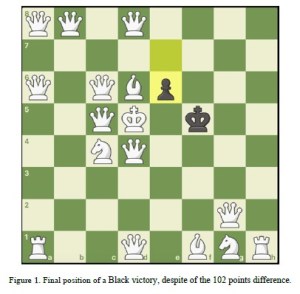
It is trivial to show how it is possible to change a few moves of the previous game to get an even 100 points final score difference and a loss for the White. As an example, let us modify moves 51 (et seq.) in order to checkmate the white king (103 points final score for the White) with one knight:
PGN (0 – 1)
- a4 b5 2. axb5 a6 3. bxa6 Bb7 4. axb7 c6 5. bxa8=Q Qc8 6. b4 Qd8 7. b5 Qc7 8. b6 Qd8 9. b7 Na6 10. b8=Q c5 11. d4 f6 12. dxc5 Kf7 13. c6 Ke8 14. c7 Kf7 15. c8=Q Ke8 16. c4 Kf7 17. c5 Ke8 18. c6 Kf7 19. c7 Ke8 20. Qcxa6 Kf7 21. c8=Q Ke8 22. e4 Kf7 23. e5 Ke8 24. e6 Nh6 25. exd7+ Kf7 26. f4 g5 27. fxg5 Nf5 28. h4 h6 29. gxh6 Rg8 30. h7 Rg7 31. h8=Q Kg6 32. Kd2 Qe8 33. g4 Kf7 34. Kc3 Kg6 35. Kc4 Kf7 36. Kd5 Kg6 37. Na3 Kf7 38. Nc4 Kg6 39. dxe8=Q+ Rf7 40. Ba3 Bh6 41. Bd6 Bg7 42. h5+ Kg5 43. h6 Rf8 44. Qc5 Rg8 45. Qec6 Kg6 46. g5 Bf8 47. gxf6 Bg7 48. h7 Nd4 49. fxg7 Nc2 50. hxg8=Q Nd4 51. Bxe7+ Kf5 52. Qgd8 Nb3 53. g8=Q Nc1 54. Rh4 Na2 55. Rd4 Nc1 56. Bd6 Na2 57. Qhh4 Nc3#
Problem 2. Which is the maximum value of (1) to let the Black end the game with a passive stalemate?
Theorem 2. The maximum value of (1) to let the Black end the game with a passive stalemate is 103 points.
Proof of Theorem 2.
Since Lemma 1 states that the maximum score achievable is 103 points, then we prove that 103 points is a valid score when an active stalemate by the White occurs [6].
PGN (1/2 – 1/2)
- a4 b5 2. axb5 a6 3. bxa6 Bb7 4. axb7 c6 5. bxa8=Q d5 6. c4 e6 7. cxd5 Qd7 8. dxc6 Be7 9. c7 Kf8 10. c8=Q+ Qe8 11. b4 Nc6 12. b5 Nd8 13. b6 Nc6 14. b7 Nd8 15. b8=Q h5 16. d4 g6 17. d5 Rh7 18. d6 Rh8 19. d7 Rh7 20. e4 Nc6 21. d8=Q f5 22. exf5 Nh6 23. fxe6 Bf6 24. e7+ Kg8 25. f4 Qf8 26. e8=Q Bg7 27. f5 Kh8 28. f6 Qg8 29. f7 g5 30. f8=Q Nf7 31. h4 Nfe5 32. hxg5 Bf6 33. gxf6 Rg7 34. f7 Kh7 35. Qfa3 Qh8 36. f8=Q Rg5 37. g4 Qg7 38. gxh5 Qg6 39. Qfb4 Kg7 40. Qcxc6 Nf7 41. Qee2 Nd6 42. h6+ Kf7 43. h7 Rd5 44. Qcxd6 Kg7 45. Q6xd5 Qd6 46. Q5xd6 Kf7 47. h8=Q £
The final position is shown in figure 2
(FEN: QQ1Q3Q/5k2/3Q4/8/1Q6/Q7/4Q3/RNBQKBNR b KQ – 0 47).
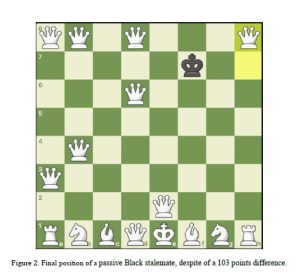
Problem 3. Which is the maximum value of (1) to let the Black end the game with an active stalemate?
Lemma 2. If we force the match to end with an active Black stalemate, 81 is a lower bound of the highest possible value of (1).
Proof of Lemma 2.
The following game is legit according to standards FIDE rules, and it ends with an active Black stalemate plus a 81 points difference for the White.
PGN (1/2 – 1/2)
- g4 f5 2. gxf5 g5 3. h4 g4 4. h5 Kf7 5. f6 Ke6 6. fxe7 Kf6 7. e8=Q g3 8. Nf3 g2 9. Rh4 g1=B 10. a4 b5 11. axb5 a6 12. bxa6 Bb7 13. axb7 Nc6 14. bxa8=Q Qe7 15. Qeb8 Qd6 16. e4 Kg7 17. e5 Qd5 18. e6 Qe5+ 19. Qe2 Qf6 20. exd7 Qf7 21. d8=Q Nce7 22. Qdxc7 Nf6 23. Qea6 Nfd5 24. Qac8 Nf6 25. Ne5 Ned5 26. f4 Kg8 27. Nc6 Ng4 28. c4 Ne5 29. fxe5 Qf6 30. e6 Qf7 31. e7 Qf6 32. e8=Q Qf7 33. Nd4 Qe7+ 34. Kd1 Qf7 35. Qea4 Qg7 36. Q4a7 Qf7 37. c5 Qe6 38. Qd6 Qe7 39. c6 Qf7 40. c7 Qe7 41. Qcb7 Qf7 42. c8=Q Qe7 43. Qdc7 Qf7 44. Nf5 Nf6 45. d4 Ne4 46. d5 Bc5 47. Ne7+ Kg7 48. Bg5 Qg6 49. Nc6+ Qf7 50. Bd8 Nf6 51. Re4 Nd7 52. Re7 Kg8 53. Rxd7 Kg7 54. Ne7 Bb4 55. Ra6 Ba3 56. Rb6 Bc5 57. Ba6 Ba3 58. b4 Bb2 59. b5 Ba3 60. Nd2 Bb4 61. Nb3 Qe6 62. h6+ Kf7 63. Kc2 Rg8 64. Kd3 Rg7 65. hxg7 Kf6 66. g8=Q Ba3 67. Qg1 h5 68. Qgc5 h4 69. Q5c6 Kf7 70. Kd4 Qh6 71. Nc5 Qf4+ 72. Qxf4+ Kg7 73. Qfd6 h3 74. Qf4 h2 75. Qxh2 Kf7 76. Qhc7 Kg7 77. Ke5 Kf7 78. Kd6 Kf6
The final position is shown in figure 3
(FEN: QQQB1b2/QQQRN3/BRQK1k2/1PNP4/8/b7/8/8 w – 7 79).
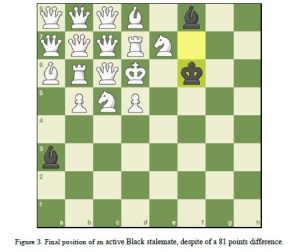
We cannot formally prove that the result by Lemma 2 is the optimal one for Problem 3. Thus, we can only take it as a good lower bound.
Problem 4. Which is the maximum value of final score White to let the Black end the game with an active stalemate?
Lemma 3. If we force the match to end with an active Black stalemate, 91 is a valid lower bound of the highest final score White value attainable.
Proof of Lemma 3.
The following game is legit according to standards FIDE rules, and it ends with an active Black stalemate plus a 91 points final score for the White.
PGN (1/2 – 1/2)
- g4 f5 2. gxf5 g5 3. a4 b5 4. axb5 a6 5. bxa6 Bb7 6. axb7 g4 7. bxa8=Q g3 8. Nf3 c6 9. h4 g2 10. h5 h6 11. c4 d5 12. cxd5 g1=B 13. dxc6 Kf7 14. c7 Qd7 15. cxb8=Q Qd8 16. d4 Qd7 17. Bxh6 Bg7 18. Bg5 e6 19. Qc2 Rh6 20. Qcc8 Rg6 21. d5 Qe7 22. d6 Qf6 23. d7 Qe5 24. d8=Q Qf6 25. Qda5 Qe5 26. Q5a7+ Qc7 27. Bd8 Rg5 28. h6 Rg6 29. h7 Rg5 30. h8=Q Rg6 31. e4 Rg5 32. Ba6 Bf8 33. Qh2 Qe7 34. Qhc7 Kg7 35. fxe6 Qf7 36. e7 Qf6 37. e8=Q+ Qf7 38. Nfd2 Rg6 39. f4 Rg2 40. e5 Rg6 41. e6 Rg5 42. Qeb5 Rg6 43. Q5b7 Rg4 44. e7 Nf6 45. e8=Q Nd5 46. Rh6 Nb6 47. Rxb6 Rg6 48. Qec6 Qd7 49. f5 Kh6 50. f6 Kg5 51. f7+ Kg4 52. Nc3 Bg7 53. f8=R Rf6 54. Re8 Kg5 55. Rd1 Bc5 56. Nde4+ Kf5 57. Rxd7 Ba3 58. b4 Bf8 59. Kd2 Kg4 60. Kd3 Kf5 61. Kd4 Kg4 62. Kd5 Kf5 63. Ree7 Kg4 64. Nc5 Rf1 65. Kd6 Rd1+ 66. Nd5 Kf5 67. b5 Rd2
The final position is shown in figure 4
(FEN: QQQB1b2/QQQRR3/BRQK4/1PNN1k2/8/b7/3r4/8 w – 1 68).
As we previously pointed out, the 91 points score cannot be considered as an optimal solution: it merely shows a nontrivial lower bound for Problem 4.
3 Maximum total score achievable on the board for a generic draw
Since the standard FIDE rules allow a competition match to end in a draw even if a stalemate does not occur (see FIDE Laws of Chess, Article 9, rules 9.2&9.3 [3]), let us consider a generic game and a different problem.
Problem 5. Let us (provisionally) remove Postulates 4&5, replacing them with the following Postulate 4′.
Postulate 4′. The final move of a game is the one that produces a draw under any of the FIDE rules stated in Article 9, rules 9.2-9.3-9.6.
Let us define
𝑇𝑜𝑡 𝐷𝑟𝑎𝑤 ∶= 𝑓𝑖𝑛𝑎𝑙 𝑠𝑐𝑜𝑟𝑒 𝑊ℎ𝑖𝑡𝑒 (𝑔𝑎𝑚𝑒 𝑒𝑛𝑑𝑒𝑑) + final 𝑠𝑐𝑜𝑟𝑒 𝐵𝑙𝑎𝑐𝑘 (𝑔𝑎𝑚𝑒 𝑒𝑛𝑑𝑒𝑑), (4)
asking which is the maximum value of , assuming Postulates 1 to 3 and Postulate 4′.
Lemma 4. The solution of Problem 5 can be easily proved to be 182 points (see [2], post #1), considering the ceiling given by (3) for both players minus the minimum amount of pieces needed to let any of the pawns pass and promote to a Queen, multiplying each of those pieces for its value (as stated in Postulate 1).
Thus, an upper bound of (4) is given by
𝑀𝑎𝑥 𝑇𝑜𝑡 𝐷𝑟𝑎𝑤 = 2 ∙ 103 − 2 ∙ (2 ∙ 𝑁) − 2 ∙ (2 ∙ 𝐵) = 182. (5)
Since 182 has been proved in [2] to be a score achievable playing only legit moves, we aim to solve the related stalemate problem, under the standard postulates 1 to 5 (as stated in Section 1), and including Constraint 1 too.
Problem 6. Which is the maximum value of (4) to let a standard chess game end in a stalemate?
Lemma 5. If we force the match to end with a stalemate, the highest possible value of (4) belongs to [168, 180].
Proof of Lemma 5.
𝑀𝑎𝑥 𝑇𝑜𝑡 𝐷𝑟𝑎𝑤 ≤ 180 naturally follows from Lemma 4, since the position shown in [2] can be easily claimed as a draw by rules 9.2&9.3, and it is trivial to point out how it is impossible to turn it into a stalemate (no stalemate with a queen for both players without a knight, a bishop or a pawn). So, we have: 𝑀𝑎𝑥 𝑇𝑜𝑡 𝐷𝑟𝑎𝑤 ≤ 182 − (𝑅 − 𝐵) = 182 − (5 − 3).
On the other hand, we can achieve a legit 𝑇𝑜𝑡 𝐷𝑟𝑎𝑤 of 168 points and a stalemate, as explained in [6], and subsequently confirmed by the standard match below.
PGN (1/2 – 1/2)
- a4 b5 2. axb5 c5 3. d4 c4 4. Bd2 c3 5. d5 Nc6 6. dxc6 Ba6 7. b6 d5 8. b7 f5 9. Bf4 h5 10. Bd6 exd6 11. Nd2 g5 12. b8=Q Rh7 13. f4 cxd2+ 14. Kf2 Rd7 15. c7 d4 16. e4 d3 17. Qe2 d5 18. c8=Q d4 19. b4 Kf7 20. b5 Kg6 21. b6 Nf6 22. b7 Nd5 23. Qbc7 Nb4 24. b8=Q d1=Q 25. e5 d2 26. e6 d3 27. e7 Qb1 28. e8=Q+ Kf6 29. c4 d1=Q 30. c5 d2 31. c6 Qdb3 32. h3 Bb7 33. Qa5 Rd5 34. c7 Qe7 35. Qcd8 Re5 36. c8=Q Bd5 37. Qdb6+ Re6 38. Q2b5 d1=Q 39. Qb8b7 Nc6 40. fxg5+ Ke5 41. g6 f4 42. g4 Qd6 43. g5 Qba3 44. Be2 Qdb3 45. Bg4 hxg4 46. g7 f3 47. g8=Q Q1a2+ 48. Kg3 f2+ 49. Kh2 Qdb4 50. Ne2 f1=Q 51. Rc1 Nd4 52. h4 Rb8 53. Rc7 Qfa1 54. h5 g3+ 55. Kh3 g2+ 56. Kh4 g1=Q 57. h6 Qgb1 58. h7 Qb3b2 59. g6 Ke4 60. h8=Q Nb3 61. Qbd7 Bh6 62. g7 Bc1 63. Qgf8 Nd2 64. g8=Q Q4b3 65. Qac5 Kd3 66. Ng3 Re4+ 67. Qdg4 Rc4 68. Qed8 Rc2 69. Qde8 Bc4 70. Qhh7+ Kc3 71. Qbe6 a5 72. Qba6 a4 73. Qaa5+ Rb4 74. Qe1 £
The final position is shown in figure 5
(FEN: 2Q1QQQ1/2R4Q/8/Q1Q5/prb3QK/qqk3N1/qqrn4/qqb1Q2R b – 3 74).
4 Conclusion and open problems
Problems 1 & 2 have been definitively solved at the beginning of Section 2, while the last questions (Problems 3-4-6) still need to receive a final answer. The nontrivial bounds we have proved do not represent a solid ceiling for these hard open problems that we are going to further investigate in the future, in spite of we conjecture that the maximum value of (4) for a regular stalemate is 168.
5 Acknowledgements
The author thanks Cosimo Palma for his kind review.
References
[1] Chess piece relative value (2019). Wikipedia. Available at: https://en.wikipedia.org/wiki/Chess_piece_relative_value (Accessed: 3 March 2020).
[2] 18 Queens is possible? (2017). Chess.com. Available at: https://www.chess.com/forum/view/general/18-queens-is-possible (Accessed: 6 March 2020).
[3] FIDE Laws of Chess, article 9, p. 12-13. FIDE Handbook. Available at: https://www.fide.com/FIDE/handbook/LawsOfChess.pdf (Accessed: 3 March 2020).
[4] Forsyth-Edwards Notation (2019). Wikipedia. Available at: https://en.wikipedia.org/wiki/Forsyth%E2%80%93Edwards_Notation (Accessed: 3 March 2020).
[5] Portable Game Notation (2020). Wikipedia. Available at: https://en.wikipedia.org/wiki/Portable_Game_Notation (Accessed: 3 March 2020).
[6] Ultimate Stalemate? Mental Activity (2015). Chess.com. Available at: https://www.chess.com/forum/view/more-puzzles/ultimate-stalemate-mental-activity (Accessed: 6 March 2020).
[1] Founder, sPIqr Society; Creator, X-Test.
[2] Individual Publication Date: April 22, 2020: www.in-sightjournal.com/very-unbalanced-chess-positions; Full Issue Publication Date: May 1, 2020: https://in-sightjournal.com/insight-issues/. Image Credit: Marco Ripà.
Appendix II: Citation Style Listing
American Medical Association (AMA): Ripà M. Very unbalanced Chess Positions [Online].April 2020; 22(B). Available from: www.in-sightjournal.com/very-unbalanced-chess-positions.
American Psychological Association (APA, 6th Edition, 2010): Ripà, M. (2020, April 22). Very unbalanced Chess Positions. Retrieved from www.in-sightjournal.com/very-unbalanced-chess-positions.
Brazilian National Standards (ABNT): RIPA, M. Very unbalanced Chess Positions. In-Sight: Independent Interview-Based Journal. 22.B, April. 2020. <www.in-sightjournal.com/very-unbalanced-chess-positions>.
Chicago/Turabian, Author-Date (16th Edition): Ripà, M. 2020. “Very unbalanced Chess Positions.” In-Sight: Independent Interview-Based Journal. 22.B. www.in-sightjournal.com/very-unbalanced-chess-positions.
Chicago/Turabian, Humanities (16th Edition): Ripà, Marco “Very unbalanced Chess Positions.” In-Sight: Independent Interview-Based Journal. 22.B (April 2020). www.in-sightjournal.com/very-unbalanced-chess-positions.
Harvard: Ripà, M. 2020, ‘Very unbalanced Chess Positions‘, In-Sight: Independent Interview-Based Journal, vol. 22.B. Available from: <www.in-sightjournal.com/very-unbalanced-chess-positions>.
Harvard, Australian: Ripà, M. 2020, ‘Very unbalanced Chess Positions‘, In-Sight: Independent Interview-Based Journal, vol. 22.B., www.in-sightjournal.com/very-unbalanced-chess-positions.
Modern Language Association (MLA, 7th Edition, 2009): Marco Ripà. “Very unbalanced Chess Positions.” In-Sight: Independent Interview-Based Journal 22.B (2020):April. 2020. Web. <www.in-sightjournal.com/very-unbalanced-chess-positions>.
Vancouver/ICMJE: Ripà M. Very unbalanced Chess Positions [Internet]. (2020, April 22(B). Available from: www.in-sightjournal.com/very-unbalanced-chess-positions.
License and Copyright
License
In-Sight Publishing and In-Sight: Independent Interview-Based Journal by Scott Douglas Jacobsen is licensed under a Creative Commons Attribution-NonCommercial-NoDerivatives 4.0 International License.
Based on a work at www.in-sightjournal.com.
Copyright
© Scott Douglas Jacobsen, and In-Sight Publishing and In-Sight: Independent Interview-Based Journal 2012-2020. Unauthorized use and/or duplication of this material without express and written permission from this site’s author and/or owner is strictly prohibited. Excerpts and links may be used, provided that full and clear credit is given to Scott Douglas Jacobsen, and In-Sight Publishing and In-Sight: Independent Interview-Based Journal with appropriate and specific direction to the original content. All interviewees co-copyright their interview material and may disseminate for their independent purposes.
Share this:

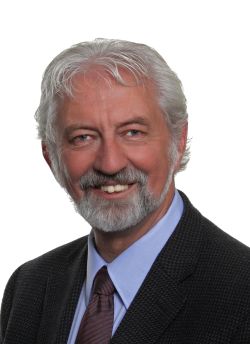
Author: Rod Taylor
Numbering: Issue 22.B, Idea: Outliers & Outsiders (Part Eighteen)
Place of Publication: Langley, British Columbia, Canada
Title: In-Sight: Independent Interview-Based Journal
Web Domain: http://www.in-sightjournal.com
Individual Publication Date: April 22, 2020
Issue Publication Date: May 1, 2020
Name of Publisher: In-Sight Publishing
Frequency: Three Times Per Year
Words: 3,795
ISSN 2369-6885
Abstract
This paper examines the relationship between the church and the state in Canadian society within the contextualization of the “Sacred Polity.” The terminological differences between the church and the state become one basis for the consideration here. The paper centrally argues for the fundamentally religious nature of the religious and the secular with claims taken on faith. Claims on faith-building worldviews fundamentally different in titles and content, but similar in ways of knowing: faith. In essence, a polity is a Sacred Polity by the nature of the views held by all, whether “secular” or “religious,” being, fundamentally, religious worldviews.
Keywords: Canada, Church, religion, Rod Taylor, Sacred Polity, state.
A Sacred Polity: Untangling the Threads of Church and State[1],[2]
*Please see the footnotes, bibliography, and citation style listing after the interview.*
In some types of fabrics, tugging on one loose thread can unravel the entire piece; patterns will disappear along with functionality. So it is with the delicate, interwoven threads of our faith and our politics. They are the warp and woof of our practical and philosophical existence. When personal convictions—including faith-based convictions—are removed from our political fabric, our society begins to unravel.
When considering the proper role of faith in politics, it behooves us to first ask: what is faith? Secondly: what is politics? If these can be defined, we can begin to assess their juxtaposition and how we can ethically apply our faith-driven understanding of the world to our political actions.
Merriam-Webster’s Online Dictionary says that faith is “a firm belief in something for which there is no proof”. (1) Wikipedia defines faith as “confidence or trust in a person, thing or concept”. (2) Stanford’s Encyclopedia of Philosophy has this to say about faith: “At its most general, ‘faith’ means much the same as ‘trust’ . . . the question arises whether faith of that same general kind also belongs to other, non-theistic, religious contexts, or to contexts not usually thought of as religious at all. Arguably, it may be apt to speak of the faith of a humanist, or even an atheist, using the same general sense of ‘faith’ as applies to the theist case.” (3)
Some definitions link that confidence or trust to “a personal God or to a set of beliefs about God”. The Bible gives its own definition of faith in Hebrews 11:1. It says that “Faith is the substance of things hoped for, the evidence of things not [yet] seen.” (4) That phrase indicates confidence and trust in a reality that cannot be adequately known or understood only by tangible objects. According to that definition, faith is itself the evidence for a belief not unequivocally proven by the five senses.
Everyone has faith in something or someone . . . or at least in a conceptual view of reality. We call that a worldview. Some people believe in a Creator, a God with personal attributes, able to think, feel and see. Others believe in a random universe, eternally existing, independent of any divine guidance or interaction. Others believe in a Big Bang—an unexplainable and unwitnessed event of immeasurable proportion that took place in time and space and produced the material elements of which we are composed and by which we are surrounded: the air we breathe, the water we drink and the molecules used to manufacture the cars we drive and the cellphones with which we communicate. Each of these belief-systems constitutes a worldview, the equivalent of a type of faith, in that every worldview develops, in its adherents, a set of value judgments. Certain behaviours and attitudes are esteemed; others are deemed undesirable. Of course, many people fall short of living lives consistent with their intellectual understandings. They do not always “walk the talk”. They believe something to be true, but their actions do not always demonstrate that belief. People also value certainty; in seeking to justify their pre-conceived beliefs, they may ignore or minimize evidence that does not support the suppositions they have adopted as their own.
When it comes to politics, Merriam-Webster calls it “the art or science of government” or “the art or science of guiding or influencing government policy”. (5) Given that human beings tend to congregate, tend to develop social order and tend to adopt customs, rituals and protocols that are acceptable to their tribe, city or nation, we may assume, in any such group, some form of government. All societies inevitably establish disincentives to certain behaviours. Government in those societies may be highly-developed, with written laws and formal offices or it may be very simple, with leadership established by the lineage, character or the physical strength of dominant members. Whatever its form, there will be leaders and there will be laws, written or unwritten. There will be government, and where there is government, even in a family, there will be politics and attempts to influence decision-making.
Since both faith and politics are present in any human interaction, the idea that they can be kept separate is a flawed concept. Generally, when people speak about the “separation of church and state”, they are referring to a particular faith or a particular political framework. Often, in today’s secularized Western society, “faith” refers to a historically-understood (or misunderstood) version of the Christian faith. When the word “state” is used, it refers to a society unfettered by the moral strictures attributed to that Christian faith. In other words, some people—when insisting on the “separation of church and state” are simply stating their preference for state policies driven by religious (worldview) biases other than Christian ones.
Rarely do the opponents of Christian principles, who themselves carry their own philosophical biases, see themselves as religious. They may occasionally recognize the fact that they have a distinct worldview—one they see as rational and substantiated by science or nature—but they are loathe to equate “worldview” with “faith” or their interpretation of science as one of several possible explanations for the universe and humanity’s role in it. Their assumption is that their own secular worldview is the only legitimate one and that any other worldview—one that posits, for example, the existence of an intelligent and loving Creator—presents an illogical and unwelcome intrusion into the realm of political thought and action. While verbally assuring others that they have “tolerance” for beliefs they do not share, they insist that such beliefs should have no influence on the shaping of laws and cultural norms. This philosophical blindness renders any true compromise with dissenters unlikely, if not impossible. While rejecting Christian standards of right and wrong, those who oppose Christian influence in law and custom often impose (without realizing it) their own deeply-held worldview beliefs on society . . . beliefs which they expect others to accept as self-evident moral principles.
Speaking of moral behaviours, are there any behaviours that can be classed as right or wrong? That question arises when avowed secularists challenge the moral assertions of Christians or the adherents of one of the world’s other commonly-recognized religions. There are people who claim that there are no absolutes, that right and wrong are only a matter of personal opinion; they insist that people should not attempt to apply their own beliefs to matters of public policy, certainly never in the arena of partisan politics. There is an inherent inconsistency in making that claim, for by proclaiming the illegitimacy of faith’s influence on public policy, they are in fact asserting the moral superiority of their own faith or worldview. Those who declare the absolute necessity of separating faith from politics make this assertion in an attempt to exclude the influence of Christian morality from public policy, with a corresponding embrace of the influence of that “person, thing or concept” in which they themselves have confidence and trust. That thing could be socialism. That thing could be the theory of Darwinian evolution. That thing could be CO2-induced climate change. It could be “the goodness of man” (which needs some explaining nowadays). It could be public education or the stock market or the theory of non-existence. Whatever the deeply-held belief, it is part of the worldview held by an individual—either because of or in spite of physical evidence—and, as claimed above, is simply another type of faith. In fact, that belief system becomes the lens through which the world is perceived, rightly called a worldview.
If we accept the premise that there are such things as right and wrong, on what basis do we determine the rightness or wrongness of measuring political principles by spiritual standards? This question assumes that there are universal ethical standards that would either preclude or demand a functional link between a person’s spiritual and philosophical worldview and the outworking of social precepts and expectations. A person who claims it is wrong to insert moral values into public policy debates encounters a dilemma: to say that it is wrong to invoke morality is itself a moral judgment. A society can—and under certain circumstances of commonly-shared beliefs, will—create laws and customs that seem right and fitting to a majority at the time but that are rejected by subsequent generations as being unjust, unkind or even sinful. Slavery is a blatant example of this. Most today would wholeheartedly agree that slavery is not only wrong in the 21st Century but it was wrong 200 years ago. Yet, at that time, it had its proponents, mostly those who received monetary benefit from its continuance. As late as 1857, the US Supreme Court took the side of the slaveholder, in denying personhood and the rights of citizenship to African-Americans. (6) They were wrong but they believed themselves right.
One would be hard-pressed (thankfully) to find, in a Western democracy today, anyone who would deny the equal value of men and women. Yet less than 100 years ago, Canadian women were not considered “persons” under the law. In fact, the Supreme Court of Canada ruled in 1928 that a woman was not a “person” and therefore was ineligible for appointment to the Senate. This ruling was overturned in 1929 by the Privy Council of England, showing clearly that Supreme Court Justices were not (and are not) infallible. Today, pre-born human babies are denied the recognition of their personhood by the Supreme Court of Canada, even up to the moment of natural birth. People of goodwill, on both sides of the debate, offer reasons for their perspectives and promote vigorously their points of view. In this debate, invariably, those who wish to maintain the status quo (abortion on demand) tend to reject any argument in favour of recognizing the personhood of the preborn infant on the basis that it involves a “religious perspective”. They believe themselves to be right.
It’s true that there are many supporting statements found in the Bible for the support of a pro-life position, (although there are pro-lifers who do not claim a Christian basis for their opinions). My point, and what I hope to demonstrate, is that those who passionately disagree with a pro-life position are themselves motivated by a religious belief—a worldview—which causes them to ignore arguments and even scientific facts that might contradict their assertions.
There is, for example, the scientific fact that the union of sperm and egg produce a unique DNA, different from that of the mother, unique fingerprints, half the time a different biological gender, sometimes even a different blood type. Yet, those whose worldview demands the right to terminate a pregnancy for any reason (or no reason at all) will insist: “It’s my body!” Others will say, in spite of fingerprints, brainwaves, the ability to feel pain, a heartbeat as early as 6 weeks and other miraculous developments that, “It’s just a clump of tissue!” Those statements are religious statements. They are made by those who hold a worldview that denies even the possibility of personhood for the pre-born. One could call it a religion of “Choice”, where Choice is a sacred idol and the exercise of personal choice is a sacrament. When adherents of this religion engage in political action and seek to influence legislation, they apply absolute devotion to the cause. Those who lobby for unfettered Choice are lobbying for an absolute value they claim to be a moral one.
Such positions are contradictory on several levels but then, religious beliefs like this are sometimes clung to in spite of conflicting evidence. For one thing, those who worship and serve the goddess of Choice, freely and unapologetically deny any choice to the preborn. While the mother may be inconvenienced (sometimes seriously) by a pregnancy, the aborted child is denied the opportunity to ever make a choice about anything. Secondly, the devotees of unfettered Choice generally disapprove of pro-lifers exercising their choice about what to believe and how to express those beliefs. It is commonly assumed that only pro-lifers hold views that are based on absolutes, but the absolute support by devotees of abortion Choice under any circumstances puts the lie to the claim. The attempt to quash dissent and deprive pro-lifers of a voice is silent proof. In several provinces of Canada, pro-lifers are forbidden to exercise free speech near abortion clinics or even to stand there in silent prayer. Across the country, pro-lifers are compelled by law (against their choice) to support abortion with their tax dollars. Those whose worldview convictions compel them to support unfettered access to abortion, even if it restricts the choices of others, even if it ends a human life, are simply living out their religious worldview. They believe they are right. The very right to peaceful protest, that ultimately resulted in the legalization of abortion, is denied to those who speak for the voiceless preborn.
Another example would be how secular and non-secular faiths have collided over the issue of creation and the public teaching of theories of origin. While Christians—and people of many other faiths—believe in a divine Creator, others hold to a secular view that ascribes the existence of the Universe to a series of random, undirected events. Those who believe in an intelligent Creator—who made all things, caused the planets to orbit, the sun to shine, waters to flow and life to exist in all its magnificent variety and beauty—are assumed to be religious, while those who put their trust in the Big Bang (for instance) are assumed to be practical, scientific people. Both groups believe themselves to be right. The secularists believe that their religious worldview is the only one deserving of representation in the laws and classrooms of the nation. In both worldviews there are assumptions:
Christians assume God. Pre-existent, intelligent, all-powerful, creative. The source of everything. (7)
Those who claim that the material Universe has come about through random events assume:
- either the eternal existence of, or the sudden appearance of matter and energy. (where did the first amazing atom come from? what causes electrons to rotate around the nucleus?)
- that random events could produce order instead of only chaos.
- that our ability to think, to plan, to reason, to love, to create . . . our self-awareness and the existence of conscience and of our ability to reproduce, to interact . . . are somehow the result of random events over immeasurable periods of time.
- no overarching purpose or meaning in life; (how could there be meaning in a random, undirected series of events?)
In other words, Christians and adherents of many other religions assume an intelligent God, capable of creating matter, energy and life . . . pre-existing and displaying through the material Universe, a wisdom and power greater than our own. Those who reject a personal, all-powerful, all-wise God, are forced to believe in something even more fantastic: a universe with no plan, no purpose, no design, no source. If they posit a beginning, it demands an explosion with no firecracker and nobody to light the fuse. The very elements which make up our earth (and who knows what other elements may exist on other planets or in other galaxies) are called into existence with no composer, no designer, no author, no workman.
Mankind would rather believe in a thousand impossibilities . . .
than in one impossible God who hears and sees. Rod Taylor, 1996
At any rate, it takes faith in Something or Someone to even live as a human being. We trust that the sun will come up tomorrow. We trust that the molecules in our coffee cup will hold together, that gravity will work today as it did yesterday, that we can walk upon solid ground without falling through into the molten rock below. We all have our beliefs.
We also have implicit trust in the idea of human relationships and interaction. Every one of us understands the moral absolutes of “Don’t lie, don’t steal, don’t murder”. Unfortunately, we don’t all keep those commandments. When mankind fails, it fails badly. Human beings will make excuses for their failures; they will seek to justify themselves. But every human being holds to a belief system that is to him or her a worldview as absolute as any of the world’s recognized religions. Not every person is involved in partisan politics, but every person would like his or her personal worldview to define the guiding principles of world in which we live.
When we are told that faith has no place in politics, we must ask, “Which faith?” and “Why not?” The tiresome canard we hear so often is that “religion causes wars”. Again, “What do you mean by religion?” If “religion” includes all worldview assumptions about existence and the meaning of life, I would agree that religious ideas (worldview differences) can divide. After all, contradictory ideas cannot all be true. But it is not Christianity or any other recognized “world religion” that has wrought the most havoc in the past 100 years. In the 20th Century, it wasn’t Christianity but the secular religion of atheistic Communism that killed more people than any other single force. (8) If religion is the greatest cause of wars, then atheistic Communism must be a religion. The Nazi Holocaust, with all its frightful consequences, was driven by a fiery, passionate, demonically-inspired set of beliefs that constituted a very twisted, ungodly, secular religion; it showed its fangs most viciously against Judeo-Christian religious views. (9)
As we face the challenges of the 21st Century—economic, geo-political, health, environmental, technological, military and social challenges—let us be honest about the reasons why we accept or reject policy proposals. Let’s not say that morality has no place in public policy. Let’s patiently explain why we believe that our own set of moral values—based on our own set of worldview assumptions—are preferable to those proposed by others. Everyone has a religion and that religion will guide his or her opinions. Ideas must be allowed to compete fairly in the public policy marketplace. In a western democracy, to advance one’s own worldview agenda by declaring contrary opinions illegitimate in the public square, is to admit that one’s own set of assumptions may not withstand the rigours of debate. The question is not whether religion should influence politics, but which religious worldviews will contribute best to further a peaceful and prosperous society.
I close with my own worldview statement, based on my own belief in a personal, living God. I am thankful that humankind is “made in His image” as the Bible says. I’m thankful that He has given to us—male and female, of every ethnicity—His own attributes: the desire and ability to create, to love, to think, to plan, to give, to nurture, to repair. I’m thankful that He is teaching us patience, self-sacrifice, generosity, kindness, humility, forgiveness (moral values shared by the adherents of many formal religions AND by many whose religious worldviews deny a personal God) . . . and that He calls us to value those attributes in others. As we seek ways to improve dialogue and to achieve a safe, prosperous, compassionate and generous society, let’s allow others to express their ideas and their ideals; the proponents of those views may deny it, but they’re all religious views.
References
- Merriam-Webster. (n.d.). ‘Faith’. In Merriam-Webster.com dictionary. Retrieved April 22, 2020, from https://www.merriam-webster.com/dictionary/faith
- Wikipedia Online Encyclopedia. ‘Faith’. Retrieved April 22, 2020 https://en.wikipedia.org/wiki/Faith
- Bishop, John, ‘Faith’, The Stanford Encyclopedia of Philosophy (Winter 2016 Edition), Edward N. Zalta (ed.), Retrieved from https://plato.stanford.edu/archives/win2016/entries/faith/
- King James Bible, Book of Hebrews, ch 11:1 “Faith” Retrieved April 22, 2020 https://www.bible.com/bible/1/HEB.11.KJV
- Merriam-Webster, ‘Politics’. Merriam-Webster.com Dictionary, Accessed Apr. 22, 2020. https://www.merriam-webster.com/dictionary/politics
- Melvin I. Urofsky, ‘Dred Scott Decision’, Encyclopedia Britannica, Pub. Feb. 28, 2020 Retrieved April 22, 2020 https://www.britannica.com/event/Dred-Scott-decision
- Jonathan Sarfati, Creation.com, Feb. 8, 2008 Retrieved April 22, 2020 https://creation.com/science-creation-and-evolutionism-refutation-of-nas
- Stone Washington, ‘1917-2017: 100 Years of Communism=100 Million Deaths’, Ellis Washington Report, Retrieved April 22, 2020 http://www.elliswashingtonreport.com/2017/10/24/1917-2017-100-years-of-communism-100-million-deaths/
- Michael Berenbaum, ‘Holocaust’, Encyclopedia Britannica, Jan. 14, 2020, Retrieved April 22, 2020 https://www.britannica.com/event/Holocaust/
[1] Party Leader, Christian Heritage Party.
[2] Individual Publication Date: April 22, 2020: http://www.in-sightjournal.com/sacred-polity; Full Issue Publication Date: May 1, 2020: https://in-sightjournal.com/insight-issues/.
Appendix II: Citation Style Listing
American Medical Association (AMA): Taylor R. A Sacred Polity: Untangling the Threads of Church and State [Online].April 2020; 22(B). Available from: http://www.in-sightjournal.com/sacred-polity.
American Psychological Association (APA, 6th Edition, 2010): Taylor, R. (2020, April 22). A Sacred Polity: Untangling the Threads of Church and State. Retrieved from http://www.in-sightjournal.com/sacred-polity.
Brazilian National Standards (ABNT): TAYLOR, R. A Sacred Polity: Untangling the Threads of Church and State. In-Sight: Independent Interview-Based Journal. 22.B, April. 2020. <http://www.in-sightjournal.com/sacred-polity>.
Chicago/Turabian, Author-Date (16th Edition): Taylor, Rod. 2020. “A Sacred Polity: Untangling the Threads of Church and State.” In-Sight: Independent Interview-Based Journal. 22.B. http://www.in-sightjournal.com/sacred-polity.
Chicago/Turabian, Humanities (16th Edition): Taylor, Rod “A Sacred Polity: Untangling the Threads of Church and State.” In-Sight: Independent Interview-Based Journal. 22.B (April 2020). http://www.in-sightjournal.com/sacred-polity.
Harvard: Taylor, R. 2020, ‘A Sacred Polity: Untangling the Threads of Church and State‘, In-Sight: Independent Interview-Based Journal, vol. 22.B. Available from: <http://www.in-sightjournal.com/sacred-polity>.
Harvard, Australian: Taylor, R. 2020, ‘A Sacred Polity: Untangling the Threads of Church and State’, In-Sight: Independent Interview-Based Journal, vol. 22.B., http://www.in-sightjournal.com/sacred-polity.
Modern Language Association (MLA, 7th Edition, 2009): Rod Taylor. “A Sacred Polity: Untangling the Threads of Church and State.” In-Sight: Independent Interview-Based Journal 22.B (2020):April. 2020. Web. <http://www.in-sightjournal.com/sacred-polity>.
Vancouver/ICMJE: Taylor R. A Sacred Polity: Untangling the Threads of Church and State [Internet]. (2020, April 22(B). Available from: http://www.in-sightjournal.com/sacred-polity.
License and Copyright
License
In-Sight Publishing and In-Sight: Independent Interview-Based Journal by Scott Douglas Jacobsen is licensed under a Creative Commons Attribution-NonCommercial-NoDerivatives 4.0 International License.
Based on a work at www.in-sightjournal.com.
Copyright
© Scott Douglas Jacobsen, and In-Sight Publishing and In-Sight: Independent Interview-Based Journal 2012-2020. Unauthorized use and/or duplication of this material without express and written permission from this site’s author and/or owner is strictly prohibited. Excerpts and links may be used, provided that full and clear credit is given to Scott Douglas Jacobsen, and In-Sight Publishing and In-Sight: Independent Interview-Based Journal with appropriate and specific direction to the original content. All interviewees co-copyright their interview material and may disseminate for their independent purposes.
Share this:

Interviewer: Scott Douglas Jacobsen
Numbering: Issue 22.A, Idea: Outliers & Outsiders (Part Eighteen)
Place of Publication: Langley, British Columbia, Canada
Title: In-Sight: Independent Interview-Based Journal
Web Domain: http://www.in-sightjournal.com
Individual Publication Date: April 22, 2020
Issue Publication Date: May 1, 2020
Name of Publisher: In-Sight Publishing
Frequency: Three Times Per Year
Words: 2,739
ISSN 2369-6885
Abstract
Dr. Herb Silverman is the Founder of the Secular Coalition for America, the Founder of the Secular Humanists of the Lowcountry, and the Founder of the Atheist/Humanist Alliance student group at the College of Charleston. He authored Complex variables (1975), Candidate Without a Prayer: An Autobiography of a Jewish Atheist in the Bible Belt (2012) and An Atheist Stranger in a Strange Religious Land: Selected Writings from the Bible Belt (2017). He co-authored The Fundamentals of Extremism: The Christian Right in America (2003) with Kimberley Blaker and Edward S. Buckner, Complex Variables with Applications (2007) with Saminathan Ponnusamy, and Short Reflections on Secularism(2019), Short Reflections on American Secularism’s History and Philosophy (2020), and Short Reflections on Age and Youth (2020). He discusses: freethought, the distinction between Christians and freethinkers, secular organizations and political lobbying; definitions of freethought; and origination of freethinking.
Keywords: American Ethical Union, Baptist Joint Committee for Religious Liberty, Carl Sagan, Catholics for Choice, Congress of Secular Jewish Organizations, freethinking, Freethought, Herb Silverman, Interfaith Alliance, Robert G. Ingersoll, Society for Humanistic Judaism, UU (Unitarian Universalist) Humanists, William Kingdon Clifford.
Free of Charge 1 – The “Free” in Freethought with Dr. Herb Silverman[1],[2]
*Please see the footnotes, bibliography, and citation style listing after the interview.*
1. Scott Douglas Jacobsen: Freethought seems like the most appropriate terminology for a general audience. Other terms one can find in some of the formal and informal literature include atheist, agnostic, New Atheist, agnostic atheist, freethinker, non-religious, Nones, irreligious, religious, militant atheist, Firebrand Atheist, adeist, aunicornist, anti-theist, Bright, secular humanist, rationalist, skeptic, Unitarian, Unitarian Universalist, humanist, and so on, including everyone favourite evasion: spiritual but not religious. A natural outgrowth of the philosophy and the cognitive stance. Many, many terms exist, as if a Seinfeldian statement of the matter, “So, yada-yada-yada, I’m a freethinker.” There are a lot, no doubt. Not all overlap completely or even mostly, while, at the same time, many merge in a rejection of the supernatural, the magical, the mystical, as in all bound to the set of the non-real. At the same time, if I reflect on historical statements by the late Dr. Carl Sagan, I can note the ways in which he spoke to science, as a phenomenon, was more of an attitude than a methodology or the findings, which makes sense. I would merely extend the idea to skeptical, rational, naturalist inquiry in a larger sense incorporative of scientific methodology and scientific findings. Focusing on the productions by us, we covered some of the philosophical and social aspects of this in Short Reflections on American Secularism’s History and Philosophy and Short Reflections on Secularism. In this sense, our notions in the freethought community enter into the boundaries of Rationalism and science, empiricism and reason. We’re free while benefitting from the past accumulated evidence and theories to bring them together, slowly and generation by generation. For this series, I want to touch and tap into the boundaries of freethought, as to the community dynamics, in terms of the breadth of inclusion, and as to the things out of the question in the philosophy now. Some of this will be reiteration. Some of this will be new. However, a lot of this will be more in-depth in addition to recommended resources for research and reading, and becoming involved. Herb, if I may, based on the previous conversations, and with references and footnotes throughout if you can, how is freethought represented in the secular communities now?
Dr. Herb Silverman: Freethought is represented in different ways in different freethought communities. When I first became engaged with freethought communities, I learned about several national atheist and humanist organizations. I joined them all because each was involved in issues I supported. But each group was doing its own thing and ignoring like-minded organizations, while competing for funds from what they viewed as a fixed pie of donors. I knew we needed to grow the pie to benefit all these organizations and the freethought movement as a whole. They were spending too much time arguing about labels (atheist, agnostic, humanist, freethinker, etc.) and too little time showing our strength in numbers and cooperating on issues that affect all freethinkers.
Here’s an interesting distinction between Christians and freethinkers: Christians have the same unifying word but fight over theology; freethinkers have the same unifying theology, but fight over words. At least our wars are only verbal.
So in 2002, I helped form the Secular Coalition for America, whose mission is to increase the visibility of and respect for nontheistic viewpoints, and to protect and strengthen the secular character of our government. Our 19 national member organizations cover the full spectrum of freethought.[3]
Here’s what the Secular Coalition members don’t do: They don’t argue about labels. People in the Coalition call themselves atheists, agnostics, humanists, freethinkers, whatever. Here’s what they do: They cooperate on the 95% they have in common, rather than bicker about the 5% that might set them apart. All the organizations are good without any gods, though some emphasize “good” and some “without gods.”
Interestingly, four of the member organizations are classified as religious (nontheistic). They are American Ethical Union (with Ethical Culture Societies), Congress of Secular Jewish Organizations, Society for Humanistic Judaism (with atheist rabbis), and UU (Unitarian Universalist) Humanists.
All the Secular Coalition member organizations have strict limits on political lobbying, so they incorporated as a political advocacy group to allow unlimited lobbying on behalf of freethought Americans, finally giving freethinkers a voice in our nation’s capital. But even as the Secular Coalition fights against religious privileging on the federal level, some of the most egregious violations occur at state levels (I know. I live in South Carolina). The Secular Coalition is hoping someday to have volunteer coordinators in all 50 states, working with local groups to make sure elected officials throughout the country hear our voices.
The Secular Coalition also collaborates with organizations that are neither theistic nor nontheistic, like the American Civil Liberties Union and Americans United for the Separation of Church and State. It cooperates on some issues with theistic organizations, like the Interfaith Alliance, the Baptist Joint Committee for Religious Liberty, and Catholics for Choice. Working with diverse groups provides the additional benefit of gaining more visibility and respect for our unique perspective. Improving the public perception of freethinkers is as important to many of us as pursuing a particular political agenda.
2. Jacobsen: Co-President of the Freedom From Religion Foundation, Dan Barker, states, “free-think-er n. A person who forms opinions about religion on the basis of reason, independently of tradition, authority, or established belief. Freethinkers include atheists, agnostics and rationalists. No one can be a freethinker who demands conformity to a bible, creed, or messiah. To the freethinker, revelation and faith are invalid, and orthodoxy is no guarantee of truth” (Barker, n.d.). RationalWiki (2018) states:
Freethought, or free inquiry, is a catch-all term referring to the variety of beliefs which, in general, reject authoritarianism and revealed or fundamentalist religion in favor of science and human reason. Hence the term “free” meaning “free from external dogma,” implying that their beliefs came from their own thinking and research. It is the basis for rationalism, secularism, and democracy. It overlaps with atheism, agnosticism, and secular humanism, but may also according to some definitions describe some theistic beliefs such as deism.[4]
Robert G. Ingersoll, the Great Agnostic, becomes the lightning rod for great oration and writing on the subject matter of freethought within an agnostic point of view. Susan Jacoby, who more people should know (alongside Rebecca Newberger Goldstein), places the Golden Age of Freethought at its height, arguable to me, with Ingersoll and then its end at the start of the First World War. Jacoby states:
Freethinker and freethought are terms that date from the end of the 17th century. Freethinker basically meant someone who did not believe in the received word of the bible or the authority of religion. Freethinkers have often been described as people who didn’t believe in God, but it’s more accurate to see freethought as a kind of a broad continuum, ranging from those who really didn’t believe in God at all to deists who believed in a God who set the universe in motion but afterwards didn’t take an active role in the affairs of men.
By the end of the 19th century, freethinkers even included liberal Protestant denominations and Unitarians. Even though they believed in God and in some form of Christianity, they did not believe in any hierarchy of religion…
… It looks for supernatural explanations whereas science looks for natural explanations. (BeliefNet.Com, n.d.)
Many different stances and attitudes in orbit on the central theme of capital “F” Freethought. A tendency in human activity, community, and thought to leave strictures on the mind, depart from limitations of thought, while grounded in that which corresponds to the real. Some will ground themselves in human rights and compassion first, as in Humanism. Others will, at least, garner reputations for browbeating and a certain haughty and aggressive attitude against sincere, even ordinary, religious believers, as in New Atheism with two styles reflected in Militant Atheism and Firebrand Atheism. How can we bring about change based on the knowledge about the rise and fall of freethought into a new era of it, a renewed era in which we remain in a crisis requiring precisely its arsenal?
Silverman: We can explain to some people why being a freethinker makes the most sense to us, and perhaps convince them to follow our lead. If they are interested, we can provide them with helpful freethought literature. We already know that the “nones” are the fastest-growing demographic, many of whom are freethinkers without knowing what the word means.
Whether people become freethinkers or not, what the world needs today (especially during the pandemic) is more respect for scientific viewpoints and rational thinking, and less respect for the irrational thinking found in ancient “holy” books. We can tell religious people that we may not share their beliefs, but that we hope they are willing to incorporate scientific findings into their lives and listen to reasonable explanations about the world around them. Unlike the minority of religious fundamentalists, most religious people are willing to act this way. We can point out to theists how our behaviour is similar to theirs in many ways, and how their everyday actions have nothing to do with god beliefs. Whether we try to be good with or without a god has little to do with behaviour.
To those who might try to convince you to choose a belief in God, we can explain that belief in God is not a matter of choice. I can pretend to believe, but I can’t choose to believe something for which I find not a scintilla of evidence. We can ask them if they can choose to not believe in God (it would be nice if the answer is “yes”).
To help bring about change, we need to keep governments secular. This is something all freethinkers want, and we need to convince some theists why moving closer to a theocracy (even their theocracy) is bad for everybody. I’ve heard some politicians in both parties say, “We have freedom of religion, but not freedom from religion.” What can that possibly mean? That we are allowed to worship the god of our choice, but we can’t choose to be good without any gods? Politicians might think they are being tolerant when they express support for all faiths. Instead, we expect to hear them publicly express support for all faiths and none, to promote freedom of conscience for all people. Freethinkers are not asking for special rights, but we do insist on equal rights.
Our Constitution demands that the government must not favour one religion over another or religion over non-religion. Religious liberty must include the right of taxpayers to choose whether to support religion and which religion to support. Forcing taxpayers to privilege and subsidize religions they don’t believe in is akin to forcing them to put money in the collection plates of churches, synagogues, or mosques.
We need to encourage more freethinkers to run for public office. I’m pleased that we now have a national Congressional Freethought Caucus to promote policy based on reason, science, and moral values. The Caucus formed in 2018 with 4 members and now has 13, with more to come.[5]
I hope to see an America where the influence of conservative religion is mainly limited to within the walls of churches, not the halls of Congress.
3. Jacobsen: What do you think sparked the original formal movement of freethought?
Silverman: The term “freethinker” came into use in the 17th century. It referred to people who inquired into the basis of traditional religious beliefs, and freethinker was most closely linked to secularism, atheism, agnosticism, anti-clericalism, and religious critique. It promoted the free exercise of reason in matters of religious belief, unrestrained by deference to authority.
I like to promote British mathematician and philosopher William Kingdon Clifford from the 19th century, who, in his essay, The Ethics of Belief, said, “It is wrong always, everywhere, and for anyone, to believe anything upon insufficient evidence.” The essay became a rallying cry for freethinkers, and has been described as a point when freethinkers grabbed the moral high ground. Clifford organized freethought gatherings and was the driving force behind the Congress of Liberal Thinkers.[6]
4. Jacobsen: Thank you for the opportunity and your time, Herb.
Silverman: Thank you.
References
Barker, D. (n.d.). What is a Freethinker?. Retrieved from https://ffrf.org/component/k2/item/18391-what-is-a-freethinker.
BeliefNet.Com. (n.d.). Freethought Revival. Retrieved from https://www.beliefnet.com/faiths/secular-philosophies/freethought-revival.aspx.
Congressional Freethought Caucus. (2020). Congressional Freethought Caucus. Retrieved from https://secular.org/governmental-affairs/congressional-freethought-caucus/.
RationalWiki. (2018, August 9). Freethought. Retrieved from https://rationalwiki.org/wiki/Freethought.
Secular Coalition for America. (2020). Secular Coalition for America. Retrieved from https://secular.org.
Wikipedia. (2020, April 19). Freethought. Retrieved from https://en.wikipedia.org/wiki/Freethought.
[1] Founder, Secular Coalition for America.
[2] Individual Publication Date: April 22, 2020: http://www.in-sightjournal.com/silverman-one; Full Issue Publication Date: May 1, 2020: https://in-sightjournal.com/insight-issues/.
[3] See Secular Coalition for America (2020).
[4] Some “Advocacy Groups,” according to RationalWiki:
- Conway Hall Ethical Society established in 1793 making it the oldest in the world.
- Center for Inquiry (should not be confused with its affiliate, the Committee for Skeptical Inquiry)
- Council for Secular Humanism, which publishes Free Inquiry magazine
- Freedom From Religion Foundation, which publishes Freethought Today
- The Freethinker, the world’s oldest surviving freethought publication.
See RationalWiki (2018).
[5] See Congressional Freethought Caucus (2020).
[6] See Wikipedia (2020).
Appendix II: Citation Style Listing
American Medical Association (AMA): Jacobsen S. Free of Charge 1 – The “Free” in Freethought with Dr. Herb Silverman [Online].April 2020; 22(A). Available from: http://www.in-sightjournal.com/silverman-one.
American Psychological Association (APA, 6th Edition, 2010): Jacobsen, S.D. (2020, April 22). Free of Charge 1 – The “Free” in Freethought with Dr. Herb Silverman. Retrieved from http://www.in-sightjournal.com/silverman-one.
Brazilian National Standards (ABNT): JACOBSEN, S. Free of Charge 1 – The “Free” in Freethought with Dr. Herb Silverman. In-Sight: Independent Interview-Based Journal. 22.A, April. 2020. <http://www.in-sightjournal.com/silverman-one>.
Chicago/Turabian, Author-Date (16th Edition): Jacobsen, Scott. 2020. “Free of Charge 1 – The “Free” in Freethought with Dr. Herb Silverman.” In-Sight: Independent Interview-Based Journal. 22.A. http://www.in-sightjournal.com/silverman-one.
Chicago/Turabian, Humanities (16th Edition): Jacobsen, Scott “Free of Charge 1 – The “Free” in Freethought with Dr. Herb Silverman.” In-Sight: Independent Interview-Based Journal. 22.A (April 2020). http://www.in-sightjournal.com/silverman-one.
Harvard: Jacobsen, S. 2020, ‘Free of Charge 1 – The “Free” in Freethought with Dr. Herb Silverman‘, In-Sight: Independent Interview-Based Journal, vol. 22.A. Available from: <http://www.in-sightjournal.com/silverman-one>.
Harvard, Australian: Jacobsen, S. 2020, ‘Free of Charge 1 – The “Free” in Freethought with Dr. Herb Silverman’, In-Sight: Independent Interview-Based Journal, vol. 22.A., http://www.in-sightjournal.com/silverman-one.
Modern Language Association (MLA, 7th Edition, 2009): Scott D. Jacobsen. “Free of Charge 1 – The “Free” in Freethought with Dr. Herb Silverman.” In-Sight: Independent Interview-Based Journal 22.A (2020):April. 2020. Web. <http://www.in-sightjournal.com/silverman-one>.
Vancouver/ICMJE: Jacobsen S. Free of Charge 1 – The “Free” in Freethought with Dr. Herb Silverman [Internet]. (2020, April 22(A). Available from: http://www.in-sightjournal.com/silverman-one.
License and Copyright
License
In-Sight Publishing and In-Sight: Independent Interview-Based Journal by Scott Douglas Jacobsen is licensed under a Creative Commons Attribution-NonCommercial-NoDerivatives 4.0 International License.
Based on a work at www.in-sightjournal.com.
Copyright
© Scott Douglas Jacobsen, and In-Sight Publishing and In-Sight: Independent Interview-Based Journal 2012-2020. Unauthorized use and/or duplication of this material without express and written permission from this site’s author and/or owner is strictly prohibited. Excerpts and links may be used, provided that full and clear credit is given to Scott Douglas Jacobsen, and In-Sight Publishing and In-Sight: Independent Interview-Based Journal with appropriate and specific direction to the original content. All interviewees co-copyright their interview material and may disseminate for their independent purposes.
Share this:
Interviewer: Scott Douglas Jacobsen
Numbering: Issue 22.A, Idea: Outliers & Outsiders (Part Eighteen)
Place of Publication: Langley, British Columbia, Canada
Title: In-Sight: Independent Interview-Based Journal
Web Domain: http://www.in-sightjournal.com
Individual Publication Date: April 22, 2020
Issue Publication Date: May 1, 2020
Name of Publisher: In-Sight Publishing
Frequency: Three Times Per Year
Words: 2,273
ISSN 2369-6885
Abstract
Dr. Jc Beall is a Professor of Philosophy, will be the O’Neill Family Chair of Philosophy, at the University of Notre Dame. He is one of the leading philosophical logicians in the world well-known for work in non-classical logic, defence of logical pluralism in the philosophy of logic, and more. He discusses: family; larger self through time; early formation; parents as influential; being a young reader; pivotal educational moments; formal academic path; O’Neill Chair of Philosophy University of Notre Dame; main research questions; and advice for paraconsistent-curious students.
Keywords: family, Jc Beall, logic, paraconsistent logic, University of Notre Dame.
An Interview with Jc Beall on Family, Background, Development, Work, and Advice for Paraconsistent-Curious Philosophy Students: O’Neill Family Chair of Philosophy, University of Notre Dame (Part One)[1],[2]
*Please see the footnotes, bibliography, and citation style listing after the interview.*
1. Scott Douglas Jacobsen: What is family background or lineage, e.g., surname(s) etymology (etymologies), geography, culture, language, religion/non-religion, political suasion, social outlook, scientific training, and the like?
Professor Jc Beall: My paternal lineage involves largely Polish immigrants (Zabroski, Beall) who, like many, moved to (Western) Pennsylvania in the USA for coal-mining work. That side of the family, which informs a lot of my non-academic interests, is typical Appalachian practices. (My dad’s parents literally built their own house, fished or hunted for meat, and knew how to garden and can like nobody’s business.) My maternal lineage involves largely Scots-Irish people (Long, McConaughey), equally independent spirits but didn’t live in rural regions. The culture in which I grew up, just north of Pittsburgh (though the family traces closer to West Virginia), was largely what you get when you mix coal-mining, steel factories, and general hard-working midwestern (USA) versions of Christian practice: namely, a no-nonsense, be-good-to-neighbors, respect-your-elders, strive-for-excellence, respect-education and above-all-respect-God sort of culture. That’s how it felt, anyway.
I haven’t thought enough about political theory to have interesting views on politics. I think that people should be nice to each other. How can that happen best at a larger political level? That’s the hard part, and I don’t know.
As for scientific training: My upbringing was infused with lots of theological (and, though not by name, philosophical) discussion, whereas my schooling was typical public midwest USA — lots of science and math, some writing (even some Latin), and a dose (probably too small) of both USA history (from a USA perspective, of course) and world history (ditto). I was always talented at math and science, but I was driven by (the mathematical) side of philosophy, something I “majored in” (as they say in the USA) at my typical liberal arts college (university-level), and then kept doing (though definitely concentrated on the maths side of philosophy as my studies went on).
2. Jacobsen: With all these facets of the larger self, how did these become the familial ecosystem to form identity and a sense of a self extended through time?
Beall: Well, I’ve never really thought about the question. I don’t have a considered answer, but I have a guess. My guess is that my sense of self is deeply informed by the given familial setting, one in which, I should emphasize, we (viz., my siblings and I) were always required to work hard, respect elders, but always — always — think for ourselves and be willing to live with the consequences of our decisions. I can’t see this aspect of myself changing, and so it serves as a thread in the fabric of who I am.
3. Jacobsen: Of those aforementioned influences, what ones seem the most prescient for early formation?
Beall: I didn’t have early teachers who were greatly influential. (They were good and appreciated; it’s just that none served to directly affect my future.) Probably the biggest influence was where I lived, which was on about 40 acres surrounded by 100s of empty acres, and back a quarter mile from the road. We didn’t have reliable TV (and probably wouldn’t’ve been allowed to spend much time in front of it anyway), and so we spent a lot of time finding our own entertainment in the woods, in a field, whatnot. For me, I often took a book or a notebook and threw up a hammock in a particular field in which my siblings rode horses (something I didn’t do). I read everything from mathematics (I remember being fascinated by geometry at one stage, and then set theory was beautiful) to theology (including John Calvin, Ecclesiastes from the Bible, some John Edwards, some Buber, Barth and Kierkegaard) and beyond — although, alas, never much literature. This “forced” opportunity was probably one of the single most important influences in my formation (including my love for farm country).
4. Jacobsen: What adults, mentors, or guardians became, in hindsight, the most influential on you?
Beall: My parents.
5. Jacobsen: As a young reader, if one, in childhood and adolescence, what authors and books were significant, meaningful, to worldview formation?
Beall: As I said to another question, a lot of christian theologians and a variety of maths authors (none of whose names I’ll ever remember, as the works were random discoveries). Philosophers — particularly of a “mathematical” or “analytic” bent — took over at university, including logicians such as Tarski, Quine, Barcan Marcus.
6. Jacobsen: What were pivotal educational – as in, in school or autodidacticism – moments from childhood to young adulthood?
Beall: There are two pivotal things that I remember, and probably more that I don’t remember. The first is smacking into the problem of evil. (I was in a hammock in a field where I grew up. I hadn’t read about the problem. I just smacked against it, like many do.) The other pivotal thing I can remember is proving something for the first time. I don’t remember the subject, but it was probably somewhere around geometry. I remember wondering about proof itself (e.g., what counts as a proof), and how one might prove that such-n-so step in accepted proofs is acceptable (as proof-ensuring, so to speak). I wish I could remember the exact step, but I do recall proving that the given step had to guarantee the truth of the conclusion. (Was my proof good? I can’t recall.) This was a new experience — defining a problem and solving it. This was pivotal.
7. Jacobsen: What was the formal academic path for you? Why select this pathway?
Beall: I initially went to Princeton Seminary to do a theology degree, but I met philosophers at Princeton who opened my philosophical world vastly wider than it had been. (Particularly influential along these lines were Bas C. van Fraassen and Gilbert Harman, though others were very helpful too.) I wound up taking a scholarship to the Australian National University (ANU, Canberra), where, despite my leanings towards logic, I found new interests in philosophy of mind — the “hard problem” per Frank Jackson and David Chalmers. From there, I went to study with Lynne Rudder Baker in philosophy of mind at the University of Massachusetts in Amherst (which is also very good for the logical side of philosophy, including work in formal semantics). I had planned to return to Princeton but very much liked the Amherst Massachusetts area, and simply finished my work there, winding up with a lot of logic work but a dissertation in philosophy of mind (which I never worked on again, alas). From there, I went — with my Australian spouse — to Australia, landing initial work at the University of Tasmania which, at the time, was growing a remarkably good philosophy department (under the leadership of Prof. Jay Garfield). (Alas, times have changed there.) During that time, I met Greg Restall, who is one of the nicest people I know and one of the sharpest philosophers and logicians I know, and a number of other excellent philosophers and logicians in Australasia (including in New Zealand). On an intellectual level, these philosophers and logicians were kindred spirits — full stop.
8. Jacobsen: As the O’Neill Chair of Philosophy University of Notre Dame, what tasks and responsibilities come with the position?
Beall: This is a research and teaching endowed chair at Notre Dame, with an expectation of high-level research and equally high-level teaching. The Notre Dame students are so talented that it makes the teaching side enjoyable. The research profile at Notre Dame is well-known: they are leaders in logic and various fields of philosophy (e.g., philosophical logic, metaphysics, medieval philosophy, philosophy of religion, epistemology, and more). I am very happy to be at such a great institution, one that values philosophy (and logic!) at the very foundation of its identity.
9. Jacobsen: What are the main research questions now?
Beall: I think that one of the key research questions is the identity of logical consequence itself. Many philosophers are aware of the many (many) nonstandard accounts of logical consequence (i.e., so-called nonstandard logics). But what are we debating when we debate whether logical consequence is nonstandard (or, as the term goes, nonclassical)? I have some thoughts on this, but I think that the question is very pressing in the philosophy of logic right now. Questions in philosophy of logic that are raging at the moment but, by my lights, are in fact downstream from the what-is-logic question, revolve around the strengths and weaknesses of so-called nonclassical solutions to philosophical problems, that is, solutions that rely on some nonclassical logic or other (not just paraconsistent, but other sorts of nonclassicality).
10. Jacobsen: If you could give advice to aspiring philosophy students, even paraconsistent-curious students, what would it be for them?
Beall: Try to be aware of current debates, but never follow fashion for fashion’s sake. Do not simply think that because well-placed philosophers are currently focusing their attention on Problem X the given problem is an important one. Try to understand the problem. Always ask: why does this matter? What other problems are affected by a solution to this problem? Is the problem an instance of a more general problem? Try to understand these issues. But always focus on what, after very honest and careful thinking, you consider to be important and interesting — and know why exactly you think so (and in what sense ‘important’, in what sense ‘interesting’, etc.). Philosophy is ultimately a conversation, but you must do a great deal of thinking on your own — careful thinking, honest thinking, and never trying-to-impress-big-wigs thinking. Sometimes, students get attracted to the novelty or wildness of certain philosophical ideas, and that’s not bad; it’s just that one must always recognize that neither novelty nor wildness are reliable indicators of truth. Similarly, students can sometimes get attracted to personalities, cool philosophers or whatnot; and this too isn’t inherently bad, but obviously it’s not a reliable guide to good philosophy. In the end, if I were to give advice to aspiring philosophy students, I’d say that they should strive to be level-headed about philosophy, and to work very hard in defining problems and solving them, and to ultimately have fun in the work.
[1] O’Neill Family Chair of Philosophy, University of Notre Dame.
[2] Individual Publication Date: April 22, 2020: http://www.in-sightjournal.com/beall-one; Full Issue Publication Date: May 1, 2020: https://in-sightjournal.com/insight-issues/.
Appendix II: Citation Style Listing
American Medical Association (AMA): Jacobsen S. An Interview with Jc Beall on Family, Background, Development, Work, and Advice for Paraconsistent-Curious Philosophy Students (Part One) [Online].April 2020; 22(A). Available from: http://www.in-sightjournal.com/beall-one.
American Psychological Association (APA, 6th Edition, 2010): Jacobsen, S.D. (2020, April 22). An Interview with Jc Beall on Family, Background, Development, Work, and Advice for Paraconsistent-Curious Philosophy Students (Part One). Retrieved from http://www.in-sightjournal.com/beall-one.
Brazilian National Standards (ABNT): JACOBSEN, S. An Interview with Jc Beall on Family, Background, Development, Work, and Advice for Paraconsistent-Curious Philosophy Students (Part One). In-Sight: Independent Interview-Based Journal. 22.A, April. 2020. <http://www.in-sightjournal.com/beall-one>.
Chicago/Turabian, Author-Date (16th Edition): Jacobsen, Scott. 2020. “An Interview with Jc Beall on Family, Background, Development, Work, and Advice for Paraconsistent-Curious Philosophy Students (Part One).” In-Sight: Independent Interview-Based Journal. 22.A. http://www.in-sightjournal.com/beall-one.
Chicago/Turabian, Humanities (16th Edition): Jacobsen, Scott “An Interview with Jc Beall on Family, Background, Development, Work, and Advice for Paraconsistent-Curious Philosophy Students (Part One).” In-Sight: Independent Interview-Based Journal. 22.A (April 2020). http://www.in-sightjournal.com/beall-one.
Harvard: Jacobsen, S. 2020, ‘An Interview with Jc Beall on Family, Background, Development, Work, and Advice for Paraconsistent-Curious Philosophy Students (Part One)‘, In-Sight: Independent Interview-Based Journal, vol. 22.A. Available from: <http://www.in-sightjournal.com/beall-one>.
Harvard, Australian: Jacobsen, S. 2020, ‘An Interview with Jc Beall on Family, Background, Development, Work, and Advice for Paraconsistent-Curious Philosophy Students (Part One)’, In-Sight: Independent Interview-Based Journal, vol. 22.A., http://www.in-sightjournal.com/beall-one.
Modern Language Association (MLA, 7th Edition, 2009): Scott D. Jacobsen. “An Interview with Jc Beall on Family, Background, Development, Work, and Advice for Paraconsistent-Curious Philosophy Students (Part One).” In-Sight: Independent Interview-Based Journal 22.A (2020):April. 2020. Web. <http://www.in-sightjournal.com/beall-one>.
Vancouver/ICMJE: Jacobsen S. An Interview with Jc Beall on Family, Background, Development, Work, and Advice for Paraconsistent-Curious Philosophy Students (Part One) [Internet]. (2020, April 22(A). Available from: http://www.in-sightjournal.com/beall-one.
License and Copyright
License
In-Sight Publishing and In-Sight: Independent Interview-Based Journal by Scott Douglas Jacobsen is licensed under a Creative Commons Attribution-NonCommercial-NoDerivatives 4.0 International License.
Based on a work at www.in-sightjournal.com.
Copyright
© Scott Douglas Jacobsen, and In-Sight Publishing and In-Sight: Independent Interview-Based Journal 2012-2020. Unauthorized use and/or duplication of this material without express and written permission from this site’s author and/or owner is strictly prohibited. Excerpts and links may be used, provided that full and clear credit is given to Scott Douglas Jacobsen, and In-Sight Publishing and In-Sight: Independent Interview-Based Journal with appropriate and specific direction to the original content. All interviewees co-copyright their interview material and may disseminate for their independent purposes.
Share this:

Interviewer: Scott Douglas Jacobsen
Numbering: Issue 22.A, Idea: Outliers & Outsiders (Part Eighteen)
Place of Publication: Langley, British Columbia, Canada
Title: In-Sight: Independent Interview-Based Journal
Web Domain: http://www.in-sightjournal.com
Individual Publication Date: April 22, 2020
Issue Publication Date: May 1, 2020
Name of Publisher: In-Sight Publishing
Frequency: Three Times Per Year
Words: 2,582
ISSN 2369-6885
Abstract
Dr. Chris Kilford is the President of the Canadian International Council – Victoria Branch. He discusses: things to watch; book and authors for those with an interest in diplomacy and international relations; the need for high-level social skills in those work settings; and final feelings or thoughts.
Keywords: authors, books, Canadian Armed Forces, Canadian International Council, Chris Kilford, Victoria.
An Interview with Dr. Chris Kilford on Social Skills and Diplomacy: President, Canadian International Council – Victoria Branch (Part Three)[1],[2]
*Please see the footnotes, bibliography, and citation style listing after the interview.*
*Interview conducted on February 3, 2020.*
1. Scott Douglas Jacobsen: What do you think will be some of the work that Canadians will need to keep an eye on, in terms of the work you’re doing, but also in terms of the concerns of ordinary Canadians who may have an interest in the international work that is around? I should note for those who may be interested you are the President of the Victoria Branch of the Canadian International Council.
Dr. Chris Kilford: Yes, I am the President of the Canadian International Council Victoria Branch. It has almost 500 members. I am on the National Board as well. When I look to the involvement of Canadians down the road, one area that we have been absent is U.N. peacekeeping. We have maybe 30/40 peacekeepers out in the world right now. We haven’t been taking up the slack and helping out with deployments. We have great people who can make a huge difference. This would be one area that I think we should focus on. Sometimes, though, we don’t really know how many Canadians are out in the world. I think the latest coronavirus situation has shown us how many Canadians live in Wuhan, who we would never think about. In the case of Mali, where we did have some peacekeeping forces, recently -they have now left. But, there are huge Canadian interests there. The gold mines, the universities in Quebec have been working with the Malian population to improve agriculture for decades. There are so many Canadians involved internationally and doing good work. On the other hand, our foreign aid budget hasn’t kept pace with many other countries. We are way behind in the amount of money that we can give based on the recommendations of the U.N. Our military presence, as I mentioned, through the U.N. is quite limited. Diplomatically, we have a number of missions, but we should probably think about where else we can expand our footprint. Especially when it comes to driving things like trade. We also haven’t had a foreign policy review for quite some time. The last time we made a serious attempt was in 2004 with the International Policy Statement put out by the Paul Martin government.
We have a defence policy. It’s called Strong, Secure, Engaged. It was put out in 2017. It reads very much like a foreign policy. I think it is the reason Minister Freedland, foreign minister at the time, gave her speech in the Parliament the day before the defence policy was released is because the government was concerned that we didn’t have a foreign policy top cover for our defence policy. It looked like defence was driving our foreign policy. So, to come back to this, we simply haven’t had a foreign policy review in 16 or so years, where we sat down, nationally, and said, “Okay, what is it that we want to be doing in the world? Where are we going to put our focus? We can’t have trumped up plans between different departments about what they intend to do. We need a central vision as to where the country is moving to. That includes everything from our trading relationships to immigration to defence relationships, diplomatic representation, participation in international fora. We don’t have endless resources. We have to think about this. The relationship with the U.S., etc.” These are questions that need to be answered in a new foreign policy review. I don’t know when the government plans to do that. I know that in the Canadian International Council, we are currently making our own plans to do a bottom-up citizens’ foreign policy review, where we as an organization with our branches in 16 cities get together, look at all the factors and submit what we consider the best foreign policy for the country moving forward to the government.
2. Jacobsen: If someone is getting interested in international relations, political science, military and military history, what are some books to look into and authors to look into for the inquisitive younger generation?
Kilford: Yes, that’s a good question because there is quite a bit out there. I would say that I’ve learned some of the most insightful things from books that our past Canadian politicians have put out. Stephen Harper has a book on his time in office, which came out recently. Jean Chretien has his observations. Chretien’s Senior Policy Advisor put out a book called The Way it Works – Inside Ottawa. While these books our former prime ministers and others put out can be very frustrating, because they are, obviously, guarded sometimes, they provide fascinating insight into how government works, and also how foreign relations work, and how important personal relations are. Even though, you get to see a leader, e.g., Angela Merkel once or twice a year if for some reason, you hit it off with them, and if they like you, in a crisis or in a general negotiation, you can say to someone, “I need to talk to Angela Merkel.” When Angela Merkel is told that the Prime Minister of Canada wants to speak with her, she says, ‘Yes! Sure, I would love to do that.” Ah, really! [Laughing] personal relations are so important. That’s what you learn by looking at the books that leaders have put out. My first suggestion would be to “read more about our prime ministers and their challenges.” Then you can extend that to others internationally who have written about their times. Start with the people.
3. Jacobsen: So, in other words, a lot of your work comes down to interpersonal relations and high-level social skills in diplomatic settings.
Kilford: Yes. I spoke about that briefly at the UBC Model United Nations conference. The social niceties, the interpersonal relations, the ability to hold a knife and a fork at a dinner table, these are all part and parcel of, yes, diplomatic life, but also how you handle your social interactions. We like to think that we are living in a fast-moving, very casual world, where a quick email will do the job. But it is not like that. The personal touches are still really important. It is interesting when you travel. When you have visiting delegations come to a country like Turkey, there is normally a little gift exchange that occurs. Being very Canadian wee have financial limits that you are able to a) give as a gift and b) able to receive as a gift. I think it’s probably like $100. It is very modest. Canadians go and give their hosts a book of photographs about Canada. They will shake your hand and say, “Thank you very much.” And then they will give you a lovely Turkish tea set with glasses and holders, and a tea pourer. It’ll be all gold and very extravagant [Laughing]. “Oh my God! I can’t take this you’ll think. It’s above the limit. I’ll have to report it” [Laughing].
Jacobsen: Wow.
Kilford: You get put into these situations. Or they’ll give you two tea sets and something else. You’ve only given them a book!
Jacobsen: [Laughing].
Kilford: Obviously, you are made aware of this before you go out and then accept it for what it is. You can’t refuse gifts because that wouldn’t be right. So, you get attuned to all of this. But other countries put a lot of thought into their guests; and they’re going to roll out the red carpet, even if you are mid-level. You don’t necessarily have to be the ambassador. You will be treated incredibly well. I was the Turkish Ministry of Foreign Affairs recently. I am not an official now. But I do know some people there. They invited me to talk. I sit down. All of the sudden, a young man appears. My host says, “Would you like Turkish coffee? Turkish tea? What would you like?” Of course, I have lived there. I know the routine. I said, “Turkish coffee would be great.” So, the person went away. They came back. They served you. There was some Turkish delight . You would not get that [Laughing] kind of treatment in any Canadian office. They employ, circa 1950s in England, an entire group of young men like the women who used to push tea carts back then and serve tea to people in their offices. That doesn’t happen anymore. In other countries, it is still the case. They do that still. You just have to be aware of it. Now, what that meant for me back in Canada…if I had a foreign delegation coming I would change my habits. Whilst I didn’t have someone to get the tea for me, I made sure to get the tea and the coffee and to do this for them myself. I would have some cookies as well [Laughing].
Jacobsen: [Laughing].
Kilford: Because I knew that is what they expected.
Jacobsen: I think this goes back to the point about small, nice touches as fundamental.
Kilford: Yes, when you are in another country, you become aware of the personal touches, the interpersonal side of the house. Now, when you are back in Canada, if you are dealing with foreign delegations or individuals, you become aware of their expectations. That makes you a better diplomat, because you’re not somebody who just says, “Come on, sit down,” and then gets to business. You understand that before you get to business, you should probably talk about their family, their time, how they’re finding things. You do that little bit of small talk to get to the business of things. You have coffee on hand as well. So, that foreign exposure is really invaluable. It’s great while you’re out there. You’re learning. But it really is when you come back to Global Affairs Canada, and you’re the director of this or that. That foreign exposure, doesn’t matter which country it is in, affects you. You think, “I must do things differently now. How can I adjust or pick-and-choose among the best that I’ve seen to make a better representative of Canada, and a better diplomat when I head back out into the world?” Your first deployments; you’re pretty naïve. You may have some training and read a book. You’re pretty naïve in the early days. By the second or third posting, you’re a pro. Those are the kind of people that Canada needs. The people who have this experience.
4. Jacobsen: Do you have any final feelings or thoughts based on the conversation today?
Kilford: Speaking at the UBC Model United Nations conference with the young people there, it was really good to see. I think jobs in foreign affairs and in the Department of National Defence, or any of the other departments and agencies with a foreign focus are great. But, they are hard to come by. I would say for younger people who are reading what you’ve been doing that my advice has always been to go for the dream job. If you don’t get it, don’t give up, look into the department for positions at a lower level than what you might normally want , and get your foot in the door with the department that you are interested in. It may be at the lowest level and you may be a clerk even with a B.A. or an M.A. What you see once you’re in a department are jobs that aren’t advertised or are internal deployments I know, from experience, that young people who enter at lower than expected levels will move up faster because once their expertise comes to the awareness of their bosses, then they think, “Oh, yes, they should be doing this, and doing that.” There will be a lot of interesting work in the future as well, as Baby Boomers are moving out. Some have been holding onto their jobs longer than usual. Eventually, they will move out. There will be space created and opportunities for international careers for folks. That would be the advice. If I had all those young people in the room to talk separately about careers, especially with the government, that is what I would have been telling them.
5. Jacobsen: Thank you for the opportunity and your time, Dr. Kilford.
Kilford: Thank you for the opportunity to chat, I am going to be off to talk about Turkey and the battles in the Middle East later today. Our chat about the Middle East has got me all fired up for later on.
Jacobsen: [Laughing].
Kilford: [Laughing] how’s that?
Jacobsen: I think that’s great. Thank you so much.
Kilford: You take care. Have a great day.
[1] President, Canadian International Council – Victoria Branch.
[2] Individual Publication Date: April 22, 2020: http://www.in-sightjournal.com/kilford-three; Full Issue Publication Date: May 1, 2020: https://in-sightjournal.com/insight-issues/.
Appendix II: Citation Style Listing
American Medical Association (AMA): Jacobsen S. An Interview with Dr. Chris Kilford on Social Skills and Diplomacy (Part Three) [Online].April 2020; 22(A). Available from: http://www.in-sightjournal.com/kilford-three.
American Psychological Association (APA, 6th Edition, 2010): Jacobsen, S.D. (2020, April 22). An Interview with Dr. Chris Kilford on Social Skills and Diplomacy (Part Three). Retrieved from http://www.in-sightjournal.com/kilford-three.
Brazilian National Standards (ABNT): JACOBSEN, S. An Interview with Dr. Chris Kilford on Social Skills and Diplomacy (Part Three). In-Sight: Independent Interview-Based Journal. 22.A, April. 2020. <http://www.in-sightjournal.com/kilford-three>.
Chicago/Turabian, Author-Date (16th Edition): Jacobsen, Scott. 2020. “An Interview with Dr. Chris Kilford on Social Skills and Diplomacy (Part Three).” In-Sight: Independent Interview-Based Journal. 22.A. http://www.in-sightjournal.com/kilford-three.
Chicago/Turabian, Humanities (16th Edition): Jacobsen, Scott “An Interview with Dr. Chris Kilford on Social Skills and Diplomacy (Part Three).” In-Sight: Independent Interview-Based Journal. 22.A (April 2020). http://www.in-sightjournal.com/kilford-three.
Harvard: Jacobsen, S. 2020, ‘An Interview with Dr. Chris Kilford on Social Skills and Diplomacy (Part Three)‘, In-Sight: Independent Interview-Based Journal, vol. 22.A. Available from: <http://www.in-sightjournal.com/kilford-three>.
Harvard, Australian: Jacobsen, S. 2020, ‘An Interview with Dr. Chris Kilford on Social Skills and Diplomacy (Part Three)‘, In-Sight: Independent Interview-Based Journal, vol. 22.A., http://www.in-sightjournal.com/kilford-three.
Modern Language Association (MLA, 7th Edition, 2009): Scott D. Jacobsen. “v.” In-Sight: Independent Interview-Based Journal 22.A (2020):April. 2020. Web. <http://www.in-sightjournal.com/kilford-three>.
Vancouver/ICMJE: Jacobsen S. An Interview with Dr. Chris Kilford on Social Skills and Diplomacy (Part Three) [Internet]. (2020, April 22(A). Available from: http://www.in-sightjournal.com/kilford-three.
License and Copyright
License
In-Sight Publishing and In-Sight: Independent Interview-Based Journal by Scott Douglas Jacobsen is licensed under a Creative Commons Attribution-NonCommercial-NoDerivatives 4.0 International License.
Based on a work at www.in-sightjournal.com.
Copyright
© Scott Douglas Jacobsen, and In-Sight Publishing and In-Sight: Independent Interview-Based Journal 2012-2020. Unauthorized use and/or duplication of this material without express and written permission from this site’s author and/or owner is strictly prohibited. Excerpts and links may be used, provided that full and clear credit is given to Scott Douglas Jacobsen, and In-Sight Publishing and In-Sight: Independent Interview-Based Journal with appropriate and specific direction to the original content. All interviewees co-copyright their interview material and may disseminate for their independent purposes.
Share this:
Interviewer: Scott Douglas Jacobsen
Numbering: Issue 22.A, Idea: Outliers & Outsiders (Part Eighteen)
Place of Publication: Langley, British Columbia, Canada
Title: In-Sight: Independent Interview-Based Journal
Web Domain: http://www.in-sightjournal.com
Individual Publication Date: April 22, 2020
Issue Publication Date: May 1, 2020
Name of Publisher: In-Sight Publishing
Frequency: Three Times Per Year
Words: 3,313
ISSN 2369-6885
Abstract
Björn Liljeqvist was born in Stockholm, Sweden in 1975. He joined Mensa in 1991 and is currently the international chairman of that organisation. Privately, Björn lectures on advanced learning strategies to university students. A topic he’s written two books on in his native country. He has a background in embedded systems engineering with a Master’s degree from Chalmers University of Technology. He is married to Camilla, with whom he has one daughter. He discusses: finance and support of the gifted through Mensa International and the Mensa Foundation; the size of Mensa; specialized initiatives for the most gifted; being aware of the ground while flying; and the refinement of material for channelling positively.
Keywords: Björn Liljeqvist, chairman, humanity, intelligence, Mensa Foundation, Mensa International, Sweden.
An Interview with Björn Liljeqvist on the Next Generations, Reliable Highest Ranges, and the Uses of Intelligence and Other Human Characteristics for the Benefit of Humanity: Chairman, Mensa International (Part Two)[1],[2]*
*Please see the footnotes, bibliography, and citation style listing after the interview.*
*Interview conducted on March 4, 2020.*
*Note from Liljeqvist, as to avoid confusion between individual statements and the stances of Mensa International: “Opinions are my own and not those of Mensa, except if otherwise stated.”*
1. Scott Douglas Jacobsen: Sure, when you are looking at some of the funding of various initiatives for next generations of academics or just younger students, there are the awards. There are scholarships, and so on, through the Mensa Foundation. What do you consider some of the more effective ways in which to finance and support those talented next generations with some of these programs that Mensa International and the Mensa Foundation have ongoing?
Björn Liljeqvist: Off the top of my head, India is one example. I have a leaflet on my desk, which I am reading off. There is Mensa India. They have projects. One is called Tribal Mensa Nurturing Program. Another is called Dhruv. They conduct intelligence testing in poor villages in India and find children that are highly gifted, and who would benefit from getting an education. Then they try to help those kids get an education. I would say that in terms of – I don’t want to call it return on investment, but why not – return on a limited amount of money based on finding people with really limited money and having talent. I know people doing things in similar conditions like African countries. That is probably the most laudable thing that I can think of, because, if you look at the so-called developed world, what is needed in these countries, in my country and your country and the United States, Europe, Japan, and so on, is not more money. Money is not the issue. There is education. There is access to information. What is needed here is the right kind of knowledge and inspiration, we need role models. We need people to not stand in the way of gifted young people doing the best they can. We need to acknowledge the value of that. But if you look at many other countries, Africa, the African continent, will soon have 2,000,000,000 inhabitants.
India, already, has more than that. There are still many places in China that are less privileged – so to speak. There is plenty of talent that won’t be developed, not for lack of knowledge, but simply from lack of resources. So if you are talking about the funding aspect of it, my personal opinion is that funding or money can do a lot more if it went to helping kids where money is the thing stopping them from even getting a basic education, which would be the stepping stone to higher education, and so on. Whereas, in the rich countries, you need quite a lot of money to [Laughing] really make an impact there. What is needed is rather non-monetary ways of intervening and supporting people, that is something else. Of course, you could say, “To change culture, to change the way we talk about intelligence, you would need, imagine, $5,000,000,000 spent on raising intelligence.” I am not sure that is the thing that money can buy. Some things need dedicated work over a long time by people who believe in certain ideas. When the time is right for a certain idea, and people buy into it, … that’s an interesting way of expressing it. They buy into it. They spend the money and money then is not an issue. In India, in Africa, in South America, and so on, there is so much talent that does not even get the first chance to develop. That is, I think, where we should spend more direct financial resources. Does that answer the question? Or is it completely off-topic?
2. Jacobsen: I think it works within the confines of it. When we are looking at the size of Mensa (International) as well, it is an enormous organization, larger than most universities.
Liljeqvist: In terms of sheer membership numbers, yes, that is true. Some groups are fairly large. I was the Chair of Mensa Sweden from 2007 to 2011 and had seen Mensa Sweden grow from 200 to more than 7,000. We have more members than any other on a per capita basis in Sweden. But the international organization is more like this umbrella, which is still putting the organization in order. So that, it can actually accomplish things. Organization and communication, and knowledge management, and getting things to happen is a very, very tricky problem in any kind of group. My personal goal for my term as Chairman is: I want Mensa International to become more focused, to be able to take some goal and work towards achieving it [Laughing]. So that, we are able to bring resources on a global scale to these goals. Also, as an organization, agree, we have had a lot of fun and are more than a social club. That it is more than just a slogan. That there is, in fact, tangible result in several countries, which we would spread to more countries. That’s what I am working towards. I am very optimistic about it, frankly. Because, I feel, there is a resonance for these ideas.
It is something that people, when you put it like that, tend to agree. That yes, we don’t need to pick and choose between other valid policy goals like ‘Save the Whales,” “fighting climate change,” or this or that. We have something important. That the world should know intelligence is important and should not be wasted, but we are wasting it because we do not even know what it looks like sometimes. Sometimes, we also try to force gifted children to fit into a mold. Many times, regular education is something that holds gifted kids back. The thing about education for the intellectually challenged at the other end of the curve. Normal, regular teachers with special educational training for that can be helpful to them. But to teach or train highly gifted kids, it is a very, very different thing. I remember growing up. That having the occasional extraordinary teacher. You could feel, “Yes, this person is not just the average Joe. They really understand what they are talking about. I understand them. They understand me. It means so much.” A good education system for gifted young people should allow them to find equally intelligent teachers who could give the inspiration that they need.
3. Jacobsen: Are there any special initiatives for the most gifted based on the most reliable ranges or at the highest ranges? So, 4-sigma or 4 standard deviations above the norm young people who join Mensa. Are there any specialized initiatives for that particular group?
Liljeqvist: Now, we come into an issue with logistics [Laughing]. The kind of test that Mensa uses. First of all, Mensa does not test people below the age of 10. In some countries, they don’t test people below the age of 15 or even 18. We do accept people of any age if they provide prior evidence. For example, there are 5-year-olds or, sometimes, even 3-year-olds who have shown extraordinary capacity in some way. The parents of the children take them through a battery of tests. They say, “Oh my God, you are 3-sigma.” We don’t have the resources to test at that level on a large scale, unfortunately. The tests that do work for the kind of mass testing that we can perform. Most of the time, if you can get accurate results at the top percentile, then that is a fairly normal thing. There are tests that you can test accurately at 3 standard deviations. A good test that can accurately test above that is very, very rare. Because, first of all, there has to be money in it. The companies who produce intelligence tests. In order to reliably test at 4 standard deviations, you need a control group, which is huge. You need to be very, very careful when designing questions like that. I know there are people who like to – I know some, myself – as a hobby design high-range IQ tests. Then they try to norm them by asking people on the internet to take them, and so on. By all means, they can give a pretty good hint. But Mensa only uses tests that have passed some scrutiny. Some scientific scrutiny and have been approved by the community of psychologists, which is why we have supervisory psychologists in all countries and an international supervisory psychologist (who is, by the way, an intelligence researcher). This is to validate the tests that we use.
The result is that it rarely shows up in our tests when someone is at that level. When people join Mensa, most of the time, we don’t even talk about their IQ. That is, we don’t usually compare IQs. I know it is something people think happens when you join Mensa:
1: My IQ is bigger than your IQ.
2: No, it’s not.
1: Oh yes, it is.
Jacobsen: [Laughing].
Liljeqvist: But that’s not really how it is done. Mensa is a nice place where you don’t have to talk about IQ. You don’t have to think about yourself as smart. You are normal.
Jacobsen: You don’t have to explain the joke.
Liljeqvist: You don’t have to explain the joke. People, often, are quite funny. It is a special [Laughing] kind of humour.
Jacobsen: [Laughing].
Liljeqvist: What can we do to people who are really, really out there? It is a good question. It is an area where a lot of work remains to be done. I would say, “Simply connecting young people with grown-ups of similar capacity, that they can be inspired by, will go a very, very long way.” You need somebody to look up to. You need to know, “Yes.” If you grow up, I’m sure, probably, many readers who grow up and realize the adults around you are not that bright. That is not all that healthy, I think, because, in reality, you, yourself, as a child, a young person, or as a teenager. You aren’t that clever, either. It is just that it feels that way because you happen to be intellectually ahead of your age. But there is still so much that you don’t know. There are so many intelligent arguments and so many things that you need to get from culture; that you still haven’t acquired. That, even if you have potential, you’re still just a kid, who thinks that you’re smarter than you actually are. Emotionally, you’re no different. Growing up and feeling superior is a very, very bad start, I think having some good role models could be beneficial in that sense. We [Laughing] want young people to soar and fly high, but we still want them grounded. Because, otherwise, you can fly too close to the Sun and that’s not healthy.
4. Jacobsen: Ha! It is also, and this is an old phrase I think in the American South, ‘Birds fly high, but they got to go down to the ground to get something eat.’ [Ed. Heard something like this from the comedian Paul Mooney.] It is different than the wax wings example that you just gave.
Liljeqvist: I agree with that. Also, you need to value other qualities. That is something that is very good with the Mensa membership because, once IQ and high-IQ stops being mystified, once it is no longer that rare thing that puts you above other people, meeting a lot of intelligent people and finding that, “Oh my God, these are just people too.” Sure, they are often very quick. But some people, you learn there are other qualities that IQ actually does not measure. There are other values. IQ in itself is great as a potential. But what about empathy? What about conscientiousness? What about a sense of fairness, for example, or things like that? Those are things. You can be an intelligent, nice person; or, you can be an intelligent, bad or rude person. Understanding that, “Yes, you have your talent. Now, what are you going to do with it? What? Do something.” This is implicit in what Mensa stands for. It is even in our Constitution. Intelligence should be used for the benefit of mankind. Fine, finding intelligence is one thing, the fostering of it is another thing. That needs more than just the raw power, the raw natural resource.
5. Jacobsen: How do you do that? How do you refine the material once you’ve mined it?
Liljeqvist: You refine the material partly by education. But it needs the right education. It needs the right culture in a society. That brings me back to what we talked about earlier about an hour ago. A culture that frowns upon the very existence of talent is not going to be able to foster it. You need a culture that recognizes the value but does not exaggerate it. When people begin to deny that there is such a thing as talent, then it becomes very difficult to identify it and foster it, a lot of it will be lost. Then those who would recognize it and cultivate it would get an advantage. They would get a leg up on those who wouldn’t. So, I don’t think that we can afford to not acknowledge talent of different kinds. I am not saying that we know the end of the story. In fact, an interesting thing that I heard from an intelligence researcher, “After 100 years of research, we know very, very well how to measure IQ. The downside is it might not exist” [Laughing].
Jacobsen: [Laughing].
Liljeqvist: Which is to say, it probably isn’t one thing. That is, IQ in a person. It could be that you have a collection, a very good number, a big number of specialized problem-solving circuits in your brain. That, taken together, allow you to solve problem, on an IQ test, and so on. It might not be one thing. But it could rather be many, many things taken together. To me, personally, my personal opinion here rather than fact: that would explain so much. Because it would explain why someone can be gifted with a very high IQ while, at the same time, sometimes make very, very stupid mistakes or, sometimes, be oblivious to things that other people notice who have a lower IQ. We don’t know exactly what IQ is, or what intelligence is. There is more research that can be done, should be done. There is some research by Keith Stanovich in a book called What Intelligence Tests Miss. He has proposed the concept of being a cognitive miser, cognitive misery. To be a cognitive miser, you have a high IQ, but you are lazy. You don’t want to expend mental energy unnecessarily.
Jacobsen: [Laughing].
Liljeqvist: To a certain class of problems, even those with a high IQ, they trend to get the problems wrong. One problem he gave is like this, “You have 3 people at a Tim Horton’s…”
Jacobsen: [Laughing] thank you.
Liljeqvist: “…You have John, Sue, and David. John is unmarried. David is married. We don’t know what Sue is. John is looking at Sue. Sue is looking at David. Do we have an unmarried person looking at a married person? Yes, no, or insufficient data.” Most of the time, people will say, “Insufficient data,” because they are cognitive misers. They don’t want to think through the steps, step-by-step, which would lead them to the inevitable conclusion that the answer is, “Yes,” which means Sue is either married or she is not. In either case, somebody unmarried is looking at a married person. Research into things like that. Different types of ways of using intelligence. A lot more research should be done in that field, I think.
[1] Chairman, Mensa International.
[2] Individual Publication Date: April 22, 2020: http://www.in-sightjournal.com/liljeqvist-two; Full Issue Publication Date: May 1, 2020: https://in-sightjournal.com/insight-issues/.
Appendix II: Citation Style Listing
American Medical Association (AMA): Jacobsen S. An Interview with Björn Liljeqvist on the Next Generations, Reliable Highest Ranges, and the Uses of Intelligence and Other Human Characteristics for the Benefit of Humanity (Part Two) [Online].April 2020; 22(A). Available from: http://www.in-sightjournal.com/liljeqvist-two.
American Psychological Association (APA, 6th Edition, 2010): Jacobsen, S.D. (2020, April 22). An Interview with Björn Liljeqvist on the Next Generations, Reliable Highest Ranges, and the Uses of Intelligence and Other Human Characteristics for the Benefit of Humanity (Part Two). Retrieved from http://www.in-sightjournal.com/liljeqvist-two.
Brazilian National Standards (ABNT): JACOBSEN, S. An Interview with Björn Liljeqvist on the Next Generations, Reliable Highest Ranges, and the Uses of Intelligence and Other Human Characteristics for the Benefit of Humanity (Part Two). In-Sight: Independent Interview-Based Journal. 22.A, April. 2020. <http://www.in-sightjournal.com/liljeqvist-two>.
Chicago/Turabian, Author-Date (16th Edition): Jacobsen, Scott. 2020. “An Interview with Björn Liljeqvist on the Next Generations, Reliable Highest Ranges, and the Uses of Intelligence and Other Human Characteristics for the Benefit of Humanity (Part Two).” In-Sight: Independent Interview-Based Journal. 22.A. http://www.in-sightjournal.com/liljeqvist-two.
Chicago/Turabian, Humanities (16th Edition): Jacobsen, Scott “An Interview with Björn Liljeqvist on the Next Generations, Reliable Highest Ranges, and the Uses of Intelligence and Other Human Characteristics for the Benefit of Humanity (Part Two).” In-Sight: Independent Interview-Based Journal. 22.A (April 2020). http://www.in-sightjournal.com/liljeqvist-two.
Harvard: Jacobsen, S. 2020, ‘An Interview with Björn Liljeqvist on the Next Generations, Reliable Highest Ranges, and the Uses of Intelligence and Other Human Characteristics for the Benefit of Humanity (Part Two)‘, In-Sight: Independent Interview-Based Journal, vol. 22.A. Available from: <http://www.in-sightjournal.com/liljeqvist-two>.
Harvard, Australian: Jacobsen, S. 2020, ‘An Interview with Björn Liljeqvist on the Next Generations, Reliable Highest Ranges, and the Uses of Intelligence and Other Human Characteristics for the Benefit of Humanity (Part Two)’, In-Sight: Independent Interview-Based Journal, vol. 22.A., http://www.in-sightjournal.com/liljeqvist-two.
Modern Language Association (MLA, 7th Edition, 2009): Scott D. Jacobsen. “An Interview with Björn Liljeqvist on the Next Generations, Reliable Highest Ranges, and the Uses of Intelligence and Other Human Characteristics for the Benefit of Humanity (Part Two).” In-Sight: Independent Interview-Based Journal 22.A (2020):April. 2020. Web. <http://www.in-sightjournal.com/liljeqvist-two>.
Vancouver/ICMJE: Jacobsen S. An Interview with Björn Liljeqvist on the Next Generations, Reliable Highest Ranges, and the Uses of Intelligence and Other Human Characteristics for the Benefit of Humanity (Part Two) [Internet]. (2020, April 22(A). Available from: http://www.in-sightjournal.com/liljeqvist-two.
License and Copyright
License
In-Sight Publishing and In-Sight: Independent Interview-Based Journal by Scott Douglas Jacobsen is licensed under a Creative Commons Attribution-NonCommercial-NoDerivatives 4.0 International License.
Based on a work at www.in-sightjournal.com.
Copyright
© Scott Douglas Jacobsen, and In-Sight Publishing and In-Sight: Independent Interview-Based Journal 2012-2020. Unauthorized use and/or duplication of this material without express and written permission from this site’s author and/or owner is strictly prohibited. Excerpts and links may be used, provided that full and clear credit is given to Scott Douglas Jacobsen, and In-Sight Publishing and In-Sight: Independent Interview-Based Journal with appropriate and specific direction to the original content. All interviewees co-copyright their interview material and may disseminate for their independent purposes.
Share this:

Interviewer: Scott Douglas Jacobsen
Numbering: Issue 22.A, Idea: Outliers & Outsiders (Part Eighteen)
Place of Publication: Langley, British Columbia, Canada
Title: In-Sight: Independent Interview-Based Journal
Web Domain: http://www.in-sightjournal.com
Individual Publication Date: April 22, 2020
Issue Publication Date: May 1, 2020
Name of Publisher: In-Sight Publishing
Frequency: Three Times Per Year
Words: 6,312
ISSN 2369-6885
Abstract
Rick Rosner and I conduct a conversational series entitled Ask A Genius on a variety of subjects through In-Sight Publishing on the personal and professional website for Rick. According to some semi-reputable sources gathered in a listing here, Rick G. Rosner may have among America’s, North America’s, and the world’s highest measured IQs at or above 190 (S.D. 15)/196 (S.D. 16) based on several high range test performances created by Christopher Harding, Jason Betts, Paul Cooijmans, and Ronald Hoeflin. He earned 12 years of college credit in less than a year and graduated with the equivalent of 8 majors. Erik Haereid earned a score at 185, on the N-VRA80. He is an expert in Actuarial Sciences. Both scores on a standard deviation of 15. A sigma of 6.00+ (or ~6.13 or 6.20) for Rick – a general intelligence rarity of 1 in 1,009,976,678+ (with some at rarities of 1 in 2,314,980,850 or 1 in 3,527,693,270) – and ~5.67 for Erik – a general intelligence rarity of 1 in 136,975,305. If a higher general intelligence score, then the greater the variability in, and margin of error in, the general intelligence scores because of the greater rarity in the population. This amounts to a joint interview or conversation with Erik Haereid, Rick Rosner, and myself.
Keywords: cognitive generalists, Erik Haereid, Rick Rosner, Science, Scott Douglas Jacobsen.
Ask A Genius (or Two): Conversation with Erik Haereid and Rick Rosner on Cognitive Generalists (Part Ten)[1],[2]*
*Please see the footnotes, bibliography, and citation style listing after the interview.*
Scott Douglas Jacobsen: Something that I want to dive into more. The idea of something discussed by Rick and me for a long time. We’ve talked about something dealing with an assumption coming from digital physics with the universe as an information system. Digital physics deals, probably, with the general idea of a computational universe. I do not want to lay an undeserved claim or stake in something developed for 35 or more years by you. However, I made contributions in the efforts in some developments in this area with you, how ever loose and recent. You have respected this or noted this in statements of “we” and “our,” and so on. Nonetheless, Informational Cosmology deals with large-scale dynamic implications of this computational view on things, more as a philosophy of physics than a formal physics with the minimal mathematics infused at present. One school of thought in psychology comes from computation, as in the nervous system as an integrated computer-like system. The same general ideas seem to permeate different fields. The human nervous system, as a material and organic object, processes data, in a broad sense of “data.”
Now, when we look at the ways in which human beings process information – both in a general capacity and in faulty/crummy ways too, this comes to another idea reflected in some of the thoughts expressed by Rick and me over time. In that, we have the general capacity of human beings as computational entities. We think about stuff. We crunch information produced internally and derived from sensory input from the outside world. We’re naturally empiricists with sensory information and rationalists with the ability to think; an endowment from evolution to the human species barring catastrophic cognitive deficits or injuries. The human organism is a naturalistic, integrated system of sensory input and thinking. We’re evolved, though. (I like the phrase, “There is no governor anywhere.”) We’re embodied. We poop. We pee. We drink and eat. We dance, maybe, and love, for most. We have sex. We follow the passions of life, of the moment, and of whimsical thoughts or emotions. I like the example of one of the longest-running iPhone developments ever over 3,500,000,000 years, or more.
Rick, you’ve been developing these ideas and working on them far longer than me. However, half of a decade or more, we have been working together, writing together, talking, and so on, in the development of a variety of projects. One of those comes in the form of Cognitive Thrift or a loose series of premises about the economy of thought, i.e., the economics of thought in an embodied, evolved computational system while living in an active and dynamic world in which choices, actionable computations, need implementation. Mental resources are finite, non-infinite. You made the argument, earlier, about geniuses, potentially, having more cognitive resources. This seems to build on the notion of Cognitive Thrift. If one has a still-finite while larger-than-others set of mental resources, then an individual can change their internal and external environments more than others and probably with a wider range of possibilities and, thus, more idiosyncrasies as well. Intelligence seems as if another consideration for Cognitive Thrift.
In that, an individual can develop the requisite mental resources for the instantiation of a better survivable environment, a cozy place – mentally (cognitive and emotional) and physically, then the selection quality comes into play too. One’s resources within a Cognitive Thrift framework implies, in some ways, a better ability to select, make intelligent decisions based on the quality of thought. Some scattered research indicates more intelligent people process information more rapidly, more efficiently in terms of energy use. A Cognitive Thrift perspective on this would imply intelligence as a factor here on two levels. One, the better choices made, by definition the more intelligent choices made, on average, compared to some norm or range with permission for failings or bad choices at times or in particular individuals. Two, the efficient processing of information in choices. Cognitive Thrift becomes two-part, on this particular consider though wider in application, with better choices and efficient processing. Both reflected or correlated with intelligence. In the efficiency of energy consumption, I mean physiologically, neurologically in terms of the energy consumed by the brain.
Rick, you’ve used, I think, some of these considerations for the view of human beings as generalists. Somehow, we are cognitive generalists and then this becomes reflected in the dominance of physical space on the surface of the Earth. What is a generalist in an ecosystem, in an evolved environment and organism?
Rick Rosner: A generalist is an organism that can exploit a variety of conditions and has the ability to exploit new conditions, which involves the ability to analyze situations using some kind of set of tools that are generally applicable. It is circular. But you can imagine a very niche-adapted lobster who has this one technique for cracking open mussel shells. But put that lobster in any other set of conditions and then the lobster is frickin’ lost. You can imagine a more generally adapted lobster who understands the mechanism of shells. So, if presented with a variety of different shells, the lobster can vary its shell-cracking technique because it understands the shell is made of two parts and that it needs to get in between them to parse them, or smash them into something. To take this farther, think about octopuses who have a very good mental toolset, it allows them to understand jars. There are octopuses. If you put them in a jar, and if they figure out how to get their suckers up against the lid of the jar, and then rotate the lid, then they get out of the jar.
There was a story of an octopus annoyed by a light on all night. It was able to project a shot of water at the light to bust the lightbulb. It was a lucky strategy. But the octopus had no idea of how the light worked. It was just trying to do whatever it could. I don’t know Octopuses have general toolsets. Some octopuses are good at assuming the general shape and colouring of a bunch of different marine animals for camouflage. All this implies many animals have a mental picture of what they’re doing. Along with the mental picture are a set of tools, of concepts, that they can mix and match to go after or address new stuff in their environments. Paul Cooijmans talks about one of the dimensions as the width of the associative horizon or associative width. It is how many different analogies that you can apply to a situation. So, the octopus sees the annoying lightbulb and, at the very least, assigns the light bulb to the category of things that might possibly be addressed with a jet of water. Certainly, the octopus doesn’t understand thermal expansion.
Jacobsen: [Laughing].
Rosner: Differential thermal expansion in which part of the lightbulb is hot and hit with cold water, and will contract, cracking the lightbulb, wrecking the vacuum, allowing air in, and oxidize the filament and burn the lightbulb out. The octopus only knew a little bit of that. That’s being a generalist. One more thing, jokes are, often, applications of generalist-type reasoning. When you come up with a new thing that Donald Trump is like, which is tough, because we’ve been coming up with jokes, he’s been the thing to joke about for almost 4 years now. If you can come up with a new analogy about Trump, then you are halfway to a decent joke.
Erik Haereid: It’s about abilities to draw maps and use it to get what you need and want. You could say that consciousness is a result from evolution and expansion, and entities with a certain degree of evolved consciousness are generalists whether we talk about humans, organisms in general, AI or the Universe itself.
This is a perspective: Consciousness is something someone, an entity, owns. Through that it has some kind of value; to someone. Value has to do with motivation and preservation; it’s a reason to exist. With no intrinsic meaning, it’s the end as a conscious entity. So, every entity that owns a consciousness has a reason to live, organisms or not. If something doesn’t have a consciousness and still exist, like a stone, it is a part of a consciousness, e.g., the Universe or human. The stone has no motivation to survive other than as a part of, an information in, a consciousness. Humans could be entities that in addition to be conscious are within a bigger consciousness (e.g. the Universe).
If you exist as unconscious, nothing has meaning to you; then you mean something to others or not. If this is true, then every organism has some kind of consciousness, since organisms seem to have a drive and motivation for life. Conscious entities have a kind of motor or energy that make them act (drive, motivation), and unconscious entities move or change because of forces outside them. Then consciousness becomes an engine with a goal that motivates it, e.g., bacteria then have a small amount of consciousness, and are specialized, driven towards some simple but clear goals.
If you look at consciousness as an information processor, where one goal is constantly to improve and getting closer to some other goals, using new and old information and innate, internal methods (like human logic) to steer the right way, then bacteria have some simple kind of senses (ability to get information), storing-mechanisms and processors. Ants are obviously more complex, dogs quite complex and humans most complex among organisms. You could say that the degree of “generalism” an entity has is proportional with its amount of consciousness. So, humans are quite good generalists. Ants are more like experts or specialists.
Generalists, as I interpret the word, have more opportunities to achieve the best solution, and through that control the environment. Simpler organisms are “specialists”, experts; they are extremely good at some few inborn and learned patterns. But when their habitat is threatened, they don’t have many choices; they are less adaptable to novel situations than generalists are. They have fewer opportunities changing the environment into what they want than humans have (humans have a larger degree of free will or ability to make things and create situations that fits us).
It’s about understanding causes and effects, and about conceptualization. A generalist can draw conclusions from abstractions and transform it into the physical world. One can make logical thoughts about how things could and probably would work, and try it out; make mental images of possible situations and outcomes. This kind of mental abilities increases the probability for success; achieving what you need and want. If you just practice trial and error arbitrarily, until you hit the target, you’ll need more trials, energy and time to succeed. The degree of “generalism” is a function of how much and effective one can use that continuously unreliable environment to gain success; getting food, procreation or rest or whatever one’s aim is.
Humans are adaptable but not very fast when some “specialists” threaten us, like a dangerous virus. Our brain is a quite slow tool, after all, and our intuition is not that helpful in some critical situations. When we have to react fast, we often use simpler methods to achieve what we want, e.g. escaping. We need time to adapt, and when we get that time it seems that we are the most adaptable species. We have used our brain to develop methods to postpone whatever we need more time to solve; we are good at making temporary solutions.
Simpler organisms have more specialized features, like changing skin-/fur colour after the colour of nature, like white in winter and green in summer to avoid being seen. They can have quite complex strategies for catching their victims, like the spider and the net. But these methods are basically inherited. You can’t say that viruses are stupid when they manage to control humanity within days. They are simple but effective. Even though they don’t manage to procreate without another organism as helper, they are sort of smart since they overwhelm that organism. Our immune system is not very fast and adaptable, after all. We are big creatures, complex organisms and therefore vulnerable compared to smaller ones.
Humans are kind of not wiser than nature itself. But we seem to be a species that is born to go for that. In many ways, we try to overcome nature, understand it to control it, but maybe that’s where we become dummies because we, into some degree, don’t respect ourselves as part of that nature. I rather think that our aggression, hunger and drive towards the impossible is our way of gaining the generalist label; increasing our ability to survive.
All organisms have a need for safety; avoid getting damaged, ill or eaten; to establish a fundament to live from. Humans make this more complicated than “specialists”. We have bigger demands to stay healthy, safe and motivated. Primary needs like food, shelter and physical protection against enemies are just a few things. You have this Maslow’s hierarchy of needs, that suggests which needs we have and how we prioritize them. It’s a whole package, and a part of it is to achieve and preserve a feeling of being home. It’s like when you see a painting or a movie that makes you feel “right”, or when you travel and find a single spot somewhere and get that inner unexplainable peace of being in the right place at the right time. To live optimal lives we need an inner feeling of being at home when we explore.
Jacobsen: What might relate the ideas of intelligence described before for the notion of human beings as generalists, i.e., as cognitive generalists more than physical generalists?
Rosner: I don’t even know what a physical generalist would be. You cannot be a physical generalist without being a cognitive generalist. You could argue that we have the bodies of generalists because we’re wimpy. We lack a lot of the protections that organisms that couldn’t make their own stuff would have. We have very little fur. So, we need clothing. We can’t go or run as fast as a cheetah. We stand on two legs. We have our arms free to fiddle around with shit. We have the bodies of organisms who are able to make stuff at the expense of physical prowess. We’ve traded expensive means of moving and protecting our bodies for an expensive brain, which lets us make protection. Because we can make body armour more effective than any animals’ body armour. We can make vehicles that can move faster than any animal. So, the wimpy body plus the overdeveloped brain is a generalist body structure. I think that answers the question.
Haereid: Humans become superior in a lot of ways, not because of our physical body but what the physics in our brains can create of mental images and solutions. We are good at transforming these images into the physical world.
It’s obvious that we are vulnerable concerning our physics. We are complex, and are victims of attacks from other organisms and threats, and vulnerable concerning damage. We can’t fall from more than a few meters before we die. Cats and bacteria can. We have after all a quite vulnerable immune system. We have some nice traits like grip abilities with our fingers, and we can walk and run quite well compared to many organisms (that’s maybe an exaggeration). Our senses are quite bad compared to many animals. With a minor brain, we would be extinct or just another species with our local habitat. One of our strengths is our ability to make things that amplify ourselves in sensibility and strength; this makes us better physical than we are. Like with the gun and the combine harvester. So, the combination of body and mind is a natural compromise, and maybe this is one of the natures best solutions. Maybe there are some better natural solutions, theoretically; a more generalized body and brain. I don’t know. But it seems like a good compromise and combination; amplifying our physics using our mental abilities. If you control the physical world you could use it to your own benefit.
Jacobsen: Is “generalist” the right term?
Rosner: I think it is a decent term because it prompts a lot of questions about what it means. You have to think about what is required to have an ability to address the world or anything that can happen to you, as opposed to a grasshopper. I don’t see grasshoppers as being great generalists. They’re good at hopping or flying through the air, landing on plants, and eating the plants. They might have a small mental library about what plants are good to eat and what isn’t, and how to react to threats. I think a lot of bugs just have this tool kit that says, “All of sudden, if you are not in shadow and you were, fucking move!” They don’t understand motion. If they see moving, then they just move. It is not general. It is a specific tactic: if A, then B. You see bugs in the house, flies and spiders. You feel sorry for them. Because there is nothing in the house for them. If you move them in a cup and trap them outside, then you’re screwed. They have no idea what a house is and that they have to get out of the house because there are, likely, no good food sources for them in the house. Maybe, that is not true for the spiders. There may be enough food sources in the houses for spiders. But yes, I think generalist implies a mental model of the world and a toolkit of angles on the world. An integrated toolkit as opposed to a bug toolkit, which involves. Degrees of understanding.
There might be an alternate term for a generalist like world modeller, or something that encompasses the multiple nodes model of consciousness, where you’ve got a chorus of specialists. All working together to model the world. You could call it choral consciousness, which sounds good but probably doesn’t add any clarity.
Jacobsen: [Laughing].
Haereid: I guess so. It’s about understanding the conceptual umbrella and its associated concrete phenomena. Generalizing is about evolving general categories that logically and with meaning make us navigate mentally and physically. It’s like the (phylogenetic) tree, with the trunk, branches and leaves, that always expands with a larger trunk and more branches and leaves, and categorized into something that we understand and can benefit from.
Simpler organisms can’t see the tree because they, let’s say lives on the leaves or inside the trunk. They don’t understand what a tree is even though they live on and in it. So, talking about something, in general, is putting something in perspective, as much as possible or thinkable, into different views, and settle that map as a navigating tool, always improving it with more information, more experiences, better rules and conclusions.
Jacobsen: Are “generalists,” as claimed about humans, truly generalists or merely dominant cognitive pluralists, which may be reflected in lists of cognitive biases and various irrationalities empirically found in the psychological sciences even uniquely found disproportionately among the highly intelligent?
Rosner: Who is in charge, I think it is a better framework than free will. Free will, I think, is a logical fallacy. In that, free will fans want the ability to make decisions free from constraints. But the constraints are often consisting of the information that you need to make decisions. So, a better framing of free will is what you’re talking about, “Are we true generalists making the best possible decisions after collecting as much applicable information as we can to the best of our cognitive and perceptual abilities as opposed to beings who think that we are making informed decisions but really the game is rigged and biology-and-evolution are making the decisions? We think we’re making the decisions, but our decisions are hardwired and predetermined by our evolutionary nature, our evolved nature. You see this most with regard to sex. We make a lot of dumb decisions. We make decisions that are destructive to other aspects of or lives for sexual gratification, e.g., Anthony Weiner scuttles his life, his party’s chances. He fucks up America because he needs to jack off to talking to young girls on the internet. He scuttles his marriage, his career, his reputation, and pretty sure that he fucks his financial situation, goes to prison, only so he can jizz.
That is not an, obviously, very informed decision, not a free decision. It is something about his biology hat got in the way of any kind of other reasoning. The answer to your question is, “In some ways, we are pretty good generalists. In other ways, we are determinists. We are the victims of fairly strongly wired biases in our reasoning and motivations.”
Jacobsen: I would call this form of cognitive evolution “rounding the circle.” The idea of the more generally applicable cognitive apparatuses or architectures an organism or entity has, then the more closely this organism comes to approximating a perfect circle in terms of approximating perfect or complete generalism.
Rosner: There is an implied question with what you’re talking about. It is, “Are we missing a whole lot of tools?” Because we are still in the early days of generalism on our planet. We are the king shit generalists, but we haven’t been around that long compared to everything. We are not that great compared to what is to come. What you’re asking if there are generalist tools, ideas about the world, that would allow us to address and dominate the world, which we’re missing. That is a question that has to be asked on various levels. Certainly, our philosophical understanding of what the universe is about is super-duper incomplete. Beings of the future will have more tools for cosmological philosophy. But does our incomplete deep philosophical understanding of the mean that we don’t know what to do with two sticks? There’s a sarcastic Twitter term called “Galaxy Brain.”
Jacobsen: [Laughing].
Rosner: Would a true galaxy brain be more able to come up with more uses for two sticks than we would? Or are two sticks just materially limited in what you can do with them, conceptually? I would say that there are a lot of things that have limitations because of the basic materialness. The things as things: a rock, an apple. Some advanced creatures may be able to come up with advanced tools for manipulating matter and be able to turn the apple into something else. But in terms of the rock as rock or apple as apple, I am not sure if there is more to be gained than basic feeling situations by having the equivalent of an 800,000 IQ. Could be wrong, though, there’s plenty of science of fiction. I watched the last half-hour of a movie called Midnight Special. It is a kid who has these abilities to decipher and manipulate the world. This has been a staple of science fiction for – I don’t know – 80 years or more, where some being is so smart that they can manipulate stuff with their mind. They can make stuff rise off the ground; they can make heads explode. They can start fires. I am not sure that that’s really a thing. The deeper conceptual understanding means that you can do superhero shit with matter. But I don’t know.
Haereid: Constraints are expandable. I like to see us as organisms with a free will restricted to our current constraints. And that we, with increased consciousness, will expand our constraints. Then the free will is a part of the evolution as our limitations are, but in ongoing development. You could argue against this by our obvious restrictions, like our physical limited brain and body, our libido and other apparently dominating and determined drives. But this is who we are now. What or who were we some millions of years ago? Then we had other constraints. Maybe our destiny is predefined. Maybe evolution is wired. It’s impossible to tell. What gives meaning to me, as one who doesn’t know this is the experience of having a free will inside some constraints. I do a lot all the time that feels like it’s not predetermined. You can argue logically that it has to be, but also the other way around.
I think one of our predetermined constraints that is independent of time is that we have drives; that we as organisms are motivated for some goals and for being active alive. The particular goals change over time, but not the concept. An idea is that humans as generalists and conscious entities will evolve beyond what we today can imagine. This implies more general tools, more power, more control, more consciousness, fewer constraints, more free will, converging towards higher consciousness. But I think it’s crucial to respect who we are currently; you can’t move towards a goal if you don’t know where you are. It’s one of the constraints of the map.
Control is an appropriate word, yes. We will not manage to see the world as messy even if it is, because that will not suit us. Then we will always find connections, even new ones, that fit into our system of survival. We reject or transform the information that doesn’t fit. Our perception of reality tends to become what fits us, what gives meaning to us. This is also a constraint that we operate within, and that is a foundation of how we evolve and what we become in the future.
We have some internal structures that we can’t negotiate with, that defines us. One of those is the ability to make a variety of new creations in more complex ways than simpler organisms. But we live in a framework, even though the framework as we see it today could and probably will change in the future, for instance our bodies with technological help and AI.
Are we at some point getting total control, total wisdom? It seems that knowing everything is meaningless to us, and in that view we will always have more information to reveal and inventions to make. The idea that there is always something that we don’t know is part of our drive and survival.
Appendix I: Footnotes
[1] Erik Haereid has been a member of Mensa since 2013, and is among the top scorers on several of the most credible IQ-tests in the unstandardized HRT-environment. He is listed in the World Genius Directory. He is also a member of several other high IQ Societies.
Erik, born in 1963, grew up in Oslo, Norway, in a middle class home at Grefsen nearby the forest, and started early running and cross country skiing. After finishing schools he studied mathematics, statistics and actuarial science at the University of Oslo. One of his first glimpses of math-skills appeared after he got a perfect score as the only student on a five hour math exam in high school.
He did his military duty in His Majesty The King’s Guard (Drilltroppen)).
Impatient as he is, he couldn’t sit still and only studying, so among many things he worked as a freelance journalist in a small news agency. In that period, he did some environmental volunteerism with Norges Naturvernforbund (Norwegian Society for the Conservation of Nature), where he was an activist, freelance journalist and arranged ‘Sykkeldagen i Oslo’ twice (1989 and 1990) as well as environmental issues lectures. He also wrote some crime short stories in A-Magasinet (Aftenposten (one of the main newspapers in Norway), the same paper where he earned his runner up (second place) in a nationwide writing contest in 1985. He also wrote several articles in different newspapers, magazines and so on in the 1980s and early 1990s.
He earned an M.Sc. degree in Statistics and Actuarial Sciences in 1991, and worked as an actuary novice/actuary from 1987 to 1995 in several Norwegian Insurance companies. He was the Academic Director (1998-2000) of insurance at the BI Norwegian Business School (1998-2000), Manager (1997-1998) of business insurance, life insurance, and pensions and formerly Actuary (1996-1997) at Nordea in Oslo Area, Norway, a self-employed Actuary Consultant (1996-1997), an Insurance Broker (1995-1996) at Assurance Centeret, Actuary (1991-1995) at Alfa Livsforsikring, novice Actuary (1987-1990) at UNI Forsikring.
In 1989 he worked in a project in Dallas with a Texas computer company for a month incorporating a Norwegian pension product into a data system. Erik is specialized in life insurance and pensions, both private and business insurances. From 1991 to 1995 he was a main part of developing new life insurance saving products adapted to bank business (Sparebanken NOR), and he developed the mathematics behind the premiums and premium reserves.
He has industry experience in accounting, insurance, and insurance as a broker. He writes in his IQ-blog the online newspaper Nettavisen. He has personal interests among other things in history, philosophy and social psychology.
In 1995, he moved to Aalborg in Denmark because of a Danish girl he met. He worked as an insurance broker for one year, and took advantage of this experience later when he developed his own consultant company.
In Aalborg, he taught himself some programming (Visual Basic), and developed an insurance calculation software program which he sold to a Norwegian Insurance Company. After moving to Oslo with his girlfriend, he was hired as consultant by the same company to a project that lasted one year.
After this, he became the Manager of business insurance in the insurance company Norske Liv. At that time he had developed and nurtured his idea of establishing an actuarial consulting company, and he did this after some years on a full-time basis with his actuarial colleague. In the beginning, the company was small. He had to gain money, and worked for almost two years as an Academic Director of insurance at the BI Norwegian Business School.
Then the consultant company started to grow, and he quitted BI and used his full time in NIA (Nordic Insurance Administration). This was in 1998/99, and he has been there since.
NIA provides actuarial consulting services within the pension and life insurance area, especially towards the business market. They was one of the leading actuarial consulting companies in Norway through many years when Defined Benefit Pension Plans were on its peak and companies needed evaluations and calculations concerning their pension schemes and accountings. With the less complex, and cheaper, Defined Contribution Pension Plans entering Norway the last 10-15 years, the need of actuaries is less concerning business pension schemes.
Erik’s book from 2011, Benektelse og Verdighet, contains some thoughts about our superficial, often discriminating societies, where the virtue seems to be egocentrism without thoughts about the whole. Empathy is lacking, and existential division into “us” and “them” is a mental challenge with major consequences. One of the obstacles is when people with power – mind, scientific, money, political, popularity – defend this kind of mind as “necessary” and “survival of the fittest” without understanding that such thoughts make the democracies much more volatile and threatened. When people do not understand the genesis of extreme violence like school killings, suicide or sociopathy, asking “how can this happen?” repeatedly, one can wonder how smart man really is. The responsibility is not limited to let’s say the parents. The responsibility is everyone’s. The day we can survive, mentally, being honest about our lives and existence, we will take huge leaps into the future of mankind.
Rick G. Rosner, according to some semi-reputable sources gathered in a listing here, may have among America’s, North America’s, and the world’s highest measured IQs at or above 190 (S.D. 15)/196 (S.D. 16) based on several high range test performances created by Christopher Harding, Jason Betts, Paul Cooijmans, and Ronald Hoeflin. He earned 12 years of college credit in less than a year and graduated with the equivalent of 8 majors. He has received 8 Writers Guild Awards and Emmy nominations, and was titled 2013 North American Genius of the Year by The World Genius Directory with the main “Genius” listing here.
He has written for Remote Control, Crank Yankers, The Man Show, The Emmys, The Grammys, and Jimmy Kimmel Live!. He worked as a bouncer, a nude art model, a roller-skating waiter, and a stripper. In a television commercial, Domino’s Pizza named him the “World’s Smartest Man.” The commercial was taken off the air after Subway sandwiches issued a cease-and-desist. He was named “Best Bouncer” in the Denver Area, Colorado, by Westwood Magazine.
Rosner spent much of the late Disco Era as an undercover high school student. In addition, he spent 25 years as a bar bouncer and American fake ID-catcher, and 25+ years as a stripper, and nearly 30 years as a writer for more than 2,500 hours of network television. Errol Morris featured Rosner in the interview series entitled First Person, where some of this history was covered by Morris. He came in second, or lost, on Jeopardy!, sued Who Wants to Be a Millionaire? over a flawed question and lost the lawsuit. He won one game and lost one game on Are You Smarter Than a Drunk Person? (He was drunk). Finally, he spent 37+ years working on a time-invariant variation of the Big Bang Theory.
Currently, Rosner sits tweeting in a bathrobe (winter) or a towel (summer). He lives in Los Angeles, California with his wife, dog, and goldfish. He and his wife have a daughter. You can send him money or questions at LanceVersusRick@Gmail.Com, or a direct message via Twitter, or find him on LinkedIn, or see him on YouTube.”
[2] Individual Publication Date: April 15, 2020: http://www.in-sightjournal.com/haereid-rosner-nine; Full Issue Publication Date: May 1, 2020: https://in-sightjournal.com/insight-issues/.
*High range testing (HRT) should be taken with honest skepticism grounded in the limited empirical development of the field at present, even in spite of honest and sincere efforts. If a higher general intelligence score, then the greater the variability in, and margin of error in, the general intelligence scores because of the greater rarity in the population.
Appendix II: Citation Style Listing
American Medical Association (AMA): Jacobsen S. Ask A Genius (or Two): Conversation with Erik Haereid and Rick Rosner on Cognitive Generalists (Part Ten) [Online].April 2020; 22(A). Available from: http://www.in-sightjournal.com/haereid-rosner-ten.
American Psychological Association (APA, 6th Edition, 2010): Jacobsen, S.D. (2020, April 22). Ask A Genius (or Two): Conversation with Erik Haereid and Rick Rosner on Cognitive Generalists (Part Ten). Retrieved from http://www.in-sightjournal.com/haereid-rosner-ten.
Brazilian National Standards (ABNT): JACOBSEN, S. Ask A Genius (or Two): Conversation with Erik Haereid and Rick Rosner on Cognitive Generalists (Part Ten). In-Sight: Independent Interview-Based Journal. 22.A, April. 2020. <http://www.in-sightjournal.com/haereid-rosner-ten>.
Chicago/Turabian, Author-Date (16th Edition): Jacobsen, Scott. 2020. “Ask A Genius (or Two): Conversation with Erik Haereid and Rick Rosner on Cognitive Generalists (Part Ten).” In-Sight: Independent Interview-Based Journal. 22.A. http://www.in-sightjournal.com/haereid-rosner-ten.
Chicago/Turabian, Humanities (16th Edition): Jacobsen, Scott “Ask A Genius (or Two): Conversation with Erik Haereid and Rick Rosner on Cognitive Generalists (Part Ten).” In-Sight: Independent Interview-Based Journal. 22.A (April 2020). http://www.in-sightjournal.com/haereid-rosner-ten.
Harvard: Jacobsen, S. 2020, ‘Ask A Genius (or Two): Conversation with Erik Haereid and Rick Rosner on Cognitive Generalists (Part Ten)‘, In-Sight: Independent Interview-Based Journal, vol. 22.A. Available from: <http://www.in-sightjournal.com/haereid-rosner-ten>.
Harvard, Australian: Jacobsen, S. 2020, ‘Ask A Genius (or Two): Conversation with Erik Haereid and Rick Rosner on Cognitive Generalists (Part Ten)‘, In-Sight: Independent Interview-Based Journal, vol. 22.A., http://www.in-sightjournal.com/haereid-rosner-ten.
Modern Language Association (MLA, 7th Edition, 2009): Scott D. Jacobsen. “Ask A Genius (or Two): Conversation with Erik Haereid and Rick Rosner on Cognitive Generalists (Part Ten).” In-Sight: Independent Interview-Based Journal 22.A (2020):April. 2020. Web. <http://www.in-sightjournal.com/haereid-rosner-ten>.
Vancouver/ICMJE: Jacobsen S. Ask A Genius (or Two): Conversation with Erik Haereid and Rick Rosner on Cognitive Generalists (Part Ten) [Internet]. (2020, April 22(A). Available from: http://www.in-sightjournal.com/haereid-rosner-ten.
License and Copyright
License
In-Sight Publishing and In-Sight: Independent Interview-Based Journal by Scott Douglas Jacobsen is licensed under a Creative Commons Attribution-NonCommercial-NoDerivatives 4.0 International License.
Based on a work at www.in-sightjournal.com.
Copyright
© Scott Douglas Jacobsen, and In-Sight Publishing and In-Sight: Independent Interview-Based Journal 2012-2020. Unauthorized use and/or duplication of this material without express and written permission from this site’s author and/or owner is strictly prohibited. Excerpts and links may be used, provided that full and clear credit is given to Scott Douglas Jacobsen, and In-Sight Publishing and In-Sight: Independent Interview-Based Journal with appropriate and specific direction to the original content. All interviewees co-copyright their interview material and may disseminate for their independent purposes.
Share this:
Interviewer: Scott Douglas Jacobsen
Numbering: Issue 22.A, Idea: Outliers & Outsiders (Part Eighteen)
Place of Publication: Langley, British Columbia, Canada
Title: In-Sight: Independent Interview-Based Journal
Web Domain: http://www.in-sightjournal.com
Individual Publication Date: April 22, 2020
Issue Publication Date: May 1, 2020
Name of Publisher: In-Sight Publishing
Frequency: Three Times Per Year
Words: 1,531
ISSN 2369-6885
Abstract
Justin Duplantis is a Member of the Triple Nine Society and the current Editor of its journal entitled Vidya. He discusses: family background; larger self; influences prescient to formation; influential guardians, mentors, or adults; authors and books of significance in youth; pivotal educational moments; editor position at Vidya; provisions of the Triple Nine Society; and the main area of writing and intellectual interest.
Keywords: background, editing, editor, Executive Committee, Justin Duplantis, Triple Nine Society, Vidya, writing.
An Interview with Justin Duplantis on Family Background, Editorial Position for Vidya, and the Triple Nine Society: Editor, Vidya (Part One)[1],[2]*
*Please see the footnotes, bibliography, and citation style listing after the interview.*
1. Scott Douglas Jacobsen: What is family background or lineage, e.g., surname(s) etymology (etymologies), geography, culture, language, religion/non-religion, political suasion, social outlook, scientific training, and the like?
Justin Duplantis: I was born and raised in Cajun country, south Louisiana, into a stereotypical Catholic family. My great-great-grandmother, Hildred Scales, lived until 98 and primarily spoke Cajun French, growing up. Like every good southern family, they are politically conservative. Professionally, the men gravitated toward engineering and the women toward the medical fields. I, the black sheep, am currently pursuing my Ph.D. in Gifted Education.
2. Jacobsen: With all these facets of the larger self, how did these become the familial ecosystem to form identity and a sense of a self extended through time?
Duplantis: Interestingly enough, I always marched to the beat of my own drum. I never really fit in socially or within my family. Although, I am sure my family shaped me. It seems as though the majority of their intended influences went unnoticed. The only significant one would be that of traditional southern values and customs (i.e., opening car doors for ladies, pulling out their chairs, no elbows on the dinner table, etc.).
3. Jacobsen: Of those aforementioned influences, what ones seem the most prescient for early formation?
Duplantis: The traditional manners that I was taught certainly impacted my dating life. I always seemed to be attracted to women of various cultures. In fact, my first, of two wives, is South American. The cultural differences were evident quite early. What I considered polite was not always, my insults to her traditional upbringing were unintentional.
4. Jacobsen: What adults, mentors, or guardians became, in hindsight, the most influential on you?
Duplantis: Being an only child of two young parents, they were often my friends first. My father and I were bonded. He was athletic in his youth and always wanted me to be just as enthusiastic about soccer and basketball. He was disappointed when that was far from the case. When I took up martial arts and hockey, he was thrilled and followed suit. He was the most influential person in my youth.
I have had a few mentors throughout my professional life, in both work and leisure activities. The one that has impacted me the most has been my wife. She has enabled me to become a better person, as we could not be any further from similar. I have learned to let things go and not take things too seriously. My overbearing and anal personality is a bit much at times. She has to lead me to be a “diet version” of myself. I have not lost my self-identity, but have learned to tone down the extremities of it.
5. Jacobsen: As a young reader, in childhood and adolescence, what authors and books were significant, meaningful, to worldview formation?
Duplantis: In this way, I was certainly far from the stereotypical gifted youth. In fact, I was not aware of my giftedness until I was an adult. Assigned reading in school left me disinterested in books and TV was where I spent the majority of my time. It was not until the latter part of high school, that I found reading enjoyable. I found books on quantum physics and mechanics fascinating and read all that I could locate.
6. Jacobsen: What were pivotal educational – as in, in school or autodidacticism – moments from childhood to young adulthood?
Duplantis: Through secondary school, I found things simple and unchallenging. I was disinterested and completed with decent grades. It was a rude awakening entering into the university setting. The effort was not suggested, rather required. I was ill-prepared and had a rough start. I didn’t enjoy the experience. It left me tainted and not wanting to proceed with higher education. This was amplified by the fact that I was unsure what I wanted to be “when I grew up.” A decade afterwards, I have a new view on the educational system and the journey has been much more enjoyable and fulfilling.
7. Jacobsen: As the Editor of Vidya, what tasks and responsibilities come with the position?
Duplantis: Serving as a member of the Executive Committee, I am responsible for voting on proposed initiatives, etc. The role of the Editor consists of putting together Vidya on a bimonthly basis. I write an editorial and respond to any “Letters to the Editor.” I thoroughly enjoy the role and have been doing it for nearly three years.
8. Jacobsen: What does the Triple Nine Society provide for you?
Duplantis: A sense of belonging. I always felt different, but never knew why. I had little, to no, experience with other gifted individuals. As stated before, I was unaware of my own giftedness until adulthood. After joining TNS and meeting other members, I realized there were many similarities. Attending the global gathering in 2018 was life-changing. One of the speakers presented characteristics of the gifted and as she proceeded, I checked off each box. I instantly realized I was among my cohort, for the first time.
9. Jacobsen: What are the main area of writing and intellectual interest now?
Duplantis: Currently, I am most interested in the prevalence of incarceration among the gifted. I am hopeful that in the coming years I will be able to conduct firsthand research at both juvenile and adult facilities. The goal is to provide resources to underprivileged gifted youth, that will diminish this, in the future.
Appendix I: Footnotes
[1] Editor, Vidya, Triple Nine Society; Member, Executive Committee, Triple Nine Society.
[2] Individual Publication Date: April 22, 2020: http://www.in-sightjournal.com/duplantis-one; Full Issue Publication Date: May 1, 2020: https://in-sightjournal.com/insight-issues/.
*High range testing (HRT) should be taken with honest skepticism grounded in the limited empirical development of the field at present, even in spite of honest and sincere efforts. If a higher general intelligence score, then the greater the variability in, and margin of error in, the general intelligence scores because of the greater rarity in the population.
Appendix II: Citation Style Listing
American Medical Association (AMA): Jacobsen S. An Interview with Justin Duplantis on Family Background, Editorial Position for Vidya, and the Triple Nine Society (Part One) [Online].April 2020; 22(A). Available from: http://www.in-sightjournal.com/duplantis-one.
American Psychological Association (APA, 6th Edition, 2010): Jacobsen, S.D. (2020, April 22). An Interview with Justin Duplantis on Family Background, Editorial Position for Vidya, and the Triple Nine Society (Part One). Retrieved from http://www.in-sightjournal.com/duplantis-one.
Brazilian National Standards (ABNT): JACOBSEN, S. An Interview with Justin Duplantis on Family Background, Editorial Position for Vidya, and the Triple Nine Society (Part One). In-Sight: Independent Interview-Based Journal. 22.A, April. 2020. <http://www.in-sightjournal.com/duplantis-one>.
Chicago/Turabian, Author-Date (16th Edition): Jacobsen, Scott. 2020. “An Interview with Justin Duplantis on Family Background, Editorial Position for Vidya, and the Triple Nine Society (Part One).” In-Sight: Independent Interview-Based Journal. 22.A. http://www.in-sightjournal.com/duplantis-one.
Chicago/Turabian, Humanities (16th Edition): Jacobsen, Scott “An Interview with Justin Duplantis on Family Background, Editorial Position for Vidya, and the Triple Nine Society (Part One).” In-Sight: Independent Interview-Based Journal. 22.A (April 2020). http://www.in-sightjournal.com/duplantis-one.
Harvard: Jacobsen, S. 2020, ‘An Interview with Justin Duplantis on Family Background, Editorial Position for Vidya, and the Triple Nine Society (Part One)‘, In-Sight: Independent Interview-Based Journal, vol. 22.A. Available from: <http://www.in-sightjournal.com/duplantis-one>.
Harvard, Australian: Jacobsen, S. 2020, ‘An Interview with Justin Duplantis on Family Background, Editorial Position for Vidya, and the Triple Nine Society (Part One)‘, In-Sight: Independent Interview-Based Journal, vol. 22.A., http://www.in-sightjournal.com/duplantis-one.
Modern Language Association (MLA, 7th Edition, 2009): Scott D. Jacobsen. “An Interview with Justin Duplantis on Family Background, Editorial Position for Vidya, and the Triple Nine Society (Part One).” In-Sight: Independent Interview-Based Journal 22.A (2020):April. 2020. Web. <http://www.in-sightjournal.com/duplantis-one>.
Vancouver/ICMJE: Jacobsen S. An Interview with Justin Duplantis on Family Background, Editorial Position for Vidya, and the Triple Nine Society (Part One) [Internet]. (2020, April 22(A). Available from: http://www.in-sightjournal.com/duplantis-one.
License and Copyright
License
In-Sight Publishing and In-Sight: Independent Interview-Based Journal by Scott Douglas Jacobsen is licensed under a Creative Commons Attribution-NonCommercial-NoDerivatives 4.0 International License.
Based on a work at www.in-sightjournal.com.
Copyright
© Scott Douglas Jacobsen, and In-Sight Publishing and In-Sight: Independent Interview-Based Journal 2012-2020. Unauthorized use and/or duplication of this material without express and written permission from this site’s author and/or owner is strictly prohibited. Excerpts and links may be used, provided that full and clear credit is given to Scott Douglas Jacobsen, and In-Sight Publishing and In-Sight: Independent Interview-Based Journal with appropriate and specific direction to the original content. All interviewees co-copyright their interview material and may disseminate for their independent purposes.
Share this:

Interviewer: Scott Douglas Jacobsen
Numbering: Issue 22.A, Idea: Outliers & Outsiders (Part Eighteen)
Place of Publication: Langley, British Columbia, Canada
Title: In-Sight: Independent Interview-Based Journal
Web Domain: http://www.in-sightjournal.com
Individual Publication Date: April 22, 2020
Issue Publication Date: May 1, 2020
Name of Publisher: In-Sight Publishing
Frequency: Three Times Per Year
Words: 2,555
ISSN 2369-6885
Abstract
Tim Roberts is the Founder/Administrator of Unsolved Problems. He self-describes in “A Brief and Almost True Biography” as follows: I was definitely born lower-middle class. Britain was (and probably still is) so stratified that one’s status could be easily classified. You were only working class if you lived in Scotland or Wales, or in the north of England, or had a really physical job like dustbin-man. You were only middle class if you lived in the south, had a decent-sized house, probably with a mortgage, and at work you had to use your brain, at least a little. My mother was at the upper end of lower-middle class, my father at the lower. After suffering through the first twenty years of my life because of various deleterious genetically-acquired traits, which resulted in my being very small and very sickly, and a regular visitor to hospitals, I became almost normal in my 20s, and found work in the computer industry. I was never very good, but demand in those days was so high for anyone who knew what a computer was that I turned freelance, specializing in large IBM mainframe operating systems, and could often choose from a range of job opportunities. As far away as possible sounded good, so I went to Australia, where I met my wife, and have lived all the latter half of my life. Being inherently lazy, I discovered academia, and spent 30 years as a lecturer, at three different universities. Whether I actually managed to teach anyone anything is a matter of some debate. The maxim “publish or perish” ruled, so I spent an inordinate amount of time writing crap papers on online education, which required almost no effort. My thoughts, however, were always centred on such pretentious topics as quantum theory and consciousness and the nature of reality. These remain my over-riding interest today, some five years after retirement. I have a reliance on steroids and Shiraz, and possess an IQ the size of a small planet, because I am quite good at solving puzzles of no importance, but I have no useful real-world skills whatsoever. I used to know a few things, but I have forgotten most of them.” He discusses: artificial intelligence, and strange parts of science; conformity; a detour into Quantum Mechanics via ignoring the question; a known unknown; religion; more religion; mistaken truths; local peer group influence on human beings; logic, rationality, and evidence; and wishful thinking.
Keywords: artificial intelligence, operating systems, programming, religion, Tim Roberts, Unsolved Problems.
An Interview with Tim Roberts on Artificial Intelligence, Religion, and Logic, Rationality, and Evidence: Founder/Administrator, Unsolved Problems (Part Three)[1],[2]*
*Please see the footnotes, bibliography, and citation style listing after the interview.*
*I assumed “Professor” based on an article. I was wrong. I decided to keep the mistake because the responses and the continual mistake, for the purposes of this interview, adds some personality to the interview, so the humour in a personal error.*
1. Scott Douglas Jacobsen: Looking at some of the core research and teaching interests for you – artificial intelligence, operating systems, and programming, what seem like some of the more exciting developments in those fields?
Tim Roberts: Let me be clear. The fields of programming, and operating systems, where I did most of my teaching, are of little or no interest to me. But the field of AI (Artificial Intelligence) is and was intensely fascinating, because it speaks directly to the human condition. Are we uniquely intelligent, in some way, or can machines do what we do? They are only made of metal and silicon. But, at the same time, and perhaps even more extraordinarily, we are only made of meat.
If our brains were expanded to the size of mills or factories, or if our synapses were replaced by silicon, would we suddenly cease to find conscious thought? If so, why
And it is such questions that have always fascinated me. The universal questions, which are now largely clichés. Why are we here? Why is there something, rather than nothing? Are humans special in any way? What is the relationship between the brain and the mind? What role if any do Quantum Mechanics and General Relativity play in our understanding of reality?
Such questions have been debated for millennia, and I have devoted my life to their consideration.
AI is therefore a fascinating topic to me. Long ago, it was thought that machines could only do physical, and not mental, work. And then it was discovered they could do arithmetic, and the definition of AI changed. And then they could play games, and the definition changed again. And then they could recognize faces, and it changed again. And so on and so on. And though no computer has yet passed the Turing test under reasonable conditions, this is clearly not far away.
When we have robots that look like us, and talk like us, and act like us, who are we to say, sure, but they’re really not like us? And it was while studying such matters that I read the works of many eminent people in the field, such as Ed Feigenbaum, Marvin Minsky, John McCarthy, and so on, and commentators and critics such as John Searle.
And I also read a book by Hubert Dreyfus, entitled “What Computers Still Can’t Do”. Which was seminal in my thinking, because, although he was not the first, he was perhaps the most pivotal in convincing me that really intelligent people (Dreyfus was a high-profile Professor at UC Berkeley) can be really very stupid in individual matters where the evidence is contrary to their preconceived notions.
And we find this all the time in people across the whole spectrum of IQ levels. To take the classic example of religious belief, for those of a religious bent, if they were born in South Carolina, they will almost certainly be Baptists; in Dublin, Catholics; in Tehran, Shia; in Tel Aviv, Jews; in Islamabad, Sunni; in Peshawar, Sikh; in Mumbai, Hindu; to name just a few. But to take just these seven, at least six must be misguided.
And so religion is not a matter of logic and evidence. But further, it is not even a matter of faith. Rather, it is an accident of birth. The vast majority of those of faith have not made a rational choice, but instead followed their local peer group.
I do not want to suggest that religion is unique in this respect. It infects almost all aspects of our lives, including political beliefs, belief in ESP, etc. I find the literature in the field of social psychology extremely fascinating. We are all desperate to appeal to, and conform with, our neighbors, it seems.
2. Jacobsen: Does intelligence protect against this conforming with one’s neighbours to some degree – for good or ill – or simply provide the ability to give more elaborate justifications?
Roberts: I regret, probably the latter.
3. Jacobsen: To those aforementioned “cliché” questions, in the order presented, any answers to them, in part or whole?
Roberts: Gosh. I could tell you the answers, but I’d have to kill you. But seriously…it would be arrogant of me in the extreme to claim that I had even partial answers to any of these questions. And even if I did, this would not be an appropriate forum in which to air them. In any event, there is no way that they could be adequately expressed in a few paragraphs.
So let me instead ignore the question, and instead make a general point, which will already be obvious to many.
The two theories underlying our current understanding of the natural world are Quantum Mechanics, as espoused by Bohr and Heisenberg and others, and General Relativity, as espoused uniquely by Einstein.
To take just the first, QM, the basic conclusions are so absurd that Blind Freddie can see they must be wrong. Anyone with half a brain can say in general terms why they are wrong. And anyone with a whole brain can explain in detail why they are wrong.
So, all good. Except for the inconvenient truth that they are not wrong. They are underpinned by relatively simple mathematics, and by millions (yes, literally millions) of practical experiments.
To the extent that the results (of both QM and GR) are incorporated into millions of technological devices. And have to be, or they would be inaccurate and unusable.
Now, the next time your GPS leads you into the middle of a corn field, you may disagree, but still…
And there are many different types of experiment that can be, and have been, performed, but just the basic double-split experiment, which can be performed easily by students in a high school physics class, can serve as the basis for many of the mysteries.
These mysteries have been interpreted in numerous different ways. These have all been written about at length many, many times, in various forms ranging from popular science books aimed at the lay reader to highly technical scientific papers aimed at specialists. But they all boil down to this point: the real world does not exist in any rational manner between observations.
An electron can be in one position at observation A, and at another position at observation B, but is only a fictional entity between these two. It cannot be said to travel between the two positions in any realistic sense.
Now, many with only a passing knowledge of this topic will say, ah, you just mean, you don’t know the path it took. No, I do not mean that at all. I mean that it really does not exist between the two measurements.
Now, if called upon to explain this, I would stumble over my words, but make the point that it is perhaps most easily explicable by some form of backward causation. What we choose to do later, influences what it did earlier.
This is not a phenomenon that we experience at all in the macroscopic world that we inhabit. But, it appears, it is commonplace in the QM world, which underlies our own reality.
4. Jacobsen: Good golly, I’m still alive. Lucky me, what does this imply for the “real world” and something like a “virtual world”? Are these reasonable terms in this context of the tested-millions-of-times theoretical structure of QM?
Roberts: Even today the reality underlying the quantum world, and the everyday world we all experience, have not been able to be reconciled in any realistic way.
5. Jacobsen: If religion is not a matter of logic, evidence, or faith, but an accident of birth, what are matters of faith within reasonable limits, where human mentation appears to hit hard limits and faith can be reasonably held?
Roberts: I can’t think of any.
6. Jacobsen: What is religion?
Roberts: Largely, reliance on mistaken truths as perceived by ignorant old white men.
7. Jacobsen: What religions are the most egregious in the “mistaken truths” category? If a differentiation, even a ranking, why that one?
Roberts: I’d hesitate on any ranking, since all are equally mis-guided. The only exception I might make amongst the world’s major religions would be Buddhism, which is perhaps more a set of guidelines for leading a good life, rather than a religion as such. There are no all-powerful supernatural beings capable of performing miracles, for example.
8. Jacobsen: Why are human beings following the local peer group more often than not?
Roberts: I don’t know, but I’m fairly sure that most biologists would argue that it provides an advantage to survival and reproduction.
9. Jacobsen: If you were to construct the most scientifically supported and rationally justifiable, and logically consistent, worldview as a religion, what would it be? You can call this religion whatever you like.
Roberts: I don’t think I understand the question. My own world views depend upon logic and rationality, and evidence as supplied by scientific experiment. But I wouldn’t call this a religion in any sense, since it does not have an old book as a foundation.
10. Jacobsen: What do you make of supernatural beliefs – previously mentioned ESP, or prayer? Of those massive amounts on offer, do any make sense to you, as empirical matters? Do these make sense to you, as simple wishful thinking and fulfillment of psychological needs matters rather than empirical matters?
Roberts: The last-mentioned. There is no evidence that stands up to even minimal scrutiny in support of any fundamental religious beliefs, or ESP.
Appendix I: Footnotes
[1] Founder/Administrator, Unsolved Problems.
[2] Individual Publication Date: April 22, 2020: http://www.in-sightjournal.com/roberts-three; Full Issue Publication Date: May 1, 2020: https://in-sightjournal.com/insight-issues/.
*High range testing (HRT) should be taken with honest skepticism grounded in the limited empirical development of the field at present, even in spite of honest and sincere efforts. If a higher general intelligence score, then the greater the variability in, and margin of error in, the general intelligence scores because of the greater rarity in the population.
Appendix II: Citation Style Listing
American Medical Association (AMA): Jacobsen S. An Interview with Tim Roberts on Artificial Intelligence, Religion, and Logic, Rationality, and Evidence (Part Three) [Online].April 2020; 22(A). Available from: http://www.in-sightjournal.com/roberts-three.
American Psychological Association (APA, 6th Edition, 2010): Jacobsen, S.D. (2020, April 22). An Interview with Tim Roberts on Artificial Intelligence, Religion, and Logic, Rationality, and Evidence (Part Three). Retrieved from http://www.in-sightjournal.com/roberts-three.
Brazilian National Standards (ABNT): JACOBSEN, S. An Interview with Tim Roberts on Artificial Intelligence, Religion, and Logic, Rationality, and Evidence (Part Three). In-Sight: Independent Interview-Based Journal. 22.A, April. 2020. <http://www.in-sightjournal.com/roberts-three>.
Chicago/Turabian, Author-Date (16th Edition): Jacobsen, Scott. 2020. “An Interview with Tim Roberts on Artificial Intelligence, Religion, and Logic, Rationality, and Evidence (Part Three).” In-Sight: Independent Interview-Based Journal. 22.A. http://www.in-sightjournal.com/roberts-three.
Chicago/Turabian, Humanities (16th Edition): Jacobsen, Scott “An Interview with Tim Roberts on Artificial Intelligence, Religion, and Logic, Rationality, and Evidence (Part Three).” In-Sight: Independent Interview-Based Journal. 22.A (April 2020). http://www.in-sightjournal.com/roberts-three.
Harvard: Jacobsen, S. 2020, ‘An Interview with Tim Roberts on Artificial Intelligence, Religion, and Logic, Rationality, and Evidence (Part Three)‘, In-Sight: Independent Interview-Based Journal, vol. 22.A. Available from: <http://www.in-sightjournal.com/roberts-three>.
Harvard, Australian: Jacobsen, S. 2020, ‘An Interview with Tim Roberts on Artificial Intelligence, Religion, and Logic, Rationality, and Evidence (Part Three)‘, In-Sight: Independent Interview-Based Journal, vol. 22.A., http://www.in-sightjournal.com/roberts-three.
Modern Language Association (MLA, 7th Edition, 2009): Scott D. Jacobsen. “An Interview with Tim Roberts on Artificial Intelligence, Religion, and Logic, Rationality, and Evidence (Part Three).” In-Sight: Independent Interview-Based Journal 22.A (2020):April. 2020. Web. <http://www.in-sightjournal.com/roberts-three>.
Vancouver/ICMJE: Jacobsen S. An Interview with Tim Roberts on Artificial Intelligence, Religion, and Logic, Rationality, and Evidence (Part Three) [Internet]. (2020, April 22(A). Available from: http://www.in-sightjournal.com/roberts-three.
License and Copyright
License
In-Sight Publishing and In-Sight: Independent Interview-Based Journal by Scott Douglas Jacobsen is licensed under a Creative Commons Attribution-NonCommercial-NoDerivatives 4.0 International License.
Based on a work at www.in-sightjournal.com.
Copyright
© Scott Douglas Jacobsen, and In-Sight Publishing and In-Sight: Independent Interview-Based Journal 2012-2020. Unauthorized use and/or duplication of this material without express and written permission from this site’s author and/or owner is strictly prohibited. Excerpts and links may be used, provided that full and clear credit is given to Scott Douglas Jacobsen, and In-Sight Publishing and In-Sight: Independent Interview-Based Journal with appropriate and specific direction to the original content. All interviewees co-copyright their interview material and may disseminate for their independent purposes.
Share this:

Interviewer: Scott Douglas Jacobsen
Numbering: Issue 22.A, Idea: Outliers & Outsiders (Part Eighteen)
Place of Publication: Langley, British Columbia, Canada
Title: In-Sight: Independent Interview-Based Journal
Web Domain: http://www.in-sightjournal.com
Individual Publication Date: April 22, 2020
Issue Publication Date: May 1, 2020
Name of Publisher: In-Sight Publishing
Frequency: Three Times Per Year
Words: 9,328
ISSN 2369-6885
Abstract
Christian Sorenson, Claus Volko, James Gordon, Rick Farrar, and Tor Jørgensen contributed to this opening session to a series of discussion group responses to questions followed by responses, and so on, between March and May of this year. Total participants observable in [1] with brief biographies. They discuss: the previous responses with more focused commentary on the near and middle future.
Keywords: Christian Sorenson, Claus Volko, James Gordon, Rick Farrar, Tor Jørgensen.
Group Discussion on the Near, Middle, Far, and Indefinite Future, Second Comments (Near and Middle Focused Comments) Session: Christian Sorenson, Claus Volko, James Gordon, Rick Farrar, and Tor Jørgensen (Part Three)[1],[2]*
*Please see the footnotes, bibliography, and citation style listing after the interview.*
Scott Douglas Jacobsen: To start, the first comments can be found here: https://in-sightjournal.com/2020/03/15/hrt-one/. The second comments/responses can be found here: https://in-sightjournal.com/2020/04/01/hrt-two/. With some of the general comments about politics, the environment, the abstract delineation of the meaning of the framework given in the questions, the future of science and technology, the future of longevity, and so on, this provides a good background for the ideas presented for the short, medium, far, and indefinite futures. Obviously, as things move forward in time, the predictability of specifics become foggier because of the widening horizon of the unknown. For those who wish to close up some comments to posed questions from before, please feel free to do it, the focus for April will be the specifics of the short-term and the medium-term future. Then to close, for May, we can continue on the far future and the indefinite future with some more specifics, perhaps playing off the ideas of one another in some more depth.
Matthew provided some important contextualization and critical commentary on social and political dynamics. This is important, as many of the long-term problems seem to succumb more to the steady and ever-present advance of science and technology. In the immediate moments, we continue to see various trends. A continuation of theocracies, of authoritarianism, of a substantial number of democracies. Politics is an important force as a human institution with more fluid changes in the global system than seen in recent history, especially with, according to the World Health Organization, a global pandemic. In the medium future, it seems hard to determine who will be in power. If some of the promises, or the perils, of AGI come to fruition, then the frame may be “what will be in power” rather than “who will be in power.” Our technological advancements pose the possibility to make life far more enjoyable, positively varied, and fruitful than any prior generation. Our science could give further enriching and more accurate views on the nature of the universe and our place in it.
Even further, and to the nature of the gathering of this particular, temporary grouping, we can note the importance of human intelligence and one formal proxy in IQ tests with strong indications within 4-sigma (plus or minus from the mean). Over time, in general, it lost importance in the general public consciousness. Most of the other responses, apart from the abstract deconstruction of Christian and the political commentary of Matthew, focused, also rightly, on science and technology and the impacts of them. Perhaps, playing off some of the ideas or reflections of others, what might be some of the advances in science and technology of importance for political and social life around the world? What might be some of the implications for science and technology based on the political dynamics seen in the relatively short-term, at present, and, potentially, expected social changes in the medium-term? Also, in terms of abstract considerations of the frame of reference, what are the biases and insufficiencies in the framing of the questions and the theme? What might the framing leave out as a crucial consideration of a set of them?
Thank you all for the continued thoughtful responses or participation as observers, I remain curious as to the formalized internal mentation placed into the typed text from each of you. It’s not simply words. I read them as a feeling, a sensibility, and a series of, likely, written and re-written thoughtful reflection.
Christian Sorenson: With the aim of defining the future, in the near future and in the medium term, from one side, I’ll complete the abstractions with content; from the other, I will suggest a future with a purposeful character. It is difficult to ask about the operationally defined future, without first wondering if at this precise moment of “here and now”, exists or not in some sense a turning or breaking point. That is to say something that we could define as a “paradigmatic change” because it is both radical and unprecedented. Once I have responded to this, I will propose what to expect in relation to the future in the short and medium term.
A constant that has persisted in human history with recurrence are wars that have involved us all. From this perspective, it seems that for some reason “conflicts” as such, have been part of the world and perhaps part of the human being as an individual. This has been the case until the last “Two World Wars”. Likewise including what happened till the “Cold War”, not only were the parties to the conflict identifiable and visible, but also the threats that were involved. As a counterpart if we examine what is going on and now occluding after a prolonged period of gestation, what appears is a new and unprecedented age, and way of making wars, where threats are no longer visible, as happened with the “Cold War”. But instead what exists are invisible attacks, from an unknown enemy, and therefore the parties, and the causes involved are definitely undefinable. The set of factors involved in the scene, form a “drawing” that has no history, and that produces a radical change in the world order of things, since nothing will be as it was before this incident. In addition, the theoretical constructs that we had, have been insufficient now to explain the phenomenon that we are experiencing.
Let’s see now what to expect, from the future, until the medium term, and starting from this underlying problem. Due to the phenomenon of the “World Globalization”, nations and continents, actually face at the same time problems of economic, demographic, sociocultural and climatic natures. Together, these brings up to play political power struggles at different levels of scale. For its part, technology, which represents both: the best and the worst in the world, is the key for understanding it, as long as it crosses everything transversely. The substrate that has acted as a means to catalyze this globalizing process, have been communications. The latter has flanked geographical, demographic, sociocultural and political distances, and boundaries as well. In the past, they rest on the “classic monolithic” dilemmas, that existed until well into the 20th century, in relation to overpopulation and world famine, and usually circumscribed in “the black continent” or some other latitudes of the planet. For at least a decade, instead, what we have observed is a deep humanitarian crisis, which is multidimensional and which affects all nations and all sectors of society. In turn, it is possible to verify globally that all political ideologies are utopias since they have succumbed, even hand in hand with their failed attempts to integrate less extreme collisions with them. Humanitarian crisis derived from poverty, wars and political or religious persecutions unleashed in their countries of origin, have produced large masses of migration towards the “old continent” of Europe and North America, provoking real “bottlenecks” in these duty stations. Without exception, they have saturated all social assistance systems, and depending on the governments in office, have also caused oppositions or internal political divisions between their detractors and those who support them. Simultaneously, social conflicts have been triggered, because citizens feel that foreigners do not intend to cross language and cultural barriers, by making an effort to truly integrate. As well, they see raptured their labor, retirement and healthcare rights to benefit immigrants. In brief if it could be summed up with a sentence, and in a dialectical form, according to the last we could have questioned ourselves with the following question mark. Which is the fundamental repercussion, that globalization has brought to every corner of the world? For responding, it would be necessary to say that first of all, has brought the alternation in the power, after the strengthening of independence and finally the upsurge of nationalism. And further, it has increased with great acceleration the climate damage, which has been creeping up significantly since at least the 1980s decade.
I would like to propose hypothetically, what would have been the underlying budget behind the “humanitarian facade”, at least for the European Union, for welcoming migrants in the last decade, and that has ended up in something out of control in recent years. For understanding this, it is requested to bear in mind the coexistence of three axes. These are: a negative birth rate or of almost zero, a population “genetic pool” with little variability, and cheap labor to perform repetitive tasks requiring low levels of technical skills. The aforementioned, implicitly carries a premise, as these countries consider that they do not have “brain leaks”. Then for this reason, they estimate that their citizens have the right to prefer living on the aid of state, before carrying out this type of work. Unluckily, this kind of rights, carries a huge cost for governments, and the risk of interrupting the production chain. The direct consequences of the two first axes, would be respectively: an elderly, and physically weaker population. Therefore, more prone to suffer diseases, due to a higher degree of inbreeding, and an increasing probability of finding “double recessives genotypes” with mutations. I believe European states, reached these conclusions about ten years ago. Based on it, they developed a strategy projected for the next two or three generations to come. Indeed, they found the solution by receiving immigrants of certain ethnicities that basically came from countries in the Middle East. According to their research, these type of groups, although they had intelligence quotients that didn’t exceeded on average ninety points on the Wechsler Intelligence Scale, they had however certain characteristics of physical resistance, and maximum variability from the point of view of their “generic pool”. Which ultimately, made them ideal for making a “genetic cross” with the European population, and thus obtain a “genetic hybrid” with the physical resistances of the former and the intelligence of the latter.
In my opinion after having empirically tested this strategy for about ten years, they realized that the problems of the past had not only not disappeared, but also had become more serious, and other unexpected ones had arisen on horizon. In this way, the population has not only aged in these countries, but also was becoming longer-lived, which means an increasing burden for the states, due to the concepts of pension payments to retirees and the high cost of health benefits. Likewise, and directly related to migrations, even more complex problems have appeared, among which are serious difficulties of internal security, as a result of constant threats and terrorists’ attacks, and from the other hand, the resurgence of nationalist and independence movements.
Now, let’s integrate the following into the construction of the scenario outlined above, in order to make it even more complex. There are two geopolitical blocks vying for power and world hegemony, and two who entities who play mediating roles. One of them is the North Atlantic Treaty Organization (NATO) which is made up of the United States, Canada, Europe, and its allies, and is led by the first of them. While the second one is made up of China, Russia, Iran and North Korea. The ones in charge of mediating between both blocks, are the United Nations Organization (NATO), which in turn acts by generating conferences on climate change such as COP-25, and in this way intervene in the crisis caused by global warming. And currently the World Health Organization (WHO), who pretends lead the global health crisis caused by the COVID-19/SARS-CoV-2.
From this point, I will alternate making descriptions of reality and proposing explanatory hypotheses about these. Until the beginning of this year the United States was facing a “commercial war” with China, that have not given a truce until now. At the same time appears Iran, which is a fundamental geopolitical position, not only in the Middle East, but also for the whole world. Its empowerment is double, considering their technological and weapons capabilities. And from an economic point of view, the controls they held regarding oil, and the fact of being the only country in the world with zero external debt. Thirdly, we find the last Conference for Climate Change (COP-25) of the United Nations effected at the end of last year, and that was a complete failure, as the countries did not reach any agreement on fundamental issues related to global warming. In forth place, European countries, and to a lesser extent, Latin American countries, need to significantly reduce their populations, either to minimize the burden on the states or for promoting liberal economy policies, hidden this time under the excuse or “scapegoat” of the fight against poverty and hungry. An illustrative example of this, is Brazil who tries to reduce its indigenous population, with the intention of exploiting the Amazon economically. In correlation to all this “scenario”, we find out that the main strategic commercial and military link between Iran and China, is the Iranian commander Hassan Suleiman that was suddenly “selectively killed” by the United States. And “eureka”, a month after this event or impasse, “a posteriori” of a veiled threat of the Iranians was “made heard” against the United States, coincidently emerges an epidemic in China, due to a new Coronavirus. And here comes the most paradoxical of all, since who appears in the scene is nothing less than the World Health Organization, who in unison supports explanatory theories loaded with “magic realism”. Such, was the remarkable causal explanation of the epidemic. They claimed without any shame and remorse, the “implausible fallacy” that the cause of the epidemic was a cross contamination between the bat, that acted as a vector of the virus and humans, after this last had consumed them at fairs of Wuhan. When what really happened at that time during the month of December, was that these animals were wintering in China, and therefore this causal explanation “was a tease”. As if this were not enough, to this day when a little over a month has passed after the pandemic was declared, this same Organization continues on the same line with identical type of interventions. The most serious one is related to their lack of neutrality and honesty. Recently they excused, justifying their negligence by blaming China, since they did not allow them to enter in their territory to assess the situation from the beginning. With this kind of “outbursts”, they want to make us believe they were overwhelmed by causes beyond their reach.
Even worse, until now they haven’t responded to what’s really at the bottom. In place of doing so, they lay hold on the fallacy above. What do I intend to mean by this? That the World Health Organization, for a long has seen the risk of losing United States funding, since China bought its loyalty by guaranteeing much more financing in exchange for its silence on certain issues.
It seems to me that what we are experiencing marks a “milestone” in the history of humanity, since what we are recently living, is unprecedented, not only because it marks a before and after. But also, regarding this marks a path “that has no return”, not so much due to the fact that it is unknown, when we can return to our normality, but basically because our lives will never be the same as before. There are some certainties though, such as the fact that virologists and other scientists, know next to nothing about this virus. That mathematical models, are out of step with epidemiological realities, even though they’re more than sixty laboratories around the world seeking some kind of treatment or vaccine. Is unfortunate so far, because there is no chance of finding any solution. And therefore, at least until the next four years, any attempt to control this pandemic will be an absolute failure. In short, everything that exists until now, is purely empirical, and doesn’t have any scientific basis. In consequence it is nothing more than to “play a Russian roulette” by trial and error, for trying to avoid mortality. Continuing with the certainties budge, it is an indisputable fact at this point, that this virus came out of some laboratory. Specifically, it is an RNA-type and the third variety of coronavirus family, that actually was manipulated at four points in its polynucleotide chain. Despite sharing with the latter 80% of their genetic material, the first one in the year 2002 (SARS) had a mortality rate close to 10%, meanwhile the second in 2012 (MERS) had one near to 40%, though both had low contagibility.
Therefore, what can be expected from the latter (SARS-CoV-2) is that, in addition to having a much higher level of contagion, it also will have a mortality rate significantly over the 40%. What this statement shows, is that mortality rates given by the authorities in strict sense, aren’t real. And beside the aforementioned, in relation to its specific scope, it is still unknown. As time passes the lethality rate is going to increase more and more. The more this occurs, then the further the lethality rate will move away from the mortality one. Similarly, as I already noted, we will increasingly see how linear and exponential mathematical models, cannot be fully applied to epidemiological realities. Empirically speaking, the contagion and death curves will “not peak” and then flatten and flatten to a baseline, how is usually believed. On the contrary, after reaching a peak, they will remain on a “plateau” for an indefinite quantity of time, and only later, they will begin to flatten until the next waves of infections and deaths comes behind successively, rising the numbers again by a “jagged curve”. It is likely that at least with this new Coronavirus, infections and deaths will continue to exist indefinitely over time, since this kind of virus for sure will keep mutating permanently. This ultimate, is without considering that mutations can make it even more aggressive. Definitely, will be inevitable the continuous search of new forms of treatment, since community immunity is going to be insufficient.
As I already pointed out, a “new age” is beginning, also because global warming after a few future decades will completely reverse, once about 30% of the world’s population remains alive. This is the first bacteriological attack that affects the entire planet. Apart this, it is the debut not only of a new form of war, but also of a “Third World War”. The hegemony of the United States for more than a century, has ended after “the blow” they received. This nation ceased from now on to be the first economic and military power in the world. Through what happened, we have been able to verify that the most dangerous enemy is “the small and invisible enemy”, created by ourselves. I believe technology will make a significant leap in the field of artificial intelligence and in the aerospace career, because in the not too distant future, due to bacteriological threats that will become more frequents, it will be imperative to colonize other planets holding characteristics similar to ours. in order to allow human survival. In this way, it is going to be essential to find water and carbon molecules in these places, as these are fundamental for the survival of living beings. Moving forward, artificial intelligence will be even primordial in the near future as direct interactions with the environment and physical relations with others will become increasingly limited and restricted. Once, countries as the United States and European countries manage to recover to some extent from this “blow”, they will look around to find the culprits of these evils. And it is very likely that coalitions such as the European Union, are going to be dissolved, or that a Third World War, “de factum” already started, will passed to be formally declared for lasting much longer than those that preceded it. The “Third one”, will be waged on two different technological fronts, the biological and the communications respectively. From now on, “Chaos Theory” will come fully into play because of a paradigm shift in the way of conceiving conflicts. For this reason, these ones won’t be sought anymore focusing on immediately eliminate the enemy. Instead, the goal is going to aim the psychological weakness of the enemy, in the sense of letting him agonize to death. What in other words I would prefer to denominate the “deadly disease of despair, without remedy”.
Claus Volko: I was asked in round 2 whether I think mankind will succeed in solving
the problem of climate change. As an answer to this question I will
quote Maya Angelou: “Hope for the best, be prepared for the worst, and
everything in between won’t come as a surprise.”
James Gordon: During my last contribution, I discussed various ways that technology could very well develop in the future. I’d like to take this opportunity to argue with myself (something I will often do, sometimes it’s fun, sometimes it’s tiresome), thus I will go over the opposite, and discuss what hasn’t happened according to plan, what seems to not be developing on schedule, and what may very well not happen, ever (despite promising hopes and suggestions of its potential). I think it’s quite possible that we could experience a lot of stagnation in the future, in our societies, our technology, government, and so forth. We could experience more of a “post-apocalyptic”/barren-looking sci-fi world as well (I mentioned sci-fi can come true). I’ll use some examples from the modern world.
Think about self-driving cars. Sometimes I’m not totally up to date on the newest technology, but I think that’s because I don’t easily fall for what seems like the newest, flashiest product in tech, or the latest development in whatever. I don’t always follow the absolute newest thing, because I don’t like to get ahead of myself. I was highly skeptical of this supposed self-driving car revolution. I just couldn’t picture these things actually working, let alone becoming the norm. Several years later, people are still driving their cars around, manually. Self-driving cars are now an option, but doing things the old fashioned way is still highly preferable. And why? For one, because of machine error. We just don’t have the technology to let machines take over for us yet. So when will that happen? I’m going to argue that it may never happen. We will get ever closer, but this singularity you’ve heard about, may just be a fantasy.
When I was in college (about 12 years ago), I remember hearing an acquaintance talking at a party of sorts, about this Ray Kurzweil guy (whose last name I had only associated with digital pianos), who was so sure about the coming of “the singularity” and making all these audacious predictions about the trajectory of technological progress. The kid explaining this to us seemed really convinced of it, and this was a case where I once again came to realize that just because someone believes it themselves, has a lot of info and support for their ideas, and tells you about it, doesn’t mean it is necessarily so. AI and automation have come a very long way. But we have experienced scarcely few cases of “technological singularity” (where technology truly and fully takes over on its own). Sure, a talking robot here, a persistent malfunction there, or a seemingly self-developing AI consciousness somewhere, or whatever…but I think some of this theorizing about tech is merely indulgent castles in the sky. For the most part, machines do what we tell them to do, and it’s quite possible that it’s going to stay that way, at least for a long while. It’s definitely fun and cool to think about how science fiction could become truth in the future, but just become something is possible, does not mean it’s going to happen. There is such an incredibly massive possibility for bugs in any computer system, that I can’t see AI really doing a whole lot without our help. The level of programming required means we need to know things that we just don’t know yet. If we want to make a robot behave like a human, we have to first understand the brain…and my experience is that we still know surprisingly little about that. So on some level, I think the long-term I projections could be reasonably taken off the table until we see better progress in that domain.
Another example is “VR” (virtual reality). Very little progress has truly been made with VR (if you think of “true VR” as nearly indistinguishable from reality). Basically what we have are video games, which feel like games. They are more realistic, but there is no sensory experience there, beyond audio and visual. We have the same games we had in 1972. Almost 50 years later, we are still playing pong (essentially), though now it’s called “Beat Saber” and we play it in 3D while moving to a soundtrack (which I find to be very enjoyable). Granted there are a huge number of games and the experiences run quite a range, but we don’t yet have anything close to a “holosuite” from Star Trek. We have more advanced graphics, but they are still very much external to us. You would never truly mistake this experience for reality. Currently, virtual reality is almost nothing like reality, and you are always aware you’re playing a game. There is a massive leap between something truly virtual, and something merely simulated. Video games are still only video games, and there has been no movement towards something truly “Matrix-esque”; that is to say, a plug-in directly to our brains that stimulates the brain as if it were reality. Is it even possible to do this? Maybe, maybe not. I say we’re a far cry from it now, and if we make any progress towards that, it may be glacially slow.
The next example is along the same lines. A few years ago I was told about the development of the 2045 Initiative, which has its own website. If you look at the site, you’ll see that the last update was something like two years ago…and according to their proposed schedule, they’re already at least 5 years behind, and that’s even if this thing is still underway. This is part of the “transhumanist movement”, which is an effort to extend human life through AI.; “2045” was started by a Russian billionaire. It just seems very out there to me and ambitious, to say the least. That is a massive rabbit hole to be jumping into, to propose that we can somehow transfer consciousness into a computer. Although it makes some logical sense, given what we know of AI and how we understand the brain, I personally don’t believe the evidence we have right now is sufficient to expect that this will become a reality. By this, I mean that just because we can create something virtual does not mean that it is real. Ergo if you create a functional “AI” version of yourself that’s not flesh in blood, it is still not human, even if it seems like it, and therefore it is still not you. I think this will be the age of virtual/versus real. There may be a point where people actually pay for things that are being marketed as real, which are merely virtual. Think about all the scams out there, all the false advertising, negligence, and even mere honest mistakes, and imagine this happening in more desperate circumstances, where people are obsessively trying to de-age themselves or increase their lifespans or move to another body. A really good movie I saw lately along these lines is Advantageous (which you can watch on Netflix).
There must be many other rather empty projects and projections like this on the market currently (by this I refer to 2045 and its transhumanist agenda; creating “Avatars” which are AI clones of individual human brains). I think that we make progress through trial and error. People get excited about an idea and their eyes get bigger than their stomachs, or their reach extends their grasp, so to speak. They make a lot of progress and then they jump to even broader and more groundless conclusions. Their imaginations run away with them, and suddenly they’re way off in the stratosphere with their estimations about what’s likely to happen. Quantum computing is another area. It is being developed and it is definitely showing increased application, but ultimately this may just mean better computations. We may not see anything truly new, only acceleration of what we could already do before. One cool thing I can definitely buy into, and have heard about quantum computing is that it could be used to actually predict the future (in some cases). So, natural disasters, the weather, the economy, ecology, and other fairly broad patterns, I think will become more predictable through quantum computing due to greater power to process data. Will we ever live in a world like Philip K. Dick’s “Minority Report”, where every crime is foreseeable before it happens? Probably not.
Another example is space travel. We have not made very good progress in this area, mainly because it’s expensive, and people are applying to fund problems on earth. The leap just hasn’t been made yet. It was a thing for a while, it took off, people got excited, some things went wrong, and then it kind of stopped. We have been grounded for a long time. I watched a documentary called “The Mars Underground” which was very interesting. It’s all about a plan to visit Mars, terraform it, etc. And the film is about how this is definitely something feasible. Yet, will it really happen? I don’t know if we’ll be able to get our shit together to really make this happen in any short time. I personally think it is likely to happen, but (again), it may be very slow progress. If the scientists estimate we will be inhabiting mars in 100-200 years, it might, in reality, be more like 500.
In fact, I think it’s actually safe to estimate that if you take any person claiming to make a specific projection about future events, they’re like to be wrong. This is just based on our limited ability to accurately make predictions. Generally, the will be too optimistic, or too pessimistic, or to something, often this will be influenced by their underlying agenda. If they’re very worried about the planet ending soon, they’ll be overly pessimistic in their estimations. If they’re really excited about space travel, they’re likely to be too optimistic in their projections. We can’t ever be completely unbiased, and people will, consciously or unconsciously, distort their thinking to fit whatever framework they’re being influenced by. Anyway, my comments this time were mostly just to play devil’s advocate and point out some snags in our progress, and some caveats to predicting the future, and also to what technology promises but may not be able to genuinely offer.
Rick Farrar: Interesting thoughts from all. I particularly enjoyed reading some of the comments that made me think, “I never considered that”.
In this response, I’d like to mainly answer a question or two that was asked and add some thoughts in relation to what a few others have mentioned.
Note to Tor Jorgensen: I agree with your views on current and past educational systems failing us. At least in my corner of the world, schools seem to be geared toward carving away most of the potential in a child with the goal of creating conformity in both thought and purpose. I have perhaps an idealistic view that learning systems should somehow be a joy to the young. A journey that encourages them with a drive into adulthood to question and explore. Something that does not take away the curiosity that all children seem to have and replace it with the stress of denying who they are in order to be who they are made to believe they should be. I don’t know if what you had in mind in your statements was anything similar to what I’ve said here. These things are only my own thoughts. But I certainly do agree that educational systems are failing. Very badly.
Answer to comments from Matthew Scillitani:
Matthew said:
Comments to Rick Farrar: In your middle future predictions, you predicted that there would be significant increases in average human lifespans. You went on to say that there are some potential benefits and dangers that could arise from this development. What do you think some of these potential benefits and dangers could be? In the very distant future, do you think these medical advances might lead to some form of biological immortality? As an aside, I agree with you on your comment that lab-grown meat will become very popular. My mother, who’s a vegetarian, cooked me one of those “fake” burgers and I could hardly notice any difference in flavour or texture.
Response to Matthew: Thank you for the questions. It strikes me that an effect of lifespans today is that the opportunities, challenges, and management of the world are continuously being handed over to younger people. It becomes theirs to understand, mould, and conquer. I have to wonder how this handing off of everything would change if people lived much longer lives. Would power and/or riches be retained/concentrated in the hands of elders and stay there? What if your ancestors lived decades longer? Or never died? Or tyrants had years longer to strangle a country? Just things that occurred to me that could potentially affect a current civilizational dynamic in a negative way. On the other hand, it’s interesting to imagine how the world would be if some great thinkers and people of talent were around longer. I suppose, like almost all things in life, there are pluses and minuses.
Regarding whether medical advances may eventually lead to biological immortality…I think it possible the science could be there eventually, but I think that is far out there in the future.
When I mentioned a growing role for lab-grown meat, I was also thinking that it makes practical sense in a large number of ways already in the world. And if/when space exploration or potential off-world colonies begin to happen, then I could see it becoming immensely important. It would be a source of protein in those situations where farming is not even a consideration. So you grow your protein in a reactor. Thanks again for the questions, Matthew.
Note to Rick Rosner: Rick, you had some thoughts, looking ahead, about expanding roles for non-government entities and people turning to them rather than to governments to get their needs fulfilled. To my way of thinking, at least, one of the roles of governments should be to see to the welfare and well being of their citizens, but obviously, that isn’t happening as it should. Thus the NGO’s. Wouldn’t it create an interesting situation someday in this changing world, if an organization of NGO’s could, through being more efficient and preferred on a worldwide scale, essentially replace the functions of a large part of existing government structures on a practical basis and render them irrelevant? Just replace all this bickering that goes back and forth between governments and do what needs to be done. Just thinking out loud.
Reading comments and predictions from the group, there’s mention by some of the world is becoming more peaceful and enlightened and there is also concern from some about possible wars. My crystal ball is very murky on this subject. I can say that, as somebody who is 57 years old, I have seen changes in the world in my lifetime that I would never have imagined or predicted in my youth. And this makes me a little timid about taking a firm stance on questions like this. As an individual, I am a peaceful person in general and would like to envision a world without strife, particularly over stupid things. And the present is unlike my past, so maybe things like the abundance of knowledge and communications, and people talking and discussing…anything and everything, will create possibilities for change in the world in peaceful ways that could not have happened before. But, on the other hand, if the past is an indication of the future, then there will be times in the future when things will be settled once again by spilling blood.
Tor Arne Jørgensen: In the first section, I will address the topic surrounding the COVID-19 virus regards to past, present and future events, further talk about the collaboration of governments and possible political shifts as regards the near to the middle future.
In the second section of this issue, I will lightly speculate around the possible economic effects that this pandemic will cause in a global spectrum as regards to near to middle future.
After each section, I will then ask follow-up questions to the whole group in the hope of enlightenment regards to mention issues.
1st section
As to the direction of topic related to the COVID-19 pandemic and the impact effect that this has had on us all, it is in my mind now all-important as a direct effect on all levels within government relations. This COVID-19 is indeed a game-changer within world politics, economics, the medical community and more. Feel that a group debate about some of the various implications we see today, and the way forward warrants this group’s attention. Thoughts around how this pandemic will this affect the world and for how long it is just some of the questions I hope that we together can shed some light on. The world today is now going through one of it’s biggest structural changes since WWII.
As the way forward goes, now is the time to build even closer alliances with our neighbouring countries and not to cut each other off. What we see today in the media with regards to news about mass fatalities, closing of borders, the shutdown of cities around the world and economic disaster is indeed alarming. The collaboration between the global power organizations like the: EU, WHO, WTO, OPEC and the work that now lay so presently ahead. Furthermore, the conflict of interest regards the balancing Act between the financial interests and the health interests, by which side will tip the scale in their favour if one can permit oneself to be so blunt. The need to look into the past for knowledge to bring with into the future, by the intent of implementing countermeasures for further events like the once we see today. The political agenda forward will indeed transform future events on a global scale of that I am certain, but in what form or manner now that is an uncertainty.
Questions 1-3 in link to the first section:
- Do you think the world will see an increase in global pandemics in the near to middle future like the one we have today?
- What can the global medical community do to if possible, as prevention measurements against further worldwide pandemic spread in the near to middle future?
- What do you think the WHO will take away from the COVID-19 outbreak when it is all over, will we see a major procedure shift within prevention measures, resulted by the COVID-19 outbreak in the near to middle future?
2nd section
The economic implementations that are now upon us all, will be even more evident as time passes. If we look back at past events like the time of the great depression when the stock crash at the end of the 1920s and the effect it had on the global economy is still vividly remembered.
The international trade crash back then is not comparable in the relation of today’s situation, but the percentage of unemployment in the aftermath of the now COVID-19 pandemic may show some similar effects. As to the international trade policy, I hope for an even more open and interactive trade policy whereby the nation’s political leaders are on board with an again even more active collaboration with the nations alike by reasons alone, so as to strengthen the international bonds. United we stand stronger against the coming events, whereby reasons of economic disasters, or global political instability or by other means.
Questions 1-3 link to the second section:
- In what manner do you feel the international trade should go after this pandemic?
- In what degree will the effect of this pandemic influence the world trade forum forward into the near to middle future?
- Is a closer political collaboration the answer as a prevention measure to counteract future events like the one we see today?
[1] Contributors for April 22, 2020 session: Claus Volko, James Gordon, Rick Farrar, and Tor Jørgensen. Total participants (Contributors and Observers for April 22, 2020 session):
Christian Sorenson is a Philosopher that lives in Belgium. What identifies him the most and above all is simplicity, for everything its better with “vanilla flavour.” Nevertheless, his wife disagrees and doesn’t say exactly the same, for her he is “simply complex.” Perhaps his intellectual passion is for criticism and irony, in the sense of revealing what the error hides “under the disguised of truth”, and precisely for this reason maybe detests arrogance and the mixture of ignorance with knowledge. Generally never has felt confortable in traditional academic settings since he gets impatient and demotivated with slowness, and what he considers as limits or barriers to thought. In addition, especially in the field of Philosophy, and despite counting, besides a master degree in another study area, with a doctorate in Metaphysics and Epistemology in Italy, done in twenty-four months, while talking care at that time of her small daughter, starting from bachelor’s degree, learning self-taught Italian from scratch, and obtaining as final grade “summa cum laude” (9.8)… Feels that academic degrees and post-degrees are somewhat cartoonish labels because they usually feed vanity but impoverish the love for questioning and intellectual curiosity. For him “ignorance is always infinite and eternal” while “knowledge is finite and limited”. What he likes the most in his leisure time, is to go for a walk, to travel with his wife and “sybaritically enjoy” her marvellous cooking. IQ on the WAIS-R (Weschler Intelligence Scale), 185+ (S.D. 15); Test date: November, 2017. High IQ Societies: Triple Nine Society, World Genius Directory, and several others.
Claus Volko is an Austrian computer and medical scientist who has conducted research on the treatment of cancer and severe mental disorders by conversion of stress hormones into immunity hormones. This research gave birth to a new scientific paradigm which he called “symbiont conversion theory”: methods to convert cells exhibiting parasitic behavior to cells that act as symbionts. In 2013 Volko, obtained an IQ score of 172 on the Equally Normed Numerical Derivation Test. He is also the founder and president of Prudentia High IQ Society, a society for people with an IQ of 140 or higher, preferably academics.
Dionysios Maroudas was born in 1986. He lives in Athens. He has a passion for mathematics, photography, reading, and human behaviour. He is a member of the ISI-Society, Mensa, Grand IQ Society (Grand Member), and THIS (Distinguished Member)
Erik Haereid has been a member of Mensa since 2013, and is among the top scorers on several of the most credible IQ-tests in the unstandardized HRT-environment. He is listed in the World Genius Directory. He is also a member of several other high IQ Societies. Erik, born in 1963, grew up in Oslo, Norway, in a middle-class home at Grefsen nearby the forest, and started early running and cross country skiing. After finishing schools he studied mathematics, statistics and actuarial science at the University of Oslo. One of his first glimpses of math-skills appeared after he got a perfect score as the only student on a five hour math exam in high school.
HanKyung Lee is a Medical Doctor and the Founder of the United Sigma Intelligence Association, formerly United Sigma Korea. He lives and works in South Korea. He earned an M.D. at Eulji University. He won the Culture Fair Numerical and Spatial Examination-CFNSE international competition conducted by Etienne Forsstrom. Also, he scored highly on the C-09 of Experimental Psychologist. He did achieve a 5-sigma score on a spatial intelligence test created by Dr. Jonathan Wai. He is a member of OLYMPIQ Society.
Kirk Kirkpatrick earned a score at 185, near the top of the World Genius Directory, on a mainstream IQ test, the Stanford-Binet.
James Gordon is an independent/freelancer from the USA. He first entered into OATH Society, while completing his MFA in Creative Writing at Adelphi University, New York in 2010. Since then, he has taken over 100 high range tests, and is among the top scorers on numerous tests. He has also co-authored two exams (with Michael Lunardini and Enrico Pretini); he and Lunardini have another in production. He has worked in education and mental health. His struggle, through and beyond his own mental illness and substance use disorder, has led to a unique and earnest outlook on life. He strives to bring the wisdom gained from his experiences into the picture to enrich others’ lives. His hobbies include skiing, lifting weights, video games, and films. He is also a skilled amateur writer, and virtuoso pianist/guitarist. He lives in Seattle, WA with his wife, and plans to soon start a family.
Laurent Dubois is an Independent IQ test creator. On his website, he, about the 916 test, states the potential submission qualification for a large number of high-IQ societies, “WAHIP, the High IQ Society for the disabled, the Altacapacidadhispana, the SIGMA, the SMARTS, the The Mind Society, the Top One Percent Society, the Elateneos, the EXISTENTIA, the Artifex Mens Congregatio, the Neurocubo, the GLIA, the Milenija, the ISI-S, the Introspective High IQ Society, the Camp Archimedes, the PLATINUM and the PARS Societies, and potentially for several other societies (Cerebrals, Glia, Poetic Genius, Pi, Mega…).” That is, he constructs tests respected by many.
Marco Ripà is an extremely skilled problem solver working as a freelance content creator and a personal branding consultant in Rome; his homonym YouTube channel (160k subscribers) is focused on logics, mathematics and creative thinking. He initially studied physics but he gained a first class degree in economics. Author of books plus several peer-reviewed papers in mathematics (graph theory, congruences, combinatorics, primality problems) and experimental psychology (articles published in Notes on Number Theory and Discrete Mathematics, International Journal of Mathematical Archive, Rudi Mathematici, Matematicamente.it Magazine, Educational Research, IQNexus Magazine and the WIN ONE), he is the father of 70+ integer sequences listed in the OEIS.
Matthew Scillitani, member of the Glia Society, Giga Society, ESOTERIQ Society, The Core, and the Hall of Sophia, is a web developer and SEO specialist living in North Carolina. He is of Italian and British lineage, and is predominantly English-speaking. He earned his bachelor’s degree in psychology at East Carolina University, with a focus on neurobiology and a minor in business marketing. He’s previously worked as a research psychologist, data analyst, and writer, publishing over three hundred papers on topics such as nutrition, fitness, psychology, neuroscience, free will, and Greek history. You may contact him via e-mail at mattscil@gmail.com.
Mislav Predavec is a Mathematics Professor in Croatia. Since 2009, he has taught at the Schola Medica Zagrabiensis in Zagreb, Croatia. He is listed on the World Genius Director with an IQ of 192 (S.D. 15). Also, he runs the trading company Preminis. He considers profoundly high-IQ tests a favourite hobby.
Richard Sheen is a young independent artist, philosopher, photographer and theologian based in New Zealand. He has studied at Tsinghua University of China and The University of Auckland in New Zealand, and holds degrees in Philosophy and Theological Studies. Originally raised atheist but later came to Christianity, Richard is dedicated to the efforts of human rights and equality, nature conservation, mental health, and to bridge the gap of understanding between the secular and the religious. Richard’s research efforts primarily focus on the epistemic and doxastic frameworks of theism and atheism, the foundations of rational theism and reasonable faith in God, the moral and practical implications of these frameworks of understanding, and the rebuttal of biased and irrational understandings and worship of God. He seeks to reconcile the apparent conflict between science and religion, and to find solutions to problems facing our environmental, societal and existential circumstances as human beings with love and integrity. Richard is also a proponent for healthy, sustainable and eco-friendly lifestyles, and was a frequent participant in competitive sports, fitness training, and strategy gaming. Richard holds publications and awards from Mensa New Zealand and The University of Auckland.
Rick Farrar holds a Bachelor’s degree in chemical engineering from the University of Arkansas with additional work performed toward a Master’s degree in environmental engineering. He currently works with environmental compliance and reporting for a small oil refinery in Alaska. Rick’s outside interests include language learning (currently immersed in Greek) , traveling, music/singing, and traditional do-it-yourself type skills. His most recent IQ test activity was with the PatNum test, 18/18, 172 S.D. 15, by James Dorsey.
Rick G. Rosner, according to some semi-reputable sources gathered in a listing here, may have among America’s, North America’s, and the world’s highest measured IQs at or above 190 (S.D. 15)/196 (S.D. 16) based on several high range test performances created by Christopher Harding, Jason Betts, Paul Cooijmans, and Ronald Hoeflin. He earned 12 years of college credit in less than a year and graduated with the equivalent of 8 majors. He has received 8 Writers Guild Awards and Emmy nominations, and was titled 2013 North American Genius of the Year by The World Genius Directory with the main “Genius” listing here.
Sandra Schlick has the expertise and interest in Managing Mathematics, Statistics, and Methodology for Business Engineers while having a focus on online training. She supervises M.Sc. theses in Business Information and D.B.A. theses in Business Management. Managing Mathematics, Statistics, Methodology for Business Engineers with a focus on online training. Her areas of competence can be seen in the “Competency Map.” That is to say, her areas of expertise and experience mapped in a visualization presentation. Schlick’s affiliations are the Fernfachhochschule Schweiz: University of Applied Sciences, the University of Applied Sciences and Arts Northwestern Switzerland, the Kalaidos University of Applied Sciences, and AKAD.
Tiberiu Sammak is a 24-year-old guy who currently lives in Bucharest. He spent most of his childhood and teenage years surfing the Internet (mostly searching things of interest) and playing video games. One of his hobbies used to be the construction of paper airplanes, spending a couple of years designing and trying to perfect different types of paper aircrafts. Academically, he never really excelled at anything. In fact, his high school record was rather poor. Some of his current interests include cosmology, medicine and cryonics. His highest score on an experimental high-range I.Q. test is 187 S.D. 15, achieved on Paul Cooijmans’ Reason – Revision 2008.
Tim Roberts is the Founder/Administrator of Unsolved Problems. He scored 45/48 on the legendary Titan Test.
Tom Chittenden is an Omega Society Fellow. Also, he is the Chief Data Science Officer/Founding Director at Advanced Artificial Intelligence Research Laboratory and WuXi NextCODE Genomics.
Tonny Sellén scored 172 (S.D. 15) of the GENE Verbal III. He is a Member of the World Genius Directory.
Tor Arne Jørgensen is a member of 50+ high IQ societies, including World Genius Directory, NOUS High IQ Society, 6N High IQ Society just to name a few. He has several IQ scores above 160+ sd15 among high range tests like Gift/Gene Verbal, Gift/Gene Numerical of Iakovos Koukas and Lexiq of Soulios. His further interests are related to intelligence, creativity, education developing regarding gifted students, and his love for history in general, mainly around the time period of the 19th century to the 20th century. Tor Arne works as a teacher at high school level with subjects as; History, Religion, and Social Studies.
[2] Individual Publication Date: April 22, 2020: http://www.in-sightjournal.com/hrt-three; Full Issue Publication Date: May 1, 2020: https://in-sightjournal.com/insight-issues/.
*High range testing (HRT) should be taken with honest skepticism grounded in the limited empirical development of the field at present, even in spite of honest and sincere efforts. If a higher general intelligence score, then the greater the variability in, and margin of error in, the general intelligence scores because of the greater rarity in the population.
Appendix II: Citation Style Listing
American Medical Association (AMA): Jacobsen S. Group Discussion on the Near, Middle, Far, and Indefinite Future, Second Comments (Near and Middle Focused Comments) Session: Christian Sorenson, Claus Volko, James Gordon, Rick Farrar, and Tor Jørgensen (Part Three) [Online].April 1 2020; 22(A). Available from: http://www.in-sightjournal.com/hrt-three.
American Psychological Association (APA, 6th Edition, 2010): Jacobsen, S.D. (2020, April 22). Group Discussion on the Near, Middle, Far, and Indefinite Future, Second Comments (Near and Middle Focused Comments) Session: Christian Sorenson, Claus Volko, James Gordon, Rick Farrar, and Tor Jørgensen (Part Three). Retrieved from http://www.in-sightjournal.com/hrt-three.
Brazilian National Standards (ABNT): JACOBSEN, S. Group Discussion on the Near, Middle, Far, and Indefinite Future, Second Comments (Near and Middle Focused Comments) Session: Christian Sorenson, Claus Volko, James Gordon, Rick Farrar, and Tor Jørgensen (Part Three). In-Sight: Independent Interview-Based Journal. 22.A, April. 2020. <http://www.in-sightjournal.com/hrt-three>.
Chicago/Turabian, Author-Date (16th Edition): Jacobsen, Scott. 2020. “Group Discussion on the Near, Middle, Far, and Indefinite Future, Second Comments (Near and Middle Focused Comments) Session: Christian Sorenson, Claus Volko, James Gordon, Rick Farrar, and Tor Jørgensen (Part Three).” In-Sight: Independent Interview-Based Journal. 22.A. http://www.in-sightjournal.com/hrt-three.
Chicago/Turabian, Humanities (16th Edition): Jacobsen, Scott “Group Discussion on the Near, Middle, Far, and Indefinite Future, Second Comments (Near and Middle Focused Comments) Session: Christian Sorenson, Claus Volko, James Gordon, Rick Farrar, and Tor Jørgensen (Part Three).” In-Sight: Independent Interview-Based Journal. 22.A (April 2020). http://www.in-sightjournal.com/hrt-three.
Harvard: Jacobsen, S. 2020, ‘Group Discussion on the Near, Middle, Far, and Indefinite Future, Second Comments (Near and Middle Focused Comments) Session: Christian Sorenson, Claus Volko, James Gordon, Rick Farrar, and Tor Jørgensen (Part Three)‘, In-Sight: Independent Interview-Based Journal, vol. 22.A. Available from: <http://www.in-sightjournal.com/hrt-three>.
Harvard, Australian: Jacobsen, S. 2020, ‘Group Discussion on the Near, Middle, Far, and Indefinite Future, Second Comments (Near and Middle Focused Comments) Session: Christian Sorenson, Claus Volko, James Gordon, Rick Farrar, and Tor Jørgensen (Part Three)‘, In-Sight: Independent Interview-Based Journal, vol. 22.A., http://www.in-sightjournal.com/hrt-three.
Modern Language Association (MLA, 7th Edition, 2009): Scott D. Jacobsen. “Group Discussion on the Near, Middle, Far, and Indefinite Future, Second Comments (Near and Middle Focused Comments) Session: Christian Sorenson, Claus Volko, James Gordon, Rick Farrar, and Tor Jørgensen (Part Three).” In-Sight: Independent Interview-Based Journal 22.A (2020):April. 2020. Web. <http://www.in-sightjournal.com/hrt-three>.
Vancouver/ICMJE: Jacobsen S. Group Discussion on the Near, Middle, Far, and Indefinite Future, Second Comments (Near and Middle Focused Comments) Session: Christian Sorenson, Claus Volko, James Gordon, Rick Farrar, and Tor Jørgensen (Part Three) [Internet]. (2020, April 22(A). Available from: http://www.in-sightjournal.com/hrt-three.
License and Copyright
License
In-Sight Publishing and In-Sight: Independent Interview-Based Journal by Scott Douglas Jacobsen is licensed under a Creative Commons Attribution-NonCommercial-NoDerivatives 4.0 International License.
Based on a work at www.in-sightjournal.com.
Copyright
© Scott Douglas Jacobsen, and In-Sight Publishing and In-Sight: Independent Interview-Based Journal 2012-2020. Unauthorized use and/or duplication of this material without express and written permission from this site’s author and/or owner is strictly prohibited. Excerpts and links may be used, provided that full and clear credit is given to Scott Douglas Jacobsen, and In-Sight Publishing and In-Sight: Independent Interview-Based Journal with appropriate and specific direction to the original content. All interviewees co-copyright their interview material and may disseminate for their independent purposes.
Share this:
Interviewer: Scott Douglas Jacobsen
Interviewee: Nandip Bongfa Vongwap
Numbering: Issue 1.A, Idea: African Freethinking
Place of Publication: Langley, British Columbia, Canada
Title: African Freethinker
Web Domain: http://www.in-sightjournal.com
Individual Publication Date: April 17, 2020
Issue Publication Date: TBD
Name of Publisher: In-Sight Publishing
Frequency: Three Times Per Year
Words: 949
Keywords: Africa, atheism, coronavirus, culture, humanism, Nandip Bongfa Vongwap, Nigeria.
Conversation with Nandip Bongfa Vongwap on Nigeria Under Coronavirus[1],[2]
Scott Douglas Jacobsen: Let’s start with some updates on the Nigerian political context. How are things developing despite the coronavirus?
Nandip Bongfa Vongwap: I think the Nigerian political climate is much less affected by coronavirus than the economic climate, though it’s often difficult to disentangle the two. Businesses have come to a virtual standstill in many parts of the country. But overall, I think Government approach to the pandemic (particularly pumping huge sums of money into the programme) seems to be well received by the public.
Jacobsen: How are some of the religious communities in Nigeria reacting to the coronavirus?
Vongwap: Religious community leaders seem to have displayed some ambivalence about the lockdown imposed by Government, perhaps because they are losing weekly tithes! But Government has made it mandatory for everyone to comply.
And some religious leaders, especially the Muslims in northern Nigeria, don’t believe that the coronavirus is real. One imam told his followers at a prayer meeting that the virus is not real, and is the work of the infidel West to stop Muslims in the world from praying to Allah.
To make matter worse, one of the youth in Kano northern Nigeria washed his dirty hands and drank the dirty water to prove what the imam was saying is true. The youth speaks in the Hausa language that coronavirus is not real; that coronavirus is a bastard; the video went viral on social media.
Nigerian Doctor Reacts To A Viral Video Of A Northerner Youth In Kano.
Another aspect is the lockdown, which is making people sleep without eating any food. People are hungry. Some people have nothing to eat, the government palliative did not go around; some officials sharing the food and sometimes mone. They only select their friends, relatives, and party members that benefit from it.
Jacobsen: What have been some of the public health measures endorsed by the state? How have some religious communities completely ignored this?
Vongwap: There is a total lockdown in some states (Lagos, Ogun, FCT, Plateau, etc.). The government has established testing and isolation/treatment facilities in many parts of the country; through extensive media dissemination, it encourages the wearing of face masks and social distancing among the populace.
Churches and mosque have also in lockdown, the Christians community are very obedient in obeying the government lockdown order, but the Muslims are not showing much interest by obeying the order from the government. In fact, some state government lifted the lockdown to allow Muslims to go and pray in the mosque on Fridays.
Jacobsen: How have your perspectives change in the last year or so on religion, science, and Humanism?
Vongwap: Coronavirus has not changed MY perspective on religion, science and humanism. I remain resolutely opposed to any form of religious superstition and see science as Man’s ultimate salvation.
Religion has completely closed their market for fear of the dead, because religion is a business, without people to give offering, pay tithe and donations, organized religion could have been long dead. The Vatican is closed, Mecca is closed, Jerusalem for Christian pilgrims is also closed. The only place that is open for humanity is the hospital, and the hospital is the product of science. You can see: science rules the world.
The religious leaders are waiting patiently for the scientist to get the cure for the deadly coronavirus. They would rush to claim that it is God or Allah that provided the cure, because there is this popular saying here in northern Nigeria in the Hausa language that “Allah bazaya haiko da chuta ba, be haiko da magane sa ba” meaning, ‘God can not send a plague to his people without the cure.’
Jacobsen: What are some of the developments important to highlight about the secular communities now?
Vongwap: Officially in Nigeria, secularism is only honoured in its breach, despite a constitutional provision imposing it on the country. I don’t think the present circumstances would incline diehard believers to change their minds to secularism. Still, many youths are increasingly embracing humanism.
Jacobsen: What is African freethinking to you? How does this provide a salve for the issues confronting African citizens throughout the continent in terms of the abuses of power and the rebuilding after Arab-Muslim and Christian-European colonization?
Vongwap: African freethinking is still in the making; as more and more Africans get exposed to the world through travel, education and the Internet, they will surely move with the tide of secularism and humanism. That’s my hope.
Jacobsen: Thank you for the opportunity and your time, Nandip.
Vongwap: Thank you.
[1] Board Member, Humanist Association of Nigeria (HAN); Board Member, Atheists Society of Nigeria (ASN).
[2] Individual Publication Date: April 17, 2020: http://www.in-sightjournal.com/vongwap-jacobsen.
License and Copyright
License
In-Sight Publishing and African Freethinker by Scott Douglas Jacobsen is licensed under a Creative Commons Attribution-NonCommercial-NoDerivatives 4.0 International License.
Based on a work at www.in-sightjournal.com.
Copyright
© Scott Douglas Jacobsen, and In-Sight Publishing and African Freethinker 2012-2020. Unauthorized use and/or duplication of this material without express and written permission from this site’s author and/or owner is strictly prohibited. Excerpts and links may be used, provided that full and clear credit is given to Scott Douglas Jacobsen, and In-Sight Publishing and African Freethinker with appropriate and specific direction to the original content. All interviewees co-copyright their material and may disseminate for their independent purposes.
Share this:


Interviewer: Scott Douglas Jacobsen
Interviewees: Dr. Lloyd Hawkeye Robertson and Teela Robertson
Numbering: Issue 4: Everyone Has Their Specialty
Place of Publication: Langley, British Columbia, Canada
Title: Question Time
Web Domain: http://www.in-sightjournal.com
Individual Publication Date: April 16, 2019
Issue Publication Date: January 1, 2019
Name of Publisher: In-Sight Publishing
Frequency: Three Times Per Year
Words: 1,805
Keywords: counselling psychology, empowerment, Lloyd Hawkeye Robertson, psychology, Scott Douglas Jacobsen, Teela Robertson.
Dr. Lloyd Hawkeye Robertson is a Registered Doctoral Psychologist with expertise in Counselling Psychology, Educational Psychology, and Human Resource Development. He earned qualifications in Social Work too. Duly note, he has five postsecondary degrees, of which 3 are undergraduate level. His research interests include memes as applied to self-knowledge, the evolution of religion and spirituality, the aboriginal self’s structure, residential school syndrome, prior learning recognition and assessment, and the treatment of attention deficit disorder and suicide ideation. In addition, he works in anxiety and trauma, addictions, and psycho-educational assessment, and relationship, family, and group counselling.
Our guest today is Teela Robertson, M.C., who earned a B.A. in Psychology from MacEwan University and an M.C. in Counselling Psychology from Athabasca University. She has been a Board Member of the Center to End All Sexual Exploitation (CEASE), and a Transitional Support Worker through the E4C Youth Housing Program. Now, she is a Registered Provisional Psychologist with a non-profit community agency.
Here we talk about religion and individuality, innervation of beliefs into professional practice, empowerment, and more.
Scott Douglas Jacobsen: Lloyd, in “Ask Dr. Robertson (and Teela) 14 — Adlered with Eclecticism: A Confidence of Riches,” you stated, “There is a tension between psychology and religion that is often not recognized and is even less often addressed, and that tension stems from conflicting worldviews.” How does religion undermine “client individuality, empowerment, and self-actualization”?
Dr. Lloyd Hawkeye Robertson: In my new book The Evolved Self that will be coming out September 15, I discuss how the “modern self” capable of individual volitional planning is a cultural artefact that evolved prior to the “Axial Age” when most of the great religions of the world came into being. I make the argument that religion was effectively a way to keep the individualism inherent in having a self in check, to keep the collectivism of humans as social animals paramount. Traditionally, Christians have been taught that the self is wicked and must be denied. Buddhists proclaim that the self is the source of all suffering and they proclaim a doctrine of “no-self.” Confucian teaching subjugates the self to the family and tradition. The word “Islam” means “submission” or “surrender.” Although, it came later in mankind’s cultural evolution; its roots are in traditional Judaism. In each case, the self is something to be given up in favour of a reality defined by the dogma and leaders of the religion. This places those leaders in the role of defining the will of the collectivity.
Contrary to Foucault’s teaching, the self did not come in to being with the European Enlightenment. What the Enlightenment did was proclaim that the notion of objective reality that could be discerned by the individual was a good thing, instead of fearing the individual self, the Enlightenment embraced it. This led to an outpouring of ideas and objective inquiry, and the scientific revolution it spawned is still on-going today.
Psychology came late to the scientific revolution, in part because it was actively repressed by religions, more so than other fields of objective inquiry. All psychotherapies start from the premise of the client as an individual with unique experiences, interpretations and social relations. The client is then empowered to make changes to themselves in keeping with those experiences, interpretations and social relationships. The very act of empowerment supports the ability of the person as an individual to make such decisions. Positive Psychologists, in particular, have come under criticism for undermining collective societies. What do they do that is so undermining? They ask the client what is meaningful for him or herself and they ask what would make them happy.
Jacobsen: Teela, you said, “When the beliefs of the psychologist and client do not align, we not only have to be aware of where our biases come in, but also the limits to our knowledge about the client’s belief system.” What is an example of this innervation of the beliefs and biases of the counselling psychologist in practice? A hypothetical case extrapolation from practical experience would suffice, too.
Teela Robertson, M.C.: An example of this might be a similar situation to what my dad described in our last interview where a therapist has taken a course on a culture, let’s say North American Aboriginal people, and believes they now have good understanding and make assumptions based on what they have learned. Engaging in this type of practice negates the individuality of lived experiences as well as aspects unique to each community. To further this example, let’s say the therapist is an atheist and the client is a devout practicing Christian, the therapist has a role to try and be aware of any assumptions they hold about the client’s culture and beliefs and differences between them and the client. In this case, a therapist rejecting a client’s use of prayer or church simply due to a belief. It is a fable and ineffective would not be helpful if it would damage the rapport built with the client. On a cultural front, a therapist assuming an Aboriginal client should turn to traditional healing, or connect with elders without knowing how that client feels about and connects with their own culture could be damaging. I have found in practice it is best to ask clients what things mean to them and to hear about their practices before inserting assumptions and interpretations.
Jacobsen: Teela, why does Canadian culture teach men to refuse showing ‘weak’ emotions, including the aforementioned sadness or anxiety, or even to name the feelings?
Teela Robertson, M.C.: The societal failure to teach men it is acceptable and normal to have and express the full range of emotions seems to come from times past. It can be demonstrated in statements many, even women, have heard growing up such as “stop crying”, “man up”, “I’ll give you something to cry about”. These statements are all telling children it is not acceptable to feel and express their emotions. In turn, children may come to believe it is wrong for them to cry. That to be a man they need to be tough and that means not crying. Instead, anger becomes a more acceptable emotion to show and those deeper emotions come out looking like anger. I don’t know that I have a good answer to why this has been taught.
Jacobsen: Lloyd, what is the impact of Male Stigma, as preliminarily researched by you, on the full expressive range of the emotions of men?
Dr. Lloyd Hawkeye Robertson: One of the common experiences of men in my stigma study was that when they attempted to express their negative emotions about how they were abused by the justice system, child welfare agencies, employers and even neighbours who assumed men are perpetrators and women are victims. They were told by feminists, both male and female, to “man up” or “be a man.” The message is clear. Men are asked to share their emotions, with the suggestion that they are unwell if they don’t, but they can only share those emotions which are acceptable to the prevailing ideology. This put them in a double bind — they were blamed for not sharing their emotions and they were blamed when they did.
Jacobsen: Lloyd, following from the last query, how are young and old, men and women, and so on, culpable for this prevention of the full flourishing of men’s emotional lives in Canadian society?
Dr. Lloyd Hawkeye Robertson: The repression of emotions in men is very old indeed. Male circumcision was practiced by numerous ancient societies as a rite of passage. Boys had to bear the pain without crying to become a man. The practice also taught the new men submission to the collectivity in a way that made them good warriors. Curiously, we still do not commonly refer to the practice of circumcision as “male genital mutilation.”
In a different interview, I talked about my experiences as a youth growing up in the industrial town of Lloydminster. I talked about how men knowingly kept jobs that they knew were dangerous to their health and well-being because they needed to support their families. Even today men predominate in jobs that are dangerous, unhealthy or involve a lot of travel. And if they get paid more for working in these jobs, then there is talk about a “gender wage gap.” Men are expected to take these jobs without complaint and, apparently, to not be paid extra for the privilege. Yes, we as a society are still just as culpable for repressing male emotions as we always have been. The problem with that repression is that it sometimes comes out anyway, as anger.
Jacobsen: Teela, following from the previous question, how does this impact the emotional, social, and even, potentially, intellectual growth of men in Canada?
Teela Robertson, M.C.: It seems to me many people, not only men, end up struggling to show and communicate emotions whether theirs or someone else’s. This can be damaging in relationships where one might feel they should not express emotions, and that their feelings are not being heard or validated. If we do not know how to express our emotions, we may instead be fighting them and trying to keep them down. We may also feel uncomfortable with others’ emotions and end up sending a message that they cannot express emotions to us, which in turn hurts emotional closeness in relationships. Rather than simply disappearing the negative emotion may fester and each seemingly small pain adds to the point the emotion boils over and can not be hidden. This can be dangerous depending how the emotion erupts, for instance, it could be in the form of physical violence, or a verbal assault.
Jacobsen: Thank you for the opportunity and your time, Dr. Robertson and Teela.
Dr. Lloyd Hawkeye Robertson: You’re welcome Scott. My pleasure.
Teela Robertson, M.C.: You are welcome.
License and Copyright
License
In-Sight Publishing and Question Time by Scott Douglas Jacobsen is licensed under a Creative Commons Attribution-NonCommercial-NoDerivatives 4.0 International License.
Based on a work at www.in-sightjournal.com and https://medium.com/question-time
Copyright
© Scott Douglas Jacobsen, and In-Sight Publishing and Question Time 2012-2020. Unauthorized use and/or duplication of this material without express and written permission from this site’s author and/or owner is strictly prohibited. Excerpts and links may be used, provided that full and clear credit is given to Scott Douglas Jacobsen, and In-Sight Publishing and Question Time with appropriate and specific direction to the original content. All interviewees co-copyright their interview material and may disseminate for their independent purposes.
Share this:

Interviewer: Scott Douglas Jacobsen
Numbering: Issue 22.A, Idea: Outliers & Outsiders (Part Eighteen)
Place of Publication: Langley, British Columbia, Canada
Title: In-Sight: Independent Interview-Based Journal
Web Domain: http://www.in-sightjournal.com
Individual Publication Date: April 15, 2020
Issue Publication Date: May 1, 2020
Name of Publisher: In-Sight Publishing
Frequency: Three Times Per Year
Words: 2,289
ISSN 2369-6885
Abstract
Dr. Chris Kilford is the President of the Canadian International Council – Victoria Branch. He discusses: the CSIS and the Five Eyes; the international threats coming from Canada; the future risks; and future technologies as potential threats.
Keywords: Canadian Armed Forces, Canadian International Council, Chris Kilford, CSIS, humanitarian, president, risks, technologies, Victoria.
An Interview with Dr. Chris Kilford on CSIS, Five Eyes, International Threats, Future Risks, and Technologies as Risks: President, Canadian International Council – Victoria Branch (Part Two)[1],[2]
*Please see the footnotes, bibliography, and citation style listing after the interview.*
*Interview conducted on February 3, 2020.*
1. Scott Douglas Jacobsen: You also mentioned CSIS. In different countries, they have different levels and forms of secret service. That is a much more sensitive area, at least on the face of it. It is providing security. It is providing intelligence or sharing intelligence between different services that are, basically, in need of either tracking down particular individuals or finding networks of criminal organizations. Things of this nature one might expect. On the other hand, when one is contacted by these individuals from these organizations, including CSIS, it is bound to be a serious issue. There is one woman who I know in British Columbia who wrote a book about her own experience of getting out of an extremist (terrorist) marriage. Obviously, it was a situation to get out of. How does dealing with CSIS, and others, who are doing good work around the world for Canadian society and Canadian civilians differ from standard diplomatic work that you’re doing day-to-day, whether Turkey, Dubai, Iran, or elsewhere?
Dr. Chris Kilford: CSIS works with its partners. There are different kinds of partners. There are usually close relations between The Five Eyes (FVEY): Australia, Canada, New Zealand, the United Kingdom and the United States. We share intelligence information. There are other special relationships out there for certain countries for certain things in certain areas, where they will have agreements to share intelligence. When you find a CSIS footprint out in the world, it is often in tandem with the RCMP who are interested too, e.g., in human trafficking or drugs, any illegal activities. But, from a CSIS perspective, they’re interested in people and who belong to various terrorist groups, where their funding is coming from, and what kind of threat is posed by them. The host country is interested too, because they are looking for Canadians moving through their countries. They say, “We have suspicions about this person too. What do you know?” For example, when I was Turkey, recently, I know with their military incursion into Syria – Peace Spring is the name of the operation – they have their hands on about 1,500 people who were ISIS, Daesh, members.
Now, the Turks have them and they are working on repatriating fighters to their home countries. In the West, we often see them repatriated only to Germany, the Netherlands, and Denmark for example. They are also being repatriated to other countries too, e.g., Kazakhstan and others. I haven’t seen any Canadians in that group. But if there were, then Canada would be saying to Turkey, “Okay, give us all the information that you have about these folks, including passports, can you tell us who they are? We need to establish that they are Canadian. Once we make this connection, we want to know. Who is this guy? How did he get there? Who helped him? What was his involvement? Are there any criminal charges that can be brought against them in a court of law when they get to Canada?” When you have that relationship with Turkey and MIT, which is the CSIS equivalent, you often get the answers that you need. But, it doesn’t happen automatically. It is something where it comes down to personal relations that you build while there. Your predecessors also build relationships. They get to know you, get to know your office, and are willing to share information. If it works well, then you get the answers that you need.
2. Jacobsen: When comes to international threats coming from Canada, in other words, individuals who are risks to others and even themselves around the world. What are the kinds of problems Canada is producing?
Kilford: For people heading overseas.
Jacobsen: Yes, the individuals who would be a concern to other governments.
Kilford: Historically, and going back to the Spanish Civil War and the international brigade with Canadians going to fight for causes that they think are worthy – trying to stop that flow of people before the Second World War was an issue. Fast forward to today, some Canadians see what they see on social media or regular media and also say, “Okay, I am going to fight for this group or the other group.” Sometimes, itis to fight for Daesh in some cases or, more recently, the Kurdish YPG forces in Syria. Or they go to Iraq and fight for the Iraqi-Kurdish forces there. When that sort of thing happens, the countries that the person transits through can, often, get very annoyed, especially if they capture someone, a Canadian, and say, “We got this guy who was planning to cross the border and join Daesh. Why didn’t you stop him?” From a Canadian perspective, “We were aware or weren’t aware but we can’t stop that person’s freedom of movement without reason.” Then you have someone who pops up in Syria. We had no idea because they told the family that they were going to Morocco or something. For the host countries, for the ones who have been imprisoned, more often than not, they just want to give them back to you, and get them out of their prisons.
For one, they just don’t have the resources to support them. Turkey is the first to complain that we in the West broadly speaking let people travel who then joined ISIS. We should have stopped them and known. Look, we are not a police state. We do not keep tabs one everyone who we might suspect of being involved in something or other.
3. Jacobsen: You mentioned some of the work before in some of the earlier responses based on looking to the future and what would be the future threats to Canadian society. What are those risks? Those that are emerging and those that have not come forward to this date.
Kilford: Yes, I started the group in 2006 with a bunch of civilians and a few military staff. The idea was to look 20 years in the future. So, we’re talking 2025/26, which is not far off now. In asking the bigger question of what kind of military do we need in that period to deal with the potential threats we’re going to see, we first looked to the past 20 years. We quickly realized that predicting events 20 years into the future is not easy because many of the events that unfolded before 2006 were unforeseen, even by experts. It is the little things that change everything. “Little things” isn’t the right term but you get these moments that can change the course of where we think things are going. But back in 2006, I remember one of the things that we agreed on was that the Middle East would continue to pull us in, because so many issues exist that haven’t been resolved: Cyprus is one with peacekeeping troops there since 1964, and Israel-Palestine endless plans for peace that seem to go nowhere. Today, there are rising birth rates with a youth bubble, and also very large numbers of people who are discontent with the political systems that they live in. We have the Arab Spring. We saw that and said, “This is a flashpoint.” We can forget the pivot to Asia because, yes, China will be powerful. But we didn’t expect to have a lot of security issues in Asia. Generally, we haven’t. We were also looking at things like climate change. It has been unfolding as we have seen. But when it comes to people literally dying by the hundreds of thousands and displaced by the millions, we kept coming back to the Middle East. Yes, we got that one right. In 20 years, if you ask me, I think the focal point will be the Middle East. There’s still too much going on there and too much foreign meddling, especially by the West. There’s no clear path forward for any kind of resolution.
4. Jacobsen: What technologies are threats, whether informational or chemical or biological?
Kilford: There’s every chance that Iran might have a nuclear weapon one day. When it comes to chemical weapons, especially chemical weapons, they are used constantly in that region. The best examples are Saddam Hussein using them against the Kurds in Iraq in 1988 and the Iranians in the 1980-1988 war. We have seen other instances since. I’m not so sure that it will get totally out of hand. The incidents that we have seen recently are fairly isolated. People do die, don’t get me wrong. But once the Syrian government re-establishes control of their country, then we almost won’t see this sort of thing happen there. I think social media is important, but when I give talks on the region today I always say that although, “we think that we are well-connected these days and know everything it is not much different from when Ernest Hemingway was in Constantinople in 1922 and was reporting about the Turks advancing towards the capital and about Mustafa Kemal Atatürk and his forces, and the demise of the Sultan. Canadians were getting that in the Toronto Star. They’d have an afternoon and an evening edition. They were getting information pretty quickly. I think social media has its place. But as we have also seen in that region, countries are also able to turn off the internet with the flick of a switch.
Turkey is a good example. Egypt is one. Twitter, Facebook, and Wikipedia will be taken down as necessary. I think the change in the region is going to have to be from the bottom up. Interventions from the United States will not be effective. I say this optimistically because education levels have risen with highly educated Gulf populations but then again, poorly educated populations in Egypt, even Turkey still exist.. Still, young people in the region are going to school more and more, travelling more and more, seeing how other countries operate, and are asking questions as to why they are in the situations that they are in. Eventually, the hope is that their dinosaurs currently holding power will be pushed aside by younger, pragmatic people. Even within Turkey, the birth rates in the Kurdish-Turkish population are very high. They are going to be the majority in that country in 50 to 60 years. We see other demographic changes going on now, which will create changes. Still, the region is going to be in turmoil for another 100 years I would think, before we see things potentially beginning to settle.
[1] President, Canadian International Council – Victoria Branch.
[2] Individual Publication Date: April 15, 2020: http://www.in-sightjournal.com/kilford-two; Full Issue Publication Date: May 1, 2020: https://in-sightjournal.com/insight-issues/.
Appendix II: Citation Style Listing
American Medical Association (AMA): Jacobsen S. An Interview with Dr. Chris Kilford on CSIS, Five Eyes, International Threats, Future Risks, and Technologies as Risks (Part Two) [Online].April 2020; 22(A). Available from: http://www.in-sightjournal.com/kilford-two.
American Psychological Association (APA, 6th Edition, 2010): Jacobsen, S.D. (2020, April 15). An Interview with Dr. Chris Kilford on CSIS, Five Eyes, International Threats, Future Risks, and Technologies as Risks (Part Two). Retrieved from http://www.in-sightjournal.com/kilford-two.
Brazilian National Standards (ABNT): JACOBSEN, S. An Interview with Dr. Chris Kilford on CSIS, Five Eyes, International Threats, Future Risks, and Technologies as Risks (Part Two). In-Sight: Independent Interview-Based Journal. 22.A, April. 2020. <http://www.in-sightjournal.com/kilford-two>.
Chicago/Turabian, Author-Date (16th Edition): Jacobsen, Scott. 2020. “An Interview with Dr. Chris Kilford on CSIS, Five Eyes, International Threats, Future Risks, and Technologies as Risks (Part Two).” In-Sight: Independent Interview-Based Journal. 22.A. http://www.in-sightjournal.com/kilford-two.
Chicago/Turabian, Humanities (16th Edition): Jacobsen, Scott “An Interview with Dr. Chris Kilford on CSIS, Five Eyes, International Threats, Future Risks, and Technologies as Risks (Part Two).” In-Sight: Independent Interview-Based Journal. 22.A (April 2020). http://www.in-sightjournal.com/kilford-two.
Harvard: Jacobsen, S. 2020, ‘An Interview with Dr. Chris Kilford on CSIS, Five Eyes, International Threats, Future Risks, and Technologies as Risks (Part Two)‘, In-Sight: Independent Interview-Based Journal, vol. 22.A. Available from: <http://www.in-sightjournal.com/kilford-two>.
Harvard, Australian: Jacobsen, S. 2020, ‘An Interview with Dr. Chris Kilford on CSIS, Five Eyes, International Threats, Future Risks, and Technologies as Risks (Part Two)‘, In-Sight: Independent Interview-Based Journal, vol. 22.A., http://www.in-sightjournal.com/kilford-two.
Modern Language Association (MLA, 7th Edition, 2009): Scott D. Jacobsen. “An Interview with Dr. Chris Kilford on CSIS, Five Eyes, International Threats, Future Risks, and Technologies as Risks (Part Two).” In-Sight: Independent Interview-Based Journal 22.A (2020):April. 2020. Web. <http://www.in-sightjournal.com/kilford-two>.
Vancouver/ICMJE: Jacobsen S. An Interview with Dr. Chris Kilford on CSIS, Five Eyes, International Threats, Future Risks, and Technologies as Risks (Part Two) [Internet]. (2020, April 22(A). Available from: http://www.in-sightjournal.com/kilford-two.
License and Copyright
License
In-Sight Publishing and In-Sight: Independent Interview-Based Journal by Scott Douglas Jacobsen is licensed under a Creative Commons Attribution-NonCommercial-NoDerivatives 4.0 International License.
Based on a work at www.in-sightjournal.com.
Copyright
© Scott Douglas Jacobsen, and In-Sight Publishing and In-Sight: Independent Interview-Based Journal 2012-2020. Unauthorized use and/or duplication of this material without express and written permission from this site’s author and/or owner is strictly prohibited. Excerpts and links may be used, provided that full and clear credit is given to Scott Douglas Jacobsen, and In-Sight Publishing and In-Sight: Independent Interview-Based Journal with appropriate and specific direction to the original content. All interviewees co-copyright their interview material and may disseminate for their independent purposes.
Share this:
Interviewer: Scott Douglas Jacobsen
Numbering: Issue 22.A, Idea: Outliers & Outsiders (Part Eighteen)
Place of Publication: Langley, British Columbia, Canada
Title: In-Sight: Independent Interview-Based Journal
Web Domain: http://www.in-sightjournal.com
Individual Publication Date: April 15, 2020
Issue Publication Date: May 1, 2020
Name of Publisher: In-Sight Publishing
Frequency: Three Times Per Year
Words: 4,139
ISSN 2369-6885
Abstract
Björn Liljeqvist was born in Stockholm, Sweden in 1975. He joined Mensa in 1991 and is currently the international chairman of that organisation. Privately, Björn lectures on advanced learning strategies to university students. A topic he’s written two books on in his native country. He has a background in embedded systems engineering with a Master’s degree from Chalmers University of Technology. He is married to Camilla, with whom he has one daughter. He discusses: family background; other background contexts; the trends for the last couple of decades of societies and identifying and nurturing giftedness; logic in the discourse on social and political aspects of intelligence; national and international Mensa responses; selective reading and interpretations; collective intelligence use and special interest groups; and family.
Keywords: Björn Liljeqvist, Camilla, chairman, Chalmers University of Technology, family, Mensa International, Sweden.
An Interview with Björn Liljeqvist on Background, Mensa International, Social and Political Aspects of Intelligence, and Camilla: Chairman, Mensa International (Part One)[1],[2]*
*Please see the footnotes, bibliography, and citation style listing after the interview.*
*Interview conducted on March 4, 2020.*
*Note from Liljeqvist, as to avoid confusion between individual statements and the stances of Mensa International: “Opinions are my own and not those of Mensa, except if otherwise stated.”*
1. Scott Douglas Jacobsen: What is family background for you?
Björn Liljeqvist: I am basically Swedish all the way back [Laughing].
2. Jacobsen: [Laughing] When you’re looking at the experience in the little enclosed part of Sweden for part of the family background, and when you didn’t have a long history of professors or academic types in background, what were some other contexts?
Liljeqvist: I still had people. My maternal grandfather, for example, who was very intelligent, but grew up in a time when Sweden was a very poor country. He was a police officer, but with a big interest in science and literature and everything like that. He did give me a lot of stimulation growing up. That was something that meant a lot to me. We did have interesting conversations. When I eventually was 15 years old joining Mensa, it is a story, which I have told a lot in interviews [Laughing]. We had a substitute teacher in school who turned out to be a Board Member of Mensa, at the time, when Mensa was a very small organization in Sweden with just like 200 members. We talked after school one day. We had one of those amazing conversations, where you can feel something unusual is happening. I like to call this “Intellectual Resonance.” In acoustics or music, resonance is when you get feedback at the same rhythm that you’re producing your own sounds. So, intellectually, it means that you don’t have to stop and explain things. You don’t have to wait for someone to get the punchline or to get the point. It was an amazing experience to talk with someone who had been where I was, who had thought similar thoughts and then some.
My feeling over that was an exhilarating experience of engaging in thoughts and in ideas of a type that felt natural to me. I felt, “I need more of this. I need to meet more people like this. This is too valuable to be discarded. That is why I joined the society in the first place.” Of course, you can have amazing encounters even out of the intellectual or the IQ field, but, even so, that was an important experience for me. Sweden, in particular, it should be known. I think unlike many other comparative/comparable countries like Canada, the United Kingdom, and Germany. Sweden is extremely egalitarian. In that, you can see this in a lot of ways in how society works. [Laughing] There is a very strong taboo against bragging. Bragging is very much frowned up in Sweden. If you have to tell people how great you are, then there is something is wrong with you. If you are that great, people should notice already, just shut up and carry on.
Jacobsen: It sounds like Canada!
Liljeqvist: Yes, but probably even more so, growing up, that idea spilled over into education. Smart kids don’t need any kind of special interventions. They will always do fine. Who do you think you are being so smart anyway? So, the problem then, of course: if you cannot have special classes in advanced math, then the people, the gifted kids, who otherwise in other countries would excel and would get special education, and would be able to nurture their talents while they are ripe for it; they don’t get it. School can be very, very boring or very pointless. Then, by the time that you get the chance to go into math or science, or engineering, it is a bit late. I am not saying that the potential is lost – absolutely not. We do have talented engineers in Sweden too. But I see it as almost like a human right. Every person, every child, to foster or to excel, to explore things that they are interested in, in society. But that is a common theme in Scandinavia and in Sweden, in particular in growing up in school. I know there are similar things in other countries too. However, Scandinavia would probably be on the extreme end of that.
3. Jacobsen: What has been the trend over the last 20 or 30 years towards societies or organizations devoted to identifying and nurturing giftedness?
Liljeqvist: I think the trend is a lot more organizations and people in society, including government, acknowledge that it’s a real thing. It is something. Talent is unevenly distributed. That is a fact. It was always like that. But if you go back to the 1940s and the 1950s in some countries, like Scandinavia, the people used to talk about the talent reserve. They knew there was a lot of untapped talent or talented children. For economic or class-based reasons, they did not get the education at the level that they could have benefited from. However, I think that was mostly thought of in terms of class-based differences. Now, if you take the developed countries, like in the West or in the developed countries in general, everyone does get a chance to go to school and to foster that talent. So, if differences still persist, that makes it a lot more sensitive. It makes the whole topic a little difficult to handle. We don’t like the idea that not everyone could reach the same heights if they really put their mind to it and if they all got the same kind of education. I think it is important to not get stuck in that trap. I see, for example, when I look at the debate in the United States. That, to some people, and to some parts of society, the whole concept of intelligence and of measuring intelligence might get a bit politically charged in a way that it shouldn’t have to be.
Because this isn’t a right-wing or a left-wing issue. It never really was. It shouldn’t have to be. So, the trend, I would say, went from gradually people starting to accept, “Yes, intelligence is a real thing. Everyone has a right to education at their own level.” Then I worry that there would be a trend, which I haven’t seen in Sweden so far – but maybe in other places; that we shouldn’t talk about intelligence at all, which, I think, would be a mistake. I don’t think it is wrong to say, “Everyone has talent.” I know that some people think that is a cliché. I don’t think so. Everyone does, indeed, have something. It is not that everyone is better than everyone else in one capacity or another. That is obviously false. However, everyone has some things that they do better than they do other things. That is what I mean by talent. Appreciating the talented, discovering what is it what you do better than others things, your comparative talent – so to speak – or comparative advantage, finding that one and do everything that you can to develop that is an important thing. I am not sure if this really answers your question. You could ask again if you don’t think I did [Laughing].
4. Jacobsen: [Laughing] This is important. I think within the issues of intelligence are the political and social aspects of it. On the one hand, the political aspects of denial or defensiveness around affirmation of the concept from which one can then identify and nurture it. On the other hand, the social aspects of people, some people, seeing this as socially destructive in some ways because it puts some people above others and others below them, by natural discourse. And this, they would see as somehow inegalitarian to the society and against social benefit.
Liljeqvist: Yes, and I think the logic of that is completely wrong and upside-down, we should keep in mind the endeavour of testing intelligence came from the opposite end. People knew more than 100 years ago. Yes, there are people who have the intelligence and cannot nurture it simply because they are born into the wrong families or the wrong circumstances. That is fundamentally unfair. I would say that that argument still holds. If we try to pretend that intelligence doesn’t exist or everyone is completely equal, if everyone was completely equal in capacity, then it would be down to the environment. But the more you try to level out the influence of environment with giving everyone the same kinds of schools, and so on. Then all the differences that you would see would be from innate talent. However, we can’t really get around that some things are sensitive. We can’t really shy away from that. But we need to learn how to deal with it, and address that. One of the good things about Mensa and Mensa membership is that you very quickly lose all the prejudice you have about intelligence.
It becomes very, very obvious when you’re active in Mensa that intelligence is one factor among many. It doesn’t really say all that much about who you are. It is quite possible to be intelligent, have a high IQ, and still have a lot of trouble in life. We know that. We know that there is a correlation between IQ and income, and other things. [Laughing] But it is just a correlation, which means we know other factors play into this. So, knowing IQ is fine and not everything, it is important, so you can start addressing all those other things. But if you start to pretend that it doesn’t exist, for one, you would be wrong. One thing is clear from 100 years of intelligence research. There is, indeed, one thing that we can call talent or giftedness. So, I think going too far in either direction is dangerous. But I think, let’s move forward, I think I made the point.
5. Jacobsen: When we are looking at internal-to-Mensa (International), and when we are looking at one of the (national) branches, when we are looking at the organizational response to these political and social aspects, what is done within the culture of Mensa, even policy, to, within reasonable limits, deal with or manage some of these political and social facets, or concerns?
Liljeqvist: Different things are done in different countries. The Czech Republic Mensa, they have their own school. They have a school for gifted children run by Mensa. That wouldn’t work here, Sweden. We have a program where they dispatch instructors or specifically trained member volunteers to go to schools and, sometimes, politicians or people in some kind of position of responsibility, but mostly schools, to give free lectures. To inform, “We’d like to tell you a little bit about intelligence. These are the signs of giftedness that you should look out for. If you have children showing these issues or signs, or who appear to be bored, this is what you could give them, and so on.” Basically, it is trying to raise general awareness of giftedness in as matter-of-factly a way as possible. That is, without drawing too far fetched conclusions from it, simply telling people, teachers, about the factors, then letting this speak for itself, most people, most teachers, want children growing up to be happy, to be able to do the things that they like and enjoy. We understand that. We acknowledge it, when it comes to other things, e.g., having a talent for football or music. That has always been included in my country very much, fostered and cultivated. We have had schools for the musically gifted, sports for the athletically gifted, for a very long time.
But when it comes to mathematically gifted, it has been sensitive. Trying to change that is well within what we as a non-political society can do, the American Mensa Foundation, they give out scholarships, and so on, to students and also to researchers. But I would say Mensa still has a long way to go. The original idea in Mensa: let’s have a society not just for people who share views or share a certain idealism for these issues, but to limit membership only to people who score above a certain point. It is an interesting idea. But there are certain challenges to running a society where you don’t have diversity of talent in the same way that you would have in a normal society. Not everyone is highly educated, most are, we have great diversity in many ways.
We have diversity in opinion, perhaps greater than in society in general, which makes perfect sense from a statistical point of view. But we don’t have diversity when it comes to intellectual ability. It means that most members are people of the kind who enjoy ideas. I think it is good, an organization, if you have some people in there who like to think of ideas, like to philosophize, and everything, and then people who like to do simple manual labour like folding papers, putting them in envelopes, and then sending them away.
That might be better for the society in itself. Mensa has an abundance of people with opinions and a lot of practice in finding arguments, and rationalizations for their opinions. It is not necessarily a bad thing, but it comes with particular challenges. Even for Mensa to find its place, it has been difficult. So, the social aspect of it, what we discovered, what Mensa discovered, very early on, almost as soon as it was founded. When you get these people together, they experience something. They experience this resonance. You get this kind of resonance in conversation. So, many times, many Mensa members, when they meet, have a lot of fun. That has been a very big part of the society, the social platform. It is written into the Mensa Constitution. That it should provide a place for people to meet. It is not the main thing. It is not the reason why we are here. Like I said, a lot of people who come wanting something more, something deeper. But a lot of things have happened in the last ten years. In many countries, we are looking at ways of putting this to use. The one thing that has not really been done successfully is the idea of this global thinktank that can solve problems.
Not because it is a bad thing to want, but, I think, people underestimated the amount of coordination that is needed to get from 100,000 intelligent individuals into a collective intelligence made up of 100,000 people. One of my own private, personal strong interests is how do you achieve collective intelligence. How do a collection of intelligent individuals coalesce into superintelligent collective high hive, hive mind it is way different difficult than we normally assume. But it is still something that is worth exploring because we know that sometimes groups can really accomplish great things. Companies, NGOs, thinktanks, under certain circumstances, a group of intelligent people can still be collectively stupid. The idea, when Mensa was founded, that this society could work or serve as some kind of a thinktank to come up with recommendations for policymakers, and so on. We haven’t reached that. What we do, members find other members what they want to do together, that’s something. We have these programs like schools and raising awareness. All that is fine. But it is still way in the future before some company or a country could say, “We are having troubles with inundations or earthquakes. Quick! Let’s call the Mensa collective hive mind and ask for their advice.” That is not who we are today. I wonder if that will ever be the case. Personally, I have given a lot of thought, particularly in the days of social media when people naturally come together forming groups to discuss.
Sometimes, it works well. Sometimes, it doesn’t work at all. What are the conditions that have to be there for intelligence to emerge from a collective? That is something that, I think, should be looked into at the academic level more. To take an example, if you look at the brain itself, what is it? You have a distribution of nodes, of brain cells. For this to work, it has to contain the noise, don’t propagate the noise, but identify quality, propagate quality. That seems to work even on a greater scale. If you have social media that propagates the noise, then you get all sorts of weird artifacts, e.g., gossip, fake news, hate campaigns, whatever. When the nodes make an effort to identify interesting, useful information, and elaborate on that, and forward that, then you get interesting things emerging from networks. I think this is a tangent. We are living through a very interesting mega-experiment with social media and vastly distributed communication channels. We haven’t seen the end of it. We are learning as a civilization how to deal with it. What networks are helpful and conducive to a better society? What kind of networks are not? That is very, very fascinating to see, to live in that age. I guess, 10 or 20 years from now, we will have a lot more knowledge compared to what we have today.
6. Jacobsen: Some of the research into the social media networks appear to show, at least in Twitter, people stick to their bubbles. No matter the political suasion. It is a very small group of people who will read the different side of things, and pick from different sources, and cross-pollinate networks.
Liljeqvist: Yes, I am aware of that. Although, I know some studies have been made. These bubbles are not quite as thick as they are often made out to be. But yes, fair enough, it’s not all the same. Researchers & scientists also use these. I follow interesting thinkers on Twitter. To me, that has been a great thing. I have grown accustomed to a daily diet of interesting, novel thoughts. That’s not at all what life was like 20 years ago. Now, I can get a steady supply of really, really interesting ideas and research. 10 or 100 times denser than 20 years ago or before the internet. Yes, there are bubbles. For sure, there are bubbles. But it is not all bubble. If you look at this from an evolutionary point of view, there are always changes to the environment. One can never really know in advance what kind of organism is going to emerge victorious. I think it is the same with social media. Some types of behaviour and usages will turn out to be more conducive to intelligence and stable, healthy societies than others. We’re currently seeing a lot of such attempts at how to use, or how should you use, social media. How should you avoid disinformation? How should you find quality? What is a healthy way of engaging? For example, just doing something that would be a good thing to do if it was only you, it could, when 100,000 people do it, become something else. Even such a thing as taking a stance against someone who is saying something stupid, yes, it could be good to counter that. If a 1,000,000, qualitatively, it might be a bit too strong and might lead to people becoming afraid of expressing themselves online, etc. That is the other side of it. The people who we would all benefit the most from listening to might drop out of the conversation altogether if it is not seen as safe to engage in it – so to speak. Of course, this is a topic that could go on forever. It is something that even I am finding for Mensa the best kind of online community, which the members would enjoy and allow for intelligent exchange of ideas. It is a big personal interest of mine.
7. Jacobsen: Do you think, speaking of a collective intelligence use, the special interest groups perform something like that service?
Liljeqvist: That could be one way of doing it, for example, absolutely. When that happens, that members join together to do something in a way that has been facilitated by Mensa because they found each other through Mensa, through a special interest group. Then they are something good in general, but then without really crediting Mensa for it. Similar example, a lot of people find partners and get married, and have children, meeting through Mensa. Absolutely, that’s a wonderful thing if we can do that. But it is not something that you can attribute to the society. It is that Mensa becomes one more area in the world, where people can find each other and join forces, whether that is for some socially beneficial cause or for personal interests. That’s fine, either way. It is one of the goals of Mensa: to make it possible, easier for intelligent people to find other intelligent people to join forces.
8. Jacobsen: Did this happen with Camilla and you, in terms of finding someone likeminded in that community?
Liljeqvist: Sure, absolutely, [Laughing] we met through Mensa 5 years ago or something. It’s something that happens. Yes.
Outliers, and so on, what else can I help you with? What else do you want to talk about?
[1] Chairman, Mensa International.
[2] Individual Publication Date: April 15, 2020: http://www.in-sightjournal.com/liljeqvist-one; Full Issue Publication Date: May 1, 2020: https://in-sightjournal.com/insight-issues/.
Appendix II: Citation Style Listing
American Medical Association (AMA): Jacobsen S. An Interview with Björn Liljeqvist on Background, Mensa International, Social and Political Aspects of Intelligence, and Camilla (Part One)[Online].April 2020; 22(A). Available from: http://www.in-sightjournal.com/liljeqvist-one.
American Psychological Association (APA, 6th Edition, 2010): Jacobsen, S.D. (2020, April 15). An Interview with Björn Liljeqvist on Background, Mensa International, Social and Political Aspects of Intelligence, and Camilla (Part One). Retrieved from http://www.in-sightjournal.com/liljeqvist-one.
Brazilian National Standards (ABNT): JACOBSEN, S. An Interview with Björn Liljeqvist on Background, Mensa International, Social and Political Aspects of Intelligence, and Camilla (Part One). In-Sight: Independent Interview-Based Journal. 22.A, April. 2020. <http://www.in-sightjournal.com/liljeqvist-one>.
Chicago/Turabian, Author-Date (16th Edition): Jacobsen, Scott. 2020. “An Interview with Björn Liljeqvist on Background, Mensa International, Social and Political Aspects of Intelligence, and Camilla (Part One).” In-Sight: Independent Interview-Based Journal. 22.A. http://www.in-sightjournal.com/liljeqvist-one.
Chicago/Turabian, Humanities (16th Edition): Jacobsen, Scott “An Interview with Björn Liljeqvist on Background, Mensa International, Social and Political Aspects of Intelligence, and Camilla (Part One).” In-Sight: Independent Interview-Based Journal. 22.A (April 2020). http://www.in-sightjournal.com/liljeqvist-one.
Harvard: Jacobsen, S. 2020, ‘An Interview with Björn Liljeqvist on Background, Mensa International, Social and Political Aspects of Intelligence, and Camilla (Part One)‘, In-Sight: Independent Interview-Based Journal, vol. 22.A. Available from: <http://www.in-sightjournal.com/liljeqvist-one>.
Harvard, Australian: Jacobsen, S. 2020, ‘An Interview with Björn Liljeqvist on Background, Mensa International, Social and Political Aspects of Intelligence, and Camilla (Part One)’, In-Sight: Independent Interview-Based Journal, vol. 22.A., http://www.in-sightjournal.com/liljeqvist-one.
Modern Language Association (MLA, 7th Edition, 2009): Scott D. Jacobsen. “An Interview with Björn Liljeqvist on Background, Mensa International, Social and Political Aspects of Intelligence, and Camilla (Part One).” In-Sight: Independent Interview-Based Journal 22.A (2020):April. 2020. Web. <http://www.in-sightjournal.com/liljeqvist-one>.
Vancouver/ICMJE: Jacobsen S. An Interview with Björn Liljeqvist on Background, Mensa International, Social and Political Aspects of Intelligence, and Camilla (Part One)[Internet]. (2020, April 22(A). Available from: http://www.in-sightjournal.com/liljeqvist-one.
License and Copyright
License
In-Sight Publishing and In-Sight: Independent Interview-Based Journal by Scott Douglas Jacobsen is licensed under a Creative Commons Attribution-NonCommercial-NoDerivatives 4.0 International License.
Based on a work at www.in-sightjournal.com.
Copyright
© Scott Douglas Jacobsen, and In-Sight Publishing and In-Sight: Independent Interview-Based Journal 2012-2020. Unauthorized use and/or duplication of this material without express and written permission from this site’s author and/or owner is strictly prohibited. Excerpts and links may be used, provided that full and clear credit is given to Scott Douglas Jacobsen, and In-Sight Publishing and In-Sight: Independent Interview-Based Journal with appropriate and specific direction to the original content. All interviewees co-copyright their interview material and may disseminate for their independent purposes.
Share this:

Interviewer: Scott Douglas Jacobsen
Numbering: Issue 22.A, Idea: Outliers & Outsiders (Part Eighteen)
Place of Publication: Langley, British Columbia, Canada
Title: In-Sight: Independent Interview-Based Journal
Web Domain: http://www.in-sightjournal.com
Individual Publication Date: April 15, 2020
Issue Publication Date: May 1, 2020
Name of Publisher: In-Sight Publishing
Frequency: Three Times Per Year
Words: 7,207
ISSN 2369-6885
Abstract
Rick Rosner and I conduct a conversational series entitled Ask A Genius on a variety of subjects through In-Sight Publishing on the personal and professional website for Rick. According to some semi-reputable sources gathered in a listing here, Rick G. Rosner may have among America’s, North America’s, and the world’s highest measured IQs at or above 190 (S.D. 15)/196 (S.D. 16) based on several high range test performances created by Christopher Harding, Jason Betts, Paul Cooijmans, and Ronald Hoeflin. He earned 12 years of college credit in less than a year and graduated with the equivalent of 8 majors. Erik Haereid earned a score at 185, on the N-VRA80. He is an expert in Actuarial Sciences. Both scores on a standard deviation of 15. A sigma of 6.00+ (or ~6.13 or 6.20) for Rick – a general intelligence rarity of 1 in 1,009,976,678+ (with some at rarities of 1 in 2,314,980,850 or 1 in 3,527,693,270) – and ~5.67 for Erik – a general intelligence rarity of 1 in 136,975,305. If a higher general intelligence score, then the greater the variability in, and margin of error in, the general intelligence scores because of the greater rarity in the population. This amounts to a joint interview or conversation with Erik Haereid, Rick Rosner, and myself.
Keywords: Erik Haereid, Rick Rosner, Science, Scott Douglas Jacobsen.
Ask A Genius (or Two): Conversation with Erik Haereid and Rick Rosner on Science (Part Nine)[1],[2]*
*Please see the footnotes, bibliography, and citation style listing after the interview.*
1. Scott Douglas Jacobsen: Following from the previous question about the supernatural, and some religion, what is science?
Rick Rosner: Science hadn’t really been pinned down since historians and philosophers of science. People knew what science was. There was a Supreme Court Justice years ago who said that he couldn’t define pornography but knew it when he saw it. It wasn’t until the second half of the 20th century until it was like that. People like Kuhn and Popper said it was falsifiability. You have a theory that makes claims about how the world should behave if your theory is true. Then you test the theory. To me, that is the quickest, easiest definition of science. You can find all sorts of ways to do science that don’t use that system, like scientific classification. Just classifying shit is a scientific exercise, which doesn’t use that system like scientific classification. Classification is a scientific exercise that doesn’t involve falsification. It says, “Look, we have beetles with serrated claws and with smooth claws.” It is making observations of the world. So, you must widen the definition of science. That leads to an expanding collection of verifiable knowledge about the world.
Erik Haereid: Concerning falsifiability, science is a probability process. You will never know for sure, but you will increase the probability for that phenomenon to be true by collecting information that substantiates the hypothesis. I guess this is basically my view.
Science is about processing as much information as possible trying to get closer to solutions and the truths in an everlasting critical circle. Science is a collection of tools, an instrument with the aim of finding universal truths. Its goal is finding something that everyone experiences and agrees with as objective and that’s not trapped within subjectivity. It’s about establishing some fundamental axiomatic assumptions that people respect, and to use some methods systematically to find patterns and new perceptions that we experience as true.
It’s about evolving something that works in general, some logical coherences or empirical perceptions, systemizing gathered information and treating it consciously using some methods that increases and maximizes the probability of the findings/results being true.
The clue is to develop new knowledge that hopefully will give humans better lives and advantages, and knowledge that is as objectively true as we can get it. Science is, therefore, a system or collection of methods that, so far, most people find as the best way of establishing knowledge.
If everyone experiences something and uses it it’s true until the children or the one scientist or someone makes us aware that we are wrong, like in The Emperor’s New Clothes. Manipulation and brainwashing can distort science because we need to adapt to each other and follow authorities. We don’t believe sufficiently in our own perceptions.
Our subjectivity is something we can live with when we adapt to the objective truth. We need objectivity to survive as subjects.
One of the main features of science is doubt. This defines science. By being critical and never sure about everything you increase the probability of being pretty sure of something; it’s a way of collecting safety. It’s a way of tricking the mind to think of assumptions as temporary truths and, therefore, safe enough to live with. It’s like living by the rule “I don’t really know anything, but since I sit here and write, it can’t be that uncertain.” It’s an axiomatic precaution, like the cogito ergo sum.
Science is also about gathering information, thus defining and using symbols that describe phenomena in ever greater detail. It is thus also an extension of objectivity. We want to know more. To Norwegians snow and winter are quite central objects; we have a lot of symbols and words describing these phenomena. But for the Inuit this is nothing, they have cascades of words and symbols describing this, and for the people living around equator snow is almost baffling.
2. Jacobsen: Why are science and empiricism controversial to so many?
Rosner: Science and empiricism are controversial to people with a creepy hidden agenda or people who have been manipulated by people with a creepy hidden agenda. Some say science takes the mystery out of the world and denies the matters of faith and divinity. But those are horseshit arguments presented by charlatans. Religious people can maintain religious faith and still believe in facts about the world. I don’t think people who aren’t charlatans or idiots have that many quibbles with science. They might have problems. I could see somebody having problems with scientific frameworks that impose a complete absence of values on the world. That everything happens at random. That there are no higher values. That values are a construct by humans. But that hyper-cold pseudoscientific framework is itself kind of a lazy understanding of science; it has some faith aspects to it, itself. There is room to have values within an evolved universe. The superficial understanding of science; that nothing can mean anything. I concede having problems with that. That framework, an easy way of putting it: reasonable people don’t have a problem with the specifics, the specific discoveries and principles, of physics and of various sciences. They may have problems with overreaching scientific, philosophical frameworks. That deny the possibility of values and of divinity. But nobody but an asshole denies the factual discoveries of science.
Haereid: I think we all need to know that there is always a way out, an entrance where we can escape to; a final home.
The cultural thing is one cause, the obedience to authorities another. The classical Milgram experiment exemplifies this. The (subjective) truth is captured in our individual psychological needs. I think some are afraid of objectiveness; something they can’t control with their own mind and body.
Some are very conservative. This is especially a problem with middle-aged and elderly people. Many feel threatened by new inventions and scientific revelations. Even though, it’s based on the sincerest methods we know of. I think some are scared because they don’t understand; it messes up their mind, especially when the pace is as fast as now.
Laziness. It’s easier to stay where you are, even if that’s a world of delusions, than using the energy to adapt to a natural evolution of knowledge and activities. To some it’s frightening, I guess.
I think some people find science uncertain, meaningless, clinical. It’s easier to believe in elevated, supernatural figures and ideas.
The Norwegian author Henrik Ibsen wrote, in The Wild Duck, “Deprive the average human being of his life-lie, and you rob him of his happiness.” Ibsen didn’t mean that one should mix fantasies and reality, just swim into one’s fantasies now and then.
The scientist never knows for sure. There is always something to reveal and find, and the answer will never be found. I think that’s problematic for some. They can’t find the safety and peace they need inside that realm. Some find rest and peace walking on solid earth while others climb steep mountains.
Many find peace in an almighty power or father that ensures them peace in an afterlife. To them, it’s controversial to claim that such a father doesn’t exist, or at least we don’t know that, and the answer is in some stringent logical methods that to many don’t give much comfort. I also think that many people who are critical to science see scientists as cold, cynical and not in contact with their emotions. I don’t know. That’s a hunch.
3. Jacobsen: When we think of science in an everyday sense, what is it?
Rosner: It is what we learned about the world with, in most cases, a high degree of certainty and how we’ve used that knowledge about the world. Most of the stuff that we know with a high degree of certainty is, somehow, tied to science. Off the top of my head, I came up with a system of knowledge that is not tied to science, but is tied to real sloppiness or has less certainty, e.g., the art of picking up girls or women. It had a renaissance in the 1990s or the 2000s. These guys who wanted to hook up with hot girls developed a set of techniques for an attempt to do that, including things like negging – coming up to a hot girl and not telling her that she is beautiful, but saying that something is weird with her. According to the pick-up artist system, she has heard she is beautiful a million times before. That is a system of knowledge that is not reliable because every person is a different person. It is not scientifically established. You can go up and tell someone, a girl, that her nose does a weird thing when she laughs. That may or may not work. It is shitty, in terms of effectiveness and just being established fact that you can pick up a girl by mildly insulting her. A lot of the stuff that is more reliable is based on more scientific fact, like pupils dilate when someone likes you. It may be unreliable, but it is closer to real science. But neither of those is as close to the physics of when you drop a ball. Things we feel close to having 100% certainty are the products of science.
Haereid: Most of what we see of manmade objects is based on science. Different buildings, skyscrapers and bridges. Vehicles, machinery, roads and traffic. Infrastructures. Economic and political systems. Communication, phones, computers, the internet. Power, like electricity. Medicine. Technology.
We think of it as basic for a lot of our many devices that we use all the time, like washing machines and smartphones. We think of progress and effectiveness; an easier way to produce food, produce what we want, more spare time, more money, funnier stuff to use, more advanced tech to play with. We think of virtual reality and a totally new world that we dive into. Effectuation of communication. More of everything; more choices, more stress, more demands, more happiness, more sadness. It’s a dichotomy in the way that science produces more freedom and spare time, and at the same time, less of that; many struggled because they can’t reach everything they want to and feel they need to. Science produces vast amounts of conscious content. It creates a social pressure, and an economic brainless whirl based on the idea that all growth is good growth; reduction in GNP (GNI) is devastating. But of course, it isn’t. That’s nonsense.
I guess most (young) people think of science as something that gives them more opportunities, choices, freedom and, on average, a better and longer life.
4. Jacobsen: How does this differ from real science?
Rosner: The everyday understanding of science is using stuff already established or products. Everything we consume, now, is the product of modern civilization. Modern civilization is the product of science. But it is just using the products of science and technology. So, every day, exposure to science is using the products, and doing real science is trying to expand scientific knowledge.
Haereid: It’s about usefulness contra understanding. From “How do I use it, what’s in it for me?” to “How does it work, what does it consist of, how can I make it?” You don’t need to know how it works to see and use technology, a smartphone or a bridge. The border is the user interfaces. You don’t have to understand how a transistor or microchip works to use a radio or computer. You don’t have to understand that experiencing the blue planet and sky is due to certain frequencies in the electromagnetic waves. But to describe the phenomena and develop knowledge you must know it, dig into it.
5. Jacobsen: If we examine the supernatural, paranormal claims about ghosts, prayer, demons, goblins, reading minds, foretelling the future, spirits, the divine inspiration of purported holy texts, and so on, what are some appropriate scientific answers to them or responses to them?
Rosner: That they are mostly, or most of those beliefs get, squeezed out of existence and attributed to wishful thinking or optical illusions. Like, everybody occasionally sees somebody lurking in a doorway for about a tenth of a second. That’s just your brain rebooting its systems. You don’t see someone all the sudden materialize in a doorway if you have been staring at the doorway. If you turn your head, then you might for a split second see someone in the doorway and startle yourself. That’s just your brain making a bad guess about what is at the doorway. As you look at the doorway, your brain gets more information; then you brain is like, “Oh! Just a doorway.” Most of that stuff belongs to the paranormal and gets explained away by science. Some stuff might survive, but only in ways that are mediated by science. Take ESP, or telepathy, some people might be able to read other people’s thoughts better than other people because they are able to catch or perceive micro-expressions and can guess what issues most people have in their lives. Most psychics who are good are good guessers and experienced in asking questions that will ring a bell. Do you know anyone whose name begins with J?
Stuff like that. There can be some basis for this stuff. All of it is mediated through normal means, being able to read people’s micro-expressions; you’re using regular perception not extra-perception. Or you might be using some sixth sense; some people might have it. I doubt it. But like birds, birds can perceive magnetic fields and can be able to navigate using the Earth’s magnetic fields. Some people might have some vestige of it. I doubt it. But it would still be a scientifically established sense. There is not a lot of magic syrup floating around. If there turn out to be, they will turn out to be scientifically explained and incorporated into science, like zombies.
There are zombies. But they are the old school zombies like in Haiti before the definition of zombie got hijacked. People in Haiti, I think, and some other Caribbean island would kidnap people and drug the fuck out of them and turn them into these people who are kind of slaves, because they were drugged up and followed simple orders. They couldn’t follow complex orders because you drugged them enough to have control over them. Those are scientifically established zombies. Assuming this Haiti thing is real, you could find people in Haiti doing this and find people drugged up. But the new zombie, which is a dead person who came back to life and eats brains and lurches around; it is scientifically unsupportable. Nobody claims zombies are real, but people claim other shit is real like ghosts. Most of the stuff like that;
that people want to believe is, or are, real. They just don’t make sense.
People who live for 300 years, if they stay out of sunlight and drink blood. That’s just not supportable. Although, sometimes, when you look at the origins of the legends of these people, you see some people may have had a disease or a psychosis that may have led to the beginnings of these. All this stuff is obvious.
Anyway.
Haereid: Prove it. Give me more details; more information, things that I can see, understand and experience. Things that I can percept. You tell me something that I can’t experience empirically or logically. Then it’s a hypothesis. Science fiction is also science in the sense of thoughts about something that can happen, that maybe is real, but is far away from our perceptions of reality at this moment. When you have a mathematical hunch, you think there is a formal connection, but you don’t know; you create a theory which you try to prove mathematically. As a scientist you don’t claim that theory to be true or false until you have proved or disproved it. This caution and respect, humility, is in the scientist’s blood.
If you mean you can read minds and see ghosts, give me some evidences, something I can build my belief on. If I reject your ideas and say it’s nonsense, I am as little scientific as you are. Because I really don’t know if what you are saying is true or false. I can’t prove it’s not true, but I think you make a mental shortcut, that your brain tricks you.
Explain to me what you mean, in empirical and logical details; I need objectivity. If you don’t, it’s just subjective, emotional, psychological phenomena. We thought the planet was flat until we were objectively convinced it was not, and that a heliocentric view was righter than the geocentric one.
6. Jacobsen: Rick, you said, “Squeezed out of existence.” You mean, “Squeezed out of the mental, cultural landscape.”
Rosner: Just squeezed out of the possibility of existing, because in societies that are pre-scientific or early scientific, they have a catch-all of beliefs. There are plenty of empirical beliefs. There might be some systematized beliefs. There are probably plenty of beliefs about spirits and stuff that we don’t believe, but, maybe, people didn’t have enough evidence to deny them at the time because the accumulation of human knowledge wasn’t sufficient to squeeze that stuff out of the realm of possibility. If you have an institution promoting mystical beliefs, like churches, it is very persuasive; the church is invested in accumulating information that supports the beliefs of the church. It takes a long time for that knowledge to be superseded by scientific knowledge.
7. Jacobsen: Is part of the reason so many people believe in these things related to the lack of appropriate science education interventions?
Rosner: Everybody constructs their picture of the world. People have a variety of influences. It is not necessarily the job of education and people’s friends and family to crush every mystical belief out of them, to examine everything that a person may believe and assiduously root out everything that might not be legit. People draw information from several different sources. It would be difficult and mostly unnecessary to drum every unscientific belief out of people. People can believe all sorts of shit and go about their daily lives. Much of the time, it is not much of a problem. Mostly, it is a problem when people exploit people’s ignorance. America is at a high tide of cynical motherfuckers exploiting people’s ignorance and non-scientific beliefs.
Haereid: People who grow up in an inspiring environment where the others “think science,” like some families, where both parents are teachers or scientists, seem to adopt this culture; understand and like science when they become adults.
It’s about motivation. If you have people around you ONLY talking about other people, small-talking and being interested in superficies stuff like clothes and makeup, or who is who-stuff, social status and so on, you don’t get into the interesting features of science. Then you don’t get it. You must understand it; go into the empirical and logical details to gain the motivation. You must experience that you get it. It’s like building something; it’s rewarding because you get that inner feeling of reward, to master something, building your identity. A good teacher can do miracles with the kids making them interested in science. To experience the power in scientific truth is stronger than any godlike power, I think. Then it’s more difficult to believe in supernatural things. You start asking questions that are prohibited in these cultures.
8. Jacobsen: Also, is some of this due to the churches and religious institutions? For example, when I went through the creationist groups in Canada, they almost always present in the churches or places of worship. In other words, pseudoscience gets transmitted with the permission and, in fact, promotional efforts and encouragement of religious groups while done in places of worship.
Rosner: Yes! Churches incorporate mystical beliefs, for the most part. There are some churches like Seventh Day Adventists, Unitarians, or Reformed Jews where mystical beliefs take a back seat to the scientific beliefs and moral teachings. But yes, churches teach a bunch of mystical stuff. But if it teaches them to behave morally, then it is much harm. If it teaches them to behave like immoral idiots like some of the Evangelical congregations are caught up in America now, then, yes, it is a fucking problem.
Haereid: I think it’s more common in North America than Scandinavia, but it’s here too. Some institutions use every opportunity to convince people of what they believe is true, even if it’s based on wishes and fantasies. It’s coercion; you get a reward if you apply and punishment if you argue. The unscientific way of convincing people is basically through reward and punishment, emotional invasion. In science, the answers are rewards and the questions are the punishments.
It’s like the people in the wedding should force the people in the funeral to feel happy, or vice versa. They build a strong culture, and spice it with motivations and rewards. They use psychology to attract uncertain and lonely people to their herd; to build their army of blind soldiers.
9. Jacobsen: If we look further at the methodologies of science, what are its most advanced manifestations now?
Rosner: We are going to supplant ourselves as the best information processors on Earth. Eventually, we will give ourselves technological immortality. Those are the bigger manifestations of science. Just the rise of AI and super-medicine, if you’re asking about the purest manifestation of the scientific method, you could argue that is AI too, because AI – machine learning – is something; we are constantly performing thinking. Thinking is an experiment in predicting, in best predictions. The current fashion in thinking about thinking is that brains exist to predict and prepare you for every second and every moment that you’re about to face. Thinking is an experiment in making assumptions and having those assumptions confirmed or denied and then changing your assumptions based on the new information, brains are super-duper Bayesian. Bayesian Probability is a system of weighting your predictions based on your estimate of how much you know at each point in time and then changing those predictions and your weighting of them based on experience. That’s what your brain does all the time. That’s what AI do all the time, setting machine learning loose in the world is a testament to constant testing and verification being etched into silicon. Science is informed guessing. You take what you know to try to use that to predict. That’s machine learning.
Haereid: The only scientific, objective truths are the truths who apply to all; that favours all. This is a proper definition. It gives us few truths and a lot of uncertainty; a lot to work with and improve. And it provides common goals for the future information processors; human and AI.
When we set goals that do not fulfill this definition, they are subjective or democratic; there are always fewer than all that defines them. That’s the beauty of math; it’s so far the closest we are to axioms and rules that everybody seems to accept. It’s objective.
I believe in honesty and clarity as outcomes of science and its methods. In the future, it will be more difficult to lie, to manipulate, to gain power through promoting illusions. That leads us into a more joint and transparent society, where privacy becomes more visible and less private, because scientifically methods is about revealing failure, flaws, and then correct it. What we today see as flaws and failures will change through the process, with and without AI, and definitely with technology, when science develops through an effectuation of its methods. We still have a prehistorical view of what is right and wrong, because science is very new to us. We base a lot of our knowledge on nonscientific cultural stuff and prejudgments. We lack information and effective processors to handle it. With increasingly abilities, we will understand more and get closer to objective truths. We will adjust the goals as part of the scientific method, change direction, continuously, and increasing the probability of getting closer to the truths.
At the beginning, this seems frightening. We will struggle with all our flaws until we see that everybody else has the same ones or related flaws. Then it becomes a joint struggle to improve, like killing Covid-19 and getting rid of cancer. The scientific method, like using technology to expand our brains, will help us to achieve our goals more effectively; faster and more precise.
AI is an approach to how our brains work; it’s an amplifier in its very beginning. It uses its advantages over the human brain, like the available amount of information processed and speed. It copies the brain when it comes to our signal system. We speed up when something is important and we slow down when we don’t weight that information much. When we mean something is wrong, we reject it, and when something is right we store and process it. It’s like a transistor. Basically. This is copied to AI. It’s an automatic process inside the AI-brain that is meant to work as (an amplifier of) the human brain when it comes to scientific methods; converging towards better solutions, more truths, by weighting information and results, and do this iteratively continuously towards a goal.
We are constantly improving our brain’s capacity, using scientific methods. We use technology to enhance our thinking and data processing. We will succeed in reaching our goals.
10. Jacobsen: What are the most prominent and accepted findings in the sciences now?
Rosner: Physics. Physics is the most deeply mathematical and deeply verified of the sciences. Then you can look at areas of physics that just without question are true: Newtonian dynamics for instance as long as you’re not dealing with stuff not travelling more than 1% of the speed of light, which almost nothing does in the everyday world except for subatomic particles or photons. The Newtonian framework is super-duper verified, so is Special Relativity. Physical dynamics is super verified. Even shit like thermodynamics is super verified, even though, people argue about the philosophical underpinnings of things like entropy and information. But really, there are so many areas of physics that we dead solid know. That footprint probably extends a little farther to stuff that’s known ridiculously absolutely, probably keeps creeping outward. Just because Einstein overturned Newtonian Mechanics, when a gravitational field or at high velocities, that didn’t invalidate Newtonian Mechanics. It meant that at normal velocities, and at normal gravitational fields. You might have to correct a term 14 places beyond the decimal point, which means you don’t have to correct it at all. Because it doesn’t matter for what you’re doing.
Haereid: Mathematics is the most basic of all sciences. When something is mathematical coherent, and empirically experienced repeatedly over a long time, we accept it. Like Newton’s gravitational laws, which Rick mentioned. It’s very difficult not to accept it. Physics, yes. Natural sciences in general. It’s a lot inside natural sciences that we accept, in chemistry and biology, in astronomy. It’s difficult to pick.
11. Jacobsen: Overall, what does this view of the world give us? These different findings from fields of science brought into a reasonably knit together, though incomplete, blanket.
Rosner: It lets us manipulate the world. To some extent, lagging that, it is understanding our place in the world. The lagging behind the certainty of science are the philosophies that may arise from science. Because we jettisoned; there’s the internet meme of the guy walking with one girl and looking at another girl. The girl that he is looking at is science; the girl that he blowing off is philosophy. We blew off philosophy because science gives results. Science is incomplete as we’ve talked about before. Science is nowhere near complete enough. It hasn’t given enough of a picture of the universe to give us any deep philosophizing that may have any of the nice certainty, even empirical underpinnings, that science does. What was the fucking question you got?
Jacobsen: [Laughing].
Rosner: Right now, it gives us a bunch of cool shit. Some time in the future, it may give us philosophical understandings of the world. The cheap and shitty and inaccurate scientific/philosophical understanding of the world is that everything is random and nothing matters. I think a more sophisticated view might permit more. We have no idea. We still live at the bottom of a deep well of ignorance about the rest of the universe. We haven’t found life on any other planet. Even though, life on other planets must exist in profusion. We don’t know what a civilization that has been around for a million years might be like. We don’t know what role such civilizations might play in how the universe works, whether they play zero role or play a role in the universe’s information structure. That deep civilizations might be part of the way the universe understands itself. Who fucking knows? We have no idea. You and I talk about IC [Ed. Ask A Genius: Set I.]. These seem to have some offerings of a more philosophical set of implications if what we talk about is true. It is a true that has some nice resonances that seem like they should be true, but we just don’t know anything. But we do learn more stuff; we should be able to do more philosophy to some extent.
Haereid: We are more perfectionists. Many think as scientists; the culture is driven by scientific approaches and mindset. You can see this especially with young people, young adults. This is my experience; that they are more interested in details, discussing the logic behind phenomena, cause and effect, and that life is about finding the flaws and mistakes and remove it; their goal is to improve themselves; and on that road, they use scientific methods.
One of the (temporary) effects and downsides with this way of thinking is that it creates impossible expectations; demands that people can’t fulfill; we live in a world where no one is as good as they should be. This is because of a scientific way of thinking improvement. Then our brains create psychopathological issues; mental problems concerning self-images and -worth. Science doesn’t deal with this problem, at least yet, in a good way. The consequence is that (especially young) people try to change themselves to fit the impossible expectations; distinctiveness is banned. I think we will solve this with science; it’s some obstacles along the road. I said something about this a couple of questions ago.
I think we think we can do everything; it’s so many inventions and products created by science the last few hundred years, that we get narcissistic. It’s easy to believe that we are godlike since we can affect our surroundings into such a degree. One of our advantages and obstacles is that we are capable of mentally enlarging everything. Science is a way of getting down to earth, in the end. It’s also a way of using our imagination, and it’s easy to mix up fantasies and reality.
Most of the sciences have a positive impact on us, like the evolution in medicine. We do all agree in that fighting against diseases is a common goal; it’s nothing controversial in that. It helps us feel better and live longer. Evolving effectiveness concerning food supplies and other primary needs is only good. If we automatize everything, we can do something else. I am not one of those who worry about unemployment in the future because of evolution in technology. On the contrary; the main issue is to provide food and necessary needs, to everyone. This is primarily a distributional problem; we will create all those needs more effectively. People will always act, find something to do, together, paid or not. A job is only some activities. You can get paid, get your necessary supplies, from any source.
Appendix I: Footnotes
[1] Erik Haereid has been a member of Mensa since 2013, and is among the top scorers on several of the most credible IQ-tests in the unstandardized HRT-environment. He is listed in the World Genius Directory. He is also a member of several other high IQ Societies.
Erik, born in 1963, grew up in Oslo, Norway, in a middle class home at Grefsen nearby the forest, and started early running and cross country skiing. After finishing schools he studied mathematics, statistics and actuarial science at the University of Oslo. One of his first glimpses of math-skills appeared after he got a perfect score as the only student on a five hour math exam in high school.
He did his military duty in His Majesty The King’s Guard (Drilltroppen)).
Impatient as he is, he couldn’t sit still and only studying, so among many things he worked as a freelance journalist in a small news agency. In that period, he did some environmental volunteerism with Norges Naturvernforbund (Norwegian Society for the Conservation of Nature), where he was an activist, freelance journalist and arranged ‘Sykkeldagen i Oslo’ twice (1989 and 1990) as well as environmental issues lectures. He also wrote some crime short stories in A-Magasinet (Aftenposten (one of the main newspapers in Norway), the same paper where he earned his runner up (second place) in a nationwide writing contest in 1985. He also wrote several articles in different newspapers, magazines and so on in the 1980s and early 1990s.
He earned an M.Sc. degree in Statistics and Actuarial Sciences in 1991, and worked as an actuary novice/actuary from 1987 to 1995 in several Norwegian Insurance companies. He was the Academic Director (1998-2000) of insurance at the BI Norwegian Business School (1998-2000), Manager (1997-1998) of business insurance, life insurance, and pensions and formerly Actuary (1996-1997) at Nordea in Oslo Area, Norway, a self-employed Actuary Consultant (1996-1997), an Insurance Broker (1995-1996) at Assurance Centeret, Actuary (1991-1995) at Alfa Livsforsikring, novice Actuary (1987-1990) at UNI Forsikring.
In 1989 he worked in a project in Dallas with a Texas computer company for a month incorporating a Norwegian pension product into a data system. Erik is specialized in life insurance and pensions, both private and business insurances. From 1991 to 1995 he was a main part of developing new life insurance saving products adapted to bank business (Sparebanken NOR), and he developed the mathematics behind the premiums and premium reserves.
He has industry experience in accounting, insurance, and insurance as a broker. He writes in his IQ-blog the online newspaper Nettavisen. He has personal interests among other things in history, philosophy and social psychology.
In 1995, he moved to Aalborg in Denmark because of a Danish girl he met. He worked as an insurance broker for one year, and took advantage of this experience later when he developed his own consultant company.
In Aalborg, he taught himself some programming (Visual Basic), and developed an insurance calculation software program which he sold to a Norwegian Insurance Company. After moving to Oslo with his girlfriend, he was hired as consultant by the same company to a project that lasted one year.
After this, he became the Manager of business insurance in the insurance company Norske Liv. At that time he had developed and nurtured his idea of establishing an actuarial consulting company, and he did this after some years on a full-time basis with his actuarial colleague. In the beginning, the company was small. He had to gain money, and worked for almost two years as an Academic Director of insurance at the BI Norwegian Business School.
Then the consultant company started to grow, and he quitted BI and used his full time in NIA (Nordic Insurance Administration). This was in 1998/99, and he has been there since.
NIA provides actuarial consulting services within the pension and life insurance area, especially towards the business market. They was one of the leading actuarial consulting companies in Norway through many years when Defined Benefit Pension Plans were on its peak and companies needed evaluations and calculations concerning their pension schemes and accountings. With the less complex, and cheaper, Defined Contribution Pension Plans entering Norway the last 10-15 years, the need of actuaries is less concerning business pension schemes.
Erik’s book from 2011, Benektelse og Verdighet, contains some thoughts about our superficial, often discriminating societies, where the virtue seems to be egocentrism without thoughts about the whole. Empathy is lacking, and existential division into “us” and “them” is a mental challenge with major consequences. One of the obstacles is when people with power – mind, scientific, money, political, popularity – defend this kind of mind as “necessary” and “survival of the fittest” without understanding that such thoughts make the democracies much more volatile and threatened. When people do not understand the genesis of extreme violence like school killings, suicide or sociopathy, asking “how can this happen?” repeatedly, one can wonder how smart man really is. The responsibility is not limited to let’s say the parents. The responsibility is everyone’s. The day we can survive, mentally, being honest about our lives and existence, we will take huge leaps into the future of mankind.
Rick G. Rosner, according to some semi-reputable sources gathered in a listing here, may have among America’s, North America’s, and the world’s highest measured IQs at or above 190 (S.D. 15)/196 (S.D. 16) based on several high range test performances created by Christopher Harding, Jason Betts, Paul Cooijmans, and Ronald Hoeflin. He earned 12 years of college credit in less than a year and graduated with the equivalent of 8 majors. He has received 8 Writers Guild Awards and Emmy nominations, and was titled 2013 North American Genius of the Year by The World Genius Directory with the main “Genius” listing here.
He has written for Remote Control, Crank Yankers, The Man Show, The Emmys, The Grammys, and Jimmy Kimmel Live!. He worked as a bouncer, a nude art model, a roller-skating waiter, and a stripper. In a television commercial, Domino’s Pizza named him the “World’s Smartest Man.” The commercial was taken off the air after Subway sandwiches issued a cease-and-desist. He was named “Best Bouncer” in the Denver Area, Colorado, by Westwood Magazine.
Rosner spent much of the late Disco Era as an undercover high school student. In addition, he spent 25 years as a bar bouncer and American fake ID-catcher, and 25+ years as a stripper, and nearly 30 years as a writer for more than 2,500 hours of network television. Errol Morris featured Rosner in the interview series entitled First Person, where some of this history was covered by Morris. He came in second, or lost, on Jeopardy!, sued Who Wants to Be a Millionaire? over a flawed question and lost the lawsuit. He won one game and lost one game on Are You Smarter Than a Drunk Person? (He was drunk). Finally, he spent 37+ years working on a time-invariant variation of the Big Bang Theory.
Currently, Rosner sits tweeting in a bathrobe (winter) or a towel (summer). He lives in Los Angeles, California with his wife, dog, and goldfish. He and his wife have a daughter. You can send him money or questions at LanceVersusRick@Gmail.Com, or a direct message via Twitter, or find him on LinkedIn, or see him on YouTube.”
[2] Individual Publication Date: April 15, 2020: http://www.in-sightjournal.com/haereid-rosner-nine; Full Issue Publication Date: May 1, 2020: https://in-sightjournal.com/insight-issues/.
*High range testing (HRT) should be taken with honest skepticism grounded in the limited empirical development of the field at present, even in spite of honest and sincere efforts. If a higher general intelligence score, then the greater the variability in, and margin of error in, the general intelligence scores because of the greater rarity in the population.
Appendix II: Citation Style Listing
American Medical Association (AMA): Jacobsen S. Ask A Genius (or Two): Conversation with Erik Haereid and Rick Rosner on Science (Part Nine) [Online].April 2020; 22(A). Available from: http://www.in-sightjournal.com/haereid-rosner-nine.
American Psychological Association (APA, 6th Edition, 2010): Jacobsen, S.D. (2020, April 15). Ask A Genius (or Two): Conversation with Erik Haereid and Rick Rosner on Science (Part Nine). Retrieved from http://www.in-sightjournal.com/haereid-rosner-nine.
Brazilian National Standards (ABNT): JACOBSEN, S. Ask A Genius (or Two): Conversation with Erik Haereid and Rick Rosner on Science (Part Nine). In-Sight: Independent Interview-Based Journal. 22.A, April. 2020. <http://www.in-sightjournal.com/haereid-rosner-nine>.
Chicago/Turabian, Author-Date (16th Edition): Jacobsen, Scott. 2020. “Ask A Genius (or Two): Conversation with Erik Haereid and Rick Rosner on Science (Part Nine).” In-Sight: Independent Interview-Based Journal. 22.A. http://www.in-sightjournal.com/haereid-rosner-nine.
Chicago/Turabian, Humanities (16th Edition): Jacobsen, Scott “Ask A Genius (or Two): Conversation with Erik Haereid and Rick Rosner on Science (Part Nine).” In-Sight: Independent Interview-Based Journal. 22.A (April 2020). http://www.in-sightjournal.com/haereid-rosner-nine.
Harvard: Jacobsen, S. 2020, ‘Ask A Genius (or Two): Conversation with Erik Haereid and Rick Rosner on Science (Part Nine)‘, In-Sight: Independent Interview-Based Journal, vol. 22.A. Available from: <http://www.in-sightjournal.com/haereid-rosner-nine>.
Harvard, Australian: Jacobsen, S. 2020, ‘Ask A Genius (or Two): Conversation with Erik Haereid and Rick Rosner on Science (Part Nine)‘, In-Sight: Independent Interview-Based Journal, vol. 22.A., http://www.in-sightjournal.com/haereid-rosner-nine.
Modern Language Association (MLA, 7th Edition, 2009): Scott D. Jacobsen. “Ask A Genius (or Two): Conversation with Erik Haereid and Rick Rosner on Science (Part Nine).” In-Sight: Independent Interview-Based Journal 22.A (2020):April. 2020. Web. <http://www.in-sightjournal.com/haereid-rosner-nine>.
Vancouver/ICMJE: Jacobsen S. Ask A Genius (or Two): Conversation with Erik Haereid and Rick Rosner on Science (Part Nine) [Internet]. (2020, April 22(A). Available from: http://www.in-sightjournal.com/haereid-rosner-nine.
License and Copyright
License
In-Sight Publishing and In-Sight: Independent Interview-Based Journal by Scott Douglas Jacobsen is licensed under a Creative Commons Attribution-NonCommercial-NoDerivatives 4.0 International License.
Based on a work at www.in-sightjournal.com.
Copyright
© Scott Douglas Jacobsen, and In-Sight Publishing and In-Sight: Independent Interview-Based Journal 2012-2020. Unauthorized use and/or duplication of this material without express and written permission from this site’s author and/or owner is strictly prohibited. Excerpts and links may be used, provided that full and clear credit is given to Scott Douglas Jacobsen, and In-Sight Publishing and In-Sight: Independent Interview-Based Journal with appropriate and specific direction to the original content. All interviewees co-copyright their interview material and may disseminate for their independent purposes.
Share this:
Interviewer: Scott Douglas Jacobsen
Numbering: Issue 22.A, Idea: Outliers & Outsiders (Part Eighteen)
Place of Publication: Langley, British Columbia, Canada
Title: In-Sight: Independent Interview-Based Journal
Web Domain: http://www.in-sightjournal.com
Individual Publication Date: April 15, 2020
Issue Publication Date: May 1, 2020
Name of Publisher: In-Sight Publishing
Frequency: Three Times Per Year
Words: 2,981
ISSN 2369-6885
Abstract
Rick Rosner and I conduct a conversational series entitled Ask A Genius on a variety of subjects through In-Sight Publishing on the personal and professional website for Rick. According to some semi-reputable sources gathered in a listing here, Rick G. Rosner may have among America’s, North America’s, and the world’s highest measured IQs at or above 190 (S.D. 15)/196 (S.D. 16) based on several high range test performances created by Christopher Harding, Jason Betts, Paul Cooijmans, and Ronald Hoeflin. He earned 12 years of college credit in less than a year and graduated with the equivalent of 8 majors. Dr. Sandra Schlick earned a score at 173, on the Concep-T. She is an expert in Strategic Management Systems. Both scores on a standard deviation of 15. A sigma of 6.00+ (or ~6.13 or 6.20) for Rick – a general intelligence rarity of 1 in 1,009,976,678+ (with some at rarities of 1 in 2,314,980,850 or 1 in 3,527,693,270) – and ~4.87 for Sandra – a general intelligence rarity of 1 in 1,759,737. If a higher general intelligence score, then the greater the variability in, and margin of error in, the general intelligence scores because of the greater rarity in the population. This amounts to a joint interview or conversation with Dr. Sandra Schlick, Rick Rosner, and myself.
Keywords: Competitive Intelligence, Knowledge Management, Rick Rosner, Sandra Schlick, Scott Douglas Jacobsen, Strategic Management Systems.
Ask A Genius (or Two): Conversation with Dr. Sandra Schlick and Rick Rosner on Strategic Management Systems (Part One)[1],[2]*
*Please see the footnotes, bibliography, and citation style listing after the interview.*
1. Scott Douglas Jacobsen: For the starting session here, we will discuss things starting off with the information provided by Dr. Schlick. Then some commentary by Rick, and then this can provide some pace to start with the work on Strategic Management Systems, which is the specialty of Dr. Schlick.
Sandra Schlick: I agree, best is to start with thinking about what a process is about. Within a process, you identify tasks in the first place. After that step, you need to look at how each process task interrelates with other tasks. Let’s look at the Competitive Intelligence (CI) process. Basically, the CI process deals with data identification and analysis that potentially influence a firm’s activities. There we have management tasks that highly relate to the conventional CI process (planning and focus, data gathering and analysis, communication of analysis outcomes and link to decision making). I have to show these processes, because there is no “strategic management” process per se. There are decisions, there are processes that focus on certain issues. I discuss a bid the relatedness of CI with other processes because there is a “web of processes” is what constitutes strategic management. From another viewpoint, we can say that if there influencing strategic decisions mean to relate to strategic management. I speak of two aspects here: synthesized information that can influence strategic decisions, and the varied organizational support to strategic decision making.
When looking at what strategic management is about, there is a source (The Association for strategic planning (2014) that describes criteria – which supports the arguments above:
– Systems approach (emphasizing the interrelatedness of processes)
– Change management
– Information for decision making
– Assessment
– Prioritization
– Supporting toolkit (terms, concepts, steps, tools, techniques)
– Integrate systems and align around strategy
– Deliver simple, clear, and practical benefits
– Incorporate learning and feedback
When looking at the link of the CI process to other processes, there are internal activities (Knowledge Management (KM) that deals with internal data of the firm), just because the data are analyzed in the firm and some firms (especially the big ones) are the main influencer of the market themselves. – please be aware that I try to explain rather complex processes in a short way, therefore I will skip some issues here. The main important is that the KM process (a process of data gathering and analysis itself) underpins the CI process by bridging the information gap between the CI analysis and the information to management for decision (an important step when doing CI).
Then we have quality, because we need to know the validity of our data. Because the term “validity” is too narrow (it is associated with the goodness of data), we enlarge that concept to “effectiveness” and “sophistication”. Hereby we refer to the process of CI as a whole. Its effectiveness is not just the goodness of its data at the usefulness of a decision (eg was it a good idea to expand, merge, or to launch a new product?). Sophistication looks at the construct of the process and the tools (eg advanced analysis methods? Advanced software? Emphasis on CI by issuing large teams or secondary tasks?)
Rick Rosner: From a personal perspective, I studied a lot of statistics. I took many semesters of it. I’m good at it in terms of my understanding of the concepts, but I can do zero statistical work because I don’t code. Statistics is all coding now, as far as I know. You have to be able to run sophisticated, multidimensional, and super powerful data analytics to do acceptable statistics now. All the classes I took; maybe, the last semester we worked with some statistics semester. Before that, all the former semesters were pencil and paper, which are obsolete.
When I think of “Knowledge Management,” I think of stuff going on, which is not entirely opaque to me but not entirely accessible to me. Because I do not even have the coding chops to get anywhere near it. That being said, the initial producers and the final clients/recipients of the knowledge management are people. So, at some point, you’re dealing with people and their limitations. I cannot talk about Knowledge Management in particular. I can talk about this: you can get information to any information-based questions, even non-information-based questions like opinions, via Google.
The percent of questions where I had to go to the library when I was a kid to look up stuff for a paper due on the theories of the universe. I had to go to the library and slog through books. Then maybe, something would have a pertinent point. However, close to 100% of the questions of some kid might have had to look in then library in 1991 can find through Google in a minute now, you would think that this would everyone smarter. In a lot ways, it has made people smarter. In some obvious ways, it has made us stupider.
We really can do amazing things with the access to knowledge, including things like driving, whether you use Google Maps or Waze or some other thing. You’re not going to get lost. You may be able to come up with ways to go, which saves 20% of your travel time. The ways in which easy access to knowledge makes us stupider is how everybody has been rendered pissed off and crazy by political propaganda coming at us in ways we can’t defend against it.
Because it comes to us via social media. We are adequately resistant to it. Another way that we are stupider is our constant use of devices. And our preference for the more delicious forms of information. Everybody loves information. But a lot of the information that we love is garbage, e.g., endlessly texting with your friends, endlessly posting nonsense on social media. So, one thing that Knowledge Management has shown is our strengths and limitations. Because we have unlimited access to knowledge now.
It has shown us to be limited in what we can do with it, as humans. We continue to behave in schmucky ways. Let’s use Star Trek, which first ran in the early to mid-1960s, it showed a world in which technology made people behave better, generally. It was a naively idealistic idea of the future, where Roddenberry wanted a flight deck that had people from a variety of nations and races, and genders. All getting along to achieve a common goal.
A lot of science fiction, I think, was sterile and naively thought that people would get smarter once we had adequate technology. Our current situation shows that that is not the case. I talk a lot without any basis in expertise in how we will work more and more intimately with AI in the future and more and more directly with AI and more and more directly with each other, as we invent ways to better and better transmit information among ourselves.
The deal is, one big problem is the end users are people and the objectives are people’s objectives. In the way that Gene Roddenberry hoped people would get better in the future, I can hope people plus AI will be less shitty than people. The more and more imbued with technology and Ai that we get, the more we will change.
We have been the same people genetically for 100,000 years. We aren’t any smarter; in that, we don’t have more native mental resources than the ancient Etruscans. So, to be optimistic about the future, you kind of have to hope human shittiness can be managed and mitigated by people becoming more and more intimately linked to each other and to AI.
So, the limitations of a single brain trying to process the information on its own will lead to the limitations gradually becoming ameliorated, I guess.
2. Jacobsen: Dr. Schlick, how does Rick’s more colloquial presentation of an understanding match and contrast with the more robust expert comprehension of the research and practice of Strategic Management Systems? When you’re looking at data identification, what are the types of data taken into account for these operations? What are the more common types of data one will find in a firm compared to other areas in which Strategic Management Systems are relevant? What about the idea of something less process-oriented and more decision and issues-focused? This is a counterintuitive idea. How are these synergized decisions part and parcel of an overall “interrelatedness of processes”? What is “Change management”? Information for decision-making seems covered in the types of data question. What is an assessment for a firm in this context? How does one prioritize within a particular industry for the needs of said industry? The toolkit mentions concepts, steps, techniques, terms, and tools as foundational in the “supporting toolkit.” How are these defined within the context of Strategic Management Systems? How does one “integrated systems and align around strategy”? When selling the benefits to a firm of formal analysis, how do you “deliver simple, clear, and practical benefits? Finally, what are common forms of learning and feedback for a perpetual improvement of firms’ overall integrated operations, according to the Strategic Management Systems model?
Schlick: We have to either look at processes in a management-oriented way that means, in support of a company’s needs and in identifying patterns that potentially match for an industry, thus, an economic perspective. In contrast, we can look at it in a technical way by analyzing data or in a philosophical way by discussing similarities of processes and the way people conduct their lives and plan these. Therefore, I would not call my view a “robust” one or Rick’s a “colloquial” one but just different viewpoints from different angles of the same basic idea. I work mainly with qualitative data that allow me to either find patterns in similar processes, embed processes in the context of operating, strategizing and norming within a company, or to understand what processes are potentially about and when we have to stretch these into ad hoc formations or formal procedures. I also use qualitative data to understand how people can work along with processes and to identify their needs concerning a process – thus, being more flexible or predefined.
Talking about other huge concepts as change management and decision making, we need to be careful, because, when working with processes we always have to consider the unknown and implicit changes. The other side is that change management can be seen as a process itself – when working in an agile environment. The concepts of “decision making” are often overused, that is, despite we started with those concepts in a managerial view to identify strategies, sometimes it is overused for a single customer doing a decision – and mostly, it is not very fruitful. The reason is that decisions are coming from an analysis of data with an outcome and a recommendation – be it yourself analyzing a situation and then doing your decision, be it a management board receiving an analysis from his analyst team along with their recommendation. This is, of course, my view. When looking at the process of analyzing, we can find outcomes that put forward options. We can not say that there is “one” assessment” or “one prioritization” as this a) depends on a specific decision situation and b) on the competitive pressure of an industry and c) on the way a management board and their analyst team see “the world” and its challenges and opportunities. Concerning benefits: it depends if these are meant to be operational, strategic, or norm setting. Therefore, the outcomes of an analysis must match the targeted query. If a query (a question to the analyst team) is clearly formulated, we expect a clear answer – be it a solution for the problem or be it that a problem just does not have one. There are also no “common forms”, there are suggested ways of interactive development within companies for the employees, but the learning path of individuals is in a way individual. Lately, a lot has been done to offer online learning opportunities for all kinds of needs and stages – be it a single course, an academic grade, or professional development. On the other hand, online development within companies also became more relevant. We can see this happening in company databases for knowledge exchange and in their development of using offsite tools for their employees. The bottom line is that despite the learning abilities and the potential of processes, allowing employees following distinct steps being from onsite or offsite, much work is left to allow for flexibility at work. The key is that there is a need for interaction between the two poles of flexibility in tasks and work seeking big picture and innovation, and crystalline attitude that come from a) experience and b) from the depth and dedication for perfection.
[1] Dr. Sandra Schlick has the expertise and interest in Managing Mathematics, Statistics, and Methodology for Business Engineers while having a focus on online training. She supervises M.Sc. theses in Business Information and D.B.A. theses in Business Management. Managing Mathematics, Statistics, Methodology for Business Engineers with a focus on online training. Her areas of competence can be seen in the “Competency Map.” That is to say, her areas of expertise and experience mapped in a visualization presentation. Schlick’s affiliations are the Fernfachhochschule Schweiz: University of Applied Sciences, the University of Applied Sciences and Arts Northwestern Switzerland, the Kalaidos University of Applied Sciences, and AKAD.
[2] Individual Publication Date: April 15, 2020: http://www.in-sightjournal.com/schlick-rosner-one; Full Issue Publication Date: May 1, 2020: https://in-sightjournal.com/insight-issues/.
*High range testing (HRT) should be taken with honest skepticism grounded in the limited empirical development of the field at present, even in spite of honest and sincere efforts. If a higher general intelligence score, then the greater the variability in, and margin of error in, the general intelligence scores because of the greater rarity in the population.
Appendix II: Citation Style Listing
American Medical Association (AMA): Jacobsen S. Ask A Genius (or Two): Conversation with Dr. Sandra Schlick and Rick Rosner on Strategic Management Systems (Part One) [Online].April 2020; 22(A). Available from: http://www.in-sightjournal.com/schlick-rosner-one.
American Psychological Association (APA, 6th Edition, 2010): Jacobsen, S.D. (2020, April 15). Ask A Genius (or Two): Conversation with Dr. Sandra Schlick and Rick Rosner on Strategic Management Systems (Part One). Retrieved from http://www.in-sightjournal.com/schlick-rosner-one.
Brazilian National Standards (ABNT): JACOBSEN, S. Ask A Genius (or Two): Conversation with Dr. Sandra Schlick and Rick Rosner on Strategic Management Systems (Part One). In-Sight: Independent Interview-Based Journal. 22.A, April. 2020. <http://www.in-sightjournal.com/schlick-rosner-one>.
Chicago/Turabian, Author-Date (16th Edition): Jacobsen, Scott. 2020. “Ask A Genius (or Two): Conversation with Dr. Sandra Schlick and Rick Rosner on Strategic Management Systems (Part One).” In-Sight: Independent Interview-Based Journal. 22.A. http://www.in-sightjournal.com/schlick-rosner-one.
Chicago/Turabian, Humanities (16th Edition): Jacobsen, Scott “Ask A Genius (or Two): Conversation with Dr. Sandra Schlick and Rick Rosner on Strategic Management Systems (Part One).” In-Sight: Independent Interview-Based Journal. 22.A (April 2020). http://www.in-sightjournal.com/schlick-rosner-one.
Harvard: Jacobsen, S. 2020, ‘Ask A Genius (or Two): Conversation with Dr. Sandra Schlick and Rick Rosner on Strategic Management Systems (Part One)‘, In-Sight: Independent Interview-Based Journal, vol. 22.A. Available from: <http://www.in-sightjournal.com/schlick-rosner-one>.
Harvard, Australian: Jacobsen, S. 2020, ‘Ask A Genius (or Two): Conversation with Dr. Sandra Schlick and Rick Rosner on Strategic Management Systems (Part One), In-Sight: Independent Interview-Based Journal, vol. 22.A., http://www.in-sightjournal.com/schlick-rosner-one.
Modern Language Association (MLA, 7th Edition, 2009): Scott D. Jacobsen. “Ask A Genius (or Two): Conversation with Dr. Sandra Schlick and Rick Rosner on Strategic Management Systems (Part One).” In-Sight: Independent Interview-Based Journal 22.A (2020):April. 2020. Web. <http://www.in-sightjournal.com/schlick-rosner-one>.
Vancouver/ICMJE: Jacobsen S. Ask A Genius (or Two): Conversation with Dr. Sandra Schlick and Rick Rosner on Strategic Management Systems (Part One) [Internet]. (2020, April 22(A). Available from: http://www.in-sightjournal.com/schlick-rosner-one.
License and Copyright
License
In-Sight Publishing and In-Sight: Independent Interview-Based Journal by Scott Douglas Jacobsen is licensed under a Creative Commons Attribution-NonCommercial-NoDerivatives 4.0 International License.
Based on a work at www.in-sightjournal.com.
Copyright
© Scott Douglas Jacobsen, and In-Sight Publishing and In-Sight: Independent Interview-Based Journal 2012-2020. Unauthorized use and/or duplication of this material without express and written permission from this site’s author and/or owner is strictly prohibited. Excerpts and links may be used, provided that full and clear credit is given to Scott Douglas Jacobsen, and In-Sight Publishing and In-Sight: Independent Interview-Based Journal with appropriate and specific direction to the original content. All interviewees co-copyright their interview material and may disseminate for their independent purposes.
Share this:
Interviewer: Scott Douglas Jacobsen
Numbering: Issue 22.A, Idea: Outliers & Outsiders (Part Eighteen)
Place of Publication: Langley, British Columbia, Canada
Title: In-Sight: Independent Interview-Based Journal
Web Domain: http://www.in-sightjournal.com
Individual Publication Date: April 15, 2020
Issue Publication Date: May 1, 2020
Name of Publisher: In-Sight Publishing
Frequency: Three Times Per Year
Words: 2,066
ISSN 2369-6885
Abstract
Guillermo Alejandro Escárcega Pliego is the Founder of the Hall of Sophia. He discusses: original idea for the Hall of Sophia; its mission; its values; its unification of vision, mission, and values; the facets of intellectual inquiry; developments of the organization; norming I.Q. tests; different societies and rarities; issues at the highest ranges of I.Q. testing; cases of cheating, fraud, and abuse on alternative tests; protecting against the aforementioned issues of cheating and such; highest quality tests with the opinion of the highest quality test as the Titan Test; members of the Giga Society; and the ultimate goal of the Hall of Sophia.
Keywords: creativity, friendship, Guillermo Alejandro Escárcega Pliego, Hall of Sophia, intelligence, linguistic normalization, mathematics, norming, Titan Test.
An Interview with Guillermo Alejandro Escárcega Pliego on Vision, Mission, and Values, and Issues in the HRT World, and the Best Tests: Founder, Hall of Sophia (Part Two)[1],[2]*
*Please see the footnotes, bibliography, and citation style listing after the interview.*
1. Scott Douglas Jacobsen: As you described the original idea’s formulation of the Hall of Sophia before, what is the overall vision of it?
Guillermo Alejandro Escarcega Pliego: I want the Hall of Sophia to become a place where friendship and creativity meet.
2. Jacobsen: What is the mission of it?
Pliego: The Hall of Sophia has ten goals which are, the study of extreme intelligence**, the recognition of extreme intelligence as a driver of humanity, the recognition of individuals with extreme cognitive abilities, the creation of generic cognitive models by mathematics*, the creation of paradigms by linguistic formalizations (in the sense of Kuhn)*, the production of intellectual works on the field of mathematics, the production of intellectual works on the field of sciences, the production of intellectual works on the field of theology, the production of intellectual works on the field of philosophy, the production of intellectual works on the field of art, which were mainly inspired by the M-Classification wrote by Nikos Lygeros.
3. Jacobsen: What are the values of it?
Pliego: As a society that believes that genius it’s the driver of humanity the Hall of Sophia cheers and believes that intellectual honesty, integrity, and commitment are the foundations on which positive changes happen.
4. Jacobsen: How do the vision, mission, and values converge into a unified framework for the Hall of Sophia?
Pliego: They converge in the sense that intellectual productions always require a grade of honesty and integrity when they are released into the world.
5. Jacobsen: What are some of the facets of the intellectual inquiry center now?
Pliego: Right now we are just a group of friends that are diving in the realm of human interaction.
6. Jacobsen: Following from the previous question, what have been some of the developments of the organization to get to this point?
Pliego: His foundation and the gathering of his members.
7. Jacobsen: You list the ways to norm high I.Q. tests. Can you expand on this here, please?
Pliego: I have thought of several ways to norm high range I.Q. tests, one of them is something I call the Percentage Theory which states that a person with an I.Q. of 120 sd15 could solve 10% percent of all items in a high range I.Q. test, a person with an I.Q. of 135 sd15 could solve 20% percent of all items in a high range I.Q. test, a person with an I.Q. of 146 sd15 could solve 30% percent of all items in a high range I.Q. test, a person with an I.Q. of 156 sd15 could solve 50% percent of all items in a high range I.Q. test, a person with an I.Q. of 164 sd15 could solve 70% percent of all items in a high range I.Q. test, a person with an I.Q. of 171 sd15 could solve 90% percent of all items in a high range I.Q. test and a person with an I.Q. of 184+ sd15 or more could solve 100% percent of all items in a high range I.Q. test that was properly designed to measure extreme intelligence.
I started to think about this theory when I noticed that most of the scores people get on high range I.Q. tests fall on a certain percentage range, from there I deduced that the smartest people on the planet would always solve 70% percent or more of all items in a high range I.Q. test, the rest was adding and subtracting percentages to make them fit inside a ceiling of 184+ sd15 and a floor of 120 sd15, I selected 184+ sd15 as the ceiling since I think the actual capacity of high range I.Q. tests doesn’t go beyond that point, since we don’t know how to measure intelligences beyond that point.
Now, honestly all of this it’s just a theory and it would require lots of data analysis to confirm it.
Now, in my opinion, the best way to norm a high range test properly is having a big sample of at least one hundred thousand and ideally a million, since high range I.Q. tests pretend to measure beyond the 99.9% percentile and honestly and in my opinion the only way to get the whole picture of the I.Q. range a test measure is having a lot of people of all backgrounds tested with it.
8. Jacobsen: What are the different societies and levels of rarities included in the Hall of Sophia?
Pliego: The Hall of Sophia is comprised of only one society the Hall of Sophia, now for the levels of rarity when I founded the Hall of Sophia I put together a I.Q. scale that I call the Base X Distribution which has twelve levels of rarity starting at One out of Ten, I.Q. 120 sd15, and ending at One out of One Trillion, I.Q. 210 sd15 (the limit of I.Q. testing).
9. Jacobsen: From the professional vantage, what can be the issues with the highest ranges of I.Q. testing?
Pliego: First of all I’m not a professional in the field of psychometrics so I will try to answer in the best way I can to this question.
There are at least four problems that can be pointed out, the first problem is “ceiling effect” id est that the most smartest people taking a test with a ceiling of 120 sd15 will always achieve perfect scores, the second is norming properly any test id est is that not all tests are normed with perfectly random samples, the third is that at higher I.Q. levels, intelligence it’s specialized rather than general id est that the concept of ‘g’ breaks down at two standard deviations above the mean and the fourth problem is that it’s difficult to distinguish between people of extreme intelligence id est that there aren’t tests that could differentiate properly between persons with an I.Q. of 184 sd15 and persons with an I.Q. of 190 sd15.
10. Jacobsen: What have been cases of cheating, fraud, and abuse in regards to the alternative/non-mainstream I.Q. tests?
Pliego: Back in the 90’s people compromised the Langdon Adult Intelligence Test, The Mega Test and the numerical section of the Test for Genius.
11. Jacobsen: Following from the previous question, how can societies and associations, and organizations, for the high range (3SD+) protect against these events and actions?
Pliego: In my opinion, the most simple way to protect tests and societies from them is to have a register of who takes the tests and who joins the societies.
12. Jacobsen: What tests appear to have the highest quality standard in terms of the range of abilities, size of the sample, and so on?
Pliego: In my honest opinion one of the best tests to measure extreme intelligence properly is and always will be The Titan Test, nothing in the long history of high range I.Q. testing (except for the LAIT, which was compromised and isn’t scored anymore) has come close to the quality of his items or norm, another good test that comes close to the quality of the non-verbal section of the Titan Test is the Eureka Test by Nikos Lygeros (who scored 189 sd16 on the Stanford-Binet Test) founder of The Pi Society, other tests are Verba66, XVLingua, Anoteleia 44 by Mislav Predavec (who scored 184 sd15 on Logima Strictica 36), other is Logima Strictica 36 by Robert Lato, a few others are The Lux25 and the World Intelligence Test by Jason Betts and another is the 9I6 by Laurent Dubois, one of the three tests that haven’t been designed by Paul Cooijmans that are accepted for membership in the Giga Society society.
13. Jacobsen: Members of the Giga Society, known: Thomas R. A. Wolf, Matthew Scillitani, Andreas Gunnarsson, Scott Ben Durgin, Dany Provost, Rolf Mifflin, Paul Johns, Evangelos G. Katsioulis, and Rick Rosner. What is likely common in the cognitive ranges and abilities of the individuals here? What can be universally stated as common factors likely amongst them?
Pliego: First of all I don’t know any of them personally, second of all I’m not a member of the Giga Society saying this I will only answer what I think can be said about them in the most honest way.
It’s hard to say since I don’t know any of the Giga Society members personally.
So for the first question the only thing I can say is that one of his likely common cognitive abilities is that they have a deep understanding of subjects, i.e. they can see the connections among things that others don’t.
For the second question the only thing I can say is that they are highly educated and highly accomplished people.
14. Jacobsen: What is the ultimate goal with the Hall of Sophia?
Pliego: To reach for the stars.
[1] Founder, Hall of Sophia.
[2] Individual Publication Date: April 15, 2020: http://www.in-sightjournal.com/pliego-two; Full Issue Publication Date: May 1, 2020: https://in-sightjournal.com/insight-issues/.
*High range testing (HRT) should be taken with honest skepticism grounded in the limited empirical development of the field at present, even in spite of honest and sincere efforts. If a higher general intelligence score, then the greater the variability in, and margin of error in, the general intelligence scores because of the greater rarity in the population.
Appendix II: Citation Style Listing
American Medical Association (AMA): Jacobsen S. An Interview with Guillermo Alejandro Escárcega Pliego on Vision, Mission, and Values, and Issues in the HRT World, and the Best Tests (Part Two) [Online].April 2020; 22(A). Available from: http://www.in-sightjournal.com/pliego-two.
American Psychological Association (APA, 6th Edition, 2010): Jacobsen, S.D. (2020, April 15). An Interview with Guillermo Alejandro Escárcega Pliego on Vision, Mission, and Values, and Issues in the HRT World, and the Best Tests (Part Two). Retrieved from http://www.in-sightjournal.com/pliego-two.
Brazilian National Standards (ABNT): JACOBSEN, S. An Interview with Guillermo Alejandro Escárcega Pliego on Vision, Mission, and Values, and Issues in the HRT World, and the Best Tests (Part Two). In-Sight: Independent Interview-Based Journal. 22.A, April. 2020. <http://www.in-sightjournal.com/pliego-two>.
Chicago/Turabian, Author-Date (16th Edition): Jacobsen, Scott. 2020. “An Interview with Guillermo Alejandro Escárcega Pliego on Vision, Mission, and Values, and Issues in the HRT World, and the Best Tests (Part Two).” In-Sight: Independent Interview-Based Journal. 22.A. http://www.in-sightjournal.com/pliego-two.
Chicago/Turabian, Humanities (16th Edition): Jacobsen, Scott “An Interview with Guillermo Alejandro Escárcega Pliego on Vision, Mission, and Values, and Issues in the HRT World, and the Best Tests (Part Two).” In-Sight: Independent Interview-Based Journal. 22.A (April 2020). http://www.in-sightjournal.com/pliego-two.
Harvard: Jacobsen, S. 2020, ‘An Interview with Guillermo Alejandro Escárcega Pliego on Vision, Mission, and Values, and Issues in the HRT World, and the Best Tests (Part Two)‘, In-Sight: Independent Interview-Based Journal, vol. 22.A. Available from: <http://www.in-sightjournal.com/pliego-two>.
Harvard, Australian: Jacobsen, S. 2020, ‘An Interview with Guillermo Alejandro Escárcega Pliego on Vision, Mission, and Values, and Issues in the HRT World, and the Best Tests (Part Two), In-Sight: Independent Interview-Based Journal, vol. 22.A., http://www.in-sightjournal.com/pliego-two.
Modern Language Association (MLA, 7th Edition, 2009): Scott D. Jacobsen. “An Interview with Guillermo Alejandro Escárcega Pliego on Vision, Mission, and Values, and Issues in the HRT World, and the Best Tests (Part Two).” In-Sight: Independent Interview-Based Journal 22.A (2020):April. 2020. Web. <http://www.in-sightjournal.com/pliego-two>.
Vancouver/ICMJE: Jacobsen S. An Interview with Guillermo Alejandro Escárcega Pliego on Vision, Mission, and Values, and Issues in the HRT World, and the Best Tests (Part Two) [Internet]. (2020, April 22(A). Available from: http://www.in-sightjournal.com/pliego-two.
License and Copyright
License
In-Sight Publishing and In-Sight: Independent Interview-Based Journal by Scott Douglas Jacobsen is licensed under a Creative Commons Attribution-NonCommercial-NoDerivatives 4.0 International License.
Based on a work at www.in-sightjournal.com.
Copyright
© Scott Douglas Jacobsen, and In-Sight Publishing and In-Sight: Independent Interview-Based Journal 2012-2020. Unauthorized use and/or duplication of this material without express and written permission from this site’s author and/or owner is strictly prohibited. Excerpts and links may be used, provided that full and clear credit is given to Scott Douglas Jacobsen, and In-Sight Publishing and In-Sight: Independent Interview-Based Journal with appropriate and specific direction to the original content. All interviewees co-copyright their interview material and may disseminate for their independent purposes.
Share this:

Interviewer: Scott Douglas Jacobsen
Numbering: Issue 22.A, Idea: Outliers & Outsiders (Part Eighteen)
Place of Publication: Langley, British Columbia, Canada
Title: In-Sight: Independent Interview-Based Journal
Web Domain: http://www.in-sightjournal.com
Individual Publication Date: April 8, 2020
Issue Publication Date: May 1, 2020
Name of Publisher: In-Sight Publishing
Frequency: Three Times Per Year
Words: 2,884
ISSN 2369-6885
Abstract
Katherine Bullock received her Ph.D. in political science from the University of Toronto (1999). She is a Lecturer in the Department of Political Science, University of Toronto at Mississauga. Her teaching focus is political Islam from a global perspective, and her research focuses on Muslims in Canada, their history, contemporary lived experiences, political and civic engagement, debates on the veil, and media representations of Islam and Muslims. Her publications include: Muslim Women Activists in North America: Speaking for Ourselves, and Rethinking Muslim Women and the Veil: Challenging Historical and Modern Stereotypes which has been translated into Arabic, French, Malayalam, and Turkish. Bullock is President of Compass Books, dedicated to publishing top-quality books about Islam and Muslims in English. She is past President of The Tessellate Institute, a non-profit research institute in Canada, and of the Islamic Society of North America- Canada. She served as editor of the American Journal of Islamic Social Sciences (AJISS) from 2003 – 2008. She was Vice President of the North American Association of Islamic and Muslim Studies (NAAIMS) from 2013-2017. Originally from Australia, she lives in Oakville, Canada with her husband and children. She embraced Islam in 1994. She discusses: domestic violence studied in the academic literature; national averages; comparing and contrasting with Muslim households; underreporting; common customs and habit, and socialization, as forces for the justification of domestic violence; patriarchal customs existing in Muslim communities, too, and influencing violence rates; stereotyping and vilifying of Muslims; bad actors and bigotry in media; main tropes of Muslims; consequences for women and men victims of domestic violence; religious consequences for women and men victims of domestic violence; recommended authors and organizations, and speakers.
Keywords: Canada, Canadian Muslims, domestic violence, Islam, Katherine Bullock, Muslims, prejudice, stereotypes, vilification, violence.
An Interview with Dr. Katherine Bullock on Domestic Violence in All Communities, Underreporting of Domestic Violence, Vilification and Stereotyping of Muslims, and Efforts to Halt Domestic Violence: Past Chair, Islamic Society of North America-Canada (ISNA-Canada); Lecturer, Political Science, University of Toronto at Mississauga; Past President, Tesselate Institute; President, Compass Books (Part Two)[1],[2]
*Please see the footnotes, bibliography, and citation style listing after the interview.*
1. Scott Douglas Jacobsen: With some of the identity issues, and some of the generational issues covered for us, I want to focus more on the serious issue plaguing all/most societies and all/most religious communities, as all/most religious communities remain embedded in larger cultures/are the larger cultures and contribute in a dynamic interplay to cultures in general. I want to move into some of the mutually accepted subject matters considered relevant to the Canadian Muslim communities’ landscapes. As laid out in Part One, we will focus on internal issues and then external issues, followed by some possible solutions to both types of issues. Any form of social continuity will require some breakage for change in it. This will become a point in some of the questions. Our focus in this commentary is Canadian Muslim sub-cultures for this particular internal issue. The serious issue called domestic violence. To define terms, what are the forms of [domestic] violence studied within the literature and commentaries on domestic violence within Canadian Muslim households?
Dr. Katherine Bullock: All forms of family violence are studied in the literature – spousal abuse; child abuse; elder abuse; abuse by extended family members; and femicide, erroneously called “honour killings.” Some include forced marriage and female genital mutilation as forms of violence against women in the family. Studies of family violence in the Muslim community point out that sometimes the perpetrators are women from the extended family.
[See for example, Pamela Cross, “Violence Against Women: Health and Justice for Canadian Muslim Women,” Canadian Council of Muslim Women, 2013; Shirin Shabnam Tohin, “Combating Spousal Violence in the Muslim Community of Canada: An Overview in the context of the Province of Ontario,” IOSR Journal Of Humanities And Social Science, Volume 20, Issue 11, Nov. 2015, pp. 26-37]
2. Jacobsen: What are the national averages of the aforementioned domestic violence?
Bullock: According to the Public Health Agency of Canada, more than one quarter (26%) of all violent crimes reported in 2016 were due to family violence. Women and girls made up nearly 67% of family violence victims. In addition, the agency reports that 79% of police reported intimate partner violence is against women.
3. Jacobsen: How does this compare/contrast with the Canadian Muslim household average?
Bullock: Statistical breakdowns like this are not common. Tohin, mentioned above, reported that “[r]ecent research looking at Muslim marriage and divorce in North America found that approximately one-third of the women interviewed had experienced abuse within their marriage, which is at a similar rate to women in the general population.”
4. Jacobsen: How much underreporting might exist of violence against wives and violence against husbands in these Canadian contexts?
Bullock: The Public Health Agency of Canada website referred to above points out that it is well known that “all forms of family violence” are underreported. Muslims are no different in these regards from the wider population.
5. Jacobsen: What are the standard interpretations of the Islamic scriptures taken as Islamic points against domestic violence? Those who argue against domestic violence in all its forms.
Bullock: Before I answer this question, I need to point out that very few people actually do things because of “scripture,” even “interpretation of scripture.” People tend to act based on common customs and habits picked up through family, school and societal socialization, plus their very own individual emotions and psychology. Understanding the connection between a religious text’s teachings, its historically embedded interpretations, and people’s social location is complex and important. Even if I said Islamic scripture is interpreted for and against domestic violence, this only superficially relates to why people do or do not hurt each other.
The Qur’an quite clearly states that husbands and wives should live together “on a footing of kindness [4:19]. ” Further, it addresses the husbands telling them: “And live with them in kindness. For if you dislike them – perhaps you dislike a thing and God makes therein much good [4:19].”
Husbands and wives are described in the Qur’an as “garments for each other. [2:187].” What is a garment? It is something that beautifies, covers and protects. This says that husbands and wives should beautify and protect each other.
The Prophet Muhammad is known to have treated all his wives very well and did his best to stop violence against women. He told his people: “[Men who hit their wives] are not the best among you.” He asked the men, “Could any of you beat his wife…and then lie with her in the evening?” [Bukhari, Muslim and Sunan Abu-Dawud, Book 11, Marriage (Kitab Al-Nikah)]
6. Jacobsen: What are the standard interpretations of the Islamic scriptures taken as Islamic points for domestic violence? Those who seek to justify violence in families and in the home with Islamic scriptures.
Bullock: As you mentioned above, people from all religions and cultures experience and perpetrate family violence, May God protect us and give us ease. Patriarchal customs exist in Muslim communities too. The way around Qur’anic teachings on women’s equality and treating them well that I have referred to above is not by condoning violence against women per se; i.e. not by saying “religion allows us to be violent against women,” rather by interpreting a few difficult verses that are mis-read to give males authority over females; thus hitting is seen as a form of discipline, especially in one verse in particular that on a superficial reading seems to allow men to beat their wives [4:34].
Yet, the Islamic scholarly consensus from the earliest days has not permitted what today we think of when we say “domestic violence.” Even where they allowed the idea of the husband having authority over wives, (which has been true in many other religions and societies as well, including Christianity), the scholars were emphatic that any such “discipline” was not allowed to leave a bruise, nor touch the face. It was to be the last in a series of steps and enacted for only a limited number of reasons. This is not family violence as we know it today. In communities where wife-beating occurs, it is due to illiterate superficial scriptural “interpretations,” and more truly, patriarchal societal customs and habits that some men erroneously think gives them the license to do whatever they want to maintain power and control in the family.
7. Jacobsen: How are those who stereotype and vilify Canadian Muslims seeking to use cases and statistics of domestic violence to paint all Muslims as primitive, abusive, and fundamentally violent along with a series of other tropes?
Bullock: Stereotypes and vilification of Canadian Muslims use cases of domestic violence to buttress a concept that Muslims do not act as individuals. The negative stereotype assumes that Muslims are like computers controlled by software that programmes them to be violent. If an atheist Canadian beats his wife, it’s due to his individual mental health issues; but if a Canadian Muslim beats his wife, it’s due to his religion/culture.
8. Jacobsen: Following from the previous question, who are those bad actors? How are these warpages of reality strained on social media, the internet, television, and movies to justify bigotry?
Bullock: Mainstream television and movies contribute to these negative stereotypes in two ways. First is by the absence of Muslim characters in normal situations doing normal or positive things. The CBC’s sitcom, Little Mosque on the Prairie, which featured a main character wearing hijab; Grey’s Anatomy, a hospital drama that introduced a hijabi doctor in Season 14, 2018, and Quantico, which introduced a hijabi FBI agent (2015-2018), are exceptions that prove the rule.
The second way is the presence of Muslim characters who are usually always associated with terrorism or violence. Producers could do a lot more in righting this imbalance. For instance, the UK series, The Bodyguard, from 2018, a police-thriller about a bodyguard protecting Britain’s prime minister from a terrorist attack contained a potentially sympathetic portrayal of a hijabi forced into suicide bombing. [Spoiler alert here] but in the end, she turns out to be the mastermind of the whole thing. The viewer moves instantly from empathy to hatred, and the message is reinforced that Muslims, male or female, are always violent and can trick us into sympathy. It was a horrendous twist, and a lost opportunity, that is extremely damaging to Muslims in the West.
9. Jacobsen: What are some of the main stereotypes, tropes, racist assumptions of all Muslims as Arab, prejudicial assertions of all Muslims as latent terrorists, and so on, feeding into these cardboard cutout views of the dynamics of the lives of Canadian Muslims? How are these, furthermore, one more example of the negative valences towards self-identified, or simply even other-identified, Muslims in this country?
Bullock: In the earliest days of Christian apologetics against Islam, Arabs/Muslims were considered to be Ishmael’s descendants, and Ishmael was characterized as a “wild man.” They were called “Saracens.” St. John of Damascus, the first Christian apologist, who was born and raised in Damascus around 675/6, (his father, and then himself held a high hereditary public office for the Umayyad caliph Abd al-Malik) argued that “Saracen” meant “not of Sarah,” being born from Hagar, the handmaiden, and not Sarah, the wife of Prophet Abraham (peace be upon him). This characterization of the Arabs/Ishmaelites/Muslims as “wild” has remained in Western culture ever since as the dominant trope.
10. Jacobsen: What are the psychological and physical, and familial, consequences for women and men victims of domestic violence here?
Bullock: Survivors of domestic violence have to cope with lifelong traumas, both physical and mental scars. I know some women who have managed to pull themselves and their families out of abusive situations and re-built their lives. Their stories of resilience are inspiring.
11. Jacobsen: What are the religious consequences for women and men victims of domestic violence here?
Bullock: The main religious consequence is the deformation of religious practices that are meant to provide people with safe, secure, peaceful, and happy spaces in which to live their lives and observe their spiritual devotions.
12. Jacobsen: Any recommended authors, organizations, or speakers on this subject matter?
Bullock: Muslim communities across Canada are attempting to address and halt domestic violence.
- In 2011 I signed a Call to Action to Eradicate Domestic Violence that was endorsed by The Canadian Council of Imams and many other community leaders. [https://noorculturalcentre.ca/call-to-action-to-eradicate-domestic-violence/]
- In 2012 Muslim men joined the White Ribbon campaign, which is men trying to work to end domestic violence, by organizing events and campaigns in mosques. [http://muslimsforwhiteribbon.com/].
Other organisations trying to address this issue include:
- Canadian Council of Muslim Women. http://ccmw.com/.
- Islamic Social Services Association. http://www.issacanada.com/.
- Muslim Family Safety Project, at London Ontario’s Muslim Resource Centre for Social Support and Integration (MRCSSI). https://mrcssi.com/family-safety-program/.
- Naseeha Hotline https://naseeha.org/.
- Nisa Homes. https://www.nisahomes.com/.
Other authors on this topic:
- Fatima Omar Khamissa, CEO Spiritual Biz Moms, whose first book tells her story of leaving an abusive marriage and rebuilding her life. https://muslimlink.ca/stories/fatima-omar-khamissa. What is Verbal Abuse? https://www.amazon.com/gp/product/B007XIWPGE/ref=dbs_a_def_rwt_hsch_vapi_tkin_p1_i3.
- Samra Zafar, Author: A Good Wife: Escaping the Life I Never Chose, 2019. https://www.samrazafar.com/.
Jacobsen: Thank you for the opportunity and your time, Dr. Bullock.
Bullock: Thank you for the opportunity. Best wishes to all the readers during this unprecedented time of lockdown and illness. May you all stay well and safe.
References
AboutIslam & Newspapers. (2018, September 17). Katherine Bullock: Woman Leading Canada’s Largest Muslim Group. Retrieved from https://aboutislam.net/muslim-issues/n-america/katherine-bullock-woman-leading-canadas-largest-muslim-group/.
Baig, F. (2018, July 6). How ISNA-Canada’s 1st female chair hopes to overcome a major scandal. Retrieved from https://www.cbc.ca/news/canada/toronto/isna-seniors-forum-1.4734877.
Bullock, K. (2019, October 28). ‘I Dream of Jeannie’ left us with enduring stereotypes. Retrieved from https://theconversation.com/i-dream-of-jeannie-left-us-with-enduring-stereotypes-119279.
Bullock, K. (2019, September 23). How the Arabian Nights stories morphed into stereotypes. Retrieved from https://theconversation.com/how-the-arabian-nights-stories-morphed-into-stereotypes-123983.
Bullock, K. (n.d.). Katherine Bullock, Ex-Christian, Canada. Retrieved from www.thedeenshow.com/katherine-bullock-ex-christian-canada/.
Hamid, M. (2018, September 17). Katherine Bullock, the new chair of ISNA. Retrieved from https://themedium.ca/features/katherine-bullock-the-new-chair-of-isna/.
Jacobsen, S.D. (2018, October 8). An Interview with Dr. Katherine Bullock. Retrieved from http://www.in-sightjournal.com/bullock.
The University of Toronto Mississauga . (2020). Katherine Bullock. Retrieved from https://www.utm.utoronto.ca/political-science/katherine-bullock.
The University of Toronto Mississauga. (2018, August 2). UTM political science lecturer chosen as first female head of major Muslim non-profit. Retrieved from https://www.utm.utoronto.ca/main-news/utm-political-science-lecturer-chosen-first-female-head-major-muslim-non-profit.
Appendix I: Footnotes
[1] Past Chair, Islamic Society of North America-Canada (ISNA-Canada); Lecturer, Political Science, University of Toronto at Mississauga; Past President, Tesselate Institute; President, Compass Books.
[2] Individual Publication Date: April 8, 2020: http://www.in-sightjournal.com/bullock-two; Full Issue Publication Date: May 1, 2020: https://in-sightjournal.com/insight-issues/.
Appendix II: Citation Style Listing
American Medical Association (AMA): Jacobsen S. An Interview with Dr. Katherine Bullock on Domestic Violence in All Communities, Underreporting of Domestic Violence, Vilification and Stereotyping of Muslims, and Efforts to Halt Domestic Violence (Part Two) [Online].April 2020; 22(A). Available from: http://www.in-sightjournal.com/bullock-two.
American Psychological Association (APA, 6th Edition, 2010): Jacobsen, S.D. (2020, April 8). An Interview with Dr. Katherine Bullock on Domestic Violence in All Communities, Underreporting of Domestic Violence, Vilification and Stereotyping of Muslims, and Efforts to Halt Domestic Violence (Part Two). Retrieved from http://www.in-sightjournal.com/bullock-two.
Brazilian National Standards (ABNT): JACOBSEN, S. An Interview with Dr. Katherine Bullock on Domestic Violence in All Communities, Underreporting of Domestic Violence, Vilification and Stereotyping of Muslims, and Efforts to Halt Domestic Violence (Part Two). In-Sight: Independent Interview-Based Journal. 22.A, April. 2020. <http://www.in-sightjournal.com/bullock-two>.
Chicago/Turabian, Author-Date (16th Edition): Jacobsen, Scott. 2020. “An Interview with Dr. Katherine Bullock on Domestic Violence in All Communities, Underreporting of Domestic Violence, Vilification and Stereotyping of Muslims, and Efforts to Halt Domestic Violence (Part Two).” In-Sight: Independent Interview-Based Journal. 22.A. http://www.in-sightjournal.com/bullock-two.
Chicago/Turabian, Humanities (16th Edition): Jacobsen, Scott “An Interview with Dr. Katherine Bullock on Domestic Violence in All Communities, Underreporting of Domestic Violence, Vilification and Stereotyping of Muslims, and Efforts to Halt Domestic Violence (Part Two).” In-Sight: Independent Interview-Based Journal. 22.A (April 2020). http://www.in-sightjournal.com/bullock-two.
Harvard: Jacobsen, S. 2020, ‘An Interview with Dr. Katherine Bullock on Domestic Violence in All Communities, Underreporting of Domestic Violence, Vilification and Stereotyping of Muslims, and Efforts to Halt Domestic Violence (Part Two)‘, In-Sight: Independent Interview-Based Journal, vol. 22.A. Available from: <http://www.in-sightjournal.com/bullock-two>.
Harvard, Australian: Jacobsen, S. 2020, ‘An Interview with Dr. Katherine Bullock on Domestic Violence in All Communities, Underreporting of Domestic Violence, Vilification and Stereotyping of Muslims, and Efforts to Halt Domestic Violence (Part Two)‘, In-Sight: Independent Interview-Based Journal, vol. 22.A., http://www.in-sightjournal.com/bullock-two.
Modern Language Association (MLA, 7th Edition, 2009): Scott D. Jacobsen. “An Interview with Dr. Katherine Bullock on Domestic Violence in All Communities, Underreporting of Domestic Violence, Vilification and Stereotyping of Muslims, and Efforts to Halt Domestic Violence (Part Two).” In-Sight: Independent Interview-Based Journal 22.A (2020):April. 2020. Web. <http://www.in-sightjournal.com/bullock-two>.
Vancouver/ICMJE: Jacobsen S. An Interview with Dr. Katherine Bullock on Domestic Violence in All Communities, Underreporting of Domestic Violence, Vilification and Stereotyping of Muslims, and Efforts to Halt Domestic Violence (Part Two) [Internet]. (2020, April 22(A). Available from: http://www.in-sightjournal.com/bullock-two.
License and Copyright
License
In-Sight Publishing and In-Sight: Independent Interview-Based Journal by Scott Douglas Jacobsen is licensed under a Creative Commons Attribution-NonCommercial-NoDerivatives 4.0 International License.
Based on a work at www.in-sightjournal.com.
Copyright
© Scott Douglas Jacobsen, and In-Sight Publishing and In-Sight: Independent Interview-Based Journal 2012-2020. Unauthorized use and/or duplication of this material without express and written permission from this site’s author and/or owner is strictly prohibited. Excerpts and links may be used, provided that full and clear credit is given to Scott Douglas Jacobsen, and In-Sight Publishing and In-Sight: Independent Interview-Based Journal with appropriate and specific direction to the original content. All interviewees co-copyright their interview material and may disseminate for their independent purposes.
Share this:
Interviewer: Scott Douglas Jacobsen
Numbering: Issue 22.A, Idea: Outliers & Outsiders (Part Eighteen)
Place of Publication: Langley, British Columbia, Canada
Title: In-Sight: Independent Interview-Based Journal
Web Domain: http://www.in-sightjournal.com
Individual Publication Date: April 8, 2020
Issue Publication Date: May 1, 2020
Name of Publisher: In-Sight Publishing
Frequency: Three Times Per Year
Words: 2,717
ISSN 2369-6885
Abstract
Professor Henrik Lagerlund is a Professor in the Department of Philosophy at Stockholm University. He discusses: background; a self extended through time; influences on formation; mentors and others of influence; authors and books that were significant; pivotal educational moments in youth; formal postsecondary education; tasks and responsibilities as a professor at Stockholm University; main areas of research, and work on the history of skepticism; and advice for aspiring students.
Keywords: dogmatism, G.H. Von Wright, Harry Martinson, Henrik Lagerlund, Lutheran, novelist, poet, skepticism, Stockholm University, Thorild Dahlqvist, Uppsala University.
An Interview with Henrik Lagerlund: Professor, Philosophy, Stockholm University (Part One)[1],[2]
*Please see the footnotes, bibliography, and citation style listing after the interview.*
1. Scott Douglas Jacobsen: What is family background or lineage, e.g., surname(s) etymology (etymologies), geography, culture, language, religion/non-religion, political suasion, social outlook, scientific training, and the like?
Professor Henrik Lagerlund: I grew up in northern Sweden, in a small town called Sundsvall. It is a nice place to grow up – safe and boring. The summers stick out in my mind. It was northern Sweden so the summer days are very long when the sun almost never goes down. It was great for a young boy, but the downside was, of course, that the winters are very long and dark. There were also a lot of snow in the 70’s when I grew up. At least that is what I remember. On the other hand, long dark winter nights meant that I could stay in and read, which is what I spent most of my school years doing. I read all kinds of things – mostly novels, but also a lot of history. I also harboured dreams of becoming a novelist and a poet. As the saying goes a philosopher is a failed poet. I actually tried very hard to get published as a poet, which never happened, but I also myself wrote several shorter books – novels that I never published. Another aspect of my school years was my interest in computers and mathematics. I early had my own computer, a Commodore 64, and started writing my own programs and games. I spent a lot of time in front of the computer. One thing I didn’t do was spend a lot of time on my school work at least early on.
My family was not really religious; although my mother sometimes went to church. Her mother, my grandmother, was a devoted Lutheran, which at the time was the state religion in Sweden. It was a good home to grow up in. My parents are both dead now and I miss them sometimes; especially my dad who died already at 60 of lung cancer. It was not an intellectual environment though. My parents both came from a non-academic background and had only basic schooling (even though my mother later in life studied to become a nurse). She read a lot of detective novels and I could relate to her though her reading, but I sought out more demanding literature and ideas, which seemed alien to her I think. When I began to study philosophy my father took out a subscription on Filosofisk Tidskrift (a Swedish philosophy journal), which I loved him for. I don’t know how much of it he got or even read, but I thought the gesture of trying to relate to my interests was sweet.
2. Jacobsen: With all these facets of the larger self, how did these become the familial ecosystem to form identity and a sense of a self extended through time?
Lagerlund: The two things that formed me intellectually was this dual interest in literature and mathematics (computers). I think that was why I became interested in philosophy since it belongs in the humanities, but looks to science and often deals with issues rooted in science – at least analytical philosophy, which was my educational background. I only discovered philosophy at university, however, and had read very little before coming to Uppsala University. Before that I studied engineering, which was really something my parents wanted me to study. Their idea of a good job was becoming an engineer or a medical doctor. I didn’t want to do the latter and I liked math so I chose the first.
3. Jacobsen: Of those aforementioned influences, what ones seem the most prescient for early formation?
Lagerlund: I think I had a rather late intellectual awakening. I would place it at my arrival at Uppsala university. It was always my interest in literature that had the most influence on me before that. I played a lot of tennis as a young person as well and almost chose a professional career as a tennis player. In the end school was too important to me. I think that early experience of playing a lot of competitive tennis was very important. It teaches you to overcome adversity by yourself. On the tennis court there is no one else to help you – you are on your own facing an opponent. Being able to deal with such situations and overcoming them is an important lesson for life – never give up. If you want something really bad don’t give up.
4. Jacobsen: What adults, mentors, or guardians became, in hindsight, the most influential on you?
Lagerlund: I am not sure I had any mentors early in life. I had as I arrived at Uppsala. The person that meant most to me then was an older philosopher called Thorild Dahlqvist. He had been a teacher in philosophy at Uppsala for most of his career, but he did not write much, but influenced generations of students by his personality and his vast knowledge. He took an interest in me and helped me a lot. I am not sure what I would have been without him. He died 10 years or ago. I was in Canada at the time and missed his funeral, which I have always regretted.
5. Jacobsen: As a young reader, in childhood and adolescence, what authors and books were significant, meaningful, to worldview formation?
Lagerlund: As already mentioned I read a lot of novels. An author that meant a lot was the Swedish Nobel prize winner Harry Martinson. Aniara is a poem in 103 verses about a space ship originally destined for Mars with colonist from the destroyed planet earth. En route the ship malfunctions and is set on a course to nowhere into empty space. It is a colorful and striking metaphor of human kinds existential situation. I remember the line “We are beginning to realize that we are more lost than we previously thought.” It somehow captures humanities situation. The second book that probably was the reason I wanted to continue my studies in philosophy in the first place is a book in Swedish by the Finish philosopher G.H. Von Wright called Vetenskapen och Förnuftet (Science and Reason in English) It is a partially historical account of the development of science and a criticism of reason as it has been formed since Descartes time. I don’t think I in my formative years read anything that had such an impact on me. As I look back a lot of my own research in the history of philosophy has been motivated by what I read there. I think my interest in skepticism has its source there as well.
6. Jacobsen: What were pivotal educational – as in, in school or autodidacticism – moments from childhood to young adulthood?
Lagerlund: It was definitely coming to Uppsala as a student. I was slow to awake intellectually despite having read a lot in school. At Uppsala and in philosophy I finally started to awake and see the world in a new way. Part of that had to do with reading von Wright’s book. It presented a completely new perspective on the world and took to task Western rationality founded on science and technology. In a sense, it presents a kind of skepticism towards reason. A skepticism not unlike the kind David Hume present in his works.
But at the same time, I was swept up by all the new ideas I was taught. They consumed me. I started reading all kinds of philosophical literature and dove into history of philosophy in particular.
7. Jacobsen: For formal postsecondary education, in academia, why that path or road?
Lagerlund: After my engineering degree, I had a bit of a personal crisis. I never wanted to go that route. I even considered joining the navy full time. In Sweden at that time, late 80’s, it was mandatory for all boys to do military service. I did mine in the navy. I kind of liked it and even applied to the naval academy to become an officer. I was accepted but declined and moved to Uppsala to study literature. It was there I took my first courses in philosophy, which was a revelation to me.
Uppsala philosophy was dominated by logic in the early 90’s. The professor were all studying modal logic. I was too in the beginning, but I was always looking to combine my interest in history with my passion for philosophy. It was through my professor at Uppsala Krister Segerberg that I came into contact with Simo Knuuttila in Helsinki. He was a world-renowned scholar of medieval philosophy and it was through him that I could combine my interest in logic/math and history. It was with him as my supervisor that I wrote my dissertation Modal Syllogistics in the Middle Ages (Brill 2000). It was the perfect start for me. It was the first dissertation in history of philosophy in Sweden for a very long time.
8. Jacobsen: As a professor at Stockholm University, what tasks and responsibilities come with the position?
Lagerlund: My position in Stockholm is as the professor of the history of philosophy. I do research and teaching in history of philosophy. I also supervise students at the MA level and at the PhD level. I do much the same things as I did in Canada (Western University) where I was previously. I moved to Stockholm in 2018. I enjoyed my time in Canada, but my position in Stockholm is much freer and I have more time to my own research. In Canada I had for a long period a lot of administration as Head of Department and as Director of the Rotman Institute of Philosophy. It gave me a lot of experience, but it is in a modern university impossible to combine such administrative roles with an active research profile. It was in many ways a relief to come back to Sweden to a position like the one I now occupy.
9. Jacobsen: What are the main areas of research and research questions now? In particular, why skepticism and its associated in-depth history, as you wrote a book on the subject, recently?
Lagerlund: Skepticism has fascinated me for a long time. Perhaps ever since I came into contact with philosophy. It has been an important part of philosophy ever since ancient times. I have also been looking into skepticism in the Middle Ages for some time. Almost 20 years now. I have gradually moved into Renaissance skepticism and further into later history of philosophy. I noticed that there were no complete history of skepticism. There were stuff on ancient and modern but no overview that also covered medieval skepticism. I decided to write one and it is coming out in May 2020 (Skepticism in Philosophy: A Comprehensive, Historical Introduction, Routledge 2020).
Skepticism is more important than ever. I end the book with a chapter about skepticism outside of philosophy today. I there relate skepticism to issues like the replication crisis in science and knowledge resistance. It is important to keep trak of what kind of skepticism we are dealing with, since skepticism today is often used as an argument for some dogmatism.
10. Jacobsen: If you could give advice to aspiring philosophy students with an interest in philosophy and the skepticism, what would it be for them?
Lagerlund: I think philosophy is needed more than ever in our divided and complicated world. History of philosophy and philosophy in general gives students a unique ability to navigate the world. To study the history of philosophy is to study reason at work. Reason is what gives us humans the ability to rule the world and adapt to new situations. It is why we are the dominant species, but as von Wright showed in his book and as climate change is showing us, it can also become our downfall and destruction. It is here that the role of skepticism becomes important. Reason can with the help of the right kind of skepticism be turned against itself and we can come to see how we need to modify our thinking and steer ourselves and our rationality in a new productive direction. Hume talks about this in his Dialogues Concerning Natural Religion. He writes that: “the mind must remain in suspense between them [that is, reason and common life]; and it is that very suspense or balance, which is the triumph of scepticism.” There is a balance to be upheld between reason and experience. Skepticism reins in reason when it gets carried away. Skepticism makes us step back and look again. Is this the right way to proceed or do we need to change course.
I welcome new students to philosophy and especially to the study of the history of philosophy. There are so many interesting areas to explore. I would advise them to look for ways to bridge gaps and look to new traditions of thinking and language traditions. Arabic philosophy needs much more study, but Indian and Chinese philosophy are severely neglected by Western scholars. Scholars that can bridge gaps between civilizations and heal the divides of the world.
11. Jacobsen: Thank you for the opportunity and your time, Professor Lagerlund.
[1] Professor, Philosophy, Stockholm University.
[2] Individual Publication Date: April 8, 2020: http://www.in-sightjournal.com/lagerlund-one; Full Issue Publication Date: May 1, 2020: https://in-sightjournal.com/insight-issues/.
Appendix II: Citation Style Listing
American Medical Association (AMA): Jacobsen S. An Interview with Professor Henrik Lagerlund on Background, Influences, and the History of Skepticism (Part One) [Online].April 2020; 22(A). Available from: http://www.in-sightjournal.com/lagerlund-one.
American Psychological Association (APA, 6th Edition, 2010): Jacobsen, S.D. (2020, April 8). An Interview with Professor Henrik Lagerlund on Background, Influences, and the History of Skepticism (Part One). Retrieved from http://www.in-sightjournal.com/lagerlund-one.
Brazilian National Standards (ABNT): JACOBSEN, S. An Interview with Professor Henrik Lagerlund on Background, Influences, and the History of Skepticism (Part One). In-Sight: Independent Interview-Based Journal. 22.A, April. 2020. <http://www.in-sightjournal.com/lagerlund-one>.
Chicago/Turabian, Author-Date (16th Edition): Jacobsen, Scott. 2020. “An Interview with Professor Henrik Lagerlund on Background, Influences, and the History of Skepticism (Part One).” In-Sight: Independent Interview-Based Journal. 22.A. http://www.in-sightjournal.com/lagerlund-one.
Chicago/Turabian, Humanities (16th Edition): Jacobsen, Scott “An Interview with Professor Henrik Lagerlund on Background, Influences, and the History of Skepticism (Part One).” In-Sight: Independent Interview-Based Journal. 22.A (April 2020). http://www.in-sightjournal.com/lagerlund-one.
Harvard: Jacobsen, S. 2020, ‘An Interview with Professor Henrik Lagerlund on Background, Influences, and the History of Skepticism (Part One)‘, In-Sight: Independent Interview-Based Journal, vol. 22.A. Available from: <http://www.in-sightjournal.com/lagerlund-one>.
Harvard, Australian: Jacobsen, S. 2020, ‘An Interview with Professor Henrik Lagerlund on Background, Influences, and the History of Skepticism (Part One)‘, In-Sight: Independent Interview-Based Journal, vol. 22.A., http://www.in-sightjournal.com/lagerlund-one.
Modern Language Association (MLA, 7th Edition, 2009): Scott D. Jacobsen. “An Interview with Professor Henrik Lagerlund on Background, Influences, and the History of Skepticism (Part One).” In-Sight: Independent Interview-Based Journal 22.A (2020):April. 2020. Web. <http://www.in-sightjournal.com/lagerlund-one>.
Vancouver/ICMJE: Jacobsen S. An Interview with Professor Henrik Lagerlund on Background, Influences, and the History of Skepticism (Part One) [Internet]. (2020, April 22(A). Available from: http://www.in-sightjournal.com/lagerlund-one.
License and Copyright
License
In-Sight Publishing and In-Sight: Independent Interview-Based Journal by Scott Douglas Jacobsen is licensed under a Creative Commons Attribution-NonCommercial-NoDerivatives 4.0 International License.
Based on a work at www.in-sightjournal.com.
Copyright
© Scott Douglas Jacobsen, and In-Sight Publishing and In-Sight: Independent Interview-Based Journal 2012-2020. Unauthorized use and/or duplication of this material without express and written permission from this site’s author and/or owner is strictly prohibited. Excerpts and links may be used, provided that full and clear credit is given to Scott Douglas Jacobsen, and In-Sight Publishing and In-Sight: Independent Interview-Based Journal with appropriate and specific direction to the original content. All interviewees co-copyright their interview material and may disseminate for their independent purposes.
Share this:
Interviewer: Scott Douglas Jacobsen
Numbering: Issue 22.A, Idea: Outliers & Outsiders (Part Eighteen)
Place of Publication: Langley, British Columbia, Canada
Title: In-Sight: Independent Interview-Based Journal
Web Domain: http://www.in-sightjournal.com
Individual Publication Date: April 8, 2020
Issue Publication Date: May 1, 2020
Name of Publisher: In-Sight Publishing
Frequency: Three Times Per Year
Words: 4,529
ISSN 2369-6885
Abstract
Dr. Gordon Guyatt, OC, FRSC is a Distinguished University Professor in the Department of Health Research Methods, Evidence, and Impact at McMaster University. He is a Fellow of the Canadian Academy of Health Sciences. The British Medical Journal or BMJ had a list of 117 nominees in 2010 for the Lifetime Achievement Award. Guyatt was short-listed and came in second place in the end. He earned the title of an Officer of the Order of Canada based on contributions from evidence-based medicine and its teaching. He was elected a Fellow of the Royal Society of Canada in 2012 and a Member of the Canadian Medical Hall of Fame in 2015. For those with an interest in standardized metrics or academic rankings, he is the 15th most cited academic in the world in terms of H-Index at 245 and has a total citation count of more than 261,883 (at the time of publication). That is, he has among the highest H-Indexes, or the highest H-Index likely, of any Canadian academic living or dead. He discusses: entering the Hamilton Hall of Distinction; dissenting opinions in the red meat study; issues of conflicts of interest; justifications of dissent in the red meat study; commentary of Frank Hu, Walter Willett, and others; the former issue of Peter Gøtzsche; political difficulties and interpersonal conflict on boards; and the work updates on P.J. Devereaux’s research.
Keywords: Canada, evidence-based medicine, Frank Hu, Gordon Guyatt, Lawrence Bacow, McMaster University, medicine, P.J. Devereaux, red meat, Walter Willett.
An Interview with Distinguished University Professor Gordon Guyatt, OC, FRSC on the Infamous 2019 Red Meat Study: Distinguished Professor, Health Research Methods, Evidence, and Impact, McMaster University; Co-Founder, Evidence-Based Medicine[1],[2]
*Please see the footnotes, bibliography, and citation style listing after the interview.*
1. Scott Douglas Jacobsen: Let’s start on a positive note for 2020 based on something that I missed in the news reportage for you, you were inducted into the Hamilton – which is a place in Ontario, Canada – Hall of Distinction. What was their reasoning given behind it? What were some of the things that happened at the ceremony if there was a ceremony?
Distinguished Professor Gordan Guyatt: I think it was a recognition of my research contribution to McMaster University, and so the contribution to the Hamilton community. The interesting thing was that the fellow inductee was a vice principal at Westdale High School when I was a student.
Jacobsen: [Laughing].
Guyatt: This guy is, I think, about 90 now. His contribution was a contribution to the arts of Hamilton. I don’t know what more he did. When I was a student at Westdale, he had written a musical in which one of my very good friends was the lead actor.
Jacobsen: [Laughing].
Guyatt: This was a quite memorable high school event. There was one vice principal who wrote the musical. He is a fellow inductee into the gallery for his artistic contributions to the community. It was kind of fun. Usually, they have probably people from 50 to 90. This is the age range. At the age of 66, I was the junior inductee. Everyone else was quite old. I found them sort of cute. It was fun. This happened about 50 years ago. It was still memorable about 50 years ago.
Jacobsen: Any other awards or recognitions since the last one of which I am aware?
Guyatt: Nothing else since that.
Jacobsen: Last time, I think the last two times we’ve talked; we’ve talked about the meat study. That was what you called predictably hysterical in a number of the responses on a gradient of inflammatory. That has been rolling some new news items.
Guyatt: It is still reverberating.
2. Jacobsen: There you go. Two things, I think are interesting. On the one hand, in the journalist world, and on the other hand, in the academic world, I want to cover those separately. I will focus on the first of the two mentioned. For the journalistic world, The New York Times did an article. I am not sure if it is gotcha journalism at the level of The New York Times. But it was certainly looking for a dig at the reputation of, at least, one of the researchers in the meat studies. It had to do with a financial conflict of interest stated by one of the authors. In some other commentary, it was noted that one of the nuances was missed in some of the journalistic commentary. Of the 14 people who were accepting of the recommendations, 3 were dissenting. Let’s start on the first point there to do with the individual claim about the financial conflict of interest, most did not have any. Of those who might have, what were some of the concerns brought forward in some of the commentary noticed by you?
Guyatt: So, the individual who had what could be perceived as a financial conflict of interest has accepted or had received $50,000 to do a study of guidelines related to sugar. This money came from something called the International Life Sciences Institute, which is contributed to by – I’ve been told – 400 companies or somewhere in that vicinity with a connection to the meat industry. Judge that for yourself in terms of how much that constitutes a conflict with the guidelines about red meat. The other was that the individual in question had been recruited from Halifax, Dalhousie, where he was currently or until recently faculty member to Texas A & M. It is a university in Texas. When he had been recruited, he got some startup money. This startup money, he thought from the university. As it turned out, a small part of this was from another institute called AgriLife, who receives 40% of its money from industries related to plant-based food and 1.5% of its money from the meat industry. He was unaware at the time the red meat work was ongoing; part of the money was coming from AgriLife. In terms of declarations of conflict of interest, there is, usually, a 3-year term. People will say, “It’s been 3 years. We won’t worry about it anymore.” The seed money Brad received was more than 3 years before the red meat work.
3. Jacobsen: For those that aren’t aware of some of the ways in which some of the COIs are dealt with in the academic system, including me as a student, what is the scaling or gradient of severe, moderate, minor, in terms of COIs, or not even really a COI?
Guyatt: One question is to what extent is this related. So, one of the things, there are lots of grey areas. For instance, Brad’s graduate work would be in – would describe it as in – the grey area. He received money from a group of 400 companies related to the meat industry. Is that a conflict of interest for a meat guideline? One could argue either way. He received monies. Some would make the distinction between money put into one’s pocket and another for research. Another one is money contributed to startup funds. Again, not personal income where 1.5% of the money comes from some people connected to the meat industry, so, this would contrast, for instance, from receiving $100,000 in personal income from a manufacturer of a drug that is the topic of the guideline. It would be at another extreme of what one might expect. Certainly, there are gradients of seriousness of the conflicts of interest. So, you receive money to go to a meeting, where there’s a company related to the guideline. The ones that would be unequivocal would be money goes into your pocket from a company producing a drug. Substantial money goes into your pocket, which is the topic of the guideline. Everyone would agree that this would definitely be an unequivocal conflict. The things that happened to Brad are, clearly, if they are financial conflicts of interest, less serious.
4. Jacobsen: Of the 14 opinions given, the 3 dissenting ones. What were their justifications for dissent?
Guyatt: What the GRADE criteria for a recommendation of the balance of benefits and harms, where are the balance of benefits, harms, and burdens? Where does the money go – for or against a particular course of action? One that I like when chairing panels. I direct them this way. If you had 1,000 people who were fully informed, what choice would the make? Let me ask you, the situation is: you have what we call low-quality evidence. Meaning, the causation remains uncertain. We have low-quality evidence that if you reduced your meat consumption by 3 servings per week. The level of benefit gained for the rest of your life; you would reduce your risk of dying of cancer by 7 in 1,000. Similar sorts of reductions, perhaps, in potential, though uncertain, based on low-quality evidence for cardiovascular disease. That’s the situation. It is an uncertain one with what most people would consider small health benefits by reducing meat consumption of 3 servings per week with the time frame of cardiovascular disease was a decade. Our time frame for cancer was a lifetime. If you take a 1,000 people in the population who are eating meat, of those 1,000, given this information, how many would reduce their meat consumption?
Jacobsen: Very few.
Guyatt: Yes, okay, the opinion of the majority of the panel was that a minority, for sure, would reduce. However, in the opinion of those three people, the opinion of the majority, too, few would reduce their meat consumption. We did a systematic review of people’s values and preferences in meat. People like their meat. It is a cultural thing. So, we had some evidence about people attached to their meat and their meat consumption. Anyway, it is a matter of opinion as to where the balance goes. For those 3 people, I think it went slightly in the other direction.
Jacobsen: As a slight response, the quality of evidence is high, medium, low, and very low.
Guyatt: The evidence supporting the adverse health effects of the meat was low or very low depending on cancers, heart attacks, diabetes, and so on. We looked at all sorts of health outcomes, putatively, adversely affected by meat consumption. The evidence was either low or very low.
Jacobsen: An important thing I think is a commentary on evidence-based medicine and part of the controversy around the meat study is the way EBM does this is fundamentally different than things done before and probably in other areas of medicine in terms of the kinds of analyses. The public, from their perspective, are getting contradictory opinions on health. Maybe, you can clarify some of the muck there.
Guyatt: The message of our systematic reviews were not very different from the methods of people. They were not that different from people who had done systematic reviews in the areas previously. The results were not that different. So, the increase, if you take it in relative terms, or the increases in the adverse health outcomes. They were between 10% and 20% as a result of meat, which was very similar to what other people had found. The differences were in the interpretation. So, the nature of the studies as we talked about before with observational studies. I can talk about it again. The nature of the studies were not studies in our view that allow high-quality evidence or even moderate-quality evidence. Other people interpret this literature as stronger or more compelling evidence of adverse effects, of causal effects, of red meat than did we. That’s one thing. The second thing was that people have previously not pointed out that even if there was causation going on here. The absolute effects were small by any people’s reckoning, very small. So, it was not that the methods were drastically different or the results were drastically different. It was the way of looking at the results and interpreting them that was different.
Jacobsen: This leads to some reasonably prestigious institutions like Harvard. I forget commentary of the current President of Harvard, Lawrence Bacow. But one particular professor, Frank Hu.
Guyatt: Not to mention the biggest of them, Walter Willett.
Jacobsen: And Walter Willett, if we take Hu as an example, he was leaning more on observational studies as a counter to some of the presentation and reinterpretation of the evidence.
Guyatt: 3 out of 4 systematic reviews were exclusively observational studies. Which, as I say, our results did not differ very much from results on the same topic. It is the various things that we did to improve, and the results were very similar.
5. Jacobsen: For Frank and Walter, and others, are they in agreement on things as they move forward?
Guyatt: I don’t think within the observational studies the criticisms have not been of our methods or our results. The disagreements have been over the inferences, over what one says is the quality of evidence. They would say, I suppose, “The causation is established.” We say, “With the evidence before us, and evidence is low quality, the causation is not established.” I think they stayed away from the absolute effects altogether. But when people have taken us on about the absolute effects, they take a population rather than an individual perspective. If you look at the science, there is a legitimate disagreement about what inferences one can make from the observational studies. I can talk about why we think one can make only weak inferences, why we call it low-quality evidence. They think you can make stronger inferences. Those are legitimate scientific disagreements. There’s another one. They said we are taking an individual perspective. That’s what I just described to you. I described the interpretation of the magnitude of the effect. I asked you, “In a thousand people, how many people faced with that would reduce their red meant?” That was the perspective. If you took that 7 in a 1,000 reduction in a lifetime of cutting meat consumption by 3 servings of meat per week, what would happen first if it was true that you could reduce your likelihood of cancer in relative terms by 15% over a course of your lifetime? I’d say, “That was true.” Then you said, “All 350,000,000 people in the United States reduced their red meat consumption by 3 servings per week. It would reduce 10,000 deaths per year.” They say, “How can you call reduction of 10,000 deaths per year a small effect?”
Jacobsen: [Laughing].
Guyatt: You seem mildly amused by this. This is a legitimate alternative way of looking at it. We look at it at an individual level. They look at it at a population level. There are two interpretations. I think they both have their legitimacy. People who spend their lives in public health say, “Okay, we spend our lives working with the population. Let’s tell everybody what to do, according to our view of what is good for the population.” We say, ‘These things should be decisions by individuals. You shouldn’t be telling them what to do when they themselves when faced with the decision would make a different decision. So, there are these two differences in perspective. One being: How certain can we be that this is really a causal effect at this magnitude? We say, ‘We can’t be certain at all.’ They say, “We can be pretty certain or maybe certain.” That’s one thing. Then: Do you take an individual perspective or a population perspective? These are legitimate disagreements. But those legitimate disagreements, if responded to appropriately, would not lead to the excessively dogmatic, indeed hysteria, that accompanied our guideline and with its underlying perspective, which I’ve just told you about.
Jacobsen: I think that covered the journalistic and the academic side.
Guyatt: I apologize if I just focused on the academic side [Laughing].
6. Jacobsen: We covered both. With the one dissenting opinion to do with AgriLife and the 1.5% being shuttled off to the meat company, with a few out of 400 companies, that particular one was the journalistic focus from The New York Times. There was some peripheral commentary around other things, not as well written… naturally [Laughing]. Then we have the academic commentary from Frank Hu and others with taking what you were saying, now, and then taking the different perspectives. There was another thing, which I missed before regarding one individual named Gøtzsche. What happened with this person?
Guyatt: What happened to this guy, there are people in the world who kind of enjoy upsetting people. It is always dangerous to attribute motives. Or those who do g about upsetting people and when they make statements; they do so in an inflammatory way. They are attacking the people in the process. There is an organization called the Cochrane Collaboration. The Cochrane Collaboration has been around for years now. Its mission is summarize all the systematic reviews known to human kind. It is doing pretty good. It has summarized over 5,000 reviews. Peter Gøtzsche was one of the founders of the Cochrane Collaboration. He was elected to its steering committee/board of directors. Something like this. The group in charge of directing the organization, which has 15 members or something like this. In this position, he said, ‘The Cochrane Collaboration has gone awry and is serving industry interests where it should not be.’ He particularly attacked the CEO of the organization on these grounds. He then, also, attacked specific Cochrane Collaboration views, saying, ‘These Cochrane views are very misguided and misleading, so on and so forth.’ He did this in a very blunt way; there was no subtlety in the way that he did this at all.
I think he was driving some members of the – let’s call it the – executive nuts with these attacks and the CEO was very upset at him. You can imagine the conversations that went on behind the scenes about this. So, they decided that they were going to, for the first time this has ever happened over the 20-year history, or decided to eject him from the board, the executive. Not only that, but eject him from the organization, he would no longer be part; he would be excommunicated and thrown out of the Cochrane Collaboration. The Board was split on this. They passed on a close vote to throw him out. Those who were the dissenters were told that they had a choice: keep their mouths shut and do not publicly dissent or resign; they chose to resign. So, many people, I sympathize with the people who found Peter Gøtzsche’s behaviour difficult to tolerate. He is as impolitic as one can get; he spares nobody’s feelings.
Jacobsen: [Laughing].
Guyatt: So, it is not pleasant. I can understand it hard for people to tolerate. However, we are a scientific community, where you have some people who don’t behave in a very nice way. But all of the positions that he raised were defensible positions. He raised them in ways that were so that what people felt was that he was undermining the organization. Telling people that the organization has gone off the rails and the CEO is acting badly, and they are producing reviews that are very problematic, indeed, this does not help the reputation of the organization when a member of the board is saying such things.
Jacobsen: [Laughing].
Guyatt: But they were all defensible. So, I can understand people being upset about this. But we are supposed to be a scientific community that tolerates freedom of expression. Some of us understand that what he was doing was undermining the organization. Sorry, you can not throw the guy out for statements, defensible statements, even if the style is problematic.
7. Jacobsen: That’s fair. Within the medical community, you’re in among the best positions given the height of your career and length of your career. What are the political difficulties when it comes to boards, interpersonal conflict? Things like this.
Guyatt: As I said to my colleagues, one of the groups that I was associated with, am a member of the executive, this particular group. We talked about interpersonal problems. When we would all prefer to spend an hour talking about science, at the end of this, I said, “Gosh, if we didn’t have to deal with people, then we would be in great shape.”
Jacobsen: [Laughing].
Guyatt: There are all sorts of famous controversies within science going to Freud and some of his original disciples who broke from him. They were hurling insults at each other in public. If you read the story of the discovery of insulin, you will find that F. G. Banting did not behave very well with respect to the acknowledgement of his colleagues, and so on.
Jacobsen: Oppenheimer tried to kill his tutor. That tutor ended up being a Nobel Prize winner [Laughing].
Guyatt: Yes, later in his career, he was a victim of rightwing individuals who were opposite or he took an opposite position because he did not think the United States should produce the Hydrogen bomb.
Jacobsen: Neither did Einstein. Einstein was making arguments after the splitting of the Uranium atom [Ed. 1938] for a “supranational” authority. Something like the League of Nations.
Guyatt: But Einstein was not the difficult guy Oppenheimer was. Essentially, Einstein was often making his various humanitarian statements. He didn’t travel much. Oppenheimer was effective. He was in the midst of the political battle and an effective guy. They essentially stripped him of all authority and threw him out, and so on, based on his opposition to making the Hydrogen bomb. So, science is littered with this stuff. Because scientists are human beings. They operate in a political context.
Jacobsen: I am thinking of Feynman during the Challenger disaster. He had a committee or panel of journalists and scientists where he was showing with a rapid temperature change that it would snap the materials or break it if they wanted to get out of the atmosphere or low Earth orbit [Ed. Feynman showed the issues with temperature, ice-cold temperature, and the O-rings.]. The Challenger explosion when the whole thing went to pieces. I think there was another case of Carl Sagan and this guy, a psychiatrist, a Russian, called Immanuel Velikovsky, in a book called Worlds in Collision. His whole idea, which some have called ‘not the work of a genius, but someone ingenious.’ [Laughing] In that sense, it was highly creative nonsense. He was now a psychiatrist playing the part of a cosmologist. His basic idea is that which everyone takes as mythology; we will not take as mythology. We will take as factual history. He had this whole cosmology of billiard balls that ends up explaining the parting of the waters in the Bible. All these sorts of things. Somehow, a solid planet [Ed. Venus] came out of Jupiter, a gas giant, then this caused the Solar System billiard balls. There was a reaction to it. There was a The New York Times article on it, apparently [Laughing]. Carl Sagan’s final commentary or note on all of that. Not that it was simply factually wrong or the theory was bad, but that there was an attempt to silence Velikovsky from any solid critique. That it was against, to your point earlier, freedom of speech, or freedom of expression to use Canadian terminology in Article 2(b) of our Charter. This is against the spirit of science with dissent and challenge, and counter-dissent and counter-challenge. There was some further stuff coming out about P.J. Devereaux. He published some new stuff in late January.
Guyatt: Yes, P.J. is publishing important work on a monthly basis, as far as I can tell. I talked to you before about how impressive what he is doing is.
8. Jacobsen: Are there any, since late last year, major developments in what appears to be his very stunning work, as you were noting before, in terms of halving of the death rates?
Guyatt: So, as I mentioned before, he has demonstrated or he has brought to the fore the number of people who are proportionately small, but the 1.5% who die of cardiovascular causes after non-cardiac surgery. But given the volume of cardiac surgery going on, that’s a lot of people dying. A lot of people are having the equivalent of heart attacks after non-cardiac surgery, which weren’t noticed. A lot of those are dying later. So, that was the first thing, to show how to detect those. He has, after several studies, suggested that the people who have drugs for these events don’t work. He found that there is one drug that is an anticoagulant that does reduce these events afternoon-cardiac surgery. Those have been major, major, things that have come out of his work.
Jacobsen: I have no more questions. I’m struggling!
Guyatt: [Laughing] You covered a lot of ground.
9. Jacobsen: Thank you for the opportunity and your time, Professor Guyatt. Wonderful as always.
Guyatt: Okay, take care.
[1] Distinguished Professor, Health Research Methods, Evidence, and Impact, McMaster University; Co-Founder, Evidence-Based Medicine.
[2] Individual Publication Date: April 8, 2020: http://www.in-sightjournal.com/guyatt-red-meat; Full Issue Publication Date: May 1, 2020: https://in-sightjournal.com/insight-issues/.
Appendix II: Citation Style Listing
American Medical Association (AMA): Jacobsen S. An Interview with Distinguished University Professor Gordon Guyatt, OC, FRSC on the Infamous 2019 Red Meat Study [Online].April 2020; 22(A). Available from: http://www.in-sightjournal.com/guyatt-red-meat.
American Psychological Association (APA, 6th Edition, 2010): Jacobsen, S.D. (2020, April 8). An Interview with Distinguished University Professor Gordon Guyatt, OC, FRSC on the Infamous 2019 Red Meat Study. Retrieved from http://www.in-sightjournal.com/guyatt-red-meat.
Brazilian National Standards (ABNT): JACOBSEN, S. An Interview with Distinguished University Professor Gordon Guyatt, OC, FRSC on the Infamous 2019 Red Meat Study. In-Sight: Independent Interview-Based Journal. 22.A, April. 2020. <http://www.in-sightjournal.com/guyatt-red-meat>.
Chicago/Turabian, Author-Date (16th Edition): Jacobsen, Scott. 2020. “An Interview with Distinguished University Professor Gordon Guyatt, OC, FRSC on the Infamous 2019 Red Meat Study.” In-Sight: Independent Interview-Based Journal. 22.A. http://www.in-sightjournal.com/guyatt-red-meat.
Chicago/Turabian, Humanities (16th Edition): Jacobsen, Scott “An Interview with Zara Kay on Dawkins, Liberation of Women, and Women’s Free Choices (Part Four).” In-Sight: Independent Interview-Based Journal. 22.A (April 2020). http://www.in-sightjournal.com/guyatt-red-meat.
Harvard: Jacobsen, S. 2020, ‘An Interview with Distinguished University Professor Gordon Guyatt, OC, FRSC on the Infamous 2019 Red Meat Study‘, In-Sight: Independent Interview-Based Journal, vol. 22.A. Available from: <http://www.in-sightjournal.com/guyatt-red-meat>.
Harvard, Australian: Jacobsen, S. 2020, ‘An Interview with Distinguished University Professor Gordon Guyatt, OC, FRSC on the Infamous 2019 Red Meat Study‘, In-Sight: Independent Interview-Based Journal, vol. 22.A., http://www.in-sightjournal.com/guyatt-red-meat.
Modern Language Association (MLA, 7th Edition, 2009): Scott D. Jacobsen. “An Interview with Distinguished University Professor Gordon Guyatt, OC, FRSC on the Infamous 2019 Red Meat Study.” In-Sight: Independent Interview-Based Journal 22.A (2020):April. 2020. Web. <http://www.in-sightjournal.com/guyatt-red-meat>.
Vancouver/ICMJE: Jacobsen S. An Interview with Distinguished University Professor Gordon Guyatt, OC, FRSC on the Infamous 2019 Red Meat Study [Internet]. (2020, April 22(A). Available from: http://www.in-sightjournal.com/guyatt-red-meat.
License and Copyright
License
In-Sight Publishing and In-Sight: Independent Interview-Based Journal by Scott Douglas Jacobsen is licensed under a Creative Commons Attribution-NonCommercial-NoDerivatives 4.0 International License.
Based on a work at www.in-sightjournal.com.
Copyright
© Scott Douglas Jacobsen, and In-Sight Publishing and In-Sight: Independent Interview-Based Journal 2012-2020. Unauthorized use and/or duplication of this material without express and written permission from this site’s author and/or owner is strictly prohibited. Excerpts and links may be used, provided that full and clear credit is given to Scott Douglas Jacobsen, and In-Sight Publishing and In-Sight: Independent Interview-Based Journal with appropriate and specific direction to the original content. All interviewees co-copyright their interview material and may disseminate for their independent purposes.
Share this:


Interviewer: Scott Douglas Jacobsen
Numbering: Issue 22.A, Idea: Outliers & Outsiders (Part Eighteen)
Place of Publication: Langley, British Columbia, Canada
Title: In-Sight: Independent Interview-Based Journal
Web Domain: http://www.in-sightjournal.com
Individual Publication Date: April 8, 2020
Issue Publication Date: May 1, 2020
Name of Publisher: In-Sight Publishing
Frequency: Three Times Per Year
Words: 3,199
ISSN 2369-6885
Abstract
Zara Kay is the Founder of Faithless Hijabi. She discusses: Dawkins; common harassment experiences; sexual and intellectual liberation for women; providing community; recommended authors and speakers; and women’s free choices.
Keywords: ex-Muslim, Faithless Hijabi, Islam, religion, Richard Dawkins, secular, Zara Kay.
An Interview with Zara Kay on Dawkins, Liberation of Women, and Women’s Free Choices: Founder, Faithless Hijabi (Part Four)[1],[2]
*Please see the footnotes, bibliography, and citation style listing after the interview.*
1. Scott Douglas Jacobsen: Dawkins recalls a story of a woman. In the recollection, the woman was talking to her mother. The woman came out to the mother. The mother goes, “I do not mind that you do not believe in God, but an atheist!” It is the label, right?
Zara Kay: Yes. It is the label. It has such a negative repercussion to it. A lot of times, on Twitter, obviously, my fans are Islamists and haters. They knew I was not stopping. They tried sexually harassing me. I have even got dick pics.
Jacobsen: Ew.
Kay: I woke up today to a Saudi man calling me a “bitch.” classy.
2. Jacobsen: Lovely. How common is this among ex-Muslim women? How often are they receiving this online, especially if they are prominent?
Kay: A lot. This is what I spoke about before, as well. I will probably pick it up in one of my conferences. As an ex-Muslim woman, the attacks you get are always to do with sexual harassment from men.
Jacobsen: Why?
Kay: I have never had a woman come up to me and tell me that, “You are such a slut.” No, wait. It has happened, but not to the magnitude of how men have done it. Men think that it is okay to call a woman ugly because she is assertive. I have been compared to cartoons. I am like, “You do realize you are talking to somebody who does not have self-esteem issues, right? I do not think that anything you say can stop me from talking about religion, regardless of how I look.”
3. Jacobsen: Does this go to that fundamental axiom that others have indicated, often women, of a sexually liberated woman and an intellectually honest and educated woman is a severe threat to fundamentalist ideologies of every stream, secular, religious, and otherwise?
Kay: Absolutely. This is beyond religion. I started off with talking to women in tech panels. I have not put this out there, but I used to work for Google. I left last year. I was invited to talk to a lot of panels. I volunteered, as well. They were mostly in engineering. The question that I got asked from early first-year university students was, “Is it hard working in a male-dominated field? What are the differences? Do you get attacked for being a woman?”
I am like, “Personally, I have been told once or a few times that I got my job because I am a woman or some quota that needed to be filled.” It made me think. That affected me so much. Maybe he was joking, but the fact that he could say that, makes me think that surely, whether he was joking; there are people who think that.
Jacobsen: It reminds me of a quote by Margaret Atwood. In her later years, in other words, more recently, she remarked on early interviews with male interviewers. Some of the questions, to give an indication, that she used to get, would be something like, “Do men like you?” She would respond, “What men?… Ask them.”
Kay: [Laughing] I am not a massive fan of Jordan Peterson because he encourages gender norms and gender roles. He is the type of person, and I have said this on my Twitter, as well, that I find him sexist. He is the type of person that will put two facts together to make his theory up, and then when you attack him on his theory, you are like, “The research shows this. because you put two facts together to create that narrative, that it is most likely not the case.”
He is always basing it on historical data, which puts both men and women in this box where they are unable to come out of because, “This is the norm. This is what we have defined. Men are not meant to be vulnerable because it is a sign of weakness. Women are always emotional. This is their attribute. They are nurturing. They are caring.” Sure, that sounds great, but men can do that too. It is not impossible. Men can do that too.
Even in the idea of early dating with a girl, she is needy. She is emotional. That is meant to be the norm, but when you say a man is emotional. It is always shed in a negative light on it. I have a friend who is going through a breakup. He is crazy over this girl. He is like, “I am so pathetic. I fall for women, too.” I am like, “Can you stop? There is nothing pathetic about it. This is who you are. It is been stigmatized that men cannot be this way.”
When I went back to doing panels for women in technology. These were my questions asked, it came out. This is what I was told. In the end, when I quit my job at Google, in my last week, we had new people come in; I was training them. They wanted to see my stats because I was leaving. I had done 30% more than all the men who had started with me, in terms of getting work done.
For the longest time, I remember telling my first manager, “I am not doing enough. It is not happening.” My manager is like, “I would tell you if you are not doing enough. That is not the case.”
4. Jacobsen: That leads to an important question. Within the community, how do we provide community? How do we build a community in which there is that warm welcome without the tone of a love bombing, in addition to a space for people to be more akin to their true selves, rather than the ones that have, traditionally speaking, been imposed on them from without?
Kay: How do we provide that warm welcome? For me, personally, the issue that has been neglected or not given enough light is the trauma. Because I am public. I seem to be composed and not talk about the trauma at all, not from personal experience. I talk about it from a more generalized or an average view from the stories that I have received, so I come off composed in public.
Some of my friends have had to deal with all that trauma of mine. However, more attention is given to how difficult it may have been for people leaving, and understanding that we all come with baggage, and understanding that while we want to be part of the community, we are not all the same.
For the religious community, it seems like they are all kind of the same, have the same beliefs and everything, and that is how they bond over it. Going into the secular world, we are not all the same.
Also thinking about how exaggerating more on the trauma can potentially create trauma bonding, it is even more mental, if that makes sense. Constantly talking about the trauma, it must be so hard. A moderated avenue where people can talk about it. There is comfort given. There is also direction on, “This is where you can go for help.”
How else can they make us feel? How would I do it? For me, because I specifically work with ex-Muslim women, empathy is my key driver. Empathy is something that people say you are born with and it is an innate ability. Yes, however, it can be practiced on, as we move forward.
For me, when people come out as ex-Muslims, it is always like, “If you ever need to chat, I am a little busy right now, but in a few weeks, drop me a few messages and I will respond when I can.” I still feel like some of them still are not quite comfortable coming out.
I also think that family giving unconditional love has been hyped up too much. That people fear ostracism, and that is why, regardless of what the secular community does; it is still not enough, because they are not family.
I am also reading this ABC article about when the Saudi women escaped. In my head, I am thinking they have mentioned the app. They have mentioned methodologies on how these women have escaped. Does that make my job harder, now, that I am trying to help Saudi women?
Are they going to create another app? Is it going to be worse? I eventually wanted to do some tech stuff. A VPN Saudi Arabians network and install the app and see stuff that I can, to see if there must be some loophole on the tech side of the app.
Jacobsen: There probably will be. You would know that better than I would.
Kay: How much moneydo they have? How many capable people do they have?
Jacobsen: With any of these theocratic governments, they have made it clear that they are willing to kill in order to prevent bad international press. Sometimes it backfires, but they are willing to go to the ultimate extent to prevent people from speaking out. The baseline is this is an extremely difficult job.
Publishing the means by which especially women who do not have as much economic independence, for instance, can find safety, as with Rahaf Mohammed al-Qunun who got asylum in Canada, landing in Toronto. The obvious conclusion is it is likely that they are going to incorporate this into their counter-activist and counter-ex-Muslim efforts.
Kay: A lot of young girls who have wanted to escape are mad at Rahaf right now.
Jacobsen: I can imagine.
Kay: They are like, “You ruined it for all of us.” The more we delay helping other women escape. It seems like one of the Israel-Palestine; no solution for the two states problems. That is where I am stuck at right now.
Jacobsen: It is different. Palestine, I mean, it is one-sided.
Kay: The thing is. This is what I was discussing with a friend whose partner is Israeli. When I went to Israel, I was anti-Israel. I had read this book The Atheist Muslim four months after I went to Israel. Ali Rizvi, who wrote the book, had described his first experience talking to a Jew, where he was kind of nervous, kind of shaky. That is how I felt. I felt uncomfortable.
Jacobsen: An individual Jewish person is not the IDF. It is not Israel. It is not Benjamin Netanyahu.
Kay: The thing is, from the outside, we have been trained. We have been brainwashed to always hate Israelis, Jews, everything. As Muslims, we hate Jews, regardless of what is happening in Palestine. All these ideas have accumulated.
When I went into Israel, and I spoke to Jews, and Israelis, and people who had served the army, people who I considered friends. In my head, I was meant to hate the Israeli army because they kill innocents but that is not what the reality is like. A lot of people discredit Israel for being not peaceful, but they do not discredit Palestine for supporting Hamas. They put a blanket statement on all Israelis or all Zionists.
I was even invited to dinner at one of the Zionist’s places. He knew I was a progressive Muslim. I could not agree with his views. However, if you do the same thing with other Muslims, that would not go down well.
I am not a fan of illegal settlements. I hate it, but looking at how much they have exaggerated on the stories that I was told when I was in Palestine, about innocent kids dying, and they were struck here. They were doing nothing. I am like, “It is not all Israelis killing. There is something wrong. There is some different narrative that everybody has been feeding each other. It does not make sense to me.”
5. Jacobsen: Like in Operation Cast Lead in 2008, 2009, in the first five minutes of the first day, 300 Palestinian civilians were killed. It is disproportionate. Also, the international community is clear on a lot of the international laws being broken more by the Israelis than others. There is a reason why it is called the oPt, the occupied Palestinian territories, not the oIt (occupied Israeli territories).
Kay: I do not know much about the oPt.
Jacobsen: It is the occupied Palestinian territories. That is what you will find is one of the statements. Anyway, we are way off base.
With the Shia community, and those who have left the Shia community, have there been any prominent writers or thinkers or speakers that you would recommend for the audience today?
Kay: With the Shia community, Ali Rizvi is one of them. Armin is one of them. There are not many I know of. Most of the ex-Muslims who have been out in public are Sunni, that I know of. Most of them have been Sunnis. Not a lot of Shias.
I know a few of them who are not public, from my community itself, not the Shia Islam, but from my community itself, and so many questionings, so many still in denial, so many failing to acknowledge that Aisha was married at the age of 6. They still hate her because she went against Ali. But no, not many Shias I know about.
There are a few Iranians that are in Canada. I do not know their names. I only know them on Twitter. Who did I introduce you to? I introduced you to Sabina and Sumira, right?
Jacobsen: I believe so.
Kay: They are Sunnis. I find it so that whenever there are any Muslim women who do anything. Whenever there are any Muslim athletes, it is always hyped. They are like, “Look at her, a Muslim woman who is an athlete. The first woman who did this.” I am like, “That never happens with Jews.”
Jacobsen: That is true.
Kay: “The first Jewish woman who did this.”
6. Jacobsen: It reminds me of a triplet problem. I remember Maryam Namazie talking about a minority within a minority, as the ex-Muslim community, who experience the prejudice of not being important by the government, and then being bullied by members who are a part of a former community. Members who left the community. They are being bullied by their former community. That is one case.
If you look at Alberta, in my own country, and across the country, we do see what they are calling Islamophobic, or anti-Muslim acts or events. Those have been increasing in non-trivial percentages.
But then, there is also anti-Semitism that has been increasing to various domains. It was that synagogue where there were several people murdered in the United States. It was well-known. It was kind of an almost no questions needed to be asked in terms of saying, “Yes, this is clearly an anti-Semitic act.”
These are three communities that need some more positive cachet in the public mind, even to find a modicum of combatting some of the negative treatment. It is a good intention, but it can look a little weird to some, especially those, maybe, that have left the faith, as well, at times.
Yasmine Mohammed, she is quite right, in many contexts. Removing the hijab and empowering those who want to leave, who do not want to wear it but are being forced to wear it by having videos of burning it, that is a powerful message for many women, I would assume.
On the other side, there are others who choose to wear it as part of self-expression, but, like you said, they are getting harassed, regardless. The final thing is: Do you have freedom to follow faith or not? Do you have freedom, as a woman, to choose what you wear or not?
Kay: Yasmine Mohammed and Asra Nomani. Asra still considers herself a Muslim. Like that is the thing, when you come to the secular world. We are all different, but we have something in common. We are all fighting against one thing. It was nice to see people fighting for one cause, with different backgrounds, coming up with different stories. It was powerful.
Jacobsen: Thank you for the opportunity and your time, Zara.
[1] Founder, Faithless Hijabi.
[2] Individual Publication Date: April 8, 2020: http://www.in-sightjournal.com/kay-four; Full Issue Publication Date: May 1, 2020: https://in-sightjournal.com/insight-issues/.
Appendix II: Citation Style Listing
American Medical Association (AMA): Jacobsen S. An Interview with Zara Kay on Dawkins, Liberation of Women, and Women’s Free Choices (Part Four) [Online].April 2020; 22(A). Available from: http://www.in-sightjournal.com/kay-four.
American Psychological Association (APA, 6th Edition, 2010): Jacobsen, S.D. (2020, April 8). An Interview with Zara Kay on Dawkins, Liberation of Women, and Women’s Free Choices (Part Four). Retrieved from http://www.in-sightjournal.com/kay-four.
Brazilian National Standards (ABNT): JACOBSEN, S. An Interview with Zara Kay on Dawkins, Liberation of Women, and Women’s Free Choices (Part Four). In-Sight: Independent Interview-Based Journal. 22.A, April. 2020. <http://www.in-sightjournal.com/kay-four>.
Chicago/Turabian, Author-Date (16th Edition): Jacobsen, Scott. 2020. “An Interview with Zara Kay on Dawkins, Liberation of Women, and Women’s Free Choices (Part Four).” In-Sight: Independent Interview-Based Journal. 22.A. http://www.in-sightjournal.com/kay-four.
Chicago/Turabian, Humanities (16th Edition): Jacobsen, Scott “An Interview with Zara Kay on Dawkins, Liberation of Women, and Women’s Free Choices (Part Four).” In-Sight: Independent Interview-Based Journal. 22.A (April 2020). http://www.in-sightjournal.com/kay-four.
Harvard: Jacobsen, S. 2020, ‘An Interview with Zara Kay on Dawkins, Liberation of Women, and Women’s Free Choices (Part Four)‘, In-Sight: Independent Interview-Based Journal, vol. 22.A. Available from: <http://www.in-sightjournal.com/kay-four>.
Harvard, Australian: Jacobsen, S. 2020, ‘An Interview with Zara Kay on Dawkins, Liberation of Women, and Women’s Free Choices (Part Four)‘, In-Sight: Independent Interview-Based Journal, vol. 22.A., http://www.in-sightjournal.com/kay-four.
Modern Language Association (MLA, 7th Edition, 2009): Scott D. Jacobsen. “An Interview with Zara Kay on Dawkins, Liberation of Women, and Women’s Free Choices (Part Four).” In-Sight: Independent Interview-Based Journal 22.A (2020):April. 2020. Web. <http://www.in-sightjournal.com/kay-four>.
Vancouver/ICMJE: Jacobsen S. An Interview with Zara Kay on Dawkins, Liberation of Women, and Women’s Free Choices (Part Four) [Internet]. (2020, April 22(A). Available from: http://www.in-sightjournal.com/kay-four.
License and Copyright
License
In-Sight Publishing and In-Sight: Independent Interview-Based Journal by Scott Douglas Jacobsen is licensed under a Creative Commons Attribution-NonCommercial-NoDerivatives 4.0 International License.
Based on a work at www.in-sightjournal.com.
Copyright
© Scott Douglas Jacobsen, and In-Sight Publishing and In-Sight: Independent Interview-Based Journal 2012-2020. Unauthorized use and/or duplication of this material without express and written permission from this site’s author and/or owner is strictly prohibited. Excerpts and links may be used, provided that full and clear credit is given to Scott Douglas Jacobsen, and In-Sight Publishing and In-Sight: Independent Interview-Based Journal with appropriate and specific direction to the original content. All interviewees co-copyright their interview material and may disseminate for their independent purposes.
Share this:

Interviewer: Scott Douglas Jacobsen
Numbering: Issue 22.A, Idea: Outliers & Outsiders (Part Eighteen)
Place of Publication: Langley, British Columbia, Canada
Title: In-Sight: Independent Interview-Based Journal
Web Domain: http://www.in-sightjournal.com
Individual Publication Date: April 1, 2020
Issue Publication Date: May 1, 2020
Name of Publisher: In-Sight Publishing
Frequency: Three Times Per Year
Words: 2,365
ISSN 2369-6885
Abstract
Dr. Chris Kilford is the President of the Canadian International Council – Victoria Branch. He discusses: background; pressing issues regarding Iran and Turkey; and advising Canadian forces and other allied forces, and executive decisions on catastrophes or humanitarian issues.
Keywords: Canadian Armed Forces, Canadian International Council, Chris Kilford, humanitarian, president, Victoria.
An Interview with Dr. Chris R. Kilford on Background, Iran and Turkey, and Canadian and Allied Forces, and Humanitarian Issues: President, Canadian International Council – Victoria Branch (Part One)[1],[2]
*Please see the footnotes, bibliography, and citation style listing after the interview.*
*Interview conducted on February 3, 2020.*
1. Scott Douglas Jacobsen: What is some background, so the readers can know where you’re coming from today?
Dr. Chris R. Kilford: I went into the military right out of high school. I wasn’t sure what I wanted to do after high school, but I thought the military was a good choice. I went in as a private – a soldier and I was in a tank regiment. After three years of doing that, one of the officers came to me, and asked if I had ever considered officer training. I hadn’t. But he briefed me about it, gave me the forms to fill out. I filled them out and soon after, I got a call and was told that I was going off to officer training. I eventually became an artillery officer, using Howitzer gun systems to launch projectiles, and then moved into the air defence world with guns and missile systems that we used to shoot down airplanes, helicopters, and drones. That was the early part of my career. As I got a little older, and didn’t have a degree, I managed to get a B.A. in Political Studies and an M.A. in Political Studies and a Ph.D. in history, all while working in the Armed Forces. These opened up jobs in a much wider sphere. That led to me heading off to Toronto in 2001 where I looked after the national security program, which is, now, a year-long course for our senior military leaders. I then went to Ottawa leading a group of futurists – looking at where security issues would crop up around the world in the next 20 years. From there, I was made the Deputy Director of a team writing our new defence strategy which came out in 2008.
Once you get this educational background, people begin to notice. I went to the Senate of Canada to work with the Standing Committee on National Security and Defence in our Department of National Defence. I was asked to go to Afghanistan for one year at our embassy there. I was walking between the military and diplomatic life with the embassy. Afterwards, I was asked to learn Turkish and was then sent to Turkey for three years as the military attaché in Ankara. The job of the military attaché is to keep an eye on the region, and work with the host country’s military. There are always ship visits and military exchanges. Turkey is also a NATO member. I was also cross-accredited to Azerbaijan, Georgia and Turkmenistan and responsible for building military-to-military relations. Also, I was keeping an eye on the region and security issues that might arise. When I was there from 2011 to 2014, there were quite a few things – a lot of things – going on in the region, especially with the Assad government coming under pressure. We saw foreign fighters coming to Syria, the rise of the Islamic State. All of that was while I was there. I was reporting back to Ottawa about what was happening so they could have a good idea. I did that with my colleagues in the embassy who were also trying to portray what was happening to prepare for the future. The question always arises, “Why care? We are a million miles away.” But as we can see, there are over 500 Canadian troops in Iraq, now, training the Iraqi Armed Forces. We also had the shooting down of the passenger jet by the Iranian Revolutionary Guard, which lead to the need of having Canadians on the ground and people there.
You’re out there and a footman on the ground. You simply never know when you will be called to action.
2. Jacobsen: What do you consider some of the more pressing issues with regard to Iran and Turkey in international relations for Canadian society?
Kilford: You have to step back when you look at the whole region. It seems like a long way away. If you look at the post-1945/post-WWII period, we saw the first Canadian peacekeepers go to Egypt in 1956 laying the groundwork for a mission that would last for 10 years. It was right at the time of the Suez Canal crisis. Lester Pearson put forth Canada as a people who could separate the Israelis and the Egyptians and allow the British and the French to withdraw. We were there up until 1967. We were told to leave by the Egyptian authorities, then the ’67 war occurred. By 1973, we were back with another peacekeeping force in the area. We also sent peacekeepers to Cyprus in 1964. The single highest loss of life by peacekeepers, Canadian peacekeepers, occurred in August, 1974, when a plane painted in U.N. colours was shot down by the Syrian air defence. We lost 9 personnel that day. Then you can move through to other issues like the 1991 Gulf War, which we were also involved with and the evacuation of 15,000 Canadian citizens from Lebanon in 2006. Today, Canada is also now in charge of the training mission in Baghdad under NATO command. From a diplomatic perspective, what happened in Iran in 1979/1980 with Ken Taylor and Canada becoming involved in the escape of some American diplomats from Iran, demonstrates this is an area [the Middle East] that we have always been involved in. Also, we have business interests in the Middle East. I was in Oman, recently. Tim Horton’s [Laughing] has an outlet in Muscat. Also, in a couple of other places in the Gulf. I would say Tim Horton’s is an American company now but with its headquarters is in Canada and has mostly Canadian staff.
We have always been there in that region. It keeps drawing us in for lots of reasons. I think one of the things that we currently lack is a diplomatic presence for a lot of reasons. We closed our Iranian embassy in 2012. We closed our embassy in Damascus during the Civil War. We had a diplomatic presence in Baghdad for a long time. Now, we have a small footprint there. Keeping an eye on the region, certainly after the Arab Spring, it was more and more difficult because you did not have people sitting there to do that. However, things are beginning to settle down. We are thinking about how to move diplomatic relations forward in the region, whether a larger presence in Iraq with a larger embassy, how we will have relations with Syria because we have a lot of Syrian refugees who have extended families. Sometimes, you have to work with the Syrian government, whether you like it or not. Other countries are beginning to repair relations with Assad, which is another factor as well.
3. Jacobsen: What about if you take unfortunate sudden events in any of the number of countries that you have worked in, personally, or have intimate contact with others who have extensive knowledge who are in the Forces or are on diplomatic, or other, work projects as well? What comes across in your conversations with them apart from broad strokes or impressionistic ideas about the region? For instance, you are pointing out both the difficulties about taking out 15,000 Canadians out of Lebanon. At the same time, there can be issues of ground-to-air systems, apparently, accidentally shooting down a passenger jet. These things can take a relatively rapid turn. Your expertise comes to fore. I am trying to get at two things. How do you pivot to advising the Canadian Forces and other allied forces and representatives? Following from that, what other forms of advice are taken into account by these forces or representatives before making executive decisions on what to do about either a media thing that is a catastrophe or a humanitarian issue on the ground?
Kilford: Yes, when you have an embassy in a country on the ground, you have the Canadian diplomatic staff and locally employed staff who, often, stay with an embassy for decades and establish their own network of contacts and know their respective governments. Let’s say we’re in Turkey, they [the locally employed staff] have a network of people who know how to work with the Turkish government, not on secret things, but just general life. So, they have that network of contacts. Future Canadian staff who come also have a group of contacts made by the previous person to work with. When in an embassy working in a place like Turkey, you have people with a huge amount of knowledge. You need to be dealing with stuff like crime, RCMP officers or CSIS officers dealing with human smuggling, drug smuggling, is just a start. Then there are embassy people supporting civil society, bringing Canadian values to discussions. There is a lot going on in the embassy. That is day-to-day life. Invariably, you will get some disaster occurring. Very often, in Turkey, it can be an earthquake, or what we saw in Iran with an airplane being shot down. Or it can be a terrorist attack with Canadians involved as victims.
So, there’s, first of all, the question from Ottawa about what is happening on the ground? When you have that network of contacts, you can very quickly discern the nature of what is happening and what is needed. If the host government is asking for help, then you can at least have the channels to say, “Look, we can do this to help you.” If you aren’t there, then you can’t help. It comes down to small things. One of my jobs as a military attaché was to get clearance for Canadian aircraft to pass through Turkish air space, especially in the case of an emergency to bring supplies to Afghanistan. A non-standard route, I would call my Turkish colleagues on behalf of the Canadian Air Force to get either landing rights or transit rights through Turkish air space fairly quickly. Without me being on the ground; this would have taken a lot longer. Even though we are living in a high tech world it still comes down to personal relationships 9 times out of 10 to get things done. When you don’t have a diplomatic presence, you often don’t get things done and are in the dark. In such a case, you have to rely on third countries to now look after our diplomatic relations. If we have a problem with a Canadian citizen in Syria, we turn to the Romanian embassy. If it is Iran, I think it is the Italians who help us. They will do their best to help us with their networks. We do this for other countries, where they don’t have a diplomatic presence. When it is a crisis, like the downing of a passenger jet as we saw in Iran, recently, if you’re not on the ground, it is a struggle.
[1] President, Canadian International Council – Victoria Branch.
[2] Individual Publication Date: April 1, 2020: http://www.in-sightjournal.com/kilford-one; Full Issue Publication Date: May 1, 2020: https://in-sightjournal.com/insight-issues/.
Appendix II: Citation Style Listing
American Medical Association (AMA): Jacobsen S. An Interview with Dr. Chris R. Kilford on Background, Iran and Turkey, and Canadian and Allied Forces, and Humanitarian Issues (Part One) [Online].April 2020; 22(A). Available from: http://www.in-sightjournal.com/kilford-one.
American Psychological Association (APA, 6th Edition, 2010): Jacobsen, S.D. (2020, April 1). An Interview with Dr. Chris R. Kilford on Background, Iran and Turkey, and Canadian and Allied Forces, and Humanitarian Issues (Part One). Retrieved from http://www.in-sightjournal.com/kilford-one.
Brazilian National Standards (ABNT): JACOBSEN, S. An Interview with Dr. Chris R. Kilford on Background, Iran and Turkey, and Canadian and Allied Forces, and Humanitarian Issues (Part One). In-Sight: Independent Interview-Based Journal. 22.A, April. 2020. <http://www.in-sightjournal.com/kilford-one>.
Chicago/Turabian, Author-Date (16th Edition): Jacobsen, Scott. 2020. “An Interview with Dr. Chris R. Kilford on Background, Iran and Turkey, and Canadian and Allied Forces, and Humanitarian Issues (Part One).” In-Sight: Independent Interview-Based Journal. 22.A. http://www.in-sightjournal.com/kilford-one.
Chicago/Turabian, Humanities (16th Edition): Jacobsen, Scott “An Interview with Dr. Chris R. Kilford on Background, Iran and Turkey, and Canadian and Allied Forces, and Humanitarian Issues (Part One).” In-Sight: Independent Interview-Based Journal. 22.A (April 2020). http://www.in-sightjournal.com/kilford-one.
Harvard: Jacobsen, S. 2020, ‘An Interview with Dr. Chris R. Kilford on Background, Iran and Turkey, and Canadian and Allied Forces, and Humanitarian Issues (Part One)‘, In-Sight: Independent Interview-Based Journal, vol. 22.A. Available from: <http://www.in-sightjournal.com/kilford-one>.
Harvard, Australian: Jacobsen, S. 2020, ‘An Interview with Dr. Chris R. Kilford on Background, Iran and Turkey, and Canadian and Allied Forces, and Humanitarian Issues (Part One)‘, In-Sight: Independent Interview-Based Journal, vol. 22.A., http://www.in-sightjournal.com/kilford-one.
Modern Language Association (MLA, 7th Edition, 2009): Scott D. Jacobsen. “An Interview with Dr. Chris R. Kilford on Background, Iran and Turkey, and Canadian and Allied Forces, and Humanitarian Issues (Part One).” In-Sight: Independent Interview-Based Journal 22.A (2020):April. 2020. Web. <http://www.in-sightjournal.com/kilford-one>.
Vancouver/ICMJE: Jacobsen S. An Interview with Dr. Chris R. Kilford on Background, Iran and Turkey, and Canadian and Allied Forces, and Humanitarian Issues (Part One) [Internet]. (2020, April 22(A). Available from: http://www.in-sightjournal.com/kilford-one.
License and Copyright
License
In-Sight Publishing and In-Sight: Independent Interview-Based Journal by Scott Douglas Jacobsen is licensed under a Creative Commons Attribution-NonCommercial-NoDerivatives 4.0 International License.
Based on a work at www.in-sightjournal.com.
Copyright
© Scott Douglas Jacobsen, and In-Sight Publishing and In-Sight: Independent Interview-Based Journal 2012-2020. Unauthorized use and/or duplication of this material without express and written permission from this site’s author and/or owner is strictly prohibited. Excerpts and links may be used, provided that full and clear credit is given to Scott Douglas Jacobsen, and In-Sight Publishing and In-Sight: Independent Interview-Based Journal with appropriate and specific direction to the original content. All interviewees co-copyright their interview material and may disseminate for their independent purposes.
Share this:
Interviewer: Scott Douglas Jacobsen
Numbering: Issue 22.A, Idea: Outliers & Outsiders (Part Eighteen)
Place of Publication: Langley, British Columbia, Canada
Title: In-Sight: Independent Interview-Based Journal
Web Domain: http://www.in-sightjournal.com
Individual Publication Date: April 1, 2020
Issue Publication Date: May 1, 2020
Name of Publisher: In-Sight Publishing
Frequency: Three Times Per Year
Words: 8,646
ISSN 2369-6885
Abstract
Christian Sorenson, James Gordon, Matthew Scillitani, Rick Farrar, Rick Rosner, and Tor Jørgensen contributed to this opening session to a series of discussion group responses to questions followed by responses, and so on, between March and May of this year. Total participants observable in [1] with brief biographies. They discuss: the previous session’s responses.
Keywords: Christian Sorenson, James Gordon, Matthew Scillitani, Rick Farrar, Rick Rosner, Tiberiu Sammak, and Tor Jørgensen.
Group Discussion on the Near, Middle, Far, and Indefinite Future, First Responses Session: Christian Sorenson, James Gordon, Matthew Scillitani, Rick Farrar, Rick Rosner, and Tor Jørgensen (Part Two)[1],[2]*
*Please see the footnotes, bibliography, and citation style listing after the interview.*
Segmented exploration of the question, “What is going to happen in the near future (2020-2049), middle future (2050-2074), far future (2075-2099), and the indefinite future (22nd-century and beyond)?”
Here, we will define the near future from 2020 to 2049, the middle future as 2050 to 2074, the far future to 2075 to 2099, and the indefinite future as 22nd-century and beyond. Obviously, we have about 3 decades in the first options with more ease in predictions for us. Let’s start with some softballs, what seems like the most probable to come true in the near future? Those things most easily, readily following from current trends, the laws of the natural world and within the laws of human societies without a sign of impediment from world events, e.g. natural or human-made catastrophes. When looking at this middle future when many things seeming potentially impossible will be commonplace, and others assumed as inevitable will have been shown impossible, what seems likely and unlikely to continue to happen around the world here? By the end of century, during the far future where many of us may not be alive, how will some of these advancements in science and technology, or changes to the political and social landscape, lead to a vastly different world compared to now, or not? While some things are within our extrapolations, others may be mere whimsical speculation about the future, here I am looking at the 22nd-century and beyond or the indefinite future. What will not happen in our lifetimes, but will happen in the indefinite future? Because this follows from reasonable trendlines at present or exists within the laws of nature while not existing in the current world at all.
Christian Sorenson: I will base my comments on the set of responses given. It strikes me that in relation to the different temporal instances regarding the near, medium, far and indefinite future, all of them postulate more or less the same idea, although some make mention of cyclicality. On a differentiated scale is evident “the subliminal belief” of an everlasting and unlimited development embodied in multidimensional ways. Because of this, special emphasis is placed to technological advance, not only in artificial intelligence, medicine, informatics engineering or aerospace research topics, but also in such areas commonly denominated “softer”, as long as they have to do with the multiple possibilities to organize our communities and society. Continuing with this reasoning they address political issues and new forms of a social contract. Reference is also made to cultural evolution, which in this case I will define and classify as “formal” and “material” respectively. By ”material” it will be understood as any human expression which has a tangible instrumental purpose, that is to say that promote, make possible and sustain life in common. The “formal ones” on the other hand, will be all those manifestations that grant identity awareness to individuals and a feeling of belonging to certain groups of peers. In turn, the latter would have to do with the generation of ideational constructs, which modulate normatively and emotionally our interpersonal relationships, and that may or may not be loaded with significances of moral worth. In my opinion, ultimately, these allow us to exist as symbolic and significant subjects. Said in this manner, certainly not only the technology but also other expressions of spiritual and artistic order will be “integrals” since they would be both “formal” and “material” in nature.
This leads to wonder about what would be society’s “nuclear organizations,” and specifically of the family construct as a concept, that was touched at least tangentially by some. Regarding this last, in confrontation to the continuum of time, it is plausible to ask whether this basic emotional bond referent is going to allow or not based on the legacy we already have with the history of humanity, a redefinition that questions its essence and ultimate meaning “ad eternum”… Posing it for its opposite, will the existence of society be possible if family as an entity disappears, even if this is taken to an exercise on a purely logical and theoretical level?
If it is about making “predictive futurologies” in a temporarily segmented future that visualizes the world “as a whole”, in the sense of seeing everything that exists uniformly, then I have no doubt why it is possible to believe in something similar to an “asymptotic development”. Indeed, I believe that “being” is not equivalent to “existing” since apparently everything is definable by its distinctive properties and therefore it is possible to postulate that exists distinctive and materially delimited essential qualities, that last beyond the particularity of each thing and that could be considered analogically as “archetypes”. The fact of not being able to discriminate what is characteristic of each “thing” in relation not only to its “being and existence” but also to its formal unique properties, may be an explanation of why a “supposed demiurge” puts us “on check” once again in history with the moment we live in now. In this “tragicomic parody” it seems that something not only of the nature that surrounds us rebels against ourselves and does not forgive…
Indirectly related with the above I wonder about linearity in the most simple and basic sense possible making an analogy with the line, that is as the closest distance that joins two points in space. Up to here and leaving aside if it is an arithmetic or exponential function, how far we are here in an “imaginary” as can happen with the relativity of time or space, and therefore we are both outside reality and the symbolic world? When you think about the future and progress it gives the impression that it is done linearly and in consequence in a “specular” (facing a mirror) way. Then it’s no wonder that things suddenly seem to “break out,” since what it is faced is just “virtual reality.” I will relate this to the idea that “nothing would be more permanent than change.” If and only if it is assumed that something changes while other remains constant. And then what is the force that mobilizes everything, being it “a failed act” or not? Perhaps “dualism”, but in my opinion not as a “flowing transforming sequence” due to the fact that there is no kind of balance or integrative dynamics that governs it. Maybe neither good nor evil exists as such in the measure everything that exists “should be seen according to what”… In other words, nothing or nobody is “what it intends to be” because there is an essential impossibility “beyond the will to power” in every individual subject to fully express what he is.
Everything seems to indicate that as human beings “we have become too human”… In metaphorical terms we could say that we have been “dancing” with everything for a long time, but now “they are dancing” with us.
James Gordon: For me, maybe the most interesting and yet not too challenging to (attempt to) predict trends are technological ones, which is basically where I started last time, so I will keep going with that. We have a lot of data from how technology has developed so far, and probably most importantly is how fast it has done so. Technology develops, in more or less scientifically predictable ways, which explains why some (not all) science fiction authors have actually been pretty good at predicting the future thus far (though usually they’ve been a little ahead of schedule, e.g. 1984, 2001, etc).
Arguably (but not easy to argue against), the most remarkable developments in modern technology happened as result of quantum mechanics. I’m not an expert on science or anything like that, but my understanding is that pretty much everything we use in the form of computers and so on is the result of Niels Bohr (among many others) following through on quantum mechanics starting about 100 years ago, largely in opposition to Einstein’s clinging to classical mechanics.
Suffice to say, we are going to have exponentially unexpected developments as result of more quantum mechanical technologies. It will be very hard to predict exactly when things will happen, but I think we can get a decent idea of what will or at least may happen. This crazy phenomenon of quantum entanglement has been a proven fact for quite a few years now in a variety of experimental settings, and has become part of scientific canon. Yet there are seemingly pieces missing from these quantum equations and the theory is itself quite baffling on many levels. Again, I don’t know all the ins and outs of it, but I imagine that some very smart people will be able to make things happen for us on a quantum level (in the form of nanotechnology; all microchips were themselves the result of harnessing quantum phenomena, so we’re well on our way to optimizing quantum computing recursively going forward).
So, what might this involve? There could, to go to one extreme, someday be teleportation devices like what you see in Star Trek. Already some (for more or less essential and practical purposes) dematerializing and rematerializing of particles over a distance has been accomplished on a small scale. I think over time it’s reasonable to assume that this could very well be possible with larger objects (and people). Along this wavelength (no pun intended), what will it mean when we can duplicate something, or someone, precisely? I will be looking at myself. I will be aware of what I am. My consciousness will have been split into two. So, the nature of consciousness is going to change completely if/when this happens. I imagine that the same thing will happen on the level of AI. If we can replicate a person precisely in technological form, this will be essentially identical to the person. In at least highly virtualized ways, immortality may itself become possible. But individuality may no longer exist. There could be 100 of you out there, people who look exactly like you. Maybe people will all look the same. That’s just an exaggeration to give you an idea of how things will change when suddenly we can duplicate all kinds of things (which will first happen in virtual settings but in parallel will be developed real life counterparts more slowly). Like with others, first we work with simulations and models and then we go to the real deal.
Yet even before, without going to the “real deal” of flesh and blood, we could theoretically live inside machines and AI forever (a common trope of some popular science fiction novels and films). As long as there is technology and computing power to support it, human life could be replicated in machines, and voila, we are no longer human, yet we are still somehow ourselves. This line between reality and simulation which has already become rather blurred via computer technology will only become increasingly more blurred until we will not be able to differentiate. So, it’s going to be a wild ride (though in this lifetime we may not see anything too “out there”. But our kids probably will, and their kids, and their kids, and so on).
I’m just going to go on a limb with this and say it’s safely in the “far future” category. I think we might be looking hundreds of years in the future or more here, although I’ve seen some predictions from the “avatar project” about what will be possible in our lifetimes. I don’t see us getting there all that quickly. Going back to the teleportation idea, instantaneous travel over distances will likely be possible. It will become as “safe” as any kind of travel we have now, although to us now it sounds horrifying to think of what could go wrong. I think we will eventually get there, a little at a time, by brave souls who are willing to try this stuff out. And there may be some inevitable sad cases that end up like Brundle Fly. Although it may sound a bit contrived, like I said before, I don’t think it’s at all unreasonable to reference some (and I emphasize some, not all) popular science fiction books, movies, tv shows, etc. to get a sense for what the far future might look like.
Many things in science fiction probably can’t and won’t happen. For example, I don’t think time travel will happen, at least not on any very significant scale. It just seems too out there to me and makes no sense whatsoever in practical terms, given that we are still here (I think). Faster than light travel I think could happen. Again, this is due to quantum mechanics. Einstein said nothing can travel faster than the speed of light in a vacuum, but apparently quantum particles are instantaneously entangled at a distance, which means they can in fact travel faster than the speed of light. Somehow information is going from one to the other, in an experimental setting it has been shown this information exchange is faster than the speed of light. So, either something is traveling, or there is some kind of unseen “wormhole” or “connection” uniting them that makes them in fact identical to one another. Maybe needless to say, Einstein ran into serious issues making sense of this, and died without arriving at an explanation. However, his ground-breaking ways of understanding relativity, in particular space and time, were instrumental in reconceptualizing modern physics, and we actually have him to thank for quantum mechanics as well, although he couldn’t take it far away from classical mechanics, which to him seemed more stable.
So that’s what we have been harnessing with the development of computers (this extremely fast way that particles move around on a subatomic scale). Breakthroughs in technology and science have always seemed almost magical upon early discovery in respective timeframes. Bohr and others observed that the color spectrum could be seen in distinct strips, rather than blurring together and this was evidence that electrons on an atom will jump from one orbit to the next all at once (a kind of inexplicable teleportation). Anything that a computer can conceivably do now, we can imagine how this is going to exponentiate due to advancements in quantum computing (with particles moving around in instantaneous and entangled ways). The old way of using bits (binary digits) is being phased out for the development of quantum bits. Simultaneous rather than procedural computations will be possible and there is a much higher limit now for what can be done with computers. One of the current developments currently under way is a quantum network that will use entangled particles to create a secure internet that can’t be hacked.
Is it somehow conceivable that particles can be entangled not only over distance but also over time? It’s possible. But we have no evidence of that yet, so we shouldn’t make any assumptions. We do have good evidence that they can be entangled over space and thus many amazing things will be possible as a result of this technology, which we have known for some time. We do know about time dilation involved in space travel and so forth. As far as what that will entail, I don’t think time travel is part of it. After all, we have never seen time-travelling people from the future showing up in our time (or any records of this in the past). We wouldn’t even be here now because people would’ve changed the course of history and wiped us out, unless, of course, this thread we’re on now is the result of some time travel intervention, which I highly doubt. So even if there’s the technology the future, apparently it is never used for bona fide time travel as we understand it. Maybe someday it will be possible to interact with the past somehow through very advanced technology, but what that would look like or involve, I really have no idea.
I would like to also give some attention to future trends in music, art, culture, and so forth. I’m a musician myself and a lover of many kinds of music. I think it’s safe to say that classical music is likely to persist; if you think of how long it has already been around, you can imagine how it will probably sustain for at least that much longer. So, the baroquely anachronistic image of classical musicians playing aboard a space vessel in the year 2500 is illustratively appropriate. The audience for this kind of music will continue to be older people, but may reach younger audiences and become even more mainstream over time. Jazz as well I think (and hope) will stick around for some time, and be continuously prized in the future.
At the opposite end of the spectrum, I believe that electronically synthesized music will also continue to be popular into the far future. Also, I think there will likely always be some variety of pop music which is digestible and appealing to (especially the younger generation of) the masses. More niche genres (such as metal, which I love dearly) may eventually be lost, because there is just too much disharmony among these niches and the mainstream/mainstays, to continuously be supported and reflected in what I perceive to be the likely general motion towards mass conformity (in many ways it will be for the sake of the preservation of humanity).
Thus, I do imagine the far future to be one marked by higher conformism…due to increases in industrialization, automation, etc., verisimilitude in all areas of society. I suspect there will be less individualism. The population will increase and the mass conformity and cooperation we see in the most densely populated countries like Japan, China, and India will become normal elsewhere as well. This will happen when we colonize Mars and any further colonization in space or other planets. Over time new cultures may develop which are offshoots of the present culture.
Some arts may die out and new ones may emerge. Computers may kill art in some ways while opening up new forms of expression within virtual worlds. Virtual game and simulated world designs will become a higher form of art. Again, electronic music may reach higher aesthetic levels. There may be distinctly new forms of Classical and Jazz music. And it’s possible metal will stay around and develop further as well. It’s hard to predict. Film will stay around for a long time, but in its traditional analog forms, it may eventually fade out as well, due to computer graphics taking over. Again, it will be very hard to predict how some things will go due to all these technological developments and necessary changes on an astronomical level.
Matthew Scillitani: On the whole, I think it’s interesting that many of the responses to the prompt were mainly focused on or included notes on technology or the environment. There were much fewer political, religious, and other miscellaneous lifestyle answers than I would have expected.
Comments to Claus Volko: you closed with the statement, “Either man will succeed or parish.” This was in relation to fighting climate change. Based on our current trajectory, do you think we will successfully overcome climate change, or will it result in an extinction event? If successful, what would success look like: a healthier Earth or migration to a different planet such as Mars? You also spoke about how new tech is changing the way we live and how history is usually taught as a history of wars. How do you think new technology will change the nature of wars in the future?
Comments to Rick Farrar: in your middle future predictions, you predicted that there would be significant increases in average human lifespans. You went on to say that there are some potential benefits and dangers that could arise from this development. What do you think some of these potential benefits and dangers could be? In the very distant future, do you think these medical advances might lead to some form of biological immortality? As an aside, I agree with you on your comment that lab-grown meat will become very popular. My mother, who’s a vegetarian, cooked me one of those ‘fake’ burgers and I could hardly notice any difference in flavour or texture.
Comments to Rick Rosner: your opener was that people will probably be more able to avoid being manipulated in the future. Why do you think that is? I’d think that as more people rely on social media and biased news outlets to shape their beliefs the easier it will be to brainwash certain groups. Anti-vaxxers, climate-change deniers, racists, sexists, flat-earthers, and so on live in their own bubbles on the internet. As the internet gets bigger, I’d think their bubbles would grow too, and they’d just find more people with similar, delusional beliefs to feed off. Also, you made a comment about how what some a-holes call socialism is really just a guaranteed minimum wage. It seems like these a-holes want other groups to fail. Do you think this a part of human nature, Western culture, or something else? I don’t understand the reluctance to adopt an economic system where everyone meets their basic needs.
Rick Farrar: There were some quite interesting first responses from the members of this group to the topic. We had convergent and divergent views on various potential happenings. And, after reading what everyone had to say, I was pleased to be sent off in new directions of thought. I’m going to take a slightly different tack on my second response, partially due to thinking spurred by predictions/comments others made and partially because of what I see as potentially drastic effects in many areas due to the current pandemic.
It feels as though we are on a historical point of change. Perhaps short or medium term, but I don’t know. A cusp, if you will. Or at least the ingredients are there. I hate to dwell on negative potentialities, but on the other hand, I prefer to consider dangers/threats upfront. Just my way, I guess, but considering these things ahead of time gives more opportunity to reflect and perhaps to deflect them than the alternative.
But bear with me. It is not all negative. If you consider that the COVID-19 pandemic has created fear and uncertainly across so many facets of life, you also have to consider this has created a vacuum of sorts. An absence, generally speaking, of security, in everything from immediate health to wealth/economic well being to trust in everything from neighbours (social isolation) to leadership/government. Everyone is doing all they can to protect their health and the well being of their community. And to function. As I previously mentioned, those are immediate issues.
Someone far out at sea, swimming for shore, worries more about drowning than what they might have for lunch once they reach land. And that leads me into the concerns I have. On the one hand, historically, during times of fear and uncertainty, people look to strong leaders, and this can favour the rise of dictators. People want security, and if someone is charismatic and certain of themselves, people will want that certainty. Or perhaps a fearful and uncertain environment allows consolidation of power into one person, a few, or a system that does not favour the welfare of the citizenry. When people have fear, they tend to go tribal, for lack of a better way to say it. They circle around what they trust or know. Or, lacking that, around someone who claims to know. Aside from the governance issues, a couple of people in their first responses mentioned cycles, and this started some thoughts. It is interesting, isn’t it, that we often perceive life (particularly in modern times, or at least in the course of our relatively short lifetimes) as being a ‘progression’. But is it, really? There are highs and lows, and certainly some of those bounce over a long enough period that they are hard to discern easily to a casual observer in a small portion of their life. So, where am I going with this? Let’s consider economics as an example. Depending on which philosophy/model you follow, economically speaking, booms and busts follow certain trends.
And, to my limited knowledge, other trends are used by computerized trading systems for trading purposes. Other things, such as established weather trends, can help predict changes in crop yields in a general way over the long term perhaps (el nino and la nina, for example), What I am getting at is something that I am struggling to define, but it is something like this…many things we think we understand in life are based on trends that we can predict because normally only one variable or a few variables affect largely, although there are almost certainly a larger number of somewhat benign variables that contribute. The reason I am (probably somewhat poorly) going off on this tangent is to try to draw a potential parallel to what I see as potential diverse effects from the current COVID-19.
Consider several important aspects of life and that they are influenced normally by a multitude of factors. Let’s say…availability of food and water, health care, human rights, community, leadership…potentially most aspects of life. And assume that all these are affected, as I mentioned before, by a whole host of factors, many of which normally have little effect on the rapidity of how quickly the view and availability of these important things in life change. Now, change that. Subject them to a new paradigm, fear and uncertainty, which in this case is the pandemic, and suddenly the uncertainty has danger. The relative influence of the variables that effect these important aspects of life have changed. As if they have been funneled into a smaller area, circling into a pipe, if you will, and will emerge changed and toward unpredictable directions. But that is the thing. How we all react to the uncertainty. It requires perhaps a person to either have a certainty, comfort, and/or self-control of their own destiny and goals or a trust outside that toward the future.
So, enough of the negative. Worries aside, if you even put aside most of what constitutes us as a species, there is one aspect of humanity that gives me hope above all else, and that is we are fighters. We do not give up, and we have not gotten to where we are just from luck. We have gotten here because we don’t give up. And this, as much as anything gives me hope.
Rick Rosner: I had some more thoughts about the farther future. When I thought about pandemics, I didn’t think about having to sit inside for 2 weeks or more. Maybe, those who knew more knew that that was going to happen. I thought of this as sci-fi movie or post-apocalyptic terms. It is people dropping dead in the street with entire places wiped out. This thing is going to be an ongoing horrible death toll.
But not enough at any one time to disrupt most governments or societies. Enough of that, we’re talking about 60 to 80 years from now. I was watching Bernie Sanders on Bill Maher because we got a free subscription to HBO, which includes a free subscription to Bill Maher. It is on, occasionally. Bill Maher was saying in addition to needing Medicare for all. We need Americans to be healthier, so our healthcare will be less expensive. Because people will get less sick. They were agreeing on that. I was disagreeing.
Because what people are going to want and increasingly expect by 2080 extended lifespans. It will expensive, regardless. It will be more expensive if you do not take care of yourself. Even if you do take care of yourself, it will be expensive. I guess, much of what goes on at that point, at the end of the 21st century, it is people scrambling in different ways to get extra years of life.
You’ll have a dwindling number of really old Millennials, well over 100. The youngest Millennial will be 110 in 2106. You’ll have some Generation Xs still trying to maintain them. Others will start to combine with AI. Others will try to do a combination. There may be, at that point, viable cryonic suspension. Although, I tend to doubt it. I suspect other technologies will supplant it before it ever really gets going.
If I had to have one thought about that point in time, it is people scrambling to live longer using methods that are less terrible than the methods from the 2050s to the 2070s. The more effective but still not entirely reliable or entirely great. The technologies of the 22nd century to live longer or indefinitely will be much better. From the 20th and 21st century, the very old will continue to be the pretty fucked up.
If I had to have two thoughts about the end of the 21st century, it would be to bring up again that non-governmental structures will continue to grow in importance as nations, many nations, fade in their ability to address the issues of the time and other groupings of people, other incorporations of people. Other ways people come together to get their needs fulfilled will become increasingly important in comparison to turning to one’s national government to get your needs fulfilled.
Some governments will be able to roll with it. Small, flexible, forward-thinking governments of nations that don’t have or aren’t America, for instance. That don’t have huge segments of the population that are politically or evangelical welded to stupid beliefs. I always think of the Baltic countries and the Nordic countries. Finland will probably still be doing pretty well 60 years from now. Estonia, all those little countries with 3 to 5 to 7 million will be nimble. I would assume enough to hold onto their effective nationhood.
Where people in America, if our government continues to suck, or even if it gets better, it will still continue to be more lumbering and bound to large groups of idiots than the governments of progressive, small countries. People in America will have to turn elsewhere to get a lot of their needs fulfilled. It is kind of the way that everybody in Russia needs to turn to other sources because they can’t fully to their corrupt, incompetent, and inefficient government.
A government unable to fulfill much of the necessities of life. I can go on like this. But that’s the deal. People will have to form different organizations to get their needs fulfilled for 120 years. The US government from the end of the Civil War to the end of the 20th century. The US government did right by – I don’t know if I can say most of its citizens but – a large percentage of its citizens.
It failed black people in major ways. At the same time, a lot of black people have very obviously had pretty good lives in America. Anyway, the US government while shitty in some ways made it possible for a lot of people to have what they considered to be successful lives. It is becoming less able to do that.
Tor Jørgensen: [In this sequence of the group debate, I will explore more into certain topics and ask follow up questions regarding these topics, so a deeper debate can take place.] The topics I will go deeper into is listed and divided into three parts below, 1-2-3.
- Space travel to Mars in the near future (2020-2049) and middle future (2050-2074), with further desire to explore the planet by human presence.
- Future prospects for man in the near and middle future, in the development of physical and mental health, interstellar travel etc.
- What should the educational institutions of the future look like, and do you think these institutions can keep up with future developments in a global perspective, in near to middle future?
1. Based on the wording of the first edition of this group debate, the topic of future prospects in space travel. So, here in this context, I will consider some more concrete thoughts about space flight to the planet Mars in the middle future (2050-2074). The design of space travel has been long on the agenda, from the time back when the moon was one of the major space flight destinations and the United States’ race with Russia as to whom would become the first man to set their footprint on the moon surface kept us all nailed in front of the TV screen. The time back to when Neil Armstrong took his first steps on the moon in the summer of 69 is one of mankind’s greatest feats! Does the group think that we humans can do the same with regards to Mars, as to sending manned space travel to the planet Mars in the near to middle future? I myself now do not think space travel to Mars is in the near future, here I will correct myself from the first sequence, I see after reading up on the subject that this will probably not even happen in the middle future as well, I see now the time limit to be in the far future at best! The technology is not present yet, yes we can send probes to Mars to explore the surface environment, and a fly-by of outer planets such as the planet Pluto.
2. To the second topic of future prospects for man in the near to middle future, I see the futures development of health to be about upgrading.
Upgrading of a stronger immune system, better medicines so we can live longer and healthier lives and not have to rely on organ donors for transplants. The medical institutions of the future should be able to replaced broken down bodyparts in humans with artificial body parts. As to the general development within the medical realm, the need for extending lifespan is to be able to survive long space travels, and maybe for this reason alone. Questions to the group regarding this topic is then; are we by that fact unavoidable been drawn towards our destiny to seek out new inhabitants to secure our own survival, and by that avoiding extinction of the human race?
Also, how will the humans of the future look like, will we be a race of superhumans, that is resistant to all diseases, the pandemics of the future is no longer a problem. Will humans of the future develop more senses above the five senses we have today, maybe a sixth, seventh, or even an eighth sense or more. How far can we stretch our minds as capacity goes?
3. In this third sequence, I will address the educational system of the future. The educational system that we have today is lacking vision in so many ways. I have now been working within the educational system for 25 years, and by that fact see that today’s education is falling behind evermore. I feel we have lost our way as education goes, maybe it was never there. The educational system of today in a large extent treats its pupils as employees in a factory with almost no future purpose of any kind. This will be a big topic to discuss at a later time, but what then about the schools of the future, the schools today are not keeping up with the development in the general society in any means. A slow system that keeps holding the traditions as an honorary banner to be lauded!
What can be done about the educational system so it can fully understand the future needs of the planet and all its content? To be able to focus on creativity to a much larger extent, to see all students as individuals and not as just a gray mass. This may be a bit harsh as to opinion goes, but the matter of fact is that a wake-up call is needed, if as I see it, that the schools of the future are to educate the next generations and the ones after that in a manner that secures the survival of mankind.
To the group: Am I wrong in my assumptions regarding a rather grim look at today’s and the possible future educational system, what can be done if anything to correct it or is it no need for correcting?
[1] Contributors for April 8, 2020 session: Christian Sorenson, James Gordon, Matthew Scillitani, Rick Farrar, Rick Rosner, Tiberiu Sammak, and Tor Jørgensen. Total participants (Contributors and Observers for April 8, 2020 session):
Christian Sorenson is a Philosopher that lives in Belgium. What identifies him the most and above all is simplicity, for everything its better with “vanilla flavour.” Nevertheless, his wife disagrees and doesn’t say exactly the same, for her he is “simply complex.” Perhaps his intellectual passion is for criticism and irony, in the sense of revealing what the error hides “under the disguised of truth”, and precisely for this reason maybe detests arrogance and the mixture of ignorance with knowledge. Generally never has felt confortable in traditional academic settings since he gets impatient and demotivated with slowness, and what he considers as limits or barriers to thought. In addition, especially in the field of Philosophy, and despite counting, besides a master degree in another study area, with a doctorate in Metaphysics and Epistemology in Italy, done in twenty-four months, while talking care at that time of her small daughter, starting from bachelor’s degree, learning self-taught Italian from scratch, and obtaining as final grade “summa cum laude” (9.8)… Feels that academic degrees and post-degrees are somewhat cartoonish labels because they usually feed vanity but impoverish the love for questioning and intellectual curiosity. For him “ignorance is always infinite and eternal” while “knowledge is finite and limited”. What he likes the most in his leisure time, is to go for a walk, to travel with his wife and “sybaritically enjoy” her marvellous cooking. IQ on the WAIS-R (Weschler Intelligence Scale), 185+ (S.D. 15); Test date: November, 2017. High IQ Societies: Triple Nine Society, World Genius Directory, and several others.
Claus Volko is an Austrian computer and medical scientist who has conducted research on the treatment of cancer and severe mental disorders by conversion of stress hormones into immunity hormones. This research gave birth to a new scientific paradigm which he called “symbiont conversion theory”: methods to convert cells exhibiting parasitic behavior to cells that act as symbionts. In 2013 Volko, obtained an IQ score of 172 on the Equally Normed Numerical Derivation Test. He is also the founder and president of Prudentia High IQ Society, a society for people with an IQ of 140 or higher, preferably academics.
Dionysios Maroudas was born in 1986. He lives in Athens. He has a passion for mathematics, photography, reading, and human behaviour. He is a member of the ISI-Society, Mensa, Grand IQ Society (Grand Member), and THIS (Distinguished Member)
Erik Haereid has been a member of Mensa since 2013, and is among the top scorers on several of the most credible IQ-tests in the unstandardized HRT-environment. He is listed in the World Genius Directory. He is also a member of several other high IQ Societies. Erik, born in 1963, grew up in Oslo, Norway, in a middle-class home at Grefsen nearby the forest, and started early running and cross country skiing. After finishing schools he studied mathematics, statistics and actuarial science at the University of Oslo. One of his first glimpses of math-skills appeared after he got a perfect score as the only student on a five hour math exam in high school.
HanKyung Lee is a Medical Doctor and the Founder of the United Sigma Intelligence Association, formerly United Sigma Korea. He lives and works in South Korea. He earned an M.D. at Eulji University. He won the Culture Fair Numerical and Spatial Examination-CFNSE international competition conducted by Etienne Forsstrom. Also, he scored highly on the C-09 of Experimental Psychologist. He did achieve a 5-sigma score on a spatial intelligence test created by Dr. Jonathan Wai. He is a member of OLYMPIQ Society.
Kirk Kirkpatrick earned a score at 185, near the top of the World Genius Directory, on a mainstream IQ test, the Stanford-Binet.
James Gordon is an independent/freelancer from the USA. He first entered into OATH Society, while completing his MFA in Creative Writing at Adelphi University, New York in 2010. Since then, he has taken over 100 high range tests, and is among the top scorers on numerous tests. He has also co-authored two exams (with Michael Lunardini and Enrico Pretini); he and Lunardini have another in production. He has worked in education and mental health. His struggle, through and beyond his own mental illness and substance use disorder, has led to a unique and earnest outlook on life. He strives to bring the wisdom gained from his experiences into the picture to enrich others’ lives. His hobbies include skiing, lifting weights, video games, and films. He is also a skilled amateur writer, and virtuoso pianist/guitarist. He lives in Seattle, WA with his wife, and plans to soon start a family.
Laurent Dubois is an Independent IQ test creator. On his website, he, about the 916 test, states the potential submission qualification for a large number of high-IQ societies, “WAHIP, the High IQ Society for the disabled, the Altacapacidadhispana, the SIGMA, the SMARTS, the The Mind Society, the Top One Percent Society, the Elateneos, the EXISTENTIA, the Artifex Mens Congregatio, the Neurocubo, the GLIA, the Milenija, the ISI-S, the Introspective High IQ Society, the Camp Archimedes, the PLATINUM and the PARS Societies, and potentially for several other societies (Cerebrals, Glia, Poetic Genius, Pi, Mega…).” That is, he constructs tests respected by many.
Marco Ripà is an extremely skilled problem solver working as a freelance content creator and a personal branding consultant in Rome; his homonym YouTube channel (160k subscribers) is focused on logics, mathematics and creative thinking. He initially studied physics but he gained a first class degree in economics. Author of books plus several peer-reviewed papers in mathematics (graph theory, congruences, combinatorics, primality problems) and experimental psychology (articles published in Notes on Number Theory and Discrete Mathematics, International Journal of Mathematical Archive, Rudi Mathematici, Matematicamente.it Magazine, Educational Research, IQNexus Magazine and the WIN ONE), he is the father of 70+ integer sequences listed in the OEIS.
Matthew Scillitani, member of the Glia Society, Giga Society, ESOTERIQ Society, The Core, and the Hall of Sophia, is a web developer and SEO specialist living in North Carolina. He is of Italian and British lineage, and is predominantly English-speaking. He earned his bachelor’s degree in psychology at East Carolina University, with a focus on neurobiology and a minor in business marketing. He’s previously worked as a research psychologist, data analyst, and writer, publishing over three hundred papers on topics such as nutrition, fitness, psychology, neuroscience, free will, and Greek history. You may contact him via e-mail at mattscil@gmail.com.
Mislav Predavec is a Mathematics Professor in Croatia. Since 2009, he has taught at the Schola Medica Zagrabiensis in Zagreb, Croatia. He is listed on the World Genius Director with an IQ of 192 (S.D. 15). Also, he runs the trading company Preminis. He considers profoundly high-IQ tests a favourite hobby.
Richard Sheen is a young independent artist, philosopher, photographer and theologian based in New Zealand. He has studied at Tsinghua University of China and The University of Auckland in New Zealand, and holds degrees in Philosophy and Theological Studies. Originally raised atheist but later came to Christianity, Richard is dedicated to the efforts of human rights and equality, nature conservation, mental health, and to bridge the gap of understanding between the secular and the religious. Richard’s research efforts primarily focus on the epistemic and doxastic frameworks of theism and atheism, the foundations of rational theism and reasonable faith in God, the moral and practical implications of these frameworks of understanding, and the rebuttal of biased and irrational understandings and worship of God. He seeks to reconcile the apparent conflict between science and religion, and to find solutions to problems facing our environmental, societal and existential circumstances as human beings with love and integrity. Richard is also a proponent for healthy, sustainable and eco-friendly lifestyles, and was a frequent participant in competitive sports, fitness training, and strategy gaming. Richard holds publications and awards from Mensa New Zealand and The University of Auckland.
Rick Farrar holds a Bachelor’s degree in chemical engineering from the University of Arkansas with additional work performed toward a Master’s degree in environmental engineering. He currently works with environmental compliance and reporting for a small oil refinery in Alaska. Rick’s outside interests include language learning (currently immersed in Greek) , traveling, music/singing, and traditional do-it-yourself type skills. His most recent IQ test activity was with the PatNum test, 18/18, 172 S.D. 15, by James Dorsey.
Rick G. Rosner, according to some semi-reputable sources gathered in a listing here, may have among America’s, North America’s, and the world’s highest measured IQs at or above 190 (S.D. 15)/196 (S.D. 16) based on several high range test performances created by Christopher Harding, Jason Betts, Paul Cooijmans, and Ronald Hoeflin. He earned 12 years of college credit in less than a year and graduated with the equivalent of 8 majors. He has received 8 Writers Guild Awards and Emmy nominations, and was titled 2013 North American Genius of the Year by The World Genius Directory with the main “Genius” listing here.
Sandra Schlick has the expertise and interest in Managing Mathematics, Statistics, and Methodology for Business Engineers while having a focus on online training. She supervises M.Sc. theses in Business Information and D.B.A. theses in Business Management. Managing Mathematics, Statistics, Methodology for Business Engineers with a focus on online training. Her areas of competence can be seen in the “Competency Map.” That is to say, her areas of expertise and experience mapped in a visualization presentation. Schlick’s affiliations are the Fernfachhochschule Schweiz: University of Applied Sciences, the University of Applied Sciences and Arts Northwestern Switzerland, the Kalaidos University of Applied Sciences, and AKAD.
Tiberiu Sammak is a 24-year-old guy who currently lives in Bucharest. He spent most of his childhood and teenage years surfing the Internet (mostly searching things of interest) and playing video games. One of his hobbies used to be the construction of paper airplanes, spending a couple of years designing and trying to perfect different types of paper aircrafts. Academically, he never really excelled at anything. In fact, his high school record was rather poor. Some of his current interests include cosmology, medicine and cryonics. His highest score on an experimental high-range I.Q. test is 187 S.D. 15, achieved on Paul Cooijmans’ Reason – Revision 2008.
Tim Roberts is the Founder/Administrator of Unsolved Problems. He scored 45/48 on the legendary Titan Test.
Tom Chittenden is an Omega Society Fellow. Also, he is the Chief Data Science Officer/Founding Director at Advanced Artificial Intelligence Research Laboratory and WuXi NextCODE Genomics.
Tonny Sellén scored 172 (S.D. 15) of the GENE Verbal III. He is a Member of the World Genius Directory.
Tor Arne Jørgensen is a member of 50+ high IQ societies, including World Genius Directory, NOUS High IQ Society, 6N High IQ Society just to name a few. He has several IQ scores above 160+ sd15 among high range tests like Gift/Gene Verbal, Gift/Gene Numerical of Iakovos Koukas and Lexiq of Soulios. His further interests are related to intelligence, creativity, education developing regarding gifted students, and his love for history in general, mainly around the time period of the 19th century to the 20th century. Tor Arne works as a teacher at high school level with subjects as; History, Religion, and Social Studies.
[2] Individual Publication Date: April 1, 2020: http://www.in-sightjournal.com/hrt-two; Full Issue Publication Date: May 1, 2020: https://in-sightjournal.com/insight-issues/.
*High range testing (HRT) should be taken with honest skepticism grounded in the limited empirical development of the field at present, even in spite of honest and sincere efforts. If a higher general intelligence score, then the greater the variability in, and margin of error in, the general intelligence scores because of the greater rarity in the population.
Appendix II: Citation Style Listing
American Medical Association (AMA): Jacobsen S. Group Discussion on the Near, Middle, Far, and Indefinite Future, First Responses Session: Christian Sorenson, James Gordon, Matthew Scillitani, Rick Farrar, Rick Rosner, and Tor Jørgensen (Part Two) [Online].April 1 2020; 22(A). Available from: http://www.in-sightjournal.com/hrt-two.
American Psychological Association (APA, 6th Edition, 2010): Jacobsen, S.D. (2020, April 1). Group Discussion on the Near, Middle, Far, and Indefinite Future, First Responses Session: Christian Sorenson, James Gordon, Matthew Scillitani, Rick Farrar, Rick Rosner, and Tor Jørgensen (Part Two). Retrieved from http://www.in-sightjournal.com/hrt-two.
Brazilian National Standards (ABNT): JACOBSEN, S. Group Discussion on the Near, Middle, Far, and Indefinite Future, First Responses Session: Christian Sorenson, James Gordon, Matthew Scillitani, Rick Farrar, Rick Rosner, and Tor Jørgensen (Part Two). In-Sight: Independent Interview-Based Journal. 22.A, April. 2020. <http://www.in-sightjournal.com/hrt-two>.
Chicago/Turabian, Author-Date (16th Edition): Jacobsen, Scott. 2020. “Group Discussion on the Near, Middle, Far, and Indefinite Future, First Responses Session: Christian Sorenson, James Gordon, Matthew Scillitani, Rick Farrar, Rick Rosner, and Tor Jørgensen (Part Two).” In-Sight: Independent Interview-Based Journal. 22.A. http://www.in-sightjournal.com/hrt-two.
Chicago/Turabian, Humanities (16th Edition): Jacobsen, Scott “Group Discussion on the Near, Middle, Far, and Indefinite Future, First Responses Session: Christian Sorenson, James Gordon, Matthew Scillitani, Rick Farrar, Rick Rosner, and Tor Jørgensen (Part Two).” In-Sight: Independent Interview-Based Journal. 22.A (April 2020). http://www.in-sightjournal.com/hrt-two.
Harvard: Jacobsen, S. 2020, ‘Group Discussion on the Near, Middle, Far, and Indefinite Future, First Responses Session: Christian Sorenson, James Gordon, Matthew Scillitani, Rick Farrar, Rick Rosner, and Tor Jørgensen (Part Two)‘, In-Sight: Independent Interview-Based Journal, vol. 22.A. Available from: <http://www.in-sightjournal.com/hrt-two>.
Harvard, Australian: Jacobsen, S. 2020, ‘Group Discussion on the Near, Middle, Far, and Indefinite Future, First Responses Session: Christian Sorenson, James Gordon, Matthew Scillitani, Rick Farrar, Rick Rosner, and Tor Jørgensen (Part Two)‘, In-Sight: Independent Interview-Based Journal, vol. 22.A., http://www.in-sightjournal.com/hrt-two.
Modern Language Association (MLA, 7th Edition, 2009): Scott D. Jacobsen. “Group Discussion on the Near, Middle, Far, and Indefinite Future, First Responses Session: Christian Sorenson, James Gordon, Matthew Scillitani, Rick Farrar, Rick Rosner, and Tor Jørgensen (Part Two).” In-Sight: Independent Interview-Based Journal 22.A (2020):April. 2020. Web. <http://www.in-sightjournal.com/hrt-two>.
Vancouver/ICMJE: Jacobsen S. Group Discussion on the Near, Middle, Far, and Indefinite Future, First Responses Session: Christian Sorenson, James Gordon, Matthew Scillitani, Rick Farrar, Rick Rosner, and Tor Jørgensen (Part Two) [Internet]. (2020, April 22(A). Available from: http://www.in-sightjournal.com/hrt-two.
License and Copyright
License
In-Sight Publishing and In-Sight: Independent Interview-Based Journal by Scott Douglas Jacobsen is licensed under a Creative Commons Attribution-NonCommercial-NoDerivatives 4.0 International License.
Based on a work at www.in-sightjournal.com.
Copyright
© Scott Douglas Jacobsen, and In-Sight Publishing and In-Sight: Independent Interview-Based Journal 2012-2020. Unauthorized use and/or duplication of this material without express and written permission from this site’s author and/or owner is strictly prohibited. Excerpts and links may be used, provided that full and clear credit is given to Scott Douglas Jacobsen, and In-Sight Publishing and In-Sight: Independent Interview-Based Journal with appropriate and specific direction to the original content. All interviewees co-copyright their interview material and may disseminate for their independent purposes.
Share this:
Interviewer: Scott Douglas Jacobsen
Numbering: Issue 22.A, Idea: Outliers & Outsiders (Part Eighteen)
Place of Publication: Langley, British Columbia, Canada
Title: In-Sight: Independent Interview-Based Journal
Web Domain: http://www.in-sightjournal.com
Individual Publication Date: April 1, 2020
Issue Publication Date: May 1, 2020
Name of Publisher: In-Sight Publishing
Frequency: Three Times Per Year
Words: 6,853
ISSN 2369-6885
Abstract
Rick Rosner and I conduct a conversational series entitled Ask A Genius on a variety of subjects through In-Sight Publishing on the personal and professional website for Rick. According to some semi-reputable sources gathered in a listing here, Rick G. Rosner may have among America’s, North America’s, and the world’s highest measured IQs at or above 190 (S.D. 15)/196 (S.D. 16) based on several high range test performances created by Christopher Harding, Jason Betts, Paul Cooijmans, and Ronald Hoeflin. He earned 12 years of college credit in less than a year and graduated with the equivalent of 8 majors. Erik Haereid earned a score at 185, on the N-VRA80. Both scores on a standard deviation of 15. A sigma of 6.00+ (or ~6.13 or 6.20) for Rick – a general intelligence rarity of 1 in 1,009,976,678+ (with some at rarities of 1 in 2,314,980,850 or 1 in 3,527,693,270) – and ~5.67 for Erik – a general intelligence rarity of 1 in 136,975,305. Of course, if a higher general intelligence score, then the greater the variability in, and margin of error in, the general intelligence scores because of the greater rarity in the population. This amounts to a joint interview or conversation with Erik Haereid, Rick Rosner, and myself.
Keywords: America, Erik Haereid, genius, intelligence, non-genius, Norway, Rick Rosner, Scott Douglas Jacobsen, supernaturalism.
Ask A Genius (or Two): Conversation with Erik Haereid and Rick Rosner on Non-Genius (Part Eight)[1],[2]*
*Please see the footnotes, bibliography, and citation style listing after the interview.*
1. Scott Douglas Jacobsen: On the flip side of the previous line of questioning, I want to look at genius going awry and the supernatural, as these may be related to one another in some ways. Some obvious; others not. We covered intelligence and genius in an extensive manner. One in which the genius gets defined and affirmed, in talents and productions.
However, what about the opposite or its negatives? What is genius not?
Rick Rosner: With Genius, there is a quality novelty. There is new stuff, new acts of the imagination that are not shitty. When I am talking non-sense to my dogs, most of what I say is not funny or interesting. It is just a flood of stupid syllables or a bunch of bad rhymes. Were it caught on camera, there is no quality there. Non-sense can be inspired like the poem Jabberwocky, which is all nonsense syllables. But it is good. The stuff that isn’t inspired or can tell where everything came from. That it is just a repackaging of shit that you have seen before. All of that stuff sucks. Sometimes, genius is being the first to express something persuasively that seems obvious in retrospect, like plate tectonics by Alfred Wegener. People throughout history have occasionally proposed that with the coastline, or at least ever since there were decent maps of the world, that the continents fit together. He is the one who made the argument persuasively enough that it stuck. He got the credit and gets to be considered its founder. He took something that doesn’t feel like an act of creative genius, like Orson Welles and Citizen Kane feels like an act of genius. It wasn’t a work of art what Wegener did. He pointed out a truth. You can be creative. You can be true. It has to hit, though. You might be able to make the case that the genius changes the culture. Although, you could argue that there are undiscovered geniuses. People who are unlucky to not have their stuff discovered, at least not until later. That’s what the deal is: adding to the load of stuff that belongs to humanity that has been thought up.
Erik Haereid: It’s when you are not creative, inventive, do not use your inner power of ingenuity to make expressions that are visible to others, if you copy others. A society’s lack of will or abilities to evolve towards a better community is the opposite of genius. Societies that suppress individual expressions, like dictatorships, represent the opposite of genius. “Better” is disputable, but in my view it’s the best for preserving the needs for everyone and all.
If one “genius”’ creative expressions suppress the others, such that the society stagnates or is exterminated it’s the opposite of a genius, even though the invention is clever.
2. Jacobsen: What do you see as the myths about genius?
Rosner: There’s the genius who is just bad at life and has a miserable life. There is the miserable genius who is all fucked up, never made money, lives in a hovel, never had a girlfriend, etc. There used to be stories that ran in the Inquirer every year or two that was about, “Look at this fucked up genius, aren’t you glad that you’re not a genius?” Or just genius stereotypes, absentmindedness, thinking about abstract shit and not paying attention to what is going on around him, it is generally a “him” by stereotype. If it is a her, wearing glasses, sexually frigid, needs to have her glasses taken off and hair taken down to release her inner sexy girl, this is a myth that is like the librarian. The girl genius runs into the librarian. The good at math and bad at life, good at academics, stuff. Every Bond villain is a kind of a genius. There’s the evil genius bent on world domination. There’s the busy penis genius Picasso. Usually not a math guy, it is an art guy or a novel guy. His unfettered creativity is connected to his unfettered penis.
Jacobsen: [Laughing].
Rosner: A lot of the stereotypes about genius are connected to people who can’t follow, or live, an ordinary life with going to the office and then coming home to the family. The genius who can’t do the 1950s parent lifestyle. They have to go and have adventures. Most of the stereotypes bounce off that. A gift to distancing the person from normal human interactions and behaviours. You just go there and then think about what are behaviours that take somebody away from normal lifestyles and behaviours. Anything that you can think of, then you can put on the genius stereotype. It is the wheelhouse of that stereotype without having to enumerate every instance. In Little Man Tate, which was about little geniuses, the most obnoxious was the mathemagician who wore all black plus a cape.
Haereid: Heh, that the genius always is the inventor of the idea. The genius makes an idea visible, known, through a purification and refinement of it. You could have a bunch of highly intelligent, invisible persons evolving several smart ideas, and you have that one lucky, or not of course, bastard that takes all the credit.
That the genius is always highly intelligent. This is simply not true. That geniuses are mad and avoid any other activity than thinking, and that they are depressed. That’s not true either. And the scientific type; good at math or physics. I guess there are some or many of the genius artists, painters, composers and writers through history that couldn’t add two numbers.
3. Jacobsen: What truths dispel those myths?
Rosner: I feel like at various times in the past century. I don’t think fame came into its own until the 20th century. But you don’t really get the fame industry until the 20th century. During various eras, famous people killed themselves through misbehaviour. Sometimes, it is through shitty behaviour like driving while drunk. William Blake said, “The road of excess leads to the palace of wisdom…You never know what is enough until you know what is more than enough.” It is kind of the popular picture of gifted, creatives, where they were out of hand in all areas.
Haereid: That someone write about those myths as myths? Get to know a genius better? To the public it’s boring with ordinary traits on geniuses. So, I guess it’s difficult to convince people that Einstein somehow wasn’t crazy, like the iconic picture of him somehow tries to paint. I don’t know. People are not searching for the truth but to fulfill their needs.
4. Jacobsen: What does “out of hand” mean in this context?
Rosner: Drink, druggy, fucky, getting in fights, suicidal, manic, and depressed, it is just that shit, and unhinged. John from the Beautiful Mind. A truth of a lot of genius is a lot of people who were really smart have a natural tendency to not be out of hand or have done the math on it and realized that it is less trouble to not be out of hand. The truth behind a lot of genius is that a good fraction of geniuses has lived fairly normal lives. That’s not always frickin’ true like William Marsden who you wouldn’t exactly call him a genius. He invented Wonder Woman. He thought women needed a superhero to inspire them the way boys had them. I forget what else he did. It wasn’t his main deal. And he had a three-way marriage. He and his wife took in another woman who loved him. They were banging for a while. You’ve got a certain fraction of a certain segment of the genius population that is going to find it worth their while to make up their own rules about behaviour. These could be overlapping segments. You could have people who live lives that are extremely traditional in some ways and still really weird in other ways. They did a whole T.V. series about Masters & Johnson who mapped sex. They studied human sexual response and had respectable careers within academia when they weren’t getting in trouble for having sex. They had enough weird sex stuff going on with them or around them that they made a three- or four-season T.V. series about them. The truth about geniuses is that sometimes they make up their own rules. Sometimes, they don’t. Sometimes, the rules that they end up settling on is that it is easier not to be all weird all the time. Again, this is a whole area, where you could pretty much suss out what you would find with a map of risk-to-reward, or how much energy it takes to do shit and how much energy somebody has to spend on stuff. A couple of years ago, you and I were talking about the economics of thinking [Ed. Cognitive Thrift: Volume I]
You don’t get thinking for free. It is not unlimited. Similarly, you can imagine geniuses as people who have more cognitive and behavioural money to invest in their lives, to engineering their lives. Given the more energetic situation, they have more energy. They have more stuff to throw at life. That means that you’re going to get a wider distribution of behaviours from a weirdness that takes various forms. Within that envelope, you’ve got normal behaviours for the people who have thought about stuff and decided, “There is enough good stuff on T.V. I do not need to spend 100 nights a year on Tinder, Grindr, or whatever else, having weird shitty sex with strangers.” The more I talk about this. The more that I realize that there is a model that when applied to human behaviour, an energetic model or economic model. It would allow you to invent fictitious genius behaviour given geniuses having more energy to do weird stuff, and also being somewhat psychopathic or not constrained by convention.
5. Jacobsen: What do you make of fake geniuses? Those claiming the status by themselves, for themselves, and, in fact, sometimes fooling a large number of people and garnering followings. They may argue for supernatural powers, as if they can read the future, read minds, have a direct communication or special insight from God, and so on.
Rosner: In the past 25 years, there has developed a pick-up artist community with guys developing strategies for women becoming interested in them. The reason that it is more of a movement now than 50 years ago is because the how to pick-up girls guides 50 years ago were just shitty. They weren’t very helpful. They weren’t based on any strategies that would get you anywhere based on the modern deal. Modern strategies include things like the most well-known pick-up artist strategy of negging. You don’t go up to a beautiful woman and then tell her she is beautiful because everyone tells her she is beautiful. You tell her something designed to confuse her. The standard example: “Your nose does something weird when you laugh.” Now, the woman, instead of basking in being beautiful, is like, “What does my nose look like when I laugh?” A pick-up artist is supposed to use the discombobulation to get there. Anyway, to get back to fake genius, it is a way to get stuff, get laid, get money, get recognition – professional or otherwise, to get adulation. It is like being a T.V. preacher. It is a way to have the license to get people to give you shit if you’re good at it. There is deluded genius. There are people who think that they are super-geniuses. I don’t know if anyone has interviewed Raniere extensively or at all because he is in prison. It would be a semi-interesting thing to explore how much of his own bullshit that he believes, probably quite a bit or maybe it varied from moment to moment. He scammed the Bronfman sisters who are heir to the Seagrum’s fortune. He scammed them out of $100 million for him to invest and make a shitload of money. He lost the $100 million. When he talked them out of giving him $100 million to invest, I assume that he thought that he was a genius investor and could make a bunch of money from investing. Otherwise, if he was just a scammer who didn’t believe in his ability to invest, he would have just deposited it somewhere for his own use and then invested it not crazily. He, maybe, would have been a hedge fund guy trying to figure out the best way to make money while not losing most of the money. Instead, he probably thought that he had good instincts and lost $100 million. To me, this indicates that, at some point, Raniere really believed in himself. Maybe, the shit changes. I don’t know what this says about him believing in himself or not with him fucking his harem of sex slaves. I don’t know if he told himself that he was making the women that he was having sex with more enlightened, so it was more worth their while to put up with his shit. There is the potential, among fake geniuses, for delusion, for believing in your bullshit.
Haereid: People who really think or make people believe they are God or have supernatural powers, are either ill, delusional, hallucinating, or they are just manipulating to gain a benefit.
Some people manipulate, like an alchemist, or a priest that convince you that the members of the church have to pay him a tithe or something; he’s God’s representative on Earth. If this priest proclaimed that he sold dreams, that this was transparent, like Hollywood; it would be right and fair, I guess. I gladly paid money buying Paulo Coelho’s book The Alchemist, and not because I believe in alchemy.
Fake geniuses often utilize vulnerable persons; persons in personal crises and the like. Their “inventions” are dreams, expectations and divinations, and they promise this to happen. A premise is that people really believe in these lies.
There is a problem concerning trust and vulnerability. The optimal case is that we have this healthy skepticism towards any man-god. It’s a known thing that charming people, often psychopaths and sociopaths, have the greatest influence on vulnerable persons. I think the society, friends and a trusted family have to deal with that. But there are a lot of power in some people, and the ability to convince and lead is sometimes godlike and misused, unfortunately. I have discussed the phenomenon psychopaths with a couple of psychologists, and asked them what to do when one meets one. And the answer is unfortunately not very helpful or scientific: “Run!”
6. Jacobsen: How can the general public, akin to warnings about margins of error in the HRT world, be warned about this self-aggrandization and overt narcissism, even treading into delusions of grandeur?
Rosner: The thing that most protects the public against stuff like that is the public could not give even 3/10ths of a shit about genius, whether self-proclaimed or legit generated by an IQ score. There was an era when genius had more clout in the 1960s when people cared more about it. Nobody cares that much anymore. Genius is not that much of today’s cultural landscape. You have so-called geniuses who have given us huge chunks of our cultural landscape, like the Bill Gates’ of the world. We are more concerned about the devices than the geniuses who created them. Those geniuses, by the way, are captains of industry. There have been a bunch of movies about Steve Jobs. People are, at least, somewhat interested in him. But there’s even less interest in geniuses who aren’t billionaire captains of industry. Nobody cares about them. Unless, the genius is an engine that drives a fictional story. It makes a certain amount of sense that there is not a lot of room in the world or in the zeitgeist for genius. I would argue there is a lot more room. It is a failure of programming to exploit smart people. I did four pilots for shows about geniuses. None of them went anywhere. I’ve pitched and developed a shitload of projects for T.V. about making yourself smarter, about geniuses competing. All of this different stuff. None of this has gone anywhere. It is a failure of terrible reality T.V., to realize that super smart people are just as exploitable train wreck reality entertainment as any other group of people. There is a problem of working with smart people. You may have to roll more footage, or maybe not. Also, smart people are not good-looking idiots. Beautiful people, there’s always entertainment built around beautiful people. So, if you are casting a reality show, and if you pick the Bachelor and the Bachelorette, they start with 25 or 30 bachelors or bachelorettes each season. They are looking for people who are interesting and beautiful. I am thinking that there are probably people who could get on the Bachelor without being that interesting if they are super duper hot. I don’t cast for it, anyway. There’s a bar for interestingness when certain reality shows are casting beautiful people. It is a problem when there’s another set of criteria that knocks out your beautiful people. For instance, porn, the most beautiful people in the world tend not to do porn, because porn selects from the set of people willing to do porn. That sub-set of everybody generally eliminates the most beautiful people. You can have good looking people in porn, but you can’t have the best-looking people in porn. Similarly, if your sub-set of everybody is people who are really smart, it is such a smaller sub-set of humanity. Also, it is a different sub-set than the people who will do porn because the sub-set of people who will do porn overlaps with the people who can make money off their looks. The sub-set of people are really smart has very little overlap with the sub-set of people who can make money off their looks. So, if you are doing a reality show about smart people, then you’re going to have to have all sorts of compromises made for those people to also be attractive. So, you’ll have a show with smart mostly unattractive people or slightly less smart but slightly more attractive people. In either case, you’re a little bit fucked. Also, reality producers are lazy. They’re, maybe, not willing to put in the extra work to come up with a decent product. Even though, your people aren’t as beautiful as the people on the Bachelor. So, geniuses probably should be more in the zeitgeist, but reality shows have not adequately exploited them.
Haereid: I agree with Rick: The public doesn’t care. But some outside HRT are interested and curious, and some in the environment are on T.V. and in newspapers too. So, sometimes journalists do show some enthusiasm. They want a story.
I think that to gain the public’s interest you have to be a real genius and not only on paper; you must surprise people with your genius art or invention.
I repeat: It’s necessary to clean up within the HRT-environment. There are a lot of good intentions and work, and some turmoil too.
7. Jacobsen: On supernaturalism, does this seem real to you?
Rosner: Nope!
Jacobsen: [Laughing].
Haereid: No. What is real is all the stuff we haven’t revealed yet. People tend to overlook the things we don’t know, and fill the empty spaces with history. Then every unthinkable event becomes impossible.
I think that everyone has powers that we don’t get hold of and not used. It’s a lot of social and other depressive forces that prevent us from getting in touch with these innate, nuclear powers; but they are not supernatural. It’s a gap between what we do and our potentials. We can see that as a potential per se, and sort of a destiny; we can approach and getting closer to our potential, but never exploit all of it.
8. Jacobsen: Do claims of the supernatural seem like ancient mythologies or extrapolations thereof? A sort of extension of primitive, less rigorous forms of thought into the current more rational, more scientific era, in spite of the attendant problems of the power of science and human proclivities.
Rosner: Not exactly, when people make up stuff, it is easier to get a better-quality made-up product if you are, at least, grounded in the history of made-up stuff.
Haereid: You mean like an archetypical inheritance? Or that we need to preserve some materials in spite of what is logical?
It’s maybe a part of it. Perhaps we don’t dare to feel safe about science yet; it doesn’t give us the comfort we need. We have to trust it more than we do, and meanwhile we rest on the myths and the idea of supernatural forces. That’s a thought.
9. Jacobsen: How do the standard operations of religious frameworks or structures of looking at the world lead to asserted supernaturalisms rather than naturalisms?
Rosner: The deal is, we have only had science for a few hundred years. But people have been looking for ways to understand the world and for understanding for 20,000 years. So, you’ve got a wrong, bad, but interesting, explanation stretching back thousands of years. That’s where most of the religions of the world, probably all of them, are an attempt to order the world, to understand it, and to gain some measure of control, or some solace over the shit that happens. Humans as generalists, as the most thinky species on the planet, are drawn to, our niche is, exploiting regularities in the environment – figuring out how shit works. We are drawn to, or we are compelled to, explain stuff. The stuff that is harder to explain will fill up with wrong explanations.
Haereid: We need explanations for everything; it’s in our blood. Science doesn’t give all the answers. Maybe it never will. Birth and death, what’s before and after? What are thoughts and why can’t I rest in my emotions? Why do I fear things that aren’t real? Why don’t I instantly understand what is real and not? What is phobia? What is love?
Thunder is caused by Thor until you rest in peace with another answer, scientific or not. Our culture is familiar to us, we recognize it, and we feel safe about it, whether it’s faith or science.
Manipulation, brainwash, culture. We don’t have a choice, there are no alternatives. That’s another angle. In secular communities, faith could be more of a choice, but then you have the needs, including needs of affiliation; you choose believing in something supernatural because everybody else does. The critical voices belong to the unpopular minority. Then you don’t have a choice either, because you need an answer, and since science doesn’t, you choose a supernatural solution.
10. Jacobsen: Are religions factually correct or incorrect to make these assumptions in their views of the world?
Rosner: In the last 100 years, probably the last 60 years, you have Popper and Kuhn who theorized about the history of science, right?
Jacobsen: Yes, and Lakatos and Feyerabend.
Rosner: When people started analyzing how science works via a philosophical framework, or an epistemological framework, philosophers came up with the idea of falsifiability. It is not science. Unless, you can run an experiment and the results determine whether your theory is true. So, shit that is not science that attempts to explain the world lacks falsifiability. That might be the biggest sword to cut at shit that isn’t science or the biggest basket to throw shit that isn’t science into. The motivation to do what religion does, to try and order the world, is a good thing to do. But when you end up with a system that cannot be disproved, that rests on faith, then that’s not a factually correct thing.
Haereid: It’s an approach to claim that answering such questions are not science until you have proved it empirically; scientifically. It’s guesswork. It’s for fun. But the resulting wars and conflicts that may come from such disputes are not fun. People use nonscientific methods to claim that their view is the right one, and the others’ view is wrong. And they mean that this is it; it’s no basis for debate. The problem is when you answer these types of questions without a stringent tool, without some thoughts about the epistemological angles to knowledge per se. As long as the conclusions create disagreement either one of the sides is wrong, or there are two equal truths: rationally. Then quarrelling is nonsense, at least in a non-psychological way.
11. Jacobsen: Is faith, at this point, net bad or net good?
Rosner: There are different kinds of faith. As optimism, as existential optimism, it is a good thing. You go out into the world and keep doing stuff. Even though, there is a lot of evidence in the world that you won’t live forever. That you’ll get old and be uncomfortably old, and then die of some horrible fucking disease. There’s a lot of evidence that there is a lot of unrewarding stuff out there. But persisting in defiance of that for the pleasures of the world, it is a kind of a faithful optimism; that, I think, is a good thing. Perverted faith like the way a lot of American evangelism has turned rotten is a bad thing. Believing in bullshit or, at least, acting as if you believe in bullshit for political purposes or for financial advantage, like Jim Bakker, of Jim and Tammy Faye Bakker, a religious scammer from way back who went to prison for it in the 1980s. He is back selling bullshit coronavirus cures and preventatives. If you go on Twitter and look around and google, you can see some evangelicals – 4, 5, 6, maybe 8 – or media heavy preachers promising salvation from coronavirus in the U.S. if you just send them money for prayers or bullshit products. That kind of faith, the faith behind that, or perverted faith, is obviously terrible.
Haereid: Faith is good as an aid to survive inner demons; to survive life. Faith is good if you become a better person to yourself and others; we need more of the Golden Rule as long as we lack resilience. But as a cult, a brainwashing scenario, it’s net bad; it has to be a choice, not coercion. If you become a social parasite creating conflicts and wars because of your faith, it’s bad, obviously.
12. Jacobsen: Finally, why do some real geniuses, or even fake ‘geniuses,’ fall into supernaturalisms and grandiose proclamations of supernatural powers and some special cognitive powers?
Rosner: I hate talking about slippery slopes. Because if you look at the landscape of effort and reward around people who present themselves as geniuses, like Raniere, Raniere evolved a system, a philosophy, a cult, that, eventually, allowed him to build a harem of women who disciplined themselves to, say, stay super skinny because that is what gave him a boner. So, being rewarded for claiming to be a genius is what propels, sometimes, so-called genius to get fucked up, whether it is sex or money, or self-delusion, or lack of discipline, I’ve got this theory of the universe, which I’ve never put on a firm mathematical footing. But I still like thinking about it, and still think that it is right. My laziness means that I can reward myself by thinking thoughts about the universe, which I think are profound and get some emotional reward via the pleasure of thinking big thoughts without putting in the effort. Einstein spent a bunch of years. He came up with Special Relativity in 1905. It took him until 1915 until he came up with General Relativity. He suffered a lot. He did not have a large library of mathematical technique in his head; he half-understood how things like gravity should work. He had to keep going to his friends to look for mathematical models that might encompass some of his more nebulous thinking; his instincts about gravitation, which took 6 years, 8 years, maybe. I don’t know when he started after 1905 on General Relativity. But there has been a bunch written about the false starts and the work and suffering built to get to the mathematical framing of Special Relativity and General Relativity. I have not done this for Informational Cosmology. I have a little bit done of it. But we do not have any math. I still get the wanking…
Jacobsen: [Laughing].
Rosner: … of thinking big thoughts and feeling like a genius. But the lack of discipline means that there is no math. You can get that kind of drift. Let’s assume for the sake of this, I am an actual genius. That the physics of this will turn out to be true. But that whole thing could happen with someone who isn’t a genius and who is a deluded person. That whole thing about thinking profound thoughts and just wanking mentally. It is one of the potentially dangerous rewards od doing genius-y thinking.
Haereid: It’s human. When you become famous for an invention or piece of art, it’s difficult not to elevate mentally. Humans have this abnormal ability to amplify exponentially one’s identity; god or devil, more worth or less worth than everybody else.
Then it’s natural to become megalomaniac, delusional. Why shouldn’t you? I guess it’s the same with popularity in general; it messes up your brain. It’s hard to maintain the idea of who you are when everybody confirms that you are something else. If you manage to change peoples’ view on something essential, like Copernicus, Newton and Einstein did, I guess it’s a hard to stay on earth identity-wise. The challenge is staying mentally healthy if you make giant leaps in our culture, think you do or are extremely popular, whatever reason.
Appendix I: Footnotes
[1] Erik Haereid has been a member of Mensa since 2013, and is among the top scorers on several of the most credible IQ-tests in the unstandardized HRT-environment. He is listed in the World Genius Directory. He is also a member of several other high IQ Societies.
Erik, born in 1963, grew up in Oslo, Norway, in a middle class home at Grefsen nearby the forest, and started early running and cross country skiing. After finishing schools he studied mathematics, statistics and actuarial science at the University of Oslo. One of his first glimpses of math-skills appeared after he got a perfect score as the only student on a five hour math exam in high school.
He did his military duty in His Majesty The King’s Guard (Drilltroppen)).
Impatient as he is, he couldn’t sit still and only studying, so among many things he worked as a freelance journalist in a small news agency. In that period, he did some environmental volunteerism with Norges Naturvernforbund (Norwegian Society for the Conservation of Nature), where he was an activist, freelance journalist and arranged ‘Sykkeldagen i Oslo’ twice (1989 and 1990) as well as environmental issues lectures. He also wrote some crime short stories in A-Magasinet (Aftenposten (one of the main newspapers in Norway), the same paper where he earned his runner up (second place) in a nationwide writing contest in 1985. He also wrote several articles in different newspapers, magazines and so on in the 1980s and early 1990s.
He earned an M.Sc. degree in Statistics and Actuarial Sciences in 1991, and worked as an actuary novice/actuary from 1987 to 1995 in several Norwegian Insurance companies. He was the Academic Director (1998-2000) of insurance at the BI Norwegian Business School (1998-2000), Manager (1997-1998) of business insurance, life insurance, and pensions and formerly Actuary (1996-1997) at Nordea in Oslo Area, Norway, a self-employed Actuary Consultant (1996-1997), an Insurance Broker (1995-1996) at Assurance Centeret, Actuary (1991-1995) at Alfa Livsforsikring, novice Actuary (1987-1990) at UNI Forsikring.
In 1989 he worked in a project in Dallas with a Texas computer company for a month incorporating a Norwegian pension product into a data system. Erik is specialized in life insurance and pensions, both private and business insurances. From 1991 to 1995 he was a main part of developing new life insurance saving products adapted to bank business (Sparebanken NOR), and he developed the mathematics behind the premiums and premium reserves.
He has industry experience in accounting, insurance, and insurance as a broker. He writes in his IQ-blog the online newspaper Nettavisen. He has personal interests among other things in history, philosophy and social psychology.
In 1995, he moved to Aalborg in Denmark because of a Danish girl he met. He worked as an insurance broker for one year, and took advantage of this experience later when he developed his own consultant company.
In Aalborg, he taught himself some programming (Visual Basic), and developed an insurance calculation software program which he sold to a Norwegian Insurance Company. After moving to Oslo with his girlfriend, he was hired as consultant by the same company to a project that lasted one year.
After this, he became the Manager of business insurance in the insurance company Norske Liv. At that time he had developed and nurtured his idea of establishing an actuarial consulting company, and he did this after some years on a full-time basis with his actuarial colleague. In the beginning, the company was small. He had to gain money, and worked for almost two years as an Academic Director of insurance at the BI Norwegian Business School.
Then the consultant company started to grow, and he quitted BI and used his full time in NIA (Nordic Insurance Administration). This was in 1998/99, and he has been there since.
NIA provides actuarial consulting services within the pension and life insurance area, especially towards the business market. They was one of the leading actuarial consulting companies in Norway through many years when Defined Benefit Pension Plans were on its peak and companies needed evaluations and calculations concerning their pension schemes and accountings. With the less complex, and cheaper, Defined Contribution Pension Plans entering Norway the last 10-15 years, the need of actuaries is less concerning business pension schemes.
Erik’s book from 2011, Benektelse og Verdighet, contains some thoughts about our superficial, often discriminating societies, where the virtue seems to be egocentrism without thoughts about the whole. Empathy is lacking, and existential division into “us” and “them” is a mental challenge with major consequences. One of the obstacles is when people with power – mind, scientific, money, political, popularity – defend this kind of mind as “necessary” and “survival of the fittest” without understanding that such thoughts make the democracies much more volatile and threatened. When people do not understand the genesis of extreme violence like school killings, suicide or sociopathy, asking “how can this happen?” repeatedly, one can wonder how smart man really is. The responsibility is not limited to let’s say the parents. The responsibility is everyone’s. The day we can survive, mentally, being honest about our lives and existence, we will take huge leaps into the future of mankind.
Rick G. Rosner, according to some semi-reputable sources gathered in a listing here, may have among America’s, North America’s, and the world’s highest measured IQs at or above 190 (S.D. 15)/196 (S.D. 16) based on several high range test performances created by Christopher Harding, Jason Betts, Paul Cooijmans, and Ronald Hoeflin. He earned 12 years of college credit in less than a year and graduated with the equivalent of 8 majors. He has received 8 Writers Guild Awards and Emmy nominations, and was titled 2013 North American Genius of the Year by The World Genius Directory with the main “Genius” listing here.
He has written for Remote Control, Crank Yankers, The Man Show, The Emmys, The Grammys, and Jimmy Kimmel Live!. He worked as a bouncer, a nude art model, a roller-skating waiter, and a stripper. In a television commercial, Domino’s Pizza named him the “World’s Smartest Man.” The commercial was taken off the air after Subway sandwiches issued a cease-and-desist. He was named “Best Bouncer” in the Denver Area, Colorado, by Westwood Magazine.
Rosner spent much of the late Disco Era as an undercover high school student. In addition, he spent 25 years as a bar bouncer and American fake ID-catcher, and 25+ years as a stripper, and nearly 30 years as a writer for more than 2,500 hours of network television. Errol Morris featured Rosner in the interview series entitled First Person, where some of this history was covered by Morris. He came in second, or lost, on Jeopardy!, sued Who Wants to Be a Millionaire? over a flawed question and lost the lawsuit. He won one game and lost one game on Are You Smarter Than a Drunk Person? (He was drunk). Finally, he spent 37+ years working on a time-invariant variation of the Big Bang Theory.
Currently, Rosner sits tweeting in a bathrobe (winter) or a towel (summer). He lives in Los Angeles, California with his wife, dog, and goldfish. He and his wife have a daughter. You can send him money or questions at LanceVersusRick@Gmail.Com, or a direct message via Twitter, or find him on LinkedIn, or see him on YouTube.”
[2] Individual Publication Date: April 1, 2020: http://www.in-sightjournal.com/haereid-rosner-eight; Full Issue Publication Date: May 1, 2020: https://in-sightjournal.com/insight-issues/.
*High range testing (HRT) should be taken with honest skepticism grounded in the limited empirical development of the field at present, even in spite of honest and sincere efforts. If a higher general intelligence score, then the greater the variability in, and margin of error in, the general intelligence scores because of the greater rarity in the population.
Appendix II: Citation Style Listing
American Medical Association (AMA): Jacobsen S. Ask A Genius (or Two): Conversation with Erik Haereid and Rick Rosner on Non-Genius (Part Eight) [Online].April 2020; 22(A). Available from: http://www.in-sightjournal.com/haereid-rosner-eight.
American Psychological Association (APA, 6th Edition, 2010): Jacobsen, S.D. (2020, April 1). Ask A Genius (or Two): Conversation with Erik Haereid and Rick Rosner on Non-Genius (Part Eight). Retrieved from http://www.in-sightjournal.com/haereid-rosner-eight.
Brazilian National Standards (ABNT): JACOBSEN, S. Ask A Genius (or Two): Conversation with Erik Haereid and Rick Rosner on Non-Genius (Part Eight). In-Sight: Independent Interview-Based Journal. 22.A, April. 2020. <http://www.in-sightjournal.com/haereid-rosner-eight>.
Chicago/Turabian, Author-Date (16th Edition): Jacobsen, Scott. 2020. “Ask A Genius (or Two): Conversation with Erik Haereid and Rick Rosner on Non-Genius (Part Eight).” In-Sight: Independent Interview-Based Journal. 22.A. http://www.in-sightjournal.com/haereid-rosner-eight.
Chicago/Turabian, Humanities (16th Edition): Jacobsen, Scott “Ask A Genius (or Two): Conversation with Erik Haereid and Rick Rosner on Non-Genius (Part Eight).” In-Sight: Independent Interview-Based Journal. 22.A (April 2020). http://www.in-sightjournal.com/haereid-rosner-eight.
Harvard: Jacobsen, S. 2020, ‘Ask A Genius (or Two): Conversation with Erik Haereid and Rick Rosner on Non-Genius (Part Eight)‘, In-Sight: Independent Interview-Based Journal, vol. 22.A. Available from: <http://www.in-sightjournal.com/haereid-rosner-eight>.
Harvard, Australian: Jacobsen, S. 2020, ‘Ask A Genius (or Two): Conversation with Erik Haereid and Rick Rosner on Non-Genius (Part Eight)‘, In-Sight: Independent Interview-Based Journal, vol. 22.A., http://www.in-sightjournal.com/haereid-rosner-eight.
Modern Language Association (MLA, 7th Edition, 2009): Scott D. Jacobsen. “Ask A Genius (or Two): Conversation with Erik Haereid and Rick Rosner on Non-Genius (Part Eight).” In-Sight: Independent Interview-Based Journal 22.A (2020):April. 2020. Web. <http://www.in-sightjournal.com/haereid-rosner-eight>.
Vancouver/ICMJE: Jacobsen S. Ask A Genius (or Two): Conversation with Erik Haereid and Rick Rosner on Non-Genius (Part Eight) [Internet]. (2020, April 22(A). Available from: http://www.in-sightjournal.com/haereid-rosner-eight.
License and Copyright
License
In-Sight Publishing and In-Sight: Independent Interview-Based Journal by Scott Douglas Jacobsen is licensed under a Creative Commons Attribution-NonCommercial-NoDerivatives 4.0 International License.
Based on a work at www.in-sightjournal.com.
Copyright
© Scott Douglas Jacobsen, and In-Sight Publishing and In-Sight: Independent Interview-Based Journal 2012-2020. Unauthorized use and/or duplication of this material without express and written permission from this site’s author and/or owner is strictly prohibited. Excerpts and links may be used, provided that full and clear credit is given to Scott Douglas Jacobsen, and In-Sight Publishing and In-Sight: Independent Interview-Based Journal with appropriate and specific direction to the original content. All interviewees co-copyright their interview material and may disseminate for their independent purposes.
Share this:
Interviewer: Scott Douglas Jacobsen
Numbering: Issue 22.A, Idea: Outliers & Outsiders (Part Eighteen)
Place of Publication: Langley, British Columbia, Canada
Title: In-Sight: Independent Interview-Based Journal
Web Domain: http://www.in-sightjournal.com
Individual Publication Date: April 1, 2020
Issue Publication Date: May 1, 2020
Name of Publisher: In-Sight Publishing
Frequency: Three Times Per Year
Words: 2,213
ISSN 2369-6885
Abstract
Thomas Wolf is a Member of the Giga Society. He discusses: definition artificial intelligence compared to human intelligence in the future; intellectual interest in virtual reality philosophy; the spirit, soul, or Cogito; virtual reality philosophy in art, media, and literature; and art, media, and literature best representative of personal general philosophy.
Keywords: art, Cogito, Giga Society, human intelligence, literature, media, Thomas Wolf, virtual philosophy.
An Interview with Thomas Wolf on Artificial (Narrow and General) Intelligence, Virtual Philosophy, the Cogito, and Art, Media, and Culture: Member, Giga Society (Part Three)[1],[2]*
*Please see the footnotes, bibliography, and citation style listing after the interview.*
*Original interview conducted between October 21, 2016 and February 29, 2020.*
1. Scott Douglas Jacobsen: What defines artificial (narrow and general) intelligence to you?
Thomas Wolf: I define intelligence as the ability to solve complex problems. The more structured these problems are, the better machines or AIs are and will be at it. Chess is a good example for such well-structured problems. The more unstructured a problem is, the harder it is for machines. To some degree, machines can learn from feedback to solve even relatively unstructured problems, e.g., designing a stock trade strategy or composing music. This is well researched already and can be mathematically explained as pattern recognition through neural networks, mainly utilizing the technique of “annealing,” a mathematical method to find better global minima (i.e. solutions) in complex systems by combining random jumps of slowly lowering magnitude. However, artificial systems lack one thing and will in my opinion forever lack it, i.e., the Cogito, the concept of true self-awareness (which must not be confused with simple self-reference, a capability that even lower animals or robots possess). The fact that we can not mathematically or scientifically explain this capability in human brains, let alone recreate it in algorithms or machines, is – by the way – one of the strongest indications for a virtual nature of the universe and existence of an external consciousness in us.
2. Jacobsen: Will artificial intelligence become more intelligent than human beings? If so, how and when? If not, why not?
Wolf: For clearly structured problems as well as for somewhat structured problems of high complexity, AI already far surpassed human intelligence long ago. I cannot imagine any human doing the job of Google’s search engine. But for unstructured problems, AIs will never be able to compete with a Human, they may at best come close to human levels by dropping ”intelligent” behaviour and instead relying on simulated instinct, as funny as that may sound. If you do not try to fully understand a situation, but instead act on an intuitive approach based on a large data base, machines might have an edge due to their extremely huge memories. “Instinct” or “intuition” is nothing to be frowned upon, in a mathematical sense these are “unsharp” pattern recognition. When you have to make a moment’s decision whether to trust a person or not, you are relying on recognizing patterns on a subconscious level. Your senses tell you many things about a person, e.g., his body language, clothing, environment, tone of voice, etc. When you act on instinct, you do not logically assign score points to each of those details to base a decision on, you compare the holistic impression with your memorized experiences in your brain’s neural network and “feel” the pattern to fit either side. We call this intuition or “gut feeling”, but it is subconscious data processing. AIs can do that as well, but have a much harder time doing it if the topic gets complex. In the late eighties, a friend told me about an experiment with an early military AI; whose purpose was to distinguish real tanks from decoys in an aerial view – first, pictures of real tanks were taken, then, after lunch, pictures of decoys. A neural network AI was then taught to distinguish these two classes. It worked quite well for the example set, but totally failed for a separate real-world test set. Why? The AI had learned to distinguish shadow fall in the morning from shadow fall in the afternoon (i.e. after lunch) instead. A simple example of why turning highly unstructured problems into structured AI models is hard.
3. Jacobsen: You have an intellectual interest in virtual reality philosophy and philosophy in general. Some proponents of virtual reality philosophy include Nick Bostrom and Elon Musk. What is the intellectual interest in virtual reality philosophy and philosophy in general?
Wolf: When you go back to the basic question “Of what can I be certain?”, it inevitably leads to the Cogito, the principle: “I think, therefore I am.” Your spirit, your soul if you will, exists. The outside world exists – to you (i.e., at least virtually) – as well, but whether independent of you (i.e. in a material sense), or not, is uncertain. A number of phenomena indicate that it is probably purely virtual, the fine-tuning of cosmic constants to support intelligent life, the impossibility to explain or create the Cogito in mathematical systems or software, and the quantum nature of the universe which can best be explained by universe-external influences. Bostrom and Musk arrived at this same conclusion on a different path – simply put, they stated that we will soon be able to create virtual realities impossible to distinguish from a physical reality, and that it is much more probable that we live in one of the extremely many virtual realities than in the one initial physical reality. Personally, I do not think that even the existence of an initial physical reality is proven. The only scenario reasonable to me is that we (whether “we” are separate entities, separate splinters of an initially combined conscience, or a solipsist “I” with the illusion of a “we” group) have freely chosen to suppress memories and the understanding of the maddening concept of infinity (which would lead to inescapable madness as it is pointless through to its inevitably repeating nature) in order to experience an infinite set of limited non-infinite existences instead.
4. Jacobsen: You related the spirit or soul to the Cogito. What else defines the spirit or soul?
Wolf: The simple definition of Cogito is enough to be certain that there is a spirit (or soul if you will). Unfortunately, this conclusion only works one-way: the absence of the Cogito does not necessarily mean that there is no spirit or soul. A small child or simple person is not able to say, “I think, therefore I am,” or something equivalent, and neither can an intelligent person when sufficiently distracted or otherwise impeded (e.g., drunk or asleep). So, the best definition for a spirit or soul would be “Cogito potential”, i.e., if somebody could in the future possibly speak the Cogito if taught, grown or no longer impeded. But of course, this is fluent to decide and not determinable at all. Above that, we can neither be sure if any spirit other than our own exists at all (as solipsism is a possibility), nor if our own spirit is infinite or finite, i.e., immortal or mortal. Or, most plausible to me, a finite extension of an infinite base.
5. Jacobsen: This can have representation in art, media, and literature. What are some important examples of virtual reality philosophy in these domains to you?
Wolf: My favourite examples are the painting “The Treachery of Images” by Magritte – although he may have been not even fully aware of its implications – and the “Matrix” movie trilogy, especially the ingenious third part and conclusion. Other good examples that immediately come to mind would include the movies “Avalon,” “ExistenZ,” and “Nirvana” as well as the novel “Simulacron-3” and its two screen adaptations. But the topic is generally being picked up in all kinds of art and especially popular media movies and TV episodes more and more, which is not surprising since the advent of the real technological possibility of virtual realities in our experienced world stimulates thoughts about it. I remember my personal interest in this was triggered at an early age, about eleven or twelve, and in retrospect, it might have originated from some science fiction radio play in which the crew of an underwater research facility found out they were in a VR simulation. To my great regret I recall neither author or title, though, it was too long ago.
6. Jacobsen: What are some art, media, and literature that best represents your own general philosophy – aesthetic, epistemological, ethical, legal, metaphysical, political, and social?
Wolf: Apart from the media I mentioned, the whole media group of computer games, role-playing games (computer as well as paper & pen and live), and maybe even all games – including the most basic board games as long as they are not purely abstract but represent an experience a chess game represents a war – best demonstrates what virtual reality philosophy means. In a game, you create a virtual reality. In basic games, you are – competitively or collaboratively – given a goal to accomplish, winning the war or saving the world from danger. In more advanced games, you utilize an avatar to accomplish a more complex goal which can include self-development or even choosing your own preferred goal. The concept of a game is perfectly fit to explain the sense and concept of virtual reality. Why do you play it? In order to fill the nothingness of boredom (or infinity) with an experience that gives you a sense of purpose and/or enjoyment. What are the limits? The rules (natural laws of sorts) dictate the limits of what you can do; unless, you chose to end the game. I like to compare Pac-Man to quantum phenomena: There are always four ghosts to chase you, and although there is no clear explanation from Pac-Man’s point of view, a new ghost appears in the center whenever a ghost is killed. A hypothetical sentient Pac-Man should be able to conclude from this fact that there is some connection between the old and new ghost’s pixels external to the game world, as there seems to be a connection between quantum particles external to the universe.
[1] Member, Giga Society.
[2] Individual Publication Date: April 1, 2020: http://www.in-sightjournal.com/wolf-three; Full Issue Publication Date: May 1, 2020: https://in-sightjournal.com/insight-issues/.
*High range testing (HRT) should be taken with honest skepticism grounded in the limited empirical development of the field at present, even in spite of honest and sincere efforts. If a higher general intelligence score, then the greater the variability in, and margin of error in, the general intelligence scores because of the greater rarity in the population.
Appendix II: Citation Style Listing
American Medical Association (AMA): Jacobsen S. An Interview with Thomas Wolf on Artificial (Narrow and General) Intelligence, Virtual Philosophy, the Cogito, and Art, Media, and Culture (Part Three) [Online].April 2020; 22(A). Available from: http://www.in-sightjournal.com/wolf-three.
American Psychological Association (APA, 6th Edition, 2010): Jacobsen, S.D. (2020, April 1). An Interview with Thomas Wolf on Artificial (Narrow and General) Intelligence, Virtual Philosophy, the Cogito, and Art, Media, and Culture (Part Three). Retrieved from http://www.in-sightjournal.com/wolf-three.
Brazilian National Standards (ABNT): JACOBSEN, S. An Interview with Thomas Wolf on Artificial (Narrow and General) Intelligence, Virtual Philosophy, the Cogito, and Art, Media, and Culture (Part Three)). In-Sight: Independent Interview-Based Journal. 22.A, April. 2020. <http://www.in-sightjournal.com/wolf-three>.
Chicago/Turabian, Author-Date (16th Edition): Jacobsen, Scott. 2020. “An Interview with Thomas Wolf on Artificial (Narrow and General) Intelligence, Virtual Philosophy, the Cogito, and Art, Media, and Culture (Part Three).” In-Sight: Independent Interview-Based Journal. 22.A. http://www.in-sightjournal.com/wolf-three.
Chicago/Turabian, Humanities (16th Edition): Jacobsen, Scott “An Interview with Thomas Wolf on Artificial (Narrow and General) Intelligence, Virtual Philosophy, the Cogito, and Art, Media, and Culture (Part Three).” In-Sight: Independent Interview-Based Journal. 22.A (April 2020). http://www.in-sightjournal.com/wolf-three.
Harvard: Jacobsen, S. 2020, ‘An Interview with Thomas Wolf on Artificial (Narrow and General) Intelligence, Virtual Philosophy, the Cogito, and Art, Media, and Culture (Part Three)‘, In-Sight: Independent Interview-Based Journal, vol. 22.A. Available from: <http://www.in-sightjournal.com/wolf-three>.
Harvard, Australian: Jacobsen, S. 2020, ‘An Interview with Thomas Wolf on Artificial (Narrow and General) Intelligence, Virtual Philosophy, the Cogito, and Art, Media, and Culture (Part Three)‘, In-Sight: Independent Interview-Based Journal, vol. 22.A., http://www.in-sightjournal.com/wolf-three.
Modern Language Association (MLA, 7th Edition, 2009): Scott D. Jacobsen. “An Interview with Thomas Wolf on Artificial (Narrow and General) Intelligence, Virtual Philosophy, the Cogito, and Art, Media, and Culture (Part Three).” In-Sight: Independent Interview-Based Journal 22.A (2020):April. 2020. Web. <http://www.in-sightjournal.com/wolf-three>.
Vancouver/ICMJE: Jacobsen S. An Interview with Thomas Wolf on Artificial (Narrow and General) Intelligence, Virtual Philosophy, the Cogito, and Art, Media, and Culture (Part Three) [Internet]. (2020, April 22(A). Available from: http://www.in-sightjournal.com/wolf-three.
License and Copyright
License
In-Sight Publishing and In-Sight: Independent Interview-Based Journal by Scott Douglas Jacobsen is licensed under a Creative Commons Attribution-NonCommercial-NoDerivatives 4.0 International License.
Based on a work at www.in-sightjournal.com.
Copyright
© Scott Douglas Jacobsen, and In-Sight Publishing and In-Sight: Independent Interview-Based Journal 2012-2020. Unauthorized use and/or duplication of this material without express and written permission from this site’s author and/or owner is strictly prohibited. Excerpts and links may be used, provided that full and clear credit is given to Scott Douglas Jacobsen, and In-Sight Publishing and In-Sight: Independent Interview-Based Journal with appropriate and specific direction to the original content. All interviewees co-copyright their interview material and may disseminate for their independent purposes.
Share this:
Interviewer: Scott Douglas Jacobsen
Numbering: Issue 22.A, Idea: Outliers & Outsiders (Part Eighteen)
Place of Publication: Langley, British Columbia, Canada
Title: In-Sight: Independent Interview-Based Journal
Web Domain: http://www.in-sightjournal.com
Individual Publication Date: April 1, 2020
Issue Publication Date: May 1, 2020
Name of Publisher: In-Sight Publishing
Frequency: Three Times Per Year
Words: 3,260
ISSN 2369-6885
Abstract
Zara Kay is the Founder of Faithless Hijabi. She discusses: No True Scotsman fallacy; issues of family, religion, and culture; the feeling of an identity crisis; and perceptions of and issues in the secular communities.
Keywords: ex-Muslim, Faithless Hijabi, identity, Islam, No True Scotsman, religion, secular, Zara Kay.
An Interview with Zara Kay on No True Scotsman, FGM, Clitoridectomy, Infibulation, Identity Crisis, and Secular Communities: Founder, Faithless Hijabi (Part Three)[1],[2]
*Please see the footnotes, bibliography, and citation style listing after the interview.*
1. Scott Douglas Jacobsen: This may connect to the FGM point, and to what has been called in other contexts a “No True Scotsman” fallacy. What exactly would constitute real Islam in practice if not every practitioner? Same for every other thing.
Zara Kay: Exactly. This is the thing that Christopher Hitchens said as well. Who has the authority to assess all of this? Who is the right person to make? It was in a debate with Tariq Ramadan. Only because I am going through debates now, so I am trying to get as much context from everybody, and all the backlash. Who are these people who are talking about reformation? Can all these people who talk about reformation come together and get one idea of reformation sorted?
A lot of times, yes, Islam can be separated from its political side, but then there is this whole philosophical side. A lot of people go like, “The Islamists have taken over Islam and they are using it for their agenda.” Sure. There is a minority of it, but there are also the other conservatives, and even the liberals, who have enabled this.
One man still calls himself a Muslim. He gets threats from people who are Islamists as well and conservative Muslims. He also claims to be practicing Islam. So did these others, they are one Muslim group attacking the other Muslim group, or individuals saying, “You are not Muslim enough.”
2. Jacobsen: How does this then apply to a context of an individual who lives in a culture and practices the faith, and may be a woman, or even have a daughter, in which FGM, clitoridectomy, infibulation is not necessarily common, but known and at least moderately endorsed practices? When they are saying, “This is not the religion, necessarily. This is more culture,” even though there might be some religion mixed into it. As a nuanced consideration, it might.
Kay: This is what I said earlier. There is a big, big overlap with it. “This is not religion.” I am like, “Okay. Well, what is not religion?” If it is culture, is there a theological backing to it? FGM has a theological backing to it. There is a Hadith that the Prophet says, “You have to circumcise males, and for women, it is not enforced, but it is better if you do so.” Therefore, people have exercised that.
For those who say, “This is a cultural practice,” I always question, “Where does this stem from? Sure, there is an overlap, but what about it makes you think that this is only a cultural practice? Is there no theological backing to it? Has this not been practiced in the time of the leaders, like the Prophet?”
The Shias have a temporary marriage. People say, “Shias are not the real Muslims. It is a cultural thing.” I am like, “Has temporary marriage never been practiced by the Prophet? Given Islam has been drawn down to the practices of the Prophet and the book, has it never been practiced by the Prophet? Yes, it has.”
Child marriage. They are like, “It is a cultural thing. It happens only in India and other countries.” I am like, “Has it not been practiced by the Prophet?” They are like, “Yes, but this was at the time of the sixth century.” I am like, “Has the Prophet not said that his practices need to continue? He has.”
The Sunnah is a theme. It is being practiced, sometimes in minorities, and more prevalent in some cultures or regions than others, but does it have any relevance to when Islam was introduced, or has it ever been considered part of Islam? Has the Prophet ever spoken about it? A lot of people do not even know how hijab was introduced in times of slavery. They do not even know this. They think it is an identity.
My sisters right now, we do not talk about this because it helps us keep our relationship sane, but they do not know when the hijab was introduced. They think that I have not read the Quran because I never finished it in Arabic. It is one of those books. Why would you want to read unless you were trying to understand individual verses? Why would you want to keep reading the same thing on cursing things or praising the Lord? So, I never bothered finishing it.
But now, I have read it. I have not read it the traditional way, from Chapter 1 to Chapter 30. But I have read it in different segments. I will pick a topic. I will investigate the book for references. I will read those verses and then look at the Tafseer, which is the translation of it from different books and schools of thought – the Sunnis, the Shias, and other scholars – to get a better context.
My family who think that I have never read the Quran, or that I do not have enough knowledge and that is why I left, or that I left because of my lifestyle; I do not think they have read a half of what I have read since I have become an ex-Muslim. Leaving your religion, it is the most confusing thing you could do. It is heart-breaking for you because you hit a reality where you feel like you have been lied to by your parents, by everybody else. You were taught the concept of God. These are the practices. This is right. That you should hate gay people.
When I came out of it, it totally shattered me. It was not an easy journey. It would have been so much easier being a Muslim. I am reminded of the times when I first came out. I was reading up on things. You had to make sense of it. You had to read more to understand why you were feeling this way, let alone thinking about it. Why are you having an identity crisis?
3. Jacobsen: What was the feeling there, when you were having that identity crisis, or feelings?
Kay: It feels like you have borderline personality disorder. You are trying to be an apologist for religion, but things are also not making sense to you.
You are trying to maintain relationships with the people that you love who are not Muslims, but every time you do that; religion is always at the forefront. It was hard for me to find a balance between, “These are the people I love, regardless of their religion. How do I accept them for believing in such a cult like this?” If one of my family members was a Nazi, would I be able to do that? Would I be able to embrace them as people and not their beliefs?
It is always an exercise. Now, with my family and I, we have had a rule that we do not talk about it. I am sure it is hard for them because I am on the ultimate side. I have not only rejected Islam; I am vocal about it. I have publicly called the Prophet to be a child molester or a rapist. I call his actions to be barbaric and violent. To my family, they are like, “Who are you? We did not raise you this way.”
I am sure it happens on both sides. While you are the one losing your identity, you are also trying to make sense of how you can be around the people that you love. The good part for me was I do not live with my family. They live on a different continent. I had my time and space. Whenever I felt like there was any form of emotional blackmail or social pressure, I would block them or I would tell them, “I need my space. I will call you when I am ready.”
Setting boundaries, by far, was the hardest thing with my family. I do not know if it is more to do with culture, the way we were raised, where when I tell my mom, “I am busy,” or, “I do not want to talk to you,” my mom is like, “What do you mean you do not want to talk to me? That is not a thing.”
I was never raised to ever talk back to my parents telling them, “I do not want to talk to you.” I was like, “I am not in the mood and I do not feel like talking.” She could not comprehend that for the first few times when I said it. She kept calling me obsessively and I had to hang up or block her. I am like, “I will call you when I am ready. Right now, I am not in the mood.”
Now they have learned not to push me because the more they will push, the more I will ignore them. It is something that I should probably do a Youtube video on, creating healthy boundaries. Muslim parents, or Muslims families, or the cultural part of it, there are no healthy boundaries. There is no such thing as boundaries.
4. Jacobsen: If you look, as we have, at the outside, in other words, those within one of the largest religions in the world, and critiques of it. If we also look at some of the cultural and family dynamics that either follow from that or mix with the surrounding culture, those are two important levels of critique. A third one is also looking into our own community within the general secular community.
Since you are several months in, now, though only several months in now, at the same time, what are your perceptions of the secular community, generally? What are some of the benefits of coming into that community? What are some of the potentially unique problems that the secular community has, in and of itself, of which it needs to, perhaps, have a more serious and sober conversation about?
Kay: When I joined the ex-Muslim community, I thought it was a place where I could feel comfortable being myself, talk to people who shared the same ideologies as me, or be around people who have also been ostracized by their family. I was quickly proven wrong, especially in Australia, so I stayed away from it. Maybe, this was the Australian group.
I stayed away from it because I realized nobody was doing outreach. Nobody was there for people. We all had one thing in common, that we are not Muslims anymore, but different people had different feelings about it. Other people thought that some people were criticizing Islam so much, and they left the group.
The community, the one goal they had was that they were all ex-Muslims. The other ideologies were quite variant and different. Some people, like I said, it is not unheard of that they are still misogynistic, that they are still sexist. That does not go away. That is much ingrained, despite them disbelieving in Islam.
One thing in the secular world. Now that I am exposed to the wider world, I have more people that I can choose to talk to or form a community with, but I do not particularly feel the need to be in a community anymore.
When you are first coming out as an ex-Muslim is when you want that support, and you want that guidance. That is where Faithless Hijabi comes in. We provide that, not to a great extent because it is a one-woman run show. People are looking for that familiarity. Sometimes reading other people’s stories silently helps them make more sense.
I do not particularly feel the need to be in a community. However, I do like having chats with friends who I can talk to about things. Some of them are ex-Muslims. Some of them are my friends. My community, or my family, has been my friends.
What the secular world is not talking about too much is the after-effects of leaving, it is not focusing on the mental trauma of people that have left. They are like, “Welcome to the world.” You are like this new puppy who has been introduced to this big world. It is big, and it is great, and it is a lovely playground, but you do not know how to run, or you do not know how to play fetch. Nobody tells you, “This is 101 on how you will fit in,” “This is 101 on how you will be more comfortable,” or “This is 101 on how you work through your trauma.”
The secular community is more like, “Yes, we are open to ideas.” There is not that community practice of a warm welcome. When you convert to Islam, there will be people telling you, “Here is a book that you should read,” or, “If you ever need to chat about more Muslim stuff, let me know,” or, “If you want to go and shop for hijabs together, we can do it.”
Jacobsen: It is the love bombing.
Kay: It is the love bombing, yes. It is the love bombing. I went to Iraq and people were so warm to see other people believing in such a religion. I am like, “Sure. I know where this comes from. It is great that you are warm and stuff, but it is not limited to it.” When I went to Israel and Palestine, I could feel the different vibes. Maybe, I was biased. This was in 2016.
I went to Israel for work and I thought people were so stand-offish. I thought they were being racist, or that I did not fit in, or that I looked like a race, or that I looked Muslim, (and I was not even wearing a headscarf). What I realized is, “Everybody here looks so different,” so everybody thought I was Israeli anyway. It was the attitude that they had, that they were quite reserved until you got to know them, and they were so friendly. They were like, “Come over to our place to eat.”
On the Arab side, they were generally friendlier. They would invite random people to come over to their place to eat. I do not know if this is more of a cultural thing or more of a tactic to bring people to religion. I do not know. I do not know about that.
I felt the difference immediately when I was in Palestine. I was standing to buy tickets to the train or something, and when I was in Israel. Everyone was rushing and there were no cues and lines. They were not patient enough. People would cut lines in Israel. On the Arab side, people were a bit calmer. They knew I was a foreigner, and that I was only reading in English and it was hard, especially in English.
The secular world has less of the whole, I would say, welcoming. There is less of the whole understanding of the mental trauma. Also, thinking about how religion has been spread, do you know who Alain de Botton is?
Jacobsen: Yes.
Kay: I only read his book, The Course of Love. I did not realize that he was also an atheist. He brought up this valid point. I was reading an article. On a massive note, I read random things. I was reading this article on, “What can we learn from religion?” I am like, “Why would atheists want to learn anything from religion?”
Jacobsen: [Laughing] He is thoughtful.
Kay: Yes, he is thoughtful. I know. He had a good point. I am like, “What is he talking about?” He was talking about the spread of religion and the community side of religion that the secular world does not have. How is religion spreading? At some point, Islam was spreading faster for various reasons. Why are people still staying in religions? There are so many people who call themselves Muslims by name but practice nothing Muslim-like.
I have so many friends who are like, “I do not even believe in God.” I am like, “Then you are an atheist.” He is like, “I do not like labels.”
Jacobsen: [Laughing].
Kay: “You have more anti-Islamic views than I do, [Laughing] but you called yourself a Muslim.” It made me realize, “Why is that the case?”
[1] Founder, Faithless Hijabi.
[2] Individual Publication Date: April 1, 2020: http://www.in-sightjournal.com/kay-three; Full Issue Publication Date: May 1, 2020: https://in-sightjournal.com/insight-issues/.
Appendix II: Citation Style Listing
American Medical Association (AMA): Jacobsen S. An Interview with Zara Kay on No True Scotsman, FGM, Clitoridectomy, Infibulation, Identity Crisis, and Secular Communities (Part Three) [Online].April 2020; 22(A). Available from: http://www.in-sightjournal.com/kay-three.
American Psychological Association (APA, 6th Edition, 2010): Jacobsen, S.D. (2020, April 1). An Interview with Zara Kay on No True Scotsman, FGM, Clitoridectomy, Infibulation, Identity Crisis, and Secular Communities (Part Three). Retrieved from http://www.in-sightjournal.com/kay-three.
Brazilian National Standards (ABNT): JACOBSEN, S. An Interview with Zara Kay on No True Scotsman, FGM, Clitoridectomy, Infibulation, Identity Crisis, and Secular Communities (Part Three). In-Sight: Independent Interview-Based Journal. 22.A, April. 2020. <http://www.in-sightjournal.com/kay-three>.
Chicago/Turabian, Author-Date (16th Edition): Jacobsen, Scott. 2020. “An Interview with Zara Kay on No True Scotsman, FGM, Clitoridectomy, Infibulation, Identity Crisis, and Secular Communities (Part Three).” In-Sight: Independent Interview-Based Journal. 22.A. http://www.in-sightjournal.com/kay-three.
Chicago/Turabian, Humanities (16th Edition): Jacobsen, Scott “An Interview with Zara Kay on No True Scotsman, FGM, Clitoridectomy, Infibulation, Identity Crisis, and Secular Communities (Part Three).” In-Sight: Independent Interview-Based Journal. 22.A (April 2020). http://www.in-sightjournal.com/kay-three.
Harvard: Jacobsen, S. 2020, ‘An Interview with Zara Kay on No True Scotsman, FGM, Clitoridectomy, Infibulation, Identity Crisis, and Secular Communities (Part Three)‘, In-Sight: Independent Interview-Based Journal, vol. 22.A. Available from: <http://www.in-sightjournal.com/kay-three>.
Harvard, Australian: Jacobsen, S. 2020, ‘An Interview with Zara Kay on No True Scotsman, FGM, Clitoridectomy, Infibulation, Identity Crisis, and Secular Communities (Part Three)‘, In-Sight: Independent Interview-Based Journal, vol. 22.A., http://www.in-sightjournal.com/kay-three.
Modern Language Association (MLA, 7th Edition, 2009): Scott D. Jacobsen. “An Interview with Zara Kay on No True Scotsman, FGM, Clitoridectomy, Infibulation, Identity Crisis, and Secular Communities (Part Three).” In-Sight: Independent Interview-Based Journal 22.A (2020):April. 2020. Web. <http://www.in-sightjournal.com/kay-three>.
Vancouver/ICMJE: Jacobsen S. An Interview with Zara Kay on No True Scotsman, FGM, Clitoridectomy, Infibulation, Identity Crisis, and Secular Communities (Part Three) [Internet]. (2020, April 22(A). Available from: http://www.in-sightjournal.com/kay-three.
License and Copyright
License
In-Sight Publishing and In-Sight: Independent Interview-Based Journal by Scott Douglas Jacobsen is licensed under a Creative Commons Attribution-NonCommercial-NoDerivatives 4.0 International License.
Based on a work at www.in-sightjournal.com.
Copyright
© Scott Douglas Jacobsen, and In-Sight Publishing and In-Sight: Independent Interview-Based Journal 2012-2020. Unauthorized use and/or duplication of this material without express and written permission from this site’s author and/or owner is strictly prohibited. Excerpts and links may be used, provided that full and clear credit is given to Scott Douglas Jacobsen, and In-Sight Publishing and In-Sight: Independent Interview-Based Journal with appropriate and specific direction to the original content. All interviewees co-copyright their interview material and may disseminate for their independent purposes.
Share this:

Interviewer: Scott Douglas Jacobsen
Numbering: Issue 22.A, Idea: Outliers & Outsiders (Part Eighteen)
Place of Publication: Langley, British Columbia, Canada
Title: In-Sight: Independent Interview-Based Journal
Web Domain: http://www.in-sightjournal.com
Individual Publication Date: March 22, 2020
Issue Publication Date: May 1, 2020
Name of Publisher: In-Sight Publishing
Frequency: Three Times Per Year
Words: 11,369
ISSN 2369-6885
Abstract
Rick Rosner and I conduct a conversational series entitled Ask A Genius on a variety of subjects through In-Sight Publishing on the personal and professional website for Rick. According to some semi-reputable sources gathered in a listing here, Rick G. Rosner may have among America’s, North America’s, and the world’s highest measured IQs at or above 190 (S.D. 15)/196 (S.D. 16) based on several high range test performances created by Christopher Harding, Jason Betts, Paul Cooijmans, and Ronald Hoeflin. He earned 12 years of college credit in less than a year and graduated with the equivalent of 8 majors. Erik Haereid earned a score at 185, on the N-VRA80. Both scores on a standard deviation of 15. A sigma of 6.00+ (or ~6.13 or 6.20) for Rick – a general intelligence rarity of 1 in 1,009,976,678+ (with some at rarities of 1 in 2,314,980,850 or 1 in 3,527,693,270) – and ~5.67 for Erik – a general intelligence rarity of 1 in 136,975,305. Of course, if a higher general intelligence score, then the greater the variability in, and margin of error in, the general intelligence scores because of the greater rarity in the population. This amounts to a joint interview or conversation with Erik Haereid, Rick Rosner, and myself.
Keywords: America, Erik Haereid, genius, intelligence, Norway, Rick Rosner, Scott Douglas Jacobsen, standard deviation.
Ask A Genius (or Two): Conversation with Erik Haereid and Rick Rosner on Genius (Part Seven)[1],[2]*
*Please see the footnotes, bibliography, and citation style listing after the interview.*
1. Scott Douglas Jacobsen: We come back after a hiatus due to schedules and – well – life. Let’s continue forwards, shall we? The next topic in our selection is the true meaning of and metrics of genius. I like the layout in the previous session. On the one hand, the more controlled and precise layout of Mr. Haereid; on the other hand, the experiential and, at the end, motivational components of high-range tests (HRTs), i.e., for Mr. Rosner, the roots in relationship desires, instinctual drives.
Another facet of this comes in the form of the higher ranges of intelligence test scores with “genius” as a category. A moniker denoting some mixture of elements, or the labelling of some productions as in a “work of genius.” I want to focus today on the concept of genius in the context of some of the world’s top scorers on alternative/non-mainstream tests.
As an important note for the general public or prospective test-takers, high range testing (HRT) should be taken with honest skepticism grounded in the limited empirical development of the field at present, even in spite of honest and sincere efforts. If a higher general intelligence score, then the greater the variability in, and margin of error in, the general intelligence scores because of the greater rarity in the population.
Let’s focus today on genius, in particular, in a scientific setting, no unnecessary premises in definitions, even if in the ‘soft’ sciences, then the proper constructs with the appropriate empirical premises inhere in them. For example, some may look at aspects or factorizations of intelligence tests into general intelligence as statistical artifacts, as noted by the late Dr. Stephen Jay Gould. However, if predictions and empirical results follow from the construct, then a construct appears tentatively, scientifically valid.
To start, on a first pass, in a concrete colloquial sense, what comes to mind about extreme human achievements/productions and extraordinary human talents – mental or physical? In a more precise sense, what seems like the core of genius, as a scientific question? Furthermore, if we look at the petals on this flower, what derivatives come out of this core of genius? Again, in an empirical sense without unnecessary assumptions, what are the outgrowths in talents/productions exhibiting “genius”?
What do you consider great works of genius in the 20th century? Who do you consider the great geniuses within the empirical limits laid out before?
Rick Rosner: The strongest cultural meaning of genius is somebody who changes the course of humanity via a correct original idea. So, we’re talking Darwin, Newton, and Einstein. More recently, people will say, “Hawking,” maybe, “Steve Jobs.” Then you ask those people, “What did those people come up with?” Those people will not be able to tell you and will be presented as geniuses in the media.
Someone who is changing the idea with a correct, original idea is the main idea. That’s it in a nutshell. You can extend this to art. Of course, that’s more subjective. But still! That’s my main answer. The metric of the true cultural meaning of genius is whether the idea survives. You look at Newton. He came up with Universal Gravitation. He was co-discoverer of Calculus.
Has that survived since the 1660s and flourished? Yes! Any reasonable person looks at the biological world through the lens of evolution. Ditto for Einstein, though, most people don’t know what Einstein’s stuff means. Scientists who do. They know it has been confirmed probably a million times.
There are cartoons, particularly in the New Yorker. They take a common situation, cartoon situation, and give it different punchlines over time, like the guy in the desert situation is a common joke situation. When I was a kid, a common joke situation was a guy in the loony bin wearing a Napoleon hat. The guy who thinks he is Napoleon! Delusions of grandeur are, I guess, not uncommon.
I would assume Bipolar and Schizophrenia can give you that. Maybe, modern culture can give you that because modern culture can give you that through the proper use of social media. There’s a whole history of people proclaiming themselves to being very important in various ways. I just got the book about Keith Raniere, a fellow Mega Society member, who formed his own cult to very ill effect and who is now in prison. I guess for life, right?
He swindled people out of money. The people who own the Seagrum’s liquor fortune. They own a media empire too. He victimized a couple of the daughters of the Seagrum’s billionaires. He talked them into giving him $100 million to invest, which he lost. He made sex slaves out of a bunch of women, including a bunch of women who were under-aged.
I run around saying that I have the world’s 2nd highest IQ on Twitter based on my IQ scores. Yet, all I do is tweet all day. But there’s no metric for your potential to change the world. Your only metric for changing the world is actually changing the world. Elon Musk was on Twitter today talking about how panicking over coronavirus is dumb. And I think that’s dumb, because it is going to be a big deal.
Erik Haereid: To appear as a genius, you have to be able to translate, convey, an insight that only you have/receive and no one else can derive logically from other knowledge, so to speak. Deductive and inductive processes have to have a dash of flash, something totally new, unexpected, breathtaking, to be genius. It has to change the way we perceive things.
I consider the ability to communicate as part of the genius; to make the incompatible and complicated understandable to others. After all, IQ-problems contain this, and especially the most complex problems represented by HRT. You discover a pattern that after revelation is understandable to most people, but that only a few manage to uncover. Once uncovered, it’s easy for everyone. But IQ-problems are constructed by another human being. One knows that there is a solution. IQ-problems are hide-and-seek. Ingenuity (genius) is based on the uncertainty of whether there is anything of significance, context and utility in the chaos. It can, strictly speaking, just be chaos. This is how ingenuity comes to see the possible in the impossible.
In order for us to call it ingenious, it must contain utility; it must have a meaning for most people. It can be a pattern that is in nature or in the world of concepts, and that you see a connection in as the only one. The connection, the work, does not have to be rational, but it must enlighten us; such as for example “Mona Lisa” illuminates us in a way we cannot simply explain, as Rembrandt’s distorted and everyday people awaken something in us that balances brilliantly on the border between the attractive and repulsive. Rembrandt gives us something we need; that we cannot obtain otherwise.
In order to call something genius, it must be exempt from the average trait of development; a lot becomes brilliant when we skip all the steps a development has, for example in medical science. It is the many small advances that create something new. But this I would not call ingenuity per se. When Copernicus turned our view of the Earth’s position in relation to the sun, it happened “instantly” and inside his head, as was the case with Einstein’s theories of relativity. Or with Freud’s subconscious and the displacement mechanisms. It was not, apparently, part of slow development and change in consciousness. Concerning consciousness, it was more like an explosion. Superb literature and art have the same immanence; the ingenuity of art is about the degree of consciousness change and change of direction for mankind.
I regard life as a process of freedom. We instinctively seek freedom, opportunities, open space. Therefore, I also believe that the condition of genius is freedom, not the absence of freedom. Reality is something that opens up. This also applies to illnesses, accidents, terrible experiences and incidents. If a genius finds that the world is going down in X days, then freedom exists in something else than this apocalypse, even if it is obvious. The ingenuity must then be to open up knowledge that causes us to change course in the direction of freedom. Viewing death as unfreedom is a limited view of life and not brilliant. There are no such things as “Evil geniuses”, only very intelligent humans being evil.
Ingenuity is therefore about realizing what reality we need to open up to. It’s less about uncovering everything that exists regardless of the consequences. Everything that exists is no matter, too much. We cannot understand everything. One could say that the engineers behind the atomic bomb in the Manhattan Project created unfreedom for humans, but the technology within the atomic bomb is also the reason why there is relatively more peace on earth now than before.
A genius probably has better access than others to this kind of insight that people need. I don’t say that for example Andrew Wiles, who found complete proof of Fermat’s Last Theorem, is not a genius because most people don’t understand the evidence or that this can be useless. Few people understand the mathematics of general relativity. But for me, the public utility and insight become crucial to the definition of genius.
You can solve countless complex HRT-problems without being a genius. You are intelligent, but not a genius. That being the case, I probably consider WGD as 90% oxymoron, myself included. The name is misleading. It should be WID, World Intelligent Directory or something like that.
I think some very intelligent people want to be declared a genius because they have inferiority complexes; it’s not sufficient being highly intelligent. By putting an adequate name in one’s own position, one gains an identity to bask in. “Genius” is the incarnation and manifestation of their intelligence. The problem is that you cannot call yourself a genius even if you are very intelligent, yes, more intelligent than many geniuses. In order to use the term “genius”, one must have done something brilliant. It’s not even enough to be the world’s most intelligent human being. But it does not undermine the value of being extremely intelligent. It is rather the case that very intelligent people should work to be brilliant, not to brag about that they are.
Ingenuity is about improvement, promoting humanity in a balance with nature and the environment, strengthening the individual, through deeper insights and discoveries that can be communicated to the people; an original insight expressed as science, art or other forms of expression.
If a process, such as this one, consisting of elements that can be diffuse and abstract, leads to a sublimation/refinement of thoughts and a higher understanding of whatever it should be, and that this leads to a long-term gain for the people, either directly or indirectly by others using it as a motivation, I would say that this scenario lives up to its name (Ask a Genius (or Two)). Ingenuity is not necessarily limited to a moment of insight and discovery made by a person. It may well be collaboration and a process over time. I see that this can be difficult to distinguish from ordinary collaborative processes where results can also seem brilliant. But it’s about seizing something no one else has seen, i.e. an instinct, an intuition that, more than based on knowledge and ditto logic, paves the way for something axiomatic.
Brilliant inventions, events and expressions in the 20th century? Spontaneously, I would like to mention the efficient use of energy in the industry and the development of vehicles, such as the internal combustion engine.
The automotive industry. Henry Ford. Conveyor. I do not know whether it is right to call Ford a genius, but he did at least exploit an invention, put the pieces together and created a pattern for mass production.
A better understanding of consciousness and the subconscious; our ability to suppress discomfort, mentally. The division into id, ego and superego (Freud).
Our understanding of time and space (Spacetime) (Einstein) and a logical description of the evolution of the Universe. Deficiency: No explanation of singularity, genesis.
The invention of the computer (Charles Babbage/Alan Turing), and based on the transistor and integrated circuits (microchip) was crucial in the 20th century. The computer and software, including this technology in combination with communications (Internet), smaller devices and efficiency (manageable and economically acceptable). I would say that Bill Gates is a genius.
2. Jacobsen: Rick, I’ll start with you. Your response covered infamous criminal, abuser, con man, and profoundly gifted member of the American populace, Keith Raniere, who went by the cult leader title Vanguard in the organization NXIVM – and, as you noted, held at least one substantially rare high IQ society membership. We see this throughout all communities, e.g., cults, quasi-cults, claiming supernatural powers, claiming special knowledge from or to speak on behalf of God (or some higher being or power) – even claiming to somehow be God or a direct representative of it, falsely proclaiming IQs/inflating IQs, being strong adherents to non-scientific views including creationism, geological catastrophism, and the like. Indeed, even Mensa International, its special interest groups in 2005 once held a creationist special interest group. I like the definition given to Rick Alan Ross [Ed. Founder of the Cult Education Institute] by a friend, as he reports, on cults as differing from con men/cons only insofar as cons bilk for a period, and then go away, while cults are cons that are continual cons, potentially indefinitely. Raniere would have been indefinite, if permitted. You spoke about Newton, who, famously, was vindictive against competitors, and a certifiable genius and an all-around jerk throughout life until death. He believed in Alchemy, turning base metals into gold, etc. Why?
Rosner: Because Newton lived in an incompletely scientific world. I have read that science, the way we understand it, and the scientific understanding of the world didn’t begin until Newton’s century in the coffee houses of London. Coffee was a new product brought back from the new world. So, you had a bunch of guys. It was largely guys getting coffee’d up on this new drug and enthusiastically trying to be scientific. Science was a niche activity. Newton, we know, spent more time, according to one source at least, searching for hidden messages and meanings in the Bible than he spent on mathematics and physics. Science hadn’t won, yet. Unfortunately, now, in America, religious arguments are made by charlatans and idiots. So, it is pretty easy for someone who is not dumb to find much of religion to be bullshit. 360 years ago, there were a bunch of good people, most people, who believed in some form of Christianity. Most of the people in England for sure believed in some form of Christianity. There were smart and authoritative people making arguments in favour of Christianity or, at least, contributing to the intellectual infrastructure. It was the winning set of beliefs at the time. Newton spent a lot of time thinking about the prevailing belief system, which most people thought about when they thought about any belief system at all. I don’t know if Newton had a globally applicable idea of science to fully account for the world. I doubt it because he spent so much time on the Bible. But that’s what people did back then, including even the very smartest people.
3. Jacobsen: Darwin withheld his findings, the common story goes, to save the faith of his wife in a manner of speaking. He didn’t want to hurt her feelings, more directly. Even though, he trained to become a religious leader/scholar before discovering Evolutionary Theory or the mechanisms by which biological life grows, develops, and speciates.
Rosner: What you’re claiming is that Darwin, among other reasons, sat on evolution because he didn’t want to hurt his wife, I heard that he spent years scribbling to make the most persuasive and voluminous set of arguments. Darwin lived with his wife. Darwin, I don’t know that much about him. He seemed like the opposite of a prick. He lived with his family and quietly observed the world. He would go out into the world, watch the worms, and do calculations about how long it would take for certain things to happen in the natural world. Darwin is the one who brought the idea of deep, deep time into the world. That the processes that formed the world took many, many tens of millions of years to form. He would make calculations based on what the worms were doing based on how much dirt the worms turned over. He seemed like a quiet, considerate, thinky guy. I think he suffered from some chronic pain. Something that we would have trouble diagnosing now, nebulous, let alone in the 1800s. When he brought his theory into the world, not just his theory, Alfred Russell Wallace, there were people who came close earlier. It was floating around, anyway. Is the general comment that smart people can be jerks and/or nice people?
4. Jacobsen: I would move the dial on the niceness to extremely compassionate and the same in the opposite direction.
Rosner: I think the general idea might be that smart people of the type that we’re talking about think about a bunch of stuff fairly deeply.
5. Jacobsen: Do you think deep thinking tends to come along with deep feeling, or the extreme opposite? It is almost like their capacities are amplifiers for whatever their base emotions are.
Rosner: There are three frameworks that you can work within. One, “I am entitled to do what I fucking please because I am a colossus who strides the world. I am bringing this into the world. So, whatever I want to do, it is a small price to pay for what you are getting from me.” It is the Bill Clinton thing, “I am the most powerful person in the world. It is not a big deal if I jizz around an intern. If I need that to reduce my stress because I am running the world, then okay, I am going to do it.” That’s more the Newton thing. There’s the other thing, which is the Spider-Man deal, which is “with great power comes great responsibility.” It is, “I have the ability to do all this shit. But given that my brain can do like 300 pushups without stopping, I should be able to use that brainpower to control my actions in the world because I have this powerful fucking brain.” I think you see people on both extremes and people who are in the middle who are like, “I am good at thinking at shit. But when other stuff happens in my life, whatever happens, happens, I am only on the clock for a certain number of hours of the day. If I, after hours, if I engage in all sorts of hookups, that’s just part of the rich panoply of life.” Picasso. He liked to do art and he liked to fuck.
Jacobsen: [Laughing].
Rosner: People can have various reactions to their own abilities as they impinge on their personal behaviour, including no reaction and just doing their shit, whether it is thinking smart shit or going on Grindr or some shit.
6. Jacobsen: What about Feynman?
Rosner: Feynman may be the greatest physicist of the middle of the 20th century. As a young man, he had a tragic love story. While he is working on the atom bomb in Los Alamos, his wife or fiancé is dying of tuberculosis in a sanitorium 90 miles away in Albuquerque. She dies! For the rest or much of the rest of his life, Feynman felt free to be a pussyhound, during the 50s through the 70s, 80s, 90s, I guess. Long before MeToo and being a pussyhound was more acceptable than it is today, Feynman liked to apply thought to everything. As a kid, as a 10-year-old, he was known in his neighbourhood as the boy who fixes everything by thinking. Someone brings him a busted radio. He would sit and look at it, and think about it for a long time, then he would just dive right in, not have to tinker, and then would go right for the repair.
7. Jacobsen: That reminds me of Glenn Gould, where he would not practice much or at all, but would just do that in his mind. There’s one commentator, Bruno Monsaingeon, who comments that it was something of the mind, “Causa mentale.”
Rosner: Feynman applied his analytic skills to picking up women. I don’t know all the principles. One of his principles is don’t buy a woman a drink. This was the era of something call B-Girls or bar girls. These were bar girls who hung around in bars who got you to buy them expensive drinks. Then the bar would overcharge you. They were working with the bar. They’d split the take at the end of the night. Feynman would run into a girl, a woman, and, in practice, she’d be like, “You buy me a drink.” He’d be like, “No, you buy me a drink.” It is an early pick-up artist principle. You knock the woman off her pins by not just being another mark. According to the principles of being a pickup artist, you never tell a pretty woman that she is pretty. It just establishes you as another sap who she can ignore. Instead, according to pick-up artists, you start with a neg. You look at her. She looks at you looking at her. She is waiting for a compliment, “I have never seen someone with eyes like yours.” Instead, you say, “Do you notice that your smile does this thing?” This shit is almost as old as Feynman shit. Feynman did that shit. In the 70s, there was a strip club close to Cal Tech. He would sit in the strip joint and do equations on napkins and, maybe, sketch an occasional stripper.
8. Jacobsen: [Laughing].
Rosner: Somewhere, he got married in the 70s, probably. I would assume that his wife was aware. Before he got married, he may have slept with 100 women, including the wives of a lot of his graduate students. I haven’t seen a biographical detailing of it, but there was a lot of fucking. It didn’t really hurt that he was a fun, bongo-playing guy with great hair. He would have been less successful if he had been Edward Teller trying to get laid.
9. Jacobsen: [Laughing] Einstein gave a big picture view and a fast flicker film perspective of the world. We can see the big and the fast in different ways in which Newton didn’t. Yet, he had some escapades on the side. In short, why are some human personality problems, even neuroses, amplified by intelligence? How can this go completely off the rails into delusional thinking?
Rosner: Einstein, it has been, I guess, documented that he had roughly 5 affairs, which, if someone wanted to bang him, he’d be like, “Sure! Let’s do it.” I am not sure that he actively pursued extracurricular sex. But as the most famous genius in the world, he would have opportunities and then take advantage of them. His first wife, he had a volatile relationship with: Mileva Einstein. She may have been as smart as he was. I don’t know if she had a doctorate in physics, but she was highly trained in physics and probably went through the theories with him. He was smart but didn’t know a lot of math. He and his friends did a lot of math. Same with his wife. He knocked her up before they were married. They had a volatile marriage and got divorced. Then he married a second cousin, who was like a hausfrau, who accepted her role as his house caretaker. I don’t know if he would stay out all night banging somebody. But she probably went along with the whole thing as a wife of this great man. Was Einstein a bastard? I don’t know. He took advantage of sexual opportunities. I don’t think there’s any documentation that he felt guilty about it. He may just have been pragmatic about it, “Here is an opportunity I am getting as a famous guy. My wife is aware, at least tacitly, of our respective roles. She is okay and resigned to it.” Maybe, he didn’t worry his pretty little head about it and just went about doing what he did. He did, to some extent, massage his public image. He did know what Einstein the public figure was and would play into that. But I don’t know how much ethical agonizing he did over his personal behaviour. He wasn’t a total prick. He and Mileva had a child. Mileva gave birth to a child that was, maybe, crippled. Maybe, they gave her up for adoption? I don’t remember the whole deal. There was a secret Einstein offspring somewhere. That would be kind of prick-ish. But I don’t know.
Feynman, was he a prick? If he is banging his graduate students’ wives, kind of, he is leaving a trail of marital destruction behind him? At the same time, he was a whimsical guy and thought everything was fine. But I don’t know. The deal is really smart people can take varying degrees of responsibility for their personal behaviour. That leads to the argument that smart people might be psychopaths. That if you think about everything and question everything, then, maybe, you end up questioning the rightness of decent human behaviour. Maybe, you end up reaching the conclusion that extreme decency or common decency is not that big of a deal. I would think that a lot of really smart people would run the risk of being ethically agnostic. But then, there’s a step two, which is not being a stupid psychopath. The psychopaths that you see on T.V. will engage in gratuitous cruelty because they can do it. They have no ethical limits.
But I would postulate that there are rational psychopaths who may be freed from normal ethical restraints or may have freed themselves from ideas or from being constrained from good and evil and have decided to not behave like regular psychopaths. 1) It is not fun. What is the fun of being a serial killer? It is just weird and gross. 2) Your life works more smoothly if you’re not a fucking psychopath or not doing psychopathic shit. You can be a psychopath. In that, you are free from ethical restraints, but you restrain yourself anyway because not behaving according to these common restraints wrecks your life and wrecks other people’s lives unnecessarily. It is more reasonable and efficient to not be a psycho-killer. I have a more commonplace example. To some extent, there are people who are monsters who are successful because most people behave normally and ethically. When somebody doesn’t, it is unexpected and somebody can get away with stuff for his entire life and even become president by being a psychopath, who goes full psycho. Someone who just decides to bullshit everyone all of the time. There’s room for a limited number of those people.
If 20% of the population were like that, we would evolve protections against that. But when only 1 person in 1,000 or 10,000 does it; it becomes surprising. My friend J.D. Mata is the piano player and choir director at his church. During a service, he’s sitting on his bench in front of the piano and playing when it is appropriate. This woman comes down and sits down on his bench next to him with her kid. She just starts talking loudly to her kid during the whole service. J.D. finds this distracting because he has to play piano and the woman keeps talking. J.D. asks, “Can you stop talking, please? I am trying to do my job.” The lady goes crazy on him, “I have a special needs child. I have to talk to my special needs child.” I talked to J.D. after it, the day after. He was reeling from it, still, because most people do not do that. Because when you run into someone who is a 3+ sigma, 4-sigma say, dick head, it leads you to question your own judgment because it is just weird that you’ve had a situation turn into that level of confrontation. So, somebody who is 4-sigma dick-ish can get away with a lot of shit because you win over people who are used to dealing with people using the normal amount of respect. It boggles you. It confuses you. Geniuses, being smart, may be able to figure out, “You can be an asshole all the time and get away with shit.” Or a genius may never figure this out because this is not the field a genius is interested in. A genius may just be very smart and think, “If I act like a normal person, then my life will run very smoothly, like Einstein! His first marriage was volatile to a smart physics lady. His second marriage, and this could all be luck or love or convenience, is to a woman who served him, who viewed him as a great man and took care of all of his shit.”
You could argue Einstein being smart is in having a wife is what he wanted and simply to have someone who would take care of him as opposed to having an intellectual equal who he had to fight with all the time. There is a bit of psychopathology if he coldly calculated this as what he needed out of a relationship all of the time – if he simply needed someone to be his butler or something.
10. Jacobsen: Erik, why is clarity key in the explanations of the ideas held by true geniuses?
Haereid: To understand you need intelligence, to make it visible you need ingenuity.
It’s a matter of definition. It’s my subjective view. To be defined as a genius device it must have a benefit; and at that moment people percept it.
It’s not the math behind, for example, the general relativity that should be understood in general, few experts does, but the package, the idea, the consequences, and through such an insight people, in general, will experience it, feel it, like when they look into “Mona Lisa”‘s eyes.
Sometimes, as with a painting, there is no need for explanations. Other times one needs a simple story to gain the idea and reveal the feeling.
Of course, this is my subjective view. Others define genius differently. But the idea is to claim something more, put more into it, to deserve the label genius than “only” developing some complex patterns or understand something that few do; that’s intelligence. It’s about the impact on humans in general. Great impacts are understandable for most people; the outcome. When someone solves the energy-problem by let’s say the nuclear fusion of hydrogen into helium, using water, with lower energy input than the output, copying the process in the sun, on earth, the general public doesn’t need to understand the math. The outcome is obvious. If you find a key to control human aggression in a suitable way without making us into apathetic sloths, and through that prevent wars and violence, you certainly are a genius. If you deny potential future happenings because you can’t see it happens, you are less intelligent and far from genius because you then rely on our knowledge so far; you don’t anticipate new and groundbreaking knowledge that can change your view.
To understand a complex problem, like the math behind the general relativity, you need experience (e.g. math skills) and intelligence. To create art like Michelangelo and Rembrandt you need skills and intelligence. But to make the art or math-piece come through, into everyone’s mind and heart so to say, you need ingenuity.
11. Jacobsen: With the prominent story of Hypatia’s murder by a Christian mob who hacked her to death, how many women geniuses have we simply lost the brilliance and insights of now?
Haereid: Men have historically in our culture felt threatened by intelligent women. It’s archetypical. It’s in our genes. We have to use effort to reorganize it in our minds. And we do! There has been a huge development in the last century. This will hopefully continue. We have missed a lot of female geniuses’ presence, unfortunately.
12. Jacobsen: In terms of the truly groundbreaking and new discoveries in science, the big theories, have we, possibly, reached some limit in terms of human genius, where the complexity and chaotic mess of the modern world limits the possible grand unifying human theories to the shorter in scales? Are we left to the slow drip of discovery based on mere mortal science hitting some soft or not-so cushy limits?
Haereid: That’s a really good question. I don’t know. It’s impossible to tell. Suddenly we know if this is the case, but we’ll never know if that sudden event is the last one. I don’t think that increasing the amount of information, processing of information, and associated complexity leads to chaos in the end. I believe in freedom, in clarity, in essences, in the end. Before peace there is war, before control there is chaos. That there is more chaos could also be part of the development towards clarity. And why shouldn’t a bright moment of one or several brilliant brains see what no one else sees? Still. Maybe Einstein was the last one. We don’t know yet.
13. Jacobsen: With these HRT directories or listings, people can be paid off to have their names placed on them. There can be issues with only the highest scores claimed. If an organization with fellows, board members, or if friends of the founder, then there can be issues with conflicts of interest, potential or actual, in the front-facing appearance of it. Frauds exist. Some HRT tests, obviously, produce a blip score, much higher than true IQ for a variety of reasons. Some can see this with a single test at some of the highest scores in the world, legendary in the HRT world (a very small planet). Any warnings for the general public, in general terms?
Haereid: You mention “True IQ.” I think that’s the best solution to the potential fraud-issue (and the issue of scoring actual, honest, ultra-high on one single test). It seems like that the wish for an astronomic high score on one or two tests is more important to some than taking many tests and estimate one’s IQ based on an average of the best tests in the market. There are good, mediocre and not so good tests in the HRT-environment. There should be a weight depending on a test’s value. But that is, of course, controversial since all test creators try their best. Some parameters are important though; the number of testees, the credibility of the norm, the ceiling of the test, the survival of the test (how many years it has been there)…
I think one should take every single ultra-high score with a grain of salt, even though 99% of them are honest and fair scores. To decide a person’s estimated IQ-level one should claim more than one test, at least three or even six to ten. Rick, Evangelos Katsioulis and Mislav Predavec are examples of persons that have proved their level by scoring high on several tests, not only one.
Some initiators try to establish true IQs by gathering members based on their scores on several different tests concerning the type of test (verbal, spatial, numeric) and test creators. This reduces the fraud problem, and it removes the one-test-impressive-genius factor. And if you spread it over time, you get closer to a true IQ-estimation. I think Domagoj Kutles VeNuS Society is a good example of establishing a list of member’s true IQ. It’s a start.
When it comes to the frauds, I suggest a democratic process where the ones one think is cooperating on certain tests are confronted with that, and that the proofs are transparent, as in a court. An even bigger problem than the fraud itself is the mistrust that appears inside the environment based on that anyone can cheat; find companions to collaborate with. It’s based on trust, and as long as there is no justice, no court to punish the cheaters, no evidence, only claims, no one can trust anyone. Then the whole HRT-environment becomes toxic.
But, I believe that most of the scores are real and clean, still. If you want to take tests, do so! There are a lot of nice tests out there. And don’t take tests because you want to prove that you are smart. Forget the IQ-measure and concentrate on doing the job, solving the interesting problems, feeling good when you have reached your potential, when you have revealed a logic pattern that was not obvious. Don’t take tests because you want to read that “NN has 150 in IQ”.
14. Jacobsen: Obviously, these are the stronger or among the strongest scores of the test-takers placed on these lists – and self-selected. That is, if I take the listings – all of them or in the future – on face value without critical questions about scores, sample sizes, norming timings, test content, and the test designs themselves, or conflicts of interest and the like, then there are a number of other issues, too. Nonetheless, the idea or concept of intelligence provides, in addition to tests of various mental aptitudes with apparent positive correlations with one another and reasonable effect sizes, a basis for a psychological construct. One with predictions. Something having validity in predictions, and repeatable ones. In that, a valid and reliable measure, over a population and so not with any given/every given individual, found in intelligence for a psychological construct. The question about sample sizes for the highest ranges of intelligence are murkier given fewer cases, statistically and in those properly tested, remains a valid scientific question. Thus, HRT is a valid endeavour based on a psychological construct while, apparently, undeveloped for a variety of reasons. In sum, intelligence can be studied, empirically, and in its highest ranges, validly. Of those more valid HRT tests and ongoing research, what size of samples or controls of confounds at the highest ranges of intelligence would permit reliable and accurate discrimination rather than this standard deviation, standard deviation-and-a-half, or two standard deviation gaps in various tests taken by people who take a lot of HRT tests?
Haereid: Let’s say every human being living today took one perfect valid IQ-test, normally distributed, and did their best such that their scores measured their intelligence. I made a spreadsheet that calculates this:
| People: | 7,500,000,000 | |
| S.D. 15: | # people > | |
| IQ 190 | 1,009,976,678 | 7.4 |
| IQ 185 | 136,975,305 | 54.8 |
| IQ 180 | 20,696,863 | 362.4 |
| IQ 175 | 3,483,046 | 2,153.3 |
| IQ 170 | 652,598 | 11,492.5 |
| IQ 165 | 136,074 | 55,117.1 |
| IQ 160 | 31,560 | 237,642.6 |
Then we would have 362 persons with IQ>180 S.D.15, and we would for sure discriminate accurately up to 185 (approximately 5.7 standard deviation).
Let’s say the sample is one million:
| People: | 1,000,000 | |
| S.D. 15: | # people > | |
| IQ 190 | 1,009,976,678 | 0.0 |
| IQ 185 | 136,975,305 | 0.0 |
| IQ 180 | 20,696,863 | 0.0 |
| IQ 175 | 3,483,046 | 0.3 |
| IQ 170 | 652,598 | 1.5 |
| IQ 165 | 136,074 | 7.3 |
| IQ 160 | 31,560 | 31.7 |
As you can see, it’s difficult to discriminate accurately IQs over 160 with less than a million testees. You need a billion to create a test that measures IQ accurately up to 5-5.3 S.D.
If you want to measure accurately in the high range, you also need a lot of very difficult and valid problems with increasing difficulty. A valid IQ-test discriminating accurately in the top area (160-190; S.D. 4 to 6) should have let’s say at least 30 items that no one of the <160-testees solve; theoretically. A test of a thousand items, and one hundred of them in the >160-difficulty-area, would be proper and a step to discriminate accurately in the high range. Then you would still have let’s say 50 items that no one with <170 solved, and 10 items that no one <185 solved. Intuitively.
So, we need many more testees and (valid) items in the high range area to discriminate more accurately.
15. Jacobsen: Do inferiority complexes infect some of the HRT community?
Haereid: There are a lot of good intentions; many persons in the HRT-environment wish to gather and exploit the sum of ingenuity and cleverness through the many high IQ Societies and groups, like WIN.
But there is some noise in the environment, some activity and mentality based on inferiority complexes.
I respect those who take part in HRT because of the tests, and only that. It’s like a chess- or bridge-club. But many are too concerned about the norms and if the IQ-scores are inflated, too high or low or whatever. Forget it. Take the tests because you like the mental challenge. Forget the IQ-thing; don’t identify with your estimated IQ.
And the “genius” identification. Why not “intelligent”? It’s sufficient.
And all the personal attacks, the ad hominem-arguments and tactics to gain power inside this tiny environment. What’s that? Are they kids? Are they playing? I don’t know, but it smells of inferiority complexes all the way.
With a few exceptions, the environment lacks self-irony. I miss more of that.
16. Jacobsen: You typed in Norwegian and then translated into English, “If a process, such as this one, consisting of elements that can be diffuse and abstract, leads to a sublimation/refinement of thoughts and a higher understanding of whatever it should be, and that this leads to a long-term gain for the people, either directly or indirectly by others using it as a motivation, I would say that this scenario lives up to its name (Ask a Genius (or Two)).” My life is complete. That’s a lovely compliment! Akin (similar, related) to the question for Rick, do psychological ‘issues’ follow genius more often than not, based on observation and reflection on the issue?
Haereid: You’re welcome!
The thing with geniuses/very intelligent persons is that they think a lot! That’s not a problem per se, but without some contact with the ground; you can easily get mad. Our thoughts are an auxiliary tool developed so that we can make plans and act better and more effective than we could with pure instincts and intuition. Thoughts are maps. The real world meets us through our senses; to gain mental control we have to live through our senses too. Thinkers, very intelligent persons and geniuses use their mind power excessively; forget eating, running, walking and sleeping so to say, forget smelling flowers and watching birds, forget listen to music and sing in a choir or play in a band. It’s natural though; it’s easier to use your talents and abilities than do something “odd”. Many with high intelligence are afraid of their emotional expressions, and suppress them, I think.
17. Jacobsen: Erik, who do you consider the most intelligent person in history? Who do you consider amongst the greatest geniuses in history? Who do you consider both among the most intelligent and the greatest geniuses in history? Something akin to the tripartite theory of genius/creativity of Paul Cooijmans with the width of the associative horizon, conscientiousness, and general intelligence exhibited to their highest levels – referencing the last question.
Haereid: The first question is difficult to answer, because we do know about the geniuses but not the most intelligent ones. I could standardize my answer and say Goethe or da Vinci. But they are also geniuses. I guess the most intelligent person who ever lived is unknown; only known to his family and close relations at that time. His or her potential ended at the landfill. Being a genius is also about being known, and being known is about making expressions that impress.
Among the greatest geniuses? Mozart, definitely. Shakespeare, yes. Rembrandt, ok.
Among the most intelligent and greatest geniuses; persons that have done something right for people, that was introvert and intelligent? da Vinci, Galilei and Goethe have to be considered among the greatest geniuses and most intelligent through history. I don’t know about the conscientiousness, though. I should say Einstein, but everyone claims that. He is the modern incarnation of a genius, but maybe not the greatest one in history.
18. Jacobsen: Who have been the women geniuses of the past? Rick and Erik, what kind of geniuses do we need now?
Rosner: The quick and easy answer is that we need collaborative geniuses. This is a collaborative era. When you look at superhero movies and then they roll the credits and thousands of people working on the movie, it is clear that we live in a collaborative era. Not just a collaboration among people, but collaboration as we move into the future between people and A.I. Not robot A.I., but devices that make human intelligence more intelligent. By “collaborative,” it means willing to work with other people and not being a dick. This is also the era of MeToo. It means being able to work with people without being an asshole in a number of different ways, including sexual harassment. We have increasing means of hooking up with other people.
For the next year, or so, we are in the first week of the lockdown of the planet because of the coronavirus. Although, this means the end of in-person collaboration for a lot of people for the next year or so. It may mean new inroads into teleconferencing, telecommuting. Right now, everyone is stir crazy. Eventually, everyone will calm down because the deaths will keep getting worse and hospitals around the world become overwhelmed. I think a big number of people will be able to escape the problem by generating work. My wife thinks there will be a renaissance of product creation and creativity. We will have 6 to 9 months of staying at home. People will make stuff. I contradicted myself a little bit. Most of the stuff will be lonely products. I will uncontradict myself because there will be a glut of pitches and new stuff because most of this stuff will not make it into production until it has been vetted by dozens and dozens of people with the edges knocked up, being punched up, and re-written.
The era of production, people still read books. But the products that people pay the most attention to, the intellectual products. The products consumed most readily like T.V. and video games. These modes of discourse rest of hundreds of thousands of people each. Look there, it is collaborative geniuses. Take Quentin Tarantino, he is very enthusiastic about whatever he does. He is able to infect other people with his enthusiasm and then make movies. Your genius does no good. Unless, you can pitch it and sell it – these days. Ron Hoeflin is like the classic lone wolf genius. He has been working on this opus or catalogue of all forms of human thought for like 50 years. All by himself. Eventually, it will get published. I think that it will be a magnificent work. But 1/100th of 1% or 1/1,000th of 1% of people will see Ron’s work as who see Bojack Horseman on Netflix, which is, itself, a work of collaborative genius.
You’ve got Raphael Bob-Waksberg. He plus Lisa Hanawalt came up with the idea of a depressed horse. Hanawalt, before this, had created a whole world of people animals. She is the visuals. Together, plus their whole crew of people, they came up with one of the most moving animated products ever made, which everyone should see.
Haereid: The lack of female geniuses is not lack of intelligent women, but that intelligent women with the perseverance and drive needed have been suppressed in disciplines that men have controlled. If men succeeded they were awesome, if women did, they were witches. That’s history and far away, but anyway.
To be politically correct I would mention Marie Curie. To be modern it’s appropriate to say Ada Lovelace, and to be up to date it’s convenient with Florence Nightingale.
We need geniuses that can find practical solutions and answers to what can unite instead of split us, in general. It’s strange, because these days we are faced with such a phenomenon. COVID-19 seems to unite more than separate us. That’s an important experience. Historically, we are familiar with things that separate us. It’s like the nature gives us a hint because we are too stupid to let the solutions in.
Digression: There are people who nurture the idea of splitting up, by claiming that people who talk about or work in favour of altruism or related either are morons or megalomaniacs. That’s creating conflicts. Such ideas should be addressed and discussed. That’s the democratic way of trying to solve it.
I think the human power and goodness, humanity as we like to define it, will be nurtured through a common problem or goal. I also think that our production of everything from clean and cheap energy to suitable political systems and new inventions will explode if we manage to gather.
19. Jacobsen: Erik, what do you make of smart people, even highly intelligent people, who may claim by themselves they’re a genius and then inflate their IQs? Based on reading, membership in a wide range of societies, and conversations, how are these people, mentioned in the previous question, viewed by the various societies and individuals within the HRT communities? How do they poison the HRT environment?
Haereid: To hold back crucial information in any situation creates conflicts. Transparency is a keyword.
What is most dangerous to the HRT-environment is when the ongoing personal processes are not transparent. Every one has the right to know if one is a mark for whatever, and on what ground, to defend oneself and be a part of the process. What are unfortunate because of the long-term internal environmental problems it causes are hidden processes, like Kafka-processes, where the accused ones may have clues but don’t know exactly what’s going on. This is independent of whatever the case and problem is. If someone claims that someone poisons the environment, the accused has to be put on a kind of democratic trial. Otherwise, the environment is based on mistrust and polarizations based on who you like and dislike. That will destroy the environment. A healthy HRT-environment is defined by being open-minded.
If someone means that some are cheating or cooperating or in any way poison the HRT-environment, then this has to be dealt with through a fair trial, let’s call it that. We have to address the problem to solve it; we can’t just decide that he, she or they poison without making clear what is poisoning and how to deal with it. One of the main problems, as I see it, is that the most trusted and popular ones get a dictatorial right; if such a person dislikes another person, for whatever reason, he or she can easily spread lies and rumours that compromise that mark’s status and integrity in the environment, removing that person or those persons from the environment, but also creating a dictatorship, because people ask themselves: What if I become the next mark, the person that Mr. and Ms. Trusted/Popular don’t like?
To your specific question: They want attention. Some are young and want opportunities. Some have low self-esteem and want to identify with a high IQ. Some think they can achieve that with the attention that such a profile gives them. But this is a small environment. Even though some are on national TV’s and in newspapers, it doesn’t mean that this is a complete picture. Measuring IQ is complex. It’s a lot of uncertainty to it. Loosen up. The puzzles are games; it should be funny and mentally challenging. Find your peers with the same interests inside the environment. Take every extreme high level of estimated IQ with a grain of salt. That’s healthy.
20. Jacobsen: What aspects of a culture most facilitate genius?
Haereid: Forced conformity kills ingenuity and creativity. I lay stress on this: It’s not about making people equal, but respecting and accepting that we are different. A premise for this is that every person feels adequate, good enough, as he and she is, with their inborn and other qualities. The misunderstanding, as I see it, arises because we want to adapt; we want people to like us, and since most don’t, we have to focus on adapting; compromising ourselves, working against our dreams, wishes and needs.
Think about it: If you knew that every person, or at least the heart of the culture, accepted you unconditionally as you are, from birth to death, wouldn’t that be relaxing and motivating, bringing your creativity to birth? It certainly would with me.
We need common goals and destinies; something essential which we share and are conscious about that we all share. This will link us together in a brotherhood, so to speak.
For god’s sake, don’t squeeze every child into one classroom. Let the smart kids, or the creative kids, or the playful kids, do smart, creative and funny things. Don’t strangle creativity and motivation. We are different, and we will flourish if we gain respect for our individuality.
We will start to accept our differences when we become more conscious and emotional about what we have in common. Then we can grow individually and together. Then we will explore and create.
21. Jacobsen: What do you mean by belief in “essences” in the end?
Haereid: It’s a hunch. Everything is based on simple facts, obvious cores, axiomatic truths, and harmonic aha.
If you painted your house your neighbours wouldn’t say “Wow!”, and neither would they if you proved the Riemann hypothesis (I guess). But if you showed a practical way to copy the sun’s fusion process with hydrogen and helium, creating more energy than invested, on earth, most people would say “Wow!”.
I think complex structures, in general, should be seen as maps to simplicity, similar to IQ-problems; it’s about revealing a simple and obvious truth; essences of expressions, and geniuses are the best to draw such maps and translate them. In the end, everyone will benefit from the drawings because the result will be visible, enlightening and needed; “Was that it? What a beautiful experience! I couldn’t anticipate this at any time.”
22. Jacobsen: What HRT tests have the most stringent standards and reliable estimations of true IQ (or true IQ range, only varying marginally by all or most relevant external factors considered impactful on IQ) for those with an interest in finding out in one or a small number of tests, e.g., the Titan Test of Dr. Ronald Hoeflin has been claimed as harder than the Mega Test and among the most highly rigorous (if not the most)?
Haereid: I have to relate this question to the tests I am familiar with, and I stick to the older ones, except T. Prousalis’ newer tests which I find especially good. I would say Jonathan Wai’s SLSE1 and Prousalis’ INSC19 (numerical) before some (idiots) cooperated and destroyed the tests and norms. I think many of Paul Laurent Miranda’s tests had some high quality; x&y (numerical), Asit and Simplex (spatial), to mention a few. unfortunately, he has shut down his IQ-test-operation.
The legendary LS-tests (spatial) of Robert Lato have to be mentioned, and SLSE48 (spatial) (Wai). And most of Paul Cooijman’s and Jason Betts’ tests. Ivan Ivec and Mislav Predavec have made some nice tests too. There are a lot of good, relatively new tests too, that I haven’t mentioned.
23. Jacobsen: How can the community bring more self-irony?
Haereid: The leaders, the most popular and those with most power inside the HRT-environment have to be in front concerning self-irony. It’s pleasantly relaxing watching a “superman” looking at his own position with some humour. Life can actually be a joke now and then, especially because we tend to interpret our own lives as extremely serious. There is too much pain to overlook the importance of looking at life from the “wrong” angle, like Monty Python did in Life of Brian. When you hang on the cross singing “Always look at the bright side of life”, you kind of understand what I imply.
Everyone can take responsibility being less too serious about the IQ-thing, the measures, and have fun, find peers and motivating topics, being nice and respectful to each other. I guess that will work.
24. Jacobsen: How can those of the air come down to the earth, be a Goethe or a Shakespeare in love, and tune into the importance of the embodied self, emotions and such?
Haereid: It is kind of difficult for highly intelligent people to let the thoughts take a pause, and just drink your coffee or tea, watching the birds and listening to Bach, Uriah Heep or whatever. But I think that’s one key to avoid getting crazy. You have to rest. You have to find the ultimate combination of body and mind. But I don’t know how. I am not an expert.
I try to distract myself, cut off, sort of force me to relax, and manage, maybe because I am convinced; I have experienced being close to insane because of my ongoing thoughts and philosophical (and mathematical…) inquiry. This was when I was much younger.
Appendix I: Footnotes
[1] Erik Haereid has been a member of Mensa since 2013, and is among the top scorers on several of the most credible IQ-tests in the unstandardized HRT-environment. He is listed in the World Genius Directory. He is also a member of several other high IQ Societies.
Erik, born in 1963, grew up in Oslo, Norway, in a middle class home at Grefsen nearby the forest, and started early running and cross country skiing. After finishing schools he studied mathematics, statistics and actuarial science at the University of Oslo. One of his first glimpses of math-skills appeared after he got a perfect score as the only student on a five hour math exam in high school.
He did his military duty in His Majesty The King’s Guard (Drilltroppen)).
Impatient as he is, he couldn’t sit still and only studying, so among many things he worked as a freelance journalist in a small news agency. In that period, he did some environmental volunteerism with Norges Naturvernforbund (Norwegian Society for the Conservation of Nature), where he was an activist, freelance journalist and arranged ‘Sykkeldagen i Oslo’ twice (1989 and 1990) as well as environmental issues lectures. He also wrote some crime short stories in A-Magasinet (Aftenposten (one of the main newspapers in Norway), the same paper where he earned his runner up (second place) in a nationwide writing contest in 1985. He also wrote several articles in different newspapers, magazines and so on in the 1980s and early 1990s.
He earned an M.Sc. degree in Statistics and Actuarial Sciences in 1991, and worked as an actuary novice/actuary from 1987 to 1995 in several Norwegian Insurance companies. He was the Academic Director (1998-2000) of insurance at the BI Norwegian Business School (1998-2000), Manager (1997-1998) of business insurance, life insurance, and pensions and formerly Actuary (1996-1997) at Nordea in Oslo Area, Norway, a self-employed Actuary Consultant (1996-1997), an Insurance Broker (1995-1996) at Assurance Centeret, Actuary (1991-1995) at Alfa Livsforsikring, novice Actuary (1987-1990) at UNI Forsikring.
In 1989 he worked in a project in Dallas with a Texas computer company for a month incorporating a Norwegian pension product into a data system. Erik is specialized in life insurance and pensions, both private and business insurances. From 1991 to 1995 he was a main part of developing new life insurance saving products adapted to bank business (Sparebanken NOR), and he developed the mathematics behind the premiums and premium reserves.
He has industry experience in accounting, insurance, and insurance as a broker. He writes in his IQ-blog the online newspaper Nettavisen. He has personal interests among other things in history, philosophy and social psychology.
In 1995, he moved to Aalborg in Denmark because of a Danish girl he met. He worked as an insurance broker for one year, and took advantage of this experience later when he developed his own consultant company.
In Aalborg, he taught himself some programming (Visual Basic), and developed an insurance calculation software program which he sold to a Norwegian Insurance Company. After moving to Oslo with his girlfriend, he was hired as consultant by the same company to a project that lasted one year.
After this, he became the Manager of business insurance in the insurance company Norske Liv. At that time he had developed and nurtured his idea of establishing an actuarial consulting company, and he did this after some years on a full-time basis with his actuarial colleague. In the beginning, the company was small. He had to gain money, and worked for almost two years as an Academic Director of insurance at the BI Norwegian Business School.
Then the consultant company started to grow, and he quitted BI and used his full time in NIA (Nordic Insurance Administration). This was in 1998/99, and he has been there since.
NIA provides actuarial consulting services within the pension and life insurance area, especially towards the business market. They was one of the leading actuarial consulting companies in Norway through many years when Defined Benefit Pension Plans were on its peak and companies needed evaluations and calculations concerning their pension schemes and accountings. With the less complex, and cheaper, Defined Contribution Pension Plans entering Norway the last 10-15 years, the need of actuaries is less concerning business pension schemes.
Erik’s book from 2011, Benektelse og Verdighet, contains some thoughts about our superficial, often discriminating societies, where the virtue seems to be egocentrism without thoughts about the whole. Empathy is lacking, and existential division into “us” and “them” is a mental challenge with major consequences. One of the obstacles is when people with power – mind, scientific, money, political, popularity – defend this kind of mind as “necessary” and “survival of the fittest” without understanding that such thoughts make the democracies much more volatile and threatened. When people do not understand the genesis of extreme violence like school killings, suicide or sociopathy, asking “how can this happen?” repeatedly, one can wonder how smart man really is. The responsibility is not limited to let’s say the parents. The responsibility is everyone’s. The day we can survive, mentally, being honest about our lives and existence, we will take huge leaps into the future of mankind.
Rick G. Rosner, according to some semi-reputable sources gathered in a listing here, may have among America’s, North America’s, and the world’s highest measured IQs at or above 190 (S.D. 15)/196 (S.D. 16) based on several high range test performances created by Christopher Harding, Jason Betts, Paul Cooijmans, and Ronald Hoeflin. He earned 12 years of college credit in less than a year and graduated with the equivalent of 8 majors. He has received 8 Writers Guild Awards and Emmy nominations, and was titled 2013 North American Genius of the Year by The World Genius Directory with the main “Genius” listing here.
He has written for Remote Control, Crank Yankers, The Man Show, The Emmys, The Grammys, and Jimmy Kimmel Live!. He worked as a bouncer, a nude art model, a roller-skating waiter, and a stripper. In a television commercial, Domino’s Pizza named him the “World’s Smartest Man.” The commercial was taken off the air after Subway sandwiches issued a cease-and-desist. He was named “Best Bouncer” in the Denver Area, Colorado, by Westwood Magazine.
Rosner spent much of the late Disco Era as an undercover high school student. In addition, he spent 25 years as a bar bouncer and American fake ID-catcher, and 25+ years as a stripper, and nearly 30 years as a writer for more than 2,500 hours of network television. Errol Morris featured Rosner in the interview series entitled First Person, where some of this history was covered by Morris. He came in second, or lost, on Jeopardy!, sued Who Wants to Be a Millionaire? over a flawed question and lost the lawsuit. He won one game and lost one game on Are You Smarter Than a Drunk Person? (He was drunk). Finally, he spent 37+ years working on a time-invariant variation of the Big Bang Theory.
Currently, Rosner sits tweeting in a bathrobe (winter) or a towel (summer). He lives in Los Angeles, California with his wife, dog, and goldfish. He and his wife have a daughter. You can send him money or questions at LanceVersusRick@Gmail.Com, or a direct message via Twitter, or find him on LinkedIn, or see him on YouTube.”
[2] Individual Publication Date: March 22, 2020: http://www.in-sightjournal.com/haereid-rosner-seven; Full Issue Publication Date: May 1, 2020: https://in-sightjournal.com/insight-issues/.
*High range testing (HRT) should be taken with honest skepticism grounded in the limited empirical development of the field at present, even in spite of honest and sincere efforts. If a higher general intelligence score, then the greater the variability in, and margin of error in, the general intelligence scores because of the greater rarity in the population.
Appendix II: Citation Style Listing
American Medical Association (AMA): Jacobsen S. Ask A Genius (or Two): Conversation with Erik Haereid and Rick Rosner on Genius (Part Seven) [Online].March 2020; 22(A). Available from: http://www.in-sightjournal.com/haereid-rosner-seven.
American Psychological Association (APA, 6th Edition, 2010): Jacobsen, S.D. (2020, March 22). Ask A Genius (or Two): Conversation with Erik Haereid and Rick Rosner on Genius (Part Seven). Retrieved from http://www.in-sightjournal.com/haereid-rosner-seven.
Brazilian National Standards (ABNT): JACOBSEN, S. Ask A Genius (or Two): Conversation with Erik Haereid and Rick Rosner on Genius (Part Seven). In-Sight: Independent Interview-Based Journal. 22.A, March. 2020. <http://www.in-sightjournal.com/haereid-rosner-seven>.
Chicago/Turabian, Author-Date (16th Edition): Jacobsen, Scott. 2020. “Ask A Genius (or Two): Conversation with Erik Haereid and Rick Rosner on Genius (Part Seven).” In-Sight: Independent Interview-Based Journal. 22.A. http://www.in-sightjournal.com/haereid-rosner-seven.
Chicago/Turabian, Humanities (16th Edition): Jacobsen, Scott “Ask A Genius (or Two): Conversation with Erik Haereid and Rick Rosner on Genius (Part Seven).” In-Sight: Independent Interview-Based Journal. 22.A (March 2020). http://www.in-sightjournal.com/haereid-rosner-seven.
Harvard: Jacobsen, S. 2020, ‘Ask A Genius (or Two): Conversation with Erik Haereid and Rick Rosner on Genius (Part Seven)‘, In-Sight: Independent Interview-Based Journal, vol. 22.A. Available from: <http://www.in-sightjournal.com/haereid-rosner-seven>.
Harvard, Australian: Jacobsen, S. 2020, ‘Ask A Genius (or Two): Conversation with Erik Haereid and Rick Rosner on Genius (Part Seven)‘, In-Sight: Independent Interview-Based Journal, vol. 22.A., http://www.in-sightjournal.com/haereid-rosner-seven.
Modern Language Association (MLA, 7th Edition, 2009): Scott D. Jacobsen. “Ask A Genius (or Two): Conversation with Erik Haereid and Rick Rosner on Genius (Part Seven).” In-Sight: Independent Interview-Based Journal 22.A (2020):March. 2020. Web. <http://www.in-sightjournal.com/haereid-rosner-seven>.
Vancouver/ICMJE: Jacobsen S. Ask A Genius (or Two): Conversation with Erik Haereid and Rick Rosner on Genius (Part Seven) [Internet]. (2020, March 22(A). Available from: http://www.in-sightjournal.com/haereid-rosner-seven.
License and Copyright
License
In-Sight Publishing and In-Sight: Independent Interview-Based Journal by Scott Douglas Jacobsen is licensed under a Creative Commons Attribution-NonCommercial-NoDerivatives 4.0 International License.
Based on a work at www.in-sightjournal.com.
Copyright
© Scott Douglas Jacobsen, and In-Sight Publishing and In-Sight: Independent Interview-Based Journal 2012-220. Unauthorized use and/or duplication of this material without express and written permission from this site’s author and/or owner is strictly prohibited. Excerpts and links may be used, provided that full and clear credit is given to Scott Douglas Jacobsen, and In-Sight Publishing and In-Sight: Independent Interview-Based Journal with appropriate and specific direction to the original content. All interviewees co-copyright their interview material and may disseminate for their independent purposes.
Share this:

Interviewer: Scott Douglas Jacobsen
Numbering: Issue 22.A, Idea: Outliers & Outsiders (Part Eighteen)
Place of Publication: Langley, British Columbia, Canada
Title: In-Sight: Independent Interview-Based Journal
Web Domain: http://www.in-sightjournal.com
Individual Publication Date: March 8, 2020
Issue Publication Date: May 1, 2020
Name of Publisher: In-Sight Publishing
Frequency: Three Times Per Year
Words: 3,124
ISSN 2369-6885
Abstract
Professor Duncan Pritchard is UC Distinguished Professor of Philosophy at the University of California, Irvine. His monographs include Epistemic Luck (Oxford UP, 2005), The Nature and Value of Knowledge (co-authored, Oxford UP, 2010), Epistemological Disjunctivism (Oxford UP, 2012), Epistemic Angst: Radical Skepticism and the Groundlessness of Our Believing (Princeton UP, 2015), and Skepticism: A Very Short Introduction (Oxford UP, 2019). He discusses: epistemology; skepticism; Wittgenstein; cognitive science; philosophy of religion and theology; the decline of some philosophy of religion and theology; philosophy of education; philosophy of law; anti-luck virtue epistemology; and bringing these together at once.
Keywords: Duncan Pritchard, epistemic, epistemology, Irvine, philosophy, pyrrhonian, skepticism, University of California, Wittgenstein.
An Interview with Distinguished Professor Duncan Pritchard, FRSE on Epistemology, Skepticism, Wittgenstein, Cognitive Science, Education, and Law: Distinguished Professor, University of California, Irvine & Director, Graduate Studies, Philosophy, University of California, Irvine (Part Two)[1],[2]*
*Please see the footnotes, bibliography, and citation style listing after the interview.*
1. Scott Douglas Jacobsen: Thank, very much, for the charming Part One to the interview. As agreed, we intend this as a long-form interview. I decided parts because some interviews work best in segments if done in this manner. Now, with some of the family and personal narrative brought forward in an entertaining manner, I would like to focus on some of the important issues dealing with the academic work. Your stipulated research interests include “Epistemology; Skepticism; Wittgenstein; Philosophy of Cognitive Science; Philosophy of Religion; Philosophy of Education; Philosophy of Law.” In my time at UCIrvine, I was impressed by the culture, the academic atmosphere, and the area, in general. Your foci, certainly, seem related to one another. So, I agree. It’s an exciting place. Let’s make this an Anthill – so to speak – Part Two or session two for the audience today, the hill or mound will be built in the sequence of the aforementioned topics in the quote above. Once I read more thoroughly through materials by you, I will then utilize these responses to dig more directly into the dirt and find some ants for eating. Many of the listed interests seem straightforward. I will inquire in the order presented. So, epistemology is the study of how we acquire knowledge. It’s a foundational field. When did this interest in epistemology come forward for you?
Professor Duncan Pritchard: It was epistemology that got me into philosophy, if truth be told. I took a course on the subject and found it fascinating, and I soon switched to studying straight philosophy (I had previously been studying English Literature). Although I’ve done work on other areas of philosophy, I keep returning to epistemological questions, as they always seem so fundamental. Indeed, even when I do engage with another area of philosophy, such as the philosophy of mind, it always seems to be the epistemological questions within that domain that interest me. I think epistemological questions are also particularly relevant from a contemporary social perspective too, particularly in this supposedly ‘post-truth’ world we live in. My work on epistemology includes such core topics as the theory of knowledge, radical skepticism, epistemic value, social epistemology, the relationship between knowledge and understanding, the nature of inquiry, and the intellectual virtues. It also includes topics in applied epistemology, such as the epistemology of education, legal epistemology, and some epistemological issues in cognitive science.
2. Jacobsen: Epistemology relates in a direct manner to skepticism. The main skeptical idea: certain knowledge is impossible. In another variation, one should maintain a skeptical attitude about particular claims or all claims, e.g., the efficacy of widespread practices including prayer, or beliefs in supernatural powers or abilities, or beliefs in ghosts, angels and demons (Devil included), and more. What is the strength of skepticism as a philosophical program, especially when taken in a rigorous form within the focus of formal epistemology?
Pritchard: My work on skepticism falls under two main, though overlapping, themes. The core issue is about radical skepticism, and so whether knowledge is possible. I take this puzzle to be a way that we can gain a greater insight on the nature of our epistemic access to the world around us. I argue that the problem of radical skepticism needs to be formulated in a certain fashion if we are to appreciate the challenge that it poses. This then has consequences for the response to radical skepticism that I offer—what I call the biscopic response—which essentially integrates themes from the work of Wittgenstein and the contemporary philosopher John McDowell. (For the details, see my most recent monograph, Epistemic Angst: Radical Skepticism and the Groundlessness of Our Believing (Princeton University Press, 2015)).
I’m also interested in a broader kind of skepticism which is not cast as an argument or a paradox, but rather consists of a certain kind of attitude. This form of skepticism has its roots in the work of the ancient Pyrrhonian skeptics, and it’s influence has been enormous throughout intellectual history. For example, one of my philosophical heroes is the 16th century French philosopher Montaigne, who epitomizes the Pyrrhonian skeptical method in the early modern period. (Hume is another important philosopher from this period who is heavily influenced by Pyrrhonian skepticism, though he is writing much later).
I tried to blend discussion of the debate about radical skepticism with Pyrrhonian skepticism in my latest book, Scepticism: A Very Short Introduction (Oxford University Press, 2019), which is written for a general audience. One of the themes of this work is to understand what an intellectually virtuous form of skepticism might look like, and so the book draws on my other writings on the nature of the intellectual virtues. This also enables me to relate the debate about skepticism to broader social concerns that are particularly pressing in the information age that we live in, such as the fact that there is so much misinformation about, and that many influential figures in our society do not seem to care that much about the truth. (See also the online course entitled ‘Skepticism’ that I created to go with the book, available on the Coursera platform: https://www.coursera.org/learn/skepticism. This features contributions from a number of prominent scholars from UC Irvine, across several disciplines).
3. Jacobsen: What makes Wittgenstein an integral thinker for you? Someone worth studying for an epistemologist and skeptic.
Pritchard: Wittgenstein was, in my opinion, one of the greatest philosophers to have ever lived. His work is full of innovative ideas. Indeed, much of the work of his that we have is contained in unedited notebooks, and yet they are nonetheless full of insightful nuggets—time spent reading (or even re-reading) anything Wittgenstein wrote is never wasted, as there is always a lot to learn.
As an epistemologist, I’m particularly intrigued by his final notebooks, which were published posthumously as On Certainty. These are four notebooks that take us right up to just before he died, and hence they are also interesting from an historical point of view, in addition to their tremendous philosophical importance. In these works Wittgenstein offers a sustained treatment of questions about knowledge, certainty and doubt. In the process he explores a very distinctive account of the structure of rational evaluation, according to which all rational evaluation takes place relative to certain basic convictions that we hold, which are not themselves rationally grounded at all. These are our hinge certainties, as they are known (employing a metaphor that Wittgenstein used). What’s especially intriguing about this proposal is that Wittgenstein clearly thought that embracing this idea is the antidote to radical skepticism, and yet at first glance it can seem like a capitulation to the skeptical challenge, for doesn’t the radical sceptic also maintain that our basic convictions are rationally groundless? There is thus an important philosophical project of explaining how Wittgenstein’s idea—which I have argued he acquired from reading the work of the prominent Catholic thinker, John Henry Newman—could have the anti-skeptical import that he clearly thought it had, and this project has informed a lot of my recent work. Hinge epistemology also has lots of ramifications for other philosophical debates, such as regarding relativism.
4. Jacobsen: The human brain evolved to be good enough. A lot of costs came with this, including biases in forms of thought and in what can possibly be thought. Cognitive science seems to show this in listings of cognitive biases. What brings cognitive science into the philosophical formulation for you?
Pritchard: I’m principally interested in our relationship with technology, and how it alters our cognitive processes. In particular, there’s a prominent movement in cognitive science (extended cognition)—initially driven, incidentally, by philosophers such as Andy Clark—which allows that our cognitive processes can be genuinely extended by technology (such that this isn’t simply our cognitive processes being supplemented or aided by technology, but where the technology becomes a proper part of an extended cognitive process). I find this idea plausible, and have been trying to work out under what conditions, exactly, a cognitive process can become extended in this way. Moreover, this proposal clearly has epistemological ramifications, since it holds out the possibility that some of our knowledge is not attributable to our biological selves and the associated cognitive agency, but is rather due to our extended cognitive agency (i.e., the integrated set of purely biological and extended cognitive processes). There is thus the possibility of (what I have called) extended knowledge.
4. Jacobsen: Religion is a complicated affair. I need two questions for this one, please. First, what is religion to you?
Pritchard: I have a policy of not declaring my own personal thoughts on religion. There are a few reasons for this. One is that I don’t have a straightforward stance to declare anyway. But a more important reason is that I think the whole debate about philosophy of religion has got side-tracked by people explicitly entwining their philosophical stance with their personal stance. The problem is that as philosophers we should be interested in these questions regardless of our personal convictions. One of the reasons why I think philosophy of religion has become such a niche subfield of philosophy is because people imagine that one would only be interested in it if one has prior religious conviction, and that’s simply not the case (or, at least, it ought not to be the case). We should get back to exploring these questions because of their intrinsic philosophical interest.
5. Jacobsen: Second, what makes the philosophy of religion, probably, a more relevant field of study in the modern context than, apparently, declining disciplines including theology or religious studies?
Pritchard: I think it would be a shame if religious studies is indeed a declining discipline (or theology for that matter, which I take to be a sub-division of it, concerned specifically with theistic religion). Religious questions are central to the human condition after all. Moreover, even if one adopts a purely materialistic conception of the world and our place in it, one that has no room for religion, one still needs to have a philosophical grasp of what it means to exclude religion from one’s worldview, and that is itself an issue for philosophy of religion (and thus religious studies). I find it intriguing that many people today take a certain kind of materialistic and scientistic worldview as obvious, and as incorporating no philosophical assumptions, such that it is kind of a ‘default’ rational way of responding to the world. But that’s not very plausible—the philosophical presuppositions are still there, as they are with any worldview, and they need to be made explicit and examined. (I don’t think it’s an accident, for example, that those in the grip of such a worldview also take a very instrumentalist attitude towards political and ethical questions). That’s a job for philosophy, and philosophy of religion has a role to play in such an endeavor.
Inevitably, my own work in philosophy of religion mostly covers epistemological questions, especially the question of whether religious belief can be rationally grounded. In this regard I advance a view that I call quasi-fideism, a thesis which I claim is rooted in the work of John Henry Newman and Wittgenstein.
6. Jacobsen: What is your philosophy of education?
Pritchard: My interest is in the question of what the overarching epistemic goals of education amount to. The view I defend is one on which these goals essentially concern the development of intellectual character, which is the integrated set of a subject’s intellectual virtues. This approach offers an important reorientation of education in the contemporary world, where education is far too often understood in purely instrumental terms, such as simply giving students useful skills or knowledge. Education should have much more ambitious goals, however, which is to help human beings to prosper, and for that they need the intellectual virtues.
7. Jacobsen: What is the philosophy of law? I ask this, too, because an extremely distinguished academic, Professor Elizabeth Loftus, works at UCIrvine.
Pritchard: There are lots of philosophical questions in law, most notably concerning the foundations of law. But as an epistemologist I’m naturally interested in some of the specifically epistemic questions that arise, such as the nature of legal evidence, or what kinds of epistemic bases are relevant for legal judgements about guilt or liability. I’ve also tried to bring my work on luck and risk to bear on legal issues, such as concerning the question of what is an acceptable degree of risk within a just legal system that an innocent person might be found guilty of a crime.
8. Jacobsen: What epistemology to garner knowledge about the world most makes sense within a skepticism framework grounded in the understandings brought forward by the philosophy of Wittgenstein, philosophy of cognitive science, and the philosophy of religion?
Pritchard: I don’t think there is a straightforward answer to your question. I advance a general theory of knowledge (anti-luck virtue epistemology), which incorporates insights from both virtue epistemology and anti-luck/risk epistemology. (For the details, see my co-authored monograph, The Nature and Value of Knowledge, (Oxford University Press, 2010)). I also have an account of how this way of thinking about knowledge should be situated with regard to answers to a range of epistemological questions about such topics as the nature of epistemic value, the relationship between knowledge and understanding, the importance of the intellectual virtues, the nature of inquiry, and so on. I then apply this theory of knowledge to philosophical questions in specific domains like cognitive science and education.
The question of how to understand the nature of knowledge is, however, largely orthogonal to the skeptical question of whether such knowledge is possible (it took me many years to realise this). This in part explains why my response to radical skepticism is distinct from my account of knowledge (though there are some overlaps). As noted above, what I take from Wittgenstein is a certain conception of the structure of reasons that I think is specifically applicable to the question of how to deal with the puzzle posed by radical skepticism. I also advance a view I call epistemological disjunctivism which can explain how we can have a kind of direct epistemic access to the world around us. (For the details, see my monograph, Epistemological Disjunctivism, (Oxford University Press, 2012)). In addition, I think there is a story to be told about skepticism as an attitude, in the manner of Pyrrhonian skepticism, though again that issue is orthogonal to the question of the nature of knowledge (the intellectual virtues do have a bearing here, however).
9. Jacobsen: Do these understandings taken together have potential implications for education and the law?
Pritchard: Yes. As just noted, one needs to have a worked-out epistemology in order to apply it to domains like education and the law. So, for example, my epistemology, with the intellectual virtues at its heart, can explain why developing intellectual character is so important to education. I’ve also applied the anti-luck, or anti-risk, element to my epistemology to the legal case with regard to discussions of legal evidence and legal risk.
[1] Distinguished Professor, University of California, Irvine; Director, Graduate Studies, Philosophy, University of California, Irvine.
[2] Individual Publication Date: March 22, 2020: http://www.in-sightjournal.com/pritchard-two; Full Issue Publication Date: May 1, 2020: https://in-sightjournal.com/insight-issues/.
Appendix II: Citation Style Listing
American Medical Association (AMA): Jacobsen S. An Interview with Distinguished Professor Duncan Pritchard, FRSE on Epistemology, Skepticism, Wittgenstein, Cognitive Science, Education, and Law (Part Two) [Online].March 2020; 22(A). Available from: http://www.in-sightjournal.com/pritchard-two.
American Psychological Association (APA, 6th Edition, 2010): Jacobsen, S.D. (2020, March 22). An Interview with Distinguished Professor Duncan Pritchard, FRSE on Epistemology, Skepticism, Wittgenstein, Cognitive Science, Education, and Law (Part Two). Retrieved from http://www.in-sightjournal.com/pritchard-two.
Brazilian National Standards (ABNT): JACOBSEN, S. An Interview with Distinguished Professor Duncan Pritchard, FRSE on Epistemology, Skepticism, Wittgenstein, Cognitive Science, Education, and Law (Part Two). In-Sight: Independent Interview-Based Journal. 22.A, March. 2020. <http://www.in-sightjournal.com/pritchard-two>.
Chicago/Turabian, Author-Date (16th Edition): Jacobsen, Scott. 2020. “An Interview with Distinguished Professor Duncan Pritchard, FRSE on Epistemology, Skepticism, Wittgenstein, Cognitive Science, Education, and Law (Part Two).” In-Sight: Independent Interview-Based Journal. 22.A. http://www.in-sightjournal.com/pritchard-two.
Chicago/Turabian, Humanities (16th Edition): Jacobsen, Scott “An Interview with Distinguished Professor Duncan Pritchard, FRSE on Epistemology, Skepticism, Wittgenstein, Cognitive Science, Education, and Law (Part Two).” In-Sight: Independent Interview-Based Journal. 22.A (March 2020). http://www.in-sightjournal.com/pritchard-two.
Harvard: Jacobsen, S. 2020, ‘An Interview with Distinguished Professor Duncan Pritchard, FRSE on Epistemology, Skepticism, Wittgenstein, Cognitive Science, Education, and Law (Part Two)‘, In-Sight: Independent Interview-Based Journal, vol. 22.A. Available from: <http://www.in-sightjournal.com/pritchard-two>.
Harvard, Australian: Jacobsen, S. 2020, ‘An Interview with Distinguished Professor Duncan Pritchard, FRSE on Epistemology, Skepticism, Wittgenstein, Cognitive Science, Education, and Law (Part Two)‘, In-Sight: Independent Interview-Based Journal, vol. 22.A., http://www.in-sightjournal.com/pritchard-two.
Modern Language Association (MLA, 7th Edition, 2009): Scott D. Jacobsen. “An Interview with Distinguished Professor Duncan Pritchard, FRSE on Epistemology, Skepticism, Wittgenstein, Cognitive Science, Education, and Law (Part Two).” In-Sight: Independent Interview-Based Journal 22.A (2020):March. 2020. Web. <http://www.in-sightjournal.com/pritchard-two>.
Vancouver/ICMJE: Jacobsen S. An Interview with Distinguished Professor Duncan Pritchard, FRSE on Epistemology, Skepticism, Wittgenstein, Cognitive Science, Education, and Law (Part Two) [Internet]. (2020, March 22(A). Available from: http://www.in-sightjournal.com/pritchard-two.
License and Copyright
License
In-Sight Publishing and In-Sight: Independent Interview-Based Journal by Scott Douglas Jacobsen is licensed under a Creative Commons Attribution-NonCommercial-NoDerivatives 4.0 International License.
Based on a work at www.in-sightjournal.com.
Copyright
© Scott Douglas Jacobsen, and In-Sight Publishing and In-Sight: Independent Interview-Based Journal 2012-2020. Unauthorized use and/or duplication of this material without express and written permission from this site’s author and/or owner is strictly prohibited. Excerpts and links may be used, provided that full and clear credit is given to Scott Douglas Jacobsen, and In-Sight Publishing and In-Sight: Independent Interview-Based Journal with appropriate and specific direction to the original content. All interviewees co-copyright their interview material and may disseminate for their independent purposes.
Share this:

Interviewer: Scott Douglas Jacobsen
Numbering: Issue 22.A, Idea: Outliers & Outsiders (Part Eighteen)
Place of Publication: Langley, British Columbia, Canada
Title: In-Sight: Independent Interview-Based Journal
Web Domain: http://www.in-sightjournal.com
Individual Publication Date: March 22, 2020
Issue Publication Date: May 1, 2020
Name of Publisher: In-Sight Publishing
Frequency: Three Times Per Year
Words: 3,916
ISSN 2369-6885
Abstract
Dr. Lloyd Hawkeye Robertson founded Hawkeye Associates. Carey Linde founded Divorce for Men (Law Offices of Carey Linde). They discuss: some qualifications; transgender identities and transsexual identities; dominant orientation of the psychological community; historical perspective on the issue; the current social and political context in Canada now; the impacts of these social and political contexts on conversations around transgender identities and transsexual identities; the position taken by Mr. Linde impressing Dr. Robertson; confusion of the public on terminology; and the psychological science definition of the self in relation to transgender identities and transsexual identities.
Keywords: Carey Linde, Divorce for Men, Hawkeye Associates, Lloyd Hawkeye Robertson, psychological science, self, Transgender, Transsexual.
An Interview with Carey Linde and Dr. Lloyd Hawkeye Robertson on Transgender Identities, Transsexual Identities, Current and Historical Orientations, and Psychological Science Definition of the Self: Founder, Divorce for Men (Law Offices of Carey Linde) & Founder, Hawkeye Associates (Part One)[1],[2]
*Please see the footnotes, bibliography, and citation style listing after the interview.*
1. Scott Douglas Jacobsen: Let’s begin with some open statements, not on general but, on relevant expertise in these areas. On transgender identities and transsexual identities, what are the relevant areas of expertise or qualification, or professional experience, for each of you?
Dr. Lloyd Hawkeye Robertson: I know Carey primarily from newspaper reports, and I admire him for taking an unpopular and public stand while representing a father who argued his daughter should wait until she was 16 before transitioning into a male form. I know none of the actors in this case and therefore I cannot comment as a psychologist on any of their motivations, but the public discussion demonstrated, I think, confusion over terminology and a hardening of positions that sometimes trumped reason. I would like to hear Carey’s views on this.
My own area of expertise within psychology is the self, and I have a book coming out on that subject this fall. Transwomen volunteered to become research participants in two research projects I conducted: one on mapping the self and the other on the stigmatization of men. In one case the subject had a series of bad experiences with males, and ze viewed short hair as a sign of evil. Another subject had a series of bad experiences with women, but both viewed themselves to be part of a third gender separate from men or women so the term “transgender” was not really appropriate in their cases. I have also worked with trans people in my private practice, and I have a personal interest in this area. My cousin and I were raised together as kids and ze transitioned when ze was in his fifties. I think of my cousin as a “her” when remembering her in female form, but as a “him” in his present male form. I suspect this tells you more about me than him, but I suspect I am probably normative on this point.
2. Jacobsen: To define terms scientifically, psychologically, and colloquially, what are transgender identities? What are transsexual identities?
Carey Linde: For a person feeling their gender is different from their sex assigned at birth they can adopt 3 degrees of transitioning:
- They can adopt an opposite gender name, assume the clothes and hairstyle and outward manifestations of the opposite sex. Perform and present as if the opposite sex. This is called social transitioning.
- After a period of time and psychological if not psychiatric counselling, and a medical determination that the person suffers gender dysphoria, or perhaps not, the person can receive opposite sex hormones. This is called hormonal transitioning.
- After further counselling and medical attention, a person can undergo genital reassignment surgery. Women desiring to be men, will have double mastectomies. The term transsexual is currently narrowing to describe this 3rd stage.
Robertson: I am going to disagree with Carey a little here, although I acknowledge he is using politically correct definitions, and probably the definitions that are used in court. The idea that sex is assigned at birth is just silly. Human infants are born with penises or vaginas (some are intersex but they are a vanishingly small percentage). We do not assign the sex, but we notice and name the difference.
There is a stronger argument that we assign gender at birth. The term “gender” was appropriated from the study of grammar in English speaking countries during the 1960s to represent learned roles, behaviours and associations associated with sex: we teach girls to act as girls and boys to act as boys. What we have learned since then is that much of what we thought was learned with respect to personality, behaviours and even interests is innate, and that men’s and women’s brains are different in some ways. An excellent primer on this is Steven Pinker’s classic The Blank Slate.
The fact that we are not “blank slates” does not mean we are all the same. Both women and men exhibit a large spectrum of behaviours with considerable overlap with the result that it is a mistake to overgeneralize and say “this is what men are like” or “this is what women are like.” A problem with the concept of gender; it tends to lead to just that. At one time people who were cross-dressers, or were “masculine” women and “feminine” men still retained their biological sex identification. Now many are considering themselves “transgender” without any intention of changing their sexual characteristics. I read a newspaper account of a biological woman who is having a child and wants to be named as the child’s father. You can see that the concept of gender is actually restricting diversity by suggesting to people who do not adhere to what are now considered gender norms for that sex are not really of that sex, and that gender trumps sex. The term “transsexual” is more objective. A person who has completed hormonal and surgical sex change has now changed their sex, and we can see that this is so.
3. Jacobsen: Dr. Robertson, what seems like the dominant orientation of the psychological community – across schools of psychological thought – on the question of heritability of general intelligence, personality, sex, sexual orientation, and gender identity, inasmuch as a consensus exists on these areas of ongoing research?
Robertson: It’s nature and nurture. Twin studies, for example, suggest that intelligence is .80 heritable. Similarly, the “big five” personality traits including extroversion, neuroticism, openness to experience, agreeableness and conscientiousness are not only highly heritable, but are predictive of voting patterns. Sex is 99.7% heritable if we define sex by one’s genitalia. In identical twin studies, 52% of gays whose twin was gay were also gay. Gender is not heritable by definition if we view gender as learned behaviour distinct from sex. Sex linked characteristics are heritable and may vary with individuals. We build our gender identities to accommodate our biology from a menu provided by society. That menu is changing.
4. Jacobsen: To take a historical perspective, what are some of the oldest substantiated cases of transgender and transsexual identities known in the anthropological records?
Linde: Here I have to plead lack of time at this moment to get into detail. There are numerous web sites treating this subject. Historians and even archeologists have and are reporting presumed evidence for trans people through out history, either as individuals or segments of societies. I have just started listening to an Audible book Transgender History by Susan Stryker. It canvases the history from colonial USA to present.
Robertson: Cultures indigenous to North America often had a category of “two-spirited” people who dressed and took on many of the roles of the other sex, but also had special roles assigned to them. The role of male “two-spirited” people among the Cree, for example, was to break up fights and negotiate peaceful behaviours. Here we have the example of people of the male sex, dressing like women, taking on female roles such as making pemmican, but also doing more dangerous work as peace officers. This could be interpreted as a third gender and supports the idea that transsexual people probably existed in Neolithic societies prior to recorded history.
5. Jacobsen: To set a tone for expectations of some interpretations and misinterpretations of the responses, even the questions, for the interview with the two of you, what is the current social and political context (or are the current social and political contexts) for Canadian society now?
Linde: Again, I feel the need to refer to the extensive existing opinion on this. It depends on who you ask. SJWs thinks the future looks great, despite the continuing struggle to get there. Gender critical feminists (TERFs) see unmitigated disaster. Take your pick.
Having said that, it is a mugs game trying to make any statement about how “regular” citizens of Canada think. Mainstream media bias has kept what little is reported almost exclusively supportive of the SJW warriors. It is my sense that the majority of Canadians, for instance, do not agree with the idea of trans women (men to most) in protected women’s spaces.
Robertson: I think Canada is a tolerant society compared to most in recorded history. We have encouraged people from minority cultures to maintain their cultures and languages, we have enshrined aboriginal rights in our constitution, we have even taken down statues of the founding father of the country because his memory offended some people. These accommodations are rare in human history and have only occurred during the modern era. I think overwhelmingly most Canadians support social justice, but we may have differences on what that means.
When Carey is talking about social justice warriors, in this context, he must be talking about the activists in the transgender movement who attempt to prevent people whose opinions they abhor from speaking in universities and libraries. But what he misses, I think, is that the gender critical feminists are also social justice warriors. They are directly descended from the radical feminists who were and continue to be almost androphobic in their fear of men as oppressors of women. We are asking these women to share their safe spaces in bathrooms to women’s shelters to people who have penises.
I agree with the transactivists who say this fear is often overblown. Most men define their gender role as protecting women, not oppressing them. Further men who identify as women would be expected to be less likely to assault those that they wish to emulate. Having said that, some men are a threat to women, and the subjective and fluid nature of gender allows such men to declare themselves to be women so as to gain predatory access.
I agree with Carey that most Canadians do not want men or women with penises in protected women’s spaces. I see a coalition forming that would have been unthinkable just ten years ago. The radical feminists and the traditional women represented by organizations such as Real Women agree on this issue. This coalition could spell disaster for some of the people I care about deeply.
6. Jacobsen: How does this social and political context (or do these social and political contexts) impact the conversations on transgender identities and transsexual identities?
Linde: If by “conversations” you mean two or more people in rational polite discourse, there is none, zero, squat. No one is talking to any one of the opposite belief. The gender critical feminists regularly invite participation from the trans warriors. None accept.
A further unknown is to what extent can it be said the ANTIFA led demonstrators who show up to shut down the symposiums of gender critical feminists represent anyone other than themselves?
Robertson: I love my cousin. I watched her battle recurrent major depression for decades and since he transitioned he has been depression-free. He was able to transition, and thousands like him, because we live in a relatively tolerant society with people who see the social justice of it. But in an outright battle between a feminist-traditionalist alliance and the transactivists, I can see many of these gains being lost. I agree with Carey that no one is talking to each other, but we need to begin this dialogue, and soon.
For my contribution to this dialogue, I would like to propose we discard the language of transgenderism. In the first place, the idea of transgender is binary, and this restricts us from considering the possibility that there may be three, four, or even more genders. Second, the idea of gender is subjective. Cross-dressers, female impersonators and people who simply prefer what they see as the normative behaviours of the opposite sex can call themselves transgender. I see nothing wrong with that except gender cannot be allowed to trump sex. In Vancouver, we have seen a transwoman complain to a human rights tribunal that a gynecologist refused to examine zer male genitals. If you believe the precept of genderism that male and femaleness is a matter of cultural preference, you can see the logic of this, except that gynecologists have no training in working on male genitalia. But the structure of transgender ideology is rife with such contradictions.
I prefer the concept of transsexualism. If a person believes that they were born into the wrong body, then it is therapeutic that they change their body. Once a person has transitioned to the body of their preferred sex, then they should have no problem occupying the spaces of that sex. We can negotiate special protections for those in the process of transitioning. What of the people who have no interest in changing their sex? Well, in a tolerant society you can live as a man or a woman in any way you desire as long as you do not pose a threat to others. I think by focussing on transsexualism we can reach compromises in the interests of all sides.
7. Jacobsen: In question 1’s response, Dr. Robertson references a case by you, Mr. Linde. He was impressed by the courageous position taken on a father of a 16-year-old child. He could not comment on it. You could comment on it. What were the details of this case, Mr. Linde? Dr. Robertson, what was the more impressive position taken by Mr. Linde?
Linde: The client had a 14-year-old child identified as female at birth. In grade 7 the school gave the child a male name without telling the father. He found when reading the year book and found a male name under the photo of his child. I grade 8 the school moved the child along the treadmill leading to a trans pro psychologist and to the Gender Clinic at a local hospital. The clinic advised the parents the child was going to receive puberty blockers and opposite-sex hormones. The father objected and the matter ended up in court.
The 2 lower court judgments and the decision on the appeal of those 2 judgments can be seen at
Robertson: I think I said that the father, in this case, wanted his progeny to wait until ze was 16 to commence her biological sex change, but he lost the case. There are potential arguments on both sides of such cases. On the one hand, adolescence is a time of exploration with respect to sexuality. Given this, the request of the father seems prudent; however, an alternate conclusion could reasonably be reached where the child is suicidal. Unfortunately, there are websites coaching children of 12 or 13, or even younger, on how to appear suicidal so as to convince professionals and courts that a sex change is necessary. Complicating the issue is the fact that post-transition youth also have a higher than average suicide rate. There are psychological reasons why a child might make the determination that they were “born in the wrong body,” and if I understand this case correctly, the father’s fear was once his daughter began to transition into his son through hormonal blockers, the transition would be a fait accompli. We need a societal conversation on these issues, but, to date, the conversation has been rather one-sided with people who question transactivist orthodoxy “deplatformed” or silenced. What I appreciated about Carey’s stand is that he presented an unpopular position on an issue where discussion has been repressed. I do not know what the professional fall-out has been for him, if any, but I imagine the pressure was immense.
8. Jacobsen: Dr. Robertson, you mentioned the confusion of the public in terminology. What confusions were present in this case? Mr. Linde, what sparked original interest in the aforementioned case? Also, to the two of you, did the case come to a resolution?
Linde: I came aboard on the case because I felt the father had not been treated fairly in the whole mishmash. Also, I objected to the manner in which the court was denying the father freedom of expression.
The appeal court allowed the hormone treatment to remain but broke open speech freedom a little bit. Most importantly it established that misuse of pronouns and name could not be family violence. The court ducked the issue of the best interest of the child stating that was up to the doctors. It strongly implied the doctor had to look at a lot more than merely the child’s felt gender wish.
Robertson: I think the term “transgender” is the source of much of this confusion. The federal legislation giving human rights protection to “gender identity” was ill-thought out and added to the confusion. As we have seen, gender is learned behaviours associated with sex-roles. Identity is how we choose to define ourselves, and that can change over time. But much public policy conflates this with the assumption that gender is somehow innate. For some purposes in the public arena, gender is learned; for others, it is a synonym for sex, and which rule is applied seems arbitrary. This confusion leads to poor decision making.
9. Jacobsen: Dr. Robertson, how does the psychological science definition of the self link to the issues here on transsexuality and transgenderism?
Linde: Above my pay grade.
Robertson: As I said in response to a previous question, the psychological consensus is that we are a product of both nature and nurture. In my academic writing, I have argued that the self is a culturally evolved structure that has come to give definition to our species. The very name we give ourselves “homo sapiens” suggests we are rational and volitional. But to exercise these potentialities, we need to have them embedded in our self.
The self is not entirely a cognitivist structure. Years ago Demasio suggested there existed an emotive “feeling of me.” Further research has identified differences between the male and female brain, and such research supports the idea that at least some transsexuals were indeed “born in the wrong body,” with regard to the structure of their brains. We also need to recognize, however, that there are other possible routes to transsexuality. A further complication is that homosexuals also often exhibit this cerebral variation as do some heterosexuals.
In the end, however, we develop a kind of mental map of who we are, and we act as though the self-identifiers in that map are true. I present the self-map of a transwoman in a book that will be published by University of Ottawa Press this fall. Not unsurprisingly, the self-map includes two clusters – male and female. The memes ze placed in the male cluster were all things ze did not like about herself including being bald, mortal, old, depressed and self-defeating as well as being male. The memes in the feminine cluster included being creative, sensual, hopeful, intellectual and a writer. Ze pictured a war going on within this self between masculine and feminine sides; however, this is surely wrong. The male side had no consciousness capable of making war, it was merely the repository of unwanted characteristics. For example, “self-defeating” referred to the subject’s habit of ensuring failure when on the brink of success. Ze said, “no testacles will benefit from my success.” The essential components of our evolved self including volition, uniqueness, productivity and social interest were all on the female side. It was a war like a person is making war on nature when he, she or ze mows the lawn. In keeping with that metaphor, ze had zer testes removed during the course of our interviews.
[1] Founder, Divorce for Men (Law Offices of Carey Linde). Founder, Hawkeye Associates.
[2] Individual Publication Date: March 22, 2020: http://www.in-sightjournal.com/linde-robertson-one; Full Issue Publication Date: May 1, 2020: https://in-sightjournal.com/insight-issues/.
Appendix II: Citation Style Listing
American Medical Association (AMA): Jacobsen S. An Interview with Carey Linde and Dr. Lloyd Hawkeye Robertson on Transgender Identities, Transsexual Identities, Current and Historical Orientations, and Psychological Science Definition of the Self (Part One) [Online].March 2020; 22(A). Available from: http://www.in-sightjournal.com/linde-robertson-one.
American Psychological Association (APA, 6th Edition, 2010): Jacobsen, S.D. (2020, March 22). An Interview with Carey Linde and Dr. Lloyd Hawkeye Robertson on Transgender Identities, Transsexual Identities, Current and Historical Orientations, and Psychological Science Definition of the Self (Part One). Retrieved from http://www.in-sightjournal.com/linde-robertson-one.
Brazilian National Standards (ABNT): JACOBSEN, S. An Interview with Carey Linde and Dr. Lloyd Hawkeye Robertson on Transgender Identities, Transsexual Identities, Current and Historical Orientations, and Psychological Science Definition of the Self (Part One). In-Sight: Independent Interview-Based Journal. 22.A, March. 2020. <http://www.in-sightjournal.com/linde-robertson-one>.
Chicago/Turabian, Author-Date (16th Edition): Jacobsen, Scott. 2020. “An Interview with Carey Linde and Dr. Lloyd Hawkeye Robertson on Transgender Identities, Transsexual Identities, Current and Historical Orientations, and Psychological Science Definition of the Self (Part One).” In-Sight: Independent Interview-Based Journal. 22.A. http://www.in-sightjournal.com/linde-robertson-one.
Chicago/Turabian, Humanities (16th Edition): Jacobsen, Scott “An Interview with Carey Linde and Dr. Lloyd Hawkeye Robertson on Transgender Identities, Transsexual Identities, Current and Historical Orientations, and Psychological Science Definition of the Self (Part One).” In-Sight: Independent Interview-Based Journal. 22.A (March 2020). http://www.in-sightjournal.com/linde-robertson-one.
Harvard: Jacobsen, S. 2020, ‘An Interview with Carey Linde and Dr. Lloyd Hawkeye Robertson on Transgender Identities, Transsexual Identities, Current and Historical Orientations, and Psychological Science Definition of the Self (Part One)‘, In-Sight: Independent Interview-Based Journal, vol. 22.A. Available from: <http://www.in-sightjournal.com/linde-robertson-one>.
Harvard, Australian: Jacobsen, S. 2020, ‘An Interview with Carey Linde and Dr. Lloyd Hawkeye Robertson on Transgender Identities, Transsexual Identities, Current and Historical Orientations, and Psychological Science Definition of the Self (Part One)‘, In-Sight: Independent Interview-Based Journal, vol. 22.A., http://www.in-sightjournal.com/linde-robertson-one.
Modern Language Association (MLA, 7th Edition, 2009): Scott D. Jacobsen. “An Interview with Carey Linde and Dr. Lloyd Hawkeye Robertson on Transgender Identities, Transsexual Identities, Current and Historical Orientations, and Psychological Science Definition of the Self (Part One).” In-Sight: Independent Interview-Based Journal 22.A (2020):March. 2020. Web. <http://www.in-sightjournal.com/linde-robertson-one>.
Vancouver/ICMJE: Jacobsen S. An Interview with Carey Linde and Dr. Lloyd Hawkeye Robertson on Transgender Identities, Transsexual Identities, Current and Historical Orientations, and Psychological Science Definition of the Self (Part One) [Internet]. (2020, March 22(A). Available from: http://www.in-sightjournal.com/linde-robertson-one.
License and Copyright
License
In-Sight Publishing and In-Sight: Independent Interview-Based Journal by Scott Douglas Jacobsen is licensed under a Creative Commons Attribution-NonCommercial-NoDerivatives 4.0 International License.
Based on a work at www.in-sightjournal.com.
Copyright
© Scott Douglas Jacobsen, and In-Sight Publishing and In-Sight: Independent Interview-Based Journal 2012-2020. Unauthorized use and/or duplication of this material without express and written permission from this site’s author and/or owner is strictly prohibited. Excerpts and links may be used, provided that full and clear credit is given to Scott Douglas Jacobsen, and In-Sight Publishing and In-Sight: Independent Interview-Based Journal with appropriate and specific direction to the original content. All interviewees co-copyright their interview material and may disseminate for their independent purposes.
Share this:
Interviewer: Scott Douglas Jacobsen
Numbering: Issue 22.A, Idea: Outliers & Outsiders (Part Eighteen)
Place of Publication: Langley, British Columbia, Canada
Title: In-Sight: Independent Interview-Based Journal
Web Domain: http://www.in-sightjournal.com
Individual Publication Date: March 22, 2020
Issue Publication Date: May 1, 2020
Name of Publisher: In-Sight Publishing
Frequency: Three Times Per Year
Words: 1,940
ISSN 2369-6885
Abstract
Matthew Scillitani, member of The Glia Society and The Giga Society, is a web developer and SEO specialist living in North Carolina. He is of Italian and British lineage, and is predominantly English-speaking. He earned his bachelor’s degree in psychology at East Carolina University, with a focus on neurobiology and a minor in business marketing. He’s previously worked as a research psychologist, data analyst, and writer, publishing over three hundred papers on topics such as nutrition, fitness, psychology, neuroscience, free will, and Greek history. You may contact him via e-mail at mattscil@gmail.com. He discusses: the American Left; status of the Right in America; status of the Left in America; 2020 fault lines between the Left and the Right; strengths and weaknesses of the Trump Administration and President Trump; social media and American values; social media and negative American stereotypes; dirty tactics used by the Left; dirty tactics used by the Right; strengths and weaknesses of the Left and the Right in America; and bridging the gulf between the American Left and Right.
Keywords: America, Giga Society, Glia Society, Left, Matthew Scillitani, politics, Right, Trump.
An Interview with Matthew Scillitani on Left-Right Polarity and Extremity in the United States: Member, Giga Society; Member, Glia Society (Part Three)[1],[2]*
*Please see the footnotes, bibliography, and citation style listing after the interview.*
1. Scott Douglas Jacobsen: There exists a left-right polarity in the United States. Its ideals becoming split by demographics, by states, by age, even by sex and gender. When the polarity, like a rubber band, stretches beyond a particular capacity of the public’s tolerance, there can be flare-ups. Let’s talk about politics, you hold no particular bias in political affiliation or too much emotional attachment to political philosophies. This can give a basis for reasoned considerations on the political dynamics of the United States. “Left” and “Right” used as simplifiers for the purposes of Part Three’s interview. What is the status of the Left in America?
Matthew Scillitani: The Left is not doing too well in the United States right now. This is mostly because of a growing number of extremists in addition to a divide between the media and ordinary party members. These extremists, which are largely made up of young adults, make the most noise and have greater media coverage from both the Right and Left news outlets. Because of their actions much damage is being done to the Left’s public image. This problem is made even worse from the media blurring the line between the beliefs of a few extremists and the moderate Left.
The pendulum will swing back in the Left’s favour soon though. I think Trump will probably win the 2020 election and then we’ll see a Democrat take office in 2024.
2. Jacobsen: What is the status of the Right in America?
Scillitani: The Right is doing better than the Left in terms of governmental control but ordinary party members aren’t doing too well. This is because the media has convinced leftists that the Right is comprised of racist, sexist, xenophobic bigots. This is largely untrue, and there is probably no more of those people in either party, but the harm this causes the Right is enormous. Many rightists are afraid of revealing their party affiliation out of fear of being called a Nazi or some other such term that would get them fired from their jobs and ostracized from their social groups.
This treatment by the media has made some rightists so resentful that they’ve adopted the same beliefs that the media said they had from the offset.
3. Jacobsen: What are the main fault lines between the Left and the Right in 2020 America?
Scillitani: There are many fault lines between the Left and Right in America today. The main ones being related to immigration, economics, governmental involvement, social order, morality, healthcare, and general human rights. The Right mostly advocates for individualism, nationalism, and capitalism with the Left mostly advocating for collectivism, egalitarianism, and socialism.
4. Jacobsen: With President Trump and the Trump Administration as a whole, what seems like the strengths and weaknesses of the leadership of the former, in particular, and the latter, in general?
Scillitani: Trump’s strengths lie in his assertiveness and business acumen while his weaknesses are social immaturity and inclination for bullying. The former two qualities are good for rightists since Trump and his administration have gotten quite a lot done this current presidential term. The latter two qualities are not so good since it harms America’s image to much of the Western world. Some of the Eastern world seems to view Trump as a cultural icon in spite of those qualities though.
5. Jacobsen: How are social media helping to promote positive American values?
Scillitani: That’s a tricky question to answer because I’m not sure if social media does that. Social media lowers social accountability, which leads to bullying, and lets people with rare and extreme beliefs find others with shared interests and live in a ‘bubble’ with them. I’m convinced that if there were no social media then the divide between the Left and Right would be much narrower and we’d be better off for it.
6. Jacobsen: How are social media promoting negative American stereotypes?
Scillitani: That it’s so easy to find uneducated, unintelligent, ignorant people with strong opinions and thousands of likes on their posts is not very good. This leads to a lot of young people thinking that these very poor opinions are factual. Many social media outlets are now censoring racist, sexist, or mean-spirited comments, which helps prevent some negative American stereotypes somewhat. However, it’s debatable whether or not it’s a good idea to remove those comments, and it may end up being a bad thing in the end. We will have to wait and see what happens.
7. Jacobsen: What are the dirty tactics used by the Left in political rhetoric and in political campaigns?
Scillitani: Bullying, fear mongering, suppressing certain groups while claiming that voting leftists into office will help the same groups they’re suppressing, and creating imaginary problems that voting leftist politicians into office would solve. Left-wing media and politicians make leftists afraid of rightists and their beliefs, even if it means inventing imaginary problems. One such example being blaming the Right for misogyny, something so incredibly rare in the Western world that all of the protests and riots being done by modern feminists ends up being both unnecessary and harmful.
The Left also convinces minorities that they need the government to take care of them and that the Right couldn’t care less about their welfare. This is untrue and, ironically, betrays that the leftist politicians and media are the abusers to these groups.
8. Jacobsen: What are the dirty tactics used by the Right in political rhetoric and in political campaigns?
Scillitani: Also bullying, fear mongering, and creating imaginary problems that voting rightist politicians into office would solve. The bullying is of the same variety that the Left uses, which is mostly name-calling and shaming opposing party members. The Right’s flavor of fear mongering isn’t from fear of progression but from fear of cultural collapse. Rightists think that mass immigration, socialism, and egalitarianism in general would cause America’s culture to change for the worse. It’s unfortunate that those things would, in fact, cause major changes to American culture, and not in the direction they would prefer.
Some imaginary problems that right-wing politicians use to scare the Right into voting for them are usually related to socialism. Things like, ‘if we adopt a socialist economic system then nobody will want to work demanding jobs’ or ‘everybody is poor under socialism’. These claims aren’t true, and it seems that rightist politicians purposefully confound socialism with communism in order to demonize that economic system.
9. Jacobsen: What are the strengths and weaknesses and the Left and the Right, respectively, in America?
Scillitani: The Left’s biggest strengths lie in their collectivism and desire to help others. The latter strength also doubles as a weakness since having too much empathy makes it easy for the media and politicians to convince them to do unethical things under the guise that to do otherwise would cause harm to some other group. The Right’s biggest strengths lie in their assertiveness and desire for self-improvement. Their biggest weakness is being too individualistic and therefore losing any sense of community and ‘strength in numbers’ that the Left has.
10. Jacobsen: What may bridge some of the political divides in the United States for a healthier public discourse?
Scillitani: Probably staying off of social media and turning the news off from time to time, chatting with people who have different opinions, and reading some history books.
[1] Member, Giga Society; Member, Glia Society. Bachelor’s Degree, Psychology, East Carolina University.
[2] Individual Publication Date: March 22, 2020: http://www.in-sightjournal.com/scillitani-three; Full Issue Publication Date: May 1, 2020: https://in-sightjournal.com/insight-issues/. Image Credit: Matthew Scillitani.
*High range testing (HRT) should be taken with honest skepticism grounded in the limited empirical development of the field at present, even in spite of honest and sincere efforts. If a higher general intelligence score, then the greater the variability in, and margin of error in, the general intelligence scores because of the greater rarity in the population.
Appendix II: Citation Style Listing
American Medical Association (AMA): Jacobsen S. An Interview with Matthew Scillitani on Left-Right Polarity and Extremity in the United States (Part Three) [Online].March 2020; 22(A). Available from: http://www.in-sightjournal.com/scillitani-three.
American Psychological Association (APA, 6th Edition, 2010): Jacobsen, S.D. (2020, March 22). An Interview with Matthew Scillitani on Left-Right Polarity and Extremity in the United States (Part Three). Retrieved from http://www.in-sightjournal.com/scillitani-three.
Brazilian National Standards (ABNT): JACOBSEN, S. An Interview with Matthew Scillitani on Left-Right Polarity and Extremity in the United States (Part Three). In-Sight: Independent Interview-Based Journal. 22.A, March. 2020. <http://www.in-sightjournal.com/scillitani-three>.
Chicago/Turabian, Author-Date (16th Edition): Jacobsen, Scott. 2020. “An Interview with Matthew Scillitani on Left-Right Polarity and Extremity in the United States (Part Three).” In-Sight: Independent Interview-Based Journal. 22.A. http://www.in-sightjournal.com/scillitani-three.
Chicago/Turabian, Humanities (16th Edition): Jacobsen, Scott “An Interview with Matthew Scillitani on Left-Right Polarity and Extremity in the United States (Part Three).” In-Sight: Independent Interview-Based Journal. 22.A (March 2020). http://www.in-sightjournal.com/scillitani-three.
Harvard: Jacobsen, S. 2020, ‘An Interview with Matthew Scillitani on Left-Right Polarity and Extremity in the United States (Part Three)‘, In-Sight: Independent Interview-Based Journal, vol. 22.A. Available from: <http://www.in-sightjournal.com/scillitani-three>.
Harvard, Australian: Jacobsen, S. 2020, ‘An Interview with Matthew Scillitani on Left-Right Polarity and Extremity in the United States (Part Three)‘, In-Sight: Independent Interview-Based Journal, vol. 22.A., http://www.in-sightjournal.com/scillitani-three.
Modern Language Association (MLA, 7th Edition, 2009): Scott D. Jacobsen. “An Interview with Matthew Scillitani on Left-Right Polarity and Extremity in the United States (Part Three).” In-Sight: Independent Interview-Based Journal 22.A (2020):March. 2020. Web. <http://www.in-sightjournal.com/scillitani-three>.
Vancouver/ICMJE: Jacobsen S. An Interview with Matthew Scillitani on Left-Right Polarity and Extremity in the United States (Part Three) [Internet]. (2020, March 22(A). Available from: http://www.in-sightjournal.com/scillitani-three.
License and Copyright
License
In-Sight Publishing and In-Sight: Independent Interview-Based Journal by Scott Douglas Jacobsen is licensed under a Creative Commons Attribution-NonCommercial-NoDerivatives 4.0 International License.
Based on a work at www.in-sightjournal.com.
Copyright
© Scott Douglas Jacobsen, and In-Sight Publishing and In-Sight: Independent Interview-Based Journal 2012-2020. Unauthorized use and/or duplication of this material without express and written permission from this site’s author and/or owner is strictly prohibited. Excerpts and links may be used, provided that full and clear credit is given to Scott Douglas Jacobsen, and In-Sight Publishing and In-Sight: Independent Interview-Based Journal with appropriate and specific direction to the original content. All interviewees co-copyright their interview material and may disseminate for their independent purposes.
Share this:

Interviewer: Scott Douglas Jacobsen
Numbering: Issue 22.A, Idea: Outliers & Outsiders (Part Eighteen)
Place of Publication: Langley, British Columbia, Canada
Title: In-Sight: Independent Interview-Based Journal
Web Domain: http://www.in-sightjournal.com
Individual Publication Date: April 15, 2020
Issue Publication Date: May 1, 2020
Name of Publisher: In-Sight Publishing
Frequency: Three Times Per Year
Words: 2,393
ISSN 2369-6885
Abstract
Thomas Wolf is a Member of the Giga Society. He discusses: memorable experiences; belief systems, religions, and secret societies; the reason for some of these interests; the most challenging thing that he has ever done; favourite philosophers; favourite scientists; smartest person; and wisest person.
Keywords: games, memorable experiences, smartest person, Thomas Wolf, wisest.
An Interview with Thomas Wolf on Games, Religions and Secret Societies, Challenging Things, Favourite Philosophers, Favourite Scientists, Smartest Person, and the Wisest Person: Member, Giga Society (Part Four)[1],[2]*
*Please see the footnotes, bibliography, and citation style listing after the interview.*
*Original interview conducted between October 21, 2016 and February 29, 2020.*
1. Scott Douglas Jacobsen: You enjoy live-action role-playing (LARPs) and role-playing such as escape rooms, free-forms, improv theatre, and murder dinners. What are some of the memorable experiences from these activities – either as a creator or participant?
Thomas Wolf: This ties in with my interest in virtual reality. All these activities are about creating, shaping and experiencing virtual worlds of relatively high complexity. I connect many pleasant memories with them. But perhaps most impressive of all was an experience I had in the early nineties. I had created a fictional fantasy live role-playing game world “Trawonien” with several factions, and a scenario “The King Is Dead” in which those factions competed for the crown. With about 200 players it was not big for today’s standards, but huge at the time, and it introduced the (back then new) concept that the outcome was not dramatically scripted, but that the players’ actions decided who would be the new king and what further base would be given to the game world. At some point in the game, I watched heated diplomatic negotiations followed by a determined battle and a pursuit, all about an artefact important to shift the balance of power. The “artefact” was some cheap prop, but I had managed to create a setting so immersive that the players for a few minutes behaved like the whole future for them and their society depended on their actions. For these minutes, the action seemed to have crossed the border between game and (virtual) reality. It was the first time that I had experienced that, and it felt having successfully created a world. that this is an experience that authors, movie directors, stage actors, game masters and other creatives all crave and that it is deeply rooted in human nature.
2. Jacobsen: Even further, you have interests in belief systems in general, and religions, secret societies (Templars, Thule Society, Skull&Bones, and so on). What belief systems, religions, and secret societies including those mentioned?
Wolf: Unfortunately, few people reach the point of delving deep enough into philosophical thoughts to gain a true understanding of their existence, but almost all at least seek to find a perceived explanation and purpose of it. Which is a belief system, in most cases a religion. As such systems/religions are propagated (I have a hard time calling this “taught”.), they gain incredible power and shape our society, our reality. For religions and other “public” belief systems, this is obvious and mostly well-researched, from the Vatican to ISIS to socialism. For secret societies, this is not so obvious and shrouded in a lot of assumptions and conspiracy theories, but in many cases true nevertheless, especially as they tend to attract or shape power elites. My personal interest is not so much in one or more specific systems, but in the historic development and interconnections of these systems over time, and in the current situation. It requires of time and effort to separate fact and fiction and to assign probabilities to theories, but I found it interesting.
3. Jacobsen: Why them?
Wolf: It is complex and can hardly be condensed to a few sentences, but it all mostly comes down to symbols and their various and changing meanings, as symbols are what is passed down over time. To only touch the probably most important example, take the equilateral cross. This seems to have come up as a central symbol as early as the dawn of mankind. It originally represented two things central even to the most primitive cultures: firstly, as a wheel, the four seasons of the years divided by solstices and equinoxes, which determined everyday lives in a primitive agricultural society – secondly, the male and female dualism of the blade (penis, sun ray, giver, Yang) and the chalice (vagina, fertile earth, receiver, Yin). This one symbol shaped our history and today’s society. For religions, this is obvious: older religions all over the world used this symbol, including the Assyrians, the Celts and early Christianity. But it changed. In later Christianity, for example, it merged with the simplified Chi Rho and the Tau cross to form the Latin cross of alleged crucifixion, in the East it took the form of the Yin Yang symbol by adding the three-dimensional aspects of shadow fall in the course of a year cycle, as well as the dualist shading of black and white. But even more interesting, in the esoteric tradition and in secret societies the symbol gained utmost importance in the form of the crossed bones, with the addition of a skull for spirit (or later the head of one of several important characters). This “Skull and Bones” were adapted by the Templars as their maritime battle flag, and this was a key use and one that makes this order so interesting. Later the symbol was adapted with numerous different intentions, sometimes good, sometimes bad. The pirates used it due to the naval tradition (check out the Jolly Roger version of Edward Thatch / Teach – “Blackbeard” – for the clear blade/chalice connection). The freemasons for their direct Knights Templar connection. The SS (with their esoteric roots in early 1900s nationalist occultism still vastly underestimated) for their ring and uniform caps, designed by Wiliguth and Himmler. The fraternity of “Skull and Bones” in Yale (vastly influential and much more than a fraternity) used it directly as their symbol. Now, all these groups (and many more) are not directly connected, and they pursued different believes and goals, but they do all have the same root symbol. This is something worth researching.
4. Jacobsen: What is the most challenging thing you have ever done? Why it?
Wolf: The most difficult thing I ever did was probably passing the Giga Society admission test. But “challenging” is more than “difficult,” as it implies overcoming not only intellectual but also mental or other obstacles. Therefore I say it was the creation of a computer game “Herzog” between 1993 to 1995. This was at a time when games were already being produced by medium to big studios and teams and with lots of budget, something I wasn’t ready to accept back at that time. So, I wanted to publish a game of professional quality – in this case, a video-sequence based fantasy setting buildup simulation – on my own, and I did pull it off. I programmed the whole game logic and graphics, and created my own video format and player and CD hardware access in optimized assembler. I scripted, organized and filmed the video sequences with friends. I organized the production of the game. Unfortunately, it still was a financial loss for me in the end – I had simply overestimated my marketing skills and underestimated the power of the big players in the market who would not let a new competitor rise. But nevertheless, I was proud to have successfully created something on my own that was on the same level as products created by a big company. I had learned valuable skills to do it.
5. Jacobsen: Who are your favourite philosophers?
Wolf: Without any doubt, René Descartes stands alone as the first man to understand and define idealism and rationalism. Some great thinkers, especially Plato with his cave allegory, came close to this but were still rooted too much in their belief in matter. Descartes was far ahead of his time and the one turning point in the history of philosophy. He was still hindered by his and his time’s unshakeable belief in being created instead of being the creator himself, but apart from that one shortcoming, he simply nailed it. All other philosophers pale in comparison, even the great ones, e.g. Plato, Aristotle, Nietzsche, and Bostrom.
6. Jacobsen: Who are you favourite scientists?
Wolf: There are so many who would probably deserve to be mentioned, but a few names come to my mind immediately: Eratosthenes, Leonardo da Vinci, Isaac Newton, Albert Einstein, Donald Knuth. It is probably a subjective (and far too small) selection, but they particularly impressed me by being far ahead of their respective times. I’d also like to add Nikola Tesla, who – although or because of being slightly mad – was perhaps most able to think out of the box.
7. Jacobsen: Who is the smartest person you have ever met? Why them?
Wolf: Quite frankly, I cannot judge who was the smartest person, merely meeting somebody does not provide enough data to be able to do that. But I can at least say who impressed me most in that respect: it was my uncle Bernhard Wolf, who unfortunately passed away a few years ago. He was a renowned astrophysicist in his professional life. After retirement, at a relatively high age, when his daughter (my cousin) moved into the scientific field of biochemistry, he taught himself this – totally unrelated! – field himself on an expert level, to be able to understand what she does and to discuss it with her. In addition, he was a fascinating, witty man with lots of interests and a great sense of humour.
8. Jacobsen: What about the wisest? Why them?
Wolf: To be honest, it is hard to appreciate any other’s wisdom more than one’s own, at least after a certain age. One thinks one carefully selected his opinion from all the opinions heard in one’s lifetime and therefore understood the world better. even if one still learns and accepts something from someone, that someone is only to be wrong in other respects instead. So, who can be wiser than oneself? I have to admit it is hard for me as well to escape from this line of thinking, so again I will rephrase that question as “Who of the persons I met impressed me most regarding wisdom?” After careful thinking, I name a close, dear friend of mine, Krystian Misztela. I am now realizing that he may be such a close friend exactly because of that wisdom. We disagree about some things, and, as he is significantly younger than me, he may, sometimes, be a little bit more impeded by emotional irrationalities and may still have to learn a few things and make a few experiences. But he comes from a significantly less scientifically oriented environment. I strongly doubt that I could have achieved his level of wisdom at his age within those environmental constraints. So, yes, I am impressed by his wisdom.
9. Jacobsen: Thank you for the opportunity and your time, Thomas.
[1] Member, Giga Society.
[2] Individual Publication Date: April 15, 2020: http://www.in-sightjournal.com/wolf-four; Full Issue Publication Date: May 1, 2020: https://in-sightjournal.com/insight-issues/.
*High range testing (HRT) should be taken with honest skepticism grounded in the limited empirical development of the field at present, even in spite of honest and sincere efforts. If a higher general intelligence score, then the greater the variability in, and margin of error in, the general intelligence scores because of the greater rarity in the population.
Appendix II: Citation Style Listing
American Medical Association (AMA): Jacobsen S. An Interview with Thomas Wolf on Games, Religions and Secret Societies, Challenging Things, Favourite Philosophers, Favourite Scientists, Smartest Person, and the Wisest Person (Part Four) [Online].April 2020; 22(A). Available from: http://www.in-sightjournal.com/wolf-four.
American Psychological Association (APA, 6th Edition, 2010): Jacobsen, S.D. (2020, April 15). An Interview with Thomas Wolf on Games, Religions and Secret Societies, Challenging Things, Favourite Philosophers, Favourite Scientists, Smartest Person, and the Wisest Person (Part Four). Retrieved from http://www.in-sightjournal.com/wolf-four.
Brazilian National Standards (ABNT): JACOBSEN, S. An Interview with Thomas Wolf on Games, Religions and Secret Societies, Challenging Things, Favourite Philosophers, Favourite Scientists, Smartest Person, and the Wisest Person (Part Four). In-Sight: Independent Interview-Based Journal. 22.A, April. 2020. <http://www.in-sightjournal.com/wolf-four>.
Chicago/Turabian, Author-Date (16th Edition): Jacobsen, Scott. 2020. “An Interview with Thomas Wolf on Games, Religions and Secret Societies, Challenging Things, Favourite Philosophers, Favourite Scientists, Smartest Person, and the Wisest Person (Part Four).” In-Sight: Independent Interview-Based Journal. 22.A. http://www.in-sightjournal.com/wolf-four.
Chicago/Turabian, Humanities (16th Edition): Jacobsen, Scott “An Interview with Thomas Wolf on Games, Religions and Secret Societies, Challenging Things, Favourite Philosophers, Favourite Scientists, Smartest Person, and the Wisest Person (Part Four).” In-Sight: Independent Interview-Based Journal. 22.A (April 2020). http://www.in-sightjournal.com/wolf-four.
Harvard: Jacobsen, S. 2020, ‘An Interview with Thomas Wolf on Games, Religions and Secret Societies, Challenging Things, Favourite Philosophers, Favourite Scientists, Smartest Person, and the Wisest Person (Part Four)‘, In-Sight: Independent Interview-Based Journal, vol. 22.A. Available from: <http://www.in-sightjournal.com/wolf-four>.
Harvard, Australian: Jacobsen, S. 2020, ‘An Interview with Thomas Wolf on Games, Religions and Secret Societies, Challenging Things, Favourite Philosophers, Favourite Scientists, Smartest Person, and the Wisest Person (Part Four)‘, In-Sight: Independent Interview-Based Journal, vol. 22.A., http://www.in-sightjournal.com/wolf-four.
Modern Language Association (MLA, 7th Edition, 2009): Scott D. Jacobsen. “An Interview with Thomas Wolf on Games, Religions and Secret Societies, Challenging Things, Favourite Philosophers, Favourite Scientists, Smartest Person, and the Wisest Person (Part Four).” In-Sight: Independent Interview-Based Journal 22.A (2020):April. 2020. Web. <http://www.in-sightjournal.com/wolf-four>.
Vancouver/ICMJE: Jacobsen S. An Interview with Thomas Wolf on Games, Religions and Secret Societies, Challenging Things, Favourite Philosophers, Favourite Scientists, Smartest Person, and the Wisest Person (Part Four) [Internet]. (2020, April 22(A). Available from: http://www.in-sightjournal.com/wolf-four.
License and Copyright
License
In-Sight Publishing and In-Sight: Independent Interview-Based Journal by Scott Douglas Jacobsen is licensed under a Creative Commons Attribution-NonCommercial-NoDerivatives 4.0 International License.
Based on a work at www.in-sightjournal.com.
Copyright
© Scott Douglas Jacobsen, and In-Sight Publishing and In-Sight: Independent Interview-Based Journal 2012-2020. Unauthorized use and/or duplication of this material without express and written permission from this site’s author and/or owner is strictly prohibited. Excerpts and links may be used, provided that full and clear credit is given to Scott Douglas Jacobsen, and In-Sight Publishing and In-Sight: Independent Interview-Based Journal with appropriate and specific direction to the original content. All interviewees co-copyright their interview material and may disseminate for their independent purposes.
Share this:
Interviewer: Scott Douglas Jacobsen
Numbering: Issue 22.A, Idea: Outliers & Outsiders (Part Eighteen)
Place of Publication: Langley, British Columbia, Canada
Title: In-Sight: Independent Interview-Based Journal
Web Domain: http://www.in-sightjournal.com
Individual Publication Date: March 22, 2020
Issue Publication Date: May 22, 2020
Name of Publisher: In-Sight Publishing
Frequency: Three Times Per Year
Words: 2,021
ISSN 2369-6885
Abstract
Tor Arne Jørgensen is a member of 50+ high IQ societies, including World Genius Directory, NOUS High IQ Society, 6N High IQ Society just to name a few. He has several IQ scores above 160+ sd15 among high range tests like Gift/Gene Verbal, Gift/Gene Numerical of Iakovos Koukas and Lexiq of Soulios. His further interests are related to intelligence, creativity, education developing regarding gifted students, and his love for history in general, mainly around the time period of the 19th century to the 20th century. Tor Arne works as a teacher at high school level with subjects as; History, Religion, and Social Studies. He discusses: family background; facets of the larger self; prescient moments in early formation; guardians and mentors of import; significant books and authors to him; pivotal educational moments; postsecondary education; HRT scores; participating in a like ability community; and main areas of intellectual interest.
Keywords: Arbeider parties, E.H. Carr, HRT, Mark Mazower, Peter Singer, Tor Arne Jørgensen, Winston Churchill, WWII.
An Interview with Tor Arne Jørgensen on Background, Identity, Mentors, Education, and Interests (Part One)[1],[2]*
*Please see the footnotes, bibliography, and citation style listing after the interview.*
1. Scott Douglas Jacobsen: What is family background or lineage, e.g., surname(s) etymology (etymologies), geography, culture, language, religion/non-religion, political suasion, social outlook, scientific training, and the like?
Tor Arne Jørgensen: As my family background goes, my parents are from a small town further south from where I live today, called Lillesand a town in the south of Norway, my own hometown is called Grimstad. These small towns are very busy during the summer months, but very quiet during the winter months. My mother was a stay-at-home mom and was very caring. My father was active during WWII, and was awarded several medals for his bravery during the last part of the pacific war where he shot down two kamikaze pilots. As education goes, they were not highly educated, just primary school education. As religion goes none of my family is especially religious, even though we come from the so-called “bible belt” in the south of Norway. To the question of politics, then yes I was active in my younger days within AUF, the youth party of the Norwegian workers’ party (Arbeider partiet) short for Ap. I am no longer as active as I use to be, but I am still politically updated for my own personal interest and the fact that I teach within the fields of history and social studies at the high school level. In general, I keep myself very busy with first and foremost regards to my family, then my studies, work, and fitness, intelligence and more. The future endeavours for me are to finish my education and keep moving forward within the social structures of high intelligence. Also with the intent to further educate people about giftedness, and to address equality for all pupils and students alike of both sides of the intelligence scale.
2. Jacobsen: With all these facets of the larger self, how did these become the familial ecosystem to form identity and a sense of a self extended through time?
Jørgensen: As forming my self extended, I found that serving the people around me to be an intent in the degree of the further foundation for a greater purpose in life. My childhood has shaped me to focus about what does now matter most for me in regards to helping others in achieving their goals in their lives. As to identity of self-awareness, I had a tough childhood that forced me into making adult decisions at an early age regards to the choices that I had to make for myself and that have guided me ever since.
3. Jacobsen: Of those aforementioned influences, what ones seem the most prescient for early formation?
Jørgensen: The ability to see past my own boundaries, thus shaping the surrounding elements in early childhood. This has always been and still is my foremost ability as the ground of early formation regards to past, present, and future.
4. Jacobsen: What adults, mentors, or guardians became, in hindsight, the most influential on you?
Jørgensen: The role models in my life are not many, I like to look at myself as my own role model. I set the standards very high for myself and have always done so. The people around me have that, in some way looked to me for guidance. But there is one person I will bring forward and this person is Winston Churchill, the reason for this is his efforts in bringing about the perceptions about mental determination in regards to the war efforts during WWII. He has by that fact set the standard for the mental mindset to be followed by others myself included.
5. Jacobsen: As a young reader, in childhood and adolescence, what authors and books were significant, meaningful, to worldview formation?
Jørgensen: Books that have been a big influence in my life is mostly based on facts, I was never a big lover of books about fiction but rather books about facts caught my attention. I started reading at an early age on my own around age 7 and upwards, but I never had a fixed focus I just read everything I could get my hands on at that time. I now read books like; Mark Mazower – Governing The World: The history of an idea, E.H. Carr – The Twenty Years Crises 1919 – 1939, Peter Singer – Practical Ethics, just to name a few. I now would like to dive into world politics, global history, educational systems in a national/global sense, and the world beyond!
6. Jacobsen: What were pivotal educational – as in, in school or autodidacticism – moments from childhood to young adulthood?
Jørgensen: As to education, the most important learning factor was my intuitive mindset with regards to self-awareness. What does this entail, well my primary school was fine as normal learning curve goes, but what when the school can not provide beyond that fact. Then the self-education comes into play, people with high intelligence can in many ways tap into this self-learning ability in order to compensate for the lack of skills within external learning environments, such as the ordinary school system. This has in many ways been my lifeline as education goes.
7. Jacobsen: For formal postsecondary education, what were the areas of deepest interest? What were some with a passion but not pursued? Why not pursue them?
Jørgensen: As postsecondary education goes, my interest in history and the time period around the founding of our country in 1814, and the start of democracy, has for me been the biggest interest within this particular field. I have since taken a bachelor’s degree in history involved; 1814 and the start of our constitution. I will pursue a master’s degree later on, also directed toward the same topic sometime in the future. As passions not pursued further, I would like to have pursued educational language in a much bigger sense, to be able to learn more about languages has always been of interest, but not followed through educational wise. Why not now then, lack of time, just that lack of time.
8. Jacobsen: What have been some of the intelligence tests taken and the scores earned over time – with standard deviations too, please?
Jørgensen: I have taken many HR-tests; the test scores vary from low 140+ sd15 up to high 172 sd15. I did many mistakes in my past with regards to early tests as I scored low by the fact of rushing these tests and thus hurting my end score. I have found out later I need to take my time and not stress myself with quick response to the tests themselves. I am a deep analyst. Also, I feel I have not peeked yet, I know in time I will score 175+. Here is some of the test I have tried out so far; Asterix of Jason Betts-153 sd15, World IQ Challenge of Brennan Martin-140 sd15, Gift verbal 1-4 of Iakovos Koukas average score around 164+ sd15, and Lexiq of Soulios 172 sd15.
9. Jacobsen: What has been the participation in the high-IQ community for you?
Jørgensen: Get to meet new people that share the same interest as me, and to be able to compete against some of the most brilliant minds in the world to solve HR-tests, also to be able to discuss topics such as education, art, science, math and more…
10. Jacobsen: What are the main areas of intellectual and reading interest for you?
Jørgensen: I will address this last question in the manner of intellectual interest and right of equal education for all.
Last year (2019) I was awarded the WGD – Genius Of The Year – Europe, (GOTY). As an ambassador for the high IQ community, it was a great honour for me to receive this prestigious award. With it, I got to address the Norwegian media about the high IQ community, and I also spoke about the need for equal education for both the gifted pupils as the non-gifted pupils in regards to Norwegian schools and their educational quality thereof. This is for me now the main focus as to my further endeavours, with it I hope to bring about the attention as to what can be done to make sure that the gifted pupils can maximize their true intellectual potential at primary school level and beyond.
[1] Child and Youth Worker.
[2] Individual Publication Date: March 22, 2020: http://www.in-sightjournal.com/jørgensen-one; Full Issue Publication Date: May 1, 2020: https://in-sightjournal.com/insight-issues/.
*High range testing (HRT) should be taken with honest skepticism grounded in the limited empirical development of the field at present, even in spite of honest and sincere efforts. If a higher general intelligence score, then the greater the variability in, and margin of error in, the general intelligence scores because of the greater rarity in the population.
Appendix II: Citation Style Listing
American Medical Association (AMA): Jacobsen S. An Interview with Tor Arne Jørgensen on Background, Identity, Mentors, Education, and Interests (Part One) [Online].March 2020; 22(A). Available from: http://www.in-sightjournal.com/jørgensen-one.
American Psychological Association (APA, 6th Edition, 2010): Jacobsen, S.D. (2020, March 22). An Interview with Tor Arne Jørgensen on Background, Identity, Mentors, Education, and Interests (Part One). Retrieved from http://www.in-sightjournal.com/jørgensen-one.
Brazilian National Standards (ABNT): JACOBSEN, S. An Interview with Tor Arne Jørgensen on Background, Identity, Mentors, Education, and Interests (Part One). In-Sight: Independent Interview-Based Journal. 22.A, March. 2020. <http://www.in-sightjournal.com/jørgensen-one>.
Chicago/Turabian, Author-Date (16th Edition): Jacobsen, Scott. 2020. “An Interview with Tor Arne Jørgensen on Background, Identity, Mentors, Education, and Interests (Part One).” In-Sight: Independent Interview-Based Journal. 22.A. http://www.in-sightjournal.com/jørgensen-one.
Chicago/Turabian, Humanities (16th Edition): Jacobsen, Scott “An Interview with Tor Arne Jørgensen on Background, Identity, Mentors, Education, and Interests (Part One).” In-Sight: Independent Interview-Based Journal. 22.A (March 2020). http://www.in-sightjournal.com/jørgensen-one.
Harvard: Jacobsen, S. 2020, ‘An Interview with Tor Arne Jørgensen on Background, Identity, Mentors, Education, and Interests (Part One)‘, In-Sight: Independent Interview-Based Journal, vol. 22.A. Available from: <http://www.in-sightjournal.com/jørgensen-one>.
Harvard, Australian: Jacobsen, S. 2020, ‘An Interview with Tor Arne Jørgensen on Background, Identity, Mentors, Education, and Interests (Part One)‘, In-Sight: Independent Interview-Based Journal, vol. 22.A., http://www.in-sightjournal.com/jørgensen-one.
Modern Language Association (MLA, 7th Edition, 2009): Scott D. Jacobsen. “An Interview with Tor Arne Jørgensen on Background, Identity, Mentors, Education, and Interests (Part One).” In-Sight: Independent Interview-Based Journal 22.A (2020):March. 2020. Web. <http://www.in-sightjournal.com/jørgensen-one>.
Vancouver/ICMJE: Jacobsen S. An Interview with Tor Arne Jørgensen on Background, Identity, Mentors, Education, and Interests (Part One) [Internet]. (2020, March 22(A). Available from: http://www.in-sightjournal.com/jørgensen-one.
License and Copyright
License
In-Sight Publishing and In-Sight: Independent Interview-Based Journal by Scott Douglas Jacobsen is licensed under a Creative Commons Attribution-NonCommercial-NoDerivatives 4.0 International License.
Based on a work at www.in-sightjournal.com.
Copyright
© Scott Douglas Jacobsen, and In-Sight Publishing and In-Sight: Independent Interview-Based Journal 2012-2020. Unauthorized use and/or duplication of this material without express and written permission from this site’s author and/or owner is strictly prohibited. Excerpts and links may be used, provided that full and clear credit is given to Scott Douglas Jacobsen, and In-Sight Publishing and In-Sight: Independent Interview-Based Journal with appropriate and specific direction to the original content. All interviewees co-copyright their interview material and may disseminate for their independent purposes.
Share this:

Interviewer: Scott Douglas Jacobsen
Numbering: Issue 22.A, Idea: Outliers & Outsiders (Part Eighteen)
Place of Publication: Langley, British Columbia, Canada
Title: In-Sight: Independent Interview-Based Journal
Web Domain: http://www.in-sightjournal.com
Individual Publication Date: March 15, 2020
Issue Publication Date: May 22, 2020
Name of Publisher: In-Sight Publishing
Frequency: Three Times Per Year
Words: 2,168
ISSN 2369-6885
Abstract
Dr. Giuseppe Corrente is a Computer Science teacher at Torino University. He earned a Ph.D. in Science and High Technology – Computer Science in 2013 at Torino University. He has contributed to the World Intelligence Network’s publication Phenomenon. He discusses: interest in giftedness and the developmental trajectory of the gifted child compared to the non-gifted child; traumatic upbringing as an influence on the personal perspective of the needs of the gifted; recognized levels and labels of gifted children; differential needs of gifted children of different levels;
Keywords: exceptionally gifted, giftedness, Giuseppe Corrente, highly gifted, profoundly gifted.
An Interview with Giuseppe Corrente on Interest in Gifted Children and Gifted Education, and the Needs of the Gifted, Highly Gifted, Exceptionally Gifted, and Profoundly Gifted (Part Two)[1],[2]*
*Please see the footnotes, bibliography, and citation style listing after the interview.*
1. Scott Douglas Jacobsen: Thank you for the Part One to provide an insight into the developments of the personal story. As you have an interest in gifted education, how does the developmental trajectory of a gifted child differ from a non-gifted child?
Dr. Giuseppe Corrente: This is not my field properly, but from a couple of years, being a teacher and a temporary university professor, I have an interest in all education theories. In particular, I have since 2017 been a member of a High IQ Society, and since that time I understand better, also rewinding my personal history from this point of view, that high IQ people need particular attention in a psychological and educational way. One commonplace is that if one is clever than others he is stronger, this is not true! He has some stronger points but he also may present some critical points. Indeed, the interaction between him and the surrounding environment can cause different contrasts and misunderstandings to both.
2. Jacobsen: How does the traumatic upbringing, for you, influence the personal perspective on the needs of the gifted?
Corrente: My personal history is full of psychological violence in the family and in the company, above all the first company for which I worked. The situation, in that case, was not clear because the fact that I was contrasted it was because the education style of my father was excessively strong and people around him did not know the real reason for that. There were two main reasons; first of all, as recently proved, he was not my natural father; secondary he was invidious of my intelligence. Some people thought that he was not confident about me for something about me of wrong; and so, this abstract supposition originated also as an environmental and job mobbing.
However very clever people very often have problems like this; not ever in the same manner, or not ever for the same reasons, or not with the same path, but there are different possibilities that a high IQ person can empower some contrast or difficulty already existent, without awareness of the whole situation.
3. Jacobsen: What are the recognized labels and levels (with standard deviations and IQ scores) for gifted children?
Corrente: The good tests for measuring high IQ do not give only a final index, IQ, but also different components, for example verbal, numeric, spatial, etc. It is also the difference between a component and another and not only the total IQ, that can give an idea of if this can be also heavy and not only a vantage.
One of the most recognized high IQ tests for gifted educational purpose is WISC IV, as I have said before, it takes into account the different components of intelligence, for example: full-scale IQ (it is the final total result), verbal comprehension, perceptual reasoning, working memory, and processing speed.
I think a good classification may be: 125-129 superior intelligence, 130-144 gifted, 145-159 highly gifted, 160-174 exceptionally gifted, more than 175 profoundly gifted; all in standard deviation 15.
Take into account that while 1 over about 100 persons is gifted, only 1 over about 25,000 is exceptionally gifted, and almost none is profoundly gifted.
4. Jacobsen: What are the differential needs of children at each level?
Corrente: For superior intelligent and gifted, I think it is possible using few special didactic methods in the class if it is not too numerous, without the need of special classes for gifted; for example, using cooperative learning stimulating socialization but also giving the gifted more difficult objectives and encouraging him to expose his results to others.
For exceptionally and profoundly gifted the question is fully different in my opinion, and would be necessary special classes for them, or simply to admit that a great part of them has no need for schools.
Anyway, it is very important to note that one gifted over three is an underachiever, so the study of gifted education is very useful both for the whole society.
A gifted, comprising highly, exceptional, and profound gifted, has a high probability to become an underachiever if the components of is IQ differ sensibly each other.
I think that for a lot of them it is very important also correct psychological support.
In my experience, it is very difficult to find psychologists specialized in this. If one gifted has also contrasts of different nature, above all some years ago but also now, it is very probable that the psychologist makes many errors if does not understand he is a high IQ person and how this fact interacts with others.
5. Jacobsen: What are the true signs and true proxies of the different labels of gifted children?
Corrente: For gifted children, I do not know, for gifted in general I suppose is as follows.
For a superior intelligent person, he can learn faster than the mean person and this gives him a vantage among others in almost all careers, and also other life affairs. When if he becomes aware of this he will be ambitious or not, second of his character.
For a gifted and highly gifted, it is almost the same as gifted, but if he is a particular passion for a matter, and he has the possibility to dedicate himself to it, he can become a genius in that discipline. Moreover, he does not see the things as absolute or in a dogmatic way, but he thinks critically and he notes before than others if something is wrong above all in the matter subjects of his competence but also in other or more general questions. His critical way of thinking may give him some problems or not depending on the context and society in which he lives, above all if he does not manage his intuitions and criticism well. This interval is simple for me to analyze because it is the mine. Maybe, he is not a genius, but only a very skilled professional. He also can switch from his competence domain to others and become skilled in more disciplines without many difficulties. If in their childhood they have some integration contrast they will become easily underachiever, so it is possible also that his great potential remains unused.
For exceptionally or profoundly gifted we are speaking of persons so much different from mean people that is not correct to do generalizations; in my opinion, we can only study their way of reasoning individually. We are thinking of persons with a unique way of thinking.
6. Jacobsen: Who are some examples of the most gifted young people in the 19th through the early 21st centuries? Some mention John Stuart Mill in centuries past as a forced into extraordinary giftedness child.
Corrente: As already said for extremely gifted people we cannot trace in my opinion easily common traits. Someone of them has a very stable character and someone other has serious psychological or also legal problems.
A very clear example of this fact are two very different as characters, chess world champions: Kasparov and Fisher. Both were profoundly gifted. However, the first is a very squared man, and in spite of his political contestation against Russia’s Putin, can be considered a very equilibrated and successful man. In my opinion, he cannot suffer some things that are wrong in his social context, but he manages his ideas and his contrasts in a very high awareness and mature way. Fisher instead was a semi-asocial person that had a great passion for chess that dominated all his life. Perhaps he was Asperger, surely he had some features of this mental illness, not unusual for gifted or profoundly gifted. He had a lot of contrast with USA government and probably not for important questions, if he had a better character, or, as I suppose, if he would have managed better his criticism, or second someone his paranoid suspicious and suppositions, surely he spent a better life.
If I rethink the question they lived in periods successive to Stuart Mill, anyway thinking to his times I want to cite Gauss and Galois, more near to my interests than Mill. All they were almost surely profoundly gifted. Gauss was the most affirmed and brilliant math genius of his time, well balanced in his life. Galois was not famous, but he was very brilliant, he developed all alone a fully new math branch that also today is the base of many important math theories. All this in a few years because of his premature death. As Gauss was balanced, he was a strongly political revolutionary and at same time was a very deeply women lover. He was killed in a duel for this reason.
[1] Ph.D. (2013), Science and High Technology – Computer Science, Torino University.
[2] Individual Publication Date: March 22, 2020: http://www.in-sightjournal.com/corrente-two; Full Issue Publication Date: May 1, 2020: https://in-sightjournal.com/insight-issues/.
*High range testing (HRT) should be taken with honest skepticism grounded in the limited empirical development of the field at present, even in spite of honest and sincere efforts. If a higher general intelligence score, then the greater the variability in, and margin of error in, the general intelligence scores because of the greater rarity in the population.
Appendix II: Citation Style Listing
American Medical Association (AMA): Jacobsen S. An Interview with Giuseppe Corrente on Interest in Gifted Children and Gifted Education, and the Needs of the Gifted, Highly Gifted, Exceptionally Gifted, and Profoundly Gifted (Part Two) [Online].March 2020; 22(A). Available from: http://www.in-sightjournal.com/corrente-two.
American Psychological Association (APA, 6th Edition, 2010): Jacobsen, S.D. (2020, March 22). An Interview with Giuseppe Corrente on Interest in Gifted Children and Gifted Education, and the Needs of the Gifted, Highly Gifted, Exceptionally Gifted, and Profoundly Gifted (Part Two). Retrieved from http://www.in-sightjournal.com/corrente-two.
Brazilian National Standards (ABNT): JACOBSEN, S. An Interview with Giuseppe Corrente on Interest in Gifted Children and Gifted Education, and the Needs of the Gifted, Highly Gifted, Exceptionally Gifted, and Profoundly Gifted (Part Two). In-Sight: Independent Interview-Based Journal. 22.A, March. 2020. <http://www.in-sightjournal.com/corrente-two>.
Chicago/Turabian, Author-Date (16th Edition): Jacobsen, Scott. 2020. “An Interview with Giuseppe Corrente on Interest in Gifted Children and Gifted Education, and the Needs of the Gifted, Highly Gifted, Exceptionally Gifted, and Profoundly Gifted (Part Two).” In-Sight: Independent Interview-Based Journal. 22.A. http://www.in-sightjournal.com/corrente-two.
Chicago/Turabian, Humanities (16th Edition): Jacobsen, Scott “An Interview with Giuseppe Corrente on Interest in Gifted Children and Gifted Education, and the Needs of the Gifted, Highly Gifted, Exceptionally Gifted, and Profoundly Gifted (Part Two).” In-Sight: Independent Interview-Based Journal. 22.A (March 2020). http://www.in-sightjournal.com/corrente-two.
Harvard: Jacobsen, S. 2020, ‘An Interview with Giuseppe Corrente on Interest in Gifted Children and Gifted Education, and the Needs of the Gifted, Highly Gifted, Exceptionally Gifted, and Profoundly Gifted (Part Two)‘, In-Sight: Independent Interview-Based Journal, vol. 22.A. Available from: <http://www.in-sightjournal.com/corrente-two>.
Harvard, Australian: Jacobsen, S. 2020, ‘An Interview with Giuseppe Corrente on Interest in Gifted Children and Gifted Education, and the Needs of the Gifted, Highly Gifted, Exceptionally Gifted, and Profoundly Gifted (Part Two)‘, In-Sight: Independent Interview-Based Journal, vol. 22.A., http://www.in-sightjournal.com/corrente-two.
Modern Language Association (MLA, 7th Edition, 2009): Scott D. Jacobsen. “An Interview with Giuseppe Corrente on Interest in Gifted Children and Gifted Education, and the Needs of the Gifted, Highly Gifted, Exceptionally Gifted, and Profoundly Gifted (Part Two).” In-Sight: Independent Interview-Based Journal 22.A (2020):March. 2020. Web. <http://www.in-sightjournal.com/corrente-two>.
Vancouver/ICMJE: Jacobsen S. An Interview with Giuseppe Corrente on Interest in Gifted Children and Gifted Education, and the Needs of the Gifted, Highly Gifted, Exceptionally Gifted, and Profoundly Gifted (Part Two) [Internet]. (2020, March 22(A). Available from: http://www.in-sightjournal.com/corrente-two.
License and Copyright
License
In-Sight Publishing and In-Sight: Independent Interview-Based Journal by Scott Douglas Jacobsen is licensed under a Creative Commons Attribution-NonCommercial-NoDerivatives 4.0 International License.
Based on a work at www.in-sightjournal.com.
Copyright
© Scott Douglas Jacobsen, and In-Sight Publishing and In-Sight: Independent Interview-Based Journal 2012-2020. Unauthorized use and/or duplication of this material without express and written permission from this site’s author and/or owner is strictly prohibited. Excerpts and links may be used, provided that full and clear credit is given to Scott Douglas Jacobsen, and In-Sight Publishing and In-Sight: Independent Interview-Based Journal with appropriate and specific direction to the original content. All interviewees co-copyright their interview material and may disseminate for their independent purposes.
Share this:
Interviewer: Scott Douglas Jacobsen
Numbering: Issue 22.A, Idea: Outliers & Outsiders (Part Eighteen)
Place of Publication: Langley, British Columbia, Canada
Title: In-Sight: Independent Interview-Based Journal
Web Domain: http://www.in-sightjournal.com
Individual Publication Date: March 22, 2020
Issue Publication Date: May 1, 2020
Name of Publisher: In-Sight Publishing
Frequency: Three Times Per Year
Words: 3,340
ISSN 2369-6885
Abstract
Zara Kay is the Founder of Faithless Hijabi. She discusses: the why of founding Faithless Hijabi and its developments; statistics on violence against women; developments in backlash against fundamentalism; and the building of bridges, or not.
Keywords: Faithless Hijabi, Islam, ex-Muslim, religion, questioning, rights, violence, Zara Kay.
An Interview with Zara Kay on Faithless Hijabi, Global Violence Statistics, Leaving Fundamentalism, and Building Bridges: Founder, Faithless Hijabi (Part Two)[1],[2]
*Please see the footnotes, bibliography, and citation style listing after the interview.*
1. Scott Douglas Jacobsen: Why found Faithless Hijabi, and what have been some of the developments since its founding?
Zara Kay: I only became a public atheist when – my first webcast was in September – so, recently. Before I even started it, on my Facebook – I knew I was going to start Faithless Hijabi. I realized there was a gap that was not being addressed. We have LGBT groups. We have women in data analytics groups, that I am proud of. We have specific groups for transgender people. They have Muslim women groups. Where are the ex-Muslim women groups?
We have forums on Reddit where people anonymously stage their questions or their dismay with religion, but there was not a one-on-one response. There was not a support group as such. There was not somebody who would go like, “I know what you are saying,” or “I have been through that.” There was not a library of stories that people could relate to.
Now that I look at all the stories. These have come from hundreds of different women, but there is so much overlap. It is like you are reading the same stories in different intensity from different people. There has been a common theme with the stories. It all starts up with abuse. It all starts with hijab. It starts with the mistreatment of women in the religion. It starts with Muslim women not getting their rights or forced marriages or ostracism or women wanting to come out bolder as compared to men.
On my news.com article, I also said that it is always different when women come out, versus when men come out. For women, if they are going to come out in public, or even to their families, they do not want to wear the hijab. They do not want to be subjugated any more. They want equal rights. They want to go to universities.
We have always had to fight for our rights, especially when you are fighting against a book, or especially when you are fighting against something that has been set in stone for you. You must come out bolder.
For men, a lot of their questions were to do with philosophy. For them, too, it was the misogyny. They are like, “Why are women treated like that?” But it is not unheard of that there are still misogynistic ex-Muslim men. It is not unheard of. I have had ex-Muslim men who I would think, that coming out of religion. We are not in that religion, but it has damaged, or has enabled that mindset already. The mindset has remained even after they have left religion, of not taking women as equals.
Misogyny and sexism are not an Islamic problem. It is not a religious problem. It is a world problem. It is every person’s problem.
2. Jacobsen: Two statistics come to mind for me, from relatively unassailable sources. One from the World Health Organization, or the United Nations. 35% of women, in their lifetime, will experience, as we know, sexual or physical intimate partner violence, or male sexual partner violence. “Intimate partner” is not a fancy term. It means husband or male sexual partner.
That is a little over one-third of the world population. It is going to vary between 20% and 40%, depending upon the region. Of course, the Middle East, we do not have the precise data, so it could be much worse there.
The second data point is from the FBI. It is also, apparently, the same number that came out of the Home Office of the UK in the mid-2000s when they were looking into thousands of rape cases. One of the worst crimes, apart from murder or something, that would fall under the category of violence against women.
According to this research of, again, not fringe sources, mainstream, reliable creators of information, they found that only 8% were unfounded cases. In other words, after an investigation, only 8% of rape cases were found to be false. In other words, the vast majority are not. These not only have to be taken seriously as a baseline, as a moral issue, given the weight of the claim, but also must be given the strong benefit of the doubt.
You are right. There is a firm empirical basis to back that claim, in multiple domains, not those two statistics from the-
Kay: There is a good article on it is called “The Lily”, on this 21-year-old Indian girl who went to the jails in India, interviewing rapists. She asked them, “Why did you rape?” Basically, the conclusion was these men did not even know they were raping them. These men were like, “But that is their role, right?”
Going back to Islam, marital rape is not recognized because you cannot say no to your husband for sex. Unless, you are on your period. You have a Hadith that says that angels curse you when you say, “No,” to your husband.
There have not been any explicit verses or Hadith that talk about the men saying, “No.” It has been known that men are the ones who crave sex more than the women, or that it is a woman’s role to say, “Yes.” The idea is what man would say, “No,” to sex, right?
It is so interesting that a lot of times, nobody ever looks into all of this, because when you tell Muslim women or Muslim men, “Did this verse exist?” I am happy for women to go like, “Hey, that is not fair,” or, “Yes. This hasn’t been my experience. I have not come across it.”
But for women to then go and defend it and say, “This is your right. Why would you get married then?” I am like, “Are you drawing down the value of your marriage only to have sex? Is that all your value as a married woman is to your husband?”
It feels like the misogyny and the sexism is not only imposed by the men. It is also imposed by women. Women are big enablers. There is surely a market for that. I am thinking of it in terms of business. It is like buying and selling a thing. If there weren’t any buyers for that idea, nobody would sell it. If there was nobody selling that idea, there would not be any buyers. It is a demand, supply chain.
It seems to me that there have been women who have accepted this. There have been women who have accepted that this is how they should be treated. Like you said, these are practices passed on from sisters, mothers, and parents.
Sex was a taboo topic in my family, so we never spoke about it, even when we had a group chat in my family. Even when I spoke about a surgery that I had, a cervical cancer surgery, my sister’s like, “Can you do it in an only women’s group?” I am like, “Why? It is biology. My brother has a wife and a daughter. He needs to know this.”
My brother and I, in a separate chat, talk about sex. I will tell him about my dates and everything. It is so funny how the sisters are the ones to tell you, “No,” when my brother is not uncomfortable with it. My brother does not want to take sides, so he lets the women deal with it. He was like, “I am going to stay silent.”
When you enable things like this, when you enable the idea that men shouldn’t know about women’s private parts, or men shouldn’t know about women’s transgressions. I guess, you are enabling that culture of one, the segregation, and two, putting women in a vulnerable position where they cannot talk about things.
I was not allowed to wear shorts at home. Even now, as I go back home. I had a big argument with my family. My mom is like, “You shouldn’t be wearing shorts.” I am like, “Why? It is my dad.” They are like, “Yes, it is your dad, but you are a girl and you shouldn’t be wearing shorts.”
I am like, “When you say these things in front of my dad, you are basically telling him that I am an object that can be seen in a sexual form, despite me being his daughter. You are putting the ideas in that head. You are enabling men to see me in that form. Had you not ever put it there…”
When I came to Australia, and I saw families where the daughters would wear shorts, I am like, “The dad allows it? How?” Then I realized, it is because they have not been raised to treat their daughters as properties or objects or tools for sexual gratification. That was what surprised me.
This is where I was having a chat. I am like, “If there was an apple there, and you tell the child not to ever eat it because it will hurt them, they are never going to eat it. If you raised them that way, they are never going to eat it. But if you tell them, ‘You see an apple you, go eat it, whether it is yours or not, you go eat it,’ they are going to do it.”
If you are raising men to treat women as sexual objects, they will. It was a bit disgusting to me because I was in that position, and my dad was there, and then my dad yelled at me for wearing shorts and told me I had no self-respect. Then I had this argument with him. “Why can you wear shorts, and why cannot I wear shorts?” He was like, “Because you are a woman.” That was so strange to me, hearing him say that.
It was because either early on, I did not recognize it because I had never worn shorts, and I am now becoming more aware of it, or that I was complying to it. I did not even realize it. I thought that way as well. That I should cover myself up, even in front of my dad because I could possibly turn him on. It is such a disgusting position to be in.
While I never faced any of that, women in Faithless Hijabi have been molested by their uncles, even their dads, or their stepdads. It is a common theme. I am sure it happens a lot in the West anyway, regardless of religion, but this seems to be more prevalent in societies where women are treated a degree below men.
3. Jacobsen: As we are moving more into 2019, what are you seeing as some of the reasons for fear and reasons for hope in terms of a growing ex-Muslim movement, much of it online, in addition to stronger backlash by more fundamentalist homes or theocratic governments?
Kay: In 2019, I only became an activist last year. Years before, I did not even know ex-Muslims existed. Now that I have become an activist, a lot of people are like, “Be safe. Be careful.” I did not realize what they were saying. To me, I was like, “I am fine. I live in Australia. It is fine. Nothing has ever happened to me.”
But I did receive a lot of online harassment pushback. Personally, it only helped me grow. It only helped me become stronger than all of that, but I can imagine it takes a mental toll on you. I failed to actively recognize it. I do not think even people who say, “Be safe,” or “Be careful,” think about it. They only perceive the backlash to be physical in nature, acid attacks, or being jailed, or raped. A lot of people forget the mental strain that it takes.
However, because the ex-Muslim movement is growing, like Faithless Hijabi, other ex-Muslim activists, more women talking out, I am trying to do quite a bit to normalize conversations. Last year, the no hijab movement did not have a lot of people posting it up. This year, a lot of people did. It is growing. I see 2019 and the future years to only keep growing regardless of the backlash.
I emailed a few Islamic scholars for a debate. Nobody responded. I want to open conversations. I want to see where the differences are. We have chosen this path. The best thing we can do is bridge that.
How can we stop people from being ostracized by their family, especially in countries like Australia? There are parents who have kicked out their daughters or sons for being ex-Muslims. We do not want that. In Australia, it is still not being recognized. They still think it is a family problem versus, “This is a country problem as well. We need to support these people. We need to find out ways on getting the right psychologists to them.”
When I started seeing the psychiatrist, I had anxiety. When I was going through major generalized anxiety disorder, I started seeing a psychiatrist. He was a Muslim. I did not realize, initially, that this would hurt me in the long term. Initially, we got along. Then he started questioning my identity crisis. He was possibly correct. I was ignoring it because I did not want to confront it.
His being a Muslim. I started telling him about my thoughts, about how I thought Islam was not right for me, how I did not appreciate the Prophet, how I thought he was a rapist. During Ramadan, he was talking something about blasphemy, and the punishments. He said, “Touch wood.” I freaked out. I freaked out, not because of my physical safety. I freaked out because of my mental safety. I was not safe around him, mentally.
Jacobsen: I understand.
Kay: Now I must be careful because he is a Muslim and I cannot say what I want to. He is not my therapist anymore; he is a Muslim man. I obviously did not report him because it would go nowhere, or he would lose his job for nothing. I am sure he is doing great work with other people. That means that he is not the right therapist for me.
That means that Australia needs to come up with better therapists, or therapist sessions, or more education on how to work with people who have left religion. There are questioning God and they are in between. I have seen the pattern where they are like, “We are spiritual.” I am like, “Sure, but I do not believe in God, and science makes more sense to me.” That was my path to atheism, as well, and to rejecting God.
For religious people, I do not think they recognize this, that these people are leaving religion. A lot of times, these psychologists can be detrimental, or the sessions can be detrimental to those figuring out their paths. It makes them even more confused. They can be like, “Maybe you will find your path back.”
I am not sure about this documentary, but somebody did mention it to me. It was by an Australian journalist, Patrick Abboud. In the end, he said, “Maybe they will learn to accept Islam the way it is.” Maybe as an outsider, I have not heard the documentary, but a friend of mine mentioned it. That got me mad, saying, “How would you like it if I said maybe Muslims will learn to accept that their religion is so misogynistic, and they still choose to be in it?” Is that a fair statement for me to say?
4. Jacobsen: Does this build bridges, in other words?
Kay: I do not know who Patrick Abboud is. I do not know what his background is. His last name sounds like he is Middle Eastern, maybe not Muslim. A lot of times, even people in the West were embracing the hijab or people are like, “Islam is not such a terrible religion once you take the spiritual side of it.” I am like, “Sure. There are spiritual sides to religion, and you can separate them, but that is not all there is to Islam.”
People go, “The foundations of Islam are love, peace, and compassion. I am like, “You are telling somebody.” I do not want to assume that she was not Muslim, but based on her name, she did not look like somebody who was raised with that religion. She may have converted into it, converted out, or knows about it, or has studied it extensively. I am like, “You are telling this to a person who has lived her life as a Muslim and has come out and is a public atheist who every day faces harassment or abuse. That Islam’s foundation is love, compassion, and peace, and that it has been hijacked by everybody else.” Who are these people hijacking the religion, if it is not everyone?
[1] Founder, Faithless Hijabi.
[2] Individual Publication Date: March 22, 2020: http://www.in-sightjournal.com/kay-two; Full Issue Publication Date: May 1, 2020: https://in-sightjournal.com/insight-issues/.
Appendix II: Citation Style Listing
American Medical Association (AMA): Jacobsen S. An Interview with Zara Kay on Faithless Hijabi, Global Violence Statistics, Leaving Fundamentalism, and Building Bridges (Part Two) [Online].March 2020; 22(A). Available from: http://www.in-sightjournal.com/kay-two.
American Psychological Association (APA, 6th Edition, 2010): Jacobsen, S.D. (2020, March 22). An Interview with Zara Kay on Faithless Hijabi, Global Violence Statistics, Leaving Fundamentalism, and Building Bridges (Part Two). Retrieved from http://www.in-sightjournal.com/kay-two.
Brazilian National Standards (ABNT): JACOBSEN, S. An Interview with Zara Kay on Faithless Hijabi, Global Violence Statistics, Leaving Fundamentalism, and Building Bridges (Part Two). In-Sight: Independent Interview-Based Journal. 22.A, March. 2020. <http://www.in-sightjournal.com/kay-two>.
Chicago/Turabian, Author-Date (16th Edition): Jacobsen, Scott. 2020. “An Interview with Zara Kay on Faithless Hijabi, Global Violence Statistics, Leaving Fundamentalism, and Building Bridges (Part Two).” In-Sight: Independent Interview-Based Journal. 22.A. http://www.in-sightjournal.com/kay-two.
Chicago/Turabian, Humanities (16th Edition): Jacobsen, Scott “An Interview with Zara Kay on Faithless Hijabi, Global Violence Statistics, Leaving Fundamentalism, and Building Bridges (Part Two).” In-Sight: Independent Interview-Based Journal. 22.A (March 2020). http://www.in-sightjournal.com/kay-two.
Harvard: Jacobsen, S. 2020, ‘An Interview with Zara Kay on Faithless Hijabi, Global Violence Statistics, Leaving Fundamentalism, and Building Bridges (Part Two)‘, In-Sight: Independent Interview-Based Journal, vol. 22.A. Available from: <http://www.in-sightjournal.com/kay-two>.
Harvard, Australian: Jacobsen, S. 2020, ‘An Interview with Zara Kay on Faithless Hijabi, Global Violence Statistics, Leaving Fundamentalism, and Building Bridges (Part Two)‘, In-Sight: Independent Interview-Based Journal, vol. 22.A., http://www.in-sightjournal.com/kay-two.
Modern Language Association (MLA, 7th Edition, 2009): Scott D. Jacobsen. “An Interview with Zara Kay on Faithless Hijabi, Global Violence Statistics, Leaving Fundamentalism, and Building Bridges (Part Two).” In-Sight: Independent Interview-Based Journal 22.A (2020):March. 2020. Web. <http://www.in-sightjournal.com/kay-two>.
Vancouver/ICMJE: Jacobsen S. An Interview with Zara Kay on Faithless Hijabi, Global Violence Statistics, Leaving Fundamentalism, and Building Bridges (Part Two) [Internet]. (2020, March 22(A). Available from: http://www.in-sightjournal.com/kay-two.
License and Copyright
License
In-Sight Publishing and In-Sight: Independent Interview-Based Journal by Scott Douglas Jacobsen is licensed under a Creative Commons Attribution-NonCommercial-NoDerivatives 4.0 International License.
Based on a work at www.in-sightjournal.com.
Copyright
© Scott Douglas Jacobsen, and In-Sight Publishing and In-Sight: Independent Interview-Based Journal 2012-2020. Unauthorized use and/or duplication of this material without express and written permission from this site’s author and/or owner is strictly prohibited. Excerpts and links may be used, provided that full and clear credit is given to Scott Douglas Jacobsen, and In-Sight Publishing and In-Sight: Independent Interview-Based Journal with appropriate and specific direction to the original content. All interviewees co-copyright their interview material and may disseminate for their independent purposes.
Share this:

Interviewer: Scott Douglas Jacobsen
Numbering: Issue 22.A, Idea: Outliers & Outsiders (Part Eighteen)
Place of Publication: Langley, British Columbia, Canada
Title: In-Sight: Independent Interview-Based Journal
Web Domain: http://www.in-sightjournal.com
Individual Publication Date: March 15, 2020
Issue Publication Date: May 1, 2020
Name of Publisher: In-Sight Publishing
Frequency: Three Times Per Year
Words: 8,234
ISSN 2369-6885
Abstract
Christian Sorenson, Claus Volko, Erik Hæreid, James Gordon, Matthew Scillitani, Rick Farrar, Rick Rosner, Tiberiu Sammak, and Tor Jørgensen contributed to this opening session to a series of discussion group responses to questions followed by responses, and so on, between March and May of this year. Total participants observable in [1]. They discuss: the near future (2020-2049), the middle future (2050-2074), the far future (2075-2099), and the indefinite future (22nd-century and beyond).
Keywords: Christian Sorenson, Claus Volko, Erik Hæreid, James Gordon, Matthew Scillitani, Rick Farrar, Rick Rosner, Tiberiu Sammak, Tor Jørgensen.
Group Discussion on the Near, Middle, Far, and Indefinite Future, First Responses Session: Christian Sorenson, Claus Volko, Erik Hæreid, James Gordon, Matthew Scillitani, Rick Farrar, Rick Rosner, Tiberiu Sammak, and Tor Jørgensen (Part One)[1],[2]*
*Please see the footnotes, bibliography, and citation style listing after the interview.*
1. General exploration of the question, “What is going to happen in the future?”
2. Segmented exploration of the question, “What is going to happen in the near future (2020-2049), middle future (2050-2074), far future (2075-2099), and the indefinite future (22nd-century and beyond)?”
3. An exploratory and critical examination of the potential end to human paradigmatic thinking and diminution of grand narratives in the light of the progress of human thought, e.g., sciences, philosophy, technological know-how, etc., and the development of societies.
4. The picking and choosing by individual discussion group members on select global issues relevant for some or all of the rest of the 21st century of some interest, or concern, to them, for commentary by them, including mass migration, artificial intelligence/superintelligence, nationalism/populism, human rights, social credit system(s), overpopulation, the global economy, and so on.
5. A segmented exploration of the future guided by the near, middle, far, and indefinite future timeline focused on the end, or not, of paradigmatic thinking with cases in global issues including mass migration, artificial intelligence/superintelligence, nationalism/populism, human rights, social credit system(s), overpopulation, the global economy, and so on.
Here, we will define the near future from 2020 to 2049, the middle future as 2050 to 2074, the far future to 2075 to 2099, and the indefinite future as 22nd-century and beyond. Obviously, we have about 3 decades in the first options with more ease in predictions for us. Let’s start with some softballs, what seems like the most probable to come true in the near future? Those things most easily, readily following from current trends, the laws of the natural world and within the laws of human societies without a sign of impediment from world events, e.g. natural or human-made catastrophes. When looking at this middle future when many things seeming potentially impossible will be commonplace, and others assumed as inevitable will have been shown impossible, what seems likely and unlikely to continue to happen around the world here? By the end of century, during the far future where many of us may not be alive, how will some of these advancements in science and technology, or changes to the political and social landscape, lead to a vastly different world compared to now, or not? While some things are within our extrapolations, others may be mere whimsical speculation about the future, here I am looking at the 22nd-century and beyond or the indefinite future. What will not happen in our lifetimes, but will happen in the indefinite future? Because this follows from reasonable trendlines at present or exists within the laws of nature while not existing in the current world at all.
Christian Sorenson: I have the impression that the nature of this question is due to a matter more of a predictive character than of a critical analysis in a logical, ontological or other sense. Being rigorous with the semantics of these concepts, “prediction” as such would belong to the field of science in a particular way, or failing that, to disciplines, whatever they may mean, since this will depend on the imagery that we display, but that ultimately they currently lack a scientific status.
I will approach the answer at the same time from two different depth levels, and both from a logical as well as an ontological perspective.
Indeed, in a phenomenological sense, it’s both possible on the one hand to delimit time in the near future, in the medium and long term, and in the indefinite future. And on the other side to contextualize it contingently with a certain historical moment. We could call this, “der zeit geist” or the spirit of time, since it implies a significance in terms of the directionality that follows our individual and collective action as a society towards a certain end, implicitly or explicitly predetermined; and the systemic consequences derived from these. In this regard, “the action” as such seems to me that it would admit two alternatives but nevertheless only one option between the two. That is, our actions individual or not, could be understood as “actions of human beings” or as “human actions”. The first ones for me would be any kind of conduct that can be carried out by a subject, while the second would be a deliberate action, that is to say relatively free and spontaneously carried out by someone. Both possibilities could not coexist simultaneously in the same event, since they are of a different nature. The former is more likely determined by phylogenetic factors, while the latter is more determined by factors of an ontogenical order. From this point of view parallel realities are appreciated, because as we achieve greater technological, sociocultural and spiritual development, we should be able to control, and benefit more successfully from our physical and non-physical environment, at the same time we are being able to live in better harmony and balance with it. However empirically speaking the opposite has occurred and paradoxically occurs. In this manner we can also verify until now that all the civilizations that have preceded us have had the same end since they have ended up disappearing. In that way what will essentially happen in the near, middle, far and indefinite future? In the near future, and in the medium and long term, for sure a significant change will probably come out with an ever-increasing speed towards chaos. This last as it would occur with the irregular trajectory of a double pendulum. The indefinite future, if understood more as “a beyond something” than an infinity, rather it would entail the closing of one cycle and the beginning of another. In that manner I believe that “nothing is more permanent than change” as long as we comprehend that the only thing that exists or that has the possibility of existing is “the one” as a point of origin and end that is identical in itself.
On a second level I will aboard “the becoming” as such, as a function of time as absolute but linking it with what I exposed above. In a light way it could be affirmed that “time” beyond its relativity and its questionability in relation to its existence or not, would have only a semantic character and therefore a didactic function when segmenting it. If what exists is an identical point for the beginning and end of everything, then logically we would be talking about a systemic cyclicality, that from my point of view, is additionally reverberant, and in consequence I could consider it as equivalent to an eternal return of everything.
Symbolically, what seems to be configured as one or several ring units interconnected with each other, it seems to me rather a figure in the form of something that travels an infinite space, and that it has three registries. Thereby the first one of them would represent a symbolic registry, while the second and third ones would be represented in an imaginary and real registries respectively. For this reason the end of a certain cycle does not exist as such, but rather it would be a place at the turning point in each of the turns of “a spiral” that unfolds with a variable distance in between, and rotating indefinitely in somewhat that could be called “vacuum space”.
Claus Volko: History as it is taught at schools is usually a history of wars. From such a perspective one might ask oneself which wars will be fought in the long-term future. However, there is also an alternative view of history as the history of technology. The 20th century has been especially interesting not because of the wars fought during this century but because of the technological advances made. Likewise, we should, in my opinion, ask ourselves what future technologies are going to arrive, and how they are going to shape the world. The Internet has made communication between individuals far easier than in the past and in addition has opened new opportunities for many of us to get our thoughts and ideas published. Mobile telephony has brought us the freedom to move around the surface of the planet and be able to communicate with everybody in real time. Will artificial intelligence be the next big thing? Probably not in the same way because it is more obscure. Applications of artificial intelligence are already around us but they are not so easily visible. We should also ask ourselves if social policy will shape society and change it dramatically. The idea of a universal basic income has gained some notability in the past few years and if it is implemented one day, it might be a disruptive advance in social and economic issues. We should also not forget about education – will educational institutions change to prepare the youth better for the modern world than traditional education?
All of this said, we should also think about climate change. It is possible that man-made emissions will lead to catastrophe within the next hundred years. Perhaps the earth will become uninhabitable. This poses a problem to us which we have to solve if we want to survive as a species. Is man capable of mastering the problem of climate change? How will institutions cooperate on resolving technological and scientific issues?
At least, with the Internet, we have communication means to discuss these issues on a high level. The participation of ordinary people in the debates is possible and it will be vital for these debates to bring fruitful success. If climate change cannot be stopped, the future of mankind will be gloomy. So, this is the first and foremost challenge. Big history will measure the human civilization by its means to fight climate change.
Either man will succeed or perish.
Erik Hæreid: [Ed. “N” means “near future.” “M” means “middle future.” “F” means “far future.” “I” means “indefinite future.” Combinations of the letters imply the range of the aforementioned times.]
AI:
N: ANI (Artificial Narrow Intelligence). Increasingly effectuation and automation of traffic and industry. Businesses have to adapt more quickly. No problem with unemployment, we just change business products. Humans will always produce and create; there will always be need for much. As long as we are able to produce enough supplies for everyone, the problem is reduced to distribution. Challenge: Polarization; some own too much and others too little.
Within the near future, I think AI will develop in a convenient, human-assisted way, to improve communication and general human activities. Since the idea with AI is to develop without human assistance, we don’t know when or if it will expand and explode into a technological singularity.
M: After 2049 we will have a mix of AI-devices everywhere, and we are kind of waiting for the best or worst scenario. Will the AGI (Artificial General Intelligence) appear?
I: A massive change regarding our mentality. How will we react and act on these new technical devices and features that we used as toys a couple of decades ago? Maybe, we can control it. Maybe, it evolves further and develops into the superintelligence-status ASI (Artificial Super Intelligence). If so, it or they become much more intelligent than we are. Unless we have created and constructed more intelligent and adaptable humans than the normal evolution would manage, we become slaves, or pets. Maybe servants. Maybe extinct. Or: The human develops ASI as part of the evolution of humans. Humanity has reached its peak, and one way to evolve further is through ASI. It’s not a threat, it’s the next step.
Epidemics and severe diseases:
N: We build up effective routines handling pandemics, which will be a more frequent phenomenon; as we see today but more professional routines concerning isolation procedures and making new vaccines.
N-M: Humans will overcome severe diseases like cancer and dementia, and other diseases will take place. We will develop better methods, technology and defense mechanisms to control it.
I: We will control diseases completely, and control lifespans. I don’t believe in natural extinction. Maybe ASI-related, though.
Environment:
N: People will adapt to a more critical situation, actualized through more migration, and building new homes and construct environments that fit the new weather conditions. Businesses have to build more equity and being more adaptable for handling and survive the turbulence which will appear. Instability is a word for the next many decades.
N-M: Increased sea level and temperatures, more extreme weather conditions in general. Possibly mass migration. The world will adapt by creating new temporary migrant cities or camps, with a better infrastructure than today. The world community will rent land from nations with areal; everyone will contribute in one way or the other. Control of immigration will be done because of potential dangerous political consequences. A better control with businesses that destroy the environment.
F: A possibly natural reduction of the world’s population as a consequence of environmental changes. A population suited to more harsh weather conditions. An expanding use of technology to reduce negative effects on climate change, and with good and stabilizing results.
I: A balanced earth of people, and possibly a transhuman mix of humans, cyborgs and AI-devices at same level or more probably above concerning intelligence. Other man-/AI-made objects in Space where humans live, and where there probably is nature and almost the same conditions as on earth; adapted to the new generations.
Wars:
N-M: I think humans will gather and find common solutions more than fighting each other in the future. It will be situations where humans are stressed and conflicts arise, but also a common awareness of problems that gather more than separates us. The major problems will unite us because they hit all of us; it becomes a common destiny.
Local conflicts and small wars. Religious based, mainly. A raising awareness of alternatives and better solutions reduces conflicts in this period. Still some small conflicts and terrorism, but much less.
F: No more major conflicts. Somehow humans have managed to control devastating aggression.
I: Peace; a smooth cooperation between humans and its extension. Harmonization. We have learned/adapted to live together with and not against nature, the Universe and technology.
Moral:
N: Morality is a crucial part of civilizations, and a lot of difficult situations will occur in the near future because of the rapid changes. This will influence how we build humans in the future. In this period, I think we become more conscious in the sense of empathic concerning moral issues like racism and polarization.
M-F: It will be easier to adapt and be part of the more general group and society, among others using technology. The motivation to deviate and be better than others will be less important, and replaced by other needs that is adapted to the general population as a whole. Cooperation is crucial, and the opportunity and access to cooperate will be easier. This will increase from 2100.
The next generations of humanity:
N-M-F-I: Choice. We will construct humans (e.g., transhumanism), as we always have done, but more technically and with increasingly larger control and “almighty” power than through the basic natural evolution. People will increasingly be in the power of a decision of what and who they want to be. We won’t get imprisoned in our heritage, genes and environment; we can choose our identity to a much larger extent. This will, in the end, be a balanced product of individual needs and needs for the community, as today. I don’t believe humans will be ASIs pets or slaves. The pace of human evolution will continuously be a combination of safety and development/improvement.
Conquering Space/future habitats:
N-M-F-I: We will settle at other places outside our planet; at first temporarily on the moon, then on Mars, and in a distant future on our own gigantic vehicles, human-produced moving “planets” (maybe in cooperation with/as ASI-beings), that we will use to travel through interstellar and intergalactic space towards other star systems and planets.
James Gordon: Near future (2020-2049): The development of superior AI and robots; android-like machines that will be similar to humans but still quite distinguishable. High-fidelity VR (virtual reality) and AR (augmented reality) resulting in immersive and realistic games and technologically-assisted experiences. At least one successful mission to mars (human landing). Early methods to effectively connect the human brain to a computer interface. Improvements in medical technology in the form of more advanced and functional bionic limbs. The possibility of a cure to terminal diseases such as cancer or AIDS.
Middle future (2050-2074): More advanced AI and robots (less distinguishable from humans and taking on more companion-like roles). Advanced methods to connect brains to computers; VR and AR experiences almost indistinguishable from reality. The potential for more integrated and fully operational cyborg features in humans. Early colonization of Mars (temporary residents). Major breakthroughs in medical science and technology, in the forms of curing many harmful conditions, and also repairing and substituting damaged body parts, organs, and so on using bionic counterparts.
Far future (2075-2099): A great deal of occupations and professions will be conducted through VR computer interfaces (from physical home locations). Thus in-person interaction will be simulated more often than it will be actualized. Almost everything will be automated and mechanized for maximum efficiency. Permanent residents and colonizers on Mars, scientists working on the early stages of terraforming the red planet. Androids will be increasingly lifelike and approaching sentience. The ability to implant human memories and personalities into androids and create a lifelike copy of themselves.
Indefinite future (22nd century+): The possibility to terraform Mars more thoroughly and continue Earth-like civilization there. Ability to download subjective experiences into computer networks (e.g. to store accurately store and reproduce memories and dreams). Androids virtually indistinguishable from humans, capable of having jobs and living programmed lives. The human lifespan will be lengthened greatly due to medical technology and advancement in civilization (living past 100 will become normal). Almost all diseases will have cures, including AIDS and cancer. Advanced methods to extend lifespans, such as freezing life in stasis to be later reactivated, may be developed. Computer worlds and experiences entirely or almost indistinguishable from reality may exist or be in development. The possibility for neural implants and “instant learning” may be in production or on the horizon. The human body and brain will have cyborg options making the interconnectedness between man and machine nearly complete.
Matthew Scillitani: I’ll preface that my answers will mostly be regarding Western politics. Know that I’m neither a member of the political left nor right, and that my thoughts on modern and future political developments are from studying history and keeping up to date with current events.
In the near future, we continue to see a shift towards leftism in the media, education, and in young people. Tensions between the political right and left rise, causing more group polarization and extremism in both parties. This leads to much bullying, violence, and irrational thinking. Eventually, with a sudden flood of new voters, the left gains total power for an extended period and pushes for socialism.
Once socialism is adopted, general wellbeing and life satisfaction increase on average, but technological progress slows down. With little financial incentive, many tech moguls and would-be inventors are no longer inspired to push for new technology. This does not stop progress entirely, but we don’t see much new groundbreaking tech for some time.
Surprising to rightists is that people are still motivated to work in demanding fields despite lower wages. This is because people are inclined to do what they’re best at regardless of any potential extrinsic reward. Under socialism we see many more passionate and empathetic workers in healthcare and fields of law than before.
In the middle future, there is much rioting from the political right, with Western culture falling on a sharp decline. Eventually, both political parties are so polarized and resentful of each other that Western morality devolves by no less than two millennia. Rightists have become wholly racist and sexist while leftists have accepted pedophilia and children’s right to ‘transition’ via hormone replacement therapy.
Ultimately, the leftist government wins this battle by using cult-like bully tactics in media and legislation. What follows is several decades of extreme social regression masqueraded as progress.
In the far future, there are many protests calling for child protection (against pedophiles), free speech, human dignity, and men’s rights. After several decades, these protests lead to positive reform, and near the end of this period we see a higher standard of morality in Western culture.
In the indefinite future, leftist politicians try to suppress Caucasian men while simultaneously promising them more rights and privileges should they vote them into office. In order to save face, these same politicians claim that the atrocities committed over the latter half the 21st century were by rightists all along and continue to suppress certain groups of people in order to stay in power by promising to save them from the evils of the right.
And so, the cycle continues.
Rick Farrer: The near future from 2020 to 2049:
#1: Lab grown meat is going to be huge. Initially I had a lot of doubts, mostly about whether it would be appealing enough to carve out a sustainable market niche, but a lot of my earlier reservations have disappeared. And if it expands in volume and variety like I’m guessing, future generations will look back and consider it on a short list of things that have had the highest impact on human history.
#2: The use of an individual’s sequenced DNA data will become much more common in regular diagnostics and health care as opposed to being ordered as more of a specialty test. I am basing my prediction on the rapid growth of the body of knowledge that is being accumulated already in this area, its perceived potential, its decreasing costs, and increasing availability.
#3: The first human will step foot on Mars. I’m sticking my neck out on this prediction, and it might be more hope (and cheering for those that dare reach for the stars) than something realistic. It seems to me that both the technological and practical aspects of making this happen are entirely plausible in the next 30 years. But there are some other interesting dynamics going on in relation to this, and excuse me for going off on a tangent for a moment. Maybe this deserves its own discussion, because there are historical parallels. I’m speaking specifically about how some things are more likely to be accomplished by individuals with the means, drive, and ability to make them happen than by situations requiring group approvals, decisions, and power. But, regarding this specific prediction, the risk of not completing such things that are driven by capable individuals is that they will not happen without that person’s drive, and thus are dependent on both the continued availability and will of that person.
#4: We will see some new hybrid or different system of governance arise. I do not have a specific prediction as to what appearance this might take, but my sense is that there is a growing unhappiness and view of unfairness with existing systems, and something new needs to happen to provide more equitable distributions of wealth, risk, and opportunity.
The middle future from 2050 to 2074:
#1: Significant increases in average life spans will be achieved. This is agreeably something to celebrate, but I think it could potentially create a problematic consequence as well, and that is the effect of potentially creating long term persistent economic and power inequalities. (Consider the consequences of wealthy and/or influential people who never relinquish their holdings.) Obviously this could be solved. But certainly there are other potential benefits as well as dangers that would be associated with longer life spans.
#2: A major shift will occur in our value systems – I am going to leave this prediction nebulous. Assuming drastic changes ahead in humanity’s future and value systems being survival traits, changes will have to occur. Longer life spans, humanity making strides in growing beyond the planet, and essentially re-evaluating their place in the universe will dictate new rules for survival, and, arguably, values are part of survival.
The far future from 2075 to 2099:
#1: Space travel and usage will become much more widespread and common. I’m going to predict that finally during this time segment, more economic benefits will begin accruing from the expenses put into projects beyond earth’s orbit, and that will drive more activity. I’m thinking of perhaps mining activities, refining, or activities that have benefits from occurring in null gravity and/or vacuum, for example.
The indefinite future from 2100 onward:
#1: I’m going to predict the potential for humanity splitting into two populations at some point. Or perhaps it would be described best as 2 groups based on different value systems. One would be those that desire and choose a simple, old fashion, retrograde lifestyle and another set that has their values in pushing the limits. This prediction does not have much basis apart from an already observed polarization among individuals who prefer one or the other of these options.
Rick Rosner: People will be increasingly able to avoid being manipulated, probably. In America, the Republicans will be at an increasing demographic disadvantage. So, there may be some set of non-shitty politics in the next 10 years. Beyond that, if you look at Cory Doctorow, he writes a lot of near-future science fiction in which a lot of people form alliances independent of government.
They form their own alliances. You’ll see that kind of shit. The government will, I hope, repair itself and become less important. We’ll see increasing but not apocalyptic effects of climate change. It is already undeniable. It’ll get more undeniable. As an increasingly small minority of idiots will continue to deny that it is real, some technological solutions will arise. Some will be brute force things like sea walls around low-lying cities.
There will be some more elegant and ambitious efforts. Maybe, efforts to change the albedo of large parts of the Earth. Who knows, the shit will have varying success. But it will be clear that there is a lot of money in fixing climate change. We will see a lot of effort thrown at it. In parallel, we will see the replacement of fossil fuels with renewables. All of this stuff driven not by government edict, but by the market. People will see the money it.
Old industries will continue to spew disinformation to hold onto their markets. The increasing efficacy of medicine and later in the 30-year period, anti-aging therapies that, in fact, work. More types of cancer will be addressable. Other diseases of old age, e.g., heart disease and strokes will be deal-with-able. Towards the next 30 years, we will have increasingly less expensive replacement organs.
We will see increasing lifespans. More and more people will make it to 100. As the technology gets really good, eventually, a majority of people will make it past 95. After that, the efforts will be to old age while remaining youthful. No one wants to be 97 and look and feel 87. You want to feel 57 or 47. So, you’ll see waves of medical technology. In America, there will be increasing dumb political shit about how to pay for it while other countries develop more effective ways to deal with what will be very expensive medical therapies.
As automation increasingly limits the job market, people will look at economic systems that have widths of what a-holes call socialism and reasonable people call guaranteed minimum wage. The necessities of life, besides dwellings, will continue to get cheaper. Different governments and, perhaps, other organizations will be able to provide people with most of the necessities of life for an increasingly reasonable set of costs. A-holes will continue to call this socialism.
Is it really socialism when it is super inexpensive to help people get by? What is coming out as a theme while I talk, advances will continue to be made and people who have an agenda will continue to try to manipulate people that these aren’t advances. The last thing and perhaps the biggest thing is the rise of A.I. in every walk of life. I think, by now, most people realize A.I. doesn’t mean semi-human robots all over the place.
It means everything will be wired with sensors and connected to the cloud and the internet. Everything will be exchanging data. That data will be analyzed to make shit better, more efficient. The people who are best at exploiting A.I. will have a big advantage over people who are bad at it.
Then, eventually, but not within the next 30 years, you will have A.I. and the replication of consciousness becoming good enough that people will really be mentally merging with advanced artificial information processing systems and, maybe, merging with each other. That is probably beyond the next 30 years. In the next 30 years, things will be becoming increasingly smart.
The analysis of big data will yield a flood of information. Entertainment will continue to get ridiculously compelling and A.I.-generated imagery – visual and other presentation – will get more sophisticated. All sense and modalities becoming more compelling and realistic when it wants to be, even when it doesn’t want to be.
People will continue to voraciously consume information and will get better and better at consuming and processing information in combination with A.I. I think that’s pretty much it. There’s the browning of the world too. That whitey will own less and less, proportionately less and less, of the world’s wealth and technology.
Whitey won’t suffer. It is just that non-whitey and other parts of the world than the Western world will begin to gain an increasing share of the good stuff and will increasingly participate in Western world shit.
You’ll see the gay-ing and trans-ing of the world as people give less and less of a shit about gender and sexual orientation. The pussification of the world as the world decides that we don’t need to be tough guys, the gentling of the world so to speak.
We will have wars and crimes. But I believe that hyper-masculine belligerence that crept into our culture will lessen as systems to avoid encounters with violence arise and people realize that you don’t need to be hyper-masculine; that hyper-masculinity is as much drag as anything else.
That performative masculinity will become less predominant.
2050-2074, climate change effects will grow more severe with more extinctions, acidifications of the oceans becoming pretty dire, but with technologies to counter climate change and with more carbon neutral energy sources kicking in.
You’ll have violent storms. We see violent storms now. You will see even worse violent storms. I don’t know if any natural coral reefs will survive. But we will figure out a way to regenerate them, maybe not in the same places that they are now, but maybe in places where the changing temperature allows them.
You’ll see changing geographic demographics. People will move to where the changing temperatures and the changing coastlines, where people move to the new good places or away from the new bad places. Individual consciousness will be under assault by new technology as the technology for adding information processing abilities to natural brains and extending the lifespans of brains, and replicating thought and consciousness with initially low fidelity but with increasing fidelity.
Governments will either get their shit together or be supplanted by extra-governmental organizations. If the U.S. continues to be a nation of yahoos, then the U.S. will fall away to yahooness or yahoodom. There is a chance the U.S. could fracture either entirely or in a de facto manner.
It is one nation while functioning as two or more nations. You can’t tell whether you will live to a 100 until 100 years pass. We will have this medical technology offering the prospect of super long lifespans.
We won’t know until people reach the super long ages. We will see some Boomers reaching their 120s. Then you’ve got the Gen Xers in their 90s to 100s, and Millennials and Gen Zs. The Gen Zs will be in their 60s.
By then, there may be sufficient medical technology for the gen Zs in their 60s and Millennials in their 70s may be able to pass for really weird looking 40-year-olds. The culture will continue to become more immersive and fantastic in its entertainment.
You will have shit like robot girlfriends with A.I. able to pass increasingly sophisticated Turing Tests. You could claim some A.I. are nearly as conscious as humans. We will all continue to become more Kumbaya in some more and a lot more less annoying ways.
There will be less pressure to conform to sex and gender norms. People will try different sex and gender stuff. Some experiments will work, most won’t, because most new social experiments will lack the stability of old social arrangements.
Couplehood has been tried and tested for 30,000 years or hundreds of millions of years if you look at the rest of animal kingdom. So, triads, quads, and what the heck else, will be less stable with more moving parts.
People will come up with different systems of arrangements that are workable for finances, partnerships, and child rearing. There may be new systems. There will be new systems that are not squarely on the communism-capitalism continuum because the necessities of life will continue to get cheaper because it is not socialism if it is free to give people the shit they need to live.
It is something else. There will be stratification among groups as people pick the levels of social and technological change that they are comfortable with. There will be a lot of mobility among those groups, but also oppressive and reactionary groups who hate what is going on and will try to fuck things up.
Parts of the world will be angry at the changes or that they are not getting the fruits of these changes. There will be some strife. Right now, we are at the beginning of a pandemic. It is unlikely that we won’t see some more large-scale disease outbreaks during the rest of the 21st-century. I don’t know what war will look like.
I doubt that we will have a 20th-century style world war. Certainly, the wars that we fight will be fought using the traditional methods of war now, including more modern cyberwarfare.
Tiberiu Sammak: Concerning the next three decades which would define the near future as stated in the topic, a lot of major changes and possible improvements are to be expected in almost every field of activity.
To have a clearer image of what could possibly follow, it stands to reason that we need to be up to date with the current trends in science, politics, economy, healthcare systems and in many other significant fields.
I guess that one sizeable change would be the transition from gas-based vehicles to fully electric ones which might become more commonplace in the next ten to thirty years. Electric car batteries will have higher charging rates, thus reducing the charging time and allowing the drivers to reach to their desired destinations much faster. A shift towards a green vehicle will be a beneficial step in reducing the amount of greenhouse gas emissions and in stopping the degradation of air quality.
Screening and treating various underlying diseases and ailments will probably become much easier, leading to a higher survival rate among patients. More common neurodegenerative diseases, e.g. Alzheimer’s disease or Parkinson’s disease, may be totally curable in the near future.
As far as the middle future is concerned, I expect that technological unemployment will be more prevalent, rendering a lot of current jobs obsolete and redundant. Most manual labour will be replaced by highly intricate automatons, performing the required tasks with greater accuracy and speed than a human. The scarcity of careers or lack thereof demanding physical work will have to be tackled and a possible solution addressing this issue should be proposed.
Supercomputers may be able to simulate less complex brains, such as those of a pond snail or of a sea slug.
Life expectancy is most likely to rise thanks to the ongoing betterment of the healthcare systems – you will probably see much more centenarians and people in their mid-90s. Also, certain conditions which are currently always fatal, albeit really rare, such as some malignancies (DIPG) or all prionopathies, might become curable or at least have a higher five-year survival rate from their onset provided that adequate measures are taken in order to effectively fight off those illnesses.
Things are starting to get hazy as we are moving towards the far future which is represented by the last decades of the 21st century, as predictions become mere approximations and guesses based on previous models.
For example, I suspect that organ failure will be prevented by replacing many organs and parts of the human body with fully operational 3D-printed replicas. Basically, this technique will turn people into cyborgs.
Humans will live in a machine-based world, automation being the key mechanism behind every process.
I also believe that space travel will be more accessible and affordable for the individuals that wish to go into outer space.
I think it is safe to say that we can only speculate about the events and technologies that are going to occur in the indefinite future (22nd century and beyond).
A complete and exhaustive mapping of the human brain seems very probable. Only after we have understood how the brain works in its entirety and how consciousness is generated can we create an artificial brain having identical functions with a biological one.
Some truly intriguing concepts such as mind uploading to a virtual environment or hypercomputation can become realities.
The emergence of extremely complex technological systems could make interstellar travel achievable, granting humanity the capacity to easily move between remote planets and to thrive across the stars.
Definitely, exploring and analyzing all these potential outcomes is an exciting experience, knowing that some of the aforementioned ideas, however wild or quixotic they may sound, might actually come to fruition somewhere in the distant future.
Tor Jørgensen: First, I would like to say thanks for this opportunity to address these great topics with such fantastic participants that are in this group! I am humbled and honoured. Well, if one is to look at the first time span, the period of 2020 to 2049, I think we will start to see even bigger changes in structural engineering. Smart buildings with the capacity to form and adapt to the environment, even more than we, of course, see today. Cars, busses, and transport, in general, will be in a transition from the traditional man-operated vehicles we know and see today, over to self-driven vehicles. We are in this transition now, today. As to the medical situation where we directly consult the doctor, we will, I think, go over into a more interactive form. The time where we go to see the doctor face-to-face will in a big way fade away for many of us in the near future. We see today this transition is done with regards to banks, food-stores, and more. Direct interaction as to public services will start to be a thing of the past. So, will we all become citizens of a world where direct contact is no more, where the only way forward is through some sort of medium?! No, of course not, direct contact is still very crucial for numerous reasons, but we will be forced into a new way of living as we are today from where we were 30 years ago.
How about the pollution question, as we all know the problem today is growing as regards to ocean pollution, and landfills? The mountains of garbage in poor countries, where the authorities are in no state to handle these amounts. This is a problem that needs solving soon. Many good ideas have come along, though. But is it too little, too late? I hope within the next 20-30 years; these questions are answered more than today, and a solution is at hand. Does the future look grim regarding this question? Yes, but there is always hope! Tackling these issues will need a global effort, where the focus must be on the countries that may not see this as a big problem today, or do not see this as an immediate issue and unsolvable for various reasons. Education and politics with government grants are some of the possible ways to end this problem for the next 20+ years, as I see it. As to the need for food supply, the world will not have enough natural grown food, so the artificial grown food will play a much bigger role in the next 20-40 years compared to today. Water and food supply are the maybe biggest issues that the world will have to address in the next 20-50 years to feed this ever-expanding global population.
The planets in our own solar system will be explored, hopefully, in an ever growing manner. Mars will have started to be populated, at least, in an exploratory way, so as to establish a permanent settlement. On the possibility for a third world war, as I see, it will not be a war fought by traditional arms, guns and such, but by viral spread of viruses, as diseases go, and next by computer viruses. This in the intent to effect control over others in an armed conflict, a silent war, to put it simply. Natural disasters in the next 20+ years, the weather will change very much. We see today already some of the pattern that will grow exponentially in the next two decades. More severe weather, look at Australia with the fires that lasted so long, and effected so many over such a huge area! More earthquakes, more severe storms, more volcanic activity is, I think, clear in the near future.
These issues are some of the topics that will need to be addressed in the near future, so how will this effect be in the middle future? Well, if we have not solved some of these issues as to pollution and have gained some control over the heating of our planet, the effect will be worse in a big way, to the point, maybe, that we can not recover from: what then?! I hope we do get some control over some of the immediate problems. The middle future, I think, will be the development of AI in such a way that will affect us daily, as to interact in some way within the fields of IT, medicine, warfare, and more! We will see much more within the development of genetic mutation for the benefit of medicine, warfare, and exploration. Transport, as to be able to clear great distances in a short time, will also have been addressed. I saw that the hyper-loop transport of Tesla in the Nevada desert as one of the possible solutions to reduce travel time.
The far future will see even more of these effects, of what I have previously pointed out, but one thing I would like to bring forward is how we humans will look. If we go back 50-100 years back in time, we were shorter in height. We lived a shorter life. Our health was poorer. With the developments today, how will this affect us into the definite/indefinite future? Are we going to be a mirror image of the aliens that we see on TV?!
To the 22nd-century and beyond, I do not see the end of mankind in any indefinite future. I hope that we will adapt to the changes that come ahead. If we look away from the ‘End Times’ of the Bible, I think we will prosper and multiply on to new worlds in our own system at first, then beyond. This is, of course, from my utopian mindset, but only time will tell if I am wrong or not.
These are some of my initial thoughts about the possible future events that lay ahead for us all. I am not Nostradamus, but, still, I hope that we can dive into some of these issues with the rest of the group, cannot wait to hear what they have to say about these topics that we now address!
[1] Contributors for March 15, 2020 session: Christian Sorenson, Claus Volko, Erik Hæreid, James Gordon, Matthew Scillitani, Rick Farrar, Rick Rosner, Tiberiu Sammak, and Tor Jørgensen. Total participants (Contributors and Observers for March 15, 2020 session): Christian Sorenson, Claus Volko, Dionysios Maroudas, Erik Hæreid, HanKyung Lee, James Gordon, Kirk Kirkpatrick, Laurent Dubois, Marco Ripà, Matthew Scillitani, Mislav Predavec, Richard Sheen, Rick Farrar, Rick Rosner, Sandra Schlick, Tiberiu Sammak, Tim Roberts, Tom Chittenden, Tonny Sellén, and Tor Jørgensen.
[2] Individual Publication Date: March 15, 2020: http://www.in-sightjournal.com/hrt-one; Full Issue Publication Date: May 1, 2020: https://in-sightjournal.com/insight-issues/.
*High range testing (HRT) should be taken with honest skepticism grounded in the limited empirical development of the field at present, even in spite of honest and sincere efforts. If a higher general intelligence score, then the greater the variability in, and margin of error in, the general intelligence scores because of the greater rarity in the population.
Appendix II: Citation Style Listing
American Medical Association (AMA): Jacobsen S. Group Discussion on the Near, Middle, Far, and Indefinite Future, First Responses Session: Christian Sorenson, Claus Volko, Erik Hæreid, James Gordon, Matthew Scillitani, Rick Farrar, Rick Rosner, Tiberiu Sammak, and Tor Jørgensen (Part One) [Online].March 2020; 22(A). Available from: http://www.in-sightjournal.com/hrt-one.
American Psychological Association (APA, 6th Edition, 2010): Jacobsen, S.D. (2020, March 8). Group Discussion on the Near, Middle, Far, and Indefinite Future, First Responses Session: Christian Sorenson, Claus Volko, Erik Hæreid, James Gordon, Matthew Scillitani, Rick Farrar, Rick Rosner, Tiberiu Sammak, and Tor Jørgensen (Part One). Retrieved from http://www.in-sightjournal.com/hrt-one.
Brazilian National Standards (ABNT): JACOBSEN, S. Group Discussion on the Near, Middle, Far, and Indefinite Future, First Responses Session: Christian Sorenson, Claus Volko, Erik Hæreid, James Gordon, Matthew Scillitani, Rick Farrar, Rick Rosner, Tiberiu Sammak, and Tor Jørgensen (Part One). In-Sight: Independent Interview-Based Journal. 22.A, March. 2020. <http://www.in-sightjournal.com/hrt-one>.
Chicago/Turabian, Author-Date (16th Edition): Jacobsen, Scott. 2020. “Group Discussion on the Near, Middle, Far, and Indefinite Future, First Responses Session: Christian Sorenson, Claus Volko, Erik Hæreid, James Gordon, Matthew Scillitani, Rick Farrar, Rick Rosner, Tiberiu Sammak, and Tor Jørgensen (Part One).” In-Sight: Independent Interview-Based Journal. 22.A. http://www.in-sightjournal.com/hrt-one.
Chicago/Turabian, Humanities (16th Edition): Jacobsen, Scott “Group Discussion on the Near, Middle, Far, and Indefinite Future, First Responses Session: Christian Sorenson, Claus Volko, Erik Hæreid, James Gordon, Matthew Scillitani, Rick Farrar, Rick Rosner, Tiberiu Sammak, and Tor Jørgensen (Part One).” In-Sight: Independent Interview-Based Journal. 22.A (March 2020). http://www.in-sightjournal.com/hrt-one.
Harvard: Jacobsen, S. 2020, ‘Group Discussion on the Near, Middle, Far, and Indefinite Future, First Responses Session: Christian Sorenson, Claus Volko, Erik Hæreid, James Gordon, Matthew Scillitani, Rick Farrar, Rick Rosner, Tiberiu Sammak, and Tor Jørgensen (Part One)‘, In-Sight: Independent Interview-Based Journal, vol. 22.A. Available from: <http://www.in-sightjournal.com/hrt-one>.
Harvard, Australian: Jacobsen, S. 2020, ‘Group Discussion on the Near, Middle, Far, and Indefinite Future, First Responses Session: Christian Sorenson, Claus Volko, Erik Hæreid, James Gordon, Matthew Scillitani, Rick Farrar, Rick Rosner, Tiberiu Sammak, and Tor Jørgensen (Part One)‘, In-Sight: Independent Interview-Based Journal, vol. 22.A., http://www.in-sightjournal.com/hrt-one.
Modern Language Association (MLA, 7th Edition, 2009): Scott D. Jacobsen. “Group Discussion on the Near, Middle, Far, and Indefinite Future, First Responses Session: Christian Sorenson, Claus Volko, Erik Hæreid, James Gordon, Matthew Scillitani, Rick Farrar, Rick Rosner, Tiberiu Sammak, and Tor Jørgensen (Part One).” In-Sight: Independent Interview-Based Journal 22.A (2020):March. 2020. Web. <http://www.in-sightjournal.com/hrt-one>.
Vancouver/ICMJE: Jacobsen S. Group Discussion on the Near, Middle, Far, and Indefinite Future, First Responses Session: Christian Sorenson, Claus Volko, Erik Hæreid, James Gordon, Matthew Scillitani, Rick Farrar, Rick Rosner, Tiberiu Sammak, and Tor Jørgensen (Part One) [Internet]. (2020, March 22(A). Available from: http://www.in-sightjournal.com/hrt-one.
License and Copyright
License
In-Sight Publishing and In-Sight: Independent Interview-Based Journal by Scott Douglas Jacobsen is licensed under a Creative Commons Attribution-NonCommercial-NoDerivatives 4.0 International License.
Based on a work at www.in-sightjournal.com.
Copyright
© Scott Douglas Jacobsen, and In-Sight Publishing and In-Sight: Independent Interview-Based Journal 2012-2020. Unauthorized use and/or duplication of this material without express and written permission from this site’s author and/or owner is strictly prohibited. Excerpts and links may be used, provided that full and clear credit is given to Scott Douglas Jacobsen, and In-Sight Publishing and In-Sight: Independent Interview-Based Journal with appropriate and specific direction to the original content. All interviewees co-copyright their interview material and may disseminate for their independent purposes.
Share this:
Author: Massimo Caliaro
Numbering: Issue 22.B, Idea: Outliers & Outsiders (Part Eighteen)
Place of Publication: Langley, British Columbia, Canada
Title: In-Sight: Independent Interview-Based Journal
Web Domain: http://www.in-sightjournal.com
Individual Publication Date: March 15, 2020
Issue Publication Date: May 1, 2020
Name of Publisher: In-Sight Publishing
Frequency: Three Times Per Year
Words: 1,046
ISSN 2369-6885
Abstract
In this paper, Massimo Caliaro describes, in brief, his experience with IQ tests and intelligence tests. All within a personal narrative perspective.
Keywords: intelligence, IQ, Massimo Caliaro, numerical, performance, spatial, verbal.
A personal journey from IQ testing to intelligence testing[1],[2]
*Please see the footnotes, bibliography, and citation style listing after the interview.*
My experience in intelligence testing can be described as a journey, which started almost by chance, and is still in progress. At first, I didn’t know what my destination would have been and, to tell the truth, it was not so important: I just had to leave. That is what happened when I first bumped into my first IQ test: I was embracing a strong desire to travel, to prove myself that I was ready for this kind of experience. My first choice was quite a neutral one: I picked a test that contained different types of items (verbal, numerical, and spatial), just to see if there was at least one among these three types I was particularly good at.
It turned out that I got my best performance in the numerical part, and this was quite a surprise for me, since I am very fond of languages and love linguistic puns. Therefore, I would have expected to do better in linguistic part; moreover, I always struggled in Math at school. The results made me even more surprised. Continuing in this metaphorical travel, I can say that I began to enjoy that exotic place where I have arrived: high (for me) results in numerical tests. Like a tourist who has got to a place where things are relatively cheap, you may taste a lot of local food, meet local people at parties, and drink the tasty spirits of that region. You take many numerical tests, because the results satisfy you so much, and in the end you eat great amounts of the same tasty food, and drink huge amounts of those spirits. You seize the moment, partying every day, enjoying every instant, but in the end, you realize that you are getting fatter, slower in reasoning, and bored in the end.
The journey goes on, but now you want to change destination, you want to try something harder, more challenging, something unusual. I turned my attention to other kinds of tests, which I already knew that they wouldn’t have given me high scores as the numerical ones, but I was ready to accept it; I felt like I was more mature, that I was able to challenge myself in order open my mind, come out of my comfort zone and, to a certain degree, I felt obliged to become more humble in accepting to do, even struggling, what I am not strong in.
This process had helped me to go over the concept of result, to transcend that number which is called ‘IQ’. I am not alone in this process. My job helps me to empathize better with others and with others’ needs. I work as a high school teacher. Every day, every hour, I meet young men and women with characters, attitudes, dreams, hopes, fears, that may be very different from each other. These young people provide me daily with the best and the most difficult intelligence test ever; try to understand the questions that they don’t even know to have, find the best answer to give, find the proper way to answer have all become my target in deepening my knowledge and consciousness for other people, and for me, too, by reflection.
Continuing in the travel metaphor applied to my situation as a teacher, I could say that; after a period of self-testing as a traveller, I have now become a kind of travel agency, whose job is to find the best kind of travel for my students, making them enjoy the travel as much as possible; discover one’s own capabilities may become an instrument to become better people, to empathize more with others, to move from a self-centred view of life to a broader, inclusive, more human reality.
[1] Chinese-Italian-Chinese Freelance Interpretor and Translator.
[2] Individual Publication Date: March 15, 2020: http://www.in-sightjournal.com/caliaro; Full Issue Publication Date: May 1, 2020: https://in-sightjournal.com/insight-issues/.
Appendix II: Citation Style Listing
American Medical Association (AMA): Caliaro M. A personal journey from IQ testing to intelligence testing [Online].March 2020; 22(B). Available from: http://www.in-sightjournal.com/caliaro.
American Psychological Association (APA, 6th Edition, 2010): Caliaro, M. (2020, March 15). A personal journey from IQ testing to intelligence testing. Retrieved from http://www.in-sightjournal.com/caliaro.
Brazilian National Standards (ABNT): CALIARO, M. A personal journey from IQ testing to intelligence testing. In-Sight: Independent Interview-Based Journal. 22.B, March. 2020. <http://www.in-sightjournal.com/caliaro>.
Chicago/Turabian, Author-Date (16th Edition): Caliaro, Massimo. 2020. “A personal journey from IQ testing to intelligence testing.” In-Sight: Independent Interview-Based Journal. 22.B. http://www.in-sightjournal.com/caliaro.
Chicago/Turabian, Humanities (16th Edition): Caliaro, Massimo “A personal journey from IQ testing to intelligence testing.” In-Sight: Independent Interview-Based Journal. 22.B (March 2020). http://www.in-sightjournal.com/caliaro.
Harvard: Caliaro, M. 2020, ‘A personal journey from IQ testing to intelligence testing‘, In-Sight: Independent Interview-Based Journal, vol. 22.B. Available from: <http://www.in-sightjournal.com/caliaro>.
Harvard, Australian: Caliaro, M. 2020, ‘A personal journey from IQ testing to intelligence testing‘, In-Sight: Independent Interview-Based Journal, vol. 22.B., http://www.in-sightjournal.com/caliaro.
Modern Language Association (MLA, 7th Edition, 2009): Massimo Caliaro. “A personal journey from IQ testing to intelligence testing.” In-Sight: Independent Interview-Based Journal 22.B (2020):March. 2020. Web. <http://www.in-sightjournal.com/caliaro>.
Vancouver/ICMJE: Caliaro M. A personal journey from IQ testing to intelligence testing [Internet]. (2020, March 22(B). Available from: http://www.in-sightjournal.com/caliaro.
License and Copyright
License
In-Sight Publishing and In-Sight: Independent Interview-Based Journal by Scott Douglas Jacobsen is licensed under a Creative Commons Attribution-NonCommercial-NoDerivatives 4.0 International License.
Based on a work at www.in-sightjournal.com.
Copyright
© Scott Douglas Jacobsen, and In-Sight Publishing and In-Sight: Independent Interview-Based Journal 2012-2020. Unauthorized use and/or duplication of this material without express and written permission from this site’s author and/or owner is strictly prohibited. Excerpts and links may be used, provided that full and clear credit is given to Scott Douglas Jacobsen, and In-Sight Publishing and In-Sight: Independent Interview-Based Journal with appropriate and specific direction to the original content. All interviewees co-copyright their interview material and may disseminate for their independent purposes.
Share this:
Interviewer: Scott Douglas Jacobsen
Numbering: Issue 22.A, Idea: Outliers & Outsiders (Part Eighteen)
Place of Publication: Langley, British Columbia, Canada
Title: In-Sight: Independent Interview-Based Journal
Web Domain: http://www.in-sightjournal.com
Individual Publication Date: March 15, 2020
Issue Publication Date: May 1, 2020
Name of Publisher: In-Sight Publishing
Frequency: Three Times Per Year
Words: 4,137
ISSN 2369-6885
Abstract
Zara Kay is the Founder of Faithless Hijabi. She discusses: family and personal background; Indian and Arab, South Asian, and Muslim heritage; differential treatment of boys and girls questioning the faith; issues of women assumed less than men in rituals; some severe backlashes in questioning the faith; theological rationalizations for benign and harmful practices; and a familial inclusion of patriarchal structure.
Keywords: Faithless Hijabi, Islam, Men, ex-Muslim, Muslim, religion, Tanzania, theology, Women, Zara Kay.
An Interview with Zara Kay on Ethnic and Religious Background, DIfferential Treatments of Boys and Girls, Men and Women in the Religious Culture, and Theological Justifications: Founder, Faithless Hijabi (Part One)[1],[2]
*Please see the footnotes, bibliography, and citation style listing after the interview.*
1. Scott Douglas Jacobsen: Since superhero movies are so popular these days, let us start from the top with an origin story. What was family and personal background, to provide some backdrop for some of the readers today?
Zara Kay: I was born in Tanzania. I am fifth-generation Tanzanian. My ethnic background, based on a recent DNA test, is South Asian, mostly Pakistani/Afghani and West Indian, so involving Muslims. I left Tanzania when I was 16. I moved to Malaysia. I was studying in Malaysia. I moved without my family. Then I moved from Malaysia to Melbourne when I was 19, for uni. I have been in Australia ever since. I am currently in Sydney.
2. Jacobsen: In terms of having an Indian and an Arab background, and basically a family adhering to Islam, what were your earlier moments of questioning the faith? What were some of the reasons behind it?
Kay: It started off young. I visited Syria when I was 11 or 12. I am from a Shia background. My family is Shia. For Shias, visiting Syria and Iraq is common, you visit all the shrines and the death places of the Prophet’s family. When I visited Syria, I saw people praying to the shrine. I could not understand that because from what I have been told, you only pray to God.
While I was young, I had questions about things like, “Why doesn’t God have parents? Who created God? How did God come about?” Whenever I asked these questions, nobody had the answers. My mom said, “He always existed.” I felt guilty for asking those questions. It felt almost as though I was becoming a hypocrite for asking questions, or that I was questioning my faith and God was going to punish me.
That was before I went to Syria. When I went to Syria, there were things that I saw like people worshiping the shrines. That pushed me away. That is when I started asking more questions about Islam, in particular. Why are we giving human beings, even if they were Prophets, or grandsons of the Prophets, more power than God himself? The questioning phase started early on.
3. Jacobsen: Do you think the treatment of girls who are questioning is different than boys who are questioning, within the Shia faith?
Kay: When you start wearing the headscarf when I was young, and I did not know what the headscarf meant, I did not actually question it as much, but as I grew older and I realized that I did not want to wear it, is when I was starting to question, “Why do I have to wear it?’
The reason behind the headscarf was why I started questioning. Of course, for other people who have been brought up in a more conservative environment, they probably had different ways of questioning. With my family, I have one brother and four sisters. We were all treated pretty much the same. There was no sexism at home, as much, I guess. The men never cook, but my dad is a chef. We had already, at that time, started defying the gender norms.
As I grew older, the questioning phase, and as I found out from other Ex-Muslims, they were different for men and women, and it had a lot to do with the misogyny in religion.
4. Jacobsen: Aside from the headscarf, let us say in rituals, what are some of the misogynistic elements there? Where are women assumed to be less than men?
Kay: Surrounding faith as a journey has given me a broader perspective on how other people have grown up, regardless of my personal experience. One of them was the gender roles, where historically, women have been ones to take care of the family and cook and whatnot. Other people who had succumbed to it. I never had to personally cook, or anything. I did not even know how to cook because I had maids and chefs, so I never had to do any of that.
A lot of people, when starting, seeing the differences in how their brothers were treated as compared to themselves, how the men never had to do any house chores. Maybe, that is a cultural thing less than it is a religious thing, but diving deeper into the theological part of it; there are so many verses that always talk about how men are a degree above women, inheritance is not equal, a woman’s testimony in court is half of a man’s.
When I was young, thinking about inheritance meant thinking about my parents dying and money, that was the last thing I wanted to think about. I forgot to question the bigger thing, which was, “Why do men get more?”
In my family, the men have worked. My sister-in-law and my mom are housewives. I was the first one who did a degree. My brother had never done a degree. I was the first one who did a degree, and once I got the opportunity to do it, I started questioning it even more. Why do men have to be the providers of the house? Why do men have to pay the bills? Why cannot women pay for it? Why do I have to owe my independence to a man?
That was ingrained. A lot of people like to think that religion and culture should be separated. I look at it as a Venn diagram where there is a big overlap between the two. If you think of the historic times of how Islam came about, obviously it stemmed from the cultural practices at the time, and having more stricter laws, or having more guidance, I would say, to enforce those practices and to reject some of them.
If you look at the spirit of Islam, to other cultures and religions, it tends to alter the culture. Like I said, I have an Indian background. The Indian side of it, the Hindus have existed before Islam came into play. Hindus existed centuries before Islam. They were pro music, pro dance. When it came to Islam spreading to the subcontinent, the music and the dance were taken away. Now, there is an Indian-Muslim culture that is different from the Hindu or Indian culture without religion.
To answer your question, it started off as cultural norms that have very much made me question religion. Religious differences for the genders. Then I dived into the theological part of it, the theology, to verify my claims on why sexism existed.
That led me to identify that it was not the segregation of sexes. It was the hatred of women where the differences in getting equity or the differences in having your testimony valued led to me questioning why that was the case.
5. Jacobsen: If you are looking at a familial context, if you are looking at a communal context, and even sometimes, a legal/governmental context, there can be a backlash for people who are openly questioning of a faith.
In the current moment, of course, what comes to light is typically theocratic governments, and fundamentalist families and communities, with an Islamic background, they then enforce themselves on the young, especially hard on questioning young men and women.
What, as things progressed, were some more severe, potentially, backlashes faced by you or others that you happened to know, even recently?
Kay: I do not know if you have seen my Facebook. I am talking to a few Saudi girls. From what I understand, the more they started questioning, the more skeptical their families got on, “Why are you questioning religion? Are you becoming…?” It resulted in imposing more control over them, so that they do not go astray.
When I moved overseas, mine was not even about questioning religion. It was more about the structure and logical thinking, or knowing my rights, or not wearing a headscarf and not succumbing to it made my family more skeptical about what my goals were. They kept saying, “This is what happens when you send your daughters or your kids overseas. They change. They have Western values.”
Because I was the first one that did. We were different. I never felt like I was raised differently from my brother, maybe because my brother was more of a family person and he never went out, so I never had the restrictions of not going out differently than my brother.
But for me, questioning religion was mostly brushed off by saying, “Ask a scholar.” Who would ever actually want to go and ask a scholar? It is embarrassing. Why would you go through all that trouble to ask a scholar?
That is how it was always brushed off for me, but other women, from what I have heard from Faithless Hijabi, whenever they asked questions; they were always told, “This is Islam. These are the rules. There is no questioning.” There was no critical thinking. This is what I usually say, and I am making a T-shirt out of it: “Critical thinking stops when religion starts.”
Even those scientists or those scholars who have been critical thinking about every other topic, when it comes to religion, they have a block saying, “This is the word of God. This is what it is. Surely, he had something better in mind. Now you are trying to rationalize the word of God, by not questioning it.”
There are so many interpretations. They go, “That is what He meant,” rather than, “This is the literal Word of it.” It is always been brushed off. It is not given as much attention as it should, at least, especially when growing up.
When I came out as an atheist, I did a public broadcast. I was, when I first came out, the person who you should not be like, in Tanzania. I am literally quoted in Islamic schools, “Zara Kay? This is what you do not want to be like.” What that also helped is, and I do not know if this is a good thing or a bad thing, but hopefully for the better, that it encouraged people to start critically thinking about, “Why did she come out? Why did she become an atheist?”
A lot of people knew my family back home. It was not like I was not treated well, or that my family was super strict, or not liberal. I pretty much got to study overseas. My other friends did not. Everybody who knows my family knows that I was never abused or anything.
People started making different narratives. A lot of people went, “Your dad must have abused you behind doors,” or, “Your parents did not teach you how to question things correctly,” but because I came out, a lot of people started critically thinking.
They opened up classes, after that, to help people understand Islam more, which means to start rationalizing all those practices that, I would say, cannot be rationalized or that cannot have any excuses, but they started rationalizing it after I came out.
I do not know if it is a good thing or a bad thing, or that they are feeding kids, or the younger generation, with more false narratives to play the mental gymnastics in their heads, or to me, or to other people when they start questioning. It is another tactic to stop people from questioning when you start giving them a narrative that would fit into their questions, an acceptable narrative, I would say.
6. Jacobsen: If you look at a split between benign and harmful practices, what would be some of the higher-order theological rationalizations that would be given for the more benign practices, and for the more harmful practices, in particular? Those that would be more affecting girls and young women within Shia Islam.
Kay: One of the practices that still freaks me out until now, is the beating of the chest, and the act of using blades to cut yourself in order to feel that pain that the Prophet’s grandson felt 1,400 years ago, with The Tragedy of Karbala. I am not sure how much about it. It was in one of my podcasts where I was talking about what secular jihad is.
The Shias commemorate Ashura. It is one of those bizarre practices that anybody from the outside would think of as being so barbaric, but they started rationalizing it by saying, “How could you be so heartless to not feel the pain of somebody dying?”
You should mourn. You shouldn’t listen to music. You shouldn’t comb your hair. You shouldn’t wear anything nice. You cannot put on perfume on this day. You should beat your chest, so you feel that pain. There are practices like this. Things like, “How could you be so heartless to not feel their pain?”
It is a dangerous practice. I have seen in Pakistan, Iraq, and Syria. I have not been to Pakistan, but in Iraq and Syria; when I visited, parents would take blades to cut off their infants’ heads. I could not see it. My mom was like, “This is not what we do because I was never taught to do it,” but there have been men who do it. They cut themselves.
Women are not allowed to do it because women weren’t allowed to go to battle at the time, and still not. So, the men can get cut, but the women are not. That was one sexism which is, “Well, I am lucky I am a woman, then, right?” I did not go down that route.
There were so many things. I am trying to think of other practices. One of the biggest practices was Ashura, cutting yourself, beating your chest, or crying, or being sad. That was rationalized by, “Why are you not feeling sad for the Prophet’s grandson? He gave up his life to save humanity.” For the longest time, I believed that. Until two years ago, I believed that. Even after I was and an ex-Muslim, I was like, “No, but this is such a tragedy. His family died.”
I am like, “Sure. But why is it still commemorated 1,400 years later?”
FGM was not practiced in my community, but before I came out as an ex-Muslim. I was looking into the Islamic sects that it was practiced in. I had a few friends. I started asking. I did a bit of a survey. I put it up on Facebook, on an only women’s group. I am like, “Has anyone been through FGM in their life?” A lot of them started defending it saying, “It is not FGM. It is circumcision.”
A few gynecologists were like, “That is FGM. That is stage one of FGM,” or something, where they cut off a part of the clitoris. I was like, “I will send you guys a survey.” I never got into it, but I did ask them questions on, “Why do you practice it?”, or, “Would you ever put your daughter through it?”
Some of them said that their parents saved them from it. That it was such a vile practice. It was not done medically. They were taken into a room. It hurt for a week. They do not remember it. It was too much pain, but they were told that this would make them pure women. Some of them said that their parents protected them from it. Their mothers protected them from it.
Some of them had to go through it and would not let their children go through it. Some of them were like, “I went through it. I did not like it, but I have to put my children through it or else my husband or the family would never accept it.”
There were other women who were all pro it. They were like, “Look, I went through it, it was not fun, but it is a practice of the Prophet. I did it. It is good for women to not have any sexual feelings, so they do not have sex before marriage. It has in no way ruined my sexual life after I got married, and yes, I would put my daughter through it.”
There was a range of people trying to rationalize or to make sense of the practice, even though it is textbook assault. It is textbook harmful. It is textbook violence. That is FGM.
Other practices that were different amongst women. The wearing of hijab was one of them. A lot of women in Tanzania, from what I have been exposed to: we wanted to wear the hijab. It was societal pressures.
I did not know you could be a Muslim woman and not wear a hijab until I moved to Malaysia and met people. I looked at a few people. I was 16. I was still a young adult. I should know this. But I went up to people, women or girls my age, or older. I am like, “How are you a Muslim, and not wearing a hijab? You cannot do it, or you are not a good Muslim.”
I am sure they were offended at the time. I do not even remember who I asked. They said they did not have to. I am like, “How do you pray, then?” They’d say they would cover up when they pray, but otherwise, they did not have to cover up. I am like, “This is imposed on women.” The response I got was, “We are not all good Muslims.”
I was listening to this TED Talk from a Muslim woman. I forgot her name. She was talking about how Islam does not ask you to wear the hijab, and what the hijab means in Islam, and it does not have to be a piece of clothing.
Does that help you answer the question?
7. Jacobsen: Yes, it does answer the question, and well.
When it comes to the way that these practices are created within a formal definition of a patriarchal structure, in a formal Abrahamic faith, what is interesting is the way in which some of the most severe practices, such as the various stages of female genital mutilation are passed matrilineally, as well, the grandmothers, the mothers, and the woman siblings. They practice that as well, on the young, or encourage it, as was noted.
Kay: Yes. I had that when I took off the headscarf. My sisters were like, “You will put it on someday, right? You have beautiful hair. Why do you have to show it to other people?”
When I put up a photo of me wearing sleeveless clothes, my sisters were the ones who told me. I did not expect that from my sisters, but they were the ones who told me that I have no self-respect because I wore a top that was sleeveless.
I took off my headscarf when I was 19, so seven years ago, but I only started wearing shorts or dresses about two and a half years ago because I was so scared. One, I had self-esteem issues. Two, I feared being objectified. I feared getting raped. I feared catcalling. Even in Tanzania, when I did wear a headscarf, that did not stop people.
Jacobsen: [Laughing] those are not magical barriers.
Kay: It did not stop people from doing anything. If at all, it was countries like Turkey, where my friend and I, we were both not wearing headscarves, but we weren’t even wearing dresses or anything. We were dressed quite modestly, and we were still harassed by men, as compared to those who were not. That exactly fits the narrative that these men have been raised to respect women.
I will tell you. My friend is South American. She looks South American. I look more Indian-Arab. Because it is a popular tourist country, they were able to distinguish between somebody who does not have to culturally wear it, versus somebody who is defying her culture by not wearing it. Obviously, they did not know whether I was Muslim or not.
We were talking about this in the no hijab video that we had live-streamed that the Muslim men tend to respect white women who do not wear it more than brown women who do not wear it because for the white women it is culture for them not to wear it, but for the brown women it is going against their culture.
My friend and I face different forms of harassment. For them, they spoke to her in Spanish, or they would catcall her in Spanish. We were at a bazaar. I saw that other Muslim women weren’t being called to go to their shops as much as we were, or other tourists, as well.
It was interesting how it is more prevalent, the catcalling, or not wearing the hijab, or something, in societies where they have been taught to respect women, where the modesty culture has been drawn down to what a woman wears.
[1] Founder, Faithless Hijabi.
[2] Individual Publication Date: March 15, 2020: http://www.in-sightjournal.com/kay-one; Full Issue Publication Date: May 1, 2020: https://in-sightjournal.com/insight-issues/.
Appendix II: Citation Style Listing
American Medical Association (AMA): Jacobsen S. An Interview with Zara Kay on Ethnic and Religious Background, DIfferential Treatments of Boys and Girls, Men and Women in the Religious Culture, and Theological Justifications (Part One) [Online].March 2020; 22(A). Available from: http://www.in-sightjournal.com/kay-one.
American Psychological Association (APA, 6th Edition, 2010): Jacobsen, S.D. (2020, March 15). An Interview with Zara Kay on Ethnic and Religious Background, DIfferential Treatments of Boys and Girls, Men and Women in the Religious Culture, and Theological Justifications (Part One). Retrieved from http://www.in-sightjournal.com/kay-one.
Brazilian National Standards (ABNT): JACOBSEN, S. An Interview with Zara Kay on Ethnic and Religious Background, DIfferential Treatments of Boys and Girls, Men and Women in the Religious Culture, and Theological Justifications (Part One). In-Sight: Independent Interview-Based Journal. 22.A, March. 2020. <http://www.in-sightjournal.com/kay-one>.
Chicago/Turabian, Author-Date (16th Edition): Jacobsen, Scott. 2020. “An Interview with Zara Kay on Ethnic and Religious Background, DIfferential Treatments of Boys and Girls, Men and Women in the Religious Culture, and Theological Justifications (Part One).” In-Sight: Independent Interview-Based Journal. 22.A. http://www.in-sightjournal.com/kay-one.
Chicago/Turabian, Humanities (16th Edition): Jacobsen, Scott “An Interview with Zara Kay on Ethnic and Religious Background, DIfferential Treatments of Boys and Girls, Men and Women in the Religious Culture, and Theological Justifications (Part One).” In-Sight: Independent Interview-Based Journal. 22.A (March 2020). http://www.in-sightjournal.com/kay-one.
Harvard: Jacobsen, S. 2020, ‘An Interview with Zara Kay on Ethnic and Religious Background, DIfferential Treatments of Boys and Girls, Men and Women in the Religious Culture, and Theological Justifications (Part One)‘, In-Sight: Independent Interview-Based Journal, vol. 22.A. Available from: <http://www.in-sightjournal.com/kay-one>.
Harvard, Australian: Jacobsen, S. 2020, ‘An Interview with Zara Kay on Ethnic and Religious Background, DIfferential Treatments of Boys and Girls, Men and Women in the Religious Culture, and Theological Justifications (Part One)‘, In-Sight: Independent Interview-Based Journal, vol. 22.A., http://www.in-sightjournal.com/kay-one.
Modern Language Association (MLA, 7th Edition, 2009): Scott D. Jacobsen. “An Interview with Zara Kay on Ethnic and Religious Background, DIfferential Treatments of Boys and Girls, Men and Women in the Religious Culture, and Theological Justifications (Part One).” In-Sight: Independent Interview-Based Journal 22.A (2020):March. 2020. Web. <http://www.in-sightjournal.com/kay-one>.
Vancouver/ICMJE: Jacobsen S. An Interview with Zara Kay on Ethnic and Religious Background, DIfferential Treatments of Boys and Girls, Men and Women in the Religious Culture, and Theological Justifications (Part One) [Internet]. (2020, March 22(A). Available from: http://www.in-sightjournal.com/kay-one.
License and Copyright
License
In-Sight Publishing and In-Sight: Independent Interview-Based Journal by Scott Douglas Jacobsen is licensed under a Creative Commons Attribution-NonCommercial-NoDerivatives 4.0 International License.
Based on a work at www.in-sightjournal.com.
Copyright
© Scott Douglas Jacobsen, and In-Sight Publishing and In-Sight: Independent Interview-Based Journal 2012-2020. Unauthorized use and/or duplication of this material without express and written permission from this site’s author and/or owner is strictly prohibited. Excerpts and links may be used, provided that full and clear credit is given to Scott Douglas Jacobsen, and In-Sight Publishing and In-Sight: Independent Interview-Based Journal with appropriate and specific direction to the original content. All interviewees co-copyright their interview material and may disseminate for their independent purposes.
Share this:

Interviewer: Scott Douglas Jacobsen
Numbering: Issue 22.A, Idea: Outliers & Outsiders (Part Eighteen)
Place of Publication: Langley, British Columbia, Canada
Title: In-Sight: Independent Interview-Based Journal
Web Domain: http://www.in-sightjournal.com
Individual Publication Date: March 15, 2020
Issue Publication Date: May 1, 2020
Name of Publisher: In-Sight Publishing
Frequency: Three Times Per Year
Words: 2,258
ISSN 2369-6885
Abstract
Dr. Giuseppe Corrente is a Computer Science teacher at Torino University. He earned a Ph.D. in Science and High Technology – Computer Science in 2013 at Torino University. He has contributed to the World Intelligence Network’s publication Phenomenon. He discusses: family background; facets of a larger self; influences on early formations; mentors; a sense of self through time; pivotal educational moments; formal postsecondary education; intelligence tests taken; participation in the high-IQ communities; and mains areas of intellectual interest.
Keywords: ability, academics, computer science, family, Giuseppe Corrente, Isaac Asimov, Jack London.
An Interview with Giuseppe Corrente on Family, Earlier Life, and Finding a Community of Common Ability (Part One)[1],[2]*
*Please see the footnotes, bibliography, and citation style listing after the interview.*
1. Scott Douglas Jacobsen: What is family background or lineage, e.g., surname(s) etymology (etymologies), geography, culture, language, religion/non-religion, political suasion, social outlook, scientific training, and the like?
Dr. Giuseppe Corrente: My mother and father were from two rural villages of South Italy. My family was a very patriarchal family, with strong traditional values, but not in a positive way for me so it could be sound. My mother never began her independent job of an Italian teacher because my father didn’t want her economic independence. My father was an Engineer first, with a career based on managing some industries above all in tile building, but also a touristic entrepreneur. My father was an atheist, my mother was Catholic, in a spiritual and not dogmatic way.
Politically my father was conservative, in a moderately right way, and my mother aligned to his political ideas, also if her opinion originally was more flexible. She was practically obliged to align also in many other aspects of life to his point of view.
Also, my brother and my sister practically adopted a strong father’s alignment for a lot of things. All three of us studied without economic problems to have a Master’s degree, but mainly in the Faculty that our father decided for us. In that period, I was a victim of familiar and job mobbing. Only in adulthood, I had some check that proved that my father wasn’t my natural one, too late for searching for my natural father with success. This is surely the main reason for the fact that his authoritarianism became a real strong familiar mobbing. This propagated to Company in which I was engaged in the ‘90s.
I noted that this Company was implicated with some bad affair concerning governments fund, and also the despotic style with which its directors managed the personnel. I opposed strongly both things. They used my family contrasts together with few invented facts as the begin of a prolonged psychological war against me.
2. Jacobsen: With all these facets of the larger self, how did these become the familial ecosystem to form identity and a sense of a self extended through time?
Corrente: This traditional, rural environment was in opposition to my Science passion and innovative ideas, but contributed strongly to my personality. I remember the very suggestive effect of first spatial flights on TV when I was five-year-old. I remember the long years spent in a family touristic sea village. The contact with Sea, the traditional family-directed in a despotic way by its family head, the scientific studies and passion for Science Fiction were the main environment of my adolescence.
I participated also in ecologist, anti-racist and pacifist initiatives and movements.
In a certain sense, my ecologist soul can be a continuation of the spiritual feeling that I had seeing and living near the Sea in the childhood, while anti-racist and pacifist fights could be seen as the continuation of the opposition to a despotic father.
3. Jacobsen: Of those aforementioned influences, what ones seem the most prescient for early formation?
Corrente: Passion for Science Fiction, mainly Asimov. From my strictly personal point of view of personality development, my passion for Science can be viewed as a continuation of an early passion for Science Fiction. More in detail superluminal travels in hyperspace, intelligent robots, psychohistorian that see the future, Mule’s paranormal superpower are all Asimov novels subjects continuing in my interests forever.
4. Jacobsen: What adults, mentors, or guardians became, in hindsight, the most influential on you?
Corrente: During adolescence, I was positively influenced by an uncle, the older brother of my mother; he was a real seaman that refused to do a fixed job in his life and he dedicated himself mainly to family, friends and his great passion: the sea. In my adulthood, I was positively influenced by the advisor professor of my Graph Theory MSc thesis. I think it was a great error of my life not to continue in first adulthood with academic life, but deviate in applicative research in Industry. Anyway in first Industry years I published some articles about object-oriented technologies, but was strongly opposed by its directors with contrasts sporadically present in my life also after decennials after resignation. Also if I did have no more contact with this professor after MSc, he was for me a strong spiritual point of inspiration, because of his strong adherence to Nature and to Science and a strong rational way of dealing with all types of problems.
5. Jacobsen: As a young reader, in childhood and adolescence, what authors and books were significant, meaningful, to worldview formation?
Corrente: One of my first books was “White Fang” by Jack London. The adventure that was described in that book, the wildlife, the wolves, nature and the fight for the life of characters were for me so a big life picture that I was very fascinated with all this. I read quickly Salgari and London books, and at thirteen years old I finished all the main Asimov’s books, above all those of The Foundation cycle and those describing the robot of his vision of the future world. Since that time Science, Technology and Science Fiction were and are also now my favourite matters. In late adolescence, I continued to read Science Fiction, but also some science authors as Paul Davies, and oriental philosophy authors as Suzuki and Watts.
6. Jacobsen: What were pivotal educational – as in, in school or autodidacticism – moments from childhood to young adulthood?
Corrente: My MSc in Computer Science in young adulthood, and my Ph.D. Degree in Computer Science with a thesis in opportunistic communications protocols and networking strategies had in middle age are the main two cardinal academic educational point. Between these points passed almost two decades engaged in different non-academic jobs and affairs. As an autodidact, I studied a lot of matters and problems. Only to cite someone: Psychology, Quantum Computing, Cryptography, Economics, Physics.
7. Jacobsen: For formal postsecondary education, what were the areas of deepest interest? What were some with a passion but not pursued? Why not pursue them?
Corrente: I liked very much Physics, but for familiar influences, I was obliged to choose a more applied science. This type of excessive familiar influence was repeated also in the job choice and this was a real ruin for my life.
Certainly, my most significant postsecondary area of study is Computer Science, indeed in this matter, I have an MSc and a Ph.D., very distant in time from each other. Between these two periods, I engaged myself in applied research in an Italian Company for the first time, but when I wanted to change for a more academic career I was mobbing victimized also by its directors, and so this objective shifted in 40 and past age old when I obtained a Ph.D. Now I have a temporary contract position in University, but my main jobs are outside academic ambient. The main obstacles I have now are elderly preconception, but above all the trend to occupy myself of a variety of jobs and occupation maximizing in my job career the INDEPENDENCE as value. I don’t know if this my preference is due to my character or it is a past mobbing consequence.
8. Jacobsen: What have been some of the intelligence tests taken and the scores earned over time – with standard deviations too, please?
Corrente: The first IQ test that I did was the Italian Mensa test at Torino University in which I had only 136 SD 24 IQ score that is not so good as I usually did after some years. For example, in 2018 I had 130 SD 15 score in first attempt Icon Test (untimed- mixed items) designed by Randy Myers, in 2019 I had 133 SD 15 in the first attempt at the Logicax test by C. Backlund, and 143 SD 15 in 2nd attempt LABCUBE test by Hans Sjòberg. This last test confirmed the first attempt result of the untimed Molecule test by J. Culkin in 2018.
So it is in the last couple of years that I have reached my main results. In fact, in 2018 and 2019 my best result is 143 SD 15. Substantially I suppose my IQ is between the second and third upper standard deviation. This collocates me fully among gifted.
9. Jacobsen: What has been the participation in the high-IQ community for you?
Corrente: My first adhesion to the high IQ community is in 2017 in AtlantIQ high IQ society. I am a member of many other high IQ societies as Callidus, Capabilis, the International High IQ Society, The High Intellect Society. My preferred one remains AtlantIQ. The discussions with AtlantIQ’s founder and many of its members are invaluable and source of inspiration.
Recently I published in Phenomenon, the journal of World Intelligent Network, a paper about an idea for an Environmental Surveillance Network in Urban Areas. It is a sketch project gathering some proof of concept projects and new technologies, among which some hints about using opportunistic networks as a base communication layer, together or in absence of communication infrastructure, for spreading data regarding geographic zones of interest, to empower an Internet of Things network for Smart Cities. Another good idea used as a hint, also if not fully original, is to publish API and data based on this Environmental Surveillance Network and collected information for people, citizens and Companies.
10. Jacobsen: What are the main areas of intellectual and reading interest for you?
Corrente: In this time of my life the main areas of intellectual and reading interest are Science, Industry 4.0 research and advanced technologies. Among these are Cybersecurity, Artificial Intelligence, Internet of Things, Project Management are matters that I study and try to apply when it is possible in some scientific jobs or papers.
I also like very much some readings about Psychology of Gifted above all in the field of adult Gifted Education and Coaching. Now I teach in University and in adult Schools, so these subjects can be a base for didactic experimentations and theoretical writings in my near future.
[1] Ph.D. (2013), Science and High Technology – Computer Science, Torino University.
[2] Individual Publication Date: March 15, 2020: http://www.in-sightjournal.com/corrente-one; Full Issue Publication Date: May 1, 2020: https://in-sightjournal.com/insight-issues/.
*High range testing (HRT) should be taken with honest skepticism grounded in the limited empirical development of the field at present, even in spite of honest and sincere efforts. If a higher general intelligence score, then the greater the variability in, and margin of error in, the general intelligence scores because of the greater rarity in the population.
Appendix II: Citation Style Listing
American Medical Association (AMA): Jacobsen S. An Interview with Giuseppe Corrente on Family, Earlier Life, and Finding a Community of Common Ability (Part One) [Online].March 2020; 22(A). Available from: http://www.in-sightjournal.com/corrente-one.
American Psychological Association (APA, 6th Edition, 2010): Jacobsen, S.D. (2020, March 15). An Interview with Giuseppe Corrente on Family, Earlier Life, and Finding a Community of Common Ability (Part One). Retrieved from http://www.in-sightjournal.com/corrente-one.
Brazilian National Standards (ABNT): JACOBSEN, S. An Interview with Giuseppe Corrente on Family, Earlier Life, and Finding a Community of Common Ability (Part One). In-Sight: Independent Interview-Based Journal. 22.A, March. 2020. <http://www.in-sightjournal.com/corrente-one>.
Chicago/Turabian, Author-Date (16th Edition): Jacobsen, Scott. 2020. “An Interview with Giuseppe Corrente on Family, Earlier Life, and Finding a Community of Common Ability (Part One).” In-Sight: Independent Interview-Based Journal. 22.A. http://www.in-sightjournal.com/corrente-one.
Chicago/Turabian, Humanities (16th Edition): Jacobsen, Scott “An Interview with Giuseppe Corrente on Family, Earlier Life, and Finding a Community of Common Ability (Part One).” In-Sight: Independent Interview-Based Journal. 22.A (March 2020). http://www.in-sightjournal.com/corrente-one.
Harvard: Jacobsen, S. 2020, ‘An Interview with Giuseppe Corrente on Family, Earlier Life, and Finding a Community of Common Ability (Part One)‘, In-Sight: Independent Interview-Based Journal, vol. 22.A. Available from: <http://www.in-sightjournal.com/corrente-one>.
Harvard, Australian: Jacobsen, S. 2020, ‘An Interview with Giuseppe Corrente on Family, Earlier Life, and Finding a Community of Common Ability (Part One)‘, In-Sight: Independent Interview-Based Journal, vol. 22.A., http://www.in-sightjournal.com/corrente-one.
Modern Language Association (MLA, 7th Edition, 2009): Scott D. Jacobsen. “An Interview with Giuseppe Corrente on Family, Earlier Life, and Finding a Community of Common Ability (Part One).” In-Sight: Independent Interview-Based Journal 22.A (2020):March. 2020. Web. <http://www.in-sightjournal.com/corrente-one>.
Vancouver/ICMJE: Jacobsen S. An Interview with Giuseppe Corrente on Family, Earlier Life, and Finding a Community of Common Ability (Part One) [Internet]. (2020, March 22(A). Available from: http://www.in-sightjournal.com/corrente-one.
License and Copyright
License
In-Sight Publishing and In-Sight: Independent Interview-Based Journal by Scott Douglas Jacobsen is licensed under a Creative Commons Attribution-NonCommercial-NoDerivatives 4.0 International License.
Based on a work at www.in-sightjournal.com.
Copyright
© Scott Douglas Jacobsen, and In-Sight Publishing and In-Sight: Independent Interview-Based Journal 2012-2020. Unauthorized use and/or duplication of this material without express and written permission from this site’s author and/or owner is strictly prohibited. Excerpts and links may be used, provided that full and clear credit is given to Scott Douglas Jacobsen, and In-Sight Publishing and In-Sight: Independent Interview-Based Journal with appropriate and specific direction to the original content. All interviewees co-copyright their interview material and may disseminate for their independent purposes.
Share this:
Interviewer: Scott Douglas Jacobsen
Numbering: Issue 22.A, Idea: Outliers & Outsiders (Part Eighteen)
Place of Publication: Langley, British Columbia, Canada
Title: In-Sight: Independent Interview-Based Journal
Web Domain: http://www.in-sightjournal.com
Individual Publication Date: March 15, 2020
Issue Publication Date: May 1, 2020
Name of Publisher: In-Sight Publishing
Frequency: Three Times Per Year
Words: 2,017
ISSN 2369-6885
Abstract
Anja Jaenicke is a German Poet and Actor. She discusses: German culture in the 1960s and 1970s; good, bad, great poetry; intelligence and productivity, and creativity; motivation to write; happiness and meaning; awards and honours; the personal meaning of the awards and honours; the real purpose of honours for art types; support for artists in Germany; some poignant artistic productions on the current artistic scene about the political and social dynamics in Germany; individual expression without political or social commentary; and the work of an artist.
Keywords: Anja Jaenicke, art, creativity, Germany, happiness, intelligence, meaning, productivity.
An Interview with Anja Jaenicke on Germany, Creativity, and Art for Art’s Sake (Part Three)[1],[2]*
*Please see the footnotes, bibliography, and citation style listing after the interview.*
1. Scott Douglas Jacobsen: What was the culture of Germany in the 1960 and 1970s?
Anja Jaenicke: Well, I was a child at this time. As I mentioned before, I was born in the western part of the city of Berlin. After WW2, the city of Berlin was divided between the allied forces of the U.S., Great Britain, and France on one side, and the Russian sector on the other side of the Iron Curtain. The atmosphere in the city was dominated by the Cold War. The western part of Berlin was a free democratic island surrounded by the communistic dictatorship. West Berlin was connected to East Berlin by the famous Check Point Charlie and only had transit corridors to the rest of West Germany. Today, you can find many great books and films about this time. From John Le Carre’ to the film: “The Bridge of Spies” by Steven Spielberg. It was the great classical time of espionage and Berlin was in the center of it. Of course, as a small child, I had no clue about all this. At this time, I often went on the public bus with my granny. I saw the many sad and worn out faces, which made me very concerned. I decided to make people happy by singing songs to them. My cultural life at this time was mostly dominated by the newest Walt Disney movies. My mother worked for the Disney studios in Berlin. We got free tickets for the cinema. I loved the movies. A couple of years later, when the film “Cabaret” with Liza Minelli came out, I desperately wanted to go to it. Unfortunately, the film had an age rating of 18 years. So, my mother put some make up on my cheeks and dressed me up. She told the ticket seller that I was a 63-year-old dwarf and a bit challenged. She was my caretaker. It worked and I was in!
2. Jacobsen: What makes a bad poet, a good poet, and a rare great poet?
Jaenicke: His or her poetry.
3. Jacobsen: With your intelligence and level of productivity, what seems like the relationship between intelligence and productivity?
Jaenicke: Perhaps, we should distinguish between productivity and creativity. A productive hard working person does not necessarily need to have a very high intelligence. Farmers, toolmakers, and engineers, with an average intelligence can produce a multitude of great products by walking in the footsteps of others. A creative person has the urge to find new fertile lands by setting her/his own traces. Creativity is in the first place the ability to think outside the box and come up with new concepts and solutions, while high intelligence is the ability to process information. In some rare circumstances, both go hand in hand and can lead to a certain output.
4. Jacobsen: What motivates you? Why write, produce?
Jaenicke: As I said, it is an urge to do so.
5. Jacobsen: Everyone determines the happiness, or rather happinesses, for themselves. Those hills and valleys of potential, chosen and actualized to make meaning, significance, in life. What makes you happy? What gives you significance-meaning in life out of life?
Jaenicke: First of all, I can not remember when I was born into this life, that someone promised me to be happy, the deal was to be alive. I think every day, every hour of our life should have a meaning as you and me belong to the few lucky ones who have come into existence and actually have the possibility to live on this planet for a while. Many others aren’t so lucky and some of us even die after the first couple of hours. Since the dawn of time life has been associated with struggle, the first breath of a child is struggle. But life means also love, immense beauty, and the precious moments of happiness and contentment. If you look at nature, at birds fighting for survival in the long month of winter and bear mothers caring for their cubs, you might understand perfectly what the significance of life is. It is a learning curve. Homo sapiens has managed to take itself out of the direct impact of nature and now longs for some substitute for happiness. Those I love give meaning to my life and I try my best to give meaning to theirs. Concerning my own doubtful significance, I think you should not ask me, but those to whom I am in someway significant.
6. Jacobsen: You earned the Bavarian Film Award, Bambi Award, Deutscher Darstellerpreis, and the 2018 Distinguished Visionary of the Year Award from the VedIQ Guild Foundation. What was the reason for the honours – the production honoured – for you?
Jaenicke: The Bavarian Filmpreis has been awarded to me for the Film “The Swing” by Percy Adlon. The Bambi for the TV family series “Mensch Bachmann” where I played the youngest daughter called “Bunny”. The Deutsche Darstellerpreis was for a film with Franco Nero and the Distinguished Visionary of the Year Award has been awarded to me for the whole of my artistic work as a Visionary and Thinker cum Arte.
7. Jacobsen: What did the awards and honours mean to you?
Jaenicke: I see them as a conformation and feedback of my work but also as a major stimulus to go on and become better in what I do.
8. Jacobsen: What is the real purpose or positive purpose of awards for poets, people in the arts and humanities, especially when the pay for the vast majority stinks?
Jaenicke: It is an acknowledgment and a motivation for sure!
9. Jacobsen: How does Germany support artists? How does the European Union even in the current social and political climate?
Jaenicke: I think I mentioned before that Germany is a rather mediocre country with little free spaces for artists. Or as the Chinese painter Ai Wei Wei said: “Germany is not a good place for artists.” Filmmakers are almost entirely dependent on governmental subventions, which is a bit disturbing because a state where the government controls film and media is in danger of drifting away from democracy.
10. Jacobsen: What have been some poignant artistic productions on the current artistic scene about the political and social dynamics in Germany?
Jaenicke: After the fall of the Iron Curtain, there have been some internationally renowned films. For example, the Academy Award-winning film “Das Leben der Anderen” in 2006 by Florian Henckel von Donnersmarck. Unfortunately, such productions are rather rare because financing is too slow and complicated, Florian Henckel von Donnersmarck was only able to make this movie because the actors were willing to work for only 20% of their costume salary. And the filmmakers were running more than ten years to get a budget of two million Euros. Later, this film became the flagship of the German film industry. Germany has become very technocratic and ridged in some way. But the cars are still very good!
11. Jacobsen: What ones have been more art for art’s sake as individual expression without some political or social commentary implied to it.
Jaenicke: While the U.S. has a commercial studio film industry, the film market in Germany is crucially dependent of governmental funding and television co-productions. This kind of funding implies that filmmakers produce what pleases the media boards or is in a certain degree political and socially correct. The result is mainly a very unoriginal output, which is brought into line with the current social and political demands. Also, I think there are a lot of very talented young film makers and artists around. Every year, many people graduate from German Film Academies, but only a handful of them finds work. The rare group of dedicated filmmakers who make film to express themselves need years to get a decent free funding or have to pledge grandma’s heritage. They often make only one film or are financially ruined after their first work. It is a rather sad development.
12. Jacobsen: How do you see the world as a producer of original work, as an artist does? Most others either recreate some work in a technical manner, e.g., engineers, find something new once and then hand off to the recreators, e.g. scientists, or work a life of drudgery, e.g., most of human beings in history and now at an ordinary job?
Jaenicke: In my opinion you can only be good at what you love and if you love what you do, there is nothing ordinary about it. Whatever it is.
[1] German Poet and Actress; CEO, HIQ-MEDIA-POOL INC.; Member, Poetic Genius Society.
[2] Individual Publication Date: March 15, 2020: http://www.in-sightjournal.com/jaenicke-three; Full Issue Publication Date: May 1, 2020: https://in-sightjournal.com/insight-issues/.
*High range testing (HRT) should be taken with honest skepticism grounded in the limited empirical development of the field at present, even in spite of honest and sincere efforts. If a higher general intelligence score, then the greater the variability in, and margin of error in, the general intelligence scores because of the greater rarity in the population.
Appendix II: Citation Style Listing
American Medical Association (AMA): Jacobsen S. An Interview with Anja Jaenicke on Germany, Creativity, and Art for Art’s Sake (Part Three) [Online].March 2020; 22(A). Available from: http://www.in-sightjournal.com/jaenicke-three.
American Psychological Association (APA, 6th Edition, 2010): Jacobsen, S.D. (2020, March 15). An Interview with Anja Jaenicke on Germany, Creativity, and Art for Art’s Sake (Part Three). Retrieved from http://www.in-sightjournal.com/jaenicke-three.
Brazilian National Standards (ABNT): JACOBSEN, S. An Interview with Anja Jaenicke on Germany, Creativity, and Art for Art’s Sake (Part Three). In-Sight: Independent Interview-Based Journal. 22.A, March. 2020. <http://www.in-sightjournal.com/jaenicke-three>.
Chicago/Turabian, Author-Date (16th Edition): Jacobsen, Scott. 2020. “An Interview with Anja Jaenicke on Germany, Creativity, and Art for Art’s Sake (Part Three).” In-Sight: Independent Interview-Based Journal. 22.A. http://www.in-sightjournal.com/jaenicke-three.
Chicago/Turabian, Humanities (16th Edition): Jacobsen, Scott “An Interview with Anja Jaenicke on Germany, Creativity, and Art for Art’s Sake (Part Three).” In-Sight: Independent Interview-Based Journal. 22.A (March 2020). http://www.in-sightjournal.com/jaenicke-three.
Harvard: Jacobsen, S. 2020, ‘An Interview with Anja Jaenicke on Germany, Creativity, and Art for Art’s Sake (Part Three)‘, In-Sight: Independent Interview-Based Journal, vol. 22.A. Available from: <http://www.in-sightjournal.com/jaenicke-three>.
Harvard, Australian: Jacobsen, S. 2020, ‘An Interview with Anja Jaenicke on Germany, Creativity, and Art for Art’s Sake (Part Three)‘, In-Sight: Independent Interview-Based Journal, vol. 22.A., http://www.in-sightjournal.com/jaenicke-three.
Modern Language Association (MLA, 7th Edition, 2009): Scott D. Jacobsen. “An Interview with Anja Jaenicke on Germany, Creativity, and Art for Art’s Sake (Part Three).” In-Sight: Independent Interview-Based Journal 22.A (2020):March. 2020. Web. <http://www.in-sightjournal.com/jaenicke-three>.
Vancouver/ICMJE: Jacobsen S. An Interview with Anja Jaenicke on Germany, Creativity, and Art for Art’s Sake (Part Three) [Internet]. (2020, March 22(A). Available from: http://www.in-sightjournal.com/jaenicke-three.
License and Copyright
License
In-Sight Publishing and In-Sight: Independent Interview-Based Journal by Scott Douglas Jacobsen is licensed under a Creative Commons Attribution-NonCommercial-NoDerivatives 4.0 International License.
Based on a work at www.in-sightjournal.com.
Copyright
© Scott Douglas Jacobsen, and In-Sight Publishing and In-Sight: Independent Interview-Based Journal 2012-2020. Unauthorized use and/or duplication of this material without express and written permission from this site’s author and/or owner is strictly prohibited. Excerpts and links may be used, provided that full and clear credit is given to Scott Douglas Jacobsen, and In-Sight Publishing and In-Sight: Independent Interview-Based Journal with appropriate and specific direction to the original content. All interviewees co-copyright their interview material and may disseminate for their independent purposes.
Share this:

Interviewer: Scott Douglas Jacobsen
Numbering: Issue 22.A, Idea: Outliers & Outsiders (Part Eighteen)
Place of Publication: Langley, British Columbia, Canada
Title: In-Sight: Independent Interview-Based Journal
Web Domain: http://www.in-sightjournal.com
Individual Publication Date: March 15, 2020
Issue Publication Date: May 1, 2020
Name of Publisher: In-Sight Publishing
Frequency: Three Times Per Year
Words: 2,795
ISSN 2369-6885
Abstract
Richard Sheen is a young independent artist, philosopher, photographer and theologian based in New Zealand. He has studied at Tsinghua University of China and The University of Auckland in New Zealand, and holds degrees in Philosophy and Theological Studies. Originally raised atheist but later came to Christianity, Richard is dedicated to the efforts of human rights and equality, nature conservation, mental health, and to bridge the gap of understanding between the secular and the religious. Richard’s research efforts primarily focus on the epistemic and doxastic frameworks of theism and atheism, the foundations of rational theism and reasonable faith in God, the moral and practical implications of these frameworks of understanding, and the rebuttal of biased and irrational understandings and worship of God. He seeks to reconcile the apparent conflict between science and religion, and to find solutions to problems facing our environmental, societal and existential circumstances as human beings with love and integrity. Richard is also a proponent for healthy, sustainable and eco-friendly lifestyles, and was a frequent participant in competitive sports, fitness training, and strategy gaming. Richard holds publications and awards from Mensa New Zealand and The University of Auckland, and has pending publications for the United Sigma Intelligence Association and CATHOLIQ Society. He discusses: metaphysics; academic research into metaphysics; the nature of fundamental questions within the remit of metaphysics; being and free will; the nature of morality in relation to the freedom of the will and the nature of the world, of being; and the most coherent sense of the human experience and human life.
Keywords: epistemology, faith, God, metaphysics, philosophy, reason, religion, Richard Sheen, science, theism.
An Interview with Richard Sheen on Metaphysics, Being, Free Will, and More (Part Five)[1],[2]*
*Please see the footnotes, bibliography, and citation style listing after the interview.*
1. Scott Douglas Jacobsen: You studied metaphysics. What is metaphysics? What is within its purview and not within its purview, in theoretical terms and then in practical terms?
Richard Sheen: The term “metaphysics” is derived from Greek, which literally translates to “after” or “behind” physics. The term “meta” is used as a prefix to designate something as being more fundamental, foundational, or all-encompassing than which it refers to. In this case, “metaphysics” refers to the laws, patterns, and premises on which physics(nature) is made possible (and established upon).
As its name suggests, metaphysics pertains to the non-physical, which excludes any and all empirical information. This includes the understanding of the nature of being, of freedom and the human existence, of time and space, of modality of being, and of the nature of causality and logical relations. In this sense, many of what modern theoretical physics deal with are also metaphysical in nature, such as modern cosmological theories.
In short, metaphysics deals with logical, cognitive, and existential frameworks in which we assess and understand reality from the most “basic” or “foundational” perspective. It does not directly deal with experience or any form of empirical data (but does not exclude them as meaningless, precisely the opposite, good metaphysical frameworks ought to make sense of empirical reality to its best extent), but discusses the premises of experience and evidence, our ability to perceive or trust them, and the underlying a priori frameworks that makes them possible (“a priori” foundations, see Kant).
2. Jacobsen: What was the academic research in metaphysics for you – touched on briefly in some of the previous responses?
Sheen: My area of research primarily focused on epistemology, ethics (meta-ethics and free will problems), and the ontology of God/theological problems. Epistemology sets the foundations and limits of possible knowledge (logical, empirical, or even “spiritual knowledge”, if it makes sense), free will explicates the possibilities of our state of existence, meta-ethics defines possible frameworks of ethics based on free will (at least value-based, normative ethics), and the ontology of God as the final piece of the puzzle that unifies the entire system of truth, meaning, and purpose that a comprehensive logical, philosophical, scientific and axiological framework offers us.
3. Jacobsen: How does metaphysics deal with the nature of the world, of being? Does this relate to the soul, the mind, consciousness, qualia, and freedom of the will?
Sheen: There are as many metaphysical theories regarding the nature of our world as there are minds in the world, as every single one of us will eventually formulate some sort of metaphysical foundations for our experience of reality in one way or another. This is generally reflected in our world view, our positions on the nature of truth, value, meaning, and affects our interactions with others and reality in general in every conceivable way.
The simplest example would be absolutism versus relativism, which can be applied to many areas of epistemology, such as one’s theory of truth, and one’s frameworks of morality. Relativists would claim that truth and/or morality are relative to particular contexts, individuals, cultures, locations or time frames, while absolutists would claim that there exists objectively true statements and objectively correct moral values (although they do not necessarily assert that all objectively true statements and objectively correct moral values are knowable). Due to cultural shifts and popular ideologies, relativism is often embraced by many members of the newer generations today. However, absolute relativism cannot be stated without refuting itself, as the statement “there is no absolute truth” itself becomes absolute truth if the statement were true. In this sense, all forms of metaphysical world views are essentially absolutist in nature, the only difference lies in the scope and degree in which absolutism applies to each framework.
One’s metaphysical world view necessarily affects one’s position on the soul, mind, consciousness, qualia, and free will. Metaphysical naturalism, for example, forbids the possibility of anything existing beyond the scope of natural laws, as such it is a monistic and absolutist position. A metaphysical naturalist would claim that there necessarily exists no supernatural souls and/or qualia (though maybe if the soul existed, it must be natural or physical), that the mind and consciousness are the products of physical processes of the brain (hence they are “not real”, but merely “illusions” which we refer to as a way to make sense of life, like how “weather” isn’t “real” but is rather a cluster of physical phenomena that we refer to), although it may not always rule out the possibility of free will. Dualism on the other hand accepts the possibility of supernatural elements within our reality, that natural laws do not exhaustively define the nature of existence. A dualist would accept the possibility of souls beyond the physical world, supernatural miracles, qualia etc., and are usually more likely to accept the possibility of free will.
There are some popular, albeit misinformed ideologies that are vigorously against the legitimacy of metaphysics as a valid method of inquiry, all of which follow the tradition of logical positivism and other, less sophisticated forms of it, such as scientism or lay materialism in general. One need not further look into the validity of such claims if one possesses even the slightest understanding of metaphysics, as any claims that ultimately exclude anything that isn’t physical as real or meaningful, or at least claims that every aspect of reality necessarily supervenes on the physical, is a metaphysical claim (is the meaning and information in this statement itself physical…?). Unless one is ready to adopt the logical absurdity of rejecting metaphysics with metaphysics, consequently leading to the rejection of one’s own argument, one ought not further reside within the contemplation of such contradictory reasoning.
4. Jacobsen: In the most precise and generalized sense, what is being? How does freedom of the will play a role in the world?
Sheen: The first question is very broad, and may usually refer to two different subjects: either “being” as a “thing that exists”, or “the state of being in existence”. There is a third, albeit less common usage raised by Heidegger which refers to “being” as a sort of meta-cognitive framework or “intuition” in which our mind refers to in order to comprehend “being” in the two meanings mentioned formerly. Heidegger’s “being” can be logically understood as “nothingness”, which is the premise in which any idea or awareness of the state of “being in existence” is conceived, sometimes in a confused, subconscious sense. In this sense I would say that the most general and foundational understanding of “being” is probably Heidegger’s interpretation, as it seeks to provide the background in which other meanings of “being” are successfully interpreted.
The role of free will and how it interacts with the world is a different question, but a relatively linear one. To explain it in the simplest sense, we generally understand natural laws as necessary and consistent in order to make sense of our reality from our observation and experimentation in a largely consistent way. We observe natural causes and effects, and conclude, at least on the predictive level of empirical science, that the same sufficient cause necessarily leads to the same effect according to natural laws, while a chain of such natural causal reactions consistently results in a necessary chain of causal effects that are predictable through such natural laws. This is referred to as causal necessity, and grounds the entire foundations of our empirical understanding, e.g. gravity necessarily causes objects to fall if they are dropped. Free will, or at least the possibility of free will, on the other hand, is understood as a “first cause” – that is, it is not fully determined by an external causal effect, and hence does not always follow the rules of causal necessity that we observe in nature. As such, free will, when exercised to its fullest potential, is its own cause – it is capable of “transcending” the deterministic cage that causal necessity locks everything else within nature, and is able to rise above its chains to perform its very own miracle – the miracle of choice and agency.
5. Jacobsen: How does metaphysics deal with the nature of morality in relation to the freedom of the will and the nature of the world, of being?
Sheen: The primary focus of the metaphysics of free will and the nature of morality is the relation between agency, rights, and responsibility. If one’s metaphysics does indeed allow free will to be possible/real, then one must be held accountable for one’s actions and decisions (or at least held partially responsible, as in most, if not all cases we are always under at least some degree of external influence, and unless one is either completely mad or retarded one would retain some degree of free decision making abilities), as the consequences of one’s actions and decisions would at least partly originate from one’s own freedom of choice, or at the very least one would retain the possibility(however insignificant) to refuse the action in the first place.
On the other hand, if one’s metaphysics resists the possibility of free will entirely, then it would be morally unjustifiable to hold anyone responsible for their actions or decisions, for their thoughts and actions are not their own, they are fully determined by external causal effects – even worse, “they” would not even “exist”, as there is no “person” or “agent” to refer to, only a “module” that necessarily expresses an output given a particular input is provided, no different from a vending machine spitting out a drink (or at least is supposed to) when you pay for one. The vending machine cannot “refuse”, not out of its own “will” as it does not have one, hence, it cannot be held responsible if it failed to deliver a bottle of drink for any reason, as the error is merely the result of functional flaws of necessary, predetermined designs, rather than any “individual choices”.
Responsibility, on the other hand, leads to rights. Responsibility is more or less derived from rights, the history largely traces back to Enlightenment philosophy and political theory, where the roots of modern universal human rights were established. Responsibility and rights are mutual in the sense that responsibility is one’s unconditional obligation to protect one’s own and other’s fundamental human rights (as the old saying goes, “your right is my responsibility”). Hence one cannot demand rights without responsibility, and if one so chooses to violate the rights of others (as a result of moral negligence or even deliberate violation of one’s own responsibility), one necessarily forfeits, automatically, one’s own rights in the same respective area, and hence deserves a punishment if it is indeed (at least partly) one’s very own decision to do so.
6. Jacobsen: What philosophy, given prior responses and metaphysical beliefs, makes the most coherent sense of the natural world? What philosophy makes the most coherent sense of the human experience and human life from – to quote Dr. Cornel West’s oft-used phrase – “womb to tomb”?
Sheen: If one must, one way or another, separate the “natural” from the “existential”, then I am afraid to say I cannot answer this question, as I see no ways to reasonably separate the natural from the existential (or teleological, axiological, whatever you wish to refer to the realm of faith, values, meanings of human life and existence etc.). If I am allowed to give an answer where the natural and the existential are not seen through a dichotomy but rather a harmonious unity, then I would personally say a “panentheistic”(a type of philosophical theism) overall philosophy, as it encompasses both the natural – factual, and the supernatural – teleological under an umbrella of meaning that extends beyond our limited understanding. As I have mentioned earlier, I believe in God, and as I see it, God is ultimately the “link” between everything we perceive to be contradictory or contrary (or “severed”, “scattered apart”, if we want to be more theological/biblical), and is the ultimate reality that “holds together” a world that would otherwise be in pieces (or to lead everything to “come together into the right relationships”, again, if we want to be more theological/biblical).
[1] Independent Artist, Philosopher, Photographer, and Theologian.
[2] Individual Publication Date: March 15, 2020: http://www.in-sightjournal.com/sheen-five; Full Issue Publication Date: May 1, 2020: https://in-sightjournal.com/insight-issues/. Image Credit: Richard Sheen.
*High range testing (HRT) should be taken with honest skepticism grounded in the limited empirical development of the field at present, even in spite of honest and sincere efforts. If a higher general intelligence score, then the greater the variability in, and margin of error in, the general intelligence scores because of the greater rarity in the population.
Appendix II: Citation Style Listing
American Medical Association (AMA): Jacobsen S. An Interview with Richard Sheen on Metaphysics, Being, Free Will, and More (Part Five) [Online].March 2020; 22(A). Available from: http://www.in-sightjournal.com/sheen-five.
American Psychological Association (APA, 6th Edition, 2010): Jacobsen, S.D. (2020, March 15). An Interview with Richard Sheen on Metaphysics, Being, Free Will, and More (Part Five). Retrieved from http://www.in-sightjournal.com/sheen-five.
Brazilian National Standards (ABNT): JACOBSEN, S. An Interview with Richard Sheen on Metaphysics, Being, Free Will, and More (Part Five). In-Sight: Independent Interview-Based Journal. 22.A, March. 2020. <http://www.in-sightjournal.com/sheen-five>.
Chicago/Turabian, Author-Date (16th Edition): Jacobsen, Scott. 2020. “An Interview with Richard Sheen on Metaphysics, Being, Free Will, and More (Part Five).” In-Sight: Independent Interview-Based Journal. 22.A. http://www.in-sightjournal.com/sheen-five.
Chicago/Turabian, Humanities (16th Edition): Jacobsen, Scott “An Interview with Richard Sheen on Metaphysics, Being, Free Will, and More (Part Five).” In-Sight: Independent Interview-Based Journal. 22.A (March 2020). http://www.in-sightjournal.com/sheen-five.
Harvard: Jacobsen, S. 2020, ‘An Interview with Richard Sheen on Metaphysics, Being, Free Will, and More (Part Five)‘, In-Sight: Independent Interview-Based Journal, vol. 22.A. Available from: <http://www.in-sightjournal.com/sheen-five>.
Harvard, Australian: Jacobsen, S. 2020, ‘An Interview with Richard Sheen on Metaphysics, Being, Free Will, and More (Part Five)‘, In-Sight: Independent Interview-Based Journal, vol. 22.A., http://www.in-sightjournal.com/sheen-five.
Modern Language Association (MLA, 7th Edition, 2009): Scott D. Jacobsen. “An Interview with Richard Sheen on Metaphysics, Being, Free Will, and More (Part Five).” In-Sight: Independent Interview-Based Journal 22.A (2020):March. 2020. Web. <http://www.in-sightjournal.com/sheen-five>.
Vancouver/ICMJE: Jacobsen S. An Interview with Richard Sheen on Metaphysics, Being, Free Will, and More (Part Five) [Internet]. (2020, March 22(A). Available from: http://www.in-sightjournal.com/sheen-five.
License and Copyright
License
In-Sight Publishing and In-Sight: Independent Interview-Based Journal by Scott Douglas Jacobsen is licensed under a Creative Commons Attribution-NonCommercial-NoDerivatives 4.0 International License.
Based on a work at www.in-sightjournal.com.
Copyright
© Scott Douglas Jacobsen, and In-Sight Publishing and In-Sight: Independent Interview-Based Journal 2012-2020. Unauthorized use and/or duplication of this material without express and written permission from this site’s author and/or owner is strictly prohibited. Excerpts and links may be used, provided that full and clear credit is given to Scott Douglas Jacobsen, and In-Sight Publishing and In-Sight: Independent Interview-Based Journal with appropriate and specific direction to the original content. All interviewees co-copyright their interview material and may disseminate for their independent purposes.
Share this:

Interviewer: Scott Douglas Jacobsen
Numbering: Issue 22.A, Idea: Outliers & Outsiders (Part Eighteen)
Place of Publication: Langley, British Columbia, Canada
Title: In-Sight: Independent Interview-Based Journal
Web Domain: http://www.in-sightjournal.com
Individual Publication Date: March 8, 2020
Issue Publication Date: May 1, 2020
Name of Publisher: In-Sight Publishing
Frequency: Three Times Per Year
Words: 2,151
ISSN 2369-6885
Abstract
Tim Roberts is the Founder/Administrator of Unsolved Problems. He self-describes in “A Brief and Almost True Biography” as follows: I was definitely born lower-middle class. Britain was (and probably still is) so stratified that one’s status could be easily classified. You were only working class if you lived in Scotland or Wales, or in the north of England, or had a really physical job like dustbin-man. You were only middle class if you lived in the south, had a decent-sized house, probably with a mortgage, and at work you had to use your brain, at least a little. My mother was at the upper end of lower-middle class, my father at the lower. After suffering through the first twenty years of my life because of various deleterious genetically-acquired traits, which resulted in my being very small and very sickly, and a regular visitor to hospitals, I became almost normal in my 20s, and found work in the computer industry. I was never very good, but demand in those days was so high for anyone who knew what a computer was that I turned freelance, specializing in large IBM mainframe operating systems, and could often choose from a range of job opportunities. As far away as possible sounded good, so I went to Australia, where I met my wife, and have lived all the latter half of my life. Being inherently lazy, I discovered academia, and spent 30 years as a lecturer, at three different universities. Whether I actually managed to teach anyone anything is a matter of some debate. The maxim “publish or perish” ruled, so I spent an inordinate amount of time writing crap papers on online education, which required almost no effort. My thoughts, however, were always centred on such pretentious topics as quantum theory and consciousness and the nature of reality. These remain my over-riding interest today, some five years after retirement. I have a reliance on steroids and Shiraz, and possess an IQ the size of a small planet, because I am quite good at solving puzzles of no importance, but I have no useful real-world skills whatsoever. I used to know a few things, but I have forgotten most of them.” He discusses: test scores; never taking mainstream intelligence tests; correction of interviewer misconceptions followed by commentary on some work; National Advanced Semiconductors work; state of online learning; if online learning will become more or less important into the future; predictions having flaws; thoughts on the hard problem of consciousness; opinions about Chalmers, Dennett, and Hofstadter; becoming wiser; and critical thinking on grand claims.
Keywords: America, Australia, Dan Dennett, David Chalmers, Douglas Hofstadter, intelligence, National Advanced Semiconductors, Tim Roberts, Unsolved Problems.
An Interview with Tim Roberts on National Advanced Semiconducters, Online Learning, Chalmers, Dennett, Hofstadter, and Becoming Wiser: Founder/Administrator, Unsolved Problems (Part Two)[1],[2]*
*Please see the footnotes, bibliography, and citation style listing after the interview.*
*I assumed “Professor” based on an article. I was wrong. I decided to keep the mistake because the responses and the continual mistake, for the purposes of this interview, adds some personality to the interview, so the humour in a personal error.*
Tests taken by Tim Roberts
| NAME | DESIGNER | DATE TAKEN | RAW SCORE | IQ |
| HIT | Martin | 25-Aug-15 | 47/50 | 184 |
| Titan | Hoeflin | 23-Feb-11 | 45/48 | 183 |
| Algebrica | Predavec | 26-Jan-15 | 22/32 | 179 |
| QuantIQ v2 | Ferrell | 09-Sep-15 | 17/25 | 178 |
| PIGS | Cooijmans | 07-Aug-11 | 46/46 | 175+ |
| COSMIC | Dorsey | 07-May-18 | 14/15 | 175 |
| Anoteleia | Predavec | 24-Aug-11 | 32/44 | 174 |
| INRC 2018 | Prousalis | 21-Jun-18 | 28/30 | 172 |
| Numerus Classic | Ivec | 28-Aug-11 | 31/36 | 172 |
| NGT II | Prousalis | 12-Aug-15 | 24/25 | 170 |
| NRA | Prousalis | 09-Aug-15 | 25/30 | 168 |
| QUINTIQ | Ferrell | 05-Dec-14 | 21/25 | 167 |
| Alphabet | Dorsey | 05-May-18 | 18/25 | 165 |
| OASIS | Dorsey | 03-May-18 | 14/15 | 164 |
| Hieroglyphica | Predavec | 21-Jan-15 | 25/32 | 163 |
| AdSub | Dorsey | 06-May-18 | 19/20 | 162 |
| NSC (NPRA) | Prousalis | 03-May-15 | 41/50 | 162 |
| X&Y | Laurent | 26-May-14 | 26.5/28 | 161 |
| FREE Fall | Ivec | 23-Nov-14 | 23/30 | 161 |
*Also, about half-a-dozen tests where Mr. Roberts exerted effort and scored less than 160. Please find P.D.F. link of the scores if this is easier for viewing.*
1. Scott Douglas Jacobsen: Any commentary on some of the tests listed above, in particular?
Tim Roberts: Not really. I have respect for all of the test designers listed above.
2. Jacobsen: How do alternative/non-mainstream tests stack up against mainstream tests like the RAPM or the WAIS?
Roberts: I don’t know. I’ve never taken either RAPM or WAIS.
3. Jacobsen: As a professor in the department of computer science at Central Queensland University, what was the academic journey for you? How did you come to the distinguished position of a professor of computer science from undergraduate training to professorship?
Roberts: There are some misconceptions in the question. First, as already stated, I was never a Professor in the Australian system, only in America. I started off as a consultant in the computer industry, working for such companies and organisations as Logica, and the Greater London Council, and Zambian Consolidated Copper Mines, and National Advanced Semiconductors, and others. Easy, because computers were exploding in use at that time, and almost no-one was trained in the field, so one only had to be average (like me) to be in demand.
After a few years, I decided to relax and lecture at a University instead, intending my sabbatical to last a couple of years at most. But I am inherently very lazy, and highly intolerant to stress of all kinds, and spent the rest of my career in Universities.
My journey comprised nothing of note, perhaps partly because of the “publish or perish” orthodoxy, which meant that one had to publish works of little or no value on a continuous basis. I have over 1,000 citations on Google Scholar, mostly on the topic of online learning, but the only paper I am proud of was one outside of my sphere of expertise relating to the hard problem of consciousness. This has zero citations, I think, but inspired some Swedish psychologist to include my name and brief biography in a weird book entitled “Being or Nothingness, the Collector’s Edition”.
So my intellectual development took place almost entirely outside of my academic career.
4. Jacobsen: What did you do at National Advanced Semiconductors?
Roberts: I spent the first three years after University learning my craft at Kodak and then the Greater London Council. Thereafter I turned freelance and hired my services out to a large number of companies, usually on three or six month contracts. Some wanted me to write applications – I was proficient in COBOL and PL/1 and Assembler. But most sought my advice regarding large IBM mainframe operating systems, such as OS/VS1, MVS, and VM/370. During this time I worked on three continents.
5. Jacobsen: What seems like the current state of online learning?
Roberts: Oh, well, advancing all the time, so that one can now learn via ‘phones or laptops or mobiles, at home or on the train or at work. Developers of online learning course are themselves learning how to compile online courses of quality.
6. Jacobsen: Will online learning become more or less important into the future?
Roberts: More and more, of course. There will doubtless always be a demand for person-to-person courses, but this demand will shrink, as future generations base their lives around devices.
7. Jacobsen: Any predictions on timelines there?
Roberts: No. Predictions are fraught with potholes.
8. Jacobsen: What is current thought, for you, on the hard problem of consciousness?
Roberts: Please read my “Kim Smith” paper (almost no-one else has). Or, even better, read Thomas Nagel’s paper, poorly entitled “What Is It Like to Be a Bat?”. And of course one should read the works of Douglas Hofstadter and Dan Dennett and David Chalmers.
After doing all of the above, you will be a much better person, but wiser, I am not so sure.
No-one really knows what consciousness is, or what biological purpose it serves. Even given that the world has evolved such that individuals with intelligence exist, no-one knows why any of them should be conscious.
Or even, what qualia (essentially, basic sensations) are. A computerized robot can sense yellow from green. But does it “see” the colors in the same sense we appear to do? Or does it just take in binary digits, and process them? And if so, is this what we do too? These are all unanswered questions.
9. Jacobsen: Why are Hofstadter, Dennett, and Chalmers great philosophers? Folks who think good.
Roberts: Anyone who has not read Doug Hofstadter’s “Godel, Escher, Bach” or “The Mind’s I” really should make sure they do so before they die. Both are extremely erudite, and informative, and witty. The latter was co-authored by Dan Dennett, who in my eyes stands alongside Richard Dawkins as two of the most prominent scientific authors least able to tolerate bullshit of any kind. David Chalmers wrote the definitive guide to consciousness, “The Conscious Mind”, some thirty years ago, and so far as I am aware, nothing better has been published on this topic since.
10. Jacobsen: What will make someone wiser?
Roberts: Ah, you have picked up on my throw-away remark. I’m really not sure. The wisest people I know are so often wrong in their predictions that I suspect wisdom may be over-rated.
But I always relate to the story told of Paul Erdos, an itinerant but brilliant mathematician. When a friend bet him he could not go for a month without artificial stimulants, Erdos took the bet, and won, but complained that the bet had set mathematics back by a month.
It is extremely unfashionable today to suggest that the use of psychotropic drugs may be beneficial to the pursuit of true knowledge and wisdom, but many cultures from across the world have in previous times believed this to be true. And still some today, of course. But hard evidence as to beneficial effects is scant at best…
11. Jacobsen: Any thoughts on those who claim to have solved any, or grandly, all, of those questions as a single mere mortal?
Roberts: Not really. Most such claims can be seen to be erroneous within a few minutes. Some take a little longer to reveal their ridiculousness.
Appendix I: Footnotes
[1] Founder/Administrator, Unsolved Problems.
[2] Individual Publication Date: March 8, 2020: http://www.in-sightjournal.com/roberts-two; Full Issue Publication Date: May 1, 2020: https://in-sightjournal.com/insight-issues/.
*High range testing (HRT) should be taken with honest skepticism grounded in the limited empirical development of the field at present, even in spite of honest and sincere efforts. If a higher general intelligence score, then the greater the variability in, and margin of error in, the general intelligence scores because of the greater rarity in the population.
Appendix II: Citation Style Listing
American Medical Association (AMA): Jacobsen S. An Interview with Tim Roberts on National Advanced Semiconducters, Online Learning, Chalmers, Dennett, Hofstadter, and Becoming Wiser (Part Two) [Online].March 2020; 22(A). Available from: http://www.in-sightjournal.com/roberts-two.
American Psychological Association (APA, 6th Edition, 2010): Jacobsen, S.D. (2020, March 8). An Interview with Tim Roberts on National Advanced Semiconducters, Online Learning, Chalmers, Dennett, Hofstadter, and Becoming Wiser (Part Two). Retrieved from http://www.in-sightjournal.com/roberts-two.
Brazilian National Standards (ABNT): JACOBSEN, S. An Interview with Tim Roberts on National Advanced Semiconducters, Online Learning, Chalmers, Dennett, Hofstadter, and Becoming Wiser (Part Two). In-Sight: Independent Interview-Based Journal. 22.A, March. 2020. <http://www.in-sightjournal.com/roberts-two>.
Chicago/Turabian, Author-Date (16th Edition): Jacobsen, Scott. 2020. “An Interview with Tim Roberts on National Advanced Semiconducters, Online Learning, Chalmers, Dennett, Hofstadter, and Becoming Wiser (Part Two).” In-Sight: Independent Interview-Based Journal. 22.A. http://www.in-sightjournal.com/roberts-two.
Chicago/Turabian, Humanities (16th Edition): Jacobsen, Scott “An Interview with Tim Roberts on National Advanced Semiconducters, Online Learning, Chalmers, Dennett, Hofstadter, and Becoming Wiser (Part Two).” In-Sight: Independent Interview-Based Journal. 22.A (March 2020). http://www.in-sightjournal.com/roberts-two.
Harvard: Jacobsen, S. 2020, ‘An Interview with Tim Roberts on National Advanced Semiconducters, Online Learning, Chalmers, Dennett, Hofstadter, and Becoming Wiser (Part Two)‘, In-Sight: Independent Interview-Based Journal, vol. 22.A. Available from: <http://www.in-sightjournal.com/roberts-two>.
Harvard, Australian: Jacobsen, S. 2020, ‘An Interview with Tim Roberts on National Advanced Semiconducters, Online Learning, Chalmers, Dennett, Hofstadter, and Becoming Wiser (Part Two)‘, In-Sight: Independent Interview-Based Journal, vol. 22.A., http://www.in-sightjournal.com/roberts-two.
Modern Language Association (MLA, 7th Edition, 2009): Scott D. Jacobsen. “An Interview with Tim Roberts on National Advanced Semiconducters, Online Learning, Chalmers, Dennett, Hofstadter, and Becoming Wiser (Part Two).” In-Sight: Independent Interview-Based Journal 22.A (2020):March. 2020. Web. <http://www.in-sightjournal.com/roberts-two>.
Vancouver/ICMJE: Jacobsen S. An Interview with Tim Roberts on National Advanced Semiconducters, Online Learning, Chalmers, Dennett, Hofstadter, and Becoming Wiser (Part Two) [Internet]. (2020, March 22(A). Available from: http://www.in-sightjournal.com/roberts-two.
License and Copyright
License
In-Sight Publishing and In-Sight: Independent Interview-Based Journal by Scott Douglas Jacobsen is licensed under a Creative Commons Attribution-NonCommercial-NoDerivatives 4.0 International License.
Based on a work at www.in-sightjournal.com.
Copyright
© Scott Douglas Jacobsen, and In-Sight Publishing and In-Sight: Independent Interview-Based Journal 2012-2020. Unauthorized use and/or duplication of this material without express and written permission from this site’s author and/or owner is strictly prohibited. Excerpts and links may be used, provided that full and clear credit is given to Scott Douglas Jacobsen, and In-Sight Publishing and In-Sight: Independent Interview-Based Journal with appropriate and specific direction to the original content. All interviewees co-copyright their interview material and may disseminate for their independent purposes.
Share this:

Interviewer: Scott Douglas Jacobsen
Numbering: Issue 22.A, Idea: Outliers & Outsiders (Part Eighteen)
Place of Publication: Langley, British Columbia, Canada
Title: In-Sight: Independent Interview-Based Journal
Web Domain: http://www.in-sightjournal.com
Individual Publication Date: March 8, 2020
Issue Publication Date: May 1, 2020
Name of Publisher: In-Sight Publishing
Frequency: Three Times Per Year
Words: 3,231
ISSN 2369-6885
Abstract
Bwambale Musubaho Robert is the School Director of the Kasese Humanist School (Rukoki/Muhokya/Kahendero). He discusses: family background; pivotal moments in childhood; pivotal moments in adolescence; religious community and young adulthood; important individuals; leaving religious fundamentalism; relevant works by prominent freethinkers; Kasese Humanist School development; standard religious curriculum in Kasese; standard Humanist curriculum in Kasese; the compare and contrast of the religious and Humanist school systems; comparing outcomes from the different educational curricula; prejudice against Humanist schools; prejudice against staff, students, and Robert; prejudice’s impact on students’ mental health and wellbeing; donors to the Kasese Humanist educational system; amounts, finances, and uses of the monies; plans for the school; Humanism; important mentors and role models; Humanists International; and the history of European-Christian and Arab-Muslim colonization in Africa.
Keywords: Bwambale Musubaho Robert, family, Humanism, Kahendero, Kasese, Muhokya, Rukoki, Uganda.
An Interview with Bwambale Musubaho Robert on Family Background, Humanism, Kasese Humanist School, and Uganda: School Director, Kasese Humanist School (Rukoki/Muhokya/Kahendero)[1],[2]*
*Please see the footnotes, bibliography, and citation style listing after the interview.*
1. Scott Douglas Jacobsen: Let’s start with the comprehensive interview at the natural starting point: the beginning. What is family background, e.g., geography, culture, language, and religion or lack thereof?
Robert Bwambale: I am a Ugandan by nationality, a native of Kasese district in western Uganda, I am Mukonzo by tribe, who live on the slopes of Mount Rwenzori. Our ancestral origin is in Eastern Congo. We speak Lhukonzo, which is among the Bantu-speaking languages. Before I lost my faith, I was originally an Anglican, tried to mingle with other religious communities to see what transpires on there. I had the chance of mingling with African traditional believers, Pentecostals, Adventists, Muslims, Catholics and these moments gave me a full insight on what religion is and this paved the way to me losing the faith.
2. Jacobsen: What were the pivotal moments in childhood? Those coming to mind for you.
Bwambale: When my mum dumped and abandoned us before our dad passed on.
Some good moments with my dad, we used to move together with him.
When I lost my dad, by then, was 5 years.
My times with my caring grandmother. She used to encourage us to pray and go to church. She was a devoted Anglican. She used to sell porridge and pancakes in a local market.
Good moments when I joined secondary school, from village life to town life.
Sad moments when I dropped out of school, was on the streets doing odd jobs for two years.
Back to school moments, from town school to a village school.
3. Jacobsen: What were the pivotal moments in adolescence? Those coming to mind for you.
Bwambale: I joined good pear groups where I did odd jobs, selling newspapers & magazines on Kampala streets, Made money sweeping outdoor markets in Kampala, worked as a caddie at Uganda golf club where we used to carry bags or pull trolleys of golfers as they play the game and were paid at each end of game.
I created friends with the opposite sex and made choices on whom to be my friends plus people to associate with.
I learned some skills in haircutting.
4. Jacobsen: When transitioning into young adulthood, how did the religious community continue to enforce an impact on physical space and mental life?
Bwambale: As I grew into young adulthood, I felt more attached to religious communities and was very active in their circles. I was confirmed as a Christian in the early years when I was in Senior 3 at Karambi Secondary School.
When I joined Rwenzori High School for high school, I became an active member of the Scripture Union. I attended service regularly and was much moved because everyone around me was taking religion seriously, but my senses were telling me to research more about beliefs.
When I joined Uganda Polytechnic Kyambogo, I used to pray at Kampala Pentecostal church and was a regular visitor there. At the college, I used to fellowship with Kyambogo Christian Union and enjoyed the prayer and worship moments.
As someone who was doing Biological sciences at the college, my urge to ask questions widened and would ask men and women of god some questions regarding faith, religion plus what I read in the Bible. I realized that the Bible is a mixture of words of comfort, confusion, hate, discrimination and total malice.
5.Jacobsen: Were there some important individuals who provided a means by which to exit the entrapments of religion for you?
Bwambale: There is none. Exiting religion was my personal choice and decision.
Jacobsen: How did you begin helping out others in leaving religious fundamentalism?
Bwambale: By enlightening them about the goodness of rational living by availing to them books on Humanism, Atheism, science, and freethinking.
Creating a library with books on beliefs, non-belief, and important personalities in the world of free thought.
Opening up schools and businesses that cherish humanism and science.
6. Jacobsen: Dr. Leo Igwe remarks on the importance of his mother and father in Nigeria as the best example of Humanism to him, not declarations – of which humanists are prone to make – or books on Humanism. Life was tough, living day-by-day, and the work to grind in, and out, of poverty was harsh and necessary. Taking a stand, taking charge of his destiny, and working to become the founder of the Nigerian Humanist movement, who have been some of the best examples of Humanism to you?
Bwambale: Works by Richard Dawkins, Christopher Hitchens, David Mills, Madelyn O’Hair, Robert Ingersoll, and Bertrand Russell inspired me a lot.
7. Jacobsen: Why was the Kasese Humanist educational system developed in the first place? How has this developed over the last, almost, a decade?
Bwambale: Our strong commitment and dedication to service is a great factor for our development.
The strong bond of Kasese humanist school with the international community support in the form of material and financial donations gives a great boost to our success.
The visionary efforts of myself in ensuring any penny donated goes to where it’s required has added value to our works.
My fundraising skills of availing to the general public what I do by documenting all of my works online makes people see what I do and gives chance to the generous ones to give funds, ideas or advice.
The need for an alternative to religious bigotry is one other key point. People are losing their faiths steadily globally, gone are the days of lying to humanity, feeding humanity with superstitions. You can fool people, but this can’t go on all the time. So, to some, they see some kind of hope in secularism since it only airs out facts, science, and encourages evidence-based learning.
We have developed from a rented property in 2011 to our own home acquired 3 years after (2014) at the Rukoki site.
We expanded and constructed on our other home in Muhokya often referred to as the Bizoha School.
We extended to creating another school at the land we acquired at the Kahendero Fishing village.
We right now have Nursery & Primary at all the campuses and a secondary school added at our Rukoki campus.
8. Jacobsen: What is considered the standard religious curriculum in Uganda?
Bwambale: In this kind of curriculum only two religions are taught, Islam and Christianity and a student is made to pick a particular religion to undertake and exams come on in that format where a student is made to choose to attempt only one religion.
9. Jacobsen: What is considered the standard Humanist curriculum for Kasese?
Bwambale: There are some lessons on Humanism, its history, humanist values, human rights, critical thinking lessons, documentaries on secularism, Evolution, secularism in the world. There is nothing like a standard humanist curriculum, it’s a mixture of several things all aimed at empowering our students with secular thinking.
10. Jacobsen: Relating the last two questions, how do these two systems compare and contrast with one another?
Bwambale: A humanist curriculum is broader than the standard religious curriculum
The humanist curriculum is livelier and enjoyed by learners since it involves daily things they see, find, or encounter in life.
There is no indoctrination in a humanist curriculum and there is always a chance to ask any questions.
There are no tenets, imaginaries, rituals or mention of god, gods, and spirits under the humanist curriculum, unlike the religious curriculums.
There is a limit of asking questions under religious curriculum while under humanist curriculums we encourage students to ask as many questions and get factual answers.
11. Jacobsen: If we look at those two educational curricula, or if we look at similar comparisons in Uganda, what educational curricula – and, indeed, system – produces better outcomes and life chances for the pupils or the students?
Bwambale: It should be noted that at the school we teach the national curriculum and we spice it with humanist curricula and the spiced version is the best for it gives children a wider scope to broaden their level of thinking and the way they look at things.
12. Jacobsen: What is the prejudice against Humanist schools there?
Bwambale: That we are devil worshippers.
Agents of Satan.
We go under deep seas to get money or wealth.
That we perform rituals to get fortunes.
That our children at the schools are possessed by evil spirits.
That we are anti-Christ.
That we are sinners and will burn in hell.
That we don’t pray.
That we don’t know god.
That we shall rot and never come to life again.
That we shall burn in hell.
That there is no eternity for humanists.
That we are homosexuals.
13. Jacobsen: What is the prejudice against staff and students, and you, in Uganda as humanists?
Bwambale: As mentioned above!
14. Jacobsen: How do these prejudices impact students’ mental health and wellbeing?
Bwambale: The children’s mental health and wellbeing are unaffected since all these are ignorant statements and are a product of ignorance that we are fighting against.
However such statements sometimes hinder some parents or children to join our school project.
15. Jacobsen: What makes parents weary of paying for their students to take part in Humanist education? How do you overcome those barriers?
Bwambale: We sensitize and try as much to tell the parents what we offer and the truth about Humanism, Atheism, Science and rational thinking.
16. Jacobsen: Who are donors to the Kasese Humanist educational system?
Bwambale: Local parents, International parents inform of child sponsors, well wishers from all parts of the world and some charitable non-profits in several parts of the world.
17. Jacobsen: What are the amounts? How is the money being used now? How has it been used in the past?
Bwambale: The amounts keeps varying, donations are not flowing in regularly and are realized one by one.
Money is being used to construct classrooms, buy or make school furniture, Scholastic supplies, lab instruments and reagents, paying staff salaries, utility bills, government taxes, building toilets, purchasing solar & its accessories, water tanks, planting trees and maintaining school income generating projects.
18. Jacobsen: What are the plans for the schools if the same or more funding continues to enter the system?
Bwambale: Build better classrooms, well-equipped book libraries, School Science laboratories, built computer rooms and stocking them. Build more hostels, build on-campus restaurants, put better playing materials and educational resources for the kids. Decent toilet facilities.
Raising salaries for my teachers, so that they improve their wellbeing and be happy.
Enroll more needy and disadvantaged children, so that they are in school.
Put in place Administration office blocks at the schools this lacks at the moment.
Create more income-generating projects for self-reliance.
19. Jacobsen: What is Humanism to you?
Bwambale: Humanism is my everything, It teaches me that am special, I have the brains, I have my body and all it takes I have to use my potential as a human being to solve my problems.
Humanism is real, it teaches unity, love, harmony, kindness and care amongst us.
Humanism helps us to understand the known and the unknown
Humanism empowers Humanity to be good always.
Humanism encourages how to think and not what to think.
Humanism helps us to distinguish facts from fiction.
Humanism helps us to understand our origin, where we are and the final destination.
20. Jacobsen: Who have been important mentors for you? Who have been important role models now? Why them?
Bwambale: Christopher Hitchens, he pointed out that God is not great and his book inspired me.
Richard Dawkins’s works help us to understand how god thing is an invention by humans.
comparing outcomes from the different educational curricula; prejudice against Humanist schools; prejudice against staff, students, and Robert; prejudice’s impact on students’ mental health and wellbeing; donors to the Kasese Humanist educational system; amounts, finances, and uses of the monies; plans for the school; Humanism; important mentors and role models; recommended authors, organizations, or speakers; the success of Humanism in Uganda; humanists coming together;
21. Jacobsen: Any recommended authors, organizations, or speakers?
Bwambale: Carl Sagan, Richard Dawkins, David Mills, Barbara Smoker, Robert Ingersoll, Michael Parenti.
Favourite organizations:
Atheist Alliance International
Humanist Canada
Halton Peel Humanist Community
Atheist Community of San Jose
Victoria Humanists Australia
Freedom from Religion Foundation
Atheist Foundation of Australia
Foundation Beyond Belief
Humanist Global Charity
Rationalist Society of Australia
Humanist International
Speakers include: Henri Pellissier, Leo Igwe, Ricky Gervais, Neil deGrasse Tyson, Matt Dillahunty.
22. Jacobsen: Why has Uganda been such a success for Humanist organizations and, thus, Humanism as a whole?
Bwambale: I think this has been attributed to what we do. Most of the successful projects are the schools, nobody hates schools, we do have health clinics, we do create forests & edible gardens, We do engage in active farming, We do help vulnerable children, empower locals to get started economically and speak for the voiceless, we do attend to economic and social issues and we do air something on political situations and good governance. All these mentioned above are very important and the locals plus the government see no harm in what we are doing.
We stick to our core vision of spreading Humanism and explaining to masses what it means, what it entails and its benefits in empowering humanity, I think locals have identified that we have the facts. And we continue to expose the fictions which people if well explained to can see it too. So we are great ambassadors advocating for a better world.
23. Jacobsen: How have intra-national and inter-national/regional efforts worked over time? The coming together of humanists to combat significant issues of superstition, lack of science and human rights education, and more.
Bwambale: We do have an umbrella for Uganda humanists called Uganda Humanist Association that unites all humanist organizations in Uganda, other secular organizations prevail, we do have seminars, debates, conferences among ourselves and once in a while our country hosting some international conferences.
Some of our members do get invited to international conferences and there are human rights advocacy activists working around the clock to ensure human rights are respected and not violated.
24. Jacobsen: How has Humanists International been a guiding light in many ways and funder of Humanist projects?
Bwambale: Humanists International is doing good work in bringing humanist organizations together and helping out in raising a voice and helping out with funding. I have seen them fund some organizations, which is a good thing. I think they are doing some good work for us and the world.
We however still need more charities like Humanist International to work with Ugandan secular organizations in creating change.
Most humanist projects are still small and we need to put in more effort to make our projects grow. The struggle to achieve this is possible. We need to think big and invest in big initiatives as well.
25. Jacobsen: What are some other core issues needing tackling in Africa in a post-colonial (European-Christian and Arab-Muslims colonization) context for the most part? One in which the pre-colonial superstitions can infect some of the societies too, even while the values of Ubuntu/Unhu reflect core Humanist principles before forced, violent contact with European-Christians and Arab-Muslims in the history of Africa.
Bwambale: Good governance is still missing in Africa; corruption is a song of the day. Our leaders want to rule instead of leading, they want an ignorant population which is bad for the world.
Illiteracy is still high
Religion and politics still go hand in hand, be it in courts of law and in public places
Homophobia is a strong disease that urgently needs a cure.
A switch from Religion to Secularism is a great need for Africa to move forward.
Xenophobia should be discouraged, Africans should look at themselves as brothers and sisters and we should work and live in good harmony with each other. All people are the same, race, religion, political affiliation or sexual orientation is not an issue here.
26. Jacobsen: Thank you for the opportunity and your time, Robert.
Bwambale: You are welcome.
[1] School Director, Kasese Humanist School (Rukoki/Muhokya/Kahendero).
[2] Individual Publication Date: March 8, 2020: http://www.in-sightjournal.com/robert; Full Issue Publication Date: May 1, 2020: https://in-sightjournal.com/insight-issues/.
Appendix II: Citation Style Listing
American Medical Association (AMA): Jacobsen S. An Interview with Bwambale Musubaho Robert on Family Background, Humanism, Kasese Humanist School, and Uganda [Online].March 2020; 22(A). Available from: http://www.in-sightjournal.com/robert.
American Psychological Association (APA, 6th Edition, 2010): Jacobsen, S.D. (2020, March 8). An Interview with Bwambale Musubaho Robert on Family Background, Humanism, Kasese Humanist School, and Uganda. Retrieved from http://www.in-sightjournal.com/robert.
Brazilian National Standards (ABNT): JACOBSEN, S. An Interview with Bwambale Musubaho Robert on Family Background, Humanism, Kasese Humanist School, and Uganda. In-Sight: Independent Interview-Based Journal. 22.A, March. 2020. <http://www.in-sightjournal.com/robert>.
Chicago/Turabian, Author-Date (16th Edition): Jacobsen, Scott. 2020. “An Interview with Bwambale Musubaho Robert on Family Background, Humanism, Kasese Humanist School, and Uganda.” In-Sight: Independent Interview-Based Journal. 22.A. http://www.in-sightjournal.com/robert.
Chicago/Turabian, Humanities (16th Edition): Jacobsen, Scott “An Interview with Bwambale Musubaho Robert on Family Background, Humanism, Kasese Humanist School, and Uganda.” In-Sight: Independent Interview-Based Journal. 22.A (March 2020). http://www.in-sightjournal.com/robert.
Harvard: Jacobsen, S. 2020, ‘An Interview with Bwambale Musubaho Robert on Family Background, Humanism, Kasese Humanist School, and Uganda‘, In-Sight: Independent Interview-Based Journal, vol. 22.A. Available from: <http://www.in-sightjournal.com/robert>.
Harvard, Australian: Jacobsen, S. 2020, ‘An Interview with Bwambale Musubaho Robert on Family Background, Humanism, Kasese Humanist School, and Uganda‘, In-Sight: Independent Interview-Based Journal, vol. 22.A., http://www.in-sightjournal.com/robert.
Modern Language Association (MLA, 7th Edition, 2009): Scott D. Jacobsen. “An Interview with Bwambale Musubaho Robert on Family Background, Humanism, Kasese Humanist School, and Uganda.” In-Sight: Independent Interview-Based Journal 22.A (2020):March. 2020. Web. <http://www.in-sightjournal.com/robert>.
Vancouver/ICMJE: Jacobsen S. An Interview with Bwambale Musubaho Robert on Family Background, Humanism, Kasese Humanist School, and Uganda [Internet]. (2020, March 22(A). Available from: http://www.in-sightjournal.com/robert.
License and Copyright
License
In-Sight Publishing and In-Sight: Independent Interview-Based Journal by Scott Douglas Jacobsen is licensed under a Creative Commons Attribution-NonCommercial-NoDerivatives 4.0 International License.
Based on a work at www.in-sightjournal.com.
Copyright
© Scott Douglas Jacobsen, and In-Sight Publishing and In-Sight: Independent Interview-Based Journal 2012-2020. Unauthorized use and/or duplication of this material without express and written permission from this site’s author and/or owner is strictly prohibited. Excerpts and links may be used, provided that full and clear credit is given to Scott Douglas Jacobsen, and In-Sight Publishing and In-Sight: Independent Interview-Based Journal with appropriate and specific direction to the original content. All interviewees co-copyright their interview material and may disseminate for their independent purposes.
Share this:
Interviewer: Scott Douglas Jacobsen
Numbering: Issue 22.A, Idea: Outliers & Outsiders (Part Eighteen)
Place of Publication: Langley, British Columbia, Canada
Title: In-Sight: Independent Interview-Based Journal
Web Domain: http://www.in-sightjournal.com
Individual Publication Date: March 8, 2020
Issue Publication Date: May 1, 2020
Name of Publisher: In-Sight Publishing
Frequency: Three Times Per Year
Words: 2,451
ISSN 2369-6885
Abstract
Professor Duncan Pritchard is UC Distinguished Professor of Philosophy at the University of California, Irvine. His monographs include Epistemic Luck (Oxford UP, 2005), The Nature and Value of Knowledge (co-authored, Oxford UP, 2010), Epistemological Disjunctivism (Oxford UP, 2012), Epistemic Angst: Radical Skepticism and the Groundlessness of Our Believing (Princeton UP, 2015), and Skepticism: A Very Short Introduction (Oxford UP, 2019). He discusses: family background; a sense of self extended through time; inability to distinguish influences; lack of influential mentors; the influences of Graham Greene, Patricia Highsmith, JG Ballard, Anthony Burgess, Robert Aikman, and Shusaku Endo; the importance of reading fiction; formal postsecondary education; tasks and responsibilities with becoming a distinguished professor at the University of California, Irvine; provisions of UCIrvine; and current research.
Keywords: disjunctivism, Duncan Pritchard, epistemology, Irvine, knowledge, luck, philosophy, skepticism, University of California.
An Interview with Distinguished Professor Duncan Pritchard, FRSE on Family, Sense of Self Over Time, Philosophy, and the University of California, Irvine: Distinguished Professor, University of California, Irvine & Director, Graduate Studies, Philosophy, University of California, Irvine (Part One)[1],[2]*
*Please see the footnotes, bibliography, and citation style listing after the interview.*
1. Scott Douglas Jacobsen: What is family background or lineage, e.g., surname(s) etymology (etymologies), geography, culture, language, religion/non-religion, political suasion, social outlook, scientific training, and the like?
Professor Duncan Pritchard: There’s nothing remotely interesting in my family background. I know this because some years back a cousin of my father’s traced the Pritchards (an Anglicized contraction of the Welsh term for ‘son of Richard’) back to 1066 (incredible I know, but don’t ask me how he did this; I was too young to know the details). He was disappointed to discover that none of us ever amounted to anything. (I’m not sure what he expected. Perhaps statuette feet in the shifting sands with the inscription: ‘I am Daffyd Pritchard, Look on my Works, ye Mighty, and Despair!’) I must admit that I don’t find it disappointing at all; in fact, I think it’s rather funny. In any case, in the grand scheme of things, no-one ever amounts to anything, so it’s actually quite useful to have a lineage that removes all doubt about this. There’s no religion in the Pritchard family, except of the ‘Church of England’ variety, which is to say no religion at all. (There’s an old joke back in the UK: ‘Are you religious?’ ‘Good God no! We’re C of E.’) There’s no real politics either, except of the apathetic kind—I can’t remember anyone ever offering any sustained political arguments around the dinner table growing up. I’m from working class stock from a place called Wolverhampton, in central England. The area is known as the Black Country, on account of the industry and mining that used to be there, though there’s none of that now—it’s a very deprived, post-industrial urban sprawl. Very depressing, though this is mitigated a little by the fact that Black Country folk are the friendliest you could ever meet (though the local accent is usually regarded as by far the worst in the UK), and that makes going back there bearable. Plus all my family are there. (An odd fact about the Black Country is that people tend not to leave, even though there are zero opportunities there. Whenever I go back the first question anyone asks me is why I left, as if this were mysterious. Jeez, I currently live next to the Pacific Ocean in Southern California—does it really need an explanation?) My father worked his whole life, bar a brief spell in the army straight out of school (as was common in those days), in a local factory; my mother worked as a secretary in a local school. One of my earliest memories is the desire to leave Wolverhampton at the first opportunity. I rank it as one of my greatest achievements that I succeeded.
2. Jacobsen: With all these facets of the larger self, how did these become the familial ecosystem to form identity and a sense of a self extended through time?
Pritchard: Looking back, I think I have learnt the most from the (fiction) books I’ve read. Certain authors in particular have been particularly influential: Graham Greene, Patricia Highsmith, JG Ballard, Anthony Burgess, Robert Aikman, and Shusaku Endo spring to mind. It’s notable that many of these authors are pretty rootless, as that’s the way I feel too. I think I’m also drawn to writers who have a sense of mystery about the world, who think that there is a place for something beyond the natural. Unusually, I think, there’s both a kind of fideism and a kind of scepticism (Pyrrhonian, I would later discover, on the model of Montaigne) that runs through me like the text you get in a stick of seaside rock (I think it’s called rock candy in the US). It was there before I even knew what it was. I’m not sure how uncommon it is, but I occasionally come across people with the same affliction.
3. Jacobsen: Of those aforementioned influences, what ones seem the most prescient for early formation?
Pritchard: I’m not confident that I can distinguish between the ones listed in terms of influence.
4. Jacobsen: What adults, mentors, or guardians became, in hindsight, the most influential on you?
Pritchard: I’m not sure there was anyone, to be honest.
5. Jacobsen: As a young reader, in childhood and adolescence, what authors and books were significant, meaningful, to worldview formation?
Pritchard: Please see above.
6. Jacobsen: What were pivotal educational – as in, in school or autodidacticism – moments from childhood to young adulthood?
Pritchard: As I noted above, I think I’ve learnt the most from reading fiction.
7. Jacobsen: For formal postsecondary education, what were the areas of deepest interest? What were some with a passion but not pursued? Why not pursue them?
Pritchard: I stumbled into philosophy (I had originally wanted to be a writer, but that was a bullet dodged, as frankly I’m not talented enough to pursue that), but once I had stumbled upon it I was hooked. I basically realized that it was really ideas that interested me. I was fortunate to get a scholarship to study for my PhD (unusual in the UK, but essential for someone with my background), and thereafter I somehow managed to inveigle my way in academia. I’m very lucky to be able to make a living doing that which I’m especially suited to doing.
8. Jacobsen: As a distinguished professor at the University of California, Irvine, wtasks and responsibilities come with this position?
Pritchard: One thing that is wonderful about UCI is how there is a real ‘can-do’ attitude that permeates through the campus. This has meant that I’ve been able to indulge a lot of my interests here. For example, I have a long-standing concern, both in terms of pedagogy and from a research perspective (e.g., epistemology of education and philosophy of technology), in digital education. Almost as soon as I arrived I was able to run a project to create two interdisciplinary MOOCs (= Massive Open Online Courses), on ‘Skepticism’ and ‘Relativism’ (the latter led by my colleague Annalisa Coliva). I’ve since been given funding to enable me to start a new project that brings the intellectual virtues into the heart of the UCI curriculum as part of a series of online modules that I am helping to develop. This project is a collaboration with colleagues in Education, and will soon result in some cutting-edge research in this regard, which we hope can form the basis for a major external funding bid. I’ve also been encouraged to create a new online masters program devoted to Applied Philosophy, which is an exciting and growing field where UCI has special expertise.
Relatedly, there is a real enthusiasm for innovation in teaching at UCI, which I think is wonderful. I’ve been able to develop new online courses and embed them into the curriculum. It’s been great to see how the students have responded to working with the virtual learning environments that we have created.
In terms of my other commitments at UCI, I run the Philosophy Graduate Program, which like the Department of Philosophy is going from strength-to-strength, and I am the Director of a new research cluster (soon to be a research center) devoted to ‘Knowledge, Technology and Society’. I also have a UCI-wide administrative role devoted to fostering digital education, as part of the Division of Teaching Excellent and Innovation.
9. Jacobsen: We have some relationship with one another through the University of California, Irvine, through the institution without formal contact. What does UC Irvine provide for you?
Pritchard: As noted above, this is a wonderful work environment for someone with my professional interests, both in terms of the great research that takes place here and also the enthusiasm and support for pedagogical innovation. I think it’s also worth mentioning that being at UCI is advantageous in lots of other ways too, such as the beautiful campus, and the amazing location (I’m still not used to the fact that the weather is always beautiful, with the spectacular beaches, and much else besides, so close by).
10. Jacobsen: What are the main areas of research and research questions now?
Pritchard: I’m currently working on a range of research projects, some of them intersecting in various ways. I have a longstanding interest in scepticism in all its forms, including contemporary radical scepticism and the history of sceptical ideas from the ancients to the early moderns (especially with regard to Pyrrhonian scepticism, both in its original expression in antiquity and its later manifestations, especially the work of Montaigne). The later Wittgenstein is an abiding interest of mine, especially the hinge epistemology that is inspired by his remarks in On Certainty, both with regard to the sceptical problematic and concerning its implications more generally. On the latter front, I’ve developed an account of the rationality of religious belief (quasi-fideism) which draws on hinge epistemology, and also on the work of John Henry Newman, whose philosophical writings are a side-interest of mine. I’ve done a lot of work bringing philosophical attention to the notions of luck and risk, and their applications to a range of debates (e.g., in epistemology, philosophy of law, aesthetics, ethics, and so on). I continue to work on a range of topics in mainstream epistemology, such as theory of knowledge, virtue epistemology, understanding, the nature of inquiry, epistemic value, epistemology of disagreement, social epistemology, and so on. Finally, I also cover some topics in applied epistemology, such as the epistemology of education (e.g., the role of the intellectual virtues in education), epistemology of law (e.g., legal risk, legal evidence), and the epistemology of cognitive science (e.g., the epistemological ramifications of extended cognition).
My last proper monograph was Epistemic Angst; Radical Skepticism and the Groundlessness of Believing, Princeton UP), which came out at the very end of 2015. Last year saw the publication of a short book I wrote on scepticism (Scepticism: A Very Short Introduction, Oxford UP). I’m under contract to complete a more advanced book on scepticism with my colleague Annalisa Coliva for Routledge in the near future. After that, I tentatively have three book projects in mind (though I’m not sure what order I will attempt them): a mid-length book articulating the quasi-fideist proposal; a book on luck, risk and the meaning of life (which I’m hoping to pitch at the general educated reader if possible); and a substantial monograph exploring the role of truth of truth in epistemology, with the goal of bringing together a number of central epistemological debates under a common theoretical umbrella (the intellectual virtues, epistemic value, epistemic luck and risk, and the nature of inquiry).
[1] Distinguished Professor, University of California, Irvine; Director, Graduate Studies, Philosophy, University of California, Irvine.
[2] Individual Publication Date: March 8, 2020: http://www.in-sightjournal.com/pritchard-one; Full Issue Publication Date: May 1, 2020: https://in-sightjournal.com/insight-issues/.
Appendix II: Citation Style Listing
American Medical Association (AMA): Jacobsen S. An Interview with Distinguished Professor Duncan Pritchard, FRSE on Family, Sense of Self Over Time, Philosophy, and the University of California, Irvine (Part One) [Online].March 2020; 22(A). Available from: http://www.in-sightjournal.com/pritchard-one.
American Psychological Association (APA, 6th Edition, 2010): Jacobsen, S.D. (2020, March 8). An Interview with Distinguished Professor Duncan Pritchard, FRSE on Family, Sense of Self Over Time, Philosophy, and the University of California, Irvine (Part One). Retrieved from http://www.in-sightjournal.com/pritchard-one.
Brazilian National Standards (ABNT): JACOBSEN, S. An Interview with Distinguished Professor Duncan Pritchard, FRSE on Family, Sense of Self Over Time, Philosophy, and the University of California, Irvine (Part One). In-Sight: Independent Interview-Based Journal. 22.A, March. 2020. <http://www.in-sightjournal.com/pritchard-one>.
Chicago/Turabian, Author-Date (16th Edition): Jacobsen, Scott. 2020. “An Interview with Distinguished Professor Duncan Pritchard, FRSE on Family, Sense of Self Over Time, Philosophy, and the University of California, Irvine (Part One).” In-Sight: Independent Interview-Based Journal. 22.A. http://www.in-sightjournal.com/pritchard-one.
Chicago/Turabian, Humanities (16th Edition): Jacobsen, Scott “An Interview with Distinguished Professor Duncan Pritchard, FRSE on Family, Sense of Self Over Time, Philosophy, and the University of California, Irvine (Part One).” In-Sight: Independent Interview-Based Journal. 22.A (March 2020). http://www.in-sightjournal.com/pritchard-one.
Harvard: Jacobsen, S. 2020, ‘An Interview with Distinguished Professor Duncan Pritchard, FRSE on Family, Sense of Self Over Time, Philosophy, and the University of California, Irvine (Part One)‘, In-Sight: Independent Interview-Based Journal, vol. 22.A. Available from: <http://www.in-sightjournal.com/pritchard-one>.
Harvard, Australian: Jacobsen, S. 2020, ‘An Interview with Distinguished Professor Duncan Pritchard, FRSE on Family, Sense of Self Over Time, Philosophy, and the University of California, Irvine (Part One)‘, In-Sight: Independent Interview-Based Journal, vol. 22.A., http://www.in-sightjournal.com/pritchard-one.
Modern Language Association (MLA, 7th Edition, 2009): Scott D. Jacobsen. “An Interview with Distinguished Professor Duncan Pritchard, FRSE on Family, Sense of Self Over Time, Philosophy, and the University of California, Irvine (Part One).” In-Sight: Independent Interview-Based Journal 22.A (2020):March. 2020. Web. <http://www.in-sightjournal.com/pritchard-one>.
Vancouver/ICMJE: Jacobsen S. An Interview with Distinguished Professor Duncan Pritchard, FRSE on Family, Sense of Self Over Time, Philosophy, and the University of California, Irvine (Part One) [Internet]. (2020, March 22(A). Available from: http://www.in-sightjournal.com/pritchard-one.
License and Copyright
License
In-Sight Publishing and In-Sight: Independent Interview-Based Journal by Scott Douglas Jacobsen is licensed under a Creative Commons Attribution-NonCommercial-NoDerivatives 4.0 International License.
Based on a work at www.in-sightjournal.com.
Copyright
© Scott Douglas Jacobsen, and In-Sight Publishing and In-Sight: Independent Interview-Based Journal 2012-2020. Unauthorized use and/or duplication of this material without express and written permission from this site’s author and/or owner is strictly prohibited. Excerpts and links may be used, provided that full and clear credit is given to Scott Douglas Jacobsen, and In-Sight Publishing and In-Sight: Independent Interview-Based Journal with appropriate and specific direction to the original content. All interviewees co-copyright their interview material and may disseminate for their independent purposes.
Share this:

Interviewer: Scott Douglas Jacobsen
Numbering: Issue 22.A, Idea: Outliers & Outsiders (Part Eighteen)
Place of Publication: Langley, British Columbia, Canada
Title: In-Sight: Independent Interview-Based Journal
Web Domain: http://www.in-sightjournal.com
Individual Publication Date: March 8, 2020
Issue Publication Date: May 1, 2020
Name of Publisher: In-Sight Publishing
Frequency: Three Times Per Year
Words: 2,509
ISSN 2369-6885
Abstract
Thomas Wolf is a Member of the Giga Society. He discusses: interests in information security, cryptology, and more; improving data privacy; financial services industry work; a fan of Edward Snowden, and liberty issues, mass surveillance, and privacy; the future of data privacy; more on liberty issues, mass surveillance, and privacy; nationalism and xenophobia; and professional interest in program and project management.
Keywords: cryptology, data privacy, general computers, Giga Society, information technology, liberty, mass surveillance, Thomas Wolf.
An Interview with Thomas Wolf on Information Security, Cryptology, Data Privacy, Liberty, and Mass Surveillance: Member, Giga Society (Part Two)[1],[2]*
*Please see the footnotes, bibliography, and citation style listing after the interview.*
*Original interview conducted between October 21, 2016 and February 29, 2020.*
1. Scott Douglas Jacobsen: You have an interest in information security, and general security and general computer topics. You headed the information security program at a leading international financial service industry (FSI) provider in addition to sending in an application for a cryptology patent. Where is the source of these interests?
Thomas Wolf: As a kid, I had already always been a big science fiction fan, so a major interest in computers had come naturally. Then, in the eighties and early nineties, hacking had become a big thing, and of course, I wanted to be at the front line of it. In 1990, I won a hacking competition, and I actively participated in the hacking community during my time at university. This interest was something that never left me. The cryptology patent application came up by chance. I had criticized my wife for using passwords being far too simple and in danger of being hacked. She asked me why I didn’t invent something to make that password hacking more difficult, so I did. Hopefully, this invention will be of benefit to data privacy for all.
2. Jacobsen: How did the invention to improve data privacy work?
Wolf: As the patent is granted now in Europe and the USA, I can go into some detail here. Somewhat simplifed, an unknown component is added to the password and needs to be brute-forced by the user’s system on any legitimate logon. The complexity for this is about a million tries, very little even for a current phone or notebook, but as the known and unknown password parts cannot be attacked separately, this factor becomes multiplicative for an attacker, raising the attack difficulty exponentially. This means that use of this invention will render today’s brute-force attacks, by e.g. an NSA supercomputer or a giant botnet, useless against even well humanly memorizable passwords – a major change in the game.
3. Jacobsen: What tasks and responsibilities came with the position in the financial services industry?
Wolf: Heading a major IT program is a great responsibility, although it is mostly standard program management work – strategy definition, projects organization, budget controlling, document review and approval, etc. In my case, however, a whole new dimension was added when I ran into the topic of ethics. In the position, I could utilize my IT security and hacking knowledge to dig a bit deeper than most program managers would have done. I cannot go into details here, as you do have to sign non-disclosure agreements in such positions, but I can say that my previous hacking experiences proved to be quite useful, though not everybody appreciates deep digging in all cases. My original assignment was intended for longer, but it was cut short by the CISO. But then it was replaced instead by some work in internal auditing by the direct mandate of the group’s board. I am happy that this proves I did a good and effective job. Allegorically speaking, sometimes when digging deep you encounter a Balrog, and when you successfully face him, it can make you a stronger person.
4. Jacobsen: You are a fan of Edward Snowden, and liberty issues, mass surveillance, and privacy. Why Snowden? What about him?
Wolf: Snowden is a modern hero, and his actions are a guiding light demonstrating how responsible persons should act – this includes being a role model for my own actions. Nowadays, there are a lot of whistleblowers, but Edward Snowden stands out for several reasons. Firstly, he showed extreme courage and skill – he actively pursued his mission of informing the public and did not leak some information to which he by luck had gained access in some random way. Moreover, he did this under great personal sacrifice, but he did it in an extremely responsible way, not spreading information insufficiently redacted like, e.g., Assange or Manning, but taking the greatest possible care to keep dangerous security-relevant information secret while exposing processes and structures that are morally and ethically wrong and do much more bad than good And perhaps most important of all, he did not blow the lid on some scandalous behaviour of one or another individual, he pointed out a crucial systemic flaw in our political system and a major danger to free society as a whole.
5. Jacobsen: What is the future of data privacy for citizens in the early to middle 21st century?
Wolf: I hate to say it, but this future looks bleak. Already today, ensuring data privacy is a challenge for companies and private IT professionals. For an amateur, it has become impossible. Orwell’s dystopia has not become a reality yet, but the technological base for it already exists, at least in the field of IT and data. unless we have a major paradigm change soon, I fear for the worst. Unfortunately, most people do not realize yet that governmental invasion of data privacy in all nations, including western democracies, already poses the real and current danger of all citizens being demoted to the level of small children or mental patients who have all their online activities and communication supervised and censored. In order to avoid this, it would by far not even be enough to carry on and not worsen things, it would be necessary to actively prioritize and implement data protection measures and controls. Which to my deep regret is not something that I see coming.
6. Jacobsen: What are the personal interests in liberty issues, mass surveillance, and privacy?
Wolf: The eighties and their free spirit are the time that shaped me. Information technology was far less advanced back then, but we all felt that we were part of a new age being created, whether you saw it from a hacker’s or from an entrepreneur’s view. Today, we have much greater technological possibilities, but they are, clearly put, broken. Due to bad IT design, unintentionally or intentionally, computers and computer communication often have become risks and problems rather than opportunities and benefits, and that is saddening. Humankind is going down the wrong road, not towards a free world but towards a controlled ant state. We must do everything we can to fix this, or we are giving away the future. The danger of a totalitarian regime has not died with communism, it is more real and strong than ever, only from another direction, i.e. nationalist and xenophobic sentiments. The election of a person like Trump to US presidency – who demanded a death sentence for Snowden – shockingly demonstrates that danger, but unfortunately that is by no means solely a US problem, it exists in all industrialized nations of today to a varying degree. This is hard to see yet for people not involved in the field of IT, but the decisions of today will shape our future, and the system will be almost impossible to correct in a few years already, if we do not start fixing it now. Besides overpopulation, this is the greatest challenge the world faces. Benjamin Franklin’s quote sums it up perfectly: “Those who would give up essential liberty, to purchase a little temporary safety, deserve neither liberty nor safety.”
7. Jacobsen: You mentioned President Trump. Other leaders hold similar nationalist and xenophobic sentiments. What other leaders reflect these views to you? How can the global community attenuate the sentiments and prevent the practices that come from them?
Wolf: We can perform a simulated time travel – or at least the dystopic possibility of it – by moving geographically. If you start in Merkel’s Germany (or pretty much any other continental European nation), you already face intelligence agencies with overly strong authority and capability to invade people’s data privacy. Move to Obama’s USA or Cameron’s UK, and you are where (or when) these activities have reached the point of being incompatible to constitutional provisions. But are being actively carried out anyway. With Trump – if he gets his way – net neutrality will be lost and the technological base for widespread censorship implemented, and probably already utilized to some degree; even worse, a complete loss of the public’s control over secret governmental institutions is unavoidable. In Xi’s China or Erdogan’s Turkey of today – or in a dystopic but well possible future USA and Europe – we see active human rights violations as well as common and strong limitations of free speech. In Kim Jong-un’s North Korea, which could be near-future Turkey or the mid-future western world if things continue to go wrong (at least in the data privacy field), we see a total control of data traffic by the state with every device being traced and monitored and no shred of data privacy at all remaining. The longer we travel into that direction, the harder it will be to still stop the momentum – if still possible at all. Due to technology leadership, the only places where we could still stop this trend would be the western world, i.e. America and Europe. What we would need is a proper and active prioritization of values, freedom over fear of crime and foreign powers. The sadly ironic thing is that exactly the people who advocate measures for physical liberty – through e.g. legal private gun ownership – most often, due to sentiments against foreigners and inevitable globalization, fail to see the real and imminent danger of loss of all liberty through loss of privacy. Even the theoretical right of gun ownership and resistance in case a dictatorship being erected will not help much if the government at some point has a full surveillance of all communication between its critics and of all commercial transactions (including buying guns) in place. People need to realize this topic as a top priority and to start enforce privacy strengthening. But I cannot see of how this could be accomplished easily, we cannot do much more than to continue raising the topic and educating the public about it – maybe interviews this will be of at least a tiny bit of help in that cause.
8. Jacobsen: What about the professional interest in program and project management, especially IT programs?
Wolf: In the seventies, I developed a great fascination with creating computer programs because you could shape an algorithm to perform amazing tasks, solve problems to make this algorithm run more efficiently, express your creativity through this. About twenty years down the road, when computer programs became much more complex and standardized, the programmer’s role (now verbally often downgraded to “coding”) began to change from creator of an individual work (or in some cases even individual piece of art) to manufacturer of pre-defined modules in pre-defined ways, a mere cog in the wheel. To escape this, I moved into software architecture, but this was too detached from actual algorithms. A natural career steep then was to move into IT project management first, then program management (for those unfamiliar with the technical terms: “program” here not in the sense of a computer program, but in the sense of a combined set of projects towards a common goal). To my delight, I experienced that this was bringing me back to what I had always wanted to do: creatively designing and optimizing systems that produced a positive output. Only that the system was no longer a computer program, it was an organizational program – less mathematically defined, but instead interacting with persons and groups, the team and other stakeholders – and offering the degree of freedom in the 2010s that computer programming had offered three to four decades ago.
[1] Member, Giga Society.
[2] Individual Publication Date: March 8, 2020: http://www.in-sightjournal.com/wolf-two; Full Issue Publication Date: May 1, 2020: https://in-sightjournal.com/insight-issues/.
*High range testing (HRT) should be taken with honest skepticism grounded in the limited empirical development of the field at present, even in spite of honest and sincere efforts. If a higher general intelligence score, then the greater the variability in, and margin of error in, the general intelligence scores because of the greater rarity in the population.
Appendix II: Citation Style Listing
American Medical Association (AMA): Jacobsen S. An Interview with Thomas Wolf on Information Security, Cryptology, Data Privacy, Liberty, and Mass Surveillance (Part Two) [Online].March 2020; 22(A). Available from: http://www.in-sightjournal.com/wolf-two.
American Psychological Association (APA, 6th Edition, 2010): Jacobsen, S.D. (2020, March 8). An Interview with Thomas Wolf on Information Security, Cryptology, Data Privacy, Liberty, and Mass Surveillance (Part Two). Retrieved from http://www.in-sightjournal.com/wolf-two.
Brazilian National Standards (ABNT): JACOBSEN, S. An Interview with Thomas Wolf on Information Security, Cryptology, Data Privacy, Liberty, and Mass Surveillance (Part Two). In-Sight: Independent Interview-Based Journal. 22.A, March. 2020. <http://www.in-sightjournal.com/wolf-two>.
Chicago/Turabian, Author-Date (16th Edition): Jacobsen, Scott. 2020. “An Interview with Thomas Wolf on Information Security, Cryptology, Data Privacy, Liberty, and Mass Surveillance (Part Two).” In-Sight: Independent Interview-Based Journal. 22.A. http://www.in-sightjournal.com/wolf-two.
Chicago/Turabian, Humanities (16th Edition): Jacobsen, Scott “An Interview with Thomas Wolf on Information Security, Cryptology, Data Privacy, Liberty, and Mass Surveillance (Part Two).” In-Sight: Independent Interview-Based Journal. 22.A (March 2020). http://www.in-sightjournal.com/wolf-two.
Harvard: Jacobsen, S. 2020, ‘An Interview with Thomas Wolf on Information Security, Cryptology, Data Privacy, Liberty, and Mass Surveillance (Part Two)‘, In-Sight: Independent Interview-Based Journal, vol. 22.A. Available from: <http://www.in-sightjournal.com/wolf-two>.
Harvard, Australian: Jacobsen, S. 2020, ‘An Interview with Thomas Wolf on Information Security, Cryptology, Data Privacy, Liberty, and Mass Surveillance (Part Two)‘, In-Sight: Independent Interview-Based Journal, vol. 22.A., http://www.in-sightjournal.com/wolf-two.
Modern Language Association (MLA, 7th Edition, 2009): Scott D. Jacobsen. “An Interview with Thomas Wolf on Information Security, Cryptology, Data Privacy, Liberty, and Mass Surveillance (Part Two).” In-Sight: Independent Interview-Based Journal 22.A (2020):March. 2020. Web. <http://www.in-sightjournal.com/wolf-two>.
Vancouver/ICMJE: Jacobsen S. An Interview with Thomas Wolf on Information Security, Cryptology, Data Privacy, Liberty, and Mass Surveillance (Part Two) [Internet]. (2020, March 22(A). Available from: http://www.in-sightjournal.com/wolf-two.
License and Copyright
License
In-Sight Publishing and In-Sight: Independent Interview-Based Journal by Scott Douglas Jacobsen is licensed under a Creative Commons Attribution-NonCommercial-NoDerivatives 4.0 International License.
Based on a work at www.in-sightjournal.com.
Copyright
© Scott Douglas Jacobsen, and In-Sight Publishing and In-Sight: Independent Interview-Based Journal 2012-2020. Unauthorized use and/or duplication of this material without express and written permission from this site’s author and/or owner is strictly prohibited. Excerpts and links may be used, provided that full and clear credit is given to Scott Douglas Jacobsen, and In-Sight Publishing and In-Sight: Independent Interview-Based Journal with appropriate and specific direction to the original content. All interviewees co-copyright their interview material and may disseminate for their independent purposes.
Share this:
Interviewer: Scott Douglas Jacobsen
Numbering: Issue 22.A, Idea: Outliers & Outsiders (Part Eighteen)
Place of Publication: Langley, British Columbia, Canada
Title: In-Sight: Independent Interview-Based Journal
Web Domain: http://www.in-sightjournal.com
Individual Publication Date: March 8, 2020
Issue Publication Date: May 1, 2020
Name of Publisher: In-Sight Publishing
Frequency: Three Times Per Year
Words: 1,878
ISSN 2369-6885
Abstract
Anja Jaenicke is a German Poet and Actor. She discusses: high IQ societies; intelligence tests; other tests taken; true IQ; intelligence and genius; women and men, and high-range IQ tests; important genius in history; favourite authors, poets, painters, or composers; personal opinion on gods or God; and religion.
Keywords: Anja Jaenicke, intelligence, genius, gods, men, religion, women.
An Interview with Anja Jaenicke on Genius, Men and Women, and Religion: German Actor and Poet (Part Two)[1],[2]*
*Please see the footnotes, bibliography, and citation style listing after the interview.*
1. Scott Douglas Jacobsen: You are part of a large number of high IQ societies. What ones mean the most to you? Why?
Anja Jaenicke: The high IQ landscape has changed very much over the years. There are countless societies out there to choose from. Some make it and others don’t. When I began looking for high IQ groups online, there were not so many choices available as today. I am a founding member of the WGD (World Genius Directory founded by Dr. Jason Betts). As a poet, I have been very active in the Poetic Genius Society. Today, I think it is not so much the name of a certain society that matters, but the people who took the initiative and invested their effort, time, and love into the upbringing of these groups. Without naming anyone in particular, I would like to thank those among us who are working tirelessly to make the communication in high IQ groups and societies not only possible but highly enjoyable.
2. Jacobsen. What have been the mainstream intelligence tests taken by you before? What have been the scores and the standard deviations?
Jaenicke: As a child, I have taken the HAWIK (Hamburg-Wechsler Intelligence Scale für Kinder) and later the WAIS. Germany is mostly a mediocre country and in my childhood there were many concerns about measuring the IQ of children. The tendency was to foster the ordinary and not the extraordinary. Children with a higher IQ were often bullied and forced to adapt to the learning pace and capacity of the lesser talented. Germany had made bad experiences with the fostering of elites during the Third Reich and after the war the official aim was to create an education system based on the average population rather than one that promotes excellence. Everything above or below average was regarded as out of the norm or not normal. My scores as a child were very divergent, from Mensa entry criteria to ridiculously high, depending on the circumstances, but also on the particular state of my development. I do not think the results of these tests are very representative as a whole. Anyway, for me, the actual fixed number does not have such importance because, in my opinion, it is a fluid value. I try to fill my IQ potential with purpose and become the best me I can possibly be; that is enough work for one lifetime.
3. Jacobsen: What have been the alternative or non-mainstream intelligence tests taken by you before? What have been the scores and standard deviations of those scores?
Jaenicke: I have taken a couple of high-range tests. I think the average result of all tests taken gives a good and trustworthy result.
4. Jacobsen: What would be the most accurate IQ or true IQ for you?
Jaenicke: My shoe size is 37 (US 6 1/2). My body mass index and my true IQ are very personal, but the score of 153 S.D. (Standard Deviation) 15 listed in the World Genius Directory suits me most [Ed. A statistical rarity of 1-out-of-4,873 people out of the general population].
5. Jacobsen: What is intelligence to you? Do you identify as a genius?
Jaenicke: Intelligence is somehow recursive. Everything which is animate is in its own way intelligent and has a complex dynamic, connected to particular loci in a given verse. The root of the word genius is “geno-,” which includes the whole of mankind. I like that, but I would describe myself more as a polymath. I know a little bit of all kinds of something, but I really know nothing.
6. Jacobsen: Why do women appear to take fewer high-range IQ tests? Why do the highest scores appear to be almost dominated by men?
Jaenicke: That is an interesting question. One could say that the structure of IQ tests is more oriented toward male intelligence or that men are more competitive, but that is not the whole answer. Recently, I have read an article in a German newspaper, where someone suggested to separate boys and girls in science classes because of the lesser participation of girls in mixed classes. I think that is total nonsense! But in my opinion, there is a point that should be discussed more openly in high IQ groups and that is about mobbing. I have spoken to a lot of women and many say that they have been mobbed or insulted in the high IQ community at least one time. Some of them even left the groups or prefer to communicate on a private basis via email. It seems only too comprehensible that women with very high intelligence and sensitivity do not perform well under this kind of pressure. It is perfectly understandable when they back off and leave the high IQ community. While a high IQ score in a test is certainly something desirable, we should not forget our awareness for our fellow men and women. A high IQ is nothing without a minimum of empathy.
7. Jacobsen: Who do you consider some of the most significant or important geniuses in history?
Jaenicke: The first anonymous who ignited the flame.
8. Jacobsen: Any favorite authors, poets, painters, or composers?
Jaenicke: A.A. Milne, Edgar Allen Poe, Douglas Hofstadter, Bertrand Russel, J.W. Goethe, William Shakespeare, the unknown artists of the Lascaux and Chauvet cave in France, Vincent van Gogh, Lucas Cranach the Elder (I have some loose family ties to him), J.S. Bach, Mozart, The Rolling Stones, etc. We are all standing on the shoulders of giants.
9. Jacobsen: Do you have any personal opinion on God or gods?
Jaenicke: In your question lies the answer. Every opinion about God or gods is personal and entirely subjective. But the fact that you spelled the one God with a capital G suggests that the importance lies in the all comprising unity of One.
10. Jacobsen: This one is murky. It is hard to define. What is religion?
Jaenicke: Well, let’s see, first, we should differ between religion, spirituality, and, pure gnosis, which means knowledge. From early times on, humans have had an inborn spirituality, a connectedness to nature and the universe and the strong awareness of something greater. I would go so far to say that we are not alone with this concept. While I have been working with wolves for a behavioural study, I noticed that they have a sense for hyper-natural phenomena. Later, I have often noticed the same in my dogs. I think all intelligent large mammals are able to experience the overwhelming vastness of the universal realm to a certain grade. And nature is the key to spirituality. Religion, is a manmade construct, which has proven to be very useful to communicate a certain desirable moral or ethical codex. It is mostly based on myths and legends, which are very important because they are our connection to the past. But many religions use mediators to interpret between the direct spiritual and the people. These interpretations are often based on the principles of blind obedience and subjective beliefs without any proof or certainty. The unfortunate byproduct of this kind of blind faith is dogma and dogma can lead to error, fanaticism, and fatality. Nevertheless, religion has an important purpose to accompany humanity from infancy to adolescence. In a world where moral, ethical, and humanitarian aspects are often ignored, religion and prayer practiced in private has its very own and important standing. Or as Kierkegaard would have said: “The function of prayer is not to influence God but rather to change the nature of the one who prays.” My personal approach is an open one based on old and new knowledge, and science. I somehow don’t think it is heretical to state that a God is also a Dog. Is the light of the reflection from a mirror less light than the candle I hold? Everything is fractional and has multiply sides. One should not avoid a Void.
[1] German Poet and Actress; CEO, HIQ-MEDIA-POOL INC.; Member, Poetic Genius Society.
[2] Individual Publication Date: March 8, 2020: http://www.in-sightjournal.com/jaenicke-two; Full Issue Publication Date: May 1, 2020: https://in-sightjournal.com/insight-issues/.
*High range testing (HRT) should be taken with honest skepticism grounded in the limited empirical development of the field at present, even in spite of honest and sincere efforts. If a higher general intelligence score, then the greater the variability in, and margin of error in, the general intelligence scores because of the greater rarity in the population.
Appendix II: Citation Style Listing
American Medical Association (AMA): Jacobsen S. An Interview with Anja Jaenicke on Genius, Men and Women, and Religion (Part Two) [Online].March 2020; 22(A). Available from: http://www.in-sightjournal.com/jaenicke-two.
American Psychological Association (APA, 6th Edition, 2010): Jacobsen, S.D. (2020, March 8). An Interview with Anja Jaenicke on Genius, Men and Women, and Religion (Part Two). Retrieved from http://www.in-sightjournal.com/jaenicke-two.
Brazilian National Standards (ABNT): JACOBSEN, S. An Interview with Anja Jaenicke on Genius, Men and Women, and Religion (Part Two). In-Sight: Independent Interview-Based Journal. 22.A, March. 2020. <http://www.in-sightjournal.com/jaenicke-two>.
Chicago/Turabian, Author-Date (16th Edition): Jacobsen, Scott. 2020. “An Interview with Anja Jaenicke on Genius, Men and Women, and Religion (Part Two).” In-Sight: Independent Interview-Based Journal. 22.A. http://www.in-sightjournal.com/jaenicke-two.
Chicago/Turabian, Humanities (16th Edition): Jacobsen, Scott “An Interview with Anja Jaenicke on Genius, Men and Women, and Religion (Part Two).” In-Sight: Independent Interview-Based Journal. 22.A (March 2020). http://www.in-sightjournal.com/jaenicke-two.
Harvard: Jacobsen, S. 2020, ‘An Interview with Anja Jaenicke on Genius, Men and Women, and Religion (Part Two)‘, In-Sight: Independent Interview-Based Journal, vol. 22.A. Available from: <http://www.in-sightjournal.com/jaenicke-two>.
Harvard, Australian: Jacobsen, S. 2020, ‘An Interview with Anja Jaenicke on Genius, Men and Women, and Religion (Part Two)‘, In-Sight: Independent Interview-Based Journal, vol. 22.A., http://www.in-sightjournal.com/jaenicke-two.
Modern Language Association (MLA, 7th Edition, 2009): Scott D. Jacobsen. “An Interview with Anja Jaenicke on Genius, Men and Women, and Religion (Part Two).” In-Sight: Independent Interview-Based Journal 22.A (2020):March. 2020. Web. <http://www.in-sightjournal.com/jaenicke-two>.
Vancouver/ICMJE: Jacobsen S. AAn Interview with Anja Jaenicke on Genius, Men and Women, and Religion (Part Two) [Internet]. (2020, March 22(A). Available from: http://www.in-sightjournal.com/jaenicke-two.
License and Copyright
License
In-Sight Publishing and In-Sight: Independent Interview-Based Journal by Scott Douglas Jacobsen is licensed under a Creative Commons Attribution-NonCommercial-NoDerivatives 4.0 International License.
Based on a work at www.in-sightjournal.com.
Copyright
© Scott Douglas Jacobsen, and In-Sight Publishing and In-Sight: Independent Interview-Based Journal 2012-2020. Unauthorized use and/or duplication of this material without express and written permission from this site’s author and/or owner is strictly prohibited. Excerpts and links may be used, provided that full and clear credit is given to Scott Douglas Jacobsen, and In-Sight Publishing and In-Sight: Independent Interview-Based Journal with appropriate and specific direction to the original content. All interviewees co-copyright their interview material and may disseminate for their independent purposes.
Share this:

Interviewer: Scott Douglas Jacobsen
Numbering: Issue 22.A, Idea: Outliers & Outsiders (Part Eighteen)
Place of Publication: Langley, British Columbia, Canada
Title: In-Sight: Independent Interview-Based Journal
Web Domain: http://www.in-sightjournal.com
Individual Publication Date: March 8, 2020
Issue Publication Date: May 1, 2020
Name of Publisher: In-Sight Publishing
Frequency: Three Times Per Year
Words: 1,711
ISSN 2369-6885
Abstract
Andreas Gunnarsson is a Member of the Giga Society. He discusses: misrepresentation of facts and propaganda, rhetoric, and lies; denial of truths in science, and the apparent ability to make people believe anything; other areas of concern; big data; and developing an alternative/non-mainstream intelligence test.
Keywords: Andreas Gunnarsson, big data, Giga Society, ignorance, intelligence, lies, propaganda, rhetoric, Sweden.
An Interview with Andreas Gunnarsson on Propaganda, Rhetoric, Lies, Ignorance, Big Data, and the Giga Society: Member, Giga Society (Part Two)[1],[2]*
*Please see the footnotes, bibliography, and citation style listing after the interview.*
*Original interview from October 20, 2016.*
1. Scott Douglas Jacobsen: You have a concern about the ability of interest groups and rumors to misrepresent the facts. Can you explain those concerns in detail, please?
Andreas Gunnarsson: It’s my impression that propaganda, rhetoric and lies can be very efficient tools to manipulate people. The human mind has many flaws that can be abused to mislead, and everyone should in my opinion read a little about cognition biases in order to be aware of how we work. Democracy depends on people making informed decisions, and when powerful lobbyists, interest groups and politicians have the power to blur the picture of reality and influence people in opaque ways we’re down an unpleasant path. I think it’s a difficult problem to solve but it would be a good start if people start recognizing cognition biases, rhetorical tricks and how others try to manipulate them. This is probably not a new risk but there are new challenges with social media, the possibility to directly reach lots of people and the ease with who you can find echo chambers that never challenge you.
There is real science on this topic and I want to point out that I am not an expert so what I say here is only a layman’s opinion and I’m happy to be corrected if I got anything wrong. I don’t usually keep pointing that out, but one of the ways to mislead people is by arguing from false authority and I don’t want to give that impression. If you’re not expert in a field you should find out who is and listen to them, not to a random dude who may or may not be an expert in something totally different.
2. Jacobsen: You have an interest in the skewing of facts with examples such as the anti-vaccine movement, climate change denial, and creationism. What is the main set of concerns with each of these topics?
Gunnarsson: While I’m not interested in skewing the facts, I’m fascinated and worried about how easy it appears to be to convince people to believe anything. There is a long list of conspiracy theories and some are perhaps benign in themselves such as flat earth or the moon landing conspiracy while others can do real harm. I think that this ties in with the previous question and is related to cognitive biases. In some cases these myths can be built up and fuelled by interest groups that have some other motives. As for the three examples you give, anti-vaccine is obviously very concerning since it encourages people not to vaccinate their children or themselves, which leads to unnecessary suffering and death. Climate change is a complex issue where there is ignorance and misleading statements from both sides. Inflated statements, lies and misunderstandings, for example saying that the world will end in a few years, only makes the people who don’t think that climate change is due to human activities and/or bad more certain of their belief, and vice versa. Unless you go to the actual science and read the peer reviewed papers it’s difficult to know what the facts are. Since the earth climate has a big impact for us it’s important that decisions on what to do and not to do are informed by the best science we have. The risk with creationism is a little different, what worries me is the amount of effort spent to try to undermine and redefine science. If they were successful to redefine science in school then it could put the next generation of scientists at a disadvantage and that mindset could also play into the hands of the postmodern ideas that all truth is relative. Considering that today’s technology and medicine that we take for granted is based on science I think it’s important to embrace and improve it, and attempts to dismantle it are dangerous.
3. Jacobsen: Are there other areas of concern? What are the sets of concerns with them, too?
Gunnarsson: Of course. There are many areas of concern in the world on many different levels. War, people that are starving, diseases, violent crimes, discrimination and so on.
4. Jacobsen: There is the new phenomenon of big data. What are your worries about it? What are the potential pluses and minuses with them?
Gunnarsson: Big data can be used for a lot of good things. The amount of information and metadata being produced every day can help finding trends and patterns that can be used to come up with better solutions that improve people’s lives. For example, correct and up-to-date information about traffic and weather can help vehicle navigation and reduce traffic congestion. Availability of large data sets has helped machine learning take off. There are numerous other examples.
That said, there are also risks. One big concern is privacy. It’s possible to infer more information about individuals than I think most people would be comfortable with if they were aware of it. Location tracking apps on your smartphone collect data that can be used to learn a lot about your life. A single security breach can give criminals access to lots of sensitive data. Whether or not you trust your own government, there are other governments and well funded entities that you may not trust as much. The data collection performed by Cambridge Analytica has been widely discussed. Another risk is that flawed data can lead to the wrong conclusions even if the intentions are good. As a possibly hypothetical example, what if your insurance fee would increase because the insurance company noticed that you often buy some kind of medicine without knowing that you buy it for your neighbor?
I think that our understanding will improve over time and a reasonable trade-off will be reached. I do think that the expectation of privacy will be lowered though, something that I’m not at all comfortable with.
5. Jacobsen: You created an IQ test. You joined the Giga Society. What insights into the IQ world and IQ testing world in general comes from these experiences and qualifications?
Gunnarsson: Some of this was covered in a previous answer but I prefer not do go into too much detail. While I may have thoughts and ideas regarding this I am not an expert and there are others who are more qualified to give more insightful answers than I can. Although that in general does not stop me from expressing my opinion, under the circumstances of this interview I think that there is a risk that wild speculations from my part could be mistaken for well researched claims.
6. Jacobsen: Thank you for the opportunity and your time, Andreas.
Gunnarsson: Thank you, Scott.
[1] Member, Giga Society.
[2] Individual Publication Date: March 8, 2020: http://www.in-sightjournal.com/gunnarsson-two; Full Issue Publication Date: May 1, 2020: https://in-sightjournal.com/insight-issues/.
*High range testing (HRT) should be taken with honest skepticism grounded in the limited empirical development of the field at present, even in spite of honest and sincere efforts. If a higher general intelligence score, then the greater the variability in, and margin of error in, the general intelligence scores because of the greater rarity in the population.
Appendix II: Citation Style Listing
American Medical Association (AMA): Jacobsen S. An Interview with Andreas Gunnarsson on Propaganda, Rhetoric, Lies, Ignorance, Big Data, and the Giga Society (Part Two) [Online].March 2020; 22(A). Available from: http://www.in-sightjournal.com/gunnarsson-two.
American Psychological Association (APA, 6th Edition, 2010): Jacobsen, S.D. (2020, March 8). An Interview with Andreas Gunnarsson on Propaganda, Rhetoric, Lies, Ignorance, Big Data, and the Giga Society (Part Two). Retrieved from http://www.in-sightjournal.com/gunnarsson-two.
Brazilian National Standards (ABNT): JACOBSEN, S. An Interview with Andreas Gunnarsson on Propaganda, Rhetoric, Lies, Ignorance, Big Data, and the Giga Society (Part Two). In-Sight: Independent Interview-Based Journal. 22.A, March. 2020. <http://www.in-sightjournal.com/gunnarsson-two>.
Chicago/Turabian, Author-Date (16th Edition): Jacobsen, Scott. 2020. “An Interview with Andreas Gunnarsson on Propaganda, Rhetoric, Lies, Ignorance, Big Data, and the Giga Society (Part Two).” In-Sight: Independent Interview-Based Journal. 22.A. http://www.in-sightjournal.com/gunnarsson-two.
Chicago/Turabian, Humanities (16th Edition): Jacobsen, Scott “An Interview with Andreas Gunnarsson on Propaganda, Rhetoric, Lies, Ignorance, Big Data, and the Giga Society (Part Two).” In-Sight: Independent Interview-Based Journal. 22.A (March 2020). http://www.in-sightjournal.com/gunnarsson-two.
Harvard: Jacobsen, S. 2020, ‘An Interview with Andreas Gunnarsson on Propaganda, Rhetoric, Lies, Ignorance, Big Data, and the Giga Society (Part Two)‘, In-Sight: Independent Interview-Based Journal, vol. 22.A. Available from: <http://www.in-sightjournal.com/gunnarsson-two>.
Harvard, Australian: Jacobsen, S. 2020, ‘An Interview with Andreas Gunnarsson on Propaganda, Rhetoric, Lies, Ignorance, Big Data, and the Giga Society (Part Two)‘, In-Sight: Independent Interview-Based Journal, vol. 22.A., http://www.in-sightjournal.com/gunnarsson-two.
Modern Language Association (MLA, 7th Edition, 2009): Scott D. Jacobsen. “An Interview with Andreas Gunnarsson on Propaganda, Rhetoric, Lies, Ignorance, Big Data, and the Giga Society (Part Two).” In-Sight: Independent Interview-Based Journal 22.A (2020):March. 2020. Web. <http://www.in-sightjournal.com/gunnarsson-two>.
Vancouver/ICMJE: Jacobsen S. An Interview with Andreas Gunnarsson on Propaganda, Rhetoric, Lies, Ignorance, Big Data, and the Giga Society (Part Two) [Internet]. (2020, March 22(A). Available from: http://www.in-sightjournal.com/gunnarsson-two.
License and Copyright
License
In-Sight Publishing and In-Sight: Independent Interview-Based Journal by Scott Douglas Jacobsen is licensed under a Creative Commons Attribution-NonCommercial-NoDerivatives 4.0 International License.
Based on a work at www.in-sightjournal.com.
Copyright
© Scott Douglas Jacobsen, and In-Sight Publishing and In-Sight: Independent Interview-Based Journal 2012-2020. Unauthorized use and/or duplication of this material without express and written permission from this site’s author and/or owner is strictly prohibited. Excerpts and links may be used, provided that full and clear credit is given to Scott Douglas Jacobsen, and In-Sight Publishing and In-Sight: Independent Interview-Based Journal with appropriate and specific direction to the original content. All interviewees co-copyright their interview material and may disseminate for their independent purposes.
Share this:
Interviewer: Scott Douglas Jacobsen
Numbering: Issue 22.A, Idea: Outliers & Outsiders (Part Eighteen)
Place of Publication: Langley, British Columbia, Canada
Title: In-Sight: Independent Interview-Based Journal
Web Domain: http://www.in-sightjournal.com
Individual Publication Date: March 8, 2020
Issue Publication Date: May 1, 2020
Name of Publisher: In-Sight Publishing
Frequency: Three Times Per Year
Words: 1,851
ISSN 2369-6885
Abstract
Matthew Scillitani, member of The Glia Society and The Giga Society, is a web developer and SEO specialist living in North Carolina. He is of Italian and British lineage, and is predominantly English-speaking. He earned his bachelor’s degree in psychology at East Carolina University, with a focus on neurobiology and a minor in business marketing. He’s previously worked as a research psychologist, data analyst, and writer, publishing over three hundred papers on topics such as nutrition, fitness, psychology, neuroscience, free will, and Greek history. You may contact him via e-mail at mattscil@gmail.com. He discusses: political view development; workaholism and intelligence; more ideal social and governmental system; religion; God; economics; human nature; soul; language; and thought.
Keywords: East Carolina University, Giga Society, Glia Society, God, intelligence, Matthew Scillitani, politics, religion, society, workaholism.
An Interview with Matthew Scillitani on Society, God, the Soul, and Thought: Member, Giga Society; Member, Glia Society (Part Two)[1],[2]*
*Please see the footnotes, bibliography, and citation style listing after the interview.*
1. Scott Douglas Jacobsen: What have been the development of political views based on the lack of sufficient standard indoctrination of you?
Matthew Scillitani: My political views took much longer to develop than my peers, most likely because of low exposure to that topic. Something I noticed early on is that most people’s beliefs polarize the more they argue with opposing political party members.To avoid that, I try not to affiliate with any party or become too emotionally or intellectually invested in any political belief. This comes at a cost, however, since many party members have an ‘us versus them’ mentality, and not choosing a side means being their opponent. This is especially dangerous today since political tensions are so high.
2. Jacobsen: Does workaholism seem common among the more intelligent? In that, motivation becomes a core factor for the development of intellectual capacities to their true limits?
Scillitani: I think there is probably a weak correlation between workaholism and intelligence. Being able to delay gratification and having good foresight are more common features in intelligent people, which promotes conscientiousness. However, workaholism is probably more related to different personality or cultural features, or is the product of psychiatric disorders such as Asperger Syndrome or obsessive-compulsive personality disorder.
Regarding the second part of your question; the brain is very plastic and to reach one’s true intellectual potential one has to think often, think hard, and think clearly. Workaholism is one way to achieve that. At the extreme end, even workaholism can be pushed too far and become detrimental to one’s productivity and health though. If we can’t remember the last time we ate or slept then it is a sign we need to do those things and take a break.
3. Jacobsen: What seems like a more ideal social and governmental construction for the wellbeing of human beings in nations now?
Scillitani: An ideal system would probably not be very crowd pleasing. The first thing to go should be public voting, which I imagine would be met with some initial backlash. Public voting has and will always be in the best interest of the government and never in the best interest of its citizens. Because of public voting, politicians appeal to what a nations citizens want rather than what is best for them. Imagine if our parents asked us to vote on what we ate for dinner as children. Many of us would go to bed with pudding wrappers littered across the floor, clenching our stomachs in pain. The government must sometimes do things that are uncomfortable to its citizens in the short-term in order to improve overall human wellbeing in the long-term.
A dictatorship is probably best so long as the dictator is knowledgeable, intelligent, ethical, and chooses their advisers well. This will likely not happen in our lifetime, but it will lead to much rapid progress when it does. As an aside, many of the debates people have today about politics are ones that have already happened many times throughout history. All one needs to do is grab a history book and read what happened when each system was implemented. Contrary to popular belief, we are not much smarter now than we were two millennia ago, and failed governmental systems then will still fail today.
4. Jacobsen: What is religion? Why are much of the world religious? Why are a significant minority of the world not religious (in standard definitions)?
Scillitani: The function of religion differs between its founder and followers. To the founder, it’s a business or system of government. To the follower, religion can be a social or spiritual community, a path towards finding some meaning in life, or a prison in some unfortunate cases, such as Islam. Much of the world is still religious because it’s hard to break ancient traditions, especially when those traditions are still so influential in our cultures and governments.
There are many reasons why some people would not be religious. Lack of exposure to religion or being harmed by religious dogma are good examples (gay conversion therapy, as an example). Today, it’s also very trendy to be an atheist, and many ‘smart’ young people attack religion, typically Christianity, so they might feel smarter than they really are. The irony is that nearly all of these young people say nothing new or interesting during religious debates and just echo what they’ve heard on social media.
5. Jacobsen: Any stances on God, gods, uncertainty, or no gods? The old pickle question important to so many.
Scillitani: I think the universe has a creator and is not the product of chance. Without any intelligent design there would be no laws governing inanimate objects, which we know follow predictable behaviours. The odds that the universe as we know it was the result of chance alone is the same as flipping a fair coin infinite times and it landing on heads each time. Because our coin always behaves predictably, the only conclusion that makes sense would be if the coin wasn’t actually fair and that it landing on heads each time was by design.
6. Jacobsen: When you look at the current financial or economic systems, what ones make the most sense to the nature of human beings?
Scillitani: I don’t know enough about economics to give an educated answer. If given the choice, Paul Cooijmans’ proposed economic system in his hypothetical party program is the best one I’ve seen so far.
7. Jacobsen: Do human beings have a nature? If so, what is it?
Scillitani: There’s a duality to human nature, and people are either producers or consumers. Producers strive towards self-improvement, work hard, create, lead by example, and are inspiring. Consumers don’t strive towards self-improvement, are lazy, destroy, follow, and are uninspiring. The knee jerk reaction might be to think that consumers are entirely useless but that’s not the case. Without consumers, we’d eventually achieve perfection and then be robbed of any further self-improvement. We may all thank consumers for their role in slowing us down so we can continue to get better.
8. Jacobsen: Do you believe in a soul? If not, why not? If so, how do you define it?
Scillitani: I believe we have a soul and would define it as the intensity of the impression we make on others during and after our lifetime.
9. Jacobsen: What is language?
Scillitani: Language is any replicable form of communication that can be understood between at least two things, animate or inanimate. When my dog was a puppy I used to give him a treat when he’d stand on his hind legs because I thought it was very impressive. Now he’s learned to stand on his hind legs when he wants a treat, and I understand his intent. We’ve developed our own replicable form of communication or language.
10. Jacobsen: What is a thought? Can thought be separated from language?
Scillitani: I’d define a thought as any instance of mental awareness that can be understood to mean something to the one experiencing it. I doubt thought can be separated from language. It’s likely that language is a requisite to have thoughts in the first place since even basic feelings such as hunger and pain can be expressed in a rudimentary language.
[1] Member, Giga Society; Member, Glia Society. Bachelor’s Degree, Psychology, East Carolina University.
[2] Individual Publication Date: March 8, 2020: http://www.in-sightjournal.com/scillitani-two; Full Issue Publication Date: May 1, 2020: https://in-sightjournal.com/insight-issues/. Image Credit: Matthew Scillitani.
*High range testing (HRT) should be taken with honest skepticism grounded in the limited empirical development of the field at present, even in spite of honest and sincere efforts. If a higher general intelligence score, then the greater the variability in, and margin of error in, the general intelligence scores because of the greater rarity in the population.
Appendix II: Citation Style Listing
American Medical Association (AMA): Jacobsen S. An Interview with Matthew Scillitani on Society, God, the Soul, and Thought (Part Two) [Online].March 2020; 22(A). Available from: http://www.in-sightjournal.com/scillitani-two.
American Psychological Association (APA, 6th Edition, 2010): Jacobsen, S.D. (2020, March 8). An Interview with Matthew Scillitani on Society, God, the Soul, and Thought (Part Two). Retrieved from http://www.in-sightjournal.com/scillitani-two.
Brazilian National Standards (ABNT): JACOBSEN, S. An Interview with Matthew Scillitani on Society, God, the Soul, and Thought (Part Two). In-Sight: Independent Interview-Based Journal. 22.A, March. 2020. <http://www.in-sightjournal.com/scillitani-two>.
Chicago/Turabian, Author-Date (16th Edition): Jacobsen, Scott. 2020. “An Interview with Matthew Scillitani on Society, God, the Soul, and Thought (Part Two).” In-Sight: Independent Interview-Based Journal. 22.A. http://www.in-sightjournal.com/scillitani-two.
Chicago/Turabian, Humanities (16th Edition): Jacobsen, Scott “An Interview with Matthew Scillitani on Society, God, the Soul, and Thought (Part Two).” In-Sight: Independent Interview-Based Journal. 22.A (March 2020). http://www.in-sightjournal.com/scillitani-two.
Harvard: Jacobsen, S. 2020, ‘An Interview with Matthew Scillitani on Society, God, the Soul, and Thought (Part Two)‘, In-Sight: Independent Interview-Based Journal, vol. 22.A. Available from: <http://www.in-sightjournal.com/scillitani-two>.
Harvard, Australian: Jacobsen, S. 2020, ‘An Interview with Matthew Scillitani on Society, God, the Soul, and Thought (Part Two)‘, In-Sight: Independent Interview-Based Journal, vol. 22.A., http://www.in-sightjournal.com/scillitani-two.
Modern Language Association (MLA, 7th Edition, 2009): Scott D. Jacobsen. “An Interview with Matthew Scillitani on Society, God, the Soul, and Thought (Part Two).” In-Sight: Independent Interview-Based Journal 22.A (2020):March. 2020. Web. <http://www.in-sightjournal.com/scillitani-two>.
Vancouver/ICMJE: Jacobsen S. An Interview with Matthew Scillitani on Society, God, the Soul, and Thought (Part Two) [Internet]. (2020, March 22(A). Available from: http://www.in-sightjournal.com/scillitani-two.
License and Copyright
License
In-Sight Publishing and In-Sight: Independent Interview-Based Journal by Scott Douglas Jacobsen is licensed under a Creative Commons Attribution-NonCommercial-NoDerivatives 4.0 International License.
Based on a work at www.in-sightjournal.com.
Copyright
© Scott Douglas Jacobsen, and In-Sight Publishing and In-Sight: Independent Interview-Based Journal 2012-2020. Unauthorized use and/or duplication of this material without express and written permission from this site’s author and/or owner is strictly prohibited. Excerpts and links may be used, provided that full and clear credit is given to Scott Douglas Jacobsen, and In-Sight Publishing and In-Sight: Independent Interview-Based Journal with appropriate and specific direction to the original content. All interviewees co-copyright their interview material and may disseminate for their independent purposes.
Share this:

Author: Isakwisa Amanyisye Lucas Mwakalonge
Numbering: Issue 1.B, Idea: African Freethinking
Place of Publication: Langley, British Columbia, Canada
Title: African Freethinker
Web Domain: http://www.in-sightjournal.com
Individual Publication Date: March 1, 2020
Issue Publication Date: TBD
Name of Publisher: In-Sight Publishing
Frequency: Three Times Per Year
Words: 509
Keywords: Dar es Salaam, Isakwisa Amanyisye Lucas Mwakalonge, Paul Christian Makonda, Michael Pompeo, Regional Commissioner, Tanzania.
Tanzanian Regional Commissioner Mr. Paul Makonda has been Banned From Entering the United States of America[1],[2]
Social media and online television in Tanzania have reported that the Regional Commissioner of Dar es Salaam, Paul Christian Makonda, has been banned to enter the United States of America.
Sources have reported that this has been due to the reasons that the Regional Commissioner is connected with matters of violations of human rights in Tanzania since he was appointed as the Regional Commissioner.
In his recent tweet, the United States of America Secretary of state Michael Pompeo writes, “Today we designated Dar es salaam Regional Commissioner Paul Christian Makonda as ineligible to enter the U.S for his involvement in gross violations of #human rights. We are deeply concerned over deteriorating respect for human rights and rule of law #Tanzania.”[3]
Paul Christian Makonda is blamed for oppressing and violating the rights of the minority groups. For example, sometime, a year ago, he organized a campaign and mobilized people all over the country to come out and hunt homosexuals[4] in Dar es Salaam.
Paul Christian Makonda is also blamed for denying the rights of people to conduct peaceful demonstrations and peaceful political rallies in Dar es salaam. Makonda has been against people’s freedom of expression, for example.
Once, in last year, he was captured by CCTV Cameras with four armed men in uniforms carrying guns in the midnight invading a radio station owned by a cloud media group and harassed radio presenters that night in Dar es salaam without following the laws of the land.
There have been claims here and there by local and international bodies that Tanzanian records in human rights and rule of law have deteriorated.
References
Mwakalonge, I. (2018, November 22). On the Ongoing Campaign Witch-Hunt Against Homosexuals in Tanzania. Retrieved from http://www.in-sightjournal.com/tanzania.
[1] Assistant Editor, African Freethinker (Tanzania). Dar es salaam, Tanzania, he can be contacted here: isamwaka01@gmail.com.
[2] Individual Publication Date: March 1, 2020: http://www.in-sightjournal.com/america-mwakalonge.
[3] Secretary Pompeo, @SecPompeo, 9:10 PM, January, 2020 Twitter.
[4] Mwakalonge, I. (2018, November 22). On the Ongoing Campaign Witch-Hunt Against Homosexuals in Tanzania. Retrieved from http://www.in-sightjournal.com/tanzania.
License and Copyright
License
In-Sight Publishing and African Freethinker by Scott Douglas Jacobsen is licensed under a Creative Commons Attribution-NonCommercial-NoDerivatives 4.0 International License.
Based on a work at www.in-sightjournal.com.
Copyright
© Scott Douglas Jacobsen, and In-Sight Publishing and African Freethinker 2012-2020. Unauthorized use and/or duplication of this material without express and written permission from this site’s author and/or owner is strictly prohibited. Excerpts and links may be used, provided that full and clear credit is given to Scott Douglas Jacobsen, and In-Sight Publishing and African Freethinker with appropriate and specific direction to the original content. All interviewees/original authors co-copyright their material and may disseminate for their independent purposes.
Share this:

Author: Isakwisa Amanyisye Lucas Mwakalonge
Numbering: Issue 1.B, Idea: African Freethinking
Place of Publication: Langley, British Columbia, Canada
Title: African Freethinker
Web Domain: http://www.in-sightjournal.com
Individual Publication Date: March 1, 2020
Issue Publication Date: TBD
Name of Publisher: In-Sight Publishing
Frequency: Three Times Per Year
Words: 591
Keywords: Born Again, Christian, Deaths, Isakwisa Amanyisye Lucas Mwakalonge, Miracle Performance, Prophet Mwamposa, Tanzania.

Prophet Mwamposa
A Born Again Christian Prophet Causes Deaths of Twenty People in Miracle Performance in Northern Tanzania[1],[2]
It has been reported that twenty people died on the spot while the other nineteen left in critical condition. this happened on the 1st of February 2020 in a northern town of Moshi in the Kilimanjaro region, Tanzania. On that day, a crowd of people scrambled to enter into the stadium, where the miracle performer famous as prophet and apostle, Boniface Mwamposa, nicknamed as the ‘bulldozer,’ and based in Dar es salaam was continuing with his prayers and miracle performance in a stadium. He was telling people to walk through the anointed oil, so that they can be cured of diseases and sufferings, be saved from poverty, get married, have employment, have success in business, be rich, and have deliverance from the bondage of satan and the power of darkness. That famous prophet is also selling water, tons and tons of bottles, to people, so that they could use them for drinking, washing, and taking birth believing that they will be blessed and protected from the devil through the “blessed” water he is selling.
Statement from the minister of home affairs of Tanzania, Honorable George Simbachawene, who is also in charge of the police force in Tanzania, said that twenty people died on the spot during the event and another nineteen people are in critical condition. The minister also said that after the event the prophet tried to escape, but the police apprehended him in Dar es Salaam where he was preparing himself to run away to an unknown place. The minister warned all born again Christian churches and Christian miracle performers prophets not to raise emotions to the people on their prayers because, sometimes, it may cause dangers like what has happened, recently.
However, views from common citizens do throw the blame on the government for not taking care of leaving these born again churches and Christian prophets/miracle performers to continue lying to people. When problems arise, it is when the government wakes up from the slumber and comes out with strong statements. Citizens have warned that proper screening is to be done before someone is allowed to conduct religious services, so as to prevent further injuries like this.
Prophet and apostle Mwamposa is leading the church called “Inuka Uangaze” – Swahili for “stand up and be the light.” The church is headquartered in Dar es salaam, Tanzania.
[1] Assistant Editor, African Freethinker (Tanzania). Dar es salaam, Tanzania, he can be contacted here: isamwaka01@gmail.com.
[2] Individual Publication Date: March 1, 2020: http://www.in-sightjournal.com/tanzania-mwakalonge.
License and Copyright
License
In-Sight Publishing and African Freethinker by Scott Douglas Jacobsen is licensed under a Creative Commons Attribution-NonCommercial-NoDerivatives 4.0 International License.
Based on a work at www.in-sightjournal.com.
Copyright
© Scott Douglas Jacobsen, and In-Sight Publishing and African Freethinker 2012-2020. Unauthorized use and/or duplication of this material without express and written permission from this site’s author and/or owner is strictly prohibited. Excerpts and links may be used, provided that full and clear credit is given to Scott Douglas Jacobsen, and In-Sight Publishing and African Freethinker with appropriate and specific direction to the original content. All interviewees/original authors co-copyright their material and may disseminate for their independent purposes.
Share this:

Interviewer: Scott Douglas Jacobsen
Numbering: Issue 22.A, Idea: Outliers & Outsiders (Part Eighteen)
Place of Publication: Langley, British Columbia, Canada
Title: In-Sight: Independent Interview-Based Journal
Web Domain: http://www.in-sightjournal.com
Individual Publication Date: March 1, 2020
Issue Publication Date: May 1, 2020
Name of Publisher: In-Sight Publishing
Frequency: Three Times Per Year
Words: 2,065
ISSN 2369-6885
Abstract
Guillermo Alejandro Escárcega Pliego is the Founder of the Hall of Sophia. He discusses: family; early childhood; mentors; realization of talents; courses of study in high school; getting older and more freedom in the world; criticality of books and author while developing intellectually; formal qualifications; intelligence tests taken; reason for taking the tests; finding the high IQ communities; pluses and minuses of the community; important values of honesty and truthfulness; and some preliminary discussion about the Hall of Sophia.
Keywords: Catholics, Colegio de Ciencias y Humanidades Sur, Guillermo Alejandro Escárcega Pliego, Hall of Sophia, honesty, truthfulness, Universidad Nacional Autónoma de México.
An Interview with Guillermo Alejandro Escárcega Pliego on Family, Education, Talents, and Honesty and Truthfulness: Founder, Hall of Sophia (Part One)[1],[2]*
*Please see the footnotes, bibliography, and citation style listing after the interview.*
1. Scott Douglas Jacobsen: Let’s make this particular session about some family and personal background. Also, I express appreciation to Dr. Ronald Hoeflin for the recommendation of Mr. Guillermo Alejandro Escárcega Pliego from the Hall of Sophia for the interview. This creates a foundation upon which individuals may know more about you, and contextualizes some later responses – to the sensitive and astute. What was the family background, e.g., geography, culture, language, and religion or lack thereof?
Guillermo Alejandro Escárcega Pliego: I’m not the kind of person that likes to say too much about himself, so I will only say this.
I was born in Mexico City. I’m the firstborn of three brothers and one sister. My grandparents were Catholics. My mother considers herself a Catholic too. My first language is Spanish. My second language is English, which I learned when (if I remember well) I was fourteen years thanks to a wonderful teacher I had.
I consider myself a religious person too, but I haven’t chosen my religion.
My grandfather was a self-taught engineer and my mother has a Ph.D. in Pediatric Dentistry, so I grew up in a slightly culturally enriched family.
2. Jacobsen: In early childhood, were there any pivotal moments or memories crucial to identity formation for you? Those with sufficient fidelity to recall at this time.
Pliego: I grow up like a normal kid playing on fields, climbing trees, losing and winning marbles, playing football with my friends, watching television and once in a while reading the encyclopedias my mother bought. It was pretty much the same when I was an adolescent, but doing different things with different kinds of people. So, currently, I’m the kind of person that likes to have fun.
3. Jacobsen: Who were some crucial mentors in youth too? Often, successful intelligent adults had mentors or role models in youth, in specific ways as expressed by particular people.
Pliego: I didn’t have any, but I will always remember my grandma who always did the best she could for me.
4. Jacobsen: What made for a successful realization of talents and general abilities for you, as you made the transition from childhood to adolescence?
Pliego: I use to have fun solving math problems, which was something that helped me to realize that I was smart. I enjoyed and still enjoy intellectual endeavours.
5. Jacobsen: What courses of study took the most time in high school? In that, what areas were of the greatest interest to you?
Pliego: My pass through high school was kind of chaotic, to be honest. I never had a great interest in most of my courses. I just used to pass the exams to get the qualifications I needed to get out there. This doesn’t mean that I hated high school, since I met most of my closest friends and a lot of people that I consider friends during that period of my life.
6. Jacobsen: As you transitioned out of high school into young adulthood, what were the thoughts and feelings of the increased sense of freedom to explore the world in a personal and autonomous fashion?
Pliego: I have always been a very intellectually independent person, so I have always explored the world with my very particular way of seeing things drive by a desire of knowing the truth about me and creation.
7. Jacobsen: Were there any particular books or authors, in all this time, who stood out as particularly important to personal intellectual development?
Pliego: Not really, I’m a very critical person. I always take with a grain of salt all the things that I read or see, so even though I have read a bunch of books; I haven’t incorporated too much of them into myself.
8. Jacobsen: What have been the formal qualifications for you? This seems like a good primer to intelligence questions.
Pliego: The high school (Colegio de Ciencias y Humanidades Sur) and the university (Universidad Nacional Autónoma de México, the biggest university in Latin America) where I studied (both public) selects his students using an standardized test which I passed two times, the first time to gain a place to study in the CCH Sur and the second to gain a place to study in the UNAM.
Both schools highly demanded here in Mexico, so thinking about tests and scores I think passing both tests is pretty much a formal qualification for me.
9. Jacobsen: What have been the mainstream and alternative IQ tests taken by you? What have been the scores and the relevant standard deviations in the scores? What ones seem like the most reliable indicators of general intelligence?
Pliego: In one hand, I was tested by a psychologist when I was an adolescent, but I don’t know which test she used. I don’t know which score I got since I stopped going to the sessions.
I haven’t take any other mainstream test supervised by a psychologist since then.
In the other hand, I have taken over 33 high range I.Q. tests scoring from 120 sd15 to 168 sd15 which correspond to 1.282 and 4.533333333333333 standard deviations above the mean, and 1 out of 10 to 1 out of 300,000 in the sense of rarity.
In mainstream psychology, reliability “refers to the consistency of a measure” and tests are considered reliable if people get the same result repeatedly something that doesn’t happen in the field of high range I.Q. testing since every high range designer has his own way to norm and design tests and every test is designed with different ideas of how extreme intelligence should be measured, so we can’t really talk about reliability in the field of high range I.Q. testing since designers haven’t come into agreement of how to norm, how to design, and how a high range I.Q. test should measure extreme intelligence.
So, in my opinion, the most reliable tests on the field of high range I.Q. testing are those who have big samples and those which are designed with proper ideas of what extreme intelligence is, such as The Titan Test and the LAIT. Both with big samples and good ideas of how extreme intelligence should be measured.
10. Jacobsen: Why take the tests in the first place and over time? I note some individuals take a large number of tests.
Pliego: Personally, I take them to challenge myself and to entertain my mind while I don’t have anything interesting to do.
11. Jacobsen: When did you find the community of the high IQ? How did these provide some semblance of a community of mind for you?
Pliego: Most of my interest for the high I.Q. community started when I read “A Short And Bloody History Of The High IQ Societies” by Robert Miyaguchi on my adolescence from there I started to gain interest on the people that are part of the community such as Evangelos Katsioulis, who I added as a friend on Facebook. Later, he invited me to join the Facebook group of the “Giga Society” in 2012, the group was very fun. I used to post my scores on online tests and the members of the group joined the fun by posting his scores on the comments section of the post.
For most of the time, it doesn’t, but sure one finds people with above-average interests than in an average community.
12. Jacobsen: What are the pluses and minuses of taking part in these communities?
Pliego: That once in a while you can have an interesting conversation with other members of the high I.Q. community or make a new interesting friend, while the rest of the time you will find a lot of harassment by people that think differently than you.
13. Jacobsen: As you have come to this point in life now, what have been the important values inculcated externally, internally, and in this interplay and the external and the internal? Why those values? How do you live those out each day, or try to embody those in daily life?
Pliego: It is hard to say, but I have always tried to live in the best way possible. This means to live in the most honest and truthful way I can.
14. Jacobsen: Next, we can look more into the Hall of Sophia. To set the grounds, what came to mind in the original formulation of the Hall of Sophia?
Pliego: I wanted to found a high I.Q. society different from all others but keeping the best of what makes a high I.Q. society great, so I blended what inspired me about the big societies like The Mega Society, the ISPE Society, and The Prometheus Society among others into a single concept which is the Hall of Sophia.
[1] Founder, Hall of Sophia.
[2] Individual Publication Date: March 1, 2020: http://www.in-sightjournal.com/pliego-one; Full Issue Publication Date: May 1, 2020: https://in-sightjournal.com/insight-issues/.
*High range testing (HRT) should be taken with honest skepticism grounded in the limited empirical development of the field at present, even in spite of honest and sincere efforts. If a higher general intelligence score, then the greater the variability in, and margin of error in, the general intelligence scores because of the greater rarity in the population.
Appendix II: Citation Style Listing
American Medical Association (AMA): Jacobsen S. An Interview with Guillermo Alejandro Escárcega Pliego on Family, Education, Talents, and Honesty and Truthfulness (Part One) [Online].March 2020; 22(A). Available from: http://www.in-sightjournal.com/pliego-one.
American Psychological Association (APA, 6th Edition, 2010): Jacobsen, S.D. (2020, March 1). An Interview with Guillermo Alejandro Escárcega Pliego on Family, Education, Talents, and Honesty and Truthfulness (Part One). Retrieved from http://www.in-sightjournal.com/pliego-one.
Brazilian National Standards (ABNT): JACOBSEN, S. An Interview with Guillermo Alejandro Escárcega Pliego on Family, Education, Talents, and Honesty and Truthfulness (Part One). In-Sight: Independent Interview-Based Journal. 22.A, March. 2020. <http://www.in-sightjournal.com/pliego-one>.
Chicago/Turabian, Author-Date (16th Edition): Jacobsen, Scott. 2020. “An Interview with Guillermo Alejandro Escárcega Pliego on Family, Education, Talents, and Honesty and Truthfulness (Part One).” In-Sight: Independent Interview-Based Journal. 22.A. http://www.in-sightjournal.com/pliego-one.
Chicago/Turabian, Humanities (16th Edition): Jacobsen, Scott “An Interview with Guillermo Alejandro Escárcega Pliego on Family, Education, Talents, and Honesty and Truthfulness (Part One).” In-Sight: Independent Interview-Based Journal. 22.A (March 2020). http://www.in-sightjournal.com/pliego-one.
Harvard: Jacobsen, S. 2020, ‘An Interview with Guillermo Alejandro Escárcega Pliego on Family, Education, Talents, and Honesty and Truthfulness (Part One)‘, In-Sight: Independent Interview-Based Journal, vol. 22.A. Available from: <http://www.in-sightjournal.com/pliego-one>.
Harvard, Australian: Jacobsen, S. 2020, ‘An Interview with Guillermo Alejandro Escárcega Pliego on Family, Education, Talents, and Honesty and Truthfulness (Part One)‘, In-Sight: Independent Interview-Based Journal, vol. 22.A., http://www.in-sightjournal.com/pliego-one.
Modern Language Association (MLA, 7th Edition, 2009): Scott D. Jacobsen. “An Interview with Guillermo Alejandro Escárcega Pliego on Family, Education, Talents, and Honesty and Truthfulness (Part One).” In-Sight: Independent Interview-Based Journal 22.A (2020):March. 2020. Web. <http://www.in-sightjournal.com/pliego-one>.
Vancouver/ICMJE: Jacobsen S. An Interview with Guillermo Alejandro Escárcega Pliego on Family, Education, Talents, and Honesty and Truthfulness (Part One) [Internet]. (2020, March 22(A). Available from: http://www.in-sightjournal.com/pliego-one.
License and Copyright
License
In-Sight Publishing and In-Sight: Independent Interview-Based Journal by Scott Douglas Jacobsen is licensed under a Creative Commons Attribution-NonCommercial-NoDerivatives 4.0 International License.
Based on a work at www.in-sightjournal.com.
Copyright
© Scott Douglas Jacobsen, and In-Sight Publishing and In-Sight: Independent Interview-Based Journal 2012-2020. Unauthorized use and/or duplication of this material without express and written permission from this site’s author and/or owner is strictly prohibited. Excerpts and links may be used, provided that full and clear credit is given to Scott Douglas Jacobsen, and In-Sight Publishing and In-Sight: Independent Interview-Based Journal with appropriate and specific direction to the original content. All interviewees co-copyright their interview material and may disseminate for their independent purposes.
Share this:
Interviewer: Scott Douglas Jacobsen
Numbering: Issue 22.A, Idea: Outliers & Outsiders (Part Eighteen)
Place of Publication: Langley, British Columbia, Canada
Title: In-Sight: Independent Interview-Based Journal
Web Domain: http://www.in-sightjournal.com
Individual Publication Date: March 1, 2020
Issue Publication Date: May 1, 2020
Name of Publisher: In-Sight Publishing
Frequency: Three Times Per Year
Words: 2,616
ISSN 2369-6885
Abstract
Anja Jaenicke is a German Poet and Actor. She discusses: family background, and family dynamics; autodidacticism; important professional capacities; intellectual development; discovery of high intelligence; nurturing in early life; development of intellectual interests and productions over time; taking part in the World Intelligence Network community; and important writers and speakers.
Keywords: Anja Jaenicke, Bertrand Russell, Charles Chaplin, Douglas Hofstadter, Phenomenon, poetry, Werner Herzog, WIN ONE, World Intelligence Network.
An Interview with Anja Jaenicke on Family, Autodidacticism, Work, Intelligence, and Guiding Lights: German Actor and Poet (Part One)[1],[2]*
*Please see the footnotes, bibliography, and citation style listing after the interview.*
1. Scott Douglas Jacobsen: What is some familial background? How did this produce some of the family dynamics for you?
Anja Jaenicke: I was born in the formerly divided city of Berlin/West, Germany. My mother was a well-known film, theater and TV actress. When I was a child we often went to the Kurfürstendamm Boulevard where her name was written in golden letters above the entrance of a theater. People recognized her in the street and even tried to touch her, which, as a child, I found very scary. I did not particularly enjoy this kind of public fame. I was a very introverted child. I am still an introvert. When I was about five years old; I have been asked what I want to be when I grew up and I answered: “Unknown.” In primary school, I experienced an extreme anxiety because I have been bullied for being different. My father comes from a Greek family in Istanbul. He is a writer and author of lyrics. My family lives everywhere from Istanbul to London and Berlin. So I can say, “Yes.” My childhood had, indeed, a lot of family life dynamics. Due to the profession of my mother, we moved a lot. I spent more time with grown ups than with children my age. When I was three years old I appeared in my first movie, but I didn’t enjoy it and quit the shooting albeit the producer tried to bribe me with some special toys. I thought this profession was full of silly infantile people who tried to boost their ego personalities. I told the producer in my own words and left the set without the toys.
2. Jacobsen: What where some formal postsecondary academic qualifications earned by you if any? If so why those.
Jaenicke: I am an autodidact par excellence. In some ways I did everything earlier than others my age. I finished them earlier too. I had to! When I was ten years old, my mother became very ill; and we changed roles. I had to grow up fast and take care of her. I became her mother. I had to feed her, dress her, and because she didn’t have an agent at this time, negotiate her film and theater contracts, so that she was able to fulfill them. I had to make sure that she was on stage in time, so I accompanied her to the theater. In this time, I learned a lot of my later directing skills because I watched the same show over two hundred times. The other actors knew that I was in the audience and continuously asked me what they could do better or different. I answered things like: “Did you notice that nobody laughed at this or that gag? Hold your breath longer before you speak.” Sometimes I also joined the rehearsals in the morning sitting next to the director. All in all, I spent lots of time in the dust of the stage or played in the puddles on a film set. Unfortunately, in the following year, the illness of my mother worsened. I could not continue my school education. We moved constantly and I spent my days at home working myself through all the moving boxes with books from my mother’s former library. I read the interesting mixture of Shakespeare, Goethe, Schopenhauer, Wittgenstein, Kant, Henry Miller, the diaries of Anais Nin, Bert Brecht, and Charles Bukowski. It must have been in this time that I started to question Kant’s a priori morals. I pulled together strings from my own eleven years of life experience and compared them with what I had read.
I questioned Kant by seeing events in the way film was made. You need many single cuts from different perspective angles to make a scene seem real. There could not be one a priori truth, but there had to be many and each one claims to be the absolute. I kept looking for answers and dived into mathematical philosophy. I read Bertrand Russell, who influenced my later years very much.
3. Jacobsen: What have been some important professional capacities for you?
Jaenicke: Well, I started my early career as an actress. I played my first lead role in the film “Das Heimkind.” A year later, I worked with the director Peter Lilienthal in the film “David.” By that time, I was officially recognized as gifted and excused from school by the German Minister of Education. I also performed in a Ballet company in Munich and played Shakespeare on stage. From there on, I received one offer after the other, mostly name over title roles. I worked with colleges like Goetz George, Franco Nero, Christoph Waltz, and many others. For the movie, “The Swing” about the youth of the writer and poet Annette Kolb. I have been awarded with the Bavarian Film Award. Later, I received the “BAMBI” and the “German Actors Award of the Federal Association of German Film and TV Directors.” All in all, I have participated in around a hundred film and television productions, When I was thirty, I stopped acting, became a professional dog musher, and took my twenty self bred and trained sled dogs on an expedition through the Canadian Arctic. After my return, I moved to a medieval Chateau in France and founded my own film developing company. Among others, I developed the motion picture: “Eagles Dance” and “The Perfect Job.” I wrote the script, directed, and played the female main role in the film “The Mirror Image of Being,” which was developed after my own novel. I was the writer, director, and producer of the documentary film “Lucky Me.” I wrote eight lyric books, a novel, a couple of short stories and many screenplays. I appeared as a guest writer in several other books I am also a published author of “Leonardo Magazine”, “City Connect Magazine- Cambridge”, “WIN One” and “Genius Journal” For my creative work, I have been honored with the Distinguished Visionary of the Year Award 2018 and the Genius of the Year Award 2019 by the VedIQ Guild Foundation. And I recently published two books about an insane penguin called Werner.
4. Jacobsen: Following from the previous two questions, how have those professional capacities and postsecondary academic qualifications helped intellectual and skill development for you?
Jaenicke: Oddly I perceive your question the other way around, but, maybe, that is the price for being an artist. My intellectual capacity has helped to pursue my artistic work of creating. I think the pure joy of creation shaped my mind and helped me to achieve academic qualifications. This is why I see myself as a Thinker cum Arte.
5. Jacobsen: When was high intelligence discovered for you?
Jaenicke: Somehow, I was a strange kid. I loved learning. I started to speak full sentences very early. I did so continuously. I talked and talked. Also, I became a rather silent child in later years. Maybe, I had the feeling that the talking straights out the many confusing questions I had.
My grandmother notoriously claimed that she has never, never told a single lie in her entire life. I started to ask myself what “never” meant and if “never” can ever be? I guess this was the moment where my interest in the miracles of the universe have been born. I started to teach myself how to read and write because I was too impatient to wait for school. My mother gave me some French children’s books. I started to read them all. At that time, I did not notice that I read in a foreign language. I just kept reading and filled the gaps with the illustrations of the book. After we have been on a holiday to Italy. I started to speak Italian quite fluently. I had never learned the language. I was still in diapers, but I understood and spoke perfectly. Until now, I have no explanation for that. In some way, it was a hindrance too because I never developed the right attitude to learn a language from school books or structured courses. It needed a lot of discipline in later years, but I finally got over it. My mother decided that I should enter school early, but, at this time, there was no way in Germany to do so. Finally, she got me into first grade public school. It was the greatest disappointment ever. I desperately wanted to learn and couldn’t wait to go to school and meet all the other kids of whom I thought they might have the same intention as I have, but, unfortunately, it turned out that they were a bunch of noisy idiots with sticky hands. I had to sit still in a stinky classroom and bore myself to death while the others practiced how to draw a straight line. The teacher forced me to write three pages of As, Bs, and Cs. I remember becoming very furious. I cried until they sent me home. It was decided that I should take an IQ test because teachers thought I might be overwhelmed by school and not quite ripe for it. I remember sitting in a room with a lady who called herself “Aunty.” I was very nervous; I didn’t want to make mistakes in the test. The test result turned out as a surprise and catapulted me right into second grade. Finally, I was allowed to write real words and I loved math. I had a wonderful little teacher, Miss Hoffmann. I loved to discuss numbers with her. A couple of years later, when I quit school, which officially was not allowed in Germany, I had to repeat IQ testing. I didn’t like these supervised tests. I felt a bit like a mouse in a laboratory. Much later, I took IQ tests by Nathan Haselbauer [Ed. Founder of the International High IQ Society, deceased by his own hand.] and Jason Betts. But I think that IQ testing is not an end in itself. Much more important is what you make out of it.
6. Jacobsen: How was this nurtured in an early life?
Jaenicke: As a single child growing up with a single parent I had many so called grown up talks with my mother from early age on. I never felt happy with other children and I spent much time alone. I loved it as I do today. I never feel lonely when I am alone. I think one big component in my early life was that I was forced to adapt frequently, to watch people and situations and to process circumstances fast. When I was fourteen, my mother got an offer for the TV series “Holocaust.” I joined her and made my math homework at the film set, which ended in discussing Dirichlet boundaries with the actor James Woods (IQ 185). He got so excited over it that he wrote notes on my math paper and I rewrote the paper together with him. For this paper, I got the worst grade in my whole school career. Obviously, my teacher didn’t understand the thought processes of James Woods.
7. Jacobsen: How did you develop intellectual interests and productions over time into the present, in adulthood?
Jaenicke: I am creative but I do not feel very adult. Although, as a renaissance person, I might be very old.
8. Jacobsen: How did you find WIN? How did this become taking part in WIN ONE & Phenomenon community?
Jaenicke: I entered WIN a couple of years ago. I am a member of about twenty-five High IQ societies, among others the Poetic Genius Society in which I used to be very active. I also wrote for Leonardo Magazine. From that time, I know Graham Powell who asked me if I want to write for WIN ONE and so I did.
9. Jacobsen: Who have been some important writers and speakers in your life as guiding lights or signposts as to what is meaningful and important to you.
Jaenicke: I think Bertrand Russell is important to me, Wittgenstein in some way and, of course, Douglas Hofstadter. But also Charles Chaplin and the director Werner Herzog who is the inspiration for my insane penguin Werner.
© for the answers by Anja Jaenicke 2020
[1] German Poet and Actress; CEO, HIQ-MEDIA-POOL INC.; Member, Poetic Genius Society.
[2] Individual Publication Date: March 1, 2020: http://www.in-sightjournal.com/jaenicke-one; Full Issue Publication Date: May 1, 2020: https://in-sightjournal.com/insight-issues/.
*High range testing (HRT) should be taken with honest skepticism grounded in the limited empirical development of the field at present, even in spite of honest and sincere efforts. If a higher general intelligence score, then the greater the variability in, and margin of error in, the general intelligence scores because of the greater rarity in the population.
Appendix II: Citation Style Listing
American Medical Association (AMA): Jacobsen S. An Interview with Anja Jaenicke on Family, Autodidacticism, Work, Intelligence, and Guiding Lights (Part One) [Online].March 2020; 22(A). Available from: http://www.in-sightjournal.com/jaenicke-one.
American Psychological Association (APA, 6th Edition, 2010): Jacobsen, S.D. (2020, March 1). An Interview with Anja Jaenicke on Family, Autodidacticism, Work, Intelligence, and Guiding Lights (Part One). Retrieved from http://www.in-sightjournal.com/jaenicke-one.
Brazilian National Standards (ABNT): JACOBSEN, S. An Interview with Anja Jaenicke on Family, Autodidacticism, Work, Intelligence, and Guiding Lights (Part One). In-Sight: Independent Interview-Based Journal. 22.A, March. 2020. <http://www.in-sightjournal.com/jaenicke-one>.
Chicago/Turabian, Author-Date (16th Edition): Jacobsen, Scott. 2020. “An Interview with Anja Jaenicke on Family, Autodidacticism, Work, Intelligence, and Guiding Lights (Part One).” In-Sight: Independent Interview-Based Journal. 22.A. http://www.in-sightjournal.com/jaenicke-one.
Chicago/Turabian, Humanities (16th Edition): Jacobsen, Scott “An Interview with Anja Jaenicke on Family, Autodidacticism, Work, Intelligence, and Guiding Lights (Part One).” In-Sight: Independent Interview-Based Journal. 22.A (March 2020). http://www.in-sightjournal.com/jaenicke-one.
Harvard: Jacobsen, S. 2020, ‘An Interview with Anja Jaenicke on Family, Autodidacticism, Work, Intelligence, and Guiding Lights (Part One)‘, In-Sight: Independent Interview-Based Journal, vol. 22.A. Available from: <http://www.in-sightjournal.com/jaenicke-one>.
Harvard, Australian: Jacobsen, S. 2020, ‘An Interview with Anja Jaenicke on Family, Autodidacticism, Work, Intelligence, and Guiding Lights (Part One)‘, In-Sight: Independent Interview-Based Journal, vol. 22.A., http://www.in-sightjournal.com/jaenicke-one.
Modern Language Association (MLA, 7th Edition, 2009): Scott D. Jacobsen. “An Interview with Anja Jaenicke on Family, Autodidacticism, Work, Intelligence, and Guiding Lights (Part One).” In-Sight: Independent Interview-Based Journal 22.A (2020):March. 2020. Web. <http://www.in-sightjournal.com/jaenicke-one>.
Vancouver/ICMJE: Jacobsen S. An Interview with Anja Jaenicke on Family, Autodidacticism, Work, Intelligence, and Guiding Lights (Part One) [Internet]. (2020, March 22(A). Available from: http://www.in-sightjournal.com/jaenicke-one.
License and Copyright
License
In-Sight Publishing and In-Sight: Independent Interview-Based Journal by Scott Douglas Jacobsen is licensed under a Creative Commons Attribution-NonCommercial-NoDerivatives 4.0 International License.
Based on a work at www.in-sightjournal.com.
Copyright
© Scott Douglas Jacobsen, and In-Sight Publishing and In-Sight: Independent Interview-Based Journal 2012-2020. Unauthorized use and/or duplication of this material without express and written permission from this site’s author and/or owner is strictly prohibited. Excerpts and links may be used, provided that full and clear credit is given to Scott Douglas Jacobsen, and In-Sight Publishing and In-Sight: Independent Interview-Based Journal with appropriate and specific direction to the original content. All interviewees co-copyright their interview material and may disseminate for their independent purposes.
Share this:

Interviewer: Scott Douglas Jacobsen
Numbering: Issue 22.A, Idea: Outliers & Outsiders (Part Eighteen)
Place of Publication: Langley, British Columbia, Canada
Title: In-Sight: Independent Interview-Based Journal
Web Domain: http://www.in-sightjournal.com
Individual Publication Date: March 1, 2020
Issue Publication Date: May 1, 2020
Name of Publisher: In-Sight Publishing
Frequency: Three Times Per Year
Words: 2,065
ISSN 2369-6885
Abstract
Tim Roberts is the Founder/Administrator of Unsolved Problems. He self-describes in “A Brief and Almost True Biography” as follows: I was definitely born lower-middle class. Britain was (and probably still is) so stratified that one’s status could be easily classified. You were only working class if you lived in Scotland or Wales, or in the north of England, or had a really physical job like dustbin-man. You were only middle class if you lived in the south, had a decent-sized house, probably with a mortgage, and at work you had to use your brain, at least a little. My mother was at the upper end of lower-middle class, my father at the lower. After suffering through the first twenty years of my life because of various deleterious genetically-acquired traits, which resulted in my being very small and very sickly, and a regular visitor to hospitals, I became almost normal in my 20s, and found work in the computer industry. I was never very good, but demand in those days was so high for anyone who knew what a computer was that I turned freelance, specializing in large IBM mainframe operating systems, and could often choose from a range of job opportunities. As far away as possible sounded good, so I went to Australia, where I met my wife, and have lived all the latter half of my life. Being inherently lazy, I discovered academia, and spent 30 years as a lecturer, at three different universities. Whether I actually managed to teach anyone anything is a matter of some debate. The maxim “publish or perish” ruled, so I spent an inordinate amount of time writing crap papers on online education, which required almost no effort. My thoughts, however, were always centred on such pretentious topics as quantum theory and consciousness and the nature of reality. These remain my over-riding interest today, some five years after retirement. I have a reliance on steroids and Shiraz, and possess an IQ the size of a small planet, because I am quite good at solving puzzles of no importance, but I have no useful real-world skills whatsoever. I used to know a few things, but I have forgotten most of them.” He discusses: familial background, religion in the United Kingdom; guardian and mentor influence on him, if any; Martin Gardner and Bertrand Russell; discovery of high intelligence; social difficulties; and the Titan Test.
Keywords: Bertrand Russell, Hans Eysenck, intelligence, Martin Gardner, Paul Cooijmans, Ronald Hoeflin, Tim Roberts, Titan Test, Unsolved Problems.
An Interview with Tim Roberts on Background, Religion in the U.K., Familial Unsociability, Martin Gardner and Bertrand Russell, Intelligence, and Social Difficulties: Founder/Administrator, Unsolved Problems (Part One)[1],[2]*
*Please see the footnotes, bibliography, and citation style listing after the interview.*
*I assumed “Professor” based on an article. I was wrong. I decided to keep the mistake because the responses and the continual mistake, for the purposes of this interview, adds some personality to the interview, so the humour in a personal error.*
1. Scott Douglas Jacobsen: I wanted to open with an appreciation for taking the time for this interview today. Before starting, I will give an acknowledgement and due credit to Mr. Paul Cooijmans for the connection. For the beginning of this interview, I want to start with some, typically, more straightforward questions. Those on family background and personal development [Ed. Format changed to interpolation of more questions followed by more responses, etc.]. I like these ones because of the contextualization of the personality who is the focus of the interview. To begin, what is some family background, e.g., geography, culture, language, and religion or lack thereof?
(Ed. Former) Professor Tim Roberts: Well, up front I should make it clear that I only held the title “Professor” when I worked in the USA, where even quite junior academics are afforded such a title. In Australia, I never rose above “Senior Lecturer”, for good reason – I was not very good.
I am British by birth, living the first 30 years of my life in and around London. From a lower-middle-class family, striving to be middle-middle-class. We never had much money, but always enough for the basics, which included a roast dinner every Sunday.
My parents called themselves “Church of England”, but practiced religion almost not all. My brother, eight years my senior, was baptized in a church and “confirmed” in his teenage years, but that was the extent of our involvement with organized religion.
I learnt French and Latin and Greek in my primary school. I suspect that would be almost unheard of these days, but was not uncommon then.
I went to University College in London, gaining a BSc in Mathematics. I then found work in the computing field before moving to Australia in my late twenties.
2. Jacobsen: Is calling oneself “Church of England” while not practicing religion in a serious manner, or at all, a common family phenomenon in the United Kingdom? Is religion, more or less, in its death knell in the United Kingdom now?
Roberts: Yes to the first question. As to the second, religious belief is certainly declining. In the 2001 census, over 70% declared themselves as Christian. In 2011 (the most recent census), this had declined dramatically to below 60%. “No Religion” went up from 15% to 25%.
3. Jacobsen: When we look at some of the ways in which mentors and prominent members of the local community can impact a youth outside of parental or guardian influence, who were some for you? Why them?
Roberts: Our family was very unsociable, for several reasons. My father worked very hard to provide us with a reasonable lifestyle, but we seldom went out, and I don’t think we were members of any community groups whatsoever. My mother spent most of her time looking after her elderly parents. So my influences were not from anyone local, but rather more from people who wrote books.
A large part of my love for mathematics was derived from the works of Martin Gardner. My appreciation of philosophy, from Bertrand Russell. Such people were my heroes in my teenage years.
4. Jacobsen: How did these two individuals, Gardner and Russell, become important for the formation of personal intellectual identity and development, despite the local lack of interpersonal interactions with people or community groups in relation to family?
Roberts: Well, my family was not intellectual, in any sense. I don’t recall any conversations of substance at all in the areas of philosophy or psychology, for example. None of my parents or grandparents had been to University.
So it was with some delight that I found that others in the world shared my fascination with certain topics. Martin Gardner showed me that it was quite acceptable to find fun and enjoyment in numbers and mathematical puzzles. Bertrand Russell demonstrated to me that one could take an interest in serious issues affecting the whole of mankind, and that it was OK to challenge orthodoxy.
5. Jacobsen: When was high general intelligence discovered for you? Were educators and parents supportive of it?
Roberts: My parents were very proud that I was good at mathematics at primary school. In retrospect, I was probably high on the autism scale, but don’t recall ever hearing this term until I was an adult. For some reason, I bought the books “Know Your Own IQ” and “Check Your Own IQ” by Hans Eysenck, and self-tested to IQ levels around 150, which was higher than the tests in those books were designed for. I subsequently took an officially-authorised MENSA test, was amazed at how easy it was, and became a member of that organization. But I had such poor social skills that I only ever attended a couple of meetings, if that.
6. Jacobsen: Have these social difficulties persisted in current life?
Roberts: Oh yes, but I do not want to overstate this. I was a University lecturer for many years, and of course had to interact with colleagues and students all the time. I frequently riled colleagues, I think; but most of my students seemed to enjoy my style. I have always got on well with those junior in status, or younger in years. Not so well with those senior, or older. Maybe because I have never respected authority for its own sake.
After retirement I tutored kids in maths – I can honestly say that most of my students enjoyed my presence, I think. This may (or may not) be because kids are generally more honest than adults, and I find that refreshing.
7. Jacobsen: You scored highly on one of the legendary high-range tests, the Titan Test, developed by one of the most legendary test creators, Dr. Ronald Hoeflin. What was the score on the test? What is the implied rarity by the test score and SD on the Titan Test?
Roberts: I enjoyed the test, and scored 45/48, equivalent to an IQ of 183. But, as I recall, I had to spend several weeks on the test to achieve this score. And in any event I am very unsure as to the reliability of any scores above 165 or thereabouts.
[1] Founder/Administrator, Unsolved Problems.
[2] Individual Publication Date: March 1, 2020: http://www.in-sightjournal.com/roberts-one; Full Issue Publication Date: May 1, 2020: https://in-sightjournal.com/insight-issues/.
*High range testing (HRT) should be taken with honest skepticism grounded in the limited empirical development of the field at present, even in spite of honest and sincere efforts. If a higher general intelligence score, then the greater the variability in, and margin of error in, the general intelligence scores because of the greater rarity in the population.
Appendix II: Citation Style Listing
American Medical Association (AMA): Jacobsen S. An Interview with Tim Roberts on Background, Religion in the U.K., Familial Unsociability, Martin Gardner and Bertrand Russell, Intelligence, and Social Difficulties (Part One) [Online].March 2020; 22(A). Available from: http://www.in-sightjournal.com/roberts-one.
American Psychological Association (APA, 6th Edition, 2010): Jacobsen, S.D. (2020, March 1). An Interview with Tim Roberts on Background, Religion in the U.K., Familial Unsociability, Martin Gardner and Bertrand Russell, Intelligence, and Social Difficulties (Part One). Retrieved from http://www.in-sightjournal.com/roberts-one.
Brazilian National Standards (ABNT): JACOBSEN, S. An Interview with Tim Roberts on Background, Religion in the U.K., Familial Unsociability, Martin Gardner and Bertrand Russell, Intelligence, and Social Difficulties (Part One). In-Sight: Independent Interview-Based Journal. 22.A, March. 2020. <http://www.in-sightjournal.com/roberts-one>.
Chicago/Turabian, Author-Date (16th Edition): Jacobsen, Scott. 2020. “An Interview with Tim Roberts on Background, Religion in the U.K., Familial Unsociability, Martin Gardner and Bertrand Russell, Intelligence, and Social Difficulties (Part One).” In-Sight: Independent Interview-Based Journal. 22.A. http://www.in-sightjournal.com/roberts-one.
Chicago/Turabian, Humanities (16th Edition): Jacobsen, Scott “An Interview with Tim Roberts on Background, Religion in the U.K., Familial Unsociability, Martin Gardner and Bertrand Russell, Intelligence, and Social Difficulties (Part One).” In-Sight: Independent Interview-Based Journal. 22.A (March 2020). http://www.in-sightjournal.com/roberts-one.
Harvard: Jacobsen, S. 2020, ‘An Interview with Tim Roberts on Background, Religion in the U.K., Familial Unsociability, Martin Gardner and Bertrand Russell, Intelligence, and Social Difficulties (Part One)‘, In-Sight: Independent Interview-Based Journal, vol. 22.A. Available from: <http://www.in-sightjournal.com/roberts-one>.
Harvard, Australian: Jacobsen, S. 2020, ‘An Interview with Tim Roberts on Background, Religion in the U.K., Familial Unsociability, Martin Gardner and Bertrand Russell, Intelligence, and Social Difficulties (Part One)‘, In-Sight: Independent Interview-Based Journal, vol. 22.A., http://www.in-sightjournal.com/roberts-one.
Modern Language Association (MLA, 7th Edition, 2009): Scott D. Jacobsen. “An Interview with Tim Roberts on Background, Religion in the U.K., Familial Unsociability, Martin Gardner and Bertrand Russell, Intelligence, and Social Difficulties (Part One).” In-Sight: Independent Interview-Based Journal 22.A (2020):March. 2020. Web. <http://www.in-sightjournal.com/roberts-one>.
Vancouver/ICMJE: Jacobsen S. An Interview with Tim Roberts on Background, Religion in the U.K., Familial Unsociability, Martin Gardner and Bertrand Russell, Intelligence, and Social Difficulties (Part One) [Internet]. (2020, March 22(A). Available from: http://www.in-sightjournal.com/roberts-one.
License and Copyright
License
In-Sight Publishing and In-Sight: Independent Interview-Based Journal by Scott Douglas Jacobsen is licensed under a Creative Commons Attribution-NonCommercial-NoDerivatives 4.0 International License.
Based on a work at www.in-sightjournal.com.
Copyright
© Scott Douglas Jacobsen, and In-Sight Publishing and In-Sight: Independent Interview-Based Journal 2012-2020. Unauthorized use and/or duplication of this material without express and written permission from this site’s author and/or owner is strictly prohibited. Excerpts and links may be used, provided that full and clear credit is given to Scott Douglas Jacobsen, and In-Sight Publishing and In-Sight: Independent Interview-Based Journal with appropriate and specific direction to the original content. All interviewees co-copyright their interview material and may disseminate for their independent purposes.
Share this:

Interviewer: Scott Douglas Jacobsen
Numbering: Issue 22.A, Idea: Outliers & Outsiders (Part Eighteen)
Place of Publication: Langley, British Columbia, Canada
Title: In-Sight: Independent Interview-Based Journal
Web Domain: http://www.in-sightjournal.com
Individual Publication Date: March 1, 2020
Issue Publication Date: May 1, 2020
Name of Publisher: In-Sight Publishing
Frequency: Three Times Per Year
Words: 9,479
ISSN 2369-6885
Abstract
Richard Sheen is a young independent artist, philosopher, photographer and theologian based in New Zealand. He has studied at Tsinghua University of China and The University of Auckland in New Zealand, and holds degrees in Philosophy and Theological Studies. Originally raised atheist but later came to Christianity, Richard is dedicated to the efforts of human rights and equality, nature conservation, mental health, and to bridge the gap of understanding between the secular and the religious. Richard’s research efforts primarily focus on the epistemic and doxastic frameworks of theism and atheism, the foundations of rational theism and reasonable faith in God, the moral and practical implications of these frameworks of understanding, and the rebuttal of biased and irrational understandings and worship of God. He seeks to reconcile the apparent conflict between science and religion, and to find solutions to problems facing our environmental, societal and existential circumstances as human beings with love and integrity. Richard is also a proponent for healthy, sustainable and eco-friendly lifestyles, and was a frequent participant in competitive sports, fitness training, and strategy gaming. Richard holds publications and awards from Mensa New Zealand and The University of Auckland, and has pending publications for the United Sigma Intelligence Association and CATHOLIQ Society. He discusses: faith and reason; misapplications of faith and reason; faith, reason, and science in the 21st-century spiritual person; science and God; and uncertainty and faith.
Keywords: faith, God, metaphysics, philosophy, reason, religion, Richard Sheen, science, theism.
An Interview with Richard Sheen on a ‘Doxastic Venture’: or, Reason, Purpose, and a Leap of Faith, the Nature of Faith and Its Relation to Reason and Adventure (Part Four)[1],[2]*
*Please see the footnotes, bibliography, and citation style listing after the interview.*
1. Scott Douglas Jacobsen: Let’s transition into faith and reason. Some pose these as separate sides of a partition. Others seem them as inextricably linked in a hierarchy. That is to say, faith above reason as respect and acknowledgement of the infinite, the unknown, and the unknowable and reason as the only basis for marginal or limited knowledge about anything; or, reason above faith with reason as a means to derive deep truths about the world and faith in the margins where reason becomes insufficient to solve that which seem not as problems for solving but as mysteries to be considered, respected, and left alone. Still others, they seem them as playing equal parts in an interplay of conscious discrimination about that which can be left outside human possibilities, for faith, and that which can be contemplated inside human possibilities, for reason. All this sets aside empiricism and science for the moment. To begin, what is faith? What is reason?
Richard Sheen: This is a very good question, and one that deserves far more attention than it is typically given today. I suppose Isaiah 7:9 would serve as an underlying theme in this entire discussion, even though it refers to a very specific event in the Bible, this verse serves as an important guidance in understanding the entire nature of faith and its relation to reason – “Unless you believe, you will not understand”.
My position on faith and reason is very Thomistic, with the greatest of faith and most exceptional of reason being not only mutually compatible, but complementary. Like the sun and the moon as they cross the horizons of day and night, and the light and the shadows that playfully flirt with each other as we venture through our moments of life, faith and reason are “married and inseparable” with each other in spite of their apparent “conflicts”, no different from how an elderly couple who have bonded for an eternity may still engage in quarrel every now and then.
We can begin by giving an outline to faith in general. I understand faith as distinct from mere belief. Belief, in general, is usually propositional (e.g. “p believes that q”), it is a dyadic relation constituted of the believer and the object of belief, and is limited in that its moral and epistemic implications are usually restricted within particular contexts. Faith (or at least the type of faith that is generally considered “religious” in nature) on the other hand, pertains to a much broader scope of our mind and reality, it constitutes an “overall” framework of understanding for reality, and is deeply entrenched in every aspect of our life. Such faith cannot be represented merely by a simple, dyadic relation like that of a belief, as it is closely intertwined within the entire frameworks of our moral and epistemic reality. In short, faith in the religious sense covers a far greater(perhaps greatest) scope of our reality than mere belief, as it must constitute the highest overarching stance of our perception and understanding, hence is subsequently monadic in nature in the sense that it “immerses” us within an entire framework or tradition of values and beliefs, rather than merely “relating” us to a particular or set of values or beliefs from an “outside perspective” – faith in the religious sense is essentially “one with us”.
Reason and faith are inseparable, it is not possible to discuss one without relating to the other. However, we can more or less conceptually isolate the purely calculative aspects of human reason, which Kant refers to as “pure reason”, though to do this in practice is impossible. “Pure reason” is the part of us that makes deductions, inferences, and calculations, somewhat similar to a computer — albeit for us, the perspective and creativity gained through our self-consciousness and our temporal awareness allow us to see beyond the purely formal and deductive, hence we are able to “discover” new ideas rather than simply “follow” a pre-determined series of deductions or events.
Pure reason is always an “outsider” regarding the human existential circumstance, as one cannot rely on calculations and deductions alone to truly “live” life to its fullest extent and “experience” every moment of reality with our complete selves, less love each other faithfully through the lens of divine perfection and eternity. However, pure reason is a necessary path in which we must take in order to reach genuine faith, as pure faith alone without the guidance of reason can easily lead us into superstition – this is the importance of critical reasoning in faith.
The limitations of (pure)reason can lead us toward the realm of faith as we attempt to pursue the deeper meanings of life and existence that lie beyond the scope of logic and evidence alone. As we assess the premises and foundations in which our rational instruments such as science and logic are established upon, we eventually “bump” into the limits of cognition, and hence necessarily require “a leap of faith” in order to continue our rational pursuits without the fear of inconsistency and illusion, or some sort of “grand trickery” (see Descartes, Hume, and Kant etc.).
Reason and faith must then “join forces” to make that “leap” across the boundaries of cognition and “rest within” the “completion” of truth and virtue that is attained only through a thorough assessment of our reality by our reason, combined with a genuine leap of faith towards what is ultimately beyond the limitations of logic and evidence. Hence, reason is more or less the “eye” of our mind and soul in which we perceive and discern our world, while faith is the “heart” that we use to “touch” and “feel” the love and beauty of our world as we immerse within the meaningful experience and purpose of the miracle of life.
Reason and faith together constitute our overall experience of life and reality as sentient, intelligent, and free agents/persons who are blessed with infinite possibilities, and imbued with the desire and purpose for love, peace, the highest good, and ultimately, for God.
2. Jacobsen: Following from the previous questions, what seems like a misapplication of faith? What seems like a misapplication of reason? In practical or real-life terms, how can proper application or misapplication of faith lead to positive or negative consequences, respectively, in life, directly or indirectly? Similarly, how can proper application or misapplication of reason lead to positive or negative consequences, respectively, in life, directly or indirectly?
Sheen: I believe reason necessarily leads to faith, although this faith is often implicit or “hidden beneath” the frameworks of our perception and cognition, and may not always be “well-placed” nor would it always lead to religious belief. Unlike in the previous section, I will now refer to reason, or “holistic/good reason” here as a very comprehensive ability that underlines the very essence of humanity, rather than merely the calculative aspects of “pure” reason that can be fully imitated by a computer.
Not only does this more “holistic” reason include our ability to perform logical deductions and make causal or probabilistic inferences based on our calculations and intelligent observation of the world, it also constitutes the part of us that allows us to love in spite of fear and uncertainty for our future, to cherish and appreciate in spite of the harshness and suffering of reality, to pursue peace and harmony in spite of our conflict and despair in life, and to transcend our immediate desires in order to reach out for a higher purpose in spite of our own limitations and the axiological imperfections of our world. The latter ability of our reason — the possibility for our will to transcend our inner selfishness and love each other in spite of the suffering of life, is what ultimately bestows us the possibility have faith beyond what is immediately perceivable or accessible to our logic, senses, and desires.
In this way, faith and reason are not two separated and somewhat contrary aspects of our cognition as is so often portrayed in the media and pop science, as they both hold real influence and consequences for each other. Nowadays as I see it, bad faith is often the result of bad reason, as it is often reason that leads us to faith(not only in God, but many other things, some proper, others misplaced. This is not to say that is always the case, as one can certainly have a preconceived belief or faith that is misplaced, distorting their reason and resulting in a vicious circle of disconnection with reality.
Bad faith and/or bad reason often occurs when faith and reason are divorced from each other, usually with one being infinitely magnified over the other as it attempts to transgress it’s own realm of jurisdiction in seek of dominating the other.
Stephen Jay Gould famously argued that science and religion are “non-overlapping magisteria”(NOMA), that is, science and religion each govern their own respective realms of facts and values. According to Gould, it is not reasonable to demand that science answer questions which pertain to values, nor is it reasonable to demand religion to explain the mechanisms of nature as derived through scientific observation and experimentation.
NOMA is an attempt to solve the apparent conflict between science and religion, and consequently, between reason and faith. While it has its virtues, NOMA does not provide us with the clear boundaries of science and religion(less reason and faith), as it is more or less merely a guidance framework in how we ought to treat these different domains of inquiry. Therefore in order to distinguish between what pertains to faith and what pertains to reason, we must approach God the Creator (the “premise” of facts and values in this context) and God’s creations (the natural world and our experience of reality) in a discerning way, and learn to distinguish not only between facts and values, but also between the mundane and natural, and the extraordinary and divine.
I will give some plain and simple examples of bad faith and bad reason, and how they ought to interact with each other on the basis of wisdom and discernment. I will start with two examples of bad faith:
1) James 2:24 tells us that “You see that a person is considered righteous by what they do and not by faith alone.” The first example of bad faith comes in the form of misplaced faith, which often replaces our action and removes from us any responsibility.
Consider if your car breaks down and that you notice a tyre is flat. What ought to be the best course of action for you? Do you stop, assess the situation, and decide what would be the best course of action to fix the simple issue at hand, or do you instead stop and pray hard in front of your car hoping that the tyre will somehow magically restore itself and be pumped full of air again? The latter is a classic example of misplaced faith, which is commonly seen in all forms of superstitious behaviour, particularly in strongly fundamentalist religious traditions and pagan superstitions of the past.
Misplaced faith happens when one leads one’s faith beyond the jurisdiction of its own divine realm (which pertains to the underlying purposive, teleological, and ultimately the divine, spiritual reality of our life), and consequently trivialises one’s faith in the divine, transcendent reality(God), “downgrading” it into a form of naïve and wishful thinking of trivial desires from the common aspects of life(which one believes could substitute for one’s own actions and responsibility). Misplaced faith is hence also a form of “theological blasphemy”, as it takes the glory and purpose of God and corrupts it with trivial, worldly functions.
Let us return to James 2:14-17. “What good is it, my brothers and sisters, if someone claims to have faith but has no deeds? Can such faith save them? Suppose a brother or a sister is without clothes and daily food. If one of you says to them, “Go in peace; keep warm and well fed,” but does nothing about their physical needs, what good is it? In the same way, faith by itself, if it is not accompanied by action, is dead.”
While faith is very important in our lives (often without some of us realising that it is there at all!), we ought to discipline our actions in accordance with our faith, but not replace our actions entirely with faith alone, particularly when it is directly contrary to the demonstrable laws of nature(if we do have genuine faith in God, we ought to have faith in nature as an extension of faith in God’s creations).
In this case, it is evident that we ought to either fix, or replace the flat tyre, whether by ourselves or through the aid of others (which also leads us to put faith in, and trust the good will of others as an extension from our faith in God); as even if it is not in principle impossible for supernatural miracles to happen as a result of divine intervention, we would have no good reasons to expect God to perform such an unimpressive miracle regarding a problem as mundane as a flat tyre, which on top of trivialising God’s transcendent divinity, would also consequentially jeopardise the integrity of the entire natural, physical world (as God’s creation) through the injection of an external, supernatural non-causal force within a set of natural, causal relations that are otherwise consistent with the rest of God’s creations. It would a completely unnecessary and contradictory action from God if He did actually fix your type in a flash of light(following Occam’s Razor), which could only logically undermine God’s infinite wisdom, and twist God into some caricature of a wish-granting lamp genie that bends to the ever trivial desires of mankind.
(The relation between prayer and the subsequent answers of prayers are another huge topic that deserves its own discussion, as it is heavily involved with the theological discussions of the nature of God and God’s relation to time and eternity. One view proposes that before anyone prays, God has already known about the prayers and determined the outcome of it even before the creation of the world, and hence has already “planned” the occurrence and outcome of the prayer via the complex chain of interactions of the laws of nature that He has already embedded within the creation of time and the universe. This means that all prayers and all answers to prayers are simply pre-determined events that God has masterfully crafted to play out within our experience of time. This of course brings in conceptual difficulties for free will and other issues, which deserves its own topic)
2) A second example of bad faith comes in the form of “transactional faith”, which often include superstitious “exchanges” or false, selfish acts of devotion. “Exchanges” are attempts by individuals to bargain for some sort of “favour” from a divine entity or supernatural force by performing certain rituals or presenting certain items as an “offering” to gain this supernatural entity’s favour.
While such patterns of behaviour are generally associated with primitive tribes and cultures, we can still observe such patterns of superstitious behaviour in many Asian cultures today, particularly within Chinese Buddhism/Taosim as I have often witnessed. (This is by no means an attack on genuine Buddhist and Taoist philosophy however)
In Taiwan, lucrative industries are established around the superstition of “karma gathering” through the “releasing” of all sorts of animals. Large amounts of caged pigeons are sold to believers intent on gaining “good karma” by “releasing” them into the wild in hopes that the deities of their choice would grant them good luck for their business to prosper, their health to retain, or even for them to win the lottery or be born into a wealthy family in their next life so they wouldn’t have to work again. The pigeons are often released in fixed locations so that the merchants could quickly recapture them for resale purposes. Fish would be sold beside a small pond, released by karma purchasers, and subsequently caught just a few meters away, sometimes within plain sight of the customers.
Such examples of bizarre superstition are not uncommon in our world even today, and are by no means unique to Buddhism or Taosim, but can be found in every religion, and even in secular cultures between limited agents(such as worship of money, status, attention, e.g. “Instagram influencers” etc.).
In Luke 6:46, Jesus says: “Why do you call me Lord, Lord, and don’t do what I say?”, it is very clear to us, even written so obviously in the Bible that genuine faith must be followed by consistent change and action for the purpose of the good (Will of God). One who only announces their faith in God in words cannot possibly be truly faithful if their actions are not consistent with their words and do not bear the fruits of love.
The idea of a promise of eternal life after death as long as one “follows” Jesus Christ – even if not accompanied by genuine action — in some fundamentalist Christian sects also gives rise to similar forms of superstitious “exchanges”, as this overly-simplistic interpretation of Christian faith may lead opportunistic individuals to adopt a form of “playacting” in Sunday church to “repent for their sins” so that they could gain a “free ticket to heaven” all the while disregarding all sorts of evil that they condone, or even endorse and commit during the rest of the 6 days of the week. Such individuals essentially follow the same mentality as the karma purchasers, hoping that their acted “obedience and repentance” in front of God and other believers would somehow gain them favour from God, regardless of how inconsistent their actions and behaviour are compared to their proclaimed beliefs in love and forgiveness outside of church.
Since God is all-knowing, is it even remotely possible for God to be fooled by the deceptive acting of such individuals? Would God not see through the true intentions of such individuals from the inconsistency between what they proclaim to believe in, and the selfish and disdainful conducts that they secretly engage in when they are outside of church? Would God, in all His omniscience, trust someone who has no genuine desire to follow the teachings of Christ and discipline one’s life around the essence and wisdom of love and forgiveness by serving others in the pursuit of the good, but only engage in hypocritical acting of devout faith and public displays of virtue that only result in their own personal gain…? It is no surprise that even the brightest of us can be fooled by the acts a skilled charlatan, but it makes no sense for God, who is infinitely wise, to be fooled by them.
In Romans 16:18, Paul talks about the beliefs and teachings of insincere believers: “For such people are not serving our Lord Christ, but their own appetites. By smooth talk and flattery they deceive the minds of naive people.” By “appetites”, Paul refers to the selfish, personal desires of power and worldly riches rather than a genuine love for God and the good. The nature of such false faith and obedience are no different from the type of empty conformism in ethics that I have mentioned in previous discussions where one simply “abides by” the laws of ethics for personal gain and benefits (or simply out of fear, in which one may still commit evil secretly when one perceives it to have no negative consequences on oneself), rather than truly believing in, and taking genuine action out of the pursuit of the good. Albeit, in this case, one is trying to appease God rather than merely evading the backlash from society.
In their deceptive pursuit of God, those who resort to such deception are only corrupting the true essence of genuine faith in the divine. They have secretly replaced God with the shameless pursuit and idolisation of their own selfish desires for worldly pleasures. In reality, those who subscribe to these forms of transactional faith are merely idolisers of themselves. It would take very flawed logical and moral reasoning for someone to delude themselves into such infantile deception against that which ultimately lies beyond their limited capabilities, if it is indeed the case that their flawed reasoning somehow convinced them of God’s existence in the first place.
Bad reason on the other hand is less explicit, but nonetheless extremely common in modern technological society. I will once again give two examples:
1) The first example of bad reason would be scientism, often championed by various non-scientists and a relatively small number of eminent scientists alike. Scientism resembles a more “extreme” expression of logical positivism, a historical movement that ended in complete and utter failure. Scientism is the belief, or more precisely, faith (since it is religious in nature and manifestation) in which science, as the object of worship, is the sole, objective gauge for every possible truth, fact, and value that there is to know in the world, and that science is the only valid form of inquiry regarding every aspect of reality.
Essentially a form of misplaced faith, scientism is a classic example of the transgression of pure reason, in which limited orders of logical and empirical frameworks are applied beyond their explanatory limitations and are forced onto the realm of faith and value. Such transgressions of pure reason often manifest from a completely reductionist view of faith/values, emergent qualities (where “the whole is more than the sum of its parts”) and complex relationships that pertain to the “human factor” (as depicted by sociologists and philosophers alike) while ignoring the irreducible complexity of many aspects of reality and the limitations and incompleteness of our cognitive frameworks.
The result of scientism is a delusion of methodological superiority and cognitive grandeur where either science, as the object of worship, is taken as the sole gauge of truth, or where every question that science cannot answer are judged as meaningless. We can readily observe such delusions manifest in the claims of some scientists and philosophers alike, such as in the beliefs of Steven Weinberg, Peter Atkins, and Mario Bunge, or even pop-culture authors like Richard Dawkins, Sam Harris and Daniel Dennett, in more or less the “omnipotence” of science or the supreme value of adopting a purely naturalistic world view (in the sense that refers only to the physical and material) where reality is confined within the narrow perspective through a tiny hole that consists of only the counting of atoms and the motion of objects.
Since reason and faith cannot be truly separated, the cure for scientism would be no different from the solution for bad faith, which is the proper application of reason and discernment in order to identify the correct categories of knowledge and their corresponding domains of inquiry – to “put reason and faith in their own respective thrones”. It is important however that one embrace humility and come to the acceptance of the real possibility that other perspectives and world views may be equally valid and worthwhile, and come to one’s senses regarding the doxastic foundations of the scientific method and accept them as involving a leap of faith rather than as something to take for granted – such as the existence of the external physical reality, of matter, of the consistency of causality etc..
Under the guidance of good reasoning and discernment, a good practitioner of science ought then to acknowledge the profound mysteries of existence, and be able to appreciate the beauty, poetry, significance, and the warmth of love and the faith in the divine without viewing them merely as objects of domination under the scalpels of scientific dissection, but as real possibilities of our living experience. One ought then discard the delusions of scientism as one becomes cognizant of the richness of life and existence and become truly involved in pursuing them on their journey.
2) A second example of bad reason, albeit relatively short, would be what I refer to as “calculated faith”. Pascal’s Wager is perhaps the hallmark example of calculated faith, as in Pascal’s reasoning, the belief in God is merely a result of calculative assessment where the limited stakes of believing in God returns the possibility of infinite reward, hence, it is logical that one always chooses to believe in God.
To put it simply, Pascal thought that if God did not exist, then whether or not you believed in Him is irrelevant, as the expectations of infinite reward after death is false; but if God did exist, one would reap infinite reward in life after death as a consequence of one’s belief in God(or infinite punishment if one didn’t believe in God, although I am sceptical), hence, it is always reasonable and beneficial for anyone considering whether or not to believe in God to always choose to believe in God.
Would any genuine believer rest their faith upon the mechanical calculations for self-interest of such a nature? Would God, in any way, be “moved” by the “devotion” of such a “believer”? I will quote William James, in his 1987 paper “The Will to Believe” as a humourous and straightforward response:
“You probably feel that when religious faith expresses itself thus, in the language of the gaming table, it is put to its last trumps.
Surely Pascal’s own personal belief in masses and holy water had far other springs; and this celebrated page of his is but an argument for others, a last desperate snatch at a weapon against the hardness of the unbelieving heart.
We feel that a faith in masses and holy water adopted willfully after such a mechanical calculation would lack the inner soul of faith’s reality; and if we were ourselves in the place of the Deity, we should probably take particular pleasure in cutting off believers of this pattern from their infinite reward.
It is evident that unless there be some pre-existing tendency to believe in masses and holy water, the option offered to the will by Pascal is not a living option. Certainly no Turk ever took to masses and holy water on its account; and even to us Protestants these means of salvation seem such foregone impossibilities that Pascal’s logic, invoked for them specifically, leaves us unmoved. As well might the Mahdi write to us, saying, “I am the Expected One whom God has created in his effulgence. You shall be infinitely happy if you confess me; otherwise you shall be cut off from the light of the sun. Weigh, then, your infinite gain if I am genuine against your finite sacrifice if I am not! ” His logic would be that of Pascal; but he would vainly use it on us, for the hypothesis he offers us is dead. No tendency to act on it exists in us to any degree.”
In conclusion, bad reason and/or faith leads us to the misplacement of faith and confusion between the natural world of facts and the world of values. It can heavily undermine our pursuit of truth and practical solutions to life, and lead us astray in the pursuit of God, love, responsibility and moral goodness. It leads us into superstition and moral corruption and devoids genuine faith of its divine holiness. It can also lead to delusional ideals of the superiority of instrumental reasoning and a false sense of completion of knowledge based on the very same confusion between facts and values.
Finally, it leads to arrogance and delusions of epistemic grandeur, and in many ways ultimately results in the loss of one’s humanity through the exclusion of the “human factor” as a part of our living experience of reality by resorting to rational calculation for every aspect of our life.
The proper application of faith and reason ought to remove such problems, and lead us to live life to its fullest potential through the acceptance of a diverse range of perspectives, integrated seamlessly through a holistic world view that is carefully crafted through our pursuit of knowledge regarding our natural, physical reality, and our understanding and appreciation of love, beauty, meaning, and purpose… and ultimately, a love and reverence for the divine, for God, as we experience and celebrate the mysteries of existence.
3. Jacobsen: When it comes to science, and the previous responses about the need for humility and acknowledgement of human limitations in some ultimate, ubiquitous knowledge base about life, the universe, meaning, and everything, how can faith, reason, and science play an orchestrated role in the life of a 21st-century religious or spiritual person?
Sheen: Science is the best tool we have ever devised for understanding the natural universe, there is nothing that can replace science in this respect. But science is still a tool, nothing more, nothing less, it does not offer us anything further than practical understandings of the mechanisms of reality. In this sense, science is a means to an end, but not the end itself.
The most important aspect of science in relation to religion and faith is that science is very good at telling us what not to believe in, or more precisely, it helps us identify what isn’t worthy of worship (a wooden carving, for example). But science offers zero guidance in what we ought to believe in, although it does sometimes indirectly inspires within us a sense of the divine and leads us towards faith as a result.
We cannot rely on a tool to define our reason or purpose for using it, as our purpose must be defined both logically and practically prior to the invention and utilisation of the tool: as cavemen we didn’t hunt in order to invent the bow and arrow, we invented the bow and arrow in order to hunt more efficiently – hunting is the purpose, the bow and arrow are merely a tool we invented for this purpose. This is where “holistic” reason, as I see it, our “soul” or “fullest image of God”, reveals its importance in guiding our faith and values, as holistic reason is concerned not merely with the means and the immediate, but yearns for the transcendent purpose that takes refuge across the horizons of eternity.
This guidance of purpose from reason and our knowledge provided by science for us to differentiate between the mundane/natural and the divine/transcendent is what helps us navigate safely through the minefields of madness and superstition in search for that which is truly worthy of worship.
Faith concerns the ultimate, it pertains to a supreme reality or ultimate destination that not only accounts for our own existence and purpose, but also encompasses the ultimate answer to why there is something rather than nothing – it must be, in some sense, omniprevalent in our life. The truly faithful hence sees God as “necessarily permeating throughout the entirety of reality”, with His magnificence endlessly reverberating within, and beyond, all that is, was, and will be.
As Paul Tillich beautifully put it, “Religion is the state of being grasped by an ultimate concern, a concern which qualifies all other concerns as preliminary and which itself contains the answer to the question of a meaning of our life.” Notice how he used the term “being grasped by”, rather than “grasping”, I see this as not a coincidence, as in Christianity we believe that it is God who “reached down” for us, rather than us “earning our way” up to Him.
I suppose, as John Calvin would say, the “sensus divinitatis”(sense of God) is naturally instilled within every single one of us, perhaps through our curiosity or yearning for the unconditional (following Kant), as long as we fully embrace and actualize our holistic reason (or as Plantinga would put it, controversially, as having a “fully developed” sensus divinitatis that is devoid of sin).
The role of reason and science, in this complex picture, is then to help us narrow down and refine our system of beliefs, which ultimately leads us to faith through extending and ascending our understanding of knowledge, values, and reality. One can, of course, end up somewhere completely different (which as I see it, involves a lot of contingency), such as mammonism (the worship of money), or scientism, all of which I see are the result of not utilising one’s reason to its fullest extent.
For example, the worship of money is often the result of selfishness and incomplete abstraction of freedom and possibility, where money (an abstraction of material wealth) is confused with freedom and individual power. Scientism on the other hand is usually the result of “optimistic hubris” combined with an incomplete understanding of reason, which leads one to confuse the means with the end itself. It takes a certain degree of arrogance for one to arbitrarily disqualify all other forms of inquiry in which one is incapable of grasping.
These are of course more sophisticated forms of misplaced faith/superstition, there are endless examples of where one fails to utilise reason and scientific knowledge (whether due to cognitive limitations or practical accessibility) and ends up in other less sophisticated forms of superstition, such as the examples of karma purchasing and transactional faith I have outlined earlier.
4. Jacobsen: What can science tell us and not tell us about God? What arguments make most sense against God? What arguments make most sense for God?
Sheen: This is a very broad question, with each of the three parts deserving of its own dedicated discussion. For the first part regarding what science can and cannot tell us about God, I believe my answer to the previous question may provide a good reference on my position: science is very good at telling us about “what isn’t God”, or “what God isn’t”, but science tells us absolutely nothing decisive about who or what God is, though science can more or less inspire us towards a sense of awe in regards to the beauty and perfection of the natural world. In fact our ubiquitous reference to the “existence” of God already poses logical and linguistic difficulties, as this generally presumes that existence is a property or state in which God possesses, or shares in, and frames God as a “thing of some sort”.
There are many different arguments for the existence of God given by philosophers and theologians alike throughout history, some overly sophisticated, others concise and eloquent. A simple Google search will reveal various classic arguments for God’s existence, they come in a variety of flavours, of which the most common forms include the Cosmological, the Ontological, and the Teleological arguments. I personally consider most, if not all of them to be somewhat useful, but I do not see any individual argument as decisive to establishing the existence of God as the history of theology is simply too rich and sophisticated for any simple description to fully capture, and as I will explain later, no amount of evidence or argumentation will convince an adamant atheist who is not ready to let go of their preconceived prejudice to start believing in God. I will not go further into detail as I am not about to write an entire encyclopedia of arguments for God.
On the other hand, I think the strongest argument against God’s existence (or at least an omnipotent, omniscient and omnibenevolent God’s existence) is the problem of evil. In theology, we refer to a solution for the problem of evil as a “theodicy”. Generally speaking, it is not difficult to resolve the problem of evil through a teleological perspective which argues that all evil serves an ultimate purpose that is beyond our limited understanding, as unlike God we cannot perceive and understand the entirety of the chain of causal relations in its complete temporal framework of our universe.
As long as evil serves some sort of higher purpose, one can always wiggle out of the problem of evil. The stronger version of the argument from evil is hence the existence of meaningless suffering. The problem however is that “meaningless” is context-dependent. Suppose that our world is all there is, there exists no after-life, then most suffering in the world would probably be largely meaningless (at least for the suffering individual, if it does not lead to some sort of worldly salvation). However, if one’s preconceived notion is that there is an after-life, and that an omnipotent, omniscient and omnibenevolent God is responsible for arranging the perfect moral judgement and compensation after one’s worldly demise, then all suffering would be ultimately bestowed with a greater meaning that extends beyond their own limited, worldly significance.
As I see it, all genuine arguments that are intellectually relevant regarding God would not only rely on any form of finite evidence such as found in the natural world, for the simple reason that finite evidence can never suffice to definitively prove or disprove a proposition which involves the infinite and transcendent. I refer to this phenomenon as “evidential insufficiency” – where the decisive truth or falsity of the proposition is not completely sensitive to evidential support. I will further explain this through an example:
Imagine yourself as an observer between two buildings in a thought experiment, as this “observer” you possess the full capabilities of reason, but no prior experience to the world as we know it – you are a “blank slate”, albeit sensible and intelligent, possessing all capacities of holistic reason. As you watch segments of a train pass before you through the gap between these two buildings, you notice the train does not seem to end. Some time down the process you may be tempted to conclude that either 1) the train is finitely long, albeit very long, of which you may not be bothered to observe in full; or 2) that the train is infinitely long. Suppose that 2) is true, that the train is infinitely long, at what point do you jump to either one of the conclusions? And what reasons do you have to definitively prove that your conclusion is correct? Suppose that you have an infinite attention span and infinite lifespan, do you remain unconvinced of either conclusion after a very extended period of observation? Or do you observe the train for eternity, hoping that it will end somewhere?
In many ways, the “evidence” for God are similar in nature, as limited observers within a finite world, we are incapable of grasping absolute infinity, eternity and transcendent perfection through our flawed lens of perception and our incomplete capacities of understanding, based on finite pieces of evidence that we are able to gather. As such, unless one is somehow capable of remaining completely adamant on one’s neutral position and live as a pure agnostic for one’s entire life, somewhere down the finite experience of life one would be forced to make a doxastic leap towards either the faith that God exists, or that God does not exist, if one is indeed led to carefully contemplate upon the context of the transcendent. As William James put it, this is a “forced” option, one that is unavoidable, and one that I see is necessarily “evidentially insufficient”, hence always involves a “doxastic venture beyond the evidence”, as my professor John Bishop would describe.
In real life, one would be repeatedly faced with such occasions that require us to make decisions for a “leap of faith” either towards or away from God, based on our contingent experience of reality and our ever-changing emotions in response to our reality. This process accompanies us throughout our life and in many ways forms the genuine interaction and relationship between us and God — whether we are trying to embrace Him, or trying very hard to push Him away. This is the journey of life that none of us can ever evade(unless one is severely cognitively impaired, hence lacking holistic reason).
One can of course argue that this entire thought experiment is unrealistic, and already excludes the importance of actual, real-world evidence and presupposes some sort of “real” infinity(“God”). This argument is extremely weak, for the very same empirical arguments that, as Dawkins would put it, “adds up probabilistically to the non-existence of God”, can be equally perceived as good evidence that “adds up probabilistically to the existence of God”. These very same empirical evidence are no different in nature from the limited exposure of the observer’s perception to a train that may be infinitely long, as they are all limited experience from the perspective of a finite observer that seeks to unravel the possibility of an infinite object of experience.
Perhaps the mathematical analogy that you cannot prove/disprove a superset from a subset would be a simpler way to put it, although the question remains: “is this superset actually infinite?” – and that is precisely where true faith lies, not in certainty, but within the seeming uncertainty that is hidden beneath an element of ultimate incomprehensibility and repeated struggle for truth that lies beyond our grasp.
In any case, perhaps the most obvious piece of evidence for the existence of God is the existence of our universe, that “something exists rather than nothing”. But those who are adamant against the idea of an ultimate reality beyond this limited universe would assert that the very existence of our universe provides every single reason to abandon the belief in a creator that is above it.
While Bertrand Russell is an extremely poor philosopher in almost every area outside of his expertise of logic and mathematics(of which he has contributed tremendously, mostly before 1911), his pop-literature article “Why I Am Not A Christian” explicates many common examples of these crude versions of atheism in relatively short and simple paragraphs. I myself do not find any of Russell’s arguments convincing, as I have went through the same thought process myself throughout my childhood all the way to high school, since I was raised in atheist indoctrination and later found my way out of it without any religious influence.
While it may be controversial, this means that any personal, subjective experience of God are also insufficient to prove, objectively, the existence of God, less convince a non-believer of it, as they are all ultimately merely segments of an entire reality observed from a particular perspective. They cannot account for another person’s reality nor can anyone justifiably proclaim a full understanding of our reality (apart from God of course) by simply extrapolating from such limited information.
As such, to an adamant unbeliever, it is never possible to convince them of God’s existence through any form of argumentation or evidence, as the way I often put it, “even if God appeared right in front of an adamant atheist and performed a miracle, they would still refuse to believe in the existence of God, and would more likely question their sanity instead of their dogmatic atheism, probably accompanied with an emergency appointment with a psychologist.”
I suppose, once again quoting Isaiah 7:9 “Unless you believe, you will not understand” — doxastic ventures beyond the evidence apply to both ways, not only regarding to faith in God, but also for atheism (or at least the doxastic foundations of an atheistic worldview, if one insists to push Antony Flew’s earlier atheistic rhetoric further and define atheism as “simply lacking the belief in God”, no different from how my chair or shoe equally “lacks belief in God”). Such leaps of faith of the individual is what ultimately defines the viability of any argument in these evidentially ambiguous(as a result of evidential insufficiency) circumstances.
My answer to your question on what arguments make most sense for God hence (I suppose you are referring to which arguments are the strongest), is that there are no arguments that “make sense” unless a person is ready to make that doxastic venture beyond the finite evidence in order to embrace a reality that will forever encompass an element of incomprehensibility for our finite rationality. This is also why as I see it, genuine faith combined with good reason is the only way for us to fully experience the entirety of life, and in some ways, the only transformation that will make us “fully human”, even though it is not accompanied by ultimate, full understanding of our reality.
While we may not necessarily place such strong faith in everything, it is not possible for one to live without faith at least in oneself, less without the faith in the love and trustworthiness of others in our lives(unless one is a complete psychopath, which would slot one into the cognitively impaired category where complete reason is ultimately inaccessible). The love, The trust, and the relationships that bond around their warmth and brilliance, is the most intimate “trace” or “presence” of God that we experience as finite beings as we journey through this ephemeral experience we call life.
The keen reader would have by now understood that the strength of an argument (either for or against God’s existence) is subjective to the individual and necessarily depends on one’s preconceived notions of God and the type of faith, or general inclination one holds towards the transcendent. As such, I would dare to say that the strongest arguments for or against God, is not an argument at all, but rather, one’s disposition towards God, and ultimately, one’s faith towards God’s existence or non-existence.
Like I have said earlier, an adamant atheist will never be convinced of God’s existence, and would rather sacrifice their own sanity rather than to give in to a supreme reality that is beyond their finite cognition. Likewise, a devoutly faithful believer will be incapable of seeing anything without recognising a trace of God’s transcendent perfection within, which necessarily flows among some sort of underlying pattern that serves a grand order. I call this order the “Grand Teleology of Design”, which I describe as a sense of complete perfection that is derived from every moment and aspect of reality — from the rustling of leaves and the flowing of waters, the brilliant sunrise and the blinking stars, I see God anywhere, and everywhere.
To an adamant atheist, I would be perceived as a mentally-ill individual whose hopes of salvation is based on nothing but laughable delusions, and likewise to me, I would see the adamant atheist in the same way. R.M Hare’s response to Antony Flew’s “Theology and Falsification” is a very good example of how faith, or as Hare puts it, “bliks”, define our overarching frameworks of reality, rather than the other way round like how people tend to believe in regards to more mundane and trivial matters.
Another thing people often talk about is the falsifiability of faith. This is a heavily misguided understanding of the philosophy of science and epistemology in general, as in this argument the falsifiability principle itself overarches as a principle framework above one’s standards of truth. The falsifiability principle does not allow its own verification within its own framework and offers no insight for anything beyond its finite horizon, hence its justification for itself as a higher order framework of truth above everything else is nonexistent.
The falsifiability demand is often made in conjunction to naive scientism, but the principle usually is only effective when applied to evidentially-sensitive propositions within the framework of science (finite evidence regarding finite objects of inquiry, which leads to decisive conclusions within a finite framework of truths).
To do science one must first accept or presume the validity and consistency of its principles and the natural principles that are the object of its inquiry. In case some principles or constants of known science are breached, one would not end up falsifying the entire framework of science, but rather only the particular conclusions derived from the inconsistency or a particular aspect of the framework (which then gives birth to better, more effective scientific methods, even if after bears no resemblance to the original after a certain amount of time such as the evolution from alchemy to chemistry).
In this sense the falsifiability principle acts merely as a failsafe mechanism for the scientific method, particularly the more experimentally-based branches of science. To applying it beyond the framework of science (and other evidentially-sensitive propositions in general) is a misapplication of a limited instrumental reasoning that is not designed to venture any further than its own playground.
Others such as Weinberg, who resist applying the falsifiability principle universally but nonetheless adheres to extreme scientism, often appeal to the consistency of falsifiable predictions of previous theories and the extended reliability of their predictions on unfalsifiable predictions, as many areas of particle physics and theoretical physics in general do not include much falsifiable experimentation. It would be a no-brainer for anyone with a bit of logical sense to realise that such an “extension” of consistency is nothing more than a “conditioned habit”, as there are zero purely rational reasons to trust any empirical pattern in absolute certainty (Hume vs Kant). Therefore, this position is still no more than a doxastic venture of faith, albeit placed within a far inferior object of worship that is the tool of science(or even worse, particular scientific theories). Though I should add this is still far better than worshipping a wooden carving or purchasing karma, as it does sometimes indirectly lead to important contributions as a result of chance.
(I should add that the types of God that scientists often proclaim to have “falsified” are nothing more than mere superstitions that are usually the product of infinitely magnified natural patterns or humanly characteristics (Hume has covered this in good detail). A “god” that “sits above a cloud” and literally looks and behaves like a grumpy old man is even less believable than Santa Claus, and certainly induces no sense of holiness nor even the slightest feeling of awe in us.)
5. Jacobsen: Does belief in God require uncertainty and, therefore, ultimately faith (with or without bolstering from formal reasoning and advanced modern science)?
Sheen: As I have mentioned earlier, true faith necessarily exists within a seeming uncertainty that is hidden beneath an element of ultimate incomprehensibility — at least true, meaningful faith in the religious and spiritual sense would always include some degree of uncertainty, otherwise it risks becoming little more than superficial indoctrination where the comfort of certainty replaces any and all effort in love, understanding and perseverance for God.
The same would apply to genuine faith in virtually everything, as without the element of unpredictability and the risk of being let down, one would not be required to take any “leaps” and need only be content within the certainty of one’s estimation, rendering faith indistinguishable from any form of common knowledge that our instrumental reasoning is capable of conceiving.
So my answer is yes, there is always an element of uncertainty in one’s journey with God. Anyone who proclaims faith in God but absolutely denies any such uncertainty probably isn’t too well-versed in the underlying philosophy and theology of faith, and are probably just “following the rules” rather than “actively adventuring with God”. On the other hand, an adamant atheist who denies any sort of uncertainty about their atheism probably wouldn’t be too open-minded about their bias, particularly when it is infused with rhetorical arguments from pop culture scientism.
(It is also important to understand that when a faithful believer describes their faith in an “absolute” sense, such as “I am sure God will lead you out of this”, they are usually professing a belief, not a proposition of facts, although it might sometimes be confused as a proposition of facts like “UY Scuti is the largest star currently known to us in the observable universe” in murkier contexts.)
[1] Independent Artist, Philosopher, Photographer, and Theologian.
[2] Individual Publication Date: March 1, 2020: http://www.in-sightjournal.com/sheen-four; Full Issue Publication Date: May 1, 2020: https://in-sightjournal.com/insight-issues/. Image Credit: Richard Sheen.
*High range testing (HRT) should be taken with honest skepticism grounded in the limited empirical development of the field at present, even in spite of honest and sincere efforts. If a higher general intelligence score, then the greater the variability in, and margin of error in, the general intelligence scores because of the greater rarity in the population.
Appendix II: Citation Style Listing
American Medical Association (AMA): Jacobsen S. An Interview with Richard Sheen on a ‘Doxastic Venture’: or, Reason, Purpose, and a Leap of Faith, the Nature of Faith and Its Relation to Reason and Adventure (Part Four) [Online].March 2020; 22(A). Available from: http://www.in-sightjournal.com/sheen-four.
American Psychological Association (APA, 6th Edition, 2010): Jacobsen, S.D. (2020, March 1). An Interview with Richard Sheen on a ‘Doxastic Venture’: or, Reason, Purpose, and a Leap of Faith, the Nature of Faith and Its Relation to Reason and Adventure (Part Four). Retrieved from http://www.in-sightjournal.com/sheen-four.
Brazilian National Standards (ABNT): JACOBSEN, S. An Interview with Richard Sheen on a ‘Doxastic Venture’: or, Reason, Purpose, and a Leap of Faith, the Nature of Faith and Its Relation to Reason and Adventure (Part Four). In-Sight: Independent Interview-Based Journal. 22.A, March. 2020. <http://www.in-sightjournal.com/sheen-four>.
Chicago/Turabian, Author-Date (16th Edition): Jacobsen, Scott. 2020. “An Interview with Richard Sheen on a ‘Doxastic Venture’: or, Reason, Purpose, and a Leap of Faith, the Nature of Faith and Its Relation to Reason and Adventure (Part Four).” In-Sight: Independent Interview-Based Journal. 22.A. http://www.in-sightjournal.com/sheen-four.
Chicago/Turabian, Humanities (16th Edition): Jacobsen, Scott “An Interview with Richard Sheen on a ‘Doxastic Venture’: or, Reason, Purpose, and a Leap of Faith, the Nature of Faith and Its Relation to Reason and Adventure (Part Four).” In-Sight: Independent Interview-Based Journal. 22.A (March 2020). http://www.in-sightjournal.com/sheen-four.
Harvard: Jacobsen, S. 2020, ‘AAn Interview with Richard Sheen on a ‘Doxastic Venture’: or, Reason, Purpose, and a Leap of Faith, the Nature of Faith and Its Relation to Reason and Adventure (Part Four)‘, In-Sight: Independent Interview-Based Journal, vol. 22.A. Available from: <http://www.in-sightjournal.com/sheen-four>.
Harvard, Australian: Jacobsen, S. 2020, ‘An Interview with Richard Sheen on a ‘Doxastic Venture’: or, Reason, Purpose, and a Leap of Faith, the Nature of Faith and Its Relation to Reason and Adventure (Part Four)‘, In-Sight: Independent Interview-Based Journal, vol. 22.A., http://www.in-sightjournal.com/sheen-four.
Modern Language Association (MLA, 7th Edition, 2009): Scott D. Jacobsen. “An Interview with Richard Sheen on a ‘Doxastic Venture’: or, Reason, Purpose, and a Leap of Faith, the Nature of Faith and Its Relation to Reason and Adventure (Part Four).” In-Sight: Independent Interview-Based Journal 22.A (2020):March. 2020. Web. <http://www.in-sightjournal.com/sheen-four>.
Vancouver/ICMJE: Jacobsen S. An Interview with Richard Sheen on a ‘Doxastic Venture’: or, Reason, Purpose, and a Leap of Faith, the Nature of Faith and Its Relation to Reason and Adventure (Part Four) [Internet]. (2020, March 22(A). Available from: http://www.in-sightjournal.com/sheen-four.
License and Copyright
License
In-Sight Publishing and In-Sight: Independent Interview-Based Journal by Scott Douglas Jacobsen is licensed under a Creative Commons Attribution-NonCommercial-NoDerivatives 4.0 International License.
Based on a work at www.in-sightjournal.com.
Copyright
© Scott Douglas Jacobsen, and In-Sight Publishing and In-Sight: Independent Interview-Based Journal 2012-2020. Unauthorized use and/or duplication of this material without express and written permission from this site’s author and/or owner is strictly prohibited. Excerpts and links may be used, provided that full and clear credit is given to Scott Douglas Jacobsen, and In-Sight Publishing and In-Sight: Independent Interview-Based Journal with appropriate and specific direction to the original content. All interviewees co-copyright their interview material and may disseminate for their independent purposes.
Share this:

Interviewer: Scott Douglas Jacobsen
Numbering: Issue 22.A, Idea: Outliers & Outsiders (Part Eighteen)
Place of Publication: Langley, British Columbia, Canada
Title: In-Sight: Independent Interview-Based Journal
Web Domain: http://www.in-sightjournal.com
Individual Publication Date: March 1, 2020
Issue Publication Date: May 1, 2020
Name of Publisher: In-Sight Publishing
Frequency: Three Times Per Year
Words: 1,818
ISSN 2369-6885
Abstract
Andreas Gunnarsson is a Member of the Giga Society. He discusses: family background; Ängelholm, Sweden culture in the late 1960s and 1970s; family environment; parents’ work life; schooling as a youngster; society memberships; favourite talented people; memorable experiences of student life; taking courses for intellectual interest rather than a degree; working as a network and computer security expert at Carlstedt Research & Technology in Gothenburg, Sweden; interests in cryptography, juggling, programming, puzzles, and skydiving; and the most challenging thing done.
Keywords: Andreas Gunnarsson, Ängelholm, Carlstedt Research & Technology, computer security, Giga Society, intelligence, Sweden, technology.
An Interview with Andreas Gunnarsson on Family, Sweden, Student Life, Network and Computer Security Expertise, and Interests: Member, Giga Society (Part One)[1],[2]*
*Please see the footnotes, bibliography, and citation style listing after the interview.*
*Original interview from October 20, 2016.*
1. Scott Douglas Jacobsen: What is your family’s background – culture, geography, language, and religious/irreligious affiliation?
Andreas Gunnarsson: I come from Sweden. The language is Swedish and I believe that Scandinavia in general is quite secular compared to many other places.
2. Jacobsen: You were born in 1969 in Ängelholm, Sweden. What was the culture like at the time?
Gunnarsson: I’m not sure how accurate my memory from my early days is, but I think it was quite open minded and inclusive.
3. Jacobsen: What was the family environment like for you?
Gunnarsson: I had a brother, a sister and two parents, and in general a great family environment.
4. Jacobsen: What did your parents do for work?
Gunnarsson: They owned a business where they both worked.
5. Jacobsen: Where did you go to school as a child and adolescent? Was the giftedness identified and nurtured early – at home and in school?
Gunnarsson: The school was not too far from where I lived. Most of my early teachers were good and helpful. For example, I was interested in astronomy, and the teacher I had in first to third grade spent quite a bit of her free time reading up on it so that she could engage in discussions and explain things to me. I found maths easy and got more advanced exercises when I finished the ordinary ones, but there was no other particular special education.
6. Jacobsen: You are a member in a number of high-IQ societies including Mensa Society, ISI-Society, and Giga Society. Each more exclusive than the last, especially the Giga Society with a 1-in-a-billion rarity.
Gunnarsson: I think it is fun to solve problems and puzzles, and doing IQ tests on the net was a bit of a hobby for a while. I have my doubts about the validity of most online tests although I am not trained in psychology so that is just a layman’s opinion. Although I have many thoughts on IQ testing and even made my own test foritensum together with a friend to learn more, I defer to the experts in the field for accurate information and research.
The reason I took the test for Giga society – apart from seeing it as a challenging puzzle that I enjoyed spending time on – was that I was skeptical that it’s possible to measure or even define IQ at the level of one in a billion. One way to falsify the validity of the test would be if many people would take the test and pass.
7. Jacobsen: Who are your favourite living/dead artists, philosophers, and scientists?
Gunnarsson: I’m surprised how difficult I found it to answer this question. If I name a few then there are too many left out and if I list too many then it becomes meaningless. When it comes to philosophers and scientists there are of course many very well known names who have participated in building up the foundation of science that we take for granted today. When it comes to artists that tends to change over time and with mood. To mention one, I recently found Tim Minchin whose musical comedy I find hilarious and clever.
8. Jacobsen: In 1990, you began studying engineering physics at Chalmers University of Technology. You started, but did not complete, an M.Sc. What were the memorable experiences of student life?
Gunnarsson: It’s always fun to learn new stuff and it was great to meet so many intelligent people. I have heard some people say that they did not know how to study before attending University and it came as a big surprise. I share that feeling. As the courses got more advanced and I could rely less on prior knowledge I noticed that I actually had to put in quite a bit of effort which I wasn’t prepared for.
9. Jacobsen: Any recent plans to finish the M.Sc.?
Gunnarsson: Not really. I think that a degree is valuable in general, but it’s in my experience most valuable in the beginning of the career. When you’ve worked for a while it’s more important to have work experience. I imagine that an academic degree can be more important in some countries than in others, and it’s probably very good if you want to change field. And of course a requirement in academia.
That said, I do still take courses at Chalmers every now and then, but that’s not in order to graduate but just because they are interesting.
10. Jacobsen: You have worked as a network and computer security expert at Carlstedt Research & Technology, which is in Gothenburg, Sweden. What main capacities developed from this professional experience?
Gunnarsson: I was part of a team with a broad and deep knowledge in computer security and networking. My own main focus was cryptography which I found very interesting. Although I still think it is interesting I haven’t been working professionally with it for many years and I notice how easy it is to hold the illusion that I still know everything about the field while the reality is that I haven’t kept up and must be humble to that fact. That’s a reality check I try to apply elsewhere too – I’m just as affected by the Dunning-Kruger effect as everyone else. If you are an expert in something it’s easy to see how non-experts are mistaken because you see what part of the picture they miss. You must make a mental effort to turn that around and realize that unless you have spent a lot of time and effort in a scientific approach to something there will be big holes in your understanding that you am not aware of. That of course also applies if you are an expert but then your task is to find and investigate those holes that haven’t been explored yet.
11. Jacobsen: You have interests in cryptography, juggling, programming, puzzles, and skydiving. Does some personality trait unify these interests?
Gunnarsson: I don’t know about personality traits but I do like to try new things. In general it’s inspiring and engaging to start learning something new. It’s also rewarding to keep working on something when you’re really good at it but I prefer to have a mix and find new interests every now and then. Of the things in that list, programming is the only thing I still engage in on a regular basis.
12. Jacobsen: What is the most challenging thing you have ever done? Why it?
Gunnarsson: This is another surprisingly difficult question. Things can be challenging in different ways but I can’t think of anything that really stands out. I try to be outside my comfort zone as often as reasonable, but not too far outside it. I think that’s a good way to learn. So I’m usually confident that my challenges are feasible. Of course there are situations that you don’t choose yourself such as funerals which can be very emotionally challenging.
[1] Member, Giga Society.
[2] Individual Publication Date: March 1, 2020: http://www.in-sightjournal.com/gunnarsson-one; Full Issue Publication Date: May 1, 2020: https://in-sightjournal.com/insight-issues/.
*High range testing (HRT) should be taken with honest skepticism grounded in the limited empirical development of the field at present, even in spite of honest and sincere efforts. If a higher general intelligence score, then the greater the variability in, and margin of error in, the general intelligence scores because of the greater rarity in the population.
Appendix II: Citation Style Listing
American Medical Association (AMA): Jacobsen S. An Interview with Andreas Gunnarsson on Family, Sweden, Student Life, Network and Computer Security Expertise, and Interests: Member, Giga Society (Part One) [Online].March 2020; 22(A). Available from: http://www.in-sightjournal.com/gunnarsson-one.
American Psychological Association (APA, 6th Edition, 2010): Jacobsen, S.D. (2020, March 1). An Interview with Andreas Gunnarsson on Family, Sweden, Student Life, Network and Computer Security Expertise, and Interests: Member, Giga Society (Part One). Retrieved from http://www.in-sightjournal.com/gunnarsson-one.
Brazilian National Standards (ABNT): JACOBSEN, S. An Interview with Andreas Gunnarsson on Family, Sweden, Student Life, Network and Computer Security Expertise, and Interests: Member, Giga Society (Part One). In-Sight: Independent Interview-Based Journal. 22.A, March. 2020. <http://www.in-sightjournal.com/gunnarsson-one>.
Chicago/Turabian, Author-Date (16th Edition): Jacobsen, Scott. 2020. “An Interview with Andreas Gunnarsson on Family, Sweden, Student Life, Network and Computer Security Expertise, and Interests: Member, Giga Society (Part One).” In-Sight: Independent Interview-Based Journal. 22.A. http://www.in-sightjournal.com/gunnarsson-one.
Chicago/Turabian, Humanities (16th Edition): Jacobsen, Scott “An Interview with Andreas Gunnarsson on Family, Sweden, Student Life, Network and Computer Security Expertise, and Interests: Member, Giga Society (Part One).” In-Sight: Independent Interview-Based Journal. 22.A (March 2020). http://www.in-sightjournal.com/gunnarsson-one.
Harvard: Jacobsen, S. 2020, ‘An Interview with Andreas Gunnarsson on Family, Sweden, Student Life, Network and Computer Security Expertise, and Interests: Member, Giga Society (Part One)‘, In-Sight: Independent Interview-Based Journal, vol. 22.A. Available from: <http://www.in-sightjournal.com/gunnarsson-one>.
Harvard, Australian: Jacobsen, S. 2020, ‘An Interview with Andreas Gunnarsson on Family, Sweden, Student Life, Network and Computer Security Expertise, and Interests: Member, Giga Society (Part One)‘, In-Sight: Independent Interview-Based Journal, vol. 22.A., http://www.in-sightjournal.com/gunnarsson-one.
Modern Language Association (MLA, 7th Edition, 2009): Scott D. Jacobsen. “An Interview with Andreas Gunnarsson on Family, Sweden, Student Life, Network and Computer Security Expertise, and Interests: Member, Giga Society (Part One).” In-Sight: Independent Interview-Based Journal 22.A (2020):March. 2020. Web. <http://www.in-sightjournal.com/gunnarsson-one>.
Vancouver/ICMJE: Jacobsen S. An Interview with Andreas Gunnarsson on Family, Sweden, Student Life, Network and Computer Security Expertise, and Interests: Member, Giga Society (Part One) [Internet]. (2020, March 22(A). Available from: http://www.in-sightjournal.com/gunnarsson-one.
License and Copyright
License
In-Sight Publishing and In-Sight: Independent Interview-Based Journal by Scott Douglas Jacobsen is licensed under a Creative Commons Attribution-NonCommercial-NoDerivatives 4.0 International License.
Based on a work at www.in-sightjournal.com.
Copyright
© Scott Douglas Jacobsen, and In-Sight Publishing and In-Sight: Independent Interview-Based Journal 2012-2020. Unauthorized use and/or duplication of this material without express and written permission from this site’s author and/or owner is strictly prohibited. Excerpts and links may be used, provided that full and clear credit is given to Scott Douglas Jacobsen, and In-Sight Publishing and In-Sight: Independent Interview-Based Journal with appropriate and specific direction to the original content. All interviewees co-copyright their interview material and may disseminate for their independent purposes.
Share this:

Interviewer: Scott Douglas Jacobsen
Numbering: Issue 22.A, Idea: Outliers & Outsiders (Part Eighteen)
Place of Publication: Langley, British Columbia, Canada
Title: In-Sight: Independent Interview-Based Journal
Web Domain: http://www.in-sightjournal.com
Individual Publication Date: March 1, 2020
Issue Publication Date: May 1, 2020
Name of Publisher: In-Sight Publishing
Frequency: Three Times Per Year
Words: 3,663
ISSN 2369-6885
Abstract
Krystal Volney is an Editor of Phenomenon, and known for her computing interviews for WIN One (World Intelligence Network) as a tech writer, Co-Editor and publications in Award-winning/bestselling educational books that can be found in bookstores and libraries around the world, journals, blogs, forums & magazines such as Thoth Journal of Glia Society and City Connect Magazine since 2012-present. She is the author of Cosmos and Spheres poetry book and the ‘Dr. Zazzy’ children’s series. She discusses: Cosmos and Spheres; acceptance of the manuscript; polyglotism; appropriateness of the text; the early sections of the book; major themes of the text; opening with a poem on love, and “Bubo Scandiacus”; and “The Beauty”.
Keywords: editor, Glia Society, Krystal Volney, Phenomenon, poetry, World Intelligence Network, writer.
An Interview with Krystal Volney on First Parts of “Cosmos and Spheres,” and Actualization of Giftedness and Talents: Author & Editor, Phenomenon (Part Three)
*Please see the footnotes, bibliography, and citation style listing after the interview.*
1. Scott Douglas Jacobsen: Now, we come to the formal publishing of a book by you – in particular, a book of poetry for one. Cosmos and Spheres was published by Trafford Publishing from Victoria, British Columbia, Canada, which happens to connect some personal Canadian heritage for yourself and local geography to me (British Columbia) with the first appearance online in February of 2011 (some reports state 2010, though) with a publication revision in Trafford Publishing on March 28, 2012.
Krystal Volney: Cosmos and Spheres was first published online in 2010 on Amazon and then published by Trafford Publishing and Author Solutions in 2012. I wrote my first poem ‘The Flower’ in 2010 while I was meditating about life on my couch and looking at flowers with hummingbirds outside of the window. It is available in that book along with my other poem ‘The Immaculate Hacker’ which is a romance, mental health and thriller poem reviewed by Dr. Evangelos Katsioulis, Lord Graham Powell, Bertrand Arlain, Thomas J. Hally and Paul Cooijmans.
2. Jacobsen: Why select Trafford Publishing and Author Solutions?
Volney: Back in 2011, they liked and accepted my manuscript, choosing to publish it.
3. Jacobsen: You speak English, Spanish, and French. Why these languages? How does polyglotism, as a talent and skill set, help with personal and professional life?
Volney: I studied those languages in both primary and secondary school for literary and conversational purposes. Polyglotism helps with personal and professional life if you are always travelling to other countries and meeting various people from different backgrounds.
4. Jacobsen: Why was Cosmos and Spheres appropriate for family and minors?
Volney: The themes in the book are suitable for adults of all ages and there are children’s poems for minors as well.
5. Jacobsen: You reference some influences, which have been covered before. However, in the introductory portion of the text, you quote Voltaire, “Poetry is the music of the soul, and, above all, of great and feeling souls,” in the Acknowledgements. Intriguingly, and in the next section, you state the means by which to understand Cosmos and Spheres in Understanding Cosmos and Spheres, as follows:
The title of the book has a lot to do with how people live their lives. Cosmos connotes the universe and everything that exists anywhere. It also defines an orderly or harmonious system. Spheres connote a particular environment or walk of life. Ever since I was younger, I’ve been fascinated with stars in the night sky and fell in love with the artistic piece ‘Starry night’ from pa inter Van Gogh. I compare the planets to human beings based on the description of each one from scientific research and also each planet as a sphere in the solar system. To me, the earth is somewhat like the solar system and different peoples like the planets in relation to the sun. This of course is not a spiritual or religious theory. However, I believe in God.
Now, I reference these two sections as non-trivial, and parts of the sections, because of the one reference to someone who believed, by some accounts, either to a deistic interpretation of a Christian God or simply a Deity of some form without care, compassion, or concern for the earthly frail lives of human beings, and then the reference to the firm non-presentation of “a spiritual or religious theory” whilst believing in God. Was Voltaire another unstated, until the present, influence on you? What would formally comprise a spiritual theory to you? What would formally comprise a religious theory to you?
Volney: When I wrote Cosmos and Spheres poetry book in 2010 (ten years ago), I was a Roman Catholic (but not a prophet) which is why in some of the poems like the ‘Immaculate Hacker’ there is a mention of Exorcisms. For many years I lost faith in Christianity because of people who I saw as Hypocritical although I’ve met those who are genuine as well. I believe that God exists. I pray about it all of the time wondering why the Creator of everything brought so many human beings into the world from various financial, social, physical and religious backgrounds. For years I was agnostic but I started believing in God who I would like to truly discover completely again. I live a moral lifestyle hoping that He will show himself to me. When I became agnostic, I believed that there was just pure evil in the world and that good people don’t truly exist unless getting money or something socially was on the agenda but then I met honourable women who are some of the sincerest people around. I will never judge or condemn anyone spiritually or their religions as well because you don’t know what he or she experiences daily so it’s better not to judge him or her as nobody is perfect. Voltaire was an influence on me as I remember when I wrote the book. A spiritual and religious theory would have been that the planets and the billions of people on the earth are the reason that we exist for a purpose (the Solar System). That is not a valid theory though and it’s not my place to make that assumption about everything. I haven’t read about any evidence of life on any of the other planets even though filmmakers want people to believe that aliens do exist and that there are Martians from Mars, etc.
6. Jacobsen: Why the major themes of children, the environment, fashion, nature, and romance in Cosmos and Spheres?
Volney: I wanted to create a poetry book for families around the world which is why it was written about numerous countries including the place where I was born- Trinidad and Tobago.
7. Jacobsen: Why open Cosmos and Spheres with a poem on love, “Veux-Tu M’Espouser”? Some readers may jump, hop, and skip from page to page, but, still, others will read front to back. For the latter group, the first poem sets a tone, as the other sections provided a framework for comprehension. Why the themes of patience, waiting, courtship, and so on, intertwined with love in it? Once more, also, we see the echoing of themes with the reference to roses, forsythias, and cyclamen and animals with the feathered wing, fireflies, killer bees, serpents, and swans to another poem in the series entitled “Bubo Scandiacus.”
Volney: The first romance poem ‘Veux-Tu M’Epouser’ was written in 2010 to give couples a greater appreciation for love and marriage. It is deeper than the material things such as diamond rings and gifts. Although I’m not that way, I don’t judge anyone who likes that because everyone is different and jewellery is popular especially in Fashion. The themes of patience, waiting and courtship intertwined with love in it are meant for people in relationships as well as the married people to know that true romance is about loving someone through the ‘thick and thin’ as well as not being backstabbing or betraying the person who loves you. ‘Veux-Tu M’Epouser’ is about a man who is in love with a woman who betrays him for someone better off than him so he finds peace and love with God. The poem demonstrates that through the coldest weather such as in Russia (the fog, mist and clouds), he would be there for his love after romancing her in the secret garden. On the other hand, that was not good enough for her as she wanted someone wealthier than him and that broke his heart so he turned to God who would love him unconditionally.
8. Jacobsen: “The Beauty” opens with some prose, which made me giggle quietly to myself:
Beauty stared proudly at her reflection in the vermeil mirror, while her golden cup held a mixed glass of Perrier and Tasmanian rain. Spoke the mirror to her in a fervent dream-„Wake up from your egocentricity!” O how the tears of fizzing water splashed in her face as the beast Narcissus deemed her vain and stained.
Does this echo personal experience? You also speak to the dance of image and reality, internal character and external representation, and the ways in which many, probably most, women ‘question their beauty” again and again in cultures, and as a species, beholden to differential standards of what counts as valuable in men and women. You remark on the qualities of a woman with charisma, confidence, elegance, intelligence, and personality. How does this gentlewoman represent the “sensational woman called beauty”?
Volney: Yes certainly! Women “question their beauty” again and again in cultures, and as a species, beholden to differential standards of what counts as valuable in men and women. Beauty is in the eye of the beholder and various cultures reveal what is considered to be visually pleasing to them. By way of example, the long-necked women of Myanmar, lip stretching women in parts of Africa and South America, having pale skin in Asian countries as well as having coloured eyes are seen as beautiful in some parts of the world. The poem ‘The Beauty’ is about a woman who wanted to achieve physical perfection as she deemed that as being truly beautiful but her interior was not equally lovely. The focus of the poem at the end is that inner beauty is more significant as the woman should have charisma, elegance, confidence, intelligence or personality as a sensational beauty.
References
[BookVideos]. (2013, September 26). Cosmos and Spheres Poetry Book by Krystal Volney. Retrieved from https://www.youtube.com/watch?v=fEt22Sx-iEI.
[BookVideos]. (2019, April 26). The Flower Poem by Krystal Volney. Retrieved from https://www.youtube.com/watch?v=p_-aiAs0SkM.
AbeBooks.Com. (2019). Cosmos and Spheres. Retrieved from https://www.abebooks.com/9781466908871/Cosmos-Spheres-Krystal-Volney-1466908874/plp.
Airbit. (2019). Krystal Volney. Retrieved from https://airbit.com/profile/KrystalVolney.
Allfrey, P.S. (1980). Hurricane David: the skeleton of a survival tale. Retrieved from https://ro.uow.edu.au/cgi/viewcontent.cgi?referer=&httpsredir=1&article=1064&context=kunapipi.
Amazon.Com. (2019a). Cosmos and Spheres. Retrieved from https://www.amazon.ca/Cosmos-Spheres-Krystal-Volney/dp/1466908874.
Amazon.Com. (2019). Phyllis Shand Allfrey: A Caribbean Life. Retrieved from https://www.amazon.com/Phyllis-Shand-Allfrey-Caribbean-Life/dp/081352265X/ref=sr_1_1?ie=.
Amazon.Com. (2019). Thomas J. Hally. Retrieved from https://www.amazon.com/Thomas-J.-Hally/e/B005WLA28M%3Fref=dbs_a_mng_rwt_scns_share.
Amazon.Com. (2019b). Cosmos and Spheres. Retrieved from https://www.amazon.com/Krystal-Volney/e/B008JBYVC0%3Fref=dbs_a_mng_rwt_scns_share.
Amazon.Com. (2019). The Shillingfords of Dominica and their Family Tree: With Notes on the Dominica Taverniers. Retrieved from https://www.amazon.com/Shillingfords-Dominica-their-Family-Tree/dp/1985780291.
Barnes & Noble. (2019). COSMOS AND SPHERES. Retrieved from https://www.barnesandnoble.com/w/cosmos-and-spheres-krystal-volney/1109698279.
BOL. (2019). Cosmos and Spheres. Retrieved from https://www.bol.com/nl/f/cosmos-and-spheres/9200000005007764/.
Booksamillion.Com. (2019). Cosmos and Spheres. Retrieved from https://www.booksamillion.com/p/Cosmos-Spheres/Krystal-Volney/9781466908871.
Coleman The Group. (2019). Coleman The Group. Retrieved from www.colemangrouptt.com.
Daynco Limited. (2019). Daynco Limited. Retrieved from https://dayncoltd.com.
DESIblitz. (2017, November 27). British Library Exhibition for Mughal India. Retrieved from https://www.desiblitz.com/content/british-library-exhibition-for-mughal-india.
Dymocks.Com. (2019). Cosmos and Spheres. Retrieved from https://www.dymocks.com.au/book/cosmos-and-spheres-by-krystal-volney-9781466908871.
eBay. (2019). Dr. Zazzy Saves Christmas by Krystal Volney Miss (English) Paperback Book Free S. Retrieved from https://www.ebay.com.sg/itm/Dr-Zazzy-Saves-Christmas-by-Krystal-Volney-Miss-English-Paperback-Book-Free-S-/380905810826.
Elite High IQ Society. (2019). Paul Edgeworth. Retrieved from https://www.eliteiqsociety.org/apps/profile/134808474/.
Fashionaires Model Agency. (2019). Fashionaires Model Agency. Retrieved from https://www.facebook.com/Fashionaires-131449506689/.
FictionDB.Com. (2019). Dr. Zazzy Saves Christmas – Krystal Volney. Retrieved from https://www.fictiondb.com/author/krystal-volney~dr-zazzy-saves-christmas~814830~b.htm.
Gerken, K.J. (2014, March 9). MARCH 2014 ISSUE OF YGDRASIL. Retrieved from https://canada.johntext.de/tag/krystal-volney.
Goodreads.Com. (2019a). Cosmos and Spheres. Retrieved from https://www.goodreads.com/en/book/show/10302153.
Goodreads.Com. (2019b). Krystal Volney > Quotes. Retrieved from https://www.goodreads.com/author/quotes/4602107.Krystal_Volney.
Google Books. (2019). COSMOS AND SPHERES. Retrieved from https://books.google.ca/books/about/COSMOS_AND_SPHERES.html?id=koC648K7rX8C&redir_esc=y.
GRIQ Society. (2019). Massimo Cliaro. Retrieved from https://gr.iqsociety.org/members/massimo-caliaro/.
HolmesACourt.Com. (2016, April 11). Josephine Allfrey. Retrived from www.holmesacourt.org/hac/3/6910.htm.
Insgain.Com. (2019). Krystal Volney (@krystal_volney_). Retrieved from http://www.insgain.com/user/krystal_volney_/2954215183.
Instagram.Com. (2019). Krystal_Volney_. Retrieved from https://www.instagram.com/krystal_volney_/?hl=en.
ISFDB Science Fiction. (2019). Award Bibliography: Krystal Volney. Retrieved from www.isfdb.org/cgi-bin/eaw.cgi?270246.
Jacobsen, S.D. (2019, April 22). An Interview with Graham Powell on WIN ONE, Contributors, and Selection (Part Two). Retrieved from http://www.in-sightjournal.com/powell-two.
Kobo. (2019). Cosmos and Spheres. Retrieved from https://www.kobo.com/us/en/ebook/cosmos-and-spheres-2.
Laurent, N. (2016, May 8). Nina Survived Child Abuse And Is Telling Her Story To Help Other Survive As Well. Retrieved from www.antoinespeaks.co.uk/this-woman-suffered-from-child-abuse-but-is-telling-her-story-to-give-advice-on-how-to-stop-it-and-help-other-victims/.
LinkedIn.Com. (2019). Krystal Volney. Retrieved from https://www.linkedin.com/in/krystalvolney/.
Lulu.Com. (2019). Dr. Zazzy Saves Christmas. Retrieved from http://www.lulu.com/spotlight/krystalvolney.
Mandy. (2019). Antoine Allen. Retrieved from https://www.mandy.com/actor/profile/antoineallen#.
Maria Regina Grade School. (2019). Maria Regina Grade School. Retrieved from www.mariaregina.edu.tt.
MDC (Metal Designs & Concepts Limited). (2019). MDC (Metal Designs & Concepts Limited. Retrieved from https://www.mdc-um.com.
Medical Associates Hospital. (2019). Medical Associates Hospital. Retrieved from www.medicalassociatestt.info.
MySpace.Com. (2019). Krystal Volney. Retrieved from https://myspace.com/krystalvolneyjapan.
One Great Family. (2019). Henry Alfred Alford Nicholls. Retrieved from https://www.onegreatfamily.com/fh/Henry-Nicholls/603343518.
Oxford Theatre Review. (2019). Krystal Volney. Retrieved from oxfordtheatrereview.co.uk/p/UH3BkL3URcy_pBdOXDx6yg.
Paravisini-Gebert, L. (1996, April 1). Phyllis Shand Allfrey: A Caribbean Life: Page 11, Empress Josephine. Retrieved from https://books.google.ca/books/about/Phyllis_Shand_Allfrey.html?id=Ybump8V_hmoC&printsec=frontcover&source=kp_read_button&redir_esc=y#v=onepage&q=empress%20josephine%20uncle&f=false.
Paravisini-Gebert, L. (1996, April 1). Phyllis Shand Allfrey: A Caribbean Life: Page 12, Marianne Felicité. Retrieved fromhttps://books.google.com/books?id=Ybump8V_hmoC&pg=PA11&dq=marianne+felicite&redir_esc=y#v=onepage&q=marianne%20felicite&f=false.
Picdeer. (2019). Krystal Volney. Retrieved from www.picdeer.com/krystal_volney_.
PoemHunter.Com. (2019). Krystal Volney. Retrieved from https://www.poemhunter.com/krystal-volney/.
Rizzoni’s Ristorante Italiano. (2019). Rizzoni’s Ristorante Italiano. Retrieved from https://www.rizzoni-italiano.com.
Robinson, D. (1986, May 15). BYU’s Angel(a). Retrieved from https://news.google.com/newspapers?nid=336&dat=19860515&id=peRNAAAAIBAJ&sjid=SYQDAAAAIBAJ&pg=3259,6287685&hl=en.
Safeway Access and Support Systems Limited. 92015). Safeway Access and Support Systems Limited. Retrieved from www.safewayaccesstt.com.
Science Fiction & Fantasy Poetry Association. (2019). 2019 Rhysling Award Candidates For poems published in 2018. Retrieved from https://www.sfpoetry.com/ra/rhyscand.html.
Seelal, N. (2003, June 2). Shot five times, jumps 20 feet to escape. Retrieved from https://archives.newsday.co.tt/2003/06/02/shot-five-times-jumps-20-feet-to-escape/.
SheWrites.Com. (2019). Krystal Volney. Retrieved from https://www.shewrites.com/profile/KrystalVolney.
Siegmund, M. (n.d.). I.Q. 160-179 Exceptionally Gifted 180+ Profoundly Gifted?. Retrieved from tetworld.tripod.com/gifted.html.
St. Dominic’s Children’s Home. (2019). St. Dominic’s Children’s Home. Retrieved from https://www.bordeglobal.org/dominic/index.php.
Stuart, A. (2011, May 16). Josephine: The Rose of Martinique: Empress Josephine. Retrieved from https://books.google.com/books?id=5tSq5awNgXUC&pg=PA1&dq=phyllis+allfrey+empress+josephine&hl=en&sa=X&redir_esc=y#v=onepage&q=phyllis%20allfrey%20empress%20josephine&f=false.
Stuart, A. (2011, May 16). Josephine: The Rose of Martinique: One, Childhood by Phyllis Allfrey. Retrieved from https://books.google.com/books?id=5tSq5awNgXUC&pg=PA1&dq=phyllis+allfrey&hl=en&sa=X&redir_esc=y#v=onepage&q=phyllis%20allfrey&f=false.
The Barbados advocate. (1951, March 2). The Barbados advocate ( Friday, March 02, 1951 ). Retrieved from https://ufdc.ufl.edu/UF00098964/02522/2j.
The Enid Blyton Society. (1938). The Secret Island. Retrieved from Retrieved from https://www.enidblytonsociety.co.uk/book-details.php?id=289.
The Glasgow Herald. (1983, August 18). George bridges a 26-year gap in his athletics career. Retrieved from https://news.google.com/newspapers?nid=2507&dat=19830818&id=wMFAAAAAIBAJ&sjid=66UMAAAAIBAJ&pg=5100,3607284&hl=en.
The Nobel Prize. (2019). All Nobel Prizes in Physics. Retrieved from https://www.nobelprize.org/prizes/lists/all-nobel-prizes-in-physics.
ThriftBooks.Com. (2019). Krystal Volney. Retrieved from https://www.thriftbooks.com/a/krystal-volney/2453750/.
Trafford Publishing. (2019). Trafford Publishing. Retrieved from https://www.trafford.com.
TRINRE Insurance Company Ltd. (2018). TRINRE Insurance Company Ltd. Retrieved from https://www.trinre.
Twitter.Com. (2019a). Krystal Volney: @KrystalVBooks. Retrieved from https://twitter.com/KrystalVbooks.
Ultra-Pharm Marketing Limited. (2019). Ultra-Pharm Marketing Limited. Retrieved from https://www.ultra-pharm.com.
United Sigma Korea. (2019). Krystal Volney: Journal Editor, USK (Editor, World Intelligence Network). Retrieved from https://unitedsigmakorea.org/organizer/.
Volney, K. (2019, July 13). Album. Retrieved from https://krystalvolneyfansite.shutterfly.com/pictures/2850.
Volney, K. (2013, December 1). Art, Philosophy and Poetics. Retrieved from https://wsimag.com/feature/6341-art-philosophy-and-poetics.
Volney, K. (2014, March). Art, Philosophy and Poetics. Retrieved from users.synapse.net/kgerken/Y-1403.pdf.
Volney, K. (2019). Calendar. Retrieved from https://krystalvolneyfansite.shutterfly.com/calendar.
Volney, K. (2012, June 20). Chronicles of Caniche. Retrieved from www.relatemag.com/tag/krystal-volney/.
Volney, K. (2011, February). Cosmos and Spheres. Victoria, BC: Trafford Publishing.
Volney, K. (2013, November 7). Dr. Zazzy Saves Christmas. Valley, California, US: CreateSpace Publishing.
Volney, K. (2014, March). For the elderly. Retrieved from users.synapse.net/kgerken/Y-1403.pdf.
Volney, K. (2014, June 1). For the Elderly. Retrieved from https://wsimag.com/feature/9440-for-the-elderly.
Volney, K. (n.d.). Follow the Fashion. Retrieved from jazzwritesandsingsforyou.com/Poetry-Krystal_Volney-fashion.html.
Volney, K. (2014, February 7). Global Communication and Mail. Retrieved from webcache.googleusercontent.com/search?q=cache:eeKxTxfojW8J:www.city-connect.org/global-communication-and-mail/+&cd=266&hl=en&ct=clnk&gl=ca.
Volney K. (2014, April 1). Global Communication and Mail. Retrieved from https://wsimag.com/science-and-technology/8334-global-communication-and-mail.
Volney, K. (2014, March). Golf. Retrieved from users.synapse.net/kgerken/Y-1403.pdf.
Volney, K. (2014, October 1). Golf. Retrieved from https://wsimag.com/sport/11150-golf.
Volney, K. (2019). Krystal Volney: Home. Retrieved from www.krystalvolney.com.
Volney, K. (n.d.). Krystal Volney’s blog. Retrieved from https://krystalvolney21.tumblr.com.
Volney, K. (2012, September 17). Krystal Volney photos. Retrieved from https://krystalvolneyfansite.shutterfly.com/pictures/10.
Volney, K. (2012, June). Human Cloning. Retrieved from https://paulcooijmans.com/others/krystal_volney/human_cloning.html.
Volney, K. (2016, August 12). Interview with Dr. Vinton Cerf. Retrieved from webcache.googleusercontent.com/search?q=cache:FK17Dh5j4AYJ:www.city-connect.org/interview-with-dr-vinton-cerf/+&cd=256&hl=en&ct=clnk&gl=ca.
Volney, K. (2013, February). INTERVIEW WITH PAUL COOIJMANS, ADMINISTRATOR OF THE GIGA SOCIETY. Retrieved from https://paulcooijmans.com/interviews/volney.html.
Volney, K. (2013, August 30). Interview with Paul Cooijmans, Administrator of the Giga Society. Retrieved from webcache.googleusercontent.com/search?q=cache:cr65IbgWRSAJ:www.city-connect.org/interview-with-paul-cooijmans-administrator-of-the-giga-society/+&cd=267&hl=en&ct=clnk&gl=ca.
Volney, K. (2013). Krystal Volney (Author Summary). Retrieved from http://www.krystalvolney.blogspot.com.
Volney, K. (2019). Krystal Volney Books: @KrystalVolney. Retrieved from https://twitter.com/krystalvolney.
Volney, K. (2012, August 16). Krystal Volney pictures. Retrieved from krystalvolneyfanclubworldwide.blogspot.com/2012/08/krystal-volney-pictures_16.html.
Volney, K (2018, December 2). KV’S BIOGRAPHY AND OTHER INFORMATION: FOR FANS AND FRIENDS. Retrieved from https://krystalvolneyfansite.shutterfly.com/88.
Volney, K. (2019). Message board. Retrieved from https://krystalvolneyfansite.shutterfly.com/forum.
Volney, K. (2013, October 4). Oil and Gas Exploration into the Arctic. Retrieved from webcache.googleusercontent.com/search?q=cache:7FdTjV7e4GMJ:www.city-connect.org/oil-and-gas-exploration-into-the-arctic/+&cd=265&hl=en&ct=clnk&gl=ca.
Volney, K. (2018, December 21). Perception and Impressions in Society. Retrieved from webcache.googleusercontent.com/search?q=cache:RqlxVuUQwLIJ:www.city-connect.org/perception-and-impressions-in-society/+&cd=6&hl=en&ct=clnk&gl=ca.
Volney, K. (2012, June 20). Poem: Chronicles of Caniche. Retrieved from www.relatemag.com/2012/06/poem-chronicles-of-caniche/.
Volney, K. (n.d.). Poetry-Krystal Volney. Retrieved from jazzwritesandsingsforyou.com/Poetry-Krystal_Volney-nature_love_life.html.
Volney, K. (n.d.). Poetry by Krystal Volney. Retrieved from www.jazzwritesandsingsforyou.com/Poetry-Krystal_Volney-fashion.html.
Volney, K. (2015, February 24). Poets Corner: The Bubo Scandiacus. Retrieved from https://www.caribbeannewsnow.com/2015/02/24/poets-corner-the-bubo-scandiacus/.
Volney, K. (2013, October 26). Quantum Computing in 2013. Retrieved from webcache.googleusercontent.com/search?q=cache:jO6BVfUQO9kJ:www.city-connect.org/quantum-computing-in-2013/+&cd=264&hl=en&ct=clnk&gl=ca.
Volney, K. & Anja, J. (2019, March 11). Race. Retrieved from winone.iqsociety.org/issues/WIN_ONE_16.pdf.
Volney, K. (2018, March 27). Random photographs. Retrieved from https://krystalvolneyfansite.shutterfly.com/pictures/1293.
Volney, K. (2019). Sign-up sheet. Retrieved from https://krystalvolneyfansite.shutterfly.com/signup.
Volney, K. (2018, March 27). Some of the Caribbean Volneys. Retrieved from https://krystalvolneyfansite.shutterfly.com/pictures/1281.
Volney, K. (2019). Store. Retrieved from https://krystalvolneyfansite.shutterfly.com/store.
Volney, K. (2012, August 21). Technology, Time and Ageing. Retrieved from webcache.googleusercontent.com/search?q=cache:SYlmQg8GvMgJ:www.city-connect.org/technology-time-and-aging/+&cd=3&hl=en&ct=clnk&gl=ca.
Volney, K. (2015, October 5). The Big Bang Theory. Retrieved from webcache.googleusercontent.com/search?q=cache:lg9mCDlhjNIJ:www.city-connect.org/the-big-bang-theory/+&cd=268&hl=en&ct=clnk&gl=ca.
Volney, K. (2017, May 25). The Flower poem(2010): (Published in Vogue Italia). Retrieved from https://krystalvolneyfansite.shutterfly.com/69.
Volney, K. (2010, March). The Flower Poem by Krystal Volney. Retrieved from https://www.frostmagazine.com/2015/03/the-flower-poem-by-krystal-volney/.
Volney, K. (2018, August 24). The Mysterious Hermit. Retrieved from https://krystalvolneyfanssite.blogspot.com/2018/08/the-mysterious-hermit.html.
Volney, K. (2014, May 1). Thoughts in a minor. Retrieved from https://wsimag.com/feature/8828-thoughts-in-a-minor.
Volney, K. (2013, July 30). Wall Street Money: never sleeps. Retrieved from https://wsimag.com/feature/4556-wall-street.
Volney, K. (2013, December 11). WIN ONE issue XI: Quantum Computing. Retrieved from winone.iqsociety.org/issues/WIN_ONE_11.pdf.
Volney, K. (2014, July 7). WIN ONE issue XII: Global Communication and Mail. Retrieved from winone.iqsociety.org/issues/WIN_ONE_12.pdf.
Volney, K. (2017, May 13). WIN ONE issue XV: Interview with Dr. Vinton Cerf. Retrieved from winone.iqsociety.org/issues/WIN_ONE_15.pdf.
Wall Street International. (2019). Krystal Volney. Retrieved from https://wsimag.com/authors/83-krystal-volney.
Wikipedia. (2019). Aruba. Retrieved from https://en.wikipedia.org/wiki/Aruba.
Wikipedia. (2019). Author Solutions. Retrieved from https://en.wikipedia.org/wiki/Author_Solutions.
Wikipedia. (2019). Child grooming. Retrieved from https://en.wikipedia.org/wiki/Child_grooming.
Wikipedia. (2019). Child sexual abuse. Retrieved from https://en.wikipedia.org/wiki/Child_sexual_abuse.
Wikipedia. (2019). Claude Monet. Retrieved from https://en.wikipedia.org/wiki/Claude_Monet.
Wikipedia. (2019). Dominica. Retrieved from https://en.wikipedia.org/wiki/Dominica.
Wikipedia. (2019). Edgar Degas. Retrieved from https://en.wikipedia.org/wiki/.
Wikipedia. (2019). Edison Pioneers. Retrieved from https://en.wikipedia.org/wiki/Edison_Pioneers.
Wikipedia. (2019). Email. Retrieved from https://en.wikipedia.org/wiki/Email.
Wikipedia. (2019). Frederic Thomas Nicholls. Retrieved from https://en.wikipedia.org/wiki/Frederic_Thomas_Nicholls.
Wikipedia. (2019). Henri François Pittier. Retrieved from https://en.wikipedia.org/wiki/Henri_François_Pittier.
Wikipedia. (2019). International Society for Philosophical Enquiry. Retrieved from https://de.wikipedia.org/wiki/International_Society_for_Philosophical_Enquiry.
Wikipedia. (2019). Jean-Marc Nattier. Retrieved from https://en.wikipedia.org/wiki/Jean-Marc_Nattier.
Wikipedia. (2019). John Wyndham. Retrieved from https://en.wikipedia.org/wiki/John_Wyndham.
Wikipedia. (2019). Leonardo da Vinci. Retrieved from https://en.wikipedia.org/wiki/Leonardo_da_Vinci.
Wikipedia. (2019). Lewis Carroll. Retrieved from https://en.wikipedia.org/wiki/Lewis_Carroll.
Wikipedia. (2019). Martinique. Retrieved from https://en.wikipedia.org/wiki/Martinique.
Wikipedia. (2019). Mira Publishing. Retrieved from https://en.wikipedia.org/wiki/Mira_Books.
Wikipedia. (2019). Oba (ruler). Retrieved from https://en.wikipedia.org/wiki/Oba_(ruler).
Wikipedia. (2019). Phyllis Shand Allfrey. Retrieved from https://en.wikipedia.org/wiki/Phyllis_Shand_Allfrey.
Wikipedia. (2019). Saint Kitts. Retrieved from https://en.wikipedia.org/wiki/Saint_Kitts.
Wikipedia. (2019). Silversmith. Retrieved from https://en.wikipedia.org/wiki/Silversmith.
Wikipedia. (2019). Sunsilk. Retrieved from https://en.wikipedia.org/wiki/Sunsilk.
Wikipedia. (2019). The Gaylords (Dominican band). Retrieved from https://en.wikipedia.org/wiki/The_Gaylords_(Dominican_band).
Wikipedia. (2019). The Legend of Zelda. Retrieved from https://en.wikipedia.org/wiki/The_Legend_of_Zelda.
Wikipedia. (2019). Trafford Publishing. Retrieved from https://en.wikipedia.org/wiki/Trafford_Publishing.
Wikipedia. (2019). Turing Award. Retrieved from https://en.wikipedia.org/wiki/Turing_Award.
Wise Famous Quotes. (2019). Krystal Volney Quotes. Retrieved from https://www.wisefamousquotes.com/krystal-volney-quotes/.
Yggdrasil: A Journal of the Poetic Arts. (2014, March). March 2014 VOL XXII, Issue 3, Number 251. Retrieved from users.synapse.net/kgerken/Y-1403.pdf.
[1] Author; Tech Writer & Part-Time Co-Editor, Phenomenon; Writer, Planet Ivy Magazine [Planet Ivy]; Writer, Desiblitz Magazine; Writer, Relate Magazine; Writer/Journalist, City Connect.
[2] Individual Publication Date: March 1, 2020: http://www.in-sightjournal.com/volney-three; Full Issue Publication Date: May 1, 2020: https://in-sightjournal.com/insight-issues/. Image Credit: Krystal Volney.
*High range testing (HRT) should be taken with honest skepticism grounded in the limited empirical development of the field at present, even in spite of honest and sincere efforts. If a higher general intelligence score, then the greater the variability in, and margin of error in, the general intelligence scores because of the greater rarity in the population.
Appendix II: Citation Style Listing
American Medical Association (AMA): Jacobsen S. An Interview with Krystal Volney on First Parts of “Cosmos and Spheres,” and Actualization of Giftedness and Talents (Part Three) [Online].March 2020; 22(A). Available from: http://www.in-sightjournal.com/volney-three.
American Psychological Association (APA, 6th Edition, 2010): Jacobsen, S.D. (2020, March 1). An Interview with Krystal Volney on First Parts of “Cosmos and Spheres,” and Actualization of Giftedness and Talents (Part Three). Retrieved from http://www.in-sightjournal.com/volney-three.
Brazilian National Standards (ABNT): JACOBSEN, S. An Interview with Krystal Volney on First Parts of “Cosmos and Spheres,” and Actualization of Giftedness and Talents (Part Three). In-Sight: Independent Interview-Based Journal. 22.A, March. 2020. <http://www.in-sightjournal.com/volney-three>.
Chicago/Turabian, Author-Date (16th Edition): Jacobsen, Scott. 2020. “An Interview with Krystal Volney on First Parts of “Cosmos and Spheres,” and Actualization of Giftedness and Talents (Part Three).” In-Sight: Independent Interview-Based Journal. 22.A. http://www.in-sightjournal.com/volney-three.
Chicago/Turabian, Humanities (16th Edition): Jacobsen, Scott “An Interview with Krystal Volney on First Parts of “Cosmos and Spheres,” and Actualization of Giftedness and Talents (Part Three).” In-Sight: Independent Interview-Based Journal. 22.A (March 2020). http://www.in-sightjournal.com/volney-three.
Harvard: Jacobsen, S. 2020, ‘An Interview with Krystal Volney on First Parts of “Cosmos and Spheres,” and Actualization of Giftedness and Talents (Part Three)‘, In-Sight: Independent Interview-Based Journal, vol. 22.A. Available from: <http://www.in-sightjournal.com/volney-three>.
Harvard, Australian: Jacobsen, S. 2020, ‘An Interview with Krystal Volney on First Parts of “Cosmos and Spheres,” and Actualization of Giftedness and Talents (Part Three)‘, In-Sight: Independent Interview-Based Journal, vol. 22.A., http://www.in-sightjournal.com/volney-three.
Modern Language Association (MLA, 7th Edition, 2009): Scott D. Jacobsen. “An Interview with Krystal Volney on First Parts of “Cosmos and Spheres,” and Actualization of Giftedness and Talents (Part Three).” In-Sight: Independent Interview-Based Journal 22.A (2020):March. 2020. Web. <http://www.in-sightjournal.com/volney-three>.
Vancouver/ICMJE: Jacobsen S. An Interview with Krystal Volney on First Parts of “Cosmos and Spheres,” and Actualization of Giftedness and Talents (Part Three) [Internet]. (2020, March 22(A). Available from: http://www.in-sightjournal.com/volney-three.
License and Copyright
License
In-Sight Publishing and In-Sight: Independent Interview-Based Journal by Scott Douglas Jacobsen is licensed under a Creative Commons Attribution-NonCommercial-NoDerivatives 4.0 International License.
Based on a work at www.in-sightjournal.com.
Copyright
© Scott Douglas Jacobsen, and In-Sight Publishing and In-Sight: Independent Interview-Based Journal 2012-2020. Unauthorized use and/or duplication of this material without express and written permission from this site’s author and/or owner is strictly prohibited. Excerpts and links may be used, provided that full and clear credit is given to Scott Douglas Jacobsen, and In-Sight Publishing and In-Sight: Independent Interview-Based Journal with appropriate and specific direction to the original content. All interviewees co-copyright their interview material and may disseminate for their independent purposes.
Share this:

Interviewer: Scott Douglas Jacobsen
Numbering: Issue 22.A, Idea: Outliers & Outsiders (Part Eighteen)
Place of Publication: Langley, British Columbia, Canada
Title: In-Sight: Independent Interview-Based Journal
Web Domain: http://www.in-sightjournal.com
Individual Publication Date: March 1, 2020
Issue Publication Date: May 1, 2020
Name of Publisher: In-Sight Publishing
Frequency: Three Times Per Year
Words: 2,541
ISSN 2369-6885
Abstract
Matthew Scillitani, member of The Glia Society and The Giga Society, is a web developer and SEO specialist living in North Carolina. He is of Italian and British lineage, and is predominantly English-speaking. He earned his bachelor’s degree in psychology at East Carolina University, with a focus on neurobiology and a minor in business marketing. He’s previously worked as a research psychologist, data analyst, and writer, publishing over three hundred papers on topics such as nutrition, fitness, psychology, neuroscience, free will, and Greek history. You may contact him via e-mail at mattscil@gmail.com. He discusses: family background; a self extended through time; early formation; influential mentors and guardians; important authors and books; pivotal educational moments; intellectual interests; exceptional intelligence discovery; and intelligence tests taken, scores earned, and the relevant standard deviations.
Keywords: East Carolina University, Giga Society, Glia Society, intelligence, Matthew Scillitani.
An Interview with Matthew Scillitani on Family, Early Formation, Important Mentors and Books, and Interests: Member, Giga Society; Member, Glia Society (Part One)[1],[2]*
*Please see the footnotes, bibliography, and citation style listing after the interview.*
1. Scott Douglas Jacobsen: What is family background or lineage, e.g., surname(s) etymology (etymologies), geography, culture, language, religion/non-religion, political suasion, social outlook, scientific training, and the like?
Matthew Scillitani: My father’s side of the family is Italian and my mother’s British, the former immigrating to the United States just a couple of generations ago. The Italian language fell out of use in the last generation on my paternal side, and I was raised speaking primarily English and some Spanish, which is typical in American schools. I’m an only child and was raised on the East coast in a middle-class, Christian home. My mother was non-denominational and my father Catholic, though I was brought up Methodist. My family is well-educated, with both of my parents having earned multiple degrees, one of which was in aeronautics. Watching my mom eat healthy and exercise also influenced my diet and fitness. Neither of my parents spoke much on politics when I was young, and I had a healthy blend of viewpoints along the political spectrum. This is also in large part because I lacked the political indoctrination so many others experience from the media, in education, and through their social groups as they move through childhood and adolescence.
2. Jacobsen: With all these facets of the larger self, how did these become the familial ecosystem to form identity and a sense of a self extended through time?
Scillitani: This is a difficult question to answer, primarily because I kept to myself as a child, so there was little environmental influence on my development. Some of the familial influences that had some impact on my identity were fitness behaviors and workaholism. My mother made sure to feed me healthy meals and inspired me to start long-distance running and weight training as a teenager. This led me to set strength records in my high school, run varsity track and field, and join the wrestling team my senior year. Fitness continues to have an impact in my life and day-to-day behaviors, and I continue to exercise with the goal of remaining healthy into an advanced age. One of my greatest fears is losing my mobility or mental faculties as a senior. Both my parents worked very hard while I was growing up, and being around two conscientious adults inspired me to do the same.
3. Jacobsen: Of those aforementioned influences, what ones seem the most prescient for early formation?
Scillitani: Workaholism from a young age, and the related ability to hyper-focus on a single task for long periods of time. As a child, I’d spend nearly the entire day drawing, and would occasionally pass out from exhaustion because I’d rather practice than sleep. As an adult, I treat my work just as seriously, and am prideful of my mental endurance. One week at university, I was studying physics as a hobby and was so focused that I didn’t realized I had gone without food or sleep for several days. I eventually fell asleep standing up, and a roommate saw me sleeping upright in the middle of the room and had to shake me awake. This workaholism later transferred into my working life after college, and I find it difficult to take any extended breaks from work.
4. Jacobsen: What adults, mentors, or guardians became, in hindsight, the most influential on you?
Scillitani: My weight training coach in high school had an enormous influence on my self-esteem. When I started weight training, I was the weakest student in the weight room. He saw how hard I worked and stood up for me when the other students mocked my weak physical constitution. The next year I was one of the strongest students at our school and could perform great feats of strength, such as strict barbell curling more than my body weight. Ironically, my track-and-field coach had the opposite view, but also achieved a similar effect on my fitness outcome. I was a mid-long distance runner on his team my freshman year of high school, and during sophomore year tryouts I suffered from heat stroke and didn’t perform well. Rather than give me a second chance I was cut from the team. I asked him why he wouldn’t let me try again and he said it was because he didn’t believe I’d ever be a good runner. This drove me to train harder than before, and a few months later I had cut my mile time down from 7 1/2 minutes to a hair over 5 minutes.
5. Jacobsen: As a young reader, in childhood and adolescence, what authors and books were significant, meaningful, to worldview formation?
Scillitani: Logic, by Immanuel Kant changed how I approached problems for the rest of my life. Had it not been for reading that book, I probably would not have been able to come up with the solutions to many of the I.Q. test problems or other puzzles I’ve worked on. The Illiad, by Homer, also drove my interest towards Greek mythology, and many of those stories influenced my art and writing for many years. I think reading, especially a blend of fiction and nonfiction, is essential for a child’s creative and intellectual development. It’s concerning that many children and teenagers today don’t read books outside of school, preferring to socialize or play video games, both of which are inferior to their cognitive development.
6. Jacobsen: What were pivotal educational – as in, in school or autodidacticism – moments from childhood to young adulthood?
Scillitani: Teaching myself how to draw was a pivotal time in my childhood. I would study the drawings of other great artists and then meticulously teach myself to emulate their styles, sometimes taking hundreds or even thousands of hours to master before moving on to the next artist. It was especially hard to emulate Leonardo Da Vinci’s drawings because his style is very unique and technically demanding. At age eight or nine, I spent hundreds of hours over several weeks trying to re-create a self-portrait of his. After passing out on the dinner table, I woke up to see my mother had taken three of my failed drawing attempts and framed them. The motive behind that was kind, and I appreciate the thought, but every time I saw those pictures it only reminded me of my lack of ability. A few months later, seeing them so often had motivated me to draw a near-exact replica of his portrait
Reading books on psychology and sociology also helped me learn how to socialize more effectively. The most interesting information being on ego strength, and how a weak ego negatively impacts social outcome for the disposed person. Those co-workers, students, friends, and family who would rather insult than give compliments, who would brag while claiming humility, and who can’t admit when they’re wrong are good examples of this. It takes someone with a strong ego to deal with these people, since we mustn’t take them seriously. Otherwise, avoidance is the only good option.
7. Jacobsen: For formal postsecondary education, what were the areas of deepest interest? What were some with a passion but not pursued? Why not pursue them? What were the eventual qualifications earned to this point in life?
Scillitani: Psychology and neurobiology were my main interests while attending university. I received my bachelor’s in psychology and took as many neurobiology classes as I could during that time. I was also passionate about mathematics and some physics problems on light, but only realized I wanted to pursue these after having already taken several years of psychology courses. I do plan on working a more math-focused vocation in the future, and will continue thinking about a couple of physics problems only as a hobby. At this point in life, I have many certificates for various computer programs (such as Microsoft, CSS, HTML, Dreamweaver, and so on) and computer engineering, as well as a bachelor’s degree in psychology.
8. Jacobsen: When was exceptional intelligence discovered by family, friends, and yourself?
Scillitani: In elementary school I took an I.Q. test and in spite of being very distracted and having put in little effort I still scored a couple of standard deviations above the mean. I wasn’t told about that until I was seventeen though. I think the ‘eye opener’ was when I was fifteen years old and realized I had skipped three or four math grades (depending on the curriculum of the school), taking college-level trigonometry as a sophomore in high school. I didn’t do very well in the class, but I was still proud to be there. I learned from the teacher that I was the youngest person to ever take that course in my high school, which was very large and had been active for over forty years.
9. Jacobsen: What have been the intelligence tests taken and the scores earned on them with the relevant SDs? Also, as an aside, what seems like the most robust non-pencil-and-paper proxy of general intelligence to you?
Scillitani: I’ve taken many I.Q. tests, voluntarily from age 19 on. In the beginning, I invested only a few hours of time in each test, and mostly scored in the 140s and 150s (S.D. 15). The first high-range I.Q. test I took was Dr. Jason Bett’s WIT, scoring 154 (S.D. 15). After taking a few more tests, I began spending ten or twenty hours of time on them and my scores crept up into the 150s and 160s (S.D. 15). The first test that I spent over forty hours on yielded an at-the-time high score of 167 (S.D. 15), on Paul Cooijman’s Marathon Test – Numerical section. It was only after asking some ultra-high I.Q. scorers for advice that I started scoring extremely high. The advice, which I recommend all I.Q. test-takers follow, was to work on a test until you can’t easily answer any more problems. Then, put the test down and wait a few months before coming back to it with a fresh start on the unsolved problems. Following this strategy, I received a perfect score on Paul Cooijmans’ Psychometric Qrosswords, scoring 190 (S.D. 15). I had spent probably around eighty hours on that test over the span of a year. Just a couple of weeks later I scored 176 (S.D. 15) on the verbal section of The Marathon Test, also by Paul Cooijmans, following the same strategy.
The most robust non-pencil-and-paper proxy of general intelligence is probably the ability to delay gratification. A large part of delaying gratification, and impulse control in general, is having the foresight to know the repercussions of one’s actions and choosing the most positive one, even if it comes at an immediate loss. This is a good indicator of intelligence because whether our intellect or emotions guide our actions is mostly determined by which of those we have more of.
10. Jacobsen: What responsibility, if any, comes with exceptional levels of general intelligence?
Scillitani: I’m not sure if there’s any responsibility that’s exclusive to intelligent people. Everyone should probably do what they’re best at, so long as it’s not criminal. Some of the most important vocations don’t require exceptional intelligence, and if everyone pursued careers in STEM (science, technology, engineering, and mathematics) fields we’d lose farmers, garbage men, police officers, teachers, firefighters, and so on.
[1] Member, Giga Society; Member, Glia Society. Bachelor’s Degree, Psychology, East Carolina University.
[2] Individual Publication Date: March 1, 2020: http://www.in-sightjournal.com/scillitani-one; Full Issue Publication Date: May 1, 2020: https://in-sightjournal.com/insight-issues/. Image Credit: Matthew Scillitani.
*High range testing (HRT) should be taken with honest skepticism grounded in the limited empirical development of the field at present, even in spite of honest and sincere efforts. If a higher general intelligence score, then the greater the variability in, and margin of error in, the general intelligence scores because of the greater rarity in the population.
Appendix II: Citation Style Listing
American Medical Association (AMA): Jacobsen S. An Interview with Matthew Scillitani on Family, Early Formation, Important Mentors and Books, and Interests (Part One) [Online].March 2020; 22(A). Available from: http://www.in-sightjournal.com/scillitani-one.
American Psychological Association (APA, 6th Edition, 2010): Jacobsen, S.D. (2020, March 1). An Interview with Matthew Scillitani on Family, Early Formation, Important Mentors and Books, and Interests (Part One). Retrieved from http://www.in-sightjournal.com/scillitani-one.
Brazilian National Standards (ABNT): JACOBSEN, S. An Interview with Matthew Scillitani on Family, Early Formation, Important Mentors and Books, and Interests (Part One). In-Sight: Independent Interview-Based Journal. 22.A, March. 2020. <http://www.in-sightjournal.com/scillitani-one>.
Chicago/Turabian, Author-Date (16th Edition): Jacobsen, Scott. 2020. “An Interview with Matthew Scillitani on Family, Early Formation, Important Mentors and Books, and Interests (Part One).” In-Sight: Independent Interview-Based Journal. 22.A. http://www.in-sightjournal.com/scillitani-one.
Chicago/Turabian, Humanities (16th Edition): Jacobsen, Scott “An Interview with Matthew Scillitani on Family, Early Formation, Important Mentors and Books, and Interests (Part One).” In-Sight: Independent Interview-Based Journal. 22.A (March 2020). http://www.in-sightjournal.com/scillitani-one.
Harvard: Jacobsen, S. 2020, ‘An Interview with Matthew Scillitani on Family, Early Formation, Important Mentors and Books, and Interests (Part One)‘, In-Sight: Independent Interview-Based Journal, vol. 22.A. Available from: <http://www.in-sightjournal.com/scillitani-one>.
Harvard, Australian: Jacobsen, S. 2020, ‘An Interview with Matthew Scillitani on Family, Early Formation, Important Mentors and Books, and Interests (Part One)‘, In-Sight: Independent Interview-Based Journal, vol. 22.A., http://www.in-sightjournal.com/scillitani-one.
Modern Language Association (MLA, 7th Edition, 2009): Scott D. Jacobsen. “An Interview with Matthew Scillitani on Family, Early Formation, Important Mentors and Books, and Interests (Part One).” In-Sight: Independent Interview-Based Journal 22.A (2020):March. 2020. Web. <http://www.in-sightjournal.com/scillitani-one>.
Vancouver/ICMJE: Jacobsen S. An Interview with Matthew Scillitani on Family, Early Formation, Important Mentors and Books, and Interests (Part One) [Internet]. (2020, March 22(A). Available from: http://www.in-sightjournal.com/scillitani-one.
License and Copyright
License
In-Sight Publishing and In-Sight: Independent Interview-Based Journal by Scott Douglas Jacobsen is licensed under a Creative Commons Attribution-NonCommercial-NoDerivatives 4.0 International License.
Based on a work at www.in-sightjournal.com.
Copyright
© Scott Douglas Jacobsen, and In-Sight Publishing and In-Sight: Independent Interview-Based Journal 2012-2020. Unauthorized use and/or duplication of this material without express and written permission from this site’s author and/or owner is strictly prohibited. Excerpts and links may be used, provided that full and clear credit is given to Scott Douglas Jacobsen, and In-Sight Publishing and In-Sight: Independent Interview-Based Journal with appropriate and specific direction to the original content. All interviewees co-copyright their interview material and may disseminate for their independent purposes.
Share this:

Interviewer: Scott Douglas Jacobsen
Numbering: Issue 22.A, Idea: Outliers & Outsiders (Part Eighteen)
Place of Publication: Langley, British Columbia, Canada
Title: In-Sight: Independent Interview-Based Journal
Web Domain: http://www.in-sightjournal.com
Individual Publication Date: March 1, 2020
Issue Publication Date: May 1, 2020
Name of Publisher: In-Sight Publishing
Frequency: Three Times Per Year
Words: 5,056
ISSN 2369-6885
Abstract
Rick Rosner and I conduct a conversational series entitled Ask A Genius on a variety of subjects through In-Sight Publishing on the personal and professional website for Rick. According to some semi-reputable sources gathered in a listing here, Rick G. Rosner may have among America’s, North America’s, and the world’s highest measured IQs at or above 190 (S.D. 15)/196 (S.D. 16) based on several high range test performances created by Christopher Harding, Jason Betts, Paul Cooijmans, and Ronald Hoeflin. He earned 12 years of college credit in less than a year and graduated with the equivalent of 8 majors. Erik Haereid earned a score at 185, on the N-VRA80. Both scores on a standard deviation of 15. A sigma of ~6.13 for Rick – a general intelligence rarity of 1 in 2,314,980,850 – and ~5.67 for Erik – a general intelligence rarity of 1 in 136,975,305. Of course, if a higher general intelligence score, then the greater the variability in, and margin of error in, the general intelligence scores because of the greater rarity in the population. This amounts to a joint interview or conversation with Erik Haereid, Rick Rosner, and myself.
Keywords: America, Erik Haereid, intelligence, Norway, Rick Rosner, Scott Douglas Jacobsen, standard deviation.
Ask A Genius (or Two): Conversation with Erik Haereid and Rick Rosner on Intelligence (Part Six)[1],[2]*
*Please see the footnotes, bibliography, and citation style listing after the interview.*
Scott Douglas Jacobsen: Few people, statistically speaking, qualify for general intelligence quotients above 4 standard deviations. One reason remains the ceiling set on mainstream standardized intelligence tests. Another is the rarity of the population. A small number of people, internationally, developed some tests for above 4 standard deviations.
What is intelligence? What is IQ? Why the limits on the mainstream standardized tests? What is the reliability and validity of the alternative tests for above 4 standard deviations above the norm? How many have each of you done? What is the range of earned scores? What do this score or these scores indicate about the alternative tests, the mental abilities tapped, and the conceptualization of general intelligence?
Erik Haereid: Intelligence is, strictly, about the ability to think abstract and learn new stuff. It’s about the g factor; if you are good/bad at one thing you are probably good/bad at another thing too. Since there are a lot of opinions among scientists, psychologists (psychometricians) and laymen, I conclude that there is not one single definition. We don’t know what intelligence exactly is, but that it has to do with how we learn, adapt, solve problems and understand. It’s more about how we process knowledge than knowing per se.
IQ is a measure of intelligence. One of the main difficulties by making tests that are supposed to measure intelligence is that they can’t capture the culture’s knowledge; they discriminate because some know things other don’t and score higher (gaining higher IQ) without having a higher intelligence. Most people in the world would score poorly if the test was in the Chinese, Norwegian or Swahili language or using ancient Egyptian hieroglyphs.
Other disturbing factors are such as bad preparation and performance anxiety on proctored timed tests, which seem to be the only accepted psychometric IQ-tests today. If you have 20 minutes once in a lifetime to show your level of intelligence, those sort of tests obviously will discriminate on how good you are at dealing with that kind of pressure. As far as I know, that kind of nerves are not correlated with intelligence. Then ordinary timed IQ-tests are not measuring pure intelligence. But which tests are? No tests are, if you ask me. The experts, the psychometricians claim that tests like WAIS is optimal concerning measuring intelligence. So let’s stick with that.
Why the limits on the standardized IQ-tests? They have those limits, “low” ceiling, because they are supposed to measure correct IQs. To draw the right statistical distribution, e.g. the normal distribution which one has measured and calculated as the best statistical distribution on measuring IQs, you need plenty of data, scores, testees, in each area of IQs. But since there are fewer and fewer scores at the bottom and top, you can’t say for sure that it is the normal distribution, or any other distribution, that fits that area of IQs. The higher (and lower) you get on the IQ-scale, the more uncertain is the calculation of the IQs. We know that between let’s say 50 and 150 (standard deviation 15, which I consequently mean) in IQs, we have enough data (scorers and scores) to measure a quite correct statistical distribution; the normal one fits almost perfect. That’s not the case deciding IQs under 50 and over 150. That’s why you get on most (?) proctored, psychometric accepted IQ-tests have ceilings, and that it’s more right to achieve “Your IQ is 150+” than “Your IQ is 172”.
When you increase the ceiling (more difficult items, less time), you will also get more uncertainty connected to the highest IQs. So when you gain a 145 IQ on a WAIS-test, this is probably close to your g. If you gain >155 (or wherever that limited limit on that standardized test is) you probably have an IQ over that level (155+), but without knowing what it is. If you gain 175 on a WAIS-test, you still probably have an IQ>155 and also >160, but with increasing uncertainty. Maybe it’s 165, 170 or even 180; it is uncertainty connected to those high IQ-scores compared to those <155 on standardized tests.
The Mensa entrance test (e.g. FRT) is constructed for the purpose of dividing the top 2 percent from those below, so if you gain a >130 IQ on that short 20 minutes test with limited ceiling, you probably are at the top 2 percent of the population because of the many testees in that area, and the fact that the test is highly correlated with other psychometrical tools like WAIS.
Let’s say we have developed a perfect measure of intelligence, for every level (as many say the WAIS-test approximately is today for levels < 155 or so); we have a valid IQ-measure. Because of the huge amount (I guess) of testees in the area below 145-155 (let’s say on WAIS worldwide), we can be pretty sure about the coherence between the measured data (the scores) and the distribution; they follow the normal distribution let’s say up to 150-160 (that is 155). And since we here assume (for simplicity) that the test also measures exact intelligence from IQ-levels of 155 and infinitely (that means that no one will get the full score, never) we only have to destine the IQs related to the scores. But since there are few testees among those who scores over 155, we can’t for sure say that the normal distribution counts for these scorers. So far, based on their WAIS (or whatever “perfect” test we use)-scores, we can tell that they are above a certain IQ-level, even though the test measures IQ-levels all the way (has an infinite ceiling), but we can’t say that their scores follow a normal distribution over 155 because of the lack of data to confirm that. It becomes just a qualified guess.
So, when we talk about other HR-tests (e.g. high range untimed tests) with high ceilings (>160-170), and compare these scores with standardized tests like WAIS, we can’t say for sure that the HR-tests are reliable even though they are correlated with WAIS on the high levels. If you gain IQ 170 on WAIS, LS24 (spatial HR-test by Robert Lato) and SLSE1 (numerical HR-test by Jonathan Wai), you can’t claim a reliability on the 170-level even though it seems to be, because also WAIS-scores on that level are unsure. But there is, certainly, a correlation here. Maybe the theoretical true IQ is 180 on the WAIS-test. Then your real IQ (g) maybe is more like 175 than 170. Even though the tests are correlated (you gain the same score on several, different tests) it’s not sure that (on these high levels) the statistical distribution (the formula that calculates the IQ) is correct because of the few data to predict that distribution.
When we have few data we can use non-parametrical methods, which is the second best choice. If every person in the world took this test, we would have plenty of data to measure levels up to 180; deciding a parametrical statistical distribution, not necessarily normal, from the population with IQs over let’s say 155. Now we really don’t know if this distribution (IQ>155) is normal, but we use the normal distribution to decide IQs also in this area, because the normal distribution is right to use for everyone else (IQ<155). We presume that IQs follow the normal distribution also for people >155. But this is a vague anticipation.
I don’t have any insight to data from proctored, psychometrical accepted IQ-tests in this area, so I just speak theoretically.
I presumed that the best tests, like WAIS, measures intelligence. But this is also a definition of intelligence, and I mean that the psychologists (psychometricians) are the experts. One thing is that you have a nice test and plenty of observations (scores), and therefore can predict a solid distribution (like the normal). Another is if that the test and scores really measures intelligence.
As said, let’s say you force people to take one 20 minute IQ-test once in their lives, that is said to measure something that important as intelligence, you certainly measure much more than intelligence (nervousness, performance anxiety, your relation to authorities, the culture’s weight on such tests…). Then you at least not only discriminate on the mental capacities like intelligence. It’s a lot of statistical disturbance that is difficult or impossible to measure.
There are for example some, many, that believe that untimed high range IQ-tests measure something more than intelligence; perseverance, stamina, patience and so on, in addition to intelligence. I am one of those. So when you gain a 180 IQ-score on an untimed credible HRT, you probably do have a very high intelligence, but also a high degree of stamina.
Assume that a person A (preferably a future super AI-agent) take Lato’s LS24- and Hoeflin’s Titan-test in one hour with all items right. The second best achiever is, let’s say a person B that scored 20/24 on LS24 and 48/48 on Titan, but used totally one month. B is said to have 200 in IQ, based on a dozen or two of other testees in the same range (170-200). But how should we calculate A’s IQ?
In a parametrical distribution, like the normal one, we would calculate it directly. But is this normally distributed in the end of the tail? Maybe not. The problem is how we should decide, calculate, if A’s IQ is 300, 700 or 1,000. We have a lot of statistical methods to measure uncertainty, predicting something that makes it a qualified guess, and the common factor of those methods is that when the data become fewer the guess-factor becomes larger.
This illustrates the problem with little data at the end of the tail. We can say that extraordinary achievement, considering the short time used, deserves an extreme high IQ, but we can’t know how high. The distribution is unknown in this area.
I mention two factors that influence intelligence: 1) the ability to solve abstract problems, including different degrees of complexity and a diversity of cognitive problems like in a WAIS-test, and 2) the time used to do so. I can’t see any major obstacles creating extreme difficult IQ-tests, because it’s about combining degrees of difficulty and available time or time used. It’s not any problem creating an IQ-test that measures (theoretically) IQ’s at 900 or 1,000-level. If a person solves the Titan-test in six hours, with all items right, she/he/it would obviously have an IQ superior to the most intelligent person we know of today. The problem is to decide the IQ-level, not proclaiming that persons superior level of intelligence.
I have taken something like 30+ HR-tests since 2013, and one proctored standardized test in 2013 to get into Mensa (FRT). I am among the top scorers on several HR-tests with high credibility and ceiling. Before 2013 I was not concerned with IQ-tests. I am more interested in how we humans can use our intelligence than measuring it, but it’s a lot of fun doing these HR-tests; you sort of get addicted.
On the tests I have taken seriously I have scores in the range 145 to 185. I have a quite good assembling on some of the most accepted, respected and oldest HR-tests, like LS24, Algebrica, SLSE1, SLSE2, LSHR, some of T. Prousalis’ tests and some more. My IQ on these tests with high credibility is in the range 166-176, as I remember it, and maybe my g is about 170-171, maybe a couple of points higher since I score high on different type of tests (numerical, spatial, verbal); I don’t know, and I don’t care. I am pretty sure that my IQ (g) is in the range 0 to 200! And I am pretty sure that I am 56 years old.
Rick Rosner: Intelligence is generally finding consistencies in the world, consistencies and relationships. If you want to be slightly grandiose about it, then it is what separates human beings as generalists from other species whose search for exploitable consistencies don’t have as much fluidity as humans.
That’s it. It is figuring stuff out about the world. You do not know if something is inconsistent; until, you are aware of things. Chaos is just chaos when you haven’t pulled anything out of it. Until, you’ve pulled some things, some consistencies, out of it. Then you can find out what is consistent or not.
If you do not know anything about anything, then that means not knowing anything about what is inconsistent. IQ is an attempt to measure intelligence via testing, standardized testing. I don’t want to go into the whole history of IQ. You can look it up.
Basically, it started with – intelligence testing that leads to IQ – Binet in France who had a 5-point scale designed to help kids be designed appropriate educational resources. If you are a 1 or a 2, then you need extra help because you’re not that smart. If you get a 4 or a 5, then you get extra help because you’re smarter than average.
Terman put this on a 100-point scale where 100 is average. He probably is the one who came up with the ratio IQ. If the kid is 10, but scores on an IQ test like the average 12-year-old, then it is 12/10 for an IQ of 120 for the kid. Then largely in America, you had a small intelligence testing industry grow from there.
With the heyday of IQ testing probably being in the 50s and the 60s, people really believed in it. Kids get tested now, as part of school. In the 50s and 60s, kids really got tested. People entirely believed in the results of those tests. Now, they seem old-fashioned and superfluous. People have the same objections to IQ as aptitude and achievement testing, which is part of college admissions in America, e.g., SAT and ACT.
People are skeptical of those. They should be. They say, “This doesn’t help us differentiate between the rest of the student’s application. It doesn’t add anything to an application. A kid who scores 1420 on the SAT is no more likely to be a successful and good addition to your student body, then a kid who scores 1120, 1390, or 1510. SAT scores are not predictive. If you want more on this, I say this all the time with Lance [Ed. Richlin from “Lance vs. Rick“], “Just Google it! Read about it.”
Limits on mainstream standardized tests are for efficiency in two ways. One is on group-administered IQ tests. You don’t go below 50 or above 150. It goes to Binet’s original point of IQ tests. At institutions, people will have to address the kid’s needs and behaviours, regardless. It doesn’t necessarily help to know whether the kid has an IQ of 55 or 45.
At the extreme limits, or even within the normal range, there may not be differences that can be pinpointed within 5 or 10 points. I used to work with developmentally disabled people. Every kid with a low IQ is unique. You have to treat every kid as a kid, not as an IQ score. It takes work to differentiate between a 140 and 170 IQ.
The IQ testing industry was intended to differentiate at ultra-high levels. Because if you have a kid with an IQ of 140, then you have a smart kid. You have enough information to give this kid enough study materials outside of this kid’s study level. You see how the kid does on the study materials. It is a waste of effort to turn this into a sport, where people are competing to be Mr. 180.
The best test constructors – Hoeflin, anybody who tries to norm the tests. That is, figure out where the test performance stacks up to test-takers’ other self-reported IQ scores with a fairly large sample. Those tests are, I think, no worse, no less accurate, in their ranges, as long as you limit the ranges to below what a perfect score will get you.
Because every test blows up with 0 wrong or 1 wrong. It is hard to tell where you are at that point. If you are wondering what a score of 37 or 41 on the original Mega Test might equal in terms of IQ, those scores are no less accurate than a score from taking the group-administered test in a classroom in 3rd grade. They’re fine. They have a plus or minus of 8 points.
As long as people put adequate effort into those tests, which, in itself, is hard to put the adequate effort in because adequate effort on tests like the Mega is dozens of hours, if people put adequate effort in from test to test, the scores are bound to be consistent.
When I started taking the tests, I racked up scores from the 160s to the 190s, which is a big range. Also, some of the tests were sloppily normed. I was always looking for tests that were slutty to give me the highest possible scores. I didn’t put in the effort on some of the tests. If you look at the range of some of my scores, I have a range of 25 or 30 points.
Part of this is me. Part of this is the kinkiness of various tests. You might see a smaller range if you see someone who averages 120 and then give them a dozen different tests. they may show scores from 105 to 135, across the various tests. I don’t know if it was determined whether the Mega or the Titan had a higher ceiling.
As I said, it is hard to determine if it is possible to determine. I think Hoeflin, himself, would say, ‘The Titan is harder.’ I would say, “It is harder.” It is paradoxical. If you have taken the Mega and done a really good job, and worked the problems, it gives a skill-set that makes the Titan easier. Because you have already done the Mega and know how Ron thinks.
If you took a bunch of really smart people and gave half of them the Mega and half of them the Titan, people would probably find the Mega easier. The Titan has been called the hardest test ever. I would argue it is the highest rigorous test ever made. Cooijmans has come up with a bunch of really good, really challenging tests.
I would say that his problems need more leaps of faith. When you’ve got the correct answer on a Hoeflin problem, you know it. It is still pretty true about Cooijmans’s problems. But they are more idiosyncratic, have more personality. You may not be as confident in your answers. It makes them somewhat harder.
The hardness comes from a not exactly poetic and not exactly not poetic kind of freehandedness in the associations, patterns that you’re trying to find. That mirrors the world, though, where one indicator of intelligence is picking out the faint signal, the nebulous relationships. They are so faint among the noise.
You could call Cooijmans’s problems noisier. The signal that you’re trying to pull out will not provide as spiky a spike as a Hoeflin signal.
Jacobsen: As an interjection for the record, did you get a perfect score on the Titan Test on the first attempt?
Rosner: I got in an article in the Wall Street Journal for the perfect score on the Titan. Nothing really about the Titan, specifically. I almost got on T.V. because I scored really high on the Mega, but I fucked it up. I made the guest booker nervous. She cancelled me because I sounded like a lunatic. I thought you supposed to be a lunatic.
I thought you were supposed to be interesting. It was supposed to be a news show. I worked in bars. It was in the morning. I didn’t wake up in the fucking morning. I didn’t know it was supposed to be happy and soothing, and not some fucking lunatic in the morning.
I have done like 40 tests. None lately, I don’t even know if my brain works anymore. I have been sedated, general anesthetic, like two and a half times in the past year. All of the way out of propofol, which killed Michael Jackson. I was in a twilight sleep when they gave me the once in five years colonoscopy. Unless, you elect to be put all the way out.
Anyhow, I was in twilight sleep, which is sedated and still conscious. You are sedated and not supposed to still remember it. The last time, it was fine to be not asleep. It is watching a camera go up your butt. I was proud of myself. I did not see a bunch of flakes of poop floating around.
The tests have personal meaning to me. I felt like a loser until I started getting kickass scores on these tests. It is not justified because I am not an idiot. I know the tests still don’t mean that much. I couldn’t get a girlfriend. I was bad at P.E. My orientation was: if I couldn’t get a girlfriend, then I was shitty at stuff. A girlfriend was what I really wanted. I couldn’t get a girlfriend.
To me, it was a general indicator of my suckiness. I was proud of some of the stuff that I had done. I felt this overarching suckiness because I couldn’t hook up.
[1] Erik Haereid: “About my writing: Most of my journalistic work I did in the pre-Internet-period (80s, 90s), and the articles I have saved are, at best, aged in a box somewhere in the cellar. Maybe I can find some of it, but I don’t think that’s that interesting.
Most of my written work, including crime short stories in A-Magasinet (Aftenposten (one of the main newspapers in Norway, as Nettavisen is)), a second place (runner up) in a nationwide writing contest in 1985 arranged by Aftenposten, and several articles in different newspapers, magazines and so on in the 1980s and early 1990s, is not published online, as far as I can see. This was a decade and less before the Internet, so a lot of this is only on paper.
From the last decade, where I used more time doing other stuff than writing, for instance work, to mention is my book from 2011, the IQ-blog and some other stuff I don’t think is interesting here.
I keep my personal interests quite private. To you, I can mention that I play golf, read a lot, like debating, and 30-40 years and even more kilos ago I was quite sporty, and competed in cross country skiing among other things (I did my military duty in His Majesty The King’s Guard (Drilltroppen)). I have been asked from a couple in the high IQ societies, if I know Magnus Carlsen. The answer is no, I don’t :)”
Haereid has interviewed In-Sight: Independent Interview-Based Journal Advisory Board Member Dr. Evangelos Katsioulis, some select articles include topics on AI in What will happen when the ASI (Artificial superintelligence) evolves; Utopia or Dystopia? (Norwegian), on IQ-measures in 180 i IQ kan være det samme som 150, and on the Norwegian pension system (Norwegian). His book on the winner/loser-society model based on social psychology published in 2011 (Nasjonalbiblioteket), which does have a summary review here.
Erik lives in Larkollen, Norway. He was born in Oslo, Norway, in 1963. He speaks Danish, English, and Norwegian. He is Actuary, Author, Consultant, Entrepreneur, and Statistician. He is the owner of, chairman of, and consultant at Nordic Insurance Administration.
He was the Academic Director (1998-2000) of insurance at the BI Norwegian Business School (1998-2000) in Sandvika, Baerum, Manager (1997-1998) of business insurance, life insurance, and pensions and formerly Actuary (1996-1997) at Nordea in Oslo Area, Norway, a self-employed Actuary Consultant (1996-1997), an Insurance Broker (1995-1996) at Assurance Centeret, Actuary (1991-1995) at Alfa Livsforsikring, novice Actuary (1987-1990) at UNI Forsikring, and a Journalist at Norsk Pressedivisjon.
He earned an M.Sc. in Statistics and Actuarial Sciences from 1990-1991 and a Bachelor’s degree from 1984 to 1986/87 from the University of Oslo. He did some environmental volunteerism with Norges Naturvernforbund (Norwegian Society for the Conservation of Nature), where he was an activist, freelance journalist and arranged ‘Sykkeldagen i Oslo’ twice (1989 and 1990) as well as environmental issues lectures.
He has industry experience in accounting, insurance, and insurance as a broker. He writes in his IQ-blog the online newspaper Nettavisen. He has personal interests in history, philosophy, reading, social psychology, and writing.
He is a member of many high-IQ societies including 4G, Catholiq, Civiq, ELITE, GenerIQ, Glia, Grand, HELLIQ, HRIQ, Intruellect, ISI-S, ISPE, KSTHIQ, MENSA, MilenijaNOUS, OLYMPIQ, Real, sPIqr, STHIQ, Tetra, This, Ultima, VeNuS, and WGD.
Rick G. Rosner: “According to some semi-reputable sources gathered in a listing here, Rick G. Rosner may have among America’s, North America’s, and the world’s highest measured IQs at or above 190 (S.D. 15)/196 (S.D. 16) based on several high range test performances created by Christopher Harding, Jason Betts, Paul Cooijmans, and Ronald Hoeflin. He earned 12 years of college credit in less than a year and graduated with the equivalent of 8 majors. He has received 8 Writers Guild Awards and Emmy nominations, and was titled 2013 North American Genius of the Year by The World Genius Directory with the main “Genius” listing here.
He has written for Remote Control, Crank Yankers, The Man Show, The Emmys, The Grammys, and Jimmy Kimmel Live!. He worked as a bouncer, a nude art model, a roller-skating waiter, and a stripper. In a television commercial, Domino’s Pizza named him the “World’s Smartest Man.” The commercial was taken off the air after Subway sandwiches issued a cease-and-desist. He was named “Best Bouncer” in the Denver Area, Colorado, by Westwood Magazine.
Rosner spent much of the late Disco Era as an undercover high school student. In addition, he spent 25 years as a bar bouncer and American fake ID-catcher, and 25+ years as a stripper, and nearly 30 years as a writer for more than 2,500 hours of network television. Errol Morris featured Rosner in the interview series entitled First Person, where some of this history was covered by Morris. He came in second, or lost, on Jeopardy!, sued Who Wants to Be a Millionaire? over a flawed question and lost the lawsuit. He won one game and lost one game on Are You Smarter Than a Drunk Person? (He was drunk). Finally, he spent 37+ years working on a time-invariant variation of the Big Bang Theory.
Currently, Rosner sits tweeting in a bathrobe (winter) or a towel (summer). He lives in Los Angeles, California with his wife, dog, and goldfish. He and his wife have a daughter. You can send him money or questions at LanceVersusRick@Gmail.Com, or a direct message via Twitter, or find him on LinkedIn, or see him on YouTube.”
[2] Individual Publication Date: March 1, 2020: http://www.in-sightjournal.com/haereid-rosner-six; Full Issue Publication Date: May 1, 2020: https://in-sightjournal.com/insight-issues/.
*High range testing (HRT) should be taken with honest skepticism grounded in the limited empirical development of the field at present, even in spite of honest and sincere efforts. If a higher general intelligence score, then the greater the variability in, and margin of error in, the general intelligence scores because of the greater rarity in the population.
Appendix II: Citation Style Listing
American Medical Association (AMA): Jacobsen S. Ask A Genius (or Two): Conversation with Erik Haereid and Rick Rosner on Intelligence (Part Six) [Online].March 2020; 22(A). Available from: http://www.in-sightjournal.com/haereid-rosner-six.
American Psychological Association (APA, 6th Edition, 2010): Jacobsen, S.D. (2020, March 1). Ask A Genius (or Two): Conversation with Erik Haereid and Rick Rosner on Intelligence (Part Six). Retrieved from http://www.in-sightjournal.com/haereid-rosner-six.
Brazilian National Standards (ABNT): JACOBSEN, S. Ask A Genius (or Two): Conversation with Erik Haereid and Rick Rosner on Intelligence (Part Six). In-Sight: Independent Interview-Based Journal. 22.A, March. 2020. <http://www.in-sightjournal.com/haereid-rosner-six>.
Chicago/Turabian, Author-Date (16th Edition): Jacobsen, Scott. 2020. “Ask A Genius (or Two): Conversation with Erik Haereid and Rick Rosner on Intelligence (Part Six).” In-Sight: Independent Interview-Based Journal. 22.A. http://www.in-sightjournal.com/haereid-rosner-six.
Chicago/Turabian, Humanities (16th Edition): Jacobsen, Scott “Ask A Genius (or Two): Conversation with Erik Haereid and Rick Rosner on Intelligence (Part Six).” In-Sight: Independent Interview-Based Journal. 22.A (March 2020). http://www.in-sightjournal.com/haereid-rosner-six.
Harvard: Jacobsen, S. 2020, ‘Ask A Genius (or Two): Conversation with Erik Haereid and Rick Rosner on Intelligence (Part Six)‘, In-Sight: Independent Interview-Based Journal, vol. 22.A. Available from: <http://www.in-sightjournal.com/haereid-rosner-six>.
Harvard, Australian: Jacobsen, S. 2020, ‘Ask A Genius (or Two): Conversation with Erik Haereid and Rick Rosner on Intelligence (Part Six)‘, In-Sight: Independent Interview-Based Journal, vol. 22.A., http://www.in-sightjournal.com/haereid-rosner-six.
Modern Language Association (MLA, 7th Edition, 2009): Scott D. Jacobsen. “Ask A Genius (or Two): Conversation with Erik Haereid and Rick Rosner on Intelligence (Part Six).” In-Sight: Independent Interview-Based Journal 22.A (2020):March. 2020. Web. <http://www.in-sightjournal.com/haereid-rosner-six>.
Vancouver/ICMJE: Jacobsen S. Ask A Genius (or Two): Conversation with Erik Haereid and Rick Rosner on Intelligence (Part Six) [Internet]. (2020, March 22(A). Available from: http://www.in-sightjournal.com/haereid-rosner-six.
License and Copyright
License
In-Sight Publishing and In-Sight: Independent Interview-Based Journal by Scott Douglas Jacobsen is licensed under a Creative Commons Attribution-NonCommercial-NoDerivatives 4.0 International License.
Based on a work at www.in-sightjournal.com.
Copyright
© Scott Douglas Jacobsen, and In-Sight Publishing and In-Sight: Independent Interview-Based Journal 2012-2020. Unauthorized use and/or duplication of this material without express and written permission from this site’s author and/or owner is strictly prohibited. Excerpts and links may be used, provided that full and clear credit is given to Scott Douglas Jacobsen, and In-Sight Publishing and In-Sight: Independent Interview-Based Journal with appropriate and specific direction to the original content. All interviewees co-copyright their interview material and may disseminate for their independent purposes.
Share this:
Interviewer: Scott Douglas Jacobsen
Numbering: Issue 22.A, Idea: Outliers & Outsiders (Part Eighteen)
Place of Publication: Langley, British Columbia, Canada
Title: In-Sight: Independent Interview-Based Journal
Web Domain: http://www.in-sightjournal.com
Individual Publication Date: March 1, 2020
Issue Publication Date: May 1, 2020
Name of Publisher: In-Sight Publishing
Frequency: Three Times Per Year
Words: 2,057
ISSN 2369-6885
Abstract
Thomas Wolf is a Member of the Giga Society. He discusses: family background; religion and science; family environment; environmental and innate aspects of giftedness; schooling and identification of giftedness; educational methods for the development of the young; joining the Giga Society in September, 1999, earning a perfect score on the NUMBERS subtest of the Test for Genius, as the second member; and benefits with membership; and confidence and “accumulated of self-doubt.”
Keywords: Education, Giftedness, Giga Society, Self-Doubt, Thomas Wolf.
An Interview with Thomas Wolf on Background, Religion, Giftedness, Education, Accumulated Self-Doubt: Member, Giga Society (Part One)[1],[2]*
*Please see the footnotes, bibliography, and citation style listing after the interview.*
*Original interview conducted between October 21, 2016 and February 29, 2020.*
1. Scott Douglas Jacobsen: What is your family’s background – culture, geography, language, and religious/irreligious affiliation? What did your parents do for work?
Thomas Wolf: I was born and raised in Regensburg, a medium-sized city in Bavaria, Germany, which is quite well known for several universities and therefore culturally comparable to much larger cities. My father, also born in Regensburg, was a professor of economics. My mother’s family were WW II refugees from Silesia, so she unfortunately never got the chance to attend college, although she was a smart woman. She briefly worked as a librarian, but after marriage became a housewife and mother (I have one brother), as most women at the time. My mother’s family was never religious to begin with, and although my father came from a Christian family, he was too smart to believe in religious teachings, so he left the church before I was born and I wasn’t baptized and grew up in a family believing in science rather than religion.
2. Jacobsen: What differentiates religion from science to you?
Wolf: Science (in the meaning of natural sciences) investigates our universe as a closed system, researching and trying to explain its natural laws. Philosophy is not a natural science, neither does it compete with natural sciences, but tries to explain the nature and origin of the universe outside of this closed system, whether it is idealism, deterministic materialism, godly creation or something else. Religion is the extension of one particular philosophic belief (i.e. the belief in a creator-god or several gods) into the realm of our perceived universe/nature, i.e. into the field of science. Unlike its root, philosophy, religion does compete with natural sciences in trying to understand and explain the system of the universe and its natural laws, but as it is solely based in assumptions and believes rather than in facts and logic, it blatantly fails to be a serious competitor for science. The existence of a higher being cannot be proven or disproven, but the teachings of any holy book I know can easily be shown to be simple human projections and/or extensions or alterations of predecessor religions with some political agenda of the author in the background. to begin with, the assumption that an almighty and perfect higher being (if existent) would require to teach its values by the imperfect means of forming and maintaining a religion is already self-contradicting and quite ridiculous.
3. Jacobsen: What was the family environment for you?
Wolf: I was lucky. My parents were extremely supportive but never pushing too hard. Many “helicopter” parents of gifted children today try to mould them into new Leonardo DaVincis by having them participate in a lot of activities they consider beneficial – art courses, language classes, violin lessons, kid chess clubs, more. All fine, but it can simply be too much. At the same time, those parents limit everything they consider “harmful” or “uncreative”, comics, TV, computer games. Certainly with good intentions, but the good intentions with which you pave the road to hell. My parents did not try to force me into anything, but whenever I expressed a maintained interest in some field, they strongly and actively supported it. They gave me a lot of liberties, were always there to help me study for school when I asked them, but also to tell me that a bad grade was no catastrophe. They bought me a high-end home computer in the late seventies, at a time when this was still expensive. They did everything to let me grow, but nothing to suffocate me.
4. Jacobsen: Does giftedness seem more innate or environmental to you?
Wolf: Both factors are important, and frankly I see little benefit in the long ongoing discussion which one is dominant. Quite the contrary, I regret that research in this field has in many cases become a tool to support a political position for either side of a pointless left-right struggle, mostly about education priorities. We can neither afford to neglect special education opportunities for gifted children, nor can we afford to neglect mass education on their behalf. We should strive to have different education opportunities to benefit every child.
5. Jacobsen: Where did you go to school as a child and adolescent? Was the giftedness identified and nurtured early – at home and in school?
Wolf: I attended a public school in Germany, as is normal there. Private schools are extremely rare in Germany and – at least back in my childhood – did not enjoy as good a reputation as they do in e. g. the USA. School and its teachers were a mixed blessing for me. In retrospective, to about two thirds of them I am grateful for supporting me and doing to encourage and stimulate me intellectually, but the last third gave me some pretty bad experiences as they considered me far too self-confident for a pupil. This was especially true for my first teacher, who took great offence at even the most polite and constructive criticism from a first-grader, although I meant no harm but simply was bored (having been taught skills reading and basic math well before school already), so I had to change classes in my first year already, a bit of a traumatic experience. Again, luckily my parents were full of understanding and were always on my side in battles with those teachers rather than simply telling me to “shut up and fit in”. This was a major bonus in my personal development.
6. Jacobsen: What educational methods seem best for the emotional, intellectual, and moral development of the gifted?
Wolf: The key to the right development is to help gifted children find out and decide what direction they want to take and what they want to be. Usually, gifted children will excel in a number of areas, and they need help in finding out what activities fit best. They should be given the opportunity to deepen or speed up their development in one or some areas, but they also should learn to limit their interests to a reasonable number of fields – they are still human and will not be able to accomplish everything in the world – a misconception that I see as a major danger especially for younger gifted children. If intellectual development is steered into the direction best suited for a person, emotional and moral development will usually be positive as well. Especially if it is supported by the actions you would recommend to any parent, to set a good example, to show its of love and to keep an open mind.
7. Jacobsen: You joined the Giga Society in September, 1999. You earned a perfect score on the NUMBERS subtest of the Test for Genius. You were the second member. What was the original interest in the Giga Society?
Wolf: It was mainly the simple ambition to prove to myself that I can do it. Other people run marathons or lift weights – I, never having been any good at sports, always had intellectual ambitions instead. I had joined another high IQ Society, Prometheus, before, and this was the natural next goal to achieve.
8. Jacobsen: What benefits have come with membership in it?
Wolf: The Giga Society unfortunately is not very active, with limited communication between the few and individual members. The only significant external benefit was some amount of acknowledgement. A few articles were written about me, and I was asked to appear in a few radio and TV formats, which I enjoyed. But I would say the greatest benefit was plain self-confidence, as I had finished my personal “intellectual marathon”. As a working adult, when not everything was measured in grades anymore, I had learned that often things won’t go your way, and at the time I joined Giga Society, I had accumulated a lot of self-doubt, which was counteracted by my Giga membership.
9. Jacobsen: You mentioned confidence in first grade. You mentioned confidence in achievement of membership in the Giga Society. In between, you “accumulated of self-doubt.” Between first grade and the membership of the Giga Society, what were the sources of the self-doubt?
Wolf: In everybody’s life at some time there comes the simple realization that you are only human. Again and again you will make mistakes, you will not succeed in something, somebody else will be better than you in something where you considered yourself unbeatable. For most people, this realization will come quite early in childhood, but the more gifted you are, the later that realization may sink in. If it comes quite late in life, especially if it comes at a time that people usually start careers, families, companies, this can become a confidence-shattering factor. This was the case for me. For quite some time, I felt that a few serious disappointments and setbacks I had were bad underachievement, before I later realized that they were normal life experiences.
[1] Member, Giga Society.
[2] Individual Publication Date: March 1, 2020: http://www.in-sightjournal.com/wolf-one; Full Issue Publication Date: May 1, 2020: https://in-sightjournal.com/insight-issues/.
*High range testing (HRT) should be taken with honest skepticism grounded in the limited empirical development of the field at present, even in spite of honest and sincere efforts. If a higher general intelligence score, then the greater the variability in, and margin of error in, the general intelligence scores because of the greater rarity in the population.
Appendix II: Citation Style Listing
American Medical Association (AMA): Jacobsen S. An Interview with Thomas Wolf on Background, Religion, Giftedness, Education, and Accumulated Self-Doubt (Part One) [Online].March 2020; 22(A). Available from: http://www.in-sightjournal.com/wolf-one.
American Psychological Association (APA, 6th Edition, 2010): Jacobsen, S.D. (2020, March 1). An Interview with Thomas Wolf on Background, Religion, Giftedness, Education, and Accumulated Self-Doubt (Part One). Retrieved from http://www.in-sightjournal.com/wolf-one.
Brazilian National Standards (ABNT): JACOBSEN, S. An Interview with Thomas Wolf on Background, Religion, Giftedness, Education, and Accumulated Self-Doubt (Part One). In-Sight: Independent Interview-Based Journal. 22.A, March. 2020. <http://www.in-sightjournal.com/wolf-one>.
Chicago/Turabian, Author-Date (16th Edition): Jacobsen, Scott. 2020. “An Interview with Thomas Wolf on Background, Religion, Giftedness, Education, and Accumulated Self-Doubt (Part One).” In-Sight: Independent Interview-Based Journal. 22.A. http://www.in-sightjournal.com/wolf-one.
Chicago/Turabian, Humanities (16th Edition): Jacobsen, Scott “An Interview with Thomas Wolf on Background, Religion, Giftedness, Education, and Accumulated Self-Doubt (Part One).” In-Sight: Independent Interview-Based Journal. 22.A (March 2020). http://www.in-sightjournal.com/wolf-one.
Harvard: Jacobsen, S. 2020, ‘An Interview with Thomas Wolf on Background, Religion, Giftedness, Education, and Accumulated Self-Doubt (Part One)‘, In-Sight: Independent Interview-Based Journal, vol. 22.A. Available from: <http://www.in-sightjournal.com/wolf-one>.
Harvard, Australian: Jacobsen, S. 2020, ‘An Interview with Thomas Wolf on Background, Religion, Giftedness, Education, and Accumulated Self-Doubt (Part One)‘, In-Sight: Independent Interview-Based Journal, vol. 22.A., http://www.in-sightjournal.com/wolf-one.
Modern Language Association (MLA, 7th Edition, 2009): Scott D. Jacobsen. “An Interview with Thomas Wolf on Background, Religion, Giftedness, Education, and Accumulated Self-Doubt (Part One).” In-Sight: Independent Interview-Based Journal 22.A (2020):March. 2020. Web. <http://www.in-sightjournal.com/wolf-one>.
Vancouver/ICMJE: Jacobsen S. An Interview with Thomas Wolf on Background, Religion, Giftedness, Education, and Accumulated Self-Doubt (Part One) [Internet]. (2020, March 22(A). Available from: http://www.in-sightjournal.com/wolf-one.
License and Copyright
License
In-Sight Publishing and In-Sight: Independent Interview-Based Journal by Scott Douglas Jacobsen is licensed under a Creative Commons Attribution-NonCommercial-NoDerivatives 4.0 International License.
Based on a work at www.in-sightjournal.com.
Copyright
© Scott Douglas Jacobsen, and In-Sight Publishing and In-Sight: Independent Interview-Based Journal 2012-2020. Unauthorized use and/or duplication of this material without express and written permission from this site’s author and/or owner is strictly prohibited. Excerpts and links may be used, provided that full and clear credit is given to Scott Douglas Jacobsen, and In-Sight Publishing and In-Sight: Independent Interview-Based Journal with appropriate and specific direction to the original content. All interviewees co-copyright their interview material and may disseminate for their independent purposes.
Share this:
Interviewer: Scott Douglas Jacobsen
Numbering: Issue 22.A, Idea: Outliers & Outsiders (Part Eighteen)
Place of Publication: Langley, British Columbia, Canada
Title: In-Sight: Independent Interview-Based Journal
Web Domain: http://www.in-sightjournal.com
Individual Publication Date: February 22, 2020
Issue Publication Date: May 1, 2020
Name of Publisher: In-Sight Publishing
Frequency: Three Times Per Year
Words: 2,412
ISSN 2369-6885
Abstract
Katherine Bullock received her Ph.D. in political science from the University of Toronto (1999). She is a Lecturer in the Department of Political Science, University of Toronto at Mississauga. Her teaching focus is political Islam from a global perspective, and her research focuses on Muslims in Canada, their history, contemporary lived experiences, political and civic engagement, debates on the veil, and media representations of Islam and Muslims. Her publications include: Muslim Women Activists in North America: Speaking for Ourselves, and Rethinking Muslim Women and the Veil: Challenging Historical and Modern Stereotypes which has been translated into Arabic, French, Malayalam, and Turkish. Bullock is President of Compass Books, dedicated to publishing top-quality books about Islam and Muslims in English. She is past President of The Tessellate Institute, a non-profit research institute in Canada, and of the Islamic Society of North America- Canada. She served as editor of the American Journal of Islamic Social Sciences (AJISS) from 2003 – 2008. She was Vice President of the North American Association of Islamic and Muslim Studies (NAAIMS) from 2013-2017. Originally from Australia, she lives in Oakville, Canada with her husband and children. She embraced Islam in 1994. She discusses: religious identity and national identity, and their relationship; the plurality of Canadian Muslim identity; generations of Canadian Muslims; denominational and interpretational differences between generations of Canadian Muslims; and identity issues facing generations of younger Muslims.
Keywords: Aboriginal, Canada, Canadian Muslim, generations, Islam, Katherine Bullock, Muslim, religion.
An Interview with Dr. Katherine Bullock: Past Chair, Islamic Society of North America-Canada (ISNA-Canada); Lecturer, Political Science, the University of Toronto at Mississauga; Past President, Tesselate Institute; President, Compass Books (Part One)[1],[2]
*Please see the footnotes, bibliography, and citation style listing after the interview.*
1. Scott Douglas Jacobsen: To make things transparent and upfront, you are a former Christian. Now, obviously, you are a highly prominent Muslim woman, a Canadian Muslim woman. We have been in correspondence since 2018 with the publication of an interview on October 8, 2018 (Jacobsen).
Since that time, I have been independently working to build relevant relations, as time and energy permits, and projects with some leading members of the Canadian Muslim community.
Our work in this series will continue in this ongoing work. In between 2018 and 2020, recently, you accepted an invitation to join the Advisory Board of In-Sight: Independent Interview-Based Journal.
Now, as per a proposal by me, you accepted moving forward with an educational series after a discussion on relevant topics to the Canadian Muslim public and needing some discussion.
Our trajectory will be three-fold: 1) internal issues, 2) external issues, and 3) ongoing or potential solutions to the issues. The first two, 1) and 2), will be leading, naturally, into 3), which is good.
I like happier endings; I assume the same for you. Our educational series here will focus on the statistical trends, which should exist in the back of the minds of the public in regard to the issues mentioned and the claims made here. Every single religious individual is – ahem – an individual.
To begin, let’s focus on the central issue facing Canadian Muslims as an internal issue, the actuality of identity and the relation of religious identity to national identity. What is religious identity compared to national identity in general? How are these related and not related to one another?
Dr. Katherine Bullock: A religious identity is how one connects to one’s spiritual self. I know that some people find religions can be dogmatic and domineering, but they still feel a spiritual connection to something larger than themselves, a link to an intangible presence in the universe. They will say, “I am not religious, but I am spiritual.” Back home in Australia, when I thought of myself as an atheist, I nevertheless, had spiritual experiences. For instance, I always found swimming in the ocean or the local outdoor swimming pool a spiritual experience. Underwater, I would watch the light rays dancing under the waves, separating into beams that faded at the edges into the grey-blue opaqueness of the water. I would hold my breath, watching the swaying light that seemed to be reaching down into the murky depth to illuminate my life with the knowledge of something other-worldly. Eventually, my spiritual experiences, which happened while thinking of myself as an atheist, led me down the path to embracing the concept of a Creator-God, and thence to Islam.
This spiritual journey took place in Australia, and later, in Canada. I am a proudly and blessedly a citizen of both. Nationality is one’s political, economic, social and cultural identity. There should not be any conflict between a spiritual or religious mode and one’s citizenship; especially in today’s multicultural, multi-ethnic, globalized world.
2. Jacobsen: In particular, what is Canadian Muslim identity as a concept, i.e., its components and relations between its parts? Naturally, I assume a plural category rather than a singular one.
Bullock: Canadian Muslims come from all over the world. Our communities are incredibly diverse. The most significant countries of origin are Pakistan, Iran, Algeria, Morocco, Afghanistan, Bangladesh, and India. According to the National Household Survey of 2011, there were also more than 1,000 Muslims who identified as Aboriginal (First Nation or Métis).[1]
There is also sectarian diversity, mirroring that of the world – Sunni; Shia; Ahmadi; Ismaili. Inside each of these broad groupings are also differing theological schools.
All this makes it hard to say, in a general way, “This is a Canadian Muslim Identity”!
3. Jacobsen: When it comes to the older and the younger generations, the older generations of Canadian Muslims – brushing over denominational or interpretational differences for the moment – may hold more firm beliefs and senses of self, i.e., firmer religious identities.
Young generations of Muslims may not have this. Youth exists in a state of uncertainty, sometimes producing anxiety, due to the inchoate state of one’s mind and sense of self-identity.
Without endorsement or not of religion, what is a concern amongst older generations of Canadian Muslims in terms of the passing of values, practices, and beliefs in a modern, technological, and largely secular society to younger generations of Canadian Muslims?
Bullock: I’m not sure that religious identity works like that. The 2016 Environics Survey of Canadian Muslim opinion, which I worked on, found some interesting statistics that complicate the way you’ve asked the question.[2]
First, 40% of those who had been in Canada less than ten years found that their attachment to Islam had increased since arriving. For those in Canada more than twenty years, it rose to 47%.
Second, perhaps counter-intuitively, stronger attachment to Islam was found amongst younger Muslims, who reported attending the mosque at least once a week, especially for non-prayer purposes (e.g. social events), which was more than older generations.
On the other hand, a frequent conversation I have with parents is concern over passing along the values and religious practices of the Islamic faith (remembering as I say that that we must be aware of denominational or interpretational diversity in what those look like, as you have noted above). Parents worry particularly about passing along the habit of praying five times a day – especially the morning prayer which is done at dawn – no easy thing in the summer at 4.00 am; about no alcohol or drugs; about no dating before marriage; and about not eating pork – i.e. no pepperoni on pizza and no marshmallows.
4. Jacobsen: Following from the previous question, does Islamic denomination or interpretation influence the kinds of concerns amongst the older generations of Canadian Muslims about the passing of Islamic values and practices, and beliefs, and Muslim identity?
Bullock: Denominational or interpretational concerns certainly exist, but I don’t think it’s generational. I see youth getting tied up into narrow views of Islam, or dissolving into broadness, as much as older people.
The more important concern I hear about from older people is about passing along customs and traditions that are not necessarily Islamic, but part of their cultural identity. Contentious issues are around dress and marriage, and careers – whether the child will wear “western” clothes or country-of-origin clothes; whether the family will choose the spouse or not; and whether the child will go into medicine/engineering or journalism; whether the woman will work outside the home or not. None of these are about Islam as worship. They do cause inter-generational conflict.
5. Jacobsen: From the younger generations of Canadian Muslims, what are the identity issues facing them now – not from the concerns of older generations but solely within their own perspectives on the world?
Bullock: Although I quoted the Environics survey’s findings on youth attendance at the mosque, there are other findings that suggest the picture is more complicated. A 2014 documentary, called Unmosqued,[3] found that many Muslims feel unwelcomed or uncomfortable in mosques, especially youth, women, converts, minority ethnicities in a mosque dominated by one ethnicity, and black Muslims. They don’t always leave the religion, though many do, rather, they try and establish other spaces (called “third spaces”) where they can be Muslim.
The Environics survey pointed to some troubling statistics:
- Only 41% of youth aged 18-34 reported a strong sense of belonging to Canada;
- 83% of Canadian born rejected traditional teachings about husband as breadwinner and head of household;
- 78% of Canadian born Muslims noted discrimination as the most important issue facing the country; it was 54% amongst the youth 18-34;
- 50% of Canadian born, and 41% of youth 18-34 believed they would face more discrimination in the future; and
- 32% of Canadian born and 24% of youth 18-34 24% feel inhibited in expressing their political or social opinions.
Together these tell a story of a cohort of young people who are not sure of their identity, rejecting aspects of traditional teachings, not sure where they belong, not sure if they fit in, and not sure about expressing themselves. They are un-moored.
I am not a psychologist, but I know enough about self-esteem and self-confidence to understand that to flourish individuals need to feel certain about their identity, comfortable fitting in with their society and expressing themselves. They need to feel moored.
A successful community can only be made up of individuals who are doing well. If we have some who do well, and others who do not, then we have work to do. Young people in this cohort need programming to assist with handling discrimination; counselling; self-defence; self-esteem; empowerment; they need teaching/guidance on hope, on coping tools; on addressing discrimination; on bystander training; and help feeling they belong to Canada.
6. Jacobsen: Thank you for the opportunity and your time, Dr. Bullock.
References
AboutIslam & Newspapers. (2018, September 17). Katherine Bullock: Woman Leading Canada’s Largest Muslim Group. Retrieved from https://aboutislam.net/muslim-issues/n-america/katherine-bullock-woman-leading-canadas-largest-muslim-group/.
Baig, F. (2018, July 6). How ISNA-Canada’s 1st female chair hopes to overcome a major scandal. Retrieved from https://www.cbc.ca/news/canada/toronto/isna-seniors-forum-1.4734877.
Bullock, K. (2019, October 28). ‘I Dream of Jeannie’ left us with enduring stereotypes. Retrieved from https://theconversation.com/i-dream-of-jeannie-left-us-with-enduring-stereotypes-119279.
Bullock, K. (2019, September 23). How the Arabian Nights stories morphed into stereotypes. Retrieved from https://theconversation.com/how-the-arabian-nights-stories-morphed-into-stereotypes-123983.
Bullock, K. (n.d.). Katherine Bullock, Ex-Christian, Canada. Retrieved from www.thedeenshow.com/katherine-bullock-ex-christian-canada/.
Hamid, M. (2018, September 17). Katherine Bullock, the new chair of ISNA. Retrieved from https://themedium.ca/features/katherine-bullock-the-new-chair-of-isna/.
Jacobsen, S.D. (2018, October 8). An Interview with Dr. Katherine Bullock. Retrieved from http://www.in-sightjournal.com/bullock.
Shah, S. (2019, August). Canadian Muslims: Demographics, Discrimination, Religiosity, and Voting. Institute of Islamic Studies.
Tessellate Institute. (2016, April). Survey of Canadian Muslims. Retrieved from www.tessellateinstitute.com/projects/national-survey/.
The University of Toronto Mississauga . (2020). Katherine Bullock. Retrieved from https://www.utm.utoronto.ca/political-science/katherine-bullock.
The University of Toronto Mississauga. (2018, August 2). UTM political science lecturer chosen as first female head of major Muslim non-profit. Retrieved from https://www.utm.utoronto.ca/main-news/utm-political-science-lecturer-chosen-first-female-head-major-muslim-non-profit.
UnMosqued. (2014). UnMosqued: A Documentary Film about Immigrant Founded Mosques in America. Retrieved from www.unmosquedfilm.com.
[1] Past Chair, Islamic Society of North America-Canada (ISNA-Canada); Lecturer, Political Science, University of Toronto at Mississauga; Past President, Tesselate Institute; President, Compass Books.
[2] Individual Publication Date: February 22, 2020: http://www.in-sightjournal.com/bullock-one; Full Issue Publication Date: May 1, 2020: https://in-sightjournal.com/insight-issues/. Image Credit: Richard Sheen.
[3] Sarah Shah, “Canadian Muslims: Demographics, Discrimination, Religiosity, and Voting,” Institute of Islamic Studies, Occasional Paper Series, August 2019.
[4] Tessellate Institute. (2016, April). Survey of Canadian Muslims. Retrieved from www.tessellateinstitute.com/projects/national-survey/.
[5] UnMosqued. (2014). UnMosqued: A Documentary Film about Immigrant Founded Mosques in America. Retrieved from www.unmosquedfilm.com.
Appendix II: Citation Style Listing
American Medical Association (AMA): Jacobsen S. An Interview with Dr. Katherine Bullock on Religious and National Identity, and Generational and Denominational/Interpretational Differences in Islam (Part One) [Online].February 2020; 22(A). Available from: http://www.in-sightjournal.com/bullock-one.
American Psychological Association (APA, 6th Edition, 2010): Jacobsen, S.D. (2020, February 22). Interview with Dr. Katherine Bullock on Religious and National Identity, and Generational and Denominational/Interpretational Differences in Islam (Part One). Retrieved from http://www.in-sightjournal.com/bullock-one.
Brazilian National Standards (ABNT): JACOBSEN, S. Interview with Dr. Katherine Bullock on Religious and National Identity, and Generational and Denominational/Interpretational Differences in Islam (Part One). In-Sight: Independent Interview-Based Journal. 22.A, February. 2020. <http://www.in-sightjournal.com/bullock-one>.
Chicago/Turabian, Author-Date (16th Edition): Jacobsen, Scott. 2020. “Interview with Dr. Katherine Bullock on Religious and National Identity, and Generational and Denominational/Interpretational Differences in Islam (Part One).” In-Sight: Independent Interview-Based Journal. 22.A. http://www.in-sightjournal.com/bullock-one.
Chicago/Turabian, Humanities (16th Edition): Jacobsen, Scott “Interview with Dr. Katherine Bullock on Religious and National Identity, and Generational and Denominational/Interpretational Differences in Islam (Part One).” In-Sight: Independent Interview-Based Journal. 22.A (February 2020). http://www.in-sightjournal.com/bullock-one.
Harvard: Jacobsen, S. 2020, ‘Interview with Dr. Katherine Bullock on Religious and National Identity, and Generational and Denominational/Interpretational Differences in Islam (Part One)‘, In-Sight: Independent Interview-Based Journal, vol. 22.A. Available from: <http://www.in-sightjournal.com/bullock-one>.
Harvard, Australian: Jacobsen, S. 2020, ‘Interview with Dr. Katherine Bullock on Religious and National Identity, and Generational and Denominational/Interpretational Differences in Islam (Part One)‘, In-Sight: Independent Interview-Based Journal, vol. 22.A., http://www.in-sightjournal.com/bullock-one.
Modern Language Association (MLA, 7th Edition, 2009): Scott D. Jacobsen. “Interview with Dr. Katherine Bullock on Religious and National Identity, and Generational and Denominational/Interpretational Differences in Islam (Part One).” In-Sight: Independent Interview-Based Journal 22.A (2020):February. 2020. Web. <http://www.in-sightjournal.com/bullock-one>.
Vancouver/ICMJE: Jacobsen S. Interview with Dr. Katherine Bullock on Religious and National Identity, and Generational and Denominational/Interpretational Differences in Islam (Part One) [Internet]. (2020, February 22(A). Available from: http://www.in-sightjournal.com/bullock-one.
License and Copyright
License
In-Sight Publishing and In-Sight: Independent Interview-Based Journal by Scott Douglas Jacobsen is licensed under a Creative Commons Attribution-NonCommercial-NoDerivatives 4.0 International License.
Based on a work at www.in-sightjournal.com.
Copyright
© Scott Douglas Jacobsen, and In-Sight Publishing and In-Sight: Independent Interview-Based Journal 2012-2020. Unauthorized use and/or duplication of this material without express and written permission from this site’s author and/or owner is strictly prohibited. Excerpts and links may be used, provided that full and clear credit is given to Scott Douglas Jacobsen, and In-Sight Publishing and In-Sight: Independent Interview-Based Journal with appropriate and specific direction to the original content. All interviewees co-copyright their interview material and may disseminate for their independent purposes.
Share this:
Interviewer: Scott Douglas Jacobsen
Numbering: Issue 22.A, Idea: Outliers & Outsiders (Part Eighteen)
Place of Publication: Langley, British Columbia, Canada
Title: In-Sight: Independent Interview-Based Journal
Web Domain: http://www.in-sightjournal.com
Individual Publication Date: February 15, 2020
Issue Publication Date: May 1, 2020
Name of Publisher: In-Sight Publishing
Frequency: Three Times Per Year
Words: 4,338
ISSN 2369-6885
Abstract
Richard Sheen is a young independent artist, philosopher, photographer and theologian based in New Zealand. He has studied at Tsinghua University of China and The University of Auckland in New Zealand, and holds degrees in Philosophy and Theological Studies. Originally raised atheist but later came to Christianity, Richard is dedicated to the efforts of human rights and equality, nature conservation, mental health, and to bridge the gap of understanding between the secular and the religious. Richard’s research efforts primarily focus on the epistemic and doxastic frameworks of theism and atheism, the foundations of rational theism and reasonable faith in God, the moral and practical implications of these frameworks of understanding, and the rebuttal of biased and irrational understandings and worship of God. He seeks to reconcile the apparent conflict between science and religion, and to find solutions to problems facing our environmental, societal and existential circumstances as human beings with love and integrity. Richard is also a proponent for healthy, sustainable and eco-friendly lifestyles, and was a frequent participant in competitive sports, fitness training, and strategy gaming. Richard holds publications and awards from Mensa New Zealand and The University of Auckland, and has pending publications for the United Sigma Intelligence Association and CATHOLIQ Society. He discusses: the human being, animals, and the human being in philosophical/metaphysical considerations; abstracting from the human being to humanity, and this connection to faith and the rationalist form of ethics; and a society that makes sense to him, and a thought experiment.
Keywords: CATHOLIQ, faith, God, metaphysics, New Zealand, philosophy, religion, Richard Sheen, science, theism, Tsinghua University.
An Interview with Richard Sheen on the Human Being, Humanity, and Human Society (Part Three)[1],[2]
*Please see the footnotes, bibliography, and citation style listing after the interview.*
1. Scott Douglas Jacobsen: What is a human being? What makes a human being part of the animal kingdom in the fundamental sense and, perhaps, not in some other senses (unlike other members of other species)?
Sheen: I think this question can be answered from two different perspectives: the scientific, and the philosophical/metaphysical. I will focus on the philosophical/metaphysical as I do not consider myself well-versed enough in biology to provide an interesting enough answer that one cannot easily find on Google.
A human being is, first of all, a person. While the nature of personhood is highly debated, it is generally accepted that a person is fundamentally distinguished from non-persons in the sense that they are able to experience and interact with the world in a self-conscious way, and are able to make decisions or take action based on this subjective, self-conscious experience of reality. In other words, a person possesses free will, and hence, is a free agent – their decisions and actions (hypothetically)originate from their very own free will, rather than as a necessary reaction or consequence locked within a deterministic chain of causal interactions external to the person him/herself.
Free will is a widely misunderstood concept in modern society. People often attribute free will, or what is loosely interpreted as “freedom”, as the ability to do whatever they wish to do. This cannot be further from the truth. Consider this simple hypothetical example:
A man, low in spirit and tired of the boredom that his empty and unexciting life offers, decides to “break free” of the chains that he believes is holding his life back from passion and enjoyment. He goes on a spending spree, and celebrates his decision with vast amounts of expensive food and alcohol. In this process, he is acquainted with a number of “friends” – a prostitute, a drug dealer, and a shady businessman. He became very intimate with the prostitute and distanced himself from his wife, and became increasingly addicted to the pleasure that the various sorts of recreational drugs his drug dealer friend offered. He later quit his job and lied to his wife and children during his absence from home, and proceeded to enjoy the next few months on his private savings. By the time he realized his pockets have been drained empty, he realized the mistakes he has made, but his former employer will no longer accept him, and he had no luck finding other means of income. In the depth of his despair, his businessman friend offered him a job that promises a fortune – to distribute parcels of “products” to various clients, none of whom provided any form of identifiable information. He was often told to meet individuals of particular descriptions at various reclusive locations to deliver the parcels, and was never allowed to open the parcels nor ask for the identity of the recipient. Later, an accident resulted in one of the parcels breaking apart, and he was horrified to discover that the contents were, in fact, human organs. The thought of justice flashed across his mind, but in spite of the call of decency, he insisted to keep the contents of the parcels secret and continued to deliver them in cooperation as long as his friend paid him handsomely. Months down the road, his friend’s illegal human organ trade was busted by the police, and he was sentenced to trail along with other accused.
In this hypothetical example, this man destroyed both his own life and his family’s future by quitting his job, abandoning his responsibilities, and pursued a form of so-called “freedom” in hopes of re-igniting passion and excitement for his life. He believed that he was following his free will, and chose what he believed would best provide him with passion and excitement that would add value to his boring, ordinary life. But in reality, instead of truly choosing for himself, his actions were simply the result of him gradually falling for the powers of lust, greed, and opportunistic thinking, as he failed to resist the lure of these lower desires that led to his moral corruption and eventual life downfall. While he had the choice and possibility in every single phase of this gradual downfall to resist further temptation and come back to his senses and moral responsibiltiy for his family and himself, he failed in every single circumstance, and for this reason, he is fully responsible for the harm that he has caused to himself and others, and is hence, deemed immoral and unethical and worthy of punishment.
This is an example of how in the pursuit of this so-called “freedom”, one, in reality, forfeits the actual essence of free will and instead submits oneself to the caprice of nature and chance by yielding to one’s lower desires and submitting to their corresponding external stimuli. In this sense, those who choose to follow this illusory “freedom” are precisely the most deprived of free will, for every aspect of their will and existence are chained or controlled by these negative external influences so that their life and existence become severely limited by these external factors (this does not mean all external influences are bad). Free will is hence decisively not “the freedom to do whatever you want”, but rather, the choice and possibility to overcome one’s own limitations and transcend the immediate, to rise up to the virtue and dignity of the gift of free agency by resisting the influence of negative external influences (such as the lust for immediate pleasure and power upon the slightest of temptation, often at the cost of others or one’s own future) to preserve that which is good and noble in spite of the risks, difficulties, or even at the threat of death (such as a civilian refusing to give away the hiding locations of Jewish refugees despite being forced at gunpoint by German soldiers during WWII). Free will is the possibility to resist the influences of evil in the pursuit of a higher purpose, to be able to resist and transcend the amoral desires(note: “amoral” rather than “immoral”, as natural desires by themselves are neither moral or immoral, they are only given moral or ethical qualities under relational context) that nature has hard-coded into us, and to be able to actualize this higher purpose for the realization of the ultimate good. The essence of free will, and hence, of humanity, is the ability or possibility to reject the temptations of evil, in spite of the dangers and potential costs. It is distinct from evolutionarily-wired natural desires and reflexes such as hunger, fear, jealousy, greed etc. which are irrational in nature.
The keen reader would have noticed that my answer has a superficial resemblance to Kantian metaphysics. However, to me, human beings share far more similarities with other members of the animal kingdom than Kant believed. As the Chinese philosopher Xunzi remarked, there is only a very thin line between humanity and bestiality. While the aforementioned possibility of free will opens the road for us to a higher dimension of virtue, meaning, and moral goodness, human beings are also very prone to the same limitations from our lower desires, no different from that of a wild beast. Human greed has resulted in centuries of devastation and massacre, while arrogance and envy provides fuel for all sorts of moral conflicts that often result in horrible tragedies. The Nanking Massacre demonstrated to the world the full capabilities of human malice and bestiality, and when pushed to extreme enough conditions, such horrors are bound to repeat themselves throughout the course of history. This reminded me of an unrelated quote by Joseph Conrad I have come across many years ago: “The belief in a supernatural source of evil is not necessary; men alone are quite capable of every wickedness”. Perhaps just as written in Ecclesiastes of the Bible, metaphorically speaking, there truly won’t be anything new under the sun.
2. Jacobsen: How does one abstract from the individual human person to humanity (or, perhaps, the human species) as an extension of the concept? In other words, what justifies the idea of humanity as a real one? What are the characteristics of humanity? How does this idea of humanity, and the concept of the human person, relate to the ideas laid out on faith and a rationalist form of ethics?
Sheen: I think there are two ways to make this abstraction, but both ways share the same path, which is through genuine relation between human individuals. By genuine, I refer to any sort of relation, whether direct or indirect, that results in at least some degree of perceivable impact on any of its members within this relation, whether willingly or unwillingly.
The first path is formal, or contractual, and is best represented by the Social Contract Theory. This path was primarily explored by Hobbes, Locke, and Rousseau, and focuses on the formal contract or agreement between members of a particular group or society that involve certain ethical obligations for each individual member or group. The Social Contract Theory has important influences in modern democratic political systems, and can be said to be the philosophical foundation of modern civilization. It is a rational process based on the evaluation of the individual existential circumstance, the collective existential circumstance, and the optimal relation between these two, hence it is calculative in nature.
The second path is, what I believe, transcendental. Purely formal, rational deductions in ethical issues can easily lead one into types of morally-detached self-interest theories, such as the subjective moral laws adopted by the type of individual that I have mentioned in the previous interview session, who regulates their behaviour and conforms to ethics not out of understanding and respect for the good, but rather to deceive others and gain an upper hand in social interactions, such as pretending to be honest and gain others’ trust before secretly betraying them and making it look like an accident. As such, for society to be truly humane (rather than simply the result of rational calculation), one must also account for the possibility of individual free will to transcend our natural weaknesses such as greed, envy, and arrogance etc.. This process, or “act” of transcending one’s inherent limitations and rising above purely self-interested calculations is only made possible through the understanding and realization of the purpose of the highest good, which as I see requires at least a minimal belief in the objective truth and value of the good in itself.
The second path of the abstraction from individual to humanity is what holds the determining element for the idea of humanity to qualify as a “real” one, for purely logical algorithms can equally come to a rational “contract” from a perspective of pure self-interest (we can, of course, program these algorithms to interact on the basis of the acceptance of some sort of absolute, collective good premise, but it would not be possible to say that these algorithms would thus have “faith” in this highest good, for deterministic processes are not individual agents, hence do not “believe”, less revere or worship, in any meaningful sense as they do not have free will, but can only mimic it — they are neither persons nor agents).
As the second path necessarily involves the aspect of free will, of possibility and transcendence, it naturally follows down the road of belief and faith – for free will is ultimately a metaphysical concept, we have no physical proof of its existence, nor do we have any evidence for its non-existence. We do nonetheless require faith in free will for our actions to truly possess any moral significance, as St. Augustine remarked, if Adam and Eve did not have the freedom or possibility to resist the temptation to consume the forbidden fruit, that their actions were fully predetermined and inevitable, then God would have no justification to punish them, for they cannot be held responsible for something they have no choice over. Moreover, “they” would not even “exist” from the perspective of personhood, as there is no free agent in which we can attribute these decisions to. In conclusion, the idea or concept of humanity is real in the sense that it has real impacts or implications on the human individual(s), while the nature of free will is what links humanity to faith and God, as a minimalist concept of God is that of the ‘ultimate first cause’, and as free agents, our own decisions are also the ‘first cause’ of our actions.
This, of course, begs the question that free will is real and that we do possess it to some extent, but then, this is what faith is. Unless any logical reasons are given to definitively reject its reality, the reasonable position is to maintain an agnostic believe in its reality. Since free will is an a priori concept, science and any other form of empirical arguments are entirely irrelevant and powerless in its verification, despite some ill-informed attempts as of recent. But if we were to take free will out of the equation of humanity, we might as well define humanity as a cluster of purely functional objects not much different from a collection of smartphones, computers, and roombas that are forever locked within a deterministic cage of causal cycle and repetition.
3. Jacobsen: What forms of society make most sense to you? In that, if you existed as some benevolent alien super-intelligence, given the forms of rationalist ethics, definitions of the individual human person and humanity, what form of societal organization for these organic creatures makes sense for them? Of course, this implies a targeted objective or end, even a moving target “end,” as the metric for success or failure of the societal organization for these human creatures. I leave the definition of this end or targeted objective as the metric based on the definitions of human person and humanity to you.
Sheen: Well, suppose that if I were a benevolent alien super-intelligence and am tasked to create an ideal society that “makes the most sense” for each individual according to the type of rationalist ethics I have laid out, I would probably focus on two aspects: the intellectual, and the emotional (assuming that this benevolent species possesses the capacity for reason and emotion just like humans, albeit at a far superior level in terms of sophistication).
The intellectual aspect must centre on understanding and communication. Understanding is first of all the most important aspect of social relations. We cannot engage in any meaningful relation with any sentient being if we cannot in some way understand each other, which means we must be able to communicate with each other effectively. Given the limited capacities of our understanding and means of communication (yes, even if we were a species of super-intelligent aliens with >200 IQ!), there are bound to be conflict and disagreement between individuals. Given my belief in the objectivity of human reason, any sufficiently intelligent and benevolent being ought to be able find ways to seek mutual understanding with other beings to the greatest possible extent in order to avoid conflict. If we assume that the power of the intellect in such beings are close to infinite, communication would be the only barrier that we face, as when given equal amounts of information, different individuals will likely arrive at the same objectively correct solution regarding most problems. Hence, some form of optimal communication must be achieved.
Emotional responses can often cloud our rational judgement, and may create obstacles in activities or pursuits that would otherwise not be of much challenge. Fear causes us to hesitate, while distrust can lead us to close off towards others. A super-intelligent alien species – suppose that they are truly super-intelligent in a way conceivable to us – ought to possess the ability to minimize the negative impact of emotions that often restrict our very own potential as human beings. This also requires extremely effective communication, particularly so since emotions are fundamentally distinct from logic, they are often descriptive rather than deductive, and are subjectively qualitative rather than objectively quantitative. They cannot be easily formulated and transferred as objective information, hence, require an even more “integrated”, or perhaps “personal” or even “spiritual” means of communication to optimally express. In some ways, we humans possess this form of communication through empathy, but our ability to truly link our mind and heart with others is very limited, and only rarely blossoms with the occasional “soul mate”, be it a friend or a spouse that only very fortunate individuals may come across once in their lifetime.
Communication is hence the most important element in the establishment of this ideal society. A conceivable, but technologically impossible (from our current understanding of science and reality) method is through some form of “mutual nexus” or “stream of thought” in which every aspect of the mind and heart of every participating individual is always perfectly linked together, which allows for absolute understanding without misconception between each and every individual, as everyone would be able to perfectly express their thoughts and emotions and lead others to reason and experience the exact same way as themselves. In some sense, this leads all subjective perspectives, emotions, and experiences to become objective, and “omnipresent” to every experiencer. Suppose that such beings possess incredibly superior intelligence, they would theoretically be able to process the thoughts and emotions of all other members simultaneously by accessing this nexus of thoughts, and in some ways, achieve some form of “spiritual union” with all other members, or even “Oneness with the Universe” in some sense. It would superficially resemble a hive-mind, but simply with every individual in consensus over every thought and decision, based on the full and complete understanding between each other and the universal pursuit of the highest good. The ultimate purpose of this society would be thus defined as the pursuit of the greatest possible degree of unity and communion through compassion, understanding, intimacy, and a universal goal to strive for the highest good.
Now that I think of it, in some ways this hypothetical society would resemble “heaven”, as in this society, there will be no conflict nor dissolution, only genuine union achieved through true and intimate understanding and empathy. “Heaven” is often understood by Christian philosophers as a place where we are “at One with God”. This “Oneness” entails an absolutely perfect form of union through love (which requires understanding and empathy, for we cannot love nor care for that which we do not know), and in this union, we find ultimate peace and eternal rest. This reminded me of something the Chinese philosopher Ye XiuShan expressed in his introduction for Professor Huang YuSheng’s Truth and Freedom (Beijing, 2002): “The refined soul may often catch a glimpse of heaven through the harmony of those which we often perceive as dichotomies, such as the divide between reason and emotion, or between idea and reality. As we transcend the limitation and conflict between our dualistic reality through the realization of this harmonious Unity through the gradual refinement of our soul, we are brought to an image of the Kingdom of God. As understood in Christian philosophy, our world is but a shadow of eternity, as it is merely a creation of God.” The ultimate goal or purpose of heaven would be unity and communion with the entirety of reality, and ultimately, to be “at One with God”. Similarly, if we understand things from this perspective, that which resembles “hell” would be a world of conflict, of separation, dissolution, exclusivity, antagonism and of deceit(which is fundamentally antithetical to mutual understanding and harmonious communion). In this sense, traces, or elements of both the highest good and of the greatest evil can be found within our limited world, where a semblance of the ideal world(heaven) is found in the coming together of a unity, such as friendship, community, marriage and family, and the image of evil(hell) is seen in the casting apart of such communions, such as the breaking of trust, dissolution of community, and divorce of marriage and family.
I would, however, say that such a society is impossible to achieve in this world. Even if all properties of such a super-intelligent species suffice for the establishment of such a “nexus”, there will always be external risks and limitations such as that of the physical constraints of our universe, and perhaps influence from other species or the caprice of nature alone. If we were to apply this principle to us humans, who are far more limited in every aspect of our capabilities, the only semi-realistic framework would be a completely decentralized social system where AI and blockchain technology are combined to create a platform for pure democratic voting for legislation, proposals and regulations for the collective good. This system would have no central government nor any other centralized forces such as corporate beneficiaries to make decisions for the rest(often unjustly), only a public executive agency that carries out the changes desired by most members of the community. Of course, I cannot even begin to fathom the degree of bloodshed and destruction that would follow if something like this were ever to be pushed for or implemented, for humanity will forever be enslaved by our lust for wealth and power, and those at the top will never allow power to be shared by the majority at the cost of their own pleasure and luxury.
[1] Independent Artist, Philosopher, Photographer, and Theologian.
[2] Individual Publication Date: February 15, 2020: http://www.in-sightjournal.com/sheen-three; Full Issue Publication Date: May 1, 2020: https://in-sightjournal.com/insight-issues/. Image Credit: Richard Sheen.
*High range testing (HRT) should be taken with honest skepticism grounded in the limited empirical development of the field at present, even in spite of honest and sincere efforts. If a higher general intelligence score, then the greater the variability in, and margin of error in, the general intelligence scores because of the greater rarity in the population.
Appendix II: Citation Style Listing
American Medical Association (AMA): Jacobsen S. An Interview with Richard Sheen on the Human Being, Humanity, and Human Society (Part Three) [Online].February 2020; 22(A). Available from: http://www.in-sightjournal.com/sheen-three.
American Psychological Association (APA, 6th Edition, 2010): Jacobsen, S.D. (2020, February 15). An Interview with Richard Sheen on the Human Being, Humanity, and Human Society (Part Three). Retrieved from http://www.in-sightjournal.com/sheen-three.
Brazilian National Standards (ABNT): JACOBSEN, S. An Interview with Richard Sheen on the Human Being, Humanity, and Human Society (Part Three). In-Sight: Independent Interview-Based Journal. 22.A, February. 2020. <http://www.in-sightjournal.com/sheen-three>.
Chicago/Turabian, Author-Date (16th Edition): Jacobsen, Scott. 2020. “An Interview with Richard Sheen on the Human Being, Humanity, and Human Society (Part Three).” In-Sight: Independent Interview-Based Journal. 22.A. http://www.in-sightjournal.com/sheen-three.
Chicago/Turabian, Humanities (16th Edition): Jacobsen, Scott “An Interview with Richard Sheen on the Human Being, Humanity, and Human Society (Part Three).” In-Sight: Independent Interview-Based Journal. 22.A (February 2020). http://www.in-sightjournal.com/sheen-three.
Harvard: Jacobsen, S. 2020, ‘An Interview with Richard Sheen on the Human Being, Humanity, and Human Society (Part Three)‘, In-Sight: Independent Interview-Based Journal, vol. 22.A. Available from: <http://www.in-sightjournal.com/sheen-three>.
Harvard, Australian: Jacobsen, S. 2020, ‘An Interview with Richard Sheen on the Human Being, Humanity, and Human Society (Part Three)‘, In-Sight: Independent Interview-Based Journal, vol. 22.A., http://www.in-sightjournal.com/sheen-three.
Modern Language Association (MLA, 7th Edition, 2009): Scott D. Jacobsen. “An Interview with Richard Sheen on the Human Being, Humanity, and Human Society (Part Three).” In-Sight: Independent Interview-Based Journal 22.A (2020):February. 2020. Web. <http://www.in-sightjournal.com/sheen-three>.
Vancouver/ICMJE: Jacobsen S. An Interview with Richard Sheen on the Human Being, Humanity, and Human Society (Part Three) [Internet]. (2020, February 22(A). Available from: http://www.in-sightjournal.com/sheen-three.
License and Copyright
License
In-Sight Publishing and In-Sight: Independent Interview-Based Journal by Scott Douglas Jacobsen is licensed under a Creative Commons Attribution-NonCommercial-NoDerivatives 4.0 International License.
Based on a work at www.in-sightjournal.com.
Copyright
© Scott Douglas Jacobsen, and In-Sight Publishing and In-Sight: Independent Interview-Based Journal 2012-2020. Unauthorized use and/or duplication of this material without express and written permission from this site’s author and/or owner is strictly prohibited. Excerpts and links may be used, provided that full and clear credit is given to Scott Douglas Jacobsen, and In-Sight Publishing and In-Sight: Independent Interview-Based Journal with appropriate and specific direction to the original content. All interviewees co-copyright their interview material and may disseminate for their independent purposes.
Share this:

Author: Marco Ripà
Numbering: Issue 22.B, Idea: Outliers & Outsiders (Part Eighteen)
Place of Publication: Langley, British Columbia, Canada
Title: In-Sight: Independent Interview-Based Journal
Web Domain: http://www.in-sightjournal.com
Individual Publication Date: February 8, 2020
Issue Publication Date: May 1, 2020
Name of Publisher: In-Sight Publishing
Frequency: Three Times Per Year
Words: 1,535
ISSN 2369-6885
Abstract
In this paper, we show enhanced upper bounds of the nontrivial n_1 × n_2 × n_3 points problem for every n_1 ≤ n_2 ≤ n_3 < 6. We present new patterns that drastically improve the previously known algorithms for finding minimum-link covering paths, solving completely a few cases (e.g., n_1 = n_2 = 3 and n_3 = 4).
Keywords: Graph theory, Topology, Three-dimensional, Creative thinking, Link, Connectivity, Outside the box, Upper bound, Point, Game.
2010 Mathematics Subject Classification: 91A43, 05C57
Solving the n_1×n_2×n_3 Points Problem for n_3 < 6[1],[2]
*Please see the footnotes, bibliography, and citation style listing after the interview.*
*Symbols and images did not proportion optimally and required a manual input. A P.D.F. available if this remains a preferred format for viewing the materials. Please click here.*
1 Introduction
The n1 x n2 x n3 points problem [12] is a three-dimensional extension of the classic nine dots problem appeared in Samuel Loyd’s Cyclopedia of Puzzles [1-9], and it is related to the well known NP-hard traveling salesman problem, minimizing the number of turns in the tour instead of the total distance traveled [1-15].
Given n1 ⋅ n2 ⋅ n3 points in ℝ3, our goal is to visit all of them (at least once) with a polygonal path that has the minimum number of line segments connected at their end-points (links or generically lines), the so called Minimum-link Covering Path [3-4-5-8]. In particular, we are interested in the best solutions for the nontrivial n1 x n2 x n3 points problem, where (by definition) 1 ≤ n1 ≤ n2 ≤ n3 and n3 < 6.
Let hl (n1 , n2 , n3) ≤ h (n1 , n2 , n3) ≤ hu (n1 , n2 , n3) be the length of the covering path with the minimum number of links for the n1 x n2 x n3 points problem, we define the best known upper bound as hu (n1 , n2 , n3) ≥ h (n1 , n2 , n3) and we denote as hl (n1 , n2 , n3) ≤ h (n1 , n2 , n3) the current proved lower bound [12].
For the simplest cases, the same problem has already been solved [3-12].
Let n1 = 1 and n2 < n3, we have that h (n1 , n2 , n3) = h (n2) = 2 ⋅ n2 – 1, while h (n1 = 1, n2 = n3 ≥ 3) = 2 ⋅ n2 – 2 [6]. Hence, for n1 = 2, it can be easily proved that

Figure 1. A trivial pattern that completely solves the 2 3 5 points puzzle.
Figure 2. Another example of a trivial case: the 2 5 5 points puzzle.
Therefore, the aim of the present paper is to solve the ten aforementioned nontrivial cases where the current upper bound does not match the proved lower bound.
2 Improving the solution of the n1 x n2 x n3 points problem for n3 < 6
In this complex brain challenge, we need to stretch our pattern recognition [7-10] in order to find a plastic strategy that improves the known upper bounds [3-13] for the most interesting cases (such as the nontrivial n1 x n2 x n2 points problem and the n1 x n1 x (n1 +1) set of puzzles), avoiding those standardized methods which are based on fixed patterns that lead to suboptimal covering paths, as the approaches presented in [2-8-11].


The current best results are listed in Table 1, and a direct proof follows for each nontrivial upper bound shown below.
Table 1: Current solutions for the n1 x n2 x n3 points problem, where n1 ≤ n2 ≤ n3 ≤ 5.
Figures 3 to 12 show the patterns used to solve the n1 x n2 x n3 puzzle (case by case). In particular, by combining the (2) with the original result shown in figure 4, we obtain a formal proof for the 3x3x4 points problem.
Figure 3. hu (3,3,3) = hl (3,3,3) = 14. This solution has been proved to be optimal [12-13].
Figure 4. The 3x3x4 puzzle has finally been solved. hu = hl = 15 and no crossing lines.
Figure 5. Best known upper bound of the 3x4x4 puzzle. 19 = hu = hl + 2.
Figure 6. An original pattern for the 4x4x4 puzzle. 23 = hu = hl + 1 [13].
Figure 7. Best known upper bound of the 3x3x5 puzzle. 16 = hu = hl + 1 [13].
Figure 8. Best known upper bound of the 3x4x5 puzzle. 20 = hu = hl + 2.
Figure 9. Best known upper bound of the 3x4x5 puzzle. 24 = hu = hl + 4.
Figure 10. Best known upper bound of the 4x4x5 puzzle. 26 = hu = hl + 2.
Figure 11. Best known upper bound of the 4x5x5 puzzle. 31 = hu = hl + 4.
Figure 12. Best known upper bound of the 5x5x5 puzzle. 36 = hu = hl + 3.
Finally, it is interesting to note that the improved hu (n1 , n2 , n3) can lower down the upper bound of the generalized k-dimensional puzzle too. As an example, we can apply the aforementioned 3D patterns to the generalized n1 x n2 x … x nk points problem using the simple method described in [12].
Let k ≥ 4, given nk-1 ≤ … ≤ n4 ≤ n1 ≤ n2 ≤ n3, we can conclude that

3 Conclusion
In the present paper, we have drastically reduced the gap hu (n1 , n2 , n3) – hl (n1 , n2 , n3) for every previously unsolved puzzle such that n3 < 6. Moreover, we can easily disprove Bencini’s claim that hu (3,3,4) = 17 = hl (3,3,4) (see [2], page 7, lines 2-3), as shown by combining (2) with the upper bound from figure 4.
We do not know if any of the patterns shown in figures 5 to 12 represent optimal solutions, since (by definition) hl (n1 , n2 , n3) ≤ h (n1 , n2 , n3). Therefore, some open questions about n1 x n2 x n3 points problem remain to be answered, and the research in order to cancel the gap hu (n1 , n2 , n3) – hl (n1 , n2 , n3), at least for every n3 ≤ 5, is not over yet.
References
[1] Aggarwal, A., Coppersmith, D., Khanna, S., Motwani, R., Schieber, B. (1999). The angular-metric traveling salesman problem. SIAM Journal on Computing 29, 697–711.
[2] Bencini, V. (2019). n_1 n_2 n_3 Dots Puzzle: A Method to Improve the Current Upper Bound. viXra, 6 Jun. 2019, http://vixra.org/pdf/1906.0110v1.pdf
[3] Bereg, S., Bose, P., Dumitrescu, A., Hurtado, F., Valtr, P. (2009). Traversing a set of points with a minimum number of turns. Discrete & Computational Geometry 41(4), 513–532.
[4] Collins, M. J. (2004). Covering a set of points with a minimum number of turns. International Journal of Computational Geometry & Applications 14(1-2), 105–114.
[5] Collins, M.J., Moret, M.E. (1998). Improved lower bounds for the link length of rectilinear spanning paths in grids. Information Processing Letters 68(6), 317–319.
[6] Keszegh, B. (2013). Covering Paths and Trees for Planar Grids. arXiv, 3 Nov. 2013, https://arxiv.org/abs/1311.0452
[7] Kihn, M. (1995). Outside the Box: The Inside Story. FastCompany.
[8] Kranakis, E., Krizanc, D., Meertens, L. (1994). Link length of rectilinear Hamiltonian tours in grids. Ars Combinatoria 38, 177–192.
[9] Loyd, S. (1914). Cyclopedia of Puzzles. The Lamb Publishing Company, p. 301.
[10] Lung, C. T., Dominowski, R. L. (1985). Effects of strategy instructions and practice on nine-dot problem solving. Journal of Experimental Psychology: Learning, Memory, and Cognition 11(4), 804–811.
[11] Ripà, M., Bencini, V. (2018). n × n × n Dots Puzzle: An Improved “Outside The Box” Upper Bound. viXra, 25 Jul. 2018, http://vixra.org/pdf/1807.0384v2.pdf
[12] Ripà, M. (2014). The Rectangular Spiral or the n1 × n2 × … × nk Points Problem. Notes on Number Theory and Discrete Mathematics 20(1), 59-71.
[13] Ripà, M. (2019). The 3 × 3 × … × 3 Points Problem solution. Notes on Number Theory and Discrete Mathematics 25(2), 68-75.
[14] Sloane, N. J. A. (2013). The Online Encyclopedia of Integer Sequences. Inc. 2 May. 2013. Web. 8 Jul. 2019, http://oeis.org/A225227
[15] Stein, C., Wagner, D.P. (2001). Approximation algorithms for the minimum bends traveling salesman problem. In: Aardal K., Gerards B. (eds) Integer Programming and Combinatorial Optimization. IPCO 2001. LNCS, vol 2081, 406–421. Springer, Berlin, Heidelberg.
[1] Founder, sPIqr Society; Creator, X-Test.
[2] Individual Publication Date: February 8, 2020: http://www.in-sightjournal.com/solving-the-n_1xn_2xn_3-points-problem-for-n_3-6-ripa; Full Issue Publication Date: May 1, 2020: https://in-sightjournal.com/insight-issues/. Image Credit: Marco Ripà.
Appendix II: Citation Style Listing
American Medical Association (AMA): Ripà M. Solving the n_1×n_2×n_3 Points Problem for n_3 < 6 [Online].February 2020; 22(B). Available from: http://www.in-sightjournal.com/http://www.in-sightjournal.com/solving-the-n_1xn_2xn_3-points-problem-for-n_3-6-ripa.
American Psychological Association (APA, 6th Edition, 2010): Ripà, M. (2020, February 8). Solving the n_1×n_2×n_3 Points Problem for n_3 < 6. Retrieved from http://www.in-sightjournal.com/insights-testing-cooijmans.
Brazilian National Standards (ABNT): RIPA, M. Solving the n_1×n_2×n_3 Points Problem for n_3 < 6. In-Sight: Independent Interview-Based Journal. 22.B, February. 2020. <http://www.in-sightjournal.com/insights-testing-cooijmans>.
Chicago/Turabian, Author-Date (16th Edition): Ripà, M. 2020. “Solving the n_1×n_2×n_3 Points Problem for n_3 < 6.” In-Sight: Independent Interview-Based Journal. 22.B. http://www.in-sightjournal.com/insights-testing-cooijmans.
Chicago/Turabian, Humanities (16th Edition): Ripà, Marco “Solving the n_1×n_2×n_3 Points Problem for n_3 < 6.” In-Sight: Independent Interview-Based Journal. 22.B (February 2020). http://www.in-sightjournal.com/insights-testing-cooijmans.
Harvard: Ripà, M. 2020, ‘Solving the n_1×n_2×n_3 Points Problem for n_3 < 6‘, In-Sight: Independent Interview-Based Journal, vol. 22.B. Available from: <http://www.in-sightjournal.com/insights-testing-cooijmans>.
Harvard, Australian: Ripà, M. 2020, ‘Solving the n_1×n_2×n_3 Points Problem for n_3 < 6‘, In-Sight: Independent Interview-Based Journal, vol. 22.B., http://www.in-sightjournal.com/insights-testing-cooijmans.
Modern Language Association (MLA, 7th Edition, 2009): Marco Ripà. “Solving the n_1×n_2×n_3 Points Problem for n_3 < 6.” In-Sight: Independent Interview-Based Journal 22.B (2020):February. 2020. Web. <http://www.in-sightjournal.com/insights-testing-cooijmans>.
Vancouver/ICMJE: Ripà M. Solving the n_1×n_2×n_3 Points Problem for n_3 < 6 [Internet]. (2020, February 22(B). Available from: http://www.in-sightjournal.com/insights-testing-cooijmans.
License and Copyright
License
In-Sight Publishing and In-Sight: Independent Interview-Based Journal by Scott Douglas Jacobsen is licensed under a Creative Commons Attribution-NonCommercial-NoDerivatives 4.0 International License.
Based on a work at www.in-sightjournal.com.
Copyright
© Scott Douglas Jacobsen, and In-Sight Publishing and In-Sight: Independent Interview-Based Journal 2012-2020. Unauthorized use and/or duplication of this material without express and written permission from this site’s author and/or owner is strictly prohibited. Excerpts and links may be used, provided that full and clear credit is given to Scott Douglas Jacobsen, and In-Sight Publishing and In-Sight: Independent Interview-Based Journal with appropriate and specific direction to the original content. All interviewees co-copyright their interview material and may disseminate for their independent purposes.


