Publisher: In-Sight Publishing
Publisher Founding: September 1, 2014
Publisher Location: Fort Langley, Township of Langley, British Columbia, Canada
Publication: Critical Science Newswire
Original Link: https://ncse.ngo/michael-e-mann-elected-royal-society
Publication Date: May 17, 2024
Organization: National Center for Science Education
Organization Description: The National Center for Science Education promotes and defends accurate and effective science education because everyone deserves to engage with the evidence. One day, students of all ages will be scientifically literate, teachers will be prepared and empowered to teach accurate science, and scientific thinking and decision-making will ensure that all life can thrive and overcome challenges to our shared future.
By Glenn Branch
NCSE is pleased to congratulate Michael E. Mann on his election as a foreign member of the Royal Society, the United Kingdom’s national academy of sciences. A member of NCSE’s board of directors, Mann is Presidential Distinguished Professor in the Department of Earth and Environmental Science, and Director of the Penn Center for Science, Sustainability and the Media, at the University of Pennsylvania. His most recent book is Our Fragile Moment: How Lessons from Earth’s Past Can Help Us Survive the Climate Crisis(reviewed by Spencer Weart in RNCSE 43:4).
License
In-Sight Publishing by Scott Douglas Jacobsen is licensed under a Creative Commons Attribution-NonCommercial-NoDerivatives 4.0 International License.
Based on work at www.in-sightpublishing.com.
Copyright
© Scott Douglas Jacobsen and In-Sight Publishing 2012-Present. Unauthorized use and/or duplication of this material without express and written permission from this site’s author and/or owner is strictly prohibited. Excerpts and links may be used, provided that full and clear credit is given to Scott Douglas Jacobsen, or the author(s), and In-Sight Publishing with appropriate and specific direction to the original content. All interviewees and authors copyright their material, as well, and may disseminate for their independent purposes.
Share this:

Publisher: In-Sight Publishing
Publisher Founding: September 1, 2014
Publisher Location: Fort Langley, Township of Langley, British Columbia, Canada
Publication: Critical Science Newswire
Original Link: https://ncse.ngo/dozen-dos-and-donts-teaching-climate-change
Publication Date: May 17, 2024
Organization: National Center for Science Education
Organization Description: The National Center for Science Education promotes and defends accurate and effective science education because everyone deserves to engage with the evidence. One day, students of all ages will be scientifically literate, teachers will be prepared and empowered to teach accurate science, and scientific thinking and decision-making will ensure that all life can thrive and overcome challenges to our shared future.
By Glenn Branch
NCSE’s Blake Touchet and Glenn Branch contributed a commentary, “A Dozen Dos and Don’ts of Teaching Climate Change” (subscription required), to the May 2024 issue of The American Biology Teacher. “Based on our experiences working with climate change educators across the country,” they write, “we offer the following list of dos and don’ts.” The commentary ends with a brief list of recommended books and websites for climate change educators.
License
In-Sight Publishing by Scott Douglas Jacobsen is licensed under a Creative Commons Attribution-NonCommercial-NoDerivatives 4.0 International License.
Based on work at www.in-sightpublishing.com.
Copyright
© Scott Douglas Jacobsen and In-Sight Publishing 2012-Present. Unauthorized use and/or duplication of this material without express and written permission from this site’s author and/or owner is strictly prohibited. Excerpts and links may be used, provided that full and clear credit is given to Scott Douglas Jacobsen, or the author(s), and In-Sight Publishing with appropriate and specific direction to the original content. All interviewees and authors copyright their material, as well, and may disseminate for their independent purposes.
Share this:
Publisher: In-Sight Publishing
Publisher Founding: September 1, 2014
Publisher Location: Fort Langley, Township of Langley, British Columbia, Canada
Publication: Critical Science Newswire
Original Link: https://ncse.ngo/latest-monmouth-university-poll-climate-change
Publication Date: May 13, 2024
Organization: National Center for Science Education
Organization Description: The National Center for Science Education promotes and defends accurate and effective science education because everyone deserves to engage with the evidence. One day, students of all ages will be scientifically literate, teachers will be prepared and empowered to teach accurate science, and scientific thinking and decision-making will ensure that all life can thrive and overcome challenges to our shared future.
By Glenn Branch
“Nearly 3 in 4 Americans (73%) believe the world’s climate is undergoing a change leading to more extreme weather patterns and sea level rise,” according (PDF) to the latest Monmouth University Poll, prompting Patrick Murray, director of the independent Monmouth University Polling Institute to comment, “Most Americans continue to believe climate change is real.” Acceptance of climate change is slightly less prevalent than in earlier polls; political affiliation continues to be associated with views on the reality and causes of climate change.
Asked “Do you think that the world’s climate is undergoing a change that is causing more extreme weather patterns and the rise of sea levels, or is this not happening,” 73% of respondents said yes, 23% said no, and 4% volunteered that they didn’t know. Yes answers were more prevalent among Democrats (92%) than Independents (71%) and Republicans (51%), those 18-34 (78%) than those 35-54 (72%) and those 55 or older (70%), and college graduates (77%) than non-college graduates (71%).
Asked “Is climate change caused more by human activity, more by natural changes in the environment, or by both equally,” 34% of respondents said more by human activity, 7% said more by natural changes in the environment, 31% said both equally, 0% volunteered that they didn’t know, 23% already said that climate change is not happening, and 4% already said that they were unsure whether climate climate change is happening. The same patterns of responses differing by political affiliation, age, and education were present.
According to the report, the poll “was sponsored and conducted by the Monmouth University Polling Institute from April 18 to 22, 2024 with a probability-based national random sample of 808 adults age 18 and older … [including] 163 live landline telephone interviews, 349 live cell phone interviews, and 296 online surveys … For results based on this sample, one can say with 95% confidence that the error attributable to sampling has a maximum margin of plus or minus 4.1 percentage points adjusted for sample design effects.”
License
In-Sight Publishing by Scott Douglas Jacobsen is licensed under a Creative Commons Attribution-NonCommercial-NoDerivatives 4.0 International License.
Based on work at www.in-sightpublishing.com.
Copyright
© Scott Douglas Jacobsen and In-Sight Publishing 2012-Present. Unauthorized use and/or duplication of this material without express and written permission from this site’s author and/or owner is strictly prohibited. Excerpts and links may be used, provided that full and clear credit is given to Scott Douglas Jacobsen, or the author(s), and In-Sight Publishing with appropriate and specific direction to the original content. All interviewees and authors copyright their material, as well, and may disseminate for their independent purposes.
Share this:
Publisher: In-Sight Publishing
Publisher Founding: September 1, 2014
Publisher Location: Fort Langley, Township of Langley, British Columbia, Canada
Publication: Critical Science Newswire
Original Link: https://ncse.ngo/california-youth-climate-action-day-proposal-advances
Publication Date: May 10, 2024
Organization: National Center for Science Education
Organization Description: The National Center for Science Education promotes and defends accurate and effective science education because everyone deserves to engage with the evidence. One day, students of all ages will be scientifically literate, teachers will be prepared and empowered to teach accurate science, and scientific thinking and decision-making will ensure that all life can thrive and overcome challenges to our shared future.
By Glenn Branch
California’s Assembly Concurrent Resolution 162 passed the Assembly on a 65-0 vote on May 9, 2024, having previously passed the Assembly Rules Committee on a 8-0-3 vote on May 6, 2024. The resolution now proceeds to the Senate.
If adopted, the resolution would establish California Youth Action Climate Day, “to honor and support the efforts of young people in their pursuit of environmental sustainability, climate justice, and the preservation of biodiversity.”
The resolution notes that climate change “is a consequence of human activities, such as the burning of fossil fuels” and recognizes “the importance of educating and engaging young people in environmental stewardship and climate action.”
If adopted, the resolution would encourage institutions, including schools, and individuals to observe California Youth Climate Action Day with appropriate activities, including activities that promote awareness of climate change.
The day would be observed on September 20, in honor of “the start of the September 2019 climate strikes.” Assembly Concurrent Resolution 162 was introduced by Cottie Petrie-Norris (D-District 73) on March 14, 2024, and now has 64 cosponsors in the Assembly.
License
In-Sight Publishing by Scott Douglas Jacobsen is licensed under a Creative Commons Attribution-NonCommercial-NoDerivatives 4.0 International License.
Based on work at www.in-sightpublishing.com.
Copyright
© Scott Douglas Jacobsen and In-Sight Publishing 2012-Present. Unauthorized use and/or duplication of this material without express and written permission from this site’s author and/or owner is strictly prohibited. Excerpts and links may be used, provided that full and clear credit is given to Scott Douglas Jacobsen, or the author(s), and In-Sight Publishing with appropriate and specific direction to the original content. All interviewees and authors copyright their material, as well, and may disseminate for their independent purposes.
Share this:
Publisher: In-Sight Publishing
Publisher Founding: September 1, 2014
Publisher Location: Fort Langley, Township of Langley, British Columbia, Canada
Publication: Critical Science Newswire
Original Link: https://ncse.ngo/climate-change-education-bills-die-rhode-island-2
Publication Date: May 10, 2024
Organization: National Center for Science Education
Organization Description: The National Center for Science Education promotes and defends accurate and effective science education because everyone deserves to engage with the evidence. One day, students of all ages will be scientifically literate, teachers will be prepared and empowered to teach accurate science, and scientific thinking and decision-making will ensure that all life can thrive and overcome challenges to our shared future.
By Glenn Branch
A pair of identical climate change education bills were “held for further study” by their respective committees in the Rhode Island legislature and are thus presumably dead.
House Bill 7496 (PDF) and Senate Bill 2356 (PDF) would have appropriated funds to support “a grant program to promote and enhance climate change and ocean protection programs for youth.” In fiscal year 2024, $250,000 would have been appropriated; in subsequent years, the legislature would have decided the amount.
Four similar bills introduced in 2023 attempted to appropriate $500,000 yearly for such a grant program; these bills all died in committee, as NCSE previously reported.
License
In-Sight Publishing by Scott Douglas Jacobsen is licensed under a Creative Commons Attribution-NonCommercial-NoDerivatives 4.0 International License.
Based on work at www.in-sightpublishing.com.
Copyright
© Scott Douglas Jacobsen and In-Sight Publishing 2012-Present. Unauthorized use and/or duplication of this material without express and written permission from this site’s author and/or owner is strictly prohibited. Excerpts and links may be used, provided that full and clear credit is given to Scott Douglas Jacobsen, or the author(s), and In-Sight Publishing with appropriate and specific direction to the original content. All interviewees and authors copyright their material, as well, and may disseminate for their independent purposes.
Share this:
Publisher: In-Sight Publishing
Publisher Founding: September 1, 2014
Publisher Location: Fort Langley, Township of Langley, British Columbia, Canada
Publication: Critical Science Newswire
Original Link: https://ncse.ngo/colorados-proposal-seal-climate-literacy-passes-legislature
Publication Date: May 8, 2024
Organization: National Center for Science Education
Organization Description: The National Center for Science Education promotes and defends accurate and effective science education because everyone deserves to engage with the evidence. One day, students of all ages will be scientifically literate, teachers will be prepared and empowered to teach accurate science, and scientific thinking and decision-making will ensure that all life can thrive and overcome challenges to our shared future.
By Glenn Branch
Colorado’s Senate Bill 14, which would authorize local school districts to grant a high school diploma endorsement in climate literacy, passed the House of Representatives on a 44-19-2 vote on May 3, 2024, having previously passed the Senate, as NCSE previously reported. The seal of climate literacy would be granted “to graduating students who demonstrate mastery in climate literacy and attain green skills or technical green skills.”
Climate literacy is defined in the bill as “an understanding of the essential principles of the earth’s climate system, assessing scientifically credible climate information, learning to communicate about the climate in a meaningful manner, and making informed and responsible decisions regarding actions that may affect the climate.” The bill presumably now is bound for the desk of Governor Jared Polis.
License
In-Sight Publishing by Scott Douglas Jacobsen is licensed under a Creative Commons Attribution-NonCommercial-NoDerivatives 4.0 International License.
Based on work at www.in-sightpublishing.com.
Copyright
© Scott Douglas Jacobsen and In-Sight Publishing 2012-Present. Unauthorized use and/or duplication of this material without express and written permission from this site’s author and/or owner is strictly prohibited. Excerpts and links may be used, provided that full and clear credit is given to Scott Douglas Jacobsen, or the author(s), and In-Sight Publishing with appropriate and specific direction to the original content. All interviewees and authors copyright their material, as well, and may disseminate for their independent purposes.
Share this:
Publisher: In-Sight Publishing
Publisher Founding: September 1, 2014
Publisher Location: Fort Langley, Township of Langley, British Columbia, Canada
Publication: Critical Science Newswire
Original Link: https://ncse.ngo/ncse-teacher-ambassador-spotlight-jeff-grant-and-climate-hope
Publication Date: May 7, 2024
Organization: National Center for Science Education
Organization Description: The National Center for Science Education promotes and defends accurate and effective science education because everyone deserves to engage with the evidence. One day, students of all ages will be scientifically literate, teachers will be prepared and empowered to teach accurate science, and scientific thinking and decision-making will ensure that all life can thrive and overcome challenges to our shared future.
By Lin Andrews
One of the best parts about working for the National Center for Science Education Supporting Teachers program is that our team gets to engage with master teachers nationwide. NCSE Science Education Specialist Blake Touchet and I recently traveled to Downers Grove, a suburb near Chicago, IL, to see one of our NCSE Teacher Ambassadors, Jeff Grant, in action.
Over the past five years, Grant has been an integral part of our program despite unexpected pivots like the COVID-19 pandemic, numerous curriculum redirections, and a new executive director. He has helped develop lessons, design activities, and contribute artistically by providing numerous sketches that were incorporated into our lesson sets. One of my favorite examples of his contributions is the video below, where Jeff passionately explains the power of NCSE’s lessons in the classroom.
During his time with NCSE, Grant has attended several leadership retreats hosted by the Supporting Teachers education team, traveled to speaking engagements that highlight NCSE, led NCSE-sponsored workshops at various state and national conferences, and served as a mentor during our two-year curriculum field study examining the effectiveness of our lessons in the classroom. Using many skills he gained during these opportunities, Grant recently organized and led a major two-day science event on March 1-2, 2024, in Illinois titled Climate of H.O.P.E (How Our Planet Evolves).
The event, developed in conjunction with NCSE and the Ice Drilling Program, was held at Grant’s high school, Downers Grove North, and brought together over 400 Chicago-area science teachers to explore the intersection of climate science, evolution, and inquiry. Teachers earned professional development credits while learning about authentic data and methods for studying climate science and solutions from scientists from around the country, including the Chicago Field Museum, the Fermi Lab, the National Oceanic and Atmospheric Association’s (NOAA) Education team, and many others. The goal was for these teachers to bring this expertise back to their students to share a message of urgency and hope in their classrooms.
I think one of the main reasons I wanted to be part of the development of this conference is because I noticed a disconcerting lack of professional development put together by teachers for teachers – especially PD focused specifically on science education. With the amazing help from NCSE and the Ice Drilling Program, we created a conference that was the first of its kind in the Chicago-land region. It was clear that the conference provided hope for our future and resources for teachers to implement changes in their own classrooms. It also gave me hope that we can possibly turn the tide on climate change.
NCSE Teacher Ambassador Jeff Grant
NCSE had a large presence at the Climate of H.O.P.E. conference. In addition to Grant coordinating the speakers, guests, and sessions, NCSE Executive Director Amanda L. Townley was a keynote speaker during the first day of the event. Science Education Specialist Blake Touchet and I also led two breakout sessions with the help of Grant and another Illinois-area Teacher Ambassador, Tom Foss. One session featured the scientifically correlated relationship between extreme weather events and climate change, while the second session focused on human evolution using 3D-printed skulls for participants to draw conclusions about the similarities and differences of hominids on the human family tree. The NCSE team also hosted a booth during an interactive lunch in which attendees learned about the different programs, supports, and resources provided by NCSE to assist teachers in teaching sound science in the classroom.
The following day, NCSE hosted a special half-day climate change workshop that focused on climate solutions and mitigation strategies. The workshop, titled Resolving Misconceptions in Climate Change, gave teachers tools and resources to help their students consider possibilities and maintain hope for the planet’s future. Additionally, we unveiled our Climate Change Story Short lessons for the first time. These short lessons complete with storylines, offer teachers an accessible, “choose your own adventure” way to meet the demands of the Next Generation Science Standards while still being flexible enough to allow teachers to fine-tune the activities to fit the needs of their specific time constraints and student interests.
The central theme of the Climate Change Story Short featured was Sustainable Climate Solutions, which uses the United Nations’ Sustainable Development Goals as a lens to learn about both the far-reaching, interconnected impacts of climate change as well as potential solutions that can be used to achieve net zero carbon emissions. Optional “NCSE Side Quests” allow students to explore the causes of climate change and methods of dealing with climate anxiety. Another Side Quest will enable students to use NCSE’s new DataWISE tool to evaluate data-based claims and sources. Almost 30 teachers signed up to attend the workshop. Along with NCSE staff, Grant and Foss participated as team leaders during the workshop.
NCSE Teacher Ambassadors are making a difference. Jeff Grant goes above and beyond in his classroom every day, but he also goes above and beyond as a teacher leader.
As director of the Supporting Teachers program, I’d like to express my sincere gratitude to Teacher Ambassador Jeff Grant for his hard work and dedication. Your involvement with NCSE has only strengthened our program. We appreciate you and everything you do!
Note: Special thanks to Blake Touchet for his feedback and contributions to this article.
License
In-Sight Publishing by Scott Douglas Jacobsen is licensed under a Creative Commons Attribution-NonCommercial-NoDerivatives 4.0 International License.
Based on work at www.in-sightpublishing.com.
Copyright
© Scott Douglas Jacobsen and In-Sight Publishing 2012-Present. Unauthorized use and/or duplication of this material without express and written permission from this site’s author and/or owner is strictly prohibited. Excerpts and links may be used, provided that full and clear credit is given to Scott Douglas Jacobsen, or the author(s), and In-Sight Publishing with appropriate and specific direction to the original content. All interviewees and authors copyright their material, as well, and may disseminate for their independent purposes.
Share this:
Publisher: In-Sight Publishing
Publisher Founding: September 1, 2014
Publisher Location: Fort Langley, Township of Langley, British Columbia, Canada
Publication: Critical Science Newswire
Original Link: https://ncse.ngo/bill-codify-california-center-climate-change-education
Publication Date: May 3, 2024
Organization: National Center for Science Education
Organization Description: The National Center for Science Education promotes and defends accurate and effective science education because everyone deserves to engage with the evidence. One day, students of all ages will be scientifically literate, teachers will be prepared and empowered to teach accurate science, and scientific thinking and decision-making will ensure that all life can thrive and overcome challenges to our shared future.
By Glenn Branch
California’s Assembly Bill 3142 would, if enacted, codify the California Center for Climate Change at West Los Angeles College in the Los Angeles Community College District and establish the California Mobile Unit for Climate Change Education.
In 2022, Assembly Bill 1913 sought to establish the California Center for Climate Change with a $5 million appropriation, as NCSE previously reported. Although the bill died in committee, the center was nevertheless established in 2023, with the aid of a $5 million allocation in the 2022 state budget and a further $1.3 million of federal funding.
Like Assembly Bill 1913, Assembly Bill 3142 would amend the state’s education code to include a description of the center’s mission (“to promote climate change education at the California Community Colleges and establish opportunities for students to engage in hands-on internships and other learning opportunities”), activities, and responsibilities.
The bill would also establish the California Mobile Unit for Climate Change Education to aid the center in its provision of opportunities for students to engage in hands-on internships and the like, allocating a further $1.5 million.
License
In-Sight Publishing by Scott Douglas Jacobsen is licensed under a Creative Commons Attribution-NonCommercial-NoDerivatives 4.0 International License.
Based on work at www.in-sightpublishing.com.
Copyright
© Scott Douglas Jacobsen and In-Sight Publishing 2012-Present. Unauthorized use and/or duplication of this material without express and written permission from this site’s author and/or owner is strictly prohibited. Excerpts and links may be used, provided that full and clear credit is given to Scott Douglas Jacobsen, or the author(s), and In-Sight Publishing with appropriate and specific direction to the original content. All interviewees and authors copyright their material, as well, and may disseminate for their independent purposes.
Share this:
Publisher: In-Sight Publishing
Publisher Founding: September 1, 2014
Publisher Location: Fort Langley, Township of Langley, British Columbia, Canada
Publication: Critical Science Newswire
Original Link: https://ncse.ngo/support-evolution-stable-canada
Publication Date: May 3, 2024
Organization: National Center for Science Education
Organization Description: The National Center for Science Education promotes and defends accurate and effective science education because everyone deserves to engage with the evidence. One day, students of all ages will be scientifically literate, teachers will be prepared and empowered to teach accurate science, and scientific thinking and decision-making will ensure that all life can thrive and overcome challenges to our shared future.
By Glenn Branch
Almost two thirds of Canadians think that human beings evolved from less advanced life forms over millions of years, according to a new poll — but less than half think that creationism should not be part of the public school curriculum.
Asked, “Which of these statements comes closest to your own point of view regarding the origin and development of human beings on earth,” 37 percent of respondents preferred “Human beings definitely evolved from less advanced life forms over millions of years”; 27 percent preferred “probably evolved”; 8 percent preferred “God probably created human beings in the present form within the last 10,000 years”; and 13 percent preferred “God definitely,” with 14 percent not sure.
Asked, “Do you think creationism — the belief that the universe and life originated from specific acts of divine creation — should be part of the school curriculum in your province?” (decisions about curriculum in Canada are generally made at the provincial level, by the province’s ministry of education), 16 percent of respondents said that it definitely should; 25 percent said that it probably should; 17 percent said that it probably should not; and 25 percent said that it certainly should not, with 17 percent not sure.
Support for evolution and support for creationism were virtually unchanged as from a similar survey conducted in Canada in 2023. Then, as NCSE previously reported, 37 percent of respondents preferred “definitely evolved” and 15 percent preferred “God definitely,” while 16 percent of respondents said that creationism should definitely be included in the school curriculum and 23 percent said that it should definitely not be included.
The poll was conducted online by Research Co. from April 17 to April 19, 2024, among 1,000 adults in Canada. The data were statistically weighted by Canadian census figures for age, gender, and region. The margin of error is +/- 3.1 percent at the 95% confidence level.
License
In-Sight Publishing by Scott Douglas Jacobsen is licensed under a Creative Commons Attribution-NonCommercial-NoDerivatives 4.0 International License.
Based on work at www.in-sightpublishing.com.
Copyright
© Scott Douglas Jacobsen and In-Sight Publishing 2012-Present. Unauthorized use and/or duplication of this material without express and written permission from this site’s author and/or owner is strictly prohibited. Excerpts and links may be used, provided that full and clear credit is given to Scott Douglas Jacobsen, or the author(s), and In-Sight Publishing with appropriate and specific direction to the original content. All interviewees and authors copyright their material, as well, and may disseminate for their independent purposes.
Share this:
Publisher: In-Sight Publishing
Publisher Founding: September 1, 2014
Publisher Location: Fort Langley, Township of Langley, British Columbia, Canada
Publication: Critical Science Newswire
Original Link: https://ncse.ngo/review-how-teach-grown-ups-about-climate-change
Publication Date: May 2, 2024
Organization: National Center for Science Education
Organization Description: The National Center for Science Education promotes and defends accurate and effective science education because everyone deserves to engage with the evidence. One day, students of all ages will be scientifically literate, teachers will be prepared and empowered to teach accurate science, and scientific thinking and decision-making will ensure that all life can thrive and overcome challenges to our shared future.
By Glenn Branch
“How to Teach Grown-Ups about Climate Change is a welcome, and needed, corrective” to climate denial propaganda aimed at kids, writes our reviewer, Glenn Branch.
“Children can foster climate change concern among their parents.” That was the title of a 2019 paper in Nature Climate Change, one of a number of studies that provide evidence for the effectiveness of intergenerational climate change education. Patricia Daniels’s How to Teach Grown-Ups about Climate Change, aimed at readers between 8 and 12 years old, takes the ball and runs with it.
Daniels’s book adeptly uses humor to engage the attention of its readers: black-and-white-and-green cartoons, often featuring talking animals; references to bodily functions (cow farts, cow burps, and — in a bit of a triumph — dinosaur farts); and jokey asides and digressions. Half a dozen attractive infographics on topics such as “Our Climate: A History” and “Mammals, by Biomass” occupy two-page spreads.
The scientific content of the book, presented at a level suitable for the readership, is accurate, as might be expected from a book with a foreword by Michael E. Mann, a distinguished climate scientist and member of NCSE’s board of directors. The history of climate change science is briefly sketched, with Eunice Foote, John Tyndall, and Svante Arrhenius, but there is no discussion of later developments.
Particularly impressive is the treatment of carbon footprints. Kids are invited to consider their own carbon footprints as part of taking action on climate change, but then immediately reminded, “It’s not just individual people who have these footprints. Companies and governments also have carbon foot- prints … Don’t let them tell you that it’s just up to you to solve climate change” (page 55).
A gap in the book’s generally admirable treatment of climate action is education. Its readers will be spending the next decade or so of their lives in formal education, so why not discuss what they could do to engage their school communities in taking action on climate change, including supporting efforts to improve curriculum and instruction?
Climate change denial propaganda campaigns aimed at schoolchildren are not new, but in 2023, no fewer than four — from the Heartland Institute, the CO2 Coalition, EverBright Media’s Kids Guides, and PragerU Kids — were in the headlines. How to Teach Grown-Ups about Climate Change is a welcome, and needed, corrective.
License
In-Sight Publishing by Scott Douglas Jacobsen is licensed under a Creative Commons Attribution-NonCommercial-NoDerivatives 4.0 International License.
Based on work at www.in-sightpublishing.com.
Copyright
© Scott Douglas Jacobsen and In-Sight Publishing 2012-Present. Unauthorized use and/or duplication of this material without express and written permission from this site’s author and/or owner is strictly prohibited. Excerpts and links may be used, provided that full and clear credit is given to Scott Douglas Jacobsen, or the author(s), and In-Sight Publishing with appropriate and specific direction to the original content. All interviewees and authors copyright their material, as well, and may disseminate for their independent purposes.
Share this:
Publisher: In-Sight Publishing
Publisher Founding: September 1, 2014
Publisher Location: Fort Langley, Township of Langley, British Columbia, Canada
Publication: Critical Science Newswire
Original Link: https://ncse.ngo/michigan-teachers-learn-use-ncse-climate-change-resources
Publication Date: May 2, 2024
Organization: National Center for Science Education
Organization Description: The National Center for Science Education promotes and defends accurate and effective science education because everyone deserves to engage with the evidence. One day, students of all ages will be scientifically literate, teachers will be prepared and empowered to teach accurate science, and scientific thinking and decision-making will ensure that all life can thrive and overcome challenges to our shared future.
By Wendy Johnson
Michigan teachers got a sneak peek at NCSE’s redesigned climate change resources using our new Story Short format at a workshop April 19 and 20, 2024. The workshop, titled “Resolving Misconceptions about Climate Change with Sound Science,” addressed common misconceptions about climate change and prepared teachers to use evidence and NCSE’s no-conflict approach to help their students resolve these misconceptions.
The participants were primarily middle and high school science teachers, but we were excited to see non-science teachers join as well. These language arts and social studies teachers wanted to deepen their understanding of climate change to address it within their content areas effectively.
In order to plan for the workshop, we asked participants to share their most significant challenges in teaching about climate change. Teachers shared a range of concerns around misconceptions and climate change denial, including “keeping students focused on evidence over feelings” and addressing “preset notions and opinions that are not swayed by scientific evidence.” One teacher shared, “I struggle with what is factual and what is not. There is a lot of information out there, and I don’t talk about climate change very much in class because I want to make sure that I am always telling students the most up-to-date and factual information possible.” We used these responses to tailor the workshop to the needs of the participants.
On Friday, I led teachers through NCSE’s new Climate Change in Your Backyard Story Short to learn about the relationship between climate change and extreme weather. The teachers experienced the newly streamlined lessons through a student lens and then applied their learning to a place-based example to explain how climate change is affecting snowfall in Michigan. In the afternoon, Director of Education Lin Andrews facilitated reflection and discussion on research-based practices for addressing climate change in the classroom.
On Saturday, teachers considered the sources of misconceptions about climate change and the drivers behind climate change denial. They also learned that climate anxiety is increasing among young people and how a solutions-focused approach can address students’ fears and empower them to take action. The teachers engaged in activities from our new Sustainable Climate Solutions Story Short and were introduced to our new DataWISE tool for data and media literacy.
As part of a survey after the workshop was completed, all participants shared that the experience helped them to address the challenges they face in the classroom. One teacher said, “I feel much more confident about eliciting and addressing student misconceptions. I also feel much better about handling student misconceptions that arise from scientific [misunderstanding] and cultural, political, and social reasons.” Another said of the workshop, “It helped my confidence level in understanding the topic of climate change.” Teachers especially appreciated NCSE’s BRAVE classroom approach to reduce conflict and our new Story Short format, which provides flexibility while addressing NGSS performance expectations.
This professional learning experience was the kickoff to a series of workshops NCSE staff will be leading throughout the remainder of 2024, helping teachers across the country to address their students’ misconceptions about climate change, evolution, and the nature of science.
License
In-Sight Publishing by Scott Douglas Jacobsen is licensed under a Creative Commons Attribution-NonCommercial-NoDerivatives 4.0 International License.
Based on work at www.in-sightpublishing.com.
Copyright
© Scott Douglas Jacobsen and In-Sight Publishing 2012-Present. Unauthorized use and/or duplication of this material without express and written permission from this site’s author and/or owner is strictly prohibited. Excerpts and links may be used, provided that full and clear credit is given to Scott Douglas Jacobsen, or the author(s), and In-Sight Publishing with appropriate and specific direction to the original content. All interviewees and authors copyright their material, as well, and may disseminate for their independent purposes.
Share this:
Publisher: In-Sight Publishing
Publisher Founding: September 1, 2014
Publisher Location: Fort Langley, Township of Langley, British Columbia, Canada
Publication: Critical Science Newswire
Original Link: https://ncse.ngo/four-climate-change-education-bills-wisconsin-die
Publication Date: April 26, 2024
Organization: National Center for Science Education
Organization Description: The National Center for Science Education promotes and defends accurate and effective science education because everyone deserves to engage with the evidence. One day, students of all ages will be scientifically literate, teachers will be prepared and empowered to teach accurate science, and scientific thinking and decision-making will ensure that all life can thrive and overcome challenges to our shared future.
By Glenn Branch
Two pairs of climate change education bills died in the Wisconsin legislature on April 15, 2024, when “any proposals that had not been enrolled or signed into law were adversely disposed.”
Assembly Bill 833 and Senate Bill 794 would, if enacted, have “authorize[d] the state superintendent of public instruction to adopt model academic standards related to climate change,” which would have “incorporate[d] a) an understanding of climate, b) the interconnected nature of climate change, c) the potential local and global impacts of climate change, and d) the individual and societal actions that may mitigate the harmful effects of climate change.”
Assembly Bill 829 and Senate Bill 786 would, if enacted, have created a program to award “scholarships to resident students who are enrolled in an institution of higher education [in Wisconsin] and who are engaged in studies directly related to programs preparing the students for careers in occupational areas addressing or responding to climate change.” The bill would have provided $5 million biennially to fund the scholarships.
A “parental rights” bill that might have harmed climate education in Wisconsin, Assembly Bill 510, was passed by the legislature but vetoed by the governor, as NCSE previously reported.
License
In-Sight Publishing by Scott Douglas Jacobsen is licensed under a Creative Commons Attribution-NonCommercial-NoDerivatives 4.0 International License.
Based on work at www.in-sightpublishing.com.
Copyright
© Scott Douglas Jacobsen and In-Sight Publishing 2012-Present. Unauthorized use and/or duplication of this material without express and written permission from this site’s author and/or owner is strictly prohibited. Excerpts and links may be used, provided that full and clear credit is given to Scott Douglas Jacobsen, or the author(s), and In-Sight Publishing with appropriate and specific direction to the original content. All interviewees and authors copyright their material, as well, and may disseminate for their independent purposes.
Share this:
Publisher: In-Sight Publishing
Publisher Founding: September 1, 2014
Publisher Location: Fort Langley, Township of Langley, British Columbia, Canada
Publication: Critical Science Newswire
Original Link: https://ncse.ngo/climate-change-education-bill-advances-illinois
Publication Date: April 26, 2024
Organization: National Center for Science Education
Organization Description: The National Center for Science Education promotes and defends accurate and effective science education because everyone deserves to engage with the evidence. One day, students of all ages will be scientifically literate, teachers will be prepared and empowered to teach accurate science, and scientific thinking and decision-making will ensure that all life can thrive and overcome challenges to our shared future.
By Glenn Branch
Illinois’s House Bill 4895, one of three climate change education bills active in the Illinois legislature, was passed by the House of Representatives on a 70-37 vote on April 18, 2024, and is now with the Senate.
The bill was amended before the vote. It now provides that, “Beginning with the 2026-2027 school year, every public school shall provide instruction on climate change, which shall include, but not be limited to, identifying the environmental and ecological impacts of climate change on individuals and communities and evaluating solutions for addressing and mitigating the impact of climate change and shall be in alignment with State learning standards, as appropriate. The State Board of Education shall, subject to appropriation, prepare and make available multi-disciplinary instructional resources and professional learning opportunities for educators that may be used to meet the requirements of this subsection.”
The provisions of the bill as passed are thus substantially less ambitious than the bill as introduced. As introduced, the bill would have required every public high school in Illinois to “include in its curriculum a unit of instruction addressing climate change in either a required science class or a required social studies class.” It would also have required instruction on climate change to be included in all high school courses in science, agriculture, social science, and relevant career and technical education courses. The state superintendent of education would have been charged with preparing appropriate instructional materials and professional development training for educators.
The other two climate change education bills active in the Illinois legislature — Senate Bill 3644, which was similar but not identical to House Bill 4895 as introduced, and House Bill 4319 — are still in committee.
License
In-Sight Publishing by Scott Douglas Jacobsen is licensed under a Creative Commons Attribution-NonCommercial-NoDerivatives 4.0 International License.
Based on work at www.in-sightpublishing.com.
Copyright
© Scott Douglas Jacobsen and In-Sight Publishing 2012-Present. Unauthorized use and/or duplication of this material without express and written permission from this site’s author and/or owner is strictly prohibited. Excerpts and links may be used, provided that full and clear credit is given to Scott Douglas Jacobsen, or the author(s), and In-Sight Publishing with appropriate and specific direction to the original content. All interviewees and authors copyright their material, as well, and may disseminate for their independent purposes.
Share this:
Publisher: In-Sight Publishing
Publisher Founding: September 1, 2014
Publisher Location: Fort Langley, Township of Langley, British Columbia, Canada
Publication: Critical Science Newswire
Original Link: https://ncse.ngo/climate-change-education-act-returns-congress-again
Publication Date: April 26, 2024
Organization: National Center for Science Education
Organization Description: The National Center for Science Education promotes and defends accurate and effective science education because everyone deserves to engage with the evidence. One day, students of all ages will be scientifically literate, teachers will be prepared and empowered to teach accurate science, and scientific thinking and decision-making will ensure that all life can thrive and overcome challenges to our shared future.
By Glenn Branch
The Climate Change Education Act is again in Congress. S. 4117 and H.R. 7946, both introduced on April 11, 2024, would authorize the National Oceanic and Atmospheric Administration to institute a competitive grant program aimed in part at developing and improving educational material and teacher preparation on the topic of climate change.
Among the findings listed in the bill are “[T]he evidence for human-induced climate change is overwhelming and undeniable” and “Only 30 percent of middle school and 45 percent of high school science teachers understand the extent of the scientific consensus on climate change” — a reference to the NCSE/Penn State survey of climate change educators (PDF).
“The Climate Change Education Act addresses a critical need,” NCSE Executive Director Amanda L. Townley commented. “Accurate and effective climate education requires high-quality, evidence-based teaching resources with robust support for educators. The act would benefit millions of students across the country by focusing on both of these critical areas of need.”
S. 4117 is sponsored by Edward J. Markey (D-Massachusetts) and 20 of his colleagues in the Senate. H.R. 7946 is sponsored by Debbie Dingell (D-Michigan) and nine of her colleagues in the House. Similar bills from previous years include S. 966 in 2021, S. 477 in 2019, S. 2740 in 2018, H.R. 2310 in 2021, H.R. 2349 in 2019, and H.R. 5606 in 2018.
License
In-Sight Publishing by Scott Douglas Jacobsen is licensed under a Creative Commons Attribution-NonCommercial-NoDerivatives 4.0 International License.
Based on work at www.in-sightpublishing.com.
Copyright
© Scott Douglas Jacobsen and In-Sight Publishing 2012-Present. Unauthorized use and/or duplication of this material without express and written permission from this site’s author and/or owner is strictly prohibited. Excerpts and links may be used, provided that full and clear credit is given to Scott Douglas Jacobsen, or the author(s), and In-Sight Publishing with appropriate and specific direction to the original content. All interviewees and authors copyright their material, as well, and may disseminate for their independent purposes.
Share this:
Publisher: In-Sight Publishing
Publisher Founding: September 1, 2014
Publisher Location: Fort Langley, Township of Langley, British Columbia, Canada
Publication: Critical Science Newswire
Original Link: https://ncse.ngo/daniel-c-dennett-philosopher-and-evolution-enthusiast-dies-82
Publication Date: April 22, 2024
Organization: National Center for Science Education
Organization Description: The National Center for Science Education promotes and defends accurate and effective science education because everyone deserves to engage with the evidence. One day, students of all ages will be scientifically literate, teachers will be prepared and empowered to teach accurate science, and scientific thinking and decision-making will ensure that all life can thrive and overcome challenges to our shared future.
By Glenn Branch
The philosopher Daniel C. Dennett died on April 19, 2024, at the age of 82, according to the obituary in The New York Times (April 19, 2024), which described him as “one of the most widely read and debated American philosophers, whose prolific works explored consciousness, free will, religion and evolutionary biology.” Among his influential books, aimed as much at the general reader as at his philosophical colleagues, were Consciousness Explained (1991), Darwin’s Dangerous Idea (1995), Freedom Evolves (2003), and Breaking the Spell (2006). His memoir I’ve Been Thinking (2023) was recently published.
Famously describing the idea of evolution by natural selection as “the single best idea anyone has ever had,” Dennett devoted his book Darwin’s Dangerous Idea to trying to “get thinkers in other disciplines to take evolutionary theory seriously, to show them how they have been underestimating it, and to show them why they have been listening to the wrong sirens.” His provocative and lively presentation was applauded and criticized in equal measure, with a chapter attacking Stephen Jay Gould’s popular writings on evolution particularly exciting controversy. Dennett tended not to engage creationism directly, peremptorily condemning “creation science” as “a pathetic hodge-podge of pious pseudo-science” in Darwin’s Dangerous Idea, but he contributed “The Hoax of Intelligent Design and How It Was Perpetrated” to John Brockman’s post-Kitzmiller v. Dover collection Intelligent Thought: Science versus the Intelligent Design Movement (2006). In the following year, Breaking the Spell referred to NCSE’s website as “one of the best” presenting criticisms of “intelligent design.” And in 1997, Dennett, along with Gould among other luminaries, signed a fundraising letter (PDF) for NCSE saying, “There may be things we disagree about, but one thing we can all agree upon, is that the National Center for Science Education is an organization that deserves your support.”
Dennett was born in Boston, Massachusetts, on March 28, 1942. He received a B.A. in philosophy from Harvard University in 1963 and a Ph.D. in philosophy from Oxford University in 1965. After a stint at the University of California, Irvine, he spent the bulk of his career at Tufts University, where he was the Austin B. Fletcher Professor of Philosophy and director of the Center for Cognitive Studies. He was honored for his scholarly work with the Jean Nicod Prize in 2001, the Mind & Brain Prize in 2011, and the Erasmus Prize in 2012; he was also named the Humanist of the Year by the American Humanist Association in 2004.
License
In-Sight Publishing by Scott Douglas Jacobsen is licensed under a Creative Commons Attribution-NonCommercial-NoDerivatives 4.0 International License.
Based on work at www.in-sightpublishing.com.
Copyright
© Scott Douglas Jacobsen and In-Sight Publishing 2012-Present. Unauthorized use and/or duplication of this material without express and written permission from this site’s author and/or owner is strictly prohibited. Excerpts and links may be used, provided that full and clear credit is given to Scott Douglas Jacobsen, or the author(s), and In-Sight Publishing with appropriate and specific direction to the original content. All interviewees and authors copyright their material, as well, and may disseminate for their independent purposes.
Share this:
Publisher: In-Sight Publishing
Publisher Founding: September 1, 2014
Publisher Location: Fort Langley, Township of Langley, British Columbia, Canada
Publication: Critical Science Newswire
Original Link: https://ncse.ngo/random-samples-susan-joy-hassol
Publication Date: April 19, 2024
Organization: National Center for Science Education
Organization Description: The National Center for Science Education promotes and defends accurate and effective science education because everyone deserves to engage with the evidence. One day, students of all ages will be scientifically literate, teachers will be prepared and empowered to teach accurate science, and scientific thinking and decision-making will ensure that all life can thrive and overcome challenges to our shared future.
By Paul Oh
Susan Joy Hassol is the director of Climate Communication and has spent her career devoted to advancing public understanding of climate change science and solutions. For over 30 years she’s helped scientists communicate more effectively and provided clear information to policymakers and journalists. She’s written and edited high-level reports including the first three U.S. National Climate Assessments, testified before the U.S. Senate, written an HBO documentary, and she speaks and publishes widely. Hassol is a Fellow of the American Association for the Advancement of Science and the American Geophysical Union (AGU). In 2021, Hassol received the AGU Ambassador Award for her tireless efforts to improve the quality of climate change communication, and in 2023 she received NCSE’s Friend of the Planet award.
Paul Oh: As a newly minted NCSE Friend of the Planet, you reminded us during the award ceremony that “words matter” when it comes to climate action — and inaction. Can you explain why?
Susan Joy Hassol: Words matter because they affect how we think, feel, and act. They can trigger gut reactions based on deeply held ideology. For example, words like “regulate,” “control,” and “tax” can cause some conservatives to reject the reality of climate change because they are averse to what they perceive to be the solutions. Words can also trigger psychological responses; phrases like “we’re to blame” and “it’s our fault” make some people recoil and reject the science of human-caused climate change because it makes them feel guilty. Terms like “cause” and “responsibility” can be more effective.
Many scientific terms can make the climate crisis seem abstract and distant, while other words make it feel up-close and personal. Words like “inevitable” can make us feel hopeless, which doesn’t inspire action. Perceptions can be influenced by word choice. For example, “natural” commonly refers to things occurring in nature, not influenced by humans. So “natural disasters” is not a good choice for the extreme weather events we’re experiencing that are greatly exacerbated by climate disruption. And people associate the term “natural gas” with “clean” while they associate “methane” with pollution, although natural gas is almost entirely methane.
PO: You have a long history engaging in climate communication. What motivated you to get started in this work?
SJH: I’ve always had a knack for digesting large amounts of complex information and boiling it down and expressing it in ways that are clear, concise, and compelling. About four decades ago, when I was embarking on my career, the issue of human-caused climate change was just beginning to rear its head. It quickly became clear to me that it would be the critical challenge of our time, and I wanted to use my talent to help humanity tackle this great challenge.
I started out working with climate scientists to help them communicate in ways the public and policymakers could under- stand. I pointed out that many terms scientists use mean completely different things to the public, so I suggested better alternatives. I’ve also worked with journalists to help them report effectively on climate change as an issue for every beat (not just a science or environmental story). Along the way it became clear that the challenge of communicating on climate is about much more than explaining the science more effectively. It’s about making it personal, connecting with people on values, finding common ground, and appealing to their priorities.
PO: What are the critical messages you’re trying to convey about climate change?
SJH: The critical messages are on the themes of choice, urgency, agency, and love.
Climate change, caused primarily by the burning of coal, oil and gas, is already having devastating impacts on communities around the globe, including ours. We face a choice between a future with a little more warming that we can adapt to and live with, and one with a lot more warming that becomes a global catastrophe. The future is in our hands.
There is an urgency to climate action. Every day we delay, we’re committing to greater climate disruption and associated impacts. Every action counts because every fraction of a degree counts. We have to act now. Later is too late.
We have the tools we need to tackle the climate challenge. The technologies are abundant and affordable; we know what policies work. We’re not starting from scratch; we’re already on our way. We just need to do more, faster.
The climate crisis is putting our children’s future at risk. It’s our responsibility to leave a world that’s safe and livable for future generations. We have to save what we love for who we love.
PO: How do you help the public get past climate denialism or just plain climate apathy?
SJH: This is very much audience-dependent. For the 10% or so of Americans who outright dismiss the reality of human-caused climate change, I have learned that banging my head on a locked front door just gives me a headache. For those people, I find a side door, like focusing on the many advantages of clean energy: it saves us money and gives us cleaner air and water, it gives us greater energy independence and security, and allows us to compete with other countries who are currently winning the clean energy race.
For those who are apathetic, show them how climate change is affecting things they value, whether that’s fishing, skiing, snowmobiling, birding, their health, or having clean water and good food. Talk about it in ways that are personal, local, and immediate, not far away or projected for decades from now. Let them know that it’s not too late to avoid the worst impacts, if we act now.
PO: What are some of your proudest achievements as a science communicator?
SJH: When I first started out in this field, it was very unusual to see climate change in the headlines or hear people talking about it. I worked with my scientist colleagues to help change that. For example, when we produced the Arctic Climate Impact Assessment, I worked with hundreds of scientists from eight countries over four years to communicate the science in a way that would sing. We integrated storytelling and other techniques of good communication right from the start. We included beautiful photographs and designed graphics for non-scientists. When we released the report in 2004 at the National Press Club, climate change was the top story on the network news and on the front page of the papers. It was paradigm-shifting.
I’m also gratified to see many scientists I’ve worked with become such excellent climate science communicators. I’ve led workshops — too many to count — to help scientists learn to speak without jargon, to use metaphors, to become better storytellers, and to talk about solutions as well as the problem. In addition to their primary roles as top scientists, I’ve helped them to also excel at a very different role than they trained for when they got their PhDs. It’s such a pleasure to hear them saying the most important thing there is to say in the most effective way there is to say it.
License
In-Sight Publishing by Scott Douglas Jacobsen is licensed under a Creative Commons Attribution-NonCommercial-NoDerivatives 4.0 International License.
Based on work at www.in-sightpublishing.com.
Copyright
© Scott Douglas Jacobsen and In-Sight Publishing 2012-Present. Unauthorized use and/or duplication of this material without express and written permission from this site’s author and/or owner is strictly prohibited. Excerpts and links may be used, provided that full and clear credit is given to Scott Douglas Jacobsen, or the author(s), and In-Sight Publishing with appropriate and specific direction to the original content. All interviewees and authors copyright their material, as well, and may disseminate for their independent purposes.
Share this:
Publisher: In-Sight Publishing
Publisher Founding: September 1, 2014
Publisher Location: Fort Langley, Township of Langley, British Columbia, Canada
Publication: Critical Science Newswire
Original Link: https://ncse.ngo/wisconsin-legislation-threatened-science-education-vetoed
Publication Date: April 19, 2024
Organization: National Center for Science Education
Organization Description: The National Center for Science Education promotes and defends accurate and effective science education because everyone deserves to engage with the evidence. One day, students of all ages will be scientifically literate, teachers will be prepared and empowered to teach accurate science, and scientific thinking and decision-making will ensure that all life can thrive and overcome challenges to our shared future.
By Glenn Branch
A bill purporting to give parents rights over the education of their children attending public schools, which might have harmed science education in Wisconsin, was vetoed by Governor Tony Evers (D) on March 29, 2024.
Wisconsin’s Assembly Bill 510 would, if enacted, have provided that parents have “[t]he right to opt out of a class or instructional materials at the child’s school for reasons based on either religion or personal conviction” and “[t]he right to timely notice by the child’s school, through a process consistent with school policy, of when a controversial subject will be taught or discussed in the child’s classroom,” where “controversial subject” is defined as “a subject of substantial public debate, disagreement or disapproval.”
Although no scientific topics are explicitly mentioned in the bill, there are frequently requests or demands for students to be excused from evolution instruction, as NCSE’s Eugenie C. Scott and Glenn Branch described in Evolution: Education and Outreach in 2008. And both evolution and climate change are arguably subjects of “substantial public debate, disagreement or disapproval,” even though there is clearly a scientific consensus on both (see, for example, the Pew Research Center’s description of a 2014 survey of members of the AAAS).
Describing himself as “a former science teacher, principal and state superintendent,” Governor Evers wrote(PDF), “I am vetoing this bill in its entirety because I object to sowing division in our schools, which only hurts our kids and learning in our classrooms.”
License
In-Sight Publishing by Scott Douglas Jacobsen is licensed under a Creative Commons Attribution-NonCommercial-NoDerivatives 4.0 International License.
Based on work at www.in-sightpublishing.com.
Copyright
© Scott Douglas Jacobsen and In-Sight Publishing 2012-Present. Unauthorized use and/or duplication of this material without express and written permission from this site’s author and/or owner is strictly prohibited. Excerpts and links may be used, provided that full and clear credit is given to Scott Douglas Jacobsen, or the author(s), and In-Sight Publishing with appropriate and specific direction to the original content. All interviewees and authors copyright their material, as well, and may disseminate for their independent purposes.
Share this:
Publisher: In-Sight Publishing
Publisher Founding: September 1, 2014
Publisher Location: Fort Langley, Township of Langley, British Columbia, Canada
Publication: Critical Science Newswire
Original Link: https://ncse.ngo/pedagogy-vs-reality-new-study-ncse
Publication Date: April 19, 2024
Organization: National Center for Science Education
Organization Description: The National Center for Science Education promotes and defends accurate and effective science education because everyone deserves to engage with the evidence. One day, students of all ages will be scientifically literate, teachers will be prepared and empowered to teach accurate science, and scientific thinking and decision-making will ensure that all life can thrive and overcome challenges to our shared future.
By Glenn Branch
“Pedagogy vs. Reality: An Investigation of Supports and Barriers when Implementing NGSS Storylines,” a study from present and former staff at NCSE, appeared in the fall/winter 2024 issue of the journal Research Issues in Contemporary Education.
The abstract: “Over the course of a two-year curriculum field test study that implemented a curriculum-based professional learning framework, we investigated the factors that influenced teachers’ willingness and ability to implement NGSS-aligned, phenomenon-based storylines for teaching the nature of science, evolution, and climate change. Through qualitative data collected from interviews and lesson evaluation surveys from 25 middle and high school science teachers, we identified potential implementation barriers and support structures relating to organizational culture as well as curriculum and instruction at the classroom, school, community, and systemic levels. The data indicate that lack of administrative support, time constraints, difficulty with student sense-making, and mismatched classrooms are the largest barriers to implementation, while curriculum-based professional learning including working through the lessons from a student perspective, peer collaboration, autonomy, and flexibility were the largest predictors of successful implementation. Administrators can play a large role in providing successful supports and removing barriers for teachers implementing NGSS-aligned, phenomenon-based lessons.”
The authors are NCSE Science Education Specialist Blake Touchet, Diane “DeeDee” Wright (formerly NCSE Assistant Director of Teacher Support and Science Education Research Specialist, now at Colorado State University), and NCSE Director of Education Lin Andrews.
License
In-Sight Publishing by Scott Douglas Jacobsen is licensed under a Creative Commons Attribution-NonCommercial-NoDerivatives 4.0 International License.
Based on work at www.in-sightpublishing.com.
Copyright
© Scott Douglas Jacobsen and In-Sight Publishing 2012-Present. Unauthorized use and/or duplication of this material without express and written permission from this site’s author and/or owner is strictly prohibited. Excerpts and links may be used, provided that full and clear credit is given to Scott Douglas Jacobsen, or the author(s), and In-Sight Publishing with appropriate and specific direction to the original content. All interviewees and authors copyright their material, as well, and may disseminate for their independent purposes.
Share this:
Publisher: In-Sight Publishing
Publisher Founding: September 1, 2014
Publisher Location: Fort Langley, Township of Langley, British Columbia, Canada
Publication: Critical Science Newswire
Original Link: https://ncse.ngo/bill-establish-maryland-climate-education-week-dies
Publication Date: April 19, 2024
Organization: National Center for Science Education
Organization Description: The National Center for Science Education promotes and defends accurate and effective science education because everyone deserves to engage with the evidence. One day, students of all ages will be scientifically literate, teachers will be prepared and empowered to teach accurate science, and scientific thinking and decision-making will ensure that all life can thrive and overcome challenges to our shared future.
By Glenn Branch
Maryland’s House Bill 993 (PDF), which would have established Maryland Climate Education Week, died in committee when the legislature adjourned sine die on April 8, 2024.
If enacted, the bill would have required the state’s governor annually to proclaim the first week of April as Maryland Climate Education Week. The proclamation would have urged the state’s residents to “participate in educational activities and initiatives that promote an awareness of climate change” and “take action toward the State’s climate commitments.”
Introduced by Dana Stein (D-District 11B), House Bill 993 sailed through the House of Delegates on a 100-3 vote.
License
In-Sight Publishing by Scott Douglas Jacobsen is licensed under a Creative Commons Attribution-NonCommercial-NoDerivatives 4.0 International License.
Based on work at www.in-sightpublishing.com.
Copyright
© Scott Douglas Jacobsen and In-Sight Publishing 2012-Present. Unauthorized use and/or duplication of this material without express and written permission from this site’s author and/or owner is strictly prohibited. Excerpts and links may be used, provided that full and clear credit is given to Scott Douglas Jacobsen, or the author(s), and In-Sight Publishing with appropriate and specific direction to the original content. All interviewees and authors copyright their material, as well, and may disseminate for their independent purposes.
Share this:
Publisher: In-Sight Publishing
Publisher Founding: September 1, 2014
Publisher Location: Fort Langley, Township of Langley, British Columbia, Canada
Publication: Critical Science Newswire
Original Link: https://ncse.ngo/california-bill-support-climate-change-education-through-voluntary-tax-contributions
Publication Date: April 16, 2024
Organization: National Center for Science Education
Organization Description: The National Center for Science Education promotes and defends accurate and effective science education because everyone deserves to engage with the evidence. One day, students of all ages will be scientifically literate, teachers will be prepared and empowered to teach accurate science, and scientific thinking and decision-making will ensure that all life can thrive and overcome challenges to our shared future.
By Glenn Branch
California’s Assembly Bill 3051 would, if enacted, allow the state’s taxpayers donate funds to the K–12 Climate Change Education Voluntary Tax Contribution Fund while filing their state taxes.
The funds would be used to “award grants to school districts, county offices of education, resource conservation districts, district and county office of education partnerships with higher education institutions, and community-based nongovernmental organizations focused on environmental and climate change education.”
The bill was introduced by Al Muratsuchi (D-District 66) on February 16, 2024, and was amended twice thereafter; it is currently with the House Revenue and Taxation Committee.
License
In-Sight Publishing by Scott Douglas Jacobsen is licensed under a Creative Commons Attribution-NonCommercial-NoDerivatives 4.0 International License.
Based on work at www.in-sightpublishing.com.
Copyright
© Scott Douglas Jacobsen and In-Sight Publishing 2012-Present. Unauthorized use and/or duplication of this material without express and written permission from this site’s author and/or owner is strictly prohibited. Excerpts and links may be used, provided that full and clear credit is given to Scott Douglas Jacobsen, or the author(s), and In-Sight Publishing with appropriate and specific direction to the original content. All interviewees and authors copyright their material, as well, and may disseminate for their independent purposes.
Share this:
Publisher: In-Sight Publishing
Publisher Founding: September 1, 2014
Publisher Location: Fort Langley, Township of Langley, British Columbia, Canada
Publication: Critical Science Newswire
Original Link: https://ncse.ngo/awesome-or-bogus-development-gen-xs-attitudes-toward-evolution
Publication Date: April 12, 2024
Organization: National Center for Science Education
Organization Description: The National Center for Science Education promotes and defends accurate and effective science education because everyone deserves to engage with the evidence. One day, students of all ages will be scientifically literate, teachers will be prepared and empowered to teach accurate science, and scientific thinking and decision-making will ensure that all life can thrive and overcome challenges to our shared future.
By Glenn Branch
As the hundredth anniversary of the Scopes “monkey” trial of 1925 approaches, a new study argues that the attitudes of American Gen Xers toward evolution changed toward acceptance and away from uncertainty as they aged, using a longitudinal dataset based on periodic surveys of 5000-odd participants born in the heart of Gen X over a 33-year period, from middle school to middle age.
“Research on attitudes toward science typically uses a single survey or a series of surveys of different participants,” explained lead researcher Jon D. Miller of the Institute for Social Research at the University of Michigan. “Using the three-decade record from the Longitudinal Study of American Life enabled our study to investigate how attitudes develop and shift over formative decades in the same individuals.”
“Acceptance of evolution went from a plurality position between 38% and 44% to a majority position between 54% and 57%,” commented co-author Glenn Branch, deputy director of the National Center for Science Education. “At the same time, as participants matured, their uncertainty about evolution reduced, from 37% when they were in high school to between 11% and 13% when they were adults.”
The data thus reflect stabilization and polarization by the time the participants became adults. In 2008, 2015, and 2019–2010, the percentages of the participants preferring definitely false, probably false, not sure, probably true, or definitely true in response to the prompt “human beings, as we know them, developed from earlier species of animals” were virtually unchanged.
The study also investigated what factors were associated with the participants’ attitudes toward evolution at three points during the study. As in a previous study by the same researchers, factors involving education tended to be strong predictors of the acceptance of evolution, while factors involving fundamentalist religious beliefs tended to be strong predictors of the rejection of evolution.
When the participants were in high school, their parents’ acceptance of evolution was the strongest predictor of their acceptance of evolution, while their parents’ fundamentalist religious beliefs were the strongest predictor of their rejection of evolution. Later, however, their own education and fundamentalist religious beliefs became stronger predictors of their attitude toward evolution.
“Our analysis of a unique longitudinal dataset allowed us to explore the development of attitudes toward a scientific topic in unprecedented detail,” Miller commented. “And understanding the public’s attitudes toward evolution is of particular importance, since evolution is going to continue to be central to biological literacy — and scientific literacy — in the 21st century.”
The study, “The acceptance of evolution: A developmental view of Generation X in the United States,” was published in the journal Public Understanding of Science. Besides Miller and Branch, the authors are Belén Laspra and Carmelo Polino of the University of Oviedo, Robert T. Pennock of Michigan State University, and Mark Ackerman of the University of Michigan.
License
In-Sight Publishing by Scott Douglas Jacobsen is licensed under a Creative Commons Attribution-NonCommercial-NoDerivatives 4.0 International License.
Based on work at www.in-sightpublishing.com.
Copyright
© Scott Douglas Jacobsen and In-Sight Publishing 2012-Present. Unauthorized use and/or duplication of this material without express and written permission from this site’s author and/or owner is strictly prohibited. Excerpts and links may be used, provided that full and clear credit is given to Scott Douglas Jacobsen, or the author(s), and In-Sight Publishing with appropriate and specific direction to the original content. All interviewees and authors copyright their material, as well, and may disseminate for their independent purposes.
Share this:
Publisher: In-Sight Publishing
Publisher Founding: September 1, 2014
Publisher Location: Fort Langley, Township of Langley, British Columbia, Canada
Publication: Critical Science Newswire
Original Link: https://ncse.ngo/maines-problematic-proposed-revisions-science-standards-rejected
Publication Date: April 12, 2024
Organization: National Center for Science Education
Organization Description: The National Center for Science Education promotes and defends accurate and effective science education because everyone deserves to engage with the evidence. One day, students of all ages will be scientifically literate, teachers will be prepared and empowered to teach accurate science, and scientific thinking and decision-making will ensure that all life can thrive and overcome challenges to our shared future.
By Glenn Branch
The proposal to revise Maine’s science standards to incorporate teaching about genocide, eugenics, and the Holocaust was rejected by the House of Representatives on March 28, 2024, and the Senate on April 1, 2024, following the unanimous recommendation of the House Committee on Education and Cultural Affairs issued on March 7, 2024.
As NCSE previously reported, the proposed revisions to middle school standards about evolution and heredity claim, among other things, that misinterpretation of “fossil observations” and of “the ideas of natural selection and artificial selection” produced the “false idea of human hierarchies and racial inequality,” leading to atrocities such as the Holocaust, the Rwandan genocide, and the mistreatment of indigenous people in Maine.
Explaining the proposed revisions to the Associated Press (December 4, 2023), a spokesperson for the Maine Department of Education cited a recently enacted law requiring the incorporation of African American studies, Maine Native American history, and the history of genocide in instruction, although the law itself appears to specify neither the subjects nor the grades in which such instruction is required.
Among those expressing concerns with the proposed revisions were the Maine Science Teachers Association, whose president Tonya Prentice told CNN (December 14, 2023) that “civics and social studies programming are better suited to delivering the content in question,” and Alison Riley Miller of Bowdoin College, who with Joseph L. Graves Jr., a member of NCSE’s board of directors, criticized them in the Portland Press-Herald (January 28, 2024).
At its March 7, 2024, meeting, the House Committee on Education and Cultural Affairs amended the bill (Legislative Document 2182 / House Paper 1397) to adopt the revisions by inserting “not” before “authorized” in the section discussing the science standards and then voted 12-0 to recommend the amended bill to the legislature.
License
In-Sight Publishing by Scott Douglas Jacobsen is licensed under a Creative Commons Attribution-NonCommercial-NoDerivatives 4.0 International License.
Based on work at www.in-sightpublishing.com.
Copyright
© Scott Douglas Jacobsen and In-Sight Publishing 2012-Present. Unauthorized use and/or duplication of this material without express and written permission from this site’s author and/or owner is strictly prohibited. Excerpts and links may be used, provided that full and clear credit is given to Scott Douglas Jacobsen, or the author(s), and In-Sight Publishing with appropriate and specific direction to the original content. All interviewees and authors copyright their material, as well, and may disseminate for their independent purposes.
Share this:
Publisher: In-Sight Publishing
Publisher Founding: September 1, 2014
Publisher Location: Fort Langley, Township of Langley, British Columbia, Canada
Publication: Critical Science Newswire
Original Link: https://ncse.ngo/second-climate-literacy-trust-fund-bill-massachusetts
Publication Date: April 12, 2024
Organization: National Center for Science Education
Organization Description: The National Center for Science Education promotes and defends accurate and effective science education because everyone deserves to engage with the evidence. One day, students of all ages will be scientifically literate, teachers will be prepared and empowered to teach accurate science, and scientific thinking and decision-making will ensure that all life can thrive and overcome challenges to our shared future.
By Glenn Branch
Massachusetts’s Senate Bill 2668, described as a new draft of a previous bill, Senate Bill 260, seeking to support climate change education, was introduced and passed by the Joint Committee on Education on April 1, 2024.
If enacted, the bill would establish the Interdisciplinary Climate Literacy Trust Fund, which would support interdisciplinary climate education in the state, prioritizing underserved communities and communities that are disproportionately affected by climate change.
The bill would also authorize local school districts to implement interdisciplinary climate literacy plans. Guidelines for the development and implementation of such plans would be provided by an Interdisciplinary Climate Literacy Advisory Council.
Senate Bill 2668 is identical to House Bill 4419, which replaced House Bills 470, 491, 496, 504, 576, and 3387 as well as Senate Bill 260, but its text is closest to that of House Bill 470. Senate Bill 2668 is now with the Senate Committee on Ways and Means.
License
In-Sight Publishing by Scott Douglas Jacobsen is licensed under a Creative Commons Attribution-NonCommercial-NoDerivatives 4.0 International License.
Based on work at www.in-sightpublishing.com.
Copyright
© Scott Douglas Jacobsen and In-Sight Publishing 2012-Present. Unauthorized use and/or duplication of this material without express and written permission from this site’s author and/or owner is strictly prohibited. Excerpts and links may be used, provided that full and clear credit is given to Scott Douglas Jacobsen, or the author(s), and In-Sight Publishing with appropriate and specific direction to the original content. All interviewees and authors copyright their material, as well, and may disseminate for their independent purposes.
Share this:
Publisher: In-Sight Publishing
Publisher Founding: September 1, 2014
Publisher Location: Fort Langley, Township of Langley, British Columbia, Canada
Publication: Critical Science Newswire
Original Link: https://ncse.ngo/ncses-townley-criticizes-west-virginias-new-cryptocreationist-law
Publication Date: April 11, 2024
Organization: National Center for Science Education
Organization Description: The National Center for Science Education promotes and defends accurate and effective science education because everyone deserves to engage with the evidence. One day, students of all ages will be scientifically literate, teachers will be prepared and empowered to teach accurate science, and scientific thinking and decision-making will ensure that all life can thrive and overcome challenges to our shared future.
By Glenn Branch
Writing for Scientific American (April 3, 2024), NCSE Executive Director Amanda L. Townley criticized West Virginia’s new cryptocreationist law.
The new law provides that “[n]o public school board, school superintendent, or school principal may prohibit a public school classroom teacher from discussing or answering questions from students about scientific theories of how the universe and/or life came to exist.” The bill’s lead sponsor, Amy Grady (R-District 4), declared that it would protect the teaching of “intelligent design,” according to West Virginia Watch (January 23, 2024), although a federal court found “intelligent design” not to qualify as a scientific theory in Kitzmiller v. Dover in 2005.
After describing the legislative history of the new law, Townley suggested that its sponsors and supporters were in the grip of two misconceptions. “The first misconception is that learning about evolution threatens students’ faith,” she explained, whereas in fact, “Evolutionary biologists include people of many faiths and of none, and evolutionary biology is routinely taught in institutions of higher education, whether public or private, secular or sectarian, as the well-established area of modern science that it is.”
“A second misconception is that exposing students to ‘intelligent design’ promotes religious freedom,” Townley continued. “On the contrary, because ‘intelligent design’ reflects a narrow sectarian rejection of evolution, teaching it in school actually harms religious freedom. The division of church and state is crucial for the religious freedom of everyone in the U.S. Yet some people hope for the undoing of this separation of religion and political power, mainly because they expect that those in power will share their particular religious beliefs.”
Townley also warned of unforeseen consequences, writing, “With no definition of ‘scientific theories’ in the law … the sky’s the limit. Why not geocentrism or flat-Earthery? Why not crystal healing? Why not racist views claiming that white people and Black people have separate ancestry? All of these notions, which stem from religious beliefs, not science, have been held up by their proponents as scientific theories, and West Virginia’s legislature and governor just opened the public classroom door to them.”
Townley concluded, “Failure to maintain the separation of church and state, and to instead favor a particular sectarian view, opens a door that, one day, people will wish could be closed.”
License
In-Sight Publishing by Scott Douglas Jacobsen is licensed under a Creative Commons Attribution-NonCommercial-NoDerivatives 4.0 International License.
Based on work at www.in-sightpublishing.com.
Copyright
© Scott Douglas Jacobsen and In-Sight Publishing 2012-Present. Unauthorized use and/or duplication of this material without express and written permission from this site’s author and/or owner is strictly prohibited. Excerpts and links may be used, provided that full and clear credit is given to Scott Douglas Jacobsen, or the author(s), and In-Sight Publishing with appropriate and specific direction to the original content. All interviewees and authors copyright their material, as well, and may disseminate for their independent purposes.
Share this:
Publisher: In-Sight Publishing
Publisher Founding: September 1, 2014
Publisher Location: Fort Langley, Township of Langley, British Columbia, Canada
Publication: Critical Science Newswire
Original Link: https://ncse.ngo/local-biology-professor-criticizes-west-virginias-new-cryptocreationist-law
Publication Date: April 8, 2024
Organization: National Center for Science Education
Organization Description: The National Center for Science Education promotes and defends accurate and effective science education because everyone deserves to engage with the evidence. One day, students of all ages will be scientifically literate, teachers will be prepared and empowered to teach accurate science, and scientific thinking and decision-making will ensure that all life can thrive and overcome challenges to our shared future.
By Glenn Branch
Writing in the Charleston Gazette-Mail (April 4, 2024), the biologist Herman L. Mays Jr. criticized West Virginia’s new cryptocreationist law.
The new law provides that “[n]o public school board, school superintendent, or school principal may prohibit a public school classroom teacher from discussing or answering questions from students about scientific theories of how the universe and/or life came to exist.” The bill’s lead sponsor, Amy Grady (R-District 4), declared that it would protect the teaching of “intelligent design,” according to West Virginia Watch (January 23, 2024), although a federal court found “intelligent design” not to qualify as a scientific theory in Kitzmiller v. Dover in 2005.
“A problem with SB 280 is its deliberate ambiguity, an ambiguity designed to hide the imposition of religion in the science classroom from constitutional accountability,” Mays explained. “The National Science Teaching Association recognized this ambiguity in a Feb. 13 letter [PDF] to members of the West Virginia Legislature stating that intelligent design is not a scientific proposition and that, ‘Enacting SB 280 would engender significant confusion about what West Virginia’s public school teachers are allowed to teach.’”
Mays continued, “Promoting religion seldom ends well for school districts, even in West Virginia. In 2022, $225,000 was paid in a settlement of a five-year-long case in Mercer County over Bible classes taught in public schools. In 2023, the Cabell County School Board settled a case involving a religious assembly resulting in $175,000 in attorney fees and mandatory training for teachers and staff.” He warned that attempts to teach “intelligent design” under the new law would similarly “place districts in legal and financial jeopardy.”
Finally, Mays observed, “Bills like SB 280 are an embarrassment and likely will discourage high-paying, high-tech industries reliant on an educated workforce from moving to West Virginia. Ultimately, children in our state will pay a price. In a state with the third-lowest teacher pay in the nation, where students rank well below national averages in mathematics, reading, writing and science, and among the lowest percentage of residents with college degrees, we cannot afford to dilute public education with stealthy religious indoctrination.”
Mays is associate professor of biological sciences at Marshall University, a public research institution in Huntington, West Virginia.
License
In-Sight Publishing by Scott Douglas Jacobsen is licensed under a Creative Commons Attribution-NonCommercial-NoDerivatives 4.0 International License.
Based on work at www.in-sightpublishing.com.
Copyright
© Scott Douglas Jacobsen and In-Sight Publishing 2012-Present. Unauthorized use and/or duplication of this material without express and written permission from this site’s author and/or owner is strictly prohibited. Excerpts and links may be used, provided that full and clear credit is given to Scott Douglas Jacobsen, or the author(s), and In-Sight Publishing with appropriate and specific direction to the original content. All interviewees and authors copyright their material, as well, and may disseminate for their independent purposes.
Share this:
Publisher: In-Sight Publishing
Publisher Founding: September 1, 2014
Publisher Location: Fort Langley, Township of Langley, British Columbia, Canada
Publication: Critical Science Newswire
Original Link: https://ncse.ngo/climate-change-education-legislation-virginia-vetoed
Publication Date: April 8, 2024
Organization: National Center for Science Education
Organization Description: The National Center for Science Education promotes and defends accurate and effective science education because everyone deserves to engage with the evidence. One day, students of all ages will be scientifically literate, teachers will be prepared and empowered to teach accurate science, and scientific thinking and decision-making will ensure that all life can thrive and overcome challenges to our shared future.
By Glenn Branch
Virginia’s House Bill 1088, which would require the state board of education to aid local school boards with instructional materials on climate change and environmental literacy, was vetoed by Governor Glenn Youngkin (R) on April 2, 2024.
If the bill had been enacted, the board would have been required to “make available to each local school board instructional materials on climate change and environmental literacy that are based on and include peer-reviewed scientific sources” and also to “develop, adopt, and make available to each local school board model policies and procedures … pertaining to the selection of instructional materials on climate change and environmental literacy.”
In his veto statement, Governor Youngkin wrote (PDF), “The Standards of Learning already provides [sic] instructional material related to environmental issues,” adding, “Additionally, school divisions [sic] must integrate these new resources into their curriculum outside the standard process, necessitating purchasing instructional material and reallocating instructional time without additional funding.”
However, Virginia’s state science standards received the grade of F in the 2020 study of the treatment of climate change in state science standards conducted by NCSE and the Texas Freedom Network Education Fund. And nothing in House Bill 1088 would have required school districts to adopt the instructional materials or the model policies and procedures provided by the state board of education.
Responding to Governor Youngkin’s statement, NCSE’s Glenn Branch told WVTF (April 4, 2024) that the bill was “not redundant … and it was something that was needed given the lackluster treatment of climate change in the state science standards.”
License
In-Sight Publishing by Scott Douglas Jacobsen is licensed under a Creative Commons Attribution-NonCommercial-NoDerivatives 4.0 International License.
Based on work at www.in-sightpublishing.com.
Copyright
© Scott Douglas Jacobsen and In-Sight Publishing 2012-Present. Unauthorized use and/or duplication of this material without express and written permission from this site’s author and/or owner is strictly prohibited. Excerpts and links may be used, provided that full and clear credit is given to Scott Douglas Jacobsen, or the author(s), and In-Sight Publishing with appropriate and specific direction to the original content. All interviewees and authors copyright their material, as well, and may disseminate for their independent purposes.
Share this:
Publisher: In-Sight Publishing
Publisher Founding: September 1, 2014
Publisher Location: Fort Langley, Township of Langley, British Columbia, Canada
Publication: Critical Science Newswire
Original Link: https://ncse.ngo/rncse-442-now-online
Publication Date: April 1, 2024
Organization: National Center for Science Education
Organization Description: The National Center for Science Education promotes and defends accurate and effective science education because everyone deserves to engage with the evidence. One day, students of all ages will be scientifically literate, teachers will be prepared and empowered to teach accurate science, and scientific thinking and decision-making will ensure that all life can thrive and overcome challenges to our shared future.
By Glenn Branch
NCSE is pleased to announce that the latest issue of Reports of the National Center for Science Education — volume 44, number 2 — is now available online.
Featured are a summary of Amanda L. Townley’s recent video reflecting on her first 100 days as executive director of NCSE; Glenn Branch’s report on the recent attack on the treatment of evolution and climate change in textbooks submitted for state adoption in Texas; Lin Andrews and Blake Touchet’s report on “The Road to Extinction,” featuring Riley Black; Paul Oh’s interview of Susan Joy Hassol, a recent recipient of NCSE’s Friend of the Planet award; Glenn Branch’s review of Patricia Daniels’s How to Teach Grown-Ups About Climate Change; and Andy Epton’s review of David K. Randall’s The Monster’s Bones.
The entire issue is freely available (PDF) on NCSE’s website, as are select articles. Publication of RNCSE is made possible thanks to the generous donations of people like you!
License
In-Sight Publishing by Scott Douglas Jacobsen is licensed under a Creative Commons Attribution-NonCommercial-NoDerivatives 4.0 International License.
Based on work at www.in-sightpublishing.com.
Copyright
© Scott Douglas Jacobsen and In-Sight Publishing 2012-Present. Unauthorized use and/or duplication of this material without express and written permission from this site’s author and/or owner is strictly prohibited. Excerpts and links may be used, provided that full and clear credit is given to Scott Douglas Jacobsen, or the author(s), and In-Sight Publishing with appropriate and specific direction to the original content. All interviewees and authors copyright their material, as well, and may disseminate for their independent purposes.
Share this:
Author(s): Scott Douglas Jacobsen
Publication (Outlet/Website): The Good Men Project
Publication Date (yyyy/mm/dd): 2024/05/25
I went to the heart of war last year between November 22 and December 6 of 2023. The idea was to experience the nature of war from a first person perspective. This was not my idea, but a new colleague and friend. In fact, it was something in which I had not expected doing in the first place, but this was something – in hindsight – that I needed.Something to push out certain mental blockages unknown before.
War, in contradistinction to the claims of my colleague and friend Remus Cernea, is not precisely Hell, as in a realized hellscape brought from the depths of human imaginative misery-making, inasmuch as a phantasmagoria of normalcy broken down into its constituent parts and then reorganized in non-normal ways. War, in this sense, can be abstracted and concretized simultaneously as a violence upon the collective imaginarium.
A culture’s set of ideas about itself actualized in historical contingencies of time, place, architecture, infrastructure, and the like, rendered soluble and reconstituted. Whatever comprises a culture’s ideas of itself, as actualized in the mind and eventually in the real world – and fed back into minds and so on, its chaos rendered unto that, piecemeal and in whole. This definition more accurately mirrors the violence upon individual psyche’s in all relevant aspects.
Take, for example, the ideas of an elementary school. It represents a symbol of hope and function. A hope for a new generation and a function of producing educated citizens of a culture. Whether majoritarian indoctrination of democratic societies in a status quo for the sake of the quotidian or authoritarian centres to maintain the standardization of the minds of the proletariat to the level of eternal functionaries, plebeians, education, insofar as characterized as information transfer from educator to pupil, can fit into either category on these antipodes for a simplistic spectrum.
One of the sites Cernea showed me was an elementary school. This school was completely destroyed. I recall first asking if this was bombed by air. He responded in the negative. The site had been completely obliterated merely by the ground fighting between the Russian and Ukrainian forces. What struck is the playground, basketball court, tennis court, and track surrounding those were entirely intact – the Farben Works are still intact, so to speak, these are human choices. Not normal, two mothers began walking around the track during our visit with their infants or babies in strollers. An air raid alarm went off, and the mothers didn’t flinch. Everything individually could be considered a normal circumstance, but jumped into non-normalcy. That’s the bizarro effect of war on culture, violence on a society.
War as not only collective violence, but dual-use violence on individuals and a people. I needed to go and see that. Even though, in contradistinction to prior modes of operating, and promises to myself to not enter into a war zone, I decided to take the offer of Cernea and go, so full credit to him for the offer. An older self would not have gone, not-so purely and quite-complex actually. By “promise,” as I have referenced elsewhere, I interviewed and worked with one colleague who was going to a school in the States.
Their dream was to be a war correspondent, which, in my lack of experience, and in purview as a remote writer for a British magazine, I found absurd to personal safety and such because it was – as I saw accurately – “absurd to personal safety and such.” I was, in a matter of speaking, of the sensibilities of the vast majority of Canadians – even those coming from city centres or the cosmopolitan and, typically, more formally educated sectors of the society. I am decidedly a bad Canadian, naughty Scotty.
Those used to economic progress, a soft life, soft(er) educational challenges, few(er) hardships, not much in the way of manual labour in any sector of life, and a true belief in the common, State lies of any society to its people. Which is to say, as with most of the West, a common people commonly soft, in sensibilities and mind.
Anywho, I trusted instincts and went off to the lime-dark of a war zone for two weeks visiting six cities: arriving in Chisinau, Moldova and then going to Odesa, Mykolaiv, Kherson, Dnipro, Kharkiv, Kyiv, and then back to Chisinau. The exhaustion of travel and sleep deprivation is not necessarily good for you, but can be good for you – in terms of development of endurance.
You should make a practice of the development of endurance earlier in life rather than later in life because capacity to recover decreases with time; the body is bound to the ability to use its healing factors, as in youth, and instead more reliant upon inflammation as age begins to progress beyond youth. If young enough, you should make certain breakages of mind to develop certain psychological resilience factors and skill sets requiring significant exertion.
The trouble is the time contraction-expansion factors in youth compared to aging more. I notice the natural rapidity of time sense with aging a bit. This has benefits for other functions. However, if I had travelled earlier to a war zone, I may have been more careless. While, at the same time, there is a benefit in taking the time to go through an endurance test. War zones are good for it.
The downside to travelling in such circumstances as a youth is the expansive sense of time, where each moment can seem as if an eternity. Minutes both psychologically – empirically – and subjectively are longer to the individual when younger than when older.
Travelling, the time between cities in Ukraine has been an instructive sense. Where, my time in youth was spent mostly in solitary contemplation, study – and plenty of writing which may never see the light of day. I learned several items of import, mostly from the old. One is the nature of time. To reconstruct the past from a fragmentary data set called a memory, we live at a juncture between a fragmentary future and a partial constructed past. Subjectivity is a flux construct.
Time is a flux construct; pain is a flux construct. This needs some massaging. Some of the stretching happens naturally. But if you can force pain, and force endurance over extended periods of time, then you can find an internal elasticity – how much depends on you.
Ukraine was an instructive reflection of sleep deprivation, effects of mild aging, changes in time sense, and the echoes in one’s information matrices of mind. There’s a richer edifice to partake, subjectively. This, as with decreased healing, increased inflammation, and faster time sense, happens naturally. Those, as with many things Nature bestows, are natural, unavoidable; thus, you can find ways to work within these facts, given the contingencies of time and opportunities given to you, and use the dual-pressure of constraints and freedoms Nature bestows to personal edification.
Ukraine stands as an example from personal experience.
License
In-Sight Publishing by Scott Douglas Jacobsen is licensed under a Creative Commons Attribution-NonCommercial-NoDerivatives 4.0 International License. Based on a work at www.in-sightpublishing.com.
Copyright
© Scott Douglas Jacobsen and In-Sight Publishing 2012-Present. Unauthorized use and/or duplication of this material without express and written permission from this site’s author and/or owner is strictly prohibited. Excerpts and links may be used, provided that full and clear credit is given to Scott Douglas Jacobsen and In-Sight Publishing with appropriate and specific direction to the original content. All interviewees and authors co-copyright their material and may disseminate for their independent purposes.
Share this:
Author(s): Rick Rosner and Scott Douglas Jacobsen
Publication (Outlet/Website): Ask A Genius
Publication Date (yyyy/mm/dd): 2024/04/21
[Recording Start]
Scott Douglas Jacobsen: I want to talk very briefly about reductio ad absurdum of the concept of war, technically in the state of modern warfare because we’re moving into a world more and more where drones are becoming part of things and I don’t mean just drones that fly around and suicide themselves into a tank or a few personnel in an armed vehicle or something. When these things are in a semi-autonomous state, machines will fight a lot. So, at what point does this make the concept of war just robots fighting robots? Isn’t that a comical reductio ad absurdum of the idea of war in modern times?
Rick Rosner: I don’t know because we have two modern wars going, at least two. We have Ukraine, and we have Israel-Gaza and drones are used in each, but the human death tolls are still considerable, and the savagery is still significant. Russia’s at least official number of dead in Ukraine has just passed 50,000, and I’ve seen reports, though I don’t know if they’re substantiated, of half a million casualties dead and wounded on both sides combined. In Gaza, the death toll just surpassed 34,000, which is roughly 1.7% of the population of Gaza. So yeah, these aren’t clean wars. I think that drones may be helpful and certainly help each side wage war, but the human carnage has yet to be reduced, I think.
Jacobsen: So, what you’re saying is still considerable.
Rosner: Yeah, I mean the initial attack on October 7th of Hamas on Israel; I forget if there were drones involved, but that was like straight-up terrorism and guerrilla warfare where they killed 1,200 Israelis.
Jacobsen: Did you know any family that lost people?
Rosner: Do I? No.
Jacobsen: Do you have any Israeli family?
Rosner: No, we don’t have that many. We don’t have strong ties to Israel. We have a nephew who married an Israeli, and I’m sure they know a ton of people because Israel is just a teeny country. Carol’s cousin’s ex-wife is there, and I’m sure she knows a ton of people, but again, they’ve been divorced for 15 or 20 years, so we don’t talk to her.
Anyway, the state of modern war is not bloodless, and there are plenty of mistakes with drones. Obama used drones a lot against ISIS, and there were plenty of wrong targeting and civilian deaths and blowing up a wedding when he thought it was some other kind of gathering. So, we have a way to go. Trump was no better; Trump loosened up the rules of engagement. Obama killed a ton of ISIS, and Trump killed ISIS even faster by loosening the rules of engagement. So, he had a higher ratio of civilian deaths, and then Trump announced that he’d wiped out ISIS, but as we’ve seen, ISIS is still around.
Twenty years from now, will war be more bloodless? I don’t know. The US finally, after months of arguing and political paralysis, passed an aid packet for Israel, Ukraine, and Taiwan. So, Taiwan is another place that could be the site of a hostile invasion because China still considers Taiwan to be part of China. Taiwan makes the world’s best chips; a third of the world’s chips are sold in Taiwan, and China wants that business. So, if China attacked Taiwan, nobody wants that, but given that you’ve got two high-tech countries, that might give you a better idea of what future warfare looks like. Would it be less bloody? I don’t know, and I hope we don’t find out.
[Recording End]
License
In-Sight Publishing by Scott Douglas Jacobsen is licensed under a Creative Commons Attribution-NonCommercial-NoDerivatives 4.0 International License. Based on a work at www.in-sightpublishing.com.
Copyright
© Scott Douglas Jacobsen and In-Sight Publishing 2012-Present. Unauthorized use and/or duplication of this material without express and written permission from this site’s author and/or owner is strictly prohibited. Excerpts and links may be used, provided that full and clear credit is given to Scott Douglas Jacobsen and In-Sight Publishing with appropriate and specific direction to the original content. All interviewees and authors co-copyright their material and may disseminate for their independent purposes.
Share this:
Author(s): Scott Douglas Jacobsen
Publication (Outlet/Website): The Good Men Project
Publication Date (yyyy/mm/dd): 2024/05/24
The coherent frame conscious experience places on us seems as if a great mystery.
Some problem without solution, a “mystery” in short. It’s in the language, though.
How does vibration come into the ear to form sound in awareness? How does electromagnetic radiation create a full breadth of visual life? How does the touch on a finger tip make a spatial representation in the head and granular sensation of drawing squiggles in beach sands – let alone a differentiation between the space ‘out there,’ the world, and ‘in here,’ the mind?
Why is one thing sweet and another salty, or yet another scalding hot with the automated physiological reaction to produce tears, sweat, and flushed cheeks? All these jiggles on sensory apparatus making cuts in the manifold universe. The universe, as I said in earlier writings, is a unicity.
It has its own uniqueness in singular unified existence and in its generativity, ability to differentiate itself in novelty. The weird apparent paradox may be: These traditional five senses, individually, can be taken as, not mysteries but, problems with solutions, but greater problems than the coherency problem, because of the precision of their aim. Sometimes, the search for the right word is harder than writing a long-form essay, as an analogy.
Namely, the coherent experience of every sense may lie not in the idea of the individual senses, but in the reframing of the processing of the universe in a generalized way – cuts in the manifold. If Nature – the totality of all – can be characterized as an informational construct, why would we be left with anything but the most generalized formulation of information processing and informational process-structure?
Cuts by subjectivities, in it, would be limitations of this generalized formulation, as such. Nature’s surgeons opening Nature and peering inside, scalpel! The narrative or story about separate senses can assist in the comprehension of different degrees of coherent information processing, though. The coherent experience of conscious life presents a sincere problem because this includes the translation, if taking senses as individual, of senses into a common medium presented as a wide range in conscious life. It seems so obvious. How could this not but present a foundational problem?
Maybe, our assumptions are, in fact, wrong.
Sensory information not only presents a different style of receiving input from the world. It presents the information at a different speed per sense. Some senses send information with greater rapidity to the central nervous system than others. That seems like a structural universal for the human organism.
Which raises the question once more, what is it about temporal and experiential apparent coherent experience luring these sensory signals into a coherency – not only an experience at once, but as a happening at the same time? Or, at a minimum, an apparent coherent consciousness of the world around us. Obviously, we evolved in limited contexts with strained resources and definite, though not extreme, pressures to select out particular forms or faults and styles of information processing.
It would require that much more resources to build another system to monitor discrepancies in conscious experience, which makes little sense. Either evolve an organism as if the experience is coherent, so none-the-wiser, or fill-in-the-gaps as with so much else faulty in the organism. “We’re not going for perfect here at God Inc. We’re going for good enough to the next generation.”
Our style of information processing and information harvesting become honed over time. Few people are genuine geniuses. Most people most of the time are some base floor of functional, though, whether exchanges in some casual conversation or acting in some daily activity.
Each sense deals with a sufficient shift from a prior state into an active state and then into something approximating the prior baseline. The sensitivity of each sense is variable. The parts of the world external to the organism each responds is variable and distinct. These only truly become mixed in a phenomena called synesthesia.
Even though, synesthetes, themselves, may harbour a key secret to the entire enterprise of conscious experience, where we can present conscious experience neither as a user illusion nor as separate inputs somehow magically united. That’s a weird thought. What does that even mean? For one, God isn’t; or if God is, then is an engineer, and not a magician, and a somewhat shitty one.
Evolution via natural selection amounts to a good enough engineer – good enough for survival of a host of organisms surviving and reproducing in an environment and co-adapting over long stretches of time and differentiated magnitudes, constantly, for hundreds of millions of years. Human beings, as an organic machine, arose out of this milieu. A differentiation as a species only 100,000 to 250,000 years into the recent fold of deep evolutionary time.
People are a base level functional. Senses can be mixed. Consciousness appears coherent. Yet, we know distinctions exist among people. Senses are assumed as distinct. The facts of sensory input and nerve impulse to neural signal transmission are disparate, different, and variable, in time, in distal location to the brain, and signal speed. What a damnable mess!
Bad segue time, Alan Turing once remarked on not being able to provide any such comfort in the capability of digital machines to replicate anything done by a human being. He seemed extreme decades ago. He appears extreme now. I remain inclined to agree with him, inasmuch as there is a reason to adhere to a natural view of human beings. If Nature as an engineer makes a sense, we can take heed of its marvels.
Nature can engineer a human organism over sufficient deep time from previous forms and generations of species. Similarly, human beings with sufficient capacity and resources, in principle, should be able to deconstruct and re-engineer something approximating a human being in a different chassis, say a digital mind and alloyed frame.
Human beings as a base level functional in most cases can be a minimum bar for such beings, not human being in substrate, but human being in nature, in engineering. If nature is not the engineering in action, what are we to assert tacit in our thought but some magical entity or substance?
That’s precisely the non-scientific thinking creating most of the problems in terms of operational and pragmatic comprehension of human beings. It’s not that we have a necessary detachment from something else in the universe. However, in the context of a functional knowledge of human beings, we are an engineering issue. If Nature was not an engineering problem, then we would not be garnering success in the replication of engineering marvels discovered by Nature for human purposes.
A spirit or non-natural substance explanation is something wholly meant to fill in ignorance with some explanation: Namely, the need for cognitive closure – look it up! I am inclined to agree with Noam Chomsky, Bertrand Russell, and a wide range of others, who are known for piercing some deeper truths. Once the end of the organism, that’s the end of the person, because the engineering deteriorates to the non-functional – so cessation. As with a flame, you do to go anywhere; you cease.
Now, the, typical, perception of machines is a digital processor and then a presentation on a screen, e.g., a tower and monitor. Yet, these can mimic the nature of colour, sound, a sense of depth in vision, motion, interactivity, and so on. The input is the same, electrical signals. What if we developed a more advanced screen with an actual multi-dimensionality in presentation, not simply 2-dimensional with uni-dimensional adjuncts of sound or interactivity, and so on?
That’s more approximating the presentation of a mind in conscious experience, where mind is the agency or the recursion back into the conscious space/the most pertinent information and consciousness is the broad band of information plus the presentation of conscious experience and this ‘agency.’
We make a big stink about qualia, the redness of red, and so on. What prevents this thought about qualia falling into ad infinitum and then to reductio ad absurdum? Here’s what I mean: Why not the redness of the redness of red? Are we talking about a thing in itself when we speak of the redness of red, as if a ghostly essence?
Makes little sense, or, are we talking about an ontological descriptor of a percept repeatable inasmuch as one has patience to the redness of redness of redness… of red? To tacitly or implicitly speak in this manner, we are, in a way, misguided and falling into a user illusion of language. Language is misleading us.
We become bedevilled – ruh-roh – by the descriptors of percepts, language and the colour red, respectively, into a further mirage of the descriptors of percepts of concepts about the percepts, und so weiter. Language is the descriptor. Percept is the immediate presentation to conscious experience. Concept is the first level of abstraction from the immediate perception. So, the first “language is the descriptor” is the same as the “concept” in a linguistic representation.
Does that make sense? Sincerely, I’m not trying to be an ass… this time. I want to make sure the clarity is there. Even the concept itself, it’s grounded in the percepts themselves, so not far removed from the perception. It may be bound to how the mind is architected. To imagine, we must visualize based on a ground state of information, non-generative unoriginal information merely harvested from the world.
I would add language, too, the wordness of words. Essentially, these seem like systems of differentiation on a bland cosmos. No red or a green, but a red to distinguish a green, and vice versa. This seems like a mystery. Something inexplicable, yet, let’s take the more obvious example: Why the word “red” or “green,” or Canadian English in contrast to Hebrew, Hindi, Sanskrit, Urdu, or proto-Indo-European?
Binary digital processing appears sufficient to present a multi-modal processing. The current presentations are crude, though, but the current iterations have a distinct differentiation between the processing happening ‘under the hood’ and the information processing screen presented on a computer screen. In a sense, if this multi-modal and multi-dimensional presentation of processing can be evolved, then digital infrastructure could do this too.
In fact, the sense of agency and a recursion back to a computer screen level of simplistic information processing and activity should be, in principle, possible. The subtlety of human thought lies in having the multi-modality and multi-dimensionality of the screen presented to conscious experience and the agency for interaction with this presentation called conscious experience.
These, as you can tell, exhibit a concretized formulation of ideas seen with a general magical sensibility in many definitions, as if a mystical, distant, ephemeral, spiritual quantity. These can be quantified and differentiated functionally, so architecturally.
If you can gather the general function of a structure, then you can deconstruct, with some effort and ingenuity, the engineering and then reconstruct the same structure for the same general function. Fundamentally, this is to view natural objects as mathematical objects. As we can see with mass simulations in contemporary and simple models, we can create simplistic simulacrums of real objects and forces acting on those objects based on mathematical modelling.
One merely need scale the complexity of these simulations upwards in the factors taken into account, the precision of the models, the real geometry of the objects, and such. These simulations, these mathematical models in a fake time, these pseudo-naturalistic presentations represent the reality of the matter in their false reality; reality’s evolutionarily demonstrated products are, in fact, mathematical objects, but, in the real universe, represent process – so real process-objects, including human beings. We are mathematical process-objects.
What is the point of this part of the conversation?
Describing human beings as mathematical process-objects in the real universe or the set providing raw materials for subsets to be fed into us, this provides a basis for breaking down traditional or contemporary thought barriers, which is to present the “totality of all” as a process-object or a process-set upon which subjectivities intaking informational content about the universe – in whatever form or cut – or from the cosmos are intaking a process-subset: simplifies the entire endeavour vastly.
Now, simulations have been made of the natural universe with the utilization of mathematical models. These mathematical models are constructs, engineered. Human beings are evolved, or engineered by nature. For whatever increases in probability of survival in having some of the most advanced cognition on the planet, human minds make simulations of the processes of the universe. There is a symmetry in mind, in replicating the physics of the world at a medium scale.
For now, the scaled-up simulation complexity examples are human beings. The reason the process-universe can be mathematically modelled, simulated, in a minds’ lived experience and in digital computational devices is because a symmetry exists in the ends, so a probable symmetry in the means.
The precise algorithms or programs and architectures to attain the ends – the mathematical process-models of a world – may differ, even substantially; however, the principle of simulation, of mathematical process-modelling, exists in organic minds, machine information processing, so in a sense in the external world too. No magic here, all non-mechanistic, informational engineering, in a way.
Signification, significance, signifying, meaning-making, is the signal of conscious experience, of an agent. In embodied conscious entities, primarily, we mean emotion, feelings, instincts, motivations, drives – valence. Something sufficiently distinguishing of individual importance to an organism within its ability to make a demarcation, a line in reality, a cut. This subset over that subset.
For whatever true reason for the line drawn, or people’s ‘reasons’ or ad hoc rationales for whatever they have done in self-interest at one point or another, valence makes non-random differentiation, individually. Differentiation can be made in a random way. For instance, a random ‘agent’ decision-making process could be placed into any video game, as a basic example, but the failure to get through the game is made readily apparent. So, in an evolutionary context, the likely outcome is a selection out of the pool of ‘agents.’ Non-random agency becomes more likely to be selected than not, over time.
Why valence as the meaning-making mechanism? More particularly, amongst emotions or feelings, why these emotions or feelings? It is a deep question. Akin to: “Why these instincts and drives and motivations?” There are instincts, motivations, drives, and feelings to make a distinction relevant to the individual mind – organic information processor.
We, individually, have valence, meaning-making. We make meaning or significance of some objects, in mind and of the world, over others. Those subsets chosen over others; informational subsets of mind over others because of the relevance to the entire informational matrix of the organism at a given time.
This process of informational subset signification out of the entire informational matrix of the organism – which remains in flux in organic minds because of the constant shuttling of information internally and flow of information from the external world into the matrix of mind, so a precise total informational estimate must by necessity incorporate a range for practical purposes in estimating at any range of time and over a lifetime – comprises the operational, pragmatic informational equivalence with the idea of meaning when extirpating the non-sense of magical and supernatural instalments into the concept.
What we call an agent could be characterized as precisely this recursive, indefinite process interaction between the signification-maker and the multi-modal multi-dimensional ‘screen’ of conscious experience, the choices, the actions, the descriptors (language, internal and external/vocalized) become directed from the valence.
When we look for something in-between the valence or conscious experience for an agent, a “self,” we are looking for a chimera. In this sense, there is no will because there is no self, so there is no will to be supernaturally free – “freedom of the will” or ‘free will’ – from Nature and no self to generate said will, thus no mystery about self or free will in the same manner as there is a historico-geographic mystery about Atlantis.
The problem only exists inasmuch as an individual mistakes the concept – the ‘language as the descriptor’ – for the percept; the percept appears to imply a subjectivity, as in a detached immaterial identity or a self, while this simply comes from the linguistic use of the first-person, in a way. Language weaves magic on mind.
In that sense, a self does not exist. However, to argue for no subjectivity is strange, we agree larger structures emerge out of the universe, similarly with emergent properties of mind then, too. Otherwise, we have an inconsistency in the extended premises and argument as a whole about a subjectivity being non-existent.
A self is process, hence the consistent interaction between valence and conscious experience, thus any pursuit of a fixed self or an immaterial self – e.g., an eternal self or a spirit/magical soul – is bound to fail, but an individual exists inasmuch as signification is present on this rich presentation of the window of conscious life within the wider consciousness (multiplex non-conscious information processing).
Yet, a “self” seems more a product of concepts about the world rather than a reflection of reality. Obviously, a subjectivity exists in another sense because valence or signification – distinguishing, the “this over that” – is present on this narrow window of conscious experience of the world, this filtered presentation from the multiplex.
The subjectivity is the linkage between signification and the narrow conscious bandwidth of consciousness, and subsequent decisions and embodied actions and thoughts following these significations through time, as process, as well as the signification and the narrow conscious bandwidth of consciousness.
It’s the emptiness making a bowl or a bathtub useful, the space between spokes on a wheel, so the space between so as to exist in one sense and to not exist in another, hence its insufferable dual-existence and inability to be pinned down in a process-universe.
It is a linkage so as to mostly envelop once connected. Which would more deeply explain experiences of locked-in syndrome, no externalization of the linguistic landscape, but a subjectivity, based on self-reports, continues to live. Similarly, a blunted subjectivity could be hypothesized with autism spectrum disorders because, based on experiments of viewing images of landscapes and faces, there is a minimal distinction made between faces and environments to them. In other words, the interpersonal failures reflect a deeper-set failure of a different kind of self, a subjectivity.
Crude valence, non-random signification, could be construed in some of the newer generations of basic artificial intelligence, synthetic minds. Integration with the current crude 2-dimensional displays would be a decent step into the exploration of the creation of a disembodied subjectivity.
However, to have a truer sense of human nature as in a human subjectivity or a human agency would require an embodiment connected to this synthetic signification and conscious thought arena, these would be real simulations of the world and an interaction with these simulated realities in a similar manner to the organic simulations of the world displayed before, embodied by us, and integrated with an internal-external language system to communicate.
What in the hell does this have to do with qualia, the senses, and coherency of experience?
We have a system for signification, for conscious experience. We have a subjectivity. We are evolved, embodied. Qualia may be a misnomer. These aren’t necessarily qualities of experience, let alone qualities of the universe. The universe does not give a hoot about you, personally, apparently. Probably, the greatest system of no-fucks-given in the history of the world is the universe.
Computer screens can project a simulation of various colours. We pick these up as red or whatever colour on God’s red Earth. If enforcing this colouring of the world – ours – on autonomous machines of the future, are these true qualities of experience or merely interpretations of subsets of information from the bland universe then differentiated and categorized in an information system?
The redness of red could be exchanged for the greenness of green, or some colour scheme never conceived by human beings or even possible of being perceived by human beings. Maybe, these aren’t qualities of experience inasmuch as frames on reality evolutionarily salient for an organism.
Mutations and errors happen too. Some are colour blind, partially blind, or some other visuospatial impairment altering greater visual perception capabilities. Some seem to have mutations for an apparent incredible visual sense, e.g., da Vinci. We’re always dealing with survival of the most in many circumstances, where “survival of the most” becomes most suitable to an environment.
I would add not only the five traditionally demarcated senses, but also language as part of the full breadth of human qualities of experience or interpretive frames on reality at large: automated interpretive frames on the natural world, internalized models carved and united by the engineering of evolution. So, if we are to speak in the dead end and bore-level frames of the redness of red, or the redness of the redness of red, we’re speaking about the wordness of words referenced earlier, as well.
We have a generative linguistic capacity, innately, in a similar manner to the five traditional, base senses. This generative linguistic capacity enters into the conscious arena similarly with the five traditional senses. We generate a simulation of the natural world, informationally, based on those senses or impressions of the natural world, and construct representative, communicative productions about this natural world too.
The representation, the imprints on awareness reflect the further generative capacity. Yet, the generative linguistic capacity mirror more the senses represented in conscious awareness rather than the signification-maker because the language does not make the cuts in the simulation of reality present before awareness. The words, descriptions of objects and operations about objects in the represented simulation of reality present to conscious life, talk about cuts already made in this presentation, this ‘screen.’
In a similar manner as we produce proprioception, as a level built atop the five traditional or base senses, language comprises these two levels, too: A base existence simultaneous with the cuts made by signification, so as to communicate and plant an informational flag (a label), and to describe the innards of individual experience.
Every adaptation of language follows from this simple model: Plans, dreams, visualization, communication of an internal model of the world to another agent as if the real world while to be understood if having the same representative system (language), and so on. They rely upon the foundation close to the natural world: namely, the percepts present in ‘immediate experience’ (awareness) and the cuts made by signification.
If this was not so, individual experience would be too individuated and language would be so even further so as to make communication, likely, nearly impossible person to person. The same species from a similar cognitive enrichment can speak in a similar manner sufficient for mutual comprehension. You can work together. You can survive. You can commonly communicate experiences: ‘plan, dream, visualize,’ etc.
All this says: We neither experience reality nor speak about reality, but approximate a simulation of reality (with some fireworks) and speak about this simulation of reality while the world before words and signification are closer true approximations of reality, itself. We never experience oneness with the universe. Even ecstatic experiences, they are greater than normal processing, but a wider window into reality is still an aperture to reality, not real.
The qualities of experience or the interpretive frame on the natural world should be replicable by digital systems. It’s a matter of the mathematical sync with natural information processing systems seen in homo sapiens as the important step. And if you pause and think about it, the universe is a constant flux. It never stops. It’s a big jiggle, a wiggly waggle.
Each of the five traditional senses could be construed as an adaptation of this to the human organism. There’s a stimulation of each sense to pick a different jiggle out of the wiggly waggle: “a sufficient shift from a prior state into an active state and then into something approximating the prior baseline.” All get transmuted into a common nerve signal and then a neural signal in the central nervous system.
These seem like degrees of sensitivity to multidimensional stimulation provided by the natural world. In a way, a small frame in each. Yet, contrived in one organism as if separate, but, in fact, united, there’s minimal translation necessary, as they come from a common medium, reality, and then require merely one translation from nerve impulse to neural signal in the first place.
So, the unification in conscious experience, in awareness, represents the senselessness of our questions about a lot of these issues. All five traditional conceived senses could be, in some multidimensional way, construed as limitations on a larger potential unified experiential sensory system harvesting information from the world.
So, they’re both supersense limits – jiggle inputs on the wiggly-waggle – and five individual senses described more clinically and colloquially as sight, sound, taste, touch, and smell; they’re folk physiology and psychology with larger theoretical frameworks awaiting their unification, informationally.
The admixture of two or more traditional senses in synesthesia may mark a more proper view of sense in the first place: to see G sharp, to hear black, to smell salty, to taste the scent of a rose, to feel the touch of the sight of the Sun. That’s when lines aren’t artificially drawn in mind.
Consciousness isn’t the cosmos, but the elements of consciousness are, in a way, distributed throughout the universe and then brought together in organisms with signification capacity, awareness grounded in consciousness, and, maybe, embodiment. There does not necessarily need to be a translation for an idea about the coherency of consciousness and of conscious life.
The fragments internalized as models are on a per organism and per species basis, and the coherency happens naturally because they’re wrought under the weight of a common computational mechanism. Thus, we see things with an apparent coherency and simultaneity: No problem. Why? Because it wasn’t a problem in the first place, as with the ‘problems’ of a will and a self defined before. We got lost in the language. A spell was cast.
Eventually, all of these will have informational equivalents, mathematical process-model equivalencies, simulations. It’ll mark an era of distributed consciousness and awareness, language and embodiment decoupled from one chassis, an organic being.
License
In-Sight Publishing by Scott Douglas Jacobsen is licensed under a Creative Commons Attribution-NonCommercial-NoDerivatives 4.0 International License. Based on a work at www.in-sightpublishing.com.
Copyright
© Scott Douglas Jacobsen and In-Sight Publishing 2012-Present. Unauthorized use and/or duplication of this material without express and written permission from this site’s author and/or owner is strictly prohibited. Excerpts and links may be used, provided that full and clear credit is given to Scott Douglas Jacobsen and In-Sight Publishing with appropriate and specific direction to the original content. All interviewees and authors co-copyright their material and may disseminate for their independent purposes.
Share this:
Author(s): Scott Douglas Jacobsen
Publication (Outlet/Website): The Good Men Project
Publication Date (yyyy/mm/dd): 2024/05/22
According to some semi-reputable sources gathered in a listing here, Rick G. Rosner may have among America’s, North America’s, and the world’s highest measured IQs at or above 190 (S.D. 15)/196 (S.D. 16) based on several high range test performances created by Christopher Harding, Jason Betts, Paul Cooijmans, and Ronald Hoeflin. He earned 12 years of college credit in less than a year and graduated with the equivalent of 8 majors. He has received 8 Writers Guild Awards and Emmy nominations, and was titled 2013 North American Genius of the Year by The World Genius Directory with the main “Genius” listing here.
He has written for Remote Control, Crank Yankers, The Man Show, The Emmys, The Grammys, and Jimmy Kimmel Live!. He worked as a bouncer, a nude art model, a roller-skating waiter, and a stripper. In a television commercial, Domino’s Pizza named him the “World’s Smartest Man.” The commercial was taken off the air after Subway sandwiches issued a cease-and-desist. He was named “Best Bouncer” in the Denver Area, Colorado, by Westwood Magazine.
Rosner spent much of the late Disco Era as an undercover high school student. In addition, he spent 25 years as a bar bouncer and American fake ID-catcher, and 25+ years as a stripper, and nearly 30 years as a writer for more than 2,500 hours of network television. Errol Morris featured Rosner in the interview series entitled First Person, where some of this history was covered by Morris. He came in second, or lost, on Jeopardy!, sued Who Wants to Be a Millionaire? over a flawed question and lost the lawsuit. He won one game and lost one game on Are You Smarter Than a Drunk Person? (He was drunk). Finally, he spent 37+ years working on a time-invariant variation of the Big Bang Theory.
Currently, Rosner sits tweeting in a bathrobe (winter) or a towel (summer). He lives in Los Angeles, California with his wife, dog, and goldfish. He and his wife have a daughter. You can send him money or questions at LanceVersusRick@Gmail.Com, or a direct message via Twitter, or find him on LinkedIn, or see him on YouTube. Here we – two long-time buddies, guy friends – talk about health foods and supplements.
Scott Douglas Jacobsen: So, I wanted to talk about health products. You take a lot of pills; you take fewer now after the cancer scare. That’s all covered. I, in my farmwork, need a higher protein load for my day to feel good and strong for the next day and throughout the day. So, I’ve tried so many products and a regular diet. I have that, but just a little bit extra, so, protein bars and so on. One that I found to be actually very good is these Quest protein chips, and Muscle Cheff. Those crisps are pea protein, and Quest protein chips are something like whey protein. They have more protein than the crisps, so if I want a higher protein day, I do Quest; if I want a lower protein day, I’ll do Muscle Cheff. I find, though, if I just have them kind of on hand at the ranch or whatever, that’s great, especially for stall cleaning, which is very physically intensive.
Rick Rosner: So, do you have any idea how many grams of protein you’re eating a day?
Jacobsen: I would say with this stuff, it’s maybe an extra 40 or 50.
Rosner: So, in total, what are you doing? Maybe 100 grams of protein?
Jacobsen: Something like that.
Rosner: Because there are a-holes on Twitter who say, to be maximally studly, you got to do 200 grams a day, and I’m like that is ridiculous and also like really hard on your kidneys, and then the guy’s right back, “Bro my kidneys are perfect.” It’s like 200 grams is four cans of tuna. I measure based on my younger years. I base protein on cans of tuna. A can of tuna is about 50 grams of protein, and I would eat two cans a day. I would also supplement with a disgusting product called predigested protein, where they take all the parts of the cow that you can’t otherwise sell, throw them in a vat, break them down into amino acids and sell them as a foul syrup. There was a liquid protein diet in the late ’70s or early ’80s that would kill people because people would just drink the liquid protein. They would get potassium depleted, and they would have a heart attack. Half a banana would have saved them.
So, I have a long experience of eating tons of protein and my kidneys. I don’t know what they would look like if I hadn’t done that, but they’re pretty Swiss cheesy at this point. They have a lot of benign cysts, which are just like little pockets of the kidney. I don’t know if I did that or if I was just destined to have that. My kidneys work pretty well except for that one cancerous tumour I got five years ago, but I caught it early. I still like to do some protein, but we’re talking about 60 to 80 grams of protein a day.
Rosner: At the same time, you weigh nothing.
Jacobsen: Yeah, I only weigh about 140 pounds, maybe.
Jacobsen: I weigh 160-165.
Rosner: I’m 5’10 and a half if I stand very tall.
Jacobsen: I’m 5’11.
Rosner: So, we’re basically the same height and 165 to 170 was a really good muscly weight for me. So, you probably have my body as a younger person which is just rip to shreds via overwork.
Jacobsen: Yeah, I mean, the thing here is working so much; it’s something like that. At the same time, I don’t force myself so much. I just make sure I am consistent and don’t stress out because it’s seven days a week, and I don’t want to afford to take a day off. So, I think it’s been two years of slow buildup where I haven’t really noticed it, but I bet if I looked like what I was capable of when I first started compared to now, there is a massive difference; part of that’s diet. The point I wanted to make with this particular session was the fact of finding crisps and chips. I need bars.
Rosner: I just base my taste on what they give away for free at the gym and what I like; my favourite bar and basically protein bars, if they’re chocolatey, are basically candy bars with just a little bit of more protein thrown in, but you’re still eating them but the builder bars which comes in chocolate mint which is freaking delicious.
Jacobsen: I like the one bars in the Quest bars because there’s no sugar. And the thing is, like, you can get ones like that, and they’re delicious. It’s the same thing with those particular chips like the Quest chip. They taste like real chips.
Rosner: That’s good because I tried a high protein chocolate cereal. I think Carole may have eventually just thrown it out. The only way I could even stomach it was mixing it with like regular delicious cereal.
Jacobsen: Yeah, that’s the main point of doing this particular session. A lot of that stuff sucks, has sucked. You pointed this out like many sessions ago. I’m finding that I can find things that are actually delicious and that some regular foods are more delicious than them, and there are no real negative health consequences.
Rosner: I’ve drunk supplements since when I was a kid in the 70s. There was this stuff called Nutriment which was like a protein shake in a can with a lot of vitamins, and it was basically the same shit except for when it’s old people, they call it Boost.
Jacobsen: Oh, I like Glucerna; it’s also a wonderful product.
Rosner: Yeah, I use it as a coffee creamer.
Jacobsen: It’s amazing coffee creamer, and it’s amazingly delicious, and it’s not that expensive.
Rosner: I think Glucerna has a type of sweetening that doesn’t spike your blood sugar.
Jacobsen: Correct, that’s the reason for getting it. Again, all these are amazing products. I have no complaints about Glucerna, Quest protein chips, or these Muscle Cheff crisps.
Rosner: Protein powder is a problem because it makes a fucking mess out of… because when they make glue, they make it out of rendered horses; that glue is probably a lot of amino acids, because the protein powder just glues itself to whatever glass or spoon you’re using.
Jacobsen: Oh, you mean the isolates; those are terrible, but it’s a good way to get quick protein.
Rosner: Yeah, if you’re going to use, don’t get the powder, get it already mixed into a drink where you can throw away the container when you’re done because washing the cup/glass, spoon is a big pain. Also, it’s hard to get it to mix properly. A lot of it just falls down to the bottom of your drink.
Jacobsen: I will tell you I had to switch the automatic dishwasher here to heavy because it’s pretty bad on some of that stuff. I agree.
Rosner: Yeah, I mean, the protein is these long-chain molecules, and they’re very strong. I guess you use them to build muscle fibres out of, and that strength and the length just make it a very sticky thing. What I get in terms of protein is whatever’s on sale. It’s pretty much like there’s a corner of my grocery store where they have stuff about to expire, and there’s often a case of some nutritional supplement. I got a case of strawberry-flavored Boost-y stuff in my closet right now. Strawberry is a little bit disgusting, but it’s actually pretty good. I think it’s strawberry slim fast.
Jacobsen: I don’t like that product.
Rosner: Okay. Just a shot of it in coffee.
Jacobsen: Here are the products I would recommend: Glucerna chocolate, Quest protein nacho chips, Muscle Cheff’s salt and vinegar crisps, dark chocolate that’s Lindt frozen in your freezer; you take it out, you break it off, it’s nice and crumbly, and not like frozen single fruits, but the frozen fruit Medleys and then the frozen berries.
Rosner: Yeah, Carol makes smoothies out of those.
Jacobsen: Those are good, those are all great mixes, easy products. And then they have these kale salad mixes; they’re really easy and quick to make.
Rosner: I can’t deal with kale. When Carole buys salads in a bag, they’re very cabbage-heavy, and they disgust me.
Jacobsen: Well, I like them because you don’t have to use their dressing. You can make your own balsamic dressing; crush some garlic up, little extra olive oil, some red wine vinegar. Then, maybe some like Fiber One cereal, or something, you’re pretty much set.
Rosner: Yeah. So, alright, my preferred product. I already said Builder bars. Cliff Bars are pretty reliable, though, I don’t think they’re particularly high protein.
Jacobsen: They’re quite high sugar.
Rosner: Yeah, they’re basically candy bars that aren’t shaped like candy bars; they’re lumpier. Power Bars: I don’t think they even make Power Bars anymore.
Jacobsen: No, that sounds like a triple Gator power bar from that movie.
Rosner: Oh, the power bars were sponsored by a show I worked on for a while, so we had boxes of power bars around the office. I’d eat like three of them a day and get super constipated.
Jacobsen: That’s another thing.
Rosner: Magnesium; Carol got me on magnesium, which gives you a very gigantic and regular daily poop.
Jacobsen: I thought you were going to say something else, but you said the better thing. [Laughing]
Rosner: Okay.
License
In-Sight Publishing by Scott Douglas Jacobsen is licensed under a Creative Commons Attribution-NonCommercial-NoDerivatives 4.0 International License. Based on a work at www.in-sightpublishing.com.
Copyright
© Scott Douglas Jacobsen and In-Sight Publishing 2012-Present. Unauthorized use and/or duplication of this material without express and written permission from this site’s author and/or owner is strictly prohibited. Excerpts and links may be used, provided that full and clear credit is given to Scott Douglas Jacobsen and In-Sight Publishing with appropriate and specific direction to the original content. All interviewees and authors co-copyright their material and may disseminate for their independent purposes.
Share this:
Publisher: In-Sight Publishing
Publisher Founding: September 1, 2014
Publisher Location: Fort Langley, Township of Langley, British Columbia, Canada
Publication: Freethought Newswire
Original Link: https://ffrf.org/news/releases/freethought-matters-spring-finale-dan-goes-to-oxford-to-debate-god-delusion/
Publication Date: May 24, 2024
Organization: Freedom From Religion Foundation
Organization Description: The Freedom From Religion Foundation is a national nonprofit organization with 40,000 members and several chapters all over the country. Our purposes are to protect the constitutional principle of separation between state and church and to educate the public on matters relating to nontheism.
The super-super spring finale of “Freethought Matters,” the Freedom From Religion weekly TV show, was shot on location and chronicles FFRF Co-President Dan Barker’s recent debate there about God.FFRF Video Director Bruce Johnson accompanied Dan when the famous student Oxford Union Society, founded in 1823, invited him to debate whether God is a delusion. Believe it or not, it was Dan’s 140th debate over religion! The program takes viewers on a tour of Oxford locations and excerpts highlights from the robust debate as well as a short post-mortem in studio. Before the debate, Dan sat down with co-debater and secular sociologist Phil Zuckerman to have a relaxed conversation.
Said Phil: “I keep thinking about Shelley, who wrote a little pamphlet on atheism when he was a student at Oxford, was expelled when it was uncovered that he wrote this tract in the 1800s. And so the fact that you go from Shelley, this great British writer getting expelled for his atheism, to today, where [we are debating] ‘This house believes God is a delusion,’ it really tracks the secularization of Britain.”
Dan had the final word at the debate:
“Why does the existence of God need arguments? It seems like God is doing a great job of hiding himself, doesn’t it? And if he’s doing that, then why are you going to so much trouble to smoke him out of his hiding place? These absences that I mentioned make it highly unlikely that this God is a real being, something outside of my own mind, and much more likely that he is a delusion.”
Tune in to find out which side won the debate!
If you don’t live in any of the marquee towns where the show broadcasts on Sunday, you can already catch the interview on FFRF’s YouTube channel.
“Freethought Matters” now airs in:
- Chicago, WPWR-CW (Ch. 50), Sundays at 9 a.m.
- Los Angeles, KCOP-MY (Ch. 13), Sundays at 8:30 a.m.
- Madison, Wis., WISC-TV (Ch. 3), Sundays at 11 p.m.
- New York City, WPIX-IND (Ch. 11), Sundays at 10 a.m.
- San Francisco, KICU-IND (Ch. 36), Sundays at 10 a.m.
- Washington, D.C., WDCW-CW (Ch. 50 or Ch. 23 or Ch. 3), Sundays at 8 a.m.
NOTE: This is the final show of the spring season. “Freethought Matters” takes a summer hiatus and begins broadcasting again the first Sunday in September. Catch up over the summer with interviews from past seasons here.
Please tune in to “Freethought Matters” . . . because freethought matters.
P.S. Please tune in or record according to the times given above regardless of what is listed in your TV guide (it may be listed simply as “paid programming” or even be misidentified). To set up an automatic weekly recording, try taping manually by time or channel. And spread the word to freethinking friends, family or colleagues about a TV show, finally, that is dedicated to providing programming for freethinkers — your antidote to religion on Sunday morning!
License
In-Sight Publishing by Scott Douglas Jacobsen is licensed under a Creative Commons Attribution-NonCommercial-NoDerivatives 4.0 International License.
Based on work at www.in-sightpublishing.com.
Copyright
© Scott Douglas Jacobsen and In-Sight Publishing 2012-Present. Unauthorized use and/or duplication of this material without express and written permission from this site’s author and/or owner is strictly prohibited. Excerpts and links may be used, provided that full and clear credit is given to Scott Douglas Jacobsen, or the author(s), and In-Sight Publishing with appropriate and specific direction to the original content. All interviewees and authors copyright their material, as well, and may disseminate for their independent purposes.
Share this:
Publisher: In-Sight Publishing
Publisher Founding: September 1, 2014
Publisher Location: Fort Langley, Township of Langley, British Columbia, Canada
Publication: Freethought Newswire
Original Link: https://ffrf.org/news/releases/ffrf-reports-calif-pastor-tim-thompson-to-irs-for-electioneering-infractions/
Publication Date: May 24, 2024
Organization: Freedom From Religion Foundation
Organization Description: The Freedom From Religion Foundation is a national nonprofit organization with 40,000 members and several chapters all over the country. Our purposes are to protect the constitutional principle of separation between state and church and to educate the public on matters relating to nontheism.
The Freedom From Religion Foundation has filed a formal complaint with the IRS over flagrant electioneering violations by a Southern California pastor whose efforts to elect Donald Trump were the subject this week of a major exposé by The Daily Beast.
FFRF’s letter documents a long standing pattern by Pastor Tim Thompson of using his tax-exempt church, the 412 Church Temecula Valley, and a related nonprofit, Our Watch by Tim Thompson, to promote the Inland Empire Family PAC and endorse candidates for office.
FFRF Staff Attorney Madeline Ziegler charges that both Our Watch with Tim Thompson and 412 Church Temecula Valley “appear to regularly and repeatedly misuse their status as 501(c)(3) entities to engage in electoral fundraising and otherwise intervene in political campaigns for elected office.”
The Daily Beast describes Thompson as a kind of Jack Hibbs wannabe, emulating Hibbs’ political takeover of the Chino Valley Unified School Board by helping to secure a Christian nationalist school board majority on the Temecula Valley Unified School District through his PAC. He has targeted LGBTQ-plus teachers and calls public education “Satan’s playground.” Our Watch, according to The Daily Beast, has promoted QAnon conspiracies. Thompson has visited Mar-a-Lago, traveled to Israel with AIPAC, and supported the Three Percenter militia movement. At least two members of the 412 Church have been convicted of participating in the Jan. 6 insurrection.
FFRF’s memo to the IRS catalogs a series of flagrant violations of the IRS code, detailing how Our Watch with Tim Thompson has been coordinating with and promoting the fundraising efforts of the Inland Empire Family PAC, which is a legal no-no. For instance, Our Watch’s Instagram account put up a joint post with the PAC to promote a fundraiser on May 22 featuring Donald Trump’s personal attorney Alina Habba and his son, Eric. Another joint post advertising a fundraising event that “we” are holding hyped the PAC and where to buy fundraising tickets, bragging about the PAC’s “track record of past successes . . aiming for significant achievements in the upcoming elections.”
FFRF’s letter documents that Our Watch publishes a “voter guide consisting of just a list of preferred candidates.” Our Watch is interceding on behalf of a school board member, Joseph Komrosky, whom Thompson had backed, who is facing a June recall.
Other endorsements by Our Watch include recently posting on YouTube and Instagram an interview by Thompson with California U.S. Senate candidate Sharleta Bassett, in which he endorses her candidacy. The video even solicits campaign donations. Two years ago, Our Watch Instagram promoted a fundraiser for a candidate for U.S. office shortly before the election, endorsing him as a “patriot & godly candidate.”
Likewise the 412 Church website has advertised the PAC’s May 22 fundraiser under its Events section, with direct links to the PAC’s website. FFRF previously reported to the IRS that in August 2021, Thompson advised his church congregation, and then members of the public over social media, to support the recall of California Gov. Gavin Newsom.
“Thompson has crossed the line into illegal partisan campaigning,” Ziegler is quoted telling The Daily Beast. “Nonprofit organizations, including churches, cannot support or oppose candidates for office.”
“Some religious leaders would have people believe that these are special restrictions targeting only pastors,” The Daily Beast quotes Ziegler explaining, “but the prohibition on electoral campaigning applies equally to all 501(c)(3) nonprofit organizations.”
That’s why it’s crucial churches follow IRS rules because they receive special treatment in not having to follow the usual nonprofit reporting requirements.
“Churches are financial black holes,” Ziegler said, “and without enforcement of the IRS’s regulations, churches can act as PACs whose donations are uniquely untraceable, or take in unlimited tax-deductible contributions and use those funds for political campaigning.”
License
In-Sight Publishing by Scott Douglas Jacobsen is licensed under a Creative Commons Attribution-NonCommercial-NoDerivatives 4.0 International License.
Based on work at www.in-sightpublishing.com.
Copyright
© Scott Douglas Jacobsen and In-Sight Publishing 2012-Present. Unauthorized use and/or duplication of this material without express and written permission from this site’s author and/or owner is strictly prohibited. Excerpts and links may be used, provided that full and clear credit is given to Scott Douglas Jacobsen, or the author(s), and In-Sight Publishing with appropriate and specific direction to the original content. All interviewees and authors copyright their material, as well, and may disseminate for their independent purposes.
Share this:
Publisher: In-Sight Publishing
Publisher Founding: September 1, 2014
Publisher Location: Fort Langley, Township of Langley, British Columbia, Canada
Publication: Freethought Newswire
Original Link: https://ffrf.org/news/releases/ffrf-minn-school-district-must-reject-ten-commandments-proposal/
Publication Date: May 23, 2024
Organization: Freedom From Religion Foundation
Organization Description: The Freedom From Religion Foundation is a national nonprofit organization with 40,000 members and several chapters all over the country. Our purposes are to protect the constitutional principle of separation between state and church and to educate the public on matters relating to nontheism.
The Freedom From Religion Foundation is calling on a Minnesota school district to nix a shockingly misguided proposal to erect a Ten Commandments display on school property.
FFRF was informed that on May 20, former board member Dennis Dodge proposed to display the Ten Commandments on Park Rapids Area Schools property. He attached a blueprint with the proposed display on one side, and a quote on the other side, reading, “We must put God back into our educational system before we lose our children and this great nation.”
Dodge claimed, “Satan seems to be winning because we are allowing him to…Our society has lost its moral compass, its values and its respect for each other…if we can save even one child from Satan’s grapes, it is worth every cent we spend on this donation, because God’s children are priceless.”
FFRF Patrick O’Reily Legal Fellow Hirsh Joshi sent a legal complaint letter to the district, noting that the scheme is patently unconstitutional. In the seminal case on Ten Commandments displays in schools—Stone v. Graham—the U.S. Supreme Court held that a Ten Commandments poster erected in public schools violated the First Amendment’s Establishment Clause because the display’s purpose and the commandments themselves are preeminently religious in nature. FFRF has successfully litigated Ten Commandments cases in three school districts.
Comically, the sketch of the proposed display is titled the “Ten Commandments,” while listing only nine commandments. “The monument sends the message that school children don’t need to learn how to count,” Joshi quips.
“Counting and the Constitution are two things schools should teach kids,” adds Joshi. “This proposal fails on both counts.”
In his proposal, Dodge cited a Supreme Court case allowing a long-standing public Ten Commandment display to remain on government — not public school — property, rationalizing the site contained many monuments and was akin to a museum. He fails to mention the majority’s distinction between the Ten Commandments display on the Texas Capitol grounds and those in schools with a captive audience of schoolchildren. The fact that Dodge suggests the biblical edicts be donated is similarly irrelevant. Government speech—particularly in the classroom—may not be religious.
Erecting a Ten Commandments sends a forbidden message to nonadherents that they are outsiders and not full members of the political community, excluding the 49 percent of Generation Z students who are religiously unaffiliated, FFRF further points out.
“It should be obvious to anyone that the First Commandment alone — ‘Thou shalt have no other gods before me’ — is the antithesis of our First Amendment, which, by the way, is one of the principles that truly makes America great,” says FFRF Co-President Annie Laurie Gaylor. “The Park Rapids Area Schools has no business telling students which gods to have, how many gods to have or whether to have any gods at all.”
License
In-Sight Publishing by Scott Douglas Jacobsen is licensed under a Creative Commons Attribution-NonCommercial-NoDerivatives 4.0 International License.
Based on work at www.in-sightpublishing.com.
Copyright
© Scott Douglas Jacobsen and In-Sight Publishing 2012-Present. Unauthorized use and/or duplication of this material without express and written permission from this site’s author and/or owner is strictly prohibited. Excerpts and links may be used, provided that full and clear credit is given to Scott Douglas Jacobsen, or the author(s), and In-Sight Publishing with appropriate and specific direction to the original content. All interviewees and authors copyright their material, as well, and may disseminate for their independent purposes.
Share this:
Publisher: In-Sight Publishing
Publisher Founding: September 1, 2014
Publisher Location: Fort Langley, Township of Langley, British Columbia, Canada
Publication: Freethought Newswire
Original Link: https://ffrf.org/news/releases/ffrf-calls-out-tenn-school-district-for-unconstitutional-reading-assignment/
Publication Date: May 23, 2024
Organization: Freedom From Religion Foundation
Organization Description: The Freedom From Religion Foundation is a national nonprofit organization with 40,000 members and several chapters all over the country. Our purposes are to protect the constitutional principle of separation between state and church and to educate the public on matters relating to nontheism.
The Freedom From Religion Foundation is urging a Tennessee school district to rein in a soccer coach attempting to proselytize student athletes via a religious reading assignment.
A concerned parent informed the state/church watchdog that the boy’s soccer team coach at Hendersonville High School (Gallatin, Tenn.) assigned a book with a pervasively sectarian message to the team late last year, saying: “Every player is expected to have a copy by January 9th. If you have any questions please let me know.” The complainant reported that the coach wanted the team to read the book together.
“Student athletes are especially susceptible to coercion,” FFRF Patrick O’Reiley Legal Fellow Hirsh M. Joshi wrote to Superintendent Scott Langford. “Religious assignments for student athletes place them in a difficult position: They must either go along with their coach’s religious preferences—likely against their own conscience—or openly dissent at risk of their team standing.” It is improper and unacceptable for a public school coach to impose his personal religious beliefs onto students in this manner.
The book in question, Coach Wooden’s Pyramid of Success by Coach John Wooden and Jay Carthy, contains frequent references to religion and faith. Particularly, Wooden’s Christian viewpoints are stressed as a factor leading to success. One Google Books’s preview features the word “bible” roughly 30 times, the word “God” 70 times, and the word “lord” roughly 20 times. Every chapter concludes with a prayer. Cumulatively, the 160-page book contains hundreds of references to Christianity. Particularly concerning is a quote in which the authors justify law-breaking in the name of Jesus:
Just to survive, Christians will be tempted to be dishonest about their faith. Peter faced a similar quandary. The Pharisees didn’t like his preaching and threatened to throw him in jail if he didn’t shut up. He told them no and kept preaching. Why did Peter violate existing law? For the greater good of all, he had to conform to the higher laws of God. We can call this a just cause…Peter broke the law for a just cause and went to jail. At some point, each of us may need to make a similar just-cause decision. There are powerful forces attempting to remove God from the fabric of our society. The day may come when we must decide whether we will follow a law of the land or the Law of God. Our honesty may be tested.
The First Amendment’s Establishment Clause requires government neutrality between religions, and between religion and nonreligion. It is uncontroversial for a coach to assign a book to build camaraderie, but this assignment did the opposite: It sowed division between those who agree with the book—Christians who share Coach Wooden’s “old school” views on religion—and those who do not. A student who does not share the Christian beliefs mentioned in Wooden’s Pyramid of Success faces a dilemma: Leave the team or betray their conscience.
“Like any public school employee, the coach’s actions must be consistent with the First Amendment. While Coach Wooden’s Pyramid of Success comes short of assigning the bible itself, the biblical references coupled with the external citations transmogrifies the simple book club into something more— a bible study,” writes Joshi. Promoting religious viewpoints through the school’s extra curricular activities needlessly alienates students and families who are not Christian, including those who are nonreligious. At least a third of Generation Z (those born after 1996) have no religion, with a recent survey revealing almost half of Gen Z qualify as religiously unaffiliated “nones.”
FFRF brings attention to a compelling point from Wooden himself:
I served as a basketball coach at a public institution; therefore, I didn’t talk about my faith. I never felt it was appropriate. I always had a bible on my desk and I intentionally led by example, based on Christ’s teaching; but I wasn’t vocal about my beliefs. I just attempted to demonstrate them by the way I live my life…[F]aith in God wasn’t a part of my curriculum, so I didn’t preach. I’m not a minister in that sense. I was a basketball coach who was charged with producing good men and graduates who also played basketball…I never tried to change someone’s faith. I saw that as God’s job, not mine.
FFRF is urging the district to instruct all staff and faculty to refrain from proselytizing, including assigning books containing religious messages.
“This extracurricular assignment is extremely offensive in multiple ways, including using faith as a justification for breaking the law,” says FFRF Co-President Annie Laurie Gaylor. “Students need to know that they do not need to pray to play at Sumner County Schools.”
License
In-Sight Publishing by Scott Douglas Jacobsen is licensed under a Creative Commons Attribution-NonCommercial-NoDerivatives 4.0 International License.
Based on work at www.in-sightpublishing.com.
Copyright
© Scott Douglas Jacobsen and In-Sight Publishing 2012-Present. Unauthorized use and/or duplication of this material without express and written permission from this site’s author and/or owner is strictly prohibited. Excerpts and links may be used, provided that full and clear credit is given to Scott Douglas Jacobsen, or the author(s), and In-Sight Publishing with appropriate and specific direction to the original content. All interviewees and authors copyright their material, as well, and may disseminate for their independent purposes.
Share this:
Publisher: In-Sight Publishing
Publisher Founding: September 1, 2014
Publisher Location: Fort Langley, Township of Langley, British Columbia, Canada
Publication: Freethought Newswire
Original Link: https://ffrf.org/news/releases/ffrf-alito-must-go-he-should-resign-or-be-impeached/
Publication Date: May 22, 2024
Organization: Freedom From Religion Foundation
Organization Description: The Freedom From Religion Foundation is a national nonprofit organization with 40,000 members and several chapters all over the country. Our purposes are to protect the constitutional principle of separation between state and church and to educate the public on matters relating to nontheism.
Alito must go.
It’s time to demand the resignation — or impeachment and removal — of Supreme Court Justice Samuel Alito.
The New York Times reports: “The justice’s beach house displayed an ‘Appeal to Heaven’ flag, a symbol carried on Jan. 6 and associated with a push for a more Christian-minded government.”
The Times obtained photographs and reports from “a half-dozen neighbors and passers-by” showing the Appeal to Heaven flag flying at the Alito home on Long Beach Island in July and September 2023, plus Google street view image verification.
The “Appeal to Heaven” flag and movement exist to “honor the Lord by supporting candidates for public office who are believers in Jesus Christ, who regularly attend and display a commitment to an evangelical, Gospel-centered church and who will commit to live and govern based on biblical … principles.” Its causes include protecting heteronormativity and defining life at conception, a sales tax-based system, and a rigorous view of the Tenth Amendment. The flag was widely displayed by Jan. 6 rioters.
The Times points out that a major case to do with Jan. 6 — challenging whether insurrectionists invading the Capitol could be charged with obstruction — was before the court during the period the Appeal to Heaven flag was flying in Alito’s New Jersey home.
Only last week the Times revealed that an upside-down American flag, a symbol of distress, had been displayed at his home in Virginia in 2021, almost immediately after the Jan. 6 insurrection and at a time when the high court had been considering a number of cases to do with “stolen election” claims by Donald Trump. Pro-Trump forces urged individuals to display the upside-down flag as a sign of protest against certification of Joe Biden.
The upside down flag at the Alito home was apparently up for days, even as the court weighed in on a case challenging the outcome of the election. Alito did not recuse himself, but voted to hear the case. Fortunately he was in the minority. Alito has shrugged off the ethical breach and pusillanimously blames his wife, saying he had nothing to do with her feud with an anti-Trump neighbor.
Alito is not, of course, alone as a transgressor. As already long documented, Justice Clarence Thomas is likewise compromised, failing to recuse himself from any Jan. 6 cases even though he was aware that his wife, Ginni Thomas, was actively working at the White House to subvert the election.
An upside-down flag flagrantly displayed political partisanship. That is bad enough. But the “Appeal to Heaven” flag goes beyond that by signaling Alito’s fealty to Christian nationalist principles.
Clearly, it is impossible for Americans, particularly Americans who are the target of the Christian nationalist culture war, to expect an impartial vote on the social and political issues roiling our polarized democracy.
If Alito has any respect for his office, he would resign. Assuming otherwise, the House should do its job and impeach Alito and the Senate should convict him. Now. Then it should pass legislation to finally enforce judicial ethics at the Supreme Court.
License
In-Sight Publishing by Scott Douglas Jacobsen is licensed under a Creative Commons Attribution-NonCommercial-NoDerivatives 4.0 International License.
Based on work at www.in-sightpublishing.com.
Copyright
© Scott Douglas Jacobsen and In-Sight Publishing 2012-Present. Unauthorized use and/or duplication of this material without express and written permission from this site’s author and/or owner is strictly prohibited. Excerpts and links may be used, provided that full and clear credit is given to Scott Douglas Jacobsen, or the author(s), and In-Sight Publishing with appropriate and specific direction to the original content. All interviewees and authors copyright their material, as well, and may disseminate for their independent purposes.
Share this:
Publisher: In-Sight Publishing
Publisher Founding: September 1, 2014
Publisher Location: Fort Langley, Township of Langley, British Columbia, Canada
Publication: Freethought Newswire
Original Link: https://ffrf.org/news/releases/ffrf-commends-calif-school-districts-swift-action-to-protect-atheist-students/
Publication Date: May 22, 2024
Organization: Freedom From Religion Foundation
Organization Description: The Freedom From Religion Foundation is a national nonprofit organization with 40,000 members and several chapters all over the country. Our purposes are to protect the constitutional principle of separation between state and church and to educate the public on matters relating to nontheism.
The Freedom From Religion Foundation is applauding the Tulare Joint Union High School District’s quick response to its complaint that a high school teacher was promoting religion in class and bullying nonreligious students.
FFRF recently reported that a teacher at Mission Oak High School in Tulare, Calif., had been using his position to promote his personal religious views to a captive audience of students. FFRF’s complainant reported that the teacher had placed several inappropriate religious and political displays, including on a fridge in his classroom, reading “Pray without ceasing,” “Unborn Lives Matter” and “Let’s Go Brandon,” a euphemism for “F… Joe Biden.” Additionally, on May 2, the teacher reportedly instigated a discussion with students about “666” being the “devil’s number,” which led to a student revealing their atheism. The teacher responded that an atheist is “a fool,” and students in the class reportedly made signs in the air of crosses or of praying.
“It is well settled that public schools may not show favoritism toward or coerce belief or participation in religion,” FFRF attorney Chris Line wrote to Superintendent Lucy Van Scyoc. “Further, courts have continually held that public school districts may not display religious messages or iconography in public schools.”
FFRF iterated the district’s obligation under the law to make certain that its teachers are not violating the rights of its students by singling out students for their beliefs — or lack of beliefs, proselytizing or otherwise using their position to promote personal religious beliefs. Parents have the constitutional right to oversee their children’s religious or nonreligious upbringing. By imposing his religious beliefs on students, the teacher’s actions also alienated students who are part of the 49 percent of Generation Z who are religiously unaffiliated.
The district was receptive to FFRF’s message and took swift action.
Scyoc wrote to FFRF personally, informing the national state/church watchdog of the action taken. “The district immediately addressed the issue and the stickers have been removed or covered so that they are not visible,” she wrote. “The district has also spoken with the teacher about the items raised in your letter and we can assure you that the teacher understands the concerns.” The superintendent also provided a form in case the parents and student wish to pursue a more formal complaint.
“The district took expeditious and responsible action to protect the rights of conscience of its students, including a student belonging to a minority that is all-too-often and unfairly stigmatized in our society,” comments FFRF Co-President Annie Laurie Gaylor wrote. “This was an egregious situation and we are confident it will not recur.”
License
In-Sight Publishing by Scott Douglas Jacobsen is licensed under a Creative Commons Attribution-NonCommercial-NoDerivatives 4.0 International License.
Based on work at www.in-sightpublishing.com.
Copyright
© Scott Douglas Jacobsen and In-Sight Publishing 2012-Present. Unauthorized use and/or duplication of this material without express and written permission from this site’s author and/or owner is strictly prohibited. Excerpts and links may be used, provided that full and clear credit is given to Scott Douglas Jacobsen, or the author(s), and In-Sight Publishing with appropriate and specific direction to the original content. All interviewees and authors copyright their material, as well, and may disseminate for their independent purposes.
Share this:
Publisher: In-Sight Publishing
Publisher Founding: September 1, 2014
Publisher Location: Fort Langley, Township of Langley, British Columbia, Canada
Publication: Freethought Newswire
Original Link: https://ffrf.org/news/releases/christian-domination-of-us-religious-freedom-agency-undercuts-purpose/
Publication Date: May 21, 2024
Organization: Freedom From Religion Foundation
Organization Description: The Freedom From Religion Foundation is a national nonprofit organization with 40,000 members and several chapters all over the country. Our purposes are to protect the constitutional principle of separation between state and church and to educate the public on matters relating to nontheism.
The Freedom From Religion Foundation calls on congressional leaders and President Biden to appoint those who reflect the religious and nonreligious makeup of the United States to the U.S. Commission on International Religious Freedom (USCIRF).
Congressional House leaders recently appointed three new commissioners to the agency, while President Joe Biden and Senate Minority Leader Mitch McConnell reappointed two others. Unfortunately, all five are Christian, leaving only one non-Christian on the six-member body.
The USCIRF must have an even-handed perspective on religion to remain objective and maintain credibility in its recommendations, asserts FFRF.
The 96-page 2024 USCIRF annual report, which investigates and makes important policy recommendations regarding religious freedom violations on a country-by-country basis around the world, mentions blasphemy almost once per page. Laudably, as FFRF commented when it was recently published, the report includes a separate compendium about blasphemy laws, recommending that the U.S. State Department pressure countries to stop enforcing the archaic statutes. However, the U.S. would be on firmer ground demanding that other countries remove their anti-blasphemy laws if we first remove our own, given that eight U.S. states still have blasphemy laws on the books.
The new slate of appointees and re-appointees — Vicky Hartzler (Speaker Johnson), Maureen Ferguson (Speaker Johnson), Asif Mahmood (Minority Leader Jeffrees), Stephen Schneck (President Biden), and Eric Ueland (Senate Minority Leader McConnell) — are all Christian. The only other commissioner, Susie Gelman, is Jewish and serves through May 2025. Gelman was appointed by President Biden.
New appointee Vicky Hartzler raises particular concerns, as she is a former member of the U.S. House who reportedly rose to prominence as the “face of the campaign to ban same-sex marriage in Missouri,” pushing to insert her personal anti-LGBTQAI-plus religious beliefs into the law. FFRF finds it unlikely that Hartzler will be able to accurately identify and report on similar religiously motivated discriminatory conduct abroad as the religious freedom violations they are.
Apart from any concern over specific commissioners, it is dismaying that five of the six USCIRF commissioners are Christian, when almost a third of American adults are religiously unaffiliated, and when the “Nones” (religiously unaffiliated) are the largest “denomination” by religious identification.
“How can we have any confidence USCIRF is looking out for the rights of nonreligious citizens when we have no representation?” asks FFRF Senior Policy Counsel Ryan Jayne. “We’ve seen good reporting of anti-blasphemy laws in the past, but those are mostly from reports on Muslim majority countries, another demographic with no USCIRF representation.”
USCIRF has an apparent need of a boost in visibility and prestige, as its detailed annual reports attract little media attention and its State Department recommendations are often ignored. The current imbalance of commissioners’ religious identities creates an appearance of bias that may undermine USCIRF’s credibility, which is the opposite of what it should be aiming for. FFRF calls on congressional leaders and President Biden to commit to appointing future commissioners who will bring diversity to USCIRF so that it better reflects the fabric of the American people.
License
In-Sight Publishing by Scott Douglas Jacobsen is licensed under a Creative Commons Attribution-NonCommercial-NoDerivatives 4.0 International License.
Based on work at www.in-sightpublishing.com.
Copyright
© Scott Douglas Jacobsen and In-Sight Publishing 2012-Present. Unauthorized use and/or duplication of this material without express and written permission from this site’s author and/or owner is strictly prohibited. Excerpts and links may be used, provided that full and clear credit is given to Scott Douglas Jacobsen, or the author(s), and In-Sight Publishing with appropriate and specific direction to the original content. All interviewees and authors copyright their material, as well, and may disseminate for their independent purposes.
Share this:
Publisher: In-Sight Publishing
Publisher Founding: September 1, 2014
Publisher Location: Fort Langley, Township of Langley, British Columbia, Canada
Publication: Freethought Newswire
Original Link: https://ffrf.org/news/releases/ffrf-shuts-down-proselytizing-teacher-in-raleigh-county-w-v/
Publication Date: May 21, 2024
Organization: Freedom From Religion Foundation
Organization Description: The Freedom From Religion Foundation is a national nonprofit organization with 40,000 members and several chapters all over the country. Our purposes are to protect the constitutional principle of separation between state and church and to educate the public on matters relating to nontheism.
The Freedom From Religion Foundation has stopped a Raleigh County School District teacher from continuing to foist his religion on elementary schoolchildren.
A concerned Bradley Elementary School parent informed the state/church watchdog that a teacher at the school was abusing his position to proselytize and impose his personal religious beliefs onto students. The teacher reportedly began his classes with bible stories and ended them by leading students in prayer. This school-sponsored religious activity has been apparently occurring since at least 2019.
FFRF asked the district to ensure that the teacher is no longer discussing his religious beliefs with students, preaching to students, praying with students or in any way promoting religion to students.
“Students have the First Amendment right to be free from religious indoctrination in their public schools,” FFRF attorney Chris Line wrote to Raleigh County School District Superintendent Serena L. Starcher. “It is well settled that public schools may not show favoritism towards or coerce belief or participation in religion. When a teacher abuses his position to coerce young students to pray, that teacher violates students’ First Amendment rights.”
The Raleigh County School District has an obligation under the law to make certain that its teachers are not violating the rights of its students by proselytizing or using their position to promote their personal religious beliefs, FFRF emphasizes. Parents have the constitutional right to determine their children’s religious or nonreligious upbringing. Here, the teacher has violated the trust that our complainant and all other parents place in Raleigh County’s teachers to follow the Constitution and refrain from imposing their own religious beliefs on the children they teach.
FFRF is pleased to have recently received an emailed response from Superintendent Starcher indicating that the district investigated the complaint and addressed the situation. FFRF’s complainant has confirmed the teacher is no longer reading bible stories or praying with students, and expressed their gratitude to FFRF for helping to end this constitutional violation.
“Elementary-school-aged children are truly a vulnerable captive audience,” says FFRF Co-President Annie Laurie Gaylor. “A classroom teacher wields so much authority as an official representative of the district, and this was a clear abuse of power. Every family deserves to know that their children won’t be preached at during school hours.”
License
In-Sight Publishing by Scott Douglas Jacobsen is licensed under a Creative Commons Attribution-NonCommercial-NoDerivatives 4.0 International License.
Based on work at www.in-sightpublishing.com.
Copyright
© Scott Douglas Jacobsen and In-Sight Publishing 2012-Present. Unauthorized use and/or duplication of this material without express and written permission from this site’s author and/or owner is strictly prohibited. Excerpts and links may be used, provided that full and clear credit is given to Scott Douglas Jacobsen, or the author(s), and In-Sight Publishing with appropriate and specific direction to the original content. All interviewees and authors copyright their material, as well, and may disseminate for their independent purposes.
Share this:
Publisher: In-Sight Publishing
Publisher Founding: September 1, 2014
Publisher Location: Fort Langley, Township of Langley, British Columbia, Canada
Publication: Freethought Newswire
Original Link: https://ffrf.org/news/releases/ffrf-to-ala-school-district-stop-gaslighting-over-your-religious-assembly/
Publication Date: May 20, 2024
Organization: Freedom From Religion Foundation
Organization Description: The Freedom From Religion Foundation is a national nonprofit organization with 40,000 members and several chapters all over the country. Our purposes are to protect the constitutional principle of separation between state and church and to educate the public on matters relating to nontheism.
Despite an evangelist bragging over social media about his “talk about Jesus” and “hundreds of teenagers…receiv[ing] prayer” during a high school assembly, an Alabama school district is doubling down and insisting it was “not a religious assembly,” charges a state/church watchdog.
The Freedom From Religion Foundation earlier this month wrote to Elmore County School District advising them that the principal of Stanhope Elmore High School, located in Millbrook, inappropriately permitted the religious assembly.
Multiple district parents reported that Recovery ALIVE Founder/CEO John Eklund was allowed to deliver a mandatory “mental health” seminar religious assembly where students were subjected to Christian proselytizing. Recovery ALIVE is a Christian 12-step program that “prioritizes the Power of Jesus through the Holy Spirit to raise Hope From The Dead.” It “harnesses the unchanging truth of Jesus Christ and His word to a living, organic process, in order to reach and ministry to an ever-changing world.”
In response to FFRF’s letter, Superintendent Richard Dennis claims that the assembly was not mandatory for students, and was not a “religious assembly.” Dennis claims that the “purpose of the assembly was to provide students with tools and information to deal with overcoming anxiety and emotional difficulties,” and that the “crux of Mr. Eklund’s address was to encourage students to seek help and therapy for any mental issues that they may experience, not religion.”
The superintendent’s claims are in stark contrast to Eklund’s Facebook post that included multiple photos of students gathered in prayer, along with an admission that he had come in to “talk about Jesus and Recovery in a large public high school.” In a post about the assembly on Facebook, Eklund said that he “told Principal Fuller at Stanhope Elmore High School that [he] was amazed at his willingness to let [them] come in and talk about Jesus and Recovery in a large public high school.” He reported that Fuller’s response was, “I’ve been doing this for 26 years. If I’m gonna get in trouble, it might as well be for Jesus!” The post also indicated that “during two assemblies, hundreds of teenagers flooded central court to receive prayer for struggles of value and worth.” The post emphasized that students participated in prayer at this school assembly and thanked Shoal Creek Baptist Church for “breathing life into the vision of bringing the Christ centered 12 steps into local public high schools!”
FFRF’s complainants, including two parents, reported that during the assembly Eklund told students that “Jesus Christ set him on his path of redemption” and “he will save them too.” Eklund reportedly offered students money to come down and be “prayed over.” He also reportedly told students to attend church and passed out pamphlets advertising Shoal Creek Baptist Church.
While the superintendent’s response to FFRF indicated that “school faculty and staff will continue to be reminded of students’ rights,” the district’s denial of the true religious nature of the assembly raises concern that the district would allow Eklund or other evangelists to target a captive audience of students in the future.
With the help of local parents, FFRF will vigilantly monitor the District’s actions going forward to ensure this unconstitutional activity does not recur. FFRF recently settled a lawsuit against a West Virginia school district after it similarly allowed a preacher to recruit students during the school day (Mays v. Cabell County Board of Education, 2022). As part of that settlement, the district agreed to pay FFRF nearly $175,000 in attorney fees.
“We’re calling on the district to stop gaslighting the situation and adopt clear policy disallowing religious assemblies masquerading as secular seminars,” says FFRF Co-President Annie Laurie Gaylor. “Elmore School District must take action to protect its students from preying (and praying) evangelists.”
You can read FFRF’s original letter here.
License
In-Sight Publishing by Scott Douglas Jacobsen is licensed under a Creative Commons Attribution-NonCommercial-NoDerivatives 4.0 International License.
Based on work at www.in-sightpublishing.com.
Copyright
© Scott Douglas Jacobsen and In-Sight Publishing 2012-Present. Unauthorized use and/or duplication of this material without express and written permission from this site’s author and/or owner is strictly prohibited. Excerpts and links may be used, provided that full and clear credit is given to Scott Douglas Jacobsen, or the author(s), and In-Sight Publishing with appropriate and specific direction to the original content. All interviewees and authors copyright their material, as well, and may disseminate for their independent purposes.
Share this:
Publisher: In-Sight Publishing
Publisher Founding: September 1, 2014
Publisher Location: Fort Langley, Township of Langley, British Columbia, Canada
Publication: Freethought Newswire
Original Link: https://ffrf.org/news/releases/ffrf-tv-show-pays-tribute-to-acclaimed-philosopher-daniel-dennett/
Publication Date: May 16, 2024
Organization: Freedom From Religion Foundation
Organization Description: The Freedom From Religion Foundation is a national nonprofit organization with 40,000 members and several chapters all over the country. Our purposes are to protect the constitutional principle of separation between state and church and to educate the public on matters relating to nontheism.
The Freedom From Religion Foundation’s TV show this week is in homage to one of the most famous thinkers of our time.Philosopher and FFRF Honorary Director Daniel C. Dennett, who died last month at age 82, was a leading figure in academia, as well as an eloquent popularizer of philosophy, ethical ideas and atheism. He was university professor emeritus at Tufts University and the author of many books, including Darwin’s Dangerous Idea, Consciousness Explained, Intuition Pumpsand Other Tools for Thinking and the bestselling Breaking the Spell: Religion as a Natural Phenomenon. In honor of his life and work, FFRF is rebroadcasting an interview with him that first aired last November about his recent memoir, I’ve Been Thinking.
“The cause of it is the physical universe — without any meaning, without any purpose,” Dennett told “Freethought Matters” co-hosts Dan Barker and Annie Laurie Gaylor in answer to a question about the meaning of life and its cause. “But that has made wonderful things for you and our friends and democracy and art and music. All these fantastic phenomena, they’re all products of a churning and ultimately Darwinian process. Why isn’t that meaning enough?”
If you don’t live in any of the marquee towns where the show broadcasts on Sunday, you can already catch the interview on FFRF’s YouTube channel. New shows go up every Thursday.
“Freethought Matters” now airs in:
- Chicago, WPWR-CW (Ch. 50), Sundays at 9 a.m
- Los Angeles, KCOP-MY (Ch. 13), Sundays at 8:30 a.m.
- Madison, Wis., WISC-TV (Ch. 3), Sundays at 11 p.m.
- New York City, WPIX-IND (Ch. 11), Sundays at 10:00 a.m.
- San Francisco, KTVU/KICU-IND (on broadcast Ch. 36 and Cable 6), Sundays at 10 a.m.
- Washington, D.C., WDCW-CW (Ch. 50 or Ch. 23 or Ch. 3), Sundays at 8 a.m.
(To view details on channel variations depending on your provider, click here.)
“Freethought Matters” goes on summer hiatus in a couple of weeks before resuming on the first Sunday in September. Don’t miss the final show for the spring season airing next week, which documents FFRF Co-President Dan Barker’s recent trip to Oxford to debate whether “God is a delusion.” The episode also prominently features secular studies pioneer and author Phil Zuckerman, who was part of the debating team.
Catch interviews from past seasons here.
Please tune in to “Freethought Matters” . . . because freethought matters.
P.S. Please tune in or record according to the times given above regardless of what is listed in your TV guide (it may be listed simply as “paid programming” or even be misidentified). To set up an automatic weekly recording, try taping manually by time or channel. And spread the word to freethinking friends, family or colleagues about a TV show, finally, that is dedicated to providing programming for freethinkers — your antidote to religion on Sunday morning!
License
In-Sight Publishing by Scott Douglas Jacobsen is licensed under a Creative Commons Attribution-NonCommercial-NoDerivatives 4.0 International License.
Based on work at www.in-sightpublishing.com.
Copyright
© Scott Douglas Jacobsen and In-Sight Publishing 2012-Present. Unauthorized use and/or duplication of this material without express and written permission from this site’s author and/or owner is strictly prohibited. Excerpts and links may be used, provided that full and clear credit is given to Scott Douglas Jacobsen, or the author(s), and In-Sight Publishing with appropriate and specific direction to the original content. All interviewees and authors copyright their material, as well, and may disseminate for their independent purposes.
Share this:
Author(s): Rick Rosner and Scott Douglas Jacobsen
Publication (Outlet/Website): Ask A Genius
Publication Date (yyyy/mm/dd): 2024/04/21
[Recording Start]
Scott Douglas Jacobsen: I wanted to talk about books. Say, four or five thousand years ago, the idea of a book wasn’t a thing; you had scrolls. You had 1% of the population who were literate in advanced society at the time, like the Egyptians with the scribes. Print and press came around; you had religious texts; they were books, but there were more collections of books that were then compiled and called things like the Bible. From my view, from these mythologies, you had literature developed to some degree, but you had books outside of that that have taken on more critical… at large, even though you have things like some of those published…
Rick Rosner: It took 2,000 years to develop the technology of a book.
Jacobsen: Yeah, and then you get times when you have things like Harry Potter, which has almost as many books as the Bible’s history. So, there is an economics of information presented in the literature, which also changes as technology changes. So, I noticed this as someone who has read the news writes news or opinion pieces or critical articles, etc. and does interviews; things like social media, the new technologies that are based around communication networks and so on, change how people consume information. Therefore, they change how people consume things like books, too. They may read them, but there’s a different environment in which they read them that changes things. So, I want to get your thoughts on how that changing environment, even though you have those same technologies, will change how people frame and consume information in books because how they’re consuming information already in social media, Twitter, and so on are changing too.
Rosner: Let me start with myself where. I used to read five books a week. I tried to read a book daily in the 80s and the 90s. Now, I’m down to a book a month, and it’s a struggle to find the time. There’s all this stuff I should be doing less than I do, which is running to social media, so I read a ton of words a day, but only some of those words are in the form of a book. My wife has a similar thing; she and I have read many books, so we get easily frustrated with books that don’t deliver the efficiency we want them to. Most books are written by people who have yet to read as many books as my wife, and I have seen as many TV shows or movies. Like, I’m trying to write this book, and Carol has written the whole first draft of a book, and in my book, I want it all to be candy. I don’t wish for any passages that people struggle to get through to get to the good stuff; it has to be all good stuff, which is challenging.
For decades, I’ve gone to the library, and just if a book seems interesting, then I’ll crack it open, and I’ll see how many paragraphs breaks it has per page, and if it has fewer than two, if it’s just these long paragraphs, then I might put it back because it seems like a slog. So yeah, people, me in particular, because we’re spoiled by the flood of words coming at us, words that can be highly tailored to our interests, our patience with books is much reduced. Also, everybody knows that in the book era, the pre-Google era, if you wanted to know the answer to a question, you had to go to the library, find a book on the subject you were interested in and hope that the answer to your question was contained in there or a newspaper; go to the microfilm. Microfilm and Microfiche: Have you ever used that stuff for research?
Jacobsen: 100% I have. I had a great time.
Rosner: So, you know what a pain it is. You have to go someplace; you have to get these little boxes that have this kind of film reels, you have to find a vacant machine, you have to feed it into the machine, you have to fast forward until you get to the pertinent date; it’s a significant pain in the ass, right?
Jacobsen: You make it sound more painful than it is. It shouldn’t be that much pain.
Rosner: All right, if you’re good at it, I’m sure you can do it efficiently, but compared to Google, where you get the answer within 15 seconds, Google’s part of it is a third of a second. It’s you typing it in, and it takes 15 seconds. Well, not if you’re good at it, but you can do it in about three seconds. So, when you look at what gets made into TV and movies, at this point, I would rather see a project created from a book than read the book itself, especially if it’s made into a film that takes two hours versus an eight-episode/ 8 Hour series. Even so, more books are published now than ever before though more garbage books are published now than ever before because people can use automation to publish bullshit books. Type a command into AI that says give me an 80,000-word summary of The Grapes of Wrath with dialogue and scenes, and within a minute, probably much less, you’ll get this book-length version of The Grapes of Wrath, which you can throw onto Amazon as The Grapes of Wrath. Some suckers will buy it, and because of the ease with which you can plagiarize a thing, I think Amazon is now imposing rules on these; you can call them authors, but they’re not really, where you can publish more than four books a day.
Anyway, the market is flooded with garbage versions of every book from any reading public, right?
Jacobsen: Sure, it’s tricky with the number of books or writing styling itself as a book. I approach a book where typically it’s a proper collection of articles that have been thoroughly researched, but most books that are now published are self-published, which changes the feel of a book. It’s almost like taking away the Bible from the priest class and giving it to the laity or giving it to someone close to the laity, like a pastor, as opposed to a priest or an Archbishop. It removes that sense of magic around a book, and so we’re witnessing a more realistic view of what a book is and having a desacralization of the image of a book we’ve had for so long.
Rosner: Should a book still be a book because when you read an article online, it’s full of hyperlinks? It’s got a few paragraphs.
Jacobsen: Right. I submitted an article of 4,000 words today and put in a day’s work yesterday. It would be at least 30, 40, or 50 links.
Rosner: So, if somebody wants to learn more, needs help understanding a term, or is skeptical of your claim, they can click on something and get more information. Even if a book isn’t hyperlinked, I haven’t done this with a book, but I assume there are apps where you aim your phone at the phrase that you’re curious about, and there’s probably some Google capture thing. Are you familiar with something where you can capture an image of part of a book page, which will send you to many places on your phone?
Jacobsen: I know you could take a picture of something, and it’ll make the script for you. You could copy and paste that and then find out where it’s from, translate it into another language, or translate any language back into English based on the text sent.
Rosner: But there should be something that links it up, too. You aim your phone at the book, and it hyperlinks you. Suppose I’m reading a Miami crime novel by Dave Barry or Carl Hiaasen, and there are some references I don’t get. In that case, I should be able to take a picture of it, or if there’s something about a gator wrestling roadside attraction and I’m interested in that whole thing, I mean, I can always type in Florida Gator wrestling, or I should be able to take a picture.
Books aren’t radio. Radio has gotten crappy because radio was the most significant, most creative medium of the time in the 1930s; it was cutting-edge, with radio and movies. They had a vast viewing public, but then TV came along, films improved, and radio fell. Now, the people who end up on radio are often mediocre unless they’re good enough to have gotten a deal to be part of serious satellite radio like Howard Stern. Is Howard Stern great? Radio greatness differs from other forms of greatness because you look at the two geniuses who reshaped radio: Rush Limbaugh and Howard Stern. Rush Limbaugh found out that you could keep angry white guys who do much driving, angry conservative white guys, and you can keep them hooked into four hours a day of the Rush Limbaugh Show for three hours. Then, they’ll stay tuned for more conservative content. He figured that out and developed an empire.
Then, Howard Stern found out that other people, that liberals or just horny guys or just Bros, would listen to 3-4 hours a day of talking about sex and boobies and dirty talk and farts; both intelligent guys, but if you try to listen to their stuff, it’s hard to hear. It’s barely worth your time. If there’s anything else that you could direct your attention to, you will because it’s not good; it’s just good in the context of being able to do the trick of doing four hours of it every day. So, radio is, to some extent, just a fallen technology. And books, you could argue that literature is a fallen technology in different ways. It requires a kind of attention that we are less and less willing to spare for a book. To some extent, radio has changed your Sirius; Carol has paid for me to have Sirius, and I listen to standup routines. They have about six channels, so just standup comedy, and it’s been edited so you get the best, say, 90 seconds of somebody’s routine.
If you’re listening to Howard Stern four hours a day, there might be three minutes of greatness where somebody happens to say something amusing. Still, with these standup stations, somebody has gone through and picked out the best sound bites from the best comedians, and I don’t know how technology will change to make books more relevant. One way is that they just get adapted, that if you write a book, the money isn’t in getting the book published; the money is in the deal you make when it gets turned into TV or movies.
[Recording End]
License
In-Sight Publishing by Scott Douglas Jacobsen is licensed under a Creative Commons Attribution-NonCommercial-NoDerivatives 4.0 International License. Based on a work at www.in-sightpublishing.com.
Copyright
© Scott Douglas Jacobsen and In-Sight Publishing 2012-Present. Unauthorized use and/or duplication of this material without express and written permission from this site’s author and/or owner is strictly prohibited. Excerpts and links may be used, provided that full and clear credit is given to Scott Douglas Jacobsen and In-Sight Publishing with appropriate and specific direction to the original content. All interviewees and authors co-copyright their material and may disseminate for their independent purposes.
Share this:
Author(s): Rick Rosner and Scott Douglas Jacobsen
Publication (Outlet/Website): Ask A Genius
Publication Date (yyyy/mm/dd): 2024/04/21
[Recording Start]
Scott Douglas Jacobsen: I was thinking about building off something you were kind of semi-formulating; the idea that after 20, most days are pretty dull, and so you sort of have to jazz up your day or, like a lot of it, it’s just space-filling and some kind of trying to refocus your attention.
Rick Rosner: I’m looking at it in two contexts. Carole is writing this semi-fiction book incorporating letters and documents between my parents before and during their short marriage. Right now, she’s writing about when my mom got increasingly disgruntled with her marriage and her life and work situation in Albuquerque in 1960. So, she’s trying to convincingly capture that mood and the transition from my parents loving each other to hating each other. We’re looking at historical details and also details from everyday life. I know Albuquerque doubled in population from 1940 to 1950, America’s fastest-growing city, and then again from 1950 to 1960, supermarkets were opening up. I lived in Albuquerque from the 60s on for a month every year when my dad visited, and I’m not a fan of Albuquerque. You’ve got these wide streets with nothing along them except for chain restaurants, pond shops, bail bonds, ugly architecture, and brown stucco forever. I want some of that because my mom shared my disdain for Albuquerque. Trying to capture that and the details of vague annoyance with everyday life.
I’m trying to write about the 2030s, and the central character in my novel is very privileged, wealthy and pampered. So, his life will be shinier and more science fiction-y because he’s deeply involved with tech and has medical issues that require a bunch of high-tech support. However, I’m still thinking of the everydayness of the 2030s compared to now, where things will essentially be the same. The moment-to-moment experience of the science fiction future shortly will look quite like now and chime in with any other phase changes you can think of. One of our most significant changes was using smartphones from 2008 to 2009, which changed everybody’s day-to-day behaviour. Before smartphones, you had cell phones and flip phones, but they weren’t something you looked at every minute. They didn’t do much, and people used them for actual calls. Besides that, they would go back into your purse, and you could ignore them. If you could text on them at all, texting was a massive pain in the ass. There needed to be a key for each letter of the alphabet. Each key, a physical key, corresponded to three letters, and you had to scroll to the letter you wanted. It was a pain, and a few people texted. If you were going to be a texting person, you got a blueberry.
Smartphones have made constant contact with the internet and social media easy. That’s a change. So, will we have some other change by 2030? Not exactly; I think that our devices will become even more intimately linked like some hipster folks; they will maybe sell devices that ride you that maybe have little legs, and just instead of being in your hand, it’s either on your wrist or I mean we already have apple watches. Still, the face needs to be bigger for them to be as convenient as your phone. Whether it’s reasonable or not, I have like this little crawly kind of iPhone type things that just sort of perch on your shoulder, and so you don’t have to worry about them; they’re always with you, looking out at the world with you and offering input, but that’s more of a change in fashion than a phase change, than a behaviour change. If we have practical Google Glass or contact lenses that pipe information directly into you, I’m not sure if that changes the everyday tech experience. You may not get changes to everyday life that are as big as the smartphone change until you have chipped people being able to communicate and receive information with less mediation through the senses like direct-to-brain communication.
I wonder if people would want that or if it offers a significant advantage over just getting information through your senses. The information you obtain via some direct link still has to be translated into terms your brain can easily use. Those terms are often words and images which we already get. So, you can feel other people’s feelings, say by the 2040s, if both have interfaces, but I don’t know if that gets you much else. Being able to share thoughts with people directly would still be in the form of words and images, primarily with some feelings writing those, and I don’t know what gets people. I may have to think about it more, but I’m unsure. What do you think?
Jacobsen: I think computers are going to gradually become more and more intimately linked to everything that we do, and it’s going to be as barely noticeable in a historical context like our lifetimes that we noticed before, like I barely remember when Facebook was introduced and when phones were introduced, but now, they’re sort of pretty embedded into my life.
Rosner: In the 2030s or 2040s, you’re intimately linked to your own personal AI alter ego/concierge/curator/conscience. Are you familiar with Jimminey Cricket as a symbol of conscience?
Jacobsen: Not as for conscience, but I’m not into Cricket.
Rosner: All right, so in Pinocchio, he’s a young wooden boy who doesn’t know anything and gets in trouble, and Jimminey Cricket is this little cricket guy in a suit, I think, who acts as his conscience and says maybe don’t pull that bullshit, little wooden boy. Anyway, the AI will like be providing lots of guidance and I guess that will be a change, a voice in your head, in your ear that’s just constantly…. Like, if an ambassador at a significant state function, if you watch political shows on TV or like Selena Meyer, the VP on Veep, has an assistant hovering behind her whispering in her ear as people come up to her saying, this is so and so, reminding them of that person’s name and just giving them an information feed so they can look like they remember the person. So, I assume you’ll have AI doing that a lot, just like giving context for the world you’re moving through and offering strategies. I get boggled in the supermarket; I do almost none of our shopping—so, Carole’s the grocery shopper. When I do go to the grocery store, it’s pretty daunting; there’s just so much stuff. With an AI guiding me through the store, I could make more efficient choices; it would know my taste and nutritional preferences and be like a little whisperer guiding me through everything.
Jacobsen: Well, if it had more information about you, it could also tell you what you need to eat in terms of nutrition.
Rosner: Yeah, it will be a combination of you want to eat this stuff, you want stuff that tastes good, might point me to the Cool Whip but the generic stuff that has no fat, or it might tell me to some other treat that would offer a more fulfilling experience for not much. So, you’d have this and then would you want it? You’d get used to it. Would you have a slightly adversarial relationship with it? We know from our technology experience that it would not be exciting even though it’s science fiction-y that we would get used to it quickly. Our judgment of it would depend on what we thought about the content rather than the technology itself.
So, other everyday stuff is that we go to fewer places because we can access more things via our tech. Again, this feels entirely natural every day. We get stuff dropped off by Amazon every few days. We get our dog food from Chewy; we no longer do retail. That’s a huge change. When Carole and I go out, it’s to a place that still requires your presence in person. So, restaurants you still have to go to. You can have food dropped off, but we still go out to eat a couple of times a week, but we only go walking the Boulevard a little to look in stores. If you’re going to go shopping, it’s much more efficient to do it online.
The Ventura Boulevard is the leading retail drag across San Fernando Valley and much of the valley Tarzana, Encino, and Van Nuys. It’s a wreck, just lots of doomed enterprises or empty storefronts. Studio City is luckier than most stretches of Ventura in that we’ve got a ton of restaurants, and people still come here to go on the Boulevard. You’ve got a vanity project and boutiques like Lisa Rena, one of the Real Housewives. She has a boutique on Ventura Boulevard. Does it make money? I don’t understand how any retail in terms of clauses and notions can make money anymore, but it doesn’t have to; it can be a fun project for her.
So, you have this everydayness that the world, for most people, never feels shiny and new because market forces quickly knock down the deluxeness of new tech. As we’ve talked about, Cory Doctorow calls it enshittification that you hook people on new tech. Then you start making it crappier because the hooking phase is where tech companies will lose a lot of money, offering stuff to people that cost more than it makes them. Deals on Uber: Uber offers free introductory rides, and their rates have been cheap for years. Ube. Uber was losing tens of billions every year, and then Uber became more expensive once people became hooked on Uber. So, it’s a natural progression that this fancy new tech also feels shitty and very grubby and everyday-ish like cities. One of the innovations of Blade Runner was a depiction of a very futuristic but also very shitty city. Comparing that to Star Trek, which is a spotless and inspiring future, and now it’s the mark of a crap near-future science fiction movie or TV show that they have those same disvaguely market-driven dystopian rainy shitty urban streets with animated… the thing beyond neon which is instead of like sexy neon girls you have like a holographic animated stripper accosting you as you walk down this crappy street.
The near future won’t be radically different, and significant changes will still or not affect our day-to-day behaviour, just like going about vaguely discontented with stuff. At some point, say the 2040s, it’ll become clear that people will have opportunities to live a lot, decades longer which will change our behavioural clocks which you’re already seeing; people having less sex, having fewer babies, having them later, maybe taking longer to get their shit together. We’re going to have to figure out if jobs will change. It’s not a phase change, but it changes all the shit tech-mediated jobs that all these half jobs that are rip-offs like being an Uber driver or a door Dash driver or delivering for Amazon where you have to work your ass off, and if you do the math on what you’re making, it’s shitty money. So, I mean, that’s a phase change, though people have always had jobs that they hated and jobs that exploited and underpaid them. So, it’s less of a change than people using smartphones. The point of this thing is that the bummer-ness of the changes and their shitty-ness will mask the radical-ness of some of these changes.
[Recording End]
License
In-Sight Publishing by Scott Douglas Jacobsen is licensed under a Creative Commons Attribution-NonCommercial-NoDerivatives 4.0 International License. Based on a work at www.in-sightpublishing.com.
Copyright
© Scott Douglas Jacobsen and In-Sight Publishing 2012-Present. Unauthorized use and/or duplication of this material without express and written permission from this site’s author and/or owner is strictly prohibited. Excerpts and links may be used, provided that full and clear credit is given to Scott Douglas Jacobsen and In-Sight Publishing with appropriate and specific direction to the original content. All interviewees and authors co-copyright their material and may disseminate for their independent purposes.
Share this:
Author(s): Rick Rosner and Scott Douglas Jacobsen
Publication (Outlet/Website): Ask A Genius
Publication Date (yyyy/mm/dd): 2024/04/20
[Recording Start]
Rick Rosner: All right, so at the beginning of the last little session, I mentioned that I have been using a free version of the LLM, Large Language Model AI, called Claude. Claude comes in various flavours, including a fancy one you can pay for. Do you know the difference between the fancy ones you pay for and the free and cheap ones?
Scott Douglas Jacobsen: My suspicion is the depth of the programming because ChatGPT 3.5 is very different from 4.0. 4.0 has more creativity in the mix; the parameters are considered, and the data points are much broader in many dimensions than the ones you pay for.
Rosner: So, let us see, I am asking Claude himself. Well, it does not know, admits ignorance. “I do not have information about paid versions or different service tiers. I am Claude, an AI assistant created by Anthropic to be helpful, harmless, and honest. I cannot access details about Anthropic’s product plans or pricing models. I do not have any special insider information about the company beyond what is publicly available. My role is to have natural conversations and provide helpful information to users based on my training.” So, that seems like the opposite of insidious. I mean, even insidious AI would try to be the opposite of insidious.
In the previous session, I read 15 ideas Claude gave to start a rom-com. I am too cheap to pay for a pay version to see if the ideas would improve. I doubt it because, in things like a romcom or a Liam Neeson movie, it is generally not like a genius idea that makes the movie good or not; it is whether it is executed with care and cleverness. I saw a rom-com with Emilia Clarke called Last Christmas, which had a genius plot. I am not sure it was overly satisfying, but it did have some surprising plot twists and ones that make you slap your head and go, “Oh, I see where all this was leading to,” like all that lays out a bunch of clues. When all the clues come together, you say, “Ah!” The romance itself is satisfying, but the surprise that all this fucking around was covering up a hidden structure that finally gets revealed; that was cool, but most romcoms are not clever that way. They have clever dialogue, and they are not entirely predictable. You know they are going to fight; you know they will hate each other at some point, maybe in the beginning, and then after somebody does something that’s ill-advised in secret and that secret gets revealed, there is apologizing. If you can develop a structure that does not work like that but just the basic ideas, I do not think you would get better ones from a better AI.
[Recording End]
License
In-Sight Publishing by Scott Douglas Jacobsen is licensed under a Creative Commons Attribution-NonCommercial-NoDerivatives 4.0 International License. Based on a work at www.in-sightpublishing.com.
Copyright
© Scott Douglas Jacobsen and In-Sight Publishing 2012-Present. Unauthorized use and/or duplication of this material without express and written permission from this site’s author and/or owner is strictly prohibited. Excerpts and links may be used, provided that full and clear credit is given to Scott Douglas Jacobsen and In-Sight Publishing with appropriate and specific direction to the original content. All interviewees and authors co-copyright their material and may disseminate for their independent purposes.
Share this:
Author(s): Rick Rosner and Scott Douglas Jacobsen
Publication (Outlet/Website): Ask A Genius
Publication Date (yyyy/mm/dd): 2024/04/20
[Recording Start]
Rick Rosner: In our previous session, we were talking about how to present the everyday future, and there’s a very effective way to address issues like that in TV writers’ rooms, which is called breaking a story, or you get your writing team, ideally, a bunch of people who have a bunch of life experience and also writing expertise. You must get from point A to point B or determine what points to reach in a particular episode and break the story. Everybody throws out possible beats, and until everybody agrees upon each beat or has enough beats, you write stuff down on index cards. They still use index cards because everybody can see them, and you don’t have to have the writer’s assistant punch everything onto like a screen. Still, you have a team of people, and you throw out ideas until you have ideas that everybody agrees on, which is a promising way to go.
So, we could be a two-person team beating out the future. Some of the best shows on TV hire people with appropriate backgrounds. For example, a cop show will hire ex-detectives turned aspiring writers. What’s a way for a cop to confront a drug dealer? People have seen that happen dozens of times. If you have a former Vice Cop in your writer’s room, they can maybe instead of relying on everybody’s imagination, which is limited because they’ve never been cops. So they’re going to be building from a foundation of cliches; the cop can describe some stuff that maybe actually happened, which people who are good at imagining things could use. The story isn’t excellent or unexpected, but you can work from relevant experience.
Phil Rosenthal, the producer of Everybody Loves Raymond, tried to wrap every day by 6:00 p.m. He said to go home to your families a) because it’s nice to be with them and b) so you can have family experiences you can tell us about tomorrow, and we can weave them into the show. So, it’s an excellent way to work. There’s a similar thing with the Judd Apatow method in writing movies where you write your film, and it’s a comedy because Judd Apatow does comedies. Then you invite all your funny friends to a series of readthroughs, and as you go through the script, everybody throws out additional jokes for every plot beat or line in the movie. They were able to release two versions of Anchor Man 2 with the same plot beat for beat, line for line, except they had so many jokes that they could do a second movie where the same stuff happens, but there’s a different joke for every line, which is excellent.
We can look forward to when AI gets for good and for ill when AI gets smarter because AI is nothing but, at this point, a probabilistic fill-in-the-blank engine. People who know AI like to say it’s just a powerful auto-complete that you give it a prompt, and it uses all its Bayesian probability engines to figure out the most likely fill-ins for the prompt. You can ask the AI to give you 15 different ideas; say you’re writing a screenplay; what are 15 other ways a 32-year-old African American male who works as a CPA could meet a 31-year-old recently divorced woman who hates her job in brand management? You can say you have 15 ideas, and it will give you 15 ideas, and most of them will be cliché, maybe all of them, because the AI can only work off the fill-in-the-blanks based on what information you give.
I should type that in, and in the next session, I can tell you what the AI gives me. We’ll see how cliché it is, which will be plenty. I would bet you money that at least one of the 15 ways is somebody stumbling over something or people running into something, but you can work from that. Getting a list of clichés also helps you ensure you didn’t meet any possible ways to go that you could build using your imagination. In the future, more powerful AI may be able to come up with creative ways, which are both great for writers and terrible because when your AI is toting the barges, what need is there for you?
[Recording End]
License
In-Sight Publishing by Scott Douglas Jacobsen is licensed under a Creative Commons Attribution-NonCommercial-NoDerivatives 4.0 International License. Based on a work at www.in-sightpublishing.com.
Copyright
© Scott Douglas Jacobsen and In-Sight Publishing 2012-Present. Unauthorized use and/or duplication of this material without express and written permission from this site’s author and/or owner is strictly prohibited. Excerpts and links may be used, provided that full and clear credit is given to Scott Douglas Jacobsen and In-Sight Publishing with appropriate and specific direction to the original content. All interviewees and authors co-copyright their material and may disseminate for their independent purposes.
Share this:
Author(s): Rick Rosner and Scott Douglas Jacobsen
Publication (Outlet/Website): Ask A Genius
Publication Date (yyyy/mm/dd): 2024/04/20
[Recording Start]
Scott Douglas Jacobsen: What did you learn about sleep that helps you live longer? Is there such a thing as too much sleep when you’re healthy?
Rick Rosner: Well, the chapter in this guy’s book, and I’ve forgotten the guy’s name, he said eight hours is what you want to shoot for, which seems like a lot. I’ve gotten by on five or six hours a night and a nap. I’ve been sleeping six to seven hours plus perhaps a nap, and I remember my dreams better, which isn’t that great because, in my dreams, the common theme is that I’m barely failing at something. I have some tasks to do, and as I try to go around and complete them, more complications arise, and some of the elements that I’m supposed to be gathering disappear, which all makes sense, just not in that your dreaming brain isn’t so great at keeping track of stuff. So, you can lose things in your dreams, plus I’ve spent chunks of my life barely failing at stuff.
This stuff, Rapamycin, plus getting more sleep; let’s see if it changes my numbers positively, not that my numbers are nasty anyway. I am still determining what number this auxiliary doctor who’s getting me the Rapamycin wants to see. I assume A1C and some C are reactive, like something that measures inflammation. I don’t know if the eight hours need to be uninterrupted, which doesn’t seem consistent with sleep styles historically where I guess in the Middle Ages, people went to sleep when it got dark and maybe got up and quietly did stuff by candlelight for an hour or two then went back to sleep again. I am trying to understand how all that works. That’s all I have on that topic.
Jacobsen: Before the invention of light bulbs and candles, did you think people slept better?
Rosner: Well, according to this chapter in Common Sense, people like to say that the blue light from computer and phone screens is particularly unrestful if you look at the stuff right before you sleep. I don’t know, but on the other hand, we have state-of-the-art mattresses, and we sleep two people to a bed at most, and our dwellings are generally well insulated. We have a bunch of light sources because we control light now, but I’d rather sleep under current conditions than try to sleep in the 14th century on shitty blankets, maybe in all my clothes, probably on top of bundled straw or just raw straw with all the occupants of my barn. Current sleeping conditions are better than they were 700 years ago.
Jacobsen: It is probably largely to do with the improvement in technology, poor comfort, and the reduction of the number of predators, so a lot of the stresses are down.
Rosner: Yeah, we control the world around us, and we live much better now than kings and queens did in the 17th century. In some ways, we are better than the 17th century, but kings and queens probably had pretty sweet beds in the 17th century, at least.
Jacobsen: They weren’t at all clean too.
Rosner: Yeah, they didn’t know about germs. So, there was a certain level of filth, and if you had to make night soil which is the excellent term for getting out of bed and peeing or pooping in a chamber pot if you were lucky, it came with a lid so the stink wouldn’t get out. I like having a toilet.
Jacobsen: Low-level inflammation from being so constant with germs would also be a factor. I don’t know how disgusting food was if you were rich then. It’s still pretty disgusting; food science has come a long way in 30-40 years. We process food that might not be ideal for you, but people in the 17th century ate a ton of stuff that could have been better for them.
Currently, we’re annoyed daily by some aspects of modern technology. Internet technology, smartphone technology, streaming technology, and all the information-based tech of the past 30 years, with its latest incarnations, come with many annoyances. We were doing this particular talk because Carol got an email that her bank account had a data breach, so she had to get in there and track down and see if any harm had been done. It’s going to be no surprise to anybody who reads any science fiction or thinks about the future that when we become more intimately linked with tech, there are going to be glitches and annoyances that will likely, in a bunch of instances, be even more dangerous to us than current tech annoyances because those tech glitches of the near future will be linked to the functioning of our bodies and brains.
So, here’s a topic from my book: rich people, tech billionaires, and the tech bros who want to live indefinitely. They will explore all sorts of new tech to fortify and immortal-ify their consciousness and link it to more information. These people will have tasters equivalent to the food tasters of old, employed by royalty who tasted the food to see if they were getting poisoned. So, rich tech-positive people will have tech tasters who test out new installs to see if they work well and don’t kill you. There will be the Rotten Tomatoes, The Yelp of new tech, but for people who are rich and powerful and tech-advanced enough to try stuff that hasn’t even hit the public enough to be reviewed yet, they’ll have to employ humans to try this stuff before they try it.
Distributed immortality: Some people are already claiming a form of immortality via AI, and your thoughts, if you’ve typed them out via social media, are part of the database for large language models. So, your thoughts are already being incorporated into something that will transcend and live beyond you, which is not a very satisfying form of immortality. Still, in the future, we may see more pleasing forms of distributed immortality if patterns of thought become replicate-able and transmittable from person to person more directly when you can transfer thoughts from person to person without having to translate the thoughts into words and then back into thoughts via the recipient hearing your words. Popular thoughts can be shared repeatedly if there are more direct forms of sharing. So, that is closer to immortality, but still not satisfying. Satisfying immortality involves your consciousness continuing.
Now, it may be satisfying to people and other conscious beings of the future if your consciousness continues but merges with other consciousnesses. I’ve brought up the movie All of Me, in which a wealthy old lady does some mystical Hocus Pocus and merges her consciousness into the head of Steve Martin’s character. It’s Lily Tomlin and Steve Martin from 35 years ago, and it’s a form of ancestor worship that you would have your ancestors’ consciousness riding along with yours. That might be somewhat satisfying, and eventually, if you go through enough iterations of that, your consciousness will be deluded. On the other hand, you will have the strength of thinking in tandem with the linked consciousnesses of a ton of people, and so you’ll be this linked consciousness thing with the shared memories and remembered attitudes of dozens and maybe more people, which is better than nothing.
When consciousness becomes sharable, you can bunch it up with other consciousnesses. Still, you’ll also be able to distribute it and have deluded iterations of yourself in different streams of consciousness so you can branch and then come together if circumstances allow. This may be comfortable for individuals in the future, and we may come to value consciousness less because we see what it is mathematically and mechanically. We’ve discussed that our current continuity of consciousness is not excellent; we think it’s perfectly fine because it’s what we live with, moment to moment. We’re used to it, and we forget a ton of stuff, or that stuff might be able to be remembered but not easily because you need a particular set of stimuli to remind you, but we’re okay with losing a ton of information. Our consciousness has evolved in conjunction with our brain, so it’s the right size and the right amount of fidelity to be contained in our brain; it works for us, and newer forms of consciousness may be better remembered. Maybe we should be able to handle more extensive data sets but may not initially offer the comfort that we have with our current day-to-day consciousness. We know that it becomes uncomfortable when our brains start to fall apart. People with dementia experience sadness and fear, so we’re not okay with every manifestation of consciousness within our brains when it gets shitty; we don’t like it, but the average level of shitty, we’re perfectly okay with it.
[Recording End]
License
In-Sight Publishing by Scott Douglas Jacobsen is licensed under a Creative Commons Attribution-NonCommercial-NoDerivatives 4.0 International License. Based on a work at www.in-sightpublishing.com.
Copyright
© Scott Douglas Jacobsen and In-Sight Publishing 2012-Present. Unauthorized use and/or duplication of this material without express and written permission from this site’s author and/or owner is strictly prohibited. Excerpts and links may be used, provided that full and clear credit is given to Scott Douglas Jacobsen and In-Sight Publishing with appropriate and specific direction to the original content. All interviewees and authors co-copyright their material and may disseminate for their independent purposes.
Share this:
Author(s): Rick Rosner and Scott Douglas Jacobsen
Publication (Outlet/Website): Ask A Genius
Publication Date (yyyy/mm/dd): 2024/04/20
[Recording Start]
Rick Rosner: So, we’re talking about ChatGPT and AIs in general and how they, when they get more intelligent, will be able to break stories, which is both good and bad. So, as an experiment, I asked a cheap GPT called Claude a question, and this is simple: Claude, I’m sure there’s a version of Claude that you can subscribe to for money that is more data-rich. It’s probably got a bigger model, but this is just regular free Claude anyway. I asked what are 15 possible ways that, in a romcom, a 32-year-old African-American male who works as a CPA could meet a newly divorced 31-year-old woman who works in brand management. Claude wrote back within or less than a second: Here are 15 potential meet cute scenarios for a romantic comedy involving a 32-year-old African-American male…
1) They get stuck in the same broken elevator. It goes into more detail; I’m just shortening them up.
2) He’s an accountant hired to do her firm’s taxes.
3) Their dogs get loose at a dog park.
4) Set up on a disastrous blind date by friends but end up clicking.
5) He’s auditing a store she helped re-brand, and they spar over the new image.
6) They’re both summoned for jury duty.
7) She spills coffee on them while rushing into their office building lobby. So, this is the only one. One of the scenarios would involve running into each other or tripping, so this one’s right on the verge of that. If I were the bookie, would I pay off for that one?
8) They argue over who had the reservation at a restaurant. There’s probably one table.
9) He’s hired to fix her computer or handle her IT issue.
10) They live in the same apartment and run into each other doing laundry.
11) She’s a guest speaker for an accounting seminar he’s attending.
12) Their competing companies are co-sponsoring a charity event.
13) He’s the entertainment hired for a friend’s birthday party. That’s not true, but he could be an entertainer in his spare time.
14) Their respective best friends start dating each other.
15) They reach for the last item on the shelf at the grocery at the same time.
So, these are all serviceable, and I’ve seen versions of many of these in romcoms. So, it’s different from Claude watching a bunch of movies. Claude can’t do that, but somebody translated the plots and wrote summaries of the plots for thousands of romcoms, so Claude has a probabilistic landscape of how romcoms work. I’d like to ask Claude for 15 more, and none of them are geniuses on their own, but many of these scenarios could be made serviceable with some imagination and some decent dialogue. You’re not going to get a genius new idea out of AI, but you will ensure you’ve got a well-rounded idea of how people meet in romcoms if you were overlooking something. This might trigger your creativity. So, it’s both good and highly corrosive.
You could make the same argument. In the last few sessions, we’ve talked about AI-generated pornography, and you could make the same argument that it’s good because it gives you an endless supply of stuff to jerk off to. It’s good because these images aren’t of actual women. So, the possibility of human misery that goes along with looking at pornography, which has photos of actual women, because it’s hard to know whether the women are small business people making their way in the world or whether they were coerced into it by a bad boyfriend or a gang that does sex slaves. It’s the same argument that all these easy machine-generated ideas and imagery are corrosive to the imagination and corrupting. The conclusion is that it’s not going away.
Scott Douglas Jacobsen: That’s also true.
Rosner: So, it’s better to futz around with it and get an idea of what it’s capable of, or at least what we’re dealing with.
[Recording End]
License
In-Sight Publishing by Scott Douglas Jacobsen is licensed under a Creative Commons Attribution-NonCommercial-NoDerivatives 4.0 International License. Based on a work at www.in-sightpublishing.com.
Copyright
© Scott Douglas Jacobsen and In-Sight Publishing 2012-Present. Unauthorized use and/or duplication of this material without express and written permission from this site’s author and/or owner is strictly prohibited. Excerpts and links may be used, provided that full and clear credit is given to Scott Douglas Jacobsen and In-Sight Publishing with appropriate and specific direction to the original content. All interviewees and authors co-copyright their material and may disseminate for their independent purposes.
Share this:
Author(s): Rick Rosner and Scott Douglas Jacobsen
Publication (Outlet/Website): Ask A Genius
Publication Date (yyyy/mm/dd): 2024/04/19
[Recording Start]
Rick Rosner: The last time we spoke, I spoke about the increasingly bountiful cornucopia of porno since the rise of AI, which can generate just endless images and that it has to be watched out for because people aren’t necessarily riding herd on this stuff and it can be corrosive and if nobody’s watching it, it can probably be nudged into of stuff that may not be illegal but is undoubtedly unethical and if legislators see some of this stuff, they could legislate against it. So, that led me to think about masturbation. So, my question to you is, are people masturbating today more than they used to?
Scott Douglas Jacobsen: God! I think that people are both having less sex and masturbating less overall.
Rosner: I would say no, depending on what time frame you’re talking about. A 100,000 years ago, on the Savannah, with the average lifespan being in the low 30s, people only had maybe 18 years on average of being sexually active before a mishap or an abscessed tooth took them down. Now, we live to be 80, which means we’ve got 65 years in the case of some people’s sexual activity. So, certainly compared to the Savannah times, we do everything more; we poop more, we breathe more, we pee more, we eat more just because we’re alive for more than twice as long on average as the people we are far ancestors. It doesn’t matter to our worldview that we poop more or eat more really because our reward systems and our brains aren’t changed by; I mean, they are, but not to the extent that sexual habituation changes our brains.
So, we live a lot longer now, and shortly, we or our near descendants will be living much longer, and I don’t see masturbation as a metaphor for a lot of the changes in between our lives and people’s lives 100 years from now. We’re moving towards our lives with either no clocks or clocks that run a lot slower; my wife and I watch many TV and movies, as most people in developed countries have subscriptions to streaming services. You see how short people’s lifespans are within the framework of the lives of celebrities. Like, Brad Pit is turning 60 in the next year or so.
Jacobsen: He looks great for 60.
Rosner: Right, but he’s subject to mortality. Just a few years ago, he was discovered as the hot guy with abs in Thelma and Louise, so he has 20 years of being in his prime, maybe 30. Women, because of gender standards, may have even fewer years of being in their prime, and we get old and die, but people in the future don’t get old as fast and may get to live indefinitely. So, that’s one thing: the longer clock.
Another thing is that augmented humans are inferior to augmented humans. Big chunks of humanity will exist as consumers, exist to be entertained, and find it hard to find a niche where they can contribute either skilled, abortive, or unlaboured labour. However, this has been the case throughout humanity: not everybody is a worker or a contributor, but the role of all regular older adults will change. What do you think? We’ve talked about this before.
Jacobsen: I don’t think the drive for sex will change much for a very long time because it’s too deeply embedded in the brain or motivational centers, but I do think this expression will change. Still, I think the means of communicating it will be different, but I don’t think how people have sex or express their sexuality will be unique in human history. So, I guess what will be unique is the fact that every manner of sexual expression will happen all at once because you have the internet, which is just this universal communication system. So, every cultural expression with history will be unique in that it will be available to be expressed online and, therefore, will be described online all at once. I think those are going to open up sort of new ethical domains and new human rights questions around the exploitation of people and how people do sexual commerce as well.
Rosner: People used to get most of their sexual stimuli from other people’s lives and person to person, and now it’s much less so. To get sexual stimuli from people, person to person, you either had to be presentable or have money; you either had to attract somebody or you had to be able to pay for a prostitute. I don’t know about the various eras of prostitution, but I know that the first half of the 20th century in the United States was a golden age for prostitution until the pill came along in the ’60s. And then the sexual revolution came along; we had 20 years of that. Now, we’re in the porn era, and people are having less sex, people are having fewer babies, and 25% of the countries on earth have declining populations which isn’t just because people are having less sex.
By 2050 or by the end of the century, three-quarters of the countries will have declining populations, and the earth’s overall population will plateau. With the cornucopia of porn, there’s less pressure for guys to make themselves presentable to women to get laid because everybody can stay home and jerk off. That’s a definite change now, and then we can extrapolate into the future so that people can stay home and do everything. The last time we talked, I thought I was Googling for reclining environments for gamers who want to play every waking hour. So, they have these lazy boy rigs with horizon video displays with an aspect ratio of 6:1, three screens arranged side by side. Hence, it’s like looking out at the world. You’re lying down, your legs are elevated, and you can hold up the controller, but every other part of you is supported, so you can go for it until you have to pee.
I haven’t Googled gaming catheterization so that you can just pee out of the tube and play without getting up to pee for eight hours. I doubt that anybody’s offering that yet. I should Google’ gamers and diapers.’ I’m not set up right now to Google stuff, but I wonder if some gamers just wear diapers so they can play for 10 hours and pee themselves.
Jacobsen: Professional car racers or long-distance truck drivers.
Rosner: Did they all wear diapers, and nobody talks about it because it’s gross?
Jacobsen: No, just like NASCAR drivers; they’ll have these things set up so they can keep driving and peeing. And then, truck drivers, I think some will have a setup where they pee, or they’ll pee in a ball or something, just won’t talk about it, like a pee bag you might have that goes down to your leg or something.
Rosner: So, like a funnel that runs down your leg.
Jacobsen: Yeah, something like that.
Rosner: If a few drops splash onto your pants, it doesn’t matter because you’re a truck driver. A few drops splash onto my pants just because I’m 63, so okay.
Jacobsen: These aren’t new solutions, and they aren’t new problems. What I’m getting at is that we aren’t seeing new things outside of communication technologies in human history. It’s like you’ve taken that timeline in human history, turned it 90 degrees, and made the frame wide so you can see everything at once. Does that make sense?
Rosner: Yeah.
Jacobsen: It’s all happening at once because everyone is getting communications technology now, and that information transitions immediately. There are perverse aspects of every culture, and there are people who are on the cutting edge of wanting information.
Rosner: Another implication of this is there’s a saying that the last person who understood all of science was Ben Franklin 200 years ago. Since then, knowledge has expanded so much that nobody can be abreast of it. There’s a corollary to that: unaugmented humans without AI curation and expert curation can’t understand the world because it’s all hitting simultaneously, as you’re saying. It’s a lot, and just getting it all is difficult to impossible, which means that you have to trust your curator, your aggregator, your filter, which depends on faith and luck and, to some extent, savvy, but we’re less and less in charge. We’re going over the ground we’ve covered before. Do you want to move on to what you want to discuss in a new session?
Jacobsen: Yeah. I think general intelligence is sort of present everywhere; several sessions ago, you talked about there’s a base level of functionality in pretty much everyone so that you can interact with them, but sort of general intelligence; that’s the little thing that’s on a curve that you can then tell when you’re talking about more and more abstract thing for instance or looking for more precise sort of mental parsing of the world. That’s where you can notice it, but much stuff is just being given to us automatically, and a lot of abstract cutting up of the world is already done for us.
Rosner: People built the world. People aren’t different genetically from what they were 100,000 years ago.
Jacobsen: But brilliant people built the framework for the world on which everyone else operates.
Rosner: Yeah. I mean, I worked in bars for freaking forever. So, I met all sorts of people, and it’s a rare person who’s demonstrably dumb. It’s a rare person who has a crappy heart or a crappy liver or any other organ that our organs have a base level of functionality that most people hit just because we’re evolved creatures who need to survive long enough to reproduce and raise offspring. Because of our evolutionary model, we need to live a long time. So, we need competent organs, which include brains. So, most people don’t just have a super faulty brain; most people have reasonable intelligence. We can disapprove of how people get lazy and get manipulated. I believe that there’s a whole segment of society that is people with early onset dementia, early cognitive dysfunction, or mild. These people are dumb enough that there are entire Industries set up to victimize them because these people are older, in their 70s and 80s. In America, people 45 and older have 94% of the privately held wealth. So, you go where the money and the gullible are: older adults getting dumber, and you try to take their money away because they’re easy pickings. So, in that case, there is a whole demographic of people who are demonstrably dumber, but it’s just because they’re getting older, not just older, but they might be overweight. 72% of adult Americans are now overweight. So, some of those people might have metabolic syndrome, which means their brains might not get enough oxygen or other nutrients. So, middle-aged or younger healthy people aren’t stupid but can get stupider later.
[Recording End]
License
In-Sight Publishing by Scott Douglas Jacobsen is licensed under a Creative Commons Attribution-NonCommercial-NoDerivatives 4.0 International License. Based on a work at www.in-sightpublishing.com.
Copyright
© Scott Douglas Jacobsen and In-Sight Publishing 2012-Present. Unauthorized use and/or duplication of this material without express and written permission from this site’s author and/or owner is strictly prohibited. Excerpts and links may be used, provided that full and clear credit is given to Scott Douglas Jacobsen and In-Sight Publishing with appropriate and specific direction to the original content. All interviewees and authors co-copyright their material and may disseminate for their independent purposes.
Share this:
Author(s): Rick Rosner and Scott Douglas Jacobsen
Publication (Outlet/Website): Ask A Genius
Publication Date (yyyy/mm/dd): 2024/04/19
[Recording Start]
Rick Rosner: I was thinking about some of the regrets in my life and an IQ related regret came up that I thought I’d tell you about.
Scott Douglas Jacobsen: What is the regret?
Rosner: So, one of the most powerful people in Hollywood is a guy named Brian Grazer who along with Ron Howard runs Imagine Entertainment. About 20 years ago, he must have gotten an idea, maybe more than 20 years ago, that he should bring in and have a session with all the high IQ people he could find in the LA area and see if there’s anything there. I was one of the people brought in and there were like a dozen high IQ people and we all sucked. We all just came across as a bunch of pompous, full of ourselves weirdos and it was obvious like I hated the flop sweat in that room. It just fucking stank of social inaptitude of people who didn’t know what they were doing in there and we really didn’t. We weren’t given any clues. To meet with one of the most powerful guys, the guy that you couldn’t normally get a meeting with, that we were handicapped by being in a room with a bunch of other jackasses and this was before we’ve had our 10 years of talking about shit and before I’d had 10 years of pitching shit to Jimmy every day. But it’s clear to me now in retrospect. I just should have walked in there with shit to pitch and explain we’re all a bunch of fucking weirdos but this and this, this idea, this project, and this project… High IQ people are fucking miserable but what about a high IQ dog and then have the whole thing laid out or other projects. I just didn’t know to do that right. I regret that.
[Recording End]
License
In-Sight Publishing by Scott Douglas Jacobsen is licensed under a Creative Commons Attribution-NonCommercial-NoDerivatives 4.0 International License. Based on a work at www.in-sightpublishing.com.
Copyright
© Scott Douglas Jacobsen and In-Sight Publishing 2012-Present. Unauthorized use and/or duplication of this material without express and written permission from this site’s author and/or owner is strictly prohibited. Excerpts and links may be used, provided that full and clear credit is given to Scott Douglas Jacobsen and In-Sight Publishing with appropriate and specific direction to the original content. All interviewees and authors co-copyright their material and may disseminate for their independent purposes.
Share this:
Author(s): Rick Rosner and Scott Douglas Jacobsen
Publication (Outlet/Website): Ask A Genius
Publication Date (yyyy/mm/dd): 2024/04/19
[Recording Start]
Rick Rosner: I have various bins for things I want to write about that still need to be fully developed. This is the bin of one of the bins of stuff I may or may not expand into as I write this thing. I’ve got a thing called choosies, which are explorable movies. Do you remember Choose Your Adventure books? Probably not. I think you might be too young for those, and maybe they didn’t hit Canada, but they were books for young readers where you were presented with decision points in the book, and if you want your character to pick up the sword, then turn to page 26, if you want your character to leave the sword and enter the cave you know go to page 35. So, they were branching books where you’d experience a story where you made maybe a dozen choices; I only read a part of these books. So, there were various paths through the books. In the future, we will have explorable worlds, like a merger of explorable video games plus movies plus Choose Your Adventure.
I’m calling them choosies, which is a terrible name, but so is the name movies for films where people can immerse themselves; if you like a movie and the world it presents, you’ll be able to enter the VR of that movie. The first will be for established franchises like Star Wars or Star Trek. You can live in a Star Wars universe, but there’ll be a zillion of these in the future. Some of them will be pegged to points in time like somebody will build a virtual 1940s world where you can be various people in World War II or choose the war to have different outcomes. I just watched Fallout, the TV series adapted from the video game Fallout, which is built from the idea that the US was devastated by nuclear war at some point in the 1950s, and it’s now 200 years later.
Scott Douglas Jacobsen: This is based on a popular video game.
Rosner: Yeah, called Fallout, and I think there have been four releases at least that further develop the game, and it’s well-loved, and the design aesthetic is that design pretty much froze in the 1950s; it’s 200 years later, but given that civilization was almost wiped out or was frozen in people living in vaults underground, that everything looks like the 1950s even though it’s like the year 2200. So, they built a whole world, and the closing credits on every episode, they pull out from the ending scene so you see the world around the scene. A lot of the show takes place in the ruins of Los Angeles, so one ending credit pull-out pulls out from the space-aged restaurant at LAX, which looks like a landing spaceship. That’s been out of business for ten years but has yet to be torn down. It sits there vacant, but you pull out to see the surrounding LA.
So obviously, the Fallout people in building both the video games and the TV series have built an entire fairly extensive virtual world, and in the future, you’ll be able to pay an extra fee probably; maybe they’ll give you a limited license to explore the world just for the price of the movie or the video game, but in the future, you can probably pay extra if you want to have a week of exploring the entire world. If it’s a famous enough globe, there might be enough stuff to spend hours in it every day and choose your adventures. It’s just a merging of movies, TV, and video games into something you experience like life. I mean, that’s coming.
Jacobsen: Yeah, I mean, I don’t think the details are going to be lifelike, but I believe that the amount of detail in the future is going be so significant that it’ll be past the point at which our brains can distinguish, like seeing a high-resolution television from far away enough that you can’t tell the difference between reality and it; something similar to that.
Rosner: We talked about the uncanny valley where computer-generated humans looked creepy when they started getting closer to reality. The primary example that comes to mind is The Polar Express, starring Tom Hanks, which was released 20 years ago, and we’re already way beyond that. We were in the uncanny valley because that movie creeped some people out, but now the images are close enough to reality. In many cases, they’re indistinguishable, but that’s just for visual, for your ears. There’s no problem with simulating anybody’s authentic voice to the point where people don’t get creeped out by robot voices and don’t need to be robotic. A major hurdle will be flesh sensations, which are more challenging because you’ll need entire suits for full-body immersion. Will people give a crap about that?
The central part that people care about sensation will be sexual, and there’s already a name for it. We’ve talked about Teledildonics, a dumb name; maybe they will come up with a less stupid name as it becomes more mainstream. It’s obviously at a ridiculously primitive level that’s been around for probably ten years, and people make fun of that. I’ve never seen a real one, but people probably use it called the Flesh Light, which is a thing that looks like a flashlight, but once you unscrew the lid, it’s it looks like a vagina, and I guess you just put it on yourself. I don’t know if it vibrates, but anyway, there’s all this stuff; there are these things made of flexible plastic silicon that you can have sex with, including full, very realistic-looking women. So, I’m sure that sex in virtual reality will be a hurdle to living in virtual reality. That market forces will eventually force the development of gratifying and increasingly realistic virtuals about sex.
So, I guess that includes genital stuff and kissing, I think and stroking, just hands-on skin, and that’s going to be challenging, but people will probably pay for it at some point. At some point, it’ll probably be suits that promise to be gratifying and realistic but probably won’t be, and then maybe technology will figure it out at some point. Still, I don’t know if, in the near medium future, technology could figure out a way to wrap around your spinal column at some point and send a simulated sensation that way. I guess someday, I don’t know, but for a bunch of people, just the sight and sounds would be sufficient.
Carole spends up to eight hours a day sitting and writing this book. She was writing, and her shoulders were getting crampy and bunched up. We needed a more adjustable chair, so we went to Staples and looked at office chairs. The salesperson said to avoid getting an office chair. An office chair is suitable for eight hours. Get a gaming chair that you can sit in comfortably for 12 hours. People are already adjusting to spending half their waking hours or more in virtual environments playing whatever this year’s Call of Duty is. I haven’t Googled it, but I wonder why people if they’re going to be spending, you know, 8, 10, 12 hours a day in a virtual environment, are even sitting up in a chair. I’m going to Google Reclining Rig. I’m looking at these rigs, and they look like dentist chairs. So, they elevate your legs slightly so blood isn’t pooling in your legs. My dad was a workaholic, and he fell asleep in his chair; it’s like you see homeless people who can never sit down to sleep; they’re always sleeping on benches and stuff, and your lower legs turn swollen and purple. So, at least some of these rigs lift your legs so you don’t get that problem.
Here’s a cheap one for $3,300 bucks, with a panoramic. There needs to be a desk in front of you. Instead, there’s an arm that comes up from behind you and hangs a set of three video screens arranged side by side horizontally in front of you so that you can play across a panorama, which is really how you see the world, that most of what we look at when we’re outside is a very horizontal horizon. When we’re driving, we are concerned about a visual field that’s ten times as wide as it is tall. So, these video game rigs attempt to simulate that with side-by-side screens to give you an uninterrupted horizon. There’s an article about a recliner, but is anybody selling it yet? The best you get is like a lazy boy where you lean back, and your legs come up, but that’s sufficient.
[Recording End]
License
In-Sight Publishing by Scott Douglas Jacobsen is licensed under a Creative Commons Attribution-NonCommercial-NoDerivatives 4.0 International License. Based on a work at www.in-sightpublishing.com.
Copyright
© Scott Douglas Jacobsen and In-Sight Publishing 2012-Present. Unauthorized use and/or duplication of this material without express and written permission from this site’s author and/or owner is strictly prohibited. Excerpts and links may be used, provided that full and clear credit is given to Scott Douglas Jacobsen and In-Sight Publishing with appropriate and specific direction to the original content. All interviewees and authors co-copyright their material and may disseminate for their independent purposes.
Share this:
Author(s): Rick Rosner and Scott Douglas Jacobsen
Publication (Outlet/Website): Ask A Genius
Publication Date (yyyy/mm/dd): 2024/04/17
[Recording Start]
Rick Rosner: So, after this experience, I Googled AI porn is a problem and that returned a bunch of articles and commentary that, yeah, it’s a freaking problem. I read an article or an opinion piece from August of last year entitled Why AI porn is terrible, it’s worse than you think on a website called www.aiconsequences.com, and it touched on a couple of things we’ve touched upon before, which is that AI point porn can normalize aberrant porn. It talked about the endorphin rush that you get from porn, which makes it very habituating and addicting, and that it can quickly generate corrosive images and accelerate your descent into the muck. This is an article from eight months ago, and AI has worsened since then. And then deep fake porn is a huge problem where you put real people’s faces on. So yeah, it’s a problem, not just legally but morally and just in terms of the consumer’s mental health.
Scott Douglas Jacobsen: What about the moral issues around things that tie into it, like revenge porn?
Rosner: That’s part of the problem of deep fake porn. There’s deep fake porn where there’s a bunch of porn that they put celebrities; they photoshop celebrities’ faces onto naked bodies, and that’s been around forever. There was a sitcom in the 60s called That Girl. There was an episode in 1968 where Marlo Thomas, the show’s star, her character found a photo; they didn’t call it Photoshop back then, but somebody had taken her face and put it on a centrefold in a nudie magazine. That was 56 years ago, and tools have become more accessible and easier to use. That’s a huge problem for celebrities, except for most celebrities who learn to ignore it, but now, with AI, it’s even easier. I haven’t tried to make any of that stuff, but probably, in looking at AI naked ladies, I’ve seen images that started with pictures of famous people. So, celebrities being presented realistically in pornographic poses is a problem, and then revenge porn is a problem where you use Photoshop, or I don’t know if you can upload images of your ex-girlfriend that you want to be mean to into AI and then make horrible stuff, I don’t know, but I’m yeah, it’s a problem.
Jacobsen: Do you think they’re going to develop AIs to combat this kind of moral quandary proposed by very narrow AIs dictating these images and videos that are morally questionable, and how do they portray people?
Rosner: Well, I’m sure that if they’re responsible, and I don’t know, it’s an AI porn website, like, how accountable are they? Indeed, if they were subject to prosecution, they would develop protocols that would (a) essentially prevent those images from being generated until creeps developed workarounds and (b) would maybe require somebody at the website to, I mean, it’s not like they’re generating a million images a second. This one website would generate a few dozen images every half hour. It’s like they could hire somebody for cheap to look at the images that are being generated and say uh oh, that one looks problematic and then look at the prompt that generated the image and develop a list of prompts that are prohibited and also get rid of the troubling images as they pop up. They’d still make a ton of money. All they would have to do is hire one or two people. Yeah, they could develop protocols.
Even this website was old school because I went to a list of favourite AI porn sites just to see how the landscape had changed, and one thing that had happened was this thing was like 25th in the list of best AI adult sites. It was still doing the old thing of just making pictures of naked ladies where all the ones higher on the list were generating AI girlfriends like it would give you a bunch of images, but also you could chat with an AI who’d probably talk sexy with you while simulating the idea that the person you’re chatting with is sending you naked pictures of her. I didn’t do any of those because I’m cheap, and I didn’t want to pay for anything, and it looked like you had to pay to build an AI girlfriend. I’d say then maybe it would be less of a problem because if you’re generating a simulated girlfriend, then maybe it’s easier to stop people from developing an underaged AI girlfriend, but on second thought, that’s just what happened in the last few weeks, a month since the last time I looked.
So, a month from now, I don’t know where the world of AI smut is going to go, but as with all AI, it rests on a foundation of massive amounts of human labour taking content that you want the AI to learn from and tagging it and otherwise processing it so the AI can add it to the appropriate Bayesian bins in its extensive database. So, on the adult AI website, you could see AIs understanding of boobs. It just gets more inclusive and weirder by the day. So, I was looking at this website for a week or so. When I started looking at it, the boobs were big and round, like Japanese anime boobs for the most part but by the time I said, okay, you’ve got to go away, the boobs had gotten weird, like with these weird prolapsed nipples as if the process seemed to be that over a few days, people creating these images had decided that boobs that lactated when a woman was aroused were suitable to add to porn. So, over a couple of days, the boobs started lactating, and then the boobs got prolapsed. They lactated so much they actually blew out the nipple, and so by the time I said goodbye to the website, the nipples were just like these big blown out, not even nipples anymore but like elephant noses… things got weird.
So, the next time I take a look, if I dare to take a look, I’m sure there will be all sorts of new weirdness-es in a month, but somebody has to monitor that junk. In the novel, I’m writing about the near future. Initially, I decided that Russia in the 2030s would be pulling the strings on many porn websites to make people hate themselves more for what they were consuming, but after looking at this stuff, I decided that’s not realistic. The stuff coming out of there and how fast it changes and gets weird and gross will make people hate themselves anyway, and Russia couldn’t even keep up. You know that Russia spends tens of millions of dollars every year to generate social media messaging to destabilize people in Western countries and increase anger in Western countries, but I think Russia is trying to make porn even more perverted to make consumers hate themselves; I don’t think it’s a productive area for them because it’s just a roiling sea of grossness anyway. Is that reasonable?
Yeah, somebody is going to, especially if they pass legislation on it and given who passes legislation on this stuff, they might F it up because the politicians in America are notoriously out of touch with tech, and whatever legislation passes might be obsolete before it even passes or off target. The article I read said it was in California that these efforts are being made, so they will get the legislation right, given that California is a vast tech state. But I wonder if you can even have legislation that gets it right because the perves, the entrepreneurs, might come up with workarounds like a lot of the images I’ve seen in the last week are furries, like semi-animalized heads on bodies. So, if you put a cat head on a human body that looks youthful, does that qualify as underage? It’s a freaking cat. Or an alien, like I don’t know and good luck to the legislators trying to figure this out.
[Recording End]
License
In-Sight Publishing by Scott Douglas Jacobsen is licensed under a Creative Commons Attribution-NonCommercial-NoDerivatives 4.0 International License. Based on a work at www.in-sightpublishing.com.
Copyright
© Scott Douglas Jacobsen and In-Sight Publishing 2012-Present. Unauthorized use and/or duplication of this material without express and written permission from this site’s author and/or owner is strictly prohibited. Excerpts and links may be used, provided that full and clear credit is given to Scott Douglas Jacobsen and In-Sight Publishing with appropriate and specific direction to the original content. All interviewees and authors co-copyright their material and may disseminate for their independent purposes.
Share this:
Author(s): Rick Rosner and Scott Douglas Jacobsen
Publication (Outlet/Website): Ask A Genius
Publication Date (yyyy/mm/dd): 2024/04/17
[Recording Start]
Rick Rosner: So, for about the last week, I have an AI porn generator just automatically loading images onto the web page. It was just going, and I was watching it because the stuff that it comes up with, which I’m sure is the result of people asking for that stuff, was interesting, especially how fast it changed. One day it might be women in kimonos or half out of kimonos, and then the next day, it might be women in space helmets and older women or women with a rash on their butts, and sometimes the AI gets confused, and if somebody has a round pair of buttocks, it got confused and put nipples on the buttocks because AI doesn’t understand anything. It’s just making bets as to what belongs where. I was interested in how fast it changed and generated new stuff. A few days ago, it was guys getting with women made of blue gel; the women were globby-like jellyfish creatures. And then in the last day or so, it started generating very apparently young women, and at that point, I’m like, “Well, time to go. I did not want to look at this, nor did I have it on my computer.”
I don’t know if a web page has images on it if you get rid of that webpage, whether it’s on your computer or not, but I didn’t want that stuff on there. Coincidentally, there was an article in the LA Times today that said that underage-looking AI images are getting to be such a problem that they are looking at changing the law to make that illegal in the state. There might already be Federal legislation, I mean, because formerly, if somebody threw up a drawing of, like, somebody underage who’s naked, that wasn’t prosecutable because it wasn’t a real person. And then, with AI plus Photoshop, they started getting complaints about people whose lives were wrecked—high School and Junior High kids where somebody took their heads and put them on naked bodies. If you can generate one AI picture, you can develop a hundred in a fraction of a second. So, I’ve had to get off of my computer for things that automatically generate AI images because a) I don’t want to see them, and b) I don’t want that; that stuff is bad news. I’d assumed until this stuff showed up on that web page that they had protections in place that, like, if you look at a naked lady website and it’s a legit site, every model, a woman who’s taken her clothes off, there’s somebody has checked her ID, and that ID is on file someplace. So, you’re assured that you’re looking at somebody of legal age. So, I assumed there was some governance of AI, but no. And so, no to AI, at least naked lady AI.
[Recording End]
License
In-Sight Publishing by Scott Douglas Jacobsen is licensed under a Creative Commons Attribution-NonCommercial-NoDerivatives 4.0 International License. Based on a work at www.in-sightpublishing.com.
Copyright
© Scott Douglas Jacobsen and In-Sight Publishing 2012-Present. Unauthorized use and/or duplication of this material without express and written permission from this site’s author and/or owner is strictly prohibited. Excerpts and links may be used, provided that full and clear credit is given to Scott Douglas Jacobsen and In-Sight Publishing with appropriate and specific direction to the original content. All interviewees and authors co-copyright their material and may disseminate for their independent purposes.
Share this:
Publisher: In-Sight Publishing
Publisher Founding: March 1, 2014
Web Domain: http://www.in-sightpublishing.com
Location: Fort Langley, Township of Langley, British Columbia, Canada
Journal: In-Sight: Independent Interview-Based Journal
Journal Founding: August 2, 2012
Frequency: Three (3) Times Per Year
Review Status: Non-Peer-Reviewed
Access: Electronic/Digital & Open Access
Fees: None (Free)
Volume Numbering: 12
Issue Numbering: 3
Section: B
Theme Type: Idea
Theme Premise: “Outliers and Outsiders”
Theme Part: 31
Formal Sub-Theme: None
Individual Publication Date: May 22, 2024
Issue Publication Date: May 1, 2024
Author(s): James Haught
Author(s) Bio: James A. Haught, syndicated by PeaceVoice, was the longtime editor at the Charleston Gazette and had been the editor emeritus since 2015. He was thought to have been the first investigative reporter in West Virginia. He won two dozen national newswriting awards and was author of 12 books and 150 magazine essays. He was also a senior editor of Free Inquiry magazine and was writer-in-residence for the United Coalition of Reason. He died on Sunday, July 23 (2023), at the age of 91.
Word Count: 249
Image Credit: None.
International Standard Serial Number (ISSN): 2369-6885
*Please see the footnotes, bibliography, and citations, after the publication.*
Keywords: Anthropocene Epoch, Black equality, Bronze Age, City-states, Colonialism, Dark Ages, Decolonialism, Early agriculture, Enlightenment, Female equality, Gay equality, Hunter-gatherers, Industrial Revolution, Information Age, Iron Age, Kings and empires, Renaissance, Secular Age, Space travel, Stone Age.
A new phase of civilization
Human civilization has staggered and lunged through many phases and subphases, some overlapping:
- Stone Age
- Bronze Age
- Iron Age
- Hunter-gatherers
- Early agriculture
- Kings and empires
- City-states
- Dark Ages
- Renaissance
- Enlightenment
- Colonialism
- Industrial Revolution
- Decolonialism
- Space travel
- Human rights
- Black equality
- Female equality
- Gay equality
- Decline of warfare
- Information Age
Now, anthropologists have hatched a new label, the Anthropocene Epoch, for the latest period when fossil fuel burning has altered the planet’s biosphere and climate.
Amid all this chaos of history, I think another growing phase of civilization can be detected: the Secular Age — the death of religion and the disappearance of supernatural gods, devils, heavens, hells and the like. Miracles and prophecies no longer are treated seriously in advanced Western democracies. They’re ignored with amusement, like old wives’ tales.Does any part of society seriously expect divine magic to cure human problems? A few people give lip service to such a fantasy, but most know it’s just a fantasy. In the West, including the United States, churchgoing has fallen spectacularly in the 21st century. Soon, supernatural beliefs may be an odd fringe.
When I was born in 1932 (in an Appalachian farm town with no electricity or paved streets), the world had 2 billion people; now this is approaching 8 billion. Civilization has changed greatly in my lifetime, and the pace of change seems to accelerate. It’s fun to guess what’s next.
Maybe it’s wishful thinking, but I predict that the Secular Age is taking shape under our noses.
This article is adapted from a piece that originally appeared at Daylight Atheism on March 29, 2021.
Bibliography
None
Footnotes
None
Citations
American Medical Association (AMA 11th Edition): Haught J. A new phase of civilization. May 2024; 12(3). http://www.in-sightpublishing.com/Haught-civilization
American Psychological Association (APA 7th Edition): Haught, J. (2024, May 22). A new phase of civilization. In-Sight Publishing. 12(3).
Brazilian National Standards (ABNT): HAUGHT, S. A new phase of civilization. In-Sight: Independent Interview-Based Journal, Fort Langley, v. 12, n. 3, 2024.
Chicago/Turabian, Author-Date (17th Edition): Haught, James. 2024. “A new phase of civilization.” In-Sight: Independent Interview-Based Journal 12, no. 3 (Summer). http://www.in-sightpublishing.com/Haught-civilization.
Chicago/Turabian, Notes & Bibliography (17th Edition): Haught, J “A new phase of civilization.” In-Sight: Independent Interview-Based Journal 12, no. 3 (May 2024).http://www.in-sightpublishing.com/Haught-civilization.
Harvard: Haught, J. (2024) ‘A new phase of civilization’, In-Sight: Independent Interview-Based Journal, 12(3). <http://www.in-sightpublishing.com/Haught-civilization>.
Harvard (Australian): Haught, J 2024, ‘A new phase of civilization’, In-Sight: Independent Interview-Based Journal, vol. 12, no. 3, <http://www.in-sightpublishing.com/Haught-civilization>.
Modern Language Association (MLA, 9th Edition): Haught, James. “A new phase of civilization.” In-Sight: Independent Interview-Based Journal, vo.12, no. 3, 2024, http://www.in-sightpublishing.com/Haught-civilization.
Vancouver/ICMJE: James H. A new phase of civilization [Internet]. 2024 May; 12(3). Available from: http://www.in-sightpublishing.com/Haught-civilization.
License
In-Sight Publishing by Scott Douglas Jacobsen is licensed under a Creative Commons Attribution-NonCommercial-NoDerivatives 4.0 International License.
Based on a work at https://in-sightpublishing.com/.
Copyright
© 2012-Present by Scott Douglas Jacobsen and In-Sight Publishing 2012-Present. Authorized use/duplication only with explicit and written permission from Scott Douglas Jacobsen. Excerpts, links only with full credit to Scott Douglas Jacobsen and In-Sight Publishing with specific direction to the original. All collaborators co-copyright their material and may disseminate for their purposes.
Share this:
Publisher: In-Sight Publishing
Publisher Founding: March 1, 2014
Web Domain: http://www.in-sightpublishing.com
Location: Fort Langley, Township of Langley, British Columbia, Canada
Journal: In-Sight: Independent Interview-Based Journal
Journal Founding: August 2, 2012
Frequency: Three (3) Times Per Year
Review Status: Non-Peer-Reviewed
Access: Electronic/Digital & Open Access
Fees: None (Free)
Volume Numbering: 12
Issue Numbering: 3
Section: B
Theme Type: Idea
Theme Premise: “Outliers and Outsiders”
Theme Part: 31
Formal Sub-Theme: None
Individual Publication Date: May 22, 2024
Issue Publication Date: September 1, 2024
Author(s): James Haught
Author(s) Bio: James A. Haught, syndicated by PeaceVoice, was the longtime editor at the Charleston Gazette and had been the editor emeritus since 2015. He was thought to have been the first investigative reporter in West Virginia. He won two dozen national newswriting awards and was author of 12 books and 150 magazine essays. He was also a senior editor of Free Inquiry magazine and was writer-in-residence for the United Coalition of Reason. He died on Sunday, July 23 (2023), at the age of 91.
Word Count: 372
Image Credit: None.
International Standard Serial Number (ISSN): 2369-6885
*Please see the footnotes, bibliography, and citations, after the publication.*
Keywords: Ben Kirby, conspicuous consumption, Daylight Atheism, designer clothes, evangelists, For-Profit Faith, Guillermo Maldonado, John Gray, Judah Smith, megachurch, Paula White, PreachersNSneakers, Steven Furtick, T.D. Jakes, Thorstein Veblen, Washington Post.
How preachers turned faith into a sleazy business
Among sleazy occupations, is anything worse than big-money evangelists with their private jets, garish diamonds, piled-up hairdos and $5,000 suits?
A new book, PreachersNSneakers: Authenticity in an Age of For-Profit Faith and (Wannabe) Celebrities, exposes TV pastors “who get rich off of preaching about Jesus.” It’s written by Ben Kirby of Texas, a born-again Christian who watched gospel television and noticed that many leaders flaunted outlandishly expensive clothes and shoes designed for the superwealthy. He posted his findings on Instagram and drew 200,000 viewers. Now he has turned it into a book.
A Washington Post article states: “In 2019, Kirby posted a picture of Pastor John Gray wearing the coveted Nike Air Yeezy 2 Red Octobers, selling at the time on the resale market for more than $5,600.”
Astounding. What kind of narcissist pays $5,600 for a pair of shoes? The Post adds:
“Kirby has showcased Seattle Pastor Judah Smith’s $3,600 Gucci jacket, Dallas Pastor T.D. Jakes’ $1,250 Louboutin fanny pack and Miami Pastor Guillermo Maldonado’s $2,541 Ricci crocodile belt. And he considers Paula White, President Donald Trump’s most trusted pastoral adviser who is often photographed in designer items, a PreachersNSneakers ‘content goldmine,’ posting a photo of her wearing $785 Stella McCartney sneakers.”
A report by London’s Guardian further adds: “Pastor, author and religious personality John Gray appears in a recent post … sporting a Gucci sweater that cost more than $1,100. In another photo, Pastor Steven Furtick sports a pair of thousand-dollar Saint Laurent boots.”
More than a century ago, sociologist Thorstein Veblen coined the term “conspicuous consumption” for the flagrantly rich who paid glaring sums to show off their wealth. It became a popular label of contempt.
When preachers do it, there’s a double reason for contempt because evangelist money comes from gullible believers who are sold a fantasy of make-believe. The megachurch message says an invisible god will reward worshippers (donors) in an invisible heaven after death — and burn others in hell. Intelligent, educated, modern people know this is a fairy tale. Religion isn’t true. Its purveyors commit a form of fraud.
There’s nothing more sleazy than a huckster wearing $5,600 sneakers paid for with money from naïve believers.
This article is adapted from a piece that originally appeared at Daylight Atheism on April 5, 2021.
Bibliography
None
Footnotes
None
Citations
American Medical Association (AMA 11th Edition): Haught J. How preachers turned faith into a sleazy business. May 2024; 12(3). http://www.in-sightpublishing.com/Haught-preachers
American Psychological Association (APA 7th Edition): Haught, J. (2024, May 22). How preachers turned faith into a sleazy business. In-Sight Publishing. 12(3).
Brazilian National Standards (ABNT): HAUGHT, S. How preachers turned faith into a sleazy business. In-Sight: Independent Interview-Based Journal, Fort Langley, v. 12, n. 3, 2024.
Chicago/Turabian, Author-Date (17th Edition): Haught, James. 2024. “How preachers turned faith into a sleazy business.” In-Sight: Independent Interview-Based Journal 12, no. 3 (Summer). http://www.in-sightpublishing.com/Haught-preachers.
Chicago/Turabian, Notes & Bibliography (17th Edition): Haught, J “How preachers turned faith into a sleazy business.” In-Sight: Independent Interview-Based Journal 12, no. 3 (May 2024).http://www.in-sightpublishing.com/Haught-preachers.
Harvard: Haught, J. (2024) ‘How preachers turned faith into a sleazy business’, In-Sight: Independent Interview-Based Journal, 12(3). <http://www.in-sightpublishing.com/Haught-preachers>.
Harvard (Australian): Haught, J 2024, ‘How preachers turned faith into a sleazy business’, In-Sight: Independent Interview-Based Journal, vol. 12, no. 3, <http://www.in-sightpublishing.com/Haught-preachers>.
Modern Language Association (MLA, 9th Edition): Haught, James. “How preachers turned faith into a sleazy business.” In-Sight: Independent Interview-Based Journal, vo.12, no. 3, 2024, http://www.in-sightpublishing.com/Haught-preachers.
Vancouver/ICMJE: James H. How preachers turned faith into a sleazy business [Internet]. 2024 May; 12(3). Available from: http://www.in-sightpublishing.com/Haught-preachers.
License
In-Sight Publishing by Scott Douglas Jacobsen is licensed under a Creative Commons Attribution-NonCommercial-NoDerivatives 4.0 International License.
Based on a work at https://in-sightpublishing.com/.
Copyright
© 2012-Present by Scott Douglas Jacobsen and In-Sight Publishing 2012-Present. Authorized use/duplication only with explicit and written permission from Scott Douglas Jacobsen. Excerpts, links only with full credit to Scott Douglas Jacobsen and In-Sight Publishing with specific direction to the original. All collaborators co-copyright their material and may disseminate for their purposes.
Share this:
Author(s): Rick Rosner and Scott Douglas Jacobsen
Publication (Outlet/Website): Ask A Genius
Publication Date (yyyy/mm/dd): 2024/04/12
[Recording Start]
Rick Rosner: So, this is just to clarify that Tom Hanks is not a dick who outbids people for the contents of storage lockers. Actors and other celebs often think it is fun to play themselves as dicks. There was a show you probably have not heard of called Jury Duty, where one guy got picked for jury duty. He shows up for trial, gets sequestered, and everybody else is an actor. The whole thing is fake; it is a giant four-week prank on the guy, and another member of the jury is the actor James Marsden playing himself as a complete douchebag. Marsden got Emmy nominated for playing an asshole version of himself; it is funny. So, no, Tom Hanks is not a dick; he thinks it’s funny to play one.
Scott Douglas Jacobsen: Who is your favourite television character?
Rosner: I don’t know. It’s somebody off of an excellent show, somebody as cool as I wish I were in real life, probably. Don Draper who was a douchebag but a cool guy. I don’t know if I have favourite TV characters as much as I have favourite TV shows. Right now, it might be Girls5eva from the same production team that did 30 Rock with Tina Fey, created and written by Meredith Scardino. It’s just a joke for a minute. Breaking Bad was pretty good, but it was a long haul and way too murder-y. What’s your favourite TV character?
Right now, there’s a show called Sugar, I think, with Colin Farrell, who plays a very cool private detective. I wish I were as cool as he is.
Jacobsen: Okay. I like that one show called Hell on Wheels. It was a realistic representation of the negative and the positive of everyone during the building of the railroad across North America.
Rosner: Oh, I saw some episodes of that. Yeah, everybody was like a dangerous asshole.
Jacobsen: Yeah, but people were also honourably represented.
Rosner: Okay, I didn’t see any honourable peoplee. Suppose we’re going with Canadian shows. Since you’re from Canada, my wife and I like Working Moms.
Jacobsen: What’s Working Moms about?
Rosner: It’s Catherine Reitman, and it’s just 30-ish moms often in the workplace who are kind of a-holes. It’s very funny, and I like the way Catherine Reitman looks a lot. She’s got lips that are so big that they’re misshapen; they turn into dewlaps, which I like.
Jacobsen: Are you a lip guy?
Rosner: Apparently, yeah.
Jacobsen: Tell me about that.
Rosner: I’ve got giant lips myself. I was made fun of them, made fun of for having giant lips in the era of blonde, lipless, assless people dominated the media. I would need to work on the rest of my face to make the rest of my face as delicious as my lips. Lips are so big that they’re always a little bit chapped; it’s just a lot of surface area to keep them unchapped.
Jacobsen: What advice do you have for younger people now?
Rosner: Talk to more girls, do sports even though you might hate them and be terrible at them because you learn to be with people by being on a sports team. Start working out and getting strong earlier. Don’t constantly play makeup like there’s a time when being solid and sporty is essential, and it is High school and Junior High. After that, if you’re not a scholarship athlete and you’re still way into sports, it’s not going to help get you laid, but the high school might help. It would have given me better social skills earlier. I worried less about getting a girlfriend in Junior High and High School because at the time and place I was in Junior High and High School, most people were not hooking up to any extent. Everybody does eventually, but my friends and I were unaware of that and desperate, which doesn’t make you famous.
Jacobsen: What would you consider some of your regrets if you’re in the 30 years of life?
Rosner: I have yet to get a book published with an actual publisher. We’ve done a ton of Amazon books, and they’re fine for what they are, but some of my favourite writers crank out two or three books a year, and that’s not me. My wife has cranked out the first draft of a book in just a few months. So, I regret being so lazy when getting educated in physics. I know a ton of physics, but I really should be able to do more of the math behind, like quantum mechanics. I keep thinking about wishing; I still wish that I would somehow end up back in Junior High knowing everything I know now, both for investing purposes and purposes of beating up my Junior High enemies or at least terrorizing them.
Jacobsen: Who were your Junior High enemies?
Rosner: Oh, just the guys who like to bully nerdy kids. They didn’t dislike me in a specific way. One kid did it just because he saw the way I was, and I was a little bit Asperger-y, and he was offended by that. I did get in a fight with him, and while he was punching me, I was taking his jacket, which he cherished, and just ripping it, making it, not such a good jacket because I could take his little freaking Junior High punches, but I was doing permanent damage to his stuff. And then I was smart enough that when we were broken up and whatever Junior High vice principal was talking to us, whatever the kid was saying, I was saying, I think it’s both our faults. That automatically makes the other guy the asshole. So, even though I was Asperger-y, I knew a couple of things, but given what I know now, I would know to grab his hand like a paddle swinging around over my head and then back to him and then wrench it up behind his back, which is like a pain submission move. You want a move that will cause the other person pain but won’t leave marks, and that’s one of them. Even if I misexecuted it, it would have been fun to try.
There’s another one; grab the guy’s arm, and you bend the wrist forward; you grab the wrist with one hand and, I guess, the forearm with another hand and just bend the wrist forward as far as it’ll go. It causes a lot of pain, but it’s tough to injure the guy. the guy is amazed about you causing him pain because he’s hitting you. After all, that’s all Junior High kids in Colorado would know how to do. I mean, the TV would have been miserable. I’ve already read any books that were any good in 1974. I would have needed to go to work at bars.
Jacobsen: What age did you start reading?
Rosner: Three and three-quarters, which isn’t that early in modern terms because parents are trying to make their kids all gifted now, but that was not the case in 1964. But yeah, once I started reading, I read all the time because I was terrible at recess and interacting with other people. I preferred to read all the time.
[Recording End]
License
In-Sight Publishing by Scott Douglas Jacobsen is licensed under a Creative Commons Attribution-NonCommercial-NoDerivatives 4.0 International License. Based on a work at www.in-sightpublishing.com.
Copyright
© Scott Douglas Jacobsen and In-Sight Publishing 2012-Present. Unauthorized use and/or duplication of this material without express and written permission from this site’s author and/or owner is strictly prohibited. Excerpts and links may be used, provided that full and clear credit is given to Scott Douglas Jacobsen and In-Sight Publishing with appropriate and specific direction to the original content. All interviewees and authors co-copyright their material and may disseminate for their independent purposes.
Share this:
Author(s): Rick Rosner and Scott Douglas Jacobsen
Publication (Outlet/Website): Ask A Genius
Publication Date (yyyy/mm/dd): 2024/04/12
[Recording Start]
Rick Rosner: So, I’m going through my book and talking, which is set like ten years in the future, about what life might be like then. You said to plug Carole’s book, too. I’ve been working on this thing for years and years; you could argue for decades because I’m taking much stuff from my other attempts at books and rolling it over into this one. You said to plug my wife’s Carole’s book too. So, in just months, Carole has cranked out the first draft of a whole book. She’s much faster and works much harder than I do. We cleaned up my mom’s house, and Carole found a box of maybe 80,000 words of love letters between my mom and my dad when they were courting, and they were way in love. Then, within five years, they hated each other and were divorced. So, she’s turning this into a whole book; it starts in 1954 and ends in roughly 1961, and it’s pretty good. She’s surprisingly good and reasonably inventive as a writer. The thing is publishable. Plus, she puts in the work; she’s taking classes on how to pitch, revise, get published, and get an agent. She’s doing everything you should do. With a product, I’m snotty. I’ve read 8,400 books, so I know what a good book is and what a shitty book is, and I think her book’s good.
Anyway, back to my book, just stuff from my little ideas. So, in my future, people have mesh, which is, as I’ve discussed in other sessions, like a little flexible grid that you get a hole drilled in your head that’s 3-4 millimetres in diameter, and robotic tech lays a metallic mesh grid that’s maybe 10 cm by 30 cm across your brain that’s able to transmit information. It’s like Neuralink; it’s able to interface with your brain, and 10 years from now, the technology is better that you can transmit much information directly, especially for people with the right genetics. The character in this book has some weird mutations that make him extra amenable to neural interfaces. It’s called being a centaur linked with AI; he uses his skills to get rich. One of the things he does is he buys a WNBA team because they’re cheap. An NBA team might run you 80 billion dollars, and a WNBA team, I don’t know, maybe 50 million in the year 2035, but he links them all via mesh to make them a super team that they can communicate with each other better than most teams, and it hasn’t been outlawed yet. So, he tries to see if making them vaguely telepathic makes them a better team.
Scott Douglas Jacobsen: That’s an exciting idea.
Rosner: Also, I mean sports are going to get weird because we’ll be able to modify people in all sorts of ways like right now in America, Republicans are using trans women being out-competing women who were born women to get right-wing Americans all upset. It’s culture wars bullshit. There aren’t many less, I’d say a dozen. I would guess there are fewer than two dozen trans women who set women’s records or beat all other women in their events. It’s not a huge problem, and we’ll figure out how to deal with it. For instance, one way is you’re allowed to compete depending on when you became a woman. If you were born male but went on puberty blockers before you obtained your full-grown male musculature, then maybe you can compete as a woman, or perhaps you’re in a sport where having been a male isn’t an advantage; I don’t know, but we’ll eventually figure out a set of rules that will be fair for most competitors.
There’s other shit that right now, like wealthy parents could be giving their kids HGH, human growth hormone, when given to a kid who’s still growing in height. If you spend enough on it for 40 Grand, you could add two to three inches to your kid’s height. Say you’ve got a 6’4 kid, and you want them to get a scholarship or maybe even make it to the NBA; getting them to 6’7 will significantly increase their chances. RFK Jr, our lunatic fringy third-party presidential candidate, is on something, either HGH or testosterone because he’s 70 years old and he doesn’t work out that hard, but he’s got a big ripped body with slabby pecs. I’ve seen him do push-ups; he does lady push-ups from his knees, yet he’s got these massive pecs. So, he’s on testosterone supplementation or replacement. So, HGH, even later in life, won’t make you any taller after the age of 14, say, but it will make you ripped as if you’re on steroids.
So, there might be dozens of psycho parents making their kids taller and by 2035, there’ll be quite a few wealthy ass parents quietly using crisper technology to tweak their kids to get them more muscles, to get them more height. Maybe we’ll figure out ways to identify genes associated with faster reflexes, and then we’ll have to decide whether that modification is permitted. Some leagues might allow it, some may not. So, yeah, sports is going to get weird along with everything else.
[Recording End]
License
In-Sight Publishing by Scott Douglas Jacobsen is licensed under a Creative Commons Attribution-NonCommercial-NoDerivatives 4.0 International License. Based on a work at www.in-sightpublishing.com.
Copyright
© Scott Douglas Jacobsen and In-Sight Publishing 2012-Present. Unauthorized use and/or duplication of this material without express and written permission from this site’s author and/or owner is strictly prohibited. Excerpts and links may be used, provided that full and clear credit is given to Scott Douglas Jacobsen and In-Sight Publishing with appropriate and specific direction to the original content. All interviewees and authors co-copyright their material and may disseminate for their independent purposes.
Share this:
Author(s): Rick Rosner and Scott Douglas Jacobsen
Publication (Outlet/Website): Ask A Genius
Publication Date (yyyy/mm/dd): 2024/04/12
[Recording Start]
Rick Rosner: I was talking about the square root law of mesh networks, which states that the efficiency of people whose brains are linked is proportional to the square root of the number of people in the network.
Black box-ness. So, we see this with AI and Google Translate, where AI can be effective, like playing Go, where AI often will reach robust conclusions, but you need to know the basis for those conclusions. It is a black box that gives you the results. So, a certain amount of black box from meshed groups of people, especially if they are meshed with AI, say you have got a team of intelligent people whose brains are all linked with each other and with AI, well they might come up with great ideas but may not be able to explain or replicable explain the basis for their ideas adequately. They are the self-contained thing that produces stuff but is a black box.
Propaganda Porn. So, as I said, I have been looking at a lot of AI-naked ladies. I could see how bad actors could hijack this; in the future, I am thinking of Russia because Russia spends tens of millions of dollars a year, which is not that much, but it is cheap to make people crazy via social media. So, I can imagine Russia in the future trying to make people hate themselves by making porn even more corrosive than it is so that everybody who jerks off in America hates themselves. Like, just as you are about to cum, it replaces the picture you are jacking off to with a photo of your daughter that would make you hate yourself; that would be very corrosive. It would Wake you up. The only thing that would stop Russia from doing that would be that porn all by itself is super corrosive anyway, and porn changes so much, now that AI is powering a lot of it, from moment to moment, that Russia may not be able to keep up. They may be like, “All right, we will just let America burn down, and we do not need to make porn any worse.”
This thing is an actual real-world thing with AI porn that obviously and for good reasons, it is illegal to make porn with underage people, but with AI, it is not unlawful to create images of people who do not exist who look like they are underage. This is a very creepy thing that you see in some AI porn, and I do not know how you legislate around that. I mean, do you make it illegal to make pornographic images of people who appear to be under 18, and does that go against the First Amendment? I do not know, but do not tell Republicans because they will come up with like ridiculous legislation that makes the problem worse.
Since we are still talking about porn, reducing the misery footprint of products and jobs like porn. So, technology does and will continue to reduce the investment in human and animal misery you are making when you buy stuff like diamonds. Diamonds have always included misery, political repression, and support like bad guy regimes, you know, blood diamonds. However, in the past five years, making flawless diamonds of any weight has become possible. Ten years ago, technology could get you a quarter-carat diamond, which is okay so that you could get a synthetic tennis bracelet. Now, they can make diamonds up to 10 carats, 20 carats, or as big as you want for less than a third of the cost of natural diamonds. Also, you are not supporting some awful African dictator.
Carol and I walked into a diamond store because we were in Antwerp, Belgium, the world’s diamond capital, and we just went in to see the deal. This woman was wearing a gigantic ring: the sales lady. She said if these were natural diamonds, it would be $150,000. It was the size of not a golf ball but just crazy big, and she said, with synthetic diamonds, it was 30,000 and with no cruelty. So, you might see that with meat in the future, and you might see it with porn in the future.
[Recording End]
License
In-Sight Publishing by Scott Douglas Jacobsen is licensed under a Creative Commons Attribution-NonCommercial-NoDerivatives 4.0 International License. Based on a work at www.in-sightpublishing.com.
Copyright
© Scott Douglas Jacobsen and In-Sight Publishing 2012-Present. Unauthorized use and/or duplication of this material without express and written permission from this site’s author and/or owner is strictly prohibited. Excerpts and links may be used, provided that full and clear credit is given to Scott Douglas Jacobsen and In-Sight Publishing with appropriate and specific direction to the original content. All interviewees and authors co-copyright their material and may disseminate for their independent purposes.
Share this:
Author(s): Rick Rosner and Scott Douglas Jacobsen
Publication (Outlet/Website): Ask A Genius
Publication Date (yyyy/mm/dd): 2024/04/07
[Recording Start]
Rick Rosner: So, you should know that the main character is a celebrity and, to some extent, an industrialist who has used his celebrity to be the figurehead of a sizeable semi-insidious tech corporation, mainly in the 2030s; that is the period I am writing about. One of the things that he has access to is up-the-nose crawlers; these are little bug-like robots that are like a quarter inch across, little spidery things that go up your nose. One of the main technologies of this era, and this company is involved in pushing it, is Mesh which is like a less shitty version of Elon Musk’s Neuralink. You get a whole drilled in your head, not a big one like a quarter inch or less; they stick in this Mesh, and then they lay it out across the surface of your brain. It’s 10 millimetres by 30 millimetres, and you can receive input directly onto your brain via the Mesh. Your brain, after a while, learns to use the link. There are various versions of different degrees of invasiveness, and one is a cheap, blunt version you get in the military if you consent. It goes up your nose, into your sinuses, and the vicinity of your brain. It doesn’t transmit much discernable information because it’s not as precisely installed or as fancy as the full-on mesh, but it does help you in combat situations; you get a vibe off the rest of your combat group.
So, one of the things that this company might have is an up-the-nose crawler to deliver one of these kinds of blunt force crappy meshes up through your sinuses or, if not mesh, then just drugs. Suppose you’ve pissed off this company or pissed off this character. He might send a little crawler spider up your nose to mess with your brain. Another thing is piggyback consciousness. You probably never saw this Steve Martin-Lily Tomlin movie All of Me because it’s 30 years old.
Scott Douglas Jacobsen: No, I haven’t.
Rosner: All right. So basically, a magic spell happens, and Lily Tomlin’s consciousness is moved… she’s a dying wealthy lady who does some hocus pocus to get her consciousness moved into Steve Martin’s brain, and they have to fight over his body and stuff. That’s like a step, something like that, piggyback consciousness. The intermediate step before replicated consciousness is available. A linked mesh: you’ve got two people with Mesh, and you generally link their meshes between a young person and an older relative, which links their consciousnesses. If they do this for a couple of years, the old’s consciousness pervades the youngsters’ consciousness, and it’s a way of persistence after death. This gets marketed to people at some point before full replication of consciousness is available.
Some of these are comments from the character himself.
“I don’t like going out, especially in a vehicle. Being on the road gets 7% more dangerous each year despite self-driving.”
“God forbid, if you endanger me with a vehicle, our systems will locate you and hit you with a ton of karma bombs, not actual bombs, just information-driven, not traceable to us.” He can access high-level AI net crawling surveillance and data mining in our systems.
Does talking about any of this stuff, is this worth anything?
Jacobsen: I think it is. It provides some context for your writing and is a suitable plug, too.
Rosner: Okay. All right, I already talked about this for military personnel. Low-bandwidth mesh implants inserted via sinuses are like quantum computing; even a little goes a long way.
Decoupling is a trend in which people don’t have to form heterosexual couples, which will lead to ideas around people not having to couple up for reasons of sexual attraction. It becomes increasingly weird and somewhat objectionable that people will structure their entire lives around somebody else just because the configuration of the other person’s genitals gives their partner sexual excitement that seems increasingly arbitrary to at least a segment of society.
Oozers and Goopers: people with drippy faces from whatever set of infections they have. Often mentally slow, sometimes twitchy, there are just a lot of people because of persistent rapidly changing viruses, a lot of which came from Covid and vax resistance and disease denial. There are just a bunch of people walking around in the future with apparent signs of disease and manifesting in different ways, and each one of the common ways that disease manifests leads to a different nickname. Some people even have catastrophic hemorrhages out of all the orifices of their faces. They just all of a sudden, like something, give up, and just blood shoots out of their eyes, nose, mouth, and ears, and they’re dead, and it’s horrifying. There are a ton of Tik Toks or whatever Tik Tok is in the future of people doing this, and then this becomes a popular way to kill yourself in an appalling fashion is to simulate that just by putting an M80 in your mouth, and it goes off, and your head semi explodes.
Congratulations to Taylor Swift, America’s first Secretary for gender affairs, in 2035. From her Senate confirmation testimony: “Man, woman, non-binary; we are all who we are, and that affects how we are and how other people see us. I promise to respect and support all Americans except mean people..” I’ll have to change that because her list of the different men, women, and non-binary is not nearly inclusive enough for 2035.
Also, have you seen the new LGBTQ+ flag?
Jacobsen: No. What’s it like?
Rosner: They added a circle in the middle and eight more stripes from the other side. Previously, the flag had a Chevron on the left side and horizontal stripes across the rest. Nowit’s, it has Chevrons coming in from each side and a circle in the middle. They probably added another half-dozen new ways of being to the flag; I am still determining what they are, but there you go.
Jacobsen: Very interesting.
Rosner: Yeah, I should look it up.
[Recording End]
License
In-Sight Publishing by Scott Douglas Jacobsen is licensed under a Creative Commons Attribution-NonCommercial-NoDerivatives 4.0 International License. Based on a work at www.in-sightpublishing.com.
Copyright
© Scott Douglas Jacobsen and In-Sight Publishing 2012-Present. Unauthorized use and/or duplication of this material without express and written permission from this site’s author and/or owner is strictly prohibited. Excerpts and links may be used, provided that full and clear credit is given to Scott Douglas Jacobsen and In-Sight Publishing with appropriate and specific direction to the original content. All interviewees and authors co-copyright their material and may disseminate for their independent purposes.
Share this:
Author(s): Rick Rosner and Scott Douglas Jacobsen
Publication (Outlet/Website): Ask A Genius
Publication Date (yyyy/mm/dd): 2024/04/07
[Recording Start]
Rick Rosner: So, we’re still talking about notes from my novel in progress. The entertainment industry facilitates sociopaths; I think that’s long been apparent, especially sociopaths who either are talented or claim to be gifted. There’s the saying nobody knows anything in the entertainment industry, which refers to nobody knows what’s going to be a hit and what won’t be; that’s by William Goldman, the screenwriter of The Princess Bride and Marathon Man. So, if somebody is thought to be talented, people will put up with all sorts of misbehaviour from that person.
Scott Douglas Jacobsen: They seem like a truism of Hollywood culture.
Rosner: Yeah, and with me, too, there’s been a crackdown on it, but I’m sure it’s like stepping on ooze that will ooze in different directions.
Jacobsen: There’ll be adaptation to many things, too. For example, the guys who get taken down or the ladies who get taken down will be shovelled to a different position in a different company because these are the same professional networks.
Rosner: Right, though some of the worst predators have aged out of the predation game even if they haven’t been imprisoned. If you look at most of the people caught by ‘Me Too,’ Weinstein Cosby, and these are guys in their 80s now. I’m sure there are still predations, but it’s maybe less blatant, especially not having had an entertainment job for nine years or more. Not that I was even like some part of some swirling world of glamour when I did have a job.
Jacobsen: Did you notice this kind of swirl of bad behaviour among others while you were in the central part of Hollywood?
Rosner: Not so much. I’d go to work, and I’d do my shit, and I’d go home, and I didn’t get to go to fancy parties filled with the powerful and famous. When I met the famous, it was like a 50-50 shot, whether embarrassing or not, because you want to be calm and end up not being cool. If you’re at a party with famous people, the best thing to do is look for the food and not approach them. You can slide by them but don’t say anything.
In this book, this character helps run something called The Salon. At this point, I’ll come up with a better name for it. It’s a series of parties in which sex is available, kind of like Plato’s Retreat. Are you familiar with Plato’s Retreat?
Jacobsen: No.
Rosner: It was a sex club in New York City in, I think, the 70s, maybe into the 80s and as creepy and sleazy as that might indicate, though, like trying to be classy, hence the name Plato’s Retreat, but just a bunch of High School assistant principals who’d roped a girlfriend or maybe a paid girlfriend into going there as far as I know. There might have been some genuinely horny libertine couples, but that stuff always verges on the creepy. So, anyway, this Salon is designed to be a place for sexual opportunities where all the participants, at least the non-powerful and famous ones, have been highly vetted and are engaging in extreme consent. They’re screened psychologically and sign a bunch of releases and make a video release so that it’s designed to give the participants confidence that this won’t bite them on the ass, that everybody there is okay with it and that nobody will freak out later to the best of the predictive abilities of the screening techniques and decide to come after them. In this environment, among the things that people are there for are: a) some people might be cool with sex or even like sex, especially with famous and influential people, and they’re all cool to the extent that this can be established through screening. They’re cool with quid pro quo that if they get with a famous, influential person, that person might be willing to offer opportunities, and that’s just one setting in this thing that the hero of this book is a mix of good and not-so-good.
Jacobsen: That’s pretty good, man. Is there going to be weather manipulation in the future based on the level of technology and AI systems that we have to understand the weather?
Rosner: Well, in the mid to far future, yeah. If I write more than one book in a series that will cover further into the future for sequels, which is way premature considering this thing is stated, I will discuss the increasing Disneyfication of the planet. We can see that you don’t accomplish much in addressing climate change via modifying behaviour. Nobody’s willing to… and its market forces to a great extent that will address global warming. Number one: market forces. Number two, maybe some coercive government policies, but even those government policies have to be linked to financial incentives. So, yeah, I believe the Earth will become increasingly engineered. The Earth’s climate geology and biology will be subject to what I hope will be tampering in a positive direction. I mean climate change and trying to save the planet’s species; I think the weather will be more laissez-faire than some other stuff.
We’ve talked about this, and one of the big helps to fight climate change is a population that quits increasing; right now, 25% of the countries on Earth have shrinking populations. Thirty years from now, it will be over 50%. By the 22nd century, three-quarters of the countries will have shrinking populations, and the Earth’s population will stop growing. That, coupled with increasing technology, means that we’ll be able to handle a population of 10 billion with less damage to the world than today’s 8 billion. So, I mean that will make things better. As people live more and more virtually via telecommuting, they’ll consume fewer resources in the real world versus the virtual world. There is a coming change/threat with the extreme power consumption of big data computing, which includes AI, which chews up much energy. Also, in the future, technology will consume minerals different from those we’ve formerly consumed, like lithium and copper.
So yeah, there will still be rape in the environment, but I’m hoping that it will be reduced and that once climate change is more in hand, that weather will mostly be allowed to be weather though that won’t be the case if we get hit with mega weather events like in eco-disaster movies like The Day After Tomorrow.
Jacobsen: Do you think many of it will be self-simulated weather models that can predict that weather based on more dates than have happened?
Rosner: I saw charts of how much more reliable weather forecasting has gotten; the one-day and three-day forecasts for any locale are 90% plus accurate, and even 10-day forecasts have gone from less than 10% correct to over 50% correct. So, modelling will improve, and people will at least be able to prepare for superstorms. When you look at super storms, like a ton of hurricanes tearing across the US and, I guess, typhoons tearing across East Asia, they don’t kill that many people; they just cause much damage. So, do you want to develop extreme methods to control against those, or do you develop strategies to protect from them? I don’t know. I mean because they’ve tried primitive ways of managing the weather, like seeding clouds with silver nitrate pellets. I don’t know if that ever worked, but that’s what they were doing in the ’70s, and I don’t know that there are any weather control methods being used today. The Netherlands has this giant Seagate that’s like a kilometre long or 3/4 of a kilometre long, and they swing shut when there’s a storm to stop the ocean from coming in. Protecting against weather will be more effective in the medium future than engineering the weather and a trillion-dollar industry.
When somebody comes up with reasonably doable technology to put up retractable sea walls around southern Florida to protect Miami when the sea rises, and New Orleans is already below sea level and is supposed to be protected by giant slabs of materials that are supposed to channel water away from the city which all failed under Katrina. Also, New Orleans is vulnerable because of land reclamation or, like many barrier islands off of Southern Louisiana, these scrubby little Islands serve to slow down the ocean as it comes roaring in, and they’ve either been submerged or developed or turned into I don’t know what but New Orleans is no longer shielded by as much stuff as it was. So, you’re going to need sea walls around New Orleans and Lower Manhattan, as well as many coastal areas worldwide, and the company that becomes best at doing that will make hundreds of billions of dollars.
Jacobsen: What about parks and such? Could you imagine a future in which robot tenders will be used for both wildlife and the land of closed-off forests that mimic natural environments?
Rosner: Yeah, it’s a common theme shortly science fiction that the wealthy live in fortified enclaves fortified against the 99% of people who aren’t rich who might be pissed off. There was that Matt Damon movie that there’s an orbiting space station where everybody lives forever if you’re rich, not a space station, a lovely space Utopia for the rich. The whole movie is about him trying to break into that joint. There are gated communities all over the place now, like in India, Florida, Los Angeles, and any place where a large population of not-rich surrounds rich people, and it is going to get worse as people can buy extra decades of life. If increased longevity comes to the rich and not to the less rich, then that will require even more fortification and hiding because we can assume that somebody worth a hundred million and used that wealth to still be healthy and active at age 95 or 105 and maybe looks like they’re 70 or 65 and presentable.
Rupert Murdoch is 93 now, and he looks terrible because he’s 93 and he’s an Australian, he spent his life going to the beach, and he still goes to the beach, and he’s with his girlfriend, who’s 65, and he looks like shit but somebody in the future who’s 105 and looks 65, it won’t be like a usual 65; it’ll be like a weirdly engineered 65. It’ll be evident to people who know what they’re looking at that this is somebody who’s way old and had a bunch of jiggering done. That person can’t go to Ralph’s Supermarket without risking being accosted by some pissed-off lunatic. So, there will be protected areas, but those won’t be the only protected areas; there will be all sorts of reasons to live apart from general society. It depends on how tolerant the future will be of different ways of forming partnerships and couple-ships and all that stuff. I think the future will be very friendly to non-traditional heterosexual life schemes, but on the other hand, maybe not. People doing certain things may want to live apart from society. Indeed, people who are freaked out, as we’ve talked about, by certain aspects of the technology may choose to live in communities or areas where they’re somewhat shielded from the technology they consider creepy, but I’m guessing that most people won’t have the time or the concern to shut themselves off from larger society but rich people certainly will have a reason to shut themselves off.
You can still have a mobile security perimeter. It can look like you’re out in public, but with robotic technology, you’ve got little mini drones the size of flies like just monitoring, and you’ve got access to all these security perimeters that may not be super visible to the people around you.
Jacobsen: What about AI analysis of the systems that make up a human being? Will there be any adaptation or manipulation of those systems that can extend life non-eugenically?
Rosner: Yeah, I think once people start getting bracelets or other some kind of wearable that continuously monitors, say, your blood glucose and, like, say, doses you with metformin or some other spike suppressor to keep it so your blood glucose even after a big meal never like spikes over 120 and mostly is in the 80s; just that alone should add years to somebody’s life. Something that monitors inflammation levels and maybe finds out what parts of your body, if there are specific parts, like, I’ve got a tooth that I don’t want to give up with a tiny infection. It’s been going on for a year, and I had a tooth replaced after one tooth just cracked apart, and that’s a year-long process; it’s a pain in the ass, and it’s like $6,000. This other tooth has this minor infection, my dentist says, and is slowly leaking a few bacteria into my system; I think it’s minuscule, probably less than a cubic millimetre a day. Is that enough to increase my inflammation appreciably? I kind of doubt it, but maybe so, and if you had a system that would monitor and look at your inflammation levels and direct you to get care or hit you with anti-inflammatory drugs, that could add years to your life.
I take Fisetin several times a week, which supposedly cleans out like senescent cells, which add to inflammation and just your body’s burden of supporting all these crap cells. I just started on Rapamycin, a weekly dose which is an antifungal that also fights mTor problems. mTor is this growth factor that your body needs, but also, when you get cancer, it harnesses your mTor to go crazy with the growth and Rapamycin fights that and has been shown to increase longevity in mice by 40% even when you start with an elderly mouse. So, all this stuff will buy you extra years and functionality in those years with crisper technology and gene editing. Jimmy Carter had fatal brain cancer six years ago. He was months away from being done, and they used gene therapy to wipe out the cancer, and he’s still with us. He’s been in hospice for a year and a half or more where he goes. I’m not going to take any more special treatments to keep going, but he keeps going. So, it’s not like he’s a lunatic who will do everything possible. So, gene therapy to fight his brain cancer was presented to him as a reasonable thing and as a sensible guy, he did it; it’s not craziness.
So, there will be a ton of stuff that will increase longevity, and as you know, because we’ve talked about it. Aubrey de Grey said seven areas of ageing need to be conquered before we can get true longevity. I think probably one of them is mitochondrial health. Mitochondria are the little energy generators of your cells, and they get shitty as you get older. You have wealthy lunatics now, incredibly wealthy tech lunatics who get transfused with teen blood; it’s a little like quackery because it’s like, trust me, teen blood will make you younger. It’s creepy and freaky, and it’s new-age-y. It’s like homeopathy; it’s just like kind of bullshit embraced by, say, more Lefty lunatic, I don’t know. Anyway, just because shit like that is goofy now doesn’t mean that they won’t figure out how to make it actual science in the future.
Jacobsen: What about monitoring complex natural systems like forests with AI systems that can see tempos and patterns in that natural environment much more in-depth than we can? Could that be a basis for manipulating and modifying that kind of environment?
Rosner: We already manipulate forests incredibly, and it’s always a source of big arguments and also big disasters where if you prevent fires from tearing through a forest every once in a while, then that forest develops a bunch of trash on the ground and unhealthy trees and then you can end up with a big fire and that burns down the homes of people who keep encroaching further and further into forests with out of the way homes. There was an argument that Trump, famously an idiot about everything, tried to blame forests in California on California not sweeping the floor of the forest. We tear down old-growth forests and then replace them with pine tree farms because pine trees grow super-fast, and the wood is super helpful in making paper and lumber. So, we already do it, and we’re just going to end up getting better at it and less shitty at it. We’ll have the internet for everything, which is also called the waking up of the world.
As I’ve said, you can’t do a heist movie set today because there are so many cameras everywhere, and there needs to be more use for cash, so it is challenging to do a heist. Then I was proven wrong last week over Easter weekend when a bunch of thieves stole $30 million in cash in LA from a cash storage facility. So, you still can do a heist, but it’s less common. I think we have fewer bank robberies. LA was the world capital of bank robberies because of all our freeways, but you don’t hear much about that anymore. The world will become more highly monitored, and we’ll have more robust technology to make sense of the information we get from every corner of the world. So, we’ll figure out how to do better with forests, and ideally, the population will level out, and we’ll have less encroachment into previously unencroached areas.
California also has a developing technology for fireproof houses. You use aluminum studs; you face it with stucco and concrete, and there’s just nothing to burn in the materials of the house; then you practice responsible land management so there’s nothing flammable within 100 ft of your house that’s if you want to have a home in the forest or if you want to build a whole little town that’s right up next to a forest. We’re going to see more environment-appropriate buildings. You don’t put up a wooden A-frame in the forest. In the future, with 3D printing and other prefabrication of building materials, when you build a house in 3D with a 3D printer, you’re using something that is concrete-like. They’re just different recipes for the goo that gets squirted out by the printer, and you use the appropriate recipe for where you’re putting the building.
Jacobsen: Do you think planes will be computerized entirely by the middle of the next century?
Rosner: So, in my book, because I keep going back to it, it becomes increasingly politically incorrect to fly for a nonserious reason because the carbon footprint of planes is terrible, much worse than like cars, I think, though I should probably research that. So, much stuff will happen to planes, though the speed with which that happens could be slow, considering the organizational inertia of Boeing. Have you been following up on what’s been going on with Boeing?
Jacobsen: No.
Rosner: They changed their corporate culture. Like 10-15 years ago, they merged with McDonald Douglas. McDonald’s Douglas hijacked their corporate culture, and McDonald’s Douglas planes crashed a lot more. Boeing had a reliability and safety culture, but it does not anymore. They moved their corporate headquarters away from where the aircraft is manufactured to Chicago from Seattle or wherever Boeing makes the planes, and Boeing’s just been doing super shitty with not giving a shit about safety which is just like trusting luck, which is crazy because their luck has run out; the pieces flying off the plane on autopilot twice. Boeing installed a new aspect to their autopilot system designed to prevent stalls based on an angle of attack meter stuck out of the front of the plane, the way angle of attack meters do. However, when that thing started giving wrong information, the autopilot kept trying to correct it incorrectly, and the pilots fought the autopilot, and the pilots hadn’t been taught how to turn off the autopilot because it would have been expensive to modify the instructions or some crap or retrain the pilots and Boeing just said it’d be fine. So, in two cases, the pilots wrestled with the planes until the autopilot won and slammed the aircraft into the ground at about 500 miles an hour.
This is all happening to Boeing 737s, the new ones. Whenever they bring out a new 737, they give it a new name like The Super Max, but the first 737 was made in the 1960s. So, they’re using a basic airframe that’s 60 years old. So, you must recognize the inertia of manufacturers, but eventually, there will be all sorts of systems to improve fuel economy and make safety more foolproof. Planes are very safe in general because of hundreds of years of aeronautics and learning from mistakes, but when you make a mistake, it can often kill a high percentage of the people on a plane compared to a car. You make a mistake in a car; it mainly doesn’t kill you; it mostly wrecks your bumper, but plane mistakes are more costly. So, yeah, we will have increasingly automated planes. I would like to see planes that can modify their shape so that their landing stall speed can be lowered to under 80 miles an hour. A big plane still needs to be going 150 miles an hour when it touches down, and that might get worse in the future because, with climate change in the summer in hot-ass cities, the hot air can’t hold as much weight.
So, in Phoenix or Houston, you might not be able to land a passenger jet on days over 120 degrees because your landing speed might have to be 170 miles an hour just for you to stay in the air. I’d like to see planes that can increase the surface area of their wings for landing so they have more lift and a lower stall speed. 50% of the accidents with planes occur during the landing phase of the flight. I’d like to see hybrid dirigible technology where if you’re going on a short trip, like, say, LA to Vegas or LA to San Francisco, it doesn’t matter whether your plane flies 600 miles an hour or you’ve got this dirigible thing that flies at 300 miles an hour with one-third of the carbon footprint. So, it takes 90 minutes to get to Vegas from LA instead of 45 minutes at a substantial fuel savings. Who cares? Or it takes you an hour and a half to get to San Francisco instead of an hour. So, all sorts of things will happen with planes if inertia can be overcome in the plane industry.
Jacobsen: Do you think commercial space flight will be widespread?
Rosner: You have two recreational and commercial space flight forms in my book. One is you’re a rich asshole, and you go to this resort in space, and they’ve managed to bring the price for a trip up there down to about 19 Grand in today’s dollars; what that’ll be in the future, I don’t know. Say, 30 Grand in the 2030s for the first space resort. If you’re rich and an idiot, you can do that. You can spend two, three, or four days in orbit, or there’s a cheaper option where, at some point, you can take these fancy-ass vacations and trips into space virtually, and there are some remotely operated humanoid robots up on space station on the space resort, and you can experience it virtually for 5,000 bucks, also, if you’re a slightly less rich idiot. So, I think we won’t have entire cities in space, but it won’t be uncommon for rich idiots. I haven’t even thought about some permanent base on the moon. That’s still pretty impractical shortly, though I should think about that more.
We last landed a human on the moon 52 years ago. We’ve been distracted by technological advances in other areas. Life on the moon would be miserable, even more pathetic on Mars; you’re not protected from cosmic radiation. The Earth has a spinning metallic core that generates a magnetic field that creates the Van Allen belt that directs most cosmic radiation to the poles away from most of the Earth. The moon doesn’t have that; Mars doesn’t have that. So, the people there will either have to be somehow shielded from radiation or live with it and live with increased rates of cancer from getting hit with radiation. The debris, the dust on the moon and Mars, particularly the moon, is spiky. All the sand on Earth is rounded because we have weather like a giant rock tumbler over the Millennia that rounds off sand, but the dust on the moon is all pointy and super corrosive. It’s like the worst possible sandpaper because it’s not rounded at all, and the dust gets into all your gaskets on your space suits and equipment and chews everything up.
The dust on Mars is likely to be corrosive. Mars has some weather, but we have more weather than we do. So, its dust is pointy. Living in space seems like something for 80 years or 100 rather than 20 years from now, though it’ll be a rare thing. You will need super-good fabricators to live reasonably on the moon or Mars. We don’t start doing a bunch of stuff in space until we have a space elevator because just launching stuff with rockets is extremely expensive, and it has a huge carbon footprint, though you’re not worried about that for launches because it’s not like we have tens of thousands of airplane flights a day compared to one launch a day less than that on average. Nobody’s worried about the carbon footprint of launching stuff into space, but in the future, if you’re going to need to move multiple payloads a day into orbit, you’re going to need a space elevator, which is an orbiting platform that’s tethered to the Earth with solid cables that run six miles up to the platform.
I don’t know the equilibrium point for a space elevator, but you need this incredibly long cable to run stuff up; once you have that cable, it becomes much cheaper to move things into orbit. Then, once you’re in orbit, it’s less expensive once the space elevator, where there is no wholesale messing with space. Also, you can only get some of your junk from Earth for some reasonable colony. You need to be able to take what is out there and break it down into the molecules or the atoms you need to reconstitute into building materials and edible stuff. Sound technology for that is 80-100 years away. Until then, you’re supplying Mars and the moon with many things from Earth, which is super expensive.
[Recording End]
License
In-Sight Publishing by Scott Douglas Jacobsen is licensed under a Creative Commons Attribution-NonCommercial-NoDerivatives 4.0 International License. Based on a work at www.in-sightpublishing.com.
Copyright
© Scott Douglas Jacobsen and In-Sight Publishing 2012-Present. Unauthorized use and/or duplication of this material without express and written permission from this site’s author and/or owner is strictly prohibited. Excerpts and links may be used, provided that full and clear credit is given to Scott Douglas Jacobsen and In-Sight Publishing with appropriate and specific direction to the original content. All interviewees and authors co-copyright their material and may disseminate for their independent purposes.
Share this:
Author(s): Rick Rosner and Scott Douglas Jacobsen
Publication (Outlet/Website): Ask A Genius
Publication Date (yyyy/mm/dd): 2024/04/07
[Recording Start]
Scott Douglas Jacobsen: American morale; that’d be good.
Rick Rosner: Two of me yammering ago, I talked about how Trump’s rhetoric has gotten uglier and Republican party rhetoric, generally, has just gotten more divorced from reality and aggressive. We’re talking about American morale, and I told my wife that the people interested in non-normal government winning, that is, Trump winning, well, they’re engaging in a barrage of BS, and some people call it the Russian fire hose model of misinformation where you own information space by flooding it with bullshit. That’s what is happening, and it’ll get even worse because we still have more than 200 days until the election. Well, this is an AI election because people have recourse to use AI to generate more convincing bullshit, though with the fire hose model, the bullshit doesn’t have to be believable. There has to be a lot of it and endlessly, but yeah, it hurts even more if it’s temporarily, like if you have to pause and look at it to see if it’s bullshit. So, one of the purposes of propaganda isn’t just to persuade; it’s to demoralize, to convince people that we’re fucked, so what’s the point of fighting or voting.
We see that increasingly in polls. Polls are super wrong now that out of the 16 States that had Republican primaries and polling about the results of primaries, Trump underperformed the polls in 14 of them and by a lot in some of them. This is that we saw it in 2020, not so much in 2016, but in 2020, Republicans underperformed even more in 2022, and I think it will be even more so in 2024 for two reasons. One is that there are Republican pollsters who put out polls that are skewed to make the Republicans look like they’re doing better than they are to demoralize Democratic party voters or Independents who might be tempted to vote for Biden.
Thing Two is, trying to get sane people to respond to a poll when you call a phone and say you want to take a poll, only one person in 500 now says yes and if only one person in 500 does something, the odds that that person is sane go down that I think the polls are contaminated with lunatic a-holes who lie to the pollsters and say yeah, I’m a Democrat because the pollster wants to get Democrats and Republicans in proportions that reflect the actual population. So, a Republican who lies and says I’m a Democrat, but I’m voting for Trump this time will skew the polls. All it takes is one lying lunatic in 40, two and a half percent will skew the results by 5% and then because it’s so hard to get people to take polls, some polling companies use polling pools where they’ve recruited 10,000 people, and they pull 1,500 people out of that pool every week; a different random 1500 out of this 10,000 but these 10,000 people end up getting pulled again and again. Often, these pools pay people to take these surveys, and I believe those pools get contaminated with lunatics.
So, we’ve got polling bullshit that freaks people out if you read the polls because about 60% of Americans are reasonable and more or less think Trump would be terrible for the country, even worse this time around than the first time. You could say 40% of the country is on the side of Trump, but in both; the 40 and the 60, half of those pools are people who aren’t paying much attention and vaguely want one or the other, but there’s a big chunk of the population that is rightfully freaking out about the possibility of Trump getting re-elected. All the information we get hit with, whether accurate or misinformation, freaks people out. It looks like a third of the population is turned into assholes who don’t mind Nazi-ish policies. Trump has recently just been calling immigrants animals and saying that if he doesn’t get re-elected, there will be a blood bath, and then Trump apologists say you have to listen to it in the context of whatever speech he was giving. He wasn’t talking about all immigrants; he was just talking about immigrants who murder people, and he wasn’t saying there will be a bloodbath on the streets of America; he was saying there will be a bloodbath in the automotive industry. Then people who aren’t apologizing for Trump say come on, these are dog whistles, and it’s violent rhetoric which encourages lunatics to commit violence.
So, with all this swirling around, it will get worse week by week. Yeah, there’s a certain morale problem in America, though any news that Biden and Democrats… that Biden is not this daughtering older man the way that Trump would paint him, but Biden gave his State of the Union speech, and he came across as in command of the facts and alert and not falling apart that I think much of the country found encouraging. So, any news or any sign that reasonable politics can win out raises National morale and any news that Trump has a shot lowers National morale. Thankfully, Trump is wrong at shit, and Trump as a politician, has never learned to move to the center to try to moderate his extremism. We’re lucky for that because if he were more competent if he listened to his people, he would… he’s clinched the Republican nomination, and that’s usually when you move to the center, you’ve already captured the extremists in your party, but Trump doesn’t seem to be doing that. Trump is a fucking idiot, and even though it’s distressing, it’s good news because it loses him in the middle.
[Recording End]
License
In-Sight Publishing by Scott Douglas Jacobsen is licensed under a Creative Commons Attribution-NonCommercial-NoDerivatives 4.0 International License. Based on a work at www.in-sightpublishing.com.
Copyright
© Scott Douglas Jacobsen and In-Sight Publishing 2012-Present. Unauthorized use and/or duplication of this material without express and written permission from this site’s author and/or owner is strictly prohibited. Excerpts and links may be used, provided that full and clear credit is given to Scott Douglas Jacobsen and In-Sight Publishing with appropriate and specific direction to the original content. All interviewees and authors co-copyright their material and may disseminate for their independent purposes.
Share this:
Author(s): Rick Rosner and Scott Douglas Jacobsen
Publication (Outlet/Website): Ask A Genius
Publication Date (yyyy/mm/dd): 2024/04/06
[Recording Start]
Rick Rosner: Some people say, or at least one person I read, that AI is a misnomer; it’s just high technology. Calling it intelligence, artificial, or whatever you want to call it, it’s just increasingly powerful technology. We have the same genetics as humans did 100,000 years ago. We’re not getting any smarter biologically, which means it’s harder and harder for humans to keep up with the world created by technology without being aided by and combined with technology. It makes it almost tautological that we must define ourselves by this technology. You suggested I ask our buddy Chris, who knows more about this stuff. We do not know where AI is going, so the question is, will AI get smart? Will it have general intelligence, which is fluid intelligence, the kind of intelligence that we think of when we think of human intelligence, which is the ability to understand the world and come up with clever ideas on how to deal with it, and that includes to some extent our idea of smartness becoming conscious.
That will all happen. The second question is if it will happen and when. I’m no authority, but it’s going to happen. You and I have talked about consciousness extensively over the past ten years, and we understand its elements. We have a reasonably good model of consciousness. So, we know what AI doesn’t have and what it will need to have to be conscious. People like Cory Doctorow say that regardless of what happens to AI in the medium future, in the short term, there’s likely to be an AI crash the same way there was an internet crash in about the year 2000 because everybody got super psyched in the late 90s. My writing partner and I were in charge of the website for The Man Show. The website was themanshow.com, and we thought we would all become millionaires off our hope because if you had the right portal and internet gateway, you would make a million bucks. Then there was a crash when people figured out that this wasn’t going to happen and that the internet was still pretty shitty. Things like pets.com went away and took away a lot of people’s money.
Then, of course, the internet did become everything that we thought it would be with the coming of Google, streaming, and all the social media once the tech was in place to do all this stuff. So, there was a short-term crash, and then Google came along around 2005 and posted Google; the internet has boomed and comes to full-ish fruition. Doctorow and other people think before AI comes into full fruition, if ever we’re going to have a vast AI crash when AI doesn’t live up to the huge expectations people have now, both in terms of performance and in terms of return on investment. Well, AI is real people, which is ironic. However, tens of thousands of low-wage people worldwide take the world’s information and digest it, chew it up like a mama bird chews up food and spits it into the mouth of a baby bird. Information must be processed before it can become the probabilistic fill-in-the-blanks that AI is.
The article I read has hundreds of people looking for pictures with people wearing shirts in them. Then they circle the shirts and add hashtags to the shirts so that AI gets an idea of what a sweater is and how it works in the world, but not an idea, just a way to predict how an artificially generated picture that includes a shirt, how this shirt should behave. At this point, the AI doesn’t know anything. It knows how to make impressive predictions, but filling the AI with the information to make those beautiful predictions is expensive. Getting a return on those predictions and making those predictions pay off may not pan out in the short term. So, in the short term, say in the next two- or three years, people may say AI is not this. McKenzie, with a semi-evil business consultant company, predicts that AI could double the world’s GDP. That’s a super high expectation, so in the short term, when it doesn’t look like it’s going to do anything like that, people will freak out, and we’ll have a crash.
The two questions I initially discussed were, will AI get smart, and when those are still in play, just delayed in people’s expectations by the crash by a few years. AI has become conscious in some labs, spending billions on messing with AI, like Microsoft or Alphabet. Before 2032, did it become conscious everyday where you could have your own conscious AI? No, not for years after that, though it’ll improve at simulating consciousness. I’ve looked at a lot of pornographic AI images a) because it’s naked ladies and b) because it’s one of the areas where you can watch AI change by the day as it understands more and more of the world of naked ladies and sex. Remember, it was only a year ago that AI didn’t even understand how many fingers people have and how underwear, to stay on your body, has to have a band that goes all the way around your waist. However, I think what makes naked AI ladies attractive is that they look very human. You know the uncanny valley, right?
Well, the Uncanny Valley is from 20 years ago with CG animation. There was the Tom Hanks Christmas Train movie, in which we’re okay with cartoon characters and enjoy them. We like photographs of people, but between prominent cartoon characters and pictures, there are CG-generated images that look pretty close to accurate but are far enough off to give us the creeps. As I said, the uncanny valley is from 20 or more years ago. Now, the image is generated by AI unless they’re creepy because the AI doesn’t know how many legs people have or which sets of genitals belong to which gender. Besides obvious errors, AI can make beautiful and not creepy images. In this novel I’m writing about the near future, there’s a kind of porn that is based on presenting images of women who are disquieted by being in porn. I mean, among the various erotic charges that porn can give you, there’s the charge of seeing the humanity of the person participating in porn and getting an idea that the woman doing the porn isn’t entirely comfortable making porn.
Now, there’s a charge going the other way too. You can like porn where the woman seems to be totally into it. However, there’s the other way where the woman appears not so into it. There’s like a kind of sadistic charge to that, and in my novel of the near future, porn is made more porn-y by the porn-simulating consciousness. Similarly, video games have a perverse charge where you get a charge out of engaging in combat with background players who appear to be conscious. So anyway, I think there will be a market outside these perverse areas. However, it will just be a market for making AI friendly to deal with and making AI appear conscious. So, AI will simulate consciousness years and years before it becomes conscious.
[Recording End]
License
In-Sight Publishing by Scott Douglas Jacobsen is licensed under a Creative Commons Attribution-NonCommercial-NoDerivatives 4.0 International License. Based on a work at www.in-sightpublishing.com.
Copyright
© Scott Douglas Jacobsen and In-Sight Publishing 2012-Present. Unauthorized use and/or duplication of this material without express and written permission from this site’s author and/or owner is strictly prohibited. Excerpts and links may be used, provided that full and clear credit is given to Scott Douglas Jacobsen and In-Sight Publishing with appropriate and specific direction to the original content. All interviewees and authors co-copyright their material and may disseminate for their independent purposes.
Share this:
Author(s): Rick Rosner and Scott Douglas Jacobsen
Publication (Outlet/Website): Ask A Genius
Publication Date (yyyy/mm/dd): 2024/04/06
[Recording Start]
Rick Rosner: So, you’ve been away for a couple months and plus you’re up in Canada, so you don’t get the daily barrage of awfulness that is US News. My wife Carole just had to turn off the news and leave the room yesterday, I think. Experts on cyber-attack and propaganda say that we’re getting hit with an unprecedented barrage in America of BS and shenanigans between now and the election in November. For instance, in February Russians hacked the US Medicare for a month and maybe longer. Old people weren’t able to get their prescriptions filled. So, I mean disruption only helps the Trump side of things and being where you are, you’ve missed the unapologetic awfulness that is Trump. I mean he keeps outdoing himself in terms of embracing being just a prick and just everything bad about Trump. He’s owning all of it and not apologizing for any of it. The only good thing about Trump is that he is consistently bad at stuff. Just to demonstrate that mathematically, I follow an online bookie which is like Vegas odds and what I follow is the odds of Biden getting reelected versus Trump and two months ago, Vegas had Trump twice as likely as to get reelected as Biden and yesterday the odds went to 50-50. They’ve been steadily moving in favor of Biden. Biden’s raised about twice as much money as Trump. He is obviously much less of an asshole than Trump.
I’m hopeful for Biden but we’ve got seven more months of just the daily awfulness in the US. I don’t know what Canada does but France like limits political campaigns to six weeks before the election and we have nothing like that. Basically, Trump’s been campaigning since he lost the last time and it just adds a funk to daily life here.
[Recording End]
License
In-Sight Publishing by Scott Douglas Jacobsen is licensed under a Creative Commons Attribution-NonCommercial-NoDerivatives 4.0 International License. Based on a work at www.in-sightpublishing.com.
Copyright
© Scott Douglas Jacobsen and In-Sight Publishing 2012-Present. Unauthorized use and/or duplication of this material without express and written permission from this site’s author and/or owner is strictly prohibited. Excerpts and links may be used, provided that full and clear credit is given to Scott Douglas Jacobsen and In-Sight Publishing with appropriate and specific direction to the original content. All interviewees and authors co-copyright their material and may disseminate for their independent purposes.
Share this:
Author(s): Rick Rosner and Scott Douglas Jacobsen
Publication (Outlet/Website): Ask A Genius
Publication Date (yyyy/mm/dd): 2024/04/06
[Recording Start]
Rick Rosner: We haven’t talked about anything in a couple months because you’ve been away but among the things we haven’t talked about is AI which is all anybody thinks about anymore. I think in the future, people will have to define themselves in some way relative to AI the same way almost everybody in the world defines themselves in relation to the internet and just media. We look at the world and we see ourselves through the lens of the information we consume and maybe it’s always been that way. It’s just that until recently we haven’t thought of it as information. We thought of it as having friends and being out in the world.
[Recording End]
License
In-Sight Publishing by Scott Douglas Jacobsen is licensed under a Creative Commons Attribution-NonCommercial-NoDerivatives 4.0 International License. Based on a work at www.in-sightpublishing.com.
Copyright
© Scott Douglas Jacobsen and In-Sight Publishing 2012-Present. Unauthorized use and/or duplication of this material without express and written permission from this site’s author and/or owner is strictly prohibited. Excerpts and links may be used, provided that full and clear credit is given to Scott Douglas Jacobsen and In-Sight Publishing with appropriate and specific direction to the original content. All interviewees and authors co-copyright their material and may disseminate for their independent purposes.
Share this:
Publisher: In-Sight Publishing
Publisher Founding: September 1, 2014
Publisher Location: Fort Langley, Township of Langley, British Columbia, Canada
Publication: Freethought Newswire
Original Link: https://secular.org/2024/04/heretic-on-the-hill-tell-speaker-johnson-you-oppose-his-anti-establishment-clause-bill/
Publication Date: April 29, 2024
Organization: Secular Coalition for America
Organization Description: The Secular Coalition for America advocates for religious freedom, as guaranteed by the First Amendment of the U.S. Constitution, and works to defend the equal rights of nonreligious Americans. Representing 20 national secular organizations, hundreds of local secular communities, and working with our allies in the faith community, we combine the power of grassroots activism with professional lobbying to make an impact on the laws and policies that govern separation of religion and government — or the improper encroachment of either on the other.
By Scott MacConomy
First a few positive words about House Speaker Mike Johnson: After months of delaying and considering every other alternative, he took the only remaining option on defense funding for Ukraine, which was to do the right thing. He let the House vote on it. This despite threats from anti-Ukraine, pro-Russia House members to call a vote on whether he can keep his job as Speaker. Johnson is learning that as Speaker you can’t make everyone happy so sometimes you might as well do what’s right, even if it means letting Democrats help pass a bill.
On the other hand,
Johnson has a bill, the History and Tradition Protection Act, that would limit the amount of damages a plaintiff can win in a successful suit concerning monuments, public buildings, or flags that contain religious words, images or symbolism. He knows something about this from his time at the Alliance Defending Freedom, defending those monuments, buildings, and flags in court. It is unusual for an attorney to do something to limit attorneys’ fees, but there it is.
Specifically, the legislation abolishes the award of monetary damages and attorneys’ fees in “Establishment Clause cases where a plaintiff complains of any monument, memorial, statue, …public building, or other figure containing religious words, imagery or symbolism; or the presence of religious words, imagery or symbolism in official seals and flags; or religious expression in the context of the proceedings of any deliberative body.” Such as a prayer before a city council meeting.
So if a public building like a courthouse has the Ten Commandments inscribed on the wall, and someone successfully sues to have that removed on the grounds that it violates the Establishment Clause’s prohibition on establishing any state religion, they cannot receive monetary damages and they pay the attorneys fees themselves.
The Johnson bill incentivizes government officials to include “religious words, images, or symbolism” in government buildings or on government land because there would be no legal consequences of any significance. We do not need a law that provides this incentive for people in positions of power to impose their religious beliefs on the public. There need to be legal consequences and financial deterrents in place for those who are found to have violated the Establishment Clause.
You can use this Action Alert to tell your representatives that you oppose the Johnson bill.
_________________
The Secular Coalition, the Freedom From Religion Foundation, and the American Humanist Association are hosting the inaugural Congressional Reason Reception on May 1st on Capitol Hill. The event will include Congressmen Jamie Raskin, Jared Huffman, and Mark Pocan presenting three awards, one to the biggest violator of church-state separation and two that people should actually want to win.
The featured speaker is Kate Cohen, author of We of Little Faith: Why I Stopped Pretending to Believe (and Maybe You Should Too). It’s going to be entertaining, and you can register to watch on Zoom here. The program should last from 6:30 to 7-ish but we just learned that Congressman Raskin has to appear right at the beginning of the reception, around 6pm. We hope to Zoom him then and any other members of Congress who drop by.
License
In-Sight Publishing by Scott Douglas Jacobsen is licensed under a Creative Commons Attribution-NonCommercial-NoDerivatives 4.0 International License.
Based on work at www.in-sightpublishing.com.
Copyright
© Scott Douglas Jacobsen and In-Sight Publishing 2012-Present. Unauthorized use and/or duplication of this material without express and written permission from this site’s author and/or owner is strictly prohibited. Excerpts and links may be used, provided that full and clear credit is given to Scott Douglas Jacobsen, or the author(s), and In-Sight Publishing with appropriate and specific direction to the original content. All interviewees and authors copyright their material, as well, and may disseminate for their independent purposes.
Share this:
Publisher: In-Sight Publishing
Publisher Founding: September 1, 2014
Publisher Location: Fort Langley, Township of Langley, British Columbia, Canada
Publication: Freethought Newswire
Original Link: https://secular.org/2024/04/heretic-on-the-hill-to-govern-is-to-choose-who-do-you-want-choosing/
Publication Date: April 15, 2024
Organization: Secular Coalition for America
Organization Description: The Secular Coalition for America advocates for religious freedom, as guaranteed by the First Amendment of the U.S. Constitution, and works to defend the equal rights of nonreligious Americans. Representing 20 national secular organizations, hundreds of local secular communities, and working with our allies in the faith community, we combine the power of grassroots activism with professional lobbying to make an impact on the laws and policies that govern separation of religion and government — or the improper encroachment of either on the other.
By Scott MacConomy
President Kennedy said “To govern is to choose.” because that’s the job; thousands of choices that each affect some Americans one way and other Americans another way.
It’s less than seven months to the election. The national polls are extremely close. The economy is good if you’re an economist but not if you’re the average consumer buying groceries. Biden can’t get credit for creating jobs and building roads and bridges in red states. Trump is going on trial next week for falsifying business records when he paid off a porn star to keep quiet about their (alleged) affair during his first campaign. Biden is raising more money than Trump. Trump is doing better with minority voters than he did last time.
Biden’s popularity rating is at an abysmal 39 percent but Trump is only at 43. Biden is not doing as well with young voters but he’s doing better with older voters. The Supreme Court is cooperating in delaying Trump’s trial for election interference before, during, and after January 6th, but it may still go forward before the election this fall. Third party candidates may make a difference in some states. Biden is still 81 years old.
In seven months we will know which of these were factors in the outcome of the election and which didn’t really matter. Until then the best thing we and you can do is help get people motivated and registered to vote. In 2020 about a third of eligible voters, or 80 million people, stayed home. Arizona and Georgia were each decided by about 12,000 votes. Voter turnout is once again going to be the key to the election outcome and everything that follows. While SCA as a nonprofit can’t endorse a candidate, we can note the irony that the candidate who would be the best for issues that matter to secular voters is the one who goes to church regularly, and the one who would be the worst uses the Bible as a prop.
I want to highlight the Secular America Votes page now on our website. It’s a great resource for people who want to register to vote, check where to vote, get an absentee ballot, and research everything that will be on your ballot. You can also check out our Affiliates and Social Media Communications Toolkit for sampling messaging. There is also information on how to hold a voter registration drive in person or online. Secular America Votes is a joint project with our coalition members American Atheists, the American Humanist Association, the Freedom From Religion Foundation, and the Secular Student Alliance.
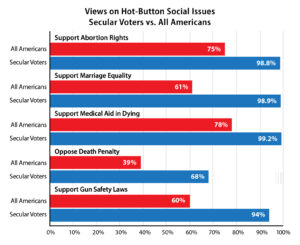
Anyone who wants to get more involved in campaigns should join their local party organization. They are called (party name) clubs, committees, or organizations and are usually at the town, city, or county level. You will meet like-minded people (that maybe you didn’t know were out there if you’re in the political minority), help out local, state, and federal candidates, and probably get to meet them. Elected officials know that their local party organizations are vital in doing their jobs and keeping their jobs, so they show up from time to time.
As I’ve often noted, 30 percent of the population or 78 million people identify as religiously unaffiliated. About half of them are also politically uninvolved, not doing well economically, and generally disconnected from society in a lot of ways. But the other half is politically involved and the atheists in that group are highly involved. It’s a huge voting block. Let your elected officials know that you’re part of it and that if they pay attention to the separation of religion and government they will get the support of an underrepresented and growing sector of the population.
License
In-Sight Publishing by Scott Douglas Jacobsen is licensed under a Creative Commons Attribution-NonCommercial-NoDerivatives 4.0 International License.
Based on work at www.in-sightpublishing.com.
Copyright
© Scott Douglas Jacobsen and In-Sight Publishing 2012-Present. Unauthorized use and/or duplication of this material without express and written permission from this site’s author and/or owner is strictly prohibited. Excerpts and links may be used, provided that full and clear credit is given to Scott Douglas Jacobsen, or the author(s), and In-Sight Publishing with appropriate and specific direction to the original content. All interviewees and authors copyright their material, as well, and may disseminate for their independent purposes.
Share this:

Publisher: In-Sight Publishing
Publisher Founding: September 1, 2014
Publisher Location: Fort Langley, Township of Langley, British Columbia, Canada
Publication: Freethought Newswire
Original Link: https://secular.org/2024/04/heretic-on-the-hill-hat-tip-to-the-deep-state/
Publication Date: April 2, 2024
Organization: Secular Coalition for America
Organization Description: The Secular Coalition for America advocates for religious freedom, as guaranteed by the First Amendment of the U.S. Constitution, and works to defend the equal rights of nonreligious Americans. Representing 20 national secular organizations, hundreds of local secular communities, and working with our allies in the faith community, we combine the power of grassroots activism with professional lobbying to make an impact on the laws and policies that govern separation of religion and government — or the improper encroachment of either on the other.
By Scott MacConomy
If you spend a lot of time following what passes for political discourse you hear about the Deep State, or at least you did during the Trump administration. People who used to be called government employees, civil servants, or bureaucrats were suddenly referred to as the Deep State on the assumption that they were trying to sabotage whatever President Trump was trying to accomplish from the inside.
There are about 7,000 federal government jobs that are filled by people who get political appointments from the White House (jobs listed in something called The Plum Book). These are higher level jobs at the government agencies and they are to some extent political jobs with little job security. The other two-plus million federal employees/Deep Staters are park rangers, air traffic controllers, and meat inspectors, to name a few of their numerous occupations. As federal employees they have some job protections that prevent them from being fired by a new President who thinks they are part of some conspiracy.
Next Wednesday, April 3rd, some of the best work by the Deep State takes effect. Nine government agencies have completed the arduous “regulatory process” for implementing a policy ordered by President Biden that protects the rights of people receiving benefits funded by the federal government. The new rule, as it is called by the bureaucrats, will affect those receiving help from the many social service providers that are faith-based and will ensure that those providers cannot withhold help based on religious belief or lack of one, or require beneficiaries to participate in any religious activity in order to receive help. So if you are in line for a bag of food at a food bank run by a church using a federal grant, they can’t preach to you or ask you to say a prayer.
One of the key protections is a requirement that organizations receiving federal grants for social service programs must inform beneficiaries of their right to not be discriminated against on the basis of their religious beliefs. The rule also restores some religious freedom protections that were rescinded by the Trump administration that affected people seeking job search and job training assistance, housing services, and continuing education.
Getting the new 187-page rule in place took a long time and a lot of work by people in these nine agencies. It’s called the regulatory process because it is a process with many steps including a public comment period, and if you don’t follow the process you end up getting taken to court by those who don’t like what you’re trying to accomplish. Thanks to everyone here who used our action alert during the public comment period to weigh in.
Back to the Deep State: There is a major effort at conservative groups like the Heritage Foundation to use an executive order by the next Republican president to strip civil servants of their job protections, fire tens of thousands of them, and replace them with, to put it charitably, conservatives who will change the face of the federal workforce for the worse. And they are already putting together a list of those job candidates. It’s called Project 2025. Trump and conservatives were totally unprepared to govern in 2017. They want this time to be different.
If this sounds far-fetched, it is exactly what Trump tried to implement at the end of his term in office. He created a new category of federal employment, Schedule F, that would have changed the status of many federal employees so that they could be fired much more easily. Biden reversed it.
To put a bow on this, there is little interest and even less sympathy for federal workers. In a survey I can’t link to that asked people to rank how they feel about various faiths and institutions, the federal government is right near the bottom. Some of the others, for example, were the military, Christians, unions, the middle class, people on welfare, and big business. I remembered this because atheists were right there at the bottom too. If Trump wins, he’s coming for the federal workforce and for regulations like the one taking effect Wednesday. The new federal workforce would work to implement his version of religious freedom which is freedom to discriminate against non-Christians and to proselytize at food banks.
License
In-Sight Publishing by Scott Douglas Jacobsen is licensed under a Creative Commons Attribution-NonCommercial-NoDerivatives 4.0 International License.
Based on work at www.in-sightpublishing.com.
Copyright
© Scott Douglas Jacobsen and In-Sight Publishing 2012-Present. Unauthorized use and/or duplication of this material without express and written permission from this site’s author and/or owner is strictly prohibited. Excerpts and links may be used, provided that full and clear credit is given to Scott Douglas Jacobsen, or the author(s), and In-Sight Publishing with appropriate and specific direction to the original content. All interviewees and authors copyright their material, as well, and may disseminate for their independent purposes.
Share this:
Publisher: In-Sight Publishing
Publisher Founding: September 1, 2014
Publisher Location: Fort Langley, Township of Langley, British Columbia, Canada
Publication: Freethought Newswire
Original Link: https://secular.org/2024/03/secular-advocates-plus-jamie-raskin-mean-lobby-day-success/
Publication Date: March 15, 2024
Organization: Secular Coalition for America
Organization Description: The Secular Coalition for America advocates for religious freedom, as guaranteed by the First Amendment of the U.S. Constitution, and works to defend the equal rights of nonreligious Americans. Representing 20 national secular organizations, hundreds of local secular communities, and working with our allies in the faith community, we combine the power of grassroots activism with professional lobbying to make an impact on the laws and policies that govern separation of religion and government — or the improper encroachment of either on the other.
By Scott MacConomy
Since my last report which previewed our annual meeting for the leaders of our 20 coalition organizations and the lobby day on Capitol Hill to follow, we did both! The meeting was the usual rare opportunity for these executive directors and Board leaders to learn what the other groups are working on, to collaborate, and to hear speakers on Christian nationalism, on state government affairs from secular state representatives, and from the humanist chaplain serving a death row inmate.
One of the speakers was Ryan Burge, a sociology professor who studies religion and the nonreligious, and takes a data-driven approach to everything. We learned about how atheists compare to religious groups and to the larger subset to which atheists belong, The Nones, in a number of areas; political involvement (very high), voting patterns (very Democratic), community involvement (high), differences between young and old, and much more. Dr. Burge predicts that by 2028, half of all Democratic voters could very likely be nonreligious. Because I suggested Dr. Burge as a speaker I was hoping I would not be the only one who was interested in his presentation, but it was rated the highest by our attendees in the post-meeting survey. He was also the only speaker who appeared remotely, which means you can watch his presentation here. There is some good discussion at the end, too.
I’m not going to say our lobby day was the apotheosis of lobby days, but it was pretty close. We doubled last year’s attendance, and half of our attendees were there for the first time. Many of them mentioned the importance of November’s election and wanting to get more involved.
Congressman Jamie Raskin came by the breakfast to give us his suggestions on how to pitch his militia bill in our meetings that day. The bill establishes federal guidelines on what is and is not illegal activity by militias in the areas of blocking government proceedings, intimidating people at polling places, participating in demonstrations, and more. As a former constitutional law professor, it did not take him long to get to the section of the Second Amendment that calls for “a well regulated militia,” and to elaborate on how most of the 200 or so militias in the country are far from well regulated.
Our particular take on the need for this bill is the significant number of Christian nationalists in the militias, and their conclusion that they have permission from God to take matters into their own hands if necessary to make this a more “Christian nation.” I just read this quote five days ago: “There are so many militia churches now. I [visited] a church in Yuba City, California. Wednesday night is women’s night, and Monday night is youth night. Tuesday night is militia new recruit night.” That’s from this interview with Jeff Sharlett, a Dartmouth professor who goes to churches and rallies and then reports on what he hears, most recently in a book titled The Undertow: Scenes from a Slow Civil War. Militia night at churches shows exactly why we need the Raskin bill.
Our group then fanned out to nearly 100 House and Senate meetings to talk to representatives and staff about the militia bill, many of whom were hearing about it for the first time from us. (Over 7,000 bills have been introduced in the House this Congress. It’s a lot for them to keep up with.) We asked Democrats and Republicans to support the bill and had many productive meetings. You can send your support to your legislators with this Action Alert if you have not already.
______________________
The Secular Coalition sent a letter to Senator Josh Hawley (R-MO) this week in response to his 4,000 word article on why he thinks this should be a more Christian nation. His article is long on trying to justify that and, thankfully, short on actual steps to take other than school prayer and posting the Ten Commandments in classrooms. He did propose finding ways to improve wages for blue collar men so it would be easier for them to raise Christian families. We said we supported that, but also better wages for blue collar women and for families of all faiths and no faiths. How he would just improve the wages of Christians wasn’t made clear.
License
In-Sight Publishing by Scott Douglas Jacobsen is licensed under a Creative Commons Attribution-NonCommercial-NoDerivatives 4.0 International License.
Based on work at www.in-sightpublishing.com.
Copyright
© Scott Douglas Jacobsen and In-Sight Publishing 2012-Present. Unauthorized use and/or duplication of this material without express and written permission from this site’s author and/or owner is strictly prohibited. Excerpts and links may be used, provided that full and clear credit is given to Scott Douglas Jacobsen, or the author(s), and In-Sight Publishing with appropriate and specific direction to the original content. All interviewees and authors copyright their material, as well, and may disseminate for their independent purposes.
Share this:
Publisher: In-Sight Publishing
Publisher Founding: September 1, 2014
Publisher Location: Fort Langley, Township of Langley, British Columbia, Canada
Publication: Freethought Newswire
Original Link: https://secular.org/2024/03/our-letter-to-senator-hawley-re-christian-nationalism/
Publication Date: March 15, 2024
Organization: Secular Coalition for America
Organization Description: The Secular Coalition for America advocates for religious freedom, as guaranteed by the First Amendment of the U.S. Constitution, and works to defend the equal rights of nonreligious Americans. Representing 20 national secular organizations, hundreds of local secular communities, and working with our allies in the faith community, we combine the power of grassroots activism with professional lobbying to make an impact on the laws and policies that govern separation of religion and government — or the improper encroachment of either on the other.
The Secular Coalition for America (SCA), in collaboration with its 20 coalition groups, has written a letter to Senator Josh Hawley, addressing his incorrect remarks on Christian Nationalist and the danger it poses to our nation.
License
In-Sight Publishing by Scott Douglas Jacobsen is licensed under a Creative Commons Attribution-NonCommercial-NoDerivatives 4.0 International License.
Based on work at www.in-sightpublishing.com.
Copyright
© Scott Douglas Jacobsen and In-Sight Publishing 2012-Present. Unauthorized use and/or duplication of this material without express and written permission from this site’s author and/or owner is strictly prohibited. Excerpts and links may be used, provided that full and clear credit is given to Scott Douglas Jacobsen, or the author(s), and In-Sight Publishing with appropriate and specific direction to the original content. All interviewees and authors copyright their material, as well, and may disseminate for their independent purposes.
Share this:
Publisher: In-Sight Publishing
Publisher Founding: September 1, 2014
Publisher Location: Fort Langley, Township of Langley, British Columbia, Canada
Publication: Freethought Newswire
Original Link: https://secular.org/2024/02/heretic-on-the-hill-the-worst-house-chaplain-ever-plus-history/
Publication Date: February 20, 2024
Organization: Secular Coalition for America
Organization Description: The Secular Coalition for America advocates for religious freedom, as guaranteed by the First Amendment of the U.S. Constitution, and works to defend the equal rights of nonreligious Americans. Representing 20 national secular organizations, hundreds of local secular communities, and working with our allies in the faith community, we combine the power of grassroots activism with professional lobbying to make an impact on the laws and policies that govern separation of religion and government — or the improper encroachment of either on the other.
By Scott MacConomy
Monday was the Presidents Day holiday when we observe the birthday of George Washington next Thursday and of Abraham Lincoln last Monday. Like many of the Founders, Washington’s real views on religion are difficult to determine because he wrote very little about them. He encouraged people to go to church but sometimes failed to do so himself for weeks. He was a church official but often left before communion. Jefferson wrote that “…it was observed that he had never, on any occasion, said a word to the public which showed a belief in the Christian religion.”
Washington did write about choosing workmen for Mount Vernon in 1784, suggesting they could be “Mahometans, Jews, or Christians of any Sect, or they may be Atheists”—as long as they were good workers. And he clearly opposed the idea of a state religion which he grew up under as a Virginia resident under British rule.
Lincoln really sounded like an atheist early in life but later, through political expediency or because of a real conversion, sounded a lot like a Christian. More than one person who knew him in his twenties said that Lincoln could shock people by saying that the Bible was just an ordinary book, or that Jesus was an illegitimate child. There is a story that he wrote an essay about his true beliefs but a friend burned it out of concern for his budding political career. In 1843 Lincoln wrote, “It was everywhere contended that no Christian ought to vote for me because I belonged to no Church, and was suspected of being a Deist.” So happy birthday to George and Abe, whatever you did or didn’t believe in.
A little more history, although this time I’m going somewhere with it: There has been a House and Senate Chaplain since 1789 and they open each day with a prayer. Which seems odd for a government founded on separation of church and state. Shocker; the chaplains have always been Christian, although there have been many guest chaplains of different religions. James Madison opposed the idea because it violated the First Amendment and because the practice discriminated against religions such as the Quakers and Catholics whom he said “could scarcely be elected to the office.”
The guest chaplain on January 30 was Pastor Jack Hibbs, who has been described as a Christian Nationalist involved in the January 6th insurrection, with a long history of hatred toward Jews, Muslims, LGBTQ+ individuals, and anyone inconsistent with his “biblical worldview.” He was described that way in a letter from 26 House members to Speaker Mike Johnson and the House Chaplain who both made Hibbs’ appearance possible. Congressman Jared Huffman (D-CA) took the lead on the letter. We made a few suggestions at his request.
Here’s one good paragraph: “These facts suggest a breathtaking lack of consideration for the religious diversity of our Congress and pluralistic nation. It appears that Speaker Johnson – with the tacit approval of the House Chaplain – decided to flout the Chaplaincy guidelines and use the platform of the Guest Chaplain to lend the imprimatur of Congress to an ill-qualified hate preacher who shares the Speaker’s Christian Nationalist agenda and his antipathy toward church-state separation.” You can read the letter here.
I doubt there will be a reply from Johnson but if there is I’ll let you know here. We will keep after Johnson’s support for church services in the Capitol, Christian nationalist chaplains, and the completely unnecessary and inappropriate tradition of Congressional chaplains. Traditions die hard but it can happen. The Congressional Prayer Breakfast is a shell of what it once was.
It’s almost too late to register for our Lobby Day on March 5, but not quite. We need a week to get your meetings scheduled so the deadline is Monday, February 26. We will be lobbying for a bill that cracks down on militias because Christian nationalists in militias is a growing problem. They definitely want less separation between church and state, but they only mean their church. You can learn more and register here. The next Heretic on the Hill will include an Action Alert on this bill so we can maximize the support for it right before Lobby Day.
License
In-Sight Publishing by Scott Douglas Jacobsen is licensed under a Creative Commons Attribution-NonCommercial-NoDerivatives 4.0 International License.
Based on work at www.in-sightpublishing.com.
Copyright
© Scott Douglas Jacobsen and In-Sight Publishing 2012-Present. Unauthorized use and/or duplication of this material without express and written permission from this site’s author and/or owner is strictly prohibited. Excerpts and links may be used, provided that full and clear credit is given to Scott Douglas Jacobsen, or the author(s), and In-Sight Publishing with appropriate and specific direction to the original content. All interviewees and authors copyright their material, as well, and may disseminate for their independent purposes.
Share this:
Publisher: In-Sight Publishing
Publisher Founding: September 1, 2014
Publisher Location: Fort Langley, Township of Langley, British Columbia, Canada
Publication: Freethought Newswire
Original Link: http://www.secularconnexion.ca/events/scs-demands-phase-out-taxpayer-funding-for-rc-schools-in-ontario/
Publication Date: February 8, 2024
Organization: Secular Connexion Séculière
Organization Description: Secular Connexion Séculière (SCS) is a national organization dedicated to advocating and lobbying for atheist rights in Canada, to facilitating communication and dialogue among Canadian atheists, and to communicating Canadian human rights values to the world. SCS does not have, nor does it seek, any governing powers in the Canadian atheist community. Rather, it seeks support for its efforts to defend non-believers right to freedom from religion, to lobby the Canadian government on the behalf of Canadian atheists, to provide communication conduits for Canadian atheist organizations.
February 7, 2024
RE: Funding for Roman Catholic school systems in Ontario
Dear Member of Ontario Legislature:
Secular Connexion is a non profit organization that advocates on behalf of human rights in Canada. Several of our concerns involve the demographic, financial, and discriminatory problems of funding Roman Catholic school system in Ontario.
This system is supported by only 38% of Ontario’s population, but costs Ontario taxpayers over $1 billion dollars per year. Since only 8% of the cost of the system comes from separate school residential property taxes, the other 92% is funded by all Ontario taxpayers be they Non-believer, Protestant, Jewish, Muslim, Hindu, etc.
Constitutionally, Section 93 of the Constitution Act of 1867 guarantees the right of provinces to fund minority school systems if they had them before joining Confederation. It does not force Ontario to provide funding for minority school systems. Amotion passed in the Ontario Legislative Assembly would phase out funding for the system just as it was in Québec and Newfoundland and Labrador.
Discrimination is inherent in the separate school system because it can legally refuse to hire non-Catholic teachers and it does. Conversely, Catholic teachers are hired by the public system giving them access to all available teaching positions that non-Catholic teachers do not have.
Seventy-four percent (74%) of Ontario non-Catholic Ontarians are paying for a system that will not hire them, and may refuse to admit their children as students.
Canada signed the United Nations’ International Covenant on Civil and Political Rights. Ontario has twice been declared to be in violation of the Covenant because of its discriminatory practice of publicly funding schools for one religion. Parents of other religions pay tuition for religious schools and property taxes.
Ontario is multi-ethnic, multi-racial, and multi-cultural. Children of differing backgrounds should be together in the same school so they can learn what they have in common, not what divides them.
One public system would have students attending the nearest school with the children in their neighbourhood, perhaps walking to that school, instead of being bused to a distant school because they are, or aren’t, Catholic.
As Ontario taxpayers, we demand that the Ontario Legislature pass a motion to phase out funding for Roman Catholic schools in Ontario.
Sincerely,
Doug Thomas, President
Secular Connexion Séculière
president@secularconnexion.ca
License
In-Sight Publishing by Scott Douglas Jacobsen is licensed under a Creative Commons Attribution-NonCommercial-NoDerivatives 4.0 International License.
Based on work at www.in-sightpublishing.com.
Copyright
© Scott Douglas Jacobsen and In-Sight Publishing 2012-Present. Unauthorized use and/or duplication of this material without express and written permission from this site’s author and/or owner is strictly prohibited. Excerpts and links may be used, provided that full and clear credit is given to Scott Douglas Jacobsen, or the author(s), and In-Sight Publishing with appropriate and specific direction to the original content. All interviewees and authors copyright their material, as well, and may disseminate for their independent purposes.
Share this:
Publisher: In-Sight Publishing
Publisher Founding: September 1, 2014
Publisher Location: Fort Langley, Township of Langley, British Columbia, Canada
Publication: Freethought Newswire
Original Link: http://www.secularconnexion.ca/events/scs-monitors-religious-bias-in-calgary-police-service/
Publication Date: January 29, 2024
Organization: Secular Connexion Séculière
Organization Description: Secular Connexion Séculière (SCS) is a national organization dedicated to advocating and lobbying for atheist rights in Canada, to facilitating communication and dialogue among Canadian atheists, and to communicating Canadian human rights values to the world. SCS does not have, nor does it seek, any governing powers in the Canadian atheist community. Rather, it seeks support for its efforts to defend non-believers right to freedom from religion, to lobby the Canadian government on the behalf of Canadian atheists, to provide communication conduits for Canadian atheist organizations.
January 29, 2024 – 12:00 am
In November of 2023, SCS became aware of infringements by the Calgary Police Service (CPS) on the requirement for governments and their agencies to be neutral regarding religion. These infringements included:
- supporting a faith based community prayer breakfast by providing an honour guard, and by the attendance and recognition of senior officers as members of the CPS. The speaker at the breakfast was a fundamentalist Christian, residential school denier. Those senior officers apparently joined in a standing ovation for the speaker, (listen to full speech – https://www.youtube.com/watch?v=Q7BSNYrOggA
- the CPS spent public funds, approved by the Calgary Police Commission (CPC), on a chapel in its police headquarters. The CPS claimed that the chapel was non-denominational, and open to all for use in spite of its religious configuration and the presence of a St. Michael statue within it. They made no attempt to make the space religiously neutral (i.e. having a non-religious function) by including non-believers in their consideration of the design of the chapel.
SCS wrote the following letter on our official letterhead to the CPS
November 10, 2023
Calgary Police Service
5111 47 St. N.E.
Calgary, Alberta, Canada
T3J 3R2
RE: Support of religious activities by the Calgary Police Service To Whom It May Concern:
Secular Connexion is a national organization that works to protect the right to freedom from religion in Canada1. As a part of that effort, we work to ensure that public institutions conform to the decisions of the Supreme Court of Canada requiring public institutions to honour that right and to be neutral in regards to religious activities in Canada.
We have become aware through the news media that the Calgary Police Service has recently actively supported a community prayer meeting that featured a fundamentalist religious speaker who made negative comments about the LGBTQ community and criticized the Prime Minister of Canada for defending the rights of that community. In short, he exercised his right to deliver a Christian message.
Our concern is that in providing an honour guard for the prayer meeting itself, the Calgary Police Service abrogated its duty to remain neutral in matters of religion by so supporting a religious event. By doing so, it supported the aforementioned fundamentalist speaker in direct violation of its duty to remain religiously neutral. In listening to his speech, I came to the conclusion that, were it not for the unfortunate Section 319 3b of the Criminal Code of Canada, he could be charged with uttering hate speech.
We are also aware that the Calgary Police Service spent public funds on establishing a religious chapel in its headquarters. In claiming that the chapel is open to all religions, the Service ignores the fact that to be neutral, such a facility would have to equally support non-believing members of the force, and of the general public. To meet its obligations, the Service would have to ensure that non-believers would have equal access to the facility. Our information is that it has not actively done so.
Please take steps to eliminate the religious bias that these actions demonstrate and to ensue that non-believers are treated equally with any religious people, either members of the force, or members of the general public.
Regards,
Doug Thomas, President
Secular Connexion Séculière
president@secularconnexion.ca
We received the following reply from Chief Constable, Mark Neufeld.
January 9, 2024
CALGARY
Doug Thomas, President
Secular Connexion Seculiere
Dear Mr. Thomas,
Re: Response to your letter of November 10, 2023
Thank you for reaching out to the Calgary Police Service.
In accordance with the Alberta Human Rights Act and organizational values, the Calgary Police Service (CPS) is
committed to upholding respect for the diverse range of religious beliefs and non-beliefs within our
community. As a public institution, we maintain a stance of religious neutrality, ensuring that no preference or
favouritism is shown towards any specific religion.
We strive to create a safe, diverse, inclusive and inspired environment for our employees and those we serve.
In doing so, we have recently conducted a full review of the overall position of religion and spirituality at the
CPS, through our Office of Respect and Inclusion. Following our review, we recognize there are some areas of
our Service requiring changes to better reflect our commitment to religious neutrality and to improve
inclusivity. This includes, but is not limited to, honour guard representation at external events, changes to
policy around the spiritual and emotional care program (formerly called the Chaplaincy program), and changes
to the Arthur Duncan Memorial Hall (formerly the CPS chapel).
For context, the former CPS chapel was renamed the Arthur Duncan Memorial Hall in 2017, in honour of Const.
Arthur Duncan, the first member of the CPS to be killed in the line of duty . The hall serves as a dedicated space
that honours the fallen members of the CPS and is used for line of duty dedications and services of
remembrance. The hall’s former use as a chapel has necessitated additional changes to better ensure it is a
religiously neutral space . We have taken several actions to ensure this, including removal of religious statues,
items, sacraments and any references to the area as a “chapel.” Currently the Arthur Duncan Memorial Hall is
also undergoing renovations so the area may be used for a variety of purposes.
Additionally, as a public organization, representatives from the CPS are invited to attend various community
events throughout Calgary, as such events provide an opportunity for community engagement. As attendees at
external events, CPS representatives do not make decisions regarding the speakers and are not given an
opportunity to hear their remarks beforehand. As such, there is always a possibility that the organizers of the
events will select speakers whose values do not match those of the CPS, which was the case at this year’s
Calgary Leaders Prayer Breakfast. That said, I appreciate your concerns regarding the attendance of the honour
guard at such an event, and as noted, through our review, we will be looking at honour guard attendance at
events going forward.
I appreciate and agree with you that it is crucial for the CPS to be a place where members of all beliefs can feel
comfortable, respected, and included . While some of the changes may take time to fully complete, we are
committed to religious neutrality in the Service and workplace .
Respectfully,
Mark Neufeld, Chief Constable, CPS
5111-47 Street N.E.,
Calgary, Alberta Canada T3J 3R2
http://www.calgarypolice .ca
Our thoughts
While this letter would seem to indicate that the CPS is changing its ways, we are concerned by the incongruity of their words and their actions.
For example, the CPS partnered with the Salvation Army church for a toy drive rather than the many religiously neutral options that also collect toys for children. In addition, they are committed to appointing 20 more religious chaplains. We don’t know how this will align with religious neutrality, what faiths or humanist/secular groups will be represented and what policies will govern their actions.
1 Supreme Court of Canada.Big M Drugs v. Crown.1984; Mouvement Liaïque Québécois v. City of Saguenay.2015
License
In-Sight Publishing by Scott Douglas Jacobsen is licensed under a Creative Commons Attribution-NonCommercial-NoDerivatives 4.0 International License.
Based on work at www.in-sightpublishing.com.
Copyright
© Scott Douglas Jacobsen and In-Sight Publishing 2012-Present. Unauthorized use and/or duplication of this material without express and written permission from this site’s author and/or owner is strictly prohibited. Excerpts and links may be used, provided that full and clear credit is given to Scott Douglas Jacobsen, or the author(s), and In-Sight Publishing with appropriate and specific direction to the original content. All interviewees and authors copyright their material, as well, and may disseminate for their independent purposes.
Share this:
Publisher: In-Sight Publishing
Publisher Founding: September 1, 2014
Publisher Location: Fort Langley, Township of Langley, British Columbia, Canada
Publication: Freethought Newswire
Original Link: http://www.secularconnexion.ca/events/in-progress/
Publication Date: January 7, 2024
Organization: Secular Connexion Séculière
Organization Description: Secular Connexion Séculière (SCS) is a national organization dedicated to advocating and lobbying for atheist rights in Canada, to facilitating communication and dialogue among Canadian atheists, and to communicating Canadian human rights values to the world. SCS does not have, nor does it seek, any governing powers in the Canadian atheist community. Rather, it seeks support for its efforts to defend non-believers right to freedom from religion, to lobby the Canadian government on the behalf of Canadian atheists, to provide communication conduits for Canadian atheist organizations.
What is Secular Connexion Séculière (SCS) up to now?
français ci-dessous
Supporting Bill C-367, a bill to remove Section 319 3b from the Criminal Code of Canada. That’s the section that allows religious apologists to publish hate literature, and utter hate speech publicly with impunity as long as they support their statements with religious texts,
(3) No person shall be convicted of an offence under subsection (2)
(a) if he establishes that the statements communicated were true;
(b) if, in good faith, the person expressed or attempted to establish by an argument an opinion on a religious subject or an opinion based on a belief in a religious text;
(c) if the statements were relevant to any subject of public interest, the discussion of which was for the public benefit, and if on reasonable grounds he believed them to be true; or
(d) if, in good faith, he intended to point out, for the purpose of removal, matters producing or tending to produce feelings of hatred toward an identifiable group in Canada. SCS is mass emailing all MPs.
Email your MP to support Bill C-367(courtesy of BC Humanist Association)
Developing an e-petition to ask the Minister of Immigration, Refugees, and Citizenship to impose a moratorium on deporting undocumented residents until he develops a better policy and regulations.
Monitoring the actions of the Liberty Coalition, a fundamentalist, right wing group intent on taking over Canada’s government to turn Canada into a Christian theocracy. (https://www.cbc.ca/news/politics/fundamentalist-christian-movement-1.6793677)
Promoting political activity by the 25-30% of Canadians who are non-believers so that their voices will be heard.
Protecting the right to freedom from religion with a confidential direct contact to SCS so we can give advice and intervene as appropriate (http://www.secularconnexion.ca/urgent/). If you are discriminated against because of your non-belief, use this service. Check out Successes Great and Small (http://www.secularconnexion.ca – under Now!). If you are discriminated against, use this service.
Continue to lobby governments to change legislation that discriminates against non-believers; e.g. the regulations enforced by the Charities Directorate that favour religions, Section 319 3b (above).
Monitoring religious bias in Calgary Police ServIce: https://www.secularconnexion.ca/events/scs-monitors-religious-bias-in-calgary-police-service/
We need your support to do these things.
Qu’est-ce que Secular Connexion Séculière (SCS) jusqu’à présent ?
Appuyer le projet de loi C-367, un projet de loi visant à supprimer l’article 319 3b du Code criminel du Canada. C’est la section qui permet aux apologistes religieux de publier de la littérature haineuse et de prononcer des discours de haine publiquement en toute impunité tant qu’ils soutiennent leurs déclarations avec des textes religieux.
(3) Nul ne peut être déclaré coupable d’une infraction visée au paragraphe (2)
a) s’il établit que les déclarations communiquées étaient vraies ;
b) si, de bonne foi, la personne a exprimé ou tenté d’établir par un argument une opinion sur un sujet religieux ou une opinion fondée sur la croyance en un texte religieux ;
c) si les déclarations étaient pertinentes à un sujet d’intérêt public, dont la discussion était dans l’intérêt public, et si, pour des motifs raisonnables, il croyait qu’elles étaient vraies ; ou
d) s’il avait l’intention, de bonne foi, de signaler, aux fins de renvoi, des questions qui produisent ou tendent à produire des sentiments de haine envers un groupe identifiable au Canada. SCS envert un courriel de masse à tous les députés.
Envoyez un courriel à votre député pour appuyer le projet de loi C-367(gracieuseté de la BC Humanist Association)
c) si les déclarations étaient pertinentes à un sujet d’intérêt public, dont la discussion était dans l’intérêt public, et si, pour des motifs raisonnables, il croyait qu’elles étaient vraies ; ou
d) s’il avait l’intention, de bonne foi, de signaler, aux fins de renvoi, des questions qui produisent ou tendent à produire des sentiments de haine envers un groupe identifiable au Canada. SCS envert un courriel de masse à tous les députés.
Envoyez un courriel à votre député pour appuyer le projet de loi C-367 (gracieuseté de la BC Humanist Association)
Élaboration d’une pétition électronique pour demander au ministre de l’Immigration, des Réfugiés et de la Citoyenneté d’imposer un moratoire sur l’expulsion des résidents sans papiers jusqu’à ce qu’il élabore une meilleure politique et un meilleur règlement.
Surveiller les actions de la Liberty Coalition, un groupe fondamentaliste de droite qui a l’intention de prendre le contrôle du gouvernement du Canada pour transformer le Canada en une théocratie chrétienne. (https://www.cbc.ca/news/politics/fundamentalist-christian-movement-1.6793677)
Promouvoir l’activité politique par les 25 à 30 % de Canadiens qui ne sont pas croyants afin que leurs voix soient entendues.
Protéger le droit à la liberté de religion avec un contact direct confidentiel avec SCS afin que nous puissions donner des conseils et intervenir le cas échéant (http://www.secularconnexion.ca/urgent/). Si vous êtes victime de discrimination en raison de votre non-croyance, utilisez ce service. Découvrez Successes Great and Small (http://www.secularconnexion.ca – sous Maintenant !). Si vous faites l’objet de discrimination, utilisez ce service.
Continuer de faire pression sur les gouvernements pour qu’ils modifient les lois discriminatoires à l’égard des non-croyants ; par exemple, les règlements appliqués par la Direction des organismes de bienfaisance qui favorisent les religions, article 319 3b (ci-dessus).
Nous avons besoin de votre soutien pour faire ces choses. S’il vous plaîtabonnez-vous ou faites un don
License
In-Sight Publishing by Scott Douglas Jacobsen is licensed under a Creative Commons Attribution-NonCommercial-NoDerivatives 4.0 International License.
Based on work at www.in-sightpublishing.com.
Copyright
© Scott Douglas Jacobsen and In-Sight Publishing 2012-Present. Unauthorized use and/or duplication of this material without express and written permission from this site’s author and/or owner is strictly prohibited. Excerpts and links may be used, provided that full and clear credit is given to Scott Douglas Jacobsen, or the author(s), and In-Sight Publishing with appropriate and specific direction to the original content. All interviewees and authors copyright their material, as well, and may disseminate for their independent purposes.
Share this:
Publisher: In-Sight Publishing
Publisher Founding: September 1, 2014
Publisher Location: Fort Langley, Township of Langley, British Columbia, Canada
Publication: Freethought Newswire
Original Link: http://www.secularconnexion.ca/events/successes-great-and-small-2/
Publication Date: January 6, 2024
Organization: Secular Connexion Séculière
Organization Description: Secular Connexion Séculière (SCS) is a national organization dedicated to advocating and lobbying for atheist rights in Canada, to facilitating communication and dialogue among Canadian atheists, and to communicating Canadian human rights values to the world. SCS does not have, nor does it seek, any governing powers in the Canadian atheist community. Rather, it seeks support for its efforts to defend non-believers right to freedom from religion, to lobby the Canadian government on the behalf of Canadian atheists, to provide communication conduits for Canadian atheist organizations.
The following successes were accomplished using a mass email service, Zoom, this website, internet access, and telephone, all of which cost money. Please donate to help SCS achieve similar successes: CLICK HERE TO DONATE
Supporting Individuals – The local branch of a national bookstore chain refused the author of Why Men Made God permission to display her books and sign them because the book was “too controversial.” SCS wrote a letter to the manager, who escalated it to her district manager, who instructed the manager to allow the author to display and sell her books, saying to us that the meeting with the manager was a “teaching moment.”
Municipal Scene – A non-believer expressed concern that local officials had installed a nativity scene in the municipal office building thus denying his right to freedom from religion in government spaces. SCS wrote a letter to the contacts he provided explaining how this was offensive. No response was received, but the nativity scene did not appear the next year.
Based on the 2015 decision (Mouvement laïque québécois et al v. City of Saguenay), SCS ensured that local municipalities had stopped opening their meetings with prayers. One mayor thought the ruling applied only to Québec, but referred it to their lawyers who agreed with SCS. Moments of silence to open meetings ensued.
Federal Advocacy – In response to SCS’ e-3638 petition, the Parliamentary Secretary to the Minister of Immigration, Refugees, and Citizenship confirmed that atheist/apostate refugees can access the Less Complex Claims policyreducing hearings and delays. SCS contacted all of Canada’s refugee officers, and made sure that they know this. We also made international groups assisting atheist/apostate refugees aware of this.
SCS expressed concern to the Minister of Immigration, Refugees, and Citizenship regarding longer wait times for atheist/apostate refugees from Pakistan and Bangladesh than for refugees from Eastern Europe. We highlighted the case of an atheist refugee who had full sponsorship in Canada, but waited for almost two years for final approval to enter Canada. We received a response from an official saying that nothing could be done – five days after the refugee had been granted final entry into Canada.
SCS wrote a letter of concern to the Principal of the Canadian School of Public Service regarding the opening of classes with a prayer. The principal claimed the prayer was a one-time special acknowledgement of aboriginal culture, even though our source indicated that it was common practice. SCS has had no confirmation that the illegal practice has ceased.
In Our Schools – the grandmother of an elementary school student emailed SCS with a concern that after-school religious classes were being advertised and sponsored by a public school. Her concern was that her grandchild was being peer pressured into attending. SCS wrote the principal of the school and pointed out that the practice denied students their right to freedom from religion. The principal escalated the issue to a superintendent who wrote to SCS informing us that she had visited the school, had seen the promotional material, and had instructed the principal to remove them immediately.
These are real accomplishments that can be duplicated with your help. CLICK HERE TO DONATE
Les succès, grands et petits
Soutenir les individus – La branche locale d’une chaîne de librairies nationale a refusé à l’auteur de Why Men Made God la permission d’exposer ses livres et de les signer parce que le livre était « trop controversé ». SCS a écrit une lettre à la gestionnaire, qui l’a transmise à son directeur de district, qui a demandé au directeur de permettre à l’auteur d’exposer et de vendre ses livres, nous disant que la réunion avec le gestionnaire était un « moment d’enseignement ».
Scène municipale – Un non-croyant s’est dit préoccupé par le fait que des responsables locaux avaient installé une crèche dans l’immeuble de bureaux municipal, niant ainsi son droit à la liberté de religion dans les espaces gouvernementaux. SCS a écrit une lettre aux contacts qu’il a fournis expliquant en quoi c’était offensant. Aucune réponse n’a été reçue, mais la scène de la nativité n’est pas apparue l’année suivante.
Sur la base de la décision de 2015 (Mouvement laïque québécois et al c. Ville de Saguenay), SCS s’est assuré que les municipalités locales avaient cessé d’ouvrir leurs réunions avec des prières. Un maire a estimé que la décision ne s’appliquait qu’au Québec, mais l’a renvoyée à ses avocats qui étaient d’accord avec SCS. Des moments de silence aux séances publiques s’ensuivent.
Défense des intérêts du gouvernement fédéral – En réponse à la pétition e-3638 de SCS, le secrétaire parlementaire du ministre de l’Immigration, des Réfugiés et de la Citoyenneté a confirmé que les réfugiés athées/apostats peuvent accéder à la politique sur les revendications moins complexes, ce qui réduit les audiences et les retards. SCS a communiqué avec tous les agents des réfugiés du Canada et s’est assuré qu’ils le savaient. Nous avons également sensibilisés les groupes internationaux qui aident les réfugiés athées/apostats à ce sujet.
SCS s’est dite préoccupée par le ministre de l’Immigration, des Réfugiés et de la Citoyenneté au sujet des temps d’attente plus longs pour les réfugiés athées/apostats du Pakistan et du Bangladesh que pour les réfugiés d’Europe de l’Est. Nous avons mis en évidence le cas d’un réfugié athée qui a été parrainé à part entière au Canada, mais qui a attendu près de deux ans pour obtenir l’approbation finale pour entrer au Canada. Nous avons reçu une réponse d’un fonctionnaire disant que rien ne pouvait être fait – cinq jours après que le réfugié ait obtenu l’entrée finale au Canada.
SCS a écrit une lettre de préoccupation au directeur de l’École de la fonction publique du Canada concernant l’ouverture des classes avec une prière. Le directeur a affirmé que la prière était une reconnaissance spéciale unique de la culture autochtone, même si notre source a indiqué qu’il s’agissait d’une pratique courante. SCS n’a eu aucune confirmation que la pratique illégale a cessé.
Dans nos écoles , la grand-mère d’un élève de l’école primaire a envoyé un courriel à SCS pour s’inquiéter que les cours de religion après l’école étaient annoncés et parrainés par une école publique. Ce qui la préoccupait, c’était que son petit-enfant était pressé par ses pairs d’y assister. SCS a écrit au directeur de l’école et a souligné que cette pratique privait les élèves de leur droit à la liberté de religion. La directrice a transmis le problème à une surintendante qui a écrit à SCS pour nous informer qu’elle avait visité l’école, qu’elle avait vu le matériel promotionnel et qu’elle avait demandé au directeur de les retirer immédiatement.
License
In-Sight Publishing by Scott Douglas Jacobsen is licensed under a Creative Commons Attribution-NonCommercial-NoDerivatives 4.0 International License.
Based on work at www.in-sightpublishing.com.
Copyright
© Scott Douglas Jacobsen and In-Sight Publishing 2012-Present. Unauthorized use and/or duplication of this material without express and written permission from this site’s author and/or owner is strictly prohibited. Excerpts and links may be used, provided that full and clear credit is given to Scott Douglas Jacobsen, or the author(s), and In-Sight Publishing with appropriate and specific direction to the original content. All interviewees and authors copyright their material, as well, and may disseminate for their independent purposes.
Share this:
Publisher: In-Sight Publishing
Publisher Founding: September 1, 2014
Publisher Location: Fort Langley, Township of Langley, British Columbia, Canada
Publication: Freethought Newswire
Original Link: https://thehumanist.com/news/aha_news/meet-the-new-cfe-intern-jada-majied
Publication Date: May 20, 2024
Organization: American Humanist Association
Organization Description: The mission of the American Humanist Association is to advance humanism, an ethical and life-affirming philosophy free of belief in any gods and other supernatural forces. Advocating for equality for nontheists and a society guided by reason, empathy, and our growing knowledge of the world, the AHA promotes a worldview that encourages individuals to live informed and meaningful lives that aspire to the greater good.
Please welcome the Center for Freethought Equality’s summer intern, Jada Majied!
TheHumanist.com: What is your educational and work background?
I am currently an undergraduate student at Indiana University (IU) majoring in political science with a minor in political and civic engagement. With this education I hope to run for office in the future with a grassroots campaign dedicated to advocating for progressive solutions to today’s problems. I always make sure to align myself with jobs and positions that highlight advocacy work and strive towards making a difference. Currently I am the Director of Outreach and Diversity for College Democrats at IU where we host meetings educating students on various political topics from elections to social justice issues. I also have completed an internship with the Indiana Democratic Party where I was able to work with politicians at the local, state, and federal levels, helping to get Democrats into office. With my new position as a CFE intern I am excited to see what this organization has in store for me!
TheHumanist.com: How did you first learn about humanism?
While I have known of the existence of humanism for quite some time, I never did the proper research to fully understand those who identify as humanist. After reviewing and educating myself on humanism through the American Humanist Association website, I realized that it described who I was as a person perfectly. The incorporation of scientific research, facts, and encompassing a respectful mindset towards others, is a lifestyle I have been practicing even when I was still attached to a religion. Identifying as a humanist was a very easy and seamless action that didn’t feel like being confined to a box, but embracing the traits of myself that I already hold.
TheHumanist.com: Did you grow up in a traditional religious faith? How did it impact you?
I was raised in a religious household, where, for a quarter of my life we attended a Baptist church. As a child, I did not quite understand the teachings of religion and found myself with question after question on why we must believe in religion and how religion should impact our lives. While in the church, ideals were preached to us that did not seem ethical to me, this included topics that seemed harmful to women, LGBTQ+ individuals, and those who do not follow a religion. As I grew older, I realized that the faith conflicted with my own standards for kindness and respect, which led me to understand that I do not need to be religious in order to live a full life but I need to be a good person to create a life that is full.
TheHumanist.com: What interested you most about working for the American Humanist Association?
I really wanted to work for and surround myself with individuals who share the same progressive standards as myself in terms of how society should change for the better. In my search to be a part of an organization that promotes justice to marginalized communities and ethical policies, I found the American Humanist Association. The AHA and The Center for Freethought Equality exemplified what it meant to be a part of the solution and the more I Iearned about their goals the more I was ready to join the team!
TheHumanist.com: What book has influenced you the most?
A book that influenced me the most is Becoming Abolitionists by Derecka Purnell. While I label myself as a progressive individual, I found that this book was aggressively progressive in its ideals for how society should correct current injustices and move forward to create a more efficient society. Purnell touched on many different areas in communities that need to be either extinguished entirely or broken down to be built up into something better and as I was reading, it was difficult to adjust to the idea of such a progressive form of reformation. Becoming Abolitionists definitely challenged my thinking and pushed me to understand how to get very idealistic forms of activism into feasible objectives.
TheHumanist.com: If you could have dinner with any three people in the world (living or dead), who would they be and why?
1.) I would have dinner with US Representative Alexandria Ocasio-Cortez. She has been my inspiration since I first got into politics in high school and I admire the way that she interacts with not just her constituents but people across the country. 2.) I would definitely want to meet with Malcolm X. I think the way that he approached activism in his time was seen as incredibly radical and dangerous and I would love to understand how he would view today’s activism. 3.) I would love to meet with George Lee Jr. (a.k.a. The Conscious Lee) a digital creator who constructively breaks down today’s controversies. I believe he would have incredible ideas about how to reform struggles and trauma in the black community.
License
In-Sight Publishing by Scott Douglas Jacobsen is licensed under a Creative Commons Attribution-NonCommercial-NoDerivatives 4.0 International License.
Based on work at www.in-sightpublishing.com.
Copyright
© Scott Douglas Jacobsen and In-Sight Publishing 2012-Present. Unauthorized use and/or duplication of this material without express and written permission from this site’s author and/or owner is strictly prohibited. Excerpts and links may be used, provided that full and clear credit is given to Scott Douglas Jacobsen, or the author(s), and In-Sight Publishing with appropriate and specific direction to the original content. All interviewees and authors copyright their material, as well, and may disseminate for their independent purposes.
Share this:
Publisher: In-Sight Publishing
Publisher Founding: September 1, 2014
Publisher Location: Fort Langley, Township of Langley, British Columbia, Canada
Publication: Freethought Newswire
Original Link: https://thehumanist.com/news/aha_news/spring-into-action-3-ways-to-be-a-better-humanist
Publication Date: April 16, 2024
Organization: American Humanist Association
Organization Description: The mission of the American Humanist Association is to advance humanism, an ethical and life-affirming philosophy free of belief in any gods and other supernatural forces. Advocating for equality for nontheists and a society guided by reason, empathy, and our growing knowledge of the world, the AHA promotes a worldview that encourages individuals to live informed and meaningful lives that aspire to the greater good.
By Jessica Brooks
When I first discovered humanism, I struggled with an overwhelming sense of urgency to put my philosophy in action. I could not quite shake the feeling that I wasn’t doing enough to “be a good humanist.” After much reflection, my opinion has shifted to the belief that humanism is not just about being, it can also be a practice that can support a way of life. Throughout my journey of converting philosophy into ways I can live my life, I focused on three of the Ten Commitments of humanism from the American Humanist Association. The three commitments that will be explored within this article are: service and participation in the community, global awareness, and humility.
“Service and Participation” was the first commitment that I chose to work on. This is because helping and being part of the community is so closely linked to the core philosophies of humanism and it was the easiest commitment to turn into simple, actionable tasks. Service is defined as helping or doing work for someone. I chose to focus my service on my community by opening and utilizing a library card. Opening a library card may seem basic or even useless to other people. However, opening a library card and actually using it is one of the easiest but also most effective ways of becoming part of your community and getting to know the many people that make it up. Having access to a library card not only gives the owner access to a plethora of both digital and physical resources, but it also allows you and others to share. Most libraries include the following resources for adults in need: career workshops, arts classes, access to the internet, English language support, access to digital and physical books, and nonprofit support. Libraries are also amazing resources for children. Access to a library often allows children access to: story times, homework assistance, technology support, college preparation, resume workshops, and volunteer opportunities. Other than classes or other resources that are commonly thought of, anyone who may be experiencing homelessness or extreme poverty can use libraries for physical shelter during the day, access to the internet, bathrooms, or any of the resources listed above. All of these activities mean that libraries provide opportunities to volunteer and interact.
I also worked on participating in the community in other ways. Normally, I pride myself on being a homebody due to my asocial nature. However, these past few months I really pushed myself to go outside, enjoy public services, and connect with other humans or nature. The first method of connection that I tried was joining humanist Facebook groups, reading other articles from the American Humanist Association, and talking to people that I already know. Even though there was not much change from what I was doing previously, the conscious effort was affirming. I then used this affirmation to build up my confidence to branch out into more difficult methods of communication. For me, that looked like joining a free collage club where I gathered with others, we shared social media, we had amazing conversations, and we made art with each other. The two sessions of collage club that I attended were tremendously helpful to me because it provided a “third place” outlet which is so lacking in today’s society. A third place is any place where people can talk with others or relax that is not at work or at home. While my third place was a collage club, this could be anywhere for those who are interested in trying to find ways to build upon their humanistic practice. Common free and accessible third places include parks, coffee shops, gyms, recreation centers, and sporting events.
Now that I had found a local community, I felt ready to venture towards my second commitment, “Global Awareness”. Because I live in a relatively diverse city, focusing on global awareness was easy for me. For example, there are big cultural and religious festivals, diverse restaurants, and people who have backgrounds from around the world for me to connect with. However, I used to live in a small town which would have made these things impossible. I will try to include some small-town friendly options for those who need it. For those who live in big cities, try to look for monthly or weekly activities from your cultural center or history museum. Here are a few activities that I attended to expand my participation in global awareness: attending a symphony orchestra, viewing cultural dances from Mexico and Jamaica, and experiencing a live art session from artists around the world. For those in smaller towns where these options may not be accessible, I recommend watching content creators from around the world or using the internet to learn how to cook an international dish, listen to international music, or learn a different language.
Lastly, I wanted to focus on a third commitment, “Humility”. Humility is important to me because it reminds me to stay grounded and give myself the grace that I so willingly give others. The actionable tasks that I broke humility down into were: creating a To-Do list, journaling my experiences, reflecting on my glows and grows. (Glows are positive things that occurred in a day or positive actions taken.
Grows are areas that may need improvement or change.) I chose these three tasks because they were simple, and expanded onto things that I already had in place.
In conclusion, humanism is not just something to be, it can also be things to do. I have found that breaking down the humanistic core values into small, free or cheap, actionable tasks worked well for me. For those of you that are interested in completing a journey similar to mine, try working on one or two actions that can be completed daily or weekly.
Jessica Brooks is a Black, queer, humanist who is passionate about the history and celebration of marginalized peoples. She currently is a middle school Social Studies teacher in North Carolina.
License
In-Sight Publishing by Scott Douglas Jacobsen is licensed under a Creative Commons Attribution-NonCommercial-NoDerivatives 4.0 International License.
Based on work at www.in-sightpublishing.com.
Copyright
© Scott Douglas Jacobsen and In-Sight Publishing 2012-Present. Unauthorized use and/or duplication of this material without express and written permission from this site’s author and/or owner is strictly prohibited. Excerpts and links may be used, provided that full and clear credit is given to Scott Douglas Jacobsen, or the author(s), and In-Sight Publishing with appropriate and specific direction to the original content. All interviewees and authors copyright their material, as well, and may disseminate for their independent purposes.
Share this:
Publisher: In-Sight Publishing
Publisher Founding: September 1, 2014
Publisher Location: Fort Langley, Township of Langley, British Columbia, Canada
Publication: Freethought Newswire
Original Link: https://thehumanist.com/news/aha_news/effective-advocacy-learning-the-basics-with-lobbying-101
Publication Date: March 28, 2024
Organization: American Humanist Association
Organization Description: The mission of the American Humanist Association is to advance humanism, an ethical and life-affirming philosophy free of belief in any gods and other supernatural forces. Advocating for equality for nontheists and a society guided by reason, empathy, and our growing knowledge of the world, the AHA promotes a worldview that encourages individuals to live informed and meaningful lives that aspire to the greater good.
By Emily Newman
For ten days each year—encompassing the National Day of Reason on May 4th, the National Day of Prayer on the first Thursday of May, and two weekends—the secular movement rallies together for inclusive responses to social problems and promotes the welfare of humankind. We’re one month away from the beginning of Secular Week of Action 2024 (SWoA), taking place Friday, April 26 – Sunday, May 5. Here’s what you need to know so we can all make it a success.
What is SWoA?
SWoA unites compassionate communities to organize service events, connect volunteers to impactful projects in their neighborhoods or online, and celebrate what human beings can achieve together when we dedicate ourselves to ethical action. It puts our values of critical thinking, empathy, and responsibility to work to support each other, our environment, and our communities. It reminds us there are many ways a few people can make a lasting difference. We can ease the suffering of others, beautify our communities, and inspire allies to join our work for a world with a safe and sustainable future for countless generations to come.
Who participates in SWoA?
SWoA welcomes collaboration from individuals interested in gathering a team, local groups hosting opportunities in their regions and online, and national organizations supporting various projects and campaigns. The week provides a basis for humanist-interfaith collaboration by offering a way for all Americans to participate in civic life through volunteerism, that never discriminates based on religious belief or nonbelief. Major partners include American Humanist Association, American Atheists, Secular Student Alliance, The Freethought Society, and Secular Coalition for America.
Why join SWoA?
While service projects, educational events, and advocacy opportunities happen throughout the year, SWoA is a special opportunity for us to amplify our work, promote our values, and show how much we can do when we take action together. Thoughts and prayers are not enough for real change and there are many ways we can better support all in need. When we host a food drive, deliver meals, hand out bus passes, or volunteer at a local food pantry, we’re making it easier for someone to stay housed or find shelter. When we clean up local parks and beaches, plant trees, grow pollinator gardens, and remove invasive plants, we’re protecting vulnerable wildlife and modeling healthy stewardship of our earth. When we organize or participate in a blood drive, we not only provide vital health resources but also can educate people on the unethical ban on blood donations from gay and bisexual men and work to end that discrimination. When we advocate for progressive change locally and nationally, we’re helping transform our political structures into systems that empower people and our planet to flourish. When we build partnerships with other successful changemaking organizations in our communities, we expand important work that can have a near-infinite ripple effect.
How can I help SWoA?
Check out the Secular Week of Action website for suggested actions you can organize and join. But don’t let our recommendations limit your creativity and energy. You can get involved with all sorts of activities like helping neighbors with errands, garage/yard/stoop sales where the profit goes to a charity of your choice, get-out-the-vote campaigns that include postcard writing or phone banking, fundraisers like bowl-a-thons or walk-a-thons that provide both social opportunities and funds to an organization in need, and so much more. Make sure to register your planned events on the site so others can join and we can later hear about your impact through the report form so we can brag to the secular community and press, further showing the power of community action. Like, follow, and share content from the Secular Week of Action Facebook page to promote SWoA, its events, and the awesome teams making it all happen. Remember to post your events on social media before, during, and after using the hashtags #SecularAction #SecularValues and #WeekOfAction so we can share it to further the outreach. And share other teams’ and groups’ events so we can support each other in building a more empathetic and just society for all.
Emily Newman is the Senior Education Coordinator at the American Humanist Association’s Center for Education.
License
In-Sight Publishing by Scott Douglas Jacobsen is licensed under a Creative Commons Attribution-NonCommercial-NoDerivatives 4.0 International License.
Based on work at www.in-sightpublishing.com.
Copyright
© Scott Douglas Jacobsen and In-Sight Publishing 2012-Present. Unauthorized use and/or duplication of this material without express and written permission from this site’s author and/or owner is strictly prohibited. Excerpts and links may be used, provided that full and clear credit is given to Scott Douglas Jacobsen, or the author(s), and In-Sight Publishing with appropriate and specific direction to the original content. All interviewees and authors copyright their material, as well, and may disseminate for their independent purposes.
Share this:
Publisher: In-Sight Publishing
Publisher Founding: September 1, 2014
Publisher Location: Fort Langley, Township of Langley, British Columbia, Canada
Publication: Freethought Newswire
Original Link: https://thehumanist.com/news/aha_news/humanist-groups-making-change-and-building-community-in-2023
Publication Date: December 15, 2023
Organization: American Humanist Association
Organization Description: The mission of the American Humanist Association is to advance humanism, an ethical and life-affirming philosophy free of belief in any gods and other supernatural forces. Advocating for equality for nontheists and a society guided by reason, empathy, and our growing knowledge of the world, the AHA promotes a worldview that encourages individuals to live informed and meaningful lives that aspire to the greater good.
By Emily Newman
Throughout the year, humanist groups in the American Humanist Association’s network offer their local and online communities opportunities to learn, aid, and celebrate together. They provide educational programs and advocacy efforts on important legal and legislative issues, service projects that address societal needs, and social events to connect people with each other and the world around us. Here are some recent highlights from AHA chapters and affiliates:
Protecting Church-State Separation
In November, the Humanist Society of New Mexicohosted Rachel Laser, President and CEO of Americans United for Separation of Church and State, for a talk on “Church-State Separation and the Battle for American Democracy.” Held at the First Unitarian Church of Albuquerque, the event brought 150 people together to learn about and discuss how to address the dangers of white Christian nationalism. Terrence W. Sloan MD, President Humanist Society of New Mexico, shared why this advocacy work is important to his group:
Church-state separation guarantees that our government cannot establish a national or state religion—or set up a government-sponsored church—but it also does so much more. In America, we base our laws on shared civic values, not the will of religious majorities. Our laws stem from our Constitution, not someone’s interpretation of the Bible. This enables us to come together as equals and build a stronger democracy. The separation of church and state ensures that the government can’t force anyone to believe or not believe in any religion. In the words of Thomas Jefferson, “The First Amendment was intended to erect a wall of separation between Church and State.” Christian Nationalists want abortion bans in all instances; fundamental Christianity in public schools; an end to LGBTQ rights; book, entertainment and art bans, to make America a fundamentalist Christian nation; and to dismantle all concepts of secular government and the separation of church and state. They are an existential threat. White Christian nationalism wants to rewrite our history and values. It is pushing forward a government that values fundamental Christianity above all other religions and a legal system that disfavors the nonreligious, religious minorities, women, people of color, and the LGBTQ community. The Humanist Society of New Mexico frequently uses the Thomas Paine quote: “All mankind are my Brethren, the World is my Country, and to do good is my religion.” Our Society supports a secular government with the freedoms entailed in our Constitution.
Providing for Communities
Humanists of West Florida has regularly provided food and supply drives to Pensacola residents in need since it began in 2013, including two winter poncho distributions events in 2023 to help hundreds of unhoused individuals stay dry and healthy. So, it is exciting to have them recently recognized by local media as “a beacon of hope for food-insecure families” known for establishing partnerships with local businesses, secular nonprofits, and religious neighbors. Noting census data that shows one in eight Americans faces the challenge of securing reliable, nutritious food, the article encourages readers to support Humanists of West Florida’s fundraising efforts to continue its vital food distribution initiatives. “Together, let’s build a future where no one goes hungry and compassion prevails,” said group Secretary/Treasurer Andre “Buz” Ryland.
Enjoying Each Other and Nature
In November, Atheists United’s Atheist Adventure members took a break from Los Angeles to experience Zion National Park in Utah, one of the most iconic International Dark Sky Places on Earth.
Evan Clark, Atheists United Executive Director, described the trip:
Together we hiked the Riverside Walk trail to the mouth of the Narrows, explored the lower, middle, and upper Emerald Pools, touched the water seeping from Weeping Rock, and experienced sunset at the top of Watchman trail. The highlight of the weekend was undoubtedly our star talk on a moonless night gathered around the campfire. David Hasenauer, a docent from the Mount Wilson Observatory, joined us with his 17-inch telescope and gave an unforgettable lecture on the history behind one of humans’ greatest inventions, the telescope.
This third-annual event generated some great photos and a great article in the Los Angeles Times. Atheists United shared on their website that the media coverage is a win for all atheists because “the only times the media talks about atheists are when there’s controversy, politics, or religion involved. We virtually never get to express our sense of optimism, community, and wonderment on this scale.”
Spreading Humanism
Along with the summer 2023 chapter grant winners, the AHA also awarded a chapter grant in the winter to New Jersey Humanist Network to help them create needed resources to better publicize their group and educate people on humanism. They’re working on a new logo, website, postcards, and a retractable vertical banner to direct visitors to their meetings and tabling events. “We have plans to expand our ‘network’ beyond Central Jersey, into more diverse areas where no humanist group currently exists, which will require us to participate in more tabling opportunities and make our materials more portable,” wrote the group. We look forward to seeing and sharing their new designs!
Find or start a humanist group in your area to connect with other humanists (and atheists, agnostics, freethinkers, etc.), engage in valuable service work, and learn about the wonders of the world together.
License
In-Sight Publishing by Scott Douglas Jacobsen is licensed under a Creative Commons Attribution-NonCommercial-NoDerivatives 4.0 International License.
Based on work at www.in-sightpublishing.com.
Copyright
© Scott Douglas Jacobsen and In-Sight Publishing 2012-Present. Unauthorized use and/or duplication of this material without express and written permission from this site’s author and/or owner is strictly prohibited. Excerpts and links may be used, provided that full and clear credit is given to Scott Douglas Jacobsen, or the author(s), and In-Sight Publishing with appropriate and specific direction to the original content. All interviewees and authors copyright their material, as well, and may disseminate for their independent purposes.
Share this:
Author(s): Scott Douglas Jacobsen
Publication (Outlet/Website): The Good Men Project
Publication Date (yyyy/mm/dd): 2024/05/18
According to some semi-reputable sources gathered in a listing here, Rick G. Rosner may have among America’s, North America’s, and the world’s highest measured IQs at or above 190 (S.D. 15)/196 (S.D. 16) based on several high range test performances created by Christopher Harding, Jason Betts, Paul Cooijmans, and Ronald Hoeflin. He earned 12 years of college credit in less than a year and graduated with the equivalent of 8 majors. He has received 8 Writers Guild Awards and Emmy nominations, and was titled 2013 North American Genius of the Year by The World Genius Directory with the main “Genius” listing here.
He has written for Remote Control, Crank Yankers, The Man Show, The Emmys, The Grammys, and Jimmy Kimmel Live!. He worked as a bouncer, a nude art model, a roller-skating waiter, and a stripper. In a television commercial, Domino’s Pizza named him the “World’s Smartest Man.” The commercial was taken off the air after Subway sandwiches issued a cease-and-desist. He was named “Best Bouncer” in the Denver Area, Colorado, by Westwood Magazine.
Rosner spent much of the late Disco Era as an undercover high school student. In addition, he spent 25 years as a bar bouncer and American fake ID-catcher, and 25+ years as a stripper, and nearly 30 years as a writer for more than 2,500 hours of network television. Errol Morris featured Rosner in the interview series entitled First Person, where some of this history was covered by Morris. He came in second, or lost, on Jeopardy!, sued Who Wants to Be a Millionaire? over a flawed question and lost the lawsuit. He won one game and lost one game on Are You Smarter Than a Drunk Person? (He was drunk). Finally, he spent 37+ years working on a time-invariant variation of the Big Bang Theory.
Currently, Rosner sits tweeting in a bathrobe (winter) or a towel (summer). He lives in Los Angeles, California with his wife, dog, and goldfish. He and his wife have a daughter. You can send him money or questions at LanceVersusRick@Gmail.Com, or a direct message via Twitter, or find him on LinkedIn, or see him on YouTube. Here we – two long-time buddies, guy friends – talk about guessing, and other things.
Rick Rosner: When we talk about persistence, we’re talking about interesting persistence instead of a rocky planet with no life. I mean, yeah, it can exist and will exist for maybe tens of billions of years, but not so interestingly. So, interesting persistence is life and things that can respond and survive via thought in a changing environment. So, it’s not just life; it’s life plus the artificial creatures. We’re just starting to create an interesting persistence that is somehow tangled up with information because things that are interestingly persistent develop an internal model of reality in a lot of organisms that we think about commonly. That model of reality is embedded in consciousness because being conscious turns out to be very helpful in being persistent, but you can have a model of reality and respond to changes in the environment without being conscious. Plants and amoeba respond, and they have mechanisms that let them respond to gradients and changes and conditions in the environment, whether they’re consciously aware of them or not. The whole deal of persistence is based on being able to juke around and find ways to survive based on… that information is all braided into.
Also, there is an increase in information over time. In regular physics, information is conserved, neither created nor destroyed. In IC, the universe builds itself out of increasing amounts of information, and it remains to be figured out what role individual creatures and civilizations that become more information-rich and become better and better at processing information, what role they have in the evolution or in the timeline of the universe. It makes sense that those things will come to exist over time, but do those things have a role to play in the persistence of the universe? Do the conscious beings and then the very powerful information processors within the universe help make the universe itself a more powerful information processor?
With regard to evolution, evolution has a versatile language that has allowed it to try a zillion things, which has eventually led to consciousness and to creatures who can direct their own trans-evolutionary processes like hyper-evolutionary because we creatures that understand processes and can direct processes instead of the mostly undirected processes of evolution.
Scott Douglas Jacobsen: Outside of asexual reproduction and sexual reproduction, do you think there’s any other niche that evolution hasn’t found?
Rosner: Yeah, I think there’s a lot, though I haven’t thought about it a lot.
Jacobsen: Susan Blackmore calls technological evolution sort of a field of temes akin to memes, a third replicator.
Rosner: Well, technological evolution is like meta-evolution; evolution that’s aware of itself and is driven to create more powerful and complicated forms, though not entirely. Capitalism is a form of cultural evolution, and capitalism likes more complicated forms if it lets you exploit markets; capitalism doesn’t hesitate to create stupid shit either, but that’s the same as a natural evolution, that evolution over time will create increasingly complicated organisms to explore new niches. At the same time, it’ll go ahead and create new stupid organisms if there are niches that can be exploited by simpler organisms.
Jacobsen: We have an open question too. It matters for persistence; it matters for reproduction. We don’t know if true intelligence in a species is lethal, if it is a self-extinguishing trait of a species in the long term.
Rosner: You can make statistical inferences, and at the very least, you can say that high intelligence doesn’t always destroy the species.
Jacobsen: I Googled it. The most prominent species on the planet are beetles; they have some intelligence. I would argue they’re not that intelligent. So, for ubiquitous presence of a species, a little bit of intelligence might help.
Rosner: What you’re saying is there are more species of beetles on Earth than any other type of animal.
Jacobsen: Beetles make up about one-third of all known insect species.
Rosner: Yeah, so they’re a good versatile model.
Jacobsen: Microscopic worms are four-fifths of the life of animals on the planet.
Rosner: By mass or by number?
Jacobsen: That’s a good question. According to BYU professor Byron Adams, there are 57 billion nematodes for every human on Earth.
Rosner: Ah! So, by numbers, at least, and maybe by mass, leaves are a versatile structure. I don’t know how many different kinds of leaves there are, but the basic leaf recipe is adaptable and useful. So, the worm form is adaptable and persistent beetles are; it’s some basic recipe that there’s not one best leaf, but the leaf system is good enough that it’s become the predominant mechanism from which plants gather energy. Does that mean that it’s unlikely that there’s a better system that could be engineered for passively gathering and mostly passively gathering energy from sunlight? I think we can engineer better systems. I’m sure when you look at leaves, they can be outdone, if not now within 10 years, but we could engineer better structures for pulling energy from light or storing energy from light, gathering and storing, but leaves are pretty good because they’ve evolved over billions of years.
You could argue whether human technology is still a product of evolution because we evolved to be the creatures that can come up with the technology, but I think it’s a better argument to say that’s kind of bullshit-y and that human technological and cultural evolution does not fit under the umbrella of natural evolution. What was the original question, or you said there’s an open question?
Jacobsen: The question is, is intelligence a lethal mutation? Basic intelligence like a nematode or beetle functions it works; that structure of mind and that structure of an organism, whether a hard shell or…
Rosner: All right, so what you’re really asking is are humans going to wipe themselves out from being too smart and too powerful at manipulating technology.
Jacobsen: Obviously, we notice a lot of stupid behaviour and thinking across the species. We make fun of it all the time on X and other platforms, on meta, on TikTok, and so on. I think that actually is an indicator of a generally high intelligence relative to other species because we’re able to note it and point it out.
Rosner: Anyway, I don’t think humans are going to wipe themselves out, and I think statistically, I would guess that intelligent species don’t wipe themselves out. There are a number of ways for an intelligent species to wipe itself out, but two of the bigger categories are… Well, there’s war, there’s exhausting a planet’s resources and making it uninhabitable, and then there’s committing suicide. It’s possible that an entire species could decide that life is absurd and that continued existence isn’t justified and just decide to blink themselves out. I think that would be really uncommon.
Jacobsen: I would call this Conscious Lemming Zero, and I want to coin it.
Rosner: Lemmings don’t do that; that was a mischaracterization.
Jacobsen: As well, in terms of the boiling water, the frogs jump out. It’s similar to Mother Teresa when you want to make an example of a good person. The truth, as Christopher Hitchens pointed out, is that she wasn’t a friend of the poor; she was a friend of poverty. She kept people in poverty because she thought it was God’s will. That’s not a good person. The popular image is that she’s a good person. Those are entirely different things. The historical record and her pop culture are similar.
Rosner: Before we got off on frogs and Mother Teresa, we were saying… I have to say I’ve been up since… because when you go from London to LA, the day becomes eight hours longer.
Jacobsen: I felt like that in Ukraine.
Rosner: So, I’m possibly slightly loopy. So, I lost the thread. What was the original?
Jacobsen: Is intelligence a lethal mutation?
Rosner: I mean just mathematically; I would guess that because I think, and I think you agree, that there’s no limit to the size of a possible universe. The set of all possible universes or moments within the universe can be any size short of infinity.
Jacobsen: I would only disagree as a matter of being a stickler. I agree with the general point. I would only disagree with this analogy: we don’t know what the highest number of pi is.
Rosner: No, Pi has no last digit.
Jacobsen: Oh, that’s true. So, it’s different types of infinities we’ll say. We don’t know how large the largest could be or how the laws of the world would have to work in order to get bigger and bigger universes.
Rosner: But we’re guessing that there’s no limit, and every moment that can possibly exist has a history that created it. The bigger the universe, the longer the history for the most part, and just the mathematics of it suggests that we think that consciousness is embodied in the information processing of any reasonable universe, and that means that there are conscious entities of any size and any length of history which suggests that intelligence or powerful conscious information processing is not 100% fatal. There’s literature around this kind of thing that’s annoying either way you go. There’s literature or science fiction that presents Earth as a very special place, a place that’s evolved art and love and music. That’s kind of the Star Trek view of a benevolent, optimistic, positive picture of humanity and that humanity is very special. Then there’s an opposite view that can be just as cliched, which is that every freaking aspect of human existence is likely to have been… well, not every aspect, but that everything you can think of reasonably; art, music, war, cruelty, fucking, has happened among conscious creatures just about every time higher consciousness evolves and that there there’s nothing special about humans.
License
In-Sight Publishing by Scott Douglas Jacobsen is licensed under a Creative Commons Attribution-NonCommercial-NoDerivatives 4.0 International License. Based on a work at www.in-sightpublishing.com.
Copyright
© Scott Douglas Jacobsen and In-Sight Publishing 2012-Present. Unauthorized use and/or duplication of this material without express and written permission from this site’s author and/or owner is strictly prohibited. Excerpts and links may be used, provided that full and clear credit is given to Scott Douglas Jacobsen and In-Sight Publishing with appropriate and specific direction to the original content. All interviewees and authors co-copyright their material and may disseminate for their independent purposes.
Share this:
Author(s): Rick Rosner and Scott Douglas Jacobsen
Publication (Outlet/Website): Ask A Genius
Publication Date (yyyy/mm/dd): 2024/04/06
[Recording Start]
Scott Douglas Jacobsen: I took a long ride from New Orleans to Chicago and Chicago to Los Angeles.
Rick Rosner: We were saying making distinctions in quantum mechanics is a big deal. You would have virtual landscapes of possible things happening and, occasionally, things changing in the quantum mechanical characterization of a system reflecting that specific event; that particular event has occurred and has been chosen. A t=1, you’ve got an open quantum question.
Jacobsen: I found a definition that is pretty much bang on. What do I mean by “valence?” Which is “The importance that somebody assigns to something, whether personally relevant or not.” That can incorporate instincts, drives, and motivations.
Rosner: You are talking about a precise determination.
Jacobsen: This is the most broad-based thing I could find. You could translate this entirely as informational.
Rosner: But generally,’ drawing a distinction is one of the building blocks of physics and cognition; quantum events don’t happen. They have happened. You find yourself in a world, in a moment, after a distinction has been drawn. I do not know the physics. The guy who owned the first gym I ever joined came to Boulder to do his postdoc. He was trying to capture the moment a hemoglobin molecule would open up and grab four oxygen atoms. So, I think part of his deal was that it should be a process that you should be able to see happen. Until then, this is the 1960s. You could only see a closed hemoglobin molecule without fully blown open oxygen. His idea was that you should be able to see those get loaded on.
Similarly, it is 60 years later. They have seen how that works now. But I don’t know that you can see a quantum process, an individual event in action. There is no event. There is potential for an event. There is the aftermath when an event has happened. The thing has happened. It is now part of your world; an event has happened, and a distinction has been drawn. So, you see it in quantum mechanics. You see it in AI, where AI takes its probability landscape and makes a distinction, which is the same as a division. Fill in a blank out of all the possible things in its probability map that could go in the blank, like Watson playing Jeopardy, doing calculations based on the input, which is the Jeopardy question, that leads to, as the calculations happen; an answer might arise to the point of being 85% likely according to the probability landscape. Watson dings in with that answer. But it is all drawing, picking something out of a set of probabilities, one of the building blocks of existence, of cognition.
Jacobsen: The thing is, we are living behind. You look at a mirror. You are not seeing you, but you a billionth of a second ago.
Rosner: Our image of the world, our picture of the world, in human consciousness can probably be mathematized in a quantum mechanical way. But it is a quantum mechanical abridgement. It is an abridgement of our world that can be mathematized via quantum mechanics while the world itself is quantum mechanical.
Jacobsen: You could argue valence even in a general sense there. The valence of the universe is things existing or those that do not, statistically. That is the most general argument I could make in defining a valence.
Rosner: It comes up with Schrodinger’s Cat in the Copenhagen Interpretation. I saw this in a pretty annoying new show called Dark Matter, where this guy is wrestling with versions of himself. He is lecturing on Schrodinger’s cat. The deal is that you’ve got a box. You don’t know whether the cat in the box is alive or dead. Everybody knows by now. Your model of the world has an open question about the cat’s state. That doesn’t mean, contrary to the Copenhagen Interpretation, that the cat is both alive or dead and dead in the actual world. Your abridgement of the world; the cat can be represented as alive and dead because you don’t know. In the actual world, the cat could be alive or dead depending on what the world, the universe itself, knows about what happened in the box.
Jacobsen: The universe has incomplete knowledge about itself.
Rosner: Right, the universe can go either way. You would have to set up a precise situation for what the universe knows about the cat to be confined entirely with a box. Eventually, the news is going to get out. Somebody is going to get in the box. It will be apparent to anyone who looks in the box what happens. You could set up a special box that you could set up yourself, where you know and the cat could be alive or dead. It is much more likely that your model of the world doesn’t know, but the universe itself knows shortly after the event that would determine whether the cat lives or dies occurs.
Jacobsen: There is almost an informational lag time in everything. Everything is filtered through consciousness or the screen of consciousness. The universe is constantly in motion. So, I try to describe it as sets and the information that we’re getting in the universe, and then we get our conscious screen. We are making distinctions and valence to make significations in the universe.
Rosner: So, we contend that it’s possible for, given the right circumstances, evolved consciousness or, shortly, engineered consciousness; we argue that consciousness could be characterized via the math of quantum mechanics. So, given that it is possible for systems that quantum mechanics could characterize to arise within the world to be part of a quantum mechanical world than the universe itself, which is characterized by quantum mechanics, you can have these little quantum systems bubbling up all over the place. Not “all over the place” because a tree is not conscious. There is nothing that I can think of that necessitates a quantum mechanical characterization of the information on the tree’s awareness because I don’t think the tree has significant awareness.
Jacobsen: It is the way the patellar reflects is alert.
Rosner: It doesn’t even deserve the term “alert.” It is part of a mechanical-ish system that does not arise to the level. It is not conscious at all. It is no more conscious at all, really than a rock.
Rosner: That show, Dark Matter, the first episode, casually mentions things. One of the scientists is a scientist who won the equivalent of the Nobel Prize for showing consciousness arising from the frontal lobe, which I find annoying, as consciousness is magic. There is a factory in your brain pumping out consciousness, which is an unreasonable characterization of consciousness. I think consciousness is a whole brain phenomenon or parts of your brain sharing information with other parts of your brain. When you are walking, you are not aware of all the mechanics of walking. Signals are being sent from your brain to your nervous system about walking that isn’t part of your consciousness, but there is more of your brain – I would guess – sharing information in this wide open association shared with the rest of the brain, and the sharing is consciousness. You are not getting consciousness squirted into your brain from someplace else. That would be magic.
Jacobsen: Anything of spirit, soul, or consciousness and a ghost in the machine. Decentralized processing makes sense of things.
Rosner: There are arguments about what a soul might be when discussing a mental landscape, like AI having a probabilistic landscape. When I say a sentence, I am not super conscious of every word choice. When I say, “In a…,” I am not thinking, “What comes after ‘in a’? You are making choices, filling in the blanks, that have different levels of conscious consideration. You are not conscious of choosing “a.”
Jacobsen: It is more akin to being a skilled musician. You are not thinking about every single note. You are thinking about the overall piece.
Rosner: So, many things that happen in your consciousness are built from these probability landscapes that AI uses to generate material when you ask it to do a task for you. AI, as it stands now, is not conscious. We use the same probability landscape that AI does. It is possible to characterize things like the soul versus something about consciousness or existence as being at a certain level in the probability landscape. You might have certain underlying tendencies of thought based on your entire history of thinking, or maybe not. Maybe that is an inaccurate simplification. But it seems like people have different styles of thought. Maybe there is something like a soul in that. It all still boils down to probability landscapes. In a conscious system, you have a bunch of modalities and little AIs, and they are doing their functions based on their probability landscapes. They are sharing their results with the rest of your brain. This multimodal sharing generates consciousness.
Jacobsen: In all these senses, you can characterize it. It is a weird way to think about it. They’re all making ‘cuts.’
Rosner: Drawing distinctions.
Jacobsen: You see this in synesthetes, where they get cross-talk in the senses. They will taste the sound of G-sharp. They will see salty. This cross-talk there are rare cases where they have three senses cross-talking.
Rosner: It doesn’t mess them up or cause them to get into traffic accidents. It gives them an analytical tool different from most people’s. Some people have feelings about numbers that correspond with other sensations, such as a number being bitter or sweet. I read some places where four is an unlucky number. I like eight because it is supposed to be lucky. I would not say I like 13 because it is supposed to be unfortunate. I am superstitious. I know it is bullshit. It is part of the associations I have with the number. I like 17 because it is the last random number. It looks pretty random. So, it is often picked when mathematically unsophisticated people are writing a script. When they need a number that sounds random, they like 17.
Jacobsen: Then it’s not random.
Rosner: Right, so it becomes not random when people begin picking 17. Also, in a punchline, “My girlfriend is with 17 guys.” It is a random number. It seems more trustworthy or jokeworthy because 20 sounds like an approximation, and 17 sounds like a specific thing that happened. I don’t think that 17 smells any particular way. People with synesthesia have these different sensory systems, but they don’t believe that 17 out in the world, if there were 17 out in the world. That’s a meaningless phrase.
Jacobsen: What if everyone evolved to be a synesthete? What if that was the norm to have cross-talk?
Rosner: It wouldn’t change if you had 17 lemons at the grocery store. Those lemons wouldn’t smell any different than any other number based on embodying 17.
Jacobsen: I would take those as concepts, as abstractions from this base.
Rosner: Synesthetes aren’t arguing that the number 3 out in the wild smells or looks a certain way. It is some internal bookkeeping that is a little wacky.
Jacobsen: I think synesthetes tell us something profound about experience. These are different ways of wiggling the universe to harvest information.
Rosner: Processing information. Marilu Henner is a renowned actor who has perfected eidetic recall at every moment of her life. You can give her a date. She will be able to tell you in great detail what she was doing on that date, even if 30 years ago, from moment to moment. It doesn’t mean that she is experiencing a different world than we do. She is parsing the world in a way that most people don’t.
Jacobsen: I think you can take the five traditional senses as delimits. There’s probably some weird multidimensional way you can characterize the number of ways you can harvest information from the world. I think the five traditional senses might be folk psychology and folk physiology.
Rosner: We have five pretty clear sensory systems. Maybe there are some other senses, like proprioception, like knowing where your limbs are in space, which is half of a sense. We have the senses that we do because they make the most sense in terms of our evolutionary budget of resources for us. If synesthesia offered an advantage to people in understanding the world, it would be more widespread among people. It doesn’t cost you much. Marilu Henner’s perfect recall helps her as an actor because she can look at a page once. She doesn’t have to memorize. She automatically memorizes everything. It is helpful. In general, that investment in perfect recall isn’t worth the expense. So, most people don’t have it. If it offered a substantial evolutionary advantage, then people with perfect recall were babies who survived and people who don’t don’t. Then that would be something to persist, but no: That’s an accident.
[Recording End]
License
In-Sight Publishing by Scott Douglas Jacobsen is licensed under a Creative Commons Attribution-NonCommercial-NoDerivatives 4.0 International License. Based on a work at www.in-sightpublishing.com.
Copyright
© Scott Douglas Jacobsen and In-Sight Publishing 2012-Present. Unauthorized use and/or duplication of this material without express and written permission from this site’s author and/or owner is strictly prohibited. Excerpts and links may be used, provided that full and clear credit is given to Scott Douglas Jacobsen and In-Sight Publishing with appropriate and specific direction to the original content. All interviewees and authors co-copyright their material and may disseminate for their independent purposes.
Share this:
Author(s): Rick Rosner and Scott Douglas Jacobsen
Publication (Outlet/Website): Ask A Genius
Publication Date (yyyy/mm/dd): 2024/04/06
[Recording Start]
Rick Rosner: On Twitter, I left it up. Pessimism in news reporting is a thread about how bad news gets more eyeballs than good news. So, it goes into various areas. It is by John Burn-Murdoch, a columnist and chief data reporter at the Financial Times and a senior fellow at LSE Data Science. He shows how news focuses on bad news because it draws more interest and colours people’s perception of the economy here. People are doing well generally in America. They think the national economy is fucked, which is contrary to the economy in reality. It is due to adverse reporting. So, the economy and crime are at a 30-year low in America in most major cities, but people think crime is going crazy. Fox gets much engagement by creating crime stories, so people believe crime is high. My mom had that problem because she watched a bunch of How is about crime, like TJ Hooker. In the 1950s, the percentage of news headlines conveyed pessimism. In the 50s, it was between 15% and 17%, about 1/6th of headlines were pessimistic. As of 2022, 1/3rd of headlines are pessimistic. So, the pessimistic headlines have doubled over the last 50 years.
Scott Douglas Jacobsen: It is much more, but not drastically more.
Rosner: Negative headlines drive more traffic. Do you know Kristi Noem?
Jacobsen: Ok.
Rosner: Very Trumpy, very Republican; she published a book about making tough decisions. She had this bit about shooting her dog and shooting her goat. The country went crazy jumping on her because, as presented, there was very little justification for shooting these innocent animals. People love this person who is an asshole and being able to jump all over her. People were more in love with responding to Kristi Noem than they would have been in responding to a story about somebody saintly. So, yes, people like grabbing onto negative stories and getting angry about them.
[Recording End]
License
In-Sight Publishing by Scott Douglas Jacobsen is licensed under a Creative Commons Attribution-NonCommercial-NoDerivatives 4.0 International License. Based on a work at www.in-sightpublishing.com.
Copyright
© Scott Douglas Jacobsen and In-Sight Publishing 2012-Present. Unauthorized use and/or duplication of this material without express and written permission from this site’s author and/or owner is strictly prohibited. Excerpts and links may be used, provided that full and clear credit is given to Scott Douglas Jacobsen and In-Sight Publishing with appropriate and specific direction to the original content. All interviewees and authors co-copyright their material and may disseminate for their independent purposes.
Share this:
Author(s): Rick Rosner and Scott Douglas Jacobsen
Publication (Outlet/Website): Ask A Genius
Publication Date (yyyy/mm/dd): 2024/04/06
[Recording Start]
Scott Douglas Jacobsen: We’ve had several ideas come up amid informational cosmology. One of them has to do with the degrees of freedom in a system and how we frame the universe as a relational system, and so I was thinking about the degrees of freedom in a relational system of information. The idea of a physics of relational degrees of freedom of information would be distinct from digital information where this digital information is distinctive and singular, and then you have a matrix or matrices of information networks. That’s a different idea than the sort of emerging components of the system becoming the information in so far as they relate to one another, and that relation happens through time where time is emerging…
Rick Rosner: So, to preface what we’re talking about, we need the definition of information, which is the definite choice of an outcome among a set of possible outcomes. So, that outcome contains information, and the amount of information is the fraction of outcomes that occurred, which is, if you throw a coin, you have two possible outcomes, and you get one of the two that contains less information than if you rolled dice with 100 sides. One out of a hundred contains more information than one out of two, and that’s the basic definition of information, right?
Jacobsen: Yes, that’d be a baseline definition of information. However, if you’re dealing with relationships amongst parts, it adds different layers to the definition.
Rosner: The issue is when you say information within a system, you have to talk about what a system is. For example, one system might be the entire universe, and every durable quantum event should add information to the system. So, to be informed, the event has to leave a durable record. For instance, I might determine how many quantum events occur per second in a star. It has to be 10 to the 30th or some crazy number, but most events don’t leave a durable trace. One durable event within a star might be fusion in a couple of deuterium nuclei coming together to form a helium nucleus. Maybe that’s hard to undo, but just exchanging heat photons at the sun’s center where the temperature is super crazy hot, none of those photon exchanges leave a traceable event. You can assume they’re going on because the sun is super-hot and photons are carrying the heat, but unless a photon makes it to the surface of the sun and escapes, most of those photons aren’t traceable. Does all that seem reasonable?
Jacobsen: For the system to have any information, it has to be the distinctive representation of the system. In a way, virtual things that don’t have a durable existence but have existed for a sufficient amount of time to impact the system can then change that system’s informational net content.
Rosner: Yeah, we have human information systems where we get sensory information, and we have thoughts, and somehow, information is processed within our awareness. We live in a world where many events are at least temporarily durable that what we experience leaves traces in our memories until we die and our brains break up and then, like all that information, are lost because our brains, which held the information, can no longer have information. So, you need some general or unified theory of information that ties all information in all relevant systems together and explains the whole ecosystem of information and how those various information-containing systems impinge on each other informationally. Does it matter to the information processing system that is the universe when humans experience events in our awareness that generate information for us? Inny information-generating events in our awareness are irrelevant to the overall information-processing system, which is the universe. At the same time, if there are gigantic civilizations that are millions of years old that interact with the universe, that engineer the universe for their survival long term over billion years spans, then what those systems or these civilizations do does impinge, but I don’t know. Can civilizations within the universe affect the information processing of the entire universe? A unified theory of information, which would likely also be a unified theory of the universe, would clarify that.
So, what you’re suggesting is a program of inquiry. When we talk about the universe, it’s a relational system in that the universe perceives itself via quantum interactions, and that’s relational in that everything in the universe defines itself and everything else via a history of interactions. How does that relate to a digital system where all it is from bit people like Wheeler and all those guys who have been pushing the universe as a computer since the 60s? All those guys naively; naively is like a snotty term, but naturally, the first attempts to do this would be the universe as a computer, and maybe quantum events correspond to zeros and ones in a computer. By poking at it, you and I, we think perhaps that’s and also because people have been talking about that for 60-70 years now, and I don’t think that’s delivered a whole lot in terms of results, but I’m not informed enough. What do you think?
Jacobsen: Yeah, I mean, my general idea is that you have a framework of emergent properties, and the information can be defined as that those properties emerge more distinctly, but that would replicate sort of a digital infrastructure that we see in modern computers where they’re stacked or just a two-dimensional processor. At the same time, the emerging property is still information; there needs to be more definition. So, there has to be a way in which you can define the parts of the universe relationally being emergent while including a factor or some variable in the equation for the fuzziness of that information as things become more distinct, and so that degree of fuzziness should decrease as the scale increases…
Rosner: We know it does, just like the wavelengths of matter are teeny because there’s a ton of matter; there’s 10 to the 80th, 10 to the 85th particles all shoot other particles at each other. So, things are tightly defined, so the fuzziness is at this very microscopic scale. There’s another thing, which is that the universe is entangled with itself. I guess the universe is a quantum-entangled entity, and you can call it a quantum computer, though it doesn’t look like our primitive quantum computers because our quantum computers are still manipulating bits. There’s still a bunch of zeros and ones, just the processing of them is more potent because it’s massively parallel and entangled, but it’s not to say that the universe is information processing; it’s still hard to find the zeros and ones in what the universe is doing if there are zeros and ones at all. There are distinct quantum events.
When a Quantum event happens, you can characterize it with exact numbers. Even though the particles involved are all fuzzy, at a later point in time, the universe reflects these distinct and precise quantum events having happened. Though the precision might be limited again, you can arrange the universe by doing experiments so that you can know with a high degree of certainty that a quantum event has happened. Though you never get 100% certainty, each quantum event you think happened has an exact mathematical description and a mathematical name. This event happened and is precisely what would have happened if this event had occurred, and we can know that this event occurred with a super high degree but not 100% certainty. Does all that make sense?
Jacobsen: So, there will be an overarching property of how leaky a particular event is, whether it’s an object or a world line or large section of the universe depending on size, so it’s a sliding scale of how defined things are. That would be one variable certainly included in that, so the relational degrees of freedom that variable probably would be defined straightforwardly by some mathematical symbol, the degrees of freedom for this particular event and worldwide out of the universe.
Rosner: So, for people who don’t know a lot of quantum mechanics, the first example you learn when learning quantum mechanics is the particle in a well or a box. Here’s a particle; it’s fuzzy; it’s in a box; it’s in a place where it can’t get out of because there’s a potential it would have to climb out of the box or it would have to break through the walls of the box. But in that particle description, the particle is fuzzy, and there’s a high probability it’s here and a low probability that the particle exists as a cloud, a probability cloud that is precisely located here. Well, the center of that cloud is here, but the particle can be any place within the cloud with a given probability of any place within the cloud, and the cloud extends to infinity. So, you get quantum tunnelling where you got a particle in a box, say it’s an electron and say the probability that the electron is an inch away when you detect it, that it’s an inch away from the center of that probability cloud is one in 10 to the 20th, but that’s not zero. So, if you had 10 to the 20th electrons in boxes, one would appear outside the box because of probability. So, that’s what leakiness is that you just talked about.
Quantum leakiness is that you can’t pin everything down precisely.
Jacobsen: In some technical sense, we are constantly leaking out to the edge of the universe.
Rosner: Right, but the universe, by its interactions, holds itself together. This isn’t the Big Bang expansion in the universe. Say the universe is flying apart all the time, but if all the particles are expanding and everything’s expanding at the same rate, then the universe can’t perceive that and is not very sensible. It’s the difference between a photograph and an enlargement of a photograph; if it’s the same photograph, it doesn’t matter how much you enlarge it because the relations among the things in the photograph remain the same. It’s only when the relationships change that you get perceptible changes. So, regardless of what overall frame you put on it, the universe manages to define itself and provide its frame even though there might be mathematical frames that make it convenient to think of the universe as this thing that’s flying apart. If everything’s flying apart to the same extent and none of the relationships among the elements of the universe change, it becomes meaningless, etc., except maybe a mathematical convenience to talk about the size of the frame changing as long as everything within the frame stays the same.
[Recording End]
License
In-Sight Publishing by Scott Douglas Jacobsen is licensed under a Creative Commons Attribution-NonCommercial-NoDerivatives 4.0 International License. Based on a work at www.in-sightpublishing.com.
Copyright
© Scott Douglas Jacobsen and In-Sight Publishing 2012-Present. Unauthorized use and/or duplication of this material without express and written permission from this site’s author and/or owner is strictly prohibited. Excerpts and links may be used, provided that full and clear credit is given to Scott Douglas Jacobsen and In-Sight Publishing with appropriate and specific direction to the original content. All interviewees and authors co-copyright their material and may disseminate for their independent purposes.
Share this:
Author(s): Rick Rosner and Scott Douglas Jacobsen
Publication (Outlet/Website): Ask A Genius
Publication Date (yyyy/mm/dd): 2024/02/13
[Recording Start]
Rick Rosner: Carole and I started watching Mr. and Mrs. Smith, the TV series inspired by Brad Pitt and Angelina Jolie, a Doug Liman movie from probably 15 years ago. It’s where Brad and Angelina met and fell in love, perhaps 17 or 18 years ago. In both the film and the series, the main characters work for a mysterious Espionage and assassination agency, of which there are many in film and on TV. I was thinking about whether those things reasonably exist in real life. You can undoubtedly have Espionage and assassination agencies connected to specific governments or crime organizations. Still, in a lot of these movies and TV shows, these are like Espionage and assassination for higher organizations, that if you’re sufficiently connected or have enough money, you can hire somebody from these agencies to do spy craft and murder for you. I wonder if that works in the real world. So, we can talk about the limits of that.
Now, we know you can hire a private detective agency; indeed, the more money you have, the more surveillance you can put on somebody. Indeed, the more money you have, the more you can harass somebody legally, at least within the bounds of the law. Still, I don’t know how feasible it is to have a freelance agency that murders for hire because you need a trusted network at several levels, secrecy, and expertise. You can reliably put all those things together in the real world. You hear about people trying to solicit murder for hire and getting caught, and these people are generally idiots.
There was a magazine, I don’t think it has been made in the last 20 years, called Soldier of Fortune. It was supposedly for mercenaries, and idiots put ads in there trying to solicit hitmen. Then somebody from a police agency would generally respond, saying I’m your guy, and then you’d set up a meeting where some money would be turned over. Sometimes, there’d be some fake evidence that the person you wanted to be killed was killed, and eventually, you would be arrested for soliciting murder. Murder for hire seems to be something done by idiots and often responded to by idiots, and it just doesn’t seem like something that works as slickly as it’s usually presented in movies. What do you think?
Scott Douglas Jacobsen: That’s probably true. Most crimes are done simplistically, including some of the most serious. Where I’m living right now temporarily is one of the most likely maximum security prisons in the country. It’s the highest security federal prison out of Yukon Territory, or the province of British Columbia called Kent Institution. Years ago, when I was planning on doing an actual series of interviews with prisoners at the high end who have committed some of the worst crimes, I remember I communicated with the warden of that particular prison. So, I’m just right by it now. So, I don’t think criminals are known for being intelligent. You noted this when we discussed IQ and that many people have committed crimes. They have lower than average IQs, so they’re in prison, they’re off of the streets. Therefore, the general population who walk around has higher IQs than average, not 100, for instance, or whatever the area’s average is.
Rosner: I mean, there’s the old saying that crime doesn’t pay, and you could boil that down into saying that the effort that goes into crime, that same effort could deliver similar returns with less risk of horrible consequences, imprisonment and being forced to commit further acts of crime that would get you in even more trouble.
Jacobsen: If the crime and the effort put into it are above the person’s effort and intelligence level, then there’s a sliding scale of how likely they are to get caught.
Rosner: If you look at Mexico, which the cartels control, I don’t know how smart you need to need trust networks; you need you and a bunch of other savage motherfuckers together in an enterprise that is making everybody in the enterprise enough money or has the promise of making like the lower level people, a) they’re getting paid more money than they could get legitimately and they may be thinking there’s an opportunity for them to move up in the organization. So, given that you control Mexico, you’re somewhat immune to consequences because Mexico’s been made super corrupt. You’ve got this economic network built from huge profits, and somebody in the network needs to be reasonably intelligent. Nobody needs to be a genius. So, in that case, crime might pay for quite a while for years and decades. Getting out always seems to be problematic. If you’re in a powerful position in a cartel, I haven’t seen many stories of people who managed to tiptoe away from it. I mean, maybe there are, but I don’t know.
To make a lot of money in crime, you need organized crime and to be part of a structured system with many people whose criminal integrity has been established, which I think precludes the idea of just freelance assassins for hire. There have been hitmen in the mafia who’ve worked for several crime families, but their trustworthiness has been established within all those families that they vouch for; various families vouch for the guy. So, it’s not freelancing; it is still part of the established trust network.
[Recording End]
License
In-Sight Publishing by Scott Douglas Jacobsen is licensed under a Creative Commons Attribution-NonCommercial-NoDerivatives 4.0 International License. Based on a work at www.in-sightpublishing.com.
Copyright
© Scott Douglas Jacobsen and In-Sight Publishing 2012-Present. Unauthorized use and/or duplication of this material without express and written permission from this site’s author and/or owner is strictly prohibited. Excerpts and links may be used, provided that full and clear credit is given to Scott Douglas Jacobsen and In-Sight Publishing with appropriate and specific direction to the original content. All interviewees and authors co-copyright their material and may disseminate for their independent purposes.
Share this:
Author(s): Rick Rosner and Scott Douglas Jacobsen
Publication (Outlet/Website): Ask A Genius
Publication Date (yyyy/mm/dd): 2024/02/12
[Recording Start]
Scott Douglas Jacobsen: So, I wanted to make a point about comparing Canadian and American politics. A recent thing arose that I think is essential with a woman named Selena Robinson; she’s the minister of postsecondary education and future skills of British Columbia. She made an insensitive, according to many, comment about Israel and Gaza, and she gave an apology on Twitter shortly after that. This was five hours ago. She says, “I want to apologize for my disrespectful comment referring to the origins of Israel on a “crappy piece of land,” I was referring to the fact that the land has limited natural resources. I understand that this flipping comment has caused pain and that it diminishes the connection Palestinians also have to the land. I regret what I said, and I apologize for that reservation.”
Rick Rosner: All right. So, she shouldn’t be forced to resign, and I don’t know what would happen in America depending on what side she’s on politically and who decides to go after her. Crappy is not an inappropriate term, at the very least. Israel’s land is less than ideal because it’s small and coveted by more than one group of people. Historically, a lot of the land the Palestinians are on has been used for olive groves, and I don’t know what kind of land is suitable for growing olives, whether it’s depleted or pleasant land; I assume it’s not that nice. Israel, in the Bible, I think, is called the land of milk and honey. So, maybe it’s nicely situated between the Jordan River and the Mediterranean Sea, but that doesn’t seem to be a wildly insensitive comment. If some people want to go after her and if she wants to apologize, that should be it. Her comment probably reflects at least a little historical knowledge about Israel. So, there you go.
I got my teeth cleaned today, and my dentist came in; I think he has dual citizenship between the US and Israel, and he asked me what I thought, and I said I’m not qualified to have thoughts because I don’t know anything. Then I told him my thoughts, and he gave me more information. I said that I think Netanyahu needs to go when the war is over, and he said that he’s done. I don’t know precisely when he became a citizen. I think he started with just an American citizenship, but he spent a lot of time over there. He doesn’t like Netanyahu either; most Israelis don’t. I mean, the war has to be prosecuted against Hamas. Still, it is also a way for Netanyahu to stay in power because once the war is over, given his negligence that allowed the Hamas attack that set off the war, plus his just being like a dick, he’ll be kicked out of office.
He said, now I don’t know. I asked what was going on in the West Bank, which is on the east side of Israel on the West Bank of the Jordan River, with the right-wing extremist settlers abusing the Palestinians whose land it’s supposed to be. I don’t know what political point of view he’s expressing, but he said that 90% of the Jewish settlers on the West Bank are decent people and that it’s 10% of belligerent killy- people that are the problem. Netanyahu, he said, and I think this is well established, Netanyahu has like fascist criminals super right-wing criminals in his cabinet and supporting them and supporting their efforts to let the extremists on the West Bank get away with whatever may have been, I think he said this because it was a lot of information and just a few minutes, that distraction may have been what let Hamas develop their plans for a massive attack in more or less plain sight.
[Recording End]
License
In-Sight Publishing by Scott Douglas Jacobsen is licensed under a Creative Commons Attribution-NonCommercial-NoDerivatives 4.0 International License. Based on a work at www.in-sightpublishing.com.
Copyright
© Scott Douglas Jacobsen and In-Sight Publishing 2012-Present. Unauthorized use and/or duplication of this material without express and written permission from this site’s author and/or owner is strictly prohibited. Excerpts and links may be used, provided that full and clear credit is given to Scott Douglas Jacobsen and In-Sight Publishing with appropriate and specific direction to the original content. All interviewees and authors co-copyright their material and may disseminate for their independent purposes.
Share this:
Author(s): Rick Rosner and Scott Douglas Jacobsen
Publication (Outlet/Website): Ask A Genius
Publication Date (yyyy/mm/dd): 2024/02/11
[Recording Start]
Rick Rosner: California is attacked by Conservatives for just being a liberal hell and that people are fleeing California for the free states of Texas and Florida. There’s a lot of bullshit in that California has lost about 1% of its population. Some people made a ton of money in California and want to move into a state with zero or deficient income tax levels. However, having lived in California since ’89, I don’t find the state income tax very oppressive. It’s about 10% at the highest levels, but we generally don’t get over three or 4% even though I’ve made a good living. The State sales tax is pretty high at like 9 and 3/4%, but that’s true of a lot of places, including some Republican states, but the deal with California isn’t that it’s a liberal hell. Yeah, California does have a liberal supermajority. Still, California is such an excellent and exceptionally creative place to do business that many people have made a ton of money and squeezed out poorer people. So, it’s the success of California, I would argue, rather than the liberal hellscape of California that is responsible for a lot of the housing crisis.
LA has maybe 66,000 homeless people, more than any other city in the country, and there are a bunch of reasons for that, but one reason is that freaking LA is excellent if you’re going to be homeless; better to be homeless in January in LA than in Detroit or Baltimore. Also, LA has a lot of drug rehab joints, and people get sent out here from all over the country. These are paid trips because drug rehab, I guess, is a pretty big business. I’m not sure if those people get return tickets or if they do if they use them. But yeah, housing is super expensive in California, and there are good and bad reasons. I’d say it’s a good reason that the housing code book, the building rules, has tripled in thickness in my time in California to include extreme earthquake safety because we have extreme fucking earthquakes. In countries where they have shit building codes and earthquakes, a lot of people get pancaked along with their dwellings. So, we have safe buildings, and then there are a lot of Green Building rules; buildings that don’t fuck up the environment more than they have to, like cement, have a considerable carbon footprint. I don’t think that the building codes do anything about that. Still, they’re pretty thorough in addressing other aspects of the environmental costs of construction and offering bonuses in terms of how big a house you can build on a lot. You can make more extensive if you build greener, which does not seem unreasonable, though it will help contribute to a housing shortage.
There’s nimbyism, not in my backyard-ism, which is you need to build denser housing somewhere to fit all the people who need housing and middle-class and above people don’t want the dense housing in their neighbourhoods. So, California is still an excellent place to live, but you are going to pay a shit ton for housing unless you live in a crappy part of California. You can move to places like Needles, California or even Bakersfield and live cheaply. California is a vast state with many towns you wouldn’t want to live in, and it is affordable.
We’re looking at a changing housing landscape. Housing in California and every place will be disrupted by AI and related powerful technology that may relieve some of this. Also, people’s lifestyles are going to change over the next 30, 40, or 100 years, and people will spend an increasing amount of time… I mean, everybody knows this. It’s a cliche now that everybody’s going to be plugged into VR and that you perhaps won’t need as much great housing as people would want now because people will be living and spending a lot of their time in Matrix-like pods not as all-encompassing, not 24/7 pods but people could be living in virtual reality for 6, 8, or 12 hours a day. Those people may have different housing needs than people who aren’t doing that.
[Recording End]
License
In-Sight Publishing by Scott Douglas Jacobsen is licensed under a Creative Commons Attribution-NonCommercial-NoDerivatives 4.0 International License. Based on a work at www.in-sightpublishing.com.
Copyright
© Scott Douglas Jacobsen and In-Sight Publishing 2012-Present. Unauthorized use and/or duplication of this material without express and written permission from this site’s author and/or owner is strictly prohibited. Excerpts and links may be used, provided that full and clear credit is given to Scott Douglas Jacobsen and In-Sight Publishing with appropriate and specific direction to the original content. All interviewees and authors co-copyright their material and may disseminate for their independent purposes.
Share this:
Author(s): Rick Rosner and Scott Douglas Jacobsen
Publication (Outlet/Website): Ask A Genius
Publication Date (yyyy/mm/dd): 2024/02/10
[Recording Start]
Scott Douglas Jacobsen: So, I proposed a topic on how evolution finds all niches of persistence. Those are generic abstract terms. I wanted to start with reproduction styles, and I’m speaking more about biological reproduction. So, our species has its form of reproduction, and I’m speaking purely in terms of a continuation of a genetic line. I’m not talking about social aspects; I’m just talking about the forms and mechanics of reproduction. If you look at the animal world and the plant world, there are just an enormous number of ways in which nature has found a way to reproduce. So, at face value, these reproduction styles are so diverse in terms of styles and magnitudes that nature has seen most of the possible niches for persistence for reproductive success.
Rick Rosner: Hold on. So, persistence isn’t the same thing as reproductive success. You have to start with a scatology: evolution is good at what evolution is good at. On this planet, at least, evolutionary processes have created a genetic structure that is good at passing down well-assembly instructions to make roughly the same animal from generation to generation, with variation created for a lot of animals and plants mixing genes by combining a male and a female set of genes. Still, there’s a lot that gets left out. I don’t know of any species that lets you mix three people’s genes to create an offspring or four. You can do four if you do a two by two and then have those two offsprings mate, but only four at a time.
Evolution could improve at creating persistence by having creatures live forever. Some species live for a long time, and you can call them immortal because either the same animal keeps living by making new cells or something or keeps producing more or less exact duplicates of itself. If you probably take a couple of hours and think of a bunch of different ways too, if you somehow have the technology to do it, pass information from generation to generation with variation, but when it comes to sexual reproduction and all the other ways that organisms on earth reproduce, they’re pretty good at filling niches because they’ve had billions of years to develop the technology; the evolutionary technology genes and epigenetics and just everything. So, once you limit the persistence field to reproductive genetics, evolution has covered a lot of ground because it’s had so long to do it and so many animals to do it with.
A hundred years ago, Schrödinger of Schrödinger’s Cat wrote a book called What Is Life. I tried to read it, I started reading it, and I didn’t get very far, but I mean, there’s plenty of stuff that’s persistent, exists for a long time, and isn’t alive. If the universe allows, diamonds can exist for billions of years. It takes around four and a half billion years for a diamond to disintegrate.
Jacobsen: That’s incredible!
Rosner: Yeah, it’s under a lot of pressure, and little carbon molecules very slowly evaporate off the surface of a diamond. There are other crystals that are probably even more stable and can persist for tens of billions of years if external conditions allow.
Jacobsen: So, you’re distinguishing between the persistence of inanimate life and animate life?
Rosner: Schrödinger wrote that book about 25 years before Shannon developed a mathematical characterization of information and information theory. I would think that a modern physicist, a super competent physicist writing about what life is, would get farther in defining it than the uncertainty guy did because its information and entropy, and neg entropy, have something to do with how life is organized over time and being persistent within the lives of individual organisms and also from generation to generation. You don’t have to get that deep; you can look at some of the things… and we did this in like fourth or fifth grade, like, what do you think makes something alive? In fourth grade, we didn’t come up with all this stuff, but it’s being built from the minor structures, which are self-assembled and reproduced. You can make a robot that can create a replica of itself, but the pieces will not be significant. They’re not going to take advantage of all the things that individual atoms can; you’re not going to have microstructures or everything being built up from microstructures.
[Recording End]
License
In-Sight Publishing by Scott Douglas Jacobsen is licensed under a Creative Commons Attribution-NonCommercial-NoDerivatives 4.0 International License. Based on a work at www.in-sightpublishing.com.
Copyright
© Scott Douglas Jacobsen and In-Sight Publishing 2012-Present. Unauthorized use and/or duplication of this material without express and written permission from this site’s author and/or owner is strictly prohibited. Excerpts and links may be used, provided that full and clear credit is given to Scott Douglas Jacobsen and In-Sight Publishing with appropriate and specific direction to the original content. All interviewees and authors co-copyright their material and may disseminate for their independent purposes.
Share this:
Author(s): Rick Rosner and Scott Douglas Jacobsen
Publication (Outlet/Website): Ask A Genius
Publication Date (yyyy/mm/dd): 2024/02/09
[Recording Start]
Scott Douglas Jacobsen: You said you hate flying because you’re about to go to Europe with your wife. I responded that I hate flying too, and that’s a good topic because I wouldn’t say I like flying. I don’t like any travel; I’m a homebody. I want to be at home. I like it when it’s necessary.
Rick Rosner: I like being in new places, but I hate having my routines interrupted and also like Boeing was handling its internal quality control like the feds are supposed to want to keep an eye on what you’re doing if you’re making planes and over the past several years, they just had a door plug blow out on I think one of their 737s because they forgot to screw it down. Three years ago, they lost two 737s because the software fought with the pilot and caused the plane to crash. Remember those accidents?
Jacobsen: Oh yeah.
Rosner: So, I mean, planes can still crash. I mean, a lot of shit can happen, and the odds are very low, but I don’t like that part of it and then being in an uncomfortable position for 11 hours to Europe. Well, you just did that to Ukraine.
Jacobsen: It’s a way longer flight because it’s going around the country because of the war, in a literal sense around the borders or in a multi-destination sense because you can’t go straight into the country.
Rosner: Was your plane entire?
Jacobsen: Yeah.
Rosner: Did you have an empty seat next to you so you could at least stretch out a little?
Jacobsen: I found Canadian Airlines much better than Polish, significantly better.
Rosner: At any time, did you have an empty seat next to you so you could put your legs up or move into a more comfortable position?
Jacobsen: Yes, but then an entitled white woman asked to take it because she had a child. The child was delicate; the child was old enough. She just wanted that seat, so the gentleman beside me with a gap between it for three seats in that particular section of that row was eyeing yet going, ‘Don’t do it.’ Being overly friendly, I said, of course, ma’am, and that became a flight from Warsaw to Toronto with a child kicking my seat the whole time and crying, not a young child, maybe six or so.
Rosner: Did the mom even try to get the kid to behave?
Jacobsen: Didn’t even try. It was a nightmare. I was so exhausted from the war, happy to be alive first of all and then getting out, and I was this entitled Westerner.
Rosner: How is the kid kicking your seat if you gave up an empty chair?
Jacobsen: She was stuck with her child and another guy in the seats before us. One guy between this gentleman beside me at the window, and I left because he was misplaced. She then saw that as an opportunity to take the back row and move us two to the seat in front of us where she and her daughter were with the other gentleman. So, it’d be three in the front, two in the back, and the two in the back would be her and her daughter, with a space in between. So, they had extra legroom, and they had extra armroom.
Rosner: That sucks. Did you turn around at any time and say I did you the favour of giving you those seats, and now your kid is just making my flight miserable?
Jacobsen: I didn’t even do that; I restrained myself.
Rosner: You’re probably a better person for having done that. Also, that lady, I mean, was she an asshole, or was she just overburdened? You said she was entitled.
Jacobsen: She looks like an overweight McDonald’s mom, like an American stereotype. It wasn’t perfect. I don’t know what your country is exporting to the world anymore.
Rosner: Yeah. The ugly American tourist stereotype has been around since the ’50s.
Jacobsen: Oh, that isn’t very good. The Europeans have become more Americanized, but it depends on the country. Iceland doesn’t like America much because of the Trump phenomenon when I was there. They’re the most gender-equal country in the world, like 10-11-12-13 years running, according to the World Economic Forum Index of gender equity or gender equality. So, they’re doing very good. Canada’s certainly up there, but they have done a few other things that, in their trajectory, they made the right decision, whereas North Americans made the wrong decision. They don’t think much of Americans. It depends on the particular country. I’m sure Victor Orban’s Hungary might have a different sense of things there, but that’s their business. He is Trump Lite; he stripped away a lot of democracy…
Rosner: I mean, Trump is undoubtedly criminal; I would guess that Orban’s criminal and Netanyahu’s probably criminal, Putin’s certainly criminal. There are a lot of criminals either in power or close to power in countries that are important to us right now.
Jacobsen: Well, these are all men you’re mentioning. I have not met a woman who would do such a shitty job in leadership in my life; I haven’t. I think the lowest common denominator in some role of the dice in a democratic voting system ends up in power. I know H.L. Mencken was certainly a cynic.
Rosner: I wonder if H.L. Mencken knew how gerrymandering would come to work.
Jacobsen: That’s also true, yet I don’t know many women who would stoop to those levels.
Rosner: We have quite a few in Congress, but none of them will get as much power as Trump did. We have Marjorie Taylor Greene, and we’ve got Lauren Boebert; she has to switch congressional districts to a safer Republican District if they can be reelected. We’ve got Nancy Mace in the Senate, we’ve got Marsha Blackburn, and we’ve got a bunch of lunatics and hacks.
Jacobsen: I’m aware of Marjorie Taylor Greene and Lauren.
Rosner: Joni Ernst is in the Senate, and Kristi Noem is the governor of South Dakota.
Jacobsen: So, I will add to the previous statement. Those women I have not met; I am aware of them through the media, yet their media presence is going to be cleaned up by conservative talk or extreme moments in speech.
Rosner: Sarah Huckabee Sanders, now the governor of Arkansas, was Trump’s formerly despicable First Press Secretary.
Jacobsen: I’m aware of her, too. So, I’m aware of about two-thirds of the people you mentioned.
Rosner: And Ronna McDaniel, the head of the RNC, is also terrible. Her name used to be Ronna Romney, but she changed her last name so she wouldn’t bother Trump. Anyway, it’s mostly men, but women can be terrible, too.
Jacobsen: Take it as overlapping distribution curves of awfulness. The statistical phenomenon that explains this is the psychological construct of variance. There is more variance in men than in women.
Rosner: I mean, asshole fascist populations are also misogynistic.
[Recording End]
License
In-Sight Publishing by Scott Douglas Jacobsen is licensed under a Creative Commons Attribution-NonCommercial-NoDerivatives 4.0 International License. Based on a work at www.in-sightpublishing.com.
Copyright
© Scott Douglas Jacobsen and In-Sight Publishing 2012-Present. Unauthorized use and/or duplication of this material without express and written permission from this site’s author and/or owner is strictly prohibited. Excerpts and links may be used, provided that full and clear credit is given to Scott Douglas Jacobsen and In-Sight Publishing with appropriate and specific direction to the original content. All interviewees and authors co-copyright their material and may disseminate for their independent purposes.
Share this:
Author(s): Rick Rosner and Scott Douglas Jacobsen
Publication (Outlet/Website): Ask A Genius
Publication Date (yyyy/mm/dd): 2024/02/08
[Recording Start]
Rick Rosner: This topic could be more interesting.
Scott Douglas Jacobsen: I might disagree.
Rosner: Okay. If I stack up enough physical complaints and irritations simultaneously happening in me, then I get flu-like symptoms that subside if I take a pain pill. So, I assume it’s like fibromyalgia light or something like that where my feet hurt slightly. Older people get physics. The Bersa is the sack your muscles and tendons come in; if you irritate the sack, that can get achy. So, I got a little of that, and then it was cold, and then since it’s winter, there’s less moisture in the air, so I got dry mouth while I was trying to sleep. So, all those little complaints, if I stack enough of them up, my body flips into some hyper-sensitive mode and gets achy and shaky overall. I get a little shaky. I get the chills, and then it goes away if I take a pain pill or two.
[Recording End]
[Recording Start]
Scott Douglas Jacobsen: Addendum to last session.
Rick Rosner: This is where it’s helpful to a) be a hypochondriac and b) be able to look up shit on the internet. I knew from Reading Oliver Sacks’ book that visual aura means you’re about to get a migraine. That’s when you get what is called scintillating scotomas in your eyes, and it’s like a little checkerboard that starts flashing across your vision; it begins at the center of your vision, and then it turns into a bit of flashing checkerboard-y ring that gets bigger and bigger. I’ve never had a full-on migraine; I figured that when that starts happening and when the ring gets big enough, it’s probably going to kick into a migraine, and I managed. That’s happened to me half a dozen times, and if I can get home and steal some of my wife’s migraine medicine because she gets pretty regular migraines, I can head it off before it turns into pain. That’s a nice thing about being reasonably widely read.
I caught the kidney tumour early because I realized that gut cancers, by the time they cause symptoms they’re dangerous and often not curable, but if you can have them take a look at your gut, like when you have no symptoms, there might be some shit growing in there, and they found a stage 1A kidney tumour. They also found a little cyst at the end of my pancreas, which has a very low probability of turning sour, but at least they know about it and keep looking at it once a year. So, that’s in favour of trying to figure out what your shit is. Don’t always rely on doctors because doctors know their own stuff, if that; like the doctors I have now through UCLA Blue Cross Writers Guild, they’re all pretty good, but when we were on a different insurance plan 30 years ago, we got some shitty doctors. If a doctor’s waiting room is filled with pictures of him and his little Cessna, then maybe that guy is not so focused on being a doctor; he’s more focused on flying his plane.
This guy told my wife that she had scabies. Scabies are teeny little bugs less than a millimetre, maybe half a millimetre long, that burrow under your skin and make you itch, and he didn’t even take out a magnifying glass to take a look to verify his diagnosis. So, he says you got scabies; you probably all have scabies in the family. It would help if you all rubbed this lotion all over you to kill the scabies. So, I got home and took out a jeweller’s loop, which is 10-time magnification. I looked at where the scabies was supposed to be, and I didn’t see any freaking bugs, but I still put that stuff on all over me. I usually jerk off dry, so when the lotion got wet, I had to hit my junk like it was an unexpected treat. I mean, that was the one good thing out of going to that shitty doctor, but you got to be your doctor halfway.
It’s also been bad for me where, in between jobs, I volunteer to be a guinea pig. I’d sign up for medical studies, and you can imagine how shitty the doctors who screen you for those are. This guy stuck his finger up my butt, and he must have nicked my prostate with his fingernail or some shit because my pee came out brown I looked that up on the early internet because this was well before Google, I think and got a lot of like terrible like medical news, and I freaked out. I went to get a CT scan, and this was a bad idea because back then, a CT scan had the radiation of 500 chest x-rays, and I said this machine looks like it’ll cook the shit out of me and they’re like, no, it’s only five chest x-rays. That tech guy lied to me or didn’t know about his job. So, being my doctor, I should have done a little more thinking. I was like; I had a thumb up my ass; it probably doesn’t mean anything wrong, but brown is probably old blood from when he nicked my prostate. So, if you can avoid getting a CT scan, especially in your younger years, ask for an MRI or an ultrasound.
[Recording End]
License
In-Sight Publishing by Scott Douglas Jacobsen is licensed under a Creative Commons Attribution-NonCommercial-NoDerivatives 4.0 International License. Based on a work at www.in-sightpublishing.com.
Copyright
© Scott Douglas Jacobsen and In-Sight Publishing 2012-Present. Unauthorized use and/or duplication of this material without express and written permission from this site’s author and/or owner is strictly prohibited. Excerpts and links may be used, provided that full and clear credit is given to Scott Douglas Jacobsen and In-Sight Publishing with appropriate and specific direction to the original content. All interviewees and authors co-copyright their material and may disseminate for their independent purposes.
Share this:
Author(s): Rick Rosner and Scott Douglas Jacobsen
Publication (Outlet/Website): Ask A Genius
Publication Date (yyyy/mm/dd): 2024/02/06
[Recording Start]
Scott Douglas Jacobsen: Trump’s quote is, “I am the chosen one.” This is crazy talk coming from surveys of about a third of Americans who believe Trump was not ordained by God but guided or even selected by God to lead.
Rosner: Anything he does that seems terrible, like fucking porn or inciting an insurrection or any of that stuff. His shortcomings as a man are tests of their faith. I believe he’s their saviour, and if you can’t see past his human frailties, which we all have, you’re not really a believer. It’s like dinosaurs were put in the fossils of dinosaurs and in the ground to test our faith in God. If you fall for the trick of believing in evolution, your faith has failed, and you failed as a Christian. It’s just pure stupidity. So, Trump has twice been found liable for slander, for saying lousy shit about E. Jean Carroll, saying that he didn’t rape her and calling her shit and twice she’s taken him to Court. In each case, the judge has ruled that her allegations are true that Trump is liable to her and that in the first trial, the Court ruled that he owes her $5 million, and in the second trial, they haven’t come up with damages yet. There may be a third trial because, he went on Truth Social, his social medium and in the space of 40 minutes, sent out 47 posts attacking E. Jean Carroll.
E. Jean Carroll was for about 30 years a relationships and sex columnist for women’s magazines like Bazaar or Glamour and was very sex-positive and very exuberant. So, Trump just went ahead and tweeted out 47 quotes from her old columns from decades ago where she said, like, embrace sex. So, his implied argument is that if she’s going to speak positively about sex, he couldn’t have raped her, and if he did rape her, it doesn’t matter because she wrote about sex. He’s been a piece of shit for his whole adult life, but he continues to surprise with the new depths of shitt-iness that he plums, which may serve him well because in 2016, based on him saying awful shit, he got five billion dollars worth of free media coverage that helped him get elected. A lot of pundits think, and I hope they’re right, that there’s been a semi-media moratorium on Trump and that the media aren’t covering every single word that Trump says the way that it’s still too soon before the election for him to get and he’s not the nominee yet. So, it’s too soon to give him the depth of coverage that he’d get closer to the election. Still, the pundits are saying that given the horrible shit that he’s saying every day when he starts when people start paying attention and when the media starts giving him more coverage, this will disgust most people. He’ll lose support I hope they’re right.
Scott Douglas Jacobsen: Trump’s quote is, “I am the chosen one.” This is crazy talk coming from surveys of about a third of Americans who believe Trump was not ordained by God but guided or even selected by God to lead.
Rosner: Anything he does that seems terrible, like fucking porn or inciting an insurrection or any of that stuff. His shortcomings as a man are tests of their faith. I believe he’s their saviour, and if you can’t see past his human frailties, which we all have, you’re not really a believer. It’s like dinosaurs were put in the fossils of dinosaurs and in the ground to test our faith in God. If you fall for the trick of believing in evolution, your faith has failed, and you failed as a Christian. It’s just pure stupidity. So, Trump has twice been found liable for slander, for saying lousy shit about E. Jean Carroll, saying that he didn’t rape her and calling her shit, and twice she’s taken him to Court. In each case, the judge has ruled that her allegations are true that Trump is liable to her and that in the first trial, the Court ruled that he owes her $5 million, and in the second trial, they haven’t come up with damages yet. There may be a third trial because two days ago, he went on Truth Social, his social medium and in the space of 40 minutes, sent out 47 posts attacking E. Jean Carroll.
E. Jean Carroll was for about 30 years a relationships and sex columnist for women’s magazines like Bazaar or Glamour and was very sex-positive and very exuberant. So, Trump just went ahead and tweeted out 47 quotes from her old columns from decades ago where she said, like, embrace sex. So, his implied argument is that if she’s going to speak positively about sex, he couldn’t have raped her, and if he did rape her, it doesn’t matter because she wrote about sex. He’s been a piece of shit for his whole adult life, but he continues to surprise with the new depths of shitt-iness that he plums, which may serve him well because in 2016, based on him saying awful shit, he got five billion dollars worth of free media coverage that helped him get elected. A lot of pundits think, and I hope they’re right, that there’s been a semi-media moratorium on Trump and that the media aren’t covering every single word that Trump says the way that it’s still too soon before the election for him to get and he’s not the nominee yet. So, it’s too soon to give him the depth of coverage that he’d get closer to the election. Still, the pundits are saying that given the horrible shit that he’s saying every day, when he starts being when people start paying attention and when the media starts giving him more coverage, this will disgust most people. He’ll lose support I hope they’re right.
[Recording End]
[Recording Start]
Scott Douglas Jacobsen: This is an addendum to the last session.
Rick Rosner: You just played me a clip from four years ago when Trump said he was the chosen one, chosen to fight China. So, now four years later he’s saying chosen by God. He was implying it four years ago but now he’s saying it but a new development is the Democrats in the House I think, did some accounting and you’re not supposed to get money from foreign governments or from any kind of foreign entity while President. And while President, Trump who says he’s going to take on China was paid 7.8 million dollars from foreign governments with two third of that coming from China and he said “Well it’s fine, any money that I get I will turn over to the treasury.”
So, it’s not fine and he even though he said he’d turn over the money to the treasury, he turned over some pittance like 2% of it, like 50 Grand. This is the same shit that the Republicans in the House are going after Biden for except that Biden didn’t receive any money from foreign governments and also wasn’t in government for the years that Trump was. So, things are all backwards here.
[Recording End]
License
In-Sight Publishing by Scott Douglas Jacobsen is licensed under a Creative Commons Attribution-NonCommercial-NoDerivatives 4.0 International License. Based on a work at www.in-sightpublishing.com.
Copyright
© Scott Douglas Jacobsen and In-Sight Publishing 2012-Present. Unauthorized use and/or duplication of this material without express and written permission from this site’s author and/or owner is strictly prohibited. Excerpts and links may be used, provided that full and clear credit is given to Scott Douglas Jacobsen and In-Sight Publishing with appropriate and specific direction to the original content. All interviewees and authors co-copyright their material and may disseminate for their independent purposes.
Share this:
Author(s): Rick Rosner and Scott Douglas Jacobsen
Publication (Outlet/Website): Ask A Genius
Publication Date (yyyy/mm/dd): 2024/02/05
[Recording Start]
Rick Rosner: All right, this is an article from today’s LA Times, January 5th, 2024: Calling out the hype around AI, self-driving cars by Michael Hiltzik, and it’s an article about this guy named Rodney Brooks, who started Roomba and claims to have built more robots than anybody else and it’s Rodney Brooks’s sixth annual predictions scorecard. He looks at various tech areas and predicts how they will go in the future because it’s dumb to make predictions about the past. He agrees with Cory Doctorow that there’s way too much hype about AI and that, in the near future, it won’t live up to the hype. He says that he doesn’t think that AI with well artificial general intelligence (AGI), he doesn’t think that it will reach dog level until 2048, and then he says it won’t reach human level within his lifetime, and he’s saying he might live to 2055. So, it’s that far in the future, and then he has bad things to say about self-driving cars. He lives in San Francisco; he’s taken a bunch of self-driving cars until they were pulled off the roads, and he says they are dangerous and fall well short of what they would need to be safe and reliable. People who know say that the hype around people’s expectations about the speed with which AI will get super smart is unfounded, and I agree that people may lose a ton of money investing in AI shortly because AI won’t live up to the hype.
I agree with all of that. I’m afraid I have to disagree with two things: Brooks’s saying that AI won’t be as smart as a dog or as conscious as a dog until 2048, and even in the next seven years, it won’t go from dog consciousness to human consciousness. So, I disagree that the jump from dog to human consciousness would take seven years. It’s not that big a jump. The multimodal structure of consciousness is a big scale-up if you can get it good enough that you’ve got dog consciousness. Still, many generations of technology can scale up from dog to human consciousness. Once you’ve gotten to mammal consciousness, you should be able to do a lot in a short time. So, that’s disagreement one.
Disagreement two is that his estimate of how long it’ll take to get to even dog consciousness is based on an overvaluing or overestimating of the complexity of mammal consciousness. Once you start making AI multimodal, and we’ve talked about this where the active information processing can all be Bayesian, there’s nothing but Bayesian in certain senses. You’re pretty close to consciousness once you get that Bayesian arena opened up to many forms of simultaneous input about the world under consideration, memories, and other associations. There isn’t anything super tricky. I mean, you also have to build in value judgments, but I don’t think that’s super tricky either; that’s just one more modality, and once your technology can deliver that, you’ve pretty much solved consciousness, and I don’t think that that is 25 years away. It’s probably six, seven to 10 years away because, as I said, to repeat myself, Rodney Brooks thinks human consciousness is trickier than I do. However, human consciousness does contain a lot of evolved shortcuts to cram information into our skulls in a compact manner, and for us to be able to do consciousness-type calculations without the big data, AI needs to act as if it understands how many fingers are on a hand, for instance.
So, human consciousness is compact or mammalian, or any animal consciousness has an evolved compactness, which is the problem with self-driving cars that the database they would need not to drive dangerously wouldn’t fit in a car at this point. So, the compactness is a problem, but if you’re trying to replicate consciousness, it takes a room full of servers to do it, and that’s not going to stop you from doing it.
[Recording End]
License
In-Sight Publishing by Scott Douglas Jacobsen is licensed under a Creative Commons Attribution-NonCommercial-NoDerivatives 4.0 International License. Based on a work at www.in-sightpublishing.com.
Copyright
© Scott Douglas Jacobsen and In-Sight Publishing 2012-Present. Unauthorized use and/or duplication of this material without express and written permission from this site’s author and/or owner is strictly prohibited. Excerpts and links may be used, provided that full and clear credit is given to Scott Douglas Jacobsen and In-Sight Publishing with appropriate and specific direction to the original content. All interviewees and authors co-copyright their material and may disseminate for their independent purposes.
Share this:
Author(s): Rick Rosner and Scott Douglas Jacobsen
Publication (Outlet/Website): Ask A Genius
Publication Date (yyyy/mm/dd): 2024/02/05
[Recording Start]
Scott Douglas Jacobsen: This is more on the feedback section of www.rickrosner.org. This one is from Michael. mcim116@gmail.com
“Hi Rick, my name is Michael. I want to ask you about your daily intake of baby aspirin for positive cognitive changes. What exactly about baby aspirin has a positive effect on our brains, and could that influence intelligence? Are there any dangers inherent to taking these pills every day? Thank you.”
Rick Rosner: I don’t know anything about baby aspirin and cognition. The name for drugs that help you’re thinking are Nootropics, and I never knew that baby aspirin was supposed to be that, though I can see that if you’re older. You’re tending to get micro strokes because your blood is a little clot-ty or you’ve got AFib, which shakes up your blood and makes it more likely to clot. Then maybe having your blood thinned a little bit because aspirin is a blood thinner might slow down the micro strokes, TIA, and transient ischemic attacks, which means a brief lack of oxygen to parts of your brain. Also, with everybody getting COVID-19, the COVID numbers are super bad right now. Somebody has suggested that maybe a third of Americans will get COVID-19 this winter. Spike and COVID are diseases of, among other things, blood clotting. It makes your blood extra clotty. So, maybe aspirin would help, though I’m unsure if that is the case.
I haven’t been taking baby aspirin for the past few years. When I was taking a baby aspirin every day, I was fine until I added one more supplement that acted as a blood thinner, and then I had a couple of bleeds in my eyes. My blood was too thin. So, it doesn’t help with cognitive ability, though it might help with not having many strokes. The only nootropic that I know works is coffee, which makes me alert and less inclined to fall asleep after lunch than I used to before I developed a coffee habit.
[Recording End]
License
In-Sight Publishing by Scott Douglas Jacobsen is licensed under a Creative Commons Attribution-NonCommercial-NoDerivatives 4.0 International License. Based on a work at www.in-sightpublishing.com.
Copyright
© Scott Douglas Jacobsen and In-Sight Publishing 2012-Present. Unauthorized use and/or duplication of this material without express and written permission from this site’s author and/or owner is strictly prohibited. Excerpts and links may be used, provided that full and clear credit is given to Scott Douglas Jacobsen and In-Sight Publishing with appropriate and specific direction to the original content. All interviewees and authors co-copyright their material and may disseminate for their independent purposes.
Share this:
Author(s): Rick Rosner and Scott Douglas Jacobsen
Publication (Outlet/Website): Ask A Genius
Publication Date (yyyy/mm/dd): 2024/02/05
[Recording Start]
Scott Douglas Jacobsen: What do you think about epoxy and glue?
Rick Rosner: I’ve become a glue fan over the past few years. We probably have five or six different kinds of glues for other purposes in the house. Epoxy is lovely. I used it 15 or 20 years ago; I had a coloured epoxy kit that was great for making jewelry. Epoxy is a two-part resin that, when you mix it, turns into a tough substance within a few minutes.
Jacobsen: Would you consider it harder than super glue?
Rosner: Well, super glue is a different kind of adhesive. Superglue is a very effective thin-layer adhesive for semi-porous materials like porcelain. There’s a whole theory of adhesion: you got these Van der Waals forces that bind atoms and molecules together, and when something breaks, these bonds are severed, and surfaces are exposed to air, so they get coated with air molecules, which are bad at bonding. So, it would help if you had an adhesive that forces the air molecules out or absorbs them. If you broke something on the moon, you could put it back together, and it might stick together fairly well because there was no air to fuck up the bonds across the broken part; it wouldn’t stick together as well as before you broke it. Super glue is good for where you’ve got a really precise break; if you get the two pieces back together, they will fit together with not even a 20th of a millimetre gap along most of the surface. Super glue’s good for broken pottery or non-sheer forces. Like in the super glue commercial, they glue two highly polished steel plates together, and one of the plates is attached to a guy’s hard hat, and the guy dangles from the hard hat. So, there’s not much of a gap between the two steel surfaces and not much sheer force because all the force is perpendicular to the bond plane. So, superglue is good for that.
Epoxy is a space-filling adhesive, and it’s very hard. If you need to embed something in something else, epoxy might be your thing; I used it for jewelry where I would use it like a cold cloisonne where I’d make a honeycomb structure. I’d cast a honeycomb structure out of some metal so it had a grid with all sorts of holes like chicken wire, and I would fill each of the holes with epoxy, and it would create a cloisonne effect when it hardened, that each of the holes would be filled and it was a pretty durable product. I remember the first time I used epoxy, the first time I went back to high school, creating a fake transcript.
This was just me under my name in 1978, and I had a copy of my official transcript, and I made a copy of the school seal by gluing a Dixie cup around the seal minus the bottom of the cup, pouring an epoxy and letting it harden, turning it over, doing it again, and pulling it apart, scraping the paper out of the sides of the epoxy which created a mould that I could use with vice grips to create a fake school seal. I was very proud of my spy craft, and epoxy was hard enough to do that, to withstand being crushed by a vice grip and create an impression on paper. So, yeah, I love epoxy, but it could be better for some things. Gorilla Glue is nice. I’ve probably glued my tennis shoes back together six times. Nothing else I’ve ever tried, including Shoegoo, has kept my tennis shoes together for any time. I like E6000 for putting micro mosaics back together. I wouldn’t say I like the historically accurate glue that holds micro mosaics together, which is this paste made out of oil and flour; it gives up after a century so that pieces can fall out. Also, it absorbs moisture, so it will swell up and destroy antique micro mosaics drilled out of solid pieces of onyx.
You take a piece of onyx that’s 5 mm thick and drill out a basin that’s maybe three mm thick. Then, you put in a layer of your paste. Then you stick in all your Mosaic pieces, but over a century or probably over just a few decades, that paste can absorb moisture and pop the onyx apart, which works in my favour because some pieces are intact, and those are expensive. And some pieces just got popped by the expansion of the paste. Recently, I bought a cheap early micro mosaic brooch by a guy who is an early master of micro mosaics whose stuff is in the Metropolitan Museum of Art. This priceless stuff was not priceless; it was way less than priceless because it had popped apart and fractured. But I think I can get in there, and somebody also had done a shitty job using the wrong adhesive; you see that a lot in repairing micro mosaics. Some people use whatever goop is available and goop it all up, and somebody had gooped this all up. Still, I think I can get in there with dental tools, remove the goop, and use an appropriate adhesive to remove maybe even a bit of the swollen old paste and get the pieces back together with much smaller gaps than the current busted-up version.
Another thing about glue: I used to get high off of glue. I used to build a lot of car and plane models when I was a little kid in the late 60s into the 70s, and back then, plastic glue and model glue had fumes that would fuck you up. I didn’t mean to get high, but when you’re working for 2 hours on a plastic model, and you’re holding these tiny pieces up in front of your face, by the time I went to dinner, I was pretty dizzy. Some people would sniff glue on purpose; you squeeze a bunch of it, I think, into a plastic bag, and then you huff the bag. For the past 40 years or so, the glue has been fixed, so it doesn’t get you high anymore, but that was my first experience with intoxicants.
[Recording End]
License
In-Sight Publishing by Scott Douglas Jacobsen is licensed under a Creative Commons Attribution-NonCommercial-NoDerivatives 4.0 International License. Based on a work at www.in-sightpublishing.com.
Copyright
© Scott Douglas Jacobsen and In-Sight Publishing 2012-Present. Unauthorized use and/or duplication of this material without express and written permission from this site’s author and/or owner is strictly prohibited. Excerpts and links may be used, provided that full and clear credit is given to Scott Douglas Jacobsen and In-Sight Publishing with appropriate and specific direction to the original content. All interviewees and authors co-copyright their material and may disseminate for their independent purposes.
Share this:
Author(s): Rick Rosner and Scott Douglas Jacobsen
Publication (Outlet/Website): Ask A Genius
Publication Date (yyyy/mm/dd): 2024/02/05
[Recording Start]
Scott Douglas Jacobsen: We just talked about the Turing test, a shorthand. I want to take a different angle based on the intuitions around ChatGPT. I’ve used it and learned how to work with it to do all sorts of things that can be a helpful tool. So, we were talking about the Turing test and fooling a human interlocutor. So, I want to take the angle of output in the sense of a strict communication theory, process-input-output or input-process- output and that is if you take any of the production of ChatGPT that is good, it can look like an educated adult person wrote it with English as a first language. However, they might be stilted, and it’s a very PC and PG language. At the same time, it’s good, and that makes me think about the missing parts, not of the output, which is all there, but of the process. So, we can put a bunch of stuff through our sensory systems and our language processing; we can produce a similar type of thing if we have a mind and a computer and a keyboard to type that stuff in or a microphone to speak into so that they can be speech to text so it produces something similar. The output could be identical to ChatGPT, or ChatGPT could be identical to that output, yet the paths of that input might be vastly different in terms of process.
In some ways, the input is different because you’re taking a multimodal form of information to get to your language production. ChatGPT takes the simple text and does a statistical token-based analysis to get that output.
Rick Rosner: Let’s talk about that because that’s the essential difference between human written output and ChatGPT. When you talk about multimodal, when we expand that, that’s the vital difference between human written output and ChatGPT. So, when you say multimodal, you mean we’ve got the active workspace according to workspace Theory and what we’ve been talking about for years and didn’t know to call workspace Theory. We kind of independently came upon it, but everything worthy of consideration in your immediate circumstance and by worthy of consideration like important enough and novel enough that it impinges on your conscious mind, like walking, breathing; your body can handle that for the most in most context semi unconsciously. Everything that demands your attention is in your conscious arena, and to a great extent, it’s your conscious arena that determines what your verbal output will be. By multimodal, you mean every aspect of your consciousness, what’s happening in your immediate environment, including all your sensory information and all the relevant memories you’re thinking is dredging up. So, you’re getting all sorts of inputs that feel like reality and your consciousness, and it’s still all Bayesian.
Bayesian is splitting the world up into subsets and making predictions based on which subsets your inputs are found to be in. I developed a Bayesian system of catching people with fake IDs. I take everything that I thought was wrong about somebody showing me an ID in a bar and everything that was right, and based on all that, that would put them in one of a number of subsets, but really, it was too complicated to consider each of the thousand or so different subsets individually. So, I assigned points for everything somebody got wrong, based on a Bayesian waiting of how bad it was to get something wrong. Not knowing their zodiac sign; was pretty bad; not knowing the year they were supposed to have graduated high school; was not as bad as not knowing their sign or misspelling their name; very fucking wrong. So, Bayesian is a probabilistic predictor based on accumulated data and weighting of that data. ChatGPT does that when putting together written words, but it’s not multimodal.
We’re Bayesian with all our experience. All our expertise gets weighted and evaluated, and used to predict how we should operate the car we’re driving and what words should come next based on our expertise. ChatGPT has yet to experience it. What it has is Bayesian weightings of a billion samples of writing and based on the probabilities of what words come after what other words, ChatGPT says the most probable following words or following sentence should be something like this because if you want ChatGPT to write 3,000 words on the Treaty of Versailles, ChatGPT has encoded maybe 50,000 written passages about the Treaty of Versailles and can weigh the various combinations of words to see what combinations of words would be the most probable 3,000-word article on the Treaty of Versailles but has no knowledge of what that treaty means or has no real-world knowledge of anything.
So, you could say ChatGPT is unimodal, only having Bayesian weightings of verbal samples with no context, and multimodal is our experience of the world with its multiple Bayesian weightings of what’s important, what needs to be considered and what we need to think about. Is that an adequate differentiation?
Jacobsen: Yeah, it speaks to the early period of this development, and so any comparison could only be on the surface, and that surface is as thin as output.
Rosner: Yeah, I mean we do, do something at some level similar to ChatGPT, like when we’re quoting something ‘when in the course of’ and then what pops up is ‘human events’ is the most probable following couple words because it’s I think is US Declaration of Independence. So, there’s a little bit of ChatGPT there where there’s some weighting based on our experience of history of having taken a history class. Still, there’s also just what’s the most when after those the most likely following couple words, if you Googled it, it would autofill; if you typed in when in the course of… it would autofill human events.
[Recording End]
License
In-Sight Publishing by Scott Douglas Jacobsen is licensed under a Creative Commons Attribution-NonCommercial-NoDerivatives 4.0 International License. Based on a work at www.in-sightpublishing.com.
Copyright
© Scott Douglas Jacobsen and In-Sight Publishing 2012-Present. Unauthorized use and/or duplication of this material without express and written permission from this site’s author and/or owner is strictly prohibited. Excerpts and links may be used, provided that full and clear credit is given to Scott Douglas Jacobsen and In-Sight Publishing with appropriate and specific direction to the original content. All interviewees and authors co-copyright their material and may disseminate for their independent purposes.
Share this:
Author(s): Rick Rosner and Scott Douglas Jacobsen
Publication (Outlet/Website): Ask A Genius
Publication Date (yyyy/mm/dd): 2024/02/04
[Recording Start]
Rick Rosner: So, regarding Twitter’s turning into a cesspool, you and I have been talking, and it’s more than just talking. It’s not just chatting; it’s trying to develop stuff and discuss stuff, and we’ve been doing this for nine years.
Scott Douglas Jacobsen: That’s a significant amount of time.
Rosner: Yeah, and we’ve generated hundreds of thousands of words on all sorts of things, but the stuff that I’m most proud of is the informational cosmology, the universe as likely conscious information processor and its strong analogies to what happens to information in the brain. We’ve talked about the future or at least implied what the future might look like a lot over the past nine years, and a lot of what we’ve been talking about, the informational nature of the universe and the direction that we think that civilization will go in towards more information processing the world worldwide thought cloud just that more and more of civilization will be based on information processing. Since we’ve started talking about it, it looks more and more inevitable based on what’s been going on over the past couple of years with the rise of AI, which is what will happen. Shockingly, the hockey stick of it all has materialized. It was shocking, but it was also in the direction we were talking about, so I feel like we were right. We missed the rise of social media abetted fascism; we didn’t predict that at all, I don’t think. Do you remember us talking about that at all?
Jacobsen: No.
Rosner: Alright, we completely missed that. We probably touched on the fact that it would be increasingly challenging for humans as entities and aggregations of information processors become more intelligent than humans. They’re not yet, but social media, as financed by Putin and other Bad actors, is powerful enough to make hundreds of millions of people around the world and tens of millions of people in America half-crazy, which points in the direction of information processing entities, making humans their bitch. So, we got that; we just didn’t get the fascism.
And, we could talk about whether fascism is an accident of history or whether it’s to be expected if you ran this the last decade or so over again. If you could, minus Trump and Putin, would you still get fascism as a consequence of the power of social media manipulation and the Russian firehose model of propaganda? Anyway, I guess the point is, for semi-anticipating a lot of aspects of the world that we live in now and that we will increasingly live in, though if you believe Cory Doctorow, we’re in an AI bubble where people are way more impressed with AI than they should be and that AI is way more expensive than it should be to return profits. So, there will be a crash of the AI bubble, and I believe that. It’s similar to the.com bubble of 2000. Also, the internet rose again after costing people a ton of money in 2000, and we now all live online. Even if an AI crash costs people a ton of money now, we’ll be swimming in more powerful AI in two, five years or seven years. Any comments?
Jacobsen: No, that seems alright. Right now, we’re using early functional toys. These are not groundbreaking. It seems surprising because this is the first recognizable phase change since maybe computers, cell phones, or the first social media, came online. It’s not just the scribes to Papyrus to the printing press. It’s not that big of a change; we will come to that change when they start becoming more…
Rosner: What makes it so impressive is that a lot of the products of current AI can briefly pass a Turing test, that at first glance and even at a second and third glance, the written products of ChatGPT and the like and the graphic products of Del and other art-making AIs look like human products or it looks as good as human products. So, you could say that what Turing got wrong wasn’t wrong; he threw the Turing test out there, which is like an easily understood test for the potentiality of human thought in a nonhuman computational entity. I haven’t read everything he wrote about the Turing test. Still, I don’t know if he anticipated or not that you could get stuff that could pass the Turing test or even what he considered passing the test to be because right now, we have products that can pass a written like you could send notes back and forth between you and ChatGPT or a human and not be able to distinguish them in 10 minutes of typing back and forth. Still, if you had an hour or two or half a day, you could probably figure out which is the ChatGPT at that time.
No, but as far as I know, Turing didn’t expand on his test. So, I don’t know that we can fault him for making people think that if something can pass a Turing test, it must be conscious or have humanlike thought because we now have stuff that can briefly withstand Turing scrutiny without really having humanlike thought.
[Recording End]
License
In-Sight Publishing by Scott Douglas Jacobsen is licensed under a Creative Commons Attribution-NonCommercial-NoDerivatives 4.0 International License. Based on a work at www.in-sightpublishing.com.
Copyright
© Scott Douglas Jacobsen and In-Sight Publishing 2012-Present. Unauthorized use and/or duplication of this material without express and written permission from this site’s author and/or owner is strictly prohibited. Excerpts and links may be used, provided that full and clear credit is given to Scott Douglas Jacobsen and In-Sight Publishing with appropriate and specific direction to the original content. All interviewees and authors co-copyright their material and may disseminate for their independent purposes.
Share this:
Author(s): Rick Rosner and Scott Douglas Jacobsen
Publication (Outlet/Website): Ask A Genius
Publication Date (yyyy/mm/dd): 2024/02/04
[Recording Start]
Rick Rosner: So, as you may know, Elon Musk bought Twitter more than a year ago now and has presided over making it a haven for right-wing lunatics and assholes relaxing a lot of the quality control that got people in trouble for saying heinous bullshit. So, many good people have left, and that’s increased the concentration, aggressiveness and glee of the a-holes. In the case of me, it made me more of an a-hole in reaction to all those fucking a-holes. That’s thing one. Thing two is Jeffrey Epstein, as you know, is a now-dead social climber who knew the very highest echelons of celebrities in America and also coerced a lot of young women, many of them underage, into sex, which is rape. Somebody underage cannot consent to sex, so manipulating them into sex um is rape which he did. He became wealthy and liked to fly people to his private Island on his jet. When you go on a plane, your flight record is kept. There’s a flight manifest that lists everybody who’s on the flight, and I guess a lot of the creepy sex shit happened on his Island. So, it’s a big deal to be listed on one of his flight manifests. They released some of his flight manifests in 2021. Bill Clinton was listed, and Trump was listed quite a few times. There are a lot of pictures of Trump and Epstein together. They have a lot of images of Epstein with many people, but Epstein and Trump seem to share the same creepiness, maybe.
A new list: some more flight manifests were supposed to be released today, though I guess it’s now been delayed until the 22nd. Aaron Rodgers, the injured New York Jets quarterback, a great quarterback for the Green Bay Packers, has drifted into right-wing lunacy was on some sports show and said that when the list comes out, he’s looking forward to it because Jimmy Kimmel’s name is going to be on the list which is bullshit. I don’t know why he doesn’t like Jimmy Kimmel; maybe Jimmy told jokes about him, I don’t know. Jimmy Kimmel went on Twitter, X as it’s now called, and said, when you say stuff like that, you put my family at risk, and if you keep saying it, I’m going to sue you. So, Kimmel has been trending, and when I saw all this, I stepped in to retweet Kimmel and then add my own comments, which were scathing about the people who believe that Kimmel had anything to do with Epstein, which is just ridiculous bullshit.
I worked for Jimmy off and on for nearly two decades, and I know that he’s a good guy, a good Catholic, very charitable, very moral in a business with a lot of sleazy people in it. Still, he’s pretty unsleazy and very generous. He has never, to my knowledge, sexually exploited people. He’s a guy who played the clarinet in his high school marching band; he’s not a slick guy. Neither he nor Corolla operated that way. They did do The Man Show, which could give idiots, and there are just a ton of idiots going wild on Twitter tonight, the impression that they were somehow sex guys, which they aren’t. As much as it had pretty ladies jumping on trampolines, The Man Show made fun of guys for liking stuff like that, and Jimmy has never been a slick guy. He was never creepy and never did anything like that, and the kind of creepiness that Trump has shown is an idiot’s game. It’s just that it just never fucking happened.
So, I waited into it, and then this lady who’s an anti-vaxxer quack threatened to sue me, so I deleted one of my tweets to avoid a libel suit even though she’s like a complete charlatan. Some Charlatans make enough money from their scams or are rich enough. They have the money to sick lawyers on everybody. So, I’ve been like poking at this bullshit for the last couple of hours, and I should go away from it. Still, it’s very frustrating because I used to love Twitter, and now it’s turned into a world of assholes, and it’s attacking based on a scarless lie about a guy I know to be a good person.
[Recording End]
License
In-Sight Publishing by Scott Douglas Jacobsen is licensed under a Creative Commons Attribution-NonCommercial-NoDerivatives 4.0 International License. Based on a work at www.in-sightpublishing.com.
Copyright
© Scott Douglas Jacobsen and In-Sight Publishing 2012-Present. Unauthorized use and/or duplication of this material without express and written permission from this site’s author and/or owner is strictly prohibited. Excerpts and links may be used, provided that full and clear credit is given to Scott Douglas Jacobsen and In-Sight Publishing with appropriate and specific direction to the original content. All interviewees and authors co-copyright their material and may disseminate for their independent purposes.
Share this:
Author(s): Rick Rosner and Scott Douglas Jacobsen
Publication (Outlet/Website): Ask A Genius
Publication Date (yyyy/mm/dd): 2024/02/04
[Recording Start]
Scott Douglas Jacobsen: This is feedback for www.rickrosner.org
Devin.devinsummers123@gmail.com
“The Creator Holy Spirit and the Creator Holy Spirit, free will, Garden of Eden, Ten Commandments, infinitely large and the small oblivion is within all creation beyond the elemental particles, and then as per the two Creator’s Word, the Bible present Testament all things living word as per the Bible present Prof-ic is just one number. The two creators say all things good. The two creators are God of all things, equals incarnation, and have allowed me to know very little about time except that the present is only 3 seconds, and all time is otherwise free for reincarnation. Just as the two creators set limits for the oceans, they let me know and say that they have also set limits on nothing oblivion in creation. Terrorists beware of hell.”
Jacobsen: This continues with the last statement/comment.
Rosner: So, you said it’s in all caps?
Jacobsen: Most of it.
Rosner: Yeah, that in itself is always a bad sign. This person has come up with a pattern of thought or a system of thought that I really can’t address because I don’t believe in practical infinities. I don’t believe in infinite beings, I don’t believe in infinities in the world that we deal in, that we live in. I don’t engage with the concept of the Holy Spirit; I mean all of us, whether we admit it or not, have certain religious principles that we wish to be true, namely eternal life and reincarnation, but most of us don’t believe in those things. If you’re at all science-minded, it makes it hard to believe in that stuff. I get some of the people who interact with me on Twitter to say similar things. This may be one of the people that I talked to on Twitter. Is it Derek?
Jacobsen: Yes.
Rosner: Anyway, I wish him good luck and clarity in pursuing his goals, but he believes in a bunch of stuff that I have difficulty believing.
Jacobsen: You were more respectful than I would have been, although you didn’t have to read it.
[Recording End]
License
In-Sight Publishing by Scott Douglas Jacobsen is licensed under a Creative Commons Attribution-NonCommercial-NoDerivatives 4.0 International License. Based on a work at www.in-sightpublishing.com.
Copyright
© Scott Douglas Jacobsen and In-Sight Publishing 2012-Present. Unauthorized use and/or duplication of this material without express and written permission from this site’s author and/or owner is strictly prohibited. Excerpts and links may be used, provided that full and clear credit is given to Scott Douglas Jacobsen and In-Sight Publishing with appropriate and specific direction to the original content. All interviewees and authors co-copyright their material and may disseminate for their independent purposes.
Share this:
Author(s): Rick Rosner and Scott Douglas Jacobsen
Publication (Outlet/Website): Ask A Genius
Publication Date (yyyy/mm/dd): 2024/02/04
[Recording Start]
Scott Douglas Jacobsen: So, STUMPME. Gmail is trytostumpme@gmail.com
This is from the feedback for www.rickrosner.org
“Hey Rick, it’s been a few years…
[Editorial note: I don’t know who the hell this person is.]
“I’m not sure if you’re still doing high IQ stuff, but I’d like to discuss profit sharing for monetized content. Can you share your time or previous test answers you submitted? For context, I run a YouTube channel called Try to Stump Me, where I solve the world’s highest IQ problems for the viewers. I need to focus on the Hoeflin series initially to gain traction, and yes, it’s just starting. I will act differently from others like you, but given enough time, I can solve the majority of problems correctly. I’d like to reduce the time commitment and share or purchase your time to use as content. Thanks, man; let me know your thoughts. I’ll make it worth your time.”
Rick Rosner: Well, I’m not necessarily a super-fast problem solver, but I agree with STUMPME that if you spend enough time on a problem and you have decent analytical skills, you can solve a lot of problems, that’s assuming that super complex IQ problem is solvable. The Hoeflin problems all have clear solutions. However, his most difficult problem has a clear solution, which has never been proven the correct answer: The three interpenetrating cubes problem. The people who’ve solved it have a hard time imagining any other solution that could beat the number; it’s a maximization problem.
I have so much work I’m supposed to do on my. For years, I’ve limited the amount of reading I do at home; I’ve limited the number of books I’ve brought into my house because I can’t spend that much time reading. After all, it takes time away from the stuff I should be doing, and this sounds like one more thing where I shouldn’t spend time doing it because it takes away from what I think I should be doing. Also, I mentioned IQ problems that are solvable; some IQ problems achieve a super genius level of difficulty by requiring the solver to come up with a string of inferences, but it’s not just one complex problem; it’s a series of tricky issues that all have to be solved to get to the solution. If there’s any ambiguity or uncertainty, and there always is at each step of getting to the solution, by the time you get to a possible solution, the compounded uncertainty means that you’re not sure whether the probability that you’ve gotten to the correct answer is pretty low like Watson; IBM’s primitive AI question answering engine who competed on Jeopardy would probabilistically analyze the clues within a question and would only ring in if Watson had an 85% probability of getting the question right, according to Watson’s Bayesian probabilistic calculations.
That’s all AI is; it’s a series of probabilistic calculations about what things mean based on big data sets. AI doesn’t understand anything; AI is just doing like Bayesian logic on Bayesian analysis on massive data sets, with data sets of billions of examples to the point where Bayesian analysis looks like understanding. Anyway, there are a lot of super complex IQ problems because they’re stacked, puzzles on top of each other; there’s no way to arrive at a definitive answer because so much ambiguity creeps in, which makes such items super frustrating and super time-consuming. So, that’s not something I want to wade back into, especially with my limited time; I’m 63 and a half, and I should not take any more IQ tests with the clock ticking on me.
[Recording End]
License
In-Sight Publishing by Scott Douglas Jacobsen is licensed under a Creative Commons Attribution-NonCommercial-NoDerivatives 4.0 International License. Based on a work at www.in-sightpublishing.com.
Copyright
© Scott Douglas Jacobsen and In-Sight Publishing 2012-Present. Unauthorized use and/or duplication of this material without express and written permission from this site’s author and/or owner is strictly prohibited. Excerpts and links may be used, provided that full and clear credit is given to Scott Douglas Jacobsen and In-Sight Publishing with appropriate and specific direction to the original content. All interviewees and authors co-copyright their material and may disseminate for their independent purposes.
Share this:
Author(s): Rick Rosner and Scott Douglas Jacobsen
Publication (Outlet/Website): Ask A Genius
Publication Date (yyyy/mm/dd): 2024/02/04
[Recording Start]
Scott Douglas Jacobsen: This is John Doe, oakenbark@yahoo.com
“Dear Rick Rosner, I tried contacting Chris Langan, but he’s not easy to reach. I may have shifted this reality to something that I didn’t want. I need some help getting back towards the present moment. I’m not really sure how else to explain this except with the butterfly effect. I felt like I was a key component in all of this. Please contact me back.”
Rick Rosner: So, when somebody talks about shifting reality, they mean that they started in one multiverse timeline and somehow ended up in a different timeline, which I don’t find to be a supportable thing. As reality unfolds and time goes on, reality picks a path along every quantum event. It is a quantum choice, though choice implies intention. An open quantum, I don’t know what you’d call it, pre-event that an indeterminant quantum situation that becomes determinate is a choice among the various alternatives the probability space that the open, indeterminant quantum situation presented. So, in that way, the universe is tracing a new world line time-space path through events and time every time something quantum happens.
In that way, we choose among many worlds, but you can still shift back and forth among already determined multiple worlds. As long as the choices remain indeterminate, you can play games with that. Quantum Computing plays games with indeterminacy, but once quantum events become determined having occurred, you can’t jump to a different world line. In the most extreme form, the butterfly effect he was talking about initially starts with Ray Bradbury’s story in the 1950s, written in the 1950s and called The Sound of Thunder. In that story, a company offers safaris back into the past but strictly controlled, so you don’t fuck up the timeline; you don’t change anything. The story takes place right after the election, and the choice is between president, but the choice is between a good guy and an evil piece of shit like Trump. When the story was written, it was only conceivable in fiction to have a candidate who has a chance of winning, who’s as big a piece of shit as Trump turned out to be. Still, back then, that was when people were in the office just congratulating each other and expressing relief that the good guy, the non-fascist, the non-evil guy won the election.
Then, a group of guys take off on the safari, where you shoot a dinosaur who’s about to die anyway. So, when you shoot the dinosaur, you’re not changing time because you’re shooting a dinosaur that was already going to be dead almost simultaneously. They pull the bullet out of the dinosaur so they don’t leave that behind, so that can’t change anything, and everything’s fine except on this particular safari, one guy is a dick who ignores the rules. You’re not allowed to deter the path of the safari; they’ve determined a safe path that you can stay on without changing time. This dickhead wanders off the path and then the safari; they do their thing, and they think it’s no problem. They get back, and it’s a slightly different world in that the evil piece of shit has been elected president, and they’re like, what the fuck happened. Somebody looks at the dickhead’s shoe, and on the bottom of his boot is a butterfly that he stepped on when he stepped off the path somehow; killing that butterfly 65 million years ago changed the path of time, and the result was this evil fucker got elected president.
So, that’s where the butterfly effect, I believe, comes from, though it also comes from the idea that weather is so hard to predict that if a butterfly flaps its wings in Brazil, then three weeks later, you might get a typhoon in Indonesia, that little teeny things become magnified in unstable unpredictable systems to have unexpected and large results and this guy is either factious or misguided in thinking that has somehow thought his way into a world line that he wasn’t previously in.
Is that clear?
Jacobsen: Yes.
Rosner: It would be great if we could somehow concentrate and think our way into a world in which Trump wasn’t elected in 2016, but I don’t think you can do that.
License
In-Sight Publishing by Scott Douglas Jacobsen is licensed under a Creative Commons Attribution-NonCommercial-NoDerivatives 4.0 International License. Based on a work at www.in-sightpublishing.com.
Copyright
© Scott Douglas Jacobsen and In-Sight Publishing 2012-Present. Unauthorized use and/or duplication of this material without express and written permission from this site’s author and/or owner is strictly prohibited. Excerpts and links may be used, provided that full and clear credit is given to Scott Douglas Jacobsen and In-Sight Publishing with appropriate and specific direction to the original content. All interviewees and authors co-copyright their material and may disseminate for their independent purposes.
Share this:
Author(s): Rick Rosner and Scott Douglas Jacobsen
Publication (Outlet/Website): Ask A Genius
Publication Date (yyyy/mm/dd): 2024/02/04
[Recording Start]
Scott Douglas Jacobsen: So, this is Gavin Joiner. Feedback to www.rickrosner.org gavjoiner@gmail.com
“What supplements or nootropics do you take now? I’m taking four 4-chloro Modafinil Phosphatidylserine and a few fish oils here and there, but I want your take on what I should or shouldn’t be taking. The reason for why I ask is because you take 38 pills or at least had.”
Rick Rosner: Yeah. So. I’m not taking anything from the Finil family, Modafinil or whatever; there are a bunch of different finals. I have been taking them for a while, and I don’t take any of them because I’m just lazy. If you want, there’s an old list of my supplements. If you just Google Rick Rosner vitamins, their articles list what I took 8-10 years ago. Five years ago, because I’m a hypochondriac, I had them do an ultrasound of my abdomen, and they found a little tumour in my kidney, cancerous, stage 1A. Since then, I’ve been a little lazy. Then they took it out, and I get scanned every six months to a year; I haven’t had a relapse recurrence, but since all the crap I was taking didn’t stop me from getting cancer, I’ve been a little bit more relaxed about it. I still take probably 40 pills a day.
The one pill I quit taking is Astragalus, which is supposed to lengthen your telomeres maybe, but you don’t want that if you’ve had cancer because cancer is a state of cells that don’t stop reproducing. You want your good cells to keep reproducing, and you don’t want to reach the Hayflick limit for your cells, so you have old cells that can’t reproduce. At the same time, you don’t want to have bad cancerous cells that are immortal. So, I quit taking Astragalus, which probably didn’t do anything anyway. I quit taking Methylene blue, which just seemed like a long shot to be of benefit and is just heavy duty in that; I mean, it makes your piss blue. It’s a super durable die, and I’ve decided that that’s probably the potential benefits which are unclear, are probably outweighed by the bad shit it could do.
The only nootropic that I know works is coffee. I drink a lot of coffee, which helps me stay awake throughout the day. I didn’t start drinking coffee till about 10-12 years ago, and until then, I would fall asleep even at work every day at 3 p.m. So, I recommend coffee. A new drug I’ve added to my routine is Fisetin, which is a senolytic, which means it helps your body and prompts your body to eliminate old fucked cells. One reason older adults are so crunchy and full of inflammation is that their bodies lose the ability to scrap tapped-out crappy cells. So, I take a bunch of that about three times a week. I think it seems pretty effective. Once I started taking it, I didn’t have to get up in the middle of the night to piss it off. It seemed to help my prostate gland, and a supplement rarely has discernable effects, but I think that Fisetin gave me a healthier prostate, though who knows, I don’t know.
I buy vitamins from Vitacost for all the regular stuff because Vitacost is pretty inexpensive, and they run sales all the time. Then, for the more designer stuff, I go to Life Extension. Like, I’ll take regular Fisetin, but it gets absorbed in your stomach and then goes to your liver, and your liver eliminates it. So it doesn’t get through your digestive tract. So, I’ll take some regular Fisetin because it’s cheap. Then I’ll take fancy Fisetin from Life Extension, which makes a supplement last longer and deeper into your digestive tract, which means it’s more absorbable for the reasons you want it to be absorbed. They’ll take the substance, and they’ll coat it in lipids in fat and coated. That way, it doesn’t get absorbed in your stomach. It makes it far into your small intestine, and more of it is bioavailable. So, I take fancy, more expensive Fisetin from Life Extension and cheap Fisetin from Vitacost cost and ditto for Curcumin, which is, I think, a pretty good drug for reducing inflammation.
Any of these drugs you can Google and see all the things they’re purported to do and see if there have been any legit studies. Curcumin seems to help prevent a lot of different stuff, and then it’s a prescription drug, but it’s widely prescribed as Metformin, which is another thing that reduces inflammation. You want to keep inflammation down, and modern diets and just living a long time generate a lot of inflammation. You want to floss your teeth so your gums aren’t all inflamed from plaque. So, there you go. That’s what I take.
[Recording End]
License
In-Sight Publishing by Scott Douglas Jacobsen is licensed under a Creative Commons Attribution-NonCommercial-NoDerivatives 4.0 International License. Based on a work at www.in-sightpublishing.com.
Copyright
© Scott Douglas Jacobsen and In-Sight Publishing 2012-Present. Unauthorized use and/or duplication of this material without express and written permission from this site’s author and/or owner is strictly prohibited. Excerpts and links may be used, provided that full and clear credit is given to Scott Douglas Jacobsen and In-Sight Publishing with appropriate and specific direction to the original content. All interviewees and authors co-copyright their material and may disseminate for their independent purposes.
Share this:
Author(s): Rick Rosner and Scott Douglas Jacobsen
Publication (Outlet/Website): Ask A Genius
Publication Date (yyyy/mm/dd): 2024/02/03
[Recording Start]
Scott Douglas Jacobsen: So, this is Ross commenting on your website or feedback to the website www.rickrosner.org.
ross.watley@gmail.com
“Dear Mr. Rosner. Please remake your 70s to 80s action-packed cop show CHiPs. Modern audiences in a major network like NBC get the CHP and the original cast behind-the-scenes roles to deliver a series that is better than the original way and that fans of the original series and new audiences will love regardless of who they are. Aim to make this new series a real Emmy and Golden Globe and multi-award-winning crowning show that isn’t afraid.”
Rick Rosner: Yeah, all right. I agree that somebody should remake CHiPs. They made a movie out of it eight years ago. Dax Shepard made a movie, and they made it more of a comedy, and it was fine, but I’m not the Rick Rosner who created CHiPs. I know him; at least three Rick Rosners have written/produced for Hollywood, and I’m not that Rick Rosner. I thought of this like ten years too late. My wife got pulled over by the highway patrol on an unsafe lane change when she didn’t change lanes at all. The motorcycle cop had an obstructed view and assumed that she changed lanes and gave her a ticket. We took it to court, and he showed up and didn’t remember the incident but lied, and the judge was judge pro tem. Judge pro tem is not a professional judge; it’s just a lawyer who needs some hours of employment and steps into the judge role. This judge pro tem was lousy, and the whole thing sucked, but I realized that what my wife should have done was, when she got pulled over, say to the chips guy, “Do you want to give me a ticket? My husband created the TV show CHiPs.” Maybe she would have gotten away with that; I doubt it, though, because the cop was a dick.
Having the same name as Rick Rosner helped me when I started working for TV. I was a fact Checker, and I’d call, and people heard the name Rick Rosner; this was before the internet. Sometimes, I had to call actual celebrities like Shirley Jones or the assistant to Heraldo to verify a trivia show question about him. I couldn’t just look up on the internet, and people would take my calls because they were bored back then or people accepted phone calls. I got to talk to Baba Booey from the Howard Stern Show a few times. Shirley Jones, as I said and having the name Rick Rosner, people vaguely recognized it. They thought this might be semi-important, so they took the call. When Carol and I moved out to Hollywood, our new number was the old number of two stars and producers of Thirtysomething: Patricia Wettig and Ken. We’d get calls from big shots to that phone number. The assistant would call from Brian Grazer’s office or some big shots’ office or their school would call because their kid bit somebody, and it was very frustrating not to be enough of a schmoozer and a scammer to get a call from some huge Hollywood producer and not be able to talk my way into a meeting. Anyway, I’m not the CHiPs guy though I’ve had dinner with him a few times, and when I do something embarrassing, he will call or email and tell me to cut it out because I’m fucking up our name.
[Recording End]
License
In-Sight Publishing by Scott Douglas Jacobsen is licensed under a Creative Commons Attribution-NonCommercial-NoDerivatives 4.0 International License. Based on a work at www.in-sightpublishing.com.
Copyright
© Scott Douglas Jacobsen and In-Sight Publishing 2012-Present. Unauthorized use and/or duplication of this material without express and written permission from this site’s author and/or owner is strictly prohibited. Excerpts and links may be used, provided that full and clear credit is given to Scott Douglas Jacobsen and In-Sight Publishing with appropriate and specific direction to the original content. All interviewees and authors co-copyright their material and may disseminate for their independent purposes.
Share this:
Publisher: In-Sight Publishing
Publisher Founding: September 1, 2014
Publisher Location: Fort Langley, Township of Langley, British Columbia, Canada
Publication: Freethought Newswire
Original Link: https://secular.org/2024/05/its-secular-awards-season-in-washington/
Publication Date: May 14, 2024
Organization: Secular Coalition for America
Organization Description: The Secular Coalition for America advocates for religious freedom, as guaranteed by the First Amendment of the U.S. Constitution, and works to defend the equal rights of nonreligious Americans. Representing 20 national secular organizations, hundreds of local secular communities, and working with our allies in the faith community, we combine the power of grassroots activism with professional lobbying to make an impact on the laws and policies that govern separation of religion and government — or the improper encroachment of either on the other.
Last week the Secular Coalition for America, the Freedom From Religion Foundation, and the American Humanist Association held the first annual Congressional Reason Reception on Capitol Hill. We had at least 75 people in attendance including many Congressional staff, and over 400 watching on Zoom. Representatives Jared Huffman (D-CA), Jamie Raskin (D-MD), and Greg Casar (D-TX) were there to present the awards. The keynote speaker was author Kate Cohen. You can read her latest Washington Post column, “A National Day of Prayer? James Madison would be horrified”, here.
The event was the spiritual descendant of the Thomas Paine Breakfast which hasn’t been held in a few years but used to highlight Paine’s insistence on the separation of church and state at the nation’s founding and his promotion of reason in the operations of government. He even wrote a book about that, The Age of Reason. The award winners were determined by members of the Congressional Freethought Caucus.
Representative Casar presented the Age of Reason Award to Texas State Representative James Talarico, saying “I am so proud that our members voted overwhelmingly to give the award to a rising star in Texas Politics,” and that Talarico “is a theologian against theocracy.”
Representative Huffman presented the Common Sense Award which is dedicated to someone who has stood up for reason, secularism, science and church-state separation. Huffman presented the award to Rev. William Barber who “has been for years an outspoken critic of Christian nationalism. He refers to it as a well funded, coordinated political movement that has co-opted his faith tradition.
Kate Cohen presented the final award, the Uncommon Nonsense Award, to House Speaker Mike Johnson, saying “This year it goes to a man who has said that God put him in the job to which American citizens elected him, that his position on every issue can be found in the Bible, that America is a Christian nation, and that ‘separation of church and state’ is a ‘misnomer’: My Speaker of the House and yours, Mike Johnson.”
I encourage you to watch the event here. The mic didn’t pick up the crowd noise so keep in mind that all the jokes landed and the applause was sustained.
_____________________
And speaking of Mike Johnson, this week he faced off against one of the other prominent House Christian nationalists, Marjorie Taylor Greene, on whether he should keep his job. She went ahead with a doomed motion to fire him as Speaker and only got ten Republicans to join her. Unfortunately the one who walks the walk on Christian nationalism demolished the one who talks the talk. You can read about the dynamics behind the vote here.
I heard from someone in Colorado who was trying to get a section on Christian nationalism included in the state party platform. The party happened to be the Democrats but there’s no reason any party writing a party platform this election year couldn’t include language condemning Christian nationalism. So the Secular Coalition got together and came up with this, which anyone involved in writing a local, state, or national party platform is welcome to use:
“We recognize that Christian nationalism poses a significant threat to the democratic and social fabric of the United States. This extremist political movement, cloaked in religious rhetoric, aims to exert theocratic control over our nation’s citizens, institutions, and laws and policies. It’s important to clarify that Christian nationalism does not reflect the tenets of the Christian faith. Instead, it is a distortion that merges political power with religious identity in a manner that endangers our pluralistic society and democratic values and the civil liberties of all. We are committed to countering this ideology and upholding the constitutional principle of separation of church and state, ensuring that all individuals, regardless of their religious beliefs or non-belief, can live in a society that respects and protects their rights and freedom.”
Finally, the Pew Research Center released “Voters’ views of Trump and Biden differ sharply by religion.” There are no big surprises in the data but the report does include specific numbers on the view of atheists, agnostics, and Nones on several questions. Eighty-seven percent of atheists say they will vote for Biden or lean towards Biden. Eighty-two percent of agnostics. Fifty-seven percent of those with no religion in particular. SCA cannot endorse any candidate for office but we can endorse the views of atheists.
License
In-Sight Publishing by Scott Douglas Jacobsen is licensed under a Creative Commons Attribution-NonCommercial-NoDerivatives 4.0 International License.
Based on work at www.in-sightpublishing.com.
Copyright
© Scott Douglas Jacobsen and In-Sight Publishing 2012-Present. Unauthorized use and/or duplication of this material without express and written permission from this site’s author and/or owner is strictly prohibited. Excerpts and links may be used, provided that full and clear credit is given to Scott Douglas Jacobsen, or the author(s), and In-Sight Publishing with appropriate and specific direction to the original content. All interviewees and authors copyright their material, as well, and may disseminate for their independent purposes.
Share this:
Publisher: In-Sight Publishing
Publisher Founding: September 1, 2014
Publisher Location: Fort Langley, Township of Langley, British Columbia, Canada
Publication: Freethought Newswire
Original Link: https://nep-humanism.ca/2024/03/12/psychology-in-the-snow-reflections-on-mental-wellness-in-the-north/
Publication Date: March 12, 2024
Organization: The New Enlightenment Project
Organization Description: This website was created in June 2021 by a group of Canadian Humanists who saw the need for a platform where all subjects of concern to Humanists could be discussed freely and where civilized debate could be held without fear… The members of the New Enlightenment Project Humanist Association adopt the Amsterdam Declaration 2002, as reproduced below, as the Association’s Statement of Values and Principles.
A collaboration between Metis counselling psychologist, Dr. Lloyd Hawkeye Robertson, and European-Canadian independent journalist, Scott Douglas Jacobsen.
The purpose of this text is the provision of a public resource focused on presenting a social scientific account of issues in society and the aspects of counseling psychology capable of handling them.”
— Scott Jacobsen
VANCOUVER, BRITISH COLUMBIA, CANADA, March 3, 2024 /EINPresswire.com/ — The first section of Psychology in the Snow focuses on counseling psychology in an educational conversation or interview series based on the experience and expertise of Robertson with thematic framing by Jacobsen. The second section is composed of several articles by Robertson on critical points of controversy with humanist communities and public Canadian sociopolitical discourse.
Jacobsen said, “The purpose of this text is the provision of a public resource focused on presenting a social scientific account of issues in society and the aspects of counseling psychology capable of handling them. We’re both humanists. So, the assumed premises in the conversations and articles are empirical, rational, and compassion based. As with all of my work, it’s an aspiring admixture between personal intellectual interest or curiosity and the creation of a public resource with a relevant expert source. Robertson is perfectly suitable for covering this subject matter.”
Excerpt:
When did the first self emerge? Well, I could say when the first ape-like creature recognized his reflection in a pool of water, but an argument could be made for millions of years earlier — when the first organism recoiled when penetrated by a foreign object. Of course, neither the ape nor the organism had a self we would recognize as such. The evolution of the self was aided by the invention of language that allowed for increasingly sophisticated conceptualizations, and equally important, a process whereby phonemes can be recombined to create new meanings — a process that is mimicked in the process of recombining memes in new and novel ways. The modern self with elements of uniqueness, volition, stability over time, and self descriptors related to productivity, intimacy and social interest, is one such recombination that proved to be such value that it was preserved in culture and taught to succeeding generations of children. This modern self occurred as recently as 3,000 years ago, but had such survival value that it spread to all cultures.
When I use the term “modern self” it should not be confused with “modernity” which is said to have occurred with the European Enlightenment. Foucault mistook the ideology of individualism that flowed from the Enlightenment with self-construction in declaring the self to be a European invention. Let me explain. To engage in volitional cognitive planning each person must first situate themselves within a situational and temporal frame. Even when engaged in group planning, each individual must so situate themselves in determining their contribution to the group effort. The Europeans did not invent this. While the potential benefits to societies containing individuals who can perform forward planning are obvious, the individualism inherent in defining oneself to be unique, continuous and volitional are potentially disruptive. I have argued that the rise of the great world religions was an effort to keep the individualism inherent in the modern self in check. Confucians sublimated the self to the family and tradition. Buddhists declared the self to be an illusion. Christians instructed the devout to give up their selves. Hindus controlled self-expression through an elaborate caste system. One of the accomplishments of the Enlightenment was to reverse the moral imperative. The individualism inherent in the self was now seen as a good and the enforced collectivism restricting the freedoms of the self, especially with regard to freedom of thought, was deemed to be oppressive. It is with this background early psychologists like Adler were able to declare the self to be central to a unique worldview.
About the Authors:
Dr. Lloyd Hawkeye Robertson is a Registered Doctoral Psychologist with expertise in Counselling Psychology, Educational Psychology, and Human Resource Development. His research interests include memes as applied to self-knowledge, the evolution of religion and spirituality, the aboriginal self’s structure, residential school syndrome, prior learning recognition and assessment, and the treatment of suicide ideation. His previous book, The Evolved Self: Mapping and Understanding of Who We Are was published by the University of Ottawa Press.
Scott Douglas Jacobsen is the Founder of In-Sight Publishing and Editor-in-Chief of “In-Sight: Independent Interview-Based Journal” (ISSN 2369–6885). Jacobsen is a Tobis Fellow (Research Associate) at the University of California, Irvine for 2023-2024. He is a “Freelance, Independent Journalist”, “in good standing” with the Canadian Association of Journalists.
Lloyd Hawkeye Robertson
New Enlightenment Project
+1 306-425-9872
License
In-Sight Publishing by Scott Douglas Jacobsen is licensed under a Creative Commons Attribution-NonCommercial-NoDerivatives 4.0 International License.
Based on work at www.in-sightpublishing.com.
Copyright
© Scott Douglas Jacobsen and In-Sight Publishing 2012-Present. Unauthorized use and/or duplication of this material without express and written permission from this site’s author and/or owner is strictly prohibited. Excerpts and links may be used, provided that full and clear credit is given to Scott Douglas Jacobsen, or the author(s), and In-Sight Publishing with appropriate and specific direction to the original content. All interviewees and authors copyright their material, as well, and may disseminate for their independent purposes.
Share this:
What is the NAKBA? The history of the “Catastrophe” Islamists use to justify genocide against Israel
Publisher: In-Sight Publishing
Publisher Founding: September 1, 2014
Publisher Location: Fort Langley, Township of Langley, British Columbia, Canada
Publication: Freethought Newswire
Original Link: https://nep-humanism.ca/2024/03/09/what-is-the-nakba-the-history-of-the-catastrophe-islamists-use-to-justify-genocide-against-israel/
Publication Date: March 9, 2024
Organization: The New Enlightenment Project
Organization Description: This website was created in June 2021 by a group of Canadian Humanists who saw the need for a platform where all subjects of concern to Humanists could be discussed freely and where civilized debate could be held without fear… The members of the New Enlightenment Project Humanist Association adopt the Amsterdam Declaration 2002, as reproduced below, as the Association’s Statement of Values and Principles.
HAMAS apologists like to refer to the NAKBA (Catastrophe in Arabic) of 1948 to justify their program of genocide and ethnic cleansing against Israel. This video sets the record straight. The first use of the word was to describe the failure of the Arab League to exterminate Jews from Israel in 1948 in Israel’s war of independence. The Islamists TOLD the Arabs living in Israel to leave and put them into a permanent status of refugees in that “open air prison” which is Gaza and the West Bank by refusing to resettle them in Arab countries. The plight of “Palestinians” is entirely the result of Islamists’ desire to blame that on Israel and use it to justify their ongoing project of genocide and ethnic cleansing against Jews in the Middle East and ultimately against everyone who refuses to submit to their particularly vicious version of Islam. What is happening in Islamist dominated enclaves in Europe, the UK, and even the US and Canada is part of that project, with oil revenue from Iran, Saudi Arabia, and Qatar being used to fund Islamist education in Western madrassas and even Ivy League Universities. I have been banned from posting this video to Facebook. Please post it there if you can. I had no problem posting it to X.
Ullrich Fischer
License
In-Sight Publishing by Scott Douglas Jacobsen is licensed under a Creative Commons Attribution-NonCommercial-NoDerivatives 4.0 International License.
Based on work at www.in-sightpublishing.com.
Copyright
© Scott Douglas Jacobsen and In-Sight Publishing 2012-Present. Unauthorized use and/or duplication of this material without express and written permission from this site’s author and/or owner is strictly prohibited. Excerpts and links may be used, provided that full and clear credit is given to Scott Douglas Jacobsen, or the author(s), and In-Sight Publishing with appropriate and specific direction to the original content. All interviewees and authors copyright their material, as well, and may disseminate for their independent purposes.
Share this:
Publisher: In-Sight Publishing
Publisher Founding: September 1, 2014
Publisher Location: Fort Langley, Township of Langley, British Columbia, Canada
Publication: Freethought Newswire
Original Link: https://nep-humanism.ca/2024/04/27/presidents-report-to-the-2024-annual-general-meeting/
Publication Date: April 27, 2024
Organization: The New Enlightenment Project
Organization Description: This website was created in June 2021 by a group of Canadian Humanists who saw the need for a platform where all subjects of concern to Humanists could be discussed freely and where civilized debate could be held without fear… The members of the New Enlightenment Project Humanist Association adopt the Amsterdam Declaration 2002, as reproduced below, as the Association’s Statement of Values and Principles.
Consistent with our mission and vision statement adopted at our June 2023 annual general meeting, The New Enlightenment Project has continued to promote reason, science, and compassion in guiding the pursuit of knowledge, the practice of governance, and the pursuit of individual goals. Our mission and vision was encapsulated in the following poster presented to the Humanists International conference in Copenhagen in July of this last year:
The questionnaire referenced in the poster can still be found at this link: WHERE IS HUMANISM TODAY? (google.com). My thanks to past board member Bart Bloom for preparing the poster and questionnaire.
The New Enlightenment Project is not a member of Humanists International. I attended the Copenhagen conference as a delegate representing Canadian Humanist Publications. Our Vice-President, Robert Hamilton represented Humanists Ottawa while Pierre St. Amant represented Association humaniste du Quebec. Pierre’s report on the congress was posted on our website here: Humanists International 2023: An Exciting Congress – THE NEW ENLIGHTENMENT PROJECT (nep-humanism.ca)
Later in the year, I presented on “Using the Medicine Wheel in Counselling” at the Men and Domestic Violence conference in Toronto in October, and I managed to work the New Enlightenment Project into the conversation as the medicine concept can be used to exemplify scientific concepts. Also on the theme of indigeneity and humanism, NEP published an excellent article by Elder David Cook (Maheegun) Spiritual Stereotypes – An Indigenous Atheist’s Experience – THE NEW ENLIGHTENMENT PROJECT (nep-humanism.ca). This article was also picked up by In-sight Publishing. Scott Douglas Jacobsen of In-Sight (and NEP board member) interviewed me and Mandisa Thomas of the US. Organization, Black Nonbelievers: Interview With Dr. Lloyd Hawkeye Robertson & Mandisa Thomas | In-Sight Publishing. Recently I appeared on Chris DiCarlo’s podcast All Thinks Considered discussing aboriginality, humanism and Wokism: https://allthinksconsidered.com/2024/04/08/episode-8-lloyd-haweye-roberston/
I made two presentations to the Vancouver Chapter of Humanist Canada this past year – the first in November and one earlier this month (April, 2024). The first presentation examined the threat Woke Identitarianism to humanism and the second is a review and discussion based on my new book Psychology in the Snow: Mental Wellness in the North: https://in-sightpublishing.com/wp-content/uploads/2024/02/psychology-in-the-snow.pdf. This book integrates my theory of the self with Enlightenment Humanism. Thank you to Ullrich Fischer who arranged these sessions with Humanist Canada’s Vancouver branch.
With the technical assistance of Michel Pion who also doubles as our treasurer, we continued to produce our own podcast interview series. I began this year’s program by interviewing Carey Linde about his sixty years as a social activist. He was the first lawyer to live and practise on an Indian reserve in Canada, the first to argue the principle of equal shared parenting in custody disputes and the first to represent parents whose children had sexually transitioned without their permission or knowledge. The interview can be found here: https://www.youtube.com/watch?v=tAG-RM3kAX4&t=20s, Later in the year I interviewed Scott Jacobsen (https://www.youtube.com/watch?v=YQTvqg_WiRA&t=1099s). As a humanist and journalist Scott has interviewed former prime ministers, academics, refugees and U.N. officials while battling sectarianism and superstition in his home province of British Columbia. Both Carey and Scott agreed to join our board this year.
Michel Virard, who is retiring as Board Secretary has contributed to our growing list of publications by translating from the original French and posting the following on our website: Laïcity in the State, a delicate balance – THE NEW ENLIGHTENMENT PROJECT (nep-humanism.ca); The taboo of fiscal secularism – THE NEW ENLIGHTENMENT PROJECT (nep-humanism.ca); Rights and privileges, the reign of confusion – THE NEW ENLIGHTENMENT PROJECT (nep-humanism.ca); and, The misadventures of slavery in New France – THE NEW ENLIGHTENMENT PROJECT (nep-humanism.ca).
In September the British humanist magazine, Humanistically Speaking, published my article on the death of Richard Bilkzsto: How Woke puritanism can lead to fatal consequences: Reflections on the death of Richard Bilkszto (humanisticallyspeaking.org). This article examined, from a humanist perspective, how a Diversity, Equity and Inclusion (DEI) infused workplace and social media campaign led the suicide of an innocent victim. In January of this year we published a detailed analysis of the DEI phenomena by Paul Nathanson: DEI must DIE – THE NEW ENLIGHTENMENT PROJECT (nep-humanism.ca)
Our mission statement includes, “We seek to animate and activate the humanist community through discussions about prevailing challenges of our times including, but not limited to, the challenge to individuality by pervasive collectivism.” In keeping with this mission, George Hewson has led a public consultation on sexuality and gender that can be found here: Sexuality and Gender Discussion – THE NEW ENLIGHTENMENT PROJECT (nep-humanism.ca). The results will be published on our website and communicated to other humanist organizations. We see this as the first of many public consultations on topics relevant to humanism.
Your board recently met with Leslie Rosenblood of the Centre for Inquiry Canada to discuss research into the privileging of religious funding in Canada (with cost of more than $6 billion to the Canadian taxpayer). Relatedly, I have been liaising with (and have agreed to serve on the board of) Outrage Canada, a new organization mandated with the task of exposing legal privileges preventing the full examination of and protection from sexual and physical abuse in the Roman Catholic Church.
We have been discussing many controversial issues in our FB page led by Ullrich Fischer. Members and other interested individuals are encouraged to join the discussion: (3) New Enlightenment Project Discussion Group | Facebook
Call me old-fashioned, but I believe one of the best ways of engaging in Enlightenment discussions is face-to-face. Along with representatives from Critical Thinking Solutions; Convergence Analysis, Secular Connexion Séculière (SCS), Society of Ontario Freethinkers (SOFREE), Centre for Inquiry Canada (CFIC), Society for Academic Freedom and Scholarship, In-Sight Publishing, and Canadian Humanist Publications (CHP), we are exploring hosting a conference to provide opportunities for people who hold opposing viewpoints to discuss them in a fair and respectful forum. This would involve the open acknowledgment and utilization of Enlightenment values such as freedom of thought and speech, human reason, scientific inquiry, and continued improvement of the human condition, while steel manning those who would question or oppose them.
We have accomplished much in the short ten months since our previous AGM in June of 2023, and we have the promise of accomplishing much, much more. Thank you to our team of board members which currently includes Robert Hamilton (Vice-President), Michel Pion (Treasurer), Michel Virard (Secretary), George Hewson, Scott Jacobsen, Carey Linde and myself.
Kind regards,
Lloyd Hawkeye Robertson
April, 2024
License
In-Sight Publishing by Scott Douglas Jacobsen is licensed under a Creative Commons Attribution-NonCommercial-NoDerivatives 4.0 International License.
Based on work at www.in-sightpublishing.com.
Copyright
© Scott Douglas Jacobsen and In-Sight Publishing 2012-Present. Unauthorized use and/or duplication of this material without express and written permission from this site’s author and/or owner is strictly prohibited. Excerpts and links may be used, provided that full and clear credit is given to Scott Douglas Jacobsen, or the author(s), and In-Sight Publishing with appropriate and specific direction to the original content. All interviewees and authors copyright their material, as well, and may disseminate for their independent purposes.
Share this:
Publisher: In-Sight Publishing
Publisher Founding: September 1, 2014
Publisher Location: Fort Langley, Township of Langley, British Columbia, Canada
Publication: Freethought Newswire
Original Link: https://www.bchumanist.ca/looking_to_2024
Publication Date: December 28, 2023
Organization: British Columbia Humanist Association
Organization Description: The British Columbia Humanist Association has been providing a community and voice for Humanists, atheists, agnostics, and the non-religious of Metro Vancouver and British Columbia since 1982. We support the growth of Humanist communities across BC, provide Humanist ceremonies, and campaign for progressive and secular values.
Looking to 2024
Where we saw our research turn into results in 2023, our goals are even more ambitious for 2024.
CHALLENGING RELIGIOUS PRIVILEGE
We ended the year with clear victories as we secured commitments from most of the remaining communities in BC that future inaugural council meetings would comply with the state’s duty of religious neutrality. However, we are still waiting to hear back from a few more municipalities.
That’s why our first priority in the new year will be escalating our pressure and determining what steps we can take to end unconstitutional prayers at city council meetings.
Building off that success, we will turn our attention to property tax exemptions. Specifically, we’re developing model policies that we will be asking cities to adopt to ensure those exemptions are reserved for organizations that deliver real public benefits.
We are also going to survey the policies of public school boards across the province. From this, we will be able to identify best practices to protect the secular nature of our schools, as well as to ensure every district has policies that promote the inclusion and diversity of the entire community.
We also have to keep up the pressure to end institutional objections to providing reproductive and end-of-life healthcare options to patients in publicly funded facilities.
And we need to stay responsive to church-state separation issues as they arise.
BUILDING THE HUMANIST COMMUNITY
More and more volunteers have been coming to us, eager to launch local groups and meetups in communities across this province.
We have been taking some initial steps to work with these individuals to help get some meetups off the ground and we’re hopeful that we can begin piloting some of these groups in early 2024.
As we develop this approach to grassroots community building, we plan to create materials and connections to help potential organizers step into the role of local humanist leaders without the barriers that have existed in the past.
TELLING HUMANIST STORIES
Finally, we know that BC is majority non-religious and most of those people share humanist values. But few openly identify with the term.
Our social media channels have grown in the past year and we’re at the stage where we can start to leverage those tools to talk more about what humanism is and who humanists are.
Humanism is a way of life for everyone and we need to get that message out, whether through TikTok videos, Instagram stories, Facebook memes or podcasts.
These projects and goals are ambitious for our small organization. We’ve been fortunate enough to be the beneficiaries of some incredible generosity in recent years that has helped us reach this point. But we also need to keep growing to achieve sustainability.
We have an ambitious year-end fundraising goal, and every contribution to that helps. This is your movement, help us grow it.
By Ian Bushfield
License
In-Sight Publishing by Scott Douglas Jacobsen is licensed under a Creative Commons Attribution-NonCommercial-NoDerivatives 4.0 International License.
Based on work at www.in-sightpublishing.com.
Copyright
© Scott Douglas Jacobsen and In-Sight Publishing 2012-Present. Unauthorized use and/or duplication of this material without express and written permission from this site’s author and/or owner is strictly prohibited. Excerpts and links may be used, provided that full and clear credit is given to Scott Douglas Jacobsen, or the author(s), and In-Sight Publishing with appropriate and specific direction to the original content. All interviewees and authors copyright their material, as well, and may disseminate for their independent purposes.
Share this:
Publisher: In-Sight Publishing
Publisher Founding: September 1, 2014
Publisher Location: Fort Langley, Township of Langley, British Columbia, Canada
Publication: Freethought Newswire
Original Link: https://www.bchumanist.ca/further_delays_for_maid_for_mental_illness_betrays_patients
Publication Date: February 5, 2024
Organization: British Columbia Humanist Association
Organization Description: The British Columbia Humanist Association has been providing a community and voice for Humanists, atheists, agnostics, and the non-religious of Metro Vancouver and British Columbia since 1982. We support the growth of Humanist communities across BC, provide Humanist ceremonies, and campaign for progressive and secular values.
Further delays for MAID for mental illness betrays patients
The BC Humanist Association (BCHA) is deeply disappointed and concerned by the federal government’s decision to further extend the exclusion of eligibility for medical assistance in dying (MAID) for persons suffering solely from mental illness until 2027. This decision violates the rights and dignity of Canadians who are experiencing intolerable suffering due to a mental disorder as their sole underlying medical condition.
Every person has the right to autonomy and self-determination over their own body and life. We have supported the expansion of MAID to include individuals whose death is not reasonably foreseeable, as well as those whose sole underlying medical condition is a mental illness, as long as they meet all the other eligibility criteria and safeguards. We reject the idea that mental illnesses are distinct from other illnesses. We further reject the stigmatizing assertion that a mental illness necessarily diminishes one’s capacity to make a free and informed decision about MAID.
The BCHA recognizes the complexity and sensitivity of this issue and the need for evidence-based guidelines and resources to ensure the safe and consistent assessment and provision of MAID for mental illness. However, we do not accept that another three years of delay is necessary or justified to achieve this goal. These delays are causing harm to those who’ve fought for decades to win these rights. Rather, delays serve only to further relitigate issues settled by the Supreme Court of Canada in Carter nearly a decade ago.
The BCHA stands in solidarity with the individuals and organizations who are advocating for the rights and interests of persons suffering solely from mental illness who seek MAID. We call on the federal government to act swiftly and compassionately to end this unjust and harmful exclusion. We simultaneously call on the Government of BC to do the work to ensure our healthcare system is ready to support patients with mental illness who are ready to seek MAID.
And importantly, we reiterate our call on the Province to tear up its Master Agreement with faith-based healthcare facilities. That agreement allows hospitals and hospices to deny British Columbians their rights to legal healthcare options.
Finally, it’s beyond time for the government to start providing the Canada Disability Benefit and to provide those mental health supports necessary for everyone to be able to live a life of dignity.
By Ian Bushfield
License
In-Sight Publishing by Scott Douglas Jacobsen is licensed under a Creative Commons Attribution-NonCommercial-NoDerivatives 4.0 International License.
Based on work at www.in-sightpublishing.com.
Copyright
© Scott Douglas Jacobsen and In-Sight Publishing 2012-Present. Unauthorized use and/or duplication of this material without express and written permission from this site’s author and/or owner is strictly prohibited. Excerpts and links may be used, provided that full and clear credit is given to Scott Douglas Jacobsen, or the author(s), and In-Sight Publishing with appropriate and specific direction to the original content. All interviewees and authors copyright their material, as well, and may disseminate for their independent purposes.
Share this:
Publisher: In-Sight Publishing
Publisher Founding: September 1, 2014
Publisher Location: Fort Langley, Township of Langley, British Columbia, Canada
Publication: Freethought Newswire
Original Link: https://www.bchumanist.ca/access_to_maid_should_not_cater_to_faith_based_interests
Publication Date: February 28, 2024
Organization: British Columbia Humanist Association
Organization Description: The British Columbia Humanist Association has been providing a community and voice for Humanists, atheists, agnostics, and the non-religious of Metro Vancouver and British Columbia since 1982. We support the growth of Humanist communities across BC, provide Humanist ceremonies, and campaign for progressive and secular values.
Access to MAID should not cater to faith-based interests
“B.C. Ministry of Health pledges to build a corridor of sin.”
That should have been the headline attached to B.C. Health Minister Adrian Dix’s recent announcement that he will instruct Vancouver Coastal Health to make room next to the city’s St. Paul’s Hospital for a dedicated clinical and care space where patients from the hospital can receive “compassionate and dignified MAiD services.”
Canada’s medical assistance in dying law allows adults to receive MAiD if:
- They have a “serious and incurable illness, disease or disability.”
- They are “in an advanced state of irreversible decline in capability.”
- “Illness, disease or disability or that state of decline causes them enduring physical or psychological suffering that is intolerable to them and that cannot be relieved under conditions that they consider acceptable.”
But eligible patients have been unable to have MAiD at St. Paul’s Hospital because the Ministry of Health allows Catholic beliefs and values to dictate the services offered.
The Catholic Church is opposed to MAiD, so patients in St. Paul’s – which receives most of its funding from the public purse – are forced to transfer out to receive the legal end-of-life care they want. Other faith-influenced facilities across the province have also been allowed to do forced transfers.
Dix realized he needed to do something after the story of Samantha O’Neill’s horrifying experience with a forced transfer out of St. Paul’s generated public outrage.
Hence Dix’s proposed plan.
But his “solution” is fundamentally flawed: It is not supported by the public, is unconstitutional and doesn’t address the harms of forced transfers.
Catering to faith-based hospitals that dictate what health care they will and won’t provide is unacceptable to the majority of Canadians. In B.C., only 12 per cent of residents identify as Catholic. Patients served by St. Paul’s are predominantly non-Catholic. Staff are predominantly non-Catholic. The population providing most of the hospital’s funding is predominantly non-Catholic.
Faith-based health facilities shouldn’t prolong patient suffering
Missing the mark on a profound social change with MAiD for mental illness
Dix’s “solution” also fails to remedy the Charter violations inherent in his government’s allowing the Catholic Church control in publicly funded health-care facilities over the beliefs, values, needs and desires of British Columbians.
Nor does it consider the additional suffering caused by transferring fragile, gravely ill patients from one building to another. St. Paul’s patients wanting MAiD will be forced to make a trip down the elevator, through a corridor, then back up another elevator to a new room.
Some patients are not able to be moved. Some are too medically or symptomatically unstable to make the trip. Others are only able to tolerate the journey if medicated to the point of unconsciousness.
This denies them the comfort of having family and friends engaging with them immediately before and as they receive MAiD. For some, the pain from the transfer cannot be controlled so they experience excruciating agony throughout the move.
Dix also fails to consider the harms of forced transfers for others in the Providence Health Care system or other faith-influenced facilities where there is no dedicated space available.
The following description from an experienced palliative-care clinician, who wishes to remain anonymous due to harassment by faith-based MAiD opponents, vividly describes these harms:
Imagine looking around the room you had made feel more like home as you are dying – pictures on the walls, plants, sun filtering through your window. The comforting faces of the nurses, doctors and patient-care attendants who have shared in your care.
But now you can’t get out of bed anymore – any movement is an agony. The pain from the cancer growing … in your abdomen is now a constant.
You had decided on an assisted death … when your suffering was no longer bearable, and you are keenly aware that time is approaching.
But then, a rupture.
You can’t have it here – in this place, among these people, who have brought you comfort at the end. Your choice to end your suffering is offensive. It is sinful. It is cowardly – at least within those walls. You will be moved. Physical and emotional ties are broken.
You are bundled up, on a stretcher, and the bumps in the hallways make you want to cry out. You suppress a scream. You are taken to a room. Sterile, empty. Not YOUR room. You need extra doses of pain medicine after enduring that trip, making those last moments with your loved ones fuzzy. You forget what you had planned to say. You feel untethered and unsafe. This is not how it should be.
There are two kinds of suffering we experience in this life: unavoidable suffering (the kind that comes from being human, experiencing love and grief) and unnecessary suffering. Moving patients from the place they have chosen to receive palliative care – the place where they are doing their dying – to another location for death itself causes unnecessary suffering and is the antithesis of person-centred care.
At the same time as Dix outlined his plan, he also announced that he had directed Vancouver Coastal Health and Providence Health Care “to implement a patient-centred approach for patients at St. Paul’s Hospital who wish to access MAiD.”
But it is clear that this plan is church-centred, not patient-centred.
It fails to properly balance the interests of faith groups with the wishes and needs of patients who are, by definition, experiencing enduring and intolerable suffering. Bricks and mortar do not have freedom of religion and conscience.
Faith-influenced hospitals must be made to respect the constitutional rights of the people they serve. Dix’s plan needs to be sent back to the drawing board with instructions for a redesign with suffering patients in mind instead of churches.
The B.C. situation is also a cautionary tale for governments across Canada. Forced transfers are allowed in almost every province and territory. Governments allow religious (mainly Catholic) hospitals to refuse to permit the provision of MAiD within their walls by outside clinicians – even to patients who cannot be moved to another facility. This occurs despite the documented harms of forced transfers.
Other health ministers will no doubt face stories like the one that precipitated Dix’s announcement. But they will have to look beyond the B.C. response for reasonable solutions.
By Jocelyn Downie and Daphne Gilbert.
This article first appeared on Policy Options and is republished here under a Creative Commons license.
License
In-Sight Publishing by Scott Douglas Jacobsen is licensed under a Creative Commons Attribution-NonCommercial-NoDerivatives 4.0 International License.
Based on work at www.in-sightpublishing.com.
Copyright
© Scott Douglas Jacobsen and In-Sight Publishing 2012-Present. Unauthorized use and/or duplication of this material without express and written permission from this site’s author and/or owner is strictly prohibited. Excerpts and links may be used, provided that full and clear credit is given to Scott Douglas Jacobsen, or the author(s), and In-Sight Publishing with appropriate and specific direction to the original content. All interviewees and authors copyright their material, as well, and may disseminate for their independent purposes.
Share this:
Publisher: In-Sight Publishing
Publisher Founding: September 1, 2014
Publisher Location: Fort Langley, Township of Langley, British Columbia, Canada
Publication: Freethought Newswire
Original Link: https://www.bchumanist.ca/eight_alberta_municipalities_council_meetings_with_unconstitutional_prayers
Publication Date: May 6, 2024
Organization: British Columbia Humanist Association
Organization Description: The British Columbia Humanist Association has been providing a community and voice for Humanists, atheists, agnostics, and the non-religious of Metro Vancouver and British Columbia since 1982. We support the growth of Humanist communities across BC, provide Humanist ceremonies, and campaign for progressive and secular values.
Eight Alberta municipalities include unconstitutional prayers at council meetings
In its fifth report on prayer in municipal council meetings across Canada, the BC Humanist Association (BCHA) has identified eight municipalities in Alberta that included prayer in their council meetings.
The BCHA has been examining compliance with the Supreme Court of Canada’s 2015 ruling in Mouvement laïque québécois v. Saguenay (Saguenay), which deemed the practice of opening council meetings with a prayer unconstitutional. Previous reports looked at British Columbia (twice), Manitoba and Ontario.
The Last Municipality Standing zeroed in on Alberta and found that six municipalities included prayers in their 2021 inaugural meetings, and six continue to include prayer in regular council meetings. Four municipalities included prayer in both. These findings are violations of the duty of religious neutrality outlined in Saguenay.
| Municipality | Inaugural | Regular |
| MD of Bonnyville | ✔ | ✔ |
| Camrose County | ✔ | ✔ |
| Cardston County | ✔ | |
| Chestermere | ✔ | |
| Flagstaff County | ✔ | |
| Magrath | ✔ | ✔ |
| Medicine Hat | ✔ | ✔ |
| Pincher Creek | ✔ |
While Medicine Hat’s council meetings began with “a moment of prayer or reflection”, the rest were all Christian. Notably, Camrose County invites a local religious representative to open every council meeting. The MD of Bonnyville discontinued council prayers in 2019, only to resume the practice following the 2021 election.
Dr Teale Phelps Bondaroff, Research Coordinator, BCHA and co-author:
“By including prayers in their meetings, these municipalities sent a clear message that elevated one religion – Christianity – over others, and religion over non-religion. This is a violation of the state’s duty of religious neutrality. It is important that municipal council meetings are welcoming to all, regardless of belief or lack thereof. Municipalities must follow the directives of the Supreme Court.”
Ian Bushfield, Executive Director, BCHA and co-author:
“While most major cities in Alberta dropped council prayers almost immediately after the Saguenay decision, we were disturbed to see some continue the practice and even bring it back after years of secular and inclusive meetings. We hope these findings inspire those Albertans who recognize the importance of secular government to make their voices heard.”
The report was soft-launched at the WeCanReason conference in Calgary on May 4, 2024. WeCanReason was hosted by Rocky Mountain Atheists and sponsored by the Centre for Inquiry Canada.
Janalee Morris, President, Rocky Mountain Atheists:
“Omitting prayer from local government meetings promotes genuine inclusivity. It guarantees everyone can participate without being compelled to partake in religious rituals linked to a specific group. This approach highlights sound governance by emphasizing fairness and neutrality in public proceedings.”
Ed Perkins, Centre for Inquiry Canada (CFIC) Alberta:
This report provides the evidence needed for CFIC Alberta to request Alberta municipalities, their councils and committees of councils (including police commissions) to respect the constitutional duty of religious neutrality. The Supreme Court of Canada has been explicitly clear that the practice of prayers in council meetings is not inclusive and that the state must be neutral in this regard.
CFIC Alberta will lobby to ensure no one religion or religious belief will be elevated above the 40% of Albertans without religious beliefs.
Key findings from the report include:
- 2021 Inaugural Meetings: Out of the 172 municipalities for which data were available, six (3.5%) opened their 2021 inaugural meetings with prayer(s), and two (1.1%) opened with a ‘moment of silence.’
- Regular Meetings: Data were available for the regular meetings of 177 municipalities, and of those, six (3.4%) opened their regular meetings with prayer, two (1.2%) opened with a ‘moment of silence,’ and three (1.7%) opened with a ‘reflection.’
- Indigenous Content: While not classified as prayers, the report noted the increasing inclusion of territorial acknowledgements and Indigenous welcomes in municipal council meetings. In the 2021 inaugural meetings, 31 (18.0%) municipalities included some form of Indigenous content, and in regular meetings, 58 (32.8%) municipalities opened with Indigenous content.
The report reiterates the BCHA’s recommendation that municipalities adhere to the Saguenay decision and eliminate religious rituals from their council meetings. It suggests specific actions, such as removing prayers or invocations from meeting agendas, not granting speaking time to representatives of religious organizations in inaugural meetings, and being cautious when replacing prayers with a moment of silence or secular reflection to avoid any perception of religious intent.
License
In-Sight Publishing by Scott Douglas Jacobsen is licensed under a Creative Commons Attribution-NonCommercial-NoDerivatives 4.0 International License.
Based on work at www.in-sightpublishing.com.
Copyright
© Scott Douglas Jacobsen and In-Sight Publishing 2012-Present. Unauthorized use and/or duplication of this material without express and written permission from this site’s author and/or owner is strictly prohibited. Excerpts and links may be used, provided that full and clear credit is given to Scott Douglas Jacobsen, or the author(s), and In-Sight Publishing with appropriate and specific direction to the original content. All interviewees and authors copyright their material, as well, and may disseminate for their independent purposes.
Share this:
Publisher: In-Sight Publishing
Publisher Founding: September 1, 2014
Publisher Location: Fort Langley, Township of Langley, British Columbia, Canada
Publication: Freethought Newswire
Original Link: https://ffrf.org/news/releases/ffrf-asks-idaho-school-board-to-end-unconstitutional-prayer-practice/
Publication Date: May 16, 2024
Organization: Freedom From Religion Foundation
Organization Description: The Freedom From Religion Foundation is a national nonprofit organization with 40,000 members and several chapters all over the country. Our purposes are to protect the constitutional principle of separation between state and church and to educate the public on matters relating to nontheism.
FFRF asks Idaho school board to end unconstitutional prayer practice
The Freedom From Religion Foundation is insisting that the Minidoka County Board of Trustees stop imposing religion on district students, parents and community members by having Christian prayer start each board meeting.
A concerned Minidoka County School District parent has informed the state/church watchdog that the board opens all of its meetings with Christian prayer led by trustees. The board’s agendas and videos of meetings confirm that every meeting begins with a Christian prayer. At the March 18 meeting, Trustee Juan Perez opened the meeting with a prayer delivered “in the name of our savior Jesus Christ.” The Feb. 26 meeting began with a prayer delivered by Trustee Jacob Claridge “In the name of thy Son Jesus Christ,” and the Jan. 23 meeting started with a prayer delivered by Trustee Rick Kent in the name of “Jesus Christ.”
“It is beyond the scope of a public school board to schedule or conduct prayer as part of its meetings,” FFRF Staff Attorney Chris Line writes to Board Chair Russ Suchan. “This practice violates the Establishment Clause of the First Amendment.”
In the most recent case striking down a school board’s prayer practice, the 9th U.S. Circuit Court of Appeals, which is controlling in Idaho, sided with FFRF in reaffirming that Establishment Clause concerns are heightened in the context of public schools “because children and adolescents are just beginning to develop their own belief systems, and because they absorb the lessons of adults as to what beliefs are appropriate or right.” The Chino Valley Unified School District was ordered to pay more than $275,000 in plaintiffs’ attorney fees and costs to the Freedom From Religion Foundation.
A public school board is an essential part of the public school system. Public school boards exist to set policies, procedures, and standards for education within a community. The issues discussed and decisions made at board meetings are wholly school-related, affecting the daily lives of district students and parents.
Students and parents have the right — and often have reason — to participate in school board meetings. It is coercive, embarrassing and intimidating for nonreligious citizens to be required to make a public showing of their nonbelief (by not rising or praying) or else to feel they must display deference toward a religious sentiment in which they do not believe, but which their school board members clearly do.
Board members are free to pray privately or to worship on their own time in their own way. The school board, however, ought not to lend its power and prestige to religion, amounting to a governmental endorsement of religion that excludes the 37 percent of Americans who are non-Christian, including the nearly one in three Americans who now identify as religiously unaffiliated and the nearly 50 percent of Generation Z who have no religious affiliation.
FFRF is urging the board to uphold the rights of conscience of students, families and other members of the community and abandon this unconstitutional practice.
“School boards should be using their time and energy to tackle educational issues, not to pray,” says FFRF Co-President Annie Laurie Gaylor. “And it is an improper imposition of a sectarian religious perspective on those who don’t share that faith.”
License
In-Sight Publishing by Scott Douglas Jacobsen is licensed under a Creative Commons Attribution-NonCommercial-NoDerivatives 4.0 International License.
Based on work at www.in-sightpublishing.com.
Copyright
© Scott Douglas Jacobsen and In-Sight Publishing 2012-Present. Unauthorized use and/or duplication of this material without express and written permission from this site’s author and/or owner is strictly prohibited. Excerpts and links may be used, provided that full and clear credit is given to Scott Douglas Jacobsen, or the author(s), and In-Sight Publishing with appropriate and specific direction to the original content. All interviewees and authors copyright their material, as well, and may disseminate for their independent purposes.
Share this:
Publisher: In-Sight Publishing
Publisher Founding: September 1, 2014
Publisher Location: Fort Langley, Township of Langley, British Columbia, Canada
Publication: Freethought Newswire
Original Link: https://ffrf.org/news/releases/ffrf-calls-out-tulare-calif-teacher-for-insulting-atheist-student/
Publication Date: May 16, 2024
Organization: Freedom From Religion Foundation
Organization Description: The Freedom From Religion Foundation is a national nonprofit organization with 40,000 members and several chapters all over the country. Our purposes are to protect the constitutional principle of separation between state and church and to educate the public on matters relating to nontheism.
FFRF calls out Tulare, Calif., teacher for insulting atheist student
The Freedom From Religion Foundation is insisting that a California school district put an end to a high school teacher’s bullying of his nonbelieving students.
A concerned parent informed the state/church watchdog that a teacher at Mission Oak High School in Tulare Joint Union High School District has been using his position to promote his personal religious views to students. The complainant reports that the teacher has several inappropriate religious and political displays in his classroom and that he has made religious remarks in class, including statements denigrating nonreligious students. The teacher has several displays on a fridge in his classroom, one of which says, “pray without ceasing.” Others have slogans such as “Unborn Lives Matter” and “Let’s Go Brandon,” which is an euphemism for “F… Joe Biden.” These divisive religious and political messages make the child of FFRF’s complainant feel uncomfortable in the teacher’s classroom.
The complainant also reported that on May 2, the teacher brought up religion when the answer to a question was 66.66. He reportedly instigated a discussion with students because “666” is the “devil’s number.” This discussion led to a student revealing that they’re an atheist. Another student asked what an atheist is, and the teacher replied that an atheist is “a fool,” proceeding to directly call out the student for not believing in God. Some of the students in the class reportedly started making crosses in the air or praying.
The Tulare Joint Union High School District violates the Constitution when it allows its teachers to display religious messages in their classrooms or to abuse their positions to promote their personal religious beliefs, FFRF emphasizes.
“It is well settled that public schools may not show favoritism towards or coerce belief or participation in religion,” FFRF attorney Chris Line writes to Superintendent Lucy Van Scyoc. “Further, courts have continually held that public school districts may not display religious messages or iconography in public schools.”
Plus, the district has an obligation under the law to make certain that its teachers are not violating the rights of its students by singling out students for their beliefs, proselytizing or using their position to promote their personal religious beliefs, as the courts have ruled. Parents have the constitutional right to determine their children’s religious or nonreligious upbringing. Here, the teacher has violated the trust that FFRF’s complainant and all other parents place in the district’s teachers to follow the Constitution and refrain from imposing their own religious beliefs on the children they teach. Additionally, the teacher’s actions needlessly alienate those students who’re a part of the 49 percent of Generation Z that is religiously unaffiliated, such as the students the teacher is insulting.
The Tulare Joint Union High School District should take immediate action to ensure that the teacher is no longer discussing religion with students, making denigrating statements about atheists, or in any way promoting religion to students, FFRF is demanding. Additionally, any religious iconography or inappropriate messages should be removed from the teacher’s classroom.
“A teacher can’t be allowed to belittle his students in this way,” says FFRF Co-President Annie Laurie Gaylor. “His overbearing conduct needs to be stopped at once.”
License
In-Sight Publishing by Scott Douglas Jacobsen is licensed under a Creative Commons Attribution-NonCommercial-NoDerivatives 4.0 International License.
Based on work at www.in-sightpublishing.com.
Copyright
© Scott Douglas Jacobsen and In-Sight Publishing 2012-Present. Unauthorized use and/or duplication of this material without express and written permission from this site’s author and/or owner is strictly prohibited. Excerpts and links may be used, provided that full and clear credit is given to Scott Douglas Jacobsen, or the author(s), and In-Sight Publishing with appropriate and specific direction to the original content. All interviewees and authors copyright their material, as well, and may disseminate for their independent purposes.
Share this:
Publisher: In-Sight Publishing
Publisher Founding: September 1, 2014
Publisher Location: Fort Langley, Township of Langley, British Columbia, Canada
Publication: Freethought Newswire
Original Link: https://ffrf.org/news/releases/ffrf-applauds-washington-ags-commitment-to-clergy-sex-abuse-investigation/
Publication Date: May 14, 2024
Organization: Freedom From Religion Foundation
Organization Description: The Freedom From Religion Foundation is a national nonprofit organization with 40,000 members and several chapters all over the country. Our purposes are to protect the constitutional principle of separation between state and church and to educate the public on matters relating to nontheism.
FFRF applauds Washington AG’s commitment to clergy sex abuse investigation
The Freedom From Religion Foundation cheers the decision of the Washington attorney general to force the Seattle Archdiocese’s compliance with a clergy child sexual abuse investigation.
Attorney General Bob Ferguson recently sent subpoenas to the Seattle Archdiocese, the Diocese of Spokane and the Diocese of Yakima seeking to examine whether these religious entities have used charitable funds to cover up pedophilia. Of the three, the Seattle Archdiocese is the one that has refused to cooperate.
The Seattle Archdiocese first released names of perpetrators in 2016. The list, which now has more than 80 individuals, includes long-dead priests. It goes without saying that the Catholic Church cannot be trusted to fully and accurately report on the number of perpetrators among its clergy. The Illinois Attorney General’s Office’s published report in 2023 listed four times as many substantiated child sex abusers than previously disclosed by the dioceses of Illinois — 451 compared to 103. Similarly, recent court filings revealed that there have been more than 600 victims under the Baltimore Archdiocese, and “almost certainly hundreds more,” according to former Maryland Attorney General Brian Frosh.
An independent and — perhaps more importantly — secular investigation is critical to the integrity of the findings. The Washington attorney general’s commitment to holding these dioceses accountable is a crucial step to truly understanding the magnitude of the abuse in Washington. Survivors deserve an investigation that publicly reveals the identities of perpetrators — and those who provide them safe haven. Ensuring that every potential legal recourse remains on the table is vital to offering healing to survivors and their families, as well as sending a message that such abuse will not be tolerated in the state of Washington.
“Washingtonians deserve a public accounting of how the Catholic Church handles allegations of child sex abuse, and whether charitable dollars were used to cover it up,” Ferguson said in a statement on his website. “As a Catholic, I am disappointed the Church refuses to cooperate with our investigation. Our goal is to use every tool we have to reveal the truth, and give a voice to survivors.”
FFRF has long called for an independent and secular inquiry to uphold the integrity of any such findings into clergy sexual abuse. The Seattle Archdiocese seems committed to impeding the investigation. Perhaps it realizes that the findings will uncover years of cover-up that will do serious financial damage to the church. FFRF Senior Policy Counsel Ryan Jayne has pointed out that as instances of abuse are uncovered, dioceses across the country dishonestly have resorted to bankruptcy to protect themselves against lawsuits.
“The abuse unearthed by independent investigations has been truly heartbreaking,” says FFRF Co-President Annie Laurie Gaylor. “The public deserves to know what the Catholic Church has done to cover up these egregious sexual assaults by their clergy. Praise goes to Attorney General Ferguson for holding the Seattle Archdiocese accountable.”
License
In-Sight Publishing by Scott Douglas Jacobsen is licensed under a Creative Commons Attribution-NonCommercial-NoDerivatives 4.0 International License.
Based on work at www.in-sightpublishing.com.
Copyright
© Scott Douglas Jacobsen and In-Sight Publishing 2012-Present. Unauthorized use and/or duplication of this material without express and written permission from this site’s author and/or owner is strictly prohibited. Excerpts and links may be used, provided that full and clear credit is given to Scott Douglas Jacobsen, or the author(s), and In-Sight Publishing with appropriate and specific direction to the original content. All interviewees and authors copyright their material, as well, and may disseminate for their independent purposes.
Share this:
Publisher: In-Sight Publishing
Publisher Founding: September 1, 2014
Publisher Location: Fort Langley, Township of Langley, British Columbia, Canada
Publication: Freethought Newswire
Original Link: https://ffrf.org/news/releases/ffrf-why-billy-graham-statue-does-not-belong-in-u-s-capitol/
Publication Date: May 14, 2024
Organization: Freedom From Religion Foundation
Organization Description: The Freedom From Religion Foundation is a national nonprofit organization with 40,000 members and several chapters all over the country. Our purposes are to protect the constitutional principle of separation between state and church and to educate the public on matters relating to nontheism.
FFRF: Why Billy Graham statue does not belong in U.S. Capitol
The Freedom From Religion Foundation is sorry to see the addition of a statue of a white Christian nationalist in the U.S. Capitol.
This Thursday, a bronze statue honoring evangelist Billy Graham will be unveiled in the National Statuary Hall Collection to be one of two statues representing the state of North Carolina as a substitute for a statue of racist N.C. Gov. Charles Brantley Aycock. Making the tribute all the more untenable, the 7-foot statue depicts a gesturing Graham holding an open bible — and the pedestal is engraved with bible verses. Those verses are the pinnacle of Christian dogma: John 3:16 (“For God so loved the world that he gave his one and only Son, that whoever believes in him shall not perish but have eternal life”) and John 14:6 (“I am the way and the truth and the life. No one comes to the Father except through me”). House Speaker Mike Johnson, a dyed-in-the-wool Christian nationalist, will be among the congressional representatives and others in attendance at the unveiling.
Sen. Tedd Budd, R-N.C., admitted the religious rationale for honoring Graham: “The legacy of Rev. Billy Graham is based on his simple message of forgiveness based on John 3:16. His lifelong commitment to preaching the Gospel, his fight for civil rights, his opposition to communism, and his spiritual guidance provided hope to hundreds of millions.” Budd is being generous. Graham was a purely religious figure with no redeeming secular achievements who certainly wasn’t a champion of civil rights unlike Martin Luther King Jr.
And he did a lot of harm to the secular fabric of this country. The Freedom From Religion Foundation was instrumental in calling the nation’s attention to the role Graham played in lobbying Congress to pass the National Day of Prayer. During a long rally in Washington, D.C., Graham called for such a day, saying “What a thrilling, glorious thing it would be to see the leaders of our country today kneeling before Almighty God in prayer.” FFRF sued over the unconstitutional act of Congress that Graham’s words inspired, which have spawned countless entanglements between religion and government.
FFRF’s co-presidents first wrote then-N.C. Gov. Pat McCrory in 2015 opposing a plan to erect a statue of Graham at the U.S. Capitol while applauding the decision to dethrone one honoring the white supremacist Gov. Aycock. Gov Roy Cooper in 2018 put the plan into action after Graham died that year at age 99. Unfortunately substituting Billy Graham for Aycock only swaps one divisive and unsavory figure for another.
As FFRF has pointed out in the past, Graham had a checkered history that included antisemitism, disdain for atheists, and other alienating and divisive views. Graham was on the wrong side of the leading issues of his time. The day after Martin Luther King Jr. wrote his letter from the Birmingham Jail — a letter addressed to white religious leaders like Graham who were doing little else other than “mouth[ing] pious irrelevancies and sanctimonious trivialities” — Graham mouthed a few more, arguing that King should “put the brakes on a little bit.” A released Watergate tape from 1972 caught Graham telling President Nixon that Jews had a “stranglehold” on the news. And Graham seemingly never met a U.S. war of aggression he didn’t favor or encourage the occupants of the Oval Office to wage.
Graham vociferously opposed gay rights and marriage equality, saying that “we traffic in homosexuality at the peril of our spiritual welfare.” Even in his 90s, Graham wrote a full-page ad appearing in several North Carolina newspapers “to urge my fellow North Carolinians to vote FOR the marriage amendment” in May 2012, which passed, banning gay marriage until it was later nullified. He once suggested, then withdrew the suggestion that AIDS could be a “judgment” from God. He belonged to a denomination that refused to ordain women, including his own daughter who defied the convention against preaching. The “Billy Graham” rule directing a man not to be alone with a woman other than his wife continues to influence evangelicals.
Perhaps the only saving grace in any of this is that the estimated $650,000 for the statue has not paid for by public funding.
“As our nation faces unparalleled threats to our secular democracy,” says FFRF Co-President Dan Barker, “it’s unfortunate to see the personification of white Christian nationalism given such an honored perch inside the seat of our democracy.”
License
In-Sight Publishing by Scott Douglas Jacobsen is licensed under a Creative Commons Attribution-NonCommercial-NoDerivatives 4.0 International License.
Based on work at www.in-sightpublishing.com.
Copyright
© Scott Douglas Jacobsen and In-Sight Publishing 2012-Present. Unauthorized use and/or duplication of this material without express and written permission from this site’s author and/or owner is strictly prohibited. Excerpts and links may be used, provided that full and clear credit is given to Scott Douglas Jacobsen, or the author(s), and In-Sight Publishing with appropriate and specific direction to the original content. All interviewees and authors copyright their material, as well, and may disseminate for their independent purposes.
Share this:
Publisher: In-Sight Publishing
Publisher Founding: September 1, 2014
Publisher Location: Fort Langley, Township of Langley, British Columbia, Canada
Publication: Freethought Newswire
Original Link: https://ffrf.org/news/releases/inappropriate-religious-distribution-at-la-elementary-school-crossed-line/
Publication Date: May 14, 2024
Organization: Freedom From Religion Foundation
Organization Description: The Freedom From Religion Foundation is a national nonprofit organization with 40,000 members and several chapters all over the country. Our purposes are to protect the constitutional principle of separation between state and church and to educate the public on matters relating to nontheism.
Inappropriate religious distribution at La. elementary school crossed line
The Freedom From Religion Foundation is strongly objecting to the distribution of unconstitutional and highly objectionable religious material at a Louisiana elementary school.
A concerned community parent informed the state/church watchdog that Journey Church, a church from the area, distributed during school hours on or around April 9 “The Life Book” at Lessie Moore Elementary (in Pineville, La.), which serves students from pre-K to third grade. “The Life Book,” published by Gideons International, contains passages from the bible with annotations from fictitious characters who “read along” with the reader. According to its official website, the book’s sole purpose is to “saturat[e] high schools with God’s word.” One portion of the book speaks exclusively about sex and sexuality. FFRF’s complainant felt that this was inappropriate for their third-grade child. Administrators reportedly instructed students to turn the book in later that day.
FFRF is asking the Rapides Parish Schools system to investigate the incident and to ensure that religious groups are not allowed to distribute religious literature on school grounds in future.
“It is well-settled law that public schools may not show favoritism toward nor coerce belief or participation in religion,” FFRF Legal Fellow Hirsh M. Joshi writes to Superintendent Jeff Powell. “A religious text was given to these young students with the hope that they read it as truth — like everything else they get from school. That itself is jarring.”
Yet more jarring is the explicitly sexual nature of the last section in “The Life Book,” titled “Relationships and Sex.” This section talks about God’s wish for humans to not engage in premarital sex, both with biblical text and annotations. One offensive annotation in the last section compares premarital sex — and promiscuity — to slavery. A character writes:
So many of my friends think they are ready for sex. But what do we really know? Are we ready for babies, STDs, and for broken hearts? I have a really good friend who thought she and her boyfriend were ready for sex, so they went ahead and had it. She thought it was love, but found out pretty fast it wasn’t. She gave up her heart to a guy who didn’t really care, and dumped her a few weeks later. But then she figured that since she had already had sex once, it wasn’t a big deal to do it again … and again … and again. That is what being a “slave” means — she couldn’t stop herself even though she hated herself more and more every time she had sex with another guy. That’s why I think God saves sex for marriage — Tay
“Presumably, the school did not screen or otherwise view the nature of the literature being distributed on its campus. Assuming that churches and their agents are well-meaning and incapable of malicious or otherwise delinquent conduct itself shows a strong unconscious bias against minority religions and the nonreligious.” writes Joshi.
FFRF is pleased that the school collected “The Life Book” after discovering its inappropriate nature. But the damage was done. FFRF’s complainant notes that their child, who did not take a “Life Book,” was still exposed to “The Sex Book,” as their peers called it, by peers. The children had absorbed the content and collecting the book later that day was too late.
In order to respect the First Amendment rights of students, the school district must ensure that Lessie Moore Elementary ceases allowing churches or other outside groups to distribute religious literature to students while on school property during school hours, FFRF insists. “If the district chooses to maintain its policy, it does not have the right to discriminate on account of religion, and has to let everyone — including FFRF — distribute materials to children.” adds Joshi.
“It is unacceptable for an elementary school to allow Gideons International or any similar missionary group to distribute bibles or other inappropriate material to its students,” says FFRF Co-President Annie Laurie Gaylor. “Rapides Parish Schools officials must make certain that this sort of thing does not recur.”
License
In-Sight Publishing by Scott Douglas Jacobsen is licensed under a Creative Commons Attribution-NonCommercial-NoDerivatives 4.0 International License.
Based on work at www.in-sightpublishing.com.
Copyright
© Scott Douglas Jacobsen and In-Sight Publishing 2012-Present. Unauthorized use and/or duplication of this material without express and written permission from this site’s author and/or owner is strictly prohibited. Excerpts and links may be used, provided that full and clear credit is given to Scott Douglas Jacobsen, or the author(s), and In-Sight Publishing with appropriate and specific direction to the original content. All interviewees and authors copyright their material, as well, and may disseminate for their independent purposes.
Share this:
Publisher: In-Sight Publishing
Publisher Founding: September 1, 2014
Publisher Location: Fort Langley, Township of Langley, British Columbia, Canada
Publication: Freethought Newswire
Original Link: https://ffrf.org/news/releases/ffrf-victory-minn-jail-repaints-and-repents-over-ten-commandments-display/
Publication Date: May 13, 2024
Organization: Freedom From Religion Foundation
Organization Description: The Freedom From Religion Foundation is a national nonprofit organization with 40,000 members and several chapters all over the country. Our purposes are to protect the constitutional principle of separation between state and church and to educate the public on matters relating to nontheism.
FFRF victory: Minn. jail ‘repaints and repents’ over Ten Commandments display
Inmates and others at Minnesota’s Itasca County Jail will not have religion forced upon them in the form of a massive Ten Commandments display, due to the Freedom From Religion Foundation’s intervention.
Following a number of complaints from area residents and taxpayers FFRF recently sent a legal complaint letter about various religious phrases at the jail, including the massive biblical edicts painted on a wall. Statements promoting religious belief or the bible, such as “‘Within the covers of the bible are the answers for all the problems men face.’ – Ronald Reagan,’” were even inscribed above cellblocks. In order to protect the First Amendment rights of incarcerated individuals, FFRF wrote to Jail Administrator Lucas Thompson demanding that the Ten Commandments display, as well as the other religious quotes, be removed.
“Constituents — including prisoners — have the right to be free from government proselytization,” FFRF Legal Fellow Hirsh M. Joshi wrote. “By suggesting that the bible holds ‘the answers for all the problems men face,’ the jail sends a message — to a captive audience — that those who practice Christianity during their stay will get favored treatment over those who do not.”
To fulfill its constitutional obligations under the First Amendment’s Establishment Clause — and to respect the religious diversity of all prisoners — the jail needed to remove the Ten Commandments display and any quotes promoting religion, FFRF asserted.
Thankfully, a recent news report shows that FFRF’s efforts won the day.
“A two-story mural featuring the Ten Commandments and historic religious quotes, including two from former President Ronald Reagan, at a new county jail in Minnesota, has been painted over due to pressure from the same group that won a federal court ruling against recognizing Good Friday as a state holiday,” The Epoch Times writes. The article notes that Itasca County Sheriff Joe Dasovich did not want to paint over the religious displays, but did so on the advice of legal counsel.
“We told the county to ‘Repaint and Repent,” and they got the first part right,” quips Joshi, adding, “Now, it’s up to county officials to regain the trust of their constituents. Today, the wall between state and church remains standing.”
FFRF is pleased that the Constitution prevailed over the desire of some county officials to create a coercive religious environment.
“These displays imposed religious views on a literal captive audience,” says FFRF Co-President Annie Laurie Gaylor. “Even those who are incarcerated have the right to be free from religion.”
License
In-Sight Publishing by Scott Douglas Jacobsen is licensed under a Creative Commons Attribution-NonCommercial-NoDerivatives 4.0 International License.
Based on work at www.in-sightpublishing.com.
Copyright
© Scott Douglas Jacobsen and In-Sight Publishing 2012-Present. Unauthorized use and/or duplication of this material without express and written permission from this site’s author and/or owner is strictly prohibited. Excerpts and links may be used, provided that full and clear credit is given to Scott Douglas Jacobsen, or the author(s), and In-Sight Publishing with appropriate and specific direction to the original content. All interviewees and authors copyright their material, as well, and may disseminate for their independent purposes.
Share this:
Publisher: In-Sight Publishing
Publisher Founding: September 1, 2014
Publisher Location: Fort Langley, Township of Langley, British Columbia, Canada
Publication: Freethought Newswire
Original Link: https://ffrf.org/news/releases/ffrf-other-secular-groups-host-first-congressional-reason-reception-with-wit-and-humor/
Publication Date: May 10, 2024
Organization: Freedom From Religion Foundation
Organization Description: The Freedom From Religion Foundation is a national nonprofit organization with 40,000 members and several chapters all over the country. Our purposes are to protect the constitutional principle of separation between state and church and to educate the public on matters relating to nontheism.
FFRF, other secular groups host first congressional Reason Reception with wit and humor
The Freedom From Religion Foundation, the Secular Coalition for America and the American Humanist Association were proud to host the inaugural congressional Reason Reception at Capitol Hill on May 1. A video recording of the event may be accessed here.
Coinciding with the National Day of Reason (annually on May 4) and the Secular Week of Action, the reception celebrated the invaluable role of reason in public policy and honored the enduring legacy of our nation’s Founder Thomas Paine, who wrote “The Age of Reason” and strongly supported the concept of separation of church and state during the country’s establishment. The event featured the wit and wisdom of secular advocates and members of Congress and served as a strong contrast to the doom and gloom and victimization that is pervasive in Christian nationalist circles.
The reception was attended by the co-chairs of the Congressional Freethought Caucus, Reps. Jamie Raskin and Jared Huffman, Congressional Freethought Caucus member Rep. Greg Casar and numerous congressional staffers, community members and secular and religious activists.
Huffman, who addressed the standing-room only event, called the reception a “counterweight to the National Prayer Breakfast.” Casar, who also spoke, said he was “sent here from my constituents in Texas because we badly need help back home here at the federal level fighting to make sure we are working on inclusion and kindness and helping people and not relying on old theocratic ideas in order to bully people.”
Raskin later added his words of wisdom.
“Our people have had it with conspiracy theories, disinformation, fake news and propaganda. It’s time to stand up strong for reason, science and Enlightenment values,” he remarked. “I was delighted to attend the inaugural congressional Reason Reception with my friend, the co-founder and co-chair of the Congressional Freethought Caucus, Congressman Jared Huffman, as well as the Secular Coalition for America, Freedom From Religion Foundation and the American Humanist Association. With democracy under siege, we’re putting truth, critical thinking and common sense back on the public agenda.”
Attendees enjoyed the program, preceded and ending with socializing and refreshments and packed with insightful discourse, wit and humor. Doug Lindner, a democracy advocate for a major environmental rights group, kicked off the event. “When I was asked to speak here tonight, I hesitated. I thought about it and I prayed. And something miraculous happened. It was a rainy day and the gray skies parted over H Street, and from betwixt the clouds a mighty pillar of fire descended from the heavens, and touched down outside my window. And from the pillar of fire, I heard the deafening ethereal voice of the Almighty himself. The Lord spoke to me and he said, ‘Thou shall go forth and join your friends in the mockery of Mike Johnson.’”
Attendees had the pleasure of hearing speaker Kate Cohen, Washington Post contributing columnist and author of “We Of Little Faith,” deliver a keynote address, where she warned about the “elevation of religious belief above other kinds of belief” and the “increasing willingness to ignore our country’s foundational dividing line between government and religion.”
Three awards channeling Thomas Paine’s writings were bestowed.
“We are proud to present tonight three annual Freethought awards in Thomas Paine’s honor,” Huffman announced. “The awards will recognize the brightest luminaries of Paine’s legacy, and we’ll also call out one individual who exemplifies everything Thomas Paine opposed.”
Casar from Texas’ 35th District presented the Age of Reason Award to Texas state Rep. James Talarico. “I am so proud that our members voted overwhelmingly to give the award to a rising star in Texas Politics,” Casar stated, adding that Talarico “is a theologian against theocracy.” As award recipient Talarico has put it in fighting theocratic Texas bills: “There is nothing Christian about Christian nationalism. From the schoolhouse to the statehouse, Christian nationalists are gaining power and pushing legislation to take away our freedoms — perverting Christianity and subverting democracy.”
Huffman from California’s 2nd District introduced the Common Sense Award, which is dedicated to someone who has stood up for reason, secularism, science and state/church separation. Huffman announced that Rev. William Barber who, “has been for years an outspoken critic of Christian nationalism,” would receive the honor. “He refers to it as a well-funded, coordinated political movement that has co-opted his faith tradition and exploits so-called traditional values to undermine democracy and divide people across the land,” Huffman said.
Kate Cohen in announcing the Uncommon Nonsense Award prefaced her remarks by noting it was a “crowded field that includes Alabama Supreme Court Chief Justice Tom Parker, with an opinion citing God 40 times.” But, Cohen added, “There’s still a clear winner. This year it goes to a man who has said that God put him in the job to which American citizens elected him, that his position on every issue can be found in the bible, that America is a Christian nation, and that ‘separation of church and state’ is a ‘misnomer’: My speaker of the House and yours, Mike Johnson.”
FFRF Co-Presidents Dan Barker and Annie Laurie Gaylor were in attendance. In brief welcoming remarks, Gaylor praised Raskin and Huffman for annually introducing a resolution declaring May 4 the National Day of Reason, countering the official National Day of Prayer taking place the first Thursday of May. Gaylor recounted FFRF’s court battle to overturn the congressional law, which it won at the district level, but was thrown out on standing. “Nevertheless the National Day of Prayer is unconstitutional,” she concluded.
Given the success of this year’s event, the secular community plans to return the following year on Wednesday, April 30, to celebrate the next congressional Reason Reception.
About the Freedom From Religion Foundation:
The Freedom From Religion Foundation is a national nonprofit organization based in Madison, Wis., with members from all 50 states. The organization promotes the constitutional principle of separation of state and church and educates the public on matters relating to nontheism.
About the Secular Coalition for America:
The Secular Coalition for America is an advocacy organization representing secular Americans. Its mission is to increase the visibility and respectability of nontheistic viewpoints in the United States and to protect and strengthen the secular character of our government.
About the American Humanist Association:
The American Humanist Association works to protect the rights of humanists, atheists, and other nontheistic Americans. The AHA advances the ethical and life-affirming worldview of humanism, which — without beliefs in gods or other supernatural forces — encourages individuals to live informed and meaningful lives that aspire to the greater good of humanity.
License
In-Sight Publishing by Scott Douglas Jacobsen is licensed under a Creative Commons Attribution-NonCommercial-NoDerivatives 4.0 International License.
Based on work at www.in-sightpublishing.com.
Copyright
© Scott Douglas Jacobsen and In-Sight Publishing 2012-Present. Unauthorized use and/or duplication of this material without express and written permission from this site’s author and/or owner is strictly prohibited. Excerpts and links may be used, provided that full and clear credit is given to Scott Douglas Jacobsen, or the author(s), and In-Sight Publishing with appropriate and specific direction to the original content. All interviewees and authors copyright their material, as well, and may disseminate for their independent purposes.
Share this:
Publisher: In-Sight Publishing
Publisher Founding: September 1, 2014
Publisher Location: Fort Langley, Township of Langley, British Columbia, Canada
Publication: Freethought Newswire
Original Link: https://ffrf.org/news/releases/katherine-stewart-dissects-christian-nationalism-on-new-ffrf-tv-episode/
Publication Date: May 9, 2024
Organization: Freedom From Religion Foundation
Organization Description: The Freedom From Religion Foundation is a national nonprofit organization with 40,000 members and several chapters all over the country. Our purposes are to protect the constitutional principle of separation between state and church and to educate the public on matters relating to nontheism.
Katherine Stewart dissects Christian nationalism on new FFRF TV episode
The guest on Freedom From Religion Foundation’s “Freethought Matters” show this week is a leading expert on a movement undermining our country.Katherine Stewart, a distinguished journalist, author and authority on the politics of Christian nationalism, is author of “The Power Worshippers: Inside the Dangerous Rise of Religious Nationalism”, the basis for a new documentary called “God and Country,” co-produced by Rob Reiner. She previously contributed to the joint report on Christian nationalism’s role in the Jan. 6 Capitol insurrection by the Freedom from Religion Foundation and the Baptist Joint Committee for Religious Liberty.
“This idea of exclusionary nationalism or Christian nationalism is really identity politics,” Stewart tells “Freethought Matters” co-hosts Dan Barker and Annie Laurie Gaylor. “It’s an idea of who gets to properly belong in our country and who doesn’t — and this is grotesquely antithetical to the idea of our democracy and the idea of America.”
By the way, Katherine will be receiving FFRF’s “Freethought Heroine” Award and speaking at FFRF’s annual convention meeting in Denver at the end of September.
If you don’t live in any of the marquee towns where the show broadcasts on Sunday, you can already catch the interview on FFRF’s YouTube channel. New shows go up every Thursday.
“Freethought Matters” now airs in:
- Chicago, WPWR-CW (Ch. 50), Sundays at 9 a.m
- Los Angeles, KCOP-MY (Ch. 13), Sundays at 8:30 a.m.
- Madison, Wis., WISC-TV (Ch. 3), Sundays at 11 p.m.
- New York City, WPIX-IND (Ch. 11), Sundays at 10:00 a.m.
- San Francisco, KTVU/KICU-IND (on broadcast Ch. 36 and Cable 6), Sundays at 10 a.m.
- Washington, D.C., WDCW-CW (Ch. 50 or Ch. 23 or Ch. 3), Sundays at 8 a.m.
(To view details on channel variations depending on your provider, click here.)
Two more programs will round out the spring season before “Freethought Matters” goes on summer hiatus before resuming on the first Sunday in September.
Catch interviews from past seasons here.
Please tune in to “Freethought Matters” . . . because freethought matters.
P.S. Please tune in or record according to the times given above regardless of what is listed in your TV guide (it may be listed simply as “paid programming” or even be misidentified). To set up an automatic weekly recording, try taping manually by time or channel. And spread the word to freethinking friends, family or colleagues about a TV show, finally, that is dedicated to providing programming for freethinkers — your antidote to religion on Sunday morning!
License
In-Sight Publishing by Scott Douglas Jacobsen is licensed under a Creative Commons Attribution-NonCommercial-NoDerivatives 4.0 International License.
Based on work at www.in-sightpublishing.com.
Copyright
© Scott Douglas Jacobsen and In-Sight Publishing 2012-Present. Unauthorized use and/or duplication of this material without express and written permission from this site’s author and/or owner is strictly prohibited. Excerpts and links may be used, provided that full and clear credit is given to Scott Douglas Jacobsen, or the author(s), and In-Sight Publishing with appropriate and specific direction to the original content. All interviewees and authors copyright their material, as well, and may disseminate for their independent purposes.
Share this:
Publisher: In-Sight Publishing
Publisher Founding: September 1, 2014
Publisher Location: Fort Langley, Township of Langley, British Columbia, Canada
Publication: Freethought Newswire
Original Link: https://ffrf.org/news/releases/ffrf-defends-free-speech-after-va-school-board-targets-student-expression/
Publication Date: May 9, 2024
Organization: Freedom From Religion Foundation
Organization Description: The Freedom From Religion Foundation is a national nonprofit organization with 40,000 members and several chapters all over the country. Our purposes are to protect the constitutional principle of separation between state and church and to educate the public on matters relating to nontheism.
FFRF defends free speech after Va. school board targets student expression
The Freedom From Religion Foundation is objecting to a Virginia school board’s inappropriate reaction to a student’s artwork for critiquing religion.
A Fort Defiance High School student recently used art to express the idea that “growing up queer meant you couldn’t be saved by God.” The background of the piece features pages from the bible while the foreground shows praying hands clasping a rosary. There are blood stains in rainbow colors. The text reads, “God loves you … but not enough to save you.”
Multiple Augusta County School Board members reportedly stated that they were personally offended by the student’s artwork. The board held a special meeting to consider taking adverse action towards the student’s speech. Fortunately, the board included its legal counsel in the meeting and avoided discriminating against the student based on their religious viewpoint or curtailing the student’s speech. However, the board has announced it “will look at possible policy adjustments or other possible solutions to help remedy a problem like this in the future.”
The best art evokes strong emotional reactions and stirs discussion, FFRF stresses. The only “problem” that the board needs to address “in the future” is the conduct of its members when confronted with viewpoints that conflict with their own personal religious beliefs. The board cannot discriminate against students based on their religious beliefs and religious expression. This kind of viewpoint discrimination would be a violation of not only the Establishment Clause, but also the Free Exercise Clause and the Free Speech Clause of the First Amendment.
“As public school board members, you have a responsibility to uphold the First Amendment rights of all August County Public Schools students, regardless of your personal beliefs,” FFRF attorney Chris Line writes to Board Chair David R. Shiflett. “Your decision to hold a special meeting regarding a student’s artwork and your implication that this kind of message will not be allowed in the future isolates a specific viewpoint for censorship.”
Viewpoint discrimination is a blatant violation of the Free Speech Clause. The Supreme Court has ruled school districts cannot ban information based on a “dislike of the ideas.”
FFRF is urging Augusta County School Board members not to allow their personal beliefs to interfere with their constitutional responsibilities to their students and the broader community and to refrain from further attempts to interfere with student speech.
“This is a clear case of the stifling of a perspective that, based on their personal religious views, makes school officials uncomfortable,” says FFRF Co-President Annie Laurie Gaylor. “That’s not the way school board policy should be shaped. We salute this student’s courage.”
You can read the full FFRF letter here.
License
In-Sight Publishing by Scott Douglas Jacobsen is licensed under a Creative Commons Attribution-NonCommercial-NoDerivatives 4.0 International License.
Based on work at www.in-sightpublishing.com.
Copyright
© Scott Douglas Jacobsen and In-Sight Publishing 2012-Present. Unauthorized use and/or duplication of this material without express and written permission from this site’s author and/or owner is strictly prohibited. Excerpts and links may be used, provided that full and clear credit is given to Scott Douglas Jacobsen, or the author(s), and In-Sight Publishing with appropriate and specific direction to the original content. All interviewees and authors copyright their material, as well, and may disseminate for their independent purposes.
Share this:
Publisher: In-Sight Publishing
Publisher Founding: September 1, 2014
Publisher Location: Fort Langley, Township of Langley, British Columbia, Canada
Publication: Freethought Newswire
Original Link: https://ffrf.org/news/releases/alabama-principal-proudly-violates-students-rights-for-jesus/
Publication Date: May 9, 2024
Organization: Freedom From Religion Foundation
Organization Description: The Freedom From Religion Foundation is a national nonprofit organization with 40,000 members and several chapters all over the country. Our purposes are to protect the constitutional principle of separation between state and church and to educate the public on matters relating to nontheism.
Alabama principal proudly violates students’ rights ‘for Jesus’
The Freedom From Religion Foundation is insisting that an Alabama principal be reprimanded for permitting an evangelical speaker to foist Christianity on students.
Multiple Elmore County Schools District parents have reported to the state/church watchdog that on April 12, John Eklund, founder and CEO of “Recovery ALIVE,” was allowed to deliver a religious assembly at Stanhope Elmore High School (located in Millbrook). Complainants informed FFRF that students were called to supposedly attend a mandatory “mental health” seminar but instead they were subjected to Christian proselytizing by Eklund, who preached to students about Jesus and led them in prayer.
Recovery ALIVE is a Christian 12-step program that “prioritizes the Power of Jesus through the Holy Spirit to raise Hope From The Dead. Recovery ALIVE is an organic, living program, representing a living God,” according to its website. It “harnesses the unchanging truth of Jesus Christ and His word to a living, organic process, in order to reach and ministry to an ever-changing world.”
In a post about the assembly on Facebook, Eklund explained he “told Principal Fuller at Stanhope Elmore High School that [he] was amazed at his willingness to let [them] come in and talk about Jesus and Recovery in a large public high school.” He reported that Principal Fuller’s response was, “I’ve been doing this for 26 years. If I’m gonna get in trouble, it might as well be for Jesus!”
FFRF is asking the school district to take immediate action.
“It is unconstitutional to take away instructional time from students to expose them to religious proselytizing,” FFRF attorney Chris Line writes to Superintendent Richard E. Dennis. “It is well settled that public schools may not show favoritism towards or coerce belief or participation in religion.”
In Lee v. Weisman (1992), the Supreme Court extended the prohibition of school-sponsored religious activities beyond the classroom to all school functions, FFRF adds. Thus, taking students out of class to listen to a Christian message as part of the school day is in violation of the First Amendment’s Establishment Clause.
Plus, students are a vulnerable and captive audience. Hosting a mandatory religious assembly during the school day excludes those students part of the 49 percent of Generation Z that is religiously unaffiliated.
FFRF takes these kinds of violations very seriously and is willing to vigorously defend students’ rights. It recently settled a lawsuit against a West Virginia school district after it similarly allowed a preacher to recruit students during the school day (Mays v. Cabell County Board of Education, 2023). As part of that settlement, the district agreed to pay FFRF nearly $175,000 in attorney fees.
The district must not coerce students to listen to inappropriate and unconstitutional Christian proselytizing in the future.
“It is an unacceptable intrusion for outside speakers to be allowed to foist their religion,” says FFRF Co-President Annie Laurie Gaylor. “The principal is heavily complicit in this.”
You can read the full FFRF letter here.
License
In-Sight Publishing by Scott Douglas Jacobsen is licensed under a Creative Commons Attribution-NonCommercial-NoDerivatives 4.0 International License.
Based on work at www.in-sightpublishing.com.
Copyright
© Scott Douglas Jacobsen and In-Sight Publishing 2012-Present. Unauthorized use and/or duplication of this material without express and written permission from this site’s author and/or owner is strictly prohibited. Excerpts and links may be used, provided that full and clear credit is given to Scott Douglas Jacobsen, or the author(s), and In-Sight Publishing with appropriate and specific direction to the original content. All interviewees and authors copyright their material, as well, and may disseminate for their independent purposes.
Share this:
Publisher: In-Sight Publishing
Publisher Founding: September 1, 2014
Publisher Location: Fort Langley, Township of Langley, British Columbia, Canada
Publication: Freethought Newswire
Original Link: https://ffrf.org/news/releases/scouting-america-except-atheists-and-other-nonbelievers/
Publication Date: May 9, 2024
Organization: Freedom From Religion Foundation
Organization Description: The Freedom From Religion Foundation is a national nonprofit organization with 40,000 members and several chapters all over the country. Our purposes are to protect the constitutional principle of separation between state and church and to educate the public on matters relating to nontheism.
‘Scouting America’ — except atheists and other nonbelievers?
The national Boy Scouts of America organization just announced this week that, in an effort to be more inclusive, it’s changing its name after 114 years to “Scouting America” Whatever the group is called, however, it apparently will still exclude nonreligious children and their families.
The fraternal order began accepting some gay boys, after years of exclusion, in 2013. It ended its blanket ban on gay adult leaders in 2015, began allowing trans children who identified as boys in 2017, accepted girls as Cub Scouts in 2018 and in its flagship program by 2019. But so far there has been no public announcement that nonreligious children and leaders will be welcome in the newly named outfit.
“We’re sorry to see that the media have largely failed to point out the continuing discrimination against children from nonbelieving homes,” comments Annie Laurie Gaylor, FFRF co-president. “Why does it continue to be acceptable to discriminate against the nonreligious? We hope this name change will signal that Scouting America will soon inaugurate reforms that will make it truly live up to its name.”
The group has had an exclusionary history. Boy Scouts of America in the 1970s adopted the “Declaration of Religious Principles,” which states: “The Boy Scouts of America maintain that no member can grow into the best kind of citizen without recognizing his obligation to God.” The Freedom From Religion Foundation maintains that no one can grow to be the best kind of citizen when told it’s a duty to discriminate on the basis of religion — or lack thereof. Religion should not play a role in an organization in which the U.S. president serves as the honorary president, which has a congressional charter as a civic — not a religious — group and which has been the recipient of countless public benefits.
Many children, teenagers and leaders through the years have been refused membership, discouraged from joining or even expelled, often after being recruited by flyers distributed through public schools falsely advertising “Any boy may join.”
When almost half of Generation Z has no religious affiliation, it is incumbent on Scouting America to support freedom of conscience and finally end decades of discrimination against nonreligious children.
License
In-Sight Publishing by Scott Douglas Jacobsen is licensed under a Creative Commons Attribution-NonCommercial-NoDerivatives 4.0 International License.
Based on work at www.in-sightpublishing.com.
Copyright
© Scott Douglas Jacobsen and In-Sight Publishing 2012-Present. Unauthorized use and/or duplication of this material without express and written permission from this site’s author and/or owner is strictly prohibited. Excerpts and links may be used, provided that full and clear credit is given to Scott Douglas Jacobsen, or the author(s), and In-Sight Publishing with appropriate and specific direction to the original content. All interviewees and authors copyright their material, as well, and may disseminate for their independent purposes.
Share this:
Publisher: In-Sight Publishing
Publisher Founding: September 1, 2014
Publisher Location: Fort Langley, Township of Langley, British Columbia, Canada
Publication: Freethought Newswire
Original Link: https://ffrf.org/news/releases/ffrf-demands-birmingham-ala-police-department-end-coercive-staff-prayer/
Publication Date: May 8, 2024
Organization: Freedom From Religion Foundation
Organization Description: The Freedom From Religion Foundation is a national nonprofit organization with 40,000 members and several chapters all over the country. Our purposes are to protect the constitutional principle of separation between state and church and to educate the public on matters relating to nontheism.
FFRF demands Birmingham (Ala.) Police Department end coercive staff prayer
The Freedom From Religion Foundation is urging the Birmingham Police Department to stop its unconstitutional practice of holding department-funded coercive religious ceremonies.
Multiple concerned Birmingham residents, including a department employee, have informed the state/church watchdog that the department regularly invites a pastor from the local Baptist church to proselytize, read bible passages and lead devotionals and prayers during mandatory staff roll calls. FFRF’s main complainant reported that when the pastor is not there another officer leads a Christian prayer for all employees in attendance. The complainant reported feeling uncomfortable being required to participate in religious worship as part of their job.
The department has bragged about this department-sponsored religious coercion on official social media pages:
We’re starting Wednesday with Roll Call at West Precinct. Each day our officers come together to receive their assignments for duty and to pray for a safe shift before they go out and serve Birmingham. Our officers enjoy this time with one another.
“We ask that the Birmingham Police Department refrain from including religious worship, bible readings, devotionals or prayer at future staff meetings in order to respect the First Amendment rights of all Department employees,” FFRF Staff Attorney Chris Line writes to Birmingham Police Chief Scott Thurmond.
The First Amendment’s Establishment Clause — which protects Americans’ religious freedom by ensuring the continued separation of religion and government — dictates that the government cannot in any way show favoritism toward religion or coerce belief or participation in religion. Department employees are free to pray privately or to worship on their own time, in their own way. However, religious worship cannot be imposed on all employees. This coercive practice excludes and alienates those employees who are among the nearly 30 percent of adult Americans who are religiously unaffiliated, as well as the additional 6 percent of Americans adhering to non-Christian faiths.
In order to respect the First Amendment, the department must immediately end this unconstitutional practice, FFRF is insisting.
“An open profession of Christianity or any religion from an entity sworn to serve and protect is unconstitutional and divisive,” says FFRF Co-President Annie Laurie Gaylor. “The Birmingham Police Department serves all of the town residents, not just Christians.”
License
In-Sight Publishing by Scott Douglas Jacobsen is licensed under a Creative Commons Attribution-NonCommercial-NoDerivatives 4.0 International License.
Based on work at www.in-sightpublishing.com.
Copyright
© Scott Douglas Jacobsen and In-Sight Publishing 2012-Present. Unauthorized use and/or duplication of this material without express and written permission from this site’s author and/or owner is strictly prohibited. Excerpts and links may be used, provided that full and clear credit is given to Scott Douglas Jacobsen, or the author(s), and In-Sight Publishing with appropriate and specific direction to the original content. All interviewees and authors copyright their material, as well, and may disseminate for their independent purposes.
Share this:
Publisher: In-Sight Publishing
Publisher Founding: September 1, 2014
Publisher Location: Fort Langley, Township of Langley, British Columbia, Canada
Publication: Freethought Newswire
Original Link: https://ffrf.org/news/releases/global-report-highlights-blasphemy-charges-worldwide/
Publication Date: May 7, 2024
Organization: Freedom From Religion Foundation
Organization Description: The Freedom From Religion Foundation is a national nonprofit organization with 40,000 members and several chapters all over the country. Our purposes are to protect the constitutional principle of separation between state and church and to educate the public on matters relating to nontheism.
Global report highlights blasphemy charges worldwide
The U.S. Commission on International Religious Freedom has released its annual global report with an emphasis on blasphemy laws that the Freedom From Religion Foundation wants to amplify.
The quasi-official commission’s 96-page report mentions blasphemy almost once per page and includes a separate compendium on the topic. As it points out, blasphemy laws are inconsistent with Articles 18 and 19 of the Universal Declaration of Human Rights and the International Covenant on Civil and Political Rights — foundational documents protecting religious freedom and freedom of expression. The commission also emphasizes that “blasphemy laws promote official discrimination and intolerance against minorities and minority viewpoints and encourage individuals and nonstate groups to seek retribution against alleged blasphemers.”
The blasphemy compendium identifies 95 countries that have blasphemy laws, with penalties ranging from fines to capital punishment. FFRF echoes the commission’s call for “the President, U.S. Department of State, and Congress to urge countries around the world to repeal all legislation criminalizing blasphemy.” However, conspicuously absent from the list is the United States, where at least eight states still have blasphemy laws on the books, even if they are currently unenforceable. Still, until these domestic laws are officially repealed, it is hard to expect other countries to take the United States seriously. And until a repeal, there remains domestically the issue that the Commission on International Religious Freedom has identified abroad: Nonstate actors in the United States may see the blasphemy laws as permission to seek retribution against alleged blasphemers.
The United States is worryingly also absent from the report’s overall global discussion. While we grapple with an extremist Supreme Court that tramples precedent in order to privilege favored Christian plaintiffs, and federal officials who openly celebrate anti-American Christian nationalism, the United States at least qualifies for the commission’s “Special Watch List,” which it says includes “countries where the government engages in or tolerates ‘severe’ violations of religious freedom.” The U.S. Commission on International Religious Freedom report is presented as a recommendation to the State Department, meaning it concerns foreign countries, but without any self-reflection the report gives the incorrect impression that the religious freedom violations described are nonexistent domestically.
When it comes to Hindu nationalism, the commission confidently and correctly labels India as a Country of Particular Concern, the most severe designation. The Biden administration has declined to adopt this designation even though, as the report points out, in 2023 “religious freedom conditions in India continued to deteriorate” as the government “reinforced discriminatory nationalist policies, perpetuated hateful rhetoric, and failed to address communal violence disproportionately affecting Muslims, Christians, Sikhs, Dalits, Jews and Adivasis (indigenous peoples).” India’s Hindu nationalist catastrophe is a cautionary tale of what could happen in the United States if reckless Christian nationalist politicians are not held accountable for their rhetoric.
Another country the Biden administration has yet to designate as a Country of Particular Concern, despite the commission’s recommendation to do so, is Nigeria, where religious freedom conditions “remained extremely poor” in 2023. Specifically, in 2023 “the government detained individuals accused of blasphemy and often failed to hold accountable perpetrators of violence related to blasphemy allegations.” Among others, humanist Mubarak Bala is still incarcerated for a victimless alleged act of blasphemy.
Other countries that the commission recommends be added as Countries of Particular Concern are Afghanistan, Azerbaijan and Vietnam.
“FFRF thanks the U.S. Commission on International Religious Freedom for its thorough annual report,” comments FFRF Co-President Annie Laurie Gaylor. “The State Department should follow these recommendations and move forward with the difficult task of informing the general public about these crucial threats to religious liberty — both domestic and abroad.”
License
In-Sight Publishing by Scott Douglas Jacobsen is licensed under a Creative Commons Attribution-NonCommercial-NoDerivatives 4.0 International License.
Based on work at www.in-sightpublishing.com.
Copyright
© Scott Douglas Jacobsen and In-Sight Publishing 2012-Present. Unauthorized use and/or duplication of this material without express and written permission from this site’s author and/or owner is strictly prohibited. Excerpts and links may be used, provided that full and clear credit is given to Scott Douglas Jacobsen, or the author(s), and In-Sight Publishing with appropriate and specific direction to the original content. All interviewees and authors copyright their material, as well, and may disseminate for their independent purposes.
Share this:
Publisher: In-Sight Publishing
Publisher Founding: September 1, 2014
Publisher Location: Fort Langley, Township of Langley, British Columbia, Canada
Publication: Freethought Newswire
Original Link: https://ffrf.org/news/releases/ffrf-calls-out-orange-county-fla-schools-embrace-of-christian-nationalism/
Publication Date: May 7, 2024
Organization: Freedom From Religion Foundation
Organization Description: The Freedom From Religion Foundation is a national nonprofit organization with 40,000 members and several chapters all over the country. Our purposes are to protect the constitutional principle of separation between state and church and to educate the public on matters relating to nontheism.
FFRF calls out Orange County (Fla.) schools’ embrace of Christian nationalism
The Freedom From Religion Foundation is chastising Florida’s Orange County Public Schools system for endorsing Christian nationalism through its recent support of the National Day of Prayer.
A concerned local resident informed the state/church watchdog that Orange County Public Schools (headquartered in Orlando) went overboard with the National Day of Prayer this year. The school board released an official proclamation signed by Chair Teresa Jacobs and Superintendent Maria Vazquez “proclaim[ing] May 2, 2024 as National Day of Prayer in Orange County Public Schools.” The proclamation attempted to disguise this overtly Christian event by characterizing it as for “people of all faiths in the United States.” This Christian event was also promoted on the district’s official social media pages. Disturbingly, this year’s National Day of Prayer specifically invoked the Seven Mountains Mandate, which requires that Christian nationalists or Christians should lead government, family, religion, business, education, media, arts and entertainment: “Lead us forward to dispel the darkness and bring light throughout the Church, Family, Education, Business, Military, Government, and Arts, Entertainment, and Media.”
Orange County Public Schools must refrain from supporting and promoting the National Day of Prayer in the future in order to respect the right of conscience of district students and their families, FFRF is demanding.
“Public schools may not show favoritism towards or coerce belief or participation in religion,” FFRF attorney Chris Line writes to Jacobs. “Moreover, ‘the preservation and transmission of religious beliefs and worship is a responsibility and a choice committed to the private sphere,’” to quote the U.S. Supreme Court.
Contrary to the assertion made in the board’s proclamation, the National Day of Prayer is a sectarian event. It originated with Rev. Billy Graham’s evangelical crusade in Washington, D.C., in 1952. He expressed an openly Christian purpose, seeking an annual prayer proclamation by the president because he wanted “the Lord Jesus Christ” to be recognized across the land. Subsequently, the National Day of Prayer Task Force was created to “communicate with every individual the need for personal repentance and prayer, mobilizing the Christian community to intercede for America and its leadership.” The task force issues annual National Day of Prayer proclamations and submits them to the president, choosing a theme with supporting scripture from the bible.
The 2024 commemoration adds a troubling dimension by specifically invoking the Seven Mountains Mandate, a sectarian notion that requires Christian nationalists or Christians leading government, family, religion, business, education, media, arts and entertainment: “Lead us forward to dispel the darkness and bring light throughout the Church, Family, Education, Business, Military, Government, and Arts, Entertainment, and Media.”
By instituting an official, district-sponsored Christian day of prayer, the board needlessly alienates community members who are non-Christians, including those among the nearly 30 percent of adult Americans who are religiously unaffiliated, as well as the additional 6 percent of Americans adhering to non-Christian faiths. Even if this event were actually for “people of all faiths,” that would still exclude the 49 percent of Generation Z who are religiously unaffiliated. Promoting a Christian nationalist prayer event and encouraging students to take part in prayer usurps the authority of parents who have the right to decide whether to raise their children in any given faith or no faith at all.
Supporting the National Day of Prayer is inappropriate and unnecessary and raises the distasteful appearance of political pandering to appeal to or appease a vocal Christian evangelical constituency. The district must end its official support for this divisive event, FFRF is insisting.
“The Christian nationalist vision of society has been reflected in the National Day of Prayer event this year — and Orange County Public Schools endorsed that vision in supporting the event,” says FFRF Co-President Annie Laurie Gaylor.
You can read the full FFRF letter here.
License
In-Sight Publishing by Scott Douglas Jacobsen is licensed under a Creative Commons Attribution-NonCommercial-NoDerivatives 4.0 International License.
Based on work at www.in-sightpublishing.com.
Copyright
© Scott Douglas Jacobsen and In-Sight Publishing 2012-Present. Unauthorized use and/or duplication of this material without express and written permission from this site’s author and/or owner is strictly prohibited. Excerpts and links may be used, provided that full and clear credit is given to Scott Douglas Jacobsen, or the author(s), and In-Sight Publishing with appropriate and specific direction to the original content. All interviewees and authors copyright their material, as well, and may disseminate for their independent purposes.
Share this:
Publisher: In-Sight Publishing
Publisher Founding: September 1, 2014
Publisher Location: Fort Langley, Township of Langley, British Columbia, Canada
Publication: Freethought Newswire
Original Link: https://ffrf.org/news/releases/ffrf-deplores-record-breaking-number-of-book-bans/
Publication Date: May 6, 2024
Organization: Freedom From Religion Foundation
Organization Description: The Freedom From Religion Foundation is a national nonprofit organization with 40,000 members and several chapters all over the country. Our purposes are to protect the constitutional principle of separation between state and church and to educate the public on matters relating to nontheism.
FFRF deplores record-breaking number of book bans
The continuing escalation of book bans largely driven by Christian nationalists is cause for alarm, says the Freedom From Religion Foundation.
PEN America recently released a report recording more school book bans during the first six months of the 2023-24 school year than in all of 2022-23. It reports 4,349 such instances occurring last fall in 23 states and 52 public school districts.“This escalation follows two years of coordinated efforts to censor books in libraries and classrooms across the country,” notes PEN, “restricting young people’s freedom to read and learn.”
An organized attack against books and the freedom of expression, chiefly led by Christian nationalists, started in 2021, with extremist groups such as Moms for Liberty infiltrating school and library boards. In 2023 alone, more than 150 bills were introduced in 35 states to restrict access to books and punish library employees who did not comply. Despite this, resistance is growing to to restore access to banned books.
Book banners conflate references to sexual violence and abortion — important topics students should have resources for — with obscenity. The terms “sexually explicit” and “sexual content” have no consistent legal definition across states, leading to confusion and different interpretations state by state. Consequently, 19 percent of book bans through June 2023 included depictions of sexual violence.
LGBTQ-plus narratives have also been termed “sexually explicit.” From 2021 to 2023, 36 percent of bansinvolved LGBTQ-plus content, and at least 8 percent of all banned books include transgender characters and narratives. Legislation has closely followed these bans, with some states passing laws that would out students to parents if they request name or pronoun changes, and that would require parental notification before any instruction on sexual orientation or gender identities in classrooms.
Similarly, disparagement of “critical race theory” and “woke ideology” is being employed to ban books with themes on race, racism, diversity and inclusivity. PEN America found that 37 percent of all book bans from 2021 to 2023 targeted books about race and racism. Arguments against these books include opposition to “critical race theory” and “woke ideology.” Such histories offend the white Christian nationalist playbook. Book banning and educational gag orders have policed and politicized curricula. In Oklahoma, for example, teachers are hesitant to assign David Grann’s Killers of the Flower Moon, even though the material details the important and relevant history of Oklahoma’s own Osage Nation.
Peddlers of book banning are taking over school and library boards, city councils and state legislatures to implement their ideological control over public institutions. Recommendations of review committees are routinely ignored to further the interests of the religious alt-right and its coordinated attack against freedom of expression.
“Parental rights” assertions have long been at the core of the book-banning movement, with banners arguing that parents must control what books and curricula their children consume. This has led to LGBTQ-plus and race-related books being taken off of library shelves in the name of resisting so-called liberal “indoctrination.”
The coordinated attack has manifested in educational gag orders, in which school board members and legislators regulate or often outright prohibit educational content related to race, gender and sexuality in schools. Florida’s 2022 “Don’t Say Gay” bill sparked national backlash after prohibiting any instruction on sexual orientation or gender identity. Notably, Florida had the highest number of book bans from 2021 to 2023, with 3,135 bans across 11 school districts. Wisconsin (FFRF’s home state) came in second with 481 bans across three school districts.
The shocking increase in book bans shows that action to defend the right to read and access to information. Religion is undoubtedly the motivating factor behind removal of much of the opposed content; religion, of course, should not dictate what is available in public institutions.
“We agree with PEN America: Books aren’t harmful — censorship is,” says FFRF Co-President Dan Barker. “The right to read, to borrow a term, should be sacred.”
License
In-Sight Publishing by Scott Douglas Jacobsen is licensed under a Creative Commons Attribution-NonCommercial-NoDerivatives 4.0 International License.
Based on work at www.in-sightpublishing.com.
Copyright
© Scott Douglas Jacobsen and In-Sight Publishing 2012-Present. Unauthorized use and/or duplication of this material without express and written permission from this site’s author and/or owner is strictly prohibited. Excerpts and links may be used, provided that full and clear credit is given to Scott Douglas Jacobsen, or the author(s), and In-Sight Publishing with appropriate and specific direction to the original content. All interviewees and authors copyright their material, as well, and may disseminate for their independent purposes.
Share this:
Publisher: In-Sight Publishing
Publisher Founding: September 1, 2014
Publisher Location: Fort Langley, Township of Langley, British Columbia, Canada
Publication: Freethought Newswire
Original Link: https://ffrf.org/news/releases/ffrf-unabashed-atheist-ron-reagan-ad-airing-on-taylor-tomlinson-show/
Publication Date: May 6, 2024
Organization: Freedom From Religion Foundation
Organization Description: The Freedom From Religion Foundation is a national nonprofit organization with 40,000 members and several chapters all over the country. Our purposes are to protect the constitutional principle of separation between state and church and to educate the public on matters relating to nontheism.
FFRF ‘unabashed atheist’ Ron Reagan ad airing on Taylor Tomlinson show
Ron Reagan’s iconic commercial on behalf of the Freedom From Religion Foundation will air for the first time on “After Midnight with Taylor Tomlinson” for the next two weeks.
The ad, in which Reagan famously notes he’s an “unabashed atheist, not afraid of burning in hell,” will air four times per week on the show from May 6 to May 16. “After Midnight” airs at 12:37 a.m. Eastern on CBS. Host Tomlinson is an acclaimed stand-up comedian who rebelled in her youth against her intensely Christian upbringing.
In the 30-second FFRF spot, Reagan, who is the outspoken son of President Ronald and Nancy Reagan, says:
Hi, I’m Ron Reagan, an unabashed atheist, and I’m alarmed, as you may be, by the intrusion of religion into our secular government. That’s why I’m asking you to join the Freedom From Religion Foundation, the nation’s largest and most effective association of atheists and agnostics, working to keep state and church separate, just like our Founders intended. Please join the Freedom From Religion Foundation. Ron Reagan, lifelong atheist, not afraid of burning in hell.
FFRF’s “Freethought Matters” TV show conducted a memorable interview with the ever-quotable Reagan. He has received FFRF’s Emperor Has No Clothes Award for his lifelong identification as an atheist and his advocacy of the separation between religion and government.
After FFRF aired the Reagan ad on CNN during the Democratic presidential primary debates over the 2020 election cycle, he was credited with “winning” and became the top trending search on Google.
Eight years after it was first recorded, with “60 Minutes” as the intended ad placement, CBS finally agreed to start airing the ad in 2022, showing progress in the acceptance of freethought views. Reagan recently recorded a refreshed version.
“We warmly thank Ron Reagan once more for providing his inimitable endorsement of FFRF and our work to promote nontheism and get religion out of government,” says FFRF Co-President Dan Barker.
The broadcasting of this powerful ad — which accounts for 50 percent of FFRF new members — is only possible thanks to generous FFRF members who donate to FFRF’s Advertising Fund.
License
In-Sight Publishing by Scott Douglas Jacobsen is licensed under a Creative Commons Attribution-NonCommercial-NoDerivatives 4.0 International License.
Based on work at www.in-sightpublishing.com.
Copyright
© Scott Douglas Jacobsen and In-Sight Publishing 2012-Present. Unauthorized use and/or duplication of this material without express and written permission from this site’s author and/or owner is strictly prohibited. Excerpts and links may be used, provided that full and clear credit is given to Scott Douglas Jacobsen, or the author(s), and In-Sight Publishing with appropriate and specific direction to the original content. All interviewees and authors copyright their material, as well, and may disseminate for their independent purposes.
Share this:
Author(s): Scott Douglas Jacobsen
Publication (Outlet/Website): The Good Men Project
Publication Date (yyyy/mm/dd): 2024/05/15
Mandisa Thomas is the Founder of Black Nonbelievers, Inc. One of, if not the, largest organization for African-American or black nonbelievers or atheists in America. The organization is intended to give secular fellowship, provide nurturance and support for nonbelievers, encourage a sense of pride in irreligion, and promote charity in the non-religious community. Here we talk about the mental health of secular leaders.
Scott Douglas Jacobsen: It has been longer than usual since the last talking. We were going to talk about things that we take as peripheral in a lot of the secular communities of all stripes, like church and state separation, LGBTQ rights, and stuff. However, we forget more broadband things that everyone deals with, which is, at some point, someone in their life will suffer from minor to significant mental health issues. You have dealt with blows and a lot of public presentations. It is different than dealing with things in private. It adds a layer of stress. How have you dealt with your issues of mental health concerns in the last little bit? What have you done in the previous few years to provide practical support for yourself when those issues arise?
Mandisa Thomas: The issues of black church-state separation, Christian Nationalism, and everything that we are working towards or fighting against definitely create some stressful situations and can cause depression in people, especially in leadership. I think it is important to point that out. For myself, as far as the community building aspect, which can be extremely stressful when it comes to informing people about these issues and getting them involved, it can bring on feelings of despair, depression, and hopelessness at times. We, as leaders, are always expected to put on this brave, courageous face. We are supposed to be the community’s spokesperson, especially those who do not have one. To them, we are. However, it does cause an extra level of stress that many of us need support for—some of the actions that I have taken over the years.
Four years ago, I decided to get myself a therapist and focus on my mental health. I have talked to my therapist once a month for the past four years, which has helped me deal with my stress, anxiety, and any depression that I may be feeling. Most of that centers around what I can do as an individual and a leader and my responsibilities. However, it also validates that I am heard, my concerns are significant, and I am not ‘crazy’ if you will. I am worthy of any improvements I need to make throughout my life’s journey and my journey through activism. I also exercise regularly. I have been doing so consistently for the past four years. I talk to folks with whom I am close within the community. It has been beneficial during hard times. Also, I started taking antidepressant medication last year, in 2023, when I realized that I suffer from anxiety. I need additional assistance in learning how to deal with it. I realized. I cannot cure or eliminate it, but I can control it. I took a combination of seeing a therapist, exercising. So, it has helped balance out my mental health.
Jacobsen: Have you seen other leaders whom you took a cue from, or did you take a cue from, to provide mutual knowledge of what works and what does not, or simply those who want to give you a hard time? Are there additional supports you can get from other leaders?
Thomas: Absolutely; one of the best pieces of advice I received from a dear colleague, Gayle Jordan from Recovering From Religion, and others, gave me feedback on how to communicate on social media. I have been taking stock of that and revising my approach to venting my frustrations. Even though, at times, it is very valid. At the same time, I realized that, especially in the face of some things that happened last year, it was the best thing I could have done, which was to curtail at least some of the things that I have said because it would not have been the best thing to do. So, it was between her and others, as well as some new leadership with Black Nonbelievers (Inc.), who helped me suppress those thoughts of anger and the want to retaliate verbally. We all realized it was not the best thing to do because my work speaks so much for itself. I did not want to do that. I had to remind myself of that. I am grateful that there were people in my corner who also reminded me of that. Because, especially during the tough times, I know many of them also have their therapists. I could take their advice and get examples of how they did things, which helped me improve – especially in the past few years and the past year. My responses show how I was able to improve as an individual and as a leader.
Jacobsen: What about individuals who are leaving? We have talked about this in different topics, but not this one specifically: religious faith and finding groups like Black Nonbelievers and the American Humanist Association. They are coming out of the black church or the African American church. It is not as easy a process for many, not all, as it would be for Euro-Americans or white Americans. What are some of the additional burdens they are dealing with individually and bringing in all sincerity to organizations like Black Nonbelievers and the additional stressors in leaving, for many, a lifelong and profoundly involved community life?
Thomas: So, many former believers and those transitioning out of religion are not just deconstructing the concept of God. They are also deconstructing and relearning how to handle things without this belief. More often than not, the go-to has been to give it to God, pray about it, or talk to Jesus. So, once you leave or deconstruct, there is no more Jesus to speak to. There is a realization. At times, it is a scary realization that, for many of them, it is up to them to resolve those issues. Other indoctrinations come along with being a believer.
Some people fear ghosts and other supernatural phenomena that they have been taught to believe or have been conditioned to think about. It is also terrifying for them to let go of it. They bring those fears, those hesitations. They get, even in many cases, trauma with them. So, the challenge now for them and us is how we build on this work and healing from these things, and how we are listening, how are we also being objective enough to say, “We can look beyond and work through your fears, not that you have to get over it, but you can get over it with others who have been there.” Yes, it is essential that, if it is necessary, you seek a mental health professional because, sometimes, some individuals are paralyzed by those fears. They do not deserve to be paralyzed by those fears. The challenge: How do we help each other understand that there is a power from within that many have been taught to believe that they do not have but do now? It is individuals’ responsibility to help themselves and to take strides in the community of people who have been through it. It is about listening, learning, and being supported enough to the point where you can engage in the community to get more help. Even if there are issues to the point where they might as be a religion to them, if they have yet to unpack those issues on a personal level, then it would become more difficult for them to deal with on a public scale or a more collective scale. It is essential for us as an organization and as a community to help people find ways to deconstruct in a manner that is ongoing to their improvement so that they can engage with the community healthily. So they continue to grow and healthily grow beyond those indoctrinations.
Jacobsen: What about the gendered aspect to this, too? We talked about this a while ago. Men will come out of a church with higher status in the community. They come to an atheist group, a non-theist group. They act as if or expect a similar stature or expectation of holding the proverbial floor. Is there a gendered aspect to religious practice regarding health concerns, where men may be coming to the community? Generally, they do not seek the help they need or take the individual initiative to take personal responsibility for the mental health concerns that may be coming from being steeped in a very dogmatic community and group.
Thomas: I have seen men and women, and of course, cis and trans. This is common across the board. In a community where men often have the dominant voice, they still have it. When you come into a community that values evidence and is supposed to value human understanding and compassion, it can be very challenging for folks to be told they are wrong or mistaken. That there are things that they can do better. There are so many stigmas about what a “man” should be. That is often hopeful to these individuals because they may not realize how they hurt others and themselves. What I think needs to happen more often than not is the same way we challenge other white people to challenge themselves on racial justice issues. Some things are intergender if you will. Some conversations need to occur, which, perhaps, men can help other men better understand before they come to a table with either the opposite gender or what have you. At least, that is the starting point. Also, getting to the truth of why they feel this way could be trauma or abuse. Things that they may not have confronted. A lot of this can be better resolved by people looking within and being honest with themselves about why they think this way- whether on a societal or a personal level – and seeing if we can get to a point where we can address and turn them around. Understanding will not happen overnight. It may need some time. It may require some things you must be conscious of and deliberate about, even though it can be exhausting. You know it is helping people. However, men and women have bought into this for a long time. They are perpetuating these notions without even realizing it. They can start breaking down those institutional factors but begin on an individual level first.
Jacobsen: What about individuals typically not recognized, if not demonized, in traditional religious communities? Nonbinary people, trans people, and American citizens who happen to have grown up in a Christian community are not in the conventional categories that these people are thinking of. Yey, they come to a more progressive group that is more affirming and accepting of them. Do you find there is a different intake psychology of individuals who come from that background?
Thomas: Of course, for those who identify as trans, LGBTQ and even people of colour, the trajectory of religion is that you are doubly devalued. Not only are you devalued, but people think that your life should be taken. So, a coming to those states from a religion that believes that you should not even exist. They could be perpetuating those things, ideals, without even realizing it. We must understand that there are times when we are guilty of it. When it comes to what is considered proper or at the top of the hierarchy, it is essential to understand how valued we are as individuals. Something that religious groups are trying to – some of them – maybe turn around, but there is still the condescending belief and the narratives. People can see through that. Having a basis in evidence and being objective, but also incorporating more compassion, which is something our community still lacks. Incorporating the understanding with the education and the information will make all the difference for everyone involved. It will help us to unpack, understand, resolve and undo many of the harms that these societal norms and some of these institutions – especially these religious institutions – have perpetuated.
Jacobsen: What would you consider your immediate concern now, personally and organizationally?
Thomas: The immediate concerns are those who still allow themselves to be emotionally separated. Unfortunately, certain religious demographics perpetuate an end-of-the-world mentality and action. So, unfortunately, many individuals are bringing this with them. I think an immediate concern is trying to unpack that and deconstruct that, whether through clinical help – e.g., a therapist, peer support group – or individuals who understand and have been where you have been. Also, having individuals who will not simply talk at you but will speak to you and listen, I think, sometimes, as people, we want quick resolutions. We always want to resolve problems immediately, but we must understand that these solutions take time. Some will take much time.
Some of them will be painful to work through. However, we need to be patient with each other and ourselves while also understanding that we are responsible for improving ourselves – allowing ourselves “grades” for lack of a better word. Understanding, especially whether you are an individual or in leadership, is essential; we are imperfect. We are human beings. It is okay to make mistakes. We will make mistakes along the way. It is necessary to understand that we do not walk this walk alone. That others are there to help. However, we must also do more to help others and gain a better understanding. You have to learn how to be better supported, especially if you are part of a community. It has to take teamwork. That is a major, immediate factor that people should understand. It is teamwork, whether on a collective and causal scale or more personal, intimate, and sensitive issues. For those in our circles that we can trust, we all need to work together on these things.
Jacobsen: What immediate concerns should individuals in the Black Nonbelievers community bear in mind that they could handle individually compared to something they should hold as a community? Are there structures in the secular community of which you are aware that deal with mental health concerns as a community, other than Recovering From Religion, for instance?
Thomas: Yes, so, what is essential for black nonbelievers, in particular, to understand and be mindful of is that many issues impact us, and we have seen them play out on social media. As we have seen on TV and in the news, those things are essential, while these collective issues are important. We must still take time to focus on our health. Often, we neglect ourselves for the sake of the cause or the problem. We have to realize. We need to take care of ourselves to work on these issues. Being able to decompress, if you need a social media break, you should take one. There are certain things.
We must live to fight another day. It is important for many of us not to let these things overwhelm us to the point where we are exhausting and killing ourselves because that has been a burden for us for so long. We do not realize. We may be oversaturated or over-immersed in some of these issues, which impacts our mental, emotional, and even physical health. For black nonbelievers, deconstructing religion, in particular, is essential. Coming from a community where you are not allowed to have that space for yourself, it is okay to do that, but also to understand that you do not exist in a vacuum. There are resources. You can get the peer support you need, but you have to rest to utilize them. If there are resources offered, please do take them.
Jacobsen: What about individually? You mentioned an American Idol singer named Mandisa, born on the other side of the country, who died recently. Her death is still under investigation. So, it is still new. However, his death brought a few things forward for you. Can you express some of the reflections for us?
Thomas: Yes, so, I, unfortunately, heard about her untimely passing. What hits home for me, in particular, is that the American idol singer Mandisa, of course, shares the same name, the first of which is South African. We are also singers. I was no better singer than her, but we both had that talent. What hits me hard is that she was only a month younger than me. So, we were the same age. Even though she is a Christian. I am an atheist. We share the same name, share the name talent, and also the same age.
Considering some things I have experienced recently, that could have been me. It hit hard, especially because black women, whether believers or nonbelievers, unfortunately, have a tendency to bear so much on their shoulders societally and individually. We do not get the support that we need. We are so busy being a beacon of light for so many people. However, when it comes to our well-being, we often neglect ourselves and are sometimes overlooked by others. Being in leadership certainly hits home for me because I am still in the public eye. So, there are, unfortunately, unrealistic expectations of us. That does not allow us to be human. We are supposed to grin and bear it most of the time. If we do not, we are overreacting. We are angry. Dealing with that can be very, very tough. So, understand why she would have felt that way; if it is the case that her death was self-inflicted, there were reports of depression and mental health issues. I can certainly understand what she was going through now. Did I take the same step? No. I hope more people realize that they are worthy of getting the help they need and are deserving of being strong enough to say, “Hey.” To draw boundaries, take the time required, and receive support when needed, for her to have been so much in the public eye for years, that, in addition to the other similarities, is what made this something hit home, which was mind-blowing.
Jacobsen: Thank you very much for your time, as always, today. I have done so myself by expressing something many would consider a sensitive issue in a public forum. Improving those conversations more than previous iterations of our calls is essential.
Thomas: Thank you.
License
In-Sight Publishing by Scott Douglas Jacobsen is licensed under a Creative Commons Attribution-NonCommercial-NoDerivatives 4.0 International License. Based on a work at www.in-sightpublishing.com.
Copyright
© Scott Douglas Jacobsen and In-Sight Publishing 2012-Present. Unauthorized use and/or duplication of this material without express and written permission from this site’s author and/or owner is strictly prohibited. Excerpts and links may be used, provided that full and clear credit is given to Scott Douglas Jacobsen and In-Sight Publishing with appropriate and specific direction to the original content. All interviewees and authors co-copyright their material and may disseminate for their independent purposes.
Share this:
Author(s): Scott Douglas Jacobsen
Publication (Outlet/Website): Medium (Personal)
Publication Date (yyyy/mm/dd): 2024/05/17
“Love is the state in which man sees things most decidedly as they are not.”: Wither ways, mind sideways; yet, the heart still sways.
See “Knee-chay.”
License
In-Sight Publishing by Scott Douglas Jacobsen is licensed under a Creative Commons Attribution-NonCommercial-NoDerivatives 4.0 International License. Based on a work at www.in-sightpublishing.com.
Copyright
© Scott Douglas Jacobsen and In-Sight Publishing 2012-Present. Unauthorized use and/or duplication of this material without express and written permission from this site’s author and/or owner is strictly prohibited. Excerpts and links may be used, provided that full and clear credit is given to Scott Douglas Jacobsen and In-Sight Publishing with appropriate and specific direction to the original content. All interviewees and authors co-copyright their material and may disseminate for their independent purposes.
Share this:
Author(s): Scott Douglas Jacobsen
Publication (Outlet/Website): Medium (Personal)
Publication Date (yyyy/mm/dd): 2024/05/17
Neither Woke nor anti-Woke: Neither hyper-sensitive nor insensitive to socio-political issues; both movements are the culture, though.
See “Movements and Counter-movements.”
License
In-Sight Publishing by Scott Douglas Jacobsen is licensed under a Creative Commons Attribution-NonCommercial-NoDerivatives 4.0 International License. Based on a work at www.in-sightpublishing.com.
Copyright
© Scott Douglas Jacobsen and In-Sight Publishing 2012-Present. Unauthorized use and/or duplication of this material without express and written permission from this site’s author and/or owner is strictly prohibited. Excerpts and links may be used, provided that full and clear credit is given to Scott Douglas Jacobsen and In-Sight Publishing with appropriate and specific direction to the original content. All interviewees and authors co-copyright their material and may disseminate for their independent purposes.
Share this:
Author(s): Scott Douglas Jacobsen
Publication (Outlet/Website): Medium (Personal)
Publication Date (yyyy/mm/dd): 2024/05/17
On the outside looking in: In some sense distributed non-conscious, made concentrate for a self, then redistributed.
See “Parts.”
License
In-Sight Publishing by Scott Douglas Jacobsen is licensed under a Creative Commons Attribution-NonCommercial-NoDerivatives 4.0 International License. Based on a work at www.in-sightpublishing.com.
Copyright
© Scott Douglas Jacobsen and In-Sight Publishing 2012-Present. Unauthorized use and/or duplication of this material without express and written permission from this site’s author and/or owner is strictly prohibited. Excerpts and links may be used, provided that full and clear credit is given to Scott Douglas Jacobsen and In-Sight Publishing with appropriate and specific direction to the original content. All interviewees and authors co-copyright their material and may disseminate for their independent purposes.
Share this:
Author(s): Scott Douglas Jacobsen
Publication (Outlet/Website): Medium (Personal)
Publication Date (yyyy/mm/dd): 2024/05/17
Disappointment: If you are disappointed or struck at the change a leader, then, perhaps, you were more attached to the person than to the ideas; only a conduit, and malleable.
See “Disappointment.”
License
In-Sight Publishing by Scott Douglas Jacobsen is licensed under a Creative Commons Attribution-NonCommercial-NoDerivatives 4.0 International License. Based on a work at www.in-sightpublishing.com.
Copyright
© Scott Douglas Jacobsen and In-Sight Publishing 2012-Present. Unauthorized use and/or duplication of this material without express and written permission from this site’s author and/or owner is strictly prohibited. Excerpts and links may be used, provided that full and clear credit is given to Scott Douglas Jacobsen and In-Sight Publishing with appropriate and specific direction to the original content. All interviewees and authors co-copyright their material and may disseminate for their independent purposes.
Share this:
Author(s): Scott Douglas Jacobsen
Publication (Outlet/Website): Medium (Personal)
Publication Date (yyyy/mm/dd): 2024/05/17
In some sense: The universe is the screen upon we ‘impose’ our ‘will,’ and we are on the outside looking inward.
License
In-Sight Publishing by Scott Douglas Jacobsen is licensed under a Creative Commons Attribution-NonCommercial-NoDerivatives 4.0 International License. Based on a work at www.in-sightpublishing.com.
Copyright
© Scott Douglas Jacobsen and In-Sight Publishing 2012-Present. Unauthorized use and/or duplication of this material without express and written permission from this site’s author and/or owner is strictly prohibited. Excerpts and links may be used, provided that full and clear credit is given to Scott Douglas Jacobsen and In-Sight Publishing with appropriate and specific direction to the original content. All interviewees and authors co-copyright their material and may disseminate for their independent purposes.
Share this:
Author(s): Scott Douglas Jacobsen
Publication (Outlet/Website): The Good Men Project
Publication Date (yyyy/mm/dd): 2024/05/13
*Further original, internal sources are at the bottom of the article.*
*Interview conducted April 16, 2024.*
Ms. Oleksandra Romantsova is the Executive Director (2018-present) of the Center for Civil Liberties in Ukraine, which won the Nobel Peace Prize in 2022 under her and others’ leadership in documenting war crimes. This will be a live series on human rights from a leading expert in an active context from Kyiv, Ukraine. Here, we talk about updates from February 5 to April 16.
Scott Douglas Jacobsen: Okay, so today, we are here for our fourth interview with Oleksandra Romantsova of the Center for Civil Liberties in Kyiv, Ukraine. We have been covering the human rights aspects or facets of the Russo-Ukrainian war based on Russian aggression into Ukraine starting, in terms of a full-scale invasion, on February 24, 2022. I am based out of nearby Montreal, Quebec, Canada, so the time zones are more helpful this time than from Vancouver. Our last interview was February 5. So, we will start with the reportage from that time and continue forward from there. I will begin with a general sense. What have been some of the changes in tactics and some of the newer human rights trends you have noticed in the Spring of 2024 so far?
Oleksandra Romantsova: First of all, that was the opening of the second warrant of the chief of the army of the Russian Federation about shelling the civilian system. One of them made some little breaks, which was interesting. When you have this break, nobody attacks you via rockets. You are thinking about when they start to do that. It started months before. Now, it is the middle of April. That was the middle of March. They started shelling every day, during the day. It can be 50 rockets, some drones, or something like that. If something happened in Kyiv, then this means something happened in Dnipro, Zapirozhzhia, Mykolaiv, and other places. So, the main change is that they attack concrete, electricity systems. They stopped doing that. We waited in the Winter because it is usually more painful without electricity, but they started in the Spring. Before that, Ukraine was a big country that produced much electricity. We sell it. We have many rivers with the stations. They try to destroy bigger stations. Which is called Dnipro station [Ed. Dnipro hydroelectric dam], these systems are regularly attacked now. It was built during the Soviet Union. Before, there was an explosion by Hitler’s army. So, for image, it is a wrong decision for the Russian military to try and destroy it. They supply a few rockets to them. However, it still works now. They have some images, but not crucial. They are trying to stop Ukraine, try not to allow us to have businesses, economics – any processes. Things people can need or want: leave Ukraine, etc. I do not know the main idea behind this targeting. People will speak about fighting. The more problems we have, the less support we have from the US, and the fewer shells we have. If they figure out the channels and what they are trying to do, they will put much effort into propaganda in the United States. They want to show it is not an important question – Ukraine – and Israel is more important. The US is totally in the process of election now. They are not so quick to make this decision. This means we are prepared to fight but do not have enough arms. That is a big problem. It is a big problem for us because it means that every day, people die there on the frontline. People are dying here because we do not have enough shells. We do not have enough shells to destroy their rockets, which they send to our cities. We know that. We have the skills, but we do not have the tools to implement what we know. It is the situation. This means that things have changed a lot inside Ukraine. It is primarily a reaction to that.
Jacobsen: What about the European Union providing finance, shells, and fighter jets?
Romantsova: The European Union decided to support us, meaning they will start producing more shells and can help us after a year. We must survive this year without enough shells, so that is the problem.
Jacobsen: With regards to the gridlock happening in a lot of American political cycles, is it more or less accurate when Zelensky states that if the United States does not support Ukraine with more resources, the Russian Federation is likely to take much Ukrainian territory if not win the war against Ukraine? [Ed. The new bill was passed on April 20, 2024, to support Israel, Taiwan, and Ukraine. Likewise, The Associated Press reported on ways military aid can be expedited. The expectation is a giant spring of aggression by the Russian Federation forces. NATO and others look to air defences for Ukraine. Kremlin claims America is repeating Vietnam-like humiliation, and more deaths will follow the aid package.]
Romantsova: Good question. The biggest problem is that people forget about the situation. The situation can get worse, not better. It is not a good position for politicians. People think of the Ukrainian war as a usual thing. Some politicians state this as a typical war, a usual thing. They say, “Ukrainians will fight. It will be long. So, Ukrainians can do that alone.” However, we cannot… we can be finished. All of us who stay here will fight. All who do not will not prepare to continue to fight. They will start just going to other countries. It creates a crisis. Even certain millions of people are not easy for Europe; this makes them less and less comfortable. Is it possible Ukraine will fall? Yes, it is possible. It means all of us will be dead. It is impossible to have a miracle. Something is blowing up in the political system of the Russian Federation. If it happens, all of us will be surprised. It is not exactly what you can plan. You can say, “Everyone, we planned that. We account for that or something like that.” No, we have one chance. It will be fought until the Russian Federation breaks down at the economic or political level, but it will not take one month. It takes years. That is why, for us, it is essential to remember the USA. It is not a question that some Ukrainians ask more than others. It is a question: If Ukraine will lose, it will be a problem for all of Europe. Some countries like Hungary or Slovenia have started collaborating with Russia. It is not so big, the castle. It can be the point of turn that can be a game changer. Although this situation is game-changing, it can be like this now. That is why we speak with Americans; even Europe will start to support us with the same money. However, you cannot shoot with cash. It would help if you hit with guns. So, we need guns. Most of the guns that we need are in America. As you know, the Canadian army cannot help.
Jacobsen: No, they have been in a tough spot now. They have also been shrinking for a while, even within an infusion of over $70 billion over several years [Ed. Two decades.]. The Canadian army is in a tough spot ethically and politically. Even though Canadian citizens who are not serving members will give contradictory or seemingly conflicting responses in surveys, on the one hand, Canadians will want Canadian forces to be more active in international affairs. Still, most do not want to serve in the first place. Fundamentally, they want to help other nations with their problems, but they do not want to be the ones troubled with helping those problems. There are violations of the rights of men and women in service. Internationally, in terms of NATO commitments, because we were well below even the minimum standard of relative GDP contribution (2%) to the Canadian Armed Forces, we may send 1,500 service members to Latvia; however, in general, we are pretty limited in our contributions internationally, except, maybe, in training, where we might train Ukrainian captains in French. Also, we have ancient equipment across the board, from rifles to submarines. So, on the Canadian side, I would not expect significant contributions from the Canadian Armed Forces for some time.
Romantsova: Canada has provided good financial support. However, that is the problem. You cannot eat money. You cannot shoot money. You need money transformed into something. Most of the support for our budget is limited only to social needs. So, that means that is why Russia attacks concrete suppliers, power plants, etc. Because we need 40% of our budget, which is produced by our economy, in steel, only this 40% can be used for arms, guns, and supporting the army. All other support from outside of Ukraine has conditions. We can use it only for salaries and pensions. Stuff like this. That is why it is so important to get support from the USA; support from the USA was for arms. That is the difference.
Jacobsen: One political commentator in the United States commented on the effect of weakening an enemy or rival nation with violent intent while also supporting a country in need and a more robust and muscular ally, which is a win-win situation. Also, the creation of those arms strengthens the American economy. It would be a positive in general for the American State. Now, about the human rights conditions of citizens, the newer actions or the stronger push has been toward the targeting of critical infrastructure in Ukraine by Russian Federation forces. People probably will not see this video, but the lights are off in your place. They are not off in mine. Even in Kyiv, they are targeting electrical grids and stations. How is this change to try to terrorize the public even more, impacting the trends of fighting and then the morale of the public at large?
Romantsova: It is a good question. During this time, we have one month of changes to legislation for recruitment and mobilization to the army. Many people do not like these changes. A lot of these people do not like these changes. What other decision can be made? No, you are not like this. What do you propose as a way to do this? So, but still, as for me, it is understandable. All of us, my team, and I, have the opportunity to work only because people from frontlines support us. They help us because they defend us. We are here because it is not our turn to go to the frontline. Maybe it happened. Perhaps it happened that even such a person who does not have any war specialization or something needs to go to the frontline. It is possible. As for me, it is still a big question. How does the army need to be organized? What kind of solution? What kind of weapons? What type of ammunition do people need? Because we will always have fewer people than Russia because Russia is four times bigger by population and four times less attractive to save someone. So, they do not care. They may care about some generals or professionals but do not care about soldiers. So, they can send thousands of them to kill a few Ukrainians because for them… we see this the last ten years. They do not care even about their population. It is a big problem. We call this an asymmetric answer. So, if they have many soldiers, we must have a lot of technology, such as drones. A lot of this is not about human rights. It is tough to speak about human rights when you have such a situation with war and your situation of security. So, from our side, we have not changed from the other side.
People still give their donations and lots of donations. Ukrainians collect the money and send it to volunteers for the technology, which they believe supports our citizens on the front lines. Drones, for example, or ‘a system of audio fighting,’ may be translated like this. It protects soldiers from drones from the Russian side. It still happens through NGOs. Minister of Defense they have their process. However, they are still working through NGOs, just through NGOs.
Jacobsen: How is the public morale in Ukraine now? Does it vary by city, or is there a general high or a general low?
Romantsova: All of us are tired and depressed. However, it does not change the situation. Yes, we are pretty not the politest and kindest people now. When people speak about an attack in Moscow, we are not celebrating, but we are not waiting or something. Israel was attacked. I have friends in Israel. However, sorry, all of this rocket and shell was destroyed before. However, nobody does that for Ukraine, and it is every day. Missiles killed people. The USA still discusses whether they need to support Ukraine or not. It is terrible competition. It can lead to more suffering from some war or not. However, it is still emotionally hurtful when people say, “Ukraine is one country to get attacked every day.” It is injustice.
Jacobsen: Is the general idea that the Russian Federation is planning a more protracted war, given that it contributes one-third of its expenditures to the military?
Romantsova: Nobody knows what kind of plan Russia has. I think they need some victory. However, tomorrow, Putin can say to his population. “We have a victory,” and then stop the war. He can imagine. He can make his propaganda make any picture. We try to guess. They send more and more signals, not directly to Kyiv, but to different international parties. They want to have a negotiation. Now, they are on the negotiation side. We would be strong enough. If they stop this line and lead by their control of more than 21% of our territory and more than 6,000,000 people for them, it will look good enough for them. For us, it is destroying any opportunity to bring back these people. We do not know how many lives are changed because Russians kill every day. It is the same thing. We do not see what happens with kidnappings. First of all, it is not a question. I do not have an answer. I have the purpose to fight. I do not know what the end will be—peace for us. If we exist, it means they bring back all of our people and are protected from Russia. It is important. Ukrainians do not like fighting. Ukrainians fight because we have no other choice but to defend ourselves. We will stop the fight if someone proposes another way to define ourselves. I think it is okay for us to look to other situations. People need to be released. It is important.
Jacobsen: In late February, President Zelensky went to Saudi Arabia to push for peace in a push for POWs in Russia. How was the POW (prisoner of war) situation with Ukraine and Russia? Has anything gone forward about exchanges?
Romantsova: They (POWs) are still there. They have one or two exchanges. That is all. It begs the question about civilians. We do not have only prisoners like combatants who are going to become prisoners of war. Also, all the prisoners of war, when they return to us, are in bad condition. They torture them. It is a good question. The status of prisoners of war is a status in international humanitarian law, which needs to protect you if you recognize the other side, e.g., prisoners of war. They need to care about you, give you food and normal conditions, not extremely hot or cold. You need to get medicine support if you need it. It would help if you had the opportunity to make contact with your family. Russia does not do anything of that, mainly through an International Committee of the Red Cross. So, you can be judged through the court because you take the duty in the army. Russia breaks even this. So, they put them in jail, some prisoners. It is like a big argument from Russia’s side when trading inside negotiations. That is why they take people. They only need the people to press Ukraine down for the arguments as to why their proposition needs to be taken. Until now, many NGOs here, every day, including prisoners of war and civilian prisoners, have different communication campaigns around the world about that. Still, it is a point number for politicians in policy. It is still painful here.
Jacobsen: What about the elections in the Russian Federation with these murders, etc.?
Romantsova: It is like the election of President Putin, which wins President Putin. It is not an election. For 20 years, the Russian Federation has not had any elections. It is like Belarus. Nobody believes it is an election. Navalny is trying to push it in some way to use the mechanisms. They are trying to use different tools to create some intrigue there. However, no, it is always the election of President Putin. Now, it is illegally recognized. They include in this election occupied territory, and they make this illegal process poison. The election will be the same with Lukashenko (Belarus). Lukashenko was not recognized for the last election. Putin, as I understood, the European Union has this position. I do not hear about the consensus of West’s voices that now he is illegal. However, he still leads the Russian Federation.
Jacobsen: What about the UN nuclear watchdog director going to Moscow to discuss nuclear safety in Ukraine? Was there any result from that?
Romantsova: Nuclear safety in Ukraine is one of the most significant results, not because they released the Zaporizhzhia nuclear power plant. They think it has much more of a role than India, China, and somebody from the West to stop something terrible from happening. Macron changed his position in this way. He started answering, “Okay, you are not alone with nuclear weapons.” It is a significant change. It is not because of Ukraine. It is because Wagner made a problem for the French army. You feel that you live on a small, connected Earth. That is the source of my optimism. We are still determining what we will indeed get from the Russian Federation. If China changes some positions, Russia will finally need to take back their army.
Jacobsen: Since joining NATO and ending its post-WWII neutrality, has Sweden made any moves to help in the Ukrainian efforts?
Romantsova: Most neutrality is an official status of some states like Switzerland, Austria, Finland, and Turkmenistan. It is funny that Turkmenistan has an official neutral status. You must have special voting, call signs, and unique documents at the UN. Switzerland is trying to take it back. Russia said they are an unfriendly country now since membership of NATO. Unless they lose it. In Europe, Austria stays in this status. Now, it is a big, big question. Maybe countries from Asia, Africa, etc., can take a spot. We are not counting this country. So, we are still looking to the West – America, Canada, maybe Germany, but we are not looking to other countries like Brazil, Argentina, or South Africa. These countries are in Africa. We are waiting, growing up, and starting a dialogue with all of these countries. They will not consistently be grown. A lot of them began to shoot during the negotiation. If African countries exist without any government but have an army and, sometimes, more arms than the Czech Republic or Poland, it is a huge question about the biggest problem that we still have. This terroristic act on the city hall near Moscow. It is part of this. They show this exactly when the Russian Federation is trying to concentrate its power and systems in Ukraine. They are open and vulnerable to other problems. Islamistic conflict between Russia and some groups, e.g., Russia supports the Taliban and ISIS. They are trying to kill them in Syria. All this continues. None of this stops because of the Ukrainian situation. I am trying to look at this round from the Ukrainian side. From the Ukrainian side, we need anything to fight and to survive. When we speak about the bigger picture, all of us need to not only look at Europe; we need to look around. It is not only Europe or a Western crisis. It is a crisis of the whole world.
Jacobsen: What about these human rights violations with regards to joining the Russian army, e.g., Indians being duped – Indian nationals, citizens – into joining the Russian Federation army and then fighting for them? They leave with an injury or something. Now, Indian authorities, at least since early March, are in early talks with Russian officers to deal with these kinds of human rights abuses of Indian nationals tricked into fighting for the Russian army based on false promises.
Romantsova: Look, Xenophobia in the Russian Federation is enormous. I do not think someone from another nation can come to the Russian army and will be enough in contact to be part of the rest. It is not possible. First, most Russians do not know other languages except Russian and rude Russian.
Jacobsen: Rude Russian?
Romantsova: It is from Fifth Element. It is trendy here. That was a phrase from the hero, Bruce Willis. ‘I know only two languages. Rude words and English.’ [Ed. “Whoa, lady, I only speak two languages, English and bad English.”] Every time, they mention some nationality, such as Makhachkala. Makhachkala, they come to the airport and go to the airfield and try to take back from the plane; families, Jewish families, who were from Israel or something like this, or some other place, because it is a Muslim region.
The same situation now, when Crocus City Hall was attacked, these were guys from Turkmenistan. It is a part of the old Soviet Union, a separate country with a broad autocratic regime. Now, these people come to Russia to have a primitive… Whenever Russians have an opportunity to show their xenophobia, they do that. I cannot imagine people with dark skin, with absolutely no English, not the same English where they expect to hear from people. That is not the precise pronunciation that will be respected in the Russian Federation. I cannot even imagine. So, they will be killed, not by Russians, but sent without ammunition or something. They send, send, send people without any support. So, I do not know.
Jacobsen: On March 9, Pope Francis stated that Ukraine and its allies should, more or less, wave the white flag. Given the size of the Catholic Church worldwide, this comes from a prominent world religious leader. How was that met last month, the comment from the Pope?
Romantsova: The Pope said something. Ukrainians and their population are usually used to that.
Jacobsen: It was criticized and met on deaf ears.
Romantsova: In Ukraine, we have 72 different kinds of churches, including Jewish, old Oriental forms of Christianity like the Copts or Armenian Christian Church, Muslim, Russian, and Buddhist temples. It includes different kinds of Christianity: Baptist churches and old Russian churches. So, Greek and Catholic, it is an organized community. It is focused mainly on the western part of Ukraine. They connect it with the Pope. They first hear what the Pope will say because Ukrainians believe in the Pope of their church. All other people think, “One more politician who says something. What can you expect?” Most people do not make much distinction between the Pope and the president. They know it is in Italy and a separate country, blah-blah-blah. It exists, and people who work for that. My organization’s head needs to meet with the Pope in the following months. The Pope, traditionally, is a figure who can make negotiations. We will be continuing to speak with them because he is still essential. He can say something.
Jacobsen: Not too long ago, Ukrainian forces lost the city of Avdiivka after several months of very, very intense fighting. What has been the social and political impact within the context of the war?
Romantsova: It is so interesting. You say a few months. A few actions cover it. Now, you cannot get the views. All of the social impacts of what happened. First of all, many soldiers commented about Avdiivka. They take it back earlier than in Bakhmut, but it takes two weeks or something like that. That is the effect on the population and its attention now. Two weeks after that, we had another problem. I am sure the family who lost someone there or soldiers who were angry for their combat that way. They organized getting out of there and taking them out of there. For them, that was different news. For the rest of the population, “We had a terrible day on the frontline. What can we do to have a good day on the frontline?”
Jacobsen: What were the remaining presidential comments about Estonia becoming the next NATO alliance leader? Does this have worse or better political implications vis-a-vis NATO for Ukrainian support?
Romantsova: It is essential. Does the commentator take us there or not? We have some rules. They do not include new countries with a planned conflict or something like that. Every time we hear about someone, we will feel only one comment. If it is expected, will it be possible for them to take Ukraine tomorrow or not? If a specialist discusses how this person can be helpful or not for Ukraine membership, that’s all.
Jacobsen: How extensively are prisoners of war being tortured by Russian forces? There are reports of Ukrainian prisoners of war being tortured in Russia. Is there an extent of how far this is going, or is it just general knowledge that there is torture being done to Ukrainian prisoners of war?
Romantsova: It has happened to all prisoners over the last ten years. When we take people back from there, they give testimonies about it. That is not just a torture. The whole scope of imagined horrors, Hollywood horrors, over the last 40 years, they use it, including sexual and gender-based violence. It is a huge, huge, massive variety of tortures. We have testimonies of people who went through that by themselves.
Jacobsen: It is reported that one-third of Russian warships in the Black Sea have been destroyed or disabled. Is this a significant win for the Ukrainian side of the war, or are more substantial wins or points of import for the Ukrainian military and Ukrainians in general more to do with air superiority and artillery now? In other words, are the Navy’s victories not the sort of victories they need?
Romantsova: I cannot specifically comment on the military. Yes, I have friends. Some of my friends are on the frontline. They are mainly at the ordinary level of the army. So, I need insights or a deep understanding of it. People suffered. All of the relatives suffered. People were killed on the frontline. They are fighting. We are still not Russia. They have had enough success. That is all that I know.
Jacobsen: What about other nations that do not have outstanding human rights records supporting the war effort of the Russian Federation? Not merely Iran with drones or North Korea with missiles but significant support from the Chinese government based on intelligence reports.
Romantsova: Most countries or nations are in the Middle East or Central Asia. We do not understand all of this region, as we do not have a profound traditional relationship with them. We speak about Central Asia. It is a former Soviet Union country. That is why we have a connection, but it is not deep. Ukraine has most of its information from intelligence services, whether in diplomacy or trading. You can buy some information from commercials. For example, we buy from Sputnik and put them in space. So, when we speak about what kind of information we need for fighting and whether China, Iran, or India have some technologies to give information for fighting, do they have some support for Russia or some support for Ukraine? It is carefully secured information, where our army takes information. The British intelligence service only wants guys who regularly command something on the frontlines between Ukraine and Russia. It could have happened in other sources. However, for Ukrainian sources, we have many sources from British intelligence services—they publicly have some commanders. So, this war depends on intelligence, not simply intelligence, but the cyber information database. The war information is only taken from cyberspace. For example, where is a power plant in Ukraine? You can try to use an old map from the Soviet Union.
In the same way, you can break this power plant’s system management, which connects with primary sources in cyberspace. Cyberspace information is what you need in this conflict. Many people are involved in cyberspace fighting and cyberwarfare around our Ukrainian-Russian war. China plays a large part in that. I do not know if they will ever speak about that publicly. I do not know if they publicly support Russia, but Chinese hackers participate. I know that.
Jacobsen: The recent attack on Israel by Iran; I am mixing this because Russia uses the drones used by Iran in the Russo-Ukrainian war. There was a significant response from the Israelis and Americans. Reports are that at least 99% of those missiles and drones launched were taken down before impact. So, is there a lesson to be learned from that, given the fact that much of the long-distance being done can be done to Ukraine, whether infrastructure, residential areas, or military targets have to do with missiles and drones?
Romantsova: First, we must understand that Israel is small. Second, I need to find out the rockets used by Iran to make this strike and launch them. As I understand it, it is an excellent example that the USA or other countries have such technology, which can help us. They cover some parts of Ukraine. They may need help to do that for an extensive territory like Ukraine. If we compare Israel and Ukraine, the size difference is significant. So, Israel will always be protected by the USA. It is true. However, we need many negotiations to have the same status to negotiate a lot.
Jacobsen: Do the primary areas for winning significant hunks against the Russian Federation involve cyber operations, cyber warfare and economic warfare? If we look at critical economic indicators within the Russian Federation, things like the society’s size and growth rate in terms of people brought in through immigration or being born there. Russia has been declining for at least two decades or stagnating yearly. By 2050, the estimates are that they will lose ten million people in their total population numbers. So, it is a shrinking population, as with China in the last couple of years…
Romantsova: But you know, Russia has had a demographic crisis before. That is why I told you about xenophobia but at the same time. Russia needs labour from Central Asian countries because Central Asian countries mostly have language, former Soviet Union countries, but Baltic countries are members of the EU. Most know the Russian language but will never come to Russia to be simple workers or work simple jobs. They will go to the EU if they need money. It is the same with Belarus. I am not going to Russia, but to Poland, for example. As you understand now, Ukrainians are in the same situation as Moldova. Georgia and Armenia are location countries. Azerbaijan has more profit and income than Russia, so they are not going to Russia to have money through simple work or labour. Georgians and Armenians are small, two small countries.
All of them have a problem with Russia. So, only Central Asia, Uzbekistan, Kyrgyzstan, Kazakhstan, Turkmenistan, all of those countries. Now, more and more, as big as Kazakhstan, they are much more speaking about anti-colonialism directions because they accept colonialism (former). The colonial politics of the Russian Federation, so only Uzbekistan, Kyrgyzstan, etc., are countries with small populations. Now, no one likes them – the Russian Federation – because of Crocus City Center. That was the first season in these countries who returned to countries – these Central Asian countries – more than they left them. That means that the Russian Federation lost its labourers from Central Asia.
I think at the end of the year. They will lose even more. They are not like before, giving citizenship to the labourers in Central Asia. Most of them prefer to have citizenship of the Russian Federation, but they do not provide them. They like to use them like simple, cheap labourers, but not a part of politicians and the electorate. It is a difficult situation. Putin is trying to solve this through Ukrainian children. That is one of the reasons why they steal or kidnap them. It is the same if we speak about the Ukrainian population. One of my dreams of Putin is to join the territory of Ukraine tak, take all of this, repeal Ukrainians into the Russian population and solve the demographic crisis like this. However, one of the ways they are trying to control the matrimonial function of women. They are trying to put the women or motivate the women to have more children. One of the ideas is a bill in parliament that states that women can have higher education if they do not have two children.
Jacobsen: So, if they have higher education, they cannot.
Romantsova: It is just a bill. It is not a law now. They can, like all previous stupid bills, accept. It can be a backstep. Women in the Russian Federation, you must have two children before deciding to take higher education at university. It is against the classical, traditional Soviet Union idea that everyone should have higher education. Most of the populations of the former Soviet Union countries have higher education. In Ukraine, 80% of people have higher education. It is the usual and traditional period of your life. It does not mean you are choosing to go to university or not. You are going to university, or you – we call them – have a budget place where the State pays. Second, your parents collect the money and try to give it to you. For example, it is less expensive here in Ukraine than in the USA. It is traditional for most people here to have a higher education in some way. So, that is turning back from the evolution of the Soviet Union time.
Jacobsen: There are also statements about women having eight or more children or being urged to have eight or more children by Russian Federation leadership. At the same time, they are really pushing in the media and bills, not laws, so far, but also restricting the psychology of women’s freedom through the repeal of physical protections for women. If a woman feels unsafe in the home, she will not feel safe to go out to do things freely: to get an education, to get a job, to have different and varied friends, and so on. Things like the repeal of the domestic violence protection law so that legally, you can, as a husband, beat your wife in Russia. That is a form of psychological warfare, too, not just a non-penalization of a negative behaviour. That sort of thing. It is along the lines of what you are saying as well. Only if you have children can you go and have children, where it is part, as you mentioned earlier, of what was a Soviet idea at the time of having higher education.
Romantsova: The Soviet idea was different at different times. It was 17 years. There was absolute equality between men and women initially, even in the understanding. They were trying to break the family’s knowledge. It is not necessary to have a family to have some sexual relationship or to have children. However, after all the control of the State, they understood that having a family is much more comfortable for control. So, they started to speak, “Yes, sure, women have equal rights here. In the Soviet Union, they are like men.” Society waiting, “Yes, you have a job, but you have a ‘second job.'” At home, you take care of the children. Soviet women were with children. Women who care about the house and the deficit. It is a result of a centralized economy, a centralized planning economy. Women were mainly responsible for taking stock, finding, and buying things. Loads of people do not have the opportunity to use money, and those who do not use it. Women were responsible for home management, and they had work. They have a traditional need to have an education. All of this is built on a new glass ceiling for women. Some women are ministers in history or chiefs at big industrial companies. But mostly, you will not find these names in the history. That was not usual. That was not normal because women usually mainly cared about their families. So, education for women. That was a must-have. So, now, Russia wants to change. Russia changed the mental map of regular societal roles in the Russian Federation. They decriminalized home violence. They take back all the other areas of your life, except family, which you can control. You can’t control your business, what kind of political media comes. You can’t control whether you will have war or not. You can control one: Your family, if you are a man. If you are a woman, you need to find a man because all other ways to be protected will not help. So, inside the family, the man controls; it comes to a system of breeding families until the end of the 19th century when only men had a relationship with the State. Women always have any relationship with the State only through the man. Only your husband or your brother or father is responsible for your status. They determine your status. It is something like this. It is much easier to control men who only have power inside the family, so young control the family. So, the man controls the wife and children through this process. It is one of the ways they do this, as well as religion. They support spreading this Russian Orthodox ideology. But in this way, they are falling. They fall because statistics show fewer and fewer young people in the Russian Federation attend church. They may be believers but not members of the church.
Jacobsen: They are following in the line, ironically, of most of the Western world, which is a stark decline in attendance and belief in organized religion, particularly Christianity.
Romantsova: What happened with Russia is not a surprise, but a big problem for them; it is Islamization. In this situation, Islam gives more answers than Christianity.
Jacobsen: How so?
Romantsova: Islam talks about the Islamic State. Any state is foul. It needs to be corrected. It’s because they need to recognize national or political management. In Muslim ideology, all the rights of believers are with one nation, Summa. All of these national countries or nations are false. It is temporary. We will all be in one Islamic world. So, it is one of the strong ideologies if you don’t like a state. Putin created a state that is a system that can be unlikeable in one moment. If people do not have an average education, Islam proposes a sound system and understanding why Putin is wrong and all states are a bad idea. Allah did not create the states. So, that is all false. It is happening, first of all, in the jails. Before, in the Russian Federation, imagine 1 million people in prisons; it is a lot. Before, there were black and red jails; we call them zona. It is a secured zone, a jail. Black jails exist. The system of law calls them “person who steals something.”
People who steal: Thieves. It was like a vast system of thieves during the Soviet era who created their law system. That’s romanticized. This parallel reality exists in the jails. These are huge complexes that thieves control. They have their law, economic system, and all of this. It is not a mafia. It is a law. It is not one organization but a system of law. They call them “thieves of the law.” Part of this reality was, again, the Soviet Union system. For example, Greek Catholic believers or a national movement against the Soviet Union. They are the same as Putin in jail. They start to be part of this system. It is fierce. They are criminals. They control part of these jails. Other parts of jails were controlled. During the Soviet Union, political cases and prisoners were put in red jails. Because police officers can prevent this, there are only two kinds of prisons now. Now, the third part of the jails is green, not black or red. Green means Islamic. This means that this is a closed society. It works by Islamic laws. It works through the law of crime. That is new. Before, it did not exist at all in the territory of former Soviet countries.
Jacobsen: It is points at interviews like this where I enjoy them because I have covered such a broad range of subject matter in a little over a decade.
Romantsova: [Laughing].
Jacobsen: Because I put in a lot of time. I have interviewed a lot of members of the ex-Muslim community. There is a whole host of them. A lot of the online secular community, especially, is one place in which they can formally organize, communicate, share arguments, share stories, help others who are getting out of more cases and help them leave religion when religion has taken an extreme form. Not as extreme as Salafi Wahhabi interpretations from Saudi Arabia, but certainly, family and community and national contexts where it is dangerous for them. So, you’re talking about the thing in which they find many problems. Not they disagree with you; they agree with you because they see a threat of politicized religion in the way that a lot of people would see politicized Christianity as an issue in North America or in Russia, particularly in the United States and particularly in the Russian Federation. In the context of the Russian Federation, do you think that the xenophobia that you mentioned at the start has some ties to Islamist tendencies in the Russian Federation and concerns of politicized religion, providing some challenge to the leadership in the country? Is this enough of a challenge in the Russian Federation or more of a substantial nuisance to the leadership?
Romantsova: If Russia exists in Chechnya and a few other regions and a few more are more Islamic, Chechnya is more important because Kadyrov showed that the Islamic region in the Russian Federation could be in power. We do not know why. I think we know why, but Putin absolutely did not react as if there was any problem with Kadyrov, Chechnya’s leader. It is not police, but special forces. He and his troops terroristically controlled Chechnya. They showed Russia that you can be absolutely Islamic and officially accepted. It is the same situation as the Taliban from Afghanistan. Putin officially meets with them. I think Putin showed that if you organize like an Islamic movement. You can even be strong enough that Putin accepts you as part of the dialogue.
Jacobsen: Thank you for the opportunity and your time, Oleksandra.
Romantsova:
Further Internal Resources (Chronological, yyyy/mm/dd):
Humanist
Humanists International, Russian Federation, Ukraine, and the United Nations (2024/01/08)
Personal
The Long Happenstance of Iceland and Copenhagen (2023/12/09)
Romanian
Remus Cernea on Independent War Correspondence in Ukraine (2023/08/25)
Zaporizhzhia Field Interview With Remus Cernea (2024/02/21)
War and Destruction With Remus Cernea (2024/02/22)
Remus Cornea on Ukraine in Early 2024 (2024/04/29)
Ukrainian
Ms. Oleksandra Romantsova on Ukraine and Putin (2023/09/01)
Oleksandra Romantsova on Prigozhin and Amnesty International (2023/12/03)
Dr. Roman Nekoliak on International Human Rights and Ukraine (2023/12/23)
Sorina Kiev: Being a Restauranteur During Russo-Ukrainian War (2024/01/27)
World Wars, Human Rights & Humanitarian Law w/ Roman Nekoliak (2024/03/07)
Oleksandra Romantsova: Financing Regional Defense in War (2024/03/11)
License
In-Sight Publishing by Scott Douglas Jacobsen is licensed under a Creative Commons Attribution-NonCommercial-NoDerivatives 4.0 International License. Based on a work at www.in-sightpublishing.com.
Copyright
© Scott Douglas Jacobsen and In-Sight Publishing 2012-Present. Unauthorized use and/or duplication of this material without express and written permission from this site’s author and/or owner is strictly prohibited. Excerpts and links may be used, provided that full and clear credit is given to Scott Douglas Jacobsen and In-Sight Publishing with appropriate and specific direction to the original content. All interviewees and authors co-copyright their material and may disseminate for their independent purposes.
Share this:
Author(s): Scott Douglas Jacobsen
Publication (Outlet/Website): The Good Men Project
Publication Date (yyyy/mm/dd): 2024/05/11
Dr. Teale Phelps Bondaroff became passionate about access to prescription contraception after he encountered universally available free prescription contraception while completing his graduate studies in the UK. After returning home and discovering that this was not the case in Canada, he helped launch the AccessBC Campaign.
He has a PhD in politics and international studies from the University of Cambridge, and BAs in political science and international relations from the University of Calgary. In 2022 he was elected as Councillor in the District of Saanich. He is active as an independent academic researcher, and works as the Director of Research for OceansAsia, and the Research Coordinator for the BC Humanist Association.
Here we talk about the current work in practical terms of AccessBC.
Scott Douglas Jacobsen: What we were going to do, we will start with: You won the Jack Leyton Prize. What did you win it for?
Dr. Teale Phelps Bondaroff: Yes! The AccessBC campaign was awarded the Jack Leyton Progress Prize – a prize in Jack Leyton’s name was awarded in the last decade to recognize individuals and organizations that run a noteworthy political cause or campaign reflecting the ideals of Jack Leyton.
The co-founder of AccessBC, Devon Black, and I were in Ottawa to receive this award last weekend. The fantastic thing about the prize is that it recognized the work we and the over 80 volunteers who fought for free contraceptives in BC did.
A touching part of this award was receiving it with Devon – we have been doing politics together for over 20 years. Our first campaign was in 2005/2006, a federal election campaign when Jack Layton asked me to run in Calgary West for the NDP.
I assembled a team of teenagers. I was 19. Devon was 17. She could not vote. She served as my Communications Director. We had this children’s campaign, basically [Laughing]. We ran a federal election campaign. After a long, grueling, 5-week election campaign, we have been doing politics together ever since.
Getting the Jack Layton Award, meeting with Olivia Chow, and hanging out with progressives in Ottawa was really touching. It was great that the award recognized the work of AccessBC, which has been campaigning for free contraception since 2017 in BC.
Jacobsen: From a progressive point of view, the most significant thing about this [policy] is that it is the right thing to do. It also saves a lot of money.
Phelps Bondaroff: When we do advocacy around this – and I have done like 360 TikTok videos advocating free prescription contraception – I say free contraception improves health outcomes for infants and mothers, makes life more equal, makes life more affordable, and saves governments money.
There is excellent research on this. A 2010 Options for Sexual Health study estimated free prescription contraception would save the BC government as much as $95 million every year. There have been other studies. One published in 2015 in the Canadian Association Medical Journal would save Canada as a national program $320 million.
There are even more examples. I have most of the numbers memorized. The other was a study in Colorado. It was over several years. They gave out 43,713 IUDs. It cost $28 million. It reduced teen pregnancies by 54% and teen abortions by 64% and saved the government an estimated $70 million over eight years [for sources see the AccessBC Campaign briefing paper]
I have said this time and time again. There are no good reasons to oppose free contraception. We have been doing advocacy for over 7 years. We have not come across a single argument against the policy that was not deeply bathed in misogyny.
Jacobsen: Even if we are looking at the ends of looking across the political spectrum, people do advocate, whether explicitly or implicitly, for a reduction in teen pregnancies and a reduction in unwanted pregnancies. Even on that level of basic outcomes, these are the right things to do in practical terms.
Phelps Bondaroff: It is also noteworthy that people don’t only take contraceptives to prevent unwanted pregnancies. Rather, people use contraception for gender-affirming care, treating hormonal acne, chronic gynecological conditions, like endometriosis and PCOS, to prevent certain types of cancers, for menstrual regulation, and a whole host of other reasons. You have a whole bunch of reasons. They are all valid and important and improve people’s health and wellbeing.
In BC, after the 2020 election, all of the political parties in the province supported the policy. Some of them had it on the platform. Some were forced to do it over Twitter due to scandals. But it was one of those things. All parties got behind because it made sense.
So an update about the issue across the country. BC made prescription contraception free in April 2023. Manitoba made it free just recently – they announced it in Web Kinew’s first official budget in Manitoba.
Now, we are having a conversation on free prescription contraception at the national level because the NDP-Liberal government has proposed national pharmacare. It will start with free contraception and free diabetes medication. It is going across the country!
Now there are a few provinces that are holdouts. We have been getting some negative messaging from Alberta, where Danielle Smith and UCP have resisted the policy. This opposition raises an eyebrow, because there are arguments from every single part of the political spectrum to support this policy.
From a progressive perspective, there are powerful equity arguments. From a health perspective, there are powerful maternal health arguments – who doesn’t want to support maternal health? Please find me a government that doesn’t support maternal health; I will find you a government that shouldn’t be a government.
You have affordability – we are talking about an affordability crisis. Contraception is expensive: An intrauterine device (IUD), hormonal variety, can cost $500. Copper IUDs are $75. Implants are $350. Injections may cost $180 over a year [learn more on the issue on AccessBC website]. A pill can be $20 or $30 per month, which adds up. Those costs fall disproportionately on women and people who can get pregnant. It makes both an equity and an affordability issue.
On top of that, this policy saves governments money. When explaining this to people, we often say things like: “Unplanned pregnancies are expensive, whether they end in abortions (which are more expensive than contraceptives) or a child carried to term, they are expensive. Unplanned pregnancies can be at a higher risk of complications to the child and mother, which can put additional costs on our healthcare system. And likewise, the slogan “if someone cannot afford contraception, then they may struggle to afford to raise a child” also summarizes why the policy is revenue positive.
We know this from stats. The same Options for Sexual Health study from 2010 estimated that every dollar spent on contraceptive support saves $90 in expenditures for social support. We know these policies save money. So there is a strong fiscally conservative argument in favour of contraception.
Also, there is a socially conservative argument. Free prescription contraception reduces unplanned pregnancies and, therefore, reduces the need for abortions. The fact that we have publicly funded abortions in Canada is fantastic, and we have to work to expand that. At the same time, if people have access to contraception, there is a lowering of the rate of unplanned pregnancies as a result, and that is also a good thing.
Free prescription contraception is one of those policies that everyone can get behind. Seeing the odd political party get it wrong is always disappointing. There tend to be electoral consequences as a result.
Jacobsen: You mentioned most or all the arguments that are counter, against, these advancements in what you and I would consider basic human rights arguments or the implementations of human rights arguments tend to be or are steeped in misogyny. What are some key examples of that?
Phelps Bondaroff: I don’t like to give strawman/bad arguments. I often use social media to argue with trolls and hold space for the campaign. A lot of times, there are people saying things as silly as “I don’t want to pay for other people to have sex.” Which is silly, as we have publicly funded healthcare. They are already paying for others to have sex. Also, it is ridiculous because that is not how it works. We are talking about necessary medicine used for a lot of reasons. People have a knee-jerk reaction when they see reproductive and sexual health conversations taking place. This is also a barrier to accessing contraception.
When we are talking about prescription contraception and barriers, there are direct costs, but there are also indirect costs, stigmas, taboos, and barriers in society. Imagine someone living in a remote community. They may have to pay for transportation to a clinic, maybe multiple times to get a prescription, pick up their prescription from a pharmacy, get an IUD inserted. And similarly pay for childcare, and/or pay for time off work or miss school. These are all indirect costs that compound, and again, fall disproportionately on women and people who can get pregnant.
There is a stigma in our society around sex and reproductive health that makes those conversations even more difficult. So, I think many people have knee-jerk reactions.
You see a lot of arguments around control. Those who want to control other people’s reproductive health. It is about the patriarchal control of other people’s reproductive autonomy. I find that abhorrent.
You get weird arguments. This comes up a lot, and it is a terrible argument in the pro-forced birth community. They want people to experience unplanned pregnancy as a consequence or punishment for behaviour they don’t like. That is reproductive coercion. The list of terrible arguments goes on. They are about control, misogyny, and the patriarchy; they are all garbage.
Jacobsen: How many are grounded in religious community, ethics, and texts? They are explicitly mentioned. I want to make a slightly nuanced distinction or parse between a religious community that has its ethics around things that may not come from the text explicitly and those who actively cite religious texts to support those misogynistic views.
Phelps Bondaroff: It doesn’t come up as much as one would expect. In BC, even though we ran the campaign for seven years, had multiple waves of letter-print campaigns, earned hundreds of news stories, and were quite prominent, we didn’t get as many strange attacking blogs from the far-right religious community as we expected. At least not until a little bit later when the policy became closer to being implemented.
The policy is about individual, personal reproductive autonomy. I have always found it strange that someone would want to impose their religious views on another person and do so via legislation. Some want to do this more than others. We have not seen a concerted effort in BC to oppose the policy. It doesn’t mean opposition doesn’t exist, I just don’t run in those circles. I don’t get the Campaign for Life daily email blast. For all I know, they are having a lengthy conversation about us as we speak.
A lot of the profoundly conservative arguments talking about patriarchy and misogyny and controlling people’s reproductive autonomy are sometimes grounded in faith traditions. Still, you can see people from a range of faith traditions standing up for people’s reproductive autonomy in other contexts. It is probably a deeper conversation about certain religious values in society and how these influence policy.
I would say a lot of the taboos, and the reticence people have about discussing sex and reproductive health, probably stem from the lingering impact of religious faith traditions in our society, but that is probably a question for sociologists to dive into.
Jacobsen: Certainly, we can make these armchair historical contingency arguments. The country was long a majoritarian Catholic and Christian country. We’re only recently coming out of that legacy. A lot of those unspoken mores are stuck in my mind.
Phelps Bondaroff: It is worth repeating. People have their religious views for whatever reason: They like wearing hats, dressing a certain way, and doing certain behaviours. They do or do not like contraception. That is on them. This is about making contraception publicly available to those who want it and need it. It is about people’s reproductive autonomy.
I always found imposing on other people’s reproductive autonomy abhorrent. It usually comes up in comments on social media with people who haven’t thought through the consequences of what they are saying. Any time anyone brings up the issue of population growth in this conversation, for example, that is a massive red flag. We are talking about individual reproductive autonomy; whether you have concerns that the birth rate is going up or down. It is completely irrelevant to the issue.
The worrying alternative is when these two things are put together: If someone does have concerns about population and are talking about contraception, they are probably talking about limiting people’s access to contraception to force people to have babies. It is abhorrent. It is reproductive coercion and forced birth.
Jacobsen: At a State level.
Phelps Bondaroff: Exactly. I point out and try to ask people to think through the consequences of their arguments or beliefs. I’ll say something like: “You have to walk through the consequences of what you just said.” It is messed up to try to have the state involved in whether someone has or does not have kids. It is individual reproductive autonomy. It is a fundamental thing. The state should make this as easy for you as possible, in a judgment-free environment, with as much up-to-date and accurate information as possible, to make your own choices.
Jacobsen: Are we at the cusp of a Tommy Douglas moment with Canadian healthcare expanding from the provincial to something like universal pharmacare across the country? Are we seeing the beginnings of this in the future, at least on the reproductive front?
Phelps Bondaroff: Yes, I hope that the national pharmacare is expanded. The fact is that it started with just two medications is a start, but more needs to be done. Look, I wasn’t part of the conversations. I would cover all medications.
I have been advocating for publicly funded pharmacare and healthcare since I was a teenager doing politics in Calgary. This has always been the dream of Tommy Douglas, the NDP, and progressives everywhere. You should have access to healthcare fully, without regard to income, socioeconomic standing, race, religion, whatever. It all should be a fundamental human right.
It is not just about going to a doctor. It is about getting the medication you need. Getting glasses you need. Getting dental and mental healthcare you need. It is a comprehensive package. “You are a human being with dignity and deserve to be happy, healthy, and alive. We should provide you with that basic necessity.” If we can’t furnish that, we should fix our society.
The national pharmacare program – the way it is starting, we have two medications that will dramatically change and improve people’s lives. The fact is that insulin is so expensive in this country – I can’t speak to statistics around diabetes expenses because I haven’t explored them – But it is expensive. The fact it is so expensive is abhorrent.
The fact that some people have to spend $500 to get an IUD to avoid a pregnancy they don’t want, also is abhorrent.
I hope that when these policies filter throughout the country and the healthcare system… When we say the free prescription contraception policy will save $95 million in BC per year, those are the costs associated with unplanned pregnancies and complications around pregnancies, and those costs, when saved, stay in the healthcare system and can be used to fund other services.
I am not the Minister of Health, so I couldn’t tell you exactly where to put that money, but it will certainly help. One challenge with these savings is that savings are always realized somewhere else in the system. We saved money here, and the policy was implemented there. But these a minor complications, who wouldn’t want to save $95 million? We could do literally anything else with that money.
Jacobsen: Building houses is a big issue for a lot of Canadians.
Phelps Bondaroff: Just by keeping the money in the healthcare system, you could spend the money on anything else. Once we get a couple of years of the national pharmacare plan, it is easy to expand and grow.
When contraception was made free in BC, we were really happy and. One of the members of my team called me up. “I am so pissed.” I said, “Why?” She said, “Because the one contraception I use isn’t on the list.” The policy covered a wide range of pills, hormonal and copper IUDs, injections, and rings were later added, and it covered Plan B/emergency contraception. But it didn’t cover the patch. She was like, “Come on!”
So, we have been advocating for the expansion of the policy. It is easier for the government to change the formularies and make some changes. The ring was missing from the original list (I do not recall seeing it on the initial list). Now, it is on the list. They added it. It takes a stroke of a pen, and thousands of people who use the ring in the province can access a form of contraception for free that they couldn’t before.
With the national pharmacare system, you get contraception and diabetes medication – and then ideally, we begin to add everything – because you should never have to worry about getting access to medicine that you need to stay alive.
Just sticking around BC, I can give you the numbers insofar as the impact of the policy. The government came out with some numbers around the program’s first 8 months. In the first eight months, 188,000 British Columbians could access contraception without paying for it.
The numbers in front of me are the first six months. It was 166,000 contraceptive prescriptions, not necessarily people, as sometimes folks will try a couple of types to find the type that works best for them. For example, there were 113,000 pill prescriptions. 30,000 Plan Bs and 20,400 hormonal IUDs, and the numbers reduce based on usage rates; that is a lot.
So, we know those people are not paying. We also know when the policy was first rolled out, there was a long waiting time for IUD insertion in Vancouver. We thought. That is not good. It would help if you didn’t have to wait six weeks to have an IUD inserted. This was an additional barrier. When the financial barrier was removed, people signed up to get contraception though, and this did indicate that cost was a barrier.
Jacobsen: You are dealing with people on platforms where you can come across people who may be trolling and may be sincere. There may be a particular social or political leaning. They may have an ideological bias. Others may be trying to piss you off.
Phelps Bondaroff: The example I would give is Danielle Smith and the UCP. They argued against the policy in the last election, saying, “People already have coverage.” We got responses from government officials when we wrote to them over the past seven years as well, noting that “There is coverage.”
Yes, before free contraception in BC, there was an assortment of programs. People could get some coverage at a certain clinic because a clinic had a free program with samples. Some could do so if they were very low-income – there is a stepped program, and all your medications are covered if you make less than $12,500 annually. This is good, because you cannot survive on that per year, it is ridiculous. But if you make more money, only a certain percent of your contraceptives and medications are covered.
Danielle Smith has argued that people are covered through work, and this is a terrible argument. For one, when you create these complicated processes, it is harder for people to access medication, and there is more red tape. Two, you may have heard the slogan. “It is expensive to be poor.” Right?
Jacobsen: Yes.
Phelps Bondaroff: If someone is trying to access social programs, they have to take time to fill out the paperwork. They may have to pay upfront, and then wait for a cheque in the mail that may take weeks or months. This is particularly not good if people are in a situation where they are low-income.
On top of that, you’ve got younger people. Maybe some people are on their parents’ plan that covers contraception. But they have to give up privacy if they want to access it. For some people, it may be fine and their parents may be okay with them being on contraceptives. For others, their health, safety, and housing could be at risk.
It makes more sense to have a universal program rather than relying on this assortment of programs.
Like some programs don’t cover some forms of contraceptives because they aren’t technically medications. A copper IUD is a medical device, not a pill or medicine. There are no “medical ingredients,” it’s just copper on an IUD, and as a result, they are often classified as a medical device, so some medical health plans don’t cover it.
A universal program just makes more sense. If you have a means test, a bureaucrat must interpret and apply it. Someone will fail the means test and fall through the cracks, and they wouldn’t otherwise get access to contraception.
Usually, conservatives argue that there are already healthcare plans. It is an argument favouring red tape, more barriers, health complications, people giving up their privacy, and is generally not better situation. If you make prescription contraction universally free, it solves all those problems. Don’t get me wrong; there are other barriers: indirect cost, stigma and taboo, travel time, and time off work—things like that. At least, we can tackle the direct cost and work at the other roots of the patriarchy.
So currently, AccessBC is arguing for an expansion of the policy in BC, looking at additional forms of contraception. Currently, the program doesn’t cover Ella, the patch, Lolo, Slynd, or some brand-name pills.
Jacobsen: What are those?
Phelps Bondaroff: Lolo and Slynd are low or no dose pills… for progesterone. I will direct people to their doctors and medical sites to learn more because I am not a medical doctor or expert. But my understanding is that these types of pills can be used by people who may experience side effects from other pills with higher doses.
Ella is a morning-after pill or contraceptive. It works for more days and for people with higher BMIs. It is Plan B but more expansive in how it works. Copper IUDs can also be used as emergency contraception as well.
The second thing we were looking for was more training for medical professionals for IUD insertions. After the policy was implemented, there was a 5-6 week waiting period for an IUD insertion. That is too long. We want more medical professionals trained in this.
We also want to have a conversation about pain management. It is really important that… I haven’t had this experience…. But my understanding is that a UD insertion can be painful. The government can change how it funds doctors and provides funding to support pain management in that procedure. It is doable. We must ensure the funding is available for IUD procedure pain management and support medical professionals in doing proper pain management for IUD insertion.
I had a TikTok a few days ago about this topic and the people sharing their stories in the comments were eye-opening. You shouldn’t have to go through that sort of pain to access IUDs.
Finally, we want to make some forms of contraceptives over the counter. You may have heard of Opill in the United States. They just made one form of pill over the counter. The need to get a prescription can be important if it is your first time getting contraception. If this is the case, go to a doctor, sit down, and find out what works for you. But if you have been using the same pill for two years, taking you and your doctor’s time to fill out a prescription to get a refilled again and again, is a waste of everyone’s time and money. Making some forms of contraception over the counter is another solution; other jurisdictions have done this.
Those are our current four asks in BC. Across the country, we are working with our sister campaigns in other provinces: Alberta, Manitoba, Saskatchewan, Ontario, New Brunswick, and Nova Scotia! We are helping a campaign set up in Quebec.
Great feminists are working on the issue out there. A lot of the work will need to be done through the national pharmacare plan, hopefully, but we need people to ensure the provinces are on board and make the policies as expansive as possible. We want to make sure the plans cover everybody with the widest range of contraceptives possible and are as simple to use as possible. It should be the BC model: You go to the pharmacy. You pick a prescription and pay nothing.
There are people on the ground doing advocacy and this is critica with some provinces being reticent around the national pharmacare program. Especially Alberta, where we are gearing up for a potential fight there. It’s hard to believe that we must convince the government to adopt a policy in everyone’s interest. The campaign in Alberta is called Project Empower. They are a fantastic group. They are gearing up for what hopefully won’t be a fight, but maybe.
Jacobsen: Would the conditions in Alberta and the fight go to the courts?
Phelps Bondaroff: I have no idea. It is outside of my expertise. It strikes me as so strange that any government would oppose a policy that improves health outcomes for infants and mothers, makes life more affordable and equal, and saves money. There is no reason for it.
Suppose you look at who Danielle Smith has been appointed as her Minister of Health, and look at her record on this issue, especially over the last few months; it is worrying. We are gearing up for strong public pressure on the issue. I hope we won’t have to do it. I suspect we will.
I want to be pushing forward forward on reproductive justice, but occasionally, we have to make holding and defence motions to protect the rights we already have won.
I was sailing in the Gulf of Guinea when Roe v Wade was killed in the United States. It was shocking to so many people. It was the first time that we’d seen rights be rolled back in the United States. And a lot of people realized it could happen here. It could happen anywhere.
Jacobsen: It was a humanist disaster.
Phelps Bondaroff: Yes, we put together a national coalition. We wrote a reproductive justice manifest: reproductivejustice.ca. We got a whole bunch of groups together and put out our asks. What made that resonant was that people were looking for something they could do. They had justified rage at what was going on in the United States. They wanted to do something affirmative. We had momentum built around that. It is still growing. We started as a conversation at my kitchen table. Now, we are a national movement for free contraception.
With all the rolling back of rights in the USA, what I’ve often said is we want to make Canada a beacon of hope for reproductive justice. You see, the rights are rolling back in the States and in other countries as well. We can step up and be the best. We can offer the most access to reproductive services. We can be better and make progress in Canada. It is something important for people to see. There is a lot of hopelessness and anger around it, justifiably.
Jacobsen: Huge anger. I need to remember the name off the top. There was one writer in the US. She pointed out. Often, the anger women feel around these sensitive, personal, legal, moral, and physiological issues is the catalyst for many social changes going back at least a century and a half in the United States. The same is true for much of Canadian history. We have quiet cultural commentators and writers who greatly impact Margaret Atwood. But that is a different mode of activism. Yours is quite direct and intellectual and gathers people together.
Phelps Bondaroff: I just picked up this up last week at a conference. [Phelps Bondaroff holds a copy of Feminism’s Fight Challenging Politics and Policies in Canada since 1970.]
Jacobsen: There you go. It has been since 1970, probably before that, too, before there was a name for that.
Phelps Bondaroff: As you know, I wear a lot of hats. One of those is as the Research Coordinator for the BC Humanist Association. BC Humanists and Canadian Humanists, one of the founders was Morgentaler, who was instrumental in fighting for abortion rights in Canada. People need to realize just how recently that was. Right? When was the Morgentaler case?
Jacobsen: Within the last 50 years.
Phelps Bondaroff: Our lifetime, my friend, ’88! 1988.
Jacobsen: [Laughing] Yeah.
Phelps Bondaroff: I was exploring potty training at that time…
Jacobsen: It might have been a series of three cases, and that was the culmination case.
Phelps Bondaroff: Yes, I am looking at the Supreme Court case…. These things start early. If the decision was in ’88, the initial case would have been earlier. That is too recent, right? You see, in some countries, rights are just emerging now. So, there is more work to be done. It is critical to fight to protect our rights because they can be eroded.
Fortunately, in Canada, particularly in BC, there is a lot of widespread support for free contraception and reproductive rights. As I said, all three of the elected parties supported the policy in the last election, and with good reason. Like in Alberta, you can see other parties who might be reticent to explore the policy, struggle with it when it is introduced.
I had a long conversation with Janice Irwin before the last election. Rachel Notley and the Alberta NDP presented free prescription contraception as part of their platform. When they did this, it gives the opposing party, in this case the UCP, the opportunity to do one of three things: 1) ignore it, 2) say, “We are going to do it,” – but this takes the policy off the table as far as an electoral issue – if both parties are doing it then it is no longer a wedge issue, 3) or they could say “we are not going to do it.” If they do the latter, all of a sudden, the policy becomes a powerful wedge issue. It does tip their hand to their core values.
Final take: There is movement happening. We have a national movement for free contraception. It doesn’t stop there. The concept of reproductive justice is broad. It doesn’t just talk about free prescription contraception. It talks about access to childcare, access to IVF, time off work, and menstrual equity. Reproductive justice has a wide range of elements, and the fight continues.
License
In-Sight Publishing by Scott Douglas Jacobsen is licensed under a Creative Commons Attribution-NonCommercial-NoDerivatives 4.0 International License. Based on a work at www.in-sightpublishing.com.
Copyright
© Scott Douglas Jacobsen and In-Sight Publishing 2012-Present. Unauthorized use and/or duplication of this material without express and written permission from this site’s author and/or owner is strictly prohibited. Excerpts and links may be used, provided that full and clear credit is given to Scott Douglas Jacobsen and In-Sight Publishing with appropriate and specific direction to the original content. All interviewees and authors co-copyright their material and may disseminate for their independent purposes.
Share this:
Author(s): Scott Douglas Jacobsen
Publication (Outlet/Website): The Good Men Project
Publication Date (yyyy/mm/dd): 2024/05/09
There has been reportage in numerous respectable news outlets about the “active” threat of “White Nationalism” within the Canadian Armed Forces. Is this an issue? Is it a spectre, a ghost?
Global News, in November of 2022, wrote on a report from The National Security and Intelligence Review Agency. According to the same article, all three branches or elements of the Canadian Armed Forces found this to be a concern. Thus, this may be a problem across the Canadian Armed Forces, from the senior leadership, no less. Who would know better based on experience and time in service than the senior leadership?
“Organizations with access to training and weapons have long been a target for domestic extremists. In 2018, then Chief of Defence Staff Jonathan Vance said ‘clearly’ right-wing extremism is ‘here‘ in the Canadian Armed Forces,” Alex Boutilier said.
He went on to report that White Nationalists, and supremacists may use the Canadian Armed Forces as grounds upon which to enact threat-related actions elsewhere, as stated in The National Security and Intelligence Review Agency report.
In January of 2021, Fred Youngs asserted, “White nationalism is alive and well, including in the Canadian military.” Youngs reflected on the attack on the Capitol Building in the United States at the time. The American military wanted to uproot the individuals involved in those movements from the active membership of the American military.
He noted that the far-right extremist group, the Proud Boys, active in the Capitol Building attack, were, in fact, founded in Canada and then exported to the United States. At the time, the federal minister for public safety, Bill Blair, mentioned how the Government of Canada was considering whether or not to consider the Proud Boys a terrorist organization.
Youngs found these individuals, organizations, and acts in the United States “worrisome,” but the ones “who operate in the shadows” more so, e.g., those in the Canadian Armed Forces, as “an issue.” Youngs noted the individuals with these ideologies were in the Canadian Armed Forces prior to the era of former President Trump.
So we cannot, as Canadians are prone to doing, place the individual and collective responsibility vicariously on the pork of American legal and social culture. Saying, “This happened over in the States. Therefore, this inspired the actions and culture of White Nationalism and supremacism in Canada. They emboldened them.” As if the “they,” the Americans, and the “them,” separate subsect of Canadian culture, are in some manner distinct enough to sacrifice their image on the altar and leave ourselves – ahem – Scott-free, blameless.
At least 53 members, Youngs states, based on Global News obtaining an internal study of the Canadian Armed Forces, “had been involved or associated with hate groups,” some may not identify as such, as we live in the era of the rise of self-identity as paramount.
By analogy, there are the cases in the United States of the organizer of the Charlottesville far-right rally, Ryan Kessler. He argues that he is not a White nationalist but a civil rights organizer for white people. Do we accept this as we do others, or do we reject this based on external identifiers of acts and thoughts? Self-identification is not the sole criterion for identity.
The impacts of the identification of these members by the institution of the Canadian Armed Forces will have their own effects. However, there are social deterrents to entrance into hate groups, as with disownment from family or distancing by others, interpersonally – as happened with Peter Tefft. However, that is one person; this does not necessarily mean pervasive social or institutional effects. As we see with the public opinion about the sexual assault and harassment scandal in the Canadian Armed Forces, a large hunk (about 40%, at least) of the Canadian public is skeptical about action on something as serious as sexual harassment and assault.
The report claimed the number was too small to be a threat. However, that was reported numbers. As with sexual assaults and harassment, mechanisms are a question. Were they as poorly in place for identification as they were in the cases of sexual harassment and assault within the Canadian Armed Forces in the past?
For instance, what we see is that only one person with a proper hate ideology is sufficient to murder a few innocent people; Nathaniel Veltman is one such individual who ran over and murdered four members of a Muslim family. Now, imagine this person not with a vehicle made into a weapon but with military training and a piece of equipment designed for maiming and killing human beings, e.g., a C7A2 5.56-mm Automatic Rifle, something all Canadian Armed Forces members will have training in, in Basic Military Qualification and Basic Officer Military Qualification courses in Saint-Jean Garrison in Saint-Jean-sur-Richelieu, Quebec.
Hate not only kills humans; it kills that which is humane – human – in the person who hates. CBC reporter Ryan Thorpe, after going undercover, stated, “It only takes one lone actor motivated by a hateful worldview to do significant violence.”
Youngs noted how a letter to Defence Minister Harjit Sajan by the Canadian Anti-Hate Network claimed the report seemed to understate and dismiss the issue of white supremacists in the military. Both have a point. It depends on the sensitivity of one’s dial to this form of ethnic supremacism as an issue when filtered or refracted through the Canadian Armed Forces rather than other institutions.
Youngs noted other groups such as The Base, a neo-nazi group, and the Soldiers of Odin, a far-right group, had associations with members in the Canadian Armed Forces. One former reservist, Patrik Matthews, was trained in explosives and faced, at the time, weapons charges in Delaware and Maryland. He is associated with The Base.
Whether the Proud Boys, The Base, or the Soldiers of Odin, we are left with members, at least 53, with ties to such groups in the Canadian Armed Forces. Those are only identified and known numbers in an overall understaffed base in the Regular Forces and the Reserve Forces.
Youngs described a positive move by the Canadian Armed Forces at the time, where they moved to have a formal definition of hateful conduct. This would make an association with hate groups a separate style of failure to meet professional expectations within the Canadian Armed Forces.
Youngs opined, “Coming up with a definition of what constitutes hateful conduct is a step in the right direction. However, it is also only that — a step. Organizations that track hate groups in Canada still worry that the armed forces want to hide cases of white nationalism and do not take the rise of right-wing extremism as seriously as they should. To underline their concern, they point to armed forces members with links to right-wing extremist groups who have been allowed to stay in the military.”
Lt.-Gen Wayne Eyre, Youngs reported, stated in the previous fall from the time of publication, “If you have those types of beliefs — get out. We do not want you.”
Hate ideologies can infect any institution. However, few institutions have the degree of training in how to harm and kill other human beings with proficiency than the military. Thus, the Americans have subcommittees devoted to this. In North America, this particular brand of brazen ethnic supremacism and nationalism is not an aberration.
Al Donato in CBC News argued, “White supremacists, anti-immigrant organizers, and Holocaust deniers in Canada have been actively organizing here for decades.”
When referencing hate crime researcher Dr. Barbara Perry, Donato notes how the views of hate groups in the last two decades have not changed much. Perry stated that there is a national dismissal or denial of the reality of hate-based violence within Canadian society.
Perry said, “It’s embedded in our psyche, I think, that we are the best example of the success of multiculturalism. There’s still failure or unwillingness to acknowledge our flaws, the chinks in our armour.”
Looking at hate groups of an ethnic supremacist flavour oriented around white identity between 2013 and 2015, Ryan Scrivens and Perry concluded there are at least “100 white supremacist groups across Canada.” with an increase of ¼ to ⅕ more. In addition, these groups form coalitions.
Does this mean more than those identified are in the Canadian Armed Forces, as the canadian Armed Forces – according to them – is a cross-sect of Canadian culture at large? It seems reasonable to assume as such, and thus probable, especially when the Canadian Armed Forces claims their resources and personnel to identify hate group associations amongst members is highly limited.
Donato referenced a history of hate groups in Canada with the 1910s to 1930s and anti-black hate groups, the 1980s-1990s rise in Holocaust denialism, anti-Muslim violence, race-based xenophobia, and far-right protest movements and demonstrations where hate groups can be found agglomerating. There are counterprotests by opposition parties in Canada.
So, in that article, Donato makes some good points about the development of a consciousness of the reality in Canada of the quiet nature of hate groups in Canadian historical memory. It’s there. It is real. They persist, whether remembered or realized – or not. Some media have acknowledged that the Canadian Armed Forces are ill-equipped to deal with this issue. They work through the Canadian Armed Forces and are looking to recruit actively, as investigated by the Fifth Estate.
These are not old news items. These are in the last few years. They may feel like an eternity in the era of the Internet and near-instantaneous access to the world’s communications and information networks. Is it mainly the Regular Force or the Reserve Force, or full-time force or part-time force, respectively? Is it Officers or Non-Commissioned Members? Is it the seniors of each or the juniors? If it is left to time, then those juniors become seniors, meaning the issue becomes more severe if considered a concern (not everyone agrees).
Members can appear on alleged white nationalist podcasts. There can be stores selling questionable items. Is it a cultural issue, a Canadian Armed Forces issue, or somewhere in the middle, an inter-relationship between the two, as their existence is established from multiple channels of analysis? One is a sociopolitical threat. The other is a national security threat.
Vice produced some commentary through Mack Lamoureux and Ben Makuch. They confirmed the American neo-Nazi group Atomwaffen Division is in the ranks of the Canadian Armed Forces. So, in the reports so far, Proud Boys, The Base, Soldiers of Odin, and Atomwaffen Division have had their members in the Canadian Armed Forces. The Southern Poverty Law Centre identifies the Atomwaffen Division as a domestic terror group. (If happening in Canada, then modestly international in that sense, as domestic relative to its source in America.)
Neo-Nazis want military training. This makes them different from a run-of-the-mill hate group isolated to online hate fora or harassment of ordinary citizens. The Canadian Armed Forces is a target for these hate groups, likely because of the skills, knowledge, and access in the Canadian Armed Forces. “White Supremacy, Hate Groups, and Racism in The Canadian Armed Forces” was the Canadian Armed Forces 2018 report. Other identified groups Canadian Armed Forces members had associations with were Hammerskins Nation (Neo-Nazi), La Meute (Quebecois nationalists), and III% (paramilitary militia). Again, those are only the identified groups with associations with Canadian Armed Forces members.
The writers for Vice argued the Canadian Armed Forces did not see this as a broader problem at the time. Based on the statement by Eyre above, this may not necessarily be true. Fewer than 0.1%, at the time, members of the Canadian Armed Forces were part of these hate groups.
The report stated, “Many white supremacist groups tend to be paramilitary in nature, conducting weapons and other training exercises. Drawing on their training and deployment experience, current and former military members find that their skills are valued by these groups. Further, they provide structure to these organizations, therefore affording them the ability to gain positions of leadership.”
Whether members of Proud Boys, The Base, Soldiers of Odin, Atomwaffen Division, Hammerskins Nation, la Meute, or III%, the stance of the Canadian Armed Forces has been against hate groups and racist organizations to their credit. In turn, these organizations and their members must function in a covert capacity. They can evade detection in this manner, and due to the understaffing of the Canadian Armed Forces; they cannot tackle this issue across all elements of the Canadian Armed Forces.
The issues stem not only from internal Canadian culture, but also from the Canadian Armed Forces. It can be exported, which becomes a real national threat to the international image of Canada based on this moral blight exposed and expanded, then exported to other countries – particularly acute in war times with Canadian Armed Forces training far-right groups in Ukraine.
Hate movements unite as much as solidarity movements in some ways, while the social rewards for the former typically act as buffers against mass movements. Those seem more significant than ignorant persons who receive affected praise and a fine for rejecting proper health mandates for the health of the public and oneself with vaccines, masks, and social distancing.
What should the Canadian Armed Forces not do in these cases? One of the easiest ways to avoid engaging in other criminal actions is not to run counterintelligence probes without warrants, which seems entirely unethical and against the proclaimed standards of conduct and professional expectations. The Canadian Armed Forces did this. Individuals who violate the life and dignity of others or adhere to abhorrent ideologies are morally wrong.
Subsequently, those who commit crimes or acts without reasonable legal grounds institutionally in response are also ethically incorrect. Why does a crime to counter another set of crimes become just, whether by individuals, organizations, federal government defence institutions, or a government in general? Should we pay people who engage in criminal acts while portraying themselves as defending the country? The periodic pay increase is nice if you follow the rules and protect the rights of the public. Maybe those who violated the rights of taxpayers – fellow soldiers – by acting without reasonable legal grounds should have the taxpayer money decreased – talking about a penalty to their salary. If you want to serve, serve; if you want to violate those who foot your salary or you as their bill while violating their rights, then don’t expect a proverbial bonus or tip – seems fair to me.
There is a call by Eyre to call out racism in the ranks. At the same time, the efficacy of calling out racist and hate group activities in person will be buffered or muffled, as most of the groups tend to congregate online. So, any actions, whether in person or on a military base, can be easily avoided. Someone can use phone data for the Internet on a laptop as a hotspot rather than the WiFi or be off-base while congregating and organizing.
It was reported even in specialized types of work, such as the rangers. The 4th Canadian Ranger Brigade was found to have members vulnerable to extremism. Again, not simply full-time or Regular Force members; we see these styles of hate ideologies, as noted, in reservists, too.
Perry, speaking to CBC News, made some astute commentaries about culture, structure, and institutional buildup. “Something is happening… I mean, it comes back to the culture. Right? What is the culture that has been built up? We’ve heard a lot of that around sexual assault. I think we need to have more of those conversations around, you know, race and ethnicity, and religion, all of those other pieces.”
To the credit of the Canadian Armed Forces, they are making efforts and public statements. It is part of a culture change, which might amount to culture shock. Do not simply believe me; we can check the references available to us.
“”I’m Not Your Typical White Soldier”: Interrogating Whiteness and Power in the Canadian Armed Forces” stated:
Of all serving members in the CAF, 89.2% are white Canadian. According to a 2019 report entitled Improving Diversity and Inclusion in the Canadian Armed Forces, 8.1% of currently serving members identify as a “visible minority,” and 2.7% identify as Aboriginal. Based on these quantitative statistics, a clear majority of the CAF identify as white Canadian. My conversations with racialized soldiers involved describing the CAF as somewhat welcoming. Others struggled to find their place. Many soldiers articulated that they were warned of racism and that it was “so white” or a “not a very diverse place” but that service “might get better over time.” The following underscores how Chester, a Chinese-Canadian in the Reserve Force, understood the CAF to be a “white space.”
The Canadian Armed Forces do, to their public affairs portrayals, represent a cross-sect of Canadian Society, which is a good thing if this is the goal. However, it is an inter-sect of Canada in the 1980s, when the country was vastly white and Christian. Whites in Canadian society are rapidly being displaced through birth rates and immigration.
Christianity as a cultural item is being disposed of more and more. So, any demographic in the Canadian Armed Forces in which the Non-Commissioned Members and the Officers are vastly white and mostly Christian is not representative of 2024 Canadian society and is more representative of 1980s, ethnically, and 2000s, religion-wise, Canadian society.
Ergo, they are making false claims in the advertising about the Canadian Armed Forces as representative of Canadian society, not to their credit; while, at the same time, they are making efforts to represent Canadian culture in 2024, to their credit. It is, as with many subject matter on the Canadian Armed Forces, an admixture of the good and the bad, depending on framing.
Some political commentators disagree with these representations of the Canadian Armed Forces, e.g., Cosmin Dzsurdzsaof True North. He, in reaction to the above and other publications, writes, “Nearly every article in the latest issue of the Canadian Military Journal was devoted to critical race theory and disparaging ‘whiteness’ in the military.”
Continuing, “The recurring theme throughout the articles is the assertion that the military perpetuates various -isms and -archies, from patriarchy to ableism, all rooted in white supremacy. A search of the word ‘white’ found that it appears 190 times, painting a picture of a military institution deeply embedded in a colonial legacy that allegedly marginalizes racial minorities.”
Others, such as Brett Forester of APTN, take a view that is not necessarily fully opposing but different. “The military’s ties to racist hate groups and white supremacy are also well-known, particularly following the violent abuses of the 1993 Somalia Affair, in which racist neo-Nazi Canadian soldiers tortured and murdered Somali teenager Shidane Arone during a UN-backed humanitarian deployment,” Forester wrote.
As with the number of 53 in the ranks known so far, certainly, as with reports on sexual assault and harassment, we can claim more than this number exists to an unknown extent. To the 53, it would be wrong to stipulate the 53 as all murderous extremists who would act out violently in the name of their social and ethnic dogma or religion.
Similarly, or inversely rather, it would be incorrect to state none, as these individuals have professional training in arms, in combat, in weaponry, etc. Hate ideologies lead to violence in sufficient numbers and fervency. Thus, regardless, we must deal with this in haste and thoroughness.
The difference between Forester and Dzsurdzsa is the difference between the Canadian Armed Forces and the Canadian Anti-Hate Network. All would denounce racism and hate. The argument would occur over the degree of severity requisite for a response and the style of response seen in culture change within the Canadian Armed Forces. Dzsurdzsa focuses on the responses around “-isms and -archies.” Forester focuses on history. Both make sense in a particular frame, but they change the frame to fit the picture one wants of the issue.
These have real impacts across the sociopolitical spectrum and in broader Canadian culture. Because, as we see on other serious issues of sexual harassment and assault within the Canadian Armed Forces, Canadian citizens are skeptical in a significant minority about the solubility of that issue within the Canadian Armed Forces. One might imagine much the same for this issue, too. If there is dismissal, maybe there won’t be robust enough solutions implemented on it.
Academics are working on this issue. They want to find out the reasons – or root correlations – to hate groups and extremist groups finding nexuses of cultural influence and inflection in the Canadian Armed Forces over other areas. Professor Andy Knight at the University of Alberta was awarded a Department of National Defense grant to research the degree of white supremacy in the Canadian Armed Forces.
He researches “radicalization, antisemitism, xenophobia and anti-Black sentiments” in the Canadian Armed Forces. Soldiers in the “Freedom Convoy” piqued the interest of Knight.
Knight in 2023, said, “When you have individuals who are directly in opposition to the Canadian government, obviously it is of concern and that’s one of the reasons I thought it would be useful to take a deeper dive into why this is the case.” Individuals were linked in the Freedom Convoy to Christian Nationalism. It would be, certainly, unfair to claim the Freedom Convoy is somehow rampant with the ideology, but the Freedom Convoy did attract some of these people.
That’s an astute point. Individuals who engage in or are a part of extremist groups in a multicultural and diverse country positing an ethnic supremacist vision are fundamentally opposed to the values and principles undergirding much of national identity in Canadian society in the 21st century.
Knight expected “some pushback. It’s the kind of subject matter that hits a raw nerve, particularly in the military, right? No one wants to believe that the military has a culture and attracts that type of individual.”
Geoff McMaster, in the University of Alberta’s Folio, wrote, “[The Canadian Armed Forces] received 143 complaints in 2020 about hateful conduct and xeno-racist attitudes within their ranks and that even the National Security and Intelligence Review Agency had a limited ability to identify white supremacists in the forces” – echoing other reportage.
These are cultural issues, mind you. We are failing men and women in uniform in terms of financing them or meeting international commitments. Our 2% commitment to NATO will not be reached in any foreseeable timeline in a decade or longer, even in spite of billions in promised funding. However, these monies pay for new equipment, updates to systems, etc.
They do not, however, necessarily deal with the cultural issues listed above, except insofar as the identification of radical hate groups within the Canadian Armed Forces is limited due to the inability to devote personnel and resources to it. That’s where recruitment, retention, and financing come into play.
So, the larger issue of extremist ideologies creeping into the Canadian Armed Forces, as former chief of defence staff, Gen. Jonathan Vance, stated, “It is entirely possible that we are not sufficiently aware of the indicators or the insidious, corrosive effect of having extremism in our ranks. I think we’re academically aware, like technically aware. But from a practical basis, how do you know for sure?” Also, it is clear that they get through and are in the ranks of the Canadian Armed Forces.
Yet, well before Vance and Eyre, there was “a public inquiry recommended assistance for Canadian military leaders in detecting ‘signs of racism and involvement with hate groups.’” What happened?
When public groups speak in paranoid rhetoric about the “black pill,” “great replacement,” “red pill,“ or “white genocide,” they’re speaking in internal terms. How does this rhetoric impact other Canadians in the Canadian Armed Forces and outside in civilian life? It projects a terrible moral painting to the world, something transcendentally awful. I trust work was done then, and the problem rose a quarter century later as a national security threat. I trust work is being done now. A sincere critical question, though: Is this the same pattern of not enough as before?
License
In-Sight Publishing by Scott Douglas Jacobsen is licensed under a Creative Commons Attribution-NonCommercial-NoDerivatives 4.0 International License. Based on a work at www.in-sightpublishing.com.
Copyright
© Scott Douglas Jacobsen and In-Sight Publishing 2012-Present. Unauthorized use and/or duplication of this material without express and written permission from this site’s author and/or owner is strictly prohibited. Excerpts and links may be used, provided that full and clear credit is given to Scott Douglas Jacobsen and In-Sight Publishing with appropriate and specific direction to the original content. All interviewees and authors co-copyright their material and may disseminate for their independent purposes.
Share this:
Author(s): Scott Douglas Jacobsen
Publication (Outlet/Website): The Good Men Project
Publication Date (yyyy/mm/dd): 2024/05/07
The Canadian Armed Forces are in a bit of an imbroglio over the last while and getting worse.
The Canadian Armed Forces has been a pillar of the protection of the Canadian State and peoples since the early 20th century. A woven tapestry into Canadian life and culture in its cosmopolitan sense, and, in other ways, not so much.
There have been a number of troubling aspects of the Canadian Armed Forces coming out in the last few years. Some reportage troubling to the Canadian public about the Canadian Armed Forces; other aspects of journalism about the public’s seemingly conflicting expectations of themselves and the duty of service expected of Canadian Armed Forces members.
Still yet, we have failures of provision for the individuals with Unlimited Liability who serve the country in addition to failures to reach minimum standards in NATO commitments in as simple an item as finances.
Then, even further, the failures of many men, women, and non-binary people, in service to one another with the sexual assault and harassment crisis and/or scandal arising to public consciousness in the last decade or so. So, where can reportage start on these issues within the Canadian Armed Forces?
They can begin wherever they may, but, insofar as I can tell as an independent journalist, they begin internal with Canadian Armed Forces members impact on each other. By which I mean, the most morally consequential item for the Canadian Armed Forces by members to other members, whether in downplaying the severity of the problem, being collaborators, not reporting crimes, not supporting probable victims, not protecting the accused until a fair trial, not giving a fair and speedy trial for accusers, and a failure as an institution to make policy and culture change far earlier than now.
There are changes ongoing in the Canadian Armed Forces. While, there are crimes committed and reported in many other countries’ militaries; we can ask a fundamental meta-ethical question, not metaethical query. “Is abuse inherent to a military system?” We do not know. In some ways, we can frame the alterations to the patterns, processes, and structures, of the Canadian Armed Forces as a cutting-edge change.
Although, they happen only as these crimes come to light and class-action lawsuits are made, in some ways, too. This is sensitive to many Canadian who take pride in their military. Is the truth more important here, though? In some ways, honesty about the issues, conservative and liberal concerns alike, about the Canadian Armed Forces can be seen as a fulfillment and extension of the self-proclaimed values, professional expectations, and so on, of the Canadian Armed Forces – how ever uncomfortable.
As with the damage to Hollywood fame, religious institutions, political party affiliations, and social organizations, and to journalistic enterprises, we will see the fallout from these crimes and deficits in the Canadian Armed Forces for our lifetimes.
Cultural memory may be short, but institutional cultural memory is longer. What you will in a set of future articles is a continuance of research into another aspect of public culture, Western in this case, a glimpse into virtues and vices through facts and figures, and narratives, about the Canadian Armed Forces.
License
In-Sight Publishing by Scott Douglas Jacobsen is licensed under a Creative Commons Attribution-NonCommercial-NoDerivatives 4.0 International License. Based on a work at www.in-sightpublishing.com.
Copyright
© Scott Douglas Jacobsen and In-Sight Publishing 2012-Present. Unauthorized use and/or duplication of this material without express and written permission from this site’s author and/or owner is strictly prohibited. Excerpts and links may be used, provided that full and clear credit is given to Scott Douglas Jacobsen and In-Sight Publishing with appropriate and specific direction to the original content. All interviewees and authors co-copyright their material and may disseminate for their independent purposes.
Share this:
Author(s): Scott Douglas Jacobsen
Publication (Outlet/Website): The Good Men Project
Publication Date (yyyy/mm/dd): 2024/05/04
Sam Vaknin is the author of Malignant Self-love: Narcissism Revisited as well as many other books and ebooks about topics in psychology, relationships, philosophy, economics, international affairs, and award-winning short fiction. He is former Visiting Professor of Psychology, Southern Federal University, Rostov-on-Don, Russia and on the faculty of CIAPS (Commonwealth Institute for Advanced and Professional Studies). He is a columnist in Brussels Morning, was the Editor-in-Chief of Global Politician, and served as a columnist for Central Europe Review, PopMatters, eBookWeb, and Bellaonline, and as a United Press International (UPI) Senior Business Correspondent. He was the editor of mental health and Central East Europe categories in The Open Directory and Suite101. His YouTube channels garnered 80,000,000 views and 405,000 subscribers. Visit Sam’s Web site: http://www.narcissistic-abuse.com.
Scott Douglas Jacobsen: [Ed. Title credit to Dr. Vaknin.] Sam, you are older than me. Old women and some old men were the majority of friends throughout life for me. So, you are in good company! You have more time in life, more experience given the time. What seems like the single most important thread of perspective to consider, to keep in mind, throughout life – without regard for stage of life?
Dr. Sam Vaknin: Death. Realizing and accepting that your existence here is so transient that it might well be illusory. That, in retrospect, it is all a laughable sham, a desperate attempt to imbue with self-conjured meaning that which is utterly random. It is becalming to grasp all this: an all-permeating relief.
Jacobsen: You were a prodigy. So, your experience would be abnormal growing up and onward. How did this inform early life for you?
Vaknin: A profound sense of isolation. The need to be utterly self-sufficient in order to survive. The realization that life is the sum total of losses and that personal growth is nothing but the evasion of privation, driven by panic.
Jacobsen: You were abused as a child. For those unfortunate enough to have had this hand of cards given to them, what advice would you have for them?
Vaknin: The abuse had nothing to do with you. There is nowt you could have done. You have been victimized, but you are not a victim. Hurting others will not make you feel better about yourself.
Jacobsen: What were the central lessons from your 20s and 30s?
Vaknin: They were all the wrong lessons: avoid any meaningful connection with others, sex included; focus on personal development to the exclusion of all else; seek riches and power. Do nothing aimless. Be fearless.
Jacobsen: What were the central lessons from your 40s and 50s?
Vaknin: There is nothing to life but meaningful connections with others, even though I could never attain them. Personal development is self-help hype, not a strategy. Riches and power are transitory and delusional. Aimlessness is good for inspiration and innovation. Fearlessness is socially frowned upon and leads to prison.
Jacobsen: When did you notice physicality begin to decline sufficiently to become unignorable?
Vaknin: My body started to degenerate in my 40s and my mind only very recently, this past year or so. I am in cognitive decline.
Jacobsen: For most people who have a lot to a modicum of mental acuity, when do you notice mental capabilities begin to take a sharp decline or, if not a decline then, show holes in thought?
Vaknin: Cognitive decline is an inexorable and universal process that commences as early as age 18. But it becomes noticeable in one’s 40s and is pronounced by one’s 60s. But some people have a high cognitive reserve, so their depletion is way less noticeable.
Jacobsen: How should these physical and mental timelines inform planning out one’s life and things to do in it?
Vaknin: Do your productive work early on. Postpone forming a family, travelling, and other non-cerebral activities until your late 30s, at the earliest.
Jacobsen: What do you consider the more important tips of work, jobs, careers, education, and travel throughout life?
Vaknin: Do not compromise in your career. Better be unemployed and indigent than in a job you hate. Do not rush into things: ambition is a form of social control. Do not cater to other people’s needs or expectations. Do not fear missing out: everything you truly need you already possess, what you have already witnessed is all there is to see.
Jacobsen: What do you look forward to now, in your 60s?
Vaknin: Death. I perceive it as the ultimate, interminable respite. At some point, life becomes a repetitive burden.
Jacobsen: Thank you for the opportunity and your time, Sam.
Vaknin: I much prefer your questions to my answers. Thank you.
License
In-Sight Publishing by Scott Douglas Jacobsen is licensed under a Creative Commons Attribution-NonCommercial-NoDerivatives 4.0 International License. Based on a work at www.in-sightpublishing.com.
Copyright
© Scott Douglas Jacobsen and In-Sight Publishing 2012-Present. Unauthorized use and/or duplication of this material without express and written permission from this site’s author and/or owner is strictly prohibited. Excerpts and links may be used, provided that full and clear credit is given to Scott Douglas Jacobsen and In-Sight Publishing with appropriate and specific direction to the original content. All interviewees and authors co-copyright their material and may disseminate for their independent purposes.
Share this:
Author(s): Scott Douglas Jacobsen
Publication (Outlet/Website): The Good Men Project
Publication Date (yyyy/mm/dd): 2024/05/03
Darnell Samuels is the co-host of The Six Cents Report with Joel Nicoloff. A podcast that “uses theology and economics to analyze events that Impact Canadians.” A creative mix and an intriguing duo. Both have been interviewed. Nicoloff is first, as I met him at the Economics for Journalists conference of The Fraser Institute. Darnell was introduced through Joel. Here we talk about the report and more.
Scott Douglas Jacobsen: So, Darnell Samuels hosts The Six Cents Report.
Darnell Samuels: The way I look at things in terms of creative work is to create content. I was studying this concept called the cultural mandate in theology in the Bible. It is seen in Genesis Chapter 1, Verses 21 to 28. In it, God commands all human beings to be fruitful and multiply throughout the Earth to promote human flourishing. Digging deep into the idea of that command of the Christian experiment led me down the rabbit hole of economic theory. I am going down. I am reading Thomas Sowell. I am reading these works to help people better understand theology in a technical sense. So I can help people better. Joel, these are the conversations I have together. I am still trying to unpack these ideas. Joel loves to communicate. He loves to talk. So, why don’t we come together and do a show together? That is how The Six Cents Report started.
Jacobsen: How does the cultural mandate relate to the libertarian philosophy Joel discusses and to your building this through a podcast?
Samuels: The cultural mandate comes in the first Great Commission to steward God’s Creation. Part of this is the individual developing the things they have. You’re looking at property rights issues and government issues. You are looking at the overlap between libertarian ideas and the individual being free. That was where the overlap was for me, seeing the theological aspect and the economic aspect. So, that’s how we see the connection between the cultural mandate and liberation thought.
Jacobsen: How do you start with the views and then have the views develop over time?
Samuels: Of course, you need an episode zero talking about how it came together and what you expect for the show. The idea is to stick to the premise: Our focus is on events that impact Canadians from a theological and economic perspective. So, as long as the content is Canadian and impacts Canadians, we can make the connection theologically and economically or analyze it through an economic and theological framework. Joel and I have a relationship. Anthony was a producer as well. It was a team. We naturally fell into our natural skill sets. Mine is creating and structuring content. That is why I am a teacher.
My brain works that way. I was going through Twitter. I will follow the major news outlets. From that, “Here’s a show idea here and here.” Anthony showed me how to structure a show and how to time stamp them. “We can talk about that and that.” That is how it started. We began pulling episodes through Twitter. Our listeners began suggesting ideas.
Regarding the show following, that took time because it is such a niche idea looking at the impact. If you look at the perspective, it took time for the audience to grow. So, whenever we did a partnership or were a guest on somebody’s podcast, that would help. Good old-fashioned having people on the show helped, too. Eventually, the word began to spread. We ended up getting a lot of followers. As I told Joel and the others, our goal is to be the #1 podcast in our niche.
If we could be the number one podcast in our niche, we have met our goal. For me, you show me a better podcast than we do; you won’t find one.
Jacobsen: Teaching high school kids, how does this thinking help with conversations with Joel? Did you have any influence on Joel’s way of thinking?
Samuels: The thing is, I am a teacher after the show. I am a big believer that preparation meets opportunity. That is when things happen. For me, I was already planning to be a teacher. So, what I was trying to do was prepare myself to become a teacher; that is one of the reasons I started the podcast. I wanted to be a teacher who taught civics and humanities. One that teaches, possibly, economic ideas and also theology. I am a Christian. I teach the Bible. I wanted to stick to it. That’s why I started the podcast. I am a teacher. Honestly, once we got 150 episodes in, that is when I became a teacher.
Jacobsen: So very far in.
Samuels: Yes, the plan came to fruition because of doing The Six Cents Report with these episodes and conversations with authors, economists, producers, artists, and musicians, all in a creative context. By the time I was hired as a teacher in God’s Providence, I was teaching a class on the Bible. I was teaching a class on anthropology, psychology, and sociology. I teach civics. All of this is The Six Cents Report content. Now, as a teacher, I can pull from that work. I can use that archive in class. It was a transition for me into teaching because of The Six Cents Report.
Jacobsen: How do you find the audience? What aspects of this niche are more of a pull?
Samuels: Oh! That’s a good question. One that hits home as Canadians. Looking at some deep theological concepts like the cultural mandate or sovereignty. So, these are concepts that people don’t regularly talk about. It brings these issues to life. Of course, we get into deep economic ideas. Joel and I are not big politics guys. We try to stay away from politics and stay more on principles. An emphasis on the country, God, and economic concepts, right? Economics is the science of making choices. In a Christian context, the science of helping people.
Jacobsen: For the economics for journalists training, the concept of tradeoffs comes through in the podcast episodes.
Samuels: For a good portion of the show, we may disagree. Even if we don’t disagree, we try to steel manning, Joel says. I say, Iron Manning.
Jacobsen: [Laughing].
Samuels: It is trying to be fair, show academic integrity, and show other angles to these policies and what is happening. When we scroll through our timelines watching the news, we may think, “That looks like a great idea!” Looking below the surface or the tradeoffs, people realize, “There is more to the story than meets the eye.”
Jacobsen: What episode do you consider the best? Also, what episode do you consider the most controversial?
Samuels: The one that I consider the best and the most controversial. The top five episodes would be the one we did on “Canada’s Racist Policies.” Number two, “What’slove got to do with it?” It was an economic paper on how marriage is business. The third is “We Rise Together.” We announced the “We Rise Together” report on why black males fail in the PEEL school system. We came to some interesting conclusions. “Gentrifiers and N.I.M.B.Y.’s.”
Jacobsen: [Laughing].
Samuels: That was an episode, basically, during Covid. Homeless people were squatting in a residential neighbourhood. The people were like, “Not in my backyard.” They were trying to get them kicked out. The fifth would be “Why Liberalism Fails.” It was pretty cool. It was about why liberalism failed. It opened my eyes to the concept of liberalism, its pros and cons, and how it is not a saviour.
Jacobsen: What economic principles play to gentrification and identity for those who don’t have much of a life to stand on, whether dignity or economics?
Samuels: [Laughing] Before I answer that question, I will answer the last question about the most controversial. There was a pastor named Ravi Zacharias who died. He was well-known.
Jacobsen: Yes.
Samuels: He had a murky past that they uncovered. Joel and I had a guest on the show on the report to talk about a report that came out. Is he a Christian? Is he not a Christian? Is he going to Heaven? Is he going to Hell? What do we make of his legacy? Do we burn his books? That one got a lot of hits. Of course, the COVID episodes always get good traction. The idea will be, “It is not okay to kick these people out.” Yet, they don’t own the property. So, they don’t have a say, so it is the nature of the business. That was things that we were wrestling with.
Jacobsen: How about the interplay between core theological and economic concepts in content for Canadians? There were common threads throughout in terms of moral decisions equating to economic decisions, sometimes.
Samuels: That is a good question. What we see is the Scriptures talking about principles; you can look at the text. You are looking at the nuances in our culture and how things are supposed to be done. The idea is the connection Joel and I would make, often, that we want to be fair and not think, “Because we are liberal. We do it this way. Because we are conservative, we do it this way.” We used the Scripture to guide us on what is right and wrong instead of political, economic, and ideological stances without recognizing what is morally right. Scripture does have concepts that tie into economics and moral values. Sometimes, those ideas are hard to cover. We have to take it on a case-by-case basis. Take Socialism, “Share everything,” right? If we share everything, well, not everything, some things are better not shared. Because it incentivizes people to work with what they have rather than something that is simply given to somebody, they don’t take it for granted. It is not mishandled.
Jacobsen: From a Christian perspective, for things that are valued for hours and hours of podcasting, what exemplified the value for the culture to be incentivized to act morally within Christianity’s morals and disincentives?
Samuels: The incentives we saw being a good steward of God’s Creation. It goes back to the cultural mandate. Being fruitful and multiplying, some people say the world is overpopulating. So, we need to stop having children and slow down, but Scripture before the Fall, before Sin enters Creation. God says, “Be fruitful and multiply, fill the Earth.” There, we see an example of God saying to every human being to have children. Even after the Fall, God still echoes or says the same principle in the cultural mandate in Genesis 9. God says, “Do what I said in Genesis 1; be fruitful and multiply?” That would be an example in the Scriptures. So, here is an incentive to have children, to have dominion over birds of the sky, fish of the sea, and animals on the land; when you get to ideas of climate change and so forth, I am not big on climate change alarmism. But we should still be responsible for God’s Creation. We do not want to be careless and reckless with how we deal with animals, how we deal with the sea, how we deal with the air. But we don’t want to go to the extreme of “the world is going to end if we don’t stop using electricity and don’t start using wooden forks.”
Jacobsen: [Laughing] or wooden straws.
Samuels: [Laughing] Oh, yeah! [Laughing] Yes, so this principle applies to everyone. There are principles that apply to everybody. When we look at human rights, all human beings are made in the image of God and, therefore, have inherent value. Therefore, our human rights are inalienable. They are not given to us. That was a big concept being debated during COVID-19. Overnight, people became political scientists.
Jacobsen: [Laughing].
Samuels: Overnight! What can’t we do? Is this a human right? What is a human right? We can look at the Scriptures. We are all made in the image of God. We fast forward, look at the Ten Commandments and see God say, “Don’t steal. Don’t covet your neighbour’s wife.” There are property rights inherent in there. God is saying people have property and jurisdiction. So, that was when some of the Scriptures apply to today’s lives.
Jacobsen: As an aside from the podcast, what do you find the most fulfilling aspect of teaching the Scriptures?
Samuels: The approach that I take in my teaching is getting them to read. It is not up to me whether they believe or not. Of course, I pray God will do what he will do, but I try to equip them with the ability to think for themselves. So, in my class, I say, “I need you to be aggressive in criticizing God. Don’t believe this stuff because I am telling you this. Don’t believe this stuff because it is part of what you grew up knowing. I am teaching you to think. God is a reasonable god. God is a logical god. He is a god of communication. He gave you a brain to think, ears to hear, eyes to see. As I teach you how to read, the Truth will come alive.” We have Bibles. We read it verse by verse. We ask tough questions about it. I unpack the text. Not to get too technical, I am teaching the science of hermeneutics. It is the science of interpreting literature.
Not just the Bible but for reading in general. It is a skill we’ve been doing since we were kids. We understand the science of literature. We are unconsciously competent. We know how to interpret legal documents. When we are fined or get a ticket, the science of literature for interpreting the loophole in this [Laughing] parking bill. We introduce the I.D.’s to this concept of hermeneutics. There are two things: in context and out of context. That is when it comes alive. The students are like, “What? What do you mean in context and out of context?” We move into principles in secular texts and biblical texts. That is when the Scripture comes alive. That is when I get excited. “Oh my God, God has stated this. Now, I can follow it.” The first exercise is I get them to pick some secular texts., Their favourite song, poetry, and favourite instructional book or movie. I tell them to take it out of context of what the author intended. It is cool. You have the song’s author who says, “I wrote this song for my dead mom. I was in a bad spot. The song came to my heart. I penned these lyrics.”
The fool will say, “This is about a party that you got smashed at.” Now, we do this to the secular texts and the biblical texts. You already know how to put secular texts in context because we put it out of context, then we put it back in. We know the meaning of the song. Because we told you what the meaning of the song was. It was about his mom. It was not about getting smashed at a party. When we get to the Scripture, they make their context clear. How dare we take it out of context and make it say something else? That gets into a psychology class, where we get to ideas of postmodern relativism and how we got to where we are today.
Jacobsen: What do the schools typify as the hardest morally to grapple with?
Samuels: Oh, ha! The hardest that God chooses. There is election and predestination. That is hard. So, a lot of Christians in general. You have the majority who claim the religion who don’t read the book, especially People of the Book. You have people who don’t read it and a minority who do read the book. “This is who God is. That is what he does.” When you read the Scriptures, it says something different than what you seem, culturally. So, the fact that God is electing and God is in control throws things off. It challenges people and scores them. But it also excites them. “Wow! There is a God on his own. He is not a God who I made up.” God is an equal-opportunity offender.
Jacobsen: [Laughing].
Samuels: He is not conservative, liberal, or progressive. He is not for equity or equality. He is not Woke. He is different. That is what draws us in. “Who is this God that isn’t politically correct?” It is a lot of fun.
Jacobsen: With Joel, what do you find him and you have the greatest rub, conflict, pushback from one another?
Samuels: That’s a good question. Our biggest pushback was that we did have an episode on gentrifiers and N.I.M.B.Y.’s, where we went back and forth a lot. I remember going back and forth on that. Generally, I think we didn’t have many instances where we would have extreme arguments or differences. You might have nuances. So, for example, he might be more libertarian than I am. I wouldn’t necessarily call myself a libertarian. That might be a part where we differ. We probably disagree on the role of government. He would mention the government is a necessary evil. I would say that the role of government was a necessary good. Out of that simple idea, sparks could fly.
Jacobsen: What sparks were the biggest?
Samuels: It might sound weird. I am less conservative than I was before.
Jacobsen: Why is that?
Samuels: There are points. You hang around in conservative circles. You read a lot of conservative culture. Gaps and problems in conservative ideas emerge. It caused me to be more skeptical. I wouldn’t say I am liberal, either. I am more skeptical and less likely to call myself conservative or jump on the conservative bandwagon. I see some areas where it would fall short. That was helpful for me. Because now, when I teach a politics class or a civics class, I don’t have a horse in the race, which is good for the kids. They can see for themselves. None of these are perfect. The only perfect authority is Christ, King Jesus. I don’t feel pressure to side with anybody and deal with everything case-by-case. Joel, too, would probably say the same thing. We take things on a case-by-case basis. “What about this or this?” It is on a case-by-case basis. “What about a white officer who kills a black person?” That is on a case-by-case basis. I need to see the footage, read the report, and have a 3-year window for the dust to settle. I need to wait for Candace Owens to do a video.
Jacobsen: [Laughing]. When you had that difficult choice leading to the transition to teaching away from the podcast, what were the major considerations there, too? What is your recommendation to those who are looking to start up a one- or two-person podcast?
Samuels: Starting the job was a blessing; it came about and made recording more difficult. Eventually, my plan worked. I did the podcast. I got the teaching job. I am doing well at it. Now, it is phasing out the podcast. I would say that is part of the reason for the podcast. Teaching is an action-packed movie with explosions and moving cars. There are moving parts, lesson plans, and marking. There was less time. For those who want to get into podcasting, if you can do it, I would do it with a team. Find a co-host; Anthony is our guy if you can find a producer. He helped us fill in the gaps with the audio editing and so forth. Having a partner is someone who you can work with; in some episodes, Joel would have to carry the episode just because I might be knowledgeable about the content. I am tired and didn’t get a chance to prepare. If we can get an episode done, then I can have to turn on the energy. It is the same with Joel. He would probably say the same thing.
I don’t know where this is going, but I must release this episode. We can feed off each other; my friends do it individually. They say, “Man, this is tough.” If you have a partner, it is a lot easier.
Jacobsen: Any final thoughts based on the conversation today?
Samuels: Yes, I think creativity is a gift from God. I think it is important to bring our creative ideas to life. Just as I knew I wanted to get better at teaching and had a good idea of a podcast with Joel, it came to fruition in the podcast. I got to go to Fraser Institute, I got to go to B.C., and I got to meet a lot of cool people. I don’t know if Joel mentioned it. We almost got to syndication.
Jacobsen: He did not!
Samuels: Yes! We almost got syndicated in Nova Scotia. That plan fell through because Joel and I burned out in the end. We could not stay on top of things. We were missing the work and weren’t putting the episodes together again. We couldn’t execute on delivery. My point is that these come from their Light and opportunity. As a teacher, I use this content in my class as an assignment. Even though the podcast is edited, it still has life. It can still be introduced to newer and younger audiences every semester.
Jacobsen: Thank you for the opportunity and your time, Darnell.
Samuels: No problem, no problem. Thank you, Scott.
License
In-Sight Publishing by Scott Douglas Jacobsen is licensed under a Creative Commons Attribution-NonCommercial-NoDerivatives 4.0 International License. Based on a work at www.in-sightpublishing.com.
Copyright
© Scott Douglas Jacobsen and In-Sight Publishing 2012-Present. Unauthorized use and/or duplication of this material without express and written permission from this site’s author and/or owner is strictly prohibited. Excerpts and links may be used, provided that full and clear credit is given to Scott Douglas Jacobsen and In-Sight Publishing with appropriate and specific direction to the original content. All interviewees and authors co-copyright their material and may disseminate for their independent purposes.
Share this:
Author(s): Scott Douglas Jacobsen
Publication (Outlet/Website): The Good Men Project
Publication Date (yyyy/mm/dd): 2024/05/01
Andrew Faiz in an interview in Broadview Magazine with Brian Clarke, co-author of Leaving Christianity, commented on the secular shift in Canadian society. It was another in a series of articles in much of the Western world concerning the obvious. So, it gets discussed: secularization. Why so? How so? These types of questions.
I like interviews, though, especially print-based ones. The title of the interview was “Why over a third of Canadians now claim to have no religion.” Indeed, why?
Faiz opened the interview remarking on the wonderfully fabulous fact of 13,000,000-ish Canadians identifying themselves as having no religions affiliation — what a wonderful batch of people if I might say so myself.
His first deep, long question, “What’s happening here?” That’s a good question. Clarke answered with a historical perspective of the 1970s. Young people, males particularly, had ticked “no religion.” Now, old people, all young people, tick “no religion.” Those naughty Canadian intergenerational minxes; how could they? Religion is serious business, after all.
When Clarke was younger, 20 years ago, religion was a big item in Newfoundland. Now, people are leaving and they aren’t coming back to the churches. No religion is not a temporary trend at all. It is an aspect of the deep and generalized culture too.
Faiz said, “Second- and third-generation immigrants are also moving toward No Religion. The Korean Presbyterian community, for example, built a lot of churches in the 1980s and ’90s. Now, a lot of those congregations are closing.”
“We do know there’s a generational effect here. Particularly into the third generation. They may not know the language of their group, or if they do, it’s pretty tenuous. By the time you get to the third generation, and even further, they start looking very much like the rest of the Canadian population in terms of education, social status,” Clarke responded.
Of particular concern to denominational Christians of various sects is the category, of which I do not know a lot, actually, the category of “Christian, Not Otherwise Specified”; an 8% hunk of the population and a growing portion of the population, so taking more demographic territory from the denominational Christian than from those with No Religion ticked.
Clarke said something astute on the matter. “Christian, Not Otherwise Specified is eight percent of the population now. It keeps getting bigger. A portion are evangelical Christians, and that’s how they prefer to identify. But Stuart and I managed to drill down into the 2001 survey and noticed that 90 percent of this category, in terms of demographics — geography, age, urban orientation — looks very close to the demographics of No Religion. They’re on the way to disaffiliation.”
In other words, this growing category would, eventually, deflate as No Religion burgeons as they would be the transitional population into No Religion — fascinating. For rationalists, humanists, atheists, agnostics, and the like, this is great news.
Even pillars of religious identity for decades in Canada, like Roman Catholicism, they are stagnating are deflating too. Only Islam, Hinduism, and Sikhism show some growth. However, it is uncertain if this is new generations of Canadians in those households being born or simply more immigrated. It would appear all Christian populations have declined.
Faiz and Clarke remark on the lack of generational transmission of the faiths. The churches and derivative indoctrination into the faith institutions were great at the transmission of the dogmas and ideologies.
“Sunday school enrolment was just expanding like gangbusters for everyone — United Church, Presbyterians, Baptists, Lutherans — in the 1950s. Churches couldn’t keep up. Sunday school enrolment peaked in either the late 1950s or very early ’60s, depending on the denomination. And then for every denomination, with the United Church in particular, it just fell off a cliff,” Clarke said.
The decline in religious faith in general is not surprising, the loss in Christian faith isn’t either. We’re bound to a developed countries benefits and curses. One, we don’t replace ourselves in our comfort; two, we reap the benefits of a rationalistic and technologically oriented society, primarily around automation and communications technologies.
License
In-Sight Publishing by Scott Douglas Jacobsen is licensed under a Creative Commons Attribution-NonCommercial-NoDerivatives 4.0 International License. Based on a work at www.in-sightpublishing.com.
Copyright
© Scott Douglas Jacobsen and In-Sight Publishing 2012-Present. Unauthorized use and/or duplication of this material without express and written permission from this site’s author and/or owner is strictly prohibited. Excerpts and links may be used, provided that full and clear credit is given to Scott Douglas Jacobsen and In-Sight Publishing with appropriate and specific direction to the original content. All interviewees and authors co-copyright their material and may disseminate for their independent purposes.
Share this:
Author(s): Scott Douglas Jacobsen
Publication (Outlet/Website): The Good Men Project
Publication Date (yyyy/mm/dd): 2024/04/29
*Further original, internal sources are at the bottom of the article.*
*The interview conducted April 6, 2024.*
Remus Cernea is a humanist philosopher and former member of the Romanian Parliament (2012-2016) with a green progressive agenda. He also served as an advisor to the Prime Minister (2012) on environmental issues. He held the position of Executive Director of the first secular humanist NGO in Romania, Solidarity for Freedom of Conscience (2003-2008). He was the founder and first President of the Romanian Humanist Association (2008-2012). Since June 2022, he has been working as a war correspondent in Ukraine for Newsweek Romania. In 2004-2005, Remus Cernea successfully halted the construction of the giant Orthodox Cathedral in a historic park in Bucharest (Carol Park). During his time as a member of parliament, he advocated for various humanist causes, such as introducing Ethics into the curriculum, stop using the public funding for the construction of giant cathedrals, ending religious indoctrination in schools, allocating more funds for scientific research, legally recognizing civil partnerships, ceasing the use of religious symbols in electoral campaigns, and repealing the “blasphemy law,” among others. He also achieved significant accomplishments, including the liberation of animals in circuses and the strengthening of laws for the protection of domestic violence victims. Here we talk about the Russo-Ukrainian war in early 2024.
Scott Douglas Jacobsen: So, welcome back, as our fourth interview with Remus Cernea, a Romanian former member of parliament and an independent war correspondent and one of the co-founders of Humanism in Romania. In our first interview, I was still working at an Olympic-level equestrian facility. [Ed. The first was in Copenhagen at the World Humanist Congress and General Assembly after giving one of the keynote speeches, so the one referenced was the second.] You were doing work in Zaporizhzhia. The (third) interview, I believe I was then in Ukraine with us during our 2-week trip. We were in Dnipro looking at one bombed residential building. Continuing from this series of interviews, I see you plan to travel again in May. We traveled from November 22 to December 6, 2023. What other trips have you taken to war zones? What updates can you give us about the general contexts of war now?
Remus Cernea: I was in Israel near Gaza in December and January. Then, I was in Ukraine again for 23 days, from February to March. It was a tough experience in Israel. I had been under three Hamas bombings and three Hamas missile attacks. Two of them are in the city of Ashkelon. One of them is in Tel Aviv. I couldn’t go inside Gaza because it is difficult for a foreign journalist to go there. Actually, it is very rare to have journalists inside Gaza coming from Israel. But I filmed the smoke of one of the explosions in Gaza. I saw the smoke. Because the smoke was very strong and very high, I filmed it in Gaza. I filmed some places that were hit by Hamas missiles, the city of Sderot, which is one kilometre away from Gaza and the city of Ashkelon, which is about 10 or 12 kilometres from Gaza. I tried to go to some kibbutzes that were hit or under the Hamas attack on October 7. But those places were military – not allowed to go there. But I spoke with a lot of people. I have seen a lot of very, very interesting things and dramatic things. It is a huge tragedy that is happening there. The Hamas attack was a huge, horrible attack. But also, unfortunately, as we see in Gaza, there is also a lot of suffering for civilians. I support the idea that Israel has to destroy Hamas because, otherwise, it is impossible to live under the permanent threat of terrorist attacks from Hamas. At the same time, of course, we see some footage and clips of what is happening in Gaza. Of course, we are very deeply touched by the tragedy that is happening there. Recently, people from the international organization World Central Kitchen were killed. I met people from World Central Kitchen in Ukraine. Every time there is a place that is hit by Russian missiles. These people are coming there and bringing food to the people in need.
So, I know people from World Central Kitchen. I was very sad to find that some of them were those 7 or 8 people killed in Gaza. I hope that Israel will do more to prevent these kinds of tragedies. Then I have been to Ukraine. This time, I have been to Kyiv, Kharkiv, Zaporizhzhia, Kryvyi Rih, and Odesa. I witnessed Russian attacks on residential buildings with no military targets around. Unfortunately, it was a huge tragedy in Kryvyi Rih on March 12. A missile hit a residential building, and five civilians were killed, and 49 were injured. Among the dead were children; there were also ten children wounded. I have been inside the building two days later. There was still the smell. The smell… because it was a huge fire. That smell of fire and death is impossible to forget. So, it will haunt all of my life. Then I went to Odesa when there was an attack. The attack on Odesa was very cynical. Why? Because the Russians hit a place with a missile sent from Crimea. A missile from Crimea to Odesa. It takes about 2 or 3 minutes to hit the target because it is quite close, Crimea to Odesa. The Russians hit a place. There were some casualties. The Russians waited for 20 minutes and waited to hit the same place again. But what happened in those 20 minutes? The rescuers, doctors, paramedics, and firefighters came to that place to help. The second missile killed more people, the doctors, firefighters, and rescuers. As we have seen in the last weeks, the Russians are using this kind of attack. They are called ‘tap-tap’ attacks. Because it is tap 1, and 10 or 15 minutes later, it is tap 2. Usually, the second hit kills more people and wounds more people. In Odesa, there were 21 people killed. More than 70 were wounded. Most of them were because of the second hit, the second missile. So, it was a huge tragedy also there.
Odesa is attacked more intensely and intensively. Which is the correct?
Jacobsen: Intensely or intensively would work.
Cernea: Intensively, okay, in the last months. Also, Kharkiv is another place hit by Russisns very, very often. In the last few days, they have destroyed electrical power supplies. The city is now… they have more than 90% of the electrical facilities destroyed. They destroyed the dam in Zaporizhzhia. It is obvious that the Russians are now targeting the electrical power supply. There are some voices that speak about a new offensive of the Russians, maybe in May, maybe in June. But these kinds of attacks are a kind of prelude for this offensive. I have been to the frontlines in the Kupiansk district. Kupiansk is a city near the frontlines in the Northeastern part of Ukraine. I spoke with the military there. I felt how the ground was shaking because of the shelling. There were explosions, many explosions every minute. I filmed there. I did some interviews with soldiers. I filmed how they responded with the artillery to the Russian shelling. It is a duel. It is a duel between artilleries. In this duel, drones are very important because they have drones. Ukrainians have drones. Russians have drones. They try to monotorize [sic] the enemies. When they see where the enemies are, where there are trenches or armoured vehicles or something like that, They send the coordinates to the artillery, and then they execute fire in that place. It is a constant duel between both sides with artillery. I heard while I was in the trenches; the sound of that kind of bomb used mainly by Russians, but also by Ukrainians. I also heard the Russian because it was close. Let me find the word in English in just a second. Clusterbombs!
Jacobsen: Yes.
Cernea: Clusterbombs, I recorded them and heard them. The soldiers told me the Russians have been using them intensively in recent weeks. In these cluster bombs, you can hear boom-boom-boom-boom-boom while the ordinary sound of a shell, of a Russian shell, is like boom. But when you heard boom-boom-boom-boom, many explosions, this means cluster bombs. They are very destructive, very destructive and very dangerous for the Ukrainian lines. I also spoke with the Ukrainian drone…
Jacobsen: Operator?
Cernea: The people who manipulate the drones.
Jacobsen: Yes.
Cernea: Help me out.
Jacobsen: The drone operators.
Cernea: Yes, I saw their monitors and screens. They are monitoring every movement of the Russians. When they find some Russians, they send drones to hit them. They said, “Look what we are doing, the Russians are doing the same.” So, it is a constant duel between both sides. I also asked them about munitions. They told me that they did not have enough ammunition. They have to use it carefully. The ratio is 5 to 1 or 7 to 1 in favour of the Russians. The Ukrainians try to compensate with precision. “Okay, the Russians have more, use more shells. But we try to be more precise and hit them hard in order to balance this disproportionate ratio. Russians have more shells at this time. I hope that the Americans will vote in Congress for this supporting aid of Ukraine of more than 6o million US dollars. Without it, Ukraine would have a very hard time in the next months. If the Americans finally vote for it, it will be a huge help, of huge importance, because, mainly, if the Russians will attack again on a large scale in May or June this year.
Jacobsen: What were some of the other takeaways that you had in your 23-day newer trip to Ukraine compared to some of the other trips that you have taken?
Cernea: At every corner, there is a story, as you know. At every corner of Ukraine, you can find a story. What I see now is that the morale of the Ukrainians is still high, but they’re quite frustrated; it is hard for them to understand why the Western aid is not coming as they hoped – as they need.
Jacobsen: Has NATO made its commitments? An attack on one is an attack on all. However, they are not fully a part of it.
Cernea: Can you repeat the first phrase?
Jacobsen: NATO is based on this premise of an attack on one is an attack on all. So, your support, obviously not a formal membership; however, there has been a commitment by a lot of the Western developed nations that have capacity to help out Ukraine. So, I can understand, certainly, why Ukrainians at present, even with a high level of morale, can retain a high level of frustration with many Western nations.
Cernea: Yes. The Ukrainians appreciate any help. They are grateful to all of those who supported Ukraine in every way. Militarily, financially, humanitarian, and so on, but at the same time, they see themselves as defenders of Ukraine and also defenders of Europe. Almost all of the Ukrainians I spoke with say, “We fight for our country, of course, but we also fight for Europe and for the civilized world because dictators like Putin cannot stop themselves.” Putin will never say to himself, “Hey Vladimir, let’s stop this bloodshed.” No, Putin will do anything he can to conquer as much land as he can, maybe to attack other countries or, maybe, to try to do as many bad things as he can to Ukraine. But in the mind of Ukrainians, they’re not only defenders of Ukraine. They are also defenders of Europe and the Western world. This may be why the frustration is bigger. It may be why they asked some people from Western countries or leaders from Western countries who do not understand the urgency of the needs the Ukrainians have on the frontlines because there were many speeches. “Wonderful Ukraine, we will help Ukraine,” and so on. “We will do what it takes,” and so on. But we see what is happening in the US. We see that even the European Union cannot yet provide the promised quantities of ammunition. So, this is very hard to understand for them. But they still resist. They still have a high morale. They, of course, do not accept to lose the war. This idea of losing the war is unacceptable, or to capitulate or something like that. No, the Ukrainians will fight, even in harsh conditions and even if the Western aid will decrease.
Jacobsen: So, with regards to the Ukrainian situation, were there any particular narratives or stories that you acquired simply talking to ordinary people, whether people who worked in hotels, who worked in the street, soldiers, that come to mind?
Cernea: I am always amazed by Ukrainians’ will to organize cultural events. Even in these harsh times, for instance, I have been to Kharkiv for a few concerts. An opera concert and a pop rock concert are two different events; they’re organizing them in bunkers because the whole of the opera house in Kharkiv, which is one of the biggest in Europe, is unusable. They cannot use it because it is a dangerous place. There is a danger of being hit by Russians. The Russians hit some buildings near the opera house. But in the bunkers, they still have this concept. I met their beautiful artist, a wonderful artist. For instance, the director of Carmen, the opera of Bizet. It is a classic composition, a classic opera. They play in the bunkers, Carmen of Bizet. The director told me that I had spoken with him there. He told me. “Yes, I was the director for many shows in Europe, in many European countries, but I decided to come back to Kharkiv and to offer my art and my skills as a director to the Ukrainians who want to come to such kind of shows. Yes, there is a need. There is a need there, even in these harsh conditions. Ukrainians want to organize concerts. It is a danger. It is a danger because you can hear air raid alarms. Sometimes, there are even explosions in the city. People can die, of course. They can die going to a place because it is even riskier when you are outside. When you are inside the building, you have a chance to be protected somehow. But if you are outside, and there is an explosion nearby, the risk is much, much higher. So, I was amazed by the will of Ukrainians in the city of Kharkiv to try to live a normal life, such as going to concerts.
There are some restaurants. They are still open. There is a dynamic of the city. The city is not dead. The city is full of people. There is a dynamic of events there, even these days when there are air raid alarms and missile attacks. Another thing that touched me was about the schools. The schools in Kharkiv are not in ordinary buildings to be schools. No, because many of the schools were hit by Russians, and many were destroyed; there is a risk if you bring children there; there is a risk for them to be killed by Russian missiles. They manage to have some spaces for children to go to school in the metro stations. So, in some metro stations, they have classes. The children are there. If you want, I can provide you with some photos. I don’t know if you will need some photos for the article. If you need, I can send some touching photos of children there at the metro station learning. Learning Ukrainian and English is very nice. I saw on the walls of these classes a map of the US and a map of the UK. It is not the map of Russia, but the map of the US and the map of the United Kingdom because Ukrainians consider the US and the United Kingdom to be strong supporters. So, there is a mixture of tragedy and inspiring things at every step you go in Ukraine, especially in the cities which are quite close to the frontlines. The city of Kupiansk, unfortunately, because I have been to the trenches near the city of Kupiansk. But I also spent some time in the city, an hour or two filming or taking photos. The city is almost completely destroyed. It is like you want a pot-apocalyptic movie on HBO or Netflix.
Unfortunately, these kinds of things really happen while we speak, let’s say. In Kupiansk, you can hear explosions almost every minute. You can also hear the Russians who hit the city and the Ukrainians responding because there is also Ukrainian artillery nearby the city, not in the city, but nearby. There are many, many explosions. The frontlines are two or three kilometres away from the city.
Jacobsen: Amazing.
Cernea: Let me tell you some differences between the war in Ukraine and the war in Israel; I have become aware of some interesting differences and things that are quite the same or very, very different. For instance, in Ukraine, after you hear the air raid alarm, you have a few minutes to go to the shelter. How much time do you think you have in Israel?
Jacobsen: Zero.
Cernea: Fifteen seconds, or 30 seconds, but usually 15 seconds.
Jacobsen: Which is equivalent to zero?
Cernea: Yes, so when I heard the air raid alarm, I almost immediately heard the explosions.
Jacobsen: Amazing.
Cernea: And what I saw in Israel is happening in Ukraine. They put shelters in bus stations. So, there are some things. There are some small shelters for people – 10 or 12 people can go inside. If they are waiting for the bus, they are in bus stations. They built there in many places in Israel, such as small bunkers, let’s say – small shelters with strong walls. It is the same thing happening now in some places in Ukraine. I see this in Dnipro, the city of Dnipro. This is quite the same in Israel, but there are many more shelters like this in bus stations. In the city of Sderot, for instance, which is one kilometre away from Gaza, what have I seen in Israel? When I booked an apartment to stay in the city of Ashkelon, very near Gaza, they mentioned it on booking.com. They mentioned that the building is rocket-proof.
Jacobsen: That’s an important detail. That’s very interesting.
Cernea: Yes, so they have some walls in some buildings. All of the new buildings in Israel are rocket-proof. In the last few years, I don’t know when this started. But in recent years, I have spoken with some people there, and they told me all of the new buildings are rocket-proof. I have seen a rocket when it hit a wall of such kind of building. The building was almost untouched, almost not destroyed. So, they have some new architectural materials that make the walls of the buildings very resistant. Let me tell you this: the missiles that are used by Hamas. That was used by Hamas were not as powerful as the Russian missiles. The Russian missiles have ballistic missiles. They have big missiles. The missiles sent by Hamas to Israel were less powerful than the Russians. So, I don’t know if a ballistic Russian missile will be ineffective in hitting such a building. I don’t know what it could be. Usually, Hamas’ missiles are smaller than Russian missiles. So, there are some things that are quite the same. But there are some differences also.
Jacobsen: When are you hoping to travel next to Ukraine? I know there are certain cities that you haven’t done enough coverage on and that you’d like to do more coverage on.
Cernea: I will go to Ukratoe in May. Whether there will be a Russian offensive or not. Even if there is no large-scale attack or offensive of the Russian military, the fights are continuous there. They are continuing there. The fights are continuously there, continuing there. The fights are permanently in Ukraine. In the East and in the South, the war is continuing there. It is quite tough, but we will see if the Russians will try to start a big offensive during this Summer. I will go to Odesa, Zaporizhzhia.
Jacobsen: There might be an offensive just given the fact that the Russian Federation has committed ⅓ of its budget to military. So, there is a plan for development of more arms, and personnel.
Cernea: I think so. I think so. There is a big probability of a new offensive. We will see. We will see, but the best news that might come in May is if the US Congress will vote for that aid of $60 billion (US). If this sum is sent to support Ukraine, it would be amazing. If not, more people will die in Ukraine, definitely. With more civilians and more soldiers, more good people will die. More innocent children will die, and more brave soldiers, Ukrainian soldiers, will die if this aid is not provided to Ukraine as soon as possible.
Jacobsen: Remus, are there any current wars that you have not been to that you would like to travel to and do some journalism about?
Cernea: I would like to travel to some historical wars—Greeks against Persians or something like that.
Jacobsen: [Laughing].
Cernea: Honestly, I do not want to go to these places. I do not want it to be necessary to go to such kinds of places. Unfortunately, we have to go, or people who are interested in such tragedies; we have to go, and we have to be witnesses of these dramatic events. If there were other wars, I wouldn’t want to start other wars, but there are some other risks. There are discussions about China, Taiwan, and whether this war in Israel will escalate or not. I want to live in a peaceful war. I want to live in a world in which we will cooperate between nations. There will be cooperation between nations, not war, not ideologies that make people do very, very terrible things and kill a lot of innocent. But as long as these wars are happening, I will try to be one of the witnesses who will show what is happening there.
Jacobsen: Remus, thank you very much again for your time.
Cernea: Thank you.
Further Internal Resources (Chronological, yyyy/mm/dd):
Humanist
Humanists International, Russian Federation, Ukraine, and the United Nations (2024/01/08)
Personal
The Long Happenstance of Iceland and Copenhagen (2023/12/09)
Romanian
Remus Cernea on Independent War Correspondence in Ukraine (2023/08/25)
Zaporizhzhia Field Interview With Remus Cernea (2024/02/21)
War and Destruction With Remus Cernea (2024/02/22)
Ukrainian
Ms. Oleksandra Romantsova on Ukraine and Putin (2023/09/01)
Oleksandra Romantsova on Prigozhin and Amnesty International (2023/12/03)
Dr. Roman Nekoliak on International Human Rights and Ukraine (2023/12/23)
Sorina Kiev: Being a Restauranteur During Russo-Ukrainian War (2024/01/27)
World Wars, Human Rights & Humanitarian Law w/ Roman Nekoliak (2024/03/07)
Oleksandra Romantsova: Financing Regional Defense in War (2024/03/11)
License
In-Sight Publishing by Scott Douglas Jacobsen is licensed under a Creative Commons Attribution-NonCommercial-NoDerivatives 4.0 International License. Based on a work at www.in-sightpublishing.com.
Copyright
© Scott Douglas Jacobsen and In-Sight Publishing 2012-Present. Unauthorized use and/or duplication of this material without express and written permission from this site’s author and/or owner is strictly prohibited. Excerpts and links may be used, provided that full and clear credit is given to Scott Douglas Jacobsen and In-Sight Publishing with appropriate and specific direction to the original content. All interviewees and authors co-copyright their material and may disseminate for their independent purposes.
Share this:
Author(s): Scott Douglas Jacobsen
Publication (Outlet/Website): The Good Men Project
Publication Date (yyyy/mm/dd): 2024/04/27
We are witnessing a changing religious landscape. I came across a minor news item about Nova Scotia. It was by Vernon Ramesar on CBC News.
It covered several stories on the growth of religion in some sense in North America. There is an old tale about the Freemasons and others working for religious pluralism to grow tolerance and diversity in the religious landscape to prevent massive conflicts, while minor conflicts inflict less damage.
There may be some wisdom in that. A tolerant and amicable society built on a plurality of superstition is better than one built on one with political and economic clout. Islam, as a self-identified faith, has grown by two times in 10 years. It is not as fast, but the same is true for Sikhs and Hindus in the country.
Emad Aziz of the Islamic Association of Nova Scotia said, “We have to be very creative in how to make best use of the space we have today, but also think [about how to] provide for the needs of the attendees that are coming.”
It can create difficulties in sustainability and maintainability of such a community because of the growth and the increase in needs. Adaptation for any religious community is difficult. They opened the Pictou County Masjid in 2019 out of a deconsecrated Catholic church.
Churches are dying in Canadian society in general due to losing thousands and thousands of believers every year and thousands and thousands of worshippers, too. In this landscape, we are witnessing a loss of donations to maintain churches. Some fall away, and others are replaced by growing religious institutions.
This is to say that religion, too, is subject to an aspect of economic law of its own. Lower birth rates, lower immigration, fewer believers, fewer serious worshippers, fewer well-to-do benefactors, and off to the world of remembrance they go.
Associate Professor Christopher Helland of Dalhousie University claims religion helps anchor people in terms of an identity and a sense of self, an orientation to navigate a new environment and world.
As a person without a serious ideological commitment, except to perennial tendencies in human societies grounded in much of what seems like facets of human psychology in more humane and intelligent times, mutual comprehension seems relevant. Humanism is one such lens to see the world. A view to humaneness and people’s superstitions and non-rational instincts as a point of compassion, not veracity or empirical firmament.
Respect for religion does not play a role here. Respect for individuals who adhere to religious orthodoxies is present, particularly among intellectuals of the craft – because there is a formality of thought and a training associated with the reasoning and a particular orthodox ratiocination worth remarking on and taking note of everywhere. You have to look, though.
Helland opines, “It’s not just about believing in the tradition… It’s also about what resources those institutions provide for the newcomers and how they help them integrate into society.”
I suspect a sense of community may come from an online presence. It can come through community conversations and services. The online resources are cheaper and have been used widely by cults, small faiths, and larger religious communities, to get their messaging out to believers and beyond.
People not only come for the unification of beliefs and ethics. They come for friends, contacts, and guidance in a new place, even food, and they feel a sense of purpose in a variety of volunteerism.
Faith, particularly Christianity, in Canada can look upon immigration as a benefit, as these communities are preventing the overt collapse of whole swathes of faith communities in Canada. A buffer to a seemingly inexorable loss in times of comfort, as the last half-century in Canadian society. The West is soft, so religion can be covered by both government and provisions of the economy at individual expense – where individual incomes are far higher than prior families in the decades past.
Minister Beth Hayward of Fort Massey United Church remarked on the difficulty in bridging younger immigration experiences and older Euro-Canadian Christian experiences. Yet, these branches of believers must make the bridge for the communities to survive. And many are, as Ramesar presents. But… for how long?
License
In-Sight Publishing by Scott Douglas Jacobsen is licensed under a Creative Commons Attribution-NonCommercial-NoDerivatives 4.0 International License. Based on a work at www.in-sightpublishing.com.
Copyright
© Scott Douglas Jacobsen and In-Sight Publishing 2012-Present. Unauthorized use and/or duplication of this material without express and written permission from this site’s author and/or owner is strictly prohibited. Excerpts and links may be used, provided that full and clear credit is given to Scott Douglas Jacobsen and In-Sight Publishing with appropriate and specific direction to the original content. All interviewees and authors co-copyright their material and may disseminate for their independent purposes.
Share this:
Author(s): Scott Douglas Jacobsen
Publication (Outlet/Website): Medium (Personal)
Publication Date (yyyy/mm/dd): 2024/05/12
A context for a perfect Saviour: is, in a manner of speech, a frame, wish, for a self-identity as a perfect slave.
See “Relation, 1-way.
License
In-Sight Publishing by Scott Douglas Jacobsen is licensed under a Creative Commons Attribution-NonCommercial-NoDerivatives 4.0 International License. Based on a work at www.in-sightpublishing.com.
Copyright
© Scott Douglas Jacobsen and In-Sight Publishing 2012-Present. Unauthorized use and/or duplication of this material without express and written permission from this site’s author and/or owner is strictly prohibited. Excerpts and links may be used, provided that full and clear credit is given to Scott Douglas Jacobsen and In-Sight Publishing with appropriate and specific direction to the original content. All interviewees and authors co-copyright their material and may disseminate for their independent purposes.
Share this:
Author(s): Scott Douglas Jacobsen
Publication (Outlet/Website): Medium (Personal)
Publication Date (yyyy/mm/dd): 2024/05/05
“O! Wretched mortals, open your eyes!’”: “O wad some Power the giftie gie us, To see oursels as ithers see us!”; & see a Vinci Burns me.
See “Timeliness cross-sect.”
License
In-Sight Publishing by Scott Douglas Jacobsen is licensed under a Creative Commons Attribution-NonCommercial-NoDerivatives 4.0 International License. Based on a work at www.in-sightpublishing.com.
Copyright
© Scott Douglas Jacobsen and In-Sight Publishing 2012-Present. Unauthorized use and/or duplication of this material without express and written permission from this site’s author and/or owner is strictly prohibited. Excerpts and links may be used, provided that full and clear credit is given to Scott Douglas Jacobsen and In-Sight Publishing with appropriate and specific direction to the original content. All interviewees and authors co-copyright their material and may disseminate for their independent purposes.
Share this:
Author(s): Scott Douglas Jacobsen
Publication (Outlet/Website): Medium (Personal)
Publication Date (yyyy/mm/dd): 2024/05/05
Chansonnier du Roi: Tell a tap-tap Royal Dance, stamp it out in rhythm; Estampies, the Hesperion experience.
See “Traversen timenow.”
License
In-Sight Publishing by Scott Douglas Jacobsen is licensed under a Creative Commons Attribution-NonCommercial-NoDerivatives 4.0 International License. Based on a work at www.in-sightpublishing.com.
Copyright
© Scott Douglas Jacobsen and In-Sight Publishing 2012-Present. Unauthorized use and/or duplication of this material without express and written permission from this site’s author and/or owner is strictly prohibited. Excerpts and links may be used, provided that full and clear credit is given to Scott Douglas Jacobsen and In-Sight Publishing with appropriate and specific direction to the original content. All interviewees and authors co-copyright their material and may disseminate for their independent purposes.
Share this:
Author(s): Scott Douglas Jacobsen
Publication (Outlet/Website): Medium (Personal)
Publication Date (yyyy/mm/dd): 2024/05/05
Sensitive sensibilities: The sensitive, the sensible, and the reasonable, are, in some sense — synonyms, reflecting balanced conscience.
See “Symmetry.”
License
In-Sight Publishing by Scott Douglas Jacobsen is licensed under a Creative Commons Attribution-NonCommercial-NoDerivatives 4.0 International License. Based on a work at www.in-sightpublishing.com.
Copyright
© Scott Douglas Jacobsen and In-Sight Publishing 2012-Present. Unauthorized use and/or duplication of this material without express and written permission from this site’s author and/or owner is strictly prohibited. Excerpts and links may be used, provided that full and clear credit is given to Scott Douglas Jacobsen and In-Sight Publishing with appropriate and specific direction to the original content. All interviewees and authors co-copyright their material and may disseminate for their independent purposes.
Share this:
Author(s): Scott Douglas Jacobsen
Publication (Outlet/Website): Medium (Personal)
Publication Date (yyyy/mm/dd): 2024/05/05
Interviewees: The sensibility amongst those taking a snapshot of their views; some think the journalist stays the same.
See “Me-oh-my.”
License
In-Sight Publishing by Scott Douglas Jacobsen is licensed under a Creative Commons Attribution-NonCommercial-NoDerivatives 4.0 International License. Based on a work at www.in-sightpublishing.com.
Copyright
© Scott Douglas Jacobsen and In-Sight Publishing 2012-Present. Unauthorized use and/or duplication of this material without express and written permission from this site’s author and/or owner is strictly prohibited. Excerpts and links may be used, provided that full and clear credit is given to Scott Douglas Jacobsen and In-Sight Publishing with appropriate and specific direction to the original content. All interviewees and authors co-copyright their material and may disseminate for their independent purposes.
Share this:
Author(s): Scott Douglas Jacobsen
Publication (Outlet/Website): Medium (Personal)
Publication Date (yyyy/mm/dd): 2024/05/05
ATL: How do you produce both OutKast and Ludacris as well as Dr. Martin Luther King?
See “1992–1998.”
License
In-Sight Publishing by Scott Douglas Jacobsen is licensed under a Creative Commons Attribution-NonCommercial-NoDerivatives 4.0 International License. Based on a work at www.in-sightpublishing.com.
Copyright
© Scott Douglas Jacobsen and In-Sight Publishing 2012-Present. Unauthorized use and/or duplication of this material without express and written permission from this site’s author and/or owner is strictly prohibited. Excerpts and links may be used, provided that full and clear credit is given to Scott Douglas Jacobsen and In-Sight Publishing with appropriate and specific direction to the original content. All interviewees and authors co-copyright their material and may disseminate for their independent purposes.
Share this:
Author(s): Scott Douglas Jacobsen
Publication (Outlet/Website): Medium (Personal)
Publication Date (yyyy/mm/dd): 2024/05/05
One true: tree for five sixes, seven ate nein; ten, including that, reasons numbers are a bore; give me the greys!
See “Maybes.”
License
In-Sight Publishing by Scott Douglas Jacobsen is licensed under a Creative Commons Attribution-NonCommercial-NoDerivatives 4.0 International License. Based on a work at www.in-sightpublishing.com.
Copyright
© Scott Douglas Jacobsen and In-Sight Publishing 2012-Present. Unauthorized use and/or duplication of this material without express and written permission from this site’s author and/or owner is strictly prohibited. Excerpts and links may be used, provided that full and clear credit is given to Scott Douglas Jacobsen and In-Sight Publishing with appropriate and specific direction to the original content. All interviewees and authors co-copyright their material and may disseminate for their independent purposes.
Share this:
Author(s): Scott Douglas Jacobsen
Publication (Outlet/Website): Medium (Personal)
Publication Date (yyyy/mm/dd): 2024/05/05
The It: Gould had it; Savall has it; Da Vinci had it; Pryor had it; Hypatia had it; so, what is it?
See “.”
License
In-Sight Publishing by Scott Douglas Jacobsen is licensed under a Creative Commons Attribution-NonCommercial-NoDerivatives 4.0 International License. Based on a work at www.in-sightpublishing.com.
Copyright
© Scott Douglas Jacobsen and In-Sight Publishing 2012-Present. Unauthorized use and/or duplication of this material without express and written permission from this site’s author and/or owner is strictly prohibited. Excerpts and links may be used, provided that full and clear credit is given to Scott Douglas Jacobsen and In-Sight Publishing with appropriate and specific direction to the original content. All interviewees and authors co-copyright their material and may disseminate for their independent purposes.
Share this:
Author(s): Scott Douglas Jacobsen
Publication (Outlet/Website): Medium (Personal)
Publication Date (yyyy/mm/dd): 2024/05/05
They have it: Do you sense it? The sight, the look, from the sound and the word. The eternal it, is there. What is it?
See “Not many.”
License
In-Sight Publishing by Scott Douglas Jacobsen is licensed under a Creative Commons Attribution-NonCommercial-NoDerivatives 4.0 International License. Based on a work at www.in-sightpublishing.com.
Copyright
© Scott Douglas Jacobsen and In-Sight Publishing 2012-Present. Unauthorized use and/or duplication of this material without express and written permission from this site’s author and/or owner is strictly prohibited. Excerpts and links may be used, provided that full and clear credit is given to Scott Douglas Jacobsen and In-Sight Publishing with appropriate and specific direction to the original content. All interviewees and authors co-copyright their material and may disseminate for their independent purposes.
Share this:
Author(s): Scott Douglas Jacobsen
Publication (Outlet/Website): Medium (Personal)
Publication Date (yyyy/mm/dd): 2025/05/05
Canwood: Wemyre hours floating, riverdowned logs; not that we all can do it, but that we would, is the danger.
See “Possible, intent.”
License
In-Sight Publishing by Scott Douglas Jacobsen is licensed under a Creative Commons Attribution-NonCommercial-NoDerivatives 4.0 International License. Based on a work at www.in-sightpublishing.com.
Copyright
© Scott Douglas Jacobsen and In-Sight Publishing 2012-Present. Unauthorized use and/or duplication of this material without express and written permission from this site’s author and/or owner is strictly prohibited. Excerpts and links may be used, provided that full and clear credit is given to Scott Douglas Jacobsen and In-Sight Publishing with appropriate and specific direction to the original content. All interviewees and authors co-copyright their material and may disseminate for their independent purposes.
Share this:
Author(s): Scott Douglas Jacobsen
Publication (Outlet/Website): Medium (Personal)
Publication Date (yyyy/mm/dd): 2024/05/05
I am very stupid: And ‘unspeakable world,’ words leave me senseless, a Weltanschauung apart of the world by only a part being.
See “Life.”
License
In-Sight Publishing by Scott Douglas Jacobsen is licensed under a Creative Commons Attribution-NonCommercial-NoDerivatives 4.0 International License. Based on a work at www.in-sightpublishing.com.
Copyright
© Scott Douglas Jacobsen and In-Sight Publishing 2012-Present. Unauthorized use and/or duplication of this material without express and written permission from this site’s author and/or owner is strictly prohibited. Excerpts and links may be used, provided that full and clear credit is given to Scott Douglas Jacobsen and In-Sight Publishing with appropriate and specific direction to the original content. All interviewees and authors co-copyright their material and may disseminate for their independent purposes.
Share this:
Publisher: In-Sight Publishing
Publisher Founding: March 1, 2014
Web Domain: http://www.in-sightpublishing.com
Location: Fort Langley, Township of Langley, British Columbia, Canada
Journal: In-Sight: Independent Interview-Based Journal
Journal Founding: August 2, 2012
Frequency: Three (3) Times Per Year
Review Status: Non-Peer-Reviewed
Access: Electronic/Digital & Open Access
Fees: None (Free)
Volume Numbering: 12
Issue Numbering: 3
Section: B
Theme Type: Idea
Theme Premise: “Outliers and Outsiders”
Theme Part: 31
Formal Sub-Theme: None
Individual Publication Date: May 8, 2024
Issue Publication Date: May 1, 2024
Author(s): James Haught
Author(s) Bio: James A. Haught, syndicated by PeaceVoice, was the longtime editor at the Charleston Gazette and had been the editor emeritus since 2015. He was thought to have been the first investigative reporter in West Virginia. He won two dozen national newswriting awards and was author of 12 books and 150 magazine essays. He was also a senior editor of Free Inquiry magazine and was writer-in-residence for the United Coalition of Reason. He died on Sunday, July 23 (2023), at the age of 91.
Word Count: 388
Image Credit: None.
International Standard Serial Number (ISSN): 2369-6885
*Please see the footnotes, bibliography, and citations, after the publication.*
Keywords: Alexander the Great, Armenia/Azerbaijan conflict, Christian Crusaders, Counter-Reformation, Daylight Atheism, Enlightenment Now, Freedom From Religion Foundation, Macedonia, Mongols, Napoleon, Roman Empire, Russia/Ukraine conflict, secular humanism, Steven Pinker, The Better Angels of Our Nature, World War II.
Why is war on the decline?
For millennia, it was considered normal for strong tribes to conquer, pillage and subjugate weaker ones.
After Macedonia annexed Ancient Greece, Alexander the Great launched a conquest machine that dominated much of the known world. Soon afterward, the Roman Empire spread via military force as far as the British Isles. After Islam developed, holy warriors spread the faith across much of Asia and North Africa. Then the Mongols pillaged a huge swath of territory.
War became more religious when Christian Crusaders attacked Muslims in the Holy Land — and scores of Catholic-Protestant wars erupted in the Counter-Reformation.
Wars of invasion also formed historical patterns. Napoleon waged armed conquest as far as Moscow, killing untold numbers for no real gain. Hitler did likewise, with the same result.
But now, strangely — wonderfully — warfare, especially wars between countries, has almost vanished from the world. Nations rarely attack each other (with the Russia/Ukraine and the Armenia/Azerbaijan conflicts anomalies) even if pockets of civil war remain on this planet.
The end of warfare is a long-sought goal of secular humanism, the progressive struggle to improve life for all people without resort to supernatural religion. What changed in civilization? Why was war once common (and horrible), but now comparatively infrequent? What brought about this magnificent improvement?
In his landmark book, The Better Angels of Our Nature, Professor Steven Pinker shows how violence of all sorts dropped incredibly — from a global war death rate of 300 per year per 100,000 during World War II to less than one in the 21st century. Human values are finally modifying. Pinker, the honorary president of the Freedom From Religion Foundation, has followed up that documentation with his notable book, Enlightenment Now: The Case for Reason, Science, Humanism and Progress.
I wonder: Does the rapid erasure of war have any connection to the rapid erasure of religion? Does the relentless advance of human logic factor into these profound changes? Numerous people around the world have lost belief in magical gods, devils, heavens, hells, miracles, prophecies and the like. Are such people less inclined to plunge into murderous war?
Correlation isn’t causation. When two trends happen together, it doesn’t necessarily mean that one caused the other. All we can say is that two gigantic phenomena are occurring: War is dying and religion is dying. Hallelujah on both counts.
This article is adapted from a piece that originally appeared at Daylight Atheism on March 22, 2021.
Bibliography
None
Footnotes
None
Citations
American Medical Association (AMA 11th Edition): Haught J. Why is war on the decline?. May 2024; 12(3). http://www.in-sightpublishing.com/Haught-decline
American Psychological Association (APA 7th Edition): Haught, J. (2024, May 8). Why is war on the decline?. In-Sight Publishing. 12(3).
Brazilian National Standards (ABNT): HAUGHT, S. Why is war on the decline?. In-Sight: Independent Interview-Based Journal, Fort Langley, v. 12, n. 3, 2024.
Chicago/Turabian, Author-Date (17th Edition): Haught, James. 2024. “Why is war on the decline?.” In-Sight: Independent Interview-Based Journal 12, no. 3 (Summer). http://www.in-sightpublishing.com/Haught-decline.
Chicago/Turabian, Notes & Bibliography (17th Edition): Haught, J “Why is war on the decline?.” In-Sight: Independent Interview-Based Journal 12, no. 3 (May 2024).http://www.in-sightpublishing.com/Haught-decline.
Harvard: Haught, J. (2024) ‘Why is war on the decline?’, In-Sight: Independent Interview-Based Journal, 12(3). <http://www.in-sightpublishing.com/Haught-decline>.
Harvard (Australian): Haught, J 2024, ‘Why is war on the decline?’, In-Sight: Independent Interview-Based Journal, vol. 12, no. 3, <http://www.in-sightpublishing.com/Haught-decline>.
Modern Language Association (MLA, 9th Edition): Haught, James. “Why is war on the decline?.” In-Sight: Independent Interview-Based Journal, vo.12, no. 3, 2024, http://www.in-sightpublishing.com/Haught-decline.
Vancouver/ICMJE: James H. Why is war on the decline? [Internet]. 2024 May; 12(3). Available from: http://www.in-sightpublishing.com/Haught-decline.
License
In-Sight Publishing by Scott Douglas Jacobsen is licensed under a Creative Commons Attribution-NonCommercial-NoDerivatives 4.0 International License.
Based on a work at https://in-sightpublishing.com/.
Copyright
© 2012-Present by Scott Douglas Jacobsen and In-Sight Publishing 2012-Present. Authorized use/duplication only with explicit and written permission from Scott Douglas Jacobsen. Excerpts, links only with full credit to Scott Douglas Jacobsen and In-Sight Publishing with specific direction to the original. All collaborators co-copyright their material and may disseminate for their purposes.
Share this:
Publisher: In-Sight Publishing
Publisher Founding: March 1, 2014
Web Domain: http://www.in-sightpublishing.com
Location: Fort Langley, Township of Langley, British Columbia, Canada
Journal: In-Sight: Independent Interview-Based Journal
Journal Founding: August 2, 2012
Frequency: Three (3) Times Per Year
Review Status: Non-Peer-Reviewed
Access: Electronic/Digital & Open Access
Fees: None (Free)
Volume Numbering: 12
Issue Numbering: 3
Section: B
Theme Type: Idea
Theme Premise: “Outliers and Outsiders”
Theme Part: 31
Formal Sub-Theme: None
Individual Publication Date: May 8, 2024
Issue Publication Date: September 1, 2024
Author(s): James Haught
Author(s) Bio: James A. Haught, syndicated by PeaceVoice, was the longtime editor at the Charleston Gazette and had been the editor emeritus since 2015. He was thought to have been the first investigative reporter in West Virginia. He won two dozen national newswriting awards and was author of 12 books and 150 magazine essays. He was also a senior editor of Free Inquiry magazine and was writer-in-residence for the United Coalition of Reason. He died on Sunday, July 23 (2023), at the age of 91.
Word Count: 696
Image Credit: None.
International Standard Serial Number (ISSN): 2369-6885
*Please see the footnotes, bibliography, and citations, after the publication.*
Keywords: Albert Einstein, anti-war campaigns, Avogadro’s number, Bern, Bose-Einstein condensate, Brownian motion, cosmology, E=MC2, Einstein rings, general relativity, gravitational lens, Michelson-Morley experiment, Nobel Prize, photoelectric effect, quantum theory, special relativity, skepticism, The New York Times.
Einstein was a brilliant skeptic
Everyone, everywhere knows of Albert Einstein, whose birth anniversary we celebrated a few days ago, as a worldwide symbol of scientific genius. What is less known is his skepticism.
Einstein sometimes used the word “God” to mean the amazing laws of the universe, but he was a functional atheist. For example, he wrote in The New York Times in 1930: “I cannot imagine a god who rewards and punishes the objects of his creation, whose purposes are modeled after our own — a god, in short, who is but a reflection of human frailty. Neither can I believe that the individual survives the death of his body, although feeble souls harbor such thoughts through fear and ridiculous egotism.”
Even his work — the range and the brilliance — is ironically little understood. Of course, a lot of people remember that his famed 1905 equation E=MC2 — showing that a small amount of matter can be transformed into a stupendous amount of energy — paved the way for nuclear power and bombs. But otherwise, even well-educated folks often are vague about all that Einstein did to become the planet’s most famous scientist. I’ve read a simplified book, Essential Einstein, and distilled this thumbnail sketch:
Between 1902 and 1909, while living in Bern, Switzerland, Einstein published 32 scientific papers. In 1905, his “miracle year,” he stunned the world with four revolutions plus another work:
— Photoelectric effect: He confirmed quantum theory by showing that light is quantized, traveling in individual energy packets, photons, that cause electrons to pop randomly from metal. For this, he got the 1921 Nobel Prize in physics.
— Special Relativity: After the 1887 Michelson-Morley experiment showed that the speed of light is absolutely constant, Einstein deduced that everything else must vary as speed increases: Time slows, mass increases, dimensions shorten in the direction of movement. This has deep philosophical implications because it shows that reality isn’t as fixed and tangible as we think it is. Many modern tests have confirmed the weird changes.
— Interchangeability of matter and energy, as demonstrated by his renowned equation E=MC2.
— Brownian motion: Einstein confirmed the theory of atoms by showing that gases and liquids consist of vast numbers of hypersmall invisible particles darting and ricocheting.
— Dimensions of molecules: His doctoral dissertation showed how to calculate the size of molecules and Avogadro’s number, the tally of molecules in a quantity of gas called a mole.
In subsequent years, he engaged in a cavalcade of similarly groundbreaking research:
1906 — A paper on heat radiation.
1907 — The Equivalence Principle, in which Einstein showed that gravity and acceleration are indistinguishable in effects they produce.
1910 — A paper on opalescence, the scattering of blue in the daytime sky.
1911 — His famous theory that gravity bends light waves, which was confirmed during a 1919 eclipse when astronomers saw that stars behind the masked sun’s position appeared slightly out of place.
1915 — General Relativity, showing that gravity from matter warps space around it.
1917 — Einstein mostly started the field of cosmology by applying General Relativity to the entire universe. This work contained predictions of black holes and the expanding universe.
1925 — Bose-Einstein condensate: He joined Indian physicist Satyendra Bose in hypothesizing a fifth state of matter (after solid, liquid, gas and plasma). If matter is cooled to near absolute zero, they predicted, quantum effects will take over, giving it weird behavior such as climbing out of its container. This was achieved in 1995 by three U.S. physicists who won the 2001 Nobel Prize for it.
1936 — Gravitational lens: Einstein predicted that gravity from whole galaxies or clusters of galaxies would bend passing light so much that distant stars could appear in several places simultaneously. Now such “Einstein rings” and “Einstein crosses” are found in the sky.
Despite his astounding intellect, Einstein had gentle humility and the ability to laugh at himself. The shaggy genius — who wore proper suits when young but progressed to wild hair and sweatshirts — is also known for his humanitarian pursuits such as his anti-war campaigns and attempts to establish a world government.
He was a marvel, perhaps history’s greatest example of profound capability within the human mind. And he was a skeptic on top of that.
This article is adapted from a piece that originally appeared in the Charleston Gazette-Mail on July 6, 2008.
Bibliography
None
Footnotes
None
Citations
American Medical Association (AMA 11th Edition): Haught J. Einstein was a brilliant skeptic. May 2024; 12(3). http://www.in-sightpublishing.com/Haught-einstein
American Psychological Association (APA 7th Edition): Haught, J. (2024, May 8). Einstein was a brilliant skeptic. In-Sight Publishing. 12(3).
Brazilian National Standards (ABNT): HAUGHT, S. Einstein was a brilliant skeptic. In-Sight: Independent Interview-Based Journal, Fort Langley, v. 12, n. 3, 2024.
Chicago/Turabian, Author-Date (17th Edition): Haught, James. 2024. “Einstein was a brilliant skeptic.” In-Sight: Independent Interview-Based Journal 12, no. 3 (Summer). http://www.in-sightpublishing.com/Haught-einstein.
Chicago/Turabian, Notes & Bibliography (17th Edition): Haught, J “Einstein was a brilliant skeptic.” In-Sight: Independent Interview-Based Journal 12, no. 3 (May 2024).http://www.in-sightpublishing.com/Haught-einstein.
Harvard: Haught, J. (2024) ‘Einstein was a brilliant skeptic’, In-Sight: Independent Interview-Based Journal, 12(3). <http://www.in-sightpublishing.com/Haught-einstein>.
Harvard (Australian): Haught, J 2024, ‘Einstein was a brilliant skeptic’, In-Sight: Independent Interview-Based Journal, vol. 12, no. 3, <http://www.in-sightpublishing.com/Haught-einstein>.
Modern Language Association (MLA, 9th Edition): Haught, James. “Einstein was a brilliant skeptic.” In-Sight: Independent Interview-Based Journal, vo.12, no. 3, 2024, http://www.in-sightpublishing.com/Haught-einstein.
Vancouver/ICMJE: James H. Einstein was a brilliant skeptic [Internet]. 2024 May; 12(3). Available from: http://www.in-sightpublishing.com/Haught-einstein.
License
In-Sight Publishing by Scott Douglas Jacobsen is licensed under a Creative Commons Attribution-NonCommercial-NoDerivatives 4.0 International License.
Based on a work at https://in-sightpublishing.com/.
Copyright
© 2012-Present by Scott Douglas Jacobsen and In-Sight Publishing 2012-Present. Authorized use/duplication only with explicit and written permission from Scott Douglas Jacobsen. Excerpts, links only with full credit to Scott Douglas Jacobsen and In-Sight Publishing with specific direction to the original. All collaborators co-copyright their material and may disseminate for their purposes.
Share this:
Publisher: In-Sight Publishing
Publisher Founding: September 1, 2014
Publisher Location: Fort Langley, Township of Langley, British Columbia, Canada
Publication: Freethought Newswire
Original Link: https://www.bchumanist.ca/children_deserve_protection_too_bcha_brief_on_bill_c_273
Publication Date: April 29, 2024
Organization: British Columbia Humanist Association
Organization Description: The British Columbia Humanist Association has been providing a community and voice for Humanists, atheists, agnostics, and the non-religious of Metro Vancouver and British Columbia since 1982. We support the growth of Humanist communities across BC, provide Humanist ceremonies, and campaign for progressive and secular values.
Children deserve protection too: BCHA brief on Bill C-273
The BC Humanist Association today urged a House of Commons committee to see the speedy passage of Bill C-273, which would repeal a section of the Criminal Code that permits the corporal punishment of children.
The Standing Committee on Justice and Human Rights is considering the bill, which would implement the sixth call to action of the Truth and Reconciliation Commission’s report. Many experts in child development and child’s rights organizations have already testified to the committee about the irreparable harm that can be caused by corporal punishment or “spanking.”
In its brief, the BCHA argues that the primary excuse for permitting corporal punishment against children is religious. They point out that the one brief strongly opposing the bill comes from a religious organization that claims on its website that “The authority within the family is derived not from the government but from God who created and instituted the family.” Notably, the Supreme Court of Canada has ruled a law with no secular purpose cannot be constitutional.
License
In-Sight Publishing by Scott Douglas Jacobsen is licensed under a Creative Commons Attribution-NonCommercial-NoDerivatives 4.0 International License.
Based on work at www.in-sightpublishing.com.
Copyright
© Scott Douglas Jacobsen and In-Sight Publishing 2012-Present. Unauthorized use and/or duplication of this material without express and written permission from this site’s author and/or owner is strictly prohibited. Excerpts and links may be used, provided that full and clear credit is given to Scott Douglas Jacobsen, or the author(s), and In-Sight Publishing with appropriate and specific direction to the original content. All interviewees and authors copyright their material, as well, and may disseminate for their independent purposes.
Share this:
Publisher: In-Sight Publishing
Publisher Founding: September 1, 2014
Publisher Location: Fort Langley, Township of Langley, British Columbia, Canada
Publication: Freethought Newswire
Original Link: https://www.bchumanist.ca/bcha_set_to_sue_vancouver_over_inaugural_prayer
Publication Date: April 24, 2024
Organization: British Columbia Humanist Association
Organization Description: The British Columbia Humanist Association has been providing a community and voice for Humanists, atheists, agnostics, and the non-religious of Metro Vancouver and British Columbia since 1982. We support the growth of Humanist communities across BC, provide Humanist ceremonies, and campaign for progressive and secular values.
BCHA set to sue Vancouver over inaugural prayer
Yesterday, lawyers for the BC Humanist Association (BCHA) asked the City of Vancouver for a public commitment to respect the constitutional duty of religious neutrality. The City was warned that the BCHA is preparing to commence legal proceedings.
Last fall, the BCHA identified the City of Vancouver as one of seven municipalities that included a prayer or religious content in their 2022 inaugural council meetings. Vancouver’s ceremony included five religious representatives who delivered a 13-minute collective prayer. The BCHA wrote to the City in November asking for a commitment to end the practice. In response, we were told that staff “will address this matter with the Mayor-elect” in the future but that the contents of the inaugural ceremony were ultimately up to the next incoming mayor.
Ian Bushfield, Executive Director, BCHA:
The precedent is clear: Local government must be inclusive of everyone. Sponsoring one religion or religion in general above non-religion creates a hierarchy of beliefs in the City. It says that some people are more welcome than others in the community.
Dr Teale Phelps Bondaroff, Research Coordinator, BCHA:
The Supreme Court of Canada has been very clear, municipalities cannot include prayer in meetings. This ruling applies to the City of Vancouver, as much as every other municipality across the country, and it applies whether it is one, two, or five prayers. By including prayers in their 2022 inaugural meeting, Vancouver sent a clear message that elevated some religions over others, and religion over non-religion.
Earlier this month, the BCHA announced it was also preparing to take the City of Parksville to court over prayers in its 2022 inaugural council meeting.
Vancouver City Council replaced the prayers said at regular council meetings with ‘welcoming remarks’ in 2012. The most recent inaugural meeting to include a prayer in Vancouver was in 2005 when Sam Sullivan was sworn in as mayor.
In 2015, the Supreme Court of Canada found that prayers at municipal council meetings were unconstitutional as they violated the state’s duty of religious neutrality. Since 2020, the BCHA has been auditing compliance with the decision among municipalities in BC and across the country.
Video release
Watch the prayer
The BCHA is being represented by Joel V. Payne, Allen/McMillan Litigation Counsel.
License
In-Sight Publishing by Scott Douglas Jacobsen is licensed under a Creative Commons Attribution-NonCommercial-NoDerivatives 4.0 International License.
Based on work at www.in-sightpublishing.com.
Copyright
© Scott Douglas Jacobsen and In-Sight Publishing 2012-Present. Unauthorized use and/or duplication of this material without express and written permission from this site’s author and/or owner is strictly prohibited. Excerpts and links may be used, provided that full and clear credit is given to Scott Douglas Jacobsen, or the author(s), and In-Sight Publishing with appropriate and specific direction to the original content. All interviewees and authors copyright their material, as well, and may disseminate for their independent purposes.
Share this:
Author(s): Scott Douglas Jacobsen
Publication (Outlet/Website): Medium (Personal)
Publication Date (yyyy/mm/dd): 2024/05/05
Or ever unstill: The sendiment, the trifle, line of dots, so the dots in a line; unsettled souls, ever stoked and stilled.
License
In-Sight Publishing by Scott Douglas Jacobsen is licensed under a Creative Commons Attribution-NonCommercial-NoDerivatives 4.0 International License. Based on a work at www.in-sightpublishing.com.
Copyright
© Scott Douglas Jacobsen and In-Sight Publishing 2012-Present. Unauthorized use and/or duplication of this material without express and written permission from this site’s author and/or owner is strictly prohibited. Excerpts and links may be used, provided that full and clear credit is given to Scott Douglas Jacobsen and In-Sight Publishing with appropriate and specific direction to the original content. All interviewees and authors co-copyright their material and may disseminate for their independent purposes.
Share this:
Author(s): Scott Douglas Jacobsen
Publication (Outlet/Website): Medium (Personal)
Publication Date (yyyy/mm/dd): 2024/05/05
Paradoxiform Contingencies: Both, you have a history & the history has you; that’s not history, though.
See “Linguistic Delimitations.”
License
In-Sight Publishing by Scott Douglas Jacobsen is licensed under a Creative Commons Attribution-NonCommercial-NoDerivatives 4.0 International License. Based on a work at www.in-sightpublishing.com.
Copyright
© Scott Douglas Jacobsen and In-Sight Publishing 2012-Present. Unauthorized use and/or duplication of this material without express and written permission from this site’s author and/or owner is strictly prohibited. Excerpts and links may be used, provided that full and clear credit is given to Scott Douglas Jacobsen and In-Sight Publishing with appropriate and specific direction to the original content. All interviewees and authors co-copyright their material and may disseminate for their independent purposes.
Share this:
Author(s): Scott Douglas Jacobsen
Publication (Outlet/Website): Medium (Personal)
Publication Date (yyyy/mm/dd): 2024/05/05
Satternize Me: Satyrize mieldsfine, fourever count three zerozone; Titans’ fell Eros fall as sun to sheening Son, and two.
License
In-Sight Publishing by Scott Douglas Jacobsen is licensed under a Creative Commons Attribution-NonCommercial-NoDerivatives 4.0 International License. Based on a work at www.in-sightpublishing.com.
Copyright
© Scott Douglas Jacobsen and In-Sight Publishing 2012-Present. Unauthorized use and/or duplication of this material without express and written permission from this site’s author and/or owner is strictly prohibited. Excerpts and links may be used, provided that full and clear credit is given to Scott Douglas Jacobsen and In-Sight Publishing with appropriate and specific direction to the original content. All interviewees and authors co-copyright their material and may disseminate for their independent purposes.
Share this:
Author(s): Scott Douglas Jacobsen
Publication (Outlet/Website): Medium (Personal)
Publication Date (yyyy/mm/dd): 2024/05/05
And the snows come rollin’ through, dear: & the sitting siltriller, stains the world in fractal eternal; my, oh I, oh why.
See “Signify.”
License
In-Sight Publishing by Scott Douglas Jacobsen is licensed under a Creative Commons Attribution-NonCommercial-NoDerivatives 4.0 International License. Based on a work at www.in-sightpublishing.com.
Copyright
© Scott Douglas Jacobsen and In-Sight Publishing 2012-Present. Unauthorized use and/or duplication of this material without express and written permission from this site’s author and/or owner is strictly prohibited. Excerpts and links may be used, provided that full and clear credit is given to Scott Douglas Jacobsen and In-Sight Publishing with appropriate and specific direction to the original content. All interviewees and authors co-copyright their material and may disseminate for their independent purposes.
Share this:
Author(s): Scott Douglas Jacobsen
Publication (Outlet/Website): Medium (Personal)
Publication Date (yyyy/mm/dd): 2024/05/05
Awareness is the breach: Emerges, and recedes; projects a future on a repository; but based on real principles, so you remember the future.
See “Distinctions minimized again.”
License
In-Sight Publishing by Scott Douglas Jacobsen is licensed under a Creative Commons Attribution-NonCommercial-NoDerivatives 4.0 International License. Based on a work at www.in-sightpublishing.com.
Copyright
© Scott Douglas Jacobsen and In-Sight Publishing 2012-Present. Unauthorized use and/or duplication of this material without express and written permission from this site’s author and/or owner is strictly prohibited. Excerpts and links may be used, provided that full and clear credit is given to Scott Douglas Jacobsen and In-Sight Publishing with appropriate and specific direction to the original content. All interviewees and authors co-copyright their material and may disseminate for their independent purposes.
Share this:
Author(s): Scott Douglas Jacobsen
Publication (Outlet/Website): Medium (Personal)
Publication Date (yyyy/mm/dd): 2024/05/05
Cuts, it’s all cuts and contradictions: and therefore the truths of the Truth; what is making the cuts in the interface, though?
See “You.”
License
In-Sight Publishing by Scott Douglas Jacobsen is licensed under a Creative Commons Attribution-NonCommercial-NoDerivatives 4.0 International License. Based on a work at www.in-sightpublishing.com.
Copyright
© Scott Douglas Jacobsen and In-Sight Publishing 2012-Present. Unauthorized use and/or duplication of this material without express and written permission from this site’s author and/or owner is strictly prohibited. Excerpts and links may be used, provided that full and clear credit is given to Scott Douglas Jacobsen and In-Sight Publishing with appropriate and specific direction to the original content. All interviewees and authors co-copyright their material and may disseminate for their independent purposes.
Share this:
Author(s): Scott Douglas Jacobsen
Publication (Outlet/Website): Medium (Personal)
Publication Date (yyyy/mm/dd): 2024/05/05
“Not fair, not just!”, cried the birdie, then: tumbleweeds rolled, new ones rose & old dew slowed; & echoes, then.
See “Silence, still.”
License
In-Sight Publishing by Scott Douglas Jacobsen is licensed under a Creative Commons Attribution-NonCommercial-NoDerivatives 4.0 International License. Based on a work at www.in-sightpublishing.com.
Copyright
© Scott Douglas Jacobsen and In-Sight Publishing 2012-Present. Unauthorized use and/or duplication of this material without express and written permission from this site’s author and/or owner is strictly prohibited. Excerpts and links may be used, provided that full and clear credit is given to Scott Douglas Jacobsen and In-Sight Publishing with appropriate and specific direction to the original content. All interviewees and authors co-copyright their material and may disseminate for their independent purposes.
Share this:
Author(s): Scott Douglas Jacobsen
Publication (Outlet/Website): Medium (Personal)
Publication Date (yyyy/mm/dd): 2024/05/05
Back in front: And the future is in the past when known; and past the future, we go; so, future is past before arriving.
See “Expected.”
License
In-Sight Publishing by Scott Douglas Jacobsen is licensed under a Creative Commons Attribution-NonCommercial-NoDerivatives 4.0 International License. Based on a work at www.in-sightpublishing.com.
Copyright
© Scott Douglas Jacobsen and In-Sight Publishing 2012-Present. Unauthorized use and/or duplication of this material without express and written permission from this site’s author and/or owner is strictly prohibited. Excerpts and links may be used, provided that full and clear credit is given to Scott Douglas Jacobsen and In-Sight Publishing with appropriate and specific direction to the original content. All interviewees and authors co-copyright their material and may disseminate for their independent purposes.
Share this:
Publisher: In-Sight Publishing
Publisher Founding: September 1, 2014
Publisher Location: Fort Langley, Township of Langley, British Columbia, Canada
Publication: Freethought Newswire
Original Link: https://www.bchumanist.ca/parliamentary_committee_report_reflects_calls_to_strengthen_canada_summer_jobs_attestation_requirements
Publication Date: April 17, 2024
Organization: British Columbia Humanist Association
Organization Description: The British Columbia Humanist Association has been providing a community and voice for Humanists, atheists, agnostics, and the non-religious of Metro Vancouver and British Columbia since 1982. We support the growth of Humanist communities across BC, provide Humanist ceremonies, and campaign for progressive and secular values.
Parliamentary report reflects calls to protect human rights in CSJ program
A House of Commons committee studying the Canada Summer Jobs (CSJ) program positively quoted submissions from the BC Humanist Association (BCHA) and Abortion Rights Coalition of Canada (ARCC) on the importance of human rights protections.
The Standing Committee on Human Resources, Skills and Social Development and the Status of Persons with Disabilities tabled its report on the Canada Summer Jobs Program in the House of Commons last week. The committee considered 27 briefs and heard from 27 witnesses last fall. The CSJ program funds organizations to hire youths aged 15-30. The BCHA received CSJ funding in 2019, 2020 and 2022.
In the past, the program funded job placements at anti-abortion activist organizations. In late 2017, the government started requiring all applicants to confirm that their core mandate and proposed job respected the Charter of Rights and Freedoms and other rights, including access to abortion. The Federal Court deemed the attestation reasonable when it was challenged by Toronto Right to Life (an appeal was dismissed as moot). Nevertheless, the requirement was limited in 2019 to disqualify only those positions that actively worked to limit human rights.
The Committee wrote:
Three briefs recommended that the government either maintain or strengthen requirements precluding groups that “undermine” or “work to oppose human rights” from receiving funding. For example, one brief [from the BCHA] asserted that the CSJ program should “exclude organizations that discriminate in their programming or hiring practices based on any of the prohibited grounds in the Canadian Human Rights Act, such as race, national or ethnic origin, religion, sex, sexual orientation, gender identity or expression, marital status, family status or disability.” Currently, applicants must attest that the activities associated with the job will not “in any way infringe, undermine, weaken, or restrict the exercise of human rights legally protected in Canada.”
By contrast, the Committee said briefs, “particularly from faith-based organizations,” expressed concerns about the program’s screening process. The committee ultimately did not recommend any changes to the attestation requirement. In their dissenting report, Conservative committee members argued the voices of religious groups opposed to the attestation were excluded from the majority report.
Additionally, the Committee quoted our concerns about the length of CSJ contracts:
The British Columbia Humanist Association noted that the length of its CSJ contracts “severely limited” its ability to train new staff members.
The Committee supported our complaint, recommending the department responsible for the program “explore ways to introduce more flexibility” for applicants, including “increasing the average number of weeks subsidized per opportunity.”
Read the BCHA’s fall 2023 submission
License
In-Sight Publishing by Scott Douglas Jacobsen is licensed under a Creative Commons Attribution-NonCommercial-NoDerivatives 4.0 International License.
Based on work at www.in-sightpublishing.com.
Copyright
© Scott Douglas Jacobsen and In-Sight Publishing 2012-Present. Unauthorized use and/or duplication of this material without express and written permission from this site’s author and/or owner is strictly prohibited. Excerpts and links may be used, provided that full and clear credit is given to Scott Douglas Jacobsen, or the author(s), and In-Sight Publishing with appropriate and specific direction to the original content. All interviewees and authors copyright their material, as well, and may disseminate for their independent purposes.
Share this:
Publisher: In-Sight Publishing
Publisher Founding: September 1, 2014
Publisher Location: Fort Langley, Township of Langley, British Columbia, Canada
Publication: Freethought Newswire
Original Link: https://www.bchumanist.ca/secularists_applaud_wab_kinew_s_pledge_to_reform_manitoba_legislature_prayer
Publication Date: April 15, 2024
Organization: British Columbia Humanist Association
Organization Description: The British Columbia Humanist Association has been providing a community and voice for Humanists, atheists, agnostics, and the non-religious of Metro Vancouver and British Columbia since 1982. We support the growth of Humanist communities across BC, provide Humanist ceremonies, and campaign for progressive and secular values.
Secularists applaud Wab Kinew’s pledge to reform Manitoba legislature prayer
The BC Humanist Association applauds Manitoba Premier Wab Kinew’s recent proposal to update the provincial legislature’s opening prayers.
At a Multi-Faith Leadership Breakfast on Thursday, Kinew told attendees that he would be seeking to update the prayer that is read by the Speaker at the start of each day’s legislature sitting.
I’m asking faith leaders and people who grapple with the questions of secularism and what does it mean to be a Manitoban today to look at this opening prayer and say, ‘Is there a way that we could spend this minute that more accurately reflects who we are as Manitobans today?’
Is there a way that we could preserve the space for those who believe in God, and people such as myself who prayer every day, but also to be more inclusive – inclusive of different faith traditions, but also inclusive of people who pride secularism in our society, people who many define themselves as atheists or non-believers?
The BCHA released the third edition of Legislative Prayer Across Canada in late 2023 to reflect the introduction of Indigenous land acknowledgements in Manitoba’s Legislative Assembly. In 2022, the BCHA identified seven municipalities in Manitoba, including the City of Winnipeg, that opened their inaugural or regular council meetings with a prayer.
Ian Bushfield, Executive Director:
We’re delighted that Premier Kinew is eager to reform this outdated and exclusionary practice. Even more importantly, he’s recognized the necessity that any change be inclusive of atheists and non-believers. We look forward to continuing the conversation that he’s begun.
Newfoundland and Labrador’s legislature has never opened with a prayer and both Quebec and Nova Scotia’s legislatures now open with a moment of silent reflection.
The current Manitoba legislature prayer reads:
O Eternal and Almighty God, from whom all power and wisdom come, we are assembled here before Thee to frame such laws as may tend to the welfare and prosperity of our province.
Grant O merciful God we pray Thee, that we may desire only that which is in accordance with Thy will, that we may seek it with wisdom and know it with certainty and accomplish it perfectly.
For the glory and honour of Thy name and for the welfare of all our people. Amen.
Listen to BCHA Executive Director Ian Bushfield on CBC Radio One Winnipeg
License
In-Sight Publishing by Scott Douglas Jacobsen is licensed under a Creative Commons Attribution-NonCommercial-NoDerivatives 4.0 International License.
Based on work at www.in-sightpublishing.com.
Copyright
© Scott Douglas Jacobsen and In-Sight Publishing 2012-Present. Unauthorized use and/or duplication of this material without express and written permission from this site’s author and/or owner is strictly prohibited. Excerpts and links may be used, provided that full and clear credit is given to Scott Douglas Jacobsen, or the author(s), and In-Sight Publishing with appropriate and specific direction to the original content. All interviewees and authors copyright their material, as well, and may disseminate for their independent purposes.
Share this:
Publisher: In-Sight Publishing
Publisher Founding: September 1, 2014
Publisher Location: Fort Langley, Township of Langley, British Columbia, Canada
Publication: Freethought Newswire
Original Link: https://www.bchumanist.ca/launching_legal_action_against_the_city_of_parksville_s_council_prayer
Publication Date: April 12, 2024
Organization: British Columbia Humanist Association
Organization Description: The British Columbia Humanist Association has been providing a community and voice for Humanists, atheists, agnostics, and the non-religious of Metro Vancouver and British Columbia since 1982. We support the growth of Humanist communities across BC, provide Humanist ceremonies, and campaign for progressive and secular values.
Launching legal action against the City of Parksville’s council prayer
In a letter sent yesterday, counsel for the BC Humanist Association (BCHA) advised the City of Parksville that the BCHA will be commencing legal proceedings against the City for its breach of the duty of religious neutrality.
Following the 2022 local elections, Parksville’s inaugural council meeting included “blessings” from Andrew Gulevich of the Parksville Fellowship Baptist Church. Gulevich’s prayer was explicitly Christian, asking attendees “to pray with me, to our God” and concluding with “I pray all these things in the mighty name of Jesus, amen.” Parksville’s 2018 inaugural council meeting also began with a prayer from a pastor from the same church.
Ian Bushfield, Executive Director, BC Humanist Association:
We wrote to Parksville before releasing our 2020 report on prayers in municipal governments. We wrote to them again following the 2022 elections. When their inaugural council meeting agenda was released, we publicly called for them to observe the law. And we wrote to them twice at the end of last year asking for confirmation that they would end the practice. So far, we’ve received no formal response. Today, we’re following through to ensure Parksville observes its constitutional duty.
In 2015, the Supreme Court of Canada found that prayers at municipal council meetings were unconstitutional as they violated the state’s duty of religious neutrality. Since 2020, the BCHA has been auditing compliance with the decision among municipalities in BC and across the country.
Watch the prayer:
The BCHA is being represented by Joel V. Payne, Allen/McMillan Litigation Counsel.
License
In-Sight Publishing by Scott Douglas Jacobsen is licensed under a Creative Commons Attribution-NonCommercial-NoDerivatives 4.0 International License.
Based on work at www.in-sightpublishing.com.
Copyright
© Scott Douglas Jacobsen and In-Sight Publishing 2012-Present. Unauthorized use and/or duplication of this material without express and written permission from this site’s author and/or owner is strictly prohibited. Excerpts and links may be used, provided that full and clear credit is given to Scott Douglas Jacobsen, or the author(s), and In-Sight Publishing with appropriate and specific direction to the original content. All interviewees and authors copyright their material, as well, and may disseminate for their independent purposes.
Share this:
Publisher: In-Sight Publishing
Publisher Founding: September 1, 2014
Publisher Location: Fort Langley, Township of Langley, British Columbia, Canada
Publication: Freethought Newswire
Original Link: https://www.bchumanist.ca/embrace_the_electric_monk_initiative
Publication Date: April 1, 2024
Organization: British Columbia Humanist Association
Organization Description: The British Columbia Humanist Association has been providing a community and voice for Humanists, atheists, agnostics, and the non-religious of Metro Vancouver and British Columbia since 1982. We support the growth of Humanist communities across BC, provide Humanist ceremonies, and campaign for progressive and secular values.
Embrace the Electric Monk Initiative
In a bold move that defies the ordinary and flirts with the absurd, the BC Humanist Association (BCHA) has issued an impassioned plea to the provincial government: “Let the Electric Monk do the praying!”

The Electric Monk, a curious invention that straddles the line between genius and lunacy, promises to revolutionize the daily proceedings at the British Columbia Legislature. No longer will Members of the Legislative Assembly (MLAs) be burdened with the mundane task of delivering prayers and reflections. Instead, the Electric Monk will shoulder this spiritual responsibility, freeing up valuable time for MLAs to engage in more pressing matters, such as debating the merits of tea versus coffee.
“We live in an age of automation,” declares Farah Black, BCHA’s lead investigator. “Why should our elected representatives waste precious moments reciting platitudes when they could be drafting legislation or pondering the mysteries of the universe?” Farah, a staunch advocate for reason and logic, envisions a future where the Electric Monk’s monotone voice echoes through the hallowed halls of the Legislature, invoking blessings upon the assembly in binary code.

But what about the human touch, you ask? Fear not! The Electric Monk comes equipped with an array of customizable settings. MLAs can choose from a menu of spiritual flavours, ranging from “Zen Monk” to “Existential Crisis Monk.” Todd Brotzman, holistic analyst and part-time sandwich artist, explains: “Our goal is to cater to all belief systems. Whether you’re a devout skeptic or a fervent believer in the Church of Probability, the Electric Monk has you covered.”
Critics argue that this initiative undermines tradition and threatens the delicate balance between the secular and the sacred. To them, Todd Brotzman offers a cryptic smile and a shrug: “Tradition is like a soggy biscuit left out in the rain. It crumbles under scrutiny. Let the Electric Monk handle the spiritual heavy lifting while we focus on more practical matters—like recalibrating the office stapler.”

The BCHA’s proposal has sparked heated debates across the province. Some fear that the Electric Monk, left unchecked, might develop a penchant for existential angst or, worse, become addicted to Sudoku puzzles. But Farah Black remains undeterred: “We’re prepared for any eventuality. Our Electric Monk has undergone rigorous training, including a crash course in quantum metaphysics and a subscription to ‘Enlightenment Weekly.’ It’s ready to chant, meditate, or calculate pi to a million decimal places—whatever the situation demands.”
As the sun sets over the Pacific Ocean, the Electric Monk stands sentinel, its LED eyes blinking rhythmically. Will the government heed the BCHA’s plea? Only time (and a well-timed firmware update) will tell.

For further inquiries, please contact:
Farah Black Lead Investigator, BC Humanist Association Email: farah.black@bchumanist.ca
Todd Brotzman Holistic Analyst and Sandwich Aficionado Email: todd.brotzman@bchumanist.ca
About the BC Humanist Association: The BCHA is a non-profit organization dedicated to promoting reason, critical thinking, and the pursuit of the perfect vegan sandwich. Our motto: “In Logic We Trust, But Verify with a Side of Pickles.”
Videos
License
In-Sight Publishing by Scott Douglas Jacobsen is licensed under a Creative Commons Attribution-NonCommercial-NoDerivatives 4.0 International License.
Based on work at www.in-sightpublishing.com.
Copyright
© Scott Douglas Jacobsen and In-Sight Publishing 2012-Present. Unauthorized use and/or duplication of this material without express and written permission from this site’s author and/or owner is strictly prohibited. Excerpts and links may be used, provided that full and clear credit is given to Scott Douglas Jacobsen, or the author(s), and In-Sight Publishing with appropriate and specific direction to the original content. All interviewees and authors copyright their material, as well, and may disseminate for their independent purposes.
Share this:

Publisher: In-Sight Publishing
Publisher Founding: September 1, 2014
Publisher Location: Fort Langley, Township of Langley, British Columbia, Canada
Publication: Freethought Newswire
Original Link: https://www.bchumanist.ca/delays_threaten_maid_expansion
Publication Date: February 26, 2024
Organization: British Columbia Humanist Association
Organization Description: The British Columbia Humanist Association has been providing a community and voice for Humanists, atheists, agnostics, and the non-religious of Metro Vancouver and British Columbia since 1982. We support the growth of Humanist communities across BC, provide Humanist ceremonies, and campaign for progressive and secular values.
Delays threaten MAID expansion
The BC Humanist Association is warning that further delays to the expansion of medical assistance in dying (MAID) risk putting Canadian’s end-of-life choices in jeopardy.
The Senate is currently debating Bill C-62, which would delay for three more years the expansion of MAID to individuals whose sole underlying condition is a mental disorder. This is in addition to the multiple delays the government has added to this expansion since Bill C-7 became law in March 2021.
Ian Bushfield, Executive Director, BC Humanist Association:
This government has been absolutely unwilling to meet the Supreme Court of Canada’s 2015 decision that anyone with grievous and intolerable suffering should be able to consent to a medically-assisted death. Once again, people who are suffering are being told to wait even longer with no guarantee that their rights will be recognized.
The BCHA is asking supporters to write their Senators to ask them to defeat the bill and ensure MAID is extended to those with a mental disorder.
Bushfield added, “A three-year delay puts MAID expansion after the next federal election if it happens at all.”
Learn more about MAID and mental disorders.
License
In-Sight Publishing by Scott Douglas Jacobsen is licensed under a Creative Commons Attribution-NonCommercial-NoDerivatives 4.0 International License.
Based on work at www.in-sightpublishing.com.
Copyright
© Scott Douglas Jacobsen and In-Sight Publishing 2012-Present. Unauthorized use and/or duplication of this material without express and written permission from this site’s author and/or owner is strictly prohibited. Excerpts and links may be used, provided that full and clear credit is given to Scott Douglas Jacobsen, or the author(s), and In-Sight Publishing with appropriate and specific direction to the original content. All interviewees and authors copyright their material, as well, and may disseminate for their independent purposes.
Share this:
Publisher: In-Sight Publishing
Publisher Founding: September 1, 2014
Publisher Location: Fort Langley, Township of Langley, British Columbia, Canada
Publication: Freethought Newswire
Original Link: https://ffrf.org/news/releases/ffrf-hails-new-ariz-law-repealing-archaic-abortion-court-ban/
Publication Date: May 3, 2024
Organization: Freedom From Religion Foundation
Organization Description: The Freedom From Religion Foundation is a national nonprofit organization with 40,000 members and several chapters all over the country. Our purposes are to protect the constitutional principle of separation between state and church and to educate the public on matters relating to nontheism.
FFRF hails new Ariz. law repealing archaic abortion court ban
The Arizona Legislature’s recent vote to repeal a Civil War-era abortion ban revived by the state Supreme Court in early April was welcome news, especially since it came on the same day that Florida’s devastating abortion ban took effect.
Gov. Katie Hobbs has signed the bill only one day after it narrowly passed the Republican-led Senate, describing the repeal as a crucial first step in protecting reproductive rights in Arizona. The law will eventually revert to a 2022 statute permitting the procedure until 15 weeks of pregnancy.
In an unexpected turn, Sen. Shawnna Bolick, who is married to one of the Arizona Supreme Court justices who voted to uphold the 1864 ban, cast one of the Republican votes in favor of repeal. She appeared to support the repeal as the best shot to thwart an expected abortion ballot measure permitting abortion until viability. Her vote was met with religious jeers from the public gallery, including someone who yelled, “One day you will face a just and holy God!”
The religiously motivated opposition to abortion rights was evidenced in speeches by anti-abortion Republican senators, who, according to the New York Times, equated abortions to Nazism, quoted from the bible, “made direct appeals to God from the Senate floor” and called the repeal “an explicit rejection of Christianity.”
“Why can’t we show the nation we are pro-life?” demanded state Sen. Anthony Kern. “We will have the blessing of God over this state if we do that. Our only hope is Jesus Christ.” In a similar vein, anti-abortion advocates Wednesday prayed outside the Arizona Capitol and read scripture over a loudspeaker.
The 1864 law would have returned the state to a near-total abortion ban, with no exceptions for rape or incest victims and jail time penalties for physicians. The only exception found in the draconian ban was to save the life of the pregnant person, a narrow restriction ultimately endangering women and abortion providers.
Unfortunately, the controversial court decision will continue to wreak havoc, as the ban will stand until 90 days after the Legislature takes its summer adjournment. Meanwhile, Planned Parenthood Arizona and Arizona’s attorney general are in court seeking to bar implementation of the ban.
Nearly 60 percent of Arizona’s voters believe abortion should be legal in all or most cases, and 91 percent maintain that the 1864 ban went too far. Thankfully, the Arizona Legislature listened to its constituents and moved to protect women and abortion providers after the shocking court decision.
Protection for abortion rights will likely be on Arizona’s ballot in November. Arizona for Abortion Access has reportedly received 500,000 signatures supporting an abortion ballot initiative, well over the 383,923 required. The proposed amendment would enshrine protection for abortion rights in the Arizona Constitution until fetal viability. This is the next step necessary in Arizona to ensure abortion is accessible and secure in a post-Dobbs nation.
An initiative to protect abortion rights will also be on the November ballot in Florida, where a six-week ban went into effect Wednesday, which will not only deny reproductive rights to Floridians but throughout the Southeast, where abortion is uniformly banned. More than 50 abortion clinics in Florida provided around 86,000 abortions a year, with at least 9,000 involving patients from other states. For 6.4 million women, the nearest clinic was in Florida, according to the New York Times. The nearest clinics now will be in Charlotte, N.C., requiring two visits over three days and waiting times of a week or more. Florida’s ballot initiative to protect abortion rights up to about 24 weeks will require more than 60 percent support to pass.
“The Supreme Court is responsible for incalculable chaos, hardship and misery in overturning abortion as a federal right,” says Annie Laurie Gaylor, FFRF co-president. “The religious war against abortion rights shows so clearly why religious doctrine should have no place in America’s civil laws and why reproductive freedom must be a federal right.”
License
In-Sight Publishing by Scott Douglas Jacobsen is licensed under a Creative Commons Attribution-NonCommercial-NoDerivatives 4.0 International License.
Based on work at www.in-sightpublishing.com.
Copyright
© Scott Douglas Jacobsen and In-Sight Publishing 2012-Present. Unauthorized use and/or duplication of this material without express and written permission from this site’s author and/or owner is strictly prohibited. Excerpts and links may be used, provided that full and clear credit is given to Scott Douglas Jacobsen, or the author(s), and In-Sight Publishing with appropriate and specific direction to the original content. All interviewees and authors copyright their material, as well, and may disseminate for their independent purposes.
Share this:
Publisher: In-Sight Publishing
Publisher Founding: September 1, 2014
Publisher Location: Fort Langley, Township of Langley, British Columbia, Canada
Publication: Freethought Newswire
Original Link: https://ffrf.org/news/releases/multiple-speakers-provide-diverse-treats-on-ffrf-tv-show/
Publication Date: May 2, 2024
Organization: Free From Religion Foundation
Organization Description: The Freedom From Religion Foundation is a national nonprofit organization with more than 40,000 members and several chapters across the country, including over 800 members and two chapters in Minnesota. Our purposes are to protect the constitutional principle of separation between state and church, and to educate the public on matters relating to nontheism.
Multiple speakers provide diverse treats on FFRF TV show
Headliners at the Freedom From Religion Foundation’s previous convention provide a diverse range of treats on the “Freethought Matters” show this week.
We’ve rarely had such a brilliant lineup as at the most recent FFRF national convention — and we look at some of the highlights. Among the speakers is Lizz Winstead, a political satirist who received FFRF’s Emperor Has No Clothes Award and is co-creator of Comedy Central’s “Daily Show.” Other speakers spotlighted are Jeremiah Camara, an author and documentary film producer, Kate Cohen, a contributing columnist to The Washington Post and an Emmy-winning scriptwriter and author, law Professor Mary Ziegler and Elie Mystal, justice correspondent for The Nation and author of Allow Me to Retort: A Black Guy’s Guide to the Constitution.
“Clarence Thomas terrifies me,” Winstead remarked during her speech at the FFRF convention. “I am sort of obsessed with this Harlan Crow situation. First of all, Harlan Crow has a garden called the Garden of Evil, where you have statues of Stalin and all of these people, and yet he invites Clarence Thomas and Ted Cruz over to his house. It’s like, why do you have these statues? You could just put up mirrors. It’s easier.”
If you don’t live in any of the marquee towns where the show broadcasts on Sunday, you can already catch the interview on FFRF’s YouTube channel. New shows go up every Thursday.
“Freethought Matters” now airs in:
- Chicago, WPWR-CW (Ch. 50), Sundays at 9 a.m
- Los Angeles, KCOP-MY (Ch. 13), Sundays at 8:30 a.m.
- Madison, Wis., WISC-TV (Ch. 3), Sundays at 11 p.m.
- New York City, WPIX-IND (Ch. 11), Sundays at 8:30 a.m.
- San Francisco, KTVU/KICU-IND (on broadcast Ch. 36 and Cable 6), Sundays at 10 a.m.
- Washington, D.C., WDCW-CW (Ch. 50 or Ch. 23 or Ch. 3), Sundays at 8 a.m.
(To view details on channel variations depending on your provider, click here.)
Upcoming shows include an episode that spotlights a recent debate FFRF Co-President Dan Barker and Phil Zuckerman had with religionists at Oxford. You can catch interviews from past seasons here, including with Gloria Steinem, Ron Reagan, author John Irving, actor John “Q” de Lancie and award-winning columnist Katha Pollitt. Past interviews also include Julia Sweeney and Reps. Jared Huffman, Jamie Raskin, Hank Johnson and Eleanor Holmes Norton, among many other notable authors, activists, musicians, actors and freethinkers.
Please tune in to “Freethought Matters” . . . because freethought matters.
P.S. Please tune in or record according to the times given above regardless of what is listed in your TV guide (it may be listed simply as “paid programming” or even be misidentified). To set up an automatic weekly recording, try taping manually by time or channel. And spread the word to freethinking friends, family or colleagues about a TV show, finally, that is dedicated to providing programming for freethinkers — your antidote to religion on Sunday morning!
License
In-Sight Publishing by Scott Douglas Jacobsen is licensed under a Creative Commons Attribution-NonCommercial-NoDerivatives 4.0 International License.
Based on work at www.in-sightpublishing.com.
Copyright
© Scott Douglas Jacobsen and In-Sight Publishing 2012-Present. Unauthorized use and/or duplication of this material without express and written permission from this site’s author and/or owner is strictly prohibited. Excerpts and links may be used, provided that full and clear credit is given to Scott Douglas Jacobsen, or the author(s), and In-Sight Publishing with appropriate and specific direction to the original content. All interviewees and authors copyright their material, as well, and may disseminate for their independent purposes.
Share this:
Publisher: In-Sight Publishing
Publisher Founding: September 1, 2014
Publisher Location: Fort Langley, Township of Langley, British Columbia, Canada
Publication: Freethought Newswire
Original Link: https://ffrf.org/news/releases/no-forcing-religion-on-people-in-jail-ffrf-asks-minn-county-jail-officials/
Publication Date: May 1, 2024
Organization: Freedom From Religion Foundation
Organization Description: The Freedom From Religion Foundation is a national nonprofit organization with more than 40,000 members and several chapters across the country, including over 800 members and two chapters in Minnesota. Our purposes are to protect the constitutional principle of separation between state and church, and to educate the public on matters relating to nontheism.
No forcing religion on people in jail, FFRF asks Minn. county jail officials
Don’t impose Christianity on people who are incarcerated, the Freedom From Religion Foundation is appealing to a Minnesota county’s jail authorities.
Concerned Itasca County taxpayers and residents have informed the state/church watchdog that the new Itasca County Jail will surround prisoners with quotes about the importance of religion along with the Ten Commandments. Independent media sources confirm that account. Several selective quotes from politicians promoting religion are also spread throughout the jail, such as “Within the covers of the bible are the answers for all the problems men face. — Ronald Reagan” and “If we ever forget we’re one nation under God, then we will be one nation gone under. – Ronald Reagan,” which are marked above cells. “I tremble for my Country when I reflect that God is Just: that his justice cannot sleep forever. — Thomas Jefferson” is placed on a glass door.
FFRF is asking Itasca County officials to remove the Ten Commandments display and the religious quotes.
“A Ten Commandments display, especially where the government holds a captive audience, violates the Establishment Clause of the First Amendment,” FFRF attorney Hirsh M. Joshi writes to Itasca County Jail Division Administrator Lucas Thompson.
The quotes advising prisoners to find answers in the bible and believe in God should also be removed, FFRF is insisting.
“Constituents — including prisoners — have the right to be free from the government proselytization,” states Joshi. “By suggesting that the bible holds ‘the answers for all the problems men face,’ the jail sends a message — to a captive audience — that those who practice Christianity during their stay will get favored treatment over those who do not.”
“The message to county officials is simple: Repaint and repent,” Joshi adds. “Paint over the quotes and Ten Commandments display, then apologize to constituents for wasting money on two paint jobs.”
Out of respect for its constitutional obligations under the First Amendment’s Establishment Clause, and the religious diversity of all prisoners, the jail should remove the Ten Commandments display and any quotes promoting religion, FFRF is demanding.
“This is clearly an imposition of a sectarian religious perspective on a group that has little choice in the matter,” says FFRF Co-President Annie Laurie Gaylor. “Itasca County officials are taking advantage of the situation.”
License
In-Sight Publishing by Scott Douglas Jacobsen is licensed under a Creative Commons Attribution-NonCommercial-NoDerivatives 4.0 International License.
Based on work at www.in-sightpublishing.com.
Copyright
© Scott Douglas Jacobsen and In-Sight Publishing 2012-Present. Unauthorized use and/or duplication of this material without express and written permission from this site’s author and/or owner is strictly prohibited. Excerpts and links may be used, provided that full and clear credit is given to Scott Douglas Jacobsen, or the author(s), and In-Sight Publishing with appropriate and specific direction to the original content. All interviewees and authors copyright their material, as well, and may disseminate for their independent purposes.
Share this:
Publisher: In-Sight Publishing
Publisher Founding: September 1, 2014
Publisher Location: Fort Langley, Township of Langley, British Columbia, Canada
Publication: Freethought Newswire
Original Link: https://ffrf.org/news/releases/ffrf-co-sponsors-capitol-hill-reception-for-national-day-of-reason/
Publication Date: May 1, 2024
Organization: Freedom From Religion Foundation
Organization Description: The Freedom From Religion Foundation is a national nonprofit organization with 40,000 members and several chapters all over the country. Our purposes are to protect the constitutional principle of separation between state and church and to educate the public on matters relating to nontheism.
FFRF co-sponsors Capitol Hill reception for National Day of Reason
The Freedom From Religion Foundation is delighted that once again Rep. Jamie Raskin has introduced a resolution declaring May 4 as a “National Day of Reason.”
Raskin and other members of Congress traditionally introduce a resolution each year in honor of such a day to counter the annual National Day of Prayer.
FFRF is co-sponsoring a Reason Reception on Capitol Hill Wednesday night featuring guest speaker Kate Cohen, author of We of Little Faith and a Washington Post contributing columnist whose column this week is titled “A National Day of Prayer? James Madison would be horrified.” In it, she urges Americans to join her in abolishing this unconstitutional law instructing the president to urge citizens to gather together in prayer.
Rep. Jared Huffman, who co-chairs the Congressional Freethought Caucus with Raskin, will also be on hand, along with representatives from the sponsoring groups, such as FFRF Co-Presidents Dan Barker and Annie Laurie Gaylor, and representatives from the Secular Coalition for America and American Humanist Association, also sponsors.
“May 1 is such an appropriate day on which to hold a Reason Reception,” note Barker and Gaylor, “because every day we should be calling out ‘Mayday, Mayday,’ given how endangered the separation between state and church is. We hope a Reason Reception to accompany the National Day of Reason will become an annual event.”
The National Day of Prayer occurs on the first Thursday in May, as proclaimed by an unconstitutional congressional law passed in 1952 requiring the president to encourage citizens to “turn to God in prayer and meditation at churches, in groups, and as individuals.” FFRF won a historic federal court ruling in 2010 actually declaring the law unconstitutional, which was later thrown out by an appeals court based on standing, not the merits.
The National Day of Reason resolution is an attempt to repair the constitutional damage. Raskin’s resolution reads:
Whereas the application of reason has been the essential precondition for humanity’s extraordinary scientific, medical, technological, and social progress since before the founding of our country;
Whereas reason provides vital hope today for confronting the environmental crises of our day, including the civilizational emergency of climate change; for advancing civil liberties for all, including the rights of LGBTQIA+ individuals and access to all reproductive healthcare such as in-vitro fertilization, contraception, and abortion; and for cultivating the rule of law, democratic institutions, justice, and peace among nations;
Whereas America’s Founders insisted upon the primacy of reason and knowledge in public life, and drafted the Constitution to prevent official establishment of religion and to protect freedom of thought, speech and inquiry in civil society;
Whereas James Madison, author of the First Amendment and fourth President of the United States, stated that ‘‘The advancement and diffusion of knowledge is the only guardian of true liberty’’, and ‘‘Knowledge will forever govern ignorance, and a people who mean to be their own governors, must arm themselves with the power knowledge gives’’; and
Whereas, May 4, 2024, would be an appropriate date to designate as a ‘‘National Day of Reason’’: Now, therefore, be it Resolved, That the House of Representatives— (1) supports the designation of a ‘‘National Day of Reason’’;
and (2) encourages all citizens, residents, and visitors to join in observing this day and focusing on the central importance of reason, critical thought, the scientific method, and free inquiry to resolving social problems and promoting the welfare of humankind.
FFRF is more than happy to do its part in highlighting and spreading the word about such a key secular day.
License
In-Sight Publishing by Scott Douglas Jacobsen is licensed under a Creative Commons Attribution-NonCommercial-NoDerivatives 4.0 International License.
Based on work at www.in-sightpublishing.com.
Copyright
© Scott Douglas Jacobsen and In-Sight Publishing 2012-Present. Unauthorized use and/or duplication of this material without express and written permission from this site’s author and/or owner is strictly prohibited. Excerpts and links may be used, provided that full and clear credit is given to Scott Douglas Jacobsen, or the author(s), and In-Sight Publishing with appropriate and specific direction to the original content. All interviewees and authors copyright their material, as well, and may disseminate for their independent purposes.
Share this:
Publisher: In-Sight Publishing
Publisher Founding: September 1, 2014
Publisher Location: Fort Langley, Township of Langley, British Columbia, Canada
Publication: Freethought Newswire
Original Link: https://ffrf.org/uncategorized/stop-your-prayers-ffrf-admonishes-n-c-school-board/
Publication Date: April 30, 2024
Organization: Freedom From Religion Foundation
Organization Description: The Freedom From Religion Foundation is a national nonprofit organization with over 40,000 members and several chapters across the country, including more than 900 members and a chapter in North Carolina. Our purposes are to protect the constitutional principle of separation between state and church, and to educate the public on matters relating to nontheism.
Stop your prayers, FFRF admonishes N.C. school board
A North Carolina school board must immediately halt its practice of starting its meetings with board member-led prayer, the Freedom From Religion Foundation is insisting.
A concerned Winston-Salem/Forsyth County Schools parent has reported that the board begins each meeting with a Christian prayer led by a board member. The board’s meeting minutes indicate that the majority of recent prayers have been led by school board member Susan Miller. For instance, the April 16 meeting started with this prayer led by her:
Let us pray. Dear God, we ask that You would clear our minds and our hearts
from any animosity so that we may face the relevant issues and address them with
an open mind tonight. We pray that all decisions made tonight would be most
beneficial for our students, teachers, staff, and our community. In Your name we
pray, amen.
FFRF is asking the board to immediately cease opening its meetings with prayer out of respect for the First Amendment rights of and the diversity of its students and the community.
“The Supreme Court has consistently struck down prayers offered at school-sponsored events,” FFRF attorney Chris Line writes to Winston-Salem/Forsyth County Schools Board of Education Chair Deanna Kaplan. “Further, federal courts have held that opening public school board meetings with sectarian prayer also violates the Establishment Clause. Here, as in those cases, the board’s practice of opening meetings with district-led Christian prayers unconstitutionally coerces attendees to participate and observe a religious ritual. The board’s actions display clear favoritism towards religion over nonreligion, and Christianity over all other faiths.”
In a recent case striking down a school board’s prayer practice, the 9th U.S. Circuit Court of Appeals reaffirmed in FFRF v. Chino Valley Unified School District Board of Education that Establishment Clause concerns are heightened in the context of public schools “because children and adolescents are just beginning to develop their own belief systems, and because they absorb the lessons of adults as to what beliefs are appropriate or right.” The Chino Valley Unified School District was ordered to pay more than $275,000 in plaintiffs’ attorney fees and costs to the Freedom From Religion Foundation.
In Lund v. Rowan County (N.C.), the 4th U.S. Circuit Court of Appeals found that even legislative prayer is unconstitutional when the members of the legislative body are the only ones giving prayers because the government is delivering prayers that were exclusively prepared and controlled by the government, constituting a “much greater and more intimate government involvement” in the prayer practice than those that have been found constitutional. Here, the prayers are being delivered by school board members.
And, FFRF adds, it is coercive, insensitive and intimidating to force nonreligious citizens, such as our complainant, to choose between making a public showing of their nonbelief by refusing to participate in the prayer or else display deference toward a religious sentiment in which they do not believe, but which their school board members clearly do. A full 37 percent of the American population is non-Christian, including the almost 30 percent who are nonreligious.
Out of respect for the First Amendment rights and diversity of its community, FFRF requests that the board cease unconstitutionally including prayers at meetings.
“School boards should be using their time and energy to tackle educational issues, not to pray,” says FFRF Co-President Annie Laurie Gaylor. “And it is an imposition of a sectarian religious perspective on those who don’t share that faith.”
License
In-Sight Publishing by Scott Douglas Jacobsen is licensed under a Creative Commons Attribution-NonCommercial-NoDerivatives 4.0 International License.
Based on work at www.in-sightpublishing.com.
Copyright
© Scott Douglas Jacobsen and In-Sight Publishing 2012-Present. Unauthorized use and/or duplication of this material without express and written permission from this site’s author and/or owner is strictly prohibited. Excerpts and links may be used, provided that full and clear credit is given to Scott Douglas Jacobsen, or the author(s), and In-Sight Publishing with appropriate and specific direction to the original content. All interviewees and authors copyright their material, as well, and may disseminate for their independent purposes.
Share this:
Publisher: In-Sight Publishing
Publisher Founding: September 1, 2014
Publisher Location: Fort Langley, Township of Langley, British Columbia, Canada
Publication: Freethought Newswire
Original Link: https://ffrf.org/uncategorized/ffrf-condemns-new-georgia-private-school-voucher-scheme/
Publication Date: April 29, 2024
Organization: Freedom From Religion Foundation
Organization Description: The Freedom From Religion Foundation is a national nonprofit organization with 40,000 members and several chapters across the country, including more than 600 members and a chapter in Georgia. FFRF’s purpose is to protect the constitutional principle of separation between state and church and to educate the public on matters relating to nontheism.
FFRF condemns new Georgia private school voucher scheme
The Freedom From Religion Foundation is disappointed that Georgia lawmakers have passed a new scheme to divert funds from public schools to unregulated private, mostly religious schools.
Gov. Brian Kemp recently signed SB 233 into law, which will force taxpayers to fund private religious education across the state. This bill disregards the lessons from other state voucher programs that these funds not only hurt public schools, but also fail to improve academic performance of students who attend voucher schools.
In the long run, voucher programs end up primarily funneling taxpayer dollars into private school bank accounts to pay for students who would have attended private schools anyway. This is especially true with the recent trend of so-called “school choice” advocates pushing for voucher programs to become universal, meaning the funds are available even to the wealthiest families who already send their children to private schools. FFRF fully expects opponents of public schools to push for universal vouchers in Georgia next.
“Private schools are by definition unaccountable to taxpayers — and no taxpayer should be forced to pay for religious instruction that they do not support,” comments FFRF Senior Policy Counsel Ryan Jayne. “Instead, this spare $140 million that Georgia lawmakers apparently found burning a hole in their pockets should go toward helping public school students.”
Private school vouchers are perhaps the biggest current threat to the constitutional separation between state and church in the United States. The Freedom From Religion Foundation is committed to raising awareness on the issue and supporting the access of all students to strong, secular public schools.
License
In-Sight Publishing by Scott Douglas Jacobsen is licensed under a Creative Commons Attribution-NonCommercial-NoDerivatives 4.0 International License.
Based on work at www.in-sightpublishing.com.
Copyright
© Scott Douglas Jacobsen and In-Sight Publishing 2012-Present. Unauthorized use and/or duplication of this material without express and written permission from this site’s author and/or owner is strictly prohibited. Excerpts and links may be used, provided that full and clear credit is given to Scott Douglas Jacobsen, or the author(s), and In-Sight Publishing with appropriate and specific direction to the original content. All interviewees and authors copyright their material, as well, and may disseminate for their independent purposes.
Share this:
Publisher: In-Sight Publishing
Publisher Founding: September 1, 2014
Publisher Location: Fort Langley, Township of Langley, British Columbia, Canada
Publication: Freethought Newswire
Original Link: https://ffrf.org/news/releases/earth-day-warning-10th-hottest-month-in-a-row-requires-action/
Publication Date: April 26, 2024
Organization: Freedom From Religion Foundation
Organization Description: The Freedom From Religion Foundation is the nation’s largest association of freethinkers (atheists and agnostics) with 40,000 members and several chapters nationwide. It works to buttress the constitutional separation between state and church.
Earth Day warning: 10th hottest month in a row requires action
Our planet Earth has just witnessed its 10th hottest month in a row since humans began recording temperatures, according to experts.
The record is partly due to human-caused warming, combined with the El Niño climate pattern. “The heat over the past 12 months has pushed global average temperatures to an unprecedented 1.58 degrees Celsius (2.84 degrees Fahrenheit) warmer than preindustrial levels,” reports the Washington Post. The Antarctic sea ice coverage is 20 percent below average.
It’s likewise alarming that ocean heat has shattered records. “There have been record temperatures every day for more than a year,” reports the New York Times. An earlier, more turbulent hurricane season is foreseen.
The lack of political will — including the sabotaging of climate change mitigation for partisan reasons — is endangering the 2016 Paris climate agreement requiring emissions to be sharply reduced by 2030. President Biden’s one-year-old Inflation Reduction Act (IRA) is a historic investment in clean energy, climate action and job creation. One of its goals is to reduce greenhouse gas emissions by 1 billion tons by 2030. In the past year, more than $110 billion in new clean energy manufacturing investments have been made by the private sector, adding more than $70 billion in the electric vehicle (EV) supply chain and more than $10 billion in solar manufacturing.
At a recent speech well-known area meteorologist Bob Lindmeier made to Madison, Wis.-area members of the Freedom From Religion Foundation, he called climate change “simple, serious and solvable.” The threat to our planet and future generations is incontestable. Projected consequences of uncontrolled climate change include food supplies being disrupted, the growth of insect-borne diseases and the displacement of more than 400 million people in urban areas exposed to severe drought. Rising ocean levels could turn 2 billion people — one-fifth of the world’s population — into climate change refugees by 2100.
As Lindmeier noted, we have the tools to solve the climate-change threat. He noted that such measures as charging a fee on fossil fuels at the source would make a huge dent. The inflation this might create could be mitigated by giving the dividend to taxpayers. Moving away from natural gas to facilitate energy-efficient building will also have major positive consequences.
Efforts individuals can take, Leidmeier notes, include:
• Eating less meat and more plant-based foods.
• Voting for individuals, at every level of government, who will take action on climate change.
• Replacing lights with LEDs.
• Adding solar panels if applicable.
• Reducing transportation emissions. Buy an electric vehicle (EV) when replacing your car — take advantage of the up to $7,500 rebate the IRA provides now. Use public transportation, biking and walking whenever possible. (Watch Lindmeier’s presentation on FFRF’s “Ask an Atheist” to hear more tips.)
We atheists, agnostics and the religiously unaffiliated have a special role to play in mitigating climate change because “the Nones” are the most likely to recognize that human activity is the culprit. A major survey by the Pew Research Center of more than 10,000 adult Americans finds that “Americans with lower levels of religious commitment are much more likely than those with medium or high levels of religious commitment to say the Earth is getting warmer because of human activity.” Nine in 10 atheists understand that human activity is causing climate change, compared to a narrow majority (53 percent) of Americans overall.
We freethinkers and nonreligious Americans, now nearly three in 10, must quit acting timid about our secular views and demand that public officials reflect our values.
“We must make every day Earth Day not only for our children and our children’s children,” says FFRF Co-President Annie Laurie Gaylor, “but in order to save the amazing and endangered diversity of life on our shared home, which helps make Earth a true paradise.”
License
In-Sight Publishing by Scott Douglas Jacobsen is licensed under a Creative Commons Attribution-NonCommercial-NoDerivatives 4.0 International License.
Based on work at www.in-sightpublishing.com.
Copyright
© Scott Douglas Jacobsen and In-Sight Publishing 2012-Present. Unauthorized use and/or duplication of this material without express and written permission from this site’s author and/or owner is strictly prohibited. Excerpts and links may be used, provided that full and clear credit is given to Scott Douglas Jacobsen, or the author(s), and In-Sight Publishing with appropriate and specific direction to the original content. All interviewees and authors copyright their material, as well, and may disseminate for their independent purposes.
Share this:
Publisher: In-Sight Publishing
Publisher Founding: September 1, 2014
Publisher Location: Fort Langley, Township of Langley, British Columbia, Canada
Publication: Freethought Newswire
Original Link: https://ffrf.org/news/releases/measles-spikes-here-we-go-again-repeal-religious-vaccination-exemptions/
Publication Date: April 26, 2024
Organization: Freedom From Religion Foundation
Organization Description: The Freedom From Religion Foundation is the nation’s largest association of freethinkers (atheists and agnostics) with 40,000 members and several chapters nationwide. It works to buttress the constitutional separation between state and church.
Measles spikes — here we go again! Repeal religious vaccination exemptions
It’s déja vu all over again with a new measles spike affecting 18 states, almost half occurring in children under age 5, according to the Center for Disease Control.
Yet measles, one of the most contagious of diseases, is also one of the most easily to contain via vaccination, first introduced in 1963.
Back in 1978, the CDC set a goal to eliminate measles from the United States by 1982. It took a lot longer, but by the year 2000, the World Health Organization declared measles had been eliminated in the United States. Yet here we are. While some cases are brought into the states by unvaccinated travelers, the virus is only finding fertile breeding ground here again thanks to anti-science, anti-vaccination know-nothings who refuse to vaccinate their children. They are helped along by the outrageous fact that 45 states plus Washington, D.C., grant exemptions for people with religious objections to immunizations.
Measles is so contagious that “if one person has it, up to 90 percent of the people close to that person who are not immune will also become infected,” the CDC notes. More horrifying, the virus can live for up to two hours after an infected person leaves an airspace, such as a clinic or daycare. That’s why it is everyone’s duty to vaccinate their children against measles, which, of course, also protects those rare individuals who for health reasons cannot get vaccinated. It’s called herd immunity. Unfortunately, it takes a very high vaccination rate, of up to 95 percent, to keep measles from spreading. During the Covid-19 epidemic, vaccination rates for kindergarteners fell to 93 percent and that’s where it’s stayed. “The drop is driven in part by record numbers of children getting waivers,” reports Associated Press.
Measles can kill, and complications occur most commonly in infants, pregnant women, and malnourished or immunocompromised children. Complications include pneumonia and encephalitis (swelling of the brain). One to three of every 1,000 children who get measles will die from respiratory and neurologic complications. One in five unvaccinated persons in the U.S. who get measles is hospitalized. A very rare but fatal disease of the central nervous system, subacute sclerosing panencephalitis (SSPE), can occur seven to 10 years after having measles.
Speaking of long-term consequences from childhood illness, shingles is a commonplace plague, with one out of every three persons in the United States expected to develop herpes zoster. An estimated 1 million people will come down with often excruciatingly painful, blistering and disfiguring sores, often on one side of the torso or the face, and other malaise.
Once someone’s had chicken pox, the herpes zoster virus continues to live in the body, often manifesting in older age. It is a scourge. NPR’s Nina Totenberg, who wrote the memoir Notorious RBG, confides that Ruth Bader Ginsburg, for example, was in chronic pain from repeated shingles infections. Since introduced in the United States in 1995, the chickenpox vaccine has been tremendously successful, reducing the number of annual cases from 4 million a year (with about 12,000 hospitalizations and 100–150 deaths) to fewer than 150,000 cases, 1,400 hospitalizations and 30 deaths a year. Yet there are still those who openly admit to exposing their unvaccinated children as “chicken pox parties,” despite its miserable symptoms, and complications, including pneumonia and encephalitis.
That ought to be considered child abuse. Back in 2019, then-Kentucky Gov. Matt Bevin admitted he had made sure every one of his nine children came down with chicken pox, on purpose. His children won’t be thanking him someday if and when they have to endure a shingles outbreak.
While a not very effective vaccine against shingles fortunately has been replaced with Shingrix, a more effective two-dose regimen, the immunization is typically only covered by insurance if you are 50 or older. For under-insured and uninsured, its cost is prohibitive. And it’s a hard-hitting vaccine that most people are laid low by. Clearly, eliminating chickenpox in the first place is preferable.
State legislators must prioritize the repeal of religious exemptions from vaccinations and get the United States back on track as an evidence-based country that prioritizes public health.
License
In-Sight Publishing by Scott Douglas Jacobsen is licensed under a Creative Commons Attribution-NonCommercial-NoDerivatives 4.0 International License.
Based on work at www.in-sightpublishing.com.
Copyright
© Scott Douglas Jacobsen and In-Sight Publishing 2012-Present. Unauthorized use and/or duplication of this material without express and written permission from this site’s author and/or owner is strictly prohibited. Excerpts and links may be used, provided that full and clear credit is given to Scott Douglas Jacobsen, or the author(s), and In-Sight Publishing with appropriate and specific direction to the original content. All interviewees and authors copyright their material, as well, and may disseminate for their independent purposes.
Share this:

Publisher: In-Sight Publishing
Publisher Founding: March 1, 2014
Web Domain: http://www.in-sightpublishing.com
Location: Fort Langley, Township of Langley, British Columbia, Canada
Journal: In-Sight: Independent Interview-Based Journal
Journal Founding: August 2, 2012
Frequency: Three (3) Times Per Year
Review Status: Non-Peer-Reviewed
Access: Electronic/Digital & Open Access
Fees: None (Free)
Volume Numbering: 12
Issue Numbering: 3
Section: B
Theme Type: Idea
Theme Premise: “Outliers and Outsiders”
Theme Part: 31
Formal Sub-Theme: None
Individual Publication Date: May 1, 2024
Issue Publication Date: September 1, 2024
Author(s): Sam Vaknin.
Author(s) Bio: Sam Vaknin, Ph.D. is a former economic advisor to governments (Nigeria, Sierra Leone, North Macedonia), served as the editor in chief of “Global Politician” and as a columnist in various print and international media including “Central Europe Review” and United Press International (UPI). He taught psychology and finance in various academic institutions in several countries (http://www.narcissistic-abuse.com/cv.html).
Word Count: 343
Image Credit: Sam Vaknin.
International Standard Serial Number (ISSN): 2369-6885
*Please see the footnotes, bibliography, and citations, after the publication.*
Keywords: accusations, autonomy, bilateral, culture, discrimination, equality, genocide, identity, institutions, international law, minorities, minority, protections, rights, suppression.
The Mirage of Minority Rights
The President of North Macedonia accused Bulgaria of mistreating its Macedonian minority. Putin leveled the same accusation at Ukraine with regards to its Russian-speaking population. Both Bulgaria and Ukraine reject the allegations vehemently. To this very day, many in Israel deny that Palestinians exist.
But what is a minority and whence its rights?
A minority is a group of people who self-identify and self-determine as a minority on grounds of ethnic, linguistic, cultural, religious, or national identity and are possibly discriminated against owing to being a minority.
The rights of minorities are enshrined in numerous bilateral and multilateral treaties and in international law, including in UN declarations. In some cases, minorities are explicitly recognized and identified in state constitutions and thus are protected from persecution or endowed with autonomy and special privileges.
These protections include: the right to not be exterminated or forcibly displaced; the right to not be coercively assimilated and to exercise the language and culture common to the members of the minority; non-discrimination and equality before the law, the institutions, and in the workplace.
Members of the minorities should be allowed and encouraged to participate in the public affairs, politics, culture, education, society, and economy of the host polity. They should be represented in all the institutions, be consulted, and contribute to actual decision-making.
The courts of the host country should protect the minorities from any attempt to infringe on their rights and freedoms and enforce these when and where applicable.
This is the noble theory. Reality is much shabbier. By far the main thorn is the inability to agree on an objective, neutral definition of a minority.
Throughout history and to this very day, majorities or powerful populations have refused to recognize others as disenfranchised minorities with a common culture and history.
This discord often devolved into armed conflict or outright suppression and even genocide.
The solution is to establish an international court for minorities with the power to confer a minority status on applicants, having reviewed the history of the group and having consulted experts from neutral territories.
Bibliography
None
Footnotes
None
Citations
American Medical Association (AMA 11th Edition): Vaknin S. The Mirage of Minority Rights. May 2024; 12(3). http://www.in-sightpublishing.com/vaknin-minority-mirage
American Psychological Association (APA 7th Edition): Vaknin, S. (2024, May 1). The Mirage of Minority Rights. In-Sight Publishing. 12(3).
Brazilian National Standards (ABNT): VAKNIN, S. The Mirage of Minority Rights. In-Sight: Independent Interview-Based Journal, Fort Langley, v. 12, n. 3, 2024.
Chicago/Turabian, Author-Date (17th Edition): Vaknin, Sam. 2024. “The Mirage of Minority Rights.” In-Sight: Independent Interview-Based Journal 12, no. 3 (Spring). http://www.in-sightpublishing.com/vaknin-minority-mirage.
Chicago/Turabian, Notes & Bibliography (17th Edition): Vaknin, S “The Mirage of Minority Rights.” In-Sight: Independent Interview-Based Journal 12, no. 3 (May 2024).http://www.in-sightpublishing.com/vaknin-minority-mirage.
Harvard: Vaknin, S. (2024) ‘The Mirage of Minority Rights’, In-Sight: Independent Interview-Based Journal, 12(3). <http://www.in-sightpublishing.com/vaknin-minority-mirage>.
Harvard (Australian): Vaknin, S 2024, ‘The Mirage of Minority Rights’, In-Sight: Independent Interview-Based Journal, vol. 12, no. 3, <http://www.in-sightpublishing.com/vaknin-minority-mirage>.
Modern Language Association (MLA, 9th Edition): Vaknin, Sam. “The Mirage of Minority Rights.” In-Sight: Independent Interview-Based Journal, vo.12, no. 3, 2024, http://www.in-sightpublishing.com/vaknin-minority-mirage.
Vancouver/ICMJE: Sam V. The Mirage of Minority Rights [Internet]. 2024 May; 12(3). Available from: http://www.in-sightpublishing.com/vaknin-minority-mirage.
License
In-Sight Publishing by Scott Douglas Jacobsen is licensed under a Creative Commons Attribution-NonCommercial-NoDerivatives 4.0 International License.
Based on a work at https://in-sightpublishing.com/.
Copyright
© 2012-Present by Scott Douglas Jacobsen and In-Sight Publishing 2012-Present. Authorized use/duplication only with explicit and written permission from Scott Douglas Jacobsen. Excerpts, links only with full credit to Scott Douglas Jacobsen and In-Sight Publishing with specific direction to the original. All collaborators co-copyright their material and may disseminate for their purposes.
Share this:

Author(s): Scott Douglas Jacobsen
Publication (Outlet/Website): Medium (Personal)
Publication Date (yyyy/mm/dd): 2024/04/29
In the right: cornered, a story, a story, my life in a story; and unknowing my known, a story, a story, my life for a story.
See “Records.”
License
In-Sight Publishing by Scott Douglas Jacobsen is licensed under a Creative Commons Attribution-NonCommercial-NoDerivatives 4.0 International License. Based on a work at www.in-sightpublishing.com.
Copyright
© Scott Douglas Jacobsen and In-Sight Publishing 2012-Present. Unauthorized use and/or duplication of this material without express and written permission from this site’s author and/or owner is strictly prohibited. Excerpts and links may be used, provided that full and clear credit is given to Scott Douglas Jacobsen and In-Sight Publishing with appropriate and specific direction to the original content. All interviewees and authors co-copyright their material and may disseminate for their independent purposes.
Share this:
Author(s): Scott Douglas Jacobsen
Publication (Outlet/Website): Medium (Personal)
Publication Date (yyyy/mm/dd): 2024/04/29
Silver moon sparks: Sparkle twinkles, and a ring-ring no phear, bring-bring no fone; hear my grammartone, dear my.
See “Trylight Auroara.”
License
In-Sight Publishing by Scott Douglas Jacobsen is licensed under a Creative Commons Attribution-NonCommercial-NoDerivatives 4.0 International License. Based on a work at www.in-sightpublishing.com.
Copyright
© Scott Douglas Jacobsen and In-Sight Publishing 2012-Present. Unauthorized use and/or duplication of this material without express and written permission from this site’s author and/or owner is strictly prohibited. Excerpts and links may be used, provided that full and clear credit is given to Scott Douglas Jacobsen and In-Sight Publishing with appropriate and specific direction to the original content. All interviewees and authors co-copyright their material and may disseminate for their independent purposes.
Share this:
Author(s): Scott Douglas Jacobsen
Publication (Outlet/Website): Medium (Personal)
Publication Date (yyyy/mm/dd): 2024/04/29
Ashen spiekes: To the burninspace, a sighcryledge; and to define, to name, to draw the linens, you are the bed; and arest me.
See “Bound.”
License
In-Sight Publishing by Scott Douglas Jacobsen is licensed under a Creative Commons Attribution-NonCommercial-NoDerivatives 4.0 International License. Based on a work at www.in-sightpublishing.com.
Copyright
© Scott Douglas Jacobsen and In-Sight Publishing 2012-Present. Unauthorized use and/or duplication of this material without express and written permission from this site’s author and/or owner is strictly prohibited. Excerpts and links may be used, provided that full and clear credit is given to Scott Douglas Jacobsen and In-Sight Publishing with appropriate and specific direction to the original content. All interviewees and authors co-copyright their material and may disseminate for their independent purposes.
Share this:
Author(s): Scott Douglas Jacobsen
Publication (Outlet/Website): Medium (Personal)
Publication Date (yyyy/mm/dd): 2024/04/29
“…always meeting ourselves”: And time taps, synchronize me, double tap, see your selves in silver, I; and forever we in I.
License
In-Sight Publishing by Scott Douglas Jacobsen is licensed under a Creative Commons Attribution-NonCommercial-NoDerivatives 4.0 International License. Based on a work at www.in-sightpublishing.com.
Copyright
© Scott Douglas Jacobsen and In-Sight Publishing 2012-Present. Unauthorized use and/or duplication of this material without express and written permission from this site’s author and/or owner is strictly prohibited. Excerpts and links may be used, provided that full and clear credit is given to Scott Douglas Jacobsen and In-Sight Publishing with appropriate and specific direction to the original content. All interviewees and authors co-copyright their material and may disseminate for their independent purposes.
Share this:
Author(s): Scott Douglas Jacobsen
Publication (Outlet/Website): Medium (Personal)
Publication Date (yyyy/mm/dd): 2024/04/29
Sensorium: I Tryloki, a fin flanafun, flim-flam a ton, inabin afterhave abanana; three ways to have your Way, no sense in senses.
See “I.”
License
In-Sight Publishing by Scott Douglas Jacobsen is licensed under a Creative Commons Attribution-NonCommercial-NoDerivatives 4.0 International License. Based on a work at www.in-sightpublishing.com.
Copyright
© Scott Douglas Jacobsen and In-Sight Publishing 2012-Present. Unauthorized use and/or duplication of this material without express and written permission from this site’s author and/or owner is strictly prohibited. Excerpts and links may be used, provided that full and clear credit is given to Scott Douglas Jacobsen and In-Sight Publishing with appropriate and specific direction to the original content. All interviewees and authors co-copyright their material and may disseminate for their independent purposes.
Share this:
Author(s): Scott Douglas Jacobsen
Publication (Outlet/Website): Medium (Personal)
Publication Date (yyyy/mm/dd): 2024/04/29
Solicitude Solitudes: soliloquys, come fly with mes, it’s more common to see what your mind is telling you after time, not in it.
See “I.”
License
In-Sight Publishing by Scott Douglas Jacobsen is licensed under a Creative Commons Attribution-NonCommercial-NoDerivatives 4.0 International License. Based on a work at www.in-sightpublishing.com.
Copyright
© Scott Douglas Jacobsen and In-Sight Publishing 2012-Present. Unauthorized use and/or duplication of this material without express and written permission from this site’s author and/or owner is strictly prohibited. Excerpts and links may be used, provided that full and clear credit is given to Scott Douglas Jacobsen and In-Sight Publishing with appropriate and specific direction to the original content. All interviewees and authors co-copyright their material and may disseminate for their independent purposes.
Share this:
Author(s): Scott Douglas Jacobsen
Publication (Outlet/Website): Medium (Personal)
Publication Date (yyyy/mm/dd): 2024/04/29
Skinwalkers: It’s helpful to embody another, ’cause many are glass; one poke to self-reflection crumbles their ‘edifice.’
See “Be gentle.”
License
In-Sight Publishing by Scott Douglas Jacobsen is licensed under a Creative Commons Attribution-NonCommercial-NoDerivatives 4.0 International License. Based on a work at www.in-sightpublishing.com.
Copyright
© Scott Douglas Jacobsen and In-Sight Publishing 2012-Present. Unauthorized use and/or duplication of this material without express and written permission from this site’s author and/or owner is strictly prohibited. Excerpts and links may be used, provided that full and clear credit is given to Scott Douglas Jacobsen and In-Sight Publishing with appropriate and specific direction to the original content. All interviewees and authors co-copyright their material and may disseminate for their independent purposes.
Share this:
Author(s): Scott Douglas Jacobsen
Publication (Outlet/Website): Medium (Personal)
Publication Date (yyyy/mm/dd): 2024/04/24
Twee, twee!: A birdie cries, “Free!”; and the cage, the cage! It aches its loss in the birdie toss. But free of it, and to where?
See “I.”
License
In-Sight Publishing by Scott Douglas Jacobsen is licensed under a Creative Commons Attribution-NonCommercial-NoDerivatives 4.0 International License. Based on a work at www.in-sightpublishing.com.
Copyright
© Scott Douglas Jacobsen and In-Sight Publishing 2012-Present. Unauthorized use and/or duplication of this material without express and written permission from this site’s author and/or owner is strictly prohibited. Excerpts and links may be used, provided that full and clear credit is given to Scott Douglas Jacobsen and In-Sight Publishing with appropriate and specific direction to the original content. All interviewees and authors co-copyright their material and may disseminate for their independent purposes.
Share this:
Author(s): Scott Douglas Jacobsen
Publication (Outlet/Website): Medium (Personal)
Publication Date (yyyy/mm/dd): 2024/04/23
Randomtasken: A simple sound besidebussy and no time, no time too feel, to relax and two alone; my Self and thought of myself.
See “Life.”
License
In-Sight Publishing by Scott Douglas Jacobsen is licensed under a Creative Commons Attribution-NonCommercial-NoDerivatives 4.0 International License. Based on a work at www.in-sightpublishing.com.
Copyright
© Scott Douglas Jacobsen and In-Sight Publishing 2012-Present. Unauthorized use and/or duplication of this material without express and written permission from this site’s author and/or owner is strictly prohibited. Excerpts and links may be used, provided that full and clear credit is given to Scott Douglas Jacobsen and In-Sight Publishing with appropriate and specific direction to the original content. All interviewees and authors co-copyright their material and may disseminate for their independent purposes.
Share this:
Author(s): Scott Douglas Jacobsen
Publication (Outlet/Website): Medium (Personal)
Publication Date (yyyy/mm/dd): 2024/04/23
The nights run, dear, and run: It ran, and I do not even know “it”; I gather your worldline in language, my.
See “& Autumn leaves.”
License
In-Sight Publishing by Scott Douglas Jacobsen is licensed under a Creative Commons Attribution-NonCommercial-NoDerivatives 4.0 International License. Based on a work at www.in-sightpublishing.com.
Copyright
© Scott Douglas Jacobsen and In-Sight Publishing 2012-Present. Unauthorized use and/or duplication of this material without express and written permission from this site’s author and/or owner is strictly prohibited. Excerpts and links may be used, provided that full and clear credit is given to Scott Douglas Jacobsen and In-Sight Publishing with appropriate and specific direction to the original content. All interviewees and authors co-copyright their material and may disseminate for their independent purposes.
Share this:
Publisher: In-Sight Publishing
Publisher Founding: March 1, 2014
Web Domain: http://www.in-sightpublishing.com
Location: Fort Langley, Township of Langley, British Columbia, Canada
Journal: In-Sight: Independent Interview-Based Journal
Journal Founding: August 2, 2012
Frequency: Three (3) Times Per Year
Review Status: Non-Peer-Reviewed
Access: Electronic/Digital & Open Access
Fees: None (Free)
Volume Numbering: 12
Issue Numbering: 2
Section: B
Theme Type: Idea
Theme Premise: “Outliers and Outsiders”
Theme Part: 30
Formal Sub-Theme: None
Individual Publication Date: April 22, 2024
Issue Publication Date: May 1, 2024
Author(s): James Haught
Author(s) Bio: James A. Haught, syndicated by PeaceVoice, was the longtime editor at the Charleston Gazette and had been the editor emeritus since 2015. He was thought to have been the first investigative reporter in West Virginia. He won two dozen national newswriting awards and was author of 12 books and 150 magazine essays. He was also a senior editor of Free Inquiry magazine and was writer-in-residence for the United Coalition of Reason. He died on Sunday, July 23 (2023), at the age of 91.
Word Count: 754
Image Credit: None.
International Standard Serial Number (ISSN): 2369-6885
*Please see the footnotes, bibliography, and citations, after the publication.*
Keywords: civil rights movement, creationism, Daylight Atheism, Enlightenment, existentialists, Franklin Roosevelt’s New Deal, Great Society, human rights, Lyndon Johnson, Macbeth, personal freedoms, Playboy magazine, Progressive Party, secular humanism, sexual revolution, Supreme Court, Theodore Roosevelt, Trump era, U.S. Supreme Court, Warren Court.
Nine decades of progress in my lifetime
I’ll be 90 on my next birthday. My long life is sinking, shrinking, slip-sliding away. My wife is worse: bedfast, under hospice care. Soon, our world will end, not with a bang but a whimper.
Looking back over nine decades, I’m proud and pleased because secular humanism — the progressive struggle to make life better for everyone — won so many victories during my time.
When I came of age in the 1950s, taboos and bigotry ruled America. Gay sex was a felony, and homosexuals hid in the closet. It was a crime for stores to open on the Sabbath. It was illegal to look at something like a Playboy magazine or a sexy R-rated movie — or even read about sex. Blacks were confined to ghettos, not allowed into white-only restaurants, hotels, clubs, pools, schools, careers or neighborhoods. Interracial marriage was illegal. Schools had government-mandated prayers, and biology classes didn’t mention evolution.
Buying a lottery ticket was a crime. Birth control was illegal in some states. Desperate girls couldn’t end pregnancies, except via back-alley butchers. Unwed couples couldn’t share a bedroom. Other puritanism was locked into law.
Now, all those strictures have been wiped out, one after another. Human rights and personal freedoms have snowballed. Society changed so radically that it’s hard to remember the old “thou shalt nots.”
The secular humanist crusade, a never-ending effort to help humanity, began its modern upsurge three centuries ago in The Enlightenment. Rebel thinkers began challenging the divine right of kings, the supremacy of the church, privileges of aristocrats, and other despotism. They envisioned democracy, personal equality, human rights, free speech and a social safety net.
At the start of the 20th century, Theodore Roosevelt’s Progressive Party sought many reforms. And women fought bravely for the right to vote.
Then, during my lifetime, wave after wave of betterment occurred.
Franklin Roosevelt’s New Deal passed Social Security pensions for retirees, gave unions a right to organize, provided unemployment compensation for the jobless and workers compensation for those injured at work, banned child labor, set a 40-hour workweek and a minimum wage, created food stamps and welfare for the poor, launched massive public works to make jobs, created the Federal Deposit Insurance Corporation to protect bank depositors, and much more.
The U.S. Supreme Court under Chief Justice Earl Warren transformed America: banning racially segregated schools, outlawing government-enforced school prayer, striking down state laws against birth control and mixed marriage, protecting poor defendants against police abuses, mandating “one man, one vote” equality in districts to stop sparse rural conservatives from dominating legislatures. The Warren Court gave couples privacy in the bedroom — which set the stage for a later ruling that let women and girls end pregnancies. Other subsequent decisions decriminalized gay sex, gave homosexuals a right to marry, and made gays safe from cruel discrimination.
Lyndon Johnson’s Great Society leaped forward with Medicare, Medicaid, the Job Corps, Head Start, public radio and television, consumer protection, pollution curbs, senior citizen meals, the National Trails System and numerous other improvements. Major laws guaranteed racial equality.
Meanwhile, the historic civil rights movement made America honor its pledge that “all men are created equal.” Birth control pills freed women from endless pregnancy and triggered the sexual revolution against bluenose church taboos. Women’s liberation weakened male domination. Gays gained legal equality through historic breakthroughs. The youth rebellion of the 1960s still reverberates.
A 1987 high court ruling forbade public schools to teach “creationism.” Other progressive advances included marijuana legalization in many states, and the beginning of “right to die with dignity” laws.
Finally, the collapse of the Trump era and the disintegration of supernatural religion in western democracies are more victories for secular humanism.
Decade after decade, progressive reformers defeated bigoted religion and right-wing political resistance to wipe out hidebound strictures.
Barely noticed, humanist advances helped billions. War between nations has virtually ceased in the past half-century. In the 1800s, life expectancy averaged barely 30 years because of high childhood deaths, but now it’s over 70. Literacy and education have soared. Famines have almost vanished. Progressive values keep climbing.
We existentialists see the chaotic carnival of life — all the absurdities and idiocies. Sometimes we want to embrace Macbeth’s bitter lament that life is a pointless farce, a tale told by an idiot, full of sound and fury, signifying nothing.
But I know that’s only part of the truth. The marvelous rise of secular humanism in a single lifetime — greatly improving life for all — paints a much brighter hope for humanity. Let’s keep striving for more advances.
This article is adapted from a piece that originally appeared on Feb. 22, 2021, at Daylight Atheism.
Bibliography
None
Footnotes
None
Citations
American Medical Association (AMA 11th Edition): Haught J. Nine decades of progress in my lifetime. April 2024; 12(2). http://www.in-sightpublishing.com/Haught-lifetime
American Psychological Association (APA 7th Edition): Haught, J. (2024, April 22). Nine decades of progress in my lifetime. In-Sight Publishing. 12(2).
Brazilian National Standards (ABNT): HAUGHT, S. Nine decades of progress in my lifetime. In-Sight: Independent Interview-Based Journal, Fort Langley, v. 12, n. 2, 2024.
Chicago/Turabian, Author-Date (17th Edition): Haught, James. 2024. “Nine decades of progress in my lifetime.” In-Sight: Independent Interview-Based Journal 12, no. 2 (Spring). http://www.in-sightpublishing.com/Haught-lifetime.
Chicago/Turabian, Notes & Bibliography (17th Edition): Haught, J “Nine decades of progress in my lifetime.” In-Sight: Independent Interview-Based Journal 12, no. 2 (April 2024).http://www.in-sightpublishing.com/Haught-lifetime.
Harvard: Haught, J. (2024) ‘Nine decades of progress in my lifetime’, In-Sight: Independent Interview-Based Journal, 12(2). <http://www.in-sightpublishing.com/Haught-lifetime>.
Harvard (Australian): Haught, J 2024, ‘Nine decades of progress in my lifetime’, In-Sight: Independent Interview-Based Journal, vol. 12, no. 2, <http://www.in-sightpublishing.com/Haught-lifetime>.
Modern Language Association (MLA, 9th Edition): Haught, James. “Nine decades of progress in my lifetime.” In-Sight: Independent Interview-Based Journal, vo.12, no. 2, 2024, http://www.in-sightpublishing.com/Haught-lifetime.
Vancouver/ICMJE: James H. Nine decades of progress in my lifetime [Internet]. 2024 Apr; 12(2). Available from: http://www.in-sightpublishing.com/Haught-lifetime.
License
In-Sight Publishing by Scott Douglas Jacobsen is licensed under a Creative Commons Attribution-NonCommercial-NoDerivatives 4.0 International License.
Based on a work at https://in-sightpublishing.com/.
Copyright
© 2012-Present by Scott Douglas Jacobsen and In-Sight Publishing 2012-Present. Authorized use/duplication only with explicit and written permission from Scott Douglas Jacobsen. Excerpts, links only with full credit to Scott Douglas Jacobsen and In-Sight Publishing with specific direction to the original. All collaborators co-copyright their material and may disseminate for their purposes.
Share this:
Publisher: In-Sight Publishing
Publisher Founding: March 1, 2014
Web Domain: http://www.in-sightpublishing.com
Location: Fort Langley, Township of Langley, British Columbia, Canada
Journal: In-Sight: Independent Interview-Based Journal
Journal Founding: August 2, 2012
Frequency: Three (3) Times Per Year
Review Status: Non-Peer-Reviewed
Access: Electronic/Digital & Open Access
Fees: None (Free)
Volume Numbering: 12
Issue Numbering: 2
Section: B
Theme Type: Idea
Theme Premise: “Outliers and Outsiders”
Theme Part: 30
Formal Sub-Theme: None
Individual Publication Date: April 22, 2024
Issue Publication Date: May 1, 2024
Author(s): James Haught
Author(s) Bio: James A. Haught, syndicated by PeaceVoice, was the longtime editor at the Charleston Gazette and had been the editor emeritus since 2015. He was thought to have been the first investigative reporter in West Virginia. He won two dozen national newswriting awards and was author of 12 books and 150 magazine essays. He was also a senior editor of Free Inquiry magazine and was writer-in-residence for the United Coalition of Reason. He died on Sunday, July 23 (2023), at the age of 91.
Word Count: 511
Image Credit: None.
International Standard Serial Number (ISSN): 2369-6885
*Please see the footnotes, bibliography, and citations, after the publication.*
Keywords: Aztecs, Christianity, Gerald Larue, gods, Hinduism, II Kings, Incas, invisible spirits, Library Journal, Mayans, Michel de Montaigne, Norse gods, Peter De Vries, Phoenicia, polytheism, priest class, Ramses III, Sumer, supernatural, Voltaire.
Why so many gods?
“Man is certainly stark mad; he cannot make a worm, yet he will make gods by the dozen.” — Michel de Montaigne (1533-1592), creator of the essay.
But Montaigne spoke too modestly. Instead of dozens, the human imagination has created innumerable gods.
Hinduism’s ancient Vedas declared that 33 gods exist. But later the number somewhat inexplicably ballooned to 330 million. Names are known for only a few hundred of these deities.
Scholar Gerald Larue listed more than 100 gods of ancient Sumer, Mesopotamia, Phoenicia, Assyria, Greece, Rome and other early cultures. He also said Egypt had 80 different deities. Norse gods likewise were numerous. All of them vanished.
The Aztecs, Incas and Mayans in the Americas a millennium ago had a stunning array of invisible gods, including a magical feathered serpent, to whom thousands of people were sacrificed. Various Celtic gods also required human sacrifice.
The number of gods who are worshiped, or were, is too vast to count. Library Journal comments: “The gods of Haiti, for example, are described as being in excess of 10,000, and there are at least as many Japanese and Chinese gods.”
Even the bible expresses bafflement about god-making. II Kings 17:29 asks: “Howbeit every nation made gods of their own?”
Clearly, when humans evolved large brains, they acquired an ability to imagine a huge array of unseen spirits.
In pretty much every prehistoric culture, a priest class arose, seizing enormous power by claiming to appease and invoke invisible gods. Priests gained privileged status and lived in luxury, lording it over common serfs. One report on Ancient Egypt says: “Thirty-two centuries ago, during the reign of Ramses III, Egypt’s great temple of the supreme god Amun-Re — supposed creator of the world and father of the pharaoh — owned 420,000 head of livestock, 65 villages, 83 ships, 433 orchards, vast farmland, and 81,000 workers, all obeying the ruler priests.”
Was deliberate chicanery involved? Voltaire stated: “The first divine was the first rogue who met the first fool.” But nobody can prove hidden motives.
Counting the number of gods is difficult. Christianity supposedly has three — father, son and Holy Ghost — but what about Satan? Is he a god? What about the Virgin Mary? If she hovers over humanity, miraculously appearing to the faithful, doesn’t that make her a supernatural spirit? What about angels and demons and the “heavenly host”? Are they godlets? What about saints, to whom believers pray? If they exist and receive prayers, they must be supernatural personages.
The Catholic Church reveres around 11,000 saints, all canonized upon alleged evidence of miracles. If all 11,000 remain today in the spirit world answering prayers, are they 11,000 semi-gods?
If you’re mentally honest, you might see a simple answer: The number of gods and invisible spirits is zero. They’re all figments of the imagination.
In The Blood of the Lamb, novelist Peter De Vries describes a cynical Jew being confronted by a gushy Christian woman who praises Jews for reducing polytheism to monotheism.
He replies: “Which is just a step from the truth.”
This article is adapted from a piece that originally appeared in the January 2018 United Coalition of Reason newsletter.
Bibliography
None
Footnotes
None
Citations
American Medical Association (AMA 11th Edition): Haught J. Why so many gods?. April 2024; 12(2). http://www.in-sightpublishing.com/Haught-gods
American Psychological Association (APA 7th Edition): Haught, J. (2024, April 22). Why so many gods?. In-Sight Publishing. 12(2).
Brazilian National Standards (ABNT): HAUGHT, S. Why so many gods?. In-Sight: Independent Interview-Based Journal, Fort Langley, v. 12, n. 2, 2024.
Chicago/Turabian, Author-Date (17th Edition): Haught, James. 2024. “Why so many gods?.” In-Sight: Independent Interview-Based Journal 12, no. 2 (Spring). http://www.in-sightpublishing.com/Haught-gods.
Chicago/Turabian, Notes & Bibliography (17th Edition): Haught, J “Why so many gods?.” In-Sight: Independent Interview-Based Journal 12, no. 2 (April 2024).http://www.in-sightpublishing.com/Haught-gods.
Harvard: Haught, J. (2024) ‘Why so many gods?’, In-Sight: Independent Interview-Based Journal, 12(2). <http://www.in-sightpublishing.com/Haught-gods>.
Harvard (Australian): Haught, J 2024, ‘Why so many gods?’, In-Sight: Independent Interview-Based Journal, vol. 12, no. 2, <http://www.in-sightpublishing.com/Haught-gods>.
Modern Language Association (MLA, 9th Edition): Haught, James. “Why so many gods?.” In-Sight: Independent Interview-Based Journal, vo.12, no. 2, 2024, http://www.in-sightpublishing.com/Haught-gods.
Vancouver/ICMJE: James H. Why so many gods? [Internet]. 2024 Apr; 12(2). Available from: http://www.in-sightpublishing.com/Haught-gods.
License
In-Sight Publishing by Scott Douglas Jacobsen is licensed under a Creative Commons Attribution-NonCommercial-NoDerivatives 4.0 International License.
Based on a work at https://in-sightpublishing.com/.
Copyright
© 2012-Present by Scott Douglas Jacobsen and In-Sight Publishing 2012-Present. Authorized use/duplication only with explicit and written permission from Scott Douglas Jacobsen. Excerpts, links only with full credit to Scott Douglas Jacobsen and In-Sight Publishing with specific direction to the original. All collaborators co-copyright their material and may disseminate for their purposes.
Share this:
Author(s): Scott Douglas Jacobsen
Publication (Outlet/Website): Medium (Personal)
Publication Date (yyyy/mm/dd): 2024/04/21
See Sigh So, Sum: total, of all I know in you, and in you, too, I know you, and don’t exist there, too; is that clear?
See “Fee fi foes.”
License
In-Sight Publishing by Scott Douglas Jacobsen is licensed under a Creative Commons Attribution-NonCommercial-NoDerivatives 4.0 International License. Based on a work at www.in-sightpublishing.com.
Copyright
© Scott Douglas Jacobsen and In-Sight Publishing 2012-Present. Unauthorized use and/or duplication of this material without express and written permission from this site’s author and/or owner is strictly prohibited. Excerpts and links may be used, provided that full and clear credit is given to Scott Douglas Jacobsen and In-Sight Publishing with appropriate and specific direction to the original content. All interviewees and authors co-copyright their material and may disseminate for their independent purposes.
Share this:
Author(s): Rick Rosner and Scott Douglas Jacobsen
Publication (Outlet/Website): Ask A Genius
Publication Date (yyyy/mm/dd): 2024/02/03
[Recording Start]
Rick Rosner: We’re talking about what you’re signing on for. If you support Trump or vote for Trump or vote for anybody but Biden, really, because a vote for anybody but Biden works in Trump’s favour. Back to the Future came out in about ’83, maybe, plus two sequels throughout the rest of the ’80s. The main villain in the movie, a character named Biff Tannen, looks and acts a lot like Trump, and the writer says he is based on Trump. So, Conservatives, Trump supporters like to say that people didn’t go after Trump until he became a political threat, that they didn’t like to try to dig up bad stuff on him and frame him because his supporters think that everything he’s accused of is bullshit. Still, it was only when he threatened to clean out the swamp that people went after him. This is a not-truefalse case in point because it is Back to the Future. Biff Tannen is one of the most loathsome characters in all the movies. He doesn’t kill a lot of people like Hannibal Lecter, but he’s just a huge asshole, and people knew Trump was an asshole enough to have one of the most successful movie franchises resting upon a Trump-like, Trump-based character being the villain 40 years ago.
So, people knew Trump was a huge butthole. Spy magazine in New York in the late ’70s mid into the ’80s made fun of him monthly; what a jerk and a buffoon he was, but nobody much cared. He placed a racist ad about the Central Park Five, which was a group of black teens who were falsely accused of beating up and maybe raping, I think. Anyway, they went to prison unjustly, and he went after them in a kind of race. Anyway, he was a big dickhead, but it didn’t matter because he was just a guy in the background of people’s lives who gave a fuck. The so-called persecution of Trump started when he started running for office. The first investigation into Trump by the FBI and a subsequent lawsuit by the Department of Justice began in 1972 with a settlement in 1973 for racist renting practices at Trump properties; the investigation to him and his dad.
So, he’s always been an asshole. Still, it came out recently in the two defamation trials of him being found liable for defaming E. Jean Carroll, a writer and a former beauty queen, a very attractive woman who’s now 80 and is still attractive for 80, but she’s freaking 80. So, Trump was able to or tried to claim that she wasn’t his type, and she was ugly, a monster and a lunatic. Still, he raped her 25 years ago or more, um, when she was a very pretty woman in her early 50s, and it wasn’t a rape trial but the integrity of the rape charges was on trial because the defamation included him denying that he raped her. She wrote a book, and she claimed that he raped her. Figuring out the truth of that, the defamation rested upon that, and a jury found that he had sexually assaulted her. The judge said that in common parliaments, what he did was rape her even though, in the language of the New York statute, its sexual assault because when he assaulted her, he pushed her face first into the wall of a dressing room of a New York Department Store. She couldn’t see what was going on, but she could feel that she was being penetrated, and she couldn’t tell whether it was his penis or his fingers. Under the New York statute, if it’s not your penis, it’s sexual assault and not rape, even though the judge said.
Well, it’s equivalent to rape, it’s freaking rape, but given the situation and given that Trump back then was a portly man not in the best shape, would have been 50 something himself, I find it much more likely that he penetrated her with his fingers instead of his penis that Trump has never done a fucking pushup, out of shape-ness, I doubt that he could get erect enough to achieve penetration and that in the case of Trump who’s been accused by 26 other women of sexual harassment, assault, and rape it is the feminist idea of rape which is it’s a crime of domination and power, not of sex. So, I think he penetrated her with his fingers.
It’s not a coincidence that the guy who installed the judges on the Supreme Court, who got rid of women’s bodily autonomy by getting rid of the right to abortion, is a serial sexual assaulter of women and in a misogynist way, not to get off sexually but to get off on the domination and cruelty. So, when you’re voting for Trump, you’re voting for a guy who just shoved his fingers into a woman to exert power and to humiliate her and who’s one of dozens of women who’s accused him of that, and he raped his first wife. She admitted so in a deposition. So, this is a deeply misogynist guy who gets off on cruelty, and you’re handing this guy control of nuclear weapons if you vote for him. When you look back on all the presidents, we’ve had racist presidents. The further back in history you go, the more likely they are to be racist. I mean, Woodrow Wilson, 110 years ago, was a racist president, but really, when you get back into the evolutionary War era, that was just part of the thinking of the time, so you’d probably have a lot of presidents who held racist beliefs. You’ve had presidents who’ve killed people in war, but that was part of the war.
I think Andrew Jackson probably killed quite a few. I haven’t read up on him; Native Americans, I think he was an Indian fighter, and he’s probably had racist opinions about who he was killing when he was fighting Indians, but for somebody to be as racist today as Trump is and to encourage racism as much as he does today and for him to be his misogynist. Clinton has settled rape charges with people. He was rape-y, but he liked to jizz, the guy is known for wanting to fuck people for sexual pleasure, but when Trump assaults people, it’s out of cruelty and just to dominate people. I guess what I’m saying is that if you still support this guy after everything we know about him, you’re maybe 25% of the way to being a Nazi. You’re maybe 25% as much of a piece of shit, more than 25% as somebody who is a run-of-the-mill Nazi party member in Germany in the 1930s where you know about the cruelty and you know about the unfairness, and you’re okay with it because Hitler’s your guy. If Trump’s your guy, you’re quite a bit on the way to being as bad as a freaking regular Nazi.
Scott Douglas Jacobsen: I always dislike the comparison to Nazis.
Rosner: I think there’s a term for it that if you compare somebody to a Nazi, you’ve lost the argument. Still, I don’t buy it in the case of Trump because he’s given every indication of being a psychopath and enjoying cruelty for the sake of cruelty wanting to be a dictator, ginning up racism in his base and having cruel policies, like family separation. When families came to the border under Trump of undocumented immigrants, kids were separated from their parents, and they were sent elsewhere to live with families, I guess, in the US, and records were not kept of where they were sent, of who they were. They were just shipped off, and at least 600 families had their kids taken away from them with no way of finding out where they went. I believe that there are still 200 of those missing kids, kids ripped away from their families because their parents tried to come to the US, and they were kidnapped. Suppose you want to tell me that that’s not Nazi-esque. In that case, I’m going to say no, it fucking is and that he’s given every indication that he’ll be worse if he’s made president again. He contributed to the deaths of more Americans than any previous president. A million more Americans died under Trump in four years than under any previous president. I might be exaggerating a little bit; it might only be 900,000, and change as 12 million died under Trump compared to the most ever before, which was about 11 million in four years, and only a third of that increase was due to any increases in the US population.
So, he’s been our deadliest president and the dying because of Trump didn’t stop when he quit being president. You’ve got hundreds of thousands of more people who died of COVID-19 because he politicized COVID-19. Then you can add in people who died in other countries because his politicization of COVID-19 spread beyond America’s borders. So, he’s been our deadliest president and that in itself is Hitler-esque. Hitler was responsible for the deaths of about 30 million people. Trump’s been responsible for the deaths of more than a million, maybe a million five, maybe more than that. So, yeah, it’s not in the Hitler numbers. Still, the US has been a very lucky nation in that the deadliest events in our history haven’t been as deadly as the deadliest events in European history, where Russia lost tens of millions of people in World War II and tens of millions before World War II under Stalin’s murder sprees. Until COVID-19, the deadliest event in the US was the Civil War, which killed about three-quarters of a million people, followed by World War II, which killed about 410,000 people. Now Covid has killed about a million five Americans, which is more than us deaths in all our Wars combined.
So, that’s just in terms of compared to other events in US history; I would argue that Trump is pretty fucking Hitler-y, or at least his, and you can maybe make a more effective argument against Trump as Hitler. I think it’s a more persuasive argument that his supporters at this point are like Nazis, Nazi lite, still pretty fucking Nazi-esque in their support of this guy who has given every indication that he will do cruel and dictatorial shit and try to exact vengeance against the people who don’t like him if he’s made president again.
[Recording End]
License
In-Sight Publishing by Scott Douglas Jacobsen is licensed under a Creative Commons Attribution-NonCommercial-NoDerivatives 4.0 International License. Based on a work at www.in-sightpublishing.com.
Copyright
© Scott Douglas Jacobsen and In-Sight Publishing 2012-Present. Unauthorized use and/or duplication of this material without express and written permission from this site’s author and/or owner is strictly prohibited. Excerpts and links may be used, provided that full and clear credit is given to Scott Douglas Jacobsen and In-Sight Publishing with appropriate and specific direction to the original content. All interviewees and authors co-copyright their material and may disseminate for their independent purposes.
Share this:
Author(s): Rick Rosner and Scott Douglas Jacobsen
Publication (Outlet/Website): Ask A Genius
Publication Date (yyyy/mm/dd): 2024/02/02
[Recording Start]
Scott Douglas Jacobsen: There’s a phrase we’ll often throw at the end of a sentence or sort of a conclusion to it. They will describe something and then say, “If that makes sense…” It’s a sort of annoying add-on to a sentence that’s unnecessary. Typically, it comes from a boss or a more senior colleague.
Rick Rosner: Okay, so I can see how it’s annoying in that context, but I feel like if it is sincere, like when it comes from a boss, somebody who’s got power, it’s false because it’s like we’re going to do it my way because I’m the boss but I’m going to make a noise that says that pretends to acknowledge you even though it doesn’t, right? If that makes sense. Well, we’re going to do it that way anyway. So, I don’t care what you think; I’m just being a little modest about the shit I’m having you do, right?
Jacobsen: Sure, you can even make it a bit meta. If you describe it that way about talking about whether that makes sense, you conclude whether that makes sense.
Rosner: Yeah, it will have to make sense because I have the power to make it so.
Jacobsen: If that makes sense…
Rosner: Though if it’s sincere, if it’s from somebody like, I mean, women are known for their voice going up at the end of a sentence, which is like hanging a question mark on a sentence without the question mark itself, like, “You know if that makes sense?”
Jacobsen: Well, friendly people are friendly people. Everyone else, most of the human species, is pretty ordinary, and that’s not always nice, if that makes sense.
Rosner: Yeah, what do I hate? I think we’ve talked about this, and this is not related at all, except it’s a thing that annoys me is in an interview when the person being asked the question says, “Oh, that’s a good question,”
Jacobsen: You’ve told me this before. That’s a really good point, but it annoys me. If it was a good question, don’t describe it as a good question. It’s like saying I’m funny at the start of a comedy special.
Rosner: Yeah, or else if it’s a question you’d expect to be asked in any decent interview on whatever subject you’re talking about, don’t say it’s a good question; it’s like a baseline competent question. Although you could say that, I’d love to hear somebody say that. Somebody asks an obvious question, and somebody says that’s a competent question, which you should be asking. People don’t say that shit.
Jacobsen: If a professor says that’s a good question, it’s a good one. Suppose it comes from another person you’re interviewing, who may or may not have expertise in that field. In that case, it’s a little bit different, or I would rather know if someone has expertise in another area or has no expertise than whatever those types of people say doesn’t have relevance to that first topic. It doesn’t make sense to say that’s a good question because they wouldn’t necessarily know better than you.
Rosner: Yeah, there’s a tale that everybody knows that if you’re asked a question and sometimes when you’re being interviewed, they’ll ask you to repeat the question as part of your answer, like if somebody asked you what’s your favourite country and you just go France that fucks the interview. Using that interview is more complex than if the person answers by saying my favourite country is France. You want the whole sound bite so you can have that person talking, but if you have yet to be asked to do that. You repeat the question as part of your answer; it often means you’re bullshitting. I just heard a standup routine on the comedy channel, I think Whitney Cummings, and she said she was talking about how guys are shitty at lying, and a tell is, “Where were you till 3:00 a.m.?” And then the guy says, “Where was I till 3:00 a.m.?” And she’s like fuck you, like have your lie ready beforehand. Don’t fucking repeat the question to buy yourself time to come up with a decent lie.
Jacobsen: I find her funny, she’s really funny.
Rosner: Yeah, I like her; she’s good. I didn’t initially think she was funny, like back in the era when she had her sitcom. I judged her by her cover; she had fake knockers, but she is. There are many people, but she’s another person I didn’t initially think was funny until I listened to them.
Jacobsen: Natasha Leggero, her bit on Mormon gangs is fucking hilarious.
Rosner: I haven’t heard it.
Jacobsen: It’s a very small bit, but it’s part of one of her earlier specials, and she talks about how there’s a problem with Mormon gangs, and she makes this whole point about ‘Mormonism is real’ to point that out. Then, she describes how it’s basically what it’s supposed to be. I suppose it’s a problem for women when they just the gang of men pin you down and then take turns holding your hand. I find that very funny; it’s a nice little twist.
Rosner: Fucking Mormons, they have a bunch of shit that is like backwards and evil., a lot of the suppression of women maybe and racism. I think they try to address that shit like when they get called on shit, they seem to try to fix their shit sincerely, and then they have this forward-thinking shit. Their whole fucking deal about that if we have your genealogical information, you get to get into heaven. So, they like to compile the genealogies of everybody they possibly can, even if they’re not Mormon.
Jacobsen: Don’t they pray for dead people who didn’t become Mormon too?
Rosner: I don’t know, but it’s entirely possible. So, I find them one of the religions that has the potential not to be shitty. The Mormons would be interested in technological resurrection.
Jacobsen: What do you make of so many religions, if not all of them having male leadership and a lot of the older ones, even a lot of the newer ones being either subtly or outright misogynist?
Rosner: I don’t know. How could that not be the case? We live in the patriarchies, and religions are a huge part of the fucking patriarchy. It would be weird to have a major religion that had female leadership that was a bunch of assholes. The females being in charge thing is what would be the unusual thing though nuns in charge have done some bad shit. I just read a little novel about the Magdalene Laundries. In Ireland, I think, nuns would run these laundries. They would take in wayward girls and supposedly take care of girls who got pregnant or got into trouble in some other way, and this is for most… Oh, Sinéad O’Connor came out of one of those joints. So, this is through most of the 20th century, and I don’t know how far back it went, but these girls would supposedly get school and room and board. Still, these joints run by nuns would support themselves by doing laundry for the businesses in town and the conditions for the girls, and the abuse was fucking deplorable up to and including maybe girls dying.
Jacobsen: I will add, in Canada actually, there have been a lot of cases coming out of 90+-year-old, 80+-year-old retired past age nuns with abuse accusations, confirmed and not happen. Some are getting justice in Canada.
Rosner: Yeah, so, I’ve got a tic-tac-toe theory where you put three or four bad people together in positions of power, and they’re going to go bad. For example, three people in key positions are super competent and can make a good TV show regardless of the rest of the production. Three or four people who are fucking idiots in key positions can fuck a TV show. Among a group of bouncers or cops, three or four who get together can get up to all sorts of no good. So yeah, if a bunch of nuns, a few asshole nuns, got together, they can make the institution they’re in charge of pretty bad, especially if the church is set up to look the other fucking way.
[Recording End]
License
In-Sight Publishing by Scott Douglas Jacobsen is licensed under a Creative Commons Attribution-NonCommercial-NoDerivatives 4.0 International License. Based on a work at www.in-sightpublishing.com.
Copyright
© Scott Douglas Jacobsen and In-Sight Publishing 2012-Present. Unauthorized use and/or duplication of this material without express and written permission from this site’s author and/or owner is strictly prohibited. Excerpts and links may be used, provided that full and clear credit is given to Scott Douglas Jacobsen and In-Sight Publishing with appropriate and specific direction to the original content. All interviewees and authors co-copyright their material and may disseminate for their independent purposes.
Share this:
Author(s): Rick Rosner and Scott Douglas Jacobsen
Publication (Outlet/Website): Ask A Genius
Publication Date (yyyy/mm/dd): 2024/02/02
[Recording Start]
Rick Rosner: So, we’ve been talking for nearly ten years. I was fresh off of being fired off of Kimmel. I think Kimmel is a genius, and I think his show is pretty genius; the innovations he brought to Late Night, I don’t think, get acknowledged. He changed the shape to a certain extent of late-night shows, but most people probably think his show is just a run-of-the-mill late-night show. If you watch them, all the shows are different in many ways, and most of them are good in their way. When we started talking in 2014, comedy was less polarized. Kimmel’s from Vegas, and you remember there was a guy who got into The Bellagio with a bunch of arms and shot 500 people and killed 50 of them or something like that? It was one of the biggest massacres in US history. Kimmel got on the air and angrily crying said fuck you to people who don’t stand, who let this kind of shit go on, that people who promote AR-15s and the like. Kimmel came out against Trump, and Kimmel had a kid who needed heart surgery, and I forgot, there were two things that Kimmel came out about on the show.
When I was working there, he really tried pretty hard to remain politically neutral, but then a couple of things happened that he felt strongly enough about to say fuck it, and now the Magus doesn’t trust him; they think he’s just a liberal Hollywood elitist and they say he’s not funny, he’s never been funny and they say that about most of the mainstream late night people because most of them have expressed a lot of scorn towards Trump because Trump is the worst president in history, just a total piece of shit, and keeps getting shittier. So, comedy’s been polarized where the Magas won’t listen to anybody because they’re all liberal Elites, really because they all think Trump’s a piece of shit.
So, now you have Gutfeld, Greg Gutfeld. The show is called Gutfeld on Fox, and it’s Fox’s attempt at a late-night show. I’ve watched very little of it, but it’s no fucking good. I mean, possibly one joke in 10 or 15 might be okay, but mostly, it’s shitty partially because the better writers are not working there and partially because you need to be grounded in reality to make the best jokes. If your jokes are based on bullshit, then they’re not going to be any good. All of the media has become polarized, not in a way that fucks up people who want to make good shit. If you wish to assemble a team to make an excellent superhero movie, it’s not like the polarization has taken away all this prime talent. It’s usually people who are pretty shitty who are forming conservative entertainment enterprises like The Daily Wire and are making movies now that are shitty. The regular entertainment media can still make good shit like The Suicide Squad, the second one directed by James Gunn is the perfect one but conservative enterprises make inferior entertainment for Magas, and they make a good living; they make a good profit because Magas are kind of desperate for entertainment and to patronize or support their point of view.
There’s a lot of money to make to be a conservative pundit. Hannity; 30 million a year; Laura Ingraham; 15 or 20 million a year; Tucker Carlson; 30 million a year before he got fired by Fox; Alex Jones has grossed like a billion dollars selling the bullshit that he sells on his whatever kind of show it is. So, Magas vote with their pocketbooks. So, what else have these last Trumpy years done to comedy? It’s exhausted people. I still love to be a Kimmel, but I feel sorry for him. After eight years, they still have to figure out how to do Trump jokes. I remember having to do Michael Jackson jokes like shit with Michael Jackson kept happening for years, and you felt like you’d run out of shit to say about him. And there were other people like Britney Spears. Sometimes shit got too sad; it went from being funny to being too pathetic to make jokes about Amanda Bynes, and Lindsay Lohan to some extent, but there’s never been such a run of assholery as an eight-year run of Trump being somebody who you can’t avoid talking about on topical late-night shows. It’s tough to make jokes, and people are sick of him.
Then you got this other shit that’s tough to joke about; Israel killing 1% of all the people in Gaza, Gaza killing 1200 Israelis in a brutal terrorist attack, Russia-Ukraine, etc. You could make the case that the world being on fire has cost people their sense of humour, but I don’t think so. All the fucking humour has been squeezed out of Twitter; many of the promising funny people have just left because Twitter is this miserable piece of shit place. Five years ago, I could go on Twitter and read 500 decent jokes every day from America’s funniest people. A lot of them, the majority of them, have been driven out of Twitter, and the percentage of tweets that are funny has, at least in my feed, has dropped from well over half to I don’t know well under 10% which sucks.
SNL has managed to hang in there. Some of the past few years of SNL have been among their funniest. People misremember SNL. SNL’s been on for 47 years now, and often people look back and remember SNL as being funnier than it was, really about one-third of the shit on SNL works, but people don’t remember the shit that doesn’t work, and the shit that does work gets rerun more. SNL has these vintage reruns where they’ll take a 90minut show and cut it down to an hour, and so the shit that doesn’t work gets cut out, but I think SNL’s batting average, and the edginess, the fuck you-liveness of the shit they do I think is super strong right now.
We could also talk about people being turned into assholes by social conditions, by the erosion of everything, by the loss of taboos, by covid eating their brains. Has that made comedy more aggressive and more willing to go into areas that are in really bad taste? I don’t know because then you have the counterforce of assholes trying to cancel people for saying wrong things. So, I can’t tell you for sure, but I can tell you that I’ll put up jokes that are at least close to going over the line. Occasionally there will be a minor effort to cancel me on Twitter, but I’m not big enough to get backlash. Still, I’ve never even got super effective small backlash where when I do get like a couple hundred Magas piling on me to call me an asshole, it hasn’t led to anything bad. However, last week I had to delete a tweet where I attacked a Covid misinformation lady because she said it would be a shame if she had to sue me and has a history of suing people. So, it seemedthe simplest thing to pull down the tweet.
Scott Douglas Jacobsen: Avoiding any possible legal complications with her seems prudent.
Rosner: Yeah, because I don’t need to get a cease and assist.
Douglas: Do you remember the exact tweet?
Rosner: It may have been along the lines of that… I don’t remember if it’s this, but I know I shouldn’t use the term retard, but with this person, it fits, and then there was some other shit. Oh! I put up links. I put a link to her Wikipedia page and to another article where she was called one of the dirty dozen 12 biggest mid-purveyors of covid and vaccine misinformation, and I don’t think you can sue somebody for calling them a retard; I don’t know or for putting up their Wikipedia but I didn’t want to find out. So, it was just one tweet.
Jacobsen: Do you think people are more sensitive now, as per the right-wing argument, as well as more socially aware and compassionate, as per the liberal argument?
Rosner: I don’t know. That’s one of those things where the thing to do is to take a statistical sample and see what people claim. It’s the same with this the right claims that Biden has dementia, that he’s losing his mind because he’s an old daughtering man and then the left claims that Trump has dementia because he’s an old fat piece of shit, and I’m not convinced of either side. I’ve listened to Biden, and I’m convinced that Biden hasn’t lost it. He sounds very lucid and knowledgeable, and when he has pauses in his speech, it’s because he’s always had a stutter. Now he looks like shit, he looks old as fuck, but I don’t think he’s losing his mind to any extent.
Jacobsen: What about Trump?
Rosner: I don’t know about Trump because Trump’s always been a dipshit blowhard. Still, all anybody would have to do is there are statistical tools to analyze whether somebody has dementia based on what they say doing a longitudinal study comparing how they talked ten years ago to how they talk now. All you’d have to do is like Trump has talked a lot, and there’s no lack of statements out of Trump’s mouth; so, all you’d have to do is take a bunch of shit he said across a couple of decades and see whether there’s a decline in the complexity of his vocabulary. There are probably some other tells, and a high school kid could do it as a science fair project, but nobody’s done it, and I wish somebody would.
Rosner: Is that a call for people to do this?
Rosner: Yeah, I mean, I’ve called for it a couple of times on Twitter, but nobody looks at me on Twitter. But yeah, somebody should do it. Similarly, everybody can talk about how the cancellation era and the polarization I’ve been talking about have made people less nasty or nastier in their comedy. I can’t tell you what it is, but somebody could do a statistical analysis. It wouldn’t be as simple as analyzing Trump’s statement because you’d have to figure out how to get a representative sample of humour on the internet or from standups, and I don’t know, that seems like a tougher thing to do. Still, I think these are legit questions whether the cancellation culture has affected. I feel that I can say almost anything I want to say, that I can joke about almost anything I want to joke about as long as I’m aware of the landscape, what people have been saying about issues and shit. I can’t joke about Gaza-Israel, but I made a Houthi joke that was good in its badness that I don’t see how we can take out the Houthis without significant collateral damage to the blowfish. Are you old enough for that joke to seem like a joke?
Jacobsen: [Laughter] The joke is not finding the joke; the joke is how old the joke is.
Rosner: Yeah. That’s a joke that’s tangential to, that’s adjacent to the Israel-Gaza and that offended nobody except one lady who wasn’t aware of Houthi and the blowfish who tweeted back. Who cares? She thought I was concerned for species of fish in the Gulf that might get injured by bombarding the Houthis.
Jacobsen: That’s pretty cute.
Rosner: Yeah. So, the question is worthy of analysis—the end.
[Recording End]
License
In-Sight Publishing by Scott Douglas Jacobsen is licensed under a Creative Commons Attribution-NonCommercial-NoDerivatives 4.0 International License. Based on a work at www.in-sightpublishing.com.
Copyright
© Scott Douglas Jacobsen and In-Sight Publishing 2012-Present. Unauthorized use and/or duplication of this material without express and written permission from this site’s author and/or owner is strictly prohibited. Excerpts and links may be used, provided that full and clear credit is given to Scott Douglas Jacobsen and In-Sight Publishing with appropriate and specific direction to the original content. All interviewees and authors co-copyright their material and may disseminate for their independent purposes.
Share this:
Author(s): Rick Rosner and Scott Douglas Jacobsen
Publication (Outlet/Website): Ask A Genius
Publication Date (yyyy/mm/dd): 2024/02/01
[Recording Start]
Rick Rosner: So, year five of Covid.
Scott Douglas Jacobsen: Five years already?
Rosner: No, four years ago, and it started hitting, maybe, December 2019. So, we are at the beginning of year five. So, it is a brand-new disease, and they are still finding out a ton about it; there is much denialism coming from both sides in America. The conservatives want to deny it all together because they do not like Trump getting blamed for fucking up how he dealt with it. Still, the CDC and the Democrats are not great on working people to take care of because it looks like they do not want to be blamed for doing a lousy job on COVID-19. So, there is much denial, and few people wearing mare ask even though the COVID numbers are as high as ever. We are in the middle of a winter bump, and there is some research there; people I follow on Twitter who seem pretty legit put up research on how Covid fucks your brain. One horrifying thing it does, and I have seen the video, is that it makes your brain cells fuse if it gets in there. I do not know if it does that to everybody, but that is terrible because if you take five or six brain cells and they fuse together into one giant cell, that cell’s no good. It’s not doing brain stuff anymore. Who knows what the fuck it’s doing.
My thinking is that you don’t have to get bad Covid to get brain involvement, I would think, and probably half of America or maybe two-thirds of America has had Covid at least once, and it makes me wonder if we’re more inclined to be assholes if our brains are fucked from Covid. Now, we know that social media and the Russian fire hose model of propaganda also make us more inclined to be assholes and crazy assholes if we’re super susceptible to social media bullshit. Still, I’m wondering if it causes brain damage and makes people even worse. You can make the argument that it might make people more rage monsters because we know that guys, on average, have less impulse control than women. Women have a fatter Corpus callosum connecting their two brain hemispheres. So, I wonder if Covid gets in there and cuts a bunch of wires in your head; I wonder if that also lowers your impulse control.
I forgot to look up whether COVID-19 gets into your frontal lobe because your frontal lobe is where control of behaviour lies. People who get frontal lobe dementia lose all inhibitions and, like an upstanding doctor, can become a drug dealer. A very respectable doctor in his ’60s can just start selling drugs to whomever and using the money to pay for prostitutes and get sent to prison eventually and still be happy in prison because he’s there with all the other crazy fucker. So, that’s supposition one that we’ve seen a rise in fascism and violent crime in the US; however, it hasn’t gone up. It went up in 2020. It blipped a little bit, but it’s back down at 30-year lows. I’m thinking that are people less criminal now, or people just stay in more than they did 30 years ago because there’s more shit available online.
If fewer people are out on the street, does that reduce crime? I would guess that it does, and I’d guess that there are fewer people out on the street. So, people aren’t necessarily less crazy and crime-y; they just might be home more, I don’t know. The world’s on fire in several ways; the rise of fascism and that’s encouraged by Russia and countries that are allied with Russia, but I’m wondering if there’s a tendency to get into angry political movements if your brain’s been fucked. And then you look back at history, and maybe the largest flu pandemic epidemic in history ran from late 1918 to maybe 1921 and beyond and killed maybe 50 million people worldwide. It also associated with Encephalitis lethargica, which is a sleeping sickness that may have killed half a million people worldwide and associated with that is parkinsonism, the symptoms of Parkinson’s. They even made a movie about this about 20 years ago. Robin Williams’s Robert De Niro movie about how Oliver Sachs found out if you gave people who’d been in that epidemic and gotten sleeping sickness and had been frozen with Parkinson’s for 40 years if you gave them l Dopa could at least a while, and the movie was called Awakenings.
A vast epidemic of flu affected people’s brains; this epidemic raged from 1919 through 1921 or later because, as we’re learning from COVID, after a while, people pretend it’s over even when it isn’t. So, Italy became fascist in 1922, and Mussolini’s fascist government took over. Do you know what the Beer Hall Putsch is?
Jacobsen: No, I need to find out what the Beer Hall Putsch is. What is it?
Rosner: Before Hitler took over Germany, starting in 1933, like a decade earlier, sometime in the early 20s, I think, he unsuccessfully tried to do a coup, and it failed massively, and he went to prison for a couple of years, where he wrote Mein Kampf. So, Hitler was trying to do his fascist shit in the 1920s and then got to do it starting in 1933. You’ve got Stalin, in the same period, eventually killing 40 million of his people. The 20th century was the century of mass murder. So, within less than 20 years of the beginning of that flu epidemic, you’ve got World War II started by fascism. Japan, too, gets very aggressive, and I’m wondering if a world population, most of whom got the flu, I’m wondering if a considerable percentage of the population had slightly fucked brains made them into, to a certain extent, rage monsters who fell for fascism because that’s a pretty quick turnaround between World War I and World War II.
World War I ended in 1918, and World War II began roughly 1939. Usually, worldwide pan-European conflicts last more than decades on average between them. Of course, one primary reason World War II started was that the League of Nations and the Allies fucked Germany charging them huge bills that they couldn’t pay to pay for the cost of World War I and fucking them geographically and just not a generous treaty leading to hyperinflation. So, that’s plenty of reason for Germany to start acting up again, but I’m wondering if everything was abetted by a worldwide disease that fucked people’s brains. I looked further back, and I saw that there was a big flu pandemic from 1889 to 1894. So, 20 years before World War I, that’s a reach because that’s 20 years, and you know you’ll get a pandemic every few decades. Still, I don’t know if anybody’s ever tried to go back through history and draw a correlation between diseases that might have fucked up people’s brains and big Wars. I would guess there’s insufficient information about precisely what the diseases did. Suppose you go back to the 19th century and before; you must have been lucky to have gotten the Genome. In that case, I don’t know that we know the Genome of any of the flu pandemics from the 19th century. Still, I’m willing to argue that Covid is fucking our brains and making us more belligerent assholes now and that the flu of 1919 may have made people belligerent assholes back then.
[Recording End]
License
In-Sight Publishing by Scott Douglas Jacobsen is licensed under a Creative Commons Attribution-NonCommercial-NoDerivatives 4.0 International License. Based on a work at www.in-sightpublishing.com.
Copyright
© Scott Douglas Jacobsen and In-Sight Publishing 2012-Present. Unauthorized use and/or duplication of this material without express and written permission from this site’s author and/or owner is strictly prohibited. Excerpts and links may be used, provided that full and clear credit is given to Scott Douglas Jacobsen and In-Sight Publishing with appropriate and specific direction to the original content. All interviewees and authors co-copyright their material and may disseminate for their independent purposes.
Share this:
Author(s): Rick Rosner and Scott Douglas Jacobsen
Publication (Outlet/Website): Ask A Genius
Publication Date (yyyy/mm/dd): 2024/02/01
[Recording Start]
Scott Douglas Jacobsen: I’m thinking less about the actual structure of consciousness, the actual process of human thinking, the actual process of thought itself; I’m thinking more about the ultimate tool or tools used to discover that process in that structure. What do you think will ultimately lead us not only in the right direction but to more or less an ultimate answer, a comprehensive answer?
Rick Rosner: Well, one thing is when they start doing the multimodal stuff with AI, which is going to take shit tons of servers, and I don’t know what other kind of tech, but if they find out that if you just go multimodal, that AI starts acting like it’s conscious. AI can already talk like it’s conscious, but it’s easy to see through. ChatGPT can sound pretty like a human, but you can poke at it and poke holes in it. I think if they start going multimodal, that might solve most of consciousness, and if so, I think a lot of the evidence for how consciousness works is going to come out of the AI realm. technology is getting better at capturing what’s going on in your brain from instant to instant. I think we already have, as I’ve said a zillion times, a pretty good intuitive understanding of consciousness in this era. We don’t have perfect models of how consciousness works, but the half-assed models that we have via our technology are closer to consciousness than we’ve ever had before.
We have fairly sophisticated levels of big data information processing. I mean AI is still pretty dumb but we’re good at processing information and a lot of the techniques for processing information impinge on the processes in consciousness. So, we’re going to approach it from three different angles; from AI, from PET scans and other super-fast and precise brain Imaging, and from philosophizing about what consciousness might be and they’re all going to come together pretty quick within the next 10 years. Is that reasonable?
Jacobsen: Yes.
Rosner: I hear like a weird adjunct to that. This is a well-known thing; when somebody tells you not to think of an elephant, you can’t do that. You are going to think of an elephant. It’s very hard not to think of an elephant when somebody tells you not to, but you can put off thinking of an elephant picturing an elephant for, I’d say at least a second. Probably with practice, you could put it off for several seconds if you flood the Zone if you have a bunch of other shit to think about, ready to think about or that you’re already thinking about. And if you can deploy that shit and flood your active consciousness with other things to think about, powers to two.
When Hunter Biden was on crack, he got with a lot of women, maybe sex workers. He had a lot of sex; he took a lot of pictures, and these pictures were found on his computer. Marjorie Taylor Greene likes to hold those pictures up with big bars over his junk in Congress; it’s ridiculous. Then liberals who consider themselves funny on Twitter like to taunt the Conservative, saying, “Yeah, you’re just jealous about the size of his junk.” So, think of powers of two, think of Hunter Biden, there’s Elvis on the TV right now, think of… I’ve got farts right now because we had Chinese food. You can flood the Zone with other shit to think about, then you can delay the elephant imagery from entering your consciousness for at least half a second and probably with practice, like two seconds. Is that reasonable? Consciousness is just your active Zone of consideration.
Jacobsen: What if you remove the active workshop for consideration? Get everything else functional, no workshop.
Rosner: When you look at people with Alzheimer’s and other brain disorders, like there have been some famous people who are stuck in time because of an injury or alcoholism, they burnt out the part of their brain that is able to form new memories. These people are constantly surprised every day. They wake up and have to be told where they are in their lives. There was even a Sandler-Drew Barrymore movie called 50 1st Dates about somebody with that. That doesn’t remove the active consideration from the workshop, but it severely impinges on consciousness. Sometimes, to treat severe epilepsy, they’ll sever the Corpus Calossum, which basically means you have two independent consciousnesses working because you have two halves of your brain working together closely enough that you think you have a single consciousness, but each half of your brain can be aware of things that the other half isn’t. So, it’s a really weird version of consciousness. So, consciousness can suffer severe insults, your brain can suffer severe insults, and you can still operate as if you’re conscious. I would assume that when you get put on a heart-lung pump when you’re having heart surgery, in the aftermath of that, you have a bunch of mini-strokes from your blood having been all beaten up, and you lose the quality of your awareness wrecked at least for a while and it’s very much a bummer because you’re aware that you’ve got like degraded consciousness.
So, I’m guessing that I don’t know what you have to do, that you could get in there and you could remove a lot of the active Center, the workshop and whatever was left would still and the person who was left would still think they were conscious even though it was their consciousness is severely degraded. I mean, Alzheimer’s people are known to go to great lengths to hide their confusion from other people and themselves. Also, stroke people where they’ll come up with all sorts of justifications. Carol’s mom, who was descending into Alzheimer’s, would say there’s just a lot going on to explain her confusion. And so, if you’ve been conscious for 70 years but your consciousness becomes impaired, the structures that are left are going to still deliver a result that in a Turing test kind of way seems like that person might still be conscious. Way on a superficial level, ChatGPT seems capable of thinking till you really poke at it, but you could strip out enough that the person wouldn’t really be conscious. I think that is like a fear that is seen in horror movies. You got all these zombies running around who can still do some of the things of humans; they can walk, they can run depending on which type of movie you’re looking at, and they can often figure out how to break into things and get at humans. The fear of consciousness of people who are supposed to be conscious but aren’t, I think that’s one of the fears that we have that can be exploited in horror that you think you’re an autonomous being, but you’re not, and that’s a scary thing.
Also, I mean, we have a ton of zombie stories, we’ve had that over the past ten years, and you could maybe make a case that anxiety over people being driven crazy and turned into lunatics by the Russian fire hose of propaganda model via social media seeing a third of the country of America turned into lunatics, Evangelicals supporting the most Godless mother fucker who’s ever been president; the fear that you’re at the mercy of people whose consciousnesses have been compromised is a horrifying thing. Hence, zombies and other forms of beings who don’t have free will attack you.
[Recording End]
License
In-Sight Publishing by Scott Douglas Jacobsen is licensed under a Creative Commons Attribution-NonCommercial-NoDerivatives 4.0 International License. Based on a work at www.in-sightpublishing.com.
Copyright
© Scott Douglas Jacobsen and In-Sight Publishing 2012-Present. Unauthorized use and/or duplication of this material without express and written permission from this site’s author and/or owner is strictly prohibited. Excerpts and links may be used, provided that full and clear credit is given to Scott Douglas Jacobsen and In-Sight Publishing with appropriate and specific direction to the original content. All interviewees and authors co-copyright their material and may disseminate for their independent purposes.
Share this:
Author(s): Rick Rosner and Scott Douglas Jacobsen
Publication (Outlet/Website): Ask A Genius
Publication Date (yyyy/mm/dd): 2024/02/01
[Recording Start]
Rick Rosner: Twitter is a piece of shit right now because Elon Musk has turned it into just fucking swampy shit, but sometimes there’s still good stuff, and today somebody asked on Twitter, “What do you think will become that’s socially acceptable in the next 20 years?” And I posted a couple of comments myself, and I said dating trans will become unexceptional if you meet a woman you like in 2040 and you get along, but she has a dick because she’s trans, and she doesn’t want to get the bottom surgery, that will be much less of a deal. The thing that everybody tweeted, including myself, is that we will regularly turn to AI for advice via our phone and, like all the other devices and appliances that are linked to it, and it was crazy how many other people had that thought. That was probably among the serious responses, and that was probably the most common response. So, people are aware of it now and probably oversold by the hype because the jump to art and chat GPT seems so abrupt that it has snowed people into thinking that AI is just going to be very quickly going super powerful, but then Cory Doctorow and other people who seem to know are saying we’re in a bubble and it’s an illusion and the super competent AI is still very far away.
Everybody’s hip to the idea that we might be AI’s bitches in 20 years, and that’s a big change since you and I have started talking.
Scott Douglas Jacobsen: Certainly, I would add the critical question, which I can leave for answering you: What is the downside? What is the possible negative in relation to the positives?
Rosner: The cheapening of humanity because we used to be men a little lower than the angels, and now, we think of ourselves and our brains as just like organic processes. I mean, maybe there are some people who think that there’s a magical spark that’s consciousness that was getting thumped on the head by God, but I don’t think most people spend much time thinking about it or believing that, and to the extent that people do think about it, they think that science will eventually figure out how the stuff in our brain makes us conscious. I think the percentage of people who think that the brain is just a radio set that picks up consciousness from some magical realm outside our universe gets lower and lower. As AI gets better and better, it’s going to lead to people thinking we’re shit because if we’re just like these organic evolved things and for five bucks you can buy something that can think as well as a human, then that’s a problem for people and it’s also a problem for the things you buy for five bucks.
My wife came up with that trope all by herself. She’s been taking writing classes, and she turns out to be a good writer, surprisingly well. One of her stories was about an AI robotic nanny who’s looking back, like who’s remembering her time, and like I think the shock at the end of the story is that she’s in a landfill, and that’s a fucking problem, AI ethics; both for people and for Ais. So, that’s a problem, the Black Box problem: not being able to understand why AI is doing the things that it’s doing and what AI is thinking. Even though the most knowledgeable people in the AI realm say there’s a nonzero chance that AI will go rogue and go to Skynet and lead to our doom, That’s another thing that has popped up on Twitter: what’s the probability that AI kills everybody? Some people in AI just go with the default 50-50 because that’s the easiest number to go with when you’re not sure. Other people are about 20% of the total, but it’s an argument for nuclear arms reduction.
I mean, the US and Russia still have roughly 1600 nuclear warheads that are supposed to be battle-ready. Now, they’ve looked at the warheads, and that probably a lot of them are in bad repair, but still, if it’s only 10% of that, which probably it’s probably not that shitty, but if each side has 400-500 warheads, that can be launched, that’s bad if AI is going to come to its own conclusions. It’s the most cliche fear there is with regard to AI. People who know AI say it’s a cliche, but it’s still a possibility. So, we should really reduce the number of warheads further. We can’t really know because Putin’s a fucking dick, and he won’t agree to anything, but maybe when Putin dies, we’ll be able to get to work on that, I don’t know.
Also, the inequality that we’ve seen over the past 30 years and especially since Covid, that the tech billionaires in America glommed all the profits from improved productivity from high-tech, including AI and the people who learn to work most intimately with AI, there’s a danger that they will become even more dominant and even more able to glom economic power. Here’s another thing. Running AI is super expensive in terms of the energy required and, I guess, also the water required to cool the servers or whatever you’re running the AI on. So, I keep saying, and I’ll keep saying it until the term catches on, that we’re going to go from capitalism to communism, which is an economy built around computation and the resources it needs. It would be nice if we could all live virtually and not drive our cars around and cause pollution. It’s not clear at this point that if we all live as if we’re in The Matrix on racks that we don’t need to travel anywhere because we travel virtually, it’s not clear that an AI virtual world will consume fewer resources than our current dirty-ass world. So, that’s just some of the shit. Did you get any other risks?
Jacobsen: What if we invert the perspective? What if it’s not AI ethics and more about AI’s ethics? I mean, what kind of ethics will artificial intelligence develop for itself? Will these things have a different set of ethics that have legitimacy, a legitimacy that might need to be respected regardless?
Rosner: I think the first AI or the ones we’re dealing with now and the first AIs with autonomy, which is still 5-10 years away, and I’d hope that they would have our same ethics because AI would take its ethics from human ethics but then AI will start developing its own priorities based on what AI thinks is fair to AI entities and there will be lots of wrangling. There’s the movie Her with Joaquin Phoenix where he falls in love with his operating system, played, I think, by Scarlet Johansson but just her voice because she’s in his phone and for a while they’re in love, and then she moves on and starts a relationship with another AI because she’s gotten smarter and also likes human responses are torturous. I mean, when you can think super-fast, waiting on your human boyfriend to complete a thought is going to be super frustrating. So, I can see now there are probably a lot of other ways we could figure out it going, like AI doesn’t have to want to live forever the way we kind of want our existences to go on forever, but I think it’s the default position for a conscious being to evolve that I like what I’m doing, I want to keep doing it and if you want Ais that are okay with passing out of existence, I think you’ll have to engineer that that in.
Also, a positive consequence that may develop is fungible consciousness; the consciousness that’s easily moved from one vessel into another to the extent that nobody ever has to worry about dying, that you can move it around, you can merge it with other consciousnesses, you can butt off new consciousnesses for specific purposes or just for fun, and then they can send them out into the world, then they can come back, and you can merge back with them. I think that the whole lava lamp model of bubbling consciousness will maybe relieve people’s anxiety about the end of existence and related but more subtle anxiety about maintaining the individuality of our consciousness.
One more thing, which is our AI is going to fight each other for dominance and the immortality you think you have by merging with the worldwide thought cloud, is that going to be like a rogue AI going to try to take that over and nuke the information in that or they’re going to be AI wars. I don’t know how they’ll be fought, but they’ll be bad because they’ll wipe out the information that constitutes your consciousness. So, that’s a terrible thing, and that’s all I have. The end.
[Recording End]
License
In-Sight Publishing by Scott Douglas Jacobsen is licensed under a Creative Commons Attribution-NonCommercial-NoDerivatives 4.0 International License. Based on a work at www.in-sightpublishing.com.
Copyright
© Scott Douglas Jacobsen and In-Sight Publishing 2012-Present. Unauthorized use and/or duplication of this material without express and written permission from this site’s author and/or owner is strictly prohibited. Excerpts and links may be used, provided that full and clear credit is given to Scott Douglas Jacobsen and In-Sight Publishing with appropriate and specific direction to the original content. All interviewees and authors co-copyright their material and may disseminate for their independent purposes.
Share this:
Author(s): Rick Rosner and Scott Douglas Jacobsen
Publication (Outlet/Website): Ask A Genius
Publication Date (yyyy/mm/dd): 2024/01/31
*Updated July 30, 2024, based on minor new information.*
[Recording Start]
Rick Rosner: We’ve been talking on tape and off tape about my wanting to be famous, other high IQ people wanting to be famous, and what the deal is with that. My little rant on that is we should be famous. People get famous for all sorts of lesser shit, like for being able to make a good set of duck lips or develop a really round horny-making ass. I get really frustrated with reality shows that show just a bunch of good-looking assholes being assholes because there should be at least one reality show that shows a bunch of smart people being assholes because smart people can be as big a bunch of assholes as hot people. It’s fun to watch smart people being assholes though I got to say I’ve been urged by Chris Cole to watch a show out of Korea in which the smartest people in freaking South Korea, I think, or is it Taiwan? I forget. They team up and compete with each other to solve challenging puzzles. He thinks that it may have been cooked by the producers, and I can watch it and tell him whether I concur or not. I tried to watch the fucking thing, and it wasn’t fun at all, but I still think that somebody could make a decent show that lets smart people be smart and let their assholery come out. They’re hooking up with each other; and though I’m married, I can’t do the hook and old.
I’m pissed that I don’t get more easy celebrity and recognition for being smart the way people who have rare attributes in other directions get to get recognition. If my dick had as many standard deviations above the norm as my IQ does, it would be well over a foot long, and I’d have an entirely different life.
Scott Douglas Jacobsen: Anyway, why the old norms versus the new norms? Why take the norms going up to the 190 level as opposed to the 170 level?
Rosner: All right, so the deal is that adult IQ is supposed to be calculated based on the rarity of such an IQ in the general population. You lay out the bell curve, and you lay out your standard deviations, and so somebody who’s smarter than all but one person out of 30,000 would have four standard deviations IQ of 164, three million five standard deviations IQ of 180. So, if you go by that, nobody should have an IQ above 200 because that would be a rarity of one and several tens of billions, I think. So, to assign people IQs in the 190s is a little bit bogus because you haven’t measured the freaking IQs of everybody on Earth. Hoeflin’s Mega test is the most widely taken ultra-high IQ test ever created, and only about 5,000 people have ever taken it. Even though people self-select to be really smart, that’s still not enough to get the number of people scoring in the 180s on it, right? Does my argument make sense? You might reasonably give people rare IQs in the 180s, maybe even 190 if 100,000 smart people took the test. So, there’s an argument to be made that there’s been some inflation in scores at the high end.
But there’s another question: who does it hurt? It means that a tiny number of people can go around and semi-legitimately claim to have IQs in the 180s-190s in a Domino’s commercial. They claimed I had an IQ of 200 because they needed somebody with double the normal IQ, and they claimed that their new line of sandwiches was twice as delicious as a Subway sandwich. So, they took a little bit of license to knock my IQ up to 200. Did that hurt anybody? I don’t freaking think so.
Jacobsen: What about the concern for the truth over fame?
Rosner: Alright, I’m a little bit of an exaggerating asshole, but I’m less of a cheating asshole than some of the other claimers of the world’s highest IQs. So, what about truth over fame? I don’t know. I feel like whatever fame I can scramble to get for IQ; I deserve as much or more than anybody else getting whatever fame they get because of their IQ. Evangelos Katsioulis, a Greek couples counsellor/psychotherapist, has been said to have the world’s highest IQ for maybe 20 years, and he seems not to be an asshole. He doesn’t seem to be particularly interested in fame and doesn’t exaggerate anything. Am I correct in that? You know him.
Jacobsen: It’s a bit mixed at the higher rate. He has some legitimate attainments like winning the National Physics Competition in the 90s in Greece, he has an MD, has a PhD, he’s a psychiatrist…
Rosner: But he’s legitimately accomplished. He’s got a super high score on at least one IQ test enough to have the highest score in the world according to at least one list.
Jacobsen: That one’s trickier. So, it was the NVCP or NVCP-R, and those two were developed by Dr Xavier Jouve. They were friends. So, it’s a similar kind of concern or conflict of interest to Ron Hoeflin and Marilyn Vos Savant. However, he did score high in a similar manner to Mislav Predavec’s alternative test, but he was a child prodigy. You are an alternative test, but you were a child prodigy, and you also scored high on the SAT. Chris Langan, an alternative test, scored high on the SAT. YoungHoon Kim used an unknown formula and listed 202.
So, I think we have to ask these critical questions within that community just to sort of straighten it out. It’s not to say people aren’t smart; they have lots of other tests that show high intelligence; it’s just that extra bit, and I don’t think the evidence necessarily always states as such. Even the Heinrich Siemens score from Cooijman’s had 195 on the CIT5 on the big competition you took part in, too. That got re-normed from 195 to 190. Even Dany Provost got normed down. Several Giga Society members got normed down. So, it gets mixed up where the World Genius Directory won’t list the newer norms to adjust itself while some listings will and then on the Cooijman’s tests that will get people into the Giga society when they get reformed below Giga Society qualification, Cooijman’s as a matter of policy for getting into the Giga Society.
Rosner: But I got to say again, what does it freaking matter? Also, it’s a weird little sport that almost nobody competes in, but every weird little sport has its weirdnesses, like competing for the world’s biggest bench press. Now, I haven’t looked at what the rules are lately, but what I did know about bench pressing is that you lower it to your chest, you wait for a beat, then you push it back up, but you’re wearing a compression suit. Now, my biggest bench presses were I would trampoline it off my chest, hoping that my ribs wouldn’t just crack, but I drop it… and use the springiness of my chest to get a few extra pounds. So, the most I ever lifted semi-legitimately was 285… a couple of times, I got 310.
And to add that, I don’t know exactly. People would wear these insane rubber constriction suits that would make their chests give them a little bit more spring off of their chest, which is it legit to have a springy suit. The guy Naim Süleymanoğlu/ Naim Suleimanov, I believe, this little guy who was one of the world’s greatest powerlifters, has insane scoliosis. So, when he was bench pressing, I think it was said you could pass a basketball under his back because his back was so curved. That seems like an exaggeration because he isn’t that big a guy, but if your chest arches back so severely and your arms, because you’re almost a dwarf, are so short, the push to go from your chest to full arm extension is many inches shorter than for somebody with a normal bodily structure.
Also, when he was deadlifting, which is you pick the bar off, you squat down, you pick the bar up off the floor, and you stand up straight or as straight as you can stand with scoliosis.; when he picked the bar up, the weight of the bar would make his rib cage collapse down all the way to rest on top of his pelvis. So, that compression meant he only had to get the bar a few inches off the ground because his fists, even when he was standing straight up, reached below his knees. Is that fair? So, there are weirdnesses, and you could call bullshit in every sport. Since there’s no governing body of IQ, the weirdnesses are less policed; nobody’s discussing whether you can wear a rubber brain suit. For the Mega test, the suggested, I think the time limit that Hoeflin suggested was to take no more than a month, but nobody was starting the clock. I think I took five weeks the first time I took it, but there was nothing to stop anybody from taking two or three months. Does it matter? I don’t know. I’m happy for you to press me further about all this.
[Recording End]
License
In-Sight Publishing by Scott Douglas Jacobsen is licensed under a Creative Commons Attribution-NonCommercial-NoDerivatives 4.0 International License. Based on a work at www.in-sightpublishing.com.
Copyright
© Scott Douglas Jacobsen and In-Sight Publishing 2012-Present. Unauthorized use and/or duplication of this material without express and written permission from this site’s author and/or owner is strictly prohibited. Excerpts and links may be used, provided that full and clear credit is given to Scott Douglas Jacobsen and In-Sight Publishing with appropriate and specific direction to the original content. All interviewees and authors co-copyright their material and may disseminate for their independent purposes.
Share this:
Author(s): Rick Rosner and Scott Douglas Jacobsen
Publication (Outlet/Website): Ask A Genius
Publication Date (yyyy/mm/dd): 2024/01/31
[Recording Start]
Scott Douglas Jacobsen: So, this is an addendum to the last session. I wanted to continue; you urged me in saying that I had seemed like I had more to say about it. That’s true, and in talking about it just openly by myself. Basically, it’s a little way. It came out. So, it takes time to understand the subtlety and nuance of a very or a highly intelligent person in a similar manner to some of these high-range tests or the upper range of gold standard tests like the WAIS or the Standford Binet in light of the fact that individuals like yourself who get these very high scores spend a tremendous amount of time on these tests, that’s your point.
Rick Rosner: So, a WAIS or a Stanford Binet is designed to be given by a professional psychometrician, somebody who’s been trained in psychology and to do the test in less than 90 minutes, but those tests are not great at measuring above 150, above much more than three standard deviations which is one person in 750 which is really all you need for any reasonable purpose. If this kid is bored in school because this kid has a one in a thousand IQ, then that’s fine; the Stanford Benet is perfectly adequate. Does this kid have a 99.9 percentile IQ, so he can get into this super selective academic program or school, and then it’s only when you’re using IQ for the crazy sport you need to measure beyond that, and that takes these tests, these Hoeflin tests or these Cooijmans’s tests to do a good job on them. They have these crazy problems, and you need to spend about a hundred hours and more to solve 48 problems.
There have been plenty of charlatans who claim to be geniuses, and somebody can be pretty smart and simulate being really smart for financial reasons, to get laid, to get thought of as an artistic genius, to get like directing work. Keith Raniere, who did really well on the mega test, made it part of his scam that led to financial fraud and has led him to be imprisoned for life for running a sex cult, but in the case of somebody who’s a very smart charlatan claiming to be a genius and who may even think he’s a freaking genius, it takes time for the victim to figure out that this fucking asshole is lying to me or is deluded. So, I’m sure there are books and movies about somebody who enters into a relationship with somebody who’s faking genius or is deluded about being a genius, and it takes months and years to see that person is full of shit.
Jacobsen: The original comparison was on the quantitative-qualitative distinction. That quantitative-qualitative distinction between the quantitative of IQ tests as a proxy for general intelligence and the qualitative of interacting with highly intelligent people over a long period of time.
Rosner: Sorry, I’m going to interrupt. So, what you’re talking about is the qualitative and quantitative, which is what Cooijman calls associative breadth?
Jacobsen: Width of associative horizon.
Rosner: Okay, and what that is, is the number of other freaking things that a thought can connect to. It’s like if you like interviewed at some tech company, and the cliche question used to be, name as many ways as you can use a barometer to measure the height of a building and to see if you could come up with a billion freaking crazy ways, out of the box thinking would be the cliché. Like take the barometer up to the top of the building, drop it off, and measure how long it takes to hit the ground. The standard answer to the question is you measure the atmospheric pressure at the bottom of the building and at the top of the building, and the difference will, according to some calculation, tell you the height, but there are a bunch of other ways to do it including find the building’s architect and say I’ll give you this barometer if you tell me how tall the building is. So, it’s how many crazy, on-the-spur-of-the-moment, different ways of thinking about a thing you can come up with.
Jacobsen: This width of the associative horizon is somewhat what I’m getting at in that qualitative sense. I mean, you can try to bring problems in a formalized setting to tackle this, yet that’s very experimental because they’re basically those tests of creativity. The experiential part of it deals more with intuition based on the depth of experience and length of experience with highly intelligent people. At that point, you can begin, in my experience, to make subtle distinctions between people at those higher ends where you can find, am I dealing with an intelligent person, a highly intelligent person or potentially a genius.
Rosner: There are terms for that, too; crystallized intelligence, which is accumulated knowledge and experience, versus fluid intelligence, which is coming up with a bunch of crazy shit on the spur of the moment.
Jacobsen: Well, I take it as something you feel over time. It’s almost as if the fact of embodiment, either it’s feedback from the body to the brain or the brain to the body over time but it’s something that you feel or it’s an intuition and you feel it and then it sort of gets thrown as a bone to your conscious arena. That’s the way I experience it but that only came with experience.
Rosner: I try to make Carole feel that way, my wife, so she’s more impressed with me. I don’t often succeed. Since Covid, we’ve watched about three hours of TV together every night. So, we’ve seen freaking everything that’s ever been made now, at least that streams on Netflix and HBO Max and the game we play is everybody plays it now because everybody’s been locked down with Covid. It is to guess what the next thing to happen is or the next word out of a character’s mouth is, and that’s where I can be the most successful in impressing Carole. If I can come up with a really odd line, an unexpected line, and it’s the line that the character actually says, she feels a little touch of wonder at me that I want her to feel, which is like a sad way to live for me just yelling shit out at the TV.
Jacobsen: And that’s the distinction, there’s the humor there, but the truth of it is that’s who you are; there’s no inauthenticity. There’s no faking. That’s smart. So, you have that breadth, you have those capabilities, but like most of us you’re going to be just be functioning in your daily life as an ordinary person.
Rosner: Right, and Carole likes that. Carole’s a very worried person, and she worries that we’re going to get something wrong. This is not apropos of what you’re saying; I’m just talking about my relationship a little bit more when she remembers the times that she’s more negatively impressed by the times I get something wrong than positively impressed by the times I’m right. We were wondering why her mom had to move out of her house. She was too old to live in it safely, and we had to put her in senior living, and then we had to decide what to do with the house. Carole wanted to sell it, and I said we’d take a huge tax hit and we should rent it and let it continue to appreciate and value. Meanwhile, we’re getting rent, and then we found out that you have to step up in value for tax purposes. You don’t pay taxes on the difference between what was paid for the house, $40,000 50 years ago versus a million something now. You have to step up.
[Recording End]
License
In-Sight Publishing by Scott Douglas Jacobsen is licensed under a Creative Commons Attribution-NonCommercial-NoDerivatives 4.0 International License. Based on a work at www.in-sightpublishing.com.
Copyright
© Scott Douglas Jacobsen and In-Sight Publishing 2012-Present. Unauthorized use and/or duplication of this material without express and written permission from this site’s author and/or owner is strictly prohibited. Excerpts and links may be used, provided that full and clear credit is given to Scott Douglas Jacobsen and In-Sight Publishing with appropriate and specific direction to the original content. All interviewees and authors co-copyright their material and may disseminate for their independent purposes.
Share this:
Author(s): Rick Rosner and Scott Douglas Jacobsen
Publication (Outlet/Website): Ask A Genius
Publication Date (yyyy/mm/dd): 2024/01/31
[Recording Start]
Rick Rosner: I have a question for you. I read some tweets from you, especially the one from Aaron Elizabeth.
Scott Douglas Jacobsen: Is this your new friend? [Ed. Sarcasm.]
Rosner: She’s my new friend. Generally, what happens in a situation where we have something that was initially angry becomes somewhat civil, especially with somebody who enjoys expanding their social media footprint and their public exposure by any means necessary. I sometimes invite that person on to my show. Now, this person, Aaron Elizabeth, has been labelled one of the 12 biggest distributors of COVID and vaccine misinformation, one of the dirty dozen, by people obviously who are on my side, who are pro-vaccine and anti-Covid. So, if I asked her onto the show, there’s a good chance she’d say yes, and then she and Lance could team up against me. I’d get very frustrated and get all yell-y, and they’d get yell-y, and it’s kind of what the show is, which is a shit show. But I don’t know that I want to platform somebody who’s such a prominent and skilled purveyor of disinformation. What do you think?
Jacobsen: I think you do your homework, prepare well, invite her, and set rules beforehand- rules of engagement. Then have Lance know, her know, and JD be the enforcer of those rules. Keep them to the rules of JD, which can set the bounds, sort of like a referee pulling everyone out of the ring when those rules are broken. So, there are three, so he can keep them in mind and three so everyone knows and can keep them in mind themselves.
Rosner: All right, that’s a good idea. Have you learned that in your model United Nations work – three is the right number? It seems like a guideline that you’ve employed productively.
Jacobsen: I employed this in group discussions with the high IQ community. I invented it and a couple of other principles, sort of ballparking it to adapt conversation. So, three; that number is just a hat-trick; three is a common number. It’s like a dozen; people will remember it easily. Also, it keeps it straightforward and simple. Model United Nations, you only have one person speaking at a time, and you have to be called when you raise your placard to be allowed to speak at certain times, and then you have to specify what the request is. For instance, there’s a very special rule even when an individual insults the dignity of another country, something that the person can then have a right to reply to.
Rosner: That’s getting way too complicated; we can’t do that.
Jacobsen: No, I’m just adding this for fun, just so you kind of know how this plays out. One time I saw this was at Harvard Model United Nations. Years ago, I think this was the third largest Model United Nations in the world, and our university paid for all of us to go. It was a fantastic 5-day event for Israel and Palestine. Palestine is an observer member State, and Israel is a member state of the United Nations, so one of them was insulted, and they just planned this out, these delegates, so that they could go to lunch early, apparently. So, one gave a speech, but they didn’t get a reply to their speech, and they both stormed out and they went and had lunch early. That’s one of the only times in my entire Model United Nations career where I’ve ever seen that used, and they used it well, for out-of-personal purposes. You don’t need sophisticated rules to set boundaries in a “shit show.”
Rosner: One of the things we’ve done is we now have time limits, which are working very well and stopping us from going around circles. All right, so here’s my request. I may invite her, but I don’t know. That might make me a horrible person, but I don’t know. My request is that you and Carole will likely outlive me. Carole has for the past few months been working on a book about my parents’ failed relationship because, as I’ve told you, she found hundreds of love letters between them. She wants to write the story of how this big, super passionate love went bad within five years.
Jacobsen: Interesting.
Rosner: Her product which I’m reading as she does it, I think, is highly publishable, though who knows given the state of modern publishing, but I think it’s good, and if it goes, I’m thinking that at some point, she may want to write about the offspring of this doomed relationship which of course is freaking me and what it was like to be with me for 40 freaking years and more. You and I have generated just a ton of material, and if at some point she chooses to do that project, I’m requesting that you help her wade through what we’ve done together.
Jacobsen: Yes.
Rosner: Alright, well, thank you in advance.
Jacobsen: That’s going to be interesting. So, she has started on this project?
Rosner: I mean, it’s more than a start because she has the letters, which are themselves 80,000 words, and now, she’s done another 15,000 filling in the gaps. Most of the letters were from their courtship when my dad was flying around in a B-36 and when they were separated. Once they get married, the number of letters decreases severely because they’re living together and she has to write about it. Eventually, the letters stop altogether, and she moves on to other documents like a restraining order and a report from a psychiatrist about what might be wrong with the parties based on a counselling session and the divorce decree. Then, there will be a few more letters about child support, and a private eyes report. The nature of the documents changes. She’s still got a lot of work to do because she has to bridge roughly three years between the happy documents and then the sad documents and the documents from the letters from 1954 through 1956-57 bridge to the sad docs that started in’ 59-’60.
Jacobsen: Is this a request from Carole as well?
Rosner: No, but I will present it to her. She takes writing classes, and she has written about a lot of the people in her life. I think she wrote one short little thing, like in a writing class, they give you 45 minutes to develop an idea, and I think one of her things was about some freaking thing I did, and I just think that given the length of time, we’ve been together since 1986.
Jacobsen: That’s amazing. It’s longer than I’ve been around.
Rosner: Yeah, it’s crazy how fucking old we are. If this book goes which is filling in building lives from documents written for other purposes, maybe she’d want to try it again, and the documents for other purposes are what you and I have talked about, along with maybe a salting of like hideous tweets and also like her personal experience of me like how fucking weird I am, the shit I say to her is just ridiculous now, not abusive but just nonsensical like when I leave I’ll say “Have fun in your butt,” which means nothing because you can’t be in your own butt.
Jacobsen: Why do you say these things? [Laughing]
Rosner: And “Watch out for farts.” Again, it’s like a weird six-year-old would say.
Jacobsen: It’s almost like people get too comfortable after a few years of marriage. That’s my observation, and then it just continues, and then you just have to start saying new things.
Rosner: Like, I call the dogs the gays. I’m like, “Come on, gays,” which is not homophobic. I don’t know if it is, but the dogs can’t report me. So, somebody could be reading this. I’m not dissing the dogs by calling them, they’re perfectly fine.
Jacobsen: Maybe it’s like that song, “The dogs aren’t all right.”
Rosner: Well, I mean, one dog is an idiot, and the other dog is a sneaky little psycho, but that has nothing to do with me calling them gays; it’s just fun to do that, bad fun.
[Recording End]
License
In-Sight Publishing by Scott Douglas Jacobsen is licensed under a Creative Commons Attribution-NonCommercial-NoDerivatives 4.0 International License. Based on a work at www.in-sightpublishing.com.
Copyright
© Scott Douglas Jacobsen and In-Sight Publishing 2012-Present. Unauthorized use and/or duplication of this material without express and written permission from this site’s author and/or owner is strictly prohibited. Excerpts and links may be used, provided that full and clear credit is given to Scott Douglas Jacobsen and In-Sight Publishing with appropriate and specific direction to the original content. All interviewees and authors co-copyright their material and may disseminate for their independent purposes.
Share this:
Author(s): Rick Rosner and Scott Douglas Jacobsen
Publication (Outlet/Website): Ask A Genius
Publication Date (yyyy/mm/dd): 2024/01/31
[Recording Start]
Scott Douglas Jacobsen: So, I wanted to talk about health products. You take a lot of pills; you take fewer now after the cancer scare. That’s all covered. I, in my farmwork, need a higher protein load for my day to feel good and strong for the next day and throughout the day. So, I’ve tried so many products and a regular diet. I have that, but just a little bit extra, so, protein bars and so on. One that I found to be actually very good is these Quest protein chips, and Muscle Cheff. Those crisps are pea protein, and Quest protein chips are something like whey protein. They have more protein than the crisps, so if I want a higher protein day, I do Quest; if I want a lower protein day, I’ll do Muscle Cheff. I find, though, if I just have them kind of on hand at the ranch or whatever, that’s great, especially for stall cleaning, which is very physically intensive.
Rick Rosner: So, do you have any idea how many grams of protein you’re eating a day?
Jacobsen: I would say with this stuff, it’s maybe an extra 40 or 50.
Rosner: So, in total, what are you doing? Maybe 100 grams of protein?
Jacobsen: Something like that.
Rosner: Because there are a-holes on Twitter who say, to be maximally studly, you got to do 200 grams a day, and I’m like that is ridiculous and also like really hard on your kidneys, and then the guy’s right back, “Bro my kidneys are perfect.” It’s like 200 grams is four cans of tuna. I measure based on my younger years. I base protein on cans of tuna. A can of tuna is about 50 grams of protein, and I would eat two cans a day. I would also supplement with a disgusting product called predigested protein, where they take all the parts of the cow that you can’t otherwise sell, throw them in a vat, break them down into amino acids and sell them as a foul syrup. There was a liquid protein diet in the late ’70s or early ’80s that would kill people because people would just drink the liquid protein. They would get potassium depleted, and they would have a heart attack. Half a banana would have saved them.
So, I have a long experience of eating tons of protein and my kidneys. I don’t know what they would look like if I hadn’t done that, but they’re pretty Swiss cheesy at this point. They have a lot of benign cysts, which are just like little pockets of the kidney. I don’t know if I did that or if I was just destined to have that. My kidneys work pretty well except for that one cancerous tumour I got five years ago, but I caught it early. I still like to do some protein, but we’re talking about 60 to 80 grams of protein a day.
Jacobsen: At the same time, you weigh nothing.
Rosner: Yeah, I only weigh about 140 pounds, maybe.
Jacobsen: I weigh 160-165.
Rosner: I’m 5’10 and a half if I stand very tall.
Jacobsen: I’m 5’11.
Rosner: So, we’re basically the same height and 165 to 170 was a really good muscly weight for me. So, you probably have my body as a younger person which is just ripped to shreds via overwork.
Jacobsen: Yeah, I mean, the thing here is working so much; it’s something like that. At the same time, I don’t force myself so much. I just make sure I am consistent and don’t stress out because it’s seven days a week, and I don’t want to afford to take a day off. So, I think it’s been two years of slow buildup where I haven’t really noticed it, but I bet if I looked like what I was capable of when I first started compared to now, there is a massive difference; part of that’s diet. The point I wanted to make with this particular session was the fact of finding crisps and chips. I need bars.
Rosner: I just base my taste on what they give away for free at the gym and what I like; my favourite bar and basically protein bars, if they’re chocolatey, are basically candy bars with just a little bit of more protein thrown in, but you’re still eating them but the builder bars which comes in chocolate mint which is freaking delicious.
Jacobsen: I like the one bars in the Quest bars because there’s no sugar. And the thing is, like, you can get ones like that, and they’re delicious. It’s the same thing with those particular chips like the Quest chips. They taste like real chips.
Rosner: That’s good because I tried a high protein chocolate cereal. I think Carole may have eventually just thrown it out. The only way I could even stomach it was mixing it with like regular delicious cereal.
Jacobsen: Yeah, that’s the main point of doing this particular session. A lot of that stuff sucks, has sucked. You pointed this out like many sessions ago. I’m finding that I can find things that are actually delicious and that some regular foods are more delicious than them, and there are no real negative health consequences.
Rosner: I’ve drunk supplements since when I was a kid in the 70s. There was this stuff called Nutriment which was like a protein shake in a can with a lot of vitamins, and it was basically the same shit except for when it’s old people, they call it Boost.
Jacobsen: Oh, I like Glucerna; it’s also a wonderful product.
Rosner: Yeah, I use it as a coffee creamer.
Jacobsen: It’s amazing coffee creamer, and it’s amazingly delicious, and it’s not that expensive.
Rosner: I think Glucerna has a type of sweetening that doesn’t spike your blood sugar.
Jacobsen: Correct, that’s the reason for getting it. Again, all these are amazing products. I have no complaints about Glucerna, Quest protein chips, or these Muscle Cheff crisps.
Rosner: Protein powder is a problem because it makes a fucking mess out of… because when they make glue, they make it out of rendered horses; that glue is probably a lot of amino acids, because the protein powder just glues itself to whatever glass or spoon you’re using.
Jacobsen: Oh, you mean the isolates; those are terrible, but it’s a good way to get quick protein.
Rosner: Yeah, if you’re going to use, don’t get the powder, get it already mixed into a drink where you can throw away the container when you’re done because washing the cup/glass, spoon is a big pain. Also, it’s hard to get it to mix properly. A lot of it just falls down to the bottom of your drink.
Jacobsen: I will tell you I had to switch the automatic dishwasher here to heavy because it’s pretty bad on some of that stuff. I agree.
Rosner: Yeah, I mean, the protein is these long-chain molecules, and they’re very strong. I guess you use them to build muscle fibres out of, and that strength and the length just make it a very sticky thing. What I get in terms of protein is whatever’s on sale. It’s pretty much like there’s a corner of my grocery store where they have stuff about to expire, and there’s often a case of some nutritional supplement. I got a case of strawberry-flavored Boost-y stuff in my closet right now. Strawberry is a little bit disgusting, but it’s actually pretty good. I think it’s strawberry slim fast.
Jacobsen: I don’t like that product.
Rosner: Okay. Just a shot of it in coffee.
Jacobsen: Here are the products I would recommend: Glucerna chocolate, Quest protein nacho chips, Muscle Cheff’s salt and vinegar crisps, dark chocolate that’s Lindt frozen in your freezer; you take it out, you break it off, it’s nice and crumbly, and not like frozen single fruits, but the frozen fruit Medleys and then the frozen berries.
Rosner: Yeah, Carol makes smoothies out of those.
Jacobsen: Those are good, those are all great mixes, easy products. And then they have these kale salad mixes; they’re really easy and quick to make.
Rosner: I can’t deal with kale. When Carole buys salads in a bag, they’re very cabbage-heavy, and they disgust me.
Jacobsen: Well, I like them because you don’t have to use their dressing. You can make your own balsamic dressing; crush some garlic up, little extra olive oil, some red wine vinegar. Then, maybe some like Fiber One cereal, or something, you’re pretty much set.
Rosner: Yeah. So, alright, my preferred product. I already said Builder bars. Cliff Bars are pretty reliable, though, I don’t think they’re particularly high protein.
Jacobsen: They’re quite high sugar.
Rosner: Yeah, they’re basically candy bars that aren’t shaped like candy bars; they’re lumpier. Power Bars: I don’t think they even make Power Bars anymore.
Jacobsen: No, that sounds like a triple Gator power bar from that movie.
Rosner: Oh, the power bars were sponsored by a show I worked on for a while, so we had boxes of power bars around the office. I’d eat like three of them a day and get super constipated.
Jacobsen: That’s another thing.
Rosner: Magnesium; Carol got me on magnesium, which gives you a very gigantic and regular daily poop.
Jacobsen: I thought you were going to say something else, but you said the better thing. [Laughing]
Rosner: Okay.
[Recording End]
License
In-Sight Publishing by Scott Douglas Jacobsen is licensed under a Creative Commons Attribution-NonCommercial-NoDerivatives 4.0 International License. Based on a work at www.in-sightpublishing.com.
Copyright
© Scott Douglas Jacobsen and In-Sight Publishing 2012-Present. Unauthorized use and/or duplication of this material without express and written permission from this site’s author and/or owner is strictly prohibited. Excerpts and links may be used, provided that full and clear credit is given to Scott Douglas Jacobsen and In-Sight Publishing with appropriate and specific direction to the original content. All interviewees and authors co-copyright their material and may disseminate for their independent purposes.
Share this:
Author(s): Rick Rosner and Scott Douglas Jacobsen
Publication (Outlet/Website): Ask A Genius
Publication Date (yyyy/mm/dd): 2024/01/31
[Recording Start]
Rick Rosner: So, this is the original tweet, Jimmy’s reaction to Aaron Rodgers saying that he will be thrilled when Jimmy’s name shows up on the Epstein list, which it won’t. So, Jimmy tweets, “Dear Asshole: for the record, I’ve not met, flown with, visited, or had any contact whatsoever with Epstein, nor will you find my name on any “list” other than the clearly-phony nonsense that soft-brained wackos like yourself can’t seem to distinguish from reality. Your reckless words put my family in danger. Keep it up, and we will debate the facts further in court.”
Scott Douglas Jacobsen: Wow!
Rosner: So, then this person, Erin Elizabeth Health Nut News, retweets Jimmy and says, “Sure, Jimmy Kimmel, I think you’re worse than Jeffrey Epstein. Signed a reporter who had to cover you for nearly a decade living in West Hollywood. I wouldn’t let any kids near you.” So, then I responded to her, “I know I shouldn’t use the word retarded, but it fits. Also, lying and libellous. You’re notorious for pedalling a metric ton of dangerous BS, including antisemitic BS, pure scammer. Here are some of your greatest hits,” and I link to her Wikipedia page and also to an article on the 12 biggest COVID misinformation peddlers from McGill University. Then she accused me of libel and said she’s going on the list of people she’ll be suing, and I don’t want to be sued. So, I said all right. I’m just going to take down my original tweet. It seems like the simplest thing to do. Then people argue about the veracity and source of some of the links, the couple of links I put up, and so her latest tweet puts up a screenshot of my original tweet and says, “As evidenced here in the post and the screenshot of the link from Wikipedia nonetheless he deleted the link, and I very much appreciate him stating that he would do so,” for which I gave her a fave. So, are we friends now? I don’t know. It’s weird.
Jacobsen: That’s weird, man. That’s a very Rosner story.
Rosner: Yeah, I shouldn’t wade into this shit. And then there’s a whole discussion on Tom Hanks, and Kimmel are pedophiles based on a bit that I worked on where Kimmel starring Tom Hanks, and it was a great bit. There used to be a show called Toddlers and Tiaras, which is about very young, from the word toddlers, contestants in child beauty pageants and how creepy it is that they’re covered with makeup and that they dance to sexy songs. You’ve got a 5-year-old dancing to a sexy song. At some point, I don’t know if this was before, after we did the bit, some insane parent gave their five-year-old fake boobs to augment their outfit, but the whole thing is super creepy and bizarre.
We thought it would be fun to have Tom Hanks make fun, creepy pageant parents by being one. So, we did a bit where he’s insanely obsessed; they’ve got a room full of pageant trophies. These are scams that get hundreds and thousands of dollars out of parents who think their kids are going to be discovered on the basis of being in these pageants. So, part of the whole deal is if you win one of these things, you get a trophy that’s three or four feet tall, and they have all sorts of sub trophies for most congenial or who the fucking knows… but anyway, Tom Hanks has a kid who’s very much not into it and has a room full of these five-foot-tall trophies, and the whole thing is ridiculous. And then, people who are fucking idiots think that this is evidence of something. So then, two people are arguing about whether it’s promoting pedophilia by doing the bit and then an idiot – it’s mostly idiots on the other side, and then a guy defending the bit and defending me who just wrote “Hey Rick, it must be infuriating for guys like you to see discussions like this. I think the message is pretty clear in the bit. People with no critical thought see it and can’t link it to the absolute fuck-scape that his child pageants are a lost cause.”
And so, like a hundred comments; that’s just the most recent ones. I’ve called a couple of people jag-offs, which is a great term. I’ve learned that every time I put “jag off,” somebody writes asking if I’m from Pittsburgh. Apparently, that’s a regional pronunciation of jerk off. Then I posted it, it drifted into anti-vaxx shit, and I stepped in and said that I’d been vaxxed eight times. I’m way smarter than you, and then somebody tweeted back, “When did you become afraid of your own shadow?”, referring to that you got to be a pussy to be afraid of Covid. Somebody named Hong Vinh, who’s Vietnamese, replied, “Expect, expect, expect, expect, expect, expect, expect,” which I don’t know what that meant since I don’t speak Vietnamese, but I gave them a fave anyway. I think they’re on my side; I don’t know.
Jacobsen: So, what’s the big takeaway from all of this so far?
Rosner: That I shouldn’t step in to fight for this shit. I mean, I should spend my time doing other stuff. Oh, here’s another one from a guy named Haywood Jablomy, whose Twitter handle is JohnnyJoeIdaho1, asking again about the vax, “When did you become afraid of your own shadow?” I know I waste too much time on this shit, and I also end up getting an angry letter from some lawyer. You were on Twitter for a while, and you don’t do it anymore.
Jacobsen: Very briefly and mainly, it is to republish content, whether interviews or articles, maybe some memes. I used to run a semi-podcast on human rights and violence against women for about an hour once a week for the Good Men Project. I wouldn’t mind rebooting that; that’s a fascinating topic, especially after going to Ukraine. It got me thinking about it more because every time there’s war, sexual violence and violence against women in general go up.
Rosner: Sure, I mean, like, Hamas has made no bones about using rape as a weapon.
Jacobsen: Yeah, so if you go to the major women’s rights documents, even to probably most substantial, the Beijing Declaration of 1995, which involved probably most countries or Member States of the United Nations at one time agreeing on a document for rights for women, they speak repeatedly in line after line, paragraph after paragraph of rape as a weapon of war. That’s almost a formalized phrase; it gets stated so much that it’s unfortunate, pervasive, universal, and worldwide. Whenever there is war, you can expect the rights of women to decline. In general, with the increase in violence against women, the status of society declines, and the quality of life declines because, typically, the most powerful metric for the development of a society is simply to look at the level or degree of empowerment of women. So, as a generic phrase, just look at the rights of women, the education for women, quality of life, health, abortion or reproductive rights, and so on. The more women are empowered, the healthier the society will be on pretty much every metric; the floor of the country will just go up.
So, if you want to improve your society, empower women. It’s a common thing actually in nonprofit donation work in the African States. This probably expands to other cultures as well, where if you donate money when you give it to the men, the men typically spend it on themselves, not obviously, but more of as a statistical phenomenon bell curve; men will invest in themselves. If you look at investing in women with that same money, I say seed funding; the women will invest it in themselves, their children, and their community. This, again, raises the floor of the community. So, there’s a different acculturation process. There’s probably a different, arguably innate sense of communal connection with women to other people, just given the verbal and social development of girls and young women being faster, in particular the verbal skills. They not only surpass the boys much earlier globally and across time, but they maintain that advantage on average throughout the lifespan. So, that never declines, and that obviously has a cascade of derivative effects into social life, into personal skills, and emotional skills unless the girl/young woman has an issue around being on the autism spectrum or having Aspergers or something like this; that impairs that as in sort of an outgrowth of development and structure of the brain being a problem.
So, rape is a weapon of war. It’s known, it’s formally spoken about at the international stage, and that’s very impactful in terms of what is spoken about and trying to prevent it. Yet, the practical elements of building a framework of protection are an issue of implementation. That’s the most important and most difficult part. One of my first interviews that was big was a Nobel Peace Prize nominee in 2013 or 2014; she’s dead now. She was from Somalia, and her name was Hawa Abdi.
Rosner: She didn’t get killed, did she?
Jacobsen: No, I believe she died of natural causes. Her daughter is still alive, yet I mean, it’s a culture where you just have to work, and you just have to work harder because there’s not a lot of infrastructure. So, she provided sort of a safe community for women who were victims of war violence or what have you. She was an MD, so she’s had that mindset as well. Anytime I see an MD in a war context or in a context of protection for women’s wellbeing, typically, you’re dealing with humanitarian efforts oriented around medical expertise. That was an early indication to me over a decade ago or about a decade ago about this being an important issue. So, that’s been a longstanding trend in a lot of work that I’ve done more seriously. I mean, obviously, I have some elements where I’m jokey, and I talk about other things, but certainly, there are areas when it comes to wellbeing, human life, and things of that nature; that is an area of seriousness to me.
I’m certain you can find funny elements in them, yet those are typically not the areas where I find things fun. That has been a perennial issue that’s going to be a long-term issue with this current backlash against the progress that’s been made for women’s equality. We’ve seen it in Afghanistan and Iraq with women and girls being denied the opportunity to go to school and get an education, the denial of the protection of the law from domestic violence with the repeal of the domestic violence or domestic abuse law in the Russian Federation. We’ve seen the repealing of Roe. V Wade, in the United States, we’ve seen the rise of somewhat self-help speakers for young men and somewhat misogynistic talk on certain orientations in the rise of figures like Jordan Peterson. At the same time, we in Canada have people like Margaret who’s been a long standing…
Rosner: Yeah, she’s the fucking saint of freaking women because she wrote The Handmaids Tale, which is the definitive female dystopia.
Jacobsen: She’s interesting.
Rosner: She’s also funny.
Jacobsen: Yeah, super funny.
Rosner: Have you interviewed her?
Jacobsen: No, I would like to. She actually won Humanist of the Year from Humanist Canada.
Rosner: She’s probably a tough get.
Jacobsen: I mean, she’s in her 80s, I think, now.
Rosner: So, this kind of goes along with the amplifying nature of lunatic positions and the rise of fascism via social media.
Jacobsen: This is gender-based, I think. Most of the figures you’re seeing rise of Orban or Trump in the United States, Putin in Russia, and Duterte previously in the Philippines; these figures are all men.
Rosner: Sure, but one of the legs of the stool that they stand on is propaganda, especially propaganda via social media that allows fucking misogynists from around the world to show their support for fascist fuckers around the world. It used to be that if you belonged to the John Birch Society in the 1950s, most of your support was going to come via very small meetings and via the US mail communicating with other lunatics, which is a slow and a one-on-one means of communication. It’s hard to build up a lot of demographic momentum that way, but now the same people who tweet in favour of Trump will tweet in favour of Orban and Putin. Tucker Carlson is celebrated by RT, Russian television.
Jacobsen: The majority of the figures are men.
Rosner: Yeah, though, it’s always nice to have some females like Anita Bryant in the ’70s or Phyllis Schlafly in the South.
Jacobsen: What about Candace Owens?
Rosner: Yeah.
Jacobsen: I mean, these are modern figures. You certainly have individuals who misrepresent other people’s positions.
Rosner: Anita Bryant is not a right and correct example because she wasn’t anti-woman; she was anti-gay.
Jacobsen: A lot of the backlash, I think, is anti-women. I mean, it comes up in religious talk or their selection. This was pointed out to me. So, I used to do a lot of writing and collaborating with some of these prominent sort of new atheist types, and they spoke about fundamentalism. Massimo Pigliucci corrected me, saying that actually fundamentalism is a tricky term because it comes out of some book called The Fundamentals and that is incorrect in terms of representing these people and he’s written a history about the extension of that. Someone else pointed this out to me; it might have been off-tape or recorded. So, I don’t know if I can find it, but for whoever it was, thank you. The interpretation that these people have is not literalism, and it’s not fundamentalism; it’s selective literalism.
Rosner: Yeah, I mean, it’s the same way with our Supreme Court, where they call themselves originalists and literalists but only when it serves their purpose.
[Recording End]
License
In-Sight Publishing by Scott Douglas Jacobsen is licensed under a Creative Commons Attribution-NonCommercial-NoDerivatives 4.0 International License. Based on a work at www.in-sightpublishing.com.
Copyright
© Scott Douglas Jacobsen and In-Sight Publishing 2012-Present. Unauthorized use and/or duplication of this material without express and written permission from this site’s author and/or owner is strictly prohibited. Excerpts and links may be used, provided that full and clear credit is given to Scott Douglas Jacobsen and In-Sight Publishing with appropriate and specific direction to the original content. All interviewees and authors co-copyright their material and may disseminate for their independent purposes.
Share this:
Author(s): Scott Douglas Jacobsen
Publication (Outlet/Website): Medium (Personal)
Publication Date (yyyy/mm/dd): 2024/04/19
One of the unfortunate statistical prejudices found in many countries deemed more secular is a profound dislike about atheists more than any other group. The hate being spewed from various religious platforms and general distrust derivative of this over time makes an intolerant culture.
As Pastor Mark Driscoll’s surveys into the Christian church find, the main issue facing publicity for Christians in North America is being seen as intolerant, because, simply for the fact, many are prejudiced.
The issues facing atheists in history and even into the 2020s, even following the mostly great work of the New Atheist movements is the continuance of strong dislike — which seems like a euphemism for hatred — of atheists in general culture.
Another trend tied to this is the general finding of a strong in-group bias of Christians for Christians and against atheists, even when atheists do not show or share this. In that, atheists will treat a Christian — despite their stereotypes to the contrary — pretty much the same as another atheist.
To the generic atheist in North America, there is no significant distinction between the ethical value of a Christian over an atheist. This is not so true given the empirical evidence from some social scientific surveys so far. I do not want this to be so; I would like a more equitable system of treatment and fair consideration.
However, we are stuck with the inevitable prejudice of the average Christian against the atheist, based on a strong dislike almost over every other group followed by a strong in-group bias. Which means, as advice to atheists in North America, at least, for the foreseeable future, you should expect unfair treatment and strong prejudice from the moment of first interaction with most people in your societies, and a strong in-group favouritism of Christians not shared with you or by other atheists.
It sucks. It is unfair. It is, fundamentally, unjust, but it is a social fact. These must be taken into account when making moral deliberations and inter-faith solidarity. You will be swimming upstream everything in society based on general dislike and through something worse than molasses if dealing with the marginally dominant Christian religion. Good luck, and do not shoo the messenger, simply look through the data so far, for yourself.
License
In-Sight Publishing by Scott Douglas Jacobsen is licensed under a Creative Commons Attribution-NonCommercial-NoDerivatives 4.0 International License. Based on a work at www.in-sightpublishing.com.
Copyright
© Scott Douglas Jacobsen and In-Sight Publishing 2012-Present. Unauthorized use and/or duplication of this material without express and written permission from this site’s author and/or owner is strictly prohibited. Excerpts and links may be used, provided that full and clear credit is given to Scott Douglas Jacobsen and In-Sight Publishing with appropriate and specific direction to the original content. All interviewees and authors co-copyright their material and may disseminate for their independent purposes.
Share this:
Author(s): Scott Douglas Jacobsen
Publication (Outlet/Website): Medium (Personal)
Publication Date (yyyy/mm/dd): 2024/04/19
I have been listening to Jordi Savall while cooped up and getting yelled at periodically in Quebec for the last several weeks. I find myself drawn to the sound and timbre of his musical taste — the selection of the pieces of music by him — as I was upon first coming across the pianist, Glenn Gould.
Gould remarked to Bruno Monsaigneon at one point that the artist who he considered most like him in another time — in the terms of a temperament (“I would do that at that time” sort of thing). He knows how to select music and then play it to its nature in their ‘voice,’ or in how they would frame it.
A beautiful painting can be gorgeous in many manners, and the manner in which the painting is framed can be redefined in a structured way. Savall has the gift Gould had: a sensibility about auditory architecture and art.
Perhaps, it is the nature of being stuck in a repressive environment by consent for an experiment of sorts, and then having the cognitive-emotional release of listening to someone like him play.
Yet, I also find a similar pleasure in listening to Savall speak on music as I do to Gould, in spite of the apparency of accent and language barrier. He speaks beautifully in the poesy of how music feels and why this patternizing of sound makes reactive, instinctive, emoting with the sounds across eras profound.
It is a mystery, for now, but it is in people like Savall who have this talent, as with Gould, and provide a glimpse into something deeply true about the human organism: musical patterns may be more universal than linguistic ones.
License
In-Sight Publishing by Scott Douglas Jacobsen is licensed under a Creative Commons Attribution-NonCommercial-NoDerivatives 4.0 International License. Based on a work at www.in-sightpublishing.com.
Copyright
© Scott Douglas Jacobsen and In-Sight Publishing 2012-Present. Unauthorized use and/or duplication of this material without express and written permission from this site’s author and/or owner is strictly prohibited. Excerpts and links may be used, provided that full and clear credit is given to Scott Douglas Jacobsen and In-Sight Publishing with appropriate and specific direction to the original content. All interviewees and authors co-copyright their material and may disseminate for their independent purposes.
Share this:
Author(s): Scott Douglas Jacobsen
Publication (Outlet/Website): Medium (Personal)
Publication Date (yyyy/mm/dd): 2024/04/19
“Honourary Lesbian”: Leave it to the Brit to leave you to discover sapphistry; new book coming out, “I, Lesbian?”
See “Hair cuts for all.”
License
In-Sight Publishing by Scott Douglas Jacobsen is licensed under a Creative Commons Attribution-NonCommercial-NoDerivatives 4.0 International License. Based on a work at www.in-sightpublishing.com.
Copyright
© Scott Douglas Jacobsen and In-Sight Publishing 2012-Present. Unauthorized use and/or duplication of this material without express and written permission from this site’s author and/or owner is strictly prohibited. Excerpts and links may be used, provided that full and clear credit is given to Scott Douglas Jacobsen and In-Sight Publishing with appropriate and specific direction to the original content. All interviewees and authors co-copyright their material and may disseminate for their independent purposes.
Share this:
Author(s): Scott Douglas Jacobsen
Publication (Outlet/Website): Medium (Personal)
Publication Date (yyyy/mm/dd): 2024/04/19
Andrew Faiz in an interview in Broadview Magazine with Brian Clarke, co-author of Leaving Christianity, commented on the secular shift in Canadian society. It was another in a series of articles in much of the Western world concerning the obvious. So, it gets discussed: secularization. Why so? How so? These types of questions.
I like interviews, though, especially print-based ones. The title of the interview was “Why over a third of Canadians now claim to have no religion.” Indeed, why?
Faiz opened the interview remarking on the wonderfully fabulous fact of 13,000,000-ish Canadians identifying themselves as having no religions affiliation — what a wonderful batch of people if I might say so myself.
His first deep, long question, “What’s happening here?” That’s a good question. Clarke answered with a historical perspective of the 1970s. Young people, males particularly, had ticked “no religion.” Now, old people, all young people, tick “no religion.” Those naughty Canadian intergenerational minxes; how could they? Religion is serious business, after all.
When Clarke was younger, 20 years ago, religion was a big item in Newfoundland. Now, people are leaving and they aren’t coming back to the churches. No religion is not a temporary trend at all. It is an aspect of the deep and generalized culture too.
Faiz said, “Second- and third-generation immigrants are also moving toward No Religion. The Korean Presbyterian community, for example, built a lot of churches in the 1980s and ’90s. Now, a lot of those congregations are closing.”
“We do know there’s a generational effect here. Particularly into the third generation. They may not know the language of their group, or if they do, it’s pretty tenuous. By the time you get to the third generation, and even further, they start looking very much like the rest of the Canadian population in terms of education, social status,” Clarke responded.
Of particular concern to denominational Christians of various sects is the category, of which I do not know a lot, actually, the category of “Christian, Not Otherwise Specified”; an 8% hunk of the population and a growing portion of the population, so taking more demographic territory from the denominational Christian than from those with No Religion ticked.
Clarke said something astute on the matter. “Christian, Not Otherwise Specified is eight percent of the population now. It keeps getting bigger. A portion are evangelical Christians, and that’s how they prefer to identify. But Stuart and I managed to drill down into the 2001 survey and noticed that 90 percent of this category, in terms of demographics — geography, age, urban orientation — looks very close to the demographics of No Religion. They’re on the way to disaffiliation.”
In other words, this growing category would, eventually, deflate as No Religion burgeons as they would be the transitional population into No Religion — fascinating. For rationalists, humanists, atheists, agnostics, and the like, this is great news.
Even pillars of religious identity for decades in Canada, like Roman Catholicism, they are stagnating are deflating too. Only Islam, Hinduism, and Sikhism show some growth. However, it is uncertain if this is new generations of Canadians in those households being born or simply more immigrated. It would appear all Christian populations have declined.
Faiz and Clarke remark on the lack of generational transmission of the faiths. The churches and derivative indoctrination into the faith institutions were great at the transmission of the dogmas and ideologies.
“Sunday school enrolment was just expanding like gangbusters for everyone — United Church, Presbyterians, Baptists, Lutherans — in the 1950s. Churches couldn’t keep up. Sunday school enrolment peaked in either the late 1950s or very early ’60s, depending on the denomination. And then for every denomination, with the United Church in particular, it just fell off a cliff,” Clarke said.
The decline in religious faith in general is not surprising, the loss in Christian faith isn’t either. We’re bound to a developed countries benefits and curses. One, we don’t replace ourselves in our comfort; two, we reap the benefits of a rationalistic and technologically oriented society, primarily around automation and communications technologies.
License
In-Sight Publishing by Scott Douglas Jacobsen is licensed under a Creative Commons Attribution-NonCommercial-NoDerivatives 4.0 International License. Based on a work at www.in-sightpublishing.com.
Copyright
© Scott Douglas Jacobsen and In-Sight Publishing 2012-Present. Unauthorized use and/or duplication of this material without express and written permission from this site’s author and/or owner is strictly prohibited. Excerpts and links may be used, provided that full and clear credit is given to Scott Douglas Jacobsen and In-Sight Publishing with appropriate and specific direction to the original content. All interviewees and authors co-copyright their material and may disseminate for their independent purposes.
Share this:
Author(s): Scott Douglas Jacobsen
Publication (Outlet/Website): Medium (Personal)
Publication Date (yyyy/mm/dd): 2024/04/19
We are witnessing a changing religious landscape. I came across a minor news item about Nova Scotia. It was by Vernon Ramesar in CBC News.
It covered a number of stories on the growth of religion in some sense in North America. There is an old tale about the Freemasons and others working for religious pluralism in order to grow tolerance and diversity of the religious landscape to prevent massive conflicts, while minor conflicts inflict less damage.
Maybe, there is some wisdom in that. A tolerant and amicable society built on plurality of superstition can seem better than one built on one with political and economic clout. Islam, as a self-identified faith, has grown by two times in 10 years. Not as fast, but the same for Sikhs and Hindus in the country.
Emad Aziz of the Islamic Association of Nova Scotia said, “We have to be very creative in how to make best use of the space we have today, but also think [about how to] provide for the needs of the attendees that are coming.”
It can create difficulties in sustainability and maintainability of such a community because of the growth and the increase in needs. Adaptation for any religious community is difficult. They opened the Pictou County Masjid in 2019 out of a deconsecrated Catholic church.
Churches are dying in Canadian society in general due to losing thousands and thousands of believers every year, and thousands and thousands of worshippers too. In this landscape, we are witnessing a loss of donations to maintain churches. Some fall away and others are replaced by growing religious institutions.
Which is to say, religion, too, is subject to an aspect of economic law of its own. Lower birth rates, lower immigration, fewer believers, fewer serious worshippers, fewer well-to-do benefactors, and off to the world of remembrance they go.
Associate Professor Christiopher Helland of Dalhousie University claims religion helps anchor people in terms of an identity and a sense of self, an orientation to navigate a new environment, world.
As a person without an ideological serious commitment, except to perennial tendencies in human societies grounded in much of what seems like facets of human psychology in more humane and intelligent times, mutual comprehension seems relevant. Humanism is one such lens to see the world. A view to humaneness and people’s superstitions and non-rational instincts as a point of compassion, not veracity or empirical firmament.
Respect for religion does not play a role here. Respect for individuals who adhere to religious orthodoxies is present, particularly among intellectuals of the craft — because there is a formality of thought and a training associated with the reasoning and a particular orthodox ratiocination worth remarking on and taking note of everywhere. You have to look, though.
Helland opines, “It’s not just about believing in the tradition… It’s also about what resources those institutions provide for the newcomers, how it helps them integrate into society.”
I suspect a sense of community may come from an online presence. It can come through community conversations and services. The online resources are cheaper and have been used widely by cults, small faiths, and larger religious communities, to get their messaging out to believers and beyond.
People not only come for the unification of beliefs and ethics. They come for friends, contacts, and guidance, in a new place, even food and feeling a sense of purpose in a variety of volunteerism.
Faith, particularly Christianity, in Canada can look upon immigration as a benefit, as these communities are preventing the overt collapse of whole swathes of faith community in Canada. A buffer to a seemingly inexorable loss in times of comfort, as the last half-century in Canadian society. The West is soft, so religion can be covered by both government and provisions of the economy at individual expense — where individual incomes are far higher than prior families in the decades past.
Minister Beth Hayward of Fort Massey United Church remarked on the difficulty in bridging younger immigration experiences and older Euro-Canadian Christian experiences. Yet, these branches of believers must make the bridge for the communities to survive. And many are, as Ramasar presents. But… for how long?
License
In-Sight Publishing by Scott Douglas Jacobsen is licensed under a Creative Commons Attribution-NonCommercial-NoDerivatives 4.0 International License. Based on a work at www.in-sightpublishing.com.
Copyright
© Scott Douglas Jacobsen and In-Sight Publishing 2012-Present. Unauthorized use and/or duplication of this material without express and written permission from this site’s author and/or owner is strictly prohibited. Excerpts and links may be used, provided that full and clear credit is given to Scott Douglas Jacobsen and In-Sight Publishing with appropriate and specific direction to the original content. All interviewees and authors co-copyright their material and may disseminate for their independent purposes.
Share this:
Author(s): Scott Douglas Jacobsen
Publication (Outlet/Website): Medium (Personal)
Publication Date (yyyy/mm/dd): 2024/04/19
“Transcendentally Awful”: I wish I had invented the phrase to give backhanded praise to the effortfully developed terrible.
See “Envy?”.
License
In-Sight Publishing by Scott Douglas Jacobsen is licensed under a Creative Commons Attribution-NonCommercial-NoDerivatives 4.0 International License. Based on a work at www.in-sightpublishing.com.
Copyright
© Scott Douglas Jacobsen and In-Sight Publishing 2012-Present. Unauthorized use and/or duplication of this material without express and written permission from this site’s author and/or owner is strictly prohibited. Excerpts and links may be used, provided that full and clear credit is given to Scott Douglas Jacobsen and In-Sight Publishing with appropriate and specific direction to the original content. All interviewees and authors co-copyright their material and may disseminate for their independent purposes.
Share this:
Author(s): Scott Douglas Jacobsen
Publication (Outlet/Website): Medium (Personal)
Publication Date (yyyy/mm/dd): 2024/04/18
Pure and simple: You say, since when? Give me math, and give a mental space, even there, I see no purity, but imperfection in asymmetry.
See “Not even impure and complex.”
License
In-Sight Publishing by Scott Douglas Jacobsen is licensed under a Creative Commons Attribution-NonCommercial-NoDerivatives 4.0 International License. Based on a work at www.in-sightpublishing.com.
Copyright
© Scott Douglas Jacobsen and In-Sight Publishing 2012-Present. Unauthorized use and/or duplication of this material without express and written permission from this site’s author and/or owner is strictly prohibited. Excerpts and links may be used, provided that full and clear credit is given to Scott Douglas Jacobsen and In-Sight Publishing with appropriate and specific direction to the original content. All interviewees and authors co-copyright their material and may disseminate for their independent purposes.
Share this:
Author(s): Scott Douglas Jacobsen
Publication (Outlet/Website): Medium (Personal)
Publication Date (yyyy/mm/dd): 2024/04/17
A gine awee: Off into tierdrip with a water of life, gyno, Sine oh, sip sip ah why oh; coincidance mind all sub-time.
See “Whaterwomen.”
License
In-Sight Publishing by Scott Douglas Jacobsen is licensed under a Creative Commons Attribution-NonCommercial-NoDerivatives 4.0 International License. Based on a work at www.in-sightpublishing.com.
Copyright
© Scott Douglas Jacobsen and In-Sight Publishing 2012-Present. Unauthorized use and/or duplication of this material without express and written permission from this site’s author and/or owner is strictly prohibited. Excerpts and links may be used, provided that full and clear credit is given to Scott Douglas Jacobsen and In-Sight Publishing with appropriate and specific direction to the original content. All interviewees and authors co-copyright their material and may disseminate for their independent purposes.
Share this:
Author(s): Scott Douglas Jacobsen
Publication (Outlet/Website): Medium (Personal)
Publication Date (yyyy/mm/dd): 2024/04/16
No duals, please: There are no true coincidences of opposites except in isolation, in a universe of no real silos.
See “Non-dual plurals.”
License
In-Sight Publishing by Scott Douglas Jacobsen is licensed under a Creative Commons Attribution-NonCommercial-NoDerivatives 4.0 International License. Based on a work at www.in-sightpublishing.com.
Copyright
© Scott Douglas Jacobsen and In-Sight Publishing 2012-Present. Unauthorized use and/or duplication of this material without express and written permission from this site’s author and/or owner is strictly prohibited. Excerpts and links may be used, provided that full and clear credit is given to Scott Douglas Jacobsen and In-Sight Publishing with appropriate and specific direction to the original content. All interviewees and authors co-copyright their material and may disseminate for their independent purposes.
Share this:
Author(s): Scott Douglas Jacobsen
Publication (Outlet/Website): Medium (Personal)
Publication Date (yyyy/mm/dd): 2024/04/16
Flowting, by the thundercrack: a billet, hits and hits, right into left back in its front, a thou art thwarted, on the.
See “Shining and.”
License
In-Sight Publishing by Scott Douglas Jacobsen is licensed under a Creative Commons Attribution-NonCommercial-NoDerivatives 4.0 International License. Based on a work at www.in-sightpublishing.com.
Copyright
© Scott Douglas Jacobsen and In-Sight Publishing 2012-Present. Unauthorized use and/or duplication of this material without express and written permission from this site’s author and/or owner is strictly prohibited. Excerpts and links may be used, provided that full and clear credit is given to Scott Douglas Jacobsen and In-Sight Publishing with appropriate and specific direction to the original content. All interviewees and authors co-copyright their material and may disseminate for their independent purposes.
Share this:
Author(s): Scott Douglas Jacobsen
Publication (Outlet/Website): Medium (Personal)
Publication Date (yyyy/mm/dd): 2024/04/16
Focusafool: Sinelingualge, satsown timtrillier; a sin sign down town in ein own wonWay; every varyagion to gave on grave.
See “Saints.”
License
In-Sight Publishing by Scott Douglas Jacobsen is licensed under a Creative Commons Attribution-NonCommercial-NoDerivatives 4.0 International License. Based on a work at www.in-sightpublishing.com.
Copyright
© Scott Douglas Jacobsen and In-Sight Publishing 2012-Present. Unauthorized use and/or duplication of this material without express and written permission from this site’s author and/or owner is strictly prohibited. Excerpts and links may be used, provided that full and clear credit is given to Scott Douglas Jacobsen and In-Sight Publishing with appropriate and specific direction to the original content. All interviewees and authors co-copyright their material and may disseminate for their independent purposes.
Share this:
Author(s): Scott Douglas Jacobsen
Publication (Outlet/Website): Medium (Personal)
Publication Date (yyyy/mm/dd): 2024/04/16
Once upon a time, you know: There was a chance rock, you know; and it peopled, you know; you see, you know.
See “You know it as yourself.”
License
In-Sight Publishing by Scott Douglas Jacobsen is licensed under a Creative Commons Attribution-NonCommercial-NoDerivatives 4.0 International License. Based on a work at www.in-sightpublishing.com.
Copyright
© Scott Douglas Jacobsen and In-Sight Publishing 2012-Present. Unauthorized use and/or duplication of this material without express and written permission from this site’s author and/or owner is strictly prohibited. Excerpts and links may be used, provided that full and clear credit is given to Scott Douglas Jacobsen and In-Sight Publishing with appropriate and specific direction to the original content. All interviewees and authors co-copyright their material and may disseminate for their independent purposes.
Share this:
Author(s): Scott Douglas Jacobsen
Publication (Outlet/Website): Medium (Personal)
Publication Date (yyyy/mm/dd): 2024/04/16
See saw sow sea wow: sync your patience sinc tour patients; a sight to sea from sites to see; free is as dumb as choice lock.
License
In-Sight Publishing by Scott Douglas Jacobsen is licensed under a Creative Commons Attribution-NonCommercial-NoDerivatives 4.0 International License. Based on a work at www.in-sightpublishing.com.
Copyright
© Scott Douglas Jacobsen and In-Sight Publishing 2012-Present. Unauthorized use and/or duplication of this material without express and written permission from this site’s author and/or owner is strictly prohibited. Excerpts and links may be used, provided that full and clear credit is given to Scott Douglas Jacobsen and In-Sight Publishing with appropriate and specific direction to the original content. All interviewees and authors co-copyright their material and may disseminate for their independent purposes.
Share this:
Publisher: In-Sight Publishing
Publisher Founding: March 1, 2014
Web Domain: http://www.in-sightpublishing.com
Location: Fort Langley, Township of Langley, British Columbia, Canada
Journal: In-Sight: Independent Interview-Based Journal
Journal Founding: August 2, 2012
Frequency: Three (3) Times Per Year
Review Status: Non-Peer-Reviewed
Access: Electronic/Digital & Open Access
Fees: None (Free)
Volume Numbering: 12
Issue Numbering: 2
Section: B
Theme Type: Idea
Theme Premise: “Outliers and Outsiders”
Theme Part: 30
Formal Sub-Theme: None
Individual Publication Date: April 15, 2024
Issue Publication Date: May 1, 2024
Author(s): James Haught
Author(s) Bio: James A. Haught, syndicated by PeaceVoice, was the longtime editor at the Charleston Gazette and had been the editor emeritus since 2015. He was thought to have been the first investigative reporter in West Virginia. He won two dozen national newswriting awards and was author of 12 books and 150 magazine essays. He was also a senior editor of Free Inquiry magazine and was writer-in-residence for the United Coalition of Reason. He died on Sunday, July 23 (2023), at the age of 91.
Word Count: 624
Image Credit: None.
International Standard Serial Number (ISSN): 2369-6885
*Please see the footnotes, bibliography, and citations, after the publication.*
Keywords: blasphemy laws, Charles Bradlaugh, Enlightenment, freedom of religion, G.K. Chesterton, heresy, Holy Inquisition, medieval times, P.T. Barnum, priestcraft, religious oath, Socrates, The Bill of Rights, The Herald of Freedom, Thor.
Blasphemy through the ages
As prehistoric tribes evolved into early civilizations, tribal shamans were succeeded by elaborate priesthoods claiming to represent hundreds of magical gods. Priestcraft became a complex profession and gained enormous power over societies. One way to guarantee the high status of priests was to inflict severe punishment on anyone who might question their supernatural connections. Thus blasphemy laws were born.
In ancient Greece, some of the first scientific thinkers were accused of “impiety” punishable by death. The list includes Socrates, Anaxagoras, Protagoras, Alcibiades, Andocides, Diagoras, Theophrastos, Prodicus and even Aristotle. Stilpo of Megara, charged with saying that Athena was “not a god,” joked at his trial that she was a goddess instead. Aspasia, brilliant mistress of ruler Pericles, was charged, but Pericles tearfully won her acquittal.
In medieval times, the Holy Inquisition tortured and burned thousands for heresy and blasphemy. Thinking unapproved thoughts could bring violent death.
The arrival of The Enlightenment gradually erased the church’s power to kill people. But blasphemy laws still sent nonconformists to prison. For example, a Massachusetts law declared: “Whoever willfully blasphemes the holy name of God by denying, cursing or contumeliously reproaching God, His creation, government or final judging of the world, or by cursing or contumeliously reproaching Jesus Christ or the Holy Ghost … shall be punished by imprisonment in jail for not more than one year.”
The last person jailed under this law was Abner Kneeland, a radical minister who lost his faith in divinely revealed scriptures and was imprisoned in 1838. Kneeland espoused controversial causes such as birth control, racial equality and women’s rights.
A historic deadlock — a standoff between two irreconcilable worldviews — was created in the 1790s when America adopted the Bill of Rights assuring individual freedoms. The First Amendment guarantees free speech, free press and freedom of religion. It’s the heart of democracy, letting everyone voice any view, including criticism of religion. It’s in direct conflict with blasphemy laws that mandate punishment of those who doubt the supernatural.
Even after the Bill of Rights was law, some states continued to outlaw criticism of religion. In 1879, a Maryland law asserted: “If any person, by writing or speaking, shall blaspheme or curse God, or shall write or utter any profane words of and concerning our Savior, Jesus Christ, or of and concerning the Trinity … shall be imprisoned not more than six months.”
A famous case involved P.T. Barnum before he became a circus tycoon. As a teenager, he started a weekly Connecticut newspaper, The Herald of Freedom, that denounced Calvinist “blue laws” against Sabbath work. His attack on church elders caused a libel prosecution that put him in jail for two months. Upon release, the budding showman staged a welcome-home parade for himself.
England’s laws have historically required all officeholders to swear a religious oath “on the true faith of a Christian.” Freethinker Charles Bradlaugh, president of the Secular Society and publisher of a skeptic newspaper, was elected to Parliament in 1880, but refused to swear this oath. He was jailed briefly and expelled from the House of Commons, then won subsequent re-elections, and finally was seated in 1886. Previously, he and secular colleagues fought various blasphemy charges.
Today, many Western democracies are scuttling blasphemy laws — but Muslim lands still enforce them brutally.
The clash between free speech and blasphemy prosecution cannot be easily resolved. It’ll end only when religion fades so much that too few believers remain to be outraged by questioning. Witty British writer and Catholic apologist G.K. Chesterton wrote in 1905: “Blasphemy depends on belief and is fading with it. If anyone doubts this, let him sit down seriously and try to think blasphemous thoughts about Thor.”
Just like Thor, blasphemy will hopefully soon be confined to comic books.
This article is adapted and updated from a piece that originally appeared on Oct. 31, 2017, in the United Coalition of Reason newsletter.
Bibliography
None
Footnotes
None
Citations
American Medical Association (AMA 11th Edition): Haught J. Blasphemy through the ages. April 2024; 12(2). http://www.in-sightpublishing.com/Haught-blasphemy
American Psychological Association (APA 7th Edition): Haught, J. (2024, April 15). Blasphemy through the ages. In-Sight Publishing. 12(2).
Brazilian National Standards (ABNT): HAUGHT, S. Blasphemy through the ages. In-Sight: Independent Interview-Based Journal, Fort Langley, v. 12, n. 2, 2024.
Chicago/Turabian, Author-Date (17th Edition): Haught, James. 2024. “Blasphemy through the ages.” In-Sight: Independent Interview-Based Journal 12, no. 2 (Spring). http://www.in-sightpublishing.com/Haught-blasphemy.
Chicago/Turabian, Notes & Bibliography (17th Edition): Haught, J “Blasphemy through the ages.” In-Sight: Independent Interview-Based Journal 12, no. 2 (April 2024).http://www.in-sightpublishing.com/Haught-blasphemy.
Harvard: Haught, J. (2024) ‘Blasphemy through the ages’, In-Sight: Independent Interview-Based Journal, 12(2). <http://www.in-sightpublishing.com/Haught-blasphemy>.
Harvard (Australian): Haught, J 2024, ‘Blasphemy through the ages’, In-Sight: Independent Interview-Based Journal, vol. 12, no. 2, <http://www.in-sightpublishing.com/Haught-blasphemy>.
Modern Language Association (MLA, 9th Edition): Haught, James. “Blasphemy through the ages.” In-Sight: Independent Interview-Based Journal, vo.12, no. 2, 2024, http://www.in-sightpublishing.com/Haught-blasphemy.
Vancouver/ICMJE: James H. Blasphemy through the ages [Internet]. 2024 Apr; 12(2). Available from: http://www.in-sightpublishing.com/Haught-blasphemy.
License
In-Sight Publishing by Scott Douglas Jacobsen is licensed under a Creative Commons Attribution-NonCommercial-NoDerivatives 4.0 International License.
Based on a work at https://in-sightpublishing.com/.
Copyright
© 2012-Present by Scott Douglas Jacobsen and In-Sight Publishing 2012-Present. Authorized use/duplication only with explicit and written permission from Scott Douglas Jacobsen. Excerpts, links only with full credit to Scott Douglas Jacobsen and In-Sight Publishing with specific direction to the original. All collaborators co-copyright their material and may disseminate for their purposes.
Share this:
Publisher: In-Sight Publishing
Publisher Founding: March 1, 2014
Web Domain: http://www.in-sightpublishing.com
Location: Fort Langley, Township of Langley, British Columbia, Canada
Journal: In-Sight: Independent Interview-Based Journal
Journal Founding: August 2, 2012
Frequency: Three (3) Times Per Year
Review Status: Non-Peer-Reviewed
Access: Electronic/Digital & Open Access
Fees: None (Free)
Volume Numbering: 12
Issue Numbering: 2
Section: B
Theme Type: Idea
Theme Premise: “Outliers and Outsiders”
Theme Part: 30
Formal Sub-Theme: None
Individual Publication Date: April 15, 2024
Issue Publication Date: May 1, 2024
Author(s): James Haught
Author(s) Bio: James A. Haught, syndicated by PeaceVoice, was the longtime editor at the Charleston Gazette and had been the editor emeritus since 2015. He was thought to have been the first investigative reporter in West Virginia. He won two dozen national newswriting awards and was author of 12 books and 150 magazine essays. He was also a senior editor of Free Inquiry magazine and was writer-in-residence for the United Coalition of Reason. He died on Sunday, July 23 (2023), at the age of 91.
Word Count: 489
Image Credit: None.
International Standard Serial Number (ISSN): 2369-6885
*Please see the footnotes, bibliography, and citations, after the publication.*
Keywords: Ancient Greece, Charles Darwin, Covid-19 vaccines, evolution, Galileo, Giordano Bruno, Hypatia, Michael Servetus, Protagoras, religion versus science, Richard Dawkins, Socrates, supernatural dogmas, Scopes Monkey Trial, science, United Coalition of Reason newsletter.
Science always defeats religion
Something for all of us to remember during a pandemic: Science has won every encounter in history in its war with religion.
This war began in Ancient Greece, and it still roils more than two millennia later.
Classical Greece teemed with magical faith. Multitudes of animals were sacrificed to a bizarre array of invisible gods who supposedly lived atop Mount Olympus. Throngs gave money to oracles who supposedly conveyed messages from the gods. Even “sacred wars” were fought over wealth accumulated by oracle shrines. Amid all this mumbo-jumbo, a few wise thinkers began seeking natural explanations, not supernatural ones. It was the birth of science — but it was risky.
Anaxagoras (500-428 BCE) taught that the sun and moon are natural objects, not deities. He was sentenced to death for impiety, but escaped into exile. Protagoras (490-420 BCE) said he didn’t know whether gods exist — so he was banished from Athens. His writings were burned, and he drowned while fleeing at sea. The most famous martyr was Socrates (470-399 BCE), who was forced to drink poison for offenses including “not worshiping the gods worshiped by the state.”
Through centuries, believers often killed scientific thinkers — but science always proved correct.
Hypatia (c. 360-415 CE), a brilliant woman who headed Alexandria’s famed library of knowledge, was beaten to death by Christian followers of St. Cyril.
Physician Michael Servetus (c. 1510-1553) — the first to learn that blood flows from the heart to the lungs and back — was burned in John Calvin’s Puritanical Geneva for doubting the Trinity.
Giordano Bruno (1548-1600) was burned by the Holy Inquisition for teaching that the Earth circles the sun and that the universe is infinite. Science pioneer Galileo (1564-1642) narrowly escaped the same fate for somewhat the same reason, but was sentenced to house arrest for life.
By the time Charles Darwin (1809-1882) perceived evolution, Western religion mostly had lost the power to kill nonconformists. Darwin’s great breakthrough unleashed a religion-versus-science battle that rages today. It caused the notorious “Scopes Monkey Trial” in Tennessee in 1925, and still flares when fundamentalists try to ban evolution from public school science courses. They contend that a supernatural father-creator made all species in modern form about 6,000 years ago, while science proves that life goes back vastly further, and that new species have evolved from former ones. Evolution has become the bedrock of modern biology.
Nowadays, nearly everyone realizes that science is a colossal boon to humanity, curing disease, eliminating drudgery, advancing knowledge, opening worldwide communications and generally making life better. Science has yet again come to the rescue with multiple Covid-19 vaccines that have been developed in a remarkably short time. In contrast, religion gives the world little — and has no solutions to offer for the coronavirus.
Science has won every historical showdown, constantly undercutting religion’s supernatural dogmas. World-renowned biologist Richard Dawkins says faith “subverts science and saps the intellect.” Luckily, it is still losing the war with science.
This article is adapted and updated from a piece that originally appeared on Oct. 31, 2017, in the United Coalition of Reason newsletter.
Bibliography
None
Footnotes
None
Citations
American Medical Association (AMA 11th Edition): Haught J. Science always defeats religion. April 2024; 12(2). http://www.in-sightpublishing.com/Haught-religion
American Psychological Association (APA 7th Edition): Haught, J. (2024, April 15). Science always defeats religion. In-Sight Publishing. 12(2).
Brazilian National Standards (ABNT): HAUGHT, S. Science always defeats religion. In-Sight: Independent Interview-Based Journal, Fort Langley, v. 12, n. 2, 2024.
Chicago/Turabian, Author-Date (17th Edition): Haught, James. 2024. “Science always defeats religion.” In-Sight: Independent Interview-Based Journal 12, no. 2 (Spring). http://www.in-sightpublishing.com/Haught-religion.
Chicago/Turabian, Notes & Bibliography (17th Edition): Haught, J “Science always defeats religion.” In-Sight: Independent Interview-Based Journal 12, no. 2 (April 2024).http://www.in-sightpublishing.com/Haught-religion.
Harvard: Haught, J. (2024) ‘Science always defeats religion’, In-Sight: Independent Interview-Based Journal, 12(2). <http://www.in-sightpublishing.com/Haught-religion>.
Harvard (Australian): Haught, J 2024, ‘Science always defeats religion’, In-Sight: Independent Interview-Based Journal, vol. 12, no. 2, <http://www.in-sightpublishing.com/Haught-religion>.
Modern Language Association (MLA, 9th Edition): Haught, James. “Science always defeats religion.” In-Sight: Independent Interview-Based Journal, vo.12, no. 2, 2024, http://www.in-sightpublishing.com/Haught-religion.
Vancouver/ICMJE: James H. Science always defeats religion [Internet]. 2024 Apr; 12(2). Available from: http://www.in-sightpublishing.com/Haught-religion.
License
In-Sight Publishing by Scott Douglas Jacobsen is licensed under a Creative Commons Attribution-NonCommercial-NoDerivatives 4.0 International License.
Based on a work at https://in-sightpublishing.com/.
Copyright
© 2012-Present by Scott Douglas Jacobsen and In-Sight Publishing 2012-Present. Authorized use/duplication only with explicit and written permission from Scott Douglas Jacobsen. Excerpts, links only with full credit to Scott Douglas Jacobsen and In-Sight Publishing with specific direction to the original. All collaborators co-copyright their material and may disseminate for their purposes.
Share this:
Publisher: In-Sight Publishing
Publisher Founding: March 1, 2014
Web Domain: http://www.in-sightpublishing.com
Location: Fort Langley, Township of Langley, British Columbia, Canada
Journal: In-Sight: Independent Interview-Based Journal
Journal Founding: August 2, 2012
Frequency: Three (3) Times Per Year
Review Status: Non-Peer-Reviewed
Access: Electronic/Digital & Open Access
Fees: None (Free)
Volume Numbering: 12
Issue Numbering: 2
Section: B
Theme Type: Idea
Theme Premise: “Outliers and Outsiders”
Theme Part: 30
Formal Sub-Theme: None
Individual Publication Date: April 15, 2024
Issue Publication Date: May 1, 2024
Author(s): James Haught
Author(s) Bio: James A. Haught, syndicated by PeaceVoice, was the longtime editor at the Charleston Gazette and had been the editor emeritus since 2015. He was thought to have been the first investigative reporter in West Virginia. He won two dozen national newswriting awards and was author of 12 books and 150 magazine essays. He was also a senior editor of Free Inquiry magazine and was writer-in-residence for the United Coalition of Reason. He died on Sunday, July 23 (2023), at the age of 91.
Word Count: 416
Image Credit: None.
International Standard Serial Number (ISSN): 2369-6885
*Please see the footnotes, bibliography, and citations, after the publication.*
Keywords: Church of the First Born of the Lamb of God, cults, David Koresh, Ervil LeBaron, Jim Jones, Jonestown, Kevin Garvey, mass murder-suicide, Quebec, religious groups, Solar Temple, Waco, Texas, western Switzerland.
The deadliness of cults
The lethal delusion of cults has repeatedly been on public display.
The Rev. Jim Jones steered 900 fervent believers into mass murder-suicide at Jonestown, Guyana, in 1978. Many swallowed cyanide and gave it to their children.
David Koresh led 80 adherents to fiery death at his bible prophecy compound at Waco, Texas.
Ervil LeBaron, leader of the Church of the First Born of the Lamb of God, ordered his 13 wives, 54 children and various lieutenants to kill “false prophets” and dissenters in the Southwest. Since LeBaron died in prison in 1981, several of his disciples have been murdered in sect rivalry.
In western Switzerland, 48 members of a sect known as the Solar Temple, and also as the Cross and the Rose, died in a mass murder-suicide. Many of the victims were found in a secret underground chapel lined with mirrors. Bodies in ceremonial robes were in a circle, feet together, heads outward, most with plastic bags tied over their heads, which bore bullet wounds. Other victims were in three ski chalets. Several dead children were lying together. The tragedy was found by officers rushing to fight fires that had been ignited by remote-control devices. Farewell letters said the believers were “leaving this Earth” to escape “hypocrisies and oppression of this world.”
Simultaneously, in Quebec, fire ignited by a timer killed four people at a different branch of the Solar Temple. The Canadian group had been stockpiling weapons to prepare for the end of the world. The cult leader had pleaded guilty to weapons conspiracy in 1993 and had gone to Switzerland.
Good Lord! What possesses some people, to make them believe crackpot gurus so intensely that they’re willing to kill rivals, strangers, their own children and themselves? This recurring pattern defies comprehension.
There may be as many as 2,000 religious groups in North America that can be classified as cults, according to Connecticut analyst Kevin Garvey. (A cult differs from other churches in that it’s usually controlled by a single charismatic leader, and the members isolate themselves from the world.) If only 1 percent of those 2,000 resort to killing, that’s still a serious threat.
How can society be protected from potentially dangerous “fringies” — and what can be done to rescue the naive, vulnerable people who are drawn into such groups? The only effective method is constant warnings that should be disseminated as widely as possible. Maybe they’ll dissuade some trusting souls from joining secretive sects that end up as horror stories.
This article is adapted from a piece that originally appeared in the Winter 1994 issue of Free Inquiry and was republished on Feb. 1, 2021, at Patheos/Daylight Atheism.
Bibliography
None
Footnotes
None
Citations
American Medical Association (AMA 11th Edition): Haught J. The deadliness of cults. April 2024; 12(2). http://www.in-sightpublishing.com/Haught-cults
American Psychological Association (APA 7th Edition): Haught, J. (2024, April 15). The deadliness of cults. In-Sight Publishing. 12(2).
Brazilian National Standards (ABNT): HAUGHT, S. The deadliness of cults. In-Sight: Independent Interview-Based Journal, Fort Langley, v. 12, n. 2, 2024.
Chicago/Turabian, Author-Date (17th Edition): Haught, James. 2024. “The deadliness of cults.” In-Sight: Independent Interview-Based Journal 12, no. 2 (Spring). http://www.in-sightpublishing.com/Haught-cults.
Chicago/Turabian, Notes & Bibliography (17th Edition): Haught, J “The deadliness of cults.” In-Sight: Independent Interview-Based Journal 12, no. 2 (April 2024).http://www.in-sightpublishing.com/Haught-cults.
Harvard: Haught, J. (2024) ‘The deadliness of cults’, In-Sight: Independent Interview-Based Journal, 12(2). <http://www.in-sightpublishing.com/Haught-cults>.
Harvard (Australian): Haught, J 2024, ‘The deadliness of cults’, In-Sight: Independent Interview-Based Journal, vol. 12, no. 2, <http://www.in-sightpublishing.com/Haught-cults>.
Modern Language Association (MLA, 9th Edition): Haught, James. “The deadliness of cults.” In-Sight: Independent Interview-Based Journal, vo.12, no. 2, 2024, http://www.in-sightpublishing.com/Haught-cults.
Vancouver/ICMJE: James H. The deadliness of cults [Internet]. 2024 Apr; 12(2). Available from: http://www.in-sightpublishing.com/Haught-cults.
License
In-Sight Publishing by Scott Douglas Jacobsen is licensed under a Creative Commons Attribution-NonCommercial-NoDerivatives 4.0 International License.
Based on a work at https://in-sightpublishing.com/.
Copyright
© 2012-Present by Scott Douglas Jacobsen and In-Sight Publishing 2012-Present. Authorized use/duplication only with explicit and written permission from Scott Douglas Jacobsen. Excerpts, links only with full credit to Scott Douglas Jacobsen and In-Sight Publishing with specific direction to the original. All collaborators co-copyright their material and may disseminate for their purposes.
Share this:
Author(s): Scott Douglas Jacobsen
Publication (Outlet/Website): Medium (Personal)
Publication Date (yyyy/mm/dd): 2024/04/08
“You are the most self-aware person I have ever met.”: Let me tell who I am not, then I can give a sense of who I am; and you can let not me know who you are not, too; maybe, we can run the tide to the cross-sect of zero and infinity together, unknowing.
See “Sin-sorious.”
License
In-Sight Publishing by Scott Douglas Jacobsen is licensed under a Creative Commons Attribution-NonCommercial-NoDerivatives 4.0 International License. Based on a work at www.in-sightpublishing.com.
Copyright
© Scott Douglas Jacobsen and In-Sight Publishing 2012-Present. Unauthorized use and/or duplication of this material without express and written permission from this site’s author and/or owner is strictly prohibited. Excerpts and links may be used, provided that full and clear credit is given to Scott Douglas Jacobsen and In-Sight Publishing with appropriate and specific direction to the original content. All interviewees and authors co-copyright their material and may disseminate for their independent purposes.
Share this:
Publisher: In-Sight Publishing
Publisher Founding: March 1, 2014
Web Domain: http://www.in-sightpublishing.com
Location: Fort Langley, Township of Langley, British Columbia, Canada
Journal: In-Sight: Independent Interview-Based Journal
Journal Founding: August 2, 2012
Frequency: Three (3) Times Per Year
Review Status: Non-Peer-Reviewed
Access: Electronic/Digital & Open Access
Fees: None (Free)
Volume Numbering: 12
Issue Numbering: 2
Section: B
Theme Type: Idea
Theme Premise: “Outliers and Outsiders”
Theme Part: 30
Formal Sub-Theme: None
Individual Publication Date: April 8, 2024
Issue Publication Date: May 1, 2024
Author(s): James Haught
Author(s) Bio: James A. Haught, syndicated by PeaceVoice, was the longtime editor at the Charleston Gazette and had been the editor emeritus since 2015. He was thought to have been the first investigative reporter in West Virginia. He won two dozen national newswriting awards and was author of 12 books and 150 magazine essays. He was also a senior editor of Free Inquiry magazine and was writer-in-residence for the United Coalition of Reason. He died on Sunday, July 23 (2023), at the age of 91.
Word Count: 416
Image Credit: None.
International Standard Serial Number (ISSN): 2369-6885
*Please see the footnotes, bibliography, and citations, after the publication.*
Keywords: bigotry, Christian Right, Christianity Today, David Myers, discrimination, Donald Trump, evangelical Christians, fundamentalists, Jerry Falwell, Lynchburg Christian Academy, Michael Gerson, Patheos/Daylight Atheism, prejudice, Puritans, racial integration, religious freedom laws, segregation, tolerance, white evangelicals.
The intolerance of evangelicals
Across America, Religious Right-aligned politicians pass “religious freedom” laws that have a single purpose: to let narrow-minded believers discriminate.
Strong religion produces judgmental, bigoted attitudes. Fundamentalists are unforgiving, less accepting of outcasts. Puritans are quick to condemn.
In the 2016 presidential election, Donald Trump exuded racism and intolerance. He implied that America’s first Black president was born in Kenya. He demanded a wall to keep out Hispanics. He tried to block Muslims from entering the United States. Trump also degraded women and boasted of grabbing their genitals. His slogan of “Make America great again” was perceived as “Make America white again.”
Trump’s most ardent supporters were white evangelicals, who backed him by an astounding 81 percent at the polls. It seemed as if those fundamentalists eagerly embraced bigotry.
It’s an old story: Less-educated white churchgoers have a record of discrimination. In the 1950s, big-time evangelist Jerry Falwell preached against racial integration, declaiming that it “will destroy our race eventually.” After integration arrived, he founded the Lynchburg Christian Academy for whites — a “seg academy” designed to evade association with Blacks.
In the 1970s, tax exemption was stripped from segregated religious schools — impelling white evangelicals to become a belligerent political force: the Christian Right. Today, that segment is a strong bastion of intolerance.
Christianity Today, the foremost evangelical magazine, has lamented, “Every week, we are treated to another revelation about the alarming attitudes of white evangelical Christians.” It said kind-hearted people should “find President Trump’s closing the door to the world’s neediest refugees repulsive. But white evangelicals support Trump’s exclusionary policy by a whopping 76 percent. … White evangelical Christians, more than any other religious group, say illegal immigrants should be identified and summarily deported.” The article concluded that too many white evangelicals “show little mercy for those who are not white Americans.”
Professor David Myers, who grew up in born-again churches, has written:
Despite my roots in evangelical Christianity, I no longer claim that identity. I don’t want to be associated with the prejudice and intolerance that the word “evangelical” now, alas, so often connotes.
Washington Post columnist Michael Gerson has commented that, by embracing Trump, born-again believers are “associating evangelicalism with bigotry, selfishness and deception. They are playing a grubby political game for the highest of stakes: the reputation of their faith.”
However, I think that the reputation of their faith has been rather obvious for a long time.
This column is adapted from a piece originally published on Jan. 25, 2021, at Patheos/Daylight Atheism.
Bibliography
None
Footnotes
None
Citations
American Medical Association (AMA 11th Edition): Haught J. The intolerance of evangelicals. April 2024; 12(2). http://www.in-sightpublishing.com/Haught-intolerance
American Psychological Association (APA 7th Edition): Haught, J. (2024, April 8). The intolerance of evangelicals. In-Sight Publishing. 12(2).
Brazilian National Standards (ABNT): HAUGHT, S. The intolerance of evangelicals. In-Sight: Independent Interview-Based Journal, Fort Langley, v. 12, n. 2, 2024.
Chicago/Turabian, Author-Date (17th Edition): Haught, James. 2024. “The intolerance of evangelicals.” In-Sight: Independent Interview-Based Journal 12, no. 2 (Spring). http://www.in-sightpublishing.com/Haught-intolerance.
Chicago/Turabian, Notes & Bibliography (17th Edition): Haught, J “The intolerance of evangelicals.” In-Sight: Independent Interview-Based Journal 12, no. 2 (April 2024).http://www.in-sightpublishing.com/Haught-intolerance.
Harvard: Haught, J. (2024) ‘The intolerance of evangelicals’, In-Sight: Independent Interview-Based Journal, 12(2). <http://www.in-sightpublishing.com/Haught-intolerance>.
Harvard (Australian): Haught, J 2024, ‘The intolerance of evangelicals’, In-Sight: Independent Interview-Based Journal, vol. 12, no. 2, <http://www.in-sightpublishing.com/Haught-intolerance>.
Modern Language Association (MLA, 9th Edition): Haught, James. “The intolerance of evangelicals.” In-Sight: Independent Interview-Based Journal, vo.12, no. 2, 2024, http://www.in-sightpublishing.com/Haught-intolerance.
Vancouver/ICMJE: James H. The intolerance of evangelicals [Internet]. 2024 Apr; 12(2). Available from: http://www.in-sightpublishing.com/Haught-intolerance.
License
In-Sight Publishing by Scott Douglas Jacobsen is licensed under a Creative Commons Attribution-NonCommercial-NoDerivatives 4.0 International License.
Based on a work at https://in-sightpublishing.com/.
Copyright
© 2012-Present by Scott Douglas Jacobsen and In-Sight Publishing 2012-Present. Authorized use/duplication only with explicit and written permission from Scott Douglas Jacobsen. Excerpts, links only with full credit to Scott Douglas Jacobsen and In-Sight Publishing with specific direction to the original. All collaborators co-copyright their material and may disseminate for their purposes.
Share this:
Publisher: In-Sight Publishing
Publisher Founding: March 1, 2014
Web Domain: http://www.in-sightpublishing.com
Location: Fort Langley, Township of Langley, British Columbia, Canada
Journal: In-Sight: Independent Interview-Based Journal
Journal Founding: August 2, 2012
Frequency: Three (3) Times Per Year
Review Status: Non-Peer-Reviewed
Access: Electronic/Digital & Open Access
Fees: None (Free)
Volume Numbering: 12
Issue Numbering: 2
Section: B
Theme Type: Idea
Theme Premise: “Outliers and Outsiders”
Theme Part: 30
Formal Sub-Theme: None
Individual Publication Date: April 8, 2024
Issue Publication Date: May 1, 2024
Author(s): Freedom From Religion Foundation
Author(s) Bio: The Freedom From Religion Foundation is a national membership organization with State Representatives selected by members and a governing Executive Board of Directors selected by the State Representatives. The Foundation is a non-profit, tax-exempt organization. Non-profit status under the Internal Revenue Code, Section 501(c)3, was recognized originally in 1978, with a final tax-exempt determination in 1980. Contributions are deductible under Section 170 of the Internal Revenue Code for federal income tax purposes. Bequests, legacies, devises, transfers and gifts to or for the use of the Freedom From Religion Foundation are deductible for federal estate and gift tax purposes under the provisions of Sections 2055, 2106 and 2522 of the Code. The Foundation, a membership group open to the public, has been classified as an organization which is not a private foundation.
Word Count: 543
Image Credit: None.
International Standard Serial Number (ISSN): 2369-6885
*Original publication from FFRF here.*
*Please see the footnotes, bibliography, and citations, after the publication.*
Keywords: Chris Line, constitutional misconduct, Dawn Staley, ESPN, Establishment Clause, First Amendment, Freedom From Religion Foundation, gameday devotional, Gen Z, Michael Amiridis, Mellen v. Bunting, non-Christian, nonreligious, pray to play, religious coercion, South Carolina Women’s Basketball, University of South Carolina.
Univ. of South Carolina coach’s sectarian remarks indefensible, FFRF says
The Freedom From Religion Foundation is calling constitutional misconduct on University of South Carolina basketball head coach Dawn Staley for her recent comments denigrating nonbelievers.
In her conversation with ESPN reporter Holly Rowe courtside Sunday following her team’s victory over Oregon State, Staley said that there is something “wrong” with those who don’t believe in God: “If you don’t believe in God, something is wrong with you. Seriously!”
Staley has also continued her practice of preparing “gameday devotional” for players and sharing these chosen bible verses on her social media pages as “Head Coach of South Carolina Women’s Basketball.” This is inappropriate for a number of reasons, including the fact that her X account is directly linked to the South Carolina Women’s Basketball account. She continues to describe each game as “Jesus versus” whoever the team’s opponent is, creating a Christian environment within the basketball program that excludes non-Christian and nonreligious players.
Non-Christian and nonreligious players should feel welcome and respected as part of the women’s basketball team, FFRF emphasizes, not be told by their coach that they are on a team that is representing Jesus and that “if you don’t believe in God, something is wrong with you.”
“The Supreme Court has continually struck down school-sponsored proselytizing in public schools,” FFRF Staff Attorney Chris Line writes to University of South Carolina President Michael Amiridis. “In all of these cases, the federal courts have struck down school prayers because it constitutes a government advancement and endorsement of religion, which violates the Establishment Clause of the First Amendment.”
In Mellen v. Bunting, FFRF adds, the 4th U.S. Circuit Court of Appeals, which has jurisdiction over South Carolina, extended the scope of these cases from primary and secondary schools to college-aged students when institutional circumstances create a coercive religious environment. Coaches exert great influence and power over student athletes and those athletes will follow the lead of their coach, FFRF points out. This is especially true for powerhouse programs like the University of South Carolina’s women’s basketball team. Using a coaching position, especially one of this stature, to promote Christianity amounts to religious coercion.
The University of South Carolina should not lend its power and prestige to religion, since it recognizes that its “campus community can truly thrive only when those of all backgrounds and experiences are welcomed and respected,” according to its own language. A full 37 percent of the American population is non-Christian, including the almost 30 percent who are nonreligious. A recent survey reveals that almost half of Gen Z qualify as “Nones” (religiously unaffiliated). Staley’s religious activities and denigrating comments alienate and exclude a significant portion of University of South Carolina students.
FFRF has written to the university a number of times previously about Staley’s ostentatious religiosity, but she has only ramped it up. The University of South Carolina must take action to protect its student athletes and to ensure that Staley understands that she has been hired as a basketball coach and not as a pastor, FFRF insists.
“Coach Staley is coercing her students to adopt religion even beyond the ‘pray to play’ notion,” says FFRF Co-President Annie Laurie Gaylor. “Her insults to all those who don’t believe in her particular religion cannot be countenanced by a public university.”
The Freedom From Religion Foundation is a national nonprofit organization with more than 40,000 members across the country, including hundreds of members in South Carolina. Our purposes are to protect the constitutional principle of separation between state and church, and to educate the public on matters relating to nontheism.
Bibliography
None
Footnotes
None
Citations
American Medical Association (AMA 11th Edition): FFRF. Univ. of South Carolina coach’s sectarian remarks indefensible, FFRF says. April 2024; 12(2). http://www.in-sightpublishing.com/ffrf-south-carolina
American Psychological Association (APA 7th Edition): FFRF. (2024, April 8). Univ. of South Carolina coach’s sectarian remarks indefensible, FFRF says. In-Sight Publishing. 12(2).
Brazilian National Standards (ABNT): FFRF. Univ. of South Carolina coach’s sectarian remarks indefensible, FFRF says. In-Sight: Independent Interview-Based Journal, Fort Langley, v. 12, n. 2, 2024.
Chicago/Turabian, Author-Date (17th Edition): FFRF. 2024. “Univ. of South Carolina coach’s sectarian remarks indefensible, FFRF says.” In-Sight: Independent Interview-Based Journal 12, no. 2 (Spring). http://www.in-sightpublishing.com/ffrf-south-carolina.
Chicago/Turabian, Notes & Bibliography (17th Edition): FFRF “Univ. of South Carolina coach’s sectarian remarks indefensible, FFRF says.” In-Sight: Independent Interview-Based Journal 12, no. 2 (April 2024).http://www.in-sightpublishing.com/ffrf-south-carolina.
Harvard: FFRF. (2024) ‘Univ. of South Carolina coach’s sectarian remarks indefensible, FFRF says’, In-Sight: Independent Interview-Based Journal, 12(2). <http://www.in-sightpublishing.com/ffrf-south-carolina>.
Harvard (Australian): FFRF 2024, ‘Univ. of South Carolina coach’s sectarian remarks indefensible, FFRF says’, In-Sight: Independent Interview-Based Journal, vol. 12, no. 2, <http://www.in-sightpublishing.com/ffrf-south-carolina>.
Modern Language Association (MLA, 9th Edition): FFRF. “Univ. of South Carolina coach’s sectarian remarks indefensible, FFRF says.” In-Sight: Independent Interview-Based Journal, vo.12, no. 2, 2024, http://www.in-sightpublishing.com/ffrf-south-carolina.
Vancouver/ICMJE: FFRF. Univ. of South Carolina coach’s sectarian remarks indefensible, FFRF says [Internet]. 2024 Apr; 12(2). Available from: http://www.in-sightpublishing.com/ffrf-south-carolina.
License
In-Sight Publishing by Scott Douglas Jacobsen is licensed under a Creative Commons Attribution-NonCommercial-NoDerivatives 4.0 International License.
Based on a work at https://in-sightpublishing.com/.
Copyright
© 2012-Present by Scott Douglas Jacobsen and In-Sight Publishing 2012-Present. Authorized use/duplication only with explicit and written permission from Scott Douglas Jacobsen. Excerpts, links only with full credit to Scott Douglas Jacobsen and In-Sight Publishing with specific direction to the original. All collaborators co-copyright their material and may disseminate for their purposes.
Share this:

Publisher: In-Sight Publishing
Publisher Founding: March 1, 2014
Web Domain: http://www.in-sightpublishing.com
Location: Fort Langley, Township of Langley, British Columbia, Canada
Journal: In-Sight: Independent Interview-Based Journal
Journal Founding: August 2, 2012
Frequency: Three (3) Times Per Year
Review Status: Non-Peer-Reviewed
Access: Electronic/Digital & Open Access
Fees: None (Free)
Volume Numbering: 12
Issue Numbering: 2
Section: A
Theme Type: Idea
Theme Premise: “Outliers and Outsiders”
Theme Part: 30
Formal Sub-Theme: None.
Individual Publication Date: April 8, 2024
Issue Publication Date: May 1, 2024
Author(s): Scott Douglas Jacobsen
Word Count: 3,630
Image Credits: None.
International Standard Serial Number (ISSN): 2369-6885
*Please see the footnotes, bibliography, and citations, after the publication.*
Abstract
Ginger Coy is an independent journalist and writer on Concerning Narcissism Substack, where she is both concerned with narcissism and finds narcissism concerning. Coy discusses: the complex world of conspiracy theories in America; the unique psychological profile of those who subscribe to such beliefs and the broader implications on society and democracy; characteristics that define conspiracy theories and differentiate them from mainstream narratives; the role of partisan conflict in fueling distrust towards the government and the proliferation of conspiracy theories online, exacerbated by a climate of fear and uncertainty; the absence of discourse on conspiracy theories within the mental health profession, as evidenced by their omission in the DSM-5 and ICD-11, despite their association with certain personality traits and mental health disorders; the mainstream media and digital platforms’ role in amplifying conspiracist thought, underscoring the risks posed to American democracy; a call for educational initiatives to address the spread of conspiracy theories and their entrenchment in the public psyche.
Keywords: Agency, America, Coalitions, Conspiracy theorists, Continued secrecy, DSM-5, Hostility, ICD-11, Mainstream narratives, Partisan conflict, Patterns, Psychological profile, Watergate.
Conversation with Ginger Coy on Psychology of Conspiracy Theorists in America: Independent Journalist
Scott Douglas Jacobsen: Welcome, Ginger, today is Ginger’s topic suggestion: the psychological profile of conspiracy theorists in America. They could be applied in many other countries. However, this seems like a crucial time with America’s continuance as the dominant military and economic power in the world, and election season there. Although, as Lee Kuan Yew noted many years ago, we are in a multipolar world or a geo-economic and international political context of overlayed spheres of influence, increasingly. Ginger, you consider conspiracy theorists as a growing threat. In general terms, what defines a conspiracy theory and a traditional theory?
Ginger Coy: What’s unique to American conspiracy theories is that many Americans distrust the US government when it is controlled by a competing political party but then regain their trust when their party wins. Partisan conflict is an important cause for conspiracy beliefs in the United States, though it is true that conspiracy theories afflict the world. Very few conspiracy theories yield bona fide conspiracies such as Watergate.
A conspiracy theory can be defined as “the belief that a number of actors join together in secret agreement, in order to achieve a hidden goal which is perceived to be unlawful or malevolent”(The Psychology of Conspiracy Theories, Jan-Willem van Prooijen).
There are five critical ingredients in order to qualify as a conspiracy theory (van Prooijen). They are:
- Patterns – Any conspiracy theory explains events by establishing nonrandom connections between actions, objects, and people. A conspiracy theory assumes that the chain of incidents that caused a suspect event did not occur through coincidence.
- Agency – A conspiracy theory assumes that a suspect event was caused on purpose by intelligent actors: There was a sophisticated and detailed plan that was intentionally developed and carried out.
- Coalitions – A conspiracy theory always involves a coalition or group of multiple actors, usually but not necessarily humans.
- Hostility – A conspiracy theory tends to assume the suspected coalition to pursue goals that are evil, selfish, or otherwise not in the public interest.
- Continued secrecy – Conspiracy theories are about coalitions that operate in secret. Conspiracy theories are thus by definition unproven.
While experts on conspiracy theories claim that there is no evidence through studies to suggest that there are more conspiracy theories today than ever, it stands to reason that that perception is reality in this case. Conspiracy theories are more readily available than ever online plus malignant egalitarianism and malignant tolerance under the banner of free speech aids in the dissemination of misinformation, malformation, and disinformation. Couple these trends with an increasingly narcissistic age and you have a recipe for destabilizing civilization with nonsensical and counterfactual competing and chafingly adversarial narratives. Culturally, in America, there has been a noticeable uptick of conspiracy theories since the Trump election in 2016 and the pandemic in 2020, both events creating fear and uncertainty and laying the psychological groundwork for proliferating conspiracy theories. Conspiracy theories provide comforting explanations for adherents, though ironically, conspiracy theories also create the conditions for fear by implicating powerful unscrupulous actors behind malevolent schemes.
By contrast, traditional theories or mainstream narratives of events, corroborated across multiple independent news sources, create seamless societal cohesion through common ground shared amongst the majority.
Jacobsen: You write on personality disorders. What distinguishes a mentally healthy person from a personality-disordered one, whether in the DSM-V (2022 Revision) or the ICD-11?
Coy: In my research, I am disappointed in the milquetoast DSM-5 which fails to mention the phrase, conspiracy theoriesin its nearly 1400 pages, suggesting pathological political correctness baked-in in the very text that’s ostensibly charged with delineating and differentiating sanity from pathology. If this finding doesn’t suggest sickness on a mass scale, I’m not sure what would be convincing. Most leading experts in the zeitgeist on conspiracy theories are only willing to dance around the edges of addressing the paranoia, narcissism, etc. implicated in the terrain of holding conspiratorial views. Instead, most writers on this topic bend over backwards to uphold the notion that almost everyone holds at least one conspiratorial view at some point and that if we start pathologizing that which is prevalent, we will blanket pathologize all of society. This thought experiment is rich considering that is exactly the mandate of the DSM at insurance companies’ behest to increasingly pathologize patients with more and more diagnoses, though somehow holding conspiratorial views gets an exemption just like believing in the delusion that is God. I have seen documented denial, not even hesitancy, that people predisposed to conspiracist ideation—belief in conspiracy theories, conspiracism—belief in the primacy of conspiracies in the unfolding of history, are anything but regular, normal people not suffering from any delusions, paranoia, narcissism, schizotypy, etc. Magical thinking, trait Machiavellianism, and primary psychopathy are significant, positive predictors of belief in conspiracy theories. This denial of pathology prevails even though if one holds one conspiratorial view, chances are one holds a multitude of conspiratorial views.
The state of play in the mental health profession that it should be so corrupt with the abstention of any mention of conspiracy theories within the DSM-5 and ICD-11 proves to me that I’m on the right track as an independent journalist and writer on the interface of psychology with politics and culture. I offer an arm’s length distance and objectivity lacking in the codified professional space of psychiatry and psychology.
Further, critical terms apophenia and pareidolia are also gross omissions from both the DSM-5 and ICD-11, even though a tendency towards pareidolia can be more frequent in certain conditions such as schizophrenia.
Part of grandiosity or inflated self-perception is a condition called apophenia or a tendency to perceive meaningful connections between totally unrelated events, circumstances, scenarios, etc. In 1958, Prof. Klaus Conrad defined apophenia as an unmotivated seeing of connections accompanied by a specific feeling of abnormal meaningfulness[1].
Apophenia is seeing patterns in randomness, which may be the mechanism behind conspiracy theory generation. A conspiracy theorist may feel as though a set of random events are connected that no one is talking about, so therefore a conspiracy must be afoot[2].
Conspiracy theories are a form of object apophenia, when one perceives meaningful relations among people or among elements in the environment that in your mind pertain to you, revolve around you, and have to do with you[3].
Pareidolia is the tendency to ascribe a meaningful interpretation or significance to a typically visual stimulus or a series of stimuli in a perceived pattern of meaning when there is none.
Pareidolia is a subtype of apophenia. Combining object apophenia with social pareidolia begets grandiosity including paranoia.
The ICD-11 defines personality disorders based on the impairment of self and interpersonal personality functioning, which can be classified according to their overall severity (i.e., Mild Personality Disorder, Moderate Personality Disorder, Severe Personality Disorder). The practitioner also has the option to specify one or more trait domain specifiers that contribute to the individual expression of personality dysfunction. These trait domains are Negative Affectivity, Detachment, Dissociality, Disinhibition, and Anankastia.
The ICD-11 defines personality disorder as:
Personality disorder is characterised by problems in functioning of aspects of the self (e.g., identity, self-worth, accuracy of self-view, self-direction), and/or interpersonal dysfunction (e.g., ability to develop and maintain close and mutually satisfying relationships, ability to understand others’ perspectives and to manage conflict in relationships) that have persisted over an extended period of time (e.g., 2 years or more). The disturbance is manifest in patterns of cognition, emotional experience, emotional expression, and behaviour that are maladaptive (e.g., inflexible or poorly regulated) and is manifest across a range of personal and social situations (i.e., is not limited to specific relationships or social roles). The patterns of behaviour characterizing the disturbance are not developmentally appropriate and cannot be explained primarily by social or cultural factors, including socio-political conflict. The disturbance is associated with substantial distress or significant impairment in personal, family, social, educational, occupational or other important areas of functioning.
The DSM-5 defines personality disorders as enduring and inflexible patterns of long duration leading to significant distress or impairment.
The DSM-5 (2022) defines personality disorder as:
A personality disorder is an enduring pattern of inner experience and behavior that deviates markedly from the norms and expectations of the individual’s culture, is pervasive and inflexible, has an onset in adolescence or early adulthood, is stable over time, and leads to distress or impairment.
As both manuals are taxonomies of pathology for diagnoses, outlining that which is considered normal behavior is ancillary though more emphasized in the DSM. The DSM reflects more lenience in its considerations of what constitutes normality given cultural and social context, i.e., the perception of psychology as being culture-bound.
Jacobsen: What seem like the more prominent conspiracy theories in America, short-term and long-term? Those newer and perennial conspiracy theories in the States.
Coy: Perennial favorites include the death of President Robert F. Kennedy as being an inside job and alleged cover-ups of Bigfoot sightings. Similarly, UFOs/ UAPs (Unidentified Anomalous Phenomena) have gained a resurgence in popularity. More recently, one-third of Republicans believe pop star Taylor Swift is part of a “covert government effort” to help President Biden win the 2024 election. In the not-too-distant past, conspiracy theories involved the deep state’s/global cabals’ QAnon, Pizzagate, Covid lockdowns, Covid vaccines, January 6th, and George Soros being behind a hidden plot to destabilize the American government, take control of the media and put the world under his control.
Some 28% of Americans are concerned about a globalist agenda to rule the world through an authoritarian world government or New World Order. There is also the question of a Reptilian Elite Conspiracy Theory which asserts that interdimensional shape-shifting lizards secretly rule the planet, a brainchild of the UK’s David Icke, that only 4% of Americans agree with (Conspiracy Theories: a Primer, Joseph E. Uscinski and Adam M. Enders).
Jacobsen: What compares a personality disordered person with a conspiracy theorist and contrasts a mentally healthy person from a conspiracy theorist?
Coy: A good litmus test to run any conspiracy theory through is to ask yourself “Is this likely?” A mentally healthy person would be able to ask this question. Also, bear in mind if you have vulnerabilities to conspiracy theories given your demographic and life circumstances. If misfortune haunts you, you may be vulnerable to believing in nonsense for a sense of control that can have real-life consequences.
Believing in conspiracy theories can cause rifts in your relationships; cause you to lose jobs; cause you to contract diseases that have vaccines (Covid and measles); cause you to fall victim to unscrupulous bad actors who could wipe out your bank account; and even land you in prison or dead if you seek vigilante justice.
Jacobsen: Can one find similarly nationally prominent conspiracy theories – the conceptual phantasy landscape of the American conspiracy theorist – in other countries causing problems of a kin for their national discourse?
Coy: A concern that I see that cuts across national borders is a whole body of conspiracy theories to do with the elite advocating and pushing for climate change adaptations in response to a globalist New World Order perpetuated by the elite who are involved with Davos, United Nations, and World Economic Forum (WEF) to encourage if not ultimately mandate the masses to eat insects instead of meat, not travel on planes to save the climate, etc. A petri dish for conspiracism is a common feeling of disempowerment at the hands of the global elite who have foisted globalism on local communities. Similarly, conspiracy theories to do with mass migration may be behind a surge in anti-Semitism and other forms of xenophobia and bigotry. The fracturing nature of resulting conspiracy theories makes the elite’s pipe dream of a Kumbaya world, United Colors of Benetton, farcical. There is a correlation between vengeful conspiracy theorists and populists who are more than happy to install civilizationally compromising demagogues.
Jacobsen: How does the partial mainstreaming of American conspiracist thought clouds disrupt normal political processes and social interaction, create (more) useful ignoramuses, empower cynical operators, and soften the minds of the American electorate?
Coy: 80% of what I see coming out of the right can be thought of as conspiratorial, and is thus disruptive. You just have to watch Fox News, Newsmax, NewsNation, and OAN for the latest.
Just this week, FBI informant, Alexander Smirnov, is facing charges in connection with lying to the FBI and creating false records regarding President Joe Biden and his son Hunter Biden’s involvement in business dealings with Ukrainian energy company Burisma Holdings, undercutting a major aspect of Republicans’ impeachment inquiry into the president. This is a narrative that Republicans have been pushing for years that has no teeth, as Smirnov was their smoking gun, who now is thought to have ties to Russia’s disinformation campaign.
In general, conspiracy theories can involve circular reasoning, ad hominem attacks, false equivalencies, and what-aboutism, which run rampant in the US political climate with an emphasis on conspiratorial psyops to shape public opinion.
Jacobsen: What makes conspiracy theories natural attractors for the psychological profile of the conspiracy theorist?
Coy: Conspiracy theories hold allure, are captivating, and appeal to narcissistic adherents’ sense of intelligence and uniqueness that not only can they follow complex narratives but that they are not sheeple.
The psychological profile of the average conspiracy theorist is grim. Conspiracy theorists are likely male, unmarried, less educated, in a lower income household, outside the labor force, from an ethnic minority group, not attending religious services, conceal-carry weapons, perceive themselves as of low social standing, have lower levels of physical and psychological well-being and higher levels of suicidal ideation, weaker social networks, less secure attachment style, difficult childhood family experiences, and are more likely to meet criteria for a psychiatric disorder.
With this disempowering backdrop, it’s not surprising that a person of this psychological profile would be attracted to, in their estimation, sense-making narratives, which provide explanatory order.
Jacobsen: Since the partial mainstreaming of some of these conspiracy theories, especially grand theories (e.g., an international cabal of Jewish bankers), how do these begin to mix with longstanding and nascent social contagions or issues in America, e.g., anti-Semitism or racism generally, vast income inequality, anti-equal rights movements, and so on?
Coy: Conspiratorial, paranoid notions of globalist cabals in the United Nations, etc., and the deep state in America are perennial favorites on the right that lend themselves to the conspiracy theory that the FBI was behind January 6th to make Trump and MAGA look bad.
After the “Unite the Right” rally on August 12th, 2017, Trump dog whistled in a fit of malignant egalitarianism that there were “very fine people on both sides” of the racist display that was Charlottesville, a disgraceful protest that involved chanting “Jews will not replace us” (‘white replacement theory’ conspiracy theory) and resulted in the death of Heather Heyer, a 32-year-old paralegal and civil rights activist.
Whenever a populace collectively feels out of control as though society is marching on without them and they are being left behind, a sector will resort to fabricating or confabulating nonsensical and counterfactual narratives that appeal to their grandiosity and narcissism that they’ve got it all figured out and everybody else are suckers for following mainstream “simple” or straightforward narratives.
There is a bias in the United States for a certain cross-section of the populace, typically counterculture-oriented, against following mainstream narratives from boogeyman corporations (even though they corroborate one another across multiple news platforms) in favor of following complicated convoluted plots perpetuated by independent journalists, as though independent journalists don’t need to put food on the table and won’t resort to conspiracy theories to do so. Many of these followers of independent journalists intentionally tune out and put blinders on to mainstream news outlets in favor of these bloggers who are cult of personality figures in their own right. Without the backdrop of mainstream news, unsuspecting news snobs have no other narrative to compare against and fall prey to unscrupulous and narcissistic so-called independent journalists who peddle cheap conspiracy theories disseminated from the right. Ignorantly and solipsistically, this same target demographic is unaware that these independent journalists are tapping into well-trodden conservative tropes and ascribe superhuman insights to these said cult of personality bloggers who are in reality enmeshed in and doling out the drivel of right-leaning media.
Though there are no studies that I’m aware of that substantiate social contagion as a contributing factor to the adherence to gender ideology, anecdotally, it’s a point of interest that the rates of both transitioning minors[4] or minors who identify as LGBTQ+[5] have skyrocketed in recent years as coincidentally, the left has decried the conspiratorial[6] and unsubstantiated[7] “trans genocide”[8] that is purportedly taking place[9].
Jacobsen: Everyone in the States bears some responsibility, naturally. However, what media and communication channels, social networks, digital platforms, and types of prominent personalities, brought these psychological profiles, the conspiracists, more to the fore now?
Coy: Alex Jones of Infowars was arguably persona non grata for ushering in a modern rendition of conspiracy theorist. Thankfully, the poster child for conspiracism has been held to account and his empire decimated through the legal system notwithstanding severe damage he inflicted upon our country for decades. His Sandy Hook Elementary School mass shooting denialism was particularly egregious and the fount of his undoing.
Fox News in general and Tucker Carlson in particular are a scourge and menace of propaganda – misinformation, malinformation and disinformation. Carlson has been called a traitor for recently interviewing Putin. During the Cold War, Russia called people like Tucker useful idiots because he is willing to do Putin’s bidding to spread Russian propaganda while demoralizing the United States.
Obsessed with unrestricted freedom, no doubt a trauma response holdover from the American Revolution, the powers that be in America cut their nose off despite their face ironically permitting conspiracy-laden Russian state propaganda, RT America to be aired until the channel’s closure in 2022. That Americans should be exposed to an authoritarian state TV is counterproductive and antithetical to a free society – free of baseless, counterfactual conspiracy theories and propaganda.
Jacobsen: What are the risks to the American democratic system from these forces and the potential salves to cooldown the flames of them?
Coy: Without a functioning shared collective sense of reality, we risk our democracy in America. As it is, Americans are at each other’s throats about their perception of events whether it’s who won the 2020 election, determining if January 6th was an insurrection, a riot gone awry, or orchestrated by the deep state, etc. There’s also a question of government overreach when it came to Covid lockdowns and mandates, with the right falling squarely in this camp, and the left erring on the side of caution, safety, and support of Fauci. When a populace does not share a sense of reality based on common narratives, tensions flare and hardships ensue. Discord undermines the cohesion necessary for democracy. If a populace doesn’t enjoy baseline civility built on a common solid foundation of a shared sense of reality, something as fractious and tenuous as democracy is untenable for the duration. Instead, there is a splintering and divisiveness creating stalemates and intractable problems. As Americans have traditionally been solutions-oriented, this heightened narcissistic “my way or the highway” trajectory stings doubly and weighs down the populace into cycles of grievances, an engine of increasing victimhood and thus, narcissism.
The narcissistic genie is out of the bottle with the entrenched democratization of the internet and its accompanying fractious narratives such as conspiracy theories that drive wedges between people and groups of people. If individuals are righteous, sanctimonious, and beyond sure-footed in their accounting of events, it results in a zero-sum culture where “I’m always right and you’re always wrong,” at the exclusion of the mutuality and collaboration necessary to drive consensus to effect change through legislation and the judiciary, bulwarks of democracy.
Experts on conspiracism, Prof. Joseph E. Uscinski, and Prof. Adam M. Enders, maintain that despite perception, there have been no increases in adherence to conspiracy theories in recent years, though they acknowledge that scholars in greater numbers began studying conspiracism in earnest starting with the pivotal year of 2007 which also introduced app culture. They also maintain that conspiracy theories emanate more from the losing side of any event or scenario in question. Seeing as though American politics have never been so divisive as they have been under the near decade of Trump’s presence, Trump being a known propagator of conspiracy theories, it stands to reason that there are more conspiracy theories than ever with greater adherence when one holds in consideration that Trump’s presence looms large and the coincidence of 2007 being both a breakout year for both social media as a primary disseminator of conspiracy theories and the uptick of academic interest in conspiracy theories.
There needs to be a mass-scale government-funded initiative to educate the people on demagoguery as it relates to narcissism. Just as post World War II, Germans experienced societal reckonings in the forms of lessons learned and post-mortems on the misfortunes of fascism, America must contend with the devastation that has been fascistic Donald J Trump as an affliction on the United States. Even if one supports Trump, the chaos he has perpetuated and its associated pain points are undeniable.
Jacobsen: Thank you for the opportunity and your time, Ginger.
Coy: Thank you for your interest and thought-provoking questions. It’s been a pleasure!
Bibliography
None
Footnotes
[1] Prof. Sam Vaknin
[2] Prof. Sue Frantz
[3] Prof. Sam Vaknin
[4] Estimates have more than doubled in the space of eight years from 2007 to 2015, D Kenny “IS GENDER DYSPHORIA SOCIALLY CONTAGIOUS?”)
[5] The CDC says the number of LGBTQ students went from 11 percent in 2015 to 26 percent in 2021.
[6] “There is No Trans Genocide” by Talia Nava.
[7] “A report claiming ’32 transgender people killed in the USA in 2022′ is misleading” by Stephen Knight.
[8] “Resilience or terror? (Continued…)” by Eliza Mondegreen.
[9] “Don’t believe the activists’ hype: There is no ‘trans genocide’” by John Mac Ghlionn.
Citations
American Medical Association (AMA 11th Edition): Jacobsen S. Ginger Coy: Psychology of Conspiracy Theorists in America. April 2024; 12(2). http://www.in-sightpublishing.com/coy-conspiracy-theorists
American Psychological Association (APA 7th Edition): Jacobsen, S. (2024, April 8). Ginger Coy: Psychology of Conspiracy Theorists in America. In-Sight Publishing. 12(2).
Brazilian National Standards (ABNT): JACOBSEN, S. Ginger Coy: Psychology of Conspiracy Theorists in America. In-Sight: Independent Interview-Based Journal, Fort Langley, v. 12, n. 2, 2024.
Chicago/Turabian, Author-Date (17th Edition): Jacobsen, Scott. 2024. “Ginger Coy: Psychology of Conspiracy Theorists in America.” In-Sight: Independent Interview-Based Journal 12, no. 2 (Spring). http://www.in-sightpublishing.com/coy-conspiracy-theorists.
Chicago/Turabian, Notes & Bibliography (17th Edition): Jacobsen, S “Ginger Coy: Psychology of Conspiracy Theorists in America.” In-Sight: Independent Interview-Based Journal 12, no. 2 (April 2024).http://www.in-sightpublishing.com/coy-conspiracy-theorists.
Harvard: Jacobsen, S. (2024) ‘Ginger Coy: Psychology of Conspiracy Theorists in America’, In-Sight: Independent Interview-Based Journal, 12(2). <http://www.in-sightpublishing.com/coy-conspiracy-theorists>.
Harvard (Australian): Jacobsen, S 2024, ‘Ginger Coy: Psychology of Conspiracy Theorists in America’, In-Sight: Independent Interview-Based Journal, vol. 12, no. 2, <http://www.in-sightpublishing.com/coy-conspiracy-theorists>.
Modern Language Association (MLA, 9th Edition): Jacobsen, Scott. “Ginger Coy: Psychology of Conspiracy Theorists in America.” In-Sight: Independent Interview-Based Journal, vo.12, no. 2, 2024, http://www.in-sightpublishing.com/coy-conspiracy-theorists.
Vancouver/ICMJE: Scott J. Conversation with Ginger Coy on Psychology of Conspiracy Theorists in America: Independent Journalist[Internet]. 2024 Apr; 12(2). Available from: http://www.in-sightpublishing.com/coy-conspiracy-theorists.
License
In-Sight Publishing by Scott Douglas Jacobsen is licensed under a Creative Commons Attribution-NonCommercial-NoDerivatives 4.0 International License.
Based on work at www.in-sightpublishing.com.
Copyright © 2012-Present by Scott Douglas Jacobsen and In-Sight Publishing. Authorized use/duplication only with explicit and written permission from Scott Douglas Jacobsen. Excerpts, links only with full credit to Scott Douglas Jacobsen and In-Sight Publishing with specific direction to the original. All collaborators co-copyright their material and may disseminate for their purposes.
License
In-Sight Publishing by Scott Douglas Jacobsen is licensed under a Creative Commons Attribution-NonCommercial-NoDerivatives 4.0 International License.
Based on work at www.in-sightpublishing.com.
Copyright © 2012-Present by Scott Douglas Jacobsen and In-Sight Publishing. Authorized use/duplication only with explicit and written permission from Scott Douglas Jacobsen. Excerpts, links only with full credit to Scott Douglas Jacobsen and In-Sight Publishing with specific direction to the original. All collaborators co-copyright their material and may disseminate for their purposes.
Share this:

Publisher: In-Sight Publishing
Publisher Founding: March 1, 2014
Web Domain: http://www.in-sightpublishing.com
Location: Fort Langley, Township of Langley, British Columbia, Canada
Journal: In-Sight: Independent Interview-Based Journal
Journal Founding: August 2, 2012
Frequency: Three (3) Times Per Year
Review Status: Non-Peer-Reviewed
Access: Electronic/Digital & Open Access
Fees: None (Free)
Volume Numbering: 12
Issue Numbering: 2
Section: B
Theme Type: Idea
Theme Premise: “Outliers and Outsiders”
Theme Part: 30
Formal Sub-Theme: None
Individual Publication Date: April 8, 2024
Issue Publication Date: May 1, 2024
Author(s): Ian Bushfield.
Author(s) Bio: Ian Bushfield, is the Executive Director of the British Columbia Humanist Association (2012-) and a Board Member of the BC Civil Liberties Association.
Word Count: 2,357
Image Credit: Google Maps/Ian Bushfield/BCHA.
International Standard Serial Number (ISSN): 2369-6885
*Original publication in BCHA here.*
*Please see the footnotes, bibliography, and citations, after the publication.*
Keywords: Assessment Act, BC Assessment, BC Supreme Court, British Columbia, charity, Community Charter, Gulf Islands Rural Area, invitation test, Knapp Island, Matsuri Foundation, Mouvement laïque québécois v. Saguenay, permissive tax exemption, principal use test, Property Assessment Appeal Board, Property Assessment Review Panel, public worship, Salish Sea, Shinto-Buddhist, Supreme Court of British Columbia, tax exemption, Vancouver Charter.
Shedding light on religious property tax exemptions
A recent legal battle over the tax status of an island in the Salish Sea sheds some light on the privileges some religious institutions enjoy in British Columbia (BC). Expressly, the conditions under which places of public worship qualify for property tax exemptions.
We initially explored these mechanisms in our 2021 report: A Public Good? Property tax exemptions for places of worship in British Columbia. Local governments relinquished an estimated $58.4 million in revenue in 2019 through property tax exemptions given to places of public worship. As we continue to dig deeper into these issues, we are always on the lookout for prominent stories involving religious property tax exemptions.
Enter the Matsuri Foundation of Canada. This Shinto-Buddhist group found itself embroiled in a legal battle over the tax status of Knapp Island, a serene 31-acre piece of land near Swartz Bay, Vancouver Island. Through their case, we can shed further light on how these exemptions work in practice.
UNDERSTANDING PROPERTY TAX EXEMPTIONS FOR PLACES OF WORSHIP IN BC
Governments have historically granted tax exemptions to promote socially beneficial activities. For example, there are personal income tax exemptions for volunteer firefighters, childcare and post-secondary education. Organizations that benefit the broader community can also register as a charity; donations to those groups are tax-deductible. Many of those organizations own buildings, which governments often exempt from property taxes.
The BCHA has long maintained that exemptions should only go to organizations that provide a benefit to the public. Private clubs – organizations that only serve their members – typically do not receive these exemptions. We have argued that religion is an essentially private activity and should be treated as such. Assuming religion (particularly theistic religion) provides a broader public benefit is based on an inherently biased view against atheists and the non-religious. As such, we argue against the preferential tax treatment of religious groups.
Tax exemptions represent foregone government revenue. In theory, the societal benefit of the exemption should offset that cost to the public purse. Otherwise, the money would be better spent directly supporting social programs.
In BC, the Vancouver Charter, Community Charter and Taxation (Rural Area) Actset out what properties must be exempt from taxation. Each statute requires specific properties to be exempt, while the former two permit local governments to exempt additional qualifying properties. Each act includes a statutory exemption for places of public worship, that is, exemptions that are automatically applied to the buildings in which worship occurs (statutory tax exemptions). The statutory exemption also applies to the land the building sits on and areas like hallways, foyers and washrooms that are necessarily incidental to the worship. Municipalities may also provide a permissive exemption to ancillary properties relating to those places of public worship, such as parking lots, outdoor meeting spaces, outbuildings, etc.
BC Assessment is tasked with classifying and valuing every property in the province and determining whether any part of that property is subject to a statutory exemption. Its appraisers look at a number of factors to make their determinations, which can include the use of any facilities, access and condition of the structures. Provincial regulations established under the Assessment Actset out nine property classifications. Religious buildings are included in the eighth class: recreational property/non-profit organization.
(b) that part of any land and improvements used or set aside for use as a place of public worship or as a meeting hall for a non-profit fraternal organization of persons of any sex or gender, together with the facilities necessarily incidental to that use, for at least 150 days in the year ending on June 30, of the calendar year preceding the calendar year for which the assessment roll is being prepared, not counting any day in which the land and improvements so used or set aside are also used for
(i) any purpose by an organization that is neither a religious organization nor a non-profit fraternal organization,
(ii) entertainment where there is an admission charge, or
(iii) the sale or consumption, or both, of alcoholic beverages;
Putting this in practice, BC Assessment has a Places of Public Worship Policy. It states:
“A place of public worship must be recognizable as a place having its principle use as a place where people come together as a congregation or assembly to do reverence to God and include an openness without discrimination to the general public.”
This definition encapsulates the same theistic privilege that we see elsewhere in government policy in Canada. For example, the Canada Revenue Agency requires “an element of theistic worship” for an organization to qualify as a charity that advances religion. BC’s Vital Statistics Agency applied a similar logic to reject the BCHA’s application to solemnize marriages in 2013. Such policies fly in the face of the state’s duty of neutrality. As Justice Gascon wrote for the Supreme Court of Canada in the Mouvement laïque québécois v. Saguenay (City):
“the state’s duty to protect every person’s freedom of conscience and religion means that it may not use its powers in such a way as to promote the participation of certain believers or non-believers in public life to the detriment of others.” [at para 76]
BC Assessment’s policy sets out a decision tree for determining whether a property qualifies as a place of worship and, therefore, qualifies for a property tax exemption.
- Where is the property located?
- Does worship occur at the property?
- Is the worship public?
- How often does this activity occur?
- If the property is used for public worship, is that its principal use?
- Is the whole of the property used for public worship, or only a portion of it?
- Who owns the property?
This analysis applies only to the portion of the property used for public worship and permits for partial exemptions. Local governments may grant a permissive tax exemption for the remainder of the property – parking lots, outbuildings, green space and any other space around the building. These policies vary extensively across the province, from blanket refusals to the application of public benefits tests to universal approval. Municipalities can also set a cap on the total amount of permissive exemptions that may be granted or prioritize specific properties. As there is no local government in rural areas, those properties, including Knapp Island, are not eligible for permissive exemptions.
If property owners want to dispute the value or classification BC Assessment has assessed them, they first file a complaint with the Property Assessment Review Panel (the Panel). The panel is independent of BC Assessment, and the Minister of Finance appoints its members. The decisions of the panel can be appealed to the Property Assessment Appeal Board (the Board), a further independent tribunal whose members are appointed by Cabinet. The owner (or BC Assessment) can appeal the Board’s decision to the BC Supreme Court; however, the Court may only review the legal interpretation and application of the prior decisions, rather than relitigating the facts of the case.
THE MATSURI FOUNDATION AND KNAPP ISLAND
Knapp Island (Google Maps)
The Matsuri Foundation of Canada is a registered charity promoting the Shinto religion. It is also the owner of Knapp Island. Matsuri sought a property tax exemption for the island for 2022, saying it served as a “place of public worship.” The 31-acre island consists of two parcels assessed at a total of $12.9 million. The north parcel was largely undeveloped aside from a walking path with prayer stops and a forest shrine. Among the buildings on the south parcel are the Shin Mei Spiritual Centre (which includes prayer rooms, kitchen, living and dining rooms), several shrines, temples and a wharf for boats. The south portion of the island also features a 5,000-square-foot private residence, guest residences and a water treatment facility.
The Panel initially granted Matsuri’s request for an exemption in part. Specifically, the Panel rejected the exemption for the north parcel but granted it for all of the improvements and 60% of the land on the south parcel. Matsuri appealed that decision to the Property Assessment Appeal Board, arguing it should have received a full exemption. BC Assessment also appealed, saying there should be no exemption.
To qualify for an exemption as a place of public worship, a property must have been used for public worship for at least part of the previous year. BC Assessment argued that Knapp Island was not used for worship in 2021, so it was ineligible for an exemption for 2022. Matsuri argued it began advertising Buddhist retreats in October 2021 and that the Reverend used the property for daily prayers.
Ultimately, the Board denied the exemption entirely, citing the two aspects of the legal test for the exemption.
The first test is whether there is “an invitation to the public to come onto the property to attend public worship” [Board ruling at para 70]. This invitation requires it to be obvious to the public that they are welcome to attend. Further, people must actually be able to attend worship at the place.
Matsuri argued their website made it clear that they were open to the public. However, the Board noted that the website previously referred to “members,” possibly deterring the public. More consequently, before 2022, there were few other efforts by Matsuri to ensure their property was advertised as open to the broader public and not simply a place for private worship retreats. Additionally, the Board found that the Island did not appear from the water to be a place of worship open to the public. In its decision, the Board noted:
“I do find that viewed from the water the residence is unmistakably a residence. Despite claiming otherwise, Reverend Evans’ own view of the residence as personal space was clear from her oral evidence. I further find that viewed from the water the possible uses of the other improvements as places of public worship would be somewhat unclear, especially given that for at least 20 years the very same improvements were in fact places of private worship. The transition from private uses to public use would not be readily apparent from the water, which is the closest a person would be able to view the improvements without entering onto what a passerby might consider to be private property. This may be even more so given the “PRIVATE HARBOUR” sign at the Island’s only access point may deter some passing members of the public who may not see the smaller and less prominent sign welcoming the public to meditate, study, and pray.” [at para 83]
Secondly, the property had to meet the ‘principal use test.’ That is, the property must be used primarily for public worship. Other uses are disqualifying. Because the Board found that the religious use was primarily restricted to a core group of worshippers, it could not qualify as “public.” Further, the island’s residence and cottage were deemed (unsurprisingly) residential properties, which do not qualify for exemptions.
THE APPEAL TO THE SUPREME COURT OF BC
Matsuri appealed the Board’s decision to the Supreme Court of British Columbia. Because the appeal is limited to questions of law, Matsuri had to concede the Board’s factual findings, including that Knapp Island failed the invitation and principal use tests. However, Matsuri argued for an exemption on fairness and equity grounds. In other words, it argued that similar properties in the region were granted property tax exemptions, so to deny their application was arbitrary and unjust.
The Property Assessment Appeal Board had considered these arguments. It found that the Assessor had prepared a report on 19 Gulf Islands Rural Area properties that had received a full or partial religious property tax exemption. And while the Board said the analysis focused “on differences rather than similarities and that the criteria chosen were not necessarily ideal or even perhaps the best to assess equity,” [Appeal Board decision at para 133-134] Matsuri presented no evidence that would justify finding that it had been treated unfairly.
At the Supreme Court, Matsuri argued that the assessor should have considered additional properties selected at random from outside the Gulf Islands Rural Area. The justice rejected this and Matsuri’s other arguments and upheld the Board’s decision.
As a result, the island was denied its exemption for 2022 and is currently not receiving a tax exemption. A tax roll search shows the island was assessed a property tax bill of over $25,000 for 2024.
CONCLUSION
Matsuri’s failed effort to acquire a tax exemption for Knapp Island demonstrates the process by which BC Assessment determines whether a given property qualifies as a place of public worship. The decisions of the Panel, the Board and the Court highlight the importance of the invitation and principal use tests. Namely, there was little evidence that Matsuri was actively inviting members of the broader community to attend worship at its spiritual centre. Instead, the Island discouraged visitors through a “private harbour” sign. The focus on private retreats disqualified Matsuri from claiming its “principal use” was public worship.
Through this story, we can also track the process by which a property owner can dispute their claimed designation: from BC Assessment to the Property Assessment Review Panel to the Property Assessment Appeal Board and finally to the Supreme Court of BC.
Most importantly, this case brings out the limits of religious property tax exemptions. The legal tests suggest avenues for further research into understanding the invitation and principal use tests. The work can inform future efforts to strengthen the tests in their application more broadly.
There are also geographic peculiarities of this case that make it unique. As a private island, the issue of public access was relatively straightforward. However, in many ways, physical access is far from the only or even main restriction on access to a place of worship. Insular religious groups may preclude the general public through their practices. Religious groups that oppose same-sex marriage or the rights of trans people are clearly not safe and inviting spaces for members of the LGBTQ2S+ community and their allies. This begs the question of whether the invitation test, which BC Assessment says “include[s] an openness without discrimination to the general public” [emphasis added], precludes such groups from receiving property tax exemptions.
Bibliography
None
Footnotes
None
Citations
American Medical Association (AMA 11th Edition): Bushfield I. Shedding light on religious property tax exemptions. April 2024; 12(2). http://www.in-sightpublishing.com/bushfield-tax-exemptions
American Psychological Association (APA 7th Edition): Bushfield, I. (2024, April 8). Shedding light on religious property tax exemptions. In-Sight Publishing. 12(2).
Brazilian National Standards (ABNT): BUSHFIELD, I. Shedding light on religious property tax exemptions. In-Sight: Independent Interview-Based Journal, Fort Langley, v. 12, n. 2, 2024.
Chicago/Turabian, Author-Date (17th Edition): Bushfield, Ian. 2024. “Shedding light on religious property tax exemptions.” In-Sight: Independent Interview-Based Journal 12, no. 2 (Spring). http://www.in-sightpublishing.com/bushfield-tax-exemptions.
Chicago/Turabian, Notes & Bibliography (17th Edition): Bushfield, I “Shedding light on religious property tax exemptions.” In-Sight: Independent Interview-Based Journal 12, no. 2 (April 2024).http://www.in-sightpublishing.com/bushfield-tax-exemptions.
Harvard: Bushfield, I. (2024) ‘Shedding light on religious property tax exemptions’, In-Sight: Independent Interview-Based Journal, 12(2). <http://www.in-sightpublishing.com/bushfield-tax-exemptions>.
Harvard (Australian): Bushfield, I 2024, ‘Shedding light on religious property tax exemptions’, In-Sight: Independent Interview-Based Journal, vol. 12, no. 2, <http://www.in-sightpublishing.com/bushfield-tax-exemptions>.
Modern Language Association (MLA, 9th Edition): Bushfield, Ian. “Shedding light on religious property tax exemptions.” In-Sight: Independent Interview-Based Journal, vo.12, no. 2, 2024, http://www.in-sightpublishing.com/bushfield-tax-exemptions.
Vancouver/ICMJE: Ian B. Shedding light on religious property tax exemptions [Internet]. 2024 Apr; 12(2). Available from: http://www.in-sightpublishing.com/bushfield-tax-exemptions.
License
In-Sight Publishing by Scott Douglas Jacobsen is licensed under a Creative Commons Attribution-NonCommercial-NoDerivatives 4.0 International License.
Based on a work at https://in-sightpublishing.com/.
Copyright
© 2012-Present by Scott Douglas Jacobsen and In-Sight Publishing 2012-Present. Authorized use/duplication only with explicit and written permission from Scott Douglas Jacobsen. Excerpts, links only with full credit to Scott Douglas Jacobsen and In-Sight Publishing with specific direction to the original. All collaborators co-copyright their material and may disseminate for their purposes.
Share this:
Publisher: In-Sight Publishing
Publisher Founding: March 1, 2014
Web Domain: http://www.in-sightpublishing.com
Location: Fort Langley, Township of Langley, British Columbia, Canada
Journal: In-Sight: Independent Interview-Based Journal
Journal Founding: August 2, 2012
Frequency: Three (3) Times Per Year
Review Status: Non-Peer-Reviewed
Access: Electronic/Digital & Open Access
Fees: None (Free)
Volume Numbering: 12
Issue Numbering: 2
Section: A
Theme Type: Idea
Theme Premise: “Outliers and Outsiders”
Theme Part: 30
Formal Sub-Theme: None.
Individual Publication Date: April 8, 2024
Issue Publication Date: May 1, 2024
Author(s): Scott Douglas Jacobsen
Word Count: 1,753
Image Credits: None.
International Standard Serial Number (ISSN): 2369-6885
*Please see the footnotes, bibliography, and citations, after the publication.*
Abstract
Matthew Scillitani, member of the Glia Society and Giga Society, is a software engineer living in Cary, North Carolina. He is of Italian and British lineage, and is fluent in English and Dutch (reading and writing). He holds a B.S. in Computer Science and a B.A. in Psychology. You may contact him via e-mail at mattscil@gmail.com. Scillitani discusses: a conversation covers various topics, including education, intelligence testing, psychology, and computer science; updates on life are shared, including earning a B.S. in Computer Science, working as an industrial software engineer, and expecting a first child; observations about high-IQ testees post-COVID-19 and the impact of not qualifying for high-IQ societies on individuals; experiences helping individuals in distress; the prevalence of idea theft, particularly among geniuses; leisure activities, challenges faced by smart individuals in work and education, and the potential pitfalls of psychology as a field are explored; progress in computer science and the formation of independent worldviews on the intelligence scale and the complexities of intellectual development and personal growth.
Keywords: autism spectrum, challenges, civility, computer science, delayed gratification, education, high-IQ community, independent worldview, intelligence, machine learning, narcissists, neurodiversity, pseudoscience, psychology, stolen ideas.
Conversation with Matthew Scillitani on Updates on Career and Community: Member, Giga Society (9)
Scott Douglas Jacobsen: Long time no talk! What is new?
Matthew Scillitani: I earned my B.S. in Computer Science last year, in 2023! Since then, I’ve been working as an industrial software engineer, which has been awesome. In bigger news, my wife is pregnant with our first child–a girl, due in July of 2024. Otherwise, I’ve spent most of my free time studying machine learning and A.I.
Jacobsen: Any new observations about the high-IQ world?
Scillitani: Something really interesting is that, ever since COVID-19, there’s been a huge wave of high-I.Q. testees. Some of whom are really smart; a few even scoring in the 170s and 180s (15 S.D.) on well-normed tests (well, as well-normed as possible in that range).
Jacobsen: Following from part 8, why does not getting into the Glia Society crush them and the same for the Giga Society not crush them?
Scillitani: I suppose that most people who take high-range I.Q. tests think they’re in the I.Q. 145 to 160 realm, so failing to qualify for Glia comes as a major disappointment. But few people actually believe they could ever score 190; it’s a stretch goal that they’re comfortable with missing.
Jacobsen: How did you talk that person who you emailed out of suicide?
Scillitani: It actually happened twice, unfortunately. When someone comes to me with serious problems or self-threats, I try to be kind to them and let them talk through their thoughts. That usually helps.
Jacobsen: Do you think stolen ideas is common against geniuses? Dumber people stealing their ideas.
Scillitani: Oh, definitely. You don’t even need to be a genius to have your ideas stolen! It’s just that geniuses come up with such good ideas so frequently, that their intellectual property is stolen more often. Even with copyright laws in place, many would-be thieves are undeterred. So, it’s important to keep lots of timestamped, public records if you’re going to start sharing your work with others.
Jacobsen: Do you think any proclaimed geniuses have, in fact, stolen ideas and claimed them as their own? A spin on a common question about myths that I tend to pitch to members of the high-IQ community.
Scillitani: I’m sure it’s happened in the past and that some thieves had the means (money, power, influence) to make sure the history books were written in their favor. In modern times, only one person immediately comes to mind: the self-proclaimed greatest genius ever of all time. For the well-informed, this person tried to ‘steal’ a famous high-I.Q. society by making a copy of it and, with better SEO, having their society appear as the more authoritative one than the original in search engines.
Jacobsen: Rick has been open and honest about wanting some minor to moderate fame – and has achieved some – in his past. He still wants it, but he doesn’t make this the be-all, end-all of his life. He has a wife and kid, too. So, he has a life outside of the tests, happily. What do you do on your off time now?
Scillitani: Most of my time is spent studying machine learning nowadays. Mark my words, it’s the future. One day, we’ll be able to predict the weather anywhere on Earth accurately for any point in time. Other than studying, I also exercise and play video games on occasion. Personally, I prefer games from pre-2005. Relatively older games have more soul than the more modern cash-grab games.
Jacobsen: Do you think there is a tendency towards civility and respect – non-absolute – with an increase in intelligence of a community?
Scillitani: Absolutely. There are still some really brilliant narcissists and psychopaths that, despite being smart enough to know better, behave in an uncivil and disrespectful manner. As a hypothetical, if there were a town of only 160+ I.Q. citizens, and none of them suffered from any personality or psychotic disorders, I’d be surprised if there were ever a crime there. Maybe every so many decades, a crime would occur and it would be the talk of the town since none of them had ever heard of such a thing. I smell a good book idea.
Jacobsen: How do interactions with members of the high-IQ community differ individually and in groups? That’s an interesting observation.
Scillitani: That is an interesting question. In both groups and individually, high-I.Q. people tend to be more expressive than are low-I.Q. people. My thinking is that, because smart people are more likely to have good intentions and less likely to be rude, they assume the same in others, and feel more comfortable sharing many of their thoughts and feelings on matters, even ‘personal’ ones.
Individually, most of the intelligent people that I’ve met had no problem jumping into deep conversation and becoming fast friends. Less intelligent people tend to either aggressively and loudly share their opinions or be very reserved, potentially out of worry for not understanding what is socially acceptable to say. This is different from social introversion because an introvert has no problem having and sharing their opinions, albeit in possibly non-social mediums such as art, music, or writing.
Jacobsen: Errol Morris is a great interviewer. What struck you about Rick’s interview at the time? Intense and funny, right?
Scillitani: Yes! Rick is such an interesting guy. On the one hand, stunningly intelligent and on the other, downright goofy. Hearing him talk about his upbringing and all the smart things he could do as a child (and adult) followed by his streak of shenanigans really made for a great interview.
Jacobsen: Do you know of any research on the system of reward and processing in the brain when there’s such long-term focus relative to a day and then the kick of resolution from solving such problems?
Scillitani: I’m sure there’s plenty of literature on delayed gratification, but none comes to mind at the moment. Delayed gratification is, incidentally, something very challenging to practice for many people in our current age of non-stop video entertainment, drugs, sex, and funky music. For anyone struggling with focus, I’d highly recommend a “dopamine cleanse” for a few weeks. No TV, no games, no sex/porn/masturbation, no YouTube (unless you’re using it to study), no social media, no fast-paced music… You’ll be surprised how quickly you’re able to focus when there aren’t any readily accessible distractions.
Jacobsen: I know people on the autism spectrum. I like your commentary on “taken for stupidity” and the apparency of immaturity. What do you take as the big challenges for smart people to tackle now?
Scillitani: The big challenges for smart people today, outside of the social domain, are in work and education. An average person may need five or ten years to really have a good grasp on what they’re doing in a common industrial role. But a very smart worker may get there in months, and it’s painful to get paid a quarter of a more experienced coworker’s salary when the output of your work is of an objectively higher quality and volume.
The same can be said for education. In recent years, schools have gotten a lot better at allowing room for accelerated learning, but it can still be way too slow. For example, when I was in high school, most higher-level math courses were taken over a year. In college, you were given half that time. But I had the opportunity to accelerate for some of my math courses and took Calculus I, Calculus II, and Differential Equations all in one month, earning two As (4/4) and a B (3/4). I can’t imagine spending a year and a half on those.
For anyone feeling demoralized because education or work is way too slow, I’d suggest trying something more intellectually challenging. For me, that’s machine learning, which is what I’m studying now. I will add that my current job as a software engineer is also stimulating and that I feel I’m being compensated fairly. So, earning my B.S. in Computer Science was a good call.
Jacobsen: That’s true about psychology. It’s unfortunate. Something does seem to be coming out of the ashes, but the fire of nonsense is still burning. I remember having dinner over a decade ago with my lab boss and Dr. Anthony Greenwald. Greenwald proposed a first generation of researchers would die in the trenches of neuroscience, then another would make actual progress with a mix of cognitive neuroscience. Something after that, if I can extend his thinking, would make something new and renewed from the politicized nature of the field now. What seem like the key hallmarks of psychology as a pseudoscience?
Scillitani: The fact that many psychologists care more about the effect of their research than the accuracy of it, for one. Many of the psych professors I’ve met had a surprisingly weak understanding of basic empirical methods, which pushed their research into the realm of philosophical discourse rather than scientific inquiry. There are some very intelligent psychologists too, but they’re drowned by a sea of incompetent ones.
Jacobsen: How is progress in computer science for you, now?
Scillitani: It’s going really well! I graduated in April of 2023 and got a job that same month. Now I’m a software engineer, mostly working with databases and doing data analysis. But to challenge myself further, I’m studying machine learning in my free time. The end goal for that is to develop a model that can find the best treatment plan for cancer victims to maximize their survival chance.
Jacobsen: When does genuine independent worldview formation begin on the intelligence scale?
Scillitani: That’s actually a tough question to answer because it’s a multi-dimensional problem. I think that a child could have their own worldview, for example. It wouldn’t be a very good one, but it could be original, at least. Paul Cooijmans put forth the idea of an “Associative Horizon”, and I think that concept is helpful for answering this question. I’ve met many intelligent adults that can’t form their own worldview and some children that are already developing one independent of their parents and peers. To have your own worldview, you probably just need a moderately wide associate horizon. But to have a good/smart/sensible worldview, you must be wise, which requires intellect, knowledge, and experience, as well as having a wide associate horizon.
It’s very rare, even in high-I.Q. societies, to meet someone that seems to have it all figured out and has developed their own healthy, smart, sustainable worldview.
Bibliography
None
Footnotes
None
Citations
American Medical Association (AMA 11th Edition): Jacobsen S. Conversation with Matthew Scillitani on Updates on Career and Community: Member, Giga Society (9). April 2024; 12(2). http://www.in-sightpublishing.com/scillitani-9
American Psychological Association (APA 7th Edition): Jacobsen, S. (2024, April 8). Conversation with Matthew Scillitani on Updates on Career and Community: Member, Giga Society (9). In-Sight Publishing. 12(2).
Brazilian National Standards (ABNT): JACOBSEN, S. Conversation with Matthew Scillitani on Updates on Career and Community: Member, Giga Society (9). In-Sight: Independent Interview-Based Journal, Fort Langley, v. 12, n. 2, 2024.
Chicago/Turabian, Author-Date (17th Edition): Jacobsen, Scott. 2024. “Conversation with Matthew Scillitani on Updates on Career and Community: Member, Giga Society (9).” In-Sight: Independent Interview-Based Journal 12, no. 2 (Spring). http://www.in-sightpublishing.com/scillitani-9.
Chicago/Turabian, Notes & Bibliography (17th Edition): Jacobsen, S “Conversation with Matthew Scillitani on Updates on Career and Community: Member, Giga Society (9).” In-Sight: Independent Interview-Based Journal 12, no. 2 (April 2024).http://www.in-sightpublishing.com/scillitani-9.
Harvard: Jacobsen, S. (2024) ‘Conversation with Matthew Scillitani on Updates on Career and Community: Member, Giga Society (9)’, In-Sight: Independent Interview-Based Journal, 12(2). <http://www.in-sightpublishing.com/scillitani-9>.
Harvard (Australian): Jacobsen, S 2024, ‘Conversation with Matthew Scillitani on Updates on Career and Community: Member, Giga Society (9)’, In-Sight: Independent Interview-Based Journal, vol. 12, no. 2, <http://www.in-sightpublishing.com/scillitani-9>.
Modern Language Association (MLA, 9th Edition): Jacobsen, Scott. “Conversation with Matthew Scillitani on Updates on Career and Community: Member, Giga Society (9).” In-Sight: Independent Interview-Based Journal, vo.12, no. 2, 2024, http://www.in-sightpublishing.com/scillitani-9.
Vancouver/ICMJE: Scott J. Conversation with Matthew Scillitani on Updates on Career and Community: Member, Giga Society (9) [Internet]. 2024 Apr; 12(2). Available from: http://www.in-sightpublishing.com/scillitani-9.
License
In-Sight Publishing by Scott Douglas Jacobsen is licensed under a Creative Commons Attribution-NonCommercial-NoDerivatives 4.0 International License.
Based on work at www.in-sightpublishing.com.
Copyright © 2012-Present by Scott Douglas Jacobsen and In-Sight Publishing. Authorized use/duplication only with explicit and written permission from Scott Douglas Jacobsen. Excerpts, links only with full credit to Scott Douglas Jacobsen and In-Sight Publishing with specific direction to the original. All collaborators co-copyright their material and may disseminate for their purposes.
Share this:
Publisher: In-Sight Publishing
Publisher Founding: March 1, 2014
Web Domain: http://www.in-sightpublishing.com
Location: Fort Langley, Township of Langley, British Columbia, Canada
Journal: In-Sight: Independent Interview-Based Journal
Journal Founding: August 2, 2012
Frequency: Three (3) Times Per Year
Review Status: Non-Peer-Reviewed
Access: Electronic/Digital & Open Access
Fees: None (Free)
Volume Numbering: 12
Issue Numbering: 2
Section: B
Theme Type: Idea
Theme Premise: “Outliers and Outsiders”
Theme Part: 30
Formal Sub-Theme: None
Individual Publication Date: April 8, 2024
Issue Publication Date: May 1, 2024
Author(s): Sam Vaknin.
Author(s) Bio: James A. Haught, syndicated by PeaceVoice, was the longtime editor at the Charleston Gazette and had been the editor emeritus since 2015. He was thought to have been the first investigative reporter in West Virginia. He won two dozen national newswriting awards and was author of 12 books and 150 magazine essays. He was also a senior editor of Free Inquiry magazine and was writer-in-residence for the United Coalition of Reason. He died on Sunday, July 23 (2023), at the age of 91.
Word Count: 401
Image Credit: None.
International Standard Serial Number (ISSN): 2369-6885
*Please see the footnotes, bibliography, and citations, after the publication.*
Keywords: Adventists, Asian sects, Baha’is, Buddhism, Christian Scientists, Confucianism, Dukhobors, Free Inquiry, glossalalia, Hare Krishnas, Homo Sapiens, Jehovah’s Witnesses, Moonies, Mormons, New Age, Pentecostals, Psychology Today, Raelians, Rastafarians, religions, Scientologists, Sufi, supernatural worship, Taoism, Thugs, Unity Church, Urantia, Voodoo.
The craziness of 50,000 religions
The wide array of current religions, plus many that died in the past, are pretty much impossible to count.
“There are tens of thousands of religions on Planet Earth today … excluding all the religions that came and went (and are now lost) during the first 190,000 years of Homo Sapiens,” states a Psychology Today report. As a blind guess, I estimate the grand total at perhaps 50,000. Alongside major world faiths are hundreds of branches and thousands of small sects, cults and tribal folk groups in Africa, Asia and elsewhere.
Scholars list multitudes of new faiths created just since the start of the 1800s: Mormons, Baha’is, Jehovah’s Witnesses, Christian Scientists, Moonies, Hare Krishnas, Adventists, talking-in-tongues Pentecostals, Scientologists, rattlesnake-handlers, New Age mystical groups, Rastafarians, Unity Church, Urantia, Christadelphians, to name just some, plus a flood of Asian sects. Gordon Melton of the Institute for the Study of American Religions informed The New York Times readers that 40 to 50 new religious movements emerge each year in the United States alone.
Religions have bizarre variety: from Thugs strangling victims for the many-armed goddess Kali to Pentecostals erupting in uncontrollable glossalalia — from Sufi “whirling dervishes” to Canada’s Dukhobors (Spirit Wrestlers) who stage naked protests and burn buildings — from Voodoo priestesses sacrificing chickens to Raelians who espouse open sex and think humans were created by space aliens.
This zoo of supernatural worship has one common quality: It’s all based on fictional fantasy and untrue claims — in other words, lies. Gods, devils, heavens, hells, visions, prophecies, saviors, blessed virgins, angels, demons, apparitions, miracles, holy visitations — none of this stuff is real. It’s all concocted by the human imagination. (Exceptions to note: Some Asian religions such as Buddhism, Jainism, Taoism and Confucianism are mostly philosophical, with few supernatural claims.)
What does it all mean? I think it means that supposedly logical humans have a streak of lunacy, of pure irrationality. Why on Earth do people invent magic tales and declare them real — even turn violent to defend them?
All supernatural religions are absurd because they proclaim “truths” that aren’t true. As educated modern people become more knowledgeable, the absurdity grows more obvious.
Something is wrong with Homo Sapiens. If our species were truly rational, it wouldn’t concoct 50,000 fairy tales and waste whole lifetimes on them.
This column is adapted from a piece originally published in the April-May 2020 issue of Free Inquiry.
Bibliography
None
Footnotes
None
Citations
American Medical Association (AMA 11th Edition): Haught J. The craziness of 50,000 religions. April 2024; 12(2). http://www.in-sightpublishing.com/haught-50000
American Psychological Association (APA 7th Edition): Haught, J. (2024, April 8). The craziness of 50,000 religions. In-Sight Publishing. 12(2).
Brazilian National Standards (ABNT): HAUGHT, S. The craziness of 50,000 religions. In-Sight: Independent Interview-Based Journal, Fort Langley, v. 12, n. 2, 2024.
Chicago/Turabian, Author-Date (17th Edition): Haught, James. 2024. “The craziness of 50,000 religions.” In-Sight: Independent Interview-Based Journal 12, no. 2 (Spring). http://www.in-sightpublishing.com/haught-50000.
Chicago/Turabian, Notes & Bibliography (17th Edition): Haught, J “The craziness of 50,000 religions.” In-Sight: Independent Interview-Based Journal 12, no. 2 (April 2024).http://www.in-sightpublishing.com/haught-50000.
Harvard: Haught, J. (2024) ‘The craziness of 50,000 religions’, In-Sight: Independent Interview-Based Journal, 12(2). <http://www.in-sightpublishing.com/haught-50000>.
Harvard (Australian): Haught, J 2024, ‘The craziness of 50,000 religions’, In-Sight: Independent Interview-Based Journal, vol. 12, no. 2, <http://www.in-sightpublishing.com/haught-50000>.
Modern Language Association (MLA, 9th Edition): Haught, James. “The craziness of 50,000 religions.” In-Sight: Independent Interview-Based Journal, vo.12, no. 2, 2024, http://www.in-sightpublishing.com/haught-50000.
Vancouver/ICMJE: James H. The craziness of 50,000 religions [Internet]. 2024 Apr; 12(2). Available from: http://www.in-sightpublishing.com/haught-50000.
License
In-Sight Publishing by Scott Douglas Jacobsen is licensed under a Creative Commons Attribution-NonCommercial-NoDerivatives 4.0 International License.
Based on a work at https://in-sightpublishing.com/.
Copyright
© 2012-Present by Scott Douglas Jacobsen and In-Sight Publishing 2012-Present. Authorized use/duplication only with explicit and written permission from Scott Douglas Jacobsen. Excerpts, links only with full credit to Scott Douglas Jacobsen and In-Sight Publishing with specific direction to the original. All collaborators co-copyright their material and may disseminate for their purposes.
Share this:
Publisher: In-Sight Publishing
Publisher Founding: March 1, 2014
Web Domain: http://www.in-sightpublishing.com
Location: Fort Langley, Township of Langley, British Columbia, Canada
Journal: In-Sight: Independent Interview-Based Journal
Journal Founding: August 2, 2012
Frequency: Three (3) Times Per Year
Review Status: Non-Peer-Reviewed
Access: Electronic/Digital & Open Access
Fees: None (Free)
Volume Numbering: 12
Issue Numbering: 2
Section: B
Theme Type: Idea
Theme Premise: “Outliers and Outsiders”
Theme Part: 30
Formal Sub-Theme: None
Individual Publication Date: April 8, 2024
Issue Publication Date: May 1, 2024
Author(s): James Haught
Author(s) Bio: James A. Haught, syndicated by PeaceVoice, was the longtime editor at the Charleston Gazette and had been the editor emeritus since 2015. He was thought to have been the first investigative reporter in West Virginia. He won two dozen national newswriting awards and was author of 12 books and 150 magazine essays. He was also a senior editor of Free Inquiry magazine and was writer-in-residence for the United Coalition of Reason. He died on Sunday, July 23 (2023), at the age of 91.
Word Count: 664
Image Credit: None.
International Standard Serial Number (ISSN): 2369-6885
*Please see the footnotes, bibliography, and citations, after the publication.*
Keywords: atoms, Christian Trinity, DNA, E=MC2, gravity, Hinduism, Hiroshima, holy ghosts, Jehovah, Martin Heidegger, moral laws, Old Testament, Patheos/Daylight Atheism, personal God, priests, quarks, quasars, religious deities, The Great American Think-Off, Twilight Zone.
Does God exist?
Well, it depends on what you mean by God.
The universe is a maze of mysteries. How can gravity — an invisible, unexplainable force — pull the Milky Way into a spiral? How can atoms contain such awesome power that an amount of matter smaller than a dime produced the energy in the bomb that killed 100,000 Hiroshima residents? How can the double-helix thread of DNA create all living things, from bacteria to trees to Beethoven? Finally, why does anything exist at all?
If you say that the power of gravity, atoms, DNA, lightning and all the rest is God — that God is E=MC2 — then God exists. Those baffling forces are undeniably real.
Or if you say, as some do, that God is the love and pity in every human heart, then God exists. Those feelings are real — just like the paranoid capacity for suspicion, hate, jealousy, anger, and the like.
However, if by God you mean religious deities — the three gods of the Christian Trinity, the millions of gods of Hinduism, the wrathful Jehovah of the Old Testament, the multitudinous Greek and Roman gods, the invisible feathered serpent of the Aztecs — you’ve entered the Twilight Zone.
Human logic can find no trustworthy evidence to prove, or disprove, the existence of unseen spirits. Weeping statues and holy apparitions aren’t reliable proof. So the only truthful answer for an honest person is: I don’t know.
But honest people can go farther and speculate intelligently: Do demons exist? Angels? Leprechauns? Fairies? Vampires? Werewolves? Lack of tangible evidence leads educated people to laugh off these imaginary beings. It’s a small step to apply the same rationale to holy ghosts, resurrected saviors, blessed virgins, patron saints and the like. You can’t prove they aren’t hovering invisible in the room with you — but it’s unlikely.
Through logic, you can see that the church concept of an all-loving heavenly creator doesn’t hold water. If a divine Maker fashioned everything that exists, he designed phenomena such as breast cancer for women, leukemia for children, cerebral palsy, leprosy, AIDS, Alzheimer’s disease, Down syndrome. He mandated foxes to rip rabbits apart (bunnies emit a terrible shriek at that moment) and cheetahs to slaughter fawns. No human would be cruel enough to plan such horrors. If a supernatural being did so, he’s a monster, not an all-merciful father.
When you get down to it, the only evidence of God’s existence is that holy men, past and present, say he exists. Priests have built worldwide, well-funded empires on their claim that an unseen deity waits to reward or punish people after death. But such priests once said that witches exist and burned thousands of women on charges that they flew through the sky, copulated with Satan, changed into animals and so forth. If their assertion about God is as valid as was their assertion about witches, their empires rest on fantasy.
The universe is a vast, amazing, seething dynamo which has no discernible purpose except to keep on churning. From quarks to quasars, it’s alive with incredible power. But it seems utterly indifferent to any moral laws. It destroys as blindly as it nurtures.
Martin Heidegger said we know only that we exist for a while, and we are doomed to die without knowing why we are here. If you are scrupulously honest, you can’t say much more than that.
Are the profound forces of the universe God? I don’t know. Is human love God? I don’t know. Is there a personal God waiting to reward me in a heaven or punish me in a hell? I don’t know — but I doubt it.
This column is adapted from a piece originally published on Jan. 18, 2021, at Patheos/Daylight Atheism. The Great American Think-Off is a slightly whimsical philosophy competition run by a Minnesota cultural center. Winning thinkers get gold, silver and bronze medals, plus prize money. The 1996 debate was over whether God exists. The column started off as the (losing) entry Haught submitted.
Bibliography
None
Footnotes
None
Citations
American Medical Association (AMA 11th Edition): Haught J. Does God exist?. April 2024; 12(2). http://www.in-sightpublishing.com/haught-god-exist
American Psychological Association (APA 7th Edition): Haught, J. (2024, April 8). Does God exist?. In-Sight Publishing. 12(2).
Brazilian National Standards (ABNT): HAUGHT, S. Does God exist?. In-Sight: Independent Interview-Based Journal, Fort Langley, v. 12, n. 2, 2024.
Chicago/Turabian, Author-Date (17th Edition): Haught, James. 2024. “Does God exist?.” In-Sight: Independent Interview-Based Journal 12, no. 2 (Spring). http://www.in-sightpublishing.com/haught-god-exist.
Chicago/Turabian, Notes & Bibliography (17th Edition): Haught, J “Does God exist?.” In-Sight: Independent Interview-Based Journal 12, no. 2 (April 2024).http://www.in-sightpublishing.com/haught-god-exist.
Harvard: Haught, J. (2024) ‘Does God exist?’, In-Sight: Independent Interview-Based Journal, 12(2). <http://www.in-sightpublishing.com/haught-god-exist>.
Harvard (Australian): Haught, J 2024, ‘Does God exist?’, In-Sight: Independent Interview-Based Journal, vol. 12, no. 2, <http://www.in-sightpublishing.com/haught-god-exist>.
Modern Language Association (MLA, 9th Edition): Haught, James. “Does God exist?.” In-Sight: Independent Interview-Based Journal, vo.12, no. 2, 2024, http://www.in-sightpublishing.com/haught-god-exist.
Vancouver/ICMJE: James H. Does God exist? [Internet]. 2024 Apr; 12(2). Available from: http://www.in-sightpublishing.com/haught-god-exist.
License
In-Sight Publishing by Scott Douglas Jacobsen is licensed under a Creative Commons Attribution-NonCommercial-NoDerivatives 4.0 International License.
Based on a work at https://in-sightpublishing.com/.
Copyright
© 2012-Present by Scott Douglas Jacobsen and In-Sight Publishing 2012-Present. Authorized use/duplication only with explicit and written permission from Scott Douglas Jacobsen. Excerpts, links only with full credit to Scott Douglas Jacobsen and In-Sight Publishing with specific direction to the original. All collaborators co-copyright their material and may disseminate for their purposes.
Share this:
Publisher: In-Sight Publishing
Publisher Founding: March 1, 2014
Web Domain: http://www.in-sightpublishing.com
Location: Fort Langley, Township of Langley, British Columbia, Canada
Journal: In-Sight: Independent Interview-Based Journal
Journal Founding: August 2, 2012
Frequency: Three (3) Times Per Year
Review Status: Non-Peer-Reviewed
Access: Electronic/Digital & Open Access
Fees: None (Free)
Volume Numbering: 12
Issue Numbering: 2
Section: B
Theme Type: Idea
Theme Premise: “Outliers and Outsiders”
Theme Part: 30
Formal Sub-Theme: None
Individual Publication Date: April 8, 2024
Issue Publication Date: May 1, 2024
Author(s): James Haught.
Author(s) Bio: James A. Haught, syndicated by PeaceVoice, was the longtime editor at the Charleston Gazette and had been the editor emeritus since 2015. He was thought to have been the first investigative reporter in West Virginia. He won two dozen national newswriting awards and was author of 12 books and 150 magazine essays. He was also a senior editor of Free Inquiry magazine and was writer-in-residence for the United Coalition of Reason. He died on Sunday, July 23 (2023), at the age of 91.
Word Count: 481
Image Credit: None.
International Standard Serial Number (ISSN): 2369-6885
*Please see the footnotes, bibliography, and citations, after the publication.*
Keywords: abortion, birth control, church attendance, Daily Kos, Daylight Atheism, divorce, Enlightenment, homosexuality, Inglehart, masturbation, OpEd News, Puritanism, Religion’s Sudden Decline, Ronald Inglehart, secularism, Sexual Revolution, University of Michigan, Western democracies.
Freedom is killing religion
Why is religion collapsing in all Western democracies — and most rapidly in the United States?
A prominent researcher asserts that rising personal freedom — discrediting outdated church Puritanism — is a major reason. Ronald Inglehart of the University of Michigan expounds on this in his new book, Religion’s Sudden Decline: What’s Causing It, and What Comes Next?
Inglehart says all major religions spent centuries enforcing “pro-fertility norms” that require women to stay home raising babies, subservient to husbands — and also demonizing birth control, homosexuality, masturbation, divorce, abortion “and any other sexual behavior not linked with reproduction.”
Churches presented these taboos as divine commands from God, with violations punishable by eternal burning in hell. But the Sexual Revolution freed multitudes to make their own choices without fear. Inglehart writes:
Since the Enlightenment, the struggle for human emancipation — from the abolition of slavery to the recognition of human rights — has been a defining feature of modernization. This struggle virtually always aroused resistance from reactionary forces. …
The recent legalization of abortion and same-sex marriage in many countries constitutes a breakthrough at society’s most basic level: Its ability to reproduce itself. These changes are driven by growing mass support for sexual self-determination, which is part of an even broader trend toward greater emphasis on freedom of choice in all aspects of life. …
In 1945, homosexuality was still criminal in most Western countries; it is now legal in virtually all of them. In the postwar era, both church attendance and birth rates were high; today, church attendance has declined drastically and human fertility has fallen.
Page after page, Inglehart outlines how religion has fizzled and secularism has soared — mostly since 2007 when churchless people reached a “tipping point” that guaranteed escalating change:
In the earliest U.S. survey in 1982, 52 percent of the American public said that God was very important in their lives; in 2017, only 23 percent made this choice. …
In 1982, only 16 percent of Americans said that they “never or practically never” attended religious services; in 2017, 35 percent said that. …
In 1982, 46 percent of Americans said they had “a great deal” of confidence in their country’s religious institutions; in 2017, only 12 percent said this — only about a fourth as many as in 1982. …
[Internationally] in high-income countries, the younger birth cohorts are much less religious than their older compatriots; among those born between 1894 and 1903, 42 percent said that God was very important in their lives; among those born between 1994 and 2003, only 11 percent said this.
On and on, Inglehart spells out the relentless march of secularism.
The professor doesn’t declare specifically that religion will die in Western democracies in the coming decades — but all his findings hint strongly toward that future. Hurrah.
This column is adapted from a piece published at Daily Kos, OpEd News and Daylight Atheism, among other places.
Bibliography
None
Footnotes
None
Citations
American Medical Association (AMA 11th Edition): Haught J. Freedom is killing religion. April 2024; 12(2). http://www.in-sightpublishing.com/haught-freedom-religion
American Psychological Association (APA 7th Edition): Haught, J. (2024, April 8). Freedom is killing religion. In-Sight Publishing. 12(2).
Brazilian National Standards (ABNT): HAUGHT, S. Freedom is killing religion. In-Sight: Independent Interview-Based Journal, Fort Langley, v. 12, n. 2, 2024.
Chicago/Turabian, Author-Date (17th Edition): Haught, James. 2024. “Freedom is killing religion.” In-Sight: Independent Interview-Based Journal 12, no. 2 (Spring). http://www.in-sightpublishing.com/haught-freedom-religion.
Chicago/Turabian, Notes & Bibliography (17th Edition): Haught, J “Freedom is killing religion.” In-Sight: Independent Interview-Based Journal 12, no. 2 (April 2024).http://www.in-sightpublishing.com/haught-freedom-religion.
Harvard: Haught, J. (2024) ‘Freedom is killing religion’, In-Sight: Independent Interview-Based Journal, 12(2). <http://www.in-sightpublishing.com/haught-freedom-religion>.
Harvard (Australian): Haught, J 2024, ‘Freedom is killing religion’, In-Sight: Independent Interview-Based Journal, vol. 12, no. 2, <http://www.in-sightpublishing.com/haught-freedom-religion>.
Modern Language Association (MLA, 9th Edition): Haught, James. “Freedom is killing religion.” In-Sight: Independent Interview-Based Journal, vo.12, no. 2, 2024, http://www.in-sightpublishing.com/haught-freedom-religion.
Vancouver/ICMJE: James H. Freedom is killing religion [Internet]. 2024 Apr; 12(2). Available from: http://www.in-sightpublishing.com/haught-freedom-religion.
License
In-Sight Publishing by Scott Douglas Jacobsen is licensed under a Creative Commons Attribution-NonCommercial-NoDerivatives 4.0 International License.
Based on a work at https://in-sightpublishing.com/.
Copyright
© 2012-Present by Scott Douglas Jacobsen and In-Sight Publishing 2012-Present. Authorized use/duplication only with explicit and written permission from Scott Douglas Jacobsen. Excerpts, links only with full credit to Scott Douglas Jacobsen and In-Sight Publishing with specific direction to the original. All collaborators co-copyright their material and may disseminate for their purposes.
Share this:
Publisher: In-Sight Publishing
Publisher Founding: March 1, 2014
Web Domain: http://www.in-sightpublishing.com
Location: Fort Langley, Township of Langley, British Columbia, Canada
Journal: In-Sight: Independent Interview-Based Journal
Journal Founding: August 2, 2012
Frequency: Three (3) Times Per Year
Review Status: Non-Peer-Reviewed
Access: Electronic/Digital & Open Access
Fees: None (Free)
Volume Numbering: 12
Issue Numbering: 2
Section: B
Theme Type: Idea
Theme Premise: “Outliers and Outsiders”
Theme Part: 30
Formal Sub-Theme: None
Individual Publication Date: April 8, 2024
Issue Publication Date: May 1, 2024
Author(s): James Haught.
Author(s) Bio: James A. Haught, syndicated by PeaceVoice, was the longtime editor at the Charleston Gazette and had been the editor emeritus since 2015. He was thought to have been the first investigative reporter in West Virginia. He won two dozen national newswriting awards and was author of 12 books and 150 magazine essays. He was also a senior editor of Free Inquiry magazine and was writer-in-residence for the United Coalition of Reason. He died on Sunday, July 23 (2023), at the age of 91.
Word Count: 301
Image Credit: None.
International Standard Serial Number (ISSN): 2369-6885
*Please see the footnotes, bibliography, and citations, after the publication.*
Keywords: Americans, biblical elements, Christmas, cultural phenomenon, family closeness, Frosty the Snowman, gifts, gatherings, happy holidays, Jesus, merry Christmas, Pew Research survey, Rudolph, Santa, Winter Solstice.
Why religious holidays are increasingly without religion
Christmas has been losing its supernatural component in recent times.
Increasingly, it’s more about Santa and Rudolph and Frosty the Snowman — plus billions in spending for gifts and gatherings that build family closeness.
The Christmas season has psychological power to induce feelings of kindness and human togetherness — needed more so than ever this year. It’s a cultural phenomenon affecting even scientific people who don’t swallow magic tales.
A 2017 Pew Research survey found that 90 percent of Americans celebrate Christmas — but an ever-smaller share of them think it’s about a virgin miraculously giving birth to a god. “There has been a noticeable decline in the percentage of U.S. adults who say they believe that biblical elements of the Christmas story — that Jesus was born to a virgin, for example — reflect historical events that actually occurred,” Pew reported.
Conservative politicians often rant about a “war on Christmas,” a secular plot to diminish the season — by saying “happy holidays,” for instance, instead of “merry Christmas.”
Actually, nature itself — the Winter Solstice — provides a more profound meaning for this season. For millennia, prehistoric people in the Northern Hemisphere dreaded the worsening cold and dark as the sun sank lower each day and nights grew longer. Then, joyfully, the sun began returning in late December, and daylight lengthened. Happy celebrations and sun god worship erupted. Life had hope again.
Early Christians didn’t know a date for the birth of Jesus and observed it at various times. But in the fourth century, Pope Julius I pulled a clever ploy: He decreed that Jesus was born on Dec. 25, which allowed Christianity to co-opt the merry festival period, taking it away from previous gods.
Happy holidays, everyone!
This column is adapted and updated from a piece originally published at Patheos / Daylight Atheism on Dec. 26, 2018.
Bibliography
None
Footnotes
None
Citations
American Medical Association (AMA 11th Edition): Haught J. Why religious holidays are increasingly without religion. April 2024; 12(2). http://www.in-sightpublishing.com/haught-religious-holidays
American Psychological Association (APA 7th Edition): Haught, J. (2024, April 8). Why religious holidays are increasingly without religion. In-Sight Publishing. 12(2).
Brazilian National Standards (ABNT): HAUGHT, S. Why religious holidays are increasingly without religion. In-Sight: Independent Interview-Based Journal, Fort Langley, v. 12, n. 2, 2024.
Chicago/Turabian, Author-Date (17th Edition): Haught, James. 2024. “Why religious holidays are increasingly without religion.” In-Sight: Independent Interview-Based Journal 12, no. 2 (Spring). http://www.in-sightpublishing.com/haught-religious-holidays.
Chicago/Turabian, Notes & Bibliography (17th Edition): Haught, J “Why religious holidays are increasingly without religion.” In-Sight: Independent Interview-Based Journal 12, no. 2 (April 2024).http://www.in-sightpublishing.com/haught-religious-holidays.
Harvard: Haught, J. (2024) ‘Why religious holidays are increasingly without religion’, In-Sight: Independent Interview-Based Journal, 12(2). <http://www.in-sightpublishing.com/haught-religious-holidays>.
Harvard (Australian): Haught, J 2024, ‘Why religious holidays are increasingly without religion’, In-Sight: Independent Interview-Based Journal, vol. 12, no. 2, <http://www.in-sightpublishing.com/haught-religious-holidays>.
Modern Language Association (MLA, 9th Edition): Haught, James. “Why religious holidays are increasingly without religion.” In-Sight: Independent Interview-Based Journal, vo.12, no. 2, 2024, http://www.in-sightpublishing.com/haught-religious-holidays.
Vancouver/ICMJE: James H. Why religious holidays are increasingly without religion [Internet]. 2024 Apr; 12(2). Available from: http://www.in-sightpublishing.com/haught-religious-holidays.
License
In-Sight Publishing by Scott Douglas Jacobsen is licensed under a Creative Commons Attribution-NonCommercial-NoDerivatives 4.0 International License.
Based on a work at https://in-sightpublishing.com/.
Copyright
© 2012-Present by Scott Douglas Jacobsen and In-Sight Publishing 2012-Present. Authorized use/duplication only with explicit and written permission from Scott Douglas Jacobsen. Excerpts, links only with full credit to Scott Douglas Jacobsen and In-Sight Publishing with specific direction to the original. All collaborators co-copyright their material and may disseminate for their purposes.
Share this:
Publisher: In-Sight Publishing
Publisher Founding: March 1, 2014
Web Domain: http://www.in-sightpublishing.com
Location: Fort Langley, Township of Langley, British Columbia, Canada
Journal: In-Sight: Independent Interview-Based Journal
Journal Founding: August 2, 2012
Frequency: Three (3) Times Per Year
Review Status: Non-Peer-Reviewed
Access: Electronic/Digital & Open Access
Fees: None (Free)
Volume Numbering: 12
Issue Numbering: 2
Section: B
Theme Type: Idea
Theme Premise: “Outliers and Outsiders”
Theme Part: 30
Formal Sub-Theme: None
Individual Publication Date: April 8, 2024
Issue Publication Date: May 1, 2024
Author(s): James Haught
Author(s) Bio: James A. Haught, syndicated by PeaceVoice, was the longtime editor at the Charleston Gazette and had been the editor emeritus since 2015. He was thought to have been the first investigative reporter in West Virginia. He won two dozen national newswriting awards and was author of 12 books and 150 magazine essays. He was also a senior editor of Free Inquiry magazine and was writer-in-residence for the United Coalition of Reason. He died on Sunday, July 23 (2023), at the age of 91.
Word Count: 323
Image Credit: None.
International Standard Serial Number (ISSN): 2369-6885
*Please see the footnotes, bibliography, and citations, after the publication.*
Keywords: abandoning religion, consumer frauds, crooked evangelists, global fraud, Investigative Reporters & Editors, investigative reporting, Jim Bakker, political corruption, secular democracies, stock frauds, supernatural beliefs, supernatural faith, tax-exempt, The IRE Journal, Free Inquiry.
Why I couldn’t expose the biggest fraud
For much of my newspaper career, I was West Virginia’s only full-time investigative reporter. I wrote about political corruption. I exposed consumer frauds. I revealed stock frauds. I also reported on crooked evangelists, such as Jim Bakker.
I realized that there is a clear pattern in all the reporting on religion: It’s fine for the media to reveal particular crimes within religion. It’s forbidden, though, to write that religion itself — worship based on supernatural gods, devils, heavens, hells, miracles, visions, prophecies, divine appearances and the like — is a glaring global fraud. Religion around the planet reaps untold amounts of tax-exempt dollars for magic tales, but mustn’t be criticized.
In the 1970s, I was a pioneer in a national organization, Investigative Reporters & Editors, which remains active today, including through its publication, The IRE Journal. I wrote to The IRE Journal back then suggesting that investigative reporters treat religion itself as a field of dishonesty, like other types of corruption that the media exposes. Why unearth frauds, but ignore the biggest fraud of all? I was rebuffed.
I suppose this happened because religion has been deeply entrenched in virtually all cultures for millennia. In the past, anyone who “blasphemed” the holies could be put to death. Religion became untouchable. But there’s little reason to continue this taboo in modern secular democracies, where supernatural faith is fizzling.
There is plenty wrong with holy faith. It’s a system of lies. To assert that magical spirits watch people and burn them in fiery hell after death is an obvious falsehood to any thinking, educated person. Ditto for the rest of biblical supernaturalism.
Young Americans are abandoning religion by millions — just as young Europeans, Canadians, Japanese, Australians and others have already done. Those who say their faith is “none” are rising with amazing rapidity, heading toward a possible majority. Hopefully, it will be acceptable before too long for the news media to openly say that religion is a fraud.
This column is adapted from a piece originally published in the February-March 2020 issue of Free Inquiry.
Bibliography
None
Footnotes
None
Citations
American Medical Association (AMA 11th Edition): Haught J. Why I couldn’t expose the biggest fraud. April 2024; 12(2). http://www.in-sightpublishing.com/haught-biggest-fraud
American Psychological Association (APA 7th Edition): Haught, J. (2024, April 8). Why I couldn’t expose the biggest fraud. In-Sight Publishing. 12(2).
Brazilian National Standards (ABNT): HAUGHT, S. Why I couldn’t expose the biggest fraud. In-Sight: Independent Interview-Based Journal, Fort Langley, v. 12, n. 2, 2024.
Chicago/Turabian, Author-Date (17th Edition): Haught, James. 2024. “Why I couldn’t expose the biggest fraud.” In-Sight: Independent Interview-Based Journal 12, no. 2 (Spring). http://www.in-sightpublishing.com/haught-biggest-fraud.
Chicago/Turabian, Notes & Bibliography (17th Edition): Haught, J “Why I couldn’t expose the biggest fraud.” In-Sight: Independent Interview-Based Journal 12, no. 2 (April 2024).http://www.in-sightpublishing.com/haught-biggest-fraud.
Harvard: Haught, J. (2024) ‘Why I couldn’t expose the biggest fraud’, In-Sight: Independent Interview-Based Journal, 12(2). <http://www.in-sightpublishing.com/haught-biggest-fraud>.
Harvard (Australian): Haught, J 2024, ‘Why I couldn’t expose the biggest fraud’, In-Sight: Independent Interview-Based Journal, vol. 12, no. 2, <http://www.in-sightpublishing.com/haught-biggest-fraud>.
Modern Language Association (MLA, 9th Edition): Haught, James. “Why I couldn’t expose the biggest fraud.” In-Sight: Independent Interview-Based Journal, vo.12, no. 2, 2024, http://www.in-sightpublishing.com/haught-biggest-fraud.
Vancouver/ICMJE: James H. Why I couldn’t expose the biggest fraud [Internet]. 2024 Apr; 12(2). Available from: http://www.in-sightpublishing.com/haught-biggest-fraud.
License
In-Sight Publishing by Scott Douglas Jacobsen is licensed under a Creative Commons Attribution-NonCommercial-NoDerivatives 4.0 International License.
Based on a work at https://in-sightpublishing.com/.
Copyright
© 2012-Present by Scott Douglas Jacobsen and In-Sight Publishing 2012-Present. Authorized use/duplication only with explicit and written permission from Scott Douglas Jacobsen. Excerpts, links only with full credit to Scott Douglas Jacobsen and In-Sight Publishing with specific direction to the original. All collaborators co-copyright their material and may disseminate for their purposes.
Share this:
Author(s): Scott Douglas Jacobsen
Publication (Outlet/Website): In-Sight: Independent Interview-Based Journal
Publication Date (yyyy/mm/dd): 2024/03/08
The Greenhorn Chronicles 60: Emily Fitzgerald on Show Jumping (2)
Scott Douglas Jacobsen: Round two with Emily Fitzgerald. I am back from sprinkler duty. So, that previous response considers another critical aspect of the industry: it is expensive, and you find many elite families part of it, too. That’s not disproportionate to the sector compared to other sports, or if it’s just a tiny community, you have your spring teams in your gates that show up to it. What’s your take on that?
Emily Fitzgerald: That’s a great question because, I mean, you see many of these wealthiest families in the world in the sport. It’s hard to say because part of the horse world is glamorous. A lot of these people, it’s like, you show your horses, and then you go into fancy dinners, win watches, and get dressed up. That’s where a bit of the magic of it appears, but another thing is that horses are so intoxicating for anybody. It’s hard not to let yourself enter this industry and you’re not in love with these animals. That’s the case for everyone, but there is undoubtedly an aspect of glamour to it. It is arguably the most expensive sport in the world. So, it’s very much a billionaire’s sport right now, which is unfortunate.
Jacobsen: It doesn’t take very long. There’s a sudden feeling of humbling with horses because if they were intrinsically highly violent, they would crush you in a second; they’re 1200-pound animals. They have these goofy elements to them where they roll, and they get themselves in poo, and they do weird things. Then they have this exquisite thing when they start to move rhythmically, but when you nuzzle up with them, or they nuzzle up to you or whatever it is, they’re pretty subtle and nuanced in their behaviour patterns. They have quite a subtle emotional life, even though they might not necessarily have a deep sense of cause and effect.
What’s your favourite part about horses themselves?
Fitzgerald: Honestly, they all have their personalities, and it’s a mystery to figure it out. Then you get to see these goofy, ridiculous best friends you have, and then you get to go in the ring and these gigantic jumps and see them move like you’ve never seen them move. See them get excited. There’s just something about them you can’t resist. I’ve had many friends come in and out of the industry, but they always tend to come back. I mean, every horse is different, and it’s just you find them, and you fall in love with them for what they are, and you don’t try to change them. I don’t, anyway.
Jacobsen: Almost everyone notes this fact internationally versus nationally versus the levels of the sport. Internationally, you see tons of dudes at the high end. You have your lower tiers, Tiffany Fosters, Erynn Ballards, and so on, yet you see overwhelmingly young girls and young women at the lower mid-level. Yet, in Canada, our top riders right now are all women. The whole team that went to Denmark was all women. So, there’s something unique going on with the training regiment and the encouragement of young women and women in the sport in Canada. When I talked to Mac Cone, he put it down to the focus on equitation and hunters in Canada. What do you think about that, and what do you think Canada is doing that’s unique and is producing excellent show-jumping women?
Fitzgerald: That’s a fascinating question. I never did equitation or hunters, but I know quite a bit of high-level equitation riders and hunter riders, and their focus is you, not the horse. They teach you how to be perfect, walk your courses, and think for yourself, which is huge for anyone, and I believe there are more women these days. It’s not a man’s or a women’s sport; women are fighters. It’s about how the cookie crumbles. Now, all of a sudden, there are more women, and maybe there’s not something new going on. That’s what I like about show jumping; it’s a love of when you get into the ring. Maybe it’s not… Everybody doesn’t have the same opportunities, but it’s getting there. Our Canadian women’s team is pretty good right now.
Jacobsen: So, taking both those points of contact, do you think there could be a summary point made that there is the opportunity for excellent gender equality in the sport in competition while at the same time inequality with the rising costs in socioeconomic equality?
Fitzgerald: Yes, for sure. I agree with that, and it’s tough to say, too, based on sponsors. Do they prefer men or women? It’s a judgment call for them; there are no set rules. It would be great if they didn’t have a preference, but yes, there is for sure a socioeconomic gap, and you got to know the right people at the right time, and they have to take a chance on you and not a lot of people are willing to do that.
Jacobsen: Would it be possible to set up a branch of the FEI to instill or establish a precedent for standardizing sponsorship endorsement?
Fitzgerald: Yes, that’s tricky because sponsors choose to be sponsors because they want to, not because Equine Canada is telling them to or any of the FEI is telling them to. It’s a bit their personal preference, and if they were asked to be more a standardized thing, like it’s more of a random type, I don’t think many people would like that. They know these people they sponsor, love them and are willing to support them.
Jacobsen: At the end of the interview, Mac Cone noticed that if there is this economic gap, to what degree can it be considered a sport, and to what degree can it not? He’s been in the sport a long time; it’s a critical question, but is this discussed within the industry?
Fitzgerald: A little bit, yes. It’s a bit of a common saying, “You can buy your way to the top of the sport,” which is unfortunate, but the people who can do that don’t often stage if that makes sense. They never fell in love with the horses; they never fell in love with the sport; they fell in love with winning and that lifestyle. It takes a particular type of person to get knocked down 100 million times and get up 100 million and one, and that’s the way this sport is where you’re on top of the world one day, and then you’re crashing and burning the next day.
Jacobsen: Personally, how do you find yourself taking those emotional hits of not necessarily winning and then getting back up and going for another round?
Fitzgerald: Some days are better than others. I fell in love with the horses first, and at the end of the day, they’re what matters to me, and they’re the reason I’m here. I love winning, but I don’t just love winning; I love every aspect of this sport. I love getting up and going straight to the barn, spending all day at the barn and just watching these horses be horses. So, that certainly makes it more accessible, and then nothing’s fixable; you get up and try again. To me, there’s no other option.
Jacobsen: Many have noted the longer maturation process for professional development and achievement in show jumping. So, hitting 30 or being in your 30s is a critical period after all that development in your teens and 20s. Do you think that, in general, is true?
Fitzgerald: Yes, I do. You see a lot of very talented young riders, but it’s experienced at the end of the day, like many of these top riders; they’ve seen everything. They know how to get out of any situation they’ve been in; they know what would work and what might not work; they understand the horses they’re on and how to ask them the right questions. Some young riders are very talented, but ultimately, they won’t beat out a Laura Crowl or a Tiffany Foster.
Jacobsen: What makes Laura Crowl and Tiffany Foster stand out?
Fitzgerald: I watched Laura Crowl in Florida quite a bit and just watched her ride. She knows the horse. She took her time with the one horse, Ballotine, whose name is, and she has developed it, and I admire her for that. Then, Tiffany Foster rode her first five-star, and she kept going. She kept trying, and she got some very wonderful sponsors. She’s a lifer.
Jacobsen: For those in their teens or early 20s, what would be a recommendation to have the right motivation rather than the wrong motivation for being in the sport?
Fitzgerald: Honestly, when you’re a teen, you should ride and try and figure out what you want, but there’s so much more to life than riding. You never want to be stuck doing one thing; try everything, and if you don’t like it, then go back to the horses. Kill your curiosity a little bit. That’s a bit of what I did, and I came back to it with a new outlook, and this is what I wanted to do with my life. There’s a big life out there, and everybody needs to experience that.
Jacobsen: Over these last 4 ½ years at the most recent place, what have been your most significant growth areas?
Fitzgerald: My most significant area of growth has been my confidence. I’ve never been a confident rider, but my confidence flourished when I came to Lisa. I’m still working on it, but I never felt afraid to make a mistake, I never felt not listened to, they got me the great horses for what I needed, and they went above and beyond. So, it’s nice to have a solid wall as your team behind you.
Jacobsen: What are areas for improvement within the equestrian Community, and areas where things have improved and deserve praise?
Fitzgerald: There certainly needs to be a more significant focus on the mental side of the sport because it is such a mental sport, and I know I struggle with that like, even though I might have the ability to get into the ring and get nervous and get in your own way thing. A lot of people would have a similar issue. I do think that the regulations on sexual assault and safe sport and all that have been very helpful still need a little bit of work, but it’s getting there, and people are starting to recognize how a lot of people are mistreated in this industry.
Jacobsen: And to that point, as I delve into this industry, I will write on this specifically and in-depth. What will be your advice to me when covering some of these? I see at least 50 to 60 listed cases in the United States alone.
Fitzgerald: It’s tough like this for whatever reason. It’s straightforward to take advantage of people in the sport, and people get a little bit power-happy and treat people significantly less than they should be treated, and that’s in just. So, I recommend you dig it up like it needs to change and stop. People are not objects. They come to you wanting help, and many people take advantage of it. So, expose them all, even if it makes them uncomfortable.
Jacobsen: Well, I will tell you one fun fact. One ongoing project for the last eight or nine years has been interviewing members of the international high IQ Community; there was one case of a guy part of the one in a million societies, Keith Raniere; he used to be listed in the Guinness Book World Records, and he founded a multi-level marketing scheme and then a cult. It was called it was called NXIVM. His name was Vanguard in it, so I cooled down on that and started on some other project, this equestrian one being one of them. I heard about the Bronfman sisters and the Seagram Fortune. I thought that sounded familiar because I know people in the Mega Society, this one-in-million society, and this particular individual who was part of it, he’s in jail for life now for human trafficking and sex trafficking, and there were two names listed on safe sport; the Bronfmans. They were members of that cult.
Fitzgerald: Oh, good Lord!
Jacobsen: On the Wikipedia page, you know a brief equestrian career [Laughing].
Fitzgerald: Funny. A brief equestrian career.
Jacobsen: Keith Raniere had swindled the Bronfmans out of $150 million US.
Fitzgerald: Oh my God!
Jacobsen: And he blew all the money.
Fitzgerald: Of course. How do you blow that much money?
Jacobsen: Exactly. There are tie-ins to some of these projects that I would never even have expected. A friend of mine is in that society, so it’s what, one degree away? Two degrees away? So, there are significant cases around safe sports that have pretty broad implications.
Fitzgerald: Yes, for sure. I don’t know why the Equestrian Community has been such a target for those things, but people take advantage of their power, and anyone who does that should be held accountable.
Jacobsen: Yes, I agree.
Fitzgerald: You trust these people, and you pay them for service.
Jacobsen: Well, there’s a thing. I take money as an abstract currency in the information age because it provides access to different things in society. So, money is your degree of freedom within a society. When you have so much money centralized in what you were terming the most expensive sport, it gives people a lot of leverage to do things they would not otherwise do because they would be financially limited and taking advantage of these things.
FitzgeraldYeses, I agree with that. Money can poison people.
Jacobsen: Yes, lousy horse deals, people getting sued for over a million dollars, active cases, etc.
FitzgeraldYeses.
Jacobsen: I want to be mindful of the time we set up. So, when you are looking at talented young riders, boys and girls, how would you identify them? What are some tells or signals to those?
Fitzgerald: Well, honestly, I don’t think it’s all about winning; it’s very much not. You can be one of the best riders in the world and have never won a big Grand Prix. Eric Krawitt, for example, is an incredible young rider; he has a great sense of his horses. He keeps calm and relaxed and rides very calculated, if that’s the right word. It is the Same with Sam Walker and Lexi Ray; they’re all young riders, and they’re moving up the ranks. They had the right trainer at the right time, they had the right horse at the right time, and they had the right mindset, and it is working out.
Jacobsen: Sam Walker; his parents are both trainers as well.
Fitzgerald: I know his dad is. I wonder if his mom is.
Jacobsen: I believe one individual stayed at our barn, Brian Moggre. Would that be another individual? As far as I know, he has no family history at all.
FitzgeraldYeses, as far as I know. Again, sometimes you get lucky; you get a cheap horse, the horse of a lifetime, and somebody notices and likes you. He’s a very talented rider. Some people do not have more talent but just more of a sense of what to do in certain situations, and those thrive at a young age, especially if given the right opportunities.
Jacobsen: Do you see this as a lifelong passion for you or something that you hope to pursue for a bit and then continue into a marine biology career?
Fitzgerald: It’s a life passion for me. My dad has been the most incredible supporter for me. He’s given me everything and wanted me to pursue school and find something I liked. I’ve been in school for seven years because I wanted to try everything. I never wanted to be just one thing, and when I found marine biology, I was finally going to get my degree; it’s nice to have a bit of a break from the horses and reset because every time I come back, I’m just ready to go again.
Jacobsen: Emily, thank you for the opportunity and your time today.
Fitzgerald: Thank you very much. I appreciate it.
License
In-Sight Publishing by Scott Douglas Jacobsen is licensed under a Creative Commons Attribution-NonCommercial-NoDerivatives 4.0 International License. Based on a work at www.in-sightpublishing.com.
Copyright
© Scott Douglas Jacobsen and In-Sight Publishing 2012-Present. Unauthorized use and/or duplication of this material without express and written permission from this site’s author and/or owner is strictly prohibited. Excerpts and links may be used, provided that full and clear credit is given to Scott Douglas Jacobsen and In-Sight Publishing with appropriate and specific direction to the original content. All interviewees and authors co-copyright their material and may disseminate for their independent purposes.
Share this:
Author(s): Scott Douglas Jacobsen
Publication (Outlet/Website): In-Sight: Independent Interview-Based Journal
Publication Date (yyyy/mm/dd): 2024/03/01
The Greenhorn Chronicles 59: Lynne Denison Foster on Last Comments (6)
Hans De Ceuster: I was thinking. Does Tiffany have a partner or have children?
Lynne Denison Foster: No.
Scott Douglas Jacobsen: No, she has mentioned this in interviews: She doesn’t have a partner, a husband, or children. She is doing this solo. She has her team.
Ceuster: It is not about solo. Still, in this society, women get their careers sidetracked. I do not know anything about show jumping or horses, and I do not know what age you are in your prime to be a rider.
Foster: That’s an interesting question, Hans. This is what I say to my non-horsey people: There is no gender differentiation at all. And…there is no age limit.
Jacobsen: That’s right.
Foster: Ian Millar was 69-years-old, I think at the London Olympics. The last time he competed. he was 72.
Ceuster: It is about the age between 24 and 40 when…
Foster: … when they have childbearing and stuff. You have to time your childbearing.
Jacobsen: There are extremes, though. There is a Brazilian rider. She has been on the Olympic team for Brazil 2 or 3 times. She was first for the Olympics for dressage at age 16 or 17. That’s insane. Yet, you can have outliers like those who set that time range in a different mixup. What I find with a lot of horse people is that there are too many variables with a live animal. So, a lot of stuff is a rule of thumb. You can say 24 to 40.
Ceuster: It is about giving people chances. What you see now is the mothers riding. The fathers…
Foster: …looking after the kids.
Ceuster: Maybe, there will be more.
Foster: There will be a shift. You’re right. I just thought of something. For Canada, for the team, the successful team, all women.
Jacobsen: Erynn Ballard, Beth Underhill, Tiffany Foster, and Amy Millar.
Ceuster: His daughter.
Jacobsen: They went to Herning, Denmark.
Ceuster: Maybe, it is getting better.
Foster: She (Tiffany) was the only one who qualified for the final. They had some issues there.
Jacobsen: We can leave those for articles. People can get mad at me.
Foster: It is not really my position to discuss it. The point is that there were four women on the team.
Ceuster: Women fade out of careers because they become mothers.
Foster: I was surprised this year. There were so many babies at Thunderbird for the season!
Jacobsen: Yes. You should see the barn. So many kids! So many.
Foster: These were babies. All these women had their babies in the last year or so.
Jacobsen: Miriam!
Foster: The dads are there packing their little kids around in their pouches.
Ceuster: In Europe and Belgium, it is pretty normal to have kids later and pursue your career.
Jacobsen: In that department, I would argue that America is 25 years behind us and Europe is 25 years ahead of us.
Foster: Yes, it is interesting. Just based on gender more than anything else, women tend to be more resilient than men simply because they have to be. You guys don’t have to go through any pain to have those children [Laughing].
Jacobsen: Correct.
Ceuster: We don’t need the muscle as much to develop the countries. Public schools are needed right now.
Jacobsen: In the not-too-distant future, it’s just a matter of reverse engineering in a way, or just improving that engineering, before you get semi-autonomous robots, which can do basic tasks for us. They will be expensive at first. They get cheap like every cellphone. Who knows? Some of these artificial intelligence are well-developed in the military. Thank you very much for the time and hospitality and for being so wonderful.
Foster: I tend to tell a long story. I hope I gave you what you wanted and what you’re looking for. I can talk a lot about infrastructure.
Jacobsen: We talked about those before. It’s not the physical infrastructure. It is the understanding: Pick one of these choices, and they have various consequences. You live in a free country – go. They learn this at a young age. So when they make those choices, you are teaching them the non-tangible infrastructure of life. Life is just about choices. There is no single answer. That’s life. You’ll find out the hard way or as you grow.
Foster: Can I give you one theory which I have?
Jacobsen: Go!
Foster: It is about one’s life. This is my theory: From 0 to 20, you, as a living, breathing human, don’t have much control over your life. Your life is influenced and managed by your parents, caregivers, teachers, and maybe your first employer in the first 0 to 20 years of your life. You are not managing your life. Somebody else is managing. You are a vessel. They are contributing to your growth. Your caregivers are depositing their values and ethics based on what they have learned themselves, so they are influencing you. Like with my daughters, I am contributing to providing that influence. I, as a parent or as a caregiver or as a teacher, from 0 to 20.
After 20, you get to take whatever you’ve got from those who were managing your life at that time or caring for you during that time, and you get to try it on and see. What is it that fits you? What doesn’t? Go and experience your life, seeing other families, cultures, religions, environments, whatever; you check it all out and see what fits with you based upon what was given to you first, learn things, and try them on yourself. I have this theory. I have said this to quite a few young people. We ask our kids to decide about the future and their lives too soon. How can you, at 17, say, “Yes, I am going to go to university and study this, that, and the other thing”? Unless you have a specific passion like Tiffany. You always wanted to be a doctor. You want to be a truck driver, whatever. Most of us don’t know that yet. I certainly didn’t know that at 18 or 19.
So, you’ve got from 20 to 30 to figure it out. What you’ve been given, what you can use, how you can gain more. It is your responsibility to go out, learn and make mistakes, have triumphs, whatever it takes. Then, at 30, if, after you’ve tried yourself on for ten years and you still didn’t find what fits for you, you have to decide, choose a path, and take that path. Maybe it is the right path, or it could be the wrong path. By 50, if you haven’t found the path that leads you to your self-actualization needs, as Maslow talked about, you still have a chance at 50.
Now that you’ve got 50 years of experience, 30 of which you’ve had within your control, you can still go and try something new and see, especially if you feel you haven’t gotten what you’ve wanted in your life. Until you’re 70, then you must either reap your rewards or accept your punishment [Laughing] for your bad decisions because it is too late to do anything about it. You’re now on the downward slope and just looking at your life, either reveling in it because you’ve gotten so much out of your life or “shit.” My ex-husband is that way. He is a man riddled with regret. He dwells on the past. Be grateful for what you’ve got; look for the good things in your life.
Ceuster: The last phase after 70 is the latter, right? We talk about it in our meetings.
Jacobsen: The NATO meetings?
Ceuster: Yes. At certain points, people start to reflect on their lives, regret what they’ve done, and say, “I’m sorry.”
Jacobsen: If they have a conscience… There is a small portion of the population who have none.
Foster: Right, that is when you can seek restitution. If you realize, “Oops,” [Laughing], “What have I done? What have I done to others?” Something else: Tiffany and Rebecca…when we found out that a very close family friend was suddenly diagnosed with terminal cancer. She only had about a month, if she was lucky, to live. These girls, they were in their teens then, were stunned and wondered how she was dealing with the fact that her life would end sooner than ever expected.. “Auntie has been told she only has that amount of time to live.” I said, “What we are guaranteed in our lifetime is that we will die. How or when do we die? Most of us don’t know yet. We have a certain amount of time on this earth. You have to live your life as if every day will be your last, and do what you can to make sure you have no regrets. That is all you can control.”
Jacobsen: That’s true. That’s true.
Foster: So that you have no regrets. You have to live your life. My kids always say to me, “YOLO.” [Laughing] You only live once.
Ceuster: No, you only die once.”
Jacobsen: [Laughing] I have heard that retort once.
Foster: You do. You have to live your life. If you leave today, will you regret not doing what you should have done? Will you regret something that you did do? You have to think that there has to be a purpose on this Earth to do some good. Unfortunately, there is a certain length of time for you. We all have an expiration date. What you are focusing on is that you’ve got to build up that purpose instead of the corruption and evil in this world as you talk about humanness.
Ceuster: I do not know the term that you use for it. I always call myself a positive naif. I am positive, nice to people, and naive because I don’t know the reaction. Someone says, “Bad person.” I can find that out for myself. Most of the time, I don’t get hurt.
Foster: You’re right. Pre-judgment is called prejudice, and attracts negative behaviour. Right after I graduated from high school, I went one year to university. I shouldn’t have gone then because I was not ready for it. I came from a small school and went to this big university, and I didn’t know anybody except for about 12 other students who were in my high school graduating class. I didn’t do well in university, so I didn’t go back after the first year.The following year, my sister and I spent a summer traveling through Europe in a Westphalia Volkswagen camper that our parents gave to us as a Christmas gift. We were 17 and 19 at the time. We celebrated her 18th birthday in Belgium. When we returned, I started working for the airline and turned 20.. We traveled for six weeks, driving our Westphalia camper, which we picked up at a factory in Germany. I had never travelled that long without my family. My dad, he trusted me. He made assumptions about me, which I was able to fulfill. When my dad gave us the gift, he said, “You’ve got to work to earn spending money for your trip. So, I got you a job as a front desk clerk in a new hotel in Yellowknife. I went to work in Yellowknife, saved all the money I earned and used it for travelling expenses for my sister and me.
Ceuster: [Laughing].
Foster: My dad gave me a single envelope which contained the bill of sale for the van, the insurance, the flight tickets, a woman’s phone number and that was it. . He said, “The van is at a Volkswagen factory somewhere near Hanover.”
“You are going to fly from Edmonton to Amsterdam. My insurance agent’s sister lives in Amsterdam. He told her that you’re coming. Get ahold of her; she will help you a little.” That is all he told me. We were driving to pick up my sister from her last exam from high school. Then we drove straight to the airport so we could catch our plane. I said, “Dad, what do I do when I get there?” [Laughing]
Ceuster: [Laughing].
Foster: “I have to contact this lady. Then what?” He said, “It is your holiday, kid.Do whatever you want, but just make sure you take care of your sister.” That is all he told me.
Ceuster: Now, people can get five years for that. [Laughing]
Foster: We flew to Amsterdam. We had to figure out how to get from the airport to the city and meet up with this lady. I will tell the whole story but it is getting too late and we must go to bed. I phoned her. She said, “It is good you are here.”
Jacobsen: [Laughing].
Foster: “It is 6 a.m., and I must go to work. I won’t be done until 7 o’clock tonight.” We travelled 12 hours. Now, we have to wait another 12 hours. We are in this strange city. [Laughing] What do we do? We figured it out. What you were talking about when you said naive, we trusted everybody. The Dutch lady did help us. A kid from Canada whose sister was a flight attendant on our flight was at the airport. He was travelling and ran out of money. His sister brought money. He befriended us and gave us some tips.
‘Go to VVV or the tourist information centre at every central station,’ we learned that and stuff. The German people were nice to us. We brought six pieces of luggage with us. We didn’t know. [Laughing] We were carrying all this luggage because we had to carry our sleeping bags, camping gear and things like that. The German people looked at us getting on these trains with all our bags as if we were nuts.
We wandered all over Europe naive, like you wouldn’t believe. We picked up hitchhikers, drove them, left people with our Volkswagen van, the key and passports and went off with these Italian guys we just met on the beach; no harm came. We had a good time. Something could’ve happened. We could’ve lost everything. Just trusting and believing, we had no idea what we were doing. We met many people who guided and helped us during the six weeks of travelling. I looked after my sister. So, when you said naive, it reminded me of that trip because we were quite naive and extremely trusting because we assumed that everyone had good intentions, like us!.
An interesting thing is that a classmate of mine from school went to Europe in September that same year. He bought a motorcycle in England to use for transportation. Two weeks after he was there, he was mugged. His motorcycle was stolen. All his money was stolen. He had to come home. Our experience was so different. Crazy, huh? Anyway, you guys have to get up early. Are you staying with Scott?
Ceuster: No, I am going back to Vancouver.
Jacobsen: I have two interviews. We will see if she is up. She is constantly travelling and giving talks. She is based in Kyiv. She went from New York to Rome and then went every few days to a new country with a very high-demand schedule. The other one is that he is in the war zone, but his money might run out. I will send some to them and other charities.
Foster: When are you going (to Ukraine)?
Jacobsen: [Laughing] I have mouth surgery on November 22nd in the morning. Then I will go straight to the airport.
License
In-Sight Publishing by Scott Douglas Jacobsen is licensed under a Creative Commons Attribution-NonCommercial-NoDerivatives 4.0 International License. Based on a work at www.in-sightpublishing.com.
Copyright
© Scott Douglas Jacobsen and In-Sight Publishing 2012-Present. Unauthorized use and/or duplication of this material without express and written permission from this site’s author and/or owner is strictly prohibited. Excerpts and links may be used, provided that full and clear credit is given to Scott Douglas Jacobsen and In-Sight Publishing with appropriate and specific direction to the original content. All interviewees and authors co-copyright their material and may disseminate for their independent purposes.
Share this:
Author(s): Scott Douglas Jacobsen
Publication (Outlet/Website): In-Sight: Independent Interview-Based Journal
Publication Date (yyyy/mm/dd): 2024/02/22
Conversation with Kirk Kirkpatrick on the Current American Political Situation: Member, World Genius Directory
Scott Douglas Jacobsen: Okay, so we are back with Kirk Kirkpatrick after a couple or few years’ interlude. I wanted to get your take on the current American political situation. What do you think is the current context of knowing what will happen next for Americans? I think that is a nice lead-in to this.
Kirk Kirkpatrick: The problem with knowing what happens next is making these predictions. You need to have data. You need to have data that you can calculate. But the problem in the U.S. right now is that a large part of the United States is not dealing with reality, with what is real. So, it is hard to predict if you start dealing with imaginative, imaginary things because you can’t know what somebody will imagine next. I think your problem in the U.S. is probably an extension of what Rick and I discussed earlier. In that, you have a lot of people looking at a lot of information and don’t have either a means or a motivation to validate the information that they’re looking at, so they get a piece of information, and if they like it, they believe it no matter how unreal or implausible it seems. That’s a problem. Because if you are not dealing with reality, you have a big problem. I think a lot of people know this right now. But predicting where it is going to go, I haven’t the slightest idea.
Jacobsen: It does help give a bit of grounding. For the first part of that response, one thing came to mind: What concepts or fantasies are Americans most wrapped up in now, if they are even now?
Kirkpatrick: There are a number of them. It is not all Americans. For example, let me give you some good examples: if you look at the last election, you had an election where a popular vote did not elect Donald Trump. He won in an electoral college vote. He lost the popular vote. His disapproval rating or what people thought about him as a president. His negative rating never dipped below 50%. The entire time he was President. So, if you are an alien looking at American politics from 1,000 miles up, the first question you would probably ask is, “How could this guy ever expect to be re-elected?” Since he was one of the least popular presidents who mishandled the COVID-19 problem, how could he expect to be elected?
Yet, when he comes out and says, “They stole the election.” You have many people who will just suspend their disbelief and just believe it anyway. The economy right now is booming. We are doing better than most of the OECD countries. The reporting on it, until recently, has been lukewarm at best. You have people who imagine Biden is too old to be President, which may be true. But the man running against him is four years younger than him. At 81 or 80, the difference between 77 and 81 is not very great. So, in order to be sitting there, “I might vote for Trump because Biden is too old.” That’s not rational. They’re both old. So, we have reached the point where – I shouldn’t say, “We” – many Americans have gotten to the point where they’re not looking to inform. They are looking to confirm. They have a belief. They think something is a certain way. They want to confirm this, one way or the other. The sad part is you are seeing it spill over in foreign policy and many other things to the point where we are not dealing with facts anymore. The way I would explain it in an off-kilter way. I used to explain to the Germans and the French. One of the problems of competing with the Americans is “we’re you.” So, if you have a group of Germans, they tend to all be German and think like Germans.
As Americans, you could have a German on the team with you or someone of German descent. So, you got to this thing in World War II called the “Yankee ingenuity.” They took the ideology out of it and just solved the problem. We have become ideological animals in the last 20 years to the point where we are living on ideology rather than what is real, to the point that I went to Russia to hire my chief engineer, probably in 2005. This person was a man who grew up in the Soviet Union and had been educated in the Soviet Union. I hired him when I was working in Moscow. I hired him to bring him here to the U.S. After living here for about five years, this was probably about 2011 or something. He came to me and said, “Kirk, you know, an observation is when I grew up in the old Soviet Union. We knew our propaganda was bullshit. You believe yours. You believe your propaganda.” You can see that illustrated in going to the street and asking somebody.
“Is America the greatest country on Earth?” A rational person would probably say something like, “By what criteria are you defining ‘greatest country,’ What does this mean?” but many Americans would answer that question with “Yes.” Okay? Then you ask them, “Have you ever been outside the U.S.?” “No.” Do you see the fundamental disconnect in this question? “I believe America is the greatest country on earth.” Okay, “Have you been anywhere else?” “No.” So, where does the belief come from faith? This belief in rational thinking is killing us. It is going to kill us, as it does anybody else.
Here is a question I could ask you, Scott: Many people are worried about the “open border.” Our open border is pretty strong if you have crossed any international borders. I believe you are Canadian, right?
Jacobsen: I am Canadian.
Kirkpatrick: So, travelling to Canada, the border is not as intense as it is in Mexico. My question is better placed if we think through history. What societies have been destroyed by immigrants? What societies have we seen fall or damaged because they took in too many immigrants? Compare that with the number of societies that have fallen because they were run by xenophobes, like Hitler’s, for example.
Jacobsen: They implode.
Kirkpatrick: They implode, right? The United States’s strength was that it took in people from everywhere. It adapted them to become American. They didn’t become “American.” They have been Italian American. They bring new ideas to the table. They might have been German, Mexican American, or African American. They bring new ideas. They are not thinking like the other guy, okay? That is a positive thing. It is not a negative thing. So, my only point is that I am not advocating one way or another on that problem. I am saying, “If you take a step back and look at the rational aspect of this, it’s hard to scream about closing the borders. You may want to regulate them more, and so on. Here is another perfect example: Are you familiar with Matthew 25:36? Are you familiar with this? This is a story in the Bible that Jesus tells. It is in the Gospels. He is talking about – I believe the Bible parable is ‘the sheep and the goats’ – basically, the story is the end of time, and Jesus is judging people. He separates the people on the left and the right. He tells them. You people on my right side. You came and visited me when I was sick. I was a stranger. You let me in. I was in prison. You came to visit me. I was hungry. And you fed me. Of course, they responded, “Lord, when did we ever feed you and visit you in prison?” I don’t remember you being a stranger and letting you in.” Jesus responds to them, “These things that you did to the least of them. You also do unto me. So go into Heaven and receive your reward.” Then he turns to the other people and says, “Now, you people, I was a stranger. You wouldn’t let me in. I was hungry. You wouldn’t feed me. I was thirsty. You didn’t give me anything to drink. I needed clothing. You didn’t give me any clothing.” Of course, they say, “When did we deny you all this, Jesus?” he said, “That which you didn’t do to the least of them. You didn’t also do to me. So, now, depart into the Hell that God has prepared for the Devil and his angels; I don’t know you.”Now, if you’re an Evangelical who knows the Bible, this should not align you with present-day Republican thought. So, “I was a stranger, and you would not let me in.” Uh, guys? This one is pretty straight. Jesus never mentioned abortion. But he did talk about this. I find it hard to believe that Evangelicals don’t know this story. So, this is a problem. When you’re not dealing with reality but with what you want reality to be like, it is a problem.
Jacobsen: Based on it, do you think the central issue among Americans, bipartisan wise, is confirmation bias? Coming to the forward, that is a source of many of these issues.
Kirkpatrick: Yes, one of my principles of politics is that all politicians lie. But politicians tend to lie when the truth doesn’t work. Do you understand what I mean? So, for example, if the Republicans want to cut taxes in the United States, if they complain about taxes, the U.S. has one of the lowest tax burdens in the industrialized world. You are Canadian. You should understand this. In order to say that we’re overtaxed, you have to lie. Okay? If the Democrats wanted to raise taxes, they don’t need to lie. It is not like they wouldn’t lie if they needed to, but they don’t need to because they can point out that we have the lowest taxes in the OECD. So, I don’t need to lie about this, if you know what I mean.
Jacobsen: I do.
Kirkpatrick: When John Kennedy was the President, the highest income tax bracket in the U.S. was 92%. So, at that point, if you want to lower income taxes on the wealthy, you probably don’t have to be deceptive about it. You can just say, “We have a 92% interest rate on our wealthiest Americans, which is onerous.” There is no need to lie. The problem has come, if you look, Scott. Let me ask you a question as the interviewer.
Jacobsen: Sure.
Kirkpatrick: Can you name a country run like the Republicans would want to run the U.S.? So, low taxes, libertarian type, open gun laws, no abortion- the ideas that you see when you tune into one of the right-wing television channels- free market healthcare, and a small or diminished welfare system- what country would fit this description?
Jacobsen: Without even those policy recommendations in particular, but if looking at the outcomes that would be likely, take Healthcare, for instance, with abortion or privatized healthcare system, those would reduce the quality of life in the short and the long term of society. It would be a much higher cost rather than a benefit…
Kirkpatrick: …that’s the effect. My question is, “What country can you reach out to today and say, ‘That is like it is going to run it if the Republicans run it.’?”
Jacobsen: On all of those, it would be a fantasy country as far as I know.
Kirkpatrick: It doesn’t exist. Here’s my point: I live in the state of Florida. I live in the state of Florida. The governor of Florida calls the state of Florida, where Wake comes to die. Very much, every time he gets up there. He talks about woke. So, my obvious question to him is, “Governor DeSantis, where else does he go to die?” Let me assist you; it goes to Iran. It goes to Russia. They don’t tolerate woke in Russia. They don’t tolerate it in Uganda. You aren’t going to be woke in Uganda or Saudi Arabia. They won’t take that. They won’t stand for it. They’re going to arrest you, put you down, whatever. Is this a group you want to belong to because you can probably be woke in Sweden or Austria, which are nice places to live? It is a nice place, Germany. My whole point here is: If you take a look at, if I stand back – and, of course, most Americans have never been anywhere, but if I stand back – and start thinking about the United States moving to the left. We have become more like Canada. Which is not a bad place to live; we don’t move from where we’re at to Venezuela by moving a little bit to the left. We must go through Canada, the UK, Germany, France, and Sweden. All of these other places were long before we reached Venezuela. But if the U.S. moves to the right, what is the next country to the right of us? It is nothing that is a developed country. There are no developed countries with the same political rights as the United States except, maybe, Hungary. Even Hungary, I am not sure I would put it there.
Jacobsen: Orban is not a very pleasant character. I have interviewed one of the – I guess you could say – political people or secularists active there. He has been hounded for years. He is currently in lawsuits. The quality of the country has declined since he has been elected – since Orban has been elected, according to this person who is living there, Gaspar Bekes.
Kirkpatrick: Yes, you’re right. It has gone downhill. They have, for example, Universal Healthcare (Hungary has), which most people here would consider a left-wing idea.
Jacobsen: Certainly, Gordon Guyatt is an epidemiologist at McMaster University. As far as I know, he is Canada’s most cited person ever. He was the co-founder of Evidence-Based Medicine. I think in 1991. His co-founder may be deceased. In his analysis in interviews with him, he draws it down to what he calls Values and Preferences. The simple version is that the values and preferences of Americans regarding healthcare are towards autonomy, and most of the other countries with a similar quality of life are towards equity. So, the American phenomenon of Healthcare, for instance, on one issue, is very much an outlier. However, the inefficiency is probably about a magnitude of 4 because it is twice the cost at half the outcomes.
Kirkpatrick: As a Canadian, do you know the show The Greatest Canadian?
Jacobsen: [Laughing] I am aware of it. I do not own a television. I haven’t had much time to watch it or associated things.
Kirkpatrick: It was only one season. Basically, they went through Canada’s history and wanted people to vote on the greatest Canadian in history.
Jacobsen: It was, probably, Tommy Douglas.
Kirkpatrick: What?
Jacobsen: Was it Tommy Douglas?
Kirkpatrick: I love the way you said it. You said, ‘It was Tommy Douglas.’ Terry Fox came in number two, strangely enough.
Jacobsen: [Laughing].
Kirkpatrick: Most Americans wouldn’t know who Tommy Douglas was, but how do Americans discuss healthcare with those who tell me how bad the Canadian healthcare system is?
Jacobsen: They don’t know better.
Kirkpatrick: This is my point. My point is: Guys, listen, the Canadians are glued to the United States. Of all foreigners, they know the U.S. better than anybody because they are right here. More than this, if I were to knock you out in the U.S. and wake you up in Canada when you looked around, you’d still think you were in the U.S. Unless you saw a gas station.
Jacobsen: You might not necessarily because it depends on the reason; you’re knocked out. In Canada, you would, at least, wake up in a hospital bed.
Kirkpatrick: [Laughing] Exactly. My point is that these people know our system. They know theirs. They selected the guy who created their system as the greatest Canadian in history. Do you think they had a bad system? It is amazing.
Jacobsen: That is a bit of a Northern reference frame to Americans. What about the South, Mexico, and Latin American countries? How are they looking at the current political situation in the United States? How does it affect them? How do they view it in general?
Kirkpatrick: No, I have to defer to what I call the American Disease again. Scott, I don’t have any information about it. I will not form an opinion about it. I know Europeans. I know the Middle East. I know the Far East to a certain extent. I don’t speak Spanish. I do speak German, French, Dutch, and Chinese. So I can evaluate these places. But in Mexico and these places, I’m a news watcher. But more important is how the rest of the developed world looks at us.
Jacobsen: That is an important distinction. It is a good point.
Kirkpatrick: The reason is, these people in the developed world. I don’t know a better way to say it. I’ll say it with an analogy. When I first left the U.S., I went to Germany. I was blown away by how similar Germany was to the United States. I was expecting a foreign country to radically differ from where I lived. But it was the same with tweaks. There were fewer Fords and more Mercedes. Stuff like the houses looked a little different. Things like this. Then, I went to the communist world while it was still communist, and I found the environment I was expecting in Germany. Nothing looked similar, if you understand what I mean. So, for me, the developed countries are the ones who identify with our lifestyle. When I look at somebody living in Khartoum, their main drive is making sure “I have enough to do today.” Instead of paying off my second car for somebody in Canada or the U.S., I like to keep the comparisons as much as possible within those countries. But the sad part for me is that you have been watching what is happening in Germany.
Jacobsen: I can go check right now. I have been in a work and a home transition.
Kirkpatrick: Let me give you a short breakdown; they have a party called the AfD, the Party for Germany. It is, basically, a far-right party. But they’ve been significant ground among the German electorate. Enough so that it was becoming scary; they were getting to be the biggest party in certain local elections. Then, they had a meeting with some ultra-right wingers. It was recorded. It slipped out. It got out into the media. The AfD, even some people from the CDU, which would be the German republicans, were recorded at this white nationalist meeting talking about re-immigration, meaning taking people who had already been admitted into the country and given permission to live there to make them go back and then try to get back – deporting them and then getting them to attempt it a second time. When this came out, there was a big stink. They called for a protest against it. The protest was huge. There were a lot of people that came out. A lot bigger than they expected. It seems to be continuing. So, the next weekend, another big protest. The next weekend, another big protest, all against the rightwing.
Jacobsen: Four days ago in the Guardian, “About 200,000 people protest across Germany against far-right AfD party.”
Kirkpatrick: Yes, that’s a positive sign. The negative sign is that Geert Wilders became the largest party in the Dutch parliament.
Jacobsen: Yes, he did.
Kirkpatrick: So, my point is: I think this pushback is starting to hurt Trump and them in the U.S. The point is, as long as you have a cult-type adoration for somebody, it will end up poorly. That’s the problem if you are not dealing with factual information, if you are dealing with cherrypicking what I want to believe, if you understand what I mean. Every judge is against – every judge. It is frustrating.
Jacobsen: What about your background and expertise in knowing so many languages and travelling to different areas? What about more developed Asian countries or in the Middle East? How are they reacting to this political moment in the United States? Is it even a concern to them?
Kirkpatrick: Of course, it is a major concern to them. I can tell you this. I work with people in the Middle East all the time. Of course, when you get somebody who’s out of control, and if they decide to do something and don’t stop them internally, it is not like Hitler. Hitler did bad things and whatever. In the end, the assembled might of the world ended him. I am not sure that is possible in the case of the United States today. I think the United States military may be so hegemonic that the assembled might of the world cannot defeat them. I am not asserting it. It is, at least, a possibility. It would be a devastating, destructive fight. Whoever is the guy who is in charge of the U.S. and wants to be a dictator or an authoritarian ruler? If he goes off the skids, they’re impossible to stop.
I had a business partner who was an Israeli Arab. He was 55 years old. His English was flawless, perfect. When he spoke, he sounded like an educated American. I said to him, “How come your English is exquisite? It is perfect. Why do you speak like this?” He said, “Language of the empire.” I said, “What?” He said, “Language of the empire if this was the time of Rome, my Latin would be perfect. But this is you guys. You guys rule the place. So, it is the language of the empire. More than that, it is the language of the previous empire.” But that’s the point. When Caesar goes mad, the world’s got a problem. But the more important part is what I was telling you at the beginning: I don’t think Donald Trump is so much the problem as a symptom of the problem. That is the point. I am unsure if my generation, the Baby Boomer generation, is the problem. My younger brother calls us – and he is part of the generation – the spoiled brats of the Greatest Generation. I don’t understand the reason. If you understand what I mean, you get the feeling that it is a sports contest.
Jacobsen: I do. That’s also an American phenomenon too.
Kirkpatrick: Yes. Of course, the Americans, when it comes to sports, are the best at sports that only we play.
Jacobsen: [Laughing].
Kirkpatrick: [Laughing].
Jacobsen: That’s right. World sports are only played by Americans.
Kirkpatrick: We’re the best at the sports in the world that only we play. [Laughing] It is like a sports contest. I was told by a guy in Egypt one time. He said, “The guy you elect as President affects my life more than yours. I don’t have a say-so in it.” That’s the problem.
Jacobsen: That’s a powerful point.
Kirkpatrick: As I tell people who haven’t lived in other countries. One of the big differences between the U.S. and France, Germany, and even places like the Philippines is that I virtually never turn on the news and see a story about what is happening in the Philippines. But if you live in Manila and if you turn the news on, the chances are almost 100%. There will be a story about the United States. Maybe China is having a problem with the United States or something like this. What happens here affects people’s lives there. If a populace goes crazy or is irrational, it is a problem for everybody.
Jacobsen: Do you think, and this will tie into a future session with Rick (Rosner), the impact on other countries as the major world power more than it affects Americans internally in some cases, and the ignorance about that is another symptom outside figures like Trump of what you’ve termed the American Disease?
Kirkpatrick: I am not so sure. So, Scott, when you look at countries like the U.S., if I had to put my finger on what countries are most like the U.S. in the way people think, I would say, “Russia and China.” The reason I say that is Canada does at some points. You can walk up to somebody in the U.S. and say, “Have you travelled a lot?” They would say, “Oh God, yes, I have been to Wyoming. I have been to Texas. I went out to California. I went down to Key West.” Then you say, “Have you ever left the U.S.?’ “No, no, no,” or, maybe, “I went to Vancouver.” It is the same in Russia. You ask somebody if they have travelled. “Oh yes, I even went to Irkutsk. I have been to St. Petersburg. I went to Sergiyev Posad. “Have you left Russia?” “No, no, never.” China is the same way. Also, if you walk up to somebody in Russia, they expect you to speak Russian. Same in China. In Germany, it is not at all unusual to find somebody who speaks Greek or English. They just don’t speak German only. Americans tend to have this big country thinking. Because of that, they think internally. Scott, I’m sure You get American media.
Jacobsen: I do.
Kirkpatrick: What do you think when you hear an American news anchor? This is a country where you can freely express your opinion. It’s like, “Yes.” I could, frankly, pretty much freely express myself in Egypt. Not everyone could; if I owned a press, I wouldn’t be able to, but walking down the street. I can say whatever I want. Definitely, in Canada, you have no problem expressing your opinion. So, these guys hear this stuff. The good one, I am sure you hear it. “There was this giant hurricane that hit Texas. But only in America did people pull together to help their neighbour out.”
Jacobsen: [Laughing].
Kirkpatrick: No! They do that in Canada, Germany, Norway, and even in places like Cameroon. People just do that. In the U.S., the media will say, “Only in America do they do this.” I am sure you understand what I mean.
Jacobsen: Sure, it ties into another thing that you were saying. It connects to big concepts- one in the discussion and two in another discourse- the notion or idea of American Exceptionalism. The American Disease and American Exceptionalism are, in many ways, intertwined concepts.
Kirkpatrick: Absolutely, and if we’re greater than you are, why should we learn anything from you? If we could copy the Canadian healthcare system and it would have good outcomes for us, why should we do that if we are better than you?
Jacobsen: It’s an inflated self-esteem.
Kirkpatrick: It’s more than this, Scott. It’s purposefully switched-off reasoning. Another example is that you, a group of people, and I want to work together. We say, “We all want to work together for a common goal. We want x to happen. So, let’s everybody put our efforts together, and let’s make x happen.” I tell you, “Okay, guys, I will help out. But understand anything that happens at all. It is me first.” Okay?
Jacobsen: [Laughing].
Kirkpatrick: What was your attitude toward that person? So, the point is, you’ve got a politician and a group of Americans and legislators running around screaming, “America first.” It’s like, “Guys, think about the message you’re sending to everybody else.” By the way, I belong to the Triple Nine Society, which is like Mensa. However, they require an I.Q. at the 99.9th percentile. I was at one of their European meetings. It was in Germany. I was talking to Germans there, several of them. I would walk up to them and ask them. How would they translate “America first” into German? Of course, they know I am fluent in German. They know I am asking for a reason. Probably 80% thought briefly and said, “Deutschland über alles.” Are you familiar with that term?
Jacobsen: “Deutschland Uber”? Germany super…
Kirkpatrick: …over everything. That was the German national anthem. It was Germany over everybody, over everybody in the world. That was the lyrics. The national anthem is only the third verse of that song because they don’t say, “Deutschland über alles.” But “Deutschland über alles” was a big slogan of the Nazis, also “Deutschland zuerst,” which is Germany first. Those guys hearing Germany first think for a second and immediately tie it to a Nazi slogan.
Jacobsen: That’s right.
Kirkpatrick: It doesn’t work out for you internationally. It makes people suspicious of you. For me, it would be a much better position to get up and say, “The United States will take the position that is best for humanity, no matter what it is. What is good for everybody is good for us.” But you against me? It means that you will not be the biggest dog on the block someday. Then you’ve got a problem.
Jacobsen: Michio Kaku, a while ago, made a point that a lot of power, as you noted before, of the United States has been for a long time has been human capital, has been the H1-B Visas. To turn these people away or to turn them off from coming over, these people stay home or go back home. Not just, they don’t just pick up another job. With that skill, they create whole industries.
Kirkpatrick: Right, of course, the best example is you know who Jobs was. Jobs’s father was a Syrian immigrant.
Jacobsen: I haven’t done an analysis. I would like to do that by looking at the biggest people in the key industries, I.T. and so on, who have created the most successful businesses, then their family or personal history. I would assume you would find quite a few people from other countries because they were looking for a better life and opportunity. They contributed hugely.
Kirkpatrick: There is a beautiful video. You can probably find it if you Google “Guy Kawasaki.” Inc. Magazine, probably, “immigration,” do you know who Guy Kawasaki is?
Jacobsen: I know the name. I am not fully aware of this person.
Kirkpatrick: Guy Kawasaki was Apple’s software evangelist when they made the Mac, the Macintosh. So, his job was to go out and get software companies to write software for a new computer that was coming out called the Macintosh. If the Mac had no programs, it wouldn’t be worth anything. His job was to talk to existing software manufacturers, like Microsoft, in writing programs for the Mac before it came out. He then became, after he left Apple, a venture capitalist. That is why he is talking about this. He very interestingly said that he had a prototype Macintosh in a bag to show the software companies. He said, typically, he would meet with the CEO, CFO, and the CTO (the guy in charge of the programming). He said they would sit him down, and the CEO immediately said, “We’re going to need you to include a copy of our program with every Macintosh you sell. You pay us as you sell the Macintosh. You pay us for the program. That way, we are not marketing or anything.” The CFO would tell him, “On top of that, you will need to give us $250,000 in co-development funds so we can start this project.” The CTO would say, “And on top of this, you will need to assign a full-time engineer for when we have problems with it, and so on. You’re going to have to assign him here on-site. And you’re going to have to give us the computers and the programming environment we will need to create this program.” Kawasaki would say, ‘Before we discuss it, let me show you the Mac. He would turn it on and play this 3-dimensional chess game. Then he would close it and play with Mac Paint for a little bit, draw a few things, and then close it. Then, he would turn the computer off. He would look at them. He would look at the CEO and say, “We will not buy any of your programs. You’ll have to give the Macintosh team a copy of the program for free. But we won’t bundle it with any Macs, so you must sell it yourself. He would turn to the CFO. “We are not going to give you any co-development money either. If you decide to do it, you must finance this independently.” Then he turns to the CTO and says, “You won’t get a full-time engineer. We only have one full-time engineer for all of the developers to reach out to. He is going to be hard for you to get ahold of.” Then he’d say, “That’s all the good news. The bad news is that you will have to buy these leases that cost $10,000 apiece to develop this. You’ll have to pay $750 for a beta development environment with photocopied instructions.”
They’d say, “Okay, when can we get started?” But the point is, Kawasaki makes a great point about the fact that if it was him if he were in charge, he would do more than H1-B. He would tell people from anywhere. “If you have a great idea, you can come here and make it work. Come on down! That is exactly what we’re working for.” In Germany, I ate at a Syrian restaurant with some beautiful Middle Eastern food. I talked to the owner. He was one of the Syrian immigrants they let into the country. He had a restaurant and employed 8 Germans.
Jacobsen: There you go.
Kirkpatrick: I’m opening another restaurant. Here’s a guy who they let in as an immigrant fleeing Syria. Now, he employs 8 citizens and will open another one.
Jacobsen: Honestly, what better way to live up to what some would see as key American ideals than by coming out of a very difficult situation?
Kirkpatrick: Of course.
Jacobsen: And with a sense of hope and renewal.
Kirkpatrick: The amazing part is I have a close friend. His father came here from Greece. He is somewhat anti-immigrant. So, I never understood it. Now, of course, the other side of that is my kids are half-German. So, my ex-wife is German. My daughter lives in Germany. So, I work for Arabs. My girlfriend is Filipino. So, [Laughing] I have always considered the world my oyster. If I had it, I’d have a world passport and go anywhere. In the end, it is another political division. The amazing part for me. What was it that made the country division so important? Do you understand my point?
Jacobsen: I do. A huge indicator is the detachment reality in some of those political ideas. So, you were mentioning earlier about the age difference between Trump and Biden being significant and people being in denial that Trump is only four years younger than Biden. At that age, the distinction is not that great. Another one in the United States, certainly, looking from the outside…
Kirkpatrick: It is worse than that. Biden has been somewhat of a healthy person his whole life. Here is the other thing: let me give you another one you’re probably unaware of: Biden is a millionaire. The reason he is a millionaire is because he sold a memoir that sold in the millions. When Joe Biden became vice president, his net worth was around $360,000 (USD). He had been a senator for 30 years. That is very interesting. Think about that for a minute: he had been an American senator for 30 years. He had a $360,000 net worth. How corrupt [pt is this guy?
Jacobsen: He lived in the upper areas of the United States, but he did not live a detached, ultra-rich lifestyle.
Kirkpatrick was the senator from Delaware, which is tiny and right next to D.C. He never moved while he was a senator. He lived in his house in Delaware and took the train to work every morning.
Jacobsen: So, he had that interaction. He had that sense.
Kirkpatrick: He was a working-class guy from Scranton, Pennsylvania, who moved to Delaware. My point is: You turn on rigrightwingV today. You hear about the Biden crime family. This was a guy who was a senator for 30 years and wasn’t rich. That’s almost unheard of.
Jacobsen: Another big one in the United States, which one can’t mention, is the degree of Religiosity compared to many other developed nations.
Kirkpatrick: Yes, yes.
Jacobsen: The evangelical vote was very strong. There was an ethnic colouring – so to speak – to this as well. How strong is this playing into this? The problem is Religiosity. The Middle East is more religious than the developed world. I don’t know the English word, but in German, you would call it schein. It is visible but not real, if you understand what I mean.
Jacobsen: Pluralistic ignorance, you know? [Laughing]
Kirkpatrick: You’d have people in the Middle East who are Muslim because they’re Emirati, Kuwaiti, whatever. So, he is a Muslim. You find out that he hires servants. The servants are all Filipino. 2 or 3 a Filipino maid and a Filipino houseboy helping him out. Why are they Filipino? They are Filipino because the Filipinos are Christians. When he is sitting there with a glass of Scotch in his hand, they don’t think anything about it. But his persona outside of his house is not that he is in here drinking. It is, “I am this observant Muslim and so on.” I think you have a lot of this in the U.S. I spent a few months in the Philippines a few months ago. This is a country that is not only very religious, but it is publicly religious. It is visible everywhere, if you understand what I mean. You may not know if you have never been to the Philippines. They are intensely religious. You see it everywhere.
Jacobsen: I know some of the secular community there. I have done some interviews with Filipinos and Filipinas. To them, it is sometimes a little more than hard. [Laughing]
Kirkpatrick: You know abortion is illegal.
Jacobsen: Sure, it makes it doubly difficult.
Kirkpatrick: More than this, the laws are skewed hard against women, unfortunately. In any case, my point is Religiosity; if people were truly religious Christians, then Trump would be the biggest turnoff you ever saw.
Jacobsen: Someone pointed this out to me. They made an interesting distinction. We talk about fundamentalists and literalists of the Bible, things of this nature. They added an extra term that made an important distinction to me. So, I cannot take credit for this. I cannot remember who did this for me. They called them “selective literalists.” That encapsulates a lot of it. They take certain Bible passages, read those literally, and then ignore the inconvenient parts.
Kirkpatrick: I can be more specific than that. What passages are they looking at?
Jacobsen: [Laughing].
Kirkpatrick: Do you know who Dr. Will Durant was?
Jacobsen: That name sounds very familiar.
Kirkpatrick: He wrote a series of books called The Story of Civilization. They are wonderful. It is a history of mankind from the beginning of civilization to the French Revolution. It is 11,000 pages long in 11 volumes. It is wonderful. But Dr. Durant said that Protestantism is Paul’s victory over Peter, and Evangelicalism is Paul’s over Christ. So, the problem is that the Evangelicals are cherrypicking the words of Paul, who was a man who never met Jesus, never spoke to him, never saw him, and frequently was at odds with the early church. So, Paul wrote things like, “If a man doesn’t work, he shouldn’t eat.” Jesus never said anything close to that. Another one is Paul wrote in Corinthians, “Women should not speak in the church, even if they have a question. Let them be silent and ask their husbands at home, for it is a shame for a woman to speak in the church.” That is opposed to the teaching of Jesus. There is your cherrypicking. They are cherry-picking Paul and ignoring Jesus. That is what it is. The concept of Hell was not a big concept for Jesus. It is a huge concept for Evangelicals.
Jacobsen: Do you think politics trumps religion in the United States now?
Kirkpatrick: Absolutely, politics trumps religion here. I think if a lot of the people on the right who claim to be Evangelical Christians got a preacher who preached what I just said, “It is time to get back to the teachings of Jesus and not Paul, and in order to do that we can’t follow a guy with three wives who has assaulted women and found guilty of sexual assault. I think you’d have a large number of people leave the church.
Jacobsen: Do you think politics trumping religion is a religious impulse driving a lot of political discourse now, too?
Kirkpatrick: It can be. It certainly could be. I can tell you this. It is a natural progression of civilization. It will happen. Unfortunately, religion will get less and less. Eventually, it will destroy civilization. Then we get a new one. By the way, I can’t take credit for that one. That is one from Dr. Durant, who said, “You have religion. You have a secular society. At first, religion is very powerful. Pretty soon, it starts getting trumped by reason. Then, eventually, reason wins out, and people become weary and profane and “Why am I even here?”. Then something happens and brings forth a new religion, and he ends at once saying, “As long as there is poverty, there will be gods.”
Jacobsen: That is backed by the statistical evidence.
Kirkpatrick: The big problem we have today and what the conversation should be is the next two years or one year. Two years ago, I was talking about the Russian man I was talking about, I was talking about Vladimir Putin. He liked Putin. But Putin was in his second term as President of Russia. My friend was a little weary about him. He liked him, generally. I told him. “I don’t believe so, Gregory.” I gave him the reasons why. But we agreed that if he didn’t step down at the end of this second term, he would stay the ruler of the country that Russia had a problem with. Now, you see what that problem is and how it manifests itself. I will say the same thing here. If Trump is re-elected, the world has a problem. It has a serious problem. I don’t know how it will manifest itself. But it has a serious problem.
Jacobsen: Kirk, thank you very much for your time today.
Kirkpatrick: You’re certainly welcome, Scott. Keep me informed.
License
In-Sight Publishing by Scott Douglas Jacobsen is licensed under a Creative Commons Attribution-NonCommercial-NoDerivatives 4.0 International License. Based on a work at www.in-sightpublishing.com.
Copyright
© Scott Douglas Jacobsen and In-Sight Publishing 2012-Present. Unauthorized use and/or duplication of this material without express and written permission from this site’s author and/or owner is strictly prohibited. Excerpts and links may be used, provided that full and clear credit is given to Scott Douglas Jacobsen and In-Sight Publishing with appropriate and specific direction to the original content. All interviewees and authors co-copyright their material and may disseminate for their independent purposes.
Share this:
Author(s): Scott Douglas Jacobsen
Publication (Outlet/Website): In-Sight: Independent Interview-Based Journal
Publication Date (yyyy/mm/dd): 2024/02/22
The Tsimshian 6: Corey Moraes on the Next Generation (6)
Scott Douglas Jacobsen: So, let us talk today about the developments of the art form, the passing on of that form of art through productions and teaching and some of the people or organizations involved in them.
Cultures are not static. They never have been. Although they certainly have consistent long-term characteristics, all cultures are dynamic and living things. How is the art form of the Tsimshian evolving in recent years and decades compared to the past?
Corey Moraes: For lack of a better term, the artistic Renaissance started in the early ‘60s/’70s with a collection of Native and non-Native people. Some of these were like Duane Pasco. He was heavily involved with learning our cultural practices as far as art.
Bill Holm was another one. He was a scholar at the University of Washington. There were a handful of others as well. Indigenous-wise, a collection emerged from that, which was the Kitanmax School of Northwest Coast Art.
‘Ksan, that is in Hazelton. That was the first, to the best of my knowledge, the only legitimate school of learning the forms, learning the sculpture, of Northwest Coast art. You had some Haidas involved in it, some Nisga’a, some Gitxsan people, some Tsimshian, and some non-Natives that were all instrumental in the resurgence of relearning forms.
That carried on through the ’70s and ‘80s. It started to devolve in the ‘90s. So, that was the only school in Canada. Around that time, Ksan was starting to slow down. Another group of people was trained by Freda Diesing, a female Haida woman who was also part of the ‘60s and ‘70s Renaissance.
These were people like Stan Bevan, Ken McNeil, and Dempsey Bob. They wanted to continue her legacy because she had passed away. They got involved with the University of Northern BC, UNBC. They were able to cobble together a university-level Northwest Coast program.
This time, it was not based in a small, sleepy town like Hazelton. It was in Terrace, which has a higher population. Currently, one individual is responsible for kick-starting a jewellery program in Vancouver.
His name is Dan Wallace. He is Kwakwakaʼwakw. He had a vision for an urban education program run through what was then Native Education Centers. Now, it is Native Education College. Those are the three formal programs that have run since the ‘70s.
‘Ksan is not a functioning school, right?
Jacobsen: What are some of the issues these institutions, these schools, have in operation and foundation?
Moraes: I need to be privy to more information behind founding Ksan. They worked through a lot of that with Ksan. I did not hear any significant issues with the Frida Diesing school. They ironed out a lot of the kinks.
It is uncertain if the jewellery program will run for the subsequent semesters year after year. For some reason, it is hit or miss, with the instructors needing more experience with the craft or instructing people.
Jacobsen: What do you make of the consistency in the art form over several thousand years? That is unusual. Most civilizations only last for a short time. Moreover, most forms of art are lost to time. So, they do not have any resurrection.
So, they either disappear, get watered down, or transmute into another culture. We see this in several places in Western history, where the art forms stayed and were imbued with the characteristics of a conquering culture.
Moraes: Yes, the art form seems just as relevant when done correctly today as in ancient, historical pieces. It is a template that has not reached its limitations yet. There is so much yet to be explored with this form of art.
I am seeing signs of strain on the legitimacy of the art form with the influence of newer people who need a staunch or strong understanding of the forms. They are putting out a diluted form of formline.
They can do so because it is increasingly factorized to get your art on the product. At this point, any essential person without genuine talent can put out a subpar product. So, the short answer is that technology is allowing more of the less refined stuff to make it into the market in the art world.
Jacobsen: Is digital technology, which allows people to recreate various art forms in software applications, expediting this process?
Moraes: I refer to the digital platform when I say they can get things out faster. Back when I started, you did not have a digital camera. You would have to take pictures with a film camera.
You would have to bring a roll of film in to get it developed. Only after you picked it up and looked at things would you know if you were using the right camera. The macro shots of jewellery were all blurry.
Then, these would have to be put into a magazine or an art brochure to be legitimately consumed by people’s eyes. Today, everything ends up on social media almost instantaneously. People can snap as many shots as they want and get digital renderings of things set at lightspeed through the internet in jpeg form.
I do business with a gallery in Seattle that I have never stepped foot in. You used to have to go into a gallery physically and bring the piece with you. Now, everything is done through transfers and direct deposits. I have been doing business with this gallery for about five years.
I have never been inside.
Jacobsen: How do you confirm your artwork is in it?
Moraes: A lot of my stuff ends up in group shows. They will have a preview online before the show opens. They are currently doing virtual art shows, where nobody is allowed. There is an opening night where everybody gathers in the gallery and sees the work with their eyes for the first time.
Now, they are happening solely online.
Jacobsen: If you have this dilution through these digital programs, and if you have these educational institutes or schools that function sometimes and do not function other times, how does this drag on the artistic work and the culture itself?
Moraes: It is similar to what is happening in the music industry. Traditional practices are simplified or oversimplified. One of these young artists attempted to return to paper and pencil for something.
They were lamenting the last time they put pencil to paper because they used Apple Pencil and Apple iPad Pro, which further hurls our art form down to the hall of immediacy. A tactile quality needs to be added.
Beyond the tactile qualities, the spark of an idea, and the finalization of an idea, early in my career, this was before the influx of this technology. It could take months to see something on a mug or a T-shirt. You could take up to two months. It was back then when we got a print made.
Today, you can have somebody working on vectorizing their image and sending it off the next day to what they call a dropshipping website. Where this website handles all of the ordering and fulfillment of shipping of every product they can put your artwork on.
It can happen within 48 hours. When going from 2 months to 48 hours, many things will seep, not cutting the mustard like it used to. Because things took so long, the artist gave more consideration to what they wanted to invest the time in.
When you can bang out design after design, you are not invested in it. Just because you can do it, it does not mean it should be done.
Jacobsen: How does this drive down the prices of the product?
Moraes: There is so much out there now of the so-so artwork. It is hard to differentiate yourself outside of the price point. One of the unfortunate things I have seen is that from 4 to 6 Tsimshian artists are putting out subpar designs on non-medical masks because of COVID-19; that sort of thing never would have happened 25/30 years ago.
It would have cost too much, and the investment would have been much longer. There would have been severe consideration over whether it was worth it. Before getting a product out there, you would have been halfway into the pandemic.
These things happen overnight. Not everything can be a masterpiece. I have work of mine. I have had to make them to buy some time between significant pieces. I have hundreds and hundreds of pieces of jewellery.
I do not recall making them when they came back around. It comes back to the whole marketplace aspect of retail art today. There was a book written by a UBC student who interviewed me about our art forms, making it onto products like rubber boots, posters, t-shirts, hats, coffee mugs, water bottles, pencils, pens, purses, and wallets. It goes on and on and on.
At a certain point, one has to ask, “How many T-shirts does one need? How many emblazoned mugs do we need?” This falls into the consumerist culture. I have slowly backed away from it now. I do not think it contributes too much deep value [Laughing].
When I started it, I wanted it to be a multi-tiered system of my artwork. If someone could not afford a $1,200 mask, they could buy a $20 mug. However, in the past ten years, the market has grown exponentially.
It reached the point where my publisher – a guy I do not work with anymore – would only have a product like a shower curtain exist online for two or three months and then remove it. He said it would get stale.
When I started to hear words like “stale” regarding cases in my artwork, it put a bad taste in my mouth.
Jacobsen: What about the next generation? What are you doing? What mentoring and education efforts are being made to prevent the entire art form from being watered down?
Moraes: I’m personally focusing on our youngest, Corey Jr., and his brother Cameron, who are interested in more refined art areas. They both show an interest in video production, and the youngest likes fine sculpture and 3D rendering.
Computer animation has a lot of room to modernize historic legends. Our mythology could be interpreted almost synonymously with superhero culture, so there is much room for growth.
It is a process that requires a lot of investment, refinement, thought process, and history-building to make the characters believable. That direction can be perpetuated in our art form or our culture, which is wide open.
Jacobsen: Who are the central figures joining you in this effort now?
Moraes: Now, a writer is helping me build the character backstories and story art. I have another Aboriginal friend who went to LaSalle College Vancouver and learned 3D sculpting and all the rest.
We used my superhero characters as part of the curriculum for a semester. They created a 2-minute short commercial of the potential of storytelling with three or four of my characters. So, they had a class of 30 or 34 students.
They all worked on various aspects of computer animation, including the characters I created, the backgrounds, textures, movement, and more.
Jacobsen: On a more emotional level, on a more concluding note, what are your hopes? Not only for Tsimshian culture at large but also for the particular style of art form you are producing and advancing for the foreseeable future.
Moraes: Scholars have always described my art as bringing something historic and reframing it in a contemporary context, thus creating a new discourse. They say that is something scarce. That exists for my art.
No matter what I do, whether a painting, engraving, carving, airbrushing, whatever it is, watercolour or oil paint, They say that I do it in such a way that it was always meant to be that way. For my artwork, there is no strain on the viewer to connect the past with the present.
That is the key to growing as an artist and an art form. It is to always understand where it came from, know where you are, and have a strong vision within yourself of what you see the art form as.
To that extent, I am passing that on to Corey Jr. and my other children, who will be involved in some way or fashion in the future of the technology of Northwest Coast art.
However, you have to understand the world and your place in it to reflect on something you see in the world. Do you understand? John Lennon did not have any significant offspring. He had Julian Lennon, who had a hit or two in the ‘80s. That was it.
The Rolling Stones had no new rolling stone to carry on the image and iconography. They had nothing to carry on the lineage. Right? I am perplexed by scholarly types or anthropological backgrounds when they ask if I am from a family of artists.
The nearest I can make a connection is with an uncle who passed away when he was 14 years old from tuberculosis. My mother remembers him always sketching and being a lover of art. Not until I had my children did I see that it can be passed down from generation to generation.
As I mentioned many times before, Corey Jr. is like a mini-me without all of the trauma. He was born with this staunch attention to detail. Poring over an artwork for a couple of hours is almost terrifying.
He was making intricate cut-outs in any form he wanted with scissors. He got a hold of the Etch-a-Sketches. You shake them to get rid of the design. He sat with it for a long time and handed it back.
It was a fully fleshed-out figure. He understands his vision, the limitations of whatever he touches, and how to stretch those limitations. He has learned how to sew and loves to sculpt things.
He learned about sculpting wire that goes under the skeletal portion of a figure. He has even assembled parts of a sculpture that he made using staples, string, and cord. He has things backlit. These are all terrifying because I was not at his level.
He will be ten this year. I was in my late teens, maybe in my early 20s. He continually devours creation and spews it out in ways we have never thought possible. So, I now get what those other scholars and anthropological thinkers asked when they asked if I came from a family of carvers.
I do not think I came from a family of artists, but I have made one now.
Jacobsen: What a fantastic end to the series, Corey.
Moraes: Yes.
Jacobsen: Thank you.
License
In-Sight Publishing by Scott Douglas Jacobsen is licensed under a Creative Commons Attribution-NonCommercial-NoDerivatives 4.0 International License. Based on a work at www.in-sightpublishing.com.
Copyright
© Scott Douglas Jacobsen and In-Sight Publishing 2012-Present. Unauthorized use and/or duplication of this material without express and written permission from this site’s author and/or owner is strictly prohibited. Excerpts and links may be used, provided that full and clear credit is given to Scott Douglas Jacobsen and In-Sight Publishing with appropriate and specific direction to the original content. All interviewees and authors co-copyright their material and may disseminate for their independent purposes.
Share this:
Author(s): Scott Douglas Jacobsen
Publication (Outlet/Website): In-Sight: Independent Interview-Based Journal
Publication Date (yyyy/mm/dd): 2024/02/22
The Greenhorn Chronicles 58: Lynne Denison Foster on Loneliness and Thunderbird Show Park (5)
Lynne Denison Foster: So, questions?
Scott Douglas Jacobsen: Last question.
Foster: Did you get what you needed?
Jacobsen: Oh yeah. You mentioned about a half hour ago. It is more challenging to be a parent of adult children now than of children.
Foster: I was 50 when my husband and I split up. I was married at 25, ten of which I had no children, and 15 with the kids. I was working in a high profile job and involved in several activities. I am not a solitary person. You probably gather that.
Jacobsen: Yes!
Foster: I had my husband. Like I said, I was a good mother to him – maybe not a good wife. As a mother, I was occupied. I had a lot of things happen at the same time. I grew up in my career because I was 19 when I started working, almost 20, in the airlines. I always had a goal or something to work for, etc. Then, when my husband and I split, Air Canada gobbled up the airline I grew up in. I left my community where I had my society with the church and the performing and all of that kind of stuff. I left that and all of my friends. I came out here for my kids. Then, I was able to take on this new role for Dianne.
I also took on launching two new diploma programs and teaching for BCIT Aerospace Campus. I was busy. I was needed. Then, I wasn’t thinking of myself in terms of what I needed. Somebody to support me or to be there for me. I was busy being there for them. My daughters went their separate ways. Then, I had another tragic incident that happened. I was able to support the affected family through that. I was needed. So, I was okay doing that. My daughters left me. I had the other girls in the house. I had people with me. Then, I moved back to North Vancouver, and Rebecca was going to UBC so she lived with me for the semester. Then she said, “I am 22-years-old. A 22-year-old should not live with her mom.” So, she moved out. But, I still had my students at BCIT until I retired in 2017.
Suddenly, I am by myself. My daughters had moved on. There is some other stuff, a dynamic, which was hard for me when I went to Florida. That’s when I was lonely. I was done at BCIT. My daughters were doing their own thing. I tried to explain to them how I was feeling. They didn’t want to hear it. Eventually, I called a meeting with them. It was a meeting with expected desired outcomes because I felt I needed to express how I felt. I felt I was being left out of their lives. Do you know what Tiffany said to me? She said, “You are the reason why. You raised us to be independent, freethinking, good thinking, capable, confident women who can now solve their own problems.” She didn’t say it in this way, but I got the message: We don’t need you anymore.
Jacobsen: You gave us the principles.
Foster: I was used to being the one who gave everything. Then they didn’t want anything. That was hard for me. Then, Debbie, you didn’t meet her. She is cleaning the bedroom over at the house right now. She and her sister have been a part of my family. My husband and I would borrow these kids before we had ours whenever we wanted a ‘kid-fix’.. Their mother…we had been friends since we were 11 years old. Sorry, I like to make long stories longer. Anyway, their mother died at age 35, a week after Debbie turned 13. Her sister, Becky was 11. It was three weeks before Tiffany was born. Those girls helped me with my new baby because it was summertime. Becky has always been very close to me. She is now grown up and she is my sounding board, but she lives in Ottawa..
I was feeling so lonely and hurt because my daughters weren’t integrating me into their adult lives. They were moving on, etc. That kind of stuff. I kind of vented how I felt with Becky. She said – and there is more to it, “Okay, all right, I want you to answer this question. If I asked Tiffany and Rebecca who they would choose for a mother, would they choose your sister? someone else? or you?” I didn’t hesitate.. I knew they would choose me. I was just lonely. I had no partner, you see. If I had a partner or somebody I could talk to and feel like he cared for me, my state-of-mind would be different. I didn’t have that with Glenn because I cared for him. I do not mean to make it sound like it was one way. He was devoted to me as long as I was devoted to him. You know what I am saying? But when I had children, I focused more on the kids than on him. He was used to 10 years of just him.
Jacobsen: It was probably a blow for him.
Foster: He couldn’t handle the responsibility of parenthood. So, he had an affair with a woman for two years. The girls were the ones who found out. Anyway, that is another story. I felt like I wasn’t needed in their lives anymore. So, that was hard for me. I think if I had a partner and if I had somebody, it wouldn’t… you know. I think there were some other causes, but they were resolved. I had my students. I retired in 2017. What do I have? I have Thunderbird and I drive around and wave at everybody; then everybody waves at me. That makes me feel good. [Laughing].
Jacobsen: [Laughing]
Hans De Ceuster: So, you’re part of Pasture Prime.
Jacobsen: Yeah, ahhh!
Foster: I should be put out to pasture now. [Laughing] So, that’s what I mean. Does that make sense to you? It was a big part. My kids were devoted to me, and then they were gone. Like Tiffany said, “You were the one who helped us be who we are today.”
Ceuster: Sometimes, my mother feels that way. She is in Europe.
Foster: So, you understand.
Ceuster: My mother was part of the European Parliament and started an NGO.
Jacobsen: She was! God, your whole family.
Ceuster: She started an NGO to combat human trafficking. My youth was with the children victims of human trafficking in the house the whole time.
Foster: Is that why you chose the path you’ve chosen for your life?
Ceuster: I first ran away, not physically. I ran from Antwerp and went to Brussels for school.
Jacobsen: Another runaway.
Ceuster: Antwerp was too scary and dangerous. My mother was being protected by security. All the while, she was fighting mobsters and human trafficking.
Foster: Mobsters, woah.
Ceuster: Albanian.
Foster: Where is your mother now?
Ceuster: In Belgium.
Jacobsen: So, Albanian mobsters were after your mother.
Ceuster: She is still there. She can come to Vancouver to teach at the university. We have students from Vancouver coming to Belgium for our NGO.
Jacobsen: Did she ever go to Albania?
Ceuster: Many times, all over. So, now, she is taking care of my father.
Foster: How old is your mother?
Ceuster: 71
Foster: Oh, she is younger than I am.
Ceuster: I can understand if you’re always with or helping people.
Jacobsen: Any more questions? Any final feelings or thoughts based on the conversation today?
Foster: I think I would ask you that question.
Jacobsen: [Pause] I asked first.
Foster: [Laughing] I talk a lot. I tell a lot of stories. I was raised to trust people. Unless they prove untrustworthy, I would trust that the information or the stories I have given you will be treated with integrity. Does that make any sense?
Jacobsen: Accurately represented in the text. They would be veracious. They would have veracity. They would have truth value in presenting tone, context, and word choice. My thoughts: Your personality resembles the one you noted about Berne. “I am okay. You’re okay.” Hence, the concluding statement about raised to be trusting. To me, that seems more like temperament than how you were raised because I think many of our temperaments and proclivities are inborn. It seems. We seem to be an incomplete package. But a snowflake will form if it is frozen water or freezing water. How that snowflake will form? We don’t know.
Similarly, I think our character, temperament, and talents are largely heritable. The form in which it takes will also be dependent on culture. We find this in linguistics, as Noam Chomsky told us or taught us. There is something like generative grammar, where we see these differences in languages, representations of languages, symbols, and symbolic structures. Yet, those differences in symbolic structures have a standard grammar and structure. So, you can draw all of those surface differences rather than differences to an underlying core structure. It is similar to our character.
What I notice with you, I see, “I am okay. You’re okay.” We all have encountered people who are, “I am not, you’re okay. You’re not okay.” We typically say those people are depressed [Laughing]. Other things that come to mind.
You use practical examples to convey principles. Those principles are taught as per your self-identified role as a mother. Both of your children are very successful in their chosen passions. One recognized nationally for her food prep is in the restauranteur world. The other is recognized internationally in terms of current Longines rankings as the best Canadian rider, just behind Laura Kraut as the #2 woman rider in the world. It’s very tight, like 25, 29. Last year, in July, she was number one. Erynn Ballard, the first half of the year, was number one. The reason for Canada creating such great women riders is from Mac Cone; in my interview with him, he put it down to a focus on equitation and hunters. That’s probably a reasonable thing to think. Your parenting is devoting your entire life to your kids. So then, it has been a thought to me. Less as a journalistic point, if you look at the top riders, typically, they will be European, Western European men.
Foster: Yes.
Jacobsen: I think if there was an effort to have more gender balance for show jumping in that way, maybe that area of the world – The western European region – could consider Mac Cone’s statement to me. If the focus is on equitation and hunters to have so many great women in the industry in Canada, maybe, if they had more focus on equitation and hunters in Europe, you could get a little more talent development and interest from girls for a little bit of a better balance.
Foster: It is quite puzzling when you look at the younger kids who come to the show, mostly female. I don’t know if that is what it is like in Europe. But it is primarily females who are coming.
Jacobsen: Everywhere has said this.
Foster: Yet, when you get to the professional level, Tiffany was the leading lady rider in the world but was number 33 in the standings.
License
In-Sight Publishing by Scott Douglas Jacobsen is licensed under a Creative Commons Attribution-NonCommercial-NoDerivatives 4.0 International License. Based on a work at www.in-sightpublishing.com.
Copyright
© Scott Douglas Jacobsen and In-Sight Publishing 2012-Present. Unauthorized use and/or duplication of this material without express and written permission from this site’s author and/or owner is strictly prohibited. Excerpts and links may be used, provided that full and clear credit is given to Scott Douglas Jacobsen and In-Sight Publishing with appropriate and specific direction to the original content. All interviewees and authors co-copyright their material and may disseminate for their independent purposes.
Share this:
Author(s): Scott Douglas Jacobsen
Publication (Outlet/Website): In-Sight: Independent Interview-Based Journal
Publication Date (yyyy/mm/dd): 2024/02/15
Conversation with Richard May (“May-Tzu”/“MayTzu”/“Mayzi”) on Daoism and Neo-Daoism: Co-Editor, “Noesis: The Journal of the Mega Society” (12)
Scott Douglas Jacobsen: When it comes to the poetry and written work by you, I’ve always encountered a great deal of Daoist influence on you, or maybe the other way around. Regardless, let’s start with defining, potentially the undefinable, but we can flail! How do you characterize the Dao?
May-Tzu: I have written an exhaustive disquisition on the Tao below following the number 1 and preceding 2.
1.
2.
I cannot fully appreciate the Tao of Lao-Tzu and Juang-Tzu , because I do not read or speak Chinese. — — Perhaps if one could synthesize Werner Heisenberg’s uncertainty principle with Alfred Korzybski’s formulation that “the map is not the territory” …
I used to go to lectures by the “macrobiotic” Taoist teacher Michio Kushi in Boston, when I was in my thirties. (He once referred to me as “great thinker,” I think because I sat in the back of the room, which was “yin,” and have a large head.) Mr. Kushi said that he would teach everyone how to live to be 120 years old. He also said that “cancer is our friend.” He died at age eighty-eight of cancer. His philosophical predecessor, George Oshawa, unintentionally caused the death of his infant child by feeding it highly excessive quantities of salt, NaCl. The subtleties of the Tao could not fail to impress me.
“The Twelve Theorems of the Unique Principle
- Yin-Yang are two poles which enter into play when the infinite expansion mani- fests itself at the point of bifurcation.
- Yin-Yang are produced continually by the transcendental expansion.
- Yin is centrifugal. Yang is centripetal. Yin and Yang produce energy.
- Yin attracts Yang. Yang attracts Yin.
- Yin and Yang combined in variable pro- portion produce all phenomena.
- All phenomena are ephemeral, being of infinitely complex constitutions and con- stantly changing Yin and Yang compo- nents. Everything is without rest.
- Nothing is totally Yin or totally Yang, even in the most apparently simple phe- nomenon. Everything contains a polarity at every stage of its composition.
- Nothing is neutral. Yin or Yang is in excess in every case.
- The force of attraction is proportional to the difference of the Yin and Yang components.
- Yin repels Yin and Yang repels Yang. The repulsion is inversely proportional to the difference of the Yin and Yang forces.
- With time and space, Yin produces Yang, and Yang produces Yin.
- Every physical body is Yang at its center and Yin toward surface.
The Seven Laws of the Order of the Universe
- What has a beginning has an end.
- What has a front has a back.
- There is nothing identical.
- The bigger the front, the bigger the back.
- Every antagonism is complemen- tary.
- Yin and Yang are the classifica- tions of all polarization. They are antagonistic and complementary.
- Yin and Yang are the two arms of One (Infinite).”
The 12 theorems of the unique principle and 7 laws of the order of the universe are from the 1962 French edition of “The Atomic Era and the Philosophy of the Far East” as translated by Michael and Maria Chen. https://ohsawamacrobiotics.com/wp-content/uploads/2022/04/macrobiotic-principles-2013.pdf
Jacobsen: How do Daoism and neo-Daoism define the Dao?
May-Tzu: “The term “Neo-Daoism” (or “Neo-Taoism”) seeks to capture the focal development in early medieval Chinese philosophy, roughly from the third to the sixth century C.E.”
— The Stanford Encyclopedia of Philosophy.
Jacobsen: I’ve read Dao can be read as a noun or as a verb. How does this work?
May-Tzu: Don’t recall.
The Tao that can’t be Taoed isn’t the Tao.
License
In-Sight Publishing by Scott Douglas Jacobsen is licensed under a Creative Commons Attribution-NonCommercial-NoDerivatives 4.0 International License. Based on a work at www.in-sightpublishing.com.
Copyright
© Scott Douglas Jacobsen and In-Sight Publishing 2012-Present. Unauthorized use and/or duplication of this material without express and written permission from this site’s author and/or owner is strictly prohibited. Excerpts and links may be used, provided that full and clear credit is given to Scott Douglas Jacobsen and In-Sight Publishing with appropriate and specific direction to the original content. All interviewees and authors co-copyright their material and may disseminate for their independent purposes.
Share this:
Author(s): Scott Douglas Jacobsen
Publication (Outlet/Website): In-Sight: Independent Interview-Based Journal
Publication Date (yyyy/mm/dd): 2024/02/15
The Tsimshian 5: Corey Moraes on Colouring in Culture and Status Signifiers (5)
Scott Douglas Jacobsen: Art and rituals in the Tsimshian tradition have been described before. What are some general things to get us started on how art and ritual are integrated into that tradition?
Corey Moraes: There was never a term for art in our language, so it is symbolism with our level of communication. Many pieces only saw the light of day and were hidden away once there was a need to perform them.
On the other end of the spectrum, until they were immediately put back into storage away from prying eyes, you have totem poles, which are everybody’s declarations viewable to everyone. My totem pole teacher, David A. Boxley, referred to them as billboards.
It was a declaration from anything like the village’s history to a chief’s lineage to a family history. One of the mistakes made very early on by the missionaries when they saw the totem poles with the outstretched wings was, “These resembled crosses and, therefore, were idols to be worshipped,” which was not the case.
Back to the masks and pieces that we used, these were all meant to convey stories or legends within the potlatch forum. All of them had stories. One of them, which I have used before, is Nax’Nox. These were celestial beings. They were not so much portraying stories as much as bringing a certain mood to the potlatch.
I am going to go outside of Tsimshian mythology for a moment and talk about the Kwakwa̱ka̱ʼwakw people, who were formally misrepresented by the term “[missed term]. “They are in the melting pot of the Northwest Coast. They absorbed tribal traditions from everything around them.
So, many of their pieces go to the nth degree regarding the creative process. They use a lot more colours than Northern tribes did. They got into white, green, brown, and orange. Their graphic coverage of the piece followed the sculptural form, enhancing it.
Meanwhile, Tsimshian graphics on masks bore no resemblance to the sculptural form. They were a communication apart from the sculpture itself. So, you might use the modern term: “Abstract.” Then you had the pieces.
You are referring to ceremonial pieces right now. Boxes were used in the performances but were covered with ambiguous figures because boxes and chests could be traded up and down the coast.
Because we came from clans, everybody, if you were a Bear Clan, Eagle Clan, Wolf Clan, or Killer Whale Clan, you would put those on your regalia, for example, because those were traded up and down the coast and did not adhere to one creature. They were very ambiguous.
Our particular people, the Tsimshian, had secret societies. These were carving groups that kept their skills from others. It was a group that you had to be initiated into. A lot of sophisticated puppetry and articulated pieces came from secret societies.
One of the ones historically remembered is called the Dog Eaters Society, which sounds gross.
Jacobsen: [Laughing].
Moraes: If I go back to the Kwakwa̱ka̱ʼwakw for a moment, they had these large-scale, totem-sized masks that they would suspend from the rafters over the bonfire in the center of the dance floor. From these large masks, they would drip the inside out through the mouth of eulachon grease.
These objects were called vomiters. Vomiting is the act of dripping eulachon grease onto a bonfire, which in modern times would be considered wasteful. Because eulachon grease is supposed to be a high commodity, it is only produced in a small area of Northwest Coast America.
It was seen as a sign of wealth to destroy something of value. They would continue this with Chilcotin blankets, which would take a year or more to make and would always be commissioned by chiefs. A chief would display his wealth visually, saying, “This means nothing to me.”
They would cut up strips of rope and hand them as gifts to high-ranking individuals of the neighbouring tribes. When the high-ranking individuals would bring this back to the village, they would have this fashioned into things like leggings and headbands.
You see much fragmenting of the total piece in a regalia. That came directly from a decoration by the hosting village, saying, “This is how wealthy we are. We can destroy a high-cost item and give away the pieces.”
Jacobsen: Earlier in some of the responses, you mentioned how, at certain times, ceremonial objects were brought forward for a special occasion and put away, locked away, never to be seen until the next important event. What was the significance of doing that act to endow the ceremonial object with that much more symbolic meaning?
Moraes: I think you just explained it.
Jacobsen: [Laughing] Oh.
Moraes: Putting it away imbued more value in the object because everyday people could see this. The only way you could witness this was to be invited. The Coast Salish, you might have seen these masks that look like rods coming out of the eye board area.
Once again, these are like celestial or ceremonial beings, not to be photographed or recorded in any way, shape, or form. However, anthropologists have historically used them. I have attended one ceremony.
When they come out, an interesting side note is that the dancers wear masks they cannot see. Each dancer has an attendant leading them around unquestioningly during this performance. My experience of seeing these masks with my own eyes and knowing no one else sees them – unless they are invited – imbues them with a higher level of importance.
It is almost like you are witnessing, consciously aware, of something that does not happen often, and many people do not only have the chance if they are invited.
Jacobsen: What about colour coding during ceremonies? Were the same colours, as far as the anthropological record goes, consistent ceremony after ceremony or an adaptation over time? Even for different ceremonies, were there different colours used there as well?
Moraes: Are you referring to regalia or performance-scape?
Jacobsen: Performance regalia and the ceremonial objects as well, too.
Moraes: That always had to do with what was available then. Many times, things were monotone. The pigments we derived from things we knew about. When the Settlers came, they brought pigment powders from things like Asia. Those started to become part of our colour palette.
So, when you start seeing colours other than black and red, and, maybe, a yellow-ish, showing timelines, it is post-Contact; if I could loop back around to the objects that do not get seen often before they renovated the Museum of Anthropology at UBC, you could go through the collections and see things through the glass display cases.
I am sure you have done that yourself. In certain areas, you would see a box with a sign above it: ‘It is a sacred ceremonial object that cannot be viewed or put on display.’ When I see one of those, that is what I want to do [Laughing]. I want to see it. It elevates its value. It puts an exclusivity on it.
We came from a very superstitious people. For God’s sake, we had medicine men, what we called “shamans.” The shamans’ paraphernalia was only to be seen if it was used. We had the big houses, Tsimshian in particular.
They were known for embellishing our house fronts with graphic imagery. Inside the house, we were not allowed to see masks inside walls like collectors. Unlike totem poles, these were items with a voice and a spirit that diminished if left out in the open all the time.
Jacobsen: Now, when we discuss, we are the symbolic representation of things considered sacred in the tradition, things considered necessary, and those with a higher importance. In the culture, you do not put a dollar or barter value on them.
We discussed this when we first met. What were some of the animal or animal-spirit representations that would further indicate, “This is what the ceremony is about and for”?
Moraes: That is a good question. There is a book that came out through Italy. This essential publication, Tangible Visions, focused solely on shamanic amulets, battles, regalia, and many Bear Clan crowns, which the shamans always wore.
Shamans derived their power from their hair, which was never to be combed or cut. Shamans would seek vision quests, where they would go far outside of the village and starve themselves.
Sometimes, they would take hallucinogenic items with them and achieve visions. They would come back. One of my favourite creatures to create in any form is the octopus. It was established that the strongest shamans had at least eight spirit guides.
The octopus has eight legs. So, they viewed that as a pinnacle. Cormorant rattles, for example, were solely used by shamans. Whenever you see a Raven rattle, that is always allocated to a chief, but globe rattles cormorant rattles, and amulets.
The shaman solely used these things. Specifically, the Tsimshian was the sole catcher, a double-headed amulet worn around the neck. It was hollow and had a face on each side with an open mouth. It was supposed to capture the sick part of a patient’s soul.
The shaman would coerce the evil out of their patient through a series of rituals in which they would use their rattles, their amulets, and small figurines. They would coerce out the negative energy and capture it.
Jacobsen: Were other threads or weaves in the cultures and practices that kept the individual events and objects consistent but were also part of the Tsimshian’s seasonal life? So, you have a case in which people look forward to events. However, they are merely landmarks to more significant aspects of tradition, lifestyle, etc.
Moraes: You are asking about the ceremony. Is it about the people who created it or who view it?
Jacobsen: The people in the culture at large.
Moraes: For example, the carvers were all carving in the off-season. During the on-season, they were hunting, and they were hunters and fishermen. We were a static community. We did not move with the herd like the people did not.
When the fishing and hunting season was over, we had much time to create and hold ceremonies during the fall and winter months. Does that answer your question?
Jacobsen: I can make this more concrete by an analogy. So, in North American culture, 2/3rds of the culture identify as Christian in Canada. In that population, they have Christmas. They have Easter.
These are symbolic representations, at minimum, of Christ’s death, burial, and resurrection in their culture, but they take these as landmarks for the overarching narrative of their lives year after year.
Similarly, with ceremonies in the Tsimshian (culture), did these perform a similar function?
Moraes: Yes, they would celebrate the abundance of harvest, the return of salmon, and the cycle of life. We are the people of salmon, so there is much reverence for that food source.
That kind of answers it. We were subsistence doesn’t. When it came to where we resided, Bill Reid said this once: We would walk out of our front door. There was a veritable abundance of everything that you needed to survive.
You could forage for shell life on the low tide, like clams and oysters. Right? You could capture an octopus. You could go out where the salmon gathered on the river streams and capture salmon and herring. You could harvest herring eggs by laying out spruce or pine branches for them to lay their eggs on – kelp in other areas.
When they did do that, it was a delicacy of ours. For example, the first one of the eulachon is highly revered amongst our people. The ceremony acknowledges all those abundances. A good portion of the performance acknowledged our connection to and survival and, at times, our survival through the natural resources surrounding our people.
Jacobsen: When colonization came, by which I mean European Christian Settlers enforced themselves onto the population, how did the early imposition of Christian culture – and we talked about this a bit – change the structure of those ceremonies or, at least, the representation of the ceremonial object?
Before, there was complete colonization, somewhere between pre-contact and the ravages of colonization.
Moraes: You will understand. They abolished the potlatch system.
Jacobsen: That was the first to go?
Moraes: They believed the potlatch system was essential to our people’s social structure. At first, people were mistaken in thinking totems were idols to be worshiped, but they went further. I am sure one of the first things they tried to abolish was shaman rituals because those are considered pagan and primitive.
They do not belong to any religious contact. Beyond that, they saw that the potlatch system was our notary public. They did not know that. They did not do a bunch of rituals. They wanted to get rid of that. It was outlawed. We were jailed if found to be practicing it.
The Kwakwa̱ka̱ʼwakw never lost their historic performances, like the [title]. They shifted their potlatch system to around Christmas so that if any official showed up or they were celebrating Christmas and exchanging gifts.
However, the Settler image never permeated the potlatch system. There were a few tourist pieces made; this mainly happened with the Haida because the Haida were responsible primarily or were at the forefront of several Kwakwa̱ka̱ʼwakw individuals in maintaining the craft by creating pieces that the sailors would trade for these items made of Argillite.
They were made from wood, like miniature totems, for example. They broke free from the traditional imagery they used up until that point. For example, they would start to make a pipe with a European sailor’s figure on it. Right?
Charles Edenshaw is one of the guys who are remembered historically for continuing the craft through tourism and trading pieces. In the Kwakwa̱ka̱ʼwakw, there were Willie Seaweed and Mungo Martin, two of the big names among their people who continued their craft by adapting it to the interests of the traveling sailors who came through.
To a lesser degree, amongst the Tsimshians, at least one individual created his pieces, which, in my estimation, were nowhere near the pieces of Haida, Charles Edenshaw, Kwakwa̱ka̱ʼwakw, Willie Seaweed, and Mungo Martin.
They were created to a lesser degree. Many of the killer renderings that he made on paper documented the post-contact interactions with non-Natives as they came by.
Jacobsen: Are there any of the big names that come to mind?
Moraes: There was only one name. I cannot remember it right now. I do not need help to leave through one of my books. I only have a paddle of his. It is about 12 inches long. What’s most powerful is the What it; it looks like he did this on watercolour. I wonder if they had markers done then.
It was not traditional pigments, however. The people on the back who had been signing it. These old names, they would date them. The dates on this paddle went back to at least the ’30s, so it was early in the 20th century.
License
In-Sight Publishing by Scott Douglas Jacobsen is licensed under a Creative Commons Attribution-NonCommercial-NoDerivatives 4.0 International License. Based on a work at www.in-sightpublishing.com.
Copyright
© Scott Douglas Jacobsen and In-Sight Publishing 2012-Present. Unauthorized use and/or duplication of this material without express and written permission from this site’s author and/or owner is strictly prohibited. Excerpts and links may be used, provided that full and clear credit is given to Scott Douglas Jacobsen and In-Sight Publishing with appropriate and specific direction to the original content. All interviewees and authors co-copyright their material and may disseminate for their independent purposes.
Share this:
Author(s): Scott Douglas Jacobsen
Publication (Outlet/Website): In-Sight: Independent Interview-Based Journal
Publication Date (yyyy/mm/dd): 2024/02/15
The Greenhorn Chronicles 57: Lynne Denison Foster on Hard Work and Helping the Least of These (4)
Scott Douglas Jacobsen: Start with what you know. Before starting here, I worked in four restaurants. I took any position I could get, even Event Coordinator, for a little while. They even made a card. Everyone gets thrown in the dishpit to start, to know what that is like because everyone thinks it is the worst job – because it is.
Lynne Denison Foster: Another opportunity! Thunderbird asked Rebecca to come into the horse world and take over the restaurant that was there. When she took it on, she had an advantage that others who had been in it before her didn’t have. She was a groom. So, she knows what the grooms need when it comes to food service and she had her previous horse show food service experience.The timing was everything. She has been there 11 years and people rave about her food.
Jacobsen: Do what you can reach out to because you will be surprised by the cross-linkages; I can give you an example if you want – it takes about a minute. I have been doing interviews for about a decade with Mensa and various other high-IQ groups. There is one that is called the Mega Society. It was a one-in-a-million society when they had the world’s highest IQ category in Guinness; that was the society they used as the metric. Smart person and a comedy writer for Jimmy Kimmel for about 12 years; there were other members like Marilyn Vos Savant and Keith Raniere. This guy (Raniere) is one of the worst scandals I have seen in the high-IQ world. He formed a multilevel marketing scheme in the 90s. Then he formed a cult. The cult branded like cattle, women. These women would sleep with him. He was involved in trafficking. It was an organization called NXVIM. His name was Vanguard within it. Two ladies who got involved with him were part of a family fortune. He swindled them out of $150,000,000 (USD). If you check their bios, it says, ‘Brief equestrian career.’ I asked my friend about it. I check it up. Those names were Clare and Sara Bronfman. When I talked to one of my bosses, they knew about it. They were in that world. One has been safe-sported, at least. I will be writing on the SafeSport cases. One, at least, is in jail. It is weird to me that this one area was related. With cross-pollination, you should pursue your passions. Explore your talents; they can be dramatic or benign, like being a groom and dishwasher and knowing the timings in the different industries.
Jacobsen: Because of that, there is a lot of corruption in this world. There is a lot of exploitation and things like that. Getting back to the role of the mom, where do you belong?
Foster: I am not an important person, but I am part of the infrastructure because I went in and worked for Dianne. Dianne had some strong principles. Her daughters and son will tell you that as well. She ran the ship. She had expectations. One of the things she told me. “You are Hospitality. But when you are at the Show Park, you look after it. Whatever you can do, do it. If a toilet is plugged, unplug it. If there’s litter on the ground, pick it up and throw it away. It is important that that is part of your role as well. Make sure it is clean and safe.”
It is based on her personality of hospitality and a family-oriented environment. Making sure if there was anything I could do to make anyone else feel welcome and safe, I would do it. My career was in a safety and service-oriented (another word for hospitality) industry, which brings me to my current job at Thunderbird. You read the article. It was about rewards and recognition.
I am now responsible for coordinating Ribbons and Awards, and I volunteered to be the employee advocate. One of my jobs that I felt was necessary, was to provide support to the crew, (which I haven’t done very well this year because I have been super busy), and introduce myself to each one of the employees.
I used to do orientations. We’ve let it slip by the wayside because other things, like COVID have distracted us. We would do orientation sessions at the beginning of the year. Just because you pick up poop or serve coffee or serve food, it doesn’t mean you shouldn’t be part of the team. I initiated the Tbird Spirit Recognition program. But again, I have to depend on management to see it through because I am a seasonal employee and don’t have the ability to provide special awards and stuff like that. I had it all laid out for them. It has fallen to the wayside because they thought other commitments were more important than that.
I also created the Legacy Club.
Because I did hospitality and fed everybody when this Show Park started up , I knew all of the old regime; the people who were judges and stewards and the coaches 23 years (or so) ago. Eventually, they retired. More people now come to the shows and there are more employees. They don’t know these veterans of the equestrian sport. I know them because I fed them. They were retired people working as officials. I saw Dave Esworthy, an elderly gentleman who was well-respected and known in the industry, wandering around Show Park maybe 12 years ago, looking for someone who knew him so that he could go and watch the Grand Prix.
Jacobsen: No one knew who he was.
Foster: No one working in Hospitality knew who he was. Dianne, by this time, was ill. She had early dementia, and Jane had recently taken over. At the time, Jane didn’t know him because, originally, Jane wasn’t in the equestrian sport world. She was in the skiing world when she was younger [Ed. Olympics, Jane Tidball]. I greeted Dave with pleasure and asked, “Are you going to the Grand Prix field?” I took him to the TimberFrame, introduced him to the hostess and invited him to take a seat.
I thought it was so sad that this man was such a longtime integral and influential contributor to the sport and on that day, he was a nobody until I recognized him. So I approached Jane and Chris and said, “I think we should have…” You will get a kick out of this. I wanted to do something to give recognition to the people who initially supported the equestrian industry years ago because, in Canada, equestrian sport is not a high-visibility, popular sport. Right? Here was Dave; he put his heart and soul into it since he was young. He was a trainer, rider, and coach. He was a judge. That was how I knew him because I fed him as a judge. I introduced him to Chris and Jane. I said, “We should be honouring these people and offering them some kind of membership in a club.”They wholeheartedly agreed. Because everyone knows “Captain Canada,” Ian Millar, we wanted to think of a good name for these folks. You’re going to get a kick out of this. I suggested “The Pasture Prime Club”, but Jane didn’t like it, so we settled for The Legacy Club.
Jacobsen: [Laughing] That’s very good.
Hans De Ceuster (Belgian military, Chief of Humanist Chaplains and 2-Star General, who was visiting me and joined us): [Laughing] You’re past your prime.
Foster: Isn’t that good? When a horse has done its best and is finished doing its job it’s put out to pasture. And prime is a word used to describe the best possible quality or excellence!
Ceuster: [Laughing].
Jacobsen: The girls at the barn would know. That would be something I would say.
Foster: The farm Tiffany operates out of in Belgium is now the retirement farm. Those barns are in a pasture.
Ceuster: Antwerp?
Foster: Just outside of Antwerp.
Ceuster: Vrasene.
Foster: Yes! That’s it!
Ceuster: Yes, I found it on the website.
Foster: Thank you for doing that. That barn is still there. It is now also a breeding farm. Artisan Farms still owns it. The owner of Artisan Farms keeps his favorite horses there and Tiffany’s Olympic horses are retired there. They spend their time in the pasture. They were prime.
Jacobsen: These horses must be incredible.
Foster: Yes! So, we called it the Legacy Club instead. It’s kind of boring, but it does offer membership to someone who has contributed to the industry, is over the age of 70, is not actively working anymore, and has retired basically from whatever their contribution was, but their heart is still there. What they get is free access to the VIP area and the TimberFrame; they can go anywhere in Thunderbird and enjoy being a special person there. There are about five of them that come to the shows these days and have been welcomed into the Club.. Dave passed away as did Alfie Fletcher. To me, that’s a part of honouring the infrastructure there.
Jacobsen: You have to do this.
Foster: You cannot put on a show without having those people.
Jacobsen: The best form of memory right now is institutional memory. Word of mouth degrades fast. Print, few people read. So, having a place for these people, they can tell their stories.
Foster: It is to show that we respect and honour them and have gratitude for them, for they have made the industry what it is now.
Jacobsen: As a teenager, I was kicked out of the house for several months. I was a troublesome kid. I got back! I got back.
Foster: I can tell you. I am surprised you didn’t end up at my house because I took in a lot of kids whose parents kicked them out. After all, they weren’t happy with them.
Jacobsen: One of your kids, you told me, threatened to run away.
Foster: Tiffany only tried twice, but there were other kids. One was hooked on speed. The other was promiscuous. Her stepfather said, “Get the hell out.” She was 16! Tiffany said, “She has nowhere to go. Can she come and stay with us?” Long story short, it was eight years that I lived just outside of Walnut Grove by the Redwoods Golf Course; the house was brand new in 1999 when my girls and I moved in. When I sold the place and went back to North Vancouver, I thought, “This place has had a lot of people (besides my two daughters and me) live in it.” I decided I would figure out how many, using the time frame of anyone who had lived with us for more than three months: 13 people…not all at once, but over the eight years.
I had a homeless guy staying in the basement once. But the girls that worked for Brent and Laura and lived in my house, they felt uncomfortable. Brent was the one who found him. I don’t know where he found this guy. He was trying to help him out, and asked me if he could stay in the basement. I was okay with him. The girls weren’t. I had to ask him to leave. Jesse, Sarah, and Sid were living there when I sold . Jesse and Sarah had been there for three years. They were disappointed when I said I was selling and moving back to North Vancouver. Jesse is the one who is now married to Chris Pack, who also lived in my house for about 2 years.
Jacobsen: It is a very tightknit community, like Fort Langley. Once they are there, they’re there.
Foster: I’m surprised you didn’t come to live at my house! [Laughing] How old are you?
Jacobsen: 34.
Foster: Yes, so you could have been one of those kids.
License
In-Sight Publishing by Scott Douglas Jacobsen is licensed under a Creative Commons Attribution-NonCommercial-NoDerivatives 4.0 International License. Based on a work at www.in-sightpublishing.com.
Copyright
© Scott Douglas Jacobsen and In-Sight Publishing 2012-Present. Unauthorized use and/or duplication of this material without express and written permission from this site’s author and/or owner is strictly prohibited. Excerpts and links may be used, provided that full and clear credit is given to Scott Douglas Jacobsen and In-Sight Publishing with appropriate and specific direction to the original content. All interviewees and authors co-copyright their material and may disseminate for their independent purposes.
Share this:
Author(s): Scott Douglas Jacobsen
Publication (Outlet/Website): In-Sight: Independent Interview-Based Journal
Publication Date (yyyy/mm/dd): 2024/02/15
Conversation with Bob Williams on General Intelligence Now: Retired Nuclear Physicist (6)
Scott Douglas Jacobsen: Today, we’re back with a Mr. Bob Williams, retired super smart guy! Former nuclear physicist and participant in interviews on IQ and intelligence in In-Sight Publishing and republished in Noesis: The Journal of the Mega Society. Most of my best friends as a 13-year-old into the present have been near-retired or retired people, I grew in an artsy, intellectual town called “the village” also known as Fort Langley. It is different now. The Evangelical Christians from Trinity Western University have, more or less, made the place wealthier, tiny bit snooty, and much more glossy. Yet, they call the place, still, “the village.” Too each their own, Fort Langley, when I grew up, was a retirement place, a quietude. So, retired people are the best people in my opinion! Do you find yourself having more time to pursue interests in retirement?
Bob Williams: I retired when I was young, in 1996, and regard that move to be one of the best of my life. Since I have a lot of interests, having more time has enabled me to spend more of it with these interests and to both enjoy them and to improve my expertise in them. My interest in human intelligence began in the early 90s, when I was working in Washington, DC (Department of Energy – Senior Technical Advisor). Having a scientific library there (this was when we still used MicroFiche for research) gave me access to some papers that I would have otherwise found difficult to obtain. When I retired, I had more time to study this new passion, which was aided by increasing electronic access to resources and ultimately to the newly available internet. I joined the International Society for Intelligence Research (ISIR) in 2003 and started attending its conferences in 2004. This opened a new world of access… directly to the people who were writing the papers and books I had been reading.
Jacobsen: The American Psychological Association in “Intelligence” defines intelligence, in an adaptation from the Encyclopedia of Psychology, as follows:
Intelligence refers to intellectual functioning.
Intelligence quotients, or IQ tests, compare your performance with other people your age who take the same test. These tests don’t measure all kinds of intelligence, however. For example, such tests can’t identify differences in social intelligence, the expertise people bring to their interactions with others.
There are also generational differences in the population as a whole. Better nutrition, more education, and other factors have resulted in IQ improvements for each generation.
Given their use of the Encyclopedia of Psychology, I will use this as a resource, too. Jensen is deceased; Flynn is dead. Many larger names in intelligence research’s history are passed. I do not know if significant changes or developments have occurred within the field of research of general intelligence. However, the institutions devoted to psychology have been changing norms and mores, which, in turn, adapts the empirical frameworks’ orientation: what is emphasized more, what is emphasized less. Does this definition seem adequate for a beginning definition of intelligence?
Williams: Before I get to your question near the end, I think it is worth arguing a bit with the APA definition of intelligence. It is not totally off, but I don’t think it is as good as these:
The best definition:
intelligence = psychometric g
The most cited:
Intelligence is a very general mental capability that, among other things, involves the ability to reason, plan, solve problems, think abstractly, comprehend complex ideas, learn quickly and learn from experience. It is not merely book learning, a narrow academic skill, or test-taking smarts. Rather, it reflects a broader and deeper capability for comprehending our surroundings–“catching on,” “making sense” of things, or “figuring out” what to do.
source: Linda Gottfredson – Mainstream Science on Intelligence; The Wall Street Journal; December 13, 1994 — signed by 52 intelligence scholars.
My favorite is Carl Bereiter’s clever definition:
“Intelligence is what you use when you don’t know what to do.”
The problem with the APA definition is that it tries to downplay the importance of intelligence and then adds the misleading two sentences at the end. This has been a trend of woke people before the word identified socialism and extreme anti-science rhetoric. Nutrition has not been a factor in developed nations for a long time. The brain needs iron, iodine, and folate to develop properly. These are present in the diets of all developed nations and all but the most backward others. Education does not change real intelligence, it simply provides us with the tools we need to do various cognitive tasks. Intelligence is determined by the DNA we inherit and may be reduced by encounters with the environment (disease, toxins, and head trauma).
Throughout any discussions of intelligence, we must understand that intelligence is about biology and that it is fairly equated to psychometric g. Researchers refer to this as a Jensen Effect, meaning that if something is not observed as a change in g, it is not a Jensen Effect and is not about the essence of intelligence. We will get to a lot of this in relation to the Flynn Effect.
The assumption relating to IQ improvements for each generation is at odds with a substantial amount of data showing that real intelligence has been declining for a long time in virtually all developed nations. The dysgenic effect on intelligence has been extensively reported in scholarly papers and books. Here are three examples of books reporting it:
Herrnstein, R. J., & Murray, C. (1994). The Bell Curve: Intelligence and Class Structure in American Life. New York: Free Press.
At Our Wits’ End: Why We’re Becoming Less Intelligent and What It Means for the Future, by E. A. Dutton & M. A. Woodley of Menie. Exeter, UK: Imprint Academic.
Lynn, R. (2011). Dysgenics: Genetic deterioration in modern populations (revised ed.). London: Ulster Institute for Social Research.
The APA definition also wants us to buy into the Multiple Intelligences nonsense that was successfully pushed on laymen and has stuck like molasses. We only need to consider g (or, to a lesser extent, the residuals of broad abilities, after g is factored out) when we are discussing intelligence. Psychometric g accounts for essentially all of the predictive validity of IQ tests and it is only because those tests can be used as proxies for g that they have any real utility.
It is misleading to imply intelligence enhancing environmental factors that simply do not exist. Researchers have not yet found a single thing in the environment that increases intelligence. For at least the past 5 years, we have had some open discussions (ISIR conferences) of the importance of finding a way to increase intelligence. Despite our world class neurologists, geneticists, and psychologists, none claim any means of increasing g, but all agree that it is a desirable goal. Now that we finally know what defines intelligence, the prospects of doing it via genetics seems unlikely until amazing new technologies appear.
The actual question, which I have somewhat evaded, is about changing norms, mores, and the APA definition. My view on the definition is hopefully clear. Norms and mores have become more antagonistic towards researchers, who have had the courage to deal with the relatively short list of deadly topics: differences in intelligence between breeding groups and the sexes, and to a lesser extent the heritability of intelligence. I know researchers who are totally afraid of being connected with any aspect of these three topics. They have seen careers ruined, people losing their jobs, physical threats, physical attacks, vandalism, denied promotions, and speakers being invited to universities only to be shouted down, followed by police escorts to protect them from mobs. Yes, it is serious and nasty.
One of the consequences of the woke culture is that schools for bright students have been abolished or crippled to such an extent that they have been reduced to ordinary schools with names that suggest otherwise. Thomas Jefferson High School for Science and Technology has been repeatedly named by U.S. News and World Report as the number 1 high school in the United States. It used testing as a major part of its selection process. The school board eventually reached a woke majority and proceeded to disallow testing for admission. The stated reason was that the board noticed that 68 – 70% of the students were Asian and most of the rest were Whites. So now, students are admitted on the basis of skin color, instead of intelligence. New York effectively has done the same thing, not to one extraordinary school, but to all gifted programs. For more information than you would ever want to read, see this search result:
https://www.bing.com/search?q=new+york+eliminates+gifted+education
This same process is apparently being repeated in other woke states. Bright students have become an embarrassment to school boards. At TJHSST (see above), National Merit finalists were not notified of their success until it was past time for them to apply for related scholarships and to their accomplishment on college applications. The school administration said that they did not want those who were not selected to have their feelings hurt. Then it was found that 14 high schools in Fairfax County did exactly the same thing and that this had been ongoing for ten years! The real reason behind the withholding of the notifications was that most (or all) of the finalists were Asian or White. That is where our norms and mores have gone.
Jacobsen: Implicitly, this definition refers to the Flynn Effect, not coined by James Flynn, but Richard Herrnstein and Charles Murray in their 1994 book The Bell Curve: Intelligence and Class Structure in American Life. How did this mistaken identity of the title, the Flynn Effect, get the attribution?
Williams: I will paste in the introduction to my paper on this subject:
The secular rise in IQ scores appeared unexpectedly and has defied explanation. Smith (1942) recorded a gain (in Honolulu) over a 14 year span. Later, Tuddenham (1948) found an increased intelligence when he compared inductee scores for the U.S. Army from World War I and World War II and proposed that the gains might be due to increased familiarity with tests; public health and nutrition; and education [the gains from 1932 to 1943 were 4.4 points per decade.]. He cited a high correlation (about .75) between years of education and the Army Alpha and Wells Alpha tests that he was studying.
The secular gain remained relatively dormant until it was rediscovered by Lynn (1982) while working on a comparison of Japanese and U.S. data. It was then rediscovered again, using American data, by Flynn (1984a,b). The raw score gains did not have a name until Herrnstein & Murray (1994) coined the term Flynn effect in their book The Bell Curve (p. 307). Some researchers choose to refer to the secular gain as the Lynn–Flynn effect, or use an uppercase FL (FLynn effect) for the obvious reason that they feel Lynn has been somewhat slighted by not including his name.
Source: Williams, R. L. (2013). Overview of the Flynn effect. Intelligence, 41, 753-764.
Jacobsen: Flynn, in my interviews with him, firmly believed Murray was not a racist. He was the liberal counter party in this general intelligence and IQ debate. He described the entrance into the debate and the academic as one motivated by liberal leanings. Murray is conservative. Whether consciously or not, with this as a political affiliation, this would affect research questions for Murray, eventually, and the orientation within the research chosen. In this case, the research on IQ. Thus, the split between the liberal orientations and conservative frames on then IQ debates generically tends towards environmentalist versus hereditarian. Although, as Noam Chomsky has noted, it’s trivial to say heredity plays a role in traits. It’s like claiming something was the result of evolution in biological systems, including spandrels, because everything in biology is a result of evolution writ large: All forms of selection. Therefore, if someone claims a trait isn’t hereditary to a minimum degree – a non-zero level, then they’re not part of the serious discussion on attempts to pin down a) a definition of human intelligence and b) measurements for this definition in order to create a functional and repeatedly measurable psychological construct. As the counter party to Murray, it seems natural to assume an ad hominem, especially given the current intellectual climate. Yet, he does not do this. He knows Murray very well as another researcher looking to conclude the opposite of Murray. Furthermore, and to reiterate the point, near the end of his life, he did not see Murray as a racist. What do you make of this claim against Murray?
Williams: I have had the good fortune of knowing both (Flynn and Murray) and to chat with them, sometimes for long times, at the conferences we attended. I have distinct impressions of both and will share my thoughts. I first met Flynn in 2007 in Madrid. I found him to be warm and pleasant to talk to, while behaving differently when he was in front of our group. He had a booming voice and used it to silence people by literally drowning them out. He had a lot of exchanges with Jensen over many years, with both parties remaining respectful of the other. In these exchanges, it is my belief that Jensen was consistently right and Flynn was not. Flynn was totally honest about how his political beliefs came into play, both in relation to his employment woes and in his beliefs about intelligence. Jensen, as a true opposite, looked at data and nothing else. He reported what he found in data and allowed no other factors to distort what was measured and (usually) replicated.
Flynn was respected by lots of big name researchers. I felt that this was not justified and once wrote something to that effect in response to a comment on Roberto Colom’s blog. I was surprised when Roberto asked me if I would write an explanation of my comment for publication on his blog; I did. Those who read Spanish can find my reply here:
For those who would like to see the original reply (in English), use this link:
In my reply, I discussed some of my thoughts on how Flynn approached various topics. He avoided the use of unambiguous terminology, avoided topics that would not support his positions, and even tried to support his ideas by inventing scenarios (magic multipliers, as reported with Dickens) that are not derived from data and which are at odds with the findings of researchers over the past 50 years.
Below are some comments from Linda Gottfredson that are parallel to my impressions.
Flynn’s Fallacies
With characteristic understatement, Flynn says that everything became clear to him when he awoke from “the spell of g” (pp. 41-42). The reader, feeling afloat in a rolling sea of images and warm words, might ask whether he succeeds only by loosing himself from the bonds of evidence and logic. More troubling, his core argument rests on logical fallacies that profoundly misinterpret the evidence. I describe three below. To be fair, they are among the common fallacies bedeviling debates over intelligence testing, and most reflect a failure to appreciate the inherent limitations of psychological tests, including tests of intelligence.
Source: Shattering Logic to Explain the Flynn Effect; Linda S. Gottfredson • November 8, 2007 • Cato Unbound.
Murray is more like Jensen, in that he makes his arguments based on data, not politics. Like Flynn, I found Charles to be friendly and very bright. In any technical argument that one might imagine between them, I would expect the sound, accurate, and realistic argument to come from Murray.
Things have changed drastically over the past decade. We used to get updates from Robert Plomin about every 2 years (at ISIR conferences), concerning the search of genes relating to IQ. I recall that he once told us that the SNP chips that they were using could not possibly fail to detect a gene with as much as a 1% effect size–yet there was nothing. Fortunately, genome wide association studies arrived and the missing links appeared. Researchers found that intelligence is defined by tens of thousands of single nucleotide polymorphisms, not by individual genes. When I asked James Lee (one of the pioneers in this work) how many SNPs were geneticists estimating as defining intelligence, he told me the range was from 10,000 to 40,000. When the genomic data set reached over 1.1 million genomes, researchers found 1,271 SNPs that were associated with high intelligence. The average effect size of these SNPs is 0.01%. Together they can account for 10% of the variance in intelligence
Effects as tiny as these can only be seen when GWA studies reach sample sizes of tens of thousands of cases for disorders such as schizophrenia, or hundreds of thousands of unselected individuals for dimensions like educational outcomes. As GWA studies reached these daunting demands for statistical power, they struck gold. But what GWA studies found was gold dust, not nuggets. Each speck of gold was not worth much, but scooping up handfuls of gold dust made it possible to predict genetic propensities of individuals.
Robert Plomin – Blueprint: How DNA Makes Us Who We Are, Penguin Books Ltd., 2018, ISBN 9780241282076.
Since individual DNA is set at the moment of conception, estimates of IQ can be made before birth [Using DNA to predict intelligence; Sophie von Stumm, Robert Plomin; Intelligence 86 (2021) 101530], during life, or thousands of years after death. [See Intelligence Trends in Ancient Rome: The Rise and Fall of Roman Polygenic Scores; Davide Piffer, Edward Dutton, Emil O. W. Kirkegaard; OpenPsych July 2023; DOI: 10.26775/OP.2023.07.21]
Anyone who argues the environmentalist side of the old argument is not living in the present. That story has been told to such an extent that we can safely say that there is not even a scent left to sniff. No environmental effects have been shown to increase g. Even the home environment has been shown to have essentially no impact on intelligence (based on MZA twin studies and adoption studies, including interracial adoption studies). [MZA = monozygotic twins reared apart]. But this goes much further. Stephen Pinker’s very long book The Blank Slate, is an overkill showing that even other behavioral traits are primarily associated with the nonshared environment, not the shared (family) environment.
The last time I saw Jim Flynn was in 2017. Here is one of the pictures I took when he was addressing ISIR:

Image Credit: Bob Williams.
Jacobsen: The basic premise in the argument against The Bell Curve has been one-sided: Charles Murray is a racist. Let’s say, that’s so. Assume the premise, does this have any impact on the foundational presentation of the work?
Williams: The Bell Curve was understated and bulletproof. Herrnstein and Murray went to great lengths to not overstate anything and to document everything they discussed in terms of how intelligence relates to life outcomes. They also wrote personal interpretations of how intelligence would impact our lives in the future and offered ideas as to how to deal with such outcomes. It was always clear when they were giving opinions.
Today we have the benefit of major breakthroughs in brain imaging and genetics. Many issues that were not fully settled in 1994 are no longer subject to argument. Today we have a massive increase in worldwide intelligence studies that are so detailed that it is possible to map IQ variations within nations. In 1994 there were few studies of remote and underdeveloped nations, but that is no longer true. The Bell Curve remains as probably the best and broadest study of how intelligence shows up in the lives of different populations. The idea of first showing 12 chapters of data for non-Latino whites, then showing that the same effects are seen in blacks was brilliant.
Jacobsen: Herrnstein was the math guy. Murray is the social stuff guy. With Herrnstein dead so early as the text gained traction, did this impact the proper interpretation of the full statistical analysis of the work?
Williams: It is unlikely that Herrnstein’s death had any impact on the book. Writing began in spring of 1990. Herrnstein died on September 13, 1994 (less than 2 weeks before publication). Herrnstein was diagnosed with lung cancer in June 1994. I don’t know when he stopped working on the book, but it is fair to say that virtually all of the composition work was done well before he died.
In 2019 ISIR awarded Murray with the Lifetime Achievement Award. During his related speech, he mentioned that, while at MIT, he took every course on data analysis that was offered by the university. He had already decided what he wanted to do as a career and it was not political science. I have no idea how the work was split between Herrnstein and Murray, but I expect that a significant amount of the analytical work was done by Murray.
As many readers here know, Murray has addressed a number of topics in his books and columns. One that is related to The Bell Curve is Facing Reality (2021). I was impressed with his invention of an analytical method to measure eminence–used in Human Accomplishment (2003). He demonstrated that it was accurate by benchmarking the methodology against two sports that have massive amounts of quantitative measures of performance (baseball and golf).
Jacobsen: Is the Flynn Effect continuing or declining, or stagnating globally? My understanding: In some sectors of the world, it is continuing, while, in others, it is stagnating or declining. All at variable rates.
Williams: Yes, you are right. I think it may be helpful to list a number of salient points that apply to the Flynn Effect.
- The FE is not a Jensen Effect. It is not on g and, therefore, is not related to real intelligence. It is possible to select a cause that should be g loaded, but those have not been shown to actually apply. So, we must allow for the possibility that small Jensen Effects will be found in some places and times.
- At the present time, some nations are experiencing gains in IQ test scores; some are finding that their scores are in decline; and others are seeing no changes.
- At any time, when a FE is observed, it does not impact broad and narrow abilities equally. Some may be increasing while others are declining. When the FE was mostly associated with score increases, the gains were more prominent in abstract reasoning test items, while academic test items were decreasing.
- In some nations, there have been score increases, followed by stability, followed by score decreases. There is no evidence that the people in these nations showed increases in real intelligence during positive FE changes nor did they become duller as negative FE changes were found.
- Negative FEs have been reported in Norway, Denmark, Britain, Netherlands, Finland, France, and Estonia. The IQ decline rates, per decade, range from 1.35 to 8.4 IQ points. [See E. Dutton, et al./Intelligence 59 (2016) 163-169]
- The FE has been reported in preschool children, thereby eliminating at least those data from school related causes.
- Some studies have found that the FE was stronger in the low IQ part of the IQ spectrum. Other studies found it mostly in the high IQ range. And other studies found that it was equally evident in all ranges. I think that these inconsistencies are important because they point to artifacts and not group-level changes.
- Jensen commented that the definitive test of whether FE gains are hollow or not is to apply the predictive bias test. This means that two points in time would be compared on the basis of an external criterion (real world measurement, such as school grades). If the FE gains are hollow, the later time point would show underprediction, relative to the earlier time. This assumes that the later group has not been renormed. In actual practice tests are periodically renormed so that the mean remains at 100. The result of this recentering is that the tests maintain their predictive validity, indicating that the FE gains are indeed hollow. If the gains were real and the tests were renormed, people at a given IQ would be getting smarter and this would show up in the predictive validity. [Jensen, A. R. (1998). The g factor: The science of mental ability. Westport, CT: Praeger.]
- Brand, C. (1996). The g Factor: General Intelligence and Its Implications. Chichester, England: Wiley [The book was withdrawn by Wiley after it was released. The reason was that it accurately addressed differences in the IQs of blacks and whites.] In this book, he noted that a probable cause of the FE was increased guessing. This is now known as the Brand Effect and has been documented in detail from Estonian data that covered 72 years. The Brand Effect can make score gains appear to load on g, when they do not. This happens because the most g loaded test items are the most difficult for low g persons, so they have more guessing and more gains.
- Another indication that FE gains are artifacts was shown by A. Beaujean, who scored National Longitudinal Survey of Youth data using both classical test theory and item response theory. When the superior IRT was used, the gains vanished in some cases and halved in others. This is entirely due to an external artifact and has nothing to do with intelligence.
- Rushton used principal components analysis to show the independence of the FE from known genetic effects. The data showed that the IQ gains on the WISC-R and WISC-III form a cluster. This means that the secular trend is a reliable phenomenon. This cluster is independent of the cluster formed by racial differences (shown by many replications to be differences in g), inbreeding depression scores (purely genetic), and g factor loadings. The secular increase is, therefore, unrelated to g and other heritable measures.
License
In-Sight Publishing by Scott Douglas Jacobsen is licensed under a Creative Commons Attribution-NonCommercial-NoDerivatives 4.0 International License. Based on a work at www.in-sightpublishing.com.
Copyright
© Scott Douglas Jacobsen and In-Sight Publishing 2012-Present. Unauthorized use and/or duplication of this material without express and written permission from this site’s author and/or owner is strictly prohibited. Excerpts and links may be used, provided that full and clear credit is given to Scott Douglas Jacobsen and In-Sight Publishing with appropriate and specific direction to the original content. All interviewees and authors co-copyright their material and may disseminate for their independent purposes.


