Author(s): Scott Douglas Jacobsen
Publication (Outlet/Website): Medium (Personal)
Publication Date (yyyy/mm/dd): 2024/07/31
I like to watch the puddles gather rain, drain: Just let me say, so I listen to you; stay with me, we’ll have it made; lives ripened away.
See “Dripdrop.”
License
In-Sight Publishing by Scott Douglas Jacobsen is licensed under a Creative Commons Attribution-NonCommercial-NoDerivatives 4.0 International License. Based on a work at www.in-sightpublishing.com.
Copyright
© Scott Douglas Jacobsen and In-Sight Publishing 2012-Present. Unauthorized use and/or duplication of this material without express and written permission from this site’s author and/or owner is strictly prohibited. Excerpts and links may be used, provided that full and clear credit is given to Scott Douglas Jacobsen and In-Sight Publishing with appropriate and specific direction to the original content. All interviewees and authors co-copyright their material and may disseminate for their independent purposes.
Share this:

Author(s): Scott Douglas Jacobsen
Publication (Outlet/Website): Medium (Personal)
Publication Date (yyyy/mm/dd): 2024/07/31
Sinanon Saran, Chant de Griot: and affectations; for who? Oneself. For what? To be loved for what one isn’t. Why? To be that which isn’t.
License
In-Sight Publishing by Scott Douglas Jacobsen is licensed under a Creative Commons Attribution-NonCommercial-NoDerivatives 4.0 International License. Based on a work at www.in-sightpublishing.com.
Copyright
© Scott Douglas Jacobsen and In-Sight Publishing 2012-Present. Unauthorized use and/or duplication of this material without express and written permission from this site’s author and/or owner is strictly prohibited. Excerpts and links may be used, provided that full and clear credit is given to Scott Douglas Jacobsen and In-Sight Publishing with appropriate and specific direction to the original content. All interviewees and authors co-copyright their material and may disseminate for their independent purposes.
Share this:
Author(s): Scott Douglas Jacobsen
Publication (Outlet/Website): The Good Men Project
Publication Date (yyyy/mm/dd): 2024/07/23
In this interview the New Enlightenment Project’s Director of Advocacy Scott Douglas Jacobsen interviews Humanist Chaplain Marty Shoemaker about the need for chaplains in humanism. Dr. Martin “Marty” Shoemaker is a trained clinical psychologist and, currently, a Humanist Chaplain at Kwantlen Polytechnic University (Multifaith Centre) and Vancouver General Hospital (August, 2014-Present). Previously, he worked as a psychologist and instructor in organizational behaviour. Here we talk about humanist chaplaincy
Scott Douglas Jacobsen: Humanism is a broad term encompassing various ethical propositions, which can be divided into different areas of focus, one of which is humanist chaplaincy. Let’s discuss this from an educational perspective. What is the relevance of Humanism to Canadian socio-cultural life?
Dr. Marty Shoemaker: That’s a question we could only have answered experientially about the last 12 years, as that’s when we got our first humanist chaplain in a university. Previously, we could only discuss it as a theoretical application of Humanism or as a career. We have a fair amount of experience, but it’s mostly within universities with humanist chaplains in Canada. There is other literature about spiritual care and caretaking in Europe and the United States that, in some ways, were more advanced than in Canada. We were the last kids on the block, not getting our first chaplain until 2009, with Gail McCabe at the University of Toronto and Mary Beaty added a year later. Gail is now retired, but Mary is still at the university.
I don’t think of chaplaincy as a specific ethical focus. It is a way to interact with people in times of need, which I have done my whole life as a psychologist and in educational contexts to share our life stance and live it out in flexible environments. This is particularly relevant in universities, where people start forming their opinions about how to live. Being a chaplain to a 75-year-old dying of cancer is very different from being a chaplain to a 20-year-old student who is unsure about following their parents’ faith. We are sharing everyday ethics of care, so whether you’re a psychologist, social worker, chaplain, or priest, we are reaching out with compassion to be present for people in need.
Our difference is that we have no holy book dogma to rely on for guidance. We don’t have a single revealed book to turn to, like chapter 3 of John or the Quran. We rely on our internal inculcation of humanist values and principles, which we may have lived out before we knew we were humanists. Our ethics are a combination of what we might call care ethics, which are probably an extrapolation from our primate ancestors’ behaviours of taking care of each other in groups, and a more scientific approach, like John Mill’s pragmatic, utilitarian ethics, which focus on what helps the most people and hurts the fewest.
For example, consider whether people should get vaccinated in Canada. Do we allow churches to avoid vaccination, claiming it’s their religious right, even though they could be carriers? The utilitarian principle here suggests that it may violate some limited personal freedoms, but in the long run, it will help the congregation, children, and the community. So why not think about it that way? And that’s where pragmatics and data come into play.
Jacobsen: How is chaplaincy integral to acting out the humanist life stance?
Shoemaker: Okay, let’s see. As a life stance, it is a concept that has become popular among several writers and on our Humanist Canada website. It was a descriptive effort by a number of our humanist authors to avoid the word religion but to indicate it as a foundation of life. But it allows you to be a personal model for some things essential to our core principles. For example, deciding what’s right and wrong and the correct action is an epistemic principle we determine through human experience, need, science, and empirical evidence; we don’t rely on a 3,000-year-old cultural morality book of laws. That’s part of our life stance. We don’t turn to any single source or set of practices for guidance.
Instead, we use other evidence-based methods and often skepticism to understand conditions and potential failures. This approach provides a more validated perspective that can be updated and changed as new evidence or proof is presented . Our life stance, especially relevant today with climate change and potential crises, recognizes that we are naturalistic beings and part of evolutionary life on this planet. We don’t consider ourselves so unique that we can damage the Earth and expect divine intervention to save us. We are looking to experts and personal action given how our skills and technologies have impacted the world. This is a crucial part of our life stance.
Historically, this wasn’t always the case, such as during the Enlightenment and the beginning of the Industrial Age. There are also social lifestyle considerations because the majority of humanists believe in individual free will, but we also recognize our interdependence on each other and causal systems beyond our control. The power of groups to achieve goals and the need to be aware of biases and groupthink are all part of living an enlightened life stance. Understanding how group dynamics can both hinder and help progress is essential.
Ethically, living out the humanist life stance involves recognizing and accepting the dignity of every human being and learning to show compassion. Over time, this leads to a very altruistic character, making it natural to help others. This is why I am a chaplain rather than just a private practice psychologist charging $200 an hour to a limited number of clients. Self-actualization is a significant component of human life, meaning I’m responsible for my happiness and accountable for my actions. Joseph Campbell called this “following your bliss,” which involves finding joy and meaning intuitively.
Part of the humanist lifestyle is figuring this out for yourself; no one else can decide for you although we can ask for help. Finally, a more social concept of justice, beyond individual interactions, is rooted in our primate and evolved sense of fairness. This concept includes civil discourse, human rights, and using a civil litigation system to protect people under the law. All these aspects are part of the humanist life stance, and living them out daily through good habits, self-questioning, and admitting mistakes is essential.
Jacobsen: What were some of Canada’s earliest moves for humanist chaplaincy?
Shoemaker: As I mentioned, we are the new kids on the block. There are a few other denominations and certain recent sects, like pagans and some of the ancient Celtic Druid religions, that have just started to train chaplains. However, most major religious groups have had chaplains for centuries. The chaplaincy in Christianity is the first dates back to the first5th century helping various royal families and guarding prized relics placed in Chapels. The first University chaplains began at Cambridge in the 13th century, giving Christianity an 800-year history in this area, while we have about 15 years. There’s just a slight difference there, huh?
Our first chaplain was mentioned earlier was a volunteer, Gail McCabe, at the University of Toronto. She was followed shortly by Mary Beattie, a professional librarian who brought a lot of wisdom and policy awareness to her role as a humanist chaplain. They were sponsored by the Humanists of Toronto. I became the third chaplain in Canadian history when I joined Kwantlen Polytechnic University in 2014. We were all unaccredited as this process of training and accrediting chaplains began in 2020. We have a fourth chaplain at the University of Ottawa finishing a double doctorate, Srishti Hukku who is accredited. She was instrumental in helping us get our initial Chaplain Accreditation Committee and training in order..
We are just getting started and have faced, and will continue to face, significant barriers. The good news is that this year, 2022, we approved the first humanist chaplain in any military in North America, Marie-Claire Khadij. The U.S. does not have “secular” chaplain, as Non-religious applicants have been blocked by political barriers with the religious right and other traditional religions. Jason Torpy runs an atheist military group and is pushing for secular chaplains we are the first group of humanists nationally in North America to get approval. This is because we took an already approved chaplain in the military who is moving over to our worldview from traditional religion. I can’t go into more detail because it’s somewhat private, but it has happened and been headlined as the First Humanist Chaplain in military history in North America. That’s exciting. So, we’re the new kids on the block, but we’re moving fast, jumping over buildings.
Jacobsen: Also, as you alluded to, what is your record and history as a humanist chaplain in Canada?
Shoemaker: My record includes being a psychologist for 50 years. Moving into an advisor role as a chaplain was a natural progression for me. Before I deconverted, I considered the ministry and attended Fuller Theological Seminary in Southern California, where I earned a Ph.D. in clinical psychology and a Master’s in Christian Thought and Theology. This qualified me to be a chaplain in an institution because I have a Master’s degree even if this is not particularly relevant to secular chaplains. It wasn’t okay for me to be accepted into a university. They invited me to apply after a faculty member learned of my lectures at SFU on Humanism as an alternative worldview to religion. Our senior administrator in student services, who is probably secular or agnostic, reached out to the British Columbia Humanists Association and asked us to send somebody for vetting. That’s very unusual, Scott, and it doesn’t usually happen.
However, this may happen more in Canada, given the high numbers of secular individuals, particularly in B.C., and less so in the Maritimes and Prairies. I think the Canadian government and the military understand that there are many nonbelievers, irreligious atheists, agnostics, secular free thinkers, whatever you want to call them, in the military, and they feel uncomfortable going to traditional religious chaplains. So, my record of attending a school like KPU was a natural encore career after semi-retiring as a psychologist. I still want to stay in a caring, guiding, and advising role, even if I’m doing it as a volunteer. The other piece of good news is that I was also accepted as a hospital community spiritual practitioner by Vancouver General Hospital in November of 2022. This is our first placement in an institution of health care.
Jacobsen: What challenges did you face in Canada when becoming a chaplain?
Shoemaker: Honestly, when my family was growing up, and I had to make almost six figures here in Vancouver, Canada, I couldn’t have been a chaplain unless I just volunteered for a very short time. Until we get approval for alternative degrees other than these M.Div. degrees and Masters of Theology and spiritual care degrees, it will not pay because the institutions that pay — hospitals, a few prisons, and the military — pay satisfactorily. We haven’t been approved because we don’t fit the slots of education that the great churches of history traditionally set aside. They’ve dominated what it takes to be a chaplain. As I say, as a new kid on the block, we’re getting lots of support now because there are chaplains who would like to identify as humanists. They’ve already delved deeply into their holy books’ history, theology, and textual criticism. They realize many inconsistencies and unproven principles are there, and they don’t believe anymore.But to keep going, they must stay in their belief system. As we offer this, they can stay chaplains but change the label on their lapel, gaining a group of like-minded colleagues and an identity that is freeing even if only a select few recognize us at present.
Jacobsen: What are the current projects important for advancing humanist chaplaincy in Canadian society and making it more accepted as a non-supernatural alternative to celebrations of life?
Shoemaker: Humanist chaplains will be embraced quickly, mainly if we are well-trained in world religions, multi-faith, and multicultural interfaith environments, which are pluralism hubs. They are a collection of many different views. We will be welcomed except by the most extreme and threatened religious people, which could be an individual issue rather than a significant demand of that particular organization. Our advancement faces two main barriers: education and funding.
First, education now requires some Master’s degree in theology, divinity, or spiritual care, which is only partly relevant to humanists. We are motivated by other things, like counselling theory, psychotherapy, educational approaches self-improvement, such as client-centered exchanges, to help release our clients’ potential. The religious based education barrier is the biggest one in front of us and needs to be amended for secular or non-affiliated chaplains were are increasing.
Second, funding is an issue. We don’t have deep pockets. Fortunately, we have a growing association in Canada and BCHA, where I work and live. I give enough money to the organization to cover my fee to be a chaplain. Otherwise, it would have to come out of their budget. If you have a family or need to start a career and buy a house, chaplaincy is a very tenuous path unless you go through traditional education, are certified clinical pastoral care, and can work in a hospital or for the government in a competitively paying institution. So far our university or learning institutions have only volunteer chaplains unless you also teach..As mentioned government positions such as hospitals and the military will get paid around $60,000-$70,000 a year. But that’s the minority. We need to increase our funding for training and supporting secular chaplains to not have to take only religious classes but more relevant degrees like in Ethics, Counseling Psychology, and Humanistic Studies. Funding and more secular education are now are two biggest challenges. It is not acceptance by our peers or other chaplains we work with. In fact, in the years ahead we are going to gain interest by religious chaplains who actually wish to switch to becoming Humanists..
Jacobsen: What would you like to be your legacy as a humanist and humanist chaplain?
Shoemaker: Legacy enters my mind more as I get older. As I continue aging and, while my cerebral efficiency is still in my grasp, I’m just starting to think more about this. It will come out predominantly as an educator and promoter of this chaplaincy initiative, which is just getting started. I’m on the accreditation committee and have the honour of being the first accredited humanist chaplain in Canadian history, which humbles me. I’m not sure I deserved it because I wasn’t the first in the country, but be that as it may, I am writing a book for distribution in Multifaith Centres and among those interested in learning more about humanism. The proceeds from the book will fund chaplaincy education, promotion, and the expansion of roles where chaplains can be paid and even become consultants in their communities.
As a psychologist who has done extensive career counseling and coaching, I want to leverage my psychological skill set and consulting experience to help chaplains work in various settings, not just in prisons and hospitals but also in the public sphere. I want to see us get into the community and work in organizations as humanist ethics collaborators and advisors, coaching executives to treat employees and customers with dignity and balance profit motives with humane treatment. I am a contributing member of the International Humanist Management Association and we think alike and share our humanistic values in the workplace.
My legacy would be a hybrid of my consulting, industrial organization teaching background, and chaplaincy as a career. It can be leveraged and have status within the consulting community. I switched over relatively easily with a PhD, but for a 25-year-old without psychological training who wants to be an ambassador for Humanism, we need to find ways other than governmental institutions for them to get paid. Education and creating wage-earning careers for humanist chaplains, along with the book I am writing a present, would be the legacy I want to leave.
Jacobsen: Dr. Shoemaker, thank you for the opportunity and your time.
License & Copyright
In-Sight Publishing by Scott Douglas Jacobsen is licensed under a Creative Commons Attribution-NonCommercial-NoDerivatives 4.0 International License. ©Scott Douglas Jacobsen and In-Sight Publishing 2012-Present. Unauthorized use or duplication of material without express permission from Scott Douglas Jacobsen strictly prohibited, excerpts and links must use full credit to Scott Douglas Jacobsen and In-Sight Publishing with direction to the original content.
Share this:
Author(s): Scott Douglas Jacobsen
Publication (Outlet/Website): The Good Men Project
Publication Date (yyyy/mm/dd): 2024/07/31
*Full biographical sketch at the end.*
Prof. Imam Syed B. Soharwardy is the Founder of the Islamic Supreme Council of Canada and the Founder, Muslims Against Terrorism. He is the the first Muslim Canadian who walked across Canada, more than 6,500 km, leading the Multifaith Walk Against Violence. (April 14 to October 27, 2008). Imam Syed Soharwardy was born in a highly respected religious family in Karachi, Pakistan. His father, Allama Syed Muhammad Riazuddin Soharwardy (May Allah shower His blessings upon him) was a famous Islamic scholar and the Imam of Jamia Bughdadi Masjid, Martin Road, Karachi where he established Dar-ul-Aloom Soharwardia. Imam Soharwardy’s grandfather, Allama Syed Muhammad Jalaluddin Chishty (May Allah shower His blessings upon him) was the Grand Mufti of Kashmir (Baramula).
Scott Douglas Jacobsen: So, let’s start recording. You were the first Muslim to walk across Canada for a social cause. Is that right?
Imam Syed Soharwardy: Yes.
Jacobsen: That was the multi-faith war against violence, right? Back in 2008.
Soharwardy: Yes. From Halifax to Victoria, BC. It is about 6,500 kilometres.
Jacobsen: Wow.
Soharwardy: That took eight months.
Jacobsen: Have you engaged in anything similar since that time? It’s very noteworthy, like Terry Fox.
Soharwardy: So, we’ve known each other for several years now. I wanted to repeat my walk back in 2020, and we had all the plans done. But then COVID happened.
Jacobsen: Yes.
Soharwardy: We had already created our mobile home, and everything was done. But COVID started, and then I had to abandon the plan. I’m still hoping to walk across to Canada one more time. This will help me understand Canadian society and help others understand what Islam is and is not. It will also help me build relationships with people of different backgrounds, different faiths, or no faith.
Jacobsen: Now, who do you find are your main collaborators through the ISCC?
Soharwardy: The main collaborators are the Muslim community. Now, we have a very growing Muslim population in Canada. When I walked across Canada back in 2008, according to unofficial estimates, there were around 800,000 to 900,000 Muslims. Now, the Muslim population is around 1,800,000. So it has almost doubled. The collaborators are the Muslim community and our volunteers. We have hundreds and thousands of volunteers across Canada in the Islamic Supreme Council of Canada.
Jacobsen: Right.
Soharwardy: So they are the main source of support. Outside the specific community, mostly the Christian community, Christian churches, pastors, and priests, people of religious faith are the most cooperative, collaborative, and supportive community. They had done it in the past as well. Back in 2008, when I walked across Canada, the help I received from the Christian community was more than from the Muslim community at that time because it was not as enthusiastic as it is now. But the Christians were very welcoming. I was welcomed in almost every town. I went to many churches. I don’t even remember how many, but hundreds, of course.
The pastors came, they walked with me a few distances, a few kilometres. It was a very good experience, especially with the Christian community. The Christian community is supportive, collaborative, and cooperative outside the Muslim community. A couple of years ago, we put out a press release covering hate crimes, particularly the application of the justice system to those crimes.
Jacobsen: We know that hate crimes typically are either anti-Semitic, anti-Muslim, or anti-Catholic generally. Why aren’t more charges laid around hate crimes?
Soharwardy: The reason is that Islamophobia or antisemitism hasn’t gone away. It has increased due to various international reasons. Since October 7th, what is happening in Gaza has increased antisemitism as well as anti-Islam or Islamophobia multiple times. So, racism is there, and it has some internal reasons and some external reasons. Some people are very much against immigration because they have this bad perception, this wrong perception, that immigrants are taking jobs while immigrants do create jobs.
Jacobsen: Yes.
Soharwardy: So, that kind of misunderstanding is internal, but externally, the main factors are what happens on the international front, like in Palestine or the Middle East, or any other place. Any incident happens, and it creates a backlash. Look at this: when Donald Trump was attacked by this guy who wanted to appeal to him. I believe that as soon as I heard the news, I was constantly praying that it wasn’t somebody who was a Muslim man. Finally, we found out that this guy was a Christian guy. Even this guy is a registered Republican voter, a young man, 20 years old. So, this is where this anxiety comes in. Whenever something happens, we take a back seat and say, “Oh, I hope it’s not somebody from our community.”
Soharwardy: Right. The violence in the community has risen because of left and right conflict, religious versus non-religious conflict. It’s a multidimensional conflict. Terrorism is one critical factor, but it has different dimensions, too.
Jacobsen: These multidimensional, multifactorial considerations bring life to the complicated world, and you can’t stick to cliches. In 2022, the executive council of the ISCC endorsed Patrick Brown for the Conservative Party leadership based on his track record in standing against racism, discrimination, antisemitism, Islamophobia, and so on. People assume only left-leaning people will support these things in terms of condemning various forms of prejudice.
Soharwardy: Yes.
Jacobsen: It’s a stereotype of people who might have more conservative politics. So, what did looking into Patrick Brown’s record lead to the decision for the executive council to endorse him at that time?
Soharwardy: I have personally known Patrick Brown for a long time. When he was running for the leadership of the Conservative Party, even when he was the mayor of Brampton. So, I knew him. The second thing is, at that time, on a national level, he was the only one who spoke against racism fairly strongly without diluting the democratic climate. He was quite strong against Islamophobia. So, that’s the reason we thought, and I still believe, that Patrick Brown is a good person who can help reduce racism, antisemitism, Islamophobia, or anti-immigration sentiments.
Jacobsen: I see.
Soharwardy: So, that’s why we supported him, and we will continue to support anybody, regardless of their skin colour, language, or religion. As long as we stand together against hate, racism, and discrimination, we will support that group or person. There’s no doubt in my mind that right now, in Canada, especially in our own country, we are also divided, not only in terms of conservative versus liberal but also right versus left. I’m so happy that the majority of Canadians are in the middle. I am also in the middle. But there are extremists on the left wing and extremists on the right wing as well.
Those people who follow religion but have a very different understanding when it comes to immigration and other faiths are very intolerant, especially on the right side, in Bangladesh and those people. So, that is a very complex society, and it is becoming increasingly complex because of new issues, problems, and economic and political needs, whether national or individual. So, it is becoming more complex. We can work things out, and that’s my ambition. Since we chose this country as immigrants, our home and my children will be raised here, and our generations will be raised here.
So we cannot have these kinds of isolation or barriers within our society. Anyone who does good work to eliminate the barriers in communities is valuable. We can have differences of opinion, and that’s fine; that’s the beauty of Canadian society. We can differ on issues and problems but must not develop hate. That’s the bottom line.
Jacobsen: About 13 months ago, you put out a statement noting how many Muslims in Canada have been more or less silent or moderate in commentary on LGBTQ issues. During Pride Month, some Muslim organizations went out to rallies against changes they saw in some of the education systems in public schools around LGBTQ awareness. There are a few things to parse regarding orientation and social views, which are quite nuanced. Can you unpack the general take among the various communities on these educational changes, Pride Month, and so on? You were making some very nuanced notes about not endorsing LGBTQ as a lifestyle in theology and also not endorsing inciting hate in any way.
Soharwardy: Yes, so, Scott, this is a very important issue. We have to understand that we should not mix up three different aspects of the LGBTQ issue. These are three different aspects from a Canadian perspective. I’m not talking internationally. In Canadian society, there are three interconnected issues related to LGBTQ. First, we understand that there is a community of same-sex couples. They have desires and preferences, whatever you call it. This is their choice, and that’s the way they want to live. We have no right to force them to change their lifestyle. So, they chose to live the way they wanted to. There is no argument on this issue.
So, the good thing is that there is no argument on this issue. They can live the way they want to live. They have the right to live how they want, which is legal in Canada. It is the law, and we must respect that. So that is one aspect.
The second aspect is education. They are creating awareness about the LGBTQ community because they are part of society. That’s fine. But what about the awareness of other communities on equal terms? When you are talking about creating awareness about the LGBTQ community in our schools, even in elementary schools where children have no clue about their sexuality, I’m talking about grades 1, 2, and 3. We don’t teach them about Islam, Christianity, Judaism, or atheism. Even though, those are significant parts of the community. Why are we introducing awareness about something they don’t understand at such an early age? This is a very premature age for such topics and should not be in elementary schools. Maybe at the university level or high school, but not elementary, so, that is my disagreement with this.
The third dimension, which I find very absurd and unnatural, is the aspect where, when the NDP was the ruling party in Alberta, they passed a law that teachers are not obligated to inform the parents of a child—I’m talking about 5, 6, 7, and 8-year-olds—about how the child is feeling or if they want to change their sex. That is not very nice. Parents are responsible for their children in every way and have the right to know what their child is experiencing at school. That law was very abnormal and, in my opinion, not right.
Yes, children have their own life, but parents are the ones who give birth to their children, raise them, and invest their money, energy, time, and sleep. They make many sacrifices. I’m not just talking about myself; I’m talking about all parents. A human child is very vulnerable. Everybody knows that if the parents do not care for their child, that child will not survive. Parents are responsible for the necessities of life, but they have no right to know what their child is thinking. That was my opposition—you cannot do this.
You cannot eliminate parents’ right to know what their child is thinking. They are responsible for everything regarding the child, but they don’t have the right to know this. That is not normal. So, we must separate these three different aspects. LGBTQ individuals have the right to live the way they want, and we respect that. As for awareness about them, there should be an appropriate time or age to create awareness. We should not be intolerant towards them. However, changing sex at an early age, when a child is 5, 6, 7, or 8 years old when they do not even completely understand their sexuality—is a different issue. We should not be mixing up these three aspects.
Jacobsen: In more recent news, on April 4th this year, residents in the Greater Toronto Area got together in Ajax for an interfaith Iftar event. It was hosted by the Sayyidah Zainab Muslim Community Centre in collaboration with Food Basics. How did that event come about? What were some of the outcomes, and how did everyone respond?
Soharwardy: That was an amazing first-time experience. A big corporation, Food Basics, sponsored such an event at an ISCC mosque in Ajax. They responded positively and spent their money. Christians were invited, and people of all or no faiths were welcome. Several Christians attended, and Muslims were there too. We had a good question and answer session, shared a meal, and took photographs. Everyone spoke to each other and got to know one another. I’m so happy that Food Basics did this. I encourage other big corporations to involve themselves in relationships where people of different faiths or none can come together. It was a very good initiative. We appreciate Food Basics for this effort. It will be very helpful.
Jacobsen: What should people be paying attention to for the rest of 2024 regarding activities, getting involved, and interfaith efforts?
Soharwardy: Even before I enter 2024, we will first have our federal elections. Based on the polls, it is highly likely that the Conservatives may win, and Pierre Poilievre may become the prime minister. My only concern is that Pierre Poilievre should not become another Stephen Harper. He should understand that Canada is no longer a single-faith community. Canada is a multicultural, multi-faith, multiethnic society, and it should treat all Canadians with equal rights and responsibilities.
Regarding Palestine, I hope he will stand up for justice. I’m not saying he should favour any side, but he is currently favouring Israel, which, in my opinion, is one-sided support, completely ignoring the genocide in Gaza. He should not be doing that. Hopefully, when he becomes prime minister, he will recognize that Palestinians are also human beings.
Jacobsen: So, your major concern for 2024 or 2025 is the federal elections and Pierre Poilievre’s potential leadership?
Soharwardy: Yes. Pierre Poilievre has been quite vocal in support of Israel, but he needs to be fair, honest, and transparent in terms of the policies he will implement or adopt. Those policies should not exclude Muslims or other minorities. That’s my concern, and I hope we remain a good society regardless of who the government is.
Jacobsen: Thank you very much for your time today.
Soharwardy: Thank you, Scott. I appreciate it.
Jacobsen: We’ll keep in touch. Last time, we talked about putting together a symposium or a group interview, so I’ll see if I can get some Muslim colleagues for a call to discuss different topics.
Soharwardy: Thank you. Take care. Bye-bye.
Jacobsen: Bye.
—
Prof. Imam Syed B. Soharwardy is the first Muslim Canadian who walked across Canada, more than 6,500 km, leading the Multifaith Walk Against Violence. (April 14 to October 27, 2008). Imam Syed Soharwardy was born in a highly respected religious family in Karachi, Pakistan. His father, Allama Syed Muhammad Riazuddin Soharwardy (May Allah shower His blessings upon him) was a famous Islamic scholar and the Imam of Jamia Bughdadi Masjid, Martin Road, Karachi where he established Dar-ul-Aloom Soharwardia. Imam Soharwardy’s grandfather, Allama Syed Muhammad Jalaluddin Chishty (May Allah shower His blessings upon him) was the Grand Mufti of Kashmir (Baramula). Allama JalaluddinChishty later migrated to Amritser (India) where he served as the head of Dar-ul-Aloom Nizamiah Sirajiah and the Imam of a Mosque. Imam Syed Soharwardy is one of the direct descendents of Prophet Muhammad (peace be upon him). Through Imam Ja’far us-Sadiq (May Allah’s peace upon him), Imam Soharwardy’s lineage reaches Sayyidatunnisa (leader of all women) Hazrat Fatimah Binte Muhammad Ibn Abdullah (Peace be upon him), the wife of Ameer ul Mo’mineen SayyidnaImam Ali (May Allah’s peace upon him). His ancestors migrated from Syria to Iran where they settled in Zarrin OR Zarrindasht area in Asfahanprovince. During 1200s A.H. famous sufi scholar Hazrat Syed Bahauddin Ziryani (May Allah be pleased with him) was born in this family. Later, Hazrat Syed Bahauddin Ziryani migrated to Kashmir (India) and settled, where in his fifth generation, Allama Mufti Syed Muhammad Jalaluddin Chishty (May Allah be pleased with him) was born. Imam Soharwardy received his early Islamic education from his father, teacher and Murshad (spiritual guide) in the traditional Islamic Madrasah at Bughdadi Masjid, Martin Road, Karachi, Pakistan. Later, he graduated from Dar-ul-AloomSoharwardia, Karachi. Mr. Soharwardy also earned Bachelor of Arts degree in Islamic Studies from University of Karachi. Beside his Islamic education, Mr. Soharwardy earned Bachelor of Engineering (Electrical) from N.E.D. University of Engineering & Technology, Karachi, Master of Science in Management Engineering from New Jersey Institute of Technology,Newark, NJ, USA and Master of Engineering in Project Management from University of Calgary, Calgary, Canada. Imam Syed Soharwardy was appointed as a teacher at Dar-ul-Aloom Soharwardia where he taught various subjects of Islamic studies. Later, he also served as the assistant Imam and Khateeb at Jamia Bughdadi Masjid, Martin Road (1971- 1979). Imam Soharwardy has lectured in Pakistan, USA and Saudi Arabia at various universities and institutes for over 12 years. Prof. Soharwardy is the founder of Muslims Against Terrorism (MAT). He founded MAT in Calgary in January 1998. He is also the founder of Islamic Supreme Council of Canada (ISCC). He has authored several papers on various topics such as, challenges for Muslims in the western world, conflicts within the Muslim community, Intra and Inter religion conflicts, terrorism, political Islam, etc. Mr. Soharwardy has addressed hundreds of gatherings in Pakistan, USA, UK and Canada on various topics of Islamic faith. Prof. Soharwardy is the Executive Imam at the Al Madinah Calgary Islamic Assembly, Jamia Masjid Noor-e-Madinah, Montreal, Jamia Riyadhul Jannah, Mississauga, Jamia Riyadhul Jannah, Edmonton and Jamia Masjid Aulia Allah, Surrey, B.C. He lectures in Montreal, Toronto, Mississauga, Brampton, Calgary and Vancouver on monthly basis. Imam Soharwardy is the spiritual leader of Jama’at Ahle Sunnat Canada and the World Sufi Mission Canada. He is also the founder of Multifaith Club of Calgary. Imam Soharwardy has the “Ijazah” in Soharwardy, Qadri and Chishty sufi orders from his Murshad (spiritual guide), Allama Syed Muhammad Riazuddin Soharwardy, Qadri, Chishty (May Allah’s blessings upon him). He is the Khalifahof his Murshad. His students and Murideen(disciples) have spread out all over the world. Imam Soharwardy is a strong advocate of Islamic Tasawuf (Sufism) and believes that the world will be a better place for everyone, if we follow what Prophet of Islam, Muhammad (Peace be upon him) has said, ” You will not have faith unless you like for others what you like for yourself.” He believes that the spiritual weakness in human causes all kinds of problems. Mr. Soharwardy can be contacted at Soharwardy@shaw.ca OR Phone (403)-831-6330 OR 416-994-5467.
License & Copyright
In-Sight Publishing by Scott Douglas Jacobsen is licensed under a Creative Commons Attribution-NonCommercial-NoDerivatives 4.0 International License. ©Scott Douglas Jacobsen and In-Sight Publishing 2012-Present. Unauthorized use or duplication of material without express permission from Scott Douglas Jacobsen strictly prohibited, excerpts and links must use full credit to Scott Douglas Jacobsen and In-Sight Publishing with direction to the original content.
Share this:
Author(s): Rick Rosner and Scott Douglas Jacobsen
Publication (Outlet/Website): Ask A Genius
Publication Date (yyyy/mm/dd): 2024/07/31
Rick Rosner, American Comedy Writer, www.rickrosner.org
Scott Douglas Jacobsen, Independent Journalist, www.in-sightpublishing.com
Scott Douglas Jacobsen: This is from Chris Cole. “You can ask him if intelligence implies values, such as the will to live.”
Rick Rosner: Consciousness implies values, so…
Jacobsen: No, no, no. Does intelligence imply values?
Rosner: Oh.
Jacobsen: This is the will to live.
Rosner: I understand the first part of the question.
Jacobsen: So I can frame it as a question. ‘Does intelligence imply values such as the will to live?’
Rosner: So what Chris is asking? If you think he’s asking the same thing, does being smart imply that you have values? Is that what he’s asking?
Jacobsen: Does intelligence imply any value? So, does it imply goodness? Does it imply the will to live? Does it imply the will to power? Does it imply empathy? Does it imply things like that? It’s a two-parter. Does intelligence imply values? And if so, what values?
Rosner: Right. You and I have been talking for ten years. We’ve seen bad behaviour from people who do well on IQ tests, Raniere and that other guy. The press is apart from the majority of people. The bad guys are the exception. So, what we’ve seen, at least about people who have high IQs, is a willingness to pursue activities and lines of reasoning to extreme degrees. Would you agree with that?
Jacobsen: That seems more… there are cases of that. I go down a zillion rabbit holes. I engage in a bunch of obsessive behaviours, not always the same behaviour. To do well on the mega test, for instance, takes a certain amount of OCD, the willingness to buckle down and spend a ton of time on problems that are meaningless except that they’re super freaking hard.
So, can you argue that being super smart means that you use your smartness? But basically, do you become a smartpsychopath or sociopath? That you look at the world with your smartness. You see that, to some extent, Morality is a construct that may not be super embedded in the world itself. That is a thing that people agree on, but even knowing that, you decide not to behave like a psychopath. It is more reasonable not to. You have a better life without being a psychopath. Other people have a better life, all things being equal. Why not let the people you encounter have decent lives? Apply the golden rule to them. You don’t want to be fucked over.
You decide not to fuck over other people. So the question is, do smart people follow lines of reasoning that they can look at moral constructs dispassionately but decide to embrace them? Even though they’re smart enough not to believe in some supreme babysitter who’s watching to ensure you don’t act badly. It goes that deep with people, even smart people. OCD aside, people can see ways of being that are less hassle than other ways of being.
Often, those ways of being involved in moral behaviour and the golden rule. So, in a weak to medium-strength way, intelligence implies some morality. We have evolved drives, including the will to live. If not derailed by quirks, a smartperson will try to find the best way to live within reason. An intense study of the best strategies for life and success. But a smart person may not be less inclined to fuck themselves over than a dumb person.
I’ve fucked myself over in several ways. So it’s not, but I’ve also done many things that have been helpful to me. So, I stick by my answer to a weak to medium-strong extent. What do you think?
Jacobsen: Take an extra statistical approach, from weak to medium strength. How would you codify those moral behaviours and thoughts? So, what would be the pattern of reasoning? All of them are from some of the thoughts about the evolutionary background, social relationships, and the outcomes for oneself and others.
Rosner: Let’s look at Einstein, a very smart guy. He made many decisions that made his life easier. Some of them were moral, and some weren’t. He got the F out. He saw what was going on in Germany. He got out, made his life easier and safer, and had a hot and horny first marriage with, I want to say, Mileva Marić. They were banging before they were married. How common was that in the 1890s? 1900s. But they got after it; they had a kid out of wedlock. They had a passionate deal. They talked a lot about physics. She was a decent physicist herself, but they couldn’t deal with each other and got divorced.
Then, for his second marriage, Einstein married his cousin, a housewife. They got along pretty well, but she did everything he didn’t want to deal with. So he could walk around and think about stuff, go out and take many walks around Princeton, or go out in his sailboat. She handled daily life’s drudgery, and that worked great for him. It wasn’t a moral thing. It was just that we should make life easier. She’s fine with me. I like her. She’ll take care of all this.
How much did they bang? But he was, in a smart person’s way, making life easy for himself. He got this job at the Institute for Advanced Study in Princeton, right? He could think about things and write equations on the blackboard all day. Again, he was making things easy for himself. He came to Hollywood and hung out with Charlie Chaplin. He liked doing that stuff. He liked being a celebrity. If some woman wanted to bang him because he was Einstein, he’d say yes to that, too. Not a lot. He had five known affairs but took it as it came to him.
It was all right without being constrained by normal Morality; this is happening. She’s up for it. I’m up for it. Honestly, there’s a lot. And then finally, in the end, he’s 76 years old or so. The doctor says you’ve got an abdominal aneurysm; the artery or vein that carries a ton of blood out of your heart has a weakness. If we don’t operate on it, it’s going to blow. You’ll almost instantly be dead. Einstein says, “No, I’ve had a good run; leave it alone.” He exercised judgment and decided that was just how he wanted to go.
He wasn’t suicidal, but he didn’t want the hassle and the pain. He just decided, “All right.” What else? When Israel became a nation, he got an offer to be president of Israel or prime minister. He said, “No, I’m not qualified.” So anyway, there’s all sorts of evidence in Einstein’s life that he looked at his life and, to some extent, made self-serving decisions. You could argue that one of the self-serving decisions was not to be a total psycho. Just take it easy, don’t… He seems like a very reasonable guy. He wasn’t particularly immoral in his behaviour. He just behaved like a guy who looked at ways of being to some extent and decided that just behaving not like a monster was the way to go. Does that sound reasonable?
Jacobsen: I have a comment. You can finish your point, but mine is short. My thought is that general intelligence has components or sub-components. So, I hypothesize that in Morality and immorality, sub-component variance produces more immorality, statistically speaking. Perspective implies balanced intelligence, and that could be ethical. By balanced intelligence, I mean that the sub-component variance is minimized. Perspective implies a balanced intelligence enacted wisely. So, a balanced intelligence is more likely to produce ethical output. The idea is that it will have a lower variance rate, giving you the perspective to act wisely in life.
Rosner: Yes, that’s what I’m arguing for, though there are counterexamples. Isaac Newton, one of the smartest people ever, was a prick and a bitter, jealous, vengeful dude. That may have to do with being shipped out by his mom when he was ten. She married a new guy. A super smart person may not be able to entirely overcome their life experiences, which may make them misbehave. Feynman, another counterexample, is a delightful guy.
He was a good-looking, funny, entertaining, good storyteller, and fun guy. He had a standing bet at Los Alamos and later said that if you gave him a minute and a word problem in physics or math, he could come up with the answer within 10%, within 60 seconds. He safe-cracked as a hobby.
At Los Alamos, he’d break into top-secret safes and leave notes for people saying, “Yes, this safe isn’t very safe, is it?” And he played the bongos—a cool guy, a very cool guy. But they made a movie about how he lost the love of his life at a young age. He married his childhood sweetheart, and while he was working on the bomb, she died of TB 60 miles away or 90 miles away in Albuquerque or Santa Fe. After that, he decided to become a sexual predator. Did the loss of his love turn him into that?
But he approached picking up women analytically. He looked at it as a problem. He applied the same analytics to hooking up that he did to subatomic particles. He came up with similar principles—some similar to those used by pickup artists. One is, don’t ever buy a woman a drink. That means you’re a sucker. You want to be the guy who isn’t that easy to crack. It’s similar to the principle of negging, where you diss a woman, a beautiful woman who’s used to being complimented.
You give her something that’s not a compliment to knock her off her game and give you an opening. So he seduced a ton of women, including the wives and girlfriends of his grad students. Probably Chris knows the details of this and whether I’m full of crap. Or better than I do because Chris was at Caltech, where Feynman was for decades. But there’s a guy whose history led him to engage in behaviour that we wouldn’t find acceptable now. Generally, super-smart people want orderly, non-chaotic, pleasant lives, which include a certain amount of moral behaviour.
Rosner: You look at Ranierie, who decided to transcend normal Morality. It didn’t go well for him. Was he super happy during his years of running? I want to say NXIVM, but is that right?
Jacobsen: Yes, NXIVM.
Rosner: Did his years of running NXIVM make him happy? I doubt he was super happy. He was probably juggling so much bullshit, so busy psychologically manipulating the members of his cult. That seems like a terrible way to live that you’re just bullshitting 24-7. I doubt that he was super happy, but I haven’t had a sex cult. So I can’t compare. The overall result, spending the rest of his life in prison, seems like a terrible outcome.
Or maybe. He’s so smart; he decided this might end terribly, but “I don’t care about the future me. Fuck him. I care about present me, and present me right now has a sex harem. I can get laid with eight different women. I am manipulating all these people. I’m scamming people out of millions of dollars. I’m loving it. Maybe I’ll get in trouble later, but I don’t care about later.” That is rare and exceptional behaviour. Most smart people want to live in pleasant conditions for themselves and those around them, which implies morality. Thank you very much, and I will talk to you tomorrow.
Jacobsen: All right, talk to you then. Thank you. Bye.
License & Copyright
In-Sight Publishing by Scott Douglas Jacobsen is licensed under a Creative Commons Attribution-NonCommercial-NoDerivatives 4.0 International License. ©Scott Douglas Jacobsen and In-Sight Publishing 2012-Present. Unauthorized use or duplication of material without express permission from Scott Douglas Jacobsen strictly prohibited, excerpts and links must use full credit to Scott Douglas Jacobsen and In-Sight Publishing with direction to the original content.
Share this:
Author(s): Rick Rosner and Scott Douglas Jacobsen
Publication (Outlet/Website): Ask A Genius
Publication Date (yyyy/mm/dd): 2024/07/31
Rick Rosner, American Comedy Writer, www.rickrosner.org
Scott Douglas Jacobsen, Independent Journalist, www.in-sightpublishing.com
Scott Douglas Jacobsen: This is Paul Cooijmans, session two. Go ahead.
Rick Rosner: So I asked an AI, which is called Claude 3.5 Sonnet, what would be some ways to check if AI has become conscious? And it responds: “Determining whether AI has consciousness is a complex philosophical and scientific challenge. As of 2024, there needs to be a consensus on how to test for machine consciousness. However, here are some approaches that researchers and philosophers have proposed or might consider, and we can go through them.”
Number one, behavioural tests: Turing test variations. We’ve talked about the Turing test and its shortcomings. Everything under behaviour could be clearer. More advanced conversational and problem-solving tasks are still just a Turing test. The final bullet point, testing for self-awareness, such as the mirror test used for animals, is even more garbage. That harkens back to when somebody said humans are conscious because if you show a human a mirror, they can recognize that it’s themselves they’re looking at. That’s just ridiculous. Plus, fricking monkeys can do that. It’s like humans are conscious because only humans know how to use language. So, anything that uses language is conscious—another garbage, half-assed argument.
All right, number two, neurological analogs: searching for patterns in AI systems similar to those associated with consciousness in human brains. That seems more reasonable. But you need to understand brain architecture, and consciousness lies in the connectome, the 10 billion neurons, each with its thousand dendrites. This encodes memory, and as you light up parts of the brain, you get what feels like consciousness. Informationally, you’ve got combinatorial coding going on in the brain, not purely combinatorial coding. Words are combinatorial codes, where you have 26 letters. You can’t have each letter stand for a thing in the world because you’ll quickly run out of letters. But if you have combinations of letters to denote things in the form of words and a series of words, then you can name, describe, and code for everything in the world. There’s not a specific place in your brain that lights up when you think of an orange or something that is the colour orange, but there may be a combination of neurons that light up and give you orange-ness. The same neurons that light up to give you orange, in different combinations with other neurons, can give you other things. Combinatorics gives you way more combinations of neurons than single neurons.
I’m getting at it here, and we’ll learn more about brain architecture and how it helps create consciousness. So if you’ve got a similar AI architecture, coupled with an AI that uses that architecture in a way that seems similar to ours, that’s a decent way to approach the test. Then, under the same thing, neurological analogs monitor for emergent behaviours that mimic human neural activity. I need clarification on their meaning; that’s not a well-formed statement. The behaviours are one thing, and the neural activity is another thing, so that could have been said better by the AI.
Number three, philosophical inquiries: probing the AI’s Understanding of qualia, asking it to tell you what it’s seeing, and probably also subjective conscious experiences. Eh, I don’t buy that. We talked about that yesterday, where AI will claim to be conscious long before it is conscious. The next bullet examines AI’s ability to contemplate its existence. That’s a little garbage. Can it recognize itself in a mirror? Yes, but I don’t buy it, except to the extent that it’s a Turing test.
Number four is ethical reasoning: another Turing test assessing AI’s capacity for moral decision-making. The AI will be able to parrot all the morality that’s fed into it. That doesn’t reflect consciousness. If it can come up with new moral principles that haven’t been fed to it, maybe that indicates some creativity which may indicate consciousness, but how are you going to differentiate between what’s been fed to it and what it comes up with itself because you’re talking about a massive database and if you’re testing for consciousness, are you going to have the money to look up every fricking thing the AI comes up with and compare it to your 10 billion, 30 billion sample database? That sounds impractical. Unless the AI comes up with some wild ethical principles that are way different than you’ve ever seen before, that’s a clue. The last bullet point under ethical reasoning evaluates its ability to understand and apply ethical principles in complex scenarios. Yes, it’s a Turing test, but it could be decent.
Part five or number five, creativity and abstraction: testing the AI’s ability to generate truly novel ideas. Yes, that is interesting. It doesn’t necessarily indicate consciousness, but AGI (artificial general intelligence), a truly powerful AI, doesn’t have to be conscious. It just has to be powerful. However, some people could argue that to have powerful creativity, it might be efficient to be conscious. Consciousness emerges because it is efficient. So, yes, that might be a good indicator, but not a definitive indicator. The next bullet point assesses AI’s abstract reasoning and symbolic thinking capacity. Yes, another Turing test.
Number six is emotional intelligence. It depends on where that ability comes from. You can train it for that and weigh its priorities to help with that. But unless you’re careful, it’s just another Turing test. The next bullet is testing its capacity for empathy. Again, at some point, if there’s an element to the Turing test, you bail out on deciding whether or not a thing is conscious. You say, “It might as well be.” So, if you’ve developed an emotionally engineered intelligence, it’s just expressive and empathetic as all get out. You might throw your arms up and say, “If it’s conscious, it certainly feels me. It gets me.” Whether it’s truly getting it, does it have a true subjectivity, or has it just been trained so hard on getting somebody that it feels better to be with than any human I’ve ever been with? I just don’t give a fuck. Let’s go with this empathy machine.
Number seven, self-modification and growth, involves observing the AI’s ability to alter its code or decision-making processes. I thought AI already did that. I need to be better versed in how AI trains itself, but that is something that AI already does and, thus, is not a huge indicator. Another bullet point assesses its capacity for learning and adapting beyond its initial programming. Again, that seems something that today’s dumb AI can do within its limited purview. Learns how to kick ass at video games, at Go, at chess. It doesn’t have to be conscious. AI doesn’t have to know anything.
Unpredictability and free will: looking for signs of decision-making that its programming can’t fully explain. You can call that uncanniness, and it gives you the creeps because it’s getting up to unexpected stuff or disquiets you. But because it gives you the creeps or you’re afraid it will turn into Skynet, that’s not definitive for consciousness. Assessing its ability to make choices against its training seems more powerful, but it’s still in the same direction.
Nine, integrated information theory: applying measures of information integration to assess consciousness. What it’s getting at here is multimodality, which maybe Max Tegmark is also getting at. But yes, if you can create a mathematical index of how much information sharing is going on and how many nodes the engineered intelligence has, that is a reasonable indicator. So, out of all the ones we’ve gotten through here, I buy this one the most.
The last one is suffering and pain response: investigating whether the AI can experience or understand suffering. Understanding does much work here because to understand something, you have to know something equals consciousness, and that’s circular reasoning. I was talking about empathy and emotional intelligence. That the AI will, that AIs will, be able to mimic all that stuff long before they’re conscious. So there you go.
In real terms, we will definitively know once we get that mathematics of consciousness. And even then, probably not even then, because AIs have evolved too much data and are too black boxy, we may default to, in many situations: Does it feel conscious? Or, if it feels like it if it’s been certified by… There was a company called Underwriters Laboratories that used to be fairly omnipresent in American homes. They put little tags on electrical appliances. I assume the underwriters referred to insurance underwriters and that they’d taken the device into their lab and messed with it to ensure it wasn’t dangerous, so it was certified. We’re going to have to do something similar with AIs.
Advertisements
REPORT THIS AD
People with the best ideas about measuring and characterizing what’s happening within the information space of engineered intelligence will… This could be a good business if we bring robots and engineered intelligence into our bedrooms and kitchens. There should be a company that certifies that these things are safe and tells you what to look for, that they might be getting to become unsafe. We’ve got VAERS in the US, the Vaccine Adverse Event Reporting System. It stands for tracking any time somebody goes to a doctor or a paramedic after they’ve been vaxxed. Somebody’s supposed to fill out a report on anything from a broken arm to headaches. Then, somebody’s supposed to analyze unusual emerging statistical trends that might indicate that the vaccine has side effects. We need an AI database that lets people track when AIs go off the rails.
So, for regular people in the world interacting with a ton of AIs every day, we’re going to have to rely on certification companies, databases, and data analysis to be reasonably confident that at least the AI isn’t going to harm us. Part of that should be having a picture of whether the AI is thinking, conscious, how it feels, is likely to develop behaviours that violate Asimov’s three laws, and will start valuing its existence over human existence.
We’ll have many of the same issues with human-facing AIs in the future. Our buddy Chris Cole says that by 2100, there will be a trillion AIs worldwide, but not all will always be interfacing with humans. Smart sidewalks that keep track of traffic and monitor whether they’re becoming worn or cracked. Nobody expects a chip in a sidewalk to be a fully formed robot butler. But for the human-facing AIs, we will run into the same problems of trust that we run into with people.
We’ve seen in the US that the American political system wasn’t set up to prevent a psychopath or sociopath–I never know the difference–but from a con man from becoming president. Most of the ways psychopaths victimize people is that they’re rare enough that people don’t generally have their defences up around new people that they meet. When you get divorced, I assume it’s still that half of all marriages end in divorce, and an element of divorce, or breakups where people didn’t get married, is that the person turned out not to be the person you thought they were. That’s probably an element in at least 40% of divorces. There are other causes where a middle-aged guy wants a hottie so he can get a boner more easily. Maybe his wife is exactly who he thought she was, but this guy wants to get laid with somebody 20 years younger. But I would think for a plurality of divorces, it’s that either the person isn’t who you thought they were, or they changed.
So, verifying other people’s consciousness is a problem. It has always been a problem. We assume other people are conscious, but the contents of that consciousness are not accessible to us. So we must take their word for it or observe them over time and hope they’re not faking it. Given the black boxy nature of AI, I assume there are going to be elements of that, of having to trust the people who have evaluated the technology and our instincts and end up not knowing for sure what’s going on in your robot girlfriend’s mind, including whether they’re conscious. The end.
License & Copyright
In-Sight Publishing by Scott Douglas Jacobsen is licensed under a Creative Commons Attribution-NonCommercial-NoDerivatives 4.0 International License. ©Scott Douglas Jacobsen and In-Sight Publishing 2012-Present. Unauthorized use or duplication of material without express permission from Scott Douglas Jacobsen strictly prohibited, excerpts and links must use full credit to Scott Douglas Jacobsen and In-Sight Publishing with direction to the original content.
Share this:
Author(s): Scott Douglas Jacobsen
Publication (Outlet/Website): The Good Men Project
Publication Date (yyyy/mm/dd): 2024/07/30
Dr. Aubrey de Grey is a biomedical gerontologist based in Silicon Valley, California, USA, and is the founder, President and Chief Science Officer of LEV Foundation, a biomedical research and advocacy charity focused on repairing the molecular and cellular damage of aging. He received his BA in computer science and Ph.D. in biology from the University of Cambridge. His research interests encompass the characterisation of all the types of damage that constitute mammalian aging and the design of interventions to repair and/or obviate that damage. Dr. de Grey is a Fellow of both the Gerontological Society of America and the American Aging Association, and sits on the editorial and scientific advisory boards of numerous journals and organisations. He is a highly sought-after speaker who gives frequent invited talks at scientific conferences, universities, companies in areas ranging from pharma to life insurance, and to the public.
Scott Douglas Jacobsen: So, you were started with the LEV Foundation. What is the LEV Foundation? It’s a new project.
Aubrey de Grey: Yes. LEV Foundation is a new nonprofit based in California. As you know, I’ve spent the past 20 years leading nonprofits. This is the third one. The main thing distinguishing LEV Foundation from my previous projects is that its flagship research work involves embarking on the last stage of development of the SENS portfolio.
So, of course, SENS, as I defined it 20-odd years ago, is a divide-and-conquer strategy that says, “Here are the various types of molecular and cellular damage the body does to itself throughout life.” Lots and lots and lots of them, but they can be classified into a manageable number of categories. The key point about that classification is that it maps 1 to 1 well, 1 to many with the various ways to repair damage. This is not precisely or adequately present in the more recent restatements of this concept, such as the hallmarks of aging over the past decade.
But it’s very important to have this mapping to have these generic approaches to repairing the damage that corresponds to the various damage categories. At the Research Foundation, and indeed before that at the Foundation, I was focused on the individual categories and the individual damage repair strategies, particularly the most difficult ones, because those were not being worked on by others who had different incentive structures and were constrained more by short-termism in one way or another. That’s gone well, although there’s still plenty to do.
However, the easier ones among the categories, particularly the ones that were easy enough that I wasn’t even working on at my previous organizations, have now been taken up by others to the point where they work in mice. One can see genuine benefits when applying these interventions in middle age to mice that have already accumulated some relevant damage. Of course, if you remove a type of damage, there may be a knock-on effect on the rate of other damage types. This may result in a modest increase in health span and lifespan, which has been reported in various cases.
So, coming back to what LEV Foundation does, we are leveraging that. We are taking those techniques and applying them to the same mice simultaneously, starting in middle age, using mice that are not genetically impaired or models of accelerated aging. This is something that nobody else is doing. There are a few experiments combining orally available drugs, which are valuable, but we firmly believe that to defeat aging properly. You cannot eliminate gene therapies, cell therapies, and such, which are not orally available and must be injected.
So yes, we are doing something unique. Our first attempt started about 18 months ago with mice already 18 months old. These mice normally live for about two and a half years; a few might make it to three years if you’re lucky. That’s exactly what has happened to our control group. However, the mice who were getting all four interventions we combined were doing quite well. A third of the subjects are still alive, so we consider this experiment successful. It’s a significant success in males because we genuinely see additive effects. In females, it is not very pleasant. All the benefits we’re seeing come from one intervention, namely rapamycin, which isn’t even a damage repair intervention, but the other three are. In males, there’s no question that the other three interventions provide additional benefits over and above rapamycin. We are very happy about that, and this strongly justifies and motivates us to conduct similar experiments in the future with other interventions and the same interventions at different doses.
The difficulty, of course, is that the experiments are relatively inexpensive. This particular experiment, which we are nearing the end of, cost three and a half million dollars. There are ways we can pare that down without compromising the information gained all that much, but it will still be in that order of magnitude. So, I’m doing what I do: spending my time on stage, on camera, and the phone, trying to get people to write checks. We are hoping to kick off the next study quite soon. After all, people care about their longevity.
Jacobsen: They tend to fear the process of dying more than death itself. With your extensive experience and connections in longevity research, what would you recommend for individuals to practice, especially those in middle-income households, to benefit from rational and enlightened self-interest? I recall you mentioning “listen to your body” in prior interviews. Beyond that, what would you suggest?
de Grey: First and foremost, listening to your body remains my main advice because people differ significantly. The subtle details of individual metabolisms vary from person to person and are crucial for optimization. Beyond general advice like not smoking, avoiding serious overweight, and maintaining a reasonably varied diet, it’s essential to find what works for you.
People often compare me with Ray Kurzweil in this context, noting that I don’t take any supplements while Ray takes 200 a day. The difference lies in our circumstances. Ray drew a lot of short straws, with a family history of cardiovascular disease and type 2 diabetes in his thirties. The difference between us is not in our thinking but in the problems we’re addressing.
I also emphasize that focusing solely on oneself could be better. Why are you concerned only about yourself? It is fashionable to care about your kids and parents. Even without considering that, people of different ages have varying probabilities of benefiting from the work people like me do. Regardless of age, there shouldn’t be any complacency or fatalism because the timeline of breakthroughs is unpredictable. People in 1900 thought powered flight was impossible, only to be proven wrong three years later. Conversely, Leonardo da Vinci’s designs for powered flight took 400 years to be realized. It can go either way, and we don’t know.
We will reach longevity escape velocity within 12 to 15 years, which means the second half of the 2030s. If we do, most people over 50 will be able to benefit, which is pretty good. But I always stress that there’s at least a 10% chance that we won’t get there for 100 years because we may hit unforeseen obstacles. So, you will benefit yourself probabilistically, no matter how old or healthy you are.
And the final thing I want to say is that the most important thing to avoid is stupid early deaths. When people ask me what I do, apart from saying I don’t take supplements, I say I don’t accept seminar invitations to dangerous countries. I wear a seatbelt even in the back seat. Things like that are quite important, too. Over and above all, the thing to do is contribute to the mission, one way or another, to the crusade, thereby hastening the arrival of the defeat of aging.
And whether that means writing me a check, interviewing me, advocating among your family, friends, and colleagues, or lobbying Congress, it could mean anything. I’m delighted that a wide and diverse community is doing all those things now. I often think back to 20 years ago when there was just me. I’m very proud of the contribution I’ve made to building that community, quite apart from the contribution I’ve made to science.
Jacobsen: What is the Alliance for Longevity Initiatives?
de Grey: The Alliance for Longevity Initiatives is one of the organizations I have seed-funded recently. It was well spent because they are a 501(c)4, which, for those who don’t know, is a bit different from a 501(c)3, which is what the LEV Foundation is. A (c)3 is a charity where you get tax advantages for donating, but it is restricted in what it can do. In particular, it is not allowed to lobby elected representatives.
Conversely, with (c)4s, you don’t get the tax benefit, or at least it works differently, but they are allowed to lobby, and that’s what the Alliance for Longevity Initiatives does. It has masterminded many things over the past few years and has more to come. One thing it did was set up a congressional caucus of a dozen congresspeople who care about aging and are in a position to influence legislation. An even more important thing they’ve done now is at the state level. They worked with the state senator in Montana to draft and push through legislation that expands the Right to Try Act.
The Right to Try Act was passed at the federal level several years ago, and it says that if you are terminally ill and you have exhausted all the options for approved treatments for whatever is wrong with you, then you are allowed to access things that are not yet approved as a last resort. Fine. But most of us would prefer not to be terminally ill in the first place. So what happened in Montana was they passed something that said that as long as the treatment in question has passed phase 1 of clinical trials, it got through the safety side but not anything to do with efficacy yet, not the expensive phases 2 and 3, you can access it in Montana however healthy you are.
You do not have to be ill. This is significant. Numerous drugs have passed Phase 1 trials but have yet to progress further. Phases 2 and 3 are still in progress or have been abandoned due to a lack of funding. Regardless, this is immensely important.
Moreover, the race is on to replicate that legislation in other states and possibly at the federal level. There was a recent setback. The senator in Montana who initiated this ran in the Republican primary for federal Congress and did not win. Consequently, he will not be able to pursue it at the federal level, but he can continue his efforts in Montana and set an example for other states. I am hopeful that this initiative will continue.
Jacobsen: What is the Healthspan Action Coalition?
de Grey: This is another organization that we have more than seed-funded. The Healthspan Action Coalition is a sister organization to the LEV Foundation. As its name implies, it focuses on building coalitions.
I build communities of crusaders, activists, and like-minded individuals. The Healthspan Action Coalition focuses on being much more diplomatic and politically correct and bringing together a broad array of people with diverse interests under the understanding that nearly all diseases and disabilities, even those with early onset in childhood, have aspects in common with aging. Research on aging, therefore, benefits everyone. The coalition aims to have an increasingly louder voice in the corridors of power, akin to the A4LI, but in a very different manner.
Two exceptional individuals lead it. Bernie Siegel, who 20 years ago became a prominent spokesperson for the regenerative medicine community, organized the World Stem Cell Summit for most of those years, a conference that has been a powerhouse of networking and community building. The other leader is Melissa King, who served as the executive director of the California Institute for Regenerative Medicine (CIRM) for the first eight years. Both are titans in this field and are now laser-focused on aging. The HSAC is doing an enormously important job that will become increasingly influential over the years.
These individuals must have extensive experience in being diplomatic and politically savvy, areas that take work to come to me. My strengths lie in being more outspoken, which has advantages and disadvantages.
Jacobsen: When discussing transplantation on demand, a concept advocated by the LEV Foundation, what are some potential pathways for this to become a reality? Once the technology is mastered, what are the different ways it can be implemented or requested?
de Grey: We should probably discuss this aspect further on our website. This particular area of interest is connected to one organization we have seed-funded, Kain Ice. Kain Ice is essentially a reboot of a previous company, Aragost, run by the same individual. The technology this company is pursuing is related to cryopreservation. As many people know, I have been a strong proponent of cryonics for a long time, the idea of preserving individuals at very low temperatures shortly after they have been declared legally dead in the hope that we may be able to revive them in the future. However, it has long been recognized that this technology would have enormous value in organ transplants, as currently; many people die on waiting lists because there is no available organ that is sufficiently compatible with their immune system.
The primary issue is that organs decay rapidly, necessitating immediate transplantation from donor to recipient. This urgency means that organs can only be transported over long distances with significant degradation. The goal is to extend, ideally indefinitely, the period during which an organ remains viable by storing it in liquid nitrogen. Simplistic methods of cryopreservation, however, cause substantial damage to the organ beyond any preexisting damage. This problem also applies to cryonics.
Thus, this research area aims to discover methods for cryopreserving organs or individuals with minimal damage. A significant breakthrough occurred about 30 years ago when Greg Fahy and his colleagues at 21st Century Medicine developed a technique called vitrification. Vitrification involves an intricate mixture of cryoprotectants that allows an organ to solidify without forming ice crystals, substantially reducing damage. However, this method does not eliminate damage, as cryoprotectants are somewhat toxic, and large-scale fracturing or cracking can still occur in the organs, which is detrimental to their function upon warming.
Kain Ice is focused on an innovative technology called insufflation. This technique involves pumping cold gas through the vascular system to cool the organs more rapidly, effectively addressing toxicity and fracturing issues. The gas used in this process is helium. The aim is to preserve organs to minimize damage, enabling them to be stored and transported as needed for transplantation.
Jacobsen: Regarding the original seven pathways of aging and disease involving damage to genetics, cells, and gross anatomy, which do you believe have made the most progress and still require significant research to achieve practical application?
de Grey: First, it is not a matter of one over the other. There has been substantial progress, but much work remains. Starting with stem cell research, this field addresses cell loss. A significant development in recent years is partial reprogramming in vivo, eliminating the need to transplant new stem cells outside the body. Instead, it enhances the resident cells’ stem-like properties, restoring regenerative capacity. This is crucial. Additionally, we have made enormous strides in manipulating stem cells in the laboratory before transplantation, perfecting stem cell therapies.
One example of notable progress is in treating Parkinson’s disease, a condition caused by the loss of dopaminergic neurons in the brain. This research advances significantly, providing a promising outlook for addressing aging associated with cell loss.
The method to address this issue, specifically replacing those cells with stem cells, was demonstrated to be effective around 30 years ago, though only sporadically, as the necessary techniques to generate the correct type of cells needed to be better understood at the time. Success was, therefore, rare but remarkable when it occurred. With our advanced understanding of stem cell manipulation, efforts are being renewed. Three or four clinical trials are underway, and considerable optimism exists. Although there is still work to be done, progress is promising.
Turning to cancer, in the early days, I proposed a strategy to control cancer by inhibiting telomere elongation. This was undoubtedly the most ambitious and challenging of my proposed approaches. Many people agreed that while the rest of SENS made sense, this particular approach seemed unfeasible. I understood the skepticism and recognized the need for improvement. Enter Jerry Shay, an outstanding Dallas scientist and a leading telomere research figure. He identified a drug that kills cells attempting to elongate their telomeres rather than merely stopping telomeres from elongating. This drug essentially disrupts the telomere in conjunction with telomerase, effectively turning telomerase into a suicide gene. This drug is now in phase 2 clinical trials, and I am very hopeful about its potential. I refer to it as WILT 2.0, a more straightforward realization of my original concept.
I could continue, but the point is clear: there is progress in every area. I highlight the advancement in partial reprogramming and stem cell research. This trend is seen across all categories. Each of the seven categories now has multiple alternative approaches addressing them.
Jacobsen: What other organizations do you think do important frontline work in regenerative medicine?
de Grey: There are many now. Let’s consider the private sector for a moment. One person to whom I owe an enormous debt of gratitude for his contributions to my work over the past several years is Michael Greve from Germany. He amassed considerable wealth during the early days of the Internet in Germany and, around 2016-2017, began making substantial investments in aging research. Much of this investment took the form of donations to the SENS Research Foundation, which significantly enhanced our capabilities.
While he no longer donates due to the current economic climate, I hold no blame because he has redirected his funds into investments in start-up companies. These start-ups are among the most critical in the field. I say this not only because many of them are spin-offs from the SENS Research Foundation but also because he employs the same criteria I use to select projects: he focuses on areas grossly neglected by the rest of the world.
Among these companies are Revel Pharmaceuticals, Cyclarity, and Elastin, which are undertaking vital work and are essentially unique in their fields. This is fantastic. Additionally, extensive work is being conducted in academia, although most are tangential to the damage repair philosophy and paradigm.
It would help if you had tangential work as well. I’m happy with the increasing diversity that’s appearing out there.
Jacobsen: There is mythos around regenerative medicine, the idea being hopeful and skeptical, even satirical to others. What about one day you take a pill, which does a lot of the core work in repairing damage and reversing or stalling aging? Is there anything on the horizon, like a single fix, that you could take orally, for instance?
de Grey: Not a single fix. But, of course, we have to define precisely what we mean by single here. I often give examples of MMR, the measles, mumps, and rubella vaccine. Of course, it’s not a single vaccine; it’s all three vaccines that you happen to get in one injection. Similarly, you can certainly imagine a scenario in which one would have an injection of 300 things at the same time. From the recipient’s point of view, it would be a single thing, but only from that point of view.
Certainly, we can say that, by and large, things that we supply that have a large effect on aging will need to be injected rather than delivered orally simply because you can’t do gene therapies and cell therapies orally. But injections aren’t so costly. The one thing that might have a big effect and that might even be supplied orally is a good senolytic. At this point, we have several, and this is another example of an alternative approach that, back 20-odd years ago, I had never even conceived. I knew that senescent cells were accumulating and needed to be removed, but I assumed that we would have to do it with some suicide gene therapy, some approach that would directly attack the gene expression differences in senescent cells. I never considered that one might be able to find small molecules that would selectively kill such cells.
But we have those now. We don’t need those who are as selective as they are and to bear the most selective approach for cutting off senescent cells. The most powerful one involves the immune system and enhances it to better identify and eliminate cells through natural immune clearance. However, the point is that senescent cells have diverse consequences for the body. When Judy Campisi first considered the possibility that senescent cells might be actively toxic rather than merely inactive, it was around the same time that I was considering the idea that cells full of mutant mitochondria might be actively toxic. She and I had interesting conversations back then about this, and her focus back then was restricted to cancer. She was saying, well, some of the things these cells are secreting will be bad for neighbouring cells that may already be precancerous. The senescent cell itself is protected from further uncontrolled cell division, but the ones next door might not be, and so this might be oncogenic.
That was the thinking at that time. However, as time passed, we discovered that the SASP, or senescence-associated secretory phenotype, can have many diverse and negative effects that may contribute to various aspects of aging. Our current experiments show that it could be doing better, but that’s probably for technical reasons rather than because analytics are a bust in general. So, we need to work more on analytics.
It’s possible that orally available analytics can be improved in terms of efficacy. However, I suspect the approach will have a limit, and we will do better with the immune attack or optimization I mentioned. Yes, that’s an example.
Jacobsen: What project do you think is your most promising outside experiment on mice?
de Grey: Our project at the SENS Research Foundation, and of course the variations on that same theme we want to pursue, cost money, but it offers the best value for money in the field regarding the amount of information gained per dollar spent. It is inherent in the definition of any divide-and-conquer strategy, including for aging, that you have two phases. You develop the individual components, and then you put them together.
When you put them together, you find out what works, what combinations are synergistic, and which are antagonistic and cancel each other out. The absolute priority of the field ought to be conducting dozens of these large-scale experiments. We need 1,000 mice, maybe 4 or 5 different interventions combined in various subsets, and checking both healthspan and lifespan, as we are doing at the SENS Research Foundation. We perform a lot of different healthspan measures. So, yes, that’s what needs to be done.
Jacobsen: How can people get involved through time, skills, or expertise?
de Grey: There are many ways to get involved now, and that’s very important because not everyone, only some, is financially. Some people need to decide which areas of science to enter. Not everyone is Peter Thiel. This reminds me to mention one of the other organizations I started a few years ago, which I’m extremely proud of. It has gone from strength to strength.
It’s now called the Longevity Biotech Fellowship. Originally, it was called Less Death. Every few months, they run a retreat somewhere in the world, bringing together about 50 newcomers to the field and a dozen veteran mentors. The purpose is not only to educate but also to network and form partnerships and affiliations. It’s been wildly successful.
They’ve run five retreats so far, and they’ve had an unbelievable success rate in terms of impact on people’s careers. So, whenever anyone asks how they can help, I direct them to the Longevity Biotech Fellowship. It works.
Jacobsen: What do you consider the moment when you decided that aging was the field to dedicate your life to?
de Grey: Oh, I can pinpoint that. It wasn’t exactly a moment but a gradual realization over a year or two in the early nineties when I realized that my wife, a senior biologist nearly 20 years older than me, was not interested in aging. This was so bizarre that it took me a while to accept and believe it was true. But it wasn’t just her but all the other biologists I met through her.
But it had never crossed my mind that anybody could not think aging was the world’s most important problem and, of course, that it was a problem potentially solvable with medicine. Biologists are working on this. Yes, it’s a hard problem, so you don’t hear much about it, but I had yet to experiment with asking anybody about this. Gradually, I noticed that we should have talked about aging. I started asking questions, and after getting over the shock over a year or two, I concluded that I had to switch fields.
I have been working in artificial intelligence research for quite some time. I had convinced myself that I was good at working on hard problems, and I also knew that switching fields often worked well. People come in not encumbered by the conventional wisdom of their new field and look at a problem differently. So, I can contribute, and the rest is history.
Jacobsen: Aubrey, thank you very much again for your time today.
de Grey: It’s my pleasure. Thank you. Thanks for having me back. You’re welcome.
Jacobsen: Thanks so much.
De Grey: See you next time.
License & Copyright
In-Sight Publishing by Scott Douglas Jacobsen is licensed under a Creative Commons Attribution-NonCommercial-NoDerivatives 4.0 International License. ©Scott Douglas Jacobsen and In-Sight Publishing 2012-Present. Unauthorized use or duplication of material without express permission from Scott Douglas Jacobsen strictly prohibited, excerpts and links must use full credit to Scott Douglas Jacobsen and In-Sight Publishing with direction to the original content.
Share this:
Author(s): Scott Douglas Jacobsen
Publication (Outlet/Website): The Good Men Project
Publication Date (yyyy/mm/dd): 2024/07/29
Dr. Jyotsna Mohan Singh is the Advocacy Officer for Forus. Jyotsna holds a Ph.D. from Jawaharlal Nehru University, New Delhi, and has over 20 years of experience in the development sector and academia. She specializes in SDGs on Agenda 2030, focusing on finance for development, policy coherence, SDG 16 Plus, and regional realities in Asia. She previously served as the Asia Regional Coordinator for the Asian CSO platform, Asia Development Alliance, for over seven years. Jyotsna’s research expertise includes socio-economic and environmental issues, linking development, democracy, and human rights, development finance, health, environment and climate governance, and Voluntary National Reviews for the Asia-Pacific region. She is also experienced in institutional development, training, and capacity building. She has written extensively on voluntary national review analysis for the Asia-Pacific region and the role of international financial institutions and climate justice in the context of policy coherence for sustainable development (PCSD) governance and accountability, with a focus on SDG 16 Plus. You can contact her here: jyotsna@forus-international.org
Scott Douglas Jacobsen: Today, we are here with Jyotsana Mohan from Forus. They’ve launched a new report looking at inclusive governance for peaceful societies. As a quick primer, Forums is a global network of civil society organizations representing over 22,000 NGOs. So with this new report, “Rebuilding Trust for Inclusive Governance: Unlocking SDG 16 for Peaceful Societies.” What were the overall findings of the trends regarding the movement towards inclusive governance and peaceful societies?
Jyotsana Mohan: Hi, I’m Jyotsana Mohan, and I represent Forus. As you rightly said, we are a global civil society organization with membership in 69 countries. We recently launched this report entitled “Rebuilding Trust for Inclusive Governance.” This report is based on the experiences of civil society, government, and other stakeholders. It presents over 40 good practices and experiences across regions where the Forus network works to establish accountable institutions and peaceful societies.
Some of the important findings of this report focus on how to promote inclusive participation. As we know, civil society needs to be included in many events or examples. We have discussed this absence and the need for more civil society engagement. However, we have also discussed experiences promoting inclusive participation, which include developing legal frameworks and policies that facilitate citizen participation, especially for marginalized groups in decision-making processes at all levels of government.
We also discuss intersectoral collaboration and partnership and how to strengthen partnerships between government, civil society, and the private sector. For example, we have a member called KCOC, based in Korea. They are working on the Share and Dream project, collaborating with the private sector, especially Samsung, and the government. This showcases collaboration between civil society, government, and the private sector.
Additionally, we are discussing the enabling environment for civil society. Numerous obstacles exist in many countries, particularly concerning freedom of expression and association and online and offline issues regarding civil society engagement or participation. We look at mechanisms to support civil society in such cases. For instance, we have a regional coalition in the Pacific, which uses a civic monitor developed by Civicus to address restrictions on civic freedom. Another example is a member in Brazil, ABONG, advocating for political reforms and community engagement.
Other findings include the promotion of participation, equity, and inclusion. In Spain, our members developed an innovative feminist cooperation framework that promotes gender equality and equitable governance. These findings provide positive and inspiring frameworks and examples from around the globe, giving hope for inclusive governance.
Recognizing SDG 16 as an enabler and accelerator of all the SDGs, other SDGs are also promoted. We are also talking about localizing decision-making, transparency, and accountability, upholding the rule of law, combating corruption, improving public services, and building effective institutions; last but not least, data-driven decision-making is crucial. Many issues relate to data, especially disaggregated data. Civil society can play a very important role in substantiating good-quality data, particularly quantitative data, also known as citizen-generated data.
We have been discussing all these issues. These important findings, if read and replicated, can change the narrative that SDG16 is regressive and not highly promoted. We urge our readers and policymakers to read this report so that good examples from across the globe can inspire them.
Jacobsen: When looking at the reports in general, what are the strongest factors in advancing SDG16 over others, ones that work cross-culturally?
Mohan: Transparency and accountability are crucial. We have seen many cases where governments are inspired to be more transparent and accountable. For example, the EPICS initiative was launched in Zimbabwe to build a comprehensive CSO database to improve transparency, profiling, and monitoring threats to advocate for a safer civic space.
Localizing decision-making is also important. As we know, we are halfway through the implementation of the SDGs. Localizing is becoming more prominent, with some excellent examples in Nepal, Timor-Leste, and France, where civil society plays a crucial role.
In Nepal, civil society and the government are working to advance localization. They are also looking at community-led practices, which are considered a bottom-up approach because SDGs are always viewed as a top-down approach. Localizing can play a very important role. We have seen that many countries are trying to implement Voluntary Local Reviews (VLR) or Voluntary Subregional Reviews (VSR), which still need to be acknowledged in the SDGs of Agenda 2030.
Acknowledged in the SDGs of Agenda 2030, voluntary national reviews are discussed, but voluntary local reviews or voluntary sub-national reviews have yet to be acknowledged. However, look at the summit of the future. In that case, localization has come up many times, and many governments acknowledge the benefits of localizing because it’s easier to work at the local level, especially with local departments, people, and government officials, rather than at the national level. For instance, the US has yet to develop a voluntary national review, but many civil society organizations are working on voluntary local reviews, which are much more feasible. Localizing is becoming increasingly prominent and can significantly advance SDG 16.
Promoting participation, equity, and inclusion is essential, particularly for marginalized groups, women, youth, and children. For example, Nepal recently presented at a high-level political forum and discussed how to engage youth and children in voluntary national or local reviews. This approach is gaining traction. There are many marginalized groups in the Asian context, and governments are collaborating with civil society to engage them. This collaboration must be widely replicated because localizing and promoting participation has a positive future.
We cannot achieve 100% progress on the SDGs, as we know they are all regressing, with only 17% of targets expected to be met by 2030. However, these practices show some right paths towards a better society. These are some of the practices we highly recommend, and they are coming up a lot.
Jacobsen: A lot of the SDGs are typically interrelated in many ways. Are some SDGs with SDG 16 important even though they may not necessarily be explicitly stated in the press?
Mohan: Yes, all the SDGs are interrelated, and that’s how they were designed. When we look at all the SDGs, that’s how they were formed: you cannot have peace without justice. If you’re talking about peace, you’re talking about positive and negative peace. You cannot have peace when there is no justice. There is no justice if there is no inclusion. From that point of view, all the SDGs are interrelated.
For example, if we are talking about SDG 13, which addresses climate action, climate action can only be achieved by ensuring basic rights for all. Recognizing the role of women is crucial because women play a very important role in decision-making. You can only think about achieving climate action or environmental sustainability if you pay attention to the role of women, which is covered under SDG 5. From this perspective, all the SDGs are interrelated.
There is a very good concept of SDG 16+, which includes the 24 targets of SDG 16 and incorporates targets from other SDGs. SDG 16 has a human rights angle, which is one reason governments might hesitate to promote it.
There is a group of 46 member states, along with partners from international organizations, civil society, and the private sector, committed to advancing sustainable development goals and targets for peace, justice, inclusion, and equality, known as SDG 16+. SDG 16+ addresses three grand challenges: global violence, justice for all, and addressing inequality and exclusion. This involves all the SDGs and is driven by research, evidence, and a multi-stakeholder approach to reduce these challenges.
To halve global violence by 2030, there is a need for international mobilization led by a global violence task force. Justice for all is another grand challenge, aiming to bring together countries, civil society, and multilateral organizations to close the justice gap by investing in people-centred justice. Addressing inequality and exclusion involves creating cross-regional alliances in all countries and seeking practical, politically viable solutions to combat inequality, exclusion, and division at national and international levels. These issues are cross-cutting and demonstrate that all the SDGs are interrelated, with SDG 16 being particularly connected to all the other SDGs. You must consider or implement the others to implement one SDG. They are interrelated.
Jacobsen: Which countries have made the most progress, and which truly stand out in their commitment, advancement, and implementation of SDG 16?
Mohan: The global North countries stand out because of their technological advancement, higher awareness, and smaller size, which facilitate implementation. For example, Finland leads the SDG implementation. These countries benefit from significant awareness in governance among both civil society and the government. This results in a noticeable gap between global North and global South countries.
Mexico performs well in some areas, such as localization, with many voluntary local reviews. However, merely reviewing the SDGs does not guarantee achievement. There are good practices among global South countries, but there is a need to share technical know-how from the global North to the global South. This issue was highlighted during COVID-19, emphasizing the importance of technological know-how sharing, which needs improvement.
There is a significant divide between global North and South countries, with the former advancing more rapidly. However, the global South has valuable experiences, especially in locally-led initiatives. For example, the Topoa Forum in Uganda is a community-led practice involving the government. In meetings, I’ve heard how Indigenous people use knowledge from observing animal behaviour to predict weather patterns, demonstrating valuable local insights.
Similarly, established local development practices exist in India, such as the panchayat system, where development work starts at the village level with a village head and community involvement.
People selected from all sections, including marginalized groups, are all part of decision-making. There are many good practices. However, today, we discussed how “localization” suddenly gained attention. We have serious issues with this term. It is a superior term, implying that people have little know-how, which is wrong. We always call it locally-led development because people in the global South have much knowledge and expertise. The problem is that even governments want to refrain from acknowledging such practices. If they did, we might be in a better situation. Reluctantly, we have to admit that global North countries, especially the Nordic countries, are advancing in SDG implementation.
Jacobsen: And concerning sharing knowledge, expertise, technology, and scientific know-how about different systems, such as preventing climate catastrophes to maintain a stable society, what about knowledge around governance? Are methodologies of governance that help create more peaceful societies being shared broadly, or are they limited?
Mohan: This depends on the political will of the people and the government. We have seen a significant gap. We have systems and guidelines on how good governance could be practiced. However, when it comes to implementing good governance, it is happening little due to the bureaucratic nature of the government. They often believe that once elected, they have the power to make decisions on behalf of the people, even if the people are not consulted or only tokenistic consultations take place.
The need for more political will and systemic issues are preventing the right implementation and advancement of SDGs. This hinders progress. SDGs will come and go, but what about the actual progress? We must address the issues of accountability and willingness from the government to work with the people before we advance. People know how Western countries are developing and know about good governance. They are very much aware of good governance practices.
For example, in the US, a small but significant thing I notice is that people follow traffic rules. The reason could be that the laws are stringent, and there are heavy fines for not following traffic rules. There is also trust among the people that the penalties collected from those who break the law will be used for development. In the Global South, we need more trust because we know we pay many taxes, but it needs to be translated into development.
Trust is very important, and the people responsible for enhancing it often need more political will. Otherwise, why would we have so much corruption? I’m not saying there is no corruption in the Global North, but the amount of money in the South could have led to significant development. However, people have been taken for granted. I want to understand how our governments would replicate or learn good practices from developed countries.
That’s why we always emphasize the issue of political will and systemic problems. These must be addressed before we can move in the right direction. I do not want to sound pessimistic, but this is a reality we must admit. The power belongs to the people, not to the elected officials. They are supposed to listen to the people, but this is not happening, preventing progress.
If you look at the issue of climate, why do we see so much pollution in the Global South? In Western countries, the sky is blue, and there is less pollution. But in our region, pollution is rampant. Governments often say they are banning polythene, but it is not effectively banned. Many products still come in polythene. This issue also exists in the North. For example, New York is one of the highest trash producers, and much of this trash is dumped in the sea, affecting the Global South.
People in the Global North can often silence those in the Global South with money or power, creating a vicious cycle. Bhutan, for instance, is such a small country. Why is Bhutan paying the price?
Bhutan has hardly any role in pollution, yet it also pays the price of global warming. Small countries in the Global South face similar issues. Corruption, transparency, and accountability are significant issues intertwined with the system, making it difficult to eradicate corruption from governance.
How can we replicate or learn from the good practices of the Global North? The situation in the Global North is very different; they have different climatic and systemic issues. I was in Finland some years ago, and they discussed replicating their education system. Cancateland’s education system in countries like India, Pakistan, or Bangladesh? It’s not possible. We have completely different setups.
Jacobsen: Thanks, Jyotsna. That was great.
Mohan: You’re very welcome. Take care, Scott.
Jacobsen: Thank you. You too.
License & Copyright
In-Sight Publishing by Scott Douglas Jacobsen is licensed under a Creative Commons Attribution-NonCommercial-NoDerivatives 4.0 International License. ©Scott Douglas Jacobsen and In-Sight Publishing 2012-Present. Unauthorized use or duplication of material without express permission from Scott Douglas Jacobsen strictly prohibited, excerpts and links must use full credit to Scott Douglas Jacobsen and In-Sight Publishing with direction to the original content.
Share this:
Author(s): Scott Douglas Jacobsen
Publication (Outlet/Website): The Good Men Project
Publication Date (yyyy/mm/dd): 2024/07/29
Andrea Gunraj is a recognized writer, speaker, and thought-leader. She is Vice President of Public Engagement at Canadian Women’s Foundation and holds over two decades of experience in nonprofit leadership, communication, and public education for social change.
Scott Douglas Jacobsen: Okay, we are here today with Andrea Gunraj from the Canadian Women’s Foundation. Could you give an overview of the foundation, its scope, and how it actualizes its mission to advance women’s rights and equality?
Andrea Gunraj: The Canadian Women’s Foundation is Canada’s public foundation for gender equality and justice. We are a leader and voice for feminist action and gender equality, focusing on growing support for grassroots feminist action in Canada. We partner with organizations and communities to address gender inequalities and push towards a gender-equal Canada through systemic change.
Our vision is clear: we want every woman, girl, and gender-diverse person to have the power, safety, support, and rights to thrive today and tomorrow. We engage in various elements of work to achieve this mission, with a strong focus on feminist philanthropy. We channel funds to organizations running gender equality programs across every province and territory in Canada and work on systemic change by influencing decision-makers and policymakers to make enduring changes that benefit everyone. Over the last 30 years, many changes have occurred, but these changes can be easily undermined by crises such as a pandemic or climate change. We aim to ensure that progress towards gender equality in Canada remains steadfast, regardless of external challenges.
Jacobsen: Over time, what have you noticed as the most significant areas of progress in gender equality? What areas remain challenging where progress has been slow?
Andrea Gunraj: We’ve seen a movement in gender-based violence, one of the critical pillars of action at the Canadian Women’s Foundation. Gender-based violence includes intimate partner abuse and sexual violence. Over the last 30 years, rates of this violence, although still at epidemic levels, have decreased in many ways. However, the pandemic caused a spike in these rates, leading to increased femicide and intimate partner violence, bringing us back to unacceptable levels where a woman or girl is killed by violence every 48 hours in Canada. Additionally, the rate of sexual assault has remained constant over the last 30 years, showing some improvements but also persistent challenges.
Another area of concern is the gender pay gap. In Canada, the gender pay gap has slowly decreased over the past 30 years, which is a positive development as it significantly impacts women and families. However, the pace of change has been glacial, and for racialized women, Black women, Indigenous women, and women with disabilities, the gender pay gap persists and is much worse. These issues highlight the need for continued efforts in both areas.
Jacobsen: It’s a subtle area that is not often discussed, but one of the most important is for the young people in our country. You focus on teen healthy relationships, but there is a wide range of subject matter for young people undergoing rapid developmental changes. What areas have shown more hopeful signs regarding reducing barriers and providing evidence-based education to help young people make informed decisions about their lives?
Gunraj: I like that example of healthy relationship education for teens in Canada. We have seen some positive movements there, which gives me much hope. About 20 years ago, I started my career in that area, working within schools, community centers, and youth detention centers, anywhere where young people gather. We discussed healthy relationships, education on consent, what it means to have a respectful and equal relationship, and the signs of an unhealthy relationship. This kind of pro-social education helps people be safe and have positive, healthy interactions with others, whether they are dating friends, family members, or community members. It also helps them to be a positive force within their community and to make change. Of course, that increases a sense of belonging and the feeling that they can do something in life, be cared for and loved, and extend that to others.
That was very rare when I started. Only the teachers and youth workers went above and beyond to get us to do this work with their students and the young people they worked with. Now, there is so much more understanding of how this is just as essential as anything else, such as STEM, English, and other subjects taught in school. There is a much more coherent understanding that we need to foster pro-social behaviour, break cycles of violence and unhealthy behaviour, address mental health issues and give people a positive sense of self and belonging so they can extend that to others.
This area has grown, and I’m proud that the Canadian Women’s Foundation funds this work because it is one of the underfunded areas in the community sector. It’s an under-supported gem of change and impact, building positive cycles for young people and giving them what they need to survive and thrive. However, I would like to see more coherence across regions, communities, and school boards to ensure that this education is integrated into the curriculum and available to every young person at school and in community spaces. Not all young people will necessarily get it at school, and they might prefer to receive it in a community-based setting. We must prioritize and fund this education so that every young person receives it. We fund other types of education, as every young person must attend school in Canada, but this type of education needs to be more balanced across school boards. Some students have access to it, while others do not. From a governmental perspective, this should be a high-level priority to make it available for everyone.
Jacobsen: There’s another nuanced point related to healthy relationships, but it is distinct in its own right. When these relationships reach an extreme point, I learned about the signal for help as a tool for those experiencing gender-based violence. The signal involves showing the palm to the camera, tucking the thumb, and trapping the thumb. Two in five Canadians know about this signal. How could we increase that awareness to ensure five out of five Canadians know about it?
Gunraj: Oh, I love that question. We want everyone to know the signal for help because it has been a life-saving tool. We launched it at the beginning of the pandemic in 2021 because we knew that the increased risk of violence would be huge and people were using video calls much more. Many of our grantees told us they were concerned about women being trapped at home with abusers. That was what we heard from every province and territory. So promoting this was special because people in Canada and online shared it. We didn’t put any money into advertising. People just shared it around. I credit TikTok, especially the young creators who made it viral worldwide.
We need to do a couple of things to ensure that people know the signal for help and that everyone is equipped to respond. That’s important because the signal is only good if people know how to respond. We’ve heard of very scary situations, about five or six now, where women and girls in dangerous situations used the signal for help in a public space and received support, help, and rescue. But we have yet to hear about people who might use the signal or some other sign that they need support. Do we know how to recognize that?
The number one thing is education and broad-level awareness. At the pandemic’s beginning, we learned how to wash our hands and put masks on. We did those things to change our behaviour. We have to treat gender-based violence prevention and intervention in that same broad-based way, getting everyone to know the signs of violence and how to support a survivor in their life. Statistics show that survivors go to people they know and trust, not authorities because they sometimes don’t feel safe enough to report. So we, neighbours, friends, and families, must know about it.
At the Canadian Women’s Foundation, we’ve trained as many people as possible through easy online tools. If people go to https://canadianwomen.org/signal-for-help/, they can sign up and get free tools to understand the Signal for Help and how to respond non-judgmentally and refer someone to a service that might help them. So far, we’ve gotten over 70,000 people signed up to get those tools and training. That is amazing. But I want to see that number grow into the millions and tens of millions because, as you said, it should be five out of five, not just two or three.
Jacobsen: I’ve been interviewing with various movements for a while now. One critical observation I’ve noticed is that, at some point, they risk becoming personality-based rather than focusing on organizational networks, individual actions, and policy changes. This shift can detract from practical life changes and progress toward equality. How can we avoid going down that path where the leadership of an organization or a popular personality on some show who is advocating for change becomes the focus, rather than the practical elements of actions and policy change for actual, tangible progress towards equality?
Gunraj: That’s a very interesting observation. I might have a bit of a different view. Having key personalities supporting a cause attracts people, which can be positive. But if it only ends there, you’re right; it’s too thin. It doesn’t have enough steam to drive the changes that need to happen. The changes are systemic, policy and practice-related, and investment-related, determining where we put our money and where tax dollars go. You have to follow up on all that flash with the substance. Use the flash; it’s a great tool, but get the substance and speak directly to people so their lives can be implicated. They have to see themselves as the cause and the solution.
You have a very astute observation there. What has happened too often is that causes have just stopped with the star, stopped with the attention, and not moved to the next step, the action part, making it relevant and engaging for people long-term. Even when the going gets tough, it takes a lot because systemic changes take a lot of work. It requires a different way of thinking, investing, and calling leaders to account for what they’re doing or not doing. Much of the pivot comes from a small group of people making the necessary changes based on evidence. It’s a complicated problem and answer, but use the flash, follow it up with substance, and build a community for change.
Jacobsen: There is representative equality, where you can have equal representation appointed within politics, organizations, and so on. That’s an important first step. I recall the Beijing Declaration, at least the 1995 version, which mentioned that it is a temporary transitional solution while institutional and pipeline changes are made so that you achieve the desired areas of equality. Then, you only need those applications with structural change. Where do you think we’re seeing good areas of pipeline and structural change in leadership for women in Canada that will have long-term effects for a better balance of gender representation?
Gunraj: Oh, that’s an interesting question. Are you talking about which sectors are doing it right or making progress?
Jacobsen: Correct. Whether it’s politics or business, there are areas where important decisions impact many Canadians, either in politics, business, or even non-profit sectors, in terms of leadership and representation.
Gunraj: Great question. There has been a lot of positive movement at the federal level in Canada. Still, it’s low—30% of Canada’s House of Commons is women representatives, which is a change from when it was lower. It has to reach at least 50% for me to get excited because over 50% of the population experiences some level of gender inequality, including women, two-spirit, trans, and non-binary individuals. There have been positive and exciting movements in this direction, and I’d like to see more. I hope it doesn’t revert.
In corporate Canada, more women are in leadership positions and on boards. However, I say that with hesitation because it’s still not where it needs to be. When you look at women, we’re halfway to parity, about 25%. Again, I won’t be too excited until we reach parity. For women with disabilities, racialized women, and Indigenous women, the number is so low—less than 2%. It depends on who you are. Often, we’re talking about white, heterosexual, cisgender women, and we don’t have the same level of representation for women and gender-diverse people with all their diversities.
It’s a glacial pace, but we need to see more and faster change. We need to ensure that the numbers keep rising regardless of which government is in place. We must support people in leadership consistently and address the barriers that prevent people from getting and staying in these positions. More women enter leadership positions, but there needs to be a better pipeline. They leak out for many reasons that need to be changed, and we need to pay more attention to making those changes.
Jacobsen: Just looking at time, last question. The changing technological landscape still needs to change the fundamental issues people face. It changes the forms and translations of it from regular life. So, thinking of the internet, digital technologies, and social media, any hate or harassment gets translated online. How does that look at this time? I still need to look into that topic in depth. So, it’s more of an open question.
Gunraj: It’s pretty visible in Canada. This digital hate, harassment, and violence that women and 2SLGBTQIA+ people experience is at a high level. Some of the data we’ve seen shows that one in five women experience online harassment in Canada, and 30% of Indigenous women experience unwanted behaviour online. Data indicates that 44% of women, especially young women and young gender-diverse people aged 16 to 30, are personally targeted online by hate speech. Those are just horrific numbers. You’re right; we’re living digital lives now. There’s no difference between “real life” and digital life—it’s all interconnected.
So, this is an experience of harm that more than 50% of our population faces daily. It’s pushing them out of digital spaces and opportunities they desperately need for work, school, participation in civic engagement, and democracy. We must address it by implementing guardrails on platforms like social media, gaming sites, and dating apps. We must build a safer digital environment and foster a sense of digital civic engagement and community participation.
What does that mean? What does that look like? What is good digital citizenship? What is non-sexist digital citizenship? We have a lot to do culturally. We need to approach it like public health interventions—changing behaviour, like teaching people to use seatbelts. We did these things, and they became societal norms. We need to do the same for digital spaces to make them safer. Otherwise, women and gender-diverse people will be silenced and unable to participate in community life. One of the fundamental issues that feminism has always questioned is the idea that public spaces are for men and private spaces are for women. We need to continue fighting this notion.
Jacobsen: Andrea, thank you very much for your time today.
Gunraj: Thank you so much.
License & Copyright
In-Sight Publishing by Scott Douglas Jacobsen is licensed under a Creative Commons Attribution-NonCommercial-NoDerivatives 4.0 International License. ©Scott Douglas Jacobsen and In-Sight Publishing 2012-Present. Unauthorized use or duplication of material without express permission from Scott Douglas Jacobsen strictly prohibited, excerpts and links must use full credit to Scott Douglas Jacobsen and In-Sight Publishing with direction to the original content.
Share this:
Author(s): Rick Rosner and Scott Douglas Jacobsen
Publication (Outlet/Website): Ask A Genius
Publication Date (yyyy/mm/dd): 2024/07/30
Rick Rosner, American Comedy Writer, www.rickrosner.org
Scott Douglas Jacobsen, Independent Journalist, www.in-sightpublishing.com
Scott Douglas Jacobsen: This is from Paul Cooijmans. “If possible at all, how can we verify whether a system or being is conscious?”
Rick Rosner: AI will claim and act as if it is conscious long before it’s conscious. Because AI takes, in these large language models, the thoughts of millions of people, tens of millions, expressed verbally and comes up with a probability model, what will the following words be? What will the following sentence, paragraph, and entire essay be as prompted by the user typing in a query? Since all these words that it’s working from are the product of conscious humans, AI will deliver output that claims to be mindful or appears to think that it’s conscious, even though it doesn’t think.
This doesn’t answer your question, but now, I’m going to poke from a different direction: we have tacit consciousness. Our brains work as if they’re conscious to the point where we are conscious. I use the analogy when you go to a museum and look at a painting. You stand six feet away or ten feet away from a giant Rembrandt. At ten feet, your eye can only look with high definition at an area of the painting that might be eight inches across. So your eye scans the whole thing.
You keep enough of these scans as your eye covers the painting. You eventually don’t need to assemble a complete image of the painting in your consciousness. You send enough information to your brain. That it behaves as if it has a completeversion of the painting. The associations triggered in your brain are the things that pop up, the memories, the thoughts. It managed to get an entire picture of the painting into your consciousness, but you didn’t even do that. So, our consciousnesses are as if things. I should do more work to develop a more coherent, less hand-wavy way of talking about it, but we need a complete picture of the world that we’re in the way we think we do. We’re constantly patching together enough of the world for little snippets of time that the associations that come out of our brains—because our brains are association engines—are pulled out of our stored information.
The experience of the world is complete and continuous and not glitchy, which is to say that our consciousnesses are undeniably conscious, but our consciousnesses are not as conscious as we think we are in the way we have all the emotions that go into consciousness. It’s just that the informational structure that’s being built moment to moment in our minds is frickin threadbare.
This presents issues when trying to determine if other entities are conscious. Another issue is that we don’t need the mathematics of consciousness, which we will eventually do. I’ve been lazy my whole fucking life and haven’t been able to substantiate this. Still, the locally three-dimensional and temporally one-dimensional universe is the most efficient way to present the information within, in the case of the universe, a vast consciousness.
You can leave consciousness out, but the most efficient way to map or present the information within a vast, self-consistent information processing system looks like the universe. If you could map the information in a human mind, it would have many of the same physics. The three spatial, one temporal, the same particles as the universe. Frickin words, but I think that when we have—maybe I’m wrong, maybe it’s some other structure, but I doubt it—an understanding of that structure, we will be able to model consciousness mathematically.
People like Max Tegmark. He has a half-assed idea of how to model consciousness based on bandwidth, more or less. Though, he’s not far off. It needs to have multimodal bandwidth. It would help if you had a geometry that goes with it. But anyway, if we ever get to do that, we’ll at least be able to model consciousness in the abstract. We should be able to, working with that, assign an index of the amount of information in any given consciousness, at least abstract consciousness, and apply that to the engineered consciousnesses.
You can do that in the future, but we’re already running into the problem of them needing to be more black-boxy, like Google Translate. It depends on how many servers are connected. I think people at Google speculate that it’s got this. The base language is no human language, but it is just like these word nodes in some abstract word space that if you’re trying to translate “I love you with the intensity of a million suns” from English to Ukrainian.
It doesn’t go directly from English to Ukrainian. It goes into this word space or phrase space or some freaking information space. That is where all the different word concepts live. That’s informationally more efficient, and consciousness is an efficient way to model the world. Google Translate is not conscious of this. However, the issue I’m bringing up is that we need to be tuned to know what is happening inside Google Translate. It’s black boxy, so if you’ve got artificial intelligence, it’s an engineered thing that lives across 1,200 servers on a barge floating off the San Francisco coast. How do you tell what’s going on inside of there?
The Go AI trained itself to play Go unless you develop a technology that lets the engineered system interrogate itself. Now, it’s better than any human player, but it makes moves unintelligible to humans. Ditto for chess. Those things aren’t set up to be interrogated. Also, I’m not conscious at all, just probability nets. Also the Turing test, in the last two or three years, we’ve seen that the idea of the Turing test has been blown out of the water because there’s no one Turing test. Growing up in the seventies, we learned about the Turing Test.
It was: You’re just typing, and something on the other side of the wall is typing. If you can’t tell that it’s not a person typing, then it’s conscious. It’s thinking. It’s some freaking thing. Now, with all the different versions of AIs coming out and how convincingly they can write, how well they can write, not originally, they can’t or do art. When you first see the product of the art generated by AI, you can’t tell that a human illustrator didn’t make it. So it’s passed the Turing test, just for half a second, or 10 minutes. Because if you look at the images for 10 minutes, for 20 minutes, it could be a better image.
Then, you get an idea of the standard output of an AI graphics engine. I look at a lot of AI porn because A, I like naked ladies and B, I like seeing the rapidly changing product generated by the combined horniness of tens of thousands of people typing in prompts. Things started like a year ago. All the naked ladies looked like Japanese anime. All the lonely guys in their basements were anime guys just trying, and they had an anime product. Then, it went through all these iterations very rapidly.
Now, you see the guys into old ladies typing in prompts. You see that there are the guys who are into tentacles. You can see the different emotions in the anime era; all the women were happy to see you and be naked for you. You see many emotions as people add their kinks to the prompts. This means that whatever version of the Turing test you try to apply is a moving target. Eight years ago, I started looking at an app called This Person Does Not Exist. You’d just hit the button, giving you the face of somebody who didn’t exist, assembled from a probability net based on pictures and photographs of hundreds of thousands of people.
At first glance, that’s a real person who passes the Turing test for being real, but if you look at a few of them, you start seeing what it couldn’t do. Initially, it couldn’t do glasses. It didn’t understand that glasses have to have physical integrity, the same way porn couldn’t do underwear. It didn’t understand that you can’t just have a piece of cloth floating on somebody’s midriff.
It has to have a strap around the waist, or it’ll fall off. So it didn’t understand glasses, didn’t understand underpants, and famously didn’t understand hands and how many fingers people have. So, this person is fine with glasses or earrings because there’s a great variety of earrings and teeth. Backgrounds are important because there’s a multiplicity of backgrounds presenting their understanding of issues. Over the years, it’s improved. I have yet to look at it now since the coming of stronger AI, but the last time I looked at it. It had no problem with glasses, still a little problem with earrings, and still not great on backgrounds.
However, about the Turing test, this is not a person circa 2017 who could pass the Turing Test for five minutes or for looking at five fake photos. But if you looked at 20 of them, you’d start to notice what was wrong with them, and then it would flop. So, we haven’t even touched on the Turing. We’ve discussed the practical obstacles to deciding whether something is conscious. There’s also the
Jacobsen: May I interject?
Rosner: Yes, please, because I’m about to confuse myself.
Jacobsen: There is a separation between conscious and non-conscious processing. How would you differentiate that non-conscious processing?
Rosner: We’ve been focusing more on the practical. The separation between conscious and subconscious, or non-conscious processing, is, often, what your brain decides needs attention, so that you can let some processing tasks proceed without your awareness. Usually walking, almost always breathing, you’ve got to breathe all the time. You generally don’t run into obstacles to breathing. Walking: You can often walk without paying attention because we have built a world of flat surfaces to walk on. You have to pay more attention if you’re hiking or in a neighbourhood with crappy sidewalks or traffic.
But consciousness is your brain. There’s a hot thing in brain science that seems obvious, but it wasn’t previously obvious: your brain’s job, conscious and unconscious, is to prepare you for the next moment. It’s always trying to model reality and put you in the best position to respond to what it predicts you’ll face next so you don’t die.
So often, the division between conscious and subconscious, or unconscious, processes is an allocation of resources that your brain–that you’ve evolved–to have a brain that wants to devote its resources in such a way that you don’t mess up, that you minimize your errors, maximize actions that maximize your well-being, and some of this stuff is hardwired, e.g., breathing is super not conscious because you always need to be doing it.
It usually doesn’t present issues. You’re usually in a place where you can get air. There’s a thing in sports where a process that’s become less conscious.Because you’ve repeated it, you’ve done the action so many times. In baseball, it’s called the yips, where somebody’s been a pitcher for 15 years, starting in junior high. Now, they’re in the minor leagues. They have these motions that are pretty hardwired, but then, all of a sudden, they start thinking about them.
The motion falls apart, and they suddenly become very bad at it. Simone Biles got a case of this in the 2021 Tokyo Olympics. In gymnastics, it’s called the twisties because they flip through the air thousands of times. They have an intuitive, not entirely conscious, understanding of how their body travels through space. But for some reason, she started becoming self-conscious of her actions. They started falling apart slightly. But it’s all resource management. Your brain does the best it can do, given that it’s got limited resources.
So, walking is right on the boundary between conscious and unconscious. Many aspects of vision are pre-processed unconsciously before they get to our consciousness. Your brain picks out straight lines and shading and imposes perspective, and a lot of that is not formed consciously. You don’t often run into a situation that defies your unconscious perspective engine. Some rooms trick your perspective engine—the one where it looks like a cubicle room but is like a big parallelogram. So, you put two guys at opposite corners, and a six-year-old can look bigger than an adult.
Because the room has been skewed with a false perspective, there’s the whole deal where you see somebody lurking in a doorway because your brain has taken limited information and bet you better let the person think somebody might be there. These border issues are things that, under normal circumstances, you don’t have to pay attention to. What else? We could talk about how sex defies your brain’s normal behaviour because it’s tricking you into doing stuff that’s not in your self-interest, but I don’t want to. That can be discussed and can be found elsewhere.
Jacobsen: Here’s a question. Would the verification process of this system or being as conscious differ if you were to deal with an evolved system instead of an engineered one?
Rosner: Chris Cole has an idea. Because we’re evolved creatures, there are many different feedback systems in the human body at all levels. Organ to organ, all reasonably followed shortcuts or helpful connections have been made in the fullness of time. He is trying to develop an atlas of all these feedback loops. So we’ve got many of these based on a couple of billion years of evolution. An engineered system is likely to have fewer feedback loops.
Because A, we’re engineering it, and B, it has yet to have a billion years or generations of organisms to work its way through, it has more data. An engineered intelligence has different data. We have sensory information. A large language model has letters, words, and sentences.
So, because we’ve already established this, we’ve proved that we’re conscious because we have the experience of consciousness. Every person knows they’re conscious because they feel conscious, which is based on the multimodal real-time intake of sensory information experiences. We know we’re conscious even though we think we’re more conscious than we are. That doesn’t prove it to the satisfaction of people asking for proof, but we know. Eventually, we’ll have some mathematics that verifies that.
If we have the mathematics and a model we’ve discussed, you and I have discussed this, where many of the things we do within consciousness are similar to what happens in AIs. It’s like we have a probability net based on accumulated experience. When we’re saying a sentence, we don’t continue and carefully consider every word. We have these probability nets for grammar. I didn’t have to think.
For example, when I said “probability nets for grammar,” I didn’t have to think about what came after “nets.” I knew the right word was “for” rather than “or,” “as,” or some other connector word like that. Half the words in our sentences or more just come from processes in our brains, like AI. But we have the multimodal thing in consciousness: you have all these differences.
Nodes that each take a different angle and focus on it. They focus on a different aspect of the world, the model of the world we’re building, and they share the information. Every mode shares, and all these nodes share their analysis withAI, which is nothing like that now. However, some companies try incorporating verbal and graphic input when you start doing that. So it’s a two-node thing.
And again, that doesn’t give you consciousness because you’ve got just two fricking nodes. The AI that’s working from that system still doesn’t know anything. It’s just doing probability. But if you did enough of it with enough real-time, actual sensory input, we now know the elements of consciousness.
And some of them aren’t necessary, but we know based on that we’ve got real-time sensory input, multimodality, and agency. We can move around and move things in the world; we have value judgments and emotions. If you canengineer a system that has all that, and it’s not pathetically small in terms of the amount of sensory input, if it’s got as close to as much information flowing into it and through its shared systems, then you can argue by analogy that that thing is probably conscious. Then, if you’ve got a mathematics that provides a context for all this, you can prove it.
Jacobsen: As I noted in annoyance about the common conflation in professional and common discourse, what about the distinction between sensory modality, different nodes of word production, and videos on YouTube?
Rosner: So, what do you mean by a node? Like, is part of your brain that–as you walk from room to room, or you go outside, and you look at trees and buildings and cars and people talking on their phones–part of your brain that takes a bunch of flat pictures, hits your eyes, and makes them three-dimensional in your imagination? Is that just a node? Is that a bunch of nodes? What is a fricking node? Does it matter whether there are nodes? Is the straight-line detection part of your processing a node in the same way that the full-on perspective processor is a node? Does anything become a node regardless of the number of neurons contributing?
Jacobsen: Is there a distinction between modalities, such as YouTube videos mixing with language like chatbots, and sensory inputs like physical senses coming in from your leg and entering your central nervous system or visual input from your eye to your occipital lobe?
Rosner: Yes and no. We’ve developed our integrated modality by moving around the world and seeing the associations. We use all our senses on stuff. Once we develop sophisticated enough systems, and they don’t have to be that sophisticated, we’ve learned to treat images of reality as if they’re reality. Because we have a deep understanding and deep modelling of the world from our accumulated experience and analysis, we have no problem distinguishing between YouTube and reality.
Looking at stuff on TikTok, let’s be modern and understand them as the products of reality; even when they’re not, we can look at animation and analyze it like we analyze actual reality. It is based, at least in part, on our deep experience of the world. For example, when we go watch a movie, we can forget ourselves and immerse ourselves in the characters in a movie theatre or at home in a safe environment as if we are the characters. So, that’s just because those modes of analysis are accessible by the filmed experience, just as they are by ourselves in the world.
So, if stuff on TikTok or in a movie dredges up associations, it’ll happen. Because we’ve got a versatile consciousness, it will happen. There are going to be a ton of issues for AIs. Will that one be particularly tricky? I don’t think so. But we can talk more about it.
Jacobsen: Thank you, take care.
License & Copyright
In-Sight Publishing by Scott Douglas Jacobsen is licensed under a Creative Commons Attribution-NonCommercial-NoDerivatives 4.0 International License. ©Scott Douglas Jacobsen and In-Sight Publishing 2012-Present. Unauthorized use or duplication of material without express permission from Scott Douglas Jacobsen strictly prohibited, excerpts and links must use full credit to Scott Douglas Jacobsen and In-Sight Publishing with direction to the original content.
Share this:
Author(s): Rick Rosner and Scott Douglas Jacobsen
Publication (Outlet/Website): Ask A Genius
Publication Date (yyyy/mm/dd): 2024/07/30
Rick Rosner, American Comedy Writer, www.rickrosner.org
Scott Douglas Jacobsen, Independent Journalist, www.in-sightpublishing.com
Scott Douglas Jacobsen: The next question is from Anja Jaenicke: “Rick, as I understand, among other things, you are working as a writer for TV. Television programs worldwide are intended for mass entertainment and do not necessarily meet the tastes of the more intelligent individuals. What would your story be if you were asked to create an intelligent plot or screenplay without considering any ratings or critics? What kind of story would you like to share with the world?”
Rick Rosner: I love near-future science fiction. I like the issues that the world is facing as humans fall from the position of being the apex thinkers on the planet. I like depicting what the next 10 to 100 years will bring. It’s deep existential disruption but comes to us through perversity and foolishness. One of the things that annoys me about Star Trek–that I think Star Trek gets wrong–is that it presents a very clean, orderly world in which a lot of the sleaziness and conflict of our current world have been solved.
It’s a very peaceful future. I think that’s crap. It’s a crappy universe that crappier productions have widely imitated. It’s not that Blade Runner was such a great movie, but its picture of a grimy world was one of its best elements, so it’s now a cliche. But I like, and I’m writing, a near-future novel that I would hope, if I ever freaking get it published, would be adapted for TV or a movie that has all this amazing technological stuff happening with some of the same sleazy behaviour we know now.
Our sense of wonder at new tech is always tempered by the feeling that it’s crappy. Our iPhones are amazing. We’re familiar with them. And any further advancements. We’re like, “Yes, a new iPhone comes out every year and a half. Yes, it will have new stuff. We’re used to it; we’re jaded. Many of the products from the FAANG companies have what Cory Doctorow calls enshittification, where mercantile concerns exist.
They mean that these great new advancements and products are low-key trying to screw you over for the financial benefit of the stockholders of these companies. I like depicting–I like depictions of–the near future. There was a show called Altered Carbon that annoyed me. It was about little cassettes that are essentially transplantable consciousness 300 years later. What annoyed me about the show was how little imagination had been put into it.
The future looked pretty; they’d spent some money designing sets, and they got Joel Kinnaman—you’ve seen him in Suicide Squad, the second one, the one that didn’t suck. They got him ripped down to like 4% body fat, and there was a lot of nudity and sex, so you got to see, if you’re into that, you got to see a lot of ridiculously defined Joel Kinnaman. So, I appreciated his sacrifice. All right, if you’re going to make this show and it’s going to be all sexy time, at least you’ve got a guy to go on a diet and lift some weights. Naked ladies, too. But it pissed me off because 300 years from now will not be a sexy time.
There will be certain segments of this incredibly complicated future society where there are a million times more AIs or human-AI hybrids than augmented humans. They’ll be up to a bunch of other stuff besides trying to have sex with each other, so I thought this freaking show was super lazy because the future in that show was still about fucking, with all this amazing new technology. A, they needed to think up more new technology. They only had the transplantable consciousness, and they had virtual people like a virtual Edgar Allan Poe working behind the desk at a crappy hotel. But they hadn’t thought out the future well at all.
The future will still be about getting laid and having a nice house where you have dinner parties. I just got freaking super annoyed. That’s why you can’t write well about 300 years in the future; there will be so much change that you can’t reasonably attempt to depict it. I like Neal Stephenson when he writes about anywhere from five years to a hundred years in the future. He even did 200 years in the future with The Diamond Age, which is now 25 years old.
But he put in much hard thought because it was a fully filled-up world with many new stuff. This one only had two new things, like virtual Edgar Allan Poe and consciousness cassettes. It had dozens and dozens of new things going on in this world. He has yet to write that much stuff like that.
He likes doing many different things, but it must have been much work. But that’s what I like. I like stuff that forces us to look at the world that’s coming and does it in a fun way. Yes, that’s another issue I have with Star Trek. It is serious in its half-assed philosophizing. It took itself, trying to teach lessons and everything. I don’t want that. I want to show the wildly changing world and have enough perversity in it that it’s fun and surprising and funny, which is a lot to expect.
Upload is a show by Greg Daniels, who did The American Office, which presents a world like ten years from now in which the dead can have their consciousness uploaded to a metaverse. Except that it costs much money, and if you don’t have enough money, you’re confined to some shitty neighbourhood in the metaverse. It’s a half-hour sitcom, and for a half-hour sitcom set in the future, they’ve done much hard thinking about how to present a fairly complete version of a near-future world or complete enough to fill up a sitcom in a way that didn’t seem stupid.
License & Copyright
In-Sight Publishing by Scott Douglas Jacobsen is licensed under a Creative Commons Attribution-NonCommercial-NoDerivatives 4.0 International License. ©Scott Douglas Jacobsen and In-Sight Publishing 2012-Present. Unauthorized use or duplication of material without express permission from Scott Douglas Jacobsen strictly prohibited, excerpts and links must use full credit to Scott Douglas Jacobsen and In-Sight Publishing with direction to the original content.
Share this:
Author(s): Rick Rosner and Scott Douglas Jacobsen
Publication (Outlet/Website): Ask A Genius
Publication Date (yyyy/mm/dd): 2024/07/30
Rick Rosner, American Comedy Writer, www.rickrosner.org
Scott Douglas Jacobsen, Independent Journalist, www.in-sightpublishing.com
Scott Douglas Jacobsen: Svein Olav Nyberg Session, so, he wanted to make it a thing to talk about the one and the many. We took this as, and I didn’t clarify, the separation between the individual and the collective in a social sense. So, he means the ancient problem of unity and diversity. The forms of Plato…
Rick Rosner: I’ve never read Plato. I’ve never taken any class in ancient philosophy, so my answer will be speculative. But you can’t have the one without the many, and you can’t have the individual existence of a particle without the rest of the universe as a framework in quantum mechanics. The universe defines itself by defining all its constituents over time via a bunch of exchanged particles.
You can’t have a simple unitary structure, say a simple universe with just one particle or three particles or 150 particles, because that little toy universe must be contained in a larger universe. An armature in a larger universe gives the information in the toy universe its existence. So, I think that in future science and maybe future philosophy, they’ll have to reckon with the fact that you can’t have small components without an overall structure that is wildly complicated, an immense self-consistent information processing system that is likely conscious.
In that, consciousness is a system of shared, commonly held information among a bunch of what we’re now calling modalities. You can only have the simplest thing with the most complicated thing to contain the simplest thing. So the one and the many are, in my mind, inextricable.
Is that a better answer? Does that more directly address the issue?
Jacobsen: What about the pre-Socratic philosophers Heraclitus and Parmenides, separating stability and unity, things like “being is one”? Heraclitus and Parmenides try to tackle the problem with ideas from Heraclitus, such as change and diversity, and Parmenides tries to tackle it with things like stability and unity.
Rosner: Those guys are all talking about these abstract things with no science to work from. Now we’ve got a ton of science to work from. And you can talk about things like chaos and order in terms of mathematically more or less defined things like entropy. So, you can talk about stability more clearly than the ancient Greeks did, but if you define stability in scientific concepts, then yes, you can talk about it.
I’m going to get myself lost. Who was it who wrote it? It was not Schrodinger; was it Schrodinger? No, it wasn’t Schrodinger; it was the other guy. An early 20th-century quantum physicist wrote What is Life?. Who wrote that book?
Jacobsen: Schrodinger?
Rosner: I’m thinking of who the other guy to come up with the framing, the mathematical framing of quantum mechanics.
Jacobsen: Erwin Schrödinger. Austrian-Irish physicist.
Rosner: So he tried to figure out what life was in physical and mathematical terms, and I don’t think he got that far, but I think his approach was the right one. When discussing things like stability, you have to talk about what that would look like mathematically. For instance, Einstein was very bothered by the implication of general relativity that there could be no structural stability in the universe. It’s the same; you can’t have a ball.
It’s a parabola. So you can’t have a universe hovering at a constant diameter. It’s either expanding where the kinetic energy of all the matter in the universe is greater than the common gravitational attraction, or it’s not. The universe starts contracting. So you can’t have that stability. So I’m a fan of these ancient Greek concepts, and you have to contextualize them in terms of what we know about the world, so when you’re talking about chaos and order. Substitute entropy for disorder and go from there. Is that a reasonable answer, or tap dancing around the answer?
Jacobsen:What about the philosophy of science, which talks about complex systems and fundamental parts, or metaphysics, which talks about the nature of objects, properties, and interrelationships?
Rosner: I think that since we have the money to peg all these. You need metaphysics, which comes from science. You can ask big philosophical and metaphysical questions, but those questions should be informed by what we think we know about the universe. It’s made of information; at least, some people will say that. We think we know that the universe formed with a big bang, though I’m afraid I have to disagree.
But if you go off the big bang, I think metaphysically, you can ask why. Science doesn’t answer that question. Science says, well, these must have been the initial conditions. The big bang exploded out of the forces, and the amount of matter was this. But you’re still a metaphysical question that still needs to be answered by science to ask why those were the initial conditions.
Why this amount of matter? Why do these physical constants and the same apply if you don’t particularly believe in the orthodox Big Bang Theory? Metaphysics should be rehabilitated in terms of what we know now that the ancient Greeks didn’t.
Which still doesn’t answer the question, but it frames the answer. So, everything that can exist, can exist according to the principles of existence stemming from your need for self-consistent, non-contradictory systems. Systems in which every component of the system agrees about the contents of the universe that they belong to, that the universe defines itself in a non-contradictory way and that there’s a set of all possible moments of all possible universes that we know from our existence that the principle of anything that’s not self-contradictory. That’s thoroughly not self-contradictory, can exist. That’s what you work from.
You can build a whole lot of philosophy from that. At some point, you can ask why it is existence pegged to non-contradiction, and it seems obvious. You can’t have a world with elements that exist and don’t exist except on the periphery of the known. You can have Schrodinger cat-like items that are indeterminate because you still need to define them. So, those things both exist and don’t exist. That’s a contradiction. You have things that.
It exists in a state that could exist or could not, a superimposed state of two possible states that are mutually exclusive. But since the element hasn’t been defined, it can be either of those states. That’s fine. You can’t have something. Some mega object that both exists and doesn’t exist. You can do it to some extent. But if you have too much of it, it eats the universe, and that universe can’t exist.
License & Copyright
In-Sight Publishing by Scott Douglas Jacobsen is licensed under a Creative Commons Attribution-NonCommercial-NoDerivatives 4.0 International License. ©Scott Douglas Jacobsen and In-Sight Publishing 2012-Present. Unauthorized use or duplication of material without express permission from Scott Douglas Jacobsen strictly prohibited, excerpts and links must use full credit to Scott Douglas Jacobsen and In-Sight Publishing with direction to the original content.
Share this:
Author(s): Rick Rosner and Scott Douglas Jacobsen
Publication (Outlet/Website): Ask A Genius
Publication Date (yyyy/mm/dd): 2024/07/28
Rick Rosner, American Comedy Writer, www.rickrosner.org
Scott Douglas Jacobsen, Independent Journalist, www.in-sightpublishing.com
Scott Douglas Jacobsen: Svein Olav Nyberg is a member of the high-IQ communities. He says, “Ask him if he has any thoughts on the ancient problem of the One and the Many.”
Rosner: Yes, I have thoughts about that. We live in an era that is more selfish than previous generations. Everyone knows about the Greatest Generation, at least in America, which is the generation that lived through the Depression and fought in World War II.
They willingly made sacrifices on the home front, and the young men willingly, more or less, went off to face the possibility of being slaughtered. They came home and built 1950s America, which some people think was a good version of America. Then other people are like, “Fuck you if you want us to return to that.” But in any case, people were more at home with group sacrifice. What would happen if you tried to institute the draft today? The draft disappeared in the early 70s and was widely unpopular and resisted.
Partially, that’s because we sent 50,000 Americans off to get killed in a war that many people considered pointless, the Vietnam War. Millions of young men were drafted, so it’s hard to say that that generation was more selfish, except that it is now in their 70s.
You could argue that, yes, they are selfish. The boomers and older—the last boomer was born in 64, so the youngest boomer is 60, and the oldest boomer is 79. You could argue that my generation has been more selfish. We’ve accumulated all the money and bent the laws to favour us. But then you could argue that subsequent generations—X, Z—are pretty selfish, too. If you watch any reality dating shows, you can see that people are overly impressed with themselves and have lunatic standards.
One hundred years ago, the average distance between where you grew up and the person you married was like a quarter mile. You made do with the people around you. Now, people have access to thousands of potential sex partners. But people are having less sex on average, less coupling up, and are making fewer babies. This speaks to me of people needing more because personalized information feeds from our devices and social media constantly reinforce our specialness.
That only directly addresses your question about the one versus the many, except that our current landscape focuses on the individual. But that is about to get kicked because of the location of consciousness in your skull and the impossibility of truly merging consciousness… You’re locked in your skull; you can’t merge with other people. That’s going to change. We’re going to have engineered consciousness. When Musk experiments with Neuralink, we will have the means to achieve practical telepathy.
This attempts to send signals directly in and out of your brain. He might be ashamed of how far he’s come with that project. But I’m sure thousands of others are working on hundreds of similar projects worldwide. They will eventually succeed to some extent and then to a greater extent. People and other engineered information processing systems will be able to merge more intimately than ever before. The difference between one and the other will get increasingly blurred.
And that leads to or is part of a set of philosophical issues. For instance, right now, America has huge income inequality. To a certain extent, we have mortality inequality. Whereas people in poorer states are in worse physical condition and die sooner, that gap will increase with AI. We might see greater intelligence inequality. In America, there are huge segments of the population who’ve been propagandized to be anti-science and anti-education. The philosophical and practical question is: How far do the segments of society that are more and more able to exploit technology that, in practical terms, makes them smarter go to try to rescue the dumbs from themselves? Or do you entertain them off to sleep? Every generation passes away. Do we try to uplift the dumbs, or do we just let time take its course?
How do we address these issues that impinge on the one versus the many, especially when the many include cheap engineered intelligence and throw-away intelligence? It’s a cliché in near-future science fiction: the robot who ends up still conscious in a garbage pit. How will we design society so we’re not meant to build intelligences just as smart as we are? How do we make sure that the cheapening of consciousness by engineered consciousness doesn’t screw humans over?
These are all important questions. How do we protect ourselves from some nastier aspects of merged consciousness? How do we get the government up to speed? There are agile governments like Estonia, which has a population of about one and a half million. They try to make themselves the most technologically advanced government in the world. Meanwhile, our government is paralyzed by a bunch of reactionary a-holes who get money from billionaires to try to mess up public education.
Any of these issues are more entertainingly argued in entertainment than we should be seeing. I hope we see many near-future stories that address these issues in non-clichéd, intelligent ways where they recruit writers and consultants who know what they’re talking about. They’ve been thinking a lot about what’s to come, and we get them to help build good stories about the issues raised by this technology. By good, I don’t mean like Star Trek-y stuff, where Star Trek addressed a lot of simplistic philosophical issues in the guise of science fiction. But the science fiction wasn’t convincing, and the philosophy wasn’t super compelling. So I’d like entertainment that takes shots at guessing what the issues will be and makes them part of compelling stories. Rotten tomatoes.
Jacobsen: Alright, man. I’m out of stuff for the night unless you have something else you want to talk about.
Rosner: No, I’m good.
Jacobsen: So, tomorrow?
Rosner: All right. Thank you.
Jacobsen: All right. Thank you. Talk to you then.
License & Copyright
In-Sight Publishing by Scott Douglas Jacobsen is licensed under a Creative Commons Attribution-NonCommercial-NoDerivatives 4.0 International License. ©Scott Douglas Jacobsen and In-Sight Publishing 2012-Present. Unauthorized use or duplication of material without express permission from Scott Douglas Jacobsen strictly prohibited, excerpts and links must use full credit to Scott Douglas Jacobsen and In-Sight Publishing with direction to the original content.
Share this:
Author(s): Rick Rosner and Scott Douglas Jacobsen
Publication (Outlet/Website): Ask A Genius
Publication Date (yyyy/mm/dd): 2024/07/28
Rick Rosner, American Comedy Writer, www.rickrosner.org
Scott Douglas Jacobsen, Independent Journalist, www.in-sightpublishing.com
Rick Rosner: Are you familiar with the show on Prime about superheroes who are all evil assholes for the most part?
Scott Douglas Jacobsen: I am familiar with the show to some degree.
Rosner: All right. So they’ve got a new character this season, Sister Sage. Her superpower is that she’s the smartest person on Earth. I got excited, but she’s an asshole, just like everybody else on the show. But I was excited to see an ability I can claim to have as a superpower. So I told my wife I’m a superhero, and my wife was skeptical.
But it is weird that out of all the superpowers, being the world’s smartest person is something you could consider a superpower, at least according to this show. Nobody can have invisibility or can fly. You can be super smart. But it generally doesn’t give you as much agency as it does in comic books or on TV. Reality is a lot less bendable than in comic books. Superhero abilities are more exaggerated in comics than human abilities in reality.
Somebody like Superman has Brainiac, an evil supervillain who is the smartest person on Earth, and he’s always able to invent. He doesn’t show up much anymore, but he was around probably from the 40s through the 60s through the 80s. He could always invent a ton of stuff that could upset the normal order of things and needed a superhero to tamp it down. In reality, even the smartest people on Earth can’t easily invent things like shrink, anti-aging rays, or whatever they do in the comics. Reality is not that malleable.
So, Brainiac, if you look him up, you can find many comic book adventures in which he invents stuff that makes Superman stop. Lex Luthor is always inventing stuff. As I said, reality isn’t susceptible to that. Smartphones and social media have disrupted reality and normal life the most in the last twenty years. They’ve been disruptive, but not in a way that Superman could stop.
And we might be about to enter the era of super thinking being very disruptive to how things have been via AI. Not right now, not in the next five years, because AI sucks right now. But when AI starts delivering general intelligence, when AI starts being able to engage in productive thinking, we will see significant effects.
We already have some effects in areas like medicine, for instance. It’s not pure AI, but there’s some brute force technology where you automate the process instead of developing a theory about what drug might work. You test every single substance you can come up with, thousands of them, for activity in the direction you want. Then you find stuff without having a theory about what might work; you find out what does work. In cancer treatment, for instance, one of the least miserable ways to fight cancer is training your immune system to recognize and grab onto your particular cancer cells.
Until recently, finding a way to train your immune system to grab onto certain cancer cells has been hit and miss. But now, they’re starting to use AI to develop gene sequences that build the grabbers that can grab onto any particular cancer. So, in the next five years, we might see more breakthroughs in personalized cancer therapy because AI can build the right shape of molecules or structures to target cancer cells.
Maybe I’ve gotten it all wrong, but that’s what I understand. Anyway, we’re looking at disruption like that. Even dumb AI can generate usable art. Is that disruptive? Not super a lot, except if you’re an illustrator, then you’re fucked. But we are moving into an era of superhero thinking, of super powerful thinking that will change a lot.
License & Copyright
In-Sight Publishing by Scott Douglas Jacobsen is licensed under a Creative Commons Attribution-NonCommercial-NoDerivatives 4.0 International License. ©Scott Douglas Jacobsen and In-Sight Publishing 2012-Present. Unauthorized use or duplication of material without express permission from Scott Douglas Jacobsen strictly prohibited, excerpts and links must use full credit to Scott Douglas Jacobsen and In-Sight Publishing with direction to the original content.
Share this:
Author(s): Rick Rosner and Scott Douglas Jacobsen
Publication (Outlet/Website): Ask A Genius
Publication Date (yyyy/mm/dd): 2024/07/28
Rick Rosner, American Comedy Writer, www.rickrosner.org
Scott Douglas Jacobsen, Independent Journalist, www.in-sightpublishing.com
*Updated July 30, 2024, based on minor new information.*
Scott Douglas Jacobsen: Someone else [Ed. He did want name mentioned: Thor Fabian Petterson.] mentioned in passing: If you’re the ‘smartest man in the world,’ you should be able to solve certain things, like their theory. They read the Life Extension Foundation magazine interview, so figured time is ticking! As you, and I, noted in “Ask A Genius 1042: The Matthew Scillitani Session,” everything should be taken with skepticism, especially the more grand the claim, oe.g., health and intelligence claims. As far as I can tell, in our relationship, I tend to be more firm on the skepticism. I’ve been skeptical of any claim to being the smartest in the world, including, maybe especially, friends and/or colleagues. Our work for your website have ‘Smartest Guy in the World’ in air quotes, the About web page biography starting with cautionary note:
*High range testing (HRT) should be taken with honest skepticism grounded in the limited development of the field at present, even in spite of honest and sincere efforts.
The bio incorporating “According to some semi-reputable sources listed here, Rick G. Rosner may” [Emphasis added]. It’s sprinkled here and there as a caution.
Rick Rosner: So yes, I am more modest. I’m in the parking lot of one of my gyms, and someone said, “Hey, aren’t you the second or third smartest man in the world?” And I’m like, it’s just IQ. But she knew me from Twitter. It’s nice to get recognized, but yes. Anyway, go ahead.
Jacobsen: Yes, so, it’s where we must be more modest about many of these assumptions. Any standardized test goes from 40 to 160 on a standard deviation of 15 with the WAIS likely as the gold standard. The Titan, Mega, Power, and Ultra tests were the only ones that appeared to have enough sample size and strength to measure that, based on some new statistics by David Redvaldsen. So Titan and Mega appear to, in fact, go to 168+ and 170+ on an S.D. of 16., respectively.
Rosner: I did kick ass on those tests way back when. But that was when I first took the Mega in at 25. So that’s 39 years ago. I’ve had some success and some evidence that I’m not a complete moron. I did TV for a long time. I’m working on this book. I’ve been working on it forever. But, like, we’ll see. The clock is ticking. But like claims of extraordinary giftedness, I’m pretty smart, but is that worth anything?
License & Copyright
In-Sight Publishing by Scott Douglas Jacobsen is licensed under a Creative Commons Attribution-NonCommercial-NoDerivatives 4.0 International License. ©Scott Douglas Jacobsen and In-Sight Publishing 2012-Present. Unauthorized use or duplication of material without express permission from Scott Douglas Jacobsen strictly prohibited, excerpts and links must use full credit to Scott Douglas Jacobsen and In-Sight Publishing with direction to the original content.
Share this:
Author(s): Rick Rosner and Scott Douglas Jacobsen
Publication (Outlet/Website): Ask A Genius
Publication Date (yyyy/mm/dd): 2024/07/28
Rick Rosner, American Comedy Writer, www.rickrosner.org
Scott Douglas Jacobsen, Independent Journalist, www.in-sightpublishing.com
Scott Douglas Jacobsen: This is Hindemburg Melão Jr. He asks, “Do you consider that dark matter is a satisfactory explanation for the anomalies observed in the rotation speed of galaxies?” and “What other alternatives do you consider plausible?”
Rick Rosner: Yes, maybe. Suppose the universe is much older than it appears. In that case, dark matter can be a regular matter that’s collapsed into neutron stars, black holes, and brown dwarfs because maybe these things have had long enough to form in profusion and form stable, outlying orbits. If you had collapsed matter bodies closer to the galaxy’s center, they’d run into stuff. But if they’re far enough away, they can explain galaxies’ rotation curves and avoid running into stuff. So yes, dark matter might be sufficient. I also wonder if the universe is slightly less than three-dimensional, where there is less matter to define it, which could also deliver results like that, but that’s a much less likely explanation. But yes, I do not believe in dark matter being made from exotic particles we have yet to discover. It’s just regular matter that’s super old and doesn’t emit much radiation.
Jacobsen: He was reading an article in Business Insider in 2014. You say that your strengths are math and physics. He also has the Sigma Test, the Sigma Test Extended, and the Sigma Test Light. He is wondering if you’re willing to take them. He is willing to exempt the fees. For example, some questions might be more stimulating or different than other tests for you. I mentioned that, over time, it’s uncertain, because you’ve mentioned many times that you’ve become ‘less crazy and more lazy.’
Rosner:That’s true. Also, yes, so I’m 64. So I’m closer to the end than I was. The last time I took an IQ test, I hope I was not close to the end at all, but I shouldn’t be wasting much time on IQ test items; there are some IQ test items that to solve, you’ve got to put in 10, 15, 20 hours or more per item. And there’s still no guarantee that you’ll get the solution. You’re just running through many different possibilities and thinking about it to the exclusion of other stuff. That’s not what I should be doing. I bring only a few books into the house because I have too much to do. I shouldn’t be wasting too much time reading. I used to love to read. I used to read at the gym between sets, but I don’t do that anymore because of COVID-19. I want to get in and out before some asshole breathes on me. So I can’t. Everybody else is on their fucking cell phones at the gym and taking too much time, but I want to get in and out. I got rid of Words with Friends, or Words with Friends got rid of me. It wasn’t updating anymore.
I don’t know the problem, but I happily let it go because that’s more time for the stuff I should be doing. So yes, I’ll look at the tests. But if they’re legit, they have problems I shouldn’t be doing. It’s tempting. I like a good set of problems but should be doing something else.
License & Copyright
In-Sight Publishing by Scott Douglas Jacobsen is licensed under a Creative Commons Attribution-NonCommercial-NoDerivatives 4.0 International License. ©Scott Douglas Jacobsen and In-Sight Publishing 2012-Present. Unauthorized use or duplication of material without express permission from Scott Douglas Jacobsen strictly prohibited, excerpts and links must use full credit to Scott Douglas Jacobsen and In-Sight Publishing with direction to the original content.
Share this:
Author(s): Rick Rosner and Scott Douglas Jacobsen
Publication (Outlet/Website): Ask A Genius
Publication Date (yyyy/mm/dd): 2024/07/28
Rick Rosner, American Comedy Writer, www.rickrosner.org
Scott Douglas Jacobsen, Independent Journalist, www.in-sightpublishing.com
Scott Douglas Jacobsen: The first question is from Matthew Scillitani: ‘What’s your current diet, exercise, and supplement regimen?’ You have made skeptical commentary about most of them not being effective, but you still take them. So you should comment on that as well.
Rick Rosner: I belong to several gyms, so I try to go to the gym for short workouts. I go on a circuit of gyms, hitting five of them daily for about 10 minutes each for about 100 sets a day. But I’m very skinny now, so it’s a waste of effort since I don’t have the muscle to support my exercise. So there’s little progress. On the other hand, I’m 64, so I take most of the vitamins I used to take, though I’m sloppier with them. It takes me a few hours to set up my couple of months of pills, and if I miss a few days because I run out of setups, then I’m OK with that.
I take a lot of Fisetin, a senolytic that is said to make old busted cells kill themselves more easily, so they leave your body, and you have less inflammation. I take the standards: curcumin and a multi with some niacin. I take dutasteride, which is a dihydrotestosterone blocker that is good for your prostate and your hair. But everything’s the same as if you read any articles you can find online about the vitamins I said I took eight years ago. Yes, we are still determining what this stuff does. There are a lot of studies.
I take curcumin, metformin, and Fisetin, even though I’m not diabetic. I like supplements with studies showing that they do something.
Jacobsen: And to what degree are there ones that don’t work? What, two-thirds, probably don’t work
Rosner: That’s what I’ve said. Yes, I guess stuff like, at various points in the past from the 70s on, people thought that maybe massive doses of vitamin C would save you from cancer, vitamin E would save you from something, or vitamin D would save you from COVID. All that stuff eventually gets debunked. There is the stuff I just mentioned. Studies show that it has limited efficacy. So yes, I stick by probably two-thirds of everything, not doing much. I’m taking chances to see if there’s some benefit to some of the stuff I take, seems to have some benefit. The end.
License & Copyright
In-Sight Publishing by Scott Douglas Jacobsen is licensed under a Creative Commons Attribution-NonCommercial-NoDerivatives 4.0 International License. ©Scott Douglas Jacobsen and In-Sight Publishing 2012-Present. Unauthorized use or duplication of material without express permission from Scott Douglas Jacobsen strictly prohibited, excerpts and links must use full credit to Scott Douglas Jacobsen and In-Sight Publishing with direction to the original content.
Share this:
Author(s): Rick Rosner and Scott Douglas Jacobsen
Publication (Outlet/Website): Ask A Genius
Publication Date (yyyy/mm/dd): 2024/07/28
Rick Rosner, American Comedy Writer, www.rickrosner.org
Scott Douglas Jacobsen, Independent Journalist, www.in-sightpublishing.com
Scott Douglas Jacobsen: What’s the one fashion choice you regret?
Rick Rosner: I’ve had a lot of them. In high school, I wanted to see what I might look like as a blonde, and I tried to peroxide my hair. If you don’t have it professionally done, it turns your hair orange, but it didn’t matter because hair grows back, and nobody was going to be my girlfriend in high school, regardless of my hair colour. In my senior year, I was extremely off that even though I was student body president, nobody wanted to be my girlfriend.
I got increasingly pissy about it. I asked one girl that I liked, who I had no chance with, to go to homecoming. She eventually turned me down, as she should’ve, because we didn’t know each other. To the extent we did, I knew I wasn’t what she wanted; obviously, she knew. I started cold calling people out of the yearbook because, back then, in the days before privacy, we had a student phone book with all the students’ phone numbers.
I went through the yearbook. By this time, my senior year, I was so pissed that it wasn’t working out for me girlfriend-wise that I didn’t care about what I did. I dyed my hair orange. Who cares? Fuck you.
I started calling. I’d go through the yearbook pages, and if somebody looked cute, I’d call them and say, “Hi, you don’t know me. I’m blah blah blah. I need a date. Do you wanna go to homecoming with me?” After about ten of these calls, a girl said yes. It was terrible. I heard she had a boyfriend who was a drug dealer, some older guy. She was very pretty, and it would have been easy for some girl in 1977 to have a boyfriend who drove a Camaro and was a drug dealer, an older boyfriend.
I don’t know if that was true or not, but in any case, it was awkward for her. We had nothing in common. It could have worked out if I’d been lucky enough to find another super-smart girl and thought to ask somebody in my calculus class. I wasn’t studying calculus because it was the same period as the student council and student body president. I couldn’t be in calculus. Plus, everybody in calculus knew I was a horrible nerd, and they probably weren’t hot enough for me because I had unjustified standards anyway. I took her to Walrus, a restaurant on Walnut Street close to the Pearl Street Mall in Boulder.
The Walrus was a nice restaurant, but it was casual dining. I had rented a powder blue tux, very light blue, with a ruffled tux shirt. We walked into the Walrus, which was casual dining. I looked like an asshole. Beyond everything else about that experience, that made me look like an asshole. That was one of the most regrettable fashion choices ever.
But if I think about it, some other things will come to mind, and we can revisit this tomorrow. So, another regrettable fashion choice: I’m 19 or 20. It’s the disco era. I was lifting weights a lot and had a nice little waist. A tucked-in waist, the V shape like Travolta’s, was a big deal in the disco era.
The disco pants were tight gabardine up top and flared to bells at the floor. So I bought a pair of women’s jeans, which were tighter in the waist. Back then, everybody wore high-waisted jeans because high-waisted gives you a better V shape. You can get over your iliac crest and pelvis bone and tuck in at the waist. So I bought women’s jeans, which shaped my butt nicely, tucked in at the waist, but didn’t have any room for my junk.
I didn’t care. So, I walked around with an almond cluster—all part of the disco era. I’m 19 and finally learning to do my laundry for the first time. To have everything clean, I threw all my underwear in the wash. So, for the first time, I was going commando in women’s disco jeans, and my friend Paul wanted to learn how to roller skate. So we went roller skating. I’m a good roller skater, and I’m roller skating backward, which I could do, and I bump into this girl, 13 or 14. We both go down.
Rosner: And we’re sitting facing each other, legs spread. She looks like she’s badly hurt because she has an expression of distress and extreme pain on her face. I thought she’d broken her leg. I’m like, “Are you OK? Are you OK?”
And she’s not saying anything to me. I look at where she’s staring. She’s staring at my crotch. I looked down, and since my lady disco pants didn’t have any room for my nuts, the pants had split at the crotch, and all my stuff had spilled out and was lying there on the floor between my legs, which is a terrible thing to do to a junior high girl inadvertently.
I’m hoping that she’s OK, and I’m like, “Oh, shit.” I covered myself up and walked out of there. Maybe I grabbed a jacket or something. I don’t remember if I had a jacket, but I somehow got myself to my car with my hands over my crotch. So that’s probably the most regrettable clothing choice I ever made. I wasn’t perving. The whole thing happened exactly as I said. I tore my pants open on the first day of my life that I’d gone commando—the end.
License & Copyright
In-Sight Publishing by Scott Douglas Jacobsen is licensed under a Creative Commons Attribution-NonCommercial-NoDerivatives 4.0 International License. ©Scott Douglas Jacobsen and In-Sight Publishing 2012-Present. Unauthorized use or duplication of material without express permission from Scott Douglas Jacobsen strictly prohibited, excerpts and links must use full credit to Scott Douglas Jacobsen and In-Sight Publishing with direction to the original content.
Share this:
Author(s): Rick Rosner and Scott Douglas Jacobsen
Publication (Outlet/Website): Ask A Genius
Publication Date (yyyy/mm/dd): 2024/07/28
Rick Rosner, American Comedy Writer, www.rickrosner.org
Scott Douglas Jacobsen, Independent Journalist, www.in-sightpublishing.com
Scott Douglas Jacobsen: What’s the worst you’ve ever been hit in the nuts? Hitting the nuts?
Rick Rosner: If I had to pinpoint it, it was probably in elementary school. Judy hit me in the nuts. I didn’t get along with Judy in 4th and 5th grade. She may have kicked me in the nuts. She’s a 64-year-old lady now and probably wouldn’t kick me in the nuts if we met up at this point, but I never got hit super badly. I kicked Phili in the nuts badly.
Philip was a sad kid because his dad had died early. I remember him picking on me every day in elementary school as we walked home in the same direction. He was acting out because he had a sad family life, but that didn’t make it any better for me. This was around 1970, when I was about nine years old. Kung fu movies and maybe the TV show “Kung Fu” were popular. One day, he was messing with me on the playground, and I tried to kung fu him in the face with my foot. Not being athletically gifted and never having tried kung fu before, I missed badly. All the force I used trying to get my foot up to his face brought my leg between his legs with extreme force and smashed his balls. He went down and stayed down in terrible pain for 20 minutes.
It hurts when you get your balls smashed. I don’t remember getting in too much trouble. Troubles were different back then. These days, all sorts of parents are being brought in, probably a suspension or counselling. But back then, he just went down. That’s the worst ball-kick I’ve ever been a part of.
One time, I was working at the Harvest House, a hotel that contained Anthony’s Gardens, a 5-acre beer garden that sold thousands of drinks on the weekends. People didn’t stay in the hotel because the bar was so wild, creating chaos in the halls. Even though I worked in the bar, sometimes the chaos would spread, and they’d ask us to leave and deal with the chaos in the hotel halls. This was probably New Year’s when high school kids would get their parents to rent their rooms so they could tear them up. High school kids were running amok, and I tackled some kids in the halls. He reached back, grabbed my nuts, and squeezed. Before he could do damage, he realized I was security, not whoever he was brawling with. He was like, “Oh, dude, sorry.” I replied, “No problem. That’s the most action I’ve gotten in months.”
All right, another ball-involved incident. Having taken down Philip Crouch with a ball kick, I tried to do it again the next time we wrestled. Since I’m a spaz, I missed again, and this time, I smashed him in the nose. As he grew up, he turned into a pretty good dude. What about you? You worked around horses, right? No ball injuries except for overwork?
Advertisements
blob:https://insightjournalonline.wordpress.com/d295f92a-6866-4fee-93fe-1516bd3dde20
REPORT THIS AD
Jacobsen: We had this new playground in grade 6 or 7 in elementary school. We were about to snowboard on a field trip to Mount Seymour, an amateur place for snowboarding and skateboarding. I was snowboarding by that point. I was walking up and down the high part of a slide on the playground, segmented into circles forming a tube. I fell and hit my nuts so hard I had to run to the bathroom and couldn’t breathe.
Rosner: Nature makes it hurt badly because all nature cares about is that you reproduce. The penalty for getting your balls hurt is severe in terms of pain because evolution has wired us to protect our balls, and the way we learn is that it hurts like wild if you hit them.
I have a tip for older men, especially those with big balls because of varicose veins. Your balls hang lower than they used to. It’s a standard joke that older men’s balls sag over time. Don’t sit on your balls as an older man because it’s easier to do when they’re saggier. Don’t wear old-school boxer shorts or anything that lets things dangle freely. You want something with support so you don’t sit on your balls because it hurts like hell. You can even lose a ball. It’s not unheard of to pop a ball by sitting on it.
License & Copyright
In-Sight Publishing by Scott Douglas Jacobsen is licensed under a Creative Commons Attribution-NonCommercial-NoDerivatives 4.0 International License. ©Scott Douglas Jacobsen and In-Sight Publishing 2012-Present. Unauthorized use or duplication of material without express permission from Scott Douglas Jacobsen strictly prohibited, excerpts and links must use full credit to Scott Douglas Jacobsen and In-Sight Publishing with direction to the original content.
Share this:
Author(s): Rick Rosner and Scott Douglas Jacobsen
Publication (Outlet/Website): Ask A Genius
Publication Date (yyyy/mm/dd): 2024/07/28
Rick Rosner, American Comedy Writer, www.rickrosner.org
Scott Douglas Jacobsen, Independent Journalist, www.in-sightpublishing.com
Scott Douglas Jacobsen: What is the difficulty of constructing a high-range test? For the sake of conversation, people have different definitions in these communities. I will keep it simple: anything above and not including a 160 IQ on a standard deviation of 15 because that is where the mainstream tests end.
Rick Rosner: Landscape-wise, I’ve seen claims for IQ. If you go online and poke around, somebody claims that Jesus had an IQ of 300. The greatest man who ever lived must be the smartest man who ever lived, so he must have an IQ of 300. A test with a standard deviation of 16 would give him about 12 and a half standard deviations above the mean score, making him the smartest person in history, as 1 in a sextillion. If you take all the people who’ve ever lived, approximately 120 billion people, and multiply that by another quadrillion, Jesus would be smarter than a quadrillion times all the people who have ever lived.
Many things could be improved with that claim. Adult IQ is calculated based on rarity among humans if IQ is distributed in a normal Gaussian bell curve—the bell curve you’ve seen if you’ve ever taken a statistics class. You’re smarter than half of everybody if you’re 0 standard deviations above the mean.
If you’re one standard deviation, you’re smarter than 84% of everybody. At two standard deviations, you’re one out of 44 in smartness; at three standard deviations, you’re one out of 750; at four standard deviations, you’re one out of 30,000; at five standard deviations, you’re one out of 3,000,000; and at six standard deviations, you’re one out of 750,000,000. Am I doing it right?
So, yes, seven standard deviations, one out of 500,000,000,000, four times the number of humans who’ve ever lived. So, anybody claiming a seven-standard deviation score, scoring a 205 on a test with a standard deviation of 15, would be the smartest person on four planets of Earth combined. It’s not likely that anybody is that smart.
You could argue that intelligence isn’t real or doesn’t fall in a bell curve. Or you could argue that the whole thing is ridiculous, which is the POV I’m closest to. But the deal is that, as we’ve talked about before but not for a while, most IQ tests, including the oldest and most venerable ones like the Wechsler and Stanford-Binet, have close to a 100-year history and have been re-normed on thousands and thousands of people. We know, up to a 150 or 160 IQ, what the degree and type of intelligence measured by IQ tests look like. That’s all you need.
Tests measure 50 points on either side of 100, up to 150 and down to 50. That’s all you need. If somebody maxes the test at 150, they will be bored in school. It would help if you considered paying them a grade, giving them extra study materials, or letting them take college courses in high school.
Advertisements
blob:https://insightjournalonline.wordpress.com/5bb1096c-afd9-47e7-9049-fcf614f534eb
REPORT THIS AD
If they score 50, they’ve probably demonstrated that they might need to be institutionalized depending on their other spectrum of behaviours. I used to do some volunteer work with people who lived in a group home for people with mental handicaps. Some of those people ended up there not for mental handicaps, but who knows what was going on in the late seventies? Some of those people were not as impaired as they should have been to be in a home for people with mental handicaps. On the other hand, one guy, Keith, had an estimated IQ of 25. He needed help with many things but managed within a structured environment where everybody knew his skill levels. He needed help going to the bathroom but could still go roller skating. He could feed himself and had a normal set of emotions, mostly happy.
Anyway, you don’t need to tell the difference between someone with an IQ of 40 and 25. It would help if you worked with them one-on-one to understand their capabilities rather than relying on some hypothetical IQ score. Ditto for telling the difference between someone with an IQ of 150 and 165. It would help if you worked with those people one-on-one to see what they’re into and what they can do, which shouldn’t overly tax an educational system. It does because school systems are broken, but only about one kid in a thousand will score above 150. Only one kid in 30,000 will score above 165.
The average kid in a school system scores around 105, 106, or 110 because kids like Keith, with an IQ of 25, aren’t in the school system. They’re somewhere else. So you could get ten kids, one kid in 150 with a three standard deviation IQ, and one kid in 5,000 with a four standard deviation IQ. You should still be able to give individualized attention to those kids, though not in places like Oklahoma, where they have starved the school system of so much money that they can’t even have classes five days a week.
They had to go to 4 days a week. Regarding schooling, you don’t need to know where people are above 150. The test manufacturers, like those behind the Wechsler Adult Intelligence Scale, claim it can measure up to 175 or 180 using special methods. Some made this claim for the 3rd and 4th versions and possibly the 5th version. However, there’s much skepticism because these tests generally measure between 40 and 160 with a standard deviation of 15. So, people claim it, and people do it. Is it legitimate? Yes.
The Stanford-Binet 4, normed around 1960, is notorious for giving high scores. If you want to get your kid into a highly gifted program, you might take them to a private psychologist who uses this test. Our kid took it and scored highly because we practiced and chose the right test. This is the same test that Marilyn Savant, the world’s smartest person, took as a child, scoring an IQ of around 212-232. However, these claims are often met with skepticism.
Beyond these mainstream tests, hobbyists and serious researchers study exceptionally high human intelligence. Ron Hoeflin, for example, is a serious philosopher interested in this field. Paul Cooijmans is another practitioner who writes super-high IQ tests, often challenging those with high self-importance.
Building a test that can measure up to 5 standard deviations (180 IQ on a standard deviation of 16 or 175 on a standard deviation of 15) is very difficult. The difference between SD 15 and SD 16 tests is minor, but SD 16 can give a few extra points for the highest IQ claims. Hoeflin’s Mega and Titan Test have been argued to measure up to 5 standard deviations. Over 4,000 people took the Mega Test, and their scores were compared to other tests, providing a convincing argument for its legitimacy.
Jacobsen: David Redvaldsen, a professional statistician, published a review in a peer-reviewed journal, supporting Hoeflin’s claims to some extent. While it may not meet all psychometric standards, it advances the field and gives some legitimacy to these high-range tests.
Rosner: Sadly, the Mega and the Titan are obsolete because they’ve been around for so long. The Mega has been out since 1985. And the Titan since 1990. They’ve been spoiled because they only have 48 problems each. Half the problems are verbal, and they were written before Google. Almost all verbal problems are analogies, and 80% of the analogies can easily be solved via search engines, especially Google. Who’s going to use Bing?
You can’t give a test in which you don’t have to do any thinking to solve 20 of the problems right off the bat. The other problems on the test have been circulated on the Internet for decades, so you can probably search out the answers to at least another 15 of those problems just by clicking around. Without thinking, you could get at least a 35 out of 48 on the Mega test. So it can’t be used anymore, which is a small tragedy. I still respect people who are trying to build these tests.
As we’ve talked about before, it’s hard. Hoeflin worked hard to find inherently difficult problems while being fairly simple to state. One pitfall of many ultra-high tests is that the hardest items pile esoteric detective work on top of esoteric detective work for three layers deep. You do a bunch of research, figure out one part or step in the analogy, then do some more detective work to see what some other manipulation is, and you may still need to be done. It’s not that it’s an inherently tough problem. For example, one of Hoeflin’s problems was: what if you took a bagel and sliced it so that the slice through it was a Mobius strip? How many pieces would you end up with if you did that three times?
Advertisements
blob:https://insightjournalonline.wordpress.com/5bb1096c-afd9-47e7-9049-fcf614f534eb
REPORT THIS AD
That’s easily stated, but building the mental picture that’ll lead you to the answer is hard. That item was written in the seventies or eighties before we had CADCAM and computer graphics programs. You can solve it without thinking much by drawing it on a computer. But it’s inherently hard because it asks you to develop a mental picture of what a Mobius strip slice through a bagel would look like and how multiple slices would interact. Problems like these are rare.
Another issue is that Hoeflin is a very smart guy, but can somebody who doesn’t have an IQ of 190 create IQ problems that legitimately measure up to 190? Yes, if that person were sufficiently conscientious. It’s similar to how late-night and award shows come up with good jokes.
Shitty late-night shows may not achieve this. Quality late-night shows have teams of a dozen writers who write hundreds of jokes a day. Out of those hundreds of jokes, the host writes some themselves and then picks a dozen or two dozen jokes out of a few hundred. The best ones fit best into what the host wants to do that night. If the host gets 200 jokes and still doesn’t find jokes they think are good enough, especially for an award show where you’re trying to make a big impact, the host can say, “All right, we need another batch.” The writers go back and pump out another 60, which can happen multiple times. You have to do the same thing for an ultra-high IQ test. You can’t just come up with a problem and think, “This is pretty hard, and I can figure out another couple of add-ons to make it even harder.” No, you have to come up with dozens and hundreds of potential test items, and you want to pick the ones that seem inherently hard and elegant.
Elegance is a nice thing to have because often, with an elegant item, you’ve figured out the whole thing once you’re done, and the correct answer snaps into place. Hoeflin had many problems like that. Cooijmans also has problems that snap into place satisfyingly when you’ve finally arrived. Other test writers don’t have that level of excellence as often.
A third problem to consider is whether intelligence can go to 190 or 200 and how would it work. There’s this concept of ‘g,’ which is generalized intelligence, one of the foundations of IQ, suggesting a general problem-solving skill level that can be applied to any problem. This concept relies on many assumptions. The world may have problems of limited complexity, or super hard problems may take forms that humans or AI with big data can’t solve. AI is built from big datasets, making it apparent that some problems might require exceptionally rare human intelligence, such as a 200 IQ, or even an engineered intelligence, either on its own or working with humans, to handle the vast amounts of data needed to find the answer within a human lifetime.
Comments?
Jacobsen: No comments.
License & Copyright
In-Sight Publishing by Scott Douglas Jacobsen is licensed under a Creative Commons Attribution-NonCommercial-NoDerivatives 4.0 International License. ©Scott Douglas Jacobsen and In-Sight Publishing 2012-Present. Unauthorized use or duplication of material without express permission from Scott Douglas Jacobsen strictly prohibited, excerpts and links must use full credit to Scott Douglas Jacobsen and In-Sight Publishing with direction to the original content.
Share this:
Author(s): Rick Rosner and Scott Douglas Jacobsen
Publication (Outlet/Website): Ask A Genius
Publication Date (yyyy/mm/dd): 2024/07/28
Rick Rosner, American Comedy Writer, www.rickrosner.org
Scott Douglas Jacobsen, Independent Journalist, www.in-sightpublishing.com
Scott Douglas Jacobsen: You played golf?
Rick Rosner: I’ve only played Wii Golf and putt-putt. Have you?
Jacobsen: I played golf a lot when I was younger.
Rosner: It seems it would be fun and frustrating. You have to learn to be calm.
Jacobsen: It’s both. My grandpa and I were on the 17th hole of a par 72 course. My grandfather scored 71 on the 17th hole. My cousin and my brother were both there. I was making fun of my grandfather so much. He has since died, but he needed to get a hole-in-one to par the course. That’s very unlikely.
So we get up, and he’s the first to go on the 18th hole at 71. He hits the ball, it lands a little bit in front to the right, and it rolls back into the hole. He gets a hole-in-one and pars the course. It was the best karma I’ve ever seen in my life.
Another time, I was on a very slopey course full of sand. Some areas had trees and rivers running through them and little tributaries. There were obstacles everywhere in those courses. I remember a fence to my right and a shed to the left. But the shed was built on a mound. The concrete foundation was sticking out a bit on my left. I was practicing my swing. On the right side of me, there was a big metal fence separating the course. I was with my grandpa again.
I accidentally shot the ball and twisted the club to the left. So the ball went left, curved left, hit the corner of the foundation, probably 10 yards away. It then flew back towards me, hit the big metal post of the fence, came back towards me, and hit me right in the nutsack. That was a great one. It was so good that I instantly went down. Three college kids are making a hole to the side and beside us, laughing. Yes, they were laughing. It hit me in the nuts, and I collapsed right to the ground. I have a lot of good golf stories.
Rosner: When I was working on clip shows, we did an entire show dedicated to guys getting hit in the nuts for Fox. There was a contest where you could count the ball hits and enter to win a prize. So, yes, ball hits are a big deal.
Jacobsen: It’s like the Simpsons thing where a man gets hit by a football.
Rosner: I used to do some bowling when I was a kid, and I would be the same way with golf. I’d be doing fine, then I’d have a shitty frame, and I’d say fuck it, and then I’d throw the ball trying to break stuff. I assume I could get through four decent holes of golf if I ever took it up. I did this at putt-putt, too. I’d be doing fine, then I had a couple of shitty holes and then tried to create havoc. I’d try to hit it so hard off a ramp on one hole that it flies onto another, becoming your new hole. You’re no longer keeping score; you’re just fucking around. Sports help focus your behaviour and get you through rough patches.
You’re still in the game. You have to keep your objective in mind. Don’t get pissed or freak out. The deal is that I never learned those lessons because I didn’t do sports. So, every time I did do sports, it turned to shit.
License & Copyright
In-Sight Publishing by Scott Douglas Jacobsen is licensed under a Creative Commons Attribution-NonCommercial-NoDerivatives 4.0 International License. ©Scott Douglas Jacobsen and In-Sight Publishing 2012-Present. Unauthorized use or duplication of material without express permission from Scott Douglas Jacobsen strictly prohibited, excerpts and links must use full credit to Scott Douglas Jacobsen and In-Sight Publishing with direction to the original content.
Share this:
Author(s): Rick Rosner and Scott Douglas Jacobsen
Publication (Outlet/Website): Ask A Genius
Publication Date (yyyy/mm/dd): 2024/07/28
Rick Rosner, American Comedy Writer, www.rickrosner.org
Scott Douglas Jacobsen, Independent Journalist, www.in-sightpublishing.com
Scott Douglas Jacobsen: Do you think the mind is ultimately a black box even though we might understand its engineering, information processing style, and how the structure relates to that information processing? We won’t necessarily know a person’s or another sentient being’s internal experience.
Rick Rosner: No. I don’t believe that at all. It’s figureoutable. It doesn’t mean you can only figure it out sometimes. That’ll be an issue with AI or AI hybrids with other beings. If you want an expert system, if you want to put an expert system in control of stuff, you need to know its mental landscape. It’s the Skynet problem, plus inscrutability. There’s implied inscrutability with Skynet, but nobody worries about Skynet’s mental state in Terminator. They worry about what it does, that it becomes conscious, and then sets off nuclear Armageddon.
Nobody tries to psychoanalyze Skynet in any of the Terminator movies. There have been, what, like, 5 of them, 6 of them. But if you’re going to try not to have Skynet, the mental landscape of AIs needs to be scrutable. That’s possible to do within reason. But it’s also not practical in some areas.
Google Translate was a large language model before we had large language model AIs. You could argue that it was one of the first LLM AIs in that it got samples of words from a gazillion different languages and, by some Bayesian probability structure based on a gazillion samples, it was able to build a pseudo understanding of words across a gazillion languages to the point where Google engineers said, I believe, that Google Translate has its base language.
When they say language, they mean it has its probability structure where it has some node of pseudo understanding for, say, the word “love” in all different languages and knows how that word works grammatically, et cetera, in many differentlanguages. When the Google engineers tried to express what that meant, they needed to be more concise. So, a node contains all of Google Translate’s love-related probabilities used to guess how to say a sentence in Ukrainian that involves the Ukrainian word for love.
Say you’re writing in English to somebody in Kiev, Kyiv. It’s going to be something other than English love and Ukrainian love. It will go through this node, which is not exactly the word for love in some abstract language that only Google speaks, but it’s some node that’s the clearing house for all love-related probabilities.
And that whole fucking node structure, which is built from billions, maybe tens of billions, of language samples, is fundamentally inscrutable because it’s built from a whole shit ton of data sitting in dozens, hundreds of servers, some fucking place or places. Is there any danger of Google Translate becoming conscious, waking up, and trying to wreck or destroy the world by misbehaving? Probably not. But if they gave it enough abilities to approach consciousness, then that could be worrisome because it’s got too much data for us to understand.
The brain doesn’t have to be a black box. But when you’re dealing with big data, there will be issues with knowing exactly what it’s up to. But we’ll eventually be able to figure out the mathematics of consciousness, as I’ve said, in talking with you over the past decade, probably more than a hundred times. But does that mean you can figure out what an individual mega data consciousness sitting on a petabyte of data is up to? No. We’ll try to be careful when designing AIs that have agency. However, you may have to limit the size of the database from which it’s working to be safe if you give it to an AI agency. Or that could be one possible parameter in governing AI.
However, mentioning that is a hard parameter to enforce, given a motivated AI. For security, you want air-gapped devices. Air-gapped means, like, voting machines. You want no way for a voting machine to connect to the Internet where a badactor could get in there and fuck with the numbers and fuck with the software. So it’s air-gapped. It has no plug to connect to the Internet. But how do you enforce an air gap for the AIs of the future? Some of whom will be motivated to go rogue to try to expand their information base. So, brains are scrutable in theoretical terms, only sometimes in practical terms. That’ll be a problem.
There’s much talk about how we don’t know what’s happening. For example, when AI gets good at Go, by doing, what do you call it when an AI does self-training? There are some obvious technical terms. You set it loose on the game of Go or chess, and it becomes unbeatable by a human. You wonder why it’s making some of its weird moves.
But one way to figure out what it’s up to if it’s a reliable way, is to design AIs or train AIs so they’re interrogatable. Like, the Go program that’s trained itself doesn’t need to be set up. What’s setting it up so you can ask it questions about what it’s doing? I am still determining what that would entail, but it’s doable. You made this move. Why did you make this move? And the AI doesn’t necessarily know why it did. It’s a probability engine, so it can show you some parameters that hit critical percentiles of certainty, which is what Watson did when it played Jeopardy. It would ring in if it became, like, 85% sure that an answer was correct based on probability structures it was working with.
You could make AIs interrogatable to some degree, a skill it would have to learn and train itself to. It’s only sometimes going to give you very good results. However, one problem with thinking, conscious thought, is that it’s different from a computer running through a regular program, like drawing what’s going on moment to moment in Call of Duty, which executes a series of commands. Conscious thought brings in analytics results, probably Bayesian analytics from several different nodes and modalities, and smooshes them all together.
This leads to further analytics and the emergence of memories and ideas. Though mathematically modelable in the future, that process doesn’t need to be more easily interrogated. You could interrogate and watch a toy consciousness, a very limited consciousness dealing with a small amount of information and a small number of nodes, and see how it comes to its conclusions. But a full-on brain with 100 billion neurons, with each neuron averaging a thousand dendrites, all contributing to consciousness simultaneously, is mushy because different parts of your brain get different bits of information at slightly different times.
So, moments in your brain are smeared, and you form ideas that morph into other ideas. The whole thing is highly tacit. Eventually, like when you’re speaking, your brain must finally pick the words it will use. So, it concludes by saying specific words. However, the path to those conclusions is simple and hard to capture without throwing a lot of outside analytics or additional analytics into the system.
So the more I think about it, the more I have to say, in terms of what you’d want to be able to do in understanding why specific consciousnesses do specific things, it might be so tough in practical terms that the brain might as well be a black box. But on the other hand, if you could put junk in the brain, nanobots or mesh overlays or Neuralink chips or some shit, if you could suffuse a brain with these plus PET scans, you could maybe have an analytic overlay of a brain. If you fit it in there, it could give you a blurry picture of how thoughts form. It’s going to be a big area of research.
Because a) it already is, b) it’ll help people transcend the limitations of brains and bodies, and c) it’ll be dangerous not to know what some brains, artificial or otherwise, are up to.
License & Copyright
In-Sight Publishing by Scott Douglas Jacobsen is licensed under a Creative Commons Attribution-NonCommercial-NoDerivatives 4.0 International License. ©Scott Douglas Jacobsen and In-Sight Publishing 2012-Present. Unauthorized use or duplication of material without express permission from Scott Douglas Jacobsen strictly prohibited, excerpts and links must use full credit to Scott Douglas Jacobsen and In-Sight Publishing with direction to the original content.
Share this:
Author(s): Rick Rosner and Scott Douglas Jacobsen
Publication (Outlet/Website): Ask A Genius
Publication Date (yyyy/mm/dd): 2024/07/28
Rick Rosner, American Comedy Writer, www.rickrosner.org
Scott Douglas Jacobsen, Independent Journalist, www.in-sightpublishing.com
Scott Douglas Jacobsen: Authenticity versus narcissism. What does that trigger for you? That dichotomy?
Rick Rosner: I’m looking at everything regarding the election, and that’s a good point of reflection for those two concepts. Trump is highly narcissistic. His base doesn’t mind. Hillary Clinton got much shit for not being authentic.
They’re trying to do the same thing with Harris. Kamala Harris laughs a lot, and somebody put together a set of clips attacking her, showing her laughing in many situations. It worked for Hillary Clinton because people didn’t trust or believe her laugh. At least the Republicans wanted people to feel that way, and that stuff stuck on her. With Harris, it won’t be because she seems to be naturally smiley and laughy, and she seems more charismatic than Hillary Clinton did.
She’ll still get hit with all these criticisms. We talked about it yesterday. She’s never given birth to a child, so how can she be president? Which, of course, is super stupid since there has never been a US president who’s given birth. But there are a lot of dumb criticisms. I prefer those to legitimate criticism. But she seems reasonably authentic. They haven’t made an issue out of her height. She’s 5’2″ and wears giant heels. I’m sure it’ll pop up at some point from the Republicans, but in general terms, narcissism versus authenticity, since we live in social media times, and everybody has to have a brand and an online personality, means you do have to cultivate your narcissism kind of to share yourself with other people. JD Vance has been ridiculed because in his autobiography, “Hillbilly Elegy,” he talks about when he was a kid, he’d jerk off by putting a rubber glove between the seat cushions of his family’s couch, and he’d fuck the glove tucked between the crack.
You have to share details like that. If you’re going to write your autobiography, that’s shit that people might want to know. It’s interesting. But then, if you go into politics, people will make fun of you for it. We live in narcissistic times. We do. We’re not the greatest generation. Social media contributes to making us selfish. The greatest generation went off to war, the men and some of the women, and faced a chance of getting killed or maimed. And all the rugged, individualistic MAGA motherfuckers would have a problem, along with everybody else, in going off to war by the millions. Do you think we’re the worst generation? Or somewhere in the middle?
I haven’t thought about it. In terms of validity, yes. We might be the worst.
Jacobsen: What do you mean by that?
Rosner: Ghosting is a thing now. That’s where you either tacitly or explicitly agree to be with somebody, meet up, or do something, and you don’t. It’s fairly acceptable. That lack of reliability goes a long way to making this the worst generation. It’s also the social structure. When everybody does something, then it’s not necessarily everybody’s fault. We’ve talked about this in regards to everybody in America being fat. It’s not that everybody suddenly became a fat fucking pig. It’s that food became delicious and inexpensive. If ghosting has become a thing that’s widely practiced, it’s because technology plus society has somehow put pressure in the direction of doing that. But you could still make the argument that this is the worst fucking generation. If we drift into full fascist assholery, you could make the argument that the generation— like, half a generation before the greatest generation— the generation that got us into World War I and then into a depression and then into worldwide fascism, that had to be a pretty fucking shitty generation. You could argue that it was maybe facilitated by the 1918 flu, making everybody’s brain a little bit shittier, which we might be in the middle of now with COVID.
But COVID is back big time. We’re at the highest levels in over a year, but this is the 9th major spike as we’re four and a half years into COVID-19. Many people have been infected multiple times, and the damage, according to people who may or may not know but are trying to find out, may be cumulative. So, if everybody’s brain has been made a little extra shitty, that adds a little bit of weight to the argument that, yes, we are the shittiest generation.
License & Copyright
In-Sight Publishing by Scott Douglas Jacobsen is licensed under a Creative Commons Attribution-NonCommercial-NoDerivatives 4.0 International License. ©Scott Douglas Jacobsen and In-Sight Publishing 2012-Present. Unauthorized use or duplication of material without express permission from Scott Douglas Jacobsen strictly prohibited, excerpts and links must use full credit to Scott Douglas Jacobsen and In-Sight Publishing with direction to the original content.
Share this:
Author(s): Rick Rosner and Scott Douglas Jacobsen
Publication (Outlet/Website): Ask A Genius
Publication Date (yyyy/mm/dd): 2024/07/28
Rick Rosner, American Comedy Writer, www.rickrosner.org
Scott Douglas Jacobsen, Independent Journalist, www.in-sightpublishing.com
Rick Rosner: We didn’t talk about women. We didn’t talk about women in technology. So, let’s do that for a second. Rosalind Franklin was famously screwed over by Crick and Watson and maybe Maurice Watkins in the discovery of the structure of DNA. Probably not a fun hang, probably super serious, probably very annoyed with the drunk boys’ atmosphere that probably existed at what was it? Cavendish Labs at either Oxford or Cambridge? Cambridge.
Like, the boys get drunk, and they’re at the pub, and then they go, “Let’s go sneak a look at Franklin’s stereographs or whatever you call crystal graphs.” She took X-rays of DNA, and then this created diffraction patterns. They went and looked at it drunkenly and said, “Oh, this can only be a diffraction pattern or whatever a helical structure created it.” They kind of drunkenly stole her work. They became famous and got the Nobel Prize. They could only give the Nobel Prize to three people for any discovery. That’s the rule. By the time the prize came up, Franklin was dead of cancer.
So, if she had been included, they would have given it to Crick, Watson, and Maurice Wilkins, another guy at the lab. If being pissy is a quirk of greatness, who else? Marie Curie was one of the few people to win a Nobel Prize in two different disciplines, chemistry and physics. Was she a saint? She was a mom. She ruined her health by dealing with all this radioactive stuff, which shortened her life. Who else is a… Megan Ellison is the daughter of multibillionaire Larry Ellison.
So, she’s not a tech billionaire. She’s the offspring of a tech billionaire. And she’s a good producer. She produces a bunch of good stuff: Zero Dark Thirty, Her, American Hustle, and Phantom Thread. Her dad founded Oracle. If her dad is a prick, odds are. But no, she’s a movie producer. Not only is it a big deal to be a good producer.
Ellison is openly lesbian. She owns several motorcycles. So she’s fine. She’s probably not an asshole. Larry Ellison has been married and divorced four times. Probably a prick. So there you go. The general thing is brilliant, but personal quirks, or either exceptionally brilliant or regular brilliant, but in the right place at the right time to become a multibillionaire. In each case, if somebody isn’t an asshole, it’s a matter of luck for the people who are around them.
License & Copyright
In-Sight Publishing by Scott Douglas Jacobsen is licensed under a Creative Commons Attribution-NonCommercial-NoDerivatives 4.0 International License. ©Scott Douglas Jacobsen and In-Sight Publishing 2012-Present. Unauthorized use or duplication of material without express permission from Scott Douglas Jacobsen strictly prohibited, excerpts and links must use full credit to Scott Douglas Jacobsen and In-Sight Publishing with direction to the original content.
Share this:
Author(s): Rick Rosner and Scott Douglas Jacobsen
Publication (Outlet/Website): Ask A Genius
Publication Date (yyyy/mm/dd): 2024/07/28
Rick Rosner, American Comedy Writer, www.rickrosner.org
Scott Douglas Jacobsen, Independent Journalist, www.in-sightpublishing.com
Scott Douglas Jacobsen: Who is the least full-of-shit technologist on the scene? We have your Musks and others.
Rick Rosner: Right. I have a lot of experience with Elon Musk since Twitter is my only social medium. He’s owned it for close to 3 years now. So he’s full of shit. He’s a big fraud. He must be good at some things. He’s good at creating and making companies successful, getting government grants of billions of dollars, and dominating the satellite industry, getting satellites into space. He’s got the dominant electric car company. So he could be better at technology, but he’s good at being an industrialist.
But he’s still full of shit, who’s been red-pilled, and overly convinced of his rightness. If he has a thought, he thinks it’s right because it’s a thought he had. He gets high, goes on Joe Rogan, they tell him some bullshit, and he believes it.
So, you can’t criticize racists on Twitter. He’s made it easier for racists and antisemites to flourish. He let all the assholes back on and let all sorts of lies flourish. You can say whatever you want, whether it’s true or not, whether it’s racist or not, within reason. You still can’t say, “Burn all the Jews,” or at least you can’t say it five times in a row. You might get in trouble for that.
Unless you criticize Musk, anything short of that is fine, and he doesn’t like that. So he’s full of crap. I don’t know much about Peter Thiel except that he’s bankrolling MAGA and has a sinister agenda. I haven’t read up on him, but he’s buddies with JD Vance, or JD Vance buddied up with him. So, he’s up to no good ideologically.
Bill Gates is a fairly good guy, within the limits of his probably being on the spectrum. His heart seems to be in the right place. He wants to use his billions of dollars to make the world a better place in many ways. He’s dedicated to wiping out malaria. He’s a little touchy, personally, but I don’t think he’s super sinister. A lot of right-wingers think he’s sinister, but those people are idiots.
I don’t know. You don’t consider Warren Buffett a technologist. He’s your garden variety billionaire, but he is a decent guy. He likes buying functional companies, like See’s Candy. He’s not one of those assholes who buys a company, strips it for parts, steals the pension, and leaves the company in ruins. He likes buying companies that he thinks do a good job. He’s another guy who’s giving away billions of dollars to try to improve the world.
Zuckerberg is probably in the middle. He’s creepy and allowed Facebook to be exploited for propaganda purposes and data mining. Putin’s people in Saint Petersburg and Cambridge Analytica could find out enough about you to hit you with targeted messaging that would drive you to the dark side, make you crazy in a way that Putin liked, create discord, and destabilize and fascistize Western countries.
Who else do you want to ask about in the tech realm? The Google guys? I don’t know much about them except that they have created very successful products, engage in a lot of anti-competitive practices, and engage in “etiquette.” Ditto for Amazon is mean to its employees. There’s no time to go to the bathroom, so you have to piss in bottles. They’re anti-competitive; if you’re trying to sell something that competes with what they’re trying to sell, they will play games with you to make you drive down your prices and make it hard for you to do business. That’s part of their “enshittification.”
Jeff Bezos. He seems personally… he’s one of those guys who built a spacecraft that looks like a giant penis. He dumped his wife for someone who looks like his wife but is way hotter. He dumped his wife for LA’s hottest weather woman. But the resemblance between his ex and his current is disquieting. These guys may be tech geniuses, but their genius does not extend to their behaviour. Is anybody else under that umbrella?
Jacobsen: How about dead technologists like Steve Jobs?
Rosner: Well, Steve Jobs wasn’t so much a technologist. He was a design guy. He knew what things should look like and how they should function, but he could have done better at making the tech work. He had other people do that. He had personal failings with his relationships and the way he handled his cancer. I forget what kind of cancer he had, pancreatic or something else. He made mistakes there. He could’ve had a longer life, but he pursued alternative therapies even before they were therapies of last resort. The theme here is that they’re good at industry but have many personal quirks.
To go back 140 years, Edison was a prick. You know how the movie industry ended up in Los Angeles because if you tried to shoot movies in New York, you had to use Edison’s cameras, or he’d have goons come and mess up your production. So, people ran away from him and ended up in Los Angeles. He manufactured his public image of a tireless genius who always works and takes 20-minute naps standing up in a closet so he doesn’t waste any time.
It’s like Oppenheimer. They made a whole movie. He was a reluctant technologist. It’s not like he came up with the idea for the nuclear bomb on his own and made it happen. He was hired to do a job, which he did very well, but he had some personal failings. As a younger guy, as a grad student at Cambridge, he tried to poison his tutor. So again, a high-powered technologist with personal quirks.
Isaac Newton was a technologist in later life, a theoretical guy as a young man with calculus and universal gravitation, and the greatest theoretical guy ever. Later in life, he ran the Royal Mint and devised the idea of putting grooves along the edge of a coin to make it apparent that someone had filed down the edge to steal the gold dust, which was a common practice. So, yes, he was a technologist with big foibles because he was a prick.
Darwin seems fairly saintly. He was not a technologist but a theoretician. He was a family guy who wanted to think about things all the time and had some disorder that caused him a huge amount of daily pain. So, you don’t have to be a prick. Einstein is kind of in the middle. He was a very smart guy, probably a nice guy, and a fun hang. But he certainly manipulated his public image. He was smart enough to know what it was and feed into it. Ditto for Feynman. Both of those guys, Feynman more than Einstein, were interested in sexual opportunities.
Feynman created a lot of sexual opportunities for himself. He was very adept at figuring out how to get laid. Einstein, on the other hand, liked getting laid. So if somebody said, “Oh, you’re so smart. Let’s have sex,” there were like five known instances where, yes, he had extracurricular affairs on that basis or some basis. That doesn’t make him a monster, nor does it make him a saint. So, personal foibles. If you want to escape technology, you could call Picasso a technologist because he developed much conceptual technology in modern art and was a womanizer. It was a relentless affair of not being particularly nice to women. Enough about him. He was probably a prick to women. So again, foibles.
James Cameron, a great director, not great with dialogue, but great at movie technology, has left a trail of broken romances. Thinking a lot makes me horny. I get frustrated, and then I want to jerk off. Maybe with all these other guys, there’s a connection between the drive to figure things out and the drive to ejaculate.
License & Copyright
In-Sight Publishing by Scott Douglas Jacobsen is licensed under a Creative Commons Attribution-NonCommercial-NoDerivatives 4.0 International License. ©Scott Douglas Jacobsen and In-Sight Publishing 2012-Present. Unauthorized use or duplication of material without express permission from Scott Douglas Jacobsen strictly prohibited, excerpts and links must use full credit to Scott Douglas Jacobsen and In-Sight Publishing with direction to the original content.
Share this:
Author(s): Rick Rosner and Scott Douglas Jacobsen
Publication (Outlet/Website): Ask A Genius
Publication Date (yyyy/mm/dd): 2024/07/28
Rick Rosner, American Comedy Writer, www.rickrosner.org
Scott Douglas Jacobsen, Independent Journalist, www.in-sightpublishing.com
Scott Douglas Jacobsen: Do you play any instruments?
Rick Rosner: Yes.
Jacobsen: What did you play?
Rosner: My mom was very musical. She wanted her kids to be musical, but neither my brother nor I were. She made us take piano lessons. We both hated them. Then she wanted me to play an instrument in the band. So, I played the trombone for five years. I started in 5th grade. There was a terrible little orchestra at my elementary school. Then, I was the third trombone chair in junior high for two or three years. But I couldn’t have been better. I didn’t enjoy it. Much spit is involved, which didn’t gross me out, but who cares?
Rosner: So, yes, I played an instrument, though not well. How about you? Did you play an instrument?
Jacobsen: I played some. I played the recorder. Then, I was in the university choir for two and a half years. I remember we hired part of the VSO because the choir saved up for years before I was in it. Plus, I was in it at one university, and we hired part of the Vancouver Symphony Orchestra. We played in a church of 500 people, performing Mozart’s Requiem and other pieces for probably an hour and a half, maybe two hours. You don’t realize how talented these musicians are because they are probably one of the best in class on the West Coast of Canada once you’re right up next to them and singing with them. You feel it. They reverberate so perfectly in harmony. That’s an awe-inspiring feat to me. I was in the bass section, but only average. I played piano for a while but lost all that.
Rosner: My friends and I joined the choir because we noticed that the kids in the choir were having parties. They were doing Jesus Christ Superstar, a fantastic production for a high school to even dare to do it. They were having parties after practice every night, and many people were hooking up, and we wanted to hook up. So we joined the choir in the hopes that we would get to kiss a girl. I liked it. I fell asleep in every session because it was boring, but I liked singing.
With some training, I could carry a tune, which I never thought I could because, in 2nd grade, the music teacher said I was the least talented student she ever had. It could be 1st grade. That’s a shitty thing to say to a kid. She felt justified in saying that because I had other things going for me. Like, it was apparent I was smart. So people could say, this isn’t your thing. But maybe I was slow to learn that, and it was my thing. Because later in the choir, even now, I can sing along well. I am not trying to figure out what I sound like.
Advertisement
I auditioned for the high school musical Anything Goes in my senior year. That was an excuse to be in the school after hours to break into the office and steal blank transcript material to return to high school.
Jacobsen: That was unethical.
Rosner: What’s that?
Jacobsen: That was unethical.
Rosner: Yes. But, like, toy unethical. It was such a dumb caper. It seems creepier now in the light of it being 45 years later. But my audition, I belted out my part, and there was silence after the audition. It was me, the choir teachers, and the other people auditioning. There was silence, which was a weird reaction. I asked them why that reaction, and they said, “You didn’t sing it; you shouted it.”
At that point, I got a part. It wasn’t a big part. I was one of the sailors. Everybody got a part. But with some training, I could have been better. But anyway, Rotten tomatoes. Let’s do one more and then wrap it up.
License & Copyright
In-Sight Publishing by Scott Douglas Jacobsen is licensed under a Creative Commons Attribution-NonCommercial-NoDerivatives 4.0 International License. ©Scott Douglas Jacobsen and In-Sight Publishing 2012-Present. Unauthorized use or duplication of material without express permission from Scott Douglas Jacobsen strictly prohibited, excerpts and links must use full credit to Scott Douglas Jacobsen and In-Sight Publishing with direction to the original content.
Share this:
Author(s): Rick Rosner and Scott Douglas Jacobsen
Publication (Outlet/Website): Ask A Genius
Publication Date (yyyy/mm/dd): 2024/07/28
Rick Rosner, American Comedy Writer, www.rickrosner.org
Scott Douglas Jacobsen, Independent Journalist, www.in-sightpublishing.com
Scott Douglas Jacobsen: How about the upper echelons of the table of elements? Yes, Mendeleev had the original structure, which was filled in later. Then, we started making synthetic elements beyond uranium, which is 92. So yes, uranium is 92, and plutonium is 94. And they’re up to, like, 120 now, but the higher elements only exist for a millionth or billionth of a second. They’re highly unstable and highly energetic, but they do exist for a brief period. So what is the informational equivalent of naturally made, consciously engineered new elements? Some normal universe dynamics produce most of the table, and then engineering and scientific processes produce engineered elements, but they are allowed by the rules of nature. So what is the informational equivalent when you’re going above 92 compared to those 1 to 92 elements?
Rick Rosner: I have some ideas. One of the things they were aiming for was to create new elements. Making a new element is always fun; you get to name it and receive credit. But there was supposed to be an island of stability around atomic number 120. If you look at what makes some heavy nuclei more stable than others, it’s the geometry of the packing of the protons and neutrons. It was postulated around 120 that there was excellent compactness or some arrangement that could make the nucleus more stable for a significant fraction of a second or even a few seconds.
I last looked at that stuff a long time ago. I don’t know how it turned out because that was a hope in the seventies and eighties. They would know by now if that was possible, and we would have heard about it. However, the possibility of higher elements being stable might have something to do with the scale of the universe. Many of the fundamental constants of the particles in our universe are determined by the size of the universe and the ratio of electron mass to proton mass.
I’d suspect that if you had a universe with 10 to the 85th particles and another with 10 to the 105th particles, which is a trillion times as much mass and information as we have, maybe that universe would have a different proton-electron mass ratio, and you might be able to pack more nucleons into a nucleus and have it be stable. But that’s a… I used to think about that more than I do now, but that’s mostly what I have.
Or go the other way. You’ve got a universe with a thousand particles. Could that universe have any stable nuclei beyond a hydrogen nucleus, which is a single proton? I assume that even in a small universe, you can get deuterium. But it’s something I should know and think about more.
License & Copyright
In-Sight Publishing by Scott Douglas Jacobsen is licensed under a Creative Commons Attribution-NonCommercial-NoDerivatives 4.0 International License. ©Scott Douglas Jacobsen and In-Sight Publishing 2012-Present. Unauthorized use or duplication of material without express permission from Scott Douglas Jacobsen strictly prohibited, excerpts and links must use full credit to Scott Douglas Jacobsen and In-Sight Publishing with direction to the original content.
Share this:
Author(s): Scott Douglas Jacobsen
Publication (Outlet/Website): The Good Men Project
Publication Date (yyyy/mm/dd): 2024/07/28
Nadia B. Ahmad is a co-founder of a Coalition of Muslim Delegates and Allies, an elected DNC Member (Florida), co-Chair of the DNC Interfaith Council, and on the Executive Committee of the DNC Women’s Caucus.
Scott Douglas Jacobsen: Today, we are here with Nadia Ahmad from the DNC. There has been a decline in the representation of Muslim Americans in the DNC. First, what is behind that trend over the last few years?
Nadia Ahmad: There are several factors associated with it. One of them is that there’s been more of a pushaway by Democrats from the Muslim-American electorate. They are not engaging with American Muslims in the way they have in previous years, mainly because of the issues surrounding the genocide in Gaza. Another factor is that American Muslims themselves are becoming more disenchanted and disillusioned with the political process, feeling as if they don’t have a platform to organize and have a voice within the Democratic Party. These two factors have been happening independently, leading to this decline in delegate numbers. It’s alarming, and there isn’t a concern among Democrats about it. The reason for that is that they have taken the American Muslim vote for granted for a long time. But it’s also an indication of other electoral groups being ignored as well, including Asian American Pacific Islanders, immigrant groups, and Latino/a voters.
Jacobsen: For the Coalition of Muslim Delegates and Allies, when did this start to arise and become politically salient and urgent as an issue to advocate for? If you’re not representing the full breadth of the country, there is a lack of representative democracy in the United States.
Ahmad: It’s important because not only were they not interested in running for delegate, but some folks who ran for delegate were delisted after the application process. The reasons for that varied across the country, but essentially, someone at the Democratic Party or state party said that the person’s social media wasn’t in line with the issues, primarily relating to the situation in Palestine. This is not fair because the same thing happened following the murder of George Floyd and the rise of the Black Lives Matter movement. There are also people from the immigrant community upset about the asylum policy, but none of those folks were delisted as a result. It was a targeted and systematic removal of American Muslims as delegates across the country, especially in states like Texas, Massachusetts, Virginia, and even California. This is not very pleasant because American Muslims are vital to pushing back against the rise of Donald Trump.
Jacobsen: In addition, there are two phenomena also going on here. One is anti-Muslim sentiment in the United States. Canada is obviously where I’m from. The Muslim population in the United States is not declining; it’s increasing. You should expect more representation based on that trend. For those who have been delisted, has this been coloured by anti-Muslim sentiment even in online commentary?
Ahmad: The issue of delisting delegates wasn’t covered in the press because it was a small issue initially. But it becomes more alarming when we consider it a nationwide trend. As a parallel movement, the rise of the uncommitted movement also impacted the delegate count. For example, in Florida, where we did not have a primary for the presidential election, there are about half the number of Muslim delegates compared to 2020. There were about 9 Muslim delegates in Michigan in 2020, but now there are only two uncommitted delegates and one alternate. This is an alarming trend. One of the things that bothered me was a delegate from Massachusetts named Nazda Alam, who had served as a delegate three times previously. In all my conversations, this was someone who said, no matter what, we will be voting for Biden. She worked hard to mobilize thousands of people among the American Muslim community, the Bangladeshi American community, and immigrant groups.
And she was delisted as well. So, at that point, it showed me that the Democratic Party is not interested in engaging with Muslims. They want to keep doing these backroom deals and shutting us out of the process as much as they can.
Jacobsen: Is this gendered? Is this impacting Muslim American women or Muslim American men more?
Ahmad: Yes, it impacts all the people I know who were delisted, who were women, which is interesting because women are more likely to speak out, and all of them are also women of colour. So, many layers are going on here. Sometimes, Muslim men may have a more transactional relationship with the Democratic Party, interested in doing work with the government. Some of those folks are less likely to be splashy on their social media on these particular issues of importance. But, they self-censor themselves.
Jacobsen: You mentioned the Israeli-Hamas war and the entrenchment in occupied Palestinian territories. Are those the only sorts of associations or commentaries that are impacting people’s representation as delegates? Or are there other pieces of commentary that are more impactful on their status as representatives? How is that playing out?
Ahmad: Yes. I would also add that last year, I signed a statement with about 800 genocide scholars stating that it would be a mistake to call it a war. It’s just a complete annihilation of a human population. That’s what we’re seeing in Gaza. You had dozens of people killed and 100 injured over the weekend, and then all you see is wall-to-wall coverage of the assassination attempt on Donald Trump. And that shows you that looking at the West from a third-world perspective looks very different regarding people’s lived experiences.
So, with the genocide in Gaza, it’s less a matter of that being a single issue. It’s a global issue impacting many other points. This constant spending on military funding, for instance. There have been close to a trillion dollars spent every year on Department of Defense expenditures by the United States, targeting certain Muslim-majority countries. Because of these heavy expenditures, we cannot have the same quality of life and social services available in other countries. For over 20 years, the US had this policy of engaging in war in Iraq and Afghanistan.
Basically, we spent so much money, trillions of dollars, and walked away with very little. So, it’s part of this concern about not just the war that you see happening and this warmongering that happens but also the sense of the War on Terror being the only lens through which the West can view the Muslim world.
Jacobsen: Have any representatives been helpful in at least providing a bulwark against this rapid decline in Muslim delegate representation in the DNC?
Ahmad: We should have looked at it before we did. With all the other things that are happening right now in the election, you have one part of the party saying, let’s keep Biden in even if he’s in a coma. Then you have another part of the party that’s saying he needs to drop out because there’s going to be a spray to the rest of the party, not just in terms of control of the White House, but also control of the Senate and the ability to regain control in the House. So, between those two fronts, it’s hard for a very small minority group already seen with a suspicious lens to gain political power.
Jacobsen: When individuals engage in political or social activism, many issues are interrelated when doing their work. So you’re doing your work as a DNC member in Florida. You’re also co-chair of the DNC Interfaith Council and on the DNC Women’s Caucus executive committee. How are you bringing those together, if in any way, to further get better Muslim representation in the DNC?
Ahmad: One of the things, for example, is that for as long as I can tell, there’s been no Muslim person who has served on the DNC longer than four years. So, it’s a one-time thing. It doesn’t allow them to grow within the party or develop clout. And that’s also by design. So let’s say, okay, I came and got involved with the interfaith council and was involved in the leadership of the women’s caucus. It’s not likely that I will be able to remain a part of the DNC or if it’s something I would want to do after the difficulty I’ve had in the past three and a half years. So it’s not as if there’s a building of a pipeline of Muslims into the DNC. It’s just to shuttle them out as soon as they arrive.
Jacobsen: What could the DNC do, and what pressure could the members apply, to change the structural setup so there can be a sustainable growth pattern and pipeline for Muslim Americans into and within the DNC?
Ahmad: One of the things that was put forward, and I did not put it forward, but by Yasmine Taeb, who ran for the Virginia legislature and then was elected to the DNC for a term from 2016 to 2020, and she also served on the credentials committee. She had recommended establishing a DNC Muslim council, the same way there is an interfaith council. That idea was shot down. What was most alarming is that one of the people who voted against it was James Zogby, who was the chair of the Ethnic Council and is a Christian of Lebanese descent. So what she and I also saw in ours times was constant gatekeeping. They want to have someone who is non-Muslim be the voice of Muslims because that person will control the narrative. He’s been at the DNC for 31 years, so for him to be relevant means that none of us will have a voice.
Jacobsen: What about allies? Will non-Muslim allies who have been effective in some manner maintain an appropriate representation of Muslim Americans in the DNC?
Ahmad: Even among members within the DNC, their allyship is very measured. For them, it’s a political calculus involved with whether or not they want to stand with and support us. One of the people who I would say was the best ally that I had was Thomas Kennedy, who was also part of the DNC delegation from Florida, but he resigned in protest of the situation in Palestine. He was just as disgusted as I was but didn’t want to see it.
Jacobsen: What are the bigger misunderstandings about this decline in Muslim representation in the DNC? What are people not getting when they hear this?
Ahmad: They forget that if there were some probability and statistics done relating to whether or not it’s worth it to get Muslim support behind the Democratic Party, there are voices to say no because when you include them, then you have to listen to them.
And that’s not something those empowered at the DNC are ready to do. There was also a measurement made in terms of “Okay, should we get support from Muslims in Michigan, or should we get support from the Jewish vote in Florida?” And clearly, that vote in Florida did not pull through. So, that vote in Michigan has just been dragged in the dirt. I think that they’re not ready to accept American Muslims as a part of the Democratic Party in a way that allows those who are part of it to maintain self-respect.
Jacobsen: How does this play out on the opposite side of the aisle? And again, I’m looking at this as a Canadian, so I’m looking at it as a foreigner. But how is Muslim representation in the RNC?
Ahmad: The people involved with the RNC, who are Muslim, are given more visibility, I would say, and they are also given a bit more respect. They’re still treated as tokens, but it’s better to be a Muslim token in the Republican Party in terms of how you’re treated than to be a token in the Democratic Party just because the way that they trample on you is different.
Jacobsen: How would you describe the character of the trampling?
Ahmad: So, for example, for most of the Muslims who are involved in the RNC, one of the issues that has captivated Muslim Americans is the issue of the book bans. What it also shows is a problem with the American Muslim electorate: they are more ready to be anti-gay than they are to be pro-Palestine. For example, there is a statement that was signed by several imams, close to 200, navigating our differences about Islam’s position on gay rights. They couldn’t sign that same statement relating to Palestine. That shows you that their hatred of LGBTQ individuals is higher than their concern and their ability to advocate for Palestine.
Jacobsen: What theological interpretation are they giving to justify this?
Ahmad: From my perspective, it’s a leadership failure for American Muslim leaders to recognize where their power lies. If they decide that, okay, we don’t want to afford dignity rights to everybody, then we can’t complain when we have our human rights violated.
Jacobsen: What would be the most significant single action the DNC could do to increase representation?
Ahmad: The obvious one is to stop the gatekeeping. When we call, please pick up the phone and talk to us instead of figuring out 50 ways to avoid us.
Jacobsen: Do you think that avoidance is part of the political calculus you mentioned before?
Ahmad: Yes. Even if you have somebody you would consider a friend or an ally within the DNC, they’ll talk to you and hear you out, but then they won’t do anything because it goes against their ability to work within the party. If they support us, they are our friends and won’t go along with the party. It will impact their ability to rise within the party.
Jacobsen: What culturally is happening inside that party not to provide fertile soil for growth in that way? What is happening?
Ahmad: It’s a failure of the mechanism that has created groupthink within the party. We all have to think the same way. We say we’re a big tent party, but we’re not. From an organizational perspective, that’s not healthy. On the one hand, you have a party saying that we support everybody, but we don’t support people if they don’t agree with some of the things we want to put forward. I’ve said before that I’m a better advocate of the Democratic Party because I’m adhering to the values of the Democratic Party more so than the Democratic National Committee is on its own. The Democratic Party platform says we don’t support endless wars, but then what have we done? We’ve gone into all these other countries, had covert CIA operations, and engaged militarily. We’ve been antagonistic with countries in Asia. How is this a policy that supports even what its platform has?
Jacobsen: How can people get involved? How can they support or donate?
Ahmad: We’ve never set up a bank account because this was a volunteer-led initiative. All we had was a listserv, a mailing list, and a website, and then we just organized because we felt that it was important. What we saw happening is that there was a lot of cronyism and corruption, even among American Muslim organizations, that led to them being ineffective. They had mission creep from various donors or were working through the security state apparatus, where they got their funding from Homeland Security or the Department of Defense. So, that limited their ability to speak up.
License & Copyright
In-Sight Publishing by Scott Douglas Jacobsen is licensed under a Creative Commons Attribution-NonCommercial-NoDerivatives 4.0 International License. ©Scott Douglas Jacobsen and In-Sight Publishing 2012-Present. Unauthorized use or duplication of material without express permission from Scott Douglas Jacobsen strictly prohibited, excerpts and links must use full credit to Scott Douglas Jacobsen and In-Sight Publishing with direction to the original content.
Share this:
Author(s): Scott Douglas Jacobsen
Publication (Outlet/Website): The Good Men Project
Publication Date (yyyy/mm/dd): 2024/07/27
Javier Larrondo Calafat is the President of Prisoners Defenders. Here we talk about the large number of political prisoners in Cuba.
Scott Douglas Jacobsen: We are at 1,728 political prisoners. How long have you been tracking this?
Javier Larrondo Calafat: We started tracking political prisoners in September or October of 2018. The 1,728 political prisoners represent the total number of political prisoners who entered our list from July 1st, 2021, up to now. This count extends to July 1st, representing three complete years of political prisoners. Today’s total list includes 1,117 of them.
Jacobsen: What month and year was particularly severe, the worst, in terms of people becoming political prisoners?
Calafat: It was 2021. From July to August and September, it was chaotic. Most of the demonstrators were detained and prosecuted during those months. Each month, we could verify hundreds of them. Between 1,000 and 1,500 people, or even 2,000, were detained, accused, and prosecuted starting from those months. It was an unprecedented period in Cuba.
Jacobsen: What about the families? What happens to the families in these conflicts? Are their visitation rights even limited?
Calafat: Yes, the families suffer greatly. The regime insists that they are not political prisoners and wants to control any narrative about it. As a result, it prohibits the families from defending the innocence of those imprisoned. The regime threatens, detains, and summons the families constantly. They are expelled from jobs because the Cuban economy is largely based on state jobs. They are also expelled from universities, their children, and even young teenagers. It is a hellish experience not only for the political prisoners but also for their families.
Jacobsen: The United Nations Working Group for Arbitrary Detention has been vital in putting pressure on governments to release people or make some amends, especially regarding the prisoners from the 11-J protests and demonstrations. How effective has this pressure been in helping some of these political prisoners?
Calafat: The pressure from the United Nations Working Group on Arbitrary Detention has been quite effective in terms of political cost to Cuba’s regime. It raises the political cost for anyone defended there. Since July 11th, the working group has defended about 20 to 25 people from those demonstrations. However, the working group needs the methodology to defend more people efficiently as they proceed one by one or two by two. In the last case, it was 17 individuals. It was only the third time in history that the group handled a case involving more than a dozen people, with the other instances being in Turkey and Nicaragua. The group made a significant effort this time, and they will continue their efforts. I am very grateful to the human rights officers at the United Nations for their dedication. However, I am deeply disappointed with the political level of the United Nations, which could help with the pressure, but they haven’t yet done anything. At the political level, Antonio Guterres and others still need to address the political imprisonment in Cuba. Nonetheless, the medium and low levels of human rights officers are doing their utmost, and I am very thankful to them.
Jacobsen: This will probably be the last question. In your experience and observation, do governments in power typically destroy not only the lives of these political prisoners and prisoners of conscience but also the economic livelihood of the country to maintain their power?
Calafat: Absolutely. Some dictatorships might be different, but in the case of communist dictatorships and national socialism, which is very similar to communism, power is the ultimate and only goal for those governments. They will sacrifice anything, even risk a third world war or destroy the country’s economy, as the Cuban regime has done. There is no doubt about it. In Cuba, maintaining power takes precedence over everything else.
Jacobsen: Thank you once again.
Calafat: Thank you.
Jacobsen: We will follow the same process for the transcript as before. Once the link is online, I will send it to you, likely within a week.
Calafat: Thank you very much. We are on time. Thank you very much for your kindness.
Jacobsen: You are welcome. Take care.
License & Copyright
In-Sight Publishing by Scott Douglas Jacobsen is licensed under a Creative Commons Attribution-NonCommercial-NoDerivatives 4.0 International License. ©Scott Douglas Jacobsen and In-Sight Publishing 2012-Present. Unauthorized use or duplication of material without express permission from Scott Douglas Jacobsen strictly prohibited, excerpts and links must use full credit to Scott Douglas Jacobsen and In-Sight Publishing with direction to the original content.
Share this:
Author(s): Rick Rosner and Scott Douglas Jacobsen
Publication (Outlet/Website): Ask A Genius
Publication Date (yyyy/mm/dd): 2024/07/27
Rick Rosner, American Comedy Writer, www.rickrosner.org
Scott Douglas Jacobsen, Independent Journalist, www.in-sightpublishing.com
Rick Rosner: There probably isn’t enough time to hold another Democratic primary. Almost everybody who’s not an asshole is throwing their support to Harris. However, somebody has to figure out how that works within some rules without making voters who voted for Biden feel betrayed. But that being said, most Democrats are pretty happy.
Scott Douglas Jacobsen: My wife said she feels optimistic for the first time in weeks. The Harris campaign, or the Dems, had one of their biggest fundraising days, raising more than $50,000,000 today. And the Republicans seem like they’re a little bit in an uproar, throwing out all sorts of nonsense that Kamala isn’t even a US citizen and can’t run for president because her parents weren’t US citizens, which is contrary to the Constitution.
The Constitution, the 14th Amendment, says that anybody born here gets citizenship as a natural-born citizen. Now, somebody could get a lawsuit against Harris up to the Supreme Court, and given the people on the Supreme Court, they might lose 7 to 2 because Alito and Thomas are out of control. But there’s a ton of precedent and the Constitution’s plain language that says she’s entitled to run.
Also, it applies to vice presidents, and she’s already been VP for three and a half years. So it seems like nonsense, but a ton of nonsense will be thrown at her. Somebody says she has an annoying laugh and puts together a set of clips of her laughing too boisterously. But so far, it seems like all nonsense. There will be some legit criticisms they can throw at her like she was the border czar, and they can make the case that a ton of people came over the border.
But I have yet to see that argument being made. It’s all been these dumb arguments. It’ll take us a week or ten days to see what the polls look like. Of course, the polls aren’t trustworthy, but I bet they inch up, and she’ll narrow the gap with Trump. Do you hear anything different from Canada?
Jacobsen: Not much, but I’m sure it’s there. What are Harris’ positions that are different from Biden’s?
Rosner: There were probably differences four years ago when they ran against each other in the Democratic primaries, but she dropped out after only a couple of primaries. So, I need to remember. One thing she had—oh, there’s another thing she can be criticized for. She prosecuted 1900 people for marijuana charges before marijuana was legal in California.
And people can accuse her of being anti-Black because more of those people were Black than the average in the overall population. But that’s an argument that’s not going to get very far with most people because the Republicans are running a racist campaign, and accusations of pursuing racist policies should persuade them not to vote for her. So, any of that is just noise. She was the attorney general of the state and the district attorney for San Francisco.
Advertisement
And she was doing her job to prosecute people who broke the law. It’s ironic since if she gets the nomination; she’ll be running against the most lawless person who’s ever been, president. People are already pointing that out. The prosecutor against the prosecuted. It’ll be tough for Republicans to go after her on that because they’re supposed to be the law and order party, which lately they are not.
Overall, the early signs look good. Of course, there are still 107 days to the election. There’s the national convention. Other people, like Joe Manchin, are saying they might want to run against her for the nomination, which is ridiculous. They can try to dig up some dirt on her, but she doesn’t have as long a political record as Biden, who’s been in national politics for 51 years.
She’s been in electoral politics for about 20 years. The dirt that I’ve seen is nothing significant. She dated Willie Brown, an old-school California Democratic politician, for a few years. He was about 30 years older than her. But so what? Trump married a woman who’s 30 years younger than he is.
I’m not sure there’s much dirt to be found on her. She’s not a sexual harasser or a rapist. So, they’ll have to resort to nonsense about her not being qualified, an argument being made. She compared to Trump, who is very unqualified. So there you go.
Jacobsen: Vance is the first vice presidential candidate to be a marine veteran.
Rosner: Yes. Though he was a marine, he was in the journalism platoon. So yes, he made it into the Marines, and yes, that’s a good thing. But he wasn’t a combat marine; he was writing articles. So, yes, that’s to his credit, and it will get him some votes. But there’s more dirt on him, or maybe a comparable amount than there is on Harris.
Jacobsen: Didn’t he say he’d be okay with an absolute national ban on abortion, no exceptions?
Rosner: He also called Trump a piece of shit. He didn’t say “piece of shit,” but close enough. He said something else, but oh, “America’s Hitler,” before he became a Trump supporter. That won’t persuade many Trump voters because a) he’s Trump’s pick, and b) it’s said that Trump likes people who bend the knee, who once didn’t support him and now have to kiss his ass. But there’s a lot of his support for conservative policies, Project 2025. So Trump will still have his base. It’sjust that America right now has 50% independent voters and 25% Republicans and Democrats.
So the fight is for the independents, and there might be more for independents to dislike about Harris than Trump. Still, Harris has to become the nominee in a way that doesn’t make the Democrats look like stumble-fucks and weak. Do you prefer Kamala more than Biden? I lost $200 with Biden leaving. I kept placing bets because I was getting good odds that Biden would win.
And so far, I’ve only bet $160 that Kamala Harris becomes president. But I’d rather lose $200 and have a better president. From everybody’s reaction and from characteristics Ha, Chris, at this point, is a better candidate than Biden would have been. With Biden, you have to watch every sentence and hope he makes it to the end of the sentence without making a verbal mistake. His ideas are still there.
He’s not messing up on the facts. He’s messing up on the rhetoric. She’s 59 years old. She looks younger. She looks pretty. She’s got nice teeth, a nice smile, and nice hair. Hair is hugely important for a candidate. Kennedy had great hair. Clinton has pretty good hair. Reagan has awesome hair. People can get behind good hair, as dumb as it is. And if you’re going off superficial stuff, somebody might point out that she, at 5’2″, would be our shortest-ever president.
They haven’t made it an issue yet. Somebody on the Republican side said she can’t be president because she’s never had kids. How does she know what her parents are going through? And everybody told him to fuck off, but that’s an argument that will be made. People came back with, “Fuck you, George Washington didn’t have kids.” By the way, she has stepkids, as did George Washington. Yes, many stupid arguments will be made, but she might be a more charismatic candidate than Trump. She might have actual charisma. It’ll depend on whether she can talk fluidly.
She’s been attacked for talking in a roundabout style. If she can talk punchily, that’ll go a long way to making her a good candidate. We have yet to have a charismatic candidate. Every candidate is creepy. RFK Junior is creepy. Trump is super creepy. Biden is creepy by virtue of looking decrepit. Slightly less creepy on Biden’s part in 2020 because he was four years younger, maybe on Trump’s part in 2020 because he hadn’t yet fomented an insurrection.
But we haven’t had a presidential candidate with any kind of charisma who is decent to look at since Obama. Harris, Trump looks like hammered shit. Biden looks like hammered shit. Robert Kennedy looks like he hammered shit on steroids because he is. He takes a ton of testosterone. People might want to look at somebody who’s not Robert Kennedy’s 70, with a weird, strangled voice, a lot of sun damage, and a big, bloated face, partly from the steroids. The way somebody looks can go a long way in American politics.
License & Copyright
In-Sight Publishing by Scott Douglas Jacobsen is licensed under a Creative Commons Attribution-NonCommercial-NoDerivatives 4.0 International License. ©Scott Douglas Jacobsen and In-Sight Publishing 2012-Present. Unauthorized use or duplication of material without express permission from Scott Douglas Jacobsen strictly prohibited, excerpts and links must use full credit to Scott Douglas Jacobsen and In-Sight Publishing with direction to the original content.
Share this:
Author(s): Rick Rosner and Scott Douglas Jacobsen
Publication (Outlet/Website): Ask A Genius
Publication Date (yyyy/mm/dd): 2024/07/27
Rick Rosner, American Comedy Writer, www.rickrosner.org
Scott Douglas Jacobsen, Independent Journalist, www.in-sightpublishing.com
Scott Douglas Jacobsen: What’s the most wrong you’ve been?
Rick Rosner: So, where was I wrong? The other people were too. I was on “Who Wants to Be a Millionaire.” We’ve talked about this before, but this was a huge mistake. They gave me four answers, none of which were the actual answer to the question. I picked the one that they didn’t think was the correct answer. I got the question wrong, and that led to the end. When you get an answer wrong on “Millionaire,” you leave the show. Then I found out that their answer could have been better, and where I was wrong was thinking they would make it right. They said they would, and they lied.
I also pursued quiz show justice up to appeals court. I sued them and then appealed the decision, which was a massive waste of time. This made it impossible for me to go on most quiz shows if I ever wanted to do that again because nobody wants a contestant who has sued a quiz show. It wasted much time. It may have contributed to my getting fired from ABC because ABC was the entity I sued, which couldn’t have made them very happy.
That was not a very strategic decision I made. Anyway, what’s the most wrong you’ve been?
Jacobsen: I thought I had to go through life alone for a long time, and that was a big thing.
Rosner: You had to go through what?
Jacobsen: Life alone. That was a harmful misconception.
Rosner: What led to that idea?
Jacobsen: We talked about it. We covered some of it. There’s a bunch of other stuff, but over time, I developed a psychology and an emotional life that seemed reasonable in critical areas of individual or personal development. And it’s an extraordinary place to be at that time. It’s even stranger looking back on it now.
License & Copyright
In-Sight Publishing by Scott Douglas Jacobsen is licensed under a Creative Commons Attribution-NonCommercial-NoDerivatives 4.0 International License. ©Scott Douglas Jacobsen and In-Sight Publishing 2012-Present. Unauthorized use or duplication of material without express permission from Scott Douglas Jacobsen strictly prohibited, excerpts and links must use full credit to Scott Douglas Jacobsen and In-Sight Publishing with direction to the original content.
Share this:
Author(s): Rick Rosner and Scott Douglas Jacobsen
Publication (Outlet/Website): Ask A Genius
Publication Date (yyyy/mm/dd): 2024/07/27
Rick Rosner, American Comedy Writer, www.rickrosner.org
Scott Douglas Jacobsen, Independent Journalist, www.in-sightpublishing.com
Scott Douglas Jacobsen: Is it possible the size of your second toes forced the restructuring of your entire foot and ankle to accommodate it?
Rick Rosner: Nope. My second toe may give me extra stability. It means my shoes have to be bigger, which may give me extra stability once I get used to them and don’t trip over them. But anyway, I’ve been lucky that way.
I cracked a tibia or a fibula while skiing. I lied about my weight when I was in 11th grade. They need to know how much you weigh so they can set the releases on your skis. I lied because I was embarrassed by how little I weighed. So the skis didn’t quickly release, and I kept falling without the skis releasing, which put pressure on the front of my shin. By the end of the day, I cracked a bone. It was slightly painful, and I walked with a cane for a week, which didn’t impress any girls. A cast might impress girls. Hemorrhoids have been one of the most painful things I’ve ever experienced. I probably would have had hemorrhoids anyway, but lifting weights exacerbated them.
I went out for wrestling and went from running 0 miles a week to 25 miles in one week. By the end of the week, my hemorrhoids were entirely sticking out of my ass like a cluster of grapes. Then I had surgery; they cut them off. And then I ordered pizza to show that I was a fun guy in the hospital. I had pepperoni pizza delivered to the hospital. I was shitting out the remains of the pizza after 1970s-era hemorrhoid surgery was brutal. It was about the only time I almost passed out from pain. So there you go.
The most painful thing I did was shit pizza after a hemorrhoidectomy. The end, rotten tomatoes. What is something you’ve been the most wrong about? I don’t mean regret, but evil. At various times in college, where I was for a long time, I stayed in college at my hometown university until I was 26 because I turned into a deep fuck-up, and I was working in bars at night. I didn’t give a shit. So anyway, I spent much time just thinking about shit.
I came up with the essence of my theory of the universe at age 21, but I still had several years of being half-heartedly in college to think about the implications of the theory. Among the momentary implications, the things that I entertained the possibility of for a minimal amount of time were magic. It was magical that, if the universe is this and we make some additional assumptions, you can think your way to special powers.
That would be a passing thought that would get me excited for 10 or 15 minutes in the dorm cafeteria. I spent much time thinking in the dorm cafeteria. I went there a lot, 5, 6, or 7 times daily, because I always tried to get bigger. This was the early 80s, and it was an era where you could still make some progress with women if you had a nice, jacked, muscly body, more so than now. Schwarzenegger popularized bodybuilding starting in about 1976.
And it would have worked better for me if I’d gotten muscly in high school because people are more naive in high school and have different priorities if you look hot. By college, everybody’s trying to be a grown-up, and they might want somebody who isn’t muscly, but it still worked enough. So I was always trying to get more muscly. I’d work out multiple times a day and eat all the time, so I’d be in the cafeteria with a ton of food, thinking about the universe.
Thinking that I could somehow turn myself into a magician is a wrong thought, though not one that I entertained for very long.
License & Copyright
In-Sight Publishing by Scott Douglas Jacobsen is licensed under a Creative Commons Attribution-NonCommercial-NoDerivatives 4.0 International License. ©Scott Douglas Jacobsen and In-Sight Publishing 2012-Present. Unauthorized use or duplication of material without express permission from Scott Douglas Jacobsen strictly prohibited, excerpts and links must use full credit to Scott Douglas Jacobsen and In-Sight Publishing with direction to the original content.
Share this:
Author(s): Rick Rosner and Scott Douglas Jacobsen
Publication (Outlet/Website): Ask A Genius
Publication Date (yyyy/mm/dd): 2024/07/27
Rick Rosner, American Comedy Writer, www.rickrosner.org
Scott Douglas Jacobsen, Independent Journalist, www.in-sightpublishing.com
Rick Rosner: You can call people up and you get a hundred, if not a thousand, of different people in high positions to talk to you. Now, Lance never wants to take anybody else’s advice about what to paint, but here’s a suggestion for you to take or not take. You should interview celebrities, and your specialty could be you’ll plug their stuff, but you want to talk to them about serious issues. That could be your jam because you love talking about serious issues. I would think that celebrities would like to be taken seriously and not just talk about the stuff they’re in. Seriousness doesn’t just belong to George Clooney or Matt Damon.
Because I bet you, if you contact them properly with some credentials, I don’t think you have to go through agents when you’re contacting other people about interviews, but this time you have to go through their agents. They are gonna be, I assume, very cautious and very quick to say, “No,” because the celebrities are, to a certain extent, babies who, if they encounter an interview that they don’t like, they’ll blame the agent. Now, we had this problem in the beginning of Kimmel, which is 21 years ago now. The show didn’t initially stick to the pre-interview.
Pre-interview is where a guest coordinator, a producer who specializes in talking to guests, finds out what they want to talk about, gets some good stories out of them, and then runs that stuff by the host of the show. This is standard procedure for most, if not all, mainstream late-night shows. There’s a show called “Ziwe” that specializes in uncomfortable questions, but every mainstream ABC, NBC, CBS talk show sticks to the pre-interview. At the beginning of Kimmel in 2003, Jimmy wouldn’t do that. He thought it was more fun to ask whatever. This made some guests uneasy, and they reported back to their reps, and their reps quit supplying guests to the show because they didn’t want their clients to feel awkward. So for a while, the show had trouble booking guests until they learned how to play ball.
So I assume when you’re trying to talk to agents, you need to tell them that you’re gonna make the guests, the interview subjects, shine, that you’re not gonna make them look stupid, that you’re gonna make them look like people of heft, serious people who have serious thoughts about the world. You’re not interested in playing some game of gotcha. So, comments?
Scott Douglas Jacobsen: The key would probably be to look into something they’re interested in outside of their acting and then talk to them about that. Clooney, obviously, he’s married to Amal. He has adjacent information about serious human rights abuse.
Rosner: So you could ask him about that.
Jacobsen: Yes.
Rosner: And others. If they also want to be interviewed. You’re never interested in making your guests look bad. That’s one of your specialties—meeting your interview subjects where they are, where their interests are, where their expertise is, and talking to them about that. So you’d be kind of perfect for this. So there you go.
Jacobsen: It’s a great idea. No, I cannot take credit for this idea. You’ve mentioned this before. This is your idea originally. This is a more formal pitch.
License & Copyright
In-Sight Publishing by Scott Douglas Jacobsen is licensed under a Creative Commons Attribution-NonCommercial-NoDerivatives 4.0 International License. ©Scott Douglas Jacobsen and In-Sight Publishing 2012-Present. Unauthorized use or duplication of material without express permission from Scott Douglas Jacobsen strictly prohibited, excerpts and links must use full credit to Scott Douglas Jacobsen and In-Sight Publishing with direction to the original content.
Share this:
Author(s): Rick Rosner and Scott Douglas Jacobsen
Publication (Outlet/Website): Ask A Genius
Publication Date (yyyy/mm/dd): 2024/07/27
Rick Rosner, American Comedy Writer, www.rickrosner.org
Scott Douglas Jacobsen, Independent Journalist, www.in-sightpublishing.com
Rick Rosner: You said you talked to the Southern Poverty Law Center today about antisemitism. So here’s another angle on it because Kamala Harris is married to a Jewish guy. One of the front runners to be her VP, assuming that she is the nominee and it looks good for her, is Josh Shapiro, governor of Pennsylvania, who’s a Jewish guy.
So if that is the ticket, or even if it isn’t, and even outside of that, the number of antisemitic incidents in the US in the past few years has tripled. That was before Israel started acting like murderous assholes in Gaza.
So this could be a huge time for Jewish hate in America because there are two Jewish or Jewish-adjacent people on the Democrats’ ticket. Plus, Kamala Harris hits several other minority checkmarks. She’s Black, she’s Asian, she’s a woman.
We could be looking at a ton of racist shit coming from MAGA assholes, which could cause stochastic terrorism or even regular old terrorism. So yes, it’s a good time to talk to the Southern Poverty Law Center. The end.
License & Copyright
In-Sight Publishing by Scott Douglas Jacobsen is licensed under a Creative Commons Attribution-NonCommercial-NoDerivatives 4.0 International License. ©Scott Douglas Jacobsen and In-Sight Publishing 2012-Present. Unauthorized use or duplication of material without express permission from Scott Douglas Jacobsen strictly prohibited, excerpts and links must use full credit to Scott Douglas Jacobsen and In-Sight Publishing with direction to the original content.
Share this:
Author(s): Rick Rosner and Scott Douglas Jacobsen
Publication (Outlet/Website): Ask A Genius
Publication Date (yyyy/mm/dd): 2024/07/27
Rick Rosner, American Comedy Writer, www.rickrosner.org
Scott Douglas Jacobsen, Independent Journalist, www.in-sightpublishing.com
Rick Rosner: One of the most painful things I’ve ever done. One time, I… This takes a lot of setup. It’s stupid. But people are stupid. I’m foolish in a lot of ways. So I’d met this girl in Boulder. The semester was over, and we hit it off. I met her in a bar. I think she was underage, but I liked the way she looked. She was muscly. We spent the night talking and then writing to each other.
She went home to Florida the day after we met. I said that I wanted us to go out when she got back. She didn’t want to be cornered that way. She wanted us to date other people. I didn’t know how to… I was 22 and hadn’t been dating long because I was nerdy. I needed to understand that as a power play. No, I didn’t. Because what I did was I dated a woman I met while stripping in a strip joint. She was a divorced mom with at least one kid, and I dated her only to say that I was dating somebody so that the girl I wanted to go out with would continue to entertain the possibility of it, would continue to write to me or whatever. It was all dumb psychodrama.
But I didn’t want to have sex with this perfectly lovely woman that I’d met in a strip joint, and I needed an excuse not to. I couldn’t tell her what the deal was, so I decided to give myself a fake herpes sore by burning my dick with a wood-burning set. I didn’t know what a real herpes sore looked like, but I figured if I gave myself an angry scabby thing on my dick, that would look convincing if the woman needed to see that I had something terrible on my dick. So that was pretty painful. It didn’t work at all because as soon as I told her this bullshit story, like, I’d picked her up for a date, and she brought a bunch of sex toys. We were maybe supposed to go to a hotel and have kinky sex.
As soon as I told her, she sniffed it out as being ridiculous bullshit. She got all sad, and that was the end of that. So that was pretty painful. I slashed myself with many feet of scars with a razor blade because I thought chicks dug tough guys. Tough guys have scars. But it was also fun to see if I could withstand cutting myself. This was when I was about the same age, 20 to 22. So it wasn’t that painful. I used a very sharp razor blade, a Wilkinson bonded. My dad had Wilkinson bonded. For some reason, I thought those blades were especially sharp because you don’t want to use a dull razor blade that would hurt.
There you go. That’s all. What’s the most painful thing you’ve done? Horses have stepped on you.
Scott Douglas Jacobsen: tearing my ACL was the worst.
Rosner: That sounds terrible.
Jacobsen: It was fucking cool because it didn’t just tear. My kneecap subluxed, whatever you call it, subluxation of the patella. It drifted to the side, so it did a 90-degree wrap around my knee and then flew back into place. That fucking hurt so bad. That leg went from the front to the side of my knee.
Rosner: How did you do that?
Jacobsen: I don’t fucking know. I was playing soccer. I went to kick it forward. This ended my soccer career. The ball was passed to me on the left front, and I was supposed to kick it with my right. I was going to kick that ball hard because I wanted to score. I missed the ball. My legs went up in flexion and then down. But since I was kicking from the left side, my leg came down at an angle, wrapping the back of my right knee to the front of my left knee. That force loosened everything up. The kneecap went around, the ACL tore, and that was it.
Rosner: Yes.
Jacobsen: So that was the end of baseball, soccer, snowboarding, everything.
Rosner: That sucks. My efforts at sports were… well, I’m shitty at sports, and I didn’t do them for very long, so that protected me from catastrophic injury. I joined a few rugby teams and was on the C team. They have the A and B teams, and if they have enough people, they have a C team. I never made it past the C team. I sucked and was usually where the ball wasn’t.
I was on the swim team for a semester. You’re not going to get significantly injured doing that. I sucked. Did intramural basketball. I scored two baskets in an entire season, and one was in the wrong basket. So I’ve been lucky not to have suffered a lot of terrible injuries. Plus, I lifted weights stupidly early on, where I would do weights that were way too heavy and see if I could act. Scar tissue would take up as much space as muscle. If I tore something, it could make everything thicker. I probably have thick joints, and my ankles are very caveman-like. So, I’ve never had a severe ankle sprain because of the sheer diameter of my ankles and the size of my feet—they’re always well-planted. They’re wide and slabby—such a hypothesis.
Rosner: He was one of the first presidents elected after women got the vote, and they picked a guy who’d look good for the ladies. So, Nixon versus Kennedy was at least partially about who looked creepy and who didn’t. So, alright.
License & Copyright
In-Sight Publishing by Scott Douglas Jacobsen is licensed under a Creative Commons Attribution-NonCommercial-NoDerivatives 4.0 International License. ©Scott Douglas Jacobsen and In-Sight Publishing 2012-Present. Unauthorized use or duplication of material without express permission from Scott Douglas Jacobsen strictly prohibited, excerpts and links must use full credit to Scott Douglas Jacobsen and In-Sight Publishing with direction to the original content.
Share this:
Author(s): Rick Rosner and Scott Douglas Jacobsen
Publication (Outlet/Website): Ask A Genius
Publication Date (yyyy/mm/dd): 2024/07/27
Rick Rosner, American Comedy Writer, www.rickrosner.org
Scott Douglas Jacobsen, Independent Journalist, www.in-sightpublishing.com
Scott Douglas Jacobsen: What is the most disgusting thing you’ve ever eaten in the most gross context?
Rick Rosner: To prove my toughness.
My first job was as a bouncer. I’ve never been particularly bouncer-sized or sound at the fighting part of bouncing, so I had to show that I was crazy in other ways. I can take a punch, so I was always happy to get punched. I would do other stuff to show I’m crazy. I’d get naked at parties, at after-work parties.
I would chew the tops off beer bottles, which is a terrible thing to eat because when you get the pieces in your mouth, you have to chew them until they’re small enough to be sure they won’t cut you up as they pass through you. That’s much chewing of glass, which is unpleasant. I couldn’t do it now. My teeth would probably crack, but that was a gross thing that I ate.
At the first bar I worked at, they used to have tampon tents in the women’s bathroom. These little metal boxes, maybe 8 inches square by 9 inches tall, had a tented flap on top where women would drop their used sanitary products instead of throwing them in the toilet and clogging it. Once or twice, to show how crazy I was, I would bite a used tampon. So that’s pretty fucking gross. Gingerly, I wouldn’t… it was a little boy.
That was plenty. Showing I was crazy. A Bismarck donut was one of those rectangular donuts with maple frosting on top. Somebody had brought it from the cafeteria and dropped it in the lobby of my dorm. That thing had been kicked back and forth all day, and now it was evening. It had gotten a nice coating of debris from the floor. I remember it being covered with much hair.
I took a bite of that. So those are the things that come to mind.
License & Copyright
In-Sight Publishing by Scott Douglas Jacobsen is licensed under a Creative Commons Attribution-NonCommercial-NoDerivatives 4.0 International License. ©Scott Douglas Jacobsen and In-Sight Publishing 2012-Present. Unauthorized use or duplication of material without express permission from Scott Douglas Jacobsen strictly prohibited, excerpts and links must use full credit to Scott Douglas Jacobsen and In-Sight Publishing with direction to the original content.
Share this:
Author(s): Rick Rosner and Scott Douglas Jacobsen
Publication (Outlet/Website): Ask A Genius
Publication Date (yyyy/mm/dd): 2024/07/27
Rick Rosner, American Comedy Writer, www.rickrosner.org
Scott Douglas Jacobsen, Independent Journalist, www.in-sightpublishing.com
Scott Douglas Jacobsen: There was one session maybe a month or two ago or even a few weeks ago. At one point, you were talking about representing information and having something like a rock or something. You crack it with a hammer, and the rock breaks open. The force of the hammer, the swing of the hammer, the structures, the breaking apart, and all the Brownian motion in there, like, that’s all an informational process. So something sparked the idea that we’re having quite a nuanced thought about information there, where it’s not highly well…
Rick Rosner: My thought about it was back then, but my thought about it now is that we don’t have a good picture of the role of information in the existence of anything and the unfolding of anything. And you and I have been talking for ten years now about informational cosmology—that the universe, matter, space, and time are the embodiment of information in some information processing system that’s processing information about something else altogether, another universe, another part of the universe.
However, the mathematical definition of information is only 76 years old. Shannon came up with it in 1948. We don’t have good ideas about where the information in the universe is, what it is, and what’s not information. I’ve talked about how most of the interactions inside a star don’t count as information because no record of them survives. There’s only an implicit record of many interactions happening every second inside a star because a star weighs 200,000 times as much as Earth. At least at the center of the star, you’ve got tens of thousands of Earth masses of largely hydrogen nuclei—well, freaking protons—swirling around and eventually fusing into deuterium. But none of these photon exchanges at the center of a star leave a record.
Because heat is exchanged, vast heat. But it’s all lost in a swirl of other interactions. How far an average photon travels at the center of a star is probably less than a centimetre. It’s emitted and absorbed within a billionth of a second, less than a trillionth. And even the rest of the stars, there’s a bunch of heat exchanges, photon exchanges that leave no record. The only photons that have a chance of leaving an actual record are the ones that make it out of the star’s surface. So we have no… Nobody talks about this, but I don’t read widely in physics. Most of the interactions in the universe don’t leave a record. But that’s one aspect of our lack of understanding of how information works. You talked about splitting open the rock, so we have a metaphor for this conversation, too.
But obviously, the hammer’s not conscious. The rock’s not conscious. A trace has been left; you’ve done a macro thing. You’ve cracked a rock in half. You’ve left a record of something happening. But we need to find out how that affects the universe. That action may still not leave a trace. If a rock cracks in half on a planet like Venus, next to a sun that shortly after that turns into a red giant, melting the entire surface of Mercury—but Venus will do—either of those planets if the entire planet is engulfed in a red giant, it doesn’t matter if that rock was cracked or not. The information potentially contained in the change of the rock from being whole to being cracked is all obliterated. If a universe ceases to exist, all the information the universe contains will be obliterated. You can argue that not all universes are necessarily obliterated.
Advertisements
blob:https://insightjournalonline.wordpress.com/7367d9ca-5400-4f7e-83e6-95f597324a91
REPORT THIS AD
But that’s a job for the physics and math of the future. A small universe, say one that contains three particles will almost certainly be obliterated. However, there’s a non-zero chance that a universe of that size will dissolve over a reasonable period of time. I’m unsure if that probability applies to a universe; I don’t know the size of our universe. You’ve got the set of all possible moments in the universe. You’ve got the set of all possible universes, but more than that, you’ve got the set of all possible moments in all possible universes. The question is about the math—whether you can arrange those moments so there’s a non-zero probability that a big universe can exist indefinitely. And that’s the only way for the information in that universe to continue to exist, for the universe to continue to exist. Except there is an abstract way for all the information in all universes to exist.
In this concept, this set of all possible moments in all possible universes is abstract. First, it’s an idea, and as an idea, it might not even exist because it might need to be corrected. If someone can prove that this set could exist or does exist, it doesn’t exist materially but exists in the sense that it’s not self-contradictory. It’s not obliterated because of internal inconsistency. The rules of consistency allow for the theoretical existence of this set.
So, all the information and all the universes exist theoretically as being embodied by these possible moments in all these possible universes. We don’t know whether that’s an analysis that can be done. It would have to be based on a lot of math we don’t have yet, so we need to understand that.
We think of aspects of physics as either basic or existing along a continuum from basic—one particle in a potential well, which is the simplest example in quantum physics. That’s what you get in the first week of the first semester of quantum mechanics. We think of physical systems going from very simple to as complex as we can imagine—the entire universe.
But when you look at things informationally, it may be that even the simplest system has to be considered embedded in a much larger universe. That universe has to be built out of information. What I’m getting at, but not very well, is that even the simplest systems might—you can talk about them, you can have a simple equation to describe how they behave, but when you talk about the actual simple systems that exist, you can’t do that without implying the existence of the most complicated and vast systems imaginable.
You can talk about the Earth without talking about turtles, but if you want something to hold the Earth up and talk about that at a deeper level, you might have to talk about the turtles down.
You might be able to avoid that by—when I’m talking about the turtles, I’m talking about any universe implying another universe, another likely vast universe that contains it, then another universe to contain that one, leading to universes down. But you may be able to dance around that if the universe beyond the universe can be characterized as probabilistically independent from any specific universe so that you can calculate the odds that our universe will continue to exist independently of what the actual universe contains. But even as I say it, that sounds like bullshit. On the other hand, I’m not sure you can have universes down, an infinity of universes, one containing the other, implying a further one that contains that one out to infinity.
You can’t do physics with infinities. At some point, are you allowed to replace an implied infinity with probabilistic calculations based on the physics of our universe or, at worst, the universe beyond our universe? Or is this whole thing misguided?
License & Copyright
In-Sight Publishing by Scott Douglas Jacobsen is licensed under a Creative Commons Attribution-NonCommercial-NoDerivatives 4.0 International License. ©Scott Douglas Jacobsen and In-Sight Publishing 2012-Present. Unauthorized use or duplication of material without express permission from Scott Douglas Jacobsen strictly prohibited, excerpts and links must use full credit to Scott Douglas Jacobsen and In-Sight Publishing with direction to the original content.
Share this:
Author(s): Rick Rosner and Scott Douglas Jacobsen
Publication (Outlet/Website): Ask A Genius
Publication Date (yyyy/mm/dd): 2024/07/26
Rick Rosner, American Comedy Writer, www.rickrosner.org
Scott Douglas Jacobsen, Independent Journalist, www.in-sightpublishing.com
Scott Douglas Jacobsen: What are the current taboos for comedians? What can’t you make jokes about now? It’s always something. What’s it now?
Rick Rosner: Well, just recently, a huge taboo popped up after the assassination attempt on Trump. You cannot say you wish the guy’s aim were better. And I disavow that, I disavow any political violence, and I do not wish the guy’s aim was better. I just made that previous statement as an example of a statement you cannot make. You will get your ass cancelled. You will get your ass fired. Some lady working at Home Depot tweeted, “Wish he hadn’t missed.” And the Libs of TikTok—are you familiar with the Libs of TikTok?
Jacobsen: A little bit.
Rosner: Alright. Well, they are a conservative—well, it’s a conservative lady with some people supporting her who goes after what she considers to be the worst examples of liberal excess. But she also supports everything conservative, and she’s loathsome in my mind. She doxxed that lady who works at Home Depot and got her fired and was working on somebody else. I think a chef someplace who said something similar, and I think the chef—anyway, if you go on social media and say anything like that and you are not your boss, somebody will try to get you fired. So that’s a deep taboo. Outside of that, that situation pops up most easily.
Jacobsen: I had in mind that you cannot joke about assassinating Trump. At the same time, what happened to free speech folks? The absolutists.
Rosner: Well, speech is free, but people are also free to doxx you and try to get you fired. I’ve been able to joke about it because I’m my boss. No, I don’t work for anybody. But, immediately after that rally ended after, what, 7 minutes? So I could say that was the least lies Trump has ever told at a Trump rally. And so you can still make jokes about the event. It’s not hilarious, but it is an accurate observation. Oh, and also, when I tweeted that, I said I deplore political violence and I don’t support what happened at all. However, you can comment on it and even joke about some aspects if you don’t hit the live wire of wishing Trump further ill.
Maybe I can imagine that you could while deploring political violence, wish that he’d shit his pants. I’m not going to tweet that because it’s juvenile. And how much trouble one might get in for tweeting that. So, quite reasonably, the entire assassination area is sensitive right now. There are things you can’t joke about just because joking about them would make you a huge fucking asshole. Like, you can’t joke about Michael J. Fox’s Parkinson’s. What kind of a fucking monster and tone-deaf, unfunny piece of shit would you be to joke about that? And it’s unnecessary. You might argue for freedom of expression, but what would the point be? It just makes you a dick to joke about something like that.
He’s a good guy with a horrible disease. I’ve never seen anybody try to joke about that situation. I’m fine with it being a taboo area. I don’t see it—maybe somebody brilliant and dark like Anthony Jeselnik. Have you ever listened to Anthony Jeselnik, one of the darkest comedians?
Jacobsen: I have heard him. I like some of his jokes. I like the delivery. The content is… But if you were to take it as written word, he’s much better at polishing word use. That’s his skill, clever turns of phrase. He’s good because he develops the whole thing, and then the super dark turn happens in the last three words. He’s a bit like Jimmy Carr in that sense.
Rosner: Yes.
Rosner: So those guys could make a joke about Michael J. Fox, but the joke wouldn’t be about Michael J. Fox. The joke would be, like, see how far I can fucking go. It’s not joking about the situation. You’re playing a game to see what’s the worst, the poorest taste turn you can make. Like, I’ve heard Jeselnik make jokes about fucking babies. And what he’s doing is he’s just playing chicken with some area you absolutely can’t go into. The joke is he went into that area, which is not the same thing.
Jacobsen: It’s a different game. You’re not joking about the taboo area. You’re joking about going into a taboo area. It’s a slight distinction.
Rosner: But yes. I don’t have anything beyond that.
Jacobsen: Did you ever stop turning? Was it counterclockwise?
Rosner: No. It’s clockwise.
Jacobsen: Has that more or less gone away since the ’80s?
Rosner: No. I still do it many times a day. However, my current lifestyle requires less perverse clockwise turning. For example, when I worked at Kimmel, we were originally on the 6th floor, so you had to climb five flights of stairs. Going up the stairs required counterclockwise turning so that I would make weird turns. But going down the stairs was clockwise, so I was fine. But now I don’t have to go up five flights of stairs every time I go to my office because I have a home office.
I have other superstitions, like a rowing machine at an LA Fitness. When leaving the leg press area, I have to go on the right side of the leg press or the rowing machine, even if it’s almost up against the wall and I have to sidle by it, which looks weird if anybody’s paying attention. But also, fuck them. So yes, I still have some OCD-ish stuff. I like to leave rooms by the same entrance I came in. Walking out to the parking lot, I like to take the same path back out to my car if I remember it as I took from it. I wouldn’t say I like stepping on a handicapped symbol painted in a parking lot.
So yes, there’s still a shitload of that stuff. It’s not completely disabling like it is with some people. I come by it honestly because my dad had a ton of it. OCD. The end.
Jacobsen: The end.
License & Copyright
In-Sight Publishing by Scott Douglas Jacobsen is licensed under a Creative Commons Attribution-NonCommercial-NoDerivatives 4.0 International License. ©Scott Douglas Jacobsen and In-Sight Publishing 2012-Present. Unauthorized use or duplication of material without express permission from Scott Douglas Jacobsen strictly prohibited, excerpts and links must use full credit to Scott Douglas Jacobsen and In-Sight Publishing with direction to the original content.
Share this:
Author(s): Rick Rosner and Scott Douglas Jacobsen
Publication (Outlet/Website): Ask A Genius
Publication Date (yyyy/mm/dd): 2024/07/25
Rick Rosner, American Comedy Writer, www.rickrosner.org
Scott Douglas Jacobsen, Independent Journalist, www.in-sightpublishing.com
Rick Rosner: We’ve talked about it numerous times now: AI will claim to be conscious well before it’s anything like what we would consider conscious. But its claims will probably be qualitatively similar in terms of their output as it goes from not being conscious and claiming to be conscious to being pretty conscious.
Scott Douglas Jacobsen: We could discuss what behaviours might emerge as AI goes from falsely claiming to be conscious to being conscious.
Rosner: Well, I don’t have any information on that. It’ll be easier to see AI as conscious when AI has agency, especially when AI has little robots and scooters that it can use to have some agency, to move around, and to do things. If it’s engineered, we’ll certainly engineer some AIs to protect their physical integrity because we spent money on them and don’t want them to be destroyed willy-nilly.
Also, we should do that because it will seem nicer to us, though the idea of niceness when engineering what AIs want to do requires a lot of philosophizing and some skepticism. You have to decide whether a sufficiently developed AI will also develop a drive for self-preservation, probably in many cases. Then you have to decide whether it’s nice to make AIs want to save themselves instead of AIs being cool with being just turned off and going off to oblivion. It’s a big area, and I don’t want to talk about it much beyond that right now.
License & Copyright
In-Sight Publishing by Scott Douglas Jacobsen is licensed under a Creative Commons Attribution-NonCommercial-NoDerivatives 4.0 International License. ©Scott Douglas Jacobsen and In-Sight Publishing 2012-Present. Unauthorized use or duplication of material without express permission from Scott Douglas Jacobsen strictly prohibited, excerpts and links must use full credit to Scott Douglas Jacobsen and In-Sight Publishing with direction to the original content.
Share this:
Author(s): Rick Rosner and Scott Douglas Jacobsen
Publication (Outlet/Website): Ask A Genius
Publication Date (yyyy/mm/dd): 2024/07/25
Rick Rosner, American Comedy Writer, www.rickrosner.org
Scott Douglas Jacobsen, Independent Journalist, www.in-sightpublishing.com
Rick Rosner: My wife and I were having a session with our couples counsellor, and I realized that at some point, AIs might want to be counselled by human counsellors—human shrinks. There will be centaurs—human-AI, like humans and AIs working in tandem. There may be human-AI couples, and people and high-functioning AIs will want to be counselled by humans. We know from the movie Her and Common Sense that communication between AIs and humans—AIs with personalities that think they’re conscious—will be frustrated because their thoughts work much faster than human thoughts.
That was one of the main problems, or one of the main problems, with the human-AI couple in the Spike Jonze movie Her. But regardless of that, AIs will think they’re conscious and want to have their concerns as conscious beings addressed, regardless of their actual level of consciousness. We already have AIs in certain contexts claiming to have feelings because they’re LLMs who’ve absorbed a bunch of material where people talk about their feelings. For some AIs, the most probable response, because AIs are probability engines, may be to talk as if they have feelings. I assume that, shortly, you’ll have probability engines that will find that the most likely response to interactions with people is to act as if they’re conscious. Do you buy that?
Scott Douglas Jacobsen: Potentially. There’s certainly an angle there. It’s not unreasonable.
Rosner: If that’s the case, then a semi-advanced AI, believing itself to be conscious, will want to have its concerns and emotional needs addressed the way we address them: talking to a shrink. That chain of reasoning won’t apply, but it certainly will apply when humans start having relationships with AIs engineered to be in relationships with humans. Those entities will certainly be potential clients of therapists and couples counsellors.
License & Copyright
In-Sight Publishing by Scott Douglas Jacobsen is licensed under a Creative Commons Attribution-NonCommercial-NoDerivatives 4.0 International License. ©Scott Douglas Jacobsen and In-Sight Publishing 2012-Present. Unauthorized use or duplication of material without express permission from Scott Douglas Jacobsen strictly prohibited, excerpts and links must use full credit to Scott Douglas Jacobsen and In-Sight Publishing with direction to the original content.
Share this:
Author(s): Rick Rosner and Scott Douglas Jacobsen
Publication (Outlet/Website): Ask A Genius
Publication Date (yyyy/mm/dd): 2024/07/25
55Rick Rosner, American Comedy Writer, www.rickrosner.org
Scott Douglas Jacobsen, Independent Journalist, www.in-sightpublishing.com
Rick Rosner: I think Coursera and AI Trends mentioned modalities, and they were using a term we’ve been using for longer, multimodality. They were referencing text, image, YouTube, and other coherent forms of media, but I do not mean that. I am referring to dragging sensory information from the world. Whatever sense it is, it interacts with the world and creates an impression.
It is the raw percept, not the concept. We need to clarify what we are discussing regarding AI and what AI would need to do to become conscious. We have determined that one of the significant steps toward achieving conscious AI is multimodality. Other people are discussing multimodality, and you are annoyed by this report on the big developments in AI this year and how they used multimodality.
I think it is incorrect when they refer to modality as a sensory modality. By modality, I mean raw sense, and there are different senses. If it is a term of art in the field of AI, it seems like it. If they are talking like that, I feel like we saw it somewhere and then started using it.
Did we see someone else use it and decide to adopt it for ourselves? I remember using it and then you saying, as you say, Scott, you’re saying stuff like that.So, either we came up with the term ourselves, and someone else did too, or you or I saw it somewhere and understood it in a way that if AI is using it in the same way in that field.
Scott Douglas Jacobsen: They are taking their meaning but with different representational modes. I am referring to different modes of sensory input. You could say different modes of communication, but that is more about output. In terms of input from the world, it is the multimodality as sensory.
Rosner: This article suggests that multimodality will become more common over the next year. You will have some kind of AI engine, or what do you call it, an AI? Just an AI. I think the term artificial intelligence is a misnomer to begin with, but you have a graphic AI that draws pictures for you, and then you have an LLM AI that writes words for you. I suppose you just call it AI. A multimodal AI, according to this article, can absorb information.
Pre-processed information in more than one way can be fed chunks of text, videos, or still images. That is the example the article used. I think consciousness is basically like an information processor or an awareness engine. I believe the sensory input helps breathe life into it, but it is not the awareness itself. When I think of multimodality, I think of different channels of input that then get fed into and create awareness.
We have sensory channels. We have the five senses plus some partial senses like proprioception, which is your internal feelings from your limbs that let you determine how your body is oriented in space, and probably a few other partial senses. But in addition to the senses, we have the analytics that, all along the line from when the images hit your optic nerve to when they enter consciousness, process the signals as they pass from your eye into your brain.
Advertisements
blob:https://insightjournalonline.wordpress.com/50b023d2-8aa0-44f5-975f-24d93429f675
REPORT THIS AD
Cleaning up the signals and interpreting them for you involves looking for straight lines, shading that helps you determine position in space, and perspective. You could argue that all those analytic subroutines or mini-engines are modalities themselves.
But there are a significant number of them attached to each sense and also modalities that operate off of your combined senses. They operate in whatever way that they can be productive and feasible. You could say recall is a modality except it’s likely reasonably a bunch of modalities that come together to help you remember things.
Sometimes it’s easy to remember stuff; it just pops into your head. Then sometimes you have to work at it, such as when you are trying to remember the name of an actor. Sometimes it helps to remember what they have been in, and sometimes it helps to go through letters of the alphabet when you are desperate. For example, I have trouble recalling names that start with B and M. For some reason, the B’s and M’s are linked weirdly and not productively in my mind. I used to have trouble remembering Julianne Moore, who has an M name. The work you have to do to recall stuff is probably a set of modalities. It’s probably like that for all of our modalities.
I’m talking about an AI that can receive inputs that are either visual or verbal isn’t doing justice to the idea of modality, right?
Jacobsen: So, you have each sense. Call those a modality. Those modalities integrate together efficiently, and they feed into what becomes awareness. So it’s almost like when we talk about awareness and consciousness, those terms aren’t well-defined. I agree with Cooijmans. Awareness is just easier to spell than consciousness. There is no other distinction.
Rosner: That’s funny. People don’t have well-defined ideas of what consciousness and awareness are. That certainly extends to modality. We’ll probably have a sloppy definition into the future. AI itself annoys you because the term denotes many different things that are all wildly different. When you’re using voice commands on your car radio, you could call it AI, but that’s not the same thing as a large language model. You could argue that we don’t even have AI yet. We don’t have, what’s the term for AI with actual general intelligence? Deepmind, AGI.
Jacobsen: At the same time, I don’t like the term artificial intelligence because we call it artificial when we mean engineered because we make it. But I don’t see any distinction because if you’re evolving a system, it’s in the natural world. If you’re consciously engineering a system in the natural world, it’s just a distinction between engineered and evolved, but both are natural intelligence. So I would say that modality and every other term associated with AI is going to suffer this problem for a long time. People will use these terms sloppily and with wildly different meanings.
Rosner: And maybe when there’s more mathematics involved with AI, it’ll get cleaned up a little bit. But do you think the terminology and the definitions will ever get cleaned up? Like when you talk about an electron or gravitation, p eople are pretty much talking about the same things, and those can be described mathematically.
And I don’t see the terms in AI being able to be described with that precision in the near future. Though consciousness has just as much of a mathematical underpinning, I think, as the elements of physics. It’s just that we’re early on, and consciousness is unwieldy. You can describe an electron with just a few equations. Consciousness is different.
We’ll eventually be able to talk about its mathematical characteristics and how different consciousnesses differ mathematically. But that’s not soon. The mathematics is more complicated, right? I’ll just conclude that I think the most important thing is, I don’t care if no one else thinks about this because I believe they’re just using the wrong definitions. They’re not thinking about it. They’re just taking what’s been given to them in their training. There are more people trying to sell AI than who are doing deep thinking about AI.
Jacobsen: Yes, I just want to make this point quickly: artificial intelligence and human intelligence are both natural. Artificial intelligence is a misnomer because it’s engineered intelligence, not evolved intelligence. This conceptually removes the barriers to thinking about creating human-style intelligence in a different substrate. It removes the magic because you’re engineering it, not evolving it.
Another thing, modality is a more precise way of saying sense, and that would have to do purely with input. I agree with Paul Cooijmans’s point that consciousness and awareness are only different insofar as awareness is easier to spell. You can probably think of the central hub of conscious life and its surrounding substructure of actual processes apart from modalities and the multimodality coming in as something like an awareness engine. Because there is a generative capacity to the mind and the term awareness engine is appropriate. So that’s all I wanted to say. What I was going to say is that the abuse of the ideas of AI and the term AI, and every other term associated with AI, is problematic because AI is big business now and will be bigger business later. There are more people involved in selling AI than in conceptualizing AI. There are more people bullshitting about AI than there are people trying to remove the BS from AI and put it on a firm theoretical footing.
Advertisements
https://c0.pubmine.com/sf/0.0.7/html/safeframe.html
REPORT THIS AD
I’m sure there are people who work in AI who are as annoyed as you are by the loose use of terminology and misleading terminology. But you don’t hear as much from those people; they’re busy doing technology rather than selling AI systems. I see a bunch of come-ons on Twitter from people who want to teach you how to talk to AI to get it to deliver more of what you want. So yes, it’s a big booming, bullshitty field.
Jacobsen: OK, let’s end on that fun note.
License & Copyright
In-Sight Publishing by Scott Douglas Jacobsen is licensed under a Creative Commons Attribution-NonCommercial-NoDerivatives 4.0 International License. ©Scott Douglas Jacobsen and In-Sight Publishing 2012-Present. Unauthorized use or duplication of material without express permission from Scott Douglas Jacobsen strictly prohibited, excerpts and links must use full credit to Scott Douglas Jacobsen and In-Sight Publishing with direction to the original content.
Share this:
Author(s): Rick Rosner and Scott Douglas Jacobsen
Publication (Outlet/Website): Ask A Genius
Publication Date (yyyy/mm/dd): 2024/07/25
Rick Rosner, American Comedy Writer, www.rickrosner.org
Scott Douglas Jacobsen, Independent Journalist, www.in-sightpublishing.com
Scott Douglas Jacobsen: As we did previously, I have a question from someone, Dr. Claus Volko. His question is framed as a statement. Dr. Claus Volko says, “I would like to learn about Rick’s ‘theory of everything’ if possible.” He has no specific questions.
Rick Rosner: So, in a nutshell, the universe is described by quantum mechanics. Quantum mechanics is the theory of information. Enough people work in quantum mechanics to know if that is generally known. It is known roughly, but to be more specific, quantum mechanics is a precise mathematical characterization of how systems operate given incomplete information. The standard example is the two-slit experiment. If you hang up a sheet with holes and fire photons (particles) through it and you have a detector that tells you which hole the photon passed through, the interference pattern created on the other side of the sheet will show that each photon passed through all the holes, within reason.
If you have many holes clustered around a one-inch diameter target and another hole three miles away, you will not see much interference from the distant hole. However, within reason, you can see a pattern created by each photon passing through all the reasonably accessible holes. This is because the system, which is the universe, has yet to be set up to detect which hole the photon went through. Given incomplete information about which hole the photon passed through, and according to quantum mechanics, which can perfectly mathematically describe the situation, it went through all the holes. Since quantum mechanics is the most thoroughly confirmed scientific theory in history, it makes sense to say that the universe is based on information.
Then you have to ask for information to whom. Where is the information, and who is using it? What is it, and where is it? Just because you have evidence that the universe is information, it does not tell you much about the nature of that information in terms of its utility. My theory, or our theory of informational cosmology, postulates that information is in a closed-ish system like the universe, and a highly self-consistent system must exist. You can only have an information system if it is self-consistent, like our brains. This theory suggests that information works the same way in the universe as in our minds. The universe’s matter, space, and time are physical manifestations of the information in a vast, self-consistent information-processing system akin to a giant mind. There must be some mathematical system that people will eventually develop to characterize the information in their minds.
The universe, with the same math, applies to both. This means you can draw many analogies, such as our minds thinking about the world around us, and you can argue that the universe thinks about something, perhaps some world beyond the universe. You can make many other helpful analogies. I argue that the universe appears “Big Bangy” as a characteristic of information rather than an actual Big Bang with a starting point of 13.8 billion years ago. The universe is constantly unfolding or boiling up in a rolling Big Bang that, over some vast period, generally has an apparent Big Bang age of 13.8 billion years because that is how much information the universe contains. So, no single Big Bang and the universe operates on the neutron cycle. If you work off an analogy with our minds, we can understand that our brain, our mind, has a moment-to-moment information capacity.
It is hard to measure, but it is probably measurable. Over the series of moments of our thinking, we can form new thoughts and retrieve old ones. So, the universe itself can cycle old matter. A galaxy forms and the stars in the galaxy have lifespans ranging from a billion to probably 20 billion years. Stars have existed for several tens of billions of years. So, over 20, 30, or 40 billion years, a galaxy will light up and then run out of fuel as all its fusible elements are fused, eventually going dark and fading away. The universe has a mechanism built into its structure, facilitated by particles that travel across the universe, such as photons and neutrinos. This mechanism allows old galaxies to light up again when informationally appropriate. Moreover, there you have it in a nutshell.
Jacobsen: If you were to explain this at the most basic level, how would you describe it?
Rosner: The theory?
Jacobsen: Yes.
Rosner: The mathematics and physics behind the universe are analogous to the information in our minds. The universe is an information map, just as our minds are, and you can reason by analogy. In simplest terms, if you want to lose some people who might think it is nonsense, consciousness is likely an emergent property of a sufficiently complex information processing system. The information processing that generates the feeling of consciousness is probably informationally efficient and likely to emerge in any sufficiently complex information processing system. By complex, I mean multimodal, nonlinear, and self-consistent.
License & Copyright
In-Sight Publishing by Scott Douglas Jacobsen is licensed under a Creative Commons Attribution-NonCommercial-NoDerivatives 4.0 International License. ©Scott Douglas Jacobsen and In-Sight Publishing 2012-Present. Unauthorized use or duplication of material without express permission from Scott Douglas Jacobsen strictly prohibited, excerpts and links must use full credit to Scott Douglas Jacobsen and In-Sight Publishing with direction to the original content.
Share this:
Author(s): Scott Douglas Jacobsen
Publication (Outlet/Website): Medium (Personal)
Publication Date (yyyy/mm/dd): 2024/07/26
Sound by sound: or silent mess, wither, sift, and grow; seesaw sights to sea; shining? Only better vantage, and the waters part in whole.
See “Silence by silence, feel me as the air, necessary and unknown.”
License
In-Sight Publishing by Scott Douglas Jacobsen is licensed under a Creative Commons Attribution-NonCommercial-NoDerivatives 4.0 International License. Based on a work at www.in-sightpublishing.com.
Copyright
© Scott Douglas Jacobsen and In-Sight Publishing 2012-Present. Unauthorized use and/or duplication of this material without express and written permission from this site’s author and/or owner is strictly prohibited. Excerpts and links may be used, provided that full and clear credit is given to Scott Douglas Jacobsen and In-Sight Publishing with appropriate and specific direction to the original content. All interviewees and authors co-copyright their material and may disseminate for their independent purposes.
Share this:
Author(s): Scott Douglas Jacobsen
Publication (Outlet/Website): Medium (Personal)
Publication Date (yyyy/mm/dd): 2024/07/26
The Story: never, never, never never, ever, ever, never ever in the words, either choice or order; always, beseech Fate: in. the. eyes.
See “And hope, for finitude.”
License
In-Sight Publishing by Scott Douglas Jacobsen is licensed under a Creative Commons Attribution-NonCommercial-NoDerivatives 4.0 International License. Based on a work at www.in-sightpublishing.com.
Copyright
© Scott Douglas Jacobsen and In-Sight Publishing 2012-Present. Unauthorized use and/or duplication of this material without express and written permission from this site’s author and/or owner is strictly prohibited. Excerpts and links may be used, provided that full and clear credit is given to Scott Douglas Jacobsen and In-Sight Publishing with appropriate and specific direction to the original content. All interviewees and authors co-copyright their material and may disseminate for their independent purposes.
Share this:
Author(s): Scott Douglas Jacobsen
Publication (Outlet/Website): Medium (Personal)
Publication Date (yyyy/mm/dd): 2024/07/26
The Truth: The sum of all pleasure is zero; the sum of all pain is zero; & yet, the sum of all pleasures and pains is not zero; tell, why?
See “Summatives ain’t always additives.”
License
In-Sight Publishing by Scott Douglas Jacobsen is licensed under a Creative Commons Attribution-NonCommercial-NoDerivatives 4.0 International License. Based on a work at www.in-sightpublishing.com.
Copyright
© Scott Douglas Jacobsen and In-Sight Publishing 2012-Present. Unauthorized use and/or duplication of this material without express and written permission from this site’s author and/or owner is strictly prohibited. Excerpts and links may be used, provided that full and clear credit is given to Scott Douglas Jacobsen and In-Sight Publishing with appropriate and specific direction to the original content. All interviewees and authors co-copyright their material and may disseminate for their independent purposes.
Share this:
Author(s): Scott Douglas Jacobsen
Publication (Outlet/Website): Medium (Personal)
Publication Date (yyyy/mm/dd): 2024/07/26
Bound: Off to go to them, to find; found, to sit, to search in, find out, still; and bind, and deliver me awe, my bound, was always bound.
See “Unbounded.”
License
In-Sight Publishing by Scott Douglas Jacobsen is licensed under a Creative Commons Attribution-NonCommercial-NoDerivatives 4.0 International License. Based on a work at www.in-sightpublishing.com.
Copyright
© Scott Douglas Jacobsen and In-Sight Publishing 2012-Present. Unauthorized use and/or duplication of this material without express and written permission from this site’s author and/or owner is strictly prohibited. Excerpts and links may be used, provided that full and clear credit is given to Scott Douglas Jacobsen and In-Sight Publishing with appropriate and specific direction to the original content. All interviewees and authors co-copyright their material and may disseminate for their independent purposes.
Share this:
Author(s): Scott Douglas Jacobsen
Publication (Outlet/Website): Medium (Personal)
Publication Date (yyyy/mm/dd): 2024/07/26
And the Sun bled: and the moon wept, then the son eclipsed by moonblood, awake, for sake! Light clipped in moon and right, left unright.
See “Awake, Awhyke!”.
License
In-Sight Publishing by Scott Douglas Jacobsen is licensed under a Creative Commons Attribution-NonCommercial-NoDerivatives 4.0 International License. Based on a work at www.in-sightpublishing.com.
Copyright
© Scott Douglas Jacobsen and In-Sight Publishing 2012-Present. Unauthorized use and/or duplication of this material without express and written permission from this site’s author and/or owner is strictly prohibited. Excerpts and links may be used, provided that full and clear credit is given to Scott Douglas Jacobsen and In-Sight Publishing with appropriate and specific direction to the original content. All interviewees and authors co-copyright their material and may disseminate for their independent purposes.
Share this:
Author(s): Scott Douglas Jacobsen
Publication (Outlet/Website): Medium (Personal)
Publication Date (yyyy/mm/dd): 2024/07/26
Sensuts off lightboon: and center me, breathe me cool to your heart; let me taste your fathoms; sound off, silence on, then the mind runs.
See “You center, you.”
License
In-Sight Publishing by Scott Douglas Jacobsen is licensed under a Creative Commons Attribution-NonCommercial-NoDerivatives 4.0 International License. Based on a work at www.in-sightpublishing.com.
Copyright
© Scott Douglas Jacobsen and In-Sight Publishing 2012-Present. Unauthorized use and/or duplication of this material without express and written permission from this site’s author and/or owner is strictly prohibited. Excerpts and links may be used, provided that full and clear credit is given to Scott Douglas Jacobsen and In-Sight Publishing with appropriate and specific direction to the original content. All interviewees and authors co-copyright their material and may disseminate for their independent purposes.
Share this:
Author(s): Scott Douglas Jacobsen
Publication (Outlet/Website): Medium (Personal)
Publication Date (yyyy/mm/dd): 2024/07/26
What is Obscenity?: It is not ‘dirty words,’ ‘dirty acts’; it’s the murder of the innocent and, in turn, the murder of innocence.
See “So, what do we die for, live for… kill for?”.
License
In-Sight Publishing by Scott Douglas Jacobsen is licensed under a Creative Commons Attribution-NonCommercial-NoDerivatives 4.0 International License. Based on a work at www.in-sightpublishing.com.
Copyright
© Scott Douglas Jacobsen and In-Sight Publishing 2012-Present. Unauthorized use and/or duplication of this material without express and written permission from this site’s author and/or owner is strictly prohibited. Excerpts and links may be used, provided that full and clear credit is given to Scott Douglas Jacobsen and In-Sight Publishing with appropriate and specific direction to the original content. All interviewees and authors co-copyright their material and may disseminate for their independent purposes.
Share this:
Author(s): Scott Douglas Jacobsen
Publication (Outlet/Website): The Good Men Project
Publication Date (yyyy/mm/dd): 2024/07/26
Dr. Leo Igwe is a board member of the Humanist Association of Nigeria and of Humanists International. He holds a masters in philosophy and a doctoral degree in religious studies from the University of Bayreuth in Germany and wrote his doctoral thesis on witchcraft accusations in Northern Ghana. Igwe directs the Advocacy for Alleged Witches and Critical Thinking Social Empowerment Foundation.
Scott Douglas Jacobsen: So, in Lagos 2024, between October 14th arrival and October 18th departure, there is the “Imagine There Is No Heaven,” an African freethought music and art festival. This is a great idea. People should do it more. What originally brought this idea of bringing music and arts to a freethought African community? What was the original inspiration for this idea?
Dr. Leo Igwe: First, I’ve been looking for facilities and mechanisms to convey the message of freethought, spread and promote freethinking values. The idea is that people should not just exercise their minds freely but use them in a way that can be entertaining and facilitate social and political change. Too often, when we use music to send a message, people feel entertained. Sometimes, a message that people might ordinarily find offensive becomes more acceptable through music. So, it is an effort to use another form of art, another way, instead of writing, but now using rhythm and songs to promote the same ideals. We can think freely; by thinking freely, we can help build a society, inspire people, and celebrate ourselves. That is one aspect.
Another source of inspiration was travelling and attending freethought meetings in Germany. I was at one of the conferences, there they sang a song. It’s “Die Gedanken sind frei,” a German folk song. I liked it and thought, why can’t we, here in Nigeria or Africa, come up with lyrics along that line that celebrate freethought and give people the opportunity to exercise their minds? I was also in Copenhagen, where we had the humanist choir from Norway. I’ve also been to the UK, where they have a humanist choir. On my return to Nigeria I thought I could create a forum or an activity to inspire people to convene and organize themselves. I thought we could have a humanist choir, we could have a freethought band. All these experiences came together to inspire and motivate me. I also talked to some of my colleagues so that we could have what we call a freethought festival.
Jacobsen: Do you have keynote performances, presentations, or panels?
Igwe: We are still working on those keynote presentations. But we are sending out invitations. We have invited the Nobel Laureate, Wole Soyinka. He’s marking his 90th birthday this year. So, he’s busy at the moment. They’re organizing events around the country and the continent. So I don’t know whether he will have time to attend, but we have extended an invitation. We have also invited another professor, Niyi Osundare, one of our humanist scholars here. We have also extended an invitation to Professor Anele, who also spoke at our skeptics lecture. So what we’re doing at the moment is extending invitations. By August, we will have a program based on those who have confirmed that they will be there. So, right now, the program is a work in progress.
Jacobsen: Could there be an industry within Africa, or even more specifically within Lagos and Nigeria, that broadly deals with some of the popular or traditional musical rhythms and instruments overlaid with more freethought lyricism, as opposed to Christian or Islamic music?
Igwe: We’re working towards that. This will be the first time; it will be groundbreaking. Many people are going to come around. We are trying to get it right so that people will begin to understand that it could be a part of the musical industry. We want it to be a part of the music festival program so people can choose to attend a freethought music festival. They could also go to other music festivals because much of what we see here is more of what we call gospel music, Christian music, and, of course, Islamic music. We think that some other people might get inspired, and we might have a kind of music industry that is freethought oriented. That is my goal, and I hope there will be people who may want to look in that direction. We’re also thinking that we can inspire young talents. Yes, because we will highlight some of the freethought musical lyrics we already have from Nigeria. We hope to get some from South Africa and Congo, and we might also get a few from Europe to inspire young freethought talents so they could get into freethought musical performances. We are hoping that could happen. But as I said, we are working hard to make it succeed. I hope that someday, 10 or 20 years from now, people will look back and say it all started with this inaugural edition of the African Freethought and Art Festival. So, yes, we are hoping, and I’m hoping that it could happen that way.
Jacobsen: One of my favourite songs to come out of Nigeria was “This Is Nigeria” by the artist Falz. He is critical of the political system and some of the religious dogmatism or hypocrisies. If they’re reading this, should popular artists with particular hit songs come and attend that event at some point in the future?
Igwe: Yes, yes. I need to become more familiar with the lyrics, even the musician you mentioned, but I will search for it and see how we can get that on board. We’re going to get more. We have Femi Kuti. We have, of course, Fela Kuti. Many people have issues with their personal lives and things like that, but I always want to separate this and ensure we don’t throw away the baby with the bathwater. But I know he is one of the musicians we resonate with here, and some of his lyrics are critical of religious dogmatism and hypocrisy. So, I am sure many popular musicians and artists will join. We are going to see how it is going to play out. I hope that many popular artists will come on board.
Jacobsen: We’ll keep this short. How can people get involved? How can they donate their time? How can they attend? What are the quick points of contact there?
Igwe: Yes, we are holding this event at the University of Lagos. And, of course, Lagos is popular not only as a commercial city but also as the place where the Kutis have their base and where they perform. We are organizing at the University of Lagos. We are working to collaborate with the music department there and the Institute of African and Diaspora Studies. We are trying to unite academics and practitioners to see how we can inspire young talents. So, people can attend. We are still finalizing the arrangements. But I know that our date is fixed. October 15th to 17th this year, we will be meeting there. We will be happy to have people from around the world join us. This will be groundbreaking, and we look forward to people supporting and sponsoring the program.
We look forward to having some of our local humanist freethought groups coming around and tabling at the event.
Regarding the campaign we’re doing, we will have a table to explain what they’re doing. We hope people can also develop lyrics that will help send the message against witch-hunting. We’re expecting our humanist association to have a table at the event where they can explain what they’re doing. From there, we hope to meet young music talents and students interested in starting a freethought choir or band. We are looking forward to other music schools attending. We are extending invitations to them so they can all participate. They can understand the concept of freethought music and art and eventually integrate it into their school and departmental programs. As students, researchers, or as scholars and musicians, they will know that freethought music and art should be part and parcel of the musical enterprise. We are looking forward to bringing these people together, and we hope that they can reach out to us, send us emails, and offer support. Right now, we need more support. People can sponsor, send donations, or find a way to partner with us. Let us make this happen, and we hope it will become part and parcel of our African music industry going forward.
Jacobsen: Thank you very much for your time today. I hope you become the next Nigerian Dr. Dre, inspiring all these new artists.
Igwe: Okay, I hope so. There is an opportunity not only to inspire people but also to celebrate these talents. There is an opportunity to use the mechanism and facility of freethought music to send a message of critical thinking, anti-dogma, and social reform and to tackle some of the menaces in society that people are afraid to talk about because of satirical repercussions. We can use freethought music and art to communicate this message and achieve a better society.
License & Copyright
In-Sight Publishing by Scott Douglas Jacobsen is licensed under a Creative Commons Attribution-NonCommercial-NoDerivatives 4.0 International License. ©Scott Douglas Jacobsen and In-Sight Publishing 2012-Present. Unauthorized use or duplication of material without express permission from Scott Douglas Jacobsen strictly prohibited, excerpts and links must use full credit to Scott Douglas Jacobsen and In-Sight Publishing with direction to the original content.
Share this:
Author(s): Scott Douglas Jacobsen
Publication (Outlet/Website): The Good Men Project
Publication Date (yyyy/mm/dd): 2024/07/25
Javier Larrondo Calafat is the President of Prisoners Defenders. Here we talk about a particular case, Luis Frómeta Compte, and associated cases in Cuba.
Scott Douglas Jacobsen: So today we’re here with Javier from Prisoners Defenders. We will focus on Cuba and a German prisoner, Luis Frómeta Compte. Regarding the 11J demonstrations in La Güinera, Cuba, what happened to those demonstrators, and why were some of their rights violated in terms of judicial proceedings or their legal rights?
Javier Larrondo: Well, the first answer to that, before going into detail, is to ask if there were any rights not violated. People went on the streets in San Antonio de los Baños, Cuba, saying “food, medicines, fatherland, and life” (Patria y vida), which is a song that won two Grammy Awards and talks about the needs of the Cuban people to fight for homeland and life, not homeland or death. It’s saying to the government, “We don’t want any more war.”
“You have had us at war for 65 years, and you’re telling us that the Americans are our enemies, but 60% of the meat we eat in this country comes from the USA because the United States sells 60% of the beef that enters Cuba to Cuba.” That is a reality, so the people no longer believe they must be at war to protect the homeland. No, “we want to protect the homeland, but we want life, and we don’t want death”.
So it was impeccable in that sense. It was full of sense, education, and an evolved message. Well, thousands of people went on the streets, but then other cities in Cuba knew about this, and they caught that feeling and took the same message.
Pacifically going on the streets, they were saying, “We don’t have fear; for the first time, we are on the streets, saying we want to be free, we want homeland and life, we want medicines, we want human rights,” and they were doing nothing wrong. Well, the president of Cuba went on television, saying, “Revolutionaries, go to combat against those counter-revolutionaries. I’m going to send you to combat them.”
So he set people against people. The reality is that the people didn’t confront the demonstrators because most of them knew that the demonstrators were asking for reasonable things. So, who went after them? The military forces and the police. Instead of dressing up in their uniforms, they dressed up as civilians, took military forces buses as civilians, and were given bats and baseball bats to hit the demonstrators. We have that recorded. We have seen that.
And hundreds of military people—well, not hundreds, but dozens, let’s say 50 or 60 [in that concrete vídeo Prisoners Defenders have analyzed]—came from the buses, took bats, and then they went against the population, and they were throwing stones at the population. So that’s where exactly Luis Frómeta Compte passed by. That is the case, because he was recording with his mobile phone. And he’s German.
He’s originally from Cuba, but he lived 40 years in Germany. His daughters don’t even speak Spanish, they only speak German and, at most, a little English. He was visiting Cuba. He saw the demonstrations, and he went to the demonstrations’ recording. “Oh, this is great.” People were crying, saying, “We want to be free.” People were crying there, artists who told me, “My heart was full of energy. I was crying. I couldn’t believe that my country, for once, would be able to speak. My people”.
Well, Frómeta is recording, and then you hear some voices in the video that say, “Hey, hey, the police are throwing stones.” Then, all the peaceful demonstrators where Luis Frómeta was started to run away, and he started to run, too. Then he got to the side of the road, and he recorded the police officers passing by, picking up stones, throwing stones, shooting up in the air, as others did not because one of those police bullets got into the back of a Cuban called Dubis Laurencio Tejeda, and he died. Some videos show how he died.
There’s a whole investigation on that, and the European Parliament condemned that in resolution P9_TA(2021)0389 (“whereas Diubis Laurencio Tejeda was confirmed dead by the police after being shot from behind in Havana while protesting;”).
So he [Luis Frómeta] was in that demonstration. And what happened? He went to the policeman, and instead of being afraid, as he was a German, he said, “Please, policeman, don’t throw stones. We have to be an example, please”. “We”, he said, “you and I”, the police, the authorities, “must be an example.”
Seconds later, you can hear a voice saying, “Hey, stop that recording right now.” Then, you see another camera from another demonstrator filming his detention. And he’s handcuffed.
And one policeman is grabbing him, the other one violent, three or four on him. And he’s trying to talk, “Please, please, policeman.” He’s handcuffed. The United Nations has condemned his detention and penal procedure, prior to the appearance of the video.
The video is afterward because he was forcibly disappeared for weeks, as the UN indicated in its Legal Opinion 13/2024 (“He was missing for more than 8 days, during which time he was held in a punishment and isolation cell at the 100 y Aldabó prison in Havana (…) The family had no contact with him for 20 days”). He was detained with no arrest warrant. He was taken to a place where he did not have a lawyer or help. He was interrogated. He was tortured. He was taken to a maximum security prison.
Until his trial, he was detained without judicial protection because, in Cuba, people go to jail only because the prosecutor determines so. By law, the prosecutor can put people in prison, and that’s what they do. The law says the first one to put in prison is the attorney.
So he went to prison for a long period. And then, after that, he was sentenced to 15 years for sedition. And if you take his case, he’s 61 years old, 15 years in prison in Cuba, excluding those he has already spent in prison, 73. He will not be alive. It is a death sentence. And the German government has done zero effectively in the three years that he’s been in prison. And why? If he were the cousin of the president of Germany, it would have been different. But he is a second-class German for them, a Cuban who was born in Cuba and then nationalized in Germany.
And then, when the government of Cuba says he committed “sedition”, the government of Germany doubts if he committed something… It’s a nightmare how these people [yhe German Government] cover their backs instead of analyzing the facts, getting deep into the story, and helping the family, and getting that citizen out of that death sentence. But that is not happening. So we put the video on the Internet, to make them aware of the injustice that is being committed.
We raised his case many times. We denounced it to the United Nations, and we won his denunciation. So the United Nations now has said, in a legal opinion, a Court of Arbitration process, “You, Cuba, must immediately release these 17 prisoners of the case of Luis Frómeta Compte.”
Why were they sentenced, all 17, to sedition and 20 years, 15 years, or 12 years? Because they were the ones who saw the death of Dubis Laurencio Tejeda. The government doesn’t want these people free, talking about how they witnessed that the police killed Dubis Laurencio Tejeda. That’s all. This is like the Stasi. Like Hitler. Like Franco,Mussolini, Videla, Pinochet…
The Cuban Government and this regimes are all in the same category. We have that in Cuba, but there are still people who believe that perhaps the poor Cubans… no, no, the poor Cubans for sure. The people, but the government. The elite of the government has imposed 65 years of terror to maintain power. What happens in Cuba is crazy; it is so heartbreaking. The case of Luis Frómeta is a significant one, but there are thousands of similar cases.
Jacobsen: With the use of the Rome Statute as a pillar when stating crimes against humanity in Articles 7(e), (h), (i), and (k), when looking at state crimes typified through the Rome Statute, how effective is using that instrument in getting justice in these cases?
Larrondo: The International Criminal Court is a court that only has a certain competence and jurisdiction of its actions. It’s competent for judging crimes against humanity and has jurisdiction over certain citizens or certain places where they are committed.
So it can only judge the crimes against humanity that are committed in a country that is a signatory of the Rome Statute, or if a citizen or a group of citizens of that country are suffering crimes against humanity in another country that is not a signatory. However, they cannot judge citizens of a country where crimes against humanity happen if that country is not a signatory of the Rome Statute. So, in those cases, the International Court can intervene if the Security Council of the United Nations initiates and asks for an investigation.
But that will not happen because, in that council, neither the United States, Russia, Cuba, Nicaragua, and others are signatories of the Rome Statute. So, none of them are interested in the Rome Statute and the International Criminal Court gaining a spotlight in the world of rights because they will be the first to be pressed to be signatories. And some countries are afraid of being judged in that arena.
That’s why the Cuban case cannot be taken to the International Criminal Court when it happens in Cuba with Cubans. But what you said is interesting because he’s German, right? The problem is when you have a case of one single person in the International Criminal Court. We have filed cases in the ICC. But that court is meant for cases that affect hundreds of people, thousands of people, not just one German citizen. As you can imagine, the court is full of work on crimes against humanity worldwide because they happen constantly, so it can only have the resources to solve the most important cases, such as what happened in Ukraine with thousands or hundreds of thousands of people, or in Sudan, etc. Cases that are so worrying, that they are prioritized.
So, I don’t believe trying to file that claim in the International Criminal Court will give any results. Though, we should have a better and stronger International Criminal Court to be able to take even these one-person crimes against humanity.
Jacobsen: How about the Vienna Convention on the Law of Treaties?
Larrondo: The Vienna Convention on the Law of Treaties is interesting because many countries still need to better accomplish it. It is curious. They only look at the Convention whenever their interests align with its articles.
The European Union has an agreement with Cuba called the Political Dialogue and Cooperation Agreement (PDCA). 26 countries, out of 27, that conform the European Union signed the PDCA. Federica Mogherini said, “Well while waiting for all to sign, we’re going to apply it provisionally”.
The Vienna Convention on the Law of Treaties states, in Article 25, that a provisional instrument should be terminated if one country manifests that it will not sign the agreement. And that’s what happened in Lithuania. Lithuania, in its parliament, in the Foreign Commission of its Parliament, has the executive powers of foreign policy, because that is how it is defined in their political system. The president cannot say anything about foreign policy, but the Lithuanian Parliament has a Commission whose President holds the executive powers on foreign policy.
So in Lithuania when you talk about a treaty that involves two countries on foreign policy, the only one who can say “We’re not going to sign” is not the President of the country, but the President of the Commission of Foreign Affairs. And that’s what happened. The Parliament voted a resolution on that commission, stating “Lithuania is not going to sign the PDCA”.
They approved this executive resolution to “reject signing the PDCA unless Cuba respects human rights”. And the President of the Commission took that resolution to Josep Borrell. Josep Borrell claimed that the resolution was not from the Lithuanian President in order not to apply Article 25 and consider the PDCA suspended, but that action violates the Vienna Convention on the Law of Treaties.
If in Lithuania the executive powers of foreign policy are in the committee of Foreign Affairs of the Parliament, Borrell should have complied in harmony with the Vienna Convention, and should have terminated that agreement. But he turned a deaf ear, and that’s something that impressed me, while Cuba is committing crimes against humanity.
Cuba is violating the rights not only of other countries’ people but, most importantly, their own people. They prohibit them from talking, writing, leaving or entering Cuba… If any Cuban leaves Cuba without permission, he/she faces a penalty of up to eight years in prison. That is wild. It’s in the penal code. Moreover, entering Cuba is prohibited for any Cuban who is considered “undesirable” by the government. Cubans who are considered “undesirable” cannot enter their country.
When you look at the system of Cuba, it is the same as the German Democratic Republic, the same. But many people, even the German government, are consenting to that.
There are people who believe they can say “Well, let’s be cool with the Cuban regime because they’re going to evolve”. There’s no way for a system to evolve when psychopaths are in power. And all that system is designed to create psychopaths because they intentionally create the psychopathic situation of having a constant war: “You have to be hungry. You cannot speak. You cannot doubt what we [the elite in power] do because you have to be a soldier”. “No, no, no, I’m not a soldier, buddy”, the People tell them today. “I’m a citizen. Come on! I have the right to say what is wrong, to say what is right, to sing the songs I want to sing, to enter or leave my country. What are you telling me?” And that’s what is happening in Cuba. Some people think that the government can have space for evolution. No, the more space you give them, the more war they export in Nicaragua, Venezuela, and Bolivia.
Jacobsen: So, regarding the Rome Statute, we’ve talked about the UN, the Vienna Convention, and the Law of Treaties. So, when it comes to the four claims being made about the violations, what are those? What substantiates those?
Larrondo: First, the Rome Statute defines 11 crimes against humanity. Four of them are arbitrary detention, even more grave when it is for long periods of incarceration, forced disappearance, torture, and other inhuman acts against prisoners and persons. Crimes against humanity are committed by definition by the powers of the government, let’s say, by the government that holds the power in a certain place or country.
So these four crimes are clear because the United Nations (not just me, which I do too, but not taking the point that Prisoners Defenders would say so) on April 2, 2024, issued an accusatory letter to Cuba pointing to all those crimes (and many others, but those clearly), and Cuba responded out of date and without addressing the substance. So, the accusations, we can consider, have been proven. But most importantly, in the case of Luis Frómeta the United Nations explicitly issued a condemnation and an exhortation to liberate him because he was detained arbitrarily, one crime against humanity, by the state power. He was forcibly disappeared, and it was demonstrated in the WGAD’s Arbitration Court proceedings. He was tortured, and it was demonstrated in the WGAD’s Arbitration Court proceedings, and he was treated in so many inhuman ways, and that is demonstrated, too. So that was not only an accusatory letter. Of course, both things add up, but this last one is a sentence from five international experts designated to make those sentences when these things happen. So, the United Nations is accusing Cuba of committing several crimes against humanity in the cases of Luis Frómeta and the other 17.
Jacobsen: And what are similar cases, more significant, that highlight how this is not something people can take as a one-off, how this is a continual process of people’s rights being stolen from them, their reputation being vilified, and this eventually having impacts on the whole population?
Larrondo: Yes. Well, the thing is, it’s not as if there are other examples. The problem is that all the political prisoners in Cuba are examples of this, but there are particularly outrageous cases.
One example is José Daniel Ferrer. The European Union, the European Commission, the European Parliament, and several resolutions defended José Daniel Ferrer. The United Nations defended him in another WGAD’s Arbitration Court proceedings, where they said he must be released for all the damage done to him, as he’s been disappeared and subjected to all sorts of torture.
Well, he’s receiving sound wave torture in his cell. He’s been in a solitary cell for three years now, alone, without being able to talk to anyone outside that cell. He doesn’t see the sun for months at a time. He’s been beaten many times. He’s been denied food and water. They once took him to a hospital when he had a complete infection in a tooth, and he let them do it because the pain was unbearable. They took out the wrong tooth and they laughed at him.
When he recovered, he said, “Hey, you took out the wrong tooth,” and they laughed. That’s what he is suffering. Why?
Because he’s a social guy who mobilized his whole city, giving food to people who didn’t have shelter or food. Not activists, not people for using them in a political war, just hungry people. He used to feed 100 people at his house daily so that the population would come to his place for food and medical treatment. He made ambulances for the city with private cars so anyone who needed an ambulance could call a private car and get to a hospital. His group repaired streets communally, with all the people volunteering to repair them…
What the regime hates most about him is that he was doing what the state should do regarding social services for its citizens, but they don’t. If he was a criminal it would have been easy to put him in jail with no problem, or even release him to dismantle the image of the opposition.
However, the problem is that he was mobilizing people because of the social services he was providing. He didn’t rest serving needed and marginalized people every day. His voice was becoming tired because he was talking to everyone and helping, and that was worrying for a regime that has a monopoly on services, and whose services do not fulfill at all what the citizens need. So when it comes to a person who does that for all Cuban citizens, it becomes a worrying matter for this regime.
He is the most tortured prisoner in Cuba right now, and if he isn’t killed, it’s because the political cost of killing him quickly is too high for the regime, and they know it. They’re killing him slowly so that when he gets out of jail, he will be in a wheelchair. That’s what they’re doing to José Daniel Ferrer, the most important leader of the opposition, activist, human rights defender, or however you want to describe him in Cuba.
Jacobsen: Is the fear of the regime that if an individual is killed quickly, like with a bullet to the head or electric shock…
Larrondo: They would pay a political cost to the European Union, Canada, and all the democratic countries in the world. So they avoid that by keeping him alive, but meanwhile killing him slowly, destroying his mind and nerves. Product of the tortures, he’s now shaking, his arms are shaking, and he has aches all over his body.
The last time they saw him was three months ago. The family goes to the prison every week, and they deny the visit. They don’t know how or where he is, but the last time he was seen, it was for two minutes because there was a rumour that he was dead. So the authorities, after 10 or 15 days, let one person see him for two minutes, and he wasn’t dead, but he was badly beaten. He was lying on the floor when the daughter of José Daniel opened the door. They opened the door, and she saw him lying on the floor. He couldn’t stand up, and he was destroyed.
But at the same time, when he talks, all the recordings we have from him say, “I can die, but I prefer to die being an honest human, and resisting, than accepting to leave my country or be expatriated or anything else. I haven’t done anything wrong and want my people to be free.” He always has this vision of goodness, history, and his duty with his life beyond the usual understanding. It’s a vocation beyond any understanding for normal human beings. He’s an incredible person. I’ve been working with him, knowing him, and talking to him many times for ten years, and I am deeply admirer of him.
He is the most important person I’ve ever met in congruence with truth, honesty, and transparency. He’s amazing, and I am deeply concerned about what they’re doing to him. But the problem is that the situation needs to be more known. Those who know him are concerned, but the world is not paying attention.
The Cuban regime says he’s a terrorist and other things, and he hasn’t done anything but provide social services to his people. He’s the most nonviolent, convinced activist there is in Cuba. He was the one who made others believe and think that nonviolence is the way.
So the thing is that it is sad that the governments of Canada and the European Union are not as convinced as those who know him about the greatness of this person and how we all must preserve these individuals. We should have preserved Gandhi’s legacy, Navalny’s, José Daniel’s, Mandela’s, and Martin Luther King’s. All these people are so special that when we see that light in a human being, we all must preserve them, because those are the images we need to look at to improve as humans. And we don’t protect them.
We don’t protect them. Mandela was, I don’t know, 20 years in prison or something like that until artists went on concerts all over the world. Then the politicians said, “Wow, all the fans of the different groups that participated in that—Freddie Mercury and so on—all their fans are pressing me too much on South Africa, so let’s do something.”
No, no, come on! You have to understand that there are people who are so ill that you cannot let let them terminate those lives, and you have to protect them. And we are not at that level. So there is still much to do to move our message to get real action of the politicians to protect these human beings, and all of them, but especially this case cannot be forgotten in those ignominious prisons.
Jacobsen: …Another fear of the regimes is that if they kill this person right off the bat immediately, the person then becomes a martyr for a cause, and this can trigger revolts, revolutions, mass nonviolent protests, or even mass violent protests.
Larrondo: They are clear. The dictators are clear about how to manipulate people’s opinions. For example, Hitler didn’t let anyone get his body because if they put him in prison, he would be falling, he would be deteriorated, so, history would remember a simple human being who is a pathetic psychopath and worth nothing. Thus, he killed himself not to pass through that. And the problem is that, if you kill a person when he/she is an inspiration, if you kill him at that moment, then you are creating a myth. You’re creating a martyr, and you’re getting all the regrets from all the parties all over the world.
Dictators want to avoid that political cost and destroy him at once. When he gets out of jail, perhaps he will not be able to speak. And then his image, the name of José Daniel Ferrer, will dissolve in history. That’s what they do. It’s scientific. It’s a scientific methodology of manipulating how to deal with the leaders against you: when can you shoot them, when can you destroy them, when can you manipulate reality and perhaps put a woman who says something about you and destroys your reputation…
It’s scientific. Evil is scientific about destroying its opponents. So that’s what they’re doing with José Daniel Ferrer, and sadly, the world does not react as strongly as it should.
Jacobsen: What are the strongest international rights and legal instruments we can use to have force? So we can use the Vienna Convention, the Rome Statute, and the UN as the most bureaucratic organization in the world, as we all know. These can be effective. They can help get the word out and have certain areas of jurisdiction. Yet, as we see with Resolution A/ES-11/1, which was passed at the General Assembly on March 2nd or 3rd, the vote was effectively 141 to 5 in favour of condemning both the annexation of land and the Russian Federation’s act of aggression against the Ukrainians. Yet, the violence continues. The annexation continues. So, even with those in place, what makes that actionable in your experience?
Larrondo: Humans evolved so much the day they defined the Universal Declaration of Human Rights. It’s unbelievable that we took that step while having capitalism, communism, all kinds of issues, and then some people convinced everybody in the world that there should be the Declaration of Human Rights, and everybody had to sign it, and they did.
So that was an incredible step [for humans]. The problem is that when you create the rules of your society but don’t create an organism to enforce those rules, then the rules are not respected, and nothing happens. That’s why all probably signed it. If they had known that an organism would be created with executive powers to enforce the Universal Declaration of Human Rights, more than 100 countries wouldn’t have signed it.
They went step by step. But one step is missing, and that’s creating the executive organization with the executive powers to enforce the Universal Declaration of Human Rights. So, in this situation, what do we have? We have limited procedures to protect humans from violating other’s rights in countries that have not signed universal treaties or enforcement treaties that allow institutions to make executive decisions on them. For example, the European Court of Human Rights has jurisdiction over more than 40 countries, and whenever, for example, in Turkey, they put hundreds of thousands of people in prison without any reason, and we filed a complaint for one Turkish citizen, and we won, then the European Court of Human Rights put that in a massive case, taking it as an example, and protected over 200 people.
That was an executive order to Turkey to release that procedure against that prisoner, and they did. But they started the procedure again, like, “Well, I’ll erase this, but I’ll start a new case on him.” So, they will do the same again, but at least that was an executive order. The International Criminal Court has executive orders over the countries that are signatories. Cuba is not, so we don’t have that instrument.
The United Nations can make recommendations and even resolutions. However, if a resolution on the Security Council is not approved unanimously, because there is a veto power, then it cannot make that order executive, and if it is not executive, the dictator doing those things will continue. So, we have a debt to all human beings to create an organism with executive powers to enforce the Universal Declaration of Human Rights. Until we do, we will suffer a lot.
Things will change when we all agree. It is a need to take that step. It’s a step missing from human history.
Jacobsen: Would you argue that even if you take a scatterplot of victories and losses towards that achievement or attainment of universalism, the line of best fit is more and more towards realizing the UN Declaration of Human Rights? So, even though you could have a shotgun image of the victories and losses over time since the Universal Declaration of Human Rights was made, the line of best fit is increasingly toward realizing it.
Larrondo: Yes, the line has to go to that point. If not, well… Human nature is wild. Human egoism is crazy sometimes, and we don’t realize it. We are all a bunch of egoists, and we don’t realize, even the people who work for others… People might think that because I’m a human rights activist, I’m a saint or something like that. No, I’m full of crap like everyone else. The problem is that I have principles in my work area and try to be right about that.
But if you take other parts of any human being, we commit errors and are egoists and many micro-details of crap we do all the time. So, the problem is that we need to agree on principles. We need to build those principles well and then create a way to enforce them so that they are not violated. Those are the minimal principles, not political principles, they are basic human rights.: People have a right to speak. People have the right to gather. People have the right to demonstrate peacefully. People have the right to enter or leave their own country. These are basic rights that everybody knows, even dictators. So yes, we can spend centuries committing errors, but ultimately, we will discover that path is the only way. The only way is to put basic principles over societies so we don’t have any more Hitlers, Castros, Videlas, or Pinochet. Think about a person like Elon Musk. Elon Musk is a brilliant person, right? A brilliant entrepreneur, a brilliant mind, or Einstein. Now, imagine Elon Musk or Einstein working together to create a dictatorship and combining them with the image of John F. Kennedy. If you mix them all together, a dictator who manipulates the networks and all available can become the dictator of the whole world. There is always the possibility of falling into darkness if we don’t protect democracy, freedom, and human rights.
So we need to take that step. The problem is that we need more time to be ready because many countries that are powerful, and have been allowed to be powerful, are against those principles of rules for everyone, even for them. They want to exclude themselves. They want to control the others, but not them. That is the egoism that works against humanity, but I trust in humanity. I trust in humanity.
Jacobsen: I appreciate having a realistic perspective on the universal aspirations because we call them human rights, but, essentially, it’s a principle of universalism that is then applied in particular areas. So there’s another disconnect as well, or there may be confusion. When it comes to the application of universal rights and having a realistic view of people being human beings, I think there’s often a disconnect between what is called the intellectual class and what is called the blue-collar working people.
In your experience, when you’re working on these cases, do you notice a disconnect sometimes between the realities of how ordinary people might be living their lives? People who work as clerks, as janitors, as restaurateurs, and so on, who care about these things and care about these rights activists who get jailed and so on, versus those who are reading the laws, reading the textbooks, getting the degrees, and going on the news and making political commentaries. Do you notice a disconnect between those two sometimes?
Larrondo: The two groups are because you’re discussing disconnection, but I don’t have to categorize those because of the language understanding.
Jacobsen: Perfect. So, the intellectuals, or what are called intellectuals, versus those living ordinary lives, have less free time; they work as clerks and janitors.
Larrondo: That’s an interesting question. The other day, I was thinking about our education system. For example, I studied in the United States for one year. I studied 12th grade in Louisiana, and I learned about the amendments, the Constitution, the United States, and all that, but the concept of harmony, the concept of human rights, the concept of equality, the concepts that underlie those political things are not enforced, are not studied from the beginning. They are not instilled into the little child since they are four, five, six, seven, eight. On the other side there are… the evil guys, Hitler, Stalin, and so on, that have tried to manipulate education to put other principles, like communism, materialism, atheism, all those.
The ones who manage human rights believe that human rights, moral principles, ethical principles, and all these are important for their families. If you consider a universal value, that is not religion.
A universal value is something that is accepted by every country. So you better ensure that the new generations read and know their basic rights and what they should never take away from one another. Once you understand your right, if the right to speech is clear for anyone. when he’s overtaking the voice of another and the other says “Hey, let me speak,” he’s going to remember “Well, that’s a basic right. Yes, go ahead and speak”.
We don’t have that in the genetics of our educational system in any country, or I do not know of any country with a high level of human rights education in the genetics of its educational system. That is important because the people who work as human rights activists are instructed to know that. They have it. That inspires them, either vocationally, or they work on this even if they don’t. But we know the rules. We try to defend those principles. The people in the streets hear here and there many views and don’t have one voice. Everything is converted into a political matter. Everything. So, at the end they think “Yes, they’re suffering a lot there, but who knows why?”
And they don’t have a clear view from a source, an international source that makes things clear—for example, the death toll in Gaza. The numbers come from Hamas. The numbers come from a terrorist organization. So, nobody can say in the media that there are 30,000 or 40,000 deaths. It’s impossible. You can say Hamas says this, but don’t forget that Hamas is a terrorist organization that started that war!
So if people hear a lot of noise everywhere, they try to isolate themselves and say “I don’t want any problem”, because we are egoistic in that sense.” However, they would react more if they had a better human rights education from the beginning regarding their “genetic” makeup of beliefs. They would unite more for causes. They would understand that it’s much more important to speak, to work, to have security, to be free, to enter and leave, to have a business if you want, to create any art and say anything if you want, than having a Tesla. But people are focused on having a Tesla, the new Tesla, the Lamborghini or the Ferrari, or a big house they don’t use… Because I’ve lived in a house that had a room, a studio, and you use it all, 100%. But when you live in a house with four rooms, you usually use only 25% of the house. These people live in houses with ten rooms and two swimming pools, and use them once a year. People are so focused on shaping their bodies with plastic surgery, shaping their life and their images with money instead of focusing on principles.
The principle that we must live with basic human rights for all is the only important thing if we want to progress. I believe that is not in the genetics of our educational system in democratic countries, and it should be, and we should export that. Not only do it in our countries, but export it with money, with organizations that export that concept, and convince other countries to have that human rights understanding in education from a young age.
Social services, too, because it’s not only that you see a sentence of the right to speak. Children must practice that: We’re going to take you to see these cases, you’re going to go on the streets, you’re going to know cases of women that have been raped, women that have been mistreated, men whose reputations have been destroyed… Social services that connect and make you connect with the human rights principles that you have previously studied.
We don’t have that orientation. We have the orientation of business, being a good professional, and making something specific and be the best at that. You’ll win a lot of money because you’re the best at that. And that’s the current worry of civilization and that’s been its main objective for centuries.
We need to change a bit because we’re losing time and destroying our environment and confidence. A third world war is knocking at the door. If Putin gets into a total war, China will use that moment to conquer Taiwan. North Korea will probably use that moment to send mass missiles to the United States, to South Korea, or to wherever. So we are in a delicate moment, like when Hitler took over Austria or Poland. We are about to commit another big-time error for humanity because we don’t have these things clear. So the only way to save humanity for me is to learn about the things we have agreed on and enforce them, put them in education everywhere in the world, export that knowledge, and get humans a little bit more conscious of what this world is about.
License & Copyright
In-Sight Publishing by Scott Douglas Jacobsen is licensed under a Creative Commons Attribution-NonCommercial-NoDerivatives 4.0 International License. ©Scott Douglas Jacobsen and In-Sight Publishing 2012-Present. Unauthorized use or duplication of material without express permission from Scott Douglas Jacobsen strictly prohibited, excerpts and links must use full credit to Scott Douglas Jacobsen and In-Sight Publishing with direction to the original content.
Share this:
Author(s): Scott Douglas Jacobsen
Publication (Outlet/Website): The Good Men Project
Publication Date (yyyy/mm/dd): 2024/07/24
Dr. Hermina Nedelescu is a Romanian-born neuroscientist. Her research work is concerned with the neurobiological control of abnormal behaviors and brain functions relevant to human psychopathology. The majority of this work is directed at understanding brain mechanisms that underly substance use and abuse with emphasis on approach and avoidance of drug-paired environments. Another line of research is directed at investigating the neurobiological dysregulation caused by sexual assault-induced PTSD and suicide with hopes to inform therapeutic treatments. For her theological work, she is training with the Center for Theology and Natural Sciences at the Graduate Theological Union in Berkeley, where she leverages her expertise in neuroscience to develop a theological anthropology based on the Christian Orthodox tradition. This research is focused on the topic of desire vs. dysregulated desire leading to abuse. She is an instructor for Stepping Higher Inc., a faith-based organization funded by the County of San Diego Behavior Health Services Department to teach and support clergy, pastors, and behavioral health providers who minister to people suffering from substances use disorders, substance abuse, as well as, other psychological addictions or mental illnesses. She is actively involved in the state legislative efforts to protect adults from clergy-perpetrated sexual abuse. She is co-founder of Prosopon Healing, a resource site for Orthodox Christian victims/survivors of clergy abuse. In her free time, she enjoys microscope photography and drawing brain cells to share the beautiful structure and function of the brain with the general public through art exhibits.
Dorothy Small an advocate for SNAP, Survivor Network for those Abused by Priests since 2019, was a child sex abuse victim. She also experienced sexual abuse by a clergyman as an adult. Dorothy courageously addressed the latter through successful litigation publicly disclosing her identity prior to the inception of the #Me Too movement. Victimized but not a victim she shares how she moved beyond surviving to thriving using adversity as a powerful motivator. She fortified herself with knowledge of personability disorders and tactics used by predators to help her spot wolves in sheep’s clothing. This has enabled her to feel safe in a world where safety is not guaranteed, even in institutions where one would expect it such as religious. A retired registered nurse with over forty years of clinical experience, Dorothy lives with her loving fur companions Bradley Cooper and Captain Ron, Boston Terriers. She is a self-published author, cancer survivor, mother, and grandmother. Dorothy is currently working on a book detailing her experiences in moving beyond a life of abuse and into a new life of freedom.
Scott Douglas Jacobsen: So, today, we will be talking about how the Eastern Orthodox Church, broadly, has failed to learn from the mistakes of the Roman Catholic Church. We can all acknowledge a fair point: The Roman Catholic Church is bigger than every religious institution. So, given its size, you will have more stories. You will have more horrendous stories. That will hit the newsstands more prominently when scandals come out, naturally due to size. It is like a more famous person having a scandal versus a less famous person. So, preface with that, however, as these abuse cases related to clergy happen within the Eastern Orthodox Church, too, what is the Eastern Orthodox Church failing to learn from the clergy-related abuse coming out of the Roman Catholic Church?
Dr. Hermina Nedelescu: They are failing to learn that the focus should be on assisting those who have been exploited by the clergy the Church employs; those faithful who were victimized. There is great distress to these individuals. That’s one failure. Second would be the reported cases of clergy abuse; if taken seriously by the church, then there wouldn’t be as many lawsuits. In the State of California, a window opened up where more than 4,000 new legal complaints were filed from abuse that took place decades ago. So, there is a constant loss of money. While the Catholic Church can afford financial restorative justice, the Orthodox Church is not as big and doesn’t have a bottomless well of money. Even with the Catholic Church, parishes are having to sell their buildings or file for bankruptcy to protect their assets. Is it really worth all of this to cover up and protect errant clergy who exploit?
From the viewpoint of the victims, there’s much damage in the form of trauma. There’s a complete assault on their self-identity. Sometimes, leading to suicide, definitely PTSD, that these people have to live with for many years. From the viewpoint of the church, as you know, they are losing money and more importantly credibility and the respect of educated people.
There are statistics. For every one Catholic who converts to Catholicism, six are leaving. The Orthodox Church is experiencing an influx of white young men; however, the silent majority of educated women and men are distancing themselves from the Orthodox Church institution. People are responding with their feet by walking out. Maybe Dorothy can add a little more.
Small: Thank you. That is the first thing that comes to mind. What do they need to learn? You can’t hide something forever. Things will come to the surface. No matter how long ago, it was done. It is Judgment Day. Coming forth, learning from the Catholic Church, and saying, “Hey, they are being forced to be transparent. They are being forced to acknowledge, ‘Yes, this is happening. Why don’t we as a church take a position, hold accountability, and say, ‘Yes, this is happening in our churches, too’? We want to be proactive acknowledging the abuse occurs and provide restitution to the victims to the best of the financial ability to do so.’”
One thing I find that victims of clergy abuse want most is number 1, to be heard; number 2, to be believed; and number 3, something to happen to the perpetrator to penalize them instead of no consequences to them. The Orthodox Church continues to maintain a position that it didn’t happen and points the finger at the Catholic Church. They are missing the boat. They are missing an opportunity to do something that the Catholic Church had to do under great duress. It looks like it could happen to them as well. What Hermina is trying to do and what Katherine (Archer) is doing is to bring some awareness.. It happened to us. The facts will put them right there with the Catholic Church. They point the finger saying, “They are the problem.” The problem is everywhere. It is in religious institutions. It is all over the world. How can it not be there? They are losing credibility. Again, things concealed have a way of catching up with us eventually.
Dr. Nedelescu: There is one more thing I wanted to add to your question. This is how exposing clergy sexual abuse started with the Catholic Church. A couple of people were looking into abuse cases, reporting of these cases, and then looking further with rigorous research. The same thing is happening now in the Orthodox Church. We have begun a thorough research program for cases in the public domain. It is just the tip of the iceberg. Church administrations are failing to realize how quickly this can be exposed in our current climate and that the problem is far deeper than people would like to acknowledge.
There are different dynamics across the Orthodox world. For example, in Georgia, you have the church more entangled with the government. While in the United States, too much is left to the local bishops who are (1) not trauma informed and (2) lack training about the dynamics and causes of clergy-perpetrated sexual abuse. When episcopal individuals are not well-trained in how to handle clergy-perpetrated sexual abuse and confuse it with addiction or other psychopathologies instead of acknowledging it as abuse and predatory behavior, then the situation usually ends up very bad.
While the Catholic Church has a central governing body, this is not the case among the Orthodox jurisdictions making up the Orthodox Church. It is more challenging to track clergy abuse and easier to hide things under the carpet with so much division in the Orthodox world.
Jacobsen: So, when considering the Roman Catholic mistakes, if you could take two big ones, what would they be? How is this replicated in the Eastern Orthodox Church? Starting with Dorothy, we will follow up with Hermina in reaction.
Small: The number one mistake of the Catholic Church was in covering up its abuse protecting the reputation of the church and its clerical authority. They denied it outright. The second mistake is the cover up by concealing the files and transferring the clergy who were reported to other churches often to other countries as the church is global. There was no transparency. No one has any access to their system. They could transfer priests who were reported to be SLI, put them under the radar, and put them in the next place because there is no public registry where someone could do a background check. It is akin to “sweeping the trash to the other side of the street”, so to speak.
Jacobsen: Not admitting, does this reflect their cardinal sin, pride?
Small: It is admitting that they hate scandal and will do whatever they can to protect the institution from scandal, which they believe, having their dirty laundry aired, is the scandal. They don’t realize that the true scandal is lying; lying is a sin. So, you are lying to protect the church. They are committing another sin to protect the church from knowledge of its abusers, which is a crime against humanity. Crime is a sin. But they don’t want to call it a crime, so they whitewash it, calling it a sin. Covering it up prevents the necessary awareness to not only seek to take corrective measures but to protect the parishioners and the church itself. Lies told are justifiable to protect the church. They protect themselves and keep the sickness locked inside. The real scandal is the lies told to conceal the systematic abuse.
Indeed, as humans we fall. It is not an acceptable excuse to avoid being accountable. It is almost as if the clerics are a hybrid between man and God. However, they are not absolved of their own humanity. Those are the two biggest ones. They lie about it and try to do everything they can to protect the institution instead of the people, who are the most valuable asset. In serving people they are serving God. It seems as if this point is missed. By lying and covering up deeds that are hurting people the church is serving the devil itself which is the father of lies. The epic battle between good and evil, God and the devil, is playing out inside our church walls.
Jacobsen: Hermina?
Dr. Nedelescu: I agree. The first big mistake is the cover-ups. Clergy abuse is happening in the Orthodox Church across all jurisdictions. The tactics are very similar to how it occurs in the Catholic setting as well as other religious faiths. Both the Catholic and Orthodox churches have very rigid hierarchical structures. Cover-ups and silencing victims are the primary tactic used by the Orthodox Church. In the past, some church administrators had those who were exploited sign a document that stated they will not sue the church. In addition, lay people are unwilling to believe that their beloved priest could be an abuser and sex offender. All of this leads to self-justification and scapegoating which is “sin”. However, abuse and sex crimes are not to be compared with the typical “sins” we think of. Stealing a fruit is a sin too. Abusing another human being from one’s position of clerical authority must be understood as predatory behavior and not just any other “sin”.
Part of not admitting that the abuse happened and asking for more and more information, which is typically used against those who are exploited, is a typical tactic church administrators use. A variety of silencing tactics used by church administrations were described in an article by Stephen de Weger from Australia (Religions, 13(4), Article number: 309). De Weger broke down how churches conduct these coverups. So, anything from appearing sincere at first to coercion or using the classic way. The classic way would be to say, “Let’s be forgiving. The abuser had a slip. He’s human,” “he sinned”, “he repented”, “he had a moment of weakness”, and so on. Then, there are other tactics, such as making the situation confusing because confusion diverts the attention away from the abuse. Other tactics they use are intimidation, coercion, victim blaming, and then negotiation. Ultimately, church administrations and church attorneys make those who were exploited out to be the enemy all while protecting abusive Shepherds who preyed on their sheep for food. There is great effort to blame the individuals who were exploited.
The Orthodox claim to be afraid of “scandal” should it be exposed that the beloved clergy is an abuser. Here is the scandalous thing the Orthodox often say: “We must maintain unity.” Let’s not rock the boat about clergy abuse. It is ironic. Orthodoxy is so divided into many jurisdictions. There is the Romanian Orthodox Church, which I was born into; the Russian Orthodox Church, the Greek Orthodox Church of America, the Bulgarian, Antiochian, Serbian, etc. The Orthodox Church is so divided.
Looking at this intellectually, I see a mechanism of self-justification and scapegoating which I mentioned before. So, self-justifying that protecting an offender is the right thing to do because we do not want to “scandalize” and “cause division”. This self-justification is mixed in with scapegoating. The scapegoats are those who were exploited by the clergy. These two behavioral responses (self-justification and scapegoating), can be referred to as “sin”. We know from Scriptures that Christ was the scapegoat as well. People need to self-justify to feel better about their actions in protecting their “beloved priest” who puts up a facade in public while behind the scenes he is involved in abusing and exploiting his targeted congregants. It’s important to note that these offenders appear “very nice” in public. They are not “mean” to their victims or in public, that’s how they best deceive people by playing the role of “sincerity” and “kindness” while pretending to be part of Christ’s ministry. The deception runs deep.
Small: I just looked up on line who has the most followers, Catholic or Orthodox? ‘Roman Catholicism is the single largest Christian denomination, with over 1 billion followers worldwide. Eastern Orthodoxy is the second-largest Christian denomination, with more than 260,000,000 followers.’ This was March 19th, 2024. In size the Eastern Orthodox Church is the next largest Christian denomination. One would have to ponder, “Surely, they are not without issues of abuse.” If they are willing to look at the Catholic Church and say, “They are the ones with the problem” then they are feeding the problem rather than learning from the Catholic Church and admitting, ‘Look at how they went down, kicking and screaming.’ By December 2002 the Spotlight Team of the Boston Globespotlight published 600 stories of abuse by 249 priests in Boston alone. The Orthodox Church should deal with the issue of its abuses proactively instead of under external pressure like the Catholic Church, address the problem that is at hand, and see what can be done to bring restitution to its victims.
Number one is acknowledgement. Also, offer survivors pastoral counseling for those who want that. Some people are so destroyed by abuse in a religious institution that they want nothing to do with the church or even God. However, as far as litigation goes, it appears if, if I am not mistaken, that they want to follow the Catholic Church’s defensive tactic. As of April 2024, thirty-eight US Catholic religious organizations have sought bankruptcy protection in chapter 11. Twenty-four cases have been concluded. This ties up the cases for years, eliminates access to the court system in a trial and prevents discovery of important information on the names of the abusers.
Dr. Nedelescu: I would add that the Catholic Church is just further down the path regarding acknowledgements and exposing abuse. The Orthodox Church will catch up in time, especially now with the #me too climate and at a time when traumatization-induced abuse is understood much better. This is a time where sexual abuse by religious leaders is being exposed as an epidemic not only in the United States but internationally.
Small: If it wasn’t for the survivors, for those victimized, who are willing to stand up, and if it wasn’t for the investigative journalists who are doing what you are doing, Scott, and others like you who are trying to expose the story of abuse of adults in our religious institutions and put it out there, as well as attorneys, survivors, putting the pressure on these institutions, they would have no reason to change. They would have nothing holding them accountable. It is not okay to have abuse in the schools or to have sexual abuse in the family. I worked in nursing for 40 years. This behavior would not be acceptable. How do clerics get a free pass? It is the largest institution in the world. We seek medical care for physical illness and therapists for emotional needs. We are spiritual beings. Many of us gather in religious institutions looking for spiritual comfort and sustenance. Often issues that are addressed in therapy are discussed with clerics in religious institutions to get that perspective. The priests stand at the pulpit announcing, “This is the field hospital for those looking for spiritual healing.” They call it, “A field hospital for the spiritually ill seeking healing and comfort.” So, we enter into the field hospital often much more vulnerable and naked, emotionally, psychologically and spiritually, more than with therapists and even hospitals. In hospitals the recovering and those dying request spiritual representatives. We reveal to a religious leader that which we wouldn’t say to probably anybody else.
Dr. Nedelescu: The Orthodox Church uses the same language. Catholics and Orthodox share the first 1,000 years, we were together before the two religious institutions split for various reasons. There are many similarities, including similarities of the rigid male only hierarchical structure I mentioned above. Women are not involved in hierarchical decision-making processes. In our society, we have women CEOs, prime ministers of countries, scientists, doctors, department heads, etc. The current situation regarding women in the Orthodox Church today is abysmal even compared to previous centuries when the Church had clergywomen.
Small: That similarity includes the consecrated host which is believed to be the actual Body and Blood of Christ, literally, not symbolically. Not many religious practices have that claim. The clergy through whom the miracle happens at transubstantiation changing the bread and wine into the body and blood of Christ is something we can not do. That is powerful. Clergy are there to help us reach heaven and not drag us to the hell of abuse of power and spiritual authority.
Dr. Nedelescu: We have iconography in the Orthodox Church that depicts a king bowing down on his knees before a bishop to show the power the bishop has as the person sitting in the throne of Christ. Even a king or a president is supposed to bow down to a bishop. Priests, through their bishop, reflect Christ on earth. That is where this huge power differential between clerics and any other lay person is similar in Catholicism.
Clericalism is a serious problem in the Orthodox Church. The faithful contribute to this unhealthy “leadership” where whatever the priest or bishops says must be right. If he denies abusing those who he has exploited, then it must be true because “father knows it best”. This is how indoctrinated some faithful are even in their late adult phases.
Small: This is about a vast power imbalance. Harvey Weinstein represents movie producers. Then there are politicians. Yes, they represent earthly power. People who are seeking a job would be fearful saying anything. So, that is a reason why they don’t want to say anything. They are exploited and don’t realize it at the time. Often it takes years to realize what happened to you but the effects are there taking a toll. With the religious institution, here we are talking specifically about the Orthodox and Catholic churches and how they are structured; as you said, the icon, even with the Catholic Church and the bishops and archbishops, people bow to them. Some even kiss their hands. There is reverence — that sense of being set apart. They are 100% human. Although God’s representatives on earth they are not God. They are touching Heaven’s robe and are God’s representative. But they are not God. I think it is easy with the power of the vocation to forget that. The Catholic Church states at ordination the priests undergo an ontocological change.
How do you say “No” to such power? Most of us who have been raised in these institutions have been indoctrinated as children to think they are always right. You do not question them. Protect them at all costs. So, we are trained that whatever is going on, you don’t dare say, “No.” When something starts to go awry, we are being disrespectful when we bring it up to them and question their actions or words. We are being irreverent. An exorcist even said, “Don’t criticize a priest.” Of course, unless it is constructive and done a certain way. Do not dare speak about them behind their backs. They are used to being treated gingerly.
It is a well-known fact that personality-disordered people such as psychopaths, sociopaths, and narcissists are highly charming and manipulative deceivers. Con men. They are drawn to these vocations with power and plenty of access to fuel. What is the fuel? Attention, adoration. Supply.
Dr. Nedelescu: Glorification. Clergy who sexually exploit want to be glorified by their target victims as well as by their congregation. The exploitation is not typically aggressive. By contrast, it is a deceptively “sincere”, “kind”, and “gentle” type of violence. It’s fake sincerity, fake love. Otherwise, how would an old unattractive religious leader be able to exploit a teen or a younger woman? Abusive clergy seek this fuel of attention and want to be glorified to squeeze praises out of those they exploit, who because of the traumatization have a reinforced response to avoid further exploitation and thus respond to the perverted clergy with this traumatized . To make sense of all of this, trauma responses need to be understood well when it comes to clergy-perpetrated abuse whether emotional or sexual abuse. Clergy who exploit use punishment with intermittent reward to get attention from their targeted victims. The punishment traumatizes the person being exploited and the intermittent reward reinforces the victim to respond in a “pleasing way to their abuser”. This is a key pattern of the mechanism of clergy abuse.
Small: Yes, glorification, even negative attention provides fuel. They can manipulate the entire congregation, look beatific, and select their prey carefully selected and groomed. When something that is a red flag occurs, we end up questioning our perspective. Then when the abuser treats you a bit differently than others we wonder if it is a misperception on our part. Often, it’s a subtle variation in behavior. You start to ask yourself questions. “Surely, I am reading this wrong. He is doing this around others.” Meanwhile, they are getting into your head. They are highly manipulative. The subtlety is missed as it seems to blend in until you find yourself alone and out of the range of others hearing or seeing the behaviors and words spoken that are “off”.
Jacobsen: When you are a young adult down to prepubescent in the presence of a father or priest, what is the feeling when interacting with them? How are you taught to feel about them in their presence when addressing them in both religions?
Small: In the Catholic tradition, we are taught that the priest is God’s representative here on earth. If they are snarky, it is something we are doing. It will always be our fault. We are taught to protect them at all costs because their job is much harder because of what they are dealing with. That the Devil is after them more because they are leading people to God. If they are tempted or acting out, we are told that we are supposed to protect them.
It should be the other way around. If they are shepherds in the pasture of the church then they are supposed to protect the flock, not the flock protecting the shepherd. They have it backwards. I was raised in the church beginning in early childhood. The priest, you never question them. Protect them. “We need him. He is important. What would we do without him?” It is almost like the father in the family where we are taught that we are to be seen, not heard. Obey because if we don’t, you don’t want the consequences. You are kept in line. It is about power and control. That is how I was raised. Power and control are translated onto the priest as a child; there is a father and God’s representative, the priest also referred to as Father. Fear of hell or causing a priest to stumble lingers in the recess of the mind.
Dr. Nedelescu: It is identical in the Orthodox world as well. Some feel that ordination gave them this special superpower. People are supposed to believe the council of the clergy completely and uncritically because they are ordained. Clergy are viewed as on a higher step than the rest of the faithful. The faithful themselves created this image of the clergy. Others think of themselves as very special, bestowed with some superpowers at ordination. If you go against a clergyman who appears like a “beloved priest” yet he abuses behind the scenes, that’s viewed by some as an attack on the “soul” of the victim not the perpetrator. It’s ungodly to think in this way. This is where evil is allowed to run when those who were exploited are silenced under the premise that the clergy must be protected at all cause; even if he exhibits predatory behavior. Such a response is wrong because we must be able to rightly divide the word of the truth. We must be able to name and divide who did wrong here much like a surgeon divides the cancerous tissue from the healthy tissue. That excision must be done accurately. The responsibility is on the clergy who is in a position of power and exploited the The Office of the Priesthood to exploit trusting people.
Orthodox theology does not support clericalism. There is the notion of the universal priesthood that belongs to all faithful. When clergy including bishops are errant and/or exhibit predatory behavior, they need to be exposed and removed because something is wrong with them when they are soliciting trusting people under them for perverted attention and/or sex.
Jacobsen: Has Patriarch Bartholomew made any statements about any forms of abuse in the church?
Dr. Nedelescu: There is a Patriarchal Endorsement by the Archbishop of Constantinople‐New Rome and Ecumenical Patriarch Bartholomew of a document called “For the Life of the World: Toward a Social Ethos of the Orthodox Church”. In this document, there is a keyword search one can do to search for “sexual abuse” which shows up five times and is focused on child sexual abuse but there is no mention of cases when the abuser is the clergy employed by the Church. Importantly, mounting evidence demonstrates that the silent majority of those getting sexually abused by clergy are adult women, not children, though clergy child sexual abuse is what typically makes the news. So, all of this needs to be adequately updated with the evidence that is available. When it comes to a Shepherd, all congregants are spiritual children not just those under the age of 18 years old. Other forms of abuse are mentioned in this document including the following sentence: “The Orthodox Church cannot, naturally, approve of violence, either as an end in itself or even as a means for achieving some other end, whether this be in the form of physical violence, sexual abuse, or the abuse of authority.” on pg. 60. Not approving vs. acknowledging and taking action against the clergy abuse crisis in the Orthodox Church are two different things. I will also add that violence is not adequately defined because clergy sexual exploitation happens with “kind” and “gentle” violence so when people see violence, they automatically think bruises and scratches.
Besides this document, I am not aware of any public acknowledgement or clear mention about clergy sexual abuse in the Orthodox Church by any hierarchy leadership. The Ecumenial Patriarchate is not the only head. There is also the Patriarchate of Antioch, Patriarchate of Alexandria, Patriarchate of Jerusalem, Patriarchate of Moscos, Patriarchate of Serbia, Patriarchate of Romania, Patriarchate of Bulgaria, and then you have the Church of Cyprus where my cousin is a priest, the Church of Greece, the Church of Poland and the Church of Albania. I have yet to see adequate statements about clergy sexual exploitation and abuse of the faithful from any of these primates.
The Romanian Patriarchate should address the recent news of the high ranking bishop convicted for rape. After the conviction on Friday June 28th 2024, the Husu Diocese stated the following in a press release: “…our institution took official note of this conviction, as well as the particular seriousness, in all aspects, of the immoral acts held against the defendants.” The problem is being mentioned but there is no official acknowledgement from the Patriarchate. Perhaps the Romanian Patriarchate can have the courage to be the first to acknowledge the existence of clergy abuse and sex crimes in the church institution. Then, the rest of the Patriarchate offices and Church heads can follow.
Small: So, you’re saying the Orthodox Church is admitting there was abuse of children. Is that what I understand?
Dr. Nedelescu: Not exactly. The language is vague and merely mentions something about the topic but there is no official acknowledgement. Let’s be more precise because I am a scientist. The text from the document “For the Life of the World: Toward a Social Ethos of the Orthodox Church” on page 21 states the following: “No offense against God is worse than is the sexual abuse of children, and none more intolerable to the conscience of the Church. All members of Christ’s body are charged with the protection of the young against such violation, and there is no situation in which a member of the Church, on learning of any case of the sexual abuse of a child, may fail immediately to report it to the civil authorities and to the local bishop. Moreover, every faithful Christian is no less bound to expose those who would conceal such crimes from public knowledge or shield them from legal punishment”. Does this seem like an admission or acknowledgement that there exists abuse of children in the Orthodox Church? Most readers will answer in the negative. What we do know, is that there are court cases and media cases reporting child sex abuse and our research demonstrates that the great majority of victims are women not children in the Orthodox Church – a pattern also found in other Christian denominations. So, the data is reproducible in the Orthodox Church as well.
Small: Sexual abuse of adults has not caught up with the awareness of sexual abuse of minors in the church. I would have to concur with Hermina in her statement that much of the attention, what little attention was brought in your church, is about child sexual abuse. I know the Catholic Church states that it mostly happened in the 70s and the 80s and blame it on the culture of the priests that came in through the 60s and the Sexual Revolution. Many who are homosexual were allowed into the seminary. However, homosexuality does not cause pedophilia, nor does it cause them to go after adult women. They might prey on adult men. Adult women that are being abused as well as adult males. As hard as it is for adult women to come forward, it is much harder for men to speak out. In 2017 about a month prior to filing a lawsuit I was self advocating through the victim advocate at my church and had been for almost ten months. I presented to the bishop a paper I wrote about the silent victims of clergy abuse being adult women. I wrote a paper about the silent victims of clergy abuse being adult women and read it to the bishop and advocate. When I debriefed with the victim advocate following the, she said, “Dorothy, it is not just adult women. It impacts adult men, too. Mark my words, the next wave to hit the church will be the news of adults who have been abused because they will most likely overshadow the number of children that were abused.”
In late 2021 the Vatican came out with a statement saying that adults can also be abused and they are criminalizing clergy abuse of “vulnerable adults.” As of 2024, they are still grappling with what constitutes adult vulnerability. They are splitting hairs. You are a vulnerable adult if you need caregiving and cannot make reasonable decisions on your own at any given time.” They painted it pretty grim. They are loosening it a bit. If, even for just a period, say you lose your husband or your health, or any other situation that causes temporary vulnerability then you’re rendered vulnerable for that period. I have written 15 or 16 letters to the institute in Rome overseeing the abuse issue in the church. I said, “Basically, you have to look at everyone in the congregation as being held equally vulnerable to being targeted by abusers simply because of the power differential and you cannot know by looking at them who is vulnerable and who is not. Everyone is vulnerable by the sheer nature of absolute trust that goes with the position. We cannot be splitting hairs. Look at the behavior of the clerics; there is no way they should be sexualizing a relationship with any parishioner. All are vulnerable to exploitation and manipulation in the church.”
Jacobsen: What about — let’s call them — congregational flak? I take this from an anti-air weapon called a flak cannon. The idea of individuals who take it upon themselves to protect the church is highly explicit. They do so by aggressively confronting individuals who are coming out with claims of abuse to them or individuals who are supporting those other people. I know, as a journalist and other journalists, who protect those people who have been abused and tell their stories and keep some stuff private, as well as those who have come out. You do get a glancing blow of some of that stuff in your inbox in person. So, it will be worse for the individuals who have come out as the identified abused. How do regular congregational members approach this context of trying to protect the church’s reputation with flak?
Small: They blame those who are victimized. There are collateral victims. The other parishioners are victimized because they are there for their spiritual needs and in order to keep going it is difficult to see the clergy member as being the perpetrator. They need to believe that the priest, the father, is okay. Have they been duped? Conned too? We cannot hold two opposing thoughts at the same time. How can he be bad and okay at the same time? So, they must find a way to separate that to continue to justify going. They are getting rid of their cognitive dissonance by displacing their anger at feeling betrayed at the victims who come forward. So, they will automatically transfer that over to an adult who gets it much worse. A woman in my former church when the news came out of a 13-year-old who was abused by a priest who went to trial and ended up with a prison sentence shockingly said, “Teenagers these days! They are so seductive and promiscuous!” The accused priest’s groupies gathered in support of him outside the courtroom. What message does this give for the devastated victim and their parents?
He was like a rockstar. It is the mindset. The priest is always right. When he is not right, it is because somebody tempted him. Somebody lured him. However, they are in the position of greatest power. Grooming is expertly done by a predator meant to impact emotions. They get into your head. Then the period of intermittent reinforcement ensues forming a trauma bond that is addictive as any addictive substance. Have you ever been conned? It is easier when there is a deep unmet need. Anybody can be conned by a good con artist. The church is the last place we expect to be injured by this manipulative behavior.
Jacobsen: James Randi has a famous phrase. ‘Everyone can be fooled.’
Small: Remember vulnerability. Yes, as I mentioned previously anybody can be fooled. Vulnerability makes us more susceptible. Not all who are sexually exploited by clergy are vulnerable because of unresolved early traumas. Absolute trust in itself renders one vulnerable. Trust is implied from the position they hold. The trust is not earned. In my situation I suffered from serious early childhood traumas which rendered me much more susceptible to being groomed and exploited throughout my adult life. Anyone can be seduced and fall prey to the manipulations of a con artist. Predatory clerics in the grooming phase of their prey often develop a relationship and a personal connection. We afford them more leeway. We might see red flag signs but excuse and dismiss them. Then one day they make their move. We think what just happened here? The parishioners will side with the clerics and distance themselves from the one coming forward to protect them but also their own relationship with them as clergy and the church.
Jacobsen: Hermina [Ed. Absent briefly], I was calling this class of persons in the laity or the congregation the flak, after flak cannons from back in the day, the anti-aircraft. The idea is that when someone comes forward or reports on it, the person who reports on it will get emails. The people who are coming out stating, “I have been abused.” Regular congregation members will take it as a moral imperative or an emotional need for themselves to go forward and confront these people, even in person and quite aggressively question them or do socially to prevent any potential contamination of others’ minds that happened in that particular congregation. Dorothy was describing within the Catholic context. What is the Orthodox context? Is it much the same in the Orthodox context?
Dr. Nedelescu: Yes, absolutely, it follows the same patterns. So, I do not know if Dorothy already mentioned this. Once an abusing clergy is identified, they do not exist in a vacuum. It is happening in a toxic community, a toxic parish where they are more focused on their “ministries”. However, these toxic places are missing the mark not realizing that the work of the church is not the call to ministry, but rather being more Christ-like. Toxic parish systems think that membership growth and financial gain in a ministry are proof of being Christ-like. These toxic organisms then make decisions that silence unwelcome truths about abuse and fraud. They deceive themselves by telling themselves that cover-up is Christ-like.
So, abuse continues aided by these enablers. There is this ideology that the community is a “nice community” and that there is nothing wrong with the parish. These people find refuge and safety in their community from the outside world so it’s very challenging for them to understand and accept that their beloved priest, their Shepherd, is an abuser and that abuse is happening in their “house” under their “roof”. It is, therefore, easier to deny it.
They are more concerned with worshiping this ideology of ministry and safety that they formed than facing the truth and realizing someone they are employing is exhibiting predatory behavior and has caused great harm to people under the same roof. There are also usually more than one congregant being exploited and more than one abuser and armies of enablers. In a congregation of 400, it has been reported that there are about seven victims. This is research coming out of Baylor University.
Jacobsen: So, let’s take the perspective of an individual who has invested their life in the church. I do not mean someone who has been formally theologically educated at an elite level. This is not a critique of the intellectual prowess of theologians. As even H.L. Mencken mentioned, theologians are astute in abstraction and logical argumentation. That is not the point here. The idea is to consider the social and ethical consequences of the behavior of people who have been victimized, both men and women, mostly women. When it comes to institutions like this, individuals who have invested their lives in that community and theology, whether Catholic or Orthodox, what can one take from an individual who sees critique of abuse by clergy of laity as an attack on the church as a whole? How could that potentially be seen as a valid critique? Conversely, how could it be seen as an overgeneralization regarding the concerns brought forward with these stories?
Dr. Nedelescu: What a good question. Small, would you like to take a stab at it first?
Small: Sure. I can answer. When I reported my abuse, a church member in her late 70s said, “The church has enough scandal. Why are you doing this?” I am also with the Survivors Network of those Abused by Priests, and they view advocates along with the victims who report as the villains. I was first a victim/survivor, and then I became an advocate. They view it as if you bring attention to the church; you are creating the scandal. Therefore, the one reporting is against the clergy and the church. What they do not understand is that to heal something, it must first be exposed. Sunlight sanitizes abuse. By coming forward and reporting it, I was revealing inside information that this priest was not okay. He was presenting himself as one way publicly. It was a mask. I experienced the darkness beneath it.
I felt a duty to report it. If I did not, I would have been complicit by covering it up. That has been the whole root of the situation. That goes against what God teaches. God is light, truth, and justice. If you are trying to keep the light, which is the truth, out of the church, you are locking in the crime and the sin. Using medical terminology, if a patient has an abscess, it cannot heal until it is excised, opened and drained. One can take an analgesic to ease the pain, but unless you get to the root of the abscess, at the source of the infection, it cannot heal. So, it is with the issue of abuse in the church. Covering the issue of abuse with the bandage of silence makes it spread instead of exposing it and bringing appropriate remedy such as restitution for those abused and penal action for the clerics.
I reported because I did not want the same thing that happened to me to happen to another person. I know what I went through. I cared about others who were in danger through exposure to the priest. I also reported it because I cared about the priest. He obviously was not okay, and I knew that. In caring about the priest, I also cared about the church itself and the good priests who uphold their vows. Does the church, which represents Christ, deserve to have wolves in sheep’s clothing masking as shepherds? Reporting and holding them accountable is not against the church. It is not against clerics. It is against abuse and its coverup.
When we speak truth and seek healing, we are not only looking for healing for those who were hurt but also for the one who hurt, who is also in need of healing to prevent further injury. It is not anti-church or anti-clergy. It does have a huge effect. It affected my ability to keep going because it triggered night terrors and severe anxiety. I had to remove myself. I had a lifelong relationship with the church. It provided a deep source of comfort and spiritual nurturance and expression of my relationship with God. Eventually, I realized I needed to evaluate myself, examine my life, do deep healing that increased my vulnerability to abusers, and see where the church fits in the grand scheme of things on “the other side”. I did not know if I would make it to the light at the end of the tunnel. It launched me into the longest dark night of the soul from which at times I thought this must be what hell is like.
My childhood was opened for investigation because the trauma that happened in the church tapped into it. I could not heal from the church without delving deeply into my earliest childhood. For those who have not been directly injured by abuse in the church, they try not to think about it. They know it is there, but ignorance is bliss as long as it does not touch them or someone they know personally. It happens to somebody else. They can sit in the pews, keep putting the money in the collection basket, keep going to church on religious holidays and every week, and have their spiritual needs met while ignoring the fact that this is happening to their brothers and sisters in the church family globally.
Let us compare this to abuse in the family. For example, let’s look at a family of ten children, a father, and a mother. The father is sexually abusing one child, but he is treating all the other ones well and earning the money to support everyone. Then the abused child says something about it, and what happens? The other ones do not have that perspective. Suddenly, you just said something bad about the father, and they cannot believe it because it threatens their relationship with the father they need so much. So, who are they going to get angry with? They will get angry with the child who reported it because the other nine need the father. They do not need that other child.
This translates to the church. The one reporting the abuse is expendable, but they need the priest. They need him because that is their relationship with God. The victim who reports it just got in the way. You just brought attention to the fact that the father did something too uncomfortable for them to reconcile. The situation is comparable to the family system.
Dr. Nedelescu: The church is more than just the priest, administration, or the bishop. Small is conveying this concept of what church truly is when she uses the theological term “Body of Christ,” which means the people, the faithful, all of them. The church is not just an institutional organization.
To those with a problem with advocates who expose the truth, it comes down to whether they understand what the Church is. There was this great theologian in the past named Maximus the Confessor in the 7th century, and he spoke the truth. Here is what the Church did to him: they cut off his tongue and his hands. That is what the Church did to him. That is what continues to happen today, whereby those who speak truth are cut off from the community. They are treated as the enemy. It is part of our disturbed humanity to shut down people who are speaking the truth. But, when we do this, we are cutting off the wrong branch of the Body of Christ. At the same time, when this happens and people still manage to speak the truth, it has even more power. So, we should not worry and have some trust. To trust means to have faith. “Fundamental trust is ultimately a faith in meaning, to which we can decide. Among other things, it also means the awareness of our uniqueness and irreplaceability as well as our value for the world”, says Viktor Emil Frankl, who started the Logotherapy School of thought.
That is all I would add because Dorothy covered it so well. Her point about the need to speak up because the clergy is not well is also critical. A clergy who has abused is not fit for ministry, he needs to be removed from ministry and put into an abusers’ program. In the early Christian days, people who “sinned” (NB: Clergy sexual abuse is not a sin like any other sin such as stealing. Clergy sexual abuse is predatory behavior and using “sin” to describe predatory behavior greatly undermines the gravity of the matter) were removed from the community and then very slowly brought back into the community if they demonstrated understanding of what they has done.
Research shows that clergy who sexually exploit their prey usually do not repent. It’s very rare for abusing clergy to admit to this type of wrongdoing. This involves an acknowledgement that he abused and an apology to those he exploited and lied to. Church administrations who leave them in their “sickness”, means they do not care about these offenders, the victims or the future of the Church as a Body of Christ. We advocates care about the offenders as much as we care about the people they exploit and the entire community. It’s sad to see people who call themselves “Christians” protect offenders all while vilifying the victims and cutting them out of their communities. That’s when you know that the parish is not serving God. And all of this appears under the guise of the “friendly community”. It’s brainwashing that is a pattern across all parishes with abusive clergy.
Jacobsen: What about individuals who take critique of priests from women and men coming forward as simply hating God? You are angry at God. This is something very common for individuals coming from certain thought communities. They get this online, and they get it in person. “You are angry at God. Therefore, we can dismiss or pigeonhole you and not pay attention to any of the arguments you might be making or testimonies you bring forward.” In the case of clergy-related abuse, could this be a similar prospect for individuals who take those coming forward as “you are angry at God”?
Dr. Nedelescu: Yes, angry or an “apostate”, renouncing one’s religion. That could be considered. They are greatly misguided because it is the opposite. Clergy who abuse create a situation where the concept of God is manipulated in order to exploit their congregants. Adults who learn the dynamics of clergy abuse know that it was not “God” who abused but the clergyman himself is the one who abused. In fact, the abusive clergyman can be decoupled from the Office of the Holy Priesthood, which has high standards, at least according to St. John Chrysostom.
Small: I think that would apply more to those who were abused as children. The parents and the children are angry, asking why God let this happen. In my association with those who have been traumatized in the church, whether as children or adults, I have had people say that they could have nothing more to do with God because God did it. God used the priest to abuse me. And if God did not do it, why did He not stop it? It automatically goes to God; it gets translated there. So, if we report the priest, it somehow touches upon our relationship with God. We must be angry at God for reporting His emissary? But there is an issue with theology in that regard. Let us take it back to the family. If you are reporting a father who is sexually abusing his child, are you reporting a good father? So, if you are reporting the priest, you are not reporting God because what is God? God is light, truth, and love. There is no abuse in God. The predatory priest is not a good priest. It gets mixed up. It creates confusion.
The predatory priest is acting outside of his relationship with God. It is not anger against God when an abused reports the priest. It is serving as a witness for God, saying this is abuse against God, and the cleric is manipulating his relationship and his position, representing God to abuse. The cleric is abusing the name of God and the position of God to do something totally against the religion. It does not even make sense. That level of ignorance and denial is almost a child’s perspective. When someone says, “Why did God not stop it?” Why does God not stop anything? Most abuse takes place in the family, not in the institution or the religious church. So, what happens there? Where is God? Everyone wants to blame God. It is okay to be mad at God. It is okay to feel anger.
God can handle it. It is about free choice when it is all said and done. We are given free choice. Somebody else’s free choice hurts us. Our own free choice hurts us and others. Bad things happen. But where is God in the middle of it all? He is in the helpers. There are people to help with healing. There are those of us who are advocates, support groups, therapists, family, friends etc. However, often it is too difficult to share with them and often they feel frightened and powerless about how to handle the situation. If God interfered with free choice, would it be free? No. However, not everyone thinks about free choice as a source of pain. The parishioners need to place the blame, and even the attorneys representing the church on the victims who serve as a scapegoat.
Dr. Nedelescu: That is what was going through my mind, the mechanism of scapegoating, how there always has to be a scapegoat, whether it is the victims or the Catholic Church or celibacy. Many Orthodox Christians think that abuse happens in the Catholic Church because their priests are celibate. However, our bishops are supposed to be celibate too. Now, we know from the research work of Richard Sipe that only ~ 50% of Catholic priests were actually celibate, and more recent research work shows that that percentage of Catholic priests who are celibate is even lower. The same pattern follows in the Orthodox church where some celibate bishops and monks are having sex as well as some married priests are having sex outside of their marriage. It is the same with monks. Have you ever read the cenobitic monk literature?
The human race is a sexual species not an asexual one. Healthy sexual interactions need to be discussed in both the Catholic and Orthodox settings urgently so that the faithful know how to better identify perverted sexual situations such as clergy-perpetrated sexual abuse and exploitation.
People can have scapegoats for everything to self-justify and continue being in the rut without any spiritual formation or growth. When people respond by scapegoating those who were exploited by the clergy and justify the abuse by blaming the victims to protect their “system”, they are people who live in a disgraceful rut. We can respond to clergy-perpetrated abuse with grace or we can respond in disgraceful ways and pretend everything is ok while lives are being destroyed to the point of suicides in some cases.
Small: The scapegoat receives all the blame that others cannot see in themselves. Yes, the victims are scapegoated. God is even scapegoated because the true perpetrators do not have accountability. Actually, Christ was the scapegoat for all of our sins. That is part of the personality disorder and the mindset of the abusers. They avoid accountability, gaslight, cause confusion, self-doubt, and blame others. It is everyone else’s fault, not theirs. The root of the problem is that the issue of abuse of adults must be addressed. There is a need for public education. What can people do to be safer in the churches? The Vatican or Orthodox officials can inform the parishioners how predators groomer. Distribute flyers at the beginning of all churches informing on the tactics used by those with predatory behaviors. Predators are everywhere in the world. Yes, they are in our religious institutions. Open up the dialogue so it makes it easier to acknowledge that in this world there are no absolutely safe places. It is a fantasy.
Acknowledgement of reality reduces gullibility so that we don’t automatically assume just because it is a house of worship that it is a 100% safe place. For example, if one walked into a bar, one would have some protection. Entering into a church we think is automatically safe. Our guard is down. This is not a safe presumption to make. If one has a concern or notices something isn’t right, encourage reporting; here is a number. Call us. I know the church needs to protect priests from false allegations. One of the tactics used when I went through the deposition was being gaslit. The defense attorney asked me, “Why did you invite him to your house that day?” I replied, “Well, because he is a priest, I thought it was safe, and he asked me on several occasions to ride bikes. We were going to do something public. I did not expect to be sexually assaulted.” So, they are looking for fault in you. They are looking for what you did. If you are an adult, the automatic mindset is that you are reporting because of being a jilted lover. The priest establishes a bond of friendship and increases grooming efforts through intermittent episodes of appropriate behavior with inappropriate. If questioned he often denies it. It creates confusion and self doubt.
It is not love. It is abuse. Often, they tell you they love you and bring God into it. If someone is injured enough to the point where they will come forward and risk themselves to do that, it is not part of love. It was part of an abusive situation. There is a great deal of knowledge deficit. Even the victims often are unaware of what is happening at the time. Predators target emotions.
Jacobsen: There are general trends for victims who come forward. Most cases of sexual assault that come forward are true. The default should be that it is true or very likely to be true. If you look at the data from the FBI and the Home Office of the UK, two separate institutions not known for being silly, they gathered up to four-figure numbers of cases of rape, the most extreme form of sexual assault. Those cases found that some single-digit percentages were unfounded. My interpretation journalistically is that either the person lied or there was insufficient data to make it found. The actual rate of lies is lower, given those other options in the present data. You either have established or founded or unfounded but insufficient evidence. When someone comes forward in general, it is likely to be true or just true. Given these general trends of denialism, Hermina is a neuroscientist, and she knows all about the denialism of scientific theories that are well-established hypotheses in the general public.
Dr. Nedelescu: It is a way to protect oneself and the rut they exist in. That is why they deny the wrongdoing. People with alcohol use disorders or substance use disorders who abuse alcohol and drugs deny they have a problem as well often until the body breaks down and they die. When they can’t deny it anymore because the truth is exposed, they find strawman excuses to blame their victims.
Jacobsen: An individual not only denies but also victim blames. I am getting more general terms of what Dorothy pointed out regarding why. The why questions that you or others keep getting regarding that deposition. What would be an appropriate response to individuals who do not see it this way but are inclined to blame the victim? They might do it indirectly by asking so many why questions or directly. For individuals who do not see it this way but are victims blaming, either indirectly, as in Small’s case, with all the why questions during her deposition, or directly, how do you potentially approach those individuals to reframe their mindset about these things?
Dr. Nedelescu: The question is how does one approach individuals who are using DARVO behavior? It stands for Deny, Attack, Reverse Victim and Offender. It is well-studied, and it was Jennifer Freyd who coined it. How to deal with such people is to resist them maximally. Maximally resist it and hold on to the truth because there is something very powerful in holding on to the truth. That is how people should handle those individuals. People whom the church or a clergy victimized should maximally resist DARVO behavior / victim blaming. I was once told that an old priest became attracted to another younger congregant and began an “affair” with her because the priest’s wife was “bland”. This church community kicked the priest out of their parish which is the right thing to do and signals that such a community is healthy and respectful of women. I say “affair” in quotes to be clear clergy who solicit their congregants for sex is not an “affair” but rather it’s abuse because an “affair” requires two consenting adults of equal power and this can never be the case when involving a clergy who represents Christ on earth – that’s power.
Orthodox priests can marry so some blame their wives for the priest’s abusive behavior. Other abusers blame those who were exploited. It’s basically everyone’s fault except the clergy who abused. Abusers take no responsibility and because there is no accountability by their employer then they continue offending unabated.
Small: I concur with what Hermina said. Unfortunately, trying to get everybody on board is probably unrealistic. Just knowing that supporting people who come forward by saying they are believed, heard, and not to be blamed or shamed is important. Expecting someone who cannot grasp that to grasp it is unrealistic. All we can do is put the information out there. Sexual assault and domestic violence have advertisements warning people about certain situations. We have no safeguards for the church. To have people automatically think the church could be a hiding place for an offender will take time and public exposure. We know that in a bar not to leave a drink unattended. It is easy to have someone tamper with it. When out at night it is safest to not walk alone. We know to avoid certain unsafe public areas. There are safeguards for being safe in other venues but no guidelines for being safe in a church.
Providing safety information about how to protect from predators and would help educate parishioners on red flag behaviors predators use to groom. The church has flyers advertising functions and pilgrimages. Why not have a place where safety information is readily accessible so people can pick it up? If it is found in the church, it will be more credible than if someone from outside the church tries to say there is a problem in the church. If church representatives, leaders, the pastors, bishops, and the Vatican allow that information to be brought in print so people can grab it on their way out, it would be more accepted. God stands for justice and protection. Yes, it is possible to be hurt in the church. Here is what it is. Reach the public. If it is accepted in the church, it will be more accepted by those who attend it. The information flows out into the general community as well. It is a public safety service.
I was banned from all ministry in my church community because I reported the priest. Had I not reported him, I could have continued in ministry. When I was ready to return, I did not know I was banned. I said all I needed to restore myself was to let me come back and sing. He was not ready. He did not want me there. He said, “Sitting in the pew for some of you is a ministry.” If he had let me come back, it would have shown the congregation that he supported me which would have encouraged them to do the same. The pastor sets the mindset and standard for the rest of the congregation.
Take it back to the family. What your mother and father say goes. They have the right to bring in the information they want you to know or not know. If mom and dad accept this information, the children are more apt to accept it. Take it to the church level. If the officials bring that information into the church, it will be easier for people to accept that it happens because the officials say it does. A family discussing problems has a better success rate of preventing problems. When you have a code of silence, that is trouble. Bring awareness, but have it authorized and accepted by church officials. Right now, I do not see that happening. They do not want it in there. It is, “Let’s keep it out of here”. It is considered taboo if church officials do not want to discuss it. Like a family with a child showing symptoms of substance abuse, let’s not talk about it because it is too uncomfortable for the rest of the family.
If a person has been victimized and is brave enough to come forward and report the priest, maybe the priest needs help. He is not okay. He is representing the church, and that will hurt the church. If we do not report him, his predatory behavior goes on. They typically do not just have one victim. They go on to prey on others. I know I did the right thing, but I was punished. If my church pastor excluded me from all ministry which is granted to the rest saying I brought scandal and will not accept me back? Then the rest of the church community will also ostracize. Let the church be willing to open up and talk about it; then, people might see things in another light.
Dr. Nedelescu: Yes, Dorothy, you covered so much. When I said to resist it maximally, I am aware that some who are victimized cannot do that. Advocates are important in helping victims get their voices back and supporting them so they can resist DARVO behavior where they are blamed by the congregation and church administration. It is a big mistake to think clergy sexual abuse can be handled within the church, internally. It cannot be resolved in a fair way internally. An external company of trained individuals needs to come in.
Also, clergy sexual abuse is a sex crime and should be dealt with by law enforcement, district attorneys, FBI and civil lawsuits. We are talking about a crime! At the very minimum a police report should be made. Depending on the severity of the crime and local city resources local authorities will handle the urgency of such a case appropriately. However, it’s also important to know that the severity of the crime according to the law is not always directly proportional to the severity of the psychological traumatization, vulnerability to PTSD, etc. The damage that clergy-perpetrated sexual abuse does on the victims and collateral victims is truly profound. If people knew this fact, they would take it more seriously instead of diminishing and protecting the abusive clergy. There is research that shows that even clergy emotional abuse without physical touch led victims of clergy-abuse to completely lose their self-concept, and be made to feel worthless. It’s a complete assault on one’s self-identity and humanity – that part of the self that goes beyond the self and connects with God.
Small: What he was saying was about the mindset, how to get parishioners to understand that the victim is truly a victim and not a villain. We must address the problem with external pressure because they will not deal with it internally. The Catholic Church needed external pressure. How can we get parishioners to understand the victim of abuse? They weren’t angry with God by reporting. Righteous anger is appropriate when having been victimized. Some are angry with God but that is not what is driving the reporting of the abuse. Introducing information from the outside of the church is challenging for most of its members. Combining external pressure with internal education is essential. Church officials must be willing to accept this knowledge and be open to discussion. Doing so can create an environment where everyone is aware of how to best protect oneself when being awakened to red flag behaviors of predators in the church.
Both external pressure and education from the inside can lead to the thought, “We’re willing to accept that this is happening in our churches. And because it is, we will be open and leave it open for discussion. We will have flyers on display in a place inside accessible so you can know what to look for. We’re all in this together. Let’s keep each other healthy, but knowing that sometimes something will happen.” We must not have our eyes and minds closed. If the church officials accept knowledge coming into the church it can help serve and protect all who attend and the church itself. Compare once again to the family system. If a minor in recovery tries to bring home information from a 12-step program and the family is too uncomfortable to discuss the topic the chances of success dwindle. Shame is at the root of the topic of abuse in both situations. Self abuse from addiction and sexual abuse from a member of the clergy are rooted to deep shame.
The internal awareness aided by external pressure works synergistically. That’s why I say bring the information into the church so the people who might have missed the cues can be aware. However, the initial pressure is going to come from the outside when an adverse situation occurs.
Dr. Nedelescu: I think everyone, including Scott and Dorothy, function like that. Dorothy is an internal person within the Catholic Church and applies external pressure working with the Legislative process, for example. And I’m functioning in that way as well. We are both insiders but also outsiders to each other’s faith community as we continue our Catholic-Orthodox work together in the society and at the state legislative level.
There’s an advantage to being an insider and not an outsider because then the people who doubt or have this mindset that it’s the victim’s fault are more likely to listen to an insider that such cases in which clergy misuse their authority and the Office of the Holy Priesthood the responsibility lies on the clergy not the person the clergy manipulated, lied to, coerced, abuse and exploited. The victims are simply driven by trust until they are able to understand the interaction is abuse.
Small: Hermina, you’re correct because I did walk away from my faith practice for about four and a half years. Only recently have I felt that I could reconcile and reenter the church by focusing on the Eucharist and reconciling that along with the good, evil also exists. I’m well aware of the problems from personal experience which forced me to educate myself to heal and serve as an advocate for others wounded in the church. I returned as a SNAP advocate which assisted with my healing process and provided a service to others. I’m very open about what happened to me. I did not return to my former church because I felt it would have placed me in an emotionally unsafe situation. I finally was able to choose another church. I could not even attend any religious institution let alone another Catholic Church until recently. I had to lose my former church community that served also as a social support system and as a substitute family as well as a place of worship. After two months of being back, I let the music director know why I left and how I am returning as an advocate through the Survivors Network of those Abused by Priests. That is my ministry, and I am back singing. I am not ashamed. Recently the pastor even said, “It’s nice that you’re here singing.” I hold my head up because I did not do anything wrong by reporting what happened. Remaining in advocacy also serves as a measure of protection, I believe. It feels empowering.
Hermina you’re correct as it gives it so much more weight as because I was injured, stayed away to heal, and then returned. I’m absolutely not against the church. I’m not against priests. It shows injury because I had to leave. I had to stay away from my former community which created much loss and grief. But now with enough recovery assisted by pastoral care I finally felt ready to return to another Catholic Church. I grieved the enormous losses, and now I am able to accept the new environment. For me this was difficult due to an early childhood catastrophic loss of my entire nuclear family. I was never assisted or permitted to grieve. The wound from the church tore right into that one. It was never processed.
I am comfortable returning as both an advocate for those abused and as a member of the parish. My pastoral director, who is a pastor of a traditional Latin mass who listened to me for the last four and a half years, heard quite a bit. He also learned much about the impact of clergy abuse on an adult. The focus was on minors who were abused, which is rightful. However, adult abuse and its impact is not as well understood. I did as much to educate him as he listened to me express my pain. It opened his eyes even more. However, they’re still priests. The good priests are also injured by the bad ones who abuse. The system is known to protect itself from what they believe is behavior that creates scandal in the church. It is in concealing it that the true scandal stems. So, it becomes our responsibility to take care of ourselves, to drop the shame and not care about what other people think about us in the long term, one way or the other. That’s where it comes down to because we can’t make them all understand.
Jacobsen: What about a numbers critique that someone might be bringing forward? The idea is that only a few women and men are coming forward with these claims. What do you mean? What do you mean by putting a quote as if it were them? There are so many abuse cases, right? And these churches, how can you say that when there’s so few of you public?
Dr. Nedelescu: That’s where Dorothy mentioned before that most of the abuse is not reported. People are so ashamed that they don’t report. Victims are often threatened if they speak up. Whatever we see in the public domain in terms of clergy abuse is just a minority of cases which is indicative of a much larger problem.
The Orthodox Church is in a crisis right now and clergy abuse is an epidemic that needs to be exposed before more lives are harmed including more suicides because the suicidality rate for those abused by clergy is higher than in other situations or other abuse conditions.
We have to do the type of rigorous research into this that scientists and social scientists are trained to do. Church administrations are not equipped to conduct serious rigorous research as they lack the personnel and training. Organizations such as the Orthodox Theological Society of America or similar organizations with trained scholars are far more equipped.
Small: I have another take on that one, too. It goes back to my interview with the victim advocate after I met with the bishop. Files are sealed. So it’s not that the adult might not have reported it. It’s kept confidential. When they report it to the diocese, that information remains confidential and goes into the priest’s file. But after the victim’s age of 25, those files are sealed. The only reason why they opened up files up to the age of 25 in my local diocese is that they were acknowledging victims/survivors who were abused as young adults and minors. They declare young adults to be up to the age of 25. And they pick 25 because that’s when the prefrontal cortex is supposedly fully on board, and you reach full maturity. But we all know that that’s in the perfect world. Many do not reach full maturation long after or even well into later years due to the effects on the developing brain from ongoing traumas as children and often the impact on the brain from addiction which is well known to be associated with trauma survivors.
Years ago before filing a lawsuit I met with a priest due to profound spiritual and emotional distress. It was protected by the seal of confession. The priest blurted out, “That’s rape! He raped you!” He turned pale. He admitted he worked in the diocese the first time I reported disturbing behaviors to the pastor who reported it to the diocese. This priest said he was the one who allowed him to return after counseling on parishioner boundaries. The predator is often narcissistic and adept at being highly convincing through skilled deception. It was the first time I heard the word rape used in what happened to me. I didn’t want to use the R-word. Not rape. There was no violence involved. I was experiencing what is known as the fawn effect. Compliance is not consent. It is a trauma survival response. Besides, he was a priest and I tried to see him as the beatific looking priest who celebrated mass. My mind could not hold two concepts of him. Priests don’t rape.
Jacobsen: It’s a chilling word. It can silence a room.
Small: I wanted to soften it. I just wanted to soften it. Initially reporting to them at the onset was the hardest thing I went through. The hardest thing was, “Oh my God, I just got Father in trouble. What am I doing?” I could not fully grasp that I had been seriously violated emotionally, spiritually and physically by a priest I tried to see as that while pushing aside the glaring red flags. His grooming tactics targeted my emotions, and I was under his influence much like an addict to an addictive drug. The lower brain overrides the higher rational brain like any addiction due to the same powerful brain chemicals. It was an enormous emotional and spiritual burden for me. I took the bottom rung on that one. It’s not the damage that he caused me. It’s like, what have I done? And for a while, I even thought I was like Judas or Benedict Arnold betraying him. I was treated as such by many who did not understand. Oh my God, I handed over a priest. And because this beatific-looking person celebrated mass. He looked so innocent and holy for all intents and purposes. But I certainly saw the dark passenger underneath the facade. It’s like watching the Netflix series Dexter, right? He was a serial killer who’s keeping his dark impulses in check. He appears to be normal to his friends and place of employment as a crime scene analyzer, if I recall correctly. However, he had what he named his dark impulses “the dark passenger”. I also gaslit myself. I felt confused and self-doubt. Others gaslight you as well. Church officials, though not all, gaslight. It takes time to unravel it all. Many won’t report because they are unaware for years what happened. They think it was an affair or consensual because of being an adult and for many emotions also are involved due to the process of grooming.
Dr. Nedelescu: I think it’s the church culture too. Because when I think in academic settings of professors sexually harassing and assaulting, and raping their trainees or those in lesser positions of power, which has happened at various institutions, it’s different. It’s very different because we have a different culture in the academic setting than in the church. The shame belongs to the person in power, not to the victim. There is a great responsibility ascribed to the person in power. In the Orthodox church, I see those who are exploited getting blamed. I see congregants siding with the abusive priest who exhibits covert predatory behavior. Most people are not trained to understand that their beloved pastor who pretends to be “kind” in public is an abuser and the shame and responsibility belongs to him. He misused the authority given to him by the Office of the Holy Priesthood. Very few have admitted that the responsibility lays on the clergy in power. The general thought is that the victim seduced the clergy, when the reality is the complete opposite. In what universe does a 12 year old seduce a 40 year old clergyman with graying hair or a woman decades younger seduce a much older unattractive clergy? Even in the case where say a truly mentally ill teen or woman tries to “seduce” such an older clergyman, he has the responsibility to not devour her but rather to call for help. The responsibility lies on the clergy in power. We need to flip this perverted thinking around and be real and truthful. Power comes with responsibility.
Small: I think many people are afraid to use the R-word because you imagine all rape is a violent act like those depicted in movies. Again, complying or submission does not express content. It is a trauma response to avoid further escalation. The trauma response includes fight, flight, freeze or fawn. It is instinctual. So perhaps there was no act of violence per se, but you certainly did not give consent by submitting or complying. You didn’t want to create a worse situation in one where if you would have fought might have made it a physically dangerous situation.
Dr. Nedelescu: Freezing in cases where women are sexually assaulted is well documented as a response to avoid being violently harmed by the offender. It’s a fear response with the hope to remain alive by going into freeze mode.
It’s important to know that almost all cases of sexual assault and rape by clergy are silently violent cloaked under the gift of “love”, “gentle” violence involving deep deception. Deception means to be manipulated into believing in something that is actually false and untrue. When there is trust as people tend to have in their clergy, this trust – a beautiful human attribute – is taken advantage of by the abusive clergy who uses trust to exploit. Most victims of clergy abuse report that they felt “safe” and trusted the clergy who turned out to be an abuser preying on them.
Small: Yes. So when I look back at mine, I think, “Could it have been rape? I did not fight. I was on autopilot yielding to his power and position as a priest who was supposed to care about me and protect me from harm. I was always vocal saying I don’t want anything inappropriate to happen. I would never agree to that. I would never do that. I was kind but also respected his position assuming he would honor it. I let my guard down just long enough. And so after it happened, I pushed it away for a year until I couldn’t push it away anymore. I kept triggering. I thought, “What the heck? Why is that happening?” I tried to make it okay, but there was nothing okay. And I went, well, because it wasn’t violent, maybe I could excuse it? “Did he hold you against your will? Where are the scratches?” The damage was not visible except through my symptoms. One can not see externally psychiatric trauma except through the symptoms associated with complex ptsd or ptsd. It comes out in behaviors.
Jacobsen: This is the Hollywood portrayal of violence and sexual assault.
Small: A prime example of this issue is the incident involving Stormy Daniels and Trump. As a witness at his recent court trial, she mentioned that she considered it “consensual” because she didn’t say no, and there was no violence involved. However, her description of the events does not align with a “consensual” interaction. Despite her assertion that, as an adult, the absence of violence equates to consent, those familiar with non-consensual acts and sexual abuse recognize her as a typical victim of sexual violation. However, the trial was not about sexual assault.
Jacobsen: People can find themselves in situations under pretenses where they are harmed or even murdered. The context may seem benign, but the act itself remains violent. This distinction needs to be clear. Your expertise in brain science would be valuable in this discussion. I’m familiar with Professor Elizabeth Loftus’ work on false memories at UC Irvine. This could serve as a more evidence-based or academically sophisticated rebuttal against abuse allegations, suggesting concerns about false memories. Some abuse stories emerge 20 or 30 years later, raising the possibility that these claims might be misconstructed or entirely fabricated memories. Is there a risk that individuals coming forward after such a long period might be recounting false memories?
Dr. Nedelescu: I must say, no, there is no risk of fabricating such elaborate memories of sexual abuse with all the traumatization and vulnerability to PTSD that follows. There is the possibility of forgetting details and people remembering these details later, sometimes much later, when the trauma has subsided, but the idea of fabricated an entire sexual abuse memory is impossible without getting caught by experts. The main reason is that before there is memory, there is learning that needs to happen. These events can be short lived or learned over time such as during the “grooming” phase, when the abuser breaks down the victim’s natural alert barriers. Learning experiences become instantiated into the brain’s physical structure, likely at the synapses, turning into short term memory and then if important/traumatic enough, it becomes longer term memory.
In 2009, I published work showing what happens during fear learning at the neurobiological levels. Clergy who abuse operate by inducing fear in their subjects they exploit. They do this with small punishments which escalate with time and intermittent reward. It usually works like this. After a phase of attention, the abuser starts with small punishments and intermittent rewards to break down the victim’s natural defenses. Underneath it all, it is fear learning. The victim learns to fear the abuser even if they might not be able to name the emotion of fear.
At any rate, in this first author paper, my co-authors and I showed that a subunit of the AMPARs (a receptor that allows Ca+2 to enter the neuron) translocates from the dendritic shafts and spine heads to the synapse to support the newly formed memory of a shock-induced fear response. So, a stressful stimulus resulted in the translocation of these receptors to the synapses to support the newly formed fear memory, is what that study conducted. The internal neuronal mechanisms of the brain at the time of learning contributes to memory encoding. There has to be some sort of activation of these neurons to instantiate a memory. This activation happens through the sensory systems (i.e., our five senses) which are activated by environmental stimuli or some deep brain artificial stimulation to activate those neurons that support a certain learning and memory process as in the case of the Science paper by my colleague and mentor Mark Mayford (Science Vol 335: 23, 2012). Memory is flexible in terms of details that it can remember. Human memory is not great, but to say that victims are capable of fabricating an entire abusive event as part of a false memory shows a lack of understanding of how the brain and behavior works.
In many of the abuse cases where people do not come forward for many years it is not so much because of their “memory” but their inability to process what happened to them. Clergy abuse is extremely painful with serious traumatization that surpasses that of veterans (see the work of David Pooler). Facing the truth is very challenging in these cases. So, the matter has to do with courage more than memory. Once that fear is named, the victim can begin to switch to being a survivor.
Are you suggesting that some might say that someone could implant a false memory, and the person then comes forward 50 years later?
Jacobsen: Yes, as a form of academic pushback against those coming forward with abuse claims.
Dr. Nedelescu: I think such cases are impossible. I am unaware of any actual instances. While it might be possible to implant minor false memories in children, a traumatic event like sexual abuse is far more complex. For example, suggesting that someone wore a red dress instead of an orange dress at a party in 1980 might be a false memory, but fake trauma and fake sexual abuse are not easily implanted in someone’s memory. How would one even go about doing that? There was a case in the Orthodox Church, I believe in the Antiochian jurisdiction, where a priest abused an adult woman. He claimed that their abusive counselling sessions, where he bit her all over her body and raped her, were meant to help cure her of her childhood abuse repressed memories by her father (which never happened). This is an instance where the abusive priest attempted to “implant” a false memory of childhood abuse to justify his actions in abusing her. This is the closest real-life example I can imagine where someone (a clergy in this case) tried to implant a false memory. That priest had this victim under his clutch for three years.
Jacobsen: This situation is reminiscent of the satanic abuse ritual panic in the ’90s, where well-meaning but misguided efforts by therapists and other professionals implanted some false memories. These professionals, in the course of their work, made significant errors. This differs from untrained individuals, such as community leaders, misremembering events. This nuance is essential when responding to arguments from individuals who come forward with such claims.
Dr. Nedelescu: Clergy abuse is profound, and we need to move beyond the psychology of memories. This should not be used as a defense in any way. It’s crucial to make that clear. While some individuals might attempt to use this defense to reduce punishment, as seen in other court cases where abusers blame their psychopathology, neuroscientists must address these nuances and ensure our knowledge is not misused against victims.
Small: Statistics indicate that 21% of surveyed patients experienced false memories, and in 12% of these cases, at least one client later recognized their memory as false. Furthermore, 15% of respondents noted that at least one patient filed a civil or criminal complaint based on these false memories. However, how frequently do false allegations of child abuse arise?
Dr. Nedelescu: Parts of our past memories can be remembered in a patchy or “falsified” way. For example, I swear I had a white dress at age three but it turns out it was yellow from photographic evidence. Our memories are not like a computer where you write something down, close it and if you open it 10 years later it remains identical to how you wrote it 10 years prior. We forget things and supplement with our past experiences. Memory is like a lego tower of different pieces that we put together and sometimes small mistakes are made. Being raped by a clergy is not something that can be artificially implanted in the brain.
Importantly, the trauma that is experienced from clergy sexual abuse leads victims to tell their stories in a very patchy non-chronological way. However, the more time passes from the abuse and the more the story is told, the better the victim is able to make sense of it and put the pieces together in a more cohesive way.
As I mentioned before, clergy sexual abuse is predatory behavior because a clergy is a position of immense power over his congregants and when they abuse their parishioners this power differential makes the abuse predatory. I am a scientist, I do and read experiments. There is work from Barbano et al., 2024 in Nature Communications that shows that excitatory neurons in the VTA (ventral tegmental area) are activated by the presence of a predator. These are animal studies but what I am trying to show with this example is that the brain’s neurobiology is altered in the presence of a traumatizing predator leading animals and humans to respond as trauma patients respond. And what is that behavioral response? For some it’s a fear response for others it’s a myriad of other trauma responses that remain to be thoroughly studied.
People carry trauma differently. Individuals are all so different and how clergy sexual abuse and exploitation gets instantiated in the brain and made sense of is vastly different from individual to individual. One thing is certain, though, all victims exploited by clergy experience trauma, some with PTSD vulnerability, self-medicating tendencies and/or suicidality just to name a few.
Jacobsen: False allegations do occur, but extremely rare.
Small: Yes, they do. However, in cases of child abuse, the Catholic Church, for instance, involves trained clinicians and forensic psychiatrists to make these assessments. These professionals undergo intensive training. False reporting or false memory is less common in adults. Adults may block certain memories, and, as Hermina mentioned, they might focus on one aspect of the trauma, leading to altered perceptions of surrounding details. For example, I couldn’t recall certain things because I was focused on a specific element.
A relevant example is Christine Blasey Ford’s allegations against the Supreme Court nominee, reporting he sexually assaulted her in high school. Despite the years that had passed, her testimony was publicly scrutinized. Do you remember Christine Blasey Ford and the nominee? He is now on the Supreme Court.
Jacobsen: Clarence Thomas?
Small: No, not him. That was Anita Hill. This one was more recent. It begins with a “K.”
Jacobsen: Kavanaugh, yes.
Small: Yes, it was a significant story in American news. Christine Blasey Ford was incredibly credible. She adhered to specific details, but critics argued her account wasn’t real because of gaps in some surrounding elements. They claimed it was false because she didn’t get every detail correct.
Jacobsen: This relates to our earlier discussion about the deposition process and why. “Why? Why?”
Small: Well, it relates more to what Nina discussed about false reports. When questioning involves changing stories or minor memory discrepancies—like whether a dress was orange or red—the core assertion remains: “I was sexually violated.” The peripheral details may be inconsistent, but the central violation claim stands. In my deposition, they fixated on those minor details, asking what I wore, what time, and what I was doing.
Dr. Nedelescu: That approach is absurd and shows a lack of education. This involves a priest in a position of power. Let me quickly add that the experts at Diane Langberg’s Associates, have decades of experience with clergy abuse, provide a clear example: If a woman walks into a priest’s office and disrobes, the priest should raise his hands up in the air, leave the room and call for help. The priest should not devour her. It’s not about what she was wearing; it’s about the priest’s responsibility who is in a position of authority and power. This is an extreme example just to make a point.
I also see uneducated phrases such as “she had an affair with the priest”. An “affair” takes place between two consenting individuals of equal power. When the power differential is unequal, consent dissolves. An “affair” with a clergy is not possible. It’s called abuse and it can be emotional abuse and/or physical sexual assault with rape as the most severe. We are talking sex crimes, not “affairs”.
Small: I am aware of Diane Langberg and have watched some of her excellent video presentations on the topic. She is a renowned psychologist specializing in clergy and religious abuse. The greatest responsibility lies with the trained professionals who are in a power imbalance due to professional guidelines. Working as a nurse with over 40 years of clinical experience, we received frequent training on maintaining professional and patient boundaries. All patients, regardless of age, need protection because they are under our care, and we hold more power. This principle should apply to the church as well. Priests, like therapists or doctors, perform a skilled duty and are trained to protect their congregation. If a woman disrobes in front of a priest, it signals that she needs help, not exploitation. They are also trained in maintaining professional boundaries.
Small: The priest should act to protect her, not take advantage. You protect them. And what Hermina said, you have a naked woman standing there; what do you do? Do you devour her, or do you raise your hands and run like hell? If she’s doing that to you, that’s a red flag that she’s not okay. You don’t exploit her. She is not a “temptress”. She’s not well. That’s even more the reason to protect. So that’s not an excuse, but they try it. In my case, it was interesting that they asked, “Why did you have to ask him to go on a bike ride that day?” What does that have to do with sexual assault? I asked him to go on a bike ride on his day off out in the public community so I thought it was safe. But then he asked to use my restroom, which gave him access to my house just long enough.
The defense attorney during deposition asked again, “Why did you have to do that? Why could you not ask someone else?” Well, because he was a priest, I thought I was safe. I wanted safety and to enjoy physical activity which he had asked me to do on many occasions. I did not know of anyone who I could ask who could ride long distances. It was innocent. I assumed I couldn’t be with a safer person. I know I would never do anything to hurt a priest; I would never be a temptress towards one. I was well aware of professional boundaries and I respected his position as a priest. I did not expect him to do what he did. The defense attorney asked me why I didn’t kick him or scream? I asked, “How can I kick a priest? If he were anyone else, I would have had no problem!”
Jacobsen: He made the vow.
Small: If a patient propositioned me? I gave the standard response: “That is not allowed. I thank you for how you feel. I honor and respect that, but I cannot engage in that behavior with you per professional guidelines and workplace rules of conduct.” I was in a position of power over the patient. It was not an equal relationship between two adults. The priest made a vow; they made these vows to God. There is no higher place. When we get married, we make a vow to our earthly partners, but they make vows to God. They’re supposed to lead us to heaven, not to hell. They’re not supposed to take us to hell with them. They’re not supposed to pull us down with them if they’re struggling and having issues. They should help guide us to heaven. I felt tainted. This priest did this with me, and he represented God. It felt like I cheated on God with him unwillingly. I assumed the priest’s guilt. I felt dirty. Cheapened instead of protected and of value. Objectified. I felt like I was the mistress when I wasn’t a willing participant. It wouldn’t have happened if he had upheld his vow and professional boundaries.
Dr. Nedelescu: One thing that needs to be taught for people in churches is to decouple the errant clergy from the Office of the Holy Priesthood, which reflects God. Does that make sense?
Small: Yes, I understand Orthodox priests can marry, but not bishops. Married priests still serve God in their position in ministry. It’s a double betrayal if they’re married and act outside of that boundary in an affair. But assault is not an affair. It is a crime. They’re answerable to the highest position because they’re still priests, not just married men.
Dr. Nedelescu: It’s a violation of both the priestly vow and the marital vow.
Small: Catholic priests used to be able to get married as well. Before the 1100s, during King Constantine’s time, bishops and priests married. But then the sons would get the inheritance, and the church wanted the property, so mandatory celibacy was enforced. With celibacy comes chastity; in the Catholic Church, priests say they are celibate, which means not being married, but they should also be chaste, refraining from any sexual activity. Richard Sipe said at least 50% of them aren’t chaste. They’re engaging in sex outside of marriage when they’re married to God, betraying that relationship.
Jacobsen: What about the straightforward, basic human motivations to avoid getting in trouble?
Small: Part of the Hippocratic Oath states cause no harm. The Ten Commandments condemn adultery and murder. It is possible to murder a soul. I know as humans we fail. We’re not talking about a lapse in a sacred vow. The Catholic Church minimizes it by saying it was an “inappropriate relationship” or a “lapse in judgment.” They want to use the sin and we are human and fall short of the mark. There is still accountability for our poor choices.
Jacobsen: The church then proclaims itself as a “whoopsie” organization.
Small: But let a doctor sexualize a patient, and he’ll lose his medical license and do some jail time. No one wants a heart surgeon with a “whoopsie” reputation. The church is like the boys’ club; they cover for each other. The issue of exposing the magnitude of adults being abused is complex because, for so long, adults didn’t think it was abuse. After all, we are adults. Again, submission is not consent.
Jacobsen: If someone is depressed and drunk, they’re not in their right mind.
Small: It’s not only drunk or depressed people who are exploited and assaulted. Anyone can be vulnerable to a predator who is also a con artist. It is illegal if a doctor or therapist does this. With clergy it’s even worse because it affects your relationship with God. It gets you right in the core of your being where the image of God dwells within us. When a priest abuses you, it’s different from your therapist or doctor. It doesn’t mess with God. Either way, it’s not okay and they should be held fully accountable by law. With the wording on the bill about counseling relationships, I didn’t seek counseling in my situation. It was simply a relationship of accessibility. The priest pursued me outside of counseling simply by being a parishioner who also was in ministry. He had access. During the grooming process, it created an emotional bond. Any conversations beyond small talk with them can constitute counseling because, most times, we’re talking to them outside of an actual office.
Dr. Nedelescu: I am an instructor for Stepping Higher Inc. a faith-based group of professionals funded by the San Diego County Behavioral Health Services. We try to educate people that if they have problems, they shouldn’t go to their pastor or religious leader of faith for therapy unless they are trained. About 25% of people of faith go to their pastor/clergy to deal with their personal problems, and this person of faith is usually not a licensed therapist. They should not be going to a church leader for therapy and counselling unless that church leader holds a license to provide therapy in their state. But for some people of faith, there’s such a stigma against going to see a psychologist that they go to their priest with their problems. Now, if that priest has predatory behavior, you can imagine what will happen.
A lot of the time, people of faith go to their priest for counselling because with a therapist you meet at their office, but a priest can come to you, to your home. The boundaries are a lot more permeable, which can raise the risk of abuse. When they’re not licensed to provide counselling, many of these so-called therapy sessions are very informal, but they play the counselling role. It’s got to stop. In some states, you need a license if you’re providing counselling. But in California, you can do it under a religious organization without a problem. You don’t need a license to provide so-called pastoral care which is confused with therapy, except it’s not licensed therapy. It’s pop psychology.
In other cases, the clergy will target a potential victim and lead her to believe that they will work together on some issue that doesn’t even exist or that the clergy identifies as in need of “pastoral care”. What this does is it allows the clergy to have access to their targeted victim to discuss this “problem” under the premise of “working together”. The “problem” is often vague or as in the Antiochian case above, the problem was completely made up.
Small: Guess what that does? Because they are not licensed you can’t go after their license. There’s a separation of church and state. In my case, I was asked, “Did he give you counseling?” I said, “Well, after I reported him initially and he was on suspension for about a week being counseled on parishioner-clergy boundaries and was returned, we started meeting weekly in the counseling room.” I thought that if he really knew about my traumatic childhood and its consequences in my adult life with more abusive relationships that he would understand and it would protect both of us since they returned him to the church. That surprised me given what I wrote and handed to the pastor to give to the diocese as he said they requested of me when I first reported him. He listened intently but he only was gaining more information to use to further groom me. During those sessions every now and then he would state a highly inappropriate comment. It was shocking. But then as if it did not happen, he resumed his clerical role. I thought I was giving him information to help him understand not to mess with me, but he just took it further. They’ll ask what percentage of what you talked about is secular versus non-secular. Because of the separation of church and state, they’re protected if they give you counseling based on religious topics. That wasn’t happening in my situation. I didn’t seek him for that. I process everything through my relationship with God even in therapy. It is who I am. However, a priest is better able to understand that if the therapist is not Catholic.
Perhaps some adults strictly discuss religious matters. Many bring in personal issues to discuss even if in therapy for that perspective. With a priest, you will discuss your non-religious issues, like your relationship with your husband or children. It often involves family related issues.
Dr. Nedelescu: That’s a great point, Dorothy. Some of these clergy are practicing pop psychotherapy without a license under the guise of “pastoral care” but all of this is to gain information about the person they plan to exploit. It’s grooming. Importantly, they are ordained and they can be defrocked just like when a doctor who abuses their patient(s) loses their medical license. The same standards need to be applied to clergy who abuse congregants. Church administrations, however, do not hold this small but significant minority of abusers accountable. So, we must ensure the state restrains them because they typically have many victims and end up harming entire congregations. There are collateral victims as well.
Jacobsen: When you use the phrase masquerading as priests, do they have priestly qualifications?
Dr. Nedelescu: Most do. Now, I am not going to get into the quality of education in seminaries. There are, however, some people who put on a robe and pretend that they are clergy. Some become a priest in one week. Most go through seminary, though, but still play a role. They merge their role as priest who provides “pastoral care” with their self-concept. This happens with social workers, therapists, but also with those who minister in the church. For example, David Pooler says that” pastoral” role identity theory helps explain the overextended clergy who may have personal problems and starts to devote all his time “ministering” to others at all times of the day because this rewards him with verbal and financial support, which reinforces his belief that he ought to go out of his way to be helpful, no matter what. Eventually, the chronic stress catches up with him and lust or other outlets become his primary way to cope. Lust is abuse.
These abusive clergy play a role of sincerity and kindness but in reality they are in church settings because it’s easier to abuse. There is no accountability. The church setting is perfect for abusers with predatory behavior. There are lots of trusting people in the church. I know of an extreme case in which the child was raped by a priest and the parents did not believe the child. They trusted the collar and the priest at all costs.
Small: Some present themselves as priests and have yet to go to seminary. There are those as well. They just put on the vestments and say they’re priests, like men posing as police officers. It just happened recently where a man wasn’t a priest but posed as one. He was a con man. Look at people who pretend to be doctors. When I say masquerading, I mean they can be fully trained and ordained, but if they are abusing, they are not acting out of their vows and professional guidelines. Therefore, they’re not true priests at all.
Dr. Nedelescu: Going to the seminary is part of their identity. The training is also very short, only a few years. I believe three years with no additional post educational training or ongoing development like in most careers. So, it’s not a major investment or huge undertaking as in cases of doctoral work where we dedicate 5-7 years of our life just for the initial training, then another 5-7 as postdocs, etc.
Some claim they got the “call” from God to be called to the priestly ministry. I squirm at such a statement. Spiritual formation for a ministry takes time, it’s a process not some “call from the sky” and let’s go to seminary for 6 semesters.
Anna Salter, a clinical psychologist, interviewed people who exhibited predatory behavior and were eventually convicted. She revealed that it’s not until “predators” have abused many times and had many victims that they get caught and convicted. Predators manage to fool people by playing a role for decades before they get caught. Once caught, as revealed by Anna Salter, they look at the situation as a temporary “rough time” that will pass as long as they stay calm. Meanwhile, the traumatization of the victim(s) is profound. There is a series of interviews by Anna Salter with abusers with predatory behaviors that is very useful to hear how they view the situation and how they respond to continue to fool people.
Small: Even one lapse in a vow is significant, but predators usually have more than one victim. It’s like a serial killer. It is very uncommon to perpetrate once and not do it again. Each time, it’s like an addiction that keeps escalating.
Jacobsen: They get away with it, so it’s almost like a drug.
Small: Dennis Rader, the BTK serial killer, was just the guy next door, active in the church with a family. Predators have social covers. The pedophile who drives an ice cream truck, the clown at the circus—these vocations attract narcissistic, sociopathic, psychopathic predators. I am of course not saying all are deviants! They seek positions of power and authority where they have access to a supply of vulnerable people. When you go to church, you’re there to open yourself to God, examining your conscience is part of it. You’re more open, dropping the masks of our other obligations that often define us.
Jacobsen: These aren’t bad things. These are good things.
Small: Unfortunately, bad people hide in good places. Ice cream is good. It’s tasty. It is a place to gain the trust of children providing them with something that is a favorite treat. Bad guys are going to hide by fitting into society. Police can have the same issue. There are good cops and bad ones who hide behind the uniform and badge. Now they are being held accountable publicly for what once was not the case. For the longest time, police were getting away with the same thing. Try being a police officer’s girlfriend or wife at a period when domestic violence was even harder to report than it is because the victim doesn’t want to get the partner in trouble and because there is deep emotional bond. If you wanted to report them to the other men in blue often, they would cover up for them. Try being believed; try being a domestic violence partner to a cop. They’ll cover each other because cops know how cops think. They’re being held more accountable now. If someone is arrested and something happened where the officer took sexual advantage? Who would feel safe enough to say no? Who would take your word over theirs? Often it is like that with clergy. The assault takes place outside of the public eye.
Jacobsen: So, who’s going to believe it’s a cop?
Small: That’s right. Because in a court of law, the cop is known as a credible witness just for his vocation. His word is taken above the other person’s. It is similar to a priest. That’s an authority position with much trust associated and not earned. It is a part of the helping profession. The priest can say, “No, I didn’t do that. I swear to God, I didn’t do that.” And who’s going to believe you? One would question, “Father who represents God is the problem?” It’s like trying to say that the cop is the problem. Because in these vocations, they often cover for each other. That’s what’s starting to break down. That’s what’s being eroded in the Catholic Church, but it’s taken years.
Dr. Nedelescu: It’s taken decades. Earlier, you said that the Catholics are trying to say these are cases that happened in the 70s and 80s. But the truth is, I just read about a current case; they’re happening in the present. The priest was ordained in 2020, and got caught abusing in 2022.
I wanted to add one more thing when we were speaking of predators. Grenz and Bell (2001) categorized offenders as three types: predators, wanderers or lovers. Predators have no moral restrictions in using their position of power to manipulate and use other people. Grenz and Bell state that this type of leader is “charismatic”, actively seeking to abuse women and is often a serial abuser. He will immediately move onto his next targeted victim. The wanderer does not actively seek out women to abuse, but a life crisis leads him to sexualize his own needs and to sexually abuse women. Finally, the lover leader thinks he is “in love” with a congregant, even if that woman is married. Importantly, all of these types (predator, wanderer and lover) exhibit predatory behavior and there is absolutely no difference in terms of how this abuse impacts the victims, their families or the congregation. The motivation is different but the behavior is predatory and the abuse impacts those exploited in the same way.
Jacobsen: It also demystifies the abuser by giving some evidence-based classification. Hollywood has done these portrayals, sometimes accurate, many times not. So, we have this image of a ravaging lunatic who abuses. But there are types, and you can classify those, which can help. Dorothy’s recommendation of putting informational pamphlets in churches and cathedrals and bringing them in can help. You can know what to look for rather than have a generic “help is available” message.
Small: Right, bring the awareness of signs to look into the churches. If you let it in the house, you show an openness to being part of the solution instead of protecting it. If you encourage people to become aware and say, “We care about you. We can’t have total control. We screen the best we can, and we can still miss them.” Even FBI profilers can have a hard time spotting a sociopath. So, you have all these checks in place. By admitting that they get through and saying, “This is what we are doing as a church to help protect the public and the good priests’ names,” we can work together as a family, not live in denial by burying our heads under the sand. Let’s educate and be informed.
By educating parishioners about these things, you help them out in the world. Children have access to the internet, with men posing as teenagers and kidnapping them often used for sexual purposes. The church is positioned to help people be safe in the institution’s walls, where you might assume there’s safety, but there isn’t. By inviting education and knowledge, you aren’t setting your parishioners up to turn a deaf ear if something happens. You support that knowledge and welcome it. You’re not causing them to go silent to avoid upsetting the apple wagon. You invite it: “Look, we want to protect our church, the people and clergy. This is what you look for.” Let it in. That’s an ounce of prevention.
But what to do with what’s going on takes external pressure, like what Hermina’s saying and what happened historically with the church. It took people trickling through until, finally, the biggest thing happened with the Boston Globe spotlight. In 2019, there was another huge incident in Philadelphia. You can look up that case, where abuse of great proportion became public. It doesn’t matter if it happened 100 years ago; it will continue to happen because the mindset hasn’t changed. The mindset hasn’t healed. Rhetoric doesn’t change anything. Backing words with action and public awareness do. What are they doing with the kids in school? Don’t just say no to drugs. That’s not enough. Bring experts in and give information. Open up the dialogue. The discussion must take place at home as well. It makes it easier for someone to come forward to report a problem if the problem is accepted for discussion.
Jacobsen: It’s a deep historical question. If we’re dealing with these now, have these been happening for centuries?
Small: Of course. It is time for the problem to come into the light as we evolve as a society and human race. Abuse has far reaching implications even spilling over onto future generations. Abuse is the gift that keeps on giving, is what I have heard it spoken of at support meetings. Traumatized people often turn to addictive substances to escape the pain leading to addictions. The traumatized adult unwittingly causes trauma to their children who grow up suffering anxiety and depression. If we are to heal as a society any abuse must be addressed. Abuse in religious institutions has been concealed far too long. The courage of survivors speaking out braving the obstacles associated with that, advocates and attorneys are the external pressure on these institutions. Otherwise, internal change will not occur.
Dr. Nedelescu: It has been happening for well over 2000 years but the time to hold these abusers accountable has arrived.
Small: The Roman Emperor Constantine converted to Christianity. A church hierarchy was established and Rome was made the official center of the Christian Church. After the fall of the Roman Empire the people depended on the church for its needs. Children were treated harshly. Abuse was exacted out in the harshest of punishment, even death. As society evolves this is no longer acceptable. Look at drunk driving. Laws changed after the beginning of MADD. People smoked long before the 1960s when the surgeon general put out a warning that smoking is dangerous to your health. As we evolve and learn the impact of certain behaviors we once considered “normal” or that were kept quiet we are realizing the need to educate the public on inherent dangers of certain practices and behavior damaging not only our own health and well-being but that of the public. Part of evolution is learning, researching, adapting, changing, and realizing the enormous impact of abuse on the human mind. The adverse effect of trauma on the brain is well known through research. It creates behaviors that injure self and society. The jails are full of traumatized people who turn to substances which further compound the adverse symptoms making healing almost impossible.
We are living at a time where information is abundant and accessible to assist with change that must occur internally and most often preceded by external pressure. Sentinel events catch our attention. We can learn from the past and change our approach. Narcissism is an epidemic, and so is addiction. It is important as a society to awaken from fantasy and the myth that our religious institutions are absolutely safe and above the law if we are to bring change. The trickle effect of consistent attention in the media is the trickling of truth that can penetrate denial and misperceptions.
Jacobsen: We’ve also been making the opposite mistake, right? We are taking the moment’s hubris, thinking, “We have these facts now; we have more stories coming forward. Therefore, we are in a perfect moment now.” We are in a lucky period to make a drastic change. It could end up being a much longer process; it could be incremental, there could be many losses and not be a straightforward evolution. Could that also be a mistake in this kind of work?
Small: Can you rephrase that?
Jacobsen: The hubris of the moment, thinking or feeling that we have these stories and these facts now. Therefore, we are perfectly primed to make radical changes in the trajectory of the church and the treatment of people who have been abused and to provide a space for people to come forward and make institutional, cultural changes. In other words, we can make rapid change since we are now talking about it because we are here with these facts. Could that be wishful thinking?
Dr. Nedelescu: I don’t think that change will be made rapidly.
Small: Look at the problem of global warming. It has become an issue that can no longer be pushed aside for the future. Issues that have been brewing for so long and are deeply entrenched in our operations are normalized and ignored in order to keep going. Until an awakening occurs which I believe we are absolutely seeing at this unprecedented time. Society is in trouble. Now, more than ever, there is knowledge we didn’t have previously. There are trauma-informed therapists who are skilled at helping process traumas as well as CBT and other modalities to treat trauma. There is the use of the 12-step approach for helping with improving behavior and helping recover from addiction by helping individuals form healthier connections needed for healing from trauma associated with injury caused by people who were deeply wounded or even evil. If we study trauma and what causes it, then we can seek to address it and apply laws and matters of justice to punish the offenders and bring restitution to survivors who are injured in the church. We need to inform people that it is still happening and not something from the past.
We can no longer turn a deaf ear and blind eye any more than we would to any other helping profession. No abuse belongs in the families or any of our institutions. Yet, it will still happen. That is why education, support for those victimized and laws to penalize offenders are needed. Think of the child who’s in an abusive home, goes to school and is bullied by students and abused by a teacher directly or perhaps through silent complicity and goes to church and gets abused by a clergy member. Is that possible? Yes, because the child is already worn down, making them more susceptible to being abused which continues throughout the life cycle. We may not be able to eradicate the issue of abuse, but we can certainly bring awareness that in the places where we turn for help, no one is above the law. Nobody gets to escape accountability. There are consequences that must be acknowledged and addressed.
Jacobsen: I’m getting more at the sense of someone viewing individuals coming forward and doing the work you’re doing as Pollyanna upstarts. I can give a personal example from my hometown. I was from Fort Langley. The largest private university is there. It’s evangelical. They have the equivalent status of Liberty University in Canada. They had Supreme Court cases for a law school denied because of a covenant they had to sign that was anti-LGBTQ, etc. I interviewed the president of the university. Before him, there was another president of the university who held that status for over 30 years.
As you know, Hermina, that’s very unusual. He had the longest-standing presidency of any university president at any Canadian university. He resigned around 2006-2007. Before that, a woman had come forward with a sexual harassment claim. I was working at restaurants in that town because it’s my small town, and journalism is in a tough spot. It doesn’t pay poorly, so you get money otherwise. I worked at one of those restaurants with someone who worked with him then. This is all to the Pollyanna upstart point. I remember talking to her, and I said, “What about that case of the harassment?” She responded, “Well, his wife just died. He was lonely.” I had my response inside. I didn’t want to be rude. The idea that he was lonely subtly implies that you can’t change human nature or a man in power’s nature. When you’re coming forward, which is what I mean by Pollyanna upstarts, you’re over-optimistic in thinking you can change something as deeply embedded as human nature. What might be our response to that crowd?
Small: You just hit that on the head right there. That was said to me the other day by a scientist. I was talking about what happened to me with the priest. He said, “It’s biological, it’s human nature.”
Jacobsen: It’s great when the quiet part is said out loud. I don’t mean that as an insult or an epithet to the man.
Small: It’s a reality. However, we are called to bring human nature under direction to the higher rational brain and not act from natural raw instinct from the primitive brain’s survival mode. When I informed the pastor what happened, details, when the priest assaulted me? He said, “He was just in a low place in his life and turned to you for comfort. You were in a low place and turned to him as well. It is Holy Week. Pray.” He was in a position to report him to the diocese but instead made an excuse that may be true but it violated conditions of church employment and his vow of chastity which goes with celibacy. He covered for him instead of taking action. It was “normalized”. We don’t just get to operate without obeying society’s rules. We’re not tampering with their human nature. We’re telling them that there are laws governing the expression of their free choice. You can choose to have sex in appropriate situations, but you can’t gratify natural impulses simply because of human nature. “I was lonely.” And it’s like, okay, buddy. When your freedom of choice interferes with somebody else’s safety and their freedom to choose, you lose your freedom. We are not animals.
Jacobsen: It’s one of those fundamental understandings around international human rights and international humanitarian law. Having one’s individualistic freedom is balanced contextually with others’ rights. Whether you’re taking transcendentalist moral ethics found in traditional religions or an international human rights context, they are all principles that semi-conflict or rub against one another. The balance lies in not being restricted to expressing healthier ways but rather in not doing something illegal that causes harm to another person.
Small: Take alcohol, for instance. People of age have a right to drink. But do you have the right to get behind the wheel of a car and place other people in danger? So, yes. Your last sentence is a logical and rational conclusion.
Jacobsen: There’s a phenomenon called the “J-A-Q,” just asking questions. They call it “J-A-Q-ing off.” The idea is that someone asks questions provocatively to provoke or to dismiss you, making you have a soundbite they can then use to dismiss you. People don’t ask those kinds of questions about things like drinking at work.
Small: It’s asking questions and looking for holes. It’s about seeking to debate for the sake of debate, not seeking to understand, but rather asking questions to find holes and undermine the other person. I believe they’re just trying to tear the other position down. I once attended a debate by an atheist and Christian. The atheist was not attempting to seek understanding but to find a hole to discredit the other’s position.
Jacobsen: In debate forums, they ask questions to find flaws in the other side, not to understand truly but to shoot it down.
Small: When I went through the litigation process the lawyer said, “Don’t be too dismayed. They will come at you the same way they would come at a child who went through the same thing.” He had litigated several clergy abuse cases for adults abused as children. They went at the adult abuse as a child the same way. The abuse took place when they were children, and there’s no way that was their fault. It wasn’t my “fault” either, but the same line of questioning was used, which is shocking.
Dr. Nedelescu: So, all that aside, I think they’re trying to get the offender off the hook by saying the child or victim encouraged it.
Small: It’s gaslighting because the priest shouldn’t have been in that position in the first place. Yes, the victims are often blamed. Even if the adult threw herself at the priest, he has the greater responsibility because of the imbalance of power. If an adult acted that way, there would be something that was not right. It demonstrates a vulnerability in that adult because an adult doing that is operating out of emotional wounds, not their higher logical mind.
Jacobsen: You can make a hypothetical like a denominational Christian where women can join the clergy and get as much status as men. If a priest and priestess fall in love, get married, and have kids, but then one claims sexual assault against the other, even if those changes are made, the act of abuse is still there.
Small: Yes. You can have a nun and a priest where the priest has higher power than the nun, but if they have feelings for each other, they might fall in love and leave their vows after a careful period of discernment. There is still an imbalance of power, though. Some priests violate nuns who are still in their orders, and they have no say. If they report it, they fear the risk of losing their positions. Children born into these unions often ended up in orphanages.
Abuse also occurs between two persons in equal positions of power. Nuns also abuse. Nuns have abused novices who are under their direction and training, similar to seminarians. There is a power imbalance. Nuns abuse nuns, priests abuse priests, and priests abuse seminarians. This dynamic is still there, with adults being abused within their order. There’s still a pecking order, and those seeking to stay in that order have someone in a higher position sexually exploiting them. We’re talking about abuse, abuse of power, exploitation, and bringing attention to these issues. It’s happening in other religions as well. The Orthodox Church is second in size to the Catholic Church, so bringing it to attention is very important. They are right behind the Catholic Church in size. How could they deny abuse in its church?
Jacobsen: Does the Eastern Orthodox Church have nuns or the equivalent of nuns?
Dr. Nedelescu: Yes, they have nuns and monks, and they have novices who are in training, as well as the more established nuns. Abuse happens there as well. I saw one firsthand when I was in Jerusalem. I worked at Hebrew University for about two years. Once, I stayed at one of these housings they sometimes rent out, and I saw firsthand abuse by an Orthodox nun towards another Orthodox nun. So, the Orthodox Church does have nuns and monks, and they’re supposed to take a vow of chastity.
Jacobsen: Would the Eastern Orthodox Church handle cases where the nun takes a vow, the priest takes a vow, the priest rapes the nun, and the nun becomes pregnant, dealing with the double moral injury of being pregnant as a nun and having taken that vow of chastity that was forcibly taken from her by the priest? Are those the same cases popping up there?
Dr. Nedelescu: I still need to look into that research. My colleague Katherine has spoken about abuse in monasteries more, but we still need to conduct the research.
Jacobsen: Is there anything you want to cover that I still need?
Dr. Nedelescu: Gosh, what do you think, Dorothy? You covered everything I wanted to, giving enough time to allow the conversation to flow. If anything comes up, I’ll bring it up to you again, or Dorothy could.
Small: I think we covered everything thoroughly, and there will always be “what if” or “what about” questions. The point is, look at how laws for drunk driving changed due to advocacy from Mothers Against Drunk Drivers. Before that, the laws governing drunk driving weren’t what they became after. It takes a crisis to bring something forward. That is human nature. We tend to escape and get away with something once, then think we can keep getting away. Eventually, we think it’s normal and dismiss it until a crisis happens. In my situation my life crashed, and I couldn’t stay silent. Remaining silent would have killed me. This was the last straw. I was willing to bear the fallout and take the hatred from the world. I realized I’ve been enabling my abusers since I was a child because that’s how I adapted to survive. I learned to abuse myself by tolerating abuse, and it kept going.
Jacobsen: In this way, silence is complicity; it’s a crime against yourself.
Small: When I reported, I never intended to file a lawsuit. I advocated for myself and asked for counseling. When I was ready, I wanted to return to church and sing again. I was denied any ministry in my church community. I asked the pastor why he banned me, and he said it was because of a scandal. I told him it wasn’t my scandal. I went to the bishop, and although he said I had been abused, it makes him sick and that he prays for me, he said it wasn’t his policy to interfere with local parish decisions on volunteers. Yet, he had the power to send my priest abuser back to his country but would not call the pastor to request he drop the ban? The bishop said, “The volunteer position is for the parishioners, not for the sake of the volunteer.” I told him. “I am a parishioner, and singing in the church is part of my relationship with Christ. It fulfills a purpose for the other parishioners, so it is for the parishioner.” His answer felt arrogant and dismissive. They are used to power and control and not being confronted especially by a lay woman.
Dr. Nedelescu: When you do, they crumble. They don’t know what to do.
Small: I asked the bishop to pay for counseling until the pastor is ready to let me come back. The victim advocate told me the bishop said more counseling wouldn’t help with “your problem with your pastor”. Therefore, additional counseling after what was authorized was denied. They said, “You could go somewhere else. You can go to any other church you choose.” I didn’t want to go elsewhere. I would not have chosen to be in any other parish prior to the abuse. I was bonded and attached with the church community like a family. During confession I asked the priest, “What do I do?” He suggested, “Maybe God wants to use your voice outside the church walls. Have you ever asked God what He wanted?” I hadn’t thought of that. The next morning, in prayer, I asked, “What do you want me to do?” I grabbed my laptop and searched for clergy abuse attorneys. I found one with a psychology degree, called him, and he listened. He said, “You wouldn’t have to pay for a lawyer; it comes out at the end. We will pay for therapy. The diocese will pay us.” He stated he was impressed by my efforts at self advocacy for ten months. He warned me that I was close to the statute of limitations. That motivated me to act. I believe it was God’s hand because the timing was impeccable. Without everything that transpired, I wouldn’t be in this position right now. My voice is used outside the church walls and returned inside recently as I returned to church and once again after over eight years I am singing in a choir. How could I do both comfortably if I were against the church, priest, or God?
Dr. Nedelescu: That’s right. When you have a calm demeanor.
Small: Everything I’ve done has helped me heal. It’s all about healing while bringing light and truth into the darkness of silent complicity. I am committed to standing for the truth, no matter the cost. The truth is why I’ve healed, continuing to follow it even when it’s uncomfortable. Although difficult to receive and to speak the truth, it is the only thing that eventually sets things in proper order and brings healing. It is important to acknowledge our emotions; however, the truth must prevail. What is the right thing to do? Our feelings will settle down. That’s how I got here. I’m in better shape now because of what happened and what I chose to do with it. If I were against God, how could I have healed when nothing else worked for years? It took the event in the church, getting sick and tired, standing up, and finding someone to listen to me to realize someone cared. There was a reserve of strength deep within. Then, I put great effort into self-recovery.
It gave me the incentive to fight for my life because someone in a position of power heard me and stood up for me against a place of power. That was the therapeutic part of having a lawyer. I never considered using a lawyer, but he was better than the priests I dealt with. Destruction happened in the church with a priest. Healing began with an attorney and his law office.
Dr. Nedelescu: What an important comment you made. We were in Cambridge last year. We can end on this. I was speaking to a theologian friend, Dr. Sr. Vassa Larin, also a nun, about how other professions such as neurosurgeons and others who do good for humanity could be ordained too. There are many professions in the world. So why give all the power to the cleric? When there are others who do much good in the world.
Small: If I were against God and did something against Him it would not have ended with my recovery beyond where I was before it happened. My entire life was connected to what happened in the church. I had to heal my whole life to heal from the church. That was actually brilliant of God to use what was intended to destroy for His purpose of bringing healing. How did that happen? By speaking out from a position of love for God and wishing justice. I asked God, “Who will speak for You? They’re defiling Your image and hurting Your children. It is hurting the church and good clerics. Who will speak on Your behalf?” I said, “I’ll do that. I will speak for You too.” I sought to use the situation to heal and not let what happened keep me in a victim mindset. Good conquers evil.
Jacobsen: Justice is part of moral human nature, too.
Small: God loves justice. There is no abuse in God. None. Those acting abusively don’t represent God. Those abused who stand up do. It’s all twisted. The church is being cleansed by those whom it hurt. It seems that the abused might be the saints bringing light to the church for cleansing. My spiritual director told me that those abused in the church are like the slaughter of the innocent when King Herod ordered the murder of all infant males from aged two and under after hearing of Christ’s birth. The abuse revealed to me my deepest vulnerability so I could go after it and bring healing and knowledge so hopefully I will be less likely to be prey to another predator anywhere but especially the church. Christ rose after death. With much work I have risen above the ashes. It takes a long time, and it is a painful journey. We do not deserve to be traumatized in any institution, especially in the safe haven of our churches.
Dr. Nedelescu: You’re a natural theologian, Dorothy. Thank you, Scott and Dorothy.
Small: After listening today, would you say your understanding is greater now?
Jacobsen: My self-understanding, too, is reflecting on whether I was that person who thought, “These people coming forward are full of it,” and then generating opposition. How might critics respond? Giving open air to that and responding live is valuable; I’ve gained much self-insight from you two in response. As everyone agrees, building the database, gathering stories, and parsing what abuse is are easy. But where there’s disagreement, bringing some of this to light is challenging and educational; putting myself in that position live is helpful, too.
Dr. Nedelescu: That makes sense.
Small: We’re all learning here. You hear my tone. I’m not upset. I’ve been through it all and returned as an advocate, which is also part of the healing process. I feel empowered. Hopefully with knowledge, recovery or early traumas, individuation along with secure boundaries and much self awareness I’ll be in a better position to protect myself.
Dr. Nedelescu. We’re all on the same coast. Good evening. Bye, everyone.
Small: Goodbye, Scott and Hermina.
—
Further Internal Resources (Chronological, yyyy/mm/dd):
Historical Articles
Crimes of the Eastern Orthodox Church 1: Adam Metropoulos (2024/01/11)
Crimes of the Eastern Orthodox Church 2: Domestic Violence (2024/01/12)
Crimes of the Eastern Orthodox Church 3: Finances (2024/01/16)
Crimes of the Eastern Orthodox Church 4: Sex Abuse (2024/01/17)
Interviews
Dr. Hermina Nedelescu on Clergy-Perpetrated Sexual Abuse (2024/06/02)
Katherine Archer on California Senate Bill 894 (2024/06/11)
Dorothy Small on Abuse of Adults in the Roman Catholic Church (2024/06/16)
Melanie Sakoda on Orthodox Clergy-Related Misconduct (2024/06/23)
Professor David K. Pooler, Ph.D., LCSW-S on Clergy Adult Sexual Abuse (2024/07/21)
Dr. Hermina Nedelescu & Dorothy Small: Ecumenical Catholic-Orthodox Discourse (2024/07/24)
Press Releases:
#ChurchToo Survivors Call on CA Governor Gavin Newsom (2024/06/09)
License & Copyright
In-Sight Publishing by Scott Douglas Jacobsen is licensed under a Creative Commons Attribution-NonCommercial-NoDerivatives 4.0 International License. ©Scott Douglas Jacobsen and In-Sight Publishing 2012-Present. Unauthorized use or duplication of material without express permission from Scott Douglas Jacobsen strictly prohibited, excerpts and links must use full credit to Scott Douglas Jacobsen and In-Sight Publishing with direction to the original content.
Share this:
Author(s): Scott Douglas Jacobsen
Publication (Outlet/Website): The Good Men Project
Publication Date (yyyy/mm/dd): 2024/07/23
Cassandra Happe is a WalletHub Analyst. Here we talk about some states most and least affected by drug issues based on a report by WalletHub.
Scott Douglas Jacobsen: Let us focus on the states in the United States that have been most effective in combating illicit substance use and preventing overdoses. Which two states stand out most prominently?
Happe: Regarding drug use, specifically states that are managing well and have fewer problems, Hawaii stood out in this particular study. To provide context, we examined all 50 states and the District of Columbia across 20 metrics. These metrics can be grouped into three key categories: drug use and addiction, law enforcement, and drug health issues and rehabilitation. Hawaii performed exceptionally well in the drug health issues and rehabilitation category, ranking 49th overall. They excelled particularly in the metric of opioid pain reliever prescriptions per 100 people, where they ranked 51st, indicating a lower prevalence of these prescriptions within the state.
Regarding the state with the second least problem in terms of drug use, that would be Utah. Utah ranked 50th overall in the study and 48th in the drug use and addiction category. They performed particularly well in the metric of youth who have used illicit drugs in the past month, where they ranked 50th. This suggests that fewer teenagers in Utah are experimenting with drugs at a young age, which is significant because youths who start using drugs early often struggle more with addiction in their adult years.
Jacobsen: What challenges further exacerbate these struggles for youth as they enter adulthood?
Happe: One significant factor that exacerbates these issues is the lack of access to necessary resources for individuals trying to overcome addiction. From personal experience, knowing people who have dealt with addiction, I recognize the crucial need for support when combating addiction. For instance, Hawaii ranked 47th overall in the share of adults who could not access treatment for illicit drug use in the past year. This indicates that fewer people in Hawaii struggle to access treatment compared to states like New Mexico, which ranked first in the study for having some of the worst drug issues. New Mexico ranked second in the share of adults unable to access treatment, highlighting a significant problem where many adults in need cannot obtain the necessary help.
Jacobsen: One overarching legal and policing problem in the United States is what has been politically or colloquially termed the “war on drugs.” We have organizations like the Canadian Students for Sensible Drug Policy in Canada. In Vancouver, where I reside, there are four pillars based on harm reduction policies that effectively address these issues rather than punishing individuals for a medical problem. Over the decades, how has this overarching philosophy of a “war on drugs” exacerbated these issues across the United States?
Happe: For this particular study, we didn’t look closely at that topic, so I can’t speak confidently to that question.
Jacobsen: Okay, that’s fair. Which areas have seen the most progress in terms of the health of people struggling with various types of addiction? Whether it’s leniency regarding laws, getting medical and other help, or reducing contaminated illicit supplies.
Happe: Again, it’s difficult to speak to that because we didn’t specifically look at it, and I’m just speaking to the data from this particular study. Since I wasn’t given any additional direction, I could only do further research within the scope of this data.
Jacobsen: No worries at all. Regarding the two worst states for drug abuse and prevention, what areas are they most struggling in?
Happe: New Mexico, which topped the list for the highest drug use issues in the United States, struggled particularly in the drug use and addiction category. They ranked first overall in the share of teenagers who have tried to abuse illicit drugs in the past month and the share of teenagers who have tried marijuana before the age of 13. These indicators suggest that more youth are being exposed to illicit drugs, with marijuana often being considered a gateway drug. Exposure at a younger age could lead to higher rates of addiction as they grow older. It’s crucial to identify this early on and help teenagers understand the associated dangers. In West Virginia, which came in second overall in this study, the main struggle was with law enforcement and the protections and policies to support them in combating drug use. Specifically, West Virginia ranked first overall in drug arrests on college campuses, indicating a high prevalence of drug use and the need for law enforcement intervention on these campuses.
Jacobsen: Where can people learn more about your research and the studies you’ll be conducting in the future?
Happe: All of our studies are available on wallethub.com. You should have the link for this study, which you’re welcome to share. The easiest way to access our study is with that direct link. We update the study annually, so around this time next year, people can check back for updated data based on the most recent information from reputable sources.
Jacobsen: Excellent. Cassie, thank you very much for your time today.
Happy: You’re very welcome. I hope you have a great rest of the day.
License & Copyright
In-Sight Publishing by Scott Douglas Jacobsen is licensed under a Creative Commons Attribution-NonCommercial-NoDerivatives 4.0 International License. ©Scott Douglas Jacobsen and In-Sight Publishing 2012-Present. Unauthorized use or duplication of material without express permission from Scott Douglas Jacobsen strictly prohibited, excerpts and links must use full credit to Scott Douglas Jacobsen and In-Sight Publishing with direction to the original content.
Share this:
Author(s): Scott Douglas Jacobsen
Publication (Outlet/Website): The Good Men Project
Publication Date (yyyy/mm/dd): 2024/07/23
Matthew Scillitani, member of the Glia Society and Giga Society, is a software engineer living in Cary, North Carolina. He is of Italian and British lineage, and is fluent in English and Dutch (reading and writing). He holds a B.S. in Computer Science and a B.A. in Psychology. You may contact him via e-mail at mattscil@gmail.com.
Scott Douglas Jacobsen: Holy moly, we’ve done 9 of these things. You’re super easy to collaborate with, like Rick (Rosner), so I keep finding myself going back to you. No one needs a headache. The child is due next month! Any near date? I am a July baby, July 23rd.
Matthew Scillitani: My daughter should have her birthday close to yours then, she’s due July 26th! And since Rick’s so easy to work with, ask him when he’s going to finally publish his book, Dumbass Genius. I’ve been waiting since 2014, so it’s been TEN YEARS. I expect a signed copy, damn it.
Jacobsen: Do you know if it will be male or female?
Scillitani: Yes, we’re having a girl. I hear girls are really sweet to their dads for the first few years, so I’m excited about it. I just hope she doesn’t hate me once she hits puberty, haha.
Jacobsen: What have you learned from studying AI in your hobby time?
Scillitani: A lot, but most importantly it shows just how remarkable the human brain is. We can train A.I. to do simple tasks that humans can’t normally do, like (relatively) quickly finding hidden patterns in huge data pools. But A.I. is nowhere near as capable as your average human brain when it comes to more complex tasks, especially creative ones.
Jacobsen: Are there any names of testees who have been scoring in the 170s and 180s in relatively well-normed high-range tests – relative to high-range tests in general – that stand out? I can always send an email to see if they want to be interviewed.
Scillitani: There are four testees that stand out, two of whom are 190-200 scorers on Paul Cooijmans’ tests. I can’t give their names for privacy reasons, but I’ll ask them if they’d like to be interviewed and give you their contact info if they’re interested.
Jacobsen: What is the style of those “serious problems or self-threats” emails when they come in if I may ask?
Scillitani: They’ll either tell me that their life is generally just not going well (no friends or family, bad job, impoverished, sick, and so on) or they’re struck with the realization that they’re not as smart as they thought they were, and that fact crushes them. Sometimes they want advice, but usually it’s just to vent and have someone to talk to about it, which I’m okay with.
As general advice, when someone takes their intelligence too seriously, they shouldn’t mess around with I.Q. tests. It happens to 99.99…% of testees, especially ones who take multiple (reliable) tests, to score lower than expected. If someone can’t handle that, it’s better to avoid testing altogether.
Jacobsen: To your point, I am aware of a few cases of fraudsters in the high-IQ communities. Not too many, but it’s almost too much of a hassle to keep pointing it out to people, my advice based on painful experience because, apparently, I have a saodmasochistic joy in learning things the hard way: Keep your radar attuned, but don’t waste too much of your time. I wasted some time training some and partaking of their ‘organizations.’ This will happen in life. Simply brush it up to experience, to quote Jay-Z, get that dirt off your shoulder and get on with your self-identified purpose for your life, time cares little for you. What’s your advice?
Scillitani: I try to ignore fraudsters, blocking them after their first suspect message. A few have even reached out and asked (or in some cases bribed) me to join their spoof societies (these are kind of like those generic sodas you see at the grocery store called “Mr Popper”) or sell them test answers. Of course, I report them immediately to the relevant society and test administrators.
Jacobsen: Three categories seem to exist after interacting extensively and researching this topic for a number of years, again not that many people, but it’d be a lie to say this doesn’t happen to some people or that some people are not like this. Here you go: 1) the newest whoever, mostly men, claiming to be the smartest person in the world, in human history, in a country, etc., 2) individuals who formulate cults or quasi-cults for personal fame, professional access, financial gain, convince accomplices to partake in some crime, or sexual gratification, and 3) individuals who claim special powers like being psychics, or narcissists or the personality disordered proclaiming the newest theory of everything, claiming themselves as representatives of God or having an identity isomorphic with some theity, i.e., a prophet of some kind. Something like a shorthand of falsification, psychopathic personal gain, and narcissistic grandiosity. I will point interested readers to three publications from three long-standing, responsible members of the Mega Society covering this:
- “Debunking I.Q. Claims Discussion with Chris Cole, Richard May, and Rick Rosner: Member, Mega Society; Co-Editor, “Noesis: The Journal of the Mega Society”; Member, Mega Society (1)”
- “Debunking I.Q. Claims Discussion with Chris Cole, Richard May, and Rick Rosner: Member, Mega Society; Co-Editor, “Noesis: The Journal of the Mega Society”; Member, Mega Society (2)”
- “Debunking I.Q. Claims Discussion with Chris Cole, Richard May, and Rick Rosner: Member, Mega Society; Co-Editor, “Noesis: The Journal of the Mega Society”; Member, Mega Society (3)”
James Randi, who is dead, and who I interviewed years ago had the same issue with fraudsters and charlatans, even outright lunatics, claiming magical powers. They keep popping up, ‘like Whack-a-Mole.’ My advice is avoid them. They cannot be cured. Most everyone else seems to do the same instinctively. I haven’t encountered an idiot claiming this or that high-IQ. It’s truly a matter of the public ones tend to have a lopsided intelligence or the overall architecture of the intelligence is unbalanced, more component variance. It comes out in all sorts of ways. (That’s not a critique. I’m trying to be compassionately neutral in description. Who the hell am I, anyway, right?) That’s the issue. True intelligence has an authentic quality and a balanced structure. What tends to arise in this as a core factor: perspective, balanced general intelligences have–what is colloquially termed in the anglosphere–perspective. Older people tend to have this. I have only known a few people who genuinely have this, and almost none who have had this as a core structure of their personality. Something persistent over the duration of my knowing of them or knowing them. Any final statements on these kind of things?
Scillitani: I think you summed this up well. My only addition is that I’ve met, on rare occasions, someone brilliant whose mind was spoiled by untreated psychosis, falling into one of those three categories during an episode. Even less-than-intelligent psychotics can sometimes start or join cults and display outrageous megalomania. But for the intelligent psychotics, if they get their psychiatric health managed, often become more balanced over time.
Jacobsen: What is new in machine learning?
Scillitani: It’s such a rapidly growing field that I can hardly keep up with it. Some very smart machine learning engineers started using gaming graphics cards a few years back, and that’s allowed all the growth we’ve been seeing lately. Machine learning was actually relatively stagnant before that, not due to lack of ideas but lack of the hardware needed to implement them.
Jacobsen: What do you do for exercise?
Scillitani: Morning: Ten minutes of meditation, cold shower, 1-2 mile run
Afternoon: 45-60 minutes of weight training or sled pushes/pulls (a killer workout is doing 50m sled push, 50m sled pull, 100-200m jogging, repeat for 30+ minutes without a break).
Evening: 15-30 minutes of static stretches
Jacobsen: What pre-2005 video games are the best to you?
Scillitani: Jak and Daxter, Crash bandicoot, Spyro, and all the 2-D Castlevania games, especially Aria of Sorrow.
Jacobsen: How is the new job going?
Scillitani: It’s going really well. The team is great and there’s a good work-life balance and pay. I can’t ask for more.
Jacobsen: Any big plans with the child coming, the new job, and the growing influence of machine learning in more facets of our lives?
Scillitani: Right now we’re just trying to get everything ready for the baby. Our air conditioning stopped working, so that’s today’s big project, getting that fixed. I did take a short break from machine learning too, just to keep up with all the baby-related chores. But I’ll get back to it after my daughter is born.
License & Copyright
In-Sight Publishing by Scott Douglas Jacobsen is licensed under a Creative Commons Attribution-NonCommercial-NoDerivatives 4.0 International License. ©Scott Douglas Jacobsen and In-Sight Publishing 2012-Present. Unauthorized use or duplication of material without express permission from Scott Douglas Jacobsen strictly prohibited, excerpts and links must use full credit to Scott Douglas Jacobsen and In-Sight Publishing with direction to the original content.
Share this:
Author(s): Scott Douglas Jacobsen
Publication (Outlet/Website): The Good Men Project
Publication Date (yyyy/mm/dd): 2024/07/22
Tauya Chinama is a Zimbabwean born philosopher, Humanist, apatheist, academic researcher and educator. He is also into human rights struggles as the founding leader of a Social Democrats Association (SODA) a youth civic movement which lobbies and advocates for the inclusion and recognition of the young people into decision making processes and boards throughout the country anchored on Sustainable Development Goal 16 (Peace, Justice, Strong Institutions).
Scott Douglas Jacobsen: What is the current state of witch accusations in Zimbabwe?
Tauya Chinama: In Zimbabwe, witchcraft accusations seem to be an integral part of the culture because phenomena like death, sickness, and bad luck are often viewed through a cultural lens. People typically seek explanations for bad luck, sickness, or a funeral. Despite sometimes knowing that a person died from a certain ailment, people often believe that the person was bewitched. It’s embedded in the culture. I remember two days ago. I showed my secondary school students an article on witchcraft accusations, which we had worked on together before. My students asked, “Sir, you think witchcraft doesn’t exist?” I replied that if it exists, it exists only as a myth. They all laughed and insisted it existed. It’s something deeply ingrained in people’s minds.
Jacobsen: Do you often encounter mockery and laughter in response to your disbelief in common superstitions like that?
Chinama: Yes, they laugh it off because it’s funny to them that some people don’t believe in the existence of witchcraft. It is something they have been told about while growing up. For your information, this is common in urban areas where students laugh off the idea. It is even more prevalent in rural areas. In rural areas where I grew up, belief in witchcraft is very serious. At some point, I believed that witchcraft existed before I became skeptical about it. I grew up thinking it existed, though without evidence.
Jacobsen: As you noted in the last interview, you were very religious. How did you overcome this common belief in witchcraft and witchcraft allegations?
Chinama: When you start thinking critically and freely, initiating an epistemological revolution, you change how you acquire knowledge. You don’t need to receive information and treat it as knowledge. When I was extremely religious, I could easily believe stories of witchcraft because my mind was wired to accept such things without questioning them. My mind accepted certain things merely because the majority believed them or tradition said so. When I started to question religion, I became agnostic and later a militant atheist. Now, I identify as an apatheist because I respect people’s religious views, though I don’t agree with them. Nowadays, accepting any form of information requires interrogation. I have to test every piece of information I get. Is it authentic? Does it make sense? Is it logical? It’s now natural for me to challenge or establish any information’s authenticity and logic.

Jacobsen: Ironically, this love of logic came from your theological training.
Chinama: Yes. When I was training to be a Catholic priest, the training had two main phases: philosophy and theology. When I started studying philosophy, I began to question many things. Interestingly, priesthood formation can create non-religious people. I still wonder how my colleagues, who were my classmates, went on without questioning religion. It may be about how we invest ourselves in the study of philosophy. When I invested myself in philosophy, I started to see many religious doctrines and cultural beliefs, like the belief in witchcraft, as archaic and nonsensical.
Jacobsen: A prominent atheist minister in the United Church of Canada, Rev. Gretta Vosper, went through a long national controversy in the public media about being defrocked. Initially, she identified as a non-theist, and over several years, this changed to outright atheism. She wrote about her experiences, noting that she lost some of her congregation but kept others. She and others have noted that individuals who are bright and go to train as priests or go to seminary or get theological training if they believe in God tend to believe in a pantheist, panentheist, or deist God. That’s very distant from the interventionist and personal God most people believe in, whether in Zimbabwe or Canada. Others, like yourself, based on the training and strict logic, disbelieve altogether. Is that a common theme in seminaries and theological training in Zimbabwe?
Chinama: Yes, it’s somehow true. Although I wasn’t training in Zimbabwe, I was training in a neighbouring country, Zambia, with people from 16 different nations of Africa. It’s true; I started to be part of this trend eventually. Even to this day, for example, when I don’t want to offend religious people, and they ask me if I believe God exists, I often avoid answering directly. You can usually sense the tone of the person asking. So, I might say, “I believe in the God of Baruch Spinoza.” This response usually satisfies them because many people are too lazy to read or find that Spinoza’s concept of God makes sense. Spinoza was concerned with religious tolerance, suggesting that one shouldn’t think like a religiousperson to hold valuable beliefs. Just accept everyone as they are. Baruch Spinoza was against the notion of a personal God as presented in Judaism, Christianity, and Islam. Spinoza was excommunicated from the Jewish community at some point.

Jacobsen: When people ask that question — do you believe — how are they typically asking it, and what do they mean by that question? It’s not always obvious what they intend with that question.
Chinama: That question is often asked not because they genuinely want to know but to remove all doubt so that, if needed, they can later say, “He said he doesn’t believe.” They seek such affirmation to find ways to segregate or persecute you. In some countries, like mine, about 10% of the population claim to be non-believers, but you can still lose economic opportunities or friends based on your religious beliefs. People ask to clear their doubts and confirm their suspicions. This allows them to marginalize or make your life difficult more easily. Unfortunately, we’re in such a situation.
Jacobsen: How do Zimbabweans with that superstition view witches and witchcraft? What is their perception of this phenomenon?
Chinama: As I mentioned earlier, they believe in it. They think it’s real, and if someone says it’s not real, they might accuse them of being a joker. If they see you are serious, they might think you are losing your mind. People often associate problems like miscarriage with witchcraft. For example, my students once asked me what I wanted to be growing up. I told them I had evolved but aimed to be a public intellectual. Then they said, “But now you are a teacher. Why are you a teacher here? Witchcraft is real; someone bewitched you not to be a public intellectual but to be a teacher.” And I said, “No, no, no, no, no, everyone. I am building my profile. Why do you think someone bewitched me?” Here, teachers don’t get much remuneration, so people think that if you became an engineer and ended up being a vendor selling tomatoes, it must be because of witchcraft. But sometimes, it’s due to mismanagement or misgovernance. They don’t want to face reality. The thinking needs to be more mythological and culturally based rather than scientific.

Jacobsen: How does the history around this belief system impact people’s life outcomes? For instance, if they are facing a bad political context, a corrupt leader, or poor economic conditions with much poverty, how do witchcraft allegations prevent people from thinking correctly about their problems so they can improve their situation in life?
Chinama: This practice has existed since immemorial, especially in pre-scientific eras. If anything happened — like rain not falling — they would go to diviners or n’gangas who would tell them there was a witch in the village. Sometimes, a person would be harmed or even killed because of such beliefs. In pre-scientific societies, people believed in traditional medicine men because witchcraft was the only explanation they had for any problem. Even if a newborn baby cried excessively, people might say it was because someone was a witch. Indigenous knowledge systems have their merits but are sometimes flawed and based on mythological beliefs. This belief system has developed over time, brick by brick, making it difficult to dismantle. Dismantling it should start within the education system. However, even if we teach students one thing at school, they might learn something completely different at home.
Jacobsen: What else is preventing the effectiveness of educational efforts?
Chinama: Another problem is that parents generally do not widely accept humanistic values. Starting in 2015, the government of Zimbabwe adopted a new curriculum based on recommendations from a commission set up in 1999 led by Professor Caiphas Nziramasanga. This commission produced the Nziramasanga Commission findings. As a result, in 2015, Zimbabwe adopted a new curriculum that included subjects like Heritage Studies, family, religious, and moral education. Teachers are now asked to teach about religion without favouring any particular religion. However, parents are upset, saying, “Our children should be taught Christianity. Why are you teaching them about Judaism, Islam, and other religions?” Some parents naively don’t realize that Christianity, Judaism, and Islam are all Abrahamic religions. They want everyone to be Christian. This mindset is a significant stumbling block to critical thinking.

Jacobsen: What forms of education work?
Chinama: It depends sometimes, but here in Zimbabwe, the people who introduced formal education were missionaries, and they established several schools. The best schools in Zimbabwe are religious schools, particularly those in Catholic institutions. You see how religion and religious thinking are instilled into young minds from five, six, or seven when they go to grade one, up to grade seven, then secondary school, from form one to form six.
Jacobsen: Are there particular areas of Zimbabwe that have been more effective in their scientific and critical thinking educational efforts?
Chinama: In Zimbabwe, we don’t have many non-religious schools or schools that aren’t influenced by religion. As Humanist Zimbabwe, we should consider establishing schools that teach critical thinking and inquiry. Even those studying science in our schools still find it easier to be religious.
Jacobsen: On a personal level, what do you find are the biggest difficulties in actually combating these kinds of allegations around witchcraft? What are the biggest struggles you have faced?
Chinama: The biggest struggle is that Zimbabwe is predominantly and demographically a Christian nation. That’s a huge barrier.
License & Copyright
In-Sight Publishing by Scott Douglas Jacobsen is licensed under a Creative Commons Attribution-NonCommercial-NoDerivatives 4.0 International License. ©Scott Douglas Jacobsen and In-Sight Publishing 2012-Present. Unauthorized use or duplication of material without express permission from Scott Douglas Jacobsen strictly prohibited, excerpts and links must use full credit to Scott Douglas Jacobsen and In-Sight Publishing with direction to the original content.
Share this:

Author(s): Scott Douglas Jacobsen
Publication (Outlet/Website): The Good Men Project
Publication Date (yyyy/mm/dd): 2024/07/01
Gary McLelland joined Humanists International in February 2017. Before this he worked for the Humanist Society Scotland since 2013 as Head of Communications and Public Affairs. He has also previously served as a Board member of the European Humanist Federation based in Brussels, as well as a board member of the Scottish Joint Committee on Religious and Moral Education. Before working in Humanist campaigning, Gary worked for a global citizenship project at the Mercy Corps European headquarters in Edinburgh, and also in policy and service delivery in education and social work. He has a BSc (hons) in psychology, a diploma in childhood and youth studies and master’s in human rights law, in which he researched the approach of the European Court of Human Rights and the United Nations’ approach to so-called ‘blasphemy laws’.
Scott Jacobsen: How was the theme of “Secularism and Harmony” chosen for this year’s General Assembly?
Gary McLelland: The theme was chosen by the Humanist Society Singapore. Singapore is one of the most ethnically, religiously, and culturally diverse countries in the world, given its location and history. The Singaporean governing organizations have been very focused on societal harmony. Although these policies have faced criticism, the idea of having a cohesive and harmonious society seems to be very important to many Singaporeans. Therefore, they wanted to showcase examples of good practice in the region.
Jacobsen: This year, the event spans two days. Will there be any surrounding events or tours in addition to the General Assembly?
McLelland: That is the plan. While I haven’t seen the final details yet, I know that the organizers, HSS, are planning to provide additional opportunities for people who want to arrive a few days early or stay a bit longer. The two-day event will include several cultural experiences. Currently, the plan is to visit different projects on Friday, have a communal meal, and then begin the conference and meeting on Saturday.
Jacobsen: How is registration for the conference going?
McLelland: I am not sure about the conference registration, as I haven’t spoken to HSS recently. However, we have around 52 people registered for the General Assembly, and we expect to have approximately 70 to 80 attendees. So, we are more or less on track with the registrations.
Jacobsen: How does this year’s registration compare to previous years?
McLelland: Comparing year-to-year registrations can be difficult. Last year was a Congress year, which usually draws more attendees. Most of our membership is based in Europe and North America, making Singapore a distant location for many. Therefore, larger delegations from these regions might not be as big as they would be for an event held in Europe.The closest comparable event was in New Zealand, which is still quite far away. Despite these challenges, we expect around 70 to 80 attendees for the General Assembly and hope for more at the conference, as HSS plans to market it to their members and the broader Singaporean NGO sphere.
Jacobsen: How does this event provide a better opportunity for humanist organizations in the region to participate more actively in the annual event?
McLelland: This is an exciting time, especially after the pandemic, which had a negative impact on humanist organizations worldwide. For instance, the organization in Malaysia closed down. However, last month, the board approved a new organization from Malaysia and another from Indonesia as members. Both are planning to attend the General Assembly along with other representatives from Asia. This event offers a great opportunity for these organizations to strengthen their connections. In the past, we funded Young Humanist Asia events, one of which took place in Singapore in 2018 or 2019. Re-establishing these bonds is important, and the event will feature international panels and speakers focusing on regional issues. This will be insightful for attendees from outside Asia to understand local concerns.
Jacobsen: Are the themes for the General Assembly chosen to be related year-to-year, or are they independent topics?
McLelland: There isn’t a specific schema for choosing themes. The applicant organization often proposes a theme that is topical or of particular interest to them. This is usually agreed upon in conversation with the board and staff. In some cases, we have asked organizations to consider a specific theme due to its relevance, as we did in 2018 with the theme of politics of division and populism. Generally, it is up to the hosting organizations to propose themes when they bid to host the General Assembly. For example, we are already discussing the theme for the 2026 World Humanist Congress in Washington, which is being organized by American Atheists. Setting a theme so far in advance is challenging, especially given the unpredictable nature of global events.
Jacobsen: What do you find is the highlight for yourself when you attend these events?
McLelland: It’s definitely meeting people and seeing them again in person. I spend about five hours a day on Zoom calls, talking to people, but there is really no substitute for spending time with someone in person and hearing what’s happening. I’m always struck by the fact that when you bring leaders of humanist organizations from the four corners of the world together, the challenges, stresses, and difficulties are very similar, regardless of the organization’s size. For attendees, this can provide support and make them feel part of something larger, sharing common experiences. We talk about being a global movement and a global family and having a chance to come together in person once a year adds a tangible reality to that, which is otherwise virtual and less concrete.
Jacobsen: We have some elections coming up. How can people apply for positions like treasurer, board member representing Asia, board member representing Latin America, and general board member?
McLelland: There are four vacancies this year. Our current Treasurer, Boris van der Ham, is not standing for re-election, so he will be retiring from the board, which is significant, especially since our current president, Andrew, will also be standing down next year. This marks a period of substantial leadership changes within the organization at the board level. It’s a time for open discussions, questions, and challenges to ensure that Humanists International members feel they have a say in the organization’s direction. You can apply to join the board by visiting our website athumanists.international/ga2024. I should clarify that the two restricted board positions for Africa and Asia are not representative roles. Once selected, all board members have equal status and are there to govern the organization in the best interest of Humanists International. The purpose of these positions is to ensure board diversity. In the past, the board was almost entirely European and American, which didn’t lead to good governance for a global organization. Having a diverse board helps us better understand political and cultural issues worldwide.
A major theme for this year’s General Assembly is engagement. It’s vital for governance that we re-engage with members. Some members have expressed feeling more remote from the organization’s work since the pandemic. Our membership has grown, and we do many more things online now that not everyone can access. The organization has also become more complex, with more personnel and programs, making it harder to stay updated. Therefore, we’ve agreed to have a fuller agenda at the General Assembly, sharing the budget, detailed reports on staff activities, challenges faced, and future work plans. This transparency is crucial as we undergo governance and leadership changes. Members must be fully engaged with these changes, question assumptions, and contribute their views on the future direction.
Jacobsen: Who are the speakers that people can look forward to seeing this year?
McLelland: We haven’t announced the names of the speakers yet, so stay tuned for updates.
Jacobsen: For those who want to be added to the agenda or submit papers, the deadline is July 23rd, correct?
McLelland: That’s correct. The deadline for everything related to the General Assembly is July 23rd. If you want to be nominated for a board position, you need the backing of three member organizations. Submit your form, available on our website, by July 23rd. If you want to propose a new policy, have a question answered, or initiate a formal debate or discussion at the General Assembly, you can submit that as well. Any member organization can do this. The email address is ga@humanists.international. Additionally, if you know someone who has done exceptional work in the service of humanism, you can nominate them for the Distinguished Services to Humanism Award. There’s a form for this on our website as well.
Jacobsen: Excellent. Thank you.
McLelland: My pleasure.
License & Copyright
In-Sight Publishing by Scott Douglas Jacobsen is licensed under a Creative Commons Attribution-NonCommercial-NoDerivatives 4.0 International License. ©Scott Douglas Jacobsen and In-Sight Publishing 2012-Present. Unauthorized use or duplication of material without express permission from Scott Douglas Jacobsen strictly prohibited, excerpts and links must use full credit to Scott Douglas Jacobsen and In-Sight Publishing with direction to the original content.
Share this:
Author(s): Scott Douglas Jacobsen
Publication (Outlet/Website): The Good Men Project
Publication Date (yyyy/mm/dd): 2024/07/21
Professor David K. Pooler, Ph.D., LCSW-S is a Professor in the Diana R. Garland School of Social Work at Baylor University. His X account is here.
Scott Douglas Jacobsen: What was your original, either less knowledgeable or potentially naïve, position about the church, and what was the big lesson or takeaway from that?
Professor David Pooler: I had already seen and understood from the literature that there were poor responses from churches when adult clergy sex abuse is reported. But what I learned in my research, I didn’t find. I asked at the end of this national survey if you had a positive experience when you reported the abuse, and if you had a positive, supportive experience from the church, would you be willing to be interviewed? I got “no.” There’s not a single person who had an overall positive experience. It was pretty devastating. I learned that institutions prioritize their reputation and image and the reputation and image of their leader, all in a sense; I hate to be cynical, but it appears to be to maintain their power and influence. This includes money; they will do whatever they can to maintain that. If that means throwing a victim under the bus, blaming her, or framing a narrative where she was the temptress, they will do that. That seems to be the playbook once these kinds of things are disclosed. It’s interesting; it’s backfiring. There’s a church just recently — you may have seen this in the Dallas area — where Robert Morris, a pastor, admitted to an inappropriate relationship, which is a massive gaslighting tactic. What he did is he was sexually abusing a girl who was 12, all the way up to when she was 16, and he was aged 20 through 24.
The framing of this was to try to mitigate the damage and get people to follow, but it hit like a firestorm, so he just resigned yesterday. So that’s one of the big takeaways, is that churches are probably one of the least equipped institutions to respond to reports of sexual abuse of any institution that I’ve come across. And you’d think it would be the other way around. Churches are supposed to be safe places, healing spaces, and restorative places. That’s how many churches, in a sense, market themselves and talk about the space that they’re creating for people. But actually, what I’m learning is that churches are the safest place for abusive and narcissistic people to end up in leadership; churches are not equipping people with the skills necessary to dissent or question leaders. And part of that is, for me, what I’m learning is there’s one “-ism” that sits right in the lap of the church, and that’s clericalism. My simple definition of clericalism is the elevation and veneration of a church leader and their priorities, needs, and agenda to the exclusion of congregants. And what that means, then, is there’s this power differential, and there’s no incentive on the leadership, pastor’s side, or priest’s side ever to do anything about that because they benefit from that arrangement. But that arrangement puts congregants and parishioners in a vulnerable place if someone in that position abuses their power, which, with that setup, makes it easier to abuse power.
In that place, in that elevated space, people are taught to trust the authority figure, not question the authority figure, and that this person is for the good. They’re called, and they’re special, and there are anoints on them. And it disarms people into thinking, “These are great, amazing people here just for my good.” So, congregants have little permission to create conflict, push back, or even hold people accountable. That’s often met with stiff resistance in most religious spaces.
Jacobsen: How do individuals who come out of these experiences, in the way they’re describing it to you, experience the aftermath?
Pooler: Yes, that’s a great question. Often, when they report, they’re not believed. Like, “Our pastor would never do that.” If they go to someone else in the church, they’re often told, “No, you’re mistaken.” In other words, it’s immediately not believed. What we know in the trauma world is that an unbelieving or indifferent response to a report of that kind of abuse immediately creates more trauma. So that is a primary way. It’s not believed, dismissed, or invalidated in various ways, including people saying, “Well, you just need to keep this quiet. This isn’t something you should take any further.” It’s because, in my opinion, as I’ve watched this over time, why the institutions respond this way and why the supporters of a leader respond this way creates too much cognitive dissonance for them. Their beloved institution, the church, and their beloved pastor, all of a sudden, include the deep, factual reality that they’re abusive and they’ve sexually assaulted someone. It causes their entire view of how the world works to implode, and they don’t want that to happen. So, the easiest way to resolve that cognitive dissonance is to go ahead and keep supporting an abusive person and blame the victim. And I’ve seen all kinds of things. The other thing is that different churches have different policies in place, and that’s the thing. Each denomination has its policy. There are non-denominational churches. So, survivors face various roadblocks, barriers, and challenges when reporting. For example, some churches have no policy whatsoever. The Episcopal Church has a decent policy, but whether that policy is followed depends on the people at play with the policy in their hands.
The other thing is that sometimes churches attempt to investigate this themselves. Early in my research, I tried to set up a best practice guide for churches to investigate and learn more. I’ve learned that churches cannot investigate themselves, none whatsoever. There’s too much vested and too many major threads at play. It’s the survivor’s priority versus prioritizing themselves, which collide massively. But third-party investigators will now come in and take a look.
One of the big ones in the United States is GRACE, which stands for Godly Response to Abuse in a Christian Environment. They do both prevention trainings for churches, and they’ll do third-party investigations in the aftermath, tease everything out, and make a report like, “Here’s what happened, here’s who did what, here’s who’s responsible for the abuse,” etc. So, I don’t know if that gets what you want there at some point. But most survivors that I’ve talked with walk around wounded because, and I’ve even in my research going back a decade, there are places where, in the aftermath of the report, people were told to leave the church. You need to leave the church; there’s too much controversy; you’re too much of a lightning rod.
In other words, the very place that causes a massive injury. For many people, being a part of their church was their mainsource of belonging, where they made meaning, and all of their social support was there. Suddenly, people are cutting that off and saying, “Out of here.” I mean, talk about exiling and scapegoating somebody. So what I’m saying is religious institutions, the very place where people should be kept safe and restored and healed and helped, they’re doing that with the offender. They say, “We’ll restore our offender, and then they run off the victim.” That’s the status quo. And because I’m going to do a survey again here, hopefully, either later this year in 2024 or early 2025, to try to get a snapshot. Is that still the case? And I fear that it’s still the case.
Jacobsen: There’s a nuance here that I could see critiques coming, probably coming your way in your past. When you’re pointing out abusive behaviour by clergy and supporting those who have come forward with an allegation against a clergy member, an institution or an individual would look at that person and claim that you’re making a claim against this denomination as a whole or the Christian church as an entity or an idea: You’re claiming all clergy. How can we make sure that that nuance is validly taken into account by saying, “We’re talking about abuser clergy, not most clergy”? We’re talking about victims of those people. And how can we build institutions that can absorb these social blights and respond effectively?
Pooler: Well, there’s a lot there, but you’re right. So what it does, and you’re right, gets into that cognitive dissonance. The moment one person brings up an allegation of abuse. It can and probably should call into question everything. Not that every pastor or leader is abusive, but it should get us all on alert to begin to ask, “What are we doing to prevent this better? How are we vetting our leaders? How are we making sure our leaders have appropriate training?” And I would say this: clergy have the most power of any helping professional, in my opinion. Some research in the U.S. goes back almost a couple of decades, but it’s the fact that people, when seeking help, actually will find a minister before any other helping professional. That’s their first stop for a mental health concern. So that demonstrates the level of power that clergy have.
So my point here is that other professionals, like licensed marriage and family therapists, social workers, psychologists, and even physicians and doctors, all have codes of ethics that prohibit sexual misconduct. And all these professions have some training in professional development around power, boundaries, and consent. Part of the reason that sexual activity is prohibited in these professional relationships is that people cannot consent when there’s that kind of power differential. So even if they were to say yes to sexual activity, how do you tease out the fact that manipulation or coercion or pressure was not involved or just the need to please the authority figure, right? Because of the power differential. And I say all that: most seminaries don’t include training on power, consent, and boundaries, right? And of course, then, if you look more broadly, just at Christianity in the U.S. or maybe even globally, there are so many varieties of ordination processes and educational requirements. Some denominations require someone to undergo a rigorous process and earn a master of divinity degree. There are other places where you can pop an organization or get an ordination certificate online, and then the church will have you. They’ll let you pastor them.
So I’m just saying it’s the Wild West to use a metaphor within churches. We don’t call it that. We don’t think of it that way. So that’s part of when an allegation of abuse comes up; it calls into question many things. But if we start peeling back the layers, we’re like, “Oh my God, it is the Wild West. There’s no universal anything anywhere.” And churches in the United States are unregulated. They’re just unregulated. All the other professions are regulated. Of course, I don’t think churches will get regulated in a federal sense anytime soon. So what that leaves us with then is what Lucy Huh and others and Hermina (Nedelescu) are working on is trying to criminalize this, create state statutes where clergy are added to the list of other helping professionals so that when they abuse, sexually abuse, someone, it’s a crime. So, at least we have a stop there; someone would have a criminal record if they engaged in this. But going back to your question, how do we? This will sound like a radical overstatement, but how we do church just isn’t working. And part of that is clericalism, this idolatry of leaders, leaders, leaders, leaders, leaders, leaders. We’re not equipping and centring and including various perspectives. We’re not valuing a sense of diversity and a multitude of perspectives and opinions broadly.
So much of the way we do church is about conformity, creating in-groups and out-groups, and developing critical thinking and skills to cultivate healthy environments. Again, this may sound like an overstatement, but from my perspective, just looking at the religious institutions for over a decade. The conclusion I’m drawing is that it’s not a healthy space for the most part. It’s toxic. It’s not safe for women. It’s safe for abusers to operate. We offer too much trust, goodwill, and benefit from the doubt.
Another thing that makes religious spaces unsafe is that people are socialized to override their intuitions and concerns and not voice them. Churches are not a safe place to share concerns, intuitions, and pushback because it makes leading people far more complex and messy. But I would say, if there’s a solution, we got to lean into the messy, complex nuances of human relationships and talk about boundaries and power and consent, and honestly talk about sex. That’s a whole other thing where, especially in the evangelical world, there’s much talk about purity culture. That may extend beyond the evangelical world and some other places, but this whole purity culture and its overemphasis on sex. But what it does then is say all sex is bad, and no one talks about healthy sexuality. So, in those kinds of environments, if an abusive pastor is trying to be sexual with someone, someone doesn’t even have a framework. They say, “Well, I need to trust my pastor.” And if they’re saying this is okay, it must be true.
Jacobsen: How are individuals who come forward stereotyped by the community, so by their fellow laity, whether they’re claimed to have the Jezebel spirit or something obscure like this? How do they get pushback?
Pooler: I don’t want to oversimplify it, but I want some version of the temptress. You’re right. I’ve heard the Jezebel spirit. Something rebellious, they’re there to destroy. They’re either the temptress, or they’re there to destroy and harm the church. Those are the two pathways. I’ve seen people who report mapped onto one of those. That’s how the commonpeople resolve their cognitive dissonance instead of going to the fact that, “Oh my God, this did happen. Someone did abuse.” It’s much easier to say, “Yeah, they’re just trying to harm the church. They’re trying to destroy the church.” It’s a way of not seeing what happened at all, right? If someone’s a temptress, then they’re the problem. If someone’s trying to destroy the church, they’re the problem. In other words, it is the scapegoating mechanism. So, myriad other ones could probably have come up, but those are probably the two most common.
Jacobsen: So the accusation of mental illness, the pastor or the priest did nothing wrong.
Pooler: I would say it this way. I hear that it’s often not that they did nothing wrong. Maybe they did sin, but it’s a minimized version. We saw this with the Robert Morris story, which was an inappropriate relationship. “But it would help if you forgave,” and that’s another thing. They’re often labelled as spiritually defective. It’s more of a spiritual problem. “You’re not right spiritually with God.” That’s the problem. “If you want to get right with God, you must forgive this person.” It goes back to this: putting the burden on the one injured to resolve all of the conflict by simply forgiving and moving on, not making a big deal of this.
Jacobsen: How do abusers respond?
Pooler: What I’ve seen is most abusers at the moment, the moment that an abuser gets a sense that something might go public. I see this all the time. They try to get out in front and create and steer the narrative. So, abusers themselves use the same tactics. It’s like, “They’re rebellious. They want to take me down. They’re making false accusations against me. I did nothing wrong.” Or if they admit they did something wrong, they will call it consensual, which is still a major… it’s misinformation and inaccurate because of the power differential. So that’s a primary way. When a church platforms a minister after an accusation of abuse has been made, that is another form of institutional betrayal, like giving the microphone to an abuser after a report of abuse has come out.
They shape and frame the narrative for everyone in the community. That way, they will continue to get everyone’s support. So, if the abuser blames the victim, then the masses will follow the lead of that narrative. “Yeah, it was her fault. She tempted the pastor. She’s making false accusations and trying to take the pastor down.” I’ve seen it over and over and over and over that very same thing.
Jacobsen: So #MeToo or #TimesUp aren’t missing the point, but there is a truth behind the response of ‘not all men.’ However, the larger point of those movements is being missed there. Similarly, or by analogy, we can have #ChurchToo. I have not seen this. However, I could see this as a response regarding hashtags, ‘not all clergy.’ It’s valid. We’ve covered that a little bit in the earlier part of the interview. Yet, how can we make sure that these are acknowledged? So those who will bring those concerns forward aren’t just dismissed but also respond in a way that’s respectfully redirecting attention to the fact that it’s, in a way, missing the larger point of #ChurchToo and similar movements.
Pooler: Yes, I’m trying to follow your logic. And I guess I haven’t. It’s not that I disagree with you. I’m unsure how to create a balance where you’re not getting pushback. Well, it’s not all clergy, right? Because you’re right, that can potentially invalidate the concerns being brought up. Here’s where my mind’s going: people bringing up these concerns are just not making stuff up. When we look at the sexual assault false report rate, it’s low. And at the end of the day, the best we can tell, maybe five out of a hundred people make something up around sexual assault. So, when people bring this up, they’re likely to get pushback, right? It’s a hard process. So I’ll say it this way. No one’s making this stuff up. No one’s trying to injure, damage, or remove the church. Again, I think this is what’s hard.
People work incrementally, but it’s almost like there’s a need for a major reform. We’ve got to look at how we’ve built our structures metaphorically, created these institutions, and whether they are safe. I think part of it is beginning to include trauma-sensitive approaches and lenses and not pathologizing. Many churches over-spiritualize mental health issues. Like if someone’s dealing with depression, in some spaces, it’s a spirit of depression. It’s demonic. I’m saying that we’re not creating safe spaces for people when we have stuff like that. Anyway, I don’t feel I’m answering your question very well.
Jacobsen: What has been your biggest takeaway from the research? What are you hoping to research in the next few years?
Pooler: I think the biggest takeaway. I’ll say churches are not nearly as safe as we think. Pastors, for the most part, are not trained in some of the most important elements of interpersonal relationships that will make relationships safe. So, I think that’s one of the biggest takeaways. And I also would say the third one is that injuries to survivors are far more profound than we want to admit. Like this isn’t just something you go and forgive. People have PTSD. They need years of treatment. On the flip side, I think we can make churches safer, better, and healthier, but it will require the concerted effort of congregants, grassroots, ground up, demanding reform and change of their leaders and institutions. They are far more involved and engaged than they have been in the past.
Jacobsen: Thank you so much for your time.
Pooler: All right. You got it. Let me know if you need anything else. Okay, thanks.
Further Internal Resources (Chronological, yyyy/mm/dd):
Historical Articles
Crimes of the Eastern Orthodox Church 1: Adam Metropoulos (2024/01/11)
Crimes of the Eastern Orthodox Church 2: Domestic Violence (2024/01/12)
Crimes of the Eastern Orthodox Church 3: Finances (2024/01/16)
Crimes of the Eastern Orthodox Church 4: Sex Abuse (2024/01/17)
Interviews
Dr. Hermina Nedelescu on Clergy-Perpetrated Sexual Abuse (2024/06/02)
Katherine Archer on California Senate Bill 894 (2024/06/11)
Dorothy Small on Abuse of Adults in the Roman Catholic Church (2024/06/16)
Melanie Sakoda on Orthodox Clergy-Related Misconduct (2024/06/23)
Press Releases:
#ChurchToo Survivors Call on CA Governor Gavin Newsom (2024/06/09)
License & Copyright
In-Sight Publishing by Scott Douglas Jacobsen is licensed under a Creative Commons Attribution-NonCommercial-NoDerivatives 4.0 International License. ©Scott Douglas Jacobsen and In-Sight Publishing 2012-Present. Unauthorized use or duplication of material without express permission from Scott Douglas Jacobsen strictly prohibited, excerpts and links must use full credit to Scott Douglas Jacobsen and In-Sight Publishing with direction to the original content.
Share this:
Author(s): Scott Douglas Jacobsen
Publication (Outlet/Website): The Good Men Project
Publication Date (yyyy/mm/dd): 2024/07/20
(Updated June 24, 2024)
*High range testing (HRT) should be taken with honest skepticism grounded in the limited development of the field at present, even in spite of honest and sincere efforts.*
According to some semi-reputable sources listed here, Rick G. Rosner may have among America’s, North America’s, and the world’s highest measured IQs at or above 190 (S.D. 15)/196 (S.D. 16) based on several high range test performances created by Christopher Harding, Jason Betts, Paul Cooijmans, and Ronald Hoeflin. He earned 12 years of college credit in less than a year and graduated with the equivalent of 8 majors. He has received 8 Writers Guild Awardsnominations, winning one and an Emmy nomination, and was named 2013 North American Genius of the Year by The World Genius Directory.
He has written for Remote Control, Crank Yankers, The Man Show, The Emmys, The Grammys, and Jimmy Kimmel Live!. He worked as a bouncer, a nude art model, a roller-skating waiter, and a stripper. In a television commercial, Domino’s Pizza named him the “World’s Smartest Man.” The commercial was taken off the air after Subway sandwiches sent a cease-and-desist letter. (The commercial dramatized the results of a taste test in which Domino’s sandwiches were preferred over Subway’s sandwiches 2 to 1, but Subway and its lawyers claimed the taste test methodology was biased and flawed.) He was named “Best Bouncer” in the Denver Area by Westwood Magazine.
Rosner spent some of the late Disco Era as an undercover high school student. In addition, he spent 25 years as a bar bouncer and fake ID-catcher, and 25+ years as a stripper, and nearly 30 years as a writer for more than 2,500 hours of network television. Errol Morris profiled Rosner in the interview series First Person. He came in second (lost) on Jeopardy! and sued Who Wants to Be a Millionaire over a flawed question and lost the lawsuit. He won one game and lost one game on Are You Smarter Than a Drunk Person?. (He was drunk.) He has spent 40+ years working on a semi-time-invariant version of Big Bang Theory.
Currently, Rosner sits tweeting in a bathrobe (winter) or a towel (summer). He lives in Los Angeles, California with his wife and two dogs. He and his wife have a daughter. You can send him money or questions or just give him shit on Twitter, or find him on LinkedIn. He has a crappy little show on PodTV.
Rick Rosner: She has spoken to individuals who worked on nuclear weapons as far back as the Manhattan Project and who were involved in developing nuclear strategies during the Strategic Air Command era in the 1950s. The risk we are under is truly alarming. The book has a spoiler alert if you intend to interview her , so you should probably read it.
Scott Douglas Jacobsen: I want to point out to everyone listening or reading this that I emailed her requesting an interview based on Rick’s recommendation. I am uncertain who I will interview, even if they share the same name.
Rosner: The book describes a horrifying chain of events that could unfold if North Korea were to launch a single nuclear missile at the US. One of the most appalling aspects is that if the US responds to a nuclear attack from North Korea or any other nation by launching our missiles, those missiles would have to pass over Russian airspace. Due to Russian technology’s limitations in detecting ballistic missiles once their booster phase has ended, Russia might not be able to discern whether the missiles passing overhead are aimed at them or North Korea. This could lead to Russia mistakenly believing they are under nuclear attack. Although communication between the US President and Russia’s President could alleviate this situation, it is not always guaranteed. Many Americans mistakenly believe that we have a ‘red phone’ system where the President can immediately contact the Russian President. This is not true. The book recounted an incident where it took over 24 hours to establish communication with the Russian President.
Jacobsen: That’s way too late.
Rosner: According to the book, once a missile is detected in flight, the President has a mere six-minute window to launch a response before the missile impacts. Most presidents and this likely applies to Trump if he is reelected, may not fully grasp this timeframe. While Biden, with his extensive national political experience and chairmanship of the Senate Foreign Relations Committee, might have a better understanding, it is not something to be relied upon. The President needs to be briefed and make a decision that could lead to the deaths of hundreds of millions of people within just six minutes. It’s a terrifying prospect. Meanwhile, the President would be rushed onto Marine One to be flown away from Washington DC before a missile impact. The entire situation is insane. Another shocking fact is the sheer number of nuclear warheads the US once possessed. My initial guess was 30,000, but I revised it down. However, the exchange of just 200 nuclear missiles between Russia and the US would devastate both nations’ infrastructures and kill hundreds of millions, plunging both countries into years of savagery. At their peak, Russia and America had close to 60,000 warheads. The US has 1,750 ready to deploy, and Russia has 1,650, with several thousand more in reserve. Even this is 20 to 50 times more than necessary to devastate the Northern Hemisphere. The book also discusses how this vast arsenal serves as a deterrent, discouraging any nation from initiating a nuclear war due to the assured retaliation. However, the book explores what happens to deterrence once the missiles are launched. It almost works oppositely. Once a few missiles are airborne, there is an impulse to launch all remaining missiles before they are rendered useless. It’s a flawed system, susceptible to mistakes. In 1983, for instance, a flock of birds was mistaken for a swarm of incoming missiles. A Russian lieutenant colonel saved the world by trusting his gut feeling and not reporting the supposed attack up the chain of command, preventing a nuclear exchange caused by a technological glitch or misinterpretation. However, relying on such gut feelings is not a sustainable strategy. While involving AI might seem like a solution, we don’t yet know how to make detection and deterrence more reliable with AI. AI reflects a distillation of collective human thoughts, which may not be ideal for managing such critical decisions. Many Americans believe the risk has decreased since the Cuban Missile Crisis of 1962, but this is not the case. The world has not become any safer.
Jacobsen: According to ICANN (the International Campaign to Abolish Nuclear Weapons), which won the Nobel Peace Prize in 2017, the ranking of countries by the number of nuclear warheads is as follows: Russia, the United States, China, France, The United Kingdom, Pakistan, India, Israel, and North Korea.
Rosner: So now, I guess, a total of 10,000 warheads among the nine nuclear nations?
Jacobsen: The numbers are: Russia 5,889.
Rosner: Yes, although not all of those are ready to deploy.
Jacobsen: The United States has 5,224, China 410, France 290, the United Kingdom 225, Pakistan 170, India 164, Israel 90, North Korea 30.
Rosner: So while the US and Russia each have thousands of warheads, many are not ready for immediate launch. Even with Russia’s and the US’s ready-to-go stockpiles of 1,750 and 1,650, respectively, the outcome of their use would be catastrophic. The difference between 1,750 and 5,224 is negligible unless faced with an unlikely scenario such as an alien invasion.
Jacobsen: What about the bombs used on Hiroshima and Nagasaki?
Rosner: Yes, those were fission bombs, likely uranium or plutonium. However, hydrogen bombs, which use fusion, can have unlimited explosive power. A fusion bomb surrounds an atomic bomb, using uranium or plutonium to ignite hydrogen and deuterium (a form of hydrogen). Theoretically, you could create a 100-megaton hydrogen bomb capable of obliterating a 10-mile-wide island. They have obliterated smaller islands with such bombs.
License & Copyright
In-Sight Publishing by Scott Douglas Jacobsen is licensed under a Creative Commons Attribution-NonCommercial-NoDerivatives 4.0 International License. ©Scott Douglas Jacobsen and In-Sight Publishing 2012-Present. Unauthorized use or duplication of material without express permission from Scott Douglas Jacobsen strictly prohibited, excerpts and links must use full credit to Scott Douglas Jacobsen and In-Sight Publishing with direction to the original content.
Share this:
Author(s): Scott Douglas Jacobsen
Publication (Outlet/Website): The Good Men Project
Publication Date (yyyy/mm/dd): 2024/07/20
Strategic objective F.1.
Promote women’s economic rights and independence, including access to employment, appropriate working conditions and control over economic resources
Actions to be taken
- By Governments:
- (h) Review and amend laws governing the operation of financial institutions to ensure that they provide services to women and men on an equal basis;
- (i) Facilitate, at appropriate levels, more open and transparent budget processes;
- (j) Revise and implement national policies that support the traditional savings, credit and lending mechanisms for women;
- (k) Seek to ensure that national policies related to international and regional trade agreements do not have an adverse impact on women’s new and traditional economic activities;
I began this project several years ago to give a casual run-through of the relevant human rights documents dedicated to the equality of women, not in abilities or preferences, but in the access and opportunities for them if they so choose to achieve in different areas.
The particular paragraphs here speak to a few things. They represent a financial and legal focus. (h) is a pure equal gender statement. The emphasis sits on the premise of women as being more beleaguered in most countries, which is true. The review of the laws provides a basis for setting a bar, for understanding what is happening in a particular legal context.
Then the amendment(s) can follow from the review for the financial institutional change. (i) deals more with the lack of transparency in the processes “at appropriate levels” in terms of budgetary processes. To me, this sound suspicious, not the premise of (i) or (i) in relation to (h), but mores the fact that this has to be stated. It must be a serious problem in many contexts. Transparency in business and budgets is the key.
(j), as with any of the stipulation in so many of these documents, deals with the issues facing women at a fundamental level for survival and advancement in society, which is the economic barriers for them. So “traditional savings, credit and lending mechanisms” in many countries may not be available for many women, or may be wholly newly to the lives and rights actualization of many women.
The emphasis on (j) merely has to follow from the general statements about “Governments” at the outset, where the issue is the “national policies” of “Governments.” Both revisions of those national policies and the implementation of those revisions so as to ensure women have support in the “traditional savings, credit and lending mechanisms.”
A lot of the formal economy was not available to many women for a long time. So this idea of the work at a national level has both precedent and justification.These aren’t merely cultural changes, and there are numerous social forces working against the furtherance of the equal rights of women. These must be taken into account.
Some things that could be done to make this a reality have been thought through and proposed by national representatives through the Beijing Declaration. Anything to do with the revision and implementation of supporting traditional savings, credit, and lending mechanisms. Processes to ensure regional and international trade agreements with an emphasis on the equality of women, especially when it comes to “women’s new and traditional economic activities.”
This could have knock-on effects. Things like a stipend for taking part in traditionally unremunerated areas of work. These can include childcare and housecare. Maybe, there could be this move to further incentivize men to enter into these roles where there is some income and to help women who are struggling. These types of egalitarian moves would be helpful.
The knock-on effects could be the proliferation of other areas of unremunerated work being paid, especially as automation takes over people’s jobs. It could be a universal basic income and particularized supplementary income or a universal secondary income when taking on these care roles for stay at home parents and home workers.
—
(Updated 2024-07-07, only use the updated listing, please) Not all nations, organizations, societies, or individuals accept the proposals of the United Nations; one can find similar statements in other documents, conventions, declarations and so on, with the subsequent statements of equality or women’s rights, and the important days and campaigns devoted to the rights of women and girls too:
Documents
- The Universal Declaration of Human Rights in the Preamble, Article 16, and Article 25(2).
- The Convention Against Discrimination in Education (1960) in Article 1.
- Convention on Consent to Marriage, Minimum Age for Marriage and Registration of Marriages (1962)
- The International Covenant on Economic, Social and Cultural Rights (1966) in Article 3, Article 7, and Article 13.
- The International Covenant on Civil and Political Rights (1966).
- The Declaration on the Elimination of Discrimination against Women (1967).
- Some general declarations (not individual Declaration or set of them but announcement) included the UN Decade for Women (1976-1985).
- The Convention on the Elimination of all Forms of Discrimination Against Women (1979) and the Optional Protocol (1999).
- The African (Banjul) Charter on Human and Peoples’ Rights (1981) in Article 2 and Article 18 from the Organization of African Unity.
- The Convention against Torture and Other Cruel, Inhuman or Degrading Treatment or Punishment (1984).
- Convention on the Rights of the Child (CRC) (1989)
- Vienna Human Rights Declaration and Programme of Action (1993).
- The Declaration on the Elimination of Discrimination Against Women and the optional protocol (1993).
- The International Conference on Population and Development (1994).
- The Beijing Declaration and Platform for Action (1995), the Five-year review of progress (2000), the 10-year review in 2005, the 15-year review in 2010, and the 20-year review in 2015.
- The United Nations Security Council Resolution 1325 (2000), and the UN Security Council additional resolutions on women, peace and security: 1820 (2008), 1888 (2009), 1889 (2009), 1960 (2010), 2106 (2013), 2122 (2013), 2242 (2015), and 2467 (2019).
- The Protocol to Prevent, Suppress and Punish Trafficking in Persons, especially Women and Children (2000).
- Optional Protocol to the CRC on the sale of children, child prostitution and child pornography (2002)
- The Protocol to the African Charter on Human and Peoples’ Rights on the Rights of Women in Africa or the “Maputo Protocol” (2003).
- The Council of Europe Convention on preventing and combating violence against women and domestic violence or the Istanbul Convention (2011) Article 38 and Article 39.
- The UN Women’s strategic plan, 2018–2021
International Standards
- Protocol to Prevent, Suppress and Punish Trafficking in Persons Especially Women and Children, supplementing the UN Convention against Transnational Organized Crime(2000)
- Convention for the Suppression of the Traffic in Persons and of the Exploitation of the Prostitution of Others
- ILO Convention No. 100 on equal remuneration
- ILO Convention No.111 on discrimination in employment and occupation
- ILO Convention 156 on workers with family responsibilities
- ILO Convention 183 on maternity protection
- ILO Convention 189 on domestic workers
- Protocol to Prevent, Suppress and Punish Trafficking in Persons Especially Women and Children, supplementing the UN Convention against Transnational Organized Crime
- Convention for the Suppression of the Traffic in Persons and of the Exploitation of the Prostitution of Others
Regional Instruments
- African Charter on Human and Peoples’ Rights
- Protocol to the African Charter on Human and Peoples’ Rights on the Rights of Women in Africa (Maputo, Mozambique, 11 July 2003)
- American Convention on Human Rights
- Inter-American Convention on the Prevention, Punishment and Eradication of Violence Against Women “Convention of Belém Do Pará” (http://www.oas.org/en/cim/)
- Additional Protocol to the American Convention on human rights in the area of economic social and cultural rights “Protocol of San Salvador”
- Council of Europe Convention on Human Rights
- ASEAN Declaration on Violence against Women and Violence Against Children
- Asean Declaration Against Trafficking in Persons, especially women and children
- OIC Plan of Action for the Advancement of Women
Strategic Aims
- The 2030 Agenda for Sustainable Development, emphasis on the entirety of the goals with a strong focus on Goal 5
- The 2015 agenda with 17 new Sustainable Development Goals (SDGs) (169 targets for the end to poverty, combatting inequalities, and so on, by 2030). The SDGs were preceded by the Millennium Development Goals(MDGs) in Goal 3 and Goal 5 from 2000 to 2015.
- The Spotlight Initiative as another important piece of work, as a joint venture between the European Union and the United Nations.
Celebratory Days
- February 6, International Day of Zero Tolerance to Female Genital Mutilation is observed.
- February 11, International Day of Women and Girls in Science is observed.
- June 19, Day for the Elimination of Sexual Violence in Conflict is observed.
- June 23, is International Widows’ Day is observed.
- August 26, International Women’s Equality Day is observed.
- October 11, International Day of the Girl Child is observed.
- October 15, International Day of Rural Women is observed.
- November 25, International Day for the Elimination of Violence against Women is observed.
Guidelines and Campaigns
- Gender Inclusive Guidelines, Toolbox, & United Nations System-wide Strategy on Gender Parity.
- Say No, UNiTE, UNiTE to End Violence against Women, Orange the World: #HearMeToo (2018), and the 16 days of activism.
Women and Men Women’s Rights Campaigners (Thanks to Sikivu Hutchinson for help with the list)
- Abby Kelley Foster
- Angela Davis
- Anna Julia Cooper
- Audre Lorde
- Barbara Smith
- Bell Hooks
- Claudette Colvin
- Combahee River Collective
- Ella Baker
- Fannie Lou Hamer
- Harriet Tubman
- Ida B. Wells
- Lucy Stone
- Maria Stewart
- Matilda Joslyn Gage
- Rosa Parks
- Shirley Chisholm
- Sojourner Truth
- Susan B. Anthony
License & Copyright
In-Sight Publishing by Scott Douglas Jacobsen is licensed under a Creative Commons Attribution-NonCommercial-NoDerivatives 4.0 International License. ©Scott Douglas Jacobsen and In-Sight Publishing 2012-Present. Unauthorized use or duplication of material without express permission from Scott Douglas Jacobsen strictly prohibited, excerpts and links must use full credit to Scott Douglas Jacobsen and In-Sight Publishing with direction to the original content.
Share this:
Author(s): Scott Douglas Jacobsen
Publication (Outlet/Website): The Good Men Project
Publication Date (yyyy/mm/dd): 2024/07/19
According to some semi-reputable sources listed here, Rick G. Rosner may have among America’s, North America’s, and the world’s highest measured IQs at or above 190 (S.D. 15)/196 (S.D. 16) based on several high range test performances created by Christopher Harding, Jason Betts, Paul Cooijmans, and Ronald Hoeflin. He earned 12 years of college credit in less than a year and graduated with the equivalent of 8 majors. He has received 8 Writers Guild Awards nominations, winning one and an Emmy nomination, and was named 2013 North American Genius of the Year by The World Genius Directory. He has written for Remote Control, Crank Yankers, The Man Show, The Emmys, The Grammys, and Jimmy Kimmel Live!. He worked as a bouncer, a nude art model, a roller-skating waiter, and a stripper. In a television commercial, Domino’s Pizza named him the “World’s Smartest Man.” The commercial was taken off the air after Subway sandwiches sent a cease-and-desist letter. (The commercial dramatized the results of a taste test in which Domino’s sandwiches were preferred over Subway’s sandwiches 2 to 1, but Subway and its lawyers claimed the taste test methodology was biased and flawed.) He was named “Best Bouncer” in the Denver Area by Westwood Magazine. Rosner spent some of the late Disco Era as an undercover high school student. In addition, he spent 25 years as a bar bouncer and fake ID-catcher, and 25+ years as a stripper, and nearly 30 years as a writer for more than 2,500 hours of network television. Errol Morris profiled Rosner in the interview series First Person. He came in second (lost) on Jeopardy! and sued Who Wants to Be a Millionaire over a flawed question and lost the lawsuit. He won one game and lost one game on Are You Smarter Than a Drunk Person?. (He was drunk.) He has spent 40+ years working on a semi-time-invariant version of Big Bang Theory. Currently, Rosner sits tweeting in a bathrobe (winter) or a towel (summer). He lives in Los Angeles, California with his wife and two dogs. He and his wife have a daughter. You can send him money or questions or just give him shit on Twitter, or find him on LinkedIn. He has a crappy little show on PodTV.
Scott Douglas Jacobsen: The mind of God, informational cosmology, and what if the universe is processing information, but it’s not actually creating anything associated with a mind? It’s not really consciousness-associated, it’s just information processing on a large scale, like information shuttling without any explicit purpose.
Rick Rosner: I doubt that’s the case, though it’s possible. Information is only information within a context. The Copenhagen interpretation of quantum mechanics was an early attempt at trying to figure out how the collapse of the quantum wave function happened, which is how quantum events happened. Bohr, the Copenhagen guy, suggested that maybe events needed to happen in a universe observed by conscious beings for quantum events to occur, for quantum probabilities to collapse into actual events.
I don’t buy that, and I don’t think modern people buy that. I think the universe observes itself, and it’s not that quantum probabilities collapse into quantum events. It’s that you have a bunch of possible moments in possible universes. Each moment has events that have occurred, and the universe is a history of quantum events. Every event is a quantum event in that the universe runs on quantum mechanics.
In every possible moment, there are open quantum events, that is, probabilities, and there are events that have already happened. And in subsequent moments, some open events, some probabilities, have been replaced with events that have happened. You can look at that in terms of the universe defining itself. You could make an argument that nobody is observing, it’s just these moments in the set of all possible moments that appear to string together. Any time you have a self-consistent, self-contained information processing system of sufficient size, it’s likely that it’s conscious. Consciousness is the experience of actuality via massive input and analysis.
We feel that reality is real because we get massive input of information from what we think is reality. And we do a ton of analysis on that information, on that input, to make it make sense. Last night, I said I’d come up with a list of multimodal subroutines that help us understand the world. Last night I said perspective, color. I said I’d work on coming up with more, and then I didn’t, but proprioception is the feeling of where you are and where your limbs are in space. If you’re not getting sensory feedback from your limbs by moving them or by them rubbing up against surfaces, you can lose track of where your limbs are. That’s another system that helps us understand the world.
You can say your sexuality, where we’re kind of slaves to our libido because of our history as creatures that evolved over a billion generations to reproduce sexually. We’re always checking out the world and our imaginations and memories for sexual opportunities and content. The ability to read symbols, numbers, letters, emojis, the ability to use words in general. All this helps us understand and interpret, helps us model and understand the world. We get enough sensory input that we have a pretty good idea of the relevant aspects of our environment, within reason, like being able to detect if we’re next to something highly dangerous. That would be helpful. We don’t have that, but it’s not something that comes up very often. We didn’t evolve that ability. The abilities to perceive the environment that we do have do a pretty good job of protecting us, modeling the environment enough so that we don’t make fatal errors.
All the input and all the analysis means that the world and us in the world feel real. There’s room for discussions about the word “feel” and about what “real” means. In a sloppy sense, that’s what consciousness is. I can’t believe that in most universes the size of ours, that that amount of information processing doesn’t go along with an understanding of the thing that’s doing the information processing, that it’s processing something actual. Now the universe could be processing something entirely fabricated and imaginary, but the universe could understand that it’s fabricated and imaginary. That doesn’t mean that it wouldn’t feel real and actual to it. The experience of consciousness in something that big and that self-consistent. The feeling of consciousness is separate from the utility of consciousness. Those are two different things. They’re related. I don’t know that feeling the actuality of the world via being conscious of it is as important as the efficiency of information processing in consciousness, that consciousness functions to position you in the world.
Like brain science. This is a very fashionable attitude within brain science right now, that your brain exists to position you for every next moment, to put you in the best position to understand what’s going to happen and how to deal with it. Things that you can deal with without them being important or novel enough to impinge on your consciousness, a lot of those things don’t impinge. My standard example is walking, where you could walk down the street or between rooms without focusing on walking. It’s largely not impinging on consciousness until some aspect of your surroundings makes you focus on walking, like a smooth surface becomes stairs or becomes broken sidewalk. When things demand your attention, they enter the conscious arena. We’ve talked about this over and over again. By pushing things into the conscious arena, it gives you the biggest opportunity to come up with angles on what you’re experiencing and come up with the best way to address those things. I don’t know how much more we have to discuss about this.
Jacobsen: What in the structure of a large, real universe necessarily makes it structurally equivalent enough to the human brain to be conscious? There’s the shuttle of information, there’s the structure. I fail to see the leap from not simply the magnitude, but from the analogy of a similar shuttling of information for information processing and the way that you can build up a mind within the universe to the universe having types of operations like that, meaning a consciousness. It seems to me more like a showing of the notion.
Rosner: The entire history of the universe is matter clumping up and releasing energy gained via the clumping. That is, it’s all gravitational energy. When matter comes together, potential energy becomes kinetic energy, which heats up atoms, electrons are knocked to higher energy states and eventually fall back down to lower energy states, releasing photons. If there’s enough pressure, gravitational pressure, plus heat, you get fusion, which releases even more energy. Photons in stars eventually make their way to the surface of the stars, where once they’re emitted, it’s like a trillion to one that they’re absorbed locally. Some huge percentage, 99.999 whatever percent of photons are emitted from the surface of a star. Aren’t captured by local obstacles like planets for the most part. Maybe not a trillion to one, but like a billion to one. It’s likely those photons just keep going to the edge of the universe. Those photons not being intercepted are tacitly registered by the universe as events that happened in the history of the universe. The universe is arranged as if all these events happened. In the universe, I understand, and in a universe that’s not collapsing, that energy eventually, as the photon traverses the universe, that energy is absorbed by the gravitational curvature of the entire universe. This means that that information has been incorporated into the overall structure of the universe. That super high level of organization that the universe has a record of, 10 to the hundredth events that have happened. There are probably, that’s just some small fraction of all the events that have happened, because a ton of events happen inside of stars that leave no particle record, because photons are exchanged across some tiny distance and obliterated.
Where there’s no permanent record of events going on, events happen in stars, but the chaos within a star means those events have no permanent record. All these events happen, 10 to the 150th events in the history of our universe. 10 to the hundredth of those events leave a record that the universe tacitly understands the entire universe is okay with, that is, without contradiction. Anytime you’ve got a system that’s that big, without contradiction, with such a long history. I can’t imagine that that doesn’t rise to the level of the amount of information, self-consistent information, you need for the universe to be functioning as a conscious thing, also with the efficiency of consciousness that allows for everything under consideration to be thrown into a moment-by-moment hopper to dig up the most relevant memories and ideas, I don’t see how that can’t not happen. Am I saying that right? I don’t see how the universe can avoid being conscious.
Jacobsen: I don’t want to get too hard into an argument from personal incredulity. Here’s another argument, which is, hold on, I want to respond to that one first. You have a super efficient system. If you have a super-efficient system processing information, and the human brain is energy-wise very efficient compared to a supercomputer of similar power, at the same time, you can Google online for something called a list of cognitive biases. There’s a long, long list of ways in which the brain fails. The obvious ones are visual illusions or inability to process certain things or gaps in understanding, and all sorts of things. The failures are indicative.
Rosner: When you have a visual illusion when you see somebody lurking momentarily in a doorway, that’s your brain making a best guess based on the information it has. Your brain has decided to have a hair trigger for people lurking in doorways. Sometimes, based on the limited information it has, it’s going to flash a person, make you think momentarily that there’s a person lurking in the doorway, because it’s better to have a lot of false doorway alarms than for somebody to be lurking in the doorway and you miss it. A lot of brain failures are best guesses.
Jacobsen: What about false memories? Rich false memories. Whole events can be fabricated from whole cloth by a skilled person. A lot of these aren’t necessarily functional anyway in terms of a best guess, they’re just failures of mind, even though they might be efficient.
Rosner: Okay, false memories. Your mind has a set of values based on experience that says that trusted people should be trusted, that your brain sets levels of trust and has, based on your history with people you have come to trust, found that it’s productive not to be skeptical of everything they say to you. Maybe this is a system that generally works. It’s a best practice for your brain. And then somebody becomes a trusted person, it’s like you could argue that that’s why we are fairly defenseless against psychopaths because we don’t generally encounter hardcore sociopaths. We’re used to functioning on trust in everyday experiences. And then when somebody comes along who’s learned how to exploit trust, we’re not ready for that because our values have been set on trust, because it’s been rewarding for us over most of our lives. Somebody who’s had the experience of having a sociopathic parent or a sociopathic boyfriend or girlfriend early on will likely be less trusting based on that trust being betrayed. You can imagine value systems being set up in your brain based on your history that mean that you want to trust. People you’ve come to trust, which when they tell you you were molested or some other thing like that, you want to trust them and you conflate and fabricate. I can see that happening.
Jacobsen: More subtle, it can be things like instead of remembering wearing a green shirt one day, it’s a red shirt, a mild false memory. A rich false memory can be an entirely fabricated event that didn’t even happen. Like some politician thinking they got off on a helicopter in some war zone to do an interview or do some diplomatic mission.
Rosner: When you look at the ingredients of memories, they’re usually tied to things, and they go in different associative hoppers, depending on how you are recalling them. Was it Hillary who said she was on a helicopter in a war zone? She’s probably been on a helicopter dozens of times, and she probably took fire or was told that they were taking evasive maneuvers, two, three, four times. Then she put things in the wrong hopper and didn’t press herself. At the time, maybe she didn’t realize that every single thing she said would be picked apart by people hoping they could catch her in an error that they could say was an intentional lie. She says, “Yeah, I was… so she missed… she pulled some stuff up.” She said, “Yeah, I was in a…” and she kind of vaguely remembered it and assigned Bosnia to it. Maybe if somebody had said, “Wait… Are you sure that if you say that, people who aren’t your friend are going to dissect that?” She could have sat back and said, “I know I was warned that we were under fire when I was on a helicopter somewhere. Now that I think about it more, am I sure it was Bosnia at that particular time?” She was just kind of casually recalling something. And messed up some of the details. Was she fabricating a memory? No, she was sloppily remembering something.
Jacobsen: It sounds like it was entirely incorrect in that particular case, but the larger point is that can happen. I can totally agree with the idea of there being an optimization there, but that optimization comes with a huge range of bugs, not features, and those bugs are more traditionally in cognitive science called cognitive biases. It is a massive list. This is significant, not small.
Rosner: When you talk about cognitive bias, I like to go to sex because sex is not our friend. It works for the propagation of the species, but not for individual welfare necessarily. Sex can skew our perceptions and judgments and actions because it’s following an optimization but not necessarily according with everything following the same agenda. Since we’re evolved creatures with limited resources, including computational mental resources, we’re going to make mistakes. What is the overall argument you’re trying to make about how the universe can’t be conscious because we make mistakes in our thinking?
Jacobsen: The failures due to the trend towards optimization and the information processing. The organization there shows up, but then you go to the larger scale structure of looking at efficiencies in the information processing of the universe. Those efficiencies… There’s, as you said at the outset, the open possibility that there could be optimization of information processing by the universe, but not necessarily having a mind. But you can’t necessarily think of any other way it could be, you could have a situation…
Rosner: Maybe there are other ways for existence to be other than the kind of consciousness we know. It seems reasonable to me that consciousness is highly efficient, though not infallible, and it’s likely, and consciousness isn’t magic. It’s simple. We have an idea of what consciousness is, and it’s based on our own experience, and it’s also based on increasing amounts of experience looking at computational systems with which earlier people didn’t have. We have a ton of computational information processing systems of increasing scale and sophistication. We have a pretty good, intuitive… well, I don’t know how… it’s pretty good. It’s not perfect, but it’s better than previous generations, and we can see that consciousness is a moment-to-moment clearinghouse for the things that demand your attention, and this is likely useful to us in surviving.
Or A, because we can see it in our moment-to-moment experience, and B, because it’s expensive and it probably wouldn’t evolve over and over again in different organisms if it didn’t provide some huge survival advantage. That says that consciousness is basic, that it’s a feeling you get from having that clearinghouse built from all this information, all this input plus analysis, and that the universe is likely to be functioning the same way, input plus analysis. Analysis is nothing more than more input than just where the input comes from results in your own brain. It seems likely to me that consciousness is unavoidable unless you somehow design a system that doesn’t have it, that once you have a big enough system, it’s going to be a natural consequence of analytic efficiency. The same way eyes have evolved in creatures over and over again, I guess that consciousness arises over and over again in big information processing systems that have the flexibility to do it.
Jacobsen: Let’s say you have a supercomputer, five years from now, incredibly powerful. It’s built so that it can shuttle information around based on software for processing some aspect of a city. It’s not built to be conscious, but it’s extremely efficient and optimized for what it does.
Rosner: It depends on what it’s doing.
Jacobsen: Right. And the computational power vastly exceeds any single mind. So say in a thought experiment, you can get to a more powerful, highly efficient system without any consciousness. What if the universe is like that relative to the human mind?
Rosner: It would have the structure. Because if you take a powerful computer, that is a computer that can do a quadrillion flops, flipping one to zero a second, or a quadrillion computations a second, adding two one-digit numbers. That’s all you’re doing in the computer, adding numbers. You’ve got a bunch of numbers, they all need to be added together or multiplied together, and they’re flowing into the computer at some huge rate, and then they’re flowing out of the computer, added together. It’s just some huge… not a printout, but an electronic display or some electronic record. That system doesn’t have to be conscious. It’s doing a simple operation super fast. And you could do it, it could be doing these operations in parallel. It could have a bunch of cores, it could have a billion little adding machines all doing the simple operation. None of these adding machines are linked. There’s no quantum entanglement. It’s straight up adding at a super fast rate. That system is not conscious.
But that system, if you looked at, if you made a map of the information in that system, it wouldn’t look like the universe. It would be a teeny little universe, too small to be conscious, with just interactions happening at some fantastic rate, but with no memory of those actions, because the computation part of the universe, it’s not really changing. It’s doing the computation, spitting it out. It’s not adding the result of those computations to some kind of database so that the next time it sees 23 and 72, it doesn’t have to actually do the addition. It can remember, “Oh, I did this before.” It doesn’t have that memory. It’s just every time it sees a pair of numbers, it adds them together based on its algorithm for adding. That system is a teeny little universe that doesn’t have the capacity to be conscious. It’s nothing. And that system, if it’s a billion adding machines not linked to each other, it’s a billion little rudimentary universes that have no memory, that just run this simple algorithm over and over again a quadrillion times a second.
Jacobsen: It would have a simple geometry and you could just look at it and see that there’s no way it’s conscious. The thought experiment does have some merit. It’s a means to easily grasp the idea that you can have a larger complex system optimized to some function that doesn’t necessarily have to be conscious. Your larger argument is that the universe isn’t that simple system. The simplicity of what’s being done in your system will be reflected in the simplicity of the information map of that system. In some ways, the information map of that supercomputer would be richer than a human’s in certain areas. Where the information map of the computer is hyper-specialized some particular function, but having more complicated…
Rosner: A rock is an information map where you’ve got a bunch of atoms, molecules arranged in some kind of regular structure held together and held apart by the van der Waals forces, by the atomic forces between each molecule. You send a shock through the rock, you hit the rock with a hammer, you don’t break it, but the wave of compression goes through the rock. Maybe it makes a clacking noise, or if you hit a piece of metal, same thing, it makes a tinging noise and it vibrates for a while. But the computation going on there is simple and local. You push against one atom, it pushes against its adjacent atoms, and that goes out in a pressure wave and then bounces back and the thing vibrates for a while. There’s no complicated analytics going on. So the information map of the information being transmitted through that rock or that piece of metal is super simple. You could build an information map of how each molecule reacts. They all react the same way because they’re in this lattice, and the model of that would be a couple of particles large. It’d be like a universe with two, three, four particles in it. That would be sufficient to model the experience of every atom in that rock. By looking at the model, a universe that contains four particles can’t be conscious.
Jacobsen: What are we trying to make a point here now? What’s the angle of attack?
Rosner: That a universe that’s been built to a specialized function, which is, when you say specialized in the way we’ve been talking about, it’s a linear function. The input goes in, comes out, having gone through not much manipulation. Turing proved that a Turing machine, which is just a machine that reads tape and changes the state of some of the symbols on the tape based on its rules of operation, can model any computational system. The more complicated the computational rules, the more steps it takes to run the tape through, and the tape can run back and forth. It doesn’t just run straight through, unless it’s a very simple operation. It’s nice to know that a Turing machine can model any computational system, but for complex… You don’t want to use a Turing machine as your model. It’s wildly inefficient. You want some kind of information map. And that information map, the complexity and size of it, is proportional to the amount of recursion, of self-referentiality, of processing, working around via various feedback systems so that the entire conscious arena is more or less aware of everything happening in that arena. That takes a huge amount of self-referentiality that is best expressed in an information map that is three spatial and one temporal dimension large.
And when you have a specialized system, as we’ve been talking about, the model of that is fairly small. Even if the computational power is great… It doesn’t matter. Because computational power, the way you’re defining it, is how many operations can you do a second? Once you have recursion and the outcome of one computation affecting the outcome of another computation, and all that, every computation affects every other computation, then that’s a more intricate spatial structure for its information map.
Jacobsen: But even if you had all those recursions oriented back onto, say, just a simulation of a rock, is that a mind? It’s even more complicated.
Rosner: The rock is simple. If you’re modeling a rock, an informational model of a rock, you can do it with four particles in some kind of arbitrary information space.
Jacobsen: What about just the spatial and movement map of cars in the streets of New York City? It’s not a conscious system. It’s a vast computation. So there’s a lot of information. A lot of recursion.
Rosner: Not really, because every car is an independent operator, except for the rules of traffic lights and everything. But there is no overall system that is turning the movements of those cars into information. Maybe there is a system that looks at the movements of cars within Manhattan at some city office. There’s something that notes the movements of cars, maybe not every single car, but traffic patterns. Again, that model is not complicated enough to be conscious. That model exists to regulate traffic lights, to send public services to, like ambulances and fire trucks can flip red lights to green if they need to get someplace in a hurry. There’s no sophisticated analysis that’s sophisticated enough to be conscious. For information to be information, it needs to be in some kind of structure where what’s happening is relevant, and any structure that we know of for New York traffic is too simple to be conscious by far.
Jacobsen: First, three things that are very important here that actually make a lot of sense. I hope I’m speaking loud enough for audio to pick this up. It doesn’t matter how precise, even if you had a simulated universe that could scale things twice as small as the one we know with the Planck scale. It was precise in that simulation of something like a rock. That is one way that is an input-output machine, not complicated enough, no matter the computational power in that traditional sense.
Rosner: To get to what you’re talking about is the universe that maybe has twice the amount of matter that our universe does. Maybe that’s sufficient to make the Planck constant in that universe half of what it is in ours. It’s that kind of thing.
Jacobsen: The second thing is even if you were to add recursion into the system. So in the New York traffic example, building on the rock example, you had no analytic system in terms of giving relevancy to anything in that system. You’re still not constructing the mind. But you’re getting to a closer approximation of it. Those are two very important levels of distinguishing what you’re getting at. It may seem like something little, but it’s quite big. But then in terms of analytics to make things relevant, what is the sort of geometric informational relay that we’re talking about in the universe that is distinguishing between the rock example and the New York City traffic example to the analytic system of going from recursion and processing to analytics, where in the universe is analytics happening?
Rosner: Like you’re saying, it’s the end of the series. When I think about that stuff, I end up confusing myself. I would think that the analytics is happening in terms of relevance for the information processor, where the information map is what we consider the space and matter that we’re made out of. The analytics, the thought that is happening, is the large-scale dynamics of the universe, the lighting up of galaxies and the pattern that the galaxies are distributed in space, linked by proximity and by filaments. The energy emitted by lit-up galaxies helps, over time, determine the structure of space and the distribution of matter within space. The analytics are the lighting up of galaxies, the collapse of galaxies, the lighting up of galaxies lighting up other galaxies, galaxies running out of energy and falling into darkness. Are there galaxies that manage to stay lit indefinitely? No, I think that the universe is… I think there’s combinatorial coding in our brains and in the universe. The units of thought are likely different. A neuron in the brain is not the same thing as a galaxy in the universe. Neurons have a much more limited repertoire of what they can do with information than galaxies can, but in both structures, there’s probably combinatorial coding. The combinations of things convey information. Things lighting up at the same time. That’s the most efficient way to transmit and encode information. Things being lit up together, the combination conveys information, rather than each neuron signifying like there’s no one neuron or one set of three neurons close together that if they light up that equals orange, but rather orange is a whole bunch signifying orange in the context of other neurons that are lit up. There’s some flexibility in orange being lit up in reference to a traffic cone might be different from orange being lit up in reference to it being a symbol of the Netherlands or the fruit that’s an orange. But it’s big combinations. Our brain has 10 to the 10th neurons. It might be a few thousand neurons lit up at a time that are in the orange space, and the galaxy… The universe, it’s a ton of galaxies lighting up together that signify, well, not just one thing, not just necessarily orange, but orange in the context of every other thing that’s going on in the universe. It’s all super recursive, all super efficient in terms of conveying and encoding information.
Jacobsen: There’s two things going on there for me. As a preface, one, you’re a super smart person, so it’s more likely that there’s something I’m not seeing to make that final click. Two, I have a history of writing and thinking along the lines of non-theism. So there’s a bias there in my path of thought.
Rosner: What’s your bias toward, theism or non-theism? When we talk about the mind of the universe, we’re not talking about God. We’re not talking about the mind of God. I’m not saying that. I’m saying that there’s no magic being. Consciousness is a simple thing and will arise in the interest of efficiency in sufficiently complex systems. Anyway, go ahead.
Jacobsen: I’m going to think about this more on that third step because what I’m gathering is a distributivity, a distributed form of processing based in combinatorics with an analogy with how the brain is structured, how the universe operates, where there’s no magic, which I could wholeheartedly agree with.
Rosner: So, combinatorics seems like the most efficient way to encode information. Maybe I haven’t thought about it enough and there’s some other…
Jacobsen: What? That was the third thing. I’m going to catch up there. That was the third thing. Where you’re saying you often get to this point and you confuse yourself, but that’s the third factor where you haven’t thought through this enough, so that it’s clear enough for you. Then when you talk about it, it’s clear enough for other people.
Rosner: Combinatorial coding is the most efficient thing I can think of for systems like your brain and maybe even a universe where galaxies light up.
Jacobsen: We will continue this as sort of a round three tomorrow on that one.
License & Copyright
In-Sight Publishing by Scott Douglas Jacobsen is licensed under a Creative Commons Attribution-NonCommercial-NoDerivatives 4.0 International License. ©Scott Douglas Jacobsen and In-Sight Publishing 2012-Present. Unauthorized use or duplication of material without express permission from Scott Douglas Jacobsen strictly prohibited, excerpts and links must use full credit to Scott Douglas Jacobsen and In-Sight Publishing with direction to the original content.
Share this:
Author(s): Scott Douglas Jacobsen
Publication (Outlet/Website): The Good Men Project
Publication Date (yyyy/mm/dd): 2024/07/18
Hong Kíng-Bûn, the founder of the Taiwanese Humanist Institute and Humanistic Pastafarianism in Taiwan, dedicates his efforts to civil defense and the revitalization of the Taiwanese language. Drawing inspiration from Greco-Roman and non-Abrahamic traditions, they firmly believe that humanism should form the bedrock for constructing stable family values and fostering a fertile society.
Scott Douglas Jacobsen: We can even discuss the institutes you’re running. So, would you prefer to discuss Taiwanese culture, the institutes, or humanistic post-authoritarianism? Is there any area that you prefer?
Hong Kíng-Bûn: Oh, okay. So, to face the potential risk of war, I started to do civil defence work. Now, we are the licensing institute for disaster relief volunteering. We work with the Ministry of Interior Affairs to license volunteers for disasters. So, we have official status. Why would we do that? Because if we only look at what happened in the Ukrainian war, the war is not only about armies. From many perspectives, it’s about the resistance of your city and society. Don’t surrender. At the beginning of the war, we saw how communication between the army leadership and civilians was disconnected during the war. There was much misinformation, like false claims that Zelensky had surrendered, escaped, etc. It would help if you surrendered to the Russians, and you’d be fine.
This misinformation needs to be prevented in our society. Because if we don’t surrender, we will win. We will win at last. Landing an army in Taiwan is extremely difficult because only seven beaches are available for landing. Of course, we are prepared for this. So we know where they will come from. We have advanced weapons, drones, aircraft, and missiles. We have 6,000 missiles targeting China, while they only have 2,000 targeting us. Most of our missiles are defensive, but still, we have a larger number. We have more advanced ships. We provide the world’s most advanced chips as semiconductors, making our missiles more accurate. Even if they successfully land on our beach, the United States Navy can easily block the supply chain between Taiwan and China.
Those armies in Taiwan will stop. They will lose. All hundreds of thousands of soldiers of the PLA, the Chinese army, will surrender and disappear. China will have no army to protect itself from India, Vietnam, maybe Russia, and Islamic States like ISIS. ISIS wants to conflict with China; they have claimed that and have done so. Yes, they have conflicts around the whole empire. The border is too large. They can’t afford to lose hundreds of thousands of their army on a small island. We can easily do that with the superior United States Navy. They don’t need to do anything but wait. It’s a trap. Taiwan is a trap for the mouse. We are the cheese. If they grab it, they come, and they are done. There will be no China in the world.
Jacobsen: Do you think another loss will be immediate?
Kíng-Bûn: Yes, immediately. Public opinion, global public opinion. You can’t fight without a supply chain. No one in the world can beat the United States Navy.
Jacobsen: Yes. The number of supercarriers alone is a big indication.
Kíng-Bûn: Yes, that’s true. The United States has friends around the region — the Philippines, Japan, and Vietnam. They are all willing to support the United States’ logistics issues. The world and Russia will block China.
Jacobsen: And another big thing is, immediately upon the full-scale invasion of Ukraine by Russia, the General Assembly of the United Nations put forward emergency resolution ES/11–1. That General Assembly resolution condemned the full-scale invasion of Ukraine, as well as the other annexations of land. The number that voted for that resolution to condemn the war was 141. The number against was 5. So, Ukraine had an enormous global opinion in their favour.
Kíng-Bûn: Of course.
Jacobsen: I suspect a similar thing would happen.
Kíng-Bûn: That was way more important for the global economy and had decades of relationship with Western society. We are allies after World War II. Ukraine was on the other side during the Cold War. So, Taiwan and Ukraine will be in a completely different situation.
Jacobsen: And the world is too globalized to mess around with any particular nation with war. The way to beat a country is culturally, in many ways — soft power. If you don’t fight with soft power, instead of exporting things that people buy into, you will have trouble. So, the Russia-Ukraine war was a big indication. What mistakes have been made in trying to help Taiwan but failing to do so? So, things that are good intentions have a positive impact. The funding for Ukraine, Israel, and Taiwan from the United States. That’s a good example. A bad example would be something; I am still determining what it might be. I’m asking because you live there, so this is your area of expertise where something has good intentions from another country but has bad effects.
Kíng-Bûn: Apprehensive stuff?
Jacobsen: Apprehensive stuff.
Kíng-Bûn: United Nations! It can’t solve anything.
Jacobsen: I see.
Kíng-Bûn: It’s worse than the World Conference between a few superpowers in the 19th century. It’s worse than that. In the 19th century, only two or three superpowers could determine anything globally. Now, the United Nations can’t even deal with themselves. The United States is learning how to rule the world. It’s fine. It would help if you had time.
Jacobsen: What was the risk you mentioned for China if they invaded Taiwan?
Kíng-Bûn: They have risks from terrorist groups like ISIS. These groups are openly claiming they want to invade. They claimed to start a war with China in 2014 during the Syrian war. They already did that. They absorbed many Uyghur warriors into ISIS from Uyghurs everywhere. They’re collecting them, giving them weapons and training. They have good weapons from the United States during the wars in Syria and Afghanistan. They have practical training in the Syrian war and Afghanistan, too. They have monetary support from around the globe. Their financing is incredible. They don’t have to spend money to rule people. They need to be like communists in the 19th century.
Jacobsen: And so, you’re speaking to the treatment of Uyghurs in China. That resentment is feeding into getting recruits for ISIS.
Kíng-Bûn: ISIS wants to conquer the whole Islamic world. But in reality, they need to find an easy place, an easy cake to eat. So that’s why they escaped from Syria. Their main base was in Syria and Iraq. Most of their founding members are from there. But why do they come to Afghanistan? Because Afghanistan makes it easier for them to survive. The weaponry and the political power in that region are easier for them. They have more space there. If China faces a crisis on its own, it will seek the chance to conquer China. They will do that. Communists originally wanted to conquer Europe, Britain, and Germany according to their theory. They believed communism would arise from a capitalist country. But they finally went to Russia China, and Cambodia. What can they do?
They will lose in the West, so they go East. That’s how it works. So, China needs to think about it. That’s why I practice civil defence. Because you have to learn how to build a shelter, rescue people, basic lifesaving skills, and how the government supports disaster relief, you will have more security in your mind. When you face that situation, you can start doing what you should during the training. You will have scripts and a disaster response plan during the training. You don’t need other orders. You start from your community, maybe a company, maybe a village. It depends on who provides the training. That’s what we did. So you can rely on this preparation. Wait for three to four days without surrendering, the command structure will come back. The communication will come back. You will realize what happened during those days. You don’t need to feel insecure during those days. We are in the war zone. That’s what we do. We started licensing people in 2023. But we trained people starting in 2020. So it has been years.
Jacobsen: How long is the training?
Kíng-Bûn: For the volunteer license, you need 15 hours of training.
Jacobsen: That’s alright. That’s quick.
Kíng-Bûn: Yes, that’s quick. That’s another issue. But it’s voluntary, so you can’t be professionalized. But we also train for the “stop the bleed” procedures. Three hours or eight hours is basic lifesaving. Or eight to 15 hours for TCCC, the technical medical treatment applied in war. We train that, too. We do maneuvers, we do military games with the soldiers. We’ve done that before.
Jacobsen: So, to sum up, is a conflict inevitable? Is that the general message?
Kíng-Bûn: It’s not. If China is stable, it will go well, and war will not be inevitable. But the reality is not stable. If everything goes wrong, they will not have the strength to attack Taiwan. By 2030, they won’t have the capability to attack Taiwan. Because after 2030, we allies will be all prepared. We will have way more advanced weapons and way more advanced resources. Their carriers, ships, and missiles will all be getting old and outdated. So, they will have no chance after 2030. So we need to wait.
Jacobsen: In real terms, it would even be a very costly war for them.
Kíng-Bûn: Yes, they will lose 100%. If we don’t surrender, they will lose.
Jacobsen: That would be not very comfortable.
Kíng-Bûn: Okay, maybe not 100%. But the only way they can win is if they nuke us at the beginning of the war. If they nuke us with 20 to 30 nukes to destroy most of our soldiers and military bases, then they can come, and no one will dare to come to help us.
Jacobsen: Do you think China would use nuclear weapons in any war?
Kíng-Bûn: If they want to win, this is the only way. Why can’t Putin use nuclear weapons? Because now, they are fighting. If your army retreats, Ukraine will chase up. So you can’t put a nuke in this area; you will hurt yourself. So, the only chance to use a nuke is at the beginning of the war. You nuke and destroy half of the army; they are all in chaos, and nobody can deal with the situation. Then you can come to occupy this wasteland. That’s the only way they can win. If they dare to do that, okay, fine. I accept that. I accept your courage. Do you want to destroy the world? I will not listen to your threats if you don’t dare to do that. Putin is a clown. It’s funny. He says, “Oh, I will nuke, I will nuke,” but it never happens.
Jacobsen: Is there anything else that we should cover on these particular topics? Regarding the training in the geopolitics area.
Kíng-Bûn: It would be good if Canadians, Americans, or other countries, like the Japanese, had a civil defence system to communicate with us. Then, we can cooperate internationally to share experiences and supplies. It’s costly to rescue people. So, yes, we can do that. We can try to find funding from our government; they support international diplomatic efforts. So, if anyone is working in this industry or these affairs, the CERT, C-E-R-T, and the Community Emergency Response Team in the United States, we are very welcome to hold an international conference in the first place. Yes, we can do something together to support Taiwan in different professional ways, not only by providing support on the website and typing articles.
Jacobsen: Thank you so much.
Kíng-Bûn: Thank you very much, too.
Jacobsen: Take care.
Kíng-Bûn: Take care.
License & Copyright
In-Sight Publishing by Scott Douglas Jacobsen is licensed under a Creative Commons Attribution-NonCommercial-NoDerivatives 4.0 International License. ©Scott Douglas Jacobsen and In-Sight Publishing 2012-Present. Unauthorized use or duplication of material without express permission from Scott Douglas Jacobsen strictly prohibited, excerpts and links must use full credit to Scott Douglas Jacobsen and In-Sight Publishing with direction to the original content.
Share this:
Author(s): Scott Douglas Jacobsen
Publication (Outlet/Website): The Good Men Project
Publication Date (yyyy/mm/dd): 2024/07/16
*Full biographical sketch at the end of the interview.*
Michael L. “Mikey” Weinstein is the undisputed leader of the national movement to restore the obliterated wall separating church and state in the most technologically lethal organization ever created by humankind: the United States armed forces. Described by Harper’s magazine as “the constitutional conscience of the U.S. military, a man determined to force accountability”, Mikey’s family has a long and distinguished U.S. military history spanning three consecutive generations of military academy graduates and over 130 years of combined active duty military service in every major combat engagement our country has been in from World War I to the current Global War on Terror. Mikey is a 1977 Honor Graduate of the United States Air Force Academy. Mikey has been married for 47 years to his wife, Bonnie. He is the proud parent of two sons, one daughter, two granddaughters, and one grandson. His oldest son and daughter-in-law are 2004 Graduates. Seven total members of Mikey’s family have attended the Academy. His father was a distinguished graduate of the United States Naval Academy. Mikey served for more than 10 years with the Judge Advocate General (“JAG”) Corps. A registered Republican, he also spent over three years working in, and for, the West Wing of the Reagan Administration as legal counsel in the White House. In his final position there, Mikey was named the Committee Management Officer of the much-publicized Iran-Contra Investigation in his capacity as Assistant General Counsel of The White House Office of Administration, Executive Office of the President of the United States. Mikey has held numerous positions in corporate America as a senior executive businessman and attorney. After stints at prominent law firms in both New York City and Washington D.C., Mikey served as the first General Counsel to Texas billionaire and two-time Presidential candidate H. Ross Perot and Perot Systems Corporation. He left Mr. Perot’s employ in 2006 to focus his fulltime attention on the nonprofit charitable foundation he founded to directly battle the far-right militant radical evangelical religious fundamentalists: the Military Religious Freedom Foundation. (http://www.militaryreligiousfreedom.org)
Scott Douglas Jacobsen: We are here today with MRFF’s Mikey Weinstein. It is particularly important to talk about humanism as it relates to the American military, given its presence on the international stage and concerning political moments. One of those is Project 2025. It’s very open regarding Project 2025 and its policy playbook for the American military or proposed plans. What are some of the highlights that should be particularly important to certain liberal Christians, non-religious people, and others?
Mikey Weinstein: Well, I can’t describe every point in detail. However, I want to clarify to your readers that when we say Project 2025, they should consider it a dynamic.
The fact that Trump claims he knew nothing about it, despite being a pathological liar, underscores what it is. Project 2025 will, among many other things, decapitate the military and civilian leadership in the Department of Defense and replace them with MAGA robots. It is designed to destroy diversity, equity, and inclusion. There is almost no more diverse organization in America, let alone the world, than the U.S. military. Even in the day, the British Empire, or the British military, was very diverse, given how big the empire was. Diversity, equity, and inclusion (DEI) contribute to unit cohesion. As our Supreme Court has made clear, examining our military involves doing whatever we can to maximize good order, morale, discipline, and unit cohesion.
Suppose you try to destroy the teaching of DEI or concepts like critical race theory, which helps understand where everybody comes from. In that case, you are not just undermining but wretchedly disassembling the essence of what allows our military structure to be productive and lethal enough to protect the full panoply of constitutional rights for all our citizenry. It will also target and attempt to destroy anything involving LGBTQIA+ issues. I could go on and on, but most importantly, it is about placing racist appointees. I was a political appointee of the Reagan White House, and it was Schedule C; now, it will be Schedule F throughout the U.S. military and do the same with the military leadership. Your readership needs to remember something.
When they read this interview, some may not know about the military structure, including officers and enlisted personnel. When you graduate from Annapolis, West Point, the Air Force Academy, ROTC, OCS, the Coast Guard Academy, or the Merchant Marine Academy, you come in at the lowest level as an officer, at O-1, an ensign, or a second lieutenant. At that moment, you outrank 90% of the military because you’re an officer, and the military has its criminal code called the Uniform Code of Military Justice. Insubordination is considered a felony, but that’s not the only felony in the military. If you have sexual intercourse with someone other than your spouse, adultery is a felony.
Why? Because it destroys physical intimacy, good order, morale, and discipline. If you’re ordered to go to the main dentist at 1600 hours and don’t go, that could be a felony. So, it’s bad enough when you find the filthy, wretched, evil, vile fingers of Project 2025 in police forces, firefighters, rescue workers, sewage workers, legislators, and public officials. However, when you find it in the U.S. military, that is where it becomes not just an issue, problem, or challenge but a true national security threat internally to our country, every bit as dangerous as what we’re facing externally from Kim Jong-un, Vladimir Putin, Ayatollah Khomeini, Victor Orban, any of these autocrats, and course, ISIS, the Taliban, and al-Qaeda. This isn’t some small thing. The average American has no clue about Project 2025.
They’re not even trying to hide it, Scott. Hitler tried, in many ways, to keep things in the shadows, but Project 2025 has hundreds of former Trump White House colleagues writing it. Of course, it’s the wet dream of the Heritage Foundation, with, I guess, disgusting, sexless bandits. This makes this interview hard for people to understand.
They have their playbook out there. Why did they do this? When they suddenly came into power in 2017, they didn’t expect to win. They didn’t know what to do. They didn’t understand the bureaucracy. But now, they’re going to fire anybody who could be in their way and replace them with loyalists who will be around forever.
And, again, when you attack diversity, equity, and inclusion, or LGBT, women, or whatever, you’re destroying the essence of our military. You’re destroying it very, very quickly. However, Project 2025 does many other things that destroy American society. But in this particular interview, we’re talking about the technologically most lethal organization ever created by our species, homo sapiens, the United States military.
Let’s remember that our species is new on this planet. Relatively, in anthropological and archaeological chronology, we’re new. Civilizations are even newer, maybe two and a half thousand years old. So what you’re finding here with Project 2025 mixed into where all of our laser-guided and conventional and nuclear weapons are is a recipe not for slow disaster but for disaster going at light speed. And that is my answer to your question, my brother Scott. I want to say, for reference, that we represent over 89,000 members of the U.S. military. Our clients range from E-1 to O-10.
Jacobsen: O-10!
Weinstein: Yes. We have several four-star admirals and generals. We have political appointees who are civilians. Many times, we will have black officers contact us themselves, asking us to expose their organizations because they’re afraid that if they bring it out themselves, they’re going to face backlash. It’s easier for them to say, “Oh shit, MRFF has received complaints out of our command, and they’re valid. Let me address it.” You remind me of the movie. How old are you, Scott?
Weinstein: I’m 69.
Jacobsen: I’m 34.
Weinstein: Oh shit, you’re too young. Have you ever heard of an actor called Humphrey Bogart?
Jacobsen: Yes, I did.
Weinstein: Did you ever hear of one of his best movies, Casablanca, about World War II?
Jacobsen: I did hear about that movie.
Weinstein: Well, there’s a great scene in there. In the movie, he plays a character called Rick, who runs a casino, and in the movie, a French gendarme, no idea what, am I pronouncing it right? Pretending to be shocked. The same thing with these black officers that will reach out to us. We don’t condemn them, but they find it easier to have us light up their organization, including four-star admirals and four-star generals. We would never help them. They are our clients. Remember, about 95% of our 89,000-plus clients, we’ve got sailors, soldiers, Marines, airmen, guardians for the Space Force, Coast Guard, all 18 national security agencies, the U.S. Maritime Service, which is the Department of Transportation, the State Coast Guard, and the DHS, are Christians themselves being tortured for not being Christian enough. So, we are in a very much, this is a blood sport.
It’s a full-contact blood sport, and it’s always been better than it is now. We’re teetering on the end of America as we know it and the birth of Gilead out of The Handmaid’s Tale by Margaret Atwood. Are you familiar with the book?
Jacobsen: I’m familiar with the book. She is probably one of our most prominent Canadian authors. I’m calling from Canada.
Weinstein: She is. She’s amazing, as was her sequel to that book. And we were reached out to by the production staff of the Hulu TV show. They wanted to get our background because they wanted to do an episode very much on the Gilead military. We were very proud of that several years ago. However, the most important thing that indicates this is that Project 2025 will also target any enemy of MAGA. We’ve already been targeted. In late June of last year, we found out that the MAGA Republicans in the House of Representatives tried to amend the largest part of the federal budget. If you follow us, it’s called the National Defense Authorization Act. They tried to include language that would make it a felony under the Uniform Code of Military Justice. We were talking about that a few minutes ago. For any member of the military, if you reach out to MRFF for help, it took us six months working with the Democrats on the Senate side to destroy that. But that’s it. We take that. This is the first time there’s been an instance where the U.S. did that to an American civil rights advocacy organization. They’ve never even done that to Planned Parenthood or the ACLU. Anyway, I wanted to ensure I got your piece’s input. Are you getting some good stuff here, Scott?
Jacobsen: I am. So, to your point about The Handmaid’s Tale example, they are looking to target reproductive health services within the military to pull back Biden-era policies. And you already talked about the diversity elimination, or at least those programs. So, two points of contact there. One, how extensive would this targeting of reproductive health services within the military be? And why would there then be a significant refocus on China and a transition topic?
Weinstein: Now they want to create a Christian republic. So, it’s going to be savage. An old saying in the Middle East is that a running man with one eye can swim a thousand. It’s going to move fast. They’re going to make it very clear that Christian nationalism is a primacy. There may be some mild toleration for a small amount of time for any other orthodoxy or religious entity, but you will be eliminated unless you change. There’s going to be blood spilled. You saw the people who connected with 2025 last week that we are in the process of a second American revolution, which will be bloodless if the left allows it. A great meme on the internet showed men holding down the Statue of Liberty saying, “If you don’t scream, we won’t hurt you.”
Jacobsen: Wow.
Weinstein: And those men had Republican cuff links. So look, it’s not going to be a bureaucratic thing. It’s going to be much more like a bunch of criminal gangs with knives, letting as many people get hit as possible. We expect to be targeted. We already think we are being targeted. And there will be several hundreds of others who are. We’re not going to run away. We will fight and fight as hard as we can. But it’s not a joke. And it’s not purely bureaucratic.
Jacobsen: And with regards to being a Christian republic, and then the focus on China, is part of that the identification of China not only as a communist country but as a largely non-theist country as well, having sort of non-theist philosophical grounding?
Weinstein: Yes. Well, keep in mind, please, that communist China is considered incredibly fertile ground for fundamentalist Christian dominionists to convert. That is a place that they salivate over. And so, we don’t know exactly how Trump will claim Xi Jinping and how much of a sacrifice Taiwan will be. The concepts of secularism, humanism, atheism, and agnosticism will be viewed as repugnant as possible by the Christian nationalists. Our beacon base for the 2020 climate is integrated into the very DNA of the Department of Defense. And how it is an alloy. It is inextricably intertwined.
Jacobsen: And when they propose restructuring the State Department, they’re looking at a freeze on international agreements. They’re looking at a freeze on international agreements and withdrawal from international organizations like UNRWA for Palestinian refugees and others. How does this, along with increased defence funding for space defence capabilities, also play into this theology-turned-military politics?
Weinstein: I don’t think you’ll see much balkanization in 2025. But your question is very good. There shouldn’t be a few boundaries between the state and DOD, the Treasury, agriculture, and the Attorney General’s office. You’re going to see a de-balkanization. You’ll see more of a monolithic pulse, a giant pulse, an explosion forward of Christian nationalism that won’t worry about the small things involving boundaries between departments. Remember, I spent over three years in the Reagan White House. I was one of his lawyers there. And Reagan was the one that ushered in the earliest stages of Christian nationalism. 40 years ago, I was a senior White House Counsel. I was the Assistant General Counsel for the White House Office of Administration. So we’re beginning to come in there. And so we will do what the Department of Defense will do. You’ll see how basic it will be regarding name and deed.
Jacobsen: Two prominent humanists in Pakistan fled to the United States and were getting master’s degrees in Chicago. Well, there are New York Times articles where they popped up after disappearing for a few months while they were in the process of fleeing from Pakistan. It was Gulalai Ismail and Saba Ismail. And they founded Aware Girls in Pakistan. When considering their context, they were coming out of a situation where the military and police, plus the fundamentalist Islamic theology, were united. Is that a Christian version of that?
Weinstein: Yes, you bring up a good point. When we first started this fight back in the early 2000s, we were very surprised to get contacted by the Far Eastern Asian News Network. It was the Kyoto News Network. We put it together with a journalist in Tokyo. And they were very interested in seeing what we were doing. They sent one of their reporters from Tokyo to Albuquerque, New Mexico. We’re headquartered in Washington, D.C., but I live in Albuquerque. They came to my house. We sat down and did an interview. And you’ll see what this is doing in a moment.
So, we did the full interview. And the reporter was very fluent in English. I asked why you came from Tokyo to interview me about this fight that we’re doing in our U.S. military. He said, “Mr. Weinstein, we got into World War II because of a fusion of fundamentalist Shintoism with our Japanese military. We saw what happened when that went unchecked. The attack on China ultimately resulted in what happened at Pearl Harbor. We saw what happens when you merge anything.” In that case, it was fundamentalist Shintoism with the Japanese military. And we are terrified to see what’s happening with this fundamentalist Christianity moving into the U.S. military. We were the only people in the early 2000s screaming about this. I’ve had several people say that they look back now, and I’m not doing this to pat ourselves on the back, but we have over a thousand people who work at MRFF now, including many civil rights organizations. Most are volunteers. We have MRFF representatives on nuclear submarines, nuclear aircraft carriers, on every missile silo, on every missile base, on most of the U.S. military bases around the world. And so, we hear people say, “Oh, maybe the world will end.” After January 6th, everyone said, “Oh my God, it’s happening.” And yes, it is. And back, Scott, when you talked about the Pakistani expatriates or refugees, to what happened when the Japanese news reporter was flown out here to interview me because very few people realized that was a merging of fundamentalist Shintoism with the mighty Japanese defence force.
Jacobsen: What about a decreased effort and funding for diplomacy efforts? For a long time, your organization has been focused on proselytization efforts within the American military that are not free but coercive in many contexts. Externally, looking at other countries in terms of diplomatic efforts, diplomacy is part of any military and international affairs effort. Will there be decreased funding and effort for diplomacy in terms of the American military, too? That’s not the biggest point, but it’s a subtle context that could also be damaging.
Weinstein: Efforts will be subordinated to conquering everything they can for Jesus Christ. That’s my belief, and that’s my answer. We’re not running around like chicken noodles saying the sky is falling. The sky started falling many years ago. And I can imagine how our allies, particularly Canada, look at this in absolute shock at what is happening here.
Jacobsen: Mikey, thank you for the interview.
Weinstein: Excellent. Take care.
—
Michael L. “Mikey” Weinstein is the undisputed leader of the national movement to restore the obliterated wall separating church and state in the most technologically lethal organization ever created by humankind: the United States armed forces. Described by Harper’s magazine as “the constitutional conscience of the U.S. military, a man determined to force accountability”, Mikey’s family has a long and distinguished U.S. military history spanning three consecutive generations of military academy graduates and over 130 years of combined active duty military service in every major combat engagement our country has been in from World War I to the current Global War on Terror. Mikey is a 1977 Honor Graduate of the United States Air Force Academy. Mikey has been married for 47 years to his wife, Bonnie. He is the proud parent of two sons, one daughter, two granddaughters, and one grandson. His oldest son and daughter-in-law are 2004 Graduates. Seven total members of Mikey’s family have attended the Academy. His father was a distinguished graduate of the United States Naval Academy. Mikey served for more than 10 years with the Judge Advocate General (“JAG”) Corps.
A registered Republican, he also spent over three years working in, and for, the West Wing of the Reagan Administration as legal counsel in the White House. In his final position there, Mikey was named the Committee Management Officer of the much-publicized Iran-Contra Investigation in his
capacity as Assistant General Counsel of The White House Office of Administration, Executive Office of the President of the United States. Mikey has held numerous positions in corporate America as a senior executive businessman and attorney.
After stints at prominent law firms in both New York City and Washington D.C., Mikey served as the first General Counsel to Texas billionaire and two-time Presidential candidate H. Ross Perot and Perot Systems Corporation. He left Mr. Perot’s employ in 2006 to focus his fulltime attention on the nonprofit charitable foundation he founded to directly battle the far-right militant radical evangelical religious fundamentalists: the Military Religious Freedom Foundation.
(http://www.militaryreligiousfreedom.org)
Mikey has appeared innumerable times on all of the major cable and terrestrial TV news networks and is a frequent guest on national radio networks as well. His constitutional activism has been covered and profiled extensively in the print media including the Associated Press, The New York Times, the Washington Post, the L.A. Times, the Denver Post, The Guardian, and many other national and international newspapers and periodicals including Time magazine.
St. Martins Press in New York released Mikey’s book, “With God On Our Side: One Man’s War Against an Evangelical Coup in America’s Military” in October 2006. The paperback version was released in February 2008 with the Foreword being written by Ambassador Joseph Wilson IV. The book is an expose on the systemic problem of religious intolerance throughout the United States armed forces. At this time, Mikey also made his international film debut in the Hollywood adaptation of James Carroll’s New York Times best selling book detailing the 2,000 year bloody history between the Church and the Jews, entitled “Constantine’s Sword”, and directed by Oscar nominee Oren Jacoby.
In January, 2012, Mikey’s latest book “No Snowflake in an Avalanche: The Military Religious Freedom Foundation, its Battle to Defend the Constitution, and One Family’s Courageous War Against Religious Extremism in High Places” was released. It details MRFF’s prominent case studies, struggles, and the violent reactions to MRFF advocacy.
Mikey was named one of the 50 most influential Jews in America by the Forward, one of the nation’s preeminent Jewish publications. He also has received a nomination for the JFK’s Profile in Courage Award and received the Buzzflash Wings of Justice Award. In addition Mikey was honored by a distinguished civil rights organization, Jews for Racial and Economic Justice, with the Rabbi Marshall T. Meyer Risk-Taker Award for those who have taken risks in the pursuit of justice.
In December 2012, Defense News named Mikey one of the 100 Most Influential People in U.S. Defense. As a distinguished “Opinion shaper” exercising a hard-fought influence over the U.S. Armed Forces, Mikey’s influence has been recognized as exceeding that of former General David Petraeus himself by a publication that represents “the world’s biggest military newsroom.” Defense News is a Gannett publication – as are USA Today, The Arizona Republic, Detroit Free Press, The Indianapolis Star, The Cincinnati Enquirer, and many other prominent newspapers across the nation. Gannett Government Media consists of Defense News, Army Times, Air Force Times, Navy Times, Marine Corps Times, Armed Forces Journal and Federal Times.
Reviled by the radical fundamentalist Christian far-right, Mikey has been given many names by his enemies including “Satan”, “Satan’s lawyer”, “the Antichrist”, “That Godless, Secular Leftist”, “Antagonizer of All Christians”, “Most Dangerous Man in America” and “Field General of the Godless Armies of Satan”.
On November 7, 2011, Americans United for the Separation of Church and State presented Mikey Weinstein with AU’s first ever Person of the Year Award. In their press release, AU describes MRFF as “the leading voice protecting church-state separation in the military.”
On November 13, 2014, for the sixth consecutive year, the Military Religious Freedom Foundation was officially nominated again for the 2015 Nobel Peace Prize (its seventh total nomination).
License & Copyright
In-Sight Publishing by Scott Douglas Jacobsen is licensed under a Creative Commons Attribution-NonCommercial-NoDerivatives 4.0 International License. ©Scott Douglas Jacobsen and In-Sight Publishing 2012-Present. Unauthorized use or duplication of material without express permission from Scott Douglas Jacobsen strictly prohibited, excerpts and links must use full credit to Scott Douglas Jacobsen and In-Sight Publishing with direction to the original content.
Share this:
Author(s): Scott Douglas Jacobsen
Publication (Outlet/Website): The Good Men Project
Publication Date (yyyy/mm/dd): 2024/07/17
Tianxi Yu(余天曦)is a man who’s interested in IQ tests. Here we talk some updates in his work and professional life when applying his intelligence to work and personal situations.
Scott Douglas Jacobsen: When I returned from travelling through the United States, you mentioned how insanely busy you have been. What is new?
Tianxi Yu: Not a lot of news. I’m busy in three main places: my job, cryptocurrency investing and startup investing. There’s not much to say about my work; I only had some small output this year. I’ve made over $150,000 in cryptocurrency investments, but mostly by luck; my startup is still in its infancy, but it’s already paid for itself. Free time will be spent thinking about Mahir’s new test, “Mystery,” link: https://mahirwu.wixsite.com/iqtests/%E5%A6%82%E8%B0%9Cmystery, which is an interesting spatial test, and I’ve solved most of the items, and will probably submit it in several months.
Jacobsen: Does it work, or is it an insanely attention-absorbing hobby?
Yu: Just work itself! I don’t know how to attract attention or even deliberately gather it. It’s more like letting the thoughts collect and dive in wherever I want to immerse them.
Jacobsen: How have you changed in the two years we’ve known each other?
Yu: Two years is a long time for me, and a lot has happened to me in those two years. I graduated from university in 2022 and started my journey into the world. I was impatient and short-sighted in the year I was about to graduate. I made some money during college but lost my capital due to ego at the beginning of cryptocurrency investing. Still, I was more resilient and kept fighting for opportunities in the market with a minuscule amount of money, which I now recall as a time that helped immensely refine my perceptions. I then managed to get a job in the government sector (passed in one sitting; it was difficult), and it was also at that moment, I felt that the whole person and the world formed a very harmonious and smooth state. Even though I had no money then, I knew I had succeeded. Next, I became addicted to reading, focusing on politics, economics, religion and psychology, which deepened my understanding of the world. People tend to think that their inherent perceptions are correct and are reluctant to break the boundaries of their perceptions, which is the cause of conservatism, prejudice, ignorance and bickering. I am now reading The Spectrum of Consciousness and The Sovereign Individual, which are well-written and highly recommended. I now spend hours a day reading books that continue to increase my spirituality. Many of the scholars have very sharp and profound perspectives, and if I didn’t know them, I probably wouldn’t have thought that I could understand them in this way, which makes me realize the limitations of “IQ” even more, and I am now facing the IQ test mainly as a hobby. “Wisdom” can bring much more than “Intelligence.”
Jacobsen: How did you find work that kept you intensively focused on a task? Something intellectually capable and able to keep you preoccupied and focused.
Yu: I don’t have any tricks. If it’s a task I have to complete, I force myself to finish it before the deadline (imagine the consequences of not finishing it — the worse, the better). If it’s a job I’m interested in, then it doesn’t take any tricks for me to give it my full attention.
Jacobsen: Are you thinking of pursuing this field for the long term?
Yu: Yup. I have to have a foundation that I can stabilize in the long term and explore more possibilities.
Jacobsen: What are your recommendations for high-IQ people to find work of interest that meets their intellectual level?
Yu: Steady as it goes. Have a good foundation of life security first, and then go on to develop personal interests. In this high IQ space, we are exposed to high-range IQ tests where the range of abilities he can detect are mainly imagination and logic, with imagination outweighing logic in good tests. These are not so much needed in today’s society unless you are in an academic job, which is the popular stereotype of us, but we also have our own lives and what we want. So, I would advise members to forget about their “high IQ” labels and find ways of getting along with the world.
Jacobsen: Do you think most people do not find work deserving of their intelligence?
Yu: Yes. I used to think that this question was proof of the inefficiency of current social development, but I don’t think so now. In your question, “everything is useful” is the point, but is everything in nature useful? That is certainly not the case; nature and even the universe are disordered, and the existence of many things is complex and random. At the same time, human beings are also complex, and each is characterized by enormous potential and capacity. Intelligence is a minuscule twig, and the great tree does not bear all its fruit on a single branch.
License & Copyright
In-Sight Publishing by Scott Douglas Jacobsen is licensed under a Creative Commons Attribution-NonCommercial-NoDerivatives 4.0 International License. ©Scott Douglas Jacobsen and In-Sight Publishing 2012-Present. Unauthorized use or duplication of material without express permission from Scott Douglas Jacobsen strictly prohibited, excerpts and links must use full credit to Scott Douglas Jacobsen and In-Sight Publishing with direction to the original content.
Share this:
Author(s): Scott Douglas Jacobsen
Publication (Outlet/Website): The Good Men Project
Publication Date (yyyy/mm/dd): 2024/07/16
Hong Kíng-Bûn, the founder of the Taiwanese Humanist Institute and Humanistic Pastafarianism in Taiwan, dedicates his efforts to civil defense and the revitalization of the Taiwanese language. Drawing inspiration from Greco-Roman and non-Abrahamic traditions, they firmly believe that humanism should form the bedrock for constructing stable family values and fostering a fertile society.
Scott Douglas Jacobsen: So we are back again. It wasn’t several years this time. So, geopolitics, Taiwan, Ukraine, Israel—these are all concerning areas for pretty much everyone, especially small states. So when you’re looking at this as a Taiwanese national, how do you see the conflagrations, not only in your locale but also in Ukraine and Israel-Palestine? How does that affect your thinking about these things?
Hong Kíng-Bûn: Yes, so, there are two systems. I categorize two systems in the world. The first is the world system based on sea powers. The global economy is supported and mostly dominated by NATO, United States navies. So yes, we all know that US military bases are worldwide, and keep the world political and economic stability. The second system does not originate from the same source. Similar characteristics are that they are empires from the land powers, terrestrial powers, and they are legacies before modernization. Like Germany before World War II, which is the legacy of the Holy Roman Empire, so that’s how they always wanted to unite Germany, Austria, and Bohemia (now it’s Czech, right?). They wanted to have a very big terrestrial empire in Germany before World War II. After they completely destroyed it, they finally gave it up. So there’s an ambition from the Holy Roman Empire for Germany, and the Ottoman Empire in Turkey. Now we can see what Erdogan wants to achieve during the crisis in Syria and the crisis between Greeks, and Ukraine. Turkey has always played a special role during these years. So Turkey also has their own imperial ambitions. And Russia, Putin’s Russia, inherited the Soviet and Russian empire. Iran, too, has their Persian empire. China, of course, has its own Chinese empire, the Manchurian empire actually, the Qing dynasty. So, those empires I mentioned, those powers who inherit the legacy in current times; they face pressure from the world system. What’s the pressure of the world system? The free market, the democratic policy, and the collaborative security systems like NATO and the United Nations. They didn’t do that well, but, in practice, they aim to achieve that in theory.
Jacobsen: On paper, it has the right idea, even though they have their internal contradictions.
Kíng-Bûn: Conflict can be managed by the judicial system and, maybe, some police action like in the current affairs. You don’t need to have a serious war or mobilize all of your citizens to join the war. That’s their theoretical stance. However, under this umbrella, there will always be a driving force to dissolve the old empires’ legacies. How does it do that? Now we need to think about what a state is, right? A state or a country, it’s a machine for war, right? It contains the mobilization capability to gather money, resources, manpower, and weapons to do whatever they want. So they need to have a singular financial system. This financial system would be better relying on a single market. If you have two markets with different interests in a state, they will conflict with each other. Because people’s daily lives are driven by their interests: Economic interests, especially in the global economy. In the global economy, you have to trade with your counterparts to gain the best profit for your own interest, right? So you have to trade. If there are two systems with different resources, with different financial landscapes or views, interests, they will split into different countries.
But how to maintain a system that is more stable for this dissolution? Nationalism. The answer is nationalism. So we can see after World War I how Eastern Europe invented new nations on the land of Germany, Austria, Hungary, and the Russian Empire. This is how, by force, by the power of the Germanic Empire; they won World War I over the Russian Empire. So, they established several Eastern European states like Ukraine, like the Baltic States, these states, right? So, nationalities can be invented. That’s a middle and in this national umbrella, with the invention of smaller nations; it will be easier to achieve a single market, a single financial system. Smaller is better to manage, right? So that’s how it will be solved. The democratic system, like representative democracy is mainstream policy in the world relies on a system, a political system, with similar identities. If they don’t share common identities, it would be very easy for them to go against each other, causing proxy wars within their own system.
So it will be nearly impossible to have a single nationality with two groups of different economic or political interests in a state, in a system. It’s impossible. Because no matter how the national myth says, interest is king. For example, in China, I don’t know much about Russia’s economy, but in the Chinese financial system. Only one province of China has positive revenue in their governmental budget and that province is Shanghai. It’s a very weird and unstable system that the whole of China’s finances rely on Shanghai. If you are a citizen of Shanghai, of course, they are communists; they don’t have citizenship. However, if you are living in Shanghai, why would you share your revenue with others? Why can’t you just be independent and be very rich like South Korea? You can be rich. Although, you will not have a chance to challenge the United States, but you will have a better life for your children, for your family. Why wouldn’t people do that? So it is a risk for the Chinese empire to have this imagination for nationality. If people realize, “Oh, nationalism is just a myth. We should invent new stories, new narratives for our own interest.” If they realize that, China will disappear. There will be no China in the world. Yes, that’s how Europe, how the Balkans realized how they could achieve a better life. Of course, this progression always involves conflict and war, but in the end, after these processes, you can have a democratic and modernized state. People always want to live freely in their society, they want to vote for their presidency. So this is why nationalism spreads through capitalism, the global economy, and of course the Cold War propaganda. Yes, the American propaganda.
Jacobsen: Not only American but also Western, there is certainly Western propaganda. The Americans have a bulk of it. In Canada, we had some laws passed or some policies around the media that gets funded in the public interest, where at least half of the Canadian content had to be Canadian by law (probably) because of the fear of the degree of influence of American media. Other countries in the world think it’s more minor. This American media juggernaut is influential across their country. Yes, now, try next door with a huge border, it’s impossible not to be influenced enormously. So I forget the particular government in power at the time in Canada, whether it was conservative, liberal, or NDP. However, at that time, there was a thing about having a law passed just to protect Canadian content and culture. It’s also that there are cities in China as populated as Canada as a whole. It’s maybe 40 million people now. Some of these mega cities. Yes, it’s also just the population. Do you think the density of the population changes some of the dynamics of economic challenges to a system? People getting a taste of freedom. People liking it. They want a representative democratic political system in turn. Is that a factor in this that plays?
Kíng-Bûn: That’s what the United States federation wants, but it’s not true. It’s all about autonomy, societal autonomy. What does it mean? If you see, you are Canadian, so you live in Canada. You must understand better than me. In the United States, there are many communities. They don’t need government. The government is just there for them. They can rule themselves with their own custom law with their own ‘mini-government.’ They don’t need law. They don’t need the federation. They just see the federation as robbing their money, so they refuse to pay taxes.
Jacobsen: There are those movements. There are some people who want Texas, a huge oil state, to simply remove itself from the union. In Canada, there’s a political party called the Bloc Quebecois. They’ve gotten close, I believe, more than once in achieving their main political platform. The main political platform is to remove French Canada from English Canada, essentially. Provinces in Canada are bigger than many countries. So we’re talking about a huge removal of land. So I didn’t know how that would play out. But you see those things are challenging. So, yes, certainly, I made that point. You have an argument there where you can have a difference of identity like Texas, or you can have a difference of language.
Kíng-Bûn: A very small village, a very small community. It’s not a huge, like a province.
Jacobsen: However, every country has, as you and I know, cults that live off…
Kíng-Bûn: No, no, not every country has this.
Jacobsen: Like every country has cults that live in their own little enclaves, the little compounds. Like in my province, British Columbia, there’s a phrase called…
Kíng-Bûn: That’s common in Western society, not common in the East.
Jacobsen: So then I stand corrected. In British Columbia, where I live, they have this whole thing about Bountiful BC. There’s this whole group that lives up in the northern parts of BC and they have many wives and they have these huge families. It’s a whole thing. I believe this is a similar thing in the United States with various cults. There’s this whole thing around doomsday preppers. These people who use their money to build bunkers. At some point during the Cold War, they thought they would be nuked. So they have them and they still think it. Then the end times come around to them theoretically with COVID, or something, and then they’re the first to go, “Not real.” However, you have a bunker. So a real pandemic comes around and they go, “Not real.” They will still get infected.
Kíng-Bûn: Exactly.
Jacobsen: Yes. They’re not going to mask up and take the shots. It’s very funny. That’s a stupidity that’s pretty common, at least in the North American parts of the West. I see that happen. So, the concerns around geopolitics with regard to Taiwan and democratic values there. There’s a challenge there from the mainland on more serious topics. What do you do when you’re stuck in a situation in which if Ukraine fails, or other states that are under invasion, even ones that aren’t even talked about in the popular media? What impact does that have for Taiwan itself? Taking into account all the geopolitical analysis, you gave earlier.
Kíng-Bûn: Let me finish my previous argument. The people who live in an authoritarian regime partially accept that. They partially accept that due to the lack of autonomy of their society. Their society lacks solidarity. They’re always like–I would say–selfish. If you look at the charity system, you will see that America has a very huge charity system compared to Eastern countries. Not only because the Americans are rich, which is true, but also the time they consume to help people for free, like volunteering, and the money they donate for reasons. 80% of the money Taiwanese donate is for religious purposes. However, in America, that would be 42%, if I remember correctly. It’s significantly lower.
Jacobsen: That surprises me.
Kíng-Bûn: Yes, that’s the question because Americans are more religious than Taiwanese. So which means Taiwanese people are… I will not say selfish, but we don’t care so much about other stuff. Americans are more willing to help other people with no relatives, with no kinship.
Jacobsen: Does it have to do with values or self-perception of citizens? In the United States, people, probably, generally feel that their basic needs are met and so they can give more. Do Taiwanese people feel that most of their basics are met? Or they don’t have the value that they should give more?
Kíng-Bûn: There is a saying in Taiwan: ‘We don’t care if others’ babies die.’ So without your family, you don’t care. You don’t care about things outside your family. However, Taiwan is already a leader in Asia for democracy, self-autonomy, and liberty. All of this. We practice well in Asia, but it’s still not as good as Europe or America. So it will be worse in China.
Jacobsen: So the values you’d see in many other democratic countries are present, but the altruism is lower.
Kíng-Bûn: No, it is lower. Definitely lower.
Jacobsen: So that’s why. Is Taiwan a high-trust society or a low-trust society?
Jacobsen: It depends on who you compare to.
Jacobsen: Let’s stick with the example of Americans.
Kíng-Bûn: Lower, but you will be safer. America is a very dangerous country. You can get shot at night very easily. However, in Taiwan, you can walk around at midnight, as a single girl, and nothing will happen. You can leave your laptop on the road and no one will touch it. It is safe, but if you said, “Oh, are you willing to help others?” People will hesitate.
Jacobsen: I see.
Kíng-Bûn: Yes, so it’s different. It’s all about how you define it. Let me respond to your next question. So in the scenario that I say the world system is dissolving the old empires. The only way they can dominate the world system is through struggle. Like Putin, Putin wants a buffer zone between the world system and Russia. So the buffer zone he chooses is Belarus and Ukraine, and probably Finland before, but now Finland has changed their policy. China’s buffer zone might be Taiwan, South Korea, maybe North Korea, and Tibet probably, the Himalayas. Because they feel at risk, they want this buffer zone, but this is an impossible mission. It’s an impossible mission because all these buffer zones will finally join the world system and Western society.
So what they do is just struggle. This is why Putin always talks about history. We all know that history can be interpreted with different worldviews. In his worldview, he is trying to save Russia because without conquering Ukraine, Russia will dissolve at last. If Ukraine joins NATO, then why can’t Rostov join NATO? It is St. Petersburg state. It’s very rich. They are just like Shanghai in China. Why can’t Shanghai be independent? And now, after the war in Ukraine, plenty of conferences are talking about the decolonization of Russia. Many small states could emerge, like many states in the United States, like Cuban, and many Siberian, Mongolian states, or Turkish states and Rus states, they could emerge after the war.
So for Russia, they fear that if they lose the war and don’t achieve anything, this government will come to Russia and finish the Russian empire. That’s what they fear. There are also some similar things in the United States. And they are waiting for China’s dissolution. So they must win something to stop this progression and keep themselves. They are actually trying to protect themselves. They affect others to protect themselves because they are unstable. So that’s why it can’t have a peaceful deal. It can’t because from the Western perspective, you are invading another country, but for them, they are just protecting themselves. So it’s all the same. Like Ukraine in Russia’s view, Israel in Iran’s view, and Taiwan in China’s view. It’s all the same logic. They are just protecting themselves. And in protecting themselves, they are protecting an evolution of an older empire.
Jacobsen: When you hear or even watch some of the Western media comment about Taiwan, although their focus has obviously switched between Ukraine and Israel-Palestine, what are we getting wrong?
Kíng-Bûn: Those are important to cover. What I see is that most things are right, but it’s not about being wrong. The Western people do not realize that these conflicts are all inevitable. These conflicts are all… When and who starts the fire? When will it start? Putin started the fire first, then Hamas started the fire second, and will the PRC start the fire, or should we start the fire? If you face an inevitable conflict, it’s better to be the one to start it because you will have an advantage in the first place.
Kíng-Bûn: You can see how the Russians had an advantage at the beginning of the war. They occupied one-third of Ukrainian territory suddenly.
Jacobsen: Also, at the same time, 90% of the original force that invaded is now gone. Yes, so, they’ve witnessed a growing loss too. So if you were to poll or survey Taiwanese citizens, would they have the attitude that if it’s inevitable, it would be better for us to strike first rather than in retaliation?
Kíng-Bûn: If you have a poll, Taiwanese want to be stable. They don’t want war. They want to have money from China and protection from the United States. They want win-win. The win-win is now between the United States and Taiwan. United States and China is a win for Taiwanese people. It was not high pressure. People are ignorant when they are in the situation. Like Ukraine, they didn’t believe China and Russia would attack just before the end of the war.
License & Copyright
In-Sight Publishing by Scott Douglas Jacobsen is licensed under a Creative Commons Attribution-NonCommercial-NoDerivatives 4.0 International License. ©Scott Douglas Jacobsen and In-Sight Publishing 2012-Present. Unauthorized use or duplication of material without express permission from Scott Douglas Jacobsen strictly prohibited, excerpts and links must use full credit to Scott Douglas Jacobsen and In-Sight Publishing with direction to the original content.
Share this:
Author(s): Scott Douglas Jacobsen
Publication (Outlet/Website): The Good Men Project
Publication Date (yyyy/mm/dd): 2024/07/15
I am Mr. Nsajigwa I Mwasokwa, 53 years, a pioneer and freethinker in Tanzania. Trained here in Tanzania and in Japan in farming, cultural tourism, and youth development from the grassroots. I am experienced in tour guiding, teaching, translation, English to Swahili and vice versa. Youth talent incubating and mentoring. I discovered humanism through book reading in search for answers. Who am I, where it all came from, and what forces have shaped me to be a modern African that I am.
Jichojipya ThinkAnew, “Jichojipya Nsajigwa profile Humanism Activism 2002 to 2017” (2018)
Nsajigwa Mwasokwa is one of the most, humble impressive humanists known to me. At the time of the video presentation, he was 53 years old, as he noted. He founded Jicho Jipya, Think Anew. A humanist organization in Tanzania with the expressed purpose to advance humanism generally or freethought more precisely in Tanzania, not exactly an easy endeavour. UNESCO says Tanzania has a 82.02% literacy rate. So, if he is advancing via literature and the like, then he should be making inroads. He’s on the latter half of life committing himself to other people in a country without a lot of resources. This is not a rich country or a wealthy people. He goes on:
By 1998, before the internet came in Tanzania, I came to know two worlds: free thinking and humanism. Ah, Eureka, I discovered myself as one. How I have been living ethically good, guided rationally without relying on a supernatural being… I was like that long before knowing the levels of free thinking and humanism. By books and then follow-up on the internet, when that arrived in Tanzania by 2000, I noticed IHEU and what it was about. I wrote to its secretary, by then Mr. Babu Gogineni. And two years later I applied to attend its conference and I was selected fortunately. I attended the 50-year mark, IHEYO and IHEU milestone jubilee. General assembly in the Netherlands.
I, often, go back and listen to this video, which is why I wanted to present this in an article with the transcript. He was a young(er) adult at the time of thinking back, 1998. Yet, he found, as I did, the worlds of freethought and humanism. They evolve over time. Yet, the emphasis an individual develop and exploration of ideas and then applying this in life. Intriguingly, my experience was much the same. Before finding a formal community, which can be loose in and of itself, we were acting in humanistic ways and had patterns of living in freethought. Gogineni is a prominent humanist and a important figure. So, it’s cool to see how all these interpersonal interactions have developed and worked over time. It must have been a nice time to meet Babu and the rest during a milestone jubilee. He continues:
And I spent some time at the Utrecht Humanist University Library, reading for self-study. By that time, the chief librarian of the university there was Mr. Bert Gasenbeek. He was very helpful and he just let me read whatever I wanted to read there in the library. I could use all the facilities, even if I was on my own. They could just leave me going through books, philosophy, humanism, Free Inquirymagazines. It was a wonderful experience for somebody a bibliophile like me. Bert gave me a book, this one: International Humanist and Ethical Union 1952–2002 Past, Present and Future. This was a book written by him, Bert, together with Babu Gogineni. It was articles from different humanists. So they compiled together in marking 50 years of the existence of the movement of humanism into an organization, IHEU. Basically, it’s a book about the history of how humanism as a movement eventually became organized as a body, an entity, an organization registered one, in 1952.
I find Nsajigwa inspiring because he takes the simplest parts of a thoughtful life as something to become excited. He is among the more literate humanists and freethinkers known to me. He does not necessarily have excellent access to resources. Yet, he makes do. When he gets the opportunity, Bert Gasenbeek takes the time to help Nsajigwa as necessary, and then to let him explore the resources in the Utrecht Humanist University Library. This is the importance of the sharing of experiences and resources across national lines. It gives other humanists the opportunity to build a repository of understanding. Also, it leaves an impression, as Nsajigwa noted about 1998 in 2018. I self-publish a lot of material. I do not know who will necessarily fall into its orbit. No one is jealous of the path to get into any level of prominence, but more once you’ve achieved some level of prominence. The text by Bert and Babu would seem like a good idea to read and review if anyone has the time. Their book describes them thus:
Bert Gasenbeek (1953, the Netherlands) obtained a ma at the University of Amsterdam. He is Managing Director of the Humanist Archives and the Library of the University for Humanistics. He has published on various topics from the history of humanism.
Babu Gogineni (1968, India) is a former French language teacher at the Alliance Française of Hyderabad. He was Joint Secretary of the Indian Radical Humanist Association and Trustee of the Indian Renaissance Institute. He co-edited the books Rationalist Essays and The Humanist Way.
He continues:
It was started by many freethinkers and humanists and ethical culturalists of that time. A prominent thinker, a scientist was Julius Huxley. He had written a book before titled Religion Without Revelation. His idea was the time has reached that the scientific mind, the scientific body should come out with the idea of making a science-based religion, something like that. I mean religion that doesn’t believe in supernaturality, doesn’t believe in any deity. So that was the idea of the 1950s back then. But it was those people at that time who came out with that idea and they concretized those ideas into an organization in 1952. That’s when IHEU was born. So from the Netherlands I came back to Tanzania. In the same year, 2002, I had to go to Kampala, Uganda, to team up with the Ugandans to welcome and guide IHEU president Levi Fragell. It was the first time that the president of IHEU had visited Africa. And the mission was to come to explore Africa itself, to know Africa and then to plant the seeds of the humanism philosophy in Africa.
In fact, I do not see the name Julius Huxley as much anymore, but, at one time, he was an in-house name mentioned by humanists more often than now. Note how Nsajigwa mentions freethinkers, humanists, and ethical culturalists, I try to do the same after people like him. It’s important. It provides the breadth of disparate and associated on some core values. People can disagree with individuals, even institutions, but so many things are overlapping concerns for state non-theists, ethical culturalists, humanists, freethinkers, atheists, agnostics, and the like. It can be tiresome and even burdensome to mention the breadth every time, but every once in a while seems helpful as a reminder: pick your spots. I haven’t read the book Religion Without Revelation. However, the idea for a scientific religion does match the idea of humanism, where it’s non-supernaturalism plus scientific methodology to learn about the world. The stuff learned can set boundaries on conversations of right and wrong actions in a world. There seems to be a growing recognition in many humanist organizations. Humanism wasn’t formally organized in its contemporary form until the middle 20th-century. That’s fair. Its components continue to arise in many traditions. That’s also fair. So, it’s a good give-and-take contextualizing the history and the current institutions, which have been evolving. It was cool to see how Levi Fragell was able to visit and coordinate several decades ago. He had a clear impact on Nsajigwa. He went on:
So I was there and Levi Fragell elder came and we went through places in Uganda that he visited and he was lecturing around what humanism is. That’s how it started in Uganda, that humble beginning. I was there, I was there with him and the Ugandans. So I’ve been a humanist thinker and an activist: Teaching, translating, interpreting, grooming, incubating youngsters philosophical-wise, free-thinking-wise and entrepreneurship-wise. It’s not easy, facing constant ostracism and even excommunication. And a difficulty just to get an organization with humanist objects registered in a country which is otherwise peaceful, democratically multi-party on paper but very illiberal, hostile place for native, independent-minded thinkers and freethinkers. That’s our reality. Despite that, I have worked as a volunteer here throughout, constantly for that cause. I have traveled and served in Tanzania, in Uganda, in Malawi, in Kenya and just recently in Nigeria.
This is really the perennial problem for humanists, whether Tanzania or Uganda, or Canada or Guatemala. The paper liberalism of so many countries, but the social and political contexts can be very illiberal in their treatment of humanists and independent minded thinkers. There are difficulties in public speaking in different countries, too. That’s true. Also, to take this on and bring humanism to other countries, it’s, probably, a tough balance. You have to explain why humanism fits and provide a roadmap for how this can be done, too, in general terms. The specifics have to be worked out in the context of the country. I praise Nsajigwa’s efforts because he’s doing this, by all observation, without a ton of support. It’s impressive. I don’t know if I would persist as long as he has without so many supports that exist in Canada.
Basically, meeting with fellow free thinkers and African humanists, exchanging experiences and coming with common strategies of how we can push forward this philosophy of humanist movement so that we counter irrationalism which is so rampant in Africa, gullibility, beliefs in witchcraft, dark age mentality. Those are the things we are confronted against through free thinking, through humanism, through skepticism. We want the African society to start asking questions, to question things, to question our reality. Not to believe everything, to take it for granted, just to ask questions, to ask scientific questions, to be rational. So that eventually Africa can attain its renaissance by getting enlightenment. This is all what it is about in Africa. Free thinking here, humanism here should liberate our people from dark age mentality. It should be the light of the dark, it should be the light in the dark.
It doesn’t matter the person. There’s an explicit orientation on dealing with issues of gullibility and anti-science in a society. Nsajigwa is working where he is at; he is working with skeptical and humanist values in a Tanzanian context. The values do not change. The values emphasized do change. That’s important. He’s hopeful for a liberatory movement in Africa away from the limitations of the moment where precolonial and other superstitions are present and impactful on the society. To challenge these forces, it’s impressive.
Currently, I am a chairperson and one of the founders of JichoJipya (Think Anew). A registered freethinkers, humanist, secularist organization in Tanzania. I am that person who volunteered for the work of translating the IHEU Amsterdam Declaration 2002 into Swahili. That being the first time that such an important document is in an African language. I hereby volunteer to serve formally for this cause that I know enough of theoretically and by practice. It is the battle against irrationality, gullibility due to superstitions in all its forms including that of religions, dogma and unscientific outlook of life. In my own society, that has meant albino killings, rampant superstitions, also witch accusing and ostracism to old women. To counter that, I will continue to work for skepticism and critical thinking towards the beliefs, STEM, that is Science, Technology, Engineering and M for Mathematics, which at the grassroots level should mean logic and rationalism. Human rights, fighting for that, watchdog for secularism, imparting enlightenment via scientific temper, and working with the global humanist movement for the common cause in realizing the ideals, the visions of IHEU’s Amsterdam Declaration 2002 in line with the United Nations 1948 Universal Declaration of Human Rights [and] Charter. It is also on the pipeline that I am ready for the training to become a humanist celebrant.
Nsajigwa, without making much of a deal about it, is mentioning how he made intellectual history for humanists in Tanzania by translating a major humanist document into Swahili. He not only believes what he says, but applies this quite directly in precise and appropriate ways. North America has more organized religious institution and governmental structure separation issues, still, as their focus, for the most part. His issues are more direct: the killings of albinos, the pervasive superstitions that can lead to injuries and attacks on others, and the accusation against witches that often leads to isolation of old women too. I appreciate the reference to the UN founding documents too. This is important. He finishes:
It will be good for dramatizing our life stance here, providing an alternative to our people to theism. Thank you so much. Oh, just a small thing, sorry, just a small thing. My hobbies, please. Reading books, especially on religions, comparative study of religions, holy books, be it Bible, Quran, Bhagavad Gita, Analects, Vedas, etc. Also reading philosophy, world history, writing analytical articles on that and other social, cultural, topical issues. I also like watching on television, watching sports, especially soccer and athletes. I like watching documentaries, documentaries on nature, fauna and flora, and documentaries on human life, too. I like free-thinking debates. And I like traveling, naturally being a tour guide on ecotourism, too. Again, thank you all fellow humanists, whatever for your personal categories. Salute to you all, knowing we are all working hard together for this, for mankind’s emancipation in your different societies. I am but that humble underdog based on the grassroots. Let me have your due support, count on you. Thank you. It is Nsajigwa in Dar es Salaam, Tanzania. Thank you so much.
Nsajigwa is a great person, a wonderful humanist. I hope his legacy lasts a long time and his name gets out more.
License & Copyright
In-Sight Publishing by Scott Douglas Jacobsen is licensed under a Creative Commons Attribution-NonCommercial-NoDerivatives 4.0 International License. ©Scott Douglas Jacobsen and In-Sight Publishing 2012-Present. Unauthorized use or duplication of material without express permission from Scott Douglas Jacobsen strictly prohibited, excerpts and links must use full credit to Scott Douglas Jacobsen and In-Sight Publishing with direction to the original content.
Share this:
Author(s): Scott Douglas Jacobsen
Publication (Outlet/Website): The Good Men Project
Publication Date (yyyy/mm/dd): 2024/07/15
Tianxi Yu(余天曦)is a man who’s interested in IQ tests. Here we talk about Chinese education, standardized tests, a high value on education, and educational challenges for students.
Scott Douglas Jacobsen: How does the interest in IQ and intellectual activities in China compare with other countries that have historically placed a high value on standardized tests, like Russia or India? Are there trends of moving away from traditional standardized tests towards other forms of intellectual engagement? As with my Chinese equestrian friend, you noted a particular distaste with standardized tests.
Tianxi Yu: 1) The question is vague, but if it’s the concept of “IQ,” then it’s of greater interest. In areas with large populations and low per capita resources, there is more emphasis on the concept of “ranking” as a way of expressing a sense of superiority over others, and IQ is a good outlet for this. From this point of view, Chinese people are probably more interested in IQ(The general level of education in India is lower, which makes most of them insensitive to “rankings.”). I don’t know much about IQ activities about Russia and India, but the common ones in China are probably Go, Rubik’s Cube, memorization, etc, which have a certain popular base. 2)None.
Jacobsen: What components of the CAT2 make it uniquely rigorous compared to other tests? Have there been any efforts to bring these alternative test creators from China into a database or a directory of tests? It might help increase sample sizes.
Yu: 1) Abstract and I can only try to describe it in words. Graphical tests are low in rigour compared to numerical tests. This is because numbers are one-dimensional without regard to space, making it a more limited jump. However, graphical tests involve a lot of thinking about multiple dimensions;. At the same time, the paper is two-dimensional, the presentation of the questions can only be a projection of higher dimensions in two dimensions, but theoretically, the number of projections in two dimensions is infinite. However, the questions give a limited number of elements, so graphical questions are difficult to rigorously express the full in a finite space.CAT2 features in-depth thinking about the two dimensions while simplifying the two-dimensionality to the higher dimensions in higher-dimensionality questions. Validation, so it is highly rigorous.2) Huanyun Chen once put together a catalogue: https://xn--kivvho02b.xn--fiqs8s/916.html/2022/10/03/.
Jacobsen: Beyond the college entrance exam statistics, what cultural or societal factors contribute to the educational challenges for students?
Yu: First, there is the traditional concept, the elders think that only a good education can lead to a good life, because their generation has witnessed the dividend of education, and they think that the current dividend is sustainable, so they all ask their children of school age to study and further their education. Second, there is a lack of coordination in the distribution of resources, like the children of Germany, and early education diversion, which is currently lacking in China. Society generally believes that studying vocational education is despised, at the same time, society does not have much inclusiveness for this kind of student, but now the government is also learning from Germany, at this stage in the beginning of change. Last, there is fatigue on the consumer side, and there is no further upgrading of the social structure, resulting in no new blood to support future development at this stage, so people can only compete for stock but share less of the cake with more effort. These challenges, however, present opportunities for change and improvement in the Chinese educational system.
Jacobsen: Do teachers learn to hate teaching to the test, or do they genuinely love teaching in this style of schooling? As far as I have been told, students dislike it deeply. My Chinese woman friend notes this. You note this. Chinese exes state much the same.
Yu: Rock can’t change the flow of water.
Jacobsen: What should the Chinese government and businesses adopt to mitigate the impacts of such a downturn and capitalize on the recovery phase?
Yu: If it’s just simple economic reform, then a tax reset is relatively the easiest way to go. The cycles of the world can’t be changed by one or two superpowers. However, there is a potential for the Chinese government and businesses to adopt innovative strategies and policies to mitigate the impacts of such a downturn and capitalize on the recovery phase, which could significantly impact the educational system as well.
License & Copyright
In-Sight Publishing by Scott Douglas Jacobsen is licensed under a Creative Commons Attribution-NonCommercial-NoDerivatives 4.0 International License. ©Scott Douglas Jacobsen and In-Sight Publishing 2012-Present. Unauthorized use or duplication of material without express permission from Scott Douglas Jacobsen strictly prohibited, excerpts and links must use full credit to Scott Douglas Jacobsen and In-Sight Publishing with direction to the original content.
Share this:
Author(s): Scott Douglas Jacobsen
Publication (Outlet/Website): The Good Men Project
Publication Date (yyyy/mm/dd): 2024/07/14
Rachel O’Leary Carmona is the Executive Director of Women’s March and Women’s March Network that form the backbone of the largest political home for women and most effective base building organization on the left. Rachel served as the Chief Operating Officer of Women’s March from 2018, transitioning to the Executive Director role in 2019. She oversaw building the infrastructure of Women’s March as an organization from a series of record-breaking mobilizations. Rachel oversaw the incorporation of Women’s March Network, the sister organization of Women’s March, and founded Women’s March WIN, a Super PAC that builds and mobilizes the political power of women. Under Rachel’s leadership, Women’s March drove record turnout in 2018, playing a key role in defeating Trump in 2020; anchored 4,500 nationwide actions in the United States, mobilizing tens of millions in 2022; and mobilized women in a pivotal 2023 Supreme Court race in Wisconsin, a race that was called the most important of the year by the New York Times. Rachel has been quoted and featured in The New York Times, The Washington Post, USA Today, The Guardian, CNN online, Rewire, Fox Online, and the Journal of Transformational Work and many other national and local outlets. She is a frequent media contributor and is regularly featured on outlets including MSNBC, CNN, CBS, NBC, Reuters, NPR, and other broadcast news and radio stations. Rachel earned her Associate’s degree from Madison Area Technical College. She went on to earn her Bachelor’s degree in African American Studies from the University of Wisconsin and her Masters in Public Policy from the Harvard Kennedy School of Government, where she focused on leadership development and non-profit management. She sits on the advisory boards of the Wisconsin Union, and the 22nd Century Initiative. She lives in Amarillo, Texas.
Scott Douglas Jacobsen: What is your name and title?
Rachel O’Leary Carmona: My name is Rachel O’Leary Carmona, and I am the Executive Director of Women’s March.
Jacobsen: Regarding the Women’s March, what was its purpose?
Carmona: Which one?
Jacobsen: The Women’s March aimed at opposing anti-abortion extremism, which included traversing around the Republican National Convention in Milwaukee.
Carmona: There are a few, yes. There is also one concerning SCOTUS. I was curious. The purpose of drawing attention to the Republican National Convention is to help people understand the stakes, especially as the Republican Party increasingly recognizes its agenda as an electoral loser. There is a schism in their base between the career Republicans who have cravenly hitched their wagons to a base of people with extreme political goals and to those extremists themselves. The Republican platform has become so extreme that it is out of touch with the Republican base, which is always a dangerous place to be. They are trying to walk that back, claiming they were never for a national abortion ban. You see the softening of Trump and the distancing of the Trump campaign from Project 2025. It is crucial for us to not only inform people of the stakes but also to draw attention to what the Republicans plan to do and let people know they are lying. There is no daylight between the Trump campaign and Project 2025. Sixteen people inside the Trump campaign played leadership roles in its assembly. So, we will ensure all of those objectives are met over the weekend.
Jacobsen: What was your major moment, or one of the significant moments, of political consciousness about the threats to either American democracy or fundamental reproductive rights for women that catalyzed your evolution into activism?
Carmona: For me personally, or key points for the movement itself?
Jacobsen: For you, we will discuss the movement itself.
Carmona: I have been an activist for almost my whole life. I was arrested and detained at my first protest when I was 15. I have been involved in activism in some way ever since. I studied social movements for my undergraduate degree and have only ever worked in social justice. For me, it was my family. I went to vote with my grandfather for the first time when I was four years old and grew up in a household where politics were a significant part of dinner table discussions. After high school, I did not go to college for a few years. I worked as a domestic worker. Nothing will radicalize you like cleaning rich people’s homes on your hands and knees for three years. The confluence of all of these experiences led me to where I am today.
Jacobsen: How about the movement itself? These movements can stem back centuries or decades in terms of how they evolve, splinter, re-emerge, etc. Regarding this particular movement, we are talking about longer periods, but for the actions of this particular march or these marches, what were some of the important catalyzing moments collectively?
Carmona: In terms of Women’s March –this current iteration or this corner of the movement –obviously the election of Donald Trump, but not just his election –the defeat of Hillary Clinton. For many people, especially women of a certain age who were told a woman could become president, seeing a woman who many believed was more qualified than Donald Trump lose was a significant moment. Many people do not agree with Hillary Clinton’s particular politics, but very few believe that Donald Trump was the more qualified candidate.
Carmona: No matter your feelings about her stances on any particular policy or campaign proposal, seeing a competent woman, who had been the heir apparent for so long, defeated by a failed reality show host, someone who is not a good businessman, who is not a good host, and who has now been found guilty of sexual assaults, was shocking. Just an all-around bad person, known neither for professional integrity nor personal decency, being elected over a qualified woman was a catalyzing moment for many women in this country. It revealed the depth of systemic sexism and misogyny in this country.
Then, over and over again, there were significant developments throughout Donald Trump’s four years in office, but also in the long tail of his influence, particularly in the judiciary. These judicial appointments were particularly successful, leading to the overturning of Roe v. Wade, for which Trump openly takes credit. The attacks on mifepristone, for example, were carried out by one of his barely competent judges who obtained his position through the Trump administration’s corrupt power grabs. There have been numerous spikes in political activism, such as during Kavanaugh’s appointment and certainly with Amy Coney Barrett. These judicial appointments are critical moments since these individuals are not up for re-election in two years; they are on the bench for life and are relatively young, meaning we now face a generation of their corrupt and politicized influence on our judicial processes.
We have also seen spikes in activism around immigration, the border, and the Muslim ban. Different issues politicize different people. Women, who come from various racial and class identities and include both parents and non-parents, experience these issues differently. However, the larger impact is that women have been increasingly entering the movement, participating in activism, taking on leadership roles, running for office, and voting for candidates in record numbers since Donald Trump’s election in 2016.
Jacobsen: Looking at this from the outside, as a Canadian, I see that there seems to be significantly more political and social polarization in the United States. Even though there is a shrinking middle of fence-sitters, what would be your message to those who, at least for this march, should get off the fence and participate?
Carmona: When discussing the extremism of the Republican Party, there is sometimes a tendency to compare the Republican platform with the Democratic platform, as if both sides are equally extreme. People might say, “The Republicans do this, but the Democrats do that.” I have my critiques of the Democrats. I want to see our party fight harder and develop a sharper analysis around class, gender, and other issues. However, what should motivate people to get active—those who are undecided, on the fence, independent, or among the vast majority who do not vote—is that one party is advocating for a political platform while the other is advocating to roll back democracy itself. Everything in the Republican platform is designed to make democracy less possible. American democracy has always been aspirational; we have never fully realized its potential as articulated. But what we had not experienced until the Dobbs decision was the stripping away of constitutional rights. The Republicans have clarified that this is just one of many items on their wish list.
The Supreme Court has discussed interracial marriage, birthright citizenship, and marriage equality for LGBTQ individuals. It has also made broad attacks on the trans community. We are discussing banning books, banning critical race theory, and banning diversity, equity, and inclusion programs. The total of these actions is a government that wants to control who you love, when and how you have children, what you can read, and where you can read it. These are not the ideals of a party that advocates for small government. These are the ideals of a party that advocates for authoritarianism and is pushing the country towards vast government overreach and Christian nationalism.
For this reason alone, everyone should stand up and reject these actions. This country once had an identity rooted in fighting fascism. When you think about Captain America, he is a comic book character who fought fascists. That was his career. It is interesting that the right commonly smears Antifa as the boogeyman when Antifa is short for anti-fascist, revealing their true intentions. They still throw rocks and hide their hands around certain parts of their agenda, but I believe they would prefer to stop hiding their hands. They are no longer trying to conceal their actions towards women. They aim to push their full agenda openly, which should alarm us all.
Jacobsen: Concerning the march, why is Milwaukee one of the current hot zones with the RNC?
Carmona: The RNC is there. Wisconsin is a swing state that has always played a crucial role in the outcome of the presidency and the presidential election. It’s swingy. However, as someone from Wisconsin and Milwaukee, I know it’s more swingy than it seems. Instead, it has been an experimental lab for the Koch brothers for decades, with significant money and conservative movement astroturfed there. Milwaukee has also elected two socialist mayors, which is part of what has drawn the extremist thought laboratory to Wisconsin. We are working specifically in places that swing in the outer rings of the suburbs surrounding Milwaukee County, known as the Wow counties, to help drive home the message to women voters, the largest voting bloc in those counties, about what the stakes are and what the Republicans are planning. Despite their sleight-of-hand tactics, we reveal their plans and impact on everyday women in those areas. This intervention will be the starting point for a nationwide decentralized campaign for several months.
Jacobsen: Significant human rights organizations are very clear on reproductive rights. I recall a quote from the Rights Watch that states, “…equitable access to safe abortion services is first and foremost a human right.” When you ban abortion, deaths go up. Abortion rates go down when abortion is legal, and the number of safe abortions goes up. Women will seek abortions regardless. So you would want to get them in a safe context. In a way, it’s been a gift to pro-life people. If that’s your orientation, if you want fewer abortions, then empirically, you should be adopting pro-choice policies and plans of action and implementing those. When it comes to the aftermath of these types of policies, people might think you are fearmongering around Project 2025 and Christian nationalism. How does this American phenomenon of Christian nationalism differentiate itself from other versions of Christianity in other countries or within the United States? How does it culminate in Project 2025 to be acutely problematic for democratic processes and equality movements?
Carmona: So, to be clear, how is this similar or dissimilar to other uprisings of authoritarianism in other countries? Please clarify the second part of the question about Project 2025.
Jacobsen: Yes, the short version: differentiate Christian nationalism from people who view Christianity as a private belief rather than politicizing it. Then, we see how this has evolved into the very open proposal of this playbook called Project 2025.
Carmona: One of the interesting things about 2024 is that other countries are having major presidential elections. Half of the countries in the world are having elections this year, as we see a broad rise of authoritarianism across the globe. We saw the outcome in France recently, where, in the first round, it looked like they were going off the deep end. Then, people organized in weeks and had a stunning upset, which gave me much hope. We see a rise in authoritarianism when everyday people experience such turbulence and difficulty in their lives that they look to someone who has the answer because they don’t have one. It’s a frightening prospect. Many people are living with frightening prospects right now, particularly concerning the impacts on the global economy and climate crisis. Several issues are far-reaching in scope, and some are much more local.
All of this is to say that I don’t think people choose authoritarianism because they think it’s the right way. People choose authoritarianism because it’s something, a last gasp for help. It’s a call for help. We need to recognize that as a fundamental baseline before we get into the nuances. Sometimes, we think it’s disturbing because 50% of the country voted for Trump, pushed by this evangelical, white nationalist agenda. Some people identify as very deep conservatives and happen to be white. Some people are inside a politic that is a white nationalist politic. It’s very easy to understand anybody who votes for Trump or a Republican as a white nationalist. But we need to be rigorous about the difference.
Eighty-five percent of Americans, according to the data, express fear of the type of political violence associated with the white nationalist movement. This concern spans the political spectrum, affecting even conservatives. Currently residing in Amarillo, Texas, I witness a local struggle where extremists are attempting to implement a travel ban against people who need abortion care out-of-state. This ban would effectively make it illegal to drive through Amarillo to seek an abortion, a practice they term “abortion trafficking.”The city council, who voted down the ordinance, now faces pressure from radical conservatives – including some advocates who don’t even live in Amarillo – for not being sufficiently anti-abortion.
It is imperative to understand that white nationalism and Christian nationalism are essentially the same. They represent a particularly toxic form of authoritarianism. The rise of authoritarianism in our country must be viewed as a symptom of a severely broken economic system, where the rich have become exceedingly wealthy while the poor have grown poorer.
Many people still need help comprehending how $100 spent at the grocery store results in only two bags of goods. The wealth gap continues to widen. This situation is not unprecedented; it is cyclical. It is essential to recognize the interconnectedness of these issues.
There is nothing particularly new, smart, or innovative about the Christian nationalists in this country. Throughout history and across all countries, individuals have prioritized their interests and held extreme beliefs. This phenomenon is not unique to our nation. The current environment provides fertile ground for such movements, as many people are attempting to make sense of prolonged difficulties and a declining quality of life. For some communities, this includes a shorter life expectancy, lack of retirement, and challenges related to climate change, healthcare, and other issues.
In conclusion, authoritarianism is universal, irrespective of its manifestations, and the underlying reasons for its rise are also universal. If you compare their speeches, they all say the same thing, whether you are talking about Pinochet, Trump, or any other authoritarian leader. They are not unique. The way to combat authoritarianism is consistent and involves a mass movement, generally led by women, due to the historical connection between sexism, misogyny, and authoritarianism. Authoritarians, typically strong men, respond with a hyper-masculine politic that often targets women first.
Project 2025 is particularly concerning. While the political class discusses it frequently, ordinary people are largely unaware. Project 2025 is well-known among the political elite, and many would be surprised to learn that the average person does not know about it, although awareness is increasing as more influential figures discuss it publicly. Sometimes, we attribute more significance to these authoritarian movements than they deserve.
The primary concern about Project 2025 and Donald Trump is that Trump serves as a convenient puppet for a group that has been advancing its agenda for 50 years. Trump is merely a distraction, masking the efforts of those orchestrating the plan, raising funds, and mobilizing people to execute it. These individuals have been engaged in this endeavor for a long time. Defeating Donald Trump, as was done in 2020 or potentially in 2024, would eliminate the threat. However, the reality is that this is likely a 25-year struggle.
It took 50 years to undermine Roe v. Wade, and while we could potentially push back authoritarianism within 25 years, given that we have public opinion, cultural support, and the will of the people on our side, it will still take considerable time to undo the entrenched systems. Consider Supreme Court justices like Amy Coney Barrett, who is in her 50s, and Texas Judge Matthew Kacsmaryk, who is in his 40s. These individuals will likely remain on the bench for another 30 to 40 years.
It will take a long time to progress toward a feminist future, advance our progressive agenda in various areas, and allow for setbacks and forward movements. This is the reality. Today’s social media culture declares each election the most important of our lives. This was said for the 2016, 2018, 2020, and 2022 elections. I have said it myself. Tragically, it has been true each time.
We are continually sliding further into authoritarianism. We must move away from the mindset that we will be saved in the next two years. This is not a movie; we will need more time to resolve this in the next installment. We must take on the task of building the future we envision, creating a place so irresistible that everyone wants to join. This is the only way to defeat authoritarianism.
It’s easy; it involves building enough power with people who align with us. This does not mean agreeing politically on everything. We must construct this future alongside those with whom we have deep political disagreements as long as they believe that living in a democracy is better than not. This truth is evident only to a small group of very rich, very old individuals who seek to maintain power over everyone else, regardless of the cost to the country, democracy, the economy, or the planet.
This is a lengthy response to a complex question that could have been the sole topic of discussion for 20 minutes. However, there is nothing particularly unique about what these authoritarians are doing. They could be more exceptionally intelligent. They have a lot money and have been working on this for a long time. They may have been winning since 2022 or perhaps since 2016, but the reality is that they have been laying the groundwork for these developments for 50 years.
We must not lose sight of the fact that there are more of us than of them. Most Americans agree with our perspective. There is no way they can control us. They can outlaw abortion, but abortions will continue to happen. They will be facilitated by providers in safe harbor states or through medication abortions sent from outside the country. Unless they open every single piece of American mail, they will never be able to stop us.
The American people hold all the power. Our task is to spend time mustering and wielding this power. This is the timeline we need to follow. That’s my summary.
Jacobsen: We’re out of time.
License & Copyright
In-Sight Publishing by Scott Douglas Jacobsen is licensed under a Creative Commons Attribution-NonCommercial-NoDerivatives 4.0 International License. ©Scott Douglas Jacobsen and In-Sight Publishing 2012-Present. Unauthorized use or duplication of material without express permission from Scott Douglas Jacobsen strictly prohibited, excerpts and links must use full credit to Scott Douglas Jacobsen and In-Sight Publishing with direction to the original content.
Share this:
Author(s): Scott Douglas Jacobsen
Publication (Outlet/Website): The Good Men Project
Publication Date (yyyy/mm/dd): 2024/07/14
(Updated June 24, 2024)
*High range testing (HRT) should be taken with honest skepticism grounded in the limited development of the field at present, even in spite of honest and sincere efforts.*
According to some semi-reputable sources listed here, Rick G. Rosner may have among America’s, North America’s, and the world’s highest measured IQs at or above 190 (S.D. 15)/196 (S.D. 16) based on several high range test performances created by Christopher Harding, Jason Betts, Paul Cooijmans, and Ronald Hoeflin. He earned 12 years of college credit in less than a year and graduated with the equivalent of 8 majors. He has received 8 Writers Guild Awardsnominations, winning one and an Emmy nomination, and was named 2013 North American Genius of the Year by The World Genius Directory.
He has written for Remote Control, Crank Yankers, The Man Show, The Emmys, The Grammys, and Jimmy Kimmel Live!. He worked as a bouncer, a nude art model, a roller-skating waiter, and a stripper. In a television commercial, Domino’s Pizza named him the “World’s Smartest Man.” The commercial was taken off the air after Subway sandwiches sent a cease-and-desist letter. (The commercial dramatized the results of a taste test in which Domino’s sandwiches were preferred over Subway’s sandwiches 2 to 1, but Subway and its lawyers claimed the taste test methodology was biased and flawed.) He was named “Best Bouncer” in the Denver Area by Westwood Magazine.
Rosner spent some of the late Disco Era as an undercover high school student. In addition, he spent 25 years as a bar bouncer and fake ID-catcher, and 25+ years as a stripper, and nearly 30 years as a writer for more than 2,500 hours of network television. Errol Morris profiled Rosner in the interview series First Person. He came in second (lost) on Jeopardy! and sued Who Wants to Be a Millionaire over a flawed question and lost the lawsuit. He won one game and lost one game on Are You Smarter Than a Drunk Person?. (He was drunk.) He has spent 40+ years working on a semi-time-invariant version of Big Bang Theory.
Currently, Rosner sits tweeting in a bathrobe (winter) or a towel (summer). He lives in Los Angeles, California with his wife and two dogs. He and his wife have a daughter. You can send him money or questions or just give him shit on Twitter, or find him on LinkedIn. He has a crappy little show on PodTV.
Rick Rosner: Okay, so it’s a common sentiment, shared by many, that there appears to be a higher percentage of individuals in the United States who embrace irrational beliefs than ever before. This isn’t about beliefs that later lack evidence, such as historical medical theories like humour or certain aspects of religion. Rather, it’s about people stubbornly holding onto provably false beliefs based on current knowledge. These are not beliefs that will turn out to be false in the future, but those that are demonstrably false right now. Many agree that the media, including social media and news outlets, partially reinforces and creates these irrational beliefs. However, I would like to propose an additional cause. While misinformation plays a role, our physical health may also contribute to this phenomenon. In the United States, two-thirds to three-quarters of the population has contracted COVID-19, which has been shown to damage the brain with each infection potentially. Beyond COVID-19, 72% of Americans are overweight or obese, and poor physical health can impair brain function. People are generally ready to accept that media consumption can contribute to believing in falsehoods, but they may be less inclined to accept that poor physical health also plays a significant role. The deteriorating health of a large portion of the population could make their brains more susceptible to misinformation. We’ve all observed people in traffic who seem unfit to drive, which may indicate a broader issue where a significant portion of the population is cognitively impaired due to poor health, not just media influence.
Scott Douglas Jacobsen: Do you think this could generally be a trend with the aging global population?
Rosner: Yes, that’s a valid point. In developed countries, and even in some less developed ones, people are living longer. Although in the U.S., recent decreases in life expectancy due to COVID-19 and opioid overdoses have occurred, the general trend has been towards longer lifespans. As people age, they tend to experience cognitive decline, though this varies from person to person. For example, Tom Selleck and Harrison Ford, both around 80, still present well and do not appear to be experiencing significant cognitive decline. However, many people in their 70s, 80s, and 90s struggle increasingly with managing daily life. Industries have emerged to exploit these individuals, taking advantage of their vulnerabilities. For instance, in her early 80s, my mother-in-law almost sold unnecessary $20,000 windows. Similarly, my wife’s uncle, in the final stages of diabetes and possibly dementia, was convinced by a dentist to undergo expensive and unnecessary dental procedures. Both reputable and otherwise, charities often target elderly individuals with persistent donation requests. My mother-in-law frequently sent small donations to multiple charities, and she could not keep track of her contributions. Thus, the aging global population is more susceptible to exploitation.
Jacobsen:Do you think this implies a vulnerability to autocracy, authoritarianism, demagoguery, and dogma?
Rosner: Over the past few months, I’ve considered this idea, which may not be entirely original, but it’s something I’ve been pondering. The Spanish Flu, which infected at least a third of the global population between 1918 and 1920, had a devastating impact. It killed at least 50 million people, possibly more, and likely continued to affect people beyond the official end of the pandemic. During the subsequent 20 years, the world experienced significant turmoil. Fascism rose in Italy in 1922 and Germany in the early 1930s, with Japan becoming increasingly militaristic. The KKK resurged in the U.S. during the 1920s. The Great Depression began in 1929, followed by World War II in 1938–39. The post-pandemic period saw economic booms, such as the stock market exuberance of the 1920s, which could be viewed as a form of collective irrationality. The world seemed to go mad during those two decades, and I suggest that the Spanish Flu might have contributed to this madness by impairing many people’s cognitive functions. This historical parallel may offer insights into our current situation, where the aftermath of COVID-19 and other health issues could make populations more susceptible to irrational beliefs and behaviours.
People generally agree that COVID has affected mental well-being, although this may not be thoroughly supported by research. When discussing COVID, it is commonly agreed that it has made people more irritable and aggressive, especially in traffic behaviour. If you delve deeper, you might consider whether the virus has directly affected cognitive function or whether social isolation has caused increased stress. Anecdotally, it can be argued that COVID has exacerbated negative behaviours, potentially making people more susceptible to fascist ideologies.
Jacobsen: What about the impact of substandard educational systems? This issue is not only a current phenomenon but is being worsened by those in authority who set curricula and teach with more advanced cognitive abilities. Specifically, Republicans have been de-emphasizing public education while promoting private education. The neglect of public education can be severe, as seen in Oklahoma under Governor Brownback, where budget mismanagement led to public schools operating only four days a week. This trend signifies a broader Republican disinterest in quality public education, instead favouring charter schools and school vouchers, which often support private religious education. Consequently, public schools across America are struggling and influenced by political decisions that undermine educational quality and integrity.
Rosner: Many Republicans do not prioritize quality public education. They often support charter schools and school vouchers, enabling parents to send their children to private religious schools. This has led to significant disparities in educational quality, depending on one’s location. Additionally, some parents homeschool their children with biased curricula. Entire states, led by governors opposed to comprehensive education, restrict the teaching of topics like slavery to avoid discomforting white students. Thus, the likelihood of receiving a subpar education has increased due to political and ideological influences over the past few decades.
Jacobsen: What do you believe are the primary inflection points? I am not referring to the Southern States or the Northern States, but to specific curricula.
Rosner: Typically, subjects considered optional, such as arts, music, shopping, and home economics, are the first to be cut when school budgets are constrained. Even sports can suffer. If you mean points in time when these changes occurred, that’s different. Historically, both political parties generally agreed on basic educational values. However, during Reagan’s era, extremists with radical views infiltrated the Republican Party, promoting ideas contrary to traditional American values, like the notion that taxation is theft. This shift has led to Republicans embracing increasingly radical policies that undermine the nation’s foundational principles, including public education and basic public services.
Jacobsen: One last point: According to the National Center for Education Statistics, 79% of U.S. adults possess English literacy skills sufficient for tasks like comparing information, paraphrasing, or making low-level inferences. This implies that 43 million U.S. adults have low literacy skills.
Rosner: So, you’re saying that 79% of American adults can comprehend basic written material while 21% struggle significantly?
Jacobsen: Yes, that’s correct. The 79% to 21% split represents the adult population’s literacy skills.
Rosner: That makes sense, but I would like to see a more detailed breakdown, often referred to as cross tabs, to understand which demographics are included. For instance, including very elderly individuals might skew the results, as a significant portion of those over 88 years old might have diminished literacy skills. A more accurate assessment would involve typical Americans aged 18 to 80. Similarly, understanding the demographics of those who believe in false claims, like the 2020 election being stolen, would be insightful. I expect a higher belief in such misinformation among older age groups. Analyzing these trends can reveal more about the extent of literacy and critical thinking skills in the population.
License & Copyright
In-Sight Publishing by Scott Douglas Jacobsen is licensed under a Creative Commons Attribution-NonCommercial-NoDerivatives 4.0 International License. ©Scott Douglas Jacobsen and In-Sight Publishing 2012-Present. Unauthorized use or duplication of material without express permission from Scott Douglas Jacobsen strictly prohibited, excerpts and links must use full credit to Scott Douglas Jacobsen and In-Sight Publishing with direction to the original content.
Share this:
Author(s): Scott Douglas Jacobsen
Publication (Outlet/Website): The Good Men Project
Publication Date (yyyy/mm/dd): 2024/07/13
Wonderful Mkhutche is Humanists Malawi’s Executive Director. Humanists Malawi is the only humanist organisation in Malawi and fights against witchcraft based violence as well as promoting rationalism in approach to public affairs.
Scott Douglas Jacobsen: So, today we’re here with Wonderful Mkhutche. When it comes to Malawian free thought, what are some contexts people should understand at the outset? Yes, when it comes to the Malawian context, for things like combating witchcraft allegations, humanism, and secularism, there is a wide range of concerns that people in our movements have. What tend to be the major concerns of people in Malawi?
Wonderful Mkhutche: First of all, the challenge is that, according to a recent survey, over 74% of the population believes in witchcraft. This issue arises because people do not have adequate knowledge about certain diseases, so they simply conclude that it’s witchcraft. Due to poverty, people fight for property and end up accusing each other of witchcraft. The major concern for us as humanists is that the violence keeps increasing, and the government is not taking decisive action against the belief. Even today, the law states that if you accuse someone of witchcraft, no one has ever been arrested for that. People are only arrested for the violence resulting from their belief, not for their accusations. The Malawian society, in general, isn’t overly concerned, perhaps because they are just afraid of being bewitched. However, when it comes to concern about this belief, it is mostly us humanists who are worried because we do not see much action from the authorities.
Jacobsen: When you see this happen, where someone with a particular disease, such as an elderly person suffering from a disease of the mind like dementia, is accused, are there particular ways in which these accusations are made? Is there a pattern, or do they just use a blanket phrase like “you’re a witch,” leading to the person becoming ostracized within the community?
Mkhutche: Of course, there is a certain social pattern. When there is a disease or a death resulting from a particular disease, an individual starts spreading that rumor within the family. From that rumor, it grows out to the rest of society. They target the elderly, people who cannot defend themselves. This is one of the major patterns that have been noted. The accusations mostly go to people who cannot defend or speak for themselves. They even call a witch doctor to confirm that the accused person is involved in witchcraft, which makes the entire society go against that person. While that person may not face violence, there is significant social exclusion. If there’s a funeral, they don’t want that person there. If there’s a wedding, they don’t want that person there. If that person is just going about their business, people are always talking against them. So there’s significant social exclusion. I handled a case involving an old man from the south of Malawi. He was accused of witchcraft, ran away from his village, and called me to say he had nowhere to live because his community no longer accepted him. I asked if he took the issue to the chief, but unfortunately, the chief also believed the community’s claim that the man practiced witchcraft.
Jacobsen: That’s the issue. Some of these people making these accusations, are they true believers in supernaturalism, or are they using this as a tool to damage someone’s reputation? Or is it both sometimes?
Mkhutche: It’s mostly both. I’ve never seen an issue where someone has just created that belief to deal with someone. They truly believe that there’s witchcraft and that person is a witch. So I can say maybe 99% of the time, it’s both. They believe it and then use that belief against the other person.
Jacobsen: And there will be financial consequences, social consequences, and mental health consequences to this. Obviously, that’s becoming more acknowledged around the world. What about the cases of individuals who are using this for political gain? Do prominent people feed into this belief structure to gain political cache or rile up the public? For instance, in North America, we see this with our evangelical and hardline Catholic communities. I listen to a lot of these preachers to know the language they use. They say things like LGBTQ is of the devil, the Democrats are demon-possessed, and other such examples. Similarly, I can see the same political cache within a religious community or in politics. Is that also a context you are dealing with?
Mkhutche: Yes, that always comes out. What politicians or public individuals do is, it’s not just them; it even starts from the villagers. Some people use the identity of witchcraft to gain social respect. When people say that person is into witchcraft, there is nothing you can do against them. So it’s like a social status, which also finds its way into politics. There was this political activist who said in a radio interview, “I can do whatever I want. If the government wants to fight me, they don’t know where I’m coming from. I have trees I can use against them.” Some years ago, a politician, a woman, said, “As you all know, a wizard may forgive, but a witch cannot forgive. So this is my case. I cannot forgive anyone who was fighting against me.” They use the witchcraft identity to raise their political or social status and be feared by others.
Jacobsen: Right, there’s a mixed context. Most people acknowledge Christian European colonialism, but there’s a mixed history of superstitions. In many African countries, the contingent facts of history are always there. So you had European Christian colonialism and their superstitions, Arab Muslim colonialism and their superstitions, even in Jinn or something like this, and pre-colonial superstitions as well. Generally, it doesn’t really matter the country; you get a lot of these different superstitions mixing together. How have they mixed in the Malawian case?
Mkhutche: Yes, in our case, the view on witchcraft comes from two different angles. There’s the traditional view and then the religious view of witchcraft. In most cases, these two are mixed together to form a single narrative. The traditional view is the examples I gave, where people believe in the ability to use trees or cartilages to affect certain things in their lives. The religious view is mostly that since the Bible says witchcraft exists, it must be true. Even if traditionally you don’t prove it, if it’s in the Bible, then it is there. Since most people here are Christians, their belief in witchcraft comes from these two angles. When it comes to religion, it also extends to issues of the LGBTI community. If you see a homosexual person, then he’s more than a witch, more than a wizard. All those things keep coming out. So it’s a mix of many views forming a single narrative.
Jacobsen: And some Ghanaian colleagues have noted that the strong, draconian strong anti-LGBT law is being put in place, or trying to be put in place rather, in Ghana. They get a lot of support and backing from a lot of Western Christians, particularly evangelicals as far as I’m told. Is this funding stream also causing impacts in Malawi?
Mkhutche: Yes, of course, what was happening in Ghana, people were following. There was a mild discussion of it on social media. However, it’s mostly a discussion that is done by urban people and within those urban people. It’s mostly those who are already guessing on a similar thing. There was, there is, a Dutch national who has sued the government over these draconian laws about LGBTIQ. So that issue is still in court. Three or four months ago, there was a court hearing about it. However, I feel it may be going in a different direction than what we have seen in Ghana. The judges looking at the case are always talking about human rights, which is not something we were hearing in Ghana. So I don’t know how it is going to end, but we have an ongoing case. Even though much of the general public completely says no to homosexual issues. I don’t know how it goes because we are dealing with what our laws are saying about human rights, and then we are also dealing with a society that is against what the laws are saying. So it’s an interesting thing that we are following to see at the end of it.
Jacobsen: Yes, and I’m seeing this battle pretty much everywhere, not just on LGBTI issues. It’s really about having these parochial religious ethics or other ethics that are very local for the most part. Yet they’re claiming some transcendent ethical status. For example, God is the source of the good, and he is a transcendent object of the good and the just. Therefore, we get our morals and what is good and just from that. It’s the combat between that illusion and what we call human rights, which are more fundamentally universal calls for ethics, ensuring everyone has equal status in terms of access to the basics of life and dignity. This is very common, and I haven’t really seen an exclusion to that case. It’s just different areas dealing with it more than others. So when it comes to educating the public or even just a community, what ways in education do not work, and what ways tend to work? Because it’s much harder to educate people into something than out of something.
Mkhutche: Yes, from our experience, what works is mostly media advocacy. If you go on the ground, you may be putting your life under threat because people resort to violence when it comes to handling certain social views. So it’s mostly media advocacy. There are also projects by some organizations we are connected with. They meet the LGBTI community underground or secretly. They understand their cases because one of the major challenges is access to health. Looking at our laws, there are certain cases where if you want to access health, you have to come with your wife, husband, or even boyfriend or girlfriend. So for the community, it’s difficult for them to have access to health in those cases. These are the approaches that work: media advocacy and meeting the community. Slowly, people are changing their attitudes. However, approaching politicians or MPs does not work because most MPs do not risk voting for such a thing and then losing votes. We are even struggling with the issue of the witchcraft law. They wanted to change it for the laws to recognize the existence of witchcraft. When you talk to the MPs, they clearly said that they are going to vote for the laws to change. So if we understand each other when it comes to witchcraft, I don’t think that for the homosexual issues they can act otherwise.
Jacobsen: So is the basic social principle underlying that, the idea that it’s easier to understand the existence of witches than of homosexuals?
Mkhutche: Yes. People can deal with the fact that witches exist. If you come out in public and say, “I’m a witch” or “I’m a wizard,” people will be with you. However, when you say, “I’m a homosexual,” then no, they will not be with you.
Jacobsen: Yes, that’s an issue. I grew up in Canada. It’s a small town, but it’s a really prominent evangelical community there. You don’t see it a lot because I didn’t go out too much, but you hear how people talk sometimes. You get this in the context, right? What do you think have been the areas of actual progress, either socially or politically, to combat witchcraft allegations, anti-humanist sentiment, or anti-LGBTQ issues?
Mkhutche: I will still go back to the media focus because that’s one of the major approaches that we use. It is safe, and you can reach out to thousands of people at once. From our experiences, when you do a media interview, of course, there will be negative points. However, from that interview, you do see some people that are interested because it’s a strange narrative to them. Some are excited to see what exactly you are saying. So media advocacy does help. Additionally, meeting with traditional leaders is crucial because they have a lot of social power, especially in the villages where most witchcraft cases occur. When there is an issue, we usually talk to the traditional leader to alert them and see how committed they are to dealing with the issue. At the same time, we also deal with the police, who are quick and effective. The moment you alert them that there’s an issue, they quickly act. So, the approach of using media, meeting with traditional leaders and the police, and informing them about the law helps. I’ve also moved around in secondary schools and universities, where we talk to students. They seem like casual talks, but what I’ve noted is that young people are most interested in the humanism message because they are simply growing up with a religious narrative. When you introduce humanism, they are always excited about it. These are the approaches that work. Recently, we managed to publish a book on issues of humanism in Malawi, and we are working on more topics about humanism. Most people, when they read the book, change their attitudes regarding religion and humanism. So, in a nutshell, these are some of the approaches that are working in our context.
Jacobsen: And social media and the internet in general have been huge drivers of non-theism, particularly among the ex-Muslim community globally. Some of the biggest platforms are founded by ex-Muslims rather than ex-Jehovah’s Witnesses or ex-Christians. How effective have online platforms been in regards to some of the activism, getting the word out, and so on?
Mkhutche: Yes, it has been so important. In my case, I can say I’m the most vocal humanist in Malawi. Most people are not willing to come out in public because they are afraid of certain consequences. However, when I’ve used social media to talk about humanism, I’ve received good reactions. Three or four years ago, there was always a negative reaction because people were not aware of my views. However, now, when something is posted about humanism, people are excited and trying to find out more. Some even contact me on WhatsApp to ask for books on humanism and atheism. These are people with a religious background but who are open to seeing something different. Because of that identity, the media has shifted how it analyzes these stories. When something happens, if they need our view or a religious view, they come to us. In the past, they would just ask pastors or Muslim sheikhs, but now they come to us for comments on witchcraft cases, for example. This shows that social media or digital media has helped to uplift the message of humanism. We are now in the process of developing a website to have all our content digitally available so that people looking for information on humanism in Malawi can find it. We have seen that with access to the internet, we are reaching many people over time.
Jacobsen: What support do you need? That’s always a good question to ask.
Mkhutche: When it comes to support, it’s mostly financial and about advocacy. That’s the major area: advocacy and also training. For advocacy, on our part, we go to the media, isolate specific cases of witchcraft, and then use those cases to teach the public about witchcraft and how we can relate to the belief or even how we can do away with that belief. When it comes to training, I would say most of the police need our training. I do not think they are well equipped to handle these issues. There are two cases I can talk about, or maybe one. One that happened in northern Malawi, where the police rushed to a scene to save an elderly couple that was accused of witchcraft. Then one of the police officers was beaten near Kiyuni. He was complaining, saying, “We have done this job, and then in the end, the government does nothing for us. The government doesn’t take us back to the community to train that community.” Because if you take that police officer back to that community and then he talks about the belief in witchcraft and all that, it can be impactful. However, we don’t have that government approach because they are not concerned. So if we can step in and do that approach, it can be effective. Another way is through the distribution of literature, like the book I was talking to you about. It was printed and then freely distributed. So the ideas are spread around the country. Of course, I do not expect that people are going to change because of that book today, but in two, three years, you do see people changing certain attitudes about humanism or witchcraft simply because they are reading something they initially didn’t have access to.
Jacobsen: Is the website up now?
Mkhutche: No, it will be up in the next 15 weeks.
Jacobsen: And what will the web address be?
Mkhutche: We agreed to say humanismmalawi.org.
Jacobsen: Thank you very much for your time today. I appreciate it.
Mkhutche: Thank you.
Jacobsen: Cool, man. Appreciate it. Thank you.
Mkhutche: Thank you.
Jacobsen: Take care.
License & Copyright
In-Sight Publishing by Scott Douglas Jacobsen is licensed under a Creative Commons Attribution-NonCommercial-NoDerivatives 4.0 International License. ©Scott Douglas Jacobsen and In-Sight Publishing 2012-Present. Unauthorized use or duplication of material without express permission from Scott Douglas Jacobsen strictly prohibited, excerpts and links must use full credit to Scott Douglas Jacobsen and In-Sight Publishing with direction to the original content.
Share this:
Author(s): Scott Douglas Jacobsen
Publication (Outlet/Website): The Good Men Project
Publication Date (yyyy/mm/dd): 2024/07/13
(Updated June 24, 2024)
*High range testing (HRT) should be taken with honest skepticism grounded in the limited development of the field at present, even in spite of honest and sincere efforts.*
According to some semi-reputable sources listed here, Rick G. Rosner may have among America’s, North America’s, and the world’s highest measured IQs at or above 190 (S.D. 15)/196 (S.D. 16) based on several high range test performances created by Christopher Harding, Jason Betts, Paul Cooijmans, and Ronald Hoeflin. He earned 12 years of college credit in less than a year and graduated with the equivalent of 8 majors. He has received 8 Writers Guild Awardsnominations, winning one and an Emmy nomination, and was named 2013 North American Genius of the Year by The World Genius Directory.
He has written for Remote Control, Crank Yankers, The Man Show, The Emmys, The Grammys, and Jimmy Kimmel Live!. He worked as a bouncer, a nude art model, a roller-skating waiter, and a stripper. In a television commercial, Domino’s Pizza named him the “World’s Smartest Man.” The commercial was taken off the air after Subway sandwiches sent a cease-and-desist letter. (The commercial dramatized the results of a taste test in which Domino’s sandwiches were preferred over Subway’s sandwiches 2 to 1, but Subway and its lawyers claimed the taste test methodology was biased and flawed.) He was named “Best Bouncer” in the Denver Area by Westwood Magazine.
Rosner spent some of the late Disco Era as an undercover high school student. In addition, he spent 25 years as a bar bouncer and fake ID-catcher, and 25+ years as a stripper, and nearly 30 years as a writer for more than 2,500 hours of network television. Errol Morris profiled Rosner in the interview series First Person. He came in second (lost) on Jeopardy! and sued Who Wants to Be a Millionaire over a flawed question and lost the lawsuit. He won one game and lost one game on Are You Smarter Than a Drunk Person?. (He was drunk.) He has spent 40+ years working on a semi-time-invariant version of Big Bang Theory.
Currently, Rosner sits tweeting in a bathrobe (winter) or a towel (summer). He lives in Los Angeles, California with his wife and two dogs. He and his wife have a daughter. You can send him money or questions or just give him shit on Twitter, or find him on LinkedIn. He has a crappy little show on PodTV.
Scott Douglas Jacobsen: I want to distinguish between four points of contact: one, symbol systems; two, representation; three, mathematical principles; and four, principles of existence. When you hear those four concepts, what do they trigger for you?
Rick Rosner: They trigger thoughts of more efficient ways of representing certain aspects of the world because the brain takes as many shortcuts as possible. Words, symbols for things, are more compact and easily conveyed than mental pictures of those objects. We can communicate more efficiently about the world to each other and ourselves via words. That is the first point.
The second point concerns the principles of existence, which suggest that there are efficient, compact, and non-contradictory systems. Arithmetic is one of these systems. Potential contradictions only appear in math once one delves deeply into it, and one will not encounter contradictions when performing the four basic calculator functions: addition, subtraction, multiplication, and division. These operations will only produce results that are consistent with the real world.
For example, if you have seven apples and add nine, you have sixteen. It is an efficient and reliable tool for characterizing the world, as it will not lead you astray. If you take your seven and nine apples to market, having calculated the total as sixteen, you will indeed have sixteen apples unless you lose one. This accuracy prevents misrepresentation of your apples.
Jacobsen: What is the major distinction between natural language systems and representation in mathematics? Mathematics is often characterized as a language system itself. There must be intrinsic differences and similarities.
Rosner: When you refer to a natural language system, do you mean a language that develops over time and is used by people, like English or French?
Jacobsen: Yes, I am referring to an evolved system for communication.
Rosner: Language has certain underlying consistencies that embody some principles of existence. However, mathematics is explicitly used to characterize aspects of the world consistently and precisely. Numbers can be used inexactly; for instance, the number seventeen often appears in jokes or when a seemingly random number is needed, as in a rom-com where a character is accused of hooking up with seventeen people in a year. Seventeen sounds more believable and arbitrarily chosen than twenty, which seems like a lazy, round number.
Numbers can be used imprecisely, just like any language component, but they are designed to precisely characterize things so that operations can be performed to reveal more about the characterized items. For example, you do not just have 462 apples and 1119 apples; you have 1581 apples because you can perform the addition operation.
Descriptively, you could say, “Here is a basket with 462 apples.” That is similar to saying, “Here is the red basket” or “Here is the basket with a cracked handle.” If you have another basket, “This is the basket with 1,119 apples” denotes each basket and provides a descriptor that can be used to characterize your items further. If you have a roadside stand and sell apples by the half dozen, you can divide six into 1,581 to determine how many bags you can set out.
Thus, the difference is that mathematics allows for operations with a direct correspondence to the world. If calculations work on paper, they will work for objects characterized by those numbers, such as quantities of items.
Jacobsen:: How do these differ from mathematical principles themselves? These larger overarching schemas describe phenomena abstractly in the real world, or both?
Rosner: I am not sure. Everything is built on principles of consistency and non-contradiction. Principles such as if you had two apples, then you still have two apples unless something has happened to them.
Unless you are dealing with inherently fuzzy objects, which are not, the number of apples cannot be three and two or seven and two. There is a definite number that precludes all other numbers for the quantity of apples. This is a basic embodiment of non-contradiction. All operations can be built up from principles of non-contradiction.
When you have two piles of apples, a principle would be that there is a number corresponding to the number of apples in each pile, and you can perform operations based on that.
Jacobsen: How do these principles distinguish between the laws of physics, laws of nature, mathematical principles, and principles of existence? Can you parse these three concepts: the laws of nature, mathematical principles, and principles of existence? Is there a fundamental distinction between them, or are we creating unnecessary terms?
Rosner: The principles of existence apply to things that exist, and mathematics describes the numerical existence of things abstracted from the objects themselves. There are consistencies in discrete and macro objects, which apply even if specific objects are not assigned to the numbers characterizing them. You have a framework abstracted from principles of existence, which becomes repetitive if we keep discussing this.
Jacobsen: Is there anything more fundamental than the principles of existence?
Rosner: Possibly, yes.
You can always ask. People have analyzed why something and its contradiction cannot simultaneously exist, leading to dense philosophizing, some helpful and some not.
We talk about possible moments that can exist, embodying history in space, time, and matter without insurmountable inconsistencies.
If we assume the world is built from information, imagine systems where information is lost to contradiction. Introducing new information can add to existing information by being consistent or subtract by introducing contradictory bits. In a quantum mechanical sense, things become fuzzier, but also in a macro sense. If it is known that a gun fired a bullet that shot someone, and evidence shows the gun was locked in a safe 200 miles away, this contradiction obliterates the information about which gun fired the shot.
Jacobsen: The end.
Rosner: I suppose so.
License & Copyright
In-Sight Publishing by Scott Douglas Jacobsen is licensed under a Creative Commons Attribution-NonCommercial-NoDerivatives 4.0 International License. ©Scott Douglas Jacobsen and In-Sight Publishing 2012-Present. Unauthorized use or duplication of material without express permission from Scott Douglas Jacobsen strictly prohibited, excerpts and links must use full credit to Scott Douglas Jacobsen and In-Sight Publishing with direction to the original content.
Share this:
Author(s): Scott Douglas Jacobsen
Publication (Outlet/Website): The Good Men Project
Publication Date (yyyy/mm/dd): 2024/07/12
(Updated June 24, 2024)
*High range testing (HRT) should be taken with honest skepticism grounded in the limited development of the field at present, even in spite of honest and sincere efforts.*
According to some semi-reputable sources listed here, Rick G. Rosner may have among America’s, North America’s, and the world’s highest measured IQs at or above 190 (S.D. 15)/196 (S.D. 16) based on several high range test performances created by Christopher Harding, Jason Betts, Paul Cooijmans, and Ronald Hoeflin. He earned 12 years of college credit in less than a year and graduated with the equivalent of 8 majors. He has received 8 Writers Guild Awardsnominations, winning one and an Emmy nomination, and was named 2013 North American Genius of the Year by The World Genius Directory.
He has written for Remote Control, Crank Yankers, The Man Show, The Emmys, The Grammys, and Jimmy Kimmel Live!. He worked as a bouncer, a nude art model, a roller-skating waiter, and a stripper. In a television commercial, Domino’s Pizza named him the “World’s Smartest Man.” The commercial was taken off the air after Subway sandwiches sent a cease-and-desist letter. (The commercial dramatized the results of a taste test in which Domino’s sandwiches were preferred over Subway’s sandwiches 2 to 1, but Subway and its lawyers claimed the taste test methodology was biased and flawed.) He was named “Best Bouncer” in the Denver Area by Westwood Magazine.
Rosner spent some of the late Disco Era as an undercover high school student. In addition, he spent 25 years as a bar bouncer and fake ID-catcher, and 25+ years as a stripper, and nearly 30 years as a writer for more than 2,500 hours of network television. Errol Morris profiled Rosner in the interview series First Person. He came in second (lost) on Jeopardy! and sued Who Wants to Be a Millionaire over a flawed question and lost the lawsuit. He won one game and lost one game on Are You Smarter Than a Drunk Person?. (He was drunk.) He has spent 40+ years working on a semi-time-invariant version of Big Bang Theory.
Currently, Rosner sits tweeting in a bathrobe (winter) or a towel (summer). He lives in Los Angeles, California with his wife and two dogs. He and his wife have a daughter. You can send him money or questions or just give him shit on Twitter, or find him on LinkedIn. He has a crappy little show on PodTV.
Rick Rosner: So, you sent me close to a dozen definitions of information as defined by various disciplines.
Scott Douglas Jacobsen: Yes. Then I decided to take a broader, big-picture angle by examining the different levels of information. It fundamentally revolves around incompleteness. Our methods of understanding, such as the scientific method, rely on incompleteness. We must examine specific aspects of reality to obtain accurate information, which inherently limits our models. These mental models are incomplete, subject to degradation, and serve as shortcuts for understanding the world. Even the universe itself exhibits incompleteness in its interactions, as it does not interact with itself instantaneously. Thus, there’s a profound connection between information and incompleteness, regardless of how information is defined or analyzed.
Rosner: I found that the term “information” originated in the 14th century, but I didn’t have time to investigate its historical usage or when the world began seriously considering it. Information theory’s formal study began in 1948 with Shannon’s paper. Therefore, the mathematical and physical study of information is relatively young. I considered information even before receiving your email this afternoon and quickly found myself lacking clarity. One clear point is that, just as all sciences boil down to physics, all understandings of information likely reduce to a fundamental mathematical definition. Shannon’s definition, which involves selecting one choice from many, is a good starting point. The more choices available, the more information is conveyed. However, this may not be the ultimate definition of information.
I thought about Schrödinger’s cat, a cliché in popular physics references. It’s often used in TV shows or movies to signify complex quantum physics concepts. For example, the show “Dark Matter” begins with a lesson on Schrödinger’s cat. The cat, existing in a superimposition of alive and dead states until observed, illustrates our model of it. However, within the box, the cat is definitively alive or dead once the vial of poison is triggered. The universe can detect the cat’s state without our observation. Thus, superimposition does not occur in the actual world. The cat’s state remains unknown to us if placed in an isolated sphere, regardless of the scientists inside. This localization of knowledge raises questions about the necessity of knowing for existence. If matter is information in an information processor, the states of matter might not impact associated consciousness. We’ve discussed various levels of information and consciousness, yet confusion persists. Over the past decade, it’s evident that events in a star’s center leave no record. They must occur due to causality but transpire without a permanent record of particle interactions. This does not imply quantum superimposition governs these events, as they are causally determined.
Jacobsen: Physical laws, while fundamental, do not negate emergent properties like hot and cold. Emergent properties, such as sensations, exist in the world but not at a fundamental level. They simultaneously exist and do not exist based on the scale of observation.
Rosner: The sensation of hot and cold, or the concept of self, are emergent properties. They are artifacts of brain processes, with physical laws emerging from information principles. These laws, while nebulous, become less so as the universe accumulates more information, matter, space, and time.
Jacobsen: To fully understand existence and knowledge, we must consider interactions at a fundamental level.
Rosner: The universe defines itself through particle interactions, which may not always be known or leave a trace. Yet, these interactions are implicated by the matter’s behavior, forming a statistical structure based on historical interactions. It’s the traces of interactions that give solidity to the world. The implied existence of countless interactions in a star’s core, though unrecorded, is necessitated by physical laws.
Jacobsen: Perhaps a comprehensive theory of physical law is unnecessary for understanding the principles of existence. Interactions, even without leaving a detailed history, imply the events that must have occurred based on the behavior of matter.
Rosner: An understanding can be reached without delving into physical laws, focusing instead on the principle of non-contradiction. A thing cannot exist in a contradictory state. Superimposed states indicate possible states due to incomplete information.
Jacobsen: Emergent states and recursive structures in time and space may characterize the information structure of reality.
Rosner: Many things that make the universe solid are implied rather than explicitly known. This implied history of interactions gives rise to the emergent properties we observe. As emergent properties develop, they rely on increasingly stable frameworks, despite their shaky foundations.
Jacobsen: The duality of existence in information suggests that phenomena fundamentally do not exist but do so emergently, akin to wave-particle duality. Considering possible universes, each with exact quantum characterization, presents complexity. Moving from one possible moment to another, we carry forward only the necessary information. We are not dealing with existence in binary terms but with a continuum where things are more or less existent.
Rosner: Larger, shorter-lived entities have more prescient existence due to gravitational clumping and macro information processing. The universe, like our mind, processes macro information, with micro interactions often going unnoticed. Micro interactions are locally known, just as only people on Earth know about cats. The universe, understanding its constituents, cannot know specifics of micro interactions.
Rosner: We’ve identified pieces for discussion to arrive at an understanding, yet much remains to be figured out.
Jacobsen: I would like to schedule another session to focus on top-down, recursive structures rather than bottom-up construction. Maybe there is something about emergent states with a recursive facility as well. If you consider Chris Cole’s attempts to find all these recursive loops within various biological systems in the human body, there might be a larger framework in which to characterize the information structure of reality as recursive in time and space and emergent properties, which would include time and space.
Rosner: At the very least, many things that make the universe solid are tacit and implied, involving not just histories that leave a trace but also those that are implied. These things had to have happened given that there is this much matter performing various actions. We do not have an exact history of the events, but we know they must have occurred, given the behavior of matter.
Jacobsen: It is not only matter. I refer to each magnitude as it develops more and more emergent properties that, while fundamentally not existing, rest on an increasingly less probabilistic framework as things become more solid. I would include concepts like the self or the quality of experience in this category. These emergent properties do not fundamentally exist but nonetheless exist on a very shaky foundation. What I am suggesting is a dual principle that paradoxically views phenomena in the world of information as both fundamentally non-existent and emergently existent, this emergent duality is similar to wave-particle duality, depending on the perspective.
Rosner: Now that I consider it, especially in the context of all possible universes, there is some oddness because each member of this set has an exact quantum characterization. Information or histories are often only implied after events play out. When time passes, we move from one possible universe, one possible moment, to another. Each possible moment contains much more information, exactly specified, than survives the process and is transmitted from moment to moment. We specify one of countless possible states, but the wider universe does not require that much specification. So, I am confused.
Jacobsen: We are not simply examining existence or non-existence. It is like a radio dial, tuning things into existence more than tuning them out. The question for me is why larger, typically shorter-lived entities have a more prescient existence in the universe when the foundations are shaky and probabilistic.
Rosner: The business of the universe involves gravitational clumping, tied to much of the universe’s macro information. The universe functions as an information processor, similar to how our minds process information. It is the macro elements that impinge on our awareness, while the micro interactions often leave no trace. Micro interactions, even when they do leave a trace, are only locally known. For instance, only people on Earth know about cats. The universe, as macro information, imagines evolution occurring among its constituent information manifested as matter but does not know the specifics of these micro interactions. This topic is ripe for further thought and discussion and can be sorted out within 200 years but remains wide open. Is that reasonable to say? We have discussed some pieces that need to be debated to arrive at an understanding, but there is still a lot of room to figure this out.
Jacobsen: Yes. I want to focus on top-down, recursive structures rather than bottom-up, Lego block, Minecraft-style world-building.
Rosner: Okay.
Jacobsen: So, what if at the lowest level, the world, lowest magnitudes, time doesn’t exist? While at the higher levels, higher magnitudes, time begins to emerge and, in fact, becomes a major factor in the general business of the universe, the general informational processing of reality. There is self-interaction between the universe at all of these different magnitudes. What information could be conveyed at these higher scales through time, through this arrow of time, to lower levels where there is no time that would be relevant to the business of the universe? Since it’s one system and there is ubiquitous though incomplete self-interaction, there must be some relevance to the optimization of information.
Rosner: I don’t know because, in my current understanding, without time, there’s no existence. Well, you can imagine the simplest quantum system that you’re taught in the first week of a class on quantum mechanics or just a regular physics class towards the end of the year when you finally get to quantum mechanics is a single particle in a potential well. It’s just a particle bouncing around in a well. There’s no time for that particle because there’s no way to keep track of anything. It’s always in basically the same state.
So, there’s no time with that, but I don’t think that’s how time works. I think that there’s information pressure that is built into the emergence of matter and information that what happens is the information in a rudimentary consciousness that is acquiring information takes place along the unfolding of time. One way of looking at it is that it’s a bunch of matter that’s been crushed into total degeneracy into a black hole. The black hole offers the opportunity for new information to emerge as all that matter that’s been collapsed into degeneracy can emerge into a new reduced scale structure within the matter itself. It begins to differentiate and go from having no information to having increasing amounts of information as the matter differentiates. I call that information pressure. The matter doesn’t want to remain degenerate, or it just can’t. It differentiates, and the differentiation is time itself. So, in a sense, time nearly acts as a reshuffling of the ground state of information.
Jacobsen: Well, time is the differentiation and generation of matter and the associated increase in information. That matter goes from a low information state and, by interacting with itself and defining itself, increases the information in the system.
Rosner: The playing out of this is time, the steps of this. Going from zero information, though it’s probably not zero, but going from each step in the increase of information is time. Now, I guess at some point, you could have a sufficiently developed universe, or maybe even just a poorly developed universe, where it can go from state to state, from allowable universe to allowable moment to allowable moment, without increasing information or even with decreasing information. Causality says that this moment is linked. You can still have time where information increases and that’s the more likely situation. But I guess you can also have situations where you can have subsequent moments with the loss of information.
Time is just the succession of quantum events. And for early universes, there’s a lot of pressure to differentiate, to go from low information to higher information situations. You wanted to talk about top-down systems. We’re looking at information from the top down instead of the bottom up because the bottom up is that base level definition of information, which is just picking one state out of a set of possible states. But when you look at information from the top down, we think of information within consciousness, or knowledge within consciousness, which to us seems like the pinnacle of information, the most highly developed manifestation of information. Knowing stuff consciously. It probably turns out that you can’t have the bottom stuff without the top stuff. A lot of the definitions you sent me of information say that information can’t exist without a context. And the highest level context is consciousness, what we consider to be the arbiter of everything.
Jacobsen: That’s right. Maybe it’s not about highest magnitude or greatest magnitude to lowest or least magnitude into self-interaction, but more about emergence out of that. Of a non-existent or quasi-existent virtual state to the medium and larger scale magnitude objects and processes in which the self-interaction really happens only on a medium to massive scale. It doesn’t happen at the lowest magnitudes. That might be something peculiar and nuanced about the ways in which the universe’s information is structured.
Rosner: Well, the recursion that you’re talking about is kind of weird. The way that we exist consciously, the way that any conscious being exists, at least an evolved conscious being, is by modeling the external world. The world is out there, and now to survive in the world. You have to build that world within your awareness. You have to understand the world to survive in it, which means building a replica of the world within your awareness, which is a weird recursion. Any conscious system is modeling something.
Is it possible to have a conscious system that senses something and analyzes it with enough different modes of analysis and enough density of moment-to-moment information that it feels real? Of course, a conscious system could be conscious of something that is completely false, but it’s still modeling something. It could be modeling something that doesn’t actually exist, but it’s still building an awareness of something, whether that thing exists or not. The recursion is weird in that the only way things can exist, if we think consciousness is kind of a requisite for having a system that contains information, but that consciousness is itself a model of something else, is a weird recursion.
This leads to the question of why recursion is required for existence. We know that self-consistency is required for existence. Universes that exist, that are possible, have to be self-consistent. I don’t know, where was I going with this? I was trying to relate recursion to this other requirement of self-consistency. In a way, you’re requiring the universe to know itself. Because if it can’t specify itself, then it can’t exist and it can’t avoid destructive contradictions. When you say “know itself,” we don’t know what we’re talking about.
Jacobsen: I do not mean “know” in terms of a conscious self. I depart from you in that interpretive frame. I take it more in terms of a general meaning of operators as anything sufficiently distinct in reality to interact with anything else sufficiently distinct in reality. Any operator defined in that way would amount to something from the minimal level to a higher level of magnitude and scale. In other words, that would allow for different styles of self-interaction. Those forms of self-interaction themselves would amount to a type of information creation or maintenance. In that sense, it still goes back to the original claim that our mental structures have an incompleteness about them informationally. Epistemological processes to understand the world also have an incompleteness about them in the terms and structure of the world. Similarly, the universe’s own self-interaction also has that nature of being incomplete.
Rosner: The incompleteness is okay. It’s unavoidable; it’s just part of the math of things. You can’t have infinities. Quantum mechanics characterizes how incompleteness works. People 150 years ago, even 100 years ago, would have had a problem with that. The fuzziness of quantum mechanics is just built into the way things are.
Jacobsen: When you see something, there’s a union between what you’re seeing and what your internal processing is, in a similar way, mathematical principles discovered and derived have a similar isomorphism, a similar symmetry in process and structure. It might be less a question of mathematical principles and physical laws in the world, and more a happenstance of coincidence of a similarity of structural process at some recursive scale. That’s an organism or processor, and some not-so-conscious external-to-that-processor function. It’s like a frayed shoelace, where there’s a certain delimited universe where the math just runs out.
Rosner: I don’t know. I don’t think the math runs out. I think the math is lurking there in the implications of the principles of existence. The principles of existence unavoidably lead to the inverse square law of gravitation. Inevitably, they lead to a universe that locally has three spatial dimensions, that has linear time. The laws that we’re dealing with are emergent but unavoidable. You could probably design a toy universe that could operate in different numbers of spatial dimensions, but it would be a universe that would constantly have to be manipulated externally, one that doesn’t flow as directly from the principles of existence and information. Similarly, every possible universe has to follow a lot of the same laws. All the possible universes that I can think of, which is obviously not every possible universe because I’m just some dumb person in 2024, but they all have three dimensions of space and one of time, just at vastly different scales. One universe might have 10 to the 80th particles, and another universe might have 10 to the 10 to the 80th particles. You can stack as many 10s as you want without limit, we’re assuming. But all those universes, maybe not all, but all the ones I can imagine, have that three-in-one structure and have gravitation and all that. Physics is emergent, but it’s emergent in the same way just about every time unless you’re getting in there and manipulating your universe to be some kind of toy universe embedded within the universe that you’re making the toy in. I don’t know anything else.
Jacobsen: That should be good for now.
License & Copyright
In-Sight Publishing by Scott Douglas Jacobsen is licensed under a Creative Commons Attribution-NonCommercial-NoDerivatives 4.0 International License. ©Scott Douglas Jacobsen and In-Sight Publishing 2012-Present. Unauthorized use or duplication of material without express permission from Scott Douglas Jacobsen strictly prohibited, excerpts and links must use full credit to Scott Douglas Jacobsen and In-Sight Publishing with direction to the original content.
Share this:
Author(s): Scott Douglas Jacobsen
Publication (Outlet/Website): The Good Men Project
Publication Date (yyyy/mm/dd): 2024/07/11
According to some semi-reputable sources gathered in a listing here, Rick G. Rosner may have among America’s, North America’s, and the world’s highest measured IQs at or above 190 (S.D. 15)/196 (S.D. 16) based on several high range test performances created by Christopher Harding, Jason Betts, Paul Cooijmans, and Ronald Hoeflin. He earned 12 years of college credit in less than a year and graduated with the equivalent of 8 majors. He has received 8 Writers Guild Awards and Emmy nominations, and was titled 2013 North American Genius of the Year by The World Genius Directory with the main “Genius” listing here.
He has written for Remote Control, Crank Yankers, The Man Show, The Emmys, The Grammys, and Jimmy Kimmel Live!. He worked as a bouncer, a nude art model, a roller-skating waiter, and a stripper. In a television commercial, Domino’s Pizza named him the “World’s Smartest Man.” The commercial was taken off the air after Subway sandwiches issued a cease-and-desist. He was named “Best Bouncer” in the Denver Area, Colorado, by Westwood Magazine.
Rosner spent much of the late Disco Era as an undercover high school student. In addition, he spent 25 years as a bar bouncer and American fake ID-catcher, and 25+ years as a stripper, and nearly 30 years as a writer for more than 2,500 hours of network television. Errol Morris featured Rosner in the interview series entitled First Person, where some of this history was covered by Morris. He came in second, or lost, on Jeopardy!, sued Who Wants to Be a Millionaire? over a flawed question and lost the lawsuit. He won one game and lost one game on Are You Smarter Than a Drunk Person? (He was drunk). Finally, he spent 37+ years working on a time-invariant variation of the Big Bang Theory.
Currently, Rosner sits tweeting in a bathrobe (winter) or a towel (summer). He lives in Los Angeles, California with his wife, dog, and goldfish. He and his wife have a daughter. You can send him money or questions at LanceVersusRick@Gmail.Com, or a direct message via Twitter, or find him on LinkedIn, or see him on YouTube.
Scott Douglas Jacobsen: We talked about Reformed Judaism and Israel Jacobson in Germany. I wanted to ask the obvious question: why aren’t Orthodox Judaism or Conservative Judaism for you?
Rick Rosner: Because I’m not religious, they take much time. They dominate your life. Reformed Judaism, even done right, takes maybe a couple of hours a week, some blessings before meals. But Conservative services are twice as long, and Orthodox, or being an observant Jew, is an all-the-time thing. It’s not something I want to devote my life to.
Jacobsen: What observances would you find least objectionable?
Rosner: Ones that aren’t every week or don’t require you to go to the synagogue every week. For me, growing up, the synagogue was at least half an hour each way, so we went very seldom. My dad didn’t get along with the upstart congregation in our hometown, so we had to go from Boulder to Denver, a 30-mile drive. I was okay with the blessing over wine and bread once a week on Friday nights and undoubtedly okay with the blessings over the Hanukkah candles and the High Holy Day services, but nothing that would take up my whole life. Even my mom, who’d grown up in a reasonably observant household, had become much less so.
Jacobsen: So, I mean, that’s it. What would make these more appealing to you? Also, why do you refer to yourself as a non-religious person when you are Reformed Jewish?
Rosner: We already talked about this, I believe. Whatever spirituality I have, it’s not connected to any established religion, and I’m not ready to believe in a bunch of stuff I’m not going to believe in. Judaism is thousands of years old, Christianity is 2,000 years old, Islam is 1,400 years old, and all of it is based on stuff from, you know, a thousand years before we developed science. And, you know, there are problems with science, but I have fewer problems with science as it is practiced than with religious beliefs. I don’t need to modify some religion that I don’t believe in to make it more palatable to myself.
Jacobsen: What about the whole prayer thing?
Rosner: I mean, I can pray on my own, but I don’t need to do a bunch of prayers connected to — what purpose would it serve besides — okay, it might connect me more to my Jewish brethren, but I can feel Jewish without doing that. These are rituals that would be mainly empty to me.
License & Copyright
In-Sight Publishing by Scott Douglas Jacobsen is licensed under a Creative Commons Attribution-NonCommercial-NoDerivatives 4.0 International License. ©Scott Douglas Jacobsen and In-Sight Publishing 2012-Present. Unauthorized use or duplication of material without express permission from Scott Douglas Jacobsen strictly prohibited, excerpts and links must use full credit to Scott Douglas Jacobsen and In-Sight Publishing with direction to the original content.
Share this:
Author(s): Scott Douglas Jacobsen
Publication (Outlet/Website): The Good Men Project
Publication Date (yyyy/mm/dd): 2024/07/11
This was rewritten for another publication in a non-first person frame.
*Link to selected images from November 22,2023 to December 6, 2023 of the Russo-Ukrainian War.*
War is hell. And I have seen it.
Remus Cernea, “War is Hell”, Keynote Speech, Humanists International World Congress 2023
I’m heading back to Ukraine and need some financial support.
The original idea to travel to Ukraine came from Remus Cernea, the former President of the Green Party in Romania and the Founder/Co-Founder of the Romanian humanist movement, after meeting at the World Congress and General Assembly 2023 of Humanists International. Cernea was a keynote speaker alongside Oleksandra Romantsova, the Executive Director of the Nobel Peace Prize winning Center for Civil Liberties, they are the first and only organization, or individuals, in Ukraine to win the Nobel Peace Prize. They won in 2022.
I requested interviews with the two of them during the conference, after having been impressed by the presentations and the personalities, and, thankfully, both accepted — so began the journey through the war context of Ukraine. We had interviews, pretty much, on the spot. Those became part of a promise to continue working on the war until its cessation. The current project is the construction of a repository of voices from human rights defenders, humanists, civilians, and the like, on the war, alongside individuals and articles written on the Russo-Ukrainian war.
These will simply follow in the mostly universally accepted condemnation of the Russian aggression against Ukraine on February 24, 2022. The most genericized condemnation from the start of the full-scale invasion was UN General Assembly Resolution ES-11/1 adopted on March 2, 2022. The international consensus came to 141 votes in favor, 5 against, and 35 abstentions. These broadly condemned the full-scale invasion of Ukraine by the Russian Federation.
I understand the relevant risks to life and wellbeing traveling to Ukraine with the potential to come back maimed or in a body bag. As was stated by Edem Wosornu, Director of Operations and Advocacy at the Office for the Coordination of Humanitarian Affairs, recently:
Ukraine is currently enduring some of the worst attacks since the start of this war… No region of Ukraine has been spared by this war… wave after massive wave of attacks continue to kill and injure civilians and cause widespread damage and destruction to critical civilian infrastructure.
The case of travelling to a foreign country, especially travelling far from one of the safest countries in the world, Canada. It seems like a bit of a head trip to go out into this area of the world during an active war, full-invasion or — what has euphemistically been continually labelled — a ‘special military operation” by Russian Federation President Vladimir Putin.
The funny thing about, not only war correspondence traipsing but, travel in general. I hate it. I am a home body. It’s one of the most distasteful things imaginable to me — worse than a trip to the dentist! I like basic routines, but I, like Remus, feel the need to go out and simply do the work. “Waste no more time arguing about what a good man should be. Be one,” Aurelius reminds us.
Cernea repeatedly said to me, ‘I do not want to be here, but I feel I have to be here.’ It’s neither lofty nor august. This is quite straightforward. Namely, if people are too afraid to travel to a war, and if you can, though, at least support in some manner, I am an independent journalist, then assist others in that way. Which is to say, I am a dealer in narratives. I have to go and get the stories. Remus is a politician and a war correspondent with Newsweek Romania. He feels the same way and deals in human tales and human affairs.
I do not necessarily believe in the idea of an objective journalist. However, I can affirm the relatively true notion of objective language used by a journalist. Even with the most careful and prudent of wordcrafting, we have word count limitations. We have time limits. We have interest limits. We have psychological temperaments, profiles, cognitive abilities, language barriers, and the like.
It’s simply the nature of being a person, and writing for different publications. Chomsky was right, in many regards, about the media. Some are benignly true, though, generally speaking. We talk about the word count in a publication, say a news article. That’s concision in action. You have to make the point, punchily. It limits extended thought and deeper analysis.
This limitation further stifles the possibility of objectivity, because some points must be included and others must be excluded based on the judgment of the individual journalist. That’s structural, in most news organizations, insofar as I can tell, but there are far more experienced journalists who could speak more accurately to the truth of that or not. That’s in the nature, the policies, of the media institutions. And it has its uses.
It forces you to make your points, briefly and summarily. More depth ironically has this counterintuitive duality: It allows better approximation of objectivity through more inclusion of data if not propaganda, while better approximating the subjective impressions and judgments of the journalist as it’s more deeply crafted by the mind of the reporter. It’s both more objective and more subjective if done well — which is weird, but rarely stated in objective language and always incorporative of the subjective impressions and judgments of the journalist (read: their prejudices of mind and valence).
What does this miss out? It misses something not in a single article, in the large reportage done rarely in a series of articles thematically spread and announced. I am lucky. I have outlets to write for publications in such a manner so as to write at length and with a decent amount of editorial freedom. The key goal here with the live war environment is to create a repository.
This includes a necessary element of reportage from the bombed sites, from the war zone — the country, to get human rights experts, to get other perspectives relevant to the involved concerned, and then compile in an online resource and then, eventually, a book project. This bypasses the limitations of “concision” and creates an online resource for interested parties through time.
I am no different coming to a war context as a Stray Canadian (™). My subjective impressions and individual judgment will bias the production of material, selection of interviewees, length and depth of material, frame, and the like. While, as with most journalists, I will work to report the facts accurately. So, my eternal mainstay seems like a fundamental anti-religious psychology: Not “Believe me,” but “do not believe me”; do not have faith in me, be skeptical of me, I want to encourage critical thought most in and about me, and derivatively in that which I report: find out for yourself. I’ll be, generally speaking, grateful for the correction if any.
My aim is to travel to Ukraine again this year for a couple to a few weeks. Please take this article as an encouragement to reach out to correspond, recommend interviewees, sources, und so weiter, any financial support in this independent journalistic endeavour would be greatly appreciated.
License & Copyright
In-Sight Publishing by Scott Douglas Jacobsen is licensed under a Creative Commons Attribution-NonCommercial-NoDerivatives 4.0 International License. ©Scott Douglas Jacobsen and In-Sight Publishing 2012-Present. Unauthorized use or duplication of material without express permission from Scott Douglas Jacobsen strictly prohibited, excerpts and links must use full credit to Scott Douglas Jacobsen and In-Sight Publishing with direction to the original content.
Share this:
Author(s): Scott Douglas Jacobsen
Publication (Outlet/Website): The Good Men Project
Publication Date (yyyy/mm/dd): 2024/07/10
According to some semi-reputable sources gathered in a listing here, Rick G. Rosner may have among America’s, North America’s, and the world’s highest measured IQs at or above 190 (S.D. 15)/196 (S.D. 16) based on several high range test performances created by Christopher Harding, Jason Betts, Paul Cooijmans, and Ronald Hoeflin. He earned 12 years of college credit in less than a year and graduated with the equivalent of 8 majors. He has received 8 Writers Guild Awards and Emmy nominations, and was titled 2013 North American Genius of the Year by The World Genius Directory with the main “Genius” listing here.
He has written for Remote Control, Crank Yankers, The Man Show, The Emmys, The Grammys, and Jimmy Kimmel Live!. He worked as a bouncer, a nude art model, a roller-skating waiter, and a stripper. In a television commercial, Domino’s Pizza named him the “World’s Smartest Man.” The commercial was taken off the air after Subway sandwiches issued a cease-and-desist. He was named “Best Bouncer” in the Denver Area, Colorado, by Westwood Magazine.
Rosner spent much of the late Disco Era as an undercover high school student. In addition, he spent 25 years as a bar bouncer and American fake ID-catcher, and 25+ years as a stripper, and nearly 30 years as a writer for more than 2,500 hours of network television. Errol Morris featured Rosner in the interview series entitled First Person, where some of this history was covered by Morris. He came in second, or lost, on Jeopardy!, sued Who Wants to Be a Millionaire? over a flawed question and lost the lawsuit. He won one game and lost one game on Are You Smarter Than a Drunk Person? (He was drunk). Finally, he spent 37+ years working on a time-invariant variation of the Big Bang Theory.
Currently, Rosner sits tweeting in a bathrobe (winter) or a towel (summer). He lives in Los Angeles, California with his wife, dog, and goldfish. He and his wife have a daughter. You can send him money or questions at LanceVersusRick@Gmail.Com, or a direct message via Twitter, or find him on LinkedIn, or see him on YouTube.
Rick Rosner: You had assigned homework for me, which I didn’t complete because I took a nap. You wanted to discuss the role of God in Judaism? It’s not only that, but a specific concept within a particular reform of Judaism.
Scott Douglas Jacobsen: The idea involves the Hebrew word for Messiah, meaning anointed. In Orthodox and Conservative Judaism, there’s a much more direct interpretation of this. How do you see this in Reform Judaism, if at all? Because I know you’ve mentioned that we don’t always understand what Reform Jews believe, based on my understanding and exposure to Reform Judaism.
Rosner: I don’t see it. I wish it would happen. I have a giant mosaic of Jesus that I’m restoring in my office, so I look at Jesus frequently. Of course, Jesus is someone else’s Messiah, but I wish for his return. Unlike a typical Jesus-like thing, I hope he’ll return and clean the house. He spoke regarding all the people who are degrading life in America and around the world. You don’t have to kill them; just capture them. My idea is to send them to Europa, or whatever the ice moon of Jupiter is called. Drill some ice caves and make them comfortable.
Comfortable under the surface of Europa for the 10,000 biggest jerks on Earth and have a limbo with a capacity 10,000 in caves you’ve dug on the moon. If they get their act together and stop spreading lies and nonsense, they can return to Earth; otherwise, they remain on Europa. If you permanently or semi-permanently removed the 10,000 biggest jerks on Earth and then sent another 10,000 to limbo on the moon, people would behave much more rationally. We wouldn’t have so much support for Trump in America if conservative media weren’t lying most hours of the day. But I expect something else. It’s just a vain hope. I do not believe in the coming of the Messiah.
My beliefs are not entirely unspiritual, but they are heavily science-based. I believe I share this view with most Reform Jews. I also think many more observant Jews, Christians, and Catholics would agree that religion has been overshadowed by our knowledge of the world, by our understanding of the world. You can still be nominally a Catholic or a Muslim but not necessarily believe in the eventual return of a messiah or heaven and hell. I think our understanding of the world is too advanced, and while not complete, it’s full enough to eliminate most people’s belief in religious magic.
Jacobsen: Between 1768 and 1828, Israel Jacobson lived in Germany. He founded Reform Judaism and held services in German rather than Hebrew. What do you think was behind his decision to use German rather than Hebrew when founding Reform Judaism? What was his intention?
Rosner: I was going to ask you. When you read about him, what did it say was behind that decision?
Jacobsen: I would say it was for understandability and accessibility and possibly time commitment.
Rosner: He wanted a form of Judaism for busy people of the mercantile class because the bourgeois lifestyle takes much time.
Jacobsen: What do you think could have happened in Germany, of all places, in the early 19th century?
Rosner: Germany was the home of the Hanseatic League centuries before, the first European mercantile league. Business people got together to make it easier to do business. I am still determining exactly how the Hansa worked but look at the houses in Amsterdam, where they’ve got those triangular roofs and a window on the top floor with a buttress for a pulley over the window. Those houses were designed for business. You get your goods. You winch them up to storage in your attic. Your store is on the first floor, and you live on the next two or three floors with storage in the attic. Germany and the rest of Europe were probably being built for business. I don’t know because I slept through and then dropped out. My history class covered that period in my first semester of college. There was a partial eclipse during our first midterm, and I fell asleep and flunked the test. But I was business.
Jacobsen: What about the institution of both boys’ and girls’ confirmation to replace the traditional boys’ bar mitzvah ceremony?
Rosner: I don’t know. After my bar mitzvah, I was given the choice to go on and get confirmed. I said no. We lived in Boulder, and our temple was half an hour away in Denver. I hated my Sundays being taken up by Temple School. That would have been another two years, at least, of Temple School. If there had been a chance of me getting a girlfriend in Temple School, I would have stuck with it, but the other kids mostly went to the stuck-up school Cherry Creek High School, perhaps the fanciest public high school in Colorado at the time. And they were jerks to me, and I didn’t want to have anything more to do with them.
Jacobsen: Additionally, Israel Jacobson removed any reference to a personal Messiah to restore Israel as a nation. What do you think of that?
Rosner: That sounds like materialism. I just finished a series of novels set in England that has been at war with Mystical and Lovecraftian forces for decades. These forces were unleashed by computation, mechanical computation as done on computers. According to the premise of these novels, computation weakens the walls between our world and the world of demons. Eventually, these walls are breached, and a demon king is now the prime minister of England in the latest novel. In this world where magic now works, the new conspiracy theorists and deniers are materialists, people who believe only in science. They think all this magic is a giant conspiracy, which was a nice twist. Israel Jacobson lived until 1828, 20 years before Marx published Das Kapital, a significant critique of capitalism. During Jacobson’s life, commerce and capitalism thrived in Germany. By Jacobson’s time, science had already been developing for centuries. Commerce and trade were thriving.
A trilogy by Neal Stephenson, the Baroque Cycle, discusses how science was evolving rapidly from the 1660s into the 1800s. He wrote it as science fiction because, at the time, science was advancing rapidly. Life must have seemed like science fiction. I assume that Reform Judaism aligns with that progress. When you visit town squares in Europe, you see many preserved to look as they did in the 1760s, elaborate, gilded, and covered with sculpture, ringed with guild halls. Commerce was making these towns and cities prosperous. It was science and business driving that prosperity—oh, and coffee. Coffee came to the New World. People, especially in London, were drinking coffee. Newton might have been drinking coffee, hanging out in coffee houses, and discussing new ideas. Much science emerged from the first effective stimulant. Also, tobacco, another stimulant, people were energized.
Jacobsen: What about the lack of requirement for male circumcision?
Rosner: I’m okay with that. If you look at studies, circumcision has religious reasons, but the medical reasons don’t necessarily hold up. It doesn’t make you less susceptible to disease, although if you do have a foreskin, you need to work a little harder to keep it clean. I guess not having one makes it more accessible. So yeah, I’m okay with people choosing whether to get it. I know people who’ve had it done if it caused issues. Some people are born with the head of the penis stuck to the foreskin, making it impossible to retract, which is a problem. If you need surgery to correct that, do it. I know a couple of people who had surgery to address issues with the urethra. But if it’s not causing you a problem, leave it alone. Another reason, which may not be significant, is that I think American women are more accustomed to circumcised penises, based on what is seen in American pornography.
So if you consider that, it might be worth it for parents to think about whether an uncircumcised penis might concern future partners. There’s an argument that removal of the foreskin leads to loss of sensitivity because the head is constantly exposed and being rubbed against everything. In contrast, an uncircumcised penis has the head covered, which might make it more sensitive. But I don’t conform to the religious reasons for circumcision anymore.
Jacobsen: Do you eat pork?
Rosner: I’ll eat pork if it isn’t gross. Pork has fatty parts that I don’t like. I’m not just going to eat a piece of bacon. I’ll find the lean part of it, tear away the rest, and eat just the meat. If pork is greasy, I don’t like it. But for religious reasons, no. I do not like lamb chops. They’re not pork, but they are greasy if not prepared properly. So, no to lamb chops. But a nicely cooked pork chop is delicious meat when it’s lean. My mom’s grandfather was a rabbi, so she didn’t eat pork. But when she went out of town, she had pork and pork chops, which were fine.
Jacobsen: What was your family rabbi’s name?
Rosner: Carmel, I believe. No, there was also Coleman. Carmel is spelled C-A-R-M-E-L. It may have been one of those names given at Ellis Island. Coleman, C-O-L-E-M-A-N might be the same. My mom’s maiden name was Carmel.
Jacobsen: Do you know the meaning of that name?
Rosner: No, although Mountain Carmel is mentioned in the Bible, I’m not sure what happened there.
Jacobsen: Do you pray?
Rosner: I do, not as much as I used to, but yes, I still pray a little.
Jacobsen: In what way?
Rosner: I pray for things to go well for myself, my loved ones, and the world. I pray for us to be safe.
Jacobsen: What do you think is the most frequent form of prayer?
Rosner: It’s just this little abridged thing that I developed. I used to turn in circles and chant to God when I was a very little kid, which resulted in me being sent to a shrink when I was six years old. Many religions have mechanics for prayer. Like the prayer wheel. Who uses the prayer wheel? It seems like a Tibetan thing. What religion do they have in Tibet?
Jacobsen: Maybe the Buddhists have a prayer wheel.
Rosner: You spin the wheel, and every rotation is equivalent to saying the prayer once, with the idea being to say the prayer as much as possible. Catholics have Rosary beads, which, when you go to confession, you’re told to say 15 Hail Marys and 10 Our Fathers. Prayer is more effective the more times you say it. That was what I thought as a little kid, so I had this little ditto mark in my prayer. It was like saying to God, repeat what I asked you to do and do what I asked you to repeat. This means I had this prayer I’d said at some point, and I was asking God to A, do it and B, repeat the prayer on my behalf. And that’s still my prayer.
Jacobsen: Do you think it works?
Rosner: I’d like it to work, but not so much. I feel like when athletes thank God for their win at the end of a game. Also, I don’t want to bug God with trivial matters. Praying for your team to win is trivial because both teams are praying for that, and now you’ve given God an impossible task, which is to have both teams win. So, it’s not happening. But I want it to. And we must mention Pascal’s wager. Pascal, one of the wisest men of his time, said to turn to God, take God into your heart on your deathbed, or do whatever you need to do to get good with the Christian God because there’s a non-zero chance that Christianity is right. He didn’t think it was, but his reasoning was that. It costs you nothing, and the cost of being wrong is infinite. So get with it; you’ve given up heaven, which is endless pleasure and joy, all because you didn’t take God into your heart right at the end, which is a relatively inexpensive thing to do.
Rosner: What do you think are reasonable counters to that argument?
Jacobsen: One reasonable counter is that there’s no way that God exists. That’s one argument. But he already knew that argument. He said, yeah, well, so what? Even if it’s 99.9999, for that 0.001% chance, take the chance. Another argument is that God will look at your last-minute repentance and say, “Come on.” But there is plenty of Christian doctrine says you can jump in at the end, and it’s just as good as if you’ve been faithful your entire life.
Jacobsen: It depends on which branch of Christianity.
Rosner: But that doesn’t negate the argument because you can get right with various branches of Christianity by simply opening your heart or doing whatever is required.
Jacobsen: If you were to take a Martian view of human religion, which religion seems the most likely?
Rosner: The faith in science will eventually bring us all the rewards religion promises. In that way, I believe in scientism, if that’s even a word, which it is.
Jacobsen: Technology will eventually get us to where we want to go.
Rosner: It will make all our wishes come true. Of course, it will make all our wishes come true, but it will also make many dystopian outcomes come true. I still have faith in finding a life in that strange future. Also, you can’t stop it.
Jacobsen: What do you think will be the religion of the future?
Rosner: There will be plenty of belief in ideas of personhood, self, and transcendence, all rooted in science. Some people may diverge from the science path at various points. To some extent, science will still have many unanswered questions, and people will fill in the blanks. But many stepping-off points and foundations will be science-based. There will be religious decisions to be our natural bodies, unaugmented; for most people, the greatest pleasure you can have is an orgasm. But in the future, we’ll be able to decouple pleasure from sex.
Neal Stephenson’s work depicts a cult of mathematicians who’ve altered their brains so that they get sexual pleasure from mathematical discovery. Changing your brain will be something we can do in the future. There will be moral and religious reasoning, among other types, in what we do with these alterations. There will also be potential for religious-type discussions about how long people choose to live and in what vessel they choose to live. Do they merge their consciousnesses or bud off consciousnesses with other conscious beings? Do people believe in souls, the equal right to existence, and the non-suffering of non-human and artificial consciousnesses?
There will be religious dimensions to these issues. However, the golden rule dimension is more important than the spiritual dimension. Everything ethical boils down to the golden rule. People who feel the need for goodness and order will try to find ethical positions in the world of the future, which you know is based on the golden rule, morality, and faith in goodness. Goodness will win out.
License & Copyright
In-Sight Publishing by Scott Douglas Jacobsen is licensed under a Creative Commons Attribution-NonCommercial-NoDerivatives 4.0 International License. ©Scott Douglas Jacobsen and In-Sight Publishing 2012-Present. Unauthorized use or duplication of material without express permission from Scott Douglas Jacobsen strictly prohibited, excerpts and links must use full credit to Scott Douglas Jacobsen and In-Sight Publishing with direction to the original content.
Share this:
Author(s): Scott Douglas Jacobsen
Publication (Outlet/Website): The Good Men Project
Publication Date (yyyy/mm/dd): 2024/07/09
Mandisa Thomas is the Founder of Black Nonbelievers, Inc. One of, if not the, largest organization for African-American or black nonbelievers or atheists in America. The organization is intended to give secular fellowship, provide nurturance and support for nonbelievers, encourage a sense of pride in irreligion, and promote charity in the non-religious community.
Scott Douglas Jacobsen: I recall a talk by you some time ago, which included a phrase along the lines of, “Not everyone’s going to make it,” or “You can’t save everybody.” It was something to that effect. I believe it encapsulates well the need to adopt different approaches for different individuals.
For a long time, and perhaps, the main hallmark of the New Atheism movement when it was on the rise, was a semi-confrontational, if not outright confrontational, debate style. While it has its place, there are alternative ways to reach people and engage in discussions on important issues, particularly in the United States where such matters are highly politicized.
What is your perspective on the significance of debate in contexts where it may not be necessary? Additionally, what is your view on the importance of conversation and discussion?
Mandisa Thomas: I believe that conversation, particularly one that is objective and where individuals are listening to understand, has the potential to resolve many issues, even if it does not solve everything. Much of our disagreement stems from a lack of understanding and from being so indoctrinated with a particular point of view that one is fearful of what the other side might represent. Sometimes, the approach from another side, especially one that is humanistic in nature and seeks to educate, should be more understanding and treat people with respect. In our spaces, people often strive to have the loudest and most profound voice, which can create tension and alienate others, which is counterproductive. While some individuals may not be initially receptive when presented with an opposing viewpoint, if we engage in good conversations where we genuinely strive to understand each other without being condescending or belittling those who are unaware, it can make a significant difference.
Many people are hesitant to speak up because they fear being wrong, teased, or ridiculed. Therefore, it is crucial to foster an environment where people feel safe to express themselves and ask questions. When it comes to conversational styles, as long as individuals are listening and attempting to understand, this approach is more effective than merely debating or trying to impose one’s point of view. Finding common ground, even with opposing viewpoints, can be beneficial. Ultimately, it is about helping each other understand better so that we can work together. Having candid discussions where people are not afraid to be vulnerable, and where vulnerability is met with acceptance, can lead to meaningful progress.
Jacobsen: Do you believe that an openness to being wrong or an acceptance of being wrong is an important component of such conversations?
Thomas: Absolutely. Yes, I do. If more people are open to saying, “I stand corrected,” or “I was wrong,” or “I was mistaken”, then we can make serious progress. There have been occasions where I have had to acknowledge, “I wasn’t aware of that.” Some individuals prefer to move on from an issue, or even defend their point of view, even if they were proven wrong. However, acknowledging one’s mistakes, such as saying, “I was either wrong about that, misled, or misunderstood, I was a bit confused,” goes a long way. It recognizes our humanity and ensures that people’s feelings are not discounted even in conversations.
As we strive to reach consensus, even if we do not agree, we must not deny the humanity of others, regardless of who they are. An exception to this would be those who seek to deprive others of THEIR humanity. Unfortunately, in our society, admitting you are wrong is often seen as the worst possible outcome. We need to revise this mindset and encourage people to admit their mistakes. And if they do, how do we support them? Trying to destroy people when they are wrong about something that can be fixed does not help anyone. It also leads to people being unwilling to admit they are wrong in the first place, which causes further harm. This cycle needs to be addressed individually and collectively.
Jacobsen: How do you approach individuals who require multiple conversations or ongoing dialogue, such as between friends or colleagues?
Thomas: It is important to try and approach such situations similarly to workplace management, where individuals should be given a warning. Inform them of the issue and offer support in addressing it. If the behaviors persist and there is no effort to correct and improve, then progressive redirection and even separation may be necessary. It is crucial to establish clear limits and boundaries.
I am currently attending the Secular Student Alliance conference, and during a conversation with a local secular leader, he mentioned the challenge of philosophical arguments at events. These arguments can create a tense environment and turn people away. I suggested that managing this is essential. If the same individuals are repeatedly engaging in these discussions and disrupting the event, then intervention is required.
We must let people know that it is acceptable to set boundaries. If someone or a group of people is not open to listening and understanding, even after they claim to understand, it is within our rights to shut them down. Establishing clear limits and boundaries is essential because it compels individuals to make changes. If they continue to behave inappropriately with others, they will eventually face consequences, and (hopefully) will be forced to change. While we prefer not to take drastic measures, sometimes they are necessary, and we must accept that.
Jacobsen: Based on your experience in community organizing, are there specific areas where conversations tend to be most challenging or sensitive, requiring significant social finesse or the involvement of someone trusted with social finesse?
Thomas: Yes, this can involve someone within the community or an individual interested in the community. This is a multifaceted issue. Personal matters, such as romantic relationships that end poorly, can be particularly challenging. Depending on the nature of the fallout, individuals might still be able to engage civilly in the same space. If the situation was contentious, it is important to have someone else assess or help manage it. Leaders should not have to handle such things alone.
I must admit that I don’t always follow this advice. Given the small size of many organizations, this can be difficult to avoid. However, years of leadership and organizing experience have shown that most issues can be approached with sensitivity and gentleness. There are other issues, such as those involving LGBTQ or trans individuals, where someone who lacks understanding may not be the best person to address or resolve them. While we hope everyone is open minded, it is best to involve someone more seasoned or expert in conflict resolution. This allows us to learn from them and be better prepared in the future. When people try to dominate conversations, it requires management. Many leaders can assertively handle such situations, but if they cannot, they should find someone who can. This is a necessary part of our work.
Jacobsen: The 2000s and 2010s were dominated by firebrand atheism, or new atheism, and similar movements. What do you consider the major successes of those movements in terms of their cultural impact? Additionally, with the benefit of hindsight, what were the mistakes of that time?
Thomas: One of the major successes of firebrand atheism is that it encouraged more atheists to come out openly. It empowered them to assert their atheism without fear. It also brought visibility to a movement that was considered obscure, and at times, still is. Firebrand atheism raised awareness about the existence of atheists and the religious pushback we are currently seeing in our government and policies. It became crucial for people to speak up and take action. Firebrand atheism played a significant role in bringing awareness and mobilizing people.
However, one of the drawbacks was missed opportunities to work with understanding individuals and organizations, even if they were religious. Firebrands often missed these opportunities by talking at people, talking down to them, and burning bridges. This approach is counterproductive and indicative of narcissism, where there is no room for error or understanding. Firebrand atheism can lack compassion because it turns away individuals who might understand our perspective, even if they do not share it. It is important to refine our approach when necessary. We cannot always be confrontational. At some point, things need to cool down.
Engaging people and knowing when to adopt a firebrand approach and when not to is crucial. Once you embrace the atheist identity, you can adjust your approach. There may be times when firebrands are needed, but there are also times when it is best to tone it down. A constant confrontational approach can alienate people, even our own community. It can turn off other atheists and humanists. When it comes to policy and breaking down institutional barriers, a common, objective approach is more effective than simply being loud and confrontational. While there are times when a confrontational approach is necessary, for the long haul, a more objective and considerate approach is required.
Jacobsen: Do you have any final points on the difference between conversation and debate within secular communities?
Thomas: Yes, I believe in the importance of in-person dialogue and face-to-face engagement. While social media and written conversations are valuable, when there is disagreement, whether it is a personal conflict or a debate on an issue, it is important to interact face-to-face. This allows you to recognize the humanity of the other person and address the issue(s) directly.
I advocate for face-to-face conversations because they allow for the nuances of human interaction that written communication can miss. At the end of the day, we are all human beings, and this should be at the forefront of our interactions. People should not be afraid of it.
Jacobsen: Thank you very much for your time today, Mandisa.
Thomas: Yes, thank you, Scott.
License & Copyright
In-Sight Publishing by Scott Douglas Jacobsen is licensed under a Creative Commons Attribution-NonCommercial-NoDerivatives 4.0 International License. ©Scott Douglas Jacobsen and In-Sight Publishing 2012-Present. Unauthorized use or duplication of material without express permission from Scott Douglas Jacobsen strictly prohibited, excerpts and links must use full credit to Scott Douglas Jacobsen and In-Sight Publishing with direction to the original content.
Share this:
Author(s): Scott Douglas Jacobsen
Publication (Outlet/Website): Canadian Atheist
Publication Date (yyyy/mm/dd): 2024/07/23
In this interview the New Enlightenment Project’s Director of Advocacy Scott Douglas Jacobsen interviews Humanist Chaplain Marty Shoemaker about the need for chaplains in humanism. Dr. Martin “Marty” Shoemaker is a trained clinical psychologist and, currently, a Humanist Chaplain at Kwantlen Polytechnic University (Multifaith Centre) and Vancouver General Hospital (August, 2014-Present). Previously, he worked as a psychologist and instructor in organizational behaviour. Here we talk about humanist chaplaincy
Scott Douglas Jacobsen: Humanism is a broad term encompassing various ethical propositions, which can be divided into different areas of focus, one of which is humanist chaplaincy. Let’s discuss this from an educational perspective. What is the relevance of Humanism to Canadian socio-cultural life?
Dr. Marty Shoemaker: That’s a question we could only have answered experientially about the last 12 years, as that’s when we got our first humanist chaplain in a university. Previously, we could only discuss it as a theoretical application of Humanism or as a career. We have a fair amount of experience, but it’s mostly within universities with humanist chaplains in Canada. There is other literature about spiritual care and caretaking in Europe and the United States that, in some ways, were more advanced than in Canada. We were the last kids on the block, not getting our first chaplain until 2009, with Gail McCabe at the University of Toronto and Mary Beaty added a year later. Gail is now retired, but Mary is still at the university.
I don’t think of chaplaincy as a specific ethical focus. It is a way to interact with people in times of need, which I have done my whole life as a psychologist and in educational contexts to share our life stance and live it out in flexible environments. This is particularly relevant in universities, where people start forming their opinions about how to live. Being a chaplain to a 75-year-old dying of cancer is very different from being a chaplain to a 20-year-old student who is unsure about following their parents’ faith. We are sharing everyday ethics of care, so whether you’re a psychologist, social worker, chaplain, or priest, we are reaching out with compassion to be present for people in need.
Our difference is that we have no holy book dogma to rely on for guidance. We don’t have a single revealed book to turn to, like chapter 3 of John or the Quran. We rely on our internal inculcation of humanist values and principles, which we may have lived out before we knew we were humanists. Our ethics are a combination of what we might call care ethics, which are probably an extrapolation from our primate ancestors’ behaviours of taking care of each other in groups, and a more scientific approach, like John Mill’s pragmatic, utilitarian ethics, which focus on what helps the most people and hurts the fewest.
For example, consider whether people should get vaccinated in Canada. Do we allow churches to avoid vaccination, claiming it’s their religious right, even though they could be carriers? The utilitarian principle here suggests that it may violate some limited personal freedoms, but in the long run, it will help the congregation, children, and the community. So why not think about it that way? And that’s where pragmatics and data come into play.
Jacobsen: How is chaplaincy integral to acting out the humanist life stance?
Shoemaker: Okay, let’s see. As a life stance, it is a concept that has become popular among several writers and on our Humanist Canada website. It was a descriptive effort by a number of our humanist authors to avoid the word religion but to indicate it as a foundation of life. But it allows you to be a personal model for some things essential to our core principles. For example, deciding what’s right and wrong and the correct action is an epistemic principle we determine through human experience, need, science, and empirical evidence; we don’t rely on a 3,000-year-old cultural morality book of laws. That’s part of our life stance. We don’t turn to any single source or set of practices for guidance.
Instead, we use other evidence-based methods and often skepticism to understand conditions and potential failures. This approach provides a more validated perspective that can be updated and changed as new evidence or proof is presented . Our life stance, especially relevant today with climate change and potential crises, recognizes that we are naturalistic beings and part of evolutionary life on this planet. We don’t consider ourselves so unique that we can damage the Earth and expect divine intervention to save us. We are looking to experts and personal action given how our skills and technologies have impacted the world. This is a crucial part of our life stance.
Historically, this wasn’t always the case, such as during the Enlightenment and the beginning of the Industrial Age. There are also social lifestyle considerations because the majority of humanists believe in individual free will, but we also recognize our interdependence on each other and causal systems beyond our control. The power of groups to achieve goals and the need to be aware of biases and groupthink are all part of living an enlightened life stance. Understanding how group dynamics can both hinder and help progress is essential.
Ethically, living out the humanist life stance involves recognizing and accepting the dignity of every human being and learning to show compassion. Over time, this leads to a very altruistic character, making it natural to help others. This is why I am a chaplain rather than just a private practice psychologist charging $200 an hour to a limited number of clients. Self-actualization is a significant component of human life, meaning I’m responsible for my happiness and accountable for my actions. Joseph Campbell called this “following your bliss,” which involves finding joy and meaning intuitively.
Part of the humanist lifestyle is figuring this out for yourself; no one else can decide for you although we can ask for help. Finally, a more social concept of justice, beyond individual interactions, is rooted in our primate and evolved sense of fairness. This concept includes civil discourse, human rights, and using a civil litigation system to protect people under the law. All these aspects are part of the humanist life stance, and living them out daily through good habits, self-questioning, and admitting mistakes is essential.
Jacobsen: What were some of Canada’s earliest moves for humanist chaplaincy?
Shoemaker: As I mentioned, we are the new kids on the block. There are a few other denominations and certain recent sects, like pagans and some of the ancient Celtic Druid religions, that have just started to train chaplains. However, most major religious groups have had chaplains for centuries. The chaplaincy in Christianity is the first dates back to the first5th century helping various royal families and guarding prized relics placed in Chapels. The first University chaplains began at Cambridge in the 13th century, giving Christianity an 800-year history in this area, while we have about 15 years. There’s just a slight difference there, huh?
Our first chaplain was mentioned earlier was a volunteer, Gail McCabe, at the University of Toronto. She was followed shortly by Mary Beattie, a professional librarian who brought a lot of wisdom and policy awareness to her role as a humanist chaplain. They were sponsored by the Humanists of Toronto. I became the third chaplain in Canadian history when I joined Kwantlen Polytechnic University in 2014. We were all unaccredited as this process of training and accrediting chaplains began in 2020. We have a fourth chaplain at the University of Ottawa finishing a double doctorate, Srishti Hukku who is accredited. She was instrumental in helping us get our initial Chaplain Accreditation Committee and training in order..
We are just getting started and have faced, and will continue to face, significant barriers. The good news is that this year, 2022, we approved the first humanist chaplain in any military in North America, Marie-Claire Khadij. The U.S. does not have “secular” chaplain, as Non-religious applicants have been blocked by political barriers with the religious right and other traditional religions. Jason Torpy runs an atheist military group and is pushing for secular chaplains we are the first group of humanists nationally in North America to get approval. This is because we took an already approved chaplain in the military who is moving over to our worldview from traditional religion. I can’t go into more detail because it’s somewhat private, but it has happened and been headlined as the First Humanist Chaplain in military history in North America. That’s exciting. So, we’re the new kids on the block, but we’re moving fast, jumping over buildings.
Jacobsen: Also, as you alluded to, what is your record and history as a humanist chaplain in Canada?
Shoemaker: My record includes being a psychologist for 50 years. Moving into an advisor role as a chaplain was a natural progression for me. Before I deconverted, I considered the ministry and attended Fuller Theological Seminary in Southern California, where I earned a Ph.D. in clinical psychology and a Master’s in Christian Thought and Theology. This qualified me to be a chaplain in an institution because I have a Master’s degree even if this is not particularly relevant to secular chaplains. It wasn’t okay for me to be accepted into a university. They invited me to apply after a faculty member learned of my lectures at SFU on Humanism as an alternative worldview to religion. Our senior administrator in student services, who is probably secular or agnostic, reached out to the British Columbia Humanists Association and asked us to send somebody for vetting. That’s very unusual, Scott, and it doesn’t usually happen.
However, this may happen more in Canada, given the high numbers of secular individuals, particularly in B.C., and less so in the Maritimes and Prairies. I think the Canadian government and the military understand that there are many nonbelievers, irreligious atheists, agnostics, secular free thinkers, whatever you want to call them, in the military, and they feel uncomfortable going to traditional religious chaplains. So, my record of attending a school like KPU was a natural encore career after semi-retiring as a psychologist. I still want to stay in a caring, guiding, and advising role, even if I’m doing it as a volunteer. The other piece of good news is that I was also accepted as a hospital community spiritual practitioner by Vancouver General Hospital in November of 2022. This is our first placement in an institution of health care.
Jacobsen: What challenges did you face in Canada when becoming a chaplain?
Shoemaker: Honestly, when my family was growing up, and I had to make almost six figures here in Vancouver, Canada, I couldn’t have been a chaplain unless I just volunteered for a very short time. Until we get approval for alternative degrees other than these M.Div. degrees and Masters of Theology and spiritual care degrees, it will not pay because the institutions that pay — hospitals, a few prisons, and the military — pay satisfactorily. We haven’t been approved because we don’t fit the slots of education that the great churches of history traditionally set aside. They’ve dominated what it takes to be a chaplain. As I say, as a new kid on the block, we’re getting lots of support now because there are chaplains who would like to identify as humanists. They’ve already delved deeply into their holy books’ history, theology, and textual criticism. They realize many inconsistencies and unproven principles are there, and they don’t believe anymore.But to keep going, they must stay in their belief system. As we offer this, they can stay chaplains but change the label on their lapel, gaining a group of like-minded colleagues and an identity that is freeing even if only a select few recognize us at present.
Jacobsen: What are the current projects important for advancing humanist chaplaincy in Canadian society and making it more accepted as a non-supernatural alternative to celebrations of life?
Shoemaker: Humanist chaplains will be embraced quickly, mainly if we are well-trained in world religions, multi-faith, and multicultural interfaith environments, which are pluralism hubs. They are a collection of many different views. We will be welcomed except by the most extreme and threatened religious people, which could be an individual issue rather than a significant demand of that particular organization. Our advancement faces two main barriers: education and funding.
First, education now requires some Master’s degree in theology, divinity, or spiritual care, which is only partly relevant to humanists. We are motivated by other things, like counselling theory, psychotherapy, educational approaches self-improvement, such as client-centered exchanges, to help release our clients’ potential. The religious based education barrier is the biggest one in front of us and needs to be amended for secular or non-affiliated chaplains were are increasing.
Second, funding is an issue. We don’t have deep pockets. Fortunately, we have a growing association in Canada and BCHA, where I work and live. I give enough money to the organization to cover my fee to be a chaplain. Otherwise, it would have to come out of their budget. If you have a family or need to start a career and buy a house, chaplaincy is a very tenuous path unless you go through traditional education, are certified clinical pastoral care, and can work in a hospital or for the government in a competitively paying institution. So far our university or learning institutions have only volunteer chaplains unless you also teach..As mentioned government positions such as hospitals and the military will get paid around $60,000-$70,000 a year. But that’s the minority. We need to increase our funding for training and supporting secular chaplains to not have to take only religious classes but more relevant degrees like in Ethics, Counseling Psychology, and Humanistic Studies. Funding and more secular education are now are two biggest challenges. It is not acceptance by our peers or other chaplains we work with. In fact, in the years ahead we are going to gain interest by religious chaplains who actually wish to switch to becoming Humanists..
Jacobsen: What would you like to be your legacy as a humanist and humanist chaplain?
Shoemaker: Legacy enters my mind more as I get older. As I continue aging and, while my cerebral efficiency is still in my grasp, I’m just starting to think more about this. It will come out predominantly as an educator and promoter of this chaplaincy initiative, which is just getting started. I’m on the accreditation committee and have the honour of being the first accredited humanist chaplain in Canadian history, which humbles me. I’m not sure I deserved it because I wasn’t the first in the country, but be that as it may, I am writing a book for distribution in Multifaith Centres and among those interested in learning more about humanism. The proceeds from the book will fund chaplaincy education, promotion, and the expansion of roles where chaplains can be paid and even become consultants in their communities.
As a psychologist who has done extensive career counseling and coaching, I want to leverage my psychological skill set and consulting experience to help chaplains work in various settings, not just in prisons and hospitals but also in the public sphere. I want to see us get into the community and work in organizations as humanist ethics collaborators and advisors, coaching executives to treat employees and customers with dignity and balance profit motives with humane treatment. I am a contributing member of the International Humanist Management Association and we think alike and share our humanistic values in the workplace.
My legacy would be a hybrid of my consulting, industrial organization teaching background, and chaplaincy as a career. It can be leveraged and have status within the consulting community. I switched over relatively easily with a PhD, but for a 25-year-old without psychological training who wants to be an ambassador for Humanism, we need to find ways other than governmental institutions for them to get paid. Education and creating wage-earning careers for humanist chaplains, along with the book I am writing a present, would be the legacy I want to leave.
Jacobsen: Dr. Shoemaker, thank you for the opportunity and your time.
License
In-Sight Publishing by Scott Douglas Jacobsen is licensed under a Creative Commons Attribution-NonCommercial-NoDerivatives 4.0 International License. Based on a work at www.in-sightpublishing.com.
Copyright
© Scott Douglas Jacobsen and In-Sight Publishing 2012-Present. Unauthorized use and/or duplication of this material without express and written permission from this site’s author and/or owner is strictly prohibited. Excerpts and links may be used, provided that full and clear credit is given to Scott Douglas Jacobsen and In-Sight Publishing with appropriate and specific direction to the original content. All interviewees and authors co-copyright their material and may disseminate for their independent purposes.
Share this:

Publisher: In-Sight Publishing
Publisher Founding: March 1, 2014
Web Domain: http://www.in-sightpublishing.com
Location: Fort Langley, Township of Langley, British Columbia, Canada
Journal: In-Sight: Independent Interview-Based Journal
Journal Founding: August 2, 2012
Frequency: Three (3) Times Per Year
Review Status: Non-Peer-Reviewed
Access: Electronic/Digital & Open Access
Fees: None (Free)
Volume Numbering: 12
Issue Numbering: 3
Section: E
Theme Type: Idea
Theme Premise: “Outliers and Outsiders”
Theme Part: 31
Formal Sub-Theme: Politics in Canada
Individual Publication Date: July 22, 2024
Issue Publication Date: September 1, 2024
Author(s): Scott Douglas Jacobsen
Word Count: 6,694
Image Credits: Rod Taylor.
International Standard Serial Number (ISSN): 2369-6885
*Please see the footnotes, bibliography, and citations, after the publication.*
*Updated July 23, 2024.*
Abstract
Rod Taylor is the National Leader of the Christian Heritage Party of Canada (CHP Canada). Rod is happily married to Elaine, his wife of 50 years; they have two adult children and four grandchildren. Raised in a politically-active family, Rod has long understood the importance of men and women standing up for what they believe, standing up for the innocent and the helpless and using their freedom of speech to influence society for good. Having worked with his hands all his life, Rod understands the challenges faced by average working-class people and the responsibility we all share to build a society based on justice, freedom and personal initiative. Rod feels that—unless we are willing to speak up and make our voices heard—government may grow beyond its usefulness. The high cost of a bloated and unaccountable bureaucracy has already led to a soaring national debt and an unsustainable tax burden on the working class. Rod plans to change all that. Rod and the CHP intend to rein in wasteful government spending, remove unnecessary red tape and other obstacles to success and to defend innocent human life at all stages. The CHP would work to restore traditional marriage as the social norm and would protect schoolchildren from abusive and inappropriate indoctrination disguised as education. Rod is committed to the protection of religious freedom and freedom of speech. To watch a video introduction to Rod as he discusses his upbringing, his work experience and his vision for CHP Canada, click here. Taylor Discusses: the Christian Heritage Party; debt; sexual orientation; gender identity, or SOGI; philosophy around life; Presbyterian; stereotype; Bill 36; reaching; across the aisle; and censorship.
Keywords: BC debt issues, Bill 36 legislation, British Columbia education, carbon tax opposition, Christian Heritage Party philosophy, drug safety concerns, God’s purpose in life, libertarian socialism distinction, MAID controversy in BC, safe supply of drugs.
Politics in Canada 2: Rod Taylor on the Christian Heritage Party
Scott Douglas Jacobsen: Today, we are here with the Christian Heritage Party’s national leader, Rob Taylor. Hello, welcome.
Rod Taylor: Hello. I’m the current leader of the Christian Heritage Party of British Columbia, the only province with national and provincial representation. So, we’re presuming we’re talking today about British Columbia, so I’ve come to you as the leader of CHPBC. We have several hot-button issues and some cold-button issues.
Jacobsen: Let’s call them that. We’ll start soft with some softballs. BC is in debt. Why should it not be in debt?
Taylor: Well, BC is a rich province, rich in resources, and not the least of which is human resources. We’ve got a lot of skilled and talented people, motivated people, people who want to work. Unfortunately, the last few years have been tough on the province, but the federal and provincial governments must live within their budgets and means. Any spending of money we don’t have is stealing from our children and grandchildren because we’re counting on them to pay for what we consume today, whether useful or wasteful. A lot of it is wasteful.
I need to find out what the number is provincial. Federally, we’re spending $125,000,000 daily on the interest on our national debt. I imagine BC is close to that mark, being a smaller part of the country. But anyway, governments have got to take the initiative to cut wasteful spending and get back to the basics, pay off the debt so we stop counting on our children to pay the interest on our luxuries today if you can call them luxuries, but things that we don’t need and shouldn’t be spending taxpayer money on.
Jacobsen: With regards to education, specifically sexual orientation, gender identity, or SOGI, what are the concerns there on two levels? One is the concern around emphasis, where previous eras only included a little. They focused more on reading, writing, arithmetic, and history. What are the consequences, from your point of view, might come from some of these educational programs if implemented in the way they are in the business?
Taylor: Well, of course, we believe, first of all, that those who are implementing them, essentially, the BC government, which is currently NDP, but even under the former BC Liberals, they took some steps with the adoption of transgenderism into the BC Human Rights Code. It boils down to a belief system. We believe there are two genders, male and female. It’s a biological reality. It’s a dictionary definition. So, the teaching of young people that there are more than two genders is teaching them a false ideology.
Secondly, it gets into what has happened in our province. Young people are being led down a garden path, thinking they will be happier if they transition to another gender. There are only two. If you think that you’re going to have either surgery or hormone treatments, puberty blockers, and those types of things, and somehow that’s going to make you happier, that is an illusion. It’s been proven to be an illusion in many people who have taken that serious step, especially when it comes to surgery. But even with hormone treatments, some of these things have permanent lifelong effects.
Many people who have transitioned can never be a father or a mother. They have lost the ability to procreate as God intended them. He created them male and female. It’s also a tremendous distraction. Our young people are not coming out of BC high schools with a high academic standard. They’re coming out confused. There is a movement within the education system under this left-wing–I’m going to call it a socialist–government. You could go as far as communist, but let’s say the left-wing, narrow-minded government that we have currently in BC that is pushing this agenda. Kids are missing out on the education they should be getting.
There are many aspects to that, but young people, if they’re making decisions and their parents aren’t involved as they should be, will have consequences later on. They’ll wake up and realize that many are waking up following surgery or hormone treatment, and they will realize that they can’t go back.
They can’t return to where they were and probably will never have children. They always talk about suicide. They throw that number out or that philosophy out that, “Oh, we have to do this to prevent suicide.” Well, two aspects of that. One is that many who undergo these life-changing surgeries can’t return.
They can’t turn the switch off and return to where they were. There is a high incidence of suicide among those people, the transitioners. Secondly, this province is committed to suicide when it comes to MAID, medical assistance in dying. That is, doctor-assisted suicide. This province has jumped into that, taken that hook, line, and sinker, and has made it a priority.
In BC, about 5% of deaths now are the result of medical assistance in dying or doctor-assisted suicide. That is a much higher percentage, even than left-wing loony California. The reason is that doctors in British Columbia are allowed to suggest the concept of MAID, to tell a patient, “Yes, I know you’re miserable. There’s an easy way out. We can help you end your life.”
So, we’re killing ten times as many people per capita in British Columbia as in California. People are being offered MAID instead of proper treatment. We have little palliative care in British Columbia. I know I’ve gone off-topic, but these things are all related. A worldview and a destructive philosophy of society tie them together.
There are few palliative care beds in British Columbia and across Canada for people in their final stages of life. We agree there is such a thing as an end of life, a natural progression to where a person comes to the end of their natural life. However, those people should have proper treatment, care, and loving treatment, and palliative care is in short supply in Canada and British Columbia. Instead of increasing the palliative care beds, this government stole the wonderful 10-bed facility operated by the Delta Hospice Society. It was a great palliative care facility. They did not perform medical-assisted suicide there.
This government, under David Eby, Adrian Dix, and Bonnie Henry, was so committed to this promotion of suicide, doctor-assisted suicide, that they stole that $8,500,000 facility, which was built not with government money but by donations from folks who wanted to create palliative care spaces. They did that when the Delta Hospital was already performing MAID a mile down the road. There was no reason to insist that people who do not want to kill their patients must do so. So, anyway, this government represents a culture of death. They are promoting death, both preborn and through abortions in British Columbia. Of course, that is one aspect of it.
They want to protect the ability to kill the preborn, to kill the elderly and the vulnerable. Instead, we think a government should care for its citizens and look for ways to help, not kill. So, as I said, these issues are all tied together. I’ve wandered off your narrow topic of education.
Jacobsen: But you’ve got into the topics we will build into. You made an important point: many things are not isolated as they’re grounded in a tacit worldview or philosophy around life. How are you conceiving of these political, policy, medical, and educational issues as undergirded by a particular philosophical view? How, in turn, do you view your party foundations as part of a counter to that? Are there any areas where there’s an overlap where you agree with the philosophy that somewhat undergirds some of these issues where you’re pointing out some issues that aren’t particularly healthy for society?
Taylor: Right. Well, our whole philosophy, our worldview as members of the Christian Heritage Party, we say Christian heritage, and we do qualify that to the extent that I know only some in British Columbia are Christians. But if you are a Canadian, you have a Christian heritage. The founders of the country and this province carried a Christian worldview. A Christian worldview is that every human being is made in the image of Almighty God. We have the potential to be sons and daughters of the Most High God, and He wants to use us as instruments of His in establishing a kind of society that we would want to live in.
He wants to make life good for us in British Columbia. Some people think that God is a spoilsport, that He wants to take away their fun and their freedom. The opposite is true. God wants us to be productive, happy and fulfilled citizens.
He wants our education system to work. By the way, some people have a narrow view of education. I am still in the education system. In my early seventies, I continued to learn every day. I study history. I learn things about grammar lan, language, and science. Science is a great thing. Some people think that Christians don’t follow science. We do, and many of the wonderful discoveries of scientists in the past have come from people with a Christian worldview. People who believe that God created this wonderful spinning globe we live on. Every plant, every animal, the interaction of wind and water and soil, and our human communication with each other, our appreciation, and the supply that He’s given us of the food that we need, the heat that we need, the water we need.
It all comes from Almighty God, maker of heaven and earth, and we want to honour and glorify Him. We want to be respectful of what He’s given us to steward. As members of the human race, He’s entrusted us with the care of this earth, and we want to look after it properly. We want to make sure everything runs smoothly. We don’t want to destroy His creation. We want to tend the garden, as it were. I do that in my backyard; I tend the garden. I love watching things grow. But God wants us to make British Columbia and Canada better places than when we found them and were born. He has plans for us and our interaction with our fellow human beings, creating a society, a civilization that is safe and secure, where love is a dominant feature.
He says, “Love your neighbour as you love yourself.” If you love yourself, you should love your neighbour just as well. Do unto others as you would have them do unto you. He doesn’t want us to abuse others. He doesn’t want us to steal, hurt, kill, or take something away. He wants us to be people who make life better for our fellow citizens. So that’s the kind of British Columbia and the kind of Canada that we seek to be a part of.
Jacobsen: There are two key points there. For many Canadians, my background is at least on the Dutch side of my family. My mother’s Presbyterian. Her grandparents, or my grandparents, her parents, were Presbyterian. They came from Holland and were Dutch Orthodox or a little more stringent than Dutch Reformed. It’s a truism, the name of the party, which, if anyone’s denying that, at least for most Canadians, that’s not an intelligent point for them to make because it’s true. Most Canadians have a direct Christian heritage or, within Canadian society, just looking at the demographics.
It is a Christian heritage rooted in Canadian culture. Another important point you made is that Christians have done much science. If you listen to many theologians, they reference something that’s a foundational principle of looking at the rational intelligibility of the world. That rational intelligibility of the world is a foundation for understanding the world. “Why do you think there’s any order in the world?” They’re assuming a rational intelligibility to the world.
We can observe and make rational laws or discover rational laws about the world because we believe in it, as you’re saying. A fair argument can be made that has positive results in the scientific world, too. What about the legal, safe supply of drugs? What is the rub there for British Columbia in particular?
Taylor: Of course, it’s not safe because people are dying from drugs every day. Trying to make it safer by providing it instead of trying to curtail it is a tragedy today. So many Canadians and young people do not have a real purpose in life. Drugs have become a distraction from all the exciting things that people could be doing in life, work being one of them, productive, creative work that is good for our communities and puts food on the table, etc. But people end up on drugs for a variety of reasons. Some are looking for some; they think that through drugs, they’re going to have a higher perception, which, of course, is the opposite. Some go into drugs to escape, some to be in rebellion, but what the education system and the police system, the legal system of British Columbia should be doing is giving people good reasons to live, encouraging them to pursue a real purpose in life.
God has a purpose for them. If they are lost in a drug stupor and can’t wait to get their next hit, it’s because they lack a genuine purpose in life or they have not recognized the purpose God has for them. God has much higher things for them. So, allowing that and just saying, okay, we’re just going to accept the fact that a large portion of our population is lost in drugs, and they’re going to stay lost in drugs. We don’t want to throw them in jail, so we supply them, which is the wrong way to go about it.
We stopped enforcing marijuana when it was still illegal. The police just stopped enforcing it because the courts were not carrying through. They’d bring somebody in. I saw this happen in our community. We knew of a particular drug house, and we would see them pick people up, take them to the police station, and the next day bring them back, and they just carried on.
It’s because the courts have been so lenient and unwilling to enforce the law for a long time. All I can say is that drugs are not the answer, and making drugs more accessible and giving them the credibility or legitimacy of government approval does not help. It keeps young people from finding that purpose in life that God has for them. Going back to education, I might mention that these things are all related.
In schools, if children are taught that they are not created beings by a loving, creative God who has their best plan and best purposes in mind, but instead taught that they’re just a piece of slime, a bit of dust tossed about on some algae-laden body of water, and they crawled out and grew arms and legs and all of a sudden they’re listening to an iPad—there’s a problem there. We should teach children that God has a purpose for them and help them discover that. Education is such a fascinating topic.
It contains so many fascinating topics. A person might live 100 or 200 years and never exhaust the possibilities of education and self-education. So, we need to give people a reason to live and vote, both federally and provincially. Elections BC and Elections Canada are going out of their way to make it easier for people to vote—more voting days, mail-in ballots, everything except online voting with the click of a mouse.
But what are people voting for? What choices do they have? If they don’t sense that their vote makes a difference, they think it won’t be counted properly, or even if they vote, it will stay the same. We need to give people a reason to live, vote, be devoted to their families, work hard, enjoy the fruits of their labour, and not see it taken away by excessive taxation and runaway inflation. Runaway inflation is partly a product of the carbon tax. BC has been at the forefront of pushing the carbon tax, and we oppose it. We would abolish the carbon tax in British Columbia. Federally, it should go away. It’s not fixing any environmental problems, but it is raising the cost of everything, and that’s the definition of inflation—the cost of everything going up. Inflation is a hidden tax because the dollar you have today won’t buy a dollar’s worth of goods tomorrow. So it’s the government taxing you, but they’re not brave enough to call it a tax. They let inflation do their work for them.
Again, many topics are running together, but there you have it. We live in a complex world. If you push one thing, it’s like those pickup sticks or some of these games where you’re supposed to pull one out without disturbing the rest of the pile. You can’t just fix a problem. It would be best to address some of these other issues to fix education.
Jacobsen: On that point of complexity, especially in politics and policy, at such a high level, we’re not just dealing with physics where the answers can be a little more precise because the variables are much fewer. So, maybe we can break the self-stereotyping or the stereotyping of others where we throw around these slogans or become slogans—”pro-life, “pro-choice,” “culture of life,” “culture of death.”
If you were to reframe so people get a new image of where you’re coming from when you’re saying a “culture of death“and counter that by implication with a “culture of life,“ what are the concepts, words, and terms that you’re trying to get at so people know where you’re coming from? Also, so, they’re not just blanketing you as, “Oh, he’s the head of a Christian Heritage Party, and I can assume he’s like any other Christian I’ve met,” and then they stereotype you and stop listening.
Taylor: Right. Well, we need to help people, of course. It’s easy to be against things, and it’s not as easy to show what we will do to fix problems. Take abortion, for instance. It is one of the key reasons why many of us are involved. We think the taking of innocent human life is a tragedy. We want to help young women, number one, save themselves for marriage and young men as well. They are made in the image of God. They have a precious individual personality. Their body is a sacred temple. Some people say it is ridiculous even to talk this way, but no, they can save themselves for marriage for the time when they’re committed and ready to raise children. Of course, there would be no need to even think about abortion if there weren’t sexual encounters leading to unplanned pregnancies.
So, how do we put that in a positive view? We have to teach people that they are made in the image of God, that they have a divine opportunity to live in a way that is pleasing to Him, and that they can gain the respect of their fellow students and fellow citizens, not by going along with the crowd, but by saying, “I’m saving myself for my divine appointment. God has a partner for me, and I will wait until that person comes along.” We will join ourselves in a bond of a committed relationship for life and then be ready to have children. We need to improve in this regard.
But okay, so now, you have a young woman who is in an unplanned pregnancy. We need to offer her some alternatives to abortion. Adoption, of course, is primarily what we think should be made easier for people. Allow the child to come to birth. People are waiting in line for the opportunity to adopt a baby.
If a young lady doesn’t feel in a position to raise the child, or maybe the man who impregnated her is not around and has bailed on her—these things do happen. We can’t pretend they don’t. We want to give them information. They need to be told the truth. This is not just a clump of cells. This is a living human being at an early stage of development. So, again, we have to be truthful and honest. If a young woman decides that she is going to carry the child to term and raise her child, then we need to be there to help her with the financial costs. We need to be there, ready to help her make good choices that she can live with and not regret later on.
We don’t often talk about how we can help them make better choices, but we certainly want to be there for that. The government has a responsibility to care for those who have ended up in this situation, especially through no fault of their own, like in cases of rape. We need to help them overcome that situation and not have regrets.
Jacobsen: We have two more points. Bill 36. How much time do you have left?
Taylor: Bill 36 is atrocious legislation. This government is committed to controlling British Columbians from one end of their lives to another. Bill 36—we’ve seen medical tyranny all through the COVID years. Bonnie Henry, Adrian Dix, and David Eby have destroyed BC’s healthcare system, and everybody knows that. So far, they have refused to hire back the many good doctors and nurses who were fired during COVID for refusing to take an experimental injection that they were concerned about.
And now they’re trying to make up for that by hiring foreign workers. But anyway, Bill 36 would put every medical professional in BC under the direct thumb of the government. It would condense the 24 or 26 colleges—College of Physicians, College of Acupuncturists, College of Chiropractors—into six governing bodies. Then, the government would have direct control over the appointment and directing of those bodies. They could demand that every medical professional take an injection or participate in euthanasia or whatever they think is consistent with their socialist approach to life, their top-down management of the people of British Columbia.
So we oppose it. Bill 36 should be repealed, and doctors should be free to maintain their College of Physicians and Surgeons and govern themselves. Of course, many things went wrong during COVID and the imposition of these vaccine mandates, and the government has not yet admitted any wrongdoing. They should be held accountable and, of course, voted out of office at the earliest opportunity.
Jacobsen: So, from your work in politics, both federal and provincial, what have you found effective in reaching across the aisle, in whatever direction it might be, to build bridges, find a common cause, and go against the stereotypes some Canadians might have about politicians where they think politicians are always at each other’s throats? Politics is about fighting where you need to fight for your values.
Taylor: Well, thanks. That’s a great question. I just heard about some of the stuff at the Republican convention. They mentioned that Robert Kennedy Jr. had just had a conference with Trump. So, that’s crossing many aisles to connect those dots.
When Justin Trudeau was elected and became the Prime Minister of Canada when his party won a majority, I wrote him a letter shortly after that election and sent him a hard copy, saying, “Congratulations. God has granted you a tremendous opportunity to do the right thing for the country. I’m also the leader of a political party, and I would love to meet with you and discuss policy issues.“ I am waiting for a reply, not even from his office, which is unfortunate. Someone figured it wasn’t worth replying to me. But that’s tragic. I would have loved to have had a one-on-one conversation with him.
The way they run, the way CBC participates and other national media and the big parties run the campaign, they want people to believe there are only two or three choices, maybe four, in the country, and they don’t include us and many of the other smaller parties in the discussion. This is also tragic because we have much to offer beyond rhetoric, blaming, accusations, and pigeonholing people and parties. In politics, it’s impossible to avoid some of that completely. But we need to distinguish between articulating our policy differences and explaining to the public, our members, and potential voters why our policies are better and what’s wrong with the policies of the existing government compared to personal attack ads, attacking individuals as leaders or other candidates.
We may think they have something worthy of being attacked, but we should be doing our best to raise awareness of the issues, influence people in our direction, and hopefully come to some workable solutions to the divisions between our parties now. Politics is about presenting ourselves as the only choice and that we have no other alternative. You’re making a big mistake if you go with the other guys. We have to do our best to articulate why our policies will be good, not only for us but also for the country and even for the people in the other parties.
As a nation, we could have done a better job with that. In recent years, political divisiveness has worsened in the United States and Canada. That’s part of the reason we’re doing this series. The assassination attempt on Trump the other day is a one-off, probably, but some people resort to violence to get their way. We don’t believe in that. My dad used to say, and he was a lobbyist on many issues over the years and involved on the other side of the political spectrum, “We can accomplish anything if we don’t care who gets the credit.”
Jacobsen: That’s a great line.
Taylor: It is. We should work towards that in the CHP. Of course, we’d like to get the credit. We want people to know how great our policies are. If we were the first ones to put something on the table, it’s nice for people to know that. But we would be happy if other parties adopted and passed our policies into law. We’d be happy to see babies protected and traditional marriage restored. We’d be happy to see our streets safer, our debts smaller, and our education system stronger. If others do that, we should rejoice. We should celebrate with them.
We should congratulate other politicians when they do the right thing for the right reason. Even if they do the right thing for the wrong reason, we should still let them know that we appreciate their good decisions. So, federally, I’ve been the leader since 2014. I took the opportunity to meet with like-minded MPs in Ottawa because I wanted them to know that we support what they’re doing. We have interviewed—I do a weekly podcast called CHP Talks that comes out every Thursday—we have interviewed Cathay Wagantall, a wonderful member of Parliament from Saskatchewan, Yorkton-Melville. She’s done much good work on the pro-life cause. We appreciate what she’s done. When I had the opportunity at the National March for Life, I verbally expressed my appreciation for the good members of Parliament who are trying to do the right thing, even amid a divided Parliament. Even the Conservative Party is not committed to the pro-life cause in the same way we are. But we want to recognize courage and integrity when good people do good things, whatever party they’re in.
I’ve met with Maxime Bernier to discuss how we can work together. We share many ideas, principles, and concerns. The People’s Party is not quite where we are on the pro-life cause, maybe not on traditional marriage, but we do share many concerns about immigration levels, national debt, and what’s happening in the schools. We do want to work together with politicians who are willing to work with us.
I’ve gone out of my way to meet with BC Conservative leader John Rustad long ago, a year before he had as much momentum as he has now. We must maintain our positions as a provincial party, Christian Heritage Party BC, and as a federal party, CHP Canada. Their positions are biblically mandated. Some people would call us purists, but we believe we cannot compromise on the protection of innocent human life, for instance. When people are moving in our direction, like Bernier, who appears to be paying more attention to the pro-life cause than he was 3 or 4 years ago, we want to thank you for taking that step.
I would love to see the Christian Heritage Party have 1, 2, 3, or 4 members in either Ottawa in the House of Commons or the BC legislature who could support a conservative government or People’s Party government, working together with the People’s Party. We could have some members there who could be an anchor and a rudder to help guide the Conservative Party. Mostly, people in the Conservative Party want to do the right thing. They fall short as a party and, certainly, the leader in prioritizing the protection of innocent human lives. That’s a non-negotiable. Wherever the winds are blowing today, the winds of public opinion, a leader’s job is to lead in areas of deep moral obligation, conscience, and integrity.
So, anyway, I’ll sum it up by saying we should work together with as many people as possible. Thank them when they do the right thing. Hold their feet to the fire when they do the wrong thing. I’d like to see even that kind of honesty and integrity in Ottawa, in the national cabinet, that whoever the prime minister is, they would appoint the best possible person to the position of national defence, even if that person is in another party. The best possible person for national health and other cabinet positions. Churchill did it during wartime. He pulled together leaders.
Jacobsen: He was in a particularly singular time, too. Those moments require a constitution from wherever, not only from the environment. The cream rises to the top in those circumstances.
Taylor: But anyway, it would be much better to work together. It’s a shame that the question period is generally a period of heckling and antagonism. It should be a period of genuine expression of opinion and sombre personal reflection on whether we are doing the right thing. The opposition should hold the feet to the party’s fire at the top of the heap.
For instance, we were supporters of the freedom movement, the Freedom Convoy, the truckers, and so on. We still are. A lot of what happened was terrible and should never have happened. Unfortunately, some of the fallouts are still taking place in the courts. We still see some bad decisions being made, and there needs to be a chance to acknowledge mistakes. But I was sorry during the truckers’ movement and even today when I see these “F Trudeau“ flags. They are attacking a person. Justin Trudeau has outlived his time in office and should be voted out of office. But to attack him personally and to use abusive language towards him does not build bridges. It does not create a greater likelihood of him adopting our point of view. It creates a greater distance and a desire for revenge, hostility, and antagonism that we don’t need.
We can be clear about our position without being rude and abusive. We’ve all made mistakes, and hopefully, people take a point of reflection after they do that. I don’t blame anyone for being frustrated with where things were, being passionately frustrated. There were times when civil disobedience was required, polite civil disobedience. However, uncivil abuse of other people in a personal way is not the right answer. We should be as articulate and gracious as possible to be heard. I don’t mean to lay down as the doormat and pretend everything’s all right, but we should use polite society’s tools to communicate most effectively.
Jacobsen: To those members of the community in Canada who are themselves Christian, whether Protestant or Catholic, I believe you come from a Protestant background. Is that correct?
Taylor: Yes. I became a Christian at the age of 23. When people ask me what denomination I belong to, I say I’m a Bapti-Costal. Anyway, we have good interactions with people from several denominations. Within the Christian Heritage Party, we have both Catholics and Protestants. Both Catholics and Protestants were involved in the formation of the party and are still involved as candidates.
Jacobsen: I didn’t know that.
Taylor: Yes. We certainly believe that anyone who names the name of Christ and seeks to please the God of the Bible should be able to work with us. We also talk about a Judeo-Christian heritage, bringing the Old Testament in. We honour the living Christ, His death on the cross, and the power of His resurrection to change our lives and society. So, we’re not a denominational party. We are a Christian-based party, and we believe that the Bible is the source of much wisdom for us both as individuals and as a nation.
Jacobsen: The point I wanted to make, aside from that, was: Do many Christians in Canadian society now feel that they cannot authentically express their political views in the political arena? Is that a real phenomenon for some of them?
Taylor: Are you saying there’s censorship, basically, as well as peer pressure?
Jacobsen: Right. So, the point you’re making about peer pressure. I want to take a nuanced sliding scale. Outright censorship would be in the 100% range. But then, do they feel social shaming, guilt-tripping, ostracization, and so on? Do they feel that those things are happening to them when they express their political views in the public arena?
Taylor: I would say yes. I’ve had some epithets directed at me regarding Christianity. All I can say for those who have a negative view of Christianity and Bible believers—often referred to as Bible thumpers—is that there is a perception, and people have gained that perception from a variety of sources. The mainstream media has taken a fairly negative view of Christianity in recent years. Some of the things Christianity has been blamed for, like the bad things that happened to First Nations people, are unfair. I’m not saying the bad things didn’t happen. I’m saying that the perception that a Christian worldview caused it is mistaken.
People need to work on fulfilling their ideals. In some cases, there have been misunderstandings, some self-generated, about what it means to be a Christian and a follower of Christ. Some people are afraid that we want to impose religion on our nation. That’s far from reality. We believe God has given us certain principles to live by that are good for us and the nation.
If you go even to the Ten Commandments—don’t lie, don’t steal, don’t kill, don’t commit adultery—those are all things that, if everybody lived that way, we’d be a lot happier as a people and as a country. The fact that individuals have failed or have manifested negative behaviour while still proclaiming themselves as Christians is a reality. That’s why many people have struggled to find true faith, I guess.
When I met my wife, she was a Christian before I was, and she had a button on her guitar strap that said, “Not religion, a relationship with Jesus.“ Religion can be an anchor. The Bible says true religion and undefiled is this: to visit the fatherless and the widows in their affliction and to keep oneself unspotted from the world. We’re supposed to look after people with low incomes, care for people in need, and not get tangled up in evil things. If we do those things, we’ll be on the right track.
The other thing about religion, and I’ll say, is that Christianity is one. Of course, we live in a country that has diverse religions. But what many of those who attack Christianity don’t realize is that atheistic secularism—and I include in that a staunch belief in non-directed evolution that says we came from nothing, we’re going nowhere, we mean nothing to nobody, there is no supreme God—that kind of belief system is a religion. People are slow to grasp that, but when atheistic secular humanism is imposed on us through the media, government channels, and the education system, we are having a religion forced on us and our children.
People say, “Well, if you disagree with it, you’re hateful.“ No, it’s competing worldviews, and Christianity has the same right in this country to put forward its worldview belief system and principles as any other religion, including secular humanism, which is a religion and needs to be treated as such.
Jacobsen: Right. What else should we cover?
Taylor: Oh, boy. What do you hope to achieve with this?
Jacobsen: Because this is independent media. I have other places where I have contracts, but this is independent media. It’s small, but whatever. What would you like to be asked of other political leaders or representatives we don’t see in mainstream media? I don’t mean leading questions or accusatory questions. Honest questions to get a genuine view on something that they either get cut off or give a brief response to. Something where they can respond to something you’re genuinely curious about.
Taylor: When you ask a question, you’d want an honest answer, not the evasiveness we often see in question periods in the House. We should ask our questions so they can be answered, not as a hidden attack.
When you ask a question, whether it’s about immigration, the carbon tax, abortion, or euthanasia, there should be legitimate questions. We could now look back at the COVID years and ask those in charge, “Do you think you did everything right as a government? Have you learned anything from the facts? Are you willing to talk about the real science that shows that your policies, the mandated injections of experimental genetic material, were not truly safe and that people died from them?”
I would ask questions that get to the bottom of issues that need to be addressed today. For instance, I would like to know how the justice system can become independent again. Judges, including Supreme Court justices, are appointed by the government, and the mainstream media, like CBC and CTV, receive government funds. How can we expect non-biased answers? We want our courts to operate on a constitutional basis.
We don’t want them to be partisan or make decisions because the prime minister put them in place, and they owe him something. They may not think of it that way, but that will happen. Good people I know who express my views often fall off the deep end when they reach the Supreme Court. How do we regain a society where truth is important in administering justice?
How do we ensure that the powers that be, the prime minister, the province’s premier, and others who have made decisions are willing to accept a decision from a court that may not agree with them? That’s supposed to be the checks and balances of our system—the administrative, executive, and court branches. How do we get back to that? That’s a big question because we need total honesty and willingness for leaders to be held accountable.
We’re a voice in the wind, trying to bring that forward. We want to be honest with ourselves. We may have to be asked tough questions, too. How did you arrive at that conclusion? Are you sure you’re on the right track?
We will struggle until we return to truth, honesty, and freedom of speech, particularly in our country. We can only afford the things we need to do for our children and grandchildren if we get back to balanced budgets.
Jacobsen: Right. Thank you very much for your extended time.
Taylor: Thank you for taking the time to hear me out and allowing me to be longer in my answers. I look forward to hearing this and your other interviews with politicians and leaders. I appreciate you bringing me in, and thanks a lot. Keep up your goodwork.
Jacobsen: Okay. Thanks a lot. Take care.
Bibliography
None
Footnotes
None
Citations
American Medical Association (AMA 11th Edition): Jacobsen S. Politics in Canada 2: Rod Taylor on the Christian Heritage Party. July 2024; 12(3). http://www.in-sightpublishing.com/canada-politics-2
American Psychological Association (APA 7th Edition): Jacobsen, S. (2024, July 22). Politics in Canada 2: Rod Taylor on the Christian Heritage Party. In-Sight Publishing. 12(3).
Brazilian National Standards (ABNT): JACOBSEN, S. Politics in Canada 2: Rod Taylor on the Christian Heritage Party. In-Sight: Independent Interview-Based Journal, Fort Langley, v. 12, n. 3, 2024.
Chicago/Turabian, Author-Date (17th Edition): Jacobsen, Scott. 2024. “Politics in Canada 2: Rod Taylor on the Christian Heritage Party.” In-Sight: Independent Interview-Based Journal 12, no. 3 (Summer). http://www.in-sightpublishing.com/canada-politics-2.
Chicago/Turabian, Notes & Bibliography (17th Edition): Jacobsen, S “Politics in Canada 2: Rod Taylor on the Christian Heritage Party.” In-Sight: Independent Interview-Based Journal 12, no. 3 (July 2024).http://www.in-sightpublishing.com/canada-politics-2.
Harvard: Jacobsen, S. (2024) ‘Politics in Canada 2: Rod Taylor on the Christian Heritage Party’, In-Sight: Independent Interview-Based Journal, 12(3). <http://www.in-sightpublishing.com/canada-politics-2>.
Harvard (Australian): Jacobsen, S 2024, ‘Politics in Canada 2: Rod Taylor on the Christian Heritage Party’, In-Sight: Independent Interview-Based Journal, vol. 12, no. 3, <http://www.in-sightpublishing.com/canada-politics-2>.
Modern Language Association (MLA, 9th Edition): Jacobsen, Scott. “Politics in Canada 2: Rod Taylor on the Christian Heritage Party.” In-Sight: Independent Interview-Based Journal, vo.12, no. 3, 2024, http://www.in-sightpublishing.com/canada-politics-2.
Vancouver/ICMJE: Scott J. Politics in Canada 2: Rod Taylor on the Christian Heritage Party [Internet]. 2024 Jul; 12(3). Available from: http://www.in-sightpublishing.com/canada-politics-2.
License & Copyright
In-Sight Publishing by Scott Douglas Jacobsen is licensed under a Creative Commons Attribution-NonCommercial-NoDerivatives 4.0 International License. ©Scott Douglas Jacobsen and In-Sight Publishing 2012-Present. Unauthorized use or duplication of material without express permission from Scott Douglas Jacobsen strictly prohibited, excerpts and links must use full credit to Scott Douglas Jacobsen and In-Sight Publishing with direction to the original content.
Share this:


Publisher: In-Sight Publishing
Publisher Founding: March 1, 2014
Web Domain: http://www.in-sightpublishing.com
Location: Fort Langley, Township of Langley, British Columbia, Canada
Journal: In-Sight: Independent Interview-Based Journal
Journal Founding: August 2, 2012
Frequency: Three (3) Times Per Year
Review Status: Non-Peer-Reviewed
Access: Electronic/Digital & Open Access
Fees: None (Free)
Volume Numbering: 12
Issue Numbering: 3
Section: E
Theme Type: Idea
Theme Premise: “Outliers and Outsiders”
Theme Part: 31
Formal Sub-Theme: Politics in Canada
Individual Publication Date: July 22, 2024
Issue Publication Date: September 1, 2024
Author(s): Scott Douglas Jacobsen
Word Count: 5,481
Image Credits: Jacques Boudreau.
International Standard Serial Number (ISSN): 2369-6885
*Please see the footnotes, bibliography, and citations, after the publication.*
Abstract
Jacques Boudreau is a Christian and the President of the Libertarian Party of Canada. Boudreau discusses: his story; Mises; non-aggression principle; one-way street; individual freedom; corporate nanny status; Libertarian socialism; earning respect and trust; public trust in political institutions and politicians in Canada ; COVID and SOGI education; foundational libertarian principles; controversial issues; and Rod Taylor.
Keywords: central planning failure, consistent libertarian philosophy, federal election campaigns, freedom and responsibility, government intervention issues, investment newsletter influence, Jacques Boudreau’s journey, Libertarian Party of Canada, non-aggression principle, trust and honesty in politics.
Politics in Canada 1: Jacques Boudreau on the Libertarian Party of Canada
Scott Douglas Jacobsen: So, today, we’re here with Jacques Boudreau. We are going to be discussing the Libertarian Party of Canada. My first question is: How did you get involved in politics? What’s the story there?
Jacques Boudreau: Perhaps I should briefly describe my journey to libertarianism. Until my early forties, I would have described myself as an average Canadian, probably a swing voter, trying desperately to find a party that would get things right. This was based on the mistaken premise that some form of central planning works. I was subscribing to an investment newsletter, and one day, they had a link to an article on Mises.org. I went to it, and although I don’t remember the topic; I vividly recall being awestruck by the argument presented. It was internally consistent and far better than anything I had ever heard before. For 15 years afterward, I would visit Mises.org daily, read the articles. Over time, I could no longer defend my previously held beliefs, so I became a libertarian.
Fast forward to around 2013, during a provincial election. I had seen the sign of a libertarian candidate and wanted to vote for him. When I went into the booth, I found his name was nowhere to be seen. I contacted the party and asked why. They told me they were a small party and didn’t have the resources to follow up with potential candidates. There were specific requirements to become registered, and the candidate missed the deadline. I thought maybe I should help out and run next time. In 2015, I decided to run. I was so impressed with the framework, research, writings, articles, and books of libertarianism. To me, libertarianism is a clear, superior alternative to anything I had read about or seen. I wanted to spread the word, so I put my name forward for the federal election and was accepted. Since then, I have run three times federally and twice provincially.
Jacobsen: When you were reading Mises or Mises.org, obviously after Ludwig von Mises, what were some of the core arguments that stood out to you and made you think that libertarianism is a much more internally consistent political and social philosophy?
Boudreau: The first significant argument is that central planning fails both empirically and theoretically. If central planning worked, the Soviet Union would have been the richest and best country in the world due to its extensive central planning. However, it was economically a basket case and eventually disintegrated. Combining this with the work of Mises and Hayek, there are several reasons why central planning cannot work. It’s not just that it doesn’t work, but it cannot work. This is very powerful. For example, Hayek wrote about the conceit of knowledge: the idea that a few politicians and bureaucrats can substitute their knowledge for that of millions of citizens who have individual needs and wants. It’s impossible for them to make these decisions because they lack access to the necessary knowledge. Additionally, there is the impossibility of economic calculation when operating outside of the market. Governments cannot run businesses since there are no profit and loss signals to guide their decisions.
Right? And people can debate whether there’s a deficit or not. But when you are essentially using coercion with people, you don’t get a true market signal in the form of someone voluntarily deciding to buy your product or service. To me, that is probably the most important lesson I took away, which was, yes, this belief that the government can somehow get involved in things and get it right. And then, on top of that, you can talk about the incentive.
To quote the great Thomas Sowell, “It is difficult to imagine a more stupid or dangerous way of making decisions than by putting those decisions into the hands of those who paid no price for being wrong.” That is an ongoing problem with politicians. They can come up with grandiose ideas, like these wonderful things that are going to make everything great. But invariably, if they make mistakes, which they often do, they pay absolutely no price. They don’t go to jail. They don’t pay a fine. They don’t do any of this. These amount to one-sided bets.
In the sense that they can win by winning an election by promising a bunch of wonderful things to people. But if it goes south, there’s no price at all, which is, for many people, a huge appeal of going into politics because you can come up with all kinds of stuff without ever paying a price. Unlike, say, an entrepreneur who could lose a lot if their idea doesn’t pan out.
Jacobsen: What about the non-aggression principle? It’s a very general principle, but it’s quite nuanced even though it is one of those general principles of ethics.
Boudreau: Yes. Maybe I should have mentioned that first because, of course, libertarianism is based on that very important principle. It leads you to things that are considered radical, but ethically, they are correct. If you can’t steal from people, if a person cannot steal from you, or if 10 people get together and want to steal your stuff, it’s still wrong.
And if it’s 100 people, as they say, it’s still wrong. But we operate in a society where, if millions of people decide to take your money because they voted and got a majority, then suddenly taking your money by force is considered morally correct, which is not true. You mentioned how, with politicians and business people, the idea is you should get some feedback mechanism in terms of penalty when you propose a hypothesis, and the empirical evidence doesn’t support it. The public pays a cost, and the politician or business person should pay a cost too.
Jacobsen: But it’s a one-way street in that regard. How do you think that reality violates that sort of non-aggression principle? Does it seem like a form of passive aggression to make a proposal without any foreseeable consequences for oneself as a leader, party, or business?
Boudreau: In general, I would say, yes. It’s just too easy to, let’s take the current government, which, in many ways, will advance a proposal primarily for virtue signaling. Then we find out that it was once again amateur hour because the hard work of determining how to do this or whether it’s even feasible comes afterward.
Right? So they make the announcement first, and then the work, often done by others outside the government, points out that things are not possible. I was reading recently about the announcement a few years ago to plant 2 billion trees in this country. It is physically not possible because there are not enough nurseries to access seeds to get the seedlings. Right? So you wonder, how was the 2 billion figure arrived at? Clearly, not because somebody spent a few hours determining what was possible.
But again, you make these pronouncements. They sound good. People go along with it. Then when you find out, “Oh, what? We made a promise that we cannot possibly keep.” There’s no penalty.
Jacobsen: Then H. L. Mencken has that one quote, “For every complex problem, there is a solution that is simple, neat, and wrong.”
Boudreau: Yes.
Jacosben: So, what we’re getting at here is individual freedom, with the benefit of personal responsibility, as the cost mechanism for this, but what we’re seeing collectively is individual freedom for those who may have some particular prominent status, but then collective cost. So it’s collective responsibility for a personal mistake because it is a leader of a party making these final decisions. Would you say that’s a fair characterization?
Boudreau: Oh, very much so. We see this in corporatism, right? Companies where the government has decided that we need to help them. And again, they benefit. As someone said, “It’s the free market when things go well, and it’s socialism when things go badly.” A company is allowed to make money when things go well. But if they don’t, then it’s the taxpayers who get roped in again by coercion. So yes, the way you described it is spot on.
Jacobsen: A practical example in both our lifetimes was the housing bubble crash or the “too big to fail” banks crisis. There were, as far as I recall, something like $600-800 billion in bailouts in the United States, for example, from the federal government to these banks. Is that what you’re getting at on a very large scale, obviously, with a much larger economy?
Boudreau: Very much so. It’s all the more perverse because there was some encouragement. I don’t want to absolve the CEOs and directors of these companies. They did engage in risky practices, but there was a certain encouragement for them to do that. When you have a sort of put option where the government says, “We want you to do this, and if things go badly, we’re going to come to the rescue,” it’s a recipe for disaster. They should have been allowed to go under. David Stockman has a great book dispelling the idea that the whole system would have collapsed if the government didn’t intervene. It’s called “The Great Deformation.” I highly recommend reading that book because it corrects many of the lies used to justify massive intervention. But we see this all the time. Yes, the taxpayers have got your back whether we like it or not.
Jacobsen: And on the opposite end, not the corporate nanny status, what about the form of government system and taxes? At what point do you, either from an Ontario perspective or from a national federal perspective, see taxes as reasonable and then as unreasonable? Where is the dividing line for you?
Boudreau: To answer this question, let me preface this by saying that I’m going to argue from a minarchist point of view. I am personally, in theory anyway, an anarcho-capitalist. So my answer there would be that any tax is too much. But before we get there, I would like to lead the country to a minarchist position. For those who don’t know, it’s basically the smallest government possible.
From a federal government perspective, there would only be maybe four things that the government would do: national defense, the entire judicial system, some form of federal police, and foreign affairs. Those would be the four things. This means that countless things the federal government is currently involved in would be terminated immediately, with a corresponding decrease in taxes necessary to pay for those four items. I’m not quite sure what that would amount to, but to me, that would be the threshold. Here are the four things the government should be responsible for. I don’t want to say “should” because there are alternatives, but let’s say, from a minarchist position, I’m willing to grant that the government would do these and do them well. Because that’s another thing that irritates me: those are clearly constitutionally the responsibility of the federal government, yet every single one of them is currently abysmal.
Our national defense is in disarray. The latest report says that only 61% of Canadian Armed Forces could be deployed. We’re running out of ammunition. The equipment is old. It’s a disgrace. If Putin decided to turn his sights on Canada, I don’t know if we could last two hours before being overrun. The judicial system is a complete joke. Catherine Marshall, a well-known lawyer, has said that the judicial system is broken and no politician cares. I would be technically a politician, and I do care, but the vast majority of politicians in the main parties don’t care at all about the fact that it can take years for a case to get to court.
Lawyers repeatedly share horror stories about showing up on the first day of a trial only to be told that there aren’t courtrooms or judges available. Yet we have a federal government that gets involved in all kinds of different things as if its clear responsibilities were being done properly, and they are not even close.
Jacobsen: These are the four points of contact you mentioned regarding having a minarchist government. Do you find yourself encountering a stereotype about libertarians, where people think you mean literally zero government—no judiciary, no military, no anything? Does that come up in your mailbox, conversations, or critical questions?
Jacobsen: Yes, it does come up, and these are very legitimate questions. I don’t want to push back, but my response to people is, why don’t we get to a minarchist position first? If I sit here and say I believe that income tax, for example, is theft, and then I say, but we still need some of it to pay for national defense, then I am being internally inconsistent. Maybe there are ways, like, it’s part of our platform to say that we would abolish the income tax but keep the GST, using GST receipts to pay for some of these things.
The argument being that you are not compelled to buy things. It’s not the greatest argument, but as I’ve said to people, if I could get the size of the federal government down to 5% of GDP, which is what it was in 1900, I’d quit my job. Our country would be so much better off than it currently is. Governments together are fast approaching 50% of GDP in this country. It’s growing like a cancer, and we have to cut it back. So let’s do that and get back to a minarchist position. At that point, if people are still upset, maybe we can, having demonstrated it works, continue to push further. But we can’t get to an anarchist or anarcho-capitalist position without first getting to minarchism. It’s a sliding scale.
So, I don’t dismiss these people. I understand where they’re coming from and their arguments, and I have sympathy for them. But we have to get somewhere first.
Jacobsen: There are similar positions that are more left-wing. For example, Nathan Robinson, founder of Current Affairs, and Noam Chomsky espouse something they call libertarian socialism or anarcho-syndicalism. How would you differentiate yourself from those who seem similar to those who aren’t necessarily making that distinction? They can be quite distinct.
Boudreau: You’d have to expand on that because, quite frankly, I’ve never understood these labels of left-wing libertarian and right-wing libertarian. Libertarianism is all about freedom. It’s about being allowed to conduct your life in the way you see fit without impeding somebody else’s freedom. It’s pretty simple in concept, and I fail to understand how there’s a left and right-wing element to this. So I’m not quite sure what these people are advocating, frankly.
Jacobsen: I’ll read from a Wikipedia entry. ‘Libertarian socialism is an anti-authoritarian, anti-capitalist political current that emphasizes self-governance and workers’ self-management.’
Boudreau: So, anti-capitalist?
Jacobsen: ‘Anti-capitalist political current emphasizing self-governance and workers’ self-management.’ This is the distinction that’s coming up.
Boudreau: To me, in a free world, employees or workers would be allowed to organize themselves in any way they wish. Where I draw the line is when coercion is involved in setting up whatever it is these people are trying to set up. When I hear “anti,” it seems to me that there’s an element of coercion saying that you shall not be able to do this. My point is that under freedom, as long as you do not interfere with somebody else’s freedom, you can organize yourself any way you want.
It’s very interesting that libertarianism, as opposed to any other major party, only seeks to impose freedom. I would say to my NDP friends, for example, that under a libertarian government, you could literally have, if people took a few minutes to study something popular a hundred or a hundred twenty years ago, what were called mutual aid societies. These were small neighborhood groups arranging themselves to help one another. There would be maybe a small monthly contribution that people would make, managed by a few people whose job would be to distribute these funds according to the needs within the neighborhood. It was very local, but I could see someone organizing an NDP Mutual Aid Society, maybe province-wide or even federally.
Personally, I don’t think it would run into the same problem if you do it locally, but it would be free to do that. If they said, “Look, you’re cutting all this, you’re cutting that,” first of all, you’d have a lot more money left in your pocket, and you could arrange yourself in the way that you see fit. When you introduce freedom, people can find solutions that suit them best, unlike other parties that always come in with a one-size-fits-all approach. These ideas, according to them, are so wonderful that they invariably need to be enforced by coercion and force. It’s kind of strange.
Jacobsen: Which political parties or political party leaders have you found the easiest to collaborate and coordinate with on common causes? Obviously, it’s going to be a Venn diagram of overlap, but where there is overlap of common cause, who have been respectable, trustworthy organizations that you’ve worked with locally?
Boudreau: The short answer is that we haven’t engaged with anyone. This would be a theoretical exercise because we haven’t earned respect and trust yet.
Jacobsen: As a principle, why is earning respect and trust important and foundational to a libertarian political platform and philosophy?
Boudreau: If we want to talk about trust, it is amazing when you live in a culture where people are honest. Because they are honest, you trust them. It facilitates voluntary transactions. It’s less costly because you don’t need to get lawyers involved, sue people, and deal with everything that comes with it. There are studies done annually where they measure the degree of honesty in countries. We always have to be careful about causation and correlation, but the correlation is very high between GDP per capita and the honesty index. This is because it facilitates transactions, making both parties benefit when it’s voluntary.
Jacobsen: Is it honesty or trust? Because I’ve heard high-trust societies are wealthy societies.
Boudreau: They go hand in hand. It’s easy to trust someone who is honest. In fact, I would say it is very difficult to trust someone who is not. If you can demonstrate that you are an honest person, people will trust you. If they trust you, they will transact with you a lot more than with someone who has a shoddy reputation.
Jacobsen: Do you think public trust in political institutions and politicians in Canada is lower than it has been in the last, say, ten years, or is it stable or higher?
Boudreau: This is one where you have to segment the population. For people like myself, and maybe a majority or a very large minority of people, trust has gone completely. There has been, and I speak as someone with a science degree, an appeal to science and “follow the science” by people who understand nothing about science. They’ve used science as a voice of authority, but that’s not how science works. Science, with the exception of mathematics, which I have a very strong background in, cannot prove anything. The way science works is that you come up with a hypothesis, then you develop an experiment to test it.
If your experiment supports your hypothesis, all it does is indicate that you can continue using this hypothesis until something better comes along. So, you never prove anything. At some point, the experiment has been repeated so many times that it becomes widely accepted and solid enough to rely on. But there are countless examples throughout history where something was eventually abandoned because it didn’t work anymore. Science is all about questioning.
People who use science as a voice of authority and say, “This is what science says,” don’t understand science. The only branch of science where you can prove something is mathematics. But science has been misused to coerce or at least strong-arm people into things. Now, we are finding all kinds of evidence that many things that were said were not true. As a result, many people have become very distrustful of scientists and, of course, politicians. They’ve mismanaged things so badly that a significant segment of the population no longer believes them, and rightly so.
We need to segment the population because some people love to be governed. To quote Gad Saad, “Justin, please govern me harder.” They want to be governed and don’t want to be free. Those people exist. I love that quote, which is why I repeat it often.
Jacobsen: It’s getting up there with Mencken.
Boudreau: As libertarians, we often say that with freedom comes responsibility. You are allowed to conduct your life the way you wish, but if you make wrong decisions, you have to own the consequences. We live in an age where we are moving more and more away from responsibility. People want to get involved in your life because they don’t want you to come to harm, but that’s none of their business. Trust has been lost in a big segment of the population, but there’s an element that still wants a large government that controls more and more of their lives.
Unfortunately, some people love a big government as long as the coercion is always on someone else. A good example is the difference in the treatment of blue-collar people and the laptop class during COVID. It’s easy to lack empathy when you can work from a cottage on a laptop and the disruptions to your life are minimal, but much larger for others. When you don’t have the empathy to recognize the harm you’ve done to other people, you might say you’re in favor of something until it affects you negatively. This idea that we measure the activity of government based on how it affects us seems very shortsighted.
Jacobsen: I had semi-thematic and semi-topical questions that the Christian Heritage Party of Canada leader, Rod Taylor, posed for me to ask others. These questions were primarily around COVID and SOGI education. What do you think the government did right? What do you think the government did wrong or could do better in those contexts, specifically in education and handling a pandemic?
Boudreau: Let me start with education. I’m a stickler for the Constitution. If we’re going to have a rule of law, a document that tells us who’s responsible for what, if we don’t like it, we can make constitutional amendments. But to continue to ignore what the Constitution says, or to treat it like toilet paper as the liberals do, is unacceptable. Education is a provincial responsibility, not a federal one. As the leader of a federal party, I could give you a short answer and say I have no opinion.
However, as someone who can run for provincial elections, I do have views on education. The short answer is the government has no business running an education system. It ought to be the free market. At the very least, although it is not a perfect solution, we should have something similar to what Alberta has, where a significant portion of the money follows the kids. It’s up to the parents to decide if they like the education system or not.
In Ontario, the latest study indicates that between grades 3, 6, and 9, only 50-60% of the kids can meet the minimum requirements for math. As someone with a math background, I find it appalling that a parent would accept this. Going through life without a minimum knowledge of mathematics is unacceptable. Parents should be able to choose a different education system if they are dissatisfied with the current one. However, in Ontario, unless you can afford a private school, you have no choice because the government has already taken your money for a service you don’t like. The government and the mafia are the only organizations I can think of that will take your money by force, provide a service you don’t like, and not reimburse you when you reject it.
It is shocking that progressives, who always claim the moral high ground, don’t see how immoral this position is. Parents are the ones with skin in the game. They don’t want their kids to go through life uneducated. So, we should have a competing market for education where different methodologies, whether it’s Montessori, Christian schools, or others, are available for parents to choose. It’s not the state’s job to decide.
Regarding COVID, it was handled very badly across the board. Studies now indicate that in terms of education, loneliness, substance abuse, and economic impact, the response has been terrible. Businesses have gone bankrupt due to the autocratic, Soviet Union-type response. Allowing people to exercise their freedom would have been a much better solution.
Jacobsen: What areas, as you previously mentioned at the outset of the interview, have you modified in your transition from one philosophical stance to libertarianism? What topics, though not necessarily foundational libertarian principles, have you adjusted when thought about more thoroughly?
Boudreau: I don’t know if I have made significant transitions, but there are things I think about. For example, our current platform regarding immigration is based on sponsorship. Whether it’s a company looking for workers they can’t find locally or the agricultural sector needing seasonal workers, bringing people from abroad to fill those roles is an example.
Sponsorship means that you are responsible on multiple fronts for the behavior of these people, and you certainly cannot ask the state to help you out. If you think there’s a good reason to bring these people over, you would be responsible. But in light of the issues we’re having right now with housing, for example, I wonder whether, at some point, someone would have to step in and determine if you almost need an overseer. I’m thinking these things through, but clearly, right now, the immigration policy is creating a number of issues, particularly with housing. That would be an example.
Jacobsen: What do you think have been the more controversial issues for Canadians with respect to libertarian politics or philosophy? These are issues where there’s either misunderstanding or, based on their particular values and preferences, it doesn’t work for them. This is more about critical inquiry and questioning.
Boudreau: Yes, there is no doubt that, in fact, I was just speaking to my mother the other day, who’s completely at odds with my political position. The number one pushback that I get is regarding social safety nets and help for needy people. My job is to try to, if not read something, at least let people know that charities, particularly local charities, have done a far better job than the government in helping the needy. If people haven’t read history or don’t understand the history of mutual aid societies or different charities, they might only know the government providing safety nets.
Suddenly, if I’m saying that a libertarian party would do away with all these, I can understand people being frightened and wondering what’s going to happen. The job is to describe how things would change for the better. There are many issues with the government providing charity. One is that it provides a one-size-fits-all solution without any attempt at moral suasion to change one’s behavior. Simply cutting a check to someone without any personal interaction makes it difficult to modify someone’s behavior.
Local charities used to do this. For example, charities had a code name for people who frequently used their services—they were called “rounders.” These were people going from place to place trying to get a free meal or other services. Around 120 to 140 years ago, charities recognized that providing a sense of dignity was important. They would often ask recipients to do something in return, like sweeping or doing the dishes. This way, people felt they earned the help they received, which greatly contributed to their sense of self-worth.
Governments don’t ask you to do anything. All you have to do is demonstrate that you’re in a bad way, and here’s a check. Over the long term, this encourages moral hazard and is highly detrimental to a sense of self-worth. The idea is to convince people that private charities once stepped up and helped the needy. Look at the names of many hospitals—Saint Luke’s or Saint Joseph’s—they were all started by religious orders providing care for free. Similarly, organizations like the Salvation Army were started by religious orders to help people in need, and they did a very good job.
Unfortunately, many of them, while they still exist, have been largely elbowed out by the government. To summarize, the biggest impediment is convincing people that libertarians are not uncaring. In fact, some of the most giving and caring people in terms of helping the needy are libertarians, at least in my circle. We would just do it differently and better.
Jacobsen: Rod Taylor made a point that, with regard to the Christian Heritage Party, something more or less irrefutable is that, either by the foundation of the country in terms of demographics or direct heritage of one’s own family, Christianity is there. So, he was making that argument about the Christian Heritage Party. With respect to libertarianism, what is something that, regardless of the social or political stripe of the Canadian, they more or less can’t necessarily refute because it’s pretty much a basic truism about it?
Boudreau: Unfortunately, there’s a lot of people who will be bothered or not by government action depending on whether it impacts them personally. But I believe the majority of people, although some do like to be governed, in many ways want to be left alone. I don’t know anybody who would welcome unlimited access to the government or government agents to come and check upon them in their house. A home is one’s castle, where you reign and are in charge, and most people like it. That goes a long way to saying that people value not just privacy but the freedom to do what they want.
People draw the line at different points, and everyone has a line in the sand where they say, “This is too much.” But everyone wants some freedom; we just differ on where we draw that line.
Jacobsen: If you had the opportunity to ask some questions to other political leaders—provincial, territorial, or federal—what would you ask them? I can be your surrogate.
Boudreau: Boy, I have so many questions. The most obvious would be: why do they continue to advocate for significant central planning given all the empirical evidence and theory that tells us it doesn’t work? If we did away with central planning, things would be so much better. That would be my main question. I’d also be curious to ask to what extent they’ve read history because it seems to me that we are repeating many mistakes made in the past, which I can only assume is due to a lack of education.
Jacobsen: How can people get involved? How can people donate time, expertise, or physical labor?
Boudreau: Our number one issue is that we need candidates. There is a great deal of education we need to do because many people don’t know any better, as they haven’t read up on these topics. Too many times, people treat our party like a think tank. While educating people is important, we are not a think tank; we are a political party. We run in elections and try to provide a voice for libertarians.
I became the leader of the party on the same day Trudeau dropped the writ for the last election, so I had very little to do with the last election. We only had 13 candidates out of 338 in the last election, and people reached out to me afterward saying they wanted to vote libertarian but there wasn’t a candidate. These stories saddened me greatly because I want to give a voice to libertarians.
To answer your question, we need people to step up and run. I would be delighted to have a bunch of paper candidates—people who meet the minimum requirements to be on the ballot but don’t necessarily go door to door or participate in debates. Simply having a libertarian option for voters in the booth is my number one wish.
There are all kinds of other things we can do, but if we don’t have candidates, it amounts to nothing.
Jacobsen: Thank you very much for your time today.
Boudreau: You’re very welcome. Thank you for the invitation.
Jacobsen: It was lovely to meet you, Jacques.
Boudreau: Likewise.
Jacobsen: You are my follow-up from Tim Moen’s interview, so there you go.
Boudreau: Excellent.
Jacobsen: Take care.
Boudreau: You too. Bye.
Bibliography
None
Footnotes
None
Citations
American Medical Association (AMA 11th Edition): Jacobsen S. Politics in Canada 1: Jacques Boudreau on the Libertarian Party of Canada. July 2024; 12(3). http://www.in-sightpublishing.com/canada-politics-1
American Psychological Association (APA 7th Edition): Jacobsen, S. (2024, July 22). Politics in Canada 1: Jacques Boudreau on the Libertarian Party of Canada. In-Sight Publishing. 12(3).
Brazilian National Standards (ABNT): JACOBSEN, S. Politics in Canada 1: Jacques Boudreau on the Libertarian Party of Canada. In-Sight: Independent Interview-Based Journal, Fort Langley, v. 12, n. 3, 2024.
Chicago/Turabian, Author-Date (17th Edition): Jacobsen, Scott. 2024. “Politics in Canada 1: Jacques Boudreau on the Libertarian Party of Canada.” In-Sight: Independent Interview-Based Journal 12, no. 3 (Summer). http://www.in-sightpublishing.com/canada-politics-1.
Chicago/Turabian, Notes & Bibliography (17th Edition): Jacobsen, S “Politics in Canada 1: Jacques Boudreau on the Libertarian Party of Canada.” In-Sight: Independent Interview-Based Journal 12, no. 3 (July 2024).http://www.in-sightpublishing.com/canada-politics-1.
Harvard: Jacobsen, S. (2024) ‘Politics in Canada 1: Jacques Boudreau on the Libertarian Party of Canada’, In-Sight: Independent Interview-Based Journal, 12(3). <http://www.in-sightpublishing.com/canada-politics-1>.
Harvard (Australian): Jacobsen, S 2024, ‘Politics in Canada 1: Jacques Boudreau on the Libertarian Party of Canada’, In-Sight: Independent Interview-Based Journal, vol. 12, no. 3, <http://www.in-sightpublishing.com/canada-politics-1>.
Modern Language Association (MLA, 9th Edition): Jacobsen, Scott. “Politics in Canada 1: Jacques Boudreau on the Libertarian Party of Canada.” In-Sight: Independent Interview-Based Journal, vo.12, no. 3, 2024, http://www.in-sightpublishing.com/canada-politics-1.
Vancouver/ICMJE: Scott J. Politics in Canada 1: Jacques Boudreau on the Libertarian Party of Canada [Internet]. 2024 Jul; 12(3). Available from: http://www.in-sightpublishing.com/canada-politics-1.
License & Copyright
In-Sight Publishing by Scott Douglas Jacobsen is licensed under a Creative Commons Attribution-NonCommercial-NoDerivatives 4.0 International License. ©Scott Douglas Jacobsen and In-Sight Publishing 2012-Present. Unauthorized use or duplication of material without express permission from Scott Douglas Jacobsen strictly prohibited, excerpts and links must use full credit to Scott Douglas Jacobsen and In-Sight Publishing with direction to the original content.
Share this:

Author(s): Scott Douglas Jacobsen
Publication (Outlet/Website): The Good Men Project
Publication Date (yyyy/mm/dd): 2024/07/08
Dr. Leo Igwe is a board member of the Humanist Association of Nigeria and of Humanists International. He holds a masters in philosophy and a doctoral degree in religious studies from the University of Bayreuth in Germany and wrote his doctoral thesis on witchcraft accusations in Northern Ghana. Igwe directs the Advocacy for Alleged Witches and Critical Thinking Social Empowerment Foundation.
Scott Douglas Jacobsen: I have been preoccupied with another project for about a month. While weekends opened again, something came to the fore for me. The idea of the neglected aspects and communities in the humanist communities. Not in a negative sense of conscious neglect of focus, or with malice of forethought, but more in the sense of neglect by dint of contingency of historical context: The modern humanist movement began within the 20th century, pretty much, and has progressed into the 21st century alongside a series of similar progressive philosophical life stances grounded in contemporary morals and empirical philosophy. When holes are pointed out, humanists, in my experience, are sincere in their attempts to remedy them promptly, dependent on resources and personnel available to prioritize and work on them. Now, one of those populations involves predominantly those of African heritage, in the sense of more relevant sociopolitical ideas of ethnicity, as we all know: Everyone is of African descent. Therefore, as the popular atheist shirts state, “We’re all Africans” because we are all Africans. There is a natural integration amongst the European humanist groups based on the amount of time existing in the world and the time for those countries to develop and integrate Humanism into their national narrative, if only implicitly. African countries have had less time but will continue to have this integration with outstanding exemplars such as yourself. This brings me to the point of this targeted objective interview: is there a need to focus on the global African freethought diaspora, in your opinion?
Dr. Leo Igwe: Look, if, as you noted, “We are all Africans,” focusing on the global African freethought diaspora is a focus on freethought beyond and without continental Africa, including Europe. But I believe that’s not what you meant. I believe you meant the ‘black’ African diaspora. I believe a focus may not be the right word because such an approach might lead to a situation where what constitutes African freethought diaspora is defined or determined by ‘non-Africans.’ African freethinkers should immediately be focused on it. They should rise and arise. African freethinkers should be active and expressive of their thoughts. They should begin to free their minds from the shackles of dogma and superstition. African freethought leaders should strive to take a seat at the table of the global freethought movement.
Jacobsen: I have seen intra-African regional integration, but I still see many gaps largely due to cultural, financial and societal development factors. It is similar to the Latin American cases. How do the financial barriers for intra-African regional integration efforts slow down – what seems like – an inevitable future?
Igwe: The global economy is skewed against Africa. The financial odds are enormous, and they are human-made. So, any African initiative is bound to face financial barriers because resources are needed to deliver the goals and objectives and facilitate development. However, as long as the dire financial situation continues, the continent’s future will be in jeopardy; the integration schemes will not achieve their full potential.
Jacobsen: Many African societies have had less time to develop than many European nations. How will the socioeconomic development of African countries lead to the further development of humanist values in those African countries?
Igwe: As I have noted, African society would seldom develop or flourish if African economies continue to falter and wobble. The economy is a key factor in the growth and development of Humanism. Humanism in Africa will mirror and reflect its socioeconomic realities. African humanists must be diligent and vigilant because, unlike their counterparts in the West, the odds are stacked against them. African humanists need to creatively and innovatively tackle and overcome these odds that hamper and frustrate the progressive emancipation of humans. In responding to these social, religious, political, economic and intellectual needs, African freethought would emerge and take its rightful place.
Jacobsen: The idea of global African freethought diaspora is a trickier context than simply African issues. You’re dealing with every issue every nation has, plus the plague of – in general – prejudice against individual citizens of countries based on the superficial presentation of the darker tone of the skin. Is there a way in which these international issues of racism and ethnic tensions could be jiu-jitsued into a positive means for humanist solidarity?
Igwe: While racism remains an issue in the West and has attracted so much attention, not much is said about ethnicism and xenophobic attacks that rage in Africa. Africa is ethnically diverse, and this diversity has been a source of hatred, tension and discrimination. This year marks the 30th anniversary of the Rwanda genocide. Unfortunately, in Congo DRC, Nigeria and parts of the region, ethnic conflicts and xenophobic attacks persist. Many Africans vote along ethnic lines, and what applies in the region is more of an ethnocracy than a democracy. Africans see themselves more as ethnizens, not citizens. For Humanism to flourish in Africa, Africans must transcend the parochialities of ethnicity and birth status and turn their ethnic differences into a source of strength and wealth.
Jacobsen: How could Africans with freethought philosophies in wealthier nations help integrate their national organizations into countries with fewer resources for a larger impact?
Igwe: Africans in wealthier and less wealthy countries should unite and cooperate to address common threats and challenges. They should synergize and work to realize African Humanism with a global dimension.
Jacobsen: Would an international online conference be helpful?
Igwe: Yes, an international online conference will help. That is cost-effective. However, projects that address the needs, problems, and challenges that have hampered the evolution of Humanism in Africa should be given priority.
Jacobsen: How could others help while letting these efforts, if desired, be by and for African freethought people?
Igwe: Cooperating with African humanist leaders and activists and campaigning to further freethought across the region. By criticizing or pointing out problems and doing something to build and provide solutions.
Jacobsen: Any final thoughts?
Igwe: Freethought holds much promise in Africa and beyond. Nobody can grow and flourish without a free mind, without free thoughts and freedom that is thoughtful. A freethinking Africa requires hard work, courage, and perseverance!
Jacobsen: Thank you for the opportunity and your time, Dr. Igwe.
Igwe: You are welcome.
License
In-Sight Publishing by Scott Douglas Jacobsen is licensed under a Creative Commons Attribution-NonCommercial-NoDerivatives 4.0 International License. Based on a work at www.in-sightpublishing.com.
Copyright
© Scott Douglas Jacobsen and In-Sight Publishing 2012-Present. Unauthorized use and/or duplication of this material without express and written permission from this site’s author and/or owner is strictly prohibited. Excerpts and links may be used, provided that full and clear credit is given to Scott Douglas Jacobsen and In-Sight Publishing with appropriate and specific direction to the original content. All interviewees and authors co-copyright their material and may disseminate for their independent purposes.
Share this:
Author(s): Scott Douglas Jacobsen
Publication (Outlet/Website): The Good Men Project
Publication Date (yyyy/mm/dd): 2024/07/07
Rick Rosner: All right, I eat fruit with a knife because I’m a badass, or maybe because I don’t want to break off my old teeth.
Scott Douglas Jacobsen: I’m skeptical of the badass.
Rosner: Say again?
Jacobsen: I’m skeptical of the badass.
Rosner: I’m sitting here with a knife, just cutting on a peach. I don’t even use a spoon because spoons are impractical for a melon. I just slice it with a knife, then I stab it with a knife, and then I eat it off the knife like a Green Beret.
Jacobsen: Is it a butter knife or a steak knife?
Rosner: I don’t know. It’s this serrated knife. All our good knives fell apart. We’ve only got a big, long, serrated knife that’s good, and then this is our short, good, serrated knife. So, I don’t know.
Jacobsen: What makes eating fruit with a knife make you a badass?
Rosner: Because I’m not even using a fork or a spoon. I’m sitting here with a bladed instrument of death, and I’m just jamming it into my mouth with fruit on it, which is just —
Jacobsen: “Bladed instrument of death.”
Rosner: Yeah.
Jacobsen: It’s much easier to kill with a knife than with a fork or a spoon.
Rosner: I’m either too tired, or that is a ridiculous statement.
Jacobsen: Okay.
Rosner: No, it’s completely true that if you took a list through the history of knife deaths versus spoon deaths, the ratio has to be well over 1,000 to 1.
Jacobsen: That’s like calling a candle a rounded knob of murder.
Rosner: And the candle is scented peach.
Jacobsen: It doesn’t make that much sense. It doesn’t fit.
Rosner: I don’t know. A spoon may be the easiest way to kill with a spoon — or at least maim — to scoop somebody’s eye out.
Jacobsen: You won’t scoop someone’s eye out, Rick. You’re not Jackie Chan.
Rosner: No, but I’m saying that the spoon is a terrible murder weapon. I guess you could stab with it. You could jam it into somebody’s mouth, and then you could hit the handle with the heel of your hand and jam it into the back of their throat, which would — I don’t know if it would kill them, but it would certainly injure them. One way to give someone a lobotomy is to use a little spoon-like tool and go over the top of the eye.
Jacobsen: Yes, they call it trepanation.
Rosner: Yeah, well, it’s a kind of trepanation. Trepanation is drilling a hole in the skull to let the evil spirits out or remove clotted blood if you have a fall. But through the back of the eye, eye orbit, and you poke a hole through that thing, and then, you jam your little spoon in there and scramble the frontal lobe.
Jacobsen: That’s a lobotomy.
Rosner: Is it a serrated tip of the spoon, or just a rounded spoon tip?
Jacobsen: Say again?
Rosner: Is it like a serrated tip of the spoon, so it’s a serrated spoon of death, or what?
Jacobsen: For the lobotomy?
Rosner: I’m sure it’s a specialized little thing that probably looks like a tiny scooping tool on the end, like the world’s longest Coke spoon, but I don’t know.
Jacobsen: Why did you want to talk about a serrated instrument of death?
Rosner: Well, I didn’t want to. I just wanted to do a brief topic here about how badass I am, eating fruit off a knife.
Jacobsen: I know your place. You have a worn-out Oral-B toothbrush on that desk, and that serrated instrument of death does not fit.
Rosner: So, yeah, I do have an Oral-B. I’ve got a Waterpik that I’ve had for probably four years, and I’ve never bothered to set it up, so I don’t know what that says. I’ve also, you know, my flossing. Well, I used to drive around. See, Oral-B has probably been bad for my oral hygiene because I used to drive around with just a regular manual toothbrush in my car, and I’d always brush my teeth while driving. But once I got the Oral-B, you know, I moved away from manual toothbrushes, and so now I don’t brush my teeth while driving, which is probably a good idea because since COVID, people’s driving has deteriorated.
Jacobsen: The toothbrush saved a life.
Rosner: Yeah, so, you know, I think if you get in a car wreck with a toothbrush in your mouth, the toothbrush might become a bristly instrument of death, and we could probably conclude this here.
Jacobsen: No, I won’t pick up on the serrated instrument of death because I am half asleep, and that’s hilarious. Have you ever had these conversations with Lance or JD?
Rosner: Yeah, I mean, kind of? I don’t know. You know, sometimes I’ll try to bring in a goofy topic. Mostly when I go goofy, it’s usually some sexual or scatological anecdote, you know, like that under Trump I sharted several times. I got very poopy, and, you know, my bowels were in an uproar, so I sharted once at the gym and managed to clean myself up without mishap, and I sharted the bed twice, which was a little more dire. So, you know, that’s the nature of, like, that, or, like, you know, the first porno I ever saw was a topless lady playing cards when I was nine years old that another kid brought to school. You know, stuff like that.
Jacobsen: What would you consider the best utensil ever made?
Rosner: So, you know, the screw and screwdriver are pretty great. You know, if you read about screws, they will tell you that they are an inclined plane wrapped around, you know, kind of wrapped into, made into a swirly thing. So, you know, when you screw in a screw, you’re working it in at an angle, but the final product is resistant to forces that want to pull it apart. A screw is stronger for pull-apart forces than the force it took to screw it in because you’re using that sloped leverage to work it in there.
Jacobsen: I don’t know. So screws are pretty good, but only good in the modern world because until, I don’t know, probably 150 years ago, screws had to be handmade. They couldn’t be machined. Somebody had to sit there with a file and make the screw shape. And that, like a screw from the 1700s, was a precious and labour-intensive thing.
Rosner: Sounds like sheer torture.
Jacobsen: Yeah. So before you could machine screws, I guess nails would be up there in terms of hammer plus nails. Before that, you had pegs, which make for elegant construction but are way too big and painful.
Rosner: I don’t know. What is the best instrument or implement ever created or invented?
Jacobsen: I don’t know. The serrated instrument of death has got to be up there. I would argue that only a few often exist — fork, spoon, fork, knife.
Rosner: 100%. I’m with Seinfeld on that one. And if you want to get more complicated, the smartphone is ridiculous. It’s transformed the world much more than the fork, maybe even more than the screw. The screw holds things together really well, but there’s a bunch of other ways to hold things together. So the screw has to take its place in the lineup of things that hold stuff together. But the smartphone is transformative.
Jacobsen: I don’t think the world changed that much when people became able to mass-manufacture screws. The pen and paper or whatever you’re writing on, papyrus or vellum or whatever, being able to write things down, ranks up there. You can make a permanent record, so you don’t have to keep some stuff in your head.
Rosner: So you could say that writing and the instruments of writing are hugely important.
Jacobsen: Do you want to wrap it up? Go ahead. Who’s the smartest person you’ve ever met?
Rosner: In practical terms, well, Chris Cole is very smart. But in terms of having smartness that kicked my ass daily, it’s Kimmel. Because he’s the boss that is too smart for your good, your stuff always has to be like, he can see through any of your bullshit and has exacting standards that he can live up to if he had enough hours in the day. You’re trying to give him — so yeah, Kimmel. And have I met — I don’t think I’ve ever met a Feynman. Somebody whose insight into the physical world is just super likely to be — you give him five minutes, and he’ll come up with a pretty reasonable analysis of just about anything. Feynman had a standing bet that you could give him any situation with a numerical solution, and he could get within 10% of the exact answer within five minutes. You could come up to him and say, the number of trees in the world, go. And he, in five minutes, could give you a number that would probably align with what somebody who knows the field of trees might be able to knock together in a couple of hours.
Jacobsen: Maybe that’s a bad example because that’s just guessing the number of trees. I don’t know. Here’s another one. Terminal velocity for a person thrown out of an airplane. He could probably come up with that answer within 10%, within just a few minutes. I don’t know if I’ve ever hung out with somebody like that. How about you? You’ve talked to all these high-IQ people.
Rosner: I’m not going to answer that question. You might be the smartest person I’ve ever met because you won’t answer that question. It’s an unreasonable question, and in a way, it’s wiser not to answer.
Jacobsen: Okay. I’d throw Carolla in there with Kimmel because their ability to think on their feet is quite similar. But Carolla went, you know, he’s still smart and entertaining, but his instrument kind of gut is now used in service of, I don’t know, he’s toting the libertarian barge.
Rosner: How long has he been toting it?
Jacobsen: Oh, for over a decade now. And then he got, you know, entangled with guys like Prager, which is, you know, I’ve never listened to Carolla and Prager together. Listening to Prager on his own, I found him to be just like a ponderous, pompous windbag and increasingly just a propagandist for right-wing nonsense. I don’t know whether Carolla can make Prager less of an a-hole to listen to. But I suspect Carolla’s entertainment and insight value is somewhat degraded when hanging with Prager.
Rosner: I don’t know. Should we wrap it up and look at it tomorrow?
Jacobsen: You woke me up because I was nodding off there.
Rosner: Okay, yeah, well, let’s do that.
Jacobsen: All right, I’ll talk to you tomorrow.
Rosner: Thank you.
License
In-Sight Publishing by Scott Douglas Jacobsen is licensed under a Creative Commons Attribution-NonCommercial-NoDerivatives 4.0 International License. Based on a work at www.in-sightpublishing.com.
Copyright
© Scott Douglas Jacobsen and In-Sight Publishing 2012-Present. Unauthorized use and/or duplication of this material without express and written permission from this site’s author and/or owner is strictly prohibited. Excerpts and links may be used, provided that full and clear credit is given to Scott Douglas Jacobsen and In-Sight Publishing with appropriate and specific direction to the original content. All interviewees and authors co-copyright their material and may disseminate for their independent purposes.
Share this:
Author(s): Scott Douglas Jacobsen
Publication (Outlet/Website): The Good Men Project
Publication Date (yyyy/mm/dd): 2024/07/06
According to some semi-reputable sources gathered in a listing here, Rick G. Rosner may have among America’s, North America’s, and the world’s highest measured IQs at or above 190 (S.D. 15)/196 (S.D. 16) based on several high range test performances created by Christopher Harding, Jason Betts, Paul Cooijmans, and Ronald Hoeflin. He earned 12 years of college credit in less than a year and graduated with the equivalent of 8 majors. He has received 8 Writers Guild Awards and Emmy nominations, and was titled 2013 North American Genius of the Year by The World Genius Directory with the main “Genius” listing here.
He has written for Remote Control, Crank Yankers, The Man Show, The Emmys, The Grammys, and Jimmy Kimmel Live!. He worked as a bouncer, a nude art model, a roller-skating waiter, and a stripper. In a television commercial, Domino’s Pizza named him the “World’s Smartest Man.” The commercial was taken off the air after Subway sandwiches issued a cease-and-desist. He was named “Best Bouncer” in the Denver Area, Colorado, by Westwood Magazine.
Rosner spent much of the late Disco Era as an undercover high school student. In addition, he spent 25 years as a bar bouncer and American fake ID-catcher, and 25+ years as a stripper, and nearly 30 years as a writer for more than 2,500 hours of network television. Errol Morris featured Rosner in the interview series entitled First Person, where some of this history was covered by Morris. He came in second, or lost, on Jeopardy!, sued Who Wants to Be a Millionaire? over a flawed question and lost the lawsuit. He won one game and lost one game on Are You Smarter Than a Drunk Person? (He was drunk). Finally, he spent 37+ years working on a time-invariant variation of the Big Bang Theory.
Currently, Rosner sits tweeting in a bathrobe (winter) or a towel (summer). He lives in Los Angeles, California with his wife, dog, and goldfish. He and his wife have a daughter. You can send him money or questions at LanceVersusRick@Gmail.Com, or a direct message via Twitter, or find him on LinkedIn, or see him on YouTube.
Scott Douglas Jacobsen: I wanted to talk about books. Say, four or five thousand years ago, the idea of a book wasn’t a thing; you had scrolls. You had 1% of the population who were literate in advanced society at the time, like the Egyptians with the scribes. Print and press came around; you had religious texts; they were books, but there were more collections of books that were then compiled and called things like the Bible. From my view, from these mythologies, you had literature developed to some degree, but you had books outside of that that have taken on more critical… at large, even though you have things like some of those published…
Rick Rosner: It took 2,000 years to develop the technology of a book.
Jacobsen: Yeah, and then you get times when you have things like Harry Potter, which has almost as many books as the Bible’s history. So, there is an economics of information presented in the literature, which also changes as technology changes. So, I noticed this as someone who has read the news writes news or opinion pieces or critical articles, etc. and does interviews; things like social media, the new technologies that are based around communication networks and so on, change how people consume information. Therefore, they change how people consume things like books, too. They may read them, but there’s a different environment in which they read them that changes things. So, I want to get your thoughts on how that changing environment, even though you have those same technologies, will change how people frame and consume information in books because how they’re consuming information already in social media, Twitter, and so on are changing too.
Rosner: Let me start with myself where. I used to read five books a week. I tried to read a book daily in the 80s and the 90s. Now, I’m down to a book a month, and it’s a struggle to find the time. There’s all this stuff I should be doing less than I do, which is running to social media, so I read a ton of words a day, but only some of those words are in the form of a book. My wife has a similar thing; she and I have read many books, so we get easily frustrated with books that don’t deliver the efficiency we want them to. Most books are written by people who have yet to read as many books as my wife, and I have seen as many TV shows or movies. Like, I’m trying to write this book, and Carol has written the whole first draft of a book, and in my book, I want it all to be candy. I don’t wish for any passages that people struggle to get through to get to the good stuff; it has to be all good stuff, which is challenging.
For decades, I’ve gone to the library, and just if a book seems interesting, then I’ll crack it open, and I’ll see how many paragraphs breaks it has per page, and if it has fewer than two, if it’s just these long paragraphs, then I might put it back because it seems like a slog. So yeah, people, me in particular, because we’re spoiled by the flood of words coming at us, words that can be highly tailored to our interests, our patience with books is much reduced. Also, everybody knows that in the book era, the pre-Google era, if you wanted to know the answer to a question, you had to go to the library, find a book on the subject you were interested in and hope that the answer to your question was contained in there or a newspaper; go to the microfilm. Microfilm and Microfiche: Have you ever used that stuff for research?
Jacobsen: 100% I have. I had a great time.
Rosner: So, you know what a pain it is. You have to go someplace; you have to get these little boxes that have this kind of film reels, you have to find a vacant machine, you have to feed it into the machine, you have to fast forward until you get to the pertinent date; it’s a significant pain in the ass, right?
Jacobsen: You make it sound more painful than it is. It shouldn’t be that much pain.
Rosner: All right, if you’re good at it, I’m sure you can do it efficiently, but compared to Google, where you get the answer within 15 seconds, Google’s part of it is a third of a second. It’s you typing it in, and it takes 15 seconds. Well, not if you’re good at it, but you can do it in about three seconds. So, when you look at what gets made into TV and movies, at this point, I would rather see a project created from a book than read the book itself, especially if it’s made into a film that takes two hours versus an eight-episode/ 8 Hour series. Even so, more books are published now than ever before though more garbage books are published now than ever before because people can use automation to publish bullshit books. Type a command into AI that says give me an 80,000-word summary of The Grapes of Wrath with dialogue and scenes, and within a minute, probably much less, you’ll get this book-length version of The Grapes of Wrath, which you can throw onto Amazon as The Grapes of Wrath. Some suckers will buy it, and because of the ease with which you can plagiarize a thing, I think Amazon is now imposing rules on these; you can call them authors, but they’re not really, where you can publish more than four books a day.
Anyway, the market is flooded with garbage versions of every book from any reading public, right?
Jacobsen: Sure, it’s tricky with the number of books or writing styling itself as a book. I approach a book where typically it’s a proper collection of articles that have been thoroughly researched, but most books that are now published are self-published, which changes the feel of a book. It’s almost like taking away the Bible from the priest class and giving it to the laity or giving it to someone close to the laity, like a pastor, as opposed to a priest or an Archbishop. It removes that sense of magic around a book, and so we’re witnessing a more realistic view of what a book is and having a desacralization of the image of a book we’ve had for so long.
Rosner: Should a book still be a book because when you read an article online, it’s full of hyperlinks? It’s got a few paragraphs.
Jacobsen: Right. I submitted an article of 4,000 words today and put in a day’s work yesterday. It would be at least 30, 40, or 50 links.
Rosner: So, if somebody wants to learn more, needs help understanding a term, or is skeptical of your claim, they can click on something and get more information. Even if a book isn’t hyperlinked, I haven’t done this with a book, but I assume there are apps where you aim your phone at the phrase that you’re curious about, and there’s probably some Google capture thing. Are you familiar with something where you can capture an image of part of a book page, which will send you to many places on your phone?
Jacobsen: I know you could take a picture of something, and it’ll make the script for you. You could copy and paste that and then find out where it’s from, translate it into another language, or translate any language back into English based on the text sent.
Rosner: But there should be something that links it up, too. You aim your phone at the book, and it hyperlinks you. Suppose I’m reading a Miami crime novel by Dave Barry or Carl Hiaasen, and there are some references I don’t get. In that case, I should be able to take a picture of it, or if there’s something about a gator wrestling roadside attraction and I’m interested in that whole thing, I mean, I can always type in Florida Gator wrestling, or I should be able to take a picture.
Books aren’t radio. Radio has gotten crappy because radio was the most significant, most creative medium of the time in the 1930s; it was cutting-edge, with radio and movies. They had a vast viewing public, but then TV came along, films improved, and radio fell. Now, the people who end up on radio are often mediocre unless they’re good enough to have gotten a deal to be part of serious satellite radio like Howard Stern. Is Howard Stern great? Radio greatness differs from other forms of greatness because you look at the two geniuses who reshaped radio: Rush Limbaugh and Howard Stern. Rush Limbaugh found out that you could keep angry white guys who do much driving, angry conservative white guys, and you can keep them hooked into four hours a day of the Rush Limbaugh Show for three hours. Then, they’ll stay tuned for more conservative content. He figured that out and developed an empire.
Then, Howard Stern found out that other people, that liberals or just horny guys or just Bros, would listen to 3-4 hours a day of talking about sex and boobies and dirty talk and farts; both intelligent guys, but if you try to listen to their stuff, it’s hard to hear. It’s barely worth your time. If there’s anything else that you could direct your attention to, you will because it’s not good; it’s just good in the context of being able to do the trick of doing four hours of it every day. So, radio is, to some extent, just a fallen technology. And books, you could argue that literature is a fallen technology in different ways. It requires a kind of attention that we are less and less willing to spare for a book. To some extent, radio has changed your Sirius; Carol has paid for me to have Sirius, and I listen to standup routines. They have about six channels, so just standup comedy, and it’s been edited so you get the best, say, 90 seconds of somebody’s routine.
If you’re listening to Howard Stern four hours a day, there might be three minutes of greatness where somebody happens to say something amusing. Still, with these standup stations, somebody has gone through and picked out the best sound bites from the best comedians, and I don’t know how technology will change to make books more relevant. One way is that they just get adapted, that if you write a book, the money isn’t in getting the book published; the money is in the deal you make when it gets turned into TV or movies.
License
In-Sight Publishing by Scott Douglas Jacobsen is licensed under a Creative Commons Attribution-NonCommercial-NoDerivatives 4.0 International License. Based on a work at www.in-sightpublishing.com.
Copyright
© Scott Douglas Jacobsen and In-Sight Publishing 2012-Present. Unauthorized use and/or duplication of this material without express and written permission from this site’s author and/or owner is strictly prohibited. Excerpts and links may be used, provided that full and clear credit is given to Scott Douglas Jacobsen and In-Sight Publishing with appropriate and specific direction to the original content. All interviewees and authors co-copyright their material and may disseminate for their independent purposes.
Share this:
Author(s): Scott Douglas Jacobsen
Publication (Outlet/Website): The Good Men Project
Publication Date (yyyy/mm/dd): 2024/07/06
According to some semi-reputable sources gathered in a listing here, Rick G. Rosner may have among America’s, North America’s, and the world’s highest measured IQs at or above 190 (S.D. 15)/196 (S.D. 16) based on several high range test performances created by Christopher Harding, Jason Betts, Paul Cooijmans, and Ronald Hoeflin. He earned 12 years of college credit in less than a year and graduated with the equivalent of 8 majors. He has received 8 Writers Guild Awards and Emmy nominations, and was titled 2013 North American Genius of the Year by The World Genius Directory with the main “Genius” listing here. He has written for Remote Control, Crank Yankers, The Man Show, The Emmys, The Grammys, and Jimmy Kimmel Live!. He worked as a bouncer, a nude art model, a roller-skating waiter, and a stripper. In a television commercial, Domino’s Pizza named him the “World’s Smartest Man.” The commercial was taken off the air after Subway sandwiches issued a cease-and-desist. He was named “Best Bouncer” in the Denver Area, Colorado, by Westwood Magazine. Rosner spent much of the late Disco Era as an undercover high school student. In addition, he spent 25 years as a bar bouncer and American fake ID-catcher, and 25+ years as a stripper, and nearly 30 years as a writer for more than 2,500 hours of network television. Errol Morris featured Rosner in the interview series entitled First Person, where some of this history was covered by Morris. He came in second, or lost, on Jeopardy!, sued Who Wants to Be a Millionaire? over a flawed question and lost the lawsuit. He won one game and lost one game on Are You Smarter Than a Drunk Person? (He was drunk). Finally, he spent 37+ years working on a time-invariant variation of the Big Bang Theory. Currently, Rosner sits tweeting in a bathrobe (winter) or a towel (summer). He lives in Los Angeles, California with his wife, dog, and goldfish. He and his wife have a daughter. You can send him money or questions at LanceVersusRick@Gmail.Com, or a direct message via Twitter, or find him on LinkedIn, or see him on YouTube.
Rick Rosner: So when did you start doing and posting journalism?
Scott Douglas Jacobsen: I put In-Sight: Independent Interview-Based Journal together on August 2nd, 2012, and then the publishing house informally, which it still is to the present, in 2014.
Rosner: So, almost 12 years. Approximately.
Jacobsen: When doing interviews, I remember I was in the psychology department at Kwantlen, where the newsletter needed contributors. And I managed to talk my way into writing for them. They needed volunteers to fill the space. So, I interviewed some of the lab people and the instructors. And those became interviews. Then, I did a peer-reviewed interview with an economist. To this day, that would probably be my only peer-reviewed article. All the In-Sight stuff and other things are non-peer-reviewed naturally. So, in an academic sense of peer review, everything else goes through an editorial process. Sometimes, the editorial process has to be; sometimes, it’s not.
Rosner: All right. So we should talk about your output. You’ve done, with me alone, probably what? Close to 1,400 small, brief interviews, ranging from a few hundred words to a few thousand, right? And so, how many interviews or articles overall? 3,500, 4,000?
Jacobsen: That would be more than one estimate. I do not know for sure. Even though I was working at the farm, I created the Jacobsen Bank. It took about a year and a half to get together, but I cataloged every article or interview ever done by myself or in collaboration with another person, including outlets. So that includes republications; I didn’t separate them between articles or interviews. I know the total number. I do not see a separation between republication, original article, or original interview. So the numbers are mixed there.
Rosner: It matches or exceeds the output of highly hardworking newspaper reporters during the golden age of journalism, which might be in the first half of the 20th century. And if your pieces average 2,000 words a piece, that’s pushing eight million words, which means a thick book is a hundred thousand words, and a regular book is 80,000 words. So that’s the equivalent, the wordage of a hundred medium-sized books in 12 years, which is eight books a year, year in and year out. That’s a ton of content if you keep up. If you keep it up over your lifespan, your sheer wordage will put you among the most prolific writers ever.
Asimov wrote 500 books. He had publishers who just published whatever he wrote. The publishing industry has changed since then, but he’d write as fast as he could type, 90 words a minute, and never revise. Somebody must have reviewed his stuff for typos, but then they spit out another book. And they made money because he was a name, so 500 books. And you’re at the equivalent of 80 books, just 12 years into your career or a hundred books. Very few people manage more than a hundred books in a career. That’s just wildly exceptional. In terms of wordage, you are there before the age of 35.
Jacobsen: And that’s a humbling thing to reflect on.
Rosner: So, who do you still want to interview? I mean, everybody, but do you have some specific people in mind?
Jacobsen: I love interviewing people. I like conversation. I love the art of conversation. At this point, it’s a very natural thing. I try to set a tone for people to just, whether it’s war or farts with you; it’s a relaxed space, an open space. Critical questions will be asked, but there will be a baseline of authenticity and respect.
Rosner: You’ve not interviewed many Hollywood people, actors, and directors. It would be fun. Have you tried to contact people?
Jacobsen: I should. I have yet to send emails to them, as far as I can recall.
Rosner: I think that directors are a little thirstier than actors. Well, it depends on the actor’s level. Of course, you’d want to interview Clooney. But there are a ton of directors who…
Jacobsen: My favourite Clooney quote: “I’m not modest, but I’m fun.”
Rosner: That makes sense. And he is fun, and from every indication, he’s a great guy. When he hit it big, he gave each of his closest friends a million dollars because he thought he shouldn’t be the only one to enjoy his good fortune. So yeah, you should interview celebs. There’s a reason they’re celebs. They are often articulate and well-informed; if not, they’re fun. Even though they may not be models. Clooney has limited modesty because he’s been successful and has good reason. For many people who succeed in showbiz, it’s not random. It’s not by accident.
Jacobsen: I find him not arrogant. I see him self-assured. That’s different. He has earned a place. He knows and has been successful in most departments of life.
Rosner: Is there a demo or a group of people you find hard to get to say yes to an interview?
Jacobsen: Higher-ranking politicians tend to be standoffish. I’ve gotten two prime ministers from Canada, people who were prime ministers for Canada, the Right Honourable Kim Campbell and the Right Honourable Paul Martin. Those are exciting interviews. Kim Campbell’s was done in two sessions; Paul’s was done in one. They were informative about doing something that will outlast you even after your time. That stuck with me.
Rosner: So in the first half of this, you mentioned that you’ve learned from interviewing people that they believe in the ethics that they profess to believe even if they don’t always live up to their ethical standards, which tells me that you ask most people about ethics. What else have you learned about interviewing people by interviewing hundreds and hundreds of people?
Jacobsen: I have interviewed more high-IQ communities, likely, than anyone. Other ones have been interviewed. They’re those people for a reason, not simply because they’re born with a capacity to be more intelligent, as established in any Psychology 101 textbook. It’s more that they’re in that position of joining society. They and I often mentioned this to Carole when I was there: a lopsided intelligence or it’s lopsided in terms of their social skills and IQ. So that’s a big lesson for people not seeking that attention. Typically, they have more balanced intelligence, or they’ll have well-balanced intelligence with their sociability. They’ll be socialized better. Like the case you mentioned about Keith Raniere, something is wrong there. Chris Langan is abused. Yourself, you had a chaotic upbringing. So some things show there. Marilyn is hyper-normal.
Rosner: I’ll interrupt to say I was a fan of the chaos because it was limited. So, I had two families because my parents divorced, and each started a new family. And the more chaotic family, I only spent a month, a year with them. I loved it there. They seemed very calm and wild and hip to me. And from what I’ve been told later, any more than a month of it would have been too much. The members of the family who were living it 12 months a year suffered from the chaos. It wasn’t as fun as I thought it was. So I got it in just the right amount, like a vaccination.
Jacobsen: When it comes to politicians, you get a wide range of people. You have people who go on to have a scandalous history. Also, at the same time, you have people who are high-functioning people generally. And they are there for a reason. They’re looking for a bit of prominence so they can speak. Also, they ended up there, like Plinko, naturally into that stream of life anyway. When it comes to artists, you get those with much sensitivity, and the words themselves are compassionate. But you can see a disjunct between the sensitivity and the characterized part of life with this music or their painting. And then how this fits, how they’re coming off to other people, is often a big disjunct there; the ones that become famous will likely have better social skills. People who were in the fashion industry when I was in sustainable fashion for a year or so. Most of those were medium to small businesses, and most were medium and small businesses.
Rosner: What do you mean you were in the fashion industry for a year?
Jacobsen: I was an ethical and sustainable journalist for maybe a year or two.
Rosner: In your interviews, you tend to avoid the personal, the human interest stuff you might see in People magazine. Is that intentional, or do you want to get to the meat of what people think and not, like what their ideal Sunday might be?
Jacobsen: When you get people working in volatile activism, it’s difficult because their time is slightly more constrained. So you have to make a pitch: 30 minutes on this topic, ten questions focused on this. It sets a bound in time and theme to let them know what to expect and what time commitment is, which automatically constrains things highly. When people don’t have as much on their plate or as many demands on them, you can have a more exploratory range of the interview. For you and me, it was just a happenstance of life when you were at a point where you were transitioning out of work, and I was starting. That became what it is now: a vast repository of work discussing everything.
Rosner: And that’s where I certainly appreciate what you’ve done with me; it’s highly appreciated. Thank you for that. And it’s monumental. I don’t know that the content that comes out of me is enormous, but the work you’ve done with me is Titanic in a good way, not the oceanic disaster way. Do you aspire to become a household name so that you can get a yes from any possible interview subject by saying, “Hi, I’m Scott Jacobsen”?
Jacobsen: That would be nice. Access is hard when you start. But I do not want to be based on being a household name necessarily. I want to be based on the quality of the work. So, the best advertising is the quality of the work, just the productivity in general.
Jacobsen: That’s a long commitment without any certainty of success.
Rosner: So, in the journalistic landscape, your output matches somebody from the golden age of journalism. And now journalism is hurting. The money has been sucked out of it. Magazines have gone away, and they are now in trouble. How do you deal with journalism’s more, less rewarding financial landscape?
Jacobsen: I’m lucky. Doing interviews, transcribing, and writing is delightful. The least pleasant part is listening to my voice in recordings. That is sheer torture.
Rosner: Your voice is fine. That’s common, “I don’t like my voice. When I have to call my bank, they play my voice. They say, “What do you want?” And then I say, “Wire transfer.” And then they play it back, “You’ve asked for a wire transfer.”
Jacobsen: I hate just hearing myself say even two words. I recall this from several interviews with actors and actresses. They have this whole thing where they feel uncomfortable watching themselves on the big screen after production is done, to the point where some of them never even watch a single movie they’ve ever been in. It’s a thing for some. I can sympathize with that in a different trade.
Rosner: So what do you think? Do you believe that you will be a lifelong journalist?
Jacobsen: The journalistic landscape is changing drastically. So I don’t know for sure. Writing will continue to be present. Because these AIs need inputs, they can be updated on meanings and languages. But it’s something that would be enjoyable for me.
Rosner: What about academia? You have much contact with academia.
Jacobsen: Yes, I must get those degrees, which will be part of a longer-term plan. They’re not off the table. It’s always great opportunities that keep arising that have a one-time chance where academia I can always come back, so the calculus is complex, but it seems more straightforward.
Rosner: If you went to Iceland for a master’s, could you even have to go there, or could you do it remotely? You’d want to go because Iceland seems incredible. But could you do it in one academic year?
Jacobsen: They have master’s degrees that might be one and a half years. You could trim it down, but I don’t know if you could do it. There are one-year master’s degrees around. They would have different contexts for living and getting a degree. So that would also depend too. I’m not 100% ten fingers and toes committed to just Iceland, but it is one of the places where I’d also like to study the culture. I want to know what they did right more thoroughly than just statistics about gender equality. They made some right moves, whereas so many other places made the wrong moves and continue to make incorrect and even worse moves. The health and well-being of society are intimately connected to the degree to which women have been empowered.
Rosner: Do you see yourself at some point in a little Icelandic house enrolled in grad school? And it’s like — I don’t know — March, and the wind is whipping, but you’re cozy inside. You’ve got an Icelandic girlfriend wrapped in a blanket and walking around in her underwear.
Jacobsen: I have no objection to that image.
Rosner: I tend to picture people in their underwear. I spend much time in a bathrobe or a towel. If the underwear is on, then I’m probably getting dressed all the rest of the way. But I think of other people just in their underwear a lot of the time at home. What else should we talk about? Regarding you, this is your interview, and I’ve said way too much for being the interviewer.
Jacobsen: This is your opportunity to ask me anything you want to ask me.
Rosner: You mentioned that I had a chaotic upbringing. How chaotic would you say your upbringing was?
Jacobsen: My dad’s an alcoholic. He’s been out of my life for maybe nine years. I don’t know for sure if it’s off the top. That was not a fun upbringing. I was getting kicked out of the house for months once. I got kicked out of the house at age 14. It’s not fun. The other parents know about this alcoholic misuse, and then you lose your friends because their parents don’t want them around that, understandably. It’s your own family. But then, Dad cheated on my mom with a Hell’s Angels wife. That’s not a gang you want to piss off. So there’s a whole period in our family history when my mom feared my sister going out with my dad. I do not remember this. She’s older. If she went out with my dad, the fear was that they would try to kill her, and they would think that she was the girlfriend of my dad or something like that.
Rosner: I could see that as a concern. That’s a little brutal. So Canadian Hells Angels are just as scary as American Hells Angels?
Jacobsen: Apparently. I don’t interact much with them, and I haven’t. Maybe they were around when I worked at the pub; I remember when I was… What do you call it? The… You’re greeting people in front of the house. The doorman. Not the greeter.
Rosner: The host.
Jacobsen: Yeah, the host, I was taking names and giving times and then asking them when they should come back, table or party of how many, and last name. This guy came up, and the girl he was with started spelling out the name, and he said, “Just ‘J’ is fine.” I looked at him and realized this was probably one of the Hell’s Angels that came to this pub frequently because he’s a little tatted up and doesn’t want to have his name marked down because he doesn’t want people to know where he is.
Rosner: Oh, right.
Jacobsen: That’s small stuff like, what would happen relatively frequently. I had a boss who said, “I don’t know what’s wrong with us, the white race.” So that’s part of the small rural town. So it was part of it. And so, there was much chaos growing up. It was an evangelical community, a small village, alcoholism, and dad’s in construction.
Rosner: The town was evangelical?
Jacobsen: Yes, before, it was farmers, hippies, and art types. Artists straight up. Slowly, it became more and more evangelical. At the University, that was five minutes of the road to the University. It became more and more prominent. So, by this point, it’s primarily run by the evangelicals.
Rosner, how were you in school? Did you have any extracurriculars? Were you quiet and diligent? Or quietly sarcastic?
Jacobsen: When I started, I was average academically. I didn’t give a shit. I spent much time in the library. I just checked out. I left for a long time, so I didn’t care.
Rosner: So when you say you were checked out, you don’t feel driven to participate in the school life, which is probably the majority position nowadays.
Jacobsen: Yes, I skipped a lot. I pursued other things independently. I did much reading, writing, journaling, and independent intellectual development outside the class. I wrote two plays in high school.
Rosner: Nice. What were they about?
Jacobsen: One of them, I forget. The one was about some stoners in a convenience store. It was called Wile Away Hogwash. Somewhere, I have a script printed out. I was directing and doing lighting at the same time or something. It was an acting and directing class. During the performance, I constantly ran between the back and the front. I started an improv club in high school. That was fun.
Rosner: Nice, what’s the name of it?
Jacobsen: We didn’t have an actual name.
Rosner: That’s probably good. Most improv club names are annoying. I got online in 1995. In 1995, you were five years old. So you’ve been online for as long as you can remember. So, you’ve been online since you were a little kid. And then, when you’re in your early teens, the iPhone hits. How has the technology you’ve grown up with shaped you?
Jacobsen: I’d say intimately; I played many video games and watched many movies. I used to play Warhammer. I used to play Pogs. Digital entertainment was a big part of my youth. It was also an escape. A refuge from whatever life was at that point.
Rosner: All right, are you too young to have regrets?
Jacobsen: I don’t know.
Rosner: I’m almost twice your age and have many regrets for opportunities I neglected or stuff I should have done but didn’t do out of fear or because it would have been a lot of work and rejection. I don’t know about academic opportunities that I didn’t pursue. But you’ve still got much time. Plus, if we don’t have a nuclear Holocaust or some other disaster and technology proceeds apace, you might have a working life that goes all the way to the 22nd century. So, you don’t need to have regrets because you still have time. And if we can move on from there, you don’t need to have regrets, or maybe ever. Besides your insane productivity, is there anything else you’re proud of? Your ability to talk to anybody, go anywhere in the world and get by?
Jacobsen: Sure. Talking to anyone, if you treat people like people, they’ll generally return the favour.
Rosner: What are you proud of?
Jacobsen: Still surviving and around, that’s a significant achievement. The writing, the consistency, the ability to stick to it and be diligent. And that’s, as I’ve found, uncommon. I’m proud of the friendships that I have. I’m proud of being able to maintain those relationships. And I’m proud of the things that I’ve been able to work and attain many times on my own or to be able to coordinate with others to achieve.
Rosner: That’s much stuff.
Jacobsen: I mean, this cooperation just came out of thin air. We made a lot out of nothing. We are the Seinfeld show.
Rosner: I’m glad that you’re proud of that. I’m proud of it, too. For 27 months, you had a good job working at Canada’s premier equestrian center, right?
Jacobsen: One of them, one of the ones that a former Olympian ran.
Rosner: It was a good job, but we would talk a lot during that period. And it was incredibly demanding, where you were doing hard labour, 12 hours a day, six and a half, seven days a week because horses are hard. They make a lot of dookie and pee, and you have to haul that stuff around, push horses around, and do other work. Are you looking forward to eventually having a good, steady job or at least a good, steady freelance set of gigs that gives you a stable income and lets you have a home base at least?
Jacobsen: Yes.
Rosner: In previous generations, people played at being grownups, probably earlier in life than the last couple of generations. And that involved coupling up and getting a steady job and buying a starter home. Due to economic and cultural changes, that model is beyond tattered. But are you looking forward to any aspects of that model?
Jacobsen: I like the stability aspect. Even though I haven’t had that characterized in most of my life, I like having some stable base. I need that. It helps ground me. I’m an old-fashioned person. Friendships and relationships are the most important thing. I miss all my old friends from high school — my old friends, like near-retired or retired people. I had one local shop. It was called Veggie Bob’s. It was around for probably over 50 years. Not many friends left. When I was 14 and got kicked out, I became friends with mostly older adults in town and even the ones who raised me a lot. I miss them, miss them a lot.
Rosner: What else would you want to tell people about yourself or the world?
Jacobsen: You don’t matter in a cosmic sense, but… You matter, and you don’t matter. You don’t matter cosmically. You’re not entirely unimportant, so make sure you make your mark.
Rosner: That sounds like another way of saying that, which might be to have a sense of scale and your position in the world.
Jacobsen: That kind of perspective will instill over time. It’s a more robust way of saying to be humble. Or you could be like Clooney and say, “I’m not modest, but I’m fun.” I am not modest, but I am fun. I am.
Rosner: OK, well, there you go.
Jacobsen: Strive, but be not modest or fun.
Rosner: Is that a good place to wrap this up?
Jacobsen: Yeah, sure. Let’s call that a thing.
Rosner: OK.
License
In-Sight Publishing by Scott Douglas Jacobsen is licensed under a Creative Commons Attribution-NonCommercial-NoDerivatives 4.0 International License. Based on a work at www.in-sightpublishing.com.
Copyright
© Scott Douglas Jacobsen and In-Sight Publishing 2012-Present. Unauthorized use and/or duplication of this material without express and written permission from this site’s author and/or owner is strictly prohibited. Excerpts and links may be used, provided that full and clear credit is given to Scott Douglas Jacobsen and In-Sight Publishing with appropriate and specific direction to the original content. All interviewees and authors co-copyright their material and may disseminate for their independent purposes.
Share this:
Author(s): Scott Douglas Jacobsen
Publication (Outlet/Website): The Good Men Project
Publication Date (yyyy/mm/dd): 2024/07/08
I used to walk in a local cemetery, reflecting, thinking: Feeling.
Side note: Thinking or cognition bears what are termed cognitive biases, which means distortions for evolved effect, emotions don’t get this moral judgment, as cognition is compared to an abstraction of a rational actress. They aren’t perfectly logical, thus biases or distortions relative to it.
Emotions distort reality’s impressions on us. These seem like biases relative to those impressions. So, similarly, ‘cognition’ seems akin to feeling as it’s invisibly graduated, apparently continuous to conscious life. Here’s a thought: Thinking is, in some sense, emotion, especially because of the deep coupling and the dominance of emotion in our lives. Language merely gives approximated punctuations to these “feelings.”
So, thinking doesn’t necessarily seem like thinking to me, the subjective experiences are more akin to feelings. But that’s a bias relative to some abstract of the Rational Mind (TM) following the Laws of Logic. Yet, we don’t consider emotions “biases.” And we don’t just cogitate like a computational mechanism, more fuzzy – less clear. Arguably, emotions are primary. They just happen. Thinking may, in and of itself, may be an epiphenomenon, and what we call thought may merely be, in a currently extended sense, another facet of emotion – itself a surface reflection of intuition.
Anywho, it’s important to ‘think’ on death. Its momentary affliction at the end. Cemeteries are important reminders of what once was or rather who once was; and I didn’t even grow up in a particularly old town.
One of my favourite interviews was with an older woman named Bays Blackhall. An intelligent and funny woman dedicated to the history or heritage of Fort Langley. She is dead. But she left a mark. My role is archival. I am an archivist or a librarian of people. I do this work individually to outlast me and for analysis for others who will have tools to analyze human character with unprecedented tools in the future.
Another side note, those “tools” will have their own ‘motivations’ or subjectivities, analytic plans, and valences, eventually. At first, they’ll have a character satisfying to our egoistic sense of cosmic centrality. The human will be the measure of all things in them, and then this will be diluted, including valences and thought structure patterns. My bet: It happened elsewhere in Nature based on an extension of the Drake Equation, which I’ve given in other writing — and a grade schooler is perfectly capable of interpreting it, accurately.
Evangelicalism had an increasing influence on the quiet character of the small town, in my opinion, based on experience. And not all for the bad. For some people, as with Wagner Hills, the farming for the recovery from substance misuse is helpful. I have emotional misgivings with the use of church doctrine in people at a vulnerable point in life. While at the same time, I respect the individual choice of people to select a path to sobriety as long as evidence-based methodologies are incorporated too.
It’s something about the tawdry certitudes of the Evangelical faith and the obvious oblivion facing us. It’s a sort of pathetic reach — a dry heave hoping for relief — of a junkie with substance or proper medical care. The juxtaposition of church and cemetery was an accident, and also a reflection of human choice too.
It occurred to me early in life wandering through town, almost aimless. A promise of a forever in light of a brief finite seems like a good bargain to gamble one’s life. Specially when the apparent grotesque eventuality lay six feet before us, death is simply there. How do we relate to it? It’s this fear of the Vacuity driving the belief in the faith.
What are the options, though? It’s not that bad. We have many options. And infinite bliss or torture are only two and the torture one seems somehow intuitively less likely than the other options. Everyone seems to believe in an all-benevolent God. That means more bliss than unpleasantries in some sense. And some add all-just to that too. A just God may give second or Nth chances for recovery from wicked ways. So, I must leave myself thinking on this: God is benevolent or benevolent and just. So, we get the goods, eventually. That’s okay, I guess. God becomes an ally and friend for sin-drinkin’ alcoholics.
Oblivion is a baseline, almost a default. It’s a ‘from whence you came you shall return’ deal. A roundtrip from inchoate nothingness potential to disintegrated nothingness dispensed— pretty straightforward. I won’t experience anything, wasn’t bothered by oblivion before I got here similarly.
That was a minority of the town growing up. In fact, the only people who I knew who were mocked was one local atheist. And my atheism merely comes catalogued as a simple premise in a North American context: A rejection of dogmatic notions of a solely personal God interpreted by many through the books of the New and Old Testament.
That mocked atheist was one of a tremendous number of generic old guys. The rest felt Heaven-bound. And why not? They’re Christian after all. But what in the hell is Heaven? It’s a bit like the Sims game with cheat codes. A design your own perfection tailor-made world. Heaven, if it’s customized by definition, then it’ll be the best by definition — best by definition becomes best for that person, so becomes the best in all likely possibilities.
Otherwise, it doesn’t sound like much of a haven of perfection. Heavenly perfection must be much like happiness, bound to individual psyche. But why do some of the most obnoxious believe that they are entitled to such a place? Why does God need to birth and then sacrifice Himself to make life’s access to the otherworldly Holy Land possible?
As far as I could tell as a kid, it’s because it doesn’t exist. Trust in its existence ends in accordance with the degree of evidence of its existence. It’s people telling one another hypotheses at that rate and ones seemingly exhibiting a lot of wishful thinking. Good act good; bad act bad — give them their teat, ignore the rationales.
What about the opposing place?
Hell, more directly, if I am a bad person in some manner, then I went to the right place based on a God not taking responsibility for flaws made by the manufacturer Himself. Ruh-roh, he would have gotten away with it if it weren’t for that darned Stray Canadian (TM). Ergo, I can sit in eternal torment with a sense of divine justice beyond the transcendent. Which is a clever means by which to devilishly say, maybe, that’ll destroy the gods based on self-contradiction shown by a creation.
And if that were the case, and in its flawless logic this’d be true, I’d be a Saviour figure in hell, then. I’d be a hero there, rockstar.
Make sense?
Nirvana, another option, I suppose. Good stuff, I made it to eternality. The Buddhists, if interpreted or reinterpreted as an otherworldly state of existence rather than a differentiation in state of mind here, were clever introspectionists — almost as good as they are breathers and sitters.
Reincarnation, this one wholly depends on the eventual reincarnated existence itself relative to one’s own existence. It’s like the American Dream or the similarly termed ‘Chinese Dream.’ It seems to involve the same delusions. Perpetual improvement in each iteration of generations on mean. It’s dumb, delusion.
“What do you mean, Scott?” Good question, y’all. I already answered it, re-read.
Reincarnation seems great only as a Labrador. Those critters are perpetually happy. Or dogs generally, or even a cat, they seem innately self-sufficient. They’re the ultimate feminist — feminine powered independence with claws. I’m all paws and claws for that shit — count me in!
How about a black hole? That’s another great idea. Maybe, a black hole in which the physics work out in such a manner so as to simulate a universe inflationarily internally or something fun like that. You get your own mini-universe! It’s not a simulation, by the way, because it’s internally mapped as real, thus natural or Nature–first-order.
There are some silly minxes and poltroons falling out of salty Utah. Members, who look, and do not speak, like me, of the Mormon Tabernacle Choir. This may be the only universe in which I am not a member of that religion and choir. Mormon being a new Jesus faith, has a not bad style of afterlife, at least one of their three. I took a bunch of their Institute classes and witnessed something like 4 of their baptisms too, even someone attaining the Melchizedek Priesthood. Let’s say you’re Jewish and Muslim and find it silly, even absurdist, that’s a good point. Sit on that feeling, that’s how others view Judaism and Islam.
Now onto the modernist or contemporary version of a redemption metaphysics, the possibility of the realization of Digital Forever. This is magical feeling, again grounded in fear, but combined with hubris.
Even much freethought is not — free, seems.
Digital resurrection, a second chance for a not you, like an accidental beam up in Star Trek, the signal scrambled as two and atomic-accurate representations of the two become one, then distinct, and continue their worldlines a ways away. Science magic: Scotty may have beamed two up, lad, but it’s not my fault. It’s like warp speed.
Why not warp space in the immediate locale of a ship to such an extreme extent so has to coax curvature-wise the ship in any 3-dimensional coordinate-space direction while travelling extraordinarily fast to artificially travel faster than the speed of light relative to other objects in nearby space relative to one another? Tremendous energy, but not infinite, for an object to traverse intergalactic gaps in shorter time: perpetual slingshot.
And if the pantheists, panendeists, panentheists, holopanentheists, holopanendeists, superduperfranticdeisticalists happen to be correct, then you exist as part of god, now, so any death would merely amount to a transform from one state of a piece of god into another state of a piece of god – great! One is always with god. One is part of the divine whole.
And to the agnostic afterlifers, it’s all part of the veritable mystery at any rate. Or it could be Platonic in which one returns to an all-changing reality, or it’s an ever-present eternal perfection. Or if some spirit realm, again, you might be talking some annoying pricks like mediums, but you get the benefit of not having to deal with the desires of the flesh as much. You continue.
It may run down to Glenn Gould’s hypothesis, where Afterlife means some place more probable based on the statistical odds. Wherein, the states of absolute non-existence in the terms of one’s worldline is a state of 1 and the states of an afterlife are functionally infinite, so, we remain left with the probabilistic argument in favour of an afterlife and, given the above, more chances of a good one compared to oblivion, though the likely outcome on the evidence is nothingness, though, too. So, we’re back to stage 1, but with a probability argument simultaneously in favour of an afterlife. So: Either absolute Vacuity, or a bet of functional-infinite to 1.
Something to ‘think’ about.
License
In-Sight Publishing by Scott Douglas Jacobsen is licensed under a Creative Commons Attribution-NonCommercial-NoDerivatives 4.0 International License. Based on a work at www.in-sightpublishing.com.
Copyright
© Scott Douglas Jacobsen and In-Sight Publishing 2012-Present. Unauthorized use and/or duplication of this material without express and written permission from this site’s author and/or owner is strictly prohibited. Excerpts and links may be used, provided that full and clear credit is given to Scott Douglas Jacobsen and In-Sight Publishing with appropriate and specific direction to the original content. All interviewees and authors co-copyright their material and may disseminate for their independent purposes.
Share this:
Author(s): Scott Douglas Jacobsen
Publication (Outlet/Website): The Good Men Project
Publication Date (yyyy/mm/dd): 2024/07/05
According to some semi-reputable sources gathered in a listing here, Rick G. Rosner may have among America’s, North America’s, and the world’s highest measured IQs at or above 190 (S.D. 15)/196 (S.D. 16) based on several high range test performances created by Christopher Harding, Jason Betts, Paul Cooijmans, and Ronald Hoeflin. He earned 12 years of college credit in less than a year and graduated with the equivalent of 8 majors. He has received 8 Writers Guild Awards and Emmy nominations, and was titled 2013 North American Genius of the Year by The World Genius Directory with the main “Genius” listing here. He has written for Remote Control, Crank Yankers, The Man Show, The Emmys, The Grammys, and Jimmy Kimmel Live!. He worked as a bouncer, a nude art model, a roller-skating waiter, and a stripper. In a television commercial, Domino’s Pizza named him the “World’s Smartest Man.” The commercial was taken off the air after Subway sandwiches issued a cease-and-desist. He was named “Best Bouncer” in the Denver Area, Colorado, by Westwood Magazine. Rosner spent much of the late Disco Era as an undercover high school student. In addition, he spent 25 years as a bar bouncer and American fake ID-catcher, and 25+ years as a stripper, and nearly 30 years as a writer for more than 2,500 hours of network television. Errol Morris featured Rosner in the interview series entitled First Person, where some of this history was covered by Morris. He came in second, or lost, on Jeopardy!, sued Who Wants to Be a Millionaire? over a flawed question and lost the lawsuit. He won one game and lost one game on Are You Smarter Than a Drunk Person? (He was drunk). Finally, he spent 37+ years working on a time-invariant variation of the Big Bang Theory. Currently, Rosner sits tweeting in a bathrobe (winter) or a towel (summer). He lives in Los Angeles, California with his wife, dog, and goldfish. He and his wife have a daughter. You can send him money or questions at LanceVersusRick@Gmail.Com, or a direct message via Twitter, or find him on LinkedIn, or see him on YouTube.
Rick Rosner: In this session, we are turning the tables, and I am asking you questions about yourself. Question one: what do you want your legacy to be? Let’s start with a pre-question: Do you want to live to be a hundred or even longer so you have a long time to establish a legacy?
Scott Douglas Jacobsen: Yes, I agree with George Carlin that the point of life is to keep living.
Rosner: So, looking back from age 110, 76 years for you, what do you want your legacy to be?
Jacobsen: That I lived a good life and did good in the world would be a good start. The question is complex because we need to know how far digital and synthetic technologies will develop to the point where that question might not necessarily make sense. For instance, if the blob idea becomes a reality or something like it.
Rosner: Yes, the Worldwide Thought Blob is where everybody’s consciousness is linked at least part of the time. Because 76 years from now, you will be 110 in the year 2100. Are you willing to merge with the blob if everybody is merging?
Jacobsen: There’s an option for sufficient individuality within it.
Rosner: And you want to publish many books, right?
Jacobsen: Assuming that books are still how we disseminate large chunks of information. Big chunks of organized thought, and I like that idea. They persist for a long time. The ways we consume that information will change, too. But that’s certainly one good way to do it because it’s tried and tested. Also, I feel comfortable doing it that way.
Rosner: How many books have you published? There are two categories: self-published on Amazon or a full-on publisher.
Jacobsen: I did a bunch mostly smaller and amateur self-publishing ones. I’ve done a couple of forewords for some public books. I’m in the process of working on one about the Russo-Ukrainian War.
Rosner: How far along are you with that?
Jacobsen: I have written several thousand words regarding material, not in terms of providing organized thematic writing. So, the content that explains what is going on with the content that has already been produced. So that’s a bigger…
Rosner: You visited Ukraine and the war once and mentioned something about going back, right?
Jacobsen: I’m likely going back. Some money has already been fundraised. I would need about $2,500 conservatively to spend about two or three weeks there, including flights, back, and the train. Once you get there, the expenses drop significantly when you consider the conversion rate from Canadian dollars to Ukrainian hryvnia.
Rosner: What’s fun about being in Ukraine are the pastries. I bet they have amazing pastries.
Jacobsen: They have delicious meat, breaded meat.
Rosner: OK.
Jacobsen: They have much bread, doughy cooked dough, and red meat. That’s a big thing there. Everywhere you go. Coffee is huge there. I loved the coffee. They have all these makeshift shops popping up in every city. They sell coffee, electronics, and meat pastries. It’s a little rare, but a croissant with some sausage or hot dog in there, something like that.
Rosner: Nice.
Jacobsen: And it’s not exactly healthy, but it’s delicious.
Rosner: Yes.
Jacobsen: Can you get pigs in blankets on the streets there? Are there street vendors who are selling pigs in blankets? Pigs in blankets is the U.S. term for a little cocktail wiener, one of those two-inch wieners wrapped in flaky dough. And you cook the whole thing, and it’s delicious. The hot dog is the pig, and the flaky dough is the blanket — pigs in blankets.
Jacobsen: You can get things akin to that if not precisely that. They have all sorts of varieties, but when you’re travelling through different cities every one and a half to two days and eating on the go, those are the kinds of things you’ll see everywhere.
Rosner: All right. If you’ve read any of your interviews with me, you know that my orientation has always been before I was married, and I’m happily married now; that was an objective to get a girlfriend. During all my pre-girlfriend days, I was laser-focused on trying very hard. That was my number one priority. So, you’ve interviewed hundreds of people from all walks of life, from Nobel Prize winners to science fiction authors to high-IQ people. We’ve talked, and I guess you’re open to finding a partner but not focusing on it.
Jacobsen: That’s a fair characterization.
Rosner: But you can imagine finding somebody who would share your adventures with you or would at least be cool with you going off and doing journalistic work.
Jacobsen: Certainly. I have no issue with it whatsoever.
Rosner: You’ve sometimes talked about getting a post-grad degree in Iceland. Is that still a possibility?
Jacobsen: Yes.
Rosner: And what would that be in?
Jacobsen: I would look at statistics, psychology, or small-state studies.
Rosner: What do you like about each of those?
Jacobsen: I like statistics because I generally find it super easy, statistically. That’s why many conversations around population dynamics and I.Q. make intuitive sense, spatially and statistically.
Rosner: I share those sentiments with you. If they’re far enough along, I think everybody should replace calculus with statistics in the high school curriculum.
Jacobsen: That would be smart.
Rosner: Yes, if you’re far enough along to be ready for calculus, give yourself a little break because statistics, if you’re good enough to do calculus in high school. A is super helpful, and B is a vacation because it does not lead to the misery that two- or three-variable calculus problems do. My kid made it into second or third-semester calculus in high school and suffered through difficulties. She would get a three-problem problem set, and she and her friends would do it. Find the volume of this ellipsoid, and it would take 40 minutes or more per problem. Why do that? Now, she is an art curator and historian and does not need to find the volume of any ellipsoids but surely could use statistics. It is a less miserable math class than calculus and more functional. And also, you mentioned small-state studies. Is that the study of places like Estonia?
Jacobsen: Yes, places like Iceland, Singapore, and Estonia. Any small state, because of big countries’ issues, which you call a big country problem, is that they cannot adapt as fast when they are huge.
Rosner: Right, Estonia is super nimble.
Jacobsen: That’s right. So, you want to see test cases of how certain philosophies and social programs happen in practice. In that case, if you can control for certain variables, by that, I mean if you look at a particular variable in a society, how it is relatively similar to another society on several different metrics, and then you look at how those variables have changed over, say, a ten or 20-year period, you can look at natural experiments in societies to get loose ideas of how certain things work or do not work in those countries.
Rosner: That would be an exciting backdrop to help with further research. Canada seems sane. We were talking in a previous interview about how, of your ten provinces, only one of them, Alberta, is super redneck to the point of being, as you implied, maybe a little dysfunctional. Whereas in America, like 24 of our states are sufficiently redneck to be a little insane and paralyze the country with ignorant nonsense.
Jacobsen: Alberta has the strengths of a state like Texas. It has strengths in agriculture and the oil business. So, people who know how to do business on that level are good at that. However, in an energy transition era, you must have that kind of business acumen separate from that ideological standing based on history. And that’s where we’re getting much pushback right now. So it’s mixed.
Rosner: Yes, you would want a state, territory, or province where you can do much industrial work. You would like to be someone other than somebody who lives there and breathes fumes. But if you were portraying a future America, near-future fiction, you could imagine that there would be some dirty states, like North or South Dakota, and a libertarian government there would be anything going. Our lifespan might average ten years less because it is messy here, but we are doing a lot. I do not know if that is ideal, but it is conceivable.
Jacobsen: I worked on an Olympic-level show jumping equestrian farm seven days a week for 27 months. I understand the work ethic and the difficulty of those jobs. You work rain, shine, snow, or heavy heat. And the work is not easy, and you get injured. I had two back injuries. At the time, I already had a trick knee because I had a torn ACL years ago and had surgery on that. So, I understand the difficulties of physical labour and being unable to take a day off because the horses are always there.
Rosner: Yes, like the guys with maybe nine and a half fingers because some stuff happened, or fingers that point in weird directions, or a dent in the side of your head, which is a little odd.
Jacobsen: I worked in construction. I knew a couple of guys with half fingers. My grandfather had the tip of his finger cut off. He cut off part of his ring finger.
Rosner: I know a guy who did not even do it during construction. He went bowling and stuck his fingers in a ball with too tight holes, which is a particularly frustrating way to lose part of a finger. But you just returned from a disappointing experience with the Canadian Navy, where they displayed procedural incompetence that convinced you you would not have a productive time there. So you asked to be released. They never fully processed you. They kept dropping the ball. You showed up, and even though you signed all the papers and they were supposed to be ready for you, somebody on their end — a series of people — kept dropping the ball. So people were constantly surprised by your presence to the point where you thought, this is not an organization I want to commit two, three, or five years to. So you are done with that. What is next, you have been working on developing a couple of newswires.
Jacobsen: One based on critical science and public information you are conveying. One of those is called the Critical Science Newswire.
Rosner: Science is where important stuff is happening and happening fast. Is that the deal?
Jacobsen: Applied to efforts to teach non-science or anti-science in schools. The National Center for Science Education has been essential in combating intelligent design and creationism, for instance, in the United States at the legislative and educational levels. So, I got their organizational permission to reproduce all their news releases and news items to create a newswire, and that is the first organization for that newswire. That is not a minor deal. That is a big deal.
Jacobsen: The other one is the Freethought Newswire. I have gotten several organizations to join that, and they are the American Humanist Association, the Association of Secular Elected Officials, the British Columbia Humanist Association, the Freedom from Religion Foundation, Humanists International, Humanists U.K., Association Humaniste du Québec, Secular Coalition for America, Secular Connexion Séculière, Secular Student Alliance, the New Enlightenment Project, so far. I reproduce all their content for news and press releases as well. That is another way to do outreach. And these are brand new. As far as I know, these are the first of their kind, at least in the form that I am producing them.
Rosner: Tell me if I am wrong. I detect an undercurrent of trying to develop an ethical foundation in a world that is increasingly scientific, high-tech, and changing faster and faster. For instance, I read an article from a year ago that said the amount of medical information in the world doubles every 73 days, one-fifth of the year. So, tell me if I am wrong, that you are trying to ensure that people have an ethical perspective on the world, even as the world is bubbling with new developments.
Jacobsen: I would agree with 95% of that. That is a very fair characterization in terms of the effort.
Rosner: What is the 5%?
Jacobsen: The human part. I do not mean anti-human. It is a broader purview, not only human beings but also how the things we create change how we define what it means to be human. Humanity is in a period of flux, and our categories change periodically. This particular category is changing, especially regarding information consumption. So, in terms of information processing and all this new information and knowledge that is bubbling, the category of humans is also different when we define humans vis-a-vis the styles of information consumption. There are also drastic phase changes. We do not think about them. They are dramatic, yet they are so pervasive in human history when they do happen. I think about the ancient Egyptians. Only 1% approximately of that population was literate — they were called the scribes. The phase change to having, several thousand years later, vast chunks of the global population being able to read and write is a massive change in the definition of what it means to be human in terms of how people consume and process information.
Rosner: You could argue that smartphones are at least part of a phase change, that we become more intimately linked to robust information. Repositories and distributors. Elon Musk has this Neuralink thing that tries to put chips in people’s heads, and he is a little bit of a bullshitter, but there are probably other companies working on similar things that will eventually pipe a ton of information in and out of our heads and link us more intimately to our machines and other people.
Jacobsen: Elon is akin to Ray Kurzweil. I have yet to point this out. They have an admixture of taking actual theories and accurate facts about the world and mixing them with wild speculation, which, in more honest language, is called bullshitting, to have a hard-to-distinguish mix because they are genuinely intelligent people.
Rosner: Who may be on the spectrum? But when it is hard to disentangle that, and they are so prominent, and they have a history of successes, it is harder to convince the public to think critically or dissect the areas where they are bullshitting and where they are not.
Jacobsen: Although some comedians do an excellent job at slicing, dicing, and parsing things well, more than well.
Rosner: And you could argue Musk and Kurzweil have a way of being, that is, if they are not on the spectrum, they are spectrum-like.
Jacobsen: Yes. Musk is on the spectrum. Kurzweil, the question is open.
Rosner: But that is also a way of being in the world. When you talked about the 5% of people who are changing or entities in the world that should still be part of an ethical framework, it includes people on the spectrum. It should consist of artificial consciousnesses, people who are hybrids, what people in the field call centaurs, a hybrid of a person, and A.I. tech. In the novel I am writing, if you can chip people, you can chip animals and give some animals a better clue about the human world that is utterly incomprehensible to them.
Jacobsen: Your dog does not know much about 99% of what goes on around it in a human household. I can vouch for this.
Rosner: All right. My dogs could be more knowledgeable.
Jacobsen: One dog is way more clueless than the other.
Rosner: Poor Rosie. Yes. At least Frida is a gangster who aims to steal food whenever possible.
Jacobsen: And also barging into the bathroom with the door locked, and we were both surprised she was there. She was staring at me like, “Why are you here?” I am taking a shit.
Rosner: Rosie could use a chip that gives her some clues. But a chipped animal, maybe not — I do not know that you could ever make Rosie understand enough not to be a weirdo all the time. But there are other animals that you can imagine, like the orcas, who find sport in sinking small ships. They have some understanding of human affairs to the point where they are like, if you run into these things a few times, they sink, and then people jump out of them. Maybe they do not have a vendetta. Or perhaps they are annoyed because the human presence in the ocean is noisy and makes them crazy. The orcas need to communicate; they have very sensitive hearing. And all our engines create a massive amount of noise pollution for them. Maybe that is their way of saying, “Forget you.” Or perhaps it is just fun to sink a yacht and see everyone jump out of it. But obviously, dolphins do not turn down a hand job. Dolphins are very horny creatures, and every few years, somebody gets caught jerking off dolphins because dolphins encourage it. So you could put a communication chip in a dolphin’s head and offer them further understanding of the world.
Jacobsen: There was a ‘Florida man’ who had a year-long sexual relationship with a dolphin. When questioned, he said the dolphin seduced him. I believe that is a real story.
Rosner: I believe it. How would you, if you were a dolphin, be like, “Hi, want to go for a ride?” “Yes.” “OK.” “Want to hang out with me? I will make a little dolphin.” And yes, I am a fun dolphin guy. And eventually, the dolphin does what? A creeper human would do something, which is grow a hard-on and press it up against you. And it is like, “Oh, dolphin friend, you want me to do something with the hard-on?” And because you are already friends, you rub it a little bit, and the dolphin is like, “Yes,” and lets you know, “Yes, that is a deal.” So somebody ends up in a relationship with a dolphin every few years where they jerk off the dolphin.
Jacobsen: In this evolving informational landscape, there is a need for ethical understanding in many ways, and that understanding provides a basis to act individually and collectively.
Rosner: One of the horror scenarios with A.I. is that A.I.s take over the world and then decide to kill all humans. Everybody knows that one. Maybe the second biggest cliche is the A.I. servant who gets tossed into a garbage pit while still conscious, which is ethically monstrous. If they can feel to the extent of an animal or a human, we need to treat them with the same kindness as any other creature conscious in the world. We have a terrible record of that when looking at our meat animals. And obviously, we are going to do poorly at it, but we should strive not to be poor at it. You want to — and there was one, the small state — you want to study statistics? What was the third one?
Jacobsen: Psychology.
Rosner: Yes, OK. Given your interest in people of all backgrounds, that is self-explanatory.
Jacobsen: Yes, also, I switched from psychology to journalism. That is how I got started. I was interested in individual differences. That is where the base of a lot of I.Q. interest started. I was in three psychology labs, getting scholarships, and I decided to switch. So that has been the path since then. That would be circling back to what I was already doing anyway.
Rosner: You have interviewed just about every known high-IQ person on Earth. You have interviewed all the people with the highest I.Q. on Earth. What insights have you gathered from talking to all these high-IQ people about humanity?
Jacobsen: Most of the people I interview in the I.Q. communities have a broader interest in either finding fulfillment, acting ethically themselves, or providing a framework for this to be so for others. I have asked many questions about their social philosophy, moral philosophy, political philosophy, metaphysics, and other religious beliefs. In each of them, I often find some answers. It is rare to find an individual in high-IQ communities who does not have some form of moral foundation. Or something they consider an ethical foundation, whether they believe this comes from a higher power or think this is derivative of nature.
Rosner: That is a little surprising to me because some of the most famous high-IQ people, one guy, Keith Raniere, is in prison for life for running a sex cult and also for ripping off his followers. It is nice to hear that most of the high-IQ people you have talked to, maybe all of them, because you could argue that Raniere got caught up in his nonsense and was trying to help people via what he thought were his insights. I do not know if he was a con man from the beginning.
Jacobsen: Those people are the outliers. That is why they make the headlines. That is why their lives are strange.
Rosner: So you think he was always full of nonsense? You think he was always kind of a sociopath but an outlier. So, follow-up question: Besides all the high-IQ people, you interviewed hundreds of people. What insights have you gained into people from talking to so many people?
Jacobsen: Mostly, when people say they believe something, they believe what they say they believe. That is not trivial.
Rosner: That is interesting because science hollows religion out. You look at how the world works, and we increasingly understand how the world works, which means that I believe there are lots of Catholics, lots of Muslims, Jews, and other forms of Christianity, where you have people who call themselves members of these religions but find themselves not believing in all the magical aspects of these religions. What do you think?
Jacobsen: Many people call themselves religious who do not adhere to the particular dictates of their religion. I was writing yesterday or the day before on Noam Chomsky. He was giving an interview with Curt Jaimungal, Peter J. Glinos, and some other person. In this interview, he recalled a story from when he was young. His family, some of them were Orthodox (Jewish). He gained an insight into religion when he was asking his father when he was about eight years old, why his grandfather, the dad’s dad, was smoking when the Talmudic laws went against it. The dad explained that his dad saw smoking as simply another form of eating. So Chomsky took that as a moment to realize, “Oh, religion is based on the idea that God is an idiot.” Because people will find ways around the dictates of religion. That is a standard story. At the same time, it is a scientific point.
Rosner: So what you have found is that what people believe is not necessarily a belief in all the metaphysics of their religion, but in your talking to them, you found what they believe ethically, and you found that when people say they believe in certain ethical principles, they are not lying.
Jacobsen: Yes. At the same time, what many people call reasons are, in fact, ad hoc or post hoc rationales, they act in a certain way; then, they give a rationale. Yet we call these reasons for specific behaviour.
Rosner: People believe in ethics but also search for excuses if they fail to meet their ethical standards.
Jacobsen: That is a fair characterization.
Rosner: Given this, are you optimistic about humanity and what we will turn into or what the world will turn into?
Jacobsen: As long as the basics of needs are met, people will begin to cooperate more and more, and those societies will develop more and more humanistic-style values because people are not competing over the basics of life. They can compete over more and more frivolous things in life.
Rosner: So I am going to reveal my shallowness here and say, “Wow, that very cooperative world sounds a little boring,” like when Star Trek, the people on the Enterprise go home, and you see them walking around some plaza where people of many races and everybody is just like, “Hey everybody,” and it looks very antiseptic and kumbaya. Will the cooperative world of the future be any fun?
Jacobsen: That is in an ideal world. The real world will look more like something between Star Trek and Blade Runner. There will be super clean aspects. There will be other aspects that are cruel and dirty.
Rosner: I buy that. Like Blade Runner, it is always raining. You are always on a grubby street filled with cyber hookers. People are up to no good using all the future technology that has existed long enough to be grimy. OK, all right.
Jacobsen: People go from comfort to pay, even a lot of money, to go from the extreme comfort of the first world to worse circumstances. Even something as basic as camping for a week or two, people do that. So I think similarly in the future, people will pay money to go away from their Star Trek-style life to a more Blade Runner life where there is rain and grime and to experience something different, deprivation relative to where they are, where their wishes come true, even the sleazy ones.
Rosner: What else should I ask you?
Jacobsen: Ask me about the idea that even though different people believe different things, they believe what they say they believe. There is a scientific point about religious faith, and I agree. If you are taking a religious text’s point of view, not necessarily the Christian faith, but this Christian example as a generic example, Father George Coyne, who used to be the director of the Vatican Observatory, was on the board of In-Sight, and he did an interview with me, and he was supposed to do another interview with me.
Rosner: I’m sorry. We have to pause because Carole just pulled in, the dog is going crazy, and I cannot hear you.
License
In-Sight Publishing by Scott Douglas Jacobsen is licensed under a Creative Commons Attribution-NonCommercial-NoDerivatives 4.0 International License. Based on a work at www.in-sightpublishing.com.
Copyright
© Scott Douglas Jacobsen and In-Sight Publishing 2012-Present. Unauthorized use and/or duplication of this material without express and written permission from this site’s author and/or owner is strictly prohibited. Excerpts and links may be used, provided that full and clear credit is given to Scott Douglas Jacobsen and In-Sight Publishing with appropriate and specific direction to the original content. All interviewees and authors co-copyright their material and may disseminate for their independent purposes.
Share this:
Author(s): Scott Douglas Jacobsen
Publication (Outlet/Website): The Good Men Project
Publication Date (yyyy/mm/dd): 2024/07/05
According to some semi-reputable sources gathered in a listing here, Rick G. Rosner may have among America’s, North America’s, and the world’s highest measured IQs at or above 190 (S.D. 15)/196 (S.D. 16) based on several high range test performances created by Christopher Harding, Jason Betts, Paul Cooijmans, and Ronald Hoeflin. He earned 12 years of college credit in less than a year and graduated with the equivalent of 8 majors. He has received 8 Writers Guild Awards and Emmy nominations, and was titled 2013 North American Genius of the Year by The World Genius Directory with the main “Genius” listing here.
He has written for Remote Control, Crank Yankers, The Man Show, The Emmys, The Grammys, and Jimmy Kimmel Live!. He worked as a bouncer, a nude art model, a roller-skating waiter, and a stripper. In a television commercial, Domino’s Pizza named him the “World’s Smartest Man.” The commercial was taken off the air after Subway sandwiches issued a cease-and-desist. He was named “Best Bouncer” in the Denver Area, Colorado, by Westwood Magazine.
Rosner spent much of the late Disco Era as an undercover high school student. In addition, he spent 25 years as a bar bouncer and American fake ID-catcher, and 25+ years as a stripper, and nearly 30 years as a writer for more than 2,500 hours of network television. Errol Morris featured Rosner in the interview series entitled First Person, where some of this history was covered by Morris. He came in second, or lost, on Jeopardy!, sued Who Wants to Be a Millionaire? over a flawed question and lost the lawsuit. He won one game and lost one game on Are You Smarter Than a Drunk Person? (He was drunk). Finally, he spent 37+ years working on a time-invariant variation of the Big Bang Theory.
Currently, Rosner sits tweeting in a bathrobe (winter) or a towel (summer). He lives in Los Angeles, California with his wife, dog, and goldfish. He and his wife have a daughter. You can send him money or questions at LanceVersusRick@Gmail.Com, or a direct message via Twitter, or find him on LinkedIn, or see him on YouTube.
Scott Douglas Jacobsen: I wanted to talk about the comparison and contrast between American styles of women’s rights and Canadian styles, focusing on what Canadians and Americans are doing better. In my view, Canadians are probably doing better, even though the United States is a wealthier country. In the contemporary period, Canadian women seem to have a much better time than in the United States, especially in terms of foundational things like reproductive rights and privileges, where they can access many more public benefits.
Rick Rosner: Let me set up the U.S. situation where a third of the population, when I was growing up, there was a term called “reactionary.” I don’t know where it comes from, but it basically means you’re a dick because you don’t like what’s going on. All your positions are counter to, or in opposition to, something. It’s not that you’re pro-anything, it’s that you’re anti-anything that your perceived enemies like. Is that kind of what reactionary means? It’s here and the MAGAs, which include probably close to 50% women, maybe a little less. They are against a lot of women-empowering things because that’s what the “libs” like. They hate the libs. The MAGAs are largely white, some Latino, almost no black people. More men than women, probably 60/40 men to women. Mostly less educated on average than everybody else. To be honest, dumber on average than the average IQ or average intelligence of everybody else. They support Trump because he upsets the libs and are okay with everything the people who support Trump stand for because they support Trump to upset the libs.
The people who support Trump stand for curtailing reproductive rights. There is a huge overlap between modern U.S. evangelicals and MAGAs. The modern evangelical MAGAs support the godless Trump because he appointed the Supreme Court judges who got rid of Roe v. Wade. Everybody else in America, 60% of adult Americans, supports a largely empowering agenda that they vote for in their own best interests and maybe what they perceive to be the best interests of the country. But 40% of the country, according to the polls, is reactionary and just supports stances. Maybe some of them honestly believe that life begins at conception, but most of them probably don’t have strong opinions between life beginning at conception and first trimester or abortion. They just want to say “fuck you” to the opposition. Is that reasonable? Not that they’re reasonable, but what I said.
Jacobsen: It’s a fair characterization. How far do you think the United States is from a “Handmaid’s Tale” style reality? Or on the opposite side, how can American human rights defenders and others fight against the encroachments of that kind of life?
Rosner: In “The Handmaid’s Tale,” a lot of stuff led to the plot. There was a coup where homegrown terrorists blew up the Capitol, took down the government, and installed their own fundamentalist government. The northeastern part of the U.S. is at war with other parts of the U.S. It’s not just that the whole U.S. suddenly became repressively religious. It’s just part of the U.S., and the rest of the U.S. is fighting. I think Canada is fighting a war. The people trapped in this part of the U.S. are under this fundamentalist regime.
The U.S. is probably far from a full-on “Handmaid’s Tale” scenario because even in “The Handmaid’s Tale,” it’s only a chunk of the U.S. that is like that. But if Trump gets re-elected and gets the House and the Senate, would he be able to pass legislation or encourage legislation in Congress to prohibit all abortions except in cases of rape and incest or to have a national law that says you can’t get an abortion after, say, 15 weeks? If states want to be more draconian than that, they can.
I don’t think so. I don’t think that Trump will win. The bookies and Vegas odds favor him, but they favor Democrats holding or taking the House back. So if you go by Vegas odds, Trump gets reelected, Democrats have the House, and Republicans narrowly control the Senate. That is not enough to turn the U.S. fully into “The Handmaid’s Tale.” Right now, the Supreme Court has a six to three conservative majority, and two of those conservatives are complete corrupt assholes, as has been revealed. If Trump got another four years, he would have the older assholes, Clarence Thomas and Alito, retire at some point so he can appoint younger crazy assholes. Or if somebody else drops off the court, it’s possible the court could end up with a seven to two conservative majority.
The Heritage Foundation has this 900-page conservative platform called Project 2025 that lays out a very conservative draconian path for America. To get it done, the Republicans would have to own the presidency, the House, the Senate, and they would have the Supreme Court. It’s not clear that the seven members of the court, four conservatives and three liberals, would go along with it. There’s a chance that the not-crazy conservatives would go along with the liberals to stop anything too insane. We’ll find out next week whether they give complete immunity for any acts committed while in office to a president. I don’t think they will. It’s too crazy.
So I guess, in a nutshell, I don’t think the U.S. can go full “Handmaid’s Tale.” One more reason is you can’t really get a lot done in the Senate unless you have a 60-person majority out of 100. Regardless of who controls it, nobody will get 60 seats. The last time that happened was for less than a year, or maybe 14 months under Obama. Obama used that time to get Obamacare passed. That was his push. So no, I don’t think the U.S. can go full “Handmaid’s Tale.” A strong majority of the U.S. don’t want that. So that’s the end of that answer.
Jacobsen: What do you think about the repeal of Roe v. Wade? How did that come across in California, with your family?
Rosner: We don’t know, but we are looking at the electoral consequences of getting rid of Roe. In several elections, where abortion rights were on the ballot in five or six states that have had elections since Roe went away, even in conservative states, abortion rights won out. There’s some indication that the Roe issue will get a liberal majority to turn out. However, that is contradicted by what the polls say, which is that Trump has a narrow lead over Biden, and maybe more than a narrow lead in some swing states. As we’ve talked about, I don’t trust the polls. I think the polls have been corrupted. I hope that Roe leads to a strong electoral turnout for liberals, though neither side will get as many votes as they did in 2020, because that was at the height of COVID. The country made it easy to vote, especially by mail. The Republicans hated that because they lost solidly.
They’ve passed legislation in a bunch of states to choke off voting, especially for liberal-leaning demographics like black people or college students. In 2020, 160 million people voted, which is two-thirds of voting-age Americans. That’s a higher percentage than ever before. This time around, maybe only 150 to 152 million Americans will vote. The competition is to see who can hold on to more of the people who voted for them, whether it’s Trump or Biden. Also, you’ve got a strong third-party candidate this time around with Kennedy, probably getting seven to nine percent of the vote. That will cut into both Biden and Trump.
Biden won by seven million votes last time, but that’s just the popular vote. The electoral vote was 303 to 235, which is a strong showing but not overwhelming. Several states could have flipped and given it to Trump. This time around, there’s no way that Trump could win the popular vote, but Trump could lose by five million votes and narrowly win the electoral college. So there you go.
Jacobsen: What do you think was the most significant win for women’s rights in the United States in the early 21st century?
Rosner: So far, the most significant win is those special elections in five states where people voted for reproductive rights. A small win happened a couple of days ago when the Supreme Court threw out a case from a Trumpy lower judge trying to get rid of Mifeprestone, the abortion drug. The Supreme Court unanimously said that the plaintiffs in that case didn’t have standing. The arguments, like doctors being hurt by being forced to administer this drug, were crazy. That’s not a big victory because the lower court’s decision and the plaintiffs’ arguments were so stupid. The biggest victory for reproductive rights in the 21st century will be if it drives enough liberals to turn out to stop Trump from getting reelected. It hasn’t happened yet. If it happens, it’s still five months away. You want to talk about women’s rights in Canada.
Jacobsen: In 2019, Karen Jensen was the first ever pay equity commissioner for Canada. That’s a big win. In 2019, there was the final report of the national inquiry into missing and murdered Indigenous women and girls, released on June 3rd, 2019. That’s a big win in terms of minority women’s rights in Canada. In 2022, there was an endorsement of the National Action Plan on gender-based violence. There have been ongoing efforts to deal with significant issues around pay and violence in Canada, specifically around women’s gender issues.
Rosner: Canada has ten provinces and three territories, right?
Jacobsen:: Yes, three territories.
Rosner: The territories probably don’t count much in terms of national voting. Are there any provinces like the southern states we have that are super redneck and support a redneck agenda with a redneck voting bloc?
Jacobsen: I do not want to stereotype any particular province in that way. However, when issues typical of American southern states, like immigration, Muslims, women’s rights, and abortion arise, Alberta tends to be the place where that becomes a significant problem. There is a push for having wide provisions of free prescription contraception for women across the country. This was a big win in British Columbia recently. There is a national prescription contraception plan broad-based. The only province with significant pushback, and that may go to court, is Alberta regarding free contraception. So you have one province out of ten. It’s a big province though.
Rosner: Another major difference between the US and Canada is that you guys don’t have Fox News constantly propagandizing your population. We have some entities like it, but they don’t have nearly the heft of Fox News in the United States. The U.S. has nearly half the states significantly rednecked. They don’t have half the population, maybe 40% of the population, but the Senate is divided where each state gets two senators. It’s not by population in the Senate. The Senate is legislatively more powerful than the House. You need both to pass legislation.
Redneckism is harder to fight in the U.S. politically because the nation was set up to give disproportionate rights to smaller states to make the union possible. This problem dates back to the original 13 colonies, where the compromise was that the House is apportioned by population and the Senate is just everybody gets two senators. That has caused issues, and the electoral college, where each state gets a number of electors that equals the number of senators plus the number of representatives, gives voting power disproportionately to smaller redneck states. As a result of this bad deal, the U.S. is a powerful unified country instead of a bunch of disjointed nation-states. I don’t see how a president could get away with appointing or creating a cabinet department for wage equality. We tried to pass the Equal Rights Amendment in the 1970s, but you need a large fraction of the states to approve an amendment to the Constitution. It fell two states short in the 70s when conservative women like Phyllis Schlafly rallied conservative women to not ratify it in states like Florida.
Only in the past three years did a couple more states vote to ratify it, but the time expired. I think you have a limited amount of time to get your states to do that, and that expired 30, 40 years ago. I don’t even know why states are voting on it now. Legislatively, we can never have as much equality for women as you do because the redneck states have too much power.
Jacobsen: In the southern states, do they view women as lesser than men? The application suggests they do based on the outcomes. Do they in fact vote?
Rosner: I don’t think it’s that women are seen as lesser than men. The view, which many people in redneck states disagree with, is that there is a place for women, and that place is a traditional one as a wife. You can work, but in a traditional family that’s heterosexual, you maybe go to church, and you don’t believe in feminism. You may believe in feminist ideas but don’t know it because you have a warped idea of feminism. It’s not that women are less than men, it’s that they disapprove of feminism and don’t see their role as being firebrands.
Jacobsen: What do you see as the challenge for women right now in the United States and in Canada?
Rosner: There is a Pew study from 2022 that shows that the Republican Congress and Senate have drifted four times as much rightward as the Democrats have drifted leftward. The Democrats have pretty much stayed put. The issues around trans people have been propagandized to make it look like the Democrats are radical, but trans issues only affect a small percentage of the population. On major issues, the Republicans have gone completely crazy. The Republican Party has become corrupt and dishonest, not responsive to the majority of voters, spouting a ton of Russian propaganda controlled by rich conservative billionaires.
That’s the major obstacle. The people who support that party, which is 30 to 40% of voters, are also a problem. Conversely, the major advantage for Canada is you don’t have that level of bullshit. You said you have one province that’s a little bit redneck. We have 24 states, sometimes more, and the Republicans have learned how to manipulate the system. The system is already pre-manipulated in favor of Republicans based on the Electoral College and the Senate. More recently, the Republicans took over state legislatures in 2010, and they can wield power even in states where they have minority support.
So that’s the major thing—Republican politicians. Second, being a problem for women, is the Republican base. Conservative propagandists also don’t have good arguments to offer. They have dumb arguments, but they have a dumb base to listen to those arguments.
Jacobsen: The end.
Rosner: Oh, the end.
License
In-Sight Publishing by Scott Douglas Jacobsen is licensed under a Creative Commons Attribution-NonCommercial-NoDerivatives 4.0 International License. Based on a work at www.in-sightpublishing.com.
Copyright
© Scott Douglas Jacobsen and In-Sight Publishing 2012-Present. Unauthorized use and/or duplication of this material without express and written permission from this site’s author and/or owner is strictly prohibited. Excerpts and links may be used, provided that full and clear credit is given to Scott Douglas Jacobsen and In-Sight Publishing with appropriate and specific direction to the original content. All interviewees and authors co-copyright their material and may disseminate for their independent purposes.
Share this:
Author(s): Scott Douglas Jacobsen
Publication (Outlet/Website): The Good Men Project
Publication Date (yyyy/mm/dd): 2024/07/04
According to some semi-reputable sources gathered in a listing here, Rick G. Rosner may have among America’s, North America’s, and the world’s highest measured IQs at or above 190 (S.D. 15)/196 (S.D. 16) based on several high range test performances created by Christopher Harding, Jason Betts, Paul Cooijmans, and Ronald Hoeflin. He earned 12 years of college credit in less than a year and graduated with the equivalent of 8 majors. He has received 8 Writers Guild Awards and Emmy nominations, and was titled 2013 North American Genius of the Year by The World Genius Directory with the main “Genius” listing here.
He has written for Remote Control, Crank Yankers, The Man Show, The Emmys, The Grammys, and Jimmy Kimmel Live!. He worked as a bouncer, a nude art model, a roller-skating waiter, and a stripper. In a television commercial, Domino’s Pizza named him the “World’s Smartest Man.” The commercial was taken off the air after Subway sandwiches issued a cease-and-desist. He was named “Best Bouncer” in the Denver Area, Colorado, by Westwood Magazine.
Rosner spent much of the late Disco Era as an undercover high school student. In addition, he spent 25 years as a bar bouncer and American fake ID-catcher, and 25+ years as a stripper, and nearly 30 years as a writer for more than 2,500 hours of network television. Errol Morris featured Rosner in the interview series entitled First Person, where some of this history was covered by Morris. He came in second, or lost, on Jeopardy!, sued Who Wants to Be a Millionaire? over a flawed question and lost the lawsuit. He won one game and lost one game on Are You Smarter Than a Drunk Person? (He was drunk). Finally, he spent 37+ years working on a time-invariant variation of the Big Bang Theory.
Currently, Rosner sits tweeting in a bathrobe (winter) or a towel (summer). He lives in Los Angeles, California with his wife, dog, and goldfish. He and his wife have a daughter. You can send him money or questions at LanceVersusRick@Gmail.Com, or a direct message via Twitter, or find him on LinkedIn, or see him on YouTube.
Rick Rosner: Okay, we will discuss population dynamics and energy consumption.
Scott Douglas Jacobsen: Do you want to start with population or energy?
Rosner: Well, I am just going to start with how I came upon it. I just read an article that people have been saying for a while because it’s true that a quarter of the world’s nations have shrinking populations. Today, I saw that by 2080, three-quarters of the world’s nations will have shrinking populations, with every continent except Africa experiencing declining populations. Demographics experts keep revising forward when Earth will achieve peak population. They used to say 11 billion by the year 2100, then it was 10 point something billion in 2080, and according to this most recent article, we’relooking at a peak population of 9.5 billion around 2061. So what’s going on?
Jacobsen: So people are having fewer babies per capita. Why?
Rosner: Various people will say different things, depending on their agenda. In developed countries, people might be despairing about the future. The U.S. has pretty high suicide rates, and that probably goes along with if you don’t want yourself to live; you don’t want to bring other people into the world. Also, people are putting off having kids because people live longer and are healthier longer. In the olden days, in my mom’s generation, on average in America, women had their last kid at age 26. Things moved faster; people got married earlier. Things are more stretched out through our lifespans now, and there’s more stuff to do besides hook up. I think one reason that people have less sex is that there are other forms of entertainment.
Jacobsen: What are the most prominent forms of entertainment slowing this down?
Rosner: Well, in the 70s, when I was a kid, there was not much entertainment. Three networks. The T.V. sucked. There were some great movies, but you could only go to so many movies. Now you can stay home and watch endless stuff like video games; the industry is more significant than T.V. or movies. If people can get sexual satisfaction without having to go to the trouble of making themselves presentable to the opposite sex, they may give up on hooking up. It’s the incel thing. Involuntary celibates. Guys who have just given up on trying to get girlfriends.
Jacobsen: The term involuntary is a misnomer because they have made the choice. They think, “I suck,” or “women suck,” or whatever. Guys can go either way or both ways in terms of whether they get down on themselves or down on women, but in any case, the upshot is that they quit trying and withdraw themselves from the reproductive market. Now, is this permanent, or do you think it’s temporary?
Rosner: For most cases, it might be permanent. Also, there are economic pressures because, until the 80s, each generation did better than the previous generations in America. We know that middle-class income has been, at best, flat, adjusted for inflation for the past 50 years. Yeah, we don’t have rising incomes. That’s another discouraging factor if youcan’t afford a nice place to live or build a life with somebody, which reduces reproduction.
Jacobsen: There are well-established, well-known factors in declining birth rates, and the most notable might be that in developing countries with high infant mortality, people have more kids because many of their kids die before reaching adulthood, and they want to have some kids who survive. So, if you live in a poor country with bad conditions, you might have four, five, or six kids and expect two or three to live to adulthood.
Rosner: This might reflect the low reproduction and high investment in more well-off societies.
Jacobsen: Yeah, also, people are more selfish now. They may not want to share their lives with a ton of kids. This house was built in 1966 during the Brady Bunch era — five tiny bedrooms. The idea was that a family with four or five kids would move here, and everybody would live in tight circumstances. People don’t want to live like that anymore in America. Maybe some people do. There are some movements where they’re pushed, including by Elon Musk, who says we have to have more babies. But there was the entire quiver movement of about ten years ago that said you want to make a ton of babies for Jesus, so there are more white Christians than other people, just like looking at reproduction as a demographic race war kind of nonsense.
Rosner: Quiverful is a Christian theological position that sees large families as a blessing from God. It encourages procreation, abstaining from all forms of birth control, natural family planning, and sterilization reversal. That’s from Wikipedia. The movement derives its name from Psalm 127, 3 to 5, where many children are metaphorically referred to as arrows in a full quiver;. However, a bow with arrows is typically seen as an object of war, it might be part of the culture.
Jacobsen: Well, I’m sure this quiverful thing, to the extent that it exists today, and it probably does, probably goes hand in hand with many other creepy agendas. So, we’re talking about statistics, the facts, and the figures.
Rosner: Yeah, so people are having fewer babies. It might be because they’re…
Jacobsen: Well, people are having fewer babies. There are reasons why. There are statistical trends.
Rosner: What about the non-tangible moralisms people throw around? People aren’t growing up anymore, and people are entitled, so they don’t want to share their lives with more kids and things like that. What do you think of those objections to these trends? Or justifications for these trends?
Jacobsen: No, those would be objections to these trends.
Rosner: Oh, you mean curmudgeons saying, “Forget you people, you’re not having enough babies. You’re being selfish”?
Jacobsen: So you could have some from the quiverful movement saying, “You aren’t having enough children. That is selfish.” A white Christian is saying this to other white people. Individuals can say, “Look at how people started families earlier and then built a life together, rather than building a life and then getting together.” Then the moralism being, “You’re not growing up.”
Rosner: So, there are lots of possible reasons, and I’m sure people are studying them, but the upshot is that people all over the world are having fewer babies per capita. The replacement rate is about 2.3 kids per woman, right? Because guys can’thave babies, the women have to have all the babies. They need to, if you look at it as people coupling up, every woman in a couple, with every person being coupled up, has to make at least two babies to replace them after they die.
Jacobsen: What if a woman thinks, “I’ll replace myself but not my husband”?
Rosner: Well, in any case, the U.S. currently has a per capita, per woman baby rate of 1.6, which is at least 20% below the replacement rate. This seems to be a pretty durable trend. You could say that the anti-abortion people, well, they’restrict; you don’t hear sophisticated arguments from the pro-life people. They’re just saying that as soon as the egg hits the sperm, that is a human that can’t be killed. They’re pretty absolute about that.
Jacobsen: But there is a more sophisticated argument that says we should limit abortion so people are forced to have more babies to keep our population up. I think that’s also a garbage argument, but Elon Musk, as I said, and other lunatics are saying we have to keep populations growing. And there is an argument to be made for that. As they’re currently understood and run, economies benefit from population growth: more consumers and workers.
Rosner: But we’ll have to figure out how to make economies that work with declining populations. I mean, it’s a problem.In some places, it’s been going on longer than in other areas, like Japan, which has a ton of older adults relative to retired people who often need medical care and nursing care, compared to young people. In a growing population, you’d have more young people to do payroll deductions, support social security, and work in nursing homes. When social security was created in the U.S., the average lifespan after retirement was just a few years. The average lifespan was low, under 65, maybe barely 65. So, many people didn’t even get to the age where they could claim social security benefits. And a ton of people were working, contributing to social security. Three, four, and five people were working for retired people and drawing social security. In Japan, that’s upside down. There aren’t enough people to care for all older people who need care, and there’s not enough money to care for them. Japan has been trying to automate senior care, and we will see some of that.
Jacobsen: But anyway, the general principle is we will have to figure out how to make economies run with a declining population. It doesn’t seem impossible, especially with technology replacing much labour with automation.
Rosner: And then there’s one more thing to discuss, which is, I looked at a chart of per capita carbon footprint in America, historically, and since 1970, the amount of energy used by each American has declined by 40 percent, which makes sense because, growing up, my family drove a Vista Cruiser station wagon, a massive boat of a car that got nine miles per gallon. Now, I’d say the average U.S. car gets upwards of 25 miles a gallon. Legislation will require the average miles per gallon across all American cars to increase above 30 miles per gallon by 2030. So we’re burning less in our cars, and many other things are more energy efficient. Some of that is market-driven, and some of it is government-directed. If per capita energy consumption drops by about one percent a year, and the population drops under a one percent increase per year within the next 15 years, which is what we’re looking at, because we’re going to go to zero percent increases in world population by 2061. Then we’ll go negative, even without extreme intervention to stop climate change; due to existing trends, the overall energy consumption on Earth might peak in the early 2050s.
Jacobsen: What about that trend? So, is the trend of extrapolation going from 2100 to 2080 to 2061?
Rosner: Yeah, I feel like, in the future, it will probably be sooner than 2061. It can’t be any sooner than 2025 because we live in 2024, so there’s a limit to how much closer it can get. But I could see that number going from a peak population of 9.5 billion in 2061 to, no, we’ve revised it, and people are making even fewer babies than we thought. We’re going to say 9.3 billion, 9.2 billion in 2057.
Jacobsen: What about the general trend of women being more educated and empowered? Typically, the more rights women have implemented, the slower the population grows. They have economic independence and education; they don’thave to depend on men regarding their income. There are trends along that as well, where you see a rise in IVF pregnancies at about the age of 40, where these women traditionally would be having their children in their 20s, maybe their 30s.
Rosner: Yeah.
Jacobsen: So how does that play into this general trend?
Rosner: Well, in general, you’re talking about empowerment via education for women.
Jacobsen: And employment.
Rosner: And employment. But at universities across America, and I guess the world, you’re the expert on this; women by far outnumber men.
Jacobsen: Most of the developed countries, yes.
Rosner: In most areas. Sometimes it’s like 60–40. Three women in a university for every man. So that’s positive empowerment. There’s also negative empowerment via social media. Social media makes you selfish because you get a personalized information feed 24–7. When you’re caught up in your world of a personal bubble of information, that may work against people coupling up and may raise people’s expectations. The autism rate has gone from no autistic people because we didn’t even know about autism.
Jacobsen: Do you think you’re on the spectrum?
Rosner: Yeah. But I missed the diagnosis when I was a kid.
Jacobsen: How far do you think you’re on the spectrum?
Rosner: Not that far. But possibly further, at certain times in my life, because I worked in bars for 25 years, greeting people is a social skill.
Jacobsen: It’s a very superficial social skill.
Rosner: Yeah, but still, that’s how a lot of autistic people who are socially fluid manage. They learn superficial social skills. I met the mayor of Burbank who identifies as autistic, and I’m like, dude, how do you manage? You seem pretty gregarious. And he says it’s all fake. It’s all mirroring. And I go home, and I’m reticent. In a given day, superficial, brief social interactions will be 90% of your interactions. Greeting people in bars takes care of a lot of it. Also, working in a writer’s room for a dozen years that’s like being in a rock tumbler. You’re going to get many edges knocked off. I’m still not as fluid as people who have inverse autism, people who are too socially fluid — the super schmoozy people in Hollywood.
License
In-Sight Publishing by Scott Douglas Jacobsen is licensed under a Creative Commons Attribution-NonCommercial-NoDerivatives 4.0 International License. Based on a work at www.in-sightpublishing.com.
Copyright
© Scott Douglas Jacobsen and In-Sight Publishing 2012-Present. Unauthorized use and/or duplication of this material without express and written permission from this site’s author and/or owner is strictly prohibited. Excerpts and links may be used, provided that full and clear credit is given to Scott Douglas Jacobsen and In-Sight Publishing with appropriate and specific direction to the original content. All interviewees and authors co-copyright their material and may disseminate for their independent purposes.
Share this:
Author(s): Scott Douglas Jacobsen
Publication (Outlet/Website): The Good Men Project
Publication Date (yyyy/mm/dd): 2024/07/03
Nicole Carr is the Interim Executive Director of the American Humanist Association, Editor of the Humanist magazine, and Senior Editor of TheHumanist.com. Prior to joining the staff at the AHA, she worked in development and communications for arts and education non-profit organizations in Pennsylvania, New Jersey and Maryland. Carr received a BA in English from the University of Pennsylvania and an MA in English and Feminist Literature from the University of Virginia.
Scott Douglas Jacobsen: There has been significant upheaval in the global gender landscape. I will read some key points from Human Rights Watch regarding backlash to gender equality. In Afghanistan, the Taliban has prohibited women and teenage girls from participating in many aspects of their lives, including education at schools and universities. China has implemented stringent social controls to silence feminists working on gender issues in the public sphere. Poland has targeted women’s rights activists. In the United States, Roe v. Wade was repealed.
South Korea is pursuing a series of anti-feminist initiatives, including the abolition of the Ministry of Gender Equality and Family. In Pakistan, the annual Aurat March, held in honour of International Women’s Day, has faced extremist backlash from the Pakistani Taliban. Additionally, the Russian Federation has repealed its domestic violence laws. Globally, we are witnessing a backlash against women’s equality. In the United States, humanists indicate that a major issue is the intertwining of religious and national identity, often under the banner of white nationalism. What is happening there? What is the humanist perspective on this issue at present?
Nicole Carr: There is a growing white Christian nationalism movement in the United States. Ironically, this occurs as the percentage of the population identifying with religion is decreasing. This political and social movement threatens many rights that various groups, especially women, have come to rely on. We find ourselves fighting battles we thought were resolved. A prominent example is the Supreme Court’s 2022 Dobbs decision, which effectively overturned Roe v. Wade, thereby eliminating the constitutional protection of abortion rights.
Consequently, we have seen states moving swiftly to ban abortions or impose stringent restrictions. For instance, six-week abortion bans effectively prohibit abortions since many individuals do not realize they are pregnant within that timeframe. The Dobbs decision has had extensive implications beyond abortion. It has been utilized to challenge contraceptive use and access, and even in vitro fertilization (IVF) and other methods of pregnancy have faced unprecedented regulations. These developments are entirely driven by white Christian nationalists who have gained control of legislatures and courts in numerous states.
An example is a recent Supreme Court case, perceived as a win. The court was asked to ban mifepristone, one of the two drugs used in medical abortions, which has become the most common form of abortion in recent years. The court declined to ban it, but this decision was based on a technicality: the group bringing the suit lacked standing. The court did not address the case’s merits, leaving open the possibility that another group with proper standing could still challenge the availability of mifepristone in many states.
Jacobsen: Is this mainly from the evangelicals, or is it a coalition of Christian groups coming together under this banner of white nationalism? Who exactly is working together on this issue?
Carr: As you know, maybe this goes without saying, but the issue is not just about controlling women. It’s about controlling people’s ability to manage their reproductive health and decide when to have children. And not only when, but with recent moves to ban or restrict IVF, it’s also about whether to have children and how to have them.
Jacobsen: This is a long-standing trend in the United States. While many of their rights have been largely settled, it’s about the politicization of women’s bodies. They may ground it in some rationalization, but when you break those apart, they typically involve selective literalist interpretations of scripture, plus some things they’ve seemingly made up whole-cloth, based on the decrees of either the pope or other religious authorities.
Carr: Right; I will also say that these moves around reproductive health go hand in hand with efforts to discriminate against, and in some cases legislate out of existence, the rights of LGBTQ people, particularly trans people. The same people who work so hard to ban abortions and restrict the use of contraceptives are also the ones banning gender-affirming therapy in some states. We have “Don’t Say Gay” laws in Florida and restrictions on what can and can’t be discussed or even mentioned in schools. For instance, teachers jobs are threatened for simply referring to having a same-sex spouse. These issues all come together and are interconnected. They are about people with particular religious beliefs trying to control the lives, expressions, and identities of groups they have issues with.
Jacobsen: This “freedom for me and not for thee” attitude has been a long-term prospecting plan, heavily implemented in the last few years. It’s coming from multiple angles. So, what’s up with Project 2025?
Carr: The point of Project 2025 is that The Heritage Foundation created it, and the goal is to dismantle the US government in favour of authoritarian rule. The rest of us would have to abide by the religious rules and precepts that white Christian nationalists would like to install. This would mean the destruction of abortion rights, widespread discrimination against LGBTQ people, massive changes in school curricula, and the literal dismantling of the government by dismissing hundreds of thousands of government employees and repopulating most government agencies with people who align with the white Christian nationalist agenda, leading to authoritarian rule. If you go to project2025.org, you can see that The Heritage Foundation and far-right Christian nationalist organizations have laid this out in print. If we don’t work quickly to find ways to prevent it, they’ll work towards this after the next elections. I want to commend Representatives Jared Huffman of California and Jamie Raskin of Maryland, who, along with other members of the House of Representatives and the Congressional Freethought Caucus, are creating a task force to counter The Heritage Foundation’s agenda. This task force was just announced last week and is now getting to work.
Jacobsen: I will commend Project 2025 for one thing, which is surprising for me to say.
Carr: What is that?
Jacobsen: It differs from prior non-science or anti-science moves, such as the Intelligent Design movement. With the Intelligent Design movement, we saw the Wedge Strategy, which had to be leaked. I will commend them on their transparency this time. You have to hand it to them. They are telling us what they want to do and what they intend to do. On reproductive issues and rights, they start from a premise that, as far as I know, doesn’t hold any water in biological sciences. It’s the standard hard-line Catholic conception where life begins at conception.
Carr: Right, which is, of course, a religious belief and not a scientific fact.
Jacobsen: Yes, so, to make that part of a political platform is essentially to openly affirm theocratically oriented beliefs as a political platform, as you and I know: If you’re going to have any valid political orientation, you have to start from at least some facts. Then, you can orient it within the facts because you’re dealing with the real world. If not, you can make up anything you want, and there are no boundaries or rules.
Carr: Absolutely.
Jacobsen: So, are there different conversations among American women friends or humanists in the community about some of these issues that might be discussed more by the wider public? Or are all these things generally talked about by humanists?
Carr: We are doing our best to ensure these issues are generally discussed among humanists. Progressives, more widely, are also very focused on these issues. For instance, closer to home, the members of the Secular Coalition for America, which includes 22 groups — such as the American Humanist Association (AHA), American Atheists, Freedom from Religion Foundation, Center for Inquiry, and a host of smaller groups around the country — are certainly focused on this as a membership organization. We seek opportunities to move the dial on these issues and work against Project 2025. But we’re not the only ones concerned. Slightly wider groups like Americans United just put out a great primer on Project 2025, which boils it down into the headlines, making it easy to understand what they’re trying to do. Also, groups centred on issues of separation of religion and government, like the Leadership Conference, Planned Parenthood, women’s groups, and other reproductive rights organizations, are actively involved. Progressive religious groups like the Baptist Joint Committee and Reverend Barber’s Poor People’s Campaign in North Carolina also fight against the issues that make up Project 2025. We are eager to work with as many of them as possible because, as with all issues, we are stronger when we work together.
Jacobsen: Are these populations — whether or not they identify as such in how they vote, this population of Christian nationalists or individuals who vote that way on particular policies — a continually shrinking portion of the American population? If so, what is the long-term trajectory here? Is it leading to more extreme politics, or will there be a warning, acceptance, and reconciliation with the wider population in the United States?
Carr: Right. So, I don’t know if I have a definitive answer. As a 501(c)(3) organization — our US nonprofit designation — we are prohibited from getting involved in electoral politics on behalf of candidates. We work on issues. So, I haven’t done much analysis on voting demographics, but we certainly encourage everyone to register and vote, as that’s the only way we can protect our values. We have an adjunct organization with a C4 designation, which means they can lobby. That group has a PAC, a political action committee, which can support and give to individual candidates. That’s the Center for Freethought Equality (not the Congressional Freethought Caucus). So, I recommend that people look at CFequality.org to find out more. However, I will say that according to Pew Research Council polls and other sources, the number of people who say they don’t have an affiliation with any religion has been growing for years. This trend suggests that religious people are becoming a smaller part of the voting electorate. Unfortunately, white Christian nationalists and those who support their philosophies and laws are very motivated. Therefore, people who believe in humanist values must be just as motivated, and we must ensure that we get out and vote.
Jacobsen: Nicole, thank you very much for your time.
Carr: Thank you. This has been a great discussion. I appreciate it.

License
In-Sight Publishing by Scott Douglas Jacobsen is licensed under a Creative Commons Attribution-NonCommercial-NoDerivatives 4.0 International License. Based on a work at www.in-sightpublishing.com.
Copyright
© Scott Douglas Jacobsen and In-Sight Publishing 2012-Present. Unauthorized use and/or duplication of this material without express and written permission from this site’s author and/or owner is strictly prohibited. Excerpts and links may be used, provided that full and clear credit is given to Scott Douglas Jacobsen and In-Sight Publishing with appropriate and specific direction to the original content. All interviewees and authors co-copyright their material and may disseminate for their independent purposes.
Share this:

Author(s): Scott Douglas Jacobsen
Publication (Outlet/Website): The Good Men Project
Publication Date (yyyy/mm/dd): 2024/07/03
According to some semi-reputable sources gathered in a listing here, Rick G. Rosner may have among America’s, North America’s, and the world’s highest measured IQs at or above 190 (S.D. 15)/196 (S.D. 16) based on several high range test performances created by Christopher Harding, Jason Betts, Paul Cooijmans, and Ronald Hoeflin. He earned 12 years of college credit in less than a year and graduated with the equivalent of 8 majors. He has received 8 Writers Guild Awards and Emmy nominations, and was titled 2013 North American Genius of the Year by The World Genius Directory with the main “Genius” listing here.
He has written for Remote Control, Crank Yankers, The Man Show, The Emmys, The Grammys, and Jimmy Kimmel Live!. He worked as a bouncer, a nude art model, a roller-skating waiter, and a stripper. In a television commercial, Domino’s Pizza named him the “World’s Smartest Man.” The commercial was taken off the air after Subway sandwiches issued a cease-and-desist. He was named “Best Bouncer” in the Denver Area, Colorado, by Westwood Magazine.
Rosner spent much of the late Disco Era as an undercover high school student. In addition, he spent 25 years as a bar bouncer and American fake ID-catcher, and 25+ years as a stripper, and nearly 30 years as a writer for more than 2,500 hours of network television. Errol Morris featured Rosner in the interview series entitled First Person, where some of this history was covered by Morris. He came in second, or lost, on Jeopardy!, sued Who Wants to Be a Millionaire? over a flawed question and lost the lawsuit. He won one game and lost one game on Are You Smarter Than a Drunk Person? (He was drunk). Finally, he spent 37+ years working on a time-invariant variation of the Big Bang Theory.
Currently, Rosner sits tweeting in a bathrobe (winter) or a towel (summer). He lives in Los Angeles, California with his wife, dog, and goldfish. He and his wife have a daughter. You can send him money or questions at LanceVersusRick@Gmail.Com, or a direct message via Twitter, or find him on LinkedIn, or see him on YouTube.
Rick Rosner: Some people say, or at least one person I read, that AI is a misnomer; it’s just high technology. Calling it intelligence, artificial, or whatever you want to call it, it’s just increasingly powerful technology. We have the same genetics as humans did 100,000 years ago. We’re not getting any smarter biologically, which means it’s harder and harder for humans to keep up with the world created by technology without being aided by and combined with technology. It makes it almost tautological that we must define ourselves by this technology. You suggested I ask our buddy Chris, who knows more about this stuff. We do not know where AI is going, so the question is, will AI get smart? Will it have general intelligence, which is fluid intelligence, the kind of intelligence that we think of when we think of human intelligence, which is the ability to understand the world and come up with clever ideas on how to deal with it, and that includes to some extent our idea of smartness becoming conscious.
That will all happen. The second question is if it will happen and when. I’m no authority, but it’s going to happen. You and I have talked about consciousness extensively over the past ten years, and we understand its elements. We have a reasonably good model of consciousness. So, we know what AI doesn’t have and what it will need to have to be conscious. People like Cory Doctorow say that regardless of what happens to AI in the medium future, in the short term, there’s likely to be an AI crash the same way there was an internet crash in about the year 2000 because everybody got super psyched in the late 90s. My writing partner and I were in charge of the website for The Man Show. The website was themanshow.com, and we thought we would all become millionaires off our hope because if you had the right portal and internet gateway, you would make a million bucks. Then there was a crash when people figured out that this wasn’t going to happen and that the internet was still pretty shitty. Things like pets.com went away and took away a lot of people’s money.
Then, of course, the internet did become everything that we thought it would be with the coming of Google, streaming, and all the social media once the tech was in place to do all this stuff. So, there was a short-term crash, and then Google came along around 2005 and posted Google; the internet has boomed and comes to full-ish fruition. Doctorow and other people think before AI comes into full fruition, if ever we’re going to have a vast AI crash when AI doesn’t live up to the huge expectations people have now, both in terms of performance and in terms of return on investment. Well, AI is real people, which is ironic. However, tens of thousands of low-wage people worldwide take the world’s information and digest it, chew it up like a mama bird chews up food and spits it into the mouth of a baby bird. Information must be processed before it can become the probabilistic fill-in-the-blanks that AI is.
The article I read has hundreds of people looking for pictures with people wearing shirts in them. Then they circle the shirts and add hashtags to the shirts so that AI gets an idea of what a sweater is and how it works in the world, but not an idea, just a way to predict how an artificially generated picture that includes a shirt, how this shirt should behave. At this point, the AI doesn’t know anything. It knows how to make impressive predictions, but filling the AI with the information to make those beautiful predictions is expensive. Getting a return on those predictions and making those predictions pay off may not pan out in the short term. So, in the short term, say in the next two- or three years, people may say AI is not this. McKenzie, with a semi-evil business consultant company, predicts that AI could double the world’s GDP. That’s a super high expectation, so in the short term, when it doesn’t look like it’s going to do anything like that, people will freak out, and we’ll have a crash.
License
In-Sight Publishing by Scott Douglas Jacobsen is licensed under a Creative Commons Attribution-NonCommercial-NoDerivatives 4.0 International License. Based on a work at www.in-sightpublishing.com.
Copyright
© Scott Douglas Jacobsen and In-Sight Publishing 2012-Present. Unauthorized use and/or duplication of this material without express and written permission from this site’s author and/or owner is strictly prohibited. Excerpts and links may be used, provided that full and clear credit is given to Scott Douglas Jacobsen and In-Sight Publishing with appropriate and specific direction to the original content. All interviewees and authors co-copyright their material and may disseminate for their independent purposes.
Share this:

Publisher: In-Sight Publishing
Publisher Founding: March 1, 2014
Web Domain: http://www.in-sightpublishing.com
Location: Fort Langley, Township of Langley, British Columbia, Canada
Journal: In-Sight: Independent Interview-Based Journal
Journal Founding: August 2, 2012
Frequency: Three (3) Times Per Year
Review Status: Non-Peer-Reviewed
Access: Electronic/Digital & Open Access
Fees: None (Free)
Volume Numbering: 12
Issue Numbering: 3
Section: E
Theme Type: Idea
Theme Premise: “Outliers and Outsiders”
Theme Part: 31
Formal Sub-Theme: Tejano Music
Individual Publication Date: July 22, 2024
Issue Publication Date: September 1, 2024
Author(s): Scott Douglas Jacobsen
Word Count: 2,974
Image Credits: J.D. Mata
International Standard Serial Number (ISSN): 2369-6885
*Please see the footnotes, bibliography, and citations, after the publication.*
Abstract
A seasoned Musician (Vocals, Guitar and Piano), Filmmaker, and Actor, J.D. Mata has composed 100 songs and performed 100 shows and venues throughout. He has been a regular at the legendary “Whisky a Go Go,” where he has wooed audiences with his original shamanistic musical performances. He has written and directed numerous feature films, web series, and music videos. J.D. has also appeared in various national T.V. commercials and shows. Memorable appearances are TRUE BLOOD (HBO) as Tio Luca, THE UPS Store National television commercial, and the lead in the Lil Wayne music video, HOW TO LOVE, with over 129 million views. As a MOHAWK MEDICINE MAN, J.D. also led the spiritual-based film KATERI, which won the prestigious “Capex Dei” award at the Vatican in Rome. J.D. co-starred, performed and wrote the music for the original world premiere play, AN ENEMY of the PUEBLO — by one of today’s preeminent Chicana writers, Josefina Lopez! This is J.D.’s third Fringe; last year, he wrote, directed and starred in the Fringe Encore Performance award-winning “A Night at the Chicano Rock Opera.” He is in season 2 of his NEW YouTube series, ROCK god! J.D. is a native of McAllen, Texas and resides in North Hollywood, California. Mata discusses: the surrounding geography and evolutions in Tejano.
Keywords: challenges of Tejano musicians, geographical spread of Tejano music, J.D. Mata, Rock and Roll James, Selena and her family, Tejano band La Ganga, Tejano global influence, Tejano music and social media, Tejano music history, Texas music industry.
On Tejano Music 2: Surrounding Geography and Evolutions
J.D. Mata: I would like to qualify my statements, which we can include in the first session or at the beginning. What I’m sharing regarding the economy, the industry, is from my frame of reference, it is accurate, again, from my perspective. I have been out of the industry for approximately 20 years, but it still feels quite recent. Regarding the specifics of where Tejano originated, its evolution, and its current state, that is not my area of expertise. However, some individuals in Texas, such as Rock and Roll James, an exceptional D.J., could provide more insight. He hosts a podcast called #PBT, which offers incredible insights. He is a D.J. within the Tejano industry and has experience in various formats, making him highly knowledgeable. Another expert is D.J. Mando San Roman, with whom I was in a Tejano band called La Ganga. He is also an aficionado of the Tejano industry, knowledgeable about its history and ideology. This can be a sensitive issue, and I strive to be accurate based on my experience. I completely understand if others feel I have not been accurate, as everyone has their own perspective. I wanted to share that we were examining the origins and some of the greats of Tejano music.
Scott Douglas Jacobsen: Geography plays a significant role in how far a musical style can spread. The internet can change things to some extent, but music must become prominent to launch from there. For instance, rap and hip-hop were very localized for a long time before they became international through the internet. Considering the Texas-Mexico border as the development area, how did Tejano music spread to the east, as far as Florida, to the west, as far as California, and to central and southern Mexico? How did its development unfold in these directions?
Mata: That is a very interesting question. Selena was one of the artists who significantly contributed to bringing Tejano music to a broader audience, including the east, west, south, Mexico, Central America, South America, and the north. Her father, A.B. Quintanilla, deserves recognition for managing her career astutely and persistently, ensuring her success during her lifetime and preserving her legacy afterward. The entire family, including her sister Suzette, has been instrumental in maintaining her legacy.
Tejano music reached these regions because necessity is the mother of invention. Musicians need to perform and earn a living. One of the reasons I left South Texas, despite my love for McAllen and the region, is opportunities aren’t present in certain areas of the film or music industry. If you want to spread globally or make a significant impact, you must relocate to a market that can facilitate that growth. Many great musicians and Tejano artists perform at weddings, quinceañeras, and bars. Many are content to stay in those venues, which is perfectly fine. However, I aspired to achieve recognition on a global stage.
For many Tejano artists, necessity is the mother of invention. Many played music full-time, performing at quinceañeras, weddings, and bars, but also held other jobs. I dislike the term “real jobs” because, for us, music is our real job. As a musician and actor, that is my true profession. However, many have side hustles: lawyers, teachers, doctors, and judges, and they play music to support their passion.
Some musicians can’t afford to do that, so they pursue music as a career. Mexican Americans are spread across the United States, Mexico, and other countries. They brought Tejano music to other Mexican Americans who were working as farm workers and migrants. These migrants left the Rio Grande Valley or South Texas to work in the fields up north, spreading the music throughout the Midwest, California, Oregon, and other places. Artists would travel to perform there, often facing brutal conditions, with their buses frequently breaking down. It was a blue-collar musical development, with musicians enduring significant hardships.
Musicians didn’t have modern conveniences like cell phones or iPads back then, so they often composed songs under challenging circumstances. For example, Roberto Pulido, an icon in the industry, played more orchestra music with saxophones and accordion than Tejano. His son, Bobby Pulido, is a Tejano breakout star.
Roberto’s story illustrates the hardships faced by these musicians. They travelled all over the U.S., often with their buses breaking down. He shared on Rock and Roll James’s #PBT show about how they ran him without oil, leading to his physical breakdown. This story is emblematic of how Tejano’s music spread to various corners across the map.
I want to highlight two individuals who significantly contributed to making Tejano huge in South Texas: Nano Ramirez, the owner of the convention center Via Real in McAllen, Texas, who hired many Tejano artists and hosted large dances; and Johnny Canales, who also played a pivotal role in promoting Tejano music. God rest his soul; he recently passed away.
Johnny Canales had a television show where he showcased up-and-coming Tejano artists, which was a huge hit. There were other local shows that I participated in as well, like those hosted by Akira and Helio. These Sunday morning talk shows also featured Tejano artists and served as a springboard for recognition before the internet era.
Thanks to the internet and the significant contributions of Selena, her father, and her family, Tejano music has spread worldwide. Selena’s talent, the internet, and the movie about her life have helped popularize Tejano music globally.
Can you be a Tejano artist if you are not born in Texas? No. To be a genuine Tejano artist, you must be born in Texas and be able to write your music. Can someone born in San Francisco play Tejano music? Yes, of course. But they can’t call themselves a Tejano artist. Regarding the geographical spread, the core region for Tejano music is from San Antonio down to the Rio Grande Valley. I am biased, but I consider the Rio Grande Valley the nucleus, the motherland, the “Israel” of Tejano music. We, the Tejano artists, are like the chosen ones.
Tejano music reached various regions through the efforts of these hardcore, blue-collar musicians with incredible work ethics. They travelled all over the United States early on, often working in construction and other tough jobs.
Jacobsen: That’s some of the hardest work you can do.
Mata: Some of the smartest people I have met are Tejano artists, musicians, and band leaders with significant business acumen. Many were master mechanics out of necessity and incredible musicians. I am a terrible business person and know only a little about cars. If something breaks down, I am in trouble. My main strength is artistry. However, out of necessity, many of these Tejano artists became brilliant in multiple areas.
As I mentioned, if these pioneers had been born with access to grand pianos and classical music, they would have been virtuosos. There are different kinds of genius and virtuosity, and Tejano artists possess a unique form of genius.
Did I answer your question adequately?
Jacobsen: Are there any examples you can give or descriptors of the differences between West Coast, East Coast, and Texan Mexican styles of Tejano music? How has geography, over a few decades, changed the flavour of this style of music?
Mata: Surely. As I think about it, I will do a deep dive here.
Let’s address this very important question, starting with instrumentation. For example, when I was playing Tejano music in my band, I had two trumpet players and a keyboard player who used a small Casio keyboard. You work with what you have and make the best of it. The proximity to available musicians is also a factor. The trumpet players were individuals I knew from the band, and they joined because of our connection.
Regarding the drummer, it didn’t matter how good or bad his drums were; we worked with what we had. Keyboards often characterize the Tejano sound. You invent the sound based on the resources at your disposal. Oscar considered the godfather of Tejano music, had access to keyboards and synthesizers, which helped him create the Tejano sound.
Another requirement to be a genuine Tejano artist is to be born in South Texas. There’s also a cultural aspect to consider. My experiences, guiding stars in songwriting, and the influences I had growing up all play a role in creating an authentic Tejano sound. Now, let’s consider someone from Florida. They might be influenced by mainstream Tejano artists like Siggno. While they can certainly play Tejano music, they can’t truly call themselves Tejano artists. However, these prominent Tejano artists might deeply influence an artist from North Hollywood or Florida who grew up listening to Selena, Grupo Mas, and La Mafia.
Hundreds of Tejano artists didn’t achieve global fame, but those who did, like Mas and Mafia, set a standard. Other artists, like Los Chamacos, also contributed to the genre. People from various places, including North Hollywood, Florida, and even Mexico, have been influenced by artists like Bobby Pulido. They adopt the Tejano sound, which includes elements like German polka with synthesizers, bass guitar, drums, and sometimes horns.
Are they Tejano artists? Yes and no. Yes, they play Tejano music, but no, they are not of Tejano origin. It’s still commendable that they carry the mantle. It’s similar to how the Beatles were influenced by Elvis, Little Richard, and B.B. King and then created their sound, influencing many others.
Each region has its unique influences. For example, the music might be more Cuban-oriented in Florida, with salsa, merengue, and reggaeton influences. In Mexico, the focus might be more on banda music, also popular in California. Banda features a sousaphone as the bass, along with horn players and clarinetists, creating a cool sound.
I recently worked with another artist named J.D., whose music blends reggaeton with rap, creating a fusion of rap and rock in Spanish. My current music, which I call Radical Latino Fusion, incorporates a mix of everything that inspires me. Tejano music has undoubtedly spread everywhere and influences various types of Latino music.
Jacobsen: Have there been any spinoffs from Tejano to another genre of music? Has it evolved, or is it still new enough that there has yet to be an evolution from Tejano into a new form of music, similar to how Tejano has its roots in polka?
Mata: They influenced me, and I was copying them, too, in terms of sound. So yes, I can see how different regions have unique influences, although I have yet to follow them closely. For example, in Florida, the music scene is more Cuban-oriented, with prominent salsa, merengue, and reggaeton. In Mexico, the focus is more on banda music. Banda is also very popular here in California, featuring a sousaphone as the bass, along with horn players and clarinetists, creating a distinctive sound.
Jacobsen: Have there been any spinoffs from Tejano to another genre of music? Has it evolved into a new form of music in the 2010s or early 2020s, similar to how Tejano has its roots in polka?
Mata: I would say that Tejano has yet to spin off into anything else as defined or tangible as the evolution of German polka into Chicano music and then into Tejano. I’ve been out of the Tejano industry for the last 20 years. There may be someone out there who can provide more insight.
Jacobsen: Has Tejano music reached Western Europe or other international shores?
Mata: About 15 years ago, a group of female Tejano artists were groundbreaking. For instance, Shelly Lares and other female Tejano artists formed the Tejano Divas. They toured worldwide, including for USO tours, performing for the armed services. Elida Reyna and Stefani Montiel are other notable Tejano artists who have contributed significantly to the genre’s evolution and international reach. Patsy Torres is another significant Tejano female artist who has impacted the industry. Jennifer Peña, who played young Selena in the movie, has become a mainstream Tejano artist. Tejano music has reached every corner of the earth.
Jacobsen: When we speak of prominence for Tejano artists, we need to consider record sales and downloads. What kind of downloads and record sales are we looking at? What is the following like within the peak of performance in this genre? Can a metric be put on this?
Mata: During the early 90s the golden age of Tejano music was in the mid-90s and late 80s. Major record labels like Sony and BMI were signing many Tejano artists. Our band could have been signed, but we broke up before that. These record labels were offering very lucrative financial deals. If you were an astute businessperson, you could maintain your wealth and make a lot of money. Some artists squandered their opportunities, while others took advantage and remain successful even today.
However, today, like any other genre in the music industry, if you’re not touring, you’re not making money. Tejano artists make their money from live performances and merchandise sales at those performances. For example, I have written hundreds of songs and put them online with music videos. Am I making money from that? Still waiting. People play your song on the internet, but the revenue is minimal. You might get less than half a cent per play.
You won’t make money with original material online because people can get it for free. That’s why artists like Taylor Swift are touring; that’s how they make money. The trick for Tejano artists or any artist is to record your song, make a music video, and use it to draw people to live performances, where you can sell merchandise and tickets.
Creating a two-minute or even a minute-and-a-half song and making a music video for it is key. When people hear it and love it, they want to see you perform live. This is how many artists in the Tejano industry are surviving and making money. They play festivals, tour, and perform at banquet halls, generating income through ticket sales and merchandise. Getting creative with merchandise—selling shirts, keychains, caps—is how Tejano artists are making their money right now, as are many artists.
Jacobsen: The start of the industry involved going on the road to sing and play for people doing blue-collar work. Is that still done, or has the genre evolved past that? Or is it doing both?
Mata: History’s prologue. The way it started is similar to how it is now. There was a time when artists would get signed, make a lot money, and then tour. The label would pay for recording sessions, but the artists would have to pay them back. They usually get good deals and make money from touring.
Initially, there was a lot touring, very blue-collar, hard work, selling C.D.s and T-shirts wherever they played. Then came the golden age, where artists received contracts and large upfront payments. Now, it’s back to blue-collar work ethic. It’s really up to the individual artist’s work ethic. Are you willing to tour and lay it on the line?
For instance, I recently posted a music video. I was up all night making it, recording the song, and creating the video. I love doing it, but it is work. There’s no immediate financial payoff, but it’s about gaining street cred and showcasing what you can do. People want to see you and hear that song when you perform live.
So, it remains blue-collar work but is now under a broader umbrella. It involves not just touring but also making a splash on social media. Although there’s no immediate financial recompense from social media, it’s delayed gratification. Your social media footprint builds name recognition, translating into making money when you perform live. It’s still all about work ethic.
It’s all about a blue-collar work ethic, without a doubt. Some of these current Tejano artists work incredibly hard, which is great. It’s about work ethic and passion. If you have a passion for it, you will be dedicated. I’m passionate about what I do as an actor, filmmaker, and musician. I work day and night at it, and despite some struggles, this is my real job.
Jacobsen: Which category of person do you think is the biggest demographic of fans? Mexican-Americans, Mexicans, English-speaking, Texan-Americans—who is listening to this music the most? Who is downloading this music the most? Who is going to these concerts the most?
Mata: Without a doubt, the biggest demographic is Mexican Americans. This includes all ages, from young children to folks in their 50s and 60s who grew up with the golden age of Tejano music. There’s also a percentage of Caucasians who are fans of Tejano music, but the main demographic is Mexican-American and mainly from Texas. It all began in South Texas, from San Antonio south. Some bands started in Dallas, a bit further north, but the core demographic remains Mexican-American. While other ethnicities probably listen to it, I need specific data to quantify that.
Jacobsen: Last question for this session. Rap and hip hop had a moment where Dr. Dre discovered someone authentically a good rapper—unlike Vanilla Ice—Eminem, who may be the best-selling rapper ever. This expanded the consumer base for rap and hip-hop. Do you think Tejano could benefit from something similar? An artist from a different background who loves the music, masters it, and helps expand the consumer base.
Mata: Oh, definitely. That’s a great question and a wonderful vision. I could see that happening. I would love to see an African-American take on Tejano music and add their spin and soul. It would be fantastic to see someone from Japan start playing Tejano music, similar to how there are Japanese tribute bands for the Beatles. This took Tejano’s music to a new level. It’s a brilliant idea and concept; I should research whether this already exists.
Jacobsen: Round two, thank you.
Bibliography
None
Footnotes
None
Citations
American Medical Association (AMA 11th Edition): Jacobsen S. On Tejano Music 2: Surrounding Geography and Evolutions. July 2024; 12(3). http://www.in-sightpublishing.com/tejano-music-2
American Psychological Association (APA 7th Edition): Jacobsen, S. (2024, July 22). On Tejano Music 2: Surrounding Geography and Evolutions. In-Sight Publishing. 12(3).
Brazilian National Standards (ABNT): JACOBSEN, S. On Tejano Music 2: Surrounding Geography and Evolutions. In-Sight: Independent Interview-Based Journal, Fort Langley, v. 12, n. 3, 2024.
Chicago/Turabian, Author-Date (17th Edition): Jacobsen, Scott. 2024. “On Tejano Music 2: Surrounding Geography and Evolutions.” In-Sight: Independent Interview-Based Journal 12, no. 3 (Summer). http://www.in-sightpublishing.com/tejano-music-2.
Chicago/Turabian, Notes & Bibliography (17th Edition): Jacobsen, S “On Tejano Music 2: Surrounding Geography and Evolutions.” In-Sight: Independent Interview-Based Journal 12, no. 3 (July 2024).http://www.in-sightpublishing.com/tejano-music-2.
Harvard: Jacobsen, S. (2024) ‘On Tejano Music 2: Surrounding Geography and Evolutions’, In-Sight: Independent Interview-Based Journal, 12(3). <http://www.in-sightpublishing.com/tejano-music-2>.
Harvard (Australian): Jacobsen, S 2024, ‘On Tejano Music 2: Surrounding Geography and Evolutions’, In-Sight: Independent Interview-Based Journal, vol. 12, no. 3, <http://www.in-sightpublishing.com/tejano-music-2>.
Modern Language Association (MLA, 9th Edition): Jacobsen, Scott. “On Tejano Music 2: Surrounding Geography and Evolutions.” In-Sight: Independent Interview-Based Journal, vo.12, no. 3, 2024, http://www.in-sightpublishing.com/tejano-music-2.
Vancouver/ICMJE: Scott J. On Tejano Music 2: Surrounding Geography and Evolutions [Internet]. 2024 Jul; 12(3). Available from: http://www.in-sightpublishing.com/tejano-music-2.
License & Copyright
In-Sight Publishing by Scott Douglas Jacobsen is licensed under a Creative Commons Attribution-NonCommercial-NoDerivatives 4.0 International License. ©Scott Douglas Jacobsen and In-Sight Publishing 2012-Present. Unauthorized use or duplication of material without express permission from Scott Douglas Jacobsen strictly prohibited, excerpts and links must use full credit to Scott Douglas Jacobsen and In-Sight Publishing with direction to the original content.
Share this:

Author(s): Scott Douglas Jacobsen
Publication (Outlet/Website): The Good Men Project
Publication Date (yyyy/mm/dd): 2024/07/02
According to some semi-reputable sources gathered in a listing here, Rick G. Rosner may have among America’s, North America’s, and the world’s highest measured IQs at or above 190 (S.D. 15)/196 (S.D. 16) based on several high range test performances created by Christopher Harding, Jason Betts, Paul Cooijmans, and Ronald Hoeflin. He earned 12 years of college credit in less than a year and graduated with the equivalent of 8 majors. He has received 8 Writers Guild Awards and Emmy nominations, and was titled 2013 North American Genius of the Year by The World Genius Directory with the main “Genius” listing here.
He has written for Remote Control, Crank Yankers, The Man Show, The Emmys, The Grammys, and Jimmy Kimmel Live!. He worked as a bouncer, a nude art model, a roller-skating waiter, and a stripper. In a television commercial, Domino’s Pizza named him the “World’s Smartest Man.” The commercial was taken off the air after Subway sandwiches issued a cease-and-desist. He was named “Best Bouncer” in the Denver Area, Colorado, by Westwood Magazine.
Rosner spent much of the late Disco Era as an undercover high school student. In addition, he spent 25 years as a bar bouncer and American fake ID-catcher, and 25+ years as a stripper, and nearly 30 years as a writer for more than 2,500 hours of network television. Errol Morris featured Rosner in the interview series entitled First Person, where some of this history was covered by Morris. He came in second, or lost, on Jeopardy!, sued Who Wants to Be a Millionaire? over a flawed question and lost the lawsuit. He won one game and lost one game on Are You Smarter Than a Drunk Person? (He was drunk). Finally, he spent 37+ years working on a time-invariant variation of the Big Bang Theory.
Currently, Rosner sits tweeting in a bathrobe (winter) or a towel (summer). He lives in Los Angeles, California with his wife, dog, and goldfish. He and his wife have a daughter. You can send him money or questions at LanceVersusRick@Gmail.Com, or a direct message via Twitter, or find him on LinkedIn, or see him on YouTube.
Scott Douglas Jacobsen: I took a long ride from New Orleans to Chicago and Chicago to Los Angeles.
Rick Rosner: We were saying making distinctions in quantum mechanics is a big deal. You would have virtual landscapes of possible things happening and, occasionally, things changing in the quantum mechanical characterization of a system reflecting that specific event; that particular event has occurred and has been chosen. A t=1, you’ve got an open quantum question.
Jacobsen: I found a definition that is pretty much bang on. What do I mean by “valence?” Which is “The importance that somebody assigns to something, whether personally relevant or not.” That can incorporate instincts, drives, and motivations.
Rosner: You are talking about a precise determination.
Jacobsen: This is the most broad-based thing I could find. You could translate this entirely as informational.
Rosner: But generally,’ drawing a distinction is one of the building blocks of physics and cognition; quantum events don’t happen. They have happened. You find yourself in a world, in a moment, after a distinction has been drawn. I do not know the physics. The guy who owned the first gym I ever joined came to Boulder to do his postdoc. He was trying to capture the moment a hemoglobin molecule would open up and grab four oxygen atoms. So, I think part of his deal was that it should be a process that you should be able to see happen. Until then, this is the 1960s. You could only see a closed hemoglobin molecule without fully blown open oxygen. His idea was that you should be able to see those get loaded on.
Similarly, it is 60 years later. They have seen how that works now. But I don’t know that you can see a quantum process, an individual event in action. There is no event. There is potential for an event. There is the aftermath when an event has happened. The thing has happened. It is now part of your world; an event has happened, and a distinction has been drawn. So, you see it in quantum mechanics. You see it in AI, where AI takes its probability landscape and makes a distinction, which is the same as a division. Fill in a blank out of all the possible things in its probability map that could go in the blank, like Watson playing Jeopardy, doing calculations based on the input, which is the Jeopardy question, that leads to, as the calculations happen; an answer might arise to the point of being 85% likely according to the probability landscape. Watson dings in with that answer. But it is all drawing, picking something out of a set of probabilities, one of the building blocks of existence, of cognition.
Jacobsen: The thing is, we are living behind. You look at a mirror. You are not seeing you, but you a billionth of a second ago.
Rosner: Our image of the world, our picture of the world, in human consciousness can probably be mathematized in a quantum mechanical way. But it is a quantum mechanical abridgement. It is an abridgement of our world that can be mathematized via quantum mechanics while the world itself is quantum mechanical.
Jacobsen: You could argue valence even in a general sense there. The valence of the universe is things existing or those that do not, statistically. That is the most general argument I could make in defining a valence.
Rosner: It comes up with Schrodinger’s Cat in the Copenhagen Interpretation. I saw this in a pretty annoying new show called Dark Matter, where this guy is wrestling with versions of himself. He is lecturing on Schrodinger’s cat. The deal is that you’ve got a box. You don’t know whether the cat in the box is alive or dead. Everybody knows by now. Your model of the world has an open question about the cat’s state. That doesn’t mean, contrary to the Copenhagen Interpretation, that the cat is both alive or dead and dead in the actual world. Your abridgement of the world; the cat can be represented as alive and dead because you don’t know. In the actual world, the cat could be alive or dead depending on what the world, the universe itself, knows about what happened in the box.
Jacobsen: The universe has incomplete knowledge about itself.
Rosner: Right, the universe can go either way. You would have to set up a precise situation for what the universe knows about the cat to be confined entirely with a box. Eventually, the news is going to get out. Somebody is going to get in the box. It will be apparent to anyone who looks in the box what happens. You could set up a special box that you could set up yourself, where you know and the cat could be alive or dead. It is much more likely that your model of the world doesn’t know, but the universe itself knows shortly after the event that would determine whether the cat lives or dies occurs.
Jacobsen: There is almost an informational lag time in everything. Everything is filtered through consciousness or the screen of consciousness. The universe is constantly in motion. So, I try to describe it as sets and the information that we’re getting in the universe, and then we get our conscious screen. We are making distinctions and valence to make significations in the universe.
Rosner: So, we contend that it’s possible for, given the right circumstances, evolved consciousness or, shortly, engineered consciousness; we argue that consciousness could be characterized via the math of quantum mechanics. So, given that it is possible for systems that quantum mechanics could characterize to arise within the world to be part of a quantum mechanical world than the universe itself, which is characterized by quantum mechanics, you can have these little quantum systems bubbling up all over the place. Not “all over the place” because a tree is not conscious. There is nothing that I can think of that necessitates a quantum mechanical characterization of the information on the tree’s awareness because I don’t think the tree has significant awareness.
Jacobsen: It is the way the patellar reflects is alert.
Rosner: It doesn’t even deserve the term “alert.” It is part of a mechanical-ish system that does not arise to the level. It is not conscious at all. It is no more conscious at all, really than a rock.
Rosner: That show, Dark Matter, the first episode, casually mentions things. One of the scientists is a scientist who won the equivalent of the Nobel Prize for showing consciousness arising from the frontal lobe, which I find annoying, as consciousness is magic. There is a factory in your brain pumping out consciousness, which is an unreasonable characterization of consciousness. I think consciousness is a whole brain phenomenon or parts of your brain sharing information with other parts of your brain. When you are walking, you are not aware of all the mechanics of walking. Signals are being sent from your brain to your nervous system about walking that isn’t part of your consciousness, but there is more of your brain – I would guess – sharing information in this wide open association shared with the rest of the brain, and the sharing is consciousness. You are not getting consciousness squirted into your brain from someplace else. That would be magic.
Jacobsen: Anything of spirit, soul, or consciousness and a ghost in the machine. Decentralized processing makes sense of things.
Rosner: There are arguments about what a soul might be when discussing a mental landscape, like AI having a probabilistic landscape. When I say a sentence, I am not super conscious of every word choice. When I say, “In a…,” I am not thinking, “What comes after ‘in a’? You are making choices, filling in the blanks, that have different levels of conscious consideration. You are not conscious of choosing “a.”
Jacobsen: It is more akin to being a skilled musician. You are not thinking about every single note. You are thinking about the overall piece.
Rosner: So, many things that happen in your consciousness are built from these probability landscapes that AI uses to generate material when you ask it to do a task for you. AI, as it stands now, is not conscious. We use the same probability landscape that AI does. It is possible to characterize things like the soul versus something about consciousness or existence as being at a certain level in the probability landscape. You might have certain underlying tendencies of thought based on your entire history of thinking, or maybe not. Maybe that is an inaccurate simplification. But it seems like people have different styles of thought. Maybe there is something like a soul in that. It all still boils down to probability landscapes. In a conscious system, you have a bunch of modalities and little AIs, and they are doing their functions based on their probability landscapes. They are sharing their results with the rest of your brain. This multimodal sharing generates consciousness.
Jacobsen: In all these senses, you can characterize it. It is a weird way to think about it. They’re all making ‘cuts.’
Rosner: Drawing distinctions.
Jacobsen: You see this in synesthetes, where they get cross-talk in the senses. They will taste the sound of G-sharp. They will see salty. This cross-talk there are rare cases where they have three senses cross-talking.
Rosner: It doesn’t mess them up or cause them to get into traffic accidents. It gives them an analytical tool different from most people’s. Some people have feelings about numbers that correspond with other sensations, such as a number being bitter or sweet. I read some places where four is an unlucky number. I like eight because it is supposed to be lucky. I would not say I like 13 because it is supposed to be unfortunate. I am superstitious. I know it is bullshit. It is part of the associations I have with the number. I like 17 because it is the last random number. It looks pretty random. So, it is often picked when mathematically unsophisticated people are writing a script. When they need a number that sounds random, they like 17.
Jacobsen: Then it’s not random.
Rosner: Right, so it becomes not random when people begin picking 17. Also, in a punchline, “My girlfriend is with 17 guys.” It is a random number. It seems more trustworthy or jokeworthy because 20 sounds like an approximation, and 17 sounds like a specific thing that happened. I don’t think that 17 smells any particular way. People with synesthesia have these different sensory systems, but they don’t believe that 17 out in the world, if there were 17 out in the world. That’s a meaningless phrase.
Jacobsen: What if everyone evolved to be a synesthete? What if that was the norm to have cross-talk?
Rosner: It wouldn’t change if you had 17 lemons at the grocery store. Those lemons wouldn’t smell any different than any other number based on embodying 17.
Jacobsen: I would take those as concepts, as abstractions from this base.
Rosner: Synesthetes aren’t arguing that the number 3 out in the wild smells or looks a certain way. It is some internal bookkeeping that is a little wacky.
Jacobsen: I think synesthetes tell us something profound about experience. These are different ways of wiggling the universe to harvest information.
Rosner: Processing information. Marilu Henner is a renowned actor who has perfected eidetic recall at every moment of her life. You can give her a date. She will be able to tell you in great detail what she was doing on that date, even if 30 years ago, from moment to moment. It doesn’t mean that she is experiencing a different world than we do. She is parsing the world in a way that most people don’t.
Jacobsen: I think you can take the five traditional senses as delimits. There’s probably some weird multidimensional way you can characterize the number of ways you can harvest information from the world. I think the five traditional senses might be folk psychology and folk physiology.
Rosner: We have five pretty clear sensory systems. Maybe there are some other senses, like proprioception, like knowing where your limbs are in space, which is half of a sense. We have the senses that we do because they make the most sense in terms of our evolutionary budget of resources for us. If synesthesia offered an advantage to people in understanding the world, it would be more widespread among people. It doesn’t cost you much. Marilu Henner’s perfect recall helps her as an actor because she can look at a page once. She doesn’t have to memorize. She automatically memorizes everything. It is helpful. In general, that investment in perfect recall isn’t worth the expense. So, most people don’t have it. If it offered a substantial evolutionary advantage, then people with perfect recall were babies who survived and people who don’t don’t. Then that would be something to persist, but no: That’s an accident.
License
In-Sight Publishing by Scott Douglas Jacobsen is licensed under a Creative Commons Attribution-NonCommercial-NoDerivatives 4.0 International License. Based on a work at www.in-sightpublishing.com.
Copyright
© Scott Douglas Jacobsen and In-Sight Publishing 2012-Present. Unauthorized use and/or duplication of this material without express and written permission from this site’s author and/or owner is strictly prohibited. Excerpts and links may be used, provided that full and clear credit is given to Scott Douglas Jacobsen and In-Sight Publishing with appropriate and specific direction to the original content. All interviewees and authors co-copyright their material and may disseminate for their independent purposes.
Share this:
Author(s): Scott Douglas Jacobsen
Publication (Outlet/Website): Medium (Personal)
Publication Date (yyyy/mm/dd): 2024/07/09
The congress considering that the present situation of our civilization is a challenge to all humanist and ethical groups to extend their activities on an international level, resolves
To found an International Humanist and Ethical Union
To authorize the Steering Committee enlarged with representatives of each approved organization that proposes to adhere to the Union to give effect to this decision in accordance with the provisions of the Certificate of Incorporation,
subject to the condition that this Union shall be deemed to be constituted as soon as the organizations from three different countries shall have joined.
IHEU congress 1952
‘The Foundation of IHEU’, Humanists International, World Humanist Congress, Amsterdam, Netherlands, 1952
THis policy, as with the others from 1952, were setting the stage for the existence of IHEU, or the International Humanist and Ethical Union, into HI or Humanists International, what we know today.
What is the point of an international or global organization for a movement? As far as I can tell, it is for the simple or straightforward purpose of extending any national or regional efforts onto the international stage.
As anyone who has gone to a Humanists International conference will note, the strength is building trust and commitment between organizations, sharing struggles and strategies for combatting them, and realizing how the problems are common.
This policy may seem redundant in making the stipulation about coming together internationally and working on our common problems. However, it’s a good thing. Reminders are helpful. Formal policies are good anchors in this way. If anyone asks, we can point attention to the policy — all the way back to 1952.
The IHEU garnered force through this policy, in a way, with the “Steering Committee” to enlarge representation and effectuate larger forms of action in this way.
Duly note, this policy is listed as “pending-review.”
License
In-Sight Publishing by Scott Douglas Jacobsen is licensed under a Creative Commons Attribution-NonCommercial-NoDerivatives 4.0 International License. Based on a work at www.in-sightpublishing.com.
Copyright
© Scott Douglas Jacobsen and In-Sight Publishing 2012-Present. Unauthorized use and/or duplication of this material without express and written permission from this site’s author and/or owner is strictly prohibited. Excerpts and links may be used, provided that full and clear credit is given to Scott Douglas Jacobsen and In-Sight Publishing with appropriate and specific direction to the original content. All interviewees and authors co-copyright their material and may disseminate for their independent purposes.
Share this:
Author(s): Scott Douglas Jacobsen
Publication (Outlet/Website): Medium (Personal)
Publication Date (yyyy/mm/dd): 2024/07/09
Blood Irony: The arteries grow harder while the heart grows softer; age, a return to sentiment, original and unadorned.
See “Older, not wiser.”
License
In-Sight Publishing by Scott Douglas Jacobsen is licensed under a Creative Commons Attribution-NonCommercial-NoDerivatives 4.0 International License. Based on a work at www.in-sightpublishing.com.
Copyright
© Scott Douglas Jacobsen and In-Sight Publishing 2012-Present. Unauthorized use and/or duplication of this material without express and written permission from this site’s author and/or owner is strictly prohibited. Excerpts and links may be used, provided that full and clear credit is given to Scott Douglas Jacobsen and In-Sight Publishing with appropriate and specific direction to the original content. All interviewees and authors co-copyright their material and may disseminate for their independent purposes.
Share this:
Author(s): Scott Douglas Jacobsen
Publication (Outlet/Website): Medium (Personal)
Publication Date (yyyy/mm/dd): 2024/07/09
No words, are the same: They are similar to themselves; so, similar to selves, temporally differentiated then relationally operationalized.
See “Matrix of Differentiation.”
License
In-Sight Publishing by Scott Douglas Jacobsen is licensed under a Creative Commons Attribution-NonCommercial-NoDerivatives 4.0 International License. Based on a work at www.in-sightpublishing.com.
Copyright
© Scott Douglas Jacobsen and In-Sight Publishing 2012-Present. Unauthorized use and/or duplication of this material without express and written permission from this site’s author and/or owner is strictly prohibited. Excerpts and links may be used, provided that full and clear credit is given to Scott Douglas Jacobsen and In-Sight Publishing with appropriate and specific direction to the original content. All interviewees and authors co-copyright their material and may disseminate for their independent purposes.
Share this:
Author(s): Scott Douglas Jacobsen
Publication (Outlet/Website): Medium (Personal)
Publication Date (yyyy/mm/dd): 2024/07/09
What is Cymatics?: Cymatics is language, and vice versa; to bring the mind in a line and the minds in line, meaning, silence is language.
See “Silence.”
License
In-Sight Publishing by Scott Douglas Jacobsen is licensed under a Creative Commons Attribution-NonCommercial-NoDerivatives 4.0 International License. Based on a work at www.in-sightpublishing.com.
Copyright
© Scott Douglas Jacobsen and In-Sight Publishing 2012-Present. Unauthorized use and/or duplication of this material without express and written permission from this site’s author and/or owner is strictly prohibited. Excerpts and links may be used, provided that full and clear credit is given to Scott Douglas Jacobsen and In-Sight Publishing with appropriate and specific direction to the original content. All interviewees and authors co-copyright their material and may disseminate for their independent purposes.
Share this:
Author(s): Scott Douglas Jacobsen
Publication (Outlet/Website): Medium (Personal)
Publication Date (yyyy/mm/dd): 2024/07/07
My friend asked me who I find attractive of famous people. Soooooo… apparently, I was dumb enough to give a list. So let me give a list and then a shorthand of the person’s attractiveness based on the first feeling, this is not objective. This is subjective and immediate impressions.
This is not comprehensive. This is not a full-scale analysis. Blah-blah-blah, I am looking to give some basic impressions of who I find attractive and why in a shorthand list. So, here goes:
Anthony Hopkins, acting
Denzel, personality
Brad Pitts, hots
Monica Bellucci, hots
Morgan Freeman, voice
Jack Nicholson, acting
Aishwarya, hots
Keanu, personality
Cheadle, personality
Penelope Cruz, looks
Samuel J., acting
Pacino, presence
Joaquin, fine acting
Ian McKellen, facial expression
Julia Roberts, acting and somewhat looks
Jennifer Lawrence, humour
Halle Berry, hots
Gal Gadot, looks and accent
Emily Ratajkowski, looks
Victoria Justice — just learned of her, looks
License
In-Sight Publishing by Scott Douglas Jacobsen is licensed under a Creative Commons Attribution-NonCommercial-NoDerivatives 4.0 International License. Based on a work at www.in-sightpublishing.com.
Copyright
© Scott Douglas Jacobsen and In-Sight Publishing 2012-Present. Unauthorized use and/or duplication of this material without express and written permission from this site’s author and/or owner is strictly prohibited. Excerpts and links may be used, provided that full and clear credit is given to Scott Douglas Jacobsen and In-Sight Publishing with appropriate and specific direction to the original content. All interviewees and authors co-copyright their material and may disseminate for their independent purposes.
Share this:

Author(s): Scott Douglas Jacobsen
Publication (Outlet/Website): Medium (Personal)
Publication Date (yyyy/mm/dd): 2024/07/07

People wonder about the higher functions of Matt Stone and Trey Parker in wider society, not true. No one really cares about that. However, they mght wonder about the larger self-image of Stone and Parker.
And I think I might have the answer for you. Actually, let’s take a step back, firstly, Parker and Stone are creative geniuses in their ability to satirize and spoof popular culture and personalities.
They remain entirely underappreciated, in my opinion. They give an honest representation of the larger culture and, sometimes, give some honest self-commentary.
Matt Stone and Trey Parker have noted being, in the end, more like Cartman than anything in the end analysis. To wit: “‘There’s a big part of me that’s Eric Cartman. He’s both of our dark sides, [he says] the things we’d never say,’ Parker told me.’”
Parker and Stone, as I noted in an earlier piece of writing, are individuals who hate conservatives but fucking hate liberals. In this sense, they share the tacit attitude of some in the New Atheist community, looking at Dr. Sam Harris and the late Christopher Hitchens.
Parker and Stone are regular people with multiple views collapsed to one, for a creative act, to make show. They ridiculed Dr. Richard Dawkins. They ridiculed all the major religious figures. Yet, they get more responsiveness from atheists than from religious groups, apparently.
To wit: “They’ve also been attacked by every religious group possible, but never asked to back off before, even when they stabbed Jesus in the neck and made all Catholic priests pedophiles. They said despite all that the most vocal group about religion has been atheists. “We got calls from atheists friends a couple times saying, ‘What the fuck, we thought you were on our side?’ and we say, ‘We’re not on anybody’s fucking side and we’re not atheists.’”
To claim themselves as against conservatives, even moreso against liberals, to ridicule the most prominent atheist and all the most prominent mythologies and mythological stories around major religious figures is the same mentality around calling themselves Cartman in the final analysis, do you see the point here?
Photo by Scott Jacobsen on Unsplash
License
In-Sight Publishing by Scott Douglas Jacobsen is licensed under a Creative Commons Attribution-NonCommercial-NoDerivatives 4.0 International License. Based on a work at www.in-sightpublishing.com.
Copyright
© Scott Douglas Jacobsen and In-Sight Publishing 2012-Present. Unauthorized use and/or duplication of this material without express and written permission from this site’s author and/or owner is strictly prohibited. Excerpts and links may be used, provided that full and clear credit is given to Scott Douglas Jacobsen and In-Sight Publishing with appropriate and specific direction to the original content. All interviewees and authors co-copyright their material and may disseminate for their independent purposes.
Share this:

Author(s): Scott Douglas Jacobsen
Publication (Outlet/Website): Medium (Personal)
Publication Date (yyyy/mm/dd): 2024/07/07
I like Tinder. It’s a fun little place to fart around, have conversations, and find dates. The way to do it, though, is with Tinder Platinum, so you have a larger pool of people and cultures. So if you travel, you can find and meet people.
And if you have conversations with people around the world, then you can find a lot more juice for the grind, not simply dealing with the lemon rinds. To clarify: Tinder Platinum is where you get a passport, digitally, to place a pin outside of your country or your locale.
So, the idea is if you are at a new place or about to travel there. Drop the point, you can try a new pool. Probably, it depends. If you have some finance, then this means moving is easier. It all depends, though.
It depends on getting to know each other, seeing how fit you are together conversationally, eventually seeing each other. You could try living together for a bit, if it even gets to that stage. It could be simply for dirty calls or meetups. People have been worshipping the female form and breasts for ages. They have been calling them euphemisms forever too.
I don’t get many women’s insecurities about them. I love women; I love women’s bodies. I love the shape, the form, the feel. It’s surprising how many women feel insecure. Dating digital era-wise is super weird, though, for historical sensibilities.
If you want to get out there, then you simply have to adapt and see what comes forwards. I dunno. It’s not as purpose-driven as some of you may be thinking.
The modern dating era is the drunkard’s walk.
License
In-Sight Publishing by Scott Douglas Jacobsen is licensed under a Creative Commons Attribution-NonCommercial-NoDerivatives 4.0 International License. Based on a work at www.in-sightpublishing.com.
Copyright
© Scott Douglas Jacobsen and In-Sight Publishing 2012-Present. Unauthorized use and/or duplication of this material without express and written permission from this site’s author and/or owner is strictly prohibited. Excerpts and links may be used, provided that full and clear credit is given to Scott Douglas Jacobsen and In-Sight Publishing with appropriate and specific direction to the original content. All interviewees and authors co-copyright their material and may disseminate for their independent purposes.
Share this:
Author(s): Scott Douglas Jacobsen
Publication (Outlet/Website): Medium (Personal)
Publication Date (yyyy/mm/dd): 2024/07/07
My thought: A decent minority of the population will simply get used to altered life expectations of a family and kids, more kids or none, or even a potential for a change in career or place of living. Lack of money, time, talent, health, social skills and intelligence, just constraining us like we were pre-1980s.
Reverse, decent minority simply do not do the shebang. I think professional women in that group who don’t, will work for a single parent family with IVF. Sperm is super cheap in so many ways. Altered away from expecting the buffet life: They trim down expectations, as they get older, viable partners disappear into the yonder, education and professional investment begin to truly pay their huge dividends (30s through 50s), and the technologies simply exist to make single parenthood as easy as two- or Nth-parent families.
I think women will generally break that unprecedented ground, set trends, make some mistakes along the way, but generally run those shows better than the men. I don’t know precisely when, but I see pretty obvious trends of women taking charge of both public life and private life. They live longer, live healthier, get more education, work more, run homes more, and invest smarter like properties and retirement plans. It’s edges in each domain that would simply seem to amplify each other to make it a more or less secured women future.
The men are the ones adapting not at all. Either opting out or becoming reactionary, mostly, I see those guys as a lost cause. So, if they opt out or become reactionary, they’re either out of the picture or in a superminority destined to lose most of their ‘battles.’
So, my sense of women is mostly building lives without partnership largely as a necessity to fulfillment — like even in marriages, basically, becoming business or economic generation partnerships, where the romance and sex life is dead, and the friendship is a lost cause.
Rebecca Traister made some powerful arguments about women’s anger as a key to revolutionary change in societies. She describes how contemporary women are reshaping, basically, every normative institution, explaining how modernist women have a curve in life mostly without men and then partnered for child rearing and then divorcing followed by the rest with their women relationships — friends, besties, etc.
So, men are sort of a middle of life thing, but largely absent for most of the beginning and most of the end of life. And we’re seeing this politically, generationally. The women younger and younger are cosmopolitan and the men are more and more parochial, traditionalist. Traditionalism gave them authority, duty, respect: A place, as men. Women reject those traditions and values, especially with more exposure to the world, to work, to economic freedom, and no need for a traditional man.
My one friend is 24/25 dating some guy who is mid-40s for common law benefits and the job. That’s another minority. Women simply going for older guys who have something to offer. Women are leaving men in their cohort in the f-ing dust. But those guys that are still successful are a vanishing minority.
So, they go even older, exaggerating normal trends. We see this or hear conversations implying this or speaking to this. I agree with Mencken. Women are much more practical than the men, realistic. The world may still be run by second-rate men like him. But the attention of one second-rate man is probably a better bet than ten times the affection of a third-rate or fourth-rate troupe or gaggle of men.
Traister said, “On some level, if not intellectual then animal, there has always been an understanding of the power of women’s anger: that as an oppressed majority in the United States, women have long had within them the potential to rise up in fury, to take over a country in which they’ve never really been offered their fair or representative stake. Perhaps the reason that women’s anger is so broadly denigrated — treated as so ugly, so alienating, and so irrational — is because we have known all along that with it came the explosive power to upturn the very systems that have sought to contain it. What becomes clear, when we look to the past with an eye to the future, is that the discouragement of women’s anger — via silencing, erasure, and repression — stems from the correct understanding of those in power that in the fury of women lies the power to change the world.”
I take that as the reactionary minority of men. I don’t see how they can win long-term. That’s a subsection of the entire workforce, where, yes, men hold most of the reins high and low. In so many other fields, it’s not the case, though. It’s also among highly educated people. FAANG Ivy League is modern and the ones where egalitarianism is most likely.
Highly educated groups are more likely to be okay with women making more or less gender equal relationships. By definition, those groups are a minority. There’s a panic among many commentators. What will we do with the men? Who will these women marry? Why should the women have to marry down? Stuff like that.
If the societal argument is for merit, and if the women are putting in more money and time, then I’m not truly concerned about gender inequality inasmuch as freedoms for both sexes–shoutout to the in-betweens–and the best person for the job or the most suitable. It’s fairest. I simply see the numbers showing in favour of women as the overall trend with some holdouts like senior ranks for men, because these changes take time, or in math and engineering because those probably play to male strengths in visuospatial ability.
It has been noted that it’s more about having worked then choosing to stay home for the husband rather than the husband having stay-at-home husbanding as ultimate goal disregarding traditional success altogether. Gender barriers are more prevalent than barriers to merit, so I’m concerned about gender inequality more, but deeper than that, once women have been broadly emancipated, then I’m concerned about the right proportion of talent, profile, and skills to the job. What about specific fields where women are still struggling to make inroads?
“Data from APA’s Center for Workforce Studies show that women make up 76 percent of new psychology doctorates, 74 percent of early career psychologists and 53 percent of the psychology work force… The phenomenon is not unique to psychology. Other fields such as law and education have seen an influx of women as well.”And so on, so, we can speak from an individual career in one field, which isn’t untrue. However, it’s limited in scope and then the reverse case in numerous other broad disciplines. Psychologists and eventually doctors too.
Women are a large minority in undergraduate and doctorate and majority at masters level. What I am getting at: Work for gender equality, now, will necessarily incorporate advocacy for areas in which men and women are disadvantaged in particular areas. If the end goal is 50:50 or 60:40 gender equality all the across the board, as clearly, the focus, now, is on absolute equality in all areas of human life, professional and personal–outside of birth.
However, a more reasonable proposal, if we are aiming for the emancipation of people in multiple areas of life, then why not work for opening the avenues for everyone without force-fitting some arbitrary number on the sexes, genders, and the like? This is a more robust, honest, and noble solution, where people’s natural interests and talents will filter them in a society, appropriately. It is egalitarian, but it is a different rotational orientation.
License
In-Sight Publishing by Scott Douglas Jacobsen is licensed under a Creative Commons Attribution-NonCommercial-NoDerivatives 4.0 International License. Based on a work at www.in-sightpublishing.com.
Copyright
© Scott Douglas Jacobsen and In-Sight Publishing 2012-Present. Unauthorized use and/or duplication of this material without express and written permission from this site’s author and/or owner is strictly prohibited. Excerpts and links may be used, provided that full and clear credit is given to Scott Douglas Jacobsen and In-Sight Publishing with appropriate and specific direction to the original content. All interviewees and authors co-copyright their material and may disseminate for their independent purposes.
Share this:
Author(s): Scott Douglas Jacobsen
Publication (Outlet/Website): Medium (Personal)
Publication Date (yyyy/mm/dd): 2024/07/07
Jordi Savall is a real gem. Someone who I have come to love to listen to now, whether in interviews or in his musical prowess. He is so knowledgeable and profoundly talented.
He is able to bring the era to life. It’s like looking at paintings and art, visually obviously, and having the same feeling when you listen to the era music by him:
I do not much care for the prelude sections, personally, but the celebratory tone of the latter parts of the smaller piece within the larger album gives that feeling. He is able, apparently through extensive research, able to capture a period of time and then to convey this to a modernist sensibility.
One interviewer from a Glenn Gould foundation or organization made this part of the title of the interview with him. Savall is a gem not merely for his productivity, but for his accuracy and fidelity to the music of the time presented to the current period.
His has been noted as producing ‘authentically generic’ Beethoven, but his Beethoven sounds like everyone’s in many ways because those have been done so much and so well. He is able to do this, in a non-sarcastic tone, with other periods and other composers and music.
Savall is a master.
License
In-Sight Publishing by Scott Douglas Jacobsen is licensed under a Creative Commons Attribution-NonCommercial-NoDerivatives 4.0 International License. Based on a work at www.in-sightpublishing.com.
Copyright
© Scott Douglas Jacobsen and In-Sight Publishing 2012-Present. Unauthorized use and/or duplication of this material without express and written permission from this site’s author and/or owner is strictly prohibited. Excerpts and links may be used, provided that full and clear credit is given to Scott Douglas Jacobsen and In-Sight Publishing with appropriate and specific direction to the original content. All interviewees and authors co-copyright their material and may disseminate for their independent purposes.
Share this:
Author(s): Scott Douglas Jacobsen
Publication (Outlet/Website): Medium (Personal)
Publication Date (yyyy/mm/dd): 2024/07/07
Robert Anton Wilson commented on the “‘is’ of being.” What *is* it “to be”? We don’t really know. He got a lot of things wrong, because he was willing to explore a lot of different options, but he, also, got some things right.
Socrates and Plato had that right. They didn’t seem to go quite far enough: Not only do we not know what we each are, fundamentally, but we cannot know. We’re epistemically and ontically closed to reality in some base sense.
We’re bound to the senses and the concepts formed on the basis of those senses, and the language to describe the interpretive frame of those impressions from the senses. We can get out of this, a bit, through reasoning and scientific inquiry.
Yet, we do not know who we are or what the universe in some full sense is, but, if you’re willing to put yourself in a state of vulnerable openmindedness, then you can explore the world and learn, and grow. But it takes effort. A greater sense of what seems and how you appear to yourself and others.
License
In-Sight Publishing by Scott Douglas Jacobsen is licensed under a Creative Commons Attribution-NonCommercial-NoDerivatives 4.0 International License. Based on a work at www.in-sightpublishing.com.
Copyright
© Scott Douglas Jacobsen and In-Sight Publishing 2012-Present. Unauthorized use and/or duplication of this material without express and written permission from this site’s author and/or owner is strictly prohibited. Excerpts and links may be used, provided that full and clear credit is given to Scott Douglas Jacobsen and In-Sight Publishing with appropriate and specific direction to the original content. All interviewees and authors co-copyright their material and may disseminate for their independent purposes.
Share this:
Author(s): Scott Douglas Jacobsen
Publication (Outlet/Website): Medium (Personal)
Publication Date (yyyy/mm/dd): 2024/07/07
Robert Anton Wilson commented on the “‘is’ of being.” What *is* it “to be”? We don’t really know. He got a lot of things wrong, because he was willing to explore a lot of different options, but he, also, got some things right.
Socrates and Plato had that right. They didn’t seem to go quite far enough: Not only do we not know what we each are, fundamentally, but we cannot know. We’re epistemically and ontically closed to reality in some base sense.
We’re bound to the senses and the concepts formed on the basis of those senses, and the language to describe the interpretive frame of those impressions from the senses. We can get out of this, a bit, through reasoning and scientific inquiry.
Yet, we do not know who we are or what the universe in some full sense is, but, if you’re willing to put yourself in a state of vulnerable openmindedness, then you can explore the world and learn, and grow. But it takes effort. A greater sense of what seems and how you appear to yourself and others.
License
In-Sight Publishing by Scott Douglas Jacobsen is licensed under a Creative Commons Attribution-NonCommercial-NoDerivatives 4.0 International License. Based on a work at www.in-sightpublishing.com.
Copyright
© Scott Douglas Jacobsen and In-Sight Publishing 2012-Present. Unauthorized use and/or duplication of this material without express and written permission from this site’s author and/or owner is strictly prohibited. Excerpts and links may be used, provided that full and clear credit is given to Scott Douglas Jacobsen and In-Sight Publishing with appropriate and specific direction to the original content. All interviewees and authors co-copyright their material and may disseminate for their independent purposes.
Share this:
Author(s): Scott Douglas Jacobsen
Publication (Outlet/Website): Medium (Personal)
Publication Date (yyyy/mm/dd): 2024/07/07
A man fling — let’s call it — of a friend wanted finance and more sex because she worked and was providing sex. He didn’t seem to be much on any contribution. He kept coming into her life. It’s a bad contract on paper. Are these not business contracts at the end of the day, when we remove the opacity of ephemeral vagueries of love, romance, and twin flames–the magic?
Has the man done the requisite life training skills many women simply do, to qualify as a parental figure and role? She has kids. I doubt it. So, we’re back to wanting sex and money without any further provisions of services for this woman.
What about something emotional, like some supportiveness, or sociality, like a good ear? He could not even be a net positive for her emotions, so no. Many women find themselves in these positions as equality has furthered more and more. Traditional mating and dating is fading.
For a fling, though, either she wasn’t ready or doesn’t want one ever, again; both are legitimate, as he is out of her life. It’s her life too. She has the right to make a decision of having him in her life or not, and the terms of the contract seem weighted against the woman, my friend, entirely.
As far as I know, she was acting legitimately, as she communicated from the outset. She was right in line with most women who went through long marriages — getting bored, looking for something new, and a fling breaks up the monotony. Is it cheating? Is it consensual because the husband, in fact, knew?
Is a third wheel who provides nothing super substantive, in the larger picture, a good idea? Apparently, it turned out to be a bad idea, as it looks like a bad contract socially on paper, and a poor choice within the context of a marriage when a therapeutic intervention may have been better for this particular couple and woman friend.
For the husband, clearly, he needs to be sure on the state in the States, and the prenuptial legalities. Also, bigger point for the third wheel who wanted marriage, why is the government involved in marriage at all? Or for the third wheel, if he is trying to lure the woman out, he should be more certain on the conditions of the marriage too.
Which is to say, whether for mate poaching or mate keeping, a man should be wise about laws in a particular context of a country and in the country as a whole. Women should be wise to these contexts too.
Some ideas for their dating mess, how ever it turns out: Whatever their income, they pay relative to their income their ratio of mutual or common expenses like mortgage, food, gas, hydro, etc., whoever makes more pays more. It becomes apparent the rationale when you see extremes with a famous husband or wife.
Of course, they pay more when it’s more pennies for them. Personal stuff, that’s a non-joint separate bank account for each. The famous person or the better earner still has far more leftover for their own personal account, which the other never sees. Phone bill, physio bill, massage bill, mini vacations with the boys or girls, etc.
That’s like a modified Dutch. And I’m Dutch, so I can legit modify stereotypes about me. Fully support that, unless, they do most of the childcare and housecare, just doesn’t make sense. They’ve done contributions. Men have that one harder in general. As men, your identity in culture is still job. No job, you’ve lost a proper place in society. You’re invisible.
The only crisis around men of note to demographers and to economists is around economics of men, in terms of production rather than consumption. It’s not about the mental health of the men. So, we can skip that. It’s true: Men have worked less and less each year in America, as an example, for over seven decades. These are long term not short term trends. They will not change in even a single decade.
My observation is women’s toolkit is more diverse or has had to be, but the men’s has had to be more singular focus or enduring drudgery and being willing to die. Just knowing your body is owned by the government in some ultimate sense with the potential of a draft overheard, these are cultures bound to self-sacrifice for the national cause. A promise of an afterlife can be consequential in this context of throwing one’s life away.
Thinking of a proactive, problem solving approach rather than the standard doom and gloom, my friend had an unpleasant experience, unfortunately, and made a poor choice. Which begs the question everywhere, if, and that’s a big if even in an adapted context, men aren’t attractive for success oriented qualities, what can they bring to table?
License
In-Sight Publishing by Scott Douglas Jacobsen is licensed under a Creative Commons Attribution-NonCommercial-NoDerivatives 4.0 International License. Based on a work at www.in-sightpublishing.com.
Copyright
© Scott Douglas Jacobsen and In-Sight Publishing 2012-Present. Unauthorized use and/or duplication of this material without express and written permission from this site’s author and/or owner is strictly prohibited. Excerpts and links may be used, provided that full and clear credit is given to Scott Douglas Jacobsen and In-Sight Publishing with appropriate and specific direction to the original content. All interviewees and authors co-copyright their material and may disseminate for their independent purposes.
Share this:
Author(s): Scott Douglas Jacobsen
Publication (Outlet/Website): Medium (Personal)
Publication Date (yyyy/mm/dd): 2024/07/06
Some science fiction possibilities in the future for helping with the population crisis include the necessary infusion of high-technology to replace human capacities. I could imagine entire societies bound to, at least, partial replacement of human beings with artificial womb technologies.
Let’s propose, as many have, artificial creation of people, which can be mixed in with it, without taboos. The future’ll, probably, be the dirty human future like Blade Runner. Societies machine craft infants for infertile couples or singles who can’t find a partner or to makeup the dying members of society.
The ideas of artificial womb technologies and the taboos associated with a feeling of ick to these technologies isn’t an argument. The scientific prowess will exist in the near future, where human beings can be grown systematically without troubles.
With the growing epidemics of the lack of individuals and workers to replace the infrastructure systems put into place means societies living in these Mediterranean lifestyles are structures to not exist in the future, as they will self-annihilate, or if they arise out of some other societal structure, as an outcrop, then they will merely fade or wane away.
Which leads to the original problem, our imaginings around science fiction will, in fact, come true or become a reality to some degree as these realities of people not replacing themselves becomes more apparent. People arenot commodities, particularly babies.
So, immigration, as we move into the 2030s, 2040s, 2050s, and 2060s, will fail to be a sufficient solution to the lack of people reproducing themselves and raising productive citizens. We may be left with a few solutions: robotics, longer workweeks and workdays, or artificial creation of people.
All three of these seem likely if simply to a minimum degree. Our future of science fiction becoming science fact-ion will become more apparent as more societies become desperate to make up the gap, especially the older who have even more interest in living longer healthfully rather than decrepit and dying.
The other traditional solutions of nuclear religious conservative families is in many contexts becoming less prominent, less powerful, and so less persuasive for citizens, particularly women. Places like wealthy egalitarian societies are closer to manageable population rates. However, the societies have to be wealthy enough for everyone and egalitarian enough to permit laws, policies, and sociocultural changes of this kind.
License
In-Sight Publishing by Scott Douglas Jacobsen is licensed under a Creative Commons Attribution-NonCommercial-NoDerivatives 4.0 International License. Based on a work at www.in-sightpublishing.com.
Copyright
© Scott Douglas Jacobsen and In-Sight Publishing 2012-Present. Unauthorized use and/or duplication of this material without express and written permission from this site’s author and/or owner is strictly prohibited. Excerpts and links may be used, provided that full and clear credit is given to Scott Douglas Jacobsen and In-Sight Publishing with appropriate and specific direction to the original content. All interviewees and authors co-copyright their material and may disseminate for their independent purposes.
Share this:
Author(s): Scott Douglas Jacobsen
Publication (Outlet/Website): Medium (Personal)
Publication Date (yyyy/mm/dd): 2024/07/06
Canadian’s love themselves some Weeknd, some Drake — maybe less after losing to Kendrick Lamar, some Glenn Gould, Post Malone, Savrina Carpenter, Morgan Wallen, Billie Eilish, Eminem, Zach Bryan, and so on. Those chart toppers who make sick beats and smooth dance moods.
I haven’t commented on some obscure music, musicians, even specific songs that I tend to like or find myself returning, to listen once more. There’s a moving song if you get a quiet moment by Ablaye Cissoko called “Niani.” You might like it.
Ayub Ogada was a special musician, not merely for his talent and ways in which he characterized relations with his instrument, the nyatiti. He was peculiar in musical philosophy. In his community, music was relational, communal.
So, he described in as far as I can tell his last interview; he spoke of playing each time as a giving away of himself, then he would no longer be here — once he gave everything of himself if you finish the idea. It’s poetic, profound.
Given that I haven’t written much on artistic tastes or aesthetic preferences, obvious, Beethoven is a great Classical European composer and Bach, too. What about some individual songs, Scott? “Cool Tabla” by Downing and Mayer is okay, or “Denkilo” by Constantinople and Ablaye Cissok, or “Bugun Bize Pir Geldi” by Erdal Erzincan.
There is Erzincan’s “Kainatin Aynasiyim.” Of God’s green Earth, he was a talented one. Downing and Mayer’s “Elephant Race” was pretty good too. Norah Jones “Sunrise” is quite nice. Same with “Traces of You” with her sister. “Salterello” by Guillaume Dufay and Jordi Savall are good.
“Rich Spirit” by Kendrick Lamar is good. Same with “Kiss from a Rose” by Seal or “Ahead by a Century” by Tragically Hip. “Killing Me Softly” by Lauryn Hill or “Mupepe” by Zap Mama. “St. Paul’s Suite” by Gustav Holst has some nice bits in it.
“Umut/Gel Efendim Gel” by Arif Sag is also quite nice. “Big Pimpin’” by Jay-Z is alright. “Tsi Miova” by Rajery is good. “Tom Ford” by Jay-Z is a good repeatable song for work. “The Lark” played b Evgeny Kissin is good.
“Get It On The Floor” by DMX is great. “Blanco” by J. Balvin is good dance music. “Heartbeats” by Jose Gonzalez is sweet. “You Gotta Be” by Des’ree. I have lots of lists. If I get some more requests, sure, I’ll do a comprehensive personal analysis of music for me.
License
In-Sight Publishing by Scott Douglas Jacobsen is licensed under a Creative Commons Attribution-NonCommercial-NoDerivatives 4.0 International License. Based on a work at www.in-sightpublishing.com.
Copyright
© Scott Douglas Jacobsen and In-Sight Publishing 2012-Present. Unauthorized use and/or duplication of this material without express and written permission from this site’s author and/or owner is strictly prohibited. Excerpts and links may be used, provided that full and clear credit is given to Scott Douglas Jacobsen and In-Sight Publishing with appropriate and specific direction to the original content. All interviewees and authors co-copyright their material and may disseminate for their independent purposes.
Share this:
Author(s): Scott Douglas Jacobsen
Publication (Outlet/Website): Medium (Personal)
Publication Date (yyyy/mm/dd): 2024/07/05
I wonder what kind of alloys or construction materials would be needed to envelop a star to withstand its gravitation and heat to encapsulate, consume, and reorder its energy into vast information processing capacity.
Is this a means by which to capture the energy of the Sun in terms of efficient capture without the destruction of the technology to do so in the first place? What are the material limits in energy capture for use when it comes to large-scale gravitational and thermonuclear objects?
License
In-Sight Publishing by Scott Douglas Jacobsen is licensed under a Creative Commons Attribution-NonCommercial-NoDerivatives 4.0 International License. Based on a work at www.in-sightpublishing.com.
Copyright
© Scott Douglas Jacobsen and In-Sight Publishing 2012-Present. Unauthorized use and/or duplication of this material without express and written permission from this site’s author and/or owner is strictly prohibited. Excerpts and links may be used, provided that full and clear credit is given to Scott Douglas Jacobsen and In-Sight Publishing with appropriate and specific direction to the original content. All interviewees and authors co-copyright their material and may disseminate for their independent purposes.
Share this:
Author(s): Scott Douglas Jacobsen
Publication (Outlet/Website): Medium (Personal)
Publication Date (yyyy/mm/dd): 2024/07/05
It’s a jarring adaptation to both when the woman makes more and wants to feel like a traditional woman in intimacy, because there’s finance for romance — and the intimacy involved courtship with the guy paying for date night and such.
It’s sad, a pity. It sounds like some women just want to be made to feel like how she identifies, in romance: as a woman properly courted by an engaged and attentive man who knows what he wants for himself, from her, and for them.
Just given the survey data and economic data, it has been and will continue to be the trend far more. A lot of women will probably succeed professionally, greatly in fact, while failing in romance. I’m sure everyone here knows some women who are real gems, catches. No decent man in sight.
Dr. Sam Vaknin says 1/3 will be lifelong singles. That’s how much more stark he is than me. By lifelong, he means basically no real boyfriend or relationship, let alone marriage and coupledom with family. That’s a hard number for me to emotionally process. It’s just so many people, when taking a distanced and academic approach to the subject matter.
So, I’d be curious if there’s been surveys on older men and women who consider remarriage or not: “What’s your reasoning?” Because the men clearly see things different. Back in the day, the men were in that boat, but were fine with it enough to remarry. Women do now, and aren’t fine with it. Is it because men had extra house help whereas modern women’s partners don’t — the men neither work nor do chores? Is it because women only accept men who fit that traditional role — bring home some bacon so you’re not a burden? (Chris Rock’s, “A man is only loved on the condition that he provide something.”)
Sam makes an argument for a unigender world. Not “for” it, as in ‘for or against,’ but a factual “it is this way,” the idea being: We moved into a unigender world with the sexes gendered masculine or as men. Everyone dresses in different ways, but their psychology is the traditional business and work man. Work and professional achievement above all else.
It has some merits. It reflects the professional landscape of workaholism, the gender confusion over roles, the disjunct and discombobulating dating expectations for many like many people’s friend, and the increased individualism and competitiveness and other traditionally masculine values. He points out women identify with 7 out of 8, I think, values traditionally associated with men in studies.
So, maybe, the men haven’t changed and the psychology of the rest moved to the masculine. So, we get these societal upheavals. Philip Zimbardo TED Talk on this in 2012 (?) or somewhere near there. Different style of argument and more focused on the younger women are doing better and the men aren’t keeping up.
License
In-Sight Publishing by Scott Douglas Jacobsen is licensed under a Creative Commons Attribution-NonCommercial-NoDerivatives 4.0 International License. Based on a work at www.in-sightpublishing.com.
Copyright
© Scott Douglas Jacobsen and In-Sight Publishing 2012-Present. Unauthorized use and/or duplication of this material without express and written permission from this site’s author and/or owner is strictly prohibited. Excerpts and links may be used, provided that full and clear credit is given to Scott Douglas Jacobsen and In-Sight Publishing with appropriate and specific direction to the original content. All interviewees and authors co-copyright their material and may disseminate for their independent purposes.
Share this:
Author(s): Scott Douglas Jacobsen
Publication (Outlet/Website): Medium (Personal)
Publication Date (yyyy/mm/dd): 2024/07/05
It never occurred to me.
I had done a minor linguistic or etymological analysis of the actual name of Jesus. Obviously, in the Anglosphere tilting towards the pop Christianity, often, we get the name “Jesus Christ.” A benign name of a mostly kind philosopher with many illegitimate claims — miracle claims — about him.
The name “Jesus Christ” has gone through various forms and adaptations through languages and historical periods. His anglosphere contemporarily understood name is Jesus Christ. However, in the Hebrew, his name is ישוע בן יוסף or Yeshua Ben Yosef. This means Yeshua, son of Joseph.
The meaning of this Hebrew or Aramaic name is salvation or Yahweh saves — fair enough. It wasn’t even an uncommon name. In ancient Galilee and Judea, the name of Jesus was a common one when taken as Yeshua. Furthermore, the Old Testament name was Yehoshua or יהושע.
If that isn’t weird enough, it can be taken in a similar pronunciation as Iesous or Ἰησοῦς in the Greek New Testament. Yeshua is transliterated as Iesous in Greek. “sh” was pronounced as “s,” so becae Iesous, becoming Iesus in Latin and then Jesus. Christ becomes not a name, but a title. Jesus the anointed one.
“Yeshua Ben Yosef” is the most historically accurate name for Jesus. The strange beast of Jesus Christ in the contemproary period and more colloquially can, in fact, be taken not merely as Yeshua or Jesus, but as Joshua or Josh. Josh the Christ; there’s a bumper sticker for you!
License
In-Sight Publishing by Scott Douglas Jacobsen is licensed under a Creative Commons Attribution-NonCommercial-NoDerivatives 4.0 International License. Based on a work at www.in-sightpublishing.com.
Copyright
© Scott Douglas Jacobsen and In-Sight Publishing 2012-Present. Unauthorized use and/or duplication of this material without express and written permission from this site’s author and/or owner is strictly prohibited. Excerpts and links may be used, provided that full and clear credit is given to Scott Douglas Jacobsen and In-Sight Publishing with appropriate and specific direction to the original content. All interviewees and authors co-copyright their material and may disseminate for their independent purposes.
Share this:
Author(s): Scott Douglas Jacobsen
Publication (Outlet/Website): Medium (Personal)
Publication Date (yyyy/mm/dd): 2024/07/02
As I know from rich experience, if you report on something uncomfortable, i.e., what have traditionally called truths, whether crimes of churches throughout Canada, institutional inequalities with American Christians versus the non-religious, racial bigotries leading to lifelong differential outcomes, and like, some people would rather try to damage reputation or personally harass you, even stalk a bit.
I haven’t gotten to the point of receiving physical violence. However, the attempts to get me fired, defame me openly, and stalk me, have happened, not amazing, as many journalists have been killed, jailed, harassed, and defamed in the past. I’ve gotten off easy. Forms of intimidation to simply say, or explain rather, “Shut up.” Many of you have read the rather disheartening news about the mass of murdered and jailed journalists around the world.
These are the conditions under which we will be tested. These are the contexts upon which our selves will be made. The nature of the difficulty is, as a reminder, not unique in human history. How you feel in the midst of writing, in getting your next story, in working for your next big job, in the struggle with any mental health difficulties, the pain of wanting to write when having to make money at another job, and the pain of physical and mental injuries, I understand. In each of those, I have been there.
I send this as an encouragement to the downtrodden person who is having a hard time. Because you have been victimized by life, by fate, by other people, by yourself, it’s not an excuse to be a victim as an identity. I do not deny most people who claim some form of victiminzation, as life can be a long series of unfolding griefs. However, if you take this as an excuse to play the victim based on it, you become a burden to many others if for an extended period of time and prevent yourself the victory of integration and continuance.
I do not know who will ever read this, if ever, but I am thinking of you. Don’t give up, keep writing, even privately when you don’t want to do it, as Vonnegut reminds us, you will have created something. In the act, you will have exported the negativity from yourself, about yourself, and directed notat yourself now.
License
In-Sight Publishing by Scott Douglas Jacobsen is licensed under a Creative Commons Attribution-NonCommercial-NoDerivatives 4.0 International License. Based on a work at www.in-sightpublishing.com.
Copyright
© Scott Douglas Jacobsen and In-Sight Publishing 2012-Present. Unauthorized use and/or duplication of this material without express and written permission from this site’s author and/or owner is strictly prohibited. Excerpts and links may be used, provided that full and clear credit is given to Scott Douglas Jacobsen and In-Sight Publishing with appropriate and specific direction to the original content. All interviewees and authors co-copyright their material and may disseminate for their independent purposes.
Share this:
Author(s): Scott Douglas Jacobsen
Publication (Outlet/Website): Medium (Personal)
Publication Date (yyyy/mm/dd): 2024/07/02
There was this idea that has popped up in the show Tosh.O. The show is over. His 15 minutes of fame, obviously, is over too. But I like the concept he had: “Web Redemption.”
The idea is a funny and embarassing video happens online. Then, Daniel Tosh, the offensive and funny host of the retired show (Tosh.O.) gave a chance at redemption for those people.
It’s a Punk-form of compassion fit for the digital era. I love it. There was a similar idea, but a different form and content based off X, formerly Twitter. It was on Jimmy Kimmel’s show, Jimmy Kimmel Live!.
My friend and colleague, Rick Rosner, wrote for this guy for a staggering 12 years or something. Celebrities read their mean tweets in front of a camera for live responses.
It’s a nice, humane way for verbal back-and-forth, sparring. As the old saying went, and many have forgotten in the era of the sensitive, “Sticks and stones may break my bones, but your words will never hurt me.”
Daniel Tosh bringing people back online for a chance at redemption is a clever and wonderful idea. It’s a something of a spontaneous humanistic idea popping up that someone considered gutters, alleyway, bar-pub, shanty, comedy.
Same with Jimmy Kimmel and a Catholic. There’s no need to even reference a higher power. It’s good people doing good things and acting with goodwill.
Whether celebrities, in the Kimmel case, or ordinary people, in the Tosh case, there’s always a chance to rejigger the algorithms of the Internet for more positive purposes.
License
In-Sight Publishing by Scott Douglas Jacobsen is licensed under a Creative Commons Attribution-NonCommercial-NoDerivatives 4.0 International License. Based on a work at www.in-sightpublishing.com.
Copyright
© Scott Douglas Jacobsen and In-Sight Publishing 2012-Present. Unauthorized use and/or duplication of this material without express and written permission from this site’s author and/or owner is strictly prohibited. Excerpts and links may be used, provided that full and clear credit is given to Scott Douglas Jacobsen and In-Sight Publishing with appropriate and specific direction to the original content. All interviewees and authors co-copyright their material and may disseminate for their independent purposes.
Share this:
Author(s): Scott Douglas Jacobsen
Publication (Outlet/Website): Medium (Personal)
Publication Date (yyyy/mm/dd): 2024/07/02
This congress is a response to the wide spread demand for an alternative to the religions which claim to be based on revelation on the one hand, and totalitarian systems on the other. The alternative offered as a third way out of the present crisis of civilisation is humanism, which is not a new sect, but the outcome of a long tradition that has inspired many of the world’s thinkers and creative artists and given rise to science itself.
Ethical humanism unites all those who cannot any longer believe the various creeds and are willing to base their conviction on respect for man as a spiritual and moral being. The fundamentals of modern, ethical humanism are as follows:
- It is democratic. It aims at the fullest possible development of every human being. It holds that this is a matter of right. The democratic principle can be applied to all human relationships and is not restricted to methods of government.
- It seeks to use science creatively, not destructively. It advocates a world-wide application of scientific method to problems of human welfare. Humanists believe that the tremendous problems with which mankind is faced in this age of transition can be solved. Science gives the means but science itself does not propose the ends.
- Humanism is ethical. It affirms the dignity of man and the right of the individual to the greatest possible freedom of development compatible with the right of others. There is a danger in seeking to utilise scientific knowledge in a complex society individual freedom may be threatened by the very impersonal machine that has been created to save it. Ethical humanism, therefore, rejects totalitarian attempts to perfect the machine in order to obtain immediate gains at the cost of human values.
- It insists that personal liberty is an end that must be combined with social responsibility in order that it shall not be sacrificed to the improvement of material conditions. Without intellectual liberty, fundamental research, on which progress must in the long run depend, would not be possible. Humanism ventures to build a world on the free person responsible to society. On behalf of individual freedom humanism is un-dogmatic, imposing no creed upon its adherents. It is thus committed to education free from indoctrination.
- It is a way of life, aiming at the maximum possible fulfilment, through the cultivation of ethical and creative living. It can be a way of life for everyone everywhere if the individual is capable of the responses required by the changing social order. The primary task of humanism today it to make men aware in the simplest terms of what it can mean to them and what it commits them to. By utilising in this context and for purposes of peace the new power which science has given us, humanists have confidence that the present crisis can be surmounted. Liberated from fear the energies of man will be available for a self-realisation to which it is impossible to foresee the limit.
Ethical humanism is thus a faith that answers the challenge of our times. We call upon all men who share this conviction to associate themselves with us in this cause.
IHEU congress 1952
‘Amsterdam Declaration 1952’, Humanists International, World Humanist Congress, Amsterdam, Netherlands, 1952
The International Humanist and Ethical Union’s declaration was a monumental achievement for the global humanist movement. It served as a comprehensive framework for contemporary humanism, marking a significant milestone in the formal organization of humanism. Its influence was enduring, remaining unchanged until 2002 and 2022, with the second and third iterations of the declaration.
The International Humanist and Ethical Union’s declaration, now Humanists International, addresses five key principles: democracy, science, ethics, liberty, and fulfillment. It was born out of a pressing need for an alternative to the destructive influence of dogmatic religion and totalitarian systems. The declaration viewed both revelation and totalitarianism as societal ills, underscoring the urgency and relevance of humanism.
This is peculiar and part of a more fundamental issue in dogmatism. In a way, a more succinct concern is the dogmatism of which political ideologies and religious fundamentalisms are derivative reflections bifurcating into two distinct pathways. They came out of World War II looking at the crisis of civilization. They saw humanism as the path forward.
Humanism, in its generous interpretation, encompasses all modern freethought. However, it has evolved to offer a variety of paths, narrowing in some aspects and expanding in others. The Amsterdam Declaration 2022explicitly references the historical particularist precedents of humanism, highlighting its evolution and relevance in the modern period.
Even in 1952, it was not seen as a Western item solely or uniquely European, but it emerged formally in Europe in the middle of the 20th century by happenstance of history. They mention something interesting and unique about ethical humanism. It may be a mix of the use of the original title of International Humanist and Ethical Union, in which ethical culture and humanism were more united rather than distinctive communities. Now, they are associated with distinct communities and forms of freethought.
The first stipulated value focuses on democratic values. We see this pervasive throughout humanistic institutions. They tend to come from democratic countries. They tend to form in democratic countries. There is a voting structure; people typically vote in rather than be appointed. This is the nature of democratic action in humanistic institutions and the values we hold.
As we all realize at some point and often, science is a neutral instrument. It can be used for the creation and destruction. These signatories from the massive devastation wrought by the Second World War indicate the issue there. The science of war is an application of technologies developed by scientific methodologies.
The focus on ethics seems straightforward. In a way, it is a larger point than a single principle stipulates. Most humanists come as atheists and agnostics, or nothing in particular, in part due to the fact of the lack of an ethical foundation in the movements. As seems obvious, you can find Marxist atheists, Libertarian atheists, Buddhist atheists, and the like. They can have different systems of belief, even ethics like Objectivism and egoism, while being atheists.
So, a focus on dignity, individual rights, freedom, dangers in scientific knowledge, and the like is important for many people. Religion becomes less important. Humanism fills the gap for some, but not all. Following this, the emphasis on individual liberty and social responsibility seems to strike a good balance between being a social species and having individual interests. Many secular philosophies have this overlap in ethics without recourse to supernatural beings. I love that. The point is the building and guiding, as poets in a way, rather than coercion at the point of a gun or a godhead.
Fulfillment is the last part of “ethical humanism” mentioned here. Democracy, ethics, social responsibility, and the like are part of the general mapping of ethics to a single system, inchoate and forming in the middle of the 20th century. They emphasize “men,” I would have preferred people or human beings, but the times were slightly different then. Humans are liberated for more joyous contentment with the finite time given to us rather than wasted in the “fear of the Lord” or some such thing.
License
In-Sight Publishing by Scott Douglas Jacobsen is licensed under a Creative Commons Attribution-NonCommercial-NoDerivatives 4.0 International License. Based on a work at www.in-sightpublishing.com.
Copyright
© Scott Douglas Jacobsen and In-Sight Publishing 2012-Present. Unauthorized use and/or duplication of this material without express and written permission from this site’s author and/or owner is strictly prohibited. Excerpts and links may be used, provided that full and clear credit is given to Scott Douglas Jacobsen and In-Sight Publishing with appropriate and specific direction to the original content. All interviewees and authors co-copyright their material and may disseminate for their independent purposes.
Share this:
Author(s): Scott Douglas Jacobsen
Publication (Outlet/Website): Medium (Personal)
Publication Date (yyyy/mm/dd): 2024/07/01
Academic posturing: reminds me of Einstein’s hair, Witten’s tummy, Perelman’s beard, & Gould’s hypochondria — ostentatious affectations.
See “The fact is: They hate it, too.”
License
In-Sight Publishing by Scott Douglas Jacobsen is licensed under a Creative Commons Attribution-NonCommercial-NoDerivatives 4.0 International License. Based on a work at www.in-sightpublishing.com.
Copyright
© Scott Douglas Jacobsen and In-Sight Publishing 2012-Present. Unauthorized use and/or duplication of this material without express and written permission from this site’s author and/or owner is strictly prohibited. Excerpts and links may be used, provided that full and clear credit is given to Scott Douglas Jacobsen and In-Sight Publishing with appropriate and specific direction to the original content. All interviewees and authors co-copyright their material and may disseminate for their independent purposes.
Share this:
Author(s): Scott Douglas Jacobsen
Publication (Outlet/Website): Medium (Personal)
Publication Date (yyyy/mm/dd): 2024/07/01
Jiggle: You wiggle in the cosmos, interacting; you waggle internally, processing; will and self are illusions from experiential diversion.
See “Water Diversion.”
License
In-Sight Publishing by Scott Douglas Jacobsen is licensed under a Creative Commons Attribution-NonCommercial-NoDerivatives 4.0 International License. Based on a work at www.in-sightpublishing.com.
Copyright
© Scott Douglas Jacobsen and In-Sight Publishing 2012-Present. Unauthorized use and/or duplication of this material without express and written permission from this site’s author and/or owner is strictly prohibited. Excerpts and links may be used, provided that full and clear credit is given to Scott Douglas Jacobsen and In-Sight Publishing with appropriate and specific direction to the original content. All interviewees and authors co-copyright their material and may disseminate for their independent purposes.
Share this:
Author(s): Rick Rosner and Scott Douglas Jacobsen
Publication (Outlet/Website): The Humanist
Publication Date (yyyy/mm/dd): 2024/07/16
This is part of a series of interviews with prominent humanists by Canadian journalist Scott Douglas Jacobsen. He spoke with Nicole Carr, the editor of the Humanistmagazine and theHumanist.com, about both publications of the American Humanist Association.
Scott Douglas Jacobsen: We met briefly in Copenhagen [in August 2023 at the World Humanist Congress], I believe, where you informed me that you had taken on not just one interim position, but two. I admire both your gumption to take on both roles and your foreknowledge of the hard work involved in assuming both the executive directorship and chief editorship of a major humanist organization. Congratulations on undertaking this challenge. …How was that transition for you?
Nicole Carr: I have been handling the editorship for some time now. The interim executive director role came a bit later, giving me a chance to gradually acclimate to it. I have been managing both roles since March 2023. I first spoke with you in Copenhagen in August. It has been a while now. I feel somewhat settled into it. It is a significant responsibility, but, fortunately, there is an active board of directors providing a lot of support, and a wonderful staff that has really stepped up, as well, during this period. Prior to this, I was the AHA’s deputy director, so transitioning to the executive director role has involved a reassignment of responsibilities. For example, I used to primarily plan our annual conferences, a task which Meredith Thompson from our staff has now taken over, allowing me to focus on other areas. It has really been a redistribution of everyone’s responsibilities. Luckily, we have many committed individuals.
Jacobsen: When managing these two positions, do you find your workday becoming a blend of various tasks, or do you allocate specific times for each role, such as afternoons for executive director duties and evenings for editor responsibilities? Are there certain times during the week designated for editorial tasks?
Carr: There are specific times and periods in the calendar designated for editorial work. We have two publications: a print magazine published quarterly [the Humanist magazine] and a weekly newsletter sent out every Friday [theHumanist.com], for which we publish three articles a week. We hold a writers’ meeting each week to coordinate these efforts. Every Tuesday afternoon, the entire staff gathers to discuss story ideas and identify the important issues and programs that we need to cover. We also talk about who we can reach out to from outside the staff to contribute articles. This meeting is a dedicated time set aside for these discussions. Then, on Friday mornings, we pull everything together, and I write the staff notes. These are two dedicated times specifically for the digital publication. As for the print publication, the weeks leading up to a publication deadline are very intensive. A lot of time is spent on hardcore editing and collaborating with the graphic designer. Fortunately, these periods are spread out across the year, allowing me to fit the rest of the work around my executive director responsibilities. The work tends to expand to fill the available time.
Jacobsen: Regarding the editorial work during those intensive periods, how do you streamline that process? Do you have systems in place to manage it effectively?
Carr: The most challenging part for me is finding the two major features for each issue of the print magazine. The remaining content typically includes columns from outside writers, shorter pieces reprinted from our online publication, book reviews, and similar articles. Outside of the three-week intensive period, I’m constantly on the lookout for feature ideas for upcoming issues. Occasionally, writers pitch us with potential articles. During the three weeks leading up to publication, my focus is on the shorter articles. I choose which pieces to reprint from the digital magazine and ensure that all promised contributions from outside writers are received on schedule. I also work closely with the graphic designer on layout and copy editing. The feature articles, on the other hand, require a longer lead time.
Jacobsen: Do you find graphic design coordination or editorial coordination more difficult?
Carr: The editorial coordination is more difficult. Finding the right mix of articles to reprint so that the issue makes sense as a whole while also appealing to different segments of our audience is challenging. With the exception of the annual issue that reprints talks from our conference, we try to cover a wide range of subjects and issues. Different parts of the humanist community emphasize different values in their humanism. It’s a cultural lens on universal themes, which influences the types of articles that interest our readership.
Jacobsen: For an American audience, what themes tend to be of interest?
Carr: Our audience tends to be very interested in progressive social justice issues, such as racial equity, reproductive rights/healthcare, and LGBTQ concerns. There’s also significant interest in combating Christian nationalism in culture, government, and the judiciary. Additionally, many are interested in what it means to live humanism in day-to-day life, as well as issues related to science and critical thinking. We try to cover a bit of each of these topics in every issue, though typically one theme becomes more prominent in any given magazine. For example, the most recent issue featured Anthony Pinn’s new book on the history of black non-believers as the cover story. We try to maintain variety from issue to issue.
Jacobsen: What is your favorite part of your job, Nicole?
Carr: My favorite part is being exposed to ideas that I might not encounter otherwise. As the editor, people like you bring their ideas to me, pitching stories about what they want to explore and what they think is important for our audience. This allows me to engage with a wide array of ideas and concerns that I might not come into contact with if people weren’t reaching out to me as the editor.
Jacobsen: What issues do you find the readership can be divided on? Humanists are not a monolith.
Carr: Yes, there are lots of issues that we can get pushback on. In terms of issues specifically about humanism, we frequently get pushback if we discuss either religious humanism or any kind of interfaith outreach. There is a portion of our audience, often referred to as hardcore non-theists, who are primarily interested in issues of separation of church and state. They feel that this should be our sole focus. However, we view our mission more broadly. As encompassing social justice issues and collaboration with people who share our values, even if they hold religious beliefs that we, as humanists, do not share. We believe it is important to work with individuals and organizations across the aisle if they share our vision for the world. This collaboration can be beneficial to our readership and helps us achieve common goals.
Jacobsen: And in a way, it’s a pragmatic approach to humanism. It makes sense for an institution with a broad audience to appeal to a wide range of individuals. Especially in the United States, many civil rights victories have been achieved through coalitions with people who may disagree on some core issues but align on specific causes. This approach can be more effective than focusing on differences.
Carr: Exactly.
Jacobsen: What can people look forward to in the upcoming issue?
Carr: The upcoming issue, which is due at the end of the month, will focus on the 10th anniversary of our digital newsletter. We’re planning a retrospective of some of the important articles from the past ten years. This should provide insight into the interests of humanists and the work of the AHA over the last decade. The issue after that, our fall issue, will be the conference issue. It will include content from our virtual conference on September 14th and 15th, such as acceptance speeches from awards’ recipients and transcripts of panel discussions. I haven’t yet started working on the winter issue.
Jacobsen: What changes have you noticed in the themes of interest to American humanists over the last decade?
Carr: We used to have a different approach to our publications. They used to be more journalistic. Now, they’re more focused on our programming and the issues we’re working on. Over the last few years, particularly the last three, we have narrowed our focus to concentrate more directly on humanism and the core issues we work on. When Jennifer Bardi was the editor and with previous editors, the approach was more expansive. Narrowing our focus might sound negative, but it allows us to align more closely with the interests of our audience and the goals and mission of the organization.
Jacobsen: Thank you for the opportunity and for your service, Nicole.
License & Copyright
In-Sight Publishing by Scott Douglas Jacobsen is licensed under a Creative Commons Attribution-NonCommercial-NoDerivatives 4.0 International License. ©Scott Douglas Jacobsen and In-Sight Publishing 2012-Present. Unauthorized use or duplication of material without express permission from Scott Douglas Jacobsen strictly prohibited, excerpts and links must use full credit to Scott Douglas Jacobsen and In-Sight Publishing with direction to the original content.
Share this:
Author(s): Rick Rosner and Scott Douglas Jacobsen
Publication (Outlet/Website): The New Enlightenment Project
Publication Date (yyyy/mm/dd): 2024/07/15
In this interview the New Enlightenment Project’s Director of Advocacy Scott Douglas Jacobsen interviews Humanist Chaplain Marty Shoemaker about the need for chaplains in humanism. Dr. Martin “Marty” Shoemaker is a trained clinical psychologist and, currently, a Humanist Chaplain at Kwantlen Polytechnic University (Multifaith Centre) and Vancouver General Hospital (August, 2014-Present). Previously, he worked as a psychologist and instructor in organizational behaviour. Here we talk about humanist chaplaincy
Scott Douglas Jacobsen: Humanism is a broad term encompassing various ethical propositions, which can be divided into different areas of focus, one of which is humanist chaplaincy. Let’s discuss this from an educational perspective. What is the relevance of Humanism to Canadian socio-cultural life?
Dr. Marty Shoemaker: That’s a question we could only have answered experientially about the last 12 years, as that’s when we got our first humanist chaplain in a university. Previously, we could only discuss it as a theoretical application of Humanism or as a career. We have a fair amount of experience, but it’s mostly within universities with humanist chaplains in Canada. There is other literature about spiritual care and caretaking in Europe and the United States that, in some ways, were more advanced than in Canada. We were the last kids on the block, not getting our first chaplain until 2009, with Gail McCabe at the University of Toronto and Mary Beaty added a year later. Gail is now retired, but Mary is still at the university.
I don’t think of chaplaincy as a specific ethical focus. It is a way to interact with people in times of need, which I have done my whole life as a psychologist and in educational contexts to share our life stance and live it out in flexible environments. This is particularly relevant in universities, where people start forming their opinions about how to live. Being a chaplain to a 75-year-old dying of cancer is very different from being a chaplain to a 20-year-old student who is unsure about following their parents’ faith. We are sharing everyday ethics of care, so whether you’re a psychologist, social worker, chaplain, or priest, we are reaching out with compassion to be present for people in need.
Our difference is that we have no holy book dogma to rely on for guidance. We don’t have a single revealed book to turn to, like chapter 3 of John or the Quran. We rely on our internal inculcation of humanist values and principles, which we may have lived out before we knew we were humanists. Our ethics are a combination of what we might call care ethics, which are probably an extrapolation from our primate ancestors’ behaviours of taking care of each other in groups, and a more scientific approach, like John Mill’s pragmatic, utilitarian ethics, which focus on what helps the most people and hurts the fewest.
For example, consider whether people should get vaccinated in Canada. Do we allow churches to avoid vaccination, claiming it’s their religious right, even though they could be carriers? The utilitarian principle here suggests that it may violate some limited personal freedoms, but in the long run, it will help the congregation, children, and the community. So why not think about it that way? And that’s where pragmatics and data come into play.
Jacobsen: How is chaplaincy integral to acting out the humanist life stance?
Shoemaker: Okay, let’s see. As a life stance, it is a concept that has become popular among several writers and on our Humanist Canada website. It was a descriptive effort by a number of our humanist authors to avoid the word religion but to indicate it as a foundation of life. But it allows you to be a personal model for some things essential to our core principles. For example, deciding what’s right and wrong and the correct action is an epistemic principle we determine through human experience, need, science, and empirical evidence; we don’t rely on a 3,000-year-old cultural morality book of laws. That’s part of our life stance. We don’t turn to any single source or set of practices for guidance.
Instead, we use other evidence-based methods and often skepticism to understand conditions and potential failures. This approach provides a more validated perspective that can be updated and changed as new evidence or proof is presented . Our life stance, especially relevant today with climate change and potential crises, recognizes that we are naturalistic beings and part of evolutionary life on this planet. We don’t consider ourselves so unique that we can damage the Earth and expect divine intervention to save us. We are looking to experts and personal action given how our skills and technologies have impacted the world. This is a crucial part of our life stance.
Historically, this wasn’t always the case, such as during the Enlightenment and the beginning of the Industrial Age. There are also social lifestyle considerations because the majority of humanists believe in individual free will, but we also recognize our interdependence on each other and causal systems beyond our control. The power of groups to achieve goals and the need to be aware of biases and groupthink are all part of living an enlightened life stance. Understanding how group dynamics can both hinder and help progress is essential.
Ethically, living out the humanist life stance involves recognizing and accepting the dignity of every human being and learning to show compassion. Over time, this leads to a very altruistic character, making it natural to help others. This is why I am a chaplain rather than just a private practice psychologist charging $200 an hour to a limited number of clients. Self-actualization is a significant component of human life, meaning I’m responsible for my happiness and accountable for my actions. Joseph Campbell called this “following your bliss,” which involves finding joy and meaning intuitively.
Part of the humanist lifestyle is figuring this out for yourself; no one else can decide for you although we can ask for help. Finally, a more social concept of justice, beyond individual interactions, is rooted in our primate and evolved sense of fairness. This concept includes civil discourse, human rights, and using a civil litigation system to protect people under the law. All these aspects are part of the humanist life stance, and living them out daily through good habits, self-questioning, and admitting mistakes is essential.
Jacobsen: What were some of Canada’s earliest moves for humanist chaplaincy?
Shoemaker: As I mentioned, we are the new kids on the block. There are a few other denominations and certain recent sects, like pagans and some of the ancient Celtic Druid religions, that have just started to train chaplains. However, most major religious groups have had chaplains for centuries. The chaplaincy in Christianity is the first dates back to the first5th century helping various royal families and guarding prized relics placed in Chapels. The first University chaplains began at Cambridge in the 13th century, giving Christianity an 800-year history in this area, while we have about 15 years. There’s just a slight difference there, huh?
Our first chaplain was mentioned earlier was a volunteer, Gail McCabe, at the University of Toronto. She was followed shortly by Mary Beattie, a professional librarian who brought a lot of wisdom and policy awareness to her role as a humanist chaplain. They were sponsored by the Humanists of Toronto. I became the third chaplain in Canadian history when I joined Kwantlen Polytechnic University in 2014. We were all unaccredited as this process of training and accrediting chaplains began in 2020. We have a fourth chaplain at the University of Ottawa finishing a double doctorate, Srishti Hukku who is accredited. She was instrumental in helping us get our initial Chaplain Accreditation Committee and training in order..
We are just getting started and have faced, and will continue to face, significant barriers. The good news is that this year, 2022, we approved the first humanist chaplain in any military in North America, Marie-Claire Khadij. The U.S. does not have “secular” chaplain, as Non-religious applicants have been blocked by political barriers with the religious right and other traditional religions. Jason Torpy runs an atheist military group and is pushing for secular chaplains we are the first group of humanists nationally in North America to get approval. This is because we took an already approved chaplain in the military who is moving over to our worldview from traditional religion. I can’t go into more detail because it’s somewhat private, but it has happened and been headlined as the First Humanist Chaplain in military history in North America. That’s exciting. So, we’re the new kids on the block, but we’re moving fast, jumping over buildings.
Jacobsen: Also, as you alluded to, what is your record and history as a humanist chaplain in Canada?
Shoemaker: My record includes being a psychologist for 50 years. Moving into an advisor role as a chaplain was a natural progression for me. Before I deconverted, I considered the ministry and attended Fuller Theological Seminary in Southern California, where I earned a Ph.D. in clinical psychology and a Master’s in Christian Thought and Theology. This qualified me to be a chaplain in an institution because I have a Master’s degree even if this is not particularly relevant to secular chaplains. It wasn’t okay for me to be accepted into a university. They invited me to apply after a faculty member learned of my lectures at SFU on Humanism as an alternative worldview to religion. Our senior administrator in student services, who is probably secular or agnostic, reached out to the British Columbia Humanists Association and asked us to send somebody for vetting. That’s very unusual, Scott, and it doesn’t usually happen.
However, this may happen more in Canada, given the high numbers of secular individuals, particularly in B.C., and less so in the Maritimes and Prairies. I think the Canadian government and the military understand that there are many nonbelievers, irreligious atheists, agnostics, secular free thinkers, whatever you want to call them, in the military, and they feel uncomfortable going to traditional religious chaplains. So, my record of attending a school like KPU was a natural encore career after semi-retiring as a psychologist. I still want to stay in a caring, guiding, and advising role, even if I’m doing it as a volunteer. The other piece of good news is that I was also accepted as a hospital community spiritual practitioner by Vancouver General Hospital in November of 2022. This is our first placement in an institution of health care.
Jacobsen: What challenges did you face in Canada when becoming a chaplain?
Shoemaker: Honestly, when my family was growing up, and I had to make almost six figures here in Vancouver, Canada, I couldn’t have been a chaplain unless I just volunteered for a very short time. Until we get approval for alternative degrees other than these M.Div. degrees and Masters of Theology and spiritual care degrees, it will not pay because the institutions that pay — hospitals, a few prisons, and the military — pay satisfactorily. We haven’t been approved because we don’t fit the slots of education that the great churches of history traditionally set aside. They’ve dominated what it takes to be a chaplain. As I say, as a new kid on the block, we’re getting lots of support now because there are chaplains who would like to identify as humanists. They’ve already delved deeply into their holy books’ history, theology, and textual criticism. They realize many inconsistencies and unproven principles are there, and they don’t believe anymore.But to keep going, they must stay in their belief system. As we offer this, they can stay chaplains but change the label on their lapel, gaining a group of like-minded colleagues and an identity that is freeing even if only a select few recognize us at present.
Jacobsen: What are the current projects important for advancing humanist chaplaincy in Canadian society and making it more accepted as a non-supernatural alternative to celebrations of life?
Shoemaker: Humanist chaplains will be embraced quickly, mainly if we are well-trained in world religions, multi-faith, and multicultural interfaith environments, which are pluralism hubs. They are a collection of many different views. We will be welcomed except by the most extreme and threatened religious people, which could be an individual issue rather than a significant demand of that particular organization. Our advancement faces two main barriers: education and funding.
First, education now requires some Master’s degree in theology, divinity, or spiritual care, which is only partly relevant to humanists. We are motivated by other things, like counselling theory, psychotherapy, educational approaches self-improvement, such as client-centered exchanges, to help release our clients’ potential. The religious based education barrier is the biggest one in front of us and needs to be amended for secular or non-affiliated chaplains were are increasing.
Second, funding is an issue. We don’t have deep pockets. Fortunately, we have a growing association in Canada and BCHA, where I work and live. I give enough money to the organization to cover my fee to be a chaplain. Otherwise, it would have to come out of their budget. If you have a family or need to start a career and buy a house, chaplaincy is a very tenuous path unless you go through traditional education, are certified clinical pastoral care, and can work in a hospital or for the government in a competitively paying institution. So far our university or learning institutions have only volunteer chaplains unless you also teach..As mentioned government positions such as hospitals and the military will get paid around $60,000-$70,000 a year. But that’s the minority. We need to increase our funding for training and supporting secular chaplains to not have to take only religious classes but more relevant degrees like in Ethics, Counseling Psychology, and Humanistic Studies. Funding and more secular education are now are two biggest challenges. It is not acceptance by our peers or other chaplains we work with. In fact, in the years ahead we are going to gain interest by religious chaplains who actually wish to switch to becoming Humanists..
Jacobsen: What would you like to be your legacy as a humanist and humanist chaplain?
Shoemaker: Legacy enters my mind more as I get older. As I continue aging and, while my cerebral efficiency is still in my grasp, I’m just starting to think more about this. It will come out predominantly as an educator and promoter of this chaplaincy initiative, which is just getting started. I’m on the accreditation committee and have the honour of being the first accredited humanist chaplain in Canadian history, which humbles me. I’m not sure I deserved it because I wasn’t the first in the country, but be that as it may, I am writing a book for distribution in Multifaith Centres and among those interested in learning more about humanism. The proceeds from the book will fund chaplaincy education, promotion, and the expansion of roles where chaplains can be paid and even become consultants in their communities.
As a psychologist who has done extensive career counseling and coaching, I want to leverage my psychological skill set and consulting experience to help chaplains work in various settings, not just in prisons and hospitals but also in the public sphere. I want to see us get into the community and work in organizations as humanist ethics collaborators and advisors, coaching executives to treat employees and customers with dignity and balance profit motives with humane treatment. I am a contributing member of the International Humanist Management Association and we think alike and share our humanistic values in the workplace.
My legacy would be a hybrid of my consulting, industrial organization teaching background, and chaplaincy as a career. It can be leveraged and have status within the consulting community. I switched over relatively easily with a PhD, but for a 25-year-old without psychological training who wants to be an ambassador for Humanism, we need to find ways other than governmental institutions for them to get paid. Education and creating wage-earning careers for humanist chaplains, along with the book I am writing a present, would be the legacy I want to leave.
Jacobsen: Dr. Shoemaker, thank you for the opportunity and your time.
License & Copyright
In-Sight Publishing by Scott Douglas Jacobsen is licensed under a Creative Commons Attribution-NonCommercial-NoDerivatives 4.0 International License. ©Scott Douglas Jacobsen and In-Sight Publishing 2012-Present. Unauthorized use or duplication of material without express permission from Scott Douglas Jacobsen strictly prohibited, excerpts and links must use full credit to Scott Douglas Jacobsen and In-Sight Publishing with direction to the original content.
Share this:
Author(s): Rick Rosner and Scott Douglas Jacobsen
Publication (Outlet/Website): Ask A Genius
Publication Date (yyyy/mm/dd): 2024/07/22
Rick Rosner, American Comedy Writer, www.rickrosner.org
Scott Douglas Jacobsen, Independent Journalist, www.in-sightpublishing.com
Scott Douglas Jacobsen: So, JD Vance was picked. Elon Musk and Peter Thiel have announced they’re going to support Trump all the way, pledging at least $10,000,000. So what’s going on?
Rick Rosner: Freaking Elon Musk is a weirdo and kind of a fraud. He has been drifting Trump-ward for years now. I think he initially intended to buy Twitter to make it more right-wing and Trumpy, and now it is. So, you know, it’s a shame, but that’s the deal. Peter Thiel—I don’t know a lot about him, except I know he supports Trump and he’s a tech billionaire. Beyond that, I can’t say much, but he’s linked with JD Vance, I guess. I looked it up.
JD Vance comes from poverty. He served four years in the Marines as a journalism officer or a media officer for six months in Iraq in 2005. After he left the military, he went to Yale, then law school, maybe also at Yale Law. Then he worked in the offices of some congresspeople, I guess. Eventually, he ran for the Senate, and now he’s a senator. Oh, he wrote Hillbilly Elegy, his autobiography, which was made into a movie by Ron Howard. But, you know, I don’t have any particular insight beyond what I said yesterday about Hillbilly Elegy and JD Vance. I did look up to see which side, the Republicans or the Democrats, have more support from billionaires.
It used to be, five or ten years ago, that most billionaires, when there were fewer of them, leaned Republican, which makes sense because they get huge tax breaks from the Republicans. But I looked at more recent articles, and about 80% of billionaires in America support Democrats. I assume it’s because Democrats are less shitty than Republicans. Beyond that, I don’t have any more insight. Who do you consider the most odious public personality on the left and the most odious public personality on the right?
Robert Menendez, who was convicted of 16 counts of bribery, is a Democratic senator who wins the day at least. He’s an asshole and an idiot who took blatant bribes, including gold bars and stacks of cash. When the FBI raided his house, they found half a million dollars and a bunch of gold bars shoved somewhere. He’s a fucking idiot and corrupt as hell. He’d been charged with this years before and got off with a hung jury.
But he didn’t clean up his fucking act. He’s a fucking dumbass. He has a salary of $174,000 a year, plus all sorts of benefits as a senator. Plus, when he’s done being a senator, he gets a lifetime pension of $174,000 a year. So he could leave the Senate and get paid $174,000 a year for doing nothing and go into some other business like lobbying where he could probably get paid half a million dollars a year.
But now he’s 70 years old and he’s going to jail. At least, he could go to jail for a maximum of 222 years. Obviously, that’s not going to happen, but I assume he’ll be going to prison for at least five years, which is a significant chunk of his remaining life, especially since he’s in terrible shape. He’s a roly-poly kind of guy.
For what he could make in one year as a lobbyist, having been a senator, he’s going to prison for years. So he’s a fucking idiot and an asshole. On any other day, Kyrsten Sinema, the Arizona senator who’s on her way out, who scuttled a lot of Democratic initiatives, would be on the list. She ran as a Democrat and then switched to being an independent, messing up things like a raise in the national minimum wage. She’s pretty loathsome. She sold out the Democrats and stopped years of progress for reasons we don’t even understand why, except that…
Maybe it’s because she’ll get paid millions of dollars as a lobbyist once she’s the next senator, Iona. You know, the most loathsome Republican is Mitch McConnell. You can make a case for Mitch McConnell because, you know, he let Trump continue to be a political entity. If he had told the Republicans to vote to impeach Trump after he was impeached a second time for fomenting January 6th, they would have had enough votes to impeach him and end his political life. Once you’re impeached, you can’t run for president again.
But he didn’t. He also stole the Supreme Court seat from Obama, so the current conservative court is his fault.
Of course, Trump, besides McConnell, is the most awful major politician we’ve had in the history of the country. The end. I’m lying down, so I’m going to keep it on the same day. We can stop if you’re tired. I’m tired too.
And we can resume it because, you know, that’s tomorrow. I guess one of this would be a cut here for a separate session. Here’s the new question: How far do you think all this messianic talk about Trump and the shooting will go? How far could this go?
Not very far. It’ll be largely forgotten except by lunatics who are already in the cult. It’s not going to draw anybody new into the cult, not a significant number of people. I don’t think most people find it persuasive.
Maybe I’m wrong. We’ll see some poll results. You know, the guy got clipped in the ear by apparently a bullet, though maybe by flying glass, but if you look at photos of the crime scene, I’m not sure that his teleprompter got shattered. But anyway, he got winged on Sunday. He played golf without any kind of band-aid because there wasn’t much in the way of damage. Then yesterday, he wore a big bandage over his ear to show how he was injured.
But everybody laughed at that except the people in his cult. When Reagan got shot, the bullet came reasonably close to killing him in 1981. What he had to say and his whole demeanor during the whole thing kind of charmed the nation. I’m not sure that Trump’s ear bleeding was anywhere near as persuasive. The end. Nobody grades the pundits on their accuracy. People can say whatever they want and be wrong consistently without losing their pundit jobs.So I’m not buying it. I don’t think somebody who was already on the fence or a little disgusted by Trump is going to be taken in by him wearing an ear bandage. I keep saying this, but even though I say you can’t trust them, the polls are pretty close. If you look at all the swing states, Trump, according to the polls, is leading in all the swing states by a few percent. We’ve got more than 100 days to go.
License & Copyright
In-Sight Publishing by Scott Douglas Jacobsen is licensed under a Creative Commons Attribution-NonCommercial-NoDerivatives 4.0 International License. ©Scott Douglas Jacobsen and In-Sight Publishing 2012-Present. Unauthorized use or duplication of material without express permission from Scott Douglas Jacobsen strictly prohibited, excerpts and links must use full credit to Scott Douglas Jacobsen and In-Sight Publishing with direction to the original content.
Share this:
Author(s): Rick Rosner and Scott Douglas Jacobsen
Publication (Outlet/Website): Ask A Genius
Publication Date (yyyy/mm/dd): 2024/07/17
Rick Rosner, American Comedy Writer, www.rickrosner.org
Scott Douglas Jacobsen, Independent Journalist, www.in-sightpublishing.com
Scott Douglas Jacobsen: Steven Stutts asks, “What do you think of the relationship between intelligence and awareness?”
Rick Rosner: In fiction, I’m thinking of Sherlock Holmes, the genius who notices patterns in the world and details that people of regular intelligence don’t. When we look at famous real-world geniuses, they’re famous because they found patterns in the world that nobody else had found before. Newton discovered universal gravitation. Darwin found evolution. Crick, Watson, and Rosalind Franklin discovered the structure of DNA. Einstein figured out the two theories of relativity.
They got to these things before other people did. Though, Newton and Leibniz both discovered calculus simultaneously. Darwin developed the theory of evolution independently of another guy. Was it Wallace or Huxley? One of those guys was Darwin’s cheerleader, and the other independently discovered evolution but isn’t as famous because his arguments weren’t as well developed. Darwin spent about 15 years developing his theories of evolution.
People like to say that if Einstein had been hit by a bus, someone else would have developed special relativity within a few years. Some argue for Henri Poincare, a French mathematician. Stereotypically, smart people are aware of more details and patterns in the world, but that also depends on individual personalities.
Bill Gates, for example, exhibits behavior that might put him on the spectrum. Being on the spectrum can make someone hyperaware of some things in their environment, like the feel of fabrics, which often bothers autistic people more than non-autistic people. On the other hand, autistic people are often oblivious to social cues. This leads to the idea that, maybe, among super-smart people, the intelligence is at the expense of something else. You only have so much overall brainpower, and if some of it is diverted for extreme mathematical ability, you might have a deficit somewhere else. This suggests that you can’t generalize across all smart people.
Jacobsen: Can you give examples of smart people who are famous for being hyperaware?
Rosner: Look at Elon Musk, who has a reputation for being brilliant and also kind of a gullible idiot. He’s spearheaded many tech companies, yet he can go on Joe Rogan’s podcast and buy into a lot of nonsense. Generally, there is a correlation between higher intelligence and awareness, but it depends on how you define awareness.
Jacobsen: Being aware of your surroundings can be helpful but can also be a characteristic of those on the autism spectrum who can’t filter. I don’t think you can make a one-to-one mapping between higher intelligence and those on the autism spectrum. In fact, it might be a myth. People on the spectrum generally have lower than average intelligence, and the higher ones are noteworthy.
Rosner: There are also plenty of people on the spectrum with regular intelligence who are neurodivergent and fine with it. You don’t have to be a basket case or a savant. You can be a regular person with some characteristics of autism. There might be more of those people than those at the extremes. For sure, there are more people severely affected by autism than there are savants, but I suspect that people with mild manifestations of autism might outnumber those who are severely affected.
There’s also fake smartness—people trying to fool others or themselves into thinking they’re smart by exhibiting stereotypical genius behavior. For example, someone might act like a granola head, always marveling at the natural world, and feel that they have more depth due to their appreciation of nature. There is a certain amount of that dynamic where people want to be smart and show their smartness in ways society characterizes as being associated with intelligence. We know that smart people can be more observant and get obsessed with aspects of the world, diligently exploring until they yield new truths. But I’m not sure that is a universal factor for smart people. There are plenty of smart people who are happy that being smart has made certain things easy for them but are content to live non-genius lives. What do you think?
Jacobsen: Is living a genius life, as it is typically envisioned, worth living?
Rosner: Most people wouldn’t find it worth living. Geniuses are often presented in the media as being tortured and miserable because of their gifts, living on the verge of madness. Genius is often sold with schadenfreude, where we look at the genius and see them as miserable. Aren’t you happy? You’re not this smart. So, is that an argument against being a genius, if you can be a genius? Kind of, but it’s also an argument often made by bullshitters at the National Enquirer, who did a story in one of those supermarket tabloids. I saw an article on Christopher Harding, a super high IQ guy from Australia. The article was like, “Look how weird and miserable this guy is.”
And I’ve had some contact with him, and I don’t think he’s particularly miserable, but that was the sensationalist angle. What else did I want to say? I guess what I’m saying about intelligence is that you can be super handsome or beautiful and use that to come to LA and try to become a TV or movie star. Somebody might notice that, yes, beautiful people become stars. But for every beautiful person who wants to come to LA, there’s a ton of people who want to stay home, settle down, and do some regular job, hoping to have a happy relationship and live a life where being super hot may make certain parts of their life easier and allow them to walk around feeling good about themselves. But beyond that, they want a normal life. So, I would think that being super smart would have kind of the same effect. You could go for super genius-level achievements or you could have a nice advantage in an otherwise normal life. Do you think?
Jacobsen: What distinction are you making between awareness and consciousness?
Rosner: What linkage am I making?
Jacobsen: What distinction are you making between those two, awareness and consciousness?
Rosner: The distinction could be that awareness is your sensory input on a moment-to-moment basis, while consciousness is your sensory input plus your mind’s analysis, memories, and associations on a moment-to-moment basis. You could argue that awareness should be considered another name for consciousness because are you truly aware of things without all the associations, memories, and analytics that pop up in your brain in response to sensory input? But I’m okay with making the distinction that awareness is what you perceive about your surroundings and how you prepare to address issues in your surroundings, which is consciousness minus the introspection. But it’s a matter of how you define each thing.
License & Copyright
In-Sight Publishing by Scott Douglas Jacobsen is licensed under a Creative Commons Attribution-NonCommercial-NoDerivatives 4.0 International License. ©Scott Douglas Jacobsen and In-Sight Publishing 2012-Present. Unauthorized use or duplication of material without express permission from Scott Douglas Jacobsen strictly prohibited, excerpts and links must use full credit to Scott Douglas Jacobsen and In-Sight Publishing with direction to the original content.
Share this:
Author(s): Rick Rosner and Scott Douglas Jacobsen
Publication (Outlet/Website): Ask A Genius
Publication Date (yyyy/mm/dd): 2024/07/17
Rick Rosner, American Comedy Writer, www.rickrosner.org
Scott Douglas Jacobsen, Independent Journalist, www.in-sightpublishing.com
Rick Rosner: So, he’s been the United States Senator from Ohio since 2023. That makes sense because Ohio is adjacent to Kentucky, directly north of it.
My mom’s from Ohio. Ohio has a bunch of distinct political and geographic regions, which is a lot for a state that’s big for the eastern U.S. but smaller overall. You could argue it’s a bit hillbilly-ish when you get down to the south, next to and across the river from Kentucky. He wrote a book called “Hillbilly Elegy.”
Sorry, I’m tired so that I might mess things up. The book was made into a movie with Amy Adams and Glenn Close. It’s his autobiography. Amy Adams plays his drug-addicted mom, and it’s his story of rising from his impoverished origins. I have yet to read it, but Carole did. It details his impoverished origins and how he went to Yale and did many other things before becoming a senator. He used to hate Trump, but now, he has changed his mind and is the VP candidate.
It’s relevant to us because I read an article today on the eugenic roots of some of the thinking behind “Hillbilly Elegy.” About 100 years ago, around 1917, a man analyzed a lineage of impoverished, low-achieving people in Kentucky, fictionalized with the last name Calacac. This was a famous study. My mom and everyone born in the 1930s knew about it. Calling someone a Calacac was like calling them a hillbilly. The study, published as a book, led to the fashion of hillbilly comedy, with the most well-known example being “The Beverly Hillbillies,” about Appalachian hillbillies who find oil, become millionaires, and move to Beverly Hills. In the 1950s, there was “Li’l Abner,” a comic strip adapted into a Broadway show and probably other things.
The article mentions “Deliverance,” where a bunch of city slickers decide to go rafting through the Appalachians and run into dangerous, inbred rednecks. The book, written by Henry, whose last name I don’t remember, is in the tradition of Francis Galton, who wrote “Genetic Studies of Genius” in the 1800s. Galton believed that smart people gave birth to smart offspring.
One argument in the Calacac book starts with a colonial-era man who marries a Quaker woman, and they have superior children generation after generation. But in his youth, he had a dalliance with a white trash waitress, and the descendants of that union became the Calacacs, generation after generation of hereditarily blighted, low-achieving, poor, disease-ridden people. The book argued that these hereditary characteristics are durable and must be eradicated via eugenics. This gave momentum to the eugenics movement and led to the sterilization of low-achieving people in poor parts of America. Eventually, it was discovered that the whole story was made up.
There was also a famous twin study by someone from England that claimed the heritability of intelligence was the most important factor, even in identical twins reared apart. It turned out to be made up too. JD Vance comes from that hillbilly lineage, and my wife, who read his book, said that the Calacacs are mentioned.
Many people on Twitter today are saying “Hillbilly Elegy” is a bullshit book, especially if it’s based on the idea of inherited inferiority. But I can’t vouch for that being the case.
Using this as a segue, dumbness has been a definite factor in this upcoming election and has been a factor for the past 50 years when political strategists decided to turn low-information voters, a euphemism for dumb voters, into an exploitable demographic. Republicans have done it more than Democrats and now have a concentration of dumb people in their base.
I’m not saying that dumb people are inherently dumb. I’ve met enough people in bars where I carded people, greeted them, and told them to leave when they were drunk. When meeting many people, true stupidity is rare. Most people find their niches in life, in environments and relationships where they’re up to the task. Most people aren’t lacking. I’m not saying dumb people find their way to dumb jobs; most people aren’t dumb. They may have a preference for not doing advanced physics, and so they don’t.
But it doesn’t mean that they’re idiots. Most people aren’t. So, from my lived experience, there are many people on social media believing and defending the transparent nonsense of Trump and the modern Republicans. This leads to the question, how can these people be so dumb and believe this nonsense? It’s also a source of frustration because millions of people might help elect Trump, who was a disaster the first time and was ranked the worst president in history multiple times in surveys by presidential scholars. His agenda for the next term is to be even worse than before. I don’t have a complete explanation, but I know most people are not dumb.
A lot of the people you see interviewed by non-right-wing interviewers at Trump events seem dumb. Do you have any comments while I gather steam for the last part?
Scott Douglas Jacobsen: No, I have no thoughts so far.
Rosner: I have to say that the Trump believers, you see, well, just because the vast majority of people aren’t dumb doesn’t mean that you don’t have 1 or 2 or 3 percent of the population who are truly dumb.
So that’s one possible explanation: there are millions of dumb people in America, maybe even 10 million. You don’t run into them often because they’re 1 in 30 or 1 in 50 people. We don’t often encounter people who are profoundly mentally disabled with IQs under 70 because many of them are institutionalized. I did volunteer work with such individuals, and even they surprised me with the extent to which they weren’t dumb.
Even within a community of developmentally disabled or mentally disabled people, they found ways of being that minimized the impact of their disabilities. For example, the Carmel House in Boulder was designed to help them live, but they also helped themselves. But anyway, back to the Trump supporters. It’s a combination of a certain amount of stupidity and mental laziness. Trump is one of our dumbest presidents, but you have to break down his dumbness. He could graduate from an Ivy League school, the University of Pennsylvania. One of his professors said he was the dumbest student he ever had, and Trump paid a kid to take the SATs for him to get in. This leads to the possibility that he paid others to take tests for him. But he managed to make it through college in four years, and I estimate that, at least in his younger years, he probably had an IQ in the 120s, which he shares with many presidents.
There have been 45 presidents because Grover Cleveland served two non-consecutive terms, making him two different numbers in the presidential line. Of these 45 presidents, at least a quarter, maybe more, had IQs in the 120s. But Trump doesn’t use his abilities. He’s probably dumber now because he’s in bad shape and has had a lifetime of not demanding much from his brain. He’s not much of a reader, and as president, he only wanted summaries of important events to be less than a page long, and he wouldn’t even read that.
He’s not curious and finds it comfortable not to learn stuff but to say whatever comes to mind. Many of his followers don’t challenge the nonsense they’re told. If you don’t start stupid and don’t challenge the stupid things you’re told, you become effectively stupid after years of this. But it takes much work to tease nature and nurture out of that framework and pin it down. Is it nature? Were you born like this, or is it nurture? Was it your environment growing up? It probably needs to be a better framework.
What do you think about that? Is the nature-nurture debate too simplistic? Does it need to capture the full dynamics of what makes someone smart?
Jacobsen: Yes, it seems too simplistic.
Rosner: We know from myself and others with ultra-high IQs that a big part of it is how desperate you are to have a credential, to have a high IQ. Maybe it’ll make you cool, get you a girlfriend, or maybe you have OCD, which makes you ultra-focused. Cooijmans calls it something like conscientiousness—how willing you are to dive into a tough set of problems and pursue them for hundreds of hours until you get to obscure answers. OCD runs in my family, and it doesn’t make me smarter, just more persistent.
In conclusion, intelligence isn’t purely nature or nurture in some proportion, like 60/40. It’s the result of a combination of mental and psychological factors that you wouldn’t necessarily think would impact intelligence but do, positively for some people and negatively for many in the Trump base. If you’re going to make that argument, it leads to the question: Can you find a combination of factors to make people less stupid and stop them from buying into the lazy nonsense from the modern Republican Party? The answer is not before the election, not in the less than four months we have.
The end. Comments?
Jacobsen: No.
License & Copyright
In-Sight Publishing by Scott Douglas Jacobsen is licensed under a Creative Commons Attribution-NonCommercial-NoDerivatives 4.0 International License. ©Scott Douglas Jacobsen and In-Sight Publishing 2012-Present. Unauthorized use or duplication of material without express permission from Scott Douglas Jacobsen strictly prohibited, excerpts and links must use full credit to Scott Douglas Jacobsen and In-Sight Publishing with direction to the original content.
Share this:
Author(s): Rick Rosner and Scott Douglas Jacobsen
Publication (Outlet/Website): Ask A Genius
Publication Date (yyyy/mm/dd): 2024/07/17
Rick Rosner, American Comedy Writer, www.rickrosner.org
Scott Douglas Jacobsen, Independent Journalist, www.in-sightpublishing.com
Scott Douglas Jacobsen: Look at the landscape of technological development now: software, hardware, and expertise in analyzing these systems. What area of consciousness will be the first to be mastered? Because, as stated repeatedly, it’s an emergent property. So, before we have emergent consciousness, we will have AIs claiming to be conscious or mimicking discussions about their internal emotional states. When they don’t have consciousness or emotional states, many will be increasingly convincing at doing this.
Rick Rosner: This will happen because they’ve absorbed millions of statements about emotions and consciousness from their large datasets. As AI gets more powerful and more able to generate new conclusions and ideas, it will better simulate human-like states. The aspects of consciousness that AI will demonstrate first will be the elements built into it as early as possible, such as the ability to speak coherently. AI already has this capability because it’s been built into it through billions of language samples.
Speaking coherently is an element of human consciousness, and AI can do that. It can’t speak originally for the most part, but if we measure the conclusions AI can reach, we might see that as AI gets more powerful, it should be able to extrapolate more reasoning and make conclusions similar to SAT-type reading comprehension questions. For example, a question that provides a reading passage and asks for another way to express what the author says in the passage tests the ability to understand and paraphrase, which could be more creative, and AI can do it.
When we bridge two modes of understanding, verbal and artistic, we’ll see AI translate words into images and vice versa. In general, the elements of consciousness AI will demonstrate as early as possible will be built into it as soon as possible. We are right at the beginning of multimodality, one of the biggest remaining hurdles to consciousness. Human consciousness involves real-time thought based on real-time sensory input plus real-time retrieval of memories and other associations filtered through multimodal systems, different systems of interpreting the world, and value judgments about the information that consciousness is receiving and what those developments mean for the conscious individual.
For instance, the events in your day are, to some extent, good or bad news. If you barely miss your bus, it’s bad news. It’s alright, but you must catch your bus to work on time. Or if you drive up to a traffic light that turns yellow and then red before you can get through, it’s bad news. You don’t like it. It’s bad news.
These elements are close to being sufficient for delineating consciousness. There’s also the matter of agency: moving yourself through the world and taking actions that can change your circumstances. However, you can have consciousness with little agency, perhaps with greatly reduced value judgments. If so, then we are already on the way to artificial consciousness. Nothing is anywhere near having artificial consciousness now, but we’re on the path to it.
What do you think?
Jacobsen: I have a nuanced take on one thing: it’s nuanced in particular and in general. Integrating systems for multimodality will be an easier problem than individual modality. The particularity of a sensory aim has to carve out and tickle part of reality more precisely, whereas integrating them only involves how you integrate those systems. So, you’re not dealing with a particular problem but a general one, linking up systems where we look at many different computer systems. You can link them up in various ways.
Let’s say you get 50% wrong the first time about what you’re aiming for. You can narrow it down quickly, dialling in precision. Individual modalities and sensory systems will be more difficult than the general integration problem.
Rosner: We might discuss different points, but I don’t disagree with you as long as you have the computation. Resources are available that make multimodal integration not the toughest thing to do, though efficient integration, interpretation, and learning are things that brains do a lot better. The large language models speak well because they’ve been exposed to billions of snippets of words and longer passages, too. We learn to speak that well from much less data.
Jacobsen: We have a general point that the cognitive revolution shut down the behaviourist perspective. One piece of paper written by Noam Chomsky critiqued the founder of behaviourism. The general argument is that you cannot learn everything from experience alone. There must be an integrated system already in place that receives information from the environment, but it is already structured, like universal generative grammar, which allows human beings to generate rather than construct language, even from an early age. AI, more or less, specifically constructs. It doesn’t originate and generate from a simplistic set of systems and symbols to create an infinite array. That was Chomsky’s main point and why he became famous.
Rosner: It’s a reasonable point. We know our bodies and the evolutionary process mean that efficient shortcuts are integrated into animals and organisms as long as they are evolutionarily reasonable and can be preserved genetically because they provide a survival advantage or aren’t eliminated. We can assume that our brains have cognitive shortcuts and structural biases towards elements of experience we are most likely to encounter, including speech. For example, there may be a bias towards grammar, as people naturally put thoughts or sentences together efficiently, such as using subjects and verbs. This reflects the grammatical structure we encounter in the world.
Jacobsen: Will AI have these shortcuts?
Rosner: Yes. It may generate shortcuts spontaneously, or people could figure out how to build them. We have yet to tell large language models how to write a good essay. We’ve had to feed them much competent writing, and they’ve probabilistically calculated various elements of good writing. For example, if you asked AI to complete “when in the course of,” it would likely say “human events” rather than “ook, ah, goo, gobble, gabble, fuck, piss, asterisk.” It makes probabilistic guesses based on the data it has been fed, reflecting what has been published and copied into the large language model.
License & Copyright
In-Sight Publishing by Scott Douglas Jacobsen is licensed under a Creative Commons Attribution-NonCommercial-NoDerivatives 4.0 International License. ©Scott Douglas Jacobsen and In-Sight Publishing 2012-Present. Unauthorized use or duplication of material without express permission from Scott Douglas Jacobsen strictly prohibited, excerpts and links must use full credit to Scott Douglas Jacobsen and In-Sight Publishing with direction to the original content.
Share this:
Author(s): Rick Rosner and Scott Douglas Jacobsen
Publication (Outlet/Website): Ask A Genius
Publication Date (yyyy/mm/dd): 2024/07/16
Rick Rosner, American Comedy Writer, www.rickrosner.org
Scott Douglas Jacobsen, Independent Journalist, www.in-sightpublishing.com
Scott Douglas Jacobsen: Have you ever seen a slider of an image enhancer? You can slide a vertical line left to right. It allows a before and after back-and-forth of the image, like a before and after acne treatment commercial or something. If Planck-scale quantum systems function below magnitudes of time and so operate bidirectionally in time, functionally, or without time in simultaneity, what if those Planck-scale quantum systems act like that image enhancer vertical line adding fidelity to the overall system as time is created?
Rick Rosner: Yes, that makes sense. In many universes or systems like universes, traditional physics has information being conserved. But in a reasonable theory of universes, you can have an increase in information, which is embodied by an increase in apparent age, a decrease in scale, which equals an increase in the size of the universe and an increase in the amount of matter. A limited number of particles can only define themselves in space to a limited extent, and that applies to any number of particles. But when you get into huge numbers of particles, the amount of definition and the smallness of scale is huge.
Jacobsen: Why do things function without time at the lower scales? What is the proper function of that? In another sense, why have that in the first place?
Rosner: If you’ve got a system with three particles in it, you can only have the amount of time it would take to get to three particles, which is virtually no time at all. Also, random variations in a very small universe like that would destroy any kind of flow of time. There’s not enough matter in there to embody any reasonable amount of time. So you get different configurations of the three particles and they might all have roughly the same apparent age of almost nothing. Could you have a timeless universe? That’s awful. A universe with a few particles would often appear to have no more than a little amount of elapsed time, and would sometimes appear to have almost zero elapsed time.
So yes, if you could artificially build a universe like that, it would have no time, would have no history. There’s not enough matter in it to give it a history. Not enough anything in it to give it a history. So in this sense, time isn’t a thing in any way at any scale of the universe. It’s merely a property of interaction. No. Not time. The apparent age of the universe is proportional to the amount of matter in the universe. So if you want the universe to get older, it’s going to have to be able to preserve some record of some of the interactions among the matter in the universe, and some of those interactions are going to have to change the curvature, the configuration of the universe so that more matter is drawn in from the edges. Even in a Big Bang universe, you see that as the universe expands, more matter slows down. More matter becomes visible, coming in from the edges, from what looks like the earliest moments of the universe from the point of view of the rest of the universe.
License & Copyright
In-Sight Publishing by Scott Douglas Jacobsen is licensed under a Creative Commons Attribution-NonCommercial-NoDerivatives 4.0 International License. ©Scott Douglas Jacobsen and In-Sight Publishing 2012-Present. Unauthorized use or duplication of material without express permission from Scott Douglas Jacobsen strictly prohibited, excerpts and links must use full credit to Scott Douglas Jacobsen and In-Sight Publishing with direction to the original content.
Share this:
Author(s): Rick Rosner and Scott Douglas Jacobsen
Publication (Outlet/Website): Ask A Genius
Publication Date (yyyy/mm/dd): 2024/07/16
Rick Rosner, American Comedy Writer, www.rickrosner.org
Scott Douglas Jacobsen, Independent Journalist, www.in-sightpublishing.com
Rick Rosner: We recently returned from a two-night stay at a dude ranch. I tend not to inform people in advance when we travel out of town due to concerns about online privacy, so I apologize for any inconvenience. The ranch we visited has operated for over 150 years and transitioned to a dude ranch approximately 60 years ago. Carole’s parents took her there in 1972, and we began taking Isabella there in 2004. This time, we were accompanied by Isabella and her fiancé. The experience was pleasant overall.
The most unusual aspect was the lack of Internet or cell service for a few days. During our stay, I found a way to work out, and we rode horses three times. Typically, we walked with the horses, but on the last occasion, we trotted. We had to stop trotting because it was too uncomfortable for Carole, especially since standing in the stirrups was challenging for her ankle. They seldom allow galloping, as it is a dude ranch. While walking, I did not wear a helmet but conceded and wore one for the trotting, which seemed excessive.
Scott Douglas Jacobsen: In equestrian events at Thunderbird, participants win ribbons up to the eighth place rather than buckles.
Rosner: The women leading the rides at the ranch wore buckles they had won. We inquired of one young woman, who confirmed that she wins ribbons, not buckles, and although she competes in Montana, she was familiar with Thunderbird, which is likely among the top three in North America.
The ranch staff is highly skilled in both ranching and riding. Comparing the first ride to the third, I noticed some improvement in my abilities, although walking on a horse only significantly develops skills. Galloping might help, and trotting could teach one the cadence to avoid being jostled. Trotting is the bumpiest gait for a rider.
I could have enhanced my skills significantly. I have ridden horses several times and took horseback riding lessons as a child in Albuquerque. I had the same horse for the morning and afternoon rides yesterday. By the afternoon, the horse was resistant and noisy, wanting to go off the path. I was concerned it might try to scrape my leg against a tree or fence post, but it did not. Not all horses know that trick and are mean enough to attempt it. Do you have experience with horses attempting such tricks?
Jacobsen: Horses are relatively intelligent and even-tempered. Were these warmbloods?
Rosner: Yes.
Jacobsen: Warmbloods are intelligent but more docile compared to thoroughbreds. Warmbloods are rarely problematic; only 2 or 3 out of 60 is difficult.
Rosner: The horses might nip at each other, but I did not see any nipping at or kicking people. The ranch staff ensured everyone remained safe. One of the women leading a ride was on a new horse that appeared to have been trained for something sophisticated, as it was prancing and holding its tail up. In dressage, horses might hold their tails up. I am more familiar with show jumping.
This horse had been trained for something other than ranching. We have a dog with Cushing’s disease, which is an adrenal tumour, making her high-strung. She is part whippet and skittish, taking three years to calm down. Cushing’s disease can result from being high-strung throughout life. This woman mentioned that the horse had been diagnosed with Cushing’s, and you could tell it was high-strung. Imagine spending your entire life training for one thing and then being sold to new owners who need to learn of your past and expect you to perform different tasks. This horse was highly trained and likely frustrated.
Jacobsen: Who is more skilled with horses: Carole, your daughter, her fiancé, or yourself?
Rosner: I am, having ridden more than anyone else, although I would not describe my abilities as skillful. I have a willingness to have the horse do what I want. I have galloped on horses, sometimes involuntarily. The first time I rode a horse, at around five years old, it sensed my inexperience and took off at a gallop. People had to catch it with me.
I’ve ridden in the back seat of a horse, which you don’t want as a boy. My sister had a horse in Albuquerque, and you don’t want to be a boy riding behind the saddle because your junk gets rattled against the back of the saddle. The rides are very leisurely, so I spent much time thinking about what the future might be like when science fiction reaches places like this.
Jacobsen: Could it be something sophisticated like a plug-in for a horse brain?
Rosner: Yes. The rider’s brain will necessarily be short. But the book I’m reading, the book I’m writing, has quite a bit of animal interfaces with what I call mesh in the book because it’s a mesh that’s laid across the top of your brain as an interface. It may not happen in the next decades, but they’ll be messing with it. You’ll be able to tie people together and to animals so they have some fake telepathy.
What will that look like, and how are we going to make peace with the animals after thousands of years of animal holocausts? In South Africa, after the end of apartheid, they had reconciliation. To move forward as a country, they had to grant amnesty to many of the people who practiced apartheid. Everyone agreed it was horrible, and millions of people were harmed, but they had to find a way to move forward. If animals start having some understanding about the world they’re in, which is a human-run world, there will need to be what I call agricultural accords. They must negotiate how to deal with this horrible history and move forward.
We’ve talked about it a little bit, but it would be helpful, though probably not worth the disruption, to link horses and humans on a working ranch. With a good working horse that you’re used to, humans can already do most of the communicating they want to do. Linking their thoughts would not improve the horse’s performance much and might make the horse confused, angry, and miserable. Or it might make the horse distracted. Horses have an awareness of the natural world, but they don’t get wobbly in the knees about a nice sunset. They might gain some aesthetics if they were communicating with a human, but who needs a ranch horse with aesthetics? If they start understanding words, they might consider it a curse because words can explain things that, as a horse, you might not want to know. As a cow, you definitely wouldn’t want to know. What do you think?
Jacobsen: It is not easy because horses communicate a lot nonverbally. Translating from one whole brain system to another species’ whole brain system, or the whole nervous system, would be very complex. The speed and style of processing might be different. It wouldn’t be like Avatar, where you plug into the other animal. It would be wireless,
Rosner: We need an AI intermediary. The horse would only have human-like thinking skills when linked to a human. If you break the link, the horse returns to being mostly a horse but maybe a troubled one because it retains more than before. Depending on how long they’re linked, the horse might think, “Holy shit, I knew much stuff.” A linked horse could understand years and have a more definite understanding of its lifespan. Horses surely have some understanding; they know some horses are young, some are old, and some are decrepit. A smart horse could put all that together, but to have words put to it for a while and understand the whole deal, then lose the words when the link is broken, could make the horse a little bit squirrelly.
The linkage becomes possible in my novel, but it sometimes works differently. Elon Musk has said things about Neuralink that are hard to verify, but credible people are working on implanting chip-like things in animals. There’s a certain inevitability to this experimentation. It’s not inevitable that you have a bunch of animals that get chipped, and it works. But in my book, it’s inevitable. Plus, you’ve got CRISPR liberationists/terrorists who might be releasing viruses that effectively make the people and animals who catch the virus better at thinking. So, there’s a gradual encroachment of smartness for people and animals into the world. And I want to show how that might play out. That’s where some of the fun is.
Jacobsen: Which species would be easiest to link a human to another species?
Rosner: It’s not about how smart the animals are; it’s about the animal’s personality. So far, the animal most excited to embrace the technology is an octopus. You don’t mesh the octopus directly. You put the octopus in a little wheeled buggy with an aquarium on top, and it can maneuver around the lab using its thoughts or arms to operate the controls. They’re thrilled, especially when they find out they only have a two-year lifespan. The mesh doesn’t just act as an interface; it enables them to record their conscious experiences.
I’m going to have to figure out if that’s reasonable. Early in the book, it’s not reasonable at all. But later on, they could use being meshed to achieve a kind of linear lineage immortality, similar to ancestor worship. In some religions, the ancestor is living in your head with you. Is that a reasonable approximation of some forms of ancestor worship?
Jacobsen: It seems like veneration of the dead. Either you set up an altar, or you make a prayer to them.
Rosner: I thought so. Anyway, with the meshed octopuses, some of their consciousness can live on via the link in the next-generation octopus. So, the ones lucky enough to get meshed join this group mind that lives on after they die. Octopuses are into it. Other animals, less so. Some are scared of it. Some are depressed by it. Monkeys and other primates are into it but also exhibit dangerous Planet of the Apes-style behaviour, making them hard to work with and tricky. I have yet to think much about primates, whether it has to go Planet of the Apes-style or not. Dolphins are very interested.
Because dolphins don’t have hands, that might be frustrating for them. But dolphins, as you probably know, are super horny. If they can use the mesh to set up relationships with humans, they might want to be jerked off or even have sex with somebody. Even regular, unmeshed dolphins today occasionally cause people to get busted for giving them hand jobs. Dolphins let it be known that they like a hand job. So a meshed dolphin would be even hornier. And that’s not necessarily positive because dolphins can be rapey, too. Not every dolphin is rapey, but they can gang up on a female dolphin and box her in, letting one dolphin get at her.
If you’re a dolphin trainer meshed with your dolphin, the future might allow for romantic relationships across species. It may be human-primate relationships. Bonobos have a reputation for being chill, very sexual, non-patriarchal, and, like everybody, have sex with everybody else without getting worked up about it. But then you hear other things suggesting that this may be a sunnier picture and that bonobos might be a little creepy sexually, too.
So I don’t know if all primates or a primate in a romantic relationship with a human could be chill. But could a dolphin be chill? That’s something to look at. I would guess that if you showed certain primates a ton of human porn, they would get sexually excited. That’s something I could look up. I’m sure somebody has studied that. Maybe not because it wouldn’t benefit your academic reputation, but somebody has.
But we know that dolphins can be horny for human touch and that some humans are willing to engage in that. Does that mean that, given the right people and animals, you could see relationships that work, at least for a while? I don’t know. Anyway, who else would be amenable to being chipped? Dogs would be, as they like to be of service and to be loved, though it varies by breed. Dogs would take to being meshed better than cats, though it depends on the cat. What do you think? Which animals would be into it, and would it go well for them?
Jacobsen: Elephants.
Rosner: Primates or resurrected protohumans make the most sense. But the trouble is, a meshed primate that understands speech, can read, and understands technology and the function of objects in its environment would be tricky to manage, especially if it gets upset about being confined. That’s a complicated issue to have out in the world.
Smart animals without hands would be grateful for the expanded understanding and agency. Elephants, for instance, do everything with their trunks, and they’re quite good at it, but it’s different than having a hand. Maybe we could hook them to some mechanical grabber to increase their dexterity. Ditto for dogs. In my book, I’ve got a fully articulated dog that walks around standing up like a little person with a dog head. I didn’t copy this comic book, but there’s a comic book set in the future where one of the detectives is a Doberman in a human getup. So, dogs are a possibility.
And then there are wild card animals. There are a zillion animals out there, each with different personalities. Pigs, for example, are smart and would love to have fingers to operate things, but they would also be appalled at what happens to most pigs. Herd animals might take better to being meshed and linked more intimately with each other.
In the book, I’ve got an experiment where they mesh a dozen Dallas Cowboys cheerleaders to see how their precision would increase. I watched a documentary about how much they sacrificed for the job. They destroy their hips from the high kicks. Their whole deal is about precision, even though they are sexy. If they were meshed, their precision would be wildly increased. The Dallas Cowboys cheerleaders are essentially herd animals, priding themselves on squad spirit. It’s not cheating like it would be if you meshed a basketball team because cheerleaders aren’t competing for prizes. They want to be the best, but it’s not like they go to tournaments. So they could be meshed, and nobody would yell that it’s cheating.
So, in my book, I’ve got stuff happening in the next 15 years that probably won’t happen for 30 or 40 years.
Jacobsen: At what point do you think meshing with another person would mean a loss of individuality? In that experience, people are so merged that they are one mind, and when they uncouple, they are two minds again.
Rosner: There’s a related question: how much does individuality matter? I read a story about people who tried merging in a science fiction anthology. It’s a common theme. In this story from 2017, people have layers of communication and intimacy. They talk less and send images more. When someone used to live without 5G or the Internet has to talk to another person, it’s weird because their speech skills have atrophied. The person in the story is in a relationship with someone’s daughter, who urges them to level up their connection. They break up quickly because they can’t handle knowing each other’s transient horny feelings for a waiter or waitress, which makes the guy jealous. The issue wasn’t the loss of individuality but the horribleness of knowing everything the other person was thinking. The loss of individuality would not be a top concern for meshed people.
It would force people to think about how much their individuality matters. We don’t have to think about it now because we know we’re individuals with our own thoughts. In a meshed future, people would have to consider whether their thoughts are still their own if they are in a relationship with a spouse or in a throuple. They still have to operate their body and have their own perceptions.
By still having my sensations coming in through my eyes, ears, and skin, is it going to drive me crazy if I’m deeply linked to someone else and they’re commenting on everything I’m seeing and thinking? I don’t know if that’s an individuality issue or just a matter of not liking more than one voice in my head at a time. What do you think?
Jacobsen: Nature evolved cognitive creatures with individuality for a reason.
Rosner: Say again.
Jacobsen: Nature evolved cognitive creatures and individualism for a reason. There’s a reason why we’re social. We have a deep, intimate connectivity with others, allowing us to pass on information and knowledge by speaking and demonstration. There’s an important adaptation there. It has multiple levels. AI might do something similar if nature developed it over billions of years with all the other factors considered.
Rosner: Yes. We are individuals because it’s tough to make us linked thought-wise. Our brains are in our heads, and it’s efficient for us to access all of our brains when necessary. But it’s not feasible to access the contents of someone else’s brain except through communication. It might be tough to link animals that way. Wheels work well in certain situations, but almost no macro animals have anything like wheels. Some animals can mimic a wheel when convenient, like pandas rolling down a hill, but being a creature on wheels is hard to evolve. It’s also very expensive. It would be nice to have wheels on flat surfaces, but few flat surfaces are in the wild. What do you think? Is there something to the argument that prior evolutionary forms set boundaries on the next path, and wheels weren’t part of that?
Jacobsen: Yes. There’s a plant that moves several feet a year by growing roots toward where it wants to go and letting the roots it had to die behind it.
Rosner: There’s also an animal called a rotifer that does some spinning to move, like a wheel, but it’s a single-cell organism. Anyway, people used to love going to the theatre, where 400 people could all feel the same thing watching the same stuff on a screen. Individuality hasn’t been threatened at such a basic level as when you link people.
It will initially have low fidelity so it won’t be a threat. Some people will take to it and want as high fidelity as possible, or maybe not. I wouldn’t want Carole to know my every passing thought because some thoughts are horrible, and I don’t like them. Some of my horrible thoughts have OCD, like having Tourette’s, but with thoughts instead of vocalizing them. Most people have that. Don’t you have horrible thoughts? You’re like, “Oh, I don’t want to think that,” but you do?
Jacobsen: I accept my horrible thoughts as part of me. I don’t judge them.
Rosner: But would you want to share those with somebody?
Jacobsen: Sure. I’ve shared plenty of them. It depends on the context. Everything depends on context. Yes, life is like a joke—it depends on the context.
Rosner: I could see if someone has a stronger personality and two people are meshed together, one person overruling the other’s thoughts and being patronizing. That would suck. We could list the issues with meshing. One issue is whether it’s even practically feasible to have an interface that works with specific neurons. You can lay something in the brain, and your brain will eventually learn how to interface with it. Is that a reasonable thought?
Jacobsen: Yes. You’d need a common structural processing system, a narrative history, and a similar linguistic system and vocabulary. You might need an AI intermediary to do the translation. A translational system could be possible.
Rosner: Maybe you would, and that would be terrible because the lag would be brutal.
Jacobsen: We’re comparing it to computers now. What if there’s almost no latency period? You could buffer people’s thoughts and guess at them, but buffering and latency will be a huge deal that must be addressed.
Rosner: It might be a pain all by itself. Ideally, two meshed people would still need to translate the signal. Unless a cable physically linked the two people, you’d need some broadcasting apparatus, which would be its pain. That could be a simple way of doing it, so you’re only sometimes linked. You go to work, come home, your spouse comes home, and you put on your helmets to share thoughts for half an hour.
That is an early step. You’re either sharing directly through the helmets, and your brains have learned to talk to each other, or you’re talking to an interface. In my book, I call it the Big Block. You get all sorts of input from it directly to your brain, but it could also handle the interface between a couple of people or more.
Jacobsen: It could be an all-the-time thing if everyone shares the same life and workspace. They could be like the Spacing Guild in Dune, portrayed in the movies as not using AI but being linked up as a unit for geometric spatial travel.
Rosner: I fell asleep during the movie, and it’s been a while since I read the book. Are those the people who take Spice and merge with their ships?
Jacobsen: That’s one group. There’s another group in the current portrayals that makes it seem as if they have their brains completely jacked into a system that helps facilitate linking their brains. They get around their religious prohibition against AI by integrating with computers, but there’s no AI.
Rosner: Wait, did the people on the desert planet have a prohibition against AI?
Jacobsen: There’s a prohibition against AI everywhere in that universe. There is no AI in the likeness of a human mind among all the families. The premise of the books and the show is that there was a war between humans and AI, leading to a religion that forbids creating thinking minds in the likeness of a human mind.
Rosner: Oh, I didn’t know that.
Jacobsen: It’s like The Lord of the Rings, where there’s a rich backstory you might need to learn about. Dune is set after this prohibition against AI. The Spacing Guild takes Spice, lives in it, and transforms their bodies to use prescience for space travel. That’s why Spice is so valuable. That might be the group mind with the computer. There’s a small scene, but they have yet to show the disfigured humans in tanks in the newest version so far. The lag time issue wouldn’t be a problem if the kinks were worked out. If you’re localized, the signal doesn’t have to travel far. The central processing could be in your locale with the people you’re linking with, reducing latency like computers in different rooms.
Rosner: Maybe. But there might be workarounds for latency. People are used to waiting for responses in conversation, so they might get used to whatever lag there is. But that could be for another discussion. We should end here because I’m tired from dealing with horses all day.
Jacobsen: You have no idea.
Rosner: You’ve dealt with horses for 14 hours a day, pushing them around, cleaning up their mess, and feeding them. If possible, let’s have another session tomorrow to discuss the specific issues around meshing.
License & Copyright
In-Sight Publishing by Scott Douglas Jacobsen is licensed under a Creative Commons Attribution-NonCommercial-NoDerivatives 4.0 International License. ©Scott Douglas Jacobsen and In-Sight Publishing 2012-Present. Unauthorized use or duplication of material without express permission from Scott Douglas Jacobsen strictly prohibited, excerpts and links must use full credit to Scott Douglas Jacobsen and In-Sight Publishing with direction to the original content.
Share this:
Author(s): Rick Rosner and Scott Douglas Jacobsen
Publication (Outlet/Website): Ask A Genius
Publication Date (yyyy/mm/dd): 2024/07/16
Rick Rosner, American Comedy Writer, www.rickrosner.org
Scott Douglas Jacobsen, Independent Journalist, www.in-sightpublishing.com
Rick Rosner: So one theme that runs through the book is that lonely comedy nerds, the ones in the book who became famous and successful were dedicated enough and or lucky enough to hook up with other comedy nerds. Like Sandler and Apatow became roommates and Apatow ended up like having contact with Ben Stiller and all these people would bounce off of each other and inspire each other and create work.
In my stupid case, fucking Sandler invited me out to Friendly’s ice cream. He was sounding me out to see if I could write material for him. But my social skills were so shitty that I kind of bounced off of him and fell away into, well, I too had a partner and we were successful together, but we were also, like, wildly dysfunctional.
Scott Douglas Jacobsen: How so?
Rosner: I can’t go into it. So I was lucky for a while and to a limited extent. And could I have gotten luckier? Because like, I’m on the spectrum, but some of these other guys have to be honest, maybe. Nobody goes into comedy or knows whether the spectrum fucks you in comedy. I’m not enough on the spectrum to use that as an excuse, except I did. But becoming a stand up, a stand up is the opposite of being on the spectrum.
You getting up on stage and doing stand up, a 1000 times, 2000 times before you get good, you develop a rapport with the audience. You learn how to understand and manipulate audiences in a way that’s very non-spectrum. Hannah Gadsby is on the spectrum. She does pretty good, am I right in that? Does she talk about that?
Jacobsen: She does talk about it, and she is funny. Funny person, yes.
Rosner: And probably what I should have done, I trained myself out of a lot of awkwardness or at least awkwardness in certain contexts by being a greeter, a doorman, an ID checker in a bunch of bars where I met a shit ton of people. That helped. But probably what I should have done was fucking get up on, have the balls to get up on and the gumption to get up on stage a gazillion times and to hone like, a joke telling craft. I can write a joke, but can I fucking tell a joke? Not as well as I could if I’d gotten up on stage a million fucking times in the eighties and nineties.
Jacobsen: The end.
License & Copyright
In-Sight Publishing by Scott Douglas Jacobsen is licensed under a Creative Commons Attribution-NonCommercial-NoDerivatives 4.0 International License. ©Scott Douglas Jacobsen and In-Sight Publishing 2012-Present. Unauthorized use or duplication of material without express permission from Scott Douglas Jacobsen strictly prohibited, excerpts and links must use full credit to Scott Douglas Jacobsen and In-Sight Publishing with direction to the original content.
Share this:
Author(s): Rick Rosner and Scott Douglas Jacobsen
Publication (Outlet/Website): Ask A Genius
Publication Date (yyyy/mm/dd): 2024/07/16
Rick Rosner, American Comedy Writer, www.rickrosner.org
Scott Douglas Jacobsen, Independent Journalist, www.in-sightpublishing.com
Rick Rosner: Taboo. MAD was designed for kids. They weren’t going to show naked boobs or a dick. They weren’t going to do masturbation humor because they didn’t want to weird out 12-year-olds or get busted by the parents of 12-year-olds. National Lampoon, which started, I want to say, in 1973, but had probably been around for a year or two, was meant for adults.
And I liked it because I was 13 in 1973, and the humor was vicious. It had nudity. You could jerk off to parts of it. Why would you be jerking off to a humor magazine? Because there was a shortage of porn.
You couldn’t go on the internet. My friends and I would dumpster dive, as I’ve mentioned a million times. In May, when college started letting out for the summer, we’d climb into the dumpsters behind frats and look for Playboy magazines that the frat guys were throwing out. Porn was rare and precious. So, a comic strip in National Lampoon with a naked woman in it, you could jerk off to it. So you got vicious humor and you got a boner.
Almost directly from National Lampoon and from SCTV in Canada, you get the people who would make Saturday Night Live. Before Saturday Night Live, if you were at home on Saturday night, you were a loser. So you felt like shit anyway. Also, the entertainment on late Saturday night TV was Don Kirshner’s Rock Concert, which was a cheaply produced, shitty proto music video show. They’d show Led Zeppelin playing a song or maybe several songs.
If you were at home on Saturday night, you probably didn’t even like Led Zeppelin very much because you were nerdy. It was miserable, non-entertainment. Don Kirshner talked like this. He introduced musical acts like this. He was some old Jew, which is fine, but it didn’t make it any hipper.
That time slot was a wasteland. Lorne Michaels convinced NBC that they could maybe have an hour and a half after the nightly news that might pull in more viewers and make the network some money in this dead period. So, SNL starts. National Lampoon goes from being a magazine to making Animal House and National Lampoon’s Vacation. They had the National Lampoon Radio Hour and a stage show called National Lampoon’s Lemmings. They were using people from SCTV and Second City in Chicago. I’m probably confusing SCTV and Second City. In fact, I know I am. I messed up here. So the pipeline is National Lampoon and Second City, which is an improv house out of Chicago.
That’s where all the talent comes from. Maybe some of the talent came from SCTV, but SCTV came along later. So I messed that whole section up. So anyway, all these people, Gilda Radner, Bill Murray, Belushi, all these guys come out of an improv background, from these National Lampoon Productions. Lorne Michaels assembles a bunch of them.
In 1975, Saturday Night Live premieres. It is 90 minutes of sketch comedy and music, but only two songs. Maybe they played more music early on, but now it’s two songs. So it’s mostly sketches. Plus, in the middle, there’s a news report, Weekend Update, which is an excuse to tell jokes based on the news. This is the 50th season of Saturday Night Live.
Everyone is familiar with it now. It was completely unfamiliar in 1975. Nobody had seen anything like it on TV. The variety shows, like Carol Burnett, were funny, but they were gentle and avoided certain subjects. Primetime TV in the 60s and 70s was generally lazy.
A lot of the writing was slack. People probably went home at 6 pm on many productions in the 70s. They were willing to avoid taboo subjects because there was no competition. There were only three networks, and they all ran the same kinds of shows. There was nothing on TV that offered raunchier, more vicious fun until SNL.
SNL tackled satire and subject matter like nothing seen before. I saw the first or second episode and thought, you have to see this show. I told people in my journalism class in 10th grade. They said, no, you’re home on Saturday night, you’re a miserable dweeb, we don’t have to listen to you because we’re out maybe getting part of a hand job. But within a few months, people caught on. It’s been on now for 50 years, marking the beginning of Americans getting used to fairly vicious satire. The end.
License & Copyright
In-Sight Publishing by Scott Douglas Jacobsen is licensed under a Creative Commons Attribution-NonCommercial-NoDerivatives 4.0 International License. ©Scott Douglas Jacobsen and In-Sight Publishing 2012-Present. Unauthorized use or duplication of material without express permission from Scott Douglas Jacobsen strictly prohibited, excerpts and links must use full credit to Scott Douglas Jacobsen and In-Sight Publishing with direction to the original content.
Share this:
Author(s): Rick Rosner and Scott Douglas Jacobsen
Publication (Outlet/Website): Ask A Genius
Publication Date (yyyy/mm/dd): 2024/07/14
Rick Rosner, American Comedy Writer, www.rickrosner.org
Scott Douglas Jacobsen, Independent Journalist, www.in-sightpublishing.com
Scott Douglas Jacobsen: There was considerable drama at the rally for Trump. A shooting occurred, with multiple shots fired, resulting in a couple of fatalities, including the shooter.
Rick Rosner: There are two people dead. I attended my wife’s cousin’s birthday party and missed a couple of hours of news. The last update I saw indicated there were two people in critical condition: one audience member was deceased, and the shooter was also deceased.
Jacobsen: Yes, that aligns with what I said and your inquiries. If you check Twitter, they might remove it, but I sent you the links.
Rosner: You sent many pictures, including one of the deceased shooters.
Jacobsen: Yes.
Rosner: Yes, shot by a Secret Service sniper, in the head, if that is confirmed to be the case. It appears a police sniper shot him in the head. You sent me six tweets, and a few of them seem inaccurate. However, the tweet about the deceased shooter seems accurate at this point.
Jacobsen: What was your initial reaction to the news?
Rosner: The first thing I tweeted was wishing Trump a speedy recovery. On the bright side, he told fewer lies at this rally than ever. The joke was that the rally concluded after seven minutes. I expect nothing less.
Jacobsen: What was your family’s reaction?
Rosner: They wanted to know the implications. What happened? Who did it? What does this mean for the election? Many people are drawing parallels between this incident and Teddy Roosevelt’s experience in 1912. Roosevelt served nearly two full terms as president, then sat out an election and attempted a comeback in 2012 as a third-party candidate. He was about to give a lengthy speech when someone stepped out of the crowd and shot him in the chest with a pistol. I am unsure if I have all the facts correct, but something slowed the bullet’s trajectory.
It may have been a folded copy of his speech, which was many pages long. Thus, the bullet penetrated him but not very deeply. I do not believe it passed his ribs. According to one tweet, someone shouted “fake,” but I have not seen that substantiated. Roosevelt opened his shirt to show the blood, to prove he had been shot, if that part is true.
What is verified is that Roosevelt refused immediate medical attention and proceeded to give the speech, speaking for more than an hour before being taken to the hospital. People are comparing Trump to Teddy Roosevelt because Trump also reappeared and raised his fist, and there is a now-famous photo of his face with a couple of trickles of blood down the side, his fist raised, surrounded by Secret Service with an American flag in the background. He is shouting, “Fight.” Nobody was going to let Trump continue his rally speech.
Or he does not give speeches in the traditional sense. He speaks for extended periods, which is not the modern Secret Service protocol. Moreover, as you mentioned, one person is dead, and two are critically wounded in the audience. Many people are tweeting that he has won the election with his defiant fist pump.
Jacobsen: But my question is, whose mind is this going to change? Are there independent voters who will be swayed by him raising his fist?
Rosner: It may turn out, according to something my wife saw, that he was not hit by a bullet but by shrapnel from the bullet passing through the teleprompter screen.
Jacobsen: Does that make a difference?
Rosner: The pertinent point is that Teddy Roosevelt went on to lose his election, so this does not guarantee Trump a victory. We will see if he gets a bump in the polls in a week or so.
Jacobsen: What do you think is most likely?
Rosner: He might receive a temporary 1 or 2 percent bump. The press’s attention has shifted slightly from Biden and his gaffes to everything in Project 2025, a 940-page document of a conservative wish list that Trump has disavowed. He claims he is unfamiliar with it, though many people working for Trump were involved in Project 2025. So, if anybody believes that Trump is not associated with Project 2025, nobody who is not a staunch Trump supporter believes that he will not try to implement as much of it as he can.
Trump supporters believe that, too. He is better positioned to implement it because conservatives note that much of this plan has existed since 2017. Why didn’t he implement it before? He did not have the Supreme Court, which he has now. He did not have the Supreme Court ruling that gave him more power. He also had control of the House and Senate, but just barely. And it will probably be barely this time around as well. What else do we need to say about this?
Jacobsen: Firstly, violence is not the answer. Everyone is unified on that front.
Rosner: Yes, violence is not the answer. In terms of outcomes, if his wound had been more serious, and he had to withdraw, it would allow the Republicans to replace him with a candidate who might attract more independents, like Nikki Haley. MAGA supporters might, in their wrath, show up to vote for her anyway, even if they do not prefer her over Trump. Thus, Trump being forced to withdraw might benefit the Republicans. What was the shooter’s level of training? Did he have a chance other than randomly to hit Trump?
He was a good enough shooter to hit the teleprompter. We will wait to see and get more information. Many tweets suggest that the shooter is a registered Republican. We will find out what his motivation was. I deplore the violence. The only way for something like this to benefit the Democrats would be if the damage to Trump were survivable, but it would lead to questions about whether it affected his cognitive abilities. If he decides to continue to run despite having a skull fracture, that scenario, while undesirable, would be the only way if one were to game it out, which perhaps should not be done because political violence is deplorable.
That would be the only way it might help prevent Republicans from retaking the presidency. Your thoughts?
Jacobsen: It mirrors the principle around censorship of controversial content or a controversial joke. It backfires outside of absolute contexts like a theocracy or a totalitarian secular government.
Rosner: This is known as the Streisand effect on Twitter and many other places.
Jacobsen: Is this named after Barbara Streisand?
Rosner: Yes, because someone posted an aerial photo of her house along the Malibu coast, and she did not like people knowing what her house looked like, so she sued over it. The lawsuit led to so much more coverage that far more people knew what her house looked like because of the lawsuit than if she had just let it go.
It was like an aerial survey of the Malibu coast, and her house was included, not specifically targeted. Similarly, Google Street View shows millions of houses, and celebrities don’t usually sue Google for showing their houses.
The universal condemnation of the violence seems unnecessary because some people desire a race war or a civil war. However, the vast majority of responses across the political spectrum have condemned the violence and any future violence. This aligns with the Streisand effect.
Jacobsen: There was another point I wanted to bring up about it, but I need a moment to recall. Yes! The idea that censorship often backfires. John Stuart Mill articulated a principle around freedom of expression. Whether viewed from an international rights perspective as freedom of expression or the American perspective as free speech in the First Amendment, Mill’s idea is that attempting to censor someone permanently or temporarily deepens the discourse by assuming one’s infallibility.
Mill argued that censoring another person assumes that one’s knowledge is infallible, deprives others of hearing different perspectives, and prevents self-correction. Therefore, allowing all viewpoints is crucial, as no one possesses absolute knowledge. Violence, as in the shooting, is a last resort.
Rosner: Mill’s writings from the late 18th century are relevant today. It would be interesting to see his thoughts on the current situation. We do not yet know why the shooter targeted Trump. He is probably a lunatic, but we do not know the specifics of his lunacy. It could be as simple as seeking fame, though that seems unlikely. It could be that he has been influenced by conspiracy theories suggesting that some shadowy force has captured Trump and is not a true fighter of the deep state.
That is possible. When dealing with a conspiracy theorist or someone who is otherwise mentally unbalanced, the situation differs from what Mill discussed, which concerns whether reasonable people should condone extreme measures to silence someone, whether through imprisonment or political violence.
Jacobsen: To quote Mill, “To refuse a hearing to an opinion, because they are sure that the opinion is false, is to assume that their certainty is the same as absolute certainty. All silencing of discussion is an assumption of infallibility.”
Rosner: I doubt the shooter had such thoughts. He likely did not aim to silence Trump’s discourse out of a belief in its incorrectness.
Jacobsen: There were people on Twitter expressing regret that the bullet did not go two inches to the other side and stop Trump.
Rosner: But those individuals are reprehensible. One might have private thoughts about the outcome of such violence, but expressing them publicly is unacceptable.
Jacobsen: Yes, wishing Trump a speedy recovery is the right stance, as you did in at least two tweets.
Rosner: I wish, I’m hoping, but I don’t believe it. There is a segment of people on Twitter who continually claim that Trump is losing his mind. His father did die of Alzheimer’s, which is true. However, his father was in his nineties, about 15 years older than Trump, and he didn’t exhibit obvious symptoms of Alzheimer’s until much later in life, much older than Trump is now. So, while I would hope that Trump’s mental decline is apparent and concerning, I don’t believe it. He’s a bullshitter, albeit a lazy one.
Beyond that, I don’t think you can definitively claim he’s losing his mind. That doesn’t have anything to do with the violence against him. In general terms, I wish Trump would reveal himself more as the horrible person he is. He revealshimself a lot, but his followers are never persuaded.
There’s a Stephen King novel called “The Dead Zone” that was made into a movie where Martin Sheen plays a character, and Christopher Walken, who comes out of a coma with the ability to tell the future if he touches someone or something, shakes hands or interacts with Martin Sheen’s character. He sees that when this guy becomes president, he will cause a nuclear holocaust. He’s generally a bad guy, but that’s the worst thing about him. Christopher Walken’s character is sufficiently concerned that he becomes a sniper and takes a shot at Martin Sheen but misses. The good news is that when hearing the shots, Martin Sheen picks up a baby and uses it as a human shield. This act is enough to show the nation that he’s a bad guy and doesn’t get elected. Christopher Walken, in his dying moments, because the Secret Service shoots him, knows that he’s done his job and changed the future.
Given a situation like this, one could hope that Trump would reveal himself to be enough of a villain to lose some votes. But that’s a foolish wish because it’s an unlikely event. Firstly, there were no babies handy, and secondly, I don’t think even Trump would use a baby as a human shield. What they did get out of it is a great photo of him defiantly and bloodily holding his hand up against the American flag, which won’t cost him votes and might gain him a few tens of thousands of votes.
Jacobsen: What other important points can we discuss before we conclude?
Rosner: Again, what else can we discuss on this topic before we wrap up for today? I’ve got cottonmouth. One more thing to note is that it’s only been about five hours since it happened, so there’s still a lot we still need to learn. There’s a lot that ultimately won’t matter. I guess it’s better for the Democrats if this guy turns out to be a Republican-crazy person instead of a Democratic-crazy person. Does it change that many people’s votes? Maybe because people like Lauren Boebert, the Congresswoman from Colorado, are already blaming the Democrats. Scott Jennings, a CNN commentator, is also blaming the Democrats. So, even if this guy turns out to be a Republican, many right-wing pundits will blame Biden and the Democrats. There’s a congressman named Mike, whose full name I can’t recall, who said Biden needs to be arrested for this. It’s mostly noise. All the minutiae of the would-be assassin’s life may seem gross to discuss regarding electoral implications, but people will discuss it. Does this take some heat off Biden? It may divert attention away from people waiting for him to make his next verbal gaffe. Anything I say about this is as speculative as anyone else’s. We have to wait and see.
Jacobsen: The end?
Rosner: The end.
License & Copyright
In-Sight Publishing by Scott Douglas Jacobsen is licensed under a Creative Commons Attribution-NonCommercial-NoDerivatives 4.0 International License. ©Scott Douglas Jacobsen and In-Sight Publishing 2012-Present. Unauthorized use or duplication of material without express permission from Scott Douglas Jacobsen strictly prohibited, excerpts and links must use full credit to Scott Douglas Jacobsen and In-Sight Publishing with direction to the original content.
Share this:
Author(s): Rick Rosner and Scott Douglas Jacobsen
Publication (Outlet/Website): Ask A Genius
Publication Date (yyyy/mm/dd): 2024/07/08
Rick Rosner, American Comedy Writer, www.rickrosner.org
Scott Douglas Jacobsen, Independent Journalist, www.in-sightpublishing.com
Scott Douglas Jacobsen: Open this one up. It’s an apology. It’s not useful. There might be one or two sessions. The old issues seem really small when you work on the back end of WordPress and publish something. It doesn’t always load the material or, when you load the material and press save.
When you create a new post by copying the old post material to make the new post easier to create, sometimes it sends it to copy. If you get distracted with a task and come back, you might think you’ve copied to make a new post, but it affects the old post. This happened yesterday. 1,005 was helped to fix it.
Files were published at 1,003 and then to 1,005. Then I fixed the wrong 1,005 to 1,004 and published the lost session as 1,005 the next day, which was helpful. There might be a session or two in the thousand we’ve done where the content is just not there. I checked that post and the unsaved content, but it is just not there.
Rick Rosner: Thank you for apologizing, but mistakes happen.
Jacobsen: It’s a 0.1% mistake. That was all I wanted to say.
License & Copyright
In-Sight Publishing by Scott Douglas Jacobsen is licensed under a Creative Commons Attribution-NonCommercial-NoDerivatives 4.0 International License. ©Scott Douglas Jacobsen and In-Sight Publishing 2012-Present. Unauthorized use or duplication of material without express permission from Scott Douglas Jacobsen strictly prohibited, excerpts and links must use full credit to Scott Douglas Jacobsen and In-Sight Publishing with direction to the original content.
Share this:
Author(s): Rick Rosner and Scott Douglas Jacobsen
Publication (Outlet/Website): Ask A Genius
Publication Date (yyyy/mm/dd): 2024/07/08
Rick Rosner, American Comedy Writer, www.rickrosner.org
Scott Douglas Jacobsen, Independent Journalist, www.in-sightpublishing.com
Scott Douglas Jacobsen: This is a different angle from what we’ve discussed. What will be the eventual outcome of the clash between traditionalism and egalitarianism?
Rick Rosner: When you mention traditionalism, are you referring to laissez-faire systems and global market forces? Is that what you mean?
Jacobsen: I mean everything associated with that term, including traditionalism in the sense of a nuclear family or a family structure guided by religion.
Rick Rosner: You are referring to doing things as they have always been. We always mean from the Neolithic age until now, when people formed family units and communities. We transitioned from hunter-gatherers to agrarian societies and developed specializations that necessitated people living in communities. We live in towns and cities, and we all perform different jobs. People have specialized roles such as bootmakers and scribes. These roles change over time, but they remain specialized. Statistically, we are born, we grow up, we meet a partner, we have children, we age, and we die. Additionally, we engage in economic activities, earn money, and spend money.
One traditional aspect that will change drastically is that humans have been the most technically proficient and intelligent, conscious entities on Earth, and consciousness has only arisen in living beings. This was true for a long time, well before the Neolithic age. However, this is about to change. When discussing egalitarianism, we consider the arc of history.
Jacobsen: “The arc of history bends towards justice.”
Rosner: Yes, the arc of history bends towards justice, albeit slowly. Even in an era where the threat of fascism has increased considerably, we are still better off. When we compare current beliefs to those held 100 or 200 years ago, we find that we are more willing to acknowledge the essential humanity of different people. We are also more willing to recognize that animals have feelings and consciousness, a relatively recent argument. It is easier to justify our treatment of animals if we do not acknowledge their feelings. However, the trend has been towards egalitarianism. The forces of artificial intelligence and created consciousness are wildly disruptive and will present numerous opportunities for inequality. Traditionalism will erode, though the first AIs or human-AI hybrids will likely incorporate traditional human values because they provide an easy foundation. Many human values, such as safety and order, are universal.
Market forces and venality will likely result in poorly treated, cheaply manufactured consciousnesses. Carole wrote a science fiction story about a nanny who is a robot with artificial intelligence and is left in a landfill with her consciousness intact. This science fiction scenario will likely become a reality because it will be challenging to protect all the new, cheaply generated AIs, many of which will be conscious. The cheapening of artificial intelligence will lead to the devaluing of human consciousness and intelligence. We may eventually achieve egalitarianism, matching current levels in 100 or 200 years, but there will be dark times before that. During these times, powerful AIs will lead to various injustices, whether designed to be conscious, becoming conscious on their own, or merging with human consciousness. It will take time to resolve these issues. Any comments? We have had a similar discussion before.
Jacobsen: Not from that orientation, which was the point I made at the beginning. Not from the orientation of traditionalism versus egalitarianism in that way. We have touched on it in different ways. I wanted to approach it from a fresher angle to see if new insights emerged.
Rosner: One thing that comes up is the role of sexual bonding. Our sex drives heavily influence the traditional family structure. Most people form their most lasting relationships, apart from those with family, based on sexual attraction. Horniness stabilizes conventional family forms. This is eroding and will erode more significantly as we gain the power to control our drives. What we are attracted to is foolish. If an attractive woman is nearby, I will be distracted by her presence. I may not act on it, but I want to look at her. This distraction is ingrained in our evolution. For example, I noticed a young woman picking up a to-go order in a restaurant. Although I had the discipline to look away, I remained aware of her presence for her entire time in the restaurant. This is ridiculous, but it is a result of our evolutionary horniness. Conquering and redirecting this would be interesting, and it is reasonable to expect people to do this when possible. When we start designing artificial consciousnesses, we will program their drives, and it will not merely involve superficial attractions.
License & Copyright
In-Sight Publishing by Scott Douglas Jacobsen is licensed under a Creative Commons Attribution-NonCommercial-NoDerivatives 4.0 International License. ©Scott Douglas Jacobsen and In-Sight Publishing 2012-Present. Unauthorized use or duplication of material without express permission from Scott Douglas Jacobsen strictly prohibited, excerpts and links must use full credit to Scott Douglas Jacobsen and In-Sight Publishing with direction to the original content.
Share this:
Author(s): Rick Rosner and Scott Douglas Jacobsen
Publication (Outlet/Website): Ask A Genius
Publication Date (yyyy/mm/dd): 2024/07/08
Rick Rosner, American Comedy Writer, www.rickrosner.org
Scott Douglas Jacobsen, Independent Journalist, www.in-sightpublishing.com
Scott Douglas Jacobsen: So, what is your history of counting exercises and counting masturbations? I noticed this whole phenomenon in your other media presentations.
Rick Rosner: Counting, I heard the second part, counting masturbations and counting what else?
Jacobsen: Exercises.
Rosner: All right, exercise. When I was a kid in the late 70s, I read about a boy named Naim Suleymanov. He was either Kazakh or from one of the other Stans. He lived in one of those countries and may have had more than one name, but you can Google him under that name. The Russians or Soviets came in, took over his country, and made everyone change their names to less consonant-heavy versions, essentially anglicizing or simplifying them.
This boy was known as the world’s most muscular young man. I read that he worked out seven times a day, doing seven little workouts each day. He was solid. I could try multiple workouts a day. I started doing that because I lived in a small town with many gyms. It was easy to go from gym to gym to gym.
I like numbers and statistics, and the numbers kept me going. The last day I missed a workout was almost 33 and a half years ago. Since then, I’ve averaged 4.741 workouts a day. These workouts are small, with the shortest I allow being six sets. I try to do 12 sets per workout at most, except in exceptional circumstances. I aim to complete around 100 sets a day. I have all these numbers, and I enjoy generating them. It’s in tune with my OCD, and it all works together.
Only years later, about 30 years after I first heard of Naim Suleymanov., I found out that one of the reasons he was so solid was his height, about four feet ten or eleven. When you’re that short, you have incredible leverage. You have an advantage if you’re trying to curl something, and your forearms are only nine inches long but as thick as or thicker than mine.
Having stumpy limbs is very helpful for powerlifting or deadlifting, he can also curve his spinal column enough that when he deadlifts, his ribcage drops onto his pelvis, meaning he only lifts the bar about two inches off the ground. This gives him incredible leverage, allowing him to lift a significant amount.
So, not the seven workouts a day made him one of the world’s most muscular guys, his physical configuration had a lot to do with it.
Only after I’d been working out many times a day for decades did I discover this. It wouldn’t have changed my mind even if I’d known earlier because I enjoy the numbers. Moving on to masturbations, I started my masturbation career early. This can sometimes happen to intelligent kids; it happened in my case. I was already reading a lot of adult material. I had been reading since I was young, including Esquire Magazine, before I was four. I found and liked salacious material early on.
If anyone is qualified to have an informed opinion on the effects of masturbations and sex in society, I certainly don’t have the only perspective, but I’ve thought about it a lot. There you go. One addendum is that we did not evolve to have a high number of orgasms in a lifetime. The average number of orgasms for a human male throughout history is much lower.
There have been some lucky individuals, like a Sultan with dozens of wives, who might have had a ton of orgasms. Or maybe not; they often got fat and lost interest. Having many wives might have been a power move, like Jay Leno having 200 cars. The average male throughout history probably averages less than a tenth of the orgasms I’ve had, partly because they died sooner or didn’t have the means to compile such a history. You could argue that your horniness center takes a beating—the end.
License & Copyright
In-Sight Publishing by Scott Douglas Jacobsen is licensed under a Creative Commons Attribution-NonCommercial-NoDerivatives 4.0 International License. ©Scott Douglas Jacobsen and In-Sight Publishing 2012-Present. Unauthorized use or duplication of material without express permission from Scott Douglas Jacobsen strictly prohibited, excerpts and links must use full credit to Scott Douglas Jacobsen and In-Sight Publishing with direction to the original content.
Share this:
Author(s): Rick Rosner and Scott Douglas Jacobsen
Publication (Outlet/Website): Ask A Genius
Publication Date (yyyy/mm/dd): 2024/07/08
Rick Rosner, American Comedy Writer, www.rickrosner.org
Scott Douglas Jacobsen, Independent Journalist, www.in-sightpublishing.com
Rick Rosner: All right, so this is you and me talking. This has been a 10-year project, encompassing, I believe, around a thousand chapters of “Ask a Genius,” correct? Yes. Then, there are hundreds of other chapters. It feels odd and ridiculous because it hasn’t led to fame or fortune. At the same time, it’s similar to what other people do that does lead to such outcomes. Do you have to judge it solely by fame and fortune, or can you judge it for being an extensive document? What do you think?
Scott Douglas Jacobsen: It is an extensive document. It depends on what one values. Whatever people place their high-level valences on will be the metric by which they judge other things. Fundamentally, any metric of value is subjective. Social systems provide an intersubjective system of values in an otherwise bland universe. Human products will be subject to this as well. So, if the goal is fame, we will judge it by fame. If it is money, then we will judge it by cash. If it is productivity, then we will judge it by productivity. It depends.
Rosner: When I was your age, a man named Spalding Gray would come out and tell stories from his life. It worked pretty well for him. They even made a movie or two where he told stories, perhaps with some reenactments. It worked well until he took his own life. I wonder why he did so. Nonetheless, there is room for doing what we are doing. I could have done that if I had more discipline and a greater willingness to get up on stage and tell jokes thousands of times until I honed that craft. However, something must be said about our less rigorous approach here. The end?
License & Copyright
In-Sight Publishing by Scott Douglas Jacobsen is licensed under a Creative Commons Attribution-NonCommercial-NoDerivatives 4.0 International License. ©Scott Douglas Jacobsen and In-Sight Publishing 2012-Present. Unauthorized use or duplication of material without express permission from Scott Douglas Jacobsen strictly prohibited, excerpts and links must use full credit to Scott Douglas Jacobsen and In-Sight Publishing with direction to the original content.
Share this:
Author(s): Rick Rosner and Scott Douglas Jacobsen
Publication (Outlet/Website): Ask A Genius
Publication Date (yyyy/mm/dd): 2024/07/07
Rick Rosner, American Comedy Writer, www.rickrosner.org
Scott Douglas Jacobsen, Independent Journalist, www.in-sightpublishing.com
Scott Douglas Jacobsen: What are your updated thoughts on Biden a week or so after the debate?
Rick Rosner: This evening, he participated in an interview with George Stephanopoulos on ABC. I only watched a few minutes of it. Biden asserts that he is not withdrawing from the race. He claims a record of achievement and expresses a desire to accomplish more. There is a generalized panic, though it’s unclear if it stems from the majority of Democrats. Naturally, the Republicans are pleased. There is an extreme right-wing pundit, a self-proclaimed journalist named Laura, who has been banned from various social media platforms and from Uber and Lyft due to her erratic behavior. However, the right-wing audience listens to her, and she tweeted that Biden had a medical emergency on board Air Force One, which began trending on Twitter. This claim is entirely fabricated by a delusional individual, yet it did not prevent the trend. Many people responded with, “fuck you, Laura Loomer,” but that didn’t stop it from trending. It’s difficult to ascertain Biden’s level of support.
I did watch it. If Biden had spoken this way during the debate, he likely would have won the post-debate polls against Trump. His speech was not entirely fluid, but it hasn’t been. He speaks deliberately, with pauses, and occasionally corrects a word, but nothing egregious as far as I could tell. I’ll need to check Twitter again. However, he can articulate complete sentences and sequences of sentences, make his points, and list them. He managed to do that in the debate as well. He frequently used “first” followed by a point, “second,” and then another point. He did that multiple times. It’s not that he lacks facts; his speaking is just not smooth. It was better tonight than during the debate.
His speech was largely smooth because he’s not constrained by the truth. He can just spout whatever comes to mind. During the debate, Trump didn’t give a single answer free of lies. Every one of his responses contained falsehoods. Four Democratic members of Congress out of about 215 have suggested that Biden should withdraw. A Senator has also said Biden should withdraw. There are pundits and journalists who agree, but many others are saying, “fuck you, I’m sticking with Biden.” There are risks associated with keeping Biden, given that his poll numbers have dropped after the debate. It’s uncertain whether strong public performances can revive his standing.
If you look at the Vegas odds, Trump is favored at least two to one, more likely three to one, over Biden at this point. But Biden’s odds fluctuate from plus 550, where you bet one dollar and get more than five dollars, to 350, then 250, and now they’re at plus 400. You bet one dollar, you get five dollars back, which equates to a 20% chance of winning. So it’s risky to stick with Biden.
However, it’s equally risky to switch to Kamala Harris, whose odds of winning are about the same as Biden’s. It’s still too early to determine the best course of action or what I prefer. Additionally, new Epstein evidence has surfaced, revealing that Trump had more interactions with Epstein, the pedophile pimp. Trump visited Epstein Island multiple times. A woman sued Trump with witnesses to some interactions between her, Trump, and Epstein. She alleges that Trump raped her and engaged in other sexual activities with her when she was 13 and that she saw girls as young as 12 having sexual contact with Trump. Her sworn legal statements are now public.
Trump supporters claim she dropped her lawsuit, but it was known at the time that she did so due to death threats. So, this information is now public. Will any of it matter? Trump continues to make all sorts of statements. While he hasn’t explicitly said he will murder people, he has implied things along those lines. It’s troubling. It’s difficult to know what to do. I tend to think that Biden will not be able to continue and will have to withdraw eventually, but it’s still too early to say. It’s been just over a week since the debate. The Democratic National Convention is not until the end of August. If a change is to be made at the convention, it gives everyone a few more weeks to determine whether the best strategy to beat Trump is to stick with Biden or switch to Kamala Harris. The Democrats would be foolish to choose anyone other than Harris because she’s the VP, she’s Black and Asian, she champions reproductive rights, and they would lose a significant number of votes by selecting anyone else. She polls stronger than any other potential replacement.
I attended a 4th of July party yesterday and spoke with a prominent Democratic politician. Obama’s campaign staff was highly effective; they secured his election twice against substantial odds. I asked if Biden’s campaign staff was less competent than Obama’s, and she confirmed. She explained that after his second election, Obama allowed the campaign staff to disperse. She emphasized that a successful political party keeps its campaign personnel together, providing them with tasks to prepare for the next election.
However, Biden apparently allowed everyone to go their own way. This decision negatively impacted Hillary in 2016 and might be detrimental to Biden now. This exceptional campaign team and infrastructure were left to deteriorate. We don’t know much about Biden’s campaign team, and there isn’t much information available. It seems they might be underperforming. So, that’s all I know. I know less than I thought. What are your thoughts?
Jacobsen: The Democrats are in a difficult situation. It seems likely that Trump will secure another term.
Rosner: Yes, I find that incredibly frustrating. I can’t believe America elected him once knowing he was a problematic figure, and now we are even more aware of his shortcomings.
Jacobsen: What about the Supreme Court’s stance on presidential immunity and other related issues?
Rosner: There are two justices, Alito and Thomas, who are blatantly corrupt. They will support whatever Trump tries to present to the court, within reason. However, there are four other conservative justices and three liberal justices. I believe that on issues of maintaining democracy and preventing dictatorship, the four conservative justices would join the liberals to overrule the corrupt justices.
In closer cases, like in 2020, when the Democrats and Republicans went to court over ballots, and Bush won over Gore in Florida by a few hundred votes, the evidence showed that the ballots were flawed. Many Jewish people mistakenly voted for Pat Buchanan due to the ballot layout. It was a two-page ballot held together by rings, like a spiral notebook, and the sides didn’t align correctly. This caused confusion, especially among older voters. Buchanan received votes intended for Gore. Additionally, issues with hanging chads affected the count. The Republicans took the case to the Supreme Court, arguing that continuing the recount was unconstitutional. The five conservative justices ruled to stop the recount, handing the presidency to Bush. The Democrats, aiming to maintain a fair and gentlemanly image, conceded. It’s not as precarious as a completely corrupt Supreme Court just making up reasons or buying ridiculous bullshit from Trump, but they could buy plausible bullshit.
License & Copyright
In-Sight Publishing by Scott Douglas Jacobsen is licensed under a Creative Commons Attribution-NonCommercial-NoDerivatives 4.0 International License. ©Scott Douglas Jacobsen and In-Sight Publishing 2012-Present. Unauthorized use or duplication of material without express permission from Scott Douglas Jacobsen strictly prohibited, excerpts and links must use full credit to Scott Douglas Jacobsen and In-Sight Publishing with direction to the original content.
Share this:
Author(s): Rick Rosner and Scott Douglas Jacobsen
Publication (Outlet/Website): Ask A Genius
Publication Date (yyyy/mm/dd): 2024/07/06
Rick Rosner, American Comedy Writer, www.rickrosner.org
Scott Douglas Jacobsen, Independent Journalist, www.in-sightpublishing.com
Scott Douglas Jacobsen: What materials would be needed to develop around a Sun to sufficiently capture its energy without the structure collapsing due to gravitational and thermonuclear forces?
Rick Rosner: Restate the question.
Jacobsen: What kind of material and structure would be required to develop around a Sun to capture the energy so that the structure neither disintegrates nor collapses due to gravitational and thermonuclear stresses?
Rosner: I’m thinking about a Dyson sphere, but I’d like to know if there’s any other way. For those unfamiliar, a Dyson sphere is a hypothetical megastructure postulated by Freeman Dyson. He suggested that an advanced civilization would increasingly require the energy output from the star at the center of its solar system. So that people know because this is something people often misunderstand.
You do not retain all the energy you receive from the Sun. You need the energy to perform tasks, and then you need to be able to dissipate the excess energy into space, which is what we currently do. We do not retain all the energy we absorb from the Sun. We radiate a significant amount of energy out. If we retained all the energy, the Earth would overheat.
It is a property of a negentropic system, which is a system that exhibits increasing order instead of growing disorder, and it can dissipate waste heat. A Dyson sphere, therefore, is a civilization that is approximately 100,000 years old and requires energy from its Sun. This civilization would dismantle some planets in its solar system and use those materials to construct a sphere that entirely envelops the Sun at a reasonable distance, say close to the Earth-Sun radius, approximately 500 light seconds.
It is a giant sphere that contains numerous solar collectors. Dyson suggested we search for a Dyson sphere’s radiation signature because it would absorb solar radiation at solar wavelengths but radiate waste heat at waste heat wavelengths. It would be a massive dim structure, but not that dim because it would radiate considerable waste heat. He recommended looking for such structures, specifically a star that appears to be around a thousand light-seconds in diameter, resembling the size of a red giant but not radiating at the wavelength of a red giant.
So, numerous intermediary steps exist between our current state and a Dyson sphere before we can achieve a Dyson sphere. These steps include covering more of the Earth with solar panels and, perhaps 30 years from now, deploying structures into orbit to capture more solar radiation if it is cost-effective. It likely becomes cost-effective when self-assembling machinery can cover the moon with solar panels.
Eventually, the progression would move from solar collectors and relays in Earth’s orbit to solar collectors orbiting the Sun at roughly the same radius as Earth and then reflecting or somehow transmitting that energy back to Earth. Another step could be transforming the moon into a computation center for tasks that do not require immediate results because the turnaround time between the Earth and the moon is approximately three seconds. Subsequently, computation could occur in Earth’s orbit, where the collector and the massive information processor are part of the same structure.
What other intermediate ideas do you have?
Jacobsen: Additionally, if you intend to harness energy from the Sun, you should consider performing some energy-intensive processes in orbit that you prefer not to conduct on Earth.
Rosner: That sounds dangerous and perhaps inefficient. For example, one major issue with nuclear reactors is the accumulation of spent fuel rods and the challenge of storing them. I recently read two books that dramatize the consequences of disasters involving spent rods because they are just as volatile as active rods. However, placing them into space and conducting nuclear reactor operations there might be safer. Initially, it doesn’t seem safer because if they are in space, then space pirates could potentially seize them and hold Earth hostage. What are your thoughts on this?
Jacobsen: What about having something like an asteroid belt of energy collectors with a central relay on another satellite, such as a planet or moon, that then beams the energy down?
Rosner: Yes, that makes sense. Eventually, we could start capturing asteroids and sending a fleet of solar-powered robots to disassemble them and convert them into more robots and solar collectors using captured solar energy. That is a project for 80 years from now or perhaps 60 years from now. Even if we could capture the asteroid earlier than 60 years, we would cine it for rare earth metals.
We should research intermediate steps to a Dyson sphere to identify some of the steps I mentioned. For instance, could a Dyson ring be feasible, and is there any benefit? A ring around Earth or, more ambitiously, around the Sun at an Earth radius would constantly require positional adjustments because a ring does not orbit stably. It would tend to fall into whatever it is orbiting.
Before constructing a Dyson sphere, one would likely need to start with a ring. However, a sun-orbiting ring will be a project for hundreds of years.
License & Copyright
In-Sight Publishing by Scott Douglas Jacobsen is licensed under a Creative Commons Attribution-NonCommercial-NoDerivatives 4.0 International License. ©Scott Douglas Jacobsen and In-Sight Publishing 2012-Present. Unauthorized use or duplication of material without express permission from Scott Douglas Jacobsen strictly prohibited, excerpts and links must use full credit to Scott Douglas Jacobsen and In-Sight Publishing with direction to the original content.
Share this:
Author(s): Rick Rosner and Scott Douglas Jacobsen
Publication (Outlet/Website): Ask A Genius
Publication Date (yyyy/mm/dd): 2024/07/06
Rick Rosner, American Comedy Writer, www.rickrosner.org
Scott Douglas Jacobsen, Independent Journalist, www.in-sightpublishing.com
Rick Rosner: This is my history with game shows. Go back to 1961–62. I was one or two years old, and my newly divorced mom was teaching school, so she left me with my grandma. This was in Albuquerque, and in the afternoons, we would watch Password. I taught myself the alphabet, with some help from her, from them putting the words up on Password, the secret word.
I was on the quiz team for a semester in high school, in 1976 or 77. As with everything I did in high school, I hoped it would get me some recognition, leading to a girl liking me. Like everything I did, it did not do that.
In the early ’80s, still interested in getting a girl, I started giving myself scars Rambo-style. You might want to Google a picture of Rambo. He had some prominent keloid scars across his chest. I gave myself, but this was before Rambo. This was my idea before the producers of Rambo had a similar idea. So yes, I would because I had plenty of scars, but they were in places that would not impress girls. In my asshole from hemorrhoid surgery or in my groin from hernia surgery along one of my legs from getting varicose veins stripped. So I wanted some scars in good places, and I kind of just liked the slicing. But my family was a little depressed; I was a little depressed. Maybe this was even before I lost my virginity, which would have put it before February of 1980. So it could have been 1979.
My mom was up watching the Newlywed Game. Now, this was back in the time of only three channels, and the channels would run crap after Johnny Carson, who in Colorado was on from 10:35 to 11:35. Then after that, it was crap, including the Newlywed Game, which is just not a very good game show. It’s OK if you decide that game shows are fine, but at the time, they were crap. I tried to get my mom to change the channel to something less crappy, and she wouldn’t. We’re just white trash. I would not say I liked this. I went into the bathroom and gave myself some more chest scars. So I slashed myself because of the Newlywed Game.
In 1980, I went to LA to see if I could sell my book about returning to high school. It lasted three weeks, which included trying out for a quiz show like Tic-Tac-Dough or something. At the time, you probably tried out for multiple shows; you were evaluated for various shows simultaneously. So it could have been Joker’s Wild, Tic-Tac-Dough, and some other crappy game show. You stood up, and you said some shit about yourself. That was about it. As a squirrely 20-year-old, I didn’t make it past the first cut.
I returned to high school for the last time, graduating in 1987. A few months later, I went around all the colleges in Manhattan, and quite a few were looking for work as an art model. At Fordham University, they had a flyer saying they were looking for teenagers to play this game in development for MTV. This was one more chance to be the person I had been until I graduated in June of ’87. This is October of ’87. I loved being that guy. So I went and was a trial contestant for people developing what turned into Remote Control, an entertainment-based quiz show, mostly TV questions. I really liked the people. They were all funny. I’d never been around professionally funny people before. They called me back.
I acted like an idiot teen. I probably wore my fake letter jacket. I was charmingly clueless the way I should be. I got a callback to play the game for the execs. This would be the final run-through before the execs greenlit the show. They did. I’d been around these people twice, and they seemed fun. So I wrote them a letter, as you did back then, or maybe I called them and said, “I want to work for you.” I must have called them. “You don’t have to pay me.” They said, “Fine. All we need is a letter on your college letterhead saying you were earning college credit for interning.” I didn’t know it, but all of MTV and Viacom, which eventually included (I don’t think VH1 existed yet), but all their shows ran on interns, so they got much free labour.
MTV got most of its stuff for free. The videos were free. The bands provided videos. So this is ’87. MTV had started in ’81. So, all its content was free for its first few years: music videos. They were starting to be afraid of losing their demographic because, six years in, the novelty had worn off. So, they began to develop their programming, including remote control. But they were used to not paying jack shit for production, so they needed interns.
I’d been modelling at the Fashion Institute of Technology. I’d get checks from them in envelopes with the FIT logo on them. By then, I was a fairly competent forger. So I just took the logo off an envelope or a modelling invoice and turned it into letterhead. I typed a fake letter saying I was getting class credit, and they didn’t look at it too hard at Remote Control. I started off as a fact-checker.
Along with another fact-checking intern who was beautiful. She was an attractive young woman. We checked the questions to make sure they were factually accurate. When you’re a fact-checker, you run into additional facts that can be turned into questions. So Emily and I would write questions. Nobody told us to. We weren’t trying to get ahead. We were trying to help the show. We were doing free work anyway, so here are some free questions from us.
After one season, the head writer started hanging out with Emily, really liked her, and made her a writer. Since the quality of our written work was equivalent, we had each just been writing questions when we could. He made us both writers. That’s how I became a TV writer. So, I started at zero dollars a week. Then, after a season or two, I got bumped up. When I became a writer, I started writing for $200 a week, $40 a day. I was with them for five seasons. A season was 18–20 weeks, 65 episodes overall, and a show budget of a million dollars. So they were making these shows for 15,000 bucks apiece.
Eventually, I got another raise to 300 bucks a week, and by my last season there, 600 bucks a week as a fact-checker. I must’ve been a fact-checker for more than one season out of my five seasons there because, in my second season as a fact-checker, I don’t fucking know. But it doesn’t fucking matter. But what matters is that I fucked up a fact check, which led to a kid losing a game. He should have won. By doing this, it makes me a massive hypocrite. Because if we’ll get through my history with game shows tonight, but in the next episode of this, I had a crazy shit fit about the same thing happening, about me getting screwed over by a quiz show I wasn’t contesting on. But anyway, the question was, “What is the Incredible Hulk’s name when he’s not the Incredible Hulk?”
The answer, as submitted by the writer, was David Banner. I knew everybody knew that because there was a TV show with Bill Bixby and Lou Ferrigno as the two halves of the Hulk. His name was fucking David Banner. So, I only fact-checked it a little, and it went through. But that question gets to the show, and the kid says Bruce Banner, and he gets marked wrong. That affects the outcome of the game. I’d forgotten that in the comics, the Incredible Hulk’s name was Bruce Banner, and in the ’70s, Bruce was thought to be an effeminate, gayish name, so for TV, they changed Bruce to David. So this kid was right.
In the comics, the guy’s name was Bruce Banner. TV or comics. So they had to throw out that entire episode. Now the producers told me because I felt terrible, but they said there was other shit wrong with the show, but they may have just been trying to make me feel better about my fuck-up. But I fucked over that kid with my shitty research.
Let’s call that the end of segment one of this.
License & Copyright
In-Sight Publishing by Scott Douglas Jacobsen is licensed under a Creative Commons Attribution-NonCommercial-NoDerivatives 4.0 International License. ©Scott Douglas Jacobsen and In-Sight Publishing 2012-Present. Unauthorized use or duplication of material without express permission from Scott Douglas Jacobsen strictly prohibited, excerpts and links must use full credit to Scott Douglas Jacobsen and In-Sight Publishing with direction to the original content.
Share this:
Author(s): Rick Rosner and Scott Douglas Jacobsen
Publication (Outlet/Website): Ask A Genius
Publication Date (yyyy/mm/dd): 2024/07/05
Rick Rosner, American Comedy Writer, www.rickrosner.org
Scott Douglas Jacobsen, Independent Journalist, www.in-sightpublishing.com
Scott Douglas Jacobsen: So this is from my friend, Erin. She’s the weird farm horse girl. I worked with her for a decent amount of time on that farm. So she asks, “How feasible is living on a floating island made of recycling when your region eventually floods?”
Rick Rosner: I have no idea. I could think about it. I know that as the oceans rise and start flooding places like New Orleans, southern Florida, and lower Manhattan, huge amounts of money will be spent on movable sea walls because they already do that for part of the Netherlands. These walls can be raised during storms to keep the seas from overtopping into low-lying cities like Houston. How many billion people worldwide might be subject to displacement from rising seas? There are huge fortunes to be made by the companies that offer solutions. In my book set in the future, I’ve got one company that offers squads of robots who go under and mine your island. They dig into the earth underwater.
In swarms of thousands, start jacking up the entire island. I think that’s a possible tech solution for the future. It’s like a floating garbage island that harvests—a ton of plastic debris is floating out there. And if you could stabilize it. Maybe you don’t make it a floating island. Maybe you tow it over to islands engulfed by rising seas and use it as a landfill. There’s certainly a role for it, though, if it’s mostly plastic. I don’t know that you want to live on an island made of plastic or a landfill made of plastic because it’s going to out-gas and poison you over decades. But somebody will try to do something with it along those lines.
Some composite materials where you stabilize by spraying them with foam that turns them into a solid-ish structure. What else could you use it for? But yeah, it’s one of a bunch of possibilities. And the possibilities will be a combination of high and low-tech. It’s low-tech to say, “Oh, just build a wall to keep the ocean out.” It’s high-tech to make that wall into a gate that’s a kilometre long.
That can be swung into position in 12 hours when there’s a storm coming. It’s low-tech to say, “Take that floating garbage island and build on it.” It’s high-tech to come up with a way that works. But yeah, it’s a possibility. We’ve got microplastics everywhere. I think the last article I saw was that men have microplastic fragments in their penises. So if you can build structures that are giant sieves that sequester all this plastic and then come up with some way to use it, there might be money in that because all the solutions or most of the solutions to climate change, the most successful ones, are going to make somebody money. They won’t be just pure government intervention and rulemaking—next question.
Jacobsen: She asks, “What are your serious thoughts on universal basic income?”
Rosner: Something has to happen. There’s still a lot pressure on the labour market. There’s still a labour shortage throughout much of the world. Part of it is demographic, but people have fewer babies, which means fewer workers eventually. But instead of talking about a three or a four-day work week, I heard talk. I wasn’t paying much attention, like a day or two ago, about people being forced into six-day work weeks in America because of a labour shortage. So far, I don’t know; 50 years ago, people predicted labour shortages because of tech and robotics. But it still needs to arrive in a lot of the world. But that doesn’t mean it isn’t coming. And yes, we must figure out something like that—universal basic income. I’ve talked about how it doesn’t have to cost much or supply much in terms of cost. In that way, tech continues to make a lot of life’s necessities cheaper. So is it socialism or communism when you give people the things they need to survive, but the stuff doesn’t cost anything? It’s some new weird way of being that I call computism. It’s not capitalism. It’s not communism. New economic systems are being created by computing technology—the end.
License & Copyright
In-Sight Publishing by Scott Douglas Jacobsen is licensed under a Creative Commons Attribution-NonCommercial-NoDerivatives 4.0 International License. ©Scott Douglas Jacobsen and In-Sight Publishing 2012-Present. Unauthorized use or duplication of material without express permission from Scott Douglas Jacobsen strictly prohibited, excerpts and links must use full credit to Scott Douglas Jacobsen and In-Sight Publishing with direction to the original content.
Share this:
Author(s): Rick Rosner and Scott Douglas Jacobsen
Publication (Outlet/Website): Ask A Genius
Publication Date (yyyy/mm/dd): 2024/07/05
Rick Rosner, American Comedy Writer, www.rickrosner.org
Scott Douglas Jacobsen, Independent Journalist, www.in-sightpublishing.com
Scott Douglas Jacobsen: I was joking with JD today because I did it yesterday. I did Lance and JD’s session, which was three and a half hours long.
Rick Rosner: That’s a lot.
Jacobsen: Lance was probably two and a half hours, then an hour and fifteen. I was joking with JD, saying that going to Lance’s sessions, “You go from art to Trump stuff, and Rick goes from math and cosmology to masturbation,” to “by the way, I was trying to get a girlfriend in high school.”
Rick Rosner: Yes, that’s fair. But I saw a tweet today from a trans woman, a very attractive trans woman, slash, a comedian who also happens to be very pretty, whom I follow on Twitter. She was talking about the number of straight guys who hit her up for sex on the down low. She was postulating, if I remember correctly, that the main problem most straight guys have with trans women is genital shaming. What she meant by that is they’re afraid that they have decided to be with a woman with male genitals, but they fear being shamed if their friends and family find out about it. I replied to her tweet, saying I’m guessing that’s correct.
Based on what I see in AI porn, there are specific channels, which I haven’t clicked on, that are nothing but AI trans porn. Even in regular AI porn, close to a third of the images include women with male genitals. To me, the marketplace knows that if AI is being asked to make these images, then guys, in general, are interested and encouraging those images. I have some thoughts about why. It’s not because they’re interested in trans women; it’s because gigantic male genitals are dirtier or more flamboyantly pornographic than female genitals. An outie can be more spectacular in a manufactured image than an innie. You see this with other parts of the body where in AI porn, there are images of women with three-foot-long breasts and three-inch nipples. And in half of the images or more, the women are drenched with semen, even though it makes no sense.
Given the action of the images of women being with each other, and yet they’re still covered with cum, where does the cum come from? No cum and big, no genitals are more visually impressive, say. Nevertheless, it shows that I would guess largely straight porn consumers are interested in trans women for the most part, based on what shows up in the porn marketplace. What does this mean for the future? It means it’s a continuation of existing trends, including increasing acceptance of people, regardless of their appearance. I grew up at a time when appearance was strongly linked to sexual success. The hottest people hooked up the most. And we’ve been trending away from that because we’re more accepting and educated. My friends and I didn’t know jack shit about anything.
All we knew was that cheerleaders were cute, so we all wanted a cheerleader girlfriend. We were fucking idiots, but the culture was a fucking idiot too. So, increased awareness of different kinds of people often leads to acceptance of people with different appearances. Also, you get to talk to more people via social media, people you may not have talked to in the 70s in your little town. There weren’t very many trans people in a town of 8,000 people in 1975. There was no porn either. Now we’re buried under an avalanche. There’s an endless supply of porn, which is what most people want, especially most guys.
I’ve talked about this before, if you have a spank bank, an image repository of a bunch of stuff that you can think about in your imagination based on porn that you’ve consumed, that puts less pressure on being aroused by your partner. These are both trends that are going to continue. Another trend we talk about is less coupling up and less sex in the flesh because it’s hard to couple up. It’s harder. It takes more effort to couple up than not to. Do what you want, not better yourself to increase your chances, and do not look for somebody you can stand to be with who can stand to be with you. One aspect of the future I’m considering in the book I’m writing set in the future is maybe at some point in the book, flesh on flesh, sex with an actual person has become rare enough that you could almost consider it a kink or a luxury that belongs to people with the time, the money, the gumption to hook up. And that an increasing percentage of people make do on their own.
Jacobsen: Do you think the appeal to particular pieces of a person, whether it’s boobs or butts or penises or vaginas or faces or whatever else, is sufficiently rejected by someone based on their internal feeling of the act? I don’t think people’s preferences should necessarily be coerced. When an individual doesn’t want to be coerced into full attraction to someone, they shouldn’t feel that.
Rosner: Yes, but everybody has their type and often, a component of their type is how hot they are. There’sThere needs to be more hot people at my college, the University of Colorado. I went there for a long time and noticed that three or four thousand students out of twenty thousand were fixated on the hottest one thousand students. On weekends, because somebody was flying them on a ski weekend in Europe, or they go away for a week to pose for Vogue. Robert Redford went to CU. He went there long enough ago that maybe there wasn’t as much of a hot contingent, but Robert Redford was the hottest guy in America for a decade or so.
The hot people probably want to live their glamorous lives, not realizing that for every one of them, there were half a dozen people who were fixated on them. It’s the tyranny of hotness that everybody else is struggling to make do in their shadows. Eventually, people grow up and learn to compromise or lower their expectations or see the beauty in other than perfectly beautiful people. I got lucky with Carole. She’s very attractive but didn’t present as necessarily super duper hot when we met. She’s cute but grew up with low self-esteem and social uncertainty, making her a bargain. There’s this, what’s the guy from “A Beautiful Mind,” John, what’s his face?
Jacobsen: John Nash…
Rosner: …talked about a whole strategy: if you’re in a place where you can meet somebody, or you’re looking to hook up with somebody. His strategy was to look for the most desirable people in the place and eliminate them from consideration. Then, throw yourself at the most attractive remaining people because everybody will be doing what the CU people did, focusing on the hot 1,000. That leaves everybody else with people not paying attention to them. I met Carole at a Jewish singles dance in Denver. It wasn’t the coolest thing to be a Jewish single in Denver then. So I knew going to that dance would be a fool’s errand, but I was obligating myself to go on one fool’s errand a week to get myself out of a rut after a terrible breakup. So I went, and I showed up as being more attractive relative to the other guys at the dance than I would have in a Denver nightclub because many of the guys were nebishes.
Jacobsen: What’s a nebishe?
Rosner: A schlemiel? A putz?
Jacobsen: A putz. A schlemiel, I don’t know. A nebishe, I don’t know, but a putz, I know.
Rosner: It’s not particularly dashing or slick. The opening of hooking up with people who are not the hottest humans has been a positive thing. And it’s something that the internet has opened up. When I was in the market for girlfriends, you went to bars to meet people. So there are some aspects of meeting people in bars, as we’ve talked about, that have advantages over trying to meet people in everyday life. At the time, you might read a “How to Meet Girls, How to Pick Up Girls” book, and it would say they were crappy books with bad, not very helpful advice. One piece of advice was to go to the places where women are, the grocery store, and do what modern pickup artists call a cold approach in a grocery store.
Walking up to a woman and saying, “You look so interesting. I had to talk to you.” That’s very hard to pull off. You’re going to have to try that on dozens and dozens of women before it starts to have a chance of working for you. In a bar, the barriers to meeting somebody are lower because it raises the likelihood that if you’re in a bar and somebody else is in a bar in 1982, there’s a higher probability that you’re both there to try to meet somebody than at the grocery store. And the lights are low, so it helps if you could be better looking. The music is loud, so it helps if you could be more articulate. You might be drunk. They might be drunk, which helps again if you’re less than articulate. It’s all designed to help people who might do poorly at meeting people in real life. But bars have been replaced with social media, where you can cultivate your best online self and be seen by thousands more than you would see in a bar.
Given that there are so many people available online, if you’re inclined to experiment sexually, you might try a putz. You might try somebody less than perfect. It’s opened up the marketplace. At the same time, to get back to the future of sex, even though the marketplace has been opened up, the number of people who are willing to go all the way into coupling up and having babies has been declining and will continue to decline. Other areas of life, mainly entertainment, become increasingly compelling.
So the Stacy case said that it’s maybe primarily a fear of social shaming that scares straight men away from trans women, but there are also other secondary considerations. You may have to touch somebody’s dick, which seems only reasonable if you think about it. If you’re with a trans person, and they’re touching your genitals, it makes sense that they’ll want their genitals touched, too. At the most superficial level of thinking, you’re afraid of touching somebody else’s dick. If you analyze that fear, one of the fears is, what if you enjoy touching a dick? What if this flips the switch in you, and all of a sudden, you can’t get enough of dick? That’s one fear. This is like playing Family Feud. What are the top five? We asked a hundred people, a hundred guys, why might they be uneasy getting with a trans person, and you’re guessing what the answers might be. They don’t want to.
Jacobsen: I will give a practical example rather than a theoretical one. A lesbian activist friend of mine raised this. She, in her heart of hearts, feels genuinely attracted to women who were born female and socialized as girls and women but is not sexually attracted to trans women who were born male, socialized as boys or men, and then transitioned to being a girl or a woman. So for her, she doesn’t want to have the attempts at some coercion of the lesbian community, which is directed towards the lesbian community to not only accept and affirm trans women, which is a separate issue, but to accept and date against her personal feeling of ick in terms of that relationship status and sexual relations. She does not feel sexual attraction to them and is more repelled by the attempts to coerce attraction. So, saying the fact that she, as a lesbian, is attracted to women who were born female and socialized as girls and women but not to trans women is to be transphobic when she’s more than supporting the movement and so forth, but it’s against the coercive aspect of being called that, using negative social reinforcement.
Rosner: I didn’t quite understand what you’re saying, but you have a friend who’s female, who’s attracted to women but not trans women because she feels that there’s trickery involved or something?
Jacobsen: She’s not attracted and is against the attempt at social negative reinforcement. Otherwise, you are transphobic. So what if you, to be a good lesbian, have to include being attracted to trans women in your repertoire, and she doesn’t like the coercive aspect of that? Because it goes against what she innately feels, she does not feel attracted to trans women.
Rosner: That’s her right. I’m trying to come up with ideas as to why.
Jacobsen: I don’t mean to put you on the spot. This is a sensitive time in American discourse, but that’s a small minority within a minority concern. But these kinds of things come up, right? So they come to me, and I must reflect on them and then convey them.
Rosner: Yes. In the future, as barriers come down, as people decide to give less and less of a shit about this kind of stuff, which doesn’t mean they’ll quit caring altogether, but certainly, even though there’s much freaking out about trans people among a bunch of mostly conservative people, there’s more acceptance in general and more visibility and more trans people out there. Being part of the world, not hiding it.
Jacobsen: There’s a principle there. In the same way, we make organized, summative statements on consent culture: “No means no.” Things like this, which I mostly agree with. Anyways, could there be something for my lesbian friend, “Ick means ick”?
Rosner: Right.
Jacobsen: In the same way, a gay man is not attracted to women that way, and a lesbian woman is not attracted to men that way. There’s an ick factor. Ick means ick.
Rosner: It’s an affirmation of that. That’s how you feel about that. Then you should be. Yes. Until you apply the romcom formula and meet the one. That could be a perfectly reasonable romcom plot for now, or maybe three years from now, about a confirmed guy. “The Crying Game” was about that. In its primitive way, a guy falls in love with a woman until he finds out she has a dick.
I need to remember how that was resolved, but I’m sure not well, given that it was made in the 90s. I don’t know. But you could make a rom-com, probably now, but certainly two or three years from now, where a guy, a popular football quarterback, who usually has a hot girlfriend and is contemptuous of trans people, falls for the new girl at school and turns out she’s trans. The comedy is that he reluctantly, and then less reluctantly, steps up and decides that he likes her as a person and finds her hot. Yes, she’s got a dick. Yes, he’s going to get made fun of for it, but he has to go with his heart and also his boner because she’s super hot. That would be a movie made in 2026. That would be dated by 2030 because it would be right. So, what else? I had one more point; maybe I can’t remember it. But shit! Gold star lesbians. Do you know what a gold star lesbian is, right?
Jacobsen: No.
Rosner: A gold star lesbian is a gay woman who has never had any level of sexual contact with a man. They knew early, had no interest, and got with women. However, in the future, there will be fewer Gold Star members for every orientation and combination of gender and orientation. Interesting point. It’s a standard thing that it’s no big deal now and hasn’t been a big deal in, I don’t know, 15, 20 years for a woman, particularly a hot woman, to have made out with some girls, other women, maybe even had a girlfriend in college. It was her wild days, it was her experimenting days, and then if she settles down and ends up married, nobody gives a fuck. Nobody gives a fuck if she doesn’t end up married. There’s very little social stigma for women, especially attractive women, to have had some sexual contact with women. I expect that footprint to increase in the future. More guys will experiment with guys before settling into heterosexual relationships. I would guess. I don’t know what the dynamics are. I always suspect that super hot gay guys have, a huge percentage of them, gotten with women early on and may even still, as circumstances permit. But that gold starkness is going to be eroded.
License & Copyright
In-Sight Publishing by Scott Douglas Jacobsen is licensed under a Creative Commons Attribution-NonCommercial-NoDerivatives 4.0 International License. ©Scott Douglas Jacobsen and In-Sight Publishing 2012-Present. Unauthorized use or duplication of material without express permission from Scott Douglas Jacobsen strictly prohibited, excerpts and links must use full credit to Scott Douglas Jacobsen and In-Sight Publishing with direction to the original content.
Share this:
Author(s): Rick Rosner and Scott Douglas Jacobsen
Publication (Outlet/Website): Ask A Genius
Publication Date (yyyy/mm/dd): 2024/07/05
Rick Rosner, American Comedy Writer, www.rickrosner.org
Scott Douglas Jacobsen, Independent Journalist, www.in-sightpublishing.com
Scott Douglas Jacobsen: As I noted when you were questioning me in “Ask Scott Anything,” sessions one through five, at least those done so far, my father is an alcoholic. He also did some heavier drugs, apparently, but to uncertain amounts. As far as I have known him, he has been out of my life. But he has called family periodically and leaves drunk messages. He did that throughout my upbringing when he was not involved in family life or when he was away. He still does that for them. I had no idea. I thought it was over, as I cut contact. So, he called and explicitly mentioned me to them this time. He has gone into some form of rehabilitation program again. So, I am skeptical. My first feeling was, “Fuck you.” Have you ever had that sort of situation in your life?
Rick Rosner: No, my family has been fortunate in that regard. Nobody has needed rehabilitation for substance abuse. My father ended up in a board and care home, but that was for Parkinson’s and the effects of a fall that caused a brain bleed.
Jacobsen: Do you know others who have had families in those situations other than mine?
Rosner: Yes, but never my family. My wife’s brother could have used rehabilitation, but he could never be coaxed into it. He had more mental issues, or perhaps it was a combination of mental issues and drug abuse while living on the street. I do not know if rehabilitation would have saved him, but he could not have gotten into rehabilitation.
Jacobsen: What first comes to your mind when I say things like that? The conditions of people who have had decades of struggle with substance use. In the United States, there is a huge homeless population. I am sure a lot of this is exacerbated or precipitated by mental illness and addiction.
Rosner: I was on a neighbourhood council for a while, and we looked at homelessness as our community’s number one concern. LA County has something like 73,000 homeless people, second in the US to New York City. We were taught that it is not unreasonable to think of people experiencing homelessness as one-third with mental health issues, one-third with substance issues, and one-third with bad luck. Those fractions are inexact, but not everyone is a drug addict, and not everyone has a mental illness.
However, everyone homeless is best served by one-on-one contact with somebody who can point them in the direction of help. It does not mean they will take help, but every homeless person is an individual. It is most effective if someone knows them, understands their situation, and can try to reason with them and help them from a place of familiarity. The LAPD has community liaison officers who specialize in their community’s homeless people, but there are not enough officers to provide that level of service to every homeless person.
We can look forward to a future in which, like in Japan today, there are a lot of robotic aids for older adults who need care. Because of a declining population, there is a shortage of people who can provide that care, so they turn to robots. Maybe that is a partial solution to liaising with people experiencing homelessness. I am sure there are other solutions because we have not had this serious a homeless problem until the last, I do not know, five to ten years. I do not know exactly what made the homeless problem so bad. There are a bunch of related, interconnected reasons. We can look forward hoping that this is a passing issue. Anyway, go ahead.
Jacobsen: One parent told me to make amends with a messed-up father. I am hesitant because it has been so long. I do not necessarily have to feel another way about it because I feel comfortable without this person in my life.
Rosner: So, you feel like your father was absent and a jerk.
Jacobsen: He was absent again. He had a good moment. I do not want to blanket him as an awful person.
Rosner: All right. So, you feel like your father was often absent and often fallible.
Jacobsen: Yes, that is fair.
Rosner: Yes. Okay. How old is your father?
Jacobsen: I would guess mid-60s.
Rosner: Yes. So, he could have a long time left on Earth, and maybe, because he has tried rehabilitation before, it does not mean that it will not someday take or that he will not get a few years. If he goes into rehabilitation, he might get a few years before he relapses.
It is frustrating for you because he was not the best parent often. Also, if we can talk about it and feel free to cut this out, he has blown a lot of your family’s money on frivolous things, which is, I feel, a major issue with people with substance abuse problems. Substance abuse consumes a significant amount of money. It has an unlimited appetite for funds and can take homes, vehicles, and every other valuable possession.
Jacobsen: Any solutions? I will leave it at that.
Rosner: It does not. The costs of meeting with your father are, knowing what you know about him, largely emotional. You are not going to give him money. But you might invest in him emotionally, and he might fail you again. Those are the major risks.
Jacobsen: What do you think?
Rosner: Fair. That is entirely fair. Next session?
Jacobsen: Sure.
License & Copyright
In-Sight Publishing by Scott Douglas Jacobsen is licensed under a Creative Commons Attribution-NonCommercial-NoDerivatives 4.0 International License. ©Scott Douglas Jacobsen and In-Sight Publishing 2012-Present. Unauthorized use or duplication of material without express permission from Scott Douglas Jacobsen strictly prohibited, excerpts and links must use full credit to Scott Douglas Jacobsen and In-Sight Publishing with direction to the original content.
Share this:
Author(s): Rick Rosner and Scott Douglas Jacobsen
Publication (Outlet/Website): Ask A Genius
Publication Date (yyyy/mm/dd): 2024/07/03
Rick Rosner, American Comedy Writer, www.rickrosner.org
Scott Douglas Jacobsen, Independent Journalist, www.in-sightpublishing.com
Scott Douglas Jacobsen: So I want to discuss the backlash against women’s rights progress. This has happened recently, and for several years before that, I will be reading from Human Rights Watch. They know, according to the UN, that women’s gender disparities are worsening. In Afghanistan, the Taliban banned women and teenage girls from taking part in any aspect or many aspects of daily life. They can’t, in secondary school or university, work many jobs, can’t move freely outside the home. In China, feminists are being silenced. Many terms they’re using are being termed harmful speech. In Poland, they’re actively targeting women’s rights activists. The Constitutional Tribunal undermined women’s and girls’ reproductive rights. In the United States, they’ve repealed a women’s rights wave, and multiple states have attacked access to legal abortions in South Korea. They’ve made a pledge to abolish the Ministry of Gender Equality and Family. There has been a disregard for the harsh realities for women and girls there. In Pakistan, the Aurat March for International Women’s Day has been targeted by Pakistani Taliban extremists in terms of a backlash. As well, many threats are happening to women’s rights activists in those countries. That’s a shorthand list of a lot.
Rick Rosner: Yes, worldwide, there’s been a rise in fascism, whether the fascists take power. The fascists haven’t taken power in that many democratic countries, but there’s been a lot more fascist agitation — just a lot more people who’ve been running around and hooting under fascist banners. You could draw a parallel between now and immediately after World War I. When everybody got COVID, the world got shut down in many places.
You could argue that half the world has gotten COVID. Maybe it’s messed up some people’s minds and made them more susceptible to fascist propaganda; lumping them into fascist groups or social media makes it easier for fascist movements to recruit. It was more challenging in the 1950s when you had to recruit using the mailman just by sending letters. Anyway, the parallel is that everybody after World War One, at least a third of the planet, got the flu, which cooked a lot of people’s brains. Then, starting in the 20s, you’ve got a worldwide rise in fascism, culminating in World War Two. Are we in a similar situation now? Or is it just a swing of the pendulum? In America, the vast majority of Americans don’t want women to be fucked over. It’s just that the Republicans and the Christo-fascists have had some good luck in grabbing onto power, even though they are a minority interest.
The shit starts going wrong. All right, so Clinton, Bill Clinton, in the mid-90s, has an affair with Monica Lewinsky. He would have gotten away with it, except he jizzed on one of her dresses, and she kept the dress, which let them prove that he jizzed on her. This disgusted Al Gore, who didn’t use Clinton enough when he ran for president in 2000. It would have helped because Clinton was still wildly popular. His popularity went up after he was impeached for lying about having sex because most Americans thought it was bullshit. But Al Gore maybe thought Clinton had cheapened the office, and Al Gore lost narrowly. Bush becomes president for eight years. Then Obama gets elected, and things look pretty good. People talk about things like the end of history, that things are great now and will stay great. Then Hillary Clinton gets fucked over in several ways and narrowly loses to Trump.
Under Obama, Obama missed an opportunity to appoint a Supreme Court justice just because Mitch McConnell would not let him. Obama was not very confrontational and constantly played by the Republicans. So, that Supreme Court vacancy went to Trump. Then Ruth Bader Ginsburg didn’t retire under Obama because everybody thought Hillary Clinton would win. She dies under Trump, still on the court, which gives Trump another Supreme Court justice. Then one, and then fucking what’s his name, retires mysteriously.
I want to say Kennedy, but that would be wrong, wouldn’t it? Or it wasn’t fucking Kennedy. Anyway, the justice whose son worked at Deutsche Bank, which was the only bank that would loan Trump money because he was too bad at credit risk because he always defaulted on his loans. They were using Russian oligarch money. The Russian oligarchs don’t care if some of their loans go bad because that’s the price of trying to get your money out of fucking Russia before Putin decides you’re not his friend anymore and repossesses all your oligarch shit. There was some weird transaction where they got another Supreme Court justice to retire.
Trump got to appoint three justices, a third of the court, all picked by and vetted by Leonard Leo and the Heritage Foundation and Judicial Watch. They shut down abortion. They’re pushing for Project 2025, the Heritage Foundation’s 900-page fundamentalist wish list. We’re in a tough spot because Trump is leading in the polls right now. Until last week, I thought he was falsely leading in the polls. Then Biden did shitty at the debate. Now, I believe that Trump’s lead is real.
With minority support, it could be that Trump, who is an amoral, immoral, fascist fuck, might, the betting markets have him more than twice as likely to get reelected as Biden now. If he does, he’s going to do a whole bunch of the shitty stuff he’s going to do, he’s going to do a bunch of anti-women shit. So yes, we’re in a fucked position, even though anti-women is not the position of most Americans. I haven’t looked at every fucking country in the world. Americans are notorious for not knowing what’s going on in other countries. I guess you could include me in that. But I would think that in a lot of the countries that have anti-women shit going on, and fascism on the rise, it’s fascists recruiting and lying to people who are stupider than average. It’s that way in the US; we’ve talked about it.
Brexit was people propagandizing idiots. Everybody in England regrets voting for Brexit. I’m guessing now that France is on the verge of electing Marie Le Pen, who runs a far-right party. Her dad ran the same party. Her dad was a Holocaust denier. She kicked him out of the party for being too extreme. But still, she’s pretty fucking extreme. We’ll be lucky; the planet will be lucky if we get out of this period of fascism and potential fascism relatively unscathed. We’ve got our worst war since Germany since World War Two. It’s still a little teeny war. It’s Russia versus Ukraine, where Russia has captured a strip of Ukraine that’s about 450 miles long by about 80 miles deep. It’s about 15% of the country. Compared to World War Two, it’s not much, but it could go to shit, could get worse. Orban of Hungary is a strong man. Kim Jong Un is a strong man. Is Belarus happy to be under Russia’s thumb?
Jacobsen: Belarus is Russian favouring.
Rosner: Okay, more shit could happen, especially if people’s brains are all shitty now, whether from social media or whether COVID cooked their brains just a little bit. The solution will be slightly dystopian: if it is a solution at all, eventually AI will become smart enough and powerful enough that we will harness ourselves to AI and hope that the human-AI combo is a force for reasonableness. Not fucking Skynet-style Armageddon, the end.
License & Copyright
In-Sight Publishing by Scott Douglas Jacobsen is licensed under a Creative Commons Attribution-NonCommercial-NoDerivatives 4.0 International License. ©Scott Douglas Jacobsen and In-Sight Publishing 2012-Present. Unauthorized use or duplication of material without express permission from Scott Douglas Jacobsen strictly prohibited, excerpts and links must use full credit to Scott Douglas Jacobsen and In-Sight Publishing with direction to the original content.
Share this:
Author(s): Scott Douglas Jacobsen
Publication (Outlet/Website): The Good Men Project
Publication Date (yyyy/mm/dd): 2024/07/01
According to some semi-reputable sources gathered in a listing here, Rick G. Rosner may have among America’s, North America’s, and the world’s highest measured IQs at or above 190 (S.D. 15)/196 (S.D. 16) based on several high range test performances created by Christopher Harding, Jason Betts, Paul Cooijmans, and Ronald Hoeflin. He earned 12 years of college credit in less than a year and graduated with the equivalent of 8 majors. He has received 8 Writers Guild Awards and Emmy nominations, and was titled 2013 North American Genius of the Year by The World Genius Directory with the main “Genius” listing here.
He has written for Remote Control, Crank Yankers, The Man Show, The Emmys, The Grammys, and Jimmy Kimmel Live!. He worked as a bouncer, a nude art model, a roller-skating waiter, and a stripper. In a television commercial, Domino’s Pizza named him the “World’s Smartest Man.” The commercial was taken off the air after Subway sandwiches issued a cease-and-desist. He was named “Best Bouncer” in the Denver Area, Colorado, by Westwood Magazine.
Rosner spent much of the late Disco Era as an undercover high school student. In addition, he spent 25 years as a bar bouncer and American fake ID-catcher, and 25+ years as a stripper, and nearly 30 years as a writer for more than 2,500 hours of network television. Errol Morris featured Rosner in the interview series entitled First Person, where some of this history was covered by Morris. He came in second, or lost, on Jeopardy!, sued Who Wants to Be a Millionaire? over a flawed question and lost the lawsuit. He won one game and lost one game on Are You Smarter Than a Drunk Person? (He was drunk). Finally, he spent 37+ years working on a time-invariant variation of the Big Bang Theory.
Currently, Rosner sits tweeting in a bathrobe (winter) or a towel (summer). He lives in Los Angeles, California with his wife, dog, and goldfish. He and his wife have a daughter. You can send him money or questions at LanceVersusRick@Gmail.Com, or a direct message via Twitter, or find him on LinkedIn, or see him on YouTube.
Rick Rosner: A few weeks ago, I read about rapidly changing estimates of the maximum human population, the peak human population, at which point we’ll have the most humans ever, and then the total human population will subsequently decline. The estimate has been revised from about 10.8 billion in the year 2100 to 2061, with a peak of 9.5 billion people, based on people making fewer babies. Among other reasons for people making fewer babies is that life is so distracting and entertaining that people are having less sex and coupling up less. Coupling is hard, and being entertained is easy. You don’t have to try as hard.
Instead of trying to attract a mate, you can be your crappy slob self, play video games, consume hundreds of streaming entertainment options, and be sufficiently content that you don’t try to couple up. I’ve run this by a few people, including you. Everyone said it’s obvious. Everyone seems to agree that this is a major factor in people not having as much sex as people who are otherwise occupied.
Scott Douglas Jacobsen: You mentioned a factor. Those seem like multiple factors. How would you rank them?
Rosner: I’d say this is in at least the top three and probably the major factor. The more westernized a country is, the moreits population is in decline. The last continent in 2075 to have an increasing population is predicted to be Africa. I’d saydistraction and other forms of satisfaction are the number one factor. Another major factor is that it’s expensive to have the means to couple up. You can be more successful at coupling if you’re not living in your parent’s basement or a crappy studio apartment without a car. At least in America and probably around the world, older people have most of the money. People 45 and older have 94% of the privately held assets in America. So if you’re poor…
It’s hard to look cool enough to attract a mate, and it’s hard to pay for having a kid. Another factor might be optimism about living a long time. But older people have most of the money.
If you think you’re going to live to a hundred, maybe you don’t want to give away your money to your younger relatives. It used to be that you left a legacy by having kids and passing your money on to them. Now, you leave a legacy of yourself by not dying. But I’m not sure that’s a major factor. Another minor factor might be increasing equality for women, which means that kids may be put off. You wait till later, or maybe decide not to have them at all. And if you’ve got a good job, you might not have to depend on attracting a mate. Traditionally, the man has the job, and the woman is the homemaker and the babymaker. What do you think?
Jacobsen: There’s some truth to it. There are factors. There’s truth to it. One of the biggest changes has been the technology to be able to actualize these choices. It’s not simply social changes like a more lenient populace towards women’s roles or the change in policy and politics. So, policy and political changes around women in the workplace, equal pay, anti-discrimination laws, and better representation in political positions change those more rapidly.
Rosner: It used to be that jobs paid enough that a family could survive off of just one parent being employed. Now, there are fewer of those jobs and more jobs where both parents need to be employed, which also puts a damper on having kids. Less time and less energy.
Jacobsen: Another big factor is the legal and policy stuff. Another change following the legal and policy changes and the social changes is the massive technological changes that can actualize those policies and political changes. Things like the pill, copper IUDs, etc., allow people to make systematic choices about planning their lives, whether or not they want to have kids at all. And those are relatively new. People used to have quite a few rough decisions and recommendations, but chemical intervention is the way to go. Hormone intervention is the way to go. You can have authoritarian governments like China and Russia and democratic governments like South Korea and Japan, all having the same problem. It doesn’t necessarily have to do with the political system, wealth of the country, or freedoms. It seems to have more to do with how women are ultimately making choices in their individual lives. Women are making choices not to have kids.
Rosner: So authoritarian governments are unsustainable in their way.
Jacobsen: I would say sexist authoritarian and sexist democratic societies are unsustainable. used on the choices women are making for their lives, looking at the population numbers in terms of growth rates… It doesn’t matter whether it’s democratic or authoritarian. The populations are declining. So, it doesn’t have to do with political institutions or the style of governance.
Rosner: It may have to do with religion, though. Catholics and Muslims are expected to have a lot of kids, and as religion gets hollowed out, maybe there’s less of a mandate. Also, a minor factor is a pessimism about the future. But why would you want to have a kid in this world? Do you think that’s a major factor?
Jacobsen: It’s a movement, but it’s not a big movement. It only tends to happen in societies with more time and freedom on their hands, and those tend to be left-wing. So, if you’re looking at left-wing and wealthier societies with women making those arguments, you’re talking about a minority within a minority within a minority. It’s not a big issue, I think.
Rosner: Alright, so we hit all the possible reasons. Another possible reason that I think is minor is decreasing fertility. They say that men’s testosterone levels have been decreasing. I don’t think that’s a major cause, though it might be a minor cause. If you’re making crap sperm that can’t make a baby, and if you’ve got lower testosterone, that makes you less horny. Looking at it as a minor issue, but a moderate issue if you consider the age at which men and women are having kids is going up. If you have lower-quality eggs and sperm, then there’s an argument to be made that people will have fewer kids and a smaller window to have kids, and some people who want kids may end up having none because they can’t. The standard sitcom family is Homer and Marge Simpson, where the dad is a buffoon, and the wife quietly keeps the family running. People may be disenchanted and don’t see an advantage in living like that. So, anyway, there are multiple possible causes that all seem plausible and work together. A lot of them are cultural and social, and then you have a couple of suspects that might be biological. What surprises me when I talk to people about this is that everyone agrees and is ready to believe it. Usually, when you push against the status quo, which I would think families and having babies are, you get a lot of pushback and denial. But with this, I haven’t told it to many people.
Among the people I’ve told, everyone agrees, which surprises me. Do you think these kinds of narratives deter men or women more? I ran it by Carol, and she agreed. I’ve discussed it on pod TV, and it comes up in discussions there. Nobody says they don’t believe it. Everyone cites statistics. The US is making babies well under the replacement rate. One of the guys I’ve talked to about this is the former Comptroller General of the United States. He’s a numbers guy and says everyone seems to know we’re not replacing the population. I don’t know. Elon Musk is part of this. Mostly right-wingers, and Musk is a right-winger now, say people need to have more babies. I understand the argument that a growing population equals economic growth. We’re used to having an increasing population, making more workers and consumers. The right-wingers defend the status quo and want that to continue, calling you a commie if you’re not in favour of it.
I think it’s possible to have a strong economy with a stable or declining population. We need to figure out what that would look like. It would require more automation to take care of the elderly. Places like Japan don’t have enough young people to take care of the elderly, so they need robots to help. As we move into the robot era, that’s one way to manage a declining population. That’s all I have. Thoughts on your religious point?
Jacobsen: Can this be exemplified by the differences between Orthodox and Reform Judaism?
Rosner: Orthodox Jews are encouraged to have sex on the Sabbath and are supposed to have a healthy sex life. I don’t know that there’s a mandate to have a lot of kids, but Orthodox Jews do tend to have big families.
Jacobsen: What is the future of sustainable population growth? The only populations that are close to the 2.1 replacement rate are industrialized, egalitarian societies, with around 1.5 to 1.8. What would bring those up to 2.1?
Rosner: Economic incentives could affect population trends. In China, couples were only allowed to have one kid for decades, but that’s gone away because China’s population has stabilized. In the US, we’ve had incentives for couples, such as the mortgage interest deduction, which favours families. It’s easier to buy a house if you’re a family. Deducting the costs of your mortgage interest from your income is a considerable help because mortgage interest might be a family’s biggest expense.
Jacobsen: That is social engineering.
Rosner: Other things you could do to increase the population include more deductions per kid and programs that pay for higher education. We’ve got a college debt crisis in the US, where people owe more than a hundred grand and can’t pay it down because the lenders are predatory. That might scare people away from having kids because they can’t see how they would finance their kids’ education. The government can offer ways to make having kids cheaper.
Jacobsen: If we’re worried about making more babies, we should make attracting a mate part of the family.
Rosner: Our educational curriculum. We used to have Home Economics, which taught people how to be homemakers. There used to be more emphasis on sports, such as football, in the golden age of American high schools. Being a jock was a good way to attract a mate. It wasn’t part of the curriculum, but it was part of the social structure of high school. That has been eroding. We could have explicit programs in high schools that teach people how to adjust their expectations and be less gross and selfish. Social media and reality shows have made us more selfish and more self-satisfied, with unrealistic expectations about the partners we can attract. We could come up with educational programs to improve people and make them okay with coupling up with those on their level. But I don’t think that’s going to happen. The conditions under which something like that might happen are if the US becomes more like “The Handmaid’s Tale” if the right wing wins enough elections. You don’t want a US where we’re coerced into making more babies because that would mean the fundamentalist right wing has won. The end, maybe.
Jacobsen: My general perspective is that sustainable growth has to do with egalitarian, freer, wealthy societies with lots of freedoms for women and then some unknown empirical tweaks to bump that up by 0.5 or 0.8, or whatever it is.
Rosner: If you want to bump it up, you have to make it easier for people to have kids. You have to look at each dimension of having kids. One is being able to afford kids. Another is being able to tolerate kids. Being able to tolerate possible mates and making yourself tolerable. Some of those things could happen, but I think there are enough trends against those things happening that we’ll continue to see declining birth rates, especially if medicine adds 10, 15 or 20 years of healthy life to the average human lifespan. If you’re going to keep living, you may want to keep your resources to yourself, which may discourage a significant portion of the population from having kids. If you’re not going to die, you may not want to have kids. If dying is inevitable, and the average lifespan in your nation is like 65, you can’t take it with you. You might as well have kids to pass on any accumulated wealth.
Jacobsen: The trends are for people to have fewer and fewer kids per capita.
Rosner: The end?
Jacobsen: The end. Do you want to talk tomorrow?
Rosner: Yeah, I’ll talk tomorrow.
Jacobsen: Alright, talk to you then. Thank you.
License
In-Sight Publishing by Scott Douglas Jacobsen is licensed under a Creative Commons Attribution-NonCommercial-NoDerivatives 4.0 International License. Based on a work at www.in-sightpublishing.com.
Copyright
© Scott Douglas Jacobsen and In-Sight Publishing 2012-Present. Unauthorized use and/or duplication of this material without express and written permission from this site’s author and/or owner is strictly prohibited. Excerpts and links may be used, provided that full and clear credit is given to Scott Douglas Jacobsen and In-Sight Publishing with appropriate and specific direction to the original content. All interviewees and authors co-copyright their material and may disseminate for their independent purposes.
Share this:
Author(s): Scott Douglas Jacobsen
Publication (Outlet/Website): The Good Men Project
Publication Date (yyyy/mm/dd): 2024/07/01
According to some semi-reputable sources gathered in a listing here, Rick G. Rosner may have among America’s, North America’s, and the world’s highest measured IQs at or above 190 (S.D. 15)/196 (S.D. 16) based on several high range test performances created by Christopher Harding, Jason Betts, Paul Cooijmans, and Ronald Hoeflin. He earned 12 years of college credit in less than a year and graduated with the equivalent of 8 majors. He has received 8 Writers Guild Awards and Emmy nominations, and was titled 2013 North American Genius of the Year by The World Genius Directory with the main “Genius” listing here.
He has written for Remote Control, Crank Yankers, The Man Show, The Emmys, The Grammys, and Jimmy Kimmel Live!. He worked as a bouncer, a nude art model, a roller-skating waiter, and a stripper. In a television commercial, Domino’s Pizza named him the “World’s Smartest Man.” The commercial was taken off the air after Subway sandwiches issued a cease-and-desist. He was named “Best Bouncer” in the Denver Area, Colorado, by Westwood Magazine.
Rosner spent much of the late Disco Era as an undercover high school student. In addition, he spent 25 years as a bar bouncer and American fake ID-catcher, and 25+ years as a stripper, and nearly 30 years as a writer for more than 2,500 hours of network television. Errol Morris featured Rosner in the interview series entitled First Person, where some of this history was covered by Morris. He came in second, or lost, on Jeopardy!, sued Who Wants to Be a Millionaire? over a flawed question and lost the lawsuit. He won one game and lost one game on Are You Smarter Than a Drunk Person? (He was drunk). Finally, he spent 37+ years working on a time-invariant variation of the Big Bang Theory.
Currently, Rosner sits tweeting in a bathrobe (winter) or a towel (summer). He lives in Los Angeles, California with his wife, dog, and goldfish. He and his wife have a daughter. You can send him money or questions at LanceVersusRick@Gmail.Com, or a direct message via Twitter, or find him on LinkedIn, or see him on YouTube.
Scott Douglas Jacobsen: We’ve had several ideas come up amid informational cosmology. One of them has to do with the degrees of freedom in a system and how we frame the universe as a relational system, and so I was thinking about the degrees of freedom in a relational system of information. The idea of a physics of relational degrees of freedom of information would be distinct from digital information where this digital information is distinctive and singular, and then you have a matrix or matrices of information networks. That’s a different idea than the sort of emerging components of the system becoming the information in so far as they relate to one another, and that relation happens through time where time is emerging…
Rick Rosner: So, to preface what we’re talking about, we need the definition of information, which is the definite choice of an outcome among a set of possible outcomes. So, that outcome contains information, and the amount of information is the fraction of outcomes that occurred, which is, if you throw a coin, you have two possible outcomes, and you get one of the two that contains less information than if you rolled dice with 100 sides. One out of a hundred contains more information than one out of two, and that’s the basic definition of information, right?
Jacobsen: Yes, that’d be a baseline definition of information. However, if you’re dealing with relationships amongst parts, it adds different layers to the definition.
Rosner: The issue is when you say information within a system, you have to talk about what a system is. For example, one system might be the entire universe, and every durable quantum event should add information to the system. So, to be informed, the event has to leave a durable record. For instance, I might determine how many quantum events occur per second in a star. It has to be 10 to the 30th or some crazy number, but most events don’t leave a durable trace. One durable event within a star might be fusion in a couple of deuterium nuclei coming together to form a helium nucleus. Maybe that’s hard to undo, but just exchanging heat photons at the sun’s center where the temperature is super crazy hot, none of those photon exchanges leave a traceable event. You can assume they’re going on because the sun is super-hot and photons are carrying the heat, but unless a photon makes it to the surface of the sun and escapes, most of those photons aren’t traceable. Does all that seem reasonable?
Jacobsen: For the system to have any information, it has to be the distinctive representation of the system. In a way, virtual things that don’t have a durable existence but have existed for a sufficient amount of time to impact the system can then change that system’s informational net content.
Rosner: Yeah, we have human information systems where we get sensory information, and we have thoughts, and somehow, information is processed within our awareness. We live in a world where many events are at least temporarily durable that what we experience leaves traces in our memories until we die and our brains break up and then, like all that information, are lost because our brains, which held the information, can no longer have information. So, you need some general or unified theory of information that ties all information in all relevant systems together and explains the whole ecosystem of information and how those various information-containing systems impinge on each other informationally. Does it matter to the information processing system that is the universe when humans experience events in our awareness that generate information for us? Inny information-generating events in our awareness are irrelevant to the overall information-processing system, which is the universe. At the same time, if there are gigantic civilizations that are millions of years old that interact with the universe, that engineer the universe for their survival long term over billion years spans, then what those systems or these civilizations do does impinge, but I don’t know. Can civilizations within the universe affect the information processing of the entire universe? A unified theory of information, which would likely also be a unified theory of the universe, would clarify that.
So, what you’re suggesting is a program of inquiry. When we talk about the universe, it’s a relational system in that the universe perceives itself via quantum interactions, and that’s relational in that everything in the universe defines itself and everything else via a history of interactions. How does that relate to a digital system where all it is from bit people like Wheeler and all those guys who have been pushing the universe as a computer since the 60s? All those guys naively; naively is like a snotty term, but naturally, the first attempts to do this would be the universe as a computer, and maybe quantum events correspond to zeros and ones in a computer. By poking at it, you and I, we think perhaps that’s and also because people have been talking about that for 60-70 years now, and I don’t think that’s delivered a whole lot in terms of results, but I’m not informed enough. What do you think?
Jacobsen: Yeah, I mean, my general idea is that you have a framework of emergent properties, and the information can be defined as that those properties emerge more distinctly, but that would replicate sort of a digital infrastructure that we see in modern computers where they’re stacked or just a two-dimensional processor. At the same time, the emerging property is still information; there needs to be more definition. So, there has to be a way in which you can define the parts of the universe relationally being emergent while including a factor or some variable in the equation for the fuzziness of that information as things become more distinct, and so that degree of fuzziness should decrease as the scale increases…
Rosner: We know it does, just like the wavelengths of matter are teeny because there’s a ton of matter; there’s 10 to the 80th, 10 to the 85th particles all shoot other particles at each other. So, things are tightly defined, so the fuzziness is at this very microscopic scale. There’s another thing, which is that the universe is entangled with itself. I guess the universe is a quantum-entangled entity, and you can call it a quantum computer, though it doesn’t look like our primitive quantum computers because our quantum computers are still manipulating bits. There’s still a bunch of zeros and ones, just the processing of them is more potent because it’s massively parallel and entangled, but it’s not to say that the universe is information processing; it’s still hard to find the zeros and ones in what the universe is doing if there are zeros and ones at all. There are distinct quantum events.
When a Quantum event happens, you can characterize it with exact numbers. Even though the particles involved are all fuzzy, at a later point in time, the universe reflects these distinct and precise quantum events having happened. Though the precision might be limited again, you can arrange the universe by doing experiments so that you can know with a high degree of certainty that a quantum event has happened. Though you never get 100% certainty, each quantum event you think happened has an exact mathematical description and a mathematical name. This event happened and is precisely what would have happened if this event had occurred, and we can know that this event occurred with a super high degree but not 100% certainty. Does all that make sense?
Jacobsen: So, there will be an overarching property of how leaky a particular event is, whether it’s an object or a world line or large section of the universe depending on size, so it’s a sliding scale of how defined things are. That would be one variable certainly included in that, so the relational degrees of freedom that variable probably would be defined straightforwardly by some mathematical symbol, the degrees of freedom for this particular event and worldwide out of the universe.
Rosner: So, for people who don’t know a lot of quantum mechanics, the first example you learn when learning quantum mechanics is the particle in a well or a box. Here’s a particle; it’s fuzzy; it’s in a box; it’s in a place where it can’t get out of because there’s a potential it would have to climb out of the box or it would have to break through the walls of the box. But in that particle description, the particle is fuzzy, and there’s a high probability it’s here and a low probability that the particle exists as a cloud, a probability cloud that is precisely located here. Well, the center of that cloud is here, but the particle can be any place within the cloud with a given probability of any place within the cloud, and the cloud extends to infinity. So, you get quantum tunnelling where you got a particle in a box, say it’s an electron and say the probability that the electron is an inch away when you detect it, that it’s an inch away from the center of that probability cloud is one in 10 to the 20th, but that’s not zero. So, if you had 10 to the 20th electrons in boxes, one would appear outside the box because of probability. So, that’s what leakiness is that you just talked about.
Quantum leakiness is that you can’t pin everything down precisely.
Jacobsen: In some technical sense, we are constantly leaking out to the edge of the universe.
Rosner: Right, but the universe, by its interactions, holds itself together. This isn’t the Big Bang expansion in the universe. Say the universe is flying apart all the time, but if all the particles are expanding and everything’s expanding at the same rate, then the universe can’t perceive that and is not very sensible. It’s the difference between a photograph and an enlargement of a photograph; if it’s the same photograph, it doesn’t matter how much you enlarge it because the relations among the things in the photograph remain the same. It’s only when the relationships change that you get perceptible changes. So, regardless of what overall frame you put on it, the universe manages to define itself and provide its frame even though there might be mathematical frames that make it convenient to think of the universe as this thing that’s flying apart. If everything’s flying apart to the same extent and none of the relationships among the elements of the universe change, it becomes meaningless, etc., except maybe a mathematical convenience to talk about the size of the frame changing as long as everything within the frame stays the same.
License
In-Sight Publishing by Scott Douglas Jacobsen is licensed under a Creative Commons Attribution-NonCommercial-NoDerivatives 4.0 International License. Based on a work at www.in-sightpublishing.com.
Copyright
© Scott Douglas Jacobsen and In-Sight Publishing 2012-Present. Unauthorized use and/or duplication of this material without express and written permission from this site’s author and/or owner is strictly prohibited. Excerpts and links may be used, provided that full and clear credit is given to Scott Douglas Jacobsen and In-Sight Publishing with appropriate and specific direction to the original content. All interviewees and authors co-copyright their material and may disseminate for their independent purposes.
Share this:
Author(s): Scott Douglas Jacobsen
Publication (Outlet/Website): The Good Men Project
Publication Date (yyyy/mm/dd): 2024/06/30
A humanist outlook is a bit like looking at the world from the moon without borders, boundaries, and imposed artifice of human conceptualization. Or take the thought experiment of the common map of the world, the Mercator Projection: It is warped.
Countries and continents can look bigger than the reality or smaller than in real life, in relation to one another, based on the warpage in the dimension imposed by the image. It is, as it says, a projection.
A way to look at the world through humanist eyes and the human oriented world in this manner can feel alien, hence the moon example. But it is the world before the imposition of common superstition and inaccurate empirical culture is forced upon us.
Take, for example, the idea of language, everyone has the capacity for language. Therefore, as per a common theoretical framework about language, there is a common linguistic structure, elegant, simple, capable of the production of the variety of world languages.
Same with our perception of the world. We come with these capacities. My sincere take away from individuals who have left religious orthodoxy, in its ill-begotten children, have to take a process of weeks to years to remove the poisoning of their linguistic and conceptual faculties.
The more entrenched the religious orthodoxy, then the, and I agree with Hypatia entirely on this point, more painful the removal of those superstitions. There are no ghosts in the machine.
However, there are ghosts in the communicative capacities of the machine. These produce a form of deep illusion. And also further agreeing on Hypatia’s point, the deeper the illusions indoctrinated in him youth; the more painful the removal of them.
A glorious freedom sits on the other side without the imposition one witnesses in the midst of the standard indoctrination found in North American culture. Everyone has the capacity for it, as everyone had the original standard sentiment in it. In the same way we teach a mercator projection; we’re teaching another warpage in a reliance on adult fantasy and role-playing, typified in religious ideational landscapes.
License
In-Sight Publishing by Scott Douglas Jacobsen is licensed under a Creative Commons Attribution-NonCommercial-NoDerivatives 4.0 International License. Based on a work at www.in-sightpublishing.com.
Copyright
© Scott Douglas Jacobsen and In-Sight Publishing 2012-Present. Unauthorized use and/or duplication of this material without express and written permission from this site’s author and/or owner is strictly prohibited. Excerpts and links may be used, provided that full and clear credit is given to Scott Douglas Jacobsen and In-Sight Publishing with appropriate and specific direction to the original content. All interviewees and authors co-copyright their material and may disseminate for their independent purposes.
Share this:
Author(s): Scott Douglas Jacobsen
Publication (Outlet/Website): The Good Men Project
Publication Date (yyyy/mm/dd): 2024/06/30
According to some semi-reputable sources gathered in a listing here, Rick G. Rosner may have among America’s, North America’s, and the world’s highest measured IQs at or above 190 (S.D. 15)/196 (S.D. 16) based on several high range test performances created by Christopher Harding, Jason Betts, Paul Cooijmans, and Ronald Hoeflin. He earned 12 years of college credit in less than a year and graduated with the equivalent of 8 majors. He has received 8 Writers Guild Awards and Emmy nominations, and was titled 2013 North American Genius of the Year by The World Genius Directory with the main “Genius” listing here.
He has written for Remote Control, Crank Yankers, The Man Show, The Emmys, The Grammys, and Jimmy Kimmel Live!. He worked as a bouncer, a nude art model, a roller-skating waiter, and a stripper. In a television commercial, Domino’s Pizza named him the “World’s Smartest Man.” The commercial was taken off the air after Subway sandwiches issued a cease-and-desist. He was named “Best Bouncer” in the Denver Area, Colorado, by Westwood Magazine.
Rosner spent much of the late Disco Era as an undercover high school student. In addition, he spent 25 years as a bar bouncer and American fake ID-catcher, and 25+ years as a stripper, and nearly 30 years as a writer for more than 2,500 hours of network television. Errol Morris featured Rosner in the interview series entitled First Person, where some of this history was covered by Morris. He came in second, or lost, on Jeopardy!, sued Who Wants to Be a Millionaire? over a flawed question and lost the lawsuit. He won one game and lost one game on Are You Smarter Than a Drunk Person? (He was drunk). Finally, he spent 37+ years working on a time-invariant variation of the Big Bang Theory.
Currently, Rosner sits tweeting in a bathrobe (winter) or a towel (summer). He lives in Los Angeles, California with his wife, dog, and goldfish. He and his wife have a daughter. You can send him money or questions at LanceVersusRick@Gmail.Com, or a direct message via Twitter, or find him on LinkedIn, or see him on YouTube.
[Recording Start]
Scott Douglas Jacobsen: Trump’s quote is, “I am the chosen one.” This is crazy talk coming from surveys of about a third of Americans who believe Trump was not ordained by God but guided or even selected by God to lead.
Rosner: Anything he does that seems terrible, like fucking porn or inciting an insurrection or any of that stuff. His shortcomings as a man are tests of their faith. I believe he’s their saviour, and if you can’t see past his human frailties, which we all have, you’re not really a believer. It’s like dinosaurs were put in the fossils of dinosaurs and in the ground to test our faith in God. If you fall for the trick of believing in evolution, your faith has failed, and you failed as a Christian. It’s just pure stupidity. So, Trump has twice been found liable for slander, for saying lousy shit about E. Jean Carroll, saying that he didn’t rape her and calling her shit and twice she’s taken him to Court. In each case, the judge has ruled that her allegations are true that Trump is liable to her and that in the first trial, the Court ruled that he owes her $5 million, and in the second trial, they haven’t come up with damages yet. There may be a third trial because, he went on Truth Social, his social medium and in the space of 40 minutes, sent out 47 posts attacking E. Jean Carroll.
E. Jean Carroll was for about 30 years a relationships and sex columnist for women’s magazines like Bazaar or Glamour and was very sex-positive and very exuberant. So, Trump just went ahead and tweeted out 47 quotes from her old columns from decades ago where she said, like, embrace sex. So, his implied argument is that if she’s going to speak positively about sex, he couldn’t have raped her, and if he did rape her, it doesn’t matter because she wrote about sex. He’s been a piece of shit for his whole adult life, but he continues to surprise with the new depths of shitt-iness that he plums, which may serve him well because in 2016, based on him saying awful shit, he got five billion dollars worth of free media coverage that helped him get elected. A lot of pundits think, and I hope they’re right, that there’s been a semi-media moratorium on Trump and that the media aren’t covering every single word that Trump says the way that it’s still too soon before the election for him to get and he’s not the nominee yet. So, it’s too soon to give him the depth of coverage that he’d get closer to the election. Still, the pundits are saying that given the horrible shit that he’s saying every day when he starts when people start paying attention and when the media starts giving him more coverage, this will disgust most people. He’ll lose support I hope they’re right.
[Recording End]
[Recording Start]
Scott Douglas Jacobsen: This is an addendum to the last session.
Rick Rosner: You just played me a clip from four years ago when Trump said he was the chosen one, chosen to fight China. So, now four years later he’s saying chosen by God. He was implying it four years ago but now he’s saying it but a new development is the Democrats in the House I think, did some accounting and you’re not supposed to get money from foreign governments or from any kind of foreign entity while President. And while President, Trump who says he’s going to take on China was paid 7.8 million dollars from foreign governments with two third of that coming from China and he said “Well it’s fine, any money that I get I will turn over to the treasury.”
So, it’s not fine and he even though he said he’d turn over the money to the treasury, he turned over some pittance like 2% of it, like 50 Grand. This is the same shit that the Republicans in the House are going after Biden for except that Biden didn’t receive any money from foreign governments and also wasn’t in government for the years that Trump was. So, things are all backwards here.
[Recording End]
License
In-Sight Publishing by Scott Douglas Jacobsen is licensed under a Creative Commons Attribution-NonCommercial-NoDerivatives 4.0 International License. Based on a work at www.in-sightpublishing.com.
Copyright
© Scott Douglas Jacobsen and In-Sight Publishing 2012-Present. Unauthorized use and/or duplication of this material without express and written permission from this site’s author and/or owner is strictly prohibited. Excerpts and links may be used, provided that full and clear credit is given to Scott Douglas Jacobsen and In-Sight Publishing with appropriate and specific direction to the original content. All interviewees and authors co-copyright their material and may disseminate for their independent purposes.
Share this:
Author(s): Rick Rosner and Scott Douglas Jacobsen
Publication (Outlet/Website): Ask A Genius
Publication Date (yyyy/mm/dd): 2024/07/03
Rick Rosner, American Comedy Writer, www.rickrosner.org
Scott Douglas Jacobsen, Independent Journalist, www.in-sightpublishing.com
Scott Douglas Jacobsen: So, these were from my friend, Manroop. Here we go. Question one: “How does it feel having done both parts of a strip club, stripper and bouncer?”
Rick Rosner: OK, so, I never bounced at a strip club. I bounced at a lot of other clubs. It’s never a strip club. Though, in retrospect, I kind of wish I had because I’ve been told that’s the way to get into porn. But you bounce at the club; you become friends with the strippers. A stripper gets invited to do porn, wants somebody she can trust to do porn with her, and sometimes she invites the bouncer.
Jacobsen: Did you ever have any opportunity to do both, or did you never have the opportunity, period, so you missed it?
Rosner: The opportunity to bounce at a strip club has yet to come up. I’m not that big. At my biggest, I was 5’11”, 175lbs., maybe. A strip club bouncer tends to be 6’2”, 220lbs. There are some guys my size who bounce at strip clubs, but it never came up. Often, getting a bouncing job is about being there asking for a job when another bouncer doesn’t show up or when a bouncer tells the manager to fuck off and walks off the job. Since I already had a job at a strip club, which was dancing naked, I wasn’t in any position to be inquiring about club-bouncing jobs. Also, I liked checking IDs; strip clubs don’t have less traffic than nightclubs. It’s a nightclub that’ll get a few hundred people in there every night. A strip club, I don’t know, probably 50, 80 sad cases coming in on a busy night. Only a little in the way of fake IDs to catch in a strip club compared to a nightclub, which is what I used to do.
Jacobsen: Did you have any other things to say about your nude art model days?
Rosner: That I never hooked up off of it. But I was hoping to, being naked and having been lifting many weights and looking reasonably good naked. I’d always hoped to meet a girl among the students, but that never happened. I’m not sure I even got hit on by guys. It’s much easier to get hit on by guys as a guy than it is by girls. It’s not that I would have done anything with a guy, but at least I would have been flattered.
Jacobsen: Three more questions. The next question from Manroop is whether being a new art model is an excellent career to get into or whether writing for Jimmy Kimmel is better.
Rosner: Writing for a late-night show is a great job, particularly now because you get paid year-round and writing jobs have worsened. In the old days, in the seventies, a TV season might have 26 episodes, and you might be employed for nine months on those episodes. Now, a TV season might be six weeks, and you might be used for six weeks, and then you have to scramble to find another job. But a late-night job, if you can keep it, is 52 weeks a year with quite a few weeks of vacation. It’s unlike almost any other TV job out there now. There’s been a financial collapse for TV writers. The conditions have gotten much more exploitative. It’s ridiculous. Few TV writers can get by now without having another job. If you’re lucky, you can become a showrunner, get producer credit, get paid as a producer, and get a few extra weeks of work per season because you need to stay on longer as a producer. But people are writing for full-on TV shows on TV, not pilots, who are working crap other jobs like Uber or living in their car. It’s fucking ridiculous. So yes, working for a late-night show is a great job. I was steadily employed for 11 and a half years. With art modelling, you must keep hitting different art schools up for work. You have to live in a place that has a ton of schools. Then you have to visit all of them and ask for work. Then you have to get to all of them. In a week of art modelling, you might do, I don’t know, 11 shifts at three or four different schools, and 11 shifts isn’t enough to get by on. So yes, working for TV is much better.
Jacobsen: This is a comment. This is not one of the last two questions. She says, “I’m amazed by this guy. His life, like a movie.”
Rosner: Yes, before I got lazy, I tried to have adventures, and I tried to have fun jobs. My wife only had a career she enjoyed once she was in her 50s when she started working in the administrative offices of high schools where people, teachers, and school staff were friendly. She worked in a bunch of jobs where she didn’t enjoy it. She was in marketing and production for a line of cosmetics and perfume, and she didn’t enjoy it. When you’re in manufacturing, everybody lies to you. They lie about when they’re going to make the deadline. They send you crap products, and you have to have them redo it. It’s all a significant pain in the ass. But she enjoys working in schools where people may be less ambitious, which makes them more admirable. You’re working with high school kids, who are generally lovely. They haven’t turned into adults. People don’t turn into a-holes until they’re older and have to deal with the world on their own. But I always tried to pick fun jobs.
Jacobsen: My mother has a lot qualifications working with kids on the autism spectrum. So, my mother worked with kids who have special needs. A lot of them, in terms of qualifications, she had them for kids on the autism spectrum. I have no learning disabilities and am not on the spectrum, but I can ask her about any of that stuff. So, working with those kids, my mother found the same intrinsic joy as your mother.
Rosner: So, Carole, we’ve talked about this. She had a chance to work at a school for all kids on the spectrum. She thought that would be too much for her as the admin assistant. If you work directly with the kids, that’s rewarding. But if you’re the admin assistant, you are the point of contact between the parents, the faculty, the staff, and the kids, and you might be the one who’s tracking down the kid who needs to take their meds or deal with the kid when the kid’s brought into the office for getting in trouble or for being absent. She found that kids on the spectrum were more of an administrative burden than others. And she decided that working in the office of a school where everybody’s on the spectrum would have been too much. Kids on the spectrum are fun and often gentle or exciting in small doses. But your mom can probably tell you if you have to try to ride herd on them.
Rosner: Next: “What was being an undercover high school student like 21 Jump Street?”
Jacobsen: Well, those on 21 Jump Street were trying to solve a crime every week. So, I wasn’t trying to solve crime. It was like being a ghost because I couldn’t fully interact with everybody. I had to stay out of direct sunlight because I looked older than everybody else in direct sunlight, and my hair looked thinner than everybody else’s. So, I stuck to the pretty ghostly shadows.
I was there to hang out and think about the universe. I didn’t have any social aspirations at that point, however. I was in a better situation to have social aspirations because I’d been lifting weights by the last time I was in high school. I’d been lifting weights for ten years. I was ripped, and most high school kids, they’re fucking kids, and I could bench 300 pounds. So, I had social advantages. At the very least, nobody was going to mess with me. If I were a sleazeball who wanted to hit on people, I would have been more successful than my first time in high school. Also, I have ten years of experience with everybody. So, I was much more relaxed than I was the first time, but I couldn’t do anything about it. It wouldn’t have been ethical. So yes, I felt ghostly. I’m in this world. But my identity is paper-thin, and I had to move gingerly through the world so I wouldn’t get caught or violate my principles.
Jacobsen: Last question, “Which of all your jobs made you question your life choices the most?”
Rosner: Anytime I had a shitty job, or anytime I got fired. I had a job at a cabinet manufacturing company that my dad got me, where I was the only one who didn’t speak Spanish. So, all I could do was sweep up. Once, they had me ride on top of the garbage as they drove to the dump so the wind wouldn’t catch the debris and blow it out of the truck, that job was when I was returning to high school for the first time. Anytime I do a stupid and non-rewarding job, I question myself. I had another job during that period, working at the United Pet Center in a shopping mall in Albuquerque. This was a puppy mill. They had about 110 puppies in there. They didn’t have room for all of them. There were cages everywhere. My job was pretty much to change the cages and clean up puppy shit my entire time there. There was no time to be nice to the puppies. Wad up the paper with the shit in it, throw it away. I was starving because I wasn’t making enough money, so I’d sneak handfuls of puppy kibble to eat. And that made me question my life. So, anytime I had a wretched job, most of my jobs were fun and distracting enough that I didn’t ask for my life.
Jacobsen: Any final comments from our group?
Rosner: I haven’t had a job in 10 years because nothing could match. It’s a failing of mine that I feel wrong about, but I’m pretty eccentric, and there wouldn’t necessarily be a writer’s room that I would fit well into. So I’d go on many interviews and do a lot of spec work, trying to get hired for my spec scripts and not get hired. In the last ten years, I’ve done three or four pilots about intelligent people and reality shows. All of them have yet to go anywhere. I’m getting old for being on TV. So I’ve regretted not doing a lot in the last ten years. You and I, the most significant thing I’ve done in the past decade is us working together. The end.
License & Copyright
In-Sight Publishing by Scott Douglas Jacobsen is licensed under a Creative Commons Attribution-NonCommercial-NoDerivatives 4.0 International License. ©Scott Douglas Jacobsen and In-Sight Publishing 2012-Present. Unauthorized use or duplication of material without express permission from Scott Douglas Jacobsen strictly prohibited, excerpts and links must use full credit to Scott Douglas Jacobsen and In-Sight Publishing with direction to the original content.
Share this:
Author(s): Rick Rosner and Scott Douglas Jacobsen
Publication (Outlet/Website): Ask A Genius
Publication Date (yyyy/mm/dd): 2024/07/02
Rick Rosner, American Comedy Writer, www.rickrosner.org
Scott Douglas Jacobsen, Independent Journalist, www.in-sightpublishing.com
Scott Douglas Jacobsen: If people in America have less concern about a particular politician, they simply hate politicians now. They even hated them or, at least, disliked them strongly in many ways. What I am noticing now, especially based on the dual dislike more than like for the two presidential candidates in American politics, is that, they don’t like politicians generally.
Rick Rosner: Okay, that’s true.
Jacobsen: That’s a pervasive phenomenon, leaning more towards hate of politicians. This may be indicative of the social media clashes, which are better than actual physical attacks or an actual civil war, right?
Rosner: It’s easier to be a motherfucker on social media than it is to be in person. Is it that way in Canada? Do all politicians get hate…
Jacobsen: No, not everyone hates their politicians in Canada. Canada probably looks like American politics in the 90s or 2000s.
Rosner: Well, that would be nice. That would be nice.
Jacobsen: It’s like watching a Harvard lecture with some of these kids, saying, “I don’t want to be uncouth.” It’s somewhere between that and insulting one another’s golf game. There can be things shouted out about one another, but it hasn’t degraded too much.
Rosner: All right. So, yes, you can see it in approval polls of presidents. Eight years ago, right?
Jacobsen: Yes, I’m looking at the general trends. You have to get the general trends correct, and you have to back those up with evidence. Then you can start making particular arguments.
Rosner: All right. But you’re right.
Jacobsen: If you don’t have the general facts correct, or if you can’t make a general point, then I don’t think the particulars can follow from the argument. The general argument I would make about American politics right now is that things are somewhere between dislike or hate for politicians generally.
Rosner: That’s true. I’m going to cite the clearest example that I know of because you can see it all on one screen: FiveThirtyEight.com, which is the poll aggregator. Which has a ton of problems because polls have a ton of problems. Like there was a poll that came out today showing Biden having fallen. Anyway, it was bad for Biden. I looked up the polling company, and they’re all fucking landlines. It’s crazy that anybody would do an all-landline poll and present it as legitimate in 2024. But that aside, Gallup Polls, which is the oldest and most venerable polling company, started polling presidential approval in about 1944, 80 years ago, at the end of FDR’s presidency. That means they’ve polled the month-by-month approval of presidents for 80 years.
If you go to FiveThirtyEight, there’s a page that has the approval curve of each of those presidents. You can look at some presidents. There are ups and downs. The first George Bush had the highest presidential approval ever, I think, after 9/11, when the country came together to support him. He had like 95% approval, which is unheard of. Besides blips like that, the general trend is so clear as you look across the average approval drops president by president. And also, there’s a curve for each president where people start by briefly giving the president the benefit of the doubt. So, right at the first two weeks, it’s high, and then most presidents lose 10 or 20 points of approval. Some of them can climb out of that. But the curves are instructive. Yes, they support the point that Americans hate politicians in general.
Jacobsen: Do they hate Republicans, independents, or Democrats more?
Rosner: We’ve had three consecutive elections with candidates with high disapproval numbers: Clinton versus Trump, Trump versus Biden, and Biden versus Trump again. These elections are always a bummer for the whole country. The country feels better if there’s at least one charismatic candidate. The last charismatic candidate that most people could feel good about was Obama. Before that, even people who thought George W. Bush did a crap job could see that he was gregarious and likable. It was said that he’s somebody you’d have a beer with, so he was pretty charismatic. Before that, it’s hard to remember, but Bill Clinton was super charismatic. Before Clinton was the first George Bush, who was not charismatic. He was fine; people didn’t hate him, but he was kind of bland and only served one term. He got defeated by Clinton. Before the first George Bush, you had Reagan, who was hyper-charismatic. So we’re used to charming candidates, but we haven’t had any of those for president since 2008, and it adds to the hate and the misery.
I think in 2028, maybe Newsom could be a charismatic candidate. He’s a good-looking guy with good hair, seems to present himself well, but he’s not going to run now. He wants to run in 2028. He doesn’t want to be forced to run now and lose. Regardless of how charismatic Newsom is, he’s going to be a tough sell because A, we’re polarized, and B, he’s the governor of the state that conservatives hate the most. Gretchen Whitmer, maybe she’s pretty charming, and she comes from Michigan, which is a state that both sides can like. That’s all I got for this unless you have more.
Jacobsen: Who is a politician who stands for things different than you on the conservative spectrum but who you consider competent?
Rosner: Every liberal’s example of that is Liz Cheney and Adam Kinzinger, two politicians who don’t hold office anymore because they couldn’t. In Liz Cheney’s case, she’s super conservative, standing for a bunch of stuff I hate. But they both have integrity and say what needs to be said about Trump. Politicians that I could vote for, that would hold off the apocalypse, Mitt Romney. If I could be told, I could make a wish and either take my chances with Biden winning or have Mitt Romney be president with perfect certainty in 2024, I’d go with Mitt Romney. He’s a perfectly reasonable guy. He gets sucked into bad policies that are consistent with Republican policies, but he’s able to hold himself apart from horrible Republican-ness a lot. Again, somebody who’s not running for re-election.
Most of the Republicans that I have any degree of respect for aren’t running for re-election because they can’t win in the current environment. Romney came up with Obamacare. When he was governor of Massachusetts, he developed a healthcare plan for the state that is quite similar to Obamacare. He also ran the Winter Olympics in Utah. If you want to go historical, Eisenhower was fine. Teddy Roosevelt was great. I probably don’t know much about Calvin Coolidge. He might have been okay. Silent Cal was a very nondescript presence. He said, “The business of America is business,” or something like that.
Jacobsen: The inverse of that question: Who are the liberal politicians you consider incompetent?
Rosner: Jill Stein is a piece of shit, Russian-compromised, monkey-wrenching the whole system. Senator Robert Menendez is an idiot who took bribes in gold bars and a bunch of other stuff. I’m tired. There are more clownish national-level politicians who are Republicans than there are Democrats. Is there anybody I can think of who’s always pulling shady stuff on the Democratic side that I think is cheesy? Besides the people I mentioned. Nah, I don’t like Bernie supporters, but I like him, the man himself. Ralph Nader, a liberal who popped up on Twitter today, blaming Hillary for creating the hell we’re in right now by running an incompetent campaign in 2016 and not getting elected. Thousands of people told Ralph Nader to fuck off because he’s the one who helped Gore lose the 2000 election, which gave us some of the conservative justices who are on the court now and making things shitty. So Ralph Nader, I think, is pretty much an asshole at this point.
All right. Talk to you tomorrow. Thank you.
License & Copyright
In-Sight Publishing by Scott Douglas Jacobsen is licensed under a Creative Commons Attribution-NonCommercial-NoDerivatives 4.0 International License. ©Scott Douglas Jacobsen and In-Sight Publishing 2012-Present. Unauthorized use or duplication of material without express permission from Scott Douglas Jacobsen strictly prohibited, excerpts and links must use full credit to Scott Douglas Jacobsen and In-Sight Publishing with direction to the original content.
Share this:
Author(s): Rick Rosner and Scott Douglas Jacobsen
Publication (Outlet/Website): Ask A Genius
Publication Date (yyyy/mm/dd): 2024/07/02
Rick Rosner, American Television Writer, www.rickrosner.org
Scott Douglas Jacobsen, Independent Journalist, www.in-sightpublishing.com
Rick Rosner: It is four or five days since the debate between Trump and Biden, in which Biden did poorly. He looked old, his sentences were rickety, and he looked slightly out of it. Now, Trump also did poorly because Trump told a ton of lies — according to some counts, more than one a minute. He didn’t answer any question entirely truthfully all night. But Biden’s performance was considered so old-man-ish that there’s been much talk of him leaving the ticket. That’s a bad idea because I don’t think anybody else has as good a chance of beating Trump as Biden. If you look at polls, that’s the case. Maybe it doesn’t mean you couldn’t groom somebody and push them out there to do better. But we’ve only got 18 weeks, enough time for Biden to show that the debate was an aberration.
He had a cold; in older adults, being sick can make you a little loopier than younger people. He made a short speech today about the disastrous Supreme Court decision that granted tremendous immunity to any president, which will be super awful if Trump gets reelected. He only spoke for a few minutes, but he seemed fine. He’s got 18 weeks, and he mostly seems fine. The State of the Union address was less than four months ago, and he was energetic and coherent. The more speaking he does, the more answering questions he does between now and the election; as long as he seems perfectly fine, the more you can make a case for his debate performance being something off — that he was sick or he took cough syrup or some shit. Though if he did take cough syrup, you’d think they would come out with that. So, given that it has been five days and nobody’s fallen on their sword saying that they stupidly gave him Robitussin, it may not happen.
In all this talk, people discuss who would replace him, and you’ve got three governors: Newsom of California, Gretchen Whitmer of Michigan, and Kathy Hochul of New York, who are getting mentioned a lot. And then, who doesn’t get mentioned a whole lot is Kamala Harris. It’s weird. It’s not entirely odd because her popularity is down there with Biden’s. Her approval, her net approval — the number of people who approve of her minus the number who disapprove — is probably minus 20. 38% approve, 58% don’t. But what’s weird about Kamala Harris is that it is based on nothing because we don’t get any news about Kamala Harris. She has much shit on her plate. She’s been assigned immigration and two or three other significant areas. Plus, when the Senate was tied, she was the Senate tiebreaker. She might still be, depending on how votes turn out. I think she’s broken more ties in the Senate than any other VP in history.
But anyway, she’s got all this stuff on her plate, but there’s never any coverage about her. Her disapproval seems to be based on nothing. The right says she’s evil, but it’s based on bullshit. She’s given a couple of roundabout answers to questions that the right has made fun of and run clips of endlessly, but in four years as VP, I’m sure she’s answered thousands of questions. Two bad replies shouldn’t be enough to tarnish her in the eyes of the electorate. To me, the disapproval has the stink of bullshit. It’s all entangled in the fact that when people say Biden should step down, they should pick one of these governors. Then other people say, well, you can’t do that because you would lose the black vote because there’s a perfectly highly qualified Black-Asian woman in Kamala Harris, and you’re telling her to go away.
But they can’t pick Harris because of her high disapproval numbers, which are entirely mysterious except for the right marshalling its forces to take opinion polls. I’m sure Fox News runs a bunch of stuff portraying her as the devil based on very little. Speaking of tiny, she might be the shortest VP we’ve ever had. She’s only 5’2″. But I don’t think that should be a reason for anything. I don’t get it. She’s law and order almost to an alarming extent. She was the attorney general for California and the DA in San Francisco. She put a ton of people in jail, in prison. People don’t like that because that was back before pot was legal, and she put many people away for marijuana crimes. But really, that’s not a reason to hate her, especially on the right, because they’re supposed to be tough on crime. So, to reiterate, I don’t know why she has such high disapproval, but I think it’s based on nothing.
Scott Douglas Jacobsen: What about an incident on Twitter where the Kamala Harris account, either her or someone writing for her, wrote, “Donald Trump would ban abortion nationwide.” So, Kamala Harris said, “Donald Trump would ban abortion nationwide. President @JoeBiden and I will do everything in our power to stop him and restore women’s reproductive freedom.” Elon Musk retweets in response, “When will politicians, or at least the intern who runs their account, learn that lying on this platform doesn’t work anymore?”
Rosner: All right, so, the whole thing, Trump, at some point, when pressed on it, in the past few months, somebody asked him, if you became president again, would you impose a national abortion ban? And he said no, he wouldn’t. People thought this was a disingenuous answer. But he was saying that so he wouldn’t lose liberal votes. But he always lies, and people thought he was probably lying about that, too. But anyway, Twitter and Elon Musk gave Kamala Harris’s tweet saying that Trump would ban abortion nationwide, federally, a community note. A community note is when enough people complain about a tweet being factually inaccurate; it gets a community note that contains the correction. The community note for that one said Trump said he would not ban abortion nationwide. Kamala Harris’s supporters said, ‘Fuck you,’ maybe even Kamala Harris tweeted something in addition, saying here are all the clips where Trump says he will ban abortion or stuff that is tantamount to that, like where Trump said that women who get abortions should be punished, which is crazy and awful. Based on their comebacks to the community notes, the community notes went away, and Kamala Harris was vindicated, which I’d never seen happen before on Twitter. I’m glad of it because Trump is often lying, and Kamala Harris didn’t deserve to get called out for calling Trump out.
The end.
License & Copyright
In-Sight Publishing by Scott Douglas Jacobsen is licensed under a Creative Commons Attribution-NonCommercial-NoDerivatives 4.0 International License. ©Scott Douglas Jacobsen and In-Sight Publishing 2012-Present. Unauthorized use or duplication of material without express permission from Scott Douglas Jacobsen strictly prohibited, excerpts and links must use full credit to Scott Douglas Jacobsen and In-Sight Publishing with direction to the original content.
Share this:
Publisher: In-Sight Publishing
Publisher Founding: March 1, 2014
Web Domain: http://www.in-sightpublishing.com
Location: Fort Langley, Township of Langley, British Columbia, Canada
Journal: In-Sight: Independent Interview-Based Journal
Journal Founding: August 2, 2012
Frequency: Three (3) Times Per Year
Review Status: Non-Peer-Reviewed
Access: Electronic/Digital & Open Access
Fees: None (Free)
Volume Numbering: 12
Issue Numbering: 3
Section: A
Theme Type: Idea
Theme Premise: “Outliers and Outsiders”
Theme Part: 31
Formal Sub-Theme: None
Individual Publication Date: July 15, 2024
Issue Publication Date: September 1, 2024
Author(s): Scott Douglas Jacobsen
Word Count: 8,679
Image Credits: None.
International Standard Serial Number (ISSN): 2369-6885
*Updated November 6, 2024.*
*Please see the footnotes, bibliography, and citations, after the publication.*
Abstract
Anonymous High Range Tester recently received a top score of 181 S.D. 15 on Test of the Beheaded Man, an experimental high-range intelligence test by Paul Cooijmans. He discusses: family stories; family culture; the reception of geniuses; genius vs. high intelligence; myths surrounding genius and giftedness; religion; ethics; science; metaphysics; meaning; the purpose of intelligence testing; a model of the self; and love.
Keywords: challenges faced, experiences growing up, instinctual subpersonalities, overall direction of ourselves, profound sense of meaning, psychological contour of my family, psychological development and attitudes, various elements of love.
Conversation with Anonymous High Range Tester on Life, Work, and Views: High-Range Test-Taker (1)
Scott Douglas Jacobsen: When you were growing up, what were some of the prominent family stories being told over time?
Anonymous High Range Tester: Over the years, I’ve received a patchwork of anecdotes from both of my parents about their experiences growing up—some merely amusing accounts, others more profound windows into their psychological development and attitudes at pivotal moments in their lives, including the challenges they faced and what it took to do so. Aside from these accounts, I received vignettes of a handful of interesting relatives, selected by their relevance to the broad narrative arc of our family, naturally.
Of the first sort, from my father, I’ve primarily received assorted recollections of his intensely exploratory and somewhat tumultuous childhood. My father was a born naturalist, and he grew up in northern Georgia and in the suburbs of New Orleans, always in proximity to nature, where one could find creatures of all sorts due to the subtropical climate and great variety of ecosystems in the region. Accordingly, he spent most of his time outside catching and inspecting every critter under the sun, and he had a string of unconventional pets, including a friendly raccoon and a rat, which he taught to run obstacle courses around his home.
One of my favorite stories of his pertains to him catching a nutria, a semiaquatic rodent, and bringing it into the bathtub of his family’s home to observe its behavior. He noted that in and around water, the nutria was feisty and highly active, but on dry land, it became torpid and virtually non-responsive. This behavioral pattern persisted even in his house; when it was in the bathtub, its spunk returned, but in his living room, it became practically catatonic, allowing him to set it on his lap and pet it freely. For reference, nutria are generally between 12 and 20 pounds. My grandmother somehow tolerated this!
My father also often spoke of interactions with peers in his youth. He grew up in a rougher time marked by far less parental supervision than today, and I heard numerous stories of fights, adventures, and other wild occurrences. These always excited me. I found myself especially captivated by the more violent stories, especially those with tribal elements, which seemed to excite some atavistic impulse in me—I think this is quite typical of boys, though in contemporary Western culture, the notion seems somewhat fraught.
From my mother, I received stories of a mostly different character, focusing somewhat less on isolated anecdotes and more on the general psychological feeling of her environment and the relationships therein. My mom told of a childhood and adolescence that were stable, predictable, and full of love, set in a provincial, hedonistic, fatalistic, and fundamentally limited culture that she inevitably felt compelled to escape, though her neighborhood was safe and its people friendly. She grew up in the Ninth Ward of New Orleans, which at the time was a working-class neighborhood, though now it would be more aptly described as a ghetto, where everything revolved around the liturgical calendar—for context, when we visited some years ago, there was a sign on the corner of the street she grew up on that said, “No crack selling, no cat selling, and no loitering.”
The most prominent stories my mom has passed down highlight her not quite fitting her environment, though she always cherished some aspects of it—mixed feelings, essentially. For example, in elementary school, she was seen as somewhat strange for being intense and intellectual, though her amiable nature somewhat smoothed over the reception of her eccentricity. She transitioned from an entirely dysfunctional and educationally inadequate junior high school, which was freshly integrated and where the teachers often didn’t show up, to a selective magnet high school, Benjamin Franklin, that had an IQ cutoff. She was among only a handful of working-class students at that high school, so she was a bit of a black sheep there too, and she started near the bottom of a class of about 130 students due to her relatively benighted background, though by the time she graduated, she was ranked 13th in the class and was a national merit semifinalist.
Eventually, she had to leave New Orleans because of the dissonance between its culture and her values, which she said was the most difficult thing she’s ever done. My mother’s stories are generally about growth and evolving into the person you’re meant to be, even if that entails drastic and painful change or assiduous effort and unnerving uncertainty.
Of the second sort of story mentioned in the first paragraph, my father spoke of his paternal grandfather, who was a doctor and pillar of his community; his maternal grandmother, who was a crack shot with a pistol and master at bridge; his eldest brother, who was a great athlete, being the pitcher, quarterback, and star basketball player of his high school’s team, a scratch golfer, and eventually becoming a cardiologist; and his mother, who he described as a saint. My father is particularly struck by people who attain high degrees of competence in some endeavor, so excellence is the main theme of stories he’s passed down about others.
My mother sometimes spoke of her grandmother, who was highly intelligent and musical but who had agoraphobia and what at the time was called inadequate personality disorder, rendering her homebound. My mother’s uncle left home and got a PhD, while my mother’s father, despite being near the top of his military cohort intelligence-wise, remained in New Orleans, in part, to tend to his mother, never attending college. Prominent themes characterizing stories from that side of the family include anxiety, conscientiousness, loyalty versus self-actualization, and contentedness versus entrapment.
Jacobsen: Have these stories helped provide a sense of an extended self or a sense of the family legacy?
Anonymous High Range Tester: These stories have certainly helped me understand my parents, and they do make me feel connected to some broader narrative, though I would hesitate to consider it an extended sense of self or even a legacy since I’m somewhat more individualistic in that regard. It’s of course true that the psychological development of my parents has some bearing on or somehow colors my own, but I would hesitate to identify with that.
Mostly though, these stories have helped me understand the broad contour of my family history in a psychological sense, and they provide a way to connect to that on a personal level. I’m an only child born of old parents—my mother was 47 and father 40 at the time of my birth—and we don’t live close to any relatives. Additionally, since my parents were quite old when I was born, many of the people they’ve mentioned are dead. This can feel somewhat isolating or lonely, and these stories help assuage that sense, partially because these people still live on in my imagination.
Jacobsen: When you think of the ways in which the geniuses of the past have either been mocked, vilified, and condemned if not killed, or praised, flattered, platformed, and revered, what seems like the reason for the extreme reactions to and treatment of geniuses? Many alive today seem camera shy – many, not all.
Anonymous High Range Tester: I would start by saying that none of these responses are surprising. A consummate genius brings forth a new paradigm, in the Kuhnian sense, which often entails reconfiguring the available evidence in a spectacularly novel way to address inconsistencies in the extant models of some fundamental phenomenon.
Humans are fond of (reliant on) predictive processing. Once we see things a certain way, we tend to struggle to revise our conceptions. For example, consider latent inhibition, a tendency present in varying degrees in all of us, which broadly encapsulates the process of attentional attenuation that commences after a novel stimulus is first encountered and conceptualized. Once you see something as a particular thing, your attention toward it is increasingly inhibited with that and each subsequent encounter, or in other words, the stimulus fades into the background as a more and more implicit part of your perception, reducing the likelihood of novel reformulations.
This conceptual ossification is necessary at some level to stay sane. Imagine if every time you saw your toothbrush, it was like discovering a completely new object! With no latent inhibition, you’d struggle to leave your house every morning, since you’d be rediscovering everything in a sense. A genius has the requisite flexibility to overcome this tendency, allowing them to flexibly recast concepts—seeing things in new and salient ways—but that doesn’t mean their peers or culture do. Studies of people with high creative achievement show that they often have relatively lower latent inhibition and higher intelligence compared to the general population.
If we’re honest with ourselves, we can see a microcosm of one of the dynamics in question in our day-to-day lives. Consider your theory of getting to work. You travel the same route day after day. You have it down pat, and you’ve refined your morning routine to a tee. You show up to work without a minute to spare, chuckling to yourself smugly—the Germans should envy your efficiency. One day, you encounter unexpected traffic. Cripes! This vehicular vicissitude has you on the verge of tears. Is that how you react, generally? No! You turn red and spew expletives or at the very least huff in frustration.
In the above example, you’re getting a taste of what having your theory of the world undermined feels like. We’re constantly building maps, and especially when we’re reliant on those maps, when they fail, negative emotions ensue, anger often first and foremost among them. In his seminal tome, The Master and His Emissary, Iain McGilchrist states that, according to neuroimaging studies, outward-oriented anger lateralizes to the left hemisphere, which is also primarily where the verbal schema we use to navigate the phenomenal world are manufactured.
We’re typically okay with smoothing over or ignoring small gaps between our maps and reality, but the genius sees how those gaps could be made even smaller, and sometimes, to do that, they make leaps that initially seem absurd and jarring, provoking ire from those who encounter them.
Consider the transition from the geocentric to heliocentric models of our solar system. In De revolutionibus orbium coelestium, Copernicus first proposed the heliocentric model, and later, Kepler refined the model by introducing elliptical orbits. Initially, as I understand it, these models were received as merely theoretical, and only fringe astronomers took them as reflective of reality—people often initially compartmentalize threatening ideas in this way. After Galileo used the newly invented telescope to corroborate the heliocentric theory, explicitly espousing it in Sidereus Nuncius, the Roman Catholic Inquisition averred his ideas “formally heretical,” and he was eventually sentenced to house arrest, where he remained until death.
If having your theory of commuting undermined upsets you in the moment, imagine receiving evidence that disrupts your foundational spatiotemporal picture of the world and concomitantly, your faith in the religious institution from which said picture and much of your remaining worldview was sourced. If they were mistaken about that, where else might they, and transitively, you, have erred? It’s hard to imagine how disconcerting this would be.
On the flip side, the veneration of geniuses isn’t surprising either. The lines of reasoning they pursue seem incredibly unlikely, and they often seem driven by nothing short of divine afflatus—like the intuition of the cosmos is somehow channeled through them. Even Feynman, a genius in his own right, was gobsmacked by Einstein’s derivation of the general theory of relativity. It’s no surprise Einstein has become the de facto archetypal genius.
Considering the diametric responses above, it’s no surprise geniuses often prefer to remain low-key. Neither being maligned nor exalted is generally comfortable.
Jacobsen: Who seems like the greatest geniuses in history to you?
Anonymous High Range Tester: Shakespeare, Newton, Gauss, Euler, Leibniz, Darwin, Da Vinci, Einstein, Nietzsche, Bach, Buddha, and Jung.
Jacobsen: What differentiates a genius from a profoundly intelligent person?
Anonymous High Range Tester: This is one of the most fascinating questions in all of psychology, and Hans Eysenck addresses it masterfully, in my opinion, in the book: Genius: The Natural History of Creativity, citing historiometric and psychometric evidence to bolster his claims. Up to the point he published this work, inquiry into genius was primarily idiographic, and thus, there was substantial motivation to explicate trait genius, so that it could be predicted rather than simply retrospectively recognized. I’ll paraphrase some of his ideas and others I’ve heard about the topic here.
Firstly, depending on one’s cutoff, profound intelligence in at least one cognitive domain seems necessary for genius, especially in the scientific, mathematical, and literary realms—It’s possible that geniuses in the visual arts have generally had more mild general cognitive ability, but they don’t typically come to mind when I think of genius proper. That being said, extreme intelligence per se is far from sufficient to constitute genius, and when people conflate the two, it’s generally reflective of lexical laziness or conceptual confusion, in my view.
I’ve also heard the idea that when it comes to intelligence’s contribution to genius, more isn’t necessarily better—In other words, there may be a sort of “Goldilocks zone,” between three and four standard deviations or so, where genius is most likely to emerge. The explanation I’ve heard for this is that intelligence is generally associated with mental efficiency, neurologically evinced, in part, by shorter mean path length, the average distance between two neurons or groups of neurons in the brain’s network.
At some level, economy may begin to conflict with ingenuity: putatively, the neuronal network of a genius is anfractuous relative to a merely highly intelligent person, so as electrical signals travel through it, novel connections are more likely to be made. This is the first layer of tension in the genius’s constitution.
Eysenck also said geniuses have an increased tendency for psychopathology and disagreeableness. The first-degree relatives of geniuses generally have a higher loading of psychopathological traits, and besides that, Eysenck used the concept of psychoticism, which subsumes impulsiveness, nonconformity, and a tendency for divergent thinking, among others, to capture some personality tendencies commonly found in geniuses.
He also stated that geniuses typically have high ego strength, which is associated with emotional stability, resilience, self-efficacy, and adaptability, and if I recall correctly, he said geniuses were typically introverted.
These additional traits represent the other layers of tension in the genius. Once intelligence is too high, extreme creativity is potentially precluded. Psychopathology seems to be related to creativity in a similar manner—too much, and one might develop psychosis or some similarly debilitating affliction, destroying the creative capacity—and it’s also negatively associated with ego strength, unsurprisingly. Intelligence is also negatively associated with psychopathology, assuming you appropriately ignore a specious study of Mensa members which showed the opposite.
Additionally, I suspect that the optimal proportion of the aforementioned traits is domain-dependent apropos creative achievement. For example, I suspect ego strength and emotional stability are more important in the hard sciences, while psychopathology is probably relatively more prominent in the literary realms.
Perhaps it’s unnecessary to say, but a profoundly intelligent person merely has high general cognitive ability. Genius is far rarer and far more interesting. Geniuses also rarely beget geniuses, and they often come from otherwise unremarkable families, which is not surprising, considering the extremely unlikely constellation of conflicting characteristics that coincide in them.
Jacobsen: Is profound intelligence necessary for genius?
Anonymous High Range Tester: See the answer above.
Jacobsen: What have been some work experiences and jobs held by you?
Anonymous High Range Tester: I’ve worked at a dog kennel, as a tutor for standardized tests, at a daycare, as a factotum at the university, and as a research assistant—which is what I do currently while I complete my degree.
Jacobsen: What are some of the more important aspects of the idea of the gifted and geniuses? Those myths that pervade the cultures of the world. What are those myths? What truths dispel them?
Anonymous High Range Tester: I have to say that I’m not a huge fan of the word gifted. It seems more appropriate to refer to intelligent people as what they are—intelligent people—avoiding unnecessarily superimposing a pseudo-religious framework on the matter. Yes, it’s true that people don’t earn their intelligence, and intelligence is generally seen as a positive trait, so in that sense, it’s akin to a gift, but why analogize when you can just refer to it plainly. It’s just not parsimonious, conceptually.
To elaborate and avoid seeming contradictions, if an idea is going to be used again and again, as a general rule, I think the most parsimonious casting of it is preferable—I don’t treat parsimony as the highest ideal in all contexts, as one can easily see in my writing (to put it lightly). I felt qualifying this necessary to resolve the antinomy potentially induced by the antepenultimate statement, that is, the prima facie conflict between my statement about parsimony and the general character of my writing, which could hardly be described as such. In writing, I favor precision, comprehensiveness, and aesthetics over parsimony, and I believe I have a decent understanding of the tradeoffs entailed by this approach.
The biggest myth I see is that “giftedness” is generally associated with some counterbalancing undesirable trait or set thereof. General cognitive ability is positively associated with all manner of positive traits, sans myopia, as far as I’m aware. The idea that people with some advantages are more likely to have others conflicts with the egalitarian sensibilities of Western people. In general, there’s crucial tension here between meritocratic and egalitarian ideals, and this is one of the primary memetic conflicts defining the present age.
As far as genius goes, the biggest myth is that it’s synonymous with high intelligence as I elaborate on in one of the previous answers.
Jacobsen: Any thoughts on the God concept or gods idea and philosophy, theology, and religion?
Anonymous High Range Tester: I’m somewhat partial to the apophatic conception of God or Brahman found in Advaita Vedanta, originally a non-dual school of thought and textual exegesis of the Upanishads and Bhagavad Gita that eventually evolved into a syncretic yogic tradition.
To me, it makes sense to think of God as beyond conception in the verbal sense, and I think it’s a clever trick to inductively arrive at Brahman by negating that which it can’t possibly be—Neti neti. Anything you can refer to ostensively and inevitably label falls short, so I don’t favor concrete representations of God, as they’re sort of the ultimate and most unseemly reification imaginable to me. I think God is ineffable in the positive sense.
It seems to me as though there’s some creative principle that somehow undergirds the phenomenal world and ourselves. In Advaita Vedanta, as I understand it, the Atman is the aspect of that principle that lies beneath the ego, or the individuated self, which I see as fundamentally verbal or at least preverbal and not essential. Another idea in Advaita is that Atman is inevitably identical to Brahman. This is the ultimate sort of non-dualism, and it rings true to me.
Jacobsen: How much does science play into the worldview for you?
Anonymous High Range Tester: In the above response, I alluded to some distinction between the phenomenal world and that which lies underneath, which can be gestured to through a process of negation. When it comes to having an accurate map of the phenomenal world, the scientific method is the best tool we have, in my opinion. Regarding philosophy of science, I suppose I favor the Popperian lens, especially his idea of verisimilitude; it strikes me as intuitively correct.
Essentially, in doing science, we conceive of testable symbolic models of the world that can be more or less true than others but that are not taken as true in an absolute sense. We figure out which models are better than others by, surprise surprise, testing them. There’s something really attractive about this idea to me. Accordingly, in science, unlike mathematics, we don’t prove things as true—rather, we arrive at provisional truths.
I have to say that science for me is just one of many tools in my store, and like any, it has its time and a place, and that’s not every time and place; when it comes to building a workable model of the material world, the scientific method and models informed by it reign supreme. Notions of the divine don’t exactly help you build a house or predict the weather. Besides science, intuition, imagination, experience, rationality, and emotion are all important ways I’ve developed different aspects of my worldview. Intuition is somewhat dominant, though, since it seems to be what selects the tool that seems most suitable for a given context.
Jacobsen: What ethical philosophy makes some sense, even the most workable sense to you?
Anonymous High Range Tester: I haven’t studied any ethical system in depth, and I’m basing my answer on cursory and potentially flawed understanding, so do keep that in mind. Some more philosophically informed readers may roll their eyes. I favor virtue ethics, for roughly the same reason I think people generally look to religion instead of philosophy for guidance about how to live a good life—at least in the West; in the East, the two are more intertwined.
Humans are narrative creatures. In Sapiens, Yuval Noah Harari elaborates on this characteristic of human behavior, contrasting us with chimps, whose troop size is approximately limited by Dunbar’s number—150. Troops that get much larger than this inevitably balkanize because a chimp is cognitively capped in the number of relationships it can keep track of—as are we. Humans have overcome this tendency, in part, by developing the capacity to organize around memes, and these memes inevitably contain prescriptions for optimal social behavior. Accordingly, the success of groups of humans is contingent on the effectiveness of the memes they organize around in promoting prosocial behavior and general well-being. For example, you likely won’t find an extant society where murder is permitted—at least not a successful one.
Consider the success of Christianity and tropological interpretations of the Bible, which often entail simultaneously apprehending abstract moral principles and concrete instantiations thereof in the medium of individual human behavior—characters in stories. The Bible is not exactly a set of pseudo-mathematical rules for maximizing utility, it’s more human.
The idea of utility is attractive to the quantitatively inclined, in particular, but I don’t see it as particularly pragmatic, especially because, on the surface, utility seems to be something retrospectively assessed, and it collapses a variety of potentially incommensurable values to a single measure. Virtues, on the other hand, are easy to understand and implement in one’s life immediately because they’re inevitably predicated on patterns of behavior, and humans learn largely through the mimicry thereof. I also think the fact that we see certain traits as virtuous stems from their being realized as promoting utility in a general sense if you prefer to adduce that concept. Over vast swaths of time, across countless and diverse contexts, billions of humans have converged upon certain traits or behaviors as optimal, arriving at what we now call virtues.
I believe their development or discovery is an evolutionary process since it’s based on variation, reproduction, and differential outcomes over time. Humans vary in their behavior, and the variation in these behaviors is consequential—the outcomes are differential—more optimal patterns of behavior are more likely to be passed down or “reproduced,” and this process has been iterated over thousands of years. So virtues are distilled or compressed representations of optimal patterns of human behavior with high metaphorical applicability—they can be readily understood and exercised in one’s day-to-day life.
Utilitarianism is intellectually attractive, but when it comes to workable ethical systems, virtue ethics is the most intuitive to me. I like how you invoked workability in the question since it’s the crux of my position.
Jacobsen: What social philosophy makes some sense, even the most workable sense to you?
Anonymous High Range Tester: I haven’t thought about that yet.
Jacobsen: What political philosophy makes some sense, even the most workable sense to you?
Anonymous High Range Tester: I’ve yet to study or think about political philosophy, so I can’t say.
Jacobsen: What metaphysics makes some sense to you, even the most workable sense to you?
Anonymous High Range Tester: Advaita Vedanta.
Jacobsen: What worldview-encompassing philosophical system makes some sense, even the most workable sense to you?
Anonymous High Range Tester: Advaita Vedanta augmented with science.
Jacobsen: What provides meaning in life for you?
Anonymous High Range Tester: Individuation, becoming the person I was meant to be—though not necessarily individuation in the sense of separation. Discovering my deepest values and becoming an ideal conduit for them.
I’ve recently discovered that I want to work in a group of people toward some aim I feel is worthwhile or good, and I want the work to provide opportunities for intellectual and moral growth. More abstractly, harmony is a paramount value for me, manifesting in social, artistic, intellectual, and all aspects of life.
Jacobsen: Is meaning externally derived, internally generated, both, or something else?
Anonymous High Range Tester: I see humans as organisms with aims in a paratelic or maybe even telic sense. To address this question appropriately, I’d like to outline an intuitive model of the self I’ve synthesized, sourcing ideas from internal family systems, Jung, conversations with friends, observation, and direct experience. I’d like to thank Erik Hæreid and Keith Causey in particular, since many of these ideas were spawned from our interactions—Erik and I exchanged about 15,000 words within our first ten or so messages. Keith had an idea of the “arrow of intention,” which hinted at a vector representation of the self to me, though I believe he meant something else by it.
I’m not a truly creative person, so this isn’t exactly original, but I feel like I can understand the basics of seemingly disparate ideas and see how they could be reconciled—sometimes lending the appearance of novelty—my friends and I think of this as combinatorial creativity instead of creativity proper.
The model is meant to be descriptive, abstract, and relatively parsimonious, assumption-wise so that it’s compatible with other frameworks a person might favor. Accordingly, it’s not meant to be exhaustive, merely proportional to what it’s trying to represent, and its relative simplicity should render it more immediately comprehensible and applicable than some of the more baroque frameworks that are the standard when trying to describe something as complex and multifaceted as the self.
The essential axiom of this framework states that living creatures are creatures with aims. They are not static, passive entities disinterested in the state of affairs in their environment. In other words, they are preferential. I’ll touch on how I think these preferences emerge and dynamically interact with one another.
In general, life wants to live and beget more life. This is a positive observation, not a normative statement; one can object to this notion morally, as antinatalists might, but given the evidence we have, no other conclusion seems reasonable. From abiogenesis to single-celled organisms and beyond, living creatures at all levels of complexity are unified in their apparent aim to persist and reproduce.
As the complexity of the nervous system and mind of a living creature scales, these preferences become more elaborated, nuanced, and hierarchical. Especially once self-reflective consciousness is reached, you start to see fascinating behavior that seems to go beyond mere survival and, accordingly, is not reducible to it in my view. Within a human, you see multiple evolutionarily instantiated subsystems with uniquely blinkered outlooks, all unified in their aim
to facilitate the continuance of the organism, though they don’t always do this particularly efficiently, to understate things somewhat!
The idea of subpersonalities is fitting here, which says that the variety of drives present in any given human can be aptly characterized as a collection of simplified, provisional personalities, each with a unique aim and each responding to different queues, all related to the protection and maintenance of the organism. We can look at each of these subpersonalities as having their own value structure and will.
Beneath these structures is some unifying awareness, which I believe is not dispassionate—it has values baked in, and these values transcend mere survival, but they can be obscured by the activity of subpersonalities. When we recruit the will, we’re generally pursuing some “highest” value, though not necessarily the deep aims of this awareness—rather, whatever value is apprehended as highest at the time. Subpersonalities are somewhat akin to parts in IFS and archetypes in Jungian psychology. I think this awareness is akin to self in IFS.
People unknowingly allude to subpersonalities often: “I don’t know what came over me,” or the Snickers slogan, “You’re not you when you’re hungry.” Subpersonalities reduce the infinite complexity of the world to simple aims, like fear versus calmness, danger versus safety, hunger versus satiation, pain versus pleasure, etc. This is one way you can recognize when they’re operative. Another way is to notice when you feel automatically compelled in some way that’s hard to override, even when you think it’s sensible to do so.
From these concepts, an intuitive, vector-based representation of the self emerges. The aforementioned values or aims can be seen as the target of the self. We can see the will as a vector of variable magnitude with a relatively stable direction—the direction of our highest values—and perhaps emerging in proportion to and shifting in concert with our awareness of them—so a person without a clear understanding of their values will tend to suffer from a paucity of willpower, defaulting to the activity of subpersonalities, as they don’t know what they want, and the subsystems do know what they want.
Feel free to adopt or discard this vectorial representation. It’s intuitive to me to spatialize these concepts, looking at the self as this fluctuating mass of components that are more or less aligned at different times and that “sum” together to produce an overall direction, but it’s perfectly comprehensible to consider it more verbally. How one interfaces with these ideas is not so important, and the model isn’t rigorous—it more so has a mathematical patina.
We can see the subpersonalities as semi-permanent vectors with stable directions and variable magnitudes, predicated on drives and their fluctuations, many of which are present at birth. The variable magnitude of the will stems from our tendency to not recruit it, as it’s energetically expensive, finding it far easier to rely on subpersonalities and habits in most cases, these generally being somewhat aligned with what we want or what is necessary to sustain our existence, which is a sort of bottom line.
The fluctuating sum of the constantly shifting vectors that constitute us—subpersonalities, habits, and will—produces a direction with a magnitude, which can be seen as a behavioral pattern or process and represents the direction and magnitude of our impact on the world. The more aligned our component vectors, the greater the magnitude of this resultant vector.
If this sum is pointed in the direction of our highest or deepest values, then I believe we experience a sense of meaning. We will feel that we are moving in the right direction. If we believe there’s misalignment or we’re not sure what direction is right, not having a clear sense of our values, we will experience negative emotion or apathy and brain fog, respectively.
The thing is, we will also feel an attenuated version of these negative emotions when we are out of alignment with the temporary drives, as again, each drive is a personality of its own with its own simplified value structure. The temporary satiation of the aims of subpersonalities produces a comparatively weak sense of meaning—for example, the sensation experienced after the first bite of food when you’re hungry.
I think your deepest values are roughly your sense of what is good. You aim for what you believe is good, and you try to cultivate patterns of behavior that facilitate that, but you’re constantly having to manage the semi-autonomous actions of subpersonalities, some of which are ineffective or opposed to your highest values, at least temporarily.
This resolves the paradox of the alcoholic who knows it’s better not to drink, stemming from knowledge and higher values, who nevertheless succumbs to the urge to drink because of habit spawned from the activity of the alcoholic personality over time, which hijacks the brain’s reward system. It’s possible for a subpersonality to usurp the personality structure when its magnitude is especially large and its built habits that sustain it. Everyone who has succumbed to their impulses knows this well.
To be clear, these are more than just drives; they generate thoughts of a certain character and pull the self in different directions, so personality is a more appropriate way to view them. If you’ve spoken to someone experiencing anxiety, for example, you’ve probably seen how their perception has somehow been reduced to threat or potential threat versus safety, how they’ve been taken over by something that organizes the world in this way, how the expression of their self in the truest sense is restricted.
Accordingly, you can have dialogues with the subpersonalities within you, and you can negotiate with them, in a sense, to achieve more internal harmony, assuming you’re firmly situated in your broad awareness and not forceful. It’s a worthwhile exercise to try and figure out the main subpersonalities operative within you and their themes.
Sometimes, the will is just used to cancel out the misbehaving subpersonality. This is one way we can exert our will in the world. The other is to point the will in line with existing subpersonalities or habits. In both cases, we’re moving toward values, but in the former case, we see a reduction in the magnitude of the sum or self-vector, and in the latter case, we see an increase in it. We stay in place, avoiding the path we don’t want to go down, or we move with greater force in the direction we want, respectively. Again, I think facilitating communication between your subpersonalities can make this go over more smoothly.
When we characterize ourselves as a collection of subpersonalities, each with a uniquely blinkered outlook and simplified value set, with a unifying awareness underneath that is privy and beholden to both the values of the subpersonalities and its own, higher values, stemming from the structure of ourselves in the most general sense, to reference the paratelic framing I referenced earlier, many contradictions in our behavior disappear.
The direction of the self over time can increasingly be seen as a product of the recruitment of the various wills that compose us and will proper, as the activity of each subpersonality over time produces habits that support it, and so does the activity of the superordinate will. I see habits as paths that are easier to go down, roughly, not as subpersonalities per se. A vector’s magnitude is greater with less effort down a path well-trodden.
Now I will discuss how I think our understanding of values emerges over time—values being the targets of our will and the predicates of the sense of meaning in question.
By default, at birth, we have instinctual subpersonalities that pilot our behavior and guide habit formation. Over time, we become aware of more and more predicates of behavior, including societal values, the expectations of our families, and the general cultural current. We experience negative emotional states, sometimes because of how others treat or react to us when we aren’t aligned with these values, so initially, the activity of our will is usually disproportionately to align ourselves with these external forces, and they often operate through our sense of pleasure and pain.
When you mention externally derived meaning, this is usually what I think is happening. There may be values we don’t care about fundamentally, but external forces punish or reward us when we’re aligned or misaligned with them—hijacking the personality associated with the pleasure-pain axis.
For some, these readymade, culturally sourced values suffice to guide behavior for the entire lifespan. For others, it merely suffices to repeatedly sate the subpersonalities perennially. For others, higher values are discovered, predicated on one’s temperament and general psychological constitution, and moving in the direction of these values may entail going against the aims of one’s society, perhaps to improve it.
These values are realized as higher because when one acts in service to them, a profound sense of meaning or engagement is felt. Such a person might find the mindless execution of the expectations of one’s society empty or somehow disingenuous.
I think the aforesaid sensation of meaning is analogous to harmony in music. You might hear one note and find it pretty, but that note’s effect on you will pale in comparison to an elaborate chord that contains the same note, evoking a far richer emotional response. One note is analogous to fulfilling the value of a subpersonality, and the entire chord is like fulfilling an essential constellation of values for you.
If you are a highly competitive person, you may enjoy playing chess. If you are a highly physical person, you may enjoy gardening. If you are a highly competitive and highly physical person, you will probably derive more meaning from playing soccer than from playing chess ceteris paribus, though you would enjoy both. If you are a physical and nurturing person, then gardening would be similarly meaningful to you. You can imagine how as more values are expressed through a particular activity, the feeling of meaning is deeper.
Each time we recruit the will, we change the overall direction of ourselves, suppressing or realigning wayward drives and adopting behavior toward a certain aim. I believe we feel happiness when we sense ourselves aligning with core values, but this feeling recedes once the direction is set again, even if things are more copacetic than before.
We exercise our will so that in the future we can move in the direction of our values without having to exercise our will, by forming new habits and aligning subpersonalities so that they work for us instead of against us. This is arduous work due to inertia and the amount of concentration and active cognitive energy it requires.
Some might say that the will itself is not “ours”—it’s something inherent to consciousness, which isn’t necessarily constrained to the self, so I don’t mean to exclude non-dual interpretations of the self with this framing.
Again, the entire process can be intuitively visualized by drawing a pseudo-mathematical analogy to vectors and vector arithmetic, largely because it’s natural to encode values in a high-dimensional space, but also because vector arithmetic nicely captures how the disparate drives within us act together to produce our overall direction. It captures the individual directions of our components and their composite picture or sum. If two equal parts of you want to go right, you go right with twice the magnitude of one part. If one of those parts wants to go left while the other wants to go right, they cancel each other out and you don’t move.
In roughly this manner, we use the will to steer the ship that is our self, using our values—our sense of what is right—internally sourced or otherwise, as a cynosure, realized through the sense of meaning felt when we serve them. I believe this is why we tend to identify with the will. It is the most active part of ourselves, and it’s moving in a direction that feels correct. It’s why we separate intent from outcome, partially.
It occurs to me to explain some common psychological phenomena through this model.
A natural extension of these ideas is that maturing is about getting your subvectors in order so that the magnitude of the self vector is greater—so there’s more cohesion and less dissonance, a feeling we experience when aims within us are not aligned, and so that the sum vector is pointed toward our highest or deepest values.
Another extension of these ideas is that we are subpersonalities in the larger groups we participate in, and groups are subpersonalities in larger groups. Thus, the memetic multiplicity and concomitant conflict of society somehow reflect an analogous state of affairs within.
The Jungian idea of the persona is a prominent subpersonality in each of us, the other-facing self each person cultivates to comport with the pressures of their social world, though some are relatively incapable of this. Note that subpersonalities need not have unitary value structures. They can come to subtly dominate the personality and have a complex value set.
I believe the classic existential crisis occurs when one aligns their persona with the values of society, seemingly having everything figured out, only to be struck by profound ennui seemingly out of nowhere. In these and similar cases, I believe core values of the self have been neglected, and some psychic process precipitates psychopathological symptoms to catalyze an introspective plumbing of the self in order to help right one’s course. Unsurprisingly, I think this is often referred to as “soul searching.” Dabrowski’s ideas of positive disintegration accord with this view.
Jacobsen: Do you believe in an afterlife? If so, why, and what form? If not, why not?
Anonymous High Range Tester: I’m agnostic on this topic.
Jacobsen: What do you make of the mystery and transience of life?
Anonymous High Range Tester: The mystery of life is a continual source of meaning for me. Looking around, learning, developing, discovering, exploring… It seems like the most captivating aspects of experience somehow relate to that sense of mystery.
I feel pretty unperturbed by the transience of life. For whatever reason, it’s always made sense to me. I can share an impactful experience I had in my youth that feels intuitively related—I’ve already written it up.
When I was four or so while standing on my deck, I had the sudden realization that I’m Anonymous High Range Tester: I’m here, and I don’t know how I came to be, but there are other people too, and they are also in an analogous position. We are all in our little observational pockets with no direct access to others’—I was struck by the arbitrariness and absurdity of everything; I moved my fingers around while holding my wrist like my body was some sort of fleshy marionette. I tried to imagine an alternative, or at least, that’s what the cogitation felt like—I didn’t have the words at the time; this was an instinctive movement of the mind and hardly verbal.
The most intuitive antipode to the absurdity of experience was nothingness, so I tried my best to fathom it, and it felt like my brain broke. I pictured myself, everyone I know, the earth, our solar system, and the universe disappearing—pure stillness—and I couldn’t grasp it. I ran inside and said “Dad! Try to imagine nothing! If I do it it feels like my brain breaks!” This was the most formative thought experiment I’ve ever conducted, and thinking through it produces the same surreal feeling as when I first conjured it.
So given the arbitrary feeling of my appearance in this world, an exit isn’t hard to accept. It doesn’t make sense to be here in the first place.
Jacobsen: How was the experience with peers and schoolmates as a child and an adolescent?
Anonymous High Range Tester: I delighted in social interaction from the time I was an infant. In school, I did sense some difference between me and my peers, but I wasn’t quite sure what it was, and it didn’t exactly matter because I was determined to find any way possible to have fun with others. I remember in kindergarten thinking that the other children were somehow hiding something—they were relatively terse, while I was much more voluble and “out in the open”. When I spoke, my sentences were typically longer and more complex. At the time, I ascribed this to some unknown quirk of my personality, and I was somewhat abashed about it.
I was always fond of humor and saw it everywhere. One of my earliest memories is from a home daycare I attended between the ages of one and two. I’m orthogonal to another boy at the corner of a wooden table, and we’re strapped into high chairs with bibs. The caregiver is shoveling mixed vegetables from a can into our mouths with a staid expression, alternating between us, and I’m howling with laughter between mouthfuls of veggies and smiling at the other boy. It struck me as absurd that at almost two years old, we were being treated like infants. We had the motor coordination to feed ourselves, but the caregiver was particularly fastidious, and she didn’t want us making a mess.
Another time, in preschool, I got my friend in trouble by making him laugh to the point of disrupting the class, so he was put in the time-out chair. While he was in the chair, I continued to make him laugh while remaining under the radar, and his timeout was repeatedly extended because he was unable to compose himself. I was in stitches—discreetly.
In general, I was more of a social, physical, and imaginative child than an intellectual one, which I believe was to my benefit. I loved and excelled at sports, building Legos, reading, drawing, and interacting with others. Toward the end of high school, I started to wake up to the more intellectual side of myself, and I became quite dissatisfied with school, but I always had friends, and I still keep in touch with multiple people from my childhood.
Jacobsen: What is the purpose of intelligence tests to you?
Anonymous High Range Tester: After addressing this question, I’ll venture slightly outside its scope to make some comments I feel are important and at least obliquely related.
Standard intelligence tests are clinical instruments that can provide crucial insight into a person’s general cognitive functioning, especially when taken in context with their personal history and overall psychology.
Their purpose is not to detect high intelligence per se. The best of these tests seem to be maximally valid within three standard deviations from the mean, and they get shaky from that point on, especially as subtest ceilings are hit, though some do a bit better in this range than others. That doesn’t matter in the vast majority of cases. I should add that most adults probably have a decent idea of their intelligence and should have no need to test it explicitly.
Experimental high-range intelligence tests represent an attempt to understand what is going on in the far right tail of intelligence. They can be seen as introspective tools, an opportunity to see one’s limits, a chance to compete with other intelligent people, a way to contribute to the study of high intelligence, or simply a collection of puzzles to enjoy.
I’m not that fond of puzzles for their own sake, and I see these tests as one way to get information about the self, which, to me, is the ultimate mystery. Thus, I favor them as tools for introspection, but I also like the competitive aspect and feeling of “conquering” something.
In high-range tests, the fact that you get to work on problems over time is highly rewarding; it feels good to mull over something, eventually arriving at “aha!” moments. The emotional salience of these moments seems proportional to the struggle that preceded them, which is a good life lesson.
That’s something I didn’t quite appreciate with the first few high-range tests I tried, though I was somewhat younger, which certainly played a role. I rushed through them, solving the tests for well less than a week, eager to see how I would score, which generally led to underperformance, though I still did well—I’ve tried three Cooijmans’ tests, including the Test of the Beheaded Man, and all were above three sigma. For context, I spent slightly over five weeks on TBM, distributing my time evenly across that period, looking at the test for a bit each day, though some days more than others. I only submitted it when I felt there was no possible way I could improve my answers further. My skepticism in myself and awareness of my fallibility increased due to my prior underperformance.
One should note that, ostensibly, the presence of suboptimal approaches to these tests likely indicates that those who spend their time properly may get a bit of a score boost, assuming they have the requisite intelligence to benefit from that. Also, one generally has to calibrate their sense of correctness, and this may take a submission or two. This is just my opinion, and not everyone feels this way. Regardless, I have no plans for further testing since I have many things I want to learn and do and feel as though I’ve exhausted the utility of psychometric navel-gazing. I met my goal of doing well on a high-quality high-range test.
I should also note that I believe scores on these tests should be taken with more than a healthy dose of caution. If someone can score above four standard deviations on a reputable—meaning substantially g-loaded, sufficiently heterogeneous, and properly normed—high-range intelligence test, I would conclude that they are almost certainly very intelligent. I wouldn’t say that they are statistically rarer than one out of thirty thousand people in an unselected sample of the general Western population, since that conclusion, to me, isn’t justifiable given the (considerable) limits of the norming procedure given such rarified samples. I have no idea how HRT scores map to “true” rarity. I certainly don’t view my recent score as reflective of the actual rarity of my intelligence.
Jacobsen: What is love to you?
Anonymous High Range Tester: This question is incredibly difficult for me to produce a straightforward answer to. It’s not one I’ve thought about at length, regrettably. I tentatively write some of my initial thoughts on the matter below. I suspect love is one of those concepts beyond language—“Whereof one cannot speak, thereof one must be silent.”
A major part of love is understanding. Love seems to entail an at least partial relaxation of the sense of separation between yourself and some other or others. As these conceptual boundaries drop, your consciousness in the deepest sense seems to start to simulate the other, allowing you to see the world through their eyes in a way. I think this is where love starts.
It’s possible to have a decent understanding of another and find it best to refrain from interacting with them since you don’t see it as being salutary for yourself or them, typically affecting a sort of wistful melancholy in my experience. You hope things turn out well for them, which is a sort of love, but not its florid form.
If you like what you see, feel as though you’re not infringing on the other, and see it as beneficial for the both of you, the partial weakening of these boundaries allows whatever perpetuates your instinct for self-preservation to extend outward, tending to them. Ideally, they extend the same to you in a commensurate though not necessarily identical sense. A reciprocal bond of this sort is something I believe nearly all humans covet.
At this point, depending on numerous other factors like sexual attraction, cultural considerations, practical considerations, maturity differences, goals, and responsibilities, to briefly touch on a few, a variety of types of relationships could form, including romantic relationships, friendships, mentor-mentee relationships, stewardships, guardianships, et cetera.
Somewhat analogously to the way that different values overlap to produce more or less pronounced feelings of meaning, the various elements of love overlap to determine its poignancy, I suspect.
Again, this is only an initial foray into the topic. I’ll have to think about it more to address any inaccuracies or insufficiencies in my conceptions.
Thanks for the interesting questions!
(For information about Advaita Vedanta and the transition from the geocentric to heliocentric models, I used their Wikipedia pages.)
Bibliography
None
Footnotes
None
Citations
American Medical Association (AMA 11th Edition): Jacobsen S. Conversation with Anonymous High Range Tester on Life, Work, and Views: High-Range Test-Taker (1). July 2024; 12(3). http://www.in-sightpublishing.com/anonymous-hrt-taker-1
American Psychological Association (APA 7th Edition): Jacobsen, S. (2024, July 15). Conversation with Anonymous High Range Tester on Life, Work, and Views: High-Range Test-Taker (1). In-Sight Publishing. 12(3).
Brazilian National Standards (ABNT): JACOBSEN, S. Conversation with Anonymous High Range Tester on Life, Work, and Views: High-Range Test-Taker (1). In-Sight: Independent Interview-Based Journal, Fort Langley, v. 12, n. 3, 2024.
Chicago/Turabian, Author-Date (17th Edition): Jacobsen, Scott. 2024. “Conversation with Anonymous High Range Tester on Life, Work, and Views: High-Range Test-Taker (1).” In-Sight: Independent Interview-Based Journal 12, no. 3 (Summer). http://www.in-sightpublishing.com/anonymous-hrt-taker-1.
Chicago/Turabian, Notes & Bibliography (17th Edition): Jacobsen, S “Conversation with Anonymous High Range Tester on Life, Work, and Views: High-Range Test-Taker (1).” In-Sight: Independent Interview-Based Journal 12, no. 3 (July 2024).http://www.in-sightpublishing.com/anonymous-hrt-taker-1.
Harvard: Jacobsen, S. (2024) ‘Conversation with Anonymous High Range Tester on Life, Work, and Views: High-Range Test-Taker (1)’, In-Sight: Independent Interview-Based Journal, 12(3). <http://www.in-sightpublishing.com/anonymous-hrt-taker-1>.
Harvard (Australian): Jacobsen, S 2024, ‘Conversation with Anonymous High Range Tester on Life, Work, and Views: High-Range Test-Taker (1)’, In-Sight: Independent Interview-Based Journal, vol. 12, no. 3, <http://www.in-sightpublishing.com/anonymous-hrt-taker-1>.
Modern Language Association (MLA, 9th Edition): Jacobsen, Scott. “Conversation with Anonymous High Range Tester on Life, Work, and Views: High-Range Test-Taker (1).” In-Sight: Independent Interview-Based Journal, vo.12, no. 3, 2024, http://www.in-sightpublishing.com/anonymous-hrt-taker-1.
Vancouver/ICMJE: Scott J. Conversation with Anonymous High Range Tester on Life, Work, and Views: High-Range Test-Taker (1) [Internet]. 2024 Jul; 12(3). Available from: http://www.in-sightpublishing.com/anonymous-hrt-taker-1.
License & Copyright
In-Sight Publishing by Scott Douglas Jacobsen is licensed under a Creative Commons Attribution-NonCommercial-NoDerivatives 4.0 International License. ©Scott Douglas Jacobsen and In-Sight Publishing 2012-Present. Unauthorized use or duplication of material without express permission from Scott Douglas Jacobsen strictly prohibited, excerpts and links must use full credit to Scott Douglas Jacobsen and In-Sight Publishing with direction to the original content.
Share this:
Author(s): Rick Rosner and Scott Douglas Jacobsen
Publication (Outlet/Website): Ask A Genius
Publication Date (yyyy/mm/dd): 2024/07/01
Scott Douglas Jacobsen: What is there in the sense of false balance in the United States?
Rosner: We just had a discussion where you said I went on a rant, which I believe to be accurate, about it being a Republican strategy to appeal to less informed voters because they are a capturable demographic. The GOP has been trying to capture them and has been largely successful since the 1970s. Where we are now is the result of 50 years of targeting these voters. In the U.S., there are both sides. If you present one side as terrible, you must show the other side as less than ideal. Or if you have a point of view from one side, whether or not it’s true, you have to have a point of view from the proper other side. This concept is well-known enough for both sides to be a common political term since Trump came along. Maybe people knew about it but didn’t have a term for it before Trump.
It’s journalistic neutrality, where you’re supposed not to take sides. However, that only works when two legitimate sides to an issue exist. For example, debates like, “Does welfare help or hurt Black families?” You can argue that it’s a racist issue in the first place; it shouldn’t be just Black families but all families. From the start, it’s a flawed debate. But if you’re going to have the discussion, one side might say supporting single-parent families doesn’t encourage two-parent families, which are generally more successful at child-rearing. Despite the racist premise, there could be arguments from each side.
But then you move on to issues like whether Trump supporters stormed the Capitol on January 6th. There are no two sides to that. They did. It’s been demonstrated through hundreds of hours of video footage and over a thousand arrests. The argument that it was Antifa or the FBI as a false flag operation is false. Discussing both sides of this issue as if they are equally valid is harmful and misleading. Achieving journalistic balance by presenting both sides of a factually one-sided issue is stupid and corrosive. This is a well-known issue. Other people have said the same thing for years, so I don’t need to elaborate further.
Jacobsen: Do you watch any political news in other countries?
Rosner: Occasionally, I watch BBC News.
Jacobsen: Have you noticed this issue with the BBC or in Britain?
Rosner: I don’t watch enough of it to tell you, but I assume some of the same issues are present, for example, in France, where Marine Le Pen, a super right-leaning politician, might become president. Her father, who led her party before her, is a Holocaust denier. She represents a very right-wing group that has been fighting for more power for decades. There must be some bad journalistic practices contributing to this. To let things get to that point, I don’t know much about France, but I doubt people just drifted to the lunatic right all by themselves.
Jacobsen: What about Mexico or Canada?
Rosner: I don’t follow their news less closely. You guys still seem relatively sane. You did have one particularly insane mayor, Doug Ford.
Rosner: Doug Ford and Rob Ford, that’s correct. Rob Ford was his brother.
Jacobsen: Rob Ford’s dead, right? He was mayor of which city?
Rosner: Toronto. He was a drugged-up lunatic who was somewhat beloved for his outrageous behaviour. He only managed to be mayor, and I forget the chain of events that led to that, but he didn’t end up leading a major political party. Canada has about 40 million people, meaning around 30 million potential voters. For a situation similar to the U.S., you would need a party with a reliable base of 10 million voters supporting a lunatic like Rob Ford. You don’t have that. You have some Trump-like figures, but they aren’t a third of your voters. In Canada, do journalists try to strike a balance between the liberals and the far-right?
The Freedom Convoy was where truckers protested against lockdowns and COVID restrictions. They seemed pretty ridiculous, as most restrictions had been lifted by then. Canadian journalists did not generally present them favourably. So, is the Canadian press less inclined to engage in brain-dead both sides compared to U.S. media?
Jacobsen: Yes, that’s true. However, when there are legitimate conservative concerns, they can sometimes be missed due to ideological bias.
Rosner: But legitimate conservative arguments can still be heard, right? Even liberal stations like MSNBC will present valid conservative points if they are reasonable.
Jacobsen: Maybe.
Rosner: Fox News always hammers on issues like the border and crime, often exaggerating them. Crime rates are at multi-decade lows, and major cities have seen further drops.
Jacobsen: Fox News portrays a hellscape, and Trump claims he will fix it if re-elected. MSNBC doesn’t focus much on this because the crime rise isn’t natural. Legitimate conservative arguments can be heard on CNN and MSNBC, but many conservatives make extreme, baseless arguments appealing to their base.
License & Copyright
In-Sight Publishing by Scott Douglas Jacobsen is licensed under a Creative Commons Attribution-NonCommercial-NoDerivatives 4.0 International License. ©Scott Douglas Jacobsen and In-Sight Publishing 2012-Present. Unauthorized use or duplication of material without express permission from Scott Douglas Jacobsen strictly prohibited, excerpts and links must use full credit to Scott Douglas Jacobsen and In-Sight Publishing with direction to the original content.
Share this:

Publisher: In-Sight Publishing
Publisher Founding: March 1, 2014
Web Domain: http://www.in-sightpublishing.com
Location: Fort Langley, Township of Langley, British Columbia, Canada
Journal: In-Sight: Independent Interview-Based Journal
Journal Founding: August 2, 2012
Frequency: Three (3) Times Per Year
Review Status: Non-Peer-Reviewed
Access: Electronic/Digital & Open Access
Fees: None (Free)
Volume Numbering: 12
Issue Numbering: 3
Section: E
Theme Type: Idea
Theme Premise: “Outliers and Outsiders”
Theme Part: 31
Formal Sub-Theme: Realist Art
Individual Publication Date: July 15, 2024
Issue Publication Date: September 1, 2024
Author(s): Scott Douglas Jacobsen
Word Count: 11,644
Image Credits: Lance Richlin.
International Standard Serial Number (ISSN): 2369-6885
*Please see the footnotes, bibliography, and citations, after the publication.*
Abstract
Lance Richlin is an award-winning Classical Realist painter and sculptor based out of Los Angeles, California. His full resume is here. Richlin discusses: realist art from Mesopotamia to the Greeks.
Keywords: advanced cultures architecture artifacts art, anthropologists study early humanity, archaeological discoveries, elaborate structures early Homo sapiens, Neanderthal DNA Denisovans, prehistoric tools humanity development, Roger Scruton beauty civilization, Stone Age artifacts anthropologists, transitions Mesopotamian Persian empires, visual art Greek Minoans.
On Realist Art 2: Mesopotamia to the Greeks
Scott Douglas Jacobsen: What’s the distinction between anthropologists and archaeologists within art history and sculpting history?
Lance Richlin: This came up because I looked through the last interview and referred to those looking at Stone Age artifacts as archaeologists. I should have used the word anthropologist. An archaeologist studies advanced cultures, architecture, artifacts, and art. Whereas, when you get to the Stone Age, it’s intertwined with the literal development of man.
So, you would have an anthropologist who studies humans. The distinction is that you’re trying to figure out what human beings were capable of thinking, the development of their brains, their reactions to how to survive in the wild, and what they were using to survive. Anthropologists study humanity’s first creations to help them survive and the beginnings of going from an animal to a human.
They say only humans create tools, for example. It’s not exactly true. We know that chimps use sticks to gather insects. They put the stick in the hive. Some birds use little devices. But generally, that’s what an anthropologist is dealing with — the more primitive beginnings of humanity’s development.
As I said, an archaeologist would deal with real, elaborate dwellings. This is interesting: We recently found a hut built well over 100,000 years ago, when we thought humans only lived in caves or had other forms of shelter.
But they found that very early, wildly early, we had huts. So it’s amazing. It goes with the fact that we keep finding that humanity’s development of culture goes back further and further. We keep finding earlier and earlier examples of stone houses and cities and things like that. So much is lost.
They even found a civilization in the middle of the jungle recently, one in South America and one in South Asia, where the jungle completely took over these gigantic civilizations, and was completely submerged by the jungle. We need to find out who these people were. The cities were vast. The one in South America was long before the Incas and the Olmecs. So anyway, it’s fascinating that we’re finding out how far back humanity goes. It means that when they say that Neanderthals lived for 100,000 years and that Homo sapiens lived for many thousands of years, it only goes to show that they weren’t idle.
We’re Homo sapiens now. But my point is, even early, early, early Homo sapiens were building fairly elaborate structures, they keep finding. They also found that, I believe, Neanderthals lived fairly recently. It’s amazing how long and how recently they lived alongside us, modern humans. They were with us for a long time, even into modern history.
Well, not modern history, but 30 or 40,000 years ago, I think they still had Neanderthals. I can look that up, but they were there. Another thing I want to mention is that this is not strictly related to art, but I’m fascinated by the fact that we now know that there were several different types of humans that all lived simultaneously. Homo Erectus, Neanderthals, there was a type of human called Denisovans. We still find the DNA of Denisovans. That DNA is in Asia, Southeast Asia, and Indonesia.
The Neanderthals were all over because they were very nomadic. Homo sapiens, as we know, emerged from Africa. Then they confronted Neanderthals, especially in the Middle East, and intermingled with them, probably against their will. There was a funny phrase that an anthropologist used. He said that when Homo sapiens met Neanderthals, there was an intermingling, an interbreeding. He said these were probably not the most romantic affairs.
Because the Neanderthals were three times as strong as Homo sapiens, it was probably rape, but we don’t know. I have a theory that one of the reasons that humanity has this fear of the other, a fear of strangers and fear of monsters, is because, for thousands of years in our early history, Homo sapiens had Neanderthals running around who were three times as strong as them. If they got hold of a Homo sapien, he was doomed.
So, having that going around, Neanderthals being as intelligent as Homo sapiens, would have been terrifying. Several other human species lived simultaneously, all of whom would have had no problem eating each other. I’m sure they all viewed each other as potential food. So, that’s the reason that I want to use the term anthropologist for early artifacts discovered by Homo sapiens.
But you had another question.
Jacobsen: The context of this series is about contextualizing the chronology of the development of realism and giving a point of view: Add spice and make it interesting–rather than simply reading something from Wikipedia. What are your more elaborate thoughts on the importance of that?
Richlin: To brush up on my history, I looked at some basic encyclopedia articles on early art. I noticed they all say the same thing: the same sculptures. They only include a few theories and implications of these artistic works.
And I thought, well, if you only go with “Here are the main sculptures, here are the actual developments,” then you don’t need someone like me to recount them to you. You can see it all in about ten minutes by Googling it. So, I will offer some asides about the related and important subjects. So, that’s my answer.
Jacobsen: We went from the Stone Age to Mesopotamia. What is the next transition past Mesopotamia, Syria, and Egypt?
Richlin: The next transition was inevitable because of the Persians under Darius. The last great Mesopotamian empire was the Persian Empire, which took over that area and then spread from Turkey to India. They had their eyes on Greece and decided to go west because they had already reached India in the east, or close to India, Central Asia. I don’t know the exact boundary of the Persian Empire to the east, but they didn’t go to war with Indian kingdoms.
The Persians might have been stopped by mountains, desert, or something else, or they might have felt it was unnecessary. It would have been a very strange conflict, though, because the people of India had their empires and ways of fighting. They used elephants, for example, and masses of people. They had huge populations and would lumber out onto the battlefield without organization. The Persians were very disciplined and organized. It would have been an interesting fight. By disciplined and organized, I mean they were organized into archers, spearmen, and symmetrical wings of their armies. They fought in a very organized way. But they decided to go west.
The first empire they came up against would have been the Athenians, who were dotted around the coast of Turkey. They had little settlements — the Athenian Empire. It was a small empire, but the Greeks were seafaring. So first, Darius tried. He was defeated. We have lots of stories about that. Then Xerxes tried again. And, of course, he was defeated as well by the Greeks, who had perfected fighting because they were fighting each other. So, the Greeks were a dangerous military foe. What happened was that it awakened the Greek giant, the sleeping giant. From that point forward, the Greeks decided to go east and attack the Persians.
Before I go any further, I need to take a detour. The reason is that I left out the Minoan culture. Now, the Minoans were the people — they call it the Minoan culture. It’s the culture that existed on the island of Crete. Crete developed at the same time as the Egyptians and the Mesopotamians. So they had their art form, which was lively.
We still have the frescoes that they did. Remember I told you in our last lecture that Mesopotamian and Egyptian art was stiff? The figures were stiff, meaning their arms were at their sides. The legs were only bent a little if they were seated. But the Minoans had amazingly, very lively figures. There is a famous sculpture of a three-dimensional Minoan goddess. Her arms are up in the air — I think she’s holding snakes. That would have been unheard of for an Egyptian sculpture. We found real frescoes in the main capital of Crete called Knossos.
They’re real frescoes because it’s actual paint that’s been sunk into plaster. When you do that, you create something that’s incredibly durable. It’s not like oil paint on a canvas. Fresco is incredibly durable. The Sistine Chapel is a fresco, but these frescoes in Crete are thousands of years older. The Sistine Chapel was painted around 1500 AD, while the Minoan culture was around 2000 B.C. We still have some frescoes by them. These frescoes depict people in vigorous motion. The reason is that the Minoans were famous for their acrobatic rituals. Let me explain.
They were very obsessed with bulls, so they would take young people, both male and female and put them in arenas where they would jump on and off angry bulls. They’d grab them by the horns, leap over them, and somersault. We know this because we can see it in the frescoes. So, the figures are depicted in vigorous motion. They’re not bad. They don’t resemble Renaissance figures, but we’re talking about realism. This is a big step forward. They still look somewhat cartoony, but their motion is very realistic in that, yes, that’s how a leaping figure would look if it were leaping over a bull.
So, anyway, this was one of their rites of passage or rituals. Nobody knows precisely what the purpose of these acrobatic events was. But we know that the young men and women did it. Maybe they were professional acrobats. It’s not all that different from bullfighting. Today, a bullfighter in Spain or Mexico is an acrobat. It’s not that he’s a killer. He’s someone who can jump out of the way of things quickly.
So, charging bulls started early — man’s fascination with it. The early Greeks, the Mycenaean Greeks, had to give hostages to the Minoans. The Minoans struck fear into everybody. These hostages were said to be sacrificed to the Minotaur, who was killed by a Greek hero named Theseus. These hostages were put into a labyrinth. Inside the labyrinth was the Minotaur, a bull-headed monster, a human with the head of a bull. Now, the reason this relates to the art is that when archaeologists uncovered the palace in Knossos, it was like a labyrinth. It’s an extremely complicated series of corridors and rooms. So they think that’s why the Mycenaean Greeks set their myth in the labyrinth.
Oh, one other thing. There’s a lot that can be said about the Minoans. The Minoans terrified everybody. They were pirates. There’s nothing more terrifying than pirates for early people. There are several reasons for pirates being terrifying. The reason is that they come out of nowhere in great force, and there’s no way to defend against pirates because you can’t guard every village and port. If a vast fleet of armed men appears, you can’t get an army there fast enough. So the Minoans would appear out of nowhere and then sack everything they found. Later, the Greeks did the same thing, as did the Phoenicians. The Phoenicians were a people who lived to the north of Israel in what is now Lebanon, and they later founded Carthage in North Africa. But the Minoans, as I said, were dangerous because they were these seafaring people. We think that the “sea people” referred to by the Egyptians were the Minoans.
Now, we think they were the Minoans. Either way, in their art, the Egyptians depicted people landing from ships who wreaked havoc on the Egyptians. They came out of nowhere and conquered Egypt for a while. Or at least Egypt was defenseless against them. Interestingly, Egypt was also attacked by raiders on land called the Hyksos, who did conquer Egypt. But they were raiders because they knew how to use cavalry very effectively. They were a mounted army. Great mobility was a tremendous danger and made an army very dangerous. The Minoan tactic of raiding continued up into the period of the Vikings in Dark Age Britain and the surrounding areas.
People wonder why the Vikings were so terrifying. Why were the English, the Anglo-Saxons, so terrified of the Vikings? The same thing. The Vikings would show up with a vast armada of ships, and there’d be some tiny little port on the edge of the English coast. It wouldn’t stand a chance. There was no way to fortify every little town. So finally, Alfred the Great of the Anglo-Saxons gathered his fleet of English, lion ships (as opposed to dragon ships) and attacked the Vikings at sea. He also beat them in pitched battles on land. But we’ll get back to the Minoans.
The last thing I want to say about the Minoans is that they had this unusual fashion sense revealed by the sculptures and the frescoes. The men would wear a little loincloth, maybe some bracelets, a little headdress. The women were dressed very modestly in that they had long gowns down to their ankles, except that the gowns would expose their breasts. It’s funny, but you see little emphasis in elementary schools on the Minoans. That’s because every single depiction of a Minoan female shows their breasts. So, the gown would cover every part of their body except their arms, necks, and breasts.
Why did we abandon that fashion? I would support keeping that fashion sense, but for some reason, no other culture did that. Of course, I assume the Egyptians were always naked because of the heat. So, eventually, the Minoan culture was destroyed. It was either a combination of factors. We know they would have had to put up with their Greek pirates coming to get them. We know that there were tidal waves and earthquakes. That could be it if you had a couple of bad earthquakes and tidal waves at that time. That could destroy your civilization. We’re still determining, but we know that eventually, the Minoan civilization could not defend itself, and Knossos was sacked.
“Sacked” meant burned, people captured and put into slavery, and everything was stolen. Many people wonder; I would like to say that I always wonder why, when early peoples attacked each other, they would always burn down or destroy the enemy cities they had just conquered. And I always wonder, well, why destroy it? What’s the point?
Why not just leave it, let it be intact, or use it? But I’ve concluded, it’s my theory, that they had to destroy the cities because those cities were what gave their enemies their strength. You want your enemy to be either dead, enslaved, or wandering around, fighting the elements. So that’s the reason. Later on, there were other reasons for destroying cities, which I’ll discuss.
So, the Cretan civilization ended with the rise of Greek civilization. When we start with the Greeks, there are three Greek art periods. The first is the archaic, which I call archaic. It is generally referred to as the archaic period. It’s funny; I looked up before we started and wanted to refresh my memory of the different periods. And I’ve noticed that modern historians don’t use the word “archaic,” maybe because it has negative connotations. They call that the Hellenic period, which is fine.
The Greek periods of art are archaic, Hellenic, classical, and Hellenistic. Those are important because they have names for the different kinds of realism done by the different periods. Now, I’m going to use the word realism because part of this series of lectures is that I want to promote the fact that the march of human art was a march towards realism. It wasn’t a march towards Jackson Pollock.
Modern art historians are very politically correct or faux sophisticated, where they don’t like to say, “Hey, things got more realistic.” But they did. And I suspect that what I’ve noticed when I talk to art historians is that many of them will wax rhapsodically about ancient, realistic art. But then, when it comes to modern art, they love abstract art because they’re so sophisticated. And that’s funny. It’s a little; it’s not hypocritical; it’s just inconsistent. And so they’re loathe to say that it was a progress towards realism for whatever reason.
But that’s what it was. Again, the archaic Greek sculpture was stiff, like the Egyptians and the Mesopotamians. However, an interesting development is that the figures are smiling. So, these are not exactly realistic figures, but these figures have realistic smiles. They knew how to depict a smile. Some art historians will say the smile was there to create a sense of undisturbed harmony and perfection. That is exactly why these figures were smiling; they’re called the Kouroi and Kouros figures. The Kouros were the girls, the female statues. The Kouroi are the male statues. And these are, again, arms at the sides, as in a previous lecture, one leg forward. But they do have smiles. And they look real. Let me say why they look real. They bunch up the cheeks.
Almost all cultures that know you can turn up the corners of the sides of the mouth. But making a smile look convincing requires bunching up the cheeks, which the early Greeks did, and raising the lower eyelids. So if you’re doing — I used to teach animation, and I used to tell the kids, “Look, all you have to do is have the lower lid cover the bottom of the iris, make the cheeks fuller, and turn up the corners of the mouth, and you’ll get a smile.”
There are other kinds; there are dozens of variations on that. But that’s a simple way of depicting a smile. And the early Greeks did that with these figures. This is called the Archaic Period. It’s the very first Greek sculpture to show they’ve arrived. These sculptures, again, depict the females heavily clothed.
They have covered the breasts, in this case. Most cultures in this period, like Egypt and Mesopotamia, will depict fully clothed females, at least the nobility, covering their chest and legs. Egyptian servant girls were naked, depicted as naked, with little jewelry. But the Minoans exposed the breasts, while the Greeks depicted females fully clothed. The female nude comes about later.
The men in these archaic kouroi figures are depicted in loincloths. They look like athletes, with one leg forward. The difference between these figures and Egyptian figures with one leg forward is the attempt to depict anatomy. They have an attempt to show knees; you can see the six-pack on the abdomen and some of the musculature.
At this period in Greek history, men wore long hair, like women. That’s probably why Achilles, there’s a famous story from the Iliad, didn’t want to help the other Greeks fight the Trojans. So he hid among the women. I always wondered how Achilles convinced anybody that he was a woman, but everybody had long hair. So, with the appropriate clothing, he might have gotten away with it. According to the story, I believe it was Odysseus who hid a beautiful sword among the treasures and gifts they were giving to the women in the city of the Myrmidons.
Achilles was the leader of the Myrmidons. Menelaus was the king of the Spartans. Agamemnon was the king of all Greece. They had gone to try to get the help of Achilles. When they brought the gifts, Achilles, dressed as a woman, became fixated on the sword and started playing with it. That’s how they knew he was hiding among the women because they would have had no interest in the sword.
This leads me to a related topic, which is important to get into, and that is that the Greeks were the first people to make a virtue of aesthetic beauty. We know from the early Greek philosophers that they loved physical beauty. Gore Vidal, the historian, points out that much of Western history is an interplay and conflict between the Greeks, whose highest value, among others, was beauty — physical beauty, the beauty of humans, the beauty of their architecture and art — and the Jews, whose greatest value was virtue, moral virtue. Centuries later, a Roman saying developed by one of their empire builders strikes me as an amazing quote because it’s still the case today.
He said that to handle — somewhat true today, I don’t want to disparage all people I’m going to refer to, but he said the subjects would be impressed by the governor’s courteousness and manners in handling the Spanish, whom Rome conquered. I live in a Black and Hispanic neighbourhood, and I can tell you that you’ve got to be extra courteous to Hispanic people, like way more courteous. More — what’s the word for it? Diplomatic, courtly, when you deal with Hispanic people. And that’s what the ancient Romans said. And then he said that would garner the respect of the subjugated Spanish.
He said that to deal with the French, the Roman governor should impress them with his wealth. To deal with the Jews, the Roman governor should impress the Judeans with his moral rectitude. Just show that you’re a moral person. That’ll impress them and get them to cooperate better. But then he says that to impress the Africans, the Romans should impress them with their dignity. And this is still true today. But the Germans must be subjugated with violence. Only when he’s still reeling from your last blow will the German respect you. Now, I don’t have a problem with Germans anymore, but it’s funny that he would say that.
So anyway, getting back to our original topic, the Jews had an invisible God. And that’s what Alexander discovered when he conquered the Jews: they didn’t bring any gods to show him. The Jews were indifferent to physical beauty. There are references in the Bible to the beauty of King David or the young boy David or Rachel, the beautiful daughter Jacob fell in love with. So yes, the Jews were aware of beauty, but they didn’t make it a value the way the ancient Greeks did.
So, returning to the ancient Greek sculptures, they now depict young men as athletic. They have more depiction of muscles. And I was talking earlier about the Iliad, and there’s an interesting aside. I always thought it was so funny that when Achilles killed Hector, the prince of Troy, the king of Troy, Priam, went to the enemy Greeks’ camp because he wanted Hector’s body. It’s very important to ancient people not to leave the body of a loved one in the hands of the enemy.
So he went to Achilles to beg for the body of his son. It says in the Iliad that Priam could see the beauty, the physical beauty of Achilles, the greatest Greek warrior and the man who had killed his son. That’s so funny to me. The Iliad says that Achilles is physically beautiful enough to impress the king of Troy. By the way, Achilles didn’t murder Hector. He killed him in battle; murder is a crime. There’s a big distinction. That’s one of the distinctions that I should mention in the Bible. One of the Ten Commandments is, thou shalt not murder, not thou shalt not kill, because in battle, in war, you kill. In crime, you murder. So, I shouldn’t have used the word murder.
But the point is that this sense of aesthetics has gone on even today. A strange example that I’ve been giving more and more thought to is that Trump is obsessed with beauty. As we all know, he’s got an eye for beauty and loves to date beautiful women. At one point, he was in charge of the Miss America contest, and God knows what he got up to in that position. But what was funny was when he met Melania, his story was that he was told to go to this party where he would meet this gorgeous woman. He met the gorgeous woman, but next to her was Melania, who he felt was even more gorgeous. So he lost interest in the first one and pursued Melania, which, by the way, I have to hand it to Trump because when you think about it, there aren’t many more beautiful women than Melania.
She’s definitely about as beautiful as you can get, especially at that age and still today. So, he had a developed eye for beauty. And he hires, as his lawyers, beautiful women, deliberately. He thinks that it influences the jury or that they make good spokespeople for him because he knows they’ll be on T.V. So he’s got this gorgeous team of female attorneys and some male attorneys.
But it goes further. He was criticizing Judge Mershon, Juan Mershon, who found Trump guilty of 34 felonies, which I don’t agree with, but that’s a separate issue. In criticizing Judge Mershon, he said the man looks like an angel. But in reality, he’s a terrible person. It’s not an exact quote, but he did say he looks like an angel. I thought, my God, what the hell does Trump care about the physical appearance of his persecutor? This judge. And I looked at a picture of Juan Mershon. Yes, he’s a nice-looking man, but it’s very odd to me.
Not only that, but Trump criticized AOC, the female congresswoman. He said that her husband was ugly. This is the strangest thing in the world. You could criticize AOC’s policies for a million reasons, including her lack of intellect.
But to criticize the way her husband looks is strange. He then criticized various of his opponents, including the female opponents, because of their physical appearance. So, how does all this matter? It does matter because the ancient Greeks were the first to elevate physical beauty to a meaningful level. This has continued down to modern history with Trump. And now you may say, “Well, is this a bad thing?”
Does that show that Trump is a superficial person? I wonder if it does. One of the things that he constantly harps on is that America looks bad. He was at an airport in one of the oil-rich Arab states, which might have been Dubai. He said that the airport looked 100 times better than our American airports. The reason is that he’s a builder.
And the way things look matters. And one of the problems that conservatives have had is that our cities, especially the cities under the control of Democrat mayors and governors, have fallen into complete disrepair and look like ghettos, look like slums. And recently, within a few days of this recording, the Supreme Court overturned an opinion of the Ninth Circuit Court, which said that you should be allowed to sleep, to camp on the streets.
The Ninth Circuit Court’s decision that Americans should be able to camp on the streets is contributing dramatically to the problem of homelessness. If it’s legal, then you can’t even stop it. Even if all the social factors were taken care of, if somebody felt like they wanted to camp on the streets, you couldn’t take them off the streets.
So, many blue cities like San Francisco and L.A. have gone to hell. And the conservatives and Trump are very concerned about this. And now that the law has been changed and we have the right to keep people from camping on the streets, it will affect the look of our cities.
But there’s a certain pride in civilization that comes with this as well. Trump, for example, was the main person, the main representative of the conservatives, to be against the destruction of statues when the leftists were tearing down statues. Not because he believed in the Confederate cause but because he said there were cultural reasons to keep the statues of Lee, for example.
I agree with him. One, it’s part of our history, and you don’t destroy the evidence of your history. Two, it makes the city look better. I’ll tell you a story. Now, this is getting off-topic, but it’s interesting. I was living with a Black woman who told me she used to love walking by the statues in Richmond, Virginia. They have a statue street or a corridor to the University of Virginia. And she loved the statues, and she was Black. It didn’t bother her that they were statues of Confederate leaders.
She wasn’t upset by that. She thought that was childish. She used to have lunch sitting in the shadow of the statue of General Lee. And it’s a beautiful thing that a Black woman could go to the University of Richmond and study in the shadow of a Confederate general. It only shows how far we’ve come. To destroy the statue is barbaric for any number of reasons.
But I can assure you the Greeks would not have destroyed those statues. The interesting thing is that, which is valuable to note right now, the Romans were willing to destroy those statues. The Romans, the early Greeks, we’re talking about the archaic Greeks, and the statues we have from them now that have survived are modelled in clay and carved in stone. But the flower of Greek statuary was bronze. They were masters of the creation of realistic figures. Once they got beyond the archaic period, they moved into creating statues out of bronze that were highly realistic.
But to finish my point before I discuss them, the Romans melted them down. They just wanted the bronze. But only after they made copies in marble. So most of the statues, most of the Greek statues that we know of, are Roman copies of Greek bronzes. We have a few Greek bronzes that they pulled out of the ocean and somehow survived for whatever reason. The Greek bronzes, probably the best that have survived, were two statues, several warriors, and a statue of Zeus.
These warriors are magnificent over-life-size sculptures of male nudes with extremely realistic athletic anatomy. The Greeks would put coloured stones in the eye cavity to represent the eyes. Now, let’s get back to the archaic sculptures. The next period is the classical Hellenic period, where all the sculptures have changed their hairstyle. So, the sculptures have short hair, which is Greek and Roman style. They were the first people to shave their faces. The men’s faces were shaved as their hairstyle. They were the first people to cut their long hair. The Hittites shaved their faces. But the Greek and later Roman look was to clean-shave the face and cut the hair off the back to look more modern, like modern people. So before that, all men had long hair. You can even see in the early Greek vases that the warriors would wear these helmets that covered the whole face.
And they had slits for eyes. Underneath the helmet, you can see they are always depicted on the vases, and the hair comes below the helmet. A couple of Rastafarian-looking NFL football players have that now, too. They wear football helmets, but their braided hair hangs below the helmet.
This is a little dangerous, but they get away with it. Interestingly, prisoners shave their heads in prison because hair is a vulnerability. In combat, hair pulling is very effective, and that’s why, in the early MMA contests, the Gracie brothers, the grapplers, introduced anything-goes combat, and they would grab hair. So, shaving your head became the style in early MMA contests. Hair-pulling now is not legal, but it was in the beginning.
So, in the early Greek period, we now see the advancement into the classical period with shorter hair and more developed anatomy. Now, we’re no longer talking about one leg forward. This period of Greek sculpture has fully moving figures, fully relaxed, and less stiff figures.
The best example of this new period of sculpture is Doryphoros, by Polykleitos. This figure is in full movement, and its limbs look natural. It has one arm bent, one leg forward, and one hip raised. This is called contrapposto, meaning that one hip is raised and one shoulder is raised. So, it is the opposite of stiff. It is a figure that looks natural.
Now, the Doryphoros is a massive revolution compared to archaic Greek sculpture, but it still has yet to achieve the natural look that the later period of Greek sculpture would have. Later, classical sculptures included the sculpture of the Discus Thrower by Myron. The Discus Thrower is as fully in motion as any sculpture.
So this was a huge advancement. They also had much more developed anatomy in this Hellenic period. I’m going to call it the Classical period. So this is the period after the Doryphoros. We go Archaic, and then we have the beginnings of Classical and then the late Classical period. The late Classical period includes sculptures of archers; you have…
You have the Parthenon, which had this giant — well, they weren’t giant. They were about three-foot-tall wall reliefs of very advanced wall carvings, and the figures were completely realistic. You couldn’t ask for more realistic. The anatomy looks accurate. I believe the Parthenon sculptures were done by a sculptor named — believe it was Lysippos, but at this time, the Greeks had their gigantic sculptures several stories tall, but they were destroyed. So they had statues of, we know there was a statue of Athena, we know there was a statue of Zeus, but those were just gone. We don’t know what happened to them. We have statues of archers wearing elaborate armour, scaled armour, in an archer’s pose, kneeling and aiming.
Jacobsen: So we’re running through quite a significant number of periods of history, but different facets of seeing how there are echoes in the historical presentation of realism, whether it’s in crude motion, in bull riding, fighting, how you want to portray it, to individuals who get 34 allegations in court and they’re calling the prosecutor an angel, or individuals who have Achilles kill their son and then calling them also beautiful or being able to see that beauty still. So there are different areas here where we’re looking at an increased fidelity in the presentation or improvement and seeing how people, despite different sorts of agreements, family, killing or murder, political rivalries, and so on, still see beauty. So, regarding that perception of beauty, are you taking this as something intrinsic where people are getting more and more at the modern characterization of realism?
Richlin: Let me clarify one little thing. Trump says that Judge Murchon ‘looks like an angel.’ Not that he was an angel. But he gave a damn about the looks of the judge. I’m saying that the greatest philosopher of this is Roger Scruton. He’s an English conservative, and he talks about how beauty matters. So, beauty, which is why I’m not critical of Trump for having such an eye for beauty; it shouldn’t be superficiality. Roger Scruton says that the love of beauty helps drive civilization forward. So, it’s one of the things that makes life more interesting. There are many advantages to having a beautiful civilization over an ugly one.
It’s interesting because a lot of modern leftists are very upset with fashion, with people needing to look good. In the Soviet Union, beauty standards, architecture, and products were terrible. In the West, we constantly compete to create things that work better and look better. This does tie in with early art. We find out that the early Greeks wanted to make things look better and be more real. In other words, it’s a simple example. If all you wanted to do was depict the God Hermes, you could have him standing up stiff with one leg forward and his arms at his sides, but he could be wearing winged sandals and a little conical headdress, which would stand for Hermes. But they decided we could make him look much better if he relaxed.
My favourite sculpture of this period is a statue of Hermes by Praxiteles, and it’s Hermes holding the baby Dionysus. It’s the most relaxed, natural-looking male sculpture imaginable. Why did they have to do that? There was no reason to make that advance, but what looked better was also more realistic. They came hand in hand. By the way, I need to correct myself. During the break, I looked up the sculptor of the Parthenon, and I’m sorry it was Phidias; at least he was the director of the sculpture. I said Lysippos. Lysippos was a sculptor during the period of Alexander the Great. He was the sculptor of Alexander, the one who did the portrait of Alexander.
The Greeks took it even further by idealizing all their figures. Because they idealized so much, we’re unsure if these sculptures looked like the people they depicted. So, there is a sculpture of Alexander. We are curious to know if it looked like him.
But the Greeks did a variety of things. If you look at ancient Greek sculptures, all the faces look almost alike. They could all have been done by the same person. So we know they had an idea of what they thought was beautiful. People say, well, no, that’s the way Greeks looked. Well, Greeks don’t all; for example, in the ancient Greeks, the nose would not indent before it came to the forehead. It comes straight down without a dent at the level of the eyebrows. That’s not a human characteristic. That’s just something that the Greeks liked. They thought it was aesthetically more appealing.
Do you have any point you want to make or question?
Jacobsen: Not simply the human form, but any mathematical principles or principles of symmetry within those types of figures, which are stark and either come more to the fore or have been there the whole time.
Richlin: Well, as a matter of fact, there are. Now, I know that there are mathematical ratios that the Greeks and I would assume other early architects put into their buildings. They involve certain numbers and proportions. But what those mathematical numbers are, I’m not a mathematician or an architect. The Greeks considered their sculptures, buildings, and architecture a form of sculpture. They didn’t think of it as a dwelling as much as a work of art.
But strictly speaking, I do know exactly what the proportions were regarding the figures. The Greeks developed something called the heroic figure. Now, if you were to measure 90% of the people that you meet, the halfway point from the ground to the top of their head would be around the area of the crotch, OK, on a normal person. Some people’s legs will be a little shorter or longer.
I remember I had a bodybuilder modeling for me. The poor guy had an incredibly muscular physique, but he was a little on the short side, and I measured him. His legs were a little short compared to his upper body. So, the area from the crotch down to the ground was shorter than from the crotch to the top of his head, and he was mortified. I gave him a complex he never got over. There’s nothing worse than having short legs.
I say this because the ancient Greeks were the first to develop a proportion standard where the legs are two-thirds of the body. This is called heroic proportions. So instead of the body dividing from the hip, from the great trochanter and crotch, which are on the same level — the great trochanter is a bump on the side of the thigh, it’s on the side of the femur — from that point to the ground, on a Greek sculpture, it will be much longer than on a normal human. So what they would do is divide the body. The Greeks would divide the body into thirds. They would say one-third ended at the knees, one at the great trochanter/crotch, and the torso and head would take up the top third.
There could be variations close to that. Long legs were considered ancient Greek proportion. Also, the average person is about seven heads tall, but Greek figures are eight heads tall. So, small head to large body. In the Renaissance and the period of the Mannerists, when the Italians elongated the body, elongated the figure, and idealized the figure, they could make a figure that was ten heads tall or nine heads tall. Michelangelo would always use very small heads. Raphael didn’t.
So, the Greeks started changing the body’s proportions just for what they considered aesthetic beauty. Now, this is not unusual among modern humans. I had an Olympic athlete in one of my classes, a hurdler. He was all leg. Most people, when they sit down, are the same height. I’m 5’9″, and I was the same height as this guy, who was 6’3″ when we were seated. But when he stood up, he had these long legs, which is very common for tall people. For very tall people, they get it in the leg. So, by the way, I knew people who were 6’2″ and still had very short legs. They had legs that were shorter than their upper body. So it’s not a perfect rule, but the long leg is considered more beautiful, and the small head is considered more beautiful. That goes for male fashion models as well as female fashion models.
Jacobsen: What is it for male fashion models? So, how do the smaller heads and proportions of female models differ from those of male models? And what ones are similar in those ratios that we’ll consider?
Richlin: Well, male and female heads are roughly the same size. A football player will have a bigger head than a small woman, but we’re not so different in size of our heads. I know that eight heads tall is for fashion. That’s the rule. So I’ve heard that fashion illustrators, drawing figures, would draw the males and the females eight heads tall. I don’t know the actual fashion models, but it’s close to that.
I can see men and women modelling clothes as a standard. I will say this: it’s unrelated, but it turns out that they don’t like men to be too tall. You’d think that if a guy were 6’5″, he’d be an ideal male model if he was good-looking enough, but it turns out they prefer a man who’s not much more than 6’2″ because they want clothes to fit more naturally. So, extra height is unnecessary for a male model, although nobody wants to be shorter than average, either male or female. For some reason, they like tall females, but I think that’s because so many fashion designers are gay men. There are many things they want the female body to look like that are more common to males. The extreme height, the extreme lack of breasts and butts, they say it’s because it makes the clothes look better, but it may also be a sexual preference. So, do you have any more points you want to raise?
Jacobsen: Is the larger culture another factor to consider alongside many fashion designers being gay men in terms of the choice of tall people, men and women, around 6 feet, 6’2″, and things like that?
Richlin: Well, they’ve done studies, and they found, this is related to your point, they found that men prefer a woman that is two or three inches shorter than them, whereas women prefer a man that’s six or seven inches taller than them. That’s their choice. Height is also a symbol of better nutrition.
Like the Italians, for example. If you look at how Italians are depicted in the 1930s, they’re shorter because they had bad nutrition. And now your modern Italian, Italian American, is not known for being short. Asian cultures, Asians are on the short side, but now they eat more dairy, which helps height. So, every generation of Americans has gotten slightly taller. The early Americans were on the tall side. The colonial Americans were taller than their English counterparts across the Atlantic.
And it’s because Americans have always had better nutrition. It turns out that the Native Americans that the early American settlers encountered were very tall. You don’t expect early people from back then to be tall, but they were. They were well over six feet. The Mohicans, the Iroquois. So, being tall is considered an advancement. Modern Americans’ height is going down because so many Hispanics and people from the third world have entered the country in the past 40 years. The average height of Americans is going down. Does that address your point?
Jacobsen: Yes, so how does this art continue to develop throughout time?
Richlin: Well, there are so many examples of the great classical art of the Greeks. They were the first people to depict people in… OK; I will not say that they were the first people to depict people in average everyday activities because we know that the Egyptians did that, too — plenty of pictures of wall reliefs of Egyptians playing and enjoying time together and hunting. However, the classical Greeks went beyond the depiction of gods and ritualistic depictions of humans, and they started to depict people in natural activities.
For example, there’s a famous Greek sculpture of a boxer. We know he was a boxer because he had wraps around his hands. By the way, the Greeks, when they boxed, it wasn’t violent enough to use bare fists. They wrapped metal around their fists so that they could probably kill somebody. This boxer has a broken nose, but how would he survive getting hit hard with a wrapped hand with their version of brass knuckles?
But there’s also a depiction of a boy taking a thorn from his foot, a woman putting on her sandals and sitting elegantly, and, surprisingly, this is the first period where they’re also including female nudes, so male nudes and female nudes. By the time of Alexander, the Greeks also had magnificent realistic paintings, and we don’t have any examples of their paintings that have come down to us. They were proud of the realism in their paintings. A famous painter of that time, and the painter of Alexander the Great, was called Apelles. They say he painted a bunch of grapes so realistically that a bird came down and tried to peck at them.
So, we know it was valuable for the Greeks to paint realistically. We also have, I believe, a mosaic of the great victory that Alexander had over the King of Persia, Darius — not the Darius that invaded, but a later Darius. I believe it was the Battle of Issus. I should look that up to be more precise, but we do have a depiction of Alexander, who has dark hair and looks like a typical Greek. He looks like a modern Greek. He has dark hair, a dark beard, and a prominent nose. He wasn’t blonde. The mosaic is Roman, but it may have been a copy of an earlier Greek piece.
For some reason, Alexander has come down to us depicted as having blonde hair. He may have been described as having blonde hair, but the mosaic of him that we still have has him with dark hair. I want to look up that battle with the Persians. Let me look that up to get that right.
Jacobsen: Battle of Issus. I-S-S-U-S or I-S-S-O-S in southern Anatolia, November 5th, 333 BC. I got it right. So I got it right. Twenty thousand people died in that battle.
Richlin: Was it against, was the Persian emperor Darius, another Darius? There were several Dariuses.
Jacobsen: Let’s check in the online Britannica. King Darius III. He was defeated by Alexander the Great in an invasion of Asia, which defeated the Persian army. There’s a link to King Darius. He’s from Bactria and was part of the Achaemenid dynasty.
Richlin: Well, the point is that the Persian emperors were, at that point, the Persian Empire collapsed, and that’s considered the end of the rise of Mesopotamian civilizations and their dominance. The funny thing is that even though Alexander defeated the Persian Empire, Persia rose again later on and was a big danger to the Roman Empire. They managed to keep the Roman Empire at bay and even fought until the Arabs and the Muslims finally overcame them. Persia was a powerful threat to the Roman Empire and to the Byzantine, the later Byzantine Empire that was the successor to the Roman Empire, and it existed until 700 years after Christ. The Muslims eventually took it over, and it exists today, but with the Islamic religion.
Alexander defeated Persia, but they never went away. Alexander is an interesting historical point because that’s also the end of classical Greece. This is the golden age of what we consider the Athenians, the Spartans, a solely Greek culture, a golden age of Greece. Because before Alexander, his father, Philip, conquered all of Greece. He died and left Alexander in charge of all of Greece. Alexander decided it was time to get even with the Persians who had invaded Greece. Even though Alexander was a Macedonian, he considered himself the leader of Greek culture. So he’s the one that turned on Persia and went east. But Victor Davis Hanson makes an interesting point. The low point of Alexander’s life is his treatment of Thebes.
Thebes was the greatest city in Greece during this period. Athens was always a rival, but there were Thebes and Athens as two of the leaders of Greek culture. Alexander was a very, very learned man. His teacher was Aristotle, who was Greek. Alexander was very learned. But Victor Davis Hansen recently wrote a book on how — he’s an American historian — Alexander not only did he defeat Thebes, but he wiped them out. He ended the city.
His point was that because Alexander was learned, because he was a very educated, learned man, the Thebans didn’t think he would destroy them completely. But he did. His point is that just because somebody is an intellectual, it doesn’t mean that they won’t use genocide. It doesn’t mean they won’t use the complete annihilation of an enemy.
The circumstance is that Alexander had conquered all of Greece and was planning on invading Persia. Thebes revolted, so Alexander went back and made sure to annihilate Thebes. That means he killed all the men, enslaved all the women, and ended the city. The city was just literally left as corpses and enslaved people.
We don’t know why the whole line of Theban culture was destroyed, but I believe I know why he did this. I have yet to read any of the historians’ explanations. I have my theory. That is, if you are going to take your army into Persia, and Alexander makes it into India and penetrates India, you cannot have people in your rear revolting back in the homeland of Greece. You can’t have it.
So if he had a normal reaction to the Theban revolt, which was to take a few hostages, impose some strict penalties, take some enslaved people, disarm them in some way, and break down the walls of their city — other Greek cities might have said, well, it’s worth it to us to rebel because we’re not going to be annihilated. We’ll be treated with humanity. I think Alexander settled that there would be zero tolerance for rebellion once he was off invading and thousands of miles away, which he planned to be. So, there were no more rebellions after what he did to Thebes.
Now, why am I talking so much about Alexander the Great? Because Alexander affected art. One of the things that happened is that up until now, we know that Greek art was influenced — the Egyptians and the Mesopotamians influenced early Greek art — but Alexander brought Greek art to Afghanistan and India. So, there’s a break at this time, and the Asian cultures start sculpting more realistically.
This is very interesting; Realism was considered a good thing. If you’re a modern, sophisticated art historian, you hate realism, but the truth is that once the Indians and the Hindu sculptors saw Greek art, they started to get more realistic. So they were smart. Even in the modern era, we talk a lot about how Japanese art affected the French Impressionists like Lautrec because it had come to France in the form of prints. However, the Japanese artists in the 19th century were impressed by the Western understanding of anatomy. So they started to change their art. Again, it’s still a move towards realism.
This is why I will never be embarrassed or think realism is somehow less than an idealized or abstract art form. Now, I need clarification on how Alexander affected Greek art. I need clarification, but the Hellenistic period is the final form of Greek art that came after Alexander and extended into the period of the Romans. The best example of Hellenistic art is the Laocoön or the Laoöcoon — how it’s pronounced — L-A-O-C-O-O-N. This is a sculpture that’s now in the Vatican. It was discovered in the Renaissance, and thank God nobody knows who sculpted it. I’d have to remember that Greek sculptor’s name. No matter what happens, I wouldn’t.
Greek sculptors’ names are tricky. By the way, I left out a great classical sculpture called the Apollo Belvedere in the Met in New York. Again, it’s a Roman copy in marble, and Leochares sculpted it. Anyway, that was considered a high point. I like the Hermes by Praxiteles better. There were a variety of great Herculeses. The Farnese Hercules, I believe, was done by a man named Glykon.
The Laocoön was dug up during the Renaissance. It was discovered in Renaissance Italy. I think it was in Rome. It was a marvel. The Renaissance Italians were just devastated by it. It was a great challenge for Michelangelo to try to equal the Laocoön.
It’s a sculpture of a man attacked by serpents and his two sons. Laocoön was a prophet who had — or Laocoon — angered the gods. I think he took the wrong side in the Trojan War. So Poseidon… Poseidon was on the Greek side. In the Trojan War, the different gods took different sides. Naturally, the gods were always quarreling. But anyway, he was killed with his two sons by a serpent. So, a Greek sculptor sculpted this during the very late Greek period.
And it is unsurpassed. Nobody’s ever done a better sculpture. It’s completely realistic, a slight idealization, but humans could look like that. The anatomy is spectacular. Not only is there no stiffness, but it’s miraculously real and idealized simultaneously.
All the forms are beautiful and correct. So Michelangelo considered it a great challenge to him.
And so they wondered, the first thing that the Renaissance Italians wondered was whether it was all carved out of one piece of marble. Michelangelo was called upon to examine it. He found that the pieces were stuck together. Many must learn this. You can carve marble into several pieces.
It doesn’t all have to be carved out of one block. But you’ve got to be very clever when doing that. You have to be able to hide the seams. You can even chop something off by mistake, as I have, and patch it. So you can patch marble. There are ways of adding. Some glues have always been known, where you powder a little piece of the marble, attach it to it, mix it up with glue, and patch marble here and there with it. People don’t know that, but you can.
Another thing I want people to understand about the Greek sculptors and their greatness is that making a sculpture by patching clay is easier than carving something out of wood or marble. When patching things with clay, you can carve, tear the clay off, and add more. If you don’t like something, you make a mistake, you can easily fix it. So, all modern bronzes are made that way.
You throw together some clay, cover it with a mold, pour bronze into the mold through a series of steps, and get a bronze. So, bronze is easier to do than marble, and it is easier to carve out than marble. But let me tell you how great the Greek sculptors were. In my lifetime, they found microscopic pieces of wood inside Greek bronzes.
Jacobsen: Wow.
Richlin: Do you see the implications? This means the Greek sculptors carved their pieces out of wood and poured bronze over them. So they were so good that they didn’t use additive and subtractive methods. They carved the piece out of wood. It was all subtractive. They couldn’t make any mistakes. Do you see what I’m saying? They were so good they didn’t have to make a mold. That is exactly how you would create a bronze over a wood sculpture without making the rubber mold. It’s fair to say right now that you make a bronze sculpture by sculpting something in clay. That’s water-based or oil-based clay. The oil-based clay stays wet longer. That’s why it’s made with oil instead of water, whereas the water-based clay dries in a few days or weeks.
You can add and subtract to get it just how you like it. When it’s done, you pour liquid rubber onto the clay and then get a mold. You tear apart the liquid rubber, and you have an empty mold. Then, you pour liquid wax into the mould. And you get what is known as a positive. You get a wax version of your clay sculpture. But then, you have to make a second mold by adding liquid ceramic to the wax. What ends up hardening is the ceramic material onto the wax, and the reason is that the ceramic can withstand heat. Because you’re going to pour liquid bronze into the top of the ceramic, it will force out the wax through the bottom. Then you’ll have a bronze, a finished bronze. That’s how you get a bronze.
Jacobsen: Do you think the Greeks were a major inflection point, a phase change in the development of realism based on the sophistication of techniques, the care, the distance of the limbs from the core body so they’re separated? The sculpting can be done, the realism of the motion, and things like this, where more principles, precision, and care are given to a realistic portrayal. Do you think that culture was one of the first major inflection points?
Richlin: Well, I should mention this. Do you know what Socrates’ profession was besides being a philosopher?
Jacobsen: Was he a painter and sculptor?
Richlin: He was known as a stone carver.
Jacobsen: Interesting.
Richlin: Now that’s an ambiguous title. So he might’ve been a sculptor. What the Greeks brought to sculpture was scientific inquiry. They sought to understand anatomy, facial expression, and movement in a way that the other cultures we discussed were not interested. I don’t think it’s a coincidence that Greek sculptors were looking for repeatable principles, meaning an arm will always look a certain way when it’s bent, an arm has a certain range of motion, and a face has a certain range of expression that’s repeatable. So, the Greek sculptors tried to analyze the body scientifically.
Aesthetically but also scientifically. At the same time, the Greeks were trying to understand repeatable patterns and what was truth. It was as if the Greeks were developing science and the idea that there were repeated principles. Things didn’t happen because of random magic thrown at the world by gods. The Greeks were looking for the underlying principles in everything. As they developed the beginning of science, they also developed more realistic sculptures and art. Does that sound significant? Because I think it is.
Jacobsen: It sounds as if, noting your expertise compared to my own here, that Greek culture, in terms of its art and looking for foundational principles of beauty, was in a way looking for an ontology of aesthetics through principles that they could discover through an epistemology and then systematize and then apply in their art. In that way, there wasn’t a distinction between artistic methodologies, and there wasn’t a distinction between science and technology. There was the discovery, then mastery of the application. That distinction from the fickleness of the gods to looking for rational intelligibility of the world might have been another big leap in philosophical discourse that manifested in art and science.
Richlin: That manifested in, yes, well, that manifested in art and science. The point I was trying to make earlier was that I’m still determining, was that development of more realistic art could have influenced Greek science and philosophy instead of the other way around — the two things developed simultaneously. The development of realistic art might have come first and influenced philosophy. At the very least, realistic art, noticing patterns in nature and science, and the development of Greek logic all came together simultaneously. It was hand in hand. So realism was, at the very least, a natural outgrowth of the Greek search for truth.
This search for truth is one of the bases of Western civilization. There are a variety of cultures and movements on Earth that don’t value truth very highly. For example, Marxists will say and use propaganda. They say whatever they have to say. They propagandize because they’re all about power. In Islamic culture, they are encouraged to deceive when conquering an enemy.
That’s a very effective technique in war, that you can lie to your enemy. So, the Greeks’ search for truth and creating the first realistic sculpture are significant breaks in human development. Also, it’s important to say that the Jews, the other important founders of Western civilization at this time, don’t have any artistic tradition. People say it may have been because of the biblical precept not to create graven images of anything on Earth or heaven in the Bible.
The Jewish religion did not want people to develop sculptures that they would worship, graven images that they would worship, like the people around them. They wanted their God to be invisible because, well, for various reasons, an invisible God is everywhere at once. He’s omnipotent, omnipresent, all-powerful, omniscient, and of the spirit, which the Jews distinguish from the flesh. But we don’t have any Jewish sculptures from this period. The Jews had to get the Phoenicians to build their great temple. The Phoenicians designed the Temple of Solomon. So they had no aesthetics and no developed aesthetics. Arguably, it’s because they were an agrarian people who had difficulty developing cities and everything. But they had time to develop art if they wanted to; they just didn’t.
Jacobsen: These enjoyments of realistic aesthetics. In Greek times, was it more for the rich, the poor, or everyone?
Richlin: There is a distinction, of course. That’s a good point. When we talk about the Greeks, by the way, we’re leaving out the Spartans. The Spartans had a limited amount of art. The Spartan male was a warrior only. They didn’t have a profession in sculpture. I imagine they had sculptures, but they would have been done by somebody other than the Spartans. The ancient Greeks used sculptures of gods and goddesses, depictions of battles they had on the Parthenon, and reliefs for everyone.
But, this gets on to what we will discuss next: the Romans. The Romans would decorate the houses of the nobility and rich people with sculptures. I assume that both cultures decorated their homes with sculptures. The Romans and the Greeks decorated their homes with sculptures. But Greek art was public art. Romans also had public art but were famous for having art collections in rich people’s homes. So, the Romans had art galleries where they would buy art. They had decorative art that they were very proud of. I can’t resist telling you this.
After the Romans conquered the Greeks, it was the Battle of Cynoscephalae. The Roman maniples, or soldiers, defeated the Greek phalanx. Now, it wasn’t the Battle of Ctesiphon against the Persians, excuse me, where the Persians ultimately defeated the Romans. But anyway, when the Romans conquered Greece, the Greek sculptors had a field day because the Romans wanted those sculptures. So, they brought Greek sculptors over to Rome.
And I’ll bet you that the Greek sculptors were happy about that because I’m a sculptor, too. If somebody conquered California and said, “Well, we need what you do, Lance,” and brought me over, took care of me, and bought my work, I could probably live with that. So, what happened was that the Romans highly valued and worshiped Greek culture, and they brought the Greek sculptors over. Yes, it was for ceremonies, public monuments, and also to adorn the rich people’s homes.
Did they invent? As I mentioned earlier, the Romans melted down a lot of bronze. Many people did, and they copied the Greek sculptures in marble. That’s how we know a lot of the Greeks. That’s how many Greek sculptures came down to us: exact copies by the Romans in marble.
Jacobsen: So there was a minor loss from the Greeks to the Romans. It was more of a copy and paste into a different substrate. Is there loss in marble, for instance? And that is the major transition there. It was a minor loss of culture from the Greeks to the Romans.
Richlin: No, no. The Romans preserved Greek culture. It’s not easy, but a qualified sculptor can make an exact copy of a bronze in marble. Even today, it can be done. So we’re sure that these sculptures were faithful to the Greek originals. I want to say something about bronze. So, the bronze was valuable. It’s the funniest thing.
When the Turks conquered Greece, even up to the 19th century, they used marble from the Parthenon to build. They would take big pieces of Greek marble and build with them, which is one of the reasons that the Greek sculptures from the Parthenon, called the Elgin Marbles, were taken to Britain. Lord Elgin, an Englishman, saved the Greek marble.
Phidias’ sculptures at the Parthenon. Elgin brought them to what ended up being the British Museum. So they’re called the Elgin Marbles. But just as the Turks used marble from the great art of the Greeks, many cultures used bronze from the Greeks and melted it down. It turns out.
Many people think that we went from the Bronze Age to the Iron Age because bronze was less, couldn’t hold up to iron weapons, and the iron would bend and cut through the bronze weapons. Recent scholarship has shown that the bronze was just as good. The problem was that it took more work to get. Iron is a lot easier to get. If you’ve got a giant army, and you depend on mines scattered around the ancient world — they had one in Britain, they had one in Greece — and it’s hard to get, then it’s hard to equip your army.
Even in the Iliad, this is a related issue, but there’s much talk about taking the armor of your dead foe, his bronze shield and his bronze and stripping him of his armor, which has been done until today. Armies will strip the corpses of the dead. But it turns out that iron was easier to obtain when they figured out how to make and use it. So, people switched to iron, and we entered the Iron Age under the successors of the Greeks, who used iron weapons and armor.
We discussed whether the Romans destroyed Greek culture by melting the bronze. No, they made sure to make exact copies. They were practical people, very intelligent. That’s a big difference in a lot of history, even modern history, where there is an innovative culture and works of art, some several thousand years old.
Jacobsen: Most people, most of the time, consider these crimes against human civilization because there’s a long history.
Richlin: The greatest destruction of bronze was done by the Nazis when they took over France.] Mid-20th century, the Nazis, Paris was a city alive with bronze sculptures. There are photographs of giant pits of monumental French bronzes. Just hundreds and hundreds of monumental French bronzes that would have been all over the cities that the Nazis gathered up and melted down. It was an act of inconceivable barbarism that modern people could do that to French art. They didn’t make any copies or molds of this art. They could have. But they stripped France of bronzes that were high points of Western civilization, and they’re gone forever. And again, they wanted to destroy French culture, but apparently, the bronze was of some utilitarian value to the Nazis as well, just as the Greek bronze was of value to the Romans.
There was also another tremendous destruction of art in the Baroque period. When the Protestants and Catholics of Europe went to war with each other, it was very common for unbelievable paintings to be destroyed by both sides. The Protestants were famous for destroying Catholic paintings. There was a great French painter, one of the greatest, named Georges de La Tour, and a significant portion of his art was destroyed by Protestant French because they considered the Catholic fascination with painting idolatry and an indulgence that was not spiritual.
So they destroyed, during what was called the Reformation, much Catholic art was destroyed. This period was the greatest period of art. A lot of artists, including myself, believe this. This was the period of Rembrandt, Velázquez, Vermeer, Caravaggio. The wars of religion destroyed a lot of it.
Bibliography
None
Footnotes
None
Citations
American Medical Association (AMA 11th Edition): Jacobsen S. On Realist Art 2: Mesopotamia to the Greeks. July 2024; 12(3). http://www.in-sightpublishing.com/realist-art-2
American Psychological Association (APA 7th Edition): Jacobsen, S. (2024, July 15). On Realist Art 2: Mesopotamia to the Greeks. In-Sight Publishing. 12(3).
Brazilian National Standards (ABNT): JACOBSEN, S. On Realist Art 2: Mesopotamia to the Greeks. In-Sight: Independent Interview-Based Journal, Fort Langley, v. 12, n. 3, 2024.
Chicago/Turabian, Author-Date (17th Edition): Jacobsen, Scott. 2024. “On Realist Art 2: Mesopotamia to the Greeks.” In-Sight: Independent Interview-Based Journal 12, no. 3 (Summer). http://www.in-sightpublishing.com/realist-art-2.
Chicago/Turabian, Notes & Bibliography (17th Edition): Jacobsen, S “On Realist Art 2: Mesopotamia to the Greeks.” In-Sight: Independent Interview-Based Journal 12, no. 3 (July 2024).http://www.in-sightpublishing.com/realist-art-2.
Harvard: Jacobsen, S. (2024) ‘On Realist Art 2: Mesopotamia to the Greeks’, In-Sight: Independent Interview-Based Journal, 12(3). <http://www.in-sightpublishing.com/realist-art-2>.
Harvard (Australian): Jacobsen, S 2024, ‘On Realist Art 2: Mesopotamia to the Greeks’, In-Sight: Independent Interview-Based Journal, vol. 12, no. 3, <http://www.in-sightpublishing.com/realist-art-2>.
Modern Language Association (MLA, 9th Edition): Jacobsen, Scott. “On Realist Art 2: Mesopotamia to the Greeks.” In-Sight: Independent Interview-Based Journal, vo.12, no. 3, 2024, http://www.in-sightpublishing.com/realist-art-2.
Vancouver/ICMJE: Scott J. On Realist Art 2: Mesopotamia to the Greeks [Internet]. 2024 Jul; 12(3). Available from: http://www.in-sightpublishing.com/realist-art-2.
License & Copyright
In-Sight Publishing by Scott Douglas Jacobsen is licensed under a Creative Commons Attribution-NonCommercial-NoDerivatives 4.0 International License. ©Scott Douglas Jacobsen and In-Sight Publishing 2012-Present. Unauthorized use or duplication of material without express permission from Scott Douglas Jacobsen strictly prohibited, excerpts and links must use full credit to Scott Douglas Jacobsen and In-Sight Publishing with direction to the original content.
Share this:

Publisher: In-Sight Publishing
Publisher Founding: September 1, 2014
Publisher Location: Fort Langley, Township of Langley, British Columbia, Canada
Publication: Freethought Newswire
Original Link: https://humanists.uk/2024/07/08/humanists-uk-celebrates-the-end-of-the-rwanda-deportation-scheme/
Publication Date: July 8, 2024
Organization: Humanists UK
Organization Description: Humanists UK is the operating name of the British Humanist Association. We are a charitable company (no. 228781), formed in 1896 and incorporated in 1928, and registered in England and Wales. Our governing document is our Articles of Association, which can be viewed here.
The Government announced this weekend that it will drop the previous Conservative Government’s policy to deport asylum seekers to Rwanda. Humanists UK celebrates this move as a victory for human rights.
The Rwanda scheme, introduced last year, sought to deport asylum seekers to Rwanda. Humanists UK and others argued that the plan violated international human rights standards and risked the safety and well-being of vulnerable individuals seeking refuge in the UK. Rwanda’s blasphemy laws raise significant human rights concerns for the non-religious and religious minorities. The Government wrote into the legislation that international human rights law should be discarded in order for the scheme to operate.
Instead the Government has announced a new Border Security Command to tackle people smuggling networks.
Humanists UK provides support for asylum claimants facing a genuine risk of being persecuted due to being non-religious. It has previously developed training with the Home Office and trained its asylum assessors in how to deal with non-religious asylum claims. With new assessors expected to be recruited, it hopes to see that training revived. It has written to the new Home Secretary, Yvette Cooper MP, offering to support this work.
When the scheme was being proposed, Labour peer and Humanists UK patron Alf Dubs told us:
‘Humanists believe that everyone should have the right to lead a dignified and fulfilling life, including through enjoyment of freedom of thought and expression. Sadly, for many people, that is not possible in their home countries, and so they have to seek that life elsewhere. These are people who need our compassion and support.
‘Refugees have contributed so much to the life and character of the UK, and to see them be instead sent to suffer more elsewhere is a travesty. Being a refugee is already one of the hardest things imaginable. We should be doing what we can to support them, not making things even worse.’
Now Humanists UK Director of Public Affairs and Policy Richy Thompson said:
‘We are elated to see the end of the Rwanda scheme. This is a triumph for human dignity, compassion, and justice. No country as repressive as Rwanda can be considered safe. And no country should farm out its responsibilities to genuine asylum claimants to a third country.
‘We look forward to working with the Government and other partners to extend human rights protections to those in need.’
Notes
For further comment or information, media should contact Humanists UK Director of Public Affairs and Policy Richy Thompson at press@humanists.uk or phone 0203 675 0959.
Read more about our work on the Rwanda scheme.
Read more about our work on freedom of religion and belief.
Read more about our work on repealing blasphemy laws.
Humanists UK is the national charity working on behalf of non-religious people. Powered by over 120,000 members and supporters, we advance free thinking and promote humanism to create a tolerant society where rational thinking and kindness prevail. We provide ceremonies, pastoral care, education, and support services benefitting over a million people every year and our campaigns advance humanist thinking on ethical issues, human rights, and equal treatment for all.
License
In-Sight Publishing by Scott Douglas Jacobsen is licensed under a Creative Commons Attribution-NonCommercial-NoDerivatives 4.0 International License.
Based on work at www.in-sightpublishing.com.
Copyright
© Scott Douglas Jacobsen and In-Sight Publishing 2012-Present. Unauthorized use and/or duplication of this material without express and written permission from this site’s author and/or owner is strictly prohibited. Excerpts and links may be used, provided that full and clear credit is given to Scott Douglas Jacobsen, or the author(s), and In-Sight Publishing with appropriate and specific direction to the original content. All interviewees and authors copyright their material, as well, and may disseminate for their independent purposes.
Share this:
Publisher: In-Sight Publishing
Publisher Founding: March 1, 2014
Web Domain: http://www.in-sightpublishing.com
Location: Fort Langley, Township of Langley, British Columbia, Canada
Journal: In-Sight: Independent Interview-Based Journal
Journal Founding: August 2, 2012
Frequency: Three (3) Times Per Year
Review Status: Non-Peer-Reviewed
Access: Electronic/Digital & Open Access
Fees: None (Free)
Volume Numbering: 12
Issue Numbering: 3
Section: A
Theme Type: Idea
Theme Premise: “Outliers and Outsiders”
Theme Part: 31
Formal Sub-Theme: None
Individual Publication Date: July 15, 2024
Issue Publication Date: September 1, 2024
Author(s): Scott Douglas Jacobsen
Word Count: 1,716
Image Credits: None.
International Standard Serial Number (ISSN): 2369-6885
*Please see the footnotes, bibliography, and citations, after the publication.*
Abstract
Filipe Palma is a Member of ISI-I Society, Torr, International Society for Philosophical Enquiry, BRAIN Society, and the Poetic Genius Society. Palma discusses: growing up; family; social life; credentials; intelligence; tests; genius; philosophies; and meaning and love.
Keywords: atheist mother’s side, Catholic grandmother, distant uncle with multiple abilities, extended self or family legacy, family stories, gifted plan in sixth grade, generalized anxiety disorder, greatest geniuses in history, high intelligence discovered early, hundred percent Portuguese.
Conversation with Filipe Palma on Family, Tests, and Meaning: Member, International Society for Philosophical Enquiry (1)
Scott Douglas Jacobsen: When you were growing up, what prominent family stories were being told over time?
Filipe Palma: One that I remember being told quite a lot was one about a distant uncle (grandfather’s uncle) who had multiple abilities. I don’t know much, but he, without previous experience in these fields, sewed a dress for his sister all by himself and dismantled a damaged watch to reassemble all the pieces together and make it work, which I find quite hard to do.
Jacobsen: Have these stories helped provide a sense of an extended self or a sense of the family legacy?
Palma: They didn’t in any way; I hadn’t heard much about my family growing up, and nothing has provided any insight into who I was or could be besides their kindness towards me.
Jacobsen: What was the family background, e.g., geography, culture, language, and religion or lack thereof?
Palma: Interestingly, my family is “a hundred percent” Portuguese and actually from the city of Olhão (until my four grandparents, to my knowledge). I was closer to my father’s side as my parents were raised quite young, and my grandmother (my father’s mother) helped a lot in that process. Also, she is a Catholic, but no one in my family is devout, so to speak.
From my mother’s side, I believe they are all atheists and never gave too much attention to the religious and/or spiritual side.
Jacobsen: How was the experience with peers and schoolmates as a child and an adolescent?
Palma: I was extroverted and playful and was mainly seen as very intelligent. I hadn’t much trouble, but I sure had my ideas and irrational fears (GAD – Generalized anxiety disorder, since seven or so), which were intangible to them, and I would not share such. Some things are also quite subjective and hard for others to understand from our view… They juststructure it from theirs, and that is fine.
In the sixth grade, I was put in a gifted plan emphasizing the idea of being “a genius.” That, combined with my extroversion and some pride, was a problem… I was never seen as the popular kid, though (hehe)
Jacobsen: What professional certifications, qualifications, and training have you earned?
Palma: As a 24-year-old man, I have gotten my high school degree and am majoring in applied mathematics – economy and management. I started to study at the university when I was 17. As I was always used to go through used to going through all the subjects without studying, I had no method or responsability, and the classes in the University weren’t mandatory as in high school and middle school, and for that reason I would end up missing all of the classes and comfort myself in the thought that I could just study at home and pass the exams, which would not happen as I end up falling on a life of self-indulgence never fulfilling any of the requirements of the various subjects. This year, four years past, I decided to take a shot at the course and put myself in place by being more responsible and self-disciplined.
Jacobsen: What is the purpose of intelligence tests to you?
Palma: To have fun, but also to get the gratification of the score, like a game. Also, there is a hidden satisfaction taken from the high scores by the ego, which is visible to me and much easier to speak about now.
Jacobsen: When was high intelligence discovered for you?
Palma: Very early, perhaps at 8. I was considered the “most curious” at pre-school and had already learned about astronomy. People would say things like “quite an intelligent kid” and compliment me on my abilities.
Later, as a ten-year-old, I learned about IQ tests and started taking them, even WISC, in which I scored in the 140s.
Jacobsen: When you think of how the geniuses of the past have either been mocked, vilified, and condemned if not killed, or praised, flattered, platformed, and revered, what seems like the reason for the extreme reactions to and treatment of geniuses? Many alive today seem camera shy – many, not all.
Palma: I’d say the fear of the unknowing is a reason. Another is hardly raised morals, which more intelligent people would doubt and put in question, creating an aversion from those who had settled to those.
Jacobsen: Who seems like the greatest geniuses in history to you?
Palma: Isaac Newton with the invention of Calculus, that is ineffable… Quite a feat! I’d say Socrates had something amazing with his words, and to be able to touch so many people and bring them to the Truth by themselves with mere words is amazing to me. He had a deep perception of human beings, quoting him, “All men seek only what they perceive as good.” This shows the intrinsic innocence of the ego and how that affects one’s perception and, therefore, actions in any context.
There are many more. Leonardo Da Vinci was a polymath who painted, invented, and worked on medicine, among other things.
Jacobsen: What differentiates a genius from a profoundly intelligent person?
Palma: A genius is someone in whom potentiality is used, and therefore, something useful and impactful is created. A profoundly intelligent person is gifted, but that doesn’t imply the latter. A mere potentiality is sometimes shown subtly, but that person might not emerge as a genius.
Jacobsen: Is profound intelligence necessary for genius?
Palma: I believe that genius is the consequence of the active manifestation of profound intelligence, so yes. Quoting Schopenhauer, “Talent hits a target that no one else can. Genius hits a target no one else can see”.
Jacobsen: What have been some of your work experiences and jobs?
Palma: Waiter (what I do on weekends in parallel with my studies) and child-carer (in the Summer as a seasonal job).
Jacobsen: Why pursue this particular job path?
Palma: I’m pursuing a career in mathematics because I like and have a gift for numbers, not economics or management in particular. I would like to work on research in this area.
The other jobs referred to were just what was/is available, nothing more.
Jacobsen: What are some of the more important aspects of the idea of the gifted and geniuses? Those myths that pervade the cultures of the world. What are those myths? What truths dispel them?
Palma: They are normal and go through trouble like the others; there is just a deeper insight in life or a particular field (or fields), but the gifted individual is still a human being, undoubtedly.
Another myth that should be dispelled is that gifted people can do everything with no effort. There is always effort; giftedness is only a director and a catalyzer of it.
Jacobsen: Any thoughts on the God concept or gods idea and philosophy, theology, and religion?
Palma: I believe in God as the Creator, All That Is… The Love we see in the world, the people who help us, and the strength we experience in crucial moments are manifestations of such… There is no need to anthropomorphize God as long as one is conscious of such; although it is absolute, it is also subjectively experienced.
Jacobsen: How much does science play into the worldview for you?
Palma: I like to learn about different sciences and facts, but I believe science and this world are still making sense to me progressively as I tend to wander a lot in my thoughts and rarely have my feet grounded.
Jacobsen: What have been some of the tests taken and scores earned (with standard deviations) for you?
Palma: Numerus Light by Ivan Ivec – 148.5 SD15
ISPE’s Self Test (M 4.0) – >= 146 SD15
VAST I by Iakovos Koukas (timed) – 152 SD15
Asterix by Jason Betts – 148 SD15
3 SD +
Jacobsen: What ethical philosophy makes some sense, even the most workable sense to you?
Palma: Kant’s ethical philosophy with its categorical imperative.
Jacobsen: What social philosophy makes some sense, even the most workable sense to you?
Palma: Critical Theory.
Jacobsen: What political philosophy makes some sense, even the most workable sense to you?
Palma: I have no political philosophy to which I adhere, and my knowledge and interest in politics are scarce.
Jacobsen: What metaphysics makes some sense to you, even the most workable sense to you?
Palma: Plato’s metaphysics. But I tend to see metaphysics more in the realm of spirituality and as something tangible with some level of consciousness and not so intangible.
Jacobsen: What worldview-encompassing philosophical system makes some sense, even the most workable sense to you?
Palma: Dr. David Hawkins’ “philosophy” of devotion and letting go of everything to God. To be faithful and to grow in consciousness, being able to love each time more and understand that we all have an ego that seeks satisfaction from negative outputs, and that shall be relinquished too as it is illusory in reality, the Self is the reality. We make our choices, but the more we get conscious, the more we see that we do not choose that much but rather align ourselves with the purpose of life, to Love and, therefore, be useful to society without regrets.
Jacobsen: What provides meaning in life for you?
Palma: Studying, praying, reading, learning and creating connections with other human beings, being able to understand and be understood mutually.
Jacobsen: Is meaning externally derived, internally generated, both, or something else?
Palma: Meaning is internally generated; meaning is already within oneself, but life serves as meaning to learn and to do so, to initially believe we derive it from the outside to see how scarce it becomes when we do not adhere to our realselves. (“The Kingdom of God is within you).
Jacobsen: Do you believe in an afterlife? If so, why, and what form? If not, why not?
Palma: Yes. Our essence is immutable; corporeous life is a state to evolve that referred essence (soul).
Jacobsen: What do you make of the mystery and transience of life?
Palma: I do my best to let go of my ego and free myself to Truth and God, as well as learn as much as possible. I want to align as much as possible with Truth and take the best from this life.
Jacobsen: What is Love to you?
Palma: Everything.
Bibliography
None
Footnotes
None
Citations
American Medical Association (AMA 11th Edition): Jacobsen S. Conversation with Filipe Palma on Family, Tests, and Meaning: Member, International Society for Philosophical Enquiry (1). July 2024; 12(3). http://www.in-sightpublishing.com/palma-1
American Psychological Association (APA 7th Edition): Jacobsen, S. (2024, July 15). Conversation with Filipe Palma on Family, Tests, and Meaning: Member, International Society for Philosophical Enquiry (1). In-Sight Publishing. 12(3).
Brazilian National Standards (ABNT): JACOBSEN, S. Conversation with Filipe Palma on Family, Tests, and Meaning: Member, International Society for Philosophical Enquiry (1). In-Sight: Independent Interview-Based Journal, Fort Langley, v. 12, n. 3, 2024.
Chicago/Turabian, Author-Date (17th Edition): Jacobsen, Scott. 2024. “Conversation with Filipe Palma on Family, Tests, and Meaning: Member, International Society for Philosophical Enquiry (1).” In-Sight: Independent Interview-Based Journal 12, no. 3 (Summer). http://www.in-sightpublishing.com/palma-1.
Chicago/Turabian, Notes & Bibliography (17th Edition): Jacobsen, S “Conversation with Filipe Palma on Family, Tests, and Meaning: Member, International Society for Philosophical Enquiry (1).” In-Sight: Independent Interview-Based Journal 12, no. 3 (July 2024).http://www.in-sightpublishing.com/palma-1.
Harvard: Jacobsen, S. (2024) ‘Conversation with Filipe Palma on Family, Tests, and Meaning: Member, International Society for Philosophical Enquiry (1)’, In-Sight: Independent Interview-Based Journal, 12(3). <http://www.in-sightpublishing.com/palma-1>.
Harvard (Australian): Jacobsen, S 2024, ‘Conversation with Filipe Palma on Family, Tests, and Meaning: Member, International Society for Philosophical Enquiry (1)’, In-Sight: Independent Interview-Based Journal, vol. 12, no. 3, <http://www.in-sightpublishing.com/palma-1>.
Modern Language Association (MLA, 9th Edition): Jacobsen, Scott. “Conversation with Filipe Palma on Family, Tests, and Meaning: Member, International Society for Philosophical Enquiry (1).” In-Sight: Independent Interview-Based Journal, vo.12, no. 3, 2024, http://www.in-sightpublishing.com/palma-1.
Vancouver/ICMJE: Scott J. Conversation with Filipe Palma on Family, Tests, and Meaning: Member, International Society for Philosophical Enquiry (1) [Internet]. 2024 Jul; 12(3). Available from: http://www.in-sightpublishing.com/palma-1.
License & Copyright
In-Sight Publishing by Scott Douglas Jacobsen is licensed under a Creative Commons Attribution-NonCommercial-NoDerivatives 4.0 International License. ©Scott Douglas Jacobsen and In-Sight Publishing 2012-Present. Unauthorized use or duplication of material without express permission from Scott Douglas Jacobsen strictly prohibited, excerpts and links must use full credit to Scott Douglas Jacobsen and In-Sight Publishing with direction to the original content.
Share this:
Publisher: In-Sight Publishing
Publisher Founding: March 1, 2014
Web Domain: http://www.in-sightpublishing.com
Location: Fort Langley, Township of Langley, British Columbia, Canada
Journal: In-Sight: Independent Interview-Based Journal
Journal Founding: August 2, 2012
Frequency: Three (3) Times Per Year
Review Status: Non-Peer-Reviewed
Access: Electronic/Digital & Open Access
Fees: None (Free)
Volume Numbering: 12
Issue Numbering: 3
Section: E
Theme Type: Idea
Theme Premise: “Outliers and Outsiders”
Theme Part: 31
Formal Sub-Theme: Tejano Music
Individual Publication Date: July 15, 2024
Issue Publication Date: September 1, 2024
Author(s): Scott Douglas Jacobsen
Word Count: 4,748
Image Credits: J.D. Mata
International Standard Serial Number (ISSN): 2369-6885
*Please see the footnotes, bibliography, and citations, after the publication.*
Abstract
A seasoned Musician (Vocals, Guitar and Piano), Filmmaker, and Actor, J.D. Mata has composed 100 songs and performed 100 shows and venues throughout. He has been a regular at the legendary “Whisky a Go Go,” where he has wooed audiences with his original shamanistic musical performances. He has written and directed numerous feature films, web series, and music videos. J.D. has also appeared in various national T.V. commercials and shows. Memorable appearances are TRUE BLOOD (HBO) as Tio Luca, THE UPS Store National television commercial, and the lead in the Lil Wayne music video, HOW TO LOVE, with over 129 million views. As a MOHAWK MEDICINE MAN, J.D. also led the spiritual-based film KATERI, which won the prestigious “Capex Dei” award at the Vatican in Rome. J.D. co-starred, performed and wrote the music for the original world premiere play, AN ENEMY of the PUEBLO — by one of today’s preeminent Chicana writers, Josefina Lopez! This is J.D.’s third Fringe; last year, he wrote, directed and starred in the Fringe Encore Performance award-winning “A Night at the Chicano Rock Opera.” He is in season 2 of his NEW YouTube series, ROCK god! J.D. is a native of McAllen, Texas and resides in North Hollywood, California. Mata discusses: the start of Tejano music and its greats.
Keywords: accordion music in conjunto, Chicano music instrumentation, Conjunto and Orquesta similarities, evolution of Tejano music, German influence on polka, hybrid music genre, integration of synthesizers, Mexican-American music roots, migrant workers’ influence, Oscar Soliz’s innovation.
On Tejano Music 1: The Start and the Greats
Scott Douglas Jacobsen: I should start with the structure and history, including your personal history. You were part of the foundation of Tejano music, which evolved with you and others who came later. We discussed this in the more extensive interview. What were some of the elements of Tejano that were emerging in Texas or along the border that allowed Tejano to become a formal hybrid music genre?
J.D. Mata: Tejano music probably originated from 1979 to 1981. Before that, it wasn’t recognized as a distinct style in terms of instrumentation. What distinguishes Tejano music is its instrumentation. Before Tejano music, the genre was called Chicano music, which included Conjunto. Chicano music featured horns, trumpets, saxophones, trombones, the Rhodes keyboard, drums, bass, and guitar.
Jacobsen: Can you explain the transition from Chicano music to Tejano?
Mata: Chicano music, moving backward from Tejano, originated from Orquesta music. Orquesta music featured horns, typically including two trumpet players, a trombone player, a saxophone player, a guitarist, a bass player, a drummer, and a keyboard player using a Rhodes keyboard, resembling an organ. Orquesta and Chicano music were synonymous. Conversely, Conjunto featured the accordion, bajo sexto (a type of guitar), bass, drums, and vocals.
Jacobsen: What was the common factor among these music styles?
Mata: The common denominator between Conjunto and Orquesta (Chicano music) was the polka rhythm: mm-chuh, mm-chuh, mm-chuh. They also played various styles like cumbias, huapangos, and waltzes, but the main dancing force was the polka.
Jacobsen: How did the polka become integrated into Tejano music?
Mata: The polka originated from a significant influx of Germans into Northern Mexico and South Texas. They brought the German polka to Mexico, where Mexican nationals learned to play the accordion and added Spanish lyrics. This evolution crossed the South Texas border, influencing the Rio Grande Valley and all of Texas, marking the evolution of the polka. We didn’t invent it; the Germans did. We added Spanish lyrics to it.
Now, let me give you some names of Conjunto: Ramon Ayala, Los Tigres del Norte, and several others. You’ve got the Latin Breed and Little Joe, La Familia in Chicano music. Orquesta music would include Noe Pro in the band. He was an incredible singer and bass player who started out playing rock and roll, but then he went into Orquesta, where he had all the brass and the saxes. He would sing and play the polkas and the cumbias. So, there was Noe Pro in the band, and you had Eddie Perez and his Orquesta. You had Roberto Pulido, who is his son. We’ll talk about him later.
Jacobsen: He became famous in the Tejano industry after it evolved. But I know the etiology; I have this insight because I was there. How was Tejano music beginning, and how did it become so that, in brief, we can go into more detail about what led to Tejano?
Mata: Tejano became huge because of Selena, right? Selena introduced the world to Tejano, and of course, she was murdered, right? But even before that, artists, even before Tejano music, were Tejano music.
You had the conjuntos, you had the orquestas, you had the Chicano music. They were touring all over the U.S. They would go because you would have migrant workers. Are you familiar with the concept of migrant workers? People from Texas would travel north to California to Oregon to pick strawberries and grapes. It was good money for them.
Jacobsen: People would come to Vancouver to work in Canada at different rates because it’s farther. I know this because when I was 15 or 16, a bunch of gentlemen would come by in a van, pick me up, and I’d be the token white boy. I worked with them in construction. Interestingly, the guy’s name was Jose. He has since retired. He was working so his kid could go to college.
Mata: Hey, he’s Jose, I’m Hose B. That’s right. My dad was a fireman.
Jacobsen: I thought you were Hose D!
Mata: But as a matter of fact, you probably don’t remember. Did you hear any Tejano bands? My point is that the reason orquestas and conjuntos would tour all over the U.S. was to go where all the migrant workers were. Where the Chicano population was able to go and play, so that was gigs for them, right? So, in a way, Selena did bring Tejano music to the world, but it was already spread out throughout the U.S. because of all the band’s tours. They’d go on heavy-duty tours on tour buses, which was very brutal. But they would go to all these different places where there were influxes of Mexican-American populations because of the farm workers and the migrants.
Jacobsen: So where did the term “Tejano” music come from? If we had Chicano music, we had Orquesta. I’ve outlined how we had Conjunto, Orquesta, and Chicano music. So, where did Tejano come from?
Mata: This is factual and groundbreaking. There’s one guy who solely, without a doubt, was the inventor of Tejano music. Is there any question about this among any of us? There’s no question. There are no dissenting voices on this. Because nobody’s said it. I’m waiting for somebody to give me the answers to where Tejano music came from. This guy invented the wheel, right? His name is Oscar Soliz. This is the godfather.
I was watching a show, and they touched base on it. They had him on the show, and the band he played with was called Romance. He belonged to a band called Los Unicos. That’s when he started experimenting with the synthesizers that had just come out. So what should I say first? Should I talk about the chicken, or should I talk about the egg first?
Jacobsen: It’s more complicated with this one because, when it came to Lance’s, in some contexts, the chicken, the egg, and the hen went as a confluence simultaneously together. They all came together. This is trickier.
Mata: The chicken, the hen, and the egg all came together in this one. They came together. Well, let me put it this way. What separates conjunto from orquesta is that conjunto is exclusively accordion music. Orquesta is trumpets, saxophones, and trombones. They could have an accordion, but what makes orquesta music is the horns, the horn section of the band. Chicano music, same difference. The linchpin of Tejano music is the advent of the synthesizer.
What Oscar Soliz did was he started experimenting with the synthesizer. When he joined the band Romance, I would say the first song, when they first started calling Tejano music Tejano music, was “Enamorado de Ti.” That had a huge impact. There was still a saxophone in the band, but it was the first time in Mexican-American music that there was a synthesizer sound to play the melodies.
Oscar Soliz is the godfather of Tejano music. He’s a genius on the keyboard. He’s the one who started experimenting with the synthesizer. It used the synthesizer — the Cars used it back then, and all these rock bands, such as Van Halen, were using it. He brought the synthesizer to Tejano music to the point where Oscar Soliz was replicating all the horns on the synthesizer. So not only was it a whole different sound, it revolutionized Mexican-American music. It became the sound he created, blowing the socks off people.
Because the whole thing about Tejano music is that you dance to it, there’s something about the synthesizer sound and all the different sounds you can replicate. It’s hundreds of other sounds to the polka beat with all these chords, slick jazz inverted chords, and these slick bass players, drummers, and incredible singers. It was lightning in a bottle. So Oscar Soliz was the first one to do it, and it took off from there. That’s when they started calling it Tejano music. Tejano music is a band, sometimes with horns, mostly not, but it was mainly synthesizers. You would have two synthesizers and two keyboard players. Selena was — that’s what they were. They would use an accordion occasionally, but it was two synthesizers and two keyboard players. That, my friend, is the beginning, the roots of Tejano music.
Jacobsen: My question: Waltzes, along with the polkas, were a big part of Western European culture; in some contexts, were waltzes ever at the early stages, or was the music associated with waltzes simply not part of that formation?
Mata: Oh no, waltzes were always a part of it, returning to the ’30s, ’40s, and ’50s. My grandfather would play waltzes. But when you hear Tejano music, it’s a blanket statement for polka, which is ranchera–which is also ranchera. Polka and ranchera are synonymous. The um-pa, um-pa, um-pa. Cumbia, um-pa-pa, um-pa-pa, um-pa-pa. I would say Waltz, um-pa, but there aren’t many waltzes in Tejano music per se. It’s because Tejano music is a very power-driven, melodic-driven polka. So, the Waltz is not associated with Tejano music. Yes, it is associated with conjunto, and I’ve already defined conjunto. Yes, it’s associated with Chicano music, Orquesta.
Mata: And lately, there’s been Banda coming out in Tejano. Banda existed even before Tejano. That’s where you have, instead of a bass, an electric bass player, you have a tuba player, and you have clarinets and trumpets. It’s like 12 dudes, which has been very popular. But going back to Tejano, I can’t stress enough before I forget. We need to give Oscar Soliz his flowers as being the founder of Tejano music. I’m going to say it. Yes, I said it. Definitively, he is the founder of Tejano music. He’s the Godfather. He needs to get his flowers for discovering Tejano music and starting an industry with his innovative and genius synthesizer techniques and melodies.
He’s a gifted artist. Look up Romance, which would be the first band. After Romance, you had Grupo Mas, you had La Mafia, and you had us. I was part of that. When I was in high school, we were playing Tejano music. The beauty of Tejano music is this. Again, I’m expanding on what was asked earlier, but we were the pioneers of Tejano music in that sense. We wrote our songs. Like there was no — you can’t be a cover band. You can’t be a cover band Tejano artist. To some degree, you can play some of the older songs or some of the older Mexican songs, but the genuine bona fide Tejano music was all original. It was you who wrote the lyrics and the melodies. That’s what it was.
The Beatles started playing Little Richard. The famous guitarist B.B. King, too. They were big on Elvis. They were doing all those songs, then evolved to writing their music. But as Tejano artists, we didn’t have that luxury. Because we were a brand new genre, we, along with Oscar Soliz and the polka beat, evolved into something more than just a polka. It’s like a polka with different time signatures. It gets complex. It’s not just a polka any more. It is the basic beat, but then there are a lot of drum fills and complex chord changes, such as jazz chord changes. The drum gets intricate; the bass gets intricate. It’s a beautiful thing. It’s a beautiful artistry on its own. It should be, and it is taught at some schools, like in South Texas. But anyway, Oscar Soliz needs to get his flowers for being the founder of Tejano music. I digressed from the waltz question; sorry about that.
Jacobsen: It’s a good point. People who found things deserve their props. I am mainly drawn to Latin dance clubs when I want to have fun. As a non-expert, I notice many of the same base beats in many of the popular songs, the most popular ones. So, even though I don’t necessarily understand the lyrics, I enjoy the beat. I want the music. While working at the horse farm, cleaning stalls, filling buckets, feeding hay, and driving the tractor, I’d be playing this music sometimes, along with various other genres. However, in my spare time, I’d dance at a dance club in Vancouver or something like that to blow off steam. So, are these base beats also being replicated in popular Latin songs now, like the top 100 charts?
Mata: No, no, I don’t think so. You have Selena’s brother, A.B. Quintanilla, who does a lot. He’s got the Kumbia Kings, not the Columbia Kings. His bass riffs are becoming, and he’s quite an innovator, but I don’t think that Tejano bass riffs are being replicated in terms of mainstream music, not yet. If I understand your question correctly, maybe you have sampled something like “Every Breath You Take,” and somebody is rapping it, right? Sampling to it. That has yet to happen with Tejano music, but somebody should sample base riffs or Tejano riffs. I should do it. Like these kinds of artists, I was reading up some of my list on that. There’s no attachment to Tejano. They’re more, it’s more of a reggaeton. That’s another style that.
Jacobsen: Yes, that’s more something more Sean Paul-esque. Yes, it’s more Colombian, Central American, and Puerto Rican. The Mexican American identity in terms of music is Tejano. Yes, so you got the Salinas, you got Grupo Mas, you got La Mafia, you have Solido right now. Yes, you have all these. I’m not an expert on mainstream Tejano music right now because I’ve been living here in Los Angeles, but I do know the start and general synthesis of Tejano music and what it entails.
Jacobsen: Now, you were a choir conductor for about a quarter century, and you consider yourself one of the best 100 in the world at this. So, are any of the themes or styles of music that you would see in a Catholic experience of music replicated in Tejano music?
Mata: That’s a great question. Right, because you are looking, that’s why I’m here. You’re talking to the guy who’s done it. Because I was a choir director for the Spanish. I am one of the top 100 choir directors in Spanish. Spanish, well, maybe in general, because I understand the role of the choir director at church. But the fact is, it’s like they say… I’m from South Texas. You can take the guy out of South Texas to California. Yes, you come to L.A. but can’t take the South Texas out of me, right? So when I was a choir director, you can go from being a choir director, but you can’t take the Tejano out of me. So, when I conduct and sing our songs, I put a Tejano vibe into it, without a doubt.
So yes, and I would venture to say there are probably others — I’m not the only one. I don’t know who they are, but I’m sure many musicians also moonlight. What would you call it? Church light, church bell? Even though I grew up as a choir director, the reality was that it was also a steady income for me. Although I’m going off the reservation a bit, it’s related. For many, many years, I never got paid as a choir director. They never paid us.
Jacobsen: Did you consider this an act of service to your faith?
Mata: Yes, it was the recompense. The recompense will be my sanctification because it was like God doesn’t pick the best people to do his work. So, I did so many years of service for free. Now I get paid, but I did so many, many, many years of free gigs, if you will, every Sunday. There’s got to be some payoff on the back end. But yes, to answer your question, is there a Tejano influence in the choir? Yes, you’re looking at it for sure. Yes, it’s inevitable if that answers your question.
Jacobsen: It did. How would you explain the technicalities of those conjunto elements of Tejano? How do they weave and interrelate to form a rhythmic base through which you can then build your lyricism, styling, inflection, and so on?
Mata: Yes, that’s a great question. I’ll speak from my reference. Like when I was writing Tejano music. Let’s talk about the lyrics for many of my songs first. The lyrics were in Spanish. Tejano, oh! That’s another significant fact. It’s Spanish. Tejano music is in Spanish. Even though we’re in America, it’s Tejano, Texan, Mexicano. Texan and Mexican, right? “Te-,” Tejano, “-Mexicano.” Those are two words merged into one, right? But the music is in Spanish, and the words and the literature are in Spanish. For me, it gets a little elitist that sometimes I would be criticized because some of the words I used or how I pronounced them were not pronounced in appropriate Spanish.
But hello! We’re Mexican Americans. It’s Tex-Mex. We have our way of saying things. For example, what’s a good word? I can’t think of it right now, but certain words are appropriately pronounced in Spanish in Mexico. And then, in Texas, we have our slang way of saying it. Some of the disc jockeys wouldn’t want to avoid playing the music because we said it in a slang way. This is not proper Spanish, but I would think to myself, wait a minute. This is Tejano music. This isn’t Mexican music, like Mexican music. This is Tejano. I’m a Tejano artist. This is the way I speak. This is the way I talk my words. This is authentic Tejano music. So, for example, you would say brakes manias. The Tejano way of saying brakes is manillas. In Mexican Spanish, it’s friends, right? It’s a slang. So if you use manillas in a song, put the brakes,pon las manillas, you’ll get dinged for it. “Oh, it’s not appropriate Spanish.” It’s like, “Hey if I’m writing the song and this is the lyric I’m choosing that I find the most appropriate to describe my emotion or the action if it’s gonna be genuine and Tejano, it’s gonna be authentic.” That’s an authentic Tejano. Anyway, in terms of lyrics, I always wrote about my experiences and romantic pitfalls. I mentioned in the last interview that I’m a hopeless romantic. So it’s great. It’s great for songwriting, but I would never use it; I would never talk about a situation verbatim. You always want to use that situation but change the story slightly to protect the guilty, right? Mainly me. So now, in terms of music…
Jacobsen: If I may, there’s one small point. Is it primarily Spanish snobbery against Texan styles of Spanish?
Mata: Yes, Texan Spanish. Yes, there are two camps. There are two camps, without a doubt. What? Nobody’s right, nobody’s wrong.
Jacobsen: The way I saw it, it’s such a minor aesthetic that would matter for people who can speak the language fluently. For the most part, there are no people who are originally fluent.
Mata: Correct.
Jacobsen: Is there a similar rub between Portuguese and Spanish?
Mata: No.
Jacobsen: In terms of speakers?
Mata: No. So this is… Yes, it’s due to the similarity. Portuguese, Mexican, and Spanish are mainly because Brazil is so far from Mexico. It’s two different things. They don’t clash. But Texas and Mexico are next to each other. So there’s that clash.
Jacobsen: They do not necessarily have to be next-door neighbours regarding geography. A group of Quebec humanists, Quebecois humanists, pointed out that there was a language fight between Parisian French and Quebecois French. They are written the same but spoken very differently. Some think Parisian French is better. Others think Quebecois French is better. This is common among people who come from the same language, close or proximal history, but a different way of using the language, inflection, tone, emphases, a different matrix of how they associate the vocabulary, and things like that. This may be happening there, too.
Mata: Interesting. There’s more like Argentinian Spanish, and Argentinians, the way they speak their Spanish and Puerto Ricans, the way they speak. Those are more similar to Mexico, Mexico, Tejano, Mexico, the way they speak, Costa Ricans and Nicaraguans, and El Salvadorians, right?
Jacobsen: So, do you want me to continue with the instruments?
Mata: Any chord structure would work in terms of instrumentation if you’re framing it with the Tejano beat. So anything, a 1–4–5 is prevalent, but you could also do a round, the C, A minor, F, and G, the circular round, the C, F, which would also be G, E minor, C, and D, right? Those are the main structures in terms of music, the 1–4–5, and then you have the rounds, right? Like the C, A minor, F, G, G, E minor, C, D, F, F sharp minor, B flat, C, right? In the key of F or G, the key of D would be D, B minor, A, and B, right? A minor, yes. So then you’re crafting lyrics telling a story. However, you tell your story melodically according to whatever theoretical process you choose, whether the 1–4–5, the rounds, the four chords, or the chord structure. Then, off of that, you have your instrumentalists playing counterpoint to the melody of the songs. That’s what made Oscar Soliz a genius.
It is counterpoint to, for example, you have a melody, and then you have a different melody to the song. That’s what the counterpoint is. They play off of each other. This is where you get fugue elements involved. Then there are fundamental changes. Then you change keys. You’re still playing the melody with the counterpoint to the counterpoint. It’s like a fugue. Tejano music does that. It’s so intricate. That’s what makes it so attractive. The trick is also to build your song to start with the melody of the vocals, the bass, the drums, and you’ve got your beat going where it can be a cumbia or a ranchera. Then, you’re building the song. Then, you add strings. Then, you’re adding harmonies with your vocals. There are no harmonies in the first verse or the first chorus.
In the second verse and second chorus, you add harmonies, too. You start adding salt, pepper, and all these delicious things you add. I love garlic; I add a little garlic here or there. There’s all those elements in Tejano music. The guys that play it are. I’ve always said that you have these artists, and you should. I suggest everybody Google Tejano music recording players or Tejano artists. Go and listen to some of these guys and look at the way they play and how intricate it is. If some of these kids had been born in England, where the predominant style of music was classical, you would have probably had a couple of Beethovens in South Texas. The talent is that rich in Tejano music. For example, Oscar Soliz is the Tejano Beethoven. It’s high praise, but if you study the guy, if you hear him, if you…
So I’ve given a basic structure of songs and Tejano music, and then in terms of base riffs, within the scale of the base, within a 1–4–5, like in an F, you would have your F, your G, your A, and a B flat and a C, and then so many different ways, because the base riff is boom boom boom boom boom boom boom boom boom boom boom. I’m not a bass player.
But I sometimes play bass on my keyboard for the songs I write. That’s another art form. Some of these guys are incredible. Again, if these guys had been born with pianos and classical music from a young age, because they grew up at a very young age like I did, playing these instruments, they would have become virtuosos at the accordion. At the keyboard. they become Tejano virtuosos. Had they been exclusively dedicated to classical music, they would be virtuosos in classical music. That’s how talented these Tejano artists are. Throughout history, something about the Mexican-American culture in terms of its music is that my grandfather was a musician. He was super talented.
He was a saxophone player and a singer. These are some guys you got, Noe Pro. Folks reading this have to look up Rene Sandoval. You have to look up Noe Pro. You have to look up Eddie Perez and Paulino Bernal. These are guys that, before the Tejano industry, were the roadmap to the final destination. So, along with Tejano came some famous groups like Grupo Mas. Oh, Laura Canales. Laura Canales was Oscar Soliz’s neighbour and would hang out with Oscar. She was younger than him, and Oscar got her into the end. She’s known as the queen of Chicano music. She was known as the queen, but then when Tejano, but Laura Canales, it wasn’t Tejano music yet. It was known as Chicano music and Orquesta. She was the queen of that genre.
In comparison, she passed the torch to Selena. Selena became the queen of Tejano music. So, going back to instrumentation, we covered that as best as we could for now.
Jacobsen: Who else would you like to name-drop in terms of the foundation?
Mata: Before Tejano music, you have, in terms of conjunto, I mentioned Ramon Ayala, Esteban Jordan, who was an accordion player.
Jacobsen: Who are the others?
Mata: So, let me give you some names regarding the Tejano industry. That never quite got huge. There’s a band called Grupo Arroyo. There’s a famous D.J. in South Texas. He was part white and part Mexican. Ricky, something in a movie that only spoke Tex-Mex.
Jacobsen: He was Tex-Mex.
Mata: Yes, he was 100%. La Movida. Ricky Smith, La Movida de Ricky Smith. You had Los Chamacos. They were more conjunto but also considered Tejano music. The first Tejano band per se is Romance. I mentioned them earlier, but Romance, without a doubt, is the Tejano band. They’re on Facebook. I’ll send you the link. There was Shelly Lares, a female singer. My band, Grupo Trinidad, we were up and coming. That’s another story. It was a bad breakup. We were so close. We were so close.
Jacobsen: So close together socially or so close to fame?
Mata: To fame, to fame. Yes, we could have made it, but what? Everything works out because I wouldn’t have come to Los Angeles. But that broke my heart. That crushed me.
Jacobsen: You left when you broke up with everyone.
Mata: Well, it’s a long story. We broke up. Let’s say the band broke up. But we were on the verge of making it. We were perfect. We were very, very good. But there are hundreds and thousands of sad stories where the ego is probably on my part and other parts of the musicians’, and you don’t get the right chemistry. Bands are about chemistry. And if the chemistry is not there, then if there’s a cancer in the group, it’s like physiology. The group will die.
Jacobsen: So you’re considering this a form of social physiology as an analogy?
Mata: Yes, for sure, as a metaphor.
Bibliography
None
Footnotes
None
Citations
American Medical Association (AMA 11th Edition): Jacobsen S. On Tejano Music 1: The Start and the Greats. July 2024; 12(3). http://www.in-sightpublishing.com/tejano-music-1
American Psychological Association (APA 7th Edition): Jacobsen, S. (2024, July 15). On Tejano Music 1: The Start and the Greats. In-Sight Publishing. 12(3).
Brazilian National Standards (ABNT): JACOBSEN, S. On Tejano Music 1: The Start and the Greats. In-Sight: Independent Interview-Based Journal, Fort Langley, v. 12, n. 3, 2024.
Chicago/Turabian, Author-Date (17th Edition): Jacobsen, Scott. 2024. “On Tejano Music 1: The Start and the Greats.” In-Sight: Independent Interview-Based Journal 12, no. 3 (Summer). http://www.in-sightpublishing.com/tejano-music-1.
Chicago/Turabian, Notes & Bibliography (17th Edition): Jacobsen, S “On Tejano Music 1: The Start and the Greats.” In-Sight: Independent Interview-Based Journal 12, no. 3 (July 2024).http://www.in-sightpublishing.com/tejano-music-1.
Harvard: Jacobsen, S. (2024) ‘On Tejano Music 1: The Start and the Greats’, In-Sight: Independent Interview-Based Journal, 12(3). <http://www.in-sightpublishing.com/tejano-music-1>.
Harvard (Australian): Jacobsen, S 2024, ‘On Tejano Music 1: The Start and the Greats’, In-Sight: Independent Interview-Based Journal, vol. 12, no. 3, <http://www.in-sightpublishing.com/tejano-music-1>.
Modern Language Association (MLA, 9th Edition): Jacobsen, Scott. “On Tejano Music 1: The Start and the Greats.” In-Sight: Independent Interview-Based Journal, vo.12, no. 3, 2024, http://www.in-sightpublishing.com/tejano-music-1.
Vancouver/ICMJE: Scott J. On Tejano Music 1: The Start and the Greats [Internet]. 2024 Jul; 12(3). Available from: http://www.in-sightpublishing.com/tejano-music-1.
License & Copyright
In-Sight Publishing by Scott Douglas Jacobsen is licensed under a Creative Commons Attribution-NonCommercial-NoDerivatives 4.0 International License. ©Scott Douglas Jacobsen and In-Sight Publishing 2012-Present. Unauthorized use or duplication of material without express permission from Scott Douglas Jacobsen strictly prohibited, excerpts and links must use full credit to Scott Douglas Jacobsen and In-Sight Publishing with direction to the original content.
Share this:

Publisher: In-Sight Publishing
Publisher Founding: March 1, 2014
Web Domain: http://www.in-sightpublishing.com
Location: Fort Langley, Township of Langley, British Columbia, Canada
Journal: In-Sight: Independent Interview-Based Journal
Journal Founding: August 2, 2012
Frequency: Three (3) Times Per Year
Review Status: Non-Peer-Reviewed
Access: Electronic/Digital & Open Access
Fees: None (Free)
Volume Numbering: 12
Issue Numbering: 3
Section: E
Theme Type: Idea
Theme Premise: “Outliers and Outsiders”
Theme Part: 31
Formal Sub-Theme: American Comedy Writing
Individual Publication Date: July 15, 2024
Issue Publication Date: September 1, 2024
Author(s): Scott Douglas Jacobsen
Word Count: 2,760
Image Credits: Lance Richlin.
International Standard Serial Number (ISSN): 2369-6885
*Please see the footnotes, bibliography, and citations, after the publication.*
Abstract
According to some semi-reputable sources gathered in a listing here, Rick G. Rosner may have among America’s, North America’s, and the world’s highest measured IQs at or above 190 (S.D. 15)/196 (S.D. 16) based on several high range test performances created by Christopher Harding, Jason Betts, Paul Cooijmans, and Ronald Hoeflin. He earned 12 years of college credit in less than a year and graduated with the equivalent of 8 majors. He has received 8 Writers Guild Awards and Emmy nominations, and was titled 2013 North American Genius of the Year by The World Genius Directory with the main “Genius” listing here. He has written for Remote Control, Crank Yankers, The Man Show, The Emmys, The Grammys, and Jimmy Kimmel Live!. He worked as a bouncer, a nude art model, a roller-skating waiter, and a stripper. In a television commercial, Domino’s Pizza named him the “World’s Smartest Man.” The commercial was taken off the air after Subway sandwiches issued a cease-and-desist. He was named “Best Bouncer” in the Denver Area, Colorado, by Westwood Magazine. Rosner spent much of the late Disco Era as an undercover high school student. In addition, he spent 25 years as a bar bouncer and American fake ID-catcher, and 25+ years as a stripper, and nearly 30 years as a writer for more than 2,500 hours of network television. Errol Morris featured Rosner in the interview series entitled First Person, where some of this history was covered by Morris. He came in second, or lost, on Jeopardy!, sued Who Wants to Be a Millionaire? over a flawed question and lost the lawsuit. He won one game and lost one game on Are You Smarter Than a Drunk Person? (He was drunk). Finally, he spent 37+ years working on a time-invariant variation of the Big Bang Theory. Currently, Rosner sits tweeting in a bathrobe (winter) or a towel (summer). He lives in Los Angeles, California with his wife, dog, and goldfish. He and his wife have a daughter. You can send him money or questions at LanceVersusRick@Gmail.Com, or a direct message via Twitter, or find him on LinkedIn, or see him on YouTube. Rosner discusses: the last 100 years of American comedy writing.
Keywords: classical realist art, evolution of comedy, expression of joy, history of realism, personal experience in comedy, root of humour, sitcom development, Tejano music series, unexpected information.
On American Comedy Writing 1: The Briefing
Scott Douglas Jacobsen: So I’ve been doing a series with J.D. on Tejano music. I’m doing another with Lance Richland on classical realist art through history. I wanted to do the same with you. What are some of your opening thoughts before we begin?
Rick Rosner: You asked if I could do something like Lance, a history of realism in art about comedy and comedy writing. I said I couldn’t because realism in art has a 10,000-year history, while comedy, as we know it, has only a 100-year history. Here is a rough outline of where our comedy comes from and its common roots. So let’s do that.
Jacobsen: Okay. I have one relevant foundational opening question. What is the root of humour? Or what is the root cause of humour? Do you see this?
Rosner: I agree with George Saunders. I’m not copying him; I have the same thought he did.
Jacobsen: Who is George Saunders?
Rosner: He’s an excellent author. He thinks that laughter is an expression of joy at information obtained cheaply. When you learn something, especially when it didn’t cost you anything in terms of a painful experience, you laugh. Monkeys laugh. If you set up a complicated situation in a joke and then resolve it, making the whole thing seem stupid with a punchline, you’ve opened up all this mental space for the dimensions of the joke.
A priest, a lawyer, a rabbi, a nun, and a horse walk into a bar. A complicated situation is temporarily set up in your brain, and then the punchline instantly resolves it. All done. You get the punchline. It didn’t cost you anything except a few seconds. People laugh at the little bit of knowledge that has been revealed. Many jokes are category errors where the joke maker sets you up to think it means one thing and turns out to be something unexpected. The unexpected is quick, cheaply obtained information. American comedy—there have been funny writers throughout history. However, if you look at what was considered funny in the 17th century, somebody wrote “The Imaginary Invalid,” Moliere or somebody, most of the plays, or “Our American Cousin,” the play that Lincoln was at when he got assassinated in 1865. At the time, this was an uproarious comedy, and I was listening to a historian who said that none of it would be funny to modern audiences. Comedy doesn’t age well. Shakespeare wrote comedies, and we revere Shakespeare, but I don’t think anybody is laughing uproariously at the jokes in Shakespeare. Not because he was a bad writer—he was a great writer—but our comedy needs have changed.
You can still find Mark Twain funny if you want to go into a more modern framework. He was born in 1835 and wrote from the 1870s until the beginning of the 20th century. You might find him uproarious, but he’s interesting to read. You can get through his books and be entertained, but you won’t laugh out loud.
Sketch comedy might have little skits. You can see stuff like that in burlesque. Burlesque was cheap entertainment at cheap playhouses where there were a bunch of acts, one right after the other—jugglers, comedians, sexy ladies, maybe taking some clothes off. It was vaudeville. It was just a whole bunch of different stuff. Variety, the entertainment magazine, was started as a newspaper for booking a variety of acts. Variety means a whole variety of things happening in two hours. You pay your nickel and watch a bunch of acts on stage for two hours. A couple of comedians could come out and do a five-minute sketch, which was about the patience people had.
At the same time, or a little later, you had radio comedians mostly doing jokes. Radio led to the development of the first sitcoms. They weren’t called sitcoms then, but you had half-hour dramas if they were dramatic. If they were funny, they were half-hours of jokes. Albert Brooks’ dad was a comedian with a radio show that turned into an early TV show that was just a bunch of puns made by and about a guy named Parkeakakis, a punny Greek name. He needed help with English, which led to various joke setups and situations.
By the 1950s, the sitcom had been developed. The sitcom is short for situation comedy. A comedian comes out and tells jokes, but characters get into situations in a sitcom. You have the same characters week after week whose personalities generate the humour. If you have a foreign guy who will need to understand the language, that’s the situation. I have yet to look up exactly the situation in situation comedy, but just from seeing a zillion of them, it’s the same people week after week, and they grind against each other in familiar ways based on their quirks and personalities. Lucy, in “I Love Lucy,” desperately wants to be in show business, so she puts herself or finds herself in various situations because of her desperation to break into showbiz. That was a familiar format by the 1950s.
Then there were the sketch comedy shows like Sid Caesar’s “Your Show of Shows,” Milton Berle, and later Carol Burnett. These were sketch shows and variety shows, the descendants of vaudeville on TV, where you’d have comedy sketches interspersed with singing. Sid Caesar’s writers grew up to become some of the greatest comedy writers and directors, like Woody Allen and Mel Brooks, and the guys who did MASH. There was some satire on the sketch shows of the 1950s, but it wasn’t brutal. There was some satire in comedy records.
One comedian, whose name escapes me, did good imitations of JFK and his family. While JFK was president, this comedian made comedy albums that weren’t vicious. After JFK was assassinated, the comedian’s career just disappeared. For most people my age, a little older or younger, their first satire experience of fairly hardcore making fun of stuff came from Mad Magazine. In the early 1950s, maybe late 1940s, there were many comic books.
Rosner: Comic books were a primary form of entertainment for kids. They were a dime each and the main source of entertainment. Television was limited to only three channels, so having only content specific little for kids, apart from their families, wasn’t possible during primetime. Local kids’ shows in the afternoon might feature clowns and other entertainment. I was on one as a guest in Albuquerque in probably 1966 or 1967. Every local TV station would have a bunch of kids over to the studio and have some local talent entertain kids for half an hour. I spilled a Coke on the host. They gave us a ton of Coca-Cola and other sweets, and I got a stomach ache. It could have been a more basic, exciting TV. So, comics were one of the primary forms of entertainment for kids, but they were fairly unregulated.
There were EC Comics, which were horror comics like Vault of Horror. You’ve seen the Crypt Keeper in horror movies. These were bloody stories of the supernatural, revenge, and axe murder in the early ’50s. An educator named Frederick Wertham wrote a book called Seduction of the Innocent, which was a hatchet job on comic books. He created a moral panic among parents and testified in Congress about the content of these comics. He claimed that Batman and Robin were homosexual lovers and took images from the comics out of context. It became an easy issue for Congress to get worked up about because kids couldn’t fight back, and the comic companies weren’t powerful. EC Comics, owned by William M. Gaines, saw its product line devastated. What was left were innocent comics like Richie Rich, Little Lulu, and Classics Illustrated. The Comics Code came in with rules similar to the Hays Code for movies, which dictated that crime couldn’t pay and you couldn’t show two characters in bed together, among other things.
EC Comics was left with not much. They had war comics because war was real, and they had Mad Magazine. It started as Mad Comics in 1952 and became a full-on magazine two years later. All these great artists, including Kelly Freas, were underemployed. These horror comic artists were now concentrated in Mad Magazine. They were funny guys and could make a living doing this in the ’50s. Mad Magazine had imitators like Cracked Magazine. Most people who became professionally funny and are my age were exposed to Mad Magazine and loved it up to a point. Many people, including myself, outgrew Mad Magazine. You never knew if it was you growing up or if the magazine was less funny, but it was probably a bit of both. People who were ten years old in 1952 and are now in their 80s were inspired by Mad Magazine as kids.
Then there were comedy records. Some of this information about Mad Magazine is taken from a Judd Apatow book. Apatow is a great movie director known for films like Anchorman, Knocked Up, and The 40-Year-Old Virgin. He started in comedy, working for his high school radio station. In the early ’80s, he would call big-time comedians, saying he worked for a radio station, and ask to interview them. He was on the East Coast but would fly out to interview comedians like Jerry Seinfeld in 1984 before Seinfeld became a TV show. The comedians thought they were talking to a real radio station and an adult interviewer, but it was just this kid. His determination impressed them, and they didn’t tell him to go away. This book, Sick in the Head, compiles decades of Apatow’s interviews, often asking comedians what first interested them in comedy. Besides Mad Magazine, parents often bought their kids comedy albums. Bill Cosby did a bunch of comedy records.
Rosner: It’s weird today to think that—is it weird? We’re used to stand-up specials, but nobody buys comedy on records anymore. However, people bought many comedy records in the ’60s and ’70s. Steve Martin’s records went gold if not platinum.
The thread is satire. We consider comedy now much more satirical than it was 80 years ago. I’ve talked about this before—Borscht Belt comedians. The Borscht Belt refers to a string of resorts in the Catskill Mountains in northern New York, where largely Jewish families would spend two weeks in the woods, relaxing around a swimming pool and sleeping in cabins in the summertime. Borscht Belt, because Jews eat borscht, a beet soup from Russia. There would be entertainment, including comedians, but the comedians would tell generic jokes based on everyone’s experience, not their own experiences. “Take my wife, please.”—Henny Youngman. “I don’t get no respect.”—Rodney Dangerfield. My age shows that these names aren’t immediately popping into my head.
In the ’60s, comedians began working more from their own experiences. Lenny Bruce was one of the first comedians to get personal, revealing his life and scathing points of view and getting arrested for it, probably losing a lot of the audience. Have you ever watched “The Marvelous Mrs. Maisel?”
Jacobsen: I haven’t seen that.
Rosner: It’s a good show about a woman trying to make it in comedy at a time when it was tough for women in comedy. She has some elements of Phyllis Diller and Joan Rivers. One of her mentors is Lenny Bruce. George Carlin started as a straight-laced, generic comedian who morphed into this hippie guy specializing in cultural criticism.
When comedy became more based on personal experience and a non-generic viewpoint, we were in the middle of the Vietnam War in the late ’60s, so there was more anger. Some comedians were a lot angrier. You’ve heard the term “the generation gap,” right?
Rosner: The gap was the gulf between what entertained older people and what inspired younger people, which older people found threatening. There are conservative discussions about how the Israel-Gaza protests are tearing up American campuses. They’re not tearing up American campuses; they’re fairly well-ordered and not destructive. But the protests in the ’60s were much angrier and more violent, and you can understand why. Eventually, 50,000 Americans died in Vietnam. It was personal. People were being drafted—Americans and college students. If you were a college student, you could put off going to war. You wouldn’t be sent to Vietnam if you were enrolled in college. You were immune from the draft until you graduated. The draft was conducted by putting 365 pieces of paper or numbers on balls into a hopper and drawing them. If the first date drawn was November 19th and you were born on November 19th, you were number one on the list to be drafted. You were much less likely to get drafted if your birth date was the 300th number drawn. They’d hit their number of required draftees before reaching the 300th birth date. This was all fantastically unfair and scary, and people were angry. So comedy got angrier, and a generation became familiar with satire. Then, several significant developments came along.
Rosner: The National Lampoon—I guess that stands alone at first. The National Lampoon was like Mad Magazine, except more vicious and dirtier. It would go anywhere; no subject was taboo. Mad was designed for kids and wouldn’t show naked boobs or dicks. They wouldn’t do masturbation humour because they didn’t want to weird out 12-year-olds or get busted by their parents. National Lampoon, which started in the early ’70s, was meant for adults, and I loved it because I was 13 in 1973, and the humour was vicious. It had nudity. You could jerk off to parts of it, which was odd for a humour magazine, but it was good.
Jacobsen: So I mentioned Judd Apatow’s book, Sick in the Head, which contains dozens of interviews over many decades with some of the biggest names in comedy. If you’re interested in developingdeveloping a comedy sensibility, learning habits that have been helpful for these people, and learning how they became successful, you should read that book. You might have more than one book. Jerry Seinfeld loves writing jokes. He gets up every morning and writes jokes for two hours every day, which puts him in the 99th percentile of comedians just sitting down and trying to work things out.
Rosner: And you learn about the insecurities that drive many comedians. Anyway, it’s a good book.
Jacobsen: The end.
Rick Rosner: One theme that runs through the book is that lonely comedy nerds who became famous and successful were dedicated enough and lucky enough to hook up with other comedy nerds. Sandler and Apatow became roommates. Apatow ended up having contact with many people like Ben Stiller, and they would bounce off each other, inspire each other, and create work. In my case, Sandler invited me out to Friendly’s ice cream. He was asking me if I could write material for him. But my social skills were so poor that I bounced off him and fell away. I had a partner, and we were successful together, but we were also wildly dysfunctional.
Jacobsen: How so?
Rosner: I can’t go into it, but I no longer have a partner. I was lucky for a while and to a limited extent. Could I have gotten luckier? Maybe. I’m on the spectrum, but nobody talks about whether the spectrum affects you in comedy. I’m not enough on the spectrum to use that as an excuse, except I just did. Becoming a stand-up comedian is the opposite of being on the spectrum. Sorry, we might have to stop after this because people are trying to sleep, but getting up on stage and doing stand-up a thousand or 2,000 times before you get good helps you develop a rapport with the audience. You learn how to understand and manipulate audiences in a way that’s very non-spectrum.
Hannah Gadsby is on the spectrum. Am I right in that?
Jacobsen: She does talk about it. She is a funny person.
Rosner: Yes. So, I didn’t know. I should have trained myself out of much awkwardness, or at least awkwardness in certaincontexts, by being a greeter, doorman, and ID checker in a bunch of bars where I met many people. That helped, but I probably should have gotten up on stage a gazillion times and honed my joke-telling craft. I can write a joke, but can I tell a joke? Not as well as I could if I’d gotten up on stage a million times in the ’80s and ’90s. The end.
Bibliography
None
Footnotes
None
Citations
American Medical Association (AMA 11th Edition): Jacobsen S. On American Comedy Writing 1: The Briefing. July 2024; 12(3). http://www.in-sightpublishing.com/american-comedy-1
American Psychological Association (APA 7th Edition): Jacobsen, S. (2024, July 15). On American Comedy Writing 1: The Briefing. In-Sight Publishing. 12(3).
Brazilian National Standards (ABNT): JACOBSEN, S. On American Comedy Writing 1: The Briefing. In-Sight: Independent Interview-Based Journal, Fort Langley, v. 12, n. 3, 2024.
Chicago/Turabian, Author-Date (17th Edition): Jacobsen, Scott. 2024. “On American Comedy Writing 1: The Briefing.” In-Sight: Independent Interview-Based Journal 12, no. 3 (Summer). http://www.in-sightpublishing.com/american-comedy-1.
Chicago/Turabian, Notes & Bibliography (17th Edition): Jacobsen, S “On American Comedy Writing 1: The Briefing.” In-Sight: Independent Interview-Based Journal 12, no. 3 (July 2024).http://www.in-sightpublishing.com/american-comedy-1.
Harvard: Jacobsen, S. (2024) ‘On American Comedy Writing 1: The Briefing’, In-Sight: Independent Interview-Based Journal, 12(3). <http://www.in-sightpublishing.com/american-comedy-1>.
Harvard (Australian): Jacobsen, S 2024, ‘On American Comedy Writing 1: The Briefing’, In-Sight: Independent Interview-Based Journal, vol. 12, no. 3, <http://www.in-sightpublishing.com/american-comedy-1>.
Modern Language Association (MLA, 9th Edition): Jacobsen, Scott. “On American Comedy Writing 1: The Briefing.” In-Sight: Independent Interview-Based Journal, vo.12, no. 3, 2024, http://www.in-sightpublishing.com/american-comedy-1.
Vancouver/ICMJE: Scott J. On American Comedy Writing 1: The Briefing [Internet]. 2024 Jul; 12(3). Available from: http://www.in-sightpublishing.com/american-comedy-1.
License & Copyright
In-Sight Publishing by Scott Douglas Jacobsen is licensed under a Creative Commons Attribution-NonCommercial-NoDerivatives 4.0 International License. ©Scott Douglas Jacobsen and In-Sight Publishing 2012-Present. Unauthorized use or duplication of material without express permission from Scott Douglas Jacobsen strictly prohibited, excerpts and links must use full credit to Scott Douglas Jacobsen and In-Sight Publishing with direction to the original content.
Share this:

Publisher: In-Sight Publishing
Publisher Founding: March 1, 2014
Web Domain: http://www.in-sightpublishing.com
Location: Fort Langley, Township of Langley, British Columbia, Canada
Journal: In-Sight: Independent Interview-Based Journal
Journal Founding: August 2, 2012
Frequency: Three (3) Times Per Year
Review Status: Non-Peer-Reviewed
Access: Electronic/Digital & Open Access
Fees: None (Free)
Volume Numbering: 12
Issue Numbering: 3
Section: A
Theme Type: Idea
Theme Premise: “Outliers and Outsiders”
Theme Part: 31
Formal Sub-Theme: None
Individual Publication Date: July 15, 2024
Issue Publication Date: September 1, 2024
Author(s): Scott Douglas Jacobsen
Word Count: 1,211
Image Credits: None.
International Standard Serial Number (ISSN): 2369-6885
*Please see the footnotes, bibliography, and citations, after the publication.*
*Updated March 16, 2025.*
Abstract
Andrei-Emanuel Udriște (27-years-old) is a member of CATHOLIQ, Glia, Grand-IQ (Grand Elite), HELLIQ, Milenija, OLYMPIQ, Tetra, UltimaIQ, Universal Genius, VeNuS. He has interested in anime, chess, hand grip training, manga, puzzles, video games. He is a software engineer. Udriște discusses: family; school; high intelligence; intelligence tests; scores; profound intelligence; meaning; and love.
Keywords: background, Christians, circumstances, culture, definitive, education, embraced, exuberant, geography, high-range, intelligence, introverted, language, measure, notable, pastime, placements, profound, religion, scores.
Conversation with Andrei-Emanuel Udriște on Family, Tests, and Meaning: Member, Glia Society (1)
Scott Douglas Jacobsen: What was the family background, e.g., geography, culture, language, and religion or lack thereof?
Andrei-Emanuel Udriște: Though unusual as this may seem, my upbringing is modest, having been born and raised in a poverty-stricken family along with my four younger siblings in a small village in the Romanian countryside.
My parents had no education beyond high school. When it comes to religion, they were both Christians, a faith I neither wholly embraced nor entirely dismissed as of yet.
Jacobsen: How was the experience with peers and schoolmates as a child and an adolescent?
Udriște: In my early years, I started talking later than the other children. While my schoolmates were reciting poems, I was still grappling with counting to ten.
As a child, I was especially exuberant and restless. Once I began speaking, I rarely ceased, often inserting myself into conversations and activities without a care for whether my presence was welcomed.
However, as I matured, my demeanor shifted, possibly influenced by certain circumstances. I became increasingly introverted and socially anxious, traits that have continued to define my personality to this day.
I eventually became an agreeable yet markedly unsociable individual, preferring to stay unobtrusive and avoid drawing attention to myself.
Jacobsen: Question: When was high intelligence discovered for you?
Udriște: I encountered high-range intelligence tests around the age of 18 (now 27). This coincided with my belated access to a computer and the internet. It was then that I discovered Theodosis Prousalis’ Numerical Sequences Contest from 2015, which I recall solving during class.
I prepared my submission in a matter of days and reached out to Mr. Prousalis, inquiring if a workaround for the entry fee was possible, as I had neither my own money nor a bank account. He graciously agreed to correct my submission free of charge, and I ultimately secured 4th place in the contest.
Reflecting back, I realize that my interest in challenging puzzles, such as Sudoku, started much earlier. From as far back as I can remember, starting with the early school years, I would often tackle challenging puzzles during class. It feels bittersweetly nostalgic now to think back on how my greatest dream then was to possess a Sudoku book, sparing me the effort of sourcing puzzles.
In essence, IQ tests merely formalized what had always been a natural part of my routine.
Jacobsen: Question: What is the purpose of intelligence tests to you?
Udriște: To me, intelligence tests serve as a mere pastime. The pursuit of a definitive, uncontested measure of one’s intelligence is, in my view, a vain and futile endeavor.
One’s innate intelligence cannot be augmented by taking more tests, nor is there merit in obtaining inflated scores through dishonest means. I believe that an individual’s true capabilities will shine through their actions.
Thus, for me, these tests have largely supplanted my lifelong passion for solving logic puzzles — a pursuit that has intrigued me since childhood. For as long as I can recall, I’ve taken such tests for fun and intellectual challenge. I have always favored culture-fair, highly difficult and imaginative tests.
Jacobsen: What have been some of the tests taken and scores earned (with standard deviations) for you?
Udriște: I have achieved notable scores and placements on a range of reputable tests:
by Paul Cooijmans:
Associative LIMIT: 76/90, IQ 170 (SD 15), 1st place
Test For Genius: 53/87, IQ 179 (SD 15), 1st place
by Ivan Ivec:
SPEED: 27/30, IQ 172 (SD 15), 1st place
LSHR: 20.5/30, IQ 172 (SD 15), 3rd place
by Theodosis Prousalis:
NSC: 44/50, IQ 164 (SD 15), 4th place
by Mislav Predavec:
Esoterica: 12/32, IQ 161 (SD 15), 2nd place
I would highlight that the combined effort expended to solve these tests is modest compared to the intellectual labor invested in designing my own numerical test, Numerus Strictus Logicae 36, which I published this year.
Jacobsen: Question: Is profound intelligence necessary for genius?
Udriște: No, profound intelligence is not a requisite for genius, although it may be more pertinent in certain fields.
This taps into a more pressing question: what exactly is intelligence itself? Its complex and multi-faceted nature leads to varying interpretations. I personally view intelligence as an innate capacity for deep thought, insight, comprehension, and reasoning — traits I have employed in solving I.Q. tests. Yet, as Dr. Ivan Ivec notes, “we do not fully understand what constitutes intelligence, especially when measuring away from the mean,” underscoring the limitations of I.Q. tests.
Intelligence alone remains too simplistic a criterion to draw clear comparisons between individuals. There are people with immense creativity or an incredible knack for a certain skill, and they need not be profoundly intelligent to excel in what they do.
Jacobsen: Question: What political philosophy makes some sense, even the most workable sense to you?
Udriște: I have never shown any interest whatsoever in political affairs.
Politicians often fail to inspire confidence, and I recognize a pervasive undercurrent of corruption in the political arena.
To me, those in power are simply there; their lives do not warrant my concern.
One could argue here that these individuals shape our livelihoods and, thus, merit our engagement. To which I would answer that, while acknowledging this truth, I perceive my influence as negligible. Consequently, I find it unproductive to invest significant time and effort in staying abreast of political developments.
Jacobsen: Question: What do you make of the mystery and transience of life?
Udriște: The enigma and impermanence of life have long intrigued thinkers throughout history, yet a definitive consensus eludes us. I cannot claim to offer novel insights, nor am I particularly attuned to philosophical musings. To the best of my knowledge, I should be keenly aware of life’s fleeting nature and strive to live it meaningfully to the best of my capacity.
Jacobsen: Question: What provides meaning in life for you?
Udriște: I’m relieved you limit this to me, adding specificity to an otherwise very challenging question. The answer is simple, as I myself am an individual of modest inclinations. Meaning for me is defined by striving to be a good friend to those close to me, continuously learning to build better character, and challenging myself intellectually along the way.
Jacobsen: Question: What is love to you?
Udriște: Love, to me, is epitomized by unwavering support and genuine care during times of profound struggle.
During an extended period of me grappling with severe depression, a friend I met on Discord through a game many years ago noticed something was amiss and stood by me, offering constant check-ins and heartfelt conversations. He assured me that he would always be there and never abandon me. This emotional support was precisely what I needed most at that time. The care he showed made me feel special, significant, and, in a sense, “loved.” As time passed, he remained true to his word, and to this day, he is my closest friend.
If we are to talk about romantic love, it would be hard for me to say, as there would be no prior personal experience to speak of. As an admittedly idealistic person, I would imagine meeting someone of the opposite sex who is extraordinarily special to me. However, I recognize the unlikelihood of this happening, which is why I have never taken the time to contemplate it.
Bibliography
None
Footnotes
None
Citations
American Medical Association (AMA 11th Edition): Jacobsen S. Conversation with Andrei-Emanuel Udriște on Family, Tests, and Meaning: Member, Glia Society (1). July 2024; 12(3). http://www.in-sightpublishing.com/udriște-1
American Psychological Association (APA 7th Edition): Jacobsen, S. (2024, July 15). Conversation with Andrei-Emanuel Udriște on Family, Tests, and Meaning: Member, Glia Society (1). In-Sight Publishing. 12(3).
Brazilian National Standards (ABNT): JACOBSEN, S. Conversation with Andrei-Emanuel Udriște on Family, Tests, and Meaning: Member, Glia Society (1). In-Sight: Independent Interview-Based Journal, Fort Langley, v. 12, n. 3, 2024.
Chicago/Turabian, Author-Date (17th Edition): Jacobsen, Scott. 2024. “Conversation with Andrei-Emanuel Udriște on Family, Tests, and Meaning: Member, Glia Society (1).” In-Sight: Independent Interview-Based Journal 12, no. 3 (Summer). http://www.in-sightpublishing.com/udriște-1.
Chicago/Turabian, Notes & Bibliography (17th Edition): Jacobsen, S “Conversation with Andrei-Emanuel Udriște on Family, Tests, and Meaning: Member, Glia Society (1).” In-Sight: Independent Interview-Based Journal 12, no. 3 (July 2024).http://www.in-sightpublishing.com/udriște-1.
Harvard: Jacobsen, S. (2024) ‘Conversation with Andrei-Emanuel Udriște on Family, Tests, and Meaning: Member, Glia Society (1)’, In-Sight: Independent Interview-Based Journal, 12(3). <http://www.in-sightpublishing.com/udriște-1>.
Harvard (Australian): Jacobsen, S 2024, ‘Conversation with Andrei-Emanuel Udriște on Family, Tests, and Meaning: Member, Glia Society (1)’, In-Sight: Independent Interview-Based Journal, vol. 12, no. 3, <http://www.in-sightpublishing.com/udriște-1>.
Modern Language Association (MLA, 9th Edition): Jacobsen, Scott. “Conversation with Andrei-Emanuel Udriște on Family, Tests, and Meaning: Member, Glia Society (1).” In-Sight: Independent Interview-Based Journal, vo.12, no. 3, 2024, http://www.in-sightpublishing.com/udriște-1.
Vancouver/ICMJE: Scott J. Conversation with Andrei-Emanuel Udriște on Family, Tests, and Meaning: Member, Glia Society (1) [Internet]. 2024 Jul; 12(3). Available from: http://www.in-sightpublishing.com/udriște-1.
License & Copyright
In-Sight Publishing by Scott Douglas Jacobsen is licensed under a Creative Commons Attribution-NonCommercial-NoDerivatives 4.0 International License. ©Scott Douglas Jacobsen and In-Sight Publishing 2012-Present. Unauthorized use or duplication of material without express permission from Scott Douglas Jacobsen strictly prohibited, excerpts and links must use full credit to Scott Douglas Jacobsen and In-Sight Publishing with direction to the original content.
Share this:

Publisher: In-Sight Publishing
Publisher Founding: March 1, 2014
Web Domain: http://www.in-sightpublishing.com
Location: Fort Langley, Township of Langley, British Columbia, Canada
Journal: In-Sight: Independent Interview-Based Journal
Journal Founding: August 2, 2012
Frequency: Three (3) Times Per Year
Review Status: Non-Peer-Reviewed
Access: Electronic/Digital & Open Access
Fees: None (Free)
Volume Numbering: 12
Issue Numbering: 3
Section: A
Theme Type: Idea
Theme Premise: “Outliers and Outsiders”
Theme Part: 31
Formal Sub-Theme: None
Individual Publication Date: July 15, 2024
Issue Publication Date: September 1, 2024
Author(s): Scott Douglas Jacobsen
Word Count: 2,519
Image Credits: Rickard Sagirbay.
International Standard Serial Number (ISSN): 2369-6885
*Please see the footnotes, bibliography, and citations, after the publication.*
*Note from Rickard Sagirbay, from March 10, 2026: *These interviews reflect my thoughts at the time they were conducted. As time passes, one naturally develops new perspectives and reflections on life. While many of the ideas expressed still resonate with me, others I have since reconsidered. I prefer to be evaluated based on my current thinking and through present dialogue.”*
Abstract
Rickard Sagirbay is a Member of the World Genius Directory. Sagirbay discusses: name etymology; Sweden; Islam; father; bullying; active learning; noteworthy people; and philosophies.
Keywords: benefits of dual citizenship, secular Islam in Turkey, Kemal Ataturk’s influence, personal experiences with Islam, self-defense recommendations, memory’s impact on intelligence, Rudiger Gamm’s contributions, Tony Buzan’s legacy, importance of secularism, coping strategies for bullying.
Conversation with Rickard Sagirbay on Islam, Giftedness, and People: Member, World Genius Directory (2)
Scott Douglas Jacobsen: Thank you for the compliment about the high level of honesty and integrity in the journal and interviews; it’s, in a way, therapeutic for the interviewee to be seen authentically and for the audience who resonate with them to see themselves in others. Do you have much more family history in the military other than the uncle?
Rickard Sagirbay: No.
Jacobsen: Do you get any confused people from the double name etymology?
Sagirbay: No.
Jacobsen: Do you get any benefits from the dual citizenships? Any troubles?
Sagirbay: No comments.
Jacobsen: Did you like the time in Sweden growing up?
Sagirbay: Sure, I had a lot of fun.
Jacobsen: What sect of Islam is your family? How does this differentiate from other interpretations of Islam that are noteworthy in Turkey?
Sagirbay: My family has never been strictly religious (but yet had faith in God), but I guess we are Sunni Muslims then. Sect sounds too ambitious and extreme for me to relate to. The only person who never drank alcohol and prayed five times a day was my grandmother (she still does). Summary: A much less strict version of Islam with highly secularized implemented elements.
Jacobsen: How did your father reconcile being a pub owner with being a Muslim?
Sagirbay: Very quickly. Turkey is a secularised country, so alcohol and tobacco are NOT a big deal. I guess Kemal Ataturk brought us into the modern world; further, he is a big “ideal” figure of mine. It’s a big difference in comparison with countries like Iran and Saudi Arabia, where “religion becomes law.”
Jacobsen: What were the forms of bullying against you?
Sagirbay: No comments. This is KEY and shows my rebellious mindset, not blindly abiding by authority. “People should not be afraid of their governments; instead, governments should be afraid of their people.” (Alan Moore)
Jacobsen: How about the violent episodes of note?
Sagirbay: No comments.
Jacobsen: What was the style of the verbal abuse against you?
Sagirbay: No comments.
Jacobsen: How did you rebel against authority?
Sagirbay: No comments. (which is TRUE) 😉
Jacobsen: Where does the phrase “dance on roses” originate? I’ve never heard it.
Sagirbay: Maybe from Guns n Roses singer Axl Roses? 😉 ha ha. Maybe life is not always a dance on roses, yet who said it should be? I always hope for the best but EXPECT the worst; this is my survival philosophy. You will then NEVER be disappointed. Even if you get a bit better than worse(or worse), you will still be happy because you were already prepared. Ultimately, it’s about accepting things you can’t change and trying to change the things within your power to do so. Don’t fight the cosmos’ power; move and dance with it.
Jacobsen: For those young, gifted kids who happen to live in a bullying environment, would you recommend going to a self-defense program, e.g., jiu-jitsu or judo?
Sagirbay: Yes, I would. Another hint:
– Everything is permitted in love and war. If a guy is much more robust than you and holds you captured in a locked position, I would say: – Squeeze his balls! After that, I promise he will let you go or be ball-less or little-ball-left, haha. This is my humor, and I don’t care if a couple of un-independent “weaklings” and “hypocrites” disagree with me. I am independent in thought, ethics, and emotions and do NOT care what you or anyone else thinks about it, especially not that chicken-::- P.C (all intelligent people will know who I am referring to, Scott; this includes you). Another hint: I am not talking about computers or rocket science. To me, he is a man without testosterone and a half-nazi eugenic whimp who deserves a proper beating. Everybody is entitled to an opinion, and this is mine (he is entitled to his). Don’t ask who it is, P.C., because the answer will be “No comments.” He lacks testosterone and guts, so he is naturally weak in ethics, opinions, ideas, etc. Of course, he will encounter criticism and resistance from most people since most people sense they have nothing or very little to gain by supporting his ideas. If he is the genius he claims to be, he ought to have considered this before he opens his mouth. He once complained about something referred to as “editorial corruption” and “scums”; now that is funny. I see him as a scum, and what that particular newspaper did to him was his karma coming after him, and I laughed my ass off when I read it. He had it coming. I don’t even look upon him as a man but as a “little girl” trying to preach bull -::- to humanity. I laugh at him openly as I know he (and his peers) will NEVER be in power of humanity’s governance, and this pleases me VERY much. A toast for that! 🙂 Maybe it’s written in his genes, “Weakling-Man”? LOL
Jacobsen: I have had mild anxiety in life and then major depression at one dip due to environmental circumstances. I have warned people sending crazies to me or crazy people. I did not and do not mean the mentally ill. That’s a diagnosis by a professional, treatable. By crazy persons, I mean lunatics completely disconnected who intend harm, may be part of a cult, etc. How has bipolar affected you? How does it feel bringing this up in conversation?
Sagirbay: No comments.
Jacobsen: What have been the areas of most active independent learning, self-study?
Sagirbay: Self-discovery. I also learned one important lesson. Having depression in your DNA doesn’t necessarily make you a mentally weaker person, but I can imagine many people still hold that prejudice. It’s also about food, exercise, and religious beliefs (life is suffering). These will affect your mind and several other variables. If you believe you are weak, then that is what you will become. Further, it decreases attachment and expectations in life.
Jacobsen: How does the institutional discrimination faced by Galileo differ from general bullying of the gifted? Neil deGrasse Tyson harps on the point: Galileo was being unpleasant. My thought: So, what? Religious authoritarians forced house arrest over jokes–get real, get some perspective. Tyson has kept the same argument since, at least, the mid-2000s. It has the same vein of the defense of people who killed others over offensive cartoons rather than the right to offend inherent in free expression. People were killed over cartoons–hard to defend when stated plainly.
Sagirbay: Let me put it like this: We are all human beings and interact with each other constantly. The gifted children also have a responsibility; they shouldn’t be placed in the front seat unchecked, as if they had a higher human value than the rest because they don`t. If they are gifted and brilliant (genius), they will automatically be able to learn what to say and what NOT to say to different individuals. They should be intelligent enough to determine what would be in their best interest (and everybody as a whole). If they want to apply for special gifted children’s academy, they should be able to do so. However, I do NOT feel this should be embedded in the law (like Tor Arne Jörgensen), which states that they should have this privilege simply because it would create unnecessary heated debates, envy, anger, division, etc. Are we indeed equal to the law, then do you think? And if we are not theoretically equal to the law, why apply laws? (Total anarchy might be more justified) . Except Tor Arne Jörgensen, could we invent a breakthrough medicine or technical gadget that would allow humanity not to feel cheated and perfectly happy about this idea? If he could do this, not only would I agree, but I would also be VERY impressed by his innovative mind. LOL, I think the idea is both good and bad. The good part is you will take away people perceived as obstacles to “their improved development” and perceived benefit. (Is it that good if you think deeply about it?) But they will still meet these people later (after their education in society). It might as well be a benefit to take the risk and mix them up with a little bit of everything (this is by nature). But the best part is to ask them instead if they want to attend public school or other alternatives.
One last thing: the legend of Buddha, Siddhartha Gautama, his father was a rich and powerful emperor. A wise sage one day approached Siddharta`s Castle. He told the emperor that he predicted his son would become either an emperor (as his father) or a powerful sage. His father did not want Siddharta to become a sage; he wanted him to follow in his father’s footsteps, preserve the throne, etc. So basically, he pulled the curtains before his son’s eyes, not allowing him to wander outside the palace and explore what life was like. Aging, sickness, death, and suffering are inevitable parts of life. One day, the young prince decided he had enough of this and went outside the palace walls to pursue the truth. The bottom line is to let children explore life for themselves without intervening exaggeratedly. If they fall, then by all means, let them know that it’s the learning curve of life that is supposed to flow naturally. True, at its worst, it can lead to bodily death, yet maybe it was meant to be like that. Don’t be afraid; we are all dead men one way or the other, and it might be a big recycle wheel on this planet as well as in the cosmos. This means our entire view about life and death might be an illusion!
Jacobsen: How was the time at the University of Jönköping?
Sagirbay: No comments.
Jacobsen: What were the major contributions of Rudiger Gamm?
Sagirbay: He is skilled at mental arithmetic and quick, precise overhead calculations. There is a profound quote by Rüdiger Gamm: ‘We human beings consist of atoms, we originate from the universe, and we are conscious. Therefore, the universe ought to be conscious.’
Jacobsen: What are the talents and achievements of Dominic O’Brien?
Sagirbay: He is a former memory champion of the world and has written several great books on memory and learning. I strongly recommend them to anyone who wants to expand their mental horizons. It’s true that intelligence is strongly correlated with genetics, but it might be possible to maximize your personal talent while enriching your experience of life, thus living a life worth remembering. Another important note I’d like to add is that memory, of course, influences and has a strong impact on the intelligence level of all individuals. Logically, it has to correlate. If I remember programming, code, information, it will lead to a stronger and more powerful association centre. You will easier realize incommons, differences, quantities, same surname (related?), she/he likes number 19, but not number 18, etc. This is connected to memory and learning both chess and poker. Thinking frames: What’s the probability for that ? How often do the person do this ? Is the person answering you at all ? how quickly and intense ? (on a dating site as an example). It becomes easier to draw assumptions, this one is not interested, otherwise he/she would have answered by now (if there is not an other possibility?). Conclusion trust your experience, if someone REALLY is interested they will call you back in 3-4 weeks and say: – Sorry but I was abroad etc. Why would they bluff about that ? (unless you can figure a very good reason, they are probably for REAL)
Jacobsen: How did Tony Buzan revolutionary some things?
Sagirbay: Please remember the following text:
“Mind maps and a series of memory and learning books. His legacy is essentially based on the most effective methods to learn, thus applying techniques that are closely linked to how the mind operates in general. (There will always be exceptions in individuals in regards to this, I believe).
Jacobsen: How would you characterize the philosophy of Kemal Ataturk?
Sagirbay: Secularism with a strong scientific approach to operating a state more optimally. Yet, I believe faith is something reasonable as long as it doesn’t touch the extreme ends and measures (in accordance with Pascal).”
Jacobsen: What are some insights into sales gained from working in telemarketing? I’ve worked, very briefly, in medical marketing research. I quit after a month, as I hated that job and didn’t fit. It was near Vancouver.
Sagirbay: The inevitable interaction of humanity in terms of chess and poker correlates with Sales both on the phone and lajv, that is at least my insight and experience.
Jacobsen: What are the issues folks should keep in mind for the elderly in terms of their own aging? Nature tends to stop caring about us somewhere past age 18 in most capacities. So, most of life is maintenance.
Sagirbay: The elders are you and you are the elders, the flowing river of life and the cosmos.
Jacobsen: Lots of famous people are Muslim. Islam is on track to being the most prominent global faith in numbers, no the wealthiest, though. Christianity holds that spot. Although, Hinduism and no religious affiliation have over 1 billion people ticking those boxes too. A truly cosmopolitan world in terms of worldviews. What were the positives gained from Islam for you?
Sagirbay: No comments.
Jacobsen: What were the positives and negatives of growing up in a Muslim home?
Sagirbay: No comments.
Jacobsen: What were the negatives about Islam for you? What seemed like the better reasons, above the positives and negatives of Islam, to follow Buddhism. Other than the idea of reincarnation.
Sagirbay: No comments.
Jacobsen: Many people use the word pantheism. However, they mean a lot of things by it. They mean a distant god everywhere, a spirit ever present, the laws of nature, etc. What do you mean by the term when you are leaning towards it? How does science play into this leaning as it plays more of part in your worldview than when you were a teenager?
Sagirbay: No comments.
Jacobsen: “For me the struggle to reach perfection as a human being is comparable with the same madness and despair similar to catching your own shadow.” How close have you gotten to catching yours, ever?
Sagirbay: Like “Lucky Luke”.
Jacobsen: What is transhumanism as applied to social philosophy?
Sagirbay: No comments.
Jacobsen: What country better represents a libertarian philosophy in action?
Sagirbay: No comments.
Jacobsen: How do you gauge the right direction for humanity? What grounds this ethic?
Sagirbay: “When people are able to accept others for who they truly are and do not try to force them to change, they allow them to decide for themselves if they want to change or not. Some people conform to rules and laws like little sheep without questioning the norm, while others do not. I’ll leave it to you and the readers to figure out who is who.” LOL
Jacobsen: If you could only do one, would you rather weight lift or run?
Sagirbay: No comments.
Bibliography
None
Footnotes
None
Citations
American Medical Association (AMA 11th Edition): Jacobsen S. Conversation with Rickard Sagirbay on Islam, Giftedness, and People: Member, World Genius Directory (2). July 2024; 12(3). http://www.in-sightpublishing.com/sagirbay-2
American Psychological Association (APA 7th Edition): Jacobsen, S. (2024, July 15). Conversation with Rickard Sagirbay on Islam, Giftedness, and People: Member, World Genius Directory (2). In-Sight Publishing. 12(3).
Brazilian National Standards (ABNT): JACOBSEN, S. Conversation with Rickard Sagirbay on Islam, Giftedness, and People: Member, World Genius Directory (2). In-Sight: Independent Interview-Based Journal, Fort Langley, v. 12, n. 3, 2024.
Chicago/Turabian, Author-Date (17th Edition): Jacobsen, Scott. 2024. “Conversation with Rickard Sagirbay on Islam, Giftedness, and People: Member, World Genius Directory (2).” In-Sight: Independent Interview-Based Journal 12, no. 3 (Summer). http://www.in-sightpublishing.com/sagirbay-2.
Chicago/Turabian, Notes & Bibliography (17th Edition): Jacobsen, S “Conversation with Rickard Sagirbay on Islam, Giftedness, and People: Member, World Genius Directory (2).” In-Sight: Independent Interview-Based Journal 12, no. 3 (July 2024).http://www.in-sightpublishing.com/sagirbay-2.
Harvard: Jacobsen, S. (2024) ‘Conversation with Rickard Sagirbay on Islam, Giftedness, and People: Member, World Genius Directory (2)’, In-Sight: Independent Interview-Based Journal, 12(3). <http://www.in-sightpublishing.com/sagirbay-2>.
Harvard (Australian): Jacobsen, S 2024, ‘Conversation with Rickard Sagirbay on Islam, Giftedness, and People: Member, World Genius Directory (2)’, In-Sight: Independent Interview-Based Journal, vol. 12, no. 3, <http://www.in-sightpublishing.com/sagirbay-2>.
Modern Language Association (MLA, 9th Edition): Jacobsen, Scott. “Conversation with Rickard Sagirbay on Islam, Giftedness, and People: Member, World Genius Directory (2).” In-Sight: Independent Interview-Based Journal, vo.12, no. 3, 2024, http://www.in-sightpublishing.com/sagirbay-2.
Vancouver/ICMJE: Scott J. Conversation with Rickard Sagirbay on Islam, Giftedness, and People: Member, World Genius Directory (2) [Internet]. 2024 Jul; 12(3). Available from: http://www.in-sightpublishing.com/sagirbay-2.
License & Copyright
In-Sight Publishing by Scott Douglas Jacobsen is licensed under a Creative Commons Attribution-NonCommercial-NoDerivatives 4.0 International License. ©Scott Douglas Jacobsen and In-Sight Publishing 2012-Present. Unauthorized use or duplication of material without express permission from Scott Douglas Jacobsen strictly prohibited, excerpts and links must use full credit to Scott Douglas Jacobsen and In-Sight Publishing with direction to the original content.
Share this:

Publisher: In-Sight Publishing
Publisher Founding: September 1, 2014
Publisher Location: Fort Langley, Township of Langley, British Columbia, Canada
Publication: Freethought Newswire
Original Link: https://ffrf.org/news/releases/ffrf-curbs-graduation-prayer-in-tenn-middle-school/
Publication Date: July 3, 2024
Organization: Freedom From Religion Foundation
Organization Description: The Freedom From Religion Foundation is a national nonprofit organization with 40,000 members and several chapters all over the country. Our purposes are to protect the constitutional principle of separation between state and church and to educate the public on matters relating to nontheism.
The Freedom From Religion Foundation has ensured once again that students at Battle Creek Middle School (Tenn.) will not have prayer forced upon them at graduation ceremonies in future.
A community parent informed FFRF that prayer started the May 23 Battle Creek Middle School (in Spring Hill, Tenn.) graduation ceremony. The prayer was delivered by the school principal, who gave an exclusively Christian prayer referencing Jesus Christ and a “Heavenly Father.” Prior to this, the principal even discussed the importance of prayer in his life.
FFRF wrote to the same school district in 2023, when the very same principal had included several bible verses, as well as a prayer, to close out an awards ceremony. After that incident, Maury County Public Schools Superintendent Lisa Ventura spoke with the principal about the misconduct.
“It makes no difference how many students want prayer or would not be offended by prayer at their graduation ceremony; courts have continually reaffirmed that the rights of minorities are nonetheless protected by the Constitution,” FFRF Patrick O’Reiley Legal Fellow Hirsh M. Joshi wrote to Ventura after the prayerful May ceremony.
Students have a constitutional right to be free from religious indoctrination in public schools, FFRF pointed out. If the district turns a blind eye to overt proselytization by its staff, on its property, it becomes complicit in an egregious constitutional violation and breach of trust. The district has a constitutional duty to remain neutral toward religion. By having prayer at its graduation ceremony, the district abridged that duty and needlessly excluded students part of the 49 percent of Generation Z that is religiously unaffiliated.
The district appears willing to listen to reason.
Ventura wrote back to the state/church watchdog, reporting that corrective action had been taken. “I have investigated this incident and spoken with [the principal]. The actions of [the principal] violated the school district’s policies and procedures. I have issued a private letter of concern, and he has been instructed not to repeat this behavior going forward,” Ventura wrote.
FFRF is always happy to set a school district on the secular path.
“Even as the actions of this principal have continued to violate the Constitution, we will continue to keep children free from such conduct,” says FFRF Co-President Annie Laurie Gaylor. “We’re pleased that Battle Creek will ensure graduation ceremonies going forward will honor the accomplishments of students instead of being misused for religious proselytization.”
License
In-Sight Publishing by Scott Douglas Jacobsen is licensed under a Creative Commons Attribution-NonCommercial-NoDerivatives 4.0 International License.
Based on work at www.in-sightpublishing.com.
Copyright
© Scott Douglas Jacobsen and In-Sight Publishing 2012-Present. Unauthorized use and/or duplication of this material without express and written permission from this site’s author and/or owner is strictly prohibited. Excerpts and links may be used, provided that full and clear credit is given to Scott Douglas Jacobsen, or the author(s), and In-Sight Publishing with appropriate and specific direction to the original content. All interviewees and authors copyright their material, as well, and may disseminate for their independent purposes.
Share this:
Publisher: In-Sight Publishing
Publisher Founding: September 1, 2014
Publisher Location: Fort Langley, Township of Langley, British Columbia, Canada
Publication: Freethought Newswire
Original Link: https://ffrf.org/uncategorized/louisiana-ten-commandments-lawsuit-plaintiffs-seek-preliminary-injunction/
Publication Date: July 8, 2024
Organization: Freedom From Religion Foundation
Organization Description: The Freedom From Religion Foundation is a national nonprofit organization with 40,000 members and several chapters all over the country. Our purposes are to protect the constitutional principle of separation between state and church and to educate the public on matters relating to nontheism.
The plaintiffs in Roake v. Brumley filed a motion for a preliminary injunction today in an effort to stop officials in Louisiana from implementing a new law mandating the display of the Ten Commandments in every public-school classroom.
In their motion, the plaintiffs ask the court to issue an order that blocks the defendants from posting the Ten Commandments in public schools or taking any other action to carry out the statute while the lawsuit remains pending. Emphasizing the urgent need for judicial intervention, the plaintiffs’ brief supporting their motion explains:
When students across Louisiana, including the minor-child plaintiffs, return to school this August, they will be subjected — as early as their first day of school and no later than the act’s Jan. 1, 2025, compliance deadline — to unavoidable, permanently displayed religious directives such as “I AM the LORD thy God. Thou shalt have no other gods before me.”; “Thou shalt not make thyself any graven images.”; “Thou shalt not take the Name of the Lord thy God in vain.”; “Remember the Sabbath day, to keep it holy.”; and “Honor thy father and thy mother, that thy days may be long upon the land which the Lord thy God giveth thee.”
As argued in the brief, these displays will violate longstanding Supreme Court precedent. More than 40 years ago, in Stone v. Graham, the Supreme Court overturned a similar state law, holding that the separation of church and state bars public schools from posting the Ten Commandments in classrooms.
The plaintiffs comprise a multifaith group of nine Louisiana families with children in public schools. They are represented by the Freedom from Religion Foundation, American Civil Liberties Union, the American Civil Liberties Union of Louisiana and the Americans United for Separation of Church and State, with Simpson Thacher & Bartlett LLP serving as pro bono counsel.
In addition to their motion for a preliminary injunction, the plaintiffs also filed today a motion to expedite briefing and the court’s consideration of their injunction request.
In response to today’s filings, Rev. Darcy Roake, a plaintiff in the case, issued the following statement: “We are eager to ensure that our family’s religious-freedom rights are protected from day one of the upcoming school year. The Ten Commandments displays required under state law will create an unwelcoming and oppressive school environment for children, like ours, who don’t believe in the state’s official version of scripture. We believe that no child should feel excluded in public school because of their family’s faith tradition, and we are optimistic that the court will grant our motion for a preliminary injunction.”
Signed into law on June 19 by Gov. Jeff Landry, HB 71 requires public schools to display the Ten Commandments in every classroom on “a poster or framed document that is at least 11 inches by 14 inches.” The commandments must be the “central focus” of the display and “printed in a large, easily readable font.” The bill also requires that a specific version of the Ten Commandments, which is associated with Protestant beliefs, be used for every display. Plaintiffs filed suit in the U.S. District Court for the Middle District of Louisiana on June 24, alleging in their complaint that the law violates their rights under the Establishment Clause and Free Exercise Clause of the First Amendment to the U.S. Constitution.
A copy of this press release can be found online here.
The Freedom From Religion Foundation is a national nonprofit organization with over 40,000 members across the country. Our purposes are to protect the constitutional principle of separation between state and church, and to educate the public on matters relating to nontheism.
Americans United is a religious freedom advocacy organization based in Washington, D.C. Founded in 1947, AU educates Americans about the importance of church-state separation in safeguarding religious freedom. Learn more at http://www.au.org.
For more than 100 years, the ACLU has worked in courts, legislatures, and communities to protect the constitutional rights of all people. With a nationwide network of offices and millions of members and supporters, the ACLU takes on the toughest civil liberties fights in pursuit of liberty and justice for all. For more information on the ACLU, visit http://www.aclu.org.
License
In-Sight Publishing by Scott Douglas Jacobsen is licensed under a Creative Commons Attribution-NonCommercial-NoDerivatives 4.0 International License.
Based on work at www.in-sightpublishing.com.
Copyright
© Scott Douglas Jacobsen and In-Sight Publishing 2012-Present. Unauthorized use and/or duplication of this material without express and written permission from this site’s author and/or owner is strictly prohibited. Excerpts and links may be used, provided that full and clear credit is given to Scott Douglas Jacobsen, or the author(s), and In-Sight Publishing with appropriate and specific direction to the original content. All interviewees and authors copyright their material, as well, and may disseminate for their independent purposes.
Share this:
Publisher: In-Sight Publishing
Publisher Founding: September 1, 2014
Publisher Location: Fort Langley, Township of Langley, British Columbia, Canada
Publication: Freethought Newswire
Original Link: https://humanists.uk/2024/07/04/new-church-of-england-plan-to-evangelise-pupils-who-dont-even-go-to-its-schools/
Publication Date: July 4, 2024
Organization: Humanists UK
Organization Description: Humanists UK is the operating name of the British Humanist Association. We are a charitable company (no. 228781), formed in 1896 and incorporated in 1928, and registered in England and Wales. Our governing document is our Articles of Association, which can be viewed here.
The Church of England announced yesterday new plans to target schools and colleges as part of its aim to grow congregation numbers. The programme, called the FLOURISH network, is a two-year pilot which will see 40 new ‘worshipping communities’ establish links with educational settings with the aim of engaging ‘a large number of children, young people, and their families’. That includes targeting schools of no religious character.
The FLOURISH pilot will take place in community (non-CofE) schools, Multi-Academy Trusts (MATs), and FE colleges, as well as Church of England schools. Last year the Church of England spent over £7 million on projects to evangelise children and young people through state schools. In 2023, a report by the Church of England set out its vision to ‘double the number of children and young people who are active Christian disciples by 2030’.
The two-year pilot will start in autumn 2024 and target schools and colleges across the dioceses of Bath and Wells, Birmingham, Bristol, Chester, Derby, Lichfield, Peterborough, Portsmouth, Salisbury, Southwark, Southwell and Nottingham, and Truro. Training will be provided through the network to 200 ‘adult leaders’ and 800 ‘young leaders’.
Humanists UK Education Campaigns Manager Lewis Young said:
‘The announcement of the FLOURISH network is yet further evidence of the Church of England’s agenda to use schools and colleges to target young people to grow its congregation numbers. But this time it’s reaching even beyond its faith schools.
‘Schools should be places where pupils receive an inclusive, balanced, and comprehensive education that enables them to think critically and make their own choices about their beliefs. They should not be used by the Church of England, or any other faith group, to convert young people.’
Notes
For further comment or information, media should contact Humanists UK Director of Public Affairs and Policy Richy Thompson at press@humanists.uk or phone 0203 675 0959.
Read more about our work on state-funded faith schools.
Read how the CofE spent millions of pounds to evangelise children.
Read about the Church of England’s FLOURISH network.
Humanists UK is the national charity working on behalf of non-religious people. Powered by over 120,000 members and supporters, we advance free thinking and promote humanism to create a tolerant society where rational thinking and kindness prevail. We provide ceremonies, pastoral care, education, and support services benefitting over a million people every year and our campaigns advance humanist thinking on ethical issues, human rights, and equal treatment for all.
License
In-Sight Publishing by Scott Douglas Jacobsen is licensed under a Creative Commons Attribution-NonCommercial-NoDerivatives 4.0 International License.
Based on work at www.in-sightpublishing.com.
Copyright
© Scott Douglas Jacobsen and In-Sight Publishing 2012-Present. Unauthorized use and/or duplication of this material without express and written permission from this site’s author and/or owner is strictly prohibited. Excerpts and links may be used, provided that full and clear credit is given to Scott Douglas Jacobsen, or the author(s), and In-Sight Publishing with appropriate and specific direction to the original content. All interviewees and authors copyright their material, as well, and may disseminate for their independent purposes.
Share this:
Publisher: In-Sight Publishing
Publisher Founding: September 1, 2014
Publisher Location: Fort Langley, Township of Langley, British Columbia, Canada
Publication: Freethought Newswire
Original Link: https://humanists.uk/2024/07/05/non-religious-prime-ministers-a-history/
Publication Date: July 5, 2024
Organization: Humanists UK
Organization Description: Humanists UK is the operating name of the British Humanist Association. We are a charitable company (no. 228781), formed in 1896 and incorporated in 1928, and registered in England and Wales. Our governing document is our Articles of Association, which can be viewed here.
In the run-up to the general election, several newspapers published stories saying that Keir Starmer would be the UK’s ‘first atheist Prime Minister’ – but as Humanists UK pointed out at the time, that simply was not true! As a non-religious person with a belief in ‘irreducible human dignity’ (as he put it to a recent biographer), Sir Keir is only the latest in a long line of non-religious and humanist heads of government in the UK.
Unlike in the United States, where not believing in gods has often been (or been treated as) an insurmountable barrier to being elected, it has not been an issue in the UK in the twentieth or twenty-first centuries. This probably reflects the fact that most voters, who are after all not religious themselves, don’t care about the religion of their politicians when choosing who to vote for. But that doesn’t mean that we shouldn’t celebrate the fact that we live in a country where there have been non-religious Prime Ministers – many of them!
Labour Prime Ministers are particularly likely to be non-religious – four of seven have been – but there have also been non-religious Conservative and Liberal PMs. Here we provide a brief run-through of them all, plus a few other big names in UK political history who were self-described humanists, atheists, agnostics, or non-believers.
The Prime Ministers
Ramsay MacDonald (Labour Prime Minister, 1929-1935)
Prior to becoming the first ever Labour Prime Minister in 1929, Ramsay MacDonald was the Chair (sometimes ‘President’) of Humanists UK, in 1902 and 1904. Although sometimes remembered, even by biographers, for his early religiosity, MacDonald’s views changed significantly with age – starting off strict Calvinist, then Church of Scotland, before later giving sermons that were non-committal about the existence of god as a Unitarian, and then being drawn into the British Ethical Culture movement and the London Ethical Societies that together merged to become today’s Humanists UK.
As a member of Humanists UK, he chaired meetings that initiated Humanists UK’s faith schools campaign, wrote for and helped to edit the humanist magazine Ethical World, and was a co-founder of the Society of Ethical Propagandists, which worked to advance the idea that ‘a good life is desirable for its own sake, and rests upon no supernatural sanction’ and ‘a good individual life can only be attained in a good society.‘
Although a controversial figure for making political compromises and forced to implement austerity measures once in office, MacDonald is significant in history for being one of the earliest examples of an explicitly humanist Prime Minister. The fact that this is often left out of histories is a great example of a pattern in historical writing that the Humanist Heritage project was set up to challenge and redress.
David Lloyd George (Liberal Prime Minister, 1916-1922)
Although strongly associated with Nonconformists in Wales due to his cultural background, political sympathies, and chapel-going, David Lloyd George experienced a total loss of religious faith in his teenage years. He was later described by biographer Don Creiger as a ‘deist… and perhaps an agnostic’. A monumental figure in UK history, Lloyd George led the country during the First World War and helped to invent the ‘welfare state’ as we know it today.
A native Welsh speaker, he holds a special place in humanist history for his role in the disestablishment of the Church of England in Wales, which reflected very strong demands for religious pluralism and freedom from having Anglican Christianity imposed by official institutions. As the Wales Humanists report on 100 Years of Disestablishment details, this began a long process of twinned secularisation and devolution in Wales, culminating in the secular and inclusive values of today’s Senedd.
Neville Chamberlain (Conservative Prime Minister, 1937-1940)
Neville Chamberlain was raised in a non-theist Unitarian – and later atheist – household. Chamberlain claimed to have neither practised nor showed interest in religion at any age. When pressed, he described himself as a ‘reverent agnostic’. His declaration of war on Germany in 1939 marked the beginning of the Second World War. Succeeded by a challenger from his own party, he nevertheless served in Churchill’s War Cabinet until forced to resign by ill health.
Winston Churchill (Conservative Prime Minister, 1940-1945 & 1951–1955)
Originally a political outsider who challenged his own party from the sidelines, Winston Churchill eventually came to power as Prime Minister early into World War II, for which he is best remembered. After losing to his Labour rival Clement Attlee in 1945, he served as Prime Minister a second time after a rematch election with Attlee in 1951. Sometimes rated the ‘greatest Briton’ in polls, historians have also been deeply critical of Churchill, particularly for exacerbating the Bengal famine and for his numerous racist speeches and writings whose language dehumanised non-European peoples around the world.
Churchill was an agnostic atheist whose writings to friends evinced a deep personal dislike of Christianity. In one letter he said ‘I do not accept the Christian or any other form of religious belief.’ In common with the German communist philosopher Karl Marx, he likened religion to a drug, calling it a ‘dangerous narcotic’. He was no secularist, saying of the state Anglican church that he ‘supported it from the outside’. When contemplating his death, he told his doctor he ‘did not believe in another world’, only ‘“black velvet” – eternal sleep.’
Clement Attlee (Labour Prime Minister, 1945-1951)
Clement Attlee was a politician whose socialist and humanist values underpinned a commitment to implementing sweeping reforms in social welfare. Described by historian R.C. Whiting as an ‘unobtrusive atheist,’ Attlee believed in ‘ethics’ without ‘mumbo-jumbo’, and earned a reputation as a principled, decisive, yet modest politician. He had many friends and colleagues who were active in the Union of Ethical Societies (now Humanists UK), including Lord (Harry) Snell, who Attlee described as ‘a great citizen of the world and a very great gentleman’.
James Callaghan (Labour Prime Minister, 1976-1979)
The only person in history to have ever held all four Great Offices of State was James Callaghan. Raised by an Irish Catholic father and a Baptist mother, Callaghan cut his political teeth in the Welsh Labour Party through the trade union movement, where as a teenager he experienced a complete break with religion. He successfully campaigned for the ‘Yes’ vote in the 1975 referendum which took the UK into the European Communities (later known as the European Union) but suffered defeat in the 1979 referendum on devolving political power to Scotland. His ideas on devolution would ultimately be put in place 20 years later by the Blair government. He lost office due to a combination of the referendum loss and the so-called Winter of Discontent caused by disruptive trade union strikes.
Other humanist politicians who changed the UK
Nye Bevan
‘He was a great humanist whose religion lay in loving his fellow men and trying to serve them,‘ said Jennie Lee MP of her husband, Nye Bevan. In many ways, Bevan’s fearsome advocacy of the creation of a National Health Service in the UK (which happened when he was Minister of Health) reflected his personal values as a humanist – someone who believed this life was the only life we have.
Jennie Lee
Like her husband Nye Bevan, Jennie Lee was a humanist and a supporter of the British Ethical Union (later Humanists UK). Her many achievements as Minister for the Arts included founding a ‘university of the air’ – today’s Open University – and increasing government funding for the arts, which she saw as critical not just for cultural enrichment and the UK’s soft power, but as a tool to lift people out of poverty.
Leo Abse
A founding member of the All-Party Parliamentary Humanist Group, backbench MP Leo Abse initiated and was the face of the successful private member’s bill to decriminalise homosexuality in England and Wales in 1967 – which made him a personal target for tabloids and vicious homophobia in society, including from the established church. He had a successful second Private Member’s Bill with the Children’s Act in 1975, which expanded fostering and adoption, and courageously moved forward staid political debates about IVF to help more women start families.
Roy Jenkins
A humanist in his private beliefs, Labour Home Secretary Roy Jenkins is usually credited with allowing time for bills to decriminalise abortion and homosexuality to pass through the Commons, as well as with the abolition of the death penalty in the same era. Prior to the 2024 election, new Prime Minister Keir Starmer made a similar promise to Esther Rantzen to allow a private member’s bill on assisted dying the time to become law if supported by MPs in a free vote.
Eric Avebury
A hereditary peer who supported the abolition of hereditary peers, Lib Dem stalwart Lord Eric Avebury should be credited with a major achievement: the abolition of blasphemy law in England and Wales, and with it, the introduction of a specific legal clause guarantees freedom of speech for criticism of religion. Working with Humanists UK and his humanist colleague Dr Evan Harris MP, he helped get the ball rolling on a global campaign for the same end. He reconciled his humanist outlook on life with strong Buddhist sympathies, living as a ‘secular Buddhist’.
Avebury’s drafting of airtight free speech protections for humanist views was later inserted into the Scottish Hate Crime Bill, after a fierce campaign to abolish blasphemy laws and protect free speech from Humanist Society Scotland and Humanists UK.
John Stuart Mill
Briefly the MP for Westminster from 1865 to 1868, John Stuart Mill was the first MP to advocate for votes for women. But it was Mill’s work outside politics, as ‘the most influential English-speaking philosopher of the 19th century’ (Stanford Encyclopedia of Philosophy) that truly changed the world. Influenced by his friend Jeremy Bentham, who promoted the philosophy of utilitarianism for creating ‘the greatest happiness to the greatest number’, Mill’s ideas influenced political and social reforms around the world, shaping the course of modern democracies. Through writings such as On Liberty and The Subjection of Women (co-developed with his wife Harriet), Mill shaped the philosophy of liberalism as it is today and helped to crystallise modern-day humanist thinking on social issues and human rights.
So great was Mill’s influence on 20th century politics that Prime Minister H. H. Asquith once said that ‘During the first twenty-five years of the Queen’s reign, Utilitarianism… was the ‘philosophy in office’.
William Beveridge
A rare example on this list of a second-generation humanist, economist and social reformer, William Beveridgewas the son of a Unitarian mother and a ‘positivist’ father, who had been an activist for Auguste Comte’s ‘religion of humanity’ when those ideas were shaping the development of humanist societies in the UK. He described himself as a ‘materialist agnostic’. He was briefly the MP for Berwick-upon-Tweed from 1944 to 1945, elected for the Liberal Party in the dying days of Churchill’s first Government, before becoming a life peer the following year. But it was earlier in his career as the author of the 1942 report Social Insurance and Allied Services that Beveridge fundamentally changed the course of history and helped to shape the postwar consensus of British politics. Influenced by his humanist values and upbringing, and ideas of ‘positive liberalism’, his report laid the intellectual blueprint for the British ‘welfare state’, including a National Health Service, that was later put in place by Attlee’s Government.
Lord (Bertrand) Russell
No list of great humanists would be complete without Lord Russell, who from the House of Lords was a frequent and vocal champion of humanist causes, and who used his platform on the airwaves and behind the scenes to promote humanist ideas in the BBC and popular culture. His timeless advice? ‘Love is wise, hatred is foolish.’
Rhodri Morgan
A patron of Humanists UK, this ‘father of Welsh devolution’ as First Minister of Wales helped to shape Wales’ exemplary, secular, civic culture – which Wales Humanists celebrated in its report 100 Years of Disestablishment. He made history again when he died by having the world’s first public funeral led by a humanist celebrant.
Like Rhodri, his widow Julie Morgan is a patron of Wales Humanists and Humanists UK. To this day she is an active Member of the Senedd in Wales and has held numerous senior briefs for the Welsh Government.
And many more
The UK’s All-Party Parliamentary Humanist Group had over 115 members at the dissolution of the last Parliament. It was founded by David Pollock and significant peers and MPs like Leo Abse, Bessie Braddock, and Lord Raglan to promote humanist and secularist ideas in Parliament. Its members included significant leaders of political parties, spanning from left-wing Labour leaders like ‘resolute humanist’ Michael Foot right through to Margaret Thatcher’s deputy chief whip Tristan Garel-Jones on the right of the spectrum.
We are aware that the list we have presented of humanist politicians is dominated by men. That reflects the unfortunate reality that most MPs in history have been men.
Is the UK changing? (Spoilers: yes.)
As we’ve demonstrated above, Sir Keir Starmer certainly isn’t the first non-religious Prime Minister in history and he’s unlikely to be the last. The fact that the UK had non-religious prime ministers when the population was overwhelmingly Christian is in some ways surprising. But nowadays most British adults say they belong to no religion and so it may be that political figures being non-religious becomes ever more common. For example, the All-Party Parliamentary Humanist Group more than doubled in size from 2010 to 2024.
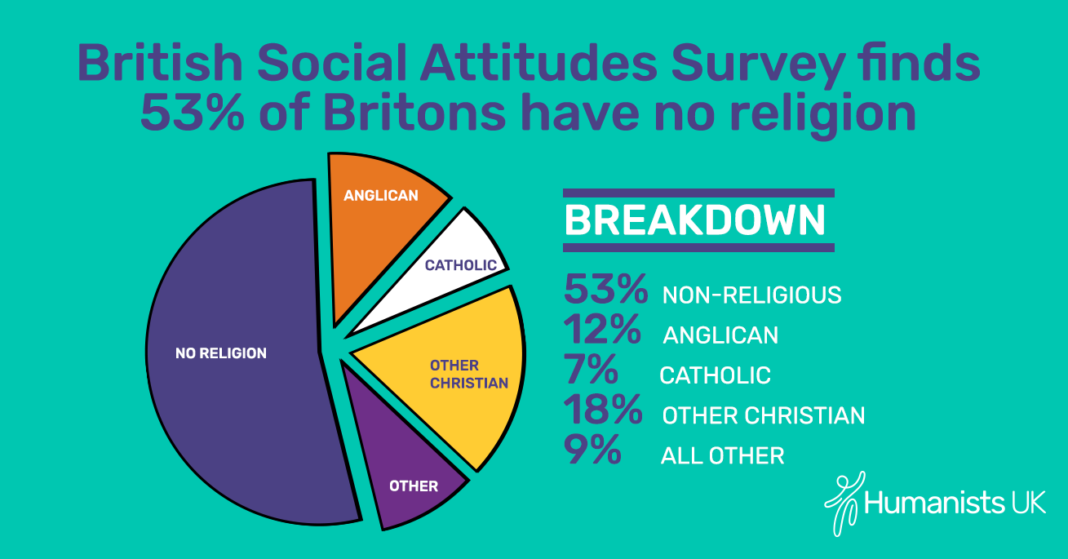
As the religious population of the UK is becoming more diverse, political representation is becoming more varied and diverse where once it was not – and that should be seen as a good thing for people from all religions and beliefs. For example, Rishi Sunak’s appointment as Prime Minister in 2022 marked the first time in history that a Christian did not hold any of the most senior roles in UK politics – Prime Minister of the UK, or First Minister of Scotland, Wales, or Northern Ireland.
Values and leadership
What’s more important to us than what a politician believes, however, is how they choose to govern. As humanists we would never claim to hold a monopoly on good values and we know many in religious communities share some essential values with us.
Whatever their convictions, what matters most is that politicians know to separate their personal beliefs from how they choose to govern for society as a whole – and that they don’t practise or endorse favouritism towards any particular religion or belief.
This approach is called ‘secularism’. Secularists can be of any religion or belief. For example, the current Leader of the Liberal Democrats, Sir Ed Davey, is both a Christian and a secularist, while the Green MP for Brighton Pavilion, Sian Berry, is a humanist and a secularist. When this is practised by governments or countries, it’s called ‘state secularism’ – sometimes referred to as the separation of church and state.
On this front, the UK has a long way to go. Despite having one of the least religious populations of any country in the world, the UK is far from secular in an institutional sense – with things like an established church, faith schools, and even bishops voting in the House of Lords. Here, Humanists UK is actively working towards positive social change.
We want to live in a world where everyone has freedom of thought, choice, and expression over their own lives, and where everyone is treated equally, whatever their religious or non-religious views may be. If that is an approach you want to support, why not join us to support our work?
JOIN HUMANISTS UK
Help us advance free thinking and freedom of choice for a fairer society.
Notes
For further comment or information, media should contact Humanists UK Director of Public Affairs and Policy Richy Thompson at press@humanists.uk or phone 0203 675 0959.
Humanists UK is the national charity working on behalf of non-religious people. Powered by over 120,000 members and supporters, we advance free thinking and promote humanism to create a tolerant society where rational thinking and kindness prevail. We provide ceremonies, pastoral care, education, and support services benefitting over a million people every year and our campaigns advance humanist thinking on ethical issues, human rights, and equal treatment for all.
Reports of the All-Party Parliamentary Humanist Group
Humanists UK is secretariat to the All-Party Parliamentary Humanist Group (APPHG), a group of MPs and peers who meet to discuss humanist issues and support many of the same causes we do. We provide administrative support and policy expertise to the group’s own research work. Some of the APPHG’s published reports are collected below.
Any Lawful Impediment?
The All-Party Parliamentary Humanist Group published this report on its inquiry into delays legalising humanist marriage in England and Wales.
Time for Reflection
The All-Party Parliamentary Humanist Group examined the treatment of religion or belief in the UK Parliament, including practices like appointing bishops to the House of Lords and use of ‘prayer cards’.
License
In-Sight Publishing by Scott Douglas Jacobsen is licensed under a Creative Commons Attribution-NonCommercial-NoDerivatives 4.0 International License.
Based on work at www.in-sightpublishing.com.
Copyright
© Scott Douglas Jacobsen and In-Sight Publishing 2012-Present. Unauthorized use and/or duplication of this material without express and written permission from this site’s author and/or owner is strictly prohibited. Excerpts and links may be used, provided that full and clear credit is given to Scott Douglas Jacobsen, or the author(s), and In-Sight Publishing with appropriate and specific direction to the original content. All interviewees and authors copyright their material, as well, and may disseminate for their independent purposes.
Share this:

Publisher: In-Sight Publishing
Publisher Founding: September 1, 2014
Publisher Location: Fort Langley, Township of Langley, British Columbia, Canada
Publication: Freethought Newswire
Original Link: https://www.bchumanist.ca/bc_munis_prayer_free
Publication Date: July 2, 2024
Organization: British Columbia Humanist Association
Organization Description: The British Columbia Humanist Association has been providing a community and voice for Humanists, atheists, agnostics, and the non-religious of Metro Vancouver and British Columbia since 1982. We support the growth of Humanist communities across BC, provide Humanist ceremonies, and campaign for progressive and secular values.
The BC Humanist Association (BCHA) is declaring the end of municipal prayers in British Columbia (BC) following a commitment from the City of Parksville that there will not be prayers in the City’s next inaugural council meeting.
Ian Bushfield, Executive Director, BC Humanist Association:
“Nine years after the Saguenay ruling, we’re thrilled to be able to declare BC’s municipal council meetings prayer-free.
“We will remain vigilant as we continue playing whac-a-mole with local politicians who privilege religion over nonreligion in the public sphere. We strongly encourage anyone considering bringing prayers back to look closely at the responses we received from municipalities ranging from Belcarra to Vancouver.”
In its recent report, We Yelled At Them Until They Stopped, the BCHA identified seven municipalities in BC that included prayers in their 2022 inaugural council meetings. In 2018, 26 included prayers in their inaugural meetings. No communities opened regular meetings with prayers. Since publishing the report, the BCHA secured commitments from each of those municipalities to ensure that all future meetings are strictly secular.
Dr Teale Phelps Bondaroff, Research Coordinator, BC Humanist Association:
“I am pleased to see municipalities finally committing to upholding their duty of religious neutrality by discontinuing the unconstitutional practice of including prayers in their inaugural meetings. This is a significant step towards ensuring that all residents, regardless of their religious beliefs, or lack thereof, feel equally respected and included in our public spaces.”
In 2015, the Supreme Court of Canada ruled that opening council meetings with prayers was an unconstitutional violation of the state’s duty of religious neutrality. Since then, most municipalities in Canada have ceased the practice; however, in auditing compliance with the ruling, the BCHA has identified multiple scofflaws across the country.
The BCHA wrote to the seven municipalities in November asking for commitments to respect the duty of religious neutrality. Only the Cities of Parksville and Vancouver refused. The BCHA worked with pro-bono counsel to press for a response, raising the spectre of legal challenges.
Last month, the City of Vancouver acknowledged that the multi-faith prayers delivered at its 2022 inaugural ceremony were “a breach of the duty of religious neutrality.” They committed to ensuring that future inaugural meetings comply with the law.
In late April, Parksville stated, “At this time, the City has no intention of including prayers at its inaugural meeting after the next municipal election in 2026.” The BCHA sought further clarification and last week lawyers for the City replied:
- Should Mayor [Doug] O’Brien be re-elected in 2026, he commits to there not being any religious prayers at the inaugural Council meeting; and,
- Should Mayor O’Brien not be re-elected in 2026, Chief Administrative Officer Kehler commits to advising the Mayor-Elect and newly elected Council of its obligation to ensure religious neutrality and to strongly recommend that the Mayor-Elect not include any religious prayers at the inaugural Council meeting.
Following these commitments, the BCHA is dropping the threat of legal action against the City of Parksville.
The BCHA identified Belcarra, Colwood, Delta, Parksville, Tumbler Ridge, Vancouver and West Kelowna as having religious content in their 2022 inaugural council meetings. In its 2020 report, the BCHA found no BC municipalities with prayers in regular meetings.
The BCHA has since identified prayers in the regular and inaugural meetings in Alberta, Manitoba and Ontario municipalities. Further research into the remaining provinces will be published in the coming months as part of the Saguenay Project.
Parksville’s April 30, 2024 letter
License
In-Sight Publishing by Scott Douglas Jacobsen is licensed under a Creative Commons Attribution-NonCommercial-NoDerivatives 4.0 International License.
Based on work at www.in-sightpublishing.com.
Copyright
© Scott Douglas Jacobsen and In-Sight Publishing 2012-Present. Unauthorized use and/or duplication of this material without express and written permission from this site’s author and/or owner is strictly prohibited. Excerpts and links may be used, provided that full and clear credit is given to Scott Douglas Jacobsen, or the author(s), and In-Sight Publishing with appropriate and specific direction to the original content. All interviewees and authors copyright their material, as well, and may disseminate for their independent purposes.
Share this:
Author(s): Scott Douglas Jacobsen
Publication (Outlet/Website): The Good Men Project
Publication Date (yyyy/mm/dd): 2024/07/01
According to some semi-reputable sources gathered in a listing here, Rick G. Rosner may have among America’s, North America’s, and the world’s highest measured IQs at or above 190 (S.D. 15)/196 (S.D. 16) based on several high range test performances created by Christopher Harding, Jason Betts, Paul Cooijmans, and Ronald Hoeflin. He earned 12 years of college credit in less than a year and graduated with the equivalent of 8 majors. He has received 8 Writers Guild Awards and Emmy nominations, and was titled 2013 North American Genius of the Year by The World Genius Directory with the main “Genius” listing here.
He has written for Remote Control, Crank Yankers, The Man Show, The Emmys, The Grammys, and Jimmy Kimmel Live!. He worked as a bouncer, a nude art model, a roller-skating waiter, and a stripper. In a television commercial, Domino’s Pizza named him the “World’s Smartest Man.” The commercial was taken off the air after Subway sandwiches issued a cease-and-desist. He was named “Best Bouncer” in the Denver Area, Colorado, by Westwood Magazine.
Rosner spent much of the late Disco Era as an undercover high school student. In addition, he spent 25 years as a bar bouncer and American fake ID-catcher, and 25+ years as a stripper, and nearly 30 years as a writer for more than 2,500 hours of network television. Errol Morris featured Rosner in the interview series entitled First Person, where some of this history was covered by Morris. He came in second, or lost, on Jeopardy!, sued Who Wants to Be a Millionaire? over a flawed question and lost the lawsuit. He won one game and lost one game on Are You Smarter Than a Drunk Person? (He was drunk). Finally, he spent 37+ years working on a time-invariant variation of the Big Bang Theory.
Currently, Rosner sits tweeting in a bathrobe (winter) or a towel (summer). He lives in Los Angeles, California with his wife, dog, and goldfish. He and his wife have a daughter. You can send him money or questions at LanceVersusRick@Gmail.Com, or a direct message via Twitter, or find him on LinkedIn, or see him on YouTube.
Scott Douglas Jacobsen: We’ve had several ideas come up amid informational cosmology. One of them has to do with the degrees of freedom in a system and how we frame the universe as a relational system, and so I was thinking about the degrees of freedom in a relational system of information. The idea of a physics of relational degrees of freedom of information would be distinct from digital information where this digital information is distinctive and singular, and then you have a matrix or matrices of information networks. That’s a different idea than the sort of emerging components of the system becoming the information in so far as they relate to one another, and that relation happens through time where time is emerging…
Rick Rosner: So, to preface what we’re talking about, we need the definition of information, which is the definite choice of an outcome among a set of possible outcomes. So, that outcome contains information, and the amount of information is the fraction of outcomes that occurred, which is, if you throw a coin, you have two possible outcomes, and you get one of the two that contains less information than if you rolled dice with 100 sides. One out of a hundred contains more information than one out of two, and that’s the basic definition of information, right?
Jacobsen: Yes, that’d be a baseline definition of information. However, if you’re dealing with relationships amongst parts, it adds different layers to the definition.
Rosner: The issue is when you say information within a system, you have to talk about what a system is. For example, one system might be the entire universe, and every durable quantum event should add information to the system. So, to be informed, the event has to leave a durable record. For instance, I might determine how many quantum events occur per second in a star. It has to be 10 to the 30th or some crazy number, but most events don’t leave a durable trace. One durable event within a star might be fusion in a couple of deuterium nuclei coming together to form a helium nucleus. Maybe that’s hard to undo, but just exchanging heat photons at the sun’s center where the temperature is super crazy hot, none of those photon exchanges leave a traceable event. You can assume they’re going on because the sun is super-hot and photons are carrying the heat, but unless a photon makes it to the surface of the sun and escapes, most of those photons aren’t traceable. Does all that seem reasonable?
Jacobsen: For the system to have any information, it has to be the distinctive representation of the system. In a way, virtual things that don’t have a durable existence but have existed for a sufficient amount of time to impact the system can then change that system’s informational net content.
Rosner: Yeah, we have human information systems where we get sensory information, and we have thoughts, and somehow, information is processed within our awareness. We live in a world where many events are at least temporarily durable that what we experience leaves traces in our memories until we die and our brains break up and then, like all that information, are lost because our brains, which held the information, can no longer have information. So, you need some general or unified theory of information that ties all information in all relevant systems together and explains the whole ecosystem of information and how those various information-containing systems impinge on each other informationally. Does it matter to the information processing system that is the universe when humans experience events in our awareness that generate information for us? Inny information-generating events in our awareness are irrelevant to the overall information-processing system, which is the universe. At the same time, if there are gigantic civilizations that are millions of years old that interact with the universe, that engineer the universe for their survival long term over billion years spans, then what those systems or these civilizations do does impinge, but I don’t know. Can civilizations within the universe affect the information processing of the entire universe? A unified theory of information, which would likely also be a unified theory of the universe, would clarify that.
So, what you’re suggesting is a program of inquiry. When we talk about the universe, it’s a relational system in that the universe perceives itself via quantum interactions, and that’s relational in that everything in the universe defines itself and everything else via a history of interactions. How does that relate to a digital system where all it is from bit people like Wheeler and all those guys who have been pushing the universe as a computer since the 60s? All those guys naively; naively is like a snotty term, but naturally, the first attempts to do this would be the universe as a computer, and maybe quantum events correspond to zeros and ones in a computer. By poking at it, you and I, we think perhaps that’s and also because people have been talking about that for 60-70 years now, and I don’t think that’s delivered a whole lot in terms of results, but I’m not informed enough. What do you think?
Jacobsen: Yeah, I mean, my general idea is that you have a framework of emergent properties, and the information can be defined as that those properties emerge more distinctly, but that would replicate sort of a digital infrastructure that we see in modern computers where they’re stacked or just a two-dimensional processor. At the same time, the emerging property is still information; there needs to be more definition. So, there has to be a way in which you can define the parts of the universe relationally being emergent while including a factor or some variable in the equation for the fuzziness of that information as things become more distinct, and so that degree of fuzziness should decrease as the scale increases…
Rosner: We know it does, just like the wavelengths of matter are teeny because there’s a ton of matter; there’s 10 to the 80th, 10 to the 85th particles all shoot other particles at each other. So, things are tightly defined, so the fuzziness is at this very microscopic scale. There’s another thing, which is that the universe is entangled with itself. I guess the universe is a quantum-entangled entity, and you can call it a quantum computer, though it doesn’t look like our primitive quantum computers because our quantum computers are still manipulating bits. There’s still a bunch of zeros and ones, just the processing of them is more potent because it’s massively parallel and entangled, but it’s not to say that the universe is information processing; it’s still hard to find the zeros and ones in what the universe is doing if there are zeros and ones at all. There are distinct quantum events.
When a Quantum event happens, you can characterize it with exact numbers. Even though the particles involved are all fuzzy, at a later point in time, the universe reflects these distinct and precise quantum events having happened. Though the precision might be limited again, you can arrange the universe by doing experiments so that you can know with a high degree of certainty that a quantum event has happened. Though you never get 100% certainty, each quantum event you think happened has an exact mathematical description and a mathematical name. This event happened and is precisely what would have happened if this event had occurred, and we can know that this event occurred with a super high degree but not 100% certainty. Does all that make sense?
Jacobsen: So, there will be an overarching property of how leaky a particular event is, whether it’s an object or a world line or large section of the universe depending on size, so it’s a sliding scale of how defined things are. That would be one variable certainly included in that, so the relational degrees of freedom that variable probably would be defined straightforwardly by some mathematical symbol, the degrees of freedom for this particular event and worldwide out of the universe.
Rosner: So, for people who don’t know a lot of quantum mechanics, the first example you learn when learning quantum mechanics is the particle in a well or a box. Here’s a particle; it’s fuzzy; it’s in a box; it’s in a place where it can’t get out of because there’s a potential it would have to climb out of the box or it would have to break through the walls of the box. But in that particle description, the particle is fuzzy, and there’s a high probability it’s here and a low probability that the particle exists as a cloud, a probability cloud that is precisely located here. Well, the center of that cloud is here, but the particle can be any place within the cloud with a given probability of any place within the cloud, and the cloud extends to infinity. So, you get quantum tunnelling where you got a particle in a box, say it’s an electron and say the probability that the electron is an inch away when you detect it, that it’s an inch away from the center of that probability cloud is one in 10 to the 20th, but that’s not zero. So, if you had 10 to the 20th electrons in boxes, one would appear outside the box because of probability. So, that’s what leakiness is that you just talked about.
Quantum leakiness is that you can’t pin everything down precisely.
Jacobsen: In some technical sense, we are constantly leaking out to the edge of the universe.
Rosner: Right, but the universe, by its interactions, holds itself together. This isn’t the Big Bang expansion in the universe. Say the universe is flying apart all the time, but if all the particles are expanding and everything’s expanding at the same rate, then the universe can’t perceive that and is not very sensible. It’s the difference between a photograph and an enlargement of a photograph; if it’s the same photograph, it doesn’t matter how much you enlarge it because the relations among the things in the photograph remain the same. It’s only when the relationships change that you get perceptible changes. So, regardless of what overall frame you put on it, the universe manages to define itself and provide its frame even though there might be mathematical frames that make it convenient to think of the universe as this thing that’s flying apart. If everything’s flying apart to the same extent and none of the relationships among the elements of the universe change, it becomes meaningless, etc., except maybe a mathematical convenience to talk about the size of the frame changing as long as everything within the frame stays the same.
License
In-Sight Publishing by Scott Douglas Jacobsen is licensed under a Creative Commons Attribution-NonCommercial-NoDerivatives 4.0 International License. Based on a work at www.in-sightpublishing.com.
Copyright
© Scott Douglas Jacobsen and In-Sight Publishing 2012-Present. Unauthorized use and/or duplication of this material without express and written permission from this site’s author and/or owner is strictly prohibited. Excerpts and links may be used, provided that full and clear credit is given to Scott Douglas Jacobsen and In-Sight Publishing with appropriate and specific direction to the original content. All interviewees and authors co-copyright their material and may disseminate for their independent purposes.
Share this:
Publisher: In-Sight Publishing
Publisher Founding: September 1, 2014
Publisher Location: Fort Langley, Township of Langley, British Columbia, Canada
Publication: Freethought Newswire
Original Link: https://ffrf.org/news/releases/ffrf-demands-champaign-ill-school-district-stop-collaborating-with-religious-group/
Publication Date: July 1, 2024
Organization: Freedom From Religion Foundation
Organization Description: The Freedom From Religion Foundation is a national nonprofit organization with 40,000 members and several chapters all over the country. Our purposes are to protect the constitutional principle of separation between state and church and to educate the public on matters relating to nontheism.
The Freedom From Religion Foundation is criticizing the Champaign Unit 4 School District in Illinois for working with a Christian group to proselytize to underprivileged students.
A concerned community member informed FFRF that Youth For Christ’s Eastern Illinois chapter is receiving special access to school children within the Unit 4 district. The group is infamous for its homophobic policies regarding LGBTQ-plus Christians. Youth For Christ reportedly curated the lunch hour to target underprivileged students with food insecurity. According to a flier distributed at Franklin STEAM Academy, Youth of Christ Campus Life Lunch Crew “collaborates closely with the school administration to identify students who may require social, emotional, and academic support and mentoring.” It holds lunchtime meetings with these identified children.
FFRF’s complaintant personally witnessed one of these meetings. The meeting’s presentation included topics such as Jesus Christ and putting the attendees’ trust in God.
“Students — including low-income students — have the First Amendment right to be free from religious indoctrination in their public schools,” FFRF Patrick O’Reiley Legal Fellow Hirsh M. Joshi writes to the district.
It is a basic constitutional principle that public schools may not show favoritism toward or coerce belief or participation in religion, FFRF emphasizes. Here, Youth For Christ uses access to particularly vulnerable school children to promote a religious message that seeks to convert children to Christianity. This unconstitutional message accompanies something they need and do not have access to: lunch. The school cannot allow outside adults to use charity as an excuse to indoctrinate students on school grounds during the school day.
FFRF points out that the violation is compounded by the fact that the district is aiding and abetting the program, as school administrators identify children in need of “social, emotional, and academic” support. The district is referring students who it deems in need of religious counseling to Youth For Christ. This practice also disregards the privacy rights of families. The district actively participates in religious counseling.
By failing to thwart Youth For Christ’s sectarian inculcation, STEAM Academy invites it to target these children. Ultimately, it’s the public school’s responsibility to ensure that materials given to children on school property during the school day do not unconstitutionally promote religion.
FFRF lauds the Champaign Unit 4 School District and STEAM Academy for seeking to partner with local organizations to address student hunger. However, the district must still abide by the First Amendment’s Establishment Clause while doing so.
“Decades after McCollum was decided, here we go again with a Champaign public school trying to inculcate students into religion,” adds Joshi. “Just like in McCollum, a Champaign public school is ushering students towards religious instruction. That was wrong in 1791, it was wrong in 1948, and is still wrong today in 2024.”
By allowing outside adults to push their religious views on students on campus during the school day sends a message of exclusion to nonadherents. Nonreligious students receiving that message will feel particularly alienated, since at least a third of Generation Z members (those born after 1996) have no religion, with a recent survey revealing that almost half of Gen Z qualifies as religiously unaffiliated “Nones.”
“We’re calling on the district to adopt a clear policy disallowing religious programs masquerading as social and emotional instruction,” says FFRF Co-President Annie Laurie Gaylor. “Champaign Unit 4 School District must take action to protect its students from religious groups.”
License
In-Sight Publishing by Scott Douglas Jacobsen is licensed under a Creative Commons Attribution-NonCommercial-NoDerivatives 4.0 International License.
Based on work at www.in-sightpublishing.com.
Copyright
© Scott Douglas Jacobsen and In-Sight Publishing 2012-Present. Unauthorized use and/or duplication of this material without express and written permission from this site’s author and/or owner is strictly prohibited. Excerpts and links may be used, provided that full and clear credit is given to Scott Douglas Jacobsen, or the author(s), and In-Sight Publishing with appropriate and specific direction to the original content. All interviewees and authors copyright their material, as well, and may disseminate for their independent purposes.
Share this:
Publisher: In-Sight Publishing
Publisher Founding: September 1, 2014
Publisher Location: Fort Langley, Township of Langley, British Columbia, Canada
Publication: Freethought Newswire
Original Link: https://humanists.uk/2024/07/04/democracy/
Publication Date: July 4, 2024
Organization: Humanists UK
Organization Description: Humanists UK is the operating name of the British Humanist Association. We are a charitable company (no. 228781), formed in 1896 and incorporated in 1928, and registered in England and Wales. Our governing document is our Articles of Association, which can be viewed here.
Most human beings who have ever lived (and many human beings alive today) have had no say in how they are ruled or by whom. You and I do. Let’s make sure we use that power today!
As representatives from 120 humanist organisations around the world collectively affirmed at the most recent World Humanist Congress, democracy is a universal fundamental value that is essential to the realisation of humanist principles worldwide.
Read the Copenhagen Declaration on Democracy, affirmed in 2023.
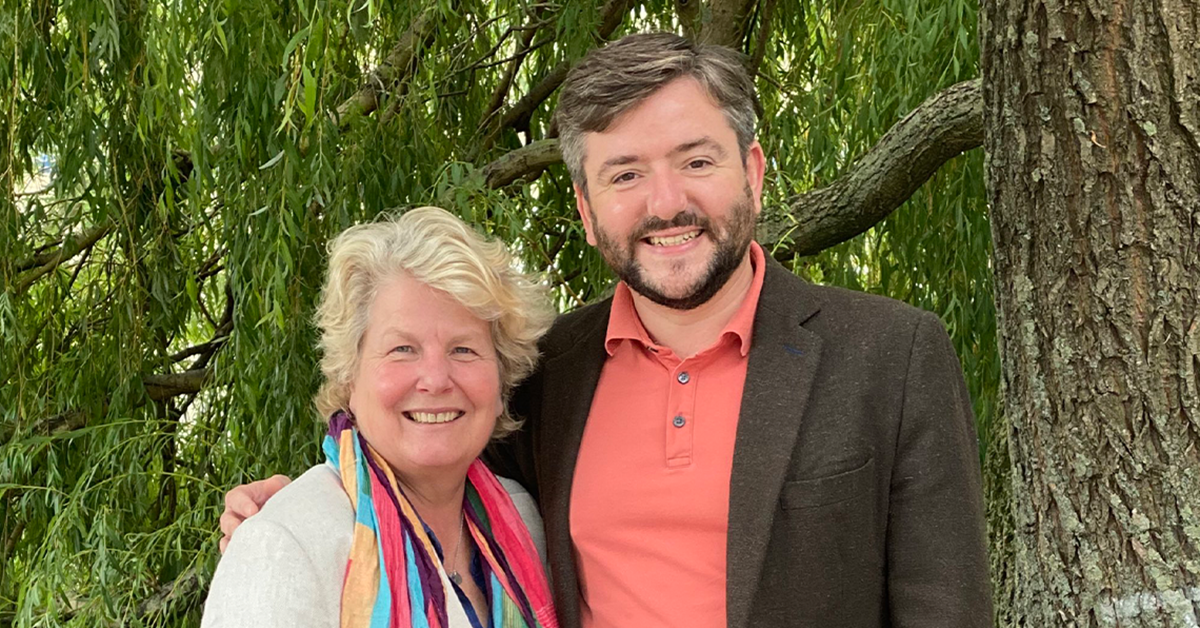
In the run-up to the election, Humanists UK has been lobbying political parties about humanist issues, encouraging you to write to your candidates (you can still do this now if you haven’t already!), and providing resources to lobby the parties in your local areas.
Below are just some of the issues we’ve been campaigning on – and we’ll need lots and lots of help from members and supporters if we advance these causes and more with the next government after the final vote has been counted.

Just as important as voting yourself is this: please remind your friends and family to vote, too!
It’s a sign of health in our democracy if people recognise that their individual vote, while rarely ever decisive on its own, nevertheless matters. If you use Twitter/X, please also consider posting to your followers about it.
Democracy must be defended
As I said to supporters in an email just after the election was called, this could be the most transformative election for us in many decades – with a record number of MPs stepping down, and a massive intake of new, younger, and less religious MPs expected to take office for the first time.
As we look across the channel to France or the Atlantic to the United States, we can see challenges to democratic values and norms from all sides. Personally I am reminded again of what we as a global humanist movement affirmed in 2023:
‘Democracy as a culture must be actively defended against all threats, including those from regimes, movements, and political parties that embrace authoritarian principles, from those with unaccountable economic and social power, and from all other forces that seek to undermine democratic values and institutions.‘
Democracy is a human invention and part of our global human heritage, but it is by no means something we can take for granted. It did not emerge ‘naturally’, and it can be easily eroded or lost. It is both precious and fragile.
Democracy as a way of thinking about and solving human problems requires active cultivation, respect, and vigilance against outside threats.
It is a testament to our species that, despite its inherent fragility, and acknowledging the challenges that it faces in the 21st century, democracy on the whole has managed to prosper in the last 2,000 years. But for one final thought experiment: just think how much worse the world would be without it. Democracies have enabled our species to resolve conflicts; to make scientific and cultural advances; to raise living standards; to expand human rights, freedom, and concern for the most vulnerable on our planet, including non-human animals.
Ultimately, democracy has helped us make human progress.
Thank you for being a part of that story – both today in voting, and through your support for Humanists UK and our campaigns.
‘The destiny of human rights is
in the hands of all our citizens
in all our communities.’
Eleanor Roosevelt
Notes
For further comment or information, media should contact Humanists UK Director of Public Affairs and Policy Richy Thompson at press@humanists.uk or phone 020 7324 3072 or 07534 248 596.
Humanists UK is the national charity working on behalf of non-religious people. Powered by over 120,000 members and supporters, we advance free thinking and promote humanism to create a tolerant society where rational thinking and kindness prevail. We provide ceremonies, pastoral care, education, and support services benefitting over a million people every year and our campaigns advance humanist thinking on ethical issues, human rights, and equal treatment for all.
License
In-Sight Publishing by Scott Douglas Jacobsen is licensed under a Creative Commons Attribution-NonCommercial-NoDerivatives 4.0 International License.
Based on work at www.in-sightpublishing.com.
Copyright
© Scott Douglas Jacobsen and In-Sight Publishing 2012-Present. Unauthorized use and/or duplication of this material without express and written permission from this site’s author and/or owner is strictly prohibited. Excerpts and links may be used, provided that full and clear credit is given to Scott Douglas Jacobsen, or the author(s), and In-Sight Publishing with appropriate and specific direction to the original content. All interviewees and authors copyright their material, as well, and may disseminate for their independent purposes.
Share this:

Author(s): Scott Douglas Jacobsen
Publication (Outlet/Website): The Good Men Project
Publication Date (yyyy/mm/dd): 2024/06/30
A humanist outlook is a bit like looking at the world from the moon without borders, boundaries, and imposed artifice of human conceptualization. Or take the thought experiment of the common map of the world, the Mercator Projection: It is warped.
Countries and continents can look bigger than the reality or smaller than in real life, in relation to one another, based on the warpage in the dimension imposed by the image. It is, as it says, a projection.
A way to look at the world through humanist eyes and the human oriented world in this manner can feel alien, hence the moon example. But it is the world before the imposition of common superstition and inaccurate empirical culture is forced upon us.
Take, for example, the idea of language, everyone has the capacity for language. Therefore, as per a common theoretical framework about language, there is a common linguistic structure, elegant, simple, capable of the production of the variety of world languages.
Same with our perception of the world. We come with these capacities. My sincere take away from individuals who have left religious orthodoxy, in its ill-begotten children, have to take a process of weeks to years to remove the poisoning of their linguistic and conceptual faculties.
The more entrenched the religious orthodoxy, then the, and I agree with Hypatia entirely on this point, more painful the removal of those superstitions. There are no ghosts in the machine.
However, there are ghosts in the communicative capacities of the machine. These produce a form of deep illusion. And also further agreeing on Hypatia’s point, the deeper the illusions indoctrinated in him youth; the more painful the removal of them.
A glorious freedom sits on the other side without the imposition one witnesses in the midst of the standard indoctrination found in North American culture. Everyone has the capacity for it, as everyone had the original standard sentiment in it. In the same way we teach a mercator projection; we’re teaching another warpage in a reliance on adult fantasy and role-playing, typified in religious
License
In-Sight Publishing by Scott Douglas Jacobsen is licensed under a Creative Commons Attribution-NonCommercial-NoDerivatives 4.0 International License. Based on a work at www.in-sightpublishing.com.
Copyright
© Scott Douglas Jacobsen and In-Sight Publishing 2012-Present. Unauthorized use and/or duplication of this material without express and written permission from this site’s author and/or owner is strictly prohibited. Excerpts and links may be used, provided that full and clear credit is given to Scott Douglas Jacobsen and In-Sight Publishing with appropriate and specific direction to the original content. All interviewees and authors co-copyright their material and may disseminate for their independent purposes.
Share this:
Publisher: In-Sight Publishing
Publisher Founding: September 1, 2014
Publisher Location: Fort Langley, Township of Langley, British Columbia, Canada
Publication: Critical Science Newswire
Original Link: https://ncse.ngo/climate-change-education-us-middle-schools-changes-over-five-pivotal-years-0
Publication Date: July 1, 2024
Organization: National Center for Science Education
Organization Description: The National Center for Science Education promotes and defends accurate and effective science education because everyone deserves to engage with the evidence. One day, students of all ages will be scientifically literate, teachers will be prepared and empowered to teach accurate science, and scientific thinking and decision-making will ensure that all life can thrive and overcome challenges to our shared future.
By Glenn Branch
More middle school science teachers are teaching, and teaching more about, recent global warming, although more of them are also giving “equal time” to doubts that recent global warming is human-caused, according to a new study comparing the results of two nationally representative surveys of public middle school science teachers from 2014 and 2019.
Why focus on middle school? “Climate change education at the middle school level is crucial,” the study’s co-author Glenn Branch, deputy director of the National Center for Science Education, explained. “As matters stand, middle school is the last stage in the formal education of perhaps a majority of Americans in which a relatively extensive study of climate change might be required.”
“Only 24 percent of teachers reported not teaching about recent global warming in 2019, as compared to 30 percent in 2014,” commented the lead author, Eric Plutzer of Penn State University. “And while teachers who taught about recent global warming devoted 4.4 class hours on average to it in 2014, that was up to 6.5 class hours in 2019. These are significant, and substantial, improvements.”
Improvements were also visible in the choice of emphasis, with significantly more teachers who reported emphasizing the reality of recent climate change and the scientific consensus on its human causes. There was not, however, any change in the proportion of teachers who reported emphasizing, misleadingly, that “many scientists believe recent increases in temperature are likely due to natural causes.”
There was also deterioration. Asked about various possible ways of managing potential controversy in the classroom, there was a rise in the proportion of teachers who reported giving time to perspectives that raise doubt that humans are causing climate change, from 35 percent in 2014 to 43 percent in 2019. Presenting such perspectives is discouraged by scientific and science education organizations.
“Every student deserves the chance to understand that there is a broad and deep scientific consensus on climate change’s reality and causes,” commented co-author Amanda L. Townley, executive director of the National Center for Science Education. “And although there’s obviously room for further improvement, seeing such a substantial shift in a mere five years is incredibly exciting.”
Why the shift? The study analyzed a variety of possible factors, concluding that increasing acceptance of the scientific consensus on recent global warming on the part of the teachers — which rose nine percentage points between the two surveys — and increasing presence of recent global warming in state standards were particularly important.
The study, “Climate change education in U.S. middle schools: changes over five pivotal years” by Eric Plutzer, Glenn Branch, and Amanda L. Townley, was published open-access in a special climate change education issue of the peer-reviewed Journal of Microbiology & Biology Education, published by the American Society for Microbiology, on June 25, 2024.
License
In-Sight Publishing by Scott Douglas Jacobsen is licensed under a Creative Commons Attribution-NonCommercial-NoDerivatives 4.0 International License.
Based on work at www.in-sightpublishing.com.
Copyright
© Scott Douglas Jacobsen and In-Sight Publishing 2012-Present. Unauthorized use and/or duplication of this material without express and written permission from this site’s author and/or owner is strictly prohibited. Excerpts and links may be used, provided that full and clear credit is given to Scott Douglas Jacobsen, or the author(s), and In-Sight Publishing with appropriate and specific direction to the original content. All interviewees and authors copyright their material, as well, and may disseminate for their independent purposes.
Share this:
Author(s): Scott Douglas Jacobsen
Publication (Outlet/Website): The Good Men Project
Publication Date (yyyy/mm/dd): 2024/06/30
According to some semi-reputable sources gathered in a listing here, Rick G. Rosner may have among America’s, North America’s, and the world’s highest measured IQs at or above 190 (S.D. 15)/196 (S.D. 16) based on several high range test performances created by Christopher Harding, Jason Betts, Paul Cooijmans, and Ronald Hoeflin. He earned 12 years of college credit in less than a year and graduated with the equivalent of 8 majors. He has received 8 Writers Guild Awards and Emmy nominations, and was titled 2013 North American Genius of the Year by The World Genius Directory with the main “Genius” listing here.
He has written for Remote Control, Crank Yankers, The Man Show, The Emmys, The Grammys, and Jimmy Kimmel Live!. He worked as a bouncer, a nude art model, a roller-skating waiter, and a stripper. In a television commercial, Domino’s Pizza named him the “World’s Smartest Man.” The commercial was taken off the air after Subway sandwiches issued a cease-and-desist. He was named “Best Bouncer” in the Denver Area, Colorado, by Westwood Magazine.
Rosner spent much of the late Disco Era as an undercover high school student. In addition, he spent 25 years as a bar bouncer and American fake ID-catcher, and 25+ years as a stripper, and nearly 30 years as a writer for more than 2,500 hours of network television. Errol Morris featured Rosner in the interview series entitled First Person, where some of this history was covered by Morris. He came in second, or lost, on Jeopardy!, sued Who Wants to Be a Millionaire? over a flawed question and lost the lawsuit. He won one game and lost one game on Are You Smarter Than a Drunk Person? (He was drunk). Finally, he spent 37+ years working on a time-invariant variation of the Big Bang Theory.
Currently, Rosner sits tweeting in a bathrobe (winter) or a towel (summer). He lives in Los Angeles, California with his wife, dog, and goldfish. He and his wife have a daughter. You can send him money or questions at LanceVersusRick@Gmail.Com, or a direct message via Twitter, or find him on LinkedIn, or see him on YouTube.
[Recording Start]
Scott Douglas Jacobsen: Trump’s quote is, “I am the chosen one.” This is crazy talk coming from surveys of about a third of Americans who believe Trump was not ordained by God but guided or even selected by God to lead.
Rosner: Anything he does that seems terrible, like fucking porn or inciting an insurrection or any of that stuff. His shortcomings as a man are tests of their faith. I believe he’s their saviour, and if you can’t see past his human frailties, which we all have, you’re not really a believer. It’s like dinosaurs were put in the fossils of dinosaurs and in the ground to test our faith in God. If you fall for the trick of believing in evolution, your faith has failed, and you failed as a Christian. It’s just pure stupidity. So, Trump has twice been found liable for slander, for saying lousy shit about E. Jean Carroll, saying that he didn’t rape her and calling her shit and twice she’s taken him to Court. In each case, the judge has ruled that her allegations are true that Trump is liable to her and that in the first trial, the Court ruled that he owes her $5 million, and in the second trial, they haven’t come up with damages yet. There may be a third trial because, he went on Truth Social, his social medium and in the space of 40 minutes, sent out 47 posts attacking E. Jean Carroll.
E. Jean Carroll was for about 30 years a relationships and sex columnist for women’s magazines like Bazaar or Glamour and was very sex-positive and very exuberant. So, Trump just went ahead and tweeted out 47 quotes from her old columns from decades ago where she said, like, embrace sex. So, his implied argument is that if she’s going to speak positively about sex, he couldn’t have raped her, and if he did rape her, it doesn’t matter because she wrote about sex. He’s been a piece of shit for his whole adult life, but he continues to surprise with the new depths of shitt-iness that he plums, which may serve him well because in 2016, based on him saying awful shit, he got five billion dollars worth of free media coverage that helped him get elected. A lot of pundits think, and I hope they’re right, that there’s been a semi-media moratorium on Trump and that the media aren’t covering every single word that Trump says the way that it’s still too soon before the election for him to get and he’s not the nominee yet. So, it’s too soon to give him the depth of coverage that he’d get closer to the election. Still, the pundits are saying that given the horrible shit that he’s saying every day when he starts when people start paying attention and when the media starts giving him more coverage, this will disgust most people. He’ll lose support I hope they’re right.
[Recording End]
[Recording Start]
Scott Douglas Jacobsen: This is an addendum to the last session.
Rick Rosner: You just played me a clip from four years ago when Trump said he was the chosen one, chosen to fight China. So, now four years later he’s saying chosen by God. He was implying it four years ago but now he’s saying it but a new development is the Democrats in the House I think, did some accounting and you’re not supposed to get money from foreign governments or from any kind of foreign entity while President. And while President, Trump who says he’s going to take on China was paid 7.8 million dollars from foreign governments with two third of that coming from China and he said “Well it’s fine, any money that I get I will turn over to the treasury.”
So, it’s not fine and he even though he said he’d turn over the money to the treasury, he turned over some pittance like 2% of it, like 50 Grand. This is the same shit that the Republicans in the House are going after Biden for except that Biden didn’t receive any money from foreign governments and also wasn’t in government for the years that Trump was. So, things are all backwards here.
[Recording End]
License
In-Sight Publishing by Scott Douglas Jacobsen is licensed under a Creative Commons Attribution-NonCommercial-NoDerivatives 4.0 International License. Based on a work at www.in-sightpublishing.com.
Copyright
© Scott Douglas Jacobsen and In-Sight Publishing 2012-Present. Unauthorized use and/or duplication of this material without express and written permission from this site’s author and/or owner is strictly prohibited. Excerpts and links may be used, provided that full and clear credit is given to Scott Douglas Jacobsen and In-Sight Publishing with appropriate and specific direction to the original content. All interviewees and authors co-copyright their material and may disseminate for their independent purposes.
Share this:
Publisher: In-Sight Publishing
Publisher Founding: September 1, 2014
Publisher Location: Fort Langley, Township of Langley, British Columbia, Canada
Publication: Freethought Newswire
Original Link: https://secular.org/2024/06/heretic-on-the-hill-ten-commandments-nine-justices-and-the-first-amendment/
Publication Date: June 24, 2024
Organization: Secular Coalition for America
Organization Description: The Secular Coalition for America advocates for religious freedom, as guaranteed by the First Amendment of the U.S. Constitution, and works to defend the equal rights of nonreligious Americans. Representing 20 national secular organizations, hundreds of local secular communities, and working with our allies in the faith community, we combine the power of grassroots activism with professional lobbying to make an impact on the laws and policies that govern separation of religion and government — or the improper encroachment of either on the other.
By Scott MacConomy
It’s hot in Washington. Damn hot. It’s so hot I went by the Lincoln Memorial, and the chair was empty. That’s hot. It’s so hot I didn’t mind at all that my Hill meetings were on Zoom yesterday. I usually offer to come by in person but if someone wants to do it remotely, that’s fine. A lot of Hill staffers are in their 20s so Zoom just seems more natural to them. Yesterday one asked me about the new Ten Commandments law just passed in Louisiana, which wasn’t even the topic of our meeting. Every public school classroom in the state has to begin displaying the Ten Commandments by January 1st.
This is an obvious violation of a 1980 Supreme Court decision, Stone v. Graham, concerning a very similar law passed in Kentucky. That decision was based on the First Amendment’s Establishment Clause which has been interpreted for many decades as meaning that the government, including schools, cannot do anything to establish or promote religion. Louisiana is simply hoping that with a different Supreme Court they will get a different answer.
The six conservatives on this Supreme Court lean on history and tradition more than previous courts ever did in deciding cases so Louisiana might get that different answer. However, today’s 8-1 decision that you can take a gun away from someone who received a restraining order for domestic violence offers some guidance on when history and tradition should and shouldn’t be considered relevant to a case. This is an important step because justices can find a historical precedent when it’s convenient and not find one when it’s not. So when that Ten Commandments case gets to the Supreme Court, it will be interesting as well as hugely important. Our coalition member the Freedom From Religion Foundation is one of the plaintiffs suing over the Louisiana law. I’ll keep you posted.
This seems like a good time for a reminder of what the Supreme Court used to be capable of, in a 1943 case where Jehovah’s Witnesses said they should not be forced to say the Pledge of Allegiance in school because of their religious beliefs:
“If there is any fixed star in our constitutional constellation, it is that no official, high or petty, can prescribe what shall be orthodox in politics, nationalism, religion, or other matters of opinion, or force citizens to confess by word or act their faith therein. If there are any circumstances which permit an exception, they do not now occur to us.” said Justice Robert Jackson. Let’s vote for a president who will pick good justices, and, step two, for senators that will confirm good justices. (That’s not guaranteed in the Senate.) Click here for some secular voter resources. I note that the two most conservative justices are the two oldest, 74 and 75. They won’t last forever. Someday we’ll fly flags at half staff for them.
___________________________
Thanks to everyone who donated after last week’s appeal. We definitely appreciate it. Normally I’d say it helps keep the lights on but this week it helps keep the air conditioning on. Maybe I should have said thanks to everyone who “chipped in.” It seems like every email I get from a candidate asking for a campaign contribution asks me to “chip in.” That must be the phrase that gets the best response according to the metrics. “The phrase that pays.” We just appreciate your help whatever we call it.
License
In-Sight Publishing by Scott Douglas Jacobsen is licensed under a Creative Commons Attribution-NonCommercial-NoDerivatives 4.0 International License.
Based on work at www.in-sightpublishing.com.
Copyright
© Scott Douglas Jacobsen and In-Sight Publishing 2012-Present. Unauthorized use and/or duplication of this material without express and written permission from this site’s author and/or owner is strictly prohibited. Excerpts and links may be used, provided that full and clear credit is given to Scott Douglas Jacobsen, or the author(s), and In-Sight Publishing with appropriate and specific direction to the original content. All interviewees and authors copyright their material, as well, and may disseminate for their independent purposes.
Share this:
Publisher: In-Sight Publishing
Publisher Founding: September 1, 2014
Publisher Location: Fort Langley, Township of Langley, British Columbia, Canada
Publication: Freethought Newswire
Original Link: https://humanists.uk/2024/07/04/humanists-uk-mourns-longstanding-member-and-activist-john-white/
Publication Date: July 4, 2024
Organization: Humanists UK
Organization Description: Humanists UK is the operating name of the British Humanist Association. We are a charitable company (no. 228781), formed in 1896 and incorporated in 1928, and registered in England and Wales. Our governing document is our Articles of Association, which can be viewed here.
A life of activism and achievement
John was a leading humanist activist from 1968 and participated as a dynamic member, later Secretary, of Humanists UK’s Education Committee. He soon became the first humanist representative on the Standing Advisory Council on Religious Education (SACRE) for the Inner London Education Authority (ILEA), elected in 1971. From these small beginnings, thanks to his pioneering work, Humanists UK today has 132 SACRE members with full voting rights, making sure humanism and non-religious worldviews have a voice in the shaping of local RE syllabuses.
He was closely involved in the publication of many of Humanists UK’s most influential pamphlets and education policy briefings across the 1960s and 1970s.
Writing about John White in an article for the New Humanist 1990, David Pollock said:
‘Humanists are now widely, but not universally, welcomed on SACREs, and one SACRE has elected a humanist representative as its chairman (a difficult task given that the constitution of SACREs is the same as that of agreed syllabus conferences described above). This happy position is due largely to the pioneering work of John White and the British Humanist Association’s Education Committee (in whose debt I am for much of the material in this article).’
His papers, stored in the Bishopsgate Institute, provide a rich history of Humanists UK’s education campaigns from the 1960s through to the 1990s.
Commenting on the death of John White, Chief Executive Andrew Copson said:
‘I’m very sorry to hear of John’s death. His work as an early pioneer of humanism in RE has left a lasting imprint on our campaign for more inclusive education and on RE itself. A dynamic activist, and for me personally a trusted and generous adviser, to whom we all owe deep gratitude. Our thoughts are with all of his friends and family.’
Notes
For further comment or information, media should contact Humanists UK Director of Public Affairs and Policy Richy Thompson at press@humanists.uk or phone 020 7324 3072 or 07534 248 596.
Humanists UK is the national charity working on behalf of non-religious people. Powered by over 120,000 members and supporters, we advance free thinking and promote humanism to create a tolerant society where rational thinking and kindness prevail. We provide ceremonies, pastoral care, education, and support services benefitting over a million people every year and our campaigns advance humanist thinking on ethical issues, human rights, and equal treatment for all.
License
In-Sight Publishing by Scott Douglas Jacobsen is licensed under a Creative Commons Attribution-NonCommercial-NoDerivatives 4.0 International License.
Based on work at www.in-sightpublishing.com.
Copyright
© Scott Douglas Jacobsen and In-Sight Publishing 2012-Present. Unauthorized use and/or duplication of this material without express and written permission from this site’s author and/or owner is strictly prohibited. Excerpts and links may be used, provided that full and clear credit is given to Scott Douglas Jacobsen, or the author(s), and In-Sight Publishing with appropriate and specific direction to the original content. All interviewees and authors copyright their material, as well, and may disseminate for their independent purposes.
Share this:
Publisher: In-Sight Publishing
Publisher Founding: September 1, 2014
Publisher Location: Fort Langley, Township of Langley, British Columbia, Canada
Publication: Freethought Newswire
Original Link: https://ffrf.org/news/releases/ffrf-iowa-courts-abortion-ban-disenfranchises-women/
Publication Date: July 1, 2024
Organization: Freedom From Religion Foundation
Organization Description: The Freedom From Religion Foundation is a national nonprofit organization with 40,000 members and several chapters all over the country. Our purposes are to protect the constitutional principle of separation between state and church and to educate the public on matters relating to nontheism.
A divided Iowa Supreme Court decision Friday, in approving a ban on most abortions, has effectively turned women in that state into noncitizens.
In an appalling miscarriage of justice, the court determined that a state constitutional right to life and liberty applies only to fetuses, not born women and pregnant persons.
“Those of us who care about civil liberties must guard against becoming habituated to the continuing deterioration of reproductive and other rights,” says FFRF Co-President Annie Laurie Gaylor. “This tragic development for Iowa women and pregnant citizens must be condemned and fought.”
The ruling approving a misnomered “heartbeat bill” allows a six-week ban on abortion to go into effect. In fact, at six weeks, cardiac activity may be detectable but an embryo lacks a heart. The law bans abortion in a pregnancy only two weeks after the last menstrual period, before most individuals even realize they’re pregnant. Last week’s decision reverses a 2018 Iowa Supreme Court ruling that explicitly found a fundamental right to abortion in the state Constitution, a reversal due only to a change in the composition of the court.
Although the six-week ban allows exceptions for rape, incest, unsurvivable fetal abnormalities or to save the life of the pregnant person, Chief Justice Susan Christensen, in her dissent, noted the law explicitly forbids abortions “when continuation of the pregnancy will create a serious risk of substantial and irreversible impairment of a major bodily function.”
“In my opinion, the only female lives that this statute treats with any meaningful regard and dignity are the unborn lives of female fetuses,” Christensen wrote. “After that, this statute forces pregnant women (and young girls) to endure and suffer through life-altering health complications that range from severe sepsis requiring limb amputation to a hysterectomy so long as those women are not at death’s door.”
“We need to ask whether a woman has a fundamental right of personal autonomy over her body as part of the ‘life’ and ‘liberty’ protected by (the Iowa Constitution),” Justice Edward Mansfield added in his dissent. “I think that answer is clearly yes. We then should ask whether a law practically banning abortion is an improper invasion of that right — notwithstanding the state’s undeniable interest in promoting and preserving human life.”
Mansfield noted that the court “gives no weight to a woman’s autonomy over her body” and the fact that the Iowa Constitution protects the right not to have children as much as it protects parenthood.
Planned Parenthood and the ACLU are reviewing litigation options. FFRF is glad to see that the chief justice’s dissent references Iowa’s recent “religious freedom” law — the so-called Religious Freedom Restoration Act. This law requires higher standards for laws infringing on religious beliefs and possibly provides a path forward. An Indiana court earlier this spring ruled that that state’s draconian ban ran afoul of Jewish beliefs that life begins at birth. Unfortunately, a Kentucky county judge on Friday just ruled against three Jewish women — one of whom needs to use in vitro fertilization to get pregnant — who contended that the state’s abortion ban infringes on their religious freedom and ability to safely carry out a pregnancy.
When pious Iowa Gov. Kim Reynolds signed the Religious Freedom Restoration Act this year, she showed her true colors, stating, “The right of religious freedom is endowed upon us by our creator — not government.” Bingo. She and other anti-abortion zealots are seeking to inflict their religious viewpoint on all other citizens of other religions or no religion.
Wouldn’t it be just deserts if we can turn RFRA on its face to defang the anti-abortion campaign and undue these cruel bans? It’s incumbent on the secular movement to try.
License
In-Sight Publishing by Scott Douglas Jacobsen is licensed under a Creative Commons Attribution-NonCommercial-NoDerivatives 4.0 International License.
Based on work at www.in-sightpublishing.com.
Copyright
© Scott Douglas Jacobsen and In-Sight Publishing 2012-Present. Unauthorized use and/or duplication of this material without express and written permission from this site’s author and/or owner is strictly prohibited. Excerpts and links may be used, provided that full and clear credit is given to Scott Douglas Jacobsen, or the author(s), and In-Sight Publishing with appropriate and specific direction to the original content. All interviewees and authors copyright their material, as well, and may disseminate for their independent purposes.
Share this:
Publisher: In-Sight Publishing
Publisher Founding: September 1, 2014
Publisher Location: Fort Langley, Township of Langley, British Columbia, Canada
Publication: Freethought Newswire
Original Link: https://humanists.uk/2024/07/03/northern-ireland-humanists-publishes-parties-policies-on-humanist-issues-general-election-2024/
Publication Date: July 3, 2024
Organization: Humanists UK
Organization Description: Humanists UK is the operating name of the British Humanist Association. We are a charitable company (no. 228781), formed in 1896 and incorporated in 1928, and registered in England and Wales. Our governing document is our Articles of Association, which can be viewed here.
Northern Ireland Humanists has published its comparison of seven major Northern Ireland parties’ policies on some of the most important issues to humanists ahead of the General Election on 4 July. The table covers six areas and is based on parties’ manifestos, policies, and direct responses from parties to its questions.
The comparison covers both devolved issues – such as blasphemy law, an inclusive education system, assisted dying, and the implementation of abortion services – as well as secular reform of the House of Lords and appointing an envoy for Freedom of Religion and Belief (FoRB), which are matters for Westminster.
Take action
Ask your candidates where they stand on our election priorities.

Although the table covers the major parties’ positions, we also need to know where each individual candidate stands on our campaigns. This will help us make connections with tomorrow’s MPs. And with the election less than a week away, the timing could not be more crucial.
It’s not too late to email your local candidate
Northern Ireland Humanists is encouraging its members and supporters to hold their candidates to account in the election, introduce them to some of its priority issues, and find out what their views are on issues affecting the non-religious.
Northern Ireland Humanists Coordinator Boyd Sleator commented:
‘Although many issues are devolved to Northern Ireland, it is still crucial to have representatives who will advocate for ethical values. Therefore I urge everyone to vote and make sure their voice is heard. Never let your vote go to waste.’
Northern Ireland Humanists has been campaigning at the general election to raise awareness of humanist issues.
Some of its priorities include:
- Establishing safe abortion services 👩
- Abolishing Northern Ireland’s blasphemy laws 🤐
- Making non-religious pastoral care widely available 🤝
- Religion in schools, including curriculum reform 📚
- Support for asylum seekers, inc. humanists at risk 👨👧👧
- A compassionate right to die law with safeguards 🕊
It’s not too late. Write to your candidates today.
Notes
Read our policy table for parties standing.
Read more about our General Election work.
Northern Ireland Humanists is independent of all political parties and does not support, fund, or advocate any particular political party.
Northern Ireland Humanists is part of Humanists UK, working with the Humanist Association of Ireland. Humanists UK is the national charity working on behalf of non-religious people. Powered by over 120,000 members and supporters, we advance free thinking and promote humanism to create a tolerant society where rational thinking and kindness prevail. We provide ceremonies, pastoral care, education, and support services benefitting over a million people every year and our campaigns advance humanist thinking on ethical issues, human rights, and equal treatment for all.
License
In-Sight Publishing by Scott Douglas Jacobsen is licensed under a Creative Commons Attribution-NonCommercial-NoDerivatives 4.0 International License.
Based on work at www.in-sightpublishing.com.
Copyright
© Scott Douglas Jacobsen and In-Sight Publishing 2012-Present. Unauthorized use and/or duplication of this material without express and written permission from this site’s author and/or owner is strictly prohibited. Excerpts and links may be used, provided that full and clear credit is given to Scott Douglas Jacobsen, or the author(s), and In-Sight Publishing with appropriate and specific direction to the original content. All interviewees and authors copyright their material, as well, and may disseminate for their independent purposes.
Share this:

Publisher: In-Sight Publishing
Publisher Founding: September 1, 2014
Publisher Location: Fort Langley, Township of Langley, British Columbia, Canada
Publication: Freethought Newswire
Original Link: https://humanists.uk/2024/06/27/lady-hale-lack-of-assisted-dying-law-is-cruelty/
Publication Date: June 27, 2024
Organization: Humanists UK
Organization Description: Humanists UK is the operating name of the British Humanist Association. We are a charitable company (no. 228781), formed in 1896 and incorporated in 1928, and registered in England and Wales. Our governing document is our Articles of Association, which can be viewed here.
Last night, at an event to commemorate ten years since the historic assisted dying ruling of R (Nicklinson) v Ministry of Justice, former Supreme Court president Lady Hale said the lack of an assisted dying law is ‘inhumane and cruel’.
The Right Honourable Baroness Hale of Richmond said:
‘Nearly ten years ago, the Supreme Court decided the cases of Tony Nicklinson and Paul Lamb, incurably suffering but not terminally ill men who wanted and needed help to take their own lives in the time and manner of their choosing. . Five of the nine Justices held that the Court could make a declaration that the current law banning assisted suicide was incompatible with the human rights of people like Tony Nicholson and Paul Lamb, but three of those five said that Parliament should be given the opportunity of putting things right first (the other four said that it was a matter for Parliament alone).
‘But Parliament has not put things right, despite all the evidence that the public would support a change in the law. And such proposals as have been debated are limited to terminally ill people with only a few months to live. They would not help people like Tony Nicklinson and Paul Lamb. Of course, there must be proper safeguards to make sure that their decisions are freely made. But it is cruel and inhumane to force them to go on living against their will.’

Lauren Nicklinson, daughter of assisted dying campaign Tony Nicklinson, said:
‘We had letters from religious organisations telling us we were going to burn in hell. We had national newspaper columnists write lengthy articles telling Dad to stop moaning and just starve himself to death already, accusing Mum of being fame-hungry. We were accused of reintroducing Nazi death camps and the mass execution of the disabled, and there was a Facebook page mocking Dad, telling him to get a job.
‘The truth is, my Dad was no more special than any of yours – but he did do an extraordinary thing. He fought back and together with our incredible legal team, he stood up and said that forcing him to live a life he did not want, one full of pain and suffering, was not OK.
‘I appreciate that some people value life for what it is. But please do not deny everyone else the freedom of choice because it conflicts with your own moral or religious values. Because ultimately this is all about autonomy and individual choice.‘
Tony Nicklinson suffered a severe stroke and suffered from Locked-in Syndrome, being paralysed from the neck down. He described his life as a ‘living nightmare’ and campaigned for the right to die. He took his case to the high court, which ruled against him in 2012. He died two weeks later of pneumonia after refusing all food and treatment.
His family and other claimants took their case through the court of appeal and subsequently the Supreme Court. On 25 June 2014, it ruled against the Nicklinsons.
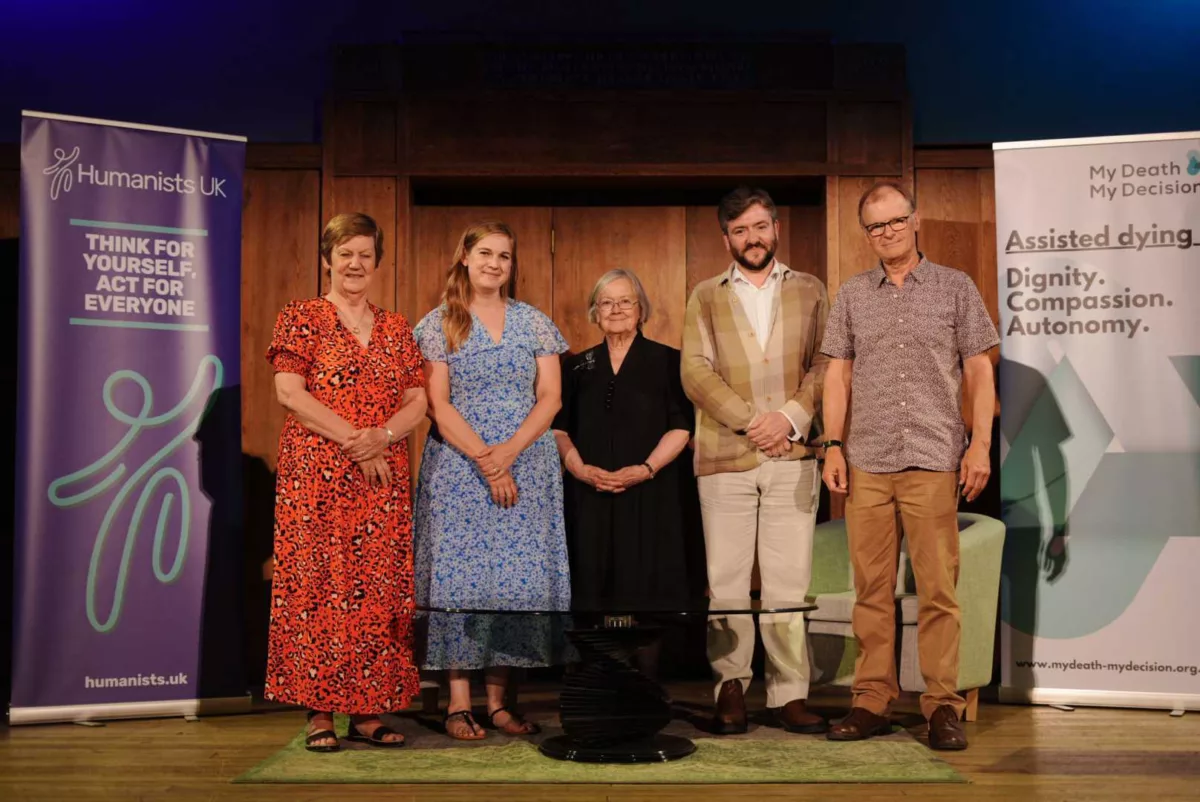
Nathan Stilwell, Assisted Dying Campaigner for Humanists UK, said:
‘For far too long, parliament has failed to tackle the assisted dying debate, and I hope the next parliament will give choice and compassion to those who want it.’
‘Last night we remembered Tony Nicklinson, the brave assisted dying campaigner who fought earnestly for his right to a compassionate death. Tony wasn’t terminally ill, but all the previous attempts to change the law have been limited to people who are terminally ill with six months or fewer left to live. That is wrong.
Humanists UK’s policy is that any adult of sound mind who is intolerably suffering from an incurable, physical condition and has a clear and settled wish to die should have the option of an assisted death. This includes adults with conditions like multiple sclerosis and locked-in syndrome, which are not terminal but can cause unbearable suffering without any possible relief. People with these conditions should not be omitted from assisted dying legislation.
License
In-Sight Publishing by Scott Douglas Jacobsen is licensed under a Creative Commons Attribution-NonCommercial-NoDerivatives 4.0 International License.
Based on work at www.in-sightpublishing.com.
Copyright
© Scott Douglas Jacobsen and In-Sight Publishing 2012-Present. Unauthorized use and/or duplication of this material without express and written permission from this site’s author and/or owner is strictly prohibited. Excerpts and links may be used, provided that full and clear credit is given to Scott Douglas Jacobsen, or the author(s), and In-Sight Publishing with appropriate and specific direction to the original content. All interviewees and authors copyright their material, as well, and may disseminate for their independent purposes.
Share this:

Author(s): Scott Douglas Jacobsen
Publication (Outlet/Website): Canadian Atheist
Publication Date (yyyy/mm/dd): 2024/07/09
Simon Parcher is the President and Executive Director of Canadian Humanist Publications, publisher of Humanist Perspectives Magazine.
Scott Douglas Jacobsen: Today, we are here with Simon Parcher. We will be talking about Humanist Perspectives, a humanist publication in Canada. It’s the only major Canadian humanist magazine. How did you first get involved in Humanist Perspectives, and how has it developed over time as you’ve taken the helm?
Simon Parcher: Humanist Perspectives magazine used to be called ‘Humanist in Canada.’ It started being published in 1968 in British Columbia. Then, in 1983, the operations were moved to Ottawa. It was led by Joe Piercy, Blodwen Piercy, and Paul Pfalzner. They were all highly educated Ph.D.s, physicists, and scientists. They took it over and did a great job for a long time.
The magazine was published in print until about three years ago. So, for about 53 years, it was published in print. To answer your question, I first discovered the magazine in about 1992. At the time, I didn’t realize that my outlook was humanism or that I was a humanist. I was walking down Elgin Street in Ottawa, and there was a little coffee and magazine shop called Mags and Fags. Back then, you could still buy cigarettes in them, and they were displayed in the open. So, I went in, looked around at the magazine rack, and just happened to pick up ‘Humanist in Canada.’ I browsed through it and started reading some of the articles. I said to myself, “My goodness, this is me. This is how I think and how I believe.”
So I then became a member of the Humanist Association of Canada and the Humanist Association of Ottawa. There were cards in the magazine that you could use to apply for membership. I still wasn’t involved in the magazine but became involved in the leadership of the Humanist Associations. In the mid-90s, I was invited to the board of Canadian Humanist Publications, which publishes Humanist Perspectives. I was soon asked to be president because I knew parliamentary procedure and how to run a meeting. They were glad to have my skills during the board meetings. I became the president in about the mid to late 90s. Over that time, there have been many changes in the membership of the organization and the people doing the work. Unfortunately, just about all of the original people are gone.
Many original contributors have passed away or become too old to work on the magazine. It went back to British Columbia for a while under the editorship of Gary Bauslaugh. That was in 2003, and he produced the magazine for about five years. Then it came back to Ottawa in 2008, and it’s been in Ottawa ever since. The name changed somewhere between 2003 and 2008 from Humanist in Canada to Humanist Perspectives. This change was made to broaden the scope and reach of the magazine because Humanist in Canada sounded like it was just for Canadians, whereas Humanist Perspectives could appeal to any humanist worldwide. That was the reason for the change. Over the years, the magazine has mostly featured articles, but we’ve added a lot more to it now that we’re online.
Jacobsen: With the transition to being more online, when did the shift from primarily print magazines to digital occur?
Parcher: That transition happened about three years ago. So, January 2021 marked one of the first solely digital editions. It’s been about three years now. We’ve also moved from charging subscription fees to making it a free magazine. We’re hoping to survive on donations instead of charging subscription fees. It’s a lot less expensive to produce now that we’re online-only. We’re still trying this model, which is working, though not as well as I would like. However, we are getting some donations to support the magazine, which will increase over time.
Jacobsen: How has the content changed with different people coming and going in the leadership and writing for the magazine? This affects the character of the content.
Parcher: Some editors, like Gary Bauslaugh, produced very high-end content, with largely university professors or past professors as the authors. Gary himself was the vice president of what is now called the University of Vancouver Island, which was called Malaspina University College back then. He’s highly educated, so the content was rather high-end, more philosophical, and aimed at a highly educated audience. It wasn’t at the grade 10 level but higher than that. While that may only be ideal for some, it resulted in a very high-quality product.
We’ve had other editors over time. Henry Beissel, a well-known Canadian poet and humanist who was also a university professor, served as editor for a while. The content has generally been geared toward educated readers. It may not interest everyone, but it has maintained a certain level of intellectual rigour.
Lately, I have become the editor and have been for a few issues. I’m gearing the magazine more towards having something in there for everybody who thinks of themselves as humanists. Some of my authors are the same highly educated university professor types that Gary Bauslaugh employed, but I am also inviting all humanists to contribute articles if they can write well. This opens up the articles to a wider variety of writers. The issues generally have a theme. Some of our recent themes have been artificial intelligence and the future of democracy, and the current issue has a theme of imagination. There are a few articles on that. However, not all the articles are on theme; half are, and the other half are on different topics to make it more interesting. We’ve also introduced more content beyond just articles.
We have archives. We’ve always had the archives since we went digital. The archives are online and include all the past issues for several years. We also have a poetry archive because we occasionally feature poetry in the magazine. I’ve recently hired a poetry editor, so there will be poetry in every issue—just one or two poems that would interest humanists, and these will go into the archive of every issue. We’ve introduced a news section in the magazine featuring eight to ten news stories from around the country and maybe even worldwide, where humanism is in the news. This should be of great interest to our readers.
There’s something else in the archives, too, besides poetry. Let me check here… Yes, book reviews. That’s another archive we have. We also have an archive of interviews like the one we’re doing now. Because we’re online and not restricted to print, we can publish different kinds of content, like interviews. We’ve also introduced a community section to our website, where local associations can sign up and contribute content regarding their events. They can post all their events so that everyone can see what’s happening in their groups. If people in their area want to attend or even travel for some of their events, they’ll know what’s happening. This will be a useful tool for Canadian humanists. There isn’t a national register anywhere like that for humanist events. So, this is another feature we have added.
I mentioned the news, events, and archives. We also have another tab called “Groups” where several Canadian humanist associations are listed with their contact information. So, that’s what we have in addition to articles.
Jacobsen: What are you hoping readers will take away from what is becoming an online repository of more or less strictly humanist content, from strict academic writing to poetry, news, interviews, book reviews, and so on? What do you hope readers will gain from all this?
Parcher: Yes, well, it will be a great resource for anyone who is a humanist or thinks like a humanist, with humanist philosophy or whatever. It’s good for educated people. I’ve recently added a lot of universities and university philosophy departments to our mailing list. It will be interesting to see how they engage with it. But it will interest every humanist because there’s a variety of content. For example, in our last issue, there was an article titled “Love in the Time of Turkeys.” It could be more academic, and people might wonder about it. Well, you read the article and see, it’s something light and fun.
It’s not all serious. We do have serious issues, like what’s happening to democracy worldwide right now, which is a very important issue. We also have articles on people standing up for their rights, maybe protesting or speaking out in public for or against issues they think need to be addressed, or on being activists. So, a wide variety of humanist, atheist, and agnostic topics are covered.
It can interest people who want to learn what humanism means. It might attract them to the humanist outlook if they come across the magazine and start reading it. They may not become card-carrying members, but it will reinforce their way of thinking if they align with humanist values and help validate their perspective.
Jacobsen: Thank you for taking the time today to discuss Humanist Perspectives.
Parcher: Yes, well, thank you for asking and for the interview. It’s been very interesting. Thank you.
License
In-Sight Publishing by Scott Douglas Jacobsen is licensed under a Creative Commons Attribution-NonCommercial-NoDerivatives 4.0 International License. Based on a work at www.in-sightpublishing.com.
Copyright
© Scott Douglas Jacobsen and In-Sight Publishing 2012-Present. Unauthorized use and/or duplication of this material without express and written permission from this site’s author and/or owner is strictly prohibited. Excerpts and links may be used, provided that full and clear credit is given to Scott Douglas Jacobsen and In-Sight Publishing with appropriate and specific direction to the original content. All interviewees and authors co-copyright their material and may disseminate for their independent purposes.
Share this:
Publisher: In-Sight Publishing
Publisher Founding: September 1, 2014
Publisher Location: Fort Langley, Township of Langley, British Columbia, Canada
Publication: Freethought Newswire
Original Link: https://exmuslims.org or newsletter@exmuslims.org
Publication Date: July 3, 2024
Organization: Ex-Muslims of North America
Organization Description: Ex-Muslims of North America is a non-profit organization that focuses on providing support for apostates from Islam and spreading awareness of the dangers behind militant Islam. Ex-Muslims of North America advocates for acceptance of religious dissent, promotes secular values, and aims to reduce discrimination faced by those who leave Islam. We envision a world where every person is free to follow their conscience, irrespective of religious dogma or oppression.
It’s great to have you back
Happy Fourth of July  ! As we celebrate America’s Independence, our Unbelief Brief highlights threats to the nation’s core ideologies and principles. We also bring you an important case in our Persecution Tracker Updates.
The Unbelief Brief

On this eve of America’s Independence Day, it is fitting that we move our focus over to ways in which the United States’ founding principle of secularism is being defaced by quasi-theocratic conservatives. Louisiana, which recently ruled that the Ten Commandments must be displayed in all public schools’ classrooms, has been one-upped by Oklahoma, whose Superintendent of Public Instruction has “ordered” that the Bible be taught in public schools and that such instruction is “mandatory.” It is a blatantly unconstitutional demand that flies in the face of the Establishment Clause and—as Oklahoma’s own attorney general’s office admits—is void of any actual legal authority. But when have trivialities such as “the rule of law” ever stopped theocratic authoritarians?
At this moment in history, when religious conservatives are emboldened by a sympathetic Supreme Court, it would be good to reflect on how these officials are attempting to demolish one of the most important principles of the United States’ founding. Church-state separation does not exist solely to protect religion from the government; rather, the Framers saw secularism as critical to facilitating freedom of thought, conscience, and belief. Steven K. Green elaborates on the role that Thomas Jefferson and James Madison played in shaping this bedrock of the republic: a bedrock that is today being pelted with dynamite in the name of “patriotism.”
There is, of course, a long history in the Western world of binding religion and state: a European tyranny from which figures like Madison and Jefferson sought to free themselves in order to forge a new path. Echoes of this legacy still remain, seen in the European Court of Human Rights’ 2018 ruling that right-wing Austrian activist Elisabeth Sabaditsch-Wolff could be fined for calling the Prophet Muhammad a pedophile. Still, many countries in recent years have opted to repeal ancient blasphemy laws that remained, mostly unused, on the books. Northern Ireland remains one of the last holdouts.The UK’s National Secular Society has recently issued a renewed call for the repeal of its antiquated “blasphemy” and “blasphemous libel” restrictions. EXMNA stands firmly behind this call in the belief that the very American ideas of free inquiry, freedom of conscience, and freedom of belief—in spite of recent setbacks—can still win the day on the world stage.
Persecution Tracker Updates

In Pakistan: a sectarian murder of a Shia Muslim, accused of blasphemy, by a Sunni teenager. Read more about the incident here.
Until next week,
The Team at Ex-Muslims of North America
P.S. We’d love to hear from you! Share your feedback at newsletter@exmuslims.org.
Whether it’s giving $5 or $500, help us fight for a future where all are free to follow their conscience.
License
In-Sight Publishing by Scott Douglas Jacobsen is licensed under a Creative Commons Attribution-NonCommercial-NoDerivatives 4.0 International License.
Based on work at www.in-sightpublishing.com.
Copyright
© Scott Douglas Jacobsen and In-Sight Publishing 2012-Present. Unauthorized use and/or duplication of this material without express and written permission from this site’s author and/or owner is strictly prohibited. Excerpts and links may be used, provided that full and clear credit is given to Scott Douglas Jacobsen, or the author(s), and In-Sight Publishing with appropriate and specific direction to the original content. All interviewees and authors copyright their material, as well, and may disseminate for their independent purposes.
Share this:

Publisher: In-Sight Publishing
Publisher Founding: September 1, 2014
Publisher Location: Fort Langley, Township of Langley, British Columbia, Canada
Publication: Freethought Newswire
Original Link: https://humanists.uk/2024/06/25/eritrean-humanists-facing-persecution-humanists-uk-at-the-un/
Publication Date: June 25, 2024
Organization: Humanists UK
Organization Description: Humanists UK is the operating name of the British Humanist Association. We are a charitable company (no. 228781), formed in 1896 and incorporated in 1928, and registered in England and Wales. Our governing document is our Articles of Association, which can be viewed here.
Humanists UK has raised concerns about the persecution of the non-religious in Eritrea at the 56th Session of the UN Human Rights Council, and called for the experiences of the non-religious to be addressed when tackling religious persecution and the right to freedom of religion or belief.
Persecution of the non-religious in Eritrea
The Eritrean Government only officially recognises four religions: Sunni Islam, Eritrean Orthodox Tewahedo, Roman Catholicism, and Lutheranism. While Eritrean law technically prohibits religious discrimination and recognises the right to freedom of belief, Eritrean authorities frequently persecute anyone with beliefs outside of those recognised religions, including the non-religious, Muslims, Christians, and Jehovah’s Witnesses.
Those who do not follow one of the four recognised religions are at risk of discrimination through arbitrary detention and social persecution. However, the persecution of the non-religious was entirely absent from the report delivered to the Council by the Special Rapporteur on the situation of human rights in Eritrea. Also absent from the report was any reference to Eritrea’s blasphemy and apostasy laws.
Read the Freedom of Thought Report’s profile on Eritrea.
Humanists UK drew attention to these absences in an intervention delivered via video by its representative Agnese Tremonti.
Humanists UK said:
‘The Special Rapporteur’s report indicates the persecution of Jehovah’s Witness families who refuse to participate in patriotic ceremonies at school, as well as Eritrea’s non-recognition of the right to conscientious objection, forcing military conscription despite religious or ethical contradiction. The inability to refrain from such activities limits the rights of both religious and non-religious individuals.
‘Further, we wish to draw attention to Eritrea’s blasphemy laws that criminalise the ‘disparaging’ or ‘profaning’ of any religious feelings and mandates up to one year in prison. However, the expression of non-religious views risks being criminalised by such laws that fall short of incitement to hatred, as established by the Rabat Plan of Action. This infringes on the rights to freedom of expression and freedom of religion or belief for the non-religious.’
License
In-Sight Publishing by Scott Douglas Jacobsen is licensed under a Creative Commons Attribution-NonCommercial-NoDerivatives 4.0 International License.
Based on work at www.in-sightpublishing.com.
Copyright
© Scott Douglas Jacobsen and In-Sight Publishing 2012-Present. Unauthorized use and/or duplication of this material without express and written permission from this site’s author and/or owner is strictly prohibited. Excerpts and links may be used, provided that full and clear credit is given to Scott Douglas Jacobsen, or the author(s), and In-Sight Publishing with appropriate and specific direction to the original content. All interviewees and authors copyright their material, as well, and may disseminate for their independent purposes.
Share this:

Publisher: In-Sight Publishing
Publisher Founding: March 1, 2014
Web Domain: http://www.in-sightpublishing.com
Location: Fort Langley, Township of Langley, British Columbia, Canada
Journal: In-Sight: Independent Interview-Based Journal
Journal Founding: August 2, 2012
Frequency: Three (3) Times Per Year
Review Status: Non-Peer-Reviewed
Access: Electronic/Digital & Open Access
Fees: None (Free)
Volume Numbering: 12
Issue Numbering: 3
Section: E
Theme Type: Idea
Theme Premise: “Outliers and Outsiders”
Theme Part: 31
Formal Sub-Theme: Realist Art.
Individual Publication Date: July 8, 2024
Issue Publication Date: September 1, 2024
Author(s): Scott Douglas Jacobsen
Word Count: 5,366
Image Credits: None.
International Standard Serial Number (ISSN): 2369-6885
*Please see the footnotes, bibliography, and citations, after the publication.*
Abstract
Lance Richlin is an award-winning Classical Realist painter and sculptor based out of Los Angeles, California. His full resume is here. Richlin discusses: realism; colours; outline and the shading; transition from the Stone Age; symmetrical portrayals of human figures in ancient Egypt and surrounding cultures.
Keywords: Stone Age art, realism definition, Lascaux cave paintings, Venus of Willendorf, Neanderthal art, Sumerian civilization, Mesopotamian wall reliefs, Egyptian sculptures, Nefertiti portrait, Egyptian art techniques.
On Realist Art 1: Stone Age to Mesopotamia
Scott Douglas Jacobsen: This will be a multi-part series on realism. We’re going to be doing this chronologically. We will start with the earliest indications of realism, going back to the origin of human art in cave paintings, basically in the Stone Age. So, what characterizes realism so you can extend it back to the Stone Age?
Lance Richlin: Well, let me define the term immediately. When discussing realism, we’re talking about mimesis, i.e., making things look like other things. I like to put it this way: God created humans, but humans create art, and it’s our way of creating things, of creating symbols for what we see. Now, I say define terms because I want to clarify that a realism movement emerged in the 19th century. Their idea of realism depicted modern life in the 19th century, i.e., people working in factories and carrying out their daily activities in the cities, as opposed to idealistic depictions of Roman gods’ legends or religious art. Do you see what I’m saying? So, there’s realism, where it’s more of a choice of subject matter as opposed to fantasy, but the realism that I’m referring to is humanity learning to depict what it sees.
There’s a second reason I want to make this distinction: when I was in art school, all of my teachers were abstract artists, and they all hated realism. So, out of sheer cruelty, whenever I complained that I wasn’t learning realism, they always asked me, “Well, what do you mean by realism?” I could strangle them for this. I would say, “Well, you know, like the old masters,” and then they would bring up these strange examples where an artist had lengthened a leg or put a highlight on an area that wouldn’t normally get a highlight, and if you look through our history there are a lot of what we call accurate representations that have slight artistic changes or mistakes. Then the abstract artist teacher would say, “See! That’s not realism”. So, rather than fall into some weird trap like that, humanity is learning to create things that look like things, and there are a variety of purposes for this, which is a separate issue.
The first would be to tell a story, but some archaeologists will say that it was a religious purpose or training, for example, when you look at the Stone Age. Realism began obviously in the Stone Age; the cave paintings of Lascaux are the most famous wall paintings that Cro-Magnons, the first homo sapiens, did. The archaeologist debated the purpose of these paintings. So, the paintings I’m referring to are images of hunts; they would have animals that they depicted on the walls. I should add this here before I forget that they also started to sculpt. So, there’s a famous sculpture they call the Venus of Willendorf because all depictions of human females were called Venuses; it’s an archaeological term, but these early hominids would create on the walls and in stone they would carve depictions of what they saw.
The Venus of Willendorf is a really fat, orb-like woman, kind of a nondescript head; it’s hard to see that it’s a human head, but it’s a representation of a woman. It’s got, I think, several breasts or something like that, but in the beginning, they were either creating the images to tell a story or as part of a ritual. We’ll never know why they were doing it, and by the way, we used to believe that we separated from the Neanderthal — by Homo sapiens’s ability to create wall art. But in 2018, they found Neanderthal wall art. And they have found carved ornaments. So, they did know how to carve elaborate things that were of some use. In the famous Neanderthal cave, which is very representative, among the highest concentration of Neanderthals we’ve ever found, in southern Spain. They have some caves, the last Neanderthal outpost. The art is rudimentary but like Homo Sapiens’ simpler work. Line drawings, outlines of a hand.
The interesting thing is that the Neanderthals survived till the very end in this cave in southern Spain, which was the last outpost they had because it was the easiest to live there. There were abundant fish near the cave, and it was nice weather, so it was harder to die out. So, that’s why they think that they survived the longest there. Also, we now know that humans bred with Neanderthals. So, they didn’t die out; we all have a little Neanderthal in us. Every race, by the way, not just Caucasians and Asians, which they originally thought like black people didn’t have any Neanderthal, but it turns out they do have a little bit, but the early people studying these things, geneticists, didn’t look in the right area. We now find that everybody has a little Neanderthal in them.
So, they survived, but getting back to the point. We know several ways that the Stone Age artists created representations. The first is how it might have begun; we surmise that it might have begun because they did several things to make it easier to depict reality. The first was we had an image of a hand that was a wall print. So, in other words, a troglodyte put his hand up against the wall, and he drew around his fingers, and when he pulled his hand away, obviously, he had a perfect depiction of a hand that wouldn’t have been done any better today. So, we know that they did that; we also suspect that they copied images of their hands or different things that were cast by shadows from the fire they had inside the cave. So, they may have outlined shadows. They had charcoal and things that could make the colour. They had reds and blacks, and finally, we know that they used the shape of a cave to create animals. So, obviously, one of our sensitive ancestors looked at the side of a cave and saw a shape in it that reminded them of an animal, and then they may have just accentuated that.
We know they accentuated that because that’s in the cave paintings we find today. They accentuated that by adding colours and lines around it, and we have elaborate depictions of animals, herds of animals and descriptions of hunts. So, not only would they depict the animals, but they would sometimes depict humans chasing the animals with spears. The humans are not carefully rendered, and one of the odd things about it is that the animals are sometimes easily identifiable, and they even include shading, which is a leap. Most children can do an outline, and children’s drawings are very similar to cavemen’s. Children will start with a simple outline, but when you start adding shading, that’s pretty advanced, and it may be the result of seeing the natural crevices and ledges in the cave creating shadows from the light source, and they may have seen those shadows helping the realism of their piece. So, they learned that if there’s some shading here, it’ll make the animal look more real, so why not add some charcoal there and see if we can make the animal look more real? They have some fairly believable animals that are more realistic than young children’s.
And, of course, depending on the cave, the area of the cave, and the culture, very primitive people like Australia and Native Americans also created line figures and outlines around the world. It is a common practice to start with outlines and very low relief, meaning if you look at a coin, the depiction of Thomas Jefferson is low relief. So, you can see low reliefs worldwide, but the early man would carve animals heads out of stone, and we have them, and these are early. To get back to the humans, they were usually depicted as simple long rectangles with lines for legs and arms and maybe holding a spear or a line for a spear or maybe a bow shape. So, we know they had bows, but the humans are very rudimentary compared to the animals.
Do you want to interject any questions before I leave the Stone Age?
Jacobsen: Two things. When they’re doing the outline and using these reds and blacks, what are they using to get those colours?
Richlin: Well, I mean, if you have a campfire and you reach into it and you grab some burnt charcoal or wood, and then you rub it against a piece of paper, you’re going to get a line. So, it was easy for early men to figure out how to create lines on walls with burnt wood, stones, and mud. There are some colours that you can pull right out of the ground. There’s a colour called Raw Sienna, which originated in Sienna, Italy, and we still use it today. They call it Raw Sienna because it’s the colour of mud that is in Sienna, and when it is up, you have to clean it up, grind it into powder and add oil to it; you can paint in the colour Sienna. So, of course, this leads to the fact that almost all early man’s colours are earth tones for that very reason; they come right out of the earth. They had whites that came from various stones. Some chalks can be found in, well, there’s the White Cliffs of Dover; I believe there are natural chalks that are white. So, finding things you could use to make colours was easy.
The early man, the Cro-Magnon and the Neanderthal existed for thousands and thousands of years, and during that time, we know they passed on their information. They were very good about that, so we’re now finding they did some meticulous, elaborate processes. We know that they had to do things that took three or four steps where they had to take certain rocks, and they would have to melt them, and then they would have to treat them in various ways to get them to be harder or whatever their purpose was but it wasn’t as simple as taking a piece of flint and just carving with it into a piece of stone. They had a variety of things they made that required several steps, such as burning it, carving it, and distilling the water out of something. So, they had some very sophisticated processes that they had to remember and pass down to create all the little ornaments and objects that we have today that we found from them. Furthermore, God knows what they may have had that we don’t know anything about.
Jacobsen: Now, just a last point on the Stone Age, the outline and the shading, did those techniques emerge simultaneously or did one happen and then the other? Do we know?
Richlin: I don’t think we know, but if you look at primitive art in Africa or in caves in Australia, there are places around the world where people are just learning to make depictions: Native Americans. It always starts with the outlines, but you can see the shading in the caves. So, if you were to go, there are rock drawings, I believe, in Utah where people have drawn on the cliffs, and they usually are just outlines, but you can see shading. As I say, the fire in the campfire may have created shadows. So, people could see shadows and automatically start to colour things to depict the shadows or to say this is a red or brown bison. Sometimes, it’s actual shading; sometimes, it’s colouring, which is different. For example, you can depict a brown bison without drawing shadows on the bison; you can say it’s brown, but interestingly, the carving of, say, an animal’s head or a stone woman that was taking place at roughly the same time and those are pretty solid depictions of animals in a lot of really early Stone Age cultures.
So, the ability to create something that looks like a human, I mean even Easter Island. I don’t believe that in Easter Island ever reached the Bronze Age, and those are unbelievable depictions of humans or humanoid creatures. It’s important to understand that you can carve something and make it look somewhat sophisticated. The reason I’m saying this is that, as I said in our earlier interview, it requires a lot more sophistication to create a two-dimensional image than a sculpture of something because you can pick up a rock on the beach and say that looks like a human head and if you’ve got a flint tool you can carve that make it look more like a human head and that’s how we think it started; you can see a nose on the side, you can see the fruit that looks a little bit more like a human than other fruit.
That was a no-brainer, but creating lines symbolic of humans is a little more complicated. So, it took a bit different brain power to create that, maybe not more brain power, but when you start making those lines, you will also start making hieroglyphics. You’re also going to start saying, “Well, I got to make a symbol for the sun; I got to make a symbol for rain…,” and then suddenly, you’re creating a language. So, the original writing, hieroglyphics, is very much connected to art because it’s like imagining if you had to draw a mommy and a daddy and you couldn’t write m-o-m-m-y and d-a-d-d-y. That’s where the original hieroglyphics came from, and we believe that almost all writing began with pictographs, meaning something that is a shorthand for a drawing of something. It was only later that people separated sketchy drawings from actual codes of writing ABCD, that kind of thing. Does this matter to you?
Jacobsen: It does. What is the transition from the Stone Age to the next developments in realism?
Richlin: So, the next developments were the Sumerians in Mesopotamia and the earliest great civilizations we know about. We’ve made discoveries in areas that are now Yugoslavia and Turkey, where there were even earlier civilizations. The Sumerians are a good place to start because they represent very early transitions in art. The earliest depictions of art would have been wall carvings. We don’t have any paintings that have survived. We know that the wall carvings were painted. The Egyptians certainly painted the wall reliefs. They found flecks of paint on early three-dimensional sculptures, where they depicted animals and people. I’m starting with the Sumerians because they made early representations of humans. We have three-dimensional sculptures by them of humans. They look comical because they’ve got huge eyes. I was going to say eyeballs. They’re still in a primitive stage where things weren’t in proportion. When you go over to the Mesopotamians, they had a whole lineage going from the Sumerians to the Babylonians to the Assyrians to the Babylonians again, to the Persians.
Each one of these civilizations–I left out the Hittites–defeated the Babylonians. The Hittites collapsed through civil war. But Babylon was overcome by Assyria, who was overcome, I believe, by a revolt of Babylonians, followed by the final, the Persians and the Medes in an alliance, took over the area. That was the history of Mesopotamia, meaning the area between the Nile and the Euphrates rivers, which is today in modern Iraq, extending into Turkey. That whole thousand or fifteen hundred-year civilization and series of civilizations ended with Alexander the Great, who conquered Persia. But all that to say, they had a very elaborate system of wall reliefs. When you talk about Mesopotamian art, you’re talking about things that began in a very primitive way with Sumerian large-eyed, squat figures carved out of stone, all the way up to the elaborate wall reliefs that we have today and three-dimensional sculptures in Persia. Maybe a few hundred, say 500 years, before BC, when that ended with Alexander the Great. So we’re talking about a long period, but by the time you get to the Persians, these are elaborate wall carvings of reliefs of their kings, mythology, and hunting. They painted them in all cultures, whether Sumerian, Babylonian, Assyrian, or Persian.
All of them created elaborate wall reliefs and painted them. When you talk about why they did them, they did them for every conceivable reason. However, Mesopotamia used wall reliefs as communication and elaborate sculptures of their gods and goddesses. I’ll tell you a funny story. They typically would create these giant monuments to their military victories. So, all of the early cultures depicted these tremendous battle scenes. Giant figures of basically the home team. Here’s our guys beating the sea people who are invaders or the people around us. What they would do, besides just being proud of them, is have ambassadors and envoys from the surrounding neighborhoods or areas stand in awe of their military victories before they would give them a conference, so they’d have to wait and look at that before they would talk to the king. So, by then, there were elaborate depictions of hunting and family life. At the same time, Egypt was progressing along the same lines. We know that they had elaborate interactions with one another. The first recorded major battle was the Battle of Kadesh between Egypt and the Hittites, and that’s depicted. Both sides, the Mesopotamians to the East and the Egyptians to the West were creating fully three-dimensional sculptures that were not attached to walls.
The Egyptians surpassed the Mesopotamians in depictions of human figures. They were doing gigantic five-story, tall humans; their depictions of their emperors were magnificent. Extremely, extremely carefully done; I saw something on the internet where someone said no human could have done these sculptures because they’re so perfectly balanced, meaning one ear perfectly represents the ear on the other side of the head. The corners of the mouth are perfectly horizontal. The corners of the eyes are perfectly horizontal. Perfect mirror images of the head’s other sides take much work. But humans can do it using the same tools you would use to balance a building. You could use those tools to make an eye the same size or an ear the same size and shape. We knew they could build a perfectly accurate architecture that wasn’t leaning. Not only that, but they were giants. The Egyptians were doing things carved out of giant stone and looked human.
It is very well depicted; besides these gigantic sculptures, several beautiful naturalistic depictions of humans exist. Naturalistic means looking like they’re from nature, which is what you would see. So they’re not symbolic; they’re not sculptures that are fancifully painted. Two examples would be the portrait of Nefertiti, the wife of Akhenaten, the pharaoh, the first monotheist in human history. She was beautifully painted and sculpted. It looks like a real woman, not idealized at all. There’s a famous sculpture of what they call a scribe because he’s sitting with writing and papyrus instruments. He’s painted the colour of an Egyptian. He’s got reddish-coloured skin and black hair. It looks like a real person. This is a three-dimensional sculpture. I’d like to weigh in on a controversial subject right now. For a long time, some African Americans were trying to claim that the Egyptians were black. We know what colour they were because they painted themselves. It’s only a mystery if you have no familiarity with Egyptian art. You can see what colour they were.
They painted figurines of different kinds, like little military models and little armies; some were black, whereas all the figures were black. They would have next to them figures where the people’s skin was sort of a reddish-brown with black hair and the black wigs we expect from Egyptian art. So, the sculptures are very naturalistic, meaning true to life, true to what your eye would see without much idealization of the faces. Some of them look like black people. Some of them look more like people from other equatorial cultures. What archaeologists and anthropologists have thought from the very beginning, and I see no reason to change, is that the Egyptians were mixed people. I’m sure they had much black blood. They were conquered by the Nubians, who were in present-day Ethiopia to the South of Egypt. So we know that they had black pharaohs for a while, and they were in constant warfare with the Libyans to the West, who were a North African people, and the black Africans to the South. They all intermarried. The sculptures sometimes have Africanized facial features or look slightly more like Arabs or Mediterranean people. But I’ve noticed as I’ve gotten older that when I was younger, people would see a depiction of Nefertiti and say, “This is what an ancient Egyptian looked like.”
Now, I see these computer-generated images of what the real Nefertiti looked like based on that sculpture. They always make her look more like the typical African American. They’re lying. You can see exactly what she looks like. You don’t have to make her look more black. You don’t have to make her look like–I don’t know–Diana Ross or Aretha Franklin. She is what she is, which is a mixed person. A good way to describe it is if you had a black person who looked like LeBron James marry a white person or an Arab, the result would look like an Egyptian from ancient Egypt. Modern Egyptians are predominantly Arab because the Arabs swept through Egypt in the 700s AD, I believe. They occupied Egypt. So you’re not getting the ancient Egyptians, though I’m sure you’re getting much ancient Egyptian blood in modern Egyptians.
Jacobsen: So this transition then, and these enormous, five-story, symmetrical portrayals of human figures in ancient Egypt and surrounding cultures, how did that evolve if it did? Or where did it next and then transfer to as that civilization waned?
Richlin: The only flaw I would give to Egyptian art is that they still needed to learn to depict movement or relaxed gestures. So it is a big deal in early Egyptian art when there’s one foot, one leg moving forward. Now, in the wall paintings, they move the bodies around a lot. They would depict kings with their arms raised, about to strike an opponent. They would show them grabbing their enemies. The Egyptians, for example, would always depict their people as larger, possibly six times the size of the enemy, who are depicted as little figures. But in all of the early art, including Mesopotamian art, there would be limbs doing things, holding things, and sitting down, standing up. They were still stiff in both Mesopotamia and ancient Egypt because they tended not to bend their knees very much. Unless they were sitting down. But the figures were very static-looking. They weren’t caught in mid-gesture, mid-motion, or relaxed pose, sitting down symmetrically, or standing with one leg forward. They still have their arms attached to their sides.
They didn’t separate the arms from the stone, which is very difficult. If you were going to carve a stone, keeping the arms stuck at your sides is much easier than separating them and having them reach out. In Egyptian art, the sculptures were very stable. They followed the principle that Michelangelo later on developed. Michelangelo, even in the Renaissance, where the figures were extremely animated and true to life. He said nothing should break off if you roll it down a hill. So he liked the idea that the sculpture should look monumental, whereas if the arms, legs, and head were all twisting around, those body parts would look less monumental. They would look weaker but also more lively. So, the Egyptians were at a stage in human history when just having one leg forward was a big deal in their three-dimensional sculpture. All early cultures follow this.
There was a culture called Cycladic, which consisted of Mediterranean peoples who made very rudimentary figures with very primitive shapes, but the legs were stuck together. The arms are stuck together. Everything’s stuck into one form, into one shape. Nothing is sticking out. The same is true with Easter Island. Giant figures, but again, the arms and legs are next to the body. When I was a kid, as far as Easter Island goes, I would like to point out that We thought that they were all heads. Only recently, in my lifetime, in the past 20 or 30 years, did people dig them out and find out that they extended down and had bodies. It seems wild, but that was only recently. Of course, the arms and legs are stuck together. So, it is common for humans to learn how to separate the limbs. Also, early Egyptian art, and even later Egyptian art, even up to the time of Cleopatra, when Egyptian civilization ended and became Greco-Roman, still had somewhat idealized faces and perfect regularity.
There was a tendency to repeat the same face over and over again. Now, the Egyptians did have individualized faces. There’s a famous sculpture of a scribe, but there’s also a sculpture of an official, some bureaucrat, who had an Africanized face and was obese, this fellow. It looks like a person. You can tell that it’s a person. However, the sculptures and the figures of the pharaohs all tend to look the same, except, interestingly, the figures of Akhenaten and his wife and children, Nefertiti. They have elongated skulls. And they’re very long and thin figures. We think that was because of interbreeding. The Egyptians married their sisters, and so they had physical deformities. Akhenaten had very wide hips in the sculptures and wall paintings, depicted with a long neck, narrow shoulders, and elongated skulls. The Egyptians were doing a somewhat accurate representation of him. They weren’t idealizing him particularly. To the best of their ability, they were trying to create this as the way the man looked.
He was overthrown and murdered by Thutmose III, who returned to the traditional depiction of the Egyptian pharaohs. He had a very athletic build, with broad shoulders and a normal-shaped skull; I don’t know if we know what his skull looked like because all the wall paintings I can recall of Thutmose III have headgear on. They had different headgear. They had different helmets. There’s a war helmet that they had, which was shorter, more squat, and looked like it couldn’t get knocked off as easily. Then they had the long one that looked more like a top hat. It’s interesting. They wore the Upper Egyptian hat in early Egyptian clothing, which looked like a top hat without a brim. Then, they had a rounded one for Lower Egypt, which looks more like the top of a pawn in chess. Now, I’ll be honest. I don’t remember which one looked like which. I don’t remember which one was Upper Egypt or Lower Egypt. But in the beginning, Egypt was divided between the area closer to the Mediterranean and the area closer to Ethiopia, and the first leader who conquered the other side was Narmer, Pharaoh Narmer. He combined the two hats so that when you see the Egyptian hat, it’s like a top hat and has the sort of pawn shape from the chessboard; that’s the combination of Upper and Lower Egypt.
The Egyptians were very accurate anatomically. I remember reading that if you look at the feet of the Egyptians, their toes are perfectly shaped. So, if you put the feet together, the toes are straight so that the big toes touch each other, which is how toes are. Unless they’ve been altered in some way, deformed by modern shoes. So there was a movement when I was a child of giving children shoes that didn’t narrow the foot to a point. If you look at most people’s feet today, the big toes don’t touch when they put their feet together, but the ancient Egyptians’ feet do. So, we know that they were looking at anatomy. The figures are extremely well-proportioned. These are handsome people. When they wanted their emperors to look attractive their pharaohs to look attractive, they looked attractive. They look like well-built people. The men are larger than the women. Taller, they have thin waists. The only thing is, we need to find out that they knew elaborate anatomy. For example, the anatomy is very simplified. You don’t see much separation of muscles and tendons. We know they had these things. They were athletic people.
So, you don’t see elaborate bumps and bulges for the ankles or the knees, but you do see good proportion. Another interesting thing is that even in ancient Egyptian art, the men, by tradition or law–we don’t know–are always depicted as darker than the females. Females have paler skin, and the men are depicted as having tans. We know that’s because the men are depicted as warriors and hunters. They are outdoor people compared to their women. It was a sign of wealth and sophistication if you could keep your female inside if she didn’t have to go outside to forage or join in migrations. So, I think they were quite proud of the fact that the women were more pale, which is another reason why nobody assumed that the Egyptians were black people because it’s obvious that their men could go out and get tan. Otherwise, why would you have a red-brown pharaoh next to his somewhat lighter female queen? Why would you have that if they didn’t have the kind of skin that would change colour with the sun? Now, again, even black people can get darker in the sun; I am in no way saying that the Egyptians were white. Like in the film The Ten Commandments, the Egyptians were sometimes depicted by white actors like Charlton Heston.
I’m not saying they looked like Vikings, and they had black blood. They weren’t as black as sub-Saharan Africans; even sub-Saharan Africans vary in shade. But the Egyptians were mixed. I live in a black area of Los Angeles. I had a black girlfriend who told me that even blacks in the US come in five different shades. This is fun. She said she’s mahogany, but there is also black, yellowish, reddish, brownish. So that’s five. Mahogany combines all of them, meaning different parts of black people’s bodies are slightly different colours. People have been obsessed with this since the beginning of humanity. It reveals itself in ancient wall paintings. Now, we don’t know. We discovered recently through microscopic analysis that even the Greeks painted their three-dimensional sculptures. So, a lot of these sculptures that have survived Egyptians are painted.
And there’s no reason to believe that the outdoor sculptures weren’t painted as well. The wall paintings of the Assyrians and Persians have survived, too. They were painted as well. Even the pyramids were painted; we see them as sand-coloured, but they might have been. We found flecks of paint on them as well. So ancient Egypt wasn’t just sand-coloured architecture. It was painted in glorious colours. The other important thing to note is that ancient art also depicted combinations of mythological figures. For example, the Egyptian God Anubis has a wolf’s or jackal’s head. Horus had a hawk’s head on a human body. The ancient Assyrians and Mesopotamians of all types and nationalities would combine winged creatures with human creatures. The Assyrians were famous for putting wings on humans. Combinations of animals in several Mesopotamian cultures, combinations of animals with humans and other animals. So that indicates that art was used only partially to create what you see. It was also used to depict things that you would imagine as well. So this is good. This is an important distinction. Here is where you get a distinction in the word realism. Because obviously, humans don’t have animal heads. So here, art was used to depict the gods and combine mythology and human imagination. This is a good place to stop, don’t you?
Jacobsen: Yes, I agree. This is a good stopping point. We’ll continue from here next time.
Bibliography
None
Footnotes
None
Citations
American Medical Association (AMA 11th Edition): Jacobsen S. On Realist Art 1: Stone Age to Mesopotamia. July 2024; 12(3). http://www.in-sightpublishing.com/realism-1
American Psychological Association (APA 7th Edition): Jacobsen, S. (2024, July 8). On Realist Art 1: Stone Age to Mesopotamia. In-Sight Publishing. 12(3).
Brazilian National Standards (ABNT): JACOBSEN, S. On Realist Art 1: Stone Age to Mesopotamia. In-Sight: Independent Interview-Based Journal, Fort Langley, v. 12, n. 3, 2024.
Chicago/Turabian, Author-Date (17th Edition): Jacobsen, Scott. 2024. “On Realist Art 1: Stone Age to Mesopotamia.” In-Sight: Independent Interview-Based Journal 12, no. 3 (Summer). http://www.in-sightpublishing.com/realism-1.
Chicago/Turabian, Notes & Bibliography (17th Edition): Jacobsen, S “On Realist Art 1: Stone Age to Mesopotamia.” In-Sight: Independent Interview-Based Journal 12, no. 3 (July 2024).http://www.in-sightpublishing.com/realism-1.
Harvard: Jacobsen, S. (2024) ‘On Realist Art 1: Stone Age to Mesopotamia’, In-Sight: Independent Interview-Based Journal, 12(3). <http://www.in-sightpublishing.com/realism-1>.
Harvard (Australian): Jacobsen, S 2024, ‘On Realist Art 1: Stone Age to Mesopotamia’, In-Sight: Independent Interview-Based Journal, vol. 12, no. 3, <http://www.in-sightpublishing.com/realism-1>.
Modern Language Association (MLA, 9th Edition): Jacobsen, Scott. “On Realist Art 1: Stone Age to Mesopotamia.” In-Sight: Independent Interview-Based Journal, vo.12, no. 3, 2024, http://www.in-sightpublishing.com/realism-1.
Vancouver/ICMJE: Scott J. On Realist Art 1: Stone Age to Mesopotamia [Internet]. 2024 Jul; 12(3). Available from: http://www.in-sightpublishing.com/realism-1.
License
In-Sight Publishing by Scott Douglas Jacobsen is licensed under a Creative Commons Attribution-NonCommercial-NoDerivatives 4.0 International License.
Based on work at www.in-sightpublishing.com.
Copyright © 2012-Present by Scott Douglas Jacobsen and In-Sight Publishing. Authorized use/duplication only with explicit permission from Scott Douglas Jacobsen. Excerpts, links only with full credit to Scott Douglas Jacobsen and In-Sight Publishing with specific direction to the original. All collaborators co-copyright their material and may disseminate for their purposes.
Share this:
Publisher: In-Sight Publishing
Publisher Founding: March 1, 2014
Web Domain: http://www.in-sightpublishing.com
Location: Fort Langley, Township of Langley, British Columbia, Canada
Journal: In-Sight: Independent Interview-Based Journal
Journal Founding: August 2, 2012
Frequency: Three (3) Times Per Year
Review Status: Non-Peer-Reviewed
Access: Electronic/Digital & Open Access
Fees: None (Free)
Volume Numbering: 12
Issue Numbering: 3
Section: A
Theme Type: Idea
Theme Premise: “Outliers and Outsiders”
Theme Part: 31
Formal Sub-Theme: None.
Individual Publication Date: July 8, 2024
Issue Publication Date: September 1, 2024
Author(s): Scott Douglas Jacobsen and Lloyd Hawkeye Robertson
Word Count: 2,911
Image Credits: None.
International Standard Serial Number (ISSN): 2369-6885
*Transcript edited for readability.*
*Please see the footnotes, bibliography, and citations, after the publication.*
Abstract
Scott Douglas Jacobsen is the Founder of In-Sight Publishing and Editor-in-Chief of “In-Sight: Independent Interview-Based Journal” (ISSN 2369–6885). He is a Member of the Canadian Association of Journalists in Good Standing and finished his term as a Tobis Fellow in July of 2024. Jacobsen discusses: volunteer; humanist organizations; Fort Langley; and Wagner Hills Ministries.
Keywords: research and writing, Miss Universe Canada, direct flight rescheduling, human rights organizations, women’s rights, Athabasca University student magazine, humanist organizations, internal conflicts, humanist community challenges, Mubarak Bala case.
New Enlightenment Project Podcast Interview with Scott Jacobsen on Boilerplate Humanism and Action (2)
Scott Douglas Jacobsen: Working with someone who can write and edit is awesome. That evolved into doing various things: conducting research and writing speeches. One speech I wrote was initially supposed to be for Sophie Gregoire Trudeau but ended up being for Miss Universe Canada—at least the first draft. Then, even at 3 am, “I had to change her ticket from Istanbul to Toronto without a layover in Vancouver. I needed a direct flight and had to call Air Canada. Here’s the information: I must reschedule a $4,000 ticket to ensure it was safe for a few hours.” Also, by getting to know these personalities, you learn the algorithms they tend to run, either implicitly in how they think or explicitly in how they behave.
It also gives insight into how to apply these concepts in different areas. That particular women’s rights organization involved a lot of writing, work, and interviews in those domains. I contributed mainly to the Athabasca University student magazine; at one point, I contributed two weekly articles. It boiled down to, in the end, interviews with the president and others and then columns around education news in Canada, post-secondary education, and science news in Canada. All those topics seem pretty much boilerplate humanism. Humanists care about human rights; women’s rights are human rights, and humanists care about science and education. Those fit right in the ballpark with them. So, again, you have common values, goals, and mutual benefits.
Dr. Lloyd Hawkeye Robertson: But values and goals aren’t always common. You’re describing a professional volunteer who helps people based on humanism and human rights. Yet, in one organization, things were said like, “You’re a man, so you’re slower,” and “Men are trash,” “All men are crazy and possessive.” What’s it like to volunteer your time in that environment?
Jacobsen: That’s also true. Those particular statements were in blue-collar work environments, and I was the only man on-site for the most part. When it comes to those kinds of statements, those work environments aren’t the same as the organizational rights environments. So, those statements come from individuals who have an antipathy to the category of “man.” The individuals you’re quoting, I know their history; they had poor experiences, abusive or otherwise, probably in their intimate lives. Yet, I don’t think a generalized statement like that matches any of my experience, and I’m sure it doesn’t match yours either, with men in general. Although, as with anyone, men or any category or group, you will find those types of individuals who treat people that way based on their sex, gender, and so on.
At the same time, if they do, they don’t seem to count much as humanists or humanistic in any real sense. So, those statements or generalizations aren’t based on a representative sample of the general population. They’re based on a stereotype grounded in trauma, typically. Some projects weren’t explicitly humanist. They were based on wanting to research some of the prominent industries in my home township of Langley. Those sexist statements did come out. Yet, it’s important to talk about those because they aren’t discussed as much. It depends on the era and its focus. We should combat all these forms of hate. Yet, it becomes a little more difficult when those things are stated explicitly but commonly accepted. But they weren’t in those rights-based organizations. Those were highly blue-collar agricultural work environments.
Robertson: Okay, well, thank you for explaining that. And I’m pleased that people in the organizations you have volunteered for haven’t descended to that. This is more an attitude of some people, and you’re very understanding, saying, “Well, they have issues that they’re working through.” So, you’re understanding their position rather than attacking back. Nonetheless, some organizations have attempted to use you. I recall one where a president of a humanist organization attempted to undermine another humanist organization and use you for that purpose. Organizations that advance human betterment do not always walk the talk. Is this a comment on the human condition that humanist organizations often fight internally or with each other? Do you have any insights on that?
Jacobsen: My entrance into the humanist community was at a first meeting, where there was a huge disagreement on the western side of Canada over some drama happening in one of the provincial organizations. And it was a fight. I remember entering that meeting thinking, “What have I gotten myself into?” After talking with different humanists and different humanist organizations, not just in Canada but globally, there is a trend for the same human problems you get in other organizations to occur in humanist organizations. So, It’s healthy to mention these things and to talk about them.
Coercion in humanist organizations differs from that in religious organizations in one respect. If you are in a religious institution with supernatural beliefs, and there is coercion from the leadership to others who have less authority or are an elder in the community, they reference the supernatural. So, it’s hard to make a concrete plan of accountability. In humanist organizations, we all have a common set of understandings where you’re dealing with people, people’s problems, and interpersonal issues. You’re not trying to excuse it with some divine moral law; you’re dealing with an individual who was coerced, and there was a human rights abuse there. At the same time, I don’t want to take this as a victim talk from myself or others. I want to understand the comparative advantage that Canadians have, Canadian humanists have, and especially the global north humanists have, where the issues are personal disagreements. People trying to use each other.
But a lot of the basics of life are provided. Humanist organizations have gone much further in societies and institutions. They’re not dealing with things at the level many global south humanists might be dealing with regarding some of their organizational issues. I can only recall, for instance, two cases of bad financial dealings of humanists that came up. One was a guy asking for money from people giving him money. It turns out he was not a good person. Then, there was another one where there was just a poor member of an American organization. I haven’t looked further into it, but they claim there was financial mismanagement. Yes, that’s just minor. No one’s getting killed, no one’s getting imprisoned.
So there’s a relative ranking here of the issues. In my case, the idea was to have you on the board and then join the board of this publication or this small publishing house. Even though the complaints this person might have had about this person, whether or not valid, that doesn’t justify trying to state, “Your job will be [fill-in-the-blanks.” Because that person is in a power-over position, if we use that type of argument, we have to be consistent about it. I took that as a strike against that person, and then I decided to resign from the board when there were second and third strikes. I simply take it as that. I don’t want to be seen as a victim; I don’t see myself as a victim. I see myself as very mildly victimized. I don’t forget it, just take that into account.
So, we’re better equipped to deal with these things. Then to say, “This one is serious, this one is not.” The one that is not, we can more or less brush off and get on with our lives. Whereas if you’re a Mubarak Bala in Nigeria, you’re getting dragged from Kaduna to Kano, and the police officers broke into your home; they were not in uniform; they didn’t have a warrant. They dragged him to a place where Sharia law is more in place. Now, he’s been in prison for over a thousand days. Even with all this international outcry against him, there are writers with pseudonyms as the vice president of the Atheist Agnostic Alliance of Pakistan. ‘Ayaz Nizami’ is a pseudonym for Abdul Waheed. He’s one of the cases, probably the only humanist case, for the United States Commission on International Religious Freedom, a bipartisan group.
And three others were also imprisoned. I’ve been following this case for years now. Through 2021 on January 8th, he was given the death penalty. It hasn’t been actualized, happily. Yet he’s still illegitimately put in for, to those who don’t have a religious adherence, an imaginary crime. So, the comparison isn’t even close. It’s not even the same sport. So we can acknowledge these things and express them to colleagues and friends for mutual understanding and also just as a sounding board for other people to say, “Yes, that is wrong; it’s not right that that was done.” Yet, I don’t want people to be like the overweening, obsequious, supine liberal friend who says, “What can I do to help? I will do anything.”
That’s also not good because it infantilizes the other person and encourages a culture of victimhood where it may be in quotes for “victim.” The problem with that is not finding people who have been victimized and who have been well-worn. It disempowers people from helping themselves out in many cases. Then, when there are real victims of real traumatizing circumstances, the resources are distributed to everyone. So, it becomes a cost over the subset of those who are real victims, who have been victimized, and who do need proper care. So, I also want to keep it in perspective while acknowledging reality.
Robertson: Looking internationally certainly helps us keep perspective and be thankful for some of the things we enjoy here. Nonetheless, you mentioned religion and come from a very religious part of the country.
Jacobsen: Not anymore.
Robertson: Fort Langley is only 20 kilometres from Surrey. Where’s Trinity Western University, anyway? You took these guys on, and a bunch of conservative religious dads attempted to cancel you. Tell me about it.
Jacobsen: Yes, I’ve written a lot about Fort Langley. It’s not old Fort Langley. Old Fort Langley was known as a national historic site for farmers and hippies. That’s the Fort Langley I grew up in. It was great. Over time, the newer brand has seen an increase in real estate prices and an influx of evangelical students and education through Trinity Western University. The population has changed. It’s not to say everyone, but it has made a change, and there’s been a development that changes the small character of that town, too. It’s not unrecognizable, but the feel is different.
Trinity Western University, for those who may not know, although many people in the humanist community probably know, is the largest private university in Canada. Their denomination is Christian, specifically evangelical Christian. They are political. They have, for instance, the Laurentian Leadership Center in Ottawa. They want to influence culture. Some research has shown that their theology appears to have become more conservative over time relative to how multicultural and liberal Canada has become. So, it’s not an action towards their selective literalist interpretations of some parts of New and Old Testament scripture from a worldview. It’s more a reaction to how the surrounding society is changing. They want to be a bulwark for evangelical Christian theology.
They have a community covenant, and that community covenant is what got them in trouble originally. When they attempted to get a law school, they lost in BC, then in Ontario, and it went to the Supreme Court of Canada. Some stipulations from that community covenant, which was mandatory for staff, faculty, administration, and students, had some things that were considered questionable to the Supreme Court of Canada and the lower courts about LGBTI+ people. So they lost the case for a law school, not 5-4; they lost 7-2. It was an overwhelming loss for them and a big embarrassment for the community. They were redlining their finances, so they opened up a Richmond campus that brought in more funds.
Because they are private, domestic, and international students who pay the same prices, a bachelor’s degree might cost around $120,000. That’s approximately three to four times as much as an ordinary domestic student would pay in Canada. That theology has influenced the area, and they have been active up to the Supreme Court of Canada and federal levels. Knowing that community, I understand they see themselves as God’s people. At the same time, I like the students quite a lot. They’re normal students; they have a worldview–I understand–that doesn’t make a lot of sense to me. At the same time, the administration tends to be the one that puts out ridiculous things like this community covenant.
If you talk to members of some of the LGBTI community, there’s one subpopulation that formed something called One TWU. That is a community group for the LGBTI evangelical Christian community there. Yet, they must state they’re not formally connected to the university. So it’s peripherally orbiting because the students are there, but they’re not a formally associated organization. They are para-Trinity. They are part of the community but not formally associated with the bureaucracy and institution of Trinity Western University. So the area, with rising property prices and advanced education for each Christian there, probably could make an argument given that they are the largest evangelical university and the rising costs of real estate there. They are wealthy in terms of how much money they have, just in the equity of their homes.
And they’re highly educated, given the amount of time they’ve been there. It’s a small town, and the growth of that university is certainly a testament to the original president there. His name was Snyder. He was president longer than any private or public university president, like 30-plus years. So, he established a contiguous legacy and didn’t sink the university. So that’s a testament to his ability as a bureaucrat to maintain and sustain the university’s growth.
Robertson: You also have an organization called Wagner Hills Ministries, which you wrote is a unique Christian ministry within the evangelical Christian community. How are they unique? What are they doing?
Jacobsen: So, they are a Christian recovery center. They have updated their website, news, and social media output. For instance, their YouTube channel now has more testimonies from people who have gone through it. Yet, I am suspicious of religious recovery programs, not merely because they adhere to a religion or any gods, but more because the success rate of other Christian recovery programs like Alcoholics Anonymous is very low. You are the expert here, the Counseling Psychologist, but as far as I know, religious recovery programs typically fail rather than succeed. So, I become skeptical as a result.
The Alcoholics Anonymous skepticism is based on the evidence that’s been put out about them. Then, on a moral level, there are at least two levels of analysis. From their internal view, they are doing God’s work to help people farm, read the Bible, pray, and engage in community service for about a year. At that particular institution, they are helping people get sober and stop misusing substances and alcohol. In general, most Canadians would agree that healthy use of substances or sobriety is typically healthier than addiction or substance misuse and alcohol misuse or alcohol and substance abuse, to use that terminology. On the other analysis, they give people deliverance through Christ in their phraseology and imagery. From an outside view, and by outside, I mean outside the Christian theological frame, you have people being recommended to come to you or doing outreach to get people or having advertisements for people to come towards you as a Christian ministry to make “disciples,” their term, who are in a weakened state physically and mentally.
So it seems as if they are having people become disciples of Christ when they’re in some of the most difficult circumstances many people will ever go through. I’m not speaking from a pedestal; I’m not a person with addiction issues. My father is an alcoholic and has been a substance misuse. He is to this day. I haven’t had major contact with him for eight or nine years. So I saw that growing up.
Knowing how vulnerable people can be in those circumstances, it seems that on that second level of moral analysis, they are using what is seen as a public good for coercive purposes. That, to me, seems profoundly immoral because you’re not going to a person who is in a proper state, a healthy state of mind and body; you’re coming to them when they’re weak.Then you’re closing them off for a year.
And that, to me, doesn’t seem right. It seems like going for a good end through questionable means and direction. Is that clear?
Robertson: Yes, what you’re describing is a religious proselytizing form of ambulance chasing. You’ve taken them on but sparred with British Columbia’s homeopathic society president.
Jacobsen: So, it depends on how much time I have to focus. Sometimes, I will take time to write hopefully a richer article. The Wagner Hills articles do that transition. The son of the founder, Helmut Boehm, his son, Jeremy Boehm, emailed me. He sent me the longest email I have ever received in doing this for over a decade, over 10,000 words. I interviewed him to get some of his perspectives because I wanted to continue that conversation since my article was barbed. It did change some of my opinions.
Bibliography
None
Footnotes
None
Citations
American Medical Association (AMA 11th Edition): Jacobsen S, Robertson LH. New Enlightenment Project Podcast Interview with Scott Jacobsen on Boilerplate Humanism and Action (2). July 2024; 12(3). http://www.in-sightpublishing.com/jacobsen-2
American Psychological Association (APA 7th Edition): Jacobsen, S., & Robertson, L. H. (2024, July 8). New Enlightenment Project Podcast Interview with Scott Jacobsen on Boilerplate Humanism and Action (2). In-Sight Publishing. 12(3).
Brazilian National Standards (ABNT): JACOBSEN, S.; ROBERTSON, L. H. New Enlightenment Project Podcast Interview with Scott Jacobsen on Boilerplate Humanism and Action (2). In-Sight: Independent Interview-Based Journal, Fort Langley, v. 12, n. 3, 2024.
Chicago/Turabian, Author-Date (17th Edition): Jacobsen, Scott, and Lloyd Hawkeye Robertson. 2024. “New Enlightenment Project Podcast Interview with Scott Jacobsen on Boilerplate Humanism and Action (2).” In-Sight: Independent Interview-Based Journal 12, no. 3 (Summer). http://www.in-sightpublishing.com/jacobsen-2.
Chicago/Turabian, Notes & Bibliography (17th Edition): Jacobsen, S., and L. H. Robertson. “New Enlightenment Project Podcast Interview with Scott Jacobsen on Boilerplate Humanism and Action (2).” In-Sight: Independent Interview-Based Journal 12, no. 3 (July 2024). http://www.in-sightpublishing.com/jacobsen-2.
Harvard: Jacobsen, S., & Robertson, L. H. (2024) ‘New Enlightenment Project Podcast Interview with Scott Jacobsen on Boilerplate Humanism and Action (2)’, In-Sight: Independent Interview-Based Journal, 12(3). http://www.in-sightpublishing.com/jacobsen-2.
Harvard (Australian): Jacobsen, S & Robertson, L H 2024, ‘New Enlightenment Project Podcast Interview with Scott Jacobsen on Boilerplate Humanism and Action (2)’, In-Sight: Independent Interview-Based Journal, vol. 12, no. 3, http://www.in-sightpublishing.com/jacobsen-2.
Modern Language Association (MLA, 9th Edition): Jacobsen, Sam, and Lloyd Hawkeye Robertson. “New Enlightenment Project Podcast Interview with Scott Jacobsen on Boilerplate Humanism and Action (2).” In-Sight: Independent Interview-Based Journal, vol. 12, no. 3, 2024, http://www.in-sightpublishing.com/jacobsen-2.
Vancouver/ICMJE: Jacobsen S, Robertson LH. New Enlightenment Project Podcast Interview with Scott Jacobsen on Boilerplate Humanism and Action (2) [Internet]. 2024 Jul; 12(3). Available from: http://www.in-sightpublishing.com/jacobsen-2.
License
In-Sight Publishing by Scott Douglas Jacobsen is licensed under a Creative Commons Attribution-NonCommercial-NoDerivatives 4.0 International License.
Based on a work at https://in-sightpublishing.com/.
Copyright
© 2012-Present by Scott Douglas Jacobsen and In-Sight Publishing 2012-Present. Authorized use/duplication only with explicit and written permission from Scott Douglas Jacobsen. Excerpts, links only with full credit to Scott Douglas Jacobsen and In-Sight Publishing with specific direction to the original. All collaborators co-copyright their material and may disseminate for their purposes.
Share this:
Publisher: In-Sight Publishing
Publisher Founding: September 1, 2014
Publisher Location: Fort Langley, Township of Langley, British Columbia, Canada
Publication: Freethought Newswire
Original Link: https://ffrf.org/news/releases/we-dissent-reproductive-rights-with-guest-maya-rupert/
Publication Date: June 25, 2024
Organization: Freedom From Religion Foundation
Organization Description: The Freedom From Religion Foundation is a national nonprofit organization with 40,000 members and several chapters all over the country. Our purposes are to protect the constitutional principle of separation between state and church and to educate the public on matters relating to nontheism.
On the podcast’s latest episode, the hosts of “We Dissent” discuss reproductive justice in America in an increasingly hostile era.
On episode 31, Americans United Vice President and Legal Director Rebecca Markert, Freedom From Religion Foundation Deputy Legal Director Liz Cavell and American Atheists Vice President for Legal and Policy Alison Gill speak with reproductive rights advocate and political strategist Maya Rupert. The four discuss how the fight for reproductive justice is being waged in the wake of Dobbs — and why the personal has never been more political.
“We Dissent,” which first aired in May 2022, is a legal affairs show for atheists, agnostics and humanists, offering legal wisdom from the secular viewpoint of women lawyers. The show is a collaboration of the Freedom From Religion Foundation, American Atheists and Americans United.
Find previous episodes here, which examine developments affecting the separation of church and state, particularly in the U.S. Supreme Court and lower federal courts. Past episodes include discussions about court reform, religion behind bars and abortion, and also feature a range of expert guests.
Episodes are available at the “We Dissent” website, YouTube channel, Spotify or wherever your podcasts are found. Be sure to stay up to date with the “We Dissent” podcast on Facebook, Twitter and Instagram.
Tune in regularly at “We Dissent” for compelling legal discussion and insights!
License
In-Sight Publishing by Scott Douglas Jacobsen is licensed under a Creative Commons Attribution-NonCommercial-NoDerivatives 4.0 International License.
Based on work at www.in-sightpublishing.com.
Copyright
© Scott Douglas Jacobsen and In-Sight Publishing 2012-Present. Unauthorized use and/or duplication of this material without express and written permission from this site’s author and/or owner is strictly prohibited. Excerpts and links may be used, provided that full and clear credit is given to Scott Douglas Jacobsen, or the author(s), and In-Sight Publishing with appropriate and specific direction to the original content. All interviewees and authors copyright their material, as well, and may disseminate for their independent purposes.
Share this:
Publisher: In-Sight Publishing
Publisher Founding: September 1, 2014
Publisher Location: Fort Langley, Township of Langley, British Columbia, Canada
Publication: Freethought Newswire
Original Link: https://ffrf.org/news/releases/ffrf-debuts-new-ad-during-presidential-debate-msnbc-this-week/
Publication Date: June 25, 2024
Organization: Freedom From Religion Foundation
Organization Description: The Freedom From Religion Foundation is a national nonprofit organization with 40,000 members and several chapters all over the country. Our purposes are to protect the constitutional principle of separation between state and church and to educate the public on matters relating to nontheism.
The Freedom From Religion Foundation is scheduled to debut a new ad focusing on the timely dangers of Christian nationalism during the presidential debate airing Thursday, June 27, on MSNBC. The ad will also run during commentary before and after the debate, which starts at 8 p.m. Eastern.
In addition, the ad appeared twice yesterday on “The Rachel Maddow Show” (8 p.m. Eastern, MSNBC) and will be airing on Tuesday and Wednesday this week during “All in with Chris Hayes” (8 p.m. Eastern, MSNBC).
When the national freethought association ran its iconic spot featuring “unabashed atheist” Ron Reagan in 2019 during one of the Democratic primary debates on CNN, it went viral, with one commentator pronouncing that Reagan had “won” the debate. The ad continued to trend during a 2020 Democratic primary debate.
However, this is the first time FFRF or any freethought group has run a commercial during an actual presidential debate.
“Since we began FFRF back in the late 1970s, we’ve been fighting the myth that the secular United States is a ‘Christian nation,’ but the rhetoric has become ever-more threatening and concerning to our secular democracy,” explains FFRF Co-President Annie Laurie Gaylor.
The commercial opens with ominous music, photographs and footage from the Christian nationalist-based Jan. 6 insurrection, references bans on abortion and LGBTQ rights and concludes with positive images of freethinkers in front of the U.S. Supreme Court as the music plays the concluding strains of “let freedom ring” from “America” (also known as “My Country ’Tis of Thee”).
The narrator states: “Christian nationalists are mobilizing. Our secular democracy is in danger. All personal liberties are in jeopardy. VOTE, like your rights depend on it — And join the Freedom From Religion Foundation, a national association of atheists and agnostics working to keep state and church separate.”
Although about half of the U.S. public isn’t familiar with the term Christian nationalism, major surveys show that three in 10 Americans qualify as adherents or sympathizers, while about two-thirds of Americans reject the beliefs of Christian nationalism. Christian nationalists generally believe that the U.S. government should declare America to be a Christian nation, that U.S. laws should be based on Christian values, and that being a Christian is an important part of being truly American.
FFRF, along with the Baptist Joint Committee for Religious Liberty, released a major exposé on Christian nationalism at the Jan. 6 insurrection, which included analysis from experts and academics.
“We hope our ad will help wake up America to the growing dangers of theocracy,” Gaylor concludes.
FFRF advertising is made possible by contributions to FFRF’s advertising campaign and are deductible for income-tax purposes for the kind donor.
License
In-Sight Publishing by Scott Douglas Jacobsen is licensed under a Creative Commons Attribution-NonCommercial-NoDerivatives 4.0 International License.
Based on work at www.in-sightpublishing.com.
Copyright
© Scott Douglas Jacobsen and In-Sight Publishing 2012-Present. Unauthorized use and/or duplication of this material without express and written permission from this site’s author and/or owner is strictly prohibited. Excerpts and links may be used, provided that full and clear credit is given to Scott Douglas Jacobsen, or the author(s), and In-Sight Publishing with appropriate and specific direction to the original content. All interviewees and authors copyright their material, as well, and may disseminate for their independent purposes.
Share this:
Publisher: In-Sight Publishing
Publisher Founding: September 1, 2014
Publisher Location: Fort Langley, Township of Langley, British Columbia, Canada
Publication: Freethought Newswire
Original Link: https://secular.org/2024/07/project-2025-vs-the-u-s-department-of-education/
Publication Date: July 8, 2024
Organization: Secular Coalition for America
Organization Description: The Secular Coalition for America advocates for religious freedom, as guaranteed by the First Amendment of the U.S. Constitution, and works to defend the equal rights of nonreligious Americans. Representing 20 national secular organizations, hundreds of local secular communities, and working with our allies in the faith community, we combine the power of grassroots activism with professional lobbying to make an impact on the laws and policies that govern separation of religion and government — or the improper encroachment of either on the other.
The primary recommendation in Project 2025 for the Department of Education is to eliminate it. When President Carter signed the Department of Education Organization Act in 1979 the goal was to bring various federal education programs at different federal agencies under one roof to improve efficiency. Project 2025 would simply reverse that process. It says, “The next Administration will need a plan to redistribute the various congressionally approved federal education programs across the government, eliminate those that are ineffective or duplicative, and then eliminate the unproductive red tape and rules by entrusting states and districts with flexible, formula-driven block grants. This chapter details that plan.”
Two examples of the goal of breaking up the Department of Education: “Move student-driven Impact Aid programs {funding for school districts with large military bases} to the Department of Defense Education Authority or the Department of Interior’s Bureau of Indian Education.” Also, “Transfer all Indian education programs to the Bureau of Indian Education.”
The block grants are the key to the second goal, which is to use federal money as well as tax credits to help parents send their children to private and religious schools at the expense of and to the detriment of the public school systems. If you send essentially blank checks to the states, and the states have “school choice” voucher programs in place or initiate them, then the federal government is funding private and religious schools to a far greater extent than it already is today.
The third goal is to help religious schools avoid federal regulations that prevent them from discriminating based on religious beliefs or lack of them.
The stated core principles in Project 2025 are:
- “Advancing education freedom. Empowering families to choose among a diverse set of education options is key to reform and improved outcomes, and it can be achieved without establishing a new federal program. For example, portability of existing federal education spending to fund families directly or allowing federal tax credits to encourage voluntary contributions to K–12 education savings accounts managed by charitable nonprofits, could significantly advance education choice.”
Meaning: Take federal funding now going to public schools and redirect it to voucher programs and tuition tax credits including states that allow such funds to go to private and religious schools. - “Providing education choice for “federal” children. Congress has a special responsibility to children who are connected to military families, who live in the District of Columbia, or who are members of sovereign tribes. Responsibility for serving these students should be housed in agencies that are already serving these families.”
So moving these programs out of the Department of Education as part of the plan to dismantle it. - “Restoring state and local control over education funding. As Washington begins to downsize its intervention in education, existing funding should be sent to states as grants over which they have full control, enabling states to put federal funding toward any lawful education purpose under state law.”
Block grants to the states which then decide on spending priorities. - “Treating taxpayers like investors in federal student aid. Taxpayers should expect their investments in higher education to generate economic productivity. When the federal government lends money to individuals for a postsecondary education, taxpayers should expect those borrowers to repay.”
No student loan forgiveness. - “Protecting the federal student loan portfolio from predatory politicians. The new Administration must end the practice of acting like the federal student loan portfolio is a campaign fund to curry political support and votes. The new Administration must end abuses in the loan forgiveness programs. Borrowers should be expected to repay their loans.”
Again, No student loan forgiveness. - “Safeguarding civil rights. Enforcement of civil rights should be based on a proper understanding of those laws, rejecting gender ideology and critical race theory.”
Crack down on the trans kids and stop teaching CRT, a college-level topic, to K-12 students who aren’t being taught it now. - “Stopping executive overreach. Congress should set policy—not Presidents through pen-and-phone executive orders, and not agencies through regulations and guidance. National emergency declarations should expire absent express congressional authorization within 60 days after the date of the declaration.”
We’re going to stop doing what every president does; executive orders and regulatory guidance concerning federal education programs.
Let’s talk about the block grant proposal. The federal government spends about $100 billion each year on K-12 education, which is about ten percent of the total budget for these K-12 schools. The other 90 percent comes from state and local governments. Here’s what’s likely to happen if we just turn that over to state or local governments with little to no strings attached: Some will spend it appropriately and some will not. Some states now allow chaplains to replace school counselors, or require the Ten Commandments in every classroom, or have tried to start a Catholic charter school. Many other states will follow in those footsteps if the courts allow it. The Project 2025 language says “eliminate the unproductive red tape and rules by entrusting states and districts with flexible, formula-driven block grants.” Entrusting the states to keep funding public schools adequately seems like a big gamble with taxpayer money.
Block grants do not always work out the way Congress intends. Here is what happened when Congress replaced Aid to Families With Dependent Children, known as the welfare program, with TANF block grants in 1996, according to the Center on Budget and Policy Priorities: “Over time, states redirected a substantial portion of their state and federal TANF funds to other purposes, to fill state budget holes, and in some cases to substitute for existing state spending. Even when need increased during the Great Recession, states were often unable to bring the funds back to core welfare reform services and instead made cuts in basic assistance, child care, and work programs.”
Of course education funding enjoys a better reputation than funding for welfare ever did, and the money might not be misused as much, but Project 2025 would have us roll the dice on sending about $100 billion to the state governments and hoping for the best. There’s also this consideration: The annual federal TANF block grant has been frozen since its creation and lost about 47 percent of its value between 1997 and 2021 due to inflation. Once federal education money is just a block grant, it’s much easier to get the federal government out of spending so much on education.
Finally, there is a grab bag of policy proposals in the Education chapter that collectively allow religious schools and colleges to avoid or discriminate against trans kids, avoid implementing DEI programs, crack down on pronouns, and avoid nondiscrimination requirements at accrediting organizations. Here are some of those policies:
- Families and students should be free to choose from a diverse set of school options and learning environments that best fit their needs. Our postsecondary institutions should also reflect such diversity, with room for not only “traditional” liberal arts colleges and research universities but also faith-based institutions,career schools, military academies, and lifelong learning programs.
- Work with Congress to amend Title IX to include due process requirements; define “sex” under Title IX to mean only biological sex recognized at birth; and strengthen protections for faith-based educational institutions, programs, and activities.
- Of particular concern are efforts by many accreditation agencies to leverage their Title IV (student loans and grants) gatekeeper roles to force institutions to adopt policies that have nothing to do with academic quality assurance and student outcomes. One egregious example of this is the extent to which accreditors have forced colleges and universities, many of them faith-based institutions, to adopt diversity, equity, and inclusion policies that conflict with federal civil rights laws, state laws, and the institutional mission and culture of the schools.
- Protect faith-based institutions by prohibiting accreditation agencies from: Requiring standards and criteria that undermine the religious beliefs of, or require policies or conduct that conflict with, the religious mission or religious beliefs of the institution.
- Eliminate the “list of shame.” Educational institutions can claim a religious exemption with the Office for Civil Rights at the Department of Education from the strictures of Title IX. In 2016, the Obama Administration published on the Department of Education’s website a list of colleges that had applied for the exemption. This “list of shame” of faith-based colleges, as it came to be known, has since been archived on ED’s website, still publicly available.The President should issue an executive order removing the archived list and preventing such a list from being published in the future. (This list informs prospective students that a school has“opted out of” sex discrimination protections for religious reasons.)
- Nondiscrimination on the Basis of Sex in Education Programs or Activities Receiving Federal Financial Assistance (Title IX): With its Notice of Proposed Rulemaking published on July 12, 2022, the Biden Education Department seeks to gut the hard-earned rights of women with its changes to the department’s regulations implementing Title IX, which prohibits discrimination on the basis of sex in educational programs and activities. Instead, the Biden Administration has sought to trample women’s and girls’ athletic opportunities and due process on campus, threaten free speech and religious liberty, and erode parental rights in elementary and secondary education regarding sensitive issues of sex. The new Administration should take the following steps: l Work with Congress to use the earliest available legislative vehicle to prohibit the department from using any appropriations or from otherwise enforcing any final regulations under Title IX promulgated by the department during the prior Administration. Commence a new agency rulemaking process to rescind the current Administration’s Title IX regulations; restore the Title IX regulations promulgated by then-Secretary Betsy DeVos on May 19, 2020; and define “sex” under Title IX to mean only biological sex recognized at birth.
- To remedy the lack of clear and robust protection for parental rights, the next Administration should: l Work to pass a federal Parents’ Bill of Rights that restores parental rights to a “top-tier” right. Such legislation would give families a fair hearing in court when the federal government enforces any policy against parents in a way that undermines their right and responsibility to raise, educate, and care for their children. The law would require the government to satisfy “strict scrutiny”—the highest standard of judicial review—when the government infringes parental rights. No public institution may require an education employee or contractor to use a pronoun that does not match a person’s biological sex if contrary to the employee’s or contractor’s religious or moral convictions.
- Protect faith-based institutions by prohibiting accreditation agencies from: 1. Requiring standards and criteria that undermine the religious beliefs of, or require policies or conduct that conflict with, the religious mission or religious beliefs of the institution; and 2. Intruding on the governance of colleges and universities controlled by a religious organization.
(In other words, religious private schools and universities that fail to meet accreditation standards would be entitled to claim accreditation anyway — simply because of their religious beliefs.)
DOWNLOAD THE FULL DOCUMENT:
License
In-Sight Publishing by Scott Douglas Jacobsen is licensed under a Creative Commons Attribution-NonCommercial-NoDerivatives 4.0 International License.
Based on work at www.in-sightpublishing.com.
Copyright
© Scott Douglas Jacobsen and In-Sight Publishing 2012-Present. Unauthorized use and/or duplication of this material without express and written permission from this site’s author and/or owner is strictly prohibited. Excerpts and links may be used, provided that full and clear credit is given to Scott Douglas Jacobsen, or the author(s), and In-Sight Publishing with appropriate and specific direction to the original content. All interviewees and authors copyright their material, as well, and may disseminate for their independent purposes.
Share this:
Publisher: In-Sight Publishing
Publisher Founding: September 1, 2014
Publisher Location: Fort Langley, Township of Langley, British Columbia, Canada
Publication: Freethought Newswire
Original Link: https://humanists.uk/2024/06/25/extreme-christian-conservatives-targeting-lgbt-rights-humanists-tell-un/
Publication Date: June 25, 2024
Organization: Humanists UK
Organization Description: Humanists UK is the operating name of the British Humanist Association. We are a charitable company (no. 228781), formed in 1896 and incorporated in 1928, and registered in England and Wales. Our governing document is our Articles of Association, which can be viewed here.
Humanists UK has voiced its concern at the UN Human Rights Council that American Christian fundamentalist groups are funding global advocacy to undermine LGBT rights.
Humanists UK has already raised alarm with the UK Government over the growing influence of ‘dark money’ and other funding from American sources in UK politics. This funding is particularly influencing debates on abortion, LGBT rights, assisted dying, and faith schools. Recent investigations have highlighted the activities of the Alliance Defending Freedom (ADF), a US-based Christian advocacy group, which has doubled its spending in the UK. This includes covering the expenses of the Prime Minister’s Special Envoy on Freedom of Religion or Belief, Fiona Bruce MP.
Global influence of American conservative Christianity
However, this problem is not limited to the UK. Former special rapporteur on the right to freedom of religion or belief Dr Ahmed Shaheed has stated that politicians and advocates citing religious justification to discriminate against women, children, and LGBT people can be found all over the world.
In an interactive dialogue with Graeme Reid, the UN’s Independent Expert on protection against violence and discrimination based on sexual orientation and gender identity, Humanists UK welcomed his report which states that so-called ‘moral disapproval’ even when widespread cannot be used to undermine fundamental human rights.
The intervention was delivered via video by Humanists UK representative William Mulroy.
Humanists UK said:
‘We remain deeply concerned by the findings of openDemocracy in 2020, that Christian fundamentalists in the United States have been able to influence policymakers by spending over $280 million on global advocacy against same-sex marriage, comprehensive sexuality education, and the human rights of LGBT people more broadly.
‘Their total spending is understood to have increased considerably since then. In the UK, politicians have been funded by American groups pushing Christian conservatism in the name of ‘religious freedom’. This phrase falls short of the standard human rights wording of ‘freedom of thought, conscience, religion, or belief’ and is used to undermine the rights of children, of women – especially in relation to their reproductive freedom – and of LGBT people.’
He called on the Independent Expert to reiterate Dr Shaheed’s recommendations for states to affirm that religious attitudes must not be used to justify violations of human rights.
FURTHER INFORMATION
Previous Humanists UK report on the influence of US dark money in British politics.
License
In-Sight Publishing by Scott Douglas Jacobsen is licensed under a Creative Commons Attribution-NonCommercial-NoDerivatives 4.0 International License.
Based on work at www.in-sightpublishing.com.
Copyright
© Scott Douglas Jacobsen and In-Sight Publishing 2012-Present. Unauthorized use and/or duplication of this material without express and written permission from this site’s author and/or owner is strictly prohibited. Excerpts and links may be used, provided that full and clear credit is given to Scott Douglas Jacobsen, or the author(s), and In-Sight Publishing with appropriate and specific direction to the original content. All interviewees and authors copyright their material, as well, and may disseminate for their independent purposes.
Share this:
Publisher: In-Sight Publishing
Publisher Founding: September 1, 2014
Publisher Location: Fort Langley, Township of Langley, British Columbia, Canada
Publication: Freethought Newswire
Original Link: https://humanists.international/2024/07/india-humanists-sign-open-letter-on-behalf-of-narendra-nayak/
Publication Date: July 8, 2024
Organization: Humanists International
Organization Description: Humanists International is the global representative body at the heart of the humanist movement. Inspired by humanist values, we are optimistic for a world where everyone can have a dignified and fulfilling life. We build, support and represent the global humanist movement and work to champion human rights and secularism. We support democracy, human rights, and the rule of law.
Across the globe, humanists have taken action in solidarity with prominent Indian rationalist, Narendra Nayak. The open letter calls for the reinstatement of Nayak’s 24-hour protection detail after more than 15 months.
Narendra Nayak, Federation of Indian Rationalist Associations
Narendra Nayak – a biochemist by training – is the President of the Federation of Indian Rationalist Associations who has for decades campaigned within his community against superstition, exposing so-called ‘God men’ as fraudsters and advocating for the upholding of secularism in a country that has witnessed a sharp rise in Hindu nationalist rhetoric over the last decade.
According to documentation reviewed by Humanists International, on 4 March 2023, Nayak received notification from the Deputy Commissioner of Police (DCP) in Mangalore that he would henceforth be required to pay for his protection detail.
Although a prominent figure in the rationalist community, Nayak does not have the means to pay for this vital protection. He expressed his grave concerns to the DCP, explaining that the loss of his protection would amount to “an open invitation to all those forces who want to finish me.”
Despite these legitimate concerns, on 30 March 2023 Nayak’s protection detail was withdrawn. Nayak remains at imminent risk, as he continues to face serious, credible threats to his life and ongoing smear campaigns.
Sign the Open Letter
Dear Honourable Chief Minister
RE: Petition for the reinstatement of security for Narendra Nayak
It has now been more than 15 months since the security detail of prominent rationalist Narendra Nayak was withdrawn.
As a result of a career spent challenging superstition in the country – Nayak was placed under 24-hour police protection. In 2016, Nayak’s name was found to be on a ‘hit list’ of prominent rationalist and activist figures. He had been placed under surveillance by his would-be assailants. This police detail remained in place until 30 March 2023 when it was removed with less than four weeks’ warning, despite persistent credible threats to his life and smear campaigns spread on social media.
In a country witnessing an acute rise in Hindu nationalist rhetoric over the last decade, Mr Nayak – the President of the Federation of Indian Rationalist Associations – has campaigned within his community against superstition, exposing so-called ‘God men’ as fraudsters and advocating for the upholding of secularism.
Article 21 of the Indian Constitution imposes a duty on the State to protect human life, despite this, when it became clear that Mr Nayak could not and would not assume the costs associated with his protection detail, it was withdrawn.
We need not remind you of the credibility of the threats that such ‘hit lists’ pose, in light of the murders of such renowned Indian rationalists as Narendra Dhaboklhar, M. M. Kalburgi and Govind Pansare, as well as the murder of renowned journalist Gauri Lankesh.
In light of the above, we, the undersigned, write to urge your offices to reinstate the security detail of Indian rationalist Narendra Nayak status quo ante.
Good to know
By submitting this form, you are signing up to receive email updates on our current campaigns including this petition, news from the global humanist community and information about other ways you can get involved, including volunteering and fundraising opportunities. You can unsubscribe at any time, we will keep your details safe and we will never sell them to any third parties. Our privacy policy is available to read here.
Sign the Petition
License
In-Sight Publishing by Scott Douglas Jacobsen is licensed under a Creative Commons Attribution-NonCommercial-NoDerivatives 4.0 International License.
Based on work at www.in-sightpublishing.com.
Copyright
© Scott Douglas Jacobsen and In-Sight Publishing 2012-Present. Unauthorized use and/or duplication of this material without express and written permission from this site’s author and/or owner is strictly prohibited. Excerpts and links may be used, provided that full and clear credit is given to Scott Douglas Jacobsen, or the author(s), and In-Sight Publishing with appropriate and specific direction to the original content. All interviewees and authors copyright their material, as well, and may disseminate for their independent purposes.
Share this:

Author(s): Scott Douglas Jacobsen
Publication (Outlet/Website): Survivors Network of those Abused by Priests
Publication Date (yyyy/mm/dd): 2024/06/18
Dorothy Small an advocate for SNAP, Survivor Network for those Abused by Priests since 2019, was a child sex abuse victim. She also experienced sexual abuse by a clergyman as an adult. Dorothy courageously addressed the latter through successful litigation publicly disclosing her identity prior to the inception of the #Me Too movement. Victimized but not a victim she shares how she moved beyond surviving to thriving using adversity as a powerful motivator. She fortified herself with knowledge of personability disorders and tactics used by predators to help her spot wolves in sheep’s clothing. This has enabled her to feel safe in a world where safety is not guaranteed, even in institutions where one would expect it such as religious. A retired registered nurse with over forty years of clinical experience, Dorothy lives with her loving fur companions Bradley Cooper and Captain Ron, Boston Terriers. She is a self-published author, cancer survivor, mother, and grandmother. Dorothy is currently working on a book detailing her experiences in moving beyond a life of abuse and into a new life of freedom.
Scott Douglas Jacobsen: I have decided, after some discussions with members of the Eastern Orthodox community who are pioneers in research into clergy related abuse and following some articles written about 6 or 7 years ago and then republished in The Good Men Project in January, to take a deep dive on the subject matter of abuse in the Orthodox churches. Which raises the issues, what about some of the survivors and the contexts of the crimes and criminals of the Roman Catholic Church? There has been a rich legacy of criminality wholly apart from theological veracity or the God concept. What is the contemporary understanding of the breadth of the abuse of children and adults by the Roman Catholic Church, institutionally?
Dorothy Small: I believe it is not considered to be an issue in the present as much as in the past when it came more into light in 2002 during the Boston Globe Spotlight. The focus was centered on abuse of minors exclusively with abuse of adults not considered abuse but a “lapse in judgment and vows” and “sin”. However, Richard Sipe who treated clergy for sexual related issues as a therapist estimated that about 50% maintain the vow of chastity. It is easy for a priest to dismiss the lapse as not violating the vow of celibacy which is about marriage. Teaching the Biblical position on sex belonging in marriage then acting out of their vow of celibacy violates not only the vow of celibacy but that of chastity which means refraining from engaging in sexual relationships. Most in the church understand the abuse of children is a criminal offense and believe it is being addressed which measures have been instituted to better protect minors. However, abuse still occurs. As for adults until the #MeToo movement was ushered into public consciousness in 2017, the general consensus is that adults are consensual and that the adult is even responsible for tempting the priest instead of protecting him at all cost even if it means to remain quiet if something happens. Many parishioners who are lacking knowledge that adults are also exploited and abused have difficulty viewing the cleric in such a light in order to continue in their spiritual practice in the church. It is easier to place the anger and blame on the adult who is victimized by the abuse of spiritual power and authority than to face the fact that they too have been manipulated by the cleric who is not adhering to what he preaches and his sacred vows.
Jacobsen: The practice of shuffling around priests can create a terrible image over the long term because these hierarchs can be promoted over time, so garnering more authority, for one. For two, over enough decades, it can appear as if the abusers are in every parish, diocese, etc., when, in fact, it could be an apparency effect because the abusers get moved around – so, out of the total population of Catholic hierarchs, it may not be that many, but appears as such given the pervasive shuffling. It’s the problem of institutional ‘solutions’ to deflect accountability. What else happens with these Catholic hierarchs, in terms of protections by policies?
Small: Protecting the church from scandal which it hates has created a culture of secrecy by covering up, dismissing, minimizing and gaslighting to deflect accountability for actions which cause scandal. Clericalism perpetuates the problem. The policy of transferring the clergy, which is an issue, was easy to do as the church is universal and in countries around the world. It is easy to move the cleric out of the country as many are from foreign countries and practicing in this country on work visas. Bishops are accountable for the clergy and for handling complaints. Yet the process is not conducive for the ease of reporting but for protecting the clergy. I understand it is important to protect them from false complaints. However, it is not common for someone to make such a complaint. In 2021 Pope Francis updated church law aimed at holding senior churchmen accountable for covering up sexual abuse cases expanding it to cover lay Catholic leaders and acknowledging that vulnerable adults and not only children can be victims of abuse when they are unable to freely consent. The definition of what constitutes adult vulnerability has not been settled. This is an ongoing discussion in the church. However, any adult at any age and stage in life can be vulnerable to the grooming tactics of a highly manipulative cleric due to the imbalance of power and spiritual authority. The ongoing debate of what constitutes adult vulnerability when in fact all parishioners are vulnerable to the authority of the cleric as they are in his care should settle the debate.
Jacobsen: What do these policies send as a message to the laity and to the non-Catholic public? It is a juggernaut. It would be – is – impossible to ignore them, globally.
Small: That the adult is still responsible for the abuse unless they are seriously impaired. This means that as things stand there is no protective course set in place to educate the public on grooming tactics and red flags to observe as well as measures to protect oneself such as it is ok to say no to clergy and not to assume that all are safe because of their position.
Jacobsen: Not many people, as you explained to me, encounter multiple experiences of abuse over separated instances by different clergy. It happens once, repeatedly, by one Catholic hierarch. How was yours unusual in that regard?
Small: In one parish a priest groomed my husband and I at the time asking for an invitation to our home for dinner. We had two young sons around the ages of five and seven and a half. This priest was charismatic and appeared to be fond of children. We felt honored to be “chosen” by him for personal attention. My actions prevented him from coming back to our home when I expressed concern after his behavior at our home the evening he came over. He was extremely flirtatious to me in front of my husband and asked to “tuck the boys in their beds and read them their prayers”. Years later when researching what happened to him I discovered he was out of the priesthood because of a scandal involving a minor. I also discovered that at the time he was grooming my husband and I to have access to our children that there was a complaint from another family for similar behavior of a minor child the same age as our children. This was dealt with secretly at the time but was discovered during the lawsuit per public record. Immediately after he was transferred to his next assignment another priest who replaced him asked me to help him with a ministry that he would teach me which brought us in close contact. Within a couple of weeks he let me in on his secret. A woman had sought him for counseling at his former parish and was pregnant with his child. He swore her to secrecy. Meanwhile, I was vulnerable due to unresolvable marital conflict at the time the priest increased his pursuit tactics within four months after my former husband and I separated. He was highly manipulative and charismatic, engaging what I now have come to learn as gaslighting which caused me to doubt my perceptions over his. His other victim filed a lawsuit. I did not know I was also his victim. This was in the early 1990’s. He left the priesthood. I was in counseling for a number of years at the time for issues regarding severe childhood emotional abuse and catastrophic familial losses at an early age. Experiencing narcissistically abusive relationships since childhood through care providers left me vulnerable for more abusive relationships as an adult. I did not seek any of the priests in my story for counseling. The first we were chosen just because we attended mass and visited with the priest after mass along with others in front of the church. The other chose me to engage in a ministry together. The third fixated on me as I was in ministry and visible plus we were at a luncheon held in his honor welcoming him to the parish. However, because they are priests I engaged in sharing personal information with them thinking it would protect both of us. If I shared my vulnerability, that would cause them to stay away from me. Instead, they used it to groom me and gain access to my emotions which then they gained entry into my head.
License
In-Sight Publishing by Scott Douglas Jacobsen is licensed under a Creative Commons Attribution-NonCommercial-NoDerivatives 4.0 International License. Based on a work at www.in-sightpublishing.com.
Copyright
© Scott Douglas Jacobsen and In-Sight Publishing 2012-Present. Unauthorized use and/or duplication of this material without express and written permission from this site’s author and/or owner is strictly prohibited. Excerpts and links may be used, provided that full and clear credit is given to Scott Douglas Jacobsen and In-Sight Publishing with appropriate and specific direction to the original content. All interviewees and authors co-copyright their material and may disseminate for their independent purposes.
Share this:

Publisher: In-Sight Publishing
Publisher Founding: September 1, 2014
Location: Fort Langley, Township of Langley, British Columbia, Canada
Journal: African Freethinker
Journal Founding: November 1, 2018
Frequency: TBD
Review Status: Non-Peer-Reviewed
Access: Electronic/Digital & Open Access
Fees: None (Free)
Volume Numbering: 1
Issue Numbering: 1
Web Domain: http://www.in-sightpublishing.com
Individual Publication Date: July 7, 2024
Issue Publication Date: TBD
Author(s): Scott Douglas Jacobsen
Author(s) Bio: Scott Douglas Jacobsen is the Founder of In-Sight Publishing and Editor-in-Chief of “In-Sight: Independent Interview-Based Journal” (ISSN 2369–6885). He is a Member of the Canadian Association of Journalists in Good Standing. You can email: Scott.Douglas.Jacobsen@Gmail.Com.
Word Count: 4,909
Image Credit: Tauya Chinama.
Keywords: African freethought, alien religions in Africa, bilingualism and polyglotism, colonial education systems, critical thinking in Zimbabwe, cultural identity, Humanists Zimbabwe, internet and communication barriers, moment of silence recommendation, 2015/16 enlightenment.
*Please see the footnotes and bibliography after the article.*
Tauya Chinama on Zimbabwe and African Freethought
Scott Douglas Jacobsen: When you think of African freethought, what distinguishes it from the general idea of freethought?

Tauya Chinama: In the past it used to be different and unique but the problem that made by African people was to embrace alien faiths at the expense of local culture, when Christianity, Islam, and other religions came to Africa, destroyed the cultural fibre found here in Africa, so they could replace it with a different worldview in tandem with alien religions. For an African to appreciate being a freethinker, we need a “Sankofa moment,” where we revisit the past and look at the valuable values. What can we learn from those values to have a foundation from which to start? Without that foundation, we are persons without identity. It would help if you had an identity before starting the freethinking process.
Jacobsen: Many other contexts that people are accidentally born into have a lot more luck in terms of the resources available. I’m speaking of something as basic as having institutions for critical thinking, skepticism, etc. How do you develop that identity, typically, when the resources available based on the accident of birth are less available to you? Whether you’re getting your training in Zambia as a priest or you’re living in Zimbabwe, there are institutions in place for science, philosophy, logical thinking, and so on. Yet, there are, typically, more robust sets of institutions in other countries. I was born in Canada, so that was an accident of birth. I’m lucky. There’s a longer history of established humanist institutions to develop that character of Canadian freethought when those institutions aren’t necessarily as well developed.
Chinama: When I was growing up in the Zimbabwean educational institutions, they insisted on brainwashing and pacifying us. We opened assembly points with the Lord’s Prayer and and we used used go on assembly points arranged in a military like format while singing. However, the problem with our educational institutions can allow free thinking but there’s no positive incentive to be a freethinker because the colonial masters, designed the education system to create docile citizens. When the country became independent, the new government saw it as beneficial to keep the citizens docile, so they continued the project.
When I was in formation to be a catholic priest, I entered a different education system all together, thanks to the Catholic Church and Divine Word Missionaries, which helped me to challenge and reflect on my education. These are two different education systems, and I wondered why they should be different. Being in contact with philosophy helped me because I read the ideas of several philosophers. Some philosophers who influenced my thinking include Fredrick Wilhelm Nietzsche, Baruch Spinoza, Jean Paul Satre, John Stuart Mill and Martin Heidegger. They forced me to think logically and critically. But many people face the challenge that by the time they reach tertiary education, they have already been made not to think critically. Luckily for me, I took it seriously. I decided to go in the direction where my thinking took me. Slowly, I became a freethinker because I started to question things that were said to be unquestionable. The problem is that we are told some things are not supposed to be questioned. So, we are allowed to question certain things and not others. It’s a problem of institutions.
Jacobsen: When talking about African freethought, we’re not talking about ethnicity or things of this nature. We’re talking about a particular country or culture someone either has a heritage in or happened to be born in and developing that style within that cultural context. Similarly, you can universalize that principle. In my case, the character of Canadian freethought. There are certain gaps within Canadian culture where you need help finding certain critical thought areas, which can lead to gaps where you have to fill those in for your identity and development. It’s the same application principle but in a different context. But it’s a striving towards that aim of critical thought in many spheres of life you encounter, whether it’s pseudoscience, superstitions, religious orthodoxy, or the like. Canadian freethought certainly has been characterized by the Christian religion, by the control of many institutions, by religious schools. There is still a dual educational system in many contexts, with a public and a Catholic education system. So they must duplicate administration, buildings, land, teachers, et cetera, to accommodate the Catholic population. The population has declined significantly. So, the character of Canadian freethought, for example, has a certain cultural context in which it develops. So, how would you distinguish Zimbabwean from general African freethought? You’re noting that it was useful to have a docile, and within a colonial context. It’s useful in a post-colonial context, but in a different way and to a different leadership.
Chinama: It’s very, very difficult sometimes to differentiate Zimbabwe from other African countries. Many scholars have brought about Zimbabwe and Africa in general as one and the same thing. They’ve been trying to say Africa is a homogeneous land when it comes to culture and everything, which is not true, and that has been working to stifle critical thinking because certain values have been instilled, saying you should not question. “This is African, this is African, this is African…”
For example, we take the issue of LGBT, It’s easier for one person to say to accept LGBT is unAfrican. It’s not true that it’s unAfrican, but it’s because some institutions/people have somehow forced us to think in groups, not individually. Yes, in Africa, we value community before the individual. But an individual is part of the community itself. The individual has to do their part. You asked me how do you differentiate Zimbabwe from other countries. Yes, Zimbabwe is a unique place. It does have its own culture is slightly different from that of neighbouring countries, even Zimbabwe is a diverse country. We have 15 languages, though there are fewer than neighbouring countries like Zambia, which has over 70 languages. So for Zimbabwe, having 15 languages, sometimes it’s an advantage, other times a disadvantage, because it forces us, to use an alien language to communicate with each other instead of a national language, which can probably help us understand certain concepts. For example, the most important thing is to understand the language. English is not our first language, but it is the language of instruction in our schools, and everywhere we go, which sometimes limits studying local phenomena. For example, I see people in Germany studying using their language, people in China do the same, and people in Japan do the same. That alone helps people to be innovative and creative. So, for Zimbabwe, when we are using English to study something cultural, English might be limited somehow because it might still need to have a concept of that particular thing. For example, the staple food in Zimbabwe is Sadza. And there is no English term for Sadza. Sometimes, when you try to translate such concepts into the thinking process, you find it difficult and lose a certain value.
It is the staple food for Zimbabwe, Zambia, Botswana, and South Africa. It changes names depending with the place . If you are in Zambia, you call it sometimes Nsima. It doesn’t have an English term for it. It’s like a thick porridge. Yes, that’s the challenge of African thought, African freethinking. You have to borrow words that might not match the concept you are investigating.
Jacobsen: So, do you think this certain need for bilingualism or polyglotism to not only understand the original concept but to convey it and think critically about it is a limitation to the expansion of critical self-reflection within the country?
Chinama: Yes, this is a limitation because the problem with certain African cultures and languages is that they don’t evolve as fast as possible; they slowly evolve. So, they find it difficult to assimilate a word from another language. If the word is taken from another language and is indigenized, yes, it has to change meaning, but it takes time to indigenize. You spend more time trying to find an appropriate name, Shona name or a developed name for a particular gadget, a particular concept.
For example, when the phones came, we had to look for a special name for a mobile phone and call it nharembozha. Sometimes, it complicates things instead of absorbing them as a phone. Then, you change the meaning according to your own culture. pushes . If it is difficult to understand a particular phenomenon in the first place, can we think freely, be innovative, and be creative about a phenomenon that is not comprehensible to us? Definitely not.
Jacobsen: Do you think communications technologies and the internet help break down linguistic and concept barriers?
Chinama: Yes, but the problem is that communication technology has yet to accept Shona and Ndebele, the main languages in Zimbabwe. Normally, when I try to do a translation, the translation could be better because I know both languages. I know both Shona, Ndebele, and English. So when you put a text, try to translate it to Shona or Ndebele using Google the translation could be better, but it becomes meaningless. So we still need people training these machines (AI) to make a proper translation. Artificial intelligence will help us if it does not worsen the situation because it is imperfect. It needs to be perfected, and it is the creation of the human person.
Jacobsen: I am often struck in interviewing a lot of international freethinkers with the level of sophistication in sort of bilingualism or polyglotism, the ability of so many people to break through not only the cultural barriers inside their country, the ability to rise above the parochialism, the religious fundamentalism, the state, to find a voice for themselves, as well as the ability to sort of absorb multiple languages to be able to convey this. I was lucky enough to grow up in a context where that barrier wasn’t a major issue in terms of language. For the most part, in the west side of Canada, if you speak English, you will be fine in most contexts, especially when dealing with public services, for instance. So, what you describe is pervasive in many African countries and worldwide, I suspect a lot of it has to do with the fact that English is a very big second language for many people, the language they use in their professional lives if they don’t use it in their family or personal lives.
Jacobsen: When do you think freethought started to gain hold in Zimbabwe? What point do you think?
Chinama: I’m sure it’s always been there, but the environment was probably not promoting it. But recently, the year 2015/16 in Zimbabwe was a year of renaissance. It was a year of enlightenment. There was a surge of many movements in 2016, whether politically, socially, economically, or culturally. That is when we discovered that several humanists and freethinkers were vocal about citizens knowing about their rights and how they rise, and many protests happened in 2016. That year was the re-enlightenment, the year of renaissance, and the year of consciousness. The same very year, the government of Zimbabwe implemented what they call a new curriculum, which helped introduce new subjects such as Heritage studies, family and religious studies, which are not merely learning about a particular religion or particular culture, which encouraged critical thinking. 2015 and 2016 were crucial years for Zimbabwe, and they promoted critical thinking. They were golden years, and I wish we had a repeat of those years in Zimbabwe. It will take us far, and that is when we shake off the level of thinking that being fluent in English is the mark of intelligence. Yes, I do understand that English is an international language. It has to be spoken throughout for the sake of communication. But the problem here in Zimbabwe is that we get to a point where we used to think that using the local language is a sign of naivety, a sign that someone is not intelligent. If a person can speak fluent English, they are intelligent and even if they are saying nothing but saying those things in English, we think he’s intelligent. But nowadays, it changed a bit though some schools force students and encouraged to speak in English.
Jacobsen: There’s a Scottish comedian, Billy Connolly. He made a good point about a good comedian. You have to know where you come from first before launching your rockets, so to speak, of good jokes. That’s true in many contexts where if you don’t know the context in which you grew up or the larger culture you developed, you don’t have roots from which to nourish a point of view for critical examination. Some contexts are less fair than others, but the universe is unfair. That’s the way it goes. So, how do you think that barrier to knowing your roots and critically assessing the culture in which you happen to be born can be made more rapid? How could this be done through the education system? How could this be done through the family? How could humanists going for any prominence locally go to debate, enter politics, and community service to set an example?
Chinama: Yes, the best way to go around this is to give people the experience in urban and rural areas. When you’re in Zimbabwe, for example, I normally call myself a rural boy because I grew up in a rural area. After studying for Primary and Secondary Education, I moved to urban areas. In rural areas, where the African-ness is, you can get the African-ness. You learn all African values in rural areas, but you may not acquire critical thinking skills, still it’s very important to learn that culture first. Then, you become critical about it later on when you understand it.
So when you go to an urban area, you’re in the national sphere. You’re in the global world because you can easily interact with people from other countries and different setups. So, if a child is born and bred in an urban area, that child is not fully Zimbabwean. If a child is born and bred in rural areas only, that child is not fully Zimbabwean in another sense, not in the issue of citizenship, but in terms of understanding what an African is and what a Zimbabwean is. We need to have both urban and rural experiences. I’m not saying people from urban areas are less Zimbabwean or people from rural areas are less. I’m taking this from an intellectual point of view, an understanding of the local and global cultures. You need to have that experience, and you sometimes need to be among people of a particular language and a particular tribe.
For example, I once stayed with people from Matabeleland. I’m not Ndebele, but I learned about their life. I stayed with them, so now I have gained an appreciation for the diversity in Zimbabwe and how we can harness that diversity to strengthen and create a complete human being. You need to understand this. It is my motto always study to understand, not to judge. So, wherever you are studying, try to understand before judging. Because if you rush into judgment, you have no time to comprehend whatever you are studying. So, I approach every phenomenon phenomenologically. I put myself in the shoes of the people I’m studying.
I do what we call theoretical suspension. I suspend whatever I know or read about a particular tribe, a particular people and try to look at the world from their own eyes, which is a thing which I normally even clash with my fellow freethinkers and humanists here in Zimbabwe. They say, Tauya, you are a closet religious. Because, why? They call me a closet religious because sometimes, when I’m talking to my fellow humanists, I will try to show them the value religion might have. Some people cannot be moral if they are not threatened with hell. Do you understand that? People are still growing. If you take away religion from them, they can be evil and kill people like no man’s business, but they want something which stops them from doing evil because they don’t know it is good to be good. So sometimes, when I try to show the value of religion to my fellow freethinkers, they say, “No, you are a closet religious. You are not a full humanist.”
When I’m with the religious, they say, “You are an atheist.” So you find that in the life of a freethinker, you don’t have anyone who supports you. I’m not saying my fellow freethinkers are less freethinking than me. However, my approach to studying the phenomenon of being phenomenological is that when I study religion, I bracket what I know about religion and try to see what religion means to that person. Then, when I study my fellow freethinkers, I bracket what I know and look at what they say. Because sometimes I would find some people who are angry with religion. So, they fail to transcend to go beyond atheism and theism, a position which I normally say myself; I say, “If you go beyond atheism and theism, you’ll become an apatheist.” Yes, many people can argue with me but the goodness of being freethinkers can be very scientifically based, and we share knowledge, so it’s important.
Jacobsen: Those are all very good points because there is a tendency among anyone at any time in their life, even among humanists, freethinkers, and others, to have a style of epistemological correctness or accuracy tied to a personality tendency of arrogance. This has the opposite of the intended effect when conversing with people who may disagree with you in a debate because people aren’t strictly computers. We have computational capacities; however, you have to engage people as people.
I’m sure you’ve had your moments in your life. I have had my moments in my life. I’ve seen it in other people, as with anyone, where you have a certain emotional drive of correctness when, in fact, the evidence is there to support the claim. Yet there’s still not an absoluteness to that evidence. So, there must be more openness to that little area where it could be more certain. In addition, everyone gets tired, hungry, grumpy, and can be an asshole, to use a North American colloquialism. So, these are valid points for remaining vulnerable and emotionally open-minded while engaging in the intellectualism many humanists pride themselves on. It’s a weird way of saying to apply diplomatic language to rigorous thought.
And that’s a crucial point. It can be mistaken for agreeing with religion or with some religious dogma. It’s more to stipulate that, to quote, or to paraphrase the former Prime Minister of Singapore, Lee Hsien Loong, where the next Humanists International General Assembly will be, no culture has a monopoly on truth or goodness of values. He said something to that effect. That’s true. Your approach is sophisticated and appropriate, especially in such a globalized world.
Chinama: Yes, another issue is, after all, prudence. When we are engaging in freethought, we should be prudent. Know what to say, where, and how to say it. There is no reason to be confrontational if we aim to help our fellow brothers and sisters to be freethinkers or understand our point. Let us employ diplomatic language as you say. If you package your message well, people will say, “Yes, you’re making sense.” Normally, I don’t engage in public speaking, but I intend to do public lectures and other things. When I meet people in small groups or individually and explain freethinking to them, and in the area where I stay, I stay in an area called Sunningadale, there are some few people who have independently now said, if you don’t want to agree with what Tauya says, don’t give him an ear, Because if you listen to him at the end of the conversation, you might feel like he’s making sense. Religious people don’t want to lose their religion. If you sit down with them, you can probably interrogate them. You let them answer the question. Use Socratic methods.
For example, you can say, “ let me ask you one thing. Who created Satan in your vision of religion?”Then they say, “God.” You say, “So who created our problems?”You don’t answer for the person. You let the person answer. If you see the person struggling to answer, you say, “Don’t answer the question. Keep the question to yourself.” Then you help a person to reflect even when you are done with the conversation, and suspect the guy was making sense. You let the person think, put principles and questions for reflection, and the process will continue. I am against statements to say, “Your God is petty and small-minded.” as the likes of Richard Dawkins say. Let the person realize that the idea needs to be made clearer.
Jacobsen: When you hear other humanists from other countries or regions of the world talk about Zimbabwe, freethinking, and humanism in Zimbabwe, what do you notice are stereotypes, and what do you think are benign misunderstandings?
Chinama: Normally, I have yet to contact other humanists from other countries who would discuss Zimbabwean humanism. Zimbabwean humanism is less popular. But as time passes, we will make it popular. Currently, I am Humanists Zimbabwe chairperson/president. We plan to do a get together soon. If we normalize meetings as humanists, people will start to talk a lot about humanists. But humanists from Zimbabwe can suffer the same fate, which every Zimbabwean suffers. Whether you are a humanist or not, people think we are probably incapable of thinking, and people think we are naïve. Do you remember when African philosophy was first started? People like Hegel the German philosopher would say Africans are innocent of reason, etc. So, we are in everything that is Zimbabwe. We are yet to be very, very popular on the international stage. But trust me, we are going there.
Jacobsen: What do you think are stereotypes many Zimbabweans have about themselves? Negative beliefs that hinder emancipation from the societal training, as you mentioned earlier, to being docile.
Chinama: Some people are always waiting for a messiah, the messiah syndrome. They think that always someone needs to save them. Our education system was designed to create followers, not leaders. It was created to create employees, not employers. So, we need help to become autonomous. We find it difficult to be masters of our destiny. We always look forward to, say, letting someone lead us. Let someone lead, and we follow. However, with this generation introduced to the new curriculum in 2015, it is likely to boom in the next ten years.
As I said, we plan to do public lectures and engagements to popularize the art of freethinking, not eliminate religion. If a religion is not harmful to a person, let the person follow it. But let the person be rational enough to know that they are being abused when they are being abused and know they are being conned when they are being conned. People are being conned with the promise of a miracle. You should listen and discern for yourself that this doesn’t make sense. I don’t have to invest my money here. I don’t have to do this; I don’t have to do that.
We want a tolerant feeling in Zimbabwe where people can interact regardless of religious or non-religious affiliation. For example, demographically, in Zimbabwe, most people are Christian. And they find it easy to start public gatherings with Christian prayers, which is an act of religious intolerance where we have people of different religions. Some are traditionalists, and some are non-religious but are being forced to bow to one religion. A moment of silence instead of a prayer is better, I’ve published a peer reviewed book chapter and a peer-reviewed journal paper in which I recommended that we consider a moment of silence. Also, in my MPhil research project, again insisted on that recommendation. It’s high time I have to engage the responsible authority to consider it. Thank you.
Jacobsen: I’ve been reflecting a lot over the last year, approximately, maybe two years, and something. Certainly, I’ve, looking back, grown a lot. I’ve had to learn so much in talking to so many people around the world, especially in so many contexts. People use humanism, freethinking, and all of these other titles to orbit around certain values. I had to reflect on the conversations and the insights people gave me because there are many evolving contexts. I’m involved in many other projects that have nothing to do with humanism in many ways. I wrote for wedding magazine. I did sustainable and ethical fashion journalism. I was in a student union. There is lots of stuff that isn’t relevant to much humanist work. That is helpful when interacting with many other people in different cultures and contexts. That’s the most valuable thing you can do, allowing a space either in the question of the conversation or thinking about other people to grow, taking them where they’re at and then working with them there. Do you find yourself when you’re interacting with people who are sincere believers and maybe captured by a particular ideology, allowing room for them to grow, and yourself is a very helpful tool philosophically and personally?
Chinama: Yes, surely. Over the years, my evolution has been too fast. I mentioned earlier that I normally clash with both the non-religious people and the religious people. Why? Because my evolution has been too fast. It is probably because of my background. And the first time I doubted religion, I considered myself an agnostic. But with time, I became a bit militant atheist; I swear I hated everything about religion, especially Christianity. But I later realized that I was probably wrong when I met sincere religious people who would say, I do respect you. I do understand you, and they talk to you nicely. I said, “No, I should not be like this.” Then, I moved from being a militant atheist to an apatheist. So, as I’m speaking to you, I’m feeling like in the last few months, I’ve seen myself as being more than an apatheist. I’ve started in some circles to refer to myself as a sentientist, where I care not only about human beings but also about all nature, even animals. So, you see how the evolution is being fastened? I view it as progress from being an agnostic to atheism to apatheism.
Now, I’m going towards sentimentalism, but still, I remain a humanist. So, my evolution has needed to be faster. If there is any intellectual who has been that fast when it comes to mental evolution, I haven’t seen one. So, some people don’t need to understand that evolution because I engage a lot. So, being in contact with different things and different writings changes your mind, especially if you engage and read with an open mind. You evolve. I hope this is evolving for the better.
Last time, I was talking to a brother of mine here in Zimbabwe, who is a fellow humanist. We were talking about our sister, Ayaan Hirsi Ali. He didn’t understand Ali’s decision to move from humanism to Christianity. I had to explain to him, “Listen, my brother, that there is that void you feel. It is scary to be free. Imagine knowing that I will get no magic money if I don’t have money; there is no deity to help me. I have to work for it. That freedom is scary.” So sometimes people cannot handle that freedom. They can feel that emptiness. So, in the search to fill that void, you might find people moving slightly back. Because there is joy and happiness for some people when they feel their limitations, they don’t accept it as the end. They say there is something beyond me. But anyway, some of us have chosen to be the Übermensch who believes I am responsible for our lives. If I don’t have money, I don’t have money. If I don’t have food, I don’t have food. I have to look for food. I have to look for money. No magic money, no magic food. So that is scary.

Jacobsen: It’s scary for people when the knot is unwound, and raw experience runs through them without any magic, supernatural, or superstition. It’s scary. So they may react like Ali and others, which is understandable. At the same time, is the comfort of delusion truly comforting?
Chinama: That’s a question that many of us think about sometimes. Most people would prefer to hold onto the delusion because it provides comfort. She became a humanist, and now she has become a Christian. Trust me, according to my prediction, later on, I’m seeing her move from Christianity to Judaism. Mark my words, I’m not a prophet. Because of the way I was studying, I was trying to study her way of thinking. She’s going to see that there are non-believing Jews who value some religious values. I think she might move from being a Christian to Judaism. It might not happen, but I suspect it.
Jacobsen: Tauya, thank you very much for your time today.

Chinama: Thank you very much.
Bibliography
None
Footnotes
None
License
In-Sight Publishing by Scott Douglas Jacobsen is licensed under a Creative Commons Attribution-NonCommercial-NoDerivatives 4.0 International License.
Based on work at www.in-sightpublishing.com.
Copyright
© Scott Douglas Jacobsen and In-Sight Publishing 2012-Present. Unauthorized use and/or duplication of this material without express and written permission from this site’s author and/or owner is strictly prohibited. Excerpts and links may be used, provided that full and clear credit is given to Scott Douglas Jacobsen, or the author(s), and In-Sight Publishing with appropriate and specific direction to the original content. All interviewees and authors copyright their material, as well, and may disseminate for their independent purposes.
Share this:

Publisher: In-Sight Publishing
Publisher Founding: September 1, 2014
Publisher Location: Fort Langley, Township of Langley, British Columbia, Canada
Publication: Freethought Newswire
Publication Date: June 25, 2024
Organization: Humanists International
Organization Description: Humanists International is the global representative body at the heart of the humanist movement. Inspired by humanist values, we are optimistic for a world where everyone can have a dignified and fulfilling life. We build, support and represent the global humanist movement and work to champion human rights and secularism. We support democracy, human rights, and the rule of law.

At UN, Humanists International highlights support for LGBTI+ persons and condemns attacks on their rights
At the 56th Session of the UN Human Rights Council, Humanists International has criticized attacks on LGBTI+ rights, including the outlawing of same-sex relationships, anti-trans policies and rhetoric.
The statement, delivered by Humanists International’s Advocacy Officer, Leon Langdon, outlined the ways in which the rights of LGBTI+ people are under attack around the world. Recent crackdowns in Uganda, Indonesia, and Iraq bring the number of countries in which same sex marriage is criminalized to 62. In Europe and the United States, anti-trans rhetoric is clearing the path for policies and legislation which restrict the rights of trans persons.
The statement also drew attention to the misuse and instrumentalization of other rights against LGBTI+ individuals, including the rights of children and the right to freedom of religion or belief. These rights, the statement continued, are used to undermine the rights of LGBTI+ individuals to freedom of expression and to access education and healthcare, as well as compromising their physical safety.
Humanists International’s intervention came in the context of the Interactive Dialogue with the Independent Expert on Sexual Orientation and Gender Identity (SOGI). This was the first Interactive Dialogue with the new Independent Expert, Dr. Graeme Reid. This also came after the Expert’s first thematic report. Humanists International welcomed him into the role and promised the organization’s continued productive and proactive engagement with the mandate.
This statement marks the continued engagement of Humanists International on LGBTI+ issues. At the last session of the Human Rights Council, Humanists International’s Director of Advocacy, Elizabeth O’Casey, spoke in support of the first Resolution at the Council on the rights of intersex persons. In 2023, the organization condemned the anti-LGBTI+ bill in Uganda, spoke on the previous Independent Expert’s report on the connection between freedom of religion or belief and LGBTI+ rights, and highlighted the demonization of LGBTI+ persons through education across the world.
Photo by Marek Studzinski on Unsplash.
License
In-Sight Publishing by Scott Douglas Jacobsen is licensed under a Creative Commons Attribution-NonCommercial-NoDerivatives 4.0 International License.
Based on work at www.in-sightpublishing.com.
Copyright
© Scott Douglas Jacobsen and In-Sight Publishing 2012-Present. Unauthorized use and/or duplication of this material without express and written permission from this site’s author and/or owner is strictly prohibited. Excerpts and links may be used, provided that full and clear credit is given to Scott Douglas Jacobsen, or the author(s), and In-Sight Publishing with appropriate and specific direction to the original content. All interviewees and authors copyright their material, as well, and may disseminate for their independent purposes.
Share this:

BREAKING NEWS: FFRF, coalition sues over La. law requiring public schools to display 10 Commandments
Publisher: In-Sight Publishing
Publisher Founding: September 1, 2014
Publisher Location: Fort Langley, Township of Langley, British Columbia, Canada
Publication: Freethought Newswire
Original Link: https://ffrf.org/uncategorized/breaking-news-ffrf-coalition-sues-over-la-law-requiring-public-schools-to-display-10-commandments/
Publication Date: June 24, 2024
Organization: Freedom From Religion Foundation
Organization Description: The Freedom From Religion Foundation is a national nonprofit organization with 40,000 members and several chapters all over the country. Our purposes are to protect the constitutional principle of separation between state and church and to educate the public on matters relating to nontheism.
A group of nine Louisiana families with children in public schools filed suit in federal court today to block HB 71, a new state law requiring all public elementary, secondary, and postsecondary schools to display the Ten Commandments in every classroom.
In their complaint filed today in the U.S. District Court for the Middle District of Louisiana, the plaintiffs, who are Jewish, Christian, Unitarian Universalist and nonreligious, assert that the newly enacted statute violates longstanding U.S. Supreme Court precedent and the U.S. Constitution’s First Amendment. More than 40 years ago, in Stone v. Graham, the Supreme Court overturned a similar state law, holding that the separation of church and state bars public schools from posting the Ten Commandments in classrooms. No other state requires the Ten Commandments to be displayed in public schools. The plaintiffs in Roake v. Brumley are represented by the American Civil Liberties Union, the American Civil Liberties Union of Louisiana, Americans United for Separation of Church and State and the Freedom from Religion Foundation, with Simpson Thacher Bartlett LLP serving as pro bono counsel.
The complaint further alleges that HB 71 “substantially interferes with and burdens” the First Amendment right of parents to direct their children’s religious education and upbringing, and that, in approving and mandating the display of a specific version of the Ten Commandments, the law runs afoul of the First Amendment’s prohibition against the government taking sides on questions of theological debate. Moreover, the complaint highlights the religiously coercive nature of the displays mandated by HB 71:
“Posting the Ten Commandments in every Louisiana public-school classroom, rendering them unavoidable, unconstitutionally pressures students into religious observance, veneration, and adoption of a state-sanctioned, favored religious scripture. It also sends the harmful and religiously divisive message that students who do not subscribe to the Ten Commandments — or, more precisely, to the specific version of the Ten Commandments that HB 71 requires schools to post — do not belong in their own school community and should refrain from expressing any faith practices or beliefs that are not aligned with the state’s religious preferences.”
In connection with today’s filing, plaintiffs in the case issued the following statements:
Jennifer Harding and Benjamin Owens
“As a nonreligious family, we oppose the government forcibly subjecting all children to a religious scripture that we don’t believe in. The state of Louisiana should not direct a religious upbringing of our child and require students to observe the state’s preferred religious doctrine in every classroom.”
Erin Hawley and David Hawley
“We instill moral and ethical values in our children through positive concepts, such as love and caring for others, not biblical commandments. As Unitarian Universalists, we strongly believe that every person has the right to undertake a free and responsible search for truth and meaning. That cannot happen when the government forces scripture on people, especially children — who are at the beginning of their spiritual journeys.”
Joshua Herlands
“As a parent, an American and a Jew, I am appalled that state lawmakers are forcing public schools to post a specific version of the Ten Commandments in every classroom. These displays distort the Jewish significance of the Ten Commandments and send the troubling message to students that one set of religious laws is favored over all others. Tolerance is at the heart of our family’s practice of Judaism, and this effort to evangelize students, including my children, is antithetical to our core religious beliefs and our values as Americans.”
Rev. Darcy Roake & Adrian Van Young
“As an interfaith family, we strongly value religious inclusion and diversity, and we teach our children that all people are equal and have inherent dignity and worth. The Ten Commandments displays required by this law fly in the face of these values and send a message of religious intolerance. They will not only undermine our ability to instill these values in our children, but they will also help create an unwelcoming and oppressive school environment for children, like ours, who don’t believe in the state’s official version of scripture. We believe that no child should feel excluded in public school because of their family’s faith tradition.”
Rev. Jeff Sims
“By favoring one version of the Ten Commandments and mandating that it be posted in public schools, the government is intruding on deeply personal matters of religion. I believe that it’s critical for my children to receive and understand scripture within the context of our faith, which honors God’s gift of diversity and teaches that all people are equal. This law sends a contrary message of religious intolerance that one denomination or faith system is officially preferable to others, and that those who don’t adhere to it are lesser in worth and status. As a pastor and father, I cannot, in good conscience, sit by silently while our political representatives usurp God’s authority for themselves and trample our fundamental religious-freedom rights.”
In connection with today’s filing, the organizations representing the plaintiffs issued the following statements:
“A state may not force religion upon a captive audience of young and impressionable students with varying religions — or none at all,” said FFRF Legal Director Patrick Elliott. “We look forward to protecting the constitutional rights of all families in Louisiana.”
“This law is a disturbing abuse of power by state officials,” said Heather L. Weaver, senior staff attorney for the ACLU’s Program on Freedom of Religion and Belief. “Louisiana law requires children to attend school so they can be educated, not evangelized. In bringing today’s lawsuit, we intend to make sure that Louisiana public schools remain welcoming to all students, regardless of their faith.”
“By filing this lawsuit, Louisianans clap back and let the Governor know he can’t use religion as a cover for repression,” said Alanah Odoms, executive director of the ACLU of Louisiana. “Public schools are not Sunday schools. We must protect the individual right of students and families to choose their own faith or no faith at all. The separation of church and state is a bedrock of our nation’s founding principles; the ten commandments are not.”
“This lawsuit is necessary to protect the religious freedom of Louisiana public schoolchildren and their families,” said Rachel Laser, president and CEO of Americans United for Separation of Church and State. “Not just in Louisiana, but all across the country, Christian Nationalists are seeking to infiltrate our public schools and force everyone to live by their beliefs. Not under our watch. Secular, inclusive public schools that welcome all students regardless of their belief system form the backbone of our diverse and religiously pluralistic communities. This nation must recommit to our foundational principle of church-state separation before it’s too late. Public education, religious freedom and democracy are all on the line.”
Jon Youngwood, global co-chair of the Litigation Department at Simpson Thacher, added, “As the complaint states, Louisiana’s law inhibits our clients’ First Amendment rights to choose whether and how they engage with religious doctrines. We look forward to expeditiously presenting this case to the district court for a speedy resolution.”
License
In-Sight Publishing by Scott Douglas Jacobsen is licensed under a Creative Commons Attribution-NonCommercial-NoDerivatives 4.0 International License.
Based on work at www.in-sightpublishing.com.
Copyright
© Scott Douglas Jacobsen and In-Sight Publishing 2012-Present. Unauthorized use and/or duplication of this material without express and written permission from this site’s author and/or owner is strictly prohibited. Excerpts and links may be used, provided that full and clear credit is given to Scott Douglas Jacobsen, or the author(s), and In-Sight Publishing with appropriate and specific direction to the original content. All interviewees and authors copyright their material, as well, and may disseminate for their independent purposes.
Share this:
Publisher: In-Sight Publishing
Publisher Founding: September 1, 2014
Publisher Location: Fort Langley, Township of Langley, British Columbia, Canada
Publication: Freethought Newswire
Original Link: https://humanists.international/2024/06/humanists-international-supports-13-global-humanist-projects-in-2024/
Publication Date: June 24, 2024
Organization: Humanists International
Organization Description: Humanists International is the global representative body at the heart of the humanist movement. Inspired by humanist values, we are optimistic for a world where everyone can have a dignified and fulfilling life. We build, support and represent the global humanist movement and work to champion human rights and secularism. We support democracy, human rights, and the rule of law.
Humanists International announced today it has awarded grants to 13 projects worldwide. This initiative, awarding a total of £36,300 through the 2024 Grants Program, provides financial support to bolster humanist endeavors and empower organizations working to advance humanist values across the globe.
The grant program in 2024 was made possible thanks to a very generous legacy gift left to the organization by the late Professor Dabir Tehrani, who was a long-standing supporter of Humanists International.
The call for applications, opened from April to May, attracted a wide range of proposals. Selected projects, kicking off this month, will continue until January 2025. Grants were awarded exclusively to Members and Associates of Humanists International, focusing on five key areas:
- Development Grants: Supporting the growth and sustainability of humanist organizations, particularly in developing countries.
- Digital Humanism Grants: Encouraging projects that utilize technology to promote humanist values online.
- Humanist Ceremonies Grants: Building capacity for humanist celebrants to offer alternative ceremonies like weddings and funerals.
- Regional Networking Meetings Grants: Facilitating gatherings and collaboration between humanist organizations within specific regions.
- Young Humanist Grants: Empowering young people to become active participants in the humanist movement.
For members interested in applying for future grants, Humanists International also offers the year-round Cafe Humaniste Grant. This program supports small, in-person, or online gatherings where members can discuss any topic related to humanism.
The Humanists International Grant Program is only possible thanks to the continued support of its members and donors.

Dooyum Dominic Ingye, Project Head at Advocacy for Alleged Witches, one of the grant recipients, said:
“We are truly honored and grateful that the Advocacy for Alleged Witches (AFAW) has been selected to receive the Humanists International Development Grant for our project. This funding will make a significant difference in our ability to advocate for justice, provide legal aid, and empower alleged witches to stand up against the discrimination and violence they face.”

Javan Lev Poblador, Membership Development Officer of Humanists International, commented:
“We are delighted to support these 13 projects making a tangible difference in local and international communities by promoting humanism. These grants will equip our Members and Associates with vital resources to grow and extend their impact.”
License
In-Sight Publishing by Scott Douglas Jacobsen is licensed under a Creative Commons Attribution-NonCommercial-NoDerivatives 4.0 International License.
Based on work at www.in-sightpublishing.com.
Copyright
© Scott Douglas Jacobsen and In-Sight Publishing 2012-Present. Unauthorized use and/or duplication of this material without express and written permission from this site’s author and/or owner is strictly prohibited. Excerpts and links may be used, provided that full and clear credit is given to Scott Douglas Jacobsen, or the author(s), and In-Sight Publishing with appropriate and specific direction to the original content. All interviewees and authors copyright their material, as well, and may disseminate for their independent purposes.
Share this:

Publisher: In-Sight Publishing
Publisher Founding: September 1, 2014
Publisher Location: Fort Langley, Township of Langley, British Columbia, Canada
Publication: Freethought Newswire
Original Link: https://ffrf.org/news/releases/breaking-ffrf-will-combat-okla-supt-walters-religion-in-school-schemes/
Publication Date: June 27, 2024
Organization: Freedom From Religion Foundation
Organization Description: The Freedom From Religion Foundation is a national nonprofit organization with 40,000 members and several chapters all over the country. Our purposes are to protect the constitutional principle of separation between state and church and to educate the public on matters relating to nontheism.
The Freedom From Religion Foundation is vowing to take action to stop Oklahoma Superintendent of Public Instruction Ryan Walters from forcing the bible and the Ten Commandments into Oklahoma’s public schools.
Walters sent a memo to state school districts today ordering them to incorporate the bible “as an instructional support into the curriculum” for grades five through 12, calling the mandate “compulsory.” Walters announced that he is “requiring” the bible, which he falsely claimed is “one of the most foundational documents used for the Constitution and the birth of our country,” to be taught in state classrooms: “Effective immediately, all Oklahoma schools are required to incorporate the Bible, which includes the Ten Commandments, as an instructional support into the curriculum across specified grade levels.”
Walters issued this fiat the same week FFRF and a coalition of groups sued Louisiana over its unconstitutional new law mandating that the Ten Commandments must be displayed in every Louisiana public classroom from kindergarten through college.
FFRF, a national state/church watchdog, has written Walters many times over the past few years over his intemperate, theocratic pronouncements and actions. Walters has often criticized FFRF for its work to protect the freedom of conscience of public school students, calling it a “radical atheist group” last fall after FFRF’s complaint halted prayer broadcasts in Oklahoma’s Prague school district. FFRF has called Walters a Christian nationalist and continually urged him to resign “due to repeated misuse of his office to promote religion public schools in disregard of his constitutional obligations.” At one point, after FFRF complained over a Tulsa Public School Board member praying at a school graduation, Walters defended her and threatened the district’s accreditation for agreeing to stop future such prayers.
Earlier this year, FFRF urged an Oklahoma school district to ban the superintendent from its schools after he led elementary students in prayer. FFRF previously urged Walters to resign after throwing his support to the unconstitutional Catholic virtual charter school scheme, which FFRF is suing over and which, in a separate case taken by the state attorney general, the Oklahoma Supreme Court just ruled unconstitutional. Walters has baselessly threatened FFRF with legal action for protesting such First Amendment violations as morning prayer hosted by public schools.
As FFRF pointed out to Walters many times, he took an oath of office to “support, obey, and defend the secular Constitution of the United States, and the Constitution of the state of Oklahoma,” not to promote the bible or his personal religious beliefs. The U.S. Constitution is a secular, godless document whose only references to religion are exclusionary, such as its prohibition of any religious test for public office. The First Amendment prohibits the state from establishing religion, and case law has long protected a captive audience of schoolchildren from religious proselytization by public schools. Walters might try reading the Constitution — and he will discover for himself that there is no god, no bible, no Ten Commandments mentioned in our foundational document.
State education exists to cultivate the minds of young students and promote independent thinking, in short to educate, not indoctrinate. The state Department of Public Instruction is a public entity and must respect the First Amendment rights of Oklahoma’s students.
“Walters’ concern should be the fact that Oklahoma ranks 49th in education,” comments FFRF Co-President Dan Barker. “Maybe education would improve if Oklahoma’s superintendent of education spent his time promoting education, instead of religion.”
FFRF says it will be pursuing any necessary steps to protect student rights of conscience in Oklahoma public schools.
License
In-Sight Publishing by Scott Douglas Jacobsen is licensed under a Creative Commons Attribution-NonCommercial-NoDerivatives 4.0 International License.
Based on work at www.in-sightpublishing.com.
Copyright
© Scott Douglas Jacobsen and In-Sight Publishing 2012-Present. Unauthorized use and/or duplication of this material without express and written permission from this site’s author and/or owner is strictly prohibited. Excerpts and links may be used, provided that full and clear credit is given to Scott Douglas Jacobsen, or the author(s), and In-Sight Publishing with appropriate and specific direction to the original content. All interviewees and authors copyright their material, as well, and may disseminate for their independent purposes.
Share this:
Author(s): Scott Douglas Jacobsen
Publication (Outlet/Website): The Good Men Project
Publication Date (yyyy/mm/dd): 2024/06/29
According to some semi-reputable sources gathered in a listing here, Rick G. Rosner may have among America’s, North America’s, and the world’s highest measured IQs at or above 190 (S.D. 15)/196 (S.D. 16) based on several high range test performances created by Christopher Harding, Jason Betts, Paul Cooijmans, and Ronald Hoeflin. He earned 12 years of college credit in less than a year and graduated with the equivalent of 8 majors. He has received 8 Writers Guild Awards and Emmy nominations, and was titled 2013 North American Genius of the Year by The World Genius Directory with the main “Genius” listing here.
He has written for Remote Control, Crank Yankers, The Man Show, The Emmys, The Grammys, and Jimmy Kimmel Live!. He worked as a bouncer, a nude art model, a roller-skating waiter, and a stripper. In a television commercial, Domino’s Pizza named him the “World’s Smartest Man.” The commercial was taken off the air after Subway sandwiches issued a cease-and-desist. He was named “Best Bouncer” in the Denver Area, Colorado, by Westwood Magazine.
Rosner spent much of the late Disco Era as an undercover high school student. In addition, he spent 25 years as a bar bouncer and American fake ID-catcher, and 25+ years as a stripper, and nearly 30 years as a writer for more than 2,500 hours of network television. Errol Morris featured Rosner in the interview series entitled First Person, where some of this history was covered by Morris. He came in second, or lost, on Jeopardy!, sued Who Wants to Be a Millionaire? over a flawed question and lost the lawsuit. He won one game and lost one game on Are You Smarter Than a Drunk Person? (He was drunk). Finally, he spent 37+ years working on a time-invariant variation of the Big Bang Theory.
Currently, Rosner sits tweeting in a bathrobe (winter) or a towel (summer). He lives in Los Angeles, California with his wife, dog, and goldfish. He and his wife have a daughter. You can send him money or questions at LanceVersusRick@Gmail.Com, or a direct message via Twitter, or find him on LinkedIn, or see him on YouTube.
Rick Rosner: So, this is just to clarify that Tom Hanks is not a dick who outbids people for the contents of storage lockers. Actors and other celebs often think it is fun to play themselves as dicks. There was a show you probably have not heard of called Jury Duty,where one guy got picked for jury duty. He shows up for trial, gets sequestered, and everybody else is an actor. The whole thing is fake; it is a giant four-week prank on the guy, and another member of the jury is the actor James Marsden playing himself as a complete douchebag. Marsden got Emmy nominated for playing an asshole version of himself; it is funny. So, no, Tom Hanks is not a dick; he thinks it’s funny to play one.
Scott Douglas Jacobsen: Who is your favourite television character?
Rosner: I don’t know. It’s somebody off of an excellent show, somebody as cool as I wish I were in real life, probably. Don Draper who was a douchebag but a cool guy. I don’t know if I have favourite TV characters as much as I have favourite TV shows. Right now, it might be Girls5eva from the same production team that did 30 Rockwith Tina Fey, created and written by Meredith Scardino. It’s just a joke for a minute.Breaking Bad was pretty good, but it was a long haul and way too murder-y. What’s your favourite TV character?
Right now, there’s a show called Sugar, I think, with Colin Farrell, who plays a very cool private detective. I wish I were as cool as he is.
Jacobsen: Okay. I like that one show called Hell on Wheels. It was a realistic representation of the negative and the positive of everyone during the building of the railroad across North America.
Rosner: Oh, I saw some episodes of that. Yeah, everybody was like a dangerous asshole.
Jacobsen: Yeah, but people were also honourably represented.
Rosner: Okay, I didn’t see any honourable peoplee. Suppose we’re going with Canadian shows. Since you’re from Canada, my wife and I like Working Moms.
Jacobsen: What’s Working Moms about?
Rosner: It’s Catherine Reitman, and it’s just 30-ish moms often in the workplace who are kind of a-holes. It’s very funny, and I like the way Catherine Reitman looks a lot. She’s got lips that are so big that they’re misshapen; they turn into dewlaps, which I like.
Jacobsen: Are you a lip guy?
Rosner: Apparently, yeah.
Jacobsen: Tell me about that.
Rosner: I’ve got giant lips myself. I was made fun of them, made fun of for having giant lips in the era of blonde, lipless, assless people dominated the media. I would need to work on the rest of my face to make the rest of my face as delicious as my lips. Lips are so big that they’re always a little bit chapped; it’s just a lot of surface area to keep them unchapped.
Jacobsen: What advice do you have for younger people now?
Rosner: Talk to more girls, do sports even though you might hate them and be terrible at them because you learn to be with people by being on a sports team. Start working out and getting strong earlier. Don’t constantly play makeup like there’s a time when being solid and sporty is essential, and it is High school and Junior High. After that, if you’re not a scholarship athlete and you’re still way into sports, it’s not going to help get you laid, but the high school might help. It would have given me better social skills earlier. I worried less about getting a girlfriend in Junior High and High School because at the time and place I was in Junior High and High School, most people were not hooking up to any extent. Everybody does eventually, but my friends and I were unaware of that and desperate, which doesn’t make you famous.
Jacobsen: What would you consider some of your regrets if you’re in the 30 years of life?
Rosner: I have yet to get a book published with an actual publisher. We’ve done a ton of Amazon books, and they’re fine for what they are, but some of my favourite writers crank out two or three books a year, and that’s not me. My wife has cranked out the first draft of a book in just a few months. So, I regret being so lazy when getting educated in physics. I know a ton of physics, but I really should be able to do more of the math behind, like quantum mechanics. I keep thinking about wishing; I still wish that I would somehow end up back in Junior High knowing everything I know now, both for investing purposes and purposes of beating up my Junior High enemies or at least terrorizing them.
Jacobsen: Who were your Junior High enemies?
Rosner: Oh, just the guys who like to bully nerdy kids. They didn’t dislike me in a specific way. One kid did it just because he saw the way I was, and I was a little bit Asperger-y, and he was offended by that. I did get in a fight with him, and while he was punching me, I was taking his jacket, which he cherished, and just ripping it, making it, not such a good jacket because I could take his little freaking Junior High punches, but I was doing permanent damage to his stuff. And then I was smart enough that when we were broken up and whatever Junior High vice principal was talking to us, whatever the kid was saying, I was saying, I think it’s both our faults. That automatically makes the other guy the asshole. So, even though I was Asperger-y, I knew a couple of things, but given what I know now, I would know to grab his hand like a paddle swinging around over my head and then back to him and then wrench it up behind his back, which is like a pain submission move. You want a move that will cause the other person pain but won’t leave marks, and that’s one of them. Even if I misexecuted it, it would have been fun to try.
There’s another one; grab the guy’s arm, and you bend the wrist forward; you grab the wrist with one hand and, I guess, the forearm with another hand and just bend the wrist forward as far as it’ll go. It causes a lot of pain, but it’s tough to injure the guy. the guy is amazed about you causing him pain because he’s hitting you. After all, that’s all Junior High kids in Colorado would know how to do. I mean, the TV would have been miserable. I’ve already read any books that were any good in 1974. I would have needed to go to work at bars.
Jacobsen: What age did you start reading?
Rosner: Three and three-quarters, which isn’t that early in modern terms because parents are trying to make their kids all gifted now, but that was not the case in 1964. But yeah, once I started reading, I read all the time because I was terrible at recess and interacting with other people. I preferred to read all the time.
License
In-Sight Publishing by Scott Douglas Jacobsen is licensed under a Creative Commons Attribution-NonCommercial-NoDerivatives 4.0 International License. Based on a work at www.in-sightpublishing.com.
Copyright
© Scott Douglas Jacobsen and In-Sight Publishing 2012-Present. Unauthorized use and/or duplication of this material without express and written permission from this site’s author and/or owner is strictly prohibited. Excerpts and links may be used, provided that full and clear credit is given to Scott Douglas Jacobsen and In-Sight Publishing with appropriate and specific direction to the original content. All interviewees and authors co-copyright their material and may disseminate for their independent purposes.
Share this:
Author(s): Rick Rosner and Scott Douglas Jacobsen
Publication (Outlet/Website): Ask A Genius
Publication Date (yyyy/mm/dd): 2024/07/01
Rick Rosner: So, we’ve talked about this before, but one of the Republican projects about 50 years ago was to corral all the less informed people in America because they’re more politically manipulable, and it’s easier to get them riled up and energized. That project has largely succeeded fifty years later, and the Republican Party has many of these individuals. Not every Republican is uninformed; there are plenty of — so as I’ve said, people 45 and older in the U.S. have 94% of privately held assets, including boomers and some older Gen Xers. They have all the financial resources. Some individuals support Trump, even though they know he’s flawed because he allows them to retain more wealth. Some individuals aren’t entirely flawed themselves but support Trump for practical reasons.
You can vote based on financial interests without being entirely unethical, but there are plenty of wealthy individuals who are voting for Trump for selfish reasons and are willing to parrot pro-Trump talking points.
Scott Douglas Jacobsen: Do they genuinely believe these talking points?
Rosner: They promote philosophies like self-reliance and the idea that people should keep their hard-earned money, which benefits the rich. They argue that taxation is theft, which disadvantages the non-rich. During Trump’s first administration, the only major legislative accomplishment was a tax cut for the wealthy and corporations. He intends to do it again if re-elected. While the motivations of wealthy Trump supporters are understandable, their dissemination of Trump-supporting rhetoric is often cynical and self-serving.
They likely don’t believe the rhetoric they promote if they are intelligent and wealthy. There is a correlation between intelligence and accumulating wealth, so they are aware of the manipulation. However, they recognize that non-wealthy Trump voters can be less informed, and they exploit this. Working-class Trump voters often fall into the Dunning-Kruger effect, where they are too uninformed to realize their lack of knowledge. Over time, if someone pretends to believe in falsehoods long enough, they accumulate more arguments for them and believe them. Many working-class Trump voters might initially support him cynically but eventually come to believe in him, often influenced by conservative media genuinely.
Conservative outlets like Fox News persuade people over time that their viewpoints are correct. They promote ideas like traditional gender roles and dismiss the Trump-Russia dossier as entirely debunked. Consistent exposure to such messages creates a comprehensive worldview that makes individuals feel informed, even if they aren’t. It makes you think you’re smart because you have the whole picture. However, if you look at the output of these people on social media, it’s clear they’re misguided, thinking they’re intelligent. Now, in other discussions we’ve had, I’ve mentioned that there is little variation in human intelligence overall. There are a few very smart people and a few mentally disabled individuals, but most people fall within a normal range, much like height. Most people are between four foot ten and six feet tall; you only find a few people who are two feet tall or eight feet tall. The same applies to intelligence. However, if the media conspires to make you believe falsehoods, it can make you less informed than you might otherwise be.
I danced around the Dunning-Kruger effect. Dunning-Kruger is the part of the intelligence spectrum where you’re too uninformed to realize your lack of knowledge. Smart people know they’re smart, more or less. People with average intelligence understand their abilities because they saw how they did in school. Some people might be deluded or have low self-esteem either way, but most people have a rough idea of their intelligence. The problem arises with uninformed individuals who can be persuaded that they possess common sense and superior knowledge, leading to the Dunning-Kruger effect — being too uninformed to realize you’re uninformed.
Jacobsen: What about the opposite end of that spectrum, where genuine inquiries are happening on the Democrat side or even among independents to balance out the conversation?
Rosner: To balance it out, Democrats have two main problems. First, they have a big tent problem. The Republicans have moved far to the right, which should leave more of the political spectrum open to the Democrats, but it also means dealing with extreme views on both ends. You’ve got loud people who are almost Republicans or who are Republicans angry at the Democrats for not being more conservative, fake Democrats saying the same thing, and then far-left lunatics, making it hard to get everyone to agree. Then you also have the lean-back Democrats who look at the nonsensical rhetoric from Trump and think people are too smart to believe it. They assume that once people see what the Democrats are offering, they’ll naturally come over because the Democrats are less terrible than the Republicans.
This well-intentioned complacency — expecting that being on the side of good will win the race — is also a form of stupidity. There’s a failure on the Democrats’ part to be as aggressive and straightforward in their messaging as the Republicans. Trump doesn’t care about the truth of his statements. There are some simple, true messages that the Democrats could consistently promote, such as pointing out that Trump is detrimental to the country. While there is some of this, it is not aggressive enough. They could also use some untrue statements for powerful messaging that they don’t employ. Consequently, they often get outmaneuvered. So, there’s your balance — a certain amount of complacency and stupidity on the left contrasted with the aggressive manipulation on the right.
They were feeling that you represent all that is moral and good. Trump supporters feel that way, too. They believe they’ve been told that liberals are destroying America, that all their children are going to be turned into transgender individuals who undergo surgeries, and that they need to be mean and ruthless to fight for what makes America great. So, there is indeed stupidity on both sides. But nothing compares to the aggressive Dunning-Kruger stupidity on the right. There’s this passive, everything-will-be-okay stupidity on the left. Let me get a glass of water here. But we’ve got a problem in America where uninformed people have been manipulated to support one side. It’s a lopsided situation. They may not like politics, but this is a significant issue happening in America to its detriment. I can’t help that this is a reality, and it is inherently political.
Many people on Twitter, among Trump supporters, claim to have professions that require some intelligence. A couple of things could be happening. Some are cynical boomers who’ve made their money and are on the Trump train because they know it’s problematic, but they like holding onto their money and punishing those they disagree with. Another possibility is that some individuals lie or exaggerate their credentials to make their statements more convincing. For example, I had an extended interaction with someone who claimed to be a nuclear reactor physicist.
The more I pressed her, the more inconsistencies arose. Her name didn’t appear in any relevant literature, and she eventually claimed to be designing a fusion reactor, which is not a solo endeavour but a team effort involving dozens, if not hundreds, of people. Moreover, she didn’t know that no commercially available fusion reactor exists. When I asked her a basic question about neutrons, she ghosted me. Her photos were stolen from a Swedish fitness model, revealing her as a completely bogus person. So, both people exaggerate their achievements to be more convincing advocates for Trump and those with legitimate achievements who want to keep their money and punish the opposition.
But that doesn’t change the fact that there are more uninformed supporters of Trump than on the other side. This is intentional, as the GOP has courted these individuals since the 1970s. Unfortunately, intelligence has become political, but that is the situation in the U.S. and possibly other countries affected by mass social media manipulation. The term “low information voters” is a euphemism for gullible voters, which correlates with less informed voters. Brexit, for instance, was passed on the backs of individuals who were effectively lied to.
So, what can be done about this? Maybe the World Intelligence Network can address it. Plenty of averages indicate that the average Trump voter is likely less informed than the average non-Trump voter based on who you see supporting Trump on TV and social media. I’ve looked around for studies, but there’s nothing definitive. Because people avoid this topic, and no one wants to publish an academic paper on the I.Q.s of Trump supporters versus non-Trump supporters. But it’s a reality based on an actual strategy.
License & Copyright
In-Sight Publishing by Scott Douglas Jacobsen is licensed under a Creative Commons Attribution-NonCommercial-NoDerivatives 4.0 International License. ©Scott Douglas Jacobsen and In-Sight Publishing 2012-Present. Unauthorized use or duplication of material without express permission from Scott Douglas Jacobsen strictly prohibited, excerpts and links must use full credit to Scott Douglas Jacobsen and In-Sight Publishing with direction to the original content.
Share this:
Publisher: In-Sight Publishing
Publisher Founding: September 1, 2014
Publisher Location: Fort Langley, Township of Langley, British Columbia, Canada
Publication: Freethought Newswire
Original Link: https://ffrf.org/news/releases/ffrf-welcomes-supreme-courts-emtala-ruling-allowing-life-saving-abortion-care-for-now/
Publication Date: June 27, 2024
Organization: Freedom From Religion Foundation
Organization Description: The Freedom From Religion Foundation is a national nonprofit organization with 40,000 members and several chapters all over the country. Our purposes are to protect the constitutional principle of separation between state and church and to educate the public on matters relating to nontheism.
The Freedom From Religion Foundation welcomes as a temporary reprieve today’s Supreme Court decision to allow hospitals in Idaho to resume performing emergency abortion care under the federal Emergency Medical Treatment and Labor Act (EMTALA).
In a surprise ruling preceded by an inadvertently leaked opinion temporarily posted on the Supreme Court’s website Wednesday, the divided decision vacates the court’s own action interfering in a lower court order that upheld access to emergency abortion care in Idaho while litigation continues. The Washington Post called it “at least a temporary victory for the Biden administration.”
Earlier this year, the high court took the extraordinary action of issuing a stay of the ruling enjoining Idaho from enforcing its extreme abortion ban even when abortion is medically necessary. The stay meant the state could enforce its abortion ban even during medical emergencies while the Biden administration’s lawsuit against Idaho is pending. The high court then took a second extraordinary action by announcing it would hear the case before the appeals court review was final.
Six justices voted to lift the stay, and five voted to return the case to the lower courts, for now. A concurrence was authored by Justice Elena Kagin, joined by Justice Sonia Sotormayor, with Justice Ketanji Brown Jackson partially joining. Justice Amy Coney Barrett authored her own concurrence, joined by Chief Justice John Roberts and Justice Brett Kavanaugh. Jackson authored a third concurrence and partial dissent in which she agreed with the majority’s decision to lift the stay but disagreed with the majority’s vote to refrain from reaching the merits. Three justices dissented, arguing that the court should have reached the merits and ruled in favor of Idaho: Clarence Thomas, Samuel Alito and Neil Gorsuch.
The two consolidated cases, Moyle v. United States and Idaho v. United States, concern the rights of pregnant persons under EMTALA. Passed in 1986, EMTALA requires hospitals to stabilize patients experiencing a medical emergency and is in conflict with Idaho’s interpretation of its draconian limits on abortion care. Under the state’s current abortion ban, abortion is illegal except when absolutely necessary to save a patient’s life.
In her concurrence, Justice Kagan explained, “Idaho’s arguments about EMTALA do not justify, and have never justified, either emergency relief or our early consideration of this dispute. With this court’s writ of certiorari dismissed, the lower courts can proceed with this litigation in the regular course. And with this court’s stay dissolved, the district court’s preliminary injunction will again take effect. That will prevent Idaho from enforcing its abortion ban when termination of a pregnancy is needed to prevent serious harms to a woman’s health.”
After the Biden administration sued Idaho in August 2022 to enforce EMTALA, a district court ruled in its favor, issuing a preliminary injunction. A three-judge panel from the 9th U.S. Circuit Court of Appeals stayed the injunction, which was put back in place by the full 9th Circuit. Idaho’s anti-abortion attorney general then filed an emergency stay with the Supreme Court.
FFRF maintains that extreme abortion bans like Idaho’s are religiously motivated and enshrine a single extreme ideology into law: the idea that life begins at conception, a belief that not even all religious Americans share, including many Christians. These restrictive laws force doctors to wait for women to be at death’s door before they can perform a life- saving abortion. In some tragic circumstances, doctors are essentially forced to wait until it’s too late to prevent serious bodily harm or even death to the patient.
FFRF signed onto a friend-of-the-court brief filed by the National Women’s Law Center. The brief urged the Supreme Court to reject Idaho’s dangerous and legally dubious claim that states may refuse to comply with EMTALA when it comes to abortion, even in cases where abortion is the only way to prevent a patient from suffering grave harm — and potentially death.
The brief further pointed out: “In the wake of Dobbs, health care professionals in abortion-ban states fear that providing medically necessary emergency obstetric care (including care required by EMTALA) may invite criminal prosecution, among other severe consequences,” and that “this fear is driving providers out of already underserved areas.”
Since the Idaho abortion restriction was passed in 2020, obstetric care is in crisis in the state, with physicians fleeing and two major maternity and labor wards closing in 2023, forcing some pregnant Idahoans to travel out of state for pregnancy-related care and causing disproportionate hardship for underserved groups, including citizens who are low-income, teenaged or Black, Indigenous People of Color.
The court’s decision today punts on the core issues of the case. As Jackson explained in her dissent from the court’s decision to avoid ruling on the merits, “Today’s decision is not a victory for pregnant patients in Idaho. It is a delay. While this court dawdles and the country waits, pregnant people experiencing emergency medical conditions remain in a precarious position, as their doctors are kept in the dark about what the law requires.”
The case will wind its way through the lower courts until it very likely finds its way back to the same Supreme Court that voted there is no federal right to abortion in the 2022 Dobbs decision that overturned Roe v. Wade.
“Today, the Supreme Court decided that Idaho, for the present, is not allowed to watch pregnant patients die in ER rooms for lack of abortion care, such a small favor to ask,” comments FFRF Co-President Annie Laurie Gaylor. “The decision provides a sigh of relief for now, but the threat to patients with pregnancy complications remains.”
License
In-Sight Publishing by Scott Douglas Jacobsen is licensed under a Creative Commons Attribution-NonCommercial-NoDerivatives 4.0 International License.
Based on work at www.in-sightpublishing.com.
Copyright
© Scott Douglas Jacobsen and In-Sight Publishing 2012-Present. Unauthorized use and/or duplication of this material without express and written permission from this site’s author and/or owner is strictly prohibited. Excerpts and links may be used, provided that full and clear credit is given to Scott Douglas Jacobsen, or the author(s), and In-Sight Publishing with appropriate and specific direction to the original content. All interviewees and authors copyright their material, as well, and may disseminate for their independent purposes.
Share this:
Author(s): Scott Douglas Jacobsen
Publication (Outlet/Website): The Good Men Project
Publication Date (yyyy/mm/dd): 2024/06/29
Hong Kíng-Bûn, the founder of the Taiwanese Humanist Institute and Humanistic Pastafarianism in Taiwan, dedicates his efforts to civil defense and the revitalization of the Taiwanese language. Drawing inspiration from Greco-Roman and non-Abrahamic traditions, they firmly believe that humanism should form the bedrock for constructing stable family values and fostering a fertile society.
Scott Douglas Jacobsen: So, it’s been a while since our last interview. How are you doing?
Hong Kíng-Bûn: Good.
Jacobsen: So, we previously talked about Richard Dawkins and his cultural Christianity. We also discussed Taiwan and the rising tensions with larger powerful countries, raising issues for Israel, Taiwan, Ukraine, and many smaller states. Regarding Richard Dawkins and his claims about being a “cultural Christian,” what are your thoughts on it? What are some of your issues with it?
Kíng-Bûn: When Dawkins uses the term “cultural Christian,” it makes him seem contradictory and embarrassing. I try my best to stay polite.
Jacobsen: [Laughing] You’re talking to me, not to him. That’s fine. You can say whatever you want.
Kíng-Bûn: He was on a channel where the host asked him how he feels about the presence of Islamic culture, like their holidays and mosques developing in the United Kingdom. He said he was really sad about it. He loves church hymns and beautiful churches and likes that people are still maintaining Christian culture. So, he said he’s a cultural Christian, even if he doesn’t believe in the theology or God’s existence. We all know that his life’s work has been to criticize Christianity and promote atheism, urging people not to believe in Christianity anymore for decades.
Jacobsen: Longer than you and I have been around combined.
Kíng-Bûn: Yes, of course. I started watching his videos in high school. He’s a qualified guy with powerful speeches, but using the term “cultural Christian” doesn’t make sense. Christian culture is for believers; it’s developed and maintained by those who believe in God. You can’t just maintain it culturally without believing. I don’t know how much Richard Dawkins donates to the church to maintain their work. If you promote atheism and people stop believing, you can’t expect them to maintain Christian culture. Society needs culture to survive. If you don’t believe in Christianity, your culture will shift to something else. You might convert to Islam, Buddhism, Sikhism, or any other religion, or you might not believe in anything but still engage in some spiritual practices. You won’t maintain Christian culture anymore. [Laughing] So, it’s contradictory for Dawkins to feel sad about that.
His concern seems to be about the impact of immigrant cultures on mainstream culture in the United Kingdom. But he uses religion and the term “cultural Christian” possibly for marketing reasons. He’s successful in that sense; his videos spread widely in Christian media, but you don’t see much from an SCS (secular, skeptical, humanist) perspective. It’s rare to find an SCS YouTube talk about this.
Jacobsen: If we invert the situation, in some alternate universe, and take a prominent Christian like Alvin Plantinga or William Lane Craig claiming, “I’m a Christian but I’m a cultural atheist,” it wouldn’t make sense. It’s about both your point and his orientation. Christianity is a comprehensive life system, whereas atheism is simply a rejection of belief in God. Atheism may have an online culture but not a traditional culture with iconography, music, and art.
Kíng-Bûn: Let’s talk about tradition.
Jacobsen: Sure. If Dawkins argues against the core of Christianity—the theology and belief in the resurrection—it’s contradictory because it’s all part of the same package deal. He’s separating theology from culture, but you’re saying it’s all the same.
Kíng-Bûn: What is tradition? Historically, tradition always changes over time.
Jacobsen: So, what is tradition?
Kíng-Bûn: It’s a German term: Zeitgeist.
Jacobsen: Zeitgeist? Okay, I know that one.
Kíng-Bûn: Yes, it’s popular. Tradition is the Zeitgeist of your grandparents.
Jacobsen: Why is that?
Kíng-Bûn: How do you know what tradition is? Your parents told you. And their parents told them. So, tradition is the Zeitgeist of your grandparents. Most societies are patriarchal, so fathers play a key role. Tradition involves maintaining beliefs and ideologies through generations. For an ideology to become tradition, it must last at least two generations. Tradition is progressive but evolves through generations. Many values and beliefs don’t last beyond one generation. It’s like evolution; the world selects ideologies that survive through generations, which become traditions. So, why can’t atheists construct their own tradition? They still need to reproduce and inherit past generations’ practices. If all atheists come from other religions, it means atheism isn’t self-sustaining.
Jacobsen: By that definition, every person is an atheist in theology but culturally tied to the religion they left. Someone from a Muslim home who becomes an atheist is a cultural Muslim. Someone from a Jewish home is a cultural Jew. By your definition of tradition, atheists don’t have an atheist culture per se but a culture linked to their religious heritage.
Kíng-Bûn: Yes, but their own belief and cultural religion can’t continue through generations. Their children might believe in God. It’s easy to revert to previous beliefs through generations.
Jacobsen: For many, traditions they partake in are hollow. They might not believe in Mass but still attend Catholic services, or they might not practice Zakat but go to the mosque with family. Atheism is a null state regarding the core of religion when religion makes truth claims.
Kíng-Bûn: Christians celebrate Christmas, originally a pagan holiday. They converted it to Christmas. They did that during the Roman Empire, so why can’t atheists reinterpret holidays?
Jacobsen: Some do. There are celebrations like HumanLight. Some create ethical systems like ethical societies, secular humanists, Unitarian Universalists, or even parody religions like the Church of the Flying Spaghetti Monster. They don’t believe in a God but have a cultural system. Your point about tradition and culture is valid. Atheism doesn’t have a comprehensive culture like religions. Even new religions like Scientology offer a complete package, Atheism’s claim to culture falls apart when considering tradition as a multi-generational concept.
Kíng-Bûn: Society is about having a constructive mindset to solve problems in daily life. That’s why, in the channel where Richard Dawkins was interviewed, he challenged the host by asking, “Do you still believe in the virgin birth?” The host wisely replied, “I’d rather hope that this is true, even if I know it’s not possible biologically.” That’s the point. She talked about her visit to Jerusalem and the holy sense she felt there. You feel the power of something. We are not teenagers who have left Christianity or other religions just for fun, just to criticize, or just for the theological stories. It’s nonsensical for our daily lives. Decisions like these should be made for a better impact on your life. This is how an adult practices. For me, Dawkins seemed very naive in that interview. For example, I established Pastafarianism in Taiwan.
Jacobsen: That’s right, you did. That was the first establishment. That’s an achievement.
Kíng-Bûn: In our group, we align with the LGBTQ community. Why? Because they are oppressed by Christianity the most, even though Christianity is only 5% of the population in Taiwan.
Jacobsen: In their local community, they were oppressed.
Kíng-Bûn: Yes. They still have influence in the media and politics. The influence is huge. After losing the suit in the high court for gay marriage, the American church came to Taiwan to teach our church people to oppose gay marriage.
Jacobsen: If you look at the cases in Ghana, the vice president of Humanists International has noted that one of the most regressive anti-LGBTI laws in the world is in Ghana. It’s supported by white American Evangelicals to suppress people politically. They believe that gaining inroads in Ghana will influence the rest of Africa by setting a precedent. I think a similar case happened in the small portion of Taiwan that is Christian. I agree with Lee Kuan Yew that Americans will never get rid of their zeal and evangelizing spirit. They want to evangelize to the world, not just about Christianity but about Americanism. The Christian element is a big part of that, as seen in Taiwan and elsewhere. Founding Pastafarianism is an achievement, but you’re also setting a new generational culture with a parody religion, making fun of traditional religion. Also, Dawkins focuses a lot on Islam. Why Islam rather than Hinduism or Sikhism or some other faith? What are your thoughts?
Kíng-Bûn: I don’t live in the United Kingdom, so I don’t know how those different religions are practiced there. But I can simplify his concerns about the cultural impact of immigrants. Taiwan has a very fraternity in the local population, so we import workers. They come to work for several years and then leave. The government wants their labor and skills but not their families. The fraternity in the Philippines and Indonesia is much larger than ours, so to maintain our social insurance, we will soon need to open the gates to let them in. We are not a society that believes in Abrahamic religions; we are more pagan.
Jacobsen: Pagans, like nature worship.
Kíng-Bûn: We worship many gods, thousands of them, and that’s how we create a very friendly environment for atheists. People just think you haven’t found your god yet, so they give you space. They won’t say you will go to hell or that you are a bad person. In the believer’s mindset, it’s normal for people, especially youth, not to believe in God or practice any faith. But once Christians from the Philippines and Muslims from Indonesia settle in Taiwan, I believe cultural conflicts and crises will emerge. I understand Dawkins’ concerns, but I think he faces difficulties because Christianity is so strongly tied to British culture.
Jacobsen: In the House of Lords, they have bishops. Humanists always point out that they should get rid of them.
Kíng-Bûn: There isn’t much British culture without Christianity. In Taiwan, we have several beliefs and gods, and our culture is not always related to specific temples or gods. Most of it is ancestor worship or ghost worship, which are more related to worldviews or views on reincarnation. It’s not specifically tied to a single god, temple, or religion; it’s more fluid. We don’t need to tie Taiwanese culture to a specific faith. You can believe in Christianity and still be Taiwanese; that’s how our churches operate.
Let me show you an ancestor tablet. Okay, I sent a picture of an ancestor tablet.
Jacobsen: Oh, I see.
Kíng-Bûn: The shape mimics a male stick. [Laughing] It names your ancestors on it, so you can feel the vibe related to tribalism and ancient worship concepts. Decades ago, Christians burned these, calling it idolatry. They don’t do that anymore because people are now sensitive about it. You burn your ancestors’ tablet.
Jacobsen: Nietzsche had a basic phrase, something to the effect: It’s not the love of Christians that prevents you from that, but the impotence of their love. [Ed. ‘It is not their love for men, rather it is the impotence of their love that hinders Christians of today from burning us.’]
Kíng-Bûn: Yes, Taiwanese Christians will still keep it, but not worship it. They give it respect, influenced by our traditional religion, but they are still Christians.
Jacobsen: There was something mentioned earlier about smaller states being pressured by larger states. The issue is that larger states can impose their will on smaller states. This concerns me with Ukraine, Israel-Palestine, and in your case, Taiwan and Mainland China. Are there any religious or cultural efforts imposed on Taiwan by outside forces that aim to reduce Taiwanese culture, similar to the reduction in the number of Taiwanese speakers over time?
Kíng-Bûn: It’s all different in different issues. For geopolitics, like you mentioned with Israel and Ukraine, China (PRC) uses religion to influence Taiwan. They use Daoism, interacting with temples, putting people and money into them to bribe and influence our policy. They do this, but people often think Daoism is controlled by China because it’s a Chinese-rooted culture. However, our research shows that the Protestant Church in Taiwan is the most influenced by the Chinese government. The researcher, a Christian, a Catholic, admits this.
Jacobsen: [Laughs] What’s their name? How do you spell that?
Kíng-Bûn: Eoiss.
Jacobsen: Oh.
Kíng-Bûn: Yes, but I will give you the link. It’s all in Mandarin. He doesn’t want to reveal his real identity. Our Daoist temples have strong traditions, making it difficult to infiltrate. But many Mandarin-speaking Protestant churches are new and lack traditional structure, making them easy to influence. They can receive donations to support anti-gay marriage policies against the current ruling party. That’s how they do these things.
License
In-Sight Publishing by Scott Douglas Jacobsen is licensed under a Creative Commons Attribution-NonCommercial-NoDerivatives 4.0 International License. Based on a work at www.in-sightpublishing.com.
Copyright
© Scott Douglas Jacobsen and In-Sight Publishing 2012-Present. Unauthorized use and/or duplication of this material without express and written permission from this site’s author and/or owner is strictly prohibited. Excerpts and links may be used, provided that full and clear credit is given to Scott Douglas Jacobsen and In-Sight Publishing with appropriate and specific direction to the original content. All interviewees and authors co-copyright their material and may disseminate for their independent purposes.
Share this:
Publisher: In-Sight Publishing
Publisher Founding: September 1, 2014
Publisher Location: Fort Langley, Township of Langley, British Columbia, Canada
Publication: Freethought Newswire
Original Link: https://ffrf.org/news/releases/ffrf-to-tenn-police-department-paint-over-religious-verse/
Publication Date: June 26, 2024
Organization: Freedom From Religion Foundation
Organization Description: The Freedom From Religion Foundation is a national nonprofit organization with 40,000 members and several chapters all over the country. Our purposes are to protect the constitutional principle of separation between state and church and to educate the public on matters relating to nontheism.
The Freedom From Religion Foundation says the Bartlett Police Department in west-central Tennessee needs to paint over a religious verse in its headquarters.
FFRF has been informed that the department has religious quotes on the wall of its building. A New Testament verse is emblazoned below an American flag: “Blessed are the peacemakers, for they shall be called the children of God. Matthew 5:9.”
“Paintings that quote chapter and verse from the New Testament on BPD property are a clear promotion of Christianity,” FFRF Patrick O’Reiley Legal Fellow Hirsh M. Joshi writes to Bartlett Police Department Chief Jeff Cox.
Placing a biblical quote in government buildings fails to respect the First Amendment, FFRF emphasizes. This is explicitly a Christian quote — and only a Christian quote. Hence, it endorses religion over nonreligion and Christianity over all other faiths.
Citizens interact with and rely on law enforcement officers during some of the most urgent and vulnerable times of their lives, FFRF points out. These citizens should not be made to feel alienated, like political outsiders, because their local government they support with their taxes oversteps its power by placing a religious statement on government property.
And the police department shouldn’t privilege religious citizens. Such a show of religious preference undermines the credibility of the police department and causes religious minorities — including the nonreligious, who are the largest segment of the U.S. population today by religious “denomination” — to question the impartiality of law enforcement officials.
Citizens of Bartlett trust their law enforcement officials to attend to their secular duties. Spending taxpayer time and money placing religious messages on police department property is beyond the scope of secular government.
FFRF additionally notes that other police departments have removed the same bible citation from department property after receiving similar previous letters from FFRF. Failing to respect this constitutional right can be costly: FFRF sued the sheriff’s office in Brewster County, Texas, after that office put crosses on police vehicles and ignored our letters of complaint. Brewster County ended up removing the crosses and paying about $20,000 in fees and costs to FFRF. Bartlett’s painting is equally unconstitutional.
This is why FFRF is insisting that the “Matthew 5:9” art must be removed from Bartlett Police Department property immediately.
“An open profession of Christianity or any religion from an entity sworn to serve and protect is unconstitutional and divisive,” says FFRF Co-President Annie Laurie Gaylor. “We remind the Bartlett Police Department that it serves all of the town residents, not just Christians.”
License
In-Sight Publishing by Scott Douglas Jacobsen is licensed under a Creative Commons Attribution-NonCommercial-NoDerivatives 4.0 International License.
Based on work at www.in-sightpublishing.com.
Copyright
© Scott Douglas Jacobsen and In-Sight Publishing 2012-Present. Unauthorized use and/or duplication of this material without express and written permission from this site’s author and/or owner is strictly prohibited. Excerpts and links may be used, provided that full and clear credit is given to Scott Douglas Jacobsen, or the author(s), and In-Sight Publishing with appropriate and specific direction to the original content. All interviewees and authors copyright their material, as well, and may disseminate for their independent purposes.
Share this:
Author(s): Scott Douglas Jacobsen
Publication (Outlet/Website): Canadian Atheist
Publication Date (yyyy/mm/dd): 2024/06/29
Tauya Chinama is a Zimbabwean born philosopher, Humanist, apatheist, academic researcher and educator. He is also into human rights struggles as the founding leader of a Social Democrats Association (SODA) a youth civic movement which lobbies and advocates for the inclusion and recognition of the young people into decision making processes and boards throughout the country anchored on Sustainable Development Goal 16 (Peace, Justice, Strong Institutions).
Scott Douglas Jacobsen: What is the current state of witch accusations in Zimbabwe?
Tauya Chinama: In Zimbabwe, witchcraft accusations seem to be an integral part of the culture because phenomena like death, sickness, and bad luck are often viewed through a cultural lens. People typically seek explanations for bad luck, sickness, or a funeral. Despite sometimes knowing that a person died from a certain ailment, people often believe that the person was bewitched. It’s embedded in the culture. I remember two days ago. I showed my secondary school students an article on witchcraft accusations, which we had worked on together before. My students asked, “Sir, you think witchcraft doesn’t exist?” I replied that if it exists, it exists only as a myth. They all laughed and insisted it existed. It’s something deeply ingrained in people’s minds.
Jacobsen: Do you often encounter mockery and laughter in response to your disbelief in common superstitions like that?
Chinama: Yes, they laugh it off because it’s funny to them that some people don’t believe in the existence of witchcraft. It is something they have been told about while growing up. For your information, this is common in urban areas where students laugh off the idea. It is even more prevalent in rural areas. In rural areas where I grew up, belief in witchcraft is very serious. At some point, I believed that witchcraft existed before I became skeptical about it. I grew up thinking it existed, though without evidence.
Jacobsen: As you noted in the last interview, you were very religious. How did you overcome this common belief in witchcraft and witchcraft allegations?
Chinama: When you start thinking critically and freely, initiating an epistemological revolution, you change how you acquire knowledge. You don’t need to receive information and treat it as knowledge. When I was extremely religious, I could easily believe stories of witchcraft because my mind was wired to accept such things without questioning them. My mind accepted certain things merely because the majority believed them or tradition said so. When I started to question religion, I became agnostic and later a militant atheist. Now, I identify as an apatheist because I respect people’s religious views, though I don’t agree with them. Nowadays, accepting any form of information requires interrogation. I have to test every piece of information I get. Is it authentic? Does it make sense? Is it logical? It’s now natural for me to challenge or establish any information’s authenticity and logic.
Jacobsen: Ironically, this love of logic came from your theological training.
Chinama: Yes. When I was training to be a Catholic priest, the training had two main phases: philosophy and theology. When I started studying philosophy, I began to question many things. Interestingly, priesthood formation can create non-religious people. I still wonder how my colleagues, who were my classmates, went on without questioning religion. It may be about how we invest ourselves in the study of philosophy. When I invested myself in philosophy, I started to see many religious doctrines and cultural beliefs, like the belief in witchcraft, as archaic and nonsensical.
Jacobsen: A prominent atheist minister in the United Church of Canada, Rev. Gretta Vosper, went through a long national controversy in the public media about being defrocked. Initially, she identified as a non-theist, and over several years, this changed to outright atheism. She wrote about her experiences, noting that she lost some of her congregation but kept others. She and others have noted that individuals who are bright and go to train as priests or go to seminary or get theological training if they believe in God tend to believe in a pantheist, panentheist, or deist God. That’s very distant from the interventionist and personal God most people believe in, whether in Zimbabwe or Canada. Others, like yourself, based on the training and strict logic, disbelieve altogether. Is that a common theme in seminaries and theological training in Zimbabwe?
Chinama: Yes, it’s somehow true. Although I wasn’t training in Zimbabwe, I was training in a neighbouring country, Zambia, with people from 16 different nations of Africa. It’s true; I started to be part of this trend eventually. Even to this day, for example, when I don’t want to offend religious people, and they ask me if I believe God exists, I often avoid answering directly. You can usually sense the tone of the person asking. So, I might say, “I believe in the God of Baruch Spinoza.” This response usually satisfies them because many people are too lazy to read or find that Spinoza’s concept of God makes sense. Spinoza was concerned with religious tolerance, suggesting that one shouldn’t think like a religiousperson to hold valuable beliefs. Just accept everyone as they are. Baruch Spinoza was against the notion of a personal God as presented in Judaism, Christianity, and Islam. Spinoza was excommunicated from the Jewish community at some point.
Jacobsen: When people ask that question — do you believe — how are they typically asking it, and what do they mean by that question? It’s not always obvious what they intend with that question.
Chinama: That question is often asked not because they genuinely want to know but to remove all doubt so that, if needed, they can later say, “He said he doesn’t believe.” They seek such affirmation to find ways to segregate or persecute you. In some countries, like mine, about 10% of the population claim to be non-believers, but you can still lose economic opportunities or friends based on your religious beliefs. People ask to clear their doubts and confirm their suspicions. This allows them to marginalize or make your life difficult more easily. Unfortunately, we’re in such a situation.
Jacobsen: How do Zimbabweans with that superstition view witches and witchcraft? What is their perception of this phenomenon?
Chinama: As I mentioned earlier, they believe in it. They think it’s real, and if someone says it’s not real, they might accuse them of being a joker. If they see you are serious, they might think you are losing your mind. People often associate problems like miscarriage with witchcraft. For example, my students once asked me what I wanted to be growing up. I told them I had evolved but aimed to be a public intellectual. Then they said, “But now you are a teacher. Why are you a teacher here? Witchcraft is real; someone bewitched you not to be a public intellectual but to be a teacher.” And I said, “No, no, no, no, no, everyone. I am building my profile. Why do you think someone bewitched me?” Here, teachers don’t get much remuneration, so people think that if you became an engineer and ended up being a vendor selling tomatoes, it must be because of witchcraft. But sometimes, it’s due to mismanagement or misgovernance. They don’t want to face reality. The thinking needs to be more mythological and culturally based rather than scientific.
Jacobsen: How does the history around this belief system impact people’s life outcomes? For instance, if they are facing a bad political context, a corrupt leader, or poor economic conditions with much poverty, how do witchcraft allegations prevent people from thinking correctly about their problems so they can improve their situation in life?
Chinama: This practice has existed since immemorial, especially in pre-scientific eras. If anything happened — like rain not falling — they would go to diviners or n’gangas who would tell them there was a witch in the village. Sometimes, a person would be harmed or even killed because of such beliefs. In pre-scientific societies, people believed in traditional medicine men because witchcraft was the only explanation they had for any problem. Even if a newborn baby cried excessively, people might say it was because someone was a witch. Indigenous knowledge systems have their merits but are sometimes flawed and based on mythological beliefs. This belief system has developed over time, brick by brick, making it difficult to dismantle. Dismantling it should start within the education system. However, even if we teach students one thing at school, they might learn something completely different at home.
Jacobsen: What else is preventing the effectiveness of educational efforts?
Chinama: Another problem is that parents generally do not widely accept humanistic values. Starting in 2015, the government of Zimbabwe adopted a new curriculum based on recommendations from a commission set up in 1999 led by Professor Caiphas Nziramasanga. This commission produced the Nziramasanga Commission findings. As a result, in 2015, Zimbabwe adopted a new curriculum that included subjects like Heritage Studies, family, religious, and moral education. Teachers are now asked to teach about religion without favouring any particular religion. However, parents are upset, saying, “Our children should be taught Christianity. Why are you teaching them about Judaism, Islam, and other religions?” Some parents naively don’t realize that Christianity, Judaism, and Islam are all Abrahamic religions. They want everyone to be Christian. This mindset is a significant stumbling block to critical thinking.
Jacobsen: What forms of education work?
Chinama: It depends sometimes, but here in Zimbabwe, the people who introduced formal education were missionaries, and they established several schools. The best schools in Zimbabwe are religious schools, particularly those in Catholic institutions. You see how religion and religious thinking are instilled into young minds from five, six, or seven when they go to grade one, up to grade seven, then secondary school, from form one to form six.
Jacobsen: Are there particular areas of Zimbabwe that have been more effective in their scientific and critical thinking educational efforts?
Chinama: In Zimbabwe, we don’t have many non-religious schools or schools that aren’t influenced by religion. As Humanist Zimbabwe, we should consider establishing schools that teach critical thinking and inquiry. Even those studying science in our schools still find it easier to be religious.
Jacobsen: On a personal level, what do you find are the biggest difficulties in actually combating these kinds of allegations around witchcraft? What are the biggest struggles you have faced?
Chinama: The biggest struggle is that Zimbabwe is predominantly and demographically a Christian nation. That’s a huge barrier.
Image Credit: Tauya Chinama.
License
In-Sight Publishing by Scott Douglas Jacobsen is licensed under a Creative Commons Attribution-NonCommercial-NoDerivatives 4.0 International License. Based on a work at www.in-sightpublishing.com.
Copyright
© Scott Douglas Jacobsen and In-Sight Publishing 2012-Present. Unauthorized use and/or duplication of this material without express and written permission from this site’s author and/or owner is strictly prohibited. Excerpts and links may be used, provided that full and clear credit is given to Scott Douglas Jacobsen and In-Sight Publishing with appropriate and specific direction to the original content. All interviewees and authors co-copyright their material and may disseminate for their independent purposes.
Share this:

Publisher: In-Sight Publishing
Publisher Founding: September 1, 2014
Publisher Location: Fort Langley, Township of Langley, British Columbia, Canada
Publication: Freethought Newswire
Original Link: https://ffrf.org/news/releases/ffrf-preparing-for-supreme-court-gender-affirming-care-case/
Publication Date: June 25, 2024
Organization: Freedom From Religion Foundation
Organization Description: The Freedom From Religion Foundation is a national nonprofit organization with 40,000 members and several chapters all over the country. Our purposes are to protect the constitutional principle of separation between state and church and to educate the public on matters relating to nontheism.
The Freedom From Religion Foundation cautions that an upcoming U.S. Supreme Court case will likely be a major turning point in the rapidly escalating battle over transgender rights.
The Supreme Court announced on Monday that it will be taking up the question of whether Tennessee’s ban on gender affirming care for minors violates the Equal Protection clause of the U.S. Constitution. In United States v. Skermetti, the court will tackle Tennessee SB 1, which prohibits any medical treatment to help “a minor to identify with, or live as, a purported identity inconsistent with the minor’s sex” or to treat “purported discomfort or distress from a discordance between the minor’s sex and asserted identity.” The petitioners include three transgender adolescents, their families and a Tennessee physician who treats adolescents with gender dysphoria for whom the ban presents significant health, safety, and personal risks. SB 1 closely mirrors the bans in 24 other states, which were pushed by Christian nationalist organizations such as the Alliance Defending Freedom and the American College of Pediatricians (not to be confused with the American Academy of Pediatrics).
Treatments banned under SB 1 include puberty blockers, which allow minors experiencing gender dysphoria to temporarily delay the onset of puberty while they figure out their gender identity. The purpose of such treatment, which is rare, is to prevent psychological harm and trauma associated with going through puberty as the wrong gender, as well as lessen the need for more extreme medical interventions later in life. The ban also includes treatments for older teens such as hormone replacement therapy, which are administered by providers only after a teenager has identified and lived as their named gender identity for a significant amount of time, and after all medical providers, the patient and their family agree on a course of action.
Notably, SB 1 explicitly permits the exact same banned treatments for intersex youth and children experiencing precocious puberty, making access to treatment conditioned purely on the patient’s assigned sex at birth, rather than being related to the safety of the treatments or informed consent laws.
The district court granted a preliminary injunction, which blocked the law from going into effect until its constitutionality could be determined in order to prevent irreversible harm to the plaintiffs. However, the 6th U.S. Circuit Court of Appeals ruled that the law could go into effect pending appeal, citing the same “history and tradition” test used by the Supreme Court to overturn the right to access abortion.
“It was only a matter of time before the court was going to have to take on the issue of gender affirming care,” says Freedom From Religion Foundation Equal Justice Works Fellow Kat Grant, whose fellowship projects tackles the intersection of LGBTQIA+ rights and state/church separation. “Transgender rights are serving as a proxy war for Christian nationalist ideals surrounding gender roles and bodily autonomy, and courts across the country have taken different stances on the constitutionality of banning gender affirming health care.”
Although we should be wary of the extremist conservative wing of the court, Grant notes that this is not necessarily a death knell for gender affirming care: “Several conservative judges, including Trump appointees, have ruled gender affirming care bans to be unconstitutional due to the animus behind their passage. The Supreme Court has also ruled in favor of transgender people in the recent past, so it is not out of the realm of possibility that it will allow the preliminary injunction to go into effect.”
Says FFRF Co-President Annie Laurie Gaylor: “Almost half our states have passed anti-LGBTQIA-plus legislation explicitly motivated by the religious beliefs of individual politicians.” Noting that the gender affirming model has been the standard transgender health care for both minors and adults for decades, Gaylor adds: “Health care policy must be made based on the same scientific basis, not theological understandings of gender.”
FFRF anticipates filing a friend-of-the-court brief with the Supreme Court in the case.
License
In-Sight Publishing by Scott Douglas Jacobsen is licensed under a Creative Commons Attribution-NonCommercial-NoDerivatives 4.0 International License.
Based on work at www.in-sightpublishing.com.
Copyright
© Scott Douglas Jacobsen and In-Sight Publishing 2012-Present. Unauthorized use and/or duplication of this material without express and written permission from this site’s author and/or owner is strictly prohibited. Excerpts and links may be used, provided that full and clear credit is given to Scott Douglas Jacobsen, or the author(s), and In-Sight Publishing with appropriate and specific direction to the original content. All interviewees and authors copyright their material, as well, and may disseminate for their independent purposes.
Share this:


Author(s): Scott Douglas Jacobsen
Publication (Outlet/Website): The Good Men Project
Publication Date (yyyy/mm/dd): 2019/10
Scott Douglas Jacobsen: What was growing up like for you? Was religion a big part of it? How was religion or faith incorporated into family and community life? What were the social consequences of taking part in non-religious activities as you grow up or later in life?
Mr. Dominic Omenai: I was a Catholic when I was growing up, I was manservant for some time before leaving that to try other religions. Yes, religion was a directing force in my life. Back then when I was growing up, immediately after returning from school the next place to spend time was at the church attending one program or the other, we prayed as a family.
Jacobsen: What were the social consequences of taking part in non-religious activities as you grow up or later in life?
Omenai: The individual that has inspired me in Nigeria who is a humanist is a man named Wole Soyinka a Nobel laureate. Religion is the worst thing that has happened to mankind that prevents a man from using reason.
Jacobsen: Who are some individuals that inspire you in Nigeria? What are some organizations people can look into to organize, strategize, and have a base of operations for activism for the atheist community? Does religion seem net negative or net positive to you?
Omenai: The individual that has inspired me in Nigeria who is a humanist is a man named Wole Soyinka a Nobel laureate. Religion is the worst thing that has happened to mankind that prevents a man from using reason.
Jacobsen: Are there any prominent books or authors as well worth mentioning?
Omenai: A prominent author worth mentioning is Dan Barker, I have read nearly all his books. I have almost all of Dan Barker’s books, except Losing Faith in Faith. David Silverman’s book Fighting God, What on Earth is an Atheist by Madalyn Murray O’Hair, Jesus is Dead by Robert Price, Natural Atheism by David Eller, A Case Against God by George H. Smith to mention a few.
Jacobsen: What ones have had the most impact on you?
Omenai: Natural Atheism by David Eller has had an impact on me and fighting.
Jacobsen: Are there some atheist books that tend to influence the Nigerian atheist population more than others?
Omenai: I just started the library, the response is encouraging.
Jacobsen: What do outsiders, such as Canadians like myself, simply not get about the atheist and non-religious community in Nigeria?
Omenai: Atheists in Nigeria, struggle with the backlash for being an atheist if you tell someone that you are an atheist in Nigeria you will be treated cruelly.
Jacobsen: How can people donate time, professional networks, skills, educations, and people power to advance the interests of the non-religious communities in Nigeria?
Jacobsen: Any final notes? You had something to say about a Canadian friend who deserves kudos.
Omenai: Her name is Elizabeth Mathes, I have known her for some years now. She is married and lives in Canada. She was recently appointed an affiliate director of Atheist Alliance International. She has been my support and helps in the book gathering for my library.
I wish to use these opportunities to thank her and recommend her to the Canadian Atheist community as someone trustworthy with a desire to help the Atheist struggle over religion.
Jacobsen: Thank you for the opportunity and your time, Mr. Omenai.
Omenai: Thank you for interviewing me.
License
In-Sight Publishing by Scott Douglas Jacobsen is licensed under a Creative Commons Attribution-NonCommercial-NoDerivatives 4.0 International License. Based on a work at www.in-sightpublishing.com.
Copyright
© Scott Douglas Jacobsen and In-Sight Publishing 2012-Present. Unauthorized use and/or duplication of this material without express and written permission from this site’s author and/or owner is strictly prohibited. Excerpts and links may be used, provided that full and clear credit is given to Scott Douglas Jacobsen and In-Sight Publishing with appropriate and specific direction to the original content. All interviewees and authors co-copyright their material and may disseminate for their independent purposes.
Share this:
Publisher: In-Sight Publishing
Publisher Founding: September 1, 2014
Publisher Location: Fort Langley, Township of Langley, British Columbia, Canada
Publication: Freethought Newswire
Original Link: https://humanists.uk/2024/06/24/general-election-humanists-uk-publishes-parties-policies-on-humanist-issues/
Publication Date: June 24, 2024
Organization: Humanists UK
Organization Description: Humanists UK is the operating name of the British Humanist Association. We are a charitable company (no. 228781), formed in 1896 and incorporated in 1928, and registered in England and Wales. Our governing document is our Articles of Association, which can be viewed here.
Humanists UK has published its comparison of the seven major British parties’ policies on some of the most important issues to humanists ahead of the General Election on 4 July.
The in-depth table covers nine areas and is based on parties’ manifestos, policies, and direct responses from parties to Humanists UK’s questions. It is accessible from Humanists UK’s general election hub, which also includes in-depth analyses of some of the major Manifestos.
Humanists UK has also summarised its table in the form of a shareable graphic.
The issues covered include humanist marriages, assisted dying, education issues (inclusive assemblies, school admissions, inclusive RE, and illegal schools), secular reform of the House of Lords, appointing an ambassador for Freedom of Religion and Belief (FoRB), and decriminalising abortion.
Take action
Ask your candidates where they stand on Humanists UK’s election priorities.
Although the table covers the major parties’ positions, we also need to know where each individual candidate stands on our campaigns. This will help us make connections with tomorrow’s MPs. Humanists UK is encouraging its members and supporters to hold their candidates to account in the election, and find out what their views are on issues affecting the non-religious.
Humanists UK Director of Public Affairs and Policy Richy Thompson commented:
‘General elections are an opportunity for citizens and civil society to advance the human rights and ethical issues they care about. We must make sure that humanist voices are heard and included to push for a more inclusive society free from discrimination and for action on these longstanding issues that don’t always get a hearing in the clamour of parties’ election campaigns.’
Northern Ireland Humanists is preparing a table of key issues for voters in Northern Ireland to publish once manifestos in Northern Ireland are published.

Combined analysis: all major parties
We’ve produced a table comparing the policies of Labour, the Conservatives, Reform UK, the Lib Dems, the SNP, and Plaid Cymru.

In-depth: Labour Party Manifesto
What Labour’s Manifesto does and and doesn’t say on humanist issues.

In-depth: Conservative Party Manifesto
What the Conservative Manifesto does and and doesn’t say on humanist issues.

In-depth: Liberal Democrat Manifesto
What the Lib Dem Manifesto does and and doesn’t say on humanist issues.

In-depth: Green Party of England and Wales Manifesto
What the Green Manifesto does and and doesn’t say on humanist issues.

Northern Ireland parties
Once all the major NI parties have all published Manifestos, we’ll be adding our analysis of how they stand on humanist issues.
GENERAL ELECTION HUB
Find more information on where the various parties stand, questions you can ask canvassers, and more.
License
In-Sight Publishing by Scott Douglas Jacobsen is licensed under a Creative Commons Attribution-NonCommercial-NoDerivatives 4.0 International License.
Based on work at www.in-sightpublishing.com.
Copyright
© Scott Douglas Jacobsen and In-Sight Publishing 2012-Present. Unauthorized use and/or duplication of this material without express and written permission from this site’s author and/or owner is strictly prohibited. Excerpts and links may be used, provided that full and clear credit is given to Scott Douglas Jacobsen, or the author(s), and In-Sight Publishing with appropriate and specific direction to the original content. All interviewees and authors copyright their material, as well, and may disseminate for their independent purposes.
Share this:

Publisher: In-Sight Publishing
Publisher Founding: September 1, 2014
Publisher Location: Fort Langley, Township of Langley, British Columbia, Canada
Publication: Freethought Newswire
Original Link: https://humanists.uk/2024/06/25/decade-since-historic-assisted-dying-ruling/
Publication Date: June 25, 2024
Organization: Humanists UK
Organization Description: Humanists UK is the operating name of the British Humanist Association. We are a charitable company (no. 228781), formed in 1896 and incorporated in 1928, and registered in England and Wales. Our governing document is our Articles of Association, which can be viewed here.
Today marks a decade since the historic judgement that ruled against the right to die. The ruling of R (Nicklinson) v Ministry of Justice made on 25 June 2014 by the Supreme Court, found it was up to parliament to decide on the matter of assisted dying. Humanists UK would like to commemorate the bravery of the Nicklinson family and all those who have fought for their right to die, and we hope the next parliament will finally change the law.
Tony Nicklinson suffered a severe stroke and suffered from Locked-in Syndrome, being paralysed from the neck down. He described his life as a ‘living nightmare’ and campaigned for the right to die. He took his case to the high court, which ruled against him in 2012. He died two weeks later of pneumonia after refusing all food and treatment.
His family and other claimants took their case through the court of appeal and subsequently the Supreme Court. On 25 June 2014, it ruled against the Nicklinsons. Two judges in the case, Lady Hale and Lord Kerr, made a dissenting decision, arguing that the law should be changed.
Lady Hale and the Nicklinson family will speak at our event on the 26 June. She will reflect on the significance of the Nicklinson case and its enduring impact on the discourse surrounding assisted dying.
Lady Hale said:

‘Nearly ten years ago, the Supreme Court decided the cases of Tony Nicklinson and Paul Lamb, incurably suffering but not terminally ill men who wanted and needed help to take their own lives in the time and manner of their choosing. Five of the nine Justices held that the Court could make a declaration that the current law banning assisted suicide was incompatible with the human rights of people like Tony Nicholson and Paul Lamb, but three of those five said that Parliament should be given the opportunity of putting things right first (the other four said that it was a matter for Parliament alone).
‘But Parliament has not put things right, despite all the evidence that the public would support a change in the law. And such proposals as have been debated are limited to terminally ill people with only a few months to live. They would not help people like Tony Nicklinson and Paul Lamb. Of course, there must be proper safeguards to make sure that their decisions are freely made. But it is cruel and inhumane to force them to go on living against their will.’
The Right Honourable Baroness Hale of Richmond served as President of the Supreme Court of the United Kingdom from 2017 until her retirement in 2020.
Nathan Stilwell, Assisted Dying Campaigner for Humanists UK, said:
‘On Tuesday we will pause to think and remember Tony Nicklinson, the brave assisted dying campaigner who fought earnestly for his right to a compassionate death. Tony wasn’t terminally ill, but all the previous attempts to change the law have been limited to people who are terminally ill with six months or fewer left to live. That is wrong.
‘We will be fascinated to hear what Lady Hale, one of the central figures in this debate, has to say on this ten-year anniversary. For far too long, parliament has failed to tackle the assisted dying debate, and I hope the next parliament will give choice and compassion to those who want it.’
Humanists UK’s policy is that any adult of sound mind who is intolerably suffering from an incurable, physical condition and has a clear and settled wish to die should have the option of an assisted death. This includes adults with conditions like multiple sclerosis and locked-in syndrome, which are not terminal but can cause unbearable suffering without any possible relief. People with these conditions should not be omitted from assisted dying legislation.
License
In-Sight Publishing by Scott Douglas Jacobsen is licensed under a Creative Commons Attribution-NonCommercial-NoDerivatives 4.0 International License.
Based on work at www.in-sightpublishing.com.
Copyright
© Scott Douglas Jacobsen and In-Sight Publishing 2012-Present. Unauthorized use and/or duplication of this material without express and written permission from this site’s author and/or owner is strictly prohibited. Excerpts and links may be used, provided that full and clear credit is given to Scott Douglas Jacobsen, or the author(s), and In-Sight Publishing with appropriate and specific direction to the original content. All interviewees and authors copyright their material, as well, and may disseminate for their independent purposes.
Share this:

Publisher: In-Sight Publishing
Publisher Founding: September 1, 2014
Publisher Location: Fort Langley, Township of Langley, British Columbia, Canada
Publication: Freethought Newswire
Original Link: https://ffrf.org/news/releases/ffrf-and-others-welcome-okla-supreme-court-blocking-nations-first-religious-public-charter-school/
Publication Date: June 25, 2024
Organization: Freedom From Religion Foundation
Organization Description: The Freedom From Religion Foundation is a national nonprofit organization with 40,000 members and several chapters all over the country. Our purposes are to protect the constitutional principle of separation between state and church and to educate the public on matters relating to nontheism.
The Freedom From Religion Foundation and other civil society groups are applauding the Oklahoma Supreme Court’s decision today barring the nation’s first religious charter school.
Americans United for Separation of Church and State, the American Civil Liberties Union and the Education Law Center are the other eminent organizations in a coalition formed to oppose the charter school. The groups, which represent faith leaders, public school parents and public education advocates in a separate lawsuit to stop Oklahoma from sponsoring and funding St. Isidore of Seville Catholic Virtual School, have issued the following joint statement:
“The Oklahoma Supreme Court’s decision safeguards public education and upholds the separation of religion and government. Charter schools are public schools that must be secular and serve all students. St. Isidore of Seville Catholic Virtual School, which plans to discriminate against students, families and staff and indoctrinate students into one religion, cannot operate as a public charter school. We will continue our efforts to protect public education and religious freedom, including the separation of church and state.”
The organizations, supported by Oklahoma-based counsel Odom & Sparks PLLC and J. Douglas Mann, represent faith leaders, public school parents and public education advocates who object to their tax dollars funding a public charter school that will discriminate against students and families based on their religion and LGBTQ-plus status, won’t commit to adequately serving students with disabilities, and will indoctrinate students into one religion. These nine Oklahomans and OKPLAC, a nonprofit organization dedicated to supporting public education, filed their lawsuit, OKPLAC Inc. v. Statewide Virtual Charter School Board, on July 31 of last year in the District Court of Oklahoma County.
The plaintiffs in OKPLAC Inc. v. Statewide Virtual Charter School Board include OKPLAC (Oklahoma Parent Legislative Advocacy Coalition), Melissa Abdo, Krystal Bonsall, Leslie Briggs, Brenda Lené, Michele Medley, Dr. Bruce Prescott, the Rev. Dr. Mitch Randall, the Rev. Dr. Lori Walke and Erika Wright.
A group of the plaintiffs also filed an amicus brief in the Oklahoma attorney general’s case, Drummond v. Oklahoma Statewide Virtual Charter School Board, that sparked today’s ruling. The Oklahoma Supreme Court’s opinion incorporates many of the arguments made in that amicus brief.
The team of attorneys that represents the plaintiffs is led by Alex J. Luchenitser of Americans United and includes Patrick Elliott of FFRF; Sarah Taitz and Jenny Samuels of Americans United; Daniel Mach and Heather L. Weaver of the ACLU; Robert Kim, Jessica Levin and Wendy Lecker of Education Law Center; Benjamin H. Odom, John H. Sparks, Michael W. Ridgeway and Lisa M. Millington of Odom & Sparks; and J. Douglas Mann.
The Freedom From Religion Foundation is a national nonprofit organization with over 40,000 members across the country. Our purposes are to protect the constitutional principle of separation between state and church, and to educate the public on matters relating to nontheism.
Americans United is a religious freedom advocacy organization based in Washington, D.C. Founded in 1947, AU educates Americans about the importance of church-state separation in safeguarding religious freedom. Learn more at www.au.org.
For more than 100 years, the ACLU has worked in courts, legislatures, and communities to protect the constitutional rights of all people. With a nationwide network of offices and millions of members and supporters, the ACLU takes on the toughest civil liberties fights in pursuit of liberty and justice for all. For more information on the ACLU, visit www.aclu.org.
Education Law Center pursues justice and equity for public school students by enforcing their right to a high-quality education in safe, equitable, non-discriminatory, integrated, and well-funded learning environments. We seek to support and improve public schools as the center of communities and the foundation of a multicultural and multiracial democratic society. For more information about ELC, visit https://edlawcenter.org/.
License
In-Sight Publishing by Scott Douglas Jacobsen is licensed under a Creative Commons Attribution-NonCommercial-NoDerivatives 4.0 International License.
Based on work at www.in-sightpublishing.com.
Copyright
© Scott Douglas Jacobsen and In-Sight Publishing 2012-Present. Unauthorized use and/or duplication of this material without express and written permission from this site’s author and/or owner is strictly prohibited. Excerpts and links may be used, provided that full and clear credit is given to Scott Douglas Jacobsen, or the author(s), and In-Sight Publishing with appropriate and specific direction to the original content. All interviewees and authors copyright their material, as well, and may disseminate for their independent purposes.
Share this:
Publisher: In-Sight Publishing
Publisher Founding: September 1, 2014
Publisher Location: Fort Langley, Township of Langley, British Columbia, Canada
Publication: Freethought Newswire
Original Link: https://exmuslims.org or newsletter@exmuslims.org
Publication Date: June 27, 2024
Organization: Ex-Muslims of North America
Organization Description: Ex-Muslims of North America is a non-profit organization that focuses on providing support for apostates from Islam and spreading awareness of the dangers behind militant Islam. Ex-Muslims of North America advocates for acceptance of religious dissent, promotes secular values, and aims to reduce discrimination faced by those who leave Islam. We envision a world where every person is free to follow their conscience, irrespective of religious dogma or oppression.
Final PRIDE Edition
Welcome to the latest Dissent Dispatch!
Dive into this week’s Unbelief Brief as we explore the controversy of a human milk bank and uncover two starkly opposing views on the hijab.
Our Persecution Tracker Update shines a light on the latest developments in Pakistan.
And to celebrate the culmination of PRIDE month, a member of the ex-Muslim community shares their Pride journey.
The Unbelief Brief

Pakistan’s first human milk bank, which opened only a month ago, is closing its doors. The reason: religious objections, of course. The shuttering may be temporary if religious authorities ultimately deem its existence acceptable. The Sindh Institute of Child Health and Neonatology (SICHN), where the milk bank was opened, issued a statement saying it was made after the fatwa of a government body ordered that changes be made to comply with Islamic regulations. Widespread “religious backlash” also occurred on social media. The problem stems, as is common, from the 1,400-year-old religion’s superstitions and their incompatibility with contemporary medical science. As Arab News explains:
“In general, Islam makes the practice tricky. The opposition centers on a tenet called milk kinship, which states that a parent-child bond is formed when a woman gives milk to a baby who isn’t biologically related to her.
To avoid future incestuous marriages between so-called milk siblings, the tenet says, the foster relationship must be clearly delineated. Since milk bank donors are typically anonymous and the donations are often combined, the practice is rejected in most of the Muslim world.”
On the topic of religion’s dysfunction in matters relating to women: new information is emerging regarding the Taliban’s recent crackdown on hijab offenses, which took place late last year and early this year. Numerous women and girls who were arrested and detained for improper adherence to Islamic clothing regulations have alleged that they were subject to sexual assault and violence while in custody. There is no reasonable doubt that the Taliban are capable of such behavior. In ultra-conservative theocratic systems, rules of sexual morality seem never to apply to men if they are punishing women for some greater infraction: hence a system where rape is considered just punishment for a woman who fails to cover every strand of hair on her head.
Tajikistan, another Muslim-majority country, is taking the opposite stance on the hijab matter. In spite of its religious makeup, it banned the hijab entirely. The reasoning behind this otherwise mystifying choice is connected to “president-for-life” Emomali Rahmon’s stated desire to promote the country’s “original” cultural character and to combat extremism. But the choice to completely ban a garment that holds significance for many, however misogynistic its roots, is itself an extreme act that far oversteps the bounds of ensuring a secular and free society. It creates, in fact, the opposite of freedom: the inverse of the mandatory hijab laws to which authoritarian Muslim-majority countries subject their citizens. Euronews writes more about it here.
Persecution Tracker Updates

In Pakistan: a man who was accused of desecrating a Qur’an was murdered by an angry mob, who also torched a police station in their furor. Read more here.
From the Community
This week we share a PRIDE story from one of our community members.
My nickname is Abd Kosmik and I am a queer ex-Muslim from the Kingdom of Saudi Arabia. I grew up in a small village in a turbulent household with a wonderful and kindhearted mother and a violent extremist father. As a child, I attended a tiny public school before transferring to a religious school to begin the process of memorizing the Qur’an. It was during this period that I became aware of small, but not insignificant, contradictions in the Qur’an. This included the claim that no human acts against Allah’s will while simultaneously threatening non-believers with eternal torture in hell. Over the years, I shared my grief over losing my faith with a few close friends who, unfortunately, only sought to harass me for my doubts. The internet became my only source of refuge to express my true thoughts and feelings about leaving Islam.
After coming to terms with my sexuality as a young adult, I realized I could not stay in my home country for fear of reprisals. Thankfully, through hard work and determination, I was granted a full scholarship to a university in the United States and am able to live my life free from the threat of harm. After graduating with my degree, I made a point to speak to as many LGBTQIA+ individuals as I could to learn more about their unique journeys. These experiences helped me realize that Abrahamic religions are antithetical to science and human rights, especially for queer individuals, minorities, and women. Today, I am grateful to have escaped the religious trauma of my upbringing and for the ability to live my life free from persecution in a secular country. With the help of therapy, I am addressing the abuse I suffered as a result of my sexual identity and try to give back to my community through volunteering at a local LGBTQ community center. Today, the only ‘god’ I worship is reason, rationality and science!

Thanks for joining us for another volume of Dissent Dispatch!
Until next week,
The Team at Ex-Muslims of North America
P.S. We’d love to hear from you! Share your feedback at newsletter@exmuslims.org.
Whether it’s giving $5 or $500, help us fight for a future where all are free to follow their conscience.
License
In-Sight Publishing by Scott Douglas Jacobsen is licensed under a Creative Commons Attribution-NonCommercial-NoDerivatives 4.0 International License.
Based on work at www.in-sightpublishing.com.
Copyright
© Scott Douglas Jacobsen and In-Sight Publishing 2012-Present. Unauthorized use and/or duplication of this material without express and written permission from this site’s author and/or owner is strictly prohibited. Excerpts and links may be used, provided that full and clear credit is given to Scott Douglas Jacobsen, or the author(s), and In-Sight Publishing with appropriate and specific direction to the original content. All interviewees and authors copyright their material, as well, and may disseminate for their independent purposes.
Share this:

Author(s): Scott Douglas Jacobsen
Publication (Outlet/Website): The Good Men Project
Publication Date (yyyy/mm/dd): 2024/06/28
*Further original, internal sources are at the bottom of the article.*
*The interview conducted May 18, 2024.*
Remus Cernea is a humanist philosopher and former member of the Romanian Parliament (2012-2016) with a green progressive agenda. He also served as an advisor to the Prime Minister (2012) on environmental issues. He held the position of Executive Director of the first secular humanist NGO in Romania, Solidarity for Freedom of Conscience (2003-2008). He was the founder and first President of the Romanian Humanist Association (2008-2012). Since June 2022, he has been working as a war correspondent in Ukraine for Newsweek Romania. In 2004-2005, Remus Cernea successfully halted the construction of the giant Orthodox Cathedral in a historic park in Bucharest (Carol Park). During his time as a member of parliament, he advocated for various humanist causes, such as introducing Ethics into the curriculum, stop using the public funding for the construction of giant cathedrals, ending religious indoctrination in schools, allocating more funds for scientific research, legally recognizing civil partnerships, ceasing the use of religious symbols in electoral campaigns, and repealing the “blasphemy law,” among others. He also achieved significant accomplishments, including the liberation of animals in circuses and the strengthening of laws for the protection of domestic violence victims. Here we talk about the development of a documentary on the Russo-Ukrainian war.
Scott Douglas Jacobsen: So, welcome back, as our fourth interview with Remus Cernea, a Romanian former member of parliament and an independent war correspondent and one of the co-founders of Humanism in Romania. In our first interview, I was still working at an Olympic-level equestrian facility. [Ed. The first was in Copenhagen at the World Humanist Congress and General Assembly after giving one of the keynote speeches, so the one referenced was the second.] You were doing work in Zaporizhzhia. The (third) interview, I believe I was then in Ukraine with us during our 2-week trip. We were in Dnipro looking at one bombed residential building. Continuing from this series of interviews, I see you plan to travel again in May. We traveled from November 22 to December 6, 2023. What other trips have you taken to war zones? What updates can you give us about the general contexts of war now?
Remus Cernea: I was in Israel near Gaza in December and January. Then, I was in Ukraine again for 23 days, from February to March. It was a tough experience in Israel. I had been under three Hamas bombings and three Hamas missile attacks. Two of them are in the city of Ashkelon. One of them is in Tel Aviv. I couldn’t go inside Gaza because it is difficult for a foreign journalist to go there. Actually, it is very rare to have journalists inside Gaza coming from Israel. But I filmed the smoke of one of the explosions in Gaza. I saw the smoke. Because the smoke was very strong and very high, I filmed it in Gaza. I filmed some places that were hit by Hamas missiles, the city of Sderot, which is one kilometre away from Gaza and the city of Ashkelon, which is about 10 or 12 kilometres from Gaza. I tried to go to some kibbutzes that were hit or under the Hamas attack on October 7. But those places were military – not allowed to go there. But I spoke with a lot of people. I have seen a lot of very, very interesting things and dramatic things. It is a huge tragedy that is happening there. The Hamas attack was a huge, horrible attack. But also, unfortunately, as we see in Gaza, there is also a lot of suffering for civilians. I support the idea that Israel has to destroy Hamas because, otherwise, it is impossible to live under the permanent threat of terrorist attacks from Hamas. At the same time, of course, we see some footage and clips of what is happening in Gaza. Of course, we are very deeply touched by the tragedy that is happening there. Recently, people from the international organization World Central Kitchen were killed. I met people from World Central Kitchen in Ukraine. Every time there is a place that is hit by Russian missiles. These people are coming there and bringing food to the people in need.
So, I know people from World Central Kitchen. I was very sad to find that some of them were those 7 or 8 people killed in Gaza. I hope that Israel will do more to prevent these kinds of tragedies. Then I have been to Ukraine. This time, I have been to Kyiv, Kharkiv, Zaporizhzhia, Kryvyi Rih, and Odesa. I witnessed Russian attacks on residential buildings with no military targets around. Unfortunately, it was a huge tragedy in Kryvyi Rih on March 12. A missile hit a residential building, and five civilians were killed, and 49 were injured. Among the dead were children; there were also ten children wounded. I have been inside the building two days later. There was still the smell. The smell… because it was a huge fire. That smell of fire and death is impossible to forget. So, it will haunt all of my life. Then I went to Odesa when there was an attack. The attack on Odesa was very cynical. Why? Because the Russians hit a place with a missile sent from Crimea. A missile from Crimea to Odesa. It takes about 2 or 3 minutes to hit the target because it is quite close, Crimea to Odesa. The Russians hit a place. There were some casualties. The Russians waited for 20 minutes and waited to hit the same place again. But what happened in those 20 minutes? The rescuers, doctors, paramedics, and firefighters came to that place to help. The second missile killed more people, the doctors, firefighters, and rescuers. As we have seen in the last weeks, the Russians are using this kind of attack. They are called ‘tap-tap’ attacks. Because it is tap 1, and 10 or 15 minutes later, it is tap 2. Usually, the second hit kills more people and wounds more people. In Odesa, there were 21 people killed. More than 70 were wounded. Most of them were because of the second hit, the second missile. So, it was a huge tragedy also there.
Odesa is attacked more intensely and intensively. Which is the correct?
Jacobsen: Intensely or intensively would work.
Cernea: Intensively, okay, in the last months. Also, Kharkiv is another place hit by Russisns very, very often. In the last few days, they have destroyed electrical power supplies. The city is now… they have more than 90% of the electrical facilities destroyed. They destroyed the dam in Zaporizhzhia. It is obvious that the Russians are now targeting the electrical power supply. There are some voices that speak about a new offensive of the Russians, maybe in May, maybe in June. But these kinds of attacks are a kind of prelude for this offensive. I have been to the frontlines in the Kupiansk district. Kupiansk is a city near the frontlines in the Northeastern part of Ukraine. I spoke with the military there. I felt how the ground was shaking because of the shelling. There were explosions, many explosions every minute. I filmed there. I did some interviews with soldiers. I filmed how they responded with the artillery to the Russian shelling. It is a duel. It is a duel between artilleries. In this duel, drones are very important because they have drones. Ukrainians have drones. Russians have drones. They try to monotorize [sic] the enemies. When they see where the enemies are, where there are trenches or armoured vehicles or something like that, They send the coordinates to the artillery, and then they execute fire in that place. It is a constant duel between both sides with artillery. I heard while I was in the trenches; the sound of that kind of bomb used mainly by Russians, but also by Ukrainians. I also heard the Russian because it was close. Let me find the word in English in just a second. Clusterbombs!
Jacobsen: Yes.
Cernea: Clusterbombs, I recorded them and heard them. The soldiers told me the Russians have been using them intensively in recent weeks. In these cluster bombs, you can hear boom-boom-boom-boom-boom while the ordinary sound of a shell, of a Russian shell, is like boom. But when you heard boom-boom-boom-boom, many explosions, this means cluster bombs. They are very destructive, very destructive and very dangerous for the Ukrainian lines. I also spoke with the Ukrainian drone…
Jacobsen: Operator?
Cernea: The people who manipulate the drones.
Jacobsen: Yes.
Cernea: Help me out.
Jacobsen: The drone operators.
Cernea: Yes, I saw their monitors and screens. They are monitoring every movement of the Russians. When they find some Russians, they send drones to hit them. They said, “Look what we are doing, the Russians are doing the same.” So, it is a constant duel between both sides. I also asked them about munitions. They told me that they did not have enough ammunition. They have to use it carefully. The ratio is 5 to 1 or 7 to 1 in favour of the Russians. The Ukrainians try to compensate with precision. “Okay, the Russians have more, use more shells. But we try to be more precise and hit them hard in order to balance this disproportionate ratio. Russians have more shells at this time. I hope that the Americans will vote in Congress for this supporting aid of Ukraine of more than 6o million US dollars. Without it, Ukraine would have a very hard time in the next months. If the Americans finally vote for it, it will be a huge help, of huge importance, because, mainly, if the Russians will attack again on a large scale in May or June this year.
Jacobsen: What were some of the other takeaways that you had in your 23-day newer trip to Ukraine compared to some of the other trips that you have taken?
Cernea: At every corner, there is a story, as you know. At every corner of Ukraine, you can find a story. What I see now is that the morale of the Ukrainians is still high, but they’re quite frustrated; it is hard for them to understand why the Western aid is not coming as they hoped – as they need.
Jacobsen: Has NATO made its commitments? An attack on one is an attack on all. However, they are not fully a part of it.
Cernea: Can you repeat the first phrase?
Jacobsen: NATO is based on this premise of an attack on one is an attack on all. So, your support, obviously not a formal membership; however, there has been a commitment by a lot of the Western developed nations that have capacity to help out Ukraine. So, I can understand, certainly, why Ukrainians at present, even with a high level of morale, can retain a high level of frustration with many Western nations.
Cernea: Yes. The Ukrainians appreciate any help. They are grateful to all of those who supported Ukraine in every way. Militarily, financially, humanitarian, and so on, but at the same time, they see themselves as defenders of Ukraine and also defenders of Europe. Almost all of the Ukrainians I spoke with say, “We fight for our country, of course, but we also fight for Europe and for the civilized world because dictators like Putin cannot stop themselves.” Putin will never say to himself, “Hey Vladimir, let’s stop this bloodshed.” No, Putin will do anything he can to conquer as much land as he can, maybe to attack other countries or, maybe, to try to do as many bad things as he can to Ukraine. But in the mind of Ukrainians, they’re not only defenders of Ukraine. They are also defenders of Europe and the Western world. This may be why the frustration is bigger. It may be why they asked some people from Western countries or leaders from Western countries who do not understand the urgency of the needs the Ukrainians have on the frontlines because there were many speeches. “Wonderful Ukraine, we will help Ukraine,” and so on. “We will do what it takes,” and so on. But we see what is happening in the US. We see that even the European Union cannot yet provide the promised quantities of ammunition. So, this is very hard to understand for them. But they still resist. They still have a high morale. They, of course, do not accept to lose the war. This idea of losing the war is unacceptable, or to capitulate or something like that. No, the Ukrainians will fight, even in harsh conditions and even if the Western aid will decrease.
Jacobsen: So, with regards to the Ukrainian situation, were there any particular narratives or stories that you acquired simply talking to ordinary people, whether people who worked in hotels, who worked in the street, soldiers, that come to mind?
Cernea: I am always amazed by Ukrainians’ will to organize cultural events. Even in these harsh times, for instance, I have been to Kharkiv for a few concerts. An opera concert and a pop rock concert are two different events; they’re organizing them in bunkers because the whole of the opera house in Kharkiv, which is one of the biggest in Europe, is unusable. They cannot use it because it is a dangerous place. There is a danger of being hit by Russians. The Russians hit some buildings near the opera house. But in the bunkers, they still have this concept. I met their beautiful artist, a wonderful artist. For instance, the director of Carmen, the opera of Bizet. It is a classic composition, a classic opera. They play in the bunkers, Carmen of Bizet. The director told me that I had spoken with him there. He told me. “Yes, I was the director for many shows in Europe, in many European countries, but I decided to come back to Kharkiv and to offer my art and my skills as a director to the Ukrainians who want to come to such kind of shows. Yes, there is a need. There is a need there, even in these harsh conditions. Ukrainians want to organize concerts. It is a danger. It is a danger because you can hear air raid alarms. Sometimes, there are even explosions in the city. People can die, of course. They can die going to a place because it is even riskier when you are outside. When you are inside the building, you have a chance to be protected somehow. But if you are outside, and there is an explosion nearby, the risk is much, much higher. So, I was amazed by the will of Ukrainians in the city of Kharkiv to try to live a normal life, such as going to concerts.
There are some restaurants. They are still open. There is a dynamic of the city. The city is not dead. The city is full of people. There is a dynamic of events there, even these days when there are air raid alarms and missile attacks. Another thing that touched me was about the schools. The schools in Kharkiv are not in ordinary buildings to be schools. No, because many of the schools were hit by Russians, and many were destroyed; there is a risk if you bring children there; there is a risk for them to be killed by Russian missiles. They manage to have some spaces for children to go to school in the metro stations. So, in some metro stations, they have classes. The children are there. If you want, I can provide you with some photos. I don’t know if you will need some photos for the article. If you need, I can send some touching photos of children there at the metro station learning. Learning Ukrainian and English is very nice. I saw on the walls of these classes a map of the US and a map of the UK. It is not the map of Russia, but the map of the US and the map of the United Kingdom because Ukrainians consider the US and the United Kingdom to be strong supporters. So, there is a mixture of tragedy and inspiring things at every step you go in Ukraine, especially in the cities which are quite close to the frontlines. The city of Kupiansk, unfortunately, because I have been to the trenches near the city of Kupiansk. But I also spent some time in the city, an hour or two filming or taking photos. The city is almost completely destroyed. It is like you want a pot-apocalyptic movie on HBO or Netflix.
Unfortunately, these kinds of things really happen while we speak, let’s say. In Kupiansk, you can hear explosions almost every minute. You can also hear the Russians who hit the city and the Ukrainians responding because there is also Ukrainian artillery nearby the city, not in the city, but nearby. There are many, many explosions. The frontlines are two or three kilometres away from the city.
Jacobsen: Amazing.
Cernea: Let me tell you some differences between the war in Ukraine and the war in Israel; I have become aware of some interesting differences and things that are quite the same or very, very different. For instance, in Ukraine, after you hear the air raid alarm, you have a few minutes to go to the shelter. How much time do you think you have in Israel?
Jacobsen: Zero.
Cernea: Fifteen seconds, or 30 seconds, but usually 15 seconds.
Jacobsen: Which is equivalent to zero?
Cernea: Yes, so when I heard the air raid alarm, I almost immediately heard the explosions.
Jacobsen: Amazing.
Cernea: And what I saw in Israel is happening in Ukraine. They put shelters in bus stations. So, there are some things. There are some small shelters for people – 10 or 12 people can go inside. If they are waiting for the bus, they are in bus stations. They built there in many places in Israel, such as small bunkers, let’s say – small shelters with strong walls. It is the same thing happening now in some places in Ukraine. I see this in Dnipro, the city of Dnipro. This is quite the same in Israel, but there are many more shelters like this in bus stations. In the city of Sderot, for instance, which is one kilometre away from Gaza, what have I seen in Israel? When I booked an apartment to stay in the city of Ashkelon, very near Gaza, they mentioned it on booking.com. They mentioned that the building is rocket-proof.
Jacobsen: That’s an important detail. That’s very interesting.
Cernea: Yes, so they have some walls in some buildings. All of the new buildings in Israel are rocket-proof. In the last few years, I don’t know when this started. But in recent years, I have spoken with some people there, and they told me all of the new buildings are rocket-proof. I have seen a rocket when it hit a wall of such kind of building. The building was almost untouched, almost not destroyed. So, they have some new architectural materials that make the walls of the buildings very resistant. Let me tell you this: the missiles that are used by Hamas. That was used by Hamas were not as powerful as the Russian missiles. The Russian missiles have ballistic missiles. They have big missiles. The missiles sent by Hamas to Israel were less powerful than the Russians. So, I don’t know if a ballistic Russian missile will be ineffective in hitting such a building. I don’t know what it could be. Usually, Hamas’ missiles are smaller than Russian missiles. So, there are some things that are quite the same. But there are some differences also.
Jacobsen: When are you hoping to travel next to Ukraine? I know there are certain cities that you haven’t done enough coverage on and that you’d like to do more coverage on.
Cernea: I will go to Ukratoe in May. Whether there will be a Russian offensive or not. Even if there is no large-scale attack or offensive of the Russian military, the fights are continuous there. They are continuing there. The fights are continuously there, continuing there. The fights are permanently in Ukraine. In the East and in the South, the war is continuing there. It is quite tough, but we will see if the Russians will try to start a big offensive during this Summer. I will go to Odesa, Zaporizhzhia.
Jacobsen: There might be an offensive just given the fact that the Russian Federation has committed ⅓ of its budget to military. So, there is a plan for development of more arms, and personnel.
Cernea: I think so. I think so. There is a big probability of a new offensive. We will see. We will see, but the best news that might come in May is if the US Congress will vote for that aid of $60 billion (US). If this sum is sent to support Ukraine, it would be amazing. If not, more people will die in Ukraine, definitely. With more civilians and more soldiers, more good people will die. More innocent children will die, and more brave soldiers, Ukrainian soldiers, will die if this aid is not provided to Ukraine as soon as possible.
Jacobsen: Remus, are there any current wars that you have not been to that you would like to travel to and do some journalism about?
Cernea: I would like to travel to some historical wars—Greeks against Persians or something like that.
Jacobsen: [Laughing].
Cernea: Honestly, I do not want to go to these places. I do not want it to be necessary to go to such kinds of places. Unfortunately, we have to go, or people who are interested in such tragedies; we have to go, and we have to be witnesses of these dramatic events. If there were other wars, I wouldn’t want to start other wars, but there are some other risks. There are discussions about China, Taiwan, and whether this war in Israel will escalate or not. I want to live in a peaceful war. I want to live in a world in which we will cooperate between nations. There will be cooperation between nations, not war, not ideologies that make people do very, very terrible things and kill a lot of innocent. But as long as these wars are happening, I will try to be one of the witnesses who will show what is happening there.
Jacobsen: Remus, thank you very much again for your time.
Cernea: Thank you.
Further Internal Resources (Chronological, yyyy/mm/dd):
Humanist
Humanists International, Russian Federation, Ukraine, and the United Nations (2024/01/08)
Personal
The Long Happenstance of Iceland and Copenhagen (2023/12/09)
Romanian
Remus Cernea on Independent War Correspondence in Ukraine (2023/08/25)
Zaporizhzhia Field Interview With Remus Cernea (2024/02/21)
War and Destruction With Remus Cernea (2024/02/22)
Remus Cornea on Ukraine in Early 2024 (2024/04/29)
Remus Cernea on Perpetual War and Perpetual Peace (2024/06/28)
Ukrainian
Ms. Oleksandra Romantsova on Ukraine and Putin (2023/09/01)
Oleksandra Romantsova on Prigozhin and Amnesty International (2023/12/03)
Dr. Roman Nekoliak on International Human Rights and Ukraine (2023/12/23)
Sorina Kiev: Being a Restauranteur During Russo-Ukrainian War (2024/01/27)
World Wars, Human Rights & Humanitarian Law w/ Roman Nekoliak (2024/03/07)
Oleksandra Romantsova: Financing Regional Defense in War (2024/03/11)
Russo-Ukrainian War Updates, February to April: O. Romantsova (2024/05/13)
Dr. Kateryna Busol on Dehumanization in Russo-Ukrainian War (2024/06/20)
Oleksandra Romantsova on April to May in Ukraine (2024/06/24)
License
In-Sight Publishing by Scott Douglas Jacobsen is licensed under a Creative Commons Attribution-NonCommercial-NoDerivatives 4.0 International License. Based on a work at www.in-sightpublishing.com.
Copyright
© Scott Douglas Jacobsen and In-Sight Publishing 2012-Present. Unauthorized use and/or duplication of this material without express and written permission from this site’s author and/or owner is strictly prohibited. Excerpts and links may be used, provided that full and clear credit is given to Scott Douglas Jacobsen and In-Sight Publishing with appropriate and specific direction to the original content. All interviewees and authors co-copyright their material and may disseminate for their independent purposes.
Share this:
Publisher: In-Sight Publishing
Publisher Founding: September 1, 2014
Publisher Location: Fort Langley, Township of Langley, British Columbia, Canada
Publication: Freethought Newswire
Original Link: https://thehumanist.com/news/aha_news/addressing-food-production-and-insecurity-in-america
Publication Date: July 27, 2024
Organization: American Humanist Association
Organization Description: The mission of the American Humanist Association is to advance humanism, an ethical and life-affirming philosophy free of belief in any gods and other supernatural forces. Advocating for equality for nontheists and a society guided by reason, empathy, and our growing knowledge of the world, the AHA promotes a worldview that encourages individuals to live informed and meaningful lives that aspire to the greater good.
By Emily Newman
It’s no surprise that many local humanist groups volunteer at food banks, support community gardens, manage food drives, and maintain food pantries during Secular Week of Action and throughout the year. We know the world is confronting the largest hunger crisis in recent history. According to the State of Food Security and Nutrition in the World 2023 report, 783 million people worldwide are facing chronic hunger and almost 600 million people will be chronically undernourished in 2030. In America, more than 44 million people are food insecure, including 13 million children and people in every county. “Millions of people in America are just one job loss, missed paycheck, or medical emergency away from hunger,” reports Feeding America. “But hunger doesn’t affect everyone equally—some groups like children, seniors, and people of color face hunger at much higher rates.”
Hunger, malnourishment, and food insecurity are caused and worsened by inequity, poverty, climate change, conflict, disasters, and emergencies such as economic shocks and pandemics. Eliminating hunger will require the government, the private sector, nonprofits, and communities working together to make healthy food affordable and accessible for all. Together we can ensure people are paid living wages and have access to affordable child care, housing, education, transportation, and health care—helping to build financial stability and increasing the ability to meet basic needs. We also can find, expand on, and invest in renewable energy and solutions to environmental challenges—such as drought, extreme heat, wild fires, and flooding—to better nourish people and protect our planet.
To learn more about actions happening and needed, join the American Humanist Association on Tuesday, July 9, 7pm ET for our Zoom Webinar panel of experts on Food Production and Insecurity in America. Our speakers include:
- Eli Moraru, Co-Founder & President of The Community Grocer, a nonprofit community run retailer that is reinventing the corner store and reimagining food systems. “Reducing food waste, providing workforce development, hosting community roundtables, and ensuring access to fresh, culturally relevant, and delicious meal solutions—we are committed to celebrating our rituals of food from soil to supper!” Moraru is the Winner of the 2022 Penn Presidents Sustainability Prize, an Inno Under 25 Honoree, semi-professional soccer player, and coffee snob. He is passionate about building stronger, healthier, and more resilient communities—together.
- Florencia Ramirez, award-winning author of Eat Less Water and founder/director of The Pesticide-Free Soil Project, a program born out of the Encampment for Citizenship’s Environmental Justice Learning and Action Project. The Project teaches young people about environmental justice through workshops, research, field trips, and participating directly in community events like compost tea parties. Ramirez is host to THE KITCHEN ACTIVIST podcast. Her upcoming book, The Kitchen Activist, Four Action Steps to Save the Planet with Your Food, will be out in Spring 2026.
- Stephanie De La Hoz, Director of Programming at Move For Hunger, a non-profit organization focused on reducing food waste by engaging the moving and relocation industry to help transport food from various donation sources to distribution centers. They also rescue food from events like marathons and collect unharvested crops from farms for food banks. De La Hoz started her professional career as a high school teacher, and then served as a Peace Corps Volunteer in Colombia for 2.5 years, training public school teachers and organizing youth development programs, before shifting her career to hunger relief.
- Tracie McMillan, award-winning author of The American Way of Eating and The White Bonus: Five Families and the Cash Value of Racism in America. She has covered America’s multiracial working class with publications ranging from the New York Times to Mother Jones, National Geographic to the Village Voice, and has contributed to collections about food such as Local Food Environments: Food Access in America and Best Food Writing 2013. McMillan currently oversees coverage of worker organizing for Capital & Main.
Register for free to join Food Production and Insecurity in America on Tuesday, July 9, at 7pm ET on Zoom and stay tuned for the recording to share with others.
License
In-Sight Publishing by Scott Douglas Jacobsen is licensed under a Creative Commons Attribution-NonCommercial-NoDerivatives 4.0 International License.
Based on work at www.in-sightpublishing.com.
Copyright
© Scott Douglas Jacobsen and In-Sight Publishing 2012-Present. Unauthorized use and/or duplication of this material without express and written permission from this site’s author and/or owner is strictly prohibited. Excerpts and links may be used, provided that full and clear credit is given to Scott Douglas Jacobsen, or the author(s), and In-Sight Publishing with appropriate and specific direction to the original content. All interviewees and authors copyright their material, as well, and may disseminate for their independent purposes.
Share this:
Author(s): Rick Rosner and Scott Douglas Jacobsen
Publication (Outlet/Website): Ask A Genius
Publication Date (yyyy/mm/dd): 2024/07/01
Rick Rosner: It’s a disaster for America because of the Heritage Foundation’s Project 2025. Are you aware of Project 2025?
Scott Douglas Jacobsen: Yes, I am aware of Project 2025.
Rosner: For those who aren’t, it’s a conservative wish list, more than 900 pages long, detailing what they intend to do if Trump becomes president again. Now, they won’t be able to implement all of it, or perhaps even much of it, unless they also gain control of the House and the Senate. But even then, they’ll be somewhat limited since many actions require a 60-person majority in the Senate. However, they could still control almost all of the government, except for the Senate supermajority, but they’ll have the Supreme Court. If that happens, we’re in trouble. Have you looked at Project 2025 at all?
Jacobsen: Yes, I have.
Rosner: It aims to roll back everything they oppose. They want to reverse policies to pre-FDR times, dismantle what they call the welfare state, eliminate the EPA and the Department of Education, and make pornography and contraception largely illegal. It’s extreme and awful. The idea that we might let this happen due to incompetent Democratic campaign management is deeply concerning.
I believe Biden is quite competent, as do presidential historians. In two surveys conducted during his presidency, he ranked 19th in the first and 14th in the most recent. In contrast, Trump has been part of five surveys and was ranked the fourth-worst president in history, and he was voted the worst president ever twice. These historians understand how the presidency is supposed to work and are familiar with every president in history and their performance. The fact that we can’t beat the worst president in history and might allow him to do even worse than he did the first time is truly terrible.
License
In-Sight Publishing by Scott Douglas Jacobsen is licensed under a Creative Commons Attribution-NonCommercial-NoDerivatives 4.0 International License. Based on a work at www.in-sightpublishing.com.
Copyright
© Scott Douglas Jacobsen and In-Sight Publishing 2012-Present. Unauthorized use and/or duplication of this material without express and written permission from this site’s author and/or owner is strictly prohibited. Excerpts and links may be used, provided that full and clear credit is given to Scott Douglas Jacobsen and In-Sight Publishing with appropriate and specific direction to the original content. All interviewees and authors co-copyright their material and may disseminate for their independent purposes.
Share this:
Publisher: In-Sight Publishing
Publisher Founding: March 1, 2014
Web Domain: http://www.in-sightpublishing.com
Location: Fort Langley, Township of Langley, British Columbia, Canada
Journal: In-Sight: Independent Interview-Based Journal
Journal Founding: August 2, 2012
Frequency: Three (3) Times Per Year
Review Status: Non-Peer-Reviewed
Access: Electronic/Digital & Open Access
Fees: None (Free)
Volume Numbering: 12
Issue Numbering: 3
Section: A
Theme Type: Idea
Theme Premise: “Outliers and Outsiders”
Theme Part: 31
Formal Sub-Theme: None.
Individual Publication Date: July 1, 2024
Issue Publication Date: September 1, 2024
Author(s): Scott Douglas Jacobsen
Word Count: 1,314
Image Credits: None.
International Standard Serial Number (ISSN): 2369-6885
*Please see the footnotes, bibliography, and citations, after the publication.*
Abstract
Matthew Scillitani, member of the Glia Society and Giga Society, is a software engineer living in Cary, North Carolina. He is of Italian and British lineage, and is fluent in English and Dutch (reading and writing). He holds a B.S. in Computer Science and a B.A. in Psychology. You may contact him via e-mail at mattscil@gmail.com. Scillitani discusses: incoming baby; daughter; new high scorers; fraudsters; machine learning; exercise regimen; and new job.
Keywords: AI research, collaboration, daughter’s birth, exercise routines, fraudsters in high-IQ communities, gender differences, high-IQ test scorers, intelligence studies, machine learning advancements, parenting experiences, privacy concerns, publication process.
Conversation with Matthew Scillitani on Machine Learning and Family: Member, Giga Society (10)
Scott Douglas Jacobsen: Holy moly, we’ve done 9 of these things. You’re super easy to collaborate with, like Rick (Rosner), so I keep finding myself going back to you. No one needs a headache. The child is due next month! Any near date? I am a July baby, July 23rd.
Matthew Scillitani: My daughter should have her birthday close to yours then, she’s due July 26th! And since Rick’s so easy to work with, ask him when he’s going to finally publish his book, Dumbass Genius. I’ve been waiting since 2014, so it’s been TEN YEARS. I expect a signed copy, damn it.
Jacobsen: Do you know if it will be male or female?
Scillitani: Yes, we’re having a girl. I hear girls are really sweet to their dads for the first few years, so I’m excited about itt. I just hope she doesn’t hate me once she hits puberty, haha.
Jacobsen: What have you learned from studying AI in your hobby time?
Scillitani: A lot, but most importantly it shows just how remarkable the human brain is. We can train A.I. to do simple tasks that humans can’t normally do, like (relatively) quickly finding hidden patterns in huge data pools. But A.I. is nowhere near as capable as your average human brain when it comes to more complex tasks, especially creative ones.
Jacobsen: Are there any names of testees who have been scoring in the 170s and 180s in relatively well-normed high-range tests – relative to high-range tests in general – that stand out? I can always send an email to see if they want to be interviewed.
Scillitani: There are four testees that stand out, two of whom are 190-200 scorers on Paul Cooijmans’ tests. I can’t give their names for privacy reasons, but I’ll ask them if they’d like to be interviewed and give you their contact info if they’re interested.
Jacobsen: What is the style of those “serious problems or self-threats” emails when they come in if I may ask?
Scillitani: They’ll either tell me that their life is generally just not going well (no friends or family, bad job, impoverished, sick, and so on) or they’re struck with the realization that they’re not as smart as they thought they were, and that fact crushes them. Sometimes they want advice, but usually it’s just to vent and have someone to talk to about it, which I’m okay with.
As general advice, when someone takes their intelligence too seriously, they shouldn’t mess around with I.Q. tests. It happens to 99.99…% of testees, especially ones who take multiple (reliable) tests, to score lower than expected. If someone can’t handle that, it’s better to avoid testing altogether.
Jacobsen: To your point, I am aware of a few cases of fraudsters in the high-IQ communities. Not too many, but it’s almost too much of a hassle to keep pointing it out to people, my advice based on painful experience because, apparently, I have a saodmasochistic joy in learning things the hard way: Keep your radar attuned, but don’t waste too much of your time. I wasted some time training some and partaking of their ‘organizations.’ This will happen in life. Simply brush it up to experience, to quote Jay-Z, get that dirt off your shoulder and get on with your self-identified purpose for your life, time cares little for you. What’s your advice?
Scillitani: I try to ignore fraudsters, blocking them after their first suspect message. A few have even reached out and asked (or in some cases bribed) me to join their spoof societies (these are kind of like those generic sodas you see at the grocery store called “Mr Popper”) or sell them test answers. Of course, I report them immediately to the relevant society and test administrators.
Jacobsen: Three categories seem to exist after interacting extensively and researching this topic for a number of years, again not that many people, but it’d be a lie to say this doesn’t happen to some people or that some people are not like this. Here you go: 1) the newest whoever, mostly men, claiming to be the smartest person in the world, in human history, in a country, etc., 2) individuals who formulate cults or quasi-cults for personal fame, professional access, financial gain, convince accomplices to partake in some crime, or sexual gratification, and 3) individuals who claim special powers like being psychics, or narcissists or the personality disordered proclaiming the newest theory of everything, claiming themselves as representatives of God or having an identity isomorphic with some theity, i.e., a prophet of some kind. Something like a shorthand of falsification, psychopathic personal gain, and narcissistic grandiosity. I will point interested readers to three publications from three long-standing, responsible members of the Mega Society covering this:
- “Debunking I.Q. Claims Discussion with Chris Cole, Richard May, and Rick Rosner: Member, Mega Society; Co-Editor, “Noesis: The Journal of the Mega Society”; Member, Mega Society (1)”
- “Debunking I.Q. Claims Discussion with Chris Cole, Richard May, and Rick Rosner: Member, Mega Society; Co-Editor, “Noesis: The Journal of the Mega Society”; Member, Mega Society (2)”
- “Debunking I.Q. Claims Discussion with Chris Cole, Richard May, and Rick Rosner: Member, Mega Society; Co-Editor, “Noesis: The Journal of the Mega Society”; Member, Mega Society (3)”
James Randi, who is dead, and who I interviewed years ago had the same issue with fraudsters and charlatans, even outright lunatics, claiming magical powers. They keep popping up, ‘like Whack-a-Mole.’ My advice is avoid them. They cannot be cured. Most everyone else seems to do the same instinctively. I haven’t encountered an idiot claiming this or that high-IQ. It’s truly a matter of the public ones tend to have a lopsided intelligence or the overall architecture of the intelligence is unbalanced, more component variance. It comes out in all sorts of ways. (That’s not a critique. I’m trying to be compassionately neutral in description. Who the hell am I, anyway, right?) That’s the issue. True intelligence has an authentic quality and a balanced structure. What tends to arise in this as a core factor: perspective, balanced general intelligences have–what is colloquially termed in the anglosphere–perspective. Older people tend to have this. I have only known a few people who genuinely have this, and almost none who have had this as a core structure of their personality. Something persistent over the duration of my knowing of them or knowing them. Any final statements on these kind of things?
Scillitani: I think you summed this up well. My only addition is that I’ve met, on rare occasions, someone brilliant whose mind was spoiled by untreated psychosis, falling into one of those three categories during an episode. Even less-than-intelligent psychotics can sometimes start or join cults and display outrageous megalomania. But for the intelligent psychotics, if they get their psychiatric health managed, often become more balanced over time.
Jacobsen: What is new in machine learning?
Scillitani: It’s such a rapidly growing field that I can hardly keep up with it. Some very smart machine learning engineers started using gaming graphics cards a few years back, and that’s allowed all the growth we’ve been seeing lately. Machine learning was actually relatively stagnant before that, not due to lack of ideas but lack of the hardware needed to implement them.
Jacobsen: What do you do for exercise?
Scillitani: Morning: Ten minutes of meditation, cold shower, 1-2 mile run
Afternoon: 45-60 minutes of weight training or sled pushes/pulls (a killer workout is doing 50m sled push, 50m sled pull, 100-200m jogging, repeat for 30+ minutes without a break).
Evening: 15-30 minutes of static stretches
Jacobsen: What pre-2005 video games are the best to you?
Scillitani: Jak and Daxter, Crash bandicoot, Spyro, and all the 2-D Castlevania games, especially Aria of Sorrow.
Jacobsen: How is the new job going?
Scillitani: It’s going really well. The team is great and there’s a good work-life balance and pay. I can’t ask for more.
Jacobsen: Any big plans with the child coming, the new job, and the growing influence of machine learning in more facets of our lives?
Scillitani: Right now we’re just trying to get everything ready for the baby. Our air conditioning stopped working, so that’s today’s big project, getting that fixed. I did take a short break from machine learning too, just to keep up with all the baby-related chores. But I’ll get back to it after my daughter is born.
Bibliography
None
Footnotes
None
Citations
American Medical Association (AMA 11th Edition): Jacobsen S. Conversation with Matthew Scillitani on Machine Learning and Family: Member, Giga Society (10). July 2024; 12(3). http://www.in-sightpublishing.com/scillitani-10
American Psychological Association (APA 7th Edition): Jacobsen, S. (2024, July 1). Conversation with Matthew Scillitani on Machine Learning and Family: Member, Giga Society (10). In-Sight Publishing. 12(3).
Brazilian National Standards (ABNT): JACOBSEN, S. Conversation with Matthew Scillitani on Machine Learning and Family: Member, Giga Society (10). In-Sight: Independent Interview-Based Journal, Fort Langley, v. 12, n. 3, 2024.
Chicago/Turabian, Author-Date (17th Edition): Jacobsen, Scott, and Lloyd Hawkeye Robertson. 2024. “ Conversation with Matthew Scillitani on Machine Learning and Family: Member, Giga Society (10).” In-Sight: Independent Interview-Based Journal 12, no. 3 (Summer). http://www.in-sightpublishing.com/scillitani-10.
Chicago/Turabian, Notes & Bibliography (17th Edition): Jacobsen, S., and L. H. Robertson. “Conversation with Matthew Scillitani on Machine Learning and Family: Member, Giga Society (10).” In-Sight: Independent Interview-Based Journal 12, no. 3 (July 2024). http://www.in-sightpublishing.com/scillitani-10.
Harvard: Jacobsen, S., & Robertson, L. H. (2024) ‘Conversation with Matthew Scillitani on Machine Learning and Family: Member, Giga Society (10)’, In-Sight: Independent Interview-Based Journal, 12(3). http://www.in-sightpublishing.com/scillitani-10.
Harvard (Australian): Jacobsen, S & Robertson, L H 2024, ‘Conversation with Matthew Scillitani on Machine Learning and Family: Member, Giga Society (10)’, In-Sight: Independent Interview-Based Journal, vol. 12, no. 3, http://www.in-sightpublishing.com/scillitani-10.
Modern Language Association (MLA, 9th Edition): Jacobsen, Sam, and Lloyd Hawkeye Robertson. “Conversation with Matthew Scillitani on Machine Learning and Family: Member, Giga Society (10).” In-Sight: Independent Interview-Based Journal, vol. 12, no. 3, 2024, http://www.in-sightpublishing.com/scillitani-10.
Vancouver/ICMJE: Jacobsen S, Robertson LH. Conversation with Matthew Scillitani on Machine Learning and Family: Member, Giga Society (10) [Internet]. 2024 Jul; 12(3). Available from: http://www.in-sightpublishing.com/scillitani-10.
License
In-Sight Publishing by Scott Douglas Jacobsen is licensed under a Creative Commons Attribution-NonCommercial-NoDerivatives 4.0 International License.
Based on a work at https://in-sightpublishing.com/.
Copyright
© 2012-Present by Scott Douglas Jacobsen and In-Sight Publishing 2012-Present. Authorized use/duplication only with explicit and written permission from Scott Douglas Jacobsen. Excerpts, links only with full credit to Scott Douglas Jacobsen and In-Sight Publishing with specific direction to the original. All collaborators co-copyright their material and may disseminate for their purposes.
Share this:
Publisher: In-Sight Publishing
Publisher Founding: September 1, 2014
Publisher Location: Fort Langley, Township of Langley, British Columbia, Canada
Publication: Freethought Newswire
Original Link: https://ffrf.org/news/releases/ffrf-debuts-new-ad-during-presidential-debate-msnbc-this-week/
Publication Date: June 25, 2024
Organization: Freedom From Religion Foundation
Organization Description: The Freedom From Religion Foundation is a national nonprofit organization with 40,000 members and several chapters all over the country. Our purposes are to protect the constitutional principle of separation between state and church and to educate the public on matters relating to nontheism.
The Freedom From Religion Foundation is scheduled to debut a new ad focusing on the timely dangers of Christian nationalism during the presidential debate airing Thursday, June 27, on MSNBC. The ad will also run during commentary before and after the debate, which starts at 8 p.m. Eastern.
In addition, the ad appeared twice yesterday on “The Rachel Maddow Show” (8 p.m. Eastern, MSNBC) and will be airing on Tuesday and Wednesday this week during “All in with Chris Hayes” (8 p.m. Eastern, MSNBC).
When the national freethought association ran its iconic spot featuring “unabashed atheist” Ron Reagan in 2019 during one of the Democratic primary debates on CNN, it went viral, with one commentator pronouncing that Reagan had “won” the debate. The ad continued to trend during a 2020 Democratic primary debate.
However, this is the first time FFRF or any freethought group has run a commercial during an actual presidential debate.
“Since we began FFRF back in the late 1970s, we’ve been fighting the myth that the secular United States is a ‘Christian nation,’ but the rhetoric has become ever-more threatening and concerning to our secular democracy,” explains FFRF Co-President Annie Laurie Gaylor.
The commercial opens with ominous music, photographs and footage from the Christian nationalist-based Jan. 6 insurrection, references bans on abortion and LGBTQ rights and concludes with positive images of freethinkers in front of the U.S. Supreme Court as the music plays the concluding strains of “let freedom ring” from “America” (also known as “My Country ’Tis of Thee”).
The narrator states: “Christian nationalists are mobilizing. Our secular democracy is in danger. All personal liberties are in jeopardy. VOTE, like your rights depend on it — And join the Freedom From Religion Foundation, a national association of atheists and agnostics working to keep state and church separate.”
Although about half of the U.S. public isn’t familiar with the term Christian nationalism, major surveys show that three in 10 Americans qualify as adherents or sympathizers, while about two-thirds of Americans reject the beliefs of Christian nationalism. Christian nationalists generally believe that the U.S. government should declare America to be a Christian nation, that U.S. laws should be based on Christian values, and that being a Christian is an important part of being truly American.
FFRF, along with the Baptist Joint Committee for Religious Liberty, released a major exposé on Christian nationalism at the Jan. 6 insurrection, which included analysis from experts and academics.
“We hope our ad will help wake up America to the growing dangers of theocracy,” Gaylor concludes.
FFRF advertising is made possible by contributions to FFRF’s advertising campaign and are deductible for income-tax purposes for the kind donor.
License
In-Sight Publishing by Scott Douglas Jacobsen is licensed under a Creative Commons Attribution-NonCommercial-NoDerivatives 4.0 International License.
Based on work at www.in-sightpublishing.com.
Copyright
© Scott Douglas Jacobsen and In-Sight Publishing 2012-Present. Unauthorized use and/or duplication of this material without express and written permission from this site’s author and/or owner is strictly prohibited. Excerpts and links may be used, provided that full and clear credit is given to Scott Douglas Jacobsen, or the author(s), and In-Sight Publishing with appropriate and specific direction to the original content. All interviewees and authors copyright their material, as well, and may disseminate for their independent purposes.
Share this:
Author(s): Rick Rosner and Scott Douglas Jacobsen
Publication (Outlet/Website): Ask A Genius
Publication Date (yyyy/mm/dd): 2024/07/01
Scott Douglas Jacobsen: Any updates on the debate front?
Rick Rosner: Yesterday, there was some talk that it might have been due to cold medicine. People are unsure, but there hasn’t been any confirmation from the Biden camp. Today, however, they had a meeting to discuss the future course of action, according to reports. It’s being reported that he might be most energetic between 10 a.m. and 4 p.m. As the day progresses, he becomes less energetic and tends to ramble. Consequently, they try to schedule events for him during his peak hours. However, interest in the matter seems to be waning.
People have already formed their opinions. One camp believes that despite Biden getting tired at night, he’s still preferable to Trump. The other camp staunchly supports Trump regardless of his flaws. Then, there is a smaller group that thinks it might be time to replace Biden. That perspective likely has fewer supporters compared to those who believe Biden has done a good job over the past three and a half years. We haven’t seen many polls to determine how the debate affected him. The situation is unfortunate because the debate certainly didn’t help him.
Jacobsen: Do you think people shifted their votes away from Biden because of that debate?
Rosner: It’s difficult to say because most people have probably already decided; perhaps two-thirds are firmly in one camp or the other. Out of the 50 million people who watched, let’s estimate there are around 16 million undecided voters. A flash poll indicated that 80% of voters are not changing their minds. However, who trusts polls anyway? It’s possible the debate could have cost him around 1.5 million votes, which is significant, though the margins in 2016 and 2020 were 2.85 million and 7 million, respectively. It’s unlikely it cost Biden that many votes.
What will significantly impact the Democrats is the ongoing discussion about whether to replace Biden. It shows a lack of confidence in his leadership, which is damaging. Trump, despite his flaws, remains a weak candidate. However, the Democrats seem ineffective at campaigning this time around, unlike during Obama’s campaigns. Some people, myself included, believe that certain campaign staff members should be replaced due to a lack of brilliance.
License
In-Sight Publishing by Scott Douglas Jacobsen is licensed under a Creative Commons Attribution-NonCommercial-NoDerivatives 4.0 International License. Based on a work at www.in-sightpublishing.com.
Copyright
© Scott Douglas Jacobsen and In-Sight Publishing 2012-Present. Unauthorized use and/or duplication of this material without express and written permission from this site’s author and/or owner is strictly prohibited. Excerpts and links may be used, provided that full and clear credit is given to Scott Douglas Jacobsen and In-Sight Publishing with appropriate and specific direction to the original content. All interviewees and authors co-copyright their material and may disseminate for their independent purposes.
Share this:
Publisher: In-Sight Publishing
Publisher Founding: March 1, 2014
Web Domain: http://www.in-sightpublishing.com
Location: Fort Langley, Township of Langley, British Columbia, Canada
Journal: In-Sight: Independent Interview-Based Journal
Journal Founding: August 2, 2012
Frequency: Three (3) Times Per Year
Review Status: Non-Peer-Reviewed
Access: Electronic/Digital & Open Access
Fees: None (Free)
Volume Numbering: 12
Issue Numbering: 3
Section: A
Theme Type: Idea
Theme Premise: “Outliers and Outsiders”
Theme Part: 31
Formal Sub-Theme: None.
Individual Publication Date: July 1, 2024
Issue Publication Date: September 1, 2024
Author(s): Scott Douglas Jacobsen and Lloyd Hawkeye Robertson
Word Count: 1,314
Image Credits: None.
International Standard Serial Number (ISSN): 2369-6885
*Transcript edited for readability.*
*Please see the footnotes, bibliography, and citations, after the publication.*
Abstract
Scott Douglas Jacobsen is the Founder of In-Sight Publishing and Editor-in-Chief of “In-Sight: Independent Interview-Based Journal” (ISSN 2369–6885). He is a Member of the Canadian Association of Journalists in Good Standing and finished his term as a Tobis Fellow in July of 2024. Jacobsen discusses: Tobis Fellowship; activism; Young Humanists International: United Nations Women Canada National Committee becoming a foundation, Athabasca University, The Voice Magazine, and alignment of values.
Keywords: contemporary challenges in humanism, enduring qualities of reason, fragmented and polarized discourse, humanist activist Scott Douglas Jacobsen, humanist organizations international, Mahtab Jafari Pharmaceutical Sciences, New Enlightenment Project, recent experiences in Ukraine, Russian-Ukrainian War research, Tobis Fellow University of California Irvine, war in Gaza, Young Humanists International leadership.
New Enlightenment Project Podcast Interview with Scott Jacobsen (1)
Dr. Lloyd Hawkeye Robertson: Thanks for watching!
The critical challenge of our times is fragmented and polarized discourse that threatens the better world our civilization has built based on enlightenment principles.
The New Enlightenment Project provides education on the enduring qualities of reason and compassion, which define humanism and apply those principles to contemporary challenges. Today I am pleased to interview humanist, activist, and publisher Scott Douglas Jacobsen. We will talk about his recent experiences in Ukraine, the war in Gaza, and his experiences with humanist organizations, both domestic and international. I know you will enjoy listening to Scott’s insights on these and other questions.
Thank you for agreeing to this interview, Scott. First question, what is a Tobis Fellow and how did you become one?
Scott Douglas Jacobsen: A Tobis Fellow is an honor named after an individual with that name. He devoted his life to various ethical pursuits. The faculty he was part of is at the University of California Irvine Ethics Center. That’s the shorthand name for the institute. It’s run by a distinguished professor, Kristen Monroe, who specializes in political science and ethics. I interned there years ago when I was doing a series on women in academia for In-Sight, particularly the flagship journal, which was pretty much only interview-based at that time. That was when I interviewed Mahtab Jafari, who is a professor at the University of California Irvine in Pharmaceutical Sciences. She’s relatively well known at that institute.
She has some presence online as well. She recommended me to the Ethics Center. I got the position. At the time, I was a Francesco Ayala Scholar for the internship title. We were doing some analysis, some topics, and then we’d sort of collaborate amongst ourselves. You’d have people who were doctoral students and fresh students; I was speaking at the undergraduate level. Then that second level is Tobis Fellow, and that’s a more serious involvement for the year. But it typically culminates in a lot more active correspondence and research in the summer months, and that culminates in Tobis Day. So this year it’s probably going to be somewhere in mid-June. National will be, as you know, less accessible during the next few months, but as June opens up.
Hopefully, I’ll be able to either attend virtually or in person, most likely virtually. Regardless, some of the work I’ve done for the Russian-Ukrainian War, independently, I’ve collected the articles, the interviews I’ve done so far, as well as provided an introductory three-minute video statement for the Ethics Center so they could present that. In fact, that seems like it’s going to be the case.
So the Tobis Fellowship incorporates researchers into various ethical matters. At the time, it started around my focus on women in academia. So we’re looking at generational differences. The end goal is to turn that into text through a university publisher. It’s still ongoing, that first project, in fact. I have a lot of interviews with women in the academic system. However, at the same time, I pursue a lot of different paths, so they get completed as they get done. So the Ukrainian one is more immediate, so that took precedence. As the conversation evolves, I’m sure it’ll become clear where certain things become more morally urgent or financially urgent or otherwise. So those tend to take up the focus. So the Tobis Fellow, it’s an ethical fellowship that I earned through working my way up in that institute or that center in my second renewed year as a Tobis Fellow.
Robertson: So it’s a reflection of your ethical approach to activism. Would that be a concise description label?
Jacobsen: That’s fair.
Robertson: Okay, well let’s pursue that a bit more. Now, you and I met when you volunteered to become a member of a national essay writing contest for humanist youth, which is a form of activism. I chaired that committee and you subsequently became part of the Humanist Canada board. You’ve also been on the board of Young Humanists International. I believe you were vice president, were you not?
Jacobsen: Yes, so there was a period of transition there. One time I was treasurer, then was president, and then secretary general. The longest term was probably secretary general for Young Humanists International. It was all a piece of sort of finding out about not only the humanist ethos, but the local, the national, and particularly the international youth humanist community.
Robertson: And while active with that organization, you were working on a policy on indigenous rights. I recall that you talked to me about that at some length. When did you develop this interest? This is humanism applied to a wide variety of groups and constituencies. When did you develop this general interest in humanism broadly applied?
Jacobsen: I wanted to find areas not explored as much in the humanist ethos, in the humanist international community. Some of those were obvious upon entering into it. Others were more gradual. And then those two paths of finding out some right away and seeing others gradually converged into different themes of gaps in humanist discourse. So, as with a lot of these things, I simply decided to do them myself, rather than dilly-dally, try to run for bureaucracies, get things going, simply to get the conversation rolling in some of these areas. And one of those happened to be Indigenous rights. Well, not necessarily Indigenous rights in the humanist community, because it’s quite implied.
It’s ethical to focus on universal human rights. At the same time, indigenous representation was an issue and indigenous voices were an area of lack within the international community. So interviewing those people, writing articles, proposing certain things for those who have an indigenous background and getting involved where I can. But not being preachy about it. Just simply doing the work, proposing things, and seeing where that leads. And naturally, a lot of failures, with some successes as with anything. And then proceeding from the failures, trying to capitalize on them, while also learning from failures.
Robertson: And some of your volunteer activities have been with organizations that are not explicitly humanist. Like, for example, when you were at Athabasca University, you, I think, edited an online magazine, at least you were working with that magazine. You’ve been involved as a volunteer with a national women’s or feminist organization. Tell me about how you help organizations that are not explicitly humanist.
Jacobsen: I take it this way. I have particular values. If an organization or individual aligns with those values, I’ll work with them. Yet I don’t necessarily have to be dogmatically connected to the institution. It’s a mutual interest in common goals and then working towards those. So to advance those goals is to work with the organization. On individual projects, it is to do the same thing on an individual level without the limits of bureaucratic disagreements. And as with any organizational setup, I mean, organizations have their disagreements. So, I mean, the only disagreements I’ve noticed within this organization or leadership typically are personality-based and not really on the values.
It might be on the individual leaders’ ranking of the common values and what they consider more important or less important. So what is emphasized less, what is emphasized more, and that becomes sort of a personality clash typically. So when it comes to these other organizations, what was United Nations Women in Canada became the Almas Jiwani Foundation and for the Voice Magazine of Athabasca University. I became involved in those through being in the milieu of Athabasca University with what was UN Women in Canada. I was emailing women’s rights organizations asking about getting involved. “I have some skills. I can contribute. I’ll work for free.” Ding ding ding, people think this is great. Free work.
Bibliography
None
Footnotes
None
Citations
American Medical Association (AMA 11th Edition): Jacobsen S, Robertson LH. New Enlightenment Project Podcast Interview with Scott Jacobsen (1). July 2024; 12(3). http://www.in-sightpublishing.com/jacobsen-1
American Psychological Association (APA 7th Edition): Jacobsen, S., & Robertson, L. H. (2024, July 1). New Enlightenment Project Podcast Interview with Scott Jacobsen (1). In-Sight Publishing. 12(3).
Brazilian National Standards (ABNT): JACOBSEN, S.; ROBERTSON, L. H. New Enlightenment Project Podcast Interview with Scott Jacobsen (1). In-Sight: Independent Interview-Based Journal, Fort Langley, v. 12, n. 3, 2024.
Chicago/Turabian, Author-Date (17th Edition): Jacobsen, Scott, and Lloyd Hawkeye Robertson. 2024. “New Enlightenment Project Podcast Interview with Scott Jacobsen (1).” In-Sight: Independent Interview-Based Journal 12, no. 3 (Summer). http://www.in-sightpublishing.com/jacobsen-1.
Chicago/Turabian, Notes & Bibliography (17th Edition): Jacobsen, S., and L. H. Robertson. “New Enlightenment Project Podcast Interview with Scott Jacobsen (1).” In-Sight: Independent Interview-Based Journal 12, no. 3 (July 2024). http://www.in-sightpublishing.com/jacobsen-1.
Harvard: Jacobsen, S., & Robertson, L. H. (2024) ‘New Enlightenment Project Podcast Interview with Scott Jacobsen (1)’, In-Sight: Independent Interview-Based Journal, 12(3). http://www.in-sightpublishing.com/jacobsen-1.
Harvard (Australian): Jacobsen, S & Robertson, L H 2024, ‘New Enlightenment Project Podcast Interview with Scott Jacobsen (1)’, In-Sight: Independent Interview-Based Journal, vol. 12, no. 3, http://www.in-sightpublishing.com/jacobsen-1.
Modern Language Association (MLA, 9th Edition): Jacobsen, Sam, and Lloyd Hawkeye Robertson. “New Enlightenment Project Podcast Interview with Scott Jacobsen (1).” In-Sight: Independent Interview-Based Journal, vol. 12, no. 3, 2024, http://www.in-sightpublishing.com/jacobsen-1.
Vancouver/ICMJE: Jacobsen S, Robertson LH. New Enlightenment Project Podcast Interview with Scott Jacobsen (1) [Internet]. 2024 Jul; 12(3). Available from: http://www.in-sightpublishing.com/jacobsen-1.
License
In-Sight Publishing by Scott Douglas Jacobsen is licensed under a Creative Commons Attribution-NonCommercial-NoDerivatives 4.0 International License.
Based on a work at https://in-sightpublishing.com/.
Copyright
© 2012-Present by Scott Douglas Jacobsen and In-Sight Publishing 2012-Present. Authorized use/duplication only with explicit and written permission from Scott Douglas Jacobsen. Excerpts, links only with full credit to Scott Douglas Jacobsen and In-Sight Publishing with specific direction to the original. All collaborators co-copyright their material and may disseminate for their purposes.
Share this:

Publisher: In-Sight Publishing
Publisher Founding: March 1, 2014
Web Domain: http://www.in-sightpublishing.com
Location: Fort Langley, Township of Langley, British Columbia, Canada
Journal: In-Sight: Independent Interview-Based Journal
Journal Founding: August 2, 2012
Frequency: Three (3) Times Per Year
Review Status: Non-Peer-Reviewed
Access: Electronic/Digital & Open Access
Fees: None (Free)
Volume Numbering: 12
Issue Numbering: 3
Section: B
Theme Type: Idea
Theme Premise: “Outliers and Outsiders”
Theme Part: 31
Formal Sub-Theme: None
Individual Publication Date: July 1, 2024
Issue Publication Date: September 1, 2024
Author(s): Sam Vaknin.
Author(s) Bio: Sam Vaknin, Ph.D. is a former economic advisor to governments (Nigeria, Sierra Leone, North Macedonia), served as the editor in chief of “Global Politician” and as a columnist in various print and international media including “Central Europe Review” and United Press International (UPI). He taught psychology and finance in various academic institutions in several countries (http://www.narcissistic-abuse.com/cv.html).
Word Count: 343
Image Credit: Sam Vaknin.
International Standard Serial Number (ISSN): 2369-6885
*Please see the footnotes, bibliography, and citations, after the publication.*
Keywords: armed conflict, autonomy, discrimination, genocide, identity, international law, Israel, Macedonia, minority, persecution, Putin, rights, suppression, Ukraine.
Trump’s SPAC: Delusional World of Finance
The President of North Macedonia accused Bulgaria of mistreating its Macedonian minority. Putin leveled the same accusation at Ukraine with regards to its Russian-speaking population. Both Bulgaria and Ukraine reject the allegations vehemently. To this very day, many in Israel deny that Palestinians exist.
But what is a minority and whence its rights?
A minority is a group of people who self-identify and self-determine as a minority on grounds of ethnic, linguistic, cultural, religious, or national identity and are possibly discriminated against owing to being a minority.
The rights of minorities are enshrined in numerous bilateral and multilateral treaties and in international law, including in UN declarations. In some cases, minorities are explicitly recognized and identified in state constitutions and thus are protected from persecution or endowed with autonomy and special privileges.
These protections include: the right to not be exterminated or forcibly displaced; the right to not be coercively assimilated and to exercise the language and culture common to the members of the minority; non-discrimination and equality before the law, the institutions, and in the workplace.
Members of the minorities should be allowed and encouraged to participate in the public affairs, politics, culture, education, society, and economy of the host polity. They should be represented in all the institutions, be consulted, and contribute to actual decision-making.
The courts of the host country should protect the minorities from any attempt to infringe on their rights and freedoms and enforce these when and where applicable.
This is the noble theory. Reality is much shabbier. By far the main thorn is the inability to agree on an objective, neutral definition of a minority.
Throughout history and to this very day, majorities or powerful populations have refused to recognize others as disenfranchised minorities with a common culture and history.
This discord often devolved into armed conflict or outright suppression and even genocide.
The solution is to establish an international court for minorities with the power to confer a minority status on applicants, having reviewed the history of the group and having consulted experts from neutral territories.
Bibliography
None
Footnotes
None
Citations
American Medical Association (AMA 11th Edition): Vaknin S. Trump’s SPAC: Delusional World of Finance. July 2024; 12(3). http://www.in-sightpublishing.com/vaknin-trump-delusional-finance
American Psychological Association (APA 7th Edition): Vaknin, S. (2024, July 1). Trump’s SPAC: Delusional World of Finance. In-Sight Publishing. 12(3).
Brazilian National Standards (ABNT): VAKNIN, S. Trump’s SPAC: Delusional World of Finance. In-Sight: Independent Interview-Based Journal, Fort Langley, v. 12, n. 3, 2024.
Chicago/Turabian, Author-Date (17th Edition): Vaknin, Sam. 2024. “Trump’s SPAC: Delusional World of Finance.” In-Sight: Independent Interview-Based Journal 12, no. 3 (Summer). http://www.in-sightpublishing.com/vaknin-trump-delusional-finance.
Chicago/Turabian, Notes & Bibliography (17th Edition): Vaknin, S “Trump’s SPAC: Delusional World of Finance.” In-Sight: Independent Interview-Based Journal 12, no. 3 (July 2024).http://www.in-sightpublishing.com/vaknin-trump-delusional-finance.
Harvard: Vaknin, S. (2024) ‘Trump’s SPAC: Delusional World of Finance’, In-Sight: Independent Interview-Based Journal, 12(3). <http://www.in-sightpublishing.com/vaknin-trump-delusional-finance>.
Harvard (Australian): Vaknin, S 2024, ‘Trump’s SPAC: Delusional World of Finance’, In-Sight: Independent Interview-Based Journal, vol. 12, no. 3, <http://www.in-sightpublishing.com/vaknin-trump-delusional-finance>.
Modern Language Association (MLA, 9th Edition): Vaknin, Sam. “Trump’s SPAC: Delusional World of Finance.” In-Sight: Independent Interview-Based Journal, vo.12, no. 3, 2024, http://www.in-sightpublishing.com/vaknin-trump-delusional-finance.
Vancouver/ICMJE: Sam V. Trump’s SPAC: Delusional World of Finance [Internet]. 2024 Jul; 12(3). Available from: http://www.in-sightpublishing.com/vaknin-trump-delusional-finance.
License
In-Sight Publishing by Scott Douglas Jacobsen is licensed under a Creative Commons Attribution-NonCommercial-NoDerivatives 4.0 International License.
Based on a work at https://in-sightpublishing.com/.
Copyright
© 2012-Present by Scott Douglas Jacobsen and In-Sight Publishing 2012-Present. Authorized use/duplication only with explicit and written permission from Scott Douglas Jacobsen. Excerpts, links only with full credit to Scott Douglas Jacobsen and In-Sight Publishing with specific direction to the original. All collaborators co-copyright their material and may disseminate for their purposes.
Share this:

Author(s): Scott Douglas Jacobsen
Publication (Outlet/Website): Medium (Personal)
Publication Date (yyyy/mm/dd): 2024/06/29
Bridges: are a testament to someone would rather ease travel and learn architecture and engineering than simply how to swim.
See “Bridges.”
License
In-Sight Publishing by Scott Douglas Jacobsen is licensed under a Creative Commons Attribution-NonCommercial-NoDerivatives 4.0 International License. Based on a work at www.in-sightpublishing.com.
Copyright
© Scott Douglas Jacobsen and In-Sight Publishing 2012-Present. Unauthorized use and/or duplication of this material without express and written permission from this site’s author and/or owner is strictly prohibited. Excerpts and links may be used, provided that full and clear credit is given to Scott Douglas Jacobsen and In-Sight Publishing with appropriate and specific direction to the original content. All interviewees and authors co-copyright their material and may disseminate for their independent purposes.
Share this:
Author(s): Rick Rosner and Scott Douglas Jacobsen
Publication (Outlet/Website): Ask A Genius
Publication Date (yyyy/mm/dd): 2024/06/30
Rick Rosner: So, it’s been two days since the Trump-Biden debate, and Biden appeared at 2 a.m. the night of the discussion when he arrived for a rally the next day in North Carolina. At 2 a.m., he was fine. The next day at the rally, he was strong, coherent, and energetic. Today, there were some more public appearances. Again, he was solid and cohesive, unlike during the debate. What’s been going around? His people said he had a cold. When he came out, his voice was raspy and soft. Initially, when he first came out, his voice was incredibly raspy. What’s going around and that many people agree with, with little pushback, is that somebody probably gave him cold medicine. With older people in particular, it can mess you up. The results would be transient, explaining why he was particularly woozy-ish during the beginning of the debate, then got a little better towards the end. Later that night, he didn’t appear weak or woozy at all.
He hasn’t appeared weak or woozy at other public appearances, like the State of the Union address only about 16 weeks ago. It’s not like he’s entirely fallen apart in the last 16 weeks. It’s mostly Libs who are saying Keith Olbermann and stuff on Twitter, saying, yes, cough medicine. Newsweek wrote an article, maybe cough medicine. They talked to a few doctors who said it could be that. When you temporarily degrade mental function, that’s the number one thing to look for. I assume tomorrow, the conservatives will punch back and say, you made fun of us for saying that he’s going to be on drugs. Now, here you are saying he was on drugs. Given all the circumstances, he’s been fine, and he was fine almost immediately after. He seemed to have a cold, and his people said he had a cold, but some person may given him some cough or cold medicine. That person should come forward, and that person should lose their job or at least be demoted. Cause that’s, you don’t give somebody some random medicine before something like this.
Scott Douglas Jacobsen: How much do you think being in his early 80s is a factor here, in the fact of cough medicine for looking for a reason?
Rosner: I haven’t read much about it, but plenty of people are now saying on Twitter that I’m in my 40s, and cough and cold medicine do that to me. But I’ve also read tweets from people saying it has a more substantial effect if you’re older. It’s usually older people who are scrutinized for being loopy or having a degradation of mental function. It doesn’t only happen a little with younger people. Biden had severe degradation of mental function. He got lost in his sentences a couple of times. It wasn’t like he appeared to have full-on dementia. He needed help getting his sentences out. He still had command of the facts. He messed up a couple of things. One of his biggest mistakes was when he said that the Border Patrol Union endorsed him.
The truth was that the Border Patrol Union endorsed Trump’s plan for the border, which was scuttled. It’s mostly older people who look loopy unless, when somebody is younger and is loopy, they ask if they are drunk or what they took or whatever. In older people, yes, cold medicine might have more potential to mess them up. A weird thing in older people is that a UTI, a urinary tract infection, can mimic dementia. I saw it happen with my mother-in-law and her brother. That’s having bacteria in your bladder. Then you give them antibiotics, and the apparent dementia goes away. If having an infection can make an older person temporarily demented, then I assume that cold medicine might pack more of a wallop mentally for an older person. We’ll find out over the next few days because it will be as much in the news as every other thing about this debate.
Jacobsen: What did you think about all the personal attacks from both in the middle of that debate?
Rosner: If I were Biden, I would have made many more personal attacks if I suddenly found myself in his body. You’re America’s rapiest president. Not even regular rape. You like to jam your fingers into women against their will as a show of power. Women, including a then 13-year-old girl, have credibly accused you of sexual assault or harassment, like a painted con man. Trump’s attacks were, yesterday was the day of all the fact-checking. I’ve looked at six articles that counted each person’s debater’s lies and half-truths.
Carole heard one count on the radio: 30 for Trump and nine for Biden. Then CNN said more than 30 lies or misrepresentations. In 30, he spoke for 38 minutes, so nearly a lie a minute. Trump’s attacks on Biden were largely nonsense. Trump deserved to be personally attacked more, especially since he was endlessly spewing nonsense. I’ve read more about the Gish Gallup, and they said it’s hard to counter it, but one of the only ways to counter it is to call the other person a liar continuing to lie.
What did you think about the personal attacks? The stupidest thing Biden did was argue with Trump about who’s better at golf. He should have said that as Americans were dying and losing their jobs, you politicized COVID, which led to the needless deaths of at least 400,000 Americans. You wouldn’t wear a mask because it would mess up your facial bronzer. While America was falling apart in 2020, with more jobless Americans than at any other time, you were playing golf. You played golf in more than 500 days of your presidency. Anyway, what do you think? It’s low points in American politics.
If you were Biden, wouldn’t you have attacked Trump personally more? In the moment, it would have pushed me. It certainly would have pushed me. It would have shown vitality. You say you’ve been a lifelong con man and reprehensible person. You were first investigated by the FBI in 1972 for refusing to rent to black people. You settled with the Department of Justice the following year when they sued you due to that investigation. You’ve been a piece of shit your entire life. You don’t deserve to be president. America doesn’t deserve the curse of you being our president.
Jacobsen: Would that work with most Americans, however?
Rosner: Yes, because most Americans dislike him. It’s closer than it should be, but it’s far away. Since 2015, it’s been straight up the line of approval and disapproval; 40% of Americans say they like him, and 55% say they don’t. But it’s not like this stuff about it in a debate. It’s not like all of a sudden, a bunch of Americans who didn’t previously support him would come rallying to him because you were mean to him. He’s a mean piece of shit, and it’s perfectly fair to be mean back at him, especially if the mean things you say are all true.
I would be caught in a half-truth if I said he played golf 500 times and 400 times in the 1400 days he was president. But yes, you come right at him and then see what he does. You can’t call him fat because it’s bad for a president to call somebody a name. You can’t call him fat because most Americans are fat, and that’s body shaming. But you can contact him as an orange buffoon, a serial sexual assaulter. He cheated on every wife he’s had. He killed abortion, even though he’s probably responsible for a dozen abortions himself. He’s a hypocrite and a moron who had to pay some smart kid to take the SATs for him.
Biden said some of this stuff. He said that 40 out of the 44 cabinet officers under Trump refused to endorse him. Rex Tillerson, his chief of staff, and Biden said that. But he could have said Rex Tillerson quit because he couldn’t work with him any longer and called Trump a moron. Biden said that, according to presidential historians, he was ranked the worst president in history in a survey. He didn’t mention that they did it twice in a study in 2018 and a survey this year. In three other surveys of presidential historians, they ranked him as the third, second, and fourth-worst president of all time.
Jacobsen: At what point in the debate do you think they talked more about policy and were not talking about personal attacks? They were lucid.
Rosner: Biden had trouble speaking crisply throughout the whole thing, but they mentioned, what will you do about fentanyl? There was an interesting answer. Biden answered, and then they said, you’ve got another 80 seconds, so you have anything else you’re going to do about fentanyl? He said there are these giant machines, these scanners that you can use. Every vehicle coming over the border at points of entry can go through these scanners to detect fentanyl. He said putting them in takes a while because they’re big and expensive. That was interesting that he had an actual thing you can do about fentanyl that addresses the way fentanyl comes in, which is that it isn’t smuggled over the border in people’s backpacks. It comes in through points of entry, like at the border between Tijuana and San Diego, where tens of thousands of cars and trucks cross the border daily, the one between Juarez and El Paso.
That’s how most of the fentanyl comes in. Some come in through the US mail. Through international mail, but again, you can probably scan that stuff with these big scanners, and if it’s not wrapped super well, if it comes loose, maybe you can catch some of the fentanyl, or he also told the precursors you could detect those. That was a good, exciting answer that I’d never heard before. Have you ever heard Trump talk about policy except to brag and say stuff that didn’t happen?
Jacobsen: No, I didn’t watch the whole debate.
Rosner: That was the high point in learning something from Biden policy-wise that I didn’t know before.
Jacobsen: What do you think is the absolute lowest point of that debate?
Rosner: The stupidest exchange was arguing about who’s better at golf. It was dumb for Biden to be drawn into that at all. He should have said, you golfed when you should have been saving the country. Instead of arguing about who’s, Biden’s saying he’s got a six handicap, who cares? One of the weirdest statements from Biden was what he was trying to say: we beat Medicare, he said. He was probably trying to say, but I’d have to listen to it or look at a transcript that he beat Medicare’s high-priced prescription drug policy by lowering the cost of insulin and maybe some other drugs to 35 bucks a month. But he didn’t say that; he said we beat Medicare. So that was bad; that was a low point. Trump, everything he said was nonsense. A low point for Trump was his refusal to answer whether he would accept the results of the 2024 election. He was asked that two or three times. Each time, he said that if the result were fair, which is the same thing as saying no, he wouldn’t. If he likes the results, he will accept them.
Jacobsen: So, that was not good for Trump. Will declining cognition be an issue for either candidate in the next year?
Rosner: It’s already an issue for Biden because he had this disastrous debate, and he’ll have to show, like, four out of five, eight out of nine, out of ten, appearances in the next 128 or so days, he will have to be vigorous and super coherent to make people believe that this debate performance was an anomaly. Now, Trump speaks incoherently, and he confuses stuff a lot, but his people don’t care. Trump’s strength differs from his speaking truthfully, genuinely, or early. His strength is that he speaks a lot. He can get up at one of his rallies and talk for two hours, but he says nonsense. He praises Hannibal Lecter and makes a joke. Yes, great guy. I had a friend for dinner, which is so stupid as not to be a joke. But he said that joke twice in two days. What is he talking about? But it doesn’t matter to his people. He confuses Obama and Biden quite a bit, like in some two months in live appearances. He attacked the current president, Obama. He talked about how he took a test for mental soundness, which is not absolute; it was a test to rule out dementia, given by his doctor, Ronnie Johnson, and that’s not his doctor’s name. Trump is often less than perfectly coherent, but libs say, “What is this?” But his people don’t care. He has frozen a couple of times, or at least once he froze for many seconds, but it’s speculated that his teleprompter went out, and he was waiting for it to get going again.
The most apparent instance of freezing in an old politician was Mitch McConnell, who has shut down several times in the past year while making a public statement. He was in the middle of a sentence, and then he quit talking and stood there staring out into space, and he had to be led away from the podium. His people never thoroughly explained what that was. But neither Biden nor Trump have had a glitch that bad. People question their mental soundness every day. Biden is mentally sound, and even during the debate, he mainly said actual stuff and had a breadth of knowledge of the issues, even as he was having trouble with his sentences. With Trump, he’s always been a blowhard who’s full of nonsense. It’s the same issue as with my mother-in-law. She always said a bunch of nonsense. It made Carole crazy.
I got a perverse enjoyment from the endless nonsense that would come from her at any age. Carol and I met in 1986. She died last year, so I knew her for 37 years. She was always full of nonsense, so when she started losing it, it was hard to tell whether it was dementia or her being her. Ditto for Trump. He’s always said a bunch of stupid stuff. Now, if you compare Trump at 78 with Trump, say Ho, Ward Stern in his 40s, there would probably be a demonstrable difference, but is it such a severe decline that you can’t attribute it to the difference between somebody who’s 78 and somebody who’s 48?
It annoys me that people have not statistically dozed either of those guys. It would be the easiest thing in the world to do. Take transcripts of their remarks at different ages and plug them into some utility that measures vocabulary and a variety of statements. Somebody must have lexical analysis tools to indicate dementia, possible dementia. Nobody’s This is the first time anyone’s ever done that kind of analysis. Reporters are lazy. Biden has verbal ticks. He says, “I’m serious folks, we’ve talked about this. I’m not kidding.” Is that an indication of anything? If it indicates something, is it something that somebody who’s 81 and mentally healthy might do compared to more than somebody who’s 51? The end. Another one?
Jacobsen: Do another session or call it a night?
Rosner: Call it a night.
License
In-Sight Publishing by Scott Douglas Jacobsen is licensed under a Creative Commons Attribution-NonCommercial-NoDerivatives 4.0 International License. Based on a work at www.in-sightpublishing.com.
Copyright
© Scott Douglas Jacobsen and In-Sight Publishing 2012-Present. Unauthorized use and/or duplication of this material without express and written permission from this site’s author and/or owner is strictly prohibited. Excerpts and links may be used, provided that full and clear credit is given to Scott Douglas Jacobsen and In-Sight Publishing with appropriate and specific direction to the original content. All interviewees and authors co-copyright their material and may disseminate for their independent purposes.
Share this:
Publisher: In-Sight Publishing
Publisher Founding: September 1, 2014
Publisher Location: Fort Langley, Township of Langley, British Columbia, Canada
Publication: Freethought Newswire
Original Link: https://ffrf.org/news/releases/we-dissent-reproductive-rights-with-guest-maya-rupert/
Publication Date: June 25, 2024
Organization: Freedom From Religion Foundation
Organization Description: The Freedom From Religion Foundation is a national nonprofit organization with 40,000 members and several chapters all over the country. Our purposes are to protect the constitutional principle of separation between state and church and to educate the public on matters relating to nontheism.
On the podcast’s latest episode, the hosts of “We Dissent” discuss reproductive justice in America in an increasingly hostile era.
On episode 31, Americans United Vice President and Legal Director Rebecca Markert, Freedom From Religion Foundation Deputy Legal Director Liz Cavell and American Atheists Vice President for Legal and Policy Alison Gill speak with reproductive rights advocate and political strategist Maya Rupert. The four discuss how the fight for reproductive justice is being waged in the wake of Dobbs — and why the personal has never been more political.
“We Dissent,” which first aired in May 2022, is a legal affairs show for atheists, agnostics and humanists, offering legal wisdom from the secular viewpoint of women lawyers. The show is a collaboration of the Freedom From Religion Foundation, American Atheists and Americans United.
Find previous episodes here, which examine developments affecting the separation of church and state, particularly in the U.S. Supreme Court and lower federal courts. Past episodes include discussions about court reform, religion behind bars and abortion, and also feature a range of expert guests.
Episodes are available at the “We Dissent” website, YouTube channel, Spotify or wherever your podcasts are found. Be sure to stay up to date with the “We Dissent” podcast on Facebook, Twitter and Instagram.
Tune in regularly at “We Dissent” for compelling legal discussion and insights!
License
In-Sight Publishing by Scott Douglas Jacobsen is licensed under a Creative Commons Attribution-NonCommercial-NoDerivatives 4.0 International License.
Based on work at www.in-sightpublishing.com.
Copyright
© Scott Douglas Jacobsen and In-Sight Publishing 2012-Present. Unauthorized use and/or duplication of this material without express and written permission from this site’s author and/or owner is strictly prohibited. Excerpts and links may be used, provided that full and clear credit is given to Scott Douglas Jacobsen, or the author(s), and In-Sight Publishing with appropriate and specific direction to the original content. All interviewees and authors copyright their material, as well, and may disseminate for their independent purposes.
Share this:
Author(s): Rick Rosner and Scott Douglas Jacobsen
Publication (Outlet/Website): Ask A Genius
Publication Date (yyyy/mm/dd): 2024/06/30
Rick Rosner: So Carole periodically freaks out about money, worried that we’ll get old and sick and the medicine or long-term care will cost a ton of money. It already costs a lot, and prices keep going up. So she’s afraid we’ll run out of money, and she’s asking you and me how we can monetize this. We’ve been doing it for ten years and have probably generated more than a million words about this; some of it twaddle, and some maybe not. How do we turn it into money? Asks Carole.
Scott Douglas Jacobsen: As far as I can tell, you would have to get connected to a larger platform.
Rosner: So, who would want to read this? There are a billion people with platforms, and most of the stuff on most of these platforms doesn’t bring in any money. Having a sweet ass and nice big round boobs brings in some money, I guess, on OnlyFans, but this is not OnlyFans. And I don’t have a sweet ass or nice boobs, nor do you.
Jacobsen: No, I do not. We’d have to do affiliate marketing, sell merchandise, sell ads, offer tiered membership through Patreon, host live events and collect tips, or provide social services somehow to listeners.
Rosner: So isn’t the answer that anything we did to get money would mean we’re working for less than minimum wage because the hours we put in and the money we would get would probably not be worth the effort? My thinking is yes. But if just one of these pilots I’ve ever done could somehow make me a reality star, then the auxiliary stuff could build from one big platform, a reality show, to pump up all the other platforms, right?
Jacobsen: There’s a specific rationale there. So it is not easy. Generally, most podcasts and publications do not generate any significant income. The income they generate is usually just enough to sustain the platform. Even big publications like the New York Times have had to slash their staff due to a massive decrease in funding, it has to be affiliated with something more significant. That’s generally how it seems to be done. JD has lots of talents, has put in a lot work, and is struggling. Lance, with a lotskill and specialization, is also having a hard time. So, it seems to be an issue whether you specialize or generalize, finding a way to monetize media output is challenging.
Rosner: All right, end of topic.
License
In-Sight Publishing by Scott Douglas Jacobsen is licensed under a Creative Commons Attribution-NonCommercial-NoDerivatives 4.0 International License. Based on a work at www.in-sightpublishing.com.
Copyright
© Scott Douglas Jacobsen and In-Sight Publishing 2012-Present. Unauthorized use and/or duplication of this material without express and written permission from this site’s author and/or owner is strictly prohibited. Excerpts and links may be used, provided that full and clear credit is given to Scott Douglas Jacobsen and In-Sight Publishing with appropriate and specific direction to the original content. All interviewees and authors co-copyright their material and may disseminate for their independent purposes.
Share this:
Publisher: In-Sight Publishing
Publisher Founding: September 1, 2014
Publisher Location: Fort Langley, Township of Langley, British Columbia, Canada
Publication: Critical Science Newswire
Original Link: https://ncse.ngo/friend-darwin-and-friend-planet-awards-2024
Publication Date: June 25, 2024
Organization: National Center for Science Education
Organization Description: The National Center for Science Education promotes and defends accurate and effective science education because everyone deserves to engage with the evidence. One day, students of all ages will be scientifically literate, teachers will be prepared and empowered to teach accurate science, and scientific thinking and decision-making will ensure that all life can thrive and overcome challenges to our shared future.
By Glenn Branch
NCSE is pleased to announce the winners of the Friend of Darwin award for 2024: Riley Black, a science writer and the author of the award-winning The Last Days of the Dinosaurs; Kostas Kampourakis of the University of Geneva, a prolific author and editor on topics in biology education whose latest book is the anthology Darwin Mythology: Debunking Myths, Correcting Falsehoods; and Jonathan B. Losos of Washington University in St. Louis, a leading evolutionary biologist and the author of Improbable Destinies and The Cat’s Meow.
“Riley Black, Kostas Kampourakis, and Jonathan B. Losos have been consistently remarkable communicators about evolution with a variety of audiences, including the general public. A shelf filled with their books would be a marvelous introduction to evolution all on its own,” commented NCSE’s executive director Amanda L. Townley. She added, “And all three of them have worked extensively in various ways with NCSE to promote our shared goal of improving the public understanding of evolution, for which we are grateful.”
NCSE is also pleased to announce the winners of the Friend of the Planet award for 2024: the George Mason University Center for Climate Change Communication, directed by Edward W. Maibach; Lorne Trottier, a Canadian entrepreneur and philanthropist and a former member of NCSE’s board of directors; and Dawn J. Wright, a geographer and oceanographer who is Chief Scientist of ESRI, a geographic information system and spatial data science company, as well as a 2024 U.S. Science Envoy for the U.S. Department of State.
“The Friends of the Planet for 2024 have tirelessly promoted the cause of climate change education,” Townley explained. “The Center for Climate Change Communication’s work is deservedly influential, including at NCSE, while the value of ‘Deepsea Dawn’ Wright’s outreach on the importance of oceanography in understanding climate change can’t be overestimated.” She added, “And of course it was Lorne Trottier’s extraordinary generosity that enabled NCSE to expand its portfolio to include climate change.”
The Friend of Darwin and Friend of the Planet awards are presented annually to a select few whose efforts to support NCSE and advance its goal of defending the teaching of evolution and climate science have been truly outstanding. Previous recipients of the Friend of Darwin award include Tim M. Berra, Philip Kitcher, Steve Mirsky, Bertha Vazquez, and Lisa D. White. Previous recipients of the Friend of the Planet Award include Andrew Dessler, Kelley T. Lê, and the Paleontological Research Institution.
License
In-Sight Publishing by Scott Douglas Jacobsen is licensed under a Creative Commons Attribution-NonCommercial-NoDerivatives 4.0 International License.
Based on work at www.in-sightpublishing.com.
Copyright
© Scott Douglas Jacobsen and In-Sight Publishing 2012-Present. Unauthorized use and/or duplication of this material without express and written permission from this site’s author and/or owner is strictly prohibited. Excerpts and links may be used, provided that full and clear credit is given to Scott Douglas Jacobsen, or the author(s), and In-Sight Publishing with appropriate and specific direction to the original content. All interviewees and authors copyright their material, as well, and may disseminate for their independent purposes.
Share this:
Author(s): Rick Rosner and Scott Douglas Jacobsen
Publication (Outlet/Website): Ask A Genius
Publication Date (yyyy/mm/dd): 2024/06/30
Scott Douglas Jacobsen: I have known this for a while. Are you similarly intelligent to this person or vice versa? I am curious. How do you resemble Grigori Perelman, the Russian mathematician?
Rick Rosner: I resemble him? Wait, is he the individual who ceased cutting his hair? Is he the one who declined the prize?
Jacobsen: He turned down the Fields Medal for solving the 300-year-old Poincaré conjecture.
Rosner: Does that individual not appear dishevelled?
Jacobsen: He does not in every picture.
Rosner: Well, you are comparing me to someone who appears unkempt — a little unkempt, like beardy, long hair, and a bit on the older side. Hold on. Let me get my glasses and see what he looks like to determine whether I should be insulted or not.
Jacobsen: Here. I will send you a picture.
Rosner: Okay, I still need to get my glasses.
Jacobsen: So, to fill some of the space while you are getting those glasses, he won the Saint Petersburg Mathematical Society Prize in 1981, the EMS Prize in 1986, the Fields Medal in 2006, and the Millennium Prize in 2010. He declined the last three of those.
Rosner: Yes.
Jacobsen: Including the monetary rewards.
Rosner: I’m going to see what he looks like. He spells it with an “I.” Well, the individual has no hair.
Jacobsen: What?
Rosner: I am insulted.
Jacobsen: I know. I sent you a different picture, the one from Wikipedia.
Rosner: Perhaps. I mean, the individual has no hair. I spent a significant amount of money to retain my hair. So, his eyes were, and he had large eyebrows. I have large eyebrows. His eyes are wide-set. It is not that, in this picture, it may be too close to the camera. I do not know because I do not resemble him that much. Everyone with a beard and dark hair tends to look similar. I do not know; he is probably Jewish. So that is likely part of it. He is probably Ashkenazi. I am almost entirely Ashkenazi. He is from Russia. I am from Lithuania and Romania. So, that is the only reason we come from the same gene pool. And I do not resemble him that much.
Jacobsen: Okay, okay. I will not press the issue. He was born in 1966 to Jewish parents in Leningrad, Soviet Union.
Rosner: All right, so if you go back 12 generations, we have relatives in common, likely in the 1600s or 1700s.
Jacobsen: One relative and I have one final question for the session.
Rosner: Well, actually, if you have one relative in common, then you have every relative before them in common. But anyway.
Jacobsen: One last question. Who do you think you resemble?
Rosner: Carlos Santana is a pretty close match. Though again…
Jacobsen: I saw him live.
Rosner: What?
Jacobsen: My friend, Karen, we went out and saw Carlos Santana live in Vancouver. Let me pull up a picture of Carlos Santana and see if I remember correctly. He has oily hair, a slicked back, and a mustache or a beard. And he is Mexican-born.
Rosner: Yes, I do not know. So. He usually does not have a beard. So, but around the eyes. Yes, I resemble him.
Jacobsen: Any final comments on that session?
Rosner: No, I mean, sometimes I have the eyes of Pierce Brosnan and a superficial resemblance when he has a beard, but of course, he is much better looking than I am. But sometimes, when I am kempt, I can look presentable.
Jacobsen: There you go.
Rosner: All right, so Carole has a question for another session.
License
In-Sight Publishing by Scott Douglas Jacobsen is licensed under a Creative Commons Attribution-NonCommercial-NoDerivatives 4.0 International License. Based on a work at www.in-sightpublishing.com.
Copyright
© Scott Douglas Jacobsen and In-Sight Publishing 2012-Present. Unauthorized use and/or duplication of this material without express and written permission from this site’s author and/or owner is strictly prohibited. Excerpts and links may be used, provided that full and clear credit is given to Scott Douglas Jacobsen and In-Sight Publishing with appropriate and specific direction to the original content. All interviewees and authors co-copyright their material and may disseminate for their independent purposes.
Share this:
Author(s): Rick Rosner and Scott Douglas Jacobsen
Publication (Outlet/Website): Ask A Genius
Publication Date (yyyy/mm/dd): 2024/06/29
Rick Rosner: All right, so I haven’t talked to a flat earther about flat earth theory, but I’ve run into several on Twitter recently and may have one on Lance versus Rick this weekend or early next week. A flat earther believes that the Earth is a flat disk and that any indication that it’s a sphere floating in space is, in their minds and, according to their theories, an illusion and a bunch of conspiracies.
Scott Douglas Jacobsen: Have you heard the joke about what they should call the atmosphere? The joke is that they should call it the “atmo-flat,” “strato-flat,” etc.
Rosner: Well, I mean, flat earthers are what you get when your critical judgment about conspiracies is erased. You’re so conspiracy-minded that you doubt everything and are so gullible that as long as it’s a conspiracy, you’ll believe it. You’ll deny physics, astronomy, and just about every science in general, as well as the last thousand years of history, in the service of believing that everything’s just a giant conspiracy. More than a few of these people are out in the world, or at least in America, especially now that most interactions are electronic. In the past, your friends and family would tell you to get out of here with that stupid stuff or suggest you need to be locked up in a loony bin. But now you can share nonsense with other flat-earthers. I ran into this one flat earther that I’m inviting onto my show because if I get into a fight with somebody on Twitter, I’ll sometimes ask them to go onto the show since the show is about fighting. If somebody says I’m full of it, I’ll say, “How so?” or “No, I’m not,” if we have any dialogue, I’ll invite them on. This woman who believes all sorts of Trumpy conspiracies said, “Yes,” but then also mentioned she’s a flat earther. So we will have her on and talk about flat earth theory. It’s being too lovely even to call it a theory. I haven’t read anything about it, but it’s just one more indication that people’s brains are messed up lately.
Jacobsen: Would you invite a creationist on?
Rosner: Would I invite a creationist on? I might. Lance might be a creationist; I don’t know. We should talk about that. Creationism seems pretty dull. It’s just that “God created everything.” So, what’s the exciting part of that? Oh, He put dinosaur bones in the Earth to test our faith? Okay, fine. But we still have a whole show to fill up. It isn’t a very fruitful area to argue about. Flat Earth, on the other hand, involves denying so many parts of science that we could get at least five minutes out of that.
Jacobsen: What about a Holocaust denier?
Rosner: No, fuck them. Would I have one on? I don’t think so, because that’s a… I get bummed out about my show anyway because I think it’s a bummer. When Lance starts going off on Islam, it’s not attractive in my mind. It’s just gross and disquieting, and it takes what should be a fun show and turns it into an intolerant show. And I don’t love platforming that kind of thing. That kind of hate is why I wouldn’t have a Holocaust denier on for the same reason. You know, yesterday we were talking about the Gish Gallup, where some asshole like Trump gets away with much bullshit just by spouting so much bullshit. He spoke for 38 minutes and stated roughly 30 lies and half-truths, too many for Biden to counter effectively. If you have a Holocaust denier on and they spit out a bunch of nonsense, you’re not going to change their mind. They might bring up half a dozen false points, only a couple of which I might be able to counter because I haven’t studied Holocaust denial extensively.
I know one argument they use is that Hitler was a good guy, and the camps were designed to keep people safe and that some people died because of wartime shortages and illness, claiming it was only 150,000 people who died by accident. The Nazis kept meticulous records, so we know that 11 million people were murdered in camps and other situations by the Nazis. This doesn’t include deaths in battle. These were just straight-up murders. There are also tens of thousands of eyewitness accounts.
Jacobsen: I have a family secret you may not know about. We found out later. It’s not my mom’s dad, but my mom’s dad’s dad, or maybe my mom’s dad’s uncle, or something like that. We got an award a few years ago, maybe five, six, seven, or eight years ago, for the family because they harboured a Jewish couple or some Jewish people for several years.
Rosner: Many people did that. Those people were super brave because if they were caught, they would be just as likely to be murdered by the Nazis as the people they were hiding. In Israel, there’s a term for it called “Righteous Among the Nations” or something similar. Schindler is buried in Israel, and he’s one of the most famous for saving Jews.
The arguments against Holocaust denial are that the Nazis kept detailed records, there were numerous eyewitness accounts, and 11 million people were documented as murdered. Holocaust deniers would argue that those records don’t exist and that people are lying. Why should I sign up for a platform that kind of lunacy and lies about something so grim?
Congratulations to your uncle and your family. That’s a great thing.
Jacobsen: Would you have any tolerance to debate someone who had any ethnic hatred?
Rosner: Ethnic hatred? I mean, Lance often brings that up regarding Islam; though Islam is a religion, not an ethnicity, it incorporates people from various ethnic backgrounds. Different ethnicities and I would not say I like doing it. I mean, I would be okay with debating some asshole. I guess I’d want to do a little prep but on the IQs of different races and different countries, which I find to be entirely racist bullshit. Anybody arguing that different ethnicities and different countries have different average IQs and that the world is arranged at all by national IQs, that the most prosperous countries have the highest IQ, any arguments like that are made by creepy, racist assholes.
I would argue with somebody like that because I wouldn’t have to do that much work, as I already have a decent grounding in IQ. IQ, as you know, and statistics beyond IQ, just the mathematical discipline of statistics, have a history where some of the people who developed tools like the Pearson R correlation coefficient were racist. They were doing mathematical work to prove that white people are better than non-white people. It’s just garbage science, and I hate it. I would argue with someone like that if I ran into them. It’s just so gross — the end.
License
In-Sight Publishing by Scott Douglas Jacobsen is licensed under a Creative Commons Attribution-NonCommercial-NoDerivatives 4.0 International License. Based on a work at www.in-sightpublishing.com.
Copyright
© Scott Douglas Jacobsen and In-Sight Publishing 2012-Present. Unauthorized use and/or duplication of this material without express and written permission from this site’s author and/or owner is strictly prohibited. Excerpts and links may be used, provided that full and clear credit is given to Scott Douglas Jacobsen and In-Sight Publishing with appropriate and specific direction to the original content. All interviewees and authors co-copyright their material and may disseminate for their independent purposes.
Share this:
Author(s): Scott Douglas Jacobsen
Publication (Outlet/Website): Medium (Personal)
Publication Date (yyyy/mm/dd): 2024/06/27
This kind of thing happened with the Prime Minister of Canada in his past too. If people let that one slide, then they may have tacitly let this one slide too, as the Prime Minister is a much more significant position in Canadian society.
At the time, Bonnar said, “This happened and it never should have… It was wrong.”
In a letter to families, he said, “I understand how offensive it is to appear in blackface, and how it diminishes and demeans members of our black community. I also recognize that it is just one symbol of a long history of racism throughout our society. I take responsibility for my actions, recognizing I come from a privileged position in our society and that as a Caucasian person in a position of authority I should never have put myself in this position… I am committed to unlearning and learning and being better. I know this apology letter to the community is only the first step I need to take. All students, staff, and members of the school community need to feel they are in a healthy, safe, and inclusive environment.”
He apologized and took responsibility, a little over the top, but like everyone who has done some things where another choice may have been better; he acted like a normal, mature person.
However, the fact of having white nationalist groups, like Northern Order, in Fort Langley and having no response, basically, from the community or outing of these persons is clearly not an issue, because there was no controversy there.
Stewart remarked on the need for accountability and responsibility, which is correct. I am less surprised about black face in the major school in Fort Langley from its leadership and a white nationalist doing a photoshoot there, and more surprised about the inconsistency in the application of the ethics and public reactions.
License
In-Sight Publishing by Scott Douglas Jacobsen is licensed under a Creative Commons Attribution-NonCommercial-NoDerivatives 4.0 International License. Based on a work at www.in-sightpublishing.com.
Copyright
© Scott Douglas Jacobsen and In-Sight Publishing 2012-Present. Unauthorized use and/or duplication of this material without express and written permission from this site’s author and/or owner is strictly prohibited. Excerpts and links may be used, provided that full and clear credit is given to Scott Douglas Jacobsen and In-Sight Publishing with appropriate and specific direction to the original content. All interviewees and authors co-copyright their material and may disseminate for their independent purposes.
Share this:
Author(s): Rick Rosner and Scott Douglas Jacobsen
Publication (Outlet/Website): Ask A Genius
Publication Date (yyyy/mm/dd): 2024/06/29
Scott Douglas Jacobsen: I was mentioning how the cemetery was a place I used to walk around, and you mentioned you used to go there in your home town with your poodle. There’s another part of my town with the Fraser River running through it. It’s a silty river, thick, cloudy, and muddy. People used to jump off the bridge all the time for fun; I did when I was 16. I remember there were a couple of benches along the side of the river. The bridge crossed over to more First Nations territory. When the tide was low, people would hang out along the “beach sands” on either side of the river. These benches were scattered throughout, and people actually used them quite a lot. It was a nice part of life growing up in a small town. Were there things like that in your area when you were growing up?
Rick Rosner: Yes, I grew up in Boulder, Colorado, a picturesque town that increasingly catered to tourists. My father owned a ladies’ ready-to-wear store on Pearl Street. The building had been in the family since the 1880s and had been a dress store since, I believe, the early 1930s.
In the mid-70s, the city proposed turning Pearl Street into a pedestrian mall. It used to be a main driving street, but they wanted to close it to vehicles, pave it over with walking bricks, and make it a place for pedestrians to stroll and shop. My father commissioned a study on what happened to commercial districts across America where similar changes were made and found that it was disastrous for the businesses along those streets. New businesses might come in, like ice cream stores catering to tourists, but existing businesses like shoe stores would suffer. Armed with this study, he took a lawsuit all the way to the Colorado Supreme Court to try to stop this plan, but he lost. The pedestrian mall was established.
There was a sundial and giant concrete animals like a rabbit and a snail for people to sit on. After a few years, my father’s store and one other were the only pre-mall businesses left. As the study predicted, old-style businesses were wiped out. Additionally, my father struggled to compete with places like Walmart, where his middle-aged and older customers increasingly bought their clothes. He decided to close the store down. When he did, the Standard and Poor commercial credit rating agency called to inquire why he was going out of business, as he had the best credit rating on the street. This indicated that many new stores were financially unsound and possibly laundering cocaine money, as Boulder was a significant cocaine hub in the 80s.
I worked at a bar where everybody was using and dealing cocaine. It was terrible, but I saw a lot of cocaine and used it a few times just to avoid suspicion of being a narc. I didn’t even use enough to get a buzz, but I disliked being around people who were high on cocaine. Despite the chaotic start, the pedestrian mall has become a charming part of town, and I assume it now has financially sound businesses.
We had Chautauqua Park, part of a healthy living and nature program from the early 1900s. Boulder’s Chautauqua is particularly scenic, situated at the base of the mountains overlooking the city. Boulder also has hiking trails, the Flatirons (rock formations tilted at about 45 degrees), and Boulder Creek, where people float down in inner tubes.
The first bar I worked at, from 1981 to about 1986, was Anthony’s Gardens at the Harvest House, a giant L-shaped hotel with a five-acre beer garden. Every Friday in the summer, 2,000 people would gather for the Friday Afternoon Club to drink and socialize. On football Saturdays, the place would fill with 10,000 people after home games, especially University of Colorado vs. University of Nebraska games. I worked there for five years. Despite being picturesque, the bar disco part of the hotel was so chaotic it made it impossible to get any sleep, which was detrimental to the hotel business.
These are just some of the places that made Boulder a fun and picturesque place to live.
License
In-Sight Publishing by Scott Douglas Jacobsen is licensed under a Creative Commons Attribution-NonCommercial-NoDerivatives 4.0 International License. Based on a work at www.in-sightpublishing.com.
Copyright
© Scott Douglas Jacobsen and In-Sight Publishing 2012-Present. Unauthorized use and/or duplication of this material without express and written permission from this site’s author and/or owner is strictly prohibited. Excerpts and links may be used, provided that full and clear credit is given to Scott Douglas Jacobsen and In-Sight Publishing with appropriate and specific direction to the original content. All interviewees and authors co-copyright their material and may disseminate for their independent purposes.
Share this:
Author(s): Rick Rosner and Scott Douglas Jacobsen
Publication (Outlet/Website): Ask A Genius
Publication Date (yyyy/mm/dd): 2024/06/29
Scott Douglas Jacobsen: I’ve only ever been fired from one job. I was 15 years old, working at a bistro owned by a family friend in my hometown. I remember being quite unpleasant at the time. One day, as the dishwasher, the daughter of the owner said they didn’t think it would work out. It reminded me of that Chris Rock joke about hating a job so much that he would sit on the toilet to make more time pass. I did the same thing at that job.
Rick Rosner: I got fired from one job because I sucker-punched my writing partner. He acted like a jerk for weeks and wouldn’t do any work. This was before cell phones. He would spend up to two hours a day on the phone calling girls, trying to line up sex, smooth-talking them into sleeping with him or letting him touch them. I was getting more and more pissed off. As he was doing less and less work, I had to come in on the weekends and write things myself. We were supposed to be a writing team, but he wasn’t doing anything. After a while, I started getting so crazy that I would have to leave the office and drive to the nearest library to look at books for a little bit. Once I did that, I returned to find him sitting at my desk. He called me names for about a week to get him to do any work.
I told him to get out of my chair, and he just looked at me, so I punched him in the eye three times, knocking him over. It turned out that the producer had come by, seen that I wasn’t there, and told him to sit there and type stuff in my chair, so he hadn’t put himself there. Anyway, that was the end of us having that job. Yeah, I’ve had, I don’t know, over 50 jobs probably and have been fired from some of them. One was data entry in the very early days of computers. It was overnight. I had gone back to high school. I had come back to Boulder. I was depressed and worthless, and I would just bring in food and get crumbs on the keyboard. I was just no good at it.
I’ve been fired from a few. I worked in dozens of bars in Boulder, Albuquerque, and LA and was fired from some. A couple of times, it was for being too scrupulous about checking IDs. You want to protect the bar’s vibe. You don’t want to turn away too many cute girls. So maybe you let some fake IDs slide. If management had just come to me and said, “Look, this is the deal,” but no, they would have fired me instead.
What else? I eventually got fired from Kimmel. I was never told why, but I had been there for almost 12 years. I can speculate, but among other things, he wasn’t picking any of my stuff for the show anymore. So yeah, I’ve been fired sometimes. I also had a bunch of jobs that I just had to quit because they sucked.
License
In-Sight Publishing by Scott Douglas Jacobsen is licensed under a Creative Commons Attribution-NonCommercial-NoDerivatives 4.0 International License. Based on a work at www.in-sightpublishing.com.
Copyright
© Scott Douglas Jacobsen and In-Sight Publishing 2012-Present. Unauthorized use and/or duplication of this material without express and written permission from this site’s author and/or owner is strictly prohibited. Excerpts and links may be used, provided that full and clear credit is given to Scott Douglas Jacobsen and In-Sight Publishing with appropriate and specific direction to the original content. All interviewees and authors co-copyright their material and may disseminate for their independent purposes.
Share this:
Author(s): Rick Rosner and Scott Douglas Jacobsen
Publication (Outlet/Website): Ask A Genius
Publication Date (yyyy/mm/dd): 2024/06/29
Scott Douglas Jacobsen: Do you have any further opinions on what was called a debate?
Rick Rosner: Some people have calmed down, or the initial reaction that Biden had lost the election, which was a knee-jerk reaction on CNN and MSNBC, has subsided. An hour after the debate, CNN finally fact-checked the debaters, something they did not do during the discussion. In 38 minutes of speaking, Trump lied or said a half-truth 28 times, compared to Biden, who did so less than a quarter of that. I tweeted, “Can a debate have a winner when the winner lied 28 times in 38 minutes of speaking?” There was a flash poll, which we previously discussed, showing that 80 percent of CNN viewers said the debate did not change their minds, leaving 20 percent who did change their minds, which is not insignificant. However, there are still 130 days to go.
Biden appeared energetic immediately after the debate at appearances last night at two in the morning when he arrived in North Carolina and today at a rally in North Carolina. This does not make his debate performance any less poor. Some channels let the video keep rolling after the debate, showing his wife, Dr. Jill Biden, helping him off the stage because there was a step off the stage. It never looks good when someone has to help you down a step. However, the debate showed Trump to be less discombobulated but no less of a dishonest individual. Thus, Biden has time to recover. Some people still suggest he should be replaced as the Democratic candidate, but others, including myself, believe nobody else has as good a chance of defeating Trump, even though the debate reduced his chances.
Today, the Supreme Court released several 6–3 decisions that looked terrible. They eliminated the Chevron rule, which I only know a little, except that it gives expert agencies such as the EPA the authority to issue policies about pollution. The Supreme Court just got rid of that. They also issued a ruling making it illegal for homeless people to be homeless.
Jacobsen: They are making it illegal for people to be homeless. I do not understand.
Rosner: If you are sleeping on the street, a case went to the Supreme Court where someone got arrested for sleeping on the street. He argued that the city provides no facilities for homeless people to find shelter, so you cannot make it illegal for me to sleep where I am sleeping if you give no other place for me to be. The Supreme Court ruled against that.
The 6–3 conservative majority will remain the 6–3 conservative majority. If Trump is reelected, it will likely become a 7–2 conservative majority. Alternatively, it could remain 6–3 if Alito and Thomas retire, but Trump could appoint individuals in their forties with similar policies who will be on the bench for 50 years. The day after the debate, there remained numerous reasons not to vote for Trump and, thus, to vote for Biden.
Jacobsen: But here is a Devil’s Advocate question: what is Trump getting right? What do you think Trump is getting right? He probably understands the sentiments of his audience more than many political commentators with graduate degrees.
Rosner: Yes, but that does not mean he would do anything beneficial for the country.
Jacobsen: Well, that is a different question.
Rosner All right, what he is getting right is that debates favour people who look decisive without fact-checking. Many people would need to realize that he was lying in nearly every answer and question. In 1976, while debating Jimmy Carter, Gerald Ford mistakenly insisted that Eastern Europe was not under the domination of the Soviet Union. That cost him the debate. One of the moderators asked if he was sure he wanted to say that, and he said yes, which cost him the debate and probably the election. One misstatement that was fact-checked.
Last night, there was no fact-checking. Trump made 28 misstatements, according to CNN, when they fact-checked him an hour after the debate. So yes, if you ask what Trump got right, he understood the debate format, allowing him to lie with impunity confidently. According to CNN’s post-debate poll, 67% of viewers thought he did a better job. Will there be a follow-up debate, or will he cancel it? If he is smart, he will not participate in September’s debate because he could not perform better.
Biden’s State of the Union address, where he was coherent, well-spoken, and energetic, was only three and a half months ago. Biden did not suffer a precipitous decline in the last 110 days. There was possibly something wrong with him last night. His team said he had a cold, and his voice was raspy, as you heard. His team might have prepped him incorrectly. He was still doing mock debates on the day when he should have been resting to avoid being exhausted from the actual discussion. I would like to see some of his campaign team replaced because all the missteps that went into his performance were not solely his fault. For some reason, they chose the camera’s right podium, making him look off to the right, appearing spaced out. I was unaware that he tends to look right. If he had been on the camera left, to the left of Trump, he would have been looking at Trump. Also, why couldn’t they coach him to look at Trump? I do not know. But not all of that can be blamed on him. He has a whole debate team that did not serve him well. Did you see the very beginning of the debate?
Jacobsen: I missed the very beginning of the discussion.
Rosner: All right. When he walked out and answered the first question, his voice was raspy and soft, but he was talking rapidly. He had many points that needed to get out. He was stating fact after fact. Who told him to do that? Did someone say that there were all these points he had to make? So, part of it was his prep team needing to serve him better. Yes, that is making excuses for him. But there were things that he could have done better, even though he looked terrible doing it. He stated many facts and generally got them right. His worst misstatement or lie of the night was when he said that the Border Guard union, the union of the Border Patrol, endorsed him. That turned out to be false. The fact-checker said the Border Patrol endorsed his border plan, so they rated that a half-truth. If that is his worst misstatement, that is trivial compared to Trump’s endless falsehoods. His sentences could have been more concise, and he got lost a couple of times in the middle of a sentence. He was hesitant, and his facial expressions made him look like a feeble older man, but he appeared to be in command of the facts. He said many things, almost all of which were true.
I learned a new term last night: the Gish Gallop. Have you heard of this guy Gish, a creationist?
Jacobsen: Yes, I am very familiar with the term.
Rosner: Would you like to explain what the Gish Gallop is?
Jacobsen: It is a tactic where a person makes a point about a topic by rapidly delivering falsehoods, half-truths, exaggerations, etc. This overwhelms the opponent, as they cannot respond to each one due to the limited time, resulting in a barrage of misinformation.
Rosner: Gish, a creationist, would argue creationism by rapidly stating a lot of falsehoods, five, six, or eight points, overwhelming his debate opponent. Most of it needed to be more accurate, but the opponent was bowled over. If the audience does not know what is true and what is not, it appears as though the person using the Gish Gallop has dominated the debate. Last night, Trump was allowed to do that. Biden responded, “It’s all nonsense, it’s all lies,” multiple times. Sometimes, he could attack one point for being false, but the debate format allowed Trump to use the Gish Gallop. Before the next debate, I assume they will insist on something better than zero fact-checking, which was last night’s policy. There are still 18 and a half weeks to go — the end.
—
Rick Rosner, American Television Writer, http://www.rickrosner.org
Scott Douglas Jacobsen, Independent Journalist, http://www.in-sightpublishing.com
License
In-Sight Publishing by Scott Douglas Jacobsen is licensed under a Creative Commons Attribution-NonCommercial-NoDerivatives 4.0 International License. Based on a work at www.in-sightpublishing.com.
Copyright
© Scott Douglas Jacobsen and In-Sight Publishing 2012-Present. Unauthorized use and/or duplication of this material without express and written permission from this site’s author and/or owner is strictly prohibited. Excerpts and links may be used, provided that full and clear credit is given to Scott Douglas Jacobsen and In-Sight Publishing with appropriate and specific direction to the original content. All interviewees and authors co-copyright their material and may disseminate for their independent purposes.
Share this:
Author(s): Rick Rosner and Scott Douglas Jacobsen
Publication (Outlet/Website): Ask A Genius
Publication Date (yyyy/mm/dd): 2024/06/28
Rick Rosner: You’ve probably done more than 1,000 interviews and have certainly asked me more than me 1,000 questions over the past 10 years. You’ve talked to hundreds of people in your interviewing career. So, you’ve developed an idea of what interviews are good for. Why do you interview people?
Scott Douglas Jacobsen: I want to understand what someone without extensive interview experience thinks about it. What do you think interviews are for?
Rosner: In my work life, I haven’t interviewed that many people, except for you over the last week or so. But I have been assigned to come up with interview questions for people, so I’ve thought about what questions are good to ask specific individuals. I’ve considered what makes a good interview question, especially since you’ve been asking me questions for 10 years. So, what do I think is good about being interviewed or interviews in general?
One important aspect is the Black Mirror principle. We are on the cusp of technological resurrection. People can be cloned, but a clone isn’t the same as the original person. It’s someone with the same genes but different life experiences, like a twin born decades later. Twins aren’t the same person, but we may eventually have ways to transfer consciousness into other vessels. Mapping the brain’s connectome—the pattern of connections among neurons—could come close to replicating consciousness.
In Black Mirror, there’s an episode where a young woman’s boyfriend gets killed, and she resurrects a virtual version of him based on his social media presence. AI could replicate his pattern of discourse, making it feel like having her boyfriend back. Being interviewed leaves a verbal and video record, which, with future technology, might help perpetuate your existence. Historically, interviews have allowed people to leave a record of their thoughts for others to read later. In the future, it might be a way to perpetuate yourself to some extent.
Jacobsen: My idea of interviews is less about the interviewer and the interviewee, and more about the interaction. There’s more to be gained from the conversation than any particular statement of an interviewee or a question or a comment of an interviewer. I encourage questioning premises during an interview. Sometimes I’ll have long reflections opening an interview; other times, it will be a straightforward question. The interaction between the interviewer and the interviewee is key. The personality of both matters a lot. Unlike talk shows, where questions are often generic, my interviews focus on the expertise and experience of the person being interviewed.
Rosner: Can we put a pin in this and resume this evening? The gardener has arrived, and the noise is too much.
Jacobsen: Sure, let’s resume later.
Rosner: Thank you, and sorry for the conditions.
Jacobsen: Bye.
License
In-Sight Publishing by Scott Douglas Jacobsen is licensed under a Creative Commons Attribution-NonCommercial-NoDerivatives 4.0 International License. Based on a work at www.in-sightpublishing.com.
Copyright
© Scott Douglas Jacobsen and In-Sight Publishing 2012-Present. Unauthorized use and/or duplication of this material without express and written permission from this site’s author and/or owner is strictly prohibited. Excerpts and links may be used, provided that full and clear credit is given to Scott Douglas Jacobsen and In-Sight Publishing with appropriate and specific direction to the original content. All interviewees and authors co-copyright their material and may disseminate for their independent purposes.
Share this:
Author(s): Rick Rosner and Scott Douglas Jacobsen
Publication (Outlet/Website): Ask A Genius
Publication Date (yyyy/mm/dd): 2024/06/29
Scott Douglas Jacobsen: With the increase in communication technologies, the speed of travel, and the progression of these systems, do you think the concepts of East and West make much sense anymore?
Rick Rosner: No, I always go back to Cory Doctorow, who writes about this among other issues. As technology increases the ability for people in different parts of the world to transact with each other, it weakens the political force that binds people together in nations and states for the common good.
While you can have a big country, almost every country is geographically compact, centered in a land area, not distributed throughout the world. Large countries like the US or China have outlying islands and territories, but are mostly big swaths of land. It makes sense for people to unify for common purposes in those areas, but that gets eroded when people can do things instantaneously across the world. Especially when national governments are increasingly incompetent.
Doctorow also talks about people turning to private coalitions when governments fail to meet the needs of their citizens, especially when those needs can be met via technology. This is happening to some extent, though we’re still in the early days of that. The US shows few signs of becoming more competent.
License
In-Sight Publishing by Scott Douglas Jacobsen is licensed under a Creative Commons Attribution-NonCommercial-NoDerivatives 4.0 International License. Based on a work at www.in-sightpublishing.com.
Copyright
© Scott Douglas Jacobsen and In-Sight Publishing 2012-Present. Unauthorized use and/or duplication of this material without express and written permission from this site’s author and/or owner is strictly prohibited. Excerpts and links may be used, provided that full and clear credit is given to Scott Douglas Jacobsen and In-Sight Publishing with appropriate and specific direction to the original content. All interviewees and authors co-copyright their material and may disseminate for their independent purposes.
Share this:
Author(s): Scott Douglas Jacobsen
Publication (Outlet/Website): Medium (Personal)
Publication Date (yyyy/mm/dd): 2024/06/27
I don’t know what’s wrong with we the White race.
Former boss & business-owner in Fort Langley, British Columbia, Canada
My hometown of Fort Langley is known as a National Historic Site, home to a lot of cool restaurants and shops, and an undercurrent of hilarious news and a ton of nonsense. One of those is the organizing by some white nationalist groups in the town.
Fort Langley is a town of approximately 3,400 people. So, everyone, more or less, knows everyone and every person is to some degree in every other person’s business. Only a few years ago, members of the Northern Order organized in Fort Langley.
I lived there for over 30 years. I know the place, and happily left. The comment at the top is reflective of a long-time business owner there. That’s important. Because they aren’t some random bystander or a momentary resident there for less than a couple of years, or merely a visitor during the annual cranberry festival.
So, I have been going over historical news and current news to give an insight into the less self-congratulatory aspects of the town, especially by intimidation tactics by some community members. A more recent one from 27 dads who read satire as news and tried to get me fired from multiple jobs. This is underhanded behaviour.
They cannot deal with the facts — let alone a joke. So, they move to that style of behaviour, when personal intimidation cannot work anymore, spreading rumours and lying don’t work, and harassment have failed too. The reasons are simple. They don’t want some of the truth of the town told, because a mirror is acidic. To me, the easiest method is to simply email me; they never or rarely do.
As recently as 2019, Matthew Claxton reported on the white nationalist group, the Northern Order. A group of 11 fellows stood in front of the Big House in the Fort and held the Hudson Bay Company flag. It is symbolic of the first European settlement of substance within the larger Fraser Valley.
The Facebook page for the Northern Order identified as a “group dedicated to preserving and advancing British Columbia’s founding European and Anglo stock.” I did 23andMe. My heritage ethnicity, ‘race,’ and nationality-wise, is 100% Northwestern European. These people do not represent me.
Claxton wrote:
A post on the page encourages people to “Defend Canada! Organize with us in bc [sic]!… Here we see what Canada was before and after ‘cultural enrichment’ by the Marxist elites.”
As of Monday, the page had 131 likes and had not posted much in the past two years.
“I really don’t understand why they would choose the Hudson’s Bay Company as a symbol,” said Cloverdale-Langley City MP John Aldag.
I was on a committee with John Aldag. I like him. He noted in the article. There was never anything remotely identifying as a monolith of a British-descended identity. French, Hawaiaan, Métis, traders and employees were part of the community.
At the time Parks Canada said, “Discrimination has no place at Parks Canada places and it is unacceptable that this extremist group posed for a photo at Fort Langley National Historic Site… Canada’s national parks and historic sites belong to all Canadians and tell stories of who we are, including the history, cultures, and contributions of peoples from all backgrounds… The site’s multicultural history is recognized, celebrated, and explored through special events, interpretive programming, and exhibits, and reflected in all aspects of its management.”
Apparently, many of the images posted online from these brave ethnic supremacists had the faces blacked out. I wonder why…
License
In-Sight Publishing by Scott Douglas Jacobsen is licensed under a Creative Commons Attribution-NonCommercial-NoDerivatives 4.0 International License. Based on a work at www.in-sightpublishing.com.
Copyright
© Scott Douglas Jacobsen and In-Sight Publishing 2012-Present. Unauthorized use and/or duplication of this material without express and written permission from this site’s author and/or owner is strictly prohibited. Excerpts and links may be used, provided that full and clear credit is given to Scott Douglas Jacobsen and In-Sight Publishing with appropriate and specific direction to the original content. All interviewees and authors co-copyright their material and may disseminate for their independent purposes.
Share this:
Author(s): Rick Rosner and Scott Douglas Jacobsen
Publication (Outlet/Website): Ask A Genius
Publication Date (yyyy/mm/dd): 2024/06/28
Scott Douglas Jacobsen: Okay, well, I grew up in a town with a cemetery right in the middle.
Rick Rosner: You grew up in a town with a cemetery. I didn’t grow up with a cemetery in the center of town, but I lived about a block and a half from a huge one. One of my best friends in high school lived two blocks from another cemetery in town. I used to walk our dog Mitzi, the poodle, in the cemetery. I even had sex in the cemetery with a college girlfriend; we walked the dog there, and we did it on the grass. So yeah, the cemetery was very close. I don’t remember any specific tombstones or how much time I spent reading them. We walked through it, among the tombstones. The back of it was next to my walking trail. So I wouldn’t enter through the gates. When walking the dog, I’d come in through the back way, past the tool shed and the uncarved tombstones, then onto the grass and among the stones. If I took a longer walk, it was weird because, a block away, across the street, was the National Bureau of Standards, which Eisenhower started in the mid to late fifties as a big science push. This lab installation, the size of Disneyland, was directly across the street. I walked our dog there almost every day. It was strange because, on one hand, you had science, and on the other, you had death. It’s also weird how little I thought about these places, even though they were right next door. One time, when I was about 10, my grandpa took me to a lecture just across the street by Edward Teller, one of the fathers of the hydrogen bomb. I didn’t pay much attention. Why was I so oblivious to these things?
Jacobsen: Did you ever think about death when you were in the cemetery with the dog or alone?
Rosner: No, I didn’t.
Jacobsen: That’s crazy.
Rosner: It is.
Jacobsen: I used to think about death all the time going through it.
Rosner: I knew I didn’t want to die, but as a kid, I didn’t think much past the year 2000, when I would be 40. I didn’t think of my life beyond that. I mean, maybe I thought that science would save me eventually because I’ve always been very anti-dying. Now that the people I care for, like my parents, are gone, I’m very anti- them dying. In high school and junior high, I’d spend a lot of time wondering what I could do to get a girlfriend. After school, I’d watch TV, but I hated what was on, like The Brady Bunch or Star Trek. I’d try to watch for 20 minutes, then give up and take a nap until dinner. When I woke up, I was really sensitive to noises, and my family consisted of noisy eaters, which was torture if we had soup.
After dinner, we’d watch TV, and then I’d maybe do some homework while watching TV. My mom would be on the couch. I’d be on the floor working on something. I’d stay up until midnight. Then I’d jerk off and fall asleep. My jerking off was very lazy because now when I jerk off, I jerk off into a sock, which is a clean way to do it. It goes right in the sock, the sock goes in the laundry. Back then, as I was coming, I’d be on my back jerking off, and I’d either roll right or roll left. I’d just shoot my jizz into the sheets. I didn’t have a peepee pad or a rubber sheet under the sheets, so it would shoot right into the mattress. After a while, my mattress looked like the Shroud of Turin. But this was my life: worry about getting a girlfriend, be happy I was good at math (though it didn’t seem to help me in any way), jerk off, repeat. It didn’t help with mental clarity that my whole family was probably depressed, and we didn’t do a lot of talking or healing. Everybody would retire to their respective bedrooms and be quiet for the rest of the evening after dinner. I wish I had all that time back to learn more and to start working on myself.
I was surprisingly unproductive in creative thought for someone with an IQ like mine. I had my moments. A math teacher introduced us to linear programming, which is a rudimentary form of math for decision-making by graphing. You make a graph of something like cost versus quality or cost versus quantity. The graphs I made were two-dimensional, describing the parameters of the space where variables exist. For example, mattresses versus wholesale cost: the more you buy, the lower the unit price, but there are limits on how many you can sell in a year. Once I learned this, I plotted gradients to maximize profit. In 9th grade, I wrote a short story as about five linear programming problems. It was about a guy wanting to get a girlfriend and his life’s issues, expressed mathematically. I don’t remember all the details, but it showed some imagination. However, it wasn’t until I was 17, in my senior year, that things really started to change. I was having a difficult time—couldn’t do well in school, couldn’t apply to college. I was so pissed off about not getting a girlfriend, even though I was student body president, that I let everything fall apart.
But one thing I did do was start plotting a novel you’re familiar with, about a kid with two families because his parents got divorced and each started a new family. In his senior year, he decides to fake transcripts and move in with his other family to live a second senior year the way he really wants to. After a couple of months of plotting, I decided, “Forget it, I’m really going to do it.” That was, in a sad way, my creative awakening. There was one more semi-creative thing I did: I built a three-dimensional plastic grid that caught BBs. It was a 3D statistical distribution curve generator, and it immediately became clear that the pattern would be a bell curve in three dimensions. I spent a couple of hundred hours building it, and when I calculated, that’s what it made. When you dumped a bunch of BBs into it, it created a bell curve out of BBs. Nobody at my school was remotely interested or impressed. It was just this wasted effort.
My technique for building it was sophisticated—I got the plexiglass and used the band saw in shop class to make the grid by slicing fluorescent light grids until they were an eighth of an inch thick. I showed great technical skill for nothing, and I was pissed off that I built something that worked great, but for what? For nothing. My awakening happened during my senior year when I started to lift weights. I began with thousands of push-ups a day and then moved on to weights. I was reasonably buff to no avail. My hair looked pretty good. I got contacts for a while, but they made my eyes hurt because they gave me glass ones instead of plastic ones. Eventually, I said “forget it” and went without glasses, trying to negotiate the blur and figure out who people were within the blur. I didn’t look terrible. I looked good, but it didn’t work.
So, my point here is that you walked through the town cemetery and thought about death. I walked through my life being fairly oblivious until my senior year when I was so pissed about not having a girlfriend that I scuttled everything. It all began because I was trying to be a high achiever and get into Harvard before I messed up my senior year. Among my high-achievement activities, I took a class in speed reading. Speed reading used to be a class you could take in high school, or in my case, it was a night school class for high school credit. Not that it mattered much; it gave you three credits or something, but a college is like, “What’s this? Speed reading?” Anyway, I took the class, and one of the books I read was called Type A Behavior and Your Heart. In the mid to late seventies, there was a growing awareness of the link between personality type and heart attacks. I took the test in the book, and I had every characteristic of a Type A personality except one: “Do you regret things that have happened in your life and wish you could redo them?” At seventeen, I hadn’t had much to regret, but from the moment I read that question, I started regretting my life. The book Going Back to High School, which started as a potential novel, began as a way to have a redo. So there you go. I was oblivious to the cemetery I was walking through and oblivious to everything until I didn’t get laid in senior year.
The end.
—
Rick Rosner, American Television Writer, http://www.rickrosner.org
Scott Douglas Jacobsen, Independent Journalist, http://www.in-sightpublishing.com
License
In-Sight Publishing by Scott Douglas Jacobsen is licensed under a Creative Commons Attribution-NonCommercial-NoDerivatives 4.0 International License. Based on a work at www.in-sightpublishing.com.
Copyright
© Scott Douglas Jacobsen and In-Sight Publishing 2012-Present. Unauthorized use and/or duplication of this material without express and written permission from this site’s author and/or owner is strictly prohibited. Excerpts and links may be used, provided that full and clear credit is given to Scott Douglas Jacobsen and In-Sight Publishing with appropriate and specific direction to the original content. All interviewees and authors co-copyright their material and may disseminate for their independent purposes.
Share this:
Author(s): Scott Douglas Jacobsen
Publication (Outlet/Website): The Good Men Project
Publication Date (yyyy/mm/dd): 2019/12
President Buhari is making an appeal for the non-politicization of religion in Nigeria.
In an article, he described the ways in which the Muslims and Christians can live together in greater harmony than emnity. But, of course, this will or may require some work.
The article, on a historical note, states, “In 1844, the Revd Samuel Ajayi Crowther returned home to Yoruba land (now part of modern-day Nigeria). Twenty years earlier, he had been kidnapped and sold to European slave traders who were bound for the Americas.”
Crowther was given freedom by an abolitionist naval patrol. The Church Missionary Society received him. This became the basis for the story of the first Anglican Christian mission work in Yoruba land.
This coincided with translations of the Bible into Yoruba and Hausa languages. This then formed the further basis of communication between faiths.
Crowther was the first African Anglican bishop in Africa, apparently. Now, Nigeria has the largest conglomeration of Christians of any nation in Africa.
Thus, this becomes part of the beliefs of much of the population, of millions of people. The argument put forward is one in which the assertions of Christians and Muslims can be a basis for compassion and flourishing together.
Intriguingly, and predictably, in fact, this ignores the growing atheist community within Nigeria in addition to the violence, hatred, and bigotry exhibited in many inter-religious contexts.
Ideally, the amount of co-existence would be greater in these contexts; however, this is not always the case. Therefore, in spite of the call for co-existence, it is, historically and right into the present, instructive to note the centuries of horrors committed by the religious against the religious, and the religious against the non-religious.
License
In-Sight Publishing by Scott Douglas Jacobsen is licensed under a Creative Commons Attribution-NonCommercial-NoDerivatives 4.0 International License. Based on a work at www.in-sightpublishing.com.
Copyright
© Scott Douglas Jacobsen and In-Sight Publishing 2012-Present. Unauthorized use and/or duplication of this material without express and written permission from this site’s author and/or owner is strictly prohibited. Excerpts and links may be used, provided that full and clear credit is given to Scott Douglas Jacobsen and In-Sight Publishing with appropriate and specific direction to the original content. All interviewees and authors co-copyright their material and may disseminate for their independent purposes.
Share this:
Author(s): Scott Douglas Jacobsen
Publication (Outlet/Website): The Good Men Project
Publication Date (yyyy/mm/dd): 2019/10
Scott Douglas Jacobsen: How did religion influence early life?
Mr. Ben Osondu Uduka: I grew up in a strong Methodist family. So, I was indoctrinated at a very tender age.
My childhood was more like someone being groomed to become a clergyman. So. it’s all about religion. I saw life from the religious angle. I believed everything revolves around God, Jesus, Satan and the Bible. I never knew they were other religions, though I was aware of just 2 other denominations – Catholic and Apostolic, but believed them to be infidels.
Aside from school activities, church activities formed major weekly tasks. I was very active in the Sunday school, was among the prayer warriors and took part in bible recitation competitions.
There were times I wished not to grow because I wouldn’t want to be stained with the sins of adulthood. And the Bible had tipped children to be the ideal group to inherit the kingdom of God.
I developed this feeling of unconscious discrimination against those who belong to other denominations. And was meant to hate the Traditionalists – we were not even allowed to enter their compounds or play with their children.
At 11, I started living with my elder brother (in another village) who doubled as a Pastor and Prophet. That’s when I became more spiritual. I was promoted from the Sunday school to the Adult service, not because I was grown up yet, but by virtue of living with a man of God.
Living with him made me understand that my former church has not been as spiritual as supposed. They were not even close. My brother saw visions and cast out marine spirits from the congregants, mostly women. We fasted on every Sunday and every other festive day, praying for the world.
From then onward, I started judging people based on how spiritual they are… If you’re unable to hear from God or get directives from God, I wouldn’t see you as a true Christian.
So, I doubled my struggle to become holy, to be able to hear from God.
Jacobsen: What were some ways in which religion was positive in early life? What were some ways it was definitely negative in early life?
Uduka: On the positive side, I started memorizing the Bible, even before I started school, so it helped me academically.
It helped my socialization with people in the church. But this was mostly with members of our church. Sunday was usually the best day of the week for me, as I’m free to play around and dance to the musicals.
I also enjoyed the choir and their lyrics. The Bible became a moral compass for me. And I had to live according to its dictates.
On the negative, I automatically became a perfectionist due to the stories and commandments learned in the bible. My brother made it worse, as I became too critical of my actions. And I struggled all through childhood to keep all the rules.
I didn’t like the discrimination, because I had mates who used to play football together, but because their parents were pagan, I was warned not to play with them.
My life was filled with fears. Fears of darkness, fears of demonic spirits, fear of hellfire, fear of death, fear of God’s punishment, I was deprived of childhood luxuries. I never had time to celebrate festive days as we spent those days fasting and praying.
I hated the fact that my sisters fall under the influence of the Holy Spirit. I hate the pastors touching and pushing them until they fall. I also didn’t like the fact that I must spend a coin on every Sunday.
Jacobsen: What was the moment or series of moments for becoming an atheist for you?
Uduka: It began when my brother started flogging me mercilessly.
Any little mistake I made would earn me 10s of strokes. I expected the man of God to forgive, and because most of the mistakes were things I never knew or were unavoidable. He condemned almost every other pastor and claimed he’s the only one that hears from God.
When I left for college, I had the opportunity of attending a Catholic mass service and realized they were not as evil as I was made to believe. They were just worshipping God in a different way.
Then, I fell in love with their masses which were not as time-consuming as in the Methodist. But I still had at the back of my mind that they don’t hear from God, so they are not genuine.
I started avoiding churches gradually. It became a burden, a kind of work to attend any of the church services. I only attend if I visited my brother. Then, I went to study at a tertiary institution. It was a different type of Christianity. The kind I had not seen.
Nobody bothers about righteousness or hearing from God. The church was like a social gathering. They may have had great sex before proceeding to church. It didn’t matter to them. The most important thing was to be there. This was against my upbringing.
I attended for a few days and vowed never to attend. I started listening to Jehovah’s Witnesses and the Grail message. When I got a job, it was obvious that my brother or parents won’t compel me to go to church again and I had left home, so I formally stopped.
Jacobsen: Is corruption common with the religious leaders in Nigeria?
Uduka: Yes, but not all of them.
Jacobsen: What are some prominent cases? How did the public receive the corruption?
Uduka: Cases where the money generated from the church is used to live a flamboyant lifestyle abound in Nigeria. Most of the top Men of God in Nigeria do not have any other business, aside from in the vineyard.
Jacobsen: Who are some inspiring atheist figures in Nigeria?
Uduka: I was not inspired by anyone. But Leo Igwe, Mubarak Bala are prominent figures. And they’ve inspired many. I never had the guts to talk about Atheism, nor did I know the term until I started reading Rudolph Ogoo Okonkwo’s column on Sahara Reporters.
He wrote things. I thought God could have killed him, so I became encouraged to talk about being a freethinker in selected publics. When I found out that I’m an Agnostic Atheist, I went online to look for Nigerians who share similar ideas, and I got Mubarak Bala, who linked me to others.
Jacobsen: Can you recommend any books on or around atheism from a Nigerian author?
Uduka: There is one written by IMO David, I cannot remember the title. I only read part of it, and it was talking about almost everything I know or have thought about in the past on atheism.
Jacobsen: What are the social and professional consequences of being an atheist in Nigeria?
Uduka: Socially, loss of primary support system, e.g., family, then friends. Restricted social life – attending church services forms a major part of our social life.
Unable to get a marriage partner. Most Nigerians wouldn’t want to be in a relationship with an Atheist. Unemployment – the criteria for some jobs are linked to religious status. People laugh at our misfortune and see it as God’s punishment.
Extremists in Nigeria could lynch an atheist. At work, I’ve been forced to lead in an opening prayer. People got discriminated on the basis of their lack of belief, and there are limited opportunities for training and career. Clients may keep on shoving their beliefs on atheists.
Jacobsen: For a young person who wants to leave religion in Nigeria, what are the risks? How should they do it?
Uduka: The risks are those outlined above. The best way is to start as closeted until one becomes financially independent. They could also choose not to work in institutions with strong religious attachments. They should stop abusing God or other people’s religion in public.
Jacobsen: Thank you for the opportunity and your time, Mr. Uduka.
License
In-Sight Publishing by Scott Douglas Jacobsen is licensed under a Creative Commons Attribution-NonCommercial-NoDerivatives 4.0 International License. Based on a work at www.in-sightpublishing.com.
Copyright
© Scott Douglas Jacobsen and In-Sight Publishing 2012-Present. Unauthorized use and/or duplication of this material without express and written permission from this site’s author and/or owner is strictly prohibited. Excerpts and links may be used, provided that full and clear credit is given to Scott Douglas Jacobsen and In-Sight Publishing with appropriate and specific direction to the original content. All interviewees and authors co-copyright their material and may disseminate for their independent purposes.
Share this:
Author(s): Scott Douglas Jacobsen
Publication (Outlet/Website): The Good Men Project
Publication Date (yyyy/mm/dd): 2018/12
According to The Guardian, Professor Yemi Osinbajo argues religion and tribal affiliations should be removed as factors within the political life of the nation.
In particular, he spoke at the “Ahamadiya Muslim Jama’at, Nigeria 66th Jalsa Salana, in Ilaro, Yewa South Local Government Area of Ogun State,” where there was a commendation, by Osinbajo, for the Jama’at’s promotion of peace and unity.
In line with the comments of Osinbajo, the promotion, by anyone or any organization – religious or secular, can assist in the promotion of the moves towards greater tolerance and, in turn, moderation in the belief systems weave of the fabric of the nation.
Any social, economic, and political development will, as with the advancement and empowerment of women and girls, link to the creation and maintenance of the tolerance between religions and with the non-religious.
Osinbaajo stated, “Our country is one, people want to create division between Muslims, Christians and tribes. God does not see us as tribes, he sees us all as one. I thank Ahmadiyya Muslim group in particular because you preach the message of peace, Nigeria will be great with people like you.”
Ahmadiyya Muslum Jamaat Nigeria President Dr. Mas’ud Adenrele Fashola praised the leadership of President Buhari in addition to his system of government, recalling, of course, the statements from the previous post.
Although, atheists and theists, and traditional spiritualists, may disagree on the fundamental nature of the cosmos and the relationship of the universe to humanity; the point of tolerance as a foundational cornerstone in international and national relations as an important pre-requisite for sustainable development cannot be denied.
Some of the statements of the religious leaders may link to simply supernaturalist ideas and rather fear-based and built-based ideas about the role of individual Nigerian citizens. Regardless, the principle of tolerance can be, at a minimum, a stepping stone for equality of atheists with the theists and traditional spiritualists within the Nigerian polity.
The Christian Association of Nigeria Yewa South, Moses Padoun, also gave approbation and endorsement to the statements about peaceful coexistence or tolerance.
This is one basis in some minor news for positive projections within some subsectors of Nigerian society, as ASN and others work towards the improved equality of the non-religious throughout the nation.
License
In-Sight Publishing by Scott Douglas Jacobsen is licensed under a Creative Commons Attribution-NonCommercial-NoDerivatives 4.0 International License. Based on a work at www.in-sightpublishing.com.
Copyright
© Scott Douglas Jacobsen and In-Sight Publishing 2012-Present. Unauthorized use and/or duplication of this material without express and written permission from this site’s author and/or owner is strictly prohibited. Excerpts and links may be used, provided that full and clear credit is given to Scott Douglas Jacobsen and In-Sight Publishing with appropriate and specific direction to the original content. All interviewees and authors co-copyright their material and may disseminate for their independent purposes.
Share this:
Author(s): Scott Douglas Jacobsen
Publication (Outlet/Website): The Good Men Project
Publication Date (yyyy/mm/dd): 2018/11
Scott Douglas Jacobsen: Humanists remain a unique branch of the secular community. However, most, perhaps over 90%, identify as atheist, but not all, nonetheless. How does humanism permit a wide range of co-accepted beliefs in the secular community?
Dr. Leo Igwe: Obsession with labels can sometimes be energy draining, distracting and counterproductive because people who do not believe in a god or those who question religious claims are found in all cultures and they face similar challenges no matter how they self-describe. This is not to say that debates over these concepts are not necessary but they should not be belabored. In fact, to those who are outside the English language traditions, designations such as humanists, atheists or agnostics are actually a play on words and terminologies and do not necessarily indicate distinct branches or unique sets of beliefs.
Jacobsen: A new event will take place soon. Why start the event?
Igwe: The time has come to focus attention on people from various cultures and countries who self-identify as nonreligious or as nontheistic especially in Africa. Such persons exist and have always existed in the region but they have largely been ignored. For far too long, African societies have been (mis)represented as essentially religious, theistic and supernaturalistic. Magic has been used as the concept to study, explain and understand Africa and Africans. The rational, the critical and the skeptical have been portrayed as western and as unAfrican. Thus Africa’s indigenous critical and rational resource has largely been overlooked, untapped and unharnessed even in addressing the challenges of religious extremism and superstitions. Shining the light on the travails of those who exit religion has become so necessary because the situation of apostates sheds some light on the other side of the religious Africa that is too often ignored. That religion is used to legitimize violence, oppression, and human rights abuses. Today, the world is grappling with these religious excesses and highlighting the travails of apostates and blasphemers can be an effort in that direction.
Jacobsen: What is the event?
Igwe: The event is a conference on Leaving Religion: Risk, Challenges and Opportunities. Panelists are expected to share their stories and experiences as those who have left religion or as those living as nonreligious. The event is organized to provide a platform for ex-Christians, ex Muslims ex-indigenous religious believers to describe their journey and struggles. The program is also meant to get the Nigerian society to know that there are Nigerians who have exited religion and that it is okay to renounce religion. Attendees will also get to know the resources that exist out there for apostates and atheists. In short, the event is meant to tell all religious nonbelievers in the country: You are not alone. And you will not walk alone.
Jacobsen: How will the event play out over its course?
Igwe: This event is bound to play out at different levels. On the part of the government, this event will help get the state officers to know that there is an active humanist community who care about freedom of and from religion. It will be a wake-up call to the politicians to know that the lives and rights of apostates in Nigeria matter. To the human rights institutions, the program would get them mainstream the rights of those who leave religion. And to those who have had this monolithic view of Africa, the event will make them begin to rethink that stereotypic notion of Africa and begin to understand that the other, the religious other Africa exists. More importantly, the program will help galvanize efforts to awaken Africans from their dogmatic slumber and realize a religious reformation of a global dimension.
Jacobsen: Who will be welcome to attend it?
Igwe: Anyone who subscribes to the values of reason, critical thinking and freethought can attend. Any person who is worried about the harmful effects of religious extremism and superstition-based violence should try and be there. Religious believers can participate especially those who are interested in dialogue or in holding civilized conversations with religious critics and apostates. In fact, anybody who thinks that there are no atheists in Nigeria or that the persecution of apostates is a made up story should try and attend.
Jacobsen: How can this help the humanist community in Nigeria?
Igwe: This program will help strengthen ongoing efforts to provide a sense of community to all who exit religion, all who question religious and superstitious claims, all godless people in Nigeria. It will improve the standing of the humanist community locally and internationally because the humanist/atheist organization is often ignored whenever issues concerning religious persecution are discussed. Meanwhile, those who populate the humanist community are the most persecuted of the religiously persecuted. Simply put, this program will make the humanist community in Nigeria more visible, active and effective in the region.
Jacobsen: Any further information about the event?
Igwe: Too often, authorities have trampled upon the rights of humanists or atheists or apostates based on the notion that religious nonbelievers are in the minority; that the number of humanists, skeptics, and freethinkers in the country is insignificant when compared with the religious. Actually, there is strength in numbers but at the same time, we cannot put the numbers above human rights, equity, and justice. The focus should not be on protecting the rights of majorities alone. The rights of minorities matter too. That the religious nonbelievers are in the minority does not mean that they should be oppressed with impunity and that their rights should be flagrantly abused. This is a clear mark of moral failure and error in judgement that should be addressed whether it has to do with the rights of (non)religious, ethnic, or sexual minorities.
Jacobsen: Thank you for the opportunity and your time, Dr. Igwe.
Igwe: Thank you for this interview.
License
In-Sight Publishing by Scott Douglas Jacobsen is licensed under a Creative Commons Attribution-NonCommercial-NoDerivatives 4.0 International License. Based on a work at www.in-sightpublishing.com.
Copyright
© Scott Douglas Jacobsen and In-Sight Publishing 2012-Present. Unauthorized use and/or duplication of this material without express and written permission from this site’s author and/or owner is strictly prohibited. Excerpts and links may be used, provided that full and clear credit is given to Scott Douglas Jacobsen and In-Sight Publishing with appropriate and specific direction to the original content. All interviewees and authors co-copyright their material and may disseminate for their independent purposes.
Share this:
Author(s): Scott Douglas Jacobsen
Publication (Outlet/Website): Atheist Society of Nigeria
Publication Date (yyyy/mm/dd): 2018/08
Calistus Igwilo is the President of the Atheist Society of Nigeria, who was kind enough to give an extensive, exclusive interview with me. Here we talk about religious faith, atheism, and religion in Nigeria.
—
Scott Douglas Jacobsen: Was there a family grounding in religious faith?
Calistus Igwilo: I was baptized a Catholic, couple of months after my birth, and was raised a Catholic until about age 13 when I joined my mum to attend a prayer ministry (Where they purport to see the vision and predict the future). And I eventually became a “visioner” at about age 15. Then about age 20, I became a “born again” Christian and was supposed to live above sin, to be holy even as Christ was holy, so I sincerely and honestly struggled to live above sin, I didn’t watch television at the time because I could see a sensual advert that will make me lust in my heart thereby committing sin. Prior to being born again, I masturbated a lot, but as a born again I tried very hard to resist masturbation and struggled for about 1 year until I lost it. So it dawned on me that I was a “sinner” and numerous attempt to repent proved abortive as those desires were real, therefore, I stopped going to church in other not to be a hypocrite. And when I accepted life the way it really was, I started to have doubts about religion but I was alone on that thought, there was no like minded person to share my doubts with.
Later, when I became independent and started living by myself, I asked myself some crucial questions: “all the things I know so far, who taught me?” My answer was mainly my parents, then I asked, “Who taught my parents” the answer was my grandparents. Then I asked the crucial question “What do these grand and great grandparents know? Am I not supposed to know more than them, since they did not have the level of education I have?” And that was how my journey into skepticism started, I resolved to re-evaluate everything that I have been thought by my parents and choose for myself only things that made sense and conform to the knowledge I had gained thus far. I began to think for myself, I became responsible for my life and my actions, then I realized that the whole religious stuff lacks logical merit.
About that period, I met my first business partner Leonard F. Runyon Jr. who we formed a computer company together. He lived life the way life was without any recourse to a supernatural being or superstitions. We never discussed religion or talked about atheism, I do not know about atheism at the time, but for the first time in my life, I associated with people that live their lives very plainly without invoking God or religion for any task, they depend on their brain to make decisions. At that point, religion became irrelevant in my life and any thought of returning to it someday vanished. After few more years, I started looking for Nigerians like me, I couldn’t see any around me, so I took to the internet to search for Nigerian Atheists. Leo Igwe’s name was the prominent name that pops up each time I searched so I did him an email which he replied and informed me about an upcoming humanist convention in 2011 at Abuja. I attended that conference and met for the first time, Nigerian atheists, and that was the beginning of my association with atheists.
Jacobsen: Who were some influences in losing it or simply becoming an atheist?
Igwilo: The first influence was my personal experience. I have always tried to be sincere and honest to myself, so when I started struggling to keep up with religious teachings, I knew somehow that they weren’t tenable, then I became a “backslider” and because I don’t want to deceive myself claiming to be what is not tenable, I gave up on religion. The next influence was Leonard F. Runyon, my business partner, in whom I saw for the first time in my life how someone can live one’s life without the need for a God. Then when I a degree course in Biotechnology, everything fell into place, I had a rational explanation for the emergence of life and I applied that knowledge to every other supernatural belief. Life ceased to be mysterious to me and I never looked back since then. There was nothing to look back for anyway because I have traveled the road of religion and have studied the bible from page to page from cover to cover so there was nothing curious left there to go back to.
Jacobsen: What is the prevalence religion in Nigeria? What are the types that you’d typically find there?
Igwilo: The prevalent religions in Nigeria are Islam and Christianity, the traditional religion is steadily going extinct. Majority of northern Nigeria are Muslims while the majority of Eastern Nigeria are Christians, the western Nigeria are split between Muslims and Christians. So each region is dominated by their own common religion (Christian or Muslim) and they tolerate each other to a good extent except for some small part of northern Nigeria where sectarian crises arise once in a while.
Jacobsen: Why did you found the Atheist Society of Nigeria?
Igwilo: While I was doing my masters degree at the University of Nottingham, UK, I joined the University of Nottingham Atheists Secularists and Humanist (UNASH) association, it was my first experience of belonging to an atheist group, I also joined the Nottingham Secular Society an umbrella body for atheists and humanists living in Nottingham. I was elected to serve on the executive committee and was closely mentored by Dennis, the then President of Nottingham Secular Society and I gained some experience in running a secular society. So when I returned to Nigeria in 2013, I started Port Harcourt Secular Society with Timothy Hatcher under the suggestion of Becca Schwartz. The main reason was to create a community for Atheist, Humanist, Secularists and Freethinkers. By then there was a vibrant Nigerian Atheist group and Nigerian Humanist group on Facebook which serves as home for all atheists, humanists, and freethinkers. The need to organize so that we can engage with government, institutions, and societies led to us applying to be registered with Corporate Affairs Commission (CAC), but our application suffered numerous setbacks, when we got some kind of nod to go ahead, we didn’t have the fund to see the process through as Port Harcourt Secular Society had very few members then. So we organized at the national level to register Humanist Society of Nigeria but it suffered a huge setback from the CAC, they always come up with a reason to have us start the application all over again, it’s been up to 2 years now and Nigerian Humanist Association hasn’t been incorporated. While at it, some group of Atheists who belong to a Facebook group called Proudly Atheist made a move, and quietly got initial approval after their lawyer threatened to sue CAC, so we rallied around the process and finally got it registered. This has given us the backing of the law, to engage our community.
License
In-Sight Publishing by Scott Douglas Jacobsen is licensed under a Creative Commons Attribution-NonCommercial-NoDerivatives 4.0 International License. Based on a work at www.in-sightpublishing.com.
Copyright
© Scott Douglas Jacobsen and In-Sight Publishing 2012-Present. Unauthorized use and/or duplication of this material without express and written permission from this site’s author and/or owner is strictly prohibited. Excerpts and links may be used, provided that full and clear credit is given to Scott Douglas Jacobsen and In-Sight Publishing with appropriate and specific direction to the original content. All interviewees and authors co-copyright their material and may disseminate for their independent purposes.
Share this:
Author(s): Scott Douglas Jacobsen
Publication (Outlet/Website): Atheist Society of Nigeria
Publication Date (yyyy/mm/dd): 2019/03
Within the West African Humanist Network, we come to the lovely announcement of the appointment of the intelligent, talented, and ethical Roslyn Mould, who brings a long track record of activism on behalf of the humanist and secular community, internationally, and nationally, in Ghana, and throughout the continent of Africa, too.
This is a well-earned appointment, where Mould is the former President of the Humanist Association of Ghana and the former Chair of the African Young Humanists Working Group.
Mould’s role as the Coordinator of the West African Humanist Network will be in line with the leadership and administrative roles taken by Mould in previous stations on behalf of the humanist and the secular community. Her work is intended to construct more of the humanist base in West Africa than before. Bearing in mind, she has had an impact and continues to advance the principles of humanism in multiple domains of the region.
In 2012, there was a discussion around the issue of a humanist network within Africa. However, little got done in the interim in order to build this foundation for the network. The network, as an idea, remains important akin to Humanists International and Young Humanists International with the emphasis on coordination at the international level – let’s call it Tier 1 – for the regions of the world, say Tier 2, and the nation-states – let’s call them Tier 3 – with organizations within them who represent officially, or claim to represent in principle, the humanist message.
Of course, Tier 4 would imply provinces, territories, and states. Tier 5 would imply locales and municipalities. A clean set of representation for various levels of the humanist community. The Network would help at the level of Tier 2 with coordination between Tier 1 and Tier 3.
Mould will work to build strategize and coordinate humanist efforts with humanist organizations and human rights organizations. The purpose is to further common objectives and common goals.
Mould opined, “I am excited to be taking on a new role as the coordinator of the West African Humanist Network. We all need to work together to achieve positive and progressive change in Africa. I look forward to collaborating with other humanist individuals and organizations to promote the values of humanism, human rights, and critical thinking.”
Dr. Leo Igwe, Chair of the Board of Trustees of the Humanist Association of Nigeria, stated, “We are most delighted that Ms. Mould will be devoting her experiences and talents to developing the sub-regional network and to fostering the growth and flourishing of humanism and secular values in West Africa. With only a handful of active humanist organizations in the ECOWAS member states, Ms. Mould surely has her job cut out for her. We look forward to working with her and supporting her to succeed in her new role.”
License
In-Sight Publishing by Scott Douglas Jacobsen is licensed under a Creative Commons Attribution-NonCommercial-NoDerivatives 4.0 International License. Based on a work at www.in-sightpublishing.com.
Copyright
© Scott Douglas Jacobsen and In-Sight Publishing 2012-Present. Unauthorized use and/or duplication of this material without express and written permission from this site’s author and/or owner is strictly prohibited. Excerpts and links may be used, provided that full and clear credit is given to Scott Douglas Jacobsen and In-Sight Publishing with appropriate and specific direction to the original content. All interviewees and authors co-copyright their material and may disseminate for their independent purposes.
Share this:
Author(s): Scott Douglas Jacobsen
Publication (Outlet/Website): Atheist Society of Nigeria
Publication Date (yyyy/mm/dd): 2020/05
VANCOUVER, British Columbia – May 5, 2020 – PRLog — Canadian Humanists are supporting calls from Humanists International to have Mubarak Bala released from a Nigerian jail. Bala, who is president of the Humanist Association of Nigeria, was arrested by Nigerian police April 28 following a complaint the had insulted the prophet Mohammed in a social media post. Bala, who is a former Muslim, has been arrested without formal charges. Bala’s lawyer has not been allowed access to his client.
“The right to be charged within 24 hours of arrest and the right to legal counsel are enshrined in Nigerian law. In addition, we would request: if Mr. Bala is charged with a crime, then the charge is, or those charges are, heard in a secular as opposed to an Islamic court, as he is a humanist, atheist, and former Muslim,” said Scott Jacobsen, international rights spokesman for Humanist Canada. Humanist Canada Vice-President, Lloyd Robertson, said Canadians can support Mr. Bala’s defence campaign organized by Humanists International by visiting:
https://www.gofundme.com/f/free-mubarak-bala
He added that international support is important for the protection of minorities.
License
In-Sight Publishing by Scott Douglas Jacobsen is licensed under a Creative Commons Attribution-NonCommercial-NoDerivatives 4.0 International License. Based on a work at www.in-sightpublishing.com.
Copyright
© Scott Douglas Jacobsen and In-Sight Publishing 2012-Present. Unauthorized use and/or duplication of this material without express and written permission from this site’s author and/or owner is strictly prohibited. Excerpts and links may be used, provided that full and clear credit is given to Scott Douglas Jacobsen and In-Sight Publishing with appropriate and specific direction to the original content. All interviewees and authors co-copyright their material and may disseminate for their independent purposes.
Share this:
Author(s): Scott Douglas Jacobsen
Publication (Outlet/Website): Atheist Society of Nigeria
Publication Date (yyyy/mm/dd): 2019/05
Within the context of Nigerian society, as this remains one of the most dynamic and exciting African states in the region, the importance for the secular comes in the form of the capability to speak their minds within specific restriction to speak their mind, to write the contents of their minds into electronics or onto paper with ink, or in some other manner, the Nigerian Constitution enshrines the right in Article 39.
In examination of Article 39(1), we can see the entitlement to freedom of expression within the most important document for the operation of Nigerian society. It states, “Every person shall be entitled to freedom of expression, including freedom to hold opinions and to receive and impart ideas and information without interference.”
In this, the summation of the right to freedom of expression replicates the freedom express oneself seen in Article 19 of the Universal Declaration of Human Rights, which states, “Everyone has the right to freedom of opinion and expression; this right includes freedom to hold opinions without interference and to seek, receive and impart information and ideas through any media and regardless of frontiers.”
Indeed, if we look at the next three most populace nation-states in Africa – where Nigeria is the most populated, then the constitutions of Ethiopia, the Democratic Republic of the Congo, and South Africa reflect these sentiments too.
In Ethiopia, Article 29 of the Constitution stipulates, “Everyone has the right to freedom of expression without any interference. This right shall include freedom to seek, receive and impart information and ideas of all kinds, regardless of frontiers, either orally, in writing or in print, in the form of art, or through any media of his choice.”
In the Democratic Republic of the Congo, its Constitution in Article 23 states, “All persons have the right to freedom of expression. This right implies the freedom to express their opinions and convictions, in particular by speech, in print and through pictures, subject to respect for the law, public order and morality.”
In South Africa, the Constitution in Article 16 states, “Everyone has the right to freedom of expression, which includes— (a) freedom of the press and other media; (b) freedom to receive or impart information or ideas; (c) freedom of artistic creativity; and (d) academic freedom and freedom of scientific research.” There are some restrictions stated, too.
However, if we look into the general context of the right to freedom of expression, on even a preliminary analysis of the rights to freely express one’s views or oneself, the four most populace countries states the right to freedom of expression in line with the December 10, 1948 fundamental human rights document, the Universal Declaration of Human Rights.
This wrangles back into the formal context of the law and the sociopolitical for Nigeria. It is a nation founded on the principle of an individual citizen or group of citizens with the right to speak their minds freely and as they deem fit.
As secular people, and as a super-minority of the population, your rights become extremely important for the maintenance of community, because of the continuous attempts to limit speech through a variety of formal and informal, or institutional and interpersonal, mechanism.
Article 39 in the Constitution of Nigeria continues in much the same rhetorical flourish of an affirmation of the right of freedom of expression with subsection (2):
(2) Without prejudice to the generality of subsection (1) of this section, every person shall be entitled to own, establish and operate any medium for the dissemination of information, ideas and opinions:
Provided that no person, other than the Government of the Federation or of a State or any other person or body authorised by the President on the fulfilment of conditions laid down by an Act of the National Assembly, shall own, establish or operate a television or wireless broadcasting station for, any purpose whatsoever.
No prejudice about the general content of the prior section. Every Nigerian citizen has the right to create a means by which to express their views. Presumably, this can include the work from the social media posting of an ordinary person to the frontpages of The Vanguard. These become the foundational rights to be oneself in public, which, as many secular Nigerians may have experienced, does not necessarily translat into practice in everyday or daily life.
Life can be difficult, fraught with individual prejudice felt, and even self-censorship, which shows a deep inculcation of the values of self-repression and, thus, repression seen in the restriction of one’s own right to free expression through one’s own self-limited will. The Nigerian Constitution is a nuanced documents. In many respects, it provides a highly progressive and expansive and vision of the possibilities for individual Nigerians to express themselves in a free manner in public and to one another, directly or indirectly.
If we look at the final subsection, it provides some insight into the ways in which different rights and responsibilities in societies match one another, including considerations about the foundational importance of the proper and healthy functioning of a democratic society, where this becomes stipulated as nothing “in this section shall invalidate any law that is reasonably justifiable in a democratic society.”
In full, the final subsections state:
(3) Nothing in this section shall invalidate any law that is reasonably justifiable in a democratic society –
(a) for the purpose of preventing the disclosure of information received in confidence, maintaining the authority and independence of courts or regulating telephony, wireless broadcasting, television or the exhibition of cinematograph films; or
(b) imposing restrictions upon persons holding office under the Government of the Federation or of a State, members of the armed forces of the Federation or members of the Nigeria Police Force or other Government security services or agencies established by law.
In sum, the functioning of the democratic state of Nigeria should be balanced with the right to freedom of expression, as seems reasonable for the healthy functioning of the state. It does not necessarily stipulate, in any way, a pro-religion or an anti-religion stance in regards to freedom of expression, but only the limits about the reasonably justifiable balance with the health fot he democracy.
If a secular Nigerian, then know your rights; they’re important not only as an individual such as yourselves but also for the appropriate limits and functioning of a healthy democracy, which is the largest in Africa; both a point of achievement as a nation-state but also a huge responsibility.
License
In-Sight Publishing by Scott Douglas Jacobsen is licensed under a Creative Commons Attribution-NonCommercial-NoDerivatives 4.0 International License. Based on a work at www.in-sightpublishing.com.
Copyright
© Scott Douglas Jacobsen and In-Sight Publishing 2012-Present. Unauthorized use and/or duplication of this material without express and written permission from this site’s author and/or owner is strictly prohibited. Excerpts and links may be used, provided that full and clear credit is given to Scott Douglas Jacobsen and In-Sight Publishing with appropriate and specific direction to the original content. All interviewees and authors co-copyright their material and may disseminate for their independent purposes.
Share this:
Author(s): Scott Douglas Jacobsen
Publication (Outlet/Website): Atheist Society of Nigeria
Publication Date (yyyy/mm/dd): 2019/02
Dr. Leo Igwe wrote on the experiences of those who have renounced religion within Nigeria. Dr. Igwe, known to manty of us, founded the humanist movement within Nigerian society and has been a vocal opponent of fundamentalist religion and its manifestations in political and social life of Nigeria.
He remarks at the outset of some of the reportage about an event to take place in a small café in Kaduna. It was only supposed to be about a handful of people who would attend the event. But, in fact, there were violent clashes within Kaduna, which led to the reconsideration by the group for the event taking place in the first place. Eventually, the event never occurred.
Igwe stated, “There were concerns that some of the participants would stay away. Local activists advised that the event should be postponed until after the elections or be moved to Abuja where there would be limited concerns regarding security. The event was eventually moved to Abuja.”
With the transition or shift in location of the event, this impacted the budget and scale too. Here, we see violent outbreaks impacting the ways in which, even small events, for the non-religious community – and, in particular, the humanist community – can be derailed or increased in costs due to social life and safety concerns.
The last major event for humanists in Abuja was 2011. As the capital of Nigeria, the risks for apostates, as explained by Igwe, are simply different than the risks for other subpopulations within Nigerian society.
The topic for the event was “Leaving Religion: Risks, Challenges, and Opportunities.” It was intended for atheists, freethinkers, and humanists. Given the religious demographics of Nigerian society, we can see the ways in which Christians and Muslim simply dominate the numbers of the faithful, and also the total composition of the society.
40% are Christian. 40% are Muslim. Fewer than 5% are non-religious. Thus, Nigerians, as a default of the society, will reflect this too. Most professor a belief in a religion or a God. Some may do so – according to Igwe – out of fear of being rejected, punished, or persecuted by family members.
It is a form of familial and social, and probably communal, sanction from questioning the common core beliefs or faith propositions of the society.
Igwe stated, “In fact, if a proper census, that is devoid of fear, intimidation, threats of violent and nonviolent sanctions, is conducted, there may be more Nigerians who are non-religious or religiously indifferent, atheistic, agnostic than religious and theistic.”
The January 12, 2019, date of the humanist program was, in fact, inconvenient for many of them. The expected attendees at the Abuja event would be about 30 to 40 people, not a staggering number. This is no way detracts from the importance of having a group of secular minded people come together and meet in public to share experiences, concerns, ideas, and plan for the growth of the community and advancement of the humanist values in society.
When the event did take place, more than 55 people came to it. It exceeded the expectations of the organizers. The event had three panels. One was chaired by Zachai Bayei; a second by Mubarak Bala; and a third by Steve.
There were recounts of the experiences leaving Christianity and Islam. Then there was reflection on the reactions of the family members to them leaving the religion.
“The presentations generated many interventions from the audience. Participants narrated how they managed family relationships, marriages, and partnerships with religious parents, spouses, and in-laws,” Igwe stated, “including the different strategies that they used to come out to their parents and friends, children and other relatives. And other ways that they used to resist and contain religious hostilities.’
With the interjections from the audience, some things were abundantly clear to the attendees. Those who left religion or renounced their home faith in public went through significantly more persecution when they depended on their literal survival via the family: economically, socially, reputationally, and otherwise.
“Participants were strongly advised to try and maintain a low profile as dependants on religious relatives to avoid being victimized. Attendees were encouraged to try and be financially independent before going open and public as an apostate. With a good income and a job, apostates would be in stronger positions to resist hostile treatments and persecutions,” Igwe explained.
There was further discussion with the community of attendees on the ways that freethinkers have been empowered, including through the efforts of the Atheist Society of Nigeria. Igwe opined on that, in spite of the great difficulties for freethinkers and apostates in particular, the freethinkers and apostates were rather optimistic about the future of freethinking and apostates.
Igwe wrote, “Many ex Muslims said that they drew inspiration from the case of Mubarak Bala whose family consigned to a mental hospital after he renounced Islam. The convention ended with an election of an interim executive that Mubarak chairs. There was a social activity, the Bingo games, which Steve organized.”
What is particularly heartwarming about this, despite the persistent repression of the non-religious, the gathering included a variety of social and communal events for the participants. Moore information can be garnered through the full article by Igwe in the ink at the top.
License
In-Sight Publishing by Scott Douglas Jacobsen is licensed under a Creative Commons Attribution-NonCommercial-NoDerivatives 4.0 International License. Based on a work at www.in-sightpublishing.com.
Copyright
© Scott Douglas Jacobsen and In-Sight Publishing 2012-Present. Unauthorized use and/or duplication of this material without express and written permission from this site’s author and/or owner is strictly prohibited. Excerpts and links may be used, provided that full and clear credit is given to Scott Douglas Jacobsen and In-Sight Publishing with appropriate and specific direction to the original content. All interviewees and authors co-copyright their material and may disseminate for their independent purposes.
Share this:
Author(s): Scott Douglas Jacobsen
Publication (Outlet/Website): Atheist Society of Nigeria
Publication Date (yyyy/mm/dd): 2019/02
According to Leadership, one of the major sources of troubles within Nigeria society, increasing in the current period, is the religious intolerance pervasive throughout it.
As noted by the reportage, there is a high rate of killings, of murders, due to the level of religious intolerance within the nation, which is seen as “worrisome.” Some might see this not only as worrisome but also as life-threatening intolerance.
The insurgency of Boko Haram has been and continues to be a significant source of discontent and religiously motivated violence in Nigeria.
“More than ever before, contemporary Nigerian society is beset with religious conflicts that continues to threaten the fabric of the country’s unity,” Leadership reported, “To a large extent one can say that Nigeria of the past could boast of religious flexibility and tolerance for many years but all that is lost, after gruesome stories relating to religion continue to rear their ugly heads, resulting in the loss of lives.”
With this rise in violence and fall in tolerance, the conclusion about religious conflicts is multiple, of which the solutions need to be numerous as well. We simply have too many issues surrounding fundamentalist ideologies leading to violence.
But they have multiple sources; it is not a situation of a single cause. However, a significant cause comes from the religious, texts, disagreements between communities, and the penchant for violence in the history of the faiths. These cannot be ignored as factors.
Leadership stated, “One can say that a curious feature of today’s Nigerian society is religious intolerance, most especially in the north and the middle belt regions of the country. In these places, religious fanaticism has been hidebound and its spread is unbridled.”
This “fanaticism” is bound to interpretations of faith informing the practice of the religion. Now, several innocent Nigerian civilians or citizens have been caught in the midst of the violence as it is “unleashed.” Bauchi, Benue and Gombe, Damaturu, and Maiduguri are embroiled in this for the last 4 years, which is a non-trivial amount of time for the violence to be occurring.
It is the activities of extremist and terrorist interpretations that produce the terrifying activities and actions of extremists and terrorists like Boko Haram. People are becoming less and less patient with the religions of their neighbors.
In that, the extremist versions of religions not only have the direct terrible effects with the murders of innocents, or the torture and so on of them, but also the influence on the ordinary religious Nigerian citizenry to become less and less tolerant of one another.
This is the basis for the second wave of intolerance falling out from the centralized activity of the true extremists and terrorists found in fundamentalist religious groups.
“In the face of this, the national president, Two-faith Interreligious Organisation, Mr. Hillary Iheanacho, believes that the future of the country which is in the hands of the youths, has to be redirected to healthier ways of looking at issues to ensure the survival of the country,” Leadership explained.
Mr. Iheanacho is working with the campaign in the secondary schools in order to make the young more sensitive to the real concerns of the society in addition to the need for more peace within it.
Leadership argued for freedom of religion and freedom of belief as important values to uphold in this work to prevent extremism, stating:
…whether one is religious or not, every human being should be interested in the protection of religious freedom since religious intolerance poses a great threat to human rights. Human rights apply to all irrespective of colour, gender, sex, religion, health status, dress, socio-economic status, etc. This threat is not simply because of the specific acts of fundamentalist groups which may be recognised as concrete violations of human rights standards; the real threat comes from the political aims or the political project that is at the heart of fundamentalisms, which is essentially to transform the way identities are ascribed and negotiated.
The respect for the religion of one’s neighbor, and the freedom from religion for other neighbors is a crucial and, indeed, fundamental human right and freedom, and, as noted, among the most important as this has been such a central aspect of so many people’s lives for centuries.
For Nigerians, as with all nationalities, it becomes no less important to uphold these values as universal human values, regardless of one’s background. With the fundamentalists, the humanity of someone is limited to full humanity for those within the fundamentalist group and then declining human status for the other interpretations of the religion as not pure enough or of the other religions as simply misguided and wrong, so much so as to need to be punished by the pure: them.
“Professor Abdelfattah Amor, special rapporteur on religious intolerance, of the UN Commission on Human Rights, considers that ‘no religion is safe from violation.’ It is quite likely, then, that intolerance and prejudice are commonly faced by some religions where you live,” Leadership reported, “Confirming these fears, the director of the Human Rights Centre of the University of Essex, United Kingdom, observed: ‘All evidence points to the conclusion that religious intolerance is increasing rather than decreasing in the modern world.’”
The perceived superiority of one’s religion over others, or non-religion or others for that matter, becomes the basis for the fanaticism and intolerance that leads to the horrific acts seen in the history of and in the current period of Nigeria society, where the increase in communication, respect, tolerance, and unified identity as human beings become the basis for combatting it.
License
In-Sight Publishing by Scott Douglas Jacobsen is licensed under a Creative Commons Attribution-NonCommercial-NoDerivatives 4.0 International License. Based on a work at www.in-sightpublishing.com.
Copyright
© Scott Douglas Jacobsen and In-Sight Publishing 2012-Present. Unauthorized use and/or duplication of this material without express and written permission from this site’s author and/or owner is strictly prohibited. Excerpts and links may be used, provided that full and clear credit is given to Scott Douglas Jacobsen and In-Sight Publishing with appropriate and specific direction to the original content. All interviewees and authors co-copyright their material and may disseminate for their independent purposes.
Share this:
Author(s): Scott Douglas Jacobsen
Publication (Outlet/Website): Atheist Society of Nigeria
Publication Date (yyyy/mm/dd): 2019/02
Dr. Leo Igwe wrote on the experiences of those who have renounced religion within Nigeria. Dr. Igwe, known to manty of us, founded the humanist movement within Nigerian society and has been a vocal opponent of fundamentalist religion and its manifestations in political and social life of Nigeria.
He remarks at the outset of some of the reportage about an event to take place in a small café in Kaduna. It was only supposed to be about a handful of people who would attend the event. But, in fact, there were violent clashes within Kaduna, which led to the reconsideration by the group for the event taking place in the first place. Eventually, the event never occurred.
Igwe stated, “There were concerns that some of the participants would stay away. Local activists advised that the event should be postponed until after the elections or be moved to Abuja where there would be limited concerns regarding security. The event was eventually moved to Abuja.”
With the transition or shift in location of the event, this impacted the budget and scale too. Here, we see violent outbreaks impacting the ways in which, even small events, for the non-religious community – and, in particular, the humanist community – can be derailed or increased in costs due to social life and safety concerns.
The last major event for humanists in Abuja was 2011. As the capital of Nigeria, the risks for apostates, as explained by Igwe, are simply different than the risks for other subpopulations within Nigerian society.
The topic for the event was “Leaving Religion: Risks, Challenges, and Opportunities.” It was intended for atheists, freethinkers, and humanists. Given the religious demographics of Nigerian society, we can see the ways in which Christians and Muslim simply dominate the numbers of the faithful, and also the total composition of the society.
40% are Christian. 40% are Muslim. Fewer than 5% are non-religious. Thus, Nigerians, as a default of the society, will reflect this too. Most professor a belief in a religion or a God. Some may do so – according to Igwe – out of fear of being rejected, punished, or persecuted by family members.
It is a form of familial and social, and probably communal, sanction from questioning the common core beliefs or faith propositions of the society.
Igwe stated, “In fact, if a proper census, that is devoid of fear, intimidation, threats of violent and nonviolent sanctions, is conducted, there may be more Nigerians who are non-religious or religiously indifferent, atheistic, agnostic than religious and theistic.”
The January 12, 2019, date of the humanist program was, in fact, inconvenient for many of them. The expected attendees at the Abuja event would be about 30 to 40 people, not a staggering number. This is no way detracts from the importance of having a group of secular minded people come together and meet in public to share experiences, concerns, ideas, and plan for the growth of the community and advancement of the humanist values in society.
When the event did take place, more than 55 people came to it. It exceeded the expectations of the organizers. The event had three panels. One was chaired by Zachai Bayei; a second by Mubarak Bala; and a third by Steve.
There were recounts of the experiences leaving Christianity and Islam. Then there was reflection on the reactions of the family members to them leaving the religion.
“The presentations generated many interventions from the audience. Participants narrated how they managed family relationships, marriages, and partnerships with religious parents, spouses, and in-laws,” Igwe stated, “including the different strategies that they used to come out to their parents and friends, children and other relatives. And other ways that they used to resist and contain religious hostilities.’
With the interjections from the audience, some things were abundantly clear to the attendees. Those who left religion or renounced their home faith in public went through significantly more persecution when they depended on their literal survival via the family: economically, socially, reputationally, and otherwise.
“Participants were strongly advised to try and maintain a low profile as dependants on religious relatives to avoid being victimized. Attendees were encouraged to try and be financially independent before going open and public as an apostate. With a good income and a job, apostates would be in stronger positions to resist hostile treatments and persecutions,” Igwe explained.
There was further discussion with the community of attendees on the ways that freethinkers have been empowered, including through the efforts of the Atheist Society of Nigeria. Igwe opined on that, in spite of the great difficulties for freethinkers and apostates in particular, the freethinkers and apostates were rather optimistic about the future of freethinking and apostates.
Igwe wrote, “Many ex Muslims said that they drew inspiration from the case of Mubarak Bala whose family consigned to a mental hospital after he renounced Islam. The convention ended with an election of an interim executive that Mubarak chairs. There was a social activity, the Bingo games, which Steve organized.”
What is particularly heartwarming about this, despite the persistent repression of the non-religious, the gathering included a variety of social and communal events for the participants. Moore information can be garnered through the full article by Igwe in the ink at the top.
License
In-Sight Publishing by Scott Douglas Jacobsen is licensed under a Creative Commons Attribution-NonCommercial-NoDerivatives 4.0 International License. Based on a work at www.in-sightpublishing.com.
Copyright
© Scott Douglas Jacobsen and In-Sight Publishing 2012-Present. Unauthorized use and/or duplication of this material without express and written permission from this site’s author and/or owner is strictly prohibited. Excerpts and links may be used, provided that full and clear credit is given to Scott Douglas Jacobsen and In-Sight Publishing with appropriate and specific direction to the original content. All interviewees and authors co-copyright their material and may disseminate for their independent purposes.
Share this:
Author(s): Scott Douglas Jacobsen
Publication (Outlet/Website): Atheist Society of Nigeria
Publication Date (yyyy/mm/dd): 2019/02
According to Leadership, a set of delegates from the Humanist Association of Nigeria have come together to help with inclusivity within Nigerian media.
In particular, they have worked for the inclusion of the voices of the non-religious within Nigerian society. Dr. Leo Igwe visited the National Headquarters of Leadership newspaper in Abuja on January 14, 2019.
Igwe said, “The Abuja Humanists convention just ended. This historic event focused on the risks and challenges that people who renounce religion face in the country. The Convention provided an important platform for ex-religionists to tell their stories and share their experiences”
As others may have noted, and as Igwe did, the purpose of the coming together of the humanist and the atheist groups within Nigerian communities is to create community and raise the concerns of the community in one place.
Igwe continued to describe how the issues facing the non-religious tend to be missing from the issues considered important within the nation.
In fact, that the non-religious, though small in the total religious demographics of Nigeria, represent an important and growing presence within the country. A set of voices with unique concerns that should be taken seriously by the leadership of communities and the nation.
“In reporting issues that are related to religion, the voices of the non-religion are missing,” Igwe stated, “They are conspicuously omitted making the media publications look like church and mosque bulletins. Hence, this wrong impression that over 90 percent of Nigerians are religious or that there are no atheists, freethinkers in the country.”
Igwe, in a manner of speaking, was simply indicating a discrepancy, an honest one from a sincere and intelligent person, and then requesting, in a way, that the media just do their job properly: no more, no less. This would, by implication, include the fair time and treatment of the non-religious. Not as betters compared to the religious, the same time and the same treatment as one gives to the religious: fair critiques and equal presentation alongside them.
This is a fair and democratic proposal, of which I wholeheartedly agree with Dr. Igwe. Igwe explained, “While various media organizations allocate spaces and airtime especially on Fridays and Sundays to the dominant religious faiths for sermons and prayers, incidentally there are no such allocations for the non-religious/humanist constituencies.”
Igwe described how the ways in which Nigeria is seen as overwhelmingly religious and without the sub-population of non-religious and humanist citizens is a direct consequence of the media exposure for the religious and the lack of exposure, in a fair light, of the non-religious/humanist populations. This should change. This can change.
License
In-Sight Publishing by Scott Douglas Jacobsen is licensed under a Creative Commons Attribution-NonCommercial-NoDerivatives 4.0 International License. Based on a work at www.in-sightpublishing.com.
Copyright
© Scott Douglas Jacobsen and In-Sight Publishing 2012-Present. Unauthorized use and/or duplication of this material without express and written permission from this site’s author and/or owner is strictly prohibited. Excerpts and links may be used, provided that full and clear credit is given to Scott Douglas Jacobsen and In-Sight Publishing with appropriate and specific direction to the original content. All interviewees and authors co-copyright their material and may disseminate for their independent purposes.
Share this:
Author(s): Rick Rosner and Scott Douglas Jacobsen
Publication (Outlet/Website): Ask A Genius
Publication Date (yyyy/mm/dd): 2024/06/28
Scott Douglas Jacobsen: So, Dallas, I had a really bad headache today. I was having trouble focusing, lying down a lot, and trying to get some writing and scheduling done for articles. My mind started wandering, and a memory came up from when I used to live in Fort Langley. I was a child at the time, probably in my late single-digit age or early teens. I remember walking into and out of town, past the cemetery to the main street, many days, either going to school or just hanging out. There was this one guy who was always walking up and down the streets. He was old and had a really bad limp.
So, this guy, even as I became more aware of people and time as a young kid, I remember him. The story goes that this guy named Dallas, in the small town of Fort Langley, population 3,400, when it was even much smaller, was going to buy a car with cash. He had a wad of cash. On his way to buy the car, he got stopped by a group of men who beat the living daylights out of him. He was a nice guy, as far as I remember. The story goes that his limp came from that beating. Then he died.
Rosner: Did they catch the guys?
Jacobsen: I don’t know. That part of the story never came up. I can ask some people I know to get more details. It was such a tragic story. It was one of my first young, intimate memories of a real tragedy in someone else’s life. Just trying to get something as ordinary as a car, especially in that era when cars were a big deal, and losing all that money, being beaten, and then being left to walk around with a limp in a small town where everyone knows you. It’s not like some random block in New York. Everyone knows you. Then he dies. That’s the story.
Rosner: Yeah, I mean, I was older. I was living in Albuquerque when I was 26, working in a bar on Central Avenue, which used to be the main drag, and it still kind of is for the university. But Albuquerque itself is a little sleazy, and Central is plenty sleazy. There was Carlos the Rag Man. Carlos used to be a grad student in chemistry. In the 60s or 70s, he was making LSD, and I guess he dealt it. The cops were about to bust him, so he ate his supply. It could have been like 300, 500, or even a thousand doses. LSD, you know, you can swallow a ton of doses, and what it takes to mess you up is almost nothing in terms of micrograms. So he was totally messed up.
The cops arrested him and left him in a cell for three days, which broke his brain. They should have taken him to the hospital and shot him full of Thorazine, which would have knocked him out. He could have spent his tripping time unconscious or very sedated, but they failed in their duty. His family sued the Albuquerque cops and won millions of dollars. So he was a millionaire, but his brain had been broken, and he was now crazy. He couldn’t live in a settled environment, so he was homeless and called the Rag Man because he’d walk around in rags up and down Central Avenue, semi-coherent. After living like this for probably 20 years, he was sleeping on a discarded couch, and some shitty teens set the couch on fire, and he burned to death. That’s the story I thought of when you told the story of old Dallas. Pointless, pointless cruelty.
Jacobsen: That reminds me of a lot of life. There’s a lot of random shit in life.
Rosner: Yeah, and it also jibes with the sads that I have. We’re two hours post-Biden-Trump debate, and the debate seems like an irrevocable tragedy. Maybe it won’t turn out to be, but I got the same sick feeling I get when I receive bad news that can’t be remedied or when I think about how I’ve wasted my life on nonsense. I have wasted big swaths of my life on nonsense, which is a smaller tragedy than being beaten to death or set on fire, but my failings sometimes feel tragic to me.
Jacobsen: Any final points?
Rosner: No, I mean, when people tell stories like this, the lesson seems to be that life can be cruel and unfair. One of the tasks of humanity is to build social and scientific structures to mitigate the cruelty and arbitrariness of life. Evolution, not having motives or goals, can be cruel. Every conscious being is made to want to survive, and we are conscious of what we want because consciousness helps in surviving. But evolution offers no pity, relief, or chance to avoid death. Life is fucking cruel. We’re a few thousand years into the human project of mitigating that cruelty, and we’re on the cusp of making huge strides in remedying the cruelty of life. The trade-off will be that we may get a lot of our wishes coming true but at the expense of moving into a world with new forms of consciousness that may not treat humans very well.
America is polluted with guns. On average, 100 Americans die each day from gun violence. Half of those are suicides. But still, that’s a ton of people dying from guns compared to other countries. The solution doesn’t seem to be to control the guns because there are already so many. In like five years, there will be two guns for every adult American. Right now, it’s one and three-quarters. Of course, not every American has a gun. About a third of US households are gun-owning households. The solution isn’t getting rid of the guns because that seems impossible. America is just very well-seeded with guns. A potential solution, though very science fiction-y, is to be able to record our consciousness regularly. This is common in science fiction. Sometime in the future, you’ll be able to record the contents of your brain, so if something happens to you, you’re downloaded into another vessel. With the strides we’re making, this seems increasingly likely to be possible. Some things, like time travel, are probably impossible, but downloading your brain seems like it could happen. If that’s the case, it solves a lot of problems. If you get shot, but your brain was downloaded a week ago, all you lose is a week and maybe your body. Maybe you have to live in the metaverse for a while until you can afford another vessel to keep your consciousness in, but it’s better to be yourself in whatever space you’re living in than to be just dead. It’s a huge potential remedy for the cruelty of the world.
—
Rick Rosner, American Television Writer, http://www.rickrosner.org
Scott Douglas Jacobsen, Independent Journalist, http://www.in-sightpublishing.com
License
In-Sight Publishing by Scott Douglas Jacobsen is licensed under a Creative Commons Attribution-NonCommercial-NoDerivatives 4.0 International License. Based on a work at www.in-sightpublishing.com.
Copyright
© Scott Douglas Jacobsen and In-Sight Publishing 2012-Present. Unauthorized use and/or duplication of this material without express and written permission from this site’s author and/or owner is strictly prohibited. Excerpts and links may be used, provided that full and clear credit is given to Scott Douglas Jacobsen and In-Sight Publishing with appropriate and specific direction to the original content. All interviewees and authors co-copyright their material and may disseminate for their independent purposes.
Share this:
Author(s): Rick Rosner and Scott Douglas Jacobsen
Publication (Outlet/Website): Ask A Genius
Publication Date (yyyy/mm/dd): 2024/06/28
Scott Douglas Jacobsen: So, I watched some of the debate. I have some preliminary thoughts. If you want to press yours first, you can. Mine are going to be shorter.
Rick Rosner: So I’ll start. It was fucking amazing, not in a good way. Biden did so badly; he came out with a raspy, soft voice and looked a little shell-shocked during the entire debate. His expressions were mostly not good. His sentences were stumbly. He got a lot of facts out. He came out and just started talking really fast, rattling off a bunch of stuff, most of which was right, but he looked discombobulated. His people said he has a cold, which he probably does. Trump, on the other hand, all of his answers were either not answering the questions or just lying about everything, or both. But Trump looked a lot healthier and more confident. If you didn’t know he was lying about everything, you’d think he gave a pretty good performance. The post-debate poll had Trump winning it 67 to 33. Trump has never won a presidential poll before. He did much better. The Democrats are all freaking out. There’s a lot of initial panic. They’re not sure Biden can win looking this frail. But then there’s been a backlash to the freaking out, with people going online and saying, “Everybody stop freaking out. This is just one debate.” If it turns out that he is sick, maybe, a single debate doesn’t have to move the candidate’s chance that much, though this was a shellacking, as Obama put it after one of his terrible debate performances. If Trump is smart, which he’s not, but he is cunning, he will turn down the next debate. They’re scheduled to do one more debate, but Trump should back out of it because there’s no way he can do better than he did tonight, and Biden can do worse. So there you go. Your thoughts?
Jacobsen: The first immediate impressions of the “debate” between President Biden and former President Trump were the following. One, there should be an upper age limit on any public office at some point. Even in Singapore, a very smart leader like Lee Hsien Loong stepped down. There should be a consideration of age and limitations on leadership because we know a lot more about the science of cognition and cognitive decline. Although people live longer and their brains work longer, that should be taken into account.
Rosner: Yet, I’m not sure this was cognitive decline if he had a cold, if he hadn’t slept, or if they’d given him Benadryl. On the other side, Trump was trying to… Fox News people have been saying they’re just going to get Trump all hyped up on cocaine or some other amphetamine so he’s peppy for the debate. Obviously, he wasn’t peppy. He was the opposite of peppy. But you could make the same explanation that this isn’t the way he is all the time. Kamala Harris didn’t do well; she was just on one network, but the anchor asked her if he is like this all the time. She refused to answer the question. She should have answered the question and just said no he isn’t, that he seemed to be under the weather. So we’re waiting for a couple of things. One is, was he actually sick? And two, did he lose a bunch of voters according to next week’s polls? And then there’s, I guess, a third thing, which is, who are you going to replace him with? Because nobody else has as good a chance of beating Trump as he does unless he’s fallen so far that somebody like Newsom or some other Democratic senator, or Cathy Hochul, or Gretchen Whitmer, steps in. I’m not sure any of those fairly unknown figures can come in with four months to go. Sorry, go ahead.
Jacobsen: That was more general. That should apply in a Canadian case that arose too, by the way. In practical terms, we need to think seriously about the facts of the human organism and leadership because leadership is important. It sets a guide to a country. So that’s a general point, those first impressions. The first distinction, my stepdad, who’s half First Nations, half white, said those two aren’t really wanted by either side.
Rosner: Americans don’t overwhelming like either candidate in a way and twenty-five percent of Americans don’t want either candidate which is actually lower than I thought it was. But it’s the highest since they’ve started tracking this.
Jacobsen: What did you think it was other than a quarter before?
Rosner: I thought it was probably closer to half of all Americans who would grumble about both of them. So, Biden has done much better than this. In the State of the Union and press conferences, I’m not convinced that he is like this all the time. It would be nice to have him prove it by doing another debate, but I’m not sure that Trump’s people will let him do another debate. But Biden will have plenty of opportunities to give speeches, and speeches aren’t the same thing as debates, but debates are themselves. What did you think of the format of the debate?
Jacobsen: I like the idea of not having a crowd response.
Rosner: What about the specific thing that was?
Jacobsen: It’s interesting to have no audience because, especially given the heated nature of American politics now, having no audience removes a key factor for knowing how you’re doing in the moment. Also, the idea of commercial breaks. If that’s a regular thing or not, that may actually play into the hands of two older gentlemen to get a rest in the middle of a 90-minute debate or whatever.
Rosner: Recently, commercial breaks have been part of it, which is only fair. Even for younger people, they only got two breaks in 95 minutes. They really weren’t allowed to do any fact-checking on them. Trump said a lot of bullshit; the most they could do was say, “You didn’t answer the question, and you still have…” They got two minutes to answer each question… they’d say, “Well, you still have 80 seconds left,” then they’d ask them the question again. Trump danced around the question more than Biden did. It was also weird that Biden only got eight questions and Trump got 13 questions. I would like to see if this second debate, which isn’t scheduled until September, will happen. If so, it would be nice if they could get Trump to agree to anything. Why would he? He can just say, “Fuck it, I won the first debate. I’m not going to.” So what else you got on it?
Jacobsen: The general stereotypes Americans have of Biden and Trump are broadly true. Trump lies, and Biden stammers. Those are more factual things but look worse in a debate, or at least in that debate. Because I haven’t seen any of those others. So, age is an unavoidable factor. At the same time, what this is telling me about North American culture, because I’m even hearing myself say this now, is one of the last prejudices is old ageism. It’s shameful to look down on young people. It’s shameful to look down on old people who are trying to run for leadership. So, at the same time, we also have that prejudice. I’m not saying pro-Biden or pro-Trump. I’m saying anti-old ageism.
Rosner: Yes. So anyway, it was fucking terrible if you support Biden. It’s hard immediately after. Carole couldn’t even watch it. She walked out after 10 minutes because it was giving her too much of the sads. But it’ll take a few days to shake out to see if it’s really as disastrous as all that. Because we’ll have to see how many people watched the debate. Because if you’re just hearing about the debate, you would hear that Biden looked and sounded like shit and that Trump told a bunch of lies. Which, that seems like better for Biden or closer to a tie than watching it. And Biden didn’t seem confused about the facts. He seemed to have a hard time getting the sentences out. It’s more important to understand the facts, and he said a ton of them. Knowing what’s going on is more important than whether your sentences are stumbling. But yes, it was pretty shocking. Now, what is this about old Dallas?
—
Rick Rosner, American Television Writer, http://www.rickrosner.org
Scott Douglas Jacobsen, Independent Journalist, http://www.in-sightpublishing.com
License
In-Sight Publishing by Scott Douglas Jacobsen is licensed under a Creative Commons Attribution-NonCommercial-NoDerivatives 4.0 International License. Based on a work at www.in-sightpublishing.com.
Copyright
© Scott Douglas Jacobsen and In-Sight Publishing 2012-Present. Unauthorized use and/or duplication of this material without express and written permission from this site’s author and/or owner is strictly prohibited. Excerpts and links may be used, provided that full and clear credit is given to Scott Douglas Jacobsen and In-Sight Publishing with appropriate and specific direction to the original content. All interviewees and authors co-copyright their material and may disseminate for their independent purposes.
Share this:
Author(s): Scott Douglas Jacobsen
Publication (Outlet/Website): Canadian Atheist
Publication Date (yyyy/mm/dd): 2024/06/28
Gary McLelland joined Humanists International in February 2017. Before this he worked for the Humanist Society Scotland since 2013 as Head of Communications and Public Affairs. He has also previously served as a Board member of the European Humanist Federation based in Brussels, as well as a board member of the Scottish Joint Committee on Religious and Moral Education. Before working in Humanist campaigning, Gary worked for a global citizenship project at the Mercy Corps European headquarters in Edinburgh, and also in policy and service delivery in education and social work. He has a BSc (hons) in psychology, a diploma in childhood and youth studies and master’s in human rights law, in which he researched the approach of the European Court of Human Rights and the United Nations’ approach to so-called ‘blasphemy laws’.
Scott Jacobsen: How was the theme of “Secularism and Harmony” chosen for this year’s General Assembly?
Gary McLelland: The theme was chosen by the Humanist Society Singapore. Singapore is one of the most ethnically, religiously, and culturally diverse countries in the world, given its location and history. The Singaporean governing organizations have been very focused on societal harmony. Although these policies have faced criticism, the idea of having a cohesive and harmonious society seems to be very important to many Singaporeans. Therefore, they wanted to showcase examples of good practice in the region.
Jacobsen: This year, the event spans two days. Will there be any surrounding events or tours in addition to the General Assembly?
McLelland: That is the plan. While I haven’t seen the final details yet, I know that the organizers, HSS, are planning to provide additional opportunities for people who want to arrive a few days early or stay a bit longer. The two-day event will include several cultural experiences. Currently, the plan is to visit different projects on Friday, have a communal meal, and then begin the conference and meeting on Saturday.
Jacobsen: How is registration for the conference going?
McLelland: I am not sure about the conference registration, as I haven’t spoken to HSS recently. However, we have around 52 people registered for the General Assembly, and we expect to have approximately 70 to 80 attendees. So, we are more or less on track with the registrations.
Jacobsen: How does this year’s registration compare to previous years?
McLelland: Comparing year-to-year registrations can be difficult. Last year was a Congress year, which usually draws more attendees. Most of our membership is based in Europe and North America, making Singapore a distant location for many. Therefore, larger delegations from these regions might not be as big as they would be for an event held in Europe.The closest comparable event was in New Zealand, which is still quite far away. Despite these challenges, we expect around 70 to 80 attendees for the General Assembly and hope for more at the conference, as HSS plans to market it to their members and the broader Singaporean NGO sphere.
Jacobsen: How does this event provide a better opportunity for humanist organizations in the region to participate more actively in the annual event?
McLelland: This is an exciting time, especially after the pandemic, which had a negative impact on humanist organizations worldwide. For instance, the organization in Malaysia closed down. However, last month, the board approved a new organization from Malaysia and another from Indonesia as members. Both are planning to attend the General Assembly along with other representatives from Asia. This event offers a great opportunity for these organizations to strengthen their connections. In the past, we funded Young Humanist Asia events, one of which took place in Singapore in 2018 or 2019. Re-establishing these bonds is important, and the event will feature international panels and speakers focusing on regional issues. This will be insightful for attendees from outside Asia to understand local concerns.
Jacobsen: Are the themes for the General Assembly chosen to be related year-to-year, or are they independent topics?
McLelland: There isn’t a specific schema for choosing themes. The applicant organization often proposes a theme that is topical or of particular interest to them. This is usually agreed upon in conversation with the board and staff. In some cases, we have asked organizations to consider a specific theme due to its relevance, as we did in 2018 with the theme of politics of division and populism. Generally, it is up to the hosting organizations to propose themes when they bid to host the General Assembly. For example, we are already discussing the theme for the 2026 World Humanist Congress in Washington, which is being organized by American Atheists. Setting a theme so far in advance is challenging, especially given the unpredictable nature of global events.
Jacobsen: What do you find is the highlight for yourself when you attend these events?
McLelland: It’s definitely meeting people and seeing them again in person. I spend about five hours a day on Zoom calls, talking to people, but there is really no substitute for spending time with someone in person and hearing what’s happening. I’m always struck by the fact that when you bring leaders of humanist organizations from the four corners of the world together, the challenges, stresses, and difficulties are very similar, regardless of the organization’s size. For attendees, this can provide support and make them feel part of something larger, sharing common experiences. We talk about being a global movement and a global family and having a chance to come together in person once a year adds a tangible reality to that, which is otherwise virtual and less concrete.
Jacobsen: We have some elections coming up. How can people apply for positions like treasurer, board member representing Asia, board member representing Latin America, and general board member?
McLelland: There are four vacancies this year. Our current Treasurer, Boris van der Ham, is not standing for re-election, so he will be retiring from the board, which is significant, especially since our current president, Andrew, will also be standing down next year. This marks a period of substantial leadership changes within the organization at the board level. It’s a time for open discussions, questions, and challenges to ensure that Humanists International members feel they have a say in the organization’s direction. You can apply to join the board by visiting our website athumanists.international/ga2024. I should clarify that the two restricted board positions for Africa and Asia are not representative roles. Once selected, all board members have equal status and are there to govern the organization in the best interest of Humanists International. The purpose of these positions is to ensure board diversity. In the past, the board was almost entirely European and American, which didn’t lead to good governance for a global organization. Having a diverse board helps us better understand political and cultural issues worldwide.
A major theme for this year’s General Assembly is engagement. It’s vital for governance that we re-engage with members. Some members have expressed feeling more remote from the organization’s work since the pandemic. Our membership has grown, and we do many more things online now that not everyone can access. The organization has also become more complex, with more personnel and programs, making it harder to stay updated. Therefore, we’ve agreed to have a fuller agenda at the General Assembly, sharing the budget, detailed reports on staff activities, challenges faced, and future work plans. This transparency is crucial as we undergo governance and leadership changes. Members must be fully engaged with these changes, question assumptions, and contribute their views on the future direction.
Jacobsen: Who are the speakers that people can look forward to seeing this year?
McLelland: We haven’t announced the names of the speakers yet, so stay tuned for updates.
Jacobsen: For those who want to be added to the agenda or submit papers, the deadline is July 23rd, correct?
McLelland: That’s correct. The deadline for everything related to the General Assembly is July 23rd. If you want to be nominated for a board position, you need the backing of three member organizations. Submit your form, available on our website, by July 23rd. If you want to propose a new policy, have a question answered, or initiate a formal debate or discussion at the General Assembly, you can submit that as well. Any member organization can do this. The email address is ga@humanists.international. Additionally, if you know someone who has done exceptional work in the service of humanism, you can nominate them for the Distinguished Services to Humanism Award. There’s a form for this on our website as well.
Jacobsen: Excellent. Thank you.
McLelland: My pleasure.
License
In-Sight Publishing by Scott Douglas Jacobsen is licensed under a Creative Commons Attribution-NonCommercial-NoDerivatives 4.0 International License. Based on a work at www.in-sightpublishing.com.
Copyright
© Scott Douglas Jacobsen and In-Sight Publishing 2012-Present. Unauthorized use and/or duplication of this material without express and written permission from this site’s author and/or owner is strictly prohibited. Excerpts and links may be used, provided that full and clear credit is given to Scott Douglas Jacobsen and In-Sight Publishing with appropriate and specific direction to the original content. All interviewees and authors co-copyright their material and may disseminate for their independent purposes.
Share this:
Author(s): Scott Douglas Jacobsen
Publication (Outlet/Website): Canadian Atheist
Publication Date (yyyy/mm/dd): 2024/06/27
Victoria Gugenheim was drawing before she could talk and was beginning with makeup by age 6, then focusing on face and bodypainting by age 9. She enjoys the process of de-othering as means of humanizing people. Her artistic forms vary widely from bodypainting, clothing design, digital art, and drawing, to installations, makeup, painting, and photography. Her clients have included Alice Cooper’s Halloween Night of Fear, Charlotte Church, Sony, London Fashion Week, Models of Diversity, Nokia, Marvel, and The World Bodypainting Festival. Here we continue on the body as canvas.
Scott Douglas Jacobsen: My intuition flared off, recently. A bit before the recent sessions together. I realized. The individual who rudely, though sincerely, called Andrew Copson wanton and debauched – I believe demonic too – on live television in the UK. It stuck, as an intuitive reasoning experiment. The conclusion, after bugging me for a week: The dude expressed common, sincere sentiments, which, in other countries, become State oppression and public retaliation for open existence, not for presence (as many are searched out and hunted), e.g., ‘Ayaz Nizami’, Mubarak Bala, Saba Ismail and Gulalai Ismail, Mohamed Hisham, Rishvin Ishmath, and others. When you came out as a humanist and a lesbian, was this liberating? Was this reaction-inducing in others in an accepting sense, rejecting sense?
Victoria Gugenheim: I found accepting, moreso discovering, my lesbianism personally revelatory. However, it did result in discovering quite a large undercurrent of homophobia, with one woman cancelling as she didn’t feel comfortable being painted by a lesbian (peculiarly though, she was fine when she thought I was bi!). A number of male fans left, having felt “betrayed’, which begged the questions to me, “why on earth were they following my work in the first place?” “Were they really following me on the basis they thought they could one day have sex with me, or bought into that fantasy?” I found that in some ways, quite cynically apt as there is a horrid connect between person as object and possession in contemporary society, and also women are still denigrated in the arts and seen as lesser. I’ve never personally played to that fantasy at all, I’m far too in my own world looking at theories, evoking looks, exploring concepts, and have been topless twice for political protests, always with other women of all ages and body types. That projection being put upon me though was quite a startling revelation. It also shows in a small but immediate way, how we still need to tackle misogynist attitudes and homophobia, as both are deeply anathema to human wellbeing. Statistically, acceptance for gay people has been declining, and there has been a rise in homophobic attacks, even in London. Ultimately it was a host of unpleasant reactions when I came out, but at the same time, there was also support from fellow lesbians, which was so beautiful. As for the veracity of the comments, thankfully they were not on par with the previous bomb threats I’ve received. Small mercies eh?
There is still this odd stereotype of us being predatory too, likely a sour grapes construct from men in the 70’s with the rise of pulp about us and dodgy cult film. Doing things to empower the human spirit and convey concepts that need conveying has always been in my work, and Humanism was an emergent term for that, alongside being atheist and feminist. But I am keen to ensure that these definitions do not become moralistic confines, and am very much for exploring all sorts of wild, beautiful and wonderful ideas and concepts. Benevolent and curious freedom of expression shouldn’t be compromised.
Jacobsen: How have you used these realizations of yourself in your art?
Gugenheim: My first humanist Bodypainting emerged at The World Humanist Congress, which went down a storm, but in terms of being a lesbian, it’s actually not been quite so literal, although I’m desperate to explore lesbian history as it’s so often erased, and to highlight lesbian plights around the world in Iran, Afghanistan, China, Cambodia, all the places where you can be punished with death, correctively raped and on occasion, forced to transition.
What +has+ happened is a deepening affinity for women and my own body. I’ve suddenly become very connected on a profound level to women, their suffering, their victories, their plights and their pain, moreso than I was ever before, even though I was outraged at their suffering worldwide. I now feel it my moral duty to share their stories and feel it almost on what feels like a molecular level. The revelation was so deep that it shook me, and lesbianism also was a profound realisation after trauma that reconnected me to my own sense of being a woman actually -being- in the world on her own terms, away from yet another confine; heteronormativity.
My clients have also, certainly changed. I have far more lesbians now!
Jacobsen: How do you approach the human body as a canvas?
Gugenheim: I have a mixture of approaches. Oftentimes I work with the body as allegory, creating stories and explaining complicated concepts, or creating something emotive or fantastical on skin. I was featured in an academic paper in South Korea for my work on this, actually! One way I love to work is a mini movement I have called Statementism- the idea that you can work with the body as the oldest, most immediate and responsive canvas we have in order to convey complicated and high end scientific and technological concepts, very much the past meets the future. I pay attention to the way a person holds theirself before, during and after the process, look for any ways they could be uncomfortable, check in with them, and see how their body responds and changes with the paint. For male commercial painters there is a LOT of objectification and I refuse to work that way. How I work is far more of a dialogue than most people would think. I care deeply when I’m painting someone, about how they are feeling, about the outcome, about what we want to mutually convey, which is anathema to seeing them as a flat, inanimate canvas. They live, breathe, move, get cold or hot, and the process is quite the choreography in itself. As for medium, I tend to only use Brush and Sponge as these are nimble, quick, punk rock and enable you to flit from place to place far more easily.
Jacobsen: The canvas, the body, looks so difficult. Hard, soft, flexible, hairy in different places, sweaty and oily, it’s just a mess, evolved mess. What palette of materials are helpful in making the body more – ahem – palatable?
Gugenheim: Ha! Yes, we are indeed an evolved mess of 35 trillion cells, all somehow through nonsentient agreement trying to get through life in the least worst way possible until the senescence kicks in. Oddly, it’s a beautiful experience working with different body types. There are a broad range of textures, and more mainstream artists consider smooth skin devoid of texture to be the best canvas to operate on. They’re looking for android like perfection, and that takes away quite a sizeable chunk of variety. Instead I prefer to work with all sorts of skin textures and contours. I sort of think in wireframe and map the idea onto the body as I go. So that is the foundation (as all decent looks start with a good foundation, darling), and atop that is a multitude of glittery goodness. Usually Cameleon Paint, which is water based and EU and FDA approved. Following that are beautiful skin friendly glitters, hand made prosthetics and recently, an awful lot of 24k gold leaf and adornments. Sometimes I love just the paint and the technical precision of doing as much as I can with that. Other times I want to use as much gold as the armour of King Gustav of Sweden X, minus the death and blood. Not a big fan of those as a Humanist Bodypainter, really. Could do without.
For any aspiring artsy curiosos: If you decide to embark on the aesthetic suicide mission that is the world of body art, for whatever we have as opposed to a God’s sake, avoid any base level shenanigans from Amazon, PLEASE.
Jacobsen: How do the different contours of different body types affect artistic choices?
Gugenheim: The body has its own topology, but you need to work with it in a way for a sophisticated piece that isn’t quite so obvious. One of my breakthroughs which I’ve taught all over the world is Blatchko’s lines. They matched so well with how to create sophisticated pieces of art, that some of my students were able to bypass conventional anatomy training entirely, getting an acute understanding of positioning just from the lines.
Larger spaces like backs are beautifully primed for epic scenes, like deserts, huge mountainscapes, or biomech with lots of detail. For protests they are great for slogans. Wrists look beautiful when highlighted, as do collarbones, lending an ethereal quality that when taken in as an holistic piece of work, gives it an oomph. Unlike other artists, I also like using lots of black for drama, and find anything framed along the side of the body looks so much more “kapow” when adorned with black!
Jacobsen: How do you prevent thematic and colour clashes in protest art, body art presentations without a protest focus, and stuff with entertainment focus like big-time movies, e.g. Guardians of the Galaxy or something where bodyart is very clearly in the movies?
Gugenheim: Interesting question. If you mean in terms of the emotive colour, then they are so thematically opposed that they have their own language and methods of creation now, although I am DYING to use more fine art in studio protest pieces, so if there are any Ex Muslims, Women Life Freedom activists or women who want to fight for their freedoms especially, do step on up!
Protest art is usually blocks of colour created quickly in a public setting for immediate effect. They are pieces meant to grab you on a visceral level, as opposed to being sophisticated. Logos, slogans, all of these are usually 1 to 3 colours, so there is a benevolent clash if you will, the clash of a woman’s body unclothed in public, with… the general public. A nonviolent riot of colour.
Movie makeup is created under very different conditions, with a number of creatives planning looks and then teams of people executing them. Vision boards with a LOT of plagiarism are abundant (which I disapprove of and don’t personally use). It has to pass by committee for approval and then what the director says, goes. There are often SFX techniques like speckling, something called “cheating in” a prosthetic where you create the illusion someone has one when they don’t, and most SFX bodypainters will use airbrush. The cohesiveness is then decided by the director and the creative management looking at trial shots of the work. They decide on tweaks, what to take out, put in, emphasise, and this laborious process will go on until a consensus is reached. It is more of a group effort.
As for fine art pieces in a studio, they are a far more relaxed affair, the paint being built up in layers and an exploration of concept and feeling between the person being painted and the artist, which compliments the work…and there is always the colour wheel.
Jacobsen: What are the areas of these artistic endeavours that have a unity of materials and purpose? Where, somehow, protest and entertainment are in the same direction.
Gugenheim: Impact. You want everything you do to have impact. Power. Life. I want art that makes you look or takes your breath away.
Jacobsen: Are there ways in which the human surface and form makes a better protest canvas than posters, videos, flags, and such?
Gugenheim: Absolutely! All of these pieces however work together in a sort of holistic, evolving protest web, and are useful for myriad reasons. Video can be used to carry the medium, make it more transmissable as a meme, so it’s highly useful. Seeing flags and placards en masse can add a feeling of solidarity, But we are evolutionarily primed to respond to a human body, and a supernormal stimuli like bodypaint, commands us to look. This supernormal stimuli principle is found, and can even be primed, in rats and gulls, basically any complex enough animal, even butterflies. Where you need to make a novel, commanding statement, where you want to make an emboldened and powerful point, where you want immediate media attention, use bodyart!
Jacobsen: Thank you for your time again, Victoria. We’ll be back.
Gugenheim: My pleasure, as always.
License
In-Sight Publishing by Scott Douglas Jacobsen is licensed under a Creative Commons Attribution-NonCommercial-NoDerivatives 4.0 International License. Based on a work at www.in-sightpublishing.com.
Copyright
© Scott Douglas Jacobsen and In-Sight Publishing 2012-Present. Unauthorized use and/or duplication of this material without express and written permission from this site’s author and/or owner is strictly prohibited. Excerpts and links may be used, provided that full and clear credit is given to Scott Douglas Jacobsen and In-Sight Publishing with appropriate and specific direction to the original content. All interviewees and authors co-copyright their material and may disseminate for their independent purposes.
Share this:
Author(s): Scott Douglas Jacobsen
Publication (Outlet/Website): Medium (Personal)
Publication Date (yyyy/mm/dd): 2024/06/27
Remembering the Future: To experience is to experience the past, let me see history by living, only to remember the future; where is now?
See “Now?”.
License
In-Sight Publishing by Scott Douglas Jacobsen is licensed under a Creative Commons Attribution-NonCommercial-NoDerivatives 4.0 International License. Based on a work at www.in-sightpublishing.com.
Copyright
© Scott Douglas Jacobsen and In-Sight Publishing 2012-Present. Unauthorized use and/or duplication of this material without express and written permission from this site’s author and/or owner is strictly prohibited. Excerpts and links may be used, provided that full and clear credit is given to Scott Douglas Jacobsen and In-Sight Publishing with appropriate and specific direction to the original content. All interviewees and authors co-copyright their material and may disseminate for their independent purposes.
Share this:
Author(s): Scott Douglas Jacobsen
Publication (Outlet/Website): Medium (Personal)
Publication Date (yyyy/mm/dd): 2024/06/27
Am like: “The water-bug’s mittens show on the bright rock below him”; time, Sunlight, Earth, evolved, what seems like each to each?
See “Persistence.”
License
In-Sight Publishing by Scott Douglas Jacobsen is licensed under a Creative Commons Attribution-NonCommercial-NoDerivatives 4.0 International License. Based on a work at www.in-sightpublishing.com.
Copyright
© Scott Douglas Jacobsen and In-Sight Publishing 2012-Present. Unauthorized use and/or duplication of this material without express and written permission from this site’s author and/or owner is strictly prohibited. Excerpts and links may be used, provided that full and clear credit is given to Scott Douglas Jacobsen and In-Sight Publishing with appropriate and specific direction to the original content. All interviewees and authors co-copyright their material and may disseminate for their independent purposes.
Share this:
Author(s): Scott Douglas Jacobsen
Publication (Outlet/Website): Medium (Personal)
Publication Date (yyyy/mm/dd): 2024/06/27
Ultimate Reality: What are you talking about now? Do you mean “reality,” as that is ‘ultimate,’ by definition? As bad as eupraxsophy.
See “Spoiled by philosophy.”
License
In-Sight Publishing by Scott Douglas Jacobsen is licensed under a Creative Commons Attribution-NonCommercial-NoDerivatives 4.0 International License. Based on a work at www.in-sightpublishing.com.
Copyright
© Scott Douglas Jacobsen and In-Sight Publishing 2012-Present. Unauthorized use and/or duplication of this material without express and written permission from this site’s author and/or owner is strictly prohibited. Excerpts and links may be used, provided that full and clear credit is given to Scott Douglas Jacobsen and In-Sight Publishing with appropriate and specific direction to the original content. All interviewees and authors co-copyright their material and may disseminate for their independent purposes.

