Anna Chernenko and Volodymyr Pavlov on War Reporting: Frontline Journalism in Kharkiv
Author(s): Scott Douglas Jacobsen
Publication (Outlet/Website): Vocal.Media
Publication Date (yyyy/mm/dd): 2026/04
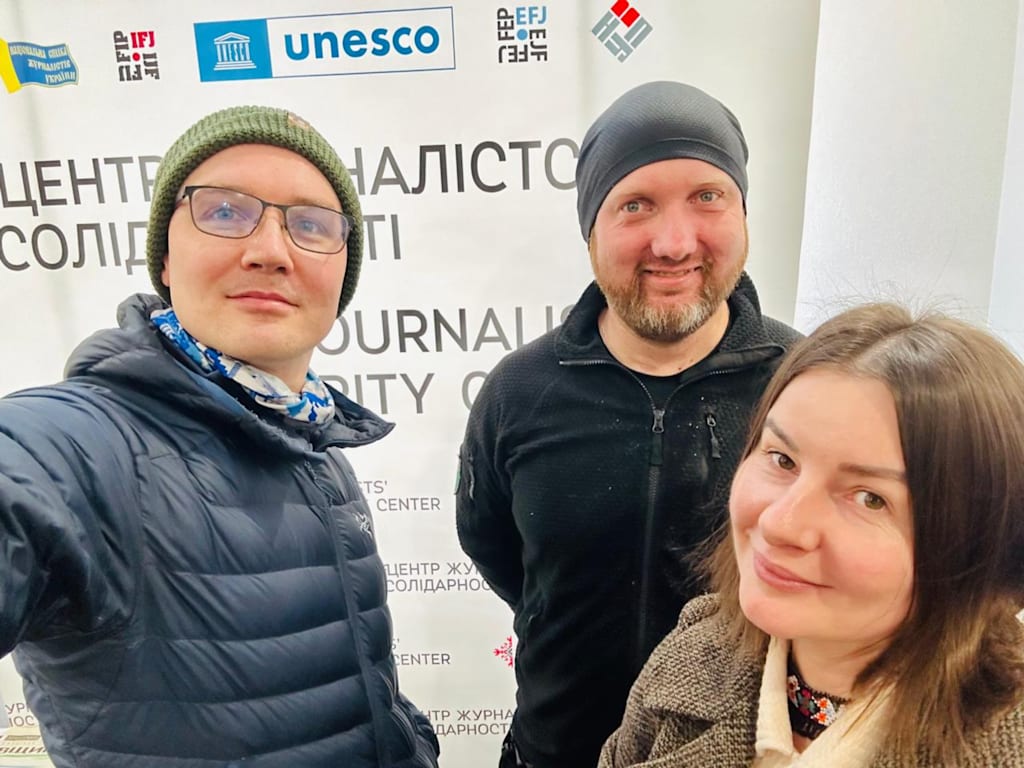
By Scott Douglas Jacobsen and Volodymyr Pavlov (Translator, English-Ukrainian)
Anna Chernenko is a Ukrainian journalist working in Kharkiv, reporting on wartime conditions, media transformations, and civilian life under threat. She has documented the shrinking journalism sector, risks faced by reporters, and evolving safety practices. Her work reflects the human and professional impact of sustained conflict on Ukraine’s media landscape.
Volodymyr Pavlov is a Ukrainian journalist based in Kharkiv, known for frontline reporting during Russia’s full-scale invasion. He covers military operations, civilian resilience, and regional developments across eastern Ukraine. Experienced in high-risk environments, Pavlov combines field reporting with safety expertise, documenting the realities of war while adapting to ever-changing threats and conditions.
In this interview with Scott Douglas Jacobsen, Anna Chernenko and Volodymyr Pavlov describe frontline journalism in Kharkiv, emphasizing adaptation to constant danger, evolving safety practices, and the psychological normalization of war. They highlight shrinking media infrastructure, risks to reporters, and the importance of protective equipment, situational awareness, and resilience while continuing to document the realities of conflict.
Scott Douglas Jacobsen: Do either of you feel fully safe in Kharkiv? Or do you recognize that it is not entirely safe, but it is no longer constantly on your mind?
Volodymyr Pavlov: Do you feel fully safe? Yes. As for Anna, she feels relatively safe because she is used to this situation. We have seen places with much worse conditions, Donbas.
Anna Chernenko: The only thing that makes me feel unsafe is when new weapons are used, when you cannot understand what they are, how to react, or what kind of danger they pose.
Pavlov: As for me, I feel safe because I have lived in Kharkiv my whole life and have not left since the full-scale invasion. I am used to the situation. I can estimate how far away an explosion is, whether it is in the air or on the ground. I can decide whether I need to be worried or find a safe place. Still, whenever we hear something unusual, we react.
The drone sound in the city center; I can decide whether to worry or find a safe place. Still, whenever we hear something unusual, we react. As I mentioned about the drone sound in the city center, I always respond to air raid sirens and try to find a safe place. If there is a drone, we also try to find shelter somewhere in the city. We follow air raid alerts through Telegram channels and other sources to understand what type of danger Kharkiv is facing.
So if I see a drone or a missile—if it is a missile, I would go to a safe place. But if it is a drone that is not heading toward my location, I might not react.
Jacobsen: Is that a common attitude among journalists in the city?
Pavlov: It depends. Some journalists work from houses or offices with basements, so they feel differently about safety. In Kharkiv, many journalists no longer work in offices because it is often unsafe. They work from home, or media organizations have created shelters or offices in basements. In general, there is a shared sense of adapting to the situation. However, many of our colleagues are sensitive to loud sounds and feel unsafe when they hear explosions. Some travel to Kharkiv only briefly, while others go further, even to Donbas. It depends on each person’s sense of safety. Different journalists have different thresholds. Some work only within the city and visit sites after strikes, once it is safe to do so. Others, I work across Ukraine. We go not only to strike sites but also to the front line when possible. We work with soldiers in trenches and with artillery units. We work not only in Kharkiv city but across the region, including the directions of Kupiansk and Vovchansk, as well as in the Donbas. So journalists have different levels of comfort and safety.
Jacobsen: How many journalists have left Kharkiv for cities farther from the front line?
Chernenko: That is a good question. We do not have exact numbers. We have not counted. However, many people have left. Among our close colleagues, around ten people we know personally have left the city. More broadly, the media sector itself has shrunk. We do not have television operations in the same way, and the advertising market has declined. As a result, some media organizations have reduced their staff. Those journalists either joined the military, left the city, or found other work. At the same time, some online media continue to operate, and even new publications have appeared. So we cannot give an exact number, but among our immediate circle, about ten colleagues have left Kharkiv.
But we also need to say that many media outlets have closed. We almost no longer have television in the way we did before, especially in Kharkiv. The commercial market has collapsed, and many media organizations that relied on advertising have lost that source of funding. Without that market, many outlets stopped working. Some journalists found other jobs, and some joined the army. So the journalism market has become smaller and more concentrated than before the full-scale invasion.
If we speak about media that work only on the Internet, that is different. Online media continue to operate. We have even seen new outlets appear that specialize in web and digital publishing.
There are still media organizations in Kharkiv, but not enough of them. It is difficult to find journalists to work in local media. That is also a marker of how many experienced journalists remain.
We know that more than one hundred media workers have been killed since the start of the full-scale war. According to the Institute of Mass Information, 113 media workers had died in Ukraine since the start of the Russo-Ukrainian war in 2014, including 106 after the full-scale invasion began in 2022. Not all of them were in Kharkiv. But Kharkiv and the region have also lost journalists.
We know of two people travelling by car. One was a photographer who went north to film. One was Oleksandr Makhov. He was a Ukrainian journalist who later joined the military. He was killed on May 4, 2022, near Izium in Kharkiv Oblast while serving with Ukraine’s armed forces. More specifically, reports place his death near Dovhenke, in the Izium direction.
The other was Ihor Hudenko, a freelance photojournalist and documentarian from Kharkiv. He died on February 26, 2022, after going missing while documenting events in Kharkiv’s Pivnichna Saltivka area. He rode his bicycle toward the frontline. His death was later confirmed.
He took those photographs on February 24, 2022. He published one of them on February 25, and after that, no one could contact him.
We have also had injured journalists in Kharkiv. There were minor injuries in some cases. And yes, we have had incidents in which journalists were wounded or killed. At least two recent incidents come to mind.
One was when a drone hit a journalist’s car. One recent case involved a foreign media crew whose car was damaged by a drone explosion.
We have also had at least one local journalist injured after a strike with guided aerial bombs. There have been many situations in which Kharkiv journalists who work here constantly went in the Vovchansk direction or other dangerous areas and were injured there.
And there is another pattern. At least twice, maybe more, hotels where journalists were staying were attacked.
One of them was the Kharkiv Palace Hotel. That was on December 30, 2023. A team of journalists was staying there when it was struck, and several media workers were injured.
The other was the Park Hotel in Kharkiv, also in January 2024. Journalists, including foreign media crews, were staying there when it was attacked. A fixer working with France 2 was injured there.
After that, journalist organizations began issuing stronger recommendations against using hotels commonly known to reporters. That advice became much more serious because Russian strikes appeared to target places where journalists gather. Later reporting by IMI, RSF, and Truth Hounds described this as a repeated pattern, not a random coincidence.
Jacobsen: So one rule of thumb is this: if you ask another journalist which hotel they are using, and they tell you, then you should choose a different hotel.
Another recommendation is to stay on a lower floor, so there are more layers between you and the outside. It is also better if your room does not face the front line. [Ed. This only makes sense with artillery fire, because drones can come from any direction.] Ideally, there should be walls separating you from the exterior of the building, both vertically and horizontally.
Of course, body armour and a helmet are standard. But many journalists prefer not to wear a large visible PRESS marking in frontline cities, depending on the situation. This is based on experience and on practical safety judgment.
This is really based on frontline-city practice, and what experience has taught journalists there?
Chernenko: Yes, exactly. In any case, you should have proper equipment. Even if you are working somewhere relatively safer, not directly on the front line, but still in a city like Kharkiv, we can provide press protection.
We can give you a blue vest with a press mark or another one without, whichever you prefer. We also have black helmets with small removable markings.
My own jacket is blue, but it doesn’t have a visible press sign. It is a spare flak jacket that stays in the car with my colleagues, who work constantly in the field. That is how many journalists operate.
And you must always have tourniquets with you—four tourniquets, in good condition. Ideally, you should have four. Medkits are also important because many people I work with, including some foreign journalists, still carry medkits that were assembled many years ago. That is too old. Medical supplies expire, and kits need to be updated regularly.
Jacobsen: I want to make sure it is explained clearly, at the lowest common denominator, so that anyone reading this understands: these recommendations are coming from people who know what they are talking about, who have seen colleagues injured or killed. This is the reality. What else should we cover for this interview?
Pavlov: You saw my belt. I have an individual first-aid kit on me and a spare on my back. I also have combat medic training. That is why I keep a larger trauma kit in my car, not only a small individual one. I can treat at least several people with what I carry. It is more than a basic IFAK. It is closer to the kind of equipment you would keep for a small group.
So when I go out, especially when I work in dangerous areas, I may have several different first-aid kits with me or in the car.
And not long ago, the National Union of Journalists of Ukraine sent protective and medical equipment, including IFAK kits, to be provided to journalists entering risky areas. NUJU has publicly said that its solidarity centers provide protective gear and IFAK kits to journalists, especially in frontline regions such as Kharkiv.
Jacobsen: Thank you very much for the opportunity and your time, Anna and Volodymyr.
Last updated May 3, 2025. These terms govern all In Sight Publishing content—past, present, and future—and supersede any prior notices. In Sight Publishing by Scott Douglas Jacobsen is licensed under a Creative Commons BY‑NC‑ND 4.0; © In Sight Publishing by Scott Douglas Jacobsen 2012–Present. All trademarks, performances, databases & branding are owned by their rights holders; no use without permission. Unauthorized copying, modification, framing or public communication is prohibited. External links are not endorsed. Cookies & tracking require consent, and data processing complies with PIPEDA & GDPR; no data from children < 13 (COPPA). Content meets WCAG 2.1 AA under the Accessible Canada Act & is preserved in open archival formats with backups. Excerpts & links require full credit & hyperlink; limited quoting under fair-dealing & fair-use. All content is informational; no liability for errors or omissions: Feedback welcome, and verified errors corrected promptly. For permissions or DMCA notices, email: scott.jacobsen2025@gmail.com. Site use is governed by BC laws; content is “as‑is,” liability limited, users indemnify us; moral, performers’ & database sui generis rights reserved.

 In-Sight Publishing