AI Disruption and the Future of Work: Sam Wright of Huntr on Job Market Shifts and Workforce Readiness
Author(s): Scott Douglas Jacobsen
Publication (Outlet/Website): A Further Inquiry
Publication Date (yyyy/mm/dd): 2025/10/24

Sam Wright is the Head of Partnerships at Huntr, a bootstrapped startup empowering over 300,000 job seekers with innovative career tools. As an AI job search expert and LinkedIn career coach, Sam helps professionals navigate the rapidly changing employment landscape through practical strategies and tech-enabled solutions. At Huntr, he drives growth by building partnerships with universities and training programs, while also shaping workforce readiness with cutting-edge AI applications. Featured in major career publications, Sam provides insights on ghost jobs, AI’s impact on work, and evolving hiring trends, making him a trusted voice on the future of job searching and careers. For more info: https://huntr.co/product/resume-tailor.
In this interview with Scott Douglas Jacobsen, Wright explains that corporate spending is shifting from human labor to automation infrastructure, with data centers replacing payroll as key investment areas. Drawing on Huntr’s analysis of over 250,000 job postings, Wright notes a sharp decline in entry-level tech roles and a growing premium for skills like product intuition. He argues that adaptability and upskilling are essential for workers, while universities must take greater responsibility for job readiness. His insights reveal how AI’s rapid evolution is rewriting the future of employment and education.
Scott Douglas Jacobsen: What do the Microsoft layoffs suggest about the disconnect between financial performance and workforce reductions?
Sam Wright: It seems clear that Opex in human labor is going to Capex in data centers. The bet is that they will be able to do more in the future with less human labor expense.
Jacobsen: How is AI changing the skills that tech companies prioritize?
Wright: Tech companies are still prioritizing the same skills as always but the competition is higher. For example, the standard for coding has been raised. We have seen though a rise in salary premium for “Product Intuition” in our job search trends report that analyzed 250k+ postings. (https://huntr.co/research/job-search-trends-q1-2025?preview=true#salaries-by-skill-requirements)
Jacobsen: What workforce strategies can help organizations remain agile?
Wright: Being flexible and investing in your current people. It will pay off down the line. While AI will be transformative even if it doesn’t advance past its current state, it will be a wild rollercoaster ride economically as every other major technology disruption indicates
Jacobsen: How are job seekers adapting their career strategies?
Wright: Job seekers are becoming perpetual job seekers. I meet hundreds of job seekers, and many are gainfully employed but see the writing on the wall with AI and are already proactively responding, looking for more future-proof industries and upskilling.
Jacobsen: What role should universities and training programs play in equipping workers for AI?
Wright: Universities need to be more realistic with their responsibility to train their students to be job-ready. This means having better data to make informed decisions on career outcomes.
Jacobsen: Which industries are most vulnerable to similar workforce shifts?
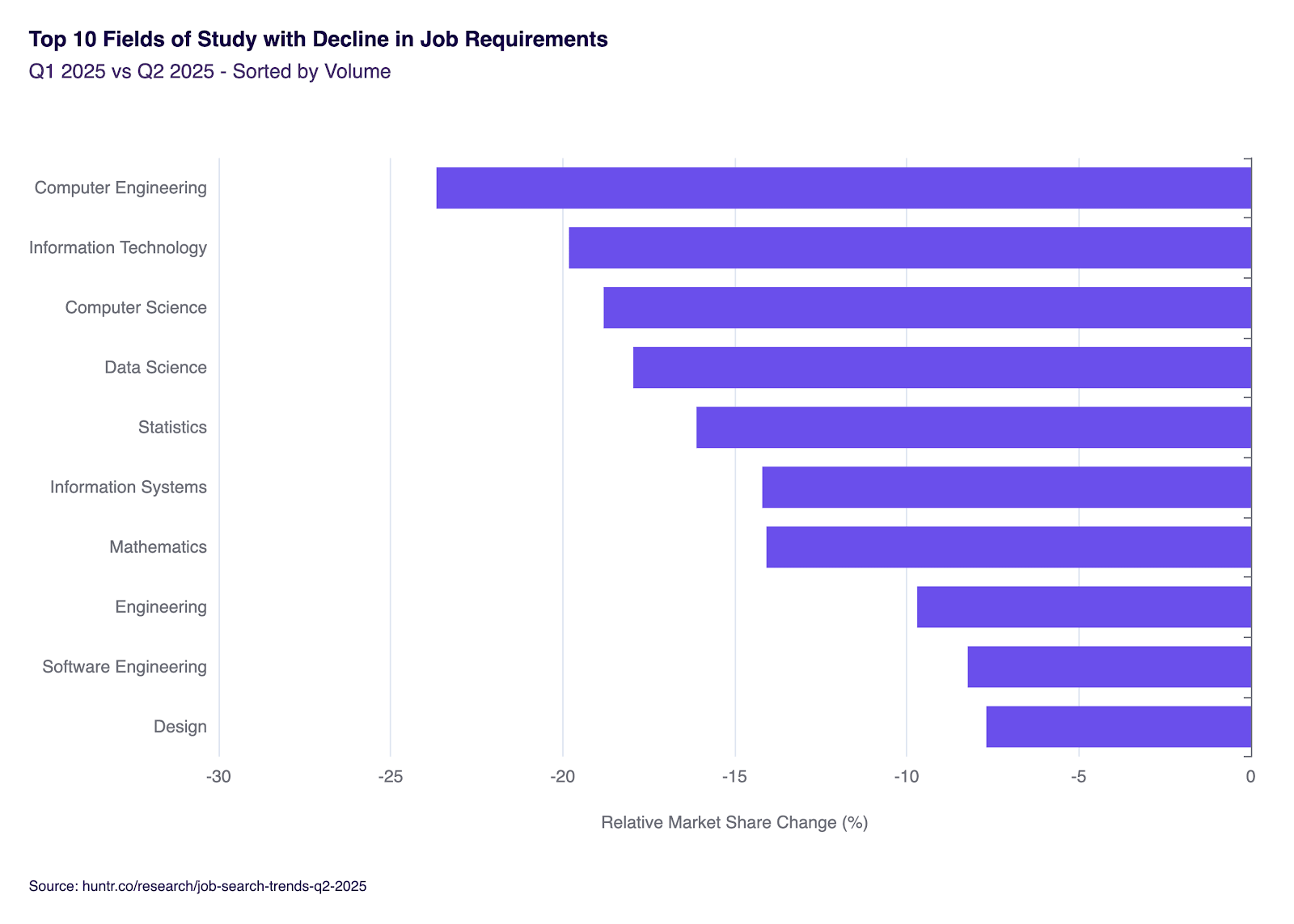
Wright: We ran an analysis of 250k job postings across tens of thousands of job searches and found that these fields lost share in job posting from Q1 to Q2 2025 Computer Engineering (-23.7%), Computer Science (-18.8%), and IT (-19.8%). (https://huntr.co/research/job-search-trends-q2-2025#fields-of-study-with-declining-demand)
This was surprising, but it does correspond to the rise of AI coding tools like Claude, Copilot, and Cursor.
While many thought that the rapid growth of Generative AI would impact creative work, the evidence suggests that entry-level coding jobs are seeing the biggest initial disruption.
I met with over 100 tech job seekers last month, and one stood out to me. She was an Ivy League graduate in Computer Science, having graduated with honors, and was struggling to find work. A computer science degree from any university used to be a guaranteed job, but that’s not the case anymore, and that is a huge disruption.
Jacobsen: Thank you for the opportunity and your time, Sam.
Last updated May 3, 2025. These terms govern all In-Sight Publishing content—past, present, and future—and supersede any prior notices. In-Sight Publishing by Scott Douglas Jacobsen is licensed under a Creative Commons BY‑NC‑ND 4.0; © In-Sight Publishing by Scott Douglas Jacobsen 2012–Present. All trademarks, performances, databases & branding are owned by their rights holders; no use without permission. Unauthorized copying, modification, framing or public communication is prohibited. External links are not endorsed. Cookies & tracking require consent, and data processing complies with PIPEDA & GDPR; no data from children < 13 (COPPA). Content meets WCAG 2.1 AA under the Accessible Canada Act & is preserved in open archival formats with backups. Excerpts & links require full credit & hyperlink; limited quoting under fair-dealing & fair-use. All content is informational; no liability for errors or omissions: Feedback welcome, and verified errors corrected promptly. For permissions or DMCA notices, email: scott.jacobsen2025@gmail.com. Site use is governed by BC laws; content is “as‑is,” liability limited, users indemnify us; moral, performers’ & database sui generis rights reserved.


