Author(s): Scott Douglas Jacobsen
Publication (Outlet/Website): Medium (Humanist Voices)
Publication Date (yyyy/mm/dd): 2020/01/26
Dr. Leo Igwe is the Founder of the Nigerian Humanist Movement/Humanist Association of Nigeria and former Western and Southern African Representative of the International Humanist and Ethical Union, now Humanists International, and the Founder & CEO of Advocacy for Alleged Witches. He is among the most prominent African non-religious people from the African continent. When he speaks, many people listen in a serious way. He holds a Ph.D. from the Bayreuth International School of African Studies at the University of Bayreuth in Germany, having earned a graduate degree in Philosophy from the University of Calabar in Nigeria.
Here we talk about Islamic and Christian ironic reinforcement of charges or and teachings of witchcraft in Africa, and the effects of the lives of real human beings throughout Africa.
Scott Douglas Jacobsen: How are Nigerian flavours of Islam and Christianity poisoning the cultural well of the lives of individuals who may or may not practice witchcraft through demonization, e.g., shunning, ostracization, and the like, and abuse, e.g., burnings and beatings, and so on, as a set of ideas influencing the thinking of Nigerians about alleged witches?
Dr. Leo Igwe: With or without Nigerian adaptations, Christianity and Islam have a place for witchcraft in their teachings and therefore have served the purpose of reinforcing witchcraft beliefs and practices. Western missionaries and their Middle-eastern counterparts introduced these faiths, presenting them as ‘better religions’ that should replace and substitute traditional religious beliefs.
These religious imperialists introduced Christian and Muslim faiths with so much force and violence. They invested these religions with social, political, economic capital that have eventually transformed them into dominant faiths in the region. Thus Africans predominantly practice Christianity and Islam, at least on paper but never abandoned the traditional religious beliefs. A critical look at the manifestations of witchcraft beliefs in contemporary Africa reveals a holy alliance- these religions have intersected and interrelated in stoking occult fears and anxieties. Expediency has compelled Africans to mix and marry various religions- Christianity and traditional religion, Islam and traditional religion, Christianity, Islam and traditional religion as the case may be in making sense of everyday life especially their treatment of alleged witches. Christianity and Islam have been deployed against the practice of witchcraft and yes against witches. Christian pastors, Muslim imams and mallam have become ‘modern day’ witch finders, witch identifiers, witch hunters, witchcraft neutralizers and witchcraft exorcizers.
Even though Christianity in the West distances itself from witch hunting, designating it as a thing of the past, as a dark phenomenon that ended centuries ago, the church in Nigeria has remained a witch-demon-hunting institution. Nigerian Christians based their beliefs and practices (or least claim to do so) on the Bible. And the Christian holy book is replete with provisions that demonize alleged witches, and incite violence against those allegedly possessed by evil spirits. Various scriptural verses endorse and sanctify witch identification and killing. In the case of Islam, while many Muslims may claim not to subscribe to witchcraft beliefs, witchcraft allegation is pervasive in Muslim dominated communities. Mallams have Quran, Islam based remedies to identify witches and neutralize witchcraft. These Christian and Islamic layers have not been helpful in dispelling witchcraft fears and anxieties.
Jacobsen: What is Advocacy for Alleged Witches?
Igwe: Advocacy for Alleged Witches (AfAW) is an initiative to build a critical mass of support for those who are accused of witchcraft and forge an effective alliance against abuses that are linked to witchcraft accusation and witch persecution. For far too long, those who are accused of witchcraft are treated in most horrific ways. Alleged witches are attacked, killed, and brutalized with impunity.
Recently in Nigeria, a parent set his two children ablaze after accusing them of witchcraft. And in Malawi, a mob stoned a 40-year-old woman to death for perpetrating magical harm. These abuses have taken place due to lack of effective mechanisms to support persons who are suspected of witchcraft. These atrocities happen due to a deficit in advocacy for alleged witches in the region. AfAW has been established to fulfill this need, and change this sad and unfortunate situation. The main objective is of AfAW is to realize a critical mass of advocates in every village, community, county and country in Africa. If a significant number of advocates exist across the region, witchcraft allegations will be nipped in the bud. Suspicions of occult harm will not turn into campaign of violence and abuse. AfAW plans to intervene to support and defend accused persons. The support for accused persons is predicated on the notion that alleged witches are innocent and that witchcraft is a form of superstition. Support for the accused is a reactive approach to ensure that survivors restart their lives. Support is deployed following allegations of witchcraft and includes rehabilitation, relocation and reintegration. Incidentally empowering alleged witches is not enough to realize a witch-hunting free Africa because alleged witches are victims, not victimizers. Witchcraft accusers and witch hunters are the victimizers.
In addition, AfAW will work to educate and enlighten witchcraft accusers and believers. This is because people indulge in witchcraft accusations due to fears, ignorance and misunderstanding of nature and how nature works. Witchcraft accusers need support to free themselves from those misconceptions of the causes of misfortune that lead to witch persecution and killing. AfAW is here to champion this program of cultural awakening, renewal and rebirth.
Jacobsen: Thank you for the opportunity and your time, Dr. Igwe.
License
In-Sight Publishing by Scott Douglas Jacobsen is licensed under a Creative Commons Attribution-NonCommercial-NoDerivatives 4.0 International License. Based on a work at www.in-sightpublishing.com.
Copyright
© Scott Douglas Jacobsen and In-Sight Publishing 2012-Present. Unauthorized use and/or duplication of this material without express and written permission from this site’s author and/or owner is strictly prohibited. Excerpts and links may be used, provided that full and clear credit is given to Scott Douglas Jacobsen and In-Sight Publishing with appropriate and specific direction to the original content. All interviewees and authors co-copyright their material and may disseminate for their independent purposes.
Share this:

Author(s): Scott Douglas Jacobsen
Publication (Outlet/Website): Medium (Humanist Voices)
Publication Date (yyyy/mm/dd): 2022/01/25
Dr. Herb Silverman is the Founder of the Secular Coalition for America, the Founder of the Secular Humanists of the Lowcountry, and the Founder of the Atheist/Humanist Alliance student group at the College of Charleston. He authored Complex variables (1975), Candidate Without a Prayer: An Autobiography of a Jewish Atheist in the Bible Belt (2012) and An Atheist Stranger in a Strange Religious Land: Selected Writings from the Bible Belt (2017). He co-authored The Fundamentals of Extremism: The Christian Right in America (2003) with Kimberley Blaker and Edward S. Buckner, Complex Variables with Applications (2007) with Saminathan Ponnusamy, and Short Reflections on Secularism (2019), and Short Reflections on American Secularism’s History and Philosophy (2020).
Here we talk about community formation in the future, similarities and differences.
Scott Douglas Jacobsen: Two trends seem apparent. One, as societies develop, they become more oriented to the technical, even mechanical and certainly digital. This affects the analog acceptance of the mystery orientation of traditional — most — religion. In that, as you note, traditional religion declines. Religions that change survive with a small number thriving.
Two, something follows from one. Although, as most of the world continues to develop, most of the young continue on rapid rejections of traditional religion. Another contingent appeared in the 20th century, even earlier, looking for similar patterns of life as traditional religion without some of the now-seen-as-baggage.
For those young humanists, who want some of the patterns of life of traditional religion without the excess cargo, how can they formulate some communities for themselves? Not merely joining those which take on the appearances of traditional religious communities with secular philosophy. What pathways exist for them? What roads have simply been grown over with scientific roots and overgrown with technological trees?
Dr. Herb Silverman: You ask how young humanists can formulate their own communities. Some might want patterns of life of traditional religion without the excess cargo (theism), some are more interested in a community with a secular philosophy that has nothing to do with religion, and some might want a community that actively opposes the excesses of religion. I’ll try to address all these concerns, and begin by describing the two communities I was involved in starting.
When I ran for Governor of South Carolina in 1990 to challenge the unconstitutional provision in our state constitution that prohibited atheists from holding public office, I got unsigned hate mail and anonymous phone calls. But I also received letters and calls of support and appreciation. Many had thought they were the only atheists in South Carolina, and most were closeted for fear of social and family disapproval. These isolated atheists needed a supportive community, so with my list of names I suggested meeting at the local library to see if there was interest in organizing a group. So in 1994 we formed a secular humanist group in Charleston, with a dozen founding members. Because a secular humanist group in the Bible Belt was so unusual at that time, we received considerable media attention. We would hear from people who disliked us and from people who wanted to join us. It was easily worth the trade-off.
In 1998, a student came to my office and asked about starting a group at the College of Charleston, where I was teaching. I was thrilled and agreed to be its faculty advisor. Despite attempts by a few Christian students in the Student Council to oppose giving official club status to the Atheist/Humanist Alliance student group, the group prevailed. When they first met, several students talked about friends or roommates who now shunned them because of their nonbelief. These atheist students came to meetings because they needed a supportive community. Gradually attitudes at the College of Charleston changed and students worried far less about becoming unpopular because of openly being atheists. I’ve heard students say they joined the club because atheist students are pretty cool. They are, but they were also cool in 1998. I’m encouraged by the younger generation’s wider acceptance of diversity in our society.
As far as those who like some religious ceremony without the baggage, I was raised as an Orthodox Jew and stopped believing in God shortly after my bar mitzvah at age 13. I still like some of the Hebrew songs I sang as a child, but a line in the Peter, Paul, and Mary song “I Dig Rock and Roll Music” explains why I don’t sing them today. The line is “They got a good thing going when the words don’t get in the way.” The words of my Hebrew songs when translated into English were prayers to God, which definitely got in the way.
My wife Sharon was raised Catholic, went to Catholic schools, and as an adult became an atheist like me. She now wants nothing to do with Catholicism, but around Christmas time she enjoys going to performances of Handel’s “Messiah.” I kid her by saying, “Tonight you are going to see your Lord and Savior.”
Two good sources for starting a freethought organization might be the Secular Student Alliance with its membership of young people, and the British Humanist Association, located in a country where religious belief has been in disfavor for quite a while. I especially like some of the quotes on the British Humanist website, including:
George Orwell: “Freedom is the right to tell people what they do not want to hear.”
Thomas Paine: “My country is the world. My religion is to do good.”
Stephen Hawking: “Remember to look up at the stars and not down at your feet.”
Voltaire: “Think for yourself and let others enjoy the privilege of doing so too.”
Bertrand Russell: If we are to live together and not die together, we must learn a kind of charity and a kind of tolerance that is absolutely vital to the continuation of human life on this planet.”
Mary Shelley: “Live and be happy, and make others so.”
Marie Curie: “Now is the time to understand more, so that we may fear less.”
Shappi Kohrsandi: “Doing a good thing is its own reward. It feels good in and of itself, and that’s enough.”
Rosalind Franklin: “Faith in this world is entirely possible without faith in another world.”
Benjamin Franklin: “There never was a good war or a bad peace.”
Terry Pratchett: “In ancient times, cats were worshipped as gods. They have not forgotten this.”
If you are interested in forming your own freethought community, there are many options. The simplest is probably to affiliate with one of the national organizations, which would help you get started locally. There are even atheist churches that you might want to join, or start one locally. There are also nontheistic religions that I’ve joined: Humanist Unitarians, American Ethical Union, and the Society for Humanistic Judaism.
Presumably you are interested in starting a group because there is none in your area, you want to make a difference in your community, you advocate for reason and science, and would like to end discrimination against secular people. You will need a core of committed volunteers interested in joining you to form an organization. One way to find such people is by attending meetings of organizations whose participants are likely to hold similar beliefs. Depending on your interests it might include science meetings, Unitarian churches, Ethical Culture societies, LBGTQ groups, the American Civil Liberties Union, Planned Parenthood, etc. Find out how these organizations are run and talk to people who might be interested in affiliating with your organization. For those interested, find out if they have friends who might also be interested. You can also post fliers in bookstores, community centers, libraries, and nearby universities.
You should also have an “elevator speech” explaining why you want to start a group and what you hope to accomplish. This could include the importance of interacting with like-minded people because there are so few in the community or learning how to respond individually and as a group to political threats from the religious right who would like to impose their beliefs on all of society.
Once you have an interested community of volunteers, discuss details of the group. This could include how activist the group might be, what kind of social and charitable events you might have, whether you will have outside talks and educational opportunities, and what type of leadership structure you might have. Keep in mind that some of these things will change when you add new members with fresh ideas. Of course, you will eventually want a website, a Facebook presence, Meetup, Twitter, and other forms of technology.
Sometimes religious people claim to speak for the entire community, which marginalizes secular folks. Point out that this is discrimination. It helps to find common ground with religious people in your community, working together to perform good works. The individuals you work with and help are likely to become friends. These religious people will understand that we don’t think there is a purpose OF life, but that we find purposes IN life. They will see that we are not striving for brownie points in an afterlife, but looking to do good in this life.
Jacobsen: Thank you for the opportunity and your time, Dr. Silverman.
—
Previous sessions:
If Youth Knew, If Age Could 1 — Freethought for the 21st Century
If Youth Knew, If Age Could 2 — Freethought for a Multipolar World
If Youth Knew, If Age Could 3 — Coming of Age in an Ever, Ever-Irrational World
If Youth Knew, If Age Could 4 — Bridges are the Rainbows
License
In-Sight Publishing by Scott Douglas Jacobsen is licensed under a Creative Commons Attribution-NonCommercial-NoDerivatives 4.0 International License. Based on a work at www.in-sightpublishing.com.
Copyright
© Scott Douglas Jacobsen and In-Sight Publishing 2012-Present. Unauthorized use and/or duplication of this material without express and written permission from this site’s author and/or owner is strictly prohibited. Excerpts and links may be used, provided that full and clear credit is given to Scott Douglas Jacobsen and In-Sight Publishing with appropriate and specific direction to the original content. All interviewees and authors co-copyright their material and may disseminate for their independent purposes.
Share this:
Author(s): Scott Douglas Jacobsen
Publication (Outlet/Website): Medium (Humanist Voices)
Publication Date (yyyy/mm/dd): 2020/01/22
Dr. Leo Igwe is the Founder of the Nigerian Humanist Movement/Humanist Association of Nigeria and former Western and Southern African Representative of the International Humanist and Ethical Union, now Humanists International, and the Founder & CEO of Advocacy for Alleged Witches. He is among the most prominent African non-religious people from the African continent. When he speaks, many people listen in a serious way. He holds a Ph.D. from the Bayreuth International School of African Studies at the University of Bayreuth in Germany, having earned a graduate degree in Philosophy from the University of Calabar in Nigeria.
Here we talk about witchcraft in Nigeria and Ghana, and the misrepresentations and inaccuracies, and falsehoods, provided to the Western world through Western anthropologists with negative impacts on the image of Africa and Africans.
Scott Jacobsen: You have been doing some research into the dynamics of witchcraft in Nigeria and Ghana. This includes fieldwork in these places. Could you share some of your experiences?
Igwe: I worked for local and international NGOs, intervening in cases of witchcraft accusations in Nigeria, Malawi and Gambia, before undertaking my doctoral studies on the same topic. However, I did my doctoral fieldwork in Ghana and I am still trying to document some of my experiences as a researcher on witchcraft because it is still ongoing. Apart from this, I monitor cases of witchcraft allegations in other African countries and regions including South Asia and Oceania. In the course of my intervention work, I had the chance to raise the issues of witch persecution before the African Commission as well as the UN Human Rights Council in Geneva, Switzerland. I am keen to understand why witch persecution persists in some parts of the world, and what can be done to eradicate this dark and destructive phenomenon.
It was during my doctoral programme that I learnt about the extensive research and study that had been conducted on African witchcraft. As most of the study was done by western anthropologists, there was a lot of misrepresentation of Africa and Africans in these studies. Texts on witchcraft in Africa mainly portrayed Africans as people with a child-like mentality. Having lived in Africa and being an African I was compelled to challenge these thoughts and texts through relatable research on issues of witchcraft in Africa. There was an underlying prejudice in these studies. A constant comparison of ‘us’ and ‘them’ which created an impression of two worlds: one with witchcraft belief and the other without. The ‘us’ referred to the rational, scientific and ‘civilized’ westerners, and the ‘them’ to magical, occult, native, witchcraft-minded Africans. These ‘scientific’ texts on African witchcraft sounded like stories about the behaviours of children meant to entertain adults. The accounts were biased, mainly narrations of gossips and hearsay, superficial fairy tales, permeated with prejudices and misconceptions. These accounts were based on one incident or one encounter on the streets or village squares in Sudan, Tanzania, Soweto, Nigeria or Cameroon.
Most Western anthropologists have used particular incidents to explain a whole ethnic group, a country, a continent making generalizations with far reaching racial implications other than providing solid arguments based on intensive research. These generalizations have ended up misinforming the readers about these peoples and their cultures.
Some years ago, a German colleague who visited Ghana for his fieldwork told me that based on what he read about witchcraft in Ghana he had expected to see witchcraft everywhere on arrival. He didn’t. This was a clear case of misinformation through the texts that he had hoped would guide him on what to expect of African people and their cultures. The misrepresentation of African cultures by Western anthropologists has shaped the way that westerners perceive Africans and their cultures. A trend that has continued by subsequent scholars due to lack of academic will on the part of African scholars to engage ‘established western scholarship’.
Meanwhile, western anthropologists have further represented the west as a bastion of science, civilization, and enlightenment even at a time that western missionaries were busy propagating Christian myths and superstitions across the region. They have otherized Africa to the point that strains comprehension especially for one who comes from the culture being explained.
Unfortunately, these are the studies that have been used to introduce generations of European and other westerners to African cultures. These are studies that many claim or acclaim as embodying contemporary knowledge. It is absurd that African researchers are expected to engage these texts as documented evidence of the African culture from which they can learn and understand their own culture. What western anthropologists and their African counterparts have done over the years is to expand and perpetuate a debate that thrives on exoticizing Africans, a research trend that presents Africans as the prototype of primitive savage humans. This narrative only serves the interests of racists, colonizers and exploiters.
As a doctoral research fellow, I found it difficult to engage and make sense of this corpus of literature. The studies lacked the rigors and depth that I had expected at that level. The witchcraft debate is inclined to inform the west, not necessarily the world, about ‘me’, about Africa. I kept wondering how I could get into this debate. I wondered how I could meaningfully engage in this ethnography of the self. For instance, going through the literature on African witchcraft, I noticed a predominantly pattern of writing by western scholars. They usually say: “As a westerner I have never seen such thing (referring to a manifestation of witch belief) like this before blah blah blah….”. Then they go on to explain this strange African phenomenon. Having grown and lived within this African culture it was obvious that I would take a different dimension in explaining the same phenomenon. Due to the choice of words and angle of research done by the western anthropologists, it was clear who the audience was. Anthropologists write for the west. They tell the west about Africa. In my own case, it was difficult to position and participate in this ‘writing culture’. Who would be my audience? Africans? So mine would be a story of Africa to Africans?
May be this predominant culture of anthropological writing made sense centuries ago when western humans had to travel thousands of miles on boats or ships to remote African villages and forests and send back stories of their experiences with these ‘strange’ humans. Does such as a discipline have any academic value today that we have the internet and more especially we have Africans traveling to the west and telling their own stories? Probably as a form of archival studies.
Jacobsen: Thank you for the opportunity and your time, Dr. Igwe.
License
In-Sight Publishing by Scott Douglas Jacobsen is licensed under a Creative Commons Attribution-NonCommercial-NoDerivatives 4.0 International License. Based on a work at www.in-sightpublishing.com.
Copyright
© Scott Douglas Jacobsen and In-Sight Publishing 2012-Present. Unauthorized use and/or duplication of this material without express and written permission from this site’s author and/or owner is strictly prohibited. Excerpts and links may be used, provided that full and clear credit is given to Scott Douglas Jacobsen and In-Sight Publishing with appropriate and specific direction to the original content. All interviewees and authors co-copyright their material and may disseminate for their independent purposes.
Share this:
Author(s): Scott Douglas Jacobsen
Publication (Outlet/Website): Medium (Humanist Voices)
Publication Date (yyyy/mm/dd): 2020/01/22
Rob Boston is the Senior Advisor and Editor for Church and State of Americans United for Separation of Church and State, which is the monthly membership magazine. He began work at Americans United in 1987 and authored four books entitled Close Encounters with the Religious Right: Journeys into the Twilight Zone of Religion and Politics (Prometheus Books, 2000), The Most Dangerous Man in America? Pat Robertson and the Rise of the Christian Coalition (Prometheus Books, 1996), Why the Religious Right Is Wrong About Separation of Church and State (Prometheus Books, 1993; second edition, 2003), and Taking Liberties: Why Religious Freedom Doesn’t Give You The Right To Tell Other People What To Do (Prometheus Books, 2014). Mr. Boston can be contacted here: boston@au.org.
This series covers secularism strictly within the American context for the consumption of 18-to-35-year-olds. In this interview session, we cover recent, modern history of Americans United.
Scott Douglas Jacobsen: Following the 1950s through 1990s, and the support structure of religious individuals and religious institutions, when did the work transition more into secular American citizens taking the charge in maintaining the ever-important separation of church and state?
Rob Boston: It’s hard to say exactly when this happened, but there were some significant events along the way that provide some evidence. For example, after the U.S. Supreme Court struck down state-sponsored prayer in public schools in landmark rulings from 1962 and 1963, some religious groups endorsed that decision and others opposed it. Some of the groups that were in opposition went so far as to call a constitutional amendment to “restore” prayer to public schools. This created a rift in the religious community that exists until this day.
Another factor was the takeover of the Southern Baptist Convention by fundamentalists in the late 1970s. As they consolidated power, the fundamentalists shifted the SBC away from its traditional positions in favor of church-state separation. This loss of a key religious ally created a vacuum that some secularists began to fill.
A final development was the rise of organized secularism in the 1980s. Support for church-state separation was always a part of the agenda of humanist/atheist/freethought groups. As they became more visible, more active and better funded, they naturally gravitated toward the cause.
Having said that, I think it is important to note that religious voices are still very much a key part of our movement. We couldn’t do this work without support from faith communities. They have been amazing allies. In my view, one of the best things about Americans United is the way we bring religious and secular people together to work on this common issue of protecting freedom of conscience. It’s a phenomenal partnership — and a necessary one.
Jacobsen: Based on the last question, what were some recent markers in the 2000s and 2010s representing this transition and the activism for separation of church and state in different domains by those without religion, and in leadership positions?
Boston: One thing I noticed in the 2000s was the rise of alliances in secular communities that had not existed before. Herb Silverman formed the Secular Coalition for America, which brings together several secularist bodies to work together on shared interests, including church-state separation. Basically, organizations ceased looking at one another as rivals and started to be allies. That alliance undoubtedly amplified secularist voices.
Jacobsen: Thank you for the opportunity and your time, Mr. Boston.
Boston: Thank you.
License
In-Sight Publishing by Scott Douglas Jacobsen is licensed under a Creative Commons Attribution-NonCommercial-NoDerivatives 4.0 International License. Based on a work at www.in-sightpublishing.com.
Copyright
© Scott Douglas Jacobsen and In-Sight Publishing 2012-Present. Unauthorized use and/or duplication of this material without express and written permission from this site’s author and/or owner is strictly prohibited. Excerpts and links may be used, provided that full and clear credit is given to Scott Douglas Jacobsen and In-Sight Publishing with appropriate and specific direction to the original content. All interviewees and authors co-copyright their material and may disseminate for their independent purposes.
Share this:
Author(s): Scott Douglas Jacobsen
Publication (Outlet/Website): Medium (Humanist Voices)
Publication Date (yyyy/mm/dd): 2020/01/21
Dr. Herb Silverman is the Founder of the Secular Coalition for America, the Founder of the Secular Humanists of the Lowcountry, and the Founder of the Atheist/Humanist Alliance student group at the College of Charleston. He authored Complex variables (1975), Candidate Without a Prayer: An Autobiography of a Jewish Atheist in the Bible Belt (2012) and An Atheist Stranger in a Strange Religious Land: Selected Writings from the Bible Belt (2017). He co-authored The Fundamentals of Extremism: The Christian Right in America (2003) with Kimberley Blaker and Edward S. Buckner, Complex Variables with Applications (2007) with Saminathan Ponnusamy, and Short Reflections on Secularism (2019), and Short Reflections on American Secularism’s History and Philosophy (2020).
Here we talk about technology, religion, natural philosophy, and the future.
Scott Douglas Jacobsen: The foundation of the Secular Coalition for America remains a landmark apart from the smaller organizations, including the student groups, in the freethought organizational landscape. The Freedom From Religion Foundation, Humanists International, and a few others maintain a large coalition. They have members. They have the followings. Member organizations pay membership fees. These fees get funnelled back into staff and campaigns for further work to improve the situation on the front of secular equality, freedom of thought, and freedom from religion. These are the bridges, the rainbows, to the lucky gold. The untrained enthusiasm of youth can be good in its vigour. It can be bad in its poor directionality towards a singular target for efficacy. Any lessons on channelling the energy of youth? Any notes on the importance of developing the discipline to become effective? Any commentary on going out and doing something — something concrete, specific, and reasonable — rather than wishing-it-were-so, e.g., not praying, not meditating on a wanted targeted objective, not daydreaming (as much), or passing the buck?
Dr. Herb Silverman: All 20 national member organizations of the Secular Coalition for America try to attract young people to join their organizations. Two organizations in particular focus on this: The Secular Student Alliance (SSA) and Camp Quest. SSA is dedicated to atheist, humanist, and other nontheistic students. Its goal is to empower secular students to proudly express their identity, build welcoming communities, promote secular values, and set a course for lifelong activism. Over 300 student organizations belong to the SSA, with more than 1,600 programs in schools that impact over 28,000 students. Camp Quest provides an educational summer adventure that features science, natural wonders, and humanist values. A network of Camp Quest summer camps for children and teens encourages critical thinking, skepticism and fun. Aimed at campers from the atheist, agnostic, and other secular families, Camp Quest is open to campers from all worldview backgrounds.
The Secular Coalition for America advocates for religious freedom as guaranteed by the First Amendment of the U.S. Constitution, and works to bring visibility and respect for people without religious beliefs. The Secular Coalition represents its national member organizations and their hundreds of local secular groups. It joins with allies in faith communities, combining the power of grassroots activism with professional lobbying to make an impact on the laws and policies that govern the separation of religion and government. Please consider signing up with the Secular Coalition for action alerts on pending legislation. You can find all the national nontheistic member organizations of the Secular Coalition for America at https://secular.org/about/members/
Young people are encouraged to become active within the Secular Coalition for America, as well as in local, national, and international freethought organizations. Some organizations with paid staff bring in young people as unpaid interns, giving them an opportunity to learn from the inside how an organization works. Such valuable experience can help young people become more active in their local community, and sometimes leads to future paid employment in the secular movement.
I am optimistic about the future because national surveys show that there are more young people without religion than ever before. The secular movement is growing, both formally through secular organizations and informally through “nones,” those who don’t subscribe to any faith. The “nones” are the fastest-growing demographic related to “religion,” especially among young people. According to a recent American Family survey, 35 percent of Americans said they are atheist, agnostic, or “nothing in particular.” That number grows to 44 percent for people age 18–29. I hope that those of us who identify as atheists or humanists will not only join secular organizations, but also try to give “nones” who we know a reason to join. A lot of them favour separation of religion and government and would like to help counter the influence of religion in government.
While respecting the work and value of membership organizations and coalitions, many young people are interested in making a difference by doing something good, and not just joining a non-religious group. I’ve seen this at my own own local secular humanist organization, where some younger members are not interested in our monthly lectures or book club. They show up only for charitable projects. Recent events have included picking up trash for an “Adopt a Highway” program, contributing food for a community lunch to help homeless people, volunteering at a local food bank, and assisting at a Youth Development Center. Helping others is the very essence of being a humanist. This also includes atheists and humanists who give time and money for charitable work. I hope to see all secular organizations have a charitable component.
One member organization of the Secular Coalition for America devotes itself exclusively to charitable work. The Foundation Beyond Belief is a humanist charity that promotes secular volunteering and responsible financial donations. Guided by the principles of secular humanism, the mission of Foundation Beyond Belief is to unite the humanist community in charitable efforts and advocate for compassionate action throughout the world. It is currently supporting humanist disaster recovery by raising funds for the victims of the Puerto Rico earthquakes. People of all ages may wish to contribute time or money to this worthwhile organization.
Jacobsen: Thank you for the opportunity and your time, Dr. Silverman.
—
Previous sessions:
If Youth Knew, If Age Could 1 — Freethought for the 21st Century
If Youth Knew, If Age Could 2 — Freethought for a Multipolar World
If Youth Knew, If Age Could 3 — Coming of Age in an Ever, Ever-Irrational World
License
In-Sight Publishing by Scott Douglas Jacobsen is licensed under a Creative Commons Attribution-NonCommercial-NoDerivatives 4.0 International License. Based on a work at www.in-sightpublishing.com.
Copyright
© Scott Douglas Jacobsen and In-Sight Publishing 2012-Present. Unauthorized use and/or duplication of this material without express and written permission from this site’s author and/or owner is strictly prohibited. Excerpts and links may be used, provided that full and clear credit is given to Scott Douglas Jacobsen and In-Sight Publishing with appropriate and specific direction to the original content. All interviewees and authors co-copyright their material and may disseminate for their independent purposes.
Share this:
Author(s): Scott Douglas Jacobsen
Publication (Outlet/Website): Medium (Humanist Voices)
Publication Date (yyyy/mm/dd): 2020/01/13
Dr. Herb Silverman is the Founder of the Secular Coalition for America, the Founder of the Secular Humanists of the Lowcountry, and the Founder of the Atheist/Humanist Alliance student group at the College of Charleston. He authored Complex variables (1975), Candidate Without a Prayer: An Autobiography of a Jewish Atheist in the Bible Belt (2012) and An Atheist Stranger in a Strange Religious Land: Selected Writings from the Bible Belt (2017). He co-authored The Fundamentals of Extremism: The Christian Right in America (2003) with Kimberley Blaker and Edward S. Buckner, Complex Variables with Applications (2007) with Saminathan Ponnusamy, and Short Reflections on Secularism (2019), and Short Reflections on American Secularism’s History and Philosophy (2020).
Here we talk about science and technology and new generations.
Scott Douglas Jacobsen: New generations, if we’re thinking in terms of decades into the 2000s — and beyond my own lifetime too, living in current level industrial societies and industrializing societies (even towards more sustainability) will witness declines in religion. This comes with a rise in science, as we see now.
Religion declines in the more advanced economies, the more scientific societies. Technological societies without a scientific backdrop may not see this in the future, as one does not need to question the fundamentals of nature (of the basic claims of the religious or general culture). One can simply acquire technological know-how without questioning supernaturalistic dogma.
These new, fortunate, and tech-savvy generations harbour far more power, far more access to data (and mis-data). Even so, irrationalities abound, will continue, and new ones will pop up. What is the first lesson in coming of age here? What is the modern lesson for a wondrous technological world full of silicon-made wonders?
What is a caveat to this with most of the users of technology disconnected from the linkage between scientific progress and technological progress, and the naturalistic philosophy behind both? Most, the vast majority, of the world believe this world links up with a whole other one, the unseen. Perhaps, also, a listing of ways to detect bunkum are in order, too.
Dr. Herb Silverman: Technology is our present and future, and young people need to embrace it. Being tech-savvy in the workplace is becoming a necessity for job seekers. Schools need to educate students for this reality so they will be able to transition into the work world. Workers presently employed need to be able to master new technology, expect frequent updates and changes to software, and learn how to stay on top of those advances.
For most of human history, technological improvements were achieved by chance, trial and error, or inspiration. The modern scientific enterprise matured in the Enlightenment and concerned itself primarily with fundamental questions of nature. Research and development directed toward immediate technical application arose with the Industrial Revolution and became commonplace in the twentieth century. Science deals with theories, principals, and laws, while technology deals with products, processes, and designs. Science has helped us gain some knowledge of the universe and make accurate predictions on future outcomes. Technology, on the other hand, has helped to simplify our work by providing us with products that help get better results in less time.
A downside to technology is that digital media can pervade the lives of people, many of whom can’t imagine a social life without it. A study at the University of Maryland asked students to give up digital media for 24 hours and then write about their experience. The study concluded that “most college students are not just unwilling, but functionally unable to be without media links to the world.” Without digital ties, students felt unconnected even to those who were close by. This sounds to me a lot like addiction. Another problem with social media is that people often filter out opposing points of view, leading to confirmation bias.
Most tech-savvy folks understand that their technology was created through science, but may not be interested in learning the underlying science. That’s fine with me. Similarly, people feel safe flying on planes without knowing the science behind air flights. On the other hand, I think every educated person should know the rudiments of science even if they don’t directly use science in their field of work. When I was younger, people used to be embarrassed that they didn’t know science. These days I sometimes hear intellectuals, even within academe, matter-of-factly say, “I know nothing about science.” To me, this is comparable to saying, “I can’t read or write.”
Even worse than people who are comfortable being ignorant of science are those who say they don’t “believe” in science, as if science were merely a belief. Religious fundamentalists don’t accept the parts of science that conflict with their holy books, sometimes referring to science as anti-religion. But in searching for truths, science does not try to debunk religious myths, though that may be a consequence of some scientific findings. Much of what we know about the age of the Earth, cosmology, archaeology, biology, and history conflicts with a literal interpretation of the Bible. For too many people, it’s much easier to ignore science and prepare for an afterlife, while being comfortably clueless about the workings in this life.
Evolution is one of the most interesting and important basic facts of science. Just about all evolution deniers are religious. Even religious people who accept evolution almost always try to stick their god somewhere into the process, though biologists would never do that. This makes religious people creationists because they believe their god created the Universe and life on Earth. Evolution is a completely natural process with no supernatural inventor needed.
Religious people do accept some science that improves their quality of life, like penicillin, television, microwaves, and so forth. Often they don’t know there is basic science behind these conveniences. This includes antibiotics, which is based on evolution. If humanity had continued to apply religious belief without solid physical knowledge, how far would we have gotten? Modern history books describe such a period as the Dark Ages.
The term “elites” arouses a negative feeling in many people, however elite is defined. The United States has a billionaire president who attacks the elites. Scientists are part of that elite in his mind. Their superiority based on education and experience gives them knowledge and expertise that most people, even a president, don’t have. Mention of climate change, vaccines, evolution, or the Big Bang, inclines some people to disbelieve these things and hold scientists suspect. Science deniers don’t want to hear long explanations about greenhouse gases, germ theory, the fossil record, or an expanding universe. They prefer to believe it’s all a gigantic hoax.
But I am hopeful for the future. I think we need to train more people as science popularizers, and that scientists should become more adept at written and verbal communication. Some of the best science popularizers have been Isaac Asimov, Stephen J. Gould, Carl Sagan, Bill Nye, and Neil deGrasse Tyson. Through their appealing personalities and convincing evidence, they have shown that it’s possible to excite and educate the public about scientific concepts.
I’m a leftist, but I’ll close with a few comments I sometimes hear from leftists with whom I disagree.
“The truth is unique to each of us since we decide individually what we consider to be truth. Every human being is unique and will see the world differently. We construct our own realities.” No, deciding something is true doesn’t make it so. People can say the Earth is flat, but I accept the scientific evidence that it’s not.
“To be intellectually honest one cannot prove the non-existence of God any more than the existence. Therefore, there is a certain amount of ‘faith’ taken in both positions.” I don’t understand how someone can profess “faith” (belief without evidence) in many things that are shown by science to be demonstrably false. We can’t prove or disprove the existence of the Flying Spaghetti Monster, but I would not say there is a certain amount of “faith” taken in both positions. Under certain circumstances, I’m comfortable concluding that an absence of evidence is evidence of absence.
Some on the left with whom I disagree also favor homeopathy, are anti-vaxxers or anti-GMO. Some consider that science and mathematics are anti-feminist and represent patriarchal oppression because they are not subjective or open to interpretation and different ways of thinking. I’ve also heard complaints that science is not democratic.
Call me undemocratic, too, but I think this is the bottom line: Opinions of the uninformed shouldn’t count. Feel free to disagree, but be prepared to show me the evidence.
Jacobsen: Thank you for the opportunity and your time, Dr. Silverman.
—
Previous sessions:
If Youth Knew, If Age Could 1 — Freethought for the 21st Century
If Youth Knew, If Age Could 2 — Freethought for a Multipolar World
License
In-Sight Publishing by Scott Douglas Jacobsen is licensed under a Creative Commons Attribution-NonCommercial-NoDerivatives 4.0 International License. Based on a work at www.in-sightpublishing.com.
Copyright
© Scott Douglas Jacobsen and In-Sight Publishing 2012-Present. Unauthorized use and/or duplication of this material without express and written permission from this site’s author and/or owner is strictly prohibited. Excerpts and links may be used, provided that full and clear credit is given to Scott Douglas Jacobsen and In-Sight Publishing with appropriate and specific direction to the original content. All interviewees and authors co-copyright their material and may disseminate for their independent purposes.
Share this:
Author(s): Scott Douglas Jacobsen
Publication (Outlet/Website): Medium (Humanist Voices)
Publication Date (yyyy/mm/dd): 2020/01/13
Rob Boston is the Senior Advisor and Editor for Church and State of Americans United for Separation of Church and State, which is the monthly membership magazine. He began work at Americans United in 1987 and authored four books entitled Close Encounters with the Religious Right: Journeys into the Twilight Zone of Religion and Politics (Prometheus Books, 2000), The Most Dangerous Man in America? Pat Robertson and the Rise of the Christian Coalition (Prometheus Books, 1996), Why the Religious Right Is Wrong About Separation of Church and State (Prometheus Books, 1993; second edition, 2003), and Taking Liberties: Why Religious Freedom Doesn’t Give You The Right To Tell Other People What To Do (Prometheus Books, 2014). Mr. Boston can be contacted here: boston@au.org.
This series covers secularism strictly within the American context for the consumption of 18-to-35-year-olds. In this interview session, we cover the earlier decades of development for Americans United.
Scott Douglas Jacobsen: Following the founding in 1947 and by mostly religious individuals, what were those major developments?
Rob Boston: When I dig into AU’s archival material, I’m always surprised at what a big issue access to birth control was in the 1950s. There weren’t many options back then because this was prior to the invention of the pill, but in many states, doctors were gagged from discussing the options that did exist — even with married couples. Just to be clear, some of these laws were so strict that they not only banned contraceptives devices, they also banned the discussion of such devices. These laws came about due to pressure from religious groups, and this didn’t change until the Supreme Court’s decision in Griswold v. Connecticut in 1965.
Another issue that started to pick up steam in the late 1940s and into the ’50s was the role of religion in public education. In 1948, the U.S. Supreme Court ruled in McCollum v. Board of Education that public schools could not partner with church groups to sponsor religion classes on-site at the schools. That ruling laid important groundwork for the school prayer and Bible reading decisions of 1962 and ’63.
Jacobsen: What were those major early partners as this middle period of the organization developed from the 1950s to the 1990s?
Rob Boston: In the early days of Americans United, our primary allies were Protestant groups, chiefly Baptist. Methodist, Lutheran, Presbyterian, Christian Science and Seventh Day Adventist bodies. I know this may seem strange today because some of these groups no longer support church-state separation, but the times were different then. For example, the Southern Baptist Convention was a strong supporter of church-state separation during this period. That didn’t change until fundamentalists took over the denomination in the late 1970s. And it’s important to remember that we still have support from many traditional Baptists who believe that backing separation of church and state and freedom of conscience is a vital and necessary part of their faith.
Jewish groups were very active in the early days of Americans United and still are, Likewise for education groups like the National Education Association.
One group that came along a little later was organized secularists and freethinkers. In the late 1940s, we just did not have prominent, powerful national organizations for non-believers. The culture at that time — especially during the 1950s — was pretty hostile to skeptics of religion. When freethought/atheist/humanist movements took off in the 1970s and into the ’80s, they adopted defense of church-state separation as part of their program. They became an important part of AU’s coalition and remain so today.
Jacobsen: Thank you for the opportunity and your time, Mr. Boston.
Boston: Thank you.
License
In-Sight Publishing by Scott Douglas Jacobsen is licensed under a Creative Commons Attribution-NonCommercial-NoDerivatives 4.0 International License. Based on a work at www.in-sightpublishing.com.
Copyright
© Scott Douglas Jacobsen and In-Sight Publishing 2012-Present. Unauthorized use and/or duplication of this material without express and written permission from this site’s author and/or owner is strictly prohibited. Excerpts and links may be used, provided that full and clear credit is given to Scott Douglas Jacobsen and In-Sight Publishing with appropriate and specific direction to the original content. All interviewees and authors co-copyright their material and may disseminate for their independent purposes.
Share this:
Author(s): Scott Douglas Jacobsen
Publication (Outlet/Website): Medium (Humanist Voices)
Publication Date (yyyy/mm/dd): 2020/01/06
Dr. Leo Igwe is the founder of the Nigerian Humanist Movement and former Western and Southern African representative of the International Humanist and Ethical Union, now Humanists International. He is among the most prominent African non-religious people from the African continent. When he speaks, many people listen in a serious way. He holds a Ph.D. from the Bayreuth International School of African Studies at the University of Bayreuth in Germany, having earned a graduate degree in Philosophy from the University of Calabar in Nigeria.
Here we talk about Western anthropological, NGO, and journalistic misrepresentation of albinism.
Scott Douglas Jacobsen: Skin colour is a spectrum. A spectrum determined by the range of melanin content in the skin or not. Albinism represents total lack. How have Western anthropologists misrepresented albinism to the international audiences, African and non-African alike?
Dr. Leo Igwe: What western anthropologists and their NGO/journalist counterparts have misrepresented is the attack on people living with albinism. They have designated such attacks as ‘witchcraft’ murders. They have conflated two cultural epistemologies, the epistemology of money/wealth ritual (Ogwuego) and the epistemology of witchcraft (Amusu). One epistemology is predicated on what people know about the body parts of persons with albinism and the other is factored on what people know about alleged witches’ ability to harm others through occult means. In explaining African socio-cultural phenomena, western anthropologists have merged the naturalist and the supernaturalist epistemologies. In fact, there is seldom any allusion to any form of naturalism in the explanation of Africa, or any thing African. Going through many anthropological texts, it is as if the naturalistic is unAfrican, while the supernaturalistic, the magical and the occult are essentially African.
The classical tragedy is that western anthropologists take witchcraft as a gate keeping concept, that is, the frame to study, understand and explain Africa, and everything African. And this constitutes the mother of all misrepresentations in the anthropological discourse. In fact the misrepresentation of the killings of persons with albinism as witchcraft killings or the designation of traditional African medicine as an exercise in witch doctoring draws from this fundamental misrepresentation by western anthropologists. The time has come for a paradigm shift away from witchcraft as a gate keeping concept to a new paradigm where witchcraft is a concept, not the concept for the study of Africa and any thing African.
Jacobsen: What has been the impact of the acceptance of the misrepresentation by the African public and the African intellectuals, and political and theological personalities?
Igwe: The major impact is massive loss of local knowledge and concepts and the tendency to paint everything African with the brush of witchcraft. Many have embraced the facile explanation of any phenomenon as a manifestation of witchcraft. African medicine is taken to be a form of witchcraft. African religion is witchcraft. Even ‘African science’ is witchcraft. This misrepresentation has not been useful and resourceful in highlighting changes and transformations in African societies. It has continued to perpetuate an imbalanced explanation of Africa. The misrepresentation has negatively impacted the ability of the African public and intellectuals to be very nuanced in explaining Africa, and in situating African social or cultural phenomena. It has implicitly invested more power and authority in studying and interpreting anything African on western anthropologies and anthropologists than their African counterparts.
Jacobsen: Thank you for the opportunity and your time, Dr. Igwe.
Igwe: You are welcome.
License
In-Sight Publishing by Scott Douglas Jacobsen is licensed under a Creative Commons Attribution-NonCommercial-NoDerivatives 4.0 International License. Based on a work at www.in-sightpublishing.com.
Copyright
© Scott Douglas Jacobsen and In-Sight Publishing 2012-Present. Unauthorized use and/or duplication of this material without express and written permission from this site’s author and/or owner is strictly prohibited. Excerpts and links may be used, provided that full and clear credit is given to Scott Douglas Jacobsen and In-Sight Publishing with appropriate and specific direction to the original content. All interviewees and authors co-copyright their material and may disseminate for their independent purposes.
Share this:
Author(s): Scott Douglas Jacobsen
Publication (Outlet/Website): Medium (Humanist Voices)
Publication Date (yyyy/mm/dd): 2020/01/04
Dr. Leo Igwe is the founder of the Nigerian Humanist Movement and former Western and Southern African representative of the International Humanist and Ethical Union, now Humanists International. He is among the most prominent African non-religious people from the African continent. When he speaks, many people listen in a serious way. He holds a Ph.D. from the Bayreuth International School of African Studies at the University of Bayreuth in Germany, having earned a graduate degree in Philosophy from the University of Calabar in Nigeria.
Here we talk about albinism and witchcraft in Africa.
Scott Douglas Jacobsen: Once again, my friend, we cross paths in word. Let’s touch on a sensitive subject matter in Nigeria, but Africa as a whole. That is to say, the notions of albinism and witchcraft in the African region.
Let’s define terms, first: What is albinism? What is witchcraft? Both defined in an African context with a range to provide an idea of the possible spectrum depending on the African nation-state in question.
Dr. Leo Igwe: Albinism and witchcraft belong to two conceptual categories that western anthropologists and their NGO counterparts often conflate, and yes misrepresent. The misrepresentation has led to confusion and inadequate situation of the two issues. Albinism is a skin disorder due to the absence of melanin. People with albinism have white skin. Their skin is seen as a deviation from the ‘normal’ black skin. While witchcraft stands for the belief that some persons (alleged witches) can harm others through spiritual or occult means. In some parts of Africa, people with albinism, like alleged witches, are often victims of murder and attack. Unlike imputed witches, people with albinism are hunted down, and killed because their body parts are believed to have a magical potency. Ritualists target people with albinism to harvest their body parts not to neutralize their supposed harmful magic. While in both cases, superstition motivates the attackers and killers, strictly speaking, albinism is not witchcraft and people with albinism are not witches. Killings of people with albinism are ritual killings, or muti-related killings, not witchcraft murders.
Jacobsen: What is the foundational epistemological (supernatural) claim about ‘witches’ and albinos in Africa?
Igwe: The foundational epistemology is that ‘witches’ have magical powers and use these powers to cause misfortune while the body of persons with albinism is believed to have magical potency that people could harness to enhance their fortune and luck. ‘Witches’ evoke fear and individuals who identify them try to eliminate them or neutralize their powers. Whilst people with albinism fear for their lives because people could attack, kill and harvest their body parts for ritual sacrifice.
For a better understanding of the epistemological distinction, I would like to draw from my Nigerian background. Locally, people with albinism are linked to what is known as Ogwu-ego (Igbo) or Ogun owo (yoruba) which literally translates as medicine money or ritual money. But this is not the case with ‘witches’, they are designated as ‘amusu’ (Igbo) or aje (yoruba), as destroyers and as enemies within the family. Both ‘witches’ and albinos rest on different epistemological foundations.
Jacobsen: Thank you for the opportunity and your time, Dr. Igwe.
Igwe: It’s always my pleasure!
License
In-Sight Publishing by Scott Douglas Jacobsen is licensed under a Creative Commons Attribution-NonCommercial-NoDerivatives 4.0 International License. Based on a work at www.in-sightpublishing.com.
Copyright
© Scott Douglas Jacobsen and In-Sight Publishing 2012-Present. Unauthorized use and/or duplication of this material without express and written permission from this site’s author and/or owner is strictly prohibited. Excerpts and links may be used, provided that full and clear credit is given to Scott Douglas Jacobsen and In-Sight Publishing with appropriate and specific direction to the original content. All interviewees and authors co-copyright their material and may disseminate for their independent purposes.
Share this:
Author(s): Scott Douglas Jacobsen
Publication (Outlet/Website): Medium (Humanist Voices)
Publication Date (yyyy/mm/dd): 2020/01/03
Rob Boston is the Senior Advisor and Editor for Church and State of Americans United for Separation of Church and State, which is the monthly membership magazine. He began work at Americans United in 1987 and authored four books entitled Close Encounters with the Religious Right: Journeys into the Twilight Zone of Religion and Politics (Prometheus Books, 2000), The Most Dangerous Man in America? Pat Robertson and the Rise of the Christian Coalition (Prometheus Books, 1996), Why the Religious Right Is Wrong About Separation of Church and State (Prometheus Books, 1993; second edition, 2003), and Taking Liberties: Why Religious Freedom Doesn’t Give You The Right To Tell Other People What To Do (Prometheus Books, 2014). Mr. Boston can be contacted here: boston@au.org.
This series covers secularism strictly within the American context for the consumption of 18-to-35-year-olds. In this interview session, we cover the founding year of Americans United for Separation of Church and State.
Scott Douglas Jacobsen: What were the sociopolitical contexts of the 1940s, and 1947 in particular, necessitating the development of Americans United for Separation of Church and State, in more detail?
Rob Boston: In 1947, the U.S. Supreme Court handed down an important church-state ruling in a case called Everson v. Board of Education. It was a curious decision. The Supreme Court unanimously endorsed the concept of separation of church and state but also ruled that it was permissible to use public funds to pay for transporting students to private religious schools. Many people were alarmed at this decision, believing it had opened the door to government support for religion. Indeed, after the decision came down, the leaders of some religious groups, primarily the Catholic Church, began lobbying for more access to public money for their private school system. The decision was made to form a national organization to advocate for church-state separation to prevent further encroachments.
There were other issues gaining attention during that period. Religiously based censorship of films, books, magazines and stage plays was still common in some parts of the country, and people were chaffing against it. Also, while there were not many artificial birth control options at the time (the pill had not yet been invented), the few that did exist were banned in some regions, and doctors were gagged from discussing them, again due to religious pressure. People were increasingly speaking out against that.
In short, I think a number of social and legal issues came to a head in the late 1940s that made the time right for a group like Americans United.
Jacobsen: Why were the religious leaders the central players here? This may seem unusual at first glance.
Rob Boston: There are a couple of reasons for that. First, American society was much more religious in the late 1940s and 1950s than it is now. I’m sure atheists existed then, but they tended to keep a low profile. It could be dangerous to be too public about non-belief, especially in the 1950s when atheism was linked to communism in the public mind. Given the cultural ethos of the times, it just made sense for religious leaders to take the lead on church-state separation.
Secondly, the religious community felt that it had a lot to lose if church and state got too close. The idea that an alliance of church and state will corrupt and harm the church more than the state is an old one. Some of the framers talked about it, as did religious leaders during the founding period. It was natural for religious leaders to play a key role in defending church-state separation.
Finally, religious leaders during this period enjoyed a lot of goodwill. People generally thought well of members of the clergy, and they carried a lot of social capital. It made sense for them to lead the fight for church-state separation.
Jacobsen: Thank you for the opportunity and your time, Mr. Boston.
Boston: Thank you.
License
In-Sight Publishing by Scott Douglas Jacobsen is licensed under a Creative Commons Attribution-NonCommercial-NoDerivatives 4.0 International License. Based on a work at www.in-sightpublishing.com.
Copyright
© Scott Douglas Jacobsen and In-Sight Publishing 2012-Present. Unauthorized use and/or duplication of this material without express and written permission from this site’s author and/or owner is strictly prohibited. Excerpts and links may be used, provided that full and clear credit is given to Scott Douglas Jacobsen and In-Sight Publishing with appropriate and specific direction to the original content. All interviewees and authors co-copyright their material and may disseminate for their independent purposes.
Share this:
Author(s): Scott Douglas Jacobsen
Publication (Outlet/Website): Medium (Humanist Voices)
Publication Date (yyyy/mm/dd): 2020/01/02
Rob Boston is the Senior Advisor and Editor for Church and State of Americans United for Separation of Church and State, which is the monthly membership magazine. He began work at Americans United in 1987 and authored four books entitled Close Encounters with the Religious Right: Journeys into the Twilight Zone of Religion and Politics (Prometheus Books, 2000), The Most Dangerous Man in America? Pat Robertson and the Rise of the Christian Coalition (Prometheus Books, 1996), Why the Religious Right Is Wrong About Separation of Church and State (Prometheus Books, 1993; second edition, 2003), and Taking Liberties: Why Religious Freedom Doesn’t Give You The Right To Tell Other People What To Do (Prometheus Books, 2014). Mr. Boston can be contacted here: boston@au.org.
This series covers secularism strictly within the American context for the consumption of 18-to-35-year-olds. In this interview session, we cover the general history of Americans United for Separation of Church and State and its relationship with the secular battles over the course of American history.
Scott Douglas Jacobsen: You’ve been involved in some of the important issues and an important organization for the fundamental issue, a defining one, of American history. That is, the idea of Secularism in history and communities of seculars around it. What is the story of Americans United for Separation of Church and State?
Rob Boston: Americans United was founded in 1947 largely by a group of religious leaders who were concerned that support for the principle of separation of church and state was eroding. At the time, there were several proposals in Congress and in state legislatures that would have diverted taxpayer funds to private religious schools. The founders of Americans United believed strongly that religion must always be supported with voluntary funds so they formed a national group to advocate for that point of view.
Over time, other issues were added to AU’s plate — for example, questions concerning the proper role of religion in public education, the display of religious symbols by government, the interaction of houses of worship in politics, censorship based on religious views, access to birth control, LGBTQ rights and so on. The organization’s formal ties to religious bodies also faded, and by the early 1970s AU was a non-sectarian group consisting of religious and non-religious members.
Jacobsen: How does this, only in general terms, match and build on the work of dead America secular exemplars? Those who fought for the rights to equality with the dominant religions of the time, and today.
Rob Boston: I believe we are continuing the great work started during the colonial and founding periods by some bold thinkers. For example, Roger Williams was a Puritan minister in Boston but also a powerful advocate for religious freedom. His stand on these issues made him unpopular and he had to flee. He founded the city of Providence, where all were free to worship, or not, as guided by conscience. Years later, clerics like John Leland joined forces with Enlightenment thinkers like Thomas Jefferson and James Madison to insist that only separation of church and state would truly protect freedom of conscience. We tend to take religious freedom for granted today, but we have it only because these leaders demanded it and fought for it. Americans United works to preserve their legacy by ensuring that every American — be they Christian, Jewish, Muslim, Buddhist, Hindu, Wiccan, Pagan, Atheist, Humanist and so on — be treated equally by the government and that the state refrains from basing the laws that we all must follow on the theology of some.
Jacobsen: Thank you for the opportunity and your time, Mr. Boston.
Boston: Thank you!
License
In-Sight Publishing by Scott Douglas Jacobsen is licensed under a Creative Commons Attribution-NonCommercial-NoDerivatives 4.0 International License. Based on a work at www.in-sightpublishing.com.
Copyright
© Scott Douglas Jacobsen and In-Sight Publishing 2012-Present. Unauthorized use and/or duplication of this material without express and written permission from this site’s author and/or owner is strictly prohibited. Excerpts and links may be used, provided that full and clear credit is given to Scott Douglas Jacobsen and In-Sight Publishing with appropriate and specific direction to the original content. All interviewees and authors co-copyright their material and may disseminate for their independent purposes.
Share this:
Author(s): Scott Douglas Jacobsen
Publication (Outlet/Website): Medium (Humanist Voices)
Publication Date (yyyy/mm/dd): 2020/01/01
Dr. Herb Silverman is the Founder of the Secular Coalition for America, the Founder of the Secular Humanists of the Lowcountry, and the Founder of the Atheist/Humanist Alliance student group at the College of Charleston. He authored Complex variables (1975), Candidate Without a Prayer: An Autobiography of a Jewish Atheist in the Bible Belt (2012) and An Atheist Stranger in a Strange Religious Land: Selected Writings from the Bible Belt (2017). He co-authored The Fundamentals of Extremism: The Christian Right in America (2003) with Kimberley Blaker and Edward S. Buckner, Complex Variables with Applications (2007) with Saminathan Ponnusamy, and Short Reflections on Secularism (2019).
Here we talk about youth freethought issues with an American lens.
Scott Douglas Jacobsen: You have published several books, on mathematics, on personal history, and on secularism. We published two. One last year. One this year. We agreed on a series devoted to younger generations of freethinkers. Let’s begin: Who is the prime example of international vision and human values known in history to you? Also, what is the first principle of freethought for the 21st century?
Dr. Herb Silverman. It’s not easy to choose just one person to feature as a prime example of international vision and human values, when so many come to mind.
I thought about choosing Abraham Lincoln, who was responsible for ending slavery in the United States. However, he did not always have humanistic views of black people. During the famous Lincoln-Douglas debates in 1858, Lincoln said, “I am not nor ever have been in favor of making voters of the negroes, or jurors, or qualifying them to hold office, nor to intermarry with white people.” He added that he viewed the white race as superior to the black race. Lincoln did not differ from most white males in the North and South at the time. Even though he was an abolitionist, and despite his many other good qualities, Abraham Lincoln was a white supremacist.
Another I thought about choosing was Mahatma Gandhi, who employed nonviolent resistance to lead a successful campaign for India’s independence from British rule. Gandhi’s campaign inspired movements for civil rights and freedom across the world. He supported religious pluralism and, though Hindu, himself, was sympathetic to Muslims when part of India was sectioned off in 1947 into Pakistan, a Muslim country. Gandhi, however, was not without faults. He opposed calling a caste of Hindus “Untouchables,” which he referred to as Harijans, or “Children of God,” but he still supported the caste system.
While Gandhi supported many rights for women, he did not support their economic independence or equal rights in all areas. At the age of 38, in 1906, Gandhi took a vow of chastity (without first discussing this with his wife). When Gandhi’s wife died in 1944, Gandhi decided to test himself by sleeping in the same room with other women (first in separate beds, then in the same bed with clothes on, and finally naked). Not a good example of human values.
My choice for a universal role model is Nelson Mandela, who was a South African anti-apartheid revolutionary, political leader, and philanthropist. He became involved in anti-colonial and African nationalist politics in 1943, joining the African National Congress (ANC). Its primary mission was to bring all Africans together as one people and to defend their rights and freedoms, including full voting rights for black and mixed-race South Africans. At the time, South Africa’s white-only government promoted apartheid, a form of racial segregation that privileged whites. Mandela and the ANC committed themselves to overthrowing apartheid.
Mandela was repeatedly arrested for seditious activities and was unsuccessfully prosecuted for treason in 1956. He was sentenced to life imprisonment in 1962 as a terrorist and for leading the then-outlawed ANC. With growing domestic and international pressure, and fears of a racial civil war, President de Klerk released him in 1990. Mandela and de Klerk then led efforts to negotiate an end to apartheid, which resulted in the 1994 multiracial general election in which Mandela led the ANC to victory and became president. Mandela’s 1994 book Long Walk to Freedom, describes his 27 years in prison, and rejection of bitterness after his release.
Mandela served as president of South Africa from 1994 to 1999, the country’s first black head of state and the first elected in a fully representative democratic election. Presiding over the transition from apartheid minority rule to a multicultural democracy, Mandela saw national reconciliation as the primary task of his presidency. He emphasized reconciliation between the country’s racial groups and created the Truth and Reconciliation Commission to investigate past human rights abuses. Having seen other post-colonial African economies damaged by the departure of white elites, Mandela worked to reassure South Africa’s white population that they were protected and represented in the “rainbow nation,” a term coined by Archbishop Desmond Tutu.
As president, Mandela said, “South Africa’s future foreign relations should be based on our belief that human rights should be the core of international relations.” Following the South African example, he encouraged other nations to resolve conflicts through diplomacy and reconciliation. Mandela declined a second presidential term, and in 1999 was succeeded by his deputy. Mandela became an elder statesman and founded the charitable Nelson Mandela Foundation to promote freedom and equality for all. It focuses on rural development, school construction, and combating HIV/AIDS. He also founded the Nelson Mandela Children’s Fund.
Mandela was raised Methodist, and theologian Dion Foster described him as a Christian humanist. Mandela never had a strong religious faith. He was influenced by Marxism, and he advocated scientific socialism, a society ruled by a scientific government whose sovereignty rests on reason.
I’ll close this portion with some quotes from Nelson Mandela:
“No one is born hating another person because of the color of his skin, or his background, or his religion.”
“We must strive to be moved by a generosity of spirit that will enable us to outgrow the hatred and conflicts of the past.”
“You will achieve more in this world through acts of mercy than you will through acts of retribution.”
“As I am former prisoner number 46664, there is a special place in my heart for all those that are denied access to their basic human rights.”
“There can be no greater gift than that of giving one’s time and energy to help others without expecting anything in return.”
You also ask about the first principle of freethought for the 21st century. I don’t see why there should be anything special about the 21st century, other than that I’m pleased more people (especially younger people) are identifying as freethinkers. I like to see more people so identify, which is easier to do than when I was young and most people incorrectly equated religious belief with morality.
I like to put a positive face on freethought. We want to maximize happiness, which often involves making others happy, too. We have one life to live, and one chance to do something meaningful with it. The mathematician/philosopher Bertrand Russell summed it up nicely: “The good life is one inspired by love and guided by knowledge.” But if I had to choose a first principle of freethought for any century, it would simply be the slogan on my wife’s T-shirt: “Be good, do good.” We really don’t need anything more complicated than that.
Jacobsen: Thank you for the opportunity and your time, Dr. Silverman.
License
In-Sight Publishing by Scott Douglas Jacobsen is licensed under a Creative Commons Attribution-NonCommercial-NoDerivatives 4.0 International License. Based on a work at www.in-sightpublishing.com.
Copyright
© Scott Douglas Jacobsen and In-Sight Publishing 2012-Present. Unauthorized use and/or duplication of this material without express and written permission from this site’s author and/or owner is strictly prohibited. Excerpts and links may be used, provided that full and clear credit is given to Scott Douglas Jacobsen and In-Sight Publishing with appropriate and specific direction to the original content. All interviewees and authors co-copyright their material and may disseminate for their independent purposes.
Share this:
Author(s): Scott Douglas Jacobsen
Publication (Outlet/Website): Medium (Humanist Voices)
Publication Date (yyyy/mm/dd): 2019/12/31
James A. Haught was born on Feb. 20, 1932, in a small West Virginia farm town that had no electricity or paved streets. During his six decades in newspaper life, he has been police reporter, religion columnist, feature writer and night city editor; then he was investigative reporter for 13 years, and his work led to several corruption convictions. He writes nearly 400 Gazette editorials a year, plus personal columns and news articles. Haught has won two dozen national newswriting awards, and is author of 11 books and 120 magazine essays. About 50 of his columns have been distributed by national syndicates. He also is a senior editor of Free Inquiry magazine. He is listed in Who’s Who in America, Who’s Who in the World, Contemporary Authors and 2000 Outstanding Intellectuals of the 21st Century. He has four children, 12 grandchildren and nine great-grandchildren. He is a longtime member of Charleston’s Unitarian Universalist Congregation. Haught continues working full-time in his 80s.
Here we talk about working for a secular democratic state.
Scott Douglas Jacobsen: How does secularism make backslides in its development?
Jim Haught: After Darwin’s great evolution breakthrough and other science advances, freethought blossomed in the late 1800s in western nations. Robert Ingersoll held skeptic lecture tours. Atheist publications arose. It was called a Golden Age of Freethought. But it subsided in the 1900s.
Jacobsen: Following from the previous question, naturally, what have been instances of this in the United States’s narrative?
Haught: After World War II, a wave of social conformity swept America and church membership soared to record highs. The 1950s were hidebound with taboos. It was a crime for stores to open on the Sabbath — or for anyone to buy a cocktail or lottery ticket — or to look at nudity in a movie or magazine — or to terminate a pregnancy. Even reading about sex was illegal. Our mayor sent police to raid stores selling “Peyton Place.” It was a felony to be gay. Blacks were confined to segregated ghettos. Jews were ostracized. Today, many fundamentalists sing praises for the “good old days” of the “moral” 1950s — a time when secularism was suppressed.
Jacobsen: Secularism is one view. Humanism is another. Secular humanism, yet another, same for skepticism, science, and Scientific Skepticism. how do Secular Humanism and Scientific Skepticism provide a view of the world as non-teleological? What does this mean for the evitability of secularism, i.e., not a necessary or guaranteed trend?
Haught: As a general rule, the more intelligent and educated people are, the less they believe supernatural things. America’s I.Q. average rises three points per decade, according to the Flynn Effect. Western people are growing smarter and more knowledgeable about science — so religion’s miracle tales are losing their power.
Jacobsen: Thank you for the opportunity and your time, Jim.
Haught: Keep the faith, baby.
License
In-Sight Publishing by Scott Douglas Jacobsen is licensed under a Creative Commons Attribution-NonCommercial-NoDerivatives 4.0 International License. Based on a work at www.in-sightpublishing.com.
Copyright
© Scott Douglas Jacobsen and In-Sight Publishing 2012-Present. Unauthorized use and/or duplication of this material without express and written permission from this site’s author and/or owner is strictly prohibited. Excerpts and links may be used, provided that full and clear credit is given to Scott Douglas Jacobsen and In-Sight Publishing with appropriate and specific direction to the original content. All interviewees and authors co-copyright their material and may disseminate for their independent purposes.
Share this:
Author(s): Scott Douglas Jacobsen
Publication (Outlet/Website): Medium (Humanist Voices)
Publication Date (yyyy/mm/dd): 2019/12/27
James A. Haught was born on Feb. 20, 1932, in a small West Virginia farm town that had no electricity or paved streets. He graduated from a rural high school with 13 students in the senior class. He came to Charleston, worked as a delivery boy, then became a teen-age apprentice printer at the Charleston Daily Mail in 1951. Developing a yen to be a reporter, he volunteered to work without pay in the Daily Mail newsroom on his days off to learn the trade. This arrangement continued several months, until The Charleston Gazette offered a full-time news job in 1953. He has been at the Gazette ever since — except for a few months in 1959 when he was press aide to Sen. Robert Byrd.
During his six decades in newspaper life, he has been police reporter, religion columnist, feature writer and night city editor; then he was investigative reporter for 13 years, and his work led to several corruption convictions. In 1983 he was named associate editor, and in 1992 he became editor. In 2015, as The Gazette combined with the Daily Mail, he assumed the title of editor emeritus, but still works full-time. He writes nearly 400 Gazette editorials a year, plus personal columns and news articles. Haught has won two dozen national newswriting awards, and is author of 11 books and 120 magazine essays. About 50 of his columns have been distributed by national syndicates. He also is a senior editor of Free Inquiry magazine. He is listed in Who’s Who in America, Who’s Who in the World, Contemporary Authors and 2000 Outstanding Intellectuals of the 21st Century. He has four children, 12 grandchildren and nine great-grandchildren. For years, Jim has enjoyed hiking with Kanawha Trail Club, participating in a philosophy group, and taking grandchildren swimming off his old sailboat. He is a longtime member of Charleston’s Unitarian Universalist Congregation. Haught continues working full-time in his 80s.
Here we talk about the nature of Scientific Skepticism as a capitalized abstraction, in definition more precisely, and in concrete terms.
Scott Douglas Jacobsen: Scientific Skepticism, as an epistemology deriving certain facts of reality, a particular ontology, rejects — not at the outset of the practice of the empirical disciplines, but as time progressed into the present with further repeated experimentation on predictions — the supernatural.
To some, a firm, definitive conclusion, and to others, a soft, mostly determinate conclusion on the state of the world, reality exists as natural. Nonetheless, a conclusion, magic holds no place except in lore or individuals ignorant of the technical operations of the world.
Many believers, in the adherence to a supernaturalistic lifestance and philosophy (theology), assert purpose and meaning from outside of themselves, not self-generated inasmuch as downloaded from on High through the Cosmic Architect Bill Gates, Divine Constructor Steve Jobs, or Transcendental Artificer Steve Wozniak.
An informed and discerning scientific skeptic, almost always, discovers a natural, regular world filled with crooks and crazies asserting a supermaterial realm rather than a real superphysical dimension permitting magic.
A true believer would, often, consider this asserted other-world as one in which an omnipotent or plural-potent object acts through and into the ordinary life of the believer, i.e., to answer prayers, to deliver cures, to provide consolation and comfort, to help cure their syphilis caught from cheating on their spouse with a male/female hooker, to get a good deal on the house’s mortgage, or to give their child a tad extra vocabulary talent to come in first place in the local Spelling Bee, and so on.
This, to me, seems like wishful thinking, confirmation bias, and simply wishing-it-were-so. These answers or the assertions, as we both know, cannot be maintained by an intelligent, informed, and integrated personality and intellect in the early 21st century.
Science advanced, the scientific skeptic’s process of investigation into the world comes to reject the claims with evidence, not before the evidence. This appears the same with a teleological perspective on the nature of reality.
All supernatural claims at the outset, to the scientific skeptic, acquire more appropriate strong doubt with the continual pounding of the mathematical, physical, chemical, biological, and social sciences on their now-obviously-incoherent and wrong assumptions of reality because of the further wealth of worldly knowledge. The strong doubt, therefore, about teleology or magic, or supernaturalism, is not a priori, but based on the empirical findings in the past, richly repeatedly discovered.
So, this leads to teleology and science, skepticism, and secular humanism. How does one operate in a community in which science is scorned by the nature of the ideological fundamentalism in the community?
Jim Haught: In her wonderful book, Sleeping with Extraterrestrials, Wendy Kaminer outlined many goofy, irrational beliefs held by fantasy-prone people. I’m baffled by belief in nutty things — including virgin births, resurrections, heavens, hells, purgatories and virgins in paradise. We scientific-minded skeptics simply cannot swallow such absurdities.
Jacobsen: How does the teleology provide purpose and meaning to the lives of individual believers in America? What is a scientific skeptic answer to the idea of a “world not for you”?
Haught: I know the top psychiatrist at West Virginia University’s medical school (who’s an atheist like me), but I doubt if he can explain what satisfaction believers get from such fantasies.
Jacobsen: Following from the previous question, if the “world [is] not for you,” how does this tend to feel threatening to some within the religious community in the United States through the removal of the sense of externally (imposed) meaning and purpose?
Haught: For many years, I wrote news about Appalachian serpent-handlers — and actually became friends with a few of them. They felt isolated from mainstream society (and probably considered themselves superior, because they were God’s chosen). Because of my writing, a sociology professor visited the snake-handler repeatedly and gave them a mental stability exam (Minnesota Multiphasic Personality Inventory). For a control group, he also gave the MMPI to a nearby Methodist congregation. The serpent-handlers came out mentally healthier.
Jacobsen: Thank you for the opportunity and your time, Jim.
Haught: Keep the faith, baby.
License
In-Sight Publishing by Scott Douglas Jacobsen is licensed under a Creative Commons Attribution-NonCommercial-NoDerivatives 4.0 International License. Based on a work at www.in-sightpublishing.com.
Copyright
© Scott Douglas Jacobsen and In-Sight Publishing 2012-Present. Unauthorized use and/or duplication of this material without express and written permission from this site’s author and/or owner is strictly prohibited. Excerpts and links may be used, provided that full and clear credit is given to Scott Douglas Jacobsen and In-Sight Publishing with appropriate and specific direction to the original content. All interviewees and authors co-copyright their material and may disseminate for their independent purposes.
Share this:
Author(s): Scott Douglas Jacobsen
Publication (Outlet/Website): Medium (Humanist Voices)
Publication Date (yyyy/mm/dd): 2019/12/24
James A. Haught was born on Feb. 20, 1932, in a small West Virginia farm town that had no electricity or paved streets. He graduated from a rural high school with 13 students in the senior class. He came to Charleston, worked as a delivery boy, then became a teen-age apprentice printer at the Charleston Daily Mail in 1951. Developing a yen to be a reporter, he volunteered to work without pay in the Daily Mail newsroom on his days off to learn the trade. This arrangement continued several months, until The Charleston Gazette offered a full-time news job in 1953. He has been at the Gazette ever since — except for a few months in 1959 when he was press aide to Sen. Robert Byrd.
During his six decades in newspaper life, he has been police reporter, religion columnist, feature writer and night city editor; then he was investigative reporter for 13 years, and his work led to several corruption convictions. In 1983 he was named associate editor, and in 1992 he became editor. In 2015, as The Gazette combined with the Daily Mail, he assumed the title of editor emeritus, but still works full-time. He writes nearly 400 Gazette editorials a year, plus personal columns and news articles. Haught has won two dozen national newswriting awards, and is author of 11 books and 120 magazine essays. About 50 of his columns have been distributed by national syndicates. He also is a senior editor of Free Inquiry magazine. He is listed in Who’s Who in America, Who’s Who in the World, Contemporary Authors and 2000 Outstanding Intellectuals of the 21st Century. He has four children, 12 grandchildren and nine great-grandchildren. For years, Jim has enjoyed hiking with Kanawha Trail Club, participating in a philosophy group, and taking grandchildren swimming off his old sailboat. He is a longtime member of Charleston’s Unitarian Universalist Congregation. Haught continues working full-time in his 80s.
Here we talk about tact.
Scott Douglas Jacobsen: Scientific skeptics tend to raise questions rather than impose an ideology. Religious zealots, at times, aim for conversion through proselytization to the One True Faith.
By the nature of some of the beliefs, believers must reach the unconverted or previously converted (the de-converted) to bring them back to the light, the truth, of the One True God.
How can a secularist and scientific skeptic maneuver politely in the common cultural waters of those feel the need to proselytize in American society?
Jim Haught: Religion is such a touchy topic that anger can explode during any confrontation. (Bertrand Russell said it’s because believers subconsciously realize their beliefs are irrational, so they can’t bear to have them challenged.)
To avoid ugly clashes, I urge skeptics to stay calm, avoid belligerence, and mostly ask questions: Ask a believer: “The Bible says anyone who works on the Sabbath must be put to death. Should we obey the Bible?” Or this one: “The Bible says brides who aren’t virgins shall be stoned to death on their fathers’ doorsteps. Should this command from God be obeyed?” And the clincher: “Why did an all-loving, all-merciful God create breast cancer and cerebral palsy — and mass-killing twisters, earthquakes, hurricanes, tsunamis, etc. — and why did He make foxes to rip rabbits apart?”
Jacobsen: One, with enough time and experience, gets the sense of the true believer who proselytizes as an individual who does not take religion as a personal and private matter alone.
The trying for conversion to the Good News becomes something the true believer won’t not do and, furthermore, simply can’t not do because of the nature of the belief’s imperatives. God commands thusly. What is undergirding this form of thought and behaviour in American life and history?
Haught: Believers need to convert others as a way affirm that their supernatural dogmas are true. But it’s a losing struggle. Increasingly, intelligent young people cannot be converted to swallow magic tales. Religion is dying rapidly in educated western democracies. Hurrah.
Jacobsen: How does Secular Humanism provide a healthy alternative approach to thinking in private and behaving in public?
Haught: Humanism means helping people — and secular humanism means doing it without supernatural faith. It’s actually the foundation of democracy and human rights. Ever since The Enlightenment, secular humanism has been growing relentlessly until it’s now the bedrock of modern life and society (in the West, but not in Muslim cultures). I hope this tide keeps growing forever.
Jacobsen: Thank you for the opportunity and your time, Jim.
Haught: Keep the faith, baby.
License
In-Sight Publishing by Scott Douglas Jacobsen is licensed under a Creative Commons Attribution-NonCommercial-NoDerivatives 4.0 International License. Based on a work at www.in-sightpublishing.com.
Copyright
© Scott Douglas Jacobsen and In-Sight Publishing 2012-Present. Unauthorized use and/or duplication of this material without express and written permission from this site’s author and/or owner is strictly prohibited. Excerpts and links may be used, provided that full and clear credit is given to Scott Douglas Jacobsen and In-Sight Publishing with appropriate and specific direction to the original content. All interviewees and authors co-copyright their material and may disseminate for their independent purposes.
Share this:
Author(s): Scott Douglas Jacobsen
Publication (Outlet/Website): Medium (Humanist Voices)
Publication Date (yyyy/mm/dd): 2019/12/20
James A. Haught was born on Feb. 20, 1932, in a small West Virginia farm town that had no electricity or paved streets. He graduated from a rural high school with 13 students in the senior class. He came to Charleston, worked as a delivery boy, then became a teen-age apprentice printer at the Charleston Daily Mail in 1951. Developing a yen to be a reporter, he volunteered to work without pay in the Daily Mail newsroom on his days off to learn the trade. This arrangement continued several months, until The Charleston Gazette offered a full-time news job in 1953. He has been at the Gazette ever since — except for a few months in 1959 when he was press aide to Sen. Robert Byrd.
During his six decades in newspaper life, he has been police reporter, religion columnist, feature writer and night city editor; then he was investigative reporter for 13 years, and his work led to several corruption convictions. In 1983 he was named associate editor, and in 1992 he became editor. In 2015, as The Gazette combined with the Daily Mail, he assumed the title of editor emeritus, but still works full-time. He writes nearly 400 Gazette editorials a year, plus personal columns and news articles. Haught has won two dozen national newswriting awards, and is author of 11 books and 120 magazine essays. About 50 of his columns have been distributed by national syndicates. He also is a senior editor of Free Inquiry magazine. He is listed in Who’s Who in America, Who’s Who in the World, Contemporary Authors and 2000 Outstanding Intellectuals of the 21st Century. He has four children, 12 grandchildren and nine great-grandchildren. For years, Jim has enjoyed hiking with Kanawha Trail Club, participating in a philosophy group, and taking grandchildren swimming off his old sailboat. He is a longtime member of Charleston’s Unitarian Universalist Congregation. Haught continues working full-time in his 80s.
Here we talk about the pillars of scientific skepticism in the United States.
Scott Douglas Jacobsen: Pillars of the freethought community with not necessarily a large prominence but a pervasive influence on the main influencers have been the Committee for Skeptical Inquiry and Skeptical Inquirer, who, often, will, probably, receive Scientific American in the mail too.
The speakers, the organizations, and the campaigns exist, but the ideas matter most of all. How has the CSI been important for the advancement of science, skepticism, and secular humanism?
Jim Haught: Several studies have found that skeptics have higher intelligence than religious believers. Top scientists — perhaps most intelligent of all — overwhelmingly reject supernatural religion. A famed 1998 survey found that 93 percent of members of America’s National Academy of Sciences doubt the personal God alleged by churches. CSI is vital in applying the rational approach of such scientists to supernatural claims.
Jacobsen: Also, following from the previous question, what is scientific skepticism compared to science alone to skepticism only?
Haught: America has multitudes of skeptics who aren’t scientists — yet both groups are kindred spirits, trying to understand reality through rational logic.
Jacobsen: Bright individuals like James Alcock, Isaac Aasimov, Martin Gardner, Ray Hyman, Philip Klass, Paul Kurtz, Elizabeth Loftus, Bill Nye, James Randi, Carl Sagan, B.F. Skinner, Tyson, Marilyn (Mach) Vos Savant, and a host of others have been a part of the Committee for Skeptical Inquiry (CSI), previously the Committee for the Scientific Investigation of Claims of the Paranormal (CSICOP).
The current ‘incarnation’ of the Committee functions in more general terms if I interpret the simplification of the title correctly. Why does scientific skepticism seem to tend to disproportionately attract some extremely smart people into its cohort and leadership? Not a verified statistical claim inasmuch as an observational one. All have made an enormous impact in different areas of increasing America’s rational quotient.
Haught: The ancient Arabic poet Abd Allah al-Ma’arri said: “The world holds two classes of men — intelligent men without religion, and religious men without intelligence.” That’s simplistic, but it illuminates the disbelief among scientists.
Jacobsen: Thank you for the opportunity and your time, Jim.
Haught: Keep the faith, baby.
License
In-Sight Publishing by Scott Douglas Jacobsen is licensed under a Creative Commons Attribution-NonCommercial-NoDerivatives 4.0 International License. Based on a work at www.in-sightpublishing.com.
Copyright
© Scott Douglas Jacobsen and In-Sight Publishing 2012-Present. Unauthorized use and/or duplication of this material without express and written permission from this site’s author and/or owner is strictly prohibited. Excerpts and links may be used, provided that full and clear credit is given to Scott Douglas Jacobsen and In-Sight Publishing with appropriate and specific direction to the original content. All interviewees and authors co-copyright their material and may disseminate for their independent purposes.
Share this:
Author(s): Scott Douglas Jacobsen
Publication (Outlet/Website): Medium (Humanist Voices)
Publication Date (yyyy/mm/dd): 2019/12/19
James A. Haught was born on Feb. 20, 1932, in a small West Virginia farm town that had no electricity or paved streets. He graduated from a rural high school with 13 students in the senior class. He came to Charleston, worked as a delivery boy, then became a teen-age apprentice printer at the Charleston Daily Mail in 1951. Developing a yen to be a reporter, he volunteered to work without pay in the Daily Mail newsroom on his days off to learn the trade. This arrangement continued several months, until The Charleston Gazette offered a full-time news job in 1953. He has been at the Gazette ever since — except for a few months in 1959 when he was press aide to Sen. Robert Byrd.
During his six decades in newspaper life, he has been police reporter, religion columnist, feature writer and night city editor; then he was investigative reporter for 13 years, and his work led to several corruption convictions. In 1983 he was named associate editor, and in 1992 he became editor. In 2015, as The Gazette combined with the Daily Mail, he assumed the title of editor emeritus, but still works full-time.
He writes nearly 400 Gazette editorials a year, plus personal columns and news articles. Haught has won two dozen national newswriting awards, and is author of 11 books and 120 magazine essays. About 50 of his columns have been distributed by national syndicates. He also is a senior editor of Free Inquiry magazine. He is listed in Who’s Who in America, Who’s Who in the World, Contemporary Authors and 2000 Outstanding Intellectuals of the 21st Century. He has four children, 12 grandchildren and nine great-grandchildren. For years, Jim has enjoyed hiking with Kanawha Trail Club, participating in a philosophy group, and taking grandchildren swimming off his old sailboat. He is a longtime member of Charleston’s Unitarian Universalist Congregation. Haught continues working full-time in his 80s.
Here we talk about the proportioning of claims to the evidence.
Scott Douglas Jacobsen: As these portions of the blog, not the news or the political commentary, of the News Intervention publication devote themselves, mostly, to educational projects, and as the editorial responsibility, for me, exists in North America and in science issues, this educational series will cover a historical and current perspective on the convergence of three areas: science, skepticism, and secular humanism, as you have a long history in these traditions.
Traditions better equipped collectively to provide more accurate images or pictures of the world than many other ones on offer in the current paradigms frozen in forgone centuries. Antiquated epistemologies and false ontologies forced ignorantly from one generation to the next as The True Way and The Truth (epistemology and ontology) rather than something within a sea of competing ways of knowing and things known of lesser and greater quality relative to one another, in the goal of ascertainment of the truths of reality.
Let’s start with some of the basic Humean notions taken by the late astrophysicist Dr. Carl Sagan and others — including members of the Committee for Skeptical Inquiry or Skeptical Inquirer — in the form of evaluation of the most extreme claims about the nature of the world — mystical-magical claims about the world as opposed to technical-natural ones. Where did the phrase “extraordinary claims require extraordinary evidence” originate in content and in phraseology?
Jim Haught: Back in the 1700s, Scottish skeptic David Hume wrote that miracle claims cannot be believed, because they lack enough trustworthy evidence. In 1808, Thomas Jefferson wrote in a letter: “A thousand phenomena present themselves daily which we cannot explain, but where facts are suggested, bearing no analogy to the laws of nature as yet known to us, their verity needs proofs proportioned to their difficulty.” In 1814, Laplace reportedly said that “we ought to examine [inexplicable claims] with an attention all the more scrupulous as it appears more difficult to admit them.” In 1899, Theodore Flournoy contended that “the weight of evidence for an extraordinary claim must be proportioned to its strangeness.” In the 1970s, Science magazine editor Philip Abelson reportedly was first to use the phrase: “extraordinary claims require extraordinary evidence.” Science hero Carl Sagan gave it wide popularity in his Cosmos television series, and it became known as “the Sagan Standard.”
Jacobsen: How does this best reflect a scientific, skeptical, and secular humanistic perspective about the world?
Haught: It simply means: Don’t swallow bizarre stories — supernatural stories — without solid proof to support them.
Jacobsen: How does that view differ markedly from the religious and supernaturalist perspective on the nature of reality writ big?
Haught: Religion depends upon blind acceptance of magic tales supposed revealed by some prophet or ancient scripture — without any evidence whatsoever. This approach is unacceptable to intelligent, modern, scientific-minded people.
Jacobsen: Thank you for the opportunity and your time, Jim.
Haught: Keep the faith, baby.
License
In-Sight Publishing by Scott Douglas Jacobsen is licensed under a Creative Commons Attribution-NonCommercial-NoDerivatives 4.0 International License. Based on a work at www.in-sightpublishing.com.
Copyright
© Scott Douglas Jacobsen and In-Sight Publishing 2012-Present. Unauthorized use and/or duplication of this material without express and written permission from this site’s author and/or owner is strictly prohibited. Excerpts and links may be used, provided that full and clear credit is given to Scott Douglas Jacobsen and In-Sight Publishing with appropriate and specific direction to the original content. All interviewees and authors co-copyright their material and may disseminate for their independent purposes.
Share this:
Author(s): Danielle Erika Hill (Asian Working Group Chair, Young Humanists International) and Scott Douglas Jacobsen (Secretary-General, Young Humanists International)
Publication (Outlet/Website): Medium (Humanist Voices)
Publication Date (yyyy/mm/dd): 2019/12/04
Overview
The Spanish conquest and imposition of Christianity continues to mark the conscience and culture of the Philippines.Modern feminist thought in the Philippines developed in this environment, alongside the revolutions and regimes that shaped the nation. Today, it operates within the context of an environment of religious thought and macho society, often as a reaction to it. Philippine feminism, in a nutshell, can be understood as “a bifurcation of Western liberal feminist thought and the Philippine colonial experience (Arnado, 2011).” Knowledge of the history of Philippine Feminism is crucial to any reading of Filipino history and culture, not least because because feminist values and struggles existed in the archipelago long before feminism became an internet-age buzzword in the modern Filipino woman’s fight for full reproductive rights and against the misogynistic Duterte regime.
To understand the unique flavor of feminism in the Philippines, we need to consider the long history of the country, and place where its women are found in its national struggles and its colonial, political and economic history. This series is an attempt to trace that history.
Filipino Feminism: A Genesis
In her 2011 paper “Theorizing Filipina Feminism: A survey of the theoretical and political streams of feminism in the Philippines”, MJ Arnado says that “feminists’ vision of society and their perceived sources of women’s oppression vary depending on how they have experienced differentiation, oppression, or exploitation.” Feminism is not monolithic; it is a movement with various “strains”, pushing and pulling against each other throughout history, all based on the personal struggles of their demographics. See how 19th-century liberal feminism focused on representation on the public sphere and claimed that suffrage would be enough to birth equality, and how Marxist feminism was born as a critique of this view, arguing that a purely liberal reading of feminism left out the lived experiences of working-class women, and pinpointing capitalism and wage labor as the source of women’s oppression. Years later, radical feminism (which coined the term “patriarchy”) was born out of the realization that even class analysis wasn’t enough and that women of all classes were being oppressed both in the public and private spheres by virtue of their being women, and socialist feminism was invented shortly thereafter as a comprehensive amalgamation of these three strains.
These “Big Four” feminist theories are the foundations of the modern women’s movement. However, consider how all of these schools of thought were born in the West, born of the experiences of white middle-class and working women. Obviously, then, their feminism would focus on the liberation of American women, unknowingly excluding the experiences of women of color. If humans create cultural reality through symbols and stories, then entire identity groups are erased from the narrative when the only stories being told about them are alien to their lived experiences.
It wasn’t until the 1980s, when Third World/Postcolonial Feminism became a field of study, that women of the global South finally saw themselves represented in the narrative of the women’s movement. The creation of Filipino feminism was part of this narrative shift, combining what was learned from Western feminism thus far with its own colonial experience, and ending up with a bespoke women’s movement that fit its own context.
What differentiates the Filipino women’s movement from its Western counterparts is that the Filipina’s struggle is not about having to carve out spaces for women to occupy, but about taking back a space that they were forcibly removed from, which will be discussed in the next section. Postcolonial feminism notwithstanding, though, the Filipino women’s movement still has to deal with the effects that “white feminism,” having been the dominant narrative for so long, have brought about. Even today, it is challenging to explain the nuances of feminism to people outside the movement, and even within the movement feminists find themselves disagreeing with each other on many issues, depending on what strain they ascribe to. To top it off, “traditionalists” in Filipino society insist that feminism is a Western invention (patently false, and can be rebutted by the argument that it was patriarchy, in fact, that was brought to the Islands by the White Man.)
Mujer indijena and “traditional” Filipino culture
Many Filipinos imagine Hispanic colonial tropes when they think of “traditional” values. However, going back in time further reveals that women in the precolonial period enjoyed a much more liberated existence compared to their colonized descendants.
Historians and anthropologists writing about pre-colonial Philippines all note that before the Spanish invasion, male and female offspring enjoyed relatively equal status, with both men and women having equal access to societal resources and inheritance rights (or the equivalents thereof). Children bore the mother’s name. Lineage was traced both from the maternal and paternal lines (a practice that still manifests in the Filipino naming system: a child’s “middle name” is their mother’s maiden surname). Women could move as freely as the men, could acquire education, retained equal rights in marriage and divorce, were eligible to be leaders in both political and religious domains, and while there was a bias towards males in terms of inheritance and martial leadership, it was by no means a systematic bias against women. Society was not, in the words of anthropologist Robert Fox, “patricentric”. Part of this was due to the lack of a strong capitalist engine and no clearly-defined division of labor, which a traditional patriarchal family institution sacralizes in a number of ways, and which we will discuss later on.
The notion of women as property — prominent in Western feminist critiques of history — only took root with the Spanish conquest. The islands, having no centralized means of production and no conceptualization of women as lesser than men in a fundamental sense, ensured that women remained human beings with full and equal rights. The conquistadores, witnessing this and realizing that the power wielded by women in native society was a threat to their subjugation of the islands, imposed Roman Catholicism, a sexual division of labor, and a concept of “womanhood” very different from that which had prevailed in native society.
300 years of Spanish mercantilist trade shaped Philippine agriculture industry, the development of social classes, and shifts in social relations. Whereas men developed higher labor value because the Spanish hired them, and only them, as farmhands, soldiers, etc., women were systematically removed from the labor force through aggressive Catholic indoctrination. The goal was to neutralize the problem of independent women within the society, and thus make conquest and colony management easier. And so the babaylans — female spiritual leaders of the barangays working hand-in-hand with the datus — were demonized and hunted down. The women of the barangay lost their prestige as indigenous rites and rituals were outlawed, ancient symbols of worship burned down, and even the practice of their medicinal knowledge led them to be tagged as mangkukulam — witches. Monogamy and chastity culture further solidified the view of woman as a display item, as fragile, delicate, and in need of utmost care. Beaterio education, which taught Spanish ideals of womanhood (a Mary-like figure, docile and obedient) was offered to women of the upper class, and became aspirational for the lower classes. From being cultural and spiritual pillars of the community, women were forced to take on a strictly domestic role as unpaid caregivers, answering to their husbands, the governor, the Spanish king, and the Abrahamic god. And with the imposition of a breadwinner/caregiver dichotomy, women became tied to the household, made dependent on husbands and relatives, and unable or unwilling to enter the workforce because their “rightful place” was the home and church.
From here on out, “women’s position became one of subservience. Any status a woman enjoyed derived from her role as mother and wife, or from her relationship to men. In both roles, her body was subject to male domination, either as vehicle of progeneration or as chattel acquired through marriage.” (Illo, 1999)
The transition from pre-feudal to feudal solidified the further subjection of women. In Anglo law, there is the idea of communal ownership or the commons. Similarly, among indigenous Filipino societies, there is a notion of communal ownership of land. With the calcification of the process of colonization by the Spanish of the pre-feudal territories and cultures, these communal lands became part and parcel of private reserves. Debt peonage and sharecropping became more common, and with this, women were further entrenched in their oppression in a systematic way. Census and taxation reflected only single men and families headed by males (as the padre de familia). The new status of women left land to be owned solely by men, and both land and women became private property — of men, of families, of Hispanic colonial Roman Catholic society.
To this day in the Philippines, men are seen as primary income earners, as well as holding household power. Meanwhile, women are seen as secondary income earners, whose primary role is to “take care of the kids”. This is not “traditional culture” at all, but a result of a long-term, colonizer-imposed ideology which relegated women to the household and severely limited their social and economic roles. To be a Filipina is to be unfree in these conditions, the shackles unseen but in place, and affecting the lives and livelihoods of Filipinas since the Spanish invasion all the way into the present.
License
In-Sight Publishing by Scott Douglas Jacobsen is licensed under a Creative Commons Attribution-NonCommercial-NoDerivatives 4.0 International License. Based on a work at www.in-sightpublishing.com.
Copyright
© Scott Douglas Jacobsen and In-Sight Publishing 2012-Present. Unauthorized use and/or duplication of this material without express and written permission from this site’s author and/or owner is strictly prohibited. Excerpts and links may be used, provided that full and clear credit is given to Scott Douglas Jacobsen and In-Sight Publishing with appropriate and specific direction to the original content. All interviewees and authors co-copyright their material and may disseminate for their independent purposes.
Share this:
Author(s): Annica Källebo and Scott Douglas Jacobsen (Secretary-General, Young Humanists International)
Publication (Outlet/Website): Medium (Humanist Voices)
Publication Date (yyyy/mm/dd): 2019/12/02
These are the things expected with human rights for the young.
Early Childhood Education
175 million children lack access to early childhood education (ECE). This is a period of life in which brain development is the most rapid. This requires international efforts on mainstreaming ECE. From previous efforts on education for all, to the focus on transitions between educational levels to reduce drop-out rates amongst students, the time has come for efforts on mainstreaming ECE for the youngest children.
As a vital notion within the Sustainable Development Goals, ECE bridges current societal challenges such as the right to education, gender equality, and reduced inequalities. Although, the current efforts mainly provide tools on how to establish ECE as a sub-sector in educational planning for governments and NGOs, little is mentioned about the actual content, as in pedagogical aims and goals for children enrolled in them.
Despite unique national challenges, what should or ought to be considered as universal in terms of what education for our youngest children can be? At this stage, the intersection of physical and educational development presents an opening for discussions on how the mainstreaming of ECE can include humanist approaches.
Physical Development
Physical development of the body continues for nearly two decades in human beings with significant time required for the full development of the brain. Any physical-structural development of the brain brings about new functions and dynamic changes to other functions of the mind.
Early childhood is defined as birth to eight years old. The physical development, in this sense, includes the body and the brain from birth to eight years old. According to the National Scientific Council on the Develop Child through the Center on the Developing Child at Harvard University in “The Science of Early Childhood Development: Closing the Gap Between What We Know and What We Do,” the health and wellness of society depends on the quality of the life provided for the next generations.
The ability to become tomorrow’s responsible citizens, workers, and parents, requires appropriate nutrition for proper physical development. In this publication from a highly reputable source, the developments in the field of neurobiology provide an insight into the mechanics of early childhood development.
As an aside, the second note is the requirement of a highly skilled workforce of tomorrow. The requisite skill-sets for this workforce tomorrow rests of the implicit foundation of the first premise. They note the developments in the brain happen from the bottom up rather than top down. Any positive mental attributes will require earlier positive developments, in other words.
There is a “serve and return” relationship between the mind of the developing child, and the parents and the surrounding community. Simple skill circuits in the brain are necessary for the more desired advanced neural circuits seen in later life, in later childhood and, certainly, in adulthood. However, this requires long-term developments for the mind.
There can be impediments to the stable development of these base circuits in order to create the more advanced neurological architecture. As the authors note, “Toxic stress in early childhood is associated with persistent effects on the nervous system and stress hormone systems that can damage developing brain architecture and lead to lifelong problems in learning, behavior, and both physical and mental health.” Consistent, or long-term, stress impairs development.
The brain has sensitive periods of development crucial for lifelong impacts in development. The forms of cognitive skills, emotional well-being, and social competence for a healthy child and adult come from an integrated mind. This mind as a product of the brain comes into effect through the stable environment in periods of early childhood development between ages 0 to 8, especially through crucial periods when brain architecture gets layered on top of prior contents. All this comes from an interaction between genes and environment, as humanists incorporate the (correct) idea of human beings as, in fact, evolved natural beings existing in a natural world.
Educational Outcomes
The development of cognitive skills, emotional well-being, and social competence of the child should lead the way on how to think about educational outcomes within ECE on a global level. How can we shift from regarding the preparation for primary school as the main educational outcome for pre-primary education, into consideration of the earlier stages of a child’s development as a time to develop humanistic traits such as critical thinking, reasoning, empathy and responsibility.
From this position, national reconstruction of globally set educational aims for ECE, interpreted into local realities, could enhance the creation of curriculums that values equivalent implementation and focuses on the development of humanistic traits. This could imply framing ECE as a universal framework to enhance the strive of shaping tomorrow’s citizens.
This stance also implies the surpassing of interests of separate nations, as those more often found in primary and secondary education curriculum, into a global common ground without values favoring one thing over the other. This position of framing ECE universally, to ensure human rights for the youngest children, also means another take on pedagogy.
It suggests a child-centered and holistic approach of where the child gets the opportunity to be challenged and encouraged, not only in regards to educational achievement but moreover on the socio-emotional development during ECE enrolment. If this notion could be perceived as further valuable, educational outcomes of ECE implies that children gain the ability to learn and live together with others. This is a highly valuable outcome for the future, whatever that might entail. Additionally, to achieve this further effort on ECE has to be made to ensure an environment that creates the conditions for children to develop intellectual and social skills. This includes mainstreaming ECE into educational planning, recruiting teachers and, especially, create a common ground for what ECE is and should be for children globally.
Humanism’s Place
Humanism posits a naturalistic world devoid of the supernatural — naturally. UNESCO emphasized human rights in ECE. Not coincidentally, if we look at the foundation of the American Humanist Association in 1941 with Curtis W. Reese, the European Humanist Federation in 1991, or the currently Humanists International and formerly International Humanist and Ethical Union in 1952, the Universal Declaration of Human Rights on December 10, 1945, and so on, the notion of human rights from the 1940s onwards seemed in the air. This comes into the educational arena as newer generations grow up. With a natural, or empirical and scientific, comprehension of the world, we can note the other principles too. An idea of human autonomy and freedom of inquiry.
If applied to ECE, we can see a naturalistic understanding of development leaving children to freely develop critical faculties in an educational setting. Taking some of the former parts of the commentary, this form of human rights and humanism in education requires a stable, low-stress environment for healthy development of the earliest layers of the circuitry of the brain. Children’s brains constructed over time with increasing levels of competency for the adult competency in social and emotional life, and in intellectual capacities. ECE may be where the rubber hits the road in terms of the future of humanism, especially as societies become more secular and the international systems more humanistic in orientation. When one is a carpenter, every solution may look like a nail; however, even in spite of one of us being an educator, in this instance, it is universally true for a 21st century global community: education is the solution to the problems of the world, taught and understood in a humanist way.
License
In-Sight Publishing by Scott Douglas Jacobsen is licensed under a Creative Commons Attribution-NonCommercial-NoDerivatives 4.0 International License. Based on a work at www.in-sightpublishing.com.
Copyright
© Scott Douglas Jacobsen and In-Sight Publishing 2012-Present. Unauthorized use and/or duplication of this material without express and written permission from this site’s author and/or owner is strictly prohibited. Excerpts and links may be used, provided that full and clear credit is given to Scott Douglas Jacobsen and In-Sight Publishing with appropriate and specific direction to the original content. All interviewees and authors co-copyright their material and may disseminate for their independent purposes.
Share this:
Author(s): Scott Douglas Jacobsen
Publication (Outlet/Website): Medium (Humanist Voices)
Publication Date (yyyy/mm/dd): 2019/11/14
The Father of Gulalai Ismail, famed Co-Founder of Aware Girls and International Human Rights Activist, who is a human rights advocate for decades in Pakistan, himself, has been met with imprisonment.
Gulalai Ismail escaped to New York in the United States of America. Where Gulalai brought attention to the human rights violations of women and girls, this became too much pressure, in some ways, for the police.
After an escape, a successful fleeing, to the United States, Gulalai and other siblings feared for the parents staying in Pakistan, as to what the police and military might do to the family’s parents.
In late October/early November, a problem emerged with the charge of “hate speech” and “cyber terrorism” against Prof. Muhammad Ismail — the father of the family with a robust human rights record in Pakistan.
On November 4, 10 days ago, Prof. Ismail was denied bail and will be facing upward of seven years in prison based on the scale of the charges. He has been an outspoken critic of the armed forces of Pakistan and the treatment of his daughter.
Some see these charges as likely trumped-up charges based on the anti-terror laws of Pakistan. Now, the Ismail family has faced intimidation, surveillance, and threats since, at least, May 2019.
Their home has been raised several times and the right to freedom of expression, as used, led to the detainment. The immediate demand is for the unconditional release of Prof. Ismail.
Please find the link to Amnesty International here, where there are some of the relevant documents and further information:
Feel free to email Scott.D.Jacobsen@Gmail.Com for guidance on assistance.
License
In-Sight Publishing by Scott Douglas Jacobsen is licensed under a Creative Commons Attribution-NonCommercial-NoDerivatives 4.0 International License. Based on a work at www.in-sightpublishing.com.
Copyright
© Scott Douglas Jacobsen and In-Sight Publishing 2012-Present. Unauthorized use and/or duplication of this material without express and written permission from this site’s author and/or owner is strictly prohibited. Excerpts and links may be used, provided that full and clear credit is given to Scott Douglas Jacobsen and In-Sight Publishing with appropriate and specific direction to the original content. All interviewees and authors co-copyright their material and may disseminate for their independent purposes.
Share this:
Author(s): Scott Douglas Jacobsen
Publication (Outlet/Website): Medium (Humanist Voices)
Publication Date (yyyy/mm/dd): 2019/11/13
Alex Kofi Donkor is the Director of LGBT+ Rights Ghana & Programs Manager of Priorities on Rights and Sexual Health. Here we talk about his life, work, and views.
Scott Douglas Jacobsen: How did you grow up?
Alex Kofi Donkor: I grew up in a church background. I grew up from a family that was into the church, as in my mom, my grandma, my siblings, almost all of them go to church. Growing up, I had to go to the Church of course.
I happened to be the last born. I had no other excuse than to go to church. Going to church, it was such that I began to have battles between how I feel and then what the Bible says. On the one hand, the Bible is condemning homosexuality, as in a man having sex with a man.
On the other hand, I am also experiencing sexual attraction towards guys. This is me, at a younger age. I was very much confused. I had a bit of effeminate behaviour as a younger person. And some people used to call me names. They would use a word like “Kojo besia” in the local language meaning “guy who behaves like a girl.”
Being called that, to me, I found it a bit upsetting. It was sad and worrying for me. Because I feel if you are being associated with the word for being a guy who behaves like a girl, It automatically implies that you are gay.
Because I am also coming from a church background and did not want to accept the fact that I am gay, I also did not want to be associated with the word “Kojo besia”. Yes, so, I was being called the name, not every day, but occasionally.
Sometimes I will hear somebody tell me, “Why do you talk like a girl? Why do you twirl your hands like a girl? Why are you rolling your eyes like a girl? Why are you doing things like a girl?” All this while, I never really explored or understood my feelings and my mannerisms.
In a battle with prays and from a church background, I am told, ‘Whatever you do, just pray, God will help you.’ I kept praying, praying, praying, and praying. All the way through secondary school yet I was still being referred to as a guy who behaves like a girl.
It was a bit hurtful. This was me, I have not had sex. At some point in secondary school, I was asked, “Why do you behave like a girl? Are you gay?” I was worried still as a church boy. By calling me gay, it was like saying that I would be going to hell or something [Laughing].
Jacobsen: [Laughing].
Donkor: I was still battling it. I was trying my best to not roll my hands, or roll my eyes, or give some gesture that would reveal me as effeminate. Even in my voice, I do not know [Laughing]. There were some things I would not do again. At home, I love to cook, I love to sing, But because I also felt like those kinds of experiences will lead people up to calling me this word or saying, “You’re gay,” or something, I tried to give up on all those exposures to cooking and singing. I am like, “No, I am not going to do this anymore. I am not going to cook anymore.”
Through to the university, in my first year was when one of my lectures on the research said if you do not understand something, then you go and search about it.
There are people who have done research on topics, all you need to do is look for the problem or identify the problem, then look for work that others have done on it; and then you can build on the research.
So he asked us this question, “What is the problem that we’re going through or facing, or have identified?” How do we want to go about it? If you identify the problem, then go and find out about it on the internet.
Look at what others have done on those topics; you can also build on it. When he said that, one of the first things that came to mind was sexuality. The word “gay,” I have not come face to face with the word, I have not used the word on any level, I have not written this anywhere. I have not searched for this anywhere. Although, I have no idea what being gay is about; I have an idea as a guy having sex with another guy. Apart from that, everything else was a no-no.
Also, because I was coming from a church background, I didn’t want to know anything about it. But this is me, I have access to the internet and the first thing I hit: “gay” on google and hit search. Now, I read the literature, the books, the documentaries, the movies that were suggested.
One of the first suggested movies was Brokeback Mountain. There were documentaries and literature. I began to go through one-by-one. I began to read the literature that I had access to through the Google search. I went no YouTube. I began to go through some of the recommended videos too.
This was in 2011. I was 21 by then. I liked one particular video where the guy was talking about his journey as a gay person. Almost everything that he said or was saying was something that I could relate to.
I felt I could relate to the story. He was from a church background. He talked about how he tried to suppress it, and to let it go, how it did not work, and how he came to the point of accepting who he is now.
One of the key things from the videos and the documentaries was that homosexuality is another sexual orientation. It is not going to go away. It is a sexual feeling, which will stay. If you are gay, be yourself and live your life, or deny yourself and go the way of society and try to appeal the way of society for the rest of your life, it is always an individual decision but the tendencies will never go away.
This is me. From then on, I began to read more about it. Now, there are more videos, more movies suggested. I was downloading all these movies and videos. I downloaded lots of movies. I was reading. I was watching movies.
I thought, “This is amazing.” At that time, I began to face reality. I began to work gradually towards accepting myself. But, I was still holding church positions. And gradually I began to move away from church because I felt like I do not want to contradict my sexuality and religion.
Religion is saying this. I am also standing here. I also do not want to be between someone and their god. I was in a leadership position. I did not want my sexuality to cause someone to not worship God, which was my thinking at that time.
When someone finds out about my sexuality, it is going to be so much of a shock to the person, who will think, “Wow — this is a man doing all this cool stuff in church. He is gay. The man is gay.”
Jacobsen: [Laughing].
Donkor: It is going to be so much of a shock to the person. I felt like there would be rejection and judgment, and ill-treatment coming from the church. I also felt scared about it. Gradually, I began to let go of certain positions. Sometimes, I wouldn’t even go to church [Laughing].
Jacobsen: [Laughing].
Donkor: I would just shut off my phone and go somewhere.
“Now, I know what ‘gay’ is about. It is a sexual orientation. I know some people are born gay and nothing can be done about it.”
I thought, “How am I going to help others who fall within my space? The challenges, I am going through with my sexuality growing up, I needed to help others who fall within this experience. To know who they are and how they feel, and how they are not alone; other people are going through the same challenges, especially here in Ghana. I feel there is a need.
On the internet, I tried to search for organizations or institutions but could not find any organization that was really looking at providing support for people who identify as LGBT. I felt that if there is not anything like that, as I was interested in development and education.
I felt, “The course I am studying has to do with human development and societal development in the community. If there is not anything like this there, then there is a need to create an avenue or a platform for people who identify as gay, bisexual, transgender, and lesbian.
A way for them to gain access to knowledge of themselves, a basic understanding of who they are. I felt like, maybe, others would not have the privilege of researching and finding out about their orientation and finding out how they feel.
If others would not get that opportunity, if somebody can have the advantage, then we can get the information to them. I begin to think about ways to help. I learnt about my sexuality on my own but I felt that there is no need for others without going through the struggles that I have gone through.
In 2011, coming down, I began to explore my sexual life. In 2011, I was 21. It was the first time that I had sex with someone. After having done all my research, I found out this is what it is [Laughing].
Jacobsen: [Laughing].
Donkor: I met people through social media and Facebook at the time. There were suggestions from other Facebook friends about other gays parties and anytime I came back from school I will go to this fest with a whole bunch of guys and a bunch behaving very friendly.
Like, oh my god, this is the first time I can see people who I can identify with and who I can understand in such numbers. They are just being themselves. Around the same time, even though, I knew my sexuality. I did not want to expose myself that much. I was so much still into the church stuff. I just looked at them doing their own thing. I was very fascinated by the whole thing.
To me, it was around the same time. I met someone there. We became friends. He was an extrovert type. He liked to party, go here and there. I would be at home. He would text me, “Hey! What are you doing today? Let us go here, let us go there.”
I would follow him to wherever we were going. That is how I began to understand how big the community was. I felt a part of the community. That is how I began to know the community, gradually, and how it is like, especially here in Accra.
There were a lot of people, like me. So, gradually, I begin to pull out of the church. In 2017, I finally decided, “I am not going to suffer this church again,” especially so much toxic rhetoric that is discriminatory and subjects others to disrepute, violence, and abuse.
I was like, “I want to understand who I am and the course that I want to take in life.” There are so many injustices going on. There is a need to talk about such issues, and let people know about such injustices and abuses that others are going through.
Around the same time, I identified as a humanist and then as an activist (LGBT activist), and a human rights advocate. So, I then began to work towards this identification and how best I can help through those identities created by me.
Then again, one of the reasons for pulling out of the church. I went through some of the conversations and teachings, and preachings, in the church. It was lacking in terms of basic logic and basic critical thinking. It did not make much sense.
Something that does not make much sense to me. Why should I still involve myself in it? [Laughing] I pulled out, finally, from a church in 2017. That has been me, i.e., my gay life to me being here.
Jacobsen: How were friends and family reacting to coming out?
Donkor: When I identified as a gay person, or I knew I was a gay person. I was also thinking about how my family was going to react if they should find out about me being gay or even how someone outside will react if they find out if I am gay.
Just when I was doing all the research about gay, LGBT, all of that, I wanted to know what my defence mechanism was. How will I react? If I am having sex, and then someone sees me. How will I react? If I am walking in town and someone calls me gay, how will I react?
I am thinking about how people will react and how I will approach when I am being called gay in public. I am thinking through all of that. In 2016, I had a friend come over to my house. I was staying with my family at the time.
We do all the fun stuff. The talking, the screaming, we were being ourselves with all of that. It has been all guys, guys, guys coming to the house. I thought, “One day, I am going to be questioned, ‘Hey! Where are the girls?’” [Laughing]
In 2016, a friend of mine came over. He slept over. He is usually someone who comes and sleeps over. It has not usually been an issue, except in 2016. At the time, I went jogging. My friend told me. My brother came into the room (I have 5 siblings, 5 brothers, as I am the last one.).
He said, “Oh! That’s abominable stuff that you guys have been doing in this room” (in the local dialect). Then he left the room. I was like, “Were you watching porn or something?” He was like, “No! I was watching this movie.”
I thought, “Why would you come into this room and say that stuff?” I was in the house when he came back from work. When he came back from work, I approached him. I was like, “What do you mean by ‘that abominable stuff that you have been doing in this room’?”
My friend is a platonic friend. We do chit-chatting. We do not do anything sexual. It does not mean anything to say such stuff. I was wondering. I asked my brother. He got angry, “That gay stuff that you guys have been doing in this house.”
It dawned on me. Within a split second, “This boy is coming forward. It is either I deny or say it is not true or simply accept this and move on.” This gay stuff, “You didn’t know all this time. Yes, I am gay. What’s your fucking problem?” was my response to him.
“You are going to go to hell and all of that.” I said, “Look, I am gay. What is your problem now?” He did not seem to have any explanation as to why he was coming for me. I said, “If you think calling me gay is an insult, or that I am supposed to run and hide, then you are the most stupid person who I have ever seen because I have been gay since the day that I was born. I am still going to remain gay. That is my life. It is not yours. I am not asking you to be gay.”
Jacobsen: [Laughing].
Donkor: Yes! “You live your life. Let me live mine.” I called my other brothers on the phone and told them what their brother has done. I began to scream, “Yes, I am gay!” Even people from outside the house had to come that day, they called me, “Kofi? What is going on?” I said, “I am gay. Haven’t you heard?”
I called my other brothers who were not at home and told them all of that. I am gay. It is not his problem. “This is the last time he will talk about me, or my issues, or my gayness.” He told me about this some time ago. “I wanted to come and approach you. I let it go.” One brother said.
Another brother of mine, ‘If you are gay, what is his problem?” I said, “You should call him. I don’t want the nonsense.” Especially if I am gay, live your life, let me live mine, my mom and dad died at the time.
So, just let it go, my mom brought me into this world. Since then, we have been talking. I think several family members know that I am gay. Those who do not know. I am sure; it is on social media.
On social media, I am quite loud on it. Many of my pictures are rainbow. I am very active on social media. I am active on LGBT issues on social media. At the time, I was active on Facebook. I added all the church people and the school people on Facebook too.
They are still friends on Facebook. When I talked about LGBT issues, they asked, “Are you gay?” Others came into the inbox and asked questions. I began to take others through the process. Others were not ready to take part in the process.
I said, “Okay, I am not going to force you.” I am unapologetic about my sexuality. In terms of acceptance and how people react, I love myself. I love my life.
That is what matters. It is yours, deal with yours. It is mine; I will deal with mine. It is as simple that. If you love me, I will love you. If you hate me, what can I do? [Laughing]
Jacobsen: What about in the public and the law? How is the treatment there?
Donkor: In Ghana, there is no explicit gay law, LGBT law. No law that criminalizes being gay. The law that is usually used as a gay club or one that is used to subject gay people to abuse. Section 104 of the Criminal Code talks about the “unnatural carnal knowledge” and “having any other sex” or “having penetrating sex aiming at anything other than a vagina.”
So, if you have non-penetrative sex — oral sex or anal sex, it is deemed as a criminal offence. This is explicitly applied to every person as far as you have sex, not inside a single vagina; it is a criminal offence in the law.
You would say this is discriminatory towards gay men. Because when it comes to lesbians, it does not apply to them. They do not have penetrative stuff applied to them. Also, in a country where a lot more people know a lot about religion and less about the law, when people are dealing with you and talking to you, they are talking to or dealing with, or relating to you based on what the Bible said.
It is what a pastor or an Imam, or a religious text, has said. If we go based on what the Constitution says, no one should be beaten for being homosexual. Clearly, the Constitution does not say anything about being gay or being a lesbian.
It says that everyone, whatever colour, creed, or religion, has the right to life, dignity, and respect and expression; all of that. Why the mistreatment of people because they are gay or identify as a bisexual and a lesbian?
The religious mind of the population that is really causing much harm to the LGBT community.
Jacobsen: What are practical examples of harm?
Donkor: For instance, when a gay issue comes out in public, I think one of the first things that you will see is the condemnation from the Christian side. Everyone is looking at this from the negative examples or the negative stuff.
There have been examples of people being beaten for being gay. I have had to deal with some of the issues myself. Sometimes, I must go to the hospital with some of the victims of the beatings.
I have had to go to the police station to report some of the cases because some of the gay people, from my community, do not know what the law says. They feel the police will discriminate against them.
So even when they get beaten, they are unable to report the issue to the police. You have other community members who can report cases to the police because the victims may feel the police will blame them. The victims are reluctant to report the abuse to the police.
I have had to report some of the cases to the police for others. You can experience the discrimination firsthand. The police person thinks, “Oh, you’re just gay people.” These are the same Ghanaians (the police) who are church people.
They are looking at the issue as an emotionally charged issue. They become very reactive. You, sometimes, go to the police station with a victim and report an abuse issue. Because it is a gay issue. The whole issue turns around. The police blame the victim (the gay person) for whatever crime that they report.
Sometimes, it is mind-boggling. Someone is beaten. Someone’s stuff has been stolen. Because they are a victim, but gay, the gay person is the one being punished now. This is some of the stuff that discourages the community from reporting or seeking justice for the abuses.
There are quite a number of cases. Mostly, it has to do with black males, social media, and so on. Most of the reportage has been real, as reported to me. Some of the most homophobic guys find themselves lured into homes or the ghettoes.
They are robbed. Sometimes, they are stripped naked. They ask them to confess that they are gays. All of that. Sometimes, now, they demand money from them when they go home. If they do not give the money, they send all the naked videos to the contacts on social media and on WhatsApp. They post the videos.
Jacobsen: What is the motivation for homophobic bigots to do this?
Donkor: I think one of them comes from the idea that being gay is a sin or being gay is an abomination. Another has to do with the fact that Section 104 of the Criminal Code talks about the “unnatural carnal knowledge” and the public has no idea.
All they know is gays are an abomination. It is a sin. They must do something to eradicate them or do something to them, to kill them. It feels as if it is coming from a place of ignorance or hate.
Jacobsen: Who are wonderful human rights campaigners fighting for equality on the other side of the aisle?
Donkor: We have LGBT persons who are fighting for the LGBT cause here. You have individual LGBT persons who are helping. There are also some organizations that are helping in championing the LGBT cause here in Ghana.
So, Priorities on Rights and Sexual Health, CPEHRG, Hope Alliance Foundation, Solace Initiative, One Heart Foundation, and so on, these are all organizations helping in their own small way towards getting some help to the LGBT community and championing the LGBT fight.
Of course, we also have the movement here, which is the LGBT+ Rights Ghana. I am currently the Director of LGBT Rights Ghana. We are fighting for LGBT freedom here in Ghana. I should mention that we have amazing allies like the Humanist Association of Ghana. I know you know Roslyn.
They are doing amazing work here. At some point, where even LGBT persons were not even speaking to the issues in the media, when there is so much bashing on the TV, you have the humanist members going to the media and speaking for the LGBT community.
It is amazing. These are going through the suffering and able to stand the pressure from the community and homophobia from the community. You have the Humanist Association of Ghana doing amazing work.
There is Drama Queens. They are a drama-based organization who are highlighting LGBT issues. There is a Commission on Human Rights and Administrative Justice (CHRAJ). It is also doing an amazing job.
There are individuals, police personnel; they are amazing. They are fighting and helping us fight the abuses, and some of the violence that goes on. These are the groups here that are fighting and championing the cause here in Ghana.
Jacobsen: Any books?
Donkor: Yes! There is this book called No Choice But to Deny Who I Am. It is HRW or Human Rights Watch. It is the report that they did on Ghana. It highlights some of the issue’s LGBT folks face in Ghana.
Then there is also the Ghana Country Club text on the health and rights of LGBT persons. It is another report that highlights LGBT issues in Ghana. There is also this policy briefing from the Solace Initiative. They are an NGO helping to fight the LGBT cause.
I do not know how to get these books to you. I will see if I can find copies and then forward them via email to you.
Jacobsen: Thank you. Who has been an important humanist or secularist LGBT activist who is no longer with us? Someone from Ghana.
Donkor: I got to know a humanist from 2018. Those who I know are working and championing the LGBT cause are live ones, not the dead ones [Laughing]!
Jacobsen: [Laughing] that is encouraging!
Donkor: I do know some who have been fighting the fight, but who have died and gone. One person was named Sadiq. He was the Executive Director of Solace Initiative.
Jacobsen: When it comes to religion, it can be a force for good. It can be a force for bad. I say this within the context of the LBGTI community. In Ghana, when is this a force for good? When is it a force for bad? I speak of religion.
Donkor: In our 2010 census, for instance, it estimated that 95% of Ghanaians are religious. 72% are Christians. The rest are the other religions. Clearly, religion has much control over decisions here in Ghana. Religion oversees a lot of decisions here in Ghana.
Let me add, most LGBT persons are religious in Ghana. We are here with most people as religious [Laughing]. So, most LGBT are religious. You must work until you find your way out. Many times, you do not find your way out.
When issues of the LGBT community and religion come out, it is very heated. Sometimes, you have so many opinions, very strong opinions, coming here and then. All of that. Religion can be a force for good.
That is, if we begin to focus or highlight the very essence of religion, what it seeks to promote, most of the conversations that you do have: Christianity, Islam, and Judaism are about peace and love.
If it is about peace and love, why do we experience all the negatives? The opposites of peace and love. We are in a country of religion. Now, personally, I do not think, when it comes to LGBT issues, that they are more hostile to LGBT persons than to non-LGBT persons.
Most of the comments and most of the stigmas that they bring out are in the negative. I think it is more to the negative than to the positive. If it is influencing homophobia and abuse, then it is bringing us down.
Jacobsen: Has there been a particularly salty reaction or controversial reaction online in Ghana with regards to a religious leader and an activist for the LGBTI+ community?
Donkor: There have been some. Roslyn, for instance, last year, she was at one of the stations. On the same day, there were also the religious guys around. I think some pastors. They had this interaction.
They seek to condemn homosexuality and gays and all LGBT. Then they associate so many negative stuff to being LGBT. At some point, you have this religious person associating to the LGBT community trying to emphasize that the LGBT persons are suffering from this disease and that disease.
When it comes to social media, most of the religious guys are there. Most of the time the LGBT people are there. When you side with the LGBT community, they attack the person. I, for one, have experienced all this stuff. You must go through such an approach on social media.
Jacobsen: How does a humanistic framework of ethics provide a more reasonable and evidence-based place for the LGBT community in Ghana?
Donkor: Humanism is, basically, looking at the very basis of humans with rights, dignity, respect, and wellbeing, as well as critical thinking and analysis of everything that one is exposed to.
The idea of them looking at issues from the other side of religion is amazing because most of the time; we do not get the opportunity of having to analyze things from a unique perspective. A perspective of non-religion.
If a person is coming to ask you to look at issues critically and to look at things from the human rights perspective, it is an amazing way to get people to debunk some of the notions from religions and its sentiments.
I think the Humanist Association of Ghana is doing some amazing work. If you have religious ideas on rights, can you look at things from this angle? It is having the two and then comparing the two.
It is something that allows people to critically think through issues, the idea of thinking is an amazing thing. It is causing minds to change for the better.
Jacobsen: How are the politicians’ images on the LGBTI+ issue?
Donkor: Yes, the politicians, we have had the presidents. During John Atta Mills’s time, on LGBT issues, he said, ‘We are not going to accept any LGBT life in Ghana and no gay marriage.’ All of that. You find such comments sad and unfortunate because nobody is talking about marriage.
When we are talking the human rights that are being denied LGBT persons, the abuses LGBT persons are going through. If a country like the UK tells you to talk about and do something about the LGBT issues, it does not cause people to come out and say, “Our culture does not accept gay people.”
African culture has never subjected gay people to abuse or stigma. In the past, it has been very accepting and very diverse. What is causing divide, is religion. Religion is saying, “This is not good. This is an abomination.”
When we hear some of the politicians talking about all this rhetoric, you know that it is clearly influenced by religion or religious background. All of that. Then coming down, you have John Mahama, who became president from 2012 to 2016. During his time, you hardly heard about LGBT issues.
He did not say anything about LGBT issues. He never said anything. In fact, at some point, in this country, people were associating him with an LGBT person who helped him launch his book. They were associating him to that person. They said, “That is his gay person.”
He did not care. Then in 2017 When you talk Akufo Addo, about his early times when he became president, he was asked in this interview with Al Jazeera with the LGBT issues in Ghana. He said, “Acceptance of LGBT is bound to happen. Now, it is not a conversation that is on the table in Ghana. We are not having the conversation at all, but the conversation will come when the community is strong enough to cause or demand the change. When the community is strong enough to cause or demand the change, then the change will come.”
Once he made those comments, it was a huge conversation in Ghana!
Jacobsen: [Laughing].
Donkor: People keep asking about marriage and gay marriage and looking at this from the marriage perspective. Who is talking about marriage? Even if it is gay marriage, it is two consenting adults. Think about it. How does it even affect you?
The current Speaker of Parliament, Mike Oquaye, appointed by President Nana Akufo-Addo. He is homophobic. You can clearly say it. You can see so many of the homophobic comments made as a Speaker of Parliament. He has made so many and gotten away with it.
Any opportunity he gets; he is always going to talk about LGBT stuff. His obsession with gay life is overwhelming. What is his problem? The Speaker of Parliament is a homophobic person. Apart from him, there is also the coalition for proper human sexual rights and family values organization.
They are also an anti-LGBT organization; they are always fighting the LGBT community. Moses Foh Amoanen, He is the leader of the organization. He is the first person to fight LGBT issues. He is the first person called on radio and TV for anti-gay issues. Roslyn (Mould) and he had an interaction on radio one time.
He is among the homophobic persons. He is a lawyer. He is also an albino. Of course, someone who is a minority as an albino. It is like confusing for an equal minority person to come for other minority people. If anything at all, you should understand how it is or how it feels to be in a minority.
Unfortunately, it is a minority person who comes after the LGBT community. It is sad. Because he is in Ghana. He always gets the radio and the TV chances to talk about anti-gay issues. There are times when he has called for fasting and prayers against gay people.
Jacobsen: [Laughing].
Donkor: An all-night service for gay people. He even said he has created a conversion therapy for gay people.
Jacobsen: That is a motivated person.
Donkor: Yes, he said about 400 gay persons signed up to the conversion [Laughing]. I was like, “Dude, come on, that’s a lie.” Even as organizations for the LGBT community, to get LGBT people to get out to events, it is difficult.
400 people for conversion. If there are 400 people coming to you for conversion, it should tell you about the community and the repression. I am skeptical. However, if it is true, I do not know people who have dared for that conversion.
So, in terms of politicians, it has been the situation. Speaking of Parliament, at some point, one said that if any gay stuff comes to the Parliament; the Speaker of the Parliament said he would resign. I was like, “Oh my god, just resign already.” Just go!
Jacobsen: [Laughing].
Donkor: Someone should bring this to the Parliament and let this man get out of there [Laughing].
Jacobsen: [Laughing].
Donkor: You were not even voted for. If you come and stand for a presidential race or something, no one will vote for you. You are there because the president appointed you. You were not voted in there.
If you make it seem like you are the only person, it is simply ridiculous, just leave. You are just there. You are promoting discrimination against other citizens in the country who happen to be gays, bisexuals, lesbians, and transgenders. You do not need to use your influence as a public person to harm average citizens.
It is what he is doing. Someone should bring the issue there and then just get this guy out of there. Of course, he is still there as the Speaker of Parliament.
Jacobsen: Any final feelings or thoughts in conclusion based on the conversation today?
Donkor: It is the thing that keeps me pushing to do the work as an activist. There is a time when LGBT issues come up. We have no one to speak up about the issues. I think it is time that we talk about the issues and begin to highlight the issues on all platforms.
One thing that really scares me is silence. Silence scares me a lot, especially on issues where everyone is quiet about it. We all speak from our common places. The simple places where we highlight human rights and LGBT issues.
I think, in a way, it helps to demystify the ideas and notions that people have about LGBT persons. So, the conversation needs to go on. I am happy that the conversation is going on, gradually. I am hoping that in the very near future that the view will be out there in the public.
Such that, we get to talk about the issue devoid of sentiments and emotions and gradually will get there. There are other countries repealing discriminatory laws and beginning to work towards repealing those laws and making the place a safer country for the Ghanaians however you identify, living free and equal as every other person. That’s my mission.
Jacobsen: Thank you for the opportunity and your time, Alex.
Donkor: Sure, you’re welcome.
License
In-Sight Publishing by Scott Douglas Jacobsen is licensed under a Creative Commons Attribution-NonCommercial-NoDerivatives 4.0 International License. Based on a work at www.in-sightpublishing.com.
Copyright
© Scott Douglas Jacobsen and In-Sight Publishing 2012-Present. Unauthorized use and/or duplication of this material without express and written permission from this site’s author and/or owner is strictly prohibited. Excerpts and links may be used, provided that full and clear credit is given to Scott Douglas Jacobsen and In-Sight Publishing with appropriate and specific direction to the original content. All interviewees and authors co-copyright their material and may disseminate for their independent purposes.
Share this:
Author(s): Pamela Machado (Freelance Journalist, Brazil) and Scott Douglas Jacobsen (Secretary-General, Young Humanists International)
Publication (Outlet/Website): Medium (Humanist Voices)
Publication Date (yyyy/mm/dd): 2019/10/09
The global call for stronger environmental protection, sustainability and climate change mitigation has shown that there is much wisdom in indigenous communities that can be learned in order to build a society that respects the limits of the planet. For centuries, indigenous people have lived their lives in accordance with natural and ecological forces, and as resources become scarce in the world nowadays, indigenous communities play an increasingly important role in shaping the new global order.
The Indigenous movement has long been overshadowed amongst other more influential social movements and due to lack of resources and more powerful voices, indigenous groups gained little recognition in the global media scenario. Despite years of resistance, the UN Declaration on the Rights of Indigenous Peoples, the most comprehensive framework in this realm, was only adopted by the UN General Assembly (UNGA) in September, 2007, leaving evidence of the long-standing struggle of indigenous groups to have their rights assured in an international organization.
This plea for the respect for the rights of the indigenous around the world continues to provide a context for countermovements to the negative populism emergent in addition to the development of international grassroots coalitions who develop from and work in solidarity with the indigenous subpopulations of the world.
As per some of our previous coverage on the indigenous of Brazilian Amazon forests or the tribes found in the Amazon forests, we continue to find the development of a strongman politics with an arising merger between religion and politics grounded in male authority with derivative impacts on the indigenous populations of the region or the country. The rise of far-right politics in the global political landscape urges social movements to keep fighting, and in South America, the government of Brazil’s Jair Bolsonaro represents a risk for the survival of the communities in the Amazon and their legacy. As the main rainforest and home to numerous communities, the indigenous groups are campaigning for stronger policies to protect their lands in the Amazon, but those movements clash directly with political interests and corporatism.
The state of the indigenous peoples in the Amazon is clearly under threat, as has been found by relevant experts and made public with a letter to Bolsonaro. The letter called for the non-interference and neutrality of ideological values professed by the current government towards the matters of indigenous rights and land protections in Brazil. “Brazil has one of the most ethnic diversity in the world, and the highest number of isolated and uncontacted peoples, giving the country great cultural wealth.” Indigenous people acre actively protesting against Brazil’s vile policies under Bolsonaro. In August, we witnessed the first march of indigenous women against the government, organised by Abip, Brazil’s Indigenous People Articulation. The march counted with the participation of 120 different peoples from different states across Brazil and South America. “This government is denying our right to exist,” said Sonia Guajajara, leading figure in the indigenous movement and one of the organisers of the march.
The struggles outlined by the indigenous movements are further recognised by international actors, like the Advocacy Director for Survival International, Fiona Watson, as she calls out not only Bolsonaro’s administration for disregard of indigenous rights, a long standing modern history of exploitation of indigenous lands for corporate purposes: “For decades, Brazil has led the way in the protection of uncontacted tribes’ lands, recognizing that they’re the most vulnerable peoples on the planet… But President Bolsonaro is clearly intent on completely dismantling this work, and wants to open up indigenous territories across Brazil to loggers, miners, and ranchers… He doesn’t care how many Indigenous people die in the process, and has openly expressed his racist contempt for them on many occasions.” Some see this as a pivotal moment in human history apart from others in the contacting, if choosing to do it, of uncontacted human subpopulations, e.g., the Amazonian tribespeople.
This seems like a different time in the living historical record because of the quiet continuation, but noticeable attenuation, of the legacy and impact colonization. Contact, if done, or study with contact, also if done, can be done with honour and respect.
Brazil as the largest state in South America; and, Brazil’s live case of the Amazonian forest not simply burning but being actively burned and then attempts to stop or halt the burning being prevented by the governmental representatives or forces. Bolsonaro’s history shows statements unfavourable — to euphemize — to indigenous peoples living in the Amazon. His statements on record:
“There is no indigenous land where there are no minerals. Gold, tin and magnesium are in these lands, especially in the Amazon, the richest area in the world. I do not enter this bullshit to defend land for Indian”
“There is no indigenous territory where there are no minerals. Gold, tin and magnesium are in these lands, especially in the Amazon, the richest area in the world. I’m not getting into this nonsense of defending land for Indians”
Campo Grande News, April 22, 2015
“Not a centimeter will be demarcated either the an indigenous reserve or as a quilombo [territory for descendents of African slave communities].”
In short, Bolsonaro in these and other quotations represents a common racist with a supremacist attitude who stated precisely the intent as leader if in power and, once being elected into power, began to enact racist policies and the continuation of a 500-year history of colonization of the Amazon with no regard or care given to the health and wellbeing, and land claims and rights, of the original inhabitants of the land who live there now.
The threats to indigenous communities are not confined to Brazil, extending to other territories in South America where their rights have been neglected throughout history, as seen in Brazil, we can see an echo of an emergence of indigenous peoples’ movements from taking to the streets and using one’s body to requests or formal complaints on specific issues to the founding of united indigenous movements in Ecuador, Argentina, Colombia, Venezuela, Bolivia, and others.
In Ecuador, “Thousands of indigenous people, some carrying long sticks, converged on Ecuador’s capital as anti-government protests and clashes led the president to move his besieged administration out of Quito,” Associated Press stated, “The South American country of 17 million people appeared to be at a dangerous impasse, paralysed by a lack of public transport and blockaded roads that were taking a toll on an already vulnerable economy.” The sharp increases in the fuel prices created the basis for the protests led by the indigenous activists. President Lenin Moreno ended the subsidies creating the basis for the rapid rise in the fuel prices. Protestors were reported to break through the police barricades and then enter into the congress building. Rioters clashed with police and video footage, as per the AP reportage, sowed police beating some protestors and activists.
In Argentina, efforts to revive lost indigenous languages are taking shape as the country was once home to 38 different groups, but for many reasons, those cultures were silenced. Cristina Messineo, a language specialist says: “Argentina is a country that historically has negated and hidden its multi-linguistic matrix, especially relating to native peoples. The myth that we are all white and European and that the Indians belong to the past falls apart when you consider the latest polls, where the number of those recognizing their indigenous roots (nearly 1 million), exceeds the number who see this as a homogeneous nation speaking a single language.” This year, researchers have engaged in creating Argentina’s first comprehensive language map. Pope Francis has made some noises as to the rights of the indigenous, where, as a matter of fact, is Argentinian.
In Colombia, the indigenous Jiw have lost self-sufficiency since, at least, the 70s and, recently, lodged a formal complaint to the Land Restitution Unit in Colombia. The Jiw and 33 other ethnic groups have been stated as at-risk of extinction. Other movements have taken place in Venezuela where the Founding Congress of the United Indigenous Movement of Venezuela hosted 800 delegates took part from all over Venezuela, as well as in Bolivia, sometimes, their gods come to their aid, so it seems — as the rains snuffed out the fires there. A country with indigenous peoples continuing to march over the troubles from them.
The development history of South America is filled with the combat between the native communities, on one side, and colonial actors, on the other. It is important to note that the regional context for the rights of the indigenous in Brazil and its neighbours reflects the same struggles internationally for the rights stipulated in some human rights documents including the aforementioned UNDRIP. Numerous communities in the Global South have faced ongoing struggles to keep their culture, language and lifestyle alive.
The 500-year history is really the centuries-ongoing story of the indigenous in relation to the colonial cultures.
License
In-Sight Publishing by Scott Douglas Jacobsen is licensed under a Creative Commons Attribution-NonCommercial-NoDerivatives 4.0 International License. Based on a work at www.in-sightpublishing.com.
Copyright
© Scott Douglas Jacobsen and In-Sight Publishing 2012-Present. Unauthorized use and/or duplication of this material without express and written permission from this site’s author and/or owner is strictly prohibited. Excerpts and links may be used, provided that full and clear credit is given to Scott Douglas Jacobsen and In-Sight Publishing with appropriate and specific direction to the original content. All interviewees and authors co-copyright their material and may disseminate for their independent purposes.
Share this:
Author(s): Scott Douglas Jacobsen
Publication (Outlet/Website): Medium (Humanist Voices)
Publication Date (yyyy/mm/dd): 2019/10/07
I
Values enacted construct societies.
Lenny Bruce once said, “Let me tell you the truth. The truth is what is, and what should be is a fantasy. A terrible, terrible lie that someone gave to the people long ago.”
Before the death of Albert Einstein on April 18, 1955 in Princeton, New Jersey (“New Joi-Zee”), United States of America, he continued to work on the prevention or attenuation of the negative derivative effects of the theories starting 50 years earlier in 1905 with Special Relativity and, in particular, 40 years earlier with General Relativity in 1915 (Nature, 2019). In the former, in Special Relativity, a uniform motion of objects or observers, or non-accelerating objects or observers, means identical referential laws of physics, or “the laws of physics are the same… in all inertial frames of reference” and the speed of light remains the same for all observers or objects in the universe(Tate, 2009; The Editors of Encyclopaedia Britannica, 2018a).[1] “Observers,” in this context, does not limit to critters like us or even the category of living things. In this sense of observation, the universe “interacts” with itself or observes itself, or objects within the cosmos function as observers, whether subatomic particles, organic creatures, planets and planetary satellites, or galactic filaments. Stuff interacts. It’s the nature of nature. In the latter, in General Relativity, space and time unify as space-time and matter in the universe warps the curvature of space-time while space-time affects matter in a mutual dance with gravity included in the relativistic due to General Relativity’s advancements of Special Relativity (Kaku, 2019; The Editors of Encyclopaedia Britannica, 2018a; Perkowitz, 2019; Physics of the Universe, 2019).[2] Einstein may not have seen the engineering applications in totality of the twin theories with both positive derivatives, e.g., GPS technologies, and negative derivatives, e.g. nuclear weapons in massive stockpiles and the long run of the Cold War — though he lived to see some of the latter. One of the negative derivative effects found in thermonuclear weapons, i.e., the splitting of the Uranium atom in 1938 changed everything (Encyclopaedia Britannica, 2010; American Museum of Natural History, n.d.).[3] Knowledge of these weapons will haunt the species into the indefinite future as the theoretical foundations for the weapons exist, the engineering knowhow for the weapons exist, the materials for the creation of the weapons exist, and, indeed, the weapons in the current moment exist, and the social and political tensions exist in sufficient spurts, too.
II
Einstein wrote a letter to President Franklin D. Roosevelt (National Geographic, 2017).[4] Grossman (2019) stated, “That letter from Einstein triggered the Manhattan Project, an emergency program by the United States to build atomic weaponry — to construct atom bombs before Nazi Germany. And it led to a widening of nuclear technology and ushered in what has been called the ‘Atomic Age.’” Words hold power. Einstein’s letters become multi-million-dollar objects (Jacobsen, 2018b). Einstein’s August 2nd letter to Roosevelt alongside U.S. intelligence operatives’ reports about Adolf Hitler’s scientists working on atomic weapons set forth the nationalist security imperative to construct a massive initiative to race into first place to build a workable thermonuclear weapon called the Manhattan Project (History.Com, 2019). To Einstein’s credit, the Manhattan Project began in late 1941, where Einstein “was not involved in it” based on the denial of a security clearance in July of 1940 because of “pacifist tendencies” (Green, 2015; Atomic Heritage Foundation, 2019a). Prior generations made mistakes; we live with them. Mistakes do not mean evil, necessarily, but show the limits in human beings with restraints in context. Although, Margaret Atwood said, “Stupidity is the same as evil if you judge by the results.” This seems correct. As in the other cases, there is simple intent to murder. Grossman (2019) explains Einstein provided robust qualification about the entrance into war effort involvement with the Americans against the Germans regarding the atom bomb.
Even though, anthropogenic climate change remains an enormous problem, looming, as the Intergovernmental Panel on Climate Change continues onward with its Sixth Assessment Cycle — in progress (IPCC, 2019).[5] In addition, global population continues well beyond reasonable numbers with current technologies and the birthrates needing lowering, on average, with an increasing required in some areas, e.g., some of East Asia, Western Europe, Oceania, and North America, and decreasing in other areas, the Middle East and Africa, for stability of the global population to maintenance levels at 2.1 children for an average woman (World Population Review, 2019; The World Bank, 2017; Searchinger, T., et al, 2013).[6] Even with these other associated and large problems, nuclear proliferation continues to threaten several nations and, in turn, the world, including potential lethality internal to the state, e.g., the recent explosion, killing several, in Russia, or internationally, e.g., claims of a Russian “Intercontinental Nuclear-Powered Nuclear-Armed Autonomous Torpedo by the U.S. government” in development in 2014 with projected deployment (not launching, readiness capacity) by 2020, or simply the 6,490 nuclear warheads of Russia, 6,185 of the United States of America, 300 of France, 290 of China, 200 of the United Kingdom, 160 of Pakistan, 140 of India, 90 of Israel, and 30 of North Korea as of June, 2019 (Reuters, 2019; Sutton, 2019; Davenport, 2019).[7] Nearly 14,000 nuclear warheads, in other words, with 90% in either Russia or the United States, who remain the worst offenders in the over-stocking of nuclear weapons (Davenport, 2019). The Ministry of Defence of the Russian Federation confirmed the recent explosion and deaths (Roth, 2019a; Roth, 2019b). Iran, correctly, notes the United States as the first and only nation to use nuclear weapons (O’Connor, 2019) while India remains committed to not using them based on some reportage (Miglani, 2019). The Russian Tupolev Tu-154M spotted over the American Midwest, recently, poses no threat as this functioned and functions as part of the Treaty on Open Skies (Law, 2019). This and other documents represent national efforts decrease fear and increase trust; these remain only some of the news notes, too.
III
The Treaty on Open Skies, according to the Organization for Security and Co-operation in Europe, “established a regime of unarmed observation flights over the territories of State Parties. It specifies, inter alia, quotas for observation flights, the notification of points of entry, the technical details and inspection for sensors” (1992).[8] “States Parties” applies to the states of the United States and Russia here. However, the U.S. President Donald Trump and Russian Federation President Vladimir Putin pulling out of the Intermediate-Range Nuclear Forces Treaty (INF) signed by then-President Ronald Reagan and Soviet leader Mikhail Gorbachev in 1987 remains an enormous concern in the escalation of the possibilities of nuclear war and, thus, nuclear catastrophe. Where climate change is alarming and “looming” and overpopulation is concerning, nuclear catastrophe is regularly and increasingly hair-raising in the reinvigorated Strongmen Era.[9]
Many around the world see a strongman in Prime Minister of India Narendra Modi (Siddiqui et al, 2019; Chaudhary & Dilawar, 2019; Mukherjee, 2019; Asghar, 2019; Crabtree, 2019; Marlow & Chaudhary, 2019). Others see President of the People’s Republic of China Xi Jinping as another one (Branigan, 2017; Tisdall, 2019; Roxburgh, 2019; Hemmings, 2019; Hartcher, 2019; Seidel, 2019). President of Russia, Vladimir Putin, gets the same wrap (Carroll, 2019; Roxburgh, 2019; The Editorial Board, 2019). President Trump of the United States garners the same reputation (Kroll, 2019; Walter, 2019; Walker, 2018). The Supreme Leader of North Korea, Kim Jong-Un, earned the same status (Watson, 2019; Nueman, 2019; Saunders, 2019). President of Egypt Abdel-Fattah el-Sissi got the same moniker (DW, 2019; CNN, 2019). President of Turkey Recep Tayyip Erdoğan lives in this coterie of titles as well (Ahval, 2019; Sonmez, 2019; Washington Examiner, 2019). President of Hungary Viktor Mihály Orbán operates within the same name (Whitman, 2019; Than & Szakacs, 2018; Hirsch, 2019; Liptak, 2019). Those who influenced Orban functioned on a platform of myths, of long-time tales, rather trivial and shallow (Robinson, 2018a; Robinson, 2018b). Stories matter; but why not make new ones? President of Brazil, Jair Bolsonaro, got himself the same old title (Rachman, 2018; van Wagtendonk, 2019; Trinkunas; Royden, 2018). Philippines Rodrigo Duterte earned the label to some (Roughneen, 2019a; Todd, 2019; Roughneen, 2019b). Imran Khan, Prime Minister of Pakistan, did too (Waraich, 2018; Bukhari, 2018). Same with the Prime Minister of Israel Benjamin Netanyahu (Judah, 2018; Zeveloff, 2019). Identical for British Prime Minister Boris Johnson (Plummer, 2019; Plummer, 2019). These strongmen associate with one another too (Montanaro, 2017). Taking the populations of these countries, more than half of the world’s populations remain under the thumb of strongman politics. Not original now, not original in history, even with the United States, not unique in the 21st or in the 20th century.
At the outset of this current crisis, the United States wanted to retain its absolute control of nuclear armaments at the beginning of the nuclear era. Despite this nationalist imperative, the science and technology of massively destructive weapons took a turn in July, 1945 with the first nuclear test explosion and then the dropping of two atomic bombs on Nagasaki and Hiroshima in August, 1945 (Davenport, 2019). The Soviet Union conducted its first nuclear test in 1949; the United Kingdom conducted its first in 1952; France conducted its first in 1960; and China conducted its first in 1964 (Ibid.). The threat levels of possible nuclear war increasing and, possibly, with the continued problem of rising competition in the nuclear domain set the United States and “other like-minded states” to negotiate for the creation of the nuclear Nonproliferation Treaty (NPT) and the Comprehensive Nuclear Test Ban Treaty (CTBT) (Ibid.).
The NPT went into force in March, 1970 with the classification of the world’s states-parties, 191 countries, to the NPT placed into one of two categories: nuclear weapon states (NWS) or non-nuclear-weapon states (NNWS), where North Korea announced withdrawal from the NPT on January 10, 2003 with the reneging effective January 11, 2003 (Kimball, 2012). Of those NWS labelled within the NPT, i.e., China, France, Russia, the United States, and the United Kingdom, they agreed to “commit to pursue general and complete disarmament, while the NNWS agree to forgo developing or acquiring nuclear weapons” (Ibid.). The NPT maintains a near universal membership and, thus, one of the broadest adherences of any arms control treaties (Ibid.).[10] The NPT developed an interesting history too (Kimball, 2018).
The Comprehensive Test Ban Treaty (CTBT) was the other treaty founded as a complement to the NPT signed on September 10, 1996 with China, Democratic People’s Republic of Korea, Egypt, India, Iran (Islamic Republic of), Israel, Pakistan, and United States of America having failed to ratify the CTBT to this date — noting France, the Russian Federation, and the United Kingdom of Great Britain and Northern Ireland ratified it (Kimball, 2019a; Collina & Kimball, 2010).[11] Besides the NPT and the CTBT, there have been several concerns over the years (Davenport, 2019).[12] The successes outweigh the failures in spite of the difficulties, according to Davenport (2019). The United Nations with several conferences continues to work to expedite the facilitation of bringing into force the CTBT (United Nations Office for Disarmament Affairs, 2019).
The NPT worked. When it concluded, the nuclear stockpiles of the United States and the Soviet Union/Russia were counted in the tens of thousands compared to the only, relatively speaking, about 14,000 present in all nuclear states mentioned earlier (Ibid.). The United States and Russia, rather than the world multilateral treaties, worked on several bilateral arms control agreements and initiatives with limitations on and reduction of the scale of their mutual nuclear arsenals, including SALT I, SALT II, START I, START II, START III Framework, SORT (Moscow Treaty), New START, and Intermediate-Range Nuclear Forces (INF) Treaty (Kimball, 2019b).[13] As Davenport (2019) states, “Today, the United States and Russia each deploy roughly 1,400 strategic warheads on several hundred bombers and missiles, and are modernizing their nuclear delivery systems… Scholars globally are feeling the heat from politicians. They should take inspiration from scientists in the 1950s who raised the alarm over nuclear weapons.” Scientists and public citizenry can, and should, raise alarms in all known nuclear states at this time. These following from nuclear proliferation and the threat, ongoing, of nuclear war and, thus, nuclear catastrophe, the Manhattan Project, the letter to Roosevelt with additional warnings of U.S. army personnel, and the original discovery-invention of Special Relativity and General Relativity making this a possibility as a concern in the first place.
IV
Also prior to Einstein’s death, and closer to it, he co-authored a report on avoiding nuclear war (Nature, 2019). Einstein wrote an article in November of 1947 emphasizing several important points in the avoidance of nuclear war as well. He opened, “Since the completion of the first atomic bomb nothing has been accomplished to make the world more safe from war, while much has been done to increase the destructiveness of war. I am not able to speak from any firsthand knowledge about the development of the atomic bomb, since I do not work in this field” (Einstein, 1947). He goes on to note the ways in which the nuclear bombs could become larger, more destructive with the resultant catastrophic effect of radioactive gases, even with a note, to a more modern issue, of the possibility of bacteriological warfare with bacteriological warfare taking the same position as digital warfare as a fifth dimension in war in the present moment as bacteriological warfare took in Einstein’s moment (CIA, 2007; Lockheed Martin, 2019; Ratheon, 2019; The Editors of Encyclopaedia Britannica, 2017b). Einstein spoke to the concerns of bombs of a larger size, of the importance of a supranational governing body for control of atomic weaponry or for the mediation of said nuclear armaments, of the lack of initiative of the United States and of the Soviet Union in working towards these aims of mutual benefit, and more.
He affirmed the moral position, “In refusing to outlaw the bomb while having the monopoly of it, this country suffers in another respect, in that it fails to return publicly to the ethical standards of warfare formally accepted previous to the last war. It should not be forgotten that the atomic bomb was made in this country as a preventive measure; it was to head off its use by the Germans, if they discovered it. The bombing of civilian centers was initiated by the Germans and adopted by the Japanese. To it the Allies responded in kind — as it turned out, with greater effectiveness — and they were morally justified in doing so. But now, without any provocation, and without the justification of reprisal or retaliation, a refusal to outlaw the use of the bomb save in reprisal is making a political purpose of its possession; this is hardly pardonable” (Ibid.).
Einstein believed the Americas should “manufacture and stockpile the bomb” in order to deter other nation-states from making an offensive maneuver, an attack, with an atomic weapon. The nuclear armaments, suggested at the time, for development in the United States for this to comprise a deterrence capacity. He affirmed deterrence and diplomatically working on a multilateral level to create a supranational entity for the coaxing of the Soviet Union into working within the international community instead of utilizing fear and war rhetoric because this “only heightens antagonism and increases the danger of war” (Ibid.). He described the emergence from war as an, in a manner of speaking, acceptance of degrading low moral bars with “starting toward another war degraded by our own choice” (Ibid.).
The improved capacity and know-how in the construction of the weapons of mass destruction formed a basis for strategic concern or worry for Einstein as these mean cheap nuclear weapons and widely available, and thus more easily accessible, nuclear weapons. Democracy lies in the hands of the governed. Citizens can demand higher ethical standards of behaviour of the government’s representatives of them as far as the state retains some semblance of representativeness. Einstein stated, “Unless there is a determination not to use them that is stronger than can be noted today among American political and military leaders, and on the part the public itself, atomic warfare will be hard to avoid. Unless Americans come to recognize that they are not stronger in the world because they have the bomb, but weaker because of their vulnerability to atomic attack, they are not likely to conduct their policy at Lake Success or in their relations with Russia in a spirit that furthers the arrival at an understanding” (Ibid.).
American reluctance to outlaw the atomic bomb, in his view, was the reason for a lack of Soviet agreement on nuclear arms control. As one may tell from the CTBT, in the current era, the United States did not ratify the treaty while the Russian Federation has ratified it (Kimball, 2019a; Collina & Kimball, 2010). This reasoning may echo here and remain valid. Einstein (1947) continued, “That the Russians are striving to prevent the formation of a supranational security system is no reason why the rest of the world should not work to create one. It has been pointed out that the Russians have a way of resisting with all their arts what they do not wish to have happen; but once it happens, they can be flexible and accommodate themselves to it.” This becomes the basis for diplomacy at the time. Einstein felt comfortable with the creation of a supranational authority with or without the Russians in 1947.
Although, he noted, “These are abstractions, and it is not easy to outline the specific lines a partial world government must follow to induce the Russians to join. But two conditions are clear to me: the new organization must have no military secrets; and the Russians must be free to have observers at every session of the organization, where its new laws are drafted, discussed, and adopted, and where its policies are decided. That would destroy the great factory of secrecy where so many of the world’s suspicions are manufactured” (Einstein, 1947).
He believed in a requirement of the supranational security system involving the assembly and council including election by the people rather than the government to “enhance the pacific nature of the organization” (Ibid.). He believed democratic institutions are not appreciated by the lands in which they have taken root and harboured the collective will of the people (more or less). Einstein, in admission of the practical limit of the ideals stipulated in the statements, said, “I do not hide from myself the great difficulties of establishing a world government, either a beginning without Russia or one with Russia. I am aware of the risks. Since I should not wish it to be permissible for any country that has joined the supranational organization to secede, one of these risks is possible civil war. But I also believe that world government is certain to come in time, and that the question is how much it is to be permitted to cost. It will come, I believe, even if there is another world war, though after such a war, if it is won, it would be world government established by the victor, resting on the victor’s military power, and thus to be maintained permanently only through the permanent militarization of the human race” (Ibid.).[14]
The catastrophe of the result of nuclear arms stockpiling can come from accidents with apparent miraculous saving of the human species from rapid extinction due to said nuclear obliteration of, likely, all mammalian life of the planet. Einstein did not believe in the power of prayer, rejected a personal God, and, in essence, agreed with the God of Spinoza with a belief in human affairs left to human beings to solve or not; hence, the proposal of a “supranational” entity, not a corporation, rather than the transcendent (Jacobsen, 2018c; Letters of Note, 2009).[15] The word God becomes a product of human weakness rather than a stipulation of faith about the penultimate source of being. Something akin to an ill-defined concept and ill-conceived word where human frailties leave one to mutter, not incoherently but, in one’s inability to coherently explain, “God did it. It was God.” Failures, directly or indirectly, committed by human oversight, ignorance, or general stupidity.
V
These exist in the record of the Nuclear Era too. One came from the NORAD computer chip malfunction(s) between November 1979 and June 1980 (Wright, 2015; Wright, 2016). Here, during the 1945 to 1990 Cold War, and in this malfunction, period mentioned, there were several false alarms of Soviet Union nuclear attacks on the United States (Wright, 2016). June 3, 1980 some consider “by far” the worst of the false flags when the “main US warning centers” were notified of a “large incoming nuclear strike” in which the National Security Advisor, Zbigniew Brezezinski, to the American President awoke at 3 am with a phone call stating the urgent need to deal with a large nuclear attack on the United States and the, apparent, urgent need to prepare a call to the President of the United States (Ibid.). Brezezinski did not awaken his wife because he assumed everyone would be dead within 30 minutes (Ibid.). Failure in automated and human-designed equipment with the possibility for the annihilation of humanity if not for human intervention.[16],[17]
The SAC-NORAD communications error was another big issue (Floss Books, n.d.).[18] One means by which to determine if a missile attack will head towards one’s own countries comes from the advanced warning systems built to show this or not. Other ways include proxies of this. The probability of a complete warning systems and communications system shutdown seems low. In this latter case, one may assume aggressive intent from an enemy state. On November 24, 1961, this happened with the U.S. Strategic Air Command (SAC) and NORAD systems (Ibid.). The systems went silent, dead (Ibid.). This cut the SAC system off from the Alaska, England, and Greenland early warning systems with a widespread communications breakdown considered impossible at the time (Ibid.). There were several fail-safes in place and, therefore, the conclusion: Soviet nuclear strike immanent (Ibid.). Subsequently, all SAC bases were placed on alert with B-52 bombers ordered into readiness with planes warmed and on the runways with a final order required for a nuclear strike on the Soviet Union (Ibid.).
Another instance came with a face (Aksenov, 2013). A single individual, Stanislav Petrov, saved the world from nuclear annihilation after midnight on September 26, 1983 with sole control left to Petrov in Moscow, at a command center, in which systems warned of five intercontinental ballistic missiles incoming from the United States, and fast, which implied a standard protocol (Ibid.). The standard protocol stated Petrov should inform higher authorities of an incoming attack from the United States against the USSR with such an action leading to a possible nuclear confrontation and war (Ibid.). Petrov decided to disobey; the original virtue of the species, to disobey (Ibid). As we remain alive here, obviously, we can appreciate the decision of Petrov to disobey because the system malfunction resulted from a solar alignment, which scrambled some of the Soviet radar satellite systems creating a false alarm (Ibid.).
The Cuban Missile Crisis represented another stark moment in the history of the Cold War and of the Nuclear Age in which the world could abruptly come to a halt for the human species (Office of the Historian, n.d.). Many commentators consider this the single most important 13 days of the Cold War because of the possibility for nuclear obliteration, mutually assured destruction, with a single misstep (Ibid.). The Cuban Missile Crisis followed the Bay of Pigs failed invasion with the discovery of Soviet-sanctioned missiles in Cuba 90 miles from the state of Florida (Ibid.; The Editors of Encyclopaedia Britannica, 2019c).[19] This violated a nuclear superpower bilateral agreement with a rapid escalation over the next couple of days in which the United States deliberated on whether or not to send an air raid or an invasion to Cuba in order to wipe out the missiles (Office of the Historian, n.d.). This may have resulted in war (Ibid.). With the tense negotiations ongoing at the time, several dangerous moments almost led to an all-out conflict with the implication of death for both superpowers, but President John Kennedy and Soviet leader Nikita Khrushchev agreed on a deal, last minute, for removal of WMDs by the Soviet Union and for the United States to halt possible invasion of Cuba (Ibid.).
Another potential global catastrophe was averted with the training tape accident on November 9, 1979 (Wright, 2016). The U.S. Missile Warning Command Center received warning of an incoming attack from the USSR with an immediate high alert warning placed for the entire country (Ibid.). NORAD, the Strategic Air Command, and other organizations went into ready-mode for this incoming nuclear attack from the USSR, and 10 fighter-interceptor planes were launched (Ibid.). President Carter’s plane left the ground as well, and, humorously enough — probably in a panic, without Carter (Ibid.). All this instigated from a training tape placed into the NORAD mainframe, which then broadcast to the command center in North America — distinct error (Ibid.).
Amongst the closest, according to Boris Yeltsin, times the Russians came to a full attack on the United States came from the Norwegian rocket accident where an accident with a missile detected by the Russians along their northern border (Atomic Heritage Foundation, 2018; History.Com, 2009). In 1995, the Russians prepared for high alert, and a nuclear world war, presumably (Ibid.). The missile plunged harmlessly into the Arctic Ocean with the stray missile as part of a Norwegian and American experiment involving the Northern Lights (Ibid.).
Noting the remarkable fact, this began with the theorizing of a young patent clerk who created the theoretical foundations for the weaponry and, in a fit of pressure and a modicum of coercion, fell into writing a letter to Roosevelt to set forth the Manhattan Project and the events such as these. Einstein does not seem responsible here. He invented the theory or discovered the descriptive principles of existence of the universe — some of them, but he did not push for the aggressive use of the atom bomb or its creation except as a deterrent in order for the creation of a “supranational” entity to regulate the production of thermonuclear weapons and control its use if constructed and stored in weapons stockpiles once more as a deterrence strategy in a supranational monopoly or collective nuclear polyopoly as deterrent.
Einstein did not foresee, or more properly expect, the development of the bomb in his lifetime and considered the bombing of Nagasaki and Hiroshima the result of U.S.-Soviet politicking (Green, 2015). He considered the militarism and nationalism as the main issues superseding nuclear weaponry, or superordinate to nuclear weapons (Ibid.). As Green stated, “Einstein hoped that the added threat of atomic weapons might facilitate his broader objective of establishing a supranational authority, and he wanted the ‘secret’ of the atomic bomb to be monopolised by such an authority. He wanted the US to renounce the use of atomic weapons pending the creation of a supranational authority or if supranational control was not achieved” (Ibid.).[20]
Einstein appeared on the NBC News program and spoke of the “mechanistic, technical-military psychological attitude” producing inevitable and, thus, predictable consequences within societies and between them (A. & N., 1950). Einstein cautioned, explained, and judged, “The idea of achieving security through national armament is, at the present state of military technique, a disastrous illusion. On the part of the U.S.A. this illusion has been particularly fostered by the fact that this country succeeded first in producing an atomic bomb. The belief seemed to prevail that in the end it would be possible to achieve decisive military superiority. In this way, any potential opponent would be intimidated, and security, so ardently desired by all of us, brought to us and all of humanity. The maxim which we have been following during these last five years has been, in short: security through superior military power, whatever the cost” (Ibid.). In many ways, this attitude continues into the present. The illusion amongst major nuclear players needs disabusing in order to realize this critique aimed solely at the United States in 1950–5 years before the death of Einstein — and more applicable to the whole set of the nuclear armed Member States of the United Nations.
On the internal dynamics of a nation, Einstein commented, “Within the country: concentration of tremendous financial power in the hands of the military; militarization of the youth; close supervision of the loyalty of the citizens, in particular, of the civil servants, by a police force growing more conspicuous every day. Intimidation of people of independent political thinking. Subtle indoctrination of the public by radio, press, and schools. Growing restriction of the range of public information under the pressure of military secrecy.” He saw the tit-for-tat between the “U.S.A. and the U.S.S.R.” as assuming a “hysterical character” (Ibid.). “Every step appears as the unavoidable consequence of the preceding one. In the end, there beckons more and more clearly general annihilation,” Einstein said, “…All of us, and particularly those who are responsible for the attitude of the U.S.A. and the U.S.S.R., should realize that we may have vanquished an external enemy, but have been incapable of getting rid of the mentality created by the war” (Ibid.).
He strongly emphasized the need for ridding ourselves of the problems of mutual distrust and fear — there referencing the United States and the then-Soviet Union — connected to a “solemn renunciation of violence,” where this should be applied to the global nuclear players now — more than ever (Ibid.). The risks and threats to human life seem too great, especially with the concomitant problem of anthropogenic climate change exacerbated by excessive human population size and human population growth on the Earth.[21],[22]
Green (2015) concluded on some words in print by Einstein from 1945, 5 years earlier, in which he states, “To give any estimate when atomic energy can be applied to constructive purposes is impossible. … Since I do not foresee that atomic energy is to be a great boon for a long time, I have to say that for the present it is a menace.” Einstein, a devout pacifist forced by international prominence and bi-national circumstance (“U.S.A. and the U.S.S.R”) into writing a letter to the most powerful man in the world at the time, Roosevelt, leading to the development of a program, the Manhattan Project, and nuclear weaponry and arsenal proliferation, and stockpiling, with severely negative possible implications with the consistent attitude of distrust, fear, and commitment to violence as a universal value and salve. He was a dismayed pacifist (Ito, 2005; American Museum of Natural History, 2019).
VI
Einstein did not live an entire life fighting against the possibility of nuclear catastrophe befalling the human race or species alone, but, rather, worked with some of the most distinguished minds in history and of the time where this included names beyond the bounded geography of the United States with another widely respected, deceased person, a philosopher, Bertrand Russell (Monk, 2019; The Nobel Prize, 2019; Irvine, 2019). An immensely prominent and respected figure in 20th-century history, Bertrand Russell, joined with Einstein in order to produce the Russell-Einstein Manifesto with other prominent signatories including Max Born, Percy W. Bridgman, Leopold Infeld, Frederic Joliot-Curie, Herman J. Muller, Linus Pauling, Cecil F. Powell, Joseph Rotblat, and Hideki Yukawa (Atomic Heritage Foundation, 2019b). The manifesto issued on July 5, 1955 was released months after Einstein’s death (Ibid.).
Einstein thought highly of Russell’s A History of Western Philosophy (1945) saying, “Bertrand Russell’s History of Philosophy [sic] is a precious book. I don’t know whether one should more admire the delightful freshness and originality or the sensitivity of the sympathy with distant times and remote mentalities on the part of this great thinker. I regard it as fortunate that our so dry and also brutal generation can point to such a wise, honourable, bold and at the same time humorous man. It is a work that is in the highest degree pedagogical which stands above the conflicts of parties and opinions” — love at first book, how fitting, or love at Bert sight (Wikiquote, 2019).
An amicable mutual perception of one another with the possibility for cooperation on this basis, where a coordinated effort worked between the two of them to create The Russell-Einstein Manifesto leading to the Pugwash Conferences (Nature, 2019; Pugwash Conferences on Science and World Affairs, 2019). Einstein died before the release of the manifesto and, by implication, the founding of the Pugwash Conferences. The Pugwash Conferences on Science and World Affairs began with Bertrand Russell, Einstein, Frédéric Joliot-Curie, and others of similar stature making urgent appeals for a meeting of scientists to “discuss problems” of “nuclear weapons and world security” in the midst of the “arms race” and the “Cold War” (The Editors of Encyclopaedia Britannica, 2019b; Pugwash Conferences on Science and World Affairs, 2019).[23] These Pugwash Conferences “helped create non-proliferation agreements” (Nature, 2019).[24] Einstein and Russell set forth the Pugwash movement, in other words (Ibid.).
VII
Societies construct values worth enactment.
“I am not a propagandist, but a prophet. I do not say that what I say should come to pass, but what I think is likely to come to pass, and what is inevitable. While I would not be understood as advocating the desirability of such a result, I would not be understood as deprecating it,” Frederick Douglass said.[25]
The values held by and, therefore, practiced through individual citizens with society form the basis for improvements in quality of life, or not, and guide the trajectory of the society in coordination with international discourse for a mutual feedback between international laws & international human rights, and national values, for different overall outcomes and improved net global results (New World Encyclopedia, 2016; Schroeder, 2016; The Editors of Encyclopaedia Britannica, 2015; United Nations, 2019a; United Nations, 2019b; United Nations, 2019c; OECD, 2017; Social Progress Initiative, 2019; WHO, 2019; Jenkinson, 2019; Smith, 2016; OHCHR, 2019a; OHCHR, 2019b; The Editors of Encyclopaedia Britannica, 2018b).[26],[27].[28],[29],[30],[31],[32]Nature and others reported on the continual invisible to the wider public international issue impacting the scientific communities through the imposition of governmental systems to dampen institutions of science or control them in part or whole, which continues to garner expert attention and comprises the fuel of the anger sufficient for popular marches (Tollefson, 2019a; Tollefson, 2019b; Tollefson, 2018; Angelo, 2019; Levin, 2017; Schwagerl, 2016; Andrade, 2019; Mega, 2019). The institutions harbouring the practitioners of the most powerful process, especially if applied with modern tools, in the literal hands of and minds of human beings to the present day, as the late Dr. Carl Sagan, largely and substantially but not entirely[33], correctly observed and commented in his last interview before death on December 20, 1996, due to bone-marrow disease myelodysplasia (Kragh, 2019):
…science is more than a body of knowledge. It’s a way of thinking. A way of skeptically interrogating the universe with a keen understanding of human fallibility. If we are not able to ask skeptical questions, to interrogate those who tell us that something is true, to be skeptical of those in authority, then we’re up for grabs for the next charlatan political or religious who comes ambling along. (Speakola, 1996)
Science as technical, organized processes mediated by human beings — even amplified by computational engines — and subsequent accumulations of probabilistic points of information about the natural world, including a fundamental attitude of skepticism about human authority or rich and robust acknowledgement of the fallibility of human beings (The Editors of Encyclopaedia Britannica, 2019a; Jacobsen, 2019b).[34] The developments of technology come from the successful application of the discoveries of science. Both exist as human endeavours. The former as means of application and the latter as more means of discovery.[35]
VIII
The social and political focus on terms, e.g., “fake news” and “post-truth,” remain rather humorless distractions — not unimportant, but mere symptoms of larger problems in critical thought levels in the general population due to institutional failures over years (Grammarist, 2019; The Learning Portal: College Libraries Ontario, 2019).[36],[37] At the same time, trust in scientists, in the United States, sits at the level of trust in the military while concerns about misconduct and conflicts of interest remain steadfast (Ledford, 2019). The humorless distractions from the real consequences of budget cuts to science around the world, hostile takeover of science by governments, and distrust in science leading to pseudo-religious and dogmatic movements who fill the void of positive popular movements and communicative feedback between the community of the general lay public and the community of expert scientists.
A communicative feedback foundational to an informed populace to decide on important scientific and technological aspects of society in advanced industrial economies and, in many ways, digital pluralistic democracies with some more polyarchies & plutocratic in orientation. As we see in ongoing social and political unrest, governments want to use force, military and police force, to crush autonomy and natural democratic tendencies and thrusts of populations (Post Editorial Board, 2019; Withnall, 2019; Applebaum, 2019).[38] Similarly, governments who observe inconvenient scientific evidences emergent from institutions or whole disciplines work to cut funds or defund them entirely, or, as with Hungary, take them over. As Abbott (2019) notes about the Hungarian government of Prime Minister Viktor Mihály Orbán, international outcries continue in the midst of the (hostile) takeover of the research institutions of the nation by the government with a direct impact on academic freedom and independent intellectual enquiry within Academia and the negative consequences for science and, therefore, for society including its citizens.
In other cases, as in autocratic Russia, new laws impose fines and jail time for acts considered disrespectful, not of individual politicians or public figures but, the state, the government (Van Sant, 2019). In Saudi Arabia, journalist Jamal Khashoggi was murdered (BBC News, 2019b). UNESCO condemned the killing of journalist in large numbers, in the hundreds since the 1990s and into the 2010s (UNESCO, 2019). The Committee to Protect Journalists tracks individuals murdered or killed as journalists (Committee to Protect Journalists, 2019). Even benign reportage on the environment, journalists get killed with “impunity” and leaders of the world continue to ignore, justify, or command the murders of journalists themselves, as stark attacks on freedom of the press and freedom of expression (or speech if American) through the ending of human life (Garside & Watts, 2019; Mohdin & van der Zee, 2018; Robertson, 2019; The Globe and Mail, 2018; Longman, 2019; Tangen, 2019a).
Journalists expose governmental lies. Government leaders do not like it. Thus, there exists an interest in silencing the journalists, at times in extreme ways. The message: Do not explore this, write about it, or report on it, or else. One could cite hundreds of articles with the headlines and contents covering the murder of journalists. UNESCO (n.d.) views press freedom as a foundation of peace, which seems right. Amnesty International (2019) sees the violent crackdown on mostly peaceful protests as a violation of this principle for citizens’ freedom to express themselves. Article 19 of The Universal Declaration of Human Rights, in theory or as a principle, should protect the freedom of expression of journalists (United Nations, 2019c; Article 19, 2019; ).[39],[40] One global phenomenon, as noted by Adele M. Stan, editor of Right Wing Watch, comes in the form of the far right (Internationale Politik und Gesellschaft, 2019), and the rise of the strongman (Mayhew, 2018).
In some of North America, to some home turf, human rights experts consider American President Donald Trump’s attacks on the press a significant problem (OHCHR, 2018). Free expression groups in Canada opposed the province of Ontario move by the provincial government planned for universities and colleges (Canadian Journalists for Free Expression, 2018a), as they opposed the conviction and sentencing of Pelin Unker (Canadian Journalists for Free Expression, 2019). Canadians agree with the protections of journalists’ source material from authorities, from police (Canadian Journalists for Free Expression, 2018b). Apparently, Canadians agree with NWA in “Straight Outta Compton” on this issue. Tanzania approved the “Electronic and Postal Communications (Online Content) Regulations 2018” to restrict online freedom of expression (Canadian Journalists for Freedom of Expression, 2018c). Thankfully, online resources for protection of journalists by others or themselves exist (Canadian Journalists for Free Expression, n.d.).[41]
South Sudan sees restriction on the freedom of expression (UN News, 2018). Indonesia’s Papua region experiences restrictions on freedom of expression (Westerman, 2019). Campus journalists in Indonesia are pushing back (Llewellyn, 2019). Vietnam is experiencing freedom of expression problems (HRW, 2019a). Ukraine experiences some of the same problems (HRW, 2019b). Lebanon has issues around freedom of expression but restrictions found in co-existent laws (Majzoub, 2019). Singapore has free expression issues (HRW, 2019c). Russia sees the same crackdown on freedom of speech (Vladimirov, 2018). Nepal sees the same problem (HRW, 2019d). Same with India, Nigeria, Mauritania, Crimea, Thailand, Cambodia, Kuwait, Malaysia, and elsewhere (HRW, 2019e; HRW, 2019f; HRW, 2019g; HRW, 2019h; HRW, 2019i; HRW, 2019j; HRW, 2019k; HRW, 2019l). We can see this same problem in Iraq (Osman, 2019). One could list many, many other countries or the same countries with multiple, ongoing cases of the violation to freedom of expression. Not only in freedom of expression, we can see in the study of the natural world from the strongmen with weakman politics innervation of and restriction of scientific investigation and the dissemination of the findings to the public.
In 2018, Malaysian forces arrested a Danish man, critical of the police, through anti-fake-news laws (Domonoske, 2018). Predatory journals on the periphery of the academic system peddle false science or faux credibility with India working to fight against the “determined and adaptable” foe (Patwardhan, 2019). Other cases come with gender equality initiatives abused to the point of appearance or surface improvements, even intentions, only, as Tzanakou (2019) states, “A department looks at gender-equality data not as an opportunity to gain insight and improve the working environment for all, but to present itself in a certain light in order to secure the award; it must assert that inequality is not really that bad within their unit, but that it can make clear improvements. There is a temptation to think more about what can be demonstrated than about what needs to be done.”
The Union of Concerned Scientists reports (2019a) on “disappearing data, silenced scientists, and other assaults on scientific integrity and science-based policy… many other moves by the president and Congress degrade the environment for science and scientists in this country. For example, the president’s Muslim ban hurts science and scientists, including those working for the federal government and the president’s rescinding transgender protections is damaging to the ability of all young budding scientists to reach their full potential” (Halpern, 2017a; Halpern, 2017b). Brazil’s space director was sacked and spoke out (Daley, 2019). Americans are horrified at the denial of science (Gustafson & Goldberg, 2018). All this in the midst of genetic engineering as a science moving forward (Saey, 2019). Important scientific and borderline previous science fiction questions stand before us in a long queue.
Quality production of data impacts sustainable development, as noted by Espey (2019). Loring (2019) describes the ways in which promising medicines, e.g., stem cell therapies, become occluded to the public in efficacy and obscured in reality via fakes with important work done by Elena Cattaneo and Gilberto Corbellini (2014), as noted by others too (Bianco & Sipp, 2014), especially with the selling of products prior to full efficacy shown as sufficiently evidentiarily backed (Bianco, 2013). Piantadosi (2019) notes universities fail in their institutional upholding of values purported in public if comprised, or axed on the altar, of legal liabilities.
According to Goldman (2019), the curse of budget cuts to advisory panels will outlast the first/last term of the American president, as she emphasizes “scientists must sound the alarm.” Gunsalus states, correctly, the need to make research misconduct public, which should extend to public servants, politicians, and policymakers making ethics breaches public (2019). Brazilian military invaded 20 universities in Brazil to confiscate materials on ideological grounds (The Guardian, 2018). As stated by Freedom House in Attacks on the Record: The State of Global Press Freedom, 2017–2018 (2018), “Today, populist leaders constitute a major threat to free expression in these open societies. Ambitious politicians around the world are increasingly willing to dispense with the norms of behavior that held their predecessors in check, in some cases blatantly undermining press freedom.”
Take, again, the singular issues of nuclear proliferation, and associated risks & anthropogenic climate change/human-induced global warming and excessive levels of the human species on the planet with current technologies, several collectives continue to note the importance of literal survival of the species within the necessary immediate, deep, and comprehensive work on a colossal scale. There are several contraints, including limited time, collective will, general scientific ignorance, financial conflicts of interest, and some who hope for the cleansing of this world for the actualization of a new (hypothetical and highly unlikely) wondrous one — for them and a few co-selected.
Human-induced rapid climate warming or heating becomes a political issue as politics halts, silences, and defunds scientific investigation, findings, and practitioners and academic disciplines posited as epistemologically sound or on a firmer footing than empiricism pervade academic and, eventually, public discourse to attack scientists and scientific validity (Dillen, 2018; Kreighbaum, 2018; One Faculty One Resistannce, 2019; Polansky, 2019; Sabine Center for Climate Change Law, 2019; Showstack, 2019; Stenger, n.d.; Union of Concerned Scientists, 2019b; Webb & Kurts, 2018). Some amusing salvage of the catastrophes in the increase in bird attacks on people (Weston, 2019).
Cultures require a literate public and a press corps open to making the directing attention to governmental failures. Populism and populist leadership can create problems because of the continual charges on the part of the populist of the problem with the media, especially as the media makes factual claims of the failures of the leadership. The people can begin to doubt the media and then resent it, placing full embrace in the statements, lies, exaggerations, and outright buffoonery of the charismatic populist leaders. This becomes an attack on a pillar of democracy in real journalism and, in turn, decreases the possibility of evidence-based and factual decision-making by the public for a real democratic society. A society begins to resemble a polyarchy more and more over time. Targets become the journalists as a first salvo — and their productions found in the news — in the main war against democratic institutions with the second salvo towards the judiciary and other places (Freedom House, 2018).
Sarah Repucci, in 2019, provided a wonderful reportage on freedom of the press/media. Entitled Freedom and the Media: A Downward Spiral (Repucci, 2019) in which the key findings comprise the deterioration of the media around the world, the populist leaders arising in some of the most influential democracies the world has ever seen, the dangerous restriction and retraction of the right to freedom of expression and freedom of the press throughout the world in spite of the “basic desire for democratic liberties (Ibid.). More fully, Repucci (Ibid.) stated, “Experience has shown, however, that press freedom can rebound from even lengthy stints of repression when given the opportunity. The basic desire for democratic liberties, including access to honest and fact-based journalism, can never be extinguished.”
IX
Positive notes exist with some of the international secular and freethought communities providing some basis for working together as unified social and economic, and technological, oriented community to reduce the problems of anthropogenic climate change. One initiative comes from Humanists International, the European Humanist Federation, and Young Humanists International in the Reykjavik Declaration on the Climate Change Crisis (2019) proposed by the Board of the three aforementioned organizations (Humanists International, 2019; European Humanist Federation, 2019; Young Humanists International, 2019).[42] Humanists International dealt with ecological and environmental issues in other documents in its history, too: in 2015, in 2000, in 1974, and in 1971 (Humanists International, 2015; Humanists International, 2000; Humanists International, 1974; Humanists International, 1971).[43] Important to note, the title of Humanists International (HI) changed from the former title of the International Humanist and Ethical Union (IHEU) with an associated change in the youth organization.[44] Humanists seem prone to or to have a penchant for declarations and manifestos: “Humanist Manifesto I (1933), Amsterdam Declaration (1952), Humanist Manifesto II (1973), A Secular Humanist Declaration (1980), A Declaration of Interdependence (1988), Humanism: Why, What, and What For, In 882 Words (1996), IHEU Minimum Statement on Humanism (1996), Humanist Manifesto 2000: A Call For A New Planetary Humanism, The Promise of Manifesto 2000, Amsterdam Declaration (2002), Humanist Manifesto III/Humanism and Its Aspirations (2003), Manifeste pour un humanisme contemporain/Manifesto for a contemporary humanism (2012),” as noted in What is Canadian Humanism? (Jacobsen, 2019g).
In addition, in On Climate Change (Jacobsen, 2018a), NASA including 18 listed major scientific societies (2016), the Intergovernmental Panel on Climate Change (2015), The Royal Society (2016), and innumerable others, whether directly or indirectly, agree on anthropogenic climate change, if not simply global warming without human inducement, for the importance of dealing with the issue together (NASA, 2019).[45] Skeptical Science provided a concise and thorough rundown of the idea and facts about anthropogenic climate change and scientific consensus (2017). Also, Watts (2019) provided a nice statement, “Previous studies have shown near unanimity among climate scientists that human factors — car exhausts, factory chimneys, forest clearance, and other sources of greenhouse gases — are responsible for the exceptional level of global warming… The pushback has been political rather than scientific.”
This seems to reflect socio-political, not empirical, controversies between Young Earth Creationism and Evolution Via Natural Selection, as Professor Kenneth Miller notes (Jacobsen, 2019a; Jacobsen, 2014).[46],[47] The controversies do not come from the consensus of the debating experts and practitioners, but, rather, from the socio-political context of the nation. Of course, these issues overlap with one another, e.g., larger populations contribute more, on average, to the net carbon output than smaller ones (Scientific American, 2009). The COP21 and associated conferences become important in collective action against the impacts of human industrial activity on the planet with European, North American, and Asian Member States as more culpable because of the higher per capita contributions to global warming (European Commission, n.d.; The World Bank, n.d.). Important to note, continual reports, even local ones, state the ominous situation, we may live at the end of the human species because of a lack preparedness (The Canadian Press, 2015; Timperley, 2019; Uptime Institute, n.d.; Roston, 2019; Science News, 2019; Parry, 2011; Pyper, 2011; Parry, n.d.; Wherry, 2017; Environmental Defense Fund, n.d.; C40, n.d.). We may not have a frown ever with “Golden Brown,” but we may when the skies turn as such.
X
All this history and political context can neglect to discuss the effects of nuclear war. As with anthropogenic climate change or human-induced global warming, the problem of nuclear war run amok — basically, any amount — comes from the literal cooking of the environment. The environmental interconnected systems necessary for the maintenance of, at a minimum of individual self-interest, personal survival. If more inclined in a larger perspective, national and species survival even, if more broad minded, much of the biosphere poorly adapted to the rapidity of the warming of the Earth seen in the current moment due, in large part, to human contributions beginning with the first Industrial Revolution (The Editors of Encyclopaedia Britannica, 2019b; EPA, 2017; Government of Canada, 2019; American Chemical Society, 2019; Committee on Climate Change, n.d.).[48],[49],[50],[51],[52] One of the strong negative effects of the possibility of nuclear war comes from the infusion of radioactivity into the immediate vicinity and then the general “light, heat, blast, and radiation,” which have been known to scientists since the 70s with further predictions of millions of tonnes of dust launched into the stratosphere with the return of dust within 24 hours to the Earth — dust, stones, and pebbles returned as radioactive material (The Editors of Encyclopaedia Britannica, 2017a; Martin, 1982).[53] One outcome of widespread nuclear war comes in the form of a “nuclear winter” (The Editors of Encyclopaedia Britannica, 2017a). Nuclear winter results from several nuclear warhead explosions resulting in numerous nuclear fireballs leading to uncontrolled fires or “firestorms” gusted over “any and all cities and forests within the range of them” leading to massive smoke plumes in which soot and dust would launch with their own heating, lifting the irradiated materials into high altitudes drifting for weeks on average before “being washed out of the atmosphere onto the ground” (Ibid.). Nuclear attacks, regardless of the size, come with short-term and long-term impacts (Department of Homeland Security, 2005).[54] According to the Campaign for Nuclear Disarmament (2018), these come alongside instantaneous and near-immediate effects to the local populations and the local environment.[55] Rather bluntly, the Campaign for Nuclear Disarmament stated, “There is currently no international plan in place to deliver humanitarian assistance to survivors in the case of a nuclear attack. Most casualties would receive at best minimal, palliative treatment. The best they could hope for would be to die in as little pain as possible” (2019). This reflects similar sentiment with the lack of preparedness of major nuclear states in the world (Jacobsen, 2019c). Fates, before death, exist worse than death.
Nuclear winter, for the human species, would create one such nightmare as daymare. “The extreme cold, high radiation levels, and the widespread destruction of industrial, medical, and transportation infrastructures along with food supplies and crops would trigger a massive death toll from starvation, exposure, and disease,” The Editors of Encyclopaedia Britannica stated, “A nuclear war could thus reduce the Earth’s human population to a fraction of its previous numbers” (2017). Of course, we have other urgent issues. Our society values these as important endeavours alongside of the international community. One in the form of gender equality, in particular in the labour force of Canada.
According to the Government of Canada (2018), Canadian society’s labour market experienced a rapid surgence of globalization, automation, the gig economy, and economic emergence of trading partners, since the 1950s with massive players in the global market garnering more ground, i.e., India and China.[56] As Url (2018) argued, one should not deploy politics on science, but, rather, inform politics with science and then formulate differences in policy and socioeconomic solutions through the politics informed by science.[57] An international issue given the power, ubiquity, and assumed-credibility given to communications technologies and information received from them (Starbird, 2019).
As globalization, automation, the gig economy, and other trends continue to become entrenched in the international systems, there will be other associated effects of scientific discovery implemented as technology erodes old industries and creates new ones, not all nation-states will make it.
The Canadian environment for the labour force participation rate of women appears better at the lower levels and worse at the higher levels, where “lower” and “higher” represent the relative status of the positions for the jobs in terms of income and prestige.[58] The Canadian Women’s Foundation reported on the low levels of women in the executive positions through the country (Canadian Women’s Foundation, 2019). 27% of the seats of the House of Commons are held by women (House of Commons, 2019). Approximately 20% of the board members of Canada’s top 500 companies are held by women (CBC News, 2013). Also, “8.5% of the highest-paid positions in Canada’s top 100 listed companies are held by women” (CBC News, 2015). According to the Government of Canada (2018), the labour market for Canadian society has seen a surge since the 1950s with automation, globalization, the gig economy, and economic emergence of trading partners, including India and China — holding over 1 billion citizens per country in the present period.[59] Globalization increases cultural diversity, the levels of earnings for different types of workers, increases the need for diversity training, increases the standards of the workforce while on site or on the job, and influences particular types of job losses (Mcfarlin, 2019; Hoffman, 2017).[60] Automation will increase GDP of nation-states open to the market of computers and artificial intelligence connected to robotics in industries linked to Moore’s Law and the decreasing cost with an associated power in complexity and computing power for the industries succumbing, almost inevitably, to the pull of workers who do not unionize or complain, or sleep (McKinsey Global Institute, 2018). The gig economy refers to the temporary and flexible jobs as a commonplace, increasingly common phenomenon throughout the economies of the world including Canadian (Chappelow, 2019; Istrate, 2017).[61] With 2–3 billion global citizens housed in India and China alone, the impacts of the rising economic partners of Canadian businesspeople will impact the future of the economy, the trading relationships, and the workers, including the women at all levels.
These reshape the global economy, the nature of international trade, and the state of life in Canadian society, even amongst the other OECD or the Organisation for Economic Co-operation and Development countries. Although, the numbers of workers who have unionized jobs, jobs covered by sponsored pension plans, or manufacturing jobs has fallen while the number of Canadian workers with a formal education has increased since the 1950s. As this continued from the 1950s into the present period, the current era exists with a massive spike in the numbers of educated women compared to the current generation of educated men in entrance into postsecondary institutions, performance in the postsecondary environment with lower GPAs for the men, more extracurriculars for the women, and even with the lower entrance into the university arenas the lower rates of graduation for men. An unprecedented era in formal education and in the women’s movement; as Canadian society — and global civilization — moves into new territory in formal education, this will, undoubtedly, change the nature of the world in which men and women study, work, and partner and mate (if they so choose). A valid problem with a concerted effort is the labour force participation of women.
Simultaneously, if we neglect the fact of three gargantuan issues hovering over this and far above this, we may regret this at the peril of the species. The issues of anthropogenic climate change and overpopulation are two of them. With recent escalations, the immediate concern seems the possible threat of nuclear war or a second cold war, which few want now or ever. Our values in practice will determine the course or directions in which we want to take global society, destruction or survival. Everything else is secondary, even noble initiatives.
We best pick values worthy of our global civilization.
References
[Encyclopaedia Britannica]. (2010, September 24). SPOTLIGHT: “Mike” — The World’s First Thermonuclear Weapon | Encyclopaedia Britannica. Retrieved from https://www.youtube.com/watch?v=1LkgAnnHtio.
[Internationale Politik und Gesellschaft]. (2019, May 24). ‘The far right is a global movement’. Retrieved from https://www.youtube.com/watch?v=rz6zsuwG_dE.
[MrBrittish]. (2011, September 13). Neil deGrasse Tyson: The Perimeter of Ignorance. Retrieved from https://www.youtube.com/watch?v=1te01rfEF0g.
[National Geographic]. (2017, June 18). The Letter That Led to the Atomic Bomb | Genius. Retrieved from https://www.youtube.com/watch?v=sQGjiieee-A.
A., A. (Reporter), & N., N. (Anchor). (1950, February 12). Albert Einstein Warns of Dangers in Nuclear Arms Race. [Television series episode]. NBC News. Retrieved from https://archives.nbclearn.com/portal/site/k-12/browse/?cuecard=39895.
Abbott, A. (2019, July 8). Hungarian government takes control of research institutes despite outcry. Retrieved from https://www.nature.com/articles/d41586-019-02107-4.
Ahval. (2019, August 26). Israel calls for measures to end Turkey’s ‘subversion’ in east Jerusalem. Retrieved from https://ahvalnews.com/turkey-israel/israel-calls-measures-end-turkeys-subversion-east-jerusalem.
Aksenov, P. (2013, September 26). Stanislav Petrov: The man who may have saved the world. Retrieved from https://www.bbc.com/news/world-europe-24280831.
American Chemical Society. (2019). What are the greenhouse gas changes since the Industrial Revolution?. Retrieved from https://www.acs.org/content/acs/en/climatescience/greenhousegases/industrialrevolution.html.
American Museum of Natural History. (2019). Nuclear Arms Race. Retrieved from https://www.amnh.org/exhibitions/einstein/peace-and-war/nuclear-arms-race.
American Museum of Natural History. (n.d.). The Manhattan Project. Retrieved from https://www.amnh.org/exhibitions/einstein/peace-and-war/the-manhattan-project.
Amnesty International. (2019, June 12). Hong Kong: Police must end excessive force against largely peaceful protest. Retrieved from https://www.amnesty.ca/category/issue/freedom-of-expression.
Andrade, R.O. (2019, May 23). Brazilian scientists strive to turn politicians into allies. Retrieved from https://www.nature.com/articles/d41586-019-01648-y.
Angelo, C. (2019, April 8). Brazil’s government freezes nearly half of its science spending. Retrieved from https://www.nature.com/articles/d41586-019-01079-9.
Applebaum, A. (2019, August 16). Hong Kong and Russia protesters fight for democracy. The West should listen and learn.. Retrieved from https://www.washingtonpost.com/opinions/global-opinions/hong-kong-and-russia-protesters-fight-for-democracy-the-west-should-listen-and-learn/2019/08/16/f7a935d8-c03b-11e9-b873-63ace636af08_story.html.
Arms Control Association. (2012, October). The Open Skies Treaty at a Glance. Retrieved from https://www.armscontrol.org/factsheets/openskies.
Article 19. (2019). Safety of journalists and human rights defenders. Retrieved from https://www.article19.org/issue/safety-of-journalists-and-human-rights-defenders/.
Asghar, V. (2019, August 16). ‘Rogue’ Modi in media spotlight. Retrieved from https://tribune.com.pk/story/2034652/1-kashmir-turned-giant-prison-camp-arundhati-roy/.
Atomic Heritage Foundation. (2019a). Albert Einstein. Retrieved from https://www.atomicheritage.org/profile/albert-einstein.
Atomic Heritage Foundation. (2018, June 15). Nuclear Close Calls: The Norwegian Rocket Incident. Retrieved from https://www.atomicheritage.org/history/nuclear-close-calls-norwegian-rocket-incident.
Atomic Heritage Foundation. (2019b). Russell-Einstein Manifesto. Retrieved from https://www.atomicheritage.org/key-documents/russell-einstein-manifesto.
BBC News. (2019, August 13). Brazil’s indigenous women protest against Bolsonaro policies. Retrieved from https://www.bbc.com/news/world-latin-america-49329680?fbclid=IwAR3UQz2KcWlvOU2vNOILMgKcH-bjxe7CmyK1YOEGuexf8JsmYq0jj1KbV5o.
BBC News. (2019, June 19). Jamal Khashoggi: All you need to know about Saudi journalist’s death. Retrieved from https://www.bbc.com/news/world-europe-45812399.
Bianco, P. (2013, July 17). Don’t market stem-cell products ahead of proof. Retrieved from https://www.nature.com/news/don-t-market-stem-cell-products-ahead-of-proof-1.13389.
Bianco, P. & Sipp, D. (2014, June 16). Regulation: Sell help not hope. Retrieved from https://www.nature.com/news/regulation-sell-help-not-hope-1.15409.
Branigan, T. (2017, October 24). Xi Jinping: has China’s strongman forgotten the perils of power?. Retrieved from https://www.theguardian.com/world/2017/oct/25/xi-jinping-has-china-strongman-forgotten-the-perils-of-power.
Bukhari, G. (2018, August 8). Imran Khan and the military: Allies today, foes tomorrow?. Retrieved from https://www.aljazeera.com/indepth/opinion/imran-khan-military-allies-today-foes-tomorrow-180807142326489.html.
C40. (2019). Staying Afloat: The Urban Response to Sea Level Rise. Retrieved from https://www.c40.org/other/the-future-we-don-t-want-staying-afloat-the-urban-response-to-sea-level-rise.
Campaign for Nuclear Disarmament. (2018, April 3). The Effects of Nuclear Weapons. Retrieved from https://cnduk.org/the-effects-of-nuclear-weapons/.
Canadian Journalists for Free Expression. (2019, January 10). CJFE Condemns the Conviction and Sentencing of Turkish Journalist Pelin Unker. Retrieved from https://www.cjfe.org/pelin_unker.
Canadian Journalists for Freedom of Expression. (2018c, April 19). CJFE Deeply Concerned By Tanzania Law Restricting Online Expression. Retrieved from https://www.cjfe.org/cjfe_deeply_concerned_by_tanzania_law_restricting_online_expression.
Canadian Journalists for Free Expression. (2018a, September 4). Free Expression Groups Oppose Ontario Government Plan for Universities and Colleges. Retrieved from https://www.cjfe.org/free_expression_groups_oppose_ontario_government_plan_for_universities_and_colleges.
Canadian Journalists for Free Expression. (n.d.). Journalists in Distress: Securing Your Digital Life. Retrieved from https://www.cjfe.org/journalists_in_distress_securing_your_digital_life.
Canadian Journalists for Free Expression. (2018b, May 22). Two-Thirds of Canadians Say Journalistic Source Material Should be Shielded from police. Retrieved from https://www.cjfe.org/two_thirds_of_canadians_say_journalistic_source_material_should_be_shielded_from_police.
Canadian Women’s Foundation. (2019). The Facts about Women and Leadership in Canada. Retrieved from https://www.canadianwomen.org/the-facts/women-and-leadership-in-canada/.
Carroll, O. (2019, August 15). Vladimir the Great: How 20 years of Putin has shaped Russia and the world. Retrieved from https://www.independent.co.uk/news/world/europe/vladimir-putin-20-year-anniversary-russia-kgb-ukraine-media-democracy-a9060191.html.
Cattaneo, E. & Corbellini, G. (2014, June 6). Stem cells: Taking a stand against pseudoscience. Retrieved from https://www.nature.com/news/stem-cells-taking-a-stand-against-pseudoscience-1.15408.
CBC News. (2013, March 8). Canada falling behind on women on corporate boards. Retrieved from https://www.cbc.ca/news/business/canada-falling-behind-on-women-on-corporate-boards-1.1313277.
CBC News. (2015, March 19). Women now hold 8.5% of Canada’s top jobs. Retrieved from https://www.cbc.ca/news/business/women-now-hold-8-5-of-canada-s-top-jobs-1.3001744.
Chappelow, J. (2019, June 25). Gig Economy. Retrieved from https://www.investopedia.com/terms/g/gig-economy.asp.
Chappelow, J. (2019, May 15). Gross National Income (GNI). Retrieved from https://www.investopedia.com/terms/g/gross-national-income-gni.asp.
Chaudhary, A. & Dilawar, I. (2019, August 6). Modi’s provocative move on Kashmir raises risk of violence. Retrieved from https://www.businesslive.co.za/bd/world/asia/2019-08-06-modis-provocative-move-on-kashmir-raises-risk-of-violence/.
CIA. (2007, April 22). Biological Warfare. Retrieved from https://www.cia.gov/library/reports/general-reports-1/iraq_wmd_2004/chap6.html.
CNN. (2019). Egypt’s era of hope has ended. Retrieved from https://www.cnn.com/2019/04/25/africa/egypt-sisi-referendum-analysis-intl/index.html.
Collina, T.Z. & Kimball, D.G. (2010, February). Now More Than Ever: The Case for the Comprehensive Nuclear Test Ban Treaty. Retrieved from https://www.armscontrol.org/system/files/ACA_CTB_Briefing_Book.pdf.
Committee on Climate Change. (n.d.). What is causing climate change?. Retrieved from https://www.theccc.org.uk/tackling-climate-change/the-science-of-climate-change/climate-variations-natural-and-human-factors/.
Committee to Protect Journalists. (2019). 15 Jounralists Killed. Retrieved from https://cpj.org/data/killed/2019/?status=Killed&motiveConfirmed%5B%5D=Confirmed&type%5B%5D=Journalist&start_year=2019&end_year=2019&group_by=location.
Crabtree, J. (2019, January 22). Modi: the strongman losing his grip. Retrieved from https://asia.nikkei.com/Opinion/Modi-the-strongman-losing-his-grip.
Daley, J. (2019, August 7). Brazil’s Sacked Space Director Speaks Out on Attacks on Science. Retrieved from https://www.scientificamerican.com/article/brazils-sacked-space-director-speaks-out-on-attacks-on-science/.
Davenport, K. (2019, July). Nuclear Weapon: Who Has What at a Glance. Retrieved from https://www.armscontrol.org/factsheets/Nuclearweaponswhohaswhat.
Department of Homeland Security. (2005). Nuclear Attack. Retrieved from https://www.dhs.gov/xlibrary/assets/prep_nuclear_fact_sheet.pdf.
Dillen, A. (2018, December 13). Tired of Losing in Court, Trump Administration Amplifies Attack on Science. Retrieved from https://earthjustice.org/blog/2018-december/tired-of-losing-in-court-trump-administration-amplifies-attack-on-science.
Domonoske, C. (2018, April 30). Danish Man Is First Person Sentenced Under Malaysia’s Anti-Fake-News Law. Retrieved from https://www.npr.org/sections/thetwo-way/2018/04/30/607068241/danish-man-is-first-person-convicted-under-malaysias-anti-fake-news-law.
DW. (2019, April, 16). Egypt’s parliament clears the way for President Abdel-Fattah el-Sissi to stay in power until 2030. Retrieved from https://www.dw.com/en/egypts-parliament-clears-the-way-for-president-abdel-fattah-el-sissi-to-stay-in-power-until-2030/a-48360835.
Einstein, A. (1947, November). Atomic War or Peace. Retrieved from https://www.theatlantic.com/magazine/archive/1947/11/atomic-war-or-peace/305443/.
Einstein, A. (1939, August 2). Einstein’s Letter to President Roosevelt — 1939. Retrieved from www.atomicarchive.com/Docs/Begin/Einstein.shtml.
Environmental Defense Fund. (n.d.). How climate change plunders the planet. Retrieved from https://www.edf.org/climate/how-climate-change-plunders-planet.
EPA. (2017, January 19). Causes of Climate Change. Retrieved from https://19january2017snapshot.epa.gov/climate-change-science/causes-climate-change_.html.
Espey, J. (2019, July 17). Sustainable development will falter without data. Retrieved from https://www.nature.com/articles/d41586-019-02139-w.
European Commission. (n.d.). Paris Agreement. Retrieved from https://ec.europa.eu/clima/policies/international/negotiations/paris_en.
European Humanist Federation. (2019). European Humanist Federation. Retrieved from https://humanistfederation.eu.
Ewang, A. (2019f, June 28). Nigeria’s Wavering Commitment to Freedom of Expression. Retrieved from https://www.hrw.org/news/2019/06/28/nigerias-wavering-commitment-freedom-expression.
Floss Books. (n.d.). 7 close calls in the nuclear age. Retrieved from https://theweek.com/articles/443900/7-close-calls-nuclear-age.
Freedom House. (2018). Attacks on the Record: The State of Global Press Freedom, 2017–2018. Retrieved from https://freedomhouse.org/report/special-reports/attacks-record-state-global-press-freedom-2017-2018.
Garside, J. & Watts, J. (2019, June 17). Environment reporters facing harassment and murder, study finds. Retrieved from https://www.theguardian.com/environment/2019/jun/17/environment-reporters-facing-harassment-murder-study.
Goldman, G.T. (2019, June 20). Trump’s plan would make government stupid. Retrieved from https://www.nature.com/articles/d41586-019-01961-6.
Goodman, A. & Shaikh, N. (2019, July 25). Protests Erupt in London as Boris Johnson Is Sworn In as New Prime Minister. Retrieved from https://truthout.org/video/protests-erupt-in-london-as-boris-johnson-is-sworn-in-as-new-prime-minister/.
Gosling, T. (2019, July 29). HUNGARY AND POLAND TIGHTEN GRIP ON ‘NATIONAL NARRATIVES’. Retrieved from https://balkaninsight.com/2019/07/29/hungary-and-poland-tighten-grip-on-national-narratives/.
Government of Canada. (2019, March 28). Causes of climate change: What is the most important cause of climate change?. Retrieved from https://www.canada.ca/en/environment-climate-change/services/climate-change/causes.html.
Government of Canada. (2018, May 17). The surge of women in the workforce. Retrieved from https://www150.statcan.gc.ca/n1/pub/11-630-x/11-630-x2015009-eng.htm.
Grammarist. (2019). Post-truth. Retrieved from https://grammarist.com/new-words/post-truth/.
Green, J. (2015, April). Albert Einstein on nuclear weapons. Retrieved from https://www.wiseinternational.org/nuclear-monitor/802/albert-einstein-nuclear-weapons.
Grossman, K. (2019 August 18). Suffolk close Up: The Einstein letter. Retrieved from https://shelterislandreporter.timesreview.com/2019/08/18/suffolk-close-einstein-letter/.
Gunsalus, C.K. (2019, June 3). Make reports of research misconduct public. Retrieved from https://www.nature.com/articles/d41586-019-01728-z.
Gustafson, A. & Goldberg, M. (2018, October 18). Even Americans highly concerned about climate change dramatically underestimate the scientific consensus. Retrieved from https://climatecommunication.yale.edu/publications/even-americans-highly-concerned-about-climate-change-dramatically-underestimate-the-scientific-consensus/.
Halpern, M. (2017b). Marginalizing Transgender Students Weakens Science and Diminishes America. Retrieved from https://blog.ucsusa.org/michael-halpern/marginalizing-transgender-students-weakens-science-and-diminishes-america.
Halpern, M. (2017a, January 25). President Trump’s Attacks on Immigrants Impoverish Science and Weaken America. Retrieved from https://blog.ucsusa.org/michael-halpern/president-trumps-attacks-on-immigrants-impoverish-science-and-weaken-america.
Harkov, L. (2019, Janauary 29). Choosing the Right Strongmen Allies. Retrieved from https://www.tabletmag.com/jewish-news-and-politics/279548/choosing-strongmen-allies.
Hartcher, P. (2019, July 23). China’s Xi Jinping is not a god and the backlash against him is building. Retrieved from https://www.smh.com.au/world/asia/china-s-xi-jinping-is-not-a-god-and-the-backlash-against-him-is-building-20190722-p529h3.html.
Hemmings, J. (2019, June 12). President Xi’s strongman tactics have severely backfired in Hong Kong. Retrieved from https://www.telegraph.co.uk/politics/2019/06/12/president-xis-strongman-tactics-have-severely-backfired-hong/.
Hirsch, A. (2019, February 13). Nationalist strongmen are bent on controlling women’s bodies. Retrieved from https://www.theguardian.com/commentisfree/2019/feb/13/women-bodies-brazil-jair-bolsonaro-hungary-victor-orban.
History.Com Editors. (2009, November 9). Boris Yeltsin. Retrieved from https://www.history.com/topics/russia/boris-yeltsin.
History.Com. (2017, July 26). Manhattan Project. Retrieved from https://www.history.com/topics/world-war-ii/the-manhattan-project.
Hoffman, N. (2017, July 11). How Globalization Affects the Workplace. Retrieved from https://global-lt.com/globalization-workplace/.
House of Commons. (2019). Current Members of Parliament. Retrieved from https://www.ourcommons.ca/Parliamentarians/en/members.
HRW. (2019a, August 27). Australia: Press Vietnam to Respect Rights. Retrieved from https://www.hrw.org/news/2019/08/27/australia-press-vietnam-respect-rights.
HRW. (2019j, July 24). Cambodia: Drop Case Against Journalists. Retrieved from https://www.hrw.org/news/2019/07/24/cambodia-drop-case-against-journalists.
HRW. (2019b, January 21). Human Rights Watch notices curbing of freedom of speech in Ukraine. Retrieved from https://112.international/politics/human-rights-watch-notices-curbing-of-freedom-of-speech-in-ukraine-36180.html.
HRW. (2019e, August 28). India: Restore Kashmir’s Internet, Phones. Retrieved from https://www.hrw.org/news/2019/08/28/india-restore-kashmirs-internet-phones.
HRW. (2019k, July 19). Kuwait: Activists Arrested for Peaceful Sit-In. Retrieved from https://www.hrw.org/news/2019/07/19/kuwait-activists-arrested-peaceful-sit.
HRW. (2019l, July 17). Malaysia: End Use of Sedition Act. Retrieved from https://www.hrw.org/news/2019/07/17/malaysia-end-use-sedition-act.
HRW. (2019g, July 30). Mauritania: Blogger in ‘Blasphemy’ Case Freed After 5 Years. Retrieved from https://www.hrw.org/news/2019/07/30/mauritania-blogger-blasphemy-case-freed-after-5-years.
HRW. (2019d, April 18). Nepal: End Attacks on Free Expression. Retrieved from https://www.hrw.org/news/2019/04/18/nepal-end-attacks-free-expression.
HRW. (2019c, January 17). Singapore: Free Expression Targeted. Retrieved from https://www.hrw.org/news/2019/01/17/singapore-free-expression-targeted.
HRW. (2019h, July 24). Thailand: New Government Disregards Rights. Retrieved from https://www.hrw.org/news/2019/07/24/thailand-new-government-disregards-rights.
HRW. (2019i, July 12). Video: Crimean Tatars Face Unfounded Terrorism Charges. Retrieved from https://www.hrw.org/video-photos/video/2019/07/12/video-crimean-tatars-face-unfounded-terrorism-charges.
Humanists International. (2000). Ecology. Retrieved from https://humanists.international/policy/ecology/.
Humanists International. (2015, May). General Statement of Policy: 4. Human development and the environment. Retrieved from https://humanists.international/policy/general-statement-of-policy/.
Humanists International. (1974). The extermination of birds of passage. Retrieved from https://humanists.international/policy/the-extermination-of-birds-of-passage/.
Humanists International. (2019). Reykjavik Declaration on the Climate Change Crisis. Retrieved from https://humanists.international/policy/reykjavik-declaration-on-the-climate-change-crisis/.
Intergovernmental Panel on Climate Change. (June, 2019). AR6 Synthesis Report: Climate Change 2022. Retrieved from https://www.ipcc.ch/report/sixth-assessment-report-cycle/.
Intergovernmental Panel on Climate Change. (2015). Climate Change 2014 Synthesis Report. Retrieved from https://www.ipcc.ch/site/assets/uploads/2018/05/SYR_AR5_FINAL_full_wcover.pdf.
Irvine, A.D. (2019, Summer). Bertrand Russell. Retrieved from https://plato.stanford.edu/entries/russell/.
Istrate, E. (2017, November). The Future of Work: The Rise of the Gig Economy. Retrieved from https://www.naco.org/featured-resources/future-work-rise-gig-economy.
Ito, S. (2005, July 5). Einstein’s pacifist dilemma revealed. Retrieved from https://www.theguardian.com/science/2005/jul/05/japan.internationaleducationnews.
Jacobsen, S.D. (2019b, June 16). Ask Dr. Silverman 5 — Limits of Mind: Possible Human Science. Retrieved from https://medium.com/question-time/ask-dr-silverman-5-limits-of-mind-possible-human-science-a9fc20cbe27e.
Jacobsen, S.D. (2018d, October 30). Ask Dr. Weld 1 — Demography 101. Retrieved from https://medium.com/question-time/ask-dr-weld-1-demography-101-d2f42eada524.
Jacobsen, S.D. (2018e, November 7). Ask Dr. Weld 2 — These Are That Which Malthusian Dreams, Or Nightmares, Are Made. Retrieved from https://medium.com/question-time/ask-dr-weld-2-these-are-that-which-malthusian-dreams-or-nightmares-are-made-c5f1f6631667.
Jacobsen, S.D. (2019d, January 14). Ask Dr. Weld 3 — The Demographic Rap: Terms and Definitions. Retrieved from https://medium.com/question-time/ask-dr-weld-3-the-demographic-rap-terms-and-definitions-2636582cb106.
Jacobsen, S.D. (2019e, June 6). Ask Dr. Weld 4 — Malthus King’s Demographic Men (and Some Women). Retrieved from https://medium.com/question-time/ask-dr-weld-4-malthus-kings-demographic-men-and-some-women-621a9bdfb738
Jacobsen, S.D. (2019f, June 6). Ask Dr. Weld 5 — Complete Suite: Patois for the Demographic Categois. Retrieved from https://medium.com/question-time/ask-dr-weld-5-complete-suite-patois-for-the-demographic-categois-cfa51aad98ad.
Jacobsen, S.D. (2019a, March 25). Interview with Professor Kenneth Miller — Professor, Brown University. Retrieved from https://www.canadianatheist.com/2019/03/miller-jacobsen/.
Jacobsen, S.D. (2018b, December 25). Einstein’s Pantheity: The Mind of God in Structure, Form, and Mathematics, Not in Superstition, Revelation, and Narrative. Retrieved from https://www.newsintervention.com/einsteins-pantheity-the-mind-of-god-in-structure-form-and-mathematics-not-in-superstition-revelation-and-narrative/.
Jacobsen, S.D. (2018a, June 3). On Climate Change. Retrieved from https://www.canadianatheist.com/2018/06/climate/.
Jacobsen, S.D. (2018c, December 22). Pass the Brilliant Person: The Einstein Traditional God Rejection Letter. Retrieved from https://www.canadianatheist.com/2018/12/einstein-jacobsen/.
Jacobsen, S.D. (2019c, March 31). The Fallout of an Unprepared Mind, and Nation. Retrieved from https://www.newsintervention.com/fallout-jacobsen/.
Jacobsen, S.D. (2019g). What is Canadian Humanism?. Retrieved from https://in-sightpublishing.com/wp-content/uploads/2022/04/7cc21-jj-jan2019-canadianhumanism.pdf.
Jenkinson, C. (2019, July 15). Quality of life. Retrieved from https://www.britannica.com/topic/quality-of-life.
Judah, B. (2018, December 18). Bibi Was Right. Retrieved from https://www.theatlantic.com/ideas/archive/2018/12/benjamin-netanyahu-predicted-rise-authoritarianism/578374/.
Kaku, M. (2019, July 19). Albert Einstein: German-American Physicist. Retrieved from https://www.britannica.com/biography/Albert-Einstein.
Kimball, D. (2019a, February). Comprehensive Test Ban Treaty at a Glance. Retrieved from https://www.armscontrol.org/factsheets/test-ban-treaty-at-a-glance.
Kimball, D. (2012, August). The Nuclear Nonproliferation Treaty (NPT) at a Glance. Retrieved from https://www.armscontrol.org/factsheets/nptfact.
Kimball, D. (2018, February). Timeline of the Nuclear Nonproliferation Treaty (NPT). Retrieved from https://www.armscontrol.org/factsheets/Timeline-of-the-Treaty-on-the-Non-Proliferation-of-Nuclear-Weapons-NPT.
Kragh, H. (2019, April 22). Carl Sagan. Retrieved from https://www.britannica.com/biography/Carl-Sagan.
Kreighbaum, A. (2018, April 25). Scientists Call on Trump to Stop Attacks on Science. Retrieved from https://www.insidehighered.com/quicktakes/2018/04/25/scientists-call-trump-stop-attacks-science.
Kroll, A. (2019, March 26), Trump’s Latest Attacks Place Him in the Company of Authoritarian Strongmen. Retrieved from https://www.rollingstone.com/politics/politics-news/trump-authoritarian-mueller-813585/.
Law, T. (2019, August 16). A Russian ‘Spy Plane’ Was Spotted Over the Midwest. But It’s Totally Normal (Yes, Really). Retrieved from https://time.com/5654461/russian-spy-plane-midwest/.
Ledford, H. (2019, August 6). US trust in scientists is now on par with the military. Retrieved from https://www.nature.com/articles/d41586-019-02389-8.
Letters of Note. (2009, September). The word God is a product of human weakness. Retrieved from http://www.lettersofnote.com/2009/10/word-god-is-product-of-human-weakness.html.
Levin, K. (2017, April 20). Attacks on Science Threaten All of Us. Retrieved from https://www.wri.org/blog/2017/04/attacks-science-threaten-all-us.
Liptak, K. (2019, May 13). Trump welcomes Hungary’s far-right nationalist prime minister after past presidents shunned him. Retrieved from https://www.cnn.com/2019/05/13/politics/trump-hungary-viktor-orban/index.html.
Llewellyn, A. (2019, August 15). Campus journalists challenge Indonesia’s limits on free press. Retrieved from https://www.aljazeera.com/news/2019/08/campus-journalists-challenge-indonesia-limits-free-press-190815050034464.html.
Lockheed Martin. (2019). Electronic Warfare. Retrieved from https://www.lockheedmartin.com/en-us/capabilities/electronic-warfare.html.
Longman, M. (2019, June 28). At G20, Trump Continues to Excuse and Justify the Murder of Journalists. Retrieved from https://washingtonmonthly.com/2019/06/28/at-g20-trump-continues-to-excuse-and-justify-the-murder-of-journalists/.
Loring, J.F. (2019, August 7). Wind-down of stem-cell institute leaves a void. Retrieved from https://www.nature.com/articles/d41586-019-02346-5.
Marlow, I. & Chaudhary, A. (2019, May 23). Modi Strengthens Grip on Power, Pulling India Further to Right. Retrieved from https://www.bloomberg.com/news/articles/2019-05-23/modi-strengthens-grip-on-power-pulling-india-further-to-right.
Majzoub, A. (2019, February 20). Misplaced Trust. Retrieved from https://www.hrw.org/news/2019/02/20/misplaced-trust.
Mayhew, F. (2018, December 5). Report showing ‘significant decline’ in global freedom of expression amid ‘strongman’ rise is ‘wake-up call’ to ‘corrosive trend’. Retrieved from https://www.pressgazette.co.uk/report-showing-significant-decline-in-global-freedom-of-expression-amid-strongman-rise-is-wake-up-call-to-corrosive-trend/.
Majzoub, A. (2019, February 20). Misplaced Trust. Retrieved from https://www.hrw.org/news/2019/02/20/misplaced-trust.
McFarlin, K. (2019, March 12). The Effects of Globalization in the Workplace. Retrieved from https://smallbusiness.chron.com/effects-globalization-workplace-10738.html.
McKinsey Global Institute. (2018, May). Skill shift: Automation and the future of the workforce. Retrieved from https://www.mckinsey.com/featured-insights/future-of-work/skill-shift-automation-and-the-future-of-the-workforce.
Mega, E.R. (2019, July 16). The battle to rebuild centuries of science after an epic inferno. Retrieved from https://www.nature.com/articles/d41586-019-02141-2.
Miglani, S. (2019, August 16). India says committed to ‘no first use’ of nuclear weapons for now. Retrieved from https://www.reuters.com/article/us-india-nuclear/india-says-committed-to-no-first-use-of-nuclear-weapons-for-now-idUSKCN1V613F.
Mohdin, A. & van der Zee, B. (2018, December 5). ‘Killed for speaking the truth’: tributes to nine journalists murdered in 2018. Retrieved from https://www.theguardian.com/media/2018/dec/05/journalists-murdered-khashoggi-kuciak-panama-papers.
Monk, R. (2019, June 13). Bertrand Russell. Retrieved from https://www.britannica.com/biography/Bertrand-Russell.
Montanaro, D. (2017, May 2). 6 Strongmen Trump Has Praised — And The Conflicts It Presents. Retrieved from https://www.npr.org/2017/05/02/526520042/6-strongmen-trumps-praised-and-the-conflicts-it-presents.
Mukherjee, A. (2019, June 1). Nirmala Sitharaman needs skills to handle her strongman boss Modi. Retrieved from https://theprint.in/opinion/nirmala-sitharaman-needs-skills-to-handle-her-strongman-boss-modi/244251/.
NASA. (2019). Do scientists agree on climate change?. Retrieved from https://climate.nasa.gov/faq/17/do-scientists-agree-on-climate-change/.
NASA. (2016). Scientific Consensus: Earth’s Climate is Warming. Retrieved from https://climate.nasa.gov/scientific-consensus/.
NASA Jet Propulsion Laboratory. (2019). The Causes of Climate Change. Retrieved from https://climate.nasa.gov/causes/.
Nature. (2019, August 7). Scientists must rise above politics — and restate their value to society. Retrieved from https://www.nature.com/articles/d41586-019-02379-w.
Neuman, S. (2019, August 16). North Korea Calls Off Further Talks With South, Launches More Projectiles. Retrieved from https://www.npr.org/2019/08/16/751659703/north-korea-calls-off-further-talks-with-south-launches-more-projectiles.
New World Encyclopedia. (2016, May 4). Axiology. Retrieved from https://www.newworldencyclopedia.org/entry/Axiology.
O’Connor, T. (2019, August 6). IRAN SAYS U.S. ‘FIRST AND ONLY REGIME TO DEPLOY A NUCLEAR WEAPON’ AND ‘IS STILL TARGETING CIVILIANS’ TODAY. Retrieved from https://www.newsweek.com/iran-us-only-regime-nuclear-weapon-1452850.
OECD. (2017). How’s life?. Retrieved from www.oecdbetterlifeindex.org/#/11111111111.
OECD. (2019). Labour force participation rate. Retrieved from https://data.oecd.org/emp/labour-force-participation-rate.htm.
Office of the Historian. (n.d.). The Cuban Missile Crisis, October 1962. Retrieved from https://history.state.gov/milestones/1961-1968/cuban-missile-crisis.
OHCHR. (2019b). Human Rights Indicators. Retrieved from https://www.ohchr.org/EN/Issues/Indicators/Pages/HRIndicatorsIndex.aspx.
OHCHR. (2018, August 2). Trump attacks on media violate basic norms of press freedom, human rights experts say. Retrieved from https://www.ohchr.org/EN/NewsEvents/Pages/DisplayNews.aspx?NewsID=23425&LangID=E.
OHCHR. (2019a). Welcome to UHRI. Retrieved from https://uhri.ohchr.org/en/.
One Faculty One Resistance. (2019). Unacceptable Attacks on Science. Retrieved from https://onefacultyoneresistance.org/featured-campaigns/unacceptable-attacks-on-science/
Organization for Security and Co-operation in Europe. (1992, March 24). Treaty on Open Skies. Retrieved from https://www.osce.org/library/14127.
Ortiz-Ospina, E. & Tzvetkova, S. (2017, October 16). Working women: Key facts and trends in female labor force participation. Retrieved from https://ourworldindata.org/female-labor-force-participation-key-facts.
Osman, I. (2019, March 6). Freedom of expression is under threat in Iraq, again. Retrieved from https://www.aljazeera.com/indepth/opinion/freedom-expression-threat-iraq-190305160511222.html.
Oxford Reference. (2019). occupational prestige. Retrieved from Fhttps://www.oxfordreference.com/view/10.1093/oi/authority.20110803100244553.
Parry, J. & Terton, A. (n.d.). How Are Vulnerable Countries Adapting to Climate Change?. Retrieved from https://www.iisd.org/faq/adapting-to-climate-change/.
Parry, W. (2011, April 7). World’s Cities Unprepared for Climate Change. Retrieved from https://www.livescience.com/13618-cities-climate-change-global-warming-disaster.html.
Patwardhan, B. (2019, July 2). Why India is striking back against predatory journals. Retrieved from https://www.nature.com/articles/d41586-019-02023-7.
Perkowitz, S. (2019, April 10). Relativity. Retrieved from https://www.britannica.com/science/relativity.
Physics of the Universe. (2019). General Theory of Relativity. Retrieved from https://www.physicsoftheuniverse.com/topics_relativity_general.html.
Piantadosi, S. (2019, July 1). Universities show their true colours in court. Retrieved from https://www.nature.com/articles/d41586-019-02065-x.
Plummer, K. (2019, August 28). Brits call for general strike after Boris Johnson moves to suspend Parliament before Brexit. Retrieved from https://scramnews.com/brits-call-for-general-strike-boris-johnson-moves-suspend-parliament-before-brexit/.
Polansky, A. (2019, June 28). As Climate Change Creates a True Public Health Emergency, Trump Administration Quashes Federal Climate Program and Exiles its Director. Retrieved from www.climatesciencewatch.org.
Post Editorial Board. (2019, August 3). Beijing is prepping for a massacre in Hong Kong: time for the West to put human rights ahead of free trade. Retrieved from https://nypost.com/2019/08/03/beijing-is-prepping-for-a-massacre-in-hong-kong-time-for-the-west-to-put-human-rights-ahead-of-free-trade.
Pugwash Conferences on Science and World Affairs. (2019). Pugwash Conferences on Science and World Affairs. Retrieved from https://pugwash.org.
Pyper, J. (2011, September 16). World’s Dams Unprepared for Climate Change Conditions. Retrieved from https://www.scientificamerican.com/article/worlds-dams-unprepared-for-climate-change/.
Rachman, G. (2018, October 8). Jair Bolsonaro and the return of strongman rule. Retrieved from https://www.ft.com/content/86a29826-cad1-11e8-9fe5-24ad351828ab.
Raytheon. (2019). Electronic Warfare: Strength Across the Spectrum. Retrieved from https://www.raytheon.com/capabilities/ew.
Repucci, S. (2019). Freedom and the Media: A Downward Spiral. Retrieved from https://freedomhouse.org/report/freedom-media/freedom-media-2019.
Reuters. (2019, August 16). Ecologist Says Russian Nuclear Agency Committed Crime by Conducting Test Near City. Retrieved from https://www.themoscowtimes.com/2019/08/16/ecologist-says-russian-nuclear-agency-committed-crime-by-conducting-test-near-city-a66893.
Robertson, N. (2019, April 20). Two teenagers arrested in the killing of journalist Lyra McKee. Retrieved from https://www.cnn.com/2019/04/20/uk/lyra-mckee-two-men-arrested-gbr-intl/index.html.
Robinson, N.J. (2018b, December 30). Dear Lobsters: There is a Better Way. Retrieved from https://www.currentaffairs.org/2018/12/dear-lobsters-there-is-a-better-way.
Robinson, N.J. (2018a, March 14). The Intellectual We Deserve. Retrieved from https://www.currentaffairs.org/2018/03/the-intellectual-we-deserve.
Roston, E. (2019, June 13). Major Military Bases Unprepared for Climate Change, U.S. Watchdog Finds. Retrieved from https://www.bloomberg.com/news/articles/2019-06-13/major-military-bases-unprepared-for-climate-change-u-s-watchdog-finds.
Roughneen, S. (2019b, July 18). Strongman Duterte can do no wrong. Retrieved from https://www.ucanews.com/news/strongman-duterte-can-do-no-wrong/85638.
Roughneen, S. (2019a, July 16). Strongman Duterte remains as popular as ever. Retrieved from https://international.la-croix.com/news/strongman-duterte-remains-as-popular-as-ever/10541.
Roxburgh, A. (2019, August 12). Putin began by embracing the west. Now, he wants revenge. Retrieved from https://www.theguardian.com/commentisfree/2019/aug/12/vladimir-putin-west-russian-president-20-years.
Roxburgh, H. (2019, August 17). A bad year for Xi clouds Communist China’s 70th birthday celebrations. Retrieved from https://news.yahoo.com/bad-xi-clouds-communist-chinas-70th-birthday-celebrations-030436986.html.
Royden, D. (2018, October 12). Strongman: Jair Bolsonaro and the unexpected rise of the far right in Brazil. Retrieved from https://www.nationofchange.org/2018/10/12/strongman-jair-bolsonaro-and-the-unexpected-rise-of-the-far-right-in-brazil/.
Roth, A. (2019b, August 8). Two dead and radiation spike reported after Russia rocket test blast. Retrieved from https://www.theguardian.com/world/2019/aug/08/explosion-military-base-russia-arkhangelsk.
Roth, A. (2019a, August 10). Russian nuclear agency confirms role in rocket test explosion. Retrieved from https://www.theguardian.com/world/2019/aug/10/russian-nuclear-agency-confirms-role-in-rocket-test-explosion.
Sabine Center for Climate Change Law. (2019). Silencing Science Tracker. Retrieved from columbiaclimatelaw.com/resources/silencing-science-tracker/.
Saey, T.H. (2019, August 14). CRISPR enters its first human clinical trials. Retrieved from https://www.sciencenews.org/article/crispr-gene-editor-first-human-clinical-trials.
Saunders, D. (2019, August 6). Saunders: Trump’s actions on Rocky ground. Retrieved from https://www.columbian.com/news/2019/aug/06/saunders-trumps-actions-on-rocky-ground/.
Schroeder, M. (2016, Fall). Value Theory. Retrieved from https://plato.stanford.edu/archives/fall2016/entries/value-theory/.
Schwagerl, C. (2016, October 3). How the Attack on Science Is Becoming a Global Contagion. Retrieved from https://e360.yale.edu/features/how_the_attack_on_science_is_becoming_global_contagion.
Science News. (2019, August 22). Health care workers unprepared for magnitude of climate change. Retrieved from https://www.sciencedaily.com/releases/2019/08/190822094008.htm.
Scientific American. (2009, July 29). Does Population Growth Impact Climate Change?. Retrieved from https://www.scientificamerican.com/article/population-growth-climate-change/.
Scribbler, R. (2016, July 8). Coastal Cities, Critical Infrastructure Unprepared to Face the Rising Tides of Climate Change. Retrieved from https://robertscribbler.com/2016/07/08/coastal-cities-critical-infrastructure-unprepared-to-face-the-rising-tides-of-climate-change/.
Searchinger, T., et al. (2013, August). Achieving Replacement Level Fertility. Retrieved from https://www.wri.org/publication/achieving-replacement-level-fertility.
Seidel, J. (2019, August 21). ‘A nation at risk’: Has Chinese leader Xi Jinping bitten off more than he can chew?. Retrieved from https://www.news.com.au/world/asia/a-nation-at-risk-has-chinese-leader-xi-jinping-bitten-off-more-than-he-can-chew/news-story/0b03183c96e4321eba6ef761ff6bfd4b.
Shambaugh, J., Nunn, R, & Portman, B. (2017, November 2). Removing barriers to women’s labor force participation. Retrieved from https://www.brookings.edu/opinions/removing-barriers-to-womens-labor-force-participation/.
Showstack, R. (2019, August 20). Ousted Head of Science Agency Criticizes Brazil’s Denial of Deforestation Data. Retrieved from https://eos.org/articles/ousted-head-of-science-agency-criticizes-brazils-denial-of-deforestation-data
Siddiqui, Z., Jadhaz, R., & Bhardwaj, M. (2019, May 24). Many Indian farmers voted for Modi the strongman, but now hope he tackles their woes. Retrieved from https://www.reuters.com/article/us-india-election-farmers/many-indian-farmers-voted-for-modi-the-strongman-but-now-hope-he-tackles-their-woes-idUSKCN1SU1EM.
Skeptical Science. (2017, January 28). The 97% consensus on global warming. Retrieved from https://skepticalscience.com/global-warming-scientific-consensus-intermediate.htm.
Smith, M.N. (2016, July 1). These countries have the highest quality of life. Retrieved from https://www.weforum.org/agenda/2016/07/these-countries-have-the-highest-quality-of-life.
Social Progress Initiative. (2019). Global | View the Index. Retrieved from https://www.socialprogress.org/index/global.
Sonmez, M. (2019, August 8). Expect Turkish business world to embrace former economy czar’s new party Read more: https://www.al-monitor.com/pulse/originals/2019/08/turkey-business-community-awaits-babacan.html#ixzz5xmaPRFn3. Retrieved from https://www.al-monitor.com/pulse/originals/2019/08/turkey-business-community-awaits-babacan.html.
Speakola. (1996, May 27). Carl Sagan: ‘Science is more than a body of knowledge. It’s a way of thinking’, Carl Sagan’s last interview — 1996. Retrieved from https://speakola.com/ideas/carl-sagan-science-last-interview-1996.
Starbird, K. (2019, July 24). Disinformation’s spread: bots, trolls and all of us. Retrieved from https://www.nature.com/articles/d41586-019-02235-x.
Stenger, V.J. (n.d.). “Postmodern” Attacks on Science and Reality. Retrieved from https://www.quackwatch.org/01QuackeryRelatedTopics/reality.html.
Sutton, H.I. (2019, August 17). Russia Testing Nuclear-Powered Mega-Torpedo Near Where Deadly Explosion Occurred. Retrieved from https://www.forbes.com/sites/hisutton/2019/08/17/russia-testing-nuclear-powered-mega-torpedo-near-where-deadly-explosion-occurred/#660938592d7f.
Tangen, O. (2019a, April 7). 2 journalists were murdered — but their investigations live on. Retrieved from https://www.dw.com/en/2-journalists-were-murdered-but-their-investigations-live-on/a-48241808.
Tate, J. (2009, November 18). What is Einstein’s Theory of Relativity?. Retrieved from https://www.universetoday.com/45484/einsteins-theory-of-relativity/.
Than, K. & Szakacs, G. (2018, April 7). Hungary’s strongman Viktor Orban wins third term in power. Retrieved from https://www.reuters.com/article/us-hungary-election/hungarys-strongman-viktor-orban-wins-third-term-in-power-idUSKBN1HE0UC.
The Canadian Press. (2015, August 22). Climate change: Municipalities unprepared for ‘weather whiplash,’ warns meteorologist. Retrieved from https://www.cbc.ca/news/canada/climate-change-municipalities-unprepared-for-weather-whiplash-warns-meteorologist-1.3200332.
The Editorial Board. (2019, August 26). Is China ready to negotiate? Donald Trump has no clue on how to deliver a trade deal.. Retrieved from https://www.usatoday.com/story/opinion/2019/08/26/china-trade-deal-donald-trump-clueless-2020-election-editorials-debates/2123272001/.
The Editors of Encyclopaedia Britannica. (2015, June 10). Axiology. Retrieved from https://www.britannica.com/topic/axiology.
The Editors of Encyclopaedia Britannica. (2019c, April 10). Bay of Pigs Invasion. Retrieved from https://www.britannica.com/event/Bay-of-Pigs-invasion.
The Editors of Encyclopaedia Britannica. (2017b, March 28). Electronic Warfare. Retrieved from https://www.britannica.com/topic/electronic-warfare.
The Editors of Encyclopaedia Britannica. (2019b, June 21). Industrial Revolution. Retrieved from https://www.britannica.com/event/Industrial-Revolution.
The Editors of Encyclopaedia Britannica. (2017a, April 21). Nuclear winter. Retrieved from https://www.britannica.com/science/nuclear-winter.
The Editors of Encyclopaedia Britannica. (2019a, August 9). Science. Retrieved from https://www.britannica.com/science/science.
The Editors of Encyclopaedia Britannica. (2018a, February 7). Special relativity. Retrieved from https://www.britannica.com/science/special-relativity.
The Editors of Encyclopaedia Britannica. (2018b, October 4). Standard of living. Retrieved from https://www.britannica.com/topic/standard-of-living.
The Globe and Mail. (2018, November 1). Journalists are being killed with impunity around the world. Remember their stories. Retrieved from https://www.theglobeandmail.com/world/article-journalists-are-being-killed-with-impunity-around-the-world-remember/.
The Guardian. (2018, November 1). We deplore this attack on freedom of expression in Brazil’s universities. Retrieved from https://www.theguardian.com/world/2018/nov/01/we-deplore-this-attack-on-freedom-of-expression-in-brazils-universities.
The Nobel Prize. (2019). Bertrand Russell. Retrieved from https://www.nobelprize.org/prizes/literature/1950/russell/biographical/.
The Learning Portal: College Libraries Ontario. (2019). Fake News?: What is Fake News?. Retrieved from https://tlp-lpa.ca/digital-citizenship/fake-news.
The Royal Society. (2014, February). 2. How do scientists know that recent climate change is largely caused by human activities?. Retrieved from https://royalsociety.org/topics-policy/projects/climate-change-evidence-causes/question-2/.
The World Bank. (n.d.). CO2 emissions (metric tons per capita). Retrieved from https://data.worldbank.org/indicator/en.atm.co2e.pc.
The World Bank. (2017). Fertility rate, total (births per woman). Retrieved from https://data.worldbank.org/indicator/sp.dyn.tfrt.in.
The World Bank. (2019, April). Labor force participation rate, female (% of female population ages 15+) (modeled ILO estimate). Retrieved from https://data.worldbank.org/indicator/SL.TLF.CACT.FE.ZS.
Timperley, J. (2019, February 21). UK homes ‘shockingly unprepared’ for climate change, says CCC. Retrieved from https://www.carbonbrief.org/uk-homes-shockingly-unprepared-for-climate-change-says-ccc.
Tisdall, S. (2019, July 1). Hong Kong’s protests are a personal challenge to strongman Xi Jinping. Retrieved from https://www.theguardian.com/world/2019/jul/01/hong-kong-protests-personal-challenge-strongman-xi-jinping.
Todd, D. (2019, April 20). Douglas Todd: The shadow of Philippines’ strongman hovers over Canadian Catholics. Retrieved from https://vancouversun.com/opinion/columnists/douglas-todd-the-shadow-of-philippines-strongman-hovers-over-canadian-catholics.
Tollefson, J. (2018). Science under siege: behind the scenes at Trump’s troubled environment agency. Retrieved from https://www.nature.com/articles/d41586-018-05706-9.
Tollefson, J. (2019a, March 28). Air pollution science under siege at US environment agency. Retrieved from https://www.nature.com/articles/d41586-019-00937-w.
Tollefson, J. (2019b, August 1). ‘Tropical Trump’ sparks unprecedented crisis for Brazilian science. Retrieved from https://www.nature.com/articles/d41586-019-02353-6.
Trading Economics. (2019). India Population. Retrieved from https://tradingeconomics.com/india/population.
Trinkunas, H. (2018, October 31). Brazil’s new president: strongman at home, weak man abroad?. Retrieved from https://www.brookings.edu/blog/order-from-chaos/2018/10/31/brazils-new-president-strongman-at-home-weak-man-abroad/.
Tzanakou, C. (2019, June 18). Unintended consequences of gender-equality plans. Retrieved from https://www.nature.com/articles/d41586-019-01904-1.
UN News. (2018, February 22). New UN report cites violations of rights to freedom of opinion and expression in South Sudan. Retrieved from https://news.un.org/en/story/2018/02/1003301.
UNDP. (2019). Human Development Reports: Labour force participation rate (female-male ratio). Retrieved from hdr.undp.org/en/content/labour-force-participation-rate-female-male-ratio.
UNESCO. (2019). UNESCO Condemns Killing of Journalists. Retrieved from https://en.unesco.org/unesco-condemns-killing-of-journalists.
UNESCO. (n.d.). World Press Freedom Day. Retrieved from https://en.unesco.org/commemorations/worldpressfreedomday.
Union of Concerned Scientists. (2019a). Attacks on Science. Retrieved from https://www.ucsusa.org/center-science-and-democracy/attacks-on-science.
Union of Concerned Scientists (2019b). The State of Science in the Trump Era (2019). Retrieved from https://www.ucsusa.org/center-science-and-democracy/state-of-science-trump-era.
United Nations. (2019a). Human Rights. Retrieved from https://www.un.org/en/sections/issues-depth/human-rights/.
United Nations (2019b). The Foundation of International Human Rights Law. Retrieved from https://www.un.org/en/sections/universal-declaration/foundation-international-human-rights-law/index.html.
United Nations. (2019c). Universal Declaration of Human Rights. Retrieved from https://www.un.org/en/universal-declaration-human-rights/index.html.
United Nations Office for Disarmament Affairs. (2019). Comprehensive Nuclear-Test-Ban Treaty (CTBT). Retrieved from https://www.un.org/disarmament/wmd/nuclear/ctbt/.
Uptime Institute. (n.d.). A Mission-Critical Industry Unprepared for Climate Change. Retrieved from https://uptimeinstitute.com/a-mission-critical-industry-unprepared-for-climate-change.
Url, B. (2018, January 24). Don’t attack science agencies for political gain. Retrieved from https://www.nature.com/articles/d41586-018-01071-9.
Van Sant, S. (2019, March 18). Russia Criminalizes The Spread Of Online News Which ‘Disrespects’ The Government. Retrieved from https://www.npr.org/2019/03/18/704600310/russia-criminalizes-the-spread-of-online-news-which-disrespects-the-government.
van Wagtendonk, A. (2019, August 24). After international criticism, Bolsonaro deploys military to fight Amazon fires. Retrieved from https://www.vox.com/world/2019/8/24/20831282/amazon-fires-brazil-jair-bolsonaro-military-flames-macron-trump-g7-rondonia-amazonias.
Verick, S. (2018). Female labor force participation and development. Retrieved from https://wol.iza.org/articles/female-labor-force-participation-and-development/long.
Vladimirov, V. (2018, October 11). Report: Russian Free-Speech Crackdown Intensified Since 2012. Retrieved from https://www.voanews.com/europe/report-russian-free-speech-crackdown-intensified-2012.
Walker, T. (2018, July 23). Why the world should be worried about the rise of strongman politics. Retrieved from https://theconversation.com/why-the-world-should-be-worried-about-the-rise-of-strongman-politics-100165.
Walters, G. (2019, May 13). Trump’s Love Affair with Strongman Leaders Continues with Hungary’s Viktor Orban. Retrieved from https://www.vice.com/en_us/article/vb97g8/trumps-love-affair-with-strongman-leaders-continues-with-hungarys-viktor-orban.
Waraich, O. (2018, July 27). Pakistan’s Populist Triumph. Retrieved from https://www.theatlantic.com/international/archive/2018/07/imran-khan-pakistan-election/566198/.
Washington Examiner. (2019, August 12). The leader of the free world should not praise dictators like Kim. Retrieved from https://www.washingtonexaminer.com/opinion/editorials/the-leader-of-the-free-world-should-not-praise-dictators-like-kim.
Watson, K. (2019, August 23). Trump heading to G-7 summit after insulting allied world leaders. Retrieved from https://www.cbsnews.com/news/trump-g7-summit-in-france-departure-after-insulting-allied-world-leaders-live-updates-2019-08-23/.
Watts, J. (2019, July 27). ‘There’s no doubt left’ about scientific consensus on global warming anymore. Retrieved from https://grist.org/article/theres-no-doubt-left-about-scientific-consensus-on-global-warming-anymore/.
Webb, R. & Kurtz, L. (2018, August 15). The Trump Administration’s Continued Attack on Science. Retrieved from https://blogs.ei.columbia.edu/2018/08/15/trump-administrations-continued-attack-science/.
Westerman, A. (2019, August 28). Violence Follows Pro-Independence Protests In Indonesia’s Papua Region. Retrieved from https://news.wjct.org/post/violence-follows-pro-independence-protests-indonesias-papua-region.
Weston, P. (2019, July 18). Bird attacks on humans becoming more common, experts warn. Retrieved from https://www.independent.co.uk/news/science/bird-attacks-humans-seagulls-arctic-terns-a9011066.html.
Wherry, A. (2017, September 3). ‘We are not well prepared’: An expert’s view of climate change and the next big storm. Retrieved from https://www.cbc.ca/news/politics/climate-change-adaptation-expert-panel-analysis-wherry-1.4271699.
White House: Council of Economic Advisers. (2019, February 7). Relationship Between Female Labor Force Participation Rates and GDP. Retrieved from https://www.whitehouse.gov/articles/relationship-female-labor-force-participation-rates-gdp/.
Whitman, E. (2019, August 23). Arizona Congressman Paul Gosar Defends Far-Right Hungarian Leader Viktor Orbán. Retrieved from https://www.phoenixnewtimes.com/news/paul-gosar-drafts-resolution-backing-hungarian-strongman-orban-11347895.
WHO. (2019). WHOQOL: Measuring Quality of Life, Introducing the WHOQOL instruments. Retrieved from https://www.who.int/healthinfo/survey/whoqol-qualityoflife/en/.
Wikiquote. (2019, June 19). A History of Western Philosophy. Retrieved from https://en.wikiquote.org/wiki/A_History_of_Western_Philosophy.
Withnall, A. (2019, August 13). ‘Something extraordinarily bad is about to happen’: Huge Chinese military build-up filmed on Hong Kong border amid airport clashes. Retrieved from https://www.independent.co.uk/news/world/asia/hong-kong-protests-latest-airport-china-military-response-a9055591.html.
World Bank. (2019). Population, total; China. Retrieved from https://data.worldbank.org/indicator/SP.POP.TOTL?locations=CN.
World Population Review. (2019). Fertility Rate By Country 2019. Retrieved from worldpopulationreview.com/countries/total-fertility-rate/.
Wright, D. (2015, November 9). A Nuclear False Alarm that Looked Exactly Like the Real Thing. Retrieved from https://blog.ucsusa.org/david-wright/nuclear-false-alarm-950.
Wright, D. (2016, June 6). How Could a Failed Computer Chip Lead to Nuclear War?. Retrieved from https://blog.ucsusa.org/david-wright/how-could-a-failed-computer-chip-lead-to-nuclear-war
Young Humanists International. (2019). Young Humanists International. Retrieved from https://humanists.international/about/young-humanists-international/.
Zeveloff, N. (2019, March 12). Is this the end for strongman Netanyahu?. Retrieved from https://unherd.com/2019/03/is-this-the-end-for-strongman-netanyahu/.
Footnotes
[1] What is Einstein’s Theory of Relativity? (2009) states:
The special theory of relativity was published in 1905, in Annalen der Physik (“Zur Elektrodynamik bewegter Körper“, in the original German; “On the Electrodynamics of Moving Bodies” is its English translation), and the general theory of relativity published in 1915, in the Minutes of the Meetings of the Prussian Academy of Sciences (Berlin) (“Die Feldgleichungen der Gravitation” in the original German; “The Field Equations of Gravitation” is its English translation).
In its original form, special relativity is based on just two postulates (or assumptions); namely, that the speed of light (in a vacuum) is constant — no matter who measures it, or when, or where — and that the laws of physics are the same for in all inertial frames of reference (basically, for all observers who are not accelerating) … there are other, logically consistent, ways to construct SR, from different postulates, but they are equivalent to Einstein’s original.
See Tate, J. (2009, November 18). What is Einstein’s Theory of Relativity?. Retrieved from https://www.universetoday.com/45484/einsteins-theory-of-relativity/.
[2] General Theory of Relativity (2019) states:
As we have seen, matter does not simply pull on other matter across empty space, as Newton had imagined. Rather matter distorts space-time and it is this distorted space-time that in turn affects other matter. Objects (including planets, like the Earth, for instance) fly freely under their own inertia through warped space-time, following curved paths because this is the shortest possible path (or geodesic) in warped space-time.
This, in a nutshell, then, is the General Theory of Relativity, and its central premise is that the curvature of space-time is directly determined by the distribution of matter and energy contained within it. What complicates things, however, is that the distribution of matter and energy is in turn governed by the curvature of space, leading to a feedback loop and a lot of very complex mathematics. Thus, the presence of mass/energy determines the geometry of space, and the geometry of space determines the motion of mass/energy.
See Physics of the Universe. (2019). General Theory of Relativity. Retrieved from https://www.physicsoftheuniverse.com/topics_relativity_general.html.
[3] The Manhattan Project (2019) states:
In December 1941, the government launched the Manhattan Project, the scientific and military undertaking to develop the bomb.
A Letter to the President
In August 1939, Einstein wrote to U.S. President Franklin Roosevelt to warn him that the Nazis were working on a new and powerful weapon: an atomic bomb. Fellow physicist Leo Szilard urged Einstein to send the letter and helped him draft it.
Einstein: A Security Risk
In July 1940, the U.S. Army Intelligence office denied Einstein the security clearance needed to work on the Manhattan Project. The hundreds of scientists on the project were forbidden from consulting with Einstein, because the left-leaning political activist was deemed a potential security risk…
… In an interview with Newsweek magazine, he [Einstein] said that “had I known that the Germans would not succeed in developing an atomic bomb, I would have done nothing.”
See American Museum of Natural History. (n.d.). The Manhattan Project. Retrieved from https://www.amnh.org/exhibitions/einstein/peace-and-war/the-manhattan-project.
[4] Einstein’s Letter to President Roosevelt — 1939, in full, states:
Albert Einstein
Old Grove Road
Peconic, Long Island
August 2nd, 1939
F.D. Roosevelt
President of the United States
White House
Washington, D.C.
Sir:
Some recent work by E. Fermi and L. Szilard, which has been communicated to me in manuscript, leads me to expect that the element uranium may be turned into a new and important source of energy in the immediate future. Certain aspects of the situation which has arisen seem to call for watchfulness and if necessary, quick action on the part of the Administration. I believe therefore that it is my duty to bring to your attention the following facts and recommendations.
In the course of the last four months it has been made probable through the work of Joliot in France as well as Fermi and Szilard in America–that it may be possible to set up a nuclear chain reaction in a large mass of uranium, by which vast amounts of power and large quantities of new radium-like elements would be generated. Now it appears almost certain that this could be achieved in the immediate future.
This new phenomenon would also lead to the construction of bombs, and it is conceivable–though much less certain–that extremely powerful bombs of this type may thus be constructed. A single bomb of this type, carried by boat and exploded in a port, might very well destroy the whole port together with some of the surrounding territory. However, such bombs might very well prove too heavy for transportation by air.
The United States has only very poor ores of uranium in moderate quantities. There is some good ore in Canada and former Czechoslovakia, while the most important source of uranium is in the Belgian Congo.
In view of this situation you may think it desirable to have some permanent contact maintained between the Administration and the group of physicists working on chain reactions in America. One possible way of achieving this might be for you to entrust the task with a person who has your confidence and who could perhaps serve in an unofficial capacity. His task might comprise the following:
a) to approach Government Departments, keep them informed of the further development, and put forward recommendations for Government action, giving particular attention to the problem of securing a supply of uranium ore for the United States.
b) to speed up the experimental work, which is at present being carried on within the limits of the budgets of University laboratories, by providing funds, if such funds be required, through his contacts with private persons who are willing to make contributions for this cause, and perhaps also by obtaining co-operation of industrial laboratories which have necessary equipment.
I understand that Germany has actually stopped the sale of uranium from the Czechoslovakian mines which she has taken over. That she should have taken such early action might perhaps be understood on the ground that the son of the German Under-Secretary of State, von Weizsacker, is attached to the Kaiser-Wilhelm Institute in Berlin, where some of the American work on uranium is now being repeated.
See Einstein, A. (1939, August 2). Einstein’s Letter to President Roosevelt — 1939. Retrieved from www.atomicarchive.com/Docs/Begin/Einstein.shtml.
[5] If you put the heater on in the room, and if you go to bed without turning the heater off, then you will likely awaken in a sweat. This amounts to the situation with continual efforts to ignore serious work needing doing on human-induced global warming.
[6] For an introduction to some of the basics of the study of populations or demography, please see some of the currently published “Ask Dr. Weld…” series.
See Jacobsen, S.D. (2018d, October 30). Ask Dr. Weld 1 — Demography 101. Retrieved from https://medium.com/question-time/ask-dr-weld-1-demography-101-d2f42eada524.
See Jacobsen, S.D. (2018e, November 7). Ask Dr. Weld 2 — These Are That Which Malthusian Dreams, Or Nightmares, Are Made. Retrieved from https://medium.com/question-time/ask-dr-weld-2-these-are-that-which-malthusian-dreams-or-nightmares-are-made-c5f1f6631667.
See Jacobsen, S.D. (2019d, January 14). Ask Dr. Weld 3 — The Demographic Rap: Terms and Definitions. Retrieved from https://medium.com/question-time/ask-dr-weld-3-the-demographic-rap-terms-and-definitions-2636582cb106.
See Jacobsen, S.D. (2019e, June 6). Ask Dr. Weld 4 — Malthus King’s Demographic Men (and Some Women). Retrieved from https://medium.com/question-time/ask-dr-weld-4-malthus-kings-demographic-men-and-some-women-621a9bdfb738
See Jacobsen, S.D. (2019f, June 6). Ask Dr. Weld 5 — Complete Suite: Patois for the Demographic Categois. Retrieved from https://medium.com/question-time/ask-dr-weld-5-complete-suite-patois-for-the-demographic-categois-cfa51aad98ad.
[7] Threats of nuclear war continue in the modern period, cannot stay ignored, and need diplomatic measures for a continual international reduction in their number for the safety of nation-states’ civilian populations and the stability of the international community. Nuclear Weapon: Who Has What at a Glance (2019) states the desired aims of several countries, of their mutually consistent and independent nuclear targeted objectives:
China, India, and Pakistan are all pursuing new ballistic missile, cruise missile, and sea-based nuclear delivery systems. In addition, Pakistan has lowered the threshold for nuclear weapons use by developing tactical nuclear weapons capabilities to counter perceived Indian conventional military threats. North Korea continues its nuclear pursuits in violation of its earlier denuclearization pledges.
See Davenport, K. (2019, July). Nuclear Weapon: Who Has What at a Glance. Retrieved from https://www.armscontrol.org/factsheets/Nuclearweaponswhohaswhat.
[8] The Open Skies Treaty at a Glance (1992) states:
Signed March 24, 1992, the Open Skies Treaty permits each state-party to conduct short-notice, unarmed, reconnaissance flights over the others’ entire territories to collect data on military forces and activities. Observation aircraft used to fly the missions must be equipped with sensors that enable the observing party to identify significant military equipment, such as artillery, fighter aircraft, and armored combat vehicles. Though satellites can provide the same, and even more detailed, information, not all of the 34 treaty states-parties1 have such capabilities. The treaty is also aimed at building confidence and familiarity among states-parties through their participation in the overflights.
President Dwight Eisenhower first proposed that the United States and the Soviet Union allow aerial reconnaissance flights over each other’s territory in July 1955. Claiming the initiative would be used for extensive spying, Moscow rejected Eisenhower’s proposal. President George H.W. Bush revived the idea in May 1989 and negotiations between NATO and the Warsaw Pact started in February 1990…
…Territory: All of a state-party’s territory can be overflown. No territory can be declared off-limits by the host nation.
See Arms Control Association. (2012, October). The Open Skies Treaty at a Glance. Retrieved from https://www.armscontrol.org/factsheets/openskies.
[9] If we look into the definitions of the strongmen provided in ssome standard political orientations, we can see. If we look at the individuals who represent this well, we see . By calculation of the populations of the countries in which these men lead, the total provides some idea of the claim the majority of the world exists under a dangerous and technologically powerful form of strongman and associated politics.
[10] India, Israel, Pakistan, and South Sudan are the only states parties who function outside of the Treaty on Open Skies. Articles I and II of the NPT state NWS will not help NNWS develop or acquire nuclear weapons with the NNWS never, as a national promise or oath based on the NPT, to pursue the acquisition of nuclear armaments or thermonuclear capacity grade weapons technologies. Article III set the International Atomic Energy Agency the task of inspecting the nuclear facilities of the NNWS while providing safeguards for the “transfer of fissionable materials between NWS and NNWS. Article IV “acknowledges the ‘inalienable right’ of states-parties to research, develop, and use nuclear energy for non-weapons purposes. It also supports the ‘fullest possible exchange’ of such nuclear-related information and technology between NWS and NNWS.” Article V is listed as “effectively obsolete.” Article VI states states parties should “pursue negotiations in good faith on effective measures relating to cessation of the nuclear arms race at an early date and to nuclear disarmament, and on a treaty on general and complete disarmament under strict and effective international control.” Article VII permits for the establishment of nuclear weapons free zones in regions, which remains an important and intriguing, and extremely useful, article as a tool for peace. Article VIII sets a “complex and legnthy process to amend the treaty, effectively blocking any changes absent clear consensus.” Article X gives the grounds upon which states parties to the NPT may withdraw from the NPT.
[11] Comprehensive Test Ban Treaty at a Glance (2019) states:
The Comprehensive Test Ban Treaty (CTBT) prohibits “any nuclear weapon test explosion or any other nuclear explosion” anywhere in the world. The treaty was opened for signature in September 1996, and has been signed by 184 nations and ratified by 168. The treaty cannot enter into force until it is ratified by 44 specific nations, eight of which have yet to do so: China, India, Pakistan, North Korea, Israel, Iran, Egypt, and the United States. The U.S. Senate voted against CTBT ratification in 1999, and though in 2009 President Barack Obama announced his intention to seek Senate reconsideration of the treaty, he did not pursue the initative, though the United States did see through UN Security Council Resolution 2310, which was the first UN Security Council resolution to support the CTBT.
The 2018 Trump administration Nuclear Posture Reviews notes, “Although the United States will not seek ratification of the Comprehensive Nuclear Test Ban Treaty, it will continue to support the Comprehensive Nuclear Test Ban Treaty Organization Preparatory Committee as well as the International Monitoring System [IMS] and the International Data Center [IDC]. The United States will not resume nuclear explosive testing unless necessary to ensure the safety and effectiveness of the U.S. nuclear arsenal, and calls on all states possessing nuclear weapons to declare or maintain a moratorium on nuclear testing.”
In order to verify compliance with its provisions, the treaty establishes a global network of monitoring facilities and allows for on-site inspections of suspicious events. The overall accord contains a preamble, 17 treaty articles, two treaty annexes, and a protocol with two annexes detailing verification procedures.
See Kimball, D. (2019, February). Comprehensive Test Ban Treaty at a Glance. Retrieved from https://www.armscontrol.org/factsheets/test-ban-treaty-at-a-glance.
[12] Nuclear Weapon: Who Has What at a Glance (2019) states:
India, Israel, and Pakistan never signed the NPT and possess nuclear arsenals. Iraq initiated a secret nuclear program under Saddam Hussein before the 1991 Persian Gulf War. North Korea announced its withdrawal from the NPT in January 2003 and has tested nuclear devices since that time. Iran and Libya have pursued secret nuclear activities in violation of the treaty’s terms, and Syria is suspected of having done the same.
See Davenport, K. (2019, July). Nuclear Weapon: Who Has What at a Glance. Retrieved from https://www.armscontrol.org/factsheets/Nuclearweaponswhohaswhat.
[13] The INF treaty represents the one in the news with Russia and the United States, recently.
[14] Atomic War or Peace (1947) concluded:
But I also believe it can come through agreement and through the force of persuasion alone, hence, low cost. But if it is to come in this way it will not be enough to appeal to reason. One strength of the communist system of the East is that it has some of the character of a religion and inspires the emotions of a religion. Unless the cause of peace based on law gathers behind it the force and zeal of a religion, it hardly can hope to succeed. Those to whom the moral teaching of the human race is entrusted surely have a great duty and a great opportunity. The atomic scientists, I think, have become convinced that they cannot arouse the American people to the truths of the atomic era by logic alone. There must be added that deep power of emotion which is a basic ingredient of religion. It is to be hoped that not only the churches but the schools, the colleges, and the leading organs of opinion will acquit themselves well of their unique responsibility in this regard.
See Einstein, A. (1947, November). Atomic War or Peace. Retrieved from https://www.theatlantic.com/magazine/archive/1947/11/atomic-war-or-peace/305443/.
[15] The famous Einstein letter sold for several million dollars in 2018. It represents the historical significance of the man and the mind within the context of the modern period, in the cascade of events based on the world made by him. The letter amounts to some short correspondence between one man, Mr. Gutkind, and himself, in which Einstein remained rather gentle with Mr. Gutkind while holding to his own comprehension of the physics of the universe and some speculative metaphysical considerations about the universe as well.
[16] How Could a Failed Computer Chip Lead to Nuclear War? (2016) states:
By far the most serious of the computer chip problems occurred on early June 3, when the main US warning centers all received notification of a large incoming nuclear strike. The president’s National Security Advisor Zbigniew Brezezinski woke at 3 am to a phone call telling him a large nuclear attack on the United States was underway and he should prepare to call the president. He later said he had not woken up his wife, assuming they would all be dead in 30 minutes.
Like the November 1979 glitch, this one led NORAD to convene a high-level “Threat Assessment Conference,” which includes the Chair of the Joint Chiefs of Staff and is just below the level that involves the president. Taking this step sets lots of things in motion to increase survivability of U.S. strategic forces and command and control systems. Air Force bomber crews at bases around the US got in their planes and started the engines, ready for take-off. Missile launch offices were notified to standby for launch orders. The Pacific Command’s Airborne Command Post took off from Hawaii. The National Emergency Airborne Command Post at Andrews Air Force Base taxied into position for a rapid takeoff.
The warning centers, by comparing warning signals they were getting from several different sources, were able to determine within a few minutes they were seeing a false alarm — likely due to a computer glitch. The specific cause wasn’t identified until much later. At that point, a Pentagon document matter-of-factly stated that a 46-cent computer chip “simply wore out.”
See Wright, D. (2016, June 6). How Could a Failed Computer Chip Lead to Nuclear War?. Retrieved from https://blog.ucsusa.org/david-wright/how-could-a-failed-computer-chip-lead-to-nuclear-war.
[17] The word God is a product of human weakness (2009), in full, states:
Dear Mr Gutkind,
Inspired by Brouwer’s repeated suggestion, I read a great deal in your book, and thank you very much for lending it to me. What struck me was this: with regard to the factual attitude to life and to the human community we have a great deal in common. Your personal ideal with its striving for freedom from ego-oriented desires, for making life beautiful and noble, with an emphasis on the purely human element. This unites us as having an “unAmerican attitude.”
Still, without Brouwer’s suggestion I would never have gotten myself to engage intensively with your book because it is written in a language inaccessible to me. The word God is for me nothing more than the expression and product of human weakness, the Bible a collection of honorable, but still purely primitive, legends which are nevertheless pretty childish. No interpretation, no matter how subtle, can change this for me. For me the Jewish religion like all other religions is an incarnation of the most childish superstition. And the Jewish people to whom I gladly belong, and whose thinking I have a deep affinity for, have no different quality for me than all other people. As far as my experience goes, they are also no better than other human groups, although they are protected from the worst cancers by a lack of power. Otherwise I cannot see anything “chosen” about them.
In general I find it painful that you claim a privileged position and try to defend it by two walls of pride, an external one as a man and an internal one as a Jew. As a man you claim, so to speak, a dispensation from causality otherwise accepted, as a Jew the privilege of monotheism. But a limited causality is no longer a causality at all, as our wonderful Spinoza recognized with all incision, probably as the first one. And the animistic interpretations of the religions of nature are in principle not annulled by monopolization. With such walls we can only attain a certain self-deception, but our moral efforts are not furthered by them. On the contrary.
Now that I have quite openly stated our differences in intellectual convictions it is still clear to me that we are quite close to each other in essential things, i.e; in our evaluations of human behavior. What separates us are only intellectual “props” and “rationalization” in Freud’s language. Therefore I think that we would understand each other quite well if we talked about concrete things.
With friendly thanks and best wishes,
Yours,
A. Einstein
See Letters of Note. (2009, September). The word God is a product of human weakness. Retrieved from http://www.lettersofnote.com/2009/10/word-god-is-product-of-human-weakness.html.
[18] 7 close calls in the nuclear age (n.d.) states:
On Nov. 24, 1961, all communication links between the U.S. Strategic Air Command (SAC) and NORAD suddenly went dead, cutting off the SAC from three early warning radar stations in England, Greenland, and Alaska. The communication breakdown made no sense, though. After all, a widespread, total failure of all communication circuits was considered impossible, because the network included so many redundant systems that it should have been failsafe. The only alternative explanation was that a full-scale Soviet nuclear first strike had occurred. As a result, all SAC bases were put on alert, and B-52 bomber crews warmed up their engines and moved their planes onto runways, awaiting orders to counterattack the Soviet Union with nuclear weapons. Luckily, those orders were never given. It was discovered that the circuits were not in fact redundant because they all ran through one relay station in Colorado, where a single motor had overheated and caused the entire system to fail.
See Floss Books. (n.d.). 7 close calls in the nuclear age. Retrieved from https://theweek.com/articles/443900/7-close-calls-nuclear-age.
[19] Bay of Pigs Invasion (2019c) states:
Bay of Pigs invasion, (April 17, 1961), abortive invasion of Cuba at the Bahía de Cochinos (Bay of Pigs), or Playa Girón (Girón Beach) to Cubans, on the southwestern coast by some 1,500 Cuban exiles opposed to Fidel Castro. The invasion was financed and directed by the U.S. government…
… An invasion of Cuba had been planned by the U.S. Central Intelligence Agency (CIA) since May 1960. The wisdom of proceeding with the invasion had been debated within the newly inaugurated administration of President John F. Kennedy before it was finally approved and carried out…
…The captured members of the invasion force were imprisoned. From May 1961 the Kennedy administration unofficially backed attempts to ransom the prisoners, but the efforts of the Tractors for Freedom Committee, headed by Eleanor Roosevelt, failed to raise the $28,000,000 needed for heavy-construction equipment demanded by Castro as reparations. The conditions for the ransom changed several times during the next several months; after painstaking negotiations by James B. Donovan, Castro finally agreed to release the prisoners in exchange for $53,000,000 worth of food and medicine. Between December 1962 and July 1965 the survivors were returned to the United States.
Some critics thought that the United States had not been aggressive enough in its support of the Bay of Pigs invasion and had left an impression of irresolution, while others later questioned U.S. misjudgment of the Cubans’ fighting prowess. The incident was crucial to the development of the Cuban missile crisis of October 1962.
See The Editors of Encyclopaedia Britannica. (2019c, April 10). Bay of Pigs Invasion. Retrieved from https://www.britannica.com/event/Bay-of-Pigs-invasion.
[20] This may be a more relevant in the current period with some of the recent developments covered in the next portions of this production
See Green, J. (2015, April 23). Albert Einstein on nuclear weapons. Retrieved from https://www.wiseinternational.org/nuclear-monitor/802/albert-einstein-nuclear-weapons.
[21] Often, the media representation comes from climate change or global warming. However, these phrases or stipulations, or framings, of the problem grossly leave out the main actors or species responsible for this problem, the human race. Either should reference anthropogenic or human-induced at some point.
[22] Einstein concluded in Albert Einstein Warns of Dangers in Nuclear Arms Race (1950), “In the last analysis, every kind of peaceful cooperation among men is primarily based on mutual trust and only secondly on institutions such as courts of justice and police. This holds for nations as well as for individuals. And the basis of trust is loyal give and take”
See A., A. (Reporter), & N., N. (Anchor). (1950, February 12). Albert Einstein Warns of Dangers in Nuclear Arms Race. [Television series episode]. NBC News. Retrieved from https://archives.nbclearn.com/portal/site/k-12/browse/?cuecard=39895.
[23] Pugwash Conferences: International Meeting of Science (2019b) states:
Pugwash Conferences, in full Pugwash Conferences on Science and World Affairs, series of international meetings of scientists to discuss problems of nuclear weapons and world security. The first of the conferences met in July 1957 at the estate of the American philanthropist Cyrus Eaton in the village of Pugwash, Nova Scotia, in response to an appeal by Bertrand Russell, Albert Einstein, Frédéric Joliot-Curie, and other prominent scientific figures. Subsequent conferences were held in many countries, including the Soviet Union, Great Britain, Yugoslavia, India, Czechoslovakia, Romania, Sweden, and the United States.
The chief concern of Pugwash was to bring together leading scholars from many countries to discuss ways of reducing armaments and tempering the arms race. During the Cold War it was one of the few lines of open communication between the United States and the Soviet Union. Another purpose was to examine the social responsibility of scientists toward such world problems as economic development, population growth, and environmental damage.
See The Editors of Encyclopaedia Britannica. (2019b, March 14). Pugwash Conferences: International Meeting of Science. Retrieved from https://www.britannica.com/event/Pugwash-Conferences.
[24] Scientists must rise above politics — and restate their value to society (2019), in full, states:
Albert Einstein and the philosopher Bertrand Russell created a manifesto warning of the dangers of weapons of mass destruction. This led to the first Pugwash Conference on Science and World Affairs, a meeting of researchers from many countries and political ideologies to discuss the hazards of nuclear weapons.
More meetings — formal and informal — followed. What became known as the Pugwash movement gave a global voice to researchers working in, or supporting, non-proliferation, and served as a channel of communication between the superpowers. Pugwash eventually contributed to international nuclear non-proliferation agreements, culminating, in 1995, in a Nobel Peace Prize.
The researchers feeling the heat today face different and more varied challenges. That means that any attempt to use a Pugwash-style approach to address today’s pressures should be strengthened by recent understanding of the importance of inclusivity — with a meaningful role for public engagement — and a place at the table for researchers from diverse backgrounds and from across disciplines, not only science and engineering.
But there are key similarities to Pugwash, too, including the need to re-emphasize the value of scholarship in solving society’s problems and for a channel of communication between governments and their research communities.
As with Pugwash, crucial to any effort to give scientists a bigger voice will be the ability of international researchers to stand apart from political arguments, and to assert that support for scholarship is not an issue of left versus right, but of the very survival and prosperity of humanity itself.
See Nature. (2019, August 7). Scientists must rise above politics — and restate their value to society. Retrieved from https://www.nature.com/articles/d41586-019-02379-w.
[25] Noam Chomsky said, “Prophet just means intellectual. They were people giving geopolitical analysis, moral lessons, that sort of thing. We call them intellectuals today. There were the people we honor as prophets, there were the people we condemn as false prophets. But if you look at the biblical record, at the time, it was the other way around. The flatterers of the Court of King Ahab were the ones who were honored. The ones we call prophets were driven into the desert and imprisoned.”
This applies to the Douglass quote as a prophet, an intellectual. Douglass spoke on race issues, but the principle behind the statement applies here, too.
[26] A field does exist within philosophy — comprised of aesthetics, epistemology, ethics, law, metaphysics, political philosophy, and social philosophy — for the consideration and determination of values called axiology, where axiology exists within aesthetics and ethics as a two-form branch of philosophy by implication with content and style of study dependent on the branch in question. Axiology (2016) states, “Axiology (from Greek ἀξίᾱ (axiā) translated as “value, worth”; and λόγος (logos) translated as “science”) is the philosophical study of value. The term was first used in the early twentieth century by Paul Lapie, in 1902, and E. von Hartmann, in 1908. Axiology is the philosophical study of goodness, or value, in the widest sense of these terms.” In the sense of the possibility of a value set in a society derived from the universal set of societal-cultural values possible, so the overarching ethic of a culture, in theory in other words, of human society, in societies only constructable by human beings, axiological studies becomes a wide-ranging philosophical conceptualization of value with applicability in the sense of the study of the values of a society, of an analysis of a culture’s values. Those values seen as the Good and the Bad in a society or a culture. This applies to individual values too. In this way, Plato’s notion of the society reflective of the individual and the individual reflective of the society as trivially true at the level of values, of an axiological ethical evaluation. When we come to the considerations of societies without values or value, or individuals without values or value, these become nihilistic in some fundamental sense, where the study of values applied to non-value — or the aforementioned nihilism — becomes near-illogical/futile and a one-step domain of study for the budding axiologist as to study the value of that without value becomes near pointless as an endeavour, as if a research project into the Empty Set from this Universal Set with the simple acknowledgement of the Empty Set as the intersect of all subsets, sets, and power sets of the Universal Set. On the other hand, an axiological analysis of societies and then the outcomes of those societies may provide some insight into the values to wellbeing outcome measurements of society. This becomes technical and concrete, empiric in other words, rather than some mystical and emotional examination of values and life outcomes of societies, even civilizations. The commentary in the footnote on standard of living and quality of life provides some more insight into the aspects of outcomes of societies.
See New World Encyclopedia. (2016, May 4). Axiology. Retrieved from https://www.newworldencyclopedia.org/entry/Axiology.
[27] The United Nations in Human Rights (2019a) states:
Human rights are rights inherent to all human beings, regardless of race, sex, nationality, ethnicity, language, religion, or any other status…
… International human rights law lays down the obligations of Governments to act in certain ways or to refrain from certain acts, in order to promote and protect human rights and fundamental freedoms of individuals or groups…
… The foundations of this body of law are the Charter of the United Nations and the Universal Declaration of Human Rights, adopted by the General Assembly in 1945 and 1948, respectively…
… The Universal Declaration of Human Rights (UDHR)is a milestone document in the history of human rights. Drafted by representatives with different legal and cultural backgrounds from all regions of the world, the Declaration was proclaimed by the United Nations General Assembly in Paris on 10 December 1948 by General Assembly resolution 217 A (III) as a common standard of achievements for all peoples and all nations. It sets out, for the first time, fundamental human rights to be universally protected…
… Human rights is a cross-cutting theme in all UN policies and programmes in the key areas of peace and security, development, humanitarian assistance, and economic and social affairs. As a result, virtually every UN body and specialized agency is involved to some degree in the protection of human rights.
As one may surmise from these straightforward and firm statements as to the nature of human rights and international human rights law, all institutions within the global body known as the United Nations functions within a framework of human rights protection “to some degree.” Any enquiry into human rights begins with the United Nations and then moves into the institutional framework in which the United Nations functions alongside the Charter and the The Universal Declaration of Human Rights for universal human rights and international law, in which consensus orientations and processes within a global context provide a non-absolute and universal outcome of ethics for the naturalized inclusion of multiple valid and non-contradictory frames within a larger edifice made by human beings for human beings. On occasions of contradiction or disagreement, the discourse begins in a collecitve way, ideally; of course, the international scene does not play out this way in every single instance, especially in long-standing human rights violations involved in the Israel-Palestinian issue beginning at the literal foundations of the United Nations in 1948. I suspect, as more of the global population comes online and become empowered to speak their voices into the collective chorus of humanity, the nature of the definition of “rights” to change to some degree to better approximate “universal” in a human sense, in which human nature becomes better approximated and instantiated in international documents and institutions. National power plays will continue to enforce narrow versions of ‘universal’ against the internationally democratic ideal of universal. I see no inevitable trajectory in one direction or the other here as these rely in a fndamental manner on human decisions — to invoke such an explanatory framework, even in a secular context, implies a teleological view of that which must be or inevitably come to be, at some amorphous, unstipulated time in the future. This form of secular teleology exists as a dogma in some secular circles, not necessarily the same as those assumed in the death, burial, and resurrection of and eventual return of Christ for redemption of Mankind in the Rapture or the overthrow of the Bourgeosie by the Proletariat for the creation of a workers’ paradise seen in some interpretations of Marx but similar in a brand of teleology.
See United Nations. (2019a). Human Rights. Retrieved from https://www.un.org/en/sections/issues-depth/human-rights/.
[28] Several metrics exist for the measurement of the quality of life and the standard of living of a nation-state. Quality of life and standard of living differ in some fundamental aspects in terms of scope and depth with quality of life as more meaningful in a humanistic sense and standard of living in terms of an economic one. For standard of living, this can mean the goods and services aspirations of an individual or group within a society or the level of consumption of an individual or group within a society. What can an individual or a group purchase, this becomes the basis for the level of living with the desired level of living as the standard of living with an interplay between actuality and aspirations, respectively, for the two and the individuals and groups within a society. One metric for standard of living is the GNI or the Gross National Income, as defined by Chappelow (2019) as the alternative means by which to calculate GNP or the Gross National Product through GDP and net income from overseas. However, either GNI, measuring foreign and domestic incomes, or GNP, measuring domestic income sources, limit to the frame of income, this excludes non-tangible aspects of life, including life expectancy and happiness for a better metric of wellbeing. Standard of living makes sense in a narrow way; quality of life makes sense in a broader manner. Quality of life, according to the World Health Organization (2019), is defined as something “affected in a complex way by the person’s physical health, psychological state, personal beliefs, social relationships and their relationship to salient features of their environment” with the implied “environment” as one’s nation, culture, and local community, even, in an extended sense, one’s internal mental and psychological fitness. This means income as part of it, but not all of it or even most of it. Smith (2016) from the World Economic Forum defines quality of life as akin to this in some ways, but posits a Social Progress Index comprised of three separate parts and measured on a scale of 0 to 100. Jenkinson (2019) noted, “Examples of quality-of-life measures include the Beck Depression Inventory (BDI), the Sickness Impact Profile (SIP), and the 36-item Short Form Health Survey (SF-36)…Disease-specific measures, such as the Arthritis Impact Measurement Scales (AIMS), the 39-item Parkinson’s Disease Questionnaire (PDQ-39), the Endometriosis Health Profile (EHP), and the 40-item Amyotrophic Lateral Sclerosis Assessment Questionnaire (ALSAQ-40), are designed for use with specific patient groups.” Quality of life is subjective and objective, but wide in applicability. In other words, the forms of quality of life metrics focus more on the dimensions relevant to direct human wellbeing rather than economic indicators, e.g., income, for the measurement of the health and wellness of a society, though income matters to some of the human wellbeing outcomes important for measurement of quality of life as opposed to standard of living alone.
See Jenkinson, C. (2019, July 15). Quality of life. Retrieved from https://www.britannica.com/topic/quality-of-life.
[29] Metrics for measuring human rights came in the form of the UHRI or the Universal Human Rights Index. In other words, the universal human rights of The Universal Declaration of Human Rights do not exist as some abstract notion alone, but come with concrete measurements and outcomes in the real world if applied in a responsible and correct way. Welcome to UHRI (2019a) states:
The Universal Human Rights Index (UHRI) is designed to facilitate access to human rights recommendations issued by three key pillars of the United Nations human rights protection system: the Treaty Bodies established under the international human rights treaties as well as the Special Procedures and the Universal Periodic Review (UPR) of the Human Rights Council.
The UHRI aims at assisting States in the implementation of these recommendations and at facilitating the work of national stakeholders such as National Human Rights Institutions (NHRIs), non-governmental organisations, civil society and academics as well as the United Nations.
See OHCHR. (2019a). Welcome to UHRI. Retrieved from https://uhri.ohchr.org/en/.
[30] Human Rights Indicators (2019b) states:
Human rights indicators are essential in the implementation of human rights standards and commitments, to support policy formulation, impact assessment and transparency.
OHCHR has developed a framework of indicators to respond to a longstanding demand to develop and deploy appropriate statistical indicators in furthering the cause of human rights.
One of the recommendations of the World Conference on Human Rights in Vienna was the use and analysis of indicators to help measure progress in human rights.
Several years of research and consultation went into the development of this tool. It was guided by the principles of universality, impartiality, objectivity and cooperation to strengthen the capacity of Member States in meeting their human rights obligations.
See OHCHR. (2019b). Human Rights Indicators. Retrieved from https://www.ohchr.org/EN/Issues/Indicators/Pages/HRIndicatorsIndex.aspx.
[31] The World Health Organization (2019) states in full:
The Constitution of the World Health Organization (WHO) defines health as “A state of complete physical, mental, and social well-being not merely the absence of disease . . .”. It follows that the measurement of health and the effects of health care must include not only an indication of changes in the frequency and severity of diseases but also an estimation of well being and this can be assessed by measuring the improvement in the quality of life related to health care. Although there are generally satisfactory ways of measuring the frequency and severity of diseases this is not the case in so far as the measurement of well being and quality of life are concerned. WHO, with the aid of 15 collaborating centres around the world, has therefore developed two instruments for measuring quality of life (the WHOQOL-100 and the WHOQOL-BREF), that can be used in a variety of cultural settings whilst allowing the results from different populations and countries to be compared. These instruments have many uses, including use in medical practice, research, audit, and in policy making.
WHO defines Quality of Life as an individual’s perception of their position in life in the context of the culture and value systems in which they live and in relation to their goals, expectations, standards and concerns. It is a broad ranging concept affected in a complex way by the person’s physical health, psychological state, personal beliefs, social relationships and their relationship to salient features of their environment.
See WHO. (2019). WHOQOL: Measuring Quality of Life, Introducing the WHOQOL instruments. Retrieved from https://www.who.int/healthinfo/survey/whoqol-qualityoflife/en/.
[32] Smith in These countries have the highest quality of life (2016), in full, states:
Scandinavian nations scored highly in the “Social Progress Index,” but more surprising are the very large countries which came lower down the list — suggesting that a strong GDP per capita is not the only gauge for a high standard of living.
Despite this, all of the top 10 countries are developed nations — so having a strong economy clear has an impact.
The “Social Progress Index” collates the scores of three main indexes:
- Basic Human Needs, which includes medical care, sanitation, and shelter.
- Foundations of Wellbeing, which covers education, access to technology, and life expectancy.
- Opportunity, which looks at personal rights, freedom of choice, and general tolerance.
The index then adds the three different factors together, before giving each nation a score out of 100.
See Smith, M.N. (2016, July 1). These countries have the highest quality of life. Retrieved from https://www.weforum.org/agenda/2016/07/these-countries-have-the-highest-quality-of-life.
[33] A live interview format creates problems for the comprehensive statement about most things, not a critique on this level given the nature of a live interview format for Dr. Sagan at the time. At the same time, one distinction may be between general authority and authoritative authority in which questioning authoritative authority, e.g., evolutionary biologists speaking on evolutionary theory, becomes less reasonable most of the time compared to questioning general authority, e.g., a politician known to not listen to science or scientific bodies’ leaders on relevant, appropriate, and important scientific questions impacting the lives of citizens with import to public policy, political platforms, and the engineering of society based on the common interest of the pubic as decided, hopefully, democratically by the general polis. Other breakdowns can ensue here, which will not be the focus of the article and, therefore, I will stop here.
[34] Ask Dr. Silverman 5 — Limits of Mind: Possible Human Science (2019b) in full states:
Scott Douglas Jacobsen: In one view, the limitations of the human mind set boundaries on possible human science. Human empirical methods with the inclusion of artificially constructed structures can extend the reach of the human mind, whether computational constructs, e.g., algorithms or data collection systems, or tools to manifest the world with greater precision to the senses, e.g., telescopes and microscopes. However, these translate the information back into the range of experience and processing of human beings.
In another perspective, the discoveries about the world reflect the tendencies in thought, and so the limitations, of the human mind, whether individuals or groups. What we know to various degrees, seem to know, and think we know, these reflect the form of information processing of human beings at large. Hills and valleys of fidelity and complexity reflecting the internal mechanics of the mind.
Pure mathematics seems to reflect this the most exquisitely. Some discoveries would, probably, remain impossible without the aid of technology. In particular, the world of large data sets, powerful computational systems, and to-the-task algorithms to help teams of professional mathematicians.
As technology advances, and as a practical philosophical inquiry, how will science advance? Where will possible human science hit a wall? Will machines launch independent scientific enquiries in the future to make discoveries barely comprehensible to most human beings?
Professor Herb Silverman: Aristotle pioneered the scientific method in ancient Greece alongside his empirical biology and work on logic, rejecting a purely deductive framework in favor of generalizations made from observations of nature. Modern science began to develop in the scientific revolution of 16th- and 17th-century Europe when the scientific method was formalized.
At this point in 2019, I’m not too worried about the possibility of human scientific discoveries hitting a wall. Based on the progress of the history of science and technology, it is not unreasonable to expect that means will be found to circumvent what appear to us now to be absolute limitations.
Look at all the scientific progress we’ve made in just the last century. People once said that we would never fly, before the Wright brothers did. People said we would never make it into space, until we did. And then that we would never make it to the moon, but we did.
Interstellar travel is one of those future innovations that many people believe will never happen. It won’t happen tomorrow or in the next year, but eventually, if we last long enough, I think we will get to Alpha Centauri, the closest star and closest planetary system to our solar system. It is 4.37 light-years from the sun. Using current spacecraft technologies, crossing the distance between our Sun and Alpha Centauri would take several millennia, which would require generations of people in spaceships. But scientists are now investigating nuclear pulse propulsion and laser light sail technology, which might reduce the journey time between our sun and Alpha Centauri to decades.
Some scientists think there will be an end to physics if a “Theory of Everything” (TOE) is discovered. This would entail an all-encompassing, coherent theoretical framework that fully explains and links all physical aspects of the universe. In particular, such a theory would reconcile general relativity and quantum field theory. General relativity only focuses on gravity for understanding the universe in regions of both large scale and high mass: stars, galaxies, clusters of galaxies, etc. Quantum field theory only focuses on three non-gravitational forces, (strong, weak, and electromagnetic force) for understanding the universe in regions of both small scale and low mass: sub-atomic particles, atoms, molecules, etc. At present, there is no candidate for a TOE that includes the standard model of particle physics and general relativity.
A number of scholars claim that Gödel’s incompleteness theorem suggests that any attempt to construct a TOE is bound to fail. Gödel’s theorem, informally stated, asserts that any formal theory sufficient to express elementary arithmetical facts and strong enough for them to be proved is either inconsistent or incomplete. Stephen Hawking, originally a believer in a TOE, after investigating Gödel’s theorem, concluded that a TOE was not attainable.
In fact, Gödel’s theorem seems to imply that pure mathematics is inexhaustible. No matter how many problems we solve, there will always be other problems that cannot be solved within the existing rules. So, because of Gödel’s theorem, physics is inexhaustible too. The laws of physics are a finite set of rules, and include the rules for doing mathematics, so that Gödel’s theorem applies to them.
Also, just about any problem solved in mathematics or science seems to raise additional questions that we would like to solve. So I expect there are infinitely many questions that we would like answers to, which won’t be found in a finite amount of time. There might even be infinitely many possible theories, not all of which humans can ponder. With or without machines, even now the majority of scientific discoveries are barely comprehensible (or incomprehensible) to most human beings.
The limitations on human scientific and mathematical discoveries, I expect, will be based on the limits to human life — which might end from climate change, an asteroid, nuclear war, or for some reason we don’t yet know about. Now that’s what should probably be a priority for us to address.
See Jacobsen, S.D. (2019b, June 16). Ask Dr. Silverman 5 — Limits of Mind: Possible Human Science. Retrieved from https://medium.com/question-time/ask-dr-silverman-5-limits-of-mind-possible-human-science-a9fc20cbe27e.
[35] Dr. Neil deGrasse Tyson reflects an amusing point of view. In an old lecture, he spoke about the philosophy of discovery and the philosophy of ignorance with science as reflective of the philosophy of discovery and religion as the philosophy of ignorance. With some further thought, this seems wrong. Some, including the Sufis and meditative branches of, religions orient with something akin to systematic introspection.
See [MrBrittish]. (2011, September 13). Neil deGrasse Tyson: The Perimeter of Ignorance. Retrieved from https://www.youtube.com/watch?v=1te01rfEF0g.
[36] Fake News?: What is Fake News? (2019) states:
Fake news is made-up, false information packaged and shared as real news. Fake news:
- Presents ‘facts’ that can not be verified, and may be hard to find anywhere else
- Is usually created to advance a political agenda, for profit, mischief, or attention-seeking
- Appeals to emotions, hoping you’ll be scared or angry enough to share without checking
- Is usually created by people who are not experts on the topic or even journalists
See The Learning Portal: College Libraries Ontario. (2019). Fake News?: What is Fake News?. Retrieved from https://tlp-lpa.ca/digital-citizenship/fake-news.
[37] Post-truth (2019) states:
Post-truth describes a situation in which the importance of actual facts is supplanted by appeals to emotion and personal prejudices in influencing public opinion.
See Grammarist. (2019). Post-truth. Retrieved from https://grammarist.com/new-words/post-truth/.
[38] Beijing is prepping for a massacre in Hong Kong: time for the West to put human rights ahead of free trade (2019), in full, states:
A quarter-century ago, the West wagered that welcoming China into the world economy would seduce the Communist Party into allowing ever-more freedom. That bet’s been lost.
There’s precious little ideology to China’s “communism” anymore and no hint of seeking economic justice. But the party will allow no challenge to its rule. Since Xi Jinping took over as president in 2013, he’s rolled back freedom after freedom.
Christian churches are smashed and worshippers jailed; Xi has even bullied Rome into letting him choose Catholic bishops in China. Re-education camps house 1 million Uighers in a province teeming with hi-tech surveillance. Twelve million other Muslims suffer stepped-up repression and systematic abuses, notes Human Rights Watch. Buddhists deemed members of the Falun Gong movement pack prisons that provide involuntary “organ donors.”
And Hong Kong’s promised “high degree of autonomy” has become a joke. The mainland has even begun to databank its residents’ biometrics (DNA, fingerprints, voice samples, etc.), the obvious basis for eventual Big Brother surveillance.
See Post Editorial Board. (2019, August 3). Beijing is prepping for a massacre in Hong Kong: time for the West to put human rights ahead of free trade. Retrieved from https://nypost.com/2019/08/03/beijing-is-prepping-for-a-massacre-in-hong-kong-time-for-the-west-to-put-human-rights-ahead-of-free-trade.
[39] The Universal Declaration of Human Rights (2019c) states:
Article 19.
Everyone has the right to freedom of opinion and expression; this right includes freedom to hold opinions without interference and to seek, receive and impart information and ideas through any media and regardless of frontiers.
See United Nations. (2019c). The Universal Declaration of Human Rights. Retrieved from https://www.un.org/en/universal-declaration-human-rights/.
[40] Safety of journalists and human rights defenders (2019) states:
Journalists and human rights defenders around the world face major risks as a result of their work. Governments and other powerful actors, seeking to escape scrutiny and stifle dissent, often respond to critical reporting or activism with attempts to silence them.
Threats, surveillance, attacks, arbitrary arrest and detention, and, in the most grave cases, enforced disappearance or killings, are too often the cost of reporting the truth. The protection of journalists and human rights defenders, and ending impunity for attacks against them, is a global priority for safeguarding freedom of expression.
States are under an obligation to prevent, protect against, and prosecute attacks against journalists and human rights defenders. Creating a safe and enabling environment for their work necessitates legal reform, the creation of special protection mechanisms, and protocols to guide effective investigations and prosecutions where attacks occur. A free press and active civil society are essential to ensure the public’s right to know, so that governments and institutions can be held accountable.
See Article 19. (2019). Safety of journalists and human rights defenders. Retrieved from https://www.article19.org/issue/safety-of-journalists-and-human-rights-defenders/.
[41] Journalists in Distress: Securing Your Digital Life (n.d.) states:
Digital technologies have become extremely important to journalism work, but this also means there is a growing number of tools and platforms that can be used against journalists as means of surveillance, identification and harassment by States and non-State actors alike. Protecting yourself can no longer mean just securing your physical safety; it must also include securing your digital safety. Any breaches to your online life also put your physical life at risk.
When journalists are persecuted for their work, they often seek help from organizations around the world that operate emergency assistance programs specifically for them. If you find yourself in this precarious situation, it is important to be aware of the digital security risks that you face even when contacting these programs. Taking steps to eliminate or mitigate these risks will not only protect yourself during your search for help; it will also improve your digital security overall.
See Canadian Journalists for Free Expression. (n.d.). Journalists in Distress: Securing Your Digital Life. Retrieved from https://www.cjfe.org/journalists_in_distress_securing_your_digital_life.
[42] Humanists International (2019) in the Reykjavik Declaration on the Climate Change Crisis, in full, states:
Proposed by the Boards of the European Humanist Federation, Humanists International, and Young Humanists International
Human beings are part of the natural world, but have a disproportionate effect on the global environment and biodiversity. Throughout history, our species has used the natural world to increase individual and collective wellbeing, and the impact we have is no longer sustainable. Policies adopted by governments should be informed by scientific findings. Governments need to respect the overwhelming conclusions reached by the international scientific community, including that the overuse of natural resources and the increase in greenhouse gas emissions is driving catastrophic climate change, threatening the diversity of life on Earth and the sustainability of human societies. Indeed, extreme scenarios pose an existential risk to humanity. The world must act with urgency and in a globally coordinated way to reduce and prevent human contributions to climate change, to mitigate climate impacts and adapt to them.
We recognise:
- The overwhelming scientific consensus that human beings are contributing to the climate change trend of global warming;
- That climate change will adversely affect human communities, non-human animals and natural ecosystems;
- The threat to ecosystems caused by land-use and resource extraction, including commercial deforestation and unsustainable farming;
- That investment in new renewable energy technology must happen alongside a massive reduction in the use of carbon-intensive fuels, such as coal, oil and gas;
- That all countries need to work to reduce greenhouse gas emissions and to preserve habitats and species.
- That economic development resulting from industrialisation has historically advantaged countries as they develop, and that wealthier countries should assist developing countries in meeting environmental obligations.
We support:
- The United Nations Framework Convention on Climate Change, and the resulting work of the 2017 Paris Agreement, and the 2017 United Nations Climate Change Conference (COP23);
- The urgent work of the scientific, engineering and activist communities to research and deploy new technologies and strategies to mitigate the risks to civilisation and biodiversity;
- The need for a global transition to new ways of using resources and new means of generating energy that will be socially and environmentally sustainable.
We call upon all humanist organizations, civil society in general, and all individuals around the world to:
- Highlight to their governments and regional bodies the need for urgent action to reduce greenhouse gas emissions and make land-use and resource extraction sustainable, and to protect and conserve wild habitats;
- Foster a social and political commitment to urgent action and long-term policymaking to mitigate and prevent climate change.
This policy supersedes the following Humanists International policy statements, and they will therefore be archived:
- ‘Ecology’, Humanists International, Regional Congress, Australia, 2000
- ‘The extermination of birds of passage’, Humanists International, World Humanist Congress, Amsterdam, Netherlands, 1974
- ‘Ecology’, Humanists International, Executive Committee, 1971
See Humanists International. (2019). Reykjavik Declaration on the Climate Change Crisis. Retrieved from https://humanists.international/policy/reykjavik-declaration-on-the-climate-change-crisis/.
[43] General Statement of Policy: 4. Human development and the environment (2015) states:
We realise that we are all totally dependent on the natural world for our life and well-being. Furthermore we acknowledge an obligation to bequeath to our descendants an earth that offers as good or better an environment for living as we enjoy. But unless we learn to take better care of the Earth’s environment we will put at risk the health and well-being of many living today, and the very survival of those who come after us. Caring for the environment requires attention to the advice of scientists who have studied the ecology of the planet and is likely to include control of the size of the population and reduction of the emission of “greenhouse gasses” and management of resource extraction and use, with a view to the long-term survivability of life on Earth.
See Humanists International. (2015, May). General Statement of Policy: 4. Human development and the environment. Retrieved from https://humanists.international/policy/general-statement-of-policy/.
[44] Proper spelling of “Organisation” in “International Humanist and Ethical Youth Organisation” rather than “Organization” — easy mistake to make but, also, easily rectifiable, in the past and in historical statements. IHEYO, short for International Humanist and Ethical Youth Organisation,” changed to YHI for Young Humanists International. The proper titles for the organizations are Humanists International and Young Humanists International with a strong preference, in terms of outreach, for full spelling of the names instead of simple initialisms in HI and YHI.
[45] NASA (2016) in Scientific Consensus: Earth’s Climate is Warming, in full, states:
AMERICAN SCIENTIFIC SOCIETIES
Statement on Climate Change from 18 Scientific Associations
“Observations throughout the world make it clear that climate change is occurring, and rigorous scientific research demonstrates that the greenhouse gases emitted by human activities are the primary driver.” (2009)
American Association for the Advancement of Science
“The scientific evidence is clear: global climate change caused by human activities is occurring now, and it is a growing threat to society.” (2006)
American Chemical Society
“Comprehensive scientific assessments of our current and potential future climates clearly indicate that climate change is real, largely attributable to emissions from human activities, and potentially a very serious problem.” (2004)
American Geophysical Union
“Human‐induced climate change requires urgent action. Humanity is the major influence on the global climate change observed over the past 50 years. Rapid societal responses can significantly lessen negative outcomes.” (Adopted 2003, revised and reaffirmed 2007, 2012, 2013)
American Medical Association
“Our AMA … supports the findings of the Intergovernmental Panel on Climate Change’s fourth assessment report and concurs with the scientific consensus that the Earth is undergoing adverse global climate change and that anthropogenic contributions are significant.” (2013)
American Meteorological Society
“It is clear from extensive scientific evidence that the dominant cause of the rapid change in climate of the past half century is human-induced increases in the amount of atmospheric greenhouse gases, including carbon dioxide (CO2), chlorofluorocarbons, methane, and nitrous oxide.” (2012)
American Physical Society
“The evidence is incontrovertible: Global warming is occurring. If no mitigating actions are taken, significant disruptions in the Earth’s physical and ecological systems, social systems, security and human health are likely to occur. We must reduce emissions of greenhouse gases beginning now.” (2007)
The Geological Society of America
“The Geological Society of America (GSA) concurs with assessments by the National Academies of Science (2005), the National Research Council (2006), and the Intergovernmental Panel on Climate Change (IPCC, 2007) that global climate has warmed and that human activities (mainly greenhouse‐gas emissions) account for most of the warming since the middle 1900s.” (2006; revised 2010)
SCIENCE ACADEMIES
International Academies: Joint Statement
“Climate change is real. There will always be uncertainty in understanding a system as complex as the world’s climate. However there is now strong evidence that significant global warming is occurring. The evidence comes from direct measurements of rising surface air temperatures and subsurface ocean temperatures and from phenomena such as increases in average global sea levels, retreating glaciers, and changes to many physical and biological systems. It is likely that most of the warming in recent decades can be attributed to human activities (IPCC 2001).” (2005, 11 international science academies)10
U.S. National Academy of Sciences
“The scientific understanding of climate change is now sufficiently clear to justify taking steps to reduce the amount of greenhouse gases in the atmosphere.” (2005)
U.S. GOVERNMENT AGENCIES
U.S. Global Change Research Program
“The global warming of the past 50 years is due primarily to human-induced increases in heat-trapping gases. Human ‘fingerprints’ also have been identified in many other aspects of the climate system, including changes in ocean heat content, precipitation, atmospheric moisture, and Arctic sea ice.” (2009, 13 U.S. government departments and agencies)
INTERGOVERNMENTAL BODIES
Intergovernmental Panel on Climate Change
“Warming of the climate system is unequivocal, and since the 1950s, many of the observed changes are unprecedented over decades to millennia. The atmosphere and ocean have warmed, the amounts of snow and ice have diminished, and sea level has risen.”
“Human influence on the climate system is clear, and recent anthropogenic emissions of greenhouse gases are the highest in history. Recent climate changes have had widespread impacts on human and natural systems.”
See NASA. (2016). Scientific Consensus: Earth’s Climate is Warming. Retrieved from https://climate.nasa.gov/scientific-consensus/.
[46] Interview with Professor Kenneth Miller — Professor, Brown University (2019a) states:
Jacobsen: In terms of the opposition to the teaching of evolution by natural selection, broadly speaking, what has been their efforts to distort the reality of evolution by natural selection, miseducate the young, or simply lie for socio-political points?
Miller: These efforts have taken many forms, some of them attracting very little public notice. Teachers everywhere report informal pressure from parents and occasionally from students to skip or water down their treatment of evolution, despite state standards requiring it to be taught. Anti-evolution organizations like the Discovery Institute and Answers in Genesis churn out a steady stream of anti-evolution talking points, which are occasionally picked up by state and local groups hoping to challenge the teaching of evolution in their local schools. And I have already mentioned the “academic freedom” bills that regularly appear in state legislatures.
Very few of these efforts are overtly religious. Rather, they do their best to sound scientific by arguing that evolution is disproven on the basis of thermodynamics, information theory, the complexity of the genome, or by gaps and inconsistencies in the fossil record. Then, while they provide absolutely no evidence supporting special creation or intelligent design, they argue that these “theories” must be considered since they are the only possible alternatives to the theory of evolution. In effect, they have placed their ideas, without any scientific support, as the default explanation in the event evolution is rejected.
See Jacobsen, S.D. (2019a, March 25). Interview with Professor Kenneth Miller — Professor, Brown University. Retrieved from https://www.canadianatheist.com/2019/03/miller-jacobsen/.
[47] Dr. Kenneth Raymond Miller: Professor of Biology, Brown University (Part One) (2014) states:
7. Have intelligent design theories made any predictions? Have any intelligent design theories yielded experimental results? What falsifies intelligent design?
First, it’s worth noting that the arguments advanced by ID are entirely negative. Think about the claims made by Behe and Dembski. They point to a characteristic of living systems (biochemical complexity or specified information) and then argue that evolution could not have produced these characteristics. They are wrong in their arguments, of course, but the remarkable thing is that neither of these arguments actually produce anything in the way of positive evidence for ID. They simply argue that evolution couldn’t do it.
“Design,” therefore, is assumed to be the default explanation in the absence of an adequate evolutionary mechanism. But that is a very weak argument, even if their critiques of evolutionary mechanisms were correct. By assuming a priori that the only mechanism for living things is special creation by a “designer,” they are ruling out, for no reason, a host of other possibilities. These possibilities include, incidentally, as yet undiscovered genetic mechanisms. Since the last two decades have seen several such discoveries, including RNA interference, epigenetic modification, and RNA editing, it would be foolhardy to assume that we have run the table in that respect.
Not surprisingly, a negative critique of evolution, like ID, makes no predictions of its own except that living things will have some characteristics that we cannot yet explain. If that were not true, of course, there would be no need to do research, because we would understand everything. And the “design hypothesis” has proved to be almost completely unproductive in the scientific sense.
It is also worth noting that almost nothing can falsify every claim made for “design” in the strict sense. But that’s actually ID’s greatest weakness. You can invoke “design” to explain anything, from the structure of the ribosome to the winner of last year’s World Series, but that proves absolutely nothing. Whenever we lack a detailed explanation of a biological structure, pathway, or process, you can always throw up your hands and say “it must have been designed,” and that’s that. But that’s not an explanation. It’s really an appeal to ignorance. And my greatest problem with ID is that it proposes that we be satisfied with ignorance rather than continuing to search for answers.
See Jacobsen, S.D. (2014, July 1). Dr. Kenneth Raymond Miller: Professor of Biology, Brown University (Part One). Retrieved from https://in-sightjournal.com/2014/07/01/dr-kenneth-raymond-miller-professor-of-biology-brown-university/.
[48] The Causes of Climate Change (2019) states:
Carbon dioxide (CO2). A minor but very important component of the atmosphere, carbon dioxide is released through natural processes such as respiration and volcano eruptions and through human activities such as deforestation, land use changes, and burning fossil fuels. Humans have increased atmospheric CO2 concentration by more than a third since the Industrial Revolution began. This is the most important long-lived “forcing” of climate change.
See NASA Jet Propulsion Laboratory. (2019). The Causes of Climate Change. Retrieved from https://climate.nasa.gov/causes/.
[49] Causes of Climate Change (2017) state:
This record shows that the climate system varies naturally over a wide range of time scales. In general, climate changes prior to the Industrial Revolution in the 1700s can be explained by natural causes, such as changes in solar energy, volcanic eruptions, and natural changes in greenhouse gas (GHG) concentrations…
… Since the Industrial Revolution began around 1750, human activities have contributed substantially to climate change by adding CO2 and other heat-trapping gases to the atmosphere. These greenhouse gas emissionshave increased the greenhouse effect and caused Earth’s surface temperature to rise. The primary human activity affecting the amount and rate of climate change is greenhouse gas emissions from the burning of fossil fuels…
… Nitrous oxide is produced through natural and human activities, mainly through agricultural activities and natural biological processes. Fuel burning and some other processes also create N2O. Concentrations of N2O have risen approximately 20% since the start of the Industrial Revolution, with a relatively rapid increase toward the end of the 20th century.
See EPA. (2017, January 19). Causes of Climate Change. Retrieved from https://19january2017snapshot.epa.gov/climate-change-science/causes-climate-change_.html.
[50] Causes of climate change: What is the most important cause of climate change? (2019) states:
Human activity is the main cause of climate change. People burn fossil fuels and convert land from forests to agriculture. Since the beginning of the Industrial Revolution, people have burned more and more fossil fuels and changed vast areas of land from forests to farmland…
… Small changes in the sun’s energy that reaches the earth can cause some climate change. But since the Industrial Revolution, adding greenhouse gases has been over 50 times more powerful than changes in the Sun’s radiance. The additional greenhouse gases in earth’s atmosphere have had a strong warming effect on earth’s climate…
… Changes in solar irradiance have contributed to climate trends over the past century but since the Industrial Revolution, the effect of additions of greenhouse gases to the atmosphere has been over 50 times that of changes in the Sun’s output…
… Climate change can also be caused by human activities, such as the burning of fossil fuels and the conversion of land for forestry and agriculture. Since the beginning of the Industrial Revolution, these human influences on the climate system have increased substantially. In addition to other environmental impacts, these activities change the land surface and emit various substances to the atmosphere. These in turn can influence both the amount of incoming energy and the amount of outgoing energy and can have both warming and cooling effects on the climate. The dominant product of fossil fuel combustion is carbon dioxide, a greenhouse gas. The overall effect of human activities since the Industrial Revolution has been a warming effect, driven primarily by emissions of carbon dioxide and enhanced by emissions of other greenhouse gases.
See Government of Canada. (2019, March 28). Causes of climate change: What is the most important cause of climate change?. Retrieved from https://www.canada.ca/en/environment-climate-change/services/climate-change/causes.html.
[51] What are the greenhouse gas changes since the Industrial Revolution? (2019) states:
These increases in greenhouse gas concentrations and their marked rate of change are largely attributable to human activities since the Industrial Revolution (1800). The increases and current atmospheric levels are the result of the competition between sources (the emissions of these gases from human activities and natural systems) and sinks (their removal from the atmosphere by conversion to different chemical compounds–for example, CO2 is removed by photosynthesis and conversion to carbonates).
See American Chemical Society. (2019). What are the greenhouse gas changes since the Industrial Revolution?. Retrieved from https://www.acs.org/content/acs/en/climatescience/greenhousegases/industrialrevolution.html.
[52] What is causing climate change? (n.d.). states:
Evidence that CO2 emissions are the cause of global warming is very robust. Scientists have known since the early 1800s that greenhouse gases in the atmosphere trap heat.
Global CO2 emissions from human activity have increased by over 400% since 1950. As a result, the concentration of CO2 in the air has reached more than 400 parts per million by volume (ppm), compared to about 280ppm in 1750 (around the start of the Industrial Revolution).
See Committee on Climate Change. (n.d.). What is causing climate change?. Retrieved from https://www.theccc.org.uk/tackling-climate-change/the-science-of-climate-change/climate-variations-natural-and-human-factors/.
[53] The global health effects of nuclear war (1982) stated:
If the bomb is exploded at or near the surface of the earth, a large amount of dust, dirt and other surface materials will also be lifted with the updraft. Some of the fission products will adhere to these particles, or onto the material used to construct the bomb. The very largest particles — stones and pebbles — will fall back to earth in a matter of minutes or hours. Lighter material — ash or dust — will fall to earth within a few days, or perhaps be incorporated in raindrops. The radioactive material which returns to earth within 24 hours is called early or local fallout. It is the most dangerous.
See Martin, B. (1982, December). The global health effects of nuclear war. Retrieved from https://documents.uow.edu.au/~bmartin/pubs/82cab/.
[54] Nuclear Attack (2005) states:
Short-term Effects
Acute Radiation Syndrome (ARS) may develop in those who are exposed to radiation levels of 50- 100 rad, depending on the type of radiation and the individual. Symptoms of ARS include nausea, vomiting, diarrhea, and reduced blood cell counts. Radiation, especially beta radiation, can also cause skin burns and localized injury. Fatalities begin to appear at exposures of 125 rad, and at doses between 300–400 rad, about half of those exposed will die without supportive treatment.2 At very high doses, greater than 1000 rad, people can die within hours or days due to effects on the central nervous system. Radiation exposure inhibits stem-cell growth; for those who die within weeks to months, death is usually caused by damage to the gastrointestinal lining and to bone marrow where stem cell growth is crucial. Fetuses are more sensitive to radiation; effects may include growth retardation, malformations, or impaired brain function.
Long-term Effects
Radiation exposure increases the risk of developing cancer, including leukemia, later in life. The increased cancer risk is proportional to radiation dose. The survivors of the Hiroshima and Nagasaki atomic bombs have about a 10% increased risk of developing cancers over normal age-specific rates, some occurring more than 50 years following the exposure. A long-term medical surveillance program would likely be established to monitor potential health effects of survivors of a nuclear attack. There is no evidence of genetic changes in survivors’ children who were conceived and born after the bombings in Hiroshima and Nagasaki.
See Department of Homeland Security. (2005). Nuclear Attack. Retrieved from https://www.dhs.gov/xlibrary/assets/prep_nuclear_fact_sheet.pdf.
[55] The Effects of Nuclear Weapons (2018) stated:
Instantaneous
The heart of a nuclear explosion reaches a temperature of several million degrees centigrade. Over a wide area the resulting heat flash literally vaporises all human tissue. At Hiroshima, within a radius of half a mile, the only remains of most of the people caught in the open were their shadows burnt into stone.
Near-immediate
People inside buildings or otherwise shielded will be indirectly killed by the blast and heat effects as buildings collapse and all inflammable materials burst into flames. The immediate death rate will be over 90%. Various individual fires will combine to produce a fire storm as all the oxygen is consumed. As the heat rises, air is drawn in from the periphery at or near ground level. This results in lethal, hurricane force winds as well as perpetuating the fire as the fresh oxygen is burnt. Such fire storms have also been produced by intense, large scale conventional bombing in cities such as Hamburg and Tokyo.
People in underground shelters who survive the initial heat flash will die as all the oxygen is sucked out of the atmosphere.
Outside the area of total destruction there will be a gradually increasing percentage of immediate survivors. However most of these will suffer from fatal burns, will be blinded, bleeding from glass splinters and will have suffered massive internal injuries. Many will be trapped in collapsed and burning buildings. The death rate will be higher than in a normal disaster since most emergency services will be incapable of responding due to their equipment being destroyed and staff killed. The sheer scale of the casualties would overwhelm any country’s medical resources. The International Red Cross has concluded that the use of a single nuclear weapon in or near a populated area is likely to result in a humanitarian disaster that will be “difficult to address”.
See Campaign for Nuclear Disarmament. (2018, April 3). The Effects of Nuclear Weapons. Retrieved from https://cnduk.org/the-effects-of-nuclear-weapons/.
[56] According to Trading Economics in “India Population,” the population circa 2017 was 1,283,600,000, approximately. The Word Bank reports the total population for China, in 2018, at about 1,393,000,000. Both over 1 billion by probably 2 to 4 hundred million citizens at this time.
See Trading Economics. (2019). India Population. Retrieved from https://tradingeconomics.com/india/population.
See World Bank. (2019). Population, total; China. Retrieved from https://data.worldbank.org/indicator/SP.POP.TOTL?locations=CN.
[57] Url (2018) in Don’t attack science agencies for political gain stated:
Three changes would help elected officials and regulatory agencies to do their separate jobs. First, questions about societal values should be framed ahead of and outside scientific work. The EU must equip itself with a legal and regulatory framework for food production that accounts for citizens’ opinions on intensive agriculture, pesticide use, GM organisms and other biotechnology, and the importance of biodiversity. This will provide a forum for open, honest debate.
Second, regulatory and legal guidelines should be drawn up to govern how regulatory bodies interact with industry and handle transparency of the data that they use.
Finally, politicians need to decide whether they are willing to allow risk assessment of regulated products, such as glyphosate and food additives, to continue to be based on safety studies commissioned and paid for by the industry, as has been the case for decades. If so, politicians must have the courage to support the regulatory bodies charged with implementing these rules. If not, they must find funding for these studies elsewhere. Only once these steps have been taken will regulatory agencies be free from allegations of bias when their scientific conclusions are at odds with the political agenda of one interest group or another.
In the end analysis, these public officials harbour the title “public” because of the need to function on behalf of the public.
See Url, B. (2018, January 24). Don’t attack science agencies for political gain. Retrieved from https://www.nature.com/articles/d41586-018-01071-9.
[58] Labour Force Participation Rate defined by the Government of Canada (2018) as the following:
Labour force participation rate: Total labour force expressed as a percentage of the population aged 15 and over. The participation rate for a particular group (age, sex, marital status, geographic area, etc.) is the total labour force in that group expressed as a percentage of the population 15 years of age and over in that group.
See Government of Canada. (2018, May 17). The surge of women in the workforce. Retrieved from https://www150.statcan.gc.ca/n1/pub/11-630-x/11-630-x2015009-eng.htm.
Also, occupational prestige defined by the Oxford Reference as the following:
Occupational prestige refers primarily to the differential social evaluation which is ascribed to jobs or occupations. What people know about jobs, or how people view occupations, is to a greater extent a given; much more variation exists in the value that they ascribe to them.
To ask how people rate the ‘general standing’ of an occupation (the most common question) is taken to be a measure of occupational prestige and hence of the social status of occupations, though many other criteria have been proposed, including ‘social usefulness’ as well as ‘prestige’ and ‘status’ themselves.
See Oxford Reference. (2019). occupational prestige. Retrieved from https://www.oxfordreference.com/view/10.1093/oi/authority.20110803100244553.
[59] According to Trading Economics in “India Population,” the population circa 2017 was 1,283,600,000, approximately. The Word Bank reports the total population for China, in 2018, at about 1,393,000,000. Both over 1 billion by probably 2 to 4 hundred million citizens at this time.
See Trading Economics. (2019). India Population. Retrieved from https://tradingeconomics.com/india/population.
See World Bank. (2019). Population, total; China. Retrieved from https://data.worldbank.org/indicator/SP.POP.TOTL?locations=CN.
[60] The Effects of Globalization in the Workplace states:
The full impact of globalization in the workplace has yet to be realized, but as more companies embrace this trend and become more diverse, certain changes are emerging. While many of these changes are good, others may not be as positive. Small business owners are learning that they have to adopt new policies and new guidelines to keep up with these changes.
See McFarlin, K. (2019, March 12). The Effects of Globalization in the Workplace. Retrieved from https://smallbusiness.chron.com/effects-globalization-workplace-10738.html.
[61] Gig Economy (2018) states:
KEY TAKEAWAYS
- The gig economy is based on flexible, temporary, or freelance jobs, often involving connecting with clients or customers through an online platform.
- The gig economy can benefit workers, businesses, and consumers by making work more adaptable to the needs of the moment and demand for flexible lifestyles.
- At the same time, the gig economy can have downsides due to the erosion of traditional economic relationships between workers, businesses, and clients.
See Chappelow, J. (2019, June 25). Gig Economy. Retrieved from https://www.investopedia.com/terms/g/gig-economy.asp.
License
In-Sight Publishing by Scott Douglas Jacobsen is licensed under a Creative Commons Attribution-NonCommercial-NoDerivatives 4.0 International License. Based on a work at www.in-sightpublishing.com.
Copyright
© Scott Douglas Jacobsen and In-Sight Publishing 2012-Present. Unauthorized use and/or duplication of this material without express and written permission from this site’s author and/or owner is strictly prohibited. Excerpts and links may be used, provided that full and clear credit is given to Scott Douglas Jacobsen and In-Sight Publishing with appropriate and specific direction to the original content. All interviewees and authors co-copyright their material and may disseminate for their independent purposes.
Share this:
Author(s): Pamela Machado (Freelance Journalist, Brazil) and Scott Douglas Jacobsen (Secretary-General, Young Humanists International)
Publication (Outlet/Website): Medium (Humanist Voices)
Publication Date (yyyy/mm/dd): 2019/09/30
The Americas exist in historically unprecedented moments of importance for the environment and their Member States’ responsibility to the international community for the maintenance of the environment. In many ways, even in spite of left-wing sentimentalism with phrases like “the lungs of the Earth” or right-wing denialism of the problems of anthropogenic climate change or human-induced global warming, the protection of the Amazon forests is extremely important. It is akin to keeping most of the oil in the ground in places like Alberta, Canada based on the risks to the international community because of the contributions to the global CO2 levels from burning them. The ongoing fires are a problem for the global environment and for the Amazonian tribes. Bolsonaro stands at the center of the nexus of the problems here. He is making the main executive decisions. He could stop making the decisions to destroy the Amazon without consideration for the lives of the indigenous peoples there.
The exploitation of the indigenous peoples of Brazil and the forests of Brazil has a long history, even as far back to 1500 with the conquests of the Portuguese. More than 500 years later, it seems not much has changed for them. The current political catastrophe echoes these exploitations of the timber of the Amazonian forests of Brazil with little or no regard for the indigenous inhabitants of it. Elected in late 2018, far-right president Jair Bolsonaro has a strong agenda to keep exploitation going and please his wealthy allies in the agribusiness sector. His policies clash directly with the rights of indigenous peoples.
One of Bolsonaro’s moves to weaken indigenous protections was to significantly cut funding to Brazil’s National Indian Foundation, and its main environmental agency (IBAMA). Since the start of his term in January, IBAMA had a cut of 25% in its budget. An investigation by Reuters learned that local field agents have faced restrictions to do their jobs to slow land-grabbers. The current government is also softening punishments, as of late August the number of fines issued by agency fell nearly 30% compared to the same period in the previous year. Trade is integral to the exploitation of Amazonian tribes and of the Amazon. More modern efforts, supposedly or one may hope, attempt to include things like the Paris Agreement.
Cecilia Malmström, European Commissioner for Trade, said that the EU-Mercosur treaty “does not mean that we agree with all the policies of these countries, but it is a way to anchor Brazil in the Paris Agreement.” The European Union is the number one trading partner of the Mercosur states: Argentina, Brazil, Paraguay, and Uruguay. The Mercosur treaty was reached on June 28 of 2019 but it is still to be finalised. “The European Union and Mercosur reached today a political agreement for an ambitious, balanced and comprehensive trade agreement. The new trade framework — part of a wider Association Agreement between the two regions — will consolidate a strategic political and economic partnership and create significant opportunities for sustainable growth on both sides,” the European Commission stated, “while respecting the environment and preserving interests of EU consumers and sensitive economic sectors.” It is one of the biggest agreements ever negotiated for them. With this large treaty, EU-Mercosur, and the importance of the Paris Agreement, Brazil’s vice president Hamilton Mourao thinks it impossible for Brazil to leave the Paris Agreement. Some feel Mourao is naive, like us. And they are getting support from other indigenous communities in the Americas, including some aboriginal communities from Canada.
Some Canadian aboriginal peoples recognize the struggle of the Amazonian tribes and express solidarity with them. Inuit Circumpolar Council (ICC) Chair Dalee Sambo Dorough and ICC Canada President Monica Ell-Kanayuk expressed solidarity with the struggle of the indigenous peoples of Brazil. Ell-Kanayuk noted the interconnectedness of the world’s ecological systems in which events in Brazil with the fires of the Amazon can effect the status of the Arctic. New Democratic Leader Jagmeet Singh called on Prime Minister of Canada to stop free trade negotiations with the Brazilian President, Jair Bolsonaro, because of the fear over the problems created in the Amazon. Bolsonaro has been characterised as an “unabashed climate sceptic.”
Indigenous communities in South America have faced further difficulties due to widespread wildfires across the Amazonian land in August. There has been international outcry calling for authorities to investigate responsible actors for fires and destruction of the jungle. Amnesty International reprimanded Bolsonaro’s handling of the crisis’. Kumi Naidoo, Secretary-General of Amnesty International called it ‘both an environmental and human rights crisis’. “The Brazilian authorities must immediately investigate and prosecute those responsible for these catastrophic fires, otherwise we will inevitably see them getting worse throughout the rest of President Bolsonaro’s time in office,” said Naidoo.
Antenor Vaz, a former consultant for indigenous peoples and employee of the Brazilian national indigenous agency Funai, said, “Most of these people are constantly fleeing, they are constantly being threatened. These people depend on the forest and as fire kills the animals they feel completely desperate with the situation.” Tainaky Tenetehar, of Guardians of the Forest added, “to make it harder, they are stopping the indigenous fire brigade from combating the fires.” This amounts to deliberate stoppage of real efforts to stop the fires not simple efforts to stop the fires. Some start fires. Some try to stop the fires. Then to compound the issue, those who work to reduce the amount of the fires have been continually fought back against in order to keep the fires ablaze. Fiona Watson, the Advocacy Director of Survival International, deliberately target indigenous communities because of the vulnerability of being remote and having few protections.
Despite being on the global spotlight recently, Amazonian tribal communities have long battled to keep their land safe from deforestation, corporate interests, agribusiness, and political battles. According to Survival, the Brazilian Amazon is believed to be the home of more than 100 uncontacted peoples. “I feel afraid. The farmers are getting too close, they are invading a lot of our land. We are surrounded,” told Katica Karipuna, from Karipuna tribe, to Al Jazeera. Katica adds that, under the rule of Bolsonaro, things got worse for her community as the president is openly favouring agribusiness and farmers. Even after protests happened on a global scale in light of the fires, the Brazilian government has rejected claims from indigenous groups that requested additional lands after fires left destruction in their homes.
“We all breathe this one air, we all drink the same water. We live on this one planet. We need to protect the Earth,” wrote Raoni Metuktire, chief of the indigenous Brazilian Kayapó people, for the Guardian. “If we don’t, the big winds will come and destroy the forest. Then you will feel the fear that we feel.”
License
In-Sight Publishing by Scott Douglas Jacobsen is licensed under a Creative Commons Attribution-NonCommercial-NoDerivatives 4.0 International License. Based on a work at www.in-sightpublishing.com.
Copyright
© Scott Douglas Jacobsen and In-Sight Publishing 2012-Present. Unauthorized use and/or duplication of this material without express and written permission from this site’s author and/or owner is strictly prohibited. Excerpts and links may be used, provided that full and clear credit is given to Scott Douglas Jacobsen and In-Sight Publishing with appropriate and specific direction to the original content. All interviewees and authors co-copyright their material and may disseminate for their independent purposes.
Share this:
Author(s): Scott Douglas Jacobsen
Publication (Outlet/Website): Medium (Humanist Voices)
Publication Date (yyyy/mm/dd): 2019/09/18
One of the most prominent humanist groups in Europe, Humanists UK, sent a representative to the United Nations (UN) to speak on the importance of the removal of the death penalty for apostasy and blasphemy, which, to many freethinkers and humanists, is an imaginary crime (Humanists UK, 2019a).
This amounts to an irreversible punishment — the ending of life — over a crime with an entirely fundamentalist character, as an extreme human rights violation, in my opinion.
Some can see concern over the rise of what some see as default blasphemy laws or restrictions on free speech without a formal statement as blasphemy laws (Webb, 2019).
Still others, we can see reportage on prominent anti-blasphemy law campaigners against, for example, regimes in Pakistan, with the outspoken rhetoric by Asia Bibi (Maule, 2019).
As per the Humanists UK statement to the UN, it was a general call against any and all forms of blasphemy and apostasy laws with the consequent punishment of death if in violation of these purported fair and just blasphemy and apostasy laws (Humanists UK, 2019b).
There was, as well, a call to release Muhammed Asghar (Ibid.). Farah Mohammed deserves due credit for delivering this call to the UN, stating:
Fourteen states still impose such punishments, including Pakistan where no evidence is required to prosecute a charge of blasphemy, and there are no penalties for making false allegations, and in two states in Malaysia where apostasy is an offence punishable by death. In light of such concerns we call upon member states to recognise that blasphemy and apostasy are actions whose very criminalisation violates freedom of expression, and freedom of religion or belief. We further call upon member states to continue to work towards the universal abolition of the death penalty.
The outcomes of continual calls may reflect the general decline in the number of blasphemy laws in the world today in addition to the liberal democratic systems as a form of governance in which blasphemy laws slowly, but surely, go the way of the dinosaurs or the dodo bird (Erasmus, 2019).
References
End Blasphemy Laws. (2019). End Blasphemy Laws. Retrieved from https://end-blasphemy-laws.org.
Erasmus. (2019, August 25). Blasphemy laws are quietly vanishing in liberal democracies. Retrieved from https://www.economist.com/erasmus/2019/08/25/blasphemy-laws-are-quietly-vanishing-in-liberal-democracies.
Humanists UK. (2019a, September 13). Humanists UK at UN calls for abolition of death penalty for blasphemy and apostasy. Retrieved from https://humanism.org.uk/2019/09/13/humanists-uk-at-un-calls-for-abolition-of-death-penalty-for-blasphemy-and-apostasy/?fbclid=IwAR2dSFn3YjOEHjX-Cgu_ffaCYPFj7irpXIUR_dilotqczbkFVhpZp5r5gz8.
Humanists UK. (2019b, September 9–27). United Nations Human Rights Council 42nd Session (9 September-27 September 2019): Item 3 — General Debate Speaker: Humanists UK Representative, Farah Mohammed. Retrieved from https://humanism.org.uk/wp-content/uploads/2019-09-09-FM-Draft-Intervention-Item-3.pdf.
Maule, W. (2019, July 9). Asia Bibi Slams Blasphemy Laws in First Interview Since Release After Nearly a Decade on Death Row. Retrieved from https://www1.cbn.com/cbnnews/world/2019/september/asia-bibi-slams-blasphemy-laws-in-first-interview-since-release-after-nearly-a-decade-on-death-row.
Webb, E. (2019, August 26). We must not introduce new blasphemy laws. Retrieved from https://www.spiked-online.com/2019/08/26/we-must-not-introduce-new-blasphemy-laws.
License
In-Sight Publishing by Scott Douglas Jacobsen is licensed under a Creative Commons Attribution-NonCommercial-NoDerivatives 4.0 International License. Based on a work at www.in-sightpublishing.com.
Copyright
© Scott Douglas Jacobsen and In-Sight Publishing 2012-Present. Unauthorized use and/or duplication of this material without express and written permission from this site’s author and/or owner is strictly prohibited. Excerpts and links may be used, provided that full and clear credit is given to Scott Douglas Jacobsen and In-Sight Publishing with appropriate and specific direction to the original content. All interviewees and authors co-copyright their material and may disseminate for their independent purposes.
Share this:
Author(s): Scott Douglas Jacobsen
Publication (Outlet/Website): Medium (Humanist Voices)
Publication Date (yyyy/mm/dd): 2019/09/17
According to the National Center for Science Education (NCSE), and the BBC (2019a), Wales has been proposing a new curriculum at the national level with some of the United Kingdom’s leading researchers and teachers disapproving on one level of it.
The teaching curriculum equates to the teaching of evolution with the possibility of teaching creationism or a religious view within Wales. The researchers and teachers wrote a letter calling for an explicit ban on the teaching of creationism — a theological or religious worldview posed as a scientific one (Humanists UK, 2019a; Humanists UK, 2019b).
Richard Dawkins, Steve Jones, and Alice Roberts, and others, have called against this proposed curriculum and against the possibility of teaching creationism in the science classroom (BBC News, 2019a).
The BBC (2019b) also has been reporting on this particular development of the Wales curriculum for several months with an analysis and presentation of the reforms arising out of “concerns about standards and poor results in international Pisa tests and ministers will hope it will pay dividends in better results too.”
The curriculum sets out general and not detailed plans as to the framework for the new educational curricula in Wales, which separates into Areas of Learning and Experience (AoLEs) with narrow subjects tossed in favour of the six AoLEs (Ibid.).
BBC stated, “At the moment school is divided up into Foundation Phase (ages three to seven) and then ‘key stages.’ That will change to ‘progression steps’ at ages five, eight, 11, 14 and 16, which will set out broad expectations for young people at those different stages” (Ibid.).
As reported (BBC News, 2019a), on the other hand, Kathy Riddick, the Wales Humanists coordinator, noted how there was not blatant teaching of creationism insofar as she knew about it.
However, Professor Dylan William, emeritus professor of educational assessment at University College London, stated, “Wales is taking a gamble. I don’t think anyone knows how it is going to play out. There are too many variables. I think the chances of success are anything from 10%-90%. There’s a reasonable chance that this could be successful if the right things are done. And there’s a really good chance that the political processes, and changes in government, and changes in administration and changes in funding could derail the entire thing and the whole thing is a disaster” (BBC News, 2019c).
The letter spoke to the non-explicit statement about the presentation of creationism and other pseudoscience into the curricula with no prohibition, while, at the same time, evolutionary theory gets only one mention.
Humanists UK proposed a petition with several thousand signers at this time (2019a). This, as noted by the numbers of signers in a short period of time, represents the import or salience to the population of humanists and supporters of the proper teaching in the science curriculum of science rather than theological views to citizens of the United Kingdom. I signed it (Ibid.). Several prominent scientists signed onto the petition and the letter (Humanists UK, 2019b), which, in full, states:
‘As scientists and educators we believe that good science teaching is vital to the education and development of all children, wherever they live in the UK. We note the Welsh Government is currently consulting on a new national curriculum that will drastically overhaul education in Wales, including science education. The new Science and Technology Area of Learning and Experience (AoLE) doesn’t explicitly prohibit presenting creationism and other pseudoscientific theories as evidence-based, and evolution is only mentioned once (and only at secondary level at that).
‘Nothing in biology makes sense except in the light of evolution. It is a fundamental concept that describes and explains the development of the diversity of life on the planet. Pupils should be introduced to it early — certainly at primary level — as it underpins so much else. What’s more, without an explicit ban on teaching creationism, intelligent design, and other pseudoscientific theories as evidence-based, such teaching may begin to creep into the school curriculum, when it is vital children in Wales are not exposed to pseudoscientific doctrines masquerading as science.
‘State schools in England, including primary schools, are already required to teach evolution ‘as a comprehensive, coherent, and extensively evidenced theory’, and ‘must not allow any view or theory to be taught as evidence-based if it is contrary to scientific or historical evidence or explanations’. We urge the Welsh Government to introduce the same requirements in Wales.’
The long-term impacts could be grievous for the economic and cultural health ofthe Welsh with this curriculum. As Bethany Lewis writes, this remains a difficult process for the progress of science with the encroachment of religion and theology, and religious scriptural interpretation, into the science classroom and the eventual economic and cultural impacts of the United Kingdom with a less-than-appropriately prepared, or ill-prepared, student body who wish to pursue biological sciences or medical sciences in postsecondary education (2019).
Nonetheless, this is a question for the science curriculum designers and Welsh citizens to decide and enforce for themselves democratically with, hopefully, the idea getting through that science does not comprise a democratic process but an empirical one with evolution via natural selection, not creationism, as the foundation stone to all life sciences.
Appendix I: Prominent Signatories
Organisations:
Shaun Reason, Chief Executive, Association for Science Education (ASE)
Katherine Mathieson, Chief Executive, British Science Association
Dr Daniel Rathbone, Assistant Director, Campaign for Science and Engineering (CASE)
Simon Barrow, Director, Ekklesia
Kathy Riddick, Wales Humanists
Individuals:
Professor Jim Al-Khalili OBE FRS FinstP
Dr Iolo ap Gwyn FRMS
Professor Peter Atkins
Sir David Attenborough OM CH CVO CBE FRS FLS FZS FSA FRSGS
Dr Susan Blackmore
Professor Sarah-Jayne Blakemore FBA
Professor Sir Tom Blundell FRS FRSC FMedSci MAE
Professor Paul Braterman
Dr Helena Cronin
Marianne Cutler, Director, Curriculum Innovation, ASE
Dr Helen Czerski
Professor Richard Dawkins FRS FRSL
Professor Athene Donald DBE FRS
Professor Robin Dunbar FBA FRAI
Professor Sir Anthony Epstein CBE FRS FMedSci
Dr Dylan Evans
Dr Diana Fleischman
Professor Chris French CPsychol FBPsS FRSA
Professor Dame Anne Glover DBE FRS FRSE FASM FRSGS
Professor Janice Griffiths CSciTeach, Co-chair, ASE
Dr Julian Huppert FRSC
Professor Laurence D Hurst FMedSci FRS, Director of the Milner Centre for Evolution and President of the Genetics Society
Professor Saiful Islam FRSC
Professor Steve Jones FRS
Professor Armand Leroi
Professor Pat McKeown OBE FREng
Richard Needham CSciTeach, Chair of Trustees, ASE
Professor Mark Pallen
Simon Quinnell, Chair-elect, ASE
Reverend Professor Michael Reiss FRSB FRSA AcSS
Viscount Matt Ridley DL FRSL FMedSci
Professor Alice Roberts
Professor Adam Rutherford
Angela Saini
Alom Shaha
Dr Simon Singh MBE
Professor Fred Spoor
Dr Geertje van Keulen
Mary Whitehouse CSciTeach
Dr James Williams CSciTeach FRSB FLS
Professor Lewis Wolpert CBE FRS FRSL FMedSci
References
BBC News. (2019d, June 19). New school curriculum ‘gamble’ for Wales says expert. Retrieved from https://www.bbc.com/news/uk-wales-48679328.
BBC News. (2019b, April 30). Q&A: Draft school curriculum for Wales. Retrieved from https://www.bbc.com/news/uk-wales-48098670.
BBC News. (2019c, June 19). Q&A: Wales’ new curriculum. Retrieved from https://www.bbc.com/news/uk-wales-48677436.
BBC News. (2019a, September 5). Scientists want creationism teaching ban in Welsh schools. Retrieved from https://www.bbc.com/news/uk-wales-49579519.
Humanists UK. (2019a). Tell the Welsh Government: Teach evolution, not creationism!. Retrieved from https://humanism.org.uk/what-you-can-do-to-help/teach-evolution-not-creationism/.
Humanists UK. (2019b, September 5). UK’s top scientists tell the Welsh Government: ‘Teach evolution, not creationism!’. Retrieved from https://humanism.org.uk/2019/09/05/uks-top-scientists-tell-the-welsh-government-teach-evolution-not-creationism/.
Lewis, B. (2019, April 30). Education: Draft school curriculum for Wales published. Retrieved from https://www.bbc.com/news/uk-wales-48094118.
License
In-Sight Publishing by Scott Douglas Jacobsen is licensed under a Creative Commons Attribution-NonCommercial-NoDerivatives 4.0 International License. Based on a work at www.in-sightpublishing.com.
Copyright
© Scott Douglas Jacobsen and In-Sight Publishing 2012-Present. Unauthorized use and/or duplication of this material without express and written permission from this site’s author and/or owner is strictly prohibited. Excerpts and links may be used, provided that full and clear credit is given to Scott Douglas Jacobsen and In-Sight Publishing with appropriate and specific direction to the original content. All interviewees and authors co-copyright their material and may disseminate for their independent purposes.
Share this:
Author(s): Scott Douglas Jacobsen
Publication (Outlet/Website): Medium (Humanist Voices)
Publication Date (yyyy/mm/dd): 2019/09/12
Deniece Milinette Cornejo is the CEO at Demico Global Solutions, Chairman at the National Congress for Young Filipinos, National Project Director at Miss Tourism Philippines, Regional Development Council Chairman at Junior Chamber International Philippines, a Goodwill Ambassador, Senior Vice President for Southeast Asia at AI Trades, Ambassador at the International Martial Arts Academy, and President at Association of Women’s Rights Advocates.
Here we talk about gender equality within the Philippines.
Scott Douglas Jacobsen: Let’s start on some basics of the work on women’s rights, then move into more depth. When did women’s rights become a focus in life for you?
Deniece Cornejo: Women’s rights became an integral part of my being at a time when I found myself cornered into an unfavorable condition that dampened my spirit. I learned to thrive and transform this challenge into a motivation to champion women’s rights. It has since become my goal to educate more people and to further my reach in protecting the very core of women’s rights and welfare.
Jacobsen: Who stood out in Filipino/Filipina culture regarding women’s rights?
Cornejo: I am particularly inspired, supportive and proud of Philippine commission on women. It is an organization that sprung from the grassroots level and has since fought for the ideals of women empowerment. At a time when belief on a woman’s capacity is rarely part of the conversation, they were able to set the table and open the road for a meaningful dialogue on the importance of women’s rights. They also inspired me to establish my own humble organization as well, the Association of Women’s Rights and Advocates that seeks to bring awareness to the local communities.
Jacobsen: How was pre-colonial history for the equality of women?
Cornejo: As the world knows it, history was never on the side of women. Women were regarded as mere objects for the pleasure of men. They were also treated as the inferior counterpart, so much that their role in winning the war was never vindicated or given the recognition the women of yesterday rightly deserved. In the Americas, it took a massive campaign to allow women their right to suffrage. In Western Countries, women always needed their husband’s or father’s consent to access finances or open bank accounts. In Saudi Arabia, it was only recently that women were allowed to drive. It was a hard time for women but I am glad that the dark ages of our history are long gone. I am convinced that I owe it to all the women who came before me the freedom I am enjoying today.
Jacobsen: With colonialism, how did this change the dynamics and situation for the equality of women?
Cornejo: The Philippines were once colonized by the most powerful countries in the world. From the Spaniards to the Americans, their varying principles shaped the political and social alignment of our society when it comes to the notion of equality. The Spaniards taught our ancestors that men are the aggressive while women are ideally meek, quiet, poised and reserved which gave birth to the term, Dalagang Filipina. The Americans maintained a similar belief but introduced a somehow different image — that women can possess the same intellect and prowess that men do but still only to a limited extent. I am proud to witness the dynamics change since then. Not only Filipina women but more women across the globe are now also afforded the same rights as their male counterpart. However, there are still some issues that persist such as the gender pay gap. I believe an issue like this necessitates a more urgent and lengthy discussion.
Jacobsen: In the current context, the UNDP or the United Nations Development Programme Human Development Index ranks the Philippines at 113th. At the same time, the International Monetary Fund or the IMF ranks the Philippines amongst the highest in the Global Gender Gap Index 2018 at number 8 in the entire world, the highest in the Asian region or SEA in particular. On the 2012 Global Equity Index, the Philippines ranks in the yellow or the upper ranges of the middle of the world alongside Bulgaria, Panama, Poland, and the U.K. with a score of 76 out of 100. How important is gender equality for more rapid social progress and economic development in the Philippines?
Cornejo: While I respect our old customs and traditions, I think we are now living in a time when men and women can stand on equal grounds. To ensure social progress, we must be forced to think, reconsider and reevaluate our pre-existing beliefs on a woman’s role in the society. I am inclined to believe that somehow, our old traditions are anchoring or weighing us down. In the context of economic development, it is the gender pay gap and the availability of jobs for women that needs to be tackled. We need to be more accepting of the idea that whatever it is that men do, women can do, too — whether to which extent or degree is open for a wider debate. There needs to a more open, less conservative and honest discussion on this issue.
Jacobsen: What seems like the important next steps for gender equality for the Philippines to learn from the West and the West to learn from the Philippines?
Cornejo: The Philippines can adapt or incorporate our Western neighbors’ more liberal thinking when it comes to dealing with issues such as political and economic equality of the sexes. We need their open attitude when it comes to freedom of expression. In turn, The West could learn a thing or two from our non-highly divisive approach to matters of importance. The Filipinos, no matter how divided we may be on some issues, we tend to find common ground and stand in unison.
Jacobsen: Thank you for the opportunity and your time, Ms. Cornejo.
Cornejo: Thank you for your time and for your well-fleshed out questions as well. I believe this is an opportunity for a good start on initiating conversations about the basics of women’s rights.
License
In-Sight Publishing by Scott Douglas Jacobsen is licensed under a Creative Commons Attribution-NonCommercial-NoDerivatives 4.0 International License. Based on a work at www.in-sightpublishing.com.
Copyright
© Scott Douglas Jacobsen and In-Sight Publishing 2012-Present. Unauthorized use and/or duplication of this material without express and written permission from this site’s author and/or owner is strictly prohibited. Excerpts and links may be used, provided that full and clear credit is given to Scott Douglas Jacobsen and In-Sight Publishing with appropriate and specific direction to the original content. All interviewees and authors co-copyright their material and may disseminate for their independent purposes.
Share this:
Author(s): Scott Douglas Jacobsen
Publication (Outlet/Website): Medium (Humanist Voices)
Publication Date (yyyy/mm/dd): 2019/09/12
The American Humanist Association — one of the largest — has a legal center called the Appignani Humanist Legal Center. It fights hard battles and wins from time to time. Recently, in Maryland, it won.
This was part of a long battle in Carroll County, Maryland with the final order prohibiting county commissioners from public meetings lead with prayers. The combat was in the U.S. District Court of Maryland.
For 9 years, Carroll County proceeded to open the board meetings of the country with a prayer by 1 of 5 elected commissioners. Each done on circulation of one another — sequential.
Monica Miller, the American Humanist Association Legal Director and Seior Counsel, stated, “Carroll County’s prayers unconstitutionally wrapped the power and prestige of the government around the personal religious beliefs of elected officials… The Supreme Court and the Fourth Circuit long made clear that elected officials cannot constitutionally lead the public in prayers as part of official activities. This ruling vindicates the First Amendment rights of our clients and will force elected officials to finally comply with binding Establishment Clause precedent.”
License
In-Sight Publishing by Scott Douglas Jacobsen is licensed under a Creative Commons Attribution-NonCommercial-NoDerivatives 4.0 International License. Based on a work at www.in-sightpublishing.com.
Copyright
© Scott Douglas Jacobsen and In-Sight Publishing 2012-Present. Unauthorized use and/or duplication of this material without express and written permission from this site’s author and/or owner is strictly prohibited. Excerpts and links may be used, provided that full and clear credit is given to Scott Douglas Jacobsen and In-Sight Publishing with appropriate and specific direction to the original content. All interviewees and authors co-copyright their material and may disseminate for their independent purposes.
Share this:
Author(s): Scott Douglas Jacobsen
Publication (Outlet/Website): Medium (Humanist Voices)
Publication Date (yyyy/mm/dd): 2019/07/23
TORONTO — July 18, 2019 — PRLog — Humanist Canada continues to join a growing chorus of denunciation of the Government of Pakistan in its treatment of human rights campaigner Gulalai Ismail, including Humanists International and other human rights groups. Denunciation followed by calls to drop the sedition charge against Ismail.
Once more, we call on the Government of Canada to request and urge the Government of Pakistan to drop the charges of sedition against Ismail, as she worked, in a peaceful protest, to bring attention to the rape and murder of a 10-year-old girl, Farishta. Now, Humanist Canada extends the call to stop the (alleged) harassment of Ismail’s family.
“If the reports about Ismail and her family stand as sufficiently factual and accurate, the charge of sedition against Ismail remains suspicious, even potentially contrived, and the harassment, or state discrimination, of the family remains unjust and unfair with the appearance of the conscious punishment of Ismail’s family in the light of a possible spurious sedition charge against Ismail,” Humanist Canada Board Member and Young Humanists International Secretary-General, Scott Jacobsen, explained. “For example, according to reportage, the family of Ismail continues to suffer threats and harassment, a raid of the family home, with Ismail’s parents, recently, booked under First Information Reports (FIRs) with accusations of involvement in and monetary support of anti-state and terrorist organizations.”
Martin Frith, President of Humanist Canada, echoed the sentiments, saying, “The intransigence of the Pakistani authorities means that Gulalai’s only hope is public pressure from the international community. The Canadian government voiced support for human rights in the past. We urge the Government of Canada to act on the principles of support for human rights defenders and protection of human rights by publicly intervening in the case of Gulalai with the appropriate Pakistani officials.”
“They are under serious threat of arrest and in-custody torture. These are extremely serious allegations, [and] can cause their immediate arrest and long term [imprisonment]. It is [meant] to [torture] Gulalai Ismail and her family for being Human Rights Defenders and peace activists… Gulalai Ismail’s mother is a house-wife and has been dragged [into] the matter to torture Gulalai Ismail and her family,” Saba Ismail, Gulalai’s younger sister, said.
We urge members of the Canadian public and the international freethought community to email support to the Pakistani embassy in Ottawa at parepottawa@rogers.com. Human rights defenders and campaigners fight for the rights of others. Often, this comes with risks to themselves. Sometimes, they need defenders and campaigners, too.
“Ismail represents one of those rare and rarefied individuals known as human rights campaigners and defenders with the resilience, persistence, and moral courage to speak out on instances of unfairness and injustice with the full knowledge of the difficult circumstances in which this happens and the probable legal, penal, and livelihood consequences of voicing unpopular and uncomfortable truths on fundamental issues of human rights important for the protection of the weak, often voiceless, and vulnerable,” Jacobsen stated.
For more information from Humanists International, please see here:
About Humanist Canada
Humanist Canada is a national not-for-profit charitable organization promoting the separation of religion from public policy and fostering the development of reason, compassion and critical thinking for all Canadians through secular education and community support.
Contact Information
Scott Jacobsen
Board Member, Humanist Canada; Secretary-General, Young Humanists International
Info@HumanistCanada.Com; Sec-Gen.Young@Humanists.International
1–877–486–2671
Martin Frith
President, Humanist Canada
President@HumanistCanada.Ca
1–877–486–2671
License
In-Sight Publishing by Scott Douglas Jacobsen is licensed under a Creative Commons Attribution-NonCommercial-NoDerivatives 4.0 International License. Based on a work at www.in-sightpublishing.com.
Copyright
© Scott Douglas Jacobsen and In-Sight Publishing 2012-Present. Unauthorized use and/or duplication of this material without express and written permission from this site’s author and/or owner is strictly prohibited. Excerpts and links may be used, provided that full and clear credit is given to Scott Douglas Jacobsen and In-Sight Publishing with appropriate and specific direction to the original content. All interviewees and authors co-copyright their material and may disseminate for their independent purposes.
Share this:
Author(s): Scott Douglas Jacobsen
Publication (Outlet/Website): Medium (Humanist Voices)
Publication Date (yyyy/mm/dd): 2019/07/18
Kirstine Kærn is the Host of Babelfish, and a Member of Humanistisk Samfund. Kærn through the podcast, Babelfish, aims to provide a platform for the voices of atheists, freethinkers, humanists, and other nonbelievers.
The podcast gives a means by which to document the state of non-believers around the world, around the mostly religious communities throughout the globe. The experiences for the secular in a religious dominant world remains difficult for many.
Nonbelievers need a space to express the challenges faced by them, including stigma and discrimination in family, community, and in the legal contexts of their lives and their countries.
Kærn stated, “I want to share the life stories of non-believers so others can listen to them and maybe recognize their own struggles. I have interviewed many who felt alone with their doubts and questions for many years. They thought they were the only ones not believing until they as grown-ups finally met likeminded people.”
Babelfish is an outlet by a nonbeliever for nonbelievers to express the grievances, lives, hopes, and dreams of those in the freethought community. When discrimination comes from politicians, when Humanists International supports nonbelievers from around the world, when Gulalai Ismail continues to face a charge of sedition while her family faces state harassment.
The issues stretch to all regions of the globe to different degrees of severity in different areas and on different topics with one common theme of discrimination against the non-religious or the secular. Season 1 of Babelfish came to 30 interviews. Now, Season 2 is on its way.
“I plan to travel around the world from the end of August to cover the other continents. My project is not funded yet. I sold my house last year so I live off my savings. They will of course not last forever,” Kærn said, “At some point, I will run out of money. It is certain that I don’t have enough money to cover all countries in the world, not even the countries with humanist organizations. So I look for funding and will appreciate any support or any ideas for funding.”
For more information, please see below, the podcast is found in iTunes, Spotify, Stitcher, and hosted on Buzzsprout:
http://www.buzzsprout.com/244587
https://www.patreon.com/babelfish
https://www.facebook.com/babelfishthepodcast/
License
In-Sight Publishing by Scott Douglas Jacobsen is licensed under a Creative Commons Attribution-NonCommercial-NoDerivatives 4.0 International License. Based on a work at www.in-sightpublishing.com.
Copyright
© Scott Douglas Jacobsen and In-Sight Publishing 2012-Present. Unauthorized use and/or duplication of this material without express and written permission from this site’s author and/or owner is strictly prohibited. Excerpts and links may be used, provided that full and clear credit is given to Scott Douglas Jacobsen and In-Sight Publishing with appropriate and specific direction to the original content. All interviewees and authors co-copyright their material and may disseminate for their independent purposes.
Share this:
Author(s): Scott Douglas Jacobsen
Publication (Outlet/Website): Medium (Humanist Voices)
Publication Date (yyyy/mm/dd): 2019/07/18
Looking into the imperilled funding of the arts and humanities in the United States and elsewhere, this can seem bleak to the members of the young humanist community with a sensibility for the arts and humanities as an integral part of general global culture and to personal development. However, once in a while, and for the humanist community, we can see the benefits for the humanist community through grant funding. One such grant was awarded in Oakland, California, in the United States.
It was reported as a highly competitive process through California Humanities with $175,000 (USD) awarded to 11 projects. This is entitled the “2019 Humanities for All Project Grant program.” Within Los Angeles, California lies one of the hidden intellectual treasures and underappreciated thinkers within the secular movement, Dr. Sikivu Hutchinson, she is the project director for a stage play.
Dr. Hutchinson has been working on speaking courageously and honestly about some of the aspects of people of colour’s and women’s experience and narratives for many years, especially in the secular community. She does this while working in the community and uplifting individuals. She is known for several published books, including White Nights, Black Paradise. It is a stage play.
Happily, the play has been awarded a grant worth $10,000 to explore the voices of African American women characters during the Peoples Temple and Jonestown massacres.
Dr. Hutchinson earned a grant amount of $10,000 for the historical stage play examining the 30-year development of the Peoples Temple with the culmination in the Jonestown Guyana massacre of November, 1978. Much bound in an intersect of a background of the Great Migration, the civil rights movement, the women’s movement, and the LGBTI+ and Black Power movements.
There will be a series of performances in 2020 and 2021. These performances of “White Nights, Black Paradise” will include panel discussions and public dialogues. Local partners will with Dr. Hutchinson will have film screenings. A preview of the work can be seen here:
The conversation and the stage play aim to spark conversation and, perhaps, a modest amount of insight into the cross-sections of class, gender, religion, politics, secularism, and more.
ABOUT CALIFORNIA HUMANITIES
California Humanities, a nonprofit partner of the National Endowment for the Humanities, promotes the humanities — focused on ideas, conversation and learning — as relevant, meaningful ways to understand the human condition and connect us to each other in order to help strengthen California. California Humanities has provided grants and programs across the state since 1975. To learn more, visit calhum.org or follow them on Facebook, Twitter, and Instagram.
License
In-Sight Publishing by Scott Douglas Jacobsen is licensed under a Creative Commons Attribution-NonCommercial-NoDerivatives 4.0 International License. Based on a work at www.in-sightpublishing.com.
Copyright
© Scott Douglas Jacobsen and In-Sight Publishing 2012-Present. Unauthorized use and/or duplication of this material without express and written permission from this site’s author and/or owner is strictly prohibited. Excerpts and links may be used, provided that full and clear credit is given to Scott Douglas Jacobsen and In-Sight Publishing with appropriate and specific direction to the original content. All interviewees and authors co-copyright their material and may disseminate for their independent purposes.
Share this:
Author(s): Scott Douglas Jacobsen
Publication (Outlet/Website): Medium (Humanist Voices)
Publication Date (yyyy/mm/dd): 2019/06/15
Faisal Saeed Al Mutar is the founder of Ideas Beyond Borders and Bayt Al-Hikma 2.0, Global Secular Humanist Movement. He is an Iraqi refugee, satirist, and human rights activist. He is also a columnist for Free Inquiry. Here, we continue to talk about recent work.
Scott Douglas Jacobsen: So, when it comes to some of the more recent initiatives of IBB, Ideas Beyond Borders, what’s going on? What’s new?
Faisal Saeed Al Mutar: There have been some amazing updates. One of things since we started the organization; it has been important to have a system of translations to me. That the moment we get a book, article, or content.
That it will go through a system and get the highest quality in the fastest time possible. The latest update is that we have built a great system. Once we have a book, we have a deadline of when it will be publishers. We translators, followed by editors, followed by proofreaders, and followed by linguists to make sure the words used by editors and translators approved, etc., will be the ones used.
We try to produce a piece of art translation. That system has been finalized, roughly, around August and beginning of September (2018). I can, honestly, say that we have two books successfully translated. One is Lying by Sam Harris. Another is Maajid Nawaz and Sam Harris, Islam and the Future of Tolerance.
There will be the premiere of the moving in November. We will launch the book as a celebration alongside the premiere of the movie. There is an Arabic version that will spread across the Arab world like wildfire, for those who desperately need it.
We tried to translate the book Radical from Maajid Nawaz. It is interesting that there is no Arabic translation, which shows we need to exist. Part of Maajid’s life was in jail in Egypt for 4 years. He did a year of college in Egypt.
Yet, he mostly is known to Western audiences. But I think the people who most need to know him are people in the Arab world. For your audience and the others, for getting shit done, there will be, at least, 10 books done by the end of the year.
We are building an online library. We have a company, affiliated with WordPress, who will work pro bono for us, make the access easy for us. Hopefully, it will be designed with quotes and derivatives, small derivatives, an audio book, a video, and so on, to make the information as accessible as possible.
We are trying to reach as many people as possible. We are an educational organization in the end, try to reach people of all ages and attention spans [Laughing].
Jacobsen: [Laughing].
Al Mutar: Those who want to read the whole thing. Those who want to read some of it. We are also tapping into another case, which I realized recently. This is something for people to search today, not when things will be changing.
If you look at Wikipedia, many important pages like the Civil Rights Movement, it is only 1 sentence in Arabic. In English, it is 25 pages.
Jacobsen: [Laughing].
Al Mutar: It is a movement for anti-racism in America: “Oh, really?” Things to do with human rights, LGBT rights, science, medicine, new discoveries. None of them exist in Arabic. If they exist, they exist as a sentence or two, but not many.
Your audience should also expect that working with many partners across the Middle East who have expertise in writing, translating, and editing. We are hoping for 50 articles per month, maybe 100. Some things may not work as we always want, though — so 50–100 per month.
Articles ranging, as we translate them, from Utilitarianism, scientists who are Arabs but live in the West and the way the people in the Middle East do not know that they exist, e.g., four Iraqis writing about biology and live in the UK. Many do not know about them.
We try to make many of these Arab scientists, liberals, and thinkers to be known in their audiences. We are also translating Arab, liberal, secular, and Enlightenment thought, and open-mindedness of Arab thinkers into English.
There is an Iraqi sociologist who is a pretty amazing person, Ali Al-Wardi. He is not known to many in the West, but he is well-known in Iraq. He wrote a book called The Mockery of the Human Mind (Arabic: مهزلة العقل البشري).
He is a sociologist who tried to understand the nuances and contradictions of Arab society: why would someone want a girlfriend but also a virgin for marriage? He taps into all of these contradictions and tries to explain them.
This is something many in the West would want to understand, because these are complicated. It is seeing things from local writers and authors, which would be fascinating. We are doing a lot of things.
Our campus program with the AHA program expanded from 6 campuses to 24 across the United States, Canada included We have York University in Canada, then we have Harvard, Columbia, Dartmouth, UCBerkley, Texas A&M, and so on. All over the place: South, Midwest, East coast, West coast, and so on.
Now, we are in Toronto. People from other areas of Canada. We are more than happy to reach out to them. The plan is to make 12 events this Fall semester. The conversations that we are mostly interested in is the women’s rights in the Islamic world, female genital mutilation, free speech in the Islamic world, secularism, separation of mosque and state, and the conflicts in the region.
We have a speakers list that is expanding such as Yasmine Mohammed, myself, and others. We are expanding to experts in extremism and experts in defeating and fighting extremism. Unfortunately, many students across the US and Canada and, hopefully, expanding into European, which they are not familiar with.
They are mostly listening to, in my opinion, a narrative that is not the full picture. They listen to people who portray America as racist and Islamophobic, which is, of course, somewhat true. But they portray the Middle East as a beacon of victimhood. And if not for America, then everything would be good.
We say, “Things are more complicated. There were civil wars before even America existed.” It is listening to more than one narrative coming from the Linda Sarsours of the world and others. The goal is to diversify the set of knowledge the Arab youth have access to, but also to those Westerners on campus — especially on the Middle East and elsewhere.
We are in connection with organizations that work on the ground in Iraq, Lebanon, and Kurdistan, and some parts of North Africa. It is starting to do workshops about the books that we translate on the subjects like extremism and others.
We start on campuses because these are the places where people are receptive to ideas, to have a place for conversation and workshops about why we have extremism in the Middle East and how to defeat it.
It is engaging with the local communities, the young people. Many people do not know this. But the Middle East is considered one of the youngest people in the world. Many are wondering about life, more than any other place of the world.
Because they are bombarded with terrorists and with words. Many of them are questioning the old way of life, the extremist way of life. Definitely, we have plans for the end of this year and next year to open branches of Ideas Beyond Borders in Baghdad, Kurdistan, Tunisia, Iraq, and Morocco.
We will start to work underground with people. The translation, campus, and workshops are the main things that we are doing. Hopefully, as we grow, people will be expecting more programs for us.
Hopefully, our programs will be expanded as possible. It is hard to translate these texts into Arabic, where most of the knowledge is not available. Our programs are definitely scalable. There is always a need for transiting more content, more books are being written every day if not every minute.
Lots of the content existing in thee books could be relevant to our target audience, which is, as of now, the Arab youth. This will expand to the Kurdish youth, Iranian youth, Turkish youth, Indonesian youth, and Pakistani youth.
My role as the ED and founder is to build a model that is so successful that can be multiplied in other places. I would rather do one thing super well than do a bunch of things with half-assed work.
We focus on the Arab world. We build a successful model there, where we are at 80% now. Our partners and amazing staff and board have done amazing work. I am proud of them. I think that as we progress; we are going to build the model the world has ever known in terms of the translation and getting access to knowledge there.
Jacobsen: Thank you for the opportunity and your time, Faisal.
License
In-Sight Publishing by Scott Douglas Jacobsen is licensed under a Creative Commons Attribution-NonCommercial-NoDerivatives 4.0 International License. Based on a work at www.in-sightpublishing.com.
Copyright
© Scott Douglas Jacobsen and In-Sight Publishing 2012-Present. Unauthorized use and/or duplication of this material without express and written permission from this site’s author and/or owner is strictly prohibited. Excerpts and links may be used, provided that full and clear credit is given to Scott Douglas Jacobsen and In-Sight Publishing with appropriate and specific direction to the original content. All interviewees and authors co-copyright their material and may disseminate for their independent purposes.
Share this:
Author(s): Scott Douglas Jacobsen
Publication (Outlet/Website): Medium (Humanist Voices)
Publication Date (yyyy/mm/dd): 2019/06/09
Jordan’s King Abdullah made an announcement on May 7, 2019, about plans to restore some of the destruction to the Church of the Holy Sepulchre, which has been seen as a monument of civilization to both the religious and the secular alike.
As reported, “The announcement surprised church leaders in Jerusalem who have been unable to reach a funding agreement for fear that a church funding the restoration would make ownership claims to it. Orthodox Church spokesman Father Issa Musleh enthusiastically welcomed the decision in a phone interview with Al-Monitor, saying, ‘The decision of His Majesty King Abdullah II is a dream come true. We have been trying for decades to find a way around the stalemate of who would fund the restoration.’”
The Executive Director of the Hashemite Fund for the Restoration of Al-Aqsa Mosque and the Dome of the Rock, Wasfi Kilani, stated, that the contribution of Abdullah to the restoration of the church represented both trust and appreciation by the king.
Kilani stated, “Both the Palestinian leadership and the major church leaders expressed support and appreciation for the position of the king as custodian of both Islamic and Christian holy places in Jerusalem.”
Abdullah received the Templeton Prize in 2018 with a cash amount tied to the prize of 1.1 million British pounds. He wants to donate an unstated amount to the restoration of the building.
Patriarch Theophilos III, according to the Jordan news agency Petra, said, “[The] king’s personal commitment to the security and future of Jerusalem as the custodian of Islamic and Christian holy sites in the city” is shown here.
The deterioration of the church has been seen a major problem with the need for some updates and repairs, or restoration. It has been over 200 years according to reports. With this, several interested or intrigued parties find the donation by the King important as a cultural, at a minimum, contribution.
A Palestinian Christian historian and the head of the Islamic-Christian Commission in Support of Jerusalem, Hanna Issa, stated, “There were many reasons why they agreed. The deterioration of the church had reached a dangerous level that required action and the recent moves between Catholics and Orthodox — which were reflected in the historic meeting in February 2016 between the Pope and the [Russian] Orthodox patriarch — also helped.”
License
In-Sight Publishing by Scott Douglas Jacobsen is licensed under a Creative Commons Attribution-NonCommercial-NoDerivatives 4.0 International License. Based on a work at www.in-sightpublishing.com.
Copyright
© Scott Douglas Jacobsen and In-Sight Publishing 2012-Present. Unauthorized use and/or duplication of this material without express and written permission from this site’s author and/or owner is strictly prohibited. Excerpts and links may be used, provided that full and clear credit is given to Scott Douglas Jacobsen and In-Sight Publishing with appropriate and specific direction to the original content. All interviewees and authors co-copyright their material and may disseminate for their independent purposes.
Share this:
Author(s): Scott Douglas Jacobsen
Publication (Outlet/Website): Medium (Humanist Voices)
Publication Date (yyyy/mm/dd): 2019/05/23
Omar Shakir is the Israel and Palestine Director for Human Rights Watch (Middle East and North Africa Division). Here we talk about human rights and methodology.
Scott Douglas Jacobsen: For Human Rights Watch, as you’re operating in over 100 countries around the world, and with your own expertise in the Israel and Palestine issue, when you’re looking at the application of human rights and international law, you have to do this methodologically. You have to do this systematically.
How do you apply them methodologically and systematically?
Omar Shakir: Step one is to make sure that you have a deep understanding of the context. That you’re engaging with a wide range of stakeholders: government authorities, NGOs, human rights victims. It is important that you’re able to be in touch with a wide cross-section of different groups.
That includes language skills, making sure the team is equipped in all the relevant languages and is able to engage a wide range of voices. HRW has a policy of speaking to all sides.
If we are documenting the use of force against demonstrators, we will always speak to the demonstrators themselves. We will try to speak to independent witnesses. Maybe, those who were bystanders who saw the event or doctors or lawyers involved in the matter. We will seek the government’s perspective too. We will try to get video footage and monitor online perspectives that may be seen.
It is obtaining all the different perspectives and then assessing what happened in the light of that, seeking the cooperation of testimony and gaining a factual account of what likely took place to the best of our abilities.
Once have a factual account, that is verified, we then proceed to, of course, do legal analysis and determine whether or not violations have taken place, publish our findings, and then conduct advocacy to seek changes where there are human rights abuses.
Jacobsen: If you’re taking a context of non-violent protests, and if you’re taking a context of getting access to all the parties involved in a complicated situation like Israel and Palestine, how do you gain access to Hamas, the Palestinian Authority, to Fatah, to medical personnel, journalists, protestors, IDF personnel, and so on?
Shakir: Every research project involves a different methodology. You have to craft one best tailored to getting results.
For example, I documented the Rabaa Massacre in Egypt. One of the largest single-day killings of protestors in modern day history. It was a year-long investigation. The way we went about that investigation is being there the day of the massacre with 800+ people being killed in the span of 12 hours. We observed what was taking place. We were on the side streets — a team of us — interviewing those who fled the killings. In the days and weeks afterwards, we went to the hospitals and talked to eyewitnesses. Then we went into the neighbourhoods. We would look at buildings overlooking the square at which the dispersal took place and interview local residents and journalists who were reporting in the square that day.
We immersed ourselves in those accounts. We reviewed video footage. We reviewed public statements made by public officials. We reviewed accounts provided to the media. Once we had a good sense of what we might conclude, we wrote to the various government authorities.
We asked them a series of detailed questions. Then you write the report. At that point, the government did not respond to our letters; we sent them three letters in the span of three months and received no response. So, instead, we relied on public statements made by government officials.
When documenting demonstrations in Gaza, for example, our foreign staff does not have access to Gaza. We have a local researcher in Gaza. She will, similarly, go to hospitals, go to journalists who were reporting. She will look at social media and see who was there on a particular event. We will write to the Israeli army or authority, depending on the body there. We seek to report on it.
Methodology depends on the context, access, and safety and security of the individuals interviewed.
Jacobsen: For those who may not know about some of the coverage about you, and given some of the prior coverage in Egypt and journalistic work too, it is not easy. It is showing a tough, resilient personality, whether it’s looking at dealing with people right in the midst who have been massacred and cataloguing it, being harshly criticized from all sides in the media, and even threats of deportation in the most recent context.
For those who want to get involved in the work, what would be your recommendation to them? How do you maintain the integrity in light of consistent critique from all sides?
Shakir: The key is having universal vision of human rights and justice. The ability to relate to somebody whether or not they are of the same religion, nationality, or speak a different language. The ability to empathize with the other and put yourself in their shoes. Often, it is putting aside stereotypes or public perceptions regarding a certain context.
I think it is quite easy in any context to dehumanize the other. I saw that firsthand in Egypt the way in which the demonstrators were reduced to sub-human in some ways. The ways Muslim Brother members were seen as not people.
Or when in the United States, I represented the men in Guantanamo Bay and their invisibility. The ability to see them beyond how they look and the government accusations.
Certainly, in the Israeli and Palestinian side, you see this with some Israelis unable to see the humanity of Palestinians who have lived over half of a century under a brutal, ugly military occupation, who face human rights abuse every day as part of normal life.
And there are Palestinians who will see rockets indiscriminately firing and killing civilians, or attacks that may kill an Israeli who is not in the army or the military, and not understand or see that person and what that means to them and their families.
The ability to be methodologically consistent and to ensure that you’re always being universal in your approach. If the faces were different and the abuses the same, would you bring the same passion and intensity to the work?
If you were not able to do that, or reach the same conclusion on similar issues in two different contexts, or if you trust one organization’s reporting in one context and not another, it might suggest that there is a need to re-check your own assumptions and ensure that you really are approaching things in a way that is methodologically and ethically consistent.
Jacobsen: Thank you for the opportunity and your time, Omar.
License
In-Sight Publishing by Scott Douglas Jacobsen is licensed under a Creative Commons Attribution-NonCommercial-NoDerivatives 4.0 International License. Based on a work at www.in-sightpublishing.com.
Copyright
© Scott Douglas Jacobsen and In-Sight Publishing 2012-Present. Unauthorized use and/or duplication of this material without express and written permission from this site’s author and/or owner is strictly prohibited. Excerpts and links may be used, provided that full and clear credit is given to Scott Douglas Jacobsen and In-Sight Publishing with appropriate and specific direction to the original content. All interviewees and authors co-copyright their material and may disseminate for their independent purposes.
Share this:
Author(s): Scott Douglas Jacobsen
Publication (Outlet/Website): Medium (Humanist Voices)
Publication Date (yyyy/mm/dd): 2019/05/21
There have been proposals for an establishment of a comprehensive educational system adjunct for climate science literacy. It is a duo of bills entitled House Bill 1496 and Senate Bill 5576.
Unfortunately, both did not pass in the committee at the time of the adjournment of the legislature on April 29, 2019. This does not bode well for climate science education at a crucial or critical time of the need to have an educated population to make informed decisions on the matter.
As reported by the NCSE, “Affirming that ‘knowledge, skills, and opportunities in science literacy, emphasizing climate science, should be increased for all students in Washington.”
Bill 1496 and Bill 5576 proposed a change in the referencing of the environment” into “environmental and sustainability standards.” This would place a novel emphasis on sustainability standards.
However, this was rejected. With the bills, we can find a further proposal, rather progressive, to construct a grant program for nonprofit community-based organizations.
In addition, this would mean the extended proposal of “educational service districts to provide teacher training in the Next Generation Science Standards.”
Bill 1496 did not get a hearing. Bill 5576 was approved through the Senate Committee on Early Learning & K-12 Education. This — 5576 — was passed to the Senate Ways and Means Committee to no avail.
License
In-Sight Publishing by Scott Douglas Jacobsen is licensed under a Creative Commons Attribution-NonCommercial-NoDerivatives 4.0 International License. Based on a work at www.in-sightpublishing.com.
Copyright
© Scott Douglas Jacobsen and In-Sight Publishing 2012-Present. Unauthorized use and/or duplication of this material without express and written permission from this site’s author and/or owner is strictly prohibited. Excerpts and links may be used, provided that full and clear credit is given to Scott Douglas Jacobsen and In-Sight Publishing with appropriate and specific direction to the original content. All interviewees and authors co-copyright their material and may disseminate for their independent purposes.
Share this:
Author(s): Scott Douglas Jacobsen
Publication (Outlet/Website): Medium (Humanist Voices)
Publication Date (yyyy/mm/dd): 2019/05/20
According to ITV, several hundred students of Muslim parents were kept home by the parents during some portions of the school year.
The reason reported is that there were some lessons around LGBT equality. The lessons were at Anderton Park Primary in Birmingham. However, the parents boycotted the school.
“It’s thought hundreds of students at the school have been kept home by parents,” the report stated, “Protesters say the lessons are intolerant of Islamic beliefs and are ‘indoctrinating’ children by teaching them about same-sex relationships and gender identity.”
With the lessons in LGBT, or sexual orientation and gender identity minority lessons, in the classrooms, the parents did not want their children to be taking part in these lessons.
This is the second school in Birmingham in which the parents boycotted the schools in order to prevent their children from being “indoctrinated” with proper education about LGBT individuals within the society.
Presumably, the idea behind the restriction of the education of the young in these contexts comes in the form of preventing the knowledge about the reality of LGBTQ+ individuals and groups within the Birmingham community in particular or the society as a whole.
Let’s say the parents boycott the Geology lesson on the age of an old Earth at approximately 4.54 billion years old the same, ‘perfect,’ and proportional solution — in this hypothetical — would be the restriction of the education of their kids through the simple boycotting of the Birmingham school teaching the ‘indoctrination’ of the age of the Earth to give an idea of deep geological time.
“Some argue the teachings are intolerant of Islamic beliefs and aren’t age appropriate. The school has said the protesters are spreading ‘lies and misinformation’ and that most don’t even have children at the school,” the article said, “Police officers were outside the school this morning, as campaigners and parents went head to head in the street.”
The headteacher, Sarah Hewitt Clarkson, described the daily protests of the parents as soul destroying. It becomes sensitive to teach about the religions of the world in the school and about LGBT equality in the school.
The article said, “Yardley MP Jess Phillips was involved in a row with protester Shakeel Afsar, who says he’s been elected as parents’ spokesman but does not have children at the school.”
The LGBT flags and banners were placed at the school by LGBT activists who were supporting the efforts of the staff and students that supported the educational curriculum on LGBT peoples. Some activists were pelted with eggs and then police were called to the scene, such is the nature of the fight for human rights and freedoms and equality.
License
In-Sight Publishing by Scott Douglas Jacobsen is licensed under a Creative Commons Attribution-NonCommercial-NoDerivatives 4.0 International License. Based on a work at www.in-sightpublishing.com.
Copyright
© Scott Douglas Jacobsen and In-Sight Publishing 2012-Present. Unauthorized use and/or duplication of this material without express and written permission from this site’s author and/or owner is strictly prohibited. Excerpts and links may be used, provided that full and clear credit is given to Scott Douglas Jacobsen and In-Sight Publishing with appropriate and specific direction to the original content. All interviewees and authors co-copyright their material and may disseminate for their independent purposes.
Share this:
Author(s): Scott Douglas Jacobsen
Publication (Outlet/Website): Medium (Humanist Voices)
Publication Date (yyyy/mm/dd): 2019/05/19
Simon Parcher is the President of Canadian Humanist Publications. He is also a Humanist, Humanist Celebrant.
Scott Douglas Jacobsen: Let’s start from the general orientation of Humanist Perspectives. What is it? What are its core values as a publication?
Simon Parcher: The core values of Humanist Perspectives are centered around challenging established belief, especially when it comes to religious beliefs. Humanists often find themselves at odds with conservative elements on issues like abortion and assisted suicide, etc.; the issues on which religion typically has a different opinion. Of course, that’s why we refer to it as established belief, because Christianity, especially, has been around for 2,000 years. Its beliefs are long-standing but often out-of-step with what we know today. These beliefs need to be challenged.
Religious belief was formed 2,000 years ago, in the Stone Age. This is not exactly appropriate for today. A modern and scientific perspective on issues is more fitting and reliable. We cover a broad range of issues in HP, especially current issues.
Sometimes, we address longstanding issue like the Palestinian-Israeli conflict in the Middle East. We have had articles on this. It is an issue that started in 1948 and is an ongoing conflict. It is quite interesting but also very sad. There doesn’t seem to be any resolution in sight. Anyway, we try to make the publication interesting to humanists of all ages by covering current issues and established beliefs.
Jacobsen: For young people, 18-to-35-year-olds, or those in YHI, what is the importance of questioning the established and assumed truths?
Parcher: We seem to be living in a somewhat enlightened era that perhaps began in the 1960s. We have the ability to be at odds with the establishment. We are not threatened by jail or death in our country, if we do not agree with the ideas such as the existence of God. We can usually question any authority without being threatened. This kind of freedom has been very rare throughout history and even around the world today. It is pretty rare. In most countries, if you challenge the government, the church or the religious authorities, you could be in big trouble. I think it is important to keep this freedom to challenge and protest, in the countries that have it.
There are always challenges to our freedoms. Sometimes, even from within, like when it comes to free speech and the social justice warriors, Humanist Perspectives likes to tackle controversial issues and we try to do so with a balanced perspective.
Sometimes, our editors will take one side or another on the issues. It is important that the younger generation appreciates that we can do this and openly support minority opinions… because this human right could be hijacked sometime down the road, even in a few years. You never know.
If we stop challenging authority, then we lose the ability to challenge authority [Laughing] in the future.
Jacobsen: Does this speak to a tendency in human beings to defer to magical thinking and unquestioned authority?
Parcher: That is partly true. Human beings have the tendency to believe in magic and the incredible. We might be programmed in a way to do that. But I think it is more so those in authority, those with power and the money, whether big business or big churches, or big government; the people in control often or usually are the ones who suppress the masses and force, coerce or manipulate people.to believe incredible things.
Powerful organizations control people so they can retain the most authority possible. When we let those in authority gain as much power as possible, they will take as much authority as we let them have. We have to say, “No, you are infringing on my human rights.” In Canada we can say, “No, you are infringing my Charter rights.”
Humanists have been very active in the international human rights arena. They have been working with the UNHCR for many years to protect freedoms, not just from religion, but from other authorities too.
To summarize, it is more that “absolute authority corrupts authority” or something like that.
Jacobsen: “Absolute power corrupts absolutely.”
Parcher: Okay, there we go. That’s it. [Laughing]. The challenge is to make sure people do not have absolute power. I think it is human nature to grab as much power as possible. At least, it has been like that throughout history. We are fortunate to live in this day and age and to have the freedoms that we have.
But we can’t take them for granted, because if so, we might lose them.
Jacobsen: Looking into the rest of 2019 and the period of 2020, what would be some possible topics or subject matter to be covered within Humanist Perspectives? Or, what is already in the pipe?
Parcher: My editors choose the material for the magazine. I have two full-time editors and one part-time editor. I am happy to have them choose the content. So, I don’t really know what they will come up with next.
The theme and articles are always a nice surprise. We don’t usually plan themes far ahead. The theme depends on the articles submitted. Sometimes, we plan a themed issue. We usually do not plan too far in advance. We look at what is submitted and go from there.
If young humanists are interested in a specific area, then they can submit articles to HP and possibly have them published.
Jacobsen: What would be the recommendation for not only keeping free inquiry alive for young humanists? I mean becoming involved in the intellectual culture of humanism. I mean writing.
I mean interviews. I mean getting involved with organization, policies, maybe becoming involved in reinvigorating the intellectual culture of humanism in some way — providing different perspectives within the frame of science, human rights, and compassion, and so on.
Parcher: There is a lot of room for people to become involved in humanism. Usually, there have not been enough individuals involved at the leadership level to give humanism the voice that it deserves, or the publicity that it deserves.
For instance, any humanist that is interested in the direction of humanism in Canada can apply to join the Humanist Association of Canada Board of Directors. Humanist Canada had an election, just recently. If somebody wants to get involved, this is one way to do it.
Another way, of course, is to contact any humanist organization. It could be Humanist Canada, the Ontario Humanists, BC Humanists, CFI-Canada. If there is an area of humanism in which you’re interested, I am sure that you would be welcomed with open arms, if feasible, to do some work in that area.
You can always start on your own humanist project or write a book, etc. I have seen several people do that. This is another way to contribute to the humanist intelligentsia. Or, as I said, you can submit an article to HP and perhaps have it published [Laughing].
There is really no shortage of opportunity to be involved in the humanist leadership, and promote something that you might be interested in.
Jacobsen: Thank you for the opportunity and your time, Simon.
Parcher: Okay, thank you, Scott.
License
In-Sight Publishing by Scott Douglas Jacobsen is licensed under a Creative Commons Attribution-NonCommercial-NoDerivatives 4.0 International License. Based on a work at www.in-sightpublishing.com.
Copyright
© Scott Douglas Jacobsen and In-Sight Publishing 2012-Present. Unauthorized use and/or duplication of this material without express and written permission from this site’s author and/or owner is strictly prohibited. Excerpts and links may be used, provided that full and clear credit is given to Scott Douglas Jacobsen and In-Sight Publishing with appropriate and specific direction to the original content. All interviewees and authors co-copyright their material and may disseminate for their independent purposes.
Share this:
Author(s): Scott Douglas Jacobsen
Publication (Outlet/Website): Medium (Humanist Voices)
Publication Date (yyyy/mm/dd): 2019/05/18
Nature reports on the recounting of the experiences sexual harassment of women by graduate advisors, colleagues, and even senior scientists in the field of biomedicine, or in the biomedical sciences.
Many women stated how they simply left science to “escape retaliation and feelings of powerlessness” without anyone to affirm them. The Director of the National Institutes of Health in the United States, Francis Collins, organized the May 16, 2019, meeting in the Bethesda, Maryland, NIH campus.
This is part of an ongoing effort of the agency to revise policies for dealing with sexual harassment by scientists who are funded by the agency.
The women came to the podium one by one to recount how they been sexually harassed by their graduate-school advisers, senior scientists or other colleagues. Many said they had left science to escape retaliation and feelings of powerlessness after struggling to find anyone who would believe them.
“The NIH has come under fire in recent years for moving slowly to address harassment by its grant recipients. Another major government research agency, the National Science Foundation,” Nature stated, “last year began to require research institutions to notify it when they put a principal investigator (PI) or co-PI of an agency-supported project on leave during a sexual-harassment investigation, or when people in those roles are disciplined.”
Apparently, the NIH only has a requirement of institutions to report “only if a person working on a project it supports has been taken off a grant or fired.” But it is not required to provide a reason.
One speaker at the event organized by Collins, Alysha Dicke, opined that as long as the NIH funds harassers, then the NIH is part of the problem. Many women quit academia due to the frustration with the culture in it.
As reported, “Others left because their former mentors and departments refused to write letters of recommendation for them after they reported that they had been harassed.”
BethAnn McLaughlin has been pushing for NIH reform. McLaughlin is a neuroscientist at Vanderbilt University in Nashville. She requested a moment of silent lasting 47 seconds, because this is the number of years — corresponding to the seconds — that the Title IX legislation passed. It is a statute helping to combat sexual harassment.
“The system that the law sets out to address harassment in education is ineffective, she said, because it allows universities to police themselves. ‘The NIH is failing us,’ McLaughlin added,’” the article stated.
The Vice-Chair of Diversity and Justice at the University of Colorado Denver and Member of the NIH working group on sexual harassment, Sonia Flores, stated that people want action.
Flores noted the power of the funding agency in the fight for a reduction and elimination of sexual harassment. The NIH, in February, reported that there was disciplinary against those found to have committed sexual harassment.
As reported, “The agency replaced 14 PIs on its grants and banned 14 from participating in peer-review panels. It also said that 21 PIs had been disciplined or fired by their employers.”
Lawrence Tabak, the NIH Principal Deputy, expressed gratitude for the public and professionals holding the NIH responsible.
February also marked the first meeting of the NIH’s harassment working group. It will present its interim recommendations to Collins in June.
The article concluded:
It remains to be seen whether the working group’s findings will translate into policy, given the political challenges the NIH may face as it implements reforms, says Juan Pablo Ruiz, a stem-cell biologist at the University of Wisconsin–Madison. But “regardless of whether they decide to make some action or not, they’ve recognized that this is a movement that’s going to continue going forward and they want to be on the right side of history”, he says.
License
In-Sight Publishing by Scott Douglas Jacobsen is licensed under a Creative Commons Attribution-NonCommercial-NoDerivatives 4.0 International License. Based on a work at www.in-sightpublishing.com.
Copyright
© Scott Douglas Jacobsen and In-Sight Publishing 2012-Present. Unauthorized use and/or duplication of this material without express and written permission from this site’s author and/or owner is strictly prohibited. Excerpts and links may be used, provided that full and clear credit is given to Scott Douglas Jacobsen and In-Sight Publishing with appropriate and specific direction to the original content. All interviewees and authors co-copyright their material and may disseminate for their independent purposes.
Share this:
Author(s): Scott Douglas Jacobsen
Publication (Outlet/Website): Medium (Humanist Voices)
Publication Date (yyyy/mm/dd): 2019/05/17
According to the South China Morning Post, there was a landmark decision on Friday regarding the equality of same-sex couples within Taiwan, which is a first for the Asian region, apparently.
On the next Friday, gay couples in Taiwan can legalize their marriages within government agencies. It has been hailed by Bruce Chu who campaigned for the passage of the bill as a historic moment and, indeed, a victory for Taiwan.
As the legislature in Taiwan voted in favour of the bill, there was “thunderous applause from some 40,000 supporters.” This, in essence, became an important moment for the legality of same-sex unions as a legal entity and the equality of homosexuals as individuals (and as a category) in Taiwan and, thus, in Asia.
It’s historic and exciting for those interested in equality and human rights. The chief coordinator for Marriage Equality Coalition Taiwan, views the legislation as imperfect but sufficient because this does not meet most of the needs of the same-sex couples.
Lu stated, “Taiwan is moving in line with the world’s trend as it echoes the universal call for rights equality… I believe the disputes over same-sex marriage will soon come to an end. People will find that the day is still bright and the Earth still moves after same-sex people start registering for marriage.”
Most of the rights in Taiwan granted to heterosexual unions in Taiwan will be provided to the homosexual or gay couples within the civil code of the country. In fact, one of the partners in the union can adopt a child who is a blood relative.
The reportage further stated, “In addition, the authorities will recognize marriage between a Taiwanese citizen and a foreign national if the home country of the foreign national has also legalized same-sex partnerships.”
This is in line with some recent changes to the context of Taiwan and marriage since a 2017 constitutional court ruling that stated the laws of the island denying the right for same-sex couples to marry is a violation of the constitution of the island. Some of the areas in discrimination for same-sex couples include the inability to file joint income tax declaration or the inability to give consent for any medical care for their intimate partner.
One legislator from the Democratic Progressive Party, Hsiao Bi-khim, stated, “They don’t need to worry about that any more…After today, there is no need for them to face discriminatory treatment from others.”
President Tsai Ing-wen said that this move shows “kindness and conscience” in Taiwan. Ing-wen stated, “I congratulate our gay friends for being able to win society’s blessing, and I also want to say thanks to those who have different beliefs.”
According to the reportage, the move is disliked by both conservative and Christian groups while also being a fulfilled campaign promise of Ing-wen.
“Opponents of the measure staged protests, some of which ended in violence, and threatened to withdraw support from legislators who back the legislation,” the article stated, “Opposition Kuomintang legislator Lai Shyh-bao and DPP legislator Lin Tai-hua tabled two other versions of the bill, both of which watered down protections for same-sex couples.”
The other alternative propositions failed in a second reading.
License
In-Sight Publishing by Scott Douglas Jacobsen is licensed under a Creative Commons Attribution-NonCommercial-NoDerivatives 4.0 International License. Based on a work at www.in-sightpublishing.com.
Copyright
© Scott Douglas Jacobsen and In-Sight Publishing 2012-Present. Unauthorized use and/or duplication of this material without express and written permission from this site’s author and/or owner is strictly prohibited. Excerpts and links may be used, provided that full and clear credit is given to Scott Douglas Jacobsen and In-Sight Publishing with appropriate and specific direction to the original content. All interviewees and authors co-copyright their material and may disseminate for their independent purposes.
Share this:
Author(s): Scott Douglas Jacobsen
Publication (Outlet/Website): Medium (Humanist Voices)
Publication Date (yyyy/mm/dd): 2019/05/13
Anthropogenic climate change or human-induced global warming remains one of the pressing problems needing solutions on multiple scales to protect the numerous and interrelated aspects of the natural environment, the ecosystems, and so on, especially as these relate to the core issue of the
The United Nations directed attention to four shifts. The main objective or targeted goal is to not allow the temperature to rise above 1.5 degrees at the end of the century.
The international and scientific community have been clear on these things. When we look at the ways in which there have been report, after report, and then continual denials and evasions of dealing with the central issue of the current period with clear targeted objectives, e.g., below 1.5 degrees by the end of the century, we come to the import of the issue as a survival and a moral imperative.
The first of the pivotal shifts noted by the UN Secretary-General Antonio-Guterres is the taxation of pollution and not of people through the taxation of carbon emission known as “carbon pricing.” This can be done instead of taxing the salaries of individuals.
The next is the stoppage on subsidization of fossil fuels around the world. Some may want to remove the “Nanny State” in terms of social programs and welfare programs. If so, another one is directly done for the carbon producing industries.
As reported, “He stressed that taxpayer money should not be used to increase the frequency of hurricanes, the spread of drought and heatwaves, the melting of glaciers and the bleaching of corals.”
The third is the cessation of the production of coal plants by 2020. The coal plants produce a lot of emissions, which, simply put, add to the total stress on the ability of the planet to maintain ecosystemic homeostasis conducive to human health and wellness as known at present.
“Coal-based power is key according to UN-environment’s 2018 Emissions Gap Report: all plants currently in operation are committing the world to around 190 giga tonnes of CO2,” the UN said, “and if all coal power plants currently under construction go into operation and run until the end of their technical lifetime, emissions will increase by another 150 giga tonnes, jeopardizing our ability to limit global warming by 2°C as agreed upon in the 2015 Paris Agreement.”
The fourth and final point was to focus on a green rather than a grey economy. Due to reportage and prior urgent calls, the idea of a green economy is more clearly understood as an important part of the solution to anthropogenic global warming. The future economy is green, not grey.
Guterres stated, “It’s very important that you convince governments that they must act because there’s still a lot of resistance,” he told the youth gathered in the room… Governments are still afraid to move forward… [but] Nature does not negotiate.”
There will be, on September 23, 2019, the Climate Change Summit, to increase the ambition and action on reduction and elimination of the threat of human-induced climate change.
Indeed, on those four shifts, these are concrete and actionable steps with time stamps for general timelines. If the evidence is there, and if the targeted objectives exist, then the move towards them should become clearer for the young who will inherit the world hopefully without hell, and without high water.
License
In-Sight Publishing by Scott Douglas Jacobsen is licensed under a Creative Commons Attribution-NonCommercial-NoDerivatives 4.0 International License. Based on a work at www.in-sightpublishing.com.
Copyright
© Scott Douglas Jacobsen and In-Sight Publishing 2012-Present. Unauthorized use and/or duplication of this material without express and written permission from this site’s author and/or owner is strictly prohibited. Excerpts and links may be used, provided that full and clear credit is given to Scott Douglas Jacobsen and In-Sight Publishing with appropriate and specific direction to the original content. All interviewees and authors co-copyright their material and may disseminate for their independent purposes.
Share this:
Author(s): Scott Douglas Jacobsen
Publication (Outlet/Website): Medium (Humanist Voices)
Publication Date (yyyy/mm/dd): 2019/05/10
The Toronto Star looked at the #MeToo movements around the world, it is, now, impacting the Christian church more broadly with the hashtag: #ChurchToo.
An event organized by the Mennonite Churches of Eastern Canada is work to deal within the sexual harassment from within the Christian world. There was a training session in Kitchener, Ontario, by Rev. Dr. Marie Fortune, where representatives of 10 denominations of Christianity attended the training in order to begin dealing with the sexual harassment happening within its own ranks.
Church Leadership Minister for the MCEC, Marilyn Rudy-Froese, stated, “It’s all over in our society. It’s not just happening in the movie industry, and it’s not just happening in the Catholic Church… It’s the work we all need to be doing: we need to be shifting our culture to be attentive to the voices and stories of victims.”
Fortune has been working in these areas for some time and, in fact, founded the FaithTrust Institute in the Seattle area, where she was a young United Church minister circa 1979. She wants survivors of sexual misconduct to come forward with their narratives of abuse.
“It’s harder — it’s not impossible but it’s harder — for institutions to ignore anymore,” she said. “That’s always been a challenge in addressing this issue, is they really don’t want to know and their knee-jerk reaction tends to be wrong in terms of institutional self-interest,” Fortune stated.
Rather than be one of the ones who have been ignoring the problem either passively or systemically, Fortune wants to move head first into this, where she recommends there should not be a fear of looking bad to the community.
But the emphasis should be on the prevention of sexual misconduct within the church in the first place with the construction of healthy bounds between staff and laity. Especially for those who are sexual predators, where these boundaries do not matter, there should be policy in place for identification, investigation, and punishment.
It should not be about fear of looking bad but about the dealing with the central issue of the criminals within social and, in these cases, churches needing to be dealt with swiftly. Fortune noted the importance of a transparent process for congregants in the midst of an investigation.
The training on that recent Friday is focusing on the prevention of some slipping through the cracks.
Rev. Darren Roorda, Canadian Ministries Director of the Christian Reformed Church in North America, stated, “People in various levels of the church — women especially — are much more comfortable to say, ‘I have an issue with fill-in-the-blank,’ or ‘my history includes some difficulty or challenge or persecution’… People are much more apt to identify themselves. That comfort level is really, really healthy and good. We’re glad about that.”
License
In-Sight Publishing by Scott Douglas Jacobsen is licensed under a Creative Commons Attribution-NonCommercial-NoDerivatives 4.0 International License. Based on a work at www.in-sightpublishing.com.
Copyright
© Scott Douglas Jacobsen and In-Sight Publishing 2012-Present. Unauthorized use and/or duplication of this material without express and written permission from this site’s author and/or owner is strictly prohibited. Excerpts and links may be used, provided that full and clear credit is given to Scott Douglas Jacobsen and In-Sight Publishing with appropriate and specific direction to the original content. All interviewees and authors co-copyright their material and may disseminate for their independent purposes.
Share this:
Author(s): Scott Douglas Jacobsen
Publication (Outlet/Website): Medium (Humanist Voices)
Publication Date (yyyy/mm/dd): 2019/05/10
Md. Sazzadul Hoque is an exiled Bangladeshi secularist blogger, human rights activist, and atheist activist. His writing covers a wide range of issues, including religious superstition, critical thinking, feminism, gender equality, homosexuality, and female empowerment. He’s protested against blogger killings and past/present atrocities against Bangladeshi minorities by the dominant Muslim political establishment. He’s also written about government-sponsored abductions and the squashing of free speech; the systematic corruption in everyday life of Bangladeshis; and the denial of the pursuit of happiness.
In 2017, after receiving numerous threats, he was forced to leave Bangladesh out of safety concerns.
Scott Douglas Jacobsen: You founded the Council of Ex-Muslims of Bangladesh: is this a new organization?
Md. Sazzadul Hoque: Yes, this is a new organization.
Jacobsen: How is it making its waves or impacts in the online world?
Hoque: Online is the only place where people (ex-Muslims) are able to express their views to the world, even that is under fire from Bangladesh repressive government. If it wasn’t for the internet, we (Bangladeshi) would be living in the dark ages. The word atheist probably would not exist in the conscience of Bangladeshi people. Broadband internet hasn’t reached the general masses; we suspect within ten years people will have access to smartphones and when that happens the footprint of this organization would certainly lead a tsunami of ex-Muslims in Bangladesh.
Jacobsen: How are fundamentalist Muslims in Bangladesh reacting to it?
Hoque: Reaction of fundamentalists has been always vigorous, violent organization such as this will ultimately desensitize them, though their initial reaction would be quite reactive. As of now, we have been threatened by the government entity and religious extremist that they will take legal action against our organization and its founders.
Jacobsen: How can people support the endeavor for you?
Hoque: We are not sure what kind of support people are willing to offer, but people may critique our work and engage in volunteering service, such as sharing material and research.
Jacobsen: For the Council of Ex-Muslims of Bangladesh, who will be important leaders — besides yourself?
Hoque: There are other activist who will join the organization who are in a different part of the globe, however the majority of these people are in Bangladesh.
Jacobsen: Thank you for the opportunity and your time, Sazza.
License
In-Sight Publishing by Scott Douglas Jacobsen is licensed under a Creative Commons Attribution-NonCommercial-NoDerivatives 4.0 International License. Based on a work at www.in-sightpublishing.com.
Copyright
© Scott Douglas Jacobsen and In-Sight Publishing 2012-Present. Unauthorized use and/or duplication of this material without express and written permission from this site’s author and/or owner is strictly prohibited. Excerpts and links may be used, provided that full and clear credit is given to Scott Douglas Jacobsen and In-Sight Publishing with appropriate and specific direction to the original content. All interviewees and authors co-copyright their material and may disseminate for their independent purposes.
Share this:
Author(s): Roslyn Mould & Scott Douglas “Nana Kwesi” Jacobsen (Ashanti)
Publication (Outlet/Website): Medium (Humanist Voices)
Publication Date (yyyy/mm/dd): 2019/05/05
Roslyn Mould is the Coordinator for the West African Humanist Network. She wrote this article with Scott Jacobsen to shine a light on Ghana and humanism.
Humanist Association of Ghana Website, Facebook, and Twitter.
Ghana remains one of the areas in which Humanism has been flourishing to a large extent; often, it is due to the hard work of the Humanist Association of Ghana (HAG) and affiliated groups. Humanism is an oasis of rationalism for the members of the community. Of course, about 60% of Ghanaians continue to adhere to a Christian faith and other faiths take up 35% while the remaining 5% are nones. This makes for an interesting dynamic in the country and for humanists in general. The rise of irrationalism seen in other nations as a danger also simply remains the predominant mode of reasoning and the mindset in the country. Some coming from the context of post-colonialism. Others emergent from tribal or cultural beliefs prior to colonialism of European nations and maintained through colonization right into the present. Indeed, since the start of the European slave trade, the missionaries were the ones bringing the fundamentalist forms of religion to Ghana. Ghana did not exist as a nation-state prior to colonization. Tribal groups with similar, but disparate, belief systems existed in what became the Gold Coast and was later renamed Ghana during Independence. Scientific rationalism and philosophical reason in a modern Enlightenment Era sense came more into formal fruition in Ghana via Humanism. Furthermore, the Humanist tradition was founded by the Humanist Association of Ghana, even as a super-minority within the nation now. It provides a space for safety, community, social support, dialogue, and activism of concern to Ghanaian humanists. It has earned a positive reputation within human rights, feminist, LGBTQ+, and other circles in Ghana.
Ghana is a diverse nation, but still there is rampant abuse by religion of the general public. The abuse comes from the fundamentalist forms of religion injected into the tribal groups or forced on them during the process of colonization and from the impacts of the tribal beliefs in particular around health and medicine in a modern context. The abuse of the citizens by the religious relates to the restriction of the advancement and empowerment of girls and women, the environment, animal rights, and bilking the incomes of the already poor either by national or international standards and other human rights.
Humanism can provide, not the only but at least, one path for the emancipation of women in many contexts, of the reduction in tribal feuds, and in the ability of the public to reinvest the money given in zakat or tithings towards the public good, e.g., social security systems, healthcare initiatives, early childhood education, post-secondary cost reduction initiatives, and so on. Women can gain a sense of and an actual equality with men. Tribal feuds could have a basis for mutual tolerance and even resolution grounded in human rights. The finances of the public could more adequately be used for the public good rather than for tithings and similar religious offerings or falling into the wrong hands.
Science is important in matters of health. The introduction of a scientific philosophy can orient the magical thinking and the alternative medicine movement financial flow into the work of building a real healthcare scheme with real impacts on the health and well-being of the nation’s population. Before white people colonized, in particular white men, the tribal groups — tribes with Chiefs as leaders, councils of elders, and herbal priests/native doctors (spiritual spokespersons) — had the native herbalist consulted on matters of physical and spiritual health. In the current period, these traditions continue. This creates an issue of quality control. With the trust in herbal medicines which were passed on from generation to generation, there has not been full research and quality control to ensure genuine functional herbs are being sold and marketed. There has also been an influx of pseudoscientific alternative healing methods such as acupuncture, chiropractic medicine, and homeopathy as well as Faith healing over the last decade.
In terms of women’s rights, there has been a recent uprising of Feminism in Ghana and HAG has been one of the first major groups to advocate for equality and women’s rights. Humanists have become associated with outspoken feminist groups such as Pepper dem Ministries and the AWDF’s Young Feminist collective. Humanist members also took part in Women’s Marches and helped to organize 2018’s Accra women’s March in support of the March on Washington. HAG has also worked with American Humanist group, Humanist Service Corps over the last few years since they began assisting victims of witchcraft accusations in Northern Ghana. 99% of victims are women of all ages who are made to flee from their villages to ‘witch camps’ for fear of being lynched to death after allegedly being accused of witchcraft; most of which are confirmed by native doctors.
Humanists in Ghana have volunteered with a number of science and environmental rights groups to promote science and environmental awareness. HAG participated and won the ‘Float your boat’ race to support Environment 360 to promote awareness of recycling and proper disposal of plastics in our environment. They also took part in March for Science over the last 2 years and promote scientific programs and activities such as those at the Accra Planetarium. HAG’s last major conference in 2014 focused on promoting science with the theme “African Youth for science and reason”.
Humanists in Ghana over time have become major allies to the LGBTQ+ community in Ghana. All their major conferences and monthly meetings have been inclusive to the community and provided platforms for the promotion of queer rights. HAG has also supported the movement in attending their meetings and honoring invitations to speak on radio and TV on issues bordering queer rights and violence against the LGBTQ community.
HAG has started a concept of promoting Freethought in Schools starting with Tertiary Institutions such as the University of Ghana in Accra. HAG has been actively engaging with students on campus to find Freethinkers and invite them to the group and also create their own safe spaces on campus to have intellectual discussions based on Freethought. Later this year, plans are underway to launch the first Freethought Festival.
HAG has partnered with Learning Support Solutions, a local NGO to support the Kotobabi cluster of schools in Accra. HAG raised funds to set up the first shared library for the schools and continues to support in providing teaching materials and IT support for the schools and raise awareness for deprived schools such as these which have limited or no facilities to make teaching and learning easier and more comfortable.
It is their hope that HAG would be the beacon of Reason and logical thinking to encourage the people especially the youth to be critical thinkers and remove the fear of questioning and would continue to provide a safe space for nones and minorities. Humanism in Ghana does not only entail speech platforms but also include actions of the group that embody Humanism.
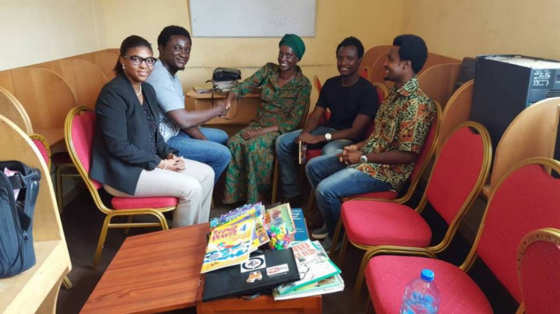
HAG making a presentation of books, teaching materials and a laptop to Learning Support Solutions for the Kotobabi cluster of schools, Accra
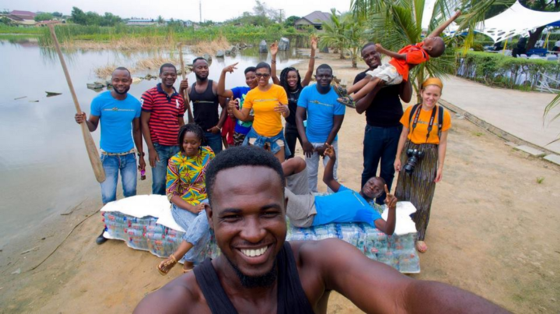
Float your boat race Environmental awareness event
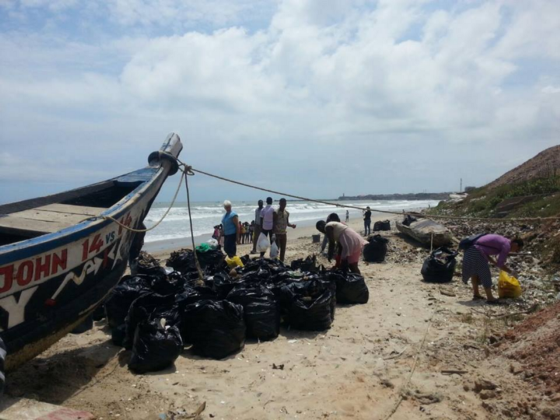
HAG members at a beach cleaning exercise

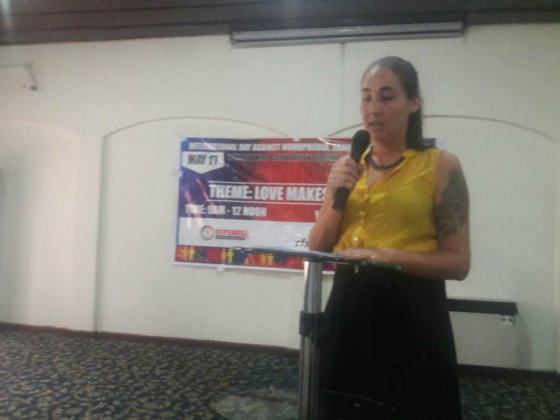
HAG member, Carly giving a presentation at the event marking International day against Homophobia, Biphobia and Transphobia in Accra.
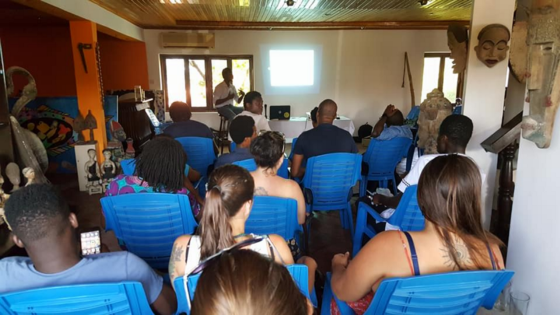
At a HAG meeting discussing Food Security
License
In-Sight Publishing by Scott Douglas Jacobsen is licensed under a Creative Commons Attribution-NonCommercial-NoDerivatives 4.0 International License. Based on a work at www.in-sightpublishing.com.
Copyright
© Scott Douglas Jacobsen and In-Sight Publishing 2012-Present. Unauthorized use and/or duplication of this material without express and written permission from this site’s author and/or owner is strictly prohibited. Excerpts and links may be used, provided that full and clear credit is given to Scott Douglas Jacobsen and In-Sight Publishing with appropriate and specific direction to the original content. All interviewees and authors co-copyright their material and may disseminate for their independent purposes.
Share this:

Author(s): Scott Douglas Jacobsen
Publication (Outlet/Website): Medium (Humanist Voices)
Publication Date (yyyy/mm/dd): 2019/05/03
Young Humanists International or YHI has openings upcoming. If you live on the Earth and are between the ages of 18 and 35, you are eligible to run for the positions.
There is a small and dedicated staff with over 50 volunteers from around the world permitting the operations of HI, or Humanists International, which means a smaller cohort for YHI.
Duly note, these are voluntary roles on the International Executive Committee or EC of YHI. Deadline for applications is May 14, 2019.
These posts will be elected in the General Assembly in Reykjavik, Iceland. If you apply, you do not need to be able to attend the General Assembly itself. All positions in the EC are volunteer positions.
- Download the role description for Vice-President of Young Humanists International
- Download the role description for Secretary-General of Young Humanists International
If you have any questions about Young Humanists International or the roles up for elections, please contact president.young@humanists.international or the current President, Marieke Prien.
More information in the link below:
License
In-Sight Publishing by Scott Douglas Jacobsen is licensed under a Creative Commons Attribution-NonCommercial-NoDerivatives 4.0 International License. Based on a work at www.in-sightpublishing.com.
Copyright
© Scott Douglas Jacobsen and In-Sight Publishing 2012-Present. Unauthorized use and/or duplication of this material without express and written permission from this site’s author and/or owner is strictly prohibited. Excerpts and links may be used, provided that full and clear credit is given to Scott Douglas Jacobsen and In-Sight Publishing with appropriate and specific direction to the original content. All interviewees and authors co-copyright their material and may disseminate for their independent purposes.
Share this:
Author(s): Scott Douglas Jacobsen
Publication (Outlet/Website): Medium (Humanist Voices)
Publication Date (yyyy/mm/dd): 2019/05/01
Zarinah Abdullah is a Member of Malaysian Atheists and Secular Humanists. Here we talk at in-depth about her life, work, and views.
Scott Douglas Jacobsen: Let us talk about some prior life for you, only need to speak about it, and to the extent that, you feel comfortable, of course. How was upbringing for you? Was education oriented around the secular public school system or the religious school system?
Zarinah Abdullah: I have to declare first that I grew up in Singapore, a secular country, in the 90s. As such, education was very much secular, especially since I went to government schools. However, I did receive religious education outside of my normal curriculum at a Madrasah — which is an Islamic religious school. I had a relatively strict Islamic upbringing, but because life in Singapore was secular for the most part, I was not coerced or pressured to wear the hijab. I did, however, dress conservatively according to Islamic standards of modesty for girls and women (long sleeved tops and bottoms where applicable).
The thing is that in Singapore, students in schools all wear short-sleeved shirts or skirts (for girls). Only boys in upper secondary wear long pants — this trend is the same for the whole of Singapore (maybe some exceptions exist, I am not sure). For P.E, we all wore round necked, short sleeved shirts with shorts. So regardless of your race or religion, you had to abide by the secular dress code in Singapore. However, sometimes Muslim students could request to wear long PE pants approved by the school. I opted to do so for modesty reasons.
Jacobsen: How was this educational system conducive, or not, to a more secular outlook on the world?
Abdullah: There were some times then that I felt like it was in conflict with my beliefs and understanding of modesty. However, as I grew used to it, it did not matter much to me — when I studied at a tertiary institution without a dress code, I opted to dress “modestly”, which got less modest as I grew older. I will admit that I was cocooned in a very strict, religious bubble, especially in my family.
That, coupled with my lack of exposure to the world outside of Singapore, resulted in very backwards and conservative beliefs that I kept with me until I grew up and decided to leave for, ironically, Kuala Lumpur in Malaysia. That was where my real emancipation began, as I was bereft of the grasps of religious shame and tyranny of my religious mother. I began to make friends with people outside of my circle, I befriended and learnt from atheists, learnt about atheism, and questioned Islam.
I still held strong Islamic beliefs during that time of adulthood, but it was getting harder and harder to reconcile the sexist, misogynistic, unjust teachings of Islam with my ethical and moral compasses. In summation, the educational system in Singapore did not do much to influence my outlook on the world. The main factor was actually my family.
Jacobsen: Within Malaysia, given its 20th into 21st-century development, what has been its merits and demerits regarding safety and security for its more secular or non-religious oriented members?
Abdullah: The important thing to understand about Malaysia is that it is still a highly conservative, majority Muslim country. As such, the majority of the population, who are Malay Muslims, are still not open about or understanding about the existence of people who do not believe in God. There is a ‘code of conduct’ of sorts for Malaysians — called the Rukunegara (National Principles), which demands ‘Belief in God’ as one of its tenets. While the Rukunegara is by no means a legal document, it was made with the intention to ‘guide’ the behaviour of Malaysians and foster cohesiveness amongst the different races. It was made by leaders after racial and religious unity here was threatened by the infamous 13 May 1969 riots.
Now that we have understood that historical context, let us fast forward to recent years. The change of government in the momentous 2018 elections from Barisan Nasional (BN) to Pakatan Harapan (PH) has done little to push for positivity or even safety for the non-religious. In fact, PH has even restructured its religious department to come directly under the Prime Minister’s department, signifying its importance.
The PH government still panders to the majority race — Malay Muslims, because they are the biggest voting base. Many urban voters and residents live in an echo chamber where they think that the country is secularising or being more religiously free. This cannot be further from the truth, because most Malaysians are not living in the highly urban KL or Selangor. Your everyday Malaysian still believes LGBTs are abnormal and sinful, and that those who are not Muslim are sinning, for example.
This is exacerbated by the far right extremist politics in states such as Kelantan and Terengganu, where you will find most residents to be very orthodox Muslims with very problematic, wahhabist ideas. Malaysia has blasphemy laws codified in its constitution, and various other laws in the Syariah as well. In fact, under the new PH government, they are tabling three new bills: the Anti-Discrimination Act, National Harmony and Reconciliation Commission Act and the Religious and Racial Hatred Act, all of which criminalise ‘insults’ to Islam or religion. In fact, we already have had people hauled up through the sedition act for sharing pictures of prophet Muhammad.
The PH government is serious about clamping down on people who criticise or insult Islam. I guess as long as you do not publicly criticise or insult Muslims and Islam (or other religions), nothing can legally be done to you for being non-religious. However, this does not extend to those who are born Muslims (because Muslims are identified on their ICs), who are governed automatically by each state’s respective Syariah laws.
In some states, apostasy can carry the death penalty (but not practiced), and in most other states, it carries criminal punishments such as a fine, or being thrown to an Islamic rehabilitation centre (IRC). It is a running joke amongst non-religious circles that non-Muslims have more rights to freedom of religion than born Muslims. As long as you keep your head low and avoid publicity, the Islamic religious authorities won’t come after you.
So in terms of safety for non-religious Malays, it’s pretty bad over here because not only do they have to live in fear and silence, they are forced to adhere to social expectations such as fasting or Friday prayers, which affect the men more severely than women. We have things such as Ramadan patrols by Islamic authorities who deliberately go to eateries to ‘catch’ Malays eating during Ramadan.
In some states, if you are caught not going to Friday prayers, you can be fined. And I have not even touched on the social ostracisation they face from their friends, families and colleagues!
Jacobsen: How did you find, become involved in, and begin to contribute to the Malaysian Atheists and Secular Humanists (MASH)?
Abdullah: I’ve been on a journey to irreligiousity for years; I started as a typical Sunni Muslim, then I rejected the hadiths and became a Quranist because I’m a feminist, and then when I couldn’t reconcile the misogyny in the Quran and the concept of a powerless God, I discovered irreligiousness.
I was in several atheist groups on Facebook (yes, they exist), and made friends with decent people. I got tired of the main atheist group in Malaysia (cannot name it for privacy reasons) because of the toxicity and misogyny of the people there — I call them asshole atheists — and sought friendships with more humane non-religious people.
Currently, I consult with MASH in terms of operations, strategy and communications. MASH members are all humanists first, and it is an important distinction we make because we don’t want people who don’t give two shits about other people in our group. We are all feminists, for instance.
We realised our ethics and moralities were human-first, in a do-no-harm way, that is in line with respect and dignity for all human beings. All of us prefer reason, science and logic to drive our decisions — so Humanism was a natural thing for us to embrace. We then banded together, and from a social group, MASH became little more formal.
We got our constitution up, we thought about our aims, and found that Malaysia needed a reputable and reliable voice of reason from the non-religious, humanist community. We are not the typical religion-hating angry atheist with a bone to pick with Muslims — we believe coexistence is definitely doable, and much preferred, but our priority is to represent atheistic and secular humanist voices in the community.
We embrace diversity and humanity, and some of our planned programmes are meant to be inclusive of both religious and non-religious people. We respect where respect is deserved, and we criticise where criticism is needed.
Jacobsen: What are some of the major initiatives and community events for MASH?
Abdullah: So far, we have co-hosted a couple of debates, the most recent one was on the topic “Does God exist?”. However due to impending structural reshufflings and a lack of funding (because we are not exactly formally registered yet), we don’t have the capability to host full-on events.
We are exploring community-building events, however, working the grassroots to help the disadvantaged — it reduces costs on our side and we get to help the people who really need it. Once we are more financially stable, we MAY plan to bring events such as forums to the public space.
But even so, we might face problems finding speakers, and risk being scrutinised by the public. We do have a real fear of being investigated by the police and Islamic religious authorities for doing so as well. So it’s a risk we are still weighing.
Jacobsen: What are the major human rights concerns for Malaysian Atheists and Secular Humanists?
Abdullah: Definitely the safety of our Malay, Muslim-born atheist members. Some of them are loud n proud in their school/personal lives, but because they are so culturally Malay/Muslim, they face challenges from the religious authorities who are actively clamping down on Muslims who do not “behave” like Muslims, as well as their families.
Some of them even have been betrayed by their family members or schoolmates and brought in for questioning by the religious authorities. They are suffocated in Malaysia, being unable to live their lives as non-religious people publicly, a privilege the non-Muslims in Malaysia are afforded, and being silenced for speaking their minds out.
While it is true that non-Malay/Muslims in Malaysia generally have lesser privileges than Malay/Muslims, when it comes to freedom of belief, the born-Muslims who are non-religious are the most persecuted and oppressed.
Jacobsen: How can individuals help with the international implementation of human rights frameworks to protect freethinkers there?
Abdullah: In the last UPR in Geneva, a country (cannot remember which one) suggested in their recommendation for Malaysia, to remove the religious status in the citizen’s identification card. That is a move we can get behind because there is no reason only Malay/Muslims should be singled out to have their religion printed on their ICs — it only perpetuates criminal action against them if they choose not to behave as a ‘Muslim’.
The government and states should never be able to dictate how citizens should religiously behave — religion is a personal endeavour and should rightly remain personal, not institutional. However, the government has made it clear that they would not be allowing this because apparently it would be in conflict with the ‘special position’ of the Malays as per the constitution. I do not understand that argument, but our politicians often say things that don’t make sense anyway. *shrugs*
Jacobsen: Who are prominent Malaysian freethinkers, men and women, who deserve more exposure?
Abdullah: *laughs* we do not really have any ‘prominent’ freethinkers per se; firstly, they won’t have much of a following, and secondly, they risk courting trouble with the police. We do on occasion, have individuals speaking up on Twitter (sorry I do not want to share their handles because I don’t want to unnecessarily draw attention to them) or sending in op-eds to the Malay Mail about secularism.
We do not have a Richard Dawkins or Christopher Hitchens here — they would be hauled up by the police and charged under the sedition act if they so much as question Islam. MASH aims to grow, however, to approach secularism and humanism, CAREFULLY, within a Malaysian context, taking into account her history and religious climate.
This means we cannot actually do much now because the Muslims here are super antsy about religion, and the government is more than ready to be trigger happy on clamping down on non-religious discourse in Malaysia, especially if they feel Islam is in any way threatened. Even MASH is somewhat anonymous, operating under the radar of the Islamists on social media.
There’s one prominent secularist and lawyer, Siti Kasim, who has made it her life’s mission to fight against Islamists and the religious authorities in Malaysia. But she’s Muslim herself, not a freethinker, however. She is known for speaking up for the rights of Orang Asal (aboriginals).
Jacobsen: What are good books and speeches on the Malaysian brand of freethought?
Abdullah: Not that I know of.
Jacobsen: Any final thoughts or feelings in conclusion?
Abdullah: Malaysia has a long way to go towards freedom of belief. There are already NGOs such as Sisters in Islam and COMANGO that have been working for years to address the lack of FoRB here, but they have their hands tied.
I think we can only make more headway when more of the population decide to embrace secularism and non-religiousity more. Many Malay/Muslims still think it is impossible for a Malay to be an atheist and react aggressively towards such persons, but rest assured, there are atheist Malays, and there are quite a number of them. They are hiding amongst you because they’re scared.
It is this climate of fear that irks me the most here. One more thing — the rich and well-connected Malay Muslims can drink, fornicate and gamble as much as they want, but when it comes to the common man, there are suddenly khalwat raids or syariah crimes to answer for.
It has not right, and nobody should be religiously policed to begin with, Islam or not. But fear is what drives politicians and institutions of authority, either to control people or exert their power and influence; and over here, it is fear of Islam and Malays losing power. Malaysia has so much opportunity to succeed and become a high performing nation with quality talent but is held back by racial and religious politicking and control. It is unfortunate.
Jacobsen: Thank you for the opportunity and your time, Zarinah.
License
In-Sight Publishing by Scott Douglas Jacobsen is licensed under a Creative Commons Attribution-NonCommercial-NoDerivatives 4.0 International License. Based on a work at www.in-sightpublishing.com.
Copyright
© Scott Douglas Jacobsen and In-Sight Publishing 2012-Present. Unauthorized use and/or duplication of this material without express and written permission from this site’s author and/or owner is strictly prohibited. Excerpts and links may be used, provided that full and clear credit is given to Scott Douglas Jacobsen and In-Sight Publishing with appropriate and specific direction to the original content. All interviewees and authors co-copyright their material and may disseminate for their independent purposes.
Share this:
Author(s): Scott Douglas Jacobsen
Publication (Outlet/Website): Medium (Humanist Voices)
Publication Date (yyyy/mm/dd): 2019/04/30
Mr. Tatt Si Tan is the President of the Humanist Society (Singapore). Here we get to know his story a bit.
Scott Douglas Jacobsen: Let’s start with some background. What is your geographic, cultural, linguistic, and religious/ nonreligious upbringing?
Tatt Si Tan: I’m the 2nd Generation born in Singapore, from China (Hainan Island) immigrant grandparents. Chinese cultured and educated, my family’s religion bordered on Taoism to Chinese Folk religion.
At 16-years-old. my comfort in my own backyard was uprooted, heading to Toronto, Canada, for my Grade 13 senior high school, subsequently four years in Edmonton, Canada, for an electrical engineering degree.
I’m next to native in English, fluent in Chinese and its various official and dialect forms, and the regret is still not having picked up the endearing Canadian-French language after all these years.
Jacobsen: How does this impact a personal perspective on life? Were pivotal educational experiences important to intellectual development towards a humanistic one?
Tan: I saw the world outside of tiny Singapore, at a very young age, an age when I was most receptive, a time when critical thinking was given many stimuli from all over. There were a duty and responsibility not to squander this overseas opportunity, and to set a direction for my three younger sisters, all of whom also followed my footsteps to a Canadian education.
There was never pressure of acceptance by the gracious Canadians, and religion wasn’t necessary for real friendship there. Teenage years alone in a foreign land, I had a lot of growing up to do, to take care of myself and help subsequent freshmen.
I feel that my own experience of dealing loneliness in the bitter cold of winter, and drawing on mental strength were really important grafts, the seedling being the morality imparted by various cultures I experienced. Action speaks loudest.
Jacobsen: Why was the Humanist Society (Singapore) founded in the first place? What were the founding principles and guiding objectives? Have those changed over time?
Tan: While I’m not a founding member, HSS was founded at the back of Singapore’s most famous religious-agenda-creeping-into-public-space incident — The AWARE Saga. In short, it was about a Christian church taking over a women’s organization, to stop girls from being informed of the different sexual and gender complexities in the world.
Our continued presence is still important: while the government professes secularity, it being an edict does not help people understand why it is important to have a secular society.
Meanwhile, the Nones continued to be viewed with little or no moral compass, and the perceived infusion of LGBTs into the rungs of non-religious made the latter group even more immoral than before. Humanism needs to stake our moral and open stance, to dispel myths and dogmas.
Jacobsen: In terms of the ways in which humanism is seen in Singapore, as per the general population’s perspective on it, how do they see it? Or is it simply something below the general public’s radar?
Tan: Humanism is still a new concept in Singapore, and most only know a part of it by other names: atheism, agnosticism, freethinkers, critical thinking, etc. There is a positive, life-affirming side of humanism that is only beginning to be appreciated by more, and it took us 10 years to get to this stage.
Jacobsen: Singapore consistently scores the highest or among the highest in the world on metrics of educational outcomes of its young people. Humanism aims for education and knowledge about the natural world.
In a natural way, humanism seems perfectly suited to the educational context and outcomes of Singaporean youth. Do you think this could provide fertile ground for humanism to take hold in Singapore in society more and more into the 2020s?
Tan: Education, is just the acquisition of knowledge. Without internalizing that knowledge and using it flexibly to advance good causes, there is little wisdom in society. While there may be similar dynamics between Singapore and what it takes for humanism to get popularised, we have to understand that religions are tribal; and in Singapore, some religions are social status symbolisms.
Coupled with religions being generally better at organizing social and safety net programs, humanism must step up, not only by using our rather condescending tone of “science rules all” and “compassion because I am more privileged than you,” we must begin to evoke more passion in what we do, and to affect others by doing humanly works of love, opposite the religious invoking (un)conditional supernatural love.
Jacobsen: As the president, what are your tasks and responsibilities? What are the most difficult things or trying things in the job? And what are the most enjoyable and fulfilling, and rewarding, aspects of the position?
Tan: I can only speak for my presidency, which is to challenge paradigms, even from within HSS, because we are too used to conventional ways of working. Through the help of other volunteers like me, HSS has become wider in engagement, steeped in more subjects and issues, and more open with new ideas of bringing our good deeds to the greater society.
Dealing with people, isn’t easy, but can be the most rewarding. It sometimes feels like the end of the world (which is a big deal for those with only one life to live) when we couldn’t agree with each other, but when we step back, to realize we can all do with a little “not being easily offended,” we step right back, and on with the show. I’ve been privileged to work with people who think and work this way.
Jacobsen: Who are other important Singaporean Humanist or humanistic oriented ethical voices?
Tan: There are many who are probably closeted, or feel that pronouncing their non-religion don’t help with their cause or work. Thankfully, we find that even some religious people can wear the humanist moniker, especially when they de-emphasize the supernatural part of their belief system.
Jacobsen: How can people become involved with HSS through membership, donations, access to professional networks or skills, and so on?
Tan: www.humanist.org.sg, and our FB page.
Jacobsen: Any recommended authors or speakers from Singapore that take on either a Humanist or a Humanistic lens?
Tan: Top of my head, the two “Humanist of the Year” recipients Ms. Catherine Lim and Mr. Alex Au. Ms. Lim is the most celebrated writer here. Mr. Au is a social worker, blogging on https://yawningbread.wordpress.com/.
Jacobsen: Any final feelings or thoughts in conclusion based on the conversation today?
Tan: The more successful we get, the more people might feel complacent about the religious dynamics in society. Religion is not our enemy, but we can be in religions’ crosshairs. Our nascent popularity belies a stronger and opposite force that pushes us into dogmatic ways, which is something we must grapple with, and be self-critical of.
Jacobsen: Thank you for the opportunity and your time, Mr. Tan.
License
In-Sight Publishing by Scott Douglas Jacobsen is licensed under a Creative Commons Attribution-NonCommercial-NoDerivatives 4.0 International License. Based on a work at www.in-sightpublishing.com.
Copyright
© Scott Douglas Jacobsen and In-Sight Publishing 2012-Present. Unauthorized use and/or duplication of this material without express and written permission from this site’s author and/or owner is strictly prohibited. Excerpts and links may be used, provided that full and clear credit is given to Scott Douglas Jacobsen and In-Sight Publishing with appropriate and specific direction to the original content. All interviewees and authors co-copyright their material and may disseminate for their independent purposes.
Share this:
Author(s): Scott Douglas Jacobsen (based on Arabic to English translation by
Melissa Krawczyk)
Publication (Outlet/Website): Medium (Humanist Voices)
Publication Date (yyyy/mm/dd): 2019/04/28
The Arabic script is at the bottom.*
To the community of international dissidents and writers, one important Saudi voice is a freethinker, blogger, and humanitarian Raif Badawi.
He has been in jail in Saudi Arabia for the use of the right to freedom of expression provided by the United Nations. However, and unfortunately, he has been in jail for using it.
It is based on religious law, as in blasphemy for purportedly insulting Islam — not Muslims — but the religion. Now, he is 35-years-old.
Some background. He founded Free Saudi Liberals in order to write, freely. In the midst of doing so, he was found to have insulted the religious hierarchs, and so the religion.
The main, specific, charge is the insulting of Islam through electronic channels. As a result, and most recently in January 2019, Badawi was flogged 50 times over 5 minutes in public, in Saudi Arabia.
Badawi has a wife and children. His wife’s name is Ensaf Haidar. She came from a conservative Saudi family, and lives in Canada now. She speaks on human rights and for the freedom of her imprisoned husband, Badawi, too.
When she described her earlier life, she talked about memorizing the Quran during early life studies. Then she spoke about specializing in Islamic Studies in college.
She considers, and others do too, her husband to be a prisoner of conscience. He is in prison in Saudi as such. Haidar is the mother of three children and living in Quebec.
Her husband’s case is important because it’s a) her husband, b) to do with freedom of expression and human rights, and c) the inflicting of the state onto dissidents and writers.
Haidar explained how this creates a culture of fear in Saudi. In fact, the prisons in Saudi Arabia are packed with writers. On the question of Canadian support for human rights, Haidar was positive.
She said, “I think that the politicians in Canada are doing a wonderful job. Canada has always been strong and open about defending human rights, not only in Saudi Arabia, but all over the world.”
There is a fear of theocrats or theocratically minded individuals and states over writers and the use of freedom of expression. This is an important point bearing in mind in the current period of repression and killing of journalists.
Haidar was reminded, by the questions, about the famous Saudi writer Abdullah al-Qasemi who said the worst aspect of the religious comes from intolerance for intellectuals and intolerance for corruption.
She sees the important point for everyone is to continue to have the conversations, to speak loudly and broadly on human rights, and to put pressure on the political class to do something about rights violations, including the case of Badawi.
I asked about the distance with Badawi and the feelings. Haidar opined, “There are no words in the world that can possibly describe my feelings about Raif and what is happening to him.”
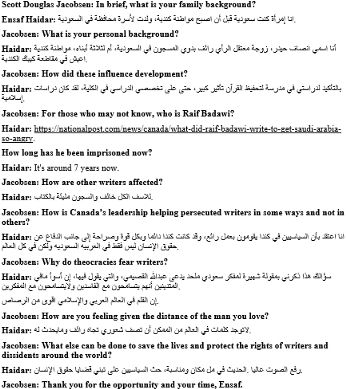
License
In-Sight Publishing by Scott Douglas Jacobsen is licensed under a Creative Commons Attribution-NonCommercial-NoDerivatives 4.0 International License. Based on a work at www.in-sightpublishing.com.
Copyright
© Scott Douglas Jacobsen and In-Sight Publishing 2012-Present. Unauthorized use and/or duplication of this material without express and written permission from this site’s author and/or owner is strictly prohibited. Excerpts and links may be used, provided that full and clear credit is given to Scott Douglas Jacobsen and In-Sight Publishing with appropriate and specific direction to the original content. All interviewees and authors co-copyright their material and may disseminate for their independent purposes.
Share this:

Author(s): Viola Namyalo (AfWG Chair, YHI) and Scott Jacobsen (VP, YHI)
Publication (Outlet/Website): Medium (Humanist Voices)
Publication Date (yyyy/mm/dd): 2019/04/26
What are humanist ceremonies?
For one to understand these ceremonies, it is important to understand what humanism is and who humanists are, as they exist in many societies in the world. Although, humanists may not be a major player in the world of life stances. Their core values can be seen in many dominant religions and life stances
What is Humanism? Who are humanists?
Humanism is a tradition based on reasoning. It is founded on the ethic of the wellbeing of every human being in the world. Humanism focuses on humanity and human interests. It implies thinking for yourself, doing your own thing, and accepting the results. In short, a respect for personal autonomy and an expectation of personal, and social, responsibility.
Its bases are anti-dogma if not non-dogmatic. It doesn’t believe statements without evidence. It does not impose beliefs or laws on people. Its emphasis is on reason and evidence. In part, this can explain the basis for humanists rejecting the supernatural, e.g. gods, angels, devils, and so on. In other words, humanism as a philosophy rejects the supernatural in all forms.
Since humanists don’t subscribe to the religious ideology, they celebrate their occasions including weddings ceremonies, funeral ceremonies, baby naming and all other celebrations in a secular manner.
The reason for this is humanists believe in the importance of celebrations without the supernatural. These ceremonies are known as Humanist Ceremonies. They are officiated or celebrated by humanist celebrants.
Humanist celebrants serve to provide humanists with a joyous and memorable ceremony. Humanist Ceremonies are unique because they are constructed with the wants of people in mind. These ceremonies can be celebrated in various venues including beaches, hotels, forest parks, and many more depending on the desires of the individuals planning the ceremony or event.
Do we have humanist ceremonies in Africa?
The good news, African humanists have had several humanist ceremonies. African had several wedding ceremonies in Ghana, Kenya, and South Africa. We have had one humanist funeral in Uganda. The reactions have been consistently positive; hence, we are hoping for more.
We have humanist celebrants in more than ten countries in Africa including Uganda, Kenya, Tanzania, Rwanda, Burundi, Nigeria, Ghana, South Africa, Zimbabwe, Malawi, and Sierra Leone. Thanks to the Humanist Association for Leadership, Equity and Accountability (HALEA) and their partners, including Humanist Society Scotland, for letting this happen for us.
Humanist marriages are not legal in Africa at present. However, different organizations in different African Countries are struggling to do this. The Humanist Association for leadership Equity and Accountability (HALEA) is in the struggle to legalize humanist marriages in Uganda. You can follow them on Facebook at humanist ceremonies Uganda to be update on events and activities.
The future of humanist ceremonies remains promising, especially with the number of humanists in Africa growing following the disappointments of adherents to formal religions. No doubt, humanist ceremonies promote humanism further through enabling humanists to put humanism more into practice.
We remain optimistic and hopeful of the further introduction of humanist ceremonies in Africa and its diaspora, where many skeptical people will embrace humanism. This is a trust in the power of the values of humanism to change the relationships of human beings to one another without the magical while keeping the wonder alive.
License
In-Sight Publishing by Scott Douglas Jacobsen is licensed under a Creative Commons Attribution-NonCommercial-NoDerivatives 4.0 International License. Based on a work at www.in-sightpublishing.com.
Copyright
© Scott Douglas Jacobsen and In-Sight Publishing 2012-Present. Unauthorized use and/or duplication of this material without express and written permission from this site’s author and/or owner is strictly prohibited. Excerpts and links may be used, provided that full and clear credit is given to Scott Douglas Jacobsen and In-Sight Publishing with appropriate and specific direction to the original content. All interviewees and authors co-copyright their material and may disseminate for their independent purposes.
Share this:
Author(s): Scott Douglas Jacobsen
Publication (Outlet/Website): Medium (Humanist Voices)
Publication Date (yyyy/mm/dd): 2019/04/26
Scott Douglas Jacobsen: What is some brief background of you?
Mike Golash: I have been active in the fight against US imperialism in Latin America for over 50 years. Opposed the boycott of Cuba, fought against US invasion of Grenada, opposed US support for the contras in Nicaragua and the rightist in El Salvador and the US efforts to undermine the Aristide government in Haiti.
Jacobsen: What is the Latin America & Caribbean Action Network — LACAN?
Golash: It is an advocacy group opposing US intervention in Latin America both militarily and economically.
Jacobsen: How did you find the Latin America & Caribbean Action Network — LACAN?
Golash: Through my relations with the immigration reform movement.
Jacobsen: What is your role as the Facebook Administrator of the Latin America & Caribbean Action Network — LACAN?
Golash: Making sure the posts follow the policies of LACAN.
Jacobsen: As a feminist organization and fighting against racism, how does this work within the context of the support for migrants and the general public?
Golash: Current US policy on immigration disproportionally affects women and people of colour. this is particularly true when it causes the breakup of families.
Jacobsen: What are the main sources of solidarity for feminism, anti-imperialism, and anti-racism in the Caribbean and Latin America?
Golash: At the moment we are mainly centred on the US attempt to replace the Maduro government in Venezuela and its support for the neo-fascist government in Brazil.
Jacobsen: Thank you for the opportunity and your time, Mike.
License
In-Sight Publishing by Scott Douglas Jacobsen is licensed under a Creative Commons Attribution-NonCommercial-NoDerivatives 4.0 International License. Based on a work at www.in-sightpublishing.com.
Copyright
© Scott Douglas Jacobsen and In-Sight Publishing 2012-Present. Unauthorized use and/or duplication of this material without express and written permission from this site’s author and/or owner is strictly prohibited. Excerpts and links may be used, provided that full and clear credit is given to Scott Douglas Jacobsen and In-Sight Publishing with appropriate and specific direction to the original content. All interviewees and authors co-copyright their material and may disseminate for their independent purposes.
Share this:
Author(s): Scott Douglas Jacobsen
Publication (Outlet/Website): Medium (Humanist Voices)
Publication Date (yyyy/mm/dd): 2019/04/16
Ding Jie “DJ” Tan is the Vice-President of the Humanist Society (Singapore). Here we talk about his life, work, and views.
Scott Douglas Jacobsen: Let’s talk about some background. What was personal and family background? How did this influence personal development? How did this eventually influence of personal life stance and worldview, especially in humanism?
Ding Jie “DJ” Tan: I grew up in a conventional Singaporean household. My parents subscribed to the traditional Chinese folk religion and were nominally Buddhists, though they may have considered themselves ‘free thinkers’ too. I attended a Catholic primary school (elementary school) and, like most Singaporeans, was exposed to the existence of different religions. This awareness of religion, coupled with my interest in the sciences would later help solidify my rejection of mainstream religious beliefs when I was 10-years old.
This rejection of religion was often viewed as the mere angst of a rebellious youth. Singaporeans, family and friends included, tend to perceive outright claims of atheism as ‘rocking the boat’, and may lean towards communal harmony, tradition, and superstition over broad overarching statements of facts which may not have a tangible impact on their day-to-day routine. While I identified as an atheist, I only found out about humanism when I joined the Atheist, Secularist, and Humanist Society in UCL, where I was the Secretary for two years.
Jacobsen: How did you find the Humanist Society (Singapore)? As the Vice President, what tasks and responsibilities come with the position? Since the organization’s founding, what have been positive developments for it?
Tan: Having served as an Executive Committee Member in the Humanist Society (Singapore) for the past two years, I felt that I could contribute more to the administration and leadership of the larger Society. Every individual brings a slightly different flavour to their roles in the Executive Committee; my interests are in science communication as well as in fostering inter-faith and inter-belief relations.
The Society has been around since 2010. Throughout our founding years, we have strived to provide a community of like-minded friends for the non-religious in Singapore. As we matured, we have also developed a voice in mainstream and online media, so as to better present the views of the non-religious and to preserve the secular common space in Singapore.
Jacobsen: What is the religious landscape, and non-religious landscape, of Singapore?
Tan: Singapore has long identified herself as a multi-ethnic, multi-religious, and multi-cultural nation-state. According to the last population census in 2010, 44 % of Singaporeans identified as Buddhists, 18 % as Christians, 17 % as non-religious, and 15 % as Muslim.
Jacobsen: For the main celebratory events per year: Humanist of the Year Award, Darwin Day and the Winter Solstice, what happens with each celebratory event? What are some upcoming plans for HSS for 2019/2020? How can people become involved in HSS?
Tan: The commemoration of festive occasions is steeped in human civilisation and rituals. Various Chinese cultures, as well as Christian societies, celebrate Winter Solstice in one form or another. The HSS does this by organising an annual get-together, for our members to mingle, eat, drink, and be merry.
Darwin Day is usually a more academic affair. Past iterations of the Day have included a visit to the local natural history museum, a guided walk of the local park, as well as lectures on the history of biodiversity in Singapore.
This year, HSS will be hosting AHC 2019. We are happy to have volunteers on board to help us with the programme, logistics, and sponsorship! We also hold monthly socials for members to socialise in a more casual setting, over drinks.
Jacobsen: Any recommended authors or speakers?
Tan: Richard Dawkins, AC Grayling, Bill Nye, Stephen Hawking, Christopher Hitchens
Jacobsen: Thank you for the opportunity and your time, DJ.
License
In-Sight Publishing by Scott Douglas Jacobsen is licensed under a Creative Commons Attribution-NonCommercial-NoDerivatives 4.0 International License. Based on a work at www.in-sightpublishing.com.
Copyright
© Scott Douglas Jacobsen and In-Sight Publishing 2012-Present. Unauthorized use and/or duplication of this material without express and written permission from this site’s author and/or owner is strictly prohibited. Excerpts and links may be used, provided that full and clear credit is given to Scott Douglas Jacobsen and In-Sight Publishing with appropriate and specific direction to the original content. All interviewees and authors co-copyright their material and may disseminate for their independent purposes.
Share this:
Author(s): Roslyn Mould & Scott Douglas “Nana Kwesi” Jacobsen (Ashanti)
Publication (Outlet/Website): Medium (Humanist Voices)
Publication Date (yyyy/mm/dd): 2019/04/11
Extreme poverty is a problem around the world defined by the UN as “severe deprivation of basic human needs, including food, safe drinking water, sanitation facilities, health, shelter, education and information” by the United Nations in 1995. Ghana is a West African country that was the first African country to have gained Independence from the British Colonials on the 6th of March, 1957. Having been through Democratic ways of government and transitioning power, Ghana has also experienced, a number of coup d’etats, the last one being that of Jerry John Rawlings when he was sprung out of custody after his first coup attempt 4th June, 1979. Despite being a country of massive wealth and resources ranging from Minerals like Gold, Bauxite, Manganese, one of the top Tourist destinations in Africa, Agricultural wealth such as 2nd largest exporter of Cocoa and having huge petroleum deposits, Ghana is a 3rd world developing country with issues of extreme poverty.
Under Military rule, Ghanaians were subjected to injustices, where even freedom of expression was curtailed or stifled until he handed over democratically in the year 2000.
Ghana has achieved appreciable steady growth levels since the late 1990s to the present day, such growth has translated much into lifting many people out of poverty. There has been a general rise in income levels for both the wealthiest and the poorest, however, this increase in income levels has been highly unequal and for many people, they have in fact gotten poorer and more vulnerable.
Growth has benefited the rich extremely more than it has done for the poor. Despite attaining a middle-income status, the rate of population growth has outpaced the number of people getting out of extreme poverty. We now have a situation where more people are born into poverty than people are escaping poverty. A child has a higher chance of living in poverty than an adult. The growth of the Ghanaian economy has not been even either. Urban residences are less likely to be living in extreme poverty than rural dwellers. This translates into a worrying state of affairs where the North of the country is predominantly poor and the South is relatively better. The economic disparity between the North and the South of Ghana has actually worsened since the early 1990s.
Not uncommon to other economies, the problem of extreme poverty has a gender dynamic to it. The majority of people suffering from extreme poverty are women and children. They bear the brunt of this increasing problem. The biggest problem facing people living in extreme poverty are numerous, the most important among them is the inability to afford decent and well-balanced diet, especially for rural dwellers. Urban dwellers are in also affected by poor nutrition, usually manifesting in the rising obesity problem and malnutrition in children. Rural poverty has consistently lead to the youth of those areas migrating to urban centers to seek menial jobs. With their low employable skills, they work harder and get paid less and since they cannot afford decent housing, they end up as squatters in slums such as those in Agbogbloshie, Ashaiman, Suame, etc. Most also engage in dangerous jobs like scavenging for e-waste products which they burn to retrieve minute rare metals. The burning process is hazardous work, exposing them and the environs to heavy metals, which reduces their life expectancy and quality of life. As folks move away from rural centers where the majority of farming output comes from, these areas are stripped of the manpower to grow food, transport foodstuffs and sustain agriculture that sustains the country.
Urban centers have a slightly different dynamic to rural areas. Urban centers have the characteristic of having its poor unable to afford decent housing, unemployment etc.
It is common rhetoric in Ghana to hear people say that justice is for the rich and those who can afford to pay for litigation. Access to opportunities depends on who you know. This allows for a situation where the poor can’t afford to access the judicial system for wrongs done them to seek justice. They let it go and injustice goes unchallenged. As such, people deliberately trample on the rights of fellow citizens knowing that they cannot afford to follow up with the court process. Police officers regularly abuse people and get away with it, they detain persons without due process. There’s a general lack of confidence in the security services of Ghana among citizens. Many prefer to not deal with the police at all.
Gaining employment and general opportunities is also constrained by how one is connected to people in higher places. This situation locks the poor in a vicious cycle of never-ending poverty that is extremely hard to escape. To gain employment often requires that one person pay a bribe to someone to connect you to someone to make it happen. The inability of parents to secure a reasonable income leads to them having to let their young children below the legal working age engage in labour to help sustain their families. These children are almost always exploited, sexually notwithstanding. These children spend school hours on the street hawking which translates in poor performance in school and some ultimately drop out of school and engage in full-time labour to feed themselves and their families. Girls are likely to engage in prostitution or other forms of the sex trade to sustain themselves. They often end up being teenage mothers themselves or as ‘carriers’ locally known as ‘kayayei’ in the marketplaces for carrying heavy loads on their heads for a small fee and the whole cycle starts for the next generation.
Access to quality healthcare depends on one’s ability to pay for it. Though the National health insurance scheme has been in operation, some health facilities have openly declined offering services on it and only hard cash is accepted. A situation that effectively bars a large section of the population from accessing health services. To compound the problem, there are not enough Doctors, hospitals and facilities giving the rise to superstition and witchcraft accusations that lead to people seeking alternative means of cures from Faith healers and fetish priests. Since extremely poor people live in slums and equally unsanitary environments, their general health status is by default below standard and their inability to afford healthcare further worsens the scenario and keeps them in a loop of constant health concerns, the overall effect being higher mortality rate for the poor and the need to bear more children.
Discrimination between women and girls is still rampant. Girls still have a hard time getting enrolled in school and staying in school due to a lack of interest in parents investing in girl-child education. Women, though accounting for the larger portion of people involved in economic activities, do not have easy access to land and ownership or inheritance of property and other assets and therefore do not enjoy the full benefit of ownership of the means of production of food and as such are economically disadvantaged. This disadvantage leaves women economically dependent on men who in turn use this vulnerability to manipulate and control women financially and otherwise. This trap doesn’t allow them autonomy of their bodies and minds. Cultural and religious practices also disproportionately affect women and even though women are legally able to access these services, cultural schemes prevent them from realizing their full rights and freedoms. The manifestation of weaker legal systems to break harmful cultural norms show up for example as witchcraft accusation victims are overwhelmingly women. These often target poor aged women, their frail bodies coupled with their poor economic status makes them easy targets.
The IMF and the World Bank have generally been welcome partners of Ghana in helping the country become fiscally more disciplined. In the area of macroeconomic outlooks, they have been nearly indispensable. However, when it comes to microeconomic matters, the World Bank and IMF policies have in some cases worsened the economic outlook of the already
economically vulnerable and threatened. Sometimes, the policies meant to keep the balance of the economy have disregarded their impacts downstream. Regulations have come at great social and cultural costs. The servicing of these huge debts have forced the government to underspend in areas such as education, health, agriculture and sanitation. Less spending in these areas like agriculture for an economy still heavily reliant on agriculture puts society in a long term shock with dangerous consequences. These financial players have been aware that monies meant for development projects largely end up in the pockets of corrupt officials, knowing this, they have often not bothered to enforce strict adherence which is the right thing to do because it is the entire country that would be trapped in debt that the very poor whom the developmental projects were meant to help in the first place but weren’t helped that will have to pay back these loans.
In the Greater Accra region, some suggested places to visit to see the effects of urban poverty are Townships like Jamestown, Agbogbloshie, Nima, Ashaiman. To the north of the country, places like the Tamale metropolitan area is a worthy study place, Yendi Gushiegu and East Gonja district and Bole areas all in the Northern region are perfect study areas as well. The Bolgatanga and Bongo municipalities, Bulisa south, Bawku East and Nabdam in the Upper East region are recommended. Adaklu, North Tongu districts in the Volta region. Wa west, was east and Sisala west in the Upper West region.
The Commission on Human Rights and Administrative Justice (CHRAJ), Ghana Center for Democratic Development(CDD), UNICEF Ghana are but a few civil society organization that will be of immense importance help. Even with these problems for Ghanaians for their history and into the present, Ghana has been improving in its human rights and quality of life, in part, for the improved life and wellness of Ghanaians. It is not simply all bad, but it is a record of improvement in the midst of extreme poverty. The positive takeaway is the improved living conditions for Ghanaians from time to time in spite of the problems.
License
In-Sight Publishing by Scott Douglas Jacobsen is licensed under a Creative Commons Attribution-NonCommercial-NoDerivatives 4.0 International License. Based on a work at www.in-sightpublishing.com.
Copyright
© Scott Douglas Jacobsen and In-Sight Publishing 2012-Present. Unauthorized use and/or duplication of this material without express and written permission from this site’s author and/or owner is strictly prohibited. Excerpts and links may be used, provided that full and clear credit is given to Scott Douglas Jacobsen and In-Sight Publishing with appropriate and specific direction to the original content. All interviewees and authors co-copyright their material and may disseminate for their independent purposes.
Share this:
Author(s): Scott Douglas Jacobsen
Publication (Outlet/Website): Medium (Humanist Voices)
Publication Date (yyyy/mm/dd): 2019/03/29
The Association humaniste du Québec and Humanist Canada have founded an essay contest for students — at the high school and CEGEP level — to write critically about humanist values and Canadian society.
There are no predetermined topics for the essay submissions by students. The Humanist Canada Essay Contest is intended for the advancement of humanist values in the Anglophone and the Francophone spheres of Canada.
This critical thinking and humanistic ethics writing will provide a window into the fresh thoughts of the young on the ways in which humanism has a place in modern society more than ever before.
There is a total of $8,000 in prizes. The first place prize in each language will come to $1,000. The deadline for submissions is May 15, 2019.
“We are proud to give Canadian students a forum to express humanist themes given the on-going attack on science and reason we have observed in society,” Dr. Lloyd Robertson, Vice-President of Humanist Canada, stated, “Humanist Canada and Association humaniste du Québec are proud to be the hosts of the HCEC. We look forward to receiving many submissions from inspired and interested high school students.”
The full information for the essay contest can be found here: https://hc-contest.ca/en/.
More information here: https://www.newswire.ca/news-releases/dr-henry-morgentaler-memorial-scholarship-announced-821243261.html.
License
In-Sight Publishing by Scott Douglas Jacobsen is licensed under a Creative Commons Attribution-NonCommercial-NoDerivatives 4.0 International License. Based on a work at www.in-sightpublishing.com.
Copyright
© Scott Douglas Jacobsen and In-Sight Publishing 2012-Present. Unauthorized use and/or duplication of this material without express and written permission from this site’s author and/or owner is strictly prohibited. Excerpts and links may be used, provided that full and clear credit is given to Scott Douglas Jacobsen and In-Sight Publishing with appropriate and specific direction to the original content. All interviewees and authors co-copyright their material and may disseminate for their independent purposes.
Share this:
Author(s): Scott Douglas Jacobsen
Publication (Outlet/Website): Medium (Humanist Voices)
Publication Date (yyyy/mm/dd): 2019/03/12
Most young people, men and women, want to marry one another. The questions arise, in younger generations growing in the wave of divorces in the West or seeing divorces in the West, about the nature of divorce, the proceedings and relations afterward, and the supports in place.
The Independent took account of the increasing interest in the worldview or life stance humanist in this most important of life domains for the vast majority of the population who, in fact, want to marry and have children.
It has been researched in some prior academic work by humanists, including Dr. Lloyd Hawkeye Robertson, that in spite of the increase in, for example, Canadian society of the secular by belief or the non-religious, and so on, the consistent trend has been a stabilization of the cultural tradition of marriage.
Something about this institution holds a special place in the ways in the English, the Welsh, the Scottish, the Canadian, and others. The due diligence on the part of the humanist leadership and community would be to take this into account as an empirical fact and then plan, and act, in accordance with the reality presented to us: human beings like weddings.
In addition, and with the hyper-cautious current generations in regards to weddings and partnerships, in the West, at least, we can see the important empirics provided by The Independent. The humanist weddings, compared to other forms of ceremonies, appear to divorce less — based on new data.
The data comes from a biased source in Humanists UK, but the information could be valid regardless of the potential bias or conflict of interest in the source used for the citation.
Interestingly enough, the statistics cited by Humanists UK, to dig a tad deeper into the rabbit hole, comes from the official statistics.
If you take some time to sift through the data on record for Civil, Humanist, Church of Scotland, Roman Catholic, and Other Religion categories for the weddings and the divorces, literally, every other type of marriage indicated an increase in the divorce rate whilst the humanists recorded a decrease in the divorce rate as the marriages lasted longer.
In fact, only Civil marriages seemed to do some of the same, but there was a stabilization of the divorce rate as the marriages counted were from 5–10 years and then 10–15 years. This doesn’t mean, by necessity, the superiority of the humanist marriages, but, certainly, this indicates an improved status of the divorce rate. Which, I guess, in one analysis, can imply better in the long term survival of the marriages.
One weakness of the data here is the fact of the limitations in the range of the data. It is on a limited number of types of beliefs. It, also, is limited to Scotland as a data set. Something of interest would be an international research study on humanist and other belief wedding ceremonies around the world controlling for reasonable confounding variables including family size, prior marital status — e.g., first or second, or third, marriage, and so on, socioeconomic status, educational status, region of the world, and so on.
The assumption would be a similar trend, or, perhaps, a null result in which the belief systems behind the ritual of a union, behind the marriage ceremony, in essence, amounts to a completely negative result overall. However, an in-camp bias would want, of course, the humanist ceremonies to be a protection against the ravages, typically, of the breakdown of a union in the case of divorce.
As stated by Humanists UK, “Overall, looking at marriages within the last fifteen years, 0.25% of couples who had a humanist marriage got divorced in 2017–18, compared to 0.84% of all other couples. This stark difference remains regardless of duration of marriage.”
An important note, no doubt, but does this amount to a statistically significant result or simply too tiny to become noteworthy; it may be salient to those who want a reduced odds of 0.59%. However, we simply do not know, as far as I can tell — as the data is only one country. It seems promising, though.
In the reportage by The Independent, humanist weddings are not formally recognized by England or Wales. However, Scotland, happily, has seen their legalization since as far back to the 2005 — you know, the Dark Ages of modernity.
The Civil Marriage Act of July 20, 2005, was, by comparison, the time when Canada legalized same-sex marriage, which is the country of origin and residence for me.
Now, humanist weddings, as of 2018, are recognized in North Ireland. This is all to the good, not simply the humanist good but those with goodwill and understanding of human right stipulations about equality. Of course, there may be personal legacy reasons or political motivations upon which the movements for equality in societies. However, the presence of greater equality is, at root, praiseworthy.
“…couples in England and Wales may choose to legalise their nuptials at a local registry office either before or after their humanist ceremony. The figures,” The Independent stated, “which were obtained by the Scottish Courts and Tribunals Service and released to the BBC via a freedom of information request, reveal there were 5,072 humanist marriages in Scotland between 2017 and 2018. Meanwhile, there were 3,166 Church of Scotland ceremonies and 1,182 Roman Catholic ceremonies; the most popular type of wedding was a civil ceremony, with 14,702 taking place in that same time.”
In essence, a humanist wedding as a non-religious ceremony, as an alternative to some of the more traditional or, rather, the traditional religious services and ceremonies provided by other belief systems.
A humanist celebrant will be the one to officiate the wedding or conduct the funeral within the framework of official training and then working within the constraints of the ideology of the movement. Humanist simply rejects the supernatural while harboring something more akin to a life stance or an ethical philosophy. In this sense, it is pragmatic.
Humanists UK stated, “[A humanist will] make ethical decisions based on reason, empathy, and a concern for human beings and other sentient animals… [where] human beings can act to give their own lives meaning by seeking happiness in this life and helping others to do the same.”
Meaning not as a constituent element of the universe but as a derivative of human beings in relation to it. Human beings make meaning. Some of those meanings exist in the long-term partnerships most choose to embark upon, in which further meaning can be gained through a ceremony to mark and honor it.
Andrew Copson, the Chief Executive of Humanists UK, stated, “These figures show what a good start for couples a humanist wedding can be… Humanist weddings are deeply personal, with a unique ceremony crafted for each couple by a celebrant that gets to know them well.”
One of the good sets of data comes from YouGov research into public attitudes about acceptance of humanist weddings. In England and Wales, 7 out of 10adults would like to see the humanist weddings legally recognized.
License
In-Sight Publishing by Scott Douglas Jacobsen is licensed under a Creative Commons Attribution-NonCommercial-NoDerivatives 4.0 International License. Based on a work at www.in-sightpublishing.com.
Copyright
© Scott Douglas Jacobsen and In-Sight Publishing 2012-Present. Unauthorized use and/or duplication of this material without express and written permission from this site’s author and/or owner is strictly prohibited. Excerpts and links may be used, provided that full and clear credit is given to Scott Douglas Jacobsen and In-Sight Publishing with appropriate and specific direction to the original content. All interviewees and authors co-copyright their material and may disseminate for their independent purposes.
Share this:
Author(s): Scott Douglas Jacobsen
Publication (Outlet/Website): Medium (Humanist Voices)
Publication Date (yyyy/mm/dd): 2019/02/21
Female roles in Hollywood and women in the movie and television industry continue to make further strides due, mostly, to their own efforts and activism for recognition, respect, and equal treatment with the men in the industries and on the screen.
Sarah Jessica Parker spoke on feminism and humanism. In the call for better roles for women, she remarked how this is not simply a feminist issue but, in actual fact, a humanist issue, broadly speaking.
Part of this may be due to the stigmatizing of the term “feminist.” Another part may be due to the universalist nature of the implications, in terms of direct representations, of the term “humanist.”
Of course, the terminology of feminism, in its traditionalist meaning, is universalist, as in women and men recognized as social and legal equals. Humanist simply moves this out into the level of the species.
“The actor reiterated this sentiment in a recent interview, explaining that she believes the LGBT+ community must be included when discussing better representation in film,” the Independent reported, “When questioned over whether or not female actors are being offered higher calibre roles than they have done in the past, the actor stated that she doesn’t feel as though she’s ‘equipped to speak to the quality across the board.’”
Parker’s hope is for the quality parts in movies and television will be part of the industry, not simply as a “call-to-arms” for feminists but, in fact, a general movement for the furtherance of humanism.
A humanist is someone who does not identify with the supernatural — not necessarily the rejection of the metaphysical but the supernatural — and emphasizes human reason, compassion, and science, in addition to their inherent limitations as evolved organisms.
Both respect the human rights of men and women. In that, there is a wide overlap in their outlooks.
“People of colour, gays, lesbians, and transgenders who are carving out this space. I’m not spitting in the face or being lazy about what still needs to be done — but I don’t think it’s just women anymore,” Parker said in 2015, in Cosmopolitan.
She further explained how the movement within the television and movie industry could be even more powerful if this was identified with the humanist movement. Others have proclaimed this as, in essence, an evasion tactic with the aforementioned demonization of the term feminist.
While, at the same time, these can both be true positions; the shift into humanist language may be more powerful than the limitations, currently, of the plurality of feminisms on offer.
But this could also lead to a similar problem with a wide range of humanisms on offer as well. As there is a wide range of humanisms, indeed, these can range from the deistic humanists to the atheistic humanists, and never the two meeting.
The world is complicated; people similarly so. Meryl Streep was also on record as identifying as humanist because of being for “nice easy balance,” which does reflect the casual style and flavor of thinking of the actress.
In addition, Susan Sarandon described her view of humanism too. It is not simply about the distinction but more about the overlap and then the appropriateness of the term to social context.
But certainly, these identifications as humanist by prominent women is an important aspect of the work to modernize the views of the humanist world and, as importantly, getting the title out into the mainstream sphere through prominent and respectable actresses.
License
In-Sight Publishing by Scott Douglas Jacobsen is licensed under a Creative Commons Attribution-NonCommercial-NoDerivatives 4.0 International License. Based on a work at www.in-sightpublishing.com.
Copyright
© Scott Douglas Jacobsen and In-Sight Publishing 2012-Present. Unauthorized use and/or duplication of this material without express and written permission from this site’s author and/or owner is strictly prohibited. Excerpts and links may be used, provided that full and clear credit is given to Scott Douglas Jacobsen and In-Sight Publishing with appropriate and specific direction to the original content. All interviewees and authors co-copyright their material and may disseminate for their independent purposes.
Share this:
Author(s): Scott Douglas Jacobsen
Publication (Outlet/Website): Medium (Humanist Voices)
Publication Date (yyyy/mm/dd): 2019/02/09
According to the Friendly Atheist, a Republican State Representative, John Ragan, filed a bill called HB 1490 in which taxpayer money would not be permitted to subsidize abortions.
The basic belief, here, is that the funding of abortion will endorse secular humanism in addition to violating the separation of church and state. I will not need to delineate the obvious to the audience here, on those first points of inquiry implied by the strange but expected bill.
The language of HB 1490 states some of the common tropes within the rhetoric amongst pro-life advocates; those who wish to deny safe and equitable access to abortion, which, as described by Human Rights Watch, is a fundamental human right and, in fact, saves women’s lives — literally — and livelihoods.
Important to note, this is not simply about the legislation. The documentation, in terms of rights, is explicit about three criteria. One is accessibility. Another is safety. A third is equity. It should be within the national consciousness.
Women have the human right, in fact, fundamental human right not simply “human right,” to reproductive health services with abortion as an aspect of this. The notion of abortion is to have the ability to get one in a legal fashion, as a fundamental human right.
Think about the opposition case, if women have their access to abortion denied, what will happen to these women who become pregnant with an unwanted child, for an example?
As a friend and colleague and former child violin prodigy, Paul Krassner, noted decades ago, there will need to be underground referral services, where, in fact, Krassner provided some referral services; in other words, women will get those abortions anyway.
When women get them in a legal or illegal context, in which the access is there or not & the state approves it or not, the main consideration becomes the respect for fundamental human rights or not.
By refusing to provide these services, which are far and away one of the least frequent provided services by reproductive health centres anyway, the legal structures, the society, and the opposition actively oppose the right to this fundamental human right and, in fact, the eventual — and statistical — health and wellness of women. It may not be in every single case, but, on average and based on the empirical evidence available to us at an international level, the general principle of heuristic is women will have improved wellbeing, as a group within societies, with the provision of abortion services.
That’s layer one. The basic respect for the right for it, as women will get them anyway. Thus, the best work would be to give this to them anyway. Following from this, we come to the second consideration, which is safety. Once women have it, is it safely available to women? This is a highly relevant question given the context of the United States of America after the appointment of Brett Kavanaugh.
If not, then this violates the fundamental human right. Women will be in only marginally better circumstances getting unsafe abortions in a licit context as they would in an illicit environment. Therefore, the purpose of a legal protection and provision of abortion services under the banner of reproductive health services would be two-fold: 1) the protection of the fundamental human right of women and 2) the increased probability for the improved outcomes for women in the context of a needed medical service, abortion.
The final criterion is equity, or “equitable.” Different sectors of the population of women have different levels of access to these provisions. This requires an explicit statement as to the import of the protection of women of color, rural women, poor women, and so on, in the case of provision of abortion.
With these criteria for the respect and implementation of a fundamental human right, it is simply about safe and equitable access to abortion services. Without these, with these made illegal or women turned into outlaws for needing or even wanting them, women will die or become injured by the thousands, in the former case, and by the millions, in the latter case, according to Human Rights Watch, at an international level.
The language of HB 1490 simply speaks to the talking points of the pro-life stance on this debate. That is to say, there will be references to direct opposition about abortion not being murder, about abortion not being immoral, and abortion not beginning at conception, and so on:
The naked assertions that “abortion is not murder”, “that abortion is not immoral”, and that “life does not begin at conception” are unproven faith-based assumptions that are implicitly religious and are unproven truth claims that are inseparably linked to the religion of secular humanism;
The stance of secular humanism is against religious dogma, where the stance is not dogma, e.g., no holy text, nothing to pray to, no suggested practices, no gods as traditionally defined at least, and so on; thus, the assertion of secular humanism as a religion simply speaks to the indication that religion, in the United States, continues to garner a bad reputation as an idea and as a term, which is cynically being exploited by Ragan in the language here.
This comes from a fundamentalist branch of Evangelicalism within the United States that has been working to demonize secular humanism, and other groups, for some time, including feminists, activists, progressives, and the like.
The statements continue:
That the establishment clause prohibits the state of Tennessee from enforcing, respecting, recognizing, favoring, or endorsing policies that fund abortion facilities with tax dollars because the practices are nonsecular and such appropriations have the effect of excessively entangling the government with the religion of secular humanism, putting religion over nonreligion;
To deconstruct this, the obvious implication of the title “secular” in secular humanism is the endorsement, explicitly if not implicitly, of the separation of church and state, or, more properly, place of worship and state. How does this qualify as a faith, exactly?
As we have seen in the history of the United States, the conservative religious fundamentalist base — not simply old fashioned conservatives — are working with what has worked for progressives in the past and then, non-creatively, attempting to reverse the arguments with their own talking points on the notion of religion interfering in the politics and health provisions of the country, which has been a progressive argument and pro-choice — as in, pro-human right, pro-maternal health, pro-infant health, and pro-women’s reproductive health — argument for years in order to prevent the encroachment of the fundamentalist religion into the reproductive lives of women.
Now, the conservatives realize the loss in the courts, e.g., Roe v Wade from 1973, but then see the utility in the form of the argument of the prevention of religion entering into political life. In this case, the attempt is to fight the ‘evils’ of secular humanism by trying to label secular humanism as a religion and then working to encroach religion into the public sphere, into the domain of reproductive health services and reproductive health rights for women, through the denial of abortion services, but from the opposite angle.
By the implication of this reversal, the pro-life sector represented by Ragan, perhaps not all but many, therefore, become people of politic rather than people of principle and may reflect the general assault on the population by “people of means,” as recently declared as a preference by billionaire Howard Schultz. The principles would be the same, as in the arguments would be consistent. But now, the arguments have reversed for Ragan and, thus, the principle is not principles but the restriction on the rights of women — full stop, by whatever arguments or means in order to do it.
The statements in the reportage continue:
The direct or indirect subsidization or facilitation of abortion with funds distributed by the state of Tennessee constitutes paying for an abortion and, therefore, conflicts with the First Amendment establishment clause of the United States Constitution;
The state of Tennessee may not favor or endorse one (1) religion over another, nor may the state of Tennessee favor or endorse the religion of secular humanism generally over nonreligion.
By the respect for human rights and the provision of a fundamental human right, the notion is the utilization of the First Amendment establishment clause to the United States Constitution in HB 1490 as, in some way, a religious issue from the other side, where, in fact, the basic principle of secular humanism is human rights and the separation of place of worship and state.
The argument for the prevention of abortion services through the labeling of secular humanism as a religion simply restricts the provision of abortion services to women — for the vast majority of cases — in need of one. By default or reflection, this would lean towards and instantiation of the pro-life position, or standard fundamentalist religious position, of the prevention of abortions for women. In either case, the outcome is the same: women simply denied equal status in American society through the denial of respect for their fundamental human rights.
“Not that we should have to waste time debunking any of that, but the assertion that abortion is ‘murder’ or ‘immoral’ and that life begins at conception are all faith-based statements that also have no basis in reality. It’s rhetoric, not science,” Hemant Mehta explained, “To suggest that a pro-choice chance promotes secular humanism but that an anti-choice stance has nothing whatsoever to do with religion is the sort of lie we’ve come to expect from conservative Christians. Keep in mind that the laws have nothing to do with whether abortion is ‘moral.’ That’s your call, not the government’s.”
In addition to HB 1490, Ragan, according to Mehta, is also endorsing, as a co-prime sponsor, a bill with the clear intent to ban abortions based on the detection of a fetal heartbeat, where, not conception, but the heartbeat detection becomes the first point of no abortion possible. As the readers here can tell, and certainly know, the work is to try anything that work, simply to restrict women’s freedom; the sensibility seems to come in the indirect pervasive truth, in some manner: a fear of sexually and economically free women — not a proof of this but a sense of it.
Mehta, properly, notes, “I guess it’s not government overreach when it involves his religious beliefs. In case that point about hypocrisy isn’t clear, Ragan also co-sponsored a resolution just this year that would literally change the state’s Constitution to say our ‘liberties do not come from government, but from Almighty God.’”
As Mehta reasonably and accurately observes, the issue is not about principle; it is about the innervation of a singular interpretation of religion into government rather than the permission of all voices via the denial of religion into public life. No religion in the politics is simply a recognition of the obvious: a respect for the non-religious and the religious across the board through equal treatment. The religious have been in power forever; thus, any movement towards equality feels like oppression.
The issue may seem ambiguous, to some, in the single HB 1490 case, but, if compared across examples, then the conclusions seem clear: the purpose is forced intervention into public life of one denomination of Christian religion in American legal structures and political life in order to have the consequence of the denial of the fundamental human rights of women.
And as this comes down to an individual choice of abortion, if you do not want an abortion, then don’t get one; if you disagree with it, on religious grounds, or for others, then still don’t get one, but, at the same time, don’t deny the safe and equitable access for women, or, if the case may be, other women.
License
In-Sight Publishing by Scott Douglas Jacobsen is licensed under a Creative Commons Attribution-NonCommercial-NoDerivatives 4.0 International License. Based on a work at www.in-sightpublishing.com.
Copyright
© Scott Douglas Jacobsen and In-Sight Publishing 2012-Present. Unauthorized use and/or duplication of this material without express and written permission from this site’s author and/or owner is strictly prohibited. Excerpts and links may be used, provided that full and clear credit is given to Scott Douglas Jacobsen and In-Sight Publishing with appropriate and specific direction to the original content. All interviewees and authors co-copyright their material and may disseminate for their independent purposes.
Share this:
Author(s): Scott Douglas Jacobsen
Publication (Outlet/Website): Medium (Humanist Voices)
Publication Date (yyyy/mm/dd): 2019/02/08
Scott Douglas Jacobsen: What is personal background on for you?
Jess Corpus: I would sum up my personal background as follows: I was baptized catholic. I am the oldest among six children, grew up in a devout catholic household. Went to a catholic elementary school (San Carlos elementary school) runned by nuns, actually runned by the same congregation where Marissa went to college at University Of San Carlos. I went to an exclusive catholic boy’s school, Don Bosco Technical High School, runned by the Salesian congregation based in Italy, school principal and the rector were Italians, technical heads were Italians. Don Bosco is a top notch school when it comes to technical courses prior going to college, it is also revered way back then for the “tough discipline” they instill on their students. The school slogan is…”In education, what is best is good enough”. I went to a catholic college after graduating high school in 1975, and graduated with a bachelor’s degree in electrical engineering. I am happily married to my second wife, have a 9 year old son who is currently an “A” honor roll student, I have a first son from my first marriage who is serving his last term with the U S. military. Have five siblings, 3 sisters and two brothers, in which the other brother retired from the U.S. navy not too long ago. All of us are degree holders with one sister have a master’s degree. Both of my catholic parents are deceased.
Jacobsen: How did you become involved in the humanist community? In early life or later life, when did you first come to value humanist ethics?
Corpus: Actually, I only have a slight idea from what point in my existence did I somehow turned to be a humanist. I haven’t had a clue on what humanism is but here’s a short story: My father back in 1971 threw a small Christmas party for the families of the three carpenters that mt father hired to renovated the house my father just bought which will become our permanent family home. At first there were only a few people…the spouses of the three carpenters and a few of their children. As the years went by, my father kept the occasion going each Christmas. As the succeeding years came the crowd grew bigger, it swelled from the three original families to numerous families. A small Christmas party for the three carpenters had turned into a family tradition as a party for indigents each Christmas day. Families of indigent with their children in tow would come to our house and partake in the festivities with delicious sumptuous meal prepared by my mother and our household help. We would stuffed candies in sock shaped plastics for the numerous kids that would come, and we would also stuff a kilo or two of rice and can goods in plastic bags for families to take back home after the festivities. I for one would saved money from my allowance to buy more candies for the kids. Although our parents are gone, we kept this tradition to this day since 1971. It was also at this juncture that I started “questioning the goodness and kindness of god”. If god is so good, why are these people so poor? Many would come to the party barefooted, many with tattered and dirty torn clothes! Some smelled as if they haven’t bathed for days. When I watched them eat it appears that was their first meal of the day. Those were the saddest sights I’d seen in my teenage years, and to this day my heart bleeds every time I am confronted with an image of a poor starving child. I started questioning what kind of an all loving, giving, and caring god when we have indigent people like these? What kind of church if it can not feed and care for the people it professes to serve in the name of a god?…I started looking for answers!
Jacobsen: What do you view was the core of humanism?
Corpus: I can not conceived of any particular humanist ethics other than being good to fellow humans. That whatever we do big or small, good or bad can somehow impact directly or indirectly the lives of other human beings. Needless to say, good or bad deeds have each own consequence. Those consequence may or may not have a ripple effect, but nevertheless it have consequence, big or small.
What I view as the core of humanism is “human empathy”. Empathy is what differs us from the lower species. But just for the sake of argument, other mammals in the lower rung also demonstrate a sense of empathy in their natural instinct to care for their young. But we humans can reason why we do what we do, lower animals couldn’t.
Jacobsen: Who are some prominent humanists that you respect? What are some books that had an influence on you?
Corpus: Einstein is more humanist than a pacifist, read Walter Isaacson’s best selling book Einstein. Bill and Melinda Gates greatly qualify as prominent humanist through their charitable contributions from their multi billion dollar foundation, so is Oprah Winfrey comes to mind in her quest of opening schools for girls in parts of Africa to empower them…Angelina Jolie, a celebrity, and in spite of the tumultuous relationships in her per personal life adopt african children to give them a better life, and her work with the U.N. is commendable. Some say her deeds are are just publicity stunts, publicity stunt or not, her empathy is obvious! These are just among the few prominent people that comes to mind…but let’s not put aside our very own Marissa Langseth for doing what she does in her own ways for the betterment of humanity.
I am a voracious reader, I wouldn’t say the bible is a book that influenced me, it never did really! I would say “The God Delusion” by Dawkins, “End Of Faith” by Harris, and of course “God Is not Great” by Hitchens, very influential books for people like me who are not blinded by faith. There are so many arguments to be made that go against the grain in the belief of the existence of any gods and these books surely lived up to that expectations in their arguments. These books wouldn’t do as much good to hardcore theists though. I’ve read so many books in my lifetime. I kept the ones that are worth keeping and the rest I donate to Goodwill. Not only that I buy and read books, I also read other publications as well like Nat’l Geo. which I had been reading since I was in the 6th grade, Time Magazine which I had been reading since my freshman years in high school to keep abreast of what’s going on in the world around me.

Disregard the spread on the table, photo was taken before a New Year’s dinner two years ago. Just to show my arsenal of books in my mini library at home. Still have too many in boxes in my garage, I am running out of room to where I put them. I would had donated many books to the Philippines if it’s not too costly to ship them!
My Nat. Geo. magazines, about 5 years worth waiting to be donated at a waterfront ministry in Charleston. I love reading Nat. Geo…it features just about anything…people, places, things, etc., love their photography!
Jacobsen: Can you recommend any lectures or speakers for those organizations that want to invite them?
Corpus: I would surely touch on the subject of religion and how it regressed countries like the Philippines, and how religion regressed theocratic countries like the UAE. But the Philippines is one country whose catholic majority population doesn’t take lightly any criticisms attacking, contradicting or anything critical of their faith. How can other concept of thought break through the juggernaut of religion’s suffocating grasp in an ignorant and superstitious population like the Philippines? Organizations in the Philippines like HAPI or other non belief organizations in the country can tap on many well known non theist speakers who are well known and respected in their respective fields, but they come with a premium price! Dawkins, Harris, Kauss, Dillahunty, Seth, Aron Ra, Dr. Crier, NDT, Dr. PZ Myers, etc. There are many well known vloggers in “YouTube” who are anti theist and have a huge following, these personalities can be tapped for lectures or speakers to bolster not only their slight fame but also to draw audience and boost visibility of humanist organizations like HAPI. In fact I am currently trying to finish reading a book…”An Atheist Stranger in A Religious Land”…Selected Writings from the Bible Belt. Authored by Herb Silverman, a native of Charleston, SC…not to say that I live in Goose Creek, SC, a small city and a few minutes drive from Charleston. Herb is a professor of mathematics in the College Of Charleston, he’s an atheist Jew. He’s also the founder of the low country humanist assoc. in Charleston. I reckon he can be an excellent speaker for an organization like HAPI.
Jacobsen: What do you think are some of the more valuable activities of humanist communities in the Philippines, in addition to its diaspora?
Corpus: I haven’t gone to any humanist meet ups or had attended any humanist conventions, symposiums or anything like that. I also never thought that such organizations in the Philippines exist until a few years ago out of curiosity I looked up in FB atheist organizations in the Philippines, lo and behold I came across PATAS which Marissa also founded. Unknowingly, my name was added on the HAPI list by somebody, but that was ok. Since my work schedule and family life take the most of my time, my only active participation in HAPI as with the LGBTQbus, and PATAS are my humble monetary donations every now and then to enable the organizations to keep on doing good work for humanity. I also every now and then would chime in and give my two cents in a forum thread…I don’t do it as much anymore as I used to do back then knowing some people are just argumentative assholes and wanted to flex their intellectual muscles. Some are just “fast googlers” to rebut arguments making it appear the reply came from their own little heads…intellectual cheats!
Jacobsen: What is your current role in the humanist community?
Corpus: I had been trying to open up a business in the Philippines for quite sometime now but the process is a bit difficult. I think opening a business and employing people is one of the best way of giving back by making a difference in people’s lives through employment. One big drawback for humanitarian organizations in the Philippines is the lack of “operating funds”. The Philippines is not much of a charitable country like the U.S. In fact the Philippines is a recipient of various charitable organizations. Despite of some economic progress made, many filipinos when it comes to donating to charity for a good cause are stingy! Except of course when handing out small amounts to their church! You may find some volunteers for organizations like HAPI, LGBTQbus, and PATAS, but they are just a handful. Operating funds can make or break an organization. Donors can be relied upon every now and then but not all the time. A business that have its own charitable foundation whose philanthropic philosophy is in line with organizations like HAPI can be a very good source for operational funding. There is nothing like a well oiled and well greased machine, otherwise it will seized and stop! It’s not only a question of driving up membership, it’s a question of drumming up membership who are willing to contribute!
Jacobsen: What are important ways people can give back to the humanist community to help it grow and for future generations?
Corpus: Many philanthropist are also humanist, but they would rather be called philanthropists rather than humanists as the later is associated with non belief or atheism. It’s quite of a stigma that negates the good work that humanists does.
Jacobsen: Thank you for the opportunity and your time, Jess.
License
In-Sight Publishing by Scott Douglas Jacobsen is licensed under a Creative Commons Attribution-NonCommercial-NoDerivatives 4.0 International License. Based on a work at www.in-sightpublishing.com.
Copyright
© Scott Douglas Jacobsen and In-Sight Publishing 2012-Present. Unauthorized use and/or duplication of this material without express and written permission from this site’s author and/or owner is strictly prohibited. Excerpts and links may be used, provided that full and clear credit is given to Scott Douglas Jacobsen and In-Sight Publishing with appropriate and specific direction to the original content. All interviewees and authors co-copyright their material and may disseminate for their independent purposes.
Share this:

Author(s): Scott Douglas Jacobsen
Publication (Outlet/Website): Medium (Humanist Voices)
Publication Date (yyyy/mm/dd): 2019/02/08
Anand Giridharadas, Aspen Fellow/Mckinsey consultant who became, subsequently, anticapitalist, was awarded the Rushdie Award for Outstanding Lifetime Achievement for Humanism in Culture.
According to Boing Boing, the award was given out by the Humanist Hub and by the Humanist Community at Harvard along with partners. Some of those partners included the Harvard College Community of Humanists, Atheists, and Agnostics (HCHAA) and the American Humanist Association.
The award was presented at the annual “social enterprise” conference via the Harvard School of Government and the business school.. Giridharadas will present the “1000 top leaders, practitioners and students” as a speech for the award.
His book entitled Winners Take All has been an important contribution, apparently, to the critique of the ultra-rich around the world and then those self-same ultra-rich using ‘philanthropy’ as simply a means by which to reputation launder.
Enter Harvard University, whose graduates constitute some of the world’s richest, most sociopathic, most generous donors to any university — the Harvard endowment was selected for study by Thomas Piketty in his Capital in the Twenty-First Century because it is the only privately held,” The article concluded, “…oligarch-scale fortune whose books are open for study. Congrats to Giridharadas, of course, but more important, bravo to the Harvard Humanists!”
License
In-Sight Publishing by Scott Douglas Jacobsen is licensed under a Creative Commons Attribution-NonCommercial-NoDerivatives 4.0 International License. Based on a work at www.in-sightpublishing.com.
Copyright
© Scott Douglas Jacobsen and In-Sight Publishing 2012-Present. Unauthorized use and/or duplication of this material without express and written permission from this site’s author and/or owner is strictly prohibited. Excerpts and links may be used, provided that full and clear credit is given to Scott Douglas Jacobsen and In-Sight Publishing with appropriate and specific direction to the original content. All interviewees and authors co-copyright their material and may disseminate for their independent purposes.
Share this:
Author(s): Scott Douglas Jacobsen
Publication (Outlet/Website): Medium (Humanist Voices)
Publication Date (yyyy/mm/dd): 2019/02/07
In an articulate letter in Cleveland.com, a considerate man, Mark Weber, provided some commentary on a letter about the President of the United States, Donald Trump.
Weber responds to the letter saying, “Walter Nicholes has written a thoughtful letter on President Trump. However, he writes that, as a secular humanist, he is neither moral nor immoral. I beg to differ.”
To Weber, the life of a secularist and a humanist is one bound to a morality, to a lifestance of the inherently ethical. I would agree. It is a lack of belief, in general, of some supernatural entity.
But also, and most salient to some of those more aware of the history of the community here, the Humanist Manifesto from 1933 was referenced, which shows a historical knowledge linked to a considerate person.
Weber concluded — though this is a short article, “Our worldview takes its substance from many different sources and thinkers. The core of our morality is a belief in democracy, pluralism, reason, and science.”
License
In-Sight Publishing by Scott Douglas Jacobsen is licensed under a Creative Commons Attribution-NonCommercial-NoDerivatives 4.0 International License. Based on a work at www.in-sightpublishing.com.
Copyright
© Scott Douglas Jacobsen and In-Sight Publishing 2012-Present. Unauthorized use and/or duplication of this material without express and written permission from this site’s author and/or owner is strictly prohibited. Excerpts and links may be used, provided that full and clear credit is given to Scott Douglas Jacobsen and In-Sight Publishing with appropriate and specific direction to the original content. All interviewees and authors co-copyright their material and may disseminate for their independent purposes.
Share this:
Author(s): Scott Douglas Jacobsen
Publication (Outlet/Website): Medium (Humanist Voices)
Publication Date (yyyy/mm/dd): 2019/02/01
In some of the standard portrayals of the religious mythologies on offer about the history of the world, one of the more prominent in the Abrahamic tradition will be the tall tale of Moses and the parting of the Red Sea.
The Guardian in a half-decade-old, approximately, article reported on the Ridley Scott film Exodus: Gods and Kings. In it, he examines the fable in a theatrical context. The protagonist, Moses, of course, was played by Christian Bale, who, as an independent-minded actor, spoke on the character portrayal of the Old Testament Patriarch.
Looking at the overall characterization of Moses, Bale considers Moses, as per acting out the non-historical figure, both barbaric and, indeed, schizophrenic; now, this may feel offensive to some sensibilities, but, if we examine this from a more direct and modern analysis rather than some arcane and esoteric theological hermeneutics, we can see the ways in which this may fit the image.
Bale stated, “I think the man was likely schizophrenic and was one of the most barbaric individuals that I ever read about in my life… He was a very troubled, tumultuous man and mercurial. But the biggest surprise was the nature of God. He was equally very mercurial.”
God reflective and Moses, or Moses mirroring Yahweh, the, obvious, conclusion comes from the characterizations as not caricatures but as honest assessments of the content of character — vices and all.
Naturally, these comments, how ever brief, provided a contextual skepticism of the film as not accurately portraying things; barbarism and schizophrenia untreated becomes less plausible than literal alterations in the natural operations of the ancient world, not ancient in scientific deep time but old in terms of recorded human history within pseudohistorical religious purported holy texts.
Ridley Scott had some words, too — the director. He concluded, “You can’t just do a giant parting, with walls of water trembling while people ride between them… I remember that feeling, and thought that I’d better come up with a more scientific or natural explanation.” This seems as if a remark from a modernist perspective and, in fact, not so much as a perspective inasmuch as a factual analysis.
What’s more probable? An individual with the power and grace of the creator of the universe, or a barbaric schizophrenic in the ancient world.
License
In-Sight Publishing by Scott Douglas Jacobsen is licensed under a Creative Commons Attribution-NonCommercial-NoDerivatives 4.0 International License. Based on a work at www.in-sightpublishing.com.
Copyright
© Scott Douglas Jacobsen and In-Sight Publishing 2012-Present. Unauthorized use and/or duplication of this material without express and written permission from this site’s author and/or owner is strictly prohibited. Excerpts and links may be used, provided that full and clear credit is given to Scott Douglas Jacobsen and In-Sight Publishing with appropriate and specific direction to the original content. All interviewees and authors co-copyright their material and may disseminate for their independent purposes.
Share this:
Author(s): Scott Douglas Jacobsen
Publication (Outlet/Website): Medium (Humanist Voices)
Publication Date (yyyy/mm/dd): 2019/01/27
According to Freethinker, there is work to promote humanism and atheism, or at least secular values, within some difficult areas of the world.
There is important work being done by the Brighter Brains Institute, based on the United States, on the advancement of and empowerment of others via humanism and freethought. This is a growing movement and there are a number of organizations devoted to these efforts.
Now, the organization — BBI — is working to advance humanism and freethinking in Pakistan, which, as many of you known, is a serious rights infringer of the non-religious — or even of the moderate religious. It is continual story of the secular and ordinary religious being imposed upon by fundamentalists.
BBI made an announcement about finding closeted ex-Muslims in Pakistan who received a free ebook of former believer narratives. It is entitled Why We Left Religion — testimonies by Ex-Believers. BBI is looking to work with and for nonbelievers and ex-believers through the publication of an e-book entitled Cyber Security and Survival Guide for Ex Muslims in Pakistan.
It is to be a non-English book, so in Urdu. The pseudonymic author will be Hurr Aqvi. The purpose is to protect and support nonbelievers and arm them with some knowledge, especially the knowledge of them not being alone — presumably.
The second initiative will be the launching of a website entitled www.pakistan-humanists.org. This will extend some of the survival book with some further information in addition to having essays from Why We Left Religion, which will be transcribed from Urdu.
Interestingly, and helpful, enough, there will be audiovisual material focusing on ex-Muslim atheists in addition to news about varieties of humanist activities around the world. This will provide a basis for the empowerment of the ex-Muslim populations there, as well as provide resources for those, potentially, in need and advance humanist principles in Pakistan.
The final effort will be the promotion of Facebook pages, so social media-based outreach, through “Dialogue Among Civilizations” and “Freethinkers — Pakistan.” Given the minimal cost to produce the ebook, $400, and the ease with which this can give some modicum of assistance to those in need, add to the online general internet repository of resources, and advance humanism seems like a worthwhile initiative.
The BBI has now extended the fundraiser to purchase books for the library.
License
In-Sight Publishing by Scott Douglas Jacobsen is licensed under a Creative Commons Attribution-NonCommercial-NoDerivatives 4.0 International License. Based on a work at www.in-sightpublishing.com.
Copyright
© Scott Douglas Jacobsen and In-Sight Publishing 2012-Present. Unauthorized use and/or duplication of this material without express and written permission from this site’s author and/or owner is strictly prohibited. Excerpts and links may be used, provided that full and clear credit is given to Scott Douglas Jacobsen and In-Sight Publishing with appropriate and specific direction to the original content. All interviewees and authors co-copyright their material and may disseminate for their independent purposes.
Share this:
Author(s): Scott Douglas Jacobsen
Publication (Outlet/Website): Medium (Humanist Voices)
Publication Date (yyyy/mm/dd): 2019/01/24
Within Canadian society, we continue to see the remnants of a biased educational system with a predominant preference in funding of one religious institution in the Roman Catholic Christian Church compared to others, whether Protestantism, Humanism, Sunni Islam or Sunni Islam, Sikhism, or Paganism.
The Roman Catholic Christian Church does not by necessity amount to an inherently bad system by itself, but, in practice, the implications of a long-time biased system within Canadian society regarding education has set the dials against the general principles of fairness and equality within the society.
Where, for a time, there may have been some marginally understandable reasons for this; in that, the majority of the Canadian populace within its recent history — a truism given the relatively young age of the nation, comparable to modern Japan — held fast to the belief structure and participated in the suggested practices more, and with greater seriousness, of the Roman Catholic Christian Church at the outset of the settler colonial society.
However, in the current moment, and certainly over time, we continue to observe the continual decline in the level of adherence to the Roman Catholic Christian Church, in the raw numbers and in the degree of adherence to the signifiers of the faith, e.g., attendance at church, implicit belief in the secondary or non-core beliefs, and partaking of a variety of other practices of the Roman Catholic Christian Church, and so on.
One Catholic school employee in the Calgary Catholic School District contacted IDEA, or Inclusive Diverse Education for All, and wrote a letter, where this was distributed via email to those on the mailing list or associated with the organization, including myself. The employee chose to remain anonymous and identified as a homosexual as well.
They stated, “Sit with that word “homosexual” for a minute before moving forward. I am also Catholic. I was raised Catholic and attended Catholic school. Though I was not hired as a religious education teacher, the subject of Catholicity is a topic that I address with my students daily. As a teacher with CCSD, and as a homosexual, my motives for continuing to stay with CCSD are often questioned. How can I be gay and work for a board that identifies “homosexuality” and “sin” as synonymous?”
They found the CCSD easy to defend. The employee remarked on working with and teaching LGBTQ students on numerous occasions and worked to ease any tensions that may have arisen as a member of the LGBTQ community as well as a Catholic. The employee remarked on the simple difficulty of existing as a homosexual in the province of Alberta in Canada.
That remains one problem. But this also lead into conversation around covenant. As has been seen at wider scale in a postsecondary institution in Canadian society with the Trinity Western University case, an Evangelical Christian university, in an attempt to acquire a law school, where this failed in a 7–2 decision and then the university (TWU) then removed the mandatory covenant for its community.
“The word “covenant” is being thrown around the hallways and offices in our schools and in our buildings. There is a belief that a new document is coming down the chain, one that CCSD employees must sign and agree to,” the anonymous employee said, “Though my eyes have never actually read this document, I have come to understand — from conversations with those who have read this covenant — that it reminds employees of the expectations in which Calgary Catholic employees must be mindful of, should they wish to continue their careers with our board.”
Now, the CCSD covenant is different with its lack of emphasis or even addressing of homosexuality. In that, in more indirect language, it is, apparently, stipulated that if an employee is found to be a homosexual, then their — the board’s — efforts to remove the remove the employee may be justified. Now, the employee, to their due credit, argues that if these stipulations are true, then the CCSD should immediately remove the document, the CCSD covenant.
Noting, of course, the terminology of “covenant” contains a special meaning within the Christian tradition. The seriousness with which Catholic teachers, administrators, and staff members, and thus schools, can be taken will, in some sense, emerge from the inclusion of homosexuals within their public culture, not the private-kept-secret and publicly-shamed culture.
“As a Catholic teacher, I am called to celebrate and to strengthen my faith, and to teach children to do the same. Love. Kindness. Mercy. Forgiveness. Humility. Righteousness. Faithfulness. These are the attributes I attempt to instil in my students,” the employee stated.
This employee, going out on a limb — though anonymous, represents non-zero membership within the educational system of the Roman Catholic Christians, where their support or lack thereof within their own community becomes a marker of how much they truly fix themselves to the image and example of their Christ.
There are, according to the anonymous homosexual employee, many former employees who were forced out of the school system and the community at the same time, simply for being outed as a member of the LGBTQ community as well. It becomes about justice, fairness, and equality.
“On a personal note, I know of four former employees who all felt pushed out of our board because they identify as LGBTQ. Recently, CCSD was given an opportunity to address one of these latest stories,” the employee opined, “and instead of speaking about how you support employees who identify as LGBTQ (which you do not), your statement only addressed supports made for students. Shame on all of us.”
This letter and the work for a single secular public school system throughout Canadian society could move the dial further towards the vaunted justice, fairness, and equality spoke about by the ethical visionaries of the past in North America. If the changes can happen within the Canadian educational system, we will have done, at a minimum, what would be ethically required of us, cleaning our own backyards.
License
In-Sight Publishing by Scott Douglas Jacobsen is licensed under a Creative Commons Attribution-NonCommercial-NoDerivatives 4.0 International License. Based on a work at www.in-sightpublishing.com.
Copyright
© Scott Douglas Jacobsen and In-Sight Publishing 2012-Present. Unauthorized use and/or duplication of this material without express and written permission from this site’s author and/or owner is strictly prohibited. Excerpts and links may be used, provided that full and clear credit is given to Scott Douglas Jacobsen and In-Sight Publishing with appropriate and specific direction to the original content. All interviewees and authors co-copyright their material and may disseminate for their independent purposes.
Share this:
Author(s): Scott Douglas Jacobsen
Publication (Outlet/Website): Medium (Humanist Voices)
Publication Date (yyyy/mm/dd): 2019/01/05
For any community, the needs of gathering together as one are essential, and at regular intervals. We also find the need to recognize excellence within the more giving and exceptional members of the community.
As a case in point, Will Ross, M.D., Associate Dean for Diversity Programs and a Professor of Medicine as well as the Principal Officer for Community Partnerships, was nominated by the Washington University School of Medicine students. It was a nomination for an award for Humanism in Medicine, which is a national award.
It is presented once per years via the Association of the American Medical Colleges. It, in essences, focuses on the core values of humanism with caring and compassionate conduct in the advising and teaching of students.
Where this is the core aspects of the reason for the nomination of the award for Will Ross, he helped with the promotion of health equity and the immersion of the newer students into the subjects of medicine within their first half-month within the medical school programs.
“Ross has been instrumental in redesigning local access to health care for the underserved as the founder of the Saturday Neighborhood Health Clinic and co-founder of Casa de Salud Latino Health Center,” as reported, ‘Ross was honored as part of the Distinguished Service Teaching Awards for the 2017–18 academic year. The awards, which were first given in 1991, reflect the students’ appreciation for dedication, patience and skill in training aspiring physicians.”
References
The St. Louis American. (2018, December 19). Dr. Ross recognized by students for Humanism in Medicine. Retrieved from www.stlamerican.com/your_health_matters/health_news/dr-ross-recognized-by-students-for-humanism-in-medicine/article_f447a21a-03e6-11e9-aec9-53d430352452.html.
License
In-Sight Publishing by Scott Douglas Jacobsen is licensed under a Creative Commons Attribution-NonCommercial-NoDerivatives 4.0 International License. Based on a work at www.in-sightpublishing.com.
Copyright
© Scott Douglas Jacobsen and In-Sight Publishing 2012-Present. Unauthorized use and/or duplication of this material without express and written permission from this site’s author and/or owner is strictly prohibited. Excerpts and links may be used, provided that full and clear credit is given to Scott Douglas Jacobsen and In-Sight Publishing with appropriate and specific direction to the original content. All interviewees and authors co-copyright their material and may disseminate for their independent purposes.
Share this:
Author(s): Scott Douglas Jacobsen
Publication (Outlet/Website): Medium (Humanist Voices)
Publication Date (yyyy/mm/dd): 2018/12/18
Waleed Al-Husseini founded the Council of Ex-Muslims of France. He escaped the Palestinian Authority after torture and imprisonment in Palestine to Jordan and then France. Here we talk about 2019.
Scott Douglas Jacobsen: If you could change the laws in France to better reflect the interests of the ex-Muslim community, what would the change in the laws be for you?
Waleed Al-Husseini: You know, in general, I would increase the freedom of speech and make it include everything, because we are in France.
We have more than 300 issues against freedom of speech. It’s just 7 in the USA. If I could do this in France, it will be great.
Jacobsen: How are fundamentalist groups attempting to hijack the conversation about ex-Muslims?
Al-Husseini: They just talk about us like cheat of the nation. That we should be killed. Also, this has been said by many French imams. On the internet, there are many Muslims attacking, insulting, accusing, or threatening us.
That is why some of us even close their social media after so many bad threats.
Jacobsen: How is the assertion that criticism of Islam is racism simply illogical? Why is this used as a tactic? In short, how is a set of ideas plus suggested practices not to be conflated with a race?
Al-Husseini: That one of big debate leftists don’t want to understand it for their own goals. Islam is not a race. Here the issue, Islam is not African or Arab, so that has never been a race.
It is one of the ideas the Left idolizes. We should criticize all ideologies. That’s why we really need redefinition of terms and to use things for their actual names, not mixing like what happening now everywhere in this world.
Jacobsen: Where do Muslims make legitimate criticisms of ex-Muslims?
Al-Husseini: Nowhere yet.
Jacobsen: Where do Muslims make incorrect assertions about ex-Muslims?
Al-Husseini: This exists everywhere; any Muslim you can meet.
Jacobsen: How is the public conversation changing around religion in France, and about those who leave religion?
Al-Husseini: In France, things become more limited, like what I said before, in the name of peace for society. Nothing to offend Muslims, or increasing the hate for Muslims, these things have always limited our speeches.
Jacobsen: Thank you for the opportunity and your time, Waleed.
License
In-Sight Publishing by Scott Douglas Jacobsen is licensed under a Creative Commons Attribution-NonCommercial-NoDerivatives 4.0 International License. Based on a work at www.in-sightpublishing.com.
Copyright
© Scott Douglas Jacobsen and In-Sight Publishing 2012-Present. Unauthorized use and/or duplication of this material without express and written permission from this site’s author and/or owner is strictly prohibited. Excerpts and links may be used, provided that full and clear credit is given to Scott Douglas Jacobsen and In-Sight Publishing with appropriate and specific direction to the original content. All interviewees and authors co-copyright their material and may disseminate for their independent purposes.
Share this:
Author(s): Scott Douglas Jacobsen
Publication (Outlet/Website): Medium (Humanist Voices)
Publication Date (yyyy/mm/dd): 2018/12/17
Ian Bushfield, M.Sc., is the Executive Director of the British Columbia Humanist Association (BCHA). The BCHA has been working hard through 2018. Here we talk about some of the updates.
Scott Douglas Jacobsen: The British Columbia Humanist Association has a number of great campaigns including Fair Property Tax Exemptions, End Blasphemy Laws, Public Funds for Public Schools, and Secular Addictions Recovery, among others. How are these playing out now? What is their level progress?
Ian Bushfield: The big news, as your readers will hopefully be aware, is that Canada’s blasphemy law is no more! Following years of lobbying by Humanists and secularists across Canada, the Government of Canada finally passed a bill that included the repeal of section 296 of the Criminal Code, which was the prohibition on blasphemous libel.
On our other campaigns, things are moving along steadily and we’re looking to push a lot of them forward with what should be a sympathetic BC government in 2019. This is why we’ve combined a number of these campaigns under a Secular BC banner, which we’ll present to Premier John Horgan in the new year.
Jacobsen: As well, there are frequent meetups with some upcoming ones in Kelowna and Vancouver. How are these helping to build some community and maintain important discussions within the existing community?
Bushfield: Building nonreligious communities has always been the core function of the BC Humanist Association and we’re so excited by the work being done by organizers in Vancouver, Kelowna, Comox, Victoria and elsewhere in this province. These groups are almost always built and run by volunteers so the dangers of burnout remain constant. I’m hopeful that we can start to develop more structures in 2019 to make it easier for volunteers to step up and support the important backbone of this movement.
Jacobsen: If people have some interest in some of the more recent and ongoing discussions, they can look into the BCHA podcast. How old is the podcast now? What are some upcoming discussion topics?
Bushfield: We actually started regularly posting recordings of our Vancouver Sunday meetings three years ago this month. There are now 120 different lectures up there, covering everything from science to philosophy to the latest in our own campaigns. One of my favourite lectures is a 20-year old recording we had of Svend Robinson from when he was an NDP MP. We digitized that off an old cassette tape from our archives. In it, Robinson talks about his efforts to support secularist causes in Ottawa, and how presenting a petition to get God out of the Charter got him relegated to the NDP’s backbenches at the time. Robinson’s actually now looking at a return to federal politics so it might be interesting to go back and listen to.
Jacobsen: What is the current state of science education within the province? How are creationists and others working to deny the young proper science education?
Bushfield: British Columbia really has a two-tiered education system. On the one hand, the public system is really strong. On every international comparison (which all have their limits), BC students perform exceptionally well. The previous government also brought in a new teacher and pedagogical expert-led curriculum that is providing a lot of space for students to really develop as critical thinkers. It also gives teacher’s the autonomy to ensure the content students learn is current and relevant. Of course there are still class size issues and an urgent need for greater support for students with special needs but I’m pretty optimistic about BC’s public schools.
However, our government also gives most private schools about 50% of the funding of the a public school. A majority of these schools are faith-based and we’ve shown that a number of those are open about the fact they teach Biblical creationism on top of the BC curriculum in science classes.
The government came down on public school boards in the 1990s that were doing this and we’re calling for a similar approach today. At the very least, the government needs to get out of the business of funding religious indoctrination.
Jacobsen: How can humanists become more involved with the BCHA in the province, e.g., membership, volunteering, donating, and so on?
Bushfield: You named it. We’re an entirely membership funded and driven organization. People can become a member through our website, make a donation or even just sign up for our updates. We’re also on Facebook, Twitter and Instagram and love interacting with people who share progressive and secular values there. We’re going to have more volunteer opportunities coming up so people can make sure to be on our newsletter and they’ll be the first to hear about those.
Jacobsen: How can they become officiants or chaplains within the humanist tradition?
Bushfield: Unfortunately our officiant program is in a bit of a state of stasis at the moment. Without the ability to perform legal marriages, we’re limited in what we can do and the officiants we have trained haven’t had a ton of work so far. We’re hopeful that we can get the Government of BC to make the necessary changes soon and then we can kickstart the program later next year.
Jacobsen: What two topics seem most concerning for 2018/19 relevant to the humanist community, e.g., human rights violations or anti-science education, to you?
Bushfield: The thing that’s really weighing on my mind these days is the resurgence of nationalist movements around the world and how disappointed I’ve been by the responses of many self-identifying Humanists, which range from downplaying its dangers to outright embracing its talking points. You don’t need to dig deep into the history of Humanist thought to see that Humanism has always been a movement that supports a more universal, global and democratic agenda. While institutions like the UN and European Parliament have their flaws, they are a step toward the global parliaments envisioned in many Humanist manifestos. When Christian nationalists and prominent atheists are mouthing the same talking points about immigration or trans rights, I feel we’ve really lost our way.
Otherwise, I think Humanists, and humanity broadly, still hasn’t come to terms with the scale of response we need to tackle the growing crisis posed by climate change. Our province’s own CleanBC plan is a promising start but even it feels like it falls short of the work that needs to be done, and it’s one of the only plans with momentum in Canada.
Jacobsen: Thank you for the opportunity and your time, Ian.
License
In-Sight Publishing by Scott Douglas Jacobsen is licensed under a Creative Commons Attribution-NonCommercial-NoDerivatives 4.0 International License. Based on a work at www.in-sightpublishing.com.
Copyright
© Scott Douglas Jacobsen and In-Sight Publishing 2012-Present. Unauthorized use and/or duplication of this material without express and written permission from this site’s author and/or owner is strictly prohibited. Excerpts and links may be used, provided that full and clear credit is given to Scott Douglas Jacobsen and In-Sight Publishing with appropriate and specific direction to the original content. All interviewees and authors co-copyright their material and may disseminate for their independent purposes.
Share this:
Author(s): Scott Douglas Jacobsen
Publication (Outlet/Website): Medium (Humanist Voices)
Publication Date (yyyy/mm/dd): 2018/12/16
“WHEN THE Cold War ended a quarter century ago, many realists expected the United States to retrench and demobilize. Instead, while drawing down some of its military forces, the country did the opposite. The United States waged war to expel Iraq from Kuwait, intervened in the Yugoslav civil war and promoted the expansion of NATO to include Eastern Europe and — many hoped, until Russia violently intervened — Georgia and Ukraine. Following the Al Qaeda attacks of September 11, 2001, the United States not only went to war against the Taliban regime in Afghanistan, but also engaged in “wars of choice” to topple Saddam Hussein in Iraq, Muammar el-Qaddafi in Libya and Bashar al-Assad in Syria, while adding U.S. participation in Saudi Arabia’s war in Yemen. The United States is now engaged in more simultaneous small wars on more fronts than at any point in its history.”
“Last week’s electoral losses in five states for India’s ruling party has led to speculation that its agenda of promoting hardline Hindu politics has backfired. The BBC’s Priyanka Pathak reports.
Prime Minister Narendra Modi’s Bharatiya Janata Party (BJP) lost to the main opposition Congress party in the Hindi-speaking heartland states of Madhya Pradesh, Rajasthan and Chhattisgarh, all of which they previously governed. Local parties swept up the other two states — Telangana and Mizoram — putting the BJP in a tough place ahead of general elections next year.
It appears that after winning no less than 13 state elections since coming to power in 2014, the BJP’s seemingly invincible electoral juggernaut is losing steam.”
Source: https://www.bbc.com/news/world-asia-india-46563165.
“Former alderman, MPP and Ontario cabinet minister John Smith had a chance to reflect on his overflowing life in a talk with his one-time council colleague Terry Cooke last month.
The pair got talking at a Remembrance Day service at St. George’s Reformed Episcopal Church in west Hamilton.
Cooke had no way of knowing it would be the last time they would speak together.”
“Our politics and our parliament is in deadlock over Brexit. But if we choose to learn from other countries in how we resolve our differences, this could be a moment when Britain comes together rather than falling apart in constitutional chaos.
Looking on, we cannot see how a majority can be found for any proposition in parliament: some want to remain, some want no deal, some want Norway, some want to vote again. The same rifts exist across the UK. Anger and resentment are growing, splitting families, communities and our country. Without a new intervention, the toxic culture which has infected public life will irrevocably damage democracy and the future for us all.
Each of us individually has different views on what should happen next when it comes to Brexit, but we all agree that finding a way forward is vital to restoring faith in our democracy. We are not MPs and we respect the important work they do. Yet we also recognise that there are important ways to help heal this rift and involve the public in deeper and more meaningful ways.”
“Just weeks after MLAs in the N.W.T. voted down a motion to introduce party politics there, Yukon politicians celebrated 40 years of party politics in their territory.
A gathering of current and former politicians was held at the Legislative Assembly in Whitehorse this week, to mark the occasion.
The Yukon general election on Nov. 20, 1978, was the first in Yukon history where elected candidates were openly affiliated with a party. The Progressive Conservatives won a majority that year, with 11 seats in the 16-seat Legislature. Also elected were two Liberals, one New Democrat, and two Independents.”
Source: https://www.cbc.ca/news/canada/north/yukon-party-politics-40-years-1.4945668.
License
In-Sight Publishing by Scott Douglas Jacobsen is licensed under a Creative Commons Attribution-NonCommercial-NoDerivatives 4.0 International License. Based on a work at www.in-sightpublishing.com.
Copyright
© Scott Douglas Jacobsen and In-Sight Publishing 2012-Present. Unauthorized use and/or duplication of this material without express and written permission from this site’s author and/or owner is strictly prohibited. Excerpts and links may be used, provided that full and clear credit is given to Scott Douglas Jacobsen and In-Sight Publishing with appropriate and specific direction to the original content. All interviewees and authors co-copyright their material and may disseminate for their independent purposes.
Share this:
Author(s): Scott Douglas Jacobsen
Publication (Outlet/Website): Medium (Humanist Voices)
Publication Date (yyyy/mm/dd): 2018/12/16
“United Nations human rights experts on Thursday expressed concern over recent rollbacks of women’s rights in Poland, especially those regarding reproductive health and societal roles.
The delegation from the UN Working Group on Discrimination Against Women in Law and in Practice presented their observations at the end of a 10-day visit to the EU member country.
“Rollbacks are our biggest concern. The difficulty in accessing emergency contraception is one very concrete example. And then the attempt to ban abortion altogether,” UN expert Melissa Upreti told reporters.”
“Over nine decades, efforts to amend the U.S. Constitution to recognize women’s rights have faced major challenges.
Congress finally passed such legislation, known as the Equal Rights Amendment, in 1972. The amendment would recognize women’s equal rights to men under the law.
Despite concerted campaigns by women’s rights groups, it fell short of the 38 states that needed to ratify it in order for it to become part of the Constitution. The original deadline for states to ratify was 1979. Congress extended the deadline to 1982, but even then it still fell three states short of passage.”
“The emancipation of women is one of the most significant aspects of social and cultural transformation around the world. Women are gradually moving to occupy more space in the public arena. However, in Africa, the history and current dynamics of women’s emancipation movements are off the radar and often poorly documented beyond women associated with political parties, liberation movements, or NGOs which receive funding from the global North.
For years, African women have broken through multiple layers of alienation and repression, enduring slavery, colonialism, post-colonial state patriarchy and victimisation, further compounded by cycles of armed and civil conflict that have forced women into roles as combatants, survivors and victims. The engagement of women in reconciliation and inter-communal peace is sidelined and superficially addressed in political processes.”
“NEW YORK — CBS on Friday pledged to give $20 million to 18 organizations dedicated to eliminating sexual harassment in the workplace as the network tries to recover from a scandal that led to the ouster of its top executive, Les Moonves.
The announcement comes as the network’s crisis deepens, with details emerging from an ongoing investigation into Moonves’ conduct and news surfacing of other instances of sexual misconduct at CBS.
In the latest revelation, CBS acknowledged that it reached a $9.5 million confidential settlement last year with actress Eliza Dushku, who said she was written off the show “Bull” in March 2017 after complaining about on-set sexual comments from its star, Michael Weatherly. Some women’s rights activists called on CBS to fire Weatherly.”
Source: https://www.cp24.com/scandal-plagued-cbs-grants-20m-to-18-women-s-rights-groups-1.4219964.
License
In-Sight Publishing by Scott Douglas Jacobsen is licensed under a Creative Commons Attribution-NonCommercial-NoDerivatives 4.0 International License. Based on a work at www.in-sightpublishing.com.
Copyright
© Scott Douglas Jacobsen and In-Sight Publishing 2012-Present. Unauthorized use and/or duplication of this material without express and written permission from this site’s author and/or owner is strictly prohibited. Excerpts and links may be used, provided that full and clear credit is given to Scott Douglas Jacobsen and In-Sight Publishing with appropriate and specific direction to the original content. All interviewees and authors co-copyright their material and may disseminate for their independent purposes.
Share this:
Author(s): Scott Douglas Jacobsen
Publication (Outlet/Website): Medium (Humanist Voices)
Publication Date (yyyy/mm/dd): 2018/12/16
“Today, feminism, anti-racism and LGBT advocacy have sadly become synonymous with demands for Safe Spaces and the censorship of so-called hate speech. Yet Nadine Strossen, who served as president of the American Civil Liberties Union (ACLU) for 18 years, is a staunch defender of both minority rights and unfettered free speech. This is the starting point for her latest book, Hate: Why We Should Resist It With Free Speech, Not Censorship.
Nadine will join Brendan O’Neill and Paul Coleman for the Spiked US panel discussion, ‘Should we be free to hate?’, at the New York Law School on 29 January 2019. Ahead of the event, spiked caught up with her to discuss the issues at stake.
Source: https://www.spiked-online.com/2018/12/14/minorities-suffer-the-most-from-hate-speech-laws/.
“LAHORE — A Pakistani official announced this week a new “Minorities Empowerment Package” and the creation of a task force to ensure the rights of religious minorities in the province of Punjab.
According to the newspaper Dawn, Punjab Minister for Human Rights and Minority Affairs Ijaz Augustine said the package will include new legislation and implement existing laws to assist religious minority communities.
A newly formed task force will be composed of professionals in human rights, law, and academics from a variety of religious communities, with the purpose of monitoring the implementation of human rights policies.”
“Islamabad: Federal Minister for Human Rights Dr Shireen Mazari on Wednesday expressed surprise at the US Administration’s decision to add Pakistan to the ‘blacklist for religious freedom violations’.
In a statement issued by the minister’s office, she said it was apparent the US was using this as a brazen political tactic to pressurise Pakistan to mitigate US failures in Afghanistan. “The timing of this move reflects this most clearly,” says the statement.
Dr Mazari suggested United States to assess the situation of minority rights in other countries as well. “There is no doubt Pakistan’s record on religious freedom is not ideal but then is the EU’s record much better given the restrictions on churches, the banning of certain dress codes of Muslims, refusal of entry of certain preachers — the list continues. In our own neighbourhood we have India where Muslims are being targeted and where the BJP is supporting violence against Muslims ostensibly over beef,” the statement says.”
Source: https://www.thenews.com.pk/print/405649-mazari-surprised-at-us-blacklisting-on-minority-rights.
“HALIFAX — A former Nova Scotia school teacher who spent decades advocating for the rights of people with HIV accepted a provincial human rights award Monday, while cautioning against the rise of white nationalism.
Eric Smith was among six individuals and groups recognized by the Nova Scotia Human Rights Commission at the Halifax ceremony.
Smith, who recently turned 61, came to national attention in 1987 when he was forced out of his elementary school teaching job on Cape Sable Island, N.S., after local parents found out he had tested positive for HIV.”
License
In-Sight Publishing by Scott Douglas Jacobsen is licensed under a Creative Commons Attribution-NonCommercial-NoDerivatives 4.0 International License. Based on a work at www.in-sightpublishing.com.
Copyright
© Scott Douglas Jacobsen and In-Sight Publishing 2012-Present. Unauthorized use and/or duplication of this material without express and written permission from this site’s author and/or owner is strictly prohibited. Excerpts and links may be used, provided that full and clear credit is given to Scott Douglas Jacobsen and In-Sight Publishing with appropriate and specific direction to the original content. All interviewees and authors co-copyright their material and may disseminate for their independent purposes.
Share this:
Author(s): Scott Douglas Jacobsen
Publication (Outlet/Website): Medium (Humanist Voices)
Publication Date (yyyy/mm/dd): 2018/12/16
“Thousands of participants from all walks of life, united by a passion for nature and culture, came together at the Nature and Culture Summit at the Conference of Parties 14 organised by the United Nations’ Convention on Biological Diversity, to form an alliance devoted to saving life on earth, in all of its beauty and diversity.
COP 14 was held in November 2018, in Sharm El-Sheikh, Egypt, a land of great cultural and natural heritage, a cradle of ancient civilizations, and the birthplace of irrigated agriculture;
With deep gratitude to the Government of Egypt and the indigenous and local communities of this ancient land, Slow Food’s participation at this Global event was led by its Indigenous Network’s Advisory Board Members Raja Rymbai (ITM Councillor for South East Asia) and Dali Nolasco Cruz(ITM Councillor for Latin America).”
Source: https://www.slowfood.com/indigenous-peoples-paving-the-way-un-cop-14-in-egypt/.
“A movement to make sharing of traditional foods easier for Indigenous peoples in urban environments is underway in Canada.
A group calling itself Indigenous Food in the City has been hosting workshops across the country to encourage conversation on the issue.
The organization said many Indigenous communities have identified legal and other barriers to traditional food harvesting and sharing activities, particularly in urban settings.”
“The Ontario government has slashed the Ontario Arts Council (OAC)’s Indigenous Culture Fund (ICF) nearly in half — from $5 million to $2.75 million.
The move, which the province has characterized as “a review,” comes five months after Premier Doug Ford’s Progressive Conservative government cancelled sessions to update the Ontario school curriculum with Indigenous content. Both the curriculum update and the ICF were responses to the Truth and Reconciliation Commission of Canada (TRC).
Four Indigenous women who administer the ICF have also been laid off, effectively suspending activity within the program.”
Source: https://nowtoronto.com/culture/art-and-design/doug-ford-cuts-indigenous-culture-fund/.
“TORONTO — Indigenous people will no longer have to swear allegiance to the Queen when they’re elected to civic office after the Ontario government created a new municipal oath.
The change comes after an Indigenous councillor-elect in a northern Ontario town was nearly forced to vacate his recently won seat because he wouldn’t pledge allegiance to the Crown.
Municipal Affairs Minister Steve Clark said in a statement Tuesday he was made aware of Gaetan Baillargeon’s case and asked ministry staff to create an alternate oath that would better reflect the views of Indigenous people.”
License
In-Sight Publishing by Scott Douglas Jacobsen is licensed under a Creative Commons Attribution-NonCommercial-NoDerivatives 4.0 International License. Based on a work at www.in-sightpublishing.com.
Copyright
© Scott Douglas Jacobsen and In-Sight Publishing 2012-Present. Unauthorized use and/or duplication of this material without express and written permission from this site’s author and/or owner is strictly prohibited. Excerpts and links may be used, provided that full and clear credit is given to Scott Douglas Jacobsen and In-Sight Publishing with appropriate and specific direction to the original content. All interviewees and authors co-copyright their material and may disseminate for their independent purposes.
Share this:
Author(s): Scott Douglas Jacobsen
Publication (Outlet/Website): Medium (Humanist Voices)
Publication Date (yyyy/mm/dd): 2018/12/16
“A tourist in Florentine museums is like a skipping stone above unfathomable depths. Here a Botticelli. There a Donatello. A single room at the Uffizi that would reward a lifetime of study gets five hurried minutes before lunch.
I have no intention of performing art criticism without a license (a capital offense here in Italy). But a few things stand out even to the amateur eye.
The medieval rooms display art for the sake of God. The artists reveal all the glories that two dimensions have to offer. But they are often anonymous. And their subjects — even Jesus on the cross — usually have the kind of flat, calm faces associated with Byzantine art. In a universe structured and ordered by the divine, piety is expressed by serenity.”
“A Louisiana library backed down from its educational “Drag Queen Story Time” event after a lawsuit brought by Christian groups, but some advocates aren’t ready to give up the fight.
We reported on this issue in September, when two military-themed Christian organizations — Warriors for Christ and Special Forces of Liberty — filed the lawsuit against the Lafayette Parish Library.”
“Historically Christian services are adapting for the increasingly diverse populations served by the NHS. Many people in the UK today lack religion, but we all may need help with existential concerns about what it means to be ill and to die. Richard Hurley reports
“Lots of people perceive chaplaincy as a purely religious service. It isn’t,” says Simon O’Donoghue, head of pastoral support at Humanists UK, a charity that promotes non-religious people’s interests.
Since 2015, guidance from NHS England has been that non-religious people should have the same opportunities as religious people to speak to someone like minded in care settings.1 It’s down to individual trusts to provide chaplaincy, defined broadly as pastoral, spiritual, and religious care.”
Source: https://www.bmj.com/content/363/bmj.k5223.
“The voice of secular America is often portrayed as the one saying “no” to nativity scenes and other religious displays on public grounds during the winter holidays.
This holiday season, there is a twelve-foot-high lighthouse-shaped sculpture glowing on the city square in downtown New Haven, Connecticut. To Chris Stedman, director of the Humanist Center of Minnesota, it represents a secular “yes” — the affirmative and inclusive voice of humanism.
Back in 2015, when he was executive director of the Yale Humanist Community (YHC), Stedman initiated the public art project as an attempt to counter the tired “war on Christmas” narrative. While YHC does acknowledge the importance of protecting public spaces from unconstitutional promotions of religion, the community is dedicated to highlighting what nonreligious Americans are for in addition to what they are against.”
Source: https://thehumanist.com/news/secularism/the-yes-of-humanism-glows-on-the-new-haven-green.
“La Paz, Dec 15 (Prensa Latina) Many Bolivians are currently grateful for the presence of Cuban doctors in this country, who with their professionalism and humanistic sense reach intricate communities to attend to the most disadvantaged people.
Rogelio Velazquez and his wife Angelica Rosse are among the more than 700,000 patients in this country who have benefited from ophthalmic surgeries, as part of the Operation Miracle plan, which seeks to solve the population’s different ocular pathologies.
‘Thanks to President Evo Morales and Cuban doctors, we can see without problem and we can carry out all our daily activities’, the 63-year-old couple told Prensa Latina.”
License
In-Sight Publishing by Scott Douglas Jacobsen is licensed under a Creative Commons Attribution-NonCommercial-NoDerivatives 4.0 International License. Based on a work at www.in-sightpublishing.com.
Copyright
© Scott Douglas Jacobsen and In-Sight Publishing 2012-Present. Unauthorized use and/or duplication of this material without express and written permission from this site’s author and/or owner is strictly prohibited. Excerpts and links may be used, provided that full and clear credit is given to Scott Douglas Jacobsen and In-Sight Publishing with appropriate and specific direction to the original content. All interviewees and authors co-copyright their material and may disseminate for their independent purposes.
Share this:
Author(s): Scott Douglas Jacobsen
Publication (Outlet/Website): Medium (Humanist Voices)
Publication Date (yyyy/mm/dd): 2018/12/16
“Ye Ni: Welcome to Dateline Irrawaddy! This week, we’ll discuss the responsibility and position of the youth in the democratic transition, and the communication between them and older generations. Ma Thinzar Shunlei Yi, a youth advocate from Action Committee for Democracy Development, and poet Maung Saung Kha from Freedom of Expression Activist Organization join me to discuss this. I am Ye Ni, editor of The Irrawaddy Burmese.
We will base our discussion on a Reuters article published by The Irrawaddy. I have read in the article you said that as a youth, you admired and had high hopes for Daw Aung San Suu Kyi, but now you have lost your idol. Can you explain this? Why did you admire her and why do you now feel like you have lost her?”
Source: https://www.irrawaddy.com/dateline/youth-activists-speak-lost-idols-freedom-expression.html.
“”’Everyone has the right to freedom of opinion’ — everyone, worldwide!
Yet still — perhaps even more now than ever — freedom of expression is one of the most frequently violated human rights. All the more reason for us to stand up for it. The right to freedom of expression and information is essential for a free and democratic state.
Freedom of expression is also the basis for other human rights. For example, free elections can only take place if all citizens can inform themselves freely and comprehensively.””
Source: https://www.dw.com/en/heiko-maas-freedom-of-expression-is-essential-to-democracy/a-46676259.
“Racing 92 are famed for their running rugby and always have been but all that could change this afternoon when the Parisian aristocrats will get their hands dirty at Leicester’s old-school Welford Road ground. The forecast calls for rain and snow.
“Oh, good!” stand-off Finn Russell says in response to the news. “They will be wanting to win at home and keep the European tournament alive for them.
“It’s a big game for them as well as for us. I think, depending upon the weather, it could be a very different game to what it was [last weekend]. We’ll have to see what the weather is like and then decide how to play the game.””
“If you are reading this column, you probably know that the Government of Ontario has mandated that all postsecondary institutions in the province must have a free speech policy in place by January 1, 2019 — just a couple of weeks from now. So, let’s talk about free speech on campus. But first let me tell you about my office door.
I have one of those iconic office doors. You know the kind. Every university department has a couple of professors whose doors are plastered with flyers and clippings and stickers. In my department, that’s me. Visiting speakers sometimes photograph my office door. Colleagues send me stuff to post on it. Students go ahead and post stuff there themselves.”
“Journalists in some countries risk their lives, and recent data confirms this: Reporters Without Borders claims that by mid-October, 52 journalists had been murdered in 2018. The highly publicized case of Washington Post journalist Jamal Khashoggi has shown that journalists can be silenced mercilessly.
Khashoggi’s case is of course an extreme example of the extent to which an alleged government-sponsored targeting of journalists can go. The dismemberment of his body for the mere convenience of disposal tells dissident journalists that a brutal death may not be enough; the indignity completes the horror.”
License
In-Sight Publishing by Scott Douglas Jacobsen is licensed under a Creative Commons Attribution-NonCommercial-NoDerivatives 4.0 International License. Based on a work at www.in-sightpublishing.com.
Copyright
© Scott Douglas Jacobsen and In-Sight Publishing 2012-Present. Unauthorized use and/or duplication of this material without express and written permission from this site’s author and/or owner is strictly prohibited. Excerpts and links may be used, provided that full and clear credit is given to Scott Douglas Jacobsen and In-Sight Publishing with appropriate and specific direction to the original content. All interviewees and authors co-copyright their material and may disseminate for their independent purposes.
Share this:
Author(s): Scott Douglas Jacobsen
Publication (Outlet/Website): Medium (Humanist Voices)
Publication Date (yyyy/mm/dd): 2018/12/16
“Today, we have just one story for you, because it’s a longer read than most other stories I share. It is absolutely worth the read, however, the author, James, is eloquent and clear. I really loved this story and I hope you will, too:
For most of my life, I was Jewish. I was raised Jewish by my Jewish parents and didn’t, in fact, never, saw any reason not to follow in their footsteps. We weren’t a very religious family. The topic of God, tradition, or faith didn’t come up very often. In fact, even the very concept of religion didn’t come up except for our occasional trips to the local Synagogue for the Jewish high-holidays or on random Friday nights where me and my family would practice a simple Shabbat consisting of the lighting of candles, the eating of challah, the drinking of grape juice, and the saying of a few short prayers in Hebrew. I did believe in God and some of the stories of the Torah (Old Testament), but not in a very meaningful way; it almost never seemed to have any impact on my daily life, thoughts, or other beliefs. I did hold a literalist interpretation of several biblical stories, but I didn’t think about them very often, if at all. My parents, nor no Rabbi, ever told me that that was the way I should read passages in that way, but I’ve always been a very literal person. I understood what metaphor was, of course, but I often had a hard time discerning when, if at all, a non-literal meaning was appropriate.
“(CNN)An atheist couple in Canada who complained about classroom celebrations of religious holidays was awarded $12,000 (almost $9,000 in US money) by a human rights tribunal after their daughter was barred from re-enrolling in her preschool.
The outspoken parents sued Bowen Island Montessori School (BIMS) in Bowen Island,”
Source: https://www.cnn.com/2018/12/14/world/atheist-family-wins-anti-holiday-lawsuit-trnd/index.html.
“LAS VEGAS (KSNV) — He spent decades in the financial world, even co-founding a bank in the weeks leading up to 9/11.
Now, Scott Shay has a new book out called “In Good Faith: Questioning Religion and Atheism.”
He joined us live via satellite to talk about the book and how he approached the issues.”
Source: https://news3lv.com/news/videos/author-explores-relationship-between-athiesm-religion.
“The US Constitution prohibits religious tests for public office, however, being an atheist in politics has been a powerful political taboo in our nation. New research finds that this bias against candidates who don’t believe in God has notably weakened. A poll conducted by Lake Research Partners for the American Humanist Association and the Center for Freethought Equality and funded by the Stiefel Freethought Foundation shows that being nonreligious, agnostic, or atheist need not be considered an impediment to a candidate’s electoral success.
Talking with candidates running in the 2018 midterm election about the political cost of identifying as an atheist was the impetus for the poll. A candidate in a very red district, where the last Democratic opponent received less than 20 percent of the vote against the Republican incumbent, said he couldn’t possibly identify as an atheist because he couldn’t afford to lose any more voters. He said he automatically lost voters by identifying as a Democrat, more since he is pro-choice, and even more with his support of LGBTQ equality. This begged the question: Would the supporters of a pro-choice, LGBTQ equality Democrat care if their candidate was also an atheist? Reliable data was needed to answer this question.”
Source: https://thehumanist.com/commentary/believe-it-atheism-less-and-less-a-political-taboo.
“Atheism and faith can coexist in schools but it takes more tolerance from both sides, according to diversity and inclusion expert Alden Habacon.
Habacon’s warning comes after the B.C. Human Rights Tribunal recently ruled in favour of an atheist family who didn’t want their young child exposed to religious celebrations like Christmas and Hanukkah at the Bowen Island Montessori School.
The parents were asked by the school to sign a letter saying they accept the school’s cultural programs before their child could re-enrol, which was found to violate their human rights. The school was ordered to pay them $12,000.”
License
In-Sight Publishing by Scott Douglas Jacobsen is licensed under a Creative Commons Attribution-NonCommercial-NoDerivatives 4.0 International License. Based on a work at www.in-sightpublishing.com.
Copyright
© Scott Douglas Jacobsen and In-Sight Publishing 2012-Present. Unauthorized use and/or duplication of this material without express and written permission from this site’s author and/or owner is strictly prohibited. Excerpts and links may be used, provided that full and clear credit is given to Scott Douglas Jacobsen and In-Sight Publishing with appropriate and specific direction to the original content. All interviewees and authors co-copyright their material and may disseminate for their independent purposes.
Share this:
Author(s): Scott Douglas Jacobsen
Publication (Outlet/Website): Medium (Humanist Voices)
Publication Date (yyyy/mm/dd): 2018/12/15
According to The Freethinker, one infamous international evangelist known as Ray Comfort is back on the controversy scene with claims describing the basis for evangelism: fear and guilt.
He, in a previous controversy, argued for the design in nature as evidenced through a banana and, thus, the hand of (the Christian) God must be present in the designs of living organisms. This stems back to Natural Theology (1802) by William Paley.
Of course, this was demolished as a hypothesis among scientists and professionals since 1859 with On the Origin of Species (1859) by Charles Darwin. Now, beyond this, the current controversy, rather minor in some ways, is with the term “evangelism.”
The Christian form of dawah or reaching out into the world to make converts for Christ. He was lamenting the ways in which this is an embarrassment for modern Christians as a term. In that, it becomes associated with, as noted, guilt and fear.
Comfort stated, “How then do you get a complacent body of believers excited about evangelism? The answer isn’t a pleasant one. It’s one that at first doesn’t even sound right. It’s the use of guilt and fear. If we ignore the obligation of evangelism, we are guilty of gross neglect.”
The response: of course, the use of guilt and fear tied to superstition, bigotry, and racism have been the staples of religious evangelism for a long time.
“We should be fearful as to whether or not we are playing the hypocrite, by having a form of godliness but refusing to obey the command of Jesus to reach the lost. In such a case, guilt and fear are not my enemies; they are my friends,” Comfort continued.
His central lament is the way in which evangelism, as a dirty word, has forced the dressing of an uncomfortable action and idea with more attractive language. But, as he and others in authority within some or much of the Christian church know, the use of guilt and fear can be necessary staples in the hard work of conquering minds, especially of the naïve and the young.
License
In-Sight Publishing by Scott Douglas Jacobsen is licensed under a Creative Commons Attribution-NonCommercial-NoDerivatives 4.0 International License. Based on a work at www.in-sightpublishing.com.
Copyright
© Scott Douglas Jacobsen and In-Sight Publishing 2012-Present. Unauthorized use and/or duplication of this material without express and written permission from this site’s author and/or owner is strictly prohibited. Excerpts and links may be used, provided that full and clear credit is given to Scott Douglas Jacobsen and In-Sight Publishing with appropriate and specific direction to the original content. All interviewees and authors co-copyright their material and may disseminate for their independent purposes.
Share this:
Author(s): Scott Douglas Jacobsen
Publication (Outlet/Website): Medium (Humanist Voices)
Publication Date (yyyy/mm/dd): 2018/12/09
“Half of all voters think British politics is “broken” and only one in seven thinks the Tories and Labour represent the views of the public, clearing the way for the creation of new political parties.
A YouGov poll for The Sunday Times has found that the Brexit crisis has fractured public trust in the political class, with 44% of voters saying the response of MPs has damaged their view of politicians.”
“The Angus Reid polling company has released a survey that appears puzzling, at least on the face of it.
Among respondents who voted Conservative in the last federal election, 35 per cent believe climate change has nothing to do with human activity and a further 21 per cent think it’s a theory that has yet to be proven. In short, more than half these respondents are skeptics.
When you turn to Liberal and NDP voters, however, the numbers reverse. Among Liberals, 81 per cent believe climate change is real and human-caused. Among New Democrats, 85 per cent agree with that view, and almost no one in either group thinks climate change is an unproven theory.”
“Los Remedios doesn’t have the feel of a political frontline. Rowers glide along the green waters of the Guadalquivir, a huge Christmas tree sits beneath a warm December sky and the nearby churrería is already bedecked with artificial poinsettias.
Beneath the Spanish flags that stripe many balconies, residents and the odd labrador stroll down citrus-tree-lined boulevards, past designer shops and a tobacconist’s with bottles of Moët in its window.
Oranges, however, aren’t the only things ripening in this comfortable Seville neighbourhood, or beyond. In last Sunday’s Andalucían regional elections, the tiny Vox party became the first far-right grouping to win seats since Spain’s return to democracy following the death of General Franco in 1975.”
“As transportation secretary Elaine Chao addressed newly elected members of Congress at an orientation event in Cambridge, Massachusetts, a handful of Democratic freshmen slipped out into the winter cold to join a healthcare rally.
With their brief absence from the biennial conference, a staid affair hosted by the Harvard Kennedy School, the progressive warriors of the House’s new majority sent a clear message.
“I was not sent to Washington to play nice,” Massachusetts congresswoman-elect Ayanna Pressley told the crowd outside. “I was sent to Washington to fight, alongside all of my colleagues, to save and to improve lives.””
“Senior Democrats on Sunday began talking openly about the imprisonment or impeachment of Donald Trump amid fresh allegations linking the President to hush money paid to two women ahead of the 2016 election.
The result is a growing sense of crisis as Republicans begin to weigh their chances of political survival.
Steve Bannon, the former Trump strategist, said 2019 was shaping up to be a year of “siege warfare”.”
License
In-Sight Publishing by Scott Douglas Jacobsen is licensed under a Creative Commons Attribution-NonCommercial-NoDerivatives 4.0 International License. Based on a work at www.in-sightpublishing.com.
Copyright
© Scott Douglas Jacobsen and In-Sight Publishing 2012-Present. Unauthorized use and/or duplication of this material without express and written permission from this site’s author and/or owner is strictly prohibited. Excerpts and links may be used, provided that full and clear credit is given to Scott Douglas Jacobsen and In-Sight Publishing with appropriate and specific direction to the original content. All interviewees and authors co-copyright their material and may disseminate for their independent purposes.
Share this:
Author(s): Scott Douglas Jacobsen
Publication (Outlet/Website): Medium (Humanist Voices)
Publication Date (yyyy/mm/dd): 2018/12/09
“It may be appropriate to decry Ontario Premier Ford’s plan to reduce services to Ontario’s French speaking citizens, and his decision to abandon plans to fund a French university. Nonetheless, it is important to note that Ontario’s francophones constitutional rights remain unaffected by the government’s action. When comparing the situation of the minorities in Quebec to those in Ontario, specifically regarding school access, Quebec’s English speakers do not enjoy the same rights given to francophones in Ontario, or, in any other part of Canada. There is a hint of hypocrisy when politicians, such as Melanie Joly, criticize the Ontario government, when there is no evidence of her ever trying to persuade the Quebec government to provide the same school rights to anglophones as those given to francophones elsewhere.
Although it is true that Quebec has three English universities, consequently, its community is better served in this regard than Ontario’s francophones. However, none of these three universities were provided by the grace and favour emanating from the Quebec government. Two of them were privately founded prior to Confederation and nurtured by the English speaking community. The third was an outgrowth of the educational courses offered by the YMCA aimed at providing education and training for working men and women. These universities do not rely entirely on the provincial government for their funding, but the community continues to support those institutions through its benevolent foundations and individual donations. Of course, for reasons rooted in history, without massive government support, we cannot expect the Ontario’s present francophone minority to reproduce the same outcome as their counterparts in this province. However, a closer scrutiny of the community’s significant support given to its English universities and hospitals should help dispel the myth that Quebec‘s anglophones ‘are the world’s best treated minority’. Given that Quebec is the recipient of $12 billion yearly equalization payments, maybe it is ‘the country‘s best treated province ‘ Moreover, if the situation was so good, how does one explain the massive exodus from Quebec by English speakers? On the other hand there seems little evidence of any disenchanted French speakers leaving Ontario to come here.”
“Islamic values preserve the legal rights and freedoms of everyone and these values do not accept any form of division or discrimination, the secretary-general of the Muslim World League said in Abu Dhabi, Trend reports referring to Reuters.
Mohammed bin Abdul Karim Al-Issa was speaking at the opening ceremony of the Forum for Promoting Peace, which drew hundreds of delegates from diverse religions and international humanitarian organizations.
Al-Issa told the audience that the responsibility of absurd words and deeds along with acts of hatred, violence and terrorism fell solely on individuals and not their religion.”
Source: https://en.trend.az/world/arab/2990981.html.
“ISLAMABAD: The sixteen-day international film festival highlighting human rights through cinematography arranged by United Nations Information Center in Islamabad (UNIC) in collaboration with European Union, will conclude on Monday (tomorrow) after screening 27 thematic documentaries and films in various parts of the country.
The event was arranged in celebration of 70 years of Universal Declaration of Human Rights.
The 4th edition of the international film festival screened thematic documentaries in Gujrat, Islamabad, Karachi, Lahore, Multan, Mardan, Peshawar, Quetta, Rawalpindi and Swat.”
Source: https://www.thenews.com.pk/latest/403838-intl-film-festival-on-human-rights-concludes-on-monday.
“Suburban reporter Kevin Woodhouse encapsulated the aspirations of first-time MNA Gregory Kelly very well (Kelly talks affordable housing, food insecurity and English rights, November 28) and it was gratifying to see Kelly’s concerns surrounding so-called English rights.
It is ironic that many Quebec politicians are highly angst that neighbouring Ontario has decided, for supposed financial reasons, to internally shift French language administrative offices and, unfortunately, postpone once again the establishment of a French language university. However, Quebec’s criticism must be seen as a deeply cynical attempt to piggy-pack on an internal provincial issue that is none of Quebec’s business.
Can you imagine the indignation emanating from Quebec City if Premier Ford asked Premier Legault to respect English rights in Quebec by enacting Article 59? This Constitutional article can only be enforced by Quebec, it would legally entrench English minority rights, and every Quebec government since the 1980s has deliberately refused to fulfill its constitutional obligations to its minority language citizens.”
License
In-Sight Publishing by Scott Douglas Jacobsen is licensed under a Creative Commons Attribution-NonCommercial-NoDerivatives 4.0 International License. Based on a work at www.in-sightpublishing.com.
Copyright
© Scott Douglas Jacobsen and In-Sight Publishing 2012-Present. Unauthorized use and/or duplication of this material without express and written permission from this site’s author and/or owner is strictly prohibited. Excerpts and links may be used, provided that full and clear credit is given to Scott Douglas Jacobsen and In-Sight Publishing with appropriate and specific direction to the original content. All interviewees and authors co-copyright their material and may disseminate for their independent purposes.
Share this:
Author(s): Scott Douglas Jacobsen
Publication (Outlet/Website): Medium (Humanist Voices)
Publication Date (yyyy/mm/dd): 2018/12/09
“When Theresa May became prime minister and set out her vision, women were among the groups she promised to champion. She cited unequal pay on a list of “burning injustices” alongside race and class inequalities. This year companies with more than 250 employees were for the first time compelled to report on their gender pay gap. This can be calculated in different ways, but the Office for National Statistics has it at 17.9%, down 0.5% from last year. At this rate it will be decades before women and men are paid the same, but the data is moving in the right direction.
Unfortunately, even such modest progress is the exception rather than the rule in 21st-century Britain. Unpalatable though it may be both to ministers and feminists, the evidence suggests that women’s advancement has stalled and is in danger of going backwards — if it is not doing so already. The government did not accept last year’s finding by the House of Commons Library that 86% of the burden of austerity since 2010 has fallen on women — £79bn, against £13bn for men — and refuses to conduct its own analysis. But work by the Institute for Fiscal Studies, Women’s Budget Group and Runnymede Trust has shown that women, and particularly BAME women, are disproportionately affected by cuts to public services and other spending.”
“Ohio’s state legislature recently passed a bill that criminalised the abortion of a fetus at six weeks, with no exception for rape or incest. So, how can this be legal given the fact that the landmark ruling in the court case of Roe v Wade from 1973, which gave American women the legal right to an abortion, has not been overturned?
The world ends not with a bang but with a whimper — to paraphrase American poet TS Eliot. As the nation’s highest court shifts right and, arguably, become more politicised than ever, legal activists and concerned citizens should be particularly attentive to what impending test cases are likely to reach the United States Supreme Court.”
Source: https://www.aljazeera.com/indepth/opinion/american-women-choose-danger-181205083314165.html.
“VANCOUVER — The province has received near-failing grades on several aspects of women’s rights, according to a new report card from women’s legal non-profit West Coast LEAF.
The 10th annual report card evaluated how the province fared in the past year on meeting safety and security standards set out in the UN’s Convention on the Elimination of All Forms of Discrimination against Women. While the province made improvements on child care and health, it received D minuses in the areas of gendered violence and the rights of women in prison and C-level grades on access to justice, housing and child protections.”
Source: https://www.thestar.com/vancouver/2018/12/06/bc-receives-near-failing-grades-on-womens-rights.html.
“From campaigns to liberalise abortion laws in Ireland, Argentina and Poland, to the #MeToomovement and the controversy over the confirmation of Court Justice Brett Kavanaugh in the United States, women’s rights issues made headlines around the world in 2018.
But, despite the increasing visibility, gender equality remains illusive for the majority of the world’s women.
As Amnesty International releases on Monday its annual review to coincide with the 70th anniversary of the Universal Declaration of Human Rights on Monday, Al Jazeera speaks to the rights group’s recently appointed Secretary-General Kumi Naidoo about a year defined by women’s rights activism and what still needs to be done.|”
License
In-Sight Publishing by Scott Douglas Jacobsen is licensed under a Creative Commons Attribution-NonCommercial-NoDerivatives 4.0 International License. Based on a work at www.in-sightpublishing.com.
Copyright
© Scott Douglas Jacobsen and In-Sight Publishing 2012-Present. Unauthorized use and/or duplication of this material without express and written permission from this site’s author and/or owner is strictly prohibited. Excerpts and links may be used, provided that full and clear credit is given to Scott Douglas Jacobsen and In-Sight Publishing with appropriate and specific direction to the original content. All interviewees and authors co-copyright their material and may disseminate for their independent purposes.
Share this:
Author(s): Scott Douglas Jacobsen
Publication (Outlet/Website): Medium (Humanist Voices)
Publication Date (yyyy/mm/dd): 2018/12/09
“Fifteen tribal nations in southeast Alaska have petitioned an international commission for human rights for help in influencing the Canadian government to take action against six mines in B.C.
The Southeast Alaska Indigenous Transboundary Commission filed the petition Wednesday, seeking support in obtaining relief from mine violations, the Juneau Empire reported.
The petition sent to the Washington, D.C-based Inter-American Commission on Human Rights claims the mines are likely to pollute rivers, threatening fish populations essential to maintaining life in the tribes.”
“The deputy grand chief of the Association of Iroquois and Allied Indians says he has a clear message for Canada as he and other leaders from across the country head into the Assembly of First Nations’ Special Chiefs Assembly, which begins in Ottawa today.
“There’s stuff you gotta stop doing right now, because this is not any part of reconciliation,” said Gord Peters.
Prime Minister Justin Trudeau is scheduled to address the assembly Tuesday afternoon, hours after a First Nations youth-led rally on Parliament Hill that’s part of a growing movement to stop the Liberals’ planned Recognition and Implementation of Indigenous Rights Framework.
The government originally hoped to table a framework bill before Christmas in an effort to have new legislation in place by the fall federal election. Now, some are questioning if anything will be tabled by October.”
“OTTAWA — Rebuilding Canada’s relationship with Indigenous people is part of the legacy Prime Minister Justin Trudeau wants to leave, he told chiefs gathered at a major Assembly of First Nations meeting in Ottawa Tuesday afternoon.
“We have to help demonstrate with you that everything we do starts from recognizing the rights you already have that you shouldn’t have to take us to court to prove that you have,” said Trudeau, answering a question from Chief Wayne Christian of Splatsin First Nation in the B.C. Interior.
Trudeau said if his government is able to accomplish that, all future Canadian governments will have to follow suit.”
License
In-Sight Publishing by Scott Douglas Jacobsen is licensed under a Creative Commons Attribution-NonCommercial-NoDerivatives 4.0 International License. Based on a work at www.in-sightpublishing.com.
Copyright
© Scott Douglas Jacobsen and In-Sight Publishing 2012-Present. Unauthorized use and/or duplication of this material without express and written permission from this site’s author and/or owner is strictly prohibited. Excerpts and links may be used, provided that full and clear credit is given to Scott Douglas Jacobsen and In-Sight Publishing with appropriate and specific direction to the original content. All interviewees and authors co-copyright their material and may disseminate for their independent purposes.
Share this:
Author(s): Scott Douglas Jacobsen
Publication (Outlet/Website): Medium (Humanist Voices)
Publication Date (yyyy/mm/dd): 2018/12/09
“Geoff Naylor (Letters, 29 November) speaks of the “sense of belonging” within faith communities, and of their “selfless collaboration for the inclusive good of one another”. But is this to do with faith, or with an intuitive tribalism?
Since different religions began to co-exist within communities, they have always defined their identity largely by what they are not — Christians aren’t pagans, Muslims aren’t Jews or Christians, Protestants aren’t Catholics, and so on, and the “sense of belonging” operates within the faith community. So is the “inclusive good” actually the “exclusive good”?
The only worldview that seeks to transcend this tribalism is secular humanism — we are all people, and no belief system is privileged over any other. This worldview is gaining (largely unacknowledged) acceptance — look at the way humanist models of wedding and funeral ceremonies have been increasingly aped by “secular” and religious celebrants. It is well on the way to becoming the “new normal”.”
Source: https://www.theguardian.com/world/2018/dec/03/humanism-should-trump-tribalism.
“Certainly, God was liberally invoked as was Christian scripture during the elegant, moving funeral. But, as a nontheist, I experienced the odes to spirituality as peripheral to the glowing humanism that deeply informed every beautiful, heartfelt eulogy and shone forth from faces in the pews.
It was fitting, I thought, that the first and arguably most eloquent tribute Wednesday to the former president — “Poppy” to his kids and grandkids — was delivered by an acclaimed American historian, Jon Meacham, not a clergyman. Among other books, Meacham wrote Destiny and Power: The American Odyssey of George Herbert Walker Bush, the definitive biography on the man.
“The story was almost over even before it had fully begun,” Meacham said in the opening words of his eulogy.”
Source: https://www.patheos.com/blogs/godzooks/2018/12/george-bush-funeral-humanism/.
“Let’s begin with a story. Last week, a friend posted his relief at having received a perfect grade for a grad-school paper. My problem, upon hearing this? His paper depicted the U.S.-Mexico border crisis–something I knew deeply affected him and his communities, and as such had consequences far beyond the page. Here he’d been, worrying about his ability to perform for a theory class, because of its impact on his ability to improve the world later… when the paper in question involved the need for greater action now. So when I saw his tweet, a floodgate of memories opened from my last term as a post-secondary instructor in Canada. I remembered, in general, the struggle to improve the relevancy of course material to student needs. I remembered, in particular, a moment when standardization pressures came in direct conflict with my humanist practice.
For fairness’s sake, though, I should first mention that I was already pretty burned out when this incident happened. After realizing in Fall 2016 that I’d have to leave my PhD program two dissertation drafts into the process, I had intended to slip out of academia after teaching one last course at another university. However, an opportunity arose to teach at a technical college in May, and even though I was reluctant to continue in post-secondary, I had yet to envision how I would pay for whatever came next. So how could I say “no” to one more month of income?”
“Morality is a system of conduct and beliefs designed to guide people in the customs, taboos, and mores of society. While the moral codes of one society may differ from those of another, there is considerable overlap in the moral ideals of most societies. For example, compassion, caring, trustworthiness and honesty are common moral values, while murder, deceit, greediness, and violence are moral taboos in most societies.
Many philosophers and moral thinkers use the terms morality and ethics almost interchangeably. For those who use the terms differently, moral principles arise from the everyday working out of situations which result in harmony within a society. For example, honesty is good because it works out best in most situations. In that sense, honesty is practical and socially useful.
On the other hand, ethics takes a slightly more cerebral approach in determining which principles are the best ones to follow. Ethics attempts to seek out broad principles such as truth, justice, equity and fairness, while morals are more concerned with codes and rules that result in an harmonious society. Thus the ethical principles of Aristotle and Plato differ in their emphasis from the moral imperatives of Immanuel Kant. However, in the end, these differences may be more matters of approach than of substance.”
Source: https://lfpress.com/opinion/columnists/emerson-religions-can-be-improved-by-humanism.
License
In-Sight Publishing by Scott Douglas Jacobsen is licensed under a Creative Commons Attribution-NonCommercial-NoDerivatives 4.0 International License. Based on a work at www.in-sightpublishing.com.
Copyright
© Scott Douglas Jacobsen and In-Sight Publishing 2012-Present. Unauthorized use and/or duplication of this material without express and written permission from this site’s author and/or owner is strictly prohibited. Excerpts and links may be used, provided that full and clear credit is given to Scott Douglas Jacobsen and In-Sight Publishing with appropriate and specific direction to the original content. All interviewees and authors co-copyright their material and may disseminate for their independent purposes.
Share this:
Author(s): Scott Douglas Jacobsen
Publication (Outlet/Website): Medium (Humanist Voices)
Publication Date (yyyy/mm/dd): 2018/12/09
“Responding to news that the High Court in Kigali has ruled to discharge and acquit Diane Rwigara and her mother Adeline Rwigara on all charges that had been brought against them, Joan Nyanyuki, Amnesty International’s East Africa Director, said:
“Diane and Adeline Rwigara should never have faced charges for expressing their views.
“While we welcome their discharge and acquittal, we are concerned that the right to freedom of expression remains under attack in Rwanda.”
“Freedom of expression and information is at its most restricted in a decade, according to human rights organisation Article 19.
In a report published on Wednesday, the organisation warned that the murders of journalists and activists around the world, compounded by surveillance and restriction of online spaces, was having a chilling effect on freedom of opinion and expression.
It noted that “technology has given us more opportunities to speak and to know than any known period of human endeavour, yet globally free speech is declining”.”
Source: https://news.sky.com/story/freedom-of-expression-in-decline-amid-media-attacks-report-warns-11572195.
“In May 2016, the German city of Oldenburg prevented a public lecture titled “BDS: A Palestinian Human Rights Campaign” from taking place by withdrawing its permission for event organizers to use the scheduled event space. On September 27, 2018, the Adminisrative Court-Oldenburg ruled that the city’s cancellation of the contract with the group BDS Initiative-Oldenburg had been unlawful.
Now, almost two months later, the full 20-page decision lays out the court’s reasoning.
BDS Initiative Oldenburg considers this decision of the Administrative Court of Oldenburg to be an important step toward a more informed and democratic public discussion in Germany when Israel and the Palestinian people are concerned.”
“Mauritius doesn’t get a whole lot of international attention. The island nation off the southeast coast of Africa, officially the Republic of Mauritius, is a diverse country that is highly ranked for democracy, and economic and political freedom. The Economist’s Intelligence Unit has named the country the only “full democracy” in Africa, and Freedom House’s latest Freedom in the World report calls it a free country. The country’s Constitution (Art. 12) protects freedom of expression, with exceptions in line with Article 19 of the Universal Declaration of Human Rights.
But readers of this blog know that democracies, from France to India and many places in between, often get Internet regulation terribly wrong. Recent amendments to Mauritius’ ICT Act are exemplary of that fact.
The Information and Communications Technologies Act was created in 2001 and covers a broad array of topics, from fraud to identity theft to tampering with telecommunications infrastructure. The Act also defines as an offense the use of telecommunication equipment to “send, deliver or show a message which is obscene, indecent, abusive, threatening, false or misleading, or is likely to cause distress or anxiety.””
Source: https://www.eff.org/deeplinks/2018/12/amendments-mauritius-ict-act-pose-risks-freedom-expression.
License
In-Sight Publishing by Scott Douglas Jacobsen is licensed under a Creative Commons Attribution-NonCommercial-NoDerivatives 4.0 International License. Based on a work at www.in-sightpublishing.com.
Copyright
© Scott Douglas Jacobsen and In-Sight Publishing 2012-Present. Unauthorized use and/or duplication of this material without express and written permission from this site’s author and/or owner is strictly prohibited. Excerpts and links may be used, provided that full and clear credit is given to Scott Douglas Jacobsen and In-Sight Publishing with appropriate and specific direction to the original content. All interviewees and authors co-copyright their material and may disseminate for their independent purposes.
Share this:
Author(s): Scott Douglas Jacobsen
Publication (Outlet/Website): Medium (Humanist Voices)
Publication Date (yyyy/mm/dd): 2018/12/09
“Am I letting the Bible off the hook?
Sam Harris thinks I am.
If you’ve ever felt completely and utterly outmatched, that should give you an idea of what it was like speaking with Sam — a philosopher, neuroscientist and one of the pre-eminent atheists of our time. Yes, an atheist.
Sam has gone toe-to-toe debating with some of today’s brightest minds: Jordan Peterson, Ezra Klein, Ben Shapiro and Reza Aslan, who will be our guest on next week’s “Journeys of Faith.””
“For as long as anyone can remember, a Nativity scene has been displayed during the Christmas season in front of the public library in Emmaus, Pennsylvania, but not this year.
After Americans United for Separation of Church and State dangled the threat of a lawsuit, the borough agreed reluctantly to end the tradition this year. The scene has since found a new home on Main Street outside the Emmaus Moravian Church.
Not everyone was happy about it. Some argued that the display honored the borough’s distinctly Christian roots: Emmaus was founded by the Moravians and named after the biblical town where Jesus was seen by two of his disciplines after his crucifixion and resurrection.”
Source: http://www.gopusa.com/atheists-target-christmas-hanukkah-displays/.
“While studying philosophy and world religions in an evangelical college, I read a number of books by the Jewish mystic philosopher Martin Buber (1878–1965). I sensed even then, while emerging from a narrow worldview, that if I was going to be a follower of the rabbi of Nazareth, I’d better understand something of Jewish thought.
Reading the work of holocaust survivors Elie Wiesel (“Night” and “Dawn”) and Viktor Frankl (“Man’s Search for Meaning” and “The Unheard Cry for Meaning”), I also encountered Rabbi Abraham Joshua Heschel (“The Prophets” and “Sabbath”), Jewish biblical scholars and the ancient commentary called the Talmud.
I learned there was no “old” testament any more than there are “old” gospels. There are Hebrew scriptures and Christian scriptures, both revered by their communities.”
“Christmas is approaching, and religious people across the world are preparing with the appropriate prayers, observations, and services. However, a growing proportion of the population is non-religious, and for them, Christmas can be a meaningless, empty, and lonely period.
Indeed, a small but growing body of research continues to explore the relationship between religiosity, non-religiosity, and mental health. Much of this includes broad comparisons between the religious and non-religious.
Who are the non-religious?
The ‘non-religious’ is an umbrella term referring to a heterogeneous group of people, often known as the ‘nones.’ These can include people who are lapsed, non-affiliated, agnostics, the ‘spiritual but not religious’ and atheists.”
“Dear John: About a year ago I decided that I could no longer claim to be a Christian. The sheer hypocrisy of so much of what the Christian church says and does finally became too much for me. So, after a lot of soul-searching, I renounced my belief in God and embraced atheism.
Although I was raised in the church, atheism is right for me. I love being free of the whole idea that God is a great big daddy-judge in the sky. I love that I don’t need God to make sense of the world and my place in it. I love being able to appreciate all the wonders of nature without having to credit it all to a divine creator.
All that said, this is my first Christmas as an atheist. And I have to admit that as Christmas Day approaches, I’m feeling a little more lost than I expected to.”
License
In-Sight Publishing by Scott Douglas Jacobsen is licensed under a Creative Commons Attribution-NonCommercial-NoDerivatives 4.0 International License. Based on a work at www.in-sightpublishing.com.
Copyright
© Scott Douglas Jacobsen and In-Sight Publishing 2012-Present. Unauthorized use and/or duplication of this material without express and written permission from this site’s author and/or owner is strictly prohibited. Excerpts and links may be used, provided that full and clear credit is given to Scott Douglas Jacobsen and In-Sight Publishing with appropriate and specific direction to the original content. All interviewees and authors co-copyright their material and may disseminate for their independent purposes.
Share this:
Author(s): Scott Douglas Jacobsen
Publication (Outlet/Website): Medium (Humanist Voices)
Publication Date (yyyy/mm/dd): 2018/12/02
“I’ve spent much of the past year hawking my latest book, “Suicide of the West: How the Rebirth of Tribalism, Populism, Nationalism and Identity Politics is Destroying American Democracy.”
An interesting pattern has developed. Of the terms in the subtitle, everyone from my friends in right-wing talk radio to invariably polite liberal NPR hosts — and the audiences that listen to each of them — agrees that “tribalism” is bad. I think it’s because no party or faction has adopted the term, so each side thinks only its opponents are guilty of it.
Similarly, liberals tend to be sympathetic to the idea that populism is bad, largely because they so closely associate it with Donald Trump, though a few remember that Bernie Sanders is a populist, too, and so want to offer caveats about “good” populism and “bad” populism. The same holds for conservatives, only in reverse.”
“(CNN)Former President George H.W. Bush, who died late Friday at age 94, believed that politics doesn’t ever need to be “nasty,” according to former Secretary of State Colin Powell.
Powell told CNN’s Wolf Blitzer that Bush, whom he served as chairman of the Joint Chiefs of Staff during his presidency, “lived” by his belief that “because you run against each other, that doesn’t mean you’re enemies. Politics doesn’t have to be uncivil and nasty.”
“I wish we could get some of that back in our system now,” Powell said, adding, “he was a great president, and he was a perfect American.””
Source: https://www.cnn.com/2018/12/01/politics/powell-bush-politics-nasty-cnntv/index.html.
“ ‘They used to be things that people would whisper to me in the chamber, designed to shut down my confidence … they’re now just shouted across the chamber.’ Greens senator Sarah Hanson-Young speaks to political editor Katharine Murphy about being a woman in politics. She says sexist attacks in parliament are getting worse and only a code of conduct with consequences will change the situation”
“Toward the end of every year, I ask C-level leaders to weigh in on what will be hot for marketers in the upcoming year. From politics to cybersecurity to emotion analysis, this year’s predictions do not disappoint.
Augmented Intelligence Will Replace Artificial Intelligence. Chris Colborn, Chief Experience Officer of Lippincott
“We’re not witnessing a human vs. machine conflict; rather we’re starting to explore “We’re not witnessing a human vs. machine conflict; rather we’re starting to explore (and negotiate) new opportunities for what human and machine can achieve together. There’s nothing artificial about intelligence — AI should more appropriately be thought of as Augmented Intelligence. As with the agricultural, industrial, and digital revolutions of the past, we’re not going to see a net loss of human jobs, though there will be a reallocation of human capital, and human potential. While this will be disruptive in the short term, we’ll undoubtedly see an uplift in effective affluence — this time due to the expansion of mental rather than physical labor. As literally every business is rethought, old jobs will be replaced by new ones, and old habits replaced with new behaviors. This will have both uncomfortable and awe-inspiring consequences. As such, it’s an amazing time to be in business, and to consider the interplay of design and technology in creating emerging customer experiences. Brands that lean in to AI and embrace these opportunities will shine. Two things we know for sure: we’ll be more sensitive about how we integrate AI in everyday lives and human experience, and we’ll need to get even more comfortable in expecting the unexpected.””
“OTTAWA — Canada’s chief science adviser admits her first year on the job was not exactly what she’d expected.
“I survived,” Mona Nemer says, laughing. “It was an exciting year. Lots of things to learn. In many ways it was a great job offer because it didn’t have any to-do list. It was just very broad and you could define the position.”
Her role, she says, is not to be a lobbyist. She isn’t there to tell politicians or public servants what to think or what decisions to make. Since September 2017, her job has been to help them find the scientific evidence they need to make decisions.”
License
In-Sight Publishing by Scott Douglas Jacobsen is licensed under a Creative Commons Attribution-NonCommercial-NoDerivatives 4.0 International License. Based on a work at www.in-sightpublishing.com.
Copyright
© Scott Douglas Jacobsen and In-Sight Publishing 2012-Present. Unauthorized use and/or duplication of this material without express and written permission from this site’s author and/or owner is strictly prohibited. Excerpts and links may be used, provided that full and clear credit is given to Scott Douglas Jacobsen and In-Sight Publishing with appropriate and specific direction to the original content. All interviewees and authors co-copyright their material and may disseminate for their independent purposes.
Share this:
Author(s): Scott Douglas Jacobsen
Publication (Outlet/Website): Medium (Humanist Voices)
Publication Date (yyyy/mm/dd): 2018/12/02
“The B.C. government is being urged in a new report to revitalize its relations with Indigenous Peoples, by adopting sweeping changes to its laws and policies to ensure that they protect human rights.
The report, True, Lasting Reconciliation: Implementing the United Declaration on the Rights of Indigenous Peoples in British Columbia Law, Policy and Practices, was released on Tuesday by the Union of BC Indian Chiefs (UBCIC) and the B.C. office of the Canadian Centre for Policy Alternatives (CCPA-BC).
The United Nations Declaration on the Rights of Indigenous Peoples is an international resolution adopted by the UN General Assembly in September 2007. It reaffirms the rights of Indigenous Peoples around the world, including their right to be consulted on issues that may affect them before decisions are made, and requiring their consent on those decisions. This principle is commonly described as the right to free, prior and informed consent.”
“Kuala Lumpur — Malaysia’s new government has a “window of opportunity” to address indigenous land rights and stop the intimidation, harassment and arrest of those attempting to defend their land, Amnesty International said at the launch of its latest report into indigenous rights.
Across the country, indigenous people, who make up about 14 percent of the population, are locked in a battle for their land and way of life with companies that want to exploit the forest for its timber and plant agricultural crops like durian, rubber and palm oil.”
“Canada will begin work with First Nations, Inuit and Métis to develop new child welfare legislation that Indigenous Services Minister Jane Philpott hopes will end the “scooping” of Indigenous children from their families.
At an announcement on Parliament Hill Friday morning Philpott said the federal government will begin co-developing new legislation to address what it and others have called a “humanitarian crisis” in Canada.
Upward of 40,000 Indigenous children are in state care in Canada — more than half of all children in care across the country. At the same time, Indigenous children make up just 7.7 per cent of the child population in Canada.”
“North sentinel has few visitors, which is just as its 150 or so residents want. The 30,000-year-old tribe on the tiny island in the Andaman archipelago in the Bay of Bengal has had almost no contact with the outside world since 1991. So when John Chau, a young American missionary, paid some boatmen to drop him off on the island last month he was greeted with bows and arrows. The same happened in 2006 to two Indian fishermen who drifted ashore when they were asleep on their boat. All three were killed.”
License
In-Sight Publishing by Scott Douglas Jacobsen is licensed under a Creative Commons Attribution-NonCommercial-NoDerivatives 4.0 International License. Based on a work at www.in-sightpublishing.com.
Copyright
© Scott Douglas Jacobsen and In-Sight Publishing 2012-Present. Unauthorized use and/or duplication of this material without express and written permission from this site’s author and/or owner is strictly prohibited. Excerpts and links may be used, provided that full and clear credit is given to Scott Douglas Jacobsen and In-Sight Publishing with appropriate and specific direction to the original content. All interviewees and authors co-copyright their material and may disseminate for their independent purposes.
Share this:
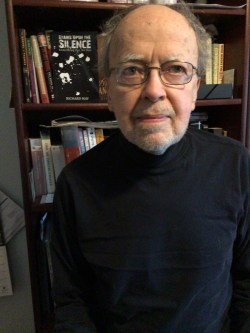
Publisher: In-Sight Publishing
Publisher Founding: January 1, 2014
Web Domain: http://www.in-sightpublishing.com
Location: Fort Langley, Township of Langley, British Columbia, Canada
Journal: In-Sight: Independent Interview-Based Journal
Journal Founding: August 2, 2012
Frequency: Three (3) Times Per Year
Review Status: Non-Peer-Reviewed
Access: Electronic/Digital & Open Access
Fees: None (Free)
Volume Numbering: 11
Issue Numbering: 2
Section: B
Theme Type: Idea
Theme Premise: “Outliers and Outsiders”
Theme Part: 27
Formal Sub-Theme: None.
Individual Publication Date: January 1, 2023
Issue Publication Date: May 1, 2023
Author(s): Richard May/May-Tzu
Author(s) Bio: Richard May (“May-Tzu”/“MayTzu”/“Mayzi”) is a Member of the Mega Society based on a qualifying score on the Mega Test (before 1995) prior to the compromise of the Mega Test and Co-Editor of Noesis: The Journal of the Mega Society. In self-description, May states: “Not even forgotten in the cosmic microwave background (CMB), I’m an Amish yuppie, born near the rarified regions of Laputa, then and often, above suburban Boston. I’ve done occasional consulting and frequent Sisyphean shlepping. Kafka and Munch have been my therapists and allies. Occasionally I’ve strived to descend from the mists to attain the mythic orientation known as having one’s feet upon the Earth. An ailurophile and a cerebrotonic ectomorph, I write for beings which do not, and never will, exist — writings for no one. I’ve been awarded an M.A. degree, mirabile dictu, in the humanities/philosophy, and U.S. patent for a board game of possible interest to extraterrestrials. I’m a member of the Mega Society, the Omega Society and formerly of Mensa. I’m the founder of the Exa Society, the transfinite Aleph-3 Society and of the renowned Laputans Manqué. I’m a biographee in Who’s Who in the Brane World. My interests include the realization of the idea of humans as incomplete beings with the capacity to complete their own evolution by effecting a change in their being and consciousness. In a moment of presence to myself in inner silence, when I see Richard May’s non-being, ‘I’ am. You can meet me if you go to an empty room.” Some other resources include Stains Upon the Silence: something for no one, McGinnis Genealogy of Crown Point, New York: Hiram Porter McGinnis, Swines List, Solipsist Soliloquies, Board Game, Lulu blog, Memoir of a Non-Irish Non-Jew, and May-Tzu’s posterous.
Word Count: 223
Image Credit: Richard May.
International Standard Serial Number (ISSN): 2369-6885
*Please see the footnotes, bibliography, and citations, after the publication.*
Abstract
The short piece provides an admixture of hypothetical nuclear forecasting from the frame of doom, in a quantum consideration, and reflects, passingly, on the prospects of human survival within historical human trends of war, greed, and corporate totalitarianism. All within Dada Daoist humour.
Keywords: Coca Cola, corporate identities, genocide, May-Tzu, medical-industrial complex, Microsoft Nation, missiles, quantum-computer, Richard May, unending warfare, WMDs.
Unknowing
Time-travelling missiles will be developed that reach their targets before the missiles are launched, preemptively destroying enemies that only exist in quantum-computer-projected probable futures. Nations will then defensively surrender to other nations not yet in existence, based solely upon their own defensive quantum-computer projections centuries into the future.
In the future nuclear holocausts, WMDs and genocide will be environmentally friendly and considered an essential part of any system of renewable resources and/or sustainable ecosystem design for homo sapiens. In particular it will become possible through advances in quantum computers to reassemble the precise molecular structure of each soldier killed in combat down to the quantum-information level.
The use of emulations, as these ‘resurrected’ combat-dead warriors will be called, will allow humanity to finally achieve its dream of continual unending warfare, as God intended. It will become the patriotic duty of each citizen who is capable of dying, to die for her corporate state unendingly, not only once, either in combat or of degenerative diseases from environmental toxins and agribusiness foods that are so essential to the profits of the medical-industrial complex.
Alzheimer’s and cancer, e.g., will be considered to be demonstrations of great economic patriotism. Archaic geographically based national identities will be transmogrified into corporate identities. One will be a citizen of Microsoft Nation or Coca Cola, e.g., not an American or Canadian.
May-Tzu
Bibliography
None
Footnotes
None
Citations
American Medical Association (AMA 11th Edition): May R. Unknowing. January 2023; 11(2). http://www.in-sightpublishing.com/unknowing-2
American Psychological Association (APA 7th Edition): May, R. (2023, January 1). Unknowing. In-Sight Publishing. 11(2). http://www.in-sightpublishing.com/unknowing-2.
Brazilian National Standards (ABNT): MAY, R. Unknowing. In-Sight: Independent Interview-Based Journal, Fort Langley, v. 11, n. 2, 2023.
Chicago/Turabian, Author-Date (17th Edition): May, Richard. 2023. “Unknowing.” In-Sight: Independent Interview-Based Journal 11, no. 2 (Winter). http://www.in-sightpublishing.com/unknowing-2.
Chicago/Turabian, Notes & Bibliography (17th Edition): May, R “Unknowing.” In-Sight: Independent Interview-Based Journal 11, no. 2 (January 2023). http://www.in-sightpublishing.com/unknowing-2.
Harvard: May, R. (2023) ‘Unknowing’, In-Sight: Independent Interview-Based Journal, 11(1). <http://www.in-sightpublishing.com/unknowing-2>.
Harvard (Australian): May, R 2023, ‘Unknowing’, In-Sight: Independent Interview-Based Journal, vol. 11, no. 2, <http://www.in-sightpublishing.com/unknowing-2>.
Modern Language Association (MLA, 9th Edition): May, Richard. “Unknowing.” In-Sight: Independent Interview-Based Journal, vo.11, no. 2, 2023, http://www.in-sightpublishing.com/unknowing-2.
Vancouver/ICMJE: Richard M. Unknowing [Internet]. 2023 Jan; 11(2). Available from: http://www.in-sightpublishing.com/unknowing-2
License
In-Sight Publishing by Scott Douglas Jacobsen is licensed under a Creative Commons Attribution-NonCommercial-NoDerivatives 4.0 International License.
Based on work at www.in-sightpublishing.com.
Copyright
© Scott Douglas Jacobsen and In-Sight Publishing 2012-Present. Unauthorized use and/or duplication of this material without express and written permission from this site’s author and/or owner is strictly prohibited. Excerpts and links may be used, provided that full and clear credit is given to Scott Douglas Jacobsen, or the author(s), and In-Sight Publishing with appropriate and specific direction to the original content. All interviewees and authors copyright their material, as well, and may disseminate for their independent purposes.
Share this:

Publisher: In-Sight Publishing
Publisher Founding: January 1, 2014
Web Domain: http://www.in-sightpublishing.com
Location: Fort Langley, Township of Langley, British Columbia, Canada
Journal: In-Sight: Independent Interview-Based Journal
Journal Founding: August 2, 2012
Frequency: Three (3) Times Per Year
Review Status: Non-Peer-Reviewed
Access: Electronic/Digital & Open Access
Fees: None (Free)
Volume Numbering: 11
Issue Numbering: 2
Section: E
Theme Type: Idea
Theme Premise: “Outliers and Outsiders”
Theme Part: 27
Formal Sub-Theme: “The Greenhorn Chronicles”
Individual Publication Date: January 1, 2023
Issue Publication Date: May 1, 2023
Author(s): Scott Douglas Jacobsen
Interviewer(s): Scott Douglas Jacobsen
Interviewee(s): Cindy Waslewsky
Word Count: 3,578
Image Credits: None
International Standard Serial Number (ISSN): 2369-6885
*Please see the footnotes, bibliography, and citations, after the interview.*
*Interview conducted January 2, 2022.*
Abstract
Cindy Waslewsky went to Stanford University and competed on the Varsity Gymnastics and Ski Teams. She earned a B.A. in Human Biology in 1982. She earned a Diploma in Christian Studies at Regent College in Vancouver, and a BC teachers’ certification from the University of British Columbia in 1984. She was the President of the Squamish Valley Equestrian Association. She is a certified English and Western coach. Waslewsky is co-owner of Twin Creeks Ranch. Waslewsky discusses: common human made problems; approximate mental age of an adult horse; different breeds of horse; the Canadian landscape of horses; operational business; standard procedure in the industry; the council in the township of Langley; particular bylaws; and industry as a whole in the Lower Mainland.
Keywords: adrenaline, Bold Ruler, breed, Canadian, Cindy Waslewsky, dressage, eventing, furlong, horse, hunting, iPhone, jumping, maturity, mental age, reiners, riders, Samsung, Secretariat, Western pleasure.
The Greenhorn Chronicles 35: Cindy Waslewsky on the Equestrian Industry and Breeds (2)
Scott Douglas Jacobsen: What are some of those common human made problems?
Cindy Waslewsky: Okay. A simple one; people throw their saddles on their horse and then they tighten up their girth for English, or a cinch for Western, and they’re worried about the saddle sliding. So they do it nice and tight and the horse starts to get what they say ‘girthy’ or ‘cinchy’; you’ll see people bring their saddles on the horse and the horse’s ears go back. They even make aggressive gestures toward the rider as they’re tightening up the girth and that is created by people when they tighten the girth too much. Otherwise, you put a saddle on. You snipe it up just a little bit to hold the saddle on. You finish picking hooks or whatever. You lock them into the arena, then you tighten it again, then mild, then tighten it again. So, in other words, you don’t just suddenly sort of squeeze them tight because they learn to tighten the muscles in their sternum enough to split across their right behind the front legs. They can tighten those muscles to expand, so that you go and now the girth is really loose. So, they learn to do that. However, they are called girthy or cinchy; meaning, they get crabby, cranky, and can get aggressive when people are tightening up the girth or cinch. And that’s created by people doing it too hard or too fast instead of gently tightening it as they get ready to ride like put the saddle on, snug it, then go and tighten it up just a hole and then maybe one more hole later, so it’s not just all being put on at the same time. That’s just one example.
Other examples are, I was teaching a student today that when you’re turning the horse. Horses are followers, so you’re the leader. You are in charge. I use the example with students that it’s like their substitute teacher walking into a grade 7 classroom. You have about 30 seconds to take charge and be fair, firm, and be the leader. Tell that horse just like you would a student what is acceptable behavior; like, you can’t swear to teacher. You can’t make comments to other people. Soon, you have spit wads on the ceiling in a classroom and the same with the horse. If you don’t right away say it’s time to report now: Ask, tell, demand, get going forward, do it firmly, have tools and techniques to make sure the horse is doing what you need it to do without being cruel and understanding horse cognition, which is, again, a new thing along with these trials and studies being a little delayed from horses when you compare it to other livestock that we often eat, right? Then you look at horse cognition. Studies are now coming out where they get in a PhD on learning, which manure pile does the horse sniff first. Believe it or not, they sniff their own first. Then they sniff the dominant horse next. How many seconds does it take for a horse to change from fear to inquisitive behavior because horses have the largest amygdala of any domesticated animal, in other words, amygdala processes fear. The most fear-based domesticated animal that we deal with is a horse, and we ride it.
So, what we have to constantly think about is when something scares or concerns that horse, they typically need 12 to 15 seconds to switch from fear to inquisitive. Let’s say they go by a tarp, and you start whacking on them to get closer to that tarp; I would question that. I would say I’ve changed how I ride, so if my horse is like bulging off the wall, I might go back to that spot and stop them and wait those 12 to 15 seconds. You will see horses drop their head, lick and chew, relax and stretch the nose out to whatever’s concerning them specific just to kind of investigate. They poke it with their nose. When they’re relaxed, I carry on, and then when I come back to that spot in their trail. I’ve already given my horse a chance to relax instead of beating them past it and making it a higher anxiety location. The other thing or techniques such as you’re coming to some spook zone in the arena where they tend to suddenly bolt away. For example, I was on a trail ride. There was a dog that looked like a bear, so the horse I was on had got just past the dog and scored ahead trying to get away from the dog. So, I asked the owner and if I could just go by there a couple of times. So, as I started to pass the dog; just when I started to pass, I stopped my horse and I waited. How long? 12 to 15 seconds, my horse relaxed with that dog and then walked on. So, the flight zone is right as they’re leaving the object they’re fearful of.
You might be leading horses out to paddocks. You’re going to be handling some of these horses and when they’re excited or hot, if you have fast feet for a long time equals fear for a horse. So, if you can slow their feet down, relax yourself, and slow your heart rate because horses’ heart rates match ours. When they put heartbeat monitors on horses and riders, they match each other. It’s interesting. So, we kind of have to relax ourselves to be the herd leader, but, if we get nervous, they don’t think we’re nervous with them. They think we’re nervous about something in our environment. And we need to let them know there’s nothing in the environment needs to concern you. But if we express fear of our horse, that’s going to translate to the horse that my rider who is my herd leader is concerned about something around us right now, so I better be worried too.
And they’ll do things like you can scratch the wither of your horse and their heart rate lowers and they did that with heart rate monitors. So if I’m going to reward my horse, I don’t slap the neck like how they pat horses on the neck and sort of slap them on the neck. That’s not much of a reward in the horse’s mind. But if you scratch or itch or massage the wither just like horses mutually groom each other, their heart rate actually slows. So, you would go lead a horse. You go to catch them. You scratch their wither. It’ll also lower their head a little bit, which is another long-necked animal. When a giraffe lowers its head, then the heart rate lowers; otherwise, you get head rush. Head goes up and it has to increase its heart rate. And so, a horse is the same, so when we lower their poll. That’s the area between their ears, to the same height or lower than their wither, then their heart rate autonomically slows. They don’t control that. It’s autonomic. So, as you lower a horse’s head, you’re actually relaxing them and lowering their heart rate and keep getting them to be a little calmer for leading out on a windy day or something. These are things people are just getting into now. The horse has been viewed a little bit like a motorcycle to get on a ride, but, now, we know for our own safety and for a humane treatment of the horse; we need to learn more about horse cognition. We need to do a little better.
Jacobsen: What is the approximate mental age of an adult horse?
Cindy: In terms of comparing to people, if you multiply a horse’s age by three, that’s going to give you an idea of maturity. In other words, a one-year-old horse is like a three-year-old. A two-year-old horse is typically like a six-year-old child. So, in terms of reasoning and training and teaching, they can start to link things up on conditions to what we use with horse training. I have a horse here that is 30 years old, that’s like a 90-year-old. She still did lessons. If she wasn’t doing that, she probably would really seize up. So, arthritis and everything would just really bother her. So in terms of mental maturity, I sort of try to link it to a human age, so that we can think what this horse can do physiologically and what is a fair workload for a 20 year old horse. And I think I’m 61, I can do just about anything back home, I can ride a horse. I can hike tough mountains with stuff if I stay in shape, but there are other 61 year olds that aren’t in as good a shape or if they’ve had some injury that really impedes them. So, if I look at a 20-year-old horse, and if it’s a healthy 20-year-old horse, they can still do they can still do some like jumping, they can do dressage, they can do lots of trail rides, they can work well, and they have maturity. They’ve got some experience. They’re a reliable horse, probably a safer horse for most people. They may have had a variety of exposure to different situations. But if you have a three-year-old horse, that’s like a nine-year-old. They’re kind of still learning a lot of things are still new to them… “Oh! What’s that? Oh, that’s a dog! Oh, that’s a plastic bag!” or “Oh, that’s a different horse trailer than the last one I got in” or “I’m going on a trail!” “What’s that big block?” So, you really expect to have to explore different things in a very calm and relaxed way.
Jacobsen: It gives a comparative answer to human beings to give an idea about the maturity and the ability to think of horses themselves.
Cindy: And what kind of physical demands you can make on them too.
Jacobsen: Absolutely.
Cindy: So, even as they age, you don’t want to just throw them out to pasture. That’s actually not a good retirement for a lot of these horses.
Jacobsen: How do different breeds of horse deal with different types of professional performance, whether dressage, hunting, jumping, or eventing?
Cindy: They’re all different even within a breed you will see different horses that are well suited conformationally to certain things. As a former gymnast, I would say I look at a body type, fast twitch muscles and flexibility. And then there’s a mental ability to do things. Some of my gymnasts were very timid and others were very bold. Some have a need for a little bit of adrenaline. Some are very driven. Some were not. You see that in horses as well. So, we didn’t breed just to generalize. You’ve got the quarter horse, which was named the quarter horse because it excelled in the quarter mile. It’s a sprinter. If you imagine human sprinters with big glutes and very strong muscle, quarter horses have very strong hind ends. They can sprint well. They can run fast, but for short periods of time and they keep their muscle tone. Let’s say they don’t get worked really well or they didn’t get ridden for a little while, they’ll keep their muscle tone better than a thoroughbred would. They tend to keep their weight on a little better.
So, you have the quarter horse. The mind was bred for cattle work and trails. So, you see them in the Western world. Everything from reining, working cow, cutting, western pleasure, trail classes where you go over all kinds of obstacles that could really freak out some horses. They learn to go over rivers, over bridges. They do teeter-totter bridges and all kinds of things that these horses have been known to do very well. They make a great all-around horse. Now, their neck ties in conformationally within the quarter horses. You would see different quarter horses and some are more capable of certain jobs. Some of the reiners are very able to collect themselves, meaning to lift their backs up kind of like doing a pelvic tilt and squat on their back legs a little bit. That’s what I would say I collected. If the horse is actually squatting on the back legs a little bit and lifting their back, lifting their wither, and stretching and telescoping the neck out, they’re not just bringing a chin into their chest. That’s a misunderstanding of what collection is.
So, when you compress these horses as compressing them like a spring and creating them with more energy and more athleticism, you’re also increasing the longevity of a horse being able to be worked because their musculature and the skeletal system is better designed for pulling a sled, pulling a plow. That kind of thing more than carrying a rider on its back. So, that’s why you’ll see all the disciplines of looking at collecting horses or compressing their body and lifting up their backs because then they will last longer and their gaits are better and are more athletic and more able to do everything. So, a quarter horse can turn on cows, a quarter horse can jump, a quarter horse can do some dressage. Do you really want to do the higher end dressage? You start looking for a horse that has a longer stride length and shoulder and then you look at thoroughbred, which was designed or bred to do the furlong or the mile. So, think of your distance runners, the long legs, the leaner build, they can really reach out. They have a long stride. Thoroughbreds have bigger lung capacity, so you see them in cross-country jumping a lot because they have to have the stamina for that. So, they have what they call their lung capacity and their nostrils are actually able to flare open wider than the quarter horse. They’re elongated and can open up. Equine dentists will say it’s easier to do the teeth of a thoroughbred because when you open their mouth there will be a bigger throat to work on their teeth because they have to suck the oxygen in to really do that at high speeds. And so, you have your thoroughbred.
Now, they’re called as a more hot-blooded horse. It’s a little more thin skin, the flies bother them a little more, could be a little spookier, and a little more temperamental. They are not quite as hardy a horse, not an easy keeper; meaning, they need more feed to keep their weight on. If you don’t use them consistently, they start to lose their muscle tone, especially along their back. Their topline we call it. And then what you can do is, you can breed a draft horse, which is great. Calmer horses that we use for usually pulling wagons and people do ride drops, but they’re a little bit wide for most people, especially women’s hips. They’re pretty big. But you can put a draft horse and say, “Oh, they’re so calm and good natured.” Ad then we have the thoroughbred, that’s so athletic, but a little bit slidy. So, let’s put them together. We have a cold-blooded draft and a hot-blooded thoroughbred. Most of the times, it’s one-quarter draft, three quarters thoroughbred. You get this lovely horse that’s usually a little calmer, still athletic, good muscle tone, and has that reach, the long stride of the thoroughbred to do some very nice dressage movement. It can also do some good jumping as well. So, you’ll see a lot of people pivoting to these warmbloods, who go into all kinds of various warmbloods.
It’s just a blend of the horses, and then you have the Arabs, which are small originally from, of course, Arabia. They have a little point to their ear, very pretty head, somewhat smaller. They have one vertebra less. So I think they’re very difficult to ride in a very collected frame. They would not be my favorite. For endurance riding, you can’t get a better horse for an endurance ride – small, hearty horses. And people who love Arabs love Arabs. They jump Arabs. They do pleasure. They do Wester. They do English. There are specialized Arab shows just as there are specialized paint shows. Paint is a color, but it’s actually a breed. So, you can say pinto for a color and paint is breed. So pinto is a color that you could have on a warm blood or something. But either you have paint; it’s a specific breed that has thoroughbred in it, quarter horse crossed with the thoroughbred. So, you can have a quarter horse thoroughbred cross. Great combination because you have the calmer mind of the quarter horse with more muscle tone of the muscly quarter horse, and then you put it with the thoroughbred. So, what other breed have you come across that you’re curious about?
Jacobsen: Well, I’d be curious about the Canadian landscape of horses as well in that regard. I mean, what breed of horse do Canadians work with the most, the riders, generally?
Cindy: It depends on what discipline you want to be in. We’re unusual in the barn that we have Western and English together in one barn. Usually, as you’ve seen, there are a hundred jumpers, then there’ll be Western. And they’re all divided up. Now, these ones in an Arab barn just do Arab shows and there’s paint here. This one’s just a Western pleasure and some trainers specialize in just one area. That’s, typically, because it’s a big spectrum. There’s a lot of time to think of another analogy. It’s hard to think of something that splits up as much as this does. Because when you think of horseback riding, you think of it as being, “Oh, you’re right. One rider can talk to another rider”, but there are so many different disciplines for riding, and so the horse excels at different disciplines. Some horses can cross over to be a nice all-around horse, which a family might purchase. So, I see a lot of people buying quarter horses because of their temperament, which is great for younger people to get into; fairly safe and yet they can still do all these different things.
Now, conformationally, their neck ties in a little lower, so they’re not perfect for jumping. The thoroughbreds will be able to out jump a quarter horse, typically. Yet, it depends on the build. I have two thoroughbreds. They’re built differently. One thoroughbred is “very upright”. I’ll call it. The other one’s built a little bit downhill if that makes sense. So, one’s kind of more laid back. That one’s a Secretariat lineage – Bold Ruler, really good lineage for racing, but he never won a race. He just laid back. He’s great; perfect for me for lessons. The other one won his races, but had a bowed tendon, so even as thoroughbreds go, these two are built differently because their confirmation was a little bit different, you ride them just a little differently. So even as riders switch from one horse to another, like people like to own their own horses, but you actually gain a lot of experience riding different horses. Do you have an iPhone or a Samsung?
Jacobsen: I have an iPhone.
Cindy: So, what if I say, “You know your iPhone well.” You’re good with the iPhone. I’m going to give you a Samsung. You know that Samsung is able to do all the same things your iPhone can do, but the buttons are in slightly different places. It’s a little frustrating. It doesn’t build your confidence. But if you’re ready to take on the challenge, and if you learn that Samsung, you now know cell phone’s better. You can do an iPhone; you can do Samsung. Now, you’re pretty conversant with your phone because you know both of them. My daughter who was a business major did that. She turned on both phones. She had a Mac and a PC because she needed to be conversant. She knew some programs are better one than the other. She wanted to be conversant with both because you never know what office system they’re going to be using. So, just saying, that horses vary even within the breeds. I have a quarter horse at 16.1. That’s on the bigger end of a quarter horse. She’s very nice for lessons. And then I have another one that’s 15.1, quite a bit smaller. They’re very different too. They teach my students different things because they’re good at different things. The one has a really good stop. He does this, does that. He can do some small jumps, but he’s never going to be a great jumper. But he can do some really good Western turn backs and maneuvers, but he’s a good all-around horse. Then when I get to my thoroughbred, they’re more specialized. They can do jumping. They can do some dressage, and then I do take them out on trails. They’re a little bit more lookie-loo at things on the trails, but the quarter horses are more relaxed on the trails. We put them in the front of the trail and thoroughbreds follow them. So, those are breed things, but within a breed; you’ll see variation.
Bibliography
None
Footnotes
None
Citations
American Medical Association (AMA 11th Edition): Jacobsen S. The Greenhorn Chronicles 35: Cindy Waslewsky on the Equestrian Industry and Breeds (2). January 2023; 11(2). http://www.in-sightpublishing.com/waslewsky-2
American Psychological Association (APA 7th Edition): Jacobsen, S. (2023, January 1). The Greenhorn Chronicles 35: Cindy Waslewsky on the Equestrian Industry and Breeds (2). In-Sight Publishing. 11(2). http://www.in-sightpublishing.com/waslewsky-2.
Brazilian National Standards (ABNT): JACOBSEN, S. D. The Greenhorn Chronicles 35: Cindy Waslewsky on the Equestrian Industry and Breeds (2). In-Sight: Independent Interview-Based Journal, Fort Langley, v. 11, n. 2, 2023.
Chicago/Turabian, Author-Date (17th Edition): Jacobsen, Scott. 2023. “The Greenhorn Chronicles 35: Cindy Waslewsky on the Equestrian Industry and Breeds (2).” In-Sight: Independent Interview-Based Journal 11, no. 2 (Spring). http://www.in-sightpublishing.com/waslewsky-2.
Chicago/Turabian, Notes & Bibliography (17th Edition): Jacobsen, Scott “The Greenhorn Chronicles 35: Cindy Waslewsky on the Equestrian Industry and Breeds (2).” In-Sight: Independent Interview-Based Journal 11, no. 2 (January 2023). http://www.in-sightpublishing.com/waslewsky-2.
Harvard: Jacobsen, S. (2023) ‘The Greenhorn Chronicles 35: Cindy Waslewsky on the Equestrian Industry and Breeds (2)’, In-Sight: Independent Interview-Based Journal, 11(2). <http://www.in-sightpublishing.com/waslewsky-2>.
Harvard (Australian): Jacobsen, S 2023, ‘The Greenhorn Chronicles 35: Cindy Waslewsky on the Equestrian Industry and Breeds (2)’, In-Sight: Independent Interview-Based Journal, vol. 11, no. 2, <http://www.in-sightpublishing.com/waslewsky-2>.
Modern Language Association (MLA, 9th Edition): Jacobsen, Scott. “The Greenhorn Chronicles 35: Cindy Waslewsky on the Equestrian Industry and Breeds (2).” In-Sight: Independent Interview-Based Journal, vo.11, no. 2, 2023, http://www.in-sightpublishing.com/waslewsky-2.
Vancouver/ICMJE: Jacobsen S. The Greenhorn Chronicles 35: Cindy Waslewsky on the Equestrian Industry and Breeds (2) [Internet]. 2023 Jan; 11(2). Available from: http://www.in-sightpublishing.com/waslewsky-2
License
In-Sight Publishing by Scott Douglas Jacobsen is licensed under a Creative Commons Attribution-NonCommercial-NoDerivatives 4.0 International License.
Based on work at www.in-sightpublishing.com.
Copyright
© Scott Douglas Jacobsen and In-Sight Publishing 2012-Present. Unauthorized use and/or duplication of this material without express and written permission from this site’s author and/or owner is strictly prohibited. Excerpts and links may be used, provided that full and clear credit is given to Scott Douglas Jacobsen, or the author(s), and In-Sight Publishing with appropriate and specific direction to the original content. All interviewees and authors copyright their material, as well, and may disseminate for their independent purposes.
Share this:

Publisher: In-Sight Publishing
Publisher Founding: January 1, 2014
Web Domain: http://www.in-sightpublishing.com
Location: Fort Langley, Township of Langley, British Columbia, Canada
Journal: In-Sight: Independent Interview-Based Journal
Journal Founding: August 2, 2012
Frequency: Three (3) Times Per Year
Review Status: Non-Peer-Reviewed
Access: Electronic/Digital & Open Access
Fees: None (Free)
Volume Numbering: 11
Issue Numbering: 2
Section: E
Theme Type: Idea
Theme Premise: “Outliers and Outsiders”
Theme Part: 27
Formal Sub-Theme: “The Greenhorn Chronicles”
Individual Publication Date: January 1, 2023
Issue Publication Date: May 1, 2023
Author(s): Scott Douglas Jacobsen
Interviewer(s): Scott Douglas Jacobsen
Interviewee(s): L.J. Tidball
Word Count: 4,498
Image Credits: Anwar Esquivel.
International Standard Serial Number (ISSN): 2369-6885
*Please see the footnotes, bibliography, and citations, after the interview.*
*Interview conducted December 26, 2022.*
Abstract
Laura Jane “L.J.” Tidball has been the Manager of Thunderbird Show Stables, an elite hunter and jumper facility, for 20 years. She is a shareholder and contributing partner to Thunderbird Show Park, which has been voted in the top 3 equestrian show facilities in North America. For Show Park, she has been important in advising on top level equine footing, site development plans for capital improvement, and competitor scheduling for National and FEI competitions. She has been competing at the Grand Prix level since 16-years-old. Since winning the Equine Canada medal (1994) and competing on the British Columbia Young Riders’ team (1996), L.J. pursued equestrianism as a career with a fervent passion. Tidball shows multiple mounts of Thunderbird Show Stables and its clients in the hunter and the jumper rings. Through work from the pony hunters onwards with the assistance of Olympian Laura Balisky and Laura’s husband, Brent, L.J. has achieved many years of success in equitation, and the hunters and the jumpers. In 2005, she returned from a successful European tour to operate Thunderbird on a professional basis. She has been awarded the 2014 Leading BCHJA 2014 rider in the FEI World Cup West Coast League Rankings and the 2014 BCHJA Leading Trainer of the Year. In her spare time, her hobbies include baking, skiing, and snowboarding. Tidball discusses: becoming interested in horses and developing a skill set as a show jumper; aunt Laura; intrinsic motivation for the sport; partnership with the horse; independent thought of horses; work ethic; differentiating factors; the safety of the sport; difficult accommodations; a skilled rider or a more naturally gifted horse; Laura the coach; the use of video technology; great women riders; the gender neutrality of the sport and the longevity of the sport; the best in show jumping; the Horse Capital of British Columbia; the industry; greatest improvement in riding skill and style; Florida immersion; and dreams.
Keywords: Beth Underhill, Brent Balisky, Canada, Concetto Son, Denmark, Diane Tidball, Erynn Ballard, George Tidball, Grand Prix, Horse Capital of British Columbia, Ian Millar, Jane Tidball, L.J. Tidball, Langley, Laura Balisky, Milton Friedman, Olympics, Pan-American Games, Queen’s Cup, Sean Jobin, Thunderbird Show Park, Thunderbird Show Stables, World Cup Finals.
The Greenhorn Chronicles 34: L.J. Tidball on Growth as a Show Jumper, George and Diane Tidball, and Show Jumping (1)
Scott Douglas Jacobsen: So, this is an interview with L.J. Tidball from Thunderbird Show Stables. Let’s start from the beginning. What were some of the earlier moments in becoming interested in horses and developing a skill set as a show jumper?
L.J. Tidball: I would say my earliest moments of spending time with horses would have been going all the way back to the lead lines that my grandfather used to take me in. I had a pony named snowball. I used to wear my first set of tall boots and riding hat and show jacket, it was a big deal to have my grandfather lead me out in the lead line class. It is, probably, one of my earlier memories. I was 3 or 4 years old. From there, I grew up watching my aunt Laura Balisky show and compete for everything from the Olympics to the Pan-American Games to the World Cup Finals. I grew up with stars in my eyes with that being my ultimate goal. I went to bed as a 5-year-old dreaming of having a red show jacket. I, definitely, have pursued this as a career from a very young age. I was lucky enough to be able to take my childhood dream and bring it to fruition, which, I think, is rare. I appreciate the opportunities I have had to get to where I am.
Jacobsen: Was there any advice that your aunt Laura gave while you were developing your earlier skill sets?
Tidball: I think, they were very open to the idea that I would do whatever I was going to do with riding. My mom was a downhill ski racer. She always encouraged me to follow my path. She wrote me a letter in Grade 12 saying, “You have to follow and do what you believe is the most important, follow your dreams, and don’t give up.” Laura and Brent supported and encouraged me, but they let it be my own drive. They didn’t say, “You need to do this, this, and this, to get there.” They gave me the tools and expected me to find my own drive and my own will to get to where I wanted to be, which allows you to find your own path. If people are dictating it for you, I don’t think you find the path as easily.
Jacobsen: What do you mark as the intrinsic motivation for the sport for you?
Tidball: Honestly, when I get into it, I love being around animals. I love being close to the horses. The partnership that you have with your horse, when you come to an enormous jump is an incredible feeling. It is an adrenaline high, but it is a partnership at the same time. You are combining finesse, feel, and kindness, with adrenaline and a fierce competitive nature. It is such a unique set of rules that go along with it. I don’t think you can replicate it. It has become a driving force. To walk in the ring and to jump a grand prix, it is why I wake up in the morning, and to train to get there. To make these horses better and to work with your partner to see how far you can go, with that end result always being to get into the big ring and jump that big class.
Jacobsen: How do you build that partnership with the horse? How long does that, typically, take?
Tidball: It can be different. My best horse to date, Concetto Son, was already jumping the 1.60m level when I got him. The previous owner created that partnership with that horse. I took it on and spent as much time as I could with Concetto, whether on the ground, at the stables, or on his back, to try to make him mine. I think the best partnerships are the ones where the riders are bringing the horses along themselves. For sure, that way you know them so well. You know when going into the ring how tight they can turn, how fast they can go and what their limits are, what limits are there. I feel if you take on a partnership a little later. You have to find those things out as you go. Also, you haven’t created the partnership together. I don’t think it is ever quite the same. I think you can win some rounds and some classes, but I don’t think it’s the same as when one comes up through the ranks with you.
Jacobsen: Erynn Ballard, this is 12 months ago, when I knew a lot less, had discussed things with a lot fewer people, and had done fewer interviews. She noted independent thought of horses as a problem, as a factor, in consideration of the sport. In some sense, it is a bi-athlete sport. When I talk to riders, it is entirely true. How do you deal with that level of uncertainty, psychologically speaking?
Tidball: I don’t think this is necessarily uncertainty. As we grow with horses, we tend to know what their indicators are very quickly. I rarely get on a horse and don’t know, whether it is wild that day or a little too quiet, or spooky of a Liverpool or scared of the water jump. You feel those things before they happen. You feel when your horse is not quite with you that day. Even something as simple as a soundness issue, you feel it, immediately. They are our partners. They are our teammates. If I walked in and said, “Hi”, to one of my friends, and if their response was, “Fine, I guess”, I know that they’re not okay that day. The moment you put your foot in the strip, or pat them on the neck. You can feel that. I don’t know if it as much of an uncertainty. To me, it’s knowing your partner, knowing their ins and outs. You know when you can push them and, also, when you can’t. Some horses will never jump a water jump well in their lives. That’s something you have to come to terms with; and the other side, some horses, you think to yourself, “I taught them a, b, and c. So, we can get through that next thing.” They all come out on some days a little different, just like us. Whether something spooks them at the ring or they get upset before even leaving their stall. All of the sudden, they’re spun on that day. So many factors come into play, whether you had a phone call or a bad conversation that day. You have to push through it. You have to know yourself well enough to know what you can set aside, what you’re okay with, and what you’re not okay with.
Jacobsen: If you look at the work ethic 25 years ago compared to now, having that transition from young adulthood to now, do you think there’s been a shift in some of that in this industry?
Tidball: I think the sheer numbers of what we do are higher now. Back in the day, you would be a 2-man show with 5 horses on the road. It wasn’t as much about clients and coaching and buying-and-selling horses. I don’t think the work ethic is different, though. For myself, I know. I work out. I stay fit. I work long hours at my job. I coach. I teach. I go teach clinics. I still compete at this sport at a high level. I don’t know many other athletes in this sport who are not like that, who are not travelling constantly, not working constantly to be better. That don’t have 100% drive to succeed at what they want to do. In my mind, the work ethic has not changed.
Jacobsen: Mac Cone noted George Morris produced the training methodology that has gone around the world. So, there has been an internationalization of that methodology. The breeding programs have been specialized and made very good. What are the differentiating factors, then, at the top level?
Tidball: I think looking at a top level. It is like looking at a top-level NBA player. How many people can make it to the NBA and be that #1 player? You look at Olympians. How many people make it into the 100m sprint or into the soccer team that goes to the World Cup? I think it’s the same for horses. There are a few more who could have made it there, but who had bad luck along the way or were on the wrong training program. I think the elite athletes, whether horses or riders, that it’s the same. You are looking for a top athlete for your partner, the horse. I would say back in the day, when Laura was riding; you could name the top 5 horses in the world at that time. As I said, the numbers have grown. In general, the amount of horses, clients, and people riding has increased. Nowadays, you may not be able to name the top 5, because it is the top 20 or top 30. I think there are many horses that are at that #1 level. That, I would say, is a big change. We are breeding horses to be faster, lighter, and more careful. The technicality of the courses in the sport has changed. So, I think that’s a big part of it.
Jacobsen: Has the safety of the sport changed?
Tidball: [Laughing] Absolutely. There used to not be breakaway cups. We did not even have hard hats with chin straps. You get into the amount of concussions that would have gone on 25 years ago would have been astronomically higher than today. The cups fall down. The jumps are way lighter. Of course, it is still a dangerous sport because you are riding a 1,000-pound animal over a 1.60m jump. That’s never an easy thing to conquer. There have definitely been huge improvements. Also, the courses used to be simpler. It used to be 1 jump, 10 strides to the next jump, and one triple combination. Now, you walk on course. It is bending 5 to the 2-stride to the 4-stride, and it carries on. The technicalities increase so much. I do think the safety has gone up, but the technicality has gone up with it.
Jacobsen: Has the speed gone up?
Tidball: Absolutely.
Jacobsen: Of those factors, what factors do you think are the most difficult to accommodate or adapt to?
Tidball: I am not the fastest rider. I have had fewer horses growing up than some. So, I need to preserve these horses. I need them to last for years, not for a season. The faster that you go. The greater the chances of scaring the horse or getting to a wrong spot because you are pushing the envelope a little more. You’re trying to be the winner every day. Things can go wrong because you’re working at top speeds. The most difficult thing for me to overcome is to be faster. I can jump a clean round and jump a technical track, but to beat Kent Farrington or Tiffany Foster. That’s harder for me to accomplish.
Jacobsen: Do you think it is more important to have a skilled rider or a more naturally gifted horse at this point?
Tidball: I think it’s both. It is a partnership – no matter what. You can have a completely untalented rider on an amazing horse. It will jump a few classes, but, eventually, it will stop succeeding. Because they are sensitive creatures. You can have an incredibly talented rider on an average horse. They might be able to get a bit more than the last person. But they will never make a 1.20m horse into a Grand Prix horse, and a 1.20m rider is never going to jump a 1.60m horse. The two things just don’t work. I always think it is that partnership. You need a great rider and a great horse if you want to be at the top of the sport.
Jacobsen: Did Laura coach you at all?
Tidball: Absolutely.
Jacobsen: How so?
Tidball: Laura always coached with subtleties. It was something small that would make a big difference. One time, I remember riding up to this big oxer. I think it was the Queen’s Cup. She said, “Make sure hind end meets front end before he leaves the ground, so he is pushing evenly off all four legs.” It is not necessarily about “think about where your shoulder is, hand is, or eye level is”. It was always small intricacies that always made a difference. She rode so much off of feel. She had so much natural talent. When she tells me things, it is, usually, something to do with feel, or something to do with a small part of a course. It is never a big lifechanging moment. If I haven’t figured out those big moments by now, having gotten to this level, then I should have paid closer attention [Laughing].
Jacobsen: Sean Jobin noted the use of video technology. Certain biomechanical feedback systems to get a better read on horses with modern technology. Do you think these are more helpful or less helpful for most riders at that level?
Tidball: I, definitely, think going back and watching your videos and being able to see how you performed is good. What you feel and what you see are, sometimes, two different things, you can think that you were leaving at the right spot, but you were a little close. You can go back and watch a video and analyze, and see a horse leaving the ground, if the left front or the right front is lower. It gives you a little bit more information. You are looking for small things, not huge changes.
Jacobsen: One thing, I have noted. Canada is really, really good at producing great women riders. Internationally, and nationally, Canada produces some of the best women riders in the world for show jumping. Why, how?
Tidball: I, actually, don’t really know. I know the way I was raised was to go off and get your dreams. I would say that is biggest thing that has led me to where I am, to be a great woman rider. I grew up in a family where nobody ever told me, “That person is a guy. He is going to be better than you.” All I ever heard. It was, “That person runs fast. You should learn to run faster too.”
Jacobsen: [Laughing].
Tidball: It was never, “But you’re a girl, so you can’t.” My grandparents were amazing that way. So was my mom, it was always about being the best version of yourself. I competed against myself, not really against others. I was always brought up to be the best version of myself, not to be better than so-and-so. For myself, that’s helped me become a top athlete. But I’m not really sure why Canada has so many top women equestrians.
Jacobsen: Show jumping is really a gender-neutral sport. If you are talented and have a good horse, you can go far. Many Canadian women have shown this, clearly, as we noted. Any commentary both on the gender neutrality of the sport and the longevity of the sport? People like Ian Millar were competing into their 70s and going into the Olympics into their 70s.
Tidball: I think show jumping is amazing that way. I love that we compete on an equal level, male and female. I think it’s great. I think it raises, like you said, “Why more female riders than males in Canada coming up?” I think the fact that it is gender neutral. It means you get to compete on an equal playing ground. Athletes in show jumping, we’ve been raised to be equals. It is a pretty incredible thing to be in this sport. I think society today is about equality. We are in a sport where it doesn’t matter. If you have the right horse and are a good rider, you can get to where you want to be.
Jacobsen: The team that went to Denmark was an all-women team.
Tidball: I think that was incredible. I give them such props. I think it’s awesome that we can produce strong athletes, a strong group of female athletes. I think it’s really good.
Jacobsen: Which countries do you think are doing the best in show jumping now?
Tidball: Holland and Belgium, and, probably, France, they have a high number of horses that they are breeding every year. In horse power alone, they have numbers. The U.S. has the population exceeding most of the other countries producing riders. They have that on their side. As Canadians, I think we’ve always been a little bit of an underdog. We’ve always had a smaller group of riders, not as many who jump the 1.60m level. But the ones who do, are good at it. We’ve always been able to produce good results. There’s been medals at Pan-Ams, medals at Olympics. With the size of our show jumping population in Canada, and the number of people who show at that level, it’s surprising that we produce the teams that we do. Canada has always been able to do it. I would give us credit for the programs that we’ve created here, for the level of riding that we’ve produced. If you look at Thunderbird Show Park, the fact that there are FEI in my backyard. It used to be: If you were a Western Canadian, there was nowhere to compete at other than Spruce Meadows. Now, we have a circuit on the West Coast. That is a huge reason we are producing riders.
Jacobsen: How did Langley become the Horse Capital of British Columbia? How did it get that appellation?
Tidball: There was Campbell Valley Park. That’s where it started. There were a lot of hobby farms. It came from the hobby farms. It is not, actually, from the show jumping community, necessarily.
Jacobsen: [Laughing] I didn’t know that.
Tidball: Definitely, when Show Park moved to its new venue, it increased the drive for show jumping in our area. It has gotten bigger and bigger.
Jacobsen: Before, Thunderbird Show Park was, for anyone reading locally, where the Colossus grounds is, before. People would eat at the Keg, eat their steaks, and watch show jumping. It was a nice tie-in.
Tidball: My grandfather went to the Cow Palace in San Francisco and loved it! The Keg in Langley was a representation of that. He thought it was the coolest thing. You could be watching roping in the arena, cutting in the arena, and show jumping in the arena. It was used for many things. That was the start of it. He thought it was the neatest thing to be sitting, eating your dinner, and watching show jumping at the same time. That’s where that idea came from. I hosted at The Keg. It was the hardest thing. People would come in and want a window seat. The wait would be hours and hours. It really created in our community an understanding of show jumping. Thunderbird became a known name. The Keg restaurant became a known name. It added to people wanting to come down to the shows and be a part of the culture.
Jacobsen: George brought McDonald’s to Canada, in Richmond in particular.
Tidball: He went to school in Harvard. My grandmother was with him, obviously. They had three small children. She would take them to McDonald’s, the kids. Because it was inexpensive and clean. Service was good. If something was spilled, somebody would clean it up. She loved it. After he finished at Harvard, he was working at MacMillan Bloedel. They wanted him to relocate to the United States somewhere. She didn’t want him to relocate again. They’d been all over the U.S. at that point. She’d had enough. She said, “George, why don’t you bring that McDonald’s place to Canada?” So, he found Ray Kroc and got the rights to Western Canada for McDonald’s.
Jacobsen: He was going to work directly with Milton Friedman.
Tidball: Yes, he was going to do his Ph.D. in economics at the University of Chicago with Friedman. They’d gotten into so much debt being in the States, being Canadian. My grandmother was typing papers for people at night to make things work. He went and was going to go to the University of Chicago. He opted out because they couldn’t keep going.
Jacobsen: I recall one article with him saying that they were tired of being broke.
Tidball: They were broke. They had a Volkswagen bug with three kids and the two of them.
Jacobsen: It was time for a change.
Tidball: Yes.
Jacobsen: What I am seeing in this family history is entrepreneurial business-mindset of George, motivation and also co-entrepreneurial business mind in Diane, two of their children on national teams. National ski team for Jane. National equestrian team for Laura. For yourself, as far as I know, you have jumped in the Nations Cup. It’s a strong trend in the family.
Tidball: Yes, my cousin went to the Paralympics for triathlon. It is a trend. The general trend of our family is to do the very best at what you choose to do, whether in school, in sport, or in life in general. It is to strive for the best. I would say that that has been the motto in our family all through my life. My cousin just got a job at Tesla. It’s been ingrained in us. My grandparents did an incredible in that. They didn’t put a demand on what it was that you chose to do; they just wanted you to do something that you loved. Once you chose what it was, they supported you. Also, they remind you how hard it is to work for what you love. They instilled a work ethic that goes beyond. Because, no matter what, you can do what you love every day. Let’s be honest, working in a barn every day is hard work. I wake up every day. I love my job. I love what I get to do. I don’t go, “Oh, today will be easy. I will have coffee with three people, quit early, go to the spa.” That’s not my daily routine. My daily routine is 7 in the morning to 7 at night. That’s the norm. I think if you’re lucky enough to do something that you love; it means that you’ll work harder to be able to keep doing it.
Jacobsen: Do you think the industry is weaker or stronger for show jumping in Canada?
Tidball: I think it’s getting stronger. I think there are more people getting involved in show jumping. The number of people involved in riding with horses is going up. I think show jumping is a great individual sport. For kids these days, it really gives them something that is a perfectionist sport that you get to keep striving for. It teaches a sense of responsibility with an animal. When we walk into a ring, we are not just taking care of ourselves. We have a partner with us. I think that’s a really important lesson. You will walk back into the ring. Maybe, you won the class. Maybe, you fell off. There is always something you could have done better, whether big or small. It teaches the sense of drive and work ethic that goes along with it. That’s what I’ve been taught in my time on horses.
Jacobsen: What do you consider the area of greatest improvement in riding skill and style?
Tidball: When I got to travel to Florida and got to perform on the world stage, immersing yourself with the top riders in the world, you pick it up. You get to watch what they do, how they are training. No matter what, I think that has been the biggest thing. I got to get out of my bubble and experience more. Any time to experience the great sport, it really gives you an appreciation of what you’re doing.
Jacobsen: You are considering Langley the bubble.
Tidball: Yes, Langley and California, I think when you get to go to Europe and Florida and can train with other people. There’s nothing wrong with being in Langley. It’s been great. We get two big shows a year. We have May and August, where the world stage comes to us. For sure, immersing yourself in those moments is huge, if you can have May and August throughout the year, your level will increase. With California and the Major League shows down there, it gives the opportunity to immerse yourself with the top riders. Any time that you can do that, and any time pay attention, you can learn.
Jacobsen: What did you learn in Florida immersing yourself with the top riders? What were the first things you noticed about how they conduct themselves?
Tidball: The biggest thing I learned was how fast they were. They go faster all the time. Their speed is at a different level than what I was used to when I got there. Also, their technique, it is little things. It is how they present something to their horses. It is how they are meeting a jump. It is the distances where they leave out a stride. Everything tightens up a little. That’s the only way I can describe it. Your track, your distances, your time between the jumps. Everything gets that much tighter. Because you are doing it day-in and day-out. You get used to it. All of the sudden, you come home. “That’s the line I should take.” Because that’s the line you’ve done for the last month. It was such a great experience that way.
Jacobsen: What are your dreams in this sport moving sport? Because taking the Ian Millar and Beth Underhill examples, you have a long career ahead of you.
Tidball: I would love to be able to compete on national teams and at the 1.60 level. I think it depends on if the right horse comes into my life. I do believe some of it is fate oriented. I think things happen at the right time at the right places. If a horse can come into my life to take me into those levels again, I would love to be on Nations Cup teams and do the Pan-Am Games. It would be a dream come true for me. The other side of it, I love training and bringing up young horses, and seeing what they can do. If one of them turns into one of those horses that can do that for me, that would be an ultimate goal. A horse you take through the levels into the top level. That is something that I would look forward to. I hope one of these youngsters that I have now can compete on the world stage.
Bibliography
None
Footnotes
None
Citations
American Medical Association (AMA 11th Edition): Jacobsen S. The Greenhorn Chronicles 34: L.J. Tidball on Growth as a Show Jumper, George and Diane Tidball, and Show Jumping (1). January 2023; 11(2). http://www.in-sightpublishing.com/tidball-1
American Psychological Association (APA 7th Edition): Jacobsen, S. (2023, January 1). The Greenhorn Chronicles 34: L.J. Tidball on Growth as a Show Jumper, George and Diane Tidball, and Show Jumping (1). In-Sight Publishing. 11(2). http://www.in-sightpublishing.com/tidball-1.
Brazilian National Standards (ABNT): JACOBSEN, S. D. The Greenhorn Chronicles 34: L.J. Tidball on Growth as a Show Jumper, George and Diane Tidball, and Show Jumping (1). In-Sight: Independent Interview-Based Journal, Fort Langley, v. 11, n. 2, 2023.
Chicago/Turabian, Author-Date (17th Edition): Jacobsen, Scott. 2023. “The Greenhorn Chronicles 34: L.J. Tidball on Growth as a Show Jumper, George and Diane Tidball, and Show Jumping (1).” In-Sight: Independent Interview-Based Journal 11, no. 2 (Spring). http://www.in-sightpublishing.com/tidball-1.
Chicago/Turabian, Notes & Bibliography (17th Edition): Jacobsen, Scott “The Greenhorn Chronicles 34: L.J. Tidball on Growth as a Show Jumper, George and Diane Tidball, and Show Jumping (1).” In-Sight: Independent Interview-Based Journal 11, no. 2 (January 2023). http://www.in-sightpublishing.com/tidball-1.
Harvard: Jacobsen, S. (2023) ‘The Greenhorn Chronicles 34: L.J. Tidball on Growth as a Show Jumper, George and Diane Tidball, and Show Jumping (1)’, In-Sight: Independent Interview-Based Journal, 11(2). <http://www.in-sightpublishing.com/tidball-1>.
Harvard (Australian): Jacobsen, S 2023, ‘The Greenhorn Chronicles 34: L.J. Tidball on Growth as a Show Jumper, George and Diane Tidball, and Show Jumping (1)’, In-Sight: Independent Interview-Based Journal, vol. 11, no. 2, <http://www.in-sightpublishing.com/tidball-1>.
Modern Language Association (MLA, 9th Edition): Jacobsen, Scott. “The Greenhorn Chronicles 34: L.J. Tidball on Growth as a Show Jumper, George and Diane Tidball, and Show Jumping (1).” In-Sight: Independent Interview-Based Journal, vo.11, no. 2, 2023, http://www.in-sightpublishing.com/tidball-1.
Vancouver/ICMJE: Jacobsen S. The Greenhorn Chronicles 34: L.J. Tidball on Growth as a Show Jumper, George and Diane Tidball, and Show Jumping (1) [Internet]. 2023 Jan; 11(2). Available from: http://www.in-sightpublishing.com/tidball-1
License
In-Sight Publishing by Scott Douglas Jacobsen is licensed under a Creative Commons Attribution-NonCommercial-NoDerivatives 4.0 International License.
Based on work at www.in-sightpublishing.com.
Copyright
© Scott Douglas Jacobsen and In-Sight Publishing 2012-Present. Unauthorized use and/or duplication of this material without express and written permission from this site’s author and/or owner is strictly prohibited. Excerpts and links may be used, provided that full and clear credit is given to Scott Douglas Jacobsen, or the author(s), and In-Sight Publishing with appropriate and specific direction to the original content. All interviewees and authors copyright their material, as well, and may disseminate for their independent purposes.
Share this:

Publisher: In-Sight Publishing
Publisher Founding: January 1, 2014
Web Domain: http://www.in-sightpublishing.com
Location: Fort Langley, Township of Langley, British Columbia, Canada
Journal: In-Sight: Independent Interview-Based Journal
Journal Founding: August 2, 2012
Frequency: Three (3) Times Per Year
Review Status: Non-Peer-Reviewed
Access: Electronic/Digital & Open Access
Fees: None (Free)
Volume Numbering: 11
Issue Numbering: 2
Section: E
Theme Type: Idea
Theme Premise: “Outliers and Outsiders”
Theme Part: 27
Formal Sub-Theme: “The Greenhorn Chronicles”
Individual Publication Date: January 1, 2023
Issue Publication Date: May 1, 2023
Author(s): Scott Douglas Jacobsen
Interviewer(s): Scott Douglas Jacobsen
Interviewee(s): Mac Cone
Word Count: 3,646
Image Credits: Cealy Tetley
International Standard Serial Number (ISSN): 2369-6885
*Please see the footnotes, bibliography, and citations, after the interview.*
*Interview conducted December 5, 2022.*
Abstract
Mac Cone, according to Starting Gate Communications, can be described as follows: “Mac Cone is one of Canada’s most experienced riders having been a steady performer at the international level for over 30 years. In 1974, he married Canadian Brenley Carpenter and the couple has two daughters. Originally from Tennessee, Mac moved to Canada in 1979 and is one of only two riders to have competed on both the United States and Canadian Equestrian Teams (the other being 1984 World Cup Champion Mario Deslauriers). With the stallion Elute, Mac enjoyed victory in the $100,000 Autumn Classic in New York in 1994. Although the pair was selected for the 1995 Pan American Games in Argentina, they were unable to compete due to a last minute injury. Elute made a strong comeback, however, winning the 1996 Olympic Selection Trials at Spruce Meadows. In his Olympic debut in Atlanta, Mac was the highest-placed Canadian rider, a feat he would repeat at the 2002 World Equestrian Games in Jerez, Spain, riding Cocu. At the 2007 Pan American Games in Rio de Janeiro, Mac and Melinda were members of the Silver Medal Team. In his second Olympic appearance in 2008, Mac and the impressive Ole were members of Canada’s historic Silver Medal Team. In addition to his own riding, Mac is active as an instructor and clinician. His personal style, which is very low key and easy going, makes him very popular with his students, who have included 1986 World Champion Gail Greenough and 2003 Pan American Games competitor, Mark Samuel. Mac operates Southern Ways Stable in King, Ontario.” Cone discusses: the factors outside of grit and training methodology that really set the great riders apart; more boys; the blue-collar level of work; the greatest streak of success; the biggest surprise in the 21st century; the greatest in the history of the sport; and the industry and the sport.
Keywords: African-American, equitation, European heritage, Frank Chapot, George Morris, Hispanic, hunter, Jessica Springsteen, Latino, Mac Cone, Olympics, riding, risks, Robert Ridland.
The Greenhorn Chronicles 33: Mac Cone on the Direction of Show Jumping and Its History (3)
Scott Douglas Jacobsen: Over time, countries that tend to be well to do tend to become soft. They become comfortable. So, artificially, they value their lives more than other countries. The inverse for countries in war torn circumstances. Life is functionally cheap there. So, that aspect of grit in the newer crop may not necessarily be there as much per rider. Yet, the methodologies are pretty much fixed globally, as you were noting earlier. On the one hand, you have barriers to entry with cost of horses at the highest level, maybe, even at some of the lower level too, as well as with the training methodologies being figured out so far. Also, you have the aspect of things like resilience or grit. If people can’t handle the long work days and the constant criticism, and getting bumped around, or falling off a horse and having to get back up, they may not necessarily last very long. Old videos of Eric Lamaze, he really knew how to ‘put on the gas’. He took those risks in riding. What do you think are the factors outside of grit and training methodology that really set the great riders apart?
Mac Cone: That goes back to when you were born, what circumstance are you born into, and what you do with that circumstance. It is not your fault what family you were born into or circumstance born into; it is what you do with your beginning and where you build from that. Once again, everybody’s road to Rome is different. Now, yes, there are some very entitled people who are getting into the sport now. You wonder if the grit is there enough to really count on them. Even though, the more fortunate kids that have no financial wall to deal with make it. Hopefully, because of the coaching and their attitude, and that they have grit, they are just as good as a hard knockin’ person that came from a different path. I will talk about one person. I mean this in nothing but positive, positive ways before I get going here. But it is such a public person. Everybody knows the story anyway. That is Jessica Springsteen. Everybody knows about Jessica Springsteen’s parent. It is Bruce Springsteen and Patti Scialfi. We know that. We know that they’re a well-to-do family. But she came up through the ponies, the hunters, and the equitation. I’m telling you. That is one knowledgeable, very good riding individual who has come up through the whole system. That’s all put into place. But the last Olympic games, she was on that team.
She was the anchor of that group because that is one tough, great riding young lady. So, there’s an example of someone that did have a pretty nice path to Rome. But she took advantage of it, did not abuse her situation at all. She just worked, and worked, and worked. She is tough and talented. She has a silver medal in her bedroom or den. So, Bruce can look at it with her. That’s one example of when you have a certain start that is beneficial. But it doesn’t mean that that start will make you soft, necessarily. I understand that that is what you were getting at. Can it be that way? Yes. Does it happen a lot? Yes, but not always, not always, the ones that are tough and do make it. They should not be frowned upon because of the family they were born into. I guess, that’s where I want to make sure that is where I stand quoted there. Now, there is the other side of the coin with the people because of their start; they may be just as talented, but they won’t get the opportunities to go to Rome as quickly or, maybe, not ever. It is not because of a lack of talent or grit, but because of the circumstance and the industry having thrown the financial side of the sport way out of whack if that explains it well. I think that explains it pretty well.
Jacobsen: You mentioned something in one of the earlier sessions coming to mind, which are a couple of things Canada does uniquely in spite of the training regimens. One is the focus on hunter. The other is the focus on equitation. This effecting the paths of how many boys are interested and how many girls are interested, 12 to 17 years old. Something like that. So, to get a better balance, maybe, for that age group in terms of interest, what might be a change that could bring more boys, instead of going into a different sport?
Cone: Yes, since we talked earlier, this is a little bit of a stickler point for me. The equitation and the hunters were brought in to North America. Back in the days before George had spread the gospel about how we should ride, the system of riding was not universal. Everybody had a different style. It was just a mess. So, the U.S. and the Canada following, as we do often [Laughing] – being Canadian, a little tongue in cheek there – came up with the hunters and the equitation, which provided a way of riding that got to be more of everyone riding the same. It was one or two countries here, out two countries. I don’t call that universal. But it did serve a great purpose in smoothing out everyone out, learning to do 5 strides in a 5 stride line, 6 in a 6, and not 7 or 8 in a 6. It made everybody start riding similarly and smoother, and nicer. The smoother and nicer that you’re able to ride a jumper. The idea is the odds will go up in your favour to leaving the jumps in the cups. If you ride rough and tough, it tends to make jumps fall down.
That was the purpose behind it all It was to smooth everybody all and will give the horse the chance to perform better. But, I think, because of the industry, we now have a lot of people in the industry that make a living off just hunters and just equitation. So, we’re not going to take that industry and throw it out. It’s just not going to happen. But if you look at the whole world now, we have just, I think, the equitation as far as preparing the jumper riders for the high level to a certain degree as outlived its purpose. There are other ways and, I think, better ways of preparing the jumper riders to get to the top. That gets to my other point. We have, let’s say, 80 countries over here by my right hand who do not choose to do equitation and hunters, but they could if they thought it was good for the development of their riders. Then we have Canada and the U.S. who still lean on that system for the development of their younger riders and think it’s important. Where we stand right now in the world, I would say that we’re behind a lot. We’re barely in the top 10 in Canada. We’re behind them. The U.S. is behind the top 10 now. Not always, they’ve had a bang-up record with Robert Ridland. He has done a hell of a job. But, I think, it is getting back now. We have knowledge. We have divisions that we can train these young people to ride properly in.
But on jumping horses, not equitation horses that jump flat and give you no feel, we need these kids to feel what a jumper feels like right from the start and how to ride an animal like that and how to do 5s in 5s and 6s in 6s and 4s in 4s, but smoothly on jumping horses and learning time for that from a young, young age. Those kids who know they don’t have to go; I’m talking of the culture. The culture needs to be there. The boys can say, “I love soccer. But that running around in the jumper ring. Even though, the coach is hard on me. That looks like fun.” If we are leaving almost 50% of our talented young riders on the soccer field because of our system that is totally different than the rest of the world who is not using that system, I begin to wonder if our system doesn’t need to be addressed a little bit. We might get more boys involved if that answers your question.
Jacobsen: It does. Another facet discussed in the second (lost) session was staff and types of labour if you want to call it that or backgrounds of people in the labour force. In general, you see riders-trainers tend to be European heritage. If you look at those who are cleaning the stalls, raking the aisles, sweeping the aisles, and some of the care of the horses, typically, they are Latino or Hispanic background or blue-collar white background, more often men than women. Has this always been the case? Has it changed over time? Why is this the case at the blue-collar level of work?
Cone: Now, this is totally an industry question, which is totally different than a sport question. So, industry question, the history behind this. I would say: Picture the state of Virginia in the 40s, 50s, and 60s. The horses in Virginia would be fox hunting horses and slowly, maybe, some show horses. It was racehorses. It was a different atmosphere altogether. The sport of kings was still definitely a lot there. Most of the people who owned those horses and went fox hunting were traditionally white people. They had a little bit of money. You can’t blame them for loving horses and wanting to do something with their horses. Now, some of those people, white people, would take care of their own horse. They would have their own barn, muck their own stall. That’s the case now. It’s not entitlement out there. But there would be stables, kind of like Rodney Jenkins’ dad stable before Rodney got famous. He would have staff members doing mucking and grooming getting horses ready for the clients who would come to go fox hunting.
Those employees back then were mainly African-Americans. I want to be politically correct here in my statement. That’s just the way it was. You weren’t required to have a college degree. You weren’t required to come from one side of the tracks and not the other. You were required to be a nice person, show up, and get a paycheque. A lot of them were African-Americans for sure. As time has gone on, you see fewer – and no need to discuss why, doesn’t really matter why – or as many African-Americans now. You see more Latino workers. Both female and male, though, maybe more male, it is definitely more Latino workers now. In Canada, there’s not as many Latino workers accessible to us, as they are in the States, especially the Southern parts of the U.S. We tend to get more young people who love the horses, possibly, want to bring their horse in and get lessons, be working students, or, maybe, just young people who need a job before they figure out if they are going to go to college or not. It is a different sort of work pool, which you see in Canada as opposed to the U.S. I would say it is younger horse crazy people who end up working in the stables for a while for whatever reason.
Jacobsen: Which country do you think has had the greatest streak of success over the longest streak of time in show jumping, competitive-wise?
Cone: If you go back to when the Olympics first had show jumping in it, horse jumping, don’t hold me to this, it was back in the 50s at some point, for sure. The horses back then for the U.S. came from the calvary. Talking about getting drafted.
Jacobsen: [Laughing].
Cone: You were drafted into the Army. If you wanted to ride horses, you could go and try riding. The next thing you know, you are riding into the Olympic games. The horses went ot eh calvary. They needed them back then still or thought they did. They slowly phased horses out, as we know. Way back then, closer to your answer, it would be Germany. For sure, it was the strongest for quite a while. They rode. They had big powerful horses and had mainly big powerful men who were very talented: Alwin Schockemöhle, Paul Schockemöhle, Hans Günter Winkler, these are famous German riders who dominated the sport for a long time. I’ll put it to you this way. There are many Olympics that the Germans were gold and the U.S. were silver. It seemed to be that was the way it went for a lot of Olympics. It wasn’t until the Los Angeles Olympics that the U.S. won their gold medal. I was Canadian by then. They, the U.S., had Conrad, Joseph “Joe” Halpin Fargis IV, Melanie Smith, and Leslie Burr Howard. Now, there are gritty, hard nosed, spit in your face individuals who knew no fear and were talented beyond belief. For them to walk away with that gold medal, it is no surprise. How am I doing answering the question? [Laughing]
Jacobsen: Who do you think has been the biggest surprise in the 21st century in terms of its success, a newcomer?
Cone: George Morris and Frank Chapot shared the chef-ing of the U.S. team for quite a while after De Nemethy retired. They carried on a great, great tradition and did well. When they both got out of it, Robert Ridland had taken over and his success has been amazing. His results, I can’t even tell you all that he has won. Now, him and I were together at Gladstone. We were both drafted at the same time. He is a year older than me. We were hard and fast friends. We still are; there’s been many a sport competition that has been on television that we’ve watched together. Maybe, not even the nicest places in the world where we were watching them [Laughing] that doesn’t matter, where we were watching them. We are good friends. He has done a bang up job there. Others countries that have popped in and out depending on the top. France has done amazing. Recently, Sweden has just taken over the entire world. Not only with their riders, but with these animals they have right now. My God, they’re quite a big space between their animals and the rest of the world right now. It is pretty amazing with their group. So, I would say that right now. Depending on how their horse flesh holds up, like we talked about Canada holding up after Beijing, if their horses hold up, or if they come up with new ones, they’re the new kid on the block. They’ve always been there knocking away. They have had good ones. Rolf-Göran Bengtsson, he sat behind Eric on the individual in Beijing. It’s the whole thing.
They’ve had four hard-knockin’ people all at the same time that last couple of competitions, the Olympics and, now, the World Championships. We’ll see how they hold together. If you want to call them then new kid powerhouse on the block, them for sure. It shifts around. Oh! The Dutch were dominating for a long time. They had Jeroen Dubbeldam, Maikel van der Vleuten, Gerco Schröder, and Marc Houtzager, and a bunch of top Dutch riders, going back to Jos Lansink and Jan Tops. The Dutch are always there and always a real pain in the ass.
Jacobsen: [Laughing].
Cone: I always said, when we came to these Nations Cup, “First thing we have to do is take care of the Germans, make sure we beat them, but then we have to worry about the U.S.” That explains it a little bit. [Laughing] Not that we could do anything, all we could do is jump our horses, but it made me feel better saying that.
Jacobsen: Is there a single horse that people regard as the greatest in the history of the sport?
Cone: That goes back to a history lesson. Like, who is the greatest basketball player? Is it LeBron or Jordan, or Chamberlain? Is it Tom Brady or Joe Montana in football? It gets down to opinion. But I can give you a history of some of the great ones I have known. Even if I didn’t know them, I have seen tapes. The one that really comes to mind is a horse that came from a bit of a standard bred background, as I understood it. Halla that Hans Günter Winkler had. The longevity of that horse at the top level was amazing. Longevity, like when you’re talking about GOATs, it does play into the discussion. So, I would say that is the case. One of the greatest horses I ever saw growing up was one of Rodney Jenkins’ named Idle Dice. He dominated the U.S. scene. When Europe would come over here for the indoor circuit for the Nations Cup tour, he would take them all head on and almost win almost every class, including the top Europeans coming over. He was just simply amazing. Then Melanie Smith’s horse, Calypso, he had a longevity of incredible length over and over again in wins, in the U.S. A horse named Gem Twist, longevity with several riders. It was great with his original rider, Greg Best, who took him from the junior jumper levels to the top. I am not a big Disney World story guy.
But that was a Disney World story horse. Frank Chapot bred the horse. Greg had the horse as a rider. He went through everything asked him. He did Olympic medals, World Championship medals, and same with Leslie Howard’s story riding him. Those are some. Big Ben, I can’t forget about Big Ben, of course. Longevity, two World Cup finals winner. Joh Whitaker’s horse Milton. You can think of a horse like Jus de Pomme who won the individual gold and the team gold in Atlanta. Top of the world and by far the best horse there. But he died right after that. That was too bad. ET ridden by Hugo Simon. I can go on, and on, and on, if people could keep jogging my memory with candidates. There is not one answer if that helps you [Laughing]. Hickstead, of course, I can’t leave Hickstead out.
Jacobsen: Where do you think the industry and the sport are headed?
Cone: It is getting more and more popular worldwide. The problem I have with it goes back to the elephant in the room, which are the finances involved with it. I don’t mind the horses really costing that much if that is what is going to happen. I don’t care that the prize money has gone up if that is what is going to happen. I like it that even if the television covers it more and more. I think the internet hurt us. You see the jumping on the internet, not necessarily on the television set. I don’t know if that is a good thing. I really don’t think that is a good thing, even if the audience is more. I think we need to gear the audience back to the family sitting in front of the T.V. set and being sports fans all together. When you go to Aachen, Germany, arguably the greatest show in the world, that and Spruce Meadows; you have 80,000 people sitting in those stands and 5 strides away from the jump; you’ll hear the whole crowd go [Gasp].
Jacobsen: [Laughing].
Cone: They know the rider 5 strides away is already in trouble. So, how do they become that knowledgeable? By being together as a family and watching the sport together, the internet, your kid sitting there over the corner of the room and not even talking to anybody with his face buried in the computer or the iPad. I know that. I have grandchildren. I watch them. I don’t know if that is a good thing for our sport. But the elephant in the room does keep, not all, some of the best athletes out on the soccer field, or it leaves them in a capacity into a stable where they never get a leg up to where they should go, and the horses that should be under them; and the people who should be back them. It leaves them out. There are a lot of people that do different paths who get to go there, but the money has to eventually come there and support whoever it is. It doesn’t come around in equal basis to everyone. That doesn’t make it a true sport, sometimes. People won’t like me saying that. I’ll say it again. If you’re good at basketball, there’s a ladder for you to go up the NBA and make a lot of money. The same in football and the same in soccer, the same in baseball, those are true sports. Money isn’t a part of it. It is only talent and behaving yourself. You’ll get drafted and make a lot of money and will go to the top of the sport if you’re good enough. Unfortunately, I can’t say that about show jumping.
Jacobsen: Mac, thank you very much for the opportunity and your time, once more [Laughing].
Cone: [Laughing] How many people are going to want to shoot me now? [Laughing] At 70 years of age, I don’t care.
Jacobsen: [Laughing] That’s part of the charm.
Cone: They could shoot me now. But I’ve had a hell of a go [Laughing].
Jacobsen: Thank you very much.
Cone: Alright, take care.
Bibliography
None
Footnotes
None
Citations
American Medical Association (AMA 11th Edition): Jacobsen S. The Greenhorn Chronicles 33: Mac Cone on the Direction of Show Jumping and Its History (3). January 2023; 11(2). http://www.in-sightpublishing.com/cone-3
American Psychological Association (APA 7th Edition): Jacobsen, S. (2023, January 1). The Greenhorn Chronicles 33: Mac Cone on the Direction of Show Jumping and Its History (3). In-Sight Publishing. 11(2). http://www.in-sightpublishing.com/cone-3.
Brazilian National Standards (ABNT): JACOBSEN, S. D. The Greenhorn Chronicles 33: Mac Cone on the Direction of Show Jumping and Its History (3). In-Sight: Independent Interview-Based Journal, Fort Langley, v. 11, n. 2, 2023.
Chicago/Turabian, Author-Date (17th Edition): Jacobsen, Scott. 2023. “The Greenhorn Chronicles 33: Mac Cone on the Direction of Show Jumping and Its History (3).” In-Sight: Independent Interview-Based Journal 11, no. 2 (Spring). http://www.in-sightpublishing.com/cone-3.
Chicago/Turabian, Notes & Bibliography (17th Edition): Jacobsen, Scott “The Greenhorn Chronicles 33: Mac Cone on the Direction of Show Jumping and Its History (3).” In-Sight: Independent Interview-Based Journal 11, no. 2 (January 2023). http://www.in-sightpublishing.com/cone-3.
Harvard: Jacobsen, S. (2023) ‘The Greenhorn Chronicles 33: Mac Cone on the Direction of Show Jumping and Its History (3)’, In-Sight: Independent Interview-Based Journal, 11(2). <http://www.in-sightpublishing.com/cone-3>.
Harvard (Australian): Jacobsen, S 2023, ‘The Greenhorn Chronicles 33: Mac Cone on the Direction of Show Jumping and Its History (3)’, In-Sight: Independent Interview-Based Journal, vol. 11, no. 2, <http://www.in-sightpublishing.com/cone-3>.
Modern Language Association (MLA, 9th Edition): Jacobsen, Scott. “The Greenhorn Chronicles 33: Mac Cone on the Direction of Show Jumping and Its History (3).” In-Sight: Independent Interview-Based Journal, vo.11, no. 2, 2023, http://www.in-sightpublishing.com/cone-3.
Vancouver/ICMJE: Jacobsen S. The Greenhorn Chronicles 33: Mac Cone on the Direction of Show Jumping and Its History (3) [Internet]. 2023 Jan; 11(2). Available from: http://www.in-sightpublishing.com/cone-3
License
In-Sight Publishing by Scott Douglas Jacobsen is licensed under a Creative Commons Attribution-NonCommercial-NoDerivatives 4.0 International License.
Based on work at www.in-sightpublishing.com.
Copyright
© Scott Douglas Jacobsen and In-Sight Publishing 2012-Present. Unauthorized use and/or duplication of this material without express and written permission from this site’s author and/or owner is strictly prohibited. Excerpts and links may be used, provided that full and clear credit is given to Scott Douglas Jacobsen, or the author(s), and In-Sight Publishing with appropriate and specific direction to the original content. All interviewees and authors copyright their material, as well, and may disseminate for their independent purposes.
Share this:


Publisher: In-Sight Publishing
Publisher Founding: January 1, 2014
Web Domain: http://www.in-sightpublishing.com
Location: Fort Langley, Township of Langley, British Columbia, Canada
Journal: In-Sight: Independent Interview-Based Journal
Journal Founding: August 2, 2012
Frequency: Three (3) Times Per Year
Review Status: Non-Peer-Reviewed
Access: Electronic/Digital & Open Access
Fees: None (Free)
Volume Numbering: 11
Issue Numbering: 2
Section: E
Theme Type: Idea
Theme Premise: “Outliers and Outsiders”
Theme Part: 27
Formal Sub-Theme: “The Greenhorn Chronicles”
Individual Publication Date: January 1, 2023
Issue Publication Date: May 1, 2023
Author(s): Scott Douglas Jacobsen
Interviewer(s): Scott Douglas Jacobsen
Interviewee(s): Hyde Moffatt
Word Count: 2,193
Image Credits: Cealy Tetley
International Standard Serial Number (ISSN): 2369-6885
*Please see the footnotes, bibliography, and citations, after the interview.*
*Interview conducted December 13, 2022.*
Abstract
Hyde Moffatt, according to Starting Gate Communications, can be described as follows: “Andrew Hyde Moffatt had an unusual introduction to horses. When he was five years old, a girl at school brought in her horse for show-and-tell and Hyde was hooked! His top horse is Ting Tin, a son of the well-known sire Chin Chin, purchased in Belgium as a six-year-old. Hyde describes Ting Tin as a brave, intelligent and energetic horse who loves to play with people, but gets bored easily. Starting their Grand Prix career together in 2004, Hyde and Ting Tin have steadily improved with each outing, enjoying top ten finishes at several of the biggest horse shows in Canada including the Capital Classic Show Jumping Tournament, the Collingwood Horse Show, Tournament of Champions, and the Royal Agricultural Winter Fair. When he is not showing in the Grand Prix ring, Hyde competes with several horses in the Young Horse Development Series including Baron, who was crowned the 2006 Ontario Six-Year-Old Champion. In addition to his equestrian pursuits, Hyde also enjoys running. Although he is currently a middle distance runner at 10 to 15 km, he would like to work towards doing his first marathon.” Moffatt discusses: some of the dynamics involved in developing that interest; different disciplines within equestrianism; bumps along the road; Canadian show jumping; George Morris; rankings; and criticisms of those rankings.
Keywords: equestrianism, equitation, George Morris, horses, hunter, Hyde Moffatt, Jeroen Dubbeldam, Jill Henselwood, Mac Cone, Olympics, pony club, show jumping, sport, World Championships.
The Greenhorn Chronicles 32: Hyde Moffatt on Getting Started and Rankings (1)
Scott Douglas Jacobsen: This is session 2 with Hyde Moffatt. As a preliminary note to this particular session, as with the Mac Cone first sessions, this first session with Hyde Moffatt, basically, went through the old system, the older computer. The audio file as corrupted, unfortunately. I have a new 2021 iMac. It is much better and things will be much more functional. So, Hyde, I apologize more formally. Let’s begin again, starting more from the perspective of a boy and an adolescent getting interested in horses, what were some of the dynamics involved in developing that interest?
Hyde Moffatt: I was lucky in the situation in which I grew up. It was a little bit of a small town. My introduction to horses was when a girl brought a horse to show and tell in kindergarten at 5-years-old. That peaked my interest. As far as getting into it, it was a little bit random. I do not have a family behind me. I do not have a family that has a lengthy tenure in the horse industry or anything like that. I was the first one of my family to be involved. Really, that was more of a fluke. As I grew up, I guess, some of the dynamics and stuff. Your friends all play hockey and baseball. I was very much more of a person geared towards individual sports, the way I operated. I didn’t feel a lot of pressure.
Certainly, my friends saw this as a girls sport. Lots of stuff people would say back then. It didn’t bother me. In this whole sport world, all you had to do was go out in the barn a few times to know that. It didn’t bother me at all. I enjoyed it. I enjoyed the responsibilities that came with horses and all of the accompanying stuff. For me, it was easy to figure out this was a sport that I really enjoyed.
Jacobsen: What about different disciplines within equestrianism at large? Things like horse racing or dressage. Were these in play in consideration or just show jumping?
Moffatt: I’ve done a bit of everything over the years. My basics included a bit of pony club. My area was not super dense in high-level horse activity, equestrian activity. Pony club provided me with the opportunity to learn things and access information. There is a lot of 3-day eventing. A lot of the horsemanship and all those things. There is a little bit of exposure to dressage, cross country, fitness and conditioning. Some of those people went on to become more involved in endurance riding and things. Certainly, the exposure to different disciplines was there for me. When I was 14 years old, I started to break horses. We would break and start 105 race horses a year, quite a large number, for the operation I was riding for in Lancaster. Eventually, I have done more things. My pony club was also associated with the Hamilton Hunt Club. I have field hunting too. I think the wide-ranging exposure is, probably, something that we, maybe, lack a little bit of, in the development of many riders now. We seem to be one sport focused very early. I think those same discussions are happening in hockey and football as well. Where, people are specializing in a sport at too early of an age. I think it is beneficial to play between the disciplines at a younger age.
I think there is something to be learned from all of them. It is also important to have an interest outside of horses. Those that can educate themselves in another sport also tend to excel later on. Some of that stuff that you learn in how to use your body, even how to think quickly while multitasking. Some of those can be learn in other sports as well and be applied to horses.
Jacobsen: What were some of the bumps along the road for you? I don’t want to make the mistake in doing these interviews that those who do the sport nationally and internationally had an easy time all the time. Most of the time, people have to work a lot of hours and work hard, and overcome certain obstacles, even just injuries or things of this nature.
Moffatt: There’s been a number of bumps. I wouldn’t say any of it has been easy. My path, I was willing to do the jobs others were unwilling to do: Muck stalls, did all those things when I was very young. My interest in doing those things, probably, provided me an opportunity to ride some horses. When I took those opportunities, they weren’t always the most broke or the nicest horse, but my job was just to ride them and see if I could make them a little bit better, regardless of whether it would be a phenomenal athlete or if it didn’t have much of a future as a sport horse. By doing that, it gave me more opportunities. The thing was, everything built organically in my career. It was all through work. I was willing to work the horse that stopped or wasn’t always behaving itself or the horse that was green.
In doing so, maybe, in the process, you had an opportunity to ride a better one that rose up. It was always one foot in front of the other in terms of show up and do the work. As far as injuries go, I’ve had my fair share. You don’t survive this sport forever without getting hurt. Sometimes, they fall over. Sometimes, you fall off. I’ve broken legs, had surgeries, had ribs broken, and wrist issues, over the years. Fortunately, I’ve been lucky. Everything has healed up and nothing was a catastrophic injury. I, certainly, broke a leg badly, at one point, and had an 8” plate and 12 screws, and, probably, 18 months of recovery, of which 11 weeks were off a horse. It, probably, should have been more than that. There are, certainly, challenges. Then there are the challenges of finding your niche within the industry. As I said, I made my niche a little bit because I was willing to ride things other people weren’t willing to ride. When I was riding, I was able to make a difference, or, at least, people thought I did.
Because they would offer me more horses to ride. That’s how I got there. There was a prevailing fear, as well, speaking of speed bumps. That if you said, “No”, to a horse, then they’d go ask someone else. I rarely said, “No”.
Jacobsen: [Laughing] Hospitality mentality.
Moffatt: Absolutely.
Jacobsen: What areas do you think Canadian show jumping is focusing on very, very early? I’m told things like equitation and hunter are a big thing. Is this the trend that we’re seeing over time?
Moffatt: Yes. If we are building riders for show jumping anyway, which is the one I can speak to the most, I think in the stages of development. I think there’s a focus on the hunters and the equitation. In that, you’re skill-building. There are good places to skill build, where things happen in reasonably controlled manners. Where, there is incentive to focus on how things are done, not just getting them done. So, it is definitely the focus of the youth, for sure. Hunters is such a good introduction, where people learn rhythm, balance, and straightness. All the important factors of getting horses to jump well, and the equitation focuses so much on that. Also, on rider technique, function follows form in this sport. If you can make the right things happen, then you stand a much better chance of having a good conversation with your horse.
Jacobsen: I’m told pretty much 3, 4, 5, decades ago. If you were to look at a rider from Germany, France, America, from Canada, you could tell the style of riding without necessarily understanding the nationality of the individual. However, after George Morris, there has been an internationalization of the methodology in the training and the ride. So, this homogenizing fact reduces the differentiating factors of high-performance on that factor. What does Canada do a little bit different if at all in terms of that methodology that’s been taken over through copying of George Morris, if any?
Moffatt: I don’t know if we do anything necessarily different. The sport contains more international travel, and with horses, became easier. We have more riders and different styles, and horses, became frequent. The search to become better at sport; we ended up adopting from each of those styles that which seemed more effective or competitive. We didn’t morph more towards or the Germans, and the Germans didn’t morph more towards us. It was a melding of all those things in the middle. I don’t know if we necessarily did anything different. The one thing that we, maybe, have a little bit of a different – not necessarily advantage – is that with Canada being such a large country with a small population; no different from building infrastructure, everything is difficult in this country. It is always far, always hard, whether putting in telephone lines or trying to show across the country. It presents challenges that are present in some other countries. It eliminates some of those struggles. I think that, maybe, that helps to build the Canadian character a little bit. We have to really want it to get there. When you look at the 2008 games where Eric won, moreso, the team jumped off for gold.
You’d say, “We had a great group of riders and a great group of horses. We did.” It’s way more than that. Mac Cone’s horse was unable to finish. We were down to three riders and no drop score. Jill Henselwood’s first round in the team competition didn’t go according to plan. She was able to pull magic out and make clean in the second round. Stuff like that. That deep desire to do good, to be able to overcome those difficulties. It comes from somewhere. I’m not sure what it is. Let’s put it to geography and the Canadian nature.
Jacobsen: There’s another facet of some discussion in different aspects of the equestrian world, which I’ve been researching in the discipline of show jumping. I have noticed January to July. Our rankings were very, very good. Then there is a slight decline July/August to the present. I’m told this is more of a seasonal thing because, in North America, you have to travel farther. There are fewer per capita competitions to take part in compared to Western Europe.
Moffatt: Most definitely.
Jacobsen: If anyone is looking at the rankings throughout the year, there’s going to be a wobble in terms of how good a country is going to be performing depending on where the country is from, because it costs a lot of money to get a horse around and it is better if the place you’re competing at frequently is 2 hours down the road.
Moffatt: Yes. I will say this. The ranking system is somewhat flawed. There’s no perfect way to rank them. Any given horse and rider can be the best on any particular day. I try to avoid reading too much into the rankings because they can be quite skewed based on numbers of horses shown and the events available in a particular area. They are better, probably, as metadata rather than individually representative of any one particular rider’s performance.
Jacobsen: What have been some other criticisms of those rankings?
Moffatt: It is impossible to make it perfect. So, I am hesitant to give major criticisms. Not all events are created equal. We have no way of really separating that. We say, “Okay, there is a 3*, 4*, 5*. That’s great. It is, usually, based on money and jump size.” There’s a certain amount of money and jump size corresponds to that. A 5* is always difficult. Let me start there, a 5* where all of the top 10 in the world show up is, probably, a lot different in terms of how difficult it is to actually win that day, than a 5* when no one in the top 100 shows up. It’s all relative. There’s no way to quantify that. I’m not trying to quantify that. I’m just saying that it is not necessarily representative. If you win Geneva, like last week, you could be pretty sure this person really did something there because everyone shows up to it. It is one of the grand slam events. I’m not going to pick on shows. If you win a smaller 5*, as in it is less well attended, that’s still fantastic and still extremely good for you. It may not carry the same weight as another one would. The rankings can be deceiving. The best rider in the world who only has one horse. You take a guy like Jeroen Dubbeldam. He consistently sits in the 400s and 500s in the world. It is not his priority. Yet, when he comes out, he can win the Olympics and the World Championships. He’s got something figured out.
Bibliography
None
Footnotes
None
Citations
American Medical Association (AMA 11th Edition): Jacobsen S. The Greenhorn Chronicles 32: Hyde Moffatt on Getting Started and Rankings (1). January 2023; 11(2). http://www.in-sightpublishing.com/moffatt-1
American Psychological Association (APA 7th Edition): Jacobsen, S. (2023, January 1). The Greenhorn Chronicles 32: Hyde Moffatt on Getting Started and Rankings (1). In-Sight Publishing. 11(2). http://www.in-sightpublishing.com/moffatt-1.
Brazilian National Standards (ABNT): JACOBSEN, S. D. The Greenhorn Chronicles 32: Hyde Moffatt on Getting Started and Rankings (1). In-Sight: Independent Interview-Based Journal, Fort Langley, v. 11, n. 2, 2023.
Chicago/Turabian, Author-Date (17th Edition): Jacobsen, Scott. 2023. “The Greenhorn Chronicles 32: Hyde Moffatt on Getting Started and Rankings (1).” In-Sight: Independent Interview-Based Journal 11, no. 2 (Spring). http://www.in-sightpublishing.com/moffatt-1.
Chicago/Turabian, Notes & Bibliography (17th Edition): Jacobsen, Scott “The Greenhorn Chronicles 32: Hyde Moffatt on Getting Started and Rankings (1).” In-Sight: Independent Interview-Based Journal 11, no. 2 (January 2023). http://www.in-sightpublishing.com/moffatt-1.
Harvard: Jacobsen, S. (2023) ‘The Greenhorn Chronicles 32: Hyde Moffatt on Getting Started and Rankings (1)’, In-Sight: Independent Interview-Based Journal, 11(2). <http://www.in-sightpublishing.com/moffatt-1>.
Harvard (Australian): Jacobsen, S 2023, ‘The Greenhorn Chronicles 32: Hyde Moffatt on Getting Started and Rankings (1)’, In-Sight: Independent Interview-Based Journal, vol. 11, no. 2, <http://www.in-sightpublishing.com/moffatt-1>.
Modern Language Association (MLA, 9th Edition): Jacobsen, Scott. “The Greenhorn Chronicles 32: Hyde Moffatt on Getting Started and Rankings (1).” In-Sight: Independent Interview-Based Journal, vo.11, no. 2, 2023, http://www.in-sightpublishing.com/moffatt-1.
Vancouver/ICMJE: Jacobsen S. The Greenhorn Chronicles 32: Hyde Moffatt on Getting Started and Rankings (1) [Internet]. 2023 Jan; 11(2). Available from: http://www.in-sightpublishing.com/moffatt-1
License
In-Sight Publishing by Scott Douglas Jacobsen is licensed under a Creative Commons Attribution-NonCommercial-NoDerivatives 4.0 International License.
Based on work at www.in-sightpublishing.com.
Copyright
© Scott Douglas Jacobsen and In-Sight Publishing 2012-Present. Unauthorized use and/or duplication of this material without express and written permission from this site’s author and/or owner is strictly prohibited. Excerpts and links may be used, provided that full and clear credit is given to Scott Douglas Jacobsen, or the author(s), and In-Sight Publishing with appropriate and specific direction to the original content. All interviewees and authors copyright their material, as well, and may disseminate for their independent purposes.
Share this:


Publisher: In-Sight Publishing
Publisher Founding: January 1, 2014
Web Domain: http://www.in-sightpublishing.com
Location: Fort Langley, Township of Langley, British Columbia, Canada
Journal: In-Sight: Independent Interview-Based Journal
Journal Founding: August 2, 2012
Frequency: Three (3) Times Per Year
Review Status: Non-Peer-Reviewed
Access: Electronic/Digital & Open Access
Fees: None (Free)
Volume Numbering: 11
Issue Numbering: 2
Section: E
Theme Type: Idea
Theme Premise: “Outliers and Outsiders”
Theme Part: 27
Formal Sub-Theme: “The Greenhorn Chronicles”
Individual Publication Date: January 1, 2023
Issue Publication Date: May 1, 2023
Author(s): Scott Douglas Jacobsen
Interviewer(s): Scott Douglas Jacobsen
Interviewee(s): Leann (Pitman) Manuel
Word Count: 6,405
Image Credits: None
International Standard Serial Number (ISSN): 2369-6885
*Please see the footnotes, bibliography, and citations, after the interview.*
*Interview conducted January 13, 2022.*
Abstract
Leann (Pitman) Manuel’s bio states: “Leann was as good as born on a horse, and has been fortunate to work with them daily since her very early twenties. From Pony Club and 4H as a child, through national level competition and several World’s Show qualifications with her Quarter Horse as a teen, to some Dressage tests, a few Cowboy Challenge clinics, and the daily operations at Riding 4 Life today, Leann’s horsemanship practice continues to seek out anything and everything she may be able to learn or experience with horses. Leann is passionate about helping others realize the value of having horses in their lives – no matter the breed or creed – and she hopes to continue to grow and nurture the horsemanship community in her region well into the future.” Manuel discusses: hours; part-time employee; closest facility; women or men in the staff; infinite funds; facilities; suitability; feral horses; equestrian industry in Canada; an expensive industry in general; politicization connected to a social elitism; the equine industry; the white collar versus the blue collar; challenged in the industry; therapeutic assisted development; an evidence-based foundation; evidence; horses teach us; and horsemanship versus equestrianism.
Keywords: blue collar, equestrianism, equine industry, evidence-based, facility, horsemanship, infinite funds, Leann (Pitman) Manuel, Okanagan, Riding 4 Life, show jumping, therapeutic riding, white collar.
The Greenhorn Chronicles 31: Leann (Pitman) Manuel on Equestrianism and Horsemanship (4)
Scott Douglas Jacobsen: How many hours are you putting in a week?
Leann (Pitman) Manuel: Right now, my husband and I, combined, to keep this afloat. We, probably, put in 60 hours per week combined.
Jacobsen: How many are each part-time employee putting into it?
Manuel: None right now. Come March, 10 hours per week because they are all in school. I am picking up a half-time staffer, adult staffer, who is going to have a job created entitled Program Coordinator or something. An adult with experience teaching beginner lessons. Part of her work will include helping with the lesson planning, we do some group stuff, too, called “Barn Kids”. They are taught about colic and de-worming and all of the other stuff needed to own a horse some day. Because that is where some of my clients are headed. Some come to ride and that’s all they’ll ever come for. Some come for a season; some are lifers. I have a program called Lifers. They have access to us. They have a horse that they ride and do a report on. They have gelled as a group.
Jacobsen: What is the next closest facility to you? How far is it, approximately?
Manuel: The next closest that boards, teaches, and stuff like that.
Jacobsen: Yes.
Manuel: 15 or 20 minutes away.
Jacobsen: That’s a decent amount away.
Manuel: There are several like that in Summerland. There is one active in OK (Okanagan) Falls.
Jacobsen: Are there more women or men in the staff?
Manuel: I have a higher average of male participants because autism diagnosis tends to be skewed towards the male population rather than the female population. Although, that’s shifted. We have more young women and girls diagnosed. Access to proper diagnosis is getting better. They are realizing. Rhere are far more females who have it. Because of the way women are socialized, it gets missed.
Jacobsen: If you have infinite funds, what would you do with Riding 4 Life?
Manuel: Ha!
Jacobsen: It is always the barrier.
Manuel: There have been a few pieces of property that have opened up for sale. A 10-minute drive out of city centre Penticton. Super close, as close as we are in terms of driving time, I would like one of those properties. We’d probably double out program capacity. I would probably set up some boarding. The other problem is people who want to buy a horse. I have a dozen in my program who want to own a horse, someday. I don’t even know if I helped them find a horse; if I helped them buy one, I don’t know one that would be a half-hour away. I would want to get an entry level boarding for the public. Maybe, for vetted members of the public who fit the flavour of what we’re doing at our facility, we are mainly a non-competitive facility too. It is to protect the client base who I have, and their needs and wants. I am, personally, not going to coach somebody at a horse show right now. I will refer them to a colleague, instead. I would love to include some farm animals. Maybe, include another service provider that is similar, there are, certainly, a few more colleagues who are propertyless. They are trying to do their thing. But when you don’t have the ability to give input or shape the facility that you’re working on, it is really hard to do your thing and really offer what it is that you have to offer. I can think of a couple.
I would love to invite them onto the property and say, “You set up your program how you do it on the program.” I’d have covered arenas and some farm to table stuff. Some farmed beef. Quarter horses are incredibly prolific. They are common. They are more affordable. Their mental health is supported by having a job or chasing some cattle around, sort of like a border collie.
Jacobsen: [Laughing] Some facilities will focus on warmblood. Others will focus on thoroughbred. What are the logistical reasons for the split?
Manuel: So, at the higher end of that economy, if you are a business owner, you are specializing. Maybe, most of your contacts are in that industry with those breeders. Or if it is certain disciplines, they have preferences for certain looks, breeds, or styles, of horses. If your skill set is in the dressage arena, you are going to be more keen to have the breeds of horses that are best suited or the trendiest. Personally, a horse is a horse. I can do horsemanship with any horse. I have a teen. We got her on a horse. My lesson horse is a bit spicier. So, she can learn how to work with her. I have an older bony Arabian who packs around some kids. We call him “The Grumpy Old Man”.
Jacobsen: I saw that one.
Manuel: It is attached to certain kids. He would do well with just one person. It is something Arabians are known for; they are very loyal to their people. I have some thoroughbred and thoroughbred crosses. They tend to be more sensitive. They work well with our equine assisted learning program because the immediate response of the horse helps people learn the subtleties and get a handle on themselves. Thoroughbreds are a little bit more quick to respond. It is a good model for PTSD work because they’re wired. When that adrenaline hits, they just run. As soon as a horse’s fight or flight hits in the thoroughbreds, it requires more precise and quick acumen. Whatever breed of horse, you pick. It needs to do the thing you want to do. I never got to pick the breeds of horses. Most of the breeds in my possession were rescues or were given, or were next to nothing. Nobody wanted them. So, I did what I could with those horses. It does seem to me: People either fall in love with the discipline and end up with the breeds best suited to the discipline, or if they are a stud owner, they end up with the breeds of horses that breed well with that stallion because there’s some mixed breed stuff going on.
If you have a Lusitano stallion, some quarter horses will want to be bred with them. Then you have an Azteca. Some of it is market driven breeding-wise. Some of it is, unfortunately, ignorance. It is like racism. The idea is that this is the superior breed. Actually, if you take that horse and put it in this environment, then it will die fast. Because that is not where it was selectively bred for years. I mean thousands of years. For me, the true horseman of this horse world. I think there are very few who are consummate master horse men and women. They can tell you the values, the strengths, and the weaknesses, of each breed. They will say something similar. “What do you want to do? What’s your dream? You want to chase cows. You want a quarter horse. You grew up in Portugal. Then you want a Lusitano or something.” Culture and tradition go into it too. It is another piece of it.
Jacobsen: So, it is less about better or worse horse. It is more about suitability.
Manuel: For me, at least.
Jacobsen: What is the purpose? What is the suitability to this purpose?
Manuel: Totally.
Jacobsen: Some of the websites for the facilities list the horses as staff.
Manuel: Yes.
Jacobsen: What is the fun fact behind that?
Manuel: They are working.
Jacobsen: [Laughing] Fair enough.
Manuel: I feed them. They work. So, I am ‘paying’ them. I calculate my costs. The operating costs of the business. I am trying to calculate my time. It tends to be the first thing to fall off when I want to pay my instructors. There is a piece for the horse. So, it is a way of tracking whether a horse is earning its keep or not. The other thing some of us are guilty of: Accumulating horses and to what end. Do they have a purpose? Do they have a job? Why do you have so many horses? A very near to us, a gal who trains and teaches and flips horses. She has a habit of accumulating more horses than she can’t get ridden and trained, and then sold back out into good lives. So, she accumulates a lot of freeloaders. It is a real threat to her business because she has to feed them. They are taking up space. She cannot put up a boarder to occupy that space. There’s the, maybe not, making decisions that are business-based enough. The other fascinating fact of this industry is the rescues. So, really big hearts doing good work, if I am really pressed and someone says, “Would you slaughter a horse?” I would say, “I guess, yes.” I cannot definitively agree with horse slaughter. It is a distinct problem. Something in the Okanagan that doesn’t exist on the coast. We have feral horses. It is grassland. It is cattle country all the way up North into Kamloops. There are grazing lands and cattle guards.
Jacobsen: If a horse gets loose, it becomes feral, potentially. Because these things run 50 km/h, easily.
Manuel: They do. Apex Mountain, which is one side of the valley here, to the West as I sit here now, a few years ago, there was an aerial view of the area. There were about 500 head count of feral horses. They are not ‘wild’ horses. Good luck genetically proving that any of these horses were indigenous here. You go further into the Chilcotin. There is some genetic evidence of there having been some actual wild herds. But not so much in the Okanagan, it is a couple of hundred years of cattle industry and horses used for transportation. They end up turned out, get loose, and become feral. In the last 50 or so years, horse owners on Indian land or Penticton Indian Band or a few other places have turned their horses loose because they live like that. Suddenly, there is a feral horse population.
Jacobsen: Are these feral horses ever accepted into indigenous herds? Is this ever a thing?
Manuel: This is the thing. What constitutes an indigenous herd? There are some things on the Okanagan news lately. The Penticton Herald, etc., because a lot more snow has brought some of them down looking for feed and water. They have been right along the highway. It is a hazard for them and for traffic. Penticton Indian Band has mentioned this is a nuisance issue for them. They are equally as frustrated. Inevitably, there will be folks who want to rescue horses. “Oh my gosh, they are starving.” Yes, living in the wild is harsh, our horses live better and longer because we meet their needs. Like anybody who was weak or not fat enough going into Winter, they’ll look bad. We file their teeth. In the wild, the weak do not survive. If we want to help the larger community of horses, we have to make some decisions. There are some groups who work with the bands, OKIB (Okanagan Indian Band), the Vernon Jurisdiction, the Oliver-Osoyoos Jurisdiction, they are pulling some of the horses out of the herd. They are making decisions of who should go where.
A lot of the young horses, yearling, etc., just old enough to come off mom, are being run through rescues being born free. They will go, get started, and will get auctioned. The funds from auctions will go to feed the herd that they are currently training and trying to bring the horses into our human economy that can survive; that will find homes, be cared for, and be safe if handled by experienced people. Sometimes, they are pulling horses off these herds that have either been feral too long, are not trainable, have health issues, and whatnot. They are going for slaughter. Those funds buy hay, etc. This whole rescue world in the horse industry has become more and more of a thing. In fact, once in a while, Horse Council BC sends out a survey to its membership asking, “What part of the industry are you in: competitive rider, recreational rider, or rescue?” Rescue is a category. I’m like, “Oh my.” [Laughing] There are enough folks involved in this now that it is a whole category of the horse industry. Yikes, yikes, I have a lot of thoughts about that.
Jacobsen: What are the parts of the equestrian industry in Canada that are highly politicized?
Manuel: Highly politicized, racing, it is where you find the most money, probably going to find the most politics.
Jacobsen: What kind of money are we taking here, as we are talking about an expensive industry in general?
Manuel: I would say the money that is, actually, measured from a business sense. If CRA, you pull numbers down from CRA in the horse industry. Horse racing is viewed as the most economically active sector and high-end competition, so Olympians. Those levels are highly politicized. When I showed up, a rusty trailer showed up with nowhere knowing how we got there.
Jacobsen: [Laughing].
Manuel: It is true. We’d pull up from Vancouver Island. If you took the ferry after 11 p.m., it was half the cost. We wouldn’t arrive until 2 p.m. because we couldn’t afford it. We pulled up in this rig worth more than my parents’ house and property at the time. I’m sure. $120,000 of rig in 1991. You’re like, “Oh my God.” [Laughing] I pulled up in this rinky dink rusted trailer looking like it is from a bad spaghetti Western in 1967. My horse comes out of that. I go compete the next day and beat some of these people. It is highly politicized, for sure. Because there’d be days when the judges alone; sometimes, things are double and triple judged. I go in a ring. I do the same obstacle course. One judge placed me first. Another judge places me second. A third judge doesn’t place me at all. Meanwhile, every other placing, all of the other professionals are there in about the same way with a few switching places here and there. You cannot tell me that is not political. I was the only non-pro rider in the class. One judge just feels one non-pro doesn’t belong there and will ignore me, very political.
Jacobsen: Is this politicization connected to a social elitism?
Manuel: Social elitism, I would say so. The judge might argue, “Why are you in a class with people who make their living? This is part of how they make their living. You need to go back into your division.” They would say it is, probably, not elitism.
Jacobsen: How do they define it?
Manuel: They define it as respect for industry. I call it misogyny. I call it colonialism. The fact I was female and the rest were male professionals is a thing. It’s pretty fascinating.
Jacobsen: How long has the equine industry, in its modern context or form, been present in Canada? So, the professionalization of equestrianism, broadly speaking, in Canadian society. Because, in years prior, a horse was a sign of being poor.
Manuel: It depended. It depended on what you did with them. If you did thoroughbred horse racing, that was a thing. If you did polo, it, absolutely, depended on what you did with them. Having mostly grown up with quarter horses, once in a while, I could borrow the fancy dressage saddle and could fake it at the dressage test, the local dressage test. I would beat all of them too. They’d be like, “You can’t do that on your quarter horse.” “You might want to check with your judge about that.” There are cultural artifacts still floating through these disciplines as well. Dressage, jumping definitely carries some elitism in it. Horse racing, as far as breeders involved in it and the trainers that they hire, a lot of money goes into buying, training, selling, these horses. There is a lot of old money there. A lot of them look down their nose at those of us who ride in our Western equipment.
Jacobsen: There is a similar thing with shanty Irish and lace curtain Irish. Shanty Irish as the poor; lace curtain Irish as the poor.
Manuel: I came from the more blue-collar side of the horse industry. I competed a bit with the white collars. “Who are you?”
Jacobsen: What is a tell, to an individual in the white collar versus the blue collar? Is it not having the right brand?
Manuel: I have trouble – literally – understanding from the outside looking up [Laughing] or in. My guess is that it challenges a lot of things that they think are true. Then there I am, I am not following the rules. How can that happen? It creates a cognitive dissonance that they’re uncomfortable with and don’t know what to do with. It comes to the idea of what you need to do and to accomplish to get where they are. “How can she at the ripe old age of 17 and 18 be able to ride like me?” Good question, I haven’t been able to figure that one out, except that it is what I did with every spare moment of my time from 11-years-old onwards. I rode anything I could get my hands on. I, probably, shouldn’t have. I fell off hundreds of times in my earlier years. That teaches you a lot about what not to do again. [Laughing] Then you try something else. “Don’t try that either, it didn’t work.” For a lot of them, it really challenged what they thought was real and true about their lives, and who they were.
Jacobsen: What needs to be challenged in the industry? What needs to be discussed in the industry explicitly?
Manuel: There are a few categories. One of the categories is that we almost need to be recognized: Horses’ impact on society needs to honoured. The last 100 years, the internal combustion engine, horses went from everyday life for so many people, especially in North America because it is so big. If horses were not part of your life somehow, I don’t know how you survived outside of urban areas. 100 years ago, they were rare and extremely small as a portion of the population. It is almost like a mass extinction of some basic equine involvement or horsemanship practice. Then it has died off in a couple of generations. That’s pretty quick. Again, the writing curriculum, the good horsemen are in their 60s, 70s, and 80s, and they are talking about their mentors who were 20, 30 years their senior. We’ve lost that. So, that recognition by our governments and culture as a whole. We are really missing something.
I think that that longing, missing, or recognition, might be missing, or people may be unable to put their finger on it. But so many people when they ask me, “What do you do?” I tell them about Riding 4 Life and what I do. “Horses are so healing. There is something about them.” I’m like, “Yes, it is cellular. A generation or two ago, they were a part of everyday life. If you have read anything about epigenetics, it wouldn’t seem that weird anymore as to why you have that longing.” It is – literally – in the psyche of our human species and development for 1,000s of years. Our historians are still and researchers are still pinning down the debate as to when were horse domesticated. The more resources put into figuring it out. The further back that number goes. I think last I was listening and looking at it. Those estimates were at 8,000 and 10,000 years ago. It keeps reaching further and further back the more we look into it. To go back to Malcolm Gladwell needs to reach a tipping point, before we reach a value of horsemanship, not just agriculture, it is one piece. I think it is part of this equine therapeutic movement in mental health now.
Jacobsen: When did the therapeutic assisted development begin?
Manuel: There are a lot of different answers to that. In the 70s, there were some definitive evidence with a human on a horse stimulates the brain. It was some first evidence base in our Western world medical view of it. I think a lot of notable people have been commenting on that for decades before that. One of the famous quotes from Winston Churchill. ‘There is nothing so good for the inside of a man as the outside of a horse.’ It has been misquoted. I think we’ve known that. A lot of Indigenous populations have acknowledged the horse as healing in their mythology forever. Certainly, I am aware of some nations in the U.S., for example, who view the Dun horse as a healing horse. It happens that the colour, genetically speaking, is a “primitive colour” because those colours can be brought back to horses in Kazakhstan and Mongolia. The hippo-therapy one, the research about the human motor cortex stimulated when being on the horse and the human pelvis aligning with the horse pelvis is the one most familiar to me. Because it is the one that gets access to me for funding for autism services. I am most familiar with that one.
But I am sure there are several. Therapeutic riding associations became more of a thing in the 70s and 80s. Some of them date back further to the 50s. It is not, exactly, new. But I don’t think it started to happened on this scale until the last 10 or 20 years, at the most.
Jacobsen: Is this most a move towards an evidence-based foundation in some small parts of equestrianism?
Manuel: I’m sure. There are blips that are evidence-based. I’m so happy they happened. Then you will get these other practitioners starting their own thing. I think, “It sounds fluffy.” Then I am frustrated again. It is a slow march forward and, hopefully, improves as we go. That’s one. That recognition of the history of horsemanship and our human history. Honestly, I don’t think that we would be the humans we are today without the horse. I don’t think we would have made it. Land bridges and mass migrations of populations; I don’t think it would have happened without the horse and other livestock like cattle and sheep, as part of people’s survival. But the horse is what allowed us to move that far.
Jacobsen: What part of the industry seems to lack evidence? Those that can be considered, not a standard practice but, a practice and don’t have the wherewithal to substantiate themselves. They’re based on error.
Manuel: Based on error, again, there are quite a few of them. The first one is this Natural Horsemanship movement. To me, it is expert marketing. [Laughing]
Jacobsen: [Laughing]
Manuel: It is fantastic marketing. In fact, it is most commonly attributed to Pat Parelli. He is not the first person to put it in a book. Several other notable master horsemen have used that term. Some of them were making the point that to say horsemanship is natural. It is false. We have to, as horseman, become familiar with and experts at horse’s state to become experts at something unnatural. Evolution didn’t necessarily lead us here, again, 10,000 years. Human history is a speck on the beach. It is really, really quite small. Then there’s the argument of this natural and better way as opposed to the old way. Some of our proponents of this type of horsemanship are guilty of that. The old way just a pocket of it in a certain region of the world, which seemed like the whole world to them – speaking of North American culture, because this is on U.S. soil. The gentler ways, the softer ways… I would argue truly successful horsemanship has been non-violent the whole way. There are varying degrees of success that have shown up. You can get some success using methods that are, even by my standards, quite violent. I am not opposed to standing my ground as a horse, but I define violence a bit differently too. Natural Horsemanship, where did that come from? It is like Santa being in a red suit. It is like, “Do you realize who started that?”
Jacobsen: You mentioned that there were a few. Any others that come to the top?
Manuel: It depends on who you ask. The difference between the disciplines, dressage, often, like to see themselves as distinctly different. “We do it this way because this is the pure way or the way that matches with the horse.” So, one of the comments that I hear from the average horse owner: Western riders were always gunning to ride on one rein with a loose hand to have a hand free. I do demonstrations where the bridle comes off the horse. I do not need a bridle on its head. It’s all my energy and body movement and everything else a horse can pick up from me to direct the horse. I have two hands free. But the one hand free comes from ranch work. I need to get a calf, need to open a gate. It’s a horse that works. If I cross train a bit, and if I go to a clinic with a dressage trainer, good horsemanship is good horsemanship. Core skills are core skills. These are my people.
Then there are the other people who are like, “You sit crooked and your posture is wrong, because you ride with one hand all the time.” I ride with two hands most of the time. But if I am on a finished horse at a competition, then I will ride with one hand. Those things. Then they try to tell me the dressage way is the better way; and I will get much better results if I do it that way. The Sun will shine, and the clouds will part. I have been at this a long time. I listen, listen, and listen, to the bits that I can take away that do improve the horsemanship. There are days when I need to vent about it. It is annoying and unfortunate. We cannot come together on the common ground pieces. Part of me wants to remind them where dressage came from, originally. It is a hangover from the calvary. I hate to break it to them all. Calvary riders in war rode with one hand because they had a weapon in one hand. You might want to do the research into the history of your own discipline before you go speaking about it that way. Not many people know that. For me, it outs them.
Jacobsen: You see them as fluffy.
Manuel: Yes, fluffy.
Jacobsen: It is someone in a business meeting coming inappropriate attire. They look lightweight. They are not necessarily bad, but lightweight and seemingly ignorant in this domain.
Manuel: Sometimes, that term “fluffy”. I run into it in those businesses that are therapeutic. If you want to have a therapeutic practice with horses, even more so, your horseman chops have to be there. Whenever you put inexperienced humans there with any horse, you are responsible for that relationship. If you don’t have the chops to understand all the dynamics there, you are putting people in harms way. “But doesn’t it just healing?” This is anthropomorphizing of horses.
Jacobsen: Sure, they’re putting human qualities on a horse.
Manuel: It can read emotions well, but it can’t think about what happened yesterday or what might happen and worry about it. It doesn’t have that ability. It is only dealing with you right now in front of you, and all of the emotions that you’re experiencing. It is only going to respond and react. If fight-flight, it is react. If calm, it is response. All to right now. Looking for professional development is tough for me because I pay some money and take some time off, and I will listen to these folks, “Oh my God, there were 15 things wrong with those beginners.” Cringing, things I would not allow in my yard.
Jacobsen: These weaved issues. The issue of non-standardization is connected to the issue of poor understanding of the management of a trainer with an inexperienced person – let alone with an inexperienced human being with a particular condition that limits their scope of functionality in life.
Manuel: One of my assessment tools for folks. How far have they come in horsemanship? It is how readily they project onto the horse things that have nothing to do with the horse. Do they see the horse or something else? That’s how you know they’re skills are coming up.
Jacobsen: What can horses teach us?
Manuel: You don’t grow and learn with horses without first getting a handle on yourself. Every time my horsemanship progresses, a key piece to that is I’ve healed, grown, or gained wisdom into me. Because if I don’t run me well, I don’t engage the world well. It is true for horses. True for so many things. All my relationships, it is true for horses, too. I can talk my out of a lot of things. You can’t talk your way out of a horse. They will see you, how you are in the moment because they can’t lie.
Jacobsen: If a horse is happy, what are the immediate tells? If a horse is unhappy, what are the immediate tells?
Manuel: I think happiness is more of a human concept.
Jacobsen: Positive affect as opposed to negative affect.
Manuel: The tells on a horse are either stressed or at ease is a better way to describe the spectrum of arousal on a horse because they are a prey animal. At ease, it doesn’t matter what breed of horse. They tend to have a slack, level top-line. An alert or on alert horse will raise its head. How they carry their ears, it is part of the top-line through the ears. Relaxed floppy donkey ears are a sign of ease. Any sign of tension is a way along up the arousal continuum. Flat back is quite a ways down or quite a ways along the opposite of ease. “I have to fight or flee.” With that comes all kinds of facial expression, as humans have recognizable facial expressions with our emotions, when you spend time with horses, hopefully, you will learn what those mean. I have some horses with some idiosyncrasies.
I know some horses who hold one nostril higher. It tends to coordinate with what back foot they’re resting because it goes along the spine. Pain in a horse is difficult for a human to read because of how they hold their face. They are not alert. They are not fully relaxed either. They are a bit distant. They try to dissociate from their pain as well. Rhythm, anything a person doing a rhythm with flies in the shade. When they break the rhythm, something is going wrong. That’s why, when we ride, if we have no rhythm, we will irritate the crap out of that horse. Rhythm is a soothing, harmonizing, connecting thing for them. The rhythm of their foot falls, a horse that is long and low. Its stride length gets lower or a slower beat, whatever gait they’re at; there’s a lot of relaxation there. When their feet strides get shorter and quicker, you see that a lot. This is when they’re being ridden in particular. A rider is, in a big way, interfering way causing stress and discomfort. A horse that won’t stand and rest at any point. If they need to continually move, pain, worry, loneliness, or if they don’t feel safe in their surroundings, or if a horse never lies down and has some health issues or isn’t in a herd where they feel safe, I run my horses in groups or pods because we work with beginners.
The herd has to be comfortable with each other. If they accidentally do bumper ponies, I can trust the herd’s familiarity and respect, and dynamic of them, that no one gets hurt. If I go on my show horse, and go on a riding ring, and collide with somebody, it can get ugly pretty quick. Beginners who play bumper ponies can get hurt. I get my horses familiar with the whole herd together. Quite often, on a warm sunny day, there are a few standing and one or two sitting two. One or two standing watch while the rest are taking a rest. The boss mare is watching out for the herd. If we see out in the herd that there is a lot of movement, nobody is really standing around. Nobody is at ease. We know something happened on the property. Maybe, the bear in close behind. One morning, you couldn’t see what happened. I looked at the property and the rest of the horses. We realized a horse a few packs over was colicky.
Jacobsen: Are there any aspects of equestrianism that we haven’t covered, but could cover?
Manuel: The only thing I want to mention, for me, is a distinction between being an equestrian and being a horseman. The reason I think there is a differentiation. I can see people ride and can identify people who are great equestrians, not great horsemen. I can identify folks who are great horsemen, but, in the ranks of the equestrian world – which I view as the competitive world with the judges, are unorthodox. It is possible to be a great equestrian and a great horseman.
Jacobsen: Is it a similar difference between a horseman is more of a cowboy and an equestrian is more of a show jumper?
Manuel: No, I think I know some great horseman. Ian Millar is a fantastic horseman. Mario Deslauriers is also a great horseman, in my opinion. They are consummate professionals and masters at not only the riding and training of a horse – the horse’s whole. When they take it home, its living environment and the psychology of the situation. Thinking of my own immediate horse community, there is a rider who can ride fire-breathing off the track thoroughbreds, but who can for a moment make them look wonderful. When she stops, it becomes every bit as dangerous. She is a great equestrian. She can ride anything. Kudos to you, and looking great doing it. She will compete and could go far and would be a rider who could compete at the Olympics and do really, really, really well. But she doesn’t have the ability to change that horse in how it experiences life, how it views people. She is not affecting that horse’s experience of people well enough to hand that lead rope off.
Sometimes, you meet horses that don’t do that for people in a noticeable way. I think master horseman do and can tell you all about it. I think I put myself in the horseman category more than the equestrian category. I excelled at the events where you had to get things done. You have to do an obstacle course. The horse’s maneuvers were fantastic. I looked at doing it as 5’2” pudgy teenager in an unorthodox way. But in the course where they score you, I beat them. How do you explain that, gentlemen? I made a career out of taking the fire-breathing dragon horses and change them, so I could hand the lead rope to others and make them more safe. Then advise people. “This is the horse’s needs and temperament, and here’s what you need to watch for and be a steward for this horse,” and who might be appropriate, and who isn’t. Sometimes, you meet horses who are so traumatized or neurochemical makeup is too sensitive. I have one here.
They will always be here. I don’t know many people who could be successful riding him. He is too sensitive. He is a sweetheart. I can give a lead rope to him for kids. He is a great therapeutic tool, expressive, and responsive. But he is a big boy. If he is nervous when you are on, you are coming off because is just so big. So, equestrian versus horseman, a horseman describes a broader skill set.
Jacobsen: It sounds like equestrian, in your terminology, means the original meaning of a horse rider.
Manuel: Yes.
Jacobsen: As opposed to a horseman as someone who deals with the general arc of a life of a horse plus riding.
Manuel: It is one thing you do with a horse, riding.
Jacobsen: It is, probably, the smallest thing you do with a horse.
Manuel: I know, right? [Laughing]
Jacobsen: I mean, put it this way: How hard is it to find a good stall cleaner? Someone who can muck well.
Manuel: Surprisingly hard. I get so many emails, “I want to help and volunteer.” It is good nobody can see me when I read them, because I am awful, “Oh, hell no.” Because so much energy goes into teaching someone to go into a paddock and being with the horses and mucking.
Jacobsen: Not being afraid of horses is probably a big step in their favour in being decent at cleaning. Cleaning is an extremely hard job. To maintain a standard, to do it fast.
Manuel: One of my assessment tools for clients who want to be more involved is the Lifers program. “How much is it? I want to sign my kid up.”
Jacobsen: [Laughing].
Manuel: That kid can’t even put their saddle pad away. The kid who wants to stay, wants to ignore the parent to get them into the car, and who picked up the poo in the yard, as many excuses as they can come up with to stay here. I am all for it. If the parent says, “How much does it cost for them to stay in? They’re in every time.”
Jacobsen: Leann, it has been a very lovely and educational conversation. I appreciate both the opportunity and your time today.
Manuel: Thank you, the questions were great. I don’t often get to talk about this stuff in detail.
Bibliography
None
Footnotes
None
Citations
American Medical Association (AMA 11th Edition): Jacobsen S. The Greenhorn Chronicles 31: Leann (Pitman) Manuel on Equestrianism and Horsemanship (4). January 2023; 11(2). http://www.in-sightpublishing.com/manuel-4
American Psychological Association (APA 7th Edition): Jacobsen, S. (2023, January 1). The Greenhorn Chronicles 31: Leann (Pitman) Manuel on Equestrianism and Horsemanship (4). In-Sight Publishing. 11(2). http://www.in-sightpublishing.com/manuel-4.
Brazilian National Standards (ABNT): JACOBSEN, S. D. The Greenhorn Chronicles 31: Leann (Pitman) Manuel on Equestrianism and Horsemanship (4). In-Sight: Independent Interview-Based Journal, Fort Langley, v. 11, n. 2, 2023.
Chicago/Turabian, Author-Date (17th Edition): Jacobsen, Scott. 2023. “The Greenhorn Chronicles 31: Leann (Pitman) Manuel on Equestrianism and Horsemanship (4).” In-Sight: Independent Interview-Based Journal 11, no. 2 (Spring). http://www.in-sightpublishing.com/manuel-4.
Chicago/Turabian, Notes & Bibliography (17th Edition): Jacobsen, Scott “The Greenhorn Chronicles 31: Leann (Pitman) Manuel on Equestrianism and Horsemanship (4).” In-Sight: Independent Interview-Based Journal 11, no. 2 (January 2023). http://www.in-sightpublishing.com/manuel-4.
Harvard: Jacobsen, S. (2023) ‘The Greenhorn Chronicles 31: Leann (Pitman) Manuel on Equestrianism and Horsemanship (4)’, In-Sight: Independent Interview-Based Journal, 11(2). <http://www.in-sightpublishing.com/manuel-4>.
Harvard (Australian): Jacobsen, S 2023, ‘The Greenhorn Chronicles 31: Leann (Pitman) Manuel on Equestrianism and Horsemanship (4)’, In-Sight: Independent Interview-Based Journal, vol. 11, no. 2, <http://www.in-sightpublishing.com/manuel-4>.
Modern Language Association (MLA, 9th Edition): Jacobsen, Scott. “The Greenhorn Chronicles 31: Leann (Pitman) Manuel on Equestrianism and Horsemanship (4).” In-Sight: Independent Interview-Based Journal, vo.11, no. 2, 2023, http://www.in-sightpublishing.com/manuel-4.
Vancouver/ICMJE: Jacobsen S. The Greenhorn Chronicles 31: Leann (Pitman) Manuel on Equestrianism and Horsemanship (4) [Internet]. 2023 Jan; 11(2). Available from: http://www.in-sightpublishing.com/manuel-4
License
In-Sight Publishing by Scott Douglas Jacobsen is licensed under a Creative Commons Attribution-NonCommercial-NoDerivatives 4.0 International License.
Based on work at www.in-sightpublishing.com.
Copyright
© Scott Douglas Jacobsen and In-Sight Publishing 2012-Present. Unauthorized use and/or duplication of this material without express and written permission from this site’s author and/or owner is strictly prohibited. Excerpts and links may be used, provided that full and clear credit is given to Scott Douglas Jacobsen, or the author(s), and In-Sight Publishing with appropriate and specific direction to the original content. All interviewees and authors copyright their material, as well, and may disseminate for their independent purposes.
Share this:


Publisher: In-Sight Publishing
Publisher Founding: December 1, 2014
Web Domain: http://www.in-sightpublishing.com
Location: Fort Langley, Township of Langley, British Columbia, Canada
Journal: In-Sight: Independent Interview-Based Journal
Journal Founding: August 2, 2012
Frequency: Three (3) Times Per Year
Review Status: Non-Peer-Reviewed
Access: Electronic/Digital & Open Access
Fees: None (Free)
Volume Numbering: 11
Issue Numbering: 1
Section: E
Theme Type: Idea
Theme Premise: “Outliers and Outsiders”
Theme Part: 26
Formal Sub-Theme: “The Greenhorn Chronicles”
Individual Publication Date: December 22, 2022
Issue Publication Date: January 1, 2023
Author(s): Scott Douglas Jacobsen
Interviewer(s): Scott Douglas Jacobsen
Interviewee(s): Sean Jobin
Word Count: 1,224
Image Credits: Erin Gilmore, SportFot, Cealy Tetly.
International Standard Serial Number (ISSN): 2369-6885
*Please see the footnotes, bibliography, and citations, after the interview.*
Abstract
Sean Jobin is a 29-year-old Grand Prix show jumping rider representing Canada on the FEI International circuit. After working his way up through the regional and national tours, he’s quickly made a name for himself at the international level with six podium finishes and two wins in the last year. He credits much of his recent success to the use of innovative training techniques and advanced analytics, developed in partnership with Dr. Worden. For the 2022 season, he was signed to the Major League Show Jumping Tour as a member of the Northern Lights team, where he will compete at the FEI5* level, and hopes to win a World Championship title for Canada. He has placed 5th in the 2019 Canadian Championships and received the Baker Award, 2nd in the 2021 $137,000 FEI3* Tryon International Grand Prix (First FEI 3* Grand Prix Podium), and 1st in the 2022 FEI4* Open Welcome at the Live Oak International. Jobin discusses: the choice to make this a career; the pivotal influences and inspirations; key opportunities and breaks; the postsecondary education; winnings and performance; technologies; training regimens; key lessons; high-level international performance; Double Clear LLC; newer riders; and the most controversial topic.
Keywords: Double Clear LLC, Emily Rickert, Eric Lamaze, FEI, Grand Prix rider, Hickstead, Hugh Graham, Major League, Mike Grinyer, Sean Jobin, The Greenhorn Chronicles, University of Guelph.
The Greenhorn Chronicles 30: Sean Jobin on Personal Story, Work, and Views in Show Jumping
Scott Douglas Jacobsen: As with most professional equestrians, there was a moment or a series of experiences leading into the choice to make this a career. What was that moment or series of experiences for you?
Sean Jobin: Ever since I can remember, I’ve always wanted to be a Grand Prix rider. I loved old horse movies and stories, and my mom used to be a groom and eventer, so she introduced show jumping to me. Horses have this natural quality unlike any animal, where despite their strength and difference, they can connect with humans on a very real level. Basically, all through human history, horses have been helping humans.
Jacobsen: Who were the pivotal influences and inspirations for you, growing up?
Jobin: I grew up during a pretty special time in North American showjumping, being able to watch Eric Lamaze win the individual gold medal and the Canadian team win silver at Beijing was a really big deal. Watching Eric and Hickstead compete on the international stage and consistently be the best was a huge inspiration to me to keep going.
Jacobsen: What were some of the key opportunities and breaks for your career in show jumping?
Jobin: I was lucky in my junior years to work for stables like Mike Grinyer and Hugh Graham where I could get experience riding a lot of young horses. I never really did any major youth championships, but the opportunities afforded by stables like these willing to give me a chance to ride several high-quality horses was huge.

Jacobsen: Some professional equestrians will take a break to pursue postsecondary education. How did the postsecondary education help you?
Jobin: I completed my Bachelors at University of Guelph online, so I had a bit of a unique experience. I think it really helped me expand how I approached the sport, and it was where I first became interested in pursuing different professionals’ point of view. On the other hand, I don’t think I could have done it any way other than online. I needed to pursue opportunities outside of Canada to further my career, and there were no similar opportunities available in Ontario.
Jacobsen: In terms of winnings and performance, what have been the most meaningful successes in the career for you?
Jobin: We’ve had a couple great wins at the national and international level this year, but for sure my highlight so far is getting my first podium finish in the 5* Major League Grand Prix this past month in California. It was only my fifth appearance in a 5* Grand Prix, and given it’s the highest level of showjumping sport in the world it’s the one that sticks out most.
Jacobsen: What technologies have you incorporated into traditional training regimens?
Jobin: We’ve used a lot of fancy stuff going from wearable technology that track biomechanics and biometrics along with more advanced video analysis. Combined with less complex methods like data tracking and training notes, it’s really helped give us a chance to view our horses in a more nuanced way. Sport is inherently emotional, but you can’t let your emotions drive your training or decisions when it comes to horses, you have to accept them for who they are, and this approach helps us do that.
Jacobsen: How have these complicated the training regimens while making them more modern and robust?
Jobin: Not much to be honest. There’s the usual growing pains of adjusting competition warm up and cool down procedures along with the odd technical issues, but I enjoy it.
Jacobsen: What are the key lessons from warm-up to riding to cooldown for jockeys/riders to take into account for show jumping?
Jobin: I’d say mental preparedness effects a horse to a really high degree, a lot of warm up can turn into over training for a horse if the rider is too hyped up before a big class and essentially trying too hard in the warmup. It’s best to save the jump for the ring and try to maintain the horses focus rather than winning in the warmup ring.
Jacobsen: What seem like the sources – the combination of attributes – of the high-level international performance for you?
Jobin: To me, cleverness and enjoyment are absolutely key in top showjumpers. There’s no way around it, if a horse doesn’t love jumping, they won’t jump. The best horses also figure out ways to win even when in tough positions.
Jacobsen: How do you run Double Clear LLC, front to back?
Jobin: I’m in a great position right now where I can focus on my career competing at the higher levels, but I still train a select few clients and deal horses. I’m lucky to have a great team behind me that helps carry a lot of the load. My girlfriend Emily Rickert has taken over hunter and equitation training for me as well as riding my top horses when I’m away. My assistant trainer Heather Jarvis has really stepped up as a great high-level trainer, and we’ve had our grooms step up and perform at the 5* FEI level to be amazing support this year.
Jacobsen: For newer riders, what are the most important work ethic, and moral, lessons to get across to them about show jumping and maintaining high standards?
Jobin: I think working hard is a given in any high-level sport or industry, but it’s probably not enough by itself. At the top level, pretty much everyone works hard, and you can’t coast on the talent that hard work cultivates. An athlete needs to constantly re-invent themselves, because the sport is always changing as everybody looks to gain competitive advantages. When I look at the very best athletes in and outside our sport, they are always pushing every year to see their sport from different perspectives, trying different approaches and dropping standards that aren’t working.
Jacobsen: What is the most controversial topic in the show jumping community at the moment – taboo topic? What could broach this topic amongst/between members of this community?
Jobin: There’s probably a few too many to count, but I’ll weigh in. There’s the obvious issues at the top level about whether the new Olympic format is good or bad for the future of our sport. On one hand, it is incredibly difficult as a rider losing a drop score on the team and it can put you in very difficult positions, but I also understand that the previous format was confusing to new viewership. I also think the future of the sport needs to be taken into consideration. As experience with horses becomes less and less common, people start to lose understanding of horses and why they like showjumping. In turn showjumping becomes viewed as an elitist hobby that’s prohibitively expensive, especially at the top level. I think this sentiment is true, but not cause for giving up, it’s cause to look for different ways of succeeding than old paths.
In my opinion, you have to go really far to find someone who doesn’t like horses, they are that special. And as much as I love history and tradition, there is a way to synthesize these customs while expanding the appeal of the sport and making sure the happiness and welfare of our horses takes precedence.
Jacobsen: Thank you for the opportunity and your time, Sean.
Jobin: Absolutely, thank you.
Bibliography
None
Footnotes
None
Citations
American Medical Association (AMA 11th Edition): Jacobsen S. The Greenhorn Chronicles 30: Sean Jobin on Personal Story, Work, and Views in Show Jumping. December 2022; 11(1). http://www.in-sightpublishing.com/jobin
American Psychological Association (APA 7th Edition): Jacobsen, S. (2022, December 22). The Greenhorn Chronicles 30: Sean Jobin on Personal Story, Work, and Views in Show Jumping. In-Sight Publishing. 11(1). http://www.in-sightpublishing.com/jobin.
Brazilian National Standards (ABNT): JACOBSEN, S. D. The Greenhorn Chronicles 30: Sean Jobin on Personal Story, Work, and Views in Show Jumping. In-Sight: Independent Interview-Based Journal, Fort Langley, v. 11, n. 1, 2022.
Chicago/Turabian, Author-Date (17th Edition): Jacobsen, Scott. 2022. “The Greenhorn Chronicles 30: Sean Jobin on Personal Story, Work, and Views in Show Jumping.” In-Sight: Independent Interview-Based Journal 11, no. 1 (Winter). http://www.in-sightpublishing.com/jobin.
Chicago/Turabian, Notes & Bibliography (17th Edition): Jacobsen, Scott “The Greenhorn Chronicles 30: Sean Jobin on Personal Story, Work, and Views in Show Jumping.” In-Sight: Independent Interview-Based Journal 11, no. 1 (December 2022). http://www.in-sightpublishing.com/jobin.
Harvard: Jacobsen, S. (2022) ‘The Greenhorn Chronicles 30: Sean Jobin on Personal Story, Work, and Views in Show Jumping’, In-Sight: Independent Interview-Based Journal, 11(1). <http://www.in-sightpublishing.com/jobin>.
Harvard (Australian): Jacobsen, S 2022, ‘The Greenhorn Chronicles 30: Sean Jobin on Personal Story, Work, and Views in Show Jumping’, In-Sight: Independent Interview-Based Journal, vol. 11, no. 1, <http://www.in-sightpublishing.com/jobin>.
Modern Language Association (MLA, 9th Edition): Jacobsen, Scott. “The Greenhorn Chronicles 30: Sean Jobin on Personal Story, Work, and Views in Show Jumping.” In-Sight: Independent Interview-Based Journal, vo.11, no. 1, 2022, http://www.in-sightpublishing.com/jobin.
Vancouver/ICMJE: Jacobsen S. The Greenhorn Chronicles 30: Sean Jobin on Personal Story, Work, and Views in Show Jumping [Internet]. 2022 Dec; 11(1). Available from: http://www.in-sightpublishing.com/jobin
License
In-Sight Publishing by Scott Douglas Jacobsen is licensed under a Creative Commons Attribution-NonCommercial-NoDerivatives 4.0 International License.
Based on work at www.in-sightpublishing.com.
Copyright
© Scott Douglas Jacobsen and In-Sight Publishing 2012-Present. Unauthorized use and/or duplication of this material without express and written permission from this site’s author and/or owner is strictly prohibited. Excerpts and links may be used, provided that full and clear credit is given to Scott Douglas Jacobsen, or the author(s), and In-Sight Publishing with appropriate and specific direction to the original content. All interviewees and authors copyright their material, as well, and may disseminate for their independent purposes.
Share this:


Publisher: In-Sight Publishing
Publisher Founding: December 1, 2014
Web Domain: http://www.in-sightpublishing.com
Location: Fort Langley, Township of Langley, British Columbia, Canada
Journal: In-Sight: Independent Interview-Based Journal
Journal Founding: August 2, 2012
Frequency: Three (3) Times Per Year
Review Status: Non-Peer-Reviewed
Access: Electronic/Digital & Open Access
Fees: None (Free)
Volume Numbering: 11
Issue Numbering: 1
Section: E
Theme Type: Idea
Theme Premise: “Outliers and Outsiders”
Theme Part: 26
Formal Sub-Theme: “The Greenhorn Chronicles”
Individual Publication Date: December 22, 2022
Issue Publication Date: January 1, 2023
Author(s): Scott Douglas Jacobsen
Interviewer(s): Scott Douglas Jacobsen
Interviewee(s): Kimberley Martens
Word Count: 3,167
Image Credits: Kimberley Martens
International Standard Serial Number (ISSN): 2369-6885
*Please see the footnotes, bibliography, and citations, after the interview.*
*Interview conducted December 9, 2022.*
Abstract
Kimberley Martens was born in St. Albert on February 28, 1989. Her Dutch parents moved back to Holland when she was 8/9 months old. They lived in Canada for 5 years. They were going to stay, but her grandfather became very ill. She began riding at the age of five on a cousin’s pony. At 7, she got approval to enter a riding school. At age 9, she acquired her first pony. She started full-time at the age of 16. She went to David Hopper in America at the age of 18 for 1 year. She went back to Holland and trained un Peter Geerink. At 27, she started her own stable. Now, she is based on the South of Holland with her husband, who is her trainer. Martens discusses: getting involved in horses’ influential people; accessibility of the sport; gender neutrality in the sport; financial backers as an issue; barriers for some; the skill of the rider and of the horse; girls and young women, and boys and young men in the sport; Kinmar Quality Hero; the Longines Global Champion Tour; the term ‘scope”; the * system; the best horses; the differentiating factors in competitions; great riders; social media; and the direction of the sport.
Keywords: Belgium, Canadian, Christian Ahlmann, Dutch, Eric Lamaze, Europe, George Morris, Hickstead, Holland, Ian Millar, Kimberley Martens, Kinmar Quality, Longines Global Champions Tour, Mac Cone, Marcus Ehning, Nations Cup, Netherlands, Peter Geerink, Spruce Meadows, The Greenhorn Chronicles.
The Greenhorn Chronicles 29: Kimberley Martens on Show Jumping, the Netherlands, Show Jumping Culture
Scott Douglas Jacobsen: So, this is Kimberley Martens. My first question for most equestrians who are on the international scene or who have made a bit of an impact on the international scene. What are some of the earlier moments for discovering an interest in horses or showing an inclination in getting involved in riding horses as you were younger?
Kimberley Martens: My cousin had a small barn. I went to go and visit her, often. That’s the only place I wanted to be at, since I was little girl. It was horses, just horses. I always wanted to make a living out of it. My parents thought it was a good idea. They are not horse people. They had no idea what it was, but, now, they are very supportive. They enjoy coming to the shows, watching me ride.
Jacobsen: How did you develop your skill set over time? Were there influential mentors or trainers, or was it a natural development over time?
Martens: I think I am naturally an easygoing rider. It is quite easy for me. I trained with a very famous Dutch rider, Peter Geerink. I worked for him. I’d say I really developed well there. Now, my husband is training me. He is making me a more consistent rider. He is really teaching me how I should ride and why I should ride my best. He’s fine-tuning me [Laughing].
Jacobsen: One thing I have noticed, at least, within the discipline of show jumping. Show jumping, itself, is truly a gender neutral sport. In the sense that, men or women, if they have the skill set, and if they have a good horse, they can perform very well internationally.
Martens: Absolutely.
Jacobsen: It is one of those things that has a wider range of accessibility for age groups as well. People like Ian Millar is riding into his 70s before retirement and going to the Olympics in that time as well. If we are taking a perspective of a career focus around show jumping itself, what tends to be the longevity of show jumpers themselves?
Martens: For the sport itself, it’s nice that the riders can stay in the sport for a very long time. It makes it difficult for the younger riders to step up and to do the higher level if that is what you mean. It is nice that the talented riders can do this job for a very long time.
Jacobsen: Even with the equal accessibility for men and women, and the longevity of riders to gain access in their teens and 20s, even up to retirement age and beyond, a cost of a really good horse (a 1.60m horse) can be prohibitive for most. They have to syndicate a horse. They have to get a backer for a horse who has a lot of capital. How do you see that barrier being overcome in many cases? How do you see it, in other cases, being insurmountable for others?
Martens: It is a difficult sport, I feel. You need someone who really supports you to keep the horse for you, in order to do the higher level. If you don’t have that, and if you are really, really talented, then you don’t have a chance to break through. I find that hard. We have a dealing stable. Now, I have one horse that I think can jump any class in the world. We are trying not to sell him for now [Laughing].
Jacobsen: [Laughing].
Martens: It is difficult. We have younger ones. We sell. We buy some. If someone comes by and offers a lot of money, we can’t always say, “No”. I have one very, very good horse, which could do Spruce or whatever. When we sell that one, I will be mostly back to riding young horses. I might never ride a big class again if I never find another horse. I think some talented riders aren’t out there anymore because they don’t have someone who can support them and can keep the horse. For younger riders, it is difficult to find people who will support you. Because most of the time, if they have been in the horse world already, they have another rider or an older rider. I think there are only a few chances for the younger riders to get out there.
Jacobsen: In other words, in a sense, the financial backers are the people who come from people with money or those are the people who have developed a lot of capital over time in their own profession. They have an interest in show jumping and show jumpers, but they are already with people who they trust, respect, know they have a talent, and have worked with their horses. So, it sort of bars some people from getting entrance.
Martens: Yes.
Jacobsen: At the higher end of the show jumping world, is it more of a difference between the skill of the rider or the innate talent of the horse?
Martens: I think you need both. If you really want to do the highest level, you need both. The best rider in the world if he doesn’t have a horse that’s very talented. He can also not win classes. Maybe, once or twice. To stay at that level, you need a talented horse for sure and a talented rider. Even if the rider is not that talented and if they have an extremely good horse, for sure, they can go a long way. At the end of the day, the classes are so difficult, technical, and the time is so short. You need feeling and a bit of talent [Laughing], I think.
Jacobsen: Now, you’re in your early 30s. Yet, you’ve been riding for a while. How has the sport changed over time, in your time?
Martens: At the beginning, there were not so many international shows. Now, especially in this area, there are 3 or 4 2* shows every weekend.
Jacobsen: Wow.
Martens: It is easier to get in, but the level got so high even on the 2* level. They don’t want to have 25 clear rounds. They want to have 15. So, they are making the time shorter, the course more technical. Sometimes, the 2* are comparable with 3* here, because there are a lot of talented people here.
Jacobsen: Mac Cone in an earlier interview was noting this as well. He was saying that when he was beginning riding in the 60s, 70s, 80s. It wasn’t too, too many countries. Now, you have upwards of 80 or more countries involved in it. He was making a similar notion. That the internationalization of the sport makes it more difficult. Also, he was noting George Morris’ training style has become a common factor in most training styles, internationally, now. So, the training regimens are much the same. There are more people in the sport. So, the differentiating factors become more minute. It becomes more difficult to move up the ranks compared to before.
Martens: Absolutely. Because I can do most of the 2* shows, but to get to it is difficult here. You either need to buy yourself in or you need points. It’s hard to get those points if you can’t get to shows.
Jacobsen: There are aspects of equestrian culture, after approximately 14 months in the industry. I noticed a constant breaking of assumptions. Even doing this interview with Canadian show jumpers, I thought one had to be based on Canada. Yet, they can be based in France, the Netherlands, etc. I made some wrong assumptions. You are listed as Canadian riders. However, you’ll be based wherever you need to be based to get the sort of training, access to competitions and horses, etc. I hadn’t grasped that until reaching out to some of the Canadian riders. I noticed Canada produces really, really good women riders. At the lower level, there tends to be a very large number of girls and young women, not many adolescent boys and young men. At the top, though, you see mostly men. That’s on the international scene. What explains this difference we see, over time, in the development of riders, where you see more men at the top in the later stages, internationally, but seeing more girls and young women at the lower end?
Martens: Also, here, at the lower level, it is mostly girls. At the higher level, certainly, in Holland, there are more men than women at that level. In the smaller sport, there are a lot of girls and women riding.
Jacobsen: How do you think that plays out over time in terms of the girls dropping out over time and the boys continuing on into the international scene?
Martens: I think it is a tough world. For the guys, I think it is easier. I think they are taken a bit more serious than the women to be honest: dealing wise, riding wise. I think it also helps that a lot of guys have a lot of confidence. I think confidence is the key in the end. You need so much confidence when you go into the ring.
Jacobsen: This sort of confidence. Do you think this is something acculturated with show jumping culture as the boys go along, or is it self-selected for that small category of men who are overly confident in themselves and their abilities?
Martens: Oh! [Laughing] That’s a tough question.
Jacobsen: I don’t know [Laughing]. That’s why I’m asking.
Martens: I think they just have more confidence and are, maybe, a bit more outspoken. When they can find an owner who can keep a horse for them, they might step up to keep it. I think us women are more quiet. We wait until someone offers us a chance.
Jacobsen: Who is your current favourite horse?
Martens: In the long term or now?
Jacobsen: Oh! Good question, over the long term, your horses over the long term so far.
Martens: Kinmar Quality (Hero), the one I have now.
Jacobsen: That horse, which you mentioned earlier, that could jump any competition. How old is the horse, currently?
Martens: 9.
Jacobsen: If you are looking at a horse that is 9, which is that good, what is the longevity of a good horse in this industry, typically?
Martens: Some jump until they’re 16. Some until they’re 15. You need to get a bit lucky, of course. This one has a very, very good mindset. I think he’ll try when he’s 20. But you need to be lucky that they don’t get injured. It depends on what they do. If he is going to jump 2* for the rest of his life, or if he is going to do Nations Cup or bigger shows, when you do the bigger shows, it is harder on the horse.
Jacobsen: How do you compare the dietary regimens in the Netherlands compared to Canada? I understand, in general, not just in the Netherlands or Canada that the care of horses has extended their performance life.
Martens: Over here, the horse, of course, needs scope. They need to be fast. Apparently, if you want to do the Longines Global Champions Tour, you need, in my opinion, a different kind of horse. You need a horse that has all the scope and is careful. It doesn’t need to be the fastest horse. But if you look over here at Longines Global Champions Tour, for sure, you need a fast horse.
Jacobsen: If you look at the top times of this sport, they’re within the same second with zero faults. If you have one second back or a fault, you are not even in the top 10, basically. Does this go back to the internationalization of the sport making it more competitive?
Martens: Yes. Also, the horses get better. There are not a lot of courses that cannot be jumped anymore by a lot of horses.
Jacobsen: Where do, typically speaking, the best horses coming from? I’m told, “Europe.” But where in Europe?
Martens: I think Belgium.
Jacobsen: Why Belgium?
Martens: I think Holland was leading for many, many years. But I think they bred a bit too much towards quality. They lose scope. In Belgium, they just breed scope.
Jacobsen: What does that word “scope” mean in this sport?
Martens: That he can jump very big fences.
Jacobsen: What differentiates these 4* competitions from these 5* competitions?
Martens: The prize money.
Jacobsen: [Laughing].
Martens: [Laughing] The more stars it is, the more money you can make.
Jacobsen: When was this star (*) system put in place, approximately?
Martens: I have no idea, to be honest.
Jacobsen: Because if this was put into place to give a rough metric on the quality of a competition, the prize money, the difficulty, and so on, then this could be changed again to something like a 6* competition in some theoretical future, especially if the competition level is getting higher and higher and the number of people entering is getting higher and higher.
Martens: Because there are not a lot of shows that have as much as the Longines Global Champions Tour. It stops with the 5* and then the organizations can decide, but they do have to give a minimum of money to be a 5*.
Jacobsen: So, if you are looking at your career trajectory so far, and training with your husband to improve consistency of performance, how do you see you career progressing as the years go on? What are your goals?
Martens: Now, my goal is to, hopefully, represent Canada once in a Nations Cup. I hope this Summer because it would be good to do these shows, and to Spruce Meadows. I would love to do it. But for us to come over, it is very expensive. With all the horses at home, it all needs to be arranged. They need someone who actually supports us. Because, otherwise, it is, financially, not okay for us.
Jacobsen: I was also told many times. The cost for travel is simply a tremendous amount more compared to the past. I don’t know what the cost is. How much does it cost to get rider and horse and equipment over to a competition, including the price of boarding at the competitions, etc.?
Martens: I think that is around 10,000 Euros a horse, just the way there.
Jacobsen: Wow.
Martens: Also, you need to go home [Laughing]…
Jacobsen: …[Laughing]…
Martens: …or leave it there.
Jacobsen: Most people will bring more than one horse, correct?
Martens: Yes.
Jacobsen: That is incredibly expensive.
Martens: Yes, it is. But it would be my dream to ride there. It looks amazing.
Jacobsen: What differentiates Spruce Meadows and some of these other competition grounds? Is it the kind of grounding, the presentation area, the development of the course, course design? What really makes them that much better?
Martens: For sure, the ring, the grass ring, the audience there, and Calgary is, for every rider, a treat to go there. It is a show everybody wants to go to. If you have a horse, you need a lot of scope because it is massive there.
Jacobsen: What riders did you look up to growing up?
Martens: Marcus Ehning, he’s a fabulous rider. He has a lot of feeling. Christian Ahlmann, there are so many good riders. They all have a different style. I like the riders who all have a bit of feeling.
Jacobsen: What do you mean by that? For someone who has less experience in the industry, it is a strange phrasing.
Martens: Someone who can ride the horse and be one with them. Someone who is not fighting all the way through, who makes it look easy, loves to ride, and you can see the horse loves to ride, like Eric Lamaze and Hickstead. That was such a pleasure to look at.
Jacobsen: Why was the Netherlands, other than the horses, so on top for so long?
Martens: Here, we have all the facilities, all of the bigger shows quite close. I think Holland is a country with a lot of knowledge from a horse. I think for a very long time that they bred the good horses. Now, you can see the results. Belgium is getting very, very close if they are not already stronger than Holland at the moment. I think Germany is very close. I think there are so many horses here and so many shows. Here, the bigger riders can go to 2*, 3*, 4* shows every weekend.
Jacobsen: What does your typical work week look like?
Martens: We start with doing the boxes [Ed. “stalls” to North Americans], and the hay. Then we put the horses in the walker. We do everything ourselves. So, that gives us a better overview over the horses. We know when something is going on with one of the horses. So, we put them in the walker, put them in the field, then we ride. That’s, basically, what we do for the whole week or one show until Wednesday. My father works in the stables. When we are in the international shows, he takes care of the horses at home. From Wednesday on, we leave to the bigger shows. Otherwise, we do the shows with the younger horses.
Jacobsen: I’m told that within Canadian show jumping that pretty much everyone knows everyone or knows of everyone because it is such a small sport community. Is this more or less true?
Martens: Yes. Because we travel so much to different shows. We see each other so often.
Jacobsen: That’s also something I noticed. I was talking to a friend of mine who is a show jumper and then someone else who I sent a question set to; they were both in Thermal, in fact. [Laughing] I am getting this indication over and over again that this is true.
Martens: Social media, also, helps.
Jacobsen: Yes, most of you are on Facebook or Instagram. The travel and those couple of access points of social media that you’re all, more or less, on. Do you think it is the visual aspect of it, e.g., the mechanics of watching a horse and rider go over a jump?
Martens: Yes.
Jacobsen: One last question for today, how do you think the sport is going to be evolving over the next several years into the future?
Martens: I think it is only going to get more difficult for the normal people because it looks – as with the Longines Global Champions Tour – like you cannot rely on one horse. You cannot do all the shows because you cannot rely on the one horse. And to do the competitions, you need to pay a lot of money to get in. I am bit scared that it will go in the direction of becoming a sport for the wealthy people, even more than it is already.
Jacobsen: Kimberley, thank you very much for your time today.
Martens: You’re welcome.
Bibliography
None
Footnotes
None
Citations
American Medical Association (AMA 11th Edition): Jacobsen S. The Greenhorn Chronicles 29: Kimberley Martens on Show Jumping, the Netherlands, Show Jumping Culture. December 2022; 11(1). http://www.in-sightpublishing.com/martens
American Psychological Association (APA 7th Edition): Jacobsen, S. (2022, December 22). The Greenhorn Chronicles 29: Kimberley Martens on Show Jumping, the Netherlands, Show Jumping Culture. In-Sight Publishing. 11(1). http://www.in-sightpublishing.com/martens.
Brazilian National Standards (ABNT): JACOBSEN, S. D. The Greenhorn Chronicles 29: Kimberley Martens on Show Jumping, the Netherlands, Show Jumping Culture. In-Sight: Independent Interview-Based Journal, Fort Langley, v. 11, n. 1, 2022.
Chicago/Turabian, Author-Date (17th Edition): Jacobsen, Scott. 2022. “The Greenhorn Chronicles 29: Kimberley Martens on Show Jumping, the Netherlands, Show Jumping Culture.” In-Sight: Independent Interview-Based Journal 11, no. 1 (Winter). http://www.in-sightpublishing.com/martens.
Chicago/Turabian, Notes & Bibliography (17th Edition): Jacobsen, Scott “The Greenhorn Chronicles 29: Kimberley Martens on Show Jumping, the Netherlands, Show Jumping Culture.” In-Sight: Independent Interview-Based Journal 11, no. 1 (December 2022). http://www.in-sightpublishing.com/martens.
Harvard: Jacobsen, S. (2022) ‘The Greenhorn Chronicles 29: Kimberley Martens on Show Jumping, the Netherlands, Show Jumping Culture’, In-Sight: Independent Interview-Based Journal, 11(1). <http://www.in-sightpublishing.com/martens>.
Harvard (Australian): Jacobsen, S 2022, ‘The Greenhorn Chronicles 29: Kimberley Martens on Show Jumping, the Netherlands, Show Jumping Culture’, In-Sight: Independent Interview-Based Journal, vol. 11, no. 1, <http://www.in-sightpublishing.com/martens>.
Modern Language Association (MLA, 9th Edition): Jacobsen, Scott. “The Greenhorn Chronicles 29: Kimberley Martens on Show Jumping, the Netherlands, Show Jumping Culture.” In-Sight: Independent Interview-Based Journal, vo.11, no. 1, 2022, http://www.in-sightpublishing.com/martens.
Vancouver/ICMJE: Jacobsen S. The Greenhorn Chronicles 29: Kimberley Martens on Show Jumping, the Netherlands, Show Jumping Culture [Internet]. 2022 Dec; 11(1). Available from: http://www.in-sightpublishing.com/martens
License
In-Sight Publishing by Scott Douglas Jacobsen is licensed under a Creative Commons Attribution-NonCommercial-NoDerivatives 4.0 International License.
Based on work at www.in-sightpublishing.com.
Copyright
© Scott Douglas Jacobsen and In-Sight Publishing 2012-Present. Unauthorized use and/or duplication of this material without express and written permission from this site’s author and/or owner is strictly prohibited. Excerpts and links may be used, provided that full and clear credit is given to Scott Douglas Jacobsen, or the author(s), and In-Sight Publishing with appropriate and specific direction to the original content. All interviewees and authors copyright their material, as well, and may disseminate for their independent purposes.
Share this:


Image Credit: Quinn Saunders.
Publisher: In-Sight Publishing
Publisher Founding: December 1, 2014
Web Domain: http://www.in-sightpublishing.com
Location: Fort Langley, Township of Langley, British Columbia, Canada
Journal: In-Sight: Independent Interview-Based Journal
Journal Founding: August 2, 2012
Frequency: Three (3) Times Per Year
Review Status: Non-Peer-Reviewed
Access: Electronic/Digital & Open Access
Fees: None (Free)
Volume Numbering: 11
Issue Numbering: 1
Section: E
Theme Type: Idea
Theme Premise: “Outliers and Outsiders”
Theme Part: 26
Formal Sub-Theme: “The Greenhorn Chronicles”
Individual Publication Date: December 22, 2022
Issue Publication Date: January 1, 2023
Author(s): Scott Douglas Jacobsen
Interviewer(s): Scott Douglas Jacobsen
Interviewee(s): Hayley Mercer
Word Count: 3,300
Image Credits: Quinn Saunders, Kim Gaudry.
International Standard Serial Number (ISSN): 2369-6885
*Please see the footnotes, bibliography, and citations, after the interview.*
*Interview conducted December 16, 2022.*
Abstract
Hayley Mercer is a U25 show jumper from Langley, British Columbia, Canada. She has trained with Samantha Aird and Natasha Brash, among a number of other trainers. Her more formal equestrian training and competing on the U25 circuit began at Thunderbird Show Stables under the tutelage of Laura Balisky and Brent Balisky, and LJ Tidball, on the mount Crown Royal. Currently, she is travelling the North American circuit in California and Florida. Mercer discusses: an inkling of horses as an interest; Samantha Aird; make it fun; humbled once or twice; a growth mindset; humility and teachability; industry; Laura and Brent Balisky, and LJ Tidball; 3-part team; Tiffany Foster; the United States; that extra leap; equitation; a bi-athlete sport; horses having independent thought; injuries; worst fear; long-term goals in this sport; great riders; problems in the sport; social media; the Irish and the Swiss; non-essential routines, superstitions, lucky charms; and pearl earrings.
Keywords: Andrea Strain, Ashlee Bond, Brent Balisky, CET Nationals, Eric Lamaze, Erynn Ballard, Hayley Mercer, Hyde Moffatt, Kelly Kennedy, Laura Balisky, LJ Tidball, Major League, Malcolm Gladwell, Natasha Brash, Nations Cup, Samantha Aird, Team Canada, The Greenhorn Chronicles, Thunderbird, Tiffany Foster.
The Greenhorn Chronicles 28: Hayley Mercer on Personal Story and Aspirations in Show Jumping
Scott Douglas Jacobsen: Okay, so, this is round 2 with Hayley Mercer. As with the Mac Cone and the Hyde Moffatt [Ed. Upcoming] interviews, an apology because of my mistake. I used the older system rather than the newer system for interviews. We will go over her narrative, work, and views, in show jumping, in the career of her choice. I am going to start as before. What were the moments when you were first getting an inkling of horses as an interest and a path for you to continue forward, in your life?
Hayley Mercer: Horses, as an interest for me, were since I was little. My grandmother moved to Vancouver Island when I was little. We used to go there and visit her. She would give us pony lessons as an incentive to keep visiting her. I was 5 or 6 when that started. When I decided I wanted to pursue it as a career option, I was in grade 9. I was 14 or 15 years old. I was training with Samantha Aird. That was when I started opening my eyes to the grand prix as an option. Mostly, at Thunderbird, I grew up there. I was watching the big players growing up: Ashlee Bond and Tiffany Foster. Eric Lamaze was big at the time. He still is big, but he’s not necessarily jumping internationally, anymore. Team Canada, I was watching those riders growing up. I remember being 14, 15, 16, and 17, and thinking, “I want to do this.” As I grew up, I fashioned how I wanted to go about it.
Jacobsen: How did you, originally, get connected with Samantha?
Mercer: Samantha, we met briefly. I was with Kelly Kennedy, as a little kid. Little pony club lessons, we ended up moving from her. We were going to go to Samantha Aird because she had a connection to Kelly. Kelly recommended Samantha to us. Samantha wasn’t ready, at the time, for any new clients. So, we went to Andrea Strain. We were there for about a year or two. That was all great. After that, we went back to Sam, who was ready at the time. She really made the sport fun for me. I learned a lot at Andrea’s. Although, Sam made the sport fun [Laughing], as a 15, 16, and 17 year old. It was all I wanted to do now. She gave me passion for the sport. It was all I wanted to do after school, which was go and spend time with her and the horses.
Jacobsen: What did she incorporate to make it fun?
Mercer: She took the stress out of competing. It helped me a little bit to this day. Where, you can put a lot of pressure on yourself. In this sport, when you get to 3*, 4*, and Nations Cup levels, you can get a lot of pressure put on yourself. She was really good. I wasn’t at that level with her. However, she was good at reminding you: Have fun when you go out to the ring. You’re doing this for the love of the horse, and to remember this when you go into the ring.
Jacobsen: Are there moments when you have forgotten that?
Mercer: Definitely [Laughing].
Jacobsen: [Laughing].
Mercer: You get caught up in the sport, like any sport. What is happening next? What horse show is happening next? What thing do I need points for next? What do I need to qualify for next? It is such a difficult world to navigate that way. It takes one or two humbling experiences to remember, “I am doing this because I love these horses.”
Jacobsen: How were you humbled once or twice?
Mercer: Everyone gets humbled. Every day in the sport is like that. It can be from winning a class on the Saturday to falling off on the GPO on the Sunday. It can be… I came back from Toronto. I did the CET Nationals there. I qualified for them. I came back in the Spring back to B.C. when the season started again. The first five or six classes of the CET; I didn’t place [Laughing].
Jacobsen: [Laughing].
Mercer: And I just qualified for nationals. I came back from Toronto at the Royal Winter Fair. I didn’t qualify in the first 7 classes. It was humbling for sure. That was a small one.

Image Credit: Kim Gaudry.
Jacobsen: I am reminded of the first session, the lost session. You had mentioned – or we had discussed – that the rate of failure is much higher, regardless of the level of the sport, than the successes. How do you psychologically become a bit calloused to that or adapt to that to keep moving forward?
Mercer: I stopped viewing it as failure and more as development. I think that if you’re always viewing your career, your sport, your job, your parenting skills, your life, as a success or failure, then it’s very black-and-white, for lack of a better analogy [Laughing]. I don’t think you’re necessarily failing. You’re learning.
Jacobsen: Would you frame your own mindset as a growth mindset?
Mercer: I try to keep an open mind to everything and in anything that I learn in life. I think the human mind should always be learning, and is capable of so many things, every day. You should be open to growth and stay humble and stay teachable.
Jacobsen: Do you think humility and teachability go hand-in-hand?
Mercer: Yes, I would say they do.
Jacobsen: Who did you move onto from Samantha?
Mercer: From Samantha, I went to Natasha Brash.
Jacobsen: What did you learn from her?
Mercer: Natasha changed my thoughts on the sport in the sense that I could have a career and make money in the sport. In this sense, she owned a sales barn. She made money through sales of horses. I learned a lot about that with her, how to prepare horses for that and flipping sales of horses. If I had a horse that wasn’t amazing, but was cheaper, you ride it for a few months, bring it up, and sell it for a bit more. You keep going. She opened my eyes to that.
Jacobsen: Are horses in show jumping a highly profitable industry or a modestly profitable industry in general?
Mercer: There are so many aspects of the sport and so many disciplines. It depends on how you work it. I think horse sales, at a certain level of the sport, might make you more. Maybe, at a lower level, you might make less. In comparison, at the higher level, if your business is based on prize winnings, then that might better for you.
Jacobsen: Who did you move onto from Natasha?
Mercer: After Natasha, I went to Laura Balisky, Brent Balisky, and LJ Tidball.
Jacobsen: Why them?
Mercer: They were the next step for me in terms of wanting to further my goals of pursuing equitation at the time, CET, and the medals, at the time, which was a massive goal of mine. Also, I viewed them as a team who I could stay with a long time. They could keep teaching me and propelling me in my goals. Now, I’m in my 20s. I learn from them every day. I will always keep learning from them. They are the ones I have stuck with the longest.
Jacobsen: What does each person in that 3-part team bring to the table?
Mercer: It’s so interesting to have three different minds work together in a training business. Because you get so many different perspectives. Laura was an Olympian. So, there’s that. Brent’s mind is insane, how he breaks things down and explains them to you. It is so knowledgeable. I am never walking out of a lesson with Brent and never not learning something new. LJ is so relatable because she is jumping what I am jumping. She is in the same classes as me. It is nice to have someone in the class who is riding the same course as you, if that makes sense.
Jacobsen: Who inspired you the most, as you were a teenager?
Mercer: Probably, Tiffany Foster.
Jacobsen: Why?
Mercer: I viewed her as someone who always had such a kind personality and such drive in the sport. You can read multiple articles on her. She didn’t come from a super wealthy family. I look up to her in what she has created for herself, in the sport, and her professional standards. I have always looked up to her. She rides amazing. She is so fast. She is part of Team Canada. She is a really big role model of mine.
Jacobsen: What does she represent for the country?
Mercer: That’s a hard one. Because I think all the people who ride for Team Canada represent good pieces of our nation, not just one who rides for Team Canada. I don’t know. I don’t really know how to answer that.
Jacobsen: If we can now go and take a step back, Canada produces some of the best women riders in show jumping in the world, consistently. Why?
Mercer: I guess, we have grit [Laughing].
Jacobsen: [Laughing].
Mercer: Maybe, it is in the cold air.
Jacobsen: Hyde Moffatt had a similar response. He said something to the effect of “because we’re tough”. We’re resilient. So, it could be the cold air from the Canadian Shield. Now, you decided to take a road trip south along the southern parts of the United States in California and Florida for half of a year. Why decide to make this move?
Mercer: This was my Winter of experiencing everything I could in the span of a few months, not in my own country, because I am reaching the point in my life where I want to figure out where I want to be in this career and in this sport. I am lucky to have a horse reaching a 3* and 4* level. We’re competitive in the U25. That is a handy class to travel around in. So, this was wanting to hold myself to the level of sport at WEF and in California, to see if I like it and if I want to do it.
Jacobsen: When you’re getting a horse reaching a height of 1.50m, how does that feel getting that extra leap compared a lot of other people who get to about 1.30m, 1.35m? Then they cut their career short and stay at that level and don’t proceed further.
Mercer: The first time I jumped a 1.50m grand prix. I was in awe that I had a horse that could do that. I was so in awe. I’m shocked. Like, why? Why do they jump for us? They are so willing. The fact that I have one; I am immensely grateful. The feeling was… I don’t even have a word for it. I feel like I could accomplish anything.
Jacobsen: Does awestruck exhilaration come to mind?
Mercer: Yes.
Jacobsen: Do you think this horse could reach 1.55m, 1.60m?
Mercer: I think he could get to 1.55m. If he wanted to jump 1.60m, then he will. I will leave it up to him if he wants to do that because I can’t ask anything more of him. He has done so much for me. I would love to see that of him. I think he would try his heart out. If he wants to, great; if not, he doesn’t have to do it.
Image Credit: Quinn Saunders.
Jacobsen: Why did you focus earlier in your career on equitation?
Mercer: Equitation was something all of my trainers valued. As you start out, before you start moving up, it teaches you really good basics and discipline, in my opinion. It is a major factor when you jump big jumps. The tracks of the equitation courses are as hard as all the grand prix courses. Although, the grand prix courses are bigger. In terms of technicality, they are the same. In terms of pressure of nerves, I have never felt the same nerves – to this day – as I have in the Royal Winter Fair.
Jacobsen: One of the myths of this sport, as you have alluded in some of the responses, is the idea of this as a solo sport. In some real sense, it is a bi-athlete sport. There is a horse and a rider. Many riders will reference the horse as another athlete, which is real. Do you have that same sensibility about show jumping, where there are two athletes working together to make these jumps?
Mercer: Yes, I do. I agree with that. Because this is a sport where you depend on another animal to largely factor into your success or your development; it makes it hard to create a path for yourself. So, I believe that that is a very big factor to someone’s career choice, or how they want to play in the sport.
Jacobsen: About 12 months ago, when I first interviewed Erynn Ballard, she noted horses having independent thought as a problem, as a factor. In this sense, if you are in another high-octane sport, such as NASCAR or F1, you are dealing with a very powerful construct. It doesn’t think for itself. It does what you want it to do, for the most part. Unless one of the parts is failing or falling apart, or there is a malfunction. With horses, everything could be perfectly fine. They may just not want to follow your directions at that time. How do you deal with that level of uncertainty, at the level of psychology, of the sport?
Mercer: I think, for myself, you approach every day the same and don’t make things a problem. You deal with things when they happen. For the most part, give them the benefit of the doubt, these are good horses. I agree that that makes it difficult. In our sport, that is the most difficult part. Our partner is a living, breathing animal. A lot of the time, they pull through for us. If not, try another day, again, it’s not a failure; it’s development.
Jacobsen: Another myth, as I learned in 14 months in this industry without background – before, the public will see horse sport as something soft, similar to the mythology around cheerleading. When in fact, in both cheerleading and show jumping, the injury rates are very high, and the injuries can be extraordinarily lifechanging in their danger. Have you had any injuries, major or minor, so far?
Mercer: No, I’ve been lucky enough to have minor, minor injuries. I think the worst thing I did was dislocate my shoulder once and a few concussions, knock on wood. I have never injured anything in a major way. I have been quite lucky.
Jacobsen: There have been deaths for some riders in the ring.
Mercer: Yes, it is scary.
Jacobsen: What is your worst fear in show jumping?
Mercer: That is a very deep question. In terms of safety, or in terms of… what?
Jacobsen: Both safety and interest in the sport. It could be a psychological thing. Some people could fear that they lose their motivation. Erynn Ballard noted this, when she had her injury. She had this one thought. Where, basically, she felt as though she could retire. She could just drop it, make a good living, and get on with it. That dropped pretty quick. But it can happen. Those thoughts can pass through the thoughts of someone, even performing at a high level of the sport. Those could be fears as well. The intrinsic motivation is gone.
Mercer: That’s very accurate. My two biggest thoughts that came to mind when you asked that. Psychologically, if I lose motivation and don’t want to do this anymore, what do I do with my life? I didn’t go to university. In high school, I didn’t really try in terms of academics. If I lose interest in this, where do I go, that’s a normal thing to have; I’m sure lots of people feel this when thinking of their career. Another thing would be injuring a horse in the ring. Those videos of injuring a horse in the ring. That would be really terrible.
Jacobsen: What are your long-term goals in this sport? What are your hopes for it?
Mercer: Long-term, I want to have my own business in teaching and riding. Maybe, mid- to long-term, I want to be on the team, whether a Nations Cup team or a Major League team. Those are two big goals for me.
Jacobsen: What tends to set apart nationally great riders from internationally great riders? Those who rise above the circumstance of their country and perform as well as any other world-class rider.
Mercer: I think it depends on the rider. The determination and the grit to get there. It is a full-on sport. You talk about 10,000 hours devoted to any sport. I think about the amount of hours in the saddle. I have spent way more than 10,000. So, I think when you’re talking about who goes that extra step to the international level. It is who puts the time and the effort in.
Jacobsen: What do you see as problems in the sport, issues?
Mercer: I think funding can be an issue, especially for young ones coming up. Exposure: Wanting to get onto people in the sport’s radar, for lack of a better word, to put yourself on the scene. It is something I have found to be difficult. Something that I have had to work at, for sure.
Jacobsen: I have noticed something in reaching to a lot of the Canadian prominent show jumpers. It is social media. They are on Facebook. They are on Instagram. Is there a reason for these media as a means by which they show off performances or communicate with one another over others?
Mercer: Instagram, you can share photos and videos. It is an easy way to attract a following, which is through posting memories of a show or a barn party. Same with Facebook. Facebook is massive. You can reach so many people. Everybody has Facebook, whether 80 or 18. I think it’s different demographics for both. I think they both have the most outreach, in my opinion.
Jacobsen: Which country do you think is doing well overall?
Mercer: Ireland is on a hot streak. Switzerland, all the European ones are always on there. Switzerland is doing really well. U.S.A. is always at the top.
Jacobsen: Why the Irish and the Swiss now?
Mercer: Ireland seems to have really good riders and horses right now. All the good riders have found good horses with them. They ride really well. I think it is showing in their placings and their team competition.
Jacobsen: Do show jumpers have non-essential routines, superstitions, lucky charms that they bring to each event, to psychologically prep them?
Mercer: I’m sure they do. Lots of people do. I have a specific pair of pearl earrings that I have to wear. I know lots of people who do a certain prep the night before or the morning after. It all depends on who you are.
Jacobsen: What kind of prep?
Mercer: I used to know this one girl who had to have a bath every night. She would have an Epsom salt bath every night. She would get candles and everything.
Jacobsen: Why those pearl earrings?
Mercer: [Laughing] They were gifted to me on my 16th birthday. They were the same ones I wore to the Royal. The same ones I wore competing all over, same horse or different horses. I have a lot of good memories – good and bad. It is important to remember.
Jacobsen: Hayley, thank you very much.
Mercer: Yes, of course, thank you for reaching out and thinking of me.
Bibliography
None
Footnotes
None
Citations
American Medical Association (AMA 11th Edition): Jacobsen S. The Greenhorn Chronicles 28: The Greenhorn Chronicles 28: Hayley Mercer on Personal Story and Aspirations in Show Jumping. December 2022; 11(1). http://www.in-sightpublishing.com/mercer
American Psychological Association (APA 7th Edition): Jacobsen, S. (2022, December 22). The Greenhorn Chronicles 28: The Greenhorn Chronicles 28: Hayley Mercer on Personal Story and Aspirations in Show Jumping. In-Sight Publishing. 11(1). http://www.in-sightpublishing.com/mercer.
Brazilian National Standards (ABNT): JACOBSEN, S. D. The Greenhorn Chronicles 28: The Greenhorn Chronicles 28: Hayley Mercer on Personal Story and Aspirations in Show Jumping. In-Sight: Independent Interview-Based Journal, Fort Langley, v. 11, n. 1, 2022.
Chicago/Turabian, Author-Date (17th Edition): Jacobsen, Scott. 2022. “The Greenhorn Chronicles 28: The Greenhorn Chronicles 28: Hayley Mercer on Personal Story and Aspirations in Show Jumping.” In-Sight: Independent Interview-Based Journal 11, no. 1 (Winter). http://www.in-sightpublishing.com/mercer.
Chicago/Turabian, Notes & Bibliography (17th Edition): Jacobsen, Scott “The Greenhorn Chronicles 28: The Greenhorn Chronicles 28: Hayley Mercer on Personal Story and Aspirations in Show Jumping.” In-Sight: Independent Interview-Based Journal 11, no. 1 (December 2022). http://www.in-sightpublishing.com/mercer.
Harvard: Jacobsen, S. (2022) ‘The Greenhorn Chronicles 28: The Greenhorn Chronicles 28: Hayley Mercer on Personal Story and Aspirations in Show Jumping’, In-Sight: Independent Interview-Based Journal, 11(1). <http://www.in-sightpublishing.com/mercer>.
Harvard (Australian): Jacobsen, S 2022, ‘The Greenhorn Chronicles 28: The Greenhorn Chronicles 28: Hayley Mercer on Personal Story and Aspirations in Show Jumping’, In-Sight: Independent Interview-Based Journal, vol. 11, no. 1, <http://www.in-sightpublishing.com/mercer>.
Modern Language Association (MLA, 9th Edition): Jacobsen, Scott. “The Greenhorn Chronicles 28: The Greenhorn Chronicles 28: Hayley Mercer on Personal Story and Aspirations in Show Jumping.” In-Sight: Independent Interview-Based Journal, vo.11, no. 1, 2022, http://www.in-sightpublishing.com/mercer.
Vancouver/ICMJE: Jacobsen S. The Greenhorn Chronicles 28: The Greenhorn Chronicles 28: Hayley Mercer on Personal Story and Aspirations in Show Jumping [Internet]. 2022 Dec; 11(1). Available from: http://www.in-sightpublishing.com/mercer
License
In-Sight Publishing by Scott Douglas Jacobsen is licensed under a Creative Commons Attribution-NonCommercial-NoDerivatives 4.0 International License.
Based on work at www.in-sightpublishing.com.
Copyright
© Scott Douglas Jacobsen and In-Sight Publishing 2012-Present. Unauthorized use and/or duplication of this material without express and written permission from this site’s author and/or owner is strictly prohibited. Excerpts and links may be used, provided that full and clear credit is given to Scott Douglas Jacobsen, or the author(s), and In-Sight Publishing with appropriate and specific direction to the original content. All interviewees and authors copyright their material, as well, and may disseminate for their independent purposes.
Share this:

Publisher: In-Sight Publishing
Publisher Founding: December 1, 2014
Web Domain: http://www.in-sightpublishing.com
Location: Fort Langley, Township of Langley, British Columbia, Canada
Journal: In-Sight: Independent Interview-Based Journal
Journal Founding: August 2, 2012
Frequency: Three (3) Times Per Year
Review Status: Non-Peer-Reviewed
Access: Electronic/Digital & Open Access
Fees: None (Free)
Volume Numbering: 11
Issue Numbering: 1
Section: E
Theme Type: Idea
Theme Premise: “Outliers and Outsiders”
Theme Part: 26
Formal Sub-Theme: “The Greenhorn Chronicles”
Individual Publication Date: December 22, 2022
Issue Publication Date: January 1, 2023
Author(s): Scott Douglas Jacobsen
Interviewer(s): Scott Douglas Jacobsen
Interviewee(s): Mac Cone
Word Count: 2,299
Image Credit: Cealy Tetley.
International Standard Serial Number (ISSN): 2369-6885
*Please see the footnotes, bibliography, and citations, after the interview.*
*Interview conducted December 5, 2022.*
Abstract
Mac Cone, according to Starting Gate Communications, can be described as follows: “Mac Cone is one of Canada’s most experienced riders having been a steady performer at the international level for over 30 years. In 1974, he married Canadian Brenley Carpenter and the couple has two daughters. Originally from Tennessee, Mac moved to Canada in 1979 and is one of only two riders to have competed on both the United States and Canadian Equestrian Teams (the other being 1984 World Cup Champion Mario Deslauriers). With the stallion Elute, Mac enjoyed victory in the $100,000 Autumn Classic in New York in 1994. Although the pair was selected for the 1995 Pan American Games in Argentina, they were unable to compete due to a last minute injury. Elute made a strong comeback, however, winning the 1996 Olympic Selection Trials at Spruce Meadows. In his Olympic debut in Atlanta, Mac was the highest-placed Canadian rider, a feat he would repeat at the 2002 World Equestrian Games in Jerez, Spain, riding Cocu. At the 2007 Pan American Games in Rio de Janeiro, Mac and Melinda were members of the Silver Medal Team. In his second Olympic appearance in 2008, Mac and the impressive Ole were members of Canada’s historic Silver Medal Team. In addition to his own riding, Mac is active as an instructor and clinician. His personal style, which is very low key and easy going, makes him very popular with his students, who have included 1986 World Champion Gail Greenough and 2003 Pan American Games competitor, Mark Samuel. Mac operates Southern Ways Stable in King, Ontario.” Cone discusses: factors; the “elephant in the room”; the Canadian Olympic team and the American Olympic team; and guiding lights.
Keywords: America, Canada, equestrianism, Frank Chapot, George Morris, horsemanship, Ian Millar, Jim Elder, Kathy Kusner, Katie Monahan, Leslie Burr-Howard, Mac Cone, Melanie Smith, Michael Matz, Michelle Vaillencourt, Olympics, Rodney Jenkins, Sue McNamara, Tennessee, The Greenhorn Chronicles, Tom Gayford, William Steinkraus, Bertalan de Nemethy.
The Greenhorn Chronicles 27: Mac Cone on North American Show Jumping History (2)
Scott Douglas Jacobsen: So, now, back to some of the personal history, you are setting up these 4-foot jumps out of boards in your backyard, basically. You get picked up and trained by George Morris. As you were saying, there’s been either a homogenization or a universalization of the training methodology for all 80+ countries who are a part of show jumping. How does that affect the level of competitiveness of the sport when the training methodology is, more or less, the same, regardless of the country? So, there’s internationalization there. The quality of the horse might vary, but the proper age upon which to get a horse to start riding at different levels, and when young people are getting into the sport know when they can compete in certain things, and not – when they’re ready, in other words. How do these factors affect the sport as a whole?
Mac Cone: The biggest thing that has changed. The first person to bring over a fancy, fancy warmblood from Europe that was so different than any of the horses than any of the rest of us had at that point was Melanie Smith who rode Calypso, because we were still on horses off the track. She was on the gold medal team in the Los Angeles Olympics with Calypso. She had this winning record and had unbelievable success. As George Morris was her coach, he said, “It didn’t take long for everyone to say, “I want a Calypso. Something like that.” That was the beginning of trying to import the warmbloods. There weren’t any warmbloods in North America or Canada; they were all in Europe. So, that’s how the relationships began between all the riders here and their dealers, and their contacts – and it’s how they went about it.
Everyone has a different story. But everyone worked out how they could get some of their hands on some of these warmbloods. Then a horse came over named The Natural. I think Katie Monahan was responsible for that one coming over. I think Rodney Jenkins jumped in there somehow and got a hold of The Natural. It was the first horse sold for $1,000,000, in the 80s or late 80s. I’m not sure. Those are the progressions of how things go. Then it went to that being the one person who would pay $1,000,000 for a jumping horse. Then it went to just stand in line.
Jacobsen: [Laughing].
Cone: It’s a long line of people that’ll pay $1,000,000. Now, it’s gotten to the point that the $1,000,000 will barely buy you an 8-year-old or a 7-year-old because there are so many people around the world who want top horses who can do the top sport. There are only so many out there. It is then the old supply-and-demand. The supply is low, the demand is high, and the prices go up. Do they go up? They are crazy up!
Jacobsen: This is the “elephant in the room” mentioned in one of the earlier sessions, by you. [Ed. Others in the industry mention this in conversation, in the field, outside of formal interviews.] Expenses of the horses have really gotten astronomical for rational economic reasons. But it sets a barrier for entry at that level.
Cone: That’s all very correct. The elephant in the room: Horse sport forever has been associated with the sport of kings. I think they were talking – when that phrase was hanging starting – about racehorses. It followed us to the jumping horses. Once again, everyone has a different path. Where you start from is not your fault, your bonus, your negativity, it doesn’t really matter. Where you start from is where you start, where you go with where you start is what’s important, so, we’re all trying to get to Rome, which is the high-level of the sport. Meaning: Making an Olympic team, making a World Championship team, we’re all trying to get to Rome. Everyone’s path to Rome might be different. Some might have a more direct, straighter, path. Others might have to wind around mountains to get there. Whatever path you take, that doesn’t really matter. That’s what you were given when you were born. You shouldn’t dwell on that. That’s nothing to dwell on. What could be talked about, and it probably isn’t going to change, because it seems to be getting worse, with the strength of our industry, meaning, everything from the very beginner levels to the medium levels to the amateur levels to the hunters, the equitation, the jumpers, and so on; the industry is so strong. With the industry being stronger and broader, there are many people making a very good living in this industry. But industry and sport are two different things – two totally different things.
So, if we were totally doing nothing but addressing a path to the top, and it was all that were concerned with, the things people were doing and how they were operating would be totally different than what we see now.
Jacobsen: As you came from Tennessee, this was something noted to me, after the interview, by a good woman farrier friend. She noted: In fact, you were the only person, for a long time, to compete on the Canadian Olympic team and the American Olympic team. What is the story there?
Cone: Actually, I got drafted twice. When I went to New Jersey to train with Mr. Morris, I took a quarter horse with me. There was another quarter horse in Tennessee. Each one cost $5,000. But they could jump. They were just quarter horses, but they could really jump. I brought these quarter horses and did very well with them, very quickly. Thanks to George’s coaching. One thing I will brag about myself on: I was always a really good student. Number one, I wanted to learn. I knew how to keep my mouth shut and my ears open. I was good at osmosis, soaking it up from the outside. I love being a student, especially when I was learning from very good people. So, he got me onto the team. He recommended me to Bertalan de Nemethy. He was one of the greatest coaches, too. He was the chef and coach of the American team. I was allowed to go there with my horses and to live and work with George and de Nemethy. That was an unbelievable experience. I started riding on donated horses and competed on the Fall circuit the following year: Harrisburg, Washington, and Toronto. That was fantastic.
I had great teammates. I had Michael Matz, who is a legend, and Rodney Jenkins, a legend, and Frank Chapot. Those are my teammates. We won all the Nations’ Cups – surprise, surprise. That was an unbelievable experience for a 20-/21-year-old boy. So, anyway, that all came to end. I had to leave Gladstone and enter into business for myself. My journey took my wife, Brenley, and myself up to Toronto. I was a landed immigrant there. I got a job offer from Sue Grange, who was Sue McNamara up to that point. She wanted me to coach her. So, I came up to coach. I said, “I wanted to run a business.” She built me a 15-stall barn. She said, “Run your business.”
Jacobsen: [Laughing].
Cone: This went on for like 4 years. During that time, Tom Gayford approached me. He was now the chef. He wasn’t riding anymore, but Elder was still riding. He said, “We want you to ride for the Canadian team.” I said, “Well, I’m American.”
Jacobsen: [Laughing].
Cone: No, I didn’t say that. I said, “I’ll look into it.” So, I looked into the rules. It said you could only ride for the country for which you hold a passport. Gayford said, “What are you going to do?” I said, “I love Canada. I love the U.S., but I am going to live in Canada. I’ll look into changing my citizenship.” I had a half-Clydesdale, half-thoroughbred Canadian horse owned by the Isbister family. Don’t you know, we ended up jumping the big American invitational Grand Prix down in Florida in March. He said, “At the World Championships in Dublin, we want you on the team.” So, it was Jim Elder, Ian Millar, Mark Laskin, and me. That was my first performance with the Canadian team, which was that year in Dublin. So, drafted twice [Laughing].
Jacobsen: He didn’t have a choice, your honour. Who would you consider pivotal people within American show jumping and Canadian show jumping history? Those who stand apart for setting a consistent tone over decades for the industry, guiding lights.
Cone: Do you want to talk about industry or about sport?
Jacobsen: Sport.
Cone: Well, the first dominating rider of the U.S., and the most successful, was a guy named William Steinkraus. He was a cornerstone of the United States equestrian team for decades. He rode great. He won the gold medal at Mexico, individual gold medal. Because he rode so good, he got the pick of the donated horses. He was always really well-mounted. He was the guy that I, at 12 or 14 years of age, would read the stories of and would want to emulate. He was the guy. About the same time, there was a guy named Frank Chapot who was on many silver-medal teams with him. The other member of the team, at that time, was George Morris, then a girl named Kathy Kusner. She was a great talent and rider. Those were the four at that time. Neal Shapiro won bronze on Sloopy. Other ones came in, that’s when things started. It was the beginning of the end of the donation of the horses, like I talked about before.
Then the industry and the sport had to clash, if you want to call it something. Hopefully, they’ll learn to work together, which they’re still trying to do – not always great, but, sometimes, they’re doing okay. Then there was this guy named Rodney Jenkins. He had more talent in his pinky finger than all those riders that I’ve just mentioned put together. He was just amazing, natural. Talking about a guy who came from the rough, tough, and tumble, his father was a fox hunter. He kept his fox hunting horses. He, basically, had a string of horses that people would use to fox hunt and ride. Rodney was his son. He started there and started showing horses a little bit. Rodney’s talent came to the forefront. He would ride 30 or 40 horses at the shows, because everyone wanted Rodney riding the horses. They didn’t want the rest of us. They wanted Rodney. I remember a meeting that we had. A bunch of us were trying to ride in the grands prix in the U.S. The owners all wanted Rodney riding their horses. We were saying, “That’s not fair. We have to spread these horses around. We have to spread these horses around, or we won’t have a class. We can’t have a class in a competition with just Rodney riding.”
Jacobsen: [Laughing].
Cone: It was to that degree. He was that good. As the industry made things spread out a bit, that’s one thing it did. It gave Leslie Burr-Howard a place to go, and to teach her clients, which was the Ox Ridge Hunt Club. She started showing up. Katie Monahan started her business in Virginia. It all started spreading out a bit. Then Michael Matz, of course, probably, if there was anyone who had the natural talent who is a different sort of talent than Rodney was, he was gifted with quite a natural talent. He dominated show jumping in the U.S. for a long time, and well-deserved. Canada, on the other hand, as things went on from the ’68 Olympics, I would say the biggest force that came in would have been Ian Millar. He would have started coming into play. He didn’t intend this in a mean way. But he meant it. There’s no bullshit there.
He said, “I came in. I saw who was on top. There was Elder. I said, ‘I’m going to rider better than Elder and faster than Elder. And I’m going to be that all then time.’ And I did that.” Then he goes, “I looked at Rodney. I want to learn to ride just as good as him, and faster than him. And he did!” That’s Ian. Talking about what it takes to be on a medal winning team at the top level, it is that attitude; that attitude, that grit that you need there. You need four people with that, to accomplish it. Then Mark Laskin came along, a great natural talent and beautiful rider. We were all sitting at the Hall of Fame dinner in 1980, I think, alternate Olympic team; we all boycotted it because of Russia invading Afghanistan. Can you imagine that? Getting upset over a country invading Afghanistan, isn’t that weird?
Jacobsen: [Laughing].
Cone: Anyway, we had an alternate Olympics in Rotterdam. That consisted of Mark, Ian, Michelle Vaillencourt – a new grit, and Jim Elder. We were watching the films from that. Laskin came on the big video screen at the awards screen. Watching him ride, he looked as modern and as smooth, and as beautiful, and as up to date, as any rider now. He was like that back in 1980. So, it is quite a history of the top, top jockeys that we have produced in Canada. I must say the majority of those jockeys came from the rough and tumble way. They found their way by reading, watching, and desiring, and wanting, and realizing that a more classical way was the way to go if that helps you at all in answering that question.
Jacobsen: It does.
Bibliography
None
Footnotes
None
Citations
American Medical Association (AMA 11th Edition): Jacobsen S. The Greenhorn Chronicles 27: Mac Cone on North American Show Jumping History (2). December 2022; 11(1). http://www.in-sightpublishing.com/cone-2
American Psychological Association (APA 7th Edition): Jacobsen, S. (2022, December 22). The Greenhorn Chronicles 27: Mac Cone on North American Show Jumping History (2). In-Sight Publishing. 11(1). http://www.in-sightpublishing.com/cone-2.
Brazilian National Standards (ABNT): JACOBSEN, S. D. The Greenhorn Chronicles 27: Mac Cone on North American Show Jumping History (2). In-Sight: Independent Interview-Based Journal, Fort Langley, v. 11, n. 1, 2022.
Chicago/Turabian, Author-Date (17th Edition): Jacobsen, Scott. 2022. “The Greenhorn Chronicles 27: Mac Cone on North American Show Jumping History (2).” In-Sight: Independent Interview-Based Journal 11, no. 1 (Winter). http://www.in-sightpublishing.com/cone-2.
Chicago/Turabian, Notes & Bibliography (17th Edition): Jacobsen, Scott “The Greenhorn Chronicles 27: Mac Cone on North American Show Jumping History (2).” In-Sight: Independent Interview-Based Journal 11, no. 1 (December 2022). http://www.in-sightpublishing.com/cone-2.
Harvard: Jacobsen, S. (2022) ‘The Greenhorn Chronicles 27: Mac Cone on North American Show Jumping History (2)’, In-Sight: Independent Interview-Based Journal, 11(1). <http://www.in-sightpublishing.com/cone-2>.
Harvard (Australian): Jacobsen, S 2022, ‘The Greenhorn Chronicles 27: Mac Cone on North American Show Jumping History (2)’, In-Sight: Independent Interview-Based Journal, vol. 11, no. 1, <http://www.in-sightpublishing.com/cone-2>.
Modern Language Association (MLA, 9th Edition): Jacobsen, Scott. “The Greenhorn Chronicles 27: Mac Cone on North American Show Jumping History (2).” In-Sight: Independent Interview-Based Journal, vo.11, no. 1, 2022, http://www.in-sightpublishing.com/cone-2.
Vancouver/ICMJE: Jacobsen S. The Greenhorn Chronicles 27: Mac Cone on North American Show Jumping History (2) [Internet]. 2022 Dec; 11(1). Available from: http://www.in-sightpublishing.com/cone-2
License
In-Sight Publishing by Scott Douglas Jacobsen is licensed under a Creative Commons Attribution-NonCommercial-NoDerivatives 4.0 International License.
Based on work at www.in-sightpublishing.com.
Copyright
© Scott Douglas Jacobsen and In-Sight Publishing 2012-Present. Unauthorized use and/or duplication of this material without express and written permission from this site’s author and/or owner is strictly prohibited. Excerpts and links may be used, provided that full and clear credit is given to Scott Douglas Jacobsen, or the author(s), and In-Sight Publishing with appropriate and specific direction to the original content. All interviewees and authors copyright their material, as well, and may disseminate for their independent purposes.
Share this:

Author(s): Scott Douglas Jacobsen
Publication (Outlet/Website): Medium (Humanist Voices)
Publication Date (yyyy/mm/dd): 2018/12/01
Kavin Senapathy is a writer covering science, health, medicine, parenting, and the intersection of these topics. Her work appears in Slate, SELF Magazine, Forbes, Skeptical Inquirer, SciMoms, and other outlets. She’s a proud “Science Mom” to a 7-year-old and 5-year-old.
Scott Douglas Jacobsen: What is the difference between science and pseudoscience as applied to food?
Kavin Senapathy: Pseudoscience can be a powerful weapon in the hands of those who know how to exploit it, primarily because it can sound so credible (and because the demarcation between pseudoscience and science isn’t as black and white as some would like to believe). That’s especially true for food, and unfortunately, it’s not always as clear-cut as separating “science” from “pseudoscience.”
Take, for example, the concept of “clean” eating. It doesn’t really mean a whole lot — the FDA only talks about “clean” with regard to sanitation and food safety, and neither the Academy of Nutrition and Dietetics nor the Dietary Guidelines for Americans define “clean” eating. Clean food proponents define it broadly as avoiding any synthetic or artificial food additives, and yes, their claims about such additives are rife with pseudoscience and misrepresentations of science. But that doesn’t necessarily mean that people who avoid common clean eating “nonos” (I’m not kidding, major food companies like Panera have “no no lists”) are fundamentally misguided. It turns out that these concepts are often more about values than science. Several nebulous food concepts, like “clean” and “GMO”, have become proxies for perceived and real ills of the food system. Depending on an individual’s values and circumstances, these can raise a wide range of issues, including corporate control of the food system, perceived or real rises in the incidence of disease, environmental concerns, fear of harmful chemicals, the well-being of our children, health disparities, and a lot more — all of which are concerns that I share. So, instead of demarcating “science” vs. “pseudoscience,” I’ve come to realize that the most important step we can take is to really define our concerns so that we can truly address them rather than blame dietary scapegoats. For one example, I wrote about the social consequences of the GMO debate with the other SciMoms here.
Jacobsen: What are the common fads and myths about diet and health?
Senapathy: This could and has filled entire books! Common myths include that “non-GMO” means better for the environment, health, or farm and factory workers, or that it really tells you anything about your food other than breeding method. One diet and health fad that I think will become an actionable reality in the coming years is the microbiome — we know that the trillions of microorganisms that inhabit our bodies and digestive tracts can make or break good health, and the growing science on how very integral this microscopic universe is to our everyday lives shows no signs of slowing. But for the time being, claims about products that can harness the power of the microbiome for better health are premature.
Jacobsen: How can the public better inform themselves, and the policymakers create public education campaigns, in order to better combat the ongoing and predictable waves of pseudoscience in health and diet?
Senapathy: The proposed solutions to pseudoscience susceptibility are complex, but one of the biggest missing pieces is that far too many people don’t know the basics of evaluating the credibility of information on the internet, which is where these waves proliferate fastest. I’m also a firm believer that the media’s breakneck pace in the internet age is a problem. An example that comes to mind is the recent, widely-covered study concluding that layers of the body that exist between connective tissue and organs are actually a newly discovered “organ,” called the interstitium, described as “a highway of moving fluid.” Several news outlets breathlessly reported that the discovery of this “organ” could explain how acupuncture works because one of the study authors said so. Turns out that this study doesn’t explain acupuncture at all, and that this specific author has long promoted pseudoscientific ideas about health. I covered the whole thing for Slate back in April.
Jacobsen: Thank you for the opportunity and your time, Kavin.
License
In-Sight Publishing by Scott Douglas Jacobsen is licensed under a Creative Commons Attribution-NonCommercial-NoDerivatives 4.0 International License. Based on a work at www.in-sightpublishing.com.
Copyright
© Scott Douglas Jacobsen and In-Sight Publishing 2012-Present. Unauthorized use and/or duplication of this material without express and written permission from this site’s author and/or owner is strictly prohibited. Excerpts and links may be used, provided that full and clear credit is given to Scott Douglas Jacobsen and In-Sight Publishing with appropriate and specific direction to the original content. All interviewees and authors co-copyright their material and may disseminate for their independent purposes.
Share this:
Author(s): Scott Douglas Jacobsen
Publication (Outlet/Website): Medium (Humanist Voices)
Publication Date (yyyy/mm/dd): 2018/11/30
The mothership or the International Humanist and Ethical Union, now Humanists International (as we are Young Humanists International as well, formerly International Humanist and Ethical Youth Organisation), has made a call for fundraising:
Our wonderful Chief Executive, Gary McLelland, spoke on how close to the goal of the GoFundMe the community is now. Some of the promotional facts derived from research and publications by the mothership.
There are 12 nations in the world with apostasy laws or the punishment of speaking in an offensive way to sets of ideas; obviously, this becomes linked to the self-appointed commanders of the ideas.
These laws, though, can, unfortunately, be non-physical political bludgeons to prevent humanists fighting for their values and, in fact, international community ethics found in human rights for the privilege of a particular religion.
There continue to be attacks on the freethinkers and humanists of the world. Countries mentioned are Afghanistan, Egypt, Iran, and Malaysia, and some others. Of course, this happens elsewhere, and, likely, quietly in even more socially developed societies.
The promotion of non-theisms becomes a crime rather than a point of debate. The use of political, legal, and physical force to — ahem — enforce a worldview remains one major crime against the non-religious of the world.
As stated in the GoFundMe, “And in yet other countries including Poland, Moldova, Turkey, Hungary, Bulgaria, Russia and the United States, populist movements and demagogic leaders have coupled with authoritarian religious movements, creating a toxic atmosphere for democracy, threatening secularism and non-religious rights.’
The International Humanist and Ethical Union (or Humanists International) can be a bulwark against the superstition, bigotry, rejection of human rights, xenophobia, and hatred cooked up, inculcated, and encouraged by fundamentalist religions around the world.
“We advise and directly support individual humanists at verified risk, from countries where prosecution or violence threaten their fundamental human rights,” Humanists International explained, “We advocate human rights, and highlight cases where humanists have been persecuted or prosecuted, at the United Nations Human Rights Council and other international forums.’
The fight for the cataloging of violations of the human rights of atheists pushes the dial of the international community more towards the proper recognition, affirmation of personhood and rights, and equality of the non-religious in the world.
Now, we have the annual IHEU Freedom of Thought Report and other works to establish the levels at which the violation of the rights of the non-religious community exist in the world.
It is within these works, accomplishments, and fights for rights that we encourage pushing the fundraising above the current goal for the furtherance of the charitable human rights, humanitarian, and humanistic work of Humanists International.
License
In-Sight Publishing by Scott Douglas Jacobsen is licensed under a Creative Commons Attribution-NonCommercial-NoDerivatives 4.0 International License. Based on a work at www.in-sightpublishing.com.
Copyright
© Scott Douglas Jacobsen and In-Sight Publishing 2012-Present. Unauthorized use and/or duplication of this material without express and written permission from this site’s author and/or owner is strictly prohibited. Excerpts and links may be used, provided that full and clear credit is given to Scott Douglas Jacobsen and In-Sight Publishing with appropriate and specific direction to the original content. All interviewees and authors co-copyright their material and may disseminate for their independent purposes.
Share this:
Author(s): Scott Douglas Jacobsen
Publication (Outlet/Website): Medium (Humanist Voices)
Publication Date (yyyy/mm/dd): 2018/11/26
Scott Douglas Jacobsen: So what was the family background, culture, geography, religion, irreligion?
Kevin Bolling: Well, that’s a long question. My family was a military family, so my father was in the navy. I didn’t have like most people the home town. I don’t. It was wherever we lived. So we moved around a lot when I was young. Probably not as much as other military families. Most military families move every three years, we did it about every four and five years, but I’ve lived up and down the east coast.
We lived in Puerto Rico where my brother was born and lived in Spain for four years, mainly during my high school. And then at that point, we came back to the United States and I did college and my master’s in the southeast, including around Everson. Growing up, I’ve come from a very Catholic based family. I remember my grandparents going to church every single day, so my family was very involved in the Catholic church,
My mother was extremely involved in all the stuff she did. I was an altar boy for years. So I always think my mother was very outspoken with the church as far as with regard to their treatment and inequality for women within the church. I think that very much, my brother and I definitely learned that from her to speak out and that equality should be the part for everybody. So we can see how that lesson is played out through our lives. We’ve gotten involved with different things, and so I think a lot of it comes from my mother.
Jacobsen: I think that’s a fabulous foundation. And the personal background, so by that I mean, I meant more specifically, the pivotal moments or even the seminal moments in your trajectory to a more secular outlook. You hinted at some of those before.
Bolling: For me, of course, I think growing up in a strong religious background, my mother’s approach to religion was very different, probably very different from the rest of my family. So she really applied us more to evaluate what the church was telling us.
So sermons with stories on how to do better. What was in the bible was, these would not be her words, but were dated and old. They were written at the time they were written and they were for that time. So, you had to look at them and just remember how things were these days. You didn’t take the stories in the bible at face value, or the sermon at face value; you had to translate them to today’s world and what you would do with them now, but they were stories on what was supposed to be good or how you were supposed to be a good person.
So I don’t think she intended it. But she very much allowed us to question that, and we examined in different ways. She didn’t take it as truth, an absolute truth. My aunt believes the Bible is absolute truth, even today she believes that men physically have one less rib than women because, of course, God took the rib from Adam to make Eve. I was like you can just count and that is really easy to disprove. But she doesn’t.
She is very hard in having that belief system and that is how she runs her life. I’m fortunate that my family does not. So, I think out of another pivotal moment for me was I think my very slow and gradual process to coming out as gay. I finally came out in graduate school. And so you know, I hadn’t thought about this before from my father where the family is more important than religion. So, of course, I’m going to accept you. You are more important to me than what the Bible says.
For my family, that was a very easy transition. I think it’s where their priorities were and family things are first. So I think we always had that; we had that nurturing environment from our family, but also, it was okay to question the things that were sometimes presented as absolute. So there was a strong belief, I think one from my father’s background as far as the military, that service to the country was always important.
So we were always doing things when we were young about being involved in volunteering and those sorts of things. Because a large part of what we did was growing up on naval bases, I think we were introduced to a lot of different cultures and then living outside of the United States is a very different perspective of a very Americentric world. All you hear about is the United States and that’s the only thing that’s important.
Being outside the United States, you see things differently in the world and recognize that’s not true, where it’s not always the same experience in the United States. So I think all of those things were pivotal. I’ve always remembered volunteering with something. I continued that on through my personal life, so you were always giving back in a way and that was just important for us to do.
Personally, it gives me a lot of personal satisfaction, so I’ve always done things that I have continued. I do remember history class in college and talking about world religion, and coming up with the Catholic church, which is, of course, the paradigm I associated with at the time. The professor really going in and talking about the church more as a corporation and why we’re doing all these things historically to make itself survive. So it gave me a very different perspective on the church and allowed me to question communion, and just the different practices of the church.
I do remember my first stances against religion: “I’m not going to confession anymore.” And then coming out gay, the church does not have a great relationship, especially the Catholic church for a long time, and not much is better, of not being very accepting of LGBT people. So there were times when unfortunately I never went through this, but you weren’t allowed to take communion, and being very negative. So I separated from the church a little bit more, and then I don’t believe in God anymore. I do remember having conversations with people; I don’t think there was anything specific that was a definite moment for me.
It was generalization, “That’s how I feel and I’m okay with that.”
License
In-Sight Publishing by Scott Douglas Jacobsen is licensed under a Creative Commons Attribution-NonCommercial-NoDerivatives 4.0 International License. Based on a work at www.in-sightpublishing.com.
Copyright
© Scott Douglas Jacobsen and In-Sight Publishing 2012-Present. Unauthorized use and/or duplication of this material without express and written permission from this site’s author and/or owner is strictly prohibited. Excerpts and links may be used, provided that full and clear credit is given to Scott Douglas Jacobsen and In-Sight Publishing with appropriate and specific direction to the original content. All interviewees and authors co-copyright their material and may disseminate for their independent purposes.
Share this:
Author(s): Scott Douglas Jacobsen
Publication (Outlet/Website): Medium (Humanist Voices)
Publication Date (yyyy/mm/dd): 2018/11/23
Leo Igwe is the founder of the Nigerian Humanist Movement and former Western and Southern African representative of the International Humanist and Ethical Union. He is among the most prominent African non-religious people from the African continent. When he speaks, many people listen in a serious way.
He holds a Ph.D. from the Bayreuth International School of African Studies at the University of Bayreuth in Germany, having earned a graduate degree in Philosophy from the University of Calabar in Nigeria. Here we talk risks in leaving religion in Nigeria.
Scott Douglas Jacobsen: You have a new upcoming event. What is it?
Dr. Leo Igwe: The event is a humanist convention. And it is taking place in Abuja on January 12. It will be the second major humanist event that we are holding in the city.
The last meeting was held in 2011 and since then many humanist groups have emerged. We are looking forward to using the meeting to consolidate on the gains and progress that we have made since our last convention.
Jacobsen: What is it about?
Igwe: The event is about leaving religion and at this event, the attendees will be exploring the risks and challenges that apostates or those who deconvert from various religious faiths face in the country.
The impression is often that Nigerians are deeply religious and that atheism or skepticism has no place in the Nigerian culture and society. Incidentally, this is not exactly the case.
Indeed, religion is visible and ubiquitous in the Nigerian society. Millions of people profess belief in various spirits and deities especially in the Christian and Islamic divinities.
But a key component of religion in Nigeria is the willingness to sanction sometimes violently those who reject, renounce or criticize religious beliefs. Unfortunately, the religions of Christianity and Islam owe their dominance and spread in Nigeria to this very attribute.
Simply put, there is no real freedom of religion in Nigeria because freedom of religion is understood as professing a religion or belief in gods especially the Christian and Islamic gods, not disbelieving in God, or questioning Christian or Islamic god ideas.
Open expressions of atheistic, agnostic or nonreligious thoughts are frowned at or disallowed. The Christian and Islamic religious public find them offensive. Those who openly and publicly express thoughts that are critical of God are accused of blasphemy or of offending religious sensibilities or of insulting God or Allah.
Consequently, social sanctions are applied to such persons including mob attacks and killings. Hate, resentment, and violence have largely characterized the treatment of people who leave religion or those whose thoughts are at variance with religion.
Due to entrenched religious persecution, persons who have left religion find it difficult to identify openly and publicly as nonreligious or irreligious individuals. So the main goal of this event is to provide a space for apostates to share their stories and experiences, and to connect with people of like mind.
Jacobsen: How can local Nigerian humanists become involved?
Igwe: Local Nigerian humanists can get involved at different levels. First, by publicizing the event. Humanists should circulate the announcement on social media, and get the notice across to the wider society.
Then, they should plan to attend, and use the opportunity to connect with others. Some of the attendees will be looking forward to meeting and forging new ties and friendships with other apostates. In addition, local humanists should also encourage other humanists to attend.
They should help mobilize and support others who have left religion or who are contemplating leaving to come and be a part of an event where apostasy is celebrated, not despised; an occasion where leaving religion is considered an expression of human rights, not an offense or a taboo.
Jacobsen: How can this event help enlighten the Nigerian public?
Igwe: This event will hopefully educate and get the people in Nigeria to understand that there are religious (and non-religious) others in Nigeria. Many Nigerians languish in ignorance that is induced by religious indoctrination.
They are not aware that there are other Nigerian who are atheists, agnostics and freethinkers, that there are individuals who do not subscribe to any religion or who do not believe in any god. Nigerians are brought up to think that one can embrace religion or convert to a religion but cannot deconvert; that religious claims cannot be critically examined, and religious absurdities should not be highlighted.
The dominant disposition is that apostates be compelled to recant or be penalized. So the conference will help stimulate a reorientation, a change in attitude towards apostates and a realization that the rights of persons who renounce their religious faiths are human rights.
Nigerians need to know that in a religiously pluralistic society, it is imperative that the rights of apostates be respected. They should be informed that Christianity and Islam started as heresies and blasphemies and that if pre Christian and pre Islamic Africans reacted with hatred, resentment, intolerance and violence towards Christian and Islamic faiths, there might not be such religions in the region today.
Jacobsen: What are the ways in which people can donate finances are other resources to the event in the humanist movement in Nigeria?
Igwe: Persons who want to donate money or to support our programs should contact the organization for necessary instructions. We are working to make it easier for people to send donations and to financially support humanist activities in Nigeria.
Jacobsen: Thank you for the opportunity and the time, Dr. Igwe.
Igwe: It’s been my great pleasure.
License
In-Sight Publishing by Scott Douglas Jacobsen is licensed under a Creative Commons Attribution-NonCommercial-NoDerivatives 4.0 International License. Based on a work at www.in-sightpublishing.com.
Copyright
© Scott Douglas Jacobsen and In-Sight Publishing 2012-Present. Unauthorized use and/or duplication of this material without express and written permission from this site’s author and/or owner is strictly prohibited. Excerpts and links may be used, provided that full and clear credit is given to Scott Douglas Jacobsen and In-Sight Publishing with appropriate and specific direction to the original content. All interviewees and authors co-copyright their material and may disseminate for their independent purposes.
Share this:
Author(s): Scott Douglas Jacobsen
Publication (Outlet/Website): Medium (Humanist Voices)
Publication Date (yyyy/mm/dd): 2018/11/20
Scott is the Founder of Skeptic Meditations. Here we talk about opposing viewpoints, understanding, and compassion.
Scott Douglas Jacobsen: The non-religious world is a large collection of different beliefs and orientations to the world. How can the non-religious reach out to those caught inside of a cult?
Scott from SkepticMeditations.com: I suggest we reframe the question to “What can people with opposing viewpoints do to better understand each other?”.
While I’m sympathetic and often think about “cult-like” behaviors and abhor them, I believe that labeling the other as a “cult” or cult member automatically tends to create an us versus them mentality.
The question, at its core, is a really powerful question: how do we allow unavoidable conflicts of ideas or clashes of worldviews and not allow them to escalate to violence, physical or psychological?
Frankly, I don’t know if there’s any way to address the issues that confront us as a society without slowly, fearlessly addressing our differences head-on. But, as Krishnamurti, an Indian philosopher said: We are the world.
I suggest that we first confront the “cults” or cult-like behaviors in ourselves. I offer that we all harbor dogmatic and unchallengeable assumptions. We may not be aware of them. But they are there.
Not all of them are bad or need to go away. But awareness and humility may help us each, individually and collectively, not get stuck in the “cult” of our own conscious or unconscious conditioning and dogmatism.
Jacobsen: What should a person reaching out to an individual in a cult not do in conversation or interaction?
Scott: Not do? Approach the other person with a “holier than thou” attitude. How can I say this another way? Listen, understand the other person. Not agree.
But realize the other person probably has no choice at this time but to think, feel, and believe what they do. Perhaps, eventually the other person, including ourselves, will be able to let go of current mental models. Then in the freedom of another mental model or worldview change can happen.
I see no escape from all mental models. It’s just are we willing to let go of our pet theories about the world or others so we can experience or see something totally new?
When I was in college I was prescribed eyeglasses and I remember the experience of clarity of seeing the detailed outlines of green leaves on trees. It was a profound experience of seeing with clarity.
Communicating with others this clarity so others see what we see or experience is perhaps the challenge. And then allowing others to challenge our perceptions or assumptions.
Jacobsen: How does the use of reason remain, at times, an ineffective tool in deprogramming someone from a cult mentality, like many who enter a cult were not reasoned into it?
Scott: I’m glad you see the limitations of reasoning other people out their “religion”. “A person convinced against their will is of the same opinion still.” Yet, we see that sometimes people are “deprogrammed” by reason or counter-arguments. I think we have to try to reason with others.
To talk with others using an “emotional logic” can be very compelling. It’s kind of how many believers or religious “reason” emotionally to keep their irrational beliefs. Just reversing it to use emotional logic for an alternative approach or view.
Jacobsen: When can even non-religious groups go wrong, and begin to reflect the Us vs. Them mentality as seen in cults?
Scott: Excellent question. I think we, especially those of us who consider ourselves “non-religious” can reflect that we probably have “religious-like” behaviors and attitudes.
For example, though someone may not pray to a God or go to a Church, we still might be dogmatic in following an unchallengeable authority or ideology. Beliefs in the purity of Nature or the power of science as ultimate truth is probably dogmatic.
Karl Popper, a philosopher of science, has written much about the necessity of falsifying theories or challenging beliefs rather than trying to prove them. We all harbor unchallengeable beliefs that we consider part of our identity or core self.
The trick may be to look for flaws or counter facts that can falsify our assumptions. The fact that we label and put ourselves and other people into buckets or categories, those very underlying criteria or assumptions of categorizing people, might be “religious-like”.
I’m not saying categorization is bad. But when our underlying assumptions are dogmatic or unchallengeable then that behavior is what we label as “religious”. In fact, “religious” = bad assumes or places value on the terms.
We need to be aware of the language and see that we process data through these underlying filters. I like your questions. Thanks for asking.
Jacobsen: Thank you for the opportunity and your time, Scott.
License
In-Sight Publishing by Scott Douglas Jacobsen is licensed under a Creative Commons Attribution-NonCommercial-NoDerivatives 4.0 International License. Based on a work at www.in-sightpublishing.com.
Copyright
© Scott Douglas Jacobsen and In-Sight Publishing 2012-Present. Unauthorized use and/or duplication of this material without express and written permission from this site’s author and/or owner is strictly prohibited. Excerpts and links may be used, provided that full and clear credit is given to Scott Douglas Jacobsen and In-Sight Publishing with appropriate and specific direction to the original content. All interviewees and authors co-copyright their material and may disseminate for their independent purposes.
Share this:
Author(s): Scott Douglas Jacobsen
Publication (Outlet/Website): Medium (Humanist Voices)
Publication Date (yyyy/mm/dd): 2018/11/08
GoFundMe
George is a Dutch coastal city located in the Western Cape of South Africa. It is prone to veld fires during summer but intense heat waves have made it into a natural disaster. The fire is growing wilder by the minute and certain neighbourhoods are being evacuated now.
George is mainly made up of numerous pine forests, which have made it easy for the fires to spread. Firefighters have been working for the past couple of days to try and keep it out of control and a lot more are flocking into the city from other cities.
The local mountain, Outeniqua, has been on fire for about two weeks. At the moment, the fire department issued a statement saying that the public should not panic. That they not in danger at all.
There have been about 200 plus firefighters working relentlessly to bring the fires under control. They need donations of energy drinks, juices, and lip balm. Christians have been at the forefront of these donations.
They have turned this into a religious show. Our plan is to get donations, so we can also sponsor the firefighters as the non-religious community. This is a great way to show that you do not need God to be good.

Supplies are running very low at the moment. They have been urged to keep donations coming. Some asks:
$400 for supplies for firefighters (energy drinks, water, and lip balm).
$400 for sanitary products for the victims.
$400 baby products (milk formulas, diapers, and so on.).
$400 for pet food (donation to SPCA for all the sheltered animals)
$400 for blankets and some essential clothing.
No major damage to property and no fatalities. Many injuries reported. Clinics all remain open 24/7 with the hospital being over flooded. Hundreds of people are still in the community centres and will remain there until further notice.
However, the fires in the Knysna area escalated rapidly and already 8 lives lost, most of which are toddlers and babies, also one pregnant lady.
There are no fire damages to any of the houses at the moment. Gayleen Cornelius and Takudzwa Mazwienduna of Cornelius Press were advised to come and pack their stuff, which they have done.
Reports are very iffy at the moment. There are safe paths out of here for the two of them, at least; however, people that do not live in the area are causing major roadblocks. Potentially, everyone wants to see what is happening.
If Humanists and Atheists join their efforts to contribute to the firefighters’ plight, the cooperation will inspire our society and the act will be a living testament that we can be good without God.
License
In-Sight Publishing by Scott Douglas Jacobsen is licensed under a Creative Commons Attribution-NonCommercial-NoDerivatives 4.0 International License. Based on a work at www.in-sightpublishing.com.
Copyright
© Scott Douglas Jacobsen and In-Sight Publishing 2012-Present. Unauthorized use and/or duplication of this material without express and written permission from this site’s author and/or owner is strictly prohibited. Excerpts and links may be used, provided that full and clear credit is given to Scott Douglas Jacobsen and In-Sight Publishing with appropriate and specific direction to the original content. All interviewees and authors co-copyright their material and may disseminate for their independent purposes.
Share this:

Author(s): Scott Douglas Jacobsen
Publication (Outlet/Website): Medium (Humanist Voices)
Publication Date (yyyy/mm/dd): 2018/11/08
According to IOL, the South Africa Human Rights Commission (SAHRC) spoke in support of a large number of women and non-gender conforming people who will be marching. It is a march in South Africa against gender-based violence.
The SAHRC stated:
Gender-based violence violates the fundamental rights enshrined in our Constitution, especially the right to equality, dignity and freedom.The commission urges all South Africans to recognise the constitutionally-entrenched right to protest peacefully, acknowledging how this right is inextricably linked to other rights in our Constitution…
The commission calls on the government to implement its obligation under section 7(2) of the Constitution to particularly vindicate women’s rights to life, dignity, equality, bodily integrity, freedom of movement and freedom from violence.
It further emphasized the need for the Government of South Africa to work with immediate and decisive steps to tackle violence against women within the nation. Because women deserve and reserve the same right to enjoy a happy and fulfilling life as the men without harm to harm to health or well-being.
The #TotalShutdown march will occur in nine provinces on August 1. The organizers of the march are planning to shut down the major cities in order to make explicit statements with numbers about the need to reduce and eliminate the violence against children and women, and gender-based violence in general.
The article concluded, “Trade union organisations such as Federation of Unions of SA (Fedusa), SA Federation of Trade Unions (Saftu) have also pledged their support. The ANC Women’s League (ANCWL) said earlier this month that it would march alone and will not be joining the #totalshutdown marches after organisers banned it from taking part.”
License
In-Sight Publishing by Scott Douglas Jacobsen is licensed under a Creative Commons Attribution-NonCommercial-NoDerivatives 4.0 International License. Based on a work at www.in-sightpublishing.com.
Copyright
© Scott Douglas Jacobsen and In-Sight Publishing 2012-Present. Unauthorized use and/or duplication of this material without express and written permission from this site’s author and/or owner is strictly prohibited. Excerpts and links may be used, provided that full and clear credit is given to Scott Douglas Jacobsen and In-Sight Publishing with appropriate and specific direction to the original content. All interviewees and authors co-copyright their material and may disseminate for their independent purposes.
Share this:
Author(s): Scott Douglas Jacobsen
Publication (Outlet/Website): Medium (Humanist Voices)
Publication Date (yyyy/mm/dd): 2018/11/08
A UNICEF Goodwill Ambassador, Lilly Singh, went to South Africa in order to meet with children who are working to speak out call out, and reduce bullying and violence in the classroom.
Singh is a Canadian. She led a discussion with students aged 13 to 19. This was in Johannesburg, so she could hear the stories and narratives of the children. Their personal experiences of violence and bullying inside and outside of the classroom.
Singh stated, “I met with children and young people who have experienced a range of violence, from bullying and physical attacks to corporal punishment, sexual assault and harassment… No child should have to face violence at school, a place where they should feel safe and protected.”
This event with Singh was the first to start for UNICEF of the #ENDviolence Youth Talks. These are a collection of student-led dialogues on their experiences of violence and bullying in the classroom.
There is a collective effort — not only in South Africa but also around the world even the advanced industrial economies — to tackle the problem of bullying and violence related to the classroom: on and off the campuses. Who better to know about it than from the young people experiencing it?
There are a variety of organizations devoted to this cause including “UNICEF, the Global Partnership to End Violence Against Children, DFID and UNESCO, and others in different ways.
They will help inform the work of global leaders with a set of recommendations. More than half of students in South Africa have reported being bullied or subject to some form or peer-to-peer violence — mean age of 15. There are even many who report sexual abuse by their peers.
“In my work with UNICEF, I continue to see first-hand how this generation is coming up with creative and innovative ideas to help end violence in their own schools and communities, through forming peer-led groups, as well as speaking out and creating safe spaces for students to tell their stories,” said Singh. “As I listened to the children and young people, it underscored how vital it is that we involve them in problem-solving and continue empowering them to use their voices.”
The Government of South Africa including the Department of Education along with several partners are working to reduce the level of bullying and violence the young experience at their schools.
The Department of Education founded the Girls Education and Boys Education Movement (GEM/BEM) clubs to help curb the level of bullying and violence experienced by students. There have student-led clubs through these programs devoted to more than 2,000 schools with 975 trained club members.
Their emphases are the promotion of both dignity and mutual respect between the girls and the boys on each school campus. The students are then encouraged to not only to identify but to call out the various forms of discrimination against their peers and themselves that may arise for them.
This seems important as this may precede some action to the violence and bullying of the young.
The article concluded, “UNICEF and Lilly Singh are encouraging young people around the world to use the hashtag #ENDviolence to share what they need to feel safe in and around school. Comments will inform a set of recommendations to global leaders.”
License
In-Sight Publishing by Scott Douglas Jacobsen is licensed under a Creative Commons Attribution-NonCommercial-NoDerivatives 4.0 International License. Based on a work at www.in-sightpublishing.com.
Copyright
© Scott Douglas Jacobsen and In-Sight Publishing 2012-Present. Unauthorized use and/or duplication of this material without express and written permission from this site’s author and/or owner is strictly prohibited. Excerpts and links may be used, provided that full and clear credit is given to Scott Douglas Jacobsen and In-Sight Publishing with appropriate and specific direction to the original content. All interviewees and authors co-copyright their material and may disseminate for their independent purposes.
Share this:
Author(s): Scott Douglas Jacobsen
Publication (Outlet/Website): Medium (Humanist Voices)
Publication Date (yyyy/mm/dd): 2018/11/07
Human Rights Watch (HRW) reported on the secure position at the security council for South Africa.
The seat at the council offers South Africa to restore a human rights-based foreign policy. The next term will last from 2019 to 2020.
This is the third time South Africa secured a seat as a non-permanent member on the United Nations Security Council. At the January Summit, the African Union endorsed the South African seat at the United Nations Security Council.
South Africa remains the only country supported and endorsed by the African Union for the UN Security Council. The nation of South Africa declared its intent of peace and security on the African continent.
However, there is an uncertainty of the backing of a variety of tough measures for countries that violate human rights. The former South African prime minister Jacob Zuma had military cooperation with the South Sudan government including the use of child soldiers.
For its first two terms on the UN Security Council, South Africa went away from the Mandela hope of “human rights will be the light that guide our foreign policy.”
Africa in its first term on the UN Security Council in 2007 voted against a resolution for the cessation of military attacks against various ethnic minorities in Burma.
China and Russia also vetoed the decision in its second term during 2011, South Africa abstained from every vote in relation to the global south. It was criticized “championing a Western agenda” when it voted to authorize a no-fly zone in Libya.
100 years after the birth of Mandela, South Africa may have the possibility for the creation of a new legacy respecting human rights on the UN Security Council.
License
In-Sight Publishing by Scott Douglas Jacobsen is licensed under a Creative Commons Attribution-NonCommercial-NoDerivatives 4.0 International License. Based on a work at www.in-sightpublishing.com.
Copyright
© Scott Douglas Jacobsen and In-Sight Publishing 2012-Present. Unauthorized use and/or duplication of this material without express and written permission from this site’s author and/or owner is strictly prohibited. Excerpts and links may be used, provided that full and clear credit is given to Scott Douglas Jacobsen and In-Sight Publishing with appropriate and specific direction to the original content. All interviewees and authors co-copyright their material and may disseminate for their independent purposes.
Share this:
Author(s): Md. Sazzadul Hoque and Scott Douglas Jacobsen
Publication (Outlet/Website): Medium (Humanist Voices)
Publication Date (yyyy/mm/dd): 2018/11/07
In some American freethinking communities, there is a phrase, “Lying for Jesus.” What does this mean to you? To many, it means pious fraud. It is a purposeful deceit to advance a religion or a religious end.
To some of the Western non-believing communities, with humour, the phrase, “Lying for Jesus,” labels the phenomenon of some self-identified Christians lying for the advancement of a religious cause.
In some Islamic nations or Muslim subcultures, some Muslims will conduct themselves in a similar manner. Where sometimes, in the more extreme examples, the threats of physical violence and murder become realities. The intent is to shut down critical examination or ridicule of religious ideas or iconography.
Some ex-Muslims experience bullying, ostracization, job loss, income loss, educational delays, blasphemy charges, imprisonment, torture, death threats, and executions by law or murder via the public.
This is a big problem for open, critically-minded, and vocal bloggers, writers, and public figures who are ex-Muslims. For some of these Islamic nations and some of the Muslim subcultures, the benefit is shutting down political enemies.
Those enemies seen as believers in other religions or the non-religious. With the advent of electronic media, the anonymity provides some protection or cover for vocal ex-Muslims. However, some Individual Muslims will portray themselves falsely.
The purpose is clear. It is to find out the identity and location of the ex-believers. To find them in order to commit acts of retribution for leaving the faith, this is a serious problem, e.g., Md. Sazzadul Hoque at the moment.
It has been the main issue with the murder of the Bangladeshi bloggers for several years as well.
License
In-Sight Publishing by Scott Douglas Jacobsen is licensed under a Creative Commons Attribution-NonCommercial-NoDerivatives 4.0 International License. Based on a work at www.in-sightpublishing.com.
Copyright
© Scott Douglas Jacobsen and In-Sight Publishing 2012-Present. Unauthorized use and/or duplication of this material without express and written permission from this site’s author and/or owner is strictly prohibited. Excerpts and links may be used, provided that full and clear credit is given to Scott Douglas Jacobsen and In-Sight Publishing with appropriate and specific direction to the original content. All interviewees and authors co-copyright their material and may disseminate for their independent purposes.
Share this:
Author(s): Scott Douglas Jacobsen
Publication (Outlet/Website): Medium (Humanist Voices)
Publication Date (yyyy/mm/dd): 2018/11/06
Abdurrahman Aliyu is a Critical Thinking Teacher for the Brighter Brains Institute and a Freethinker. Here we learn about his life, work, and views.
Scott Douglas Jacobsen: Was religion a big part of your early life?
Abdurrahman Aliyu: Yes, religion was a very big and vital part of my early life, I don’t see how it couldn’t have been, having been born into an Islamic scholar’s home.
Jacobsen: How were family and community influenced by religion?
Aliyu: The community I grew up is strongly influenced by religion, mostly because of the religious preaching center’s campaign that is increasingly and rapidly growing by the day.
Nigerians are very religious, you either see a Muslim or a Christian. You hardly ever come across a nonreligious person here.
Jacobsen: When you work with the nonbelieving community, the freethinking groups, what is consistent with the religious ones, insofar as you have observed?
Aliyu: Wow, that’s a difficult question, I must say. If I understand you correctly, you want to know what is common between religion and freethinking groups?
As far as I can tell, curiosity. Let me explain what I mean by curiosity; I think part of the reason why primitive humans came up with the concept of God is that they had many questions.
By trying to analyze and answer the mysteries of the cosmos and origins, these early civilizations came up with a very primitive and naive explanation of a supernatural power, a supernatural being, designing it all.
Since the questions at hand are very complicated and difficult to solve, most especially considering that science as we know it would not exist for thousands of years.
On the other hand, free thinking and nonreligious groups are very curious entities; they are trying to understand the world, humans place in it, their well being, and then striving to make it a better place using the most advanced scientific methods, proven by research.
So you see, in a nutshell, religion is born out of the curiosity of a very primitive, ignorant and ancient society. While freethinking groups are born out of the curiosity of an advanced society, a society that has knowledgeable elements and access to science.
Jacobsen: What are the differences between the religious and the nonreligious groups?
Aliyu: That’s very simple. There are many differences but I will mention some of the more important ones.
1. Logic, reason and rationality; nonreligious people don’t require you to have faith without evidence or to unquestioningly follow some supreme power. They only care about scientific facts about the universe, logical arguments on issues and above all, they back up claims with evidence and insist that others do so too.
In contrast, religious groups tell you about imaginary, mythical, or immaterial things and expect you to believe them without question because a book says so.
2. Unity; Religious groups only campaign for unity inasmuch as you are in line with their belief system and accept all of their dogma unquestioningly. But nonreligious groups, see all of us as human and as one single entity.
For instance, gays are being persecuted, even killed by some religious groups. But we freethinkers understand that gays do not determine their sexuality themselves, hence we see them as our equals, deserving of the same respect as anyone else.
Jacobsen: Does science tend to erode magical and supernatural thinking?
Aliyu: It most assuredly does. Very well too. Science is arguably the most elegant and useful concept ever devised by humanity.
It is simply a system, a method of thinking, rather than a body of knowledge, gained by systematic research and organized into general disciplines, or branches such as physics, chemistry, biology, geology, astronomy, etc.
It gives you facts, evidence, proofs, and theories. A significant difference with religious thinking is that it is inherently antiauthoritarian. It is based upon skepticism and welcomes challenges and questions.
Unlike religious/supernaturalist thinking, which is authoritarian and if you dare question God, dogma, and authority you are seen as a sinner, you are seen to be doomed.
Jacobsen: How did you become involved with the Brighter Brains stitute?
Aliyu: If I remember correctly, I made a post on a Facebook page, and the founder of Brighter Brains Institute Hank Pellissier saw it and reached out to me.
At first, I just wrote a few articles about the danger of Islam and they have been published in either Brighter Brains Institute site or the Nigerian Human Policy Center site, which regrettably hasn’t worked out. From then on I started representing the Brighter Brains Institute here in Nigeria.
Jacobsen: What tasks and responsibilities were given to you from the Brighter Brains Institute?
Aliyu: I handle quite a few tasks:
1. Reached out to Almajiri (kids abandoned by parents in the name of a quest to search for Islamic knowledge). Gave clothes, soap, and food items to them.
2. Gave blankets to Almajiris during cold weather.
3. I taught critical thinking to multiple of schools in the Kaduna state Nigeria.
4. Oversaw lots of projects in Maiduguri, coordinating with our representative there. Projects like building toilets to the refugees displaced by Boko Haram, empowering their women with capital, and providing them with access to drinking water and much more.
5. Also, I plan to raise funds for Brighter Brains.
Jacobsen: Now, what are you working on for 2018/19?
Aliyu: Now I am working on founding my own local charitable foundation, that may rely solely on donations. The foundation will be working with any interested organization, either local or foreign. Also, I am working on trying to help some 20 women that have fistula disease, to cover their medical expenses. Brighter Brain Institute may help in that regard as well, but because of the security situation in Kaduna, everything is now at a standstill.
Jacobsen: How can individuals become involved with the critical thinking movement?
Aliyu: The most effective way to get involved in the critical thinking movement is by helping to fund the project. We have the manpower; we lack financing. I used to teach, we have someone teaching in Maiduguri, and my brother teaches it too in Zaria, and other areas outside kaduna.
Jacobsen: Thank you for the opportunity and your time, Abdurrahman.
License
In-Sight Publishing by Scott Douglas Jacobsen is licensed under a Creative Commons Attribution-NonCommercial-NoDerivatives 4.0 International License. Based on a work at www.in-sightpublishing.com.
Copyright
© Scott Douglas Jacobsen and In-Sight Publishing 2012-Present. Unauthorized use and/or duplication of this material without express and written permission from this site’s author and/or owner is strictly prohibited. Excerpts and links may be used, provided that full and clear credit is given to Scott Douglas Jacobsen and In-Sight Publishing with appropriate and specific direction to the original content. All interviewees and authors co-copyright their material and may disseminate for their independent purposes.
Share this:
Author(s): Scott Douglas Jacobsen
Publication (Outlet/Website): Medium (Humanist Voices)
Publication Date (yyyy/mm/dd): 2018/11/04
Life can suck. Life can also be pretty darn awesome. In fact, the clouds are more often spread out with lots of sunshine and sometimes life gives you nothing but sunshine.
The people who tend to get nothing done are those who sit around and complain, moan, blame others, engage in self-pity, and feel at odds with the world.
Those who tend to get things done are those who have an optimistic outlook on the world because you have to think that the world can be better.
So, the fundamental difference between the power of positive thinking and the weakness of negative thinking comes from the practical reality.
Those who can get things done think that the world can be better than it was the day before. If someone keeps that up day after day after day, they are more likely to produce a world worth living in, because the world they produce is more positive than the prior one.
It is a fact that the negative thinkers can sometimes think of themselves as hard-nosed realists. However, they are more often cynics, which is not to be confused with a realism.
A realist will look at the situation and analyze it relatively objectively within the information that they have on hand at the moment. A cynic will give up any sign of problems.
A realist will give up half the time because half of the time the situations do seem bleak. However, they maybe have limited information.
Whereas, the optimist will continue forward in any case. So, in any of those cases of bleak and not bleak, the optimist will persevere and continue on to make that better world. The world needs optimists. That’s the power of positive thinking.
License
In-Sight Publishing by Scott Douglas Jacobsen is licensed under a Creative Commons Attribution-NonCommercial-NoDerivatives 4.0 International License. Based on a work at www.in-sightpublishing.com.
Copyright
© Scott Douglas Jacobsen and In-Sight Publishing 2012-Present. Unauthorized use and/or duplication of this material without express and written permission from this site’s author and/or owner is strictly prohibited. Excerpts and links may be used, provided that full and clear credit is given to Scott Douglas Jacobsen and In-Sight Publishing with appropriate and specific direction to the original content. All interviewees and authors co-copyright their material and may disseminate for their independent purposes.
Share this:
Author(s): Scott Douglas Jacobsen
Publication (Outlet/Website): Medium (Humanist Voices)
Publication Date (yyyy/mm/dd): 2018/11/04
The Guardian reported on the need to considermore than the pro-choice laws in South Africa in order to prevent unsafe abortions for women, which can lead to the death of women. Abortions have been legal in South Africa since 1997.
There are advertisements for abortion in Johannesburg. However, the experts on the subject matter think about half of the terminations in South Africa occur external to the safe abortion areas. That is, the safer places known as the designated health facilities.
One doctor, Dr. Tlaleng Mofokeng, talked abut being an abortion provider for as long as being a qualified medical doctor. However, in the previous five years as a doctor and abortion provider, Mofokeng’s email, social media, and calls have been from many women, from every area of life, desperately requesting help from Mofokeng.
“I will never forget one young woman who came to the public clinic in the West Rand township near Johannesburg, panicking about massive blood loss from her vagina. It was only after some prompting that she and a family member admitted to using abortion pills purchased outside a shopping centre. She bought the pills after being denied an abortion by the local clinic, where health workers told her ‘We don’t do those things here,’ and shamed her for being young and sexually active,” Mofokeng stated.
The paramedics had come by and then the woman needed resuscitation. She was then transported to a close by private hospital. A couple hours later, the 17-year-old woman went into the operating theatre. She underwent a hysterectomy because of sepsis and haemorrhage. This was in South Africa. Abortion was liberalized 21 years prior, as noted in 1997.
Mofokeng used this as a warning of the referendum victory in Ireland. By which Mofokeng means, the laws can be passed. However, the implementation of those laws can be another hurdle off the books rather than on them — so to speak.
“The Choice on Termination of Pregnancy Act (Ctop) came into effect in South Africa in February 1997, with hopes it would promote female reproductive autonomy by providing free access to abortion. It has been described by the Guttmacher Institute as ‘one of the most liberal abortion laws in the world’ and secured all South African women — and minors — the right to decide to have an abortion,” Mofokeng explained.
The Act was seen as a historic moment for women. Nonetheless, the reality remains different on the ground, especially with the example provided before. One main factor comes from the lack of access to information. It creates a layered problem. Women have the right in the law. However, the information exists without access to the information.
It amounts to a socio-cultural restriction on the reproductive rights of women regarding safe and equitable access to abortion. Women and young women deserve the right to equitable and safe access to abortion as a human right. Then if someone has a religious objection, they can have access while not having to use it.
Mofokeng described, “The formal health system does as little as it can to comply with the law. A recent survey by Bhekisisa, the Mail & Guardian newspaper’s health journalism centre, found that less than 5% of public clinics and hospitals offer the procedure. The National Department of Health’s website fails to list any information on abortion and neither do its four mobile apps.”
Women will acquire an abortion with or without the abortion access. One 2017 study noted that approximately 1/3 of South African women do not know that abortion is legal in South Africa.
“Illegal abortion flyers have become recognisable on many lamp-posts across the country, including at the entrance of the Department of Health. They promise same-day abortions, which can include an indiscriminate concoction of pills and procedures that risk incomplete abortions, sepsis and even death,” Mofokeng stated.
Little political will exists for the upholding of the law, especially with the lack of information among women in the community. By implication, the authorities will not take measures in order to control or prosecute the provision or advertisement of illegal, or mostly unsafe and illicit, abortion services.
The Minister of Health, Aaron Motsoaledi, was named a champion within the She Decides movement, which is, obviously, a progressive movement. However, there has been concern about an unresponsiveness to the concerns of women in the last decade.
Mofokeng stated, “As a doctor, I have seen what lack of access to abortions means: too many South African women suffer needless complications and preventable deaths. But I cannot get much more specific than that, as the Health Systems Trust said in its 2011 report that the government’s abortion statistics are ‘increasingly unreliable.’”
With the United States’ Global Gag Rule, this has impacted the ability of South Africa to develop its abortion services as well. “Trump’s expansion of the rule further restricts NGOs to using their own funds to save lives. This will lead to preventable deaths and life-long ill health from complications due to unsafe procedures,” Mofokeng explained.
Mofokeng concluded with a question about the things that will be needed for the country to step up to the plate.
License
In-Sight Publishing by Scott Douglas Jacobsen is licensed under a Creative Commons Attribution-NonCommercial-NoDerivatives 4.0 International License. Based on a work at www.in-sightpublishing.com.
Copyright
© Scott Douglas Jacobsen and In-Sight Publishing 2012-Present. Unauthorized use and/or duplication of this material without express and written permission from this site’s author and/or owner is strictly prohibited. Excerpts and links may be used, provided that full and clear credit is given to Scott Douglas Jacobsen and In-Sight Publishing with appropriate and specific direction to the original content. All interviewees and authors co-copyright their material and may disseminate for their independent purposes.
Share this:
Author(s): Scott Douglas Jacobsen
Publication (Outlet/Website): Medium (Humanist Voices)
Publication Date (yyyy/mm/dd): 2018/11/04
Sara Al Iraqiya is a USA-based 2nd generation Iraqi-American social scientist, writer, producer, and activist. Raised under Sunni Islam and a survivor of attempted radicalization in American mosques and centers — she has both lived experience as well as academic experience with Islam. Sara aims to educate her fellow lovers of Western civilization on the horrors, inequalities, and injustices that occur in geographically Western mosques and Islamic centers. Sara has been published in two languages (and counting). A world traveler, she briefly lived in France, Jordan, and even Cuba in order to complete her Masters of Arts in Global Affairs specializing in Global Culture and Society. Sara Al Iraqiya’s has been published in Conatus News and Spain’s ALDE Group. She has also been featured on CRTV and Compound Media.
Scott Douglas Jacobsen: You work at some prominent media outlets. When working in a more prominent publication, and building an early career portfolio, how can a person, whether older or younger but still early career, systematically construct a publication portfolio?
Sara Al Iraqiya: Write up a “pitch,” watermark it accordingly, and send out your pitches to whoever will read them. Be a loud mouth — talk to people. In the past, perhaps the advice was “slow and steady wins the race.”
Today, that is outdated advice. The faster you can move up, the faster you should move up. Accept any and all internships in relation to writing or whatever your media or journalistic endeavour may be.
I think a lot of young people overlook internships, especially when they are unpaid, but it helps to look at them as educational. An unpaid internship plus a paying job is not unlike working and going to school. Yes, it is difficult, but you will eventually be rewarded for your efforts.
Jacobsen: Many of the outlets you produce with work in a larger team. How is working with a larger team at a moderately prominent publication giving a better experience in not only a cooperative asynchronous electronic environment but also seeing different backgrounds, skill sets, and ability and talent levels in action?
Al Iraqiya: The role of the internet in the way we communicate, in my experience, is a wonderful thing. One can work remotely for example with a large, global cooperative but can easily connect via social media platforms. I did this with Conatus News.
And, of course, because it is a global team you will hear from many, as you say asynchronous voices as bias is always present and it is largely shaped by our environment.
From a logistical perspective, people are publishing different things all of the time, you need to be comfortable working with different time zones, patience is a virtue, lots of trial and error.
This is why I cannot recommend internships enough. It is also imperative to keep up with your fellow writers! Why?
Because it is fun and everyone wins. You may disagree with your peers, agree with them, though you disagreed with them but they opened your eyes to new possibilities, and perhaps you return that favour. It is all highly rewarding.
Jacobsen: Thank you for the opportunity and your time, Sara.
License
In-Sight Publishing by Scott Douglas Jacobsen is licensed under a Creative Commons Attribution-NonCommercial-NoDerivatives 4.0 International License. Based on a work at www.in-sightpublishing.com.
Copyright
© Scott Douglas Jacobsen and In-Sight Publishing 2012-Present. Unauthorized use and/or duplication of this material without express and written permission from this site’s author and/or owner is strictly prohibited. Excerpts and links may be used, provided that full and clear credit is given to Scott Douglas Jacobsen and In-Sight Publishing with appropriate and specific direction to the original content. All interviewees and authors co-copyright their material and may disseminate for their independent purposes.
Share this:
Author(s): Scott Douglas Jacobsen
Publication (Outlet/Website): Medium (Humanist Voices)
Publication Date (yyyy/mm/dd): 2018/11/03
Scott Douglas Jacobsen: South Africa in particular and Southern African, in general, seems more known than other parts of the world to the entire world, especially with the history of individuals such as Nelson Mandela in South Africa and apartheid.
Of course, religion continues to play a role in the existence of the country after the death of Mandela. However, the legacy continues onward for the country and religion continues to influence the nation insofar as I understand it. Others know the situation better than me.
What seems like the progression of the liberalization of religion in Southern Africa and increase in space for those who do not have a religion in live safely and healthily in South Africa?
Dr. Leo Igwe: Post-apartheid South Africa has a mixed religious and cultural heritage and that leaves an ample space for a healthy mélange of cultures, religions, and philosophies. It is against this background that the progress in terms of liberal religion in South Africa could be understood. In spite of the region’s progress, supernaturalism continues to play an overbearing role in the lives of South Africans, especially among black South Africans. This is evident in the reports of witchcraft accusations, witch persecution, and killings in the provinces. Abuses by South African pastors who spray insecticide on their church members or order them to eat grass have made international headlines. Questionable medicinal claims by traditional healers, called Sangoma abound. However it must be noted that the government of South Africa has taken measures to combat religious abuses. It constituted a committee that inquired into the commercialization of religion. Some of the erring pastors have been sanctioned. However, time will tell if contemporary South Africans will build on the secular legacy of Nelson Mandela or allow those hard-won gains to be eroded by magico-religious beliefs. So while progress has been made to further the liberalization of religion, a lot of work needs to be done to stamp out religious exploitation and abuses in Southern Africa.
Jacobsen: How are other regions of Africa in terms of the freedom for the people to be able to find their own way within the continent and to be able to live free from religion if they so choose?
Igwe: The situation varies across the region but is quite dire in the north of Africa where Islam is the dominant religion or in other parts of the region where de facto or de jure sharia law holds sway. Interestingly, African countries have constitutions that guarantee freedom of religion or belief. But in actual fact, there is no freedom of religion in much of these places. In muslim dominated areas, what applies is ‘freedom’ to profess and practice Islam or some other nationally recognized religions. Those who are born into Muslim families are not allowed to change their religion; they cannot leave the faith of Islam because apostasy is a crime that is punishable by death. So in regions across Africa freedom from religion is not an option and without freedom from religion, the right to freedom of religion or belief makes no sense. It is utterly meaningless.
Jacobsen: Does science education tend to moderate or religious belief in African education?
Igwe: Actually religion is hampering science education in schools because religious owners and managers of the educational system treat science with suspicion and mistrust. The impression is that much scientific knowledge is corrupting. It will make students to become atheists. So to prevent this from happening, religious controllers of schools disallow or water down aspects of scientific knowledge that they consider to be in conflict with their religious teachings and traditions. So schools produce scientific illiterates. They graduate scientifically half-baked students, who believe that the dogmas of their various religions are superior to scientific explanations. Simply put, religious belief trumps science in Nigerian schools. And I think this applies to many schools across Africa. The irony is that while Christian and Islamic religious zealots who manage these schools limit science education, they send their children to study in western countries where there is a better delivery of science education. African masses need to wake up to the hypocrisy of their ruling elite and demand an optimal delivery of science education in schools.
Jacobsen: How often is critical thinking encouraged in Nigerian formal education? For example, we have some trouble in Canada as far as I know, but the general tone is one of critical thinking as good about certain topics. Religion tends to be off-limits for deep criticism.
Igwe: Critical thinking is not expressly encouraged in the Nigerian educational system because of the potential of applying the skills to forbidden topics such as religion. So Nigerian students become critical thinkers by default. With the advent of the Internet, the trend will continue as the religious grip on the educational system loosens.
Jacobsen: As you are in your fifth decade of life, you have seen many changes in Nigerian culture and education. What have been the most prominent changes in the educational system there?
Igwe: The most prominent change is the Internet, the attendant massive flow of information and the liberation of students, seekers and learners from the tyranny of teachers, clerics and other custodians of knowledge, truth, and wisdom. It is most liberating to know that today people who seek knowledge or answers to some basic questions don’t have to wait till they go school; they don’t need to consult a priest, a diviner or an Imam. Learners and seekers don’t have to rely solely on what they were told or taught, they only need some Internet access. For me, this is one prominent change that will drive other educational and cultural changes in the years to come.
Jacobsen: Thank you for the opportunity and your time, Dr. Igwe.
License
In-Sight Publishing by Scott Douglas Jacobsen is licensed under a Creative Commons Attribution-NonCommercial-NoDerivatives 4.0 International License. Based on a work at www.in-sightpublishing.com.
Copyright
© Scott Douglas Jacobsen and In-Sight Publishing 2012-Present. Unauthorized use and/or duplication of this material without express and written permission from this site’s author and/or owner is strictly prohibited. Excerpts and links may be used, provided that full and clear credit is given to Scott Douglas Jacobsen and In-Sight Publishing with appropriate and specific direction to the original content. All interviewees and authors co-copyright their material and may disseminate for their independent purposes.
Share this:
Author(s): Scott Douglas Jacobsen
Publication (Outlet/Website): Medium (Humanist Voices)
Publication Date (yyyy/mm/dd): 2018/11/03
Ms. Gissou Nia is the Board Chair of the Iran Human Rights Documentation Center and the Strategy Director of Purpose. Here we talk about how to become involved in human rights work and pursue the passion for human rights.
Scott Douglas Jacobsen: Many young humanists may have an interest in human rights, not only speaking to the inherent dignity, worth, and respect of each individual human being but also as a profession.
For those with an interest, what can high school and undergraduate students do to pursue it?
Gissou Nia: The easiest way to find out is doing internships or volunteering. A lot of human rights organizations have youth chapters, where they are, specifically, looking to engage people at the high school level and on university campuses.
There are a lot of different entry points for people interested in learning more. There are the human rights giants, e.g., Amnesty International and Human Rights Watch, and civil rights organizations, e.g., ACLU.
A lot of these groups have a youth-focused effort. They are trying to mobilize young people, specifically Generation Z if you will. A lot of opportunities for young people to get involved. That way, they can dip their toe in and see what piques their interest in human rights.
I know some groups are big such as IGOs and INGOs that are more development focused. That could be interesting for young people too. A lot of those have youth chapters, like UNICEF and so on.
I think volunteering is one of the best ways to get a feel what the work is like and to see if the subject matter interests you.
Jacobsen: What about undergraduate minors or majors more appealing to people taking on interns?
Nia: The interesting thing is that some of my colleagues at human rights organizations that I have worked at in the past had backgrounds in engineering or psychology-biology.
The interesting thing about human rights work: as long as you are a good communicator and a solid researcher, it is almost not relevant what background that you had before coming to the work.
But there are some mainstays. I was a political science major and an anthropology minor. Political science, in particular, will acquaint you with systems and processes of government, how democracy works, how different types of governing systems work, which then impact the rights of the people living in those nation-states.
There is a lot that can be helpful with it. However, I have seen people with journalism backgrounds, e.g., communications as an undergraduate degree, because a lot is articulating messages.
I have seen an English literature major transition into it because they were dealing with the written word, as the written word is very important. Also, philosophy is great for law school or debate/interrogation principles as to why systems function in current ways.
It opens your mind as to why certain things are done a certain way, and how we should not simply accept the premises that are given to us. You are not barred from being any major. But there are some that, maybe, focus a bit more on specific disciplines that will serve you later.
Jacobsen: With those having a serious interest in human rights and world politics, looking at some of the contexts in, for instance, some of North America, we can see some reactionary elements of hate groups.
Some young people may encounter them. They can have a variety of reasons for why they arise and their purported principles. That may be a concern to some young humanist or secular people.
What do you recommend for getting into the field to combat some of these social ills s?
Nia: Since I graduated university, there has been a proliferation of new majors and subject areas. One thing, I have seen some universities offer Human Rights and Counter-Terrorism.
Because a lot of hate speech and the actions of different hate groups could be seen as a form of terrorism and a relevant area of study. There is a growing body of work devoted to combatting extremism.
There might be majors specific to that. But there would be many classes at the university that are focused on that. I believe it could be on the social science or sociology curriculum. Those should be available.
Definitely, I saw a growth in the US, at least, after September 11th and events of that day. You see a growing focus on combatting extremism and counter-terrorism. It wasn’t the case before that. I wouldn’t say that it was a really weighty area, where a lot of investment was placed.
But I have seen a growth of that. That may be of interest to young people who are interested in combatting hateful rhetoric and divisive tactics. Also, the study of dictatorships can serve you well, in that regard, because a lot of a dictators playbook is focused on hate speech, divisiveness, currying favour among specific groups, and divide and conquering.
Jacobsen: Thank you for the opportunity and your time, Gissou.
License
In-Sight Publishing by Scott Douglas Jacobsen is licensed under a Creative Commons Attribution-NonCommercial-NoDerivatives 4.0 International License. Based on a work at www.in-sightpublishing.com.
Copyright
© Scott Douglas Jacobsen and In-Sight Publishing 2012-Present. Unauthorized use and/or duplication of this material without express and written permission from this site’s author and/or owner is strictly prohibited. Excerpts and links may be used, provided that full and clear credit is given to Scott Douglas Jacobsen and In-Sight Publishing with appropriate and specific direction to the original content. All interviewees and authors co-copyright their material and may disseminate for their independent purposes.
Share this:
Author(s): Scott Douglas Jacobsen
Publication (Outlet/Website): Medium (Humanist Voices)
Publication Date (yyyy/mm/dd): 2018/11/03
Tara Abhasakun is a colleague. We have written together before. I reached out because of the good journalism by her. I wanted to get some expert opinion on women’s rights, journalism, and so on. I proposed a series. She accepted. Abahasakun studied history at The College of Wooster. Much of her coursework was in Middle East history.
After graduating Tara started blogging about the rights of women, LGBT, and minorities in MENA. She is currently a freelance writer. She is of Thai, Iranian, and European descent. She has lived in Bangkok and San Francisco. Here we talk about updating gender dynamics in the workplace.
Scott Douglas Jacobsen: With the new open channels of communications about sexual misconduct in all situations, not ideally set or widely accepted but, certainly, increasing, this should alter workplace dynamics between the genders.
What will the changing international landscape of work life mean for the genders?
Tara Abhasakun: I think that in the beginning, things may be a bit rocky because many people are afraid about false accusations and the idea that anything they do will be read as misconduct.
I think that in light of the #MeToo movement, we are seeing some of the frustrations over this issue fizzle out.
Much of this frustration is from men who are genuinely misogynists, however, I believe that a good amount of this frustration is from men who now genuinely feel as though every interaction that they have with a woman could be branded as harassment.
I don’t have all the answers. But I think the beauty of the #MeToo movement is that we are HAVING these conversations.
This is only the beginning, and I think the reason we see this type of tension, awkwardness, and frustration is BECAUSE we are finally addressing issues that, for a long time, have been swept under the rug.
We are seeing the birth pangs of the movement, now that men and women are thinking about these issues. We are starting to answer questions such as, “How much touching is appropriate in X situation?”
What type of greeting is appropriate when addressing strangers on the street? It’s frustrating and hard because we are at this beginning stage, and it’s going to take another generation to have a clearer sense of the answers.
But I think that as we continue trying to answer these questions, things will settle down, and hopefully one day we can have a world free of all sexual violence and misconduct, though that day is probably far off in the future.
Jacobsen: What workplace policies, protections, mores, and norms would improve the trajectory of the changing gender dynamics in the workplace?
Abhasakun: Once again, I don’t have all the answers. I believe that we need to be careful in prescribing one exact “remedy” for sexual misconduct.
This question is rather broad, and I believe that if it was about a more specific company or industry, I might be better able to answer it.
Jacobsen: Thank you for the opportunity and your time, Tara.
License
In-Sight Publishing by Scott Douglas Jacobsen is licensed under a Creative Commons Attribution-NonCommercial-NoDerivatives 4.0 International License. Based on a work at www.in-sightpublishing.com.
Copyright
© Scott Douglas Jacobsen and In-Sight Publishing 2012-Present. Unauthorized use and/or duplication of this material without express and written permission from this site’s author and/or owner is strictly prohibited. Excerpts and links may be used, provided that full and clear credit is given to Scott Douglas Jacobsen and In-Sight Publishing with appropriate and specific direction to the original content. All interviewees and authors co-copyright their material and may disseminate for their independent purposes.
Share this:
Author(s): Scott Douglas Jacobsen
Publication (Outlet/Website): Medium (Humanist Voices)
Publication Date (yyyy/mm/dd): 2018/11/03
According to Religion News Service, John Onaiyekan, a Nigerian cardinal, made a proposal. It caused some controversy.
The proposition is to negotiate with the terrorists. Onaiyekan is the archbishop of Abuja. He has been working to have some talks with the violent Islamist — political Islam — group called Boko Haram. This would happen in the northern parts of Nigeria.
Numerous governments in Africa are against any negotiations with terrorist groups, including Boko Haram. The fear is the backlash from any discussions and so further violence and militancy on the part of the terrorist groups.
Onaiyekan said, “My position is no matter how extremist a person is, there must be somebody who can talk to them and others… Then eventually talking will start taking place. That will be an easier way of handling grievances than guns.”
He has argued that Muslim groups can help with this effort as they share the same faith tradition. Even though, Boko Haram takes a rather extreme interpretation of the faith.
A Kenyan homeland security consultant and counterterrorism expert, Richard Tutah, explained, “We cannot negotiate with terrorists as long as they continue to use violence to achieve their motives… They are terrorists because they use violence to terrorize civilians, whether they base it on their religion or otherwise.”
Tutah stated one of the only times for negotiation is in kidnapping situations or when the terrorist groups are open to putting down their weapons. Boko Haram, for nearly one full decade, has been bombing churches, mosques, and government installations in West Africa.
Women, boys, and girls have been kidnapped. The Quran is cited as a source for these attacks and kidnappings. Now, the group is spreading to the north of Nigeria, and Cameroon, Chad, and Niger. Boko Haram has killed thousands in its work to establish fundamentalist Islamic law as the law of the land regardless of the borders.
President Muhammadu Buhari, in 2015, stated that 10,000 have been killed by Boko Haram, which is a tragic number. It has been widely using girls as suicide attackers or bombers. “Roman Catholic Church figures estimate more than 5,000 Catholics have been killed in Nigeria’s predominantly Muslim northern region. More than 900 churches have also been destroyed, according to the Christian Association of Nigeria,” Religion News Service stated.
The government of Nigeria has been reluctant to have any negotiations with the Islamic terrorist group while also have some discussions at some points. There was a negotiation of the release of 276 kidnapped schoolgirls in April of 2014.
“Onaiyekan painted the Nigerian government’s response as primarily a military bombardment that has cost millions of dollars, some of which came from foreign assistance funds,” the reportage stated. The cardinal argued for better use of the funds for better relationships and the improvement of dialogue between the terrorist group and everyone else.
Onaiyekan stated, “The aim is not to kill all Boko Haram, but to arrive at reconciliation so that people can go home to their families.” Based on the analysis of the African Union’s Continental Conflict Early Warning System, 31 conflicts are rooted in the unresolved colonial past of Africa, e.g. “interethnic wars to Islamist campaigns, border disputes and civil wars.”
The leaders of religious movements are often the targets with as many as 30 ordained clergypersons killed in South Sudan in since only December of 2013. The Central African Republic had four church leaders murdered since January of this year.
The general secretary of the African Council of Religious Leaders affirmed, “Unless we confront that past, we shall not resolve these conflicts… Religion is part and parcel of that.”
The deputy chief Kadhi and Sheikh Rashid Omar, as well as the higher ranking religious judges in the Islamic courts of the country, argued for the need to comprehend the religious texts of the other faiths. This may help with interfaith understanding, provide a basis for talks, and so peace.
The cooperation between African Christians and African Muslims is not strong. Bishop Alfred Rotich said, “We must have the voice and prophesy, but first we must work on our inner selves… Once we are comfortable, we must strongly speak against violence.”
Much of the conversation is by and from religious leaders and religious lenses. In some ways this is not helpful, and in other ways this can be helpful, it can assist with the cross-belief understanding for those who speak the language and metaphor of the holy books when they talk with extremists because they have a firmer foundation upon which to do so.
License
In-Sight Publishing by Scott Douglas Jacobsen is licensed under a Creative Commons Attribution-NonCommercial-NoDerivatives 4.0 International License. Based on a work at www.in-sightpublishing.com.
Copyright
© Scott Douglas Jacobsen and In-Sight Publishing 2012-Present. Unauthorized use and/or duplication of this material without express and written permission from this site’s author and/or owner is strictly prohibited. Excerpts and links may be used, provided that full and clear credit is given to Scott Douglas Jacobsen and In-Sight Publishing with appropriate and specific direction to the original content. All interviewees and authors co-copyright their material and may disseminate for their independent purposes.
Share this:
Author(s): Scott Douglas Jacobsen
Publication (Outlet/Website): Medium (Humanist Voices)
Publication Date (yyyy/mm/dd): 2018/11/03
According to eNews Channel Africa, there will be further restrictions on tobacco consumption in South Africa. Aaron Motsoaledi, the South African Health Minister, published a new tobacco control bill. If this bill becomes a law, then this will restrict the means by which cigarettes and tobacco products are sold and regulated in South Africa.
Catherine Egbe was asked about the implications for tobacco control. The article reports, based on a question-and-answer with The Conversation Africa’s Health and Medicine Editor Candice Bailey, that the implications are for five areas.
One is the targets of a smoke-free policy, plain cigarette packages, regulation of e-cigarettes, “points of sale marketing,” and then the removal of the vending machines for cigarettes. Some, reportedly, as already covered within the current tobacco control law of South Africa.
The nation does not comply with the World Health Organisation’s (WHO) Framework Convention on Tobacco Control, which was signed by South Africa signed in 2005. One example of implementation is the smoke free public areas.
With the current laws around tobacco control, there are designated areas to permit smoking. The WHO convention states the need for 100% smoke-free public spaces in order to protect the non-smokers of the world.
There is a ban upcoming on the advertising of cigarettes at tills and for their being sold at vending machines. There are health warnings on the packages too.
“So the new law mandates standardised packaging with graphic health warnings to make tobacco packages less attractive to new smokers and to discourage old smokers from continuing to smoke,” Egbe stated, “The bill is also significant because it attempts to regulate e-cigarettes for the first time in South Africa. To date e-cigarettes have been freely marketed and sold anywhere to anyone, including children.”
With the question about the evidence for the efficacy of the planned interventions by Bailey, Egeb stated that there is a “great deal of evidence from the rest of the world,” which means a tremendous amount of evidence to support the increased set of restrictions of the sale, marketing, and distribution of tobacco in South Africa with examples internationally.
Egbe explained, “Let’s start with smoke-free policies. In countries like South Korea and the US where they are in place, research shows that they led to an overall improvement in health, particularly children’s health. Incidents of smoking-related cancers went down and there was a reduction in childhood smoking.”
More smokers wanted to quit too. If you discourage smokers to quit, then this can discourage young people from wanting or desiring to smoke in the first place. Then there are the cases of the standardized and simple packaging such as those introduced in Australia in 2012.
E-cigarettes may encourage young people to start smoking cigarettes, unfortunately. 18 studies point to no quitting rate increases of smoking. They may reduce the numbers of those who do quit smoking if they have a desire and intent to quit smoking in the first place.
“There are 83 countries that regulate e-cigarettes and about 27 that have completely banned their sale. These include Brazil, Singapore, Uruguay, Seychelles and Uganda,” Egbe explained, “The advertising, promotion and sponsorship of e-cigarettes are regulated or prohibited in 62 countries.”
The importance of the legislation comes from tobacco smoking being the single most preventable cause of death in the entire world, which makes this especially incredible and important. Much of the world is working to implement the WHO recommendations.
It seems well within the ability of South Africa to do the same. In fact, Egbe notes that smoking makes the TB and HIV outcomes far worse. However, 37% of men and 6.8% of women in South Africa use tobacco.
“Before the WHO Framework Convention on Tobacco Control, South Africa was a leader in tobacco control in Africa and across the world because of strong tobacco control legislation it had put in place. But the laws weren’t updated according to current WHO’s standards and the country now lags behind some other African countries,” Egbe opined.
The big pluses from interventions like this include the helping of people to live healthier lives, to discourage young citizens from starting smoking, protecting millions of South Africans from second.
hand smoke, and the prevention of young people being manipulated by the tobacco industry.
Egbe concluded, “Once the bill becomes law, the health minister will have to draw up several regulations to guide its implementation. These will ensure that the law is interpreted correctly and not manipulated by the tobacco industry and that the potential gains of the legislation are not watered down.”
License
In-Sight Publishing by Scott Douglas Jacobsen is licensed under a Creative Commons Attribution-NonCommercial-NoDerivatives 4.0 International License. Based on a work at www.in-sightpublishing.com.
Copyright
© Scott Douglas Jacobsen and In-Sight Publishing 2012-Present. Unauthorized use and/or duplication of this material without express and written permission from this site’s author and/or owner is strictly prohibited. Excerpts and links may be used, provided that full and clear credit is given to Scott Douglas Jacobsen and In-Sight Publishing with appropriate and specific direction to the original content. All interviewees and authors co-copyright their material and may disseminate for their independent purposes.
Share this:
Author(s): Scott Douglas Jacobsen
Publication (Outlet/Website): Medium (Humanist Voices)
Publication Date (yyyy/mm/dd): 2018/11/02
Scott Douglas Jacobsen: How can other African countries develop humanist education programs for youth?
Robert Bwambale: They can do so by creating humanist organizations in their areas and networking with secular communities globally. It could be a gradual process for them to achieve this, though.
Jacobsen: What other people are developing programs at the moment with impressive outcomes for humanist education in the African diaspora?
Bwambale: One of my role models is Leo Igwe who remodified the Critical Thinking program to suit the African context. It is steadily being taught to people all over Africa.
The British Humanist Association has played a key part in providing an educational free resource website named Understand Humanism. This has helped us to access easily information, which we easily pass on to the students.
Jacobsen: What are the educational performance differences of those in the humanist schools compared to those in the normal public school, in general?
Bwambale: Those in humanist schools perform better than those in normal public schools.
The pupils in our schools have informed minds since they are given the opportunity to question everything; this favors them to have a widened mind.
Jacobsen: Is there an organization or association that unites the humanist educational establishments in Africa or in particular African countries?
Bwambale: Actually, I only know of one in Uganda. Its Uganda Humanist Schools Association of which my schools are members. Other schools associated with this association include Isaac Newton High school, Mustard Seed Secondary School, and Pearl vocational college.
Jacobsen: How can people or organizations get involved or collaborate with you?
Bwambale: People can volunteer to teach or work at my schools or associated projects.
People can fundraise for my initiatives wherever they might be and link up.
Mutual collaborations with like-minded organizations are also welcome.
My contacts are:
I am available on Facebook: https://www.facebook.com/bwambale.robert.
My cell phone: +256700468020
Email: kasesehumanistschool@hotmail.com.
Mailing address: Kasese Humanist School, P.O. Box 58 Kasese — Uganda.
Jacobsen: Thank you for the opportunity and your time, Robert.
License
In-Sight Publishing by Scott Douglas Jacobsen is licensed under a Creative Commons Attribution-NonCommercial-NoDerivatives 4.0 International License. Based on a work at www.in-sightpublishing.com.
Copyright
© Scott Douglas Jacobsen and In-Sight Publishing 2012-Present. Unauthorized use and/or duplication of this material without express and written permission from this site’s author and/or owner is strictly prohibited. Excerpts and links may be used, provided that full and clear credit is given to Scott Douglas Jacobsen and In-Sight Publishing with appropriate and specific direction to the original content. All interviewees and authors co-copyright their material and may disseminate for their independent purposes.
Share this:
Author(s): Scott Douglas Jacobsen
Publication (Outlet/Website): Medium (Humanist Voices)
Publication Date (yyyy/mm/dd): 2018/11/01
According to The Guardian, a former Perth student was found guilty of murdering both of his parents and his brother in South Africa.
The murderer, Henri van Breda, is 23. He denied the allegations of murder. However, he was found guilty of axe murder. At the family’s luxury home, van Breda murdered his family with an ax. His sister was left with near fatal injuries.
It was a “frenzied axe attack at their home on an exclusive golf estate in South Africa.”
The news reportage stated, “Henri van Breda, 23, had denied murdering his 21-year-old brother Rudi and parents Martin, 54, and Teresa, 55, and leaving his sister, Marli, struggling with near-fatal injuries to her head, neck and throat.”
In the trial, the van Breda, the murderer, stated that a late-night intruder came into the home. However, the De Zalze golf estate in Stellenbosch, right outside Cape Town, is heavily guarded. That made the defense questionable.
Siraj Desai, the judge, took the defence apart in a five-hour summary of the trial. In the verdict, Desai said, “As a family man, it’s difficult… After considering all the evidence, the result is inescapable.”
Van Breda was charged with murder and obstruction of justice. There was no typical house robbery evidenced at the scene of the crime, or murders. “Four of five members of family found brutally attacked in similar fashion and left for dead… The accused was left standing, having lived through the events,” Desai explained.
During the verdict, it was reported that van Breda showed little emotion. “He himself suffered superficial stab wounds which he said were caused while wrestling with the attacker who was trying to slit his throat. He said he then fell unconscious,” the news agency said.
License
In-Sight Publishing by Scott Douglas Jacobsen is licensed under a Creative Commons Attribution-NonCommercial-NoDerivatives 4.0 International License. Based on a work at www.in-sightpublishing.com.
Copyright
© Scott Douglas Jacobsen and In-Sight Publishing 2012-Present. Unauthorized use and/or duplication of this material without express and written permission from this site’s author and/or owner is strictly prohibited. Excerpts and links may be used, provided that full and clear credit is given to Scott Douglas Jacobsen and In-Sight Publishing with appropriate and specific direction to the original content. All interviewees and authors co-copyright their material and may disseminate for their independent purposes.
Share this:
Author(s): Scott Douglas Jacobsen
Publication (Outlet/Website): Medium (Humanist Voices)
Publication Date (yyyy/mm/dd): 2018/10/31
Scott Douglas Jacobsen: Cornelius Press is located in South Africa. It is the first progressive publication, as far I as I am told, in South Africa and Southern Africa for that matter.
Noura Hussein Hammad has been given the death penalty for murdering a husband who she was forced to marry and who raped her within the marriage. How common is this story the MENA region? Does this tend to extend within the fundamentalist religious group in general, e.g. those found in Southern Africa too?
Marieme Helie Lucas: First of all, it is not just a marital rape, it is also a gang rape insofar as she was held down by several of the husband’s male relatives on the 5th day of their legal marriage, after steadily refusing first of all to get married to him and then to have sex with him.
She did not sign her marriage contract and was given in marriage by her matrimonial tutor or wali,- in this case, her father. It is only the day after this first rape, when he attempted again to rape her that she stabbed him in self-defense. I think we need to spell out these horrendous circumstances.
Now, marital rape is common the world over and women and rights defenders — always — had to struggle for a long time before having it criminalized. It is neither specific to a region, nor to Islam or to a school of thought in Islam.
However, it is true that bad practices and ultraconservative interpretations of Islam that legitimize patriarchy in all its forms are on the rise everywhere and facilitate the extension of the worst cultural practices: for instance, the concept of wali, which was unheard of in many predominantly Muslim countries, is now being propagated in the name of Islam; so is FGM, an Egyptian practice of sexual mutilation of women that predates Islam (as it originates in Ancient Egypt), which fundamentalist preachers, right now, are trying to expand to South East Asia and the Maghreb in North Africa where is was unknown till recently.
Jacobsen: Hammad has less 15 days to appeal the case. What external pressure can come from other countries in order to change the highly punitive and gender discriminatory legal system found in many Islamic theocracies or Muslim majority countries for that matter?
Helie Lucas: First of all, there is internal pressure, both from within Sudan where women’s rights and human rights defenders are on high alert and from within predominantly Muslim countries where progressives started defending Noura and her lawyers.
It is essential that external pressure come in support to those progressive forces from within, and in alliance with them. Ignoring the high level local protest would be totally counter productive, and will amount to putting such a blatant denial of fundamental human rights — self defense in a case of rape — into a political context of ‘good West’ against ‘bad Islam’.
The so-called Muslim world is very far from being homogeneous, hence marriage laws range from granting no rights at all to women within the marriage to granting equal rights — and responsibilities — to both spouses in more democratic countries.
In all countries, whether predominantly Muslim, Christian, other or secular, democratic forces struggle long and hard in order to defend fundamental human rights — especially but not exclusively for women.
Jacobsen: If Hammad dies, what will this symbolize as with other potential tragedies in loss of life simply fighting for their well-being and dignity?
Helie Lucas: I do not want to believe for one second that we, the progressive forces the world over and especially those within Muslim contexts, will allow for death penalty to be a applied to such a young woman, a victim of child marriage, forced marriage, rape, and many other violations of universal rights.
We should just keep actively fighting for her rights till her life is saved. Appeals for pardon have already been sent to the Sudanese president, petitions have popped out on Aawaz and on Change; they are massively signed. There is a very active and courageous Sudanese website in defense of Noura.
Vocal progressive theologians of Islam started speaking up. Sudan’s Constitution and international human rights treaties that Sudan signed should be called upon to protect Noura’s life.
Jacobsen: Thank you for the opportunity and your time, Marieme.
License
In-Sight Publishing by Scott Douglas Jacobsen is licensed under a Creative Commons Attribution-NonCommercial-NoDerivatives 4.0 International License. Based on a work at www.in-sightpublishing.com.
Copyright
© Scott Douglas Jacobsen and In-Sight Publishing 2012-Present. Unauthorized use and/or duplication of this material without express and written permission from this site’s author and/or owner is strictly prohibited. Excerpts and links may be used, provided that full and clear credit is given to Scott Douglas Jacobsen and In-Sight Publishing with appropriate and specific direction to the original content. All interviewees and authors co-copyright their material and may disseminate for their independent purposes.
Share this:
Author(s): Scott Douglas Jacobsen
Publication (Outlet/Website): Medium (Humanist Voices)
Publication Date (yyyy/mm/dd): 2018/10/30
Sodfa Daaji is the Chairwoman of the Gender Equality Committee and the North Africa Coordinator for the Afrika Youth Movement. Here we talk about Noura Hussein Hammad’s urgent case. The hashtag: #JusticeForNoura. Daaji’s email if you would like to sign: daajisodfa.pr@gmail.com.
Hammad has 15 days to appeal the decision for her execution.
Scott Douglas Jacobsen: What is Noura Hussein Hammad’s current crisis?
Sadfa Daaji: Ms. Noura is a 19-year-old Sudanese woman who, on 10th of May 2018, has been sentenced to death penalty according to Sharia Law. Today was her last trial, and the family’s husband decided for Qasas (death) instead of Deia (payment, and consequently forgiveness). Noura is condemned under the article 130, for intentional homicide, and from now we have 15 days to appeal and to try to save Noura’s life.
Noura is a victim of forced child marriage, as her father got her to get married with her relative, and no one of her relatives heard her refusal. Noura managed to escape to her aunt’s house, but her father tricked her, and she has found herself married against her will. Ms. Noura is a victim of rape, as on the fifth day of her honeymoon, after refusing to have any intercourse with her husband, she has been raped by him with the help of his brother and his cousins, who held her.
Noura is also a victim of gender-based violence and domestic violence, as her husband threatened her with a knife, and she has on her body scars made from his bites and his violence.
We are urging Sudanese authorities to take in consideration the multiple factors, and to treat Noura as a victim of violence, who is psychologically affected by her earlier experience, and she is now facing the misery of being condemned to death.
Jacobsen: What is the purported crime? What may be the punishment for this?
Daaji: Noura is formerly accused of intentional homicide, under the article 130 of the Sudanese Law. According to Sharia Law, the punishment is Qasas (death) or Deia (payment of the loss to the family and some time to spend in prison).
The decision is made, at the ending, by the family of the husband. And today the family has decided for death, even if the judge recommended them to take in consideration the opportunity to forgive her and to make her pay a fine.
The family has not accepted the advice from the judge, and according to our volunteers, at the end of the trial the husband’s family was clapping and celebrating outside the courtroom for their decision.
Jacobsen: How can she be helped?
Daaji: We are now running against the time, and we are trying to catch the attention of the High Commissioner of Human Rights, but also the head of States of African Union. Who wants to support us can join our official hashtag #JusticeForNoura and find on twitter further information.
Thank you for the opportunity.
Jacobsen: Thank you for the opportunity and your time, Sadfa.
License
In-Sight Publishing by Scott Douglas Jacobsen is licensed under a Creative Commons Attribution-NonCommercial-NoDerivatives 4.0 International License. Based on a work at www.in-sightpublishing.com.
Copyright
© Scott Douglas Jacobsen and In-Sight Publishing 2012-Present. Unauthorized use and/or duplication of this material without express and written permission from this site’s author and/or owner is strictly prohibited. Excerpts and links may be used, provided that full and clear credit is given to Scott Douglas Jacobsen and In-Sight Publishing with appropriate and specific direction to the original content. All interviewees and authors co-copyright their material and may disseminate for their independent purposes.
Share this:
Author(s): Scott Douglas Jacobsen
Publication (Outlet/Website): Medium (Humanist Voices)
Publication Date (yyyy/mm/dd): 2018/10/28
Scott Douglas Jacobsen: If you take a critical look at early life, what was a moment of leaning more towards the freethinking view of the world?
David Osei: When my mother died, I began to ask myself so many questions. Questions like, “If God loves us so much, why must we die? Why should we die? Why should we lose people that we love? Are we created to come and suffer in the world? Also according to the biblical context, it is said the wages of sin is death. So does God punish us to die?”
So with this, I began to think in the free-thinking view; that I don’t think there is a God who is protecting us. So in this world, we live on our own. If we die, we die, because the memory or any essential part of us which makes us living beings does not function anymore.
Jacobsen: How did you become involved in the freethinking movement? Was this a difficult or an easy process?
Osei: When I was in school in 2015, I began to share my freethinking thoughts with my colleagues. They thought I was crazy and did not take me seriously. They sometimes tell me that I want to lead them astray.
They believed I thought and felt that way because I wanted to join a cult and seduce them into the act as well. I was very frustrated and felt very misunderstood. I lost friends because of my beliefs.
Even my family was confused and worried, it was years before I finally met another Ghanaian who also thinks as I do.
Jacobsen: What is your current set of roles and responsibilities in the freethinking community and movement?
Osei: I met a women’s group in Gyakan, a suburb of Cape Coast. They are fishmongers who smoke fish to sell and also do some farming work. The grouped was established to involve women who will come together to work hand in hand to live a successful life in the village.
They believed that hard work leads to success and there is no need to rely on any gods. They already had freethinking ideas and views. I had a discussion with the women on superstitious beliefs in Ghana and the role that scientific knowledge plays in correcting some of these superstitious beliefs.
I also went to schools to talk to students about critical thinking on the subject of African traditional beliefs. The talks went well and some students wanted to have a broader conversation on critical thinking in other aspects of our tradition and culture.
I am currently working with Foundation Beyond Belief’s Humanist Service Corps program in Cape Coast. The program seeks to do humanitarian work with local grassroots organizations in the area using ethical humanistic approaches.
Jacobsen: Within those roles, what tasks and responsibilities come along with them?
Osei: I am helping the Humanist Service Corps program identify local NGOs in the area to partner with. The process involves meeting with the heads of these NGOs to try and figure out how they operate and if their core values and goals align with that of a humanist program.
Jacobsen: How would a robust primary and secondary school national science education policy improve the conditions for Ghanaians? How would this fit within a humanist worldview?
Osei: It will help students explore science in a more intimate manner and hopefully shift the focus from the currently robust religious and moral studies.
When equal emphasis is placed on religion as well as science, it gives students the chance to put more thought into the everyday decisions they make regarding the environment and society. Students will no longer be trapped within superstitious beliefs that they have no way of explaining.
Jacobsen: If you examine the basic premise of many naturalist versus supernaturalist claims, what makes the naturalist view far more robust and consistent given the modern knowledge of the world?
Osei: Africa has some of the most religious countries in the world. Ghana is one of them. It is hard for a country to move forward when its citizens do not use facts and evidence to govern the society, the environment, etc.
The rampant belief in superstition has made people vulnerable to government and religious leaders who use miracles and fear in their indoctrination. Worse of all, the society is discouraged from using facts and science to disprove these superstitions as anyone who dares asks questions is then deemed evil and lost to salvation.
For example, the eclipses were said to be evidence that the world is ending some years ago in Ghana until scientists explained that it occurs when the moon shadows the Sun rays from reaching the earth.
Jacobsen: How can the humanist movement in Ghana be supported from the outside and the inside? Any practical examples that have been tried?
Osei: The Government needs to invest in more scientific programs and projects in and out of school. There should be as many science centers as there are churches, if not more.
There should be laws put in place to protect people who question or do not believe in religion and superstition. Inside and outside sources can use the media to discuss these issues openly.
Outsiders should invest in and donate to non-governmental organizations that use critical thinking and ethics in doing their work.
Jacobsen: Thank you for the opportunity and your time, David.
Osei: Thank you.
License
In-Sight Publishing by Scott Douglas Jacobsen is licensed under a Creative Commons Attribution-NonCommercial-NoDerivatives 4.0 International License. Based on a work at www.in-sightpublishing.com.
Copyright
© Scott Douglas Jacobsen and In-Sight Publishing 2012-Present. Unauthorized use and/or duplication of this material without express and written permission from this site’s author and/or owner is strictly prohibited. Excerpts and links may be used, provided that full and clear credit is given to Scott Douglas Jacobsen and In-Sight Publishing with appropriate and specific direction to the original content. All interviewees and authors co-copyright their material and may disseminate for their independent purposes.
Share this:
Author(s): Scott Douglas Jacobsen
Publication (Outlet/Website): Medium (Humanist Voices)
Publication Date (yyyy/mm/dd): 2018/10/29
Mandisa Thomas is the Founder of Black Nonbelievers, Inc. One of, if not the, largest organization for African-American or black nonbelievers or atheists in America. The organization is intended to give secular fellowship, provide nurturance and support for nonbelievers, encourage a sense of pride in irreligion, and promote charity in the non-religious community. Here we talk about the recent transition from full-time work to full-time activism for Thomas and building community.
Scott Douglas Jacobsen: If you look at the American context of religion and the level of religiosity, how seriously people take their faith, and if you look at the South African case on similar factors, what do you see as similarities in terms of the state of religion and the level of religiosity?
Mandisa Thomas: Unfortunately, through colonialism and the indoctrination and imposing of religion among the people of color, particularly black folks and Africans on the continent, it is similar.
Colonialism and Christianity was a force among the Indigenous peoples. Unfortunately, it has taken on a life of its own in both areas, where many African-Americans are highly religious due to the historical nature of the church and the role it played during and after slavery and before and after the Civil Rights movement.
I also think Evangelical Christianity has taken over the continent of Africa as well. Certainly, in the eastern part of Africa Islam dominates there. But there is certainly a similarity in the way it was imposed on blacks in Americ and Africa.
Jacobsen: Regarding the effects of the ways in which religion is represented on the continent of Africa and in southern Africa in particular, how does this lead to human rights violations, whether wittingly or unwittingly used to enact violations of human rights?
Thomas: It has been a tool to get the oppressed to accept their oppression. That God or Jesus will deliver you from oppression, will come and save you. We will go to heaven once we die.
Unfortunately, it has allowed many people to accept this idea of suffering or oppression as [Laughing] something like God’s Will.
Jacobsen: [Laughing] Do you think that culture of “accept your suffering, take it, and you will have a better life in the hereafter” is taken seriously by most people who identify as Christian or Muslim in the continent of Africa?
Or do you think they take it more as a marginal belief that doesn’t necessarily influence their day-to-day lives?
Thomas: I think it is a mixture. I think people have been conditioned to believe that because there are many believers who live their lives like everyone else, except when it comes to going to church on Sunday.
Or if they go to church, they just don’t believe, but a huge factor of that is fear. Many are scared to not believe. It is an insurance policy. They may not know for sure that it is real, but, just in case, they will err on the side of belief because they do not want to be wrong and end up on that wrong side once they die.
So, fear is often a huge factor when it comes to espousing the belief or truly believing it.
Jacobsen: When it comes to the case of South Africa or southern Africa generally, it is not only fear about a hereafter as an insurance policy motivation. It is a fear of being socially unaccepted. You are cast out of the group simply by not taking on the label of “Christian” or “Muslim” or attending mosque or church on a particular holy day.
Thomas: Absolutely, people do have this fear, ostracism. I think in the Muslim faith or the secular Muslim faith. You are considered an apostate, and the punishment is death. So, many people fear for their lives.
If they break away from the religion or the temple and such, in Christianity, there might be the sense of exorcism. In the continent of Africa, I think people fear more for their lives. People definitely face social outcasting from their churches or their communities if they stop believing.
Unfortunately, it does lead to a sense of alienation because you feel that you cannot relate to the people that you once socialized with. It is very uncomfortable for many who break away.
Jacobsen: Not only on the personal and social aspects, what about professional life? Does this make potential professional life difficult? Could these impact promotion opportunities, the ability to get certain types of employment, if you do not hold a particular faith, whether in the United States or in other places?
Thomas: I do absolutely believe that to be true. There are many nonbelievers here in the United States who are business owners or entrepreneurs. They absolutely cannot say they are atheists or nonbelievers because they would alienate their Christian clients.
I have seen a shift in our members, where they are speaking about it more. But they still do fear that loss of livelihood. They also feel the loss of families, but also in the professional world; it could possibly hinder progression if you come out and speak openly about your non-belief.
In the US, there are employment discrimination laws that should prevent that, but I am not sure about the continent of Africa. Certainly, in the US on paper, there are laws to prevent that. That doesn’t mean it doesn’t happen.
Jacobsen: Thank you for the opportunity and your time, Mandisa.
Thomas: No problem! Thank you.
License
In-Sight Publishing by Scott Douglas Jacobsen is licensed under a Creative Commons Attribution-NonCommercial-NoDerivatives 4.0 International License. Based on a work at www.in-sightpublishing.com.
Copyright
© Scott Douglas Jacobsen and In-Sight Publishing 2012-Present. Unauthorized use and/or duplication of this material without express and written permission from this site’s author and/or owner is strictly prohibited. Excerpts and links may be used, provided that full and clear credit is given to Scott Douglas Jacobsen and In-Sight Publishing with appropriate and specific direction to the original content. All interviewees and authors co-copyright their material and may disseminate for their independent purposes.
Share this:
Author(s): Scott Douglas Jacobsen
Publication (Outlet/Website): Medium (Humanist Voices)
Publication Date (yyyy/mm/dd): 2018/10/29
South Africa, ethnically, divides into the coloureds, the whites (Afrikaners), and black South Africans. Several sectors of the nation split along these lines.
Some based on Dutch colonialism in the past. One Dutch coastal city in the Western Cape of South Africa is called George. There has been a major recent and emergent issue.
That is, the ongoing fires there. Living in British Columbia, Canada, we have had climate change/global warming exacerbated fires within our area of the world.
It creates a panic in the public, destroys assets of the state and the public, and can even kill many people. This coastal city is prone to veld fires during the summer months. Why?
Because of the intense heat waves, which global warming makes worse. This has become a natural disaster in George. Now, the fire continues to grow with several neighbourhoods evacuated.
The forests around George, mainly, are pine, which simply becomes kindling for the fire to spread as fast and far as possible. The relevant authorities, the firefighters, have been working to prevent the excess spreading of the fire.

The firefighters have been working for the past couple of days. They main goal is to prevent the fire from getting too out of control. But looking at the images, it seems quite severe.
Many people are migrating from some cities to safer cities, which is creating a need for resources for the individuals struck by the fire, e.g., the need for food, water, and so on.

Christians have been capitalizing on this. That is to say, the Christian charity has, in part, been driven to be a form of marketing and advertising for the local Christian authorities rather than out of pure charity and goodness of will and heart.
They have been making donations. Now, it may be time for humanists and atheists to match these efforts. Because, regardless, we have populations in need to help the firefighters in their battle against the rising tide of flames.
A cooperative effort between the faithful and faithless would be a positive effort in the world and go against the notion that the faithless cannot be good without God.
License
In-Sight Publishing by Scott Douglas Jacobsen is licensed under a Creative Commons Attribution-NonCommercial-NoDerivatives 4.0 International License. Based on a work at www.in-sightpublishing.com.
Copyright
© Scott Douglas Jacobsen and In-Sight Publishing 2012-Present. Unauthorized use and/or duplication of this material without express and written permission from this site’s author and/or owner is strictly prohibited. Excerpts and links may be used, provided that full and clear credit is given to Scott Douglas Jacobsen and In-Sight Publishing with appropriate and specific direction to the original content. All interviewees and authors co-copyright their material and may disseminate for their independent purposes.
Share this:

Author(s): Scott Douglas Jacobsen
Publication (Outlet/Website): Medium (Humanist Voices)
Publication Date (yyyy/mm/dd): 2018/10/29
“Time and history have revealed almost countless Gods. However, in some countries, more and more people are choosing to believe in none.
In Switzerland, where religious freedom is set out in the constitution, the portion of the population with no religious affiliation is approaching 25%, according to figures for 2016 published this year.
In Switzerland, religion is a cantonal matter, and in some cantons nearly half of the population belong to no religion.”
Source: https://lenews.ch/2018/10/28/switzerlands-religious-decline-continues-by-canton/.
“EDITOR — The greatest threat to the future of our once humble, tolerant a caring and loving society is now religion.
All the problems we encounter in our society — the shifting of government, Aids, terrorism, diseases and weapons of mass destruction — are simply the tools used by religion.
More wars have been fought in the name of religion than any other influence.
Why is religion so powerful and controlling? Why it is more powerful than politics? Religion is not just a social, cultural, political or ideological factor. Instead it finds power in the personal chamber of the soul of the individual.”
Source: https://southlandssun.co.za/100711/why-religion-is-greatest-threat-to-our-society/.
“All men traverse through different stages of their lives and those who embark on the journey in quest of knowledge often find themselves in a perplexing situation. When one delves deep into different subjects, more queries take birth in one’s mind. Resultantly, all the notions that were instilled in his mind start to get weak, he starts to challenge the validity of ideas he once held near to his heart, the beliefs he stood with unequivocally once, now all of a sudden they stop making sense.
While going through all this an average person starts to think about everything from an analytical perspective and his new romance with science compels him to see everything through the lens of science which means if it cannot be measured, felt and proven it may be dismissed altogether. Furthermore, as one reads books like “A brief history of time.” By Stephen Hawkings he thinks that science has answer to everything and slowly starts to adapt science as his new religion and believes every commandment of science as final verdict.
However, when he spends some more time in this state and reads more about the fickle nature of science only then it dawns upon him that even science is not able to answer all the questions. Likewise, Mr Stephen Hawking once gave an idea of some sort of super power behind all the laws of physics and creation of this universe but in his final book “Brief Answers to the Big Questions “which has been published posthumously on October 16,he states that “There is no God. No one directs the universe,”.”
Source: https://dailytimes.com.pk/315730/science-and-religion-2/.
“There is undeniable historical truth that institutionalized religion has functioned to back a ruling power and the social classes it has privileged (as with the Church of England under the Restoration following England’s Civil War, or France’s Catholic Church following the Franco-Prussian War to “expiate the crimes of the Commune”). Nonetheless, there is also a strong historical current, both in the Anglo-American Puritan tradition and among French free thinkers, whether Catholic or Protestant, that religion provides a moral conscience that is as natural to reason as it is compatible with it. Moreover, this moral conscience that religion encourages provides a means to check the ruling power, and even a duty to rebel when that power imposes unethical, dishonorable, dishonest, or unfair burdens on citizens. Such, for example, is the sentiment expressed by the motto “Rebellion to Tyrants is Obedience to God,” which Benjamin Franklin and Thomas Jefferson proposed for America’s Great Seal.”
Source: https://www.psychologytoday.com/intl/blog/in-gods-we-trust/201810/the-role-religion.
“When he campaigned for president in 1976, Jimmy Carter often invoked the late theologian Reinhold Niebuhr and his admonition that “the sad duty of politics is to establish justice in a sinful world.” That sort of faith-inflected speech from a major national politician was new to most voters. So was the candidate himself, a former Georgia governor who taught Sunday school and described himself as born again, an obscure term for many millions of Americans.
Mr. Carter managed, narrowly, to win that first post-Watergate national election. As president, he put liberal aspects of his Baptist tradition front and center, whether appealing for racial equality, lamenting economic disparity or making human rights concerns integral to American foreign policy. What he did not win were the hearts and minds of his white co-religionists.”
Source: https://www.nytimes.com/2018/10/28/us/religion-politics-evangelicals.html.
License
In-Sight Publishing by Scott Douglas Jacobsen is licensed under a Creative Commons Attribution-NonCommercial-NoDerivatives 4.0 International License. Based on a work at www.in-sightpublishing.com.
Copyright
© Scott Douglas Jacobsen and In-Sight Publishing 2012-Present. Unauthorized use and/or duplication of this material without express and written permission from this site’s author and/or owner is strictly prohibited. Excerpts and links may be used, provided that full and clear credit is given to Scott Douglas Jacobsen and In-Sight Publishing with appropriate and specific direction to the original content. All interviewees and authors co-copyright their material and may disseminate for their independent purposes.
Share this:
Author(s): Scott Douglas Jacobsen
Publication (Outlet/Website): Medium (Humanist Voices)
Publication Date (yyyy/mm/dd): 2018/10/29
“The United Nations Human Rights Council has said France’s face veil ban is a violation of women’s rights, as it called for a review of the “sweeping” legislation.
In a landmark ruling on Tuesday, the body found that the French law, passed in 2010, violated the rights of two French women, who were fined in 2012 for concealing their faces in public. They had filed a complaint in 2016.
“The Committee found that the general criminal ban on the wearing of the niqab in public introduced by the French law disproportionately harmed the petitioners’ right to manifest their religious beliefs, and that France had not adequately explained why it was necessary to prohibit this clothing,” the UN experts said in a statement.”
“Women’s rights activist Maria Caicedo Muñoz was found dead in Rio Macay, Cauca department Friday. She was a Women’s Committee of the Association of Campesino Women of Argelia, as informed by the Peoples’ Prosecutor on Saturday.
“We reject the murder of Maria Caicedo Muñoz, social leader, in Argelia [Cauca]. We stand in solidarity with her family and the communities she represented,” the organization wrote in its Twitter account.
Caicedo was part of a group which championed women’s rights, in the region, which is linked to the Campesino Association of Workers of Argelia (Ascamta).”
“The 12th National Women’s Congress will open on October 30 in Beijing. The congress, held every five years, is expected to review a work report delivered by the 11th Executive Committee of the All-China Women’s Federation, deliberate draft amendments to the federation’s constitution and elect a new executive committee.
Then the delegates from all walks of life, including civil servants, academics, entrepreneurs, teachers, doctors, will voice their opinions on issues relating to women’s rights.
In particular, this year’s session will have 49 representatives from state-owned enterprises under central administration.”
Source: https://news.cgtn.com/news/3d3d774d3567544d30457a6333566d54/share_p.html.
“OTTAWA, Canada, Oct 29 2018 (IPS) — Canada, which has been described as one of the world’s most progressive countries, has legitimized gay rights, vociferously advocated gender empowerment, offered strong support for abortion rights — and recently became the world’s first major economy to legalize recreational marijuana.
Canada’s Minister of International Development Marie-Claude Bibeau
Currently the fifth largest donor to the UN’s development agencies — and holding the Presidency of the G7 comprising the world’s leading industrialized nations– it is planning to run for a non-permanent seat in the UN Security Council for 2021–22.
Host to the 7th International Parliamentarians’ Conference (ICPI) on population and development in Ottawa last week — and having hosted the first such meeting in 2002 — Canada has also launched a Feminist International Assistance Policy (FIAP).”
“(CNN)The Duchess of Sussex — formerly known as Meghan Markle — said “Bravo New Zealand” during a heartfelt speech on Sunday marking the 125th anniversary of women’s right to vote.
The Duchess, who is in New Zealand on the final leg of a Pacific tour with husband Prince Harry, said that the country’s women’s suffrage movement had “paved the way” for women and minorities around the globe.
In 1893 New Zealand became the first country in the world to give women the right to vote in parliamentary elections.”
Source: https://www.cnn.com/2018/10/28/world/harry-meghan-new-zealand-intl/index.html.
License
In-Sight Publishing by Scott Douglas Jacobsen is licensed under a Creative Commons Attribution-NonCommercial-NoDerivatives 4.0 International License. Based on a work at www.in-sightpublishing.com.
Copyright
© Scott Douglas Jacobsen and In-Sight Publishing 2012-Present. Unauthorized use and/or duplication of this material without express and written permission from this site’s author and/or owner is strictly prohibited. Excerpts and links may be used, provided that full and clear credit is given to Scott Douglas Jacobsen and In-Sight Publishing with appropriate and specific direction to the original content. All interviewees and authors co-copyright their material and may disseminate for their independent purposes.
Share this:
Author(s): Scott Douglas Jacobsen
Publication (Outlet/Website): Medium (Humanist Voices)
Publication Date (yyyy/mm/dd): 2018/10/29
“Days ahead of Sunday’s deciding vote, however, right-wing front-runner Jair Bolsonaro has pushed them off the fence, splitting Brazilian women along deep fault lines.
On one side, he has won the backing of women fed up with crime, corruption scandals and economic recession under the leftist Workers Party, represented by his rival Fernando Haddad.
On the other, women say they cannot bring themselves to vote for a man with a track record of offending minorities and women, including telling a fellow lawmaker she was too ugly to rape and defending the gender pay gap.”
“Alberta NDP Government House Leader Brian Mason, in his farewell address to the party he once led, urged members to prepare for a spring vote fight that will be both daunting and bruising.
“We have a wonderful legacy and we want to add to that legacy, but it is under threat,” Mr. Mason told delegates Saturday at the party’s annual convention, held at a downtown hotel convention centre.
“And there’s no question about it — this is going to be a tough election.””
“On 22 October the Non-Governmental Organizations Committee on Freedom of Religion or Belief at the United Nations hosted an event on the importance of the freedom of religion acting as an overall indicator of human rights protections. United Nations Special Rapporteurs Ahmed Shaheed for freedom of religion or belief, Karima Bennoune for cultural rights, and Fernand de Varennes for minority issues came together to discuss the topic and set goals for the future. They focused on the global situation of religious freedom and how this impacts and acts as a barometer for the legal recognition of human rights more broadly.
“From religious belief comes the idea that every human being is equal to one another,” said Ahmed Shaheed.
“Infringements on freedom of religion or belief serve as the early warning signs of violent conflict. It is not only a barometer of other human rights, it is central to providing human rights more broadly. Freedom of religion or belief is at the heart of rights of minorities,” said Dr. de Varennes.”
“ISLAMABAD: The Sindh Public Service Commission (SPSC) has announced the result of the Re-Scheduled Combined Competitive Examination (CCE), held in December 2017 on the orders given in the Supreme Court of Pakistan’s Suo Motu case No 18/2016. According to the result, 182 candidates have been recommended against the allocated posts in the Government of Sindh (GoS). Only four candidates out of 182 are from minority groups belonging to Sindh. It is pertinent to mention that more than 20 candidates from different such backgrounds passed the written exam of the rescheduled CCE-2013 and subsequently appeared in the interview, but only four of them have been recommended for allocation of posts in the GoS. However, in this entire process the five per cent reserved job quota for the minorities has been ignored and eligible candidates from minority groups have been denied their constitutional right. The allocated posts are of executive level.”
Source: https://tribune.com.pk/story/1835387/6-minorities-due-rights/.
“The white of our flag has been stained red too many times; representatives of that tainted portion have faced discrimination and violence.
1947 witnessed the victory of a group in minority. Muslims- who had been on the receiving end of enough religious discrimination- knew better than anyone else the meanings of discrimination. The Quaid reassured our minorities: “You are free; you are free to go to your temples, you are free to go to your mosques or to any other place or worship in this State of Pakistan…you may belong to any religion or caste or creed — that has nothing to do with the business of the State.” If such was the vision that gave birth to Pakistan, why out of 428 Hindu temples in Pakistan only 20 remain today? Why do cases against minorities continue to mark our history? Why do reports of forced conversions scream our intolerance? Why does the number of minorities continue to decline?”
Source: https://nation.com.pk/28-Oct-2018/call-to-protect-minority-rights.
License
In-Sight Publishing by Scott Douglas Jacobsen is licensed under a Creative Commons Attribution-NonCommercial-NoDerivatives 4.0 International License. Based on a work at www.in-sightpublishing.com.
Copyright
© Scott Douglas Jacobsen and In-Sight Publishing 2012-Present. Unauthorized use and/or duplication of this material without express and written permission from this site’s author and/or owner is strictly prohibited. Excerpts and links may be used, provided that full and clear credit is given to Scott Douglas Jacobsen and In-Sight Publishing with appropriate and specific direction to the original content. All interviewees and authors co-copyright their material and may disseminate for their independent purposes.
Share this:
Author(s): Scott Douglas Jacobsen
Publication (Outlet/Website): Medium (Humanist Voices)
Publication Date (yyyy/mm/dd): 2018/10/29
“Dr. Robin Gray, Assistant Professor of Sociology at UTM, argued at an Indigenous Education Week event that the full rights to ownership of song recordings of the Ts’msyen Indigenous people — many of which are legally owned by Columbia University as part of its Laura Boulton Collection of Traditional and Liturgical Music — should be transferred to the Ts’msyen Indigenous people.
The talk was titled “Access & Control of Indigenous Cultural Heritage: When the ‘Object’ of Repatriation is Song,” held in the First Nations House (FNH) on October 23. The event was part of Indigenous Education Week, an endeavour by FNH to celebrate Indigenous contributions and Indigenous presence on campus.
During her talk, Gray explained how ethnomusicologist Laura Boulton recorded songs of the Ts’msyen people — an Indigenous people of the Pacific Northwest — in 1942, and then sold the recordings to Columbia University in 1962.”
“The Association of Iroquois and Allied Indians says the proposed Indigenous recognition rights framework meant to affirm their rights will do the exact opposite. And the Ontario group wants to ensure the framework gains wide opposition prior to the next federal election slated for the fall of 2019.
The framework, a promise made by Prime Minister Justin Trudeau, would prioritize section 35 of the Constitution Act, which supports rights and reconciliation.
It would also introduce 10 principles to build a renewed relationship with Indigenous communities including the recognition of Indigenous self-government and a distinctions-based approach to ensure unique rights are maintained.”
Source: https://www.cbc.ca/news/canada/london/ontario-group-indigenous-rights-framework-1.4878966.
“There was nowhere left to smudge.
This was a few years back, after Dalhousie University tore down its Indigenous Students’ Centre during campus renovations; a temporary location had no place for the ceremonial burning of sweet grass, sage, tobacco or cedar, and left some Indigenous students feeling adrift, their needs invisible.
Aaron Prosper, a Mi’kmaw student who had lived most of his life on Nova Scotia’s Eskasoni reserve, was just in his second year then. But in his new role as the Indigenous students’ representative on campus, the responsibility to fix the problem fell to him.”
“Noel Castillo Aguilar, member of the Indigenous Rights Defense Committee (Codedi), was murdered Thursday afternoon in Santiago Astata, Oaxaca, southern Mexico.
The 44-year-old activist was involved in the local chapter of Codedi, an organization with presence across the state of Oaxaca, and the defense of the community’s beaches, rivers and overall territory.
“This is clearly a political crime,” said the Codedi in a public statement.”
“A Clear General Exception for Obligations to Indigenous Peoples
At Canada’s request, USMCA includes a general exception to protect the rights of Indigenous peoples. This exception — Article 32.5 — clearly states that legal obligations to Indigenous peoples cannot be trumped, or interfered with, by commitments under trade rules: “nothing in this Agreement shall preclude a Party from adopting or maintaining a measure it deems necessary to fulfill its legal obligations to Indigenous peoples”. For Canada, this provides protection for the implementation of legal obligations affirmed by section 35 of the Constitution Act 1982, such as lands becoming subject to Aboriginal title or rights, or obligations set out in modern treaties like the Tsawwassen First Nation Final Agreement. The general exception covers the entire USMCA.
A New Chapter on the Environment
USMCA also includes a new chapter on the environment — Chapter 24. Provisions in this chapter recognize the specific importance of the environment for Indigenous peoples, and the role they play in its long-term conservation. Additionally, USMCA preserves the pre-existing carve-out related to Aboriginal harvesting of natural resources.”
License
In-Sight Publishing by Scott Douglas Jacobsen is licensed under a Creative Commons Attribution-NonCommercial-NoDerivatives 4.0 International License. Based on a work at www.in-sightpublishing.com.
Copyright
© Scott Douglas Jacobsen and In-Sight Publishing 2012-Present. Unauthorized use and/or duplication of this material without express and written permission from this site’s author and/or owner is strictly prohibited. Excerpts and links may be used, provided that full and clear credit is given to Scott Douglas Jacobsen and In-Sight Publishing with appropriate and specific direction to the original content. All interviewees and authors co-copyright their material and may disseminate for their independent purposes.
Share this:
Author(s): Scott Douglas Jacobsen
Publication (Outlet/Website): Medium (Humanist Voices)
Publication Date (yyyy/mm/dd): 2018/10/29
“Since the founding of the United Nations, the role of the United States has been to bolster its sovereignty by diplomatically rejecting the nativist impulses of dictators or their nationalist governments. Never perfect, but demonstrating how secular democracy can lead to peace, prosperity, and justice, the US has served at times as an aspirational moral good in terms of social attainment.
However, the United States is turning its back on international agreements and losing its moral and diplomatic voice concerning human rights, climate change, and denuclearization. What’s more, our rejection of bilateral commitments does not make the world safer, richer, or kinder.
In meetings at the United Nations this week, there seemed to be a certain filling of the vacuum left by America’s lack of leadership, especially for the rights of those who choose to be secular or who are outright nonbelievers.”
“Today’s mainstream media has captured America as entrenched in a belligerent political civil war between “Trump Country”, a neo-conservative bastion of nationalism and theologism, and “Blue America”, a liberal base which supports a socially progressive platform rejecting rigid border law and social authoritarianism. From this categorical lens, Monrovia, Indiana, falls squarely on the Trump pole: the tiny mid-western rural town (population: 1,443) is in Morgan county, where Trump won 80 percent of the presidential vote in 2016. Against this familiar hyper-polarized backdrop, Fredrick Wiseman’s somewhat apolitical, and remarkably humanistic Monrovia, Indiana, is refreshingly essential viewing.
Rather than expressly opine about the 2016 US presidential election, Wiseman’s remarkably disciplined camera instead spends several minutes at a time covering various everyday Monrovia functions with an unhurried rhythm not too different from a day of local errands. Of course, true to Wiseman’s style, some of those chores consist of attending political functions. But unlike the hot button national topics covered in Wiseman’s most recent documentaries, Jackson Heights and Ex Libris, the issues covered in his most recent opus have a uniquely local twinge.”
Source: https://www.popmatters.com/monrovia-indiana-frederick-wiseman-2615426556.html.
“By James A. Haught
Physicist Lawrence Krauss, a brilliant hero of the freethought movement, fell into disgrace because several young women accused him of unwanted sexual advances, crude gropings and molestations.
His downfall came after years of dispute over whether Dr. Michael Shermer — founder of Skeptic magazine and a Scientific American columnist — took advantage of a tipsy young woman at an atheist convention.
Next, David Silverman was fired as president of American Atheists after he was accused of forcing himself onto unwilling women in hotel rooms during the group’s meetings.”
Source: https://goodmenproject.com/featured-content/secular-sex-sjbn/.
“Canadian-American global thinker Steven Pinker uses statistics in his latest book to show how health, prosperity, peace, and happiness have vastly improved for most people in the world and living conditions continue to rise, despite media headlines that make it seem as though life is getting worse.
RFE/RL Belarusian correspondent Alex Znatkevich interviewed the Harvard professor and psychologist about his book, Enlightenment Now: The Case For Reason, Science, Humanism, And Progress, and discusses how too much bad news can lead to apathy and “radicalism.””
License
In-Sight Publishing by Scott Douglas Jacobsen is licensed under a Creative Commons Attribution-NonCommercial-NoDerivatives 4.0 International License. Based on a work at www.in-sightpublishing.com.
Copyright
© Scott Douglas Jacobsen and In-Sight Publishing 2012-Present. Unauthorized use and/or duplication of this material without express and written permission from this site’s author and/or owner is strictly prohibited. Excerpts and links may be used, provided that full and clear credit is given to Scott Douglas Jacobsen and In-Sight Publishing with appropriate and specific direction to the original content. All interviewees and authors co-copyright their material and may disseminate for their independent purposes.
Share this:
Author(s): Scott Douglas Jacobsen
Publication (Outlet/Website): Medium (Humanist Voices)
Publication Date (yyyy/mm/dd): 2018/10/28
“When most of the citizens are misinformed and controlled through the government narrative, it is easy for the dictator to control, and keep controlling, the population.
I was amongst those who were in denial about the possible murder of Saudi journalist Jamal Khashoggi in the kingdom’s consulate in Istanbul earlier this month. It was not because I think the Saudi regime is not capable of murder, but because it would be a bad decision to invite a critic into the country’s diplomatic mission in order to murder him. Also, if I am being honest, I did not want to believe it.
Nevertheless, our worst fears have been confirmed, and we have to accept what happened. On October 17, The Washington Post published Khashoggi’s last column which it had received from his translator a few days after his disappearance. In what were to be his last words, Jamal, as if prescient that this could be his final public statement, was reflecting on the dire state of freedom of expression in the Arab world and its impact on our lives. The fight for freedom, including freedom of expression, is one of the common causes we, Saudi dissidents and critics, stand united in.”
“For over a century now, various Christian apologists have advanced the “liar, lunatic, or Lord” argument in support of their belief in the divinity of Jesus Christ. If Jesus was not the Lord, you see, then he must otherwise have been dishonest or deranged. Putting aside the question of what certainty we have concerning the words that Jesus spoke two thousand years ago, it should go without saying that answering “liar” or “lunatic” to the question should not constitute a crime.
Mind you, calling Jesus Christ a deranged lunatic is likely to offend Christians. They might be insulted, too, since the assertion implies that Christians, therefore, worship a crazy person. However, the mere fact that certain people may feel offended or insulted about aspersions cast on a long-dead religious figure is no basis for infringing on the free speech rights of anyone who wishes to cast such aspersions.”
Source: https://globalnews.ca/news/4599292/free-speech-blasphemy-rob-breakenridge/.
“A St. John’s lawyer is weighing in on new legislation about cannabis promotion, saying it could infringe on rights to freedom of expression.
Sections of the federal Cannabis Act that deal with the promotion of cannabis and cannabis accessories are so broad they could, in theory, regulate items like T-shirts, books and wallets emblazoned with images of marijuana leaves, Mark Gruchy told CBC Radio’s St. John’s Morning Show.
“Frankly, it would be far more restrictive than anything we’ve seen before. And it would be treating, in my view anyway, cannabis in a fashion which is completely different from how we would treat alcohol,” he said.”
License
In-Sight Publishing by Scott Douglas Jacobsen is licensed under a Creative Commons Attribution-NonCommercial-NoDerivatives 4.0 International License. Based on a work at www.in-sightpublishing.com.
Copyright
© Scott Douglas Jacobsen and In-Sight Publishing 2012-Present. Unauthorized use and/or duplication of this material without express and written permission from this site’s author and/or owner is strictly prohibited. Excerpts and links may be used, provided that full and clear credit is given to Scott Douglas Jacobsen and In-Sight Publishing with appropriate and specific direction to the original content. All interviewees and authors co-copyright their material and may disseminate for their independent purposes.
Share this:
Author(s): Scott Douglas Jacobsen
Publication (Outlet/Website): Medium (Humanist Voices)
Publication Date (yyyy/mm/dd): 2018/10/28
“Daniel Seeger was twenty-one when he wrote to his local draft board to say, “I have concluded that war, from the practical standpoint, is futile and self-defeating, and from the more important moral standpoint, it is unethical.” Some time later, he received the United States Selective Service System’s Form 150, asking him to detail his objections to military service. It took him a few days to reply, because he had no answer for the form’s first question: “Do you believe in a Supreme Being?”
Unsatisfied with the two available options — “Yes” and “No” — Seeger finally decided to draw and check a third box: “See attached pages.” There were eight of those pages, and in them he described reading Plato, Aristotle, and Spinoza, all of whom “evolved comprehensive ethical systems of intellectual and moral integrity without belief in God,” and concluded that “the existence of God cannot be proven or disproven, and the essence of His nature cannot be determined.” For good measure, Seeger also used scare quotes and strike-throughs to doctor the printed statement he was required to sign, so that it read, “I am, by reason of my ‘religious’ training and belief, conscientiously opposed to participation in war in any form.””
Source: https://www.newyorker.com/magazine/2018/10/29/why-are-americans-still-uncomfortable-with-atheism.
“Comedian, writer, actor and activist Stephen Fry was honored last weekend at CSICON 2018 skeptics conference with the Richard Dawkins award for honorable and outstanding atheism. Dawkins himself presented the award to Fry on behalf of the Atheist Alliance of America; Incubator For Secular Activities. This is the first time I’ve attended an event where a public figure was lionized for what they don’t believe in. “We’re honoring him today because of his role in the world of skepticism, atheism, rationalism,” said Dawkins. “He’s just about the only real celebrity we’ve got.” Inscribed on the award is the Aristotelian quote, “Wit is educated insolence.”
The ceremony began with a famous clip where Fry addresses the classic theological problem of evil.”
“Saudi Arabia, the birthplace of Islam, remains one of the most conservative and rigid countries, particularly for women, and for anyone who goes against Islam. Rana Ahmad knows all too well those constraints as she fled her home country after declaring herself an atheist and after having endured the hardships of a woman under the strict control of her family and government.
Although the country appears to be going through reforms at the behest of the Crown Prince Mohamed Bin Salman, such as allowing women to drive, these reforms have seen female activists imprisoned, often threatened with the death penalty, and none have tackled the root problem of the country: the Guardianship system. This is the system that forces every woman to seek permission from a husband, brother, father or other close male family member to do simple tasks such as travel, go to school or go to work.”
Source: http://en.rfi.fr/20181027-mid-east-junction-27-10-18.
“Your Stories of Atheism are heartbreaking, triumphant, angering and inspiring. They are written by you, for you in this ongoing series about how you came to identify as an atheist. If you want to send me your story, you can email me here. Please note that by doing so, you give me permission to publish it here as part of the series. If you wish to remain anonymous, please say so in your email otherwise, I will use just your first name. To read other stories, click here.
Our first and very brief story this week comes from Edward,
The combination of education and working in law enforcement seeing the horrible things humans beings do to each other, especially children. Many of those children prayed for the abuse to stop, but their imaginary friend did not protect them.”
Source: http://www.patheos.com/blogs/godlessmom/2018/10/your-stories-of-atheism-god-will-not-protect-you/.
“It is still harder for young women to enter an ancient shrine on Sabarimala than to enter any liquor shop in Kerala. Mobs of devotees and political thugs have been driving away women who tried to enter the temple. Atheists are, once again, disgusted by believers. But this disgust is, once again, a useless way of perceiving believers, who form most of the world. What if there is a better way for atheists to view believers?
Actually, believers in god understand atheism more deeply than they imagine. As the biologist Richard Dawkins paraphrased an old piece of wisdom, “We are all atheists about most of the gods that humanity has ever believed in. Some of us just go one god further.” Atheists, too, understand belief more deeply than they imagine. We are all believers in unprovable ideas; just that in some of us the idea is god.
Even so isn’t it true that in a civilized world, belief in the fable of god should be subordinate to belief in the fable of law? There can only be one alpha on the street. Otherwise our protection money, also known as taxes, is a total waste. But then atheists should accept that the colonization of religion by democracy can never be a smooth transition.”
License
In-Sight Publishing by Scott Douglas Jacobsen is licensed under a Creative Commons Attribution-NonCommercial-NoDerivatives 4.0 International License. Based on a work at www.in-sightpublishing.com.
Copyright
© Scott Douglas Jacobsen and In-Sight Publishing 2012-Present. Unauthorized use and/or duplication of this material without express and written permission from this site’s author and/or owner is strictly prohibited. Excerpts and links may be used, provided that full and clear credit is given to Scott Douglas Jacobsen and In-Sight Publishing with appropriate and specific direction to the original content. All interviewees and authors co-copyright their material and may disseminate for their independent purposes.
Share this:
Author(s): Scott Douglas Jacobsen
Publication (Outlet/Website): Medium (Humanist Voices)
Publication Date (yyyy/mm/dd): 2018/10/28
Scott Douglas Jacobsen: How was religion part of family and community in early life?
Masereka Sebastian: – It was a way of identity so that you can belong to a Catholic, Protestant and/or Muslim family.
– It was a ways in which family heads and community members influenced their own approach to parenting and shape required behaviors
– Helped families/communities to meet at worshiping centers and be able to plan for certain issues.
– Religions were tools to help poor or sick people. People in worshiping centers used to collect food or money to help the needy.
– Religion was a way of helping to speak to God to give what a family or community wanted. People in a family or religion prayed together to their God to be answered in turn.
Jacobsen: What is the common view of religion, in general, throughout much of Africa?
Sebastian: – Religious people are the only ones who will go to heaven.
– If you are religious and keep praying to God every time and now, you will become rich.
– Religion is viewed as a way to good life; people who don’t belong to religion belong to Satan.
– Religion is viewed as a way to believe in God.
Jacobsen: When did freethinking become a life-affirming and intellectually fulfilling view for you?
Sebastian: In 2016, freethinking became a life-affirming and intellectually fulfilling view for me because of the following reasons:
– Superstitions associated with religion, e.g., the Muslim communities which believe that other people who are not Muslims are Haram/unwanted.
– That prayer can bring rain and where religious people cannot put much emphasis on protecting the environment, e.g., planting trees.
– That people die because the first man sinned.
The above among others prompted me to become a free thinker who believes in science.
Jacobsen: What are the common arguments given for religion in Africa? What seem like some decent to strong counter-arguments to those reasons?
Sebastian: – That free thinkers are Illuminati, yet for them they don’t know and don’t believe in that.
-That freethinkers are satanic.
-They think that associating with freethinkers will lead to loss of their cultures and religions.
What is decent is that some religious teachings are good, e.g., that do not kill and love your neighbor as you love yourself. These are also stipulated in the freethinkers’ principles.
Jacobsen: What are some of the more prominent organizations for the non-religious and freethinking in Africa known to you? Those you would recommend supporting and bolstering financially, with volunteering, with skills and assets, and through the provision of news and notoriety.
Sebastian: – I know Save the Children Uganda and HIVOS.
Jacobsen: What are the importance of scientific training, implementation of women’s rights, and the separation of religion and state for the flourishing of Africans?
Sebastian: – Scientific training will help people learn how to protect the environment so that they may leave healthier.
– Scientific training helps communities to protect themselves from diseases and not believe that God will protect.
– Implementation of women’s rights protects women from being poor; women’s rights enable them to work where also men can work and get paid equally.
– Implementation of women’s rights make women empowered ready and able to speak and express their needs and solutions made or got by women.
– Separation of religion will safeguard people from losing in worshiping centers that would be spent on working in farms and other works.
– Separation of religion will help people get saved from exploitation by religious clerics who demand money at what they call baptism, confirmation, and other business sacraments.
Jacobsen: What is your current work in the freethinking community? What are your hopes and fears for the rest of 2018/19?
Sebastian: My current work in the freethinking community is riding my motorcycle, which has even aged to work with women and other people to create peace and harmony.
There is circular education at Mother Givers Humanist School: focusing on women’s economic empowerment, diseases control and treatment at Pellissier healthy centre at our humanist school, tree planting to sustain life and the environment, dressing the poor children and orphans, feeding children and bringing water, etc.
My hopes
Having more children enrolled into our school to acquire circular education and women empowered with rights.
My Fears
Some religious people may criticize our works negatively.
Our free thinking promotion works may have inadequate funds for facilitation after BBI has pulled out’ we have no strong sustainable projects.
Jacobsen: Thank you for the opportunity and your time, Sebastian.
License
In-Sight Publishing by Scott Douglas Jacobsen is licensed under a Creative Commons Attribution-NonCommercial-NoDerivatives 4.0 International License. Based on a work at www.in-sightpublishing.com.
Copyright
© Scott Douglas Jacobsen and In-Sight Publishing 2012-Present. Unauthorized use and/or duplication of this material without express and written permission from this site’s author and/or owner is strictly prohibited. Excerpts and links may be used, provided that full and clear credit is given to Scott Douglas Jacobsen and In-Sight Publishing with appropriate and specific direction to the original content. All interviewees and authors co-copyright their material and may disseminate for their independent purposes.
Share this:
Author(s): Scott Douglas Jacobsen
Publication (Outlet/Website): Medium (Humanist Voices)
Publication Date (yyyy/mm/dd): 2018/10/27
Ghada Ibrahim is a Former Muslim and Saudi Activist. In particular, the rights of women in Islam. Her emphasis in activist work comes to women’s rights in Islam and talking about her former faith. Here we talk about the Islamic educational system in Saudi Arabia, the use of fear, and the religious mental health system in education.
Scott Douglas Jacobsen: If you look at the Saudi Arabian educational system, how does this system look to you? How does this rank in international metrics?
Ghada Ibrahim: I can only speak to what I have been exposed to. I was in the education system until 2006. I watched as the girl’s education merged with the boy’s education in the Ministry of Education (before, there was General Administration for Girl’s Education. It was run by a group of religious fanatics who wanted to control what girls were exposed to in the school system.) Even after the merger, there were distinct differences. For example, girls were not allowed a physical education class and were not permitted to study geology, whereas the boys did.
The education system was government owned and distributed. All schools, public and private, had to teach the same core courses. The only difference was “Extracurricular” classes such as additional English language classes, physical education, and computer classes. These were not counted as part of our GPA.
The classes we took were heavy on religion. We began with 3 main religion classes from 1st to 3rd grade (Quran, Theology, and Jurisprudence). Afterwards, more classes were added. These were: Hadeeth (The sayings of the prophet), Tafseer (The interpretation of the Quran), and Tajweed (The preferred method of reading the Quran). We also took science and math (Physics, Chemistry, biology), English, Arabic (This included literature, writing, grammar, etc..), History (Mostly Islamic history and the history of Saudi Arabia), and Geography. The only thing I can honestly say was good in the education system was math and Arabic. Everything else was extremely poor or religion classes. After graduating from high school and going to college in the US, I felt how useless those religion classes were. We could have had more time in literature (Arabic or English), more emphasis on research and writing, more science, but that would take away from the religious studies, wouldn’t it?
Jacobsen: If you look at the educational system in South Africa, as an example, most South African Muslims are Sunni Muslims. How would this then compare the educational system in Saudi Arabia and in South Africa?
Ibrahim: I am not aware of what they teach in South Africa, but most Muslims in Saudi Arabia are Sunni Muslims. Saudi Arabia is also the birthplace of Wahhabi Islam. This is what we were taught in our religion classes. We were taught the most extreme version of an already extreme religion, including that the punishment for apostasy is death, the punishment for stealing is cutting off limbs, and the punishment for fornication is lashing.
Jacobsen: How early does the indoctrination start in Islamic schools in Saudi Arabia?
Ibrahim: Grade School. I remember some of the “rhymes” we were taught back then. “Man rabbuk” (Who is your god?) “Man nabiyyuk” (Who is your prophet?) “Ma deenuk” (What is your religion?) This was taught to us at 6 or 7 years old. Then we are taught what is halal (permitted) and haram (Not permitted) and also that there is a group of people called Kuffar or infidels that are not Muslim and they are not our friends. During this time, we also begin to memorize the short chapters in the Quran and also learn how to pray. Some of the “group activities” that we did when we were children was go to the bathroom together to perform “Wudu” or ablution before prayer then going to the prayer room and praying together.
Once girls reach 4th grade, they are required to wear the black cloak or “Abaya”. After they reach middle school, not only are they required to cover their hair with a hijab, they are required to cover their faces. As the years progress more religious studies are imposed on us. “You can’t love a non Muslim” is a big thing they taught us pre-9/11. It mysteriously disappeared afterwards. I saw it disappear from my younger siblings books. We were also taught to hate capitalism, communism, socialism, nationalism, and ism that isn’t Islam.
Jacobsen: How is fear used to intimidate the children into the belief system?
Ibrahim: Oh boy, how does it not? Imagine this with me. You’re maybe 11 or 12, just starting to mature, and every week in the morning you have a morning assembly lecture from a religious teacher or a visiting religious scholar. What is today’s lecture about? Positive thinking? Don’t bully? Be good to your neighbor? No. It is about punishment in the grave for those that miss prayers. Cautionary tales of how an otherwise good person died, but every time they dug a grave, they found a huge snake. Finally, they decided to bury him despite the big snake. Afterwards, the people in cemetery heard bones crushing and a blood curdling scream. That is the punishment for missing prayer. A snake will crush your bones after death. Also as punishment: Your face will be as black as coal (don’t get me started at how extremely racist this notion is) and that your body will reek after death. In contrast, if you were a pious Muslim that prayed on time, you will smell like Musk after death, your face will be glowing and white (again, the racist undertones), and no snake in your grave. This is just one of many scare-tactics.
Other tactics used: Scaring girls into hijab by telling them that they will be held by their hair in hell. Scaring people who listen to music by telling them that molten lead will be poured into their ears in hell.
Jacobsen: How does the religious mental health system deal with modern knowledge about depression and the real cases in the young?
Ibrahim: I don’t think it does at all. The religious, whether it be Muslim or otherwise, look at depression as a sign of a weakened faith. Depression is dealt with by more prayers, reading more Quran, and return to the faith. I’ve struggled with depression for a long time and every time I mentioned feeling down, the answer was always the same: Read the Quran. At first, that was exactly what I did and it never worked. I prayed. I recited. But nothing. Seeing a mental health professional was frowned upon and a HUGE taboo in my culture. Only “insane” and “crazy” people go to a mental health professional.
What was even worse is the state of mental health institutions. I have known people that were put in institutions and medical professionals that worked in them and it is atrocious. There is no real definition of mental illness in there. A friend was put in there for being gay and her “treatments” were memorizing the Quran. The same can be said for patients with schizophrenia, bipolar disorder, and other serious diseases. Orderlies regularly abuse patients. It is horrific.
Jacobsen: What impact does this likely have on the mental health of children?
Ibrahim: Children that have actual mental health needs do not get the help they need. This isn’t just about depression, but also learning disabilities. Everything is taboo. Children with learning disabilities are called stupid for not being able to catch up to their peers, which in turn, cause other harms such as low self-esteem and fear of expressing themselves. This has profound effects on building one’s self. In addition, children with depression or anxiety disorders are completely dismissed instead of addressing the very real disease they are suffering from. Untreated depression and anxiety only intensifies with time.
Jacobsen: Any feelings or thoughts in conclusion?
Ibrahim: As I said, I can only speak of the education system as I had gone through it and from the girls side only. Everything is segregated in Saudi Arabia. The girls schools are surrounded by tall cement walls and there is always a guard the prevents girls from leaving between classes and who makes sure everyone is covered up appropriately. The curriculum has changed and I believe is still changing to try and meet international standards. I have seen the sciences improve from my time to my siblings. Religion classes are not as emphasized, or at least I hope they aren’t. The new generation doesn’t care as much about religion, thanks to social media, the internet, and their parents who traveled and took them outside of the country with them.
Jacobsen: Thank you for the opportunity and your time, Ghada.
License
In-Sight Publishing by Scott Douglas Jacobsen is licensed under a Creative Commons Attribution-NonCommercial-NoDerivatives 4.0 International License. Based on a work at www.in-sightpublishing.com.
Copyright
© Scott Douglas Jacobsen and In-Sight Publishing 2012-Present. Unauthorized use and/or duplication of this material without express and written permission from this site’s author and/or owner is strictly prohibited. Excerpts and links may be used, provided that full and clear credit is given to Scott Douglas Jacobsen and In-Sight Publishing with appropriate and specific direction to the original content. All interviewees and authors co-copyright their material and may disseminate for their independent purposes.
Share this:
Author(s): Scott Douglas Jacobse
Publication (Outlet/Website): Medium (Humanist Voices)
Publication Date (yyyy/mm/dd): 2018/10/26
Religion News Service reported on the new church in Orange Farm, South Africa. A clergyperson poured whiskey into a cup to anointed a man.
The congregation of the Gabola Church swig beer and dance. A rite of passage initiated for the newcomer. Less than one year old, Tsietsi Makiti, said, “We are a church for those who have been rejected by other churches because they drink alcohol.
Those drinkers get seen as sinners, who Makiti helps save. The line of argumentation amounting to the Holy Spirit through drinks. Other South Africans claim Gabola Church does not qualify.
It does not amount to a church. Archbishop Modiri Patrick Shole said, “They are using the Bible to promote taverns and drinking liquor. It is blasphemous. It is heresy and totally against the doctrines.”
Gabola Church is a non-member of the South African Council of Churches. No affiliations exist with the church. It stands alone as the whiskey-chalice and beer-congregation church.
56 million people live in South Africa. Approximately 80% of the population identify as Christian: Catholic and Protestant. Some other sects sprinkled in the mix.
30 worshippers, recently, held a service in an Orange Farm township bar. It is south of Johannesburg. That service had a pool table as an altar with, of course, whiskey and beer.
Six ministers blessed cold beer bottles. Other alcoholic beverages included brandy, whiskey, and others. Hymns got sung. All in praise of drinking and its good side.
Makiti said, “Our aim is to convert bars, taverns and shebeens into churches… And we convert the tavern-owners into pastors.” The churchgoers get encouraged to drink in a responsible, mature manner.
License
In-Sight Publishing by Scott Douglas Jacobsen is licensed under a Creative Commons Attribution-NonCommercial-NoDerivatives 4.0 International License. Based on a work at www.in-sightpublishing.com.
Copyright
© Scott Douglas Jacobsen and In-Sight Publishing 2012-Present. Unauthorized use and/or duplication of this material without express and written permission from this site’s author and/or owner is strictly prohibited. Excerpts and links may be used, provided that full and clear credit is given to Scott Douglas Jacobsen and In-Sight Publishing with appropriate and specific direction to the original content. All interviewees and authors co-copyright their material and may disseminate for their independent purposes.
Share this:
Author(s): Scott Douglas Jacobsen
Publication (Outlet/Website): Medium (Humanist Voices)
Publication Date (yyyy/mm/dd): 2018/10/25
Gayleen Cornelius is a South African human rights activist from Willowmore; a tiny town in the Eastern Cape province. She grew up a coloured (the most ethnically diverse group in the world with Dutch, Khoisan, Griqua, Zulu, Xhosa Indian and East Asian ancestry). Despite being a large Demographic from Cape Town to Durban along the coast, the group is usually left out of the racial politics that plague the nation. She has spoken out against identity politics, racism, workplace harassment, religious bigotry and different forms of abuse. She is also passionate about emotional health and identifies as an empath/ humanist. Here we talk about South African progressivism.
Scott Douglas Jacobsen: How did you go about forming the first South African progressive publication, as far as I know?
Gayleen Cornelius: We live in a very Afrikaner (Dutch) area known as the Garden Route. Local newspapers and media outlets aim to preserve the culture and never brings up progressive concerns unlike bigger cities like Cape Town, Port Elizabeth, Johannesburg or Durban that have progressed out of apartheid norms. News publications in these major cities are not dedicated to progressive issues either because they do not find the need to; their diverse communities are already liberal. Cornelius Press started as an initiative to counter racism (which has not progressed much in the Garden Route since apartheid because it’s a white dominated area hidden in wine/ hop farms and forests overlooking the most Southern part of the Indian Ocean. Takudzwa Mazwienduna and I ended up making it a publication dedicated to all the African progressive concerns, aiming to bring a balance to Southern African media. Social trivia (with a lot of reports on speculations about witchcraft allegations), political propaganda and tourism journals summarizes everything there is to know about Southern African media. We tried our best to juggle our livelihoods with this new initiative, but our barriers by far outweighed anything we could handle at that time.
Jacobsen: What is the state of South African progressivism?
Cornelius: South Africa is undoubtedly the most progressive country in Africa. It was the first to recognise LGBTQ rights on the continent, did away with most repressive laws (especially from Apartheid), pushed for secularism in public schools and recently legalized cannabis for recreational purposes. A lot of people will attest to the fact that South Africa is a lot more liberal than most first world countries. The people however, are not liberal. Gruesome atrocities like “correctional” rape for lesbians are very common. A lot of the demographics that make up the population still uphold inhumane cultural norms like how domestic violence is considered normal in African communities, arranged marriages in Indian groups and racism in white communities. These unhealthy social vices that people overlook slackens our progressive legislation. The South African workplace is not a pretty sight either, especially for African immigrants most of whom are undocumented, making them vulnerable to various abuses they cannot report. Income inequality is very sharp in South Africa, it could cut through thin air. This is the reason for the county’s very high crime rate and constant violent strikes. So in short, we have progressive legislation that just needs a lot of following up.
Jacobsen: What are some impediments to some of the more impactful elements of progressivist philosophy, such as the enfranchisement of women, in South Africa?
Cornelius: Inhumane cultural norms, racism and a low regard for worker’s rights are the three main impediments holding the country back in terms of progressivism. There is need for cultural reform. Cultural practices that infringe on human rights should be ruled out. There is need for race relations to improve too. There has been cases of white farmers who kill their black and coloured workers for sport, black workers who retaliate; repaying violence with violence. When the news comes out from the white owned publications, it is just the black workers who are pointed out as murderers. The media and politicians should give a non racialist view when dealing with problems affecting South Africa to encourage all the citizens to work together with a common goal. Worker’s rights should also be addressed discouraging the culture of exploiting workers.
Jacobsen: Thank you for the opportunity and your time, Gayleen.
License
In-Sight Publishing by Scott Douglas Jacobsen is licensed under a Creative Commons Attribution-NonCommercial-NoDerivatives 4.0 International License. Based on a work at www.in-sightpublishing.com.
Copyright
© Scott Douglas Jacobsen and In-Sight Publishing 2012-Present. Unauthorized use and/or duplication of this material without express and written permission from this site’s author and/or owner is strictly prohibited. Excerpts and links may be used, provided that full and clear credit is given to Scott Douglas Jacobsen and In-Sight Publishing with appropriate and specific direction to the original content. All interviewees and authors co-copyright their material and may disseminate for their independent purposes.
Share this:
Author(s): Scott Douglas Jacobsen
Publication (Outlet/Website): Medium (Humanist Voices)
Publication Date (yyyy/mm/dd): 2018/10/25
Dr. Sven van de Wetering was the head of psychology at the University of the Fraser Valley and is a now an associate professor in the same department. He is on the Advisory Board of In-Sight: Independent Interview-Based Journal.
Dr. van de Wetering earned his BSc in Biology at The University of British Columbia, and Bachelors of Arts in Psychology at Concordia University, Master of Arts, and Ph.D. in Psychology from Simon Fraser University.
His research interest lies in “conservation psychology, lay conceptions of evil, relationships between personality variables and political attitudes.” We have been conducting an ongoing series on the epistemological and philosophical foundations of psychology with the current sessions here, here, here, and here.
Here we explore blind spots of everyone, epistemologies of psychology, public policy, and social science.
Scott Douglas Jacobsen: What tends to be the blind spot of the academic world? Why is this the case?
Professor Sven van de Wetering: We all have blind spots. Many of which get us into fairly big trouble, but I would have to say the biggest one is that we are so enamoured of logic and evidence.
Where we tend to ignore the criteria by which people outside academia judge the truth of propositions, criteria like emotional resonance, I believe logic and evidence are usually much more useful criteria for truth than emotional resonance (though there are exceptions, and we are not vigilant about those).
However, the fact of the matter: we try to use those criteria and much of the rest of the world does not leads to some fairly spectacular breakdowns in communication. A lot of us seem to think that coming across as condescending assholes is an acceptable price to pay for improving our odds of being right.
The political consequences of that misunderstanding are now playing out in the United States. I do not think they are at all trivial. Another blind spot adversely affecting not only our communication but also our odds of getting things right is our assumption that universal or nearly universal generalizations are useful epistemological devices in almost all domains.
This is probably more of an issue for the sciences and social sciences than it is for the humanities. In psychology, this often manifests itself in researchers doing studies on first-year undergraduate students in some Western country (often the United States), then writing about the results as if they were universally applicable to all human beings.
In those rare cases in which such generalizations have been tested cross-culturally, it has usually been found that these populations are less typical of humanity as a whole than any other population that has ever been studied.
People from this population have been described as WEIRD (Western, Educated, Industrialized, Rich, Democratic) to highlight the inappropriateness of generalizing from studies done on this population.
Jacobsen: What does learning the implicit epistemologies of psychology, e.g., statistics and methodology, teach a university-educated person compared to someone without this education?
van de Wetering: It teaches them how to join that inner circle of WEIRD people, for good or for ill. On the positive side, it does give them some valuable tools for assessing the validity of evidence, especially evidence for generalizations; on the negative side, it also puts them on the wrong side of the communications barrier I was talking about earlier.
If they absorb these lessons well, I hope it also gives them a certain amount of intellectual humility, but I am not sure how often that part of the lesson takes.
Jacobsen: How can the public policy be better informed by the science?
van de Wetering: Bismarck once famously commented that laws are like sausages; it is better not to watch them being made. In the case of public policy where some scientific knowledge is an input (which is a step in the right direction), the best public policy from a purely scientific point of view gets gradually distorted by political horse trading.
So, by the time it becomes law, it may be almost useless. Radically changing the political process is not easy to do and, therefore, the best that is achievable is to hope for science to exert some influence over policies at every stage of their development, not at the beginning.
Given that politicians do listen to their constituents, probably the best thing we could do is improve the quality of public science education, so that the politicians’ constituents do not quietly accept policy modifications that go against what is thought to be best on a purely scientific basis.
This is probably a pipe dream. Science is hard. Our culture does not seem to be good at motivating people to do hard things that do not have immediate payoffs.
Jacobsen: As a social scientist, what are some areas in which public policy, provincially or federally, does not reflect the best psychological science?
van de Wetering: Speaking not as a social scientist but a father of a child on the autism spectrum with an intellectual disability, I am horrified to discover that the level of support for such children drops very dramatically after they turn 19.
This is not totally contrary to science, which does say that getting it right in childhood does greatly reduce problems in adulthood. But the degree of decline in support needs is much less than the policy seems to imply.
I do not think this massive drop off in funding is due to a misunderstanding of the science. I suspect it has more to do with the fact that little kids with intellectual disabilities are often cute, and, therefore, funding for them is a relatively easy sell, politically; whereas adults with intellectual disabilities are often substantially less cute, and, therefore, easier to ignore, politically.
The other provincial policy that drives me crazy is the relative degree of funding for education and for health. Education has been underfunded in this province for so long that we do not even know what normal funding looks like.
And yet, failure to invest in education is going to have far more adverse effects on our future than failure to invest in health, which is, as far as I can tell, not happening to nearly the same degree.
Jacobsen: Thank you for the opportunity and your time, Sven.
License
In-Sight Publishing by Scott Douglas Jacobsen is licensed under a Creative Commons Attribution-NonCommercial-NoDerivatives 4.0 International License. Based on a work at www.in-sightpublishing.com.
Copyright
© Scott Douglas Jacobsen and In-Sight Publishing 2012-Present. Unauthorized use and/or duplication of this material without express and written permission from this site’s author and/or owner is strictly prohibited. Excerpts and links may be used, provided that full and clear credit is given to Scott Douglas Jacobsen and In-Sight Publishing with appropriate and specific direction to the original content. All interviewees and authors co-copyright their material and may disseminate for their independent purposes.
Share this:
Author(s): Scott Douglas Jacobsen
Publication (Outlet/Website): Medium (Humanist Voices)
Publication Date (yyyy/mm/dd): 2018/10/24
Muriel was born and raised in Logan, Utah. She studied History and French at Utah State University. During that time, she had an enlightenment and left the religion she was raised in — Mormonism. She taught French at a middle school for a few years before going back to get her Masters in Political Science. She founded the Secular Student Alliance Club at Utah State University and has worked to build a secular community in the area. She is an atheist, a lover of knowledge and deep discussions, and an avid runner.
Scott Douglas Jacobsen: Was religion part of early family life?
Muriel McGregor: I was raised as a member of the Church of Jesus Christ of Latter-day Saints (Mormon) in Utah. Not only was religion an integral part of my home life, but it permeated the culture at large. My good-standing and success with my family and community were directly related to me doing everything the LDS Church told me to do.
This caused me to have severe cognitive dissonance. Internally, I loved to ask questions, seek information, and dream big. Outwardly, however, I had to go along with the set expectations that 1) I shouldn’t ask questions, but be naturally faithful, 2) I should engage in “womanly pursuits” like home-making and tending children, and 3) my life goal should be to get married as soon as possible and have as many children as I could.
After being exposed to different viewpoints while at Utah State University as well as to historical information available on the internet, I was eventually able to leave the mental stranglehold Mormonism hand on me and formally leave the LDS Church (You become a member at 8 when you’re baptized. This prompts a record of you at Church Headquarters; in order to no longer be considered a member, you have to request that your name is removed and get your Bishop and Stake President to approve it).
Jacobsen: When did you find the larger secular community?
McGregor: After leaving mormonism, I struggled to find a community. I tried hanging out with other post-Mormons but found that the conversation was usually negative. I tried hanging out with more liberal people but found that I was more conservative than most of them in many ways. Meanwhile, I had come to identify as an atheist — in the sense that I grounded my life on empirical evidence gleaned from science and logical arguments.
So, when I went back to do my masters at Utah State University, I founded the Secular Student Alliance Club. It started out small but has gradually grown and become a desperately needed secular community for non-religious students. I have made some of my best and closest friends via the SSA.
Jacobsen: What seems like the importance of secular work on campuses?
McGregor: Research shows that a growing number of students identify as non-religious. Traditionally, organized religion has played a large role in providing immediate social networks, emotional support, life guidance, opportunities for service, etc. When a non-religious student comes to a college campus, if a secular club isn’t there, then they can struggle to find other places to fill that support-network gap. This can lead to many students feeling isolated, lonely, and even deprresed. Consequently, a community-centred secular club can meet these needs that organized religion often does.
Jacobsen: How did you find the SSA? How did you become involved in it?
McGregor: I remember wanting to start a secular club when I went back to do my masters. I did some research — USU used to have a club called USU Reason, but it hadn’t been inactive for several years. I don’t exactly remember how, but I learned about the national organization called the Secular Student Alliance. It seemed like a great opportunity to affiliate our campus group with them — not only would we get free stuff, but it would also connect us with a support team as well as other campus secular clubs. So I registered our club and the rest is history.
Jacobsen: What is your current role at the SSA through Utah State University? Is the experience in Mormon state unique for the SSA work?
McGregor: This year I am advising the club. After starting the club, I was the president of it for 2 years, then the next year I was over service/activism while I gave another person the opportunity to be president. This year, there’s a new president with the old president guiding them. I have stepped back significantly in order to allow new leadership the opportunity to step up; but they know they can always ask me questions.
Definitely. A lot of our club members are leaving or have left Mormonism. They need a community that is going to befriend them, give them advice, and support them through tough times. These club members frequently deal with familial issues and a sense of isolation as a result of coming out secular. Moreover, they now have to process through religious baggage and figure out who they want to be as an independent person. This can all be extremely tough when your family doesn’t support you, Mormonism is all you’ve ever known, and you’re trying to keep up in school. For students who were never Mormon, they are so happy to find a secular community in an area where religion frequently feels omnipresent.
Jacobsen: What tasks and responsibilities come with the position?
McGregor: As an advisor, I monitor the plans of the club. When need is, I make suggestions, provide information, and/or remind them to work on something. In the past, as club president, I planned, advertised for, and implemented all our activities/events. As the service/activism chair, I oversaw several fundraiser parties and collaborative activities with other campus clubs.
Jacobsen: How can students become involved with the Utah State University SSA or the national SSA?
McGregor: Great question! For the national SSA, they can to https://secularstudents.org/ to see if their campus has a chapter. If it does, then they can connect with the contact info provided. If their campus does not have a club and they want to start one, then they can start one on the SSA website. Next, they need to create a club at their university (different campuses have different rules, procedures, etc.). The SSA provides help information for what to do after — planning activities, advertising, etc. For the USU SSA chapter, the best way to join is to find our group on facebook (USU Secular Student Alliance) or email us at ususecularstudents@gmail.com.
Jacobsen: Thank you for the opportunity and your time, Muriel.
License
In-Sight Publishing by Scott Douglas Jacobsen is licensed under a Creative Commons Attribution-NonCommercial-NoDerivatives 4.0 International License. Based on a work at www.in-sightpublishing.com.
Copyright
© Scott Douglas Jacobsen and In-Sight Publishing 2012-Present. Unauthorized use and/or duplication of this material without express and written permission from this site’s author and/or owner is strictly prohibited. Excerpts and links may be used, provided that full and clear credit is given to Scott Douglas Jacobsen and In-Sight Publishing with appropriate and specific direction to the original content. All interviewees and authors co-copyright their material and may disseminate for their independent purposes.
Share this:
Author(s): Scott Douglas Jacobsen
Publication (Outlet/Website): Medium (Humanist Voices)
Publication Date (yyyy/mm/dd): 2018/10/23
Scott Douglas Jacobsen: You are an atheist. You have been imprisoned for it. Nonetheless, the atheist community, in particular, and the secular demographics, in general, continue to grow in Nigeria. What was the experience in the psychiatric ward?
Muhammad Mubarak Bala: Atheism continues to grow, largely because, many have seen practically how religions, especially Islam applies with the activities of Boko Haram locally, and Internationally by other Jihadists. They have now reconciled the Jihads of Muhammad and today’s jihad.
Also, there is the coming out of hitherto closeted atheists and agnostics from both religions dominant around here, which aided by the internet and our commitment as well as achievements, gives courage and sense of community.
The therapy was weaning me off delusion, from saying the name of Muhammad without adding Sallalahu Alayhi wa sallam, (The SAW or PBUH you normally see after Muhammad’s name) as demanded by Islam, to Denying the ‘history’ of Adam and Eve. I kid you not. These are just a few of many. I laughed so much, that they believed I was possessed also by imagined demons.
Jacobsen: What was the ‘therapy’ or ‘treatment’ given to you?
Bala: I was drugged, by force. With drugs that were administered to psychotic and schizophrenic patients. Also, I was sedated which made me weak to fight back.
Of the drugs given to me, were also found to be for epileptic patients. I was never epileptic. But it induced a lot of weird feelings that almost drove me crazy. I was there for 18 days. I tried to keep calm, earn their trust after, so I could be trusted with the drugs to take by myself, which I hid or threw away.
An intervention and change of the doctor gave me a clean bill of health, as was done 6 months prior, by another doctor of the same hospital. But the offending doctor kept his license. I was not able to claim any right or compensation as I was on the run for most of the years that followed. Hunted by mobs and terrorists, after Boko Haram leader threatened me.
Jacobsen: What were you thinking and feeling while trapped there?
Bala: I was planning my escape. Many thoughts came to mind, especially as informant alerted me that family meetings held planned to relocate me to a place where I cannot communicate with the outside world, an Islamic rehab center on the borders between Nigeria and the Niger Republic.
I had used spoons to open the roof through the ceiling, for possible escape when pressure and rescue failed. I knew my legs would break if I fell off the roof but I was very afraid. After the incidence, my mother told me grew hair was all over my head, in the span of the three weeks. It was a real danger.
Jacobsen: Since leaving, how common is taking in atheists to the wards?
Bala: Not that we know of. We certainly lost a friend though, in another state, exposed by his wife as an apostate. We pleaded with him to leave the city to our side, his job would not allow.
A few months later, he died from ‘motorcycle accident’ and before we could organize anything, investigation or reports, he has been buried, as according to Islamic rites. There is most probably foul play.
Another victim, had family threaten him with same, but my case as an instance, discouraged them. They opted for preaching and prayers, and exorcism. Many others are threatened more with the social boycott or financial sanctions which made them tow back in line.
Within us though, we aid each other with jobs and financial aid, as well as security as best as we could. The challenges are many, but we still thrive.
Jacobsen: What is being done to prevent this criminal activity, of demonizing the secular?
Bala: Our presence in the society, having a voice and a representation, especially when we act in more moral responsibility than many theists, keep us safe, and rule out misrepresentation.
Jacobsen: What seems like the more exciting project for 2018/19 of the atheist and secular community in Nigeria?
Bala: We have registered many humanist and atheistic organizations nationally and locally. Many are also in the process. This allowed us to organize and plan conventions and national cohesion conferences within ourselves and with our societies both in the north and south, sandwiched between Christians and Muslims.
We have other plans for secular political parties in the future, if not strong enough to field candidates, at least enter into alliances and endorsements. Or just simply making a presence in our nation as a symbolic gesture that we indeed exist.
Jacobsen: How can individuals support the atheist community in Nigeria? What are the more pressing concerns now?
Bala: Many have supported me in the earlier years when I was most vulnerable. Now, we have organized and supported ourselves. Just last week, a sponsor, spared a few hundred thousand naira, thousands in dollars, to support members of our community with soft loans.
International humanist organizations have supported most of our annual and regional conventions. Also, many efforts to register or run our activities were supported by international bodies, augmented by our efforts with what we among ourselves could muster, even amidst the economic crunch the country plunged into.
Yet, there still are many projects we intended to do but have limited capacity and funding to do. These may still be open for others who aim to help with these projects, some of which we carried out last and this year, some yet to be completed. A few of these helped by Hank Pellissier of the Humanist Brighter Brains Institute from the US.
Jacobsen: How can individual atheists trapped in fundamentalist families or communities escape or get out in a healthy way, as this can come with risks to life and livelihood?
Bala: Many that even came out in the past, have had to recant and ‘repent’ after feeling the brunt of the social and family backlash. I, on one hand, had lost my job twice, lost a lot of property from home and salaries skipped, but fought back to get it, at least some of it, even helped by rational people even from the Muslim community, due to the obviousness of the nature of victimization.
Many others faced the same, which is why we have a limited number of voices especially in the north keeping to their stance, as opposed to southern Nigeria.
Many others opt to leave the country entirely, but given the right-wing tendencies of the safer western societies, they have reconsidered.
My survival has inspired many, to be who they are, and say what they can, and be free social and morally. With all I have lost, I also gained in changing the narrative, from an obvious death sentence when one dares to challenge dogma, to a game of options, survival and obstacles hurdled across.
We hope to change the society and ultimately the world, if not by weaning humanity off delusion, then at least make a stand, that there were some, who stood against the winds and lasted.
Jacobsen: Thank you for the opportunity and your time, Mubarak.
Bala: Thank you too, it is my pleasure.
License
In-Sight Publishing by Scott Douglas Jacobsen is licensed under a Creative Commons Attribution-NonCommercial-NoDerivatives 4.0 International License. Based on a work at www.in-sightpublishing.com.
Copyright
© Scott Douglas Jacobsen and In-Sight Publishing 2012-Present. Unauthorized use and/or duplication of this material without express and written permission from this site’s author and/or owner is strictly prohibited. Excerpts and links may be used, provided that full and clear credit is given to Scott Douglas Jacobsen and In-Sight Publishing with appropriate and specific direction to the original content. All interviewees and authors co-copyright their material and may disseminate for their independent purposes.
Share this:

Author(s): Scott Douglas Jacobsen
Publication (Outlet/Website): Medium (Humanist Voices)
Publication Date (yyyy/mm/dd): 2018/10/23
Scott Douglas Jacobsen: If you reflect on early life and upbringing, what was the pivot point into a non-religious worldview? What about a humanist view of the world?
Paterson Galupe: Although I was born, raised and indoctrinated into evangelical Christianity as a child, my parents were neglectful in their duty to nurture us and left us stumbling about and bought their accompaniment with money, i felt that there was truly no external guiding force that led me to my eventual disenchantment from religion it was a slow process of denial, acknowledgement and acceptance and took 30 odd years! Humanism is the expression of my empathy and love for fellow humans as I see my firebrand atheism was not enough to change the minds of my facebook friends.
Jacobsen: How did you come to find the HAPI community?
Galupe: After learning about secular humanism, I wanted to somehow organize with likeminded atheists. Gladly, I met HAPI. I found HAPI through Facebook search as I felt the need to connect with humanist groups closest to me.
Jacobsen: What do you consider some of the better moments of the HAPI communal development, as it has grown more over the years?
Galupe: I am just new to HAPI, just over 4 months. The website provides a list of their activities that focused mainly on charity events and information outreach about humanism and very little about positive atheism in general. In my view, positive atheism is needed to become a true humanist.
Jacobsen: What does secular community look like to you? How can the non-religious communities flourish better?
Galupe: A secular community is where both the religious and atheists live together in harmony bereft of the enforcement of religious dogma in state affairs. As far as I know, there are no atheist alliances or groups in the nation today. Non-religious communities can flourish better by being able to support one another. HAPI would be an excellent group to establish the first nationwide humanist atheist alliance.
Jacobsen: What have been the benefits of being in the HAPI community for you?
Galupe: A clear line of communication with other HAPI members who are interested in promoting atheism and humanism.
Jacobsen: What are some of the main catalysts for the development of a humanist community? Is it encroachment of the religious into secular affairs? Is it the lack of community in some facets of the atheist population? And so on.
Galupe: It is both. Being the 4th most religious nation in the world, the average population has now degraded to engage in tribalism. As of today, there is no non-religious community in the country as organized as HAPI which is still in a barebones stage.
Jacobsen: How can people become involved with the HAPI community?
Galupe: I have always been enamoured by the methods of Mr. David Silverman, former head of American Atheists, and how he had always espoused Firebrand atheism. So, if I were to actually have the time or effort to lead, I would model HAPI to his methodology. I would promote an information drive using local regional dialects and the main language, in Filipino, on social media to espouse atheism and humanism that question religion as the sole worldview in the Philippines today. So, as long as we stay in social media, we will remain an anonymous group which what I call, “the social media trap”, from which I believe is where HAPI is at now. With thousands of fake accounts trolling it’s “likers” and “followers” list.
To move forward, we need to establish the Filipino language (with the option to switch to local dialects) based online forum or website with regional hosts or moderators for the said website that contains current events from international humanist groups to let them know that this local humanist group has worldwide support.
Sadly, the lack of intelligence and the huge population of the religious masses means we definitely need to promote counter-apologetics, logical reasoning and centralize all the information revolving around philosophical or metaphysical naturalism and/or scientific materialism as the ideal worldview that promotes better wellbeing. This, in turn, will promote humanist values as an exit to religious dogma with a call for action as the central message to spread enlightenment to the masses. And if possible, provide legal services to victims of abuses committed by clergymen.
This website must also contain Firebrand atheism and street epistemology so closeted and open atheists will also be able to enlighten close friends and family who are moderate or even fundamental theists with concise and precise fact-based answers and links to promote positive atheism. Theists are also happily welcome to the said website to enlighten them as well with a Q&A introduction to the most common questions about atheism and humanism without any political biases yet promote nationalism and the need for a secular government.
Next step is media exposure. A figurehead/s is necessary for people to look up to.
The final step should be student secular humanist groups in secular universities. Forget about the universities controlled by the religious groups, they will automatically revoke the formation of such groups as they see it as a real threat to their supremacy.
In order to truly be able to increase the number of Filipino humanists, we should then focus on the younger generation who are empathic than their elder siblings as this society prioritizes in respecting elders and promotes ancestral worship and are forced into quasi-slavery conditions especially with children who suffer from elder members of the family who have sociopathic or narcissistic tendencies. This, in turn, will serve as the entry point of atheism and humanism in every single religious Filipino household.
Based on my personal experience, the moderate population of the religious remain to be in a highly non-combative stance. But, it will be able to build stronger relationships with open humanists and invite other atheists into the fold who need to act to create change and be able to play an active part for humanism.
Jacobsen: Thank you for the opportunity and your time, Paterson.
License
In-Sight Publishing by Scott Douglas Jacobsen is licensed under a Creative Commons Attribution-NonCommercial-NoDerivatives 4.0 International License. Based on a work at www.in-sightpublishing.com.
Copyright
© Scott Douglas Jacobsen and In-Sight Publishing 2012-Present. Unauthorized use and/or duplication of this material without express and written permission from this site’s author and/or owner is strictly prohibited. Excerpts and links may be used, provided that full and clear credit is given to Scott Douglas Jacobsen and In-Sight Publishing with appropriate and specific direction to the original content. All interviewees and authors co-copyright their material and may disseminate for their independent purposes.
Share this:
Author(s): Scott Douglas Jacobsen
Publication (Outlet/Website): Medium (Humanist Voices)
Publication Date (yyyy/mm/dd): 2018/10/22
Edits by Muhammad Salman Khan
‘Aradhiya Khan’ who happens to be a 20 year old student college student and transgender rights activist from Karachi, Pakistan.
Aradhiya has attended workshop citizen journalism, and different human rights, digital security, sexual rights trainings. She has voluntarily worked with different transgender organizations such as PECHRA Organization Sindh Transgender Welfare Network, HYPE Network (Rutgers WPF), Sub Rang society, and has also served as election’s observer of (Election Commission of Pakistan) and (FAFEN) Free and Fair Election Network of for the general elections of 2018.
She’s a passionate activist and student who is dedicated to work as a change maker, she wants to further advance her work and bring more visibility and representation the Pakistani transgender community by promoting equality and human rights in Pakistan.
Aradhiya’s work focuses on advocacy, social change action and sensitization public that empowers the transgender community by working against gender violence, transgender discrimination and sexual diseases in Pakistan.
In Pakistan, Aradhiya has actively campaigned against attacks transgender community and also highlighted the issue of transgender discrimination and violence on national and international media, e.g., Cutacut, Express Tribune & Al Jazeera. Also, she’s a peace ambassador for the #Kindness campaign of UNESCO.
Scott Douglas Jacobsen: You have been interviewed in a number of publications. In particular, you have been interviewed on a bathroom controversy, LGBTQ+ issues, human rights concerns and as a sexual abuse survivor.
Regarding the bathroom, and trans issues generally, how can society respect the human rights of trans individuals in society?
Aradhiya Khan: As a Pakistani human right defender and an intersectionalist transgender activist, I work towards the emancipation of oppressed communities e.g. women, gender and ethnic minorities to fight for their human rights.
It is quite hard sometimes to stand up for something you believe in and for fighting for that too. I believe we only have one life to bring change; we can better contribute towards changing things and well-being of the people. There is nothing more important than caring about people, the environment, and even animals — I believe we must be selfless in our work and dedication.
Activism in Pakistan is a tough job and on an individual level, I’m doing everything on my own as a volunteer with many non-profit organizations. Highlighting issues in as a human rights defender and transgender rights advocate.
Growing up in Pakistan has been tough since I moved back from Abu Dhabi, the racism and discrimination faced here while growing up were at times too much to deal with. Similarly, working has been hard, getting jobs have been harder and even now I’m not an employed person.
All my work is on an individual level. I face much harassment for that. Even with my activism, I have been discriminated against and I continue to struggle with my education.
My message to the LGBTQI+ community of Pakistan and all over the world is a message of love. Love is what makes us who we really are. We should strive to promote love, acceptance and equality for all. We should support one another rather than discriminate each other in the LGBTQ+ community or someone’s race, colour, or gender.
We must be proud of our gender identity, being an LGBTQ+ person in Pakistan is to love yourself. My message is to love yourself and accept yourself without any reservations.
We need love and support from our allies and our LGBTQI+ community. Without your love, it is impossible for us to embrace ourselves and live our lives with love and equality because my fight is for basic human rights for all.
As a transgender person, I’m very happy the transgender community in Pakistan is able to fight for their rights and empower everyone around them despite being marginalized and oppressed, we are moving forward as a community.
I blog my personal experiences on an individual level. I together with other LGBTQI+ community activists have always been highlighting issues of the transgender community of Pakistan. My brother, as a gay person and human rights defender, is also a journalist, who has written extensively on transgender rights.
We don’t wish for immediate change to happen, even as a gay person my brother had a hard time to even find a positive role model or support in the country.
I seek to inspire people. As an activist, I highlight the issues of my community, in order to improve their quality of life and bring visibility to the transgender community.
Jacobsen: With regards to the LGBTQ+ issues, what tends to the mainstream problems for the community?
Khan: The LGBT community has no acceptance here, despite the growing acceptance and visibility live is harder for the transgender community.
No one has the right to criticize people who have a different sexuality or gender identity. If someone is born gay, they are born like that and it was never a choice.
We live in a conservative, patriarchal, and hetero-normative society. People who different are treated as ‘foreign’. Those of us who are evening trying to make a difference are harassed and discriminated. I’m constantly made fun of whenever I go out in the public and such behaviour is problematic.
I’m brave and confident with my identity and my work. But, sometimes, it is hard. I have a brother who is proud LGBTQI human rights defender. He is open about his sexuality and I’m as her sister to support him.
Jacobsen: Also, what are some overlooked issues for the LGBTQ+ community in Pakistan?
Khan: If you’re talking about the whole spectrum, they are not visible. The transgender community compare to other LGBT spectrum members are more accepted due to our culture and traditions.
In Pakistan, lesbian and gay people are not that visible or even publically out. The transgender community has fought for decades for their rights and only recently were we able to pass a Bill to protect transgender rights.
Just this year, Chief Justice of Pakistan has announced to process CNIC (Computerized National Identity Cards) without any hurdles. I have my own now but still, there is a lot that needs to be done. One of which is to have reserved seats in the parliament.
Transgender community in Pakistan is getting much-needed visibility and acceptance as news anchors, models, entrepreneurs, singers, and much more. This is definitely empowering, but still, things are not as we please in Khyber Pakhtunkhwa province in the north where there have been high number of killings as compared to other regions of Pakistan.
Every year hundreds of transgender persons are being murdered there and there was an incident recently, where a transgender by the name of Nazo was brutally murdered in Peshawar.
She was shot to death and hacked into pieces. When I heard about the incident, I had tears in my eyes. Someone send me the pictures of Nazo on my Whatsapp. When I saw images of her body, I wasn’t able to sleep that day!
Most transgender persons do not live with their family, they normally leave and live on their own with the transgender community. I’m quite blessed to be happily living with my family.
Jacobsen: What have effective activist strategies for the implementation of the equal rights of trans Pakistani citizens?
Khan: Only five years ago, the state of transgender community was in a dismal state. Only after decades of struggle were we able to achieve our rights.
Now we see ‘Transgender protection bill’ being passed by the National Assembly of Pakistan. Businesses are opening up and providing employment for the transgender community and even educational institutes are offering free courses.
People need to come and sit with the transgender community, they should not stereotype us or isolate us from mainstream society.
We are a marginalized community, the recent elections made history as we saw a record number of transgender activists were able to participate in elections the first time.
Jacobsen: What still needs to be done for the trans Pakistani citizens to become equals in the society?
Khan: The implementation of the bill is the need of the hour especially when it comes to issues of inheritance, jobs, education, discrimination/ harassment and healthcare all should be given top priority.
For the transgender community, our universities, schools and educational institutes should be more inclusive. Transgender persons must also be provided with free vocational training and skill development courses that provide jobs.
Jacobsen: Regarding #MeToo, it has spawned other movements and raised awareness of abuse of people by those with power over them or simply in intimate relationships, or in purported ‘corrective’ forms of rape, and others.
How can begin to develop more empathy for the marginal in society who come forward to have compassion, respect, and work towards implantation of justice in the legal system?
Khan: I’m an active advocate of the #MeToo movement, I still remember that I was interviewed for the harassment and abused I faced growing as a trans girl. I have to say first, I was quite scared and I did not know what the reaction of the public would be!
I was scared of sharing my experience on camera; I was just too camera shy but I wanted to be an inspiration and a role model for someone. But I wanted to share my story with the world so that people struggling with their lives can help themselves and through my interview, I’m empowering millions.
I feel much more empowered, capable, and inspiring; I can share my own story because I was not the person who did wrong. I was the survivor. Something was not wrong with me. I did nothing wrong.
Jacobsen: Thank you for the opportunity and your time, Aradhiya.
License
In-Sight Publishing by Scott Douglas Jacobsen is licensed under a Creative Commons Attribution-NonCommercial-NoDerivatives 4.0 International License. Based on a work at www.in-sightpublishing.com.
Copyright
© Scott Douglas Jacobsen and In-Sight Publishing 2012-Present. Unauthorized use and/or duplication of this material without express and written permission from this site’s author and/or owner is strictly prohibited. Excerpts and links may be used, provided that full and clear credit is given to Scott Douglas Jacobsen and In-Sight Publishing with appropriate and specific direction to the original content. All interviewees and authors co-copyright their material and may disseminate for their independent purposes.
Share this:
Author(s): Scott Douglas Jacobsen
Publication (Outlet/Website): Medium (Humanist Voices)
Publication Date (yyyy/mm/dd): 2018/10/21
“Senior MPs have called on the government to reconsider plans to make it easier for trans people to have their preferred gender legally recognised to ensure that the reforms are not detrimental to women’s rights.
Maria Caulfield, the Conservative party’s former vice-chair for women, said the parliamentary inquiry into transgender rights, which informed the consultation that is due to end on Friday, was “fundamentally flawed” and failed to consider the wider implications of the proposals for women.
The MP for Lewes, who sat on the inquiry, said she was writing to the minister for women and equalities, Penny Mordaunt, to ask her to extend the consultation on the Gender Recognition Act to ensure that women’s voices were heard. Mordaunt’s office declined to comment.”
“South Korea’s women have begun to rebel against impossible standards of beauty in a country known as the plastic surgery capital of the world.
Women who call themselves “beauty resisters” have been destroying their cosmetics, cutting their hair and denouncing the pressures imposed on them by a patriarchal society which emphasises flawless beauty as the key to career and marital success.
The trend, which has spread across social media and has been dubbed the “remove corset” movement, is the latest in a series of feminist initiatives in South Korea since the MeToo campaign began.”
“There is a lot of heated rhetoric around the anti-abortion and pro-choice vote these days. Unfortunately, both political parties have made it a win-lose contest. Meanwhile, pregnant mothers don’t get support and babies die.
Opinions on both sides of the issue are pretty set. There should be a middle ground whereby politicians on both sides seek to support funding and care that will actually encourage mothers to carry their babies to term. Have we done enough to help young families and unwed mothers?
Young mothers do not have it easy. It is very difficult to raise a child on a minimum wage salary. What incentives of financial, medical and emotional support can we offer young mothers so that they can keep the babies they conceived? How can we improve adoption procedures to make it easier and practical? We need to put our money where our mouths are.”
License
In-Sight Publishing by Scott Douglas Jacobsen is licensed under a Creative Commons Attribution-NonCommercial-NoDerivatives 4.0 International License. Based on a work at www.in-sightpublishing.com.
Copyright
© Scott Douglas Jacobsen and In-Sight Publishing 2012-Present. Unauthorized use and/or duplication of this material without express and written permission from this site’s author and/or owner is strictly prohibited. Excerpts and links may be used, provided that full and clear credit is given to Scott Douglas Jacobsen and In-Sight Publishing with appropriate and specific direction to the original content. All interviewees and authors co-copyright their material and may disseminate for their independent purposes.
Share this:
Author(s): Scott Douglas Jacobsen
Publication (Outlet/Website): Medium (Humanist Voices)
Publication Date (yyyy/mm/dd): 2018/10/21
“Raghen Lucy is a sophomore at Minnesota State University, Mankato. Growing up in Williston, North Dakota, she did not have an outlet to express her atheism and advocate for secularism until she got involved with the Secular Student Alliance in 2017. She was inspired to major in Philosophy, Politics & Economics and pursue a career in Constitutional Law by her favorite author and religious critic, Christopher Hitchens.
Raghen revived SSA Mavericks after several years of inactivity and finds great joy in serving as an ambassador for the secular cause in Minnesota. After completing her undergraduate program, Raghen is looking forward to attending law school and launching a career in Washington, D.C. She hopes to deal with legal cases regarding freedom of speech and religious liberty.”
Scott Douglas Jacobsen: How did religion or irreligion influence early life?
Raghen Lucy: I was raised in a religious household, and this upbringing seemed unusual to me from an early age. My mother is Methodist, and my father is Catholic. I constantly struggled with confusion regarding this as a child, always asking myself, “Which parent is right? Can they both be right? Can they both be wrong? What does it mean if they are wrong?” I was forced to attend the Methodist Church throughout my early childhood, and the stories and lectures I was fed never stuck with me. I never once found myself truly convinced by anything my religious elders were trying to convince me of. This led to both internal and external turmoil in my early adolescent years that carried into my teens and still to this day. The secular activism I have been doing the past couple years has especially put a strain on my relationship with my parents, but this is something we are working through, and I feel I am growing closer to them because of it.
Jacobsen: You study at Minnesota State University, Mankato. Why specialize in politics, philosophy, and economics?
Lucy: I actually chose this university specifically because of the Philosophy, Politics & Economics (PPE) program. When I began reading the writings of the late Christopher Hitchens during my junior year of high school, I was immediately inspired to emulate the likes of his work. I did a quick Google search on his academic background, and found that he studied PPE at Oxford. Knowing that Oxford was probably out of my reach at the time, I searched for the closest university that offered the program, found MSU Mankato, and the rest is history. I love this program, as it provides me with a well-rounded insight into the relationship between the political, economic, and legal systems of our society. In addition, it is a perfect undergraduate degree for my future plans — to attend law school and hopefully become a Constitutional lawyer based in Washington, D.C.
Jacobsen: While being the president of the Secular Student Alliance at the same university, what are the difficulties on campus for a secular campus group?
Lucy: There is still an abundance of work to do in normalizing secularism around our area, and as a result, we have experienced some pushback. We are fortunate to have such a supportive Student Activities department — many SSA chapters, especially in southern and ultraconservative states, are not so lucky. We have experienced instances of our posters being ripped up, torn down, or covered up, laughs at our table in the student union, and verbal intimidation by a few religious authority figures on campus. I always remind myself that these are relatively mild cases of resistance, and to persevere, always treating others with respect and civility. Although normalizing secularism is often difficult, especially on a campus dominated by religious organizations, it is a meaningful and worthy project to undertake.
Jacobsen: What are the tasks and responsibilities of the position, including delegation?
Lucy: As president of my Secular Student Alliance chapter, I do almost everything from small tasks such as designing posters to more substantial tasks like organizing large-scale events. It takes quite a bit of behind-the-scenes groundwork to run any student organization, but my executive team and group members never fail to offer encouragement and assistance whenever possible. When I was awarded the Best New Chapter of the Year award at the national SSA conference this past summer, I was asked, “How did you do it?” to which I replied, “We did it.” Without the support of our members, faculty advisors, and national SSA staff, the group’s success would not be possible.
Jacobsen: What is the ratio of secular organizations to religious organizations on the Minnesota State University, Mankato campus(es)?
Lucy: The main reason I chose to launch the Secular Student Alliance was the complete lack of an organized secular presence on campus. Moving from the religious right-wing state of North Dakota, I assumed that a university in Minnesota would have a well-established secular presence, but I was disheartened to be so mistaken. Upon searching for a secular club I could join during the first few weeks of my freshman year (Fall of 2017), I found 21 religious and faith-based organizations, and nothing for non-religious students. This compelled me to start the chapter in the Spring of 2018. The Secular Student Alliance is currently the only secular organization at MSU Mankato, and I am so thrilled that we are continuing to grow and spread our message. We are also taking advantage of the unique opportunity we have to connect and collaborate with the several religious student organizations.
Jacobsen: Also, you’re on the National Leadership Council for the Secular Student Alliance. What responsibilities in representation comes with this position?
Lucy: The National Leadership Council is a select group of students and recent alumni who provide insight, guidance, and support to the national Secular Student Alliance staff. The SSA cares deeply about the ideas and concerns of its student leaders, and this group is a mechanism by which they can address and employ those suggestions. This is a vital part of the organization’s success, but I think the most important responsibility I have as an NLC member is offering support and advice to other student leaders. It is imperative that our hundreds of leaders across the country have a group of capable and experienced peers to relate to, gain perspective from, and voice concerns to. The students are the heart of the SSA, and we continuously aim to support each other in any way we can.
Jacobsen: How can students become involved in the MSUM SSA?
Lucy: The majority of participation in our organization involves attending meetings and engaging in group discussion. We discuss a wide array of topics, including the separation between state and church, theories regarding climate change and evolution, and the importance of normalizing secular identity. We plan to become more involved in volunteerism, human rights activism, and collaboration with religious student organizations. Anyone who would like to get involved can email me at raghen.lucy@mnsu.edu or stop by a meeting. Here is a link to our Facebook page, where we regularly advertise upcoming events: https://www.facebook.com/ssamavericks/.
Jacobsen: How can ambitious students create an SSA chapter or group on their campus?
Lucy: I was astonished by the warm welcome I immediately received from the SSA staff when starting a chapter. I first began the process by contacting Ryan Bell, SSA’s National Organizing Manager. Ryan and other staff members have continuously supplied me with an invaluable plethora of resources and support. They understand how difficult it is to balance leadership obligations and academics, and make the process as accessible and step-by-step as possible. More information on creating a chapter can be found here: https://secularstudents.org/start-a-chapter/. Fun fact: a young lady beginning the 7th grade this year recently started the first middle school SSA chapter at Salt Lake City’s Open Classroom!
Jacobsen: Thank you for the opportunity and your time, Raghen.
License
In-Sight Publishing by Scott Douglas Jacobsen is licensed under a Creative Commons Attribution-NonCommercial-NoDerivatives 4.0 International License. Based on a work at www.in-sightpublishing.com.
Copyright
© Scott Douglas Jacobsen and In-Sight Publishing 2012-Present. Unauthorized use and/or duplication of this material without express and written permission from this site’s author and/or owner is strictly prohibited. Excerpts and links may be used, provided that full and clear credit is given to Scott Douglas Jacobsen and In-Sight Publishing with appropriate and specific direction to the original content. All interviewees and authors co-copyright their material and may disseminate for their independent purposes.
Share this:
Author(s): Scott Douglas Jacobsen
Publication (Outlet/Website): Medium (Humanist Voices)
Publication Date (yyyy/mm/dd): 2018/10/21
“I’m not going to apologize for this column. I find it necessary due to a rhetorical trend in politics that’s gotten out of hand over the last few years: The indignant demand for apologies by “outraged” political leaders regarding some “outrageous” statement made or vote taken by a political opponent.
We’ve seen more than our share of this annoying phenomenon here in this enchanted land during this enchanted election cycle. This year, it seems that crying “apologize!” has replaced crying wolf among our politicos.
Last week, we saw it after a gubernatorial candidate debate, during which the state Republican Party tweeted that Democratic nominee Michelle Lujan Grisham looked like she’d hired “Richard Nixon’s makeup artist from the 1960 debate? She looked just like him. Fits great with your campaign message — ‘I am not a crook!’””
“Despite United States President Donald Trump’s harsh comments regarding immigrants, people of color and women, 81 percent of white conservative evangelical Christians voted for him in the 2016 US presidential election. This reality has surprised many since the evangelical group is well known for its high ethical and moral standards. The American historian John Fea, who this year published Believe Me: The Evangelical Road to Donald Trump, stated three main elements that caused this anomaly to happen.
First and foremost, it is fear. The previous administration of Barack Obama, which had shown its inclination to progressive worldviews such as same-sex marriage, had intensified fear among American conservatives. Second, Republican politicians successfully capitalized on this fear to consolidate themselves and eventually gained political power. Third, morality issues contradicting evangelical convictions and doctrinal statements (abortion, gender minorities issues, etc.) has led conservatives to feel nostalgic about a “golden age” of Christianity. It includes the belief that America was founded as a Christian nation and must therefore remain a Christian nation, through power and political control.
Thus politics in this context is no longer a deliberate intention and effort to bring about common good, and justice for all is no longer its long-term goal. Fears and identity crises have transformed politics into merely a means to defend a particular identity and a weapon for a new cultural war.”
Source: http://www.thejakartapost.com/academia/2018/10/20/fears-hoax-and-the-politics-of-identity.html.
“CINCINNATI — For nearly two decades, an online charter school with a bold name — the Electronic Classroom of Tomorrow — grew in Ohio, helped along by the state’s Republicans, who embraced the idea of “school choice” for families.
Conceived on the back of a Waffle House napkin, the school grew to become one of the largest in the state. Republicans cheered on ECOT, as the school was known, and ECOT officials contributed more than $2 million to GOP campaign accounts.
That was before it all crumbled. It was before state regulators figured out the school was being paid to educate thousands of students who never logged in. Before the state ordered the school to repay $80 million. Before the school abruptly closed in January, leaving 12,000 students stranded.”
“Washington (CNN)A new complaint unsealed Friday revealed extraordinary new details of how Russian trolls manipulate US politics and try to fool unsuspecting Americans on social media.
A Kremlin-friendly oligarch has allegedly continued pumping millions of dollars into the St. Petersburg troll farm that was responsible for interfering with the 2016 election.
The Justice Department said the Russians “took extraordinary steps” to hide the fact that their controversial posts were coming from foreign meddlers. To make that happen, managers at the troll farm gave employees comprehensive instructions on how to pose as American activists, according to a court filing. Often these directions accompanied real article that the trolls would share, along with their own comments.”
Source: https://www.cnn.com/2018/10/19/politics/russian-troll-instructions/index.html.
License
In-Sight Publishing by Scott Douglas Jacobsen is licensed under a Creative Commons Attribution-NonCommercial-NoDerivatives 4.0 International License. Based on a work at www.in-sightpublishing.com.
Copyright
© Scott Douglas Jacobsen and In-Sight Publishing 2012-Present. Unauthorized use and/or duplication of this material without express and written permission from this site’s author and/or owner is strictly prohibited. Excerpts and links may be used, provided that full and clear credit is given to Scott Douglas Jacobsen and In-Sight Publishing with appropriate and specific direction to the original content. All interviewees and authors co-copyright their material and may disseminate for their independent purposes.
Share this:
Author(s): Scott Douglas Jacobsen
Publication (Outlet/Website): Medium (Humanist Voices)
Publication Date (yyyy/mm/dd): 2018/10/21
“Western University has released a draft freedom of expression policy, in advance of the province’s Jan 1. deadline for all publicly funded universities and colleges to implement and comply with such a policy.
If schools don’t comply with a minimum free speech requirement, they risk losing their funding. Individually, students who violate free speech policy will be subject to campus discipline measures.
So far, Western’s own draft policy is more or less a summary of the school’s existing policies that touch on free speech, according to Michael Milde, chair of the provost’s ad hoc committee on freedom of expression.”
Source: https://www.cbc.ca/news/canada/london/draft-free-speech-policy-released-western-university-1.4865049.
“It’s been an eventful week for what we used to call truth. The Saudi government has finally admitted that Jamal Khashoggi has been killed, although its account of how this happened is as implausible as the various denials it supplants. That we rely on Recep Tayyip Erdoğan, the world’s most enthusiastic jailer of journalists, to help establish the facts is one of the ironies of a post-truth world.
Talk about the demise of truth is always liable to sound histrionic and naive. After all, we have long been told that the prince must be “a great feigner and dissembler” (this is Machiavelli, not the House of Saud), and “realists” ever since have stressed the usefulness of illusions and the necessity of lies. Indeed, recent research by Ezra Zuckerman Sivan indicates that a large constituency of voters expect their political heroes to lie on their behalf.
Politics, for the hard nosed, is about power and it may be unrealistic to think that it can be made subordinate to other ends, such as truth. It is also easy to ignore how the pursuit of truth can breed a fundamentalism of its own, a point made by Edmund Burke during the French Revolution. The “philosophical fanatics” of France, he maintained, prioritised abstract truths about justice over civility and mutual convenience, with disastrous consequences for everyone.”
Source: https://www.theguardian.com/commentisfree/2018/oct/21/orwell-free-speech-important-not-enough.
“A note from Karen Attiah, Washington Post Global Opinions editor:
I received this column from Jamal Khashoggi’s translator and assistant the day after Jamal was reported missing in Istanbul. The Post held off publishing it because we hoped Jamal would come back to us so that he and I could edit it together. Now I have to accept: That is not going to happen. This is the last piece of his I will edit for The Post. This column perfectly captures his commitment and passion for freedom in the Arab world. A freedom he apparently gave his life for. I will be forever grateful he chose The Post as his final journalistic home one year ago and gave us the chance to work together.
I was recently online looking at the 2018 “Freedom in the World” report published by Freedom House and came to a grave realization. There is only one country in the Arab world that has been classified as “free.” That nation is Tunisia. Jordan, Morocco and Kuwait come second, with a classification of “partly free.” The rest of the countries in the Arab world are classified as “not free.””
“YANGON — Freedom of expression under the National League for Democracy-led government is worsening despite initial hopes of improvement, youth activist group Athan said Thursday, in a mid-term report that documents a litany of charges filed in the past two-and-a-half years under laws that violate freedom of speech.
Initial signs when the government took office in April 2016 were promising, the report says: students who were arrested and prosecuted the previous year for marching from Mandalay to Yangon in protest against the National Education Law were freed and pardons were granted to imprisoned activists, workers and farmers.
But euphoria surrounding the amnesty soon dwindled and the government and parliament began to “intentionally and recklessly” restrict freedom of expression using an array of oppressive laws, according to Athan. Some of these laws date from the colonial era but a majority have been enacted or used for the first time to restrict freedom of expression only in recent years.”
“Mai Khoi, a dissident musician dubbed Vietnam’s Lady Gaga, has appealed to Facebook’s directors to safeguard freedom of expression as the government looks to bolster its control of the web.
With 53 million users, Facebook is extremely popular in Vietnam — where the internet has become a battleground for activists like Khoi.
A controversial cybersecurity bill, due to come into effect in January, will require internet companies to remove “toxic” content and hand over user data if asked by the communist government to do so.”
License
In-Sight Publishing by Scott Douglas Jacobsen is licensed under a Creative Commons Attribution-NonCommercial-NoDerivatives 4.0 International License. Based on a work at www.in-sightpublishing.com.
Copyright
© Scott Douglas Jacobsen and In-Sight Publishing 2012-Present. Unauthorized use and/or duplication of this material without express and written permission from this site’s author and/or owner is strictly prohibited. Excerpts and links may be used, provided that full and clear credit is given to Scott Douglas Jacobsen and In-Sight Publishing with appropriate and specific direction to the original content. All interviewees and authors co-copyright their material and may disseminate for their independent purposes.
Share this:
Author(s): Scott Douglas Jacobsen
Publication (Outlet/Website): Medium (Humanist Voices)
Publication Date (yyyy/mm/dd): 2018/10/21
“The federal government’s sweeping environmental legislation, which is now before the Senate, has the potential to undermine the hard-won gains of Indigenous people in the natural-resource economy. But C-69 is being rushed through by a government that does not seem to understand its obligations to consult comprehensively with Indigenous peoples.
As we have seen repeatedly in recent years, the government of Canada appears to consult primarily with people and organizations that share its views on environment issues. It pays much less attention to other Indigenous groups, equally concerned about environmental sustainability, who seek a more balanced approach to resource development.
Since his government was elected in 2015, Prime Minister Justin Trudeau has repeatedly spoken about his personal commitment to a new relationship with Indigenous people in Canada. In action, however, he has clearly privileged those Indigenous peoples, our friends and relatives, whose perspective aligns with the more radical environmental movement.”
“A few weeks ago, Romeo Saganash, the NDP member of Parliament for Abitibi-Baie James-Nunavik-Eeyou dropped an f-bomb in the House of Commons. He was clearly frustrated with the Liberals’ determination to proceed with the Trans Mountain pipeline despite First Nations opposition.
“Why doesn’t the prime minister just say the truth and tell Indigenous peoples that he doesn’t give a f**k about their rights?” he asked the stunned members of the House of Commons.
Of course, he was called out by the Speaker and told to apologize, which he did in French. Saganash is trilingual and fluent in Cree, English and French. The prime minister wasn’t in the house at the time, but you can be sure he heard all about it.”
Source: https://thestarphoenix.com/opinion/columnists/cuthand-changes-are-afoot-among-first-nations.
“Prisoners who are of both Black and Indigenous background report that they face discrimination in jail based on their mixed heritage.
There have recently been a number of stories about white people falsely claiming Indigenous ancestry. Jorge Barrera’s investigation for APTN established that author Joseph Boyden has no traceable Indigenous ancestors. Elizabeth Warren’s claims of being Cherokee have been comprehensively refuted by Kim Tallbear. Darryl Leroux’s research has uncovered “race shifting” among white groups in Quebec and Nova Scotia who originally had ties to white supremacist groups and now identify as Metis.”
License
In-Sight Publishing by Scott Douglas Jacobsen is licensed under a Creative Commons Attribution-NonCommercial-NoDerivatives 4.0 International License. Based on a work at www.in-sightpublishing.com.
Copyright
© Scott Douglas Jacobsen and In-Sight Publishing 2012-Present. Unauthorized use and/or duplication of this material without express and written permission from this site’s author and/or owner is strictly prohibited. Excerpts and links may be used, provided that full and clear credit is given to Scott Douglas Jacobsen and In-Sight Publishing with appropriate and specific direction to the original content. All interviewees and authors co-copyright their material and may disseminate for their independent purposes.
Share this:
Author(s): Scott Douglas Jacobsen
Publication (Outlet/Website): Medium (Humanist Voices)
Publication Date (yyyy/mm/dd): 2018/10/21
“Vice President Mike Pence has always encouraged his three children to make his Christian faith their own. But in order to do that, at least one of his daughters had teetered on the brink of atheism.
Pence’s 25-year-old daughter, Charlotte, released her new book, Where You Go: Life Lessons From My Father, on Tuesday. While the book focuses on the advice and words of wisdom that her father has offered her and her siblings throughout their upbringing, it also touches on the personal struggles of faith that the middle child faced as she spent a year studying abroad in England at the age of 21.
It is no secret that Pence and his wife, Karen, are devout evangelical Christians who are living out their faith in the public limelight that comes with the title of “Second Family” of the United States.”
“Perhaps the best way to characterize Camille Beredjick is atheism with a smile.
A writer, blogger, and nonprofit digital media strategist, she has been writing about LGBTQ issues for Hemant Mehta’s website Friendly Atheist for years. Recently, she has written a self-published book, “Queer Disbelief: Why LGBTQ Equality Is an Atheist Issue,” available on Amazon.
In the book Beredjick acknowledges the unprecedented progress LGBTQ people have made in the past decade, but recognizes they have a ways to go before achieving true equality, especially politically. Not surprisingly, she attributes the main roadblock as being conservative religious interests. She believes atheists could help LGBTQ people in their fight for equal rights. Beredjick, who identifies as a lesbian, was interviewed by the Bay Area Reporter via email.”
Source: https://www.ebar.com/news/books//266896.
“In Russia, there is a religious revival happening. Orthodox Christianity is thriving after enduring a 70-year period of atheistic Soviet rule. In 1991, just after the collapse of the USSR, about two-thirds of Russians claimed no religious affiliation. Today, 71 percent of Russians identify as Orthodox. One can now see priests giving sermons on television, encounter religious processions in St. Petersburg, and watch citizens lining up for holy water in Moscow. Even Moscow’s Darwin museum features a Christmas tree during the holidays. President Vladimir Putin has encouraged this revival and he has also benefited from it, both at home and abroad. Last year, he explained that Russia’s intervention in the Syrian civil war was designed to protect Christians from the Islamic State. Not only has the Orthodox Church supported this “holy war” but so have some American evangelicals, who are likewise concerned about Christians in the Middle East and praise Putin’s socially conservative policies.”
Source: https://religionandpolitics.org/2018/10/16/russias-journey-from-orthodoxy-to-atheism-and-back-again/.
“Mary Midgley, who has died aged 99, was a moral philosopher who made enormous contributions to human thinking on questions such as the self, our animal heritage and our place in the universe. Although not a believer in any god, she was a staunch advocate of religion, frequently finding herself pitched against scientific orthodoxy and defending the right of individuals to maintain religious and scientific ideas in parallel.
She saw her role as a philosopher as being able to unite and reconcile extremes of thinking, to bring shades of grey to a domain of polarised black-and-white ideas. “Moral philosophers are back in the world, which is certainly the right place for them”, she writes in the conclusion of her 1999 book, Wisdom, Information and Wonder.
Midgley was born Mary Scrutton in London a year after the First World War, the daughter of Lesley and Tom Scrutton, a curate who later became chaplain of King’s College, Cambridge. Her interest in philosophy first developed at Downe House School, Berkshire. She recalls in her biography: “I had decided to read classics rather than English — which was the first choice that occurred to me — because my English teacher, bless her, pointed out that English literature is something that you read in any case, so it is better to study something that you otherwise wouldn’t.”
License
In-Sight Publishing by Scott Douglas Jacobsen is licensed under a Creative Commons Attribution-NonCommercial-NoDerivatives 4.0 International License. Based on a work at www.in-sightpublishing.com.
Copyright
© Scott Douglas Jacobsen and In-Sight Publishing 2012-Present. Unauthorized use and/or duplication of this material without express and written permission from this site’s author and/or owner is strictly prohibited. Excerpts and links may be used, provided that full and clear credit is given to Scott Douglas Jacobsen and In-Sight Publishing with appropriate and specific direction to the original content. All interviewees and authors co-copyright their material and may disseminate for their independent purposes.
Share this:
Author(s): Scott Douglas Jacobsen
Publication (Outlet/Website): Medium (Humanist Voices)
Publication Date (yyyy/mm/dd): 2018/10/18
Tara Abhasakun is a colleague. We have written together before. I reached out because of the good journalism by her. I wanted to get some expert opinion on women’s rights, journalism, and so on. I proposed a series. She accepted. Abahasakun studied history at The College of Wooster. Much of her coursework was in Middle East history.
After graduating Tara started blogging about the rights of women, LGBT, and minorities in MENA. She is currently a freelance writer. She is of Thai, Iranian, and European descent. She has lived in Bangkok and San Francisco. Here we talk about women’s rights in the US, pornography, and feminist religion.
Scott Douglas Jacobsen: What are the main attacks on women’s rights in the United States?
Tara Abhasakun: I think the most timely issue is the Kavanaugh confirmation. Kavanaugh was confirmed without a full FBI investigation into his possible sexual assaults of three women. On top of that, as we all know, he was nominated by a president who claimed to have grabbed women “by the pussy” so there’s that too. I don’t even know what else to say about either of these things, because they are both so utterly ridiculous, yet they’re apparently both possible, and real.
Jacobsen: The socio-political Left, in general, view pornography with mixed emotional and intellectual evaluations. One branch sees this as legitimate paid work and, in some way, a means for economic independence of some women. Another view argues these are abuses of and exploitation of women. Still, others argue pornography is a branch of sexual liberation, and so on.
People have admired female forms for millennia. They have abused and degraded women for the same time. Also, these have been a basis of economics and trade, even with women as chattel or property to be bought and sold — including for sexual slavery.
Pornography reflects these histories and human propensities as if a prism for renewed reflection of ethics. What seems like the best position to take on pornography in the modern period?
Abhasakun: Firstly, let me acknowledge that there may be many women who truly enjoy working in the porn industry. I think the issue, however, is what “consent” truly means. When there is money involved, and someone knows that they will be paid to perform certain sexual acts, it means that they may feel pressured to perform those sexual acts in order to maintain their livelihood. Is that really consent?
One could argue that this same logic could be applied to any job, and that we all have to have a job, however, I believe that sex is different because sex is something that we usually acknowledge must be wholeheartedly consented to, unlike a desk job in which many people think “I don’t really want to go to work today, but I have to.” In ordinary sexual situations in which no money is involved, we acknowledge that people must give full, enthusiastic consent to sex, and not feel pressured into it. I have a hard time believing that everyone who works in the porn industry is always giving their full, enthusiastic consent, when there is money being dangled in front of them.
I have begun to hear more about feminist porn, and porn being done in more ethical ways. I have not done much research on this, and therefore don’t want to give a definitive answer on what I believe the right answer is. This notion of “feminist porn” however, I want to believe that it’s possible. As of right now, I’m just not entirely sure of how this is being facilitated.
Jacobsen: Following the question on religion and the incorporation of feminism, how might religions incorporate feminism? How can arguments for a higher power help with this?
Abhasakun: I don’t think that belief in a higher power can exactly helps, in fact, clearly, belief in a higher power is used to abuse women.
And yet, the fact of the matter is that many people cannot help but believe in a higher power. Many people have had experiences in which they were very, very likely to die, and something that can only be described as miraculous happened, and they didn’t die. When things like this happen to people, it’s often impossible to convince them that there is not a higher power.
If people are going to believe in a higher power, here’s what needs to happen:
People of faith must begin by looking at their holy texts from objective standpoints. This means that secular education is crucial. All children must be taught to simply read texts, and then come to conclusions, rather than approaching any text with a preconceived idea that it is from God.
People can then begin to view religious texts from a historical standpoint. They can begin to think, “Maybe the treatment of women in this holy text exists because this was written in a backward time period.” Then the question can become “What can I draw from this book that is useful today, and what do I need to discard?” From there, the understanding of God will hopefully move away from a judgemental guy scowling down at all of us, to a force that permeates through the universe.
Jacobsen: Thank you for the opportunity and your time, Tara.
License
In-Sight Publishing by Scott Douglas Jacobsen is licensed under a Creative Commons Attribution-NonCommercial-NoDerivatives 4.0 International License. Based on a work at www.in-sightpublishing.com.
Copyright
© Scott Douglas Jacobsen and In-Sight Publishing 2012-Present. Unauthorized use and/or duplication of this material without express and written permission from this site’s author and/or owner is strictly prohibited. Excerpts and links may be used, provided that full and clear credit is given to Scott Douglas Jacobsen and In-Sight Publishing with appropriate and specific direction to the original content. All interviewees and authors co-copyright their material and may disseminate for their independent purposes.
Share this:
Author(s): Scott Douglas Jacobsen
Publication (Outlet/Website): Medium (Humanist Voices)
Publication Date (yyyy/mm/dd): 2018/10/17
Sara Al Iraqiya is a USA-based 2nd generation Iraqi-American social scientist, writer, and activist. Raised under Sunni Islam and a survivor of attempted radicalization in American mosques and centers — she has both lived experience as well as academic experience with Islam. By age 20, after gaining the freedom to live autonomously and exercising her right to protect herself, she left Islam altogether. Sara aims to educate her fellow Americans and lovers of Western civilization on the horrors, inequalities, and injustices that occur in Western-based mosques and Islamic centers. Sara has been published in two languages (and counting). A world traveler, she briefly lived in France, Jordan, and even Cuba in order to complete her Masters of Arts in Global Affairs specializing in Global Culture and Society. Sara Al Iraqiya has been published in Conatus News and Spain’s ALDE Group.
Scott Douglas Jacobsen: When it comes to the written word, when did you get a start? How did this develop over time into education and professional life?
Sara Al Iraqiya: As soon as I could take a pen to paper. I recall a project in elementary school where we learned about the concept of the biography versus the autobiography. We were asked to write a “tentative autobiography” up to retirement age. I left the graded assignment which was bound like a small booklet in my family home. My dad read it. Since that day, he encouraged me to not only continue writing but to share it with others. He did not know I enjoyed writing up until then. His sister is also a writer and she and I have a special bond — particularly when it comes to our passion for global human rights and of course the cliché “strange writer habits” that we share.
Jacobsen: What seems to demarcate a good and a bad writer, and a great writer from the two of those?
Al Iraqiya: I want to be corny and say there is no such thing as a good writer or a bad writer but I also want to answer your question. Perhaps a bad writer is one who commits plagiarism — I really have zero tolerance for that. Also, I understand that many folks use ghost writers, but that concept has just gone over my head. A great writer takes his or her time. They feel emotionally and perhaps in a sense spiritually moved by words. A great writer is either extremely afraid or extremely unafraid of his or her feelings. The point is to not be afraid to record those sentiments and share them with the world. These are simply my own personal observations.
Jacobsen: We did an interview before. What else is new? What are some new initiatives or projects ongoing at the moment for you?
Al Iraqiya: I am a bit low key when discussing these things. I work in television which is interesting because I do not own a television! I stay posted on the global liberty movement. I notice the liberty movement brings in many different folks with differing proposals to increase freedom and I find it intellectually beneficial to hear from as many of them as I can. Even if I disagree with them. Perhaps especially if I disagree with them.
I moved to New York City — the Big Apple! I absolutely love it because I can be fucking weird and it’s normal here, you know? The city is full of candor. Washington, D.C. was a bit uppity but again I will be corny and say going back to D.C. is very sentimental for me and I enjoy my frequent visits back to my nation’s capital. It is a place I called home for 20+ years. I also love going into the historical outskirts of D.C. such as Mount Vernon. It’s nice to get away from the incessant city noise — but I always have to be back where the action is! I cannot stay away.
Jacobsen: What article are you most proud of writing, and why?
Al Iraqiya: “Muslim-American Femicide and the Intersectional Feminist Enablers” for Conatus News. Because it pissed people off. But many of those same people actually took a step back, questioned their own beliefs, and thought critically about why their visceral reaction was adverse. Thought provoking — I think every writer wants to be thought provoking. Also, it lit a fire under the asses of feminists who did not realize their own bigotry, hypocrisy, and yes — misogyny. I wrote that article for my missing friend. I wrote it for the young women who died for their authenticity. I wrote it for the women who continue to suffer in silence. I also received interesting criticisms which I welcome. Come to me with respect and I am all ears. Civil discourse is not dead!
Jacobsen: Men can be the source of a lot of inspiring work and a lot of horrifying catastrophes. What can men do, and women encourage, for a healthier sense of masculinity for boys becoming men and guys becoming more mature men?
Al Iraqiya: It was the men in my life who inspired me to be the woman I am today. Male family members, male friends, and male mentors. What they all had in common, when I was sort of an isolated walking stereotype of a writer, was “Sara you need to get out there!” They really pumped me up! I cannot thank the wonderful men in my life enough.
What all of the aforementioned men in my life have in common is a high level of success due to their work ethic. As for boys becoming men and men becoming more mature men — the advice I can give regarding healthy masculinity from a woman’s perspective is to embrace your masculinity in a way that makes the most sense to you.
Some men embrace what many call a “feminine” side. Why are we calling it that? Some examples of men who have been described as “feminine” would be artists who incorporate striking and flamboyant physical appearances such as David Bowie, Prince, and Freddie Mercury but I say this is still masculinity. Because it is a male doing it. Merely existing is masculinity. All three were go-getters and trailblazers for their time and place. They were “out there!” Masculinity is not all about being rugged, rough, and tough. It is about vision, determination, and innovation.
Too often I’ve seen men from certain cultural or religious enclaves where there is a pressure to — and I’ll be frank — there is a pressure in those communities to treat women like garbage in order to be considered a so-called “real man.” This is detrimental to something very important for a man’s growth — his relationships with women. You have to take a step back from any toxic communities and practice intellectual autonomy. It is the most precious thing we as free human beings have. I think the healthiest thing a man can do is think for himself. Stay away from counterproductive modes of thought. Just act natural.
Jacobsen: Thank you!
Al Iraqiya: Thank you for interviewing me, Scott. Anytime.
License
In-Sight Publishing by Scott Douglas Jacobsen is licensed under a Creative Commons Attribution-NonCommercial-NoDerivatives 4.0 International License. Based on a work at www.in-sightpublishing.com.
Copyright
© Scott Douglas Jacobsen and In-Sight Publishing 2012-Present. Unauthorized use and/or duplication of this material without express and written permission from this site’s author and/or owner is strictly prohibited. Excerpts and links may be used, provided that full and clear credit is given to Scott Douglas Jacobsen and In-Sight Publishing with appropriate and specific direction to the original content. All interviewees and authors co-copyright their material and may disseminate for their independent purposes.
Share this:
Author(s): Scott Douglas Jacobsen
Publication (Outlet/Website): Medium (Humanist Voices)
Publication Date (yyyy/mm/dd): 2018/10/17
Charlotte Littlewood is the Founding Director of Become The Voice CIC. A grass roots youth centred community interest company that she has built in response to the need to tackle hate, extremism and radicalisation within communities and online.
Scott Douglas Jacobsen: To be involved in activist work to humanitarian efforts, it takes an intrinsic level of motivation. Indeed, the focus and perseverance need to be high as well. Finance cannot be the motivating factor. It will have to be ethics. What drives you?
Charlotte Littlewood: So, from a very young age, I was interested in human rights, and what we can do to protect humanity from gross violations of human rights. At school, I was a Holocaust memorial ambassador. I did a law degree with the aim of working in human rights. Whilst doing the law degree, the war in Syria broke out. There was very much a sense of the next human rights issue being around a clash of civilization between East and West, and cultures and religion, rather than states and state power.
I started reading and learning Arabic. I started reading the Quran as well. I come from an atheist background but then I took a big interest in faith and religion in university. I took an interest in Christianity and Islam. I was then equipped for a job in cohesion and integration work — working with faiths and minority groups. Eventually, It led me to start my own community interest company in that. That has always been my drive. It is to tackle human rights abuses and stand for minority rights abuses but from a standpoint of bringing us all together and cohesion.
I don’t work on human rights from the perspective that we should put minorities above everyone else. No matter what they’re believing in or action they’re involved in. It is involving everyone on the same level, bringing everyone together, and making sure no one’s rights are violated. For instance, I would not work with a minority group that believed homosexuals should be thrown off the cliff and stoned to death simply because they are a minority group — as we have seen in a shift with some leftwing thinking.
We are pro-individual liberty and the right to choose sexuality. If you take a key tenet like that, it is about bringing everyone aboard with that way of thinking and protecting those people’s human rights rather than standing with a minority over everyone. That is my belief system. That is what I felt is very important and needed to be done to protect the world from future genocides and huge atrocities against any kind of group. It is bringing us together on the central message of cohesion and belonging togetherness.
Jacobsen: How do you overcome the inevitable setbacks in the process of founding and growing an organization — noting, of course, BTV was started in January 2018?
Littlewood: It is important, to note. We are very, very young. We are only just developing our funding strategy. We had some bits while in Palestine. But we need a more sustainable model. We are working with Think Try Do, which gives free support to Exeter alumna students to build their businesses and social enterprises. They are helping with being more product focused and meeting with schools around the products, getting an idea of what people’s needs and wants are, getting a wishlist in essence, and then matching that with funds to help pay for the work to be done if the school needs it.
We are working with that model for our products. What is needed? Will the funds cover the need? With regard to Palestine, which is a big project that we would like to return to again, we have funding meetings from October 20th to October 24th with thinktanks, philanthropists, and trusts, they will hear our report from the Palestine Project (just finished) and our proposals moving forward.
That is really exciting. But at the moment, it is about building out core objectives and core products, matching what needs and products with have with appropriate funds, and using what we can including free tools — Think Try Do has been useful and then using what other free human resources we can. So, one of my directors is good online. She built the website and doing that for free. It is under the knowledge of paid roles when we get some funding.
My other director coming back to Palestine once we have a project; he will help with the bids and funding. it is about passionate people willing to invest their time, they are also able to put being a director on their CV, which is good. It is getting whatever free support that you can get. I set myself a goal. It is about being realistic. If I haven’t be funded by January or haven’t got the Palestine project funded by a philanthropist or a trust, then I will shift a lot more of the responsibility of the CIC to the directors.
One has a part-time job. One is a masters student; financially, both are comfortable and can do it in their spare time. For me, it is full-time. However, I am optimistic. The meetings for October are promising, I am hoping to talk with you again after that time, to see how it has gone. It can give some insight into whether what we have done is successful. If it successful, it means that we will have our first successful money-raising after 7 months. A lot of CRCs and charities do not see the first bit of significant money for a year.
Jacobsen: Thank you for the opportunity and your time, Charlotte.
License
In-Sight Publishing by Scott Douglas Jacobsen is licensed under a Creative Commons Attribution-NonCommercial-NoDerivatives 4.0 International License. Based on a work at www.in-sightpublishing.com.
Copyright
© Scott Douglas Jacobsen and In-Sight Publishing 2012-Present. Unauthorized use and/or duplication of this material without express and written permission from this site’s author and/or owner is strictly prohibited. Excerpts and links may be used, provided that full and clear credit is given to Scott Douglas Jacobsen and In-Sight Publishing with appropriate and specific direction to the original content. All interviewees and authors co-copyright their material and may disseminate for their independent purposes.
Share this:
Author(s): Scott Douglas Jacobsen
Publication (Outlet/Website): Medium (Humanist Voices)
Publication Date (yyyy/mm/dd): 2018/10/17
Tara Abhasakun is a colleague. We have written together before. I reached out because of the good journalism by her. I wanted to get some expert opinion on women’s rights, journalism, and so on. I proposed a series. She accepted. Abahasakun studied history at The College of Wooster. Much of her coursework was in Middle East history.
After graduating Tara started blogging about the rights of women, LGBT, and minorities in MENA. She is currently a freelance writer. She is of Thai, Iranian, and European descent. She has lived in Bangkok and San Francisco. Here we talk about the main attacks on women’s rights in the US, pornography and ethics, and incorporation of feminism into religion.
Scott Douglas Jacobsen: What are the main attacks on women’s rights in the United States?
Tara Abhasakun: I think the most timely issue is the Kavanaugh confirmation. Kavanaugh was confirmed without a full FBI investigation into his possible sexual assaults of three women. On top of that, as we all know, he was nominated by a president who claimed to have grabbed women “by the pussy” so there’s that too. I don’t even know what else to say about either of these things, because they are both so utterly ridiculous, yet they’re apparently both possible, and real.
Jacobsen: The socio-political Left, in general, view pornography with mixed emotional and intellectual evaluations. One branch sees this as legitimate paid work and, in some way, a means for economic independence of some women. Another view argues these are abuses of and exploitation of women. Still, others argue pornography is a branch of sexual liberation, and so on.
People have admired female forms for millennia. They have abused and degraded women for the same time. Also, these have been a basis of economics and trade, even with women as chattel or property to be bought and sold — including for sexual slavery.
Pornography reflects these histories and human propensities as if a prism for renewed reflection of ethics. What seems like the best position to take on pornography in the modern period?
Abhasakun: Firstly, let me acknowledge that there may be many women who truly enjoy working in the porn industry. I think the issue, however, is what “consent” truly means. When there is money involved, and someone knows that they will be paid to perform certain sexual acts, it means that they may feel pressured to perform those sexual acts in order to maintain their livelihood. Is that really consent?
One could argue that this same logic could be applied to any job, and that we all have to have a job, however, I believe that sex is different because sex is something that we usually acknowledge must be wholeheartedly consented to, unlike a desk job in which many people think “I don’t really want to go to work today, but I have to.” In ordinary sexual situations in which no money is involved, we acknowledge that people must give full, enthusiastic consent to sex, and not feel pressured into it. I have a hard time believing that everyone who works in the porn industry is giving their full, enthusiastic consent, when there is money being dangled in front of them.
I have begun to hear more about feminist porn, and porn being done in more ethical ways. I have not done much research on this, and therefore don’t want to give a definitive answer on what I believe the right answer is. This notion of “feminist porn” however, I want to believe that it’s possible. As of right now, I’m just not entirely sure of how this is being facilitated.
Jacobsen: Following the question on religion and the incorporation of feminism, how might religions incorporate feminism? How can arguments for a higher power help with this?
Abhasakun: People of faith must begin by looking at their holy texts from objective standpoints. This means that secular education is crucial. All children must be taught to simply read texts, and then come to conclusions, rather than approaching any text with a preconceived idea that it is from God.
People can then begin to view religious texts from a historical standpoint. They can begin to think, “Maybe the treatment of women in this holy text exists because this was written in a backward time period.” Then the question can become “What can I draw from this book that is useful today, and what do I need to discard?” From there, the understanding of God will hopefully move away from a judgemental guy scowling down at all of us, to a force that permeates through the universe.
If the understanding of God remains the same as it is for so many religious communities now, then it will be best to lose God entirely. I just happen to think that many people do still need a belief or hope in a higher power.
Jacobsen: Thank you for the opportunity and your time, Tara.
License
In-Sight Publishing by Scott Douglas Jacobsen is licensed under a Creative Commons Attribution-NonCommercial-NoDerivatives 4.0 International License. Based on a work at www.in-sightpublishing.com.
Copyright
© Scott Douglas Jacobsen and In-Sight Publishing 2012-Present. Unauthorized use and/or duplication of this material without express and written permission from this site’s author and/or owner is strictly prohibited. Excerpts and links may be used, provided that full and clear credit is given to Scott Douglas Jacobsen and In-Sight Publishing with appropriate and specific direction to the original content. All interviewees and authors co-copyright their material and may disseminate for their independent purposes.
Share this:
Author(s): Scott Douglas Jacobsen
Publication (Outlet/Website): Medium (Humanist Voices)
Publication Date (yyyy/mm/dd): 2018/10/15
“VATICAN CITY — Religions, which are meant to build bridges, contradict their very nature if they stop pursuing the path of peace, Pope Francis said.
“Our differences, therefore, must not pit us one against the other; the heart of a true believer seeks to open paths of communion always and everywhere,” the pope said in a written message to an annual international gathering of religious and cultural leaders.
The Vatican released the pope’s message Oct. 14 as the international “Bridges of Peace” meeting was beginning; the meeting was organized by the Rome-based lay Community of Sant’Egidio and hosted by the Archdiocese of Bologna.”
“ Donald Trump announced “Islam hates us” and then went on to exclude citizens of five Muslim-majority countries from the United States, on the grounds that they are inherently violent and require “extreme vetting.” In the language of critical social theory, Trump “othered” Islam, declaring it intrinsically un-American. It was Simone de Beauvoir (1908–1986) who introduced a new perspective on the distinction between self and other, arguing that women in her era differentiated themselves with regard to men, whereas men needed no such reference point. She wrote, “He is the Subject; he is the Absolute. She is the Other.” Her insight is just as apposite to the relationship of Christian European culture and Islam. But what if, as I argue in my new book, Muhammad: Prophet of Peace amid the Clash of Empires, Islam is not Other for those of European cultural heritage but very much Self?”
Source: https://historynewsnetwork.org/article/170142.
““I, for one, welcome our new robot overlords.”
This phrase before is based on a quote from the 1977 film adaptation of H.G. Wells’ short story “Empire of the Ants.” In the revised quote, “robot” replaces “insects,” the idea of the meme being that anything can: llamas, octopi, robo-dogs, you name it.
When it comes to AI overlords, the joke hits closer to home. That’s because there’s a real fear that AI will assume godlike qualities, taking over humanity along with our beloved institutions.”
Source: https://thenextweb.com/contributors/2018/10/13/ai-effect-on-faith-and-religion/.
“WASHINGTON, D.C. (RNS) — In 2004, as George W. Bush was running for a second presidential term, his campaign asked religious supporters to share their churches’ directories, which staffers hoped to combine with voting registration records. The strategy was criticized by some conservative religious leaders, who felt it violated churchgoers’ privacy, the New York Times reported at the time.
Fourteen years later, the spread of social media and digital profiling has made such privacy concerns seem almost quaint. Powerful data-mining tools allow today’s campaigns to connect religious voters with their political viewpoints and to micro-target ads to fit their particular brand of faith.
“It’s definitely happening at a greater level,” said Terry Schilling, executive director of the conservative American Principles Project.”
Source: https://pres-outlook.org/2018/10/data-mining-gets-religion-as-campaigns-target-voters-of-faith/.
License
In-Sight Publishing by Scott Douglas Jacobsen is licensed under a Creative Commons Attribution-NonCommercial-NoDerivatives 4.0 International License. Based on a work at www.in-sightpublishing.com.
Copyright
© Scott Douglas Jacobsen and In-Sight Publishing 2012-Present. Unauthorized use and/or duplication of this material without express and written permission from this site’s author and/or owner is strictly prohibited. Excerpts and links may be used, provided that full and clear credit is given to Scott Douglas Jacobsen and In-Sight Publishing with appropriate and specific direction to the original content. All interviewees and authors co-copyright their material and may disseminate for their independent purposes.
Share this:
Author(s): Scott Douglas Jacobsen
Publication (Outlet/Website): Medium (Humanist Voices)
Publication Date (yyyy/mm/dd): 2018/10/15
“Thaghaleyn cultural institute is to manage the event which will be held on Nov. 29 and Dec. 13, 2018 and Jan. 3 2019 respectively in the cities of Tehran, Mashhad and Qom, Shafaghna website reported on Monday.
The meeting subjects on the general principles of women’s rights in Islam, necessity of same religion in marriage, polygamy, women’s positions (management, judgment and authority).
It also deals with marriage rights, women’s alimony and family management including, education, employment after marriage, woman’s departure from home and husband’s permission.”
Source: https://www.tehrantimes.com/news/428591/Jurisprudential-challenges-of-women-s-rights-to-be-studied.
“TORONTO — Carey Mulligan is a letter writer.
As a young woman with acting aspirations, she wrote to Kenneth Branagh asking for advice after seeing him in “Henry V.” At 16, she wrote to “Mr. Eminem” to tell the rapper what a fan she was of “8 Mile.” After Julian Fellowes visited her school, she wrote to the screenwriter, too, forging a connection that led to meeting casting directors and ultimately landing a part in the 2005 film “Pride & Prejudice.”
“I didn’t have any way into the industry. I didn’t know what my route in was,” says Mulligan. “Sometimes, I feel compelled to write to someone to tell them how brilliant they are. I wrote to Amy Adams after ‘Arrival’ and I was like: ‘You are the best actress on the planet.’”
That Mulligan found her way by seizing it with something as old-fashioned as pen and paper is appropriate. Since her debut in “Pride & Prejudice,” her career has frequently been one of time travel. In a long string of period films, from her breakthrough in the 1961 London-set “An Education” to her latest, “Wildlife,” set in 1960s Montana, she has vividly brought to life portraits of women through history, women whose own paths were too constrained to be freed by sheer force of will and a stamp.”
Source: https://www.thechronicleherald.ca/living/carey-mulligan-on-her-womens-liberation-trilogy-250197/.
“GENEVA (Reuters) — Saudi Arabia must immediately and unconditionally release all women it has detained for campaigning for human rights, officials mandated by the United Nations said on Friday.
Saudi authorities have detained more than a dozen women’s rights activists since May. Most campaigned for the right to drive — which was granted in June — and an end to the kingdom’s male guardianship system, which requires women to obtain the consent of a male relative for major decisions.
Friday’s statement, from experts who report to the U.N. Human Rights Council, called for the release of six women.”
“WOMEN ARE grossly underrepresented in leadership roles in Myanmar and continue to experience widespread discrimination, despite comprising more than 50 percent of the population.
A sharp increase in reported cases of rape in recent years has prompted calls for a special law to protect women in Myanmar, which signed on to the United Nations Convention on Discrimination Against Women in 1997.
Campaigners for gender equality are concerned that most women have only a slim grasp of the laws that affect them.”
Source: https://frontiermyanmar.net/en/surge-in-sex-crimes-prompts-calls-for-womens-rights-law.
“It’s been 40 years since Italy legalized abortion with a landmark vote, but many women still struggle to access the procedure. The very law that decriminalizes abortion, in fact, contains a clause that exempts doctors and other medical personnel from performing a termination if they “have a conscientious objection, declared in advance.”
In this deeply Catholic country, where the division between church and state is still somewhat tenuous in practice, conscientious objectors have found it easier to progress in the health care system than nonobjectors. The number of Italian gynecologists who will not perform an abortion has increased from 58.7 percent in 2005 to a staggering 70.9 percent in 2016. And in some of Italy’s more conservative regions, fewer than 7 percent of doctors will carry out the procedure.
This means that women often have to visit several hospitals, encounter outright hostility and even travel hundreds of miles to find a doctor who will help them abort safely.”
Source: https://www.pri.org/stories/2018-10-15/italian-cities-turn-back-clock-women-s-reproductive-rights.
License
In-Sight Publishing by Scott Douglas Jacobsen is licensed under a Creative Commons Attribution-NonCommercial-NoDerivatives 4.0 International License. Based on a work at www.in-sightpublishing.com.
Copyright
© Scott Douglas Jacobsen and In-Sight Publishing 2012-Present. Unauthorized use and/or duplication of this material without express and written permission from this site’s author and/or owner is strictly prohibited. Excerpts and links may be used, provided that full and clear credit is given to Scott Douglas Jacobsen and In-Sight Publishing with appropriate and specific direction to the original content. All interviewees and authors co-copyright their material and may disseminate for their independent purposes.
Share this:
Author(s): Scott Douglas Jacobsen
Publication (Outlet/Website): Medium (Humanist Voices)
Publication Date (yyyy/mm/dd): 2018/10/15
“While the provisional United States-Mexico-Canada Agreement is progressive for Indigenous peoples in all three countries, it doesn’t do enough for Indigenous women and girls, says the Native Women’s Association of Canada (NWAC).
“We need to make sure it’s not just the Indigenous community being included at the table,” Francyne Joe, president of NWAC, told iPolitics. “We need to bring forward a gender-specific conversation.”
Last summer, Foreign Affairs Minister Chrystia Freeland laid out her plan for a progressive NAFTA 2.0 renegotiation, which included two separate chapters: one dedicated to gender rights and another to Indigenous peoples.”
Source: https://ipolitics.ca/2018/10/12/new-trade-deal-leaves-indigenous-women-out-advocates-say/.
“Speaking on behalf of the Holy See’s Permanent Observer, Archbishop Bernadito Auza, First Counsellor Monsignor Tomasz Grysa expressed satisfaction over significant progress in promoting and protecting the rights of indigenous peoples, particularly mentioning the adoption of the Universal Declaration of the Rights of Indigenous Peoples. However, he said the environmental, cultural and spiritual patrimony of many indigenous populations remains under significant threat.
The First Counsellor lamented that at the local and national level, both economic and ideological colonization, imposed under the banner of so-called progress, continue to be carried out without concern for the human rights of indigenous peoples or for the environment in which they live.
Amazonia
Msgr. Grysa said this trend is particularly apparent in the Amazon basin, where new forms of mining and the extraction of valuable minerals and other resources by large corporations and business interests have led to devastating environmental degradation and deforestation, as well as the displacement of persons.”
“The Supreme Court’s recent decision on the reach of the federal government’s duty to consult with Indigenous peoples is an important and controversial one. But the focus of attention seems to be in entirely the wrong place.
It is not about whether the government must consult with Indigenous people during the law-making process as a matter of constitutional law. Instead, it ought to be about whether the government should consult as a matter of doing the political right thing.
Constitutional law simply lays down the basic floor of duties and obligations that are placed on governments as they go about their work and implement their various political agendas. However, there now seems to be a sense that, if the Supreme Court states that there is no particular duty, then this relieves governments of a reason or responsibility to act.”
Source: https://www.wortfm.org/open-line-indigenous-rights-and-environmental-justice/.
“The Supreme Court’s recent decision on the reach of the federal government’s duty to consult with Indigenous peoples is an important and controversial one. But the focus of attention seems to be in entirely the wrong place.
It is not about whether the government must consult with Indigenous people during the law-making process as a matter of constitutional law. Instead, it ought to be about whether the government should consult as a matter of doing the political right thing.
Constitutional law simply lays down the basic floor of duties and obligations that are placed on governments as they go about their work and implement their various political agendas. However, there now seems to be a sense that, if the Supreme Court states that there is no particular duty, then this relieves governments of a reason or responsibility to act.”
“It’s an agreement 20 years in the making.
Leaders from six Sto:lo communities across the Fraser Valley signed an MOU agreement Saturday with provincial and federal reps that was focused on inherent rights and paves the way to a final treaty settlement.
“Our goal has been to get out from under the Indian Act and to assert our lawmaking authority on S’ólh Téméxw, our land,” said Chief Terry Horne of Yakweakwioose First Nation.
“We do this today for our children tomorrow,” Chief Horne said about the agreement signed Oct. 13 in a ceremony in the Leq’á:mel community.”
Source: https://www.theprogress.com/news/six-stolo-chiefs-sign-mou-agreement-affirming-indigenous-rights/.
License
In-Sight Publishing by Scott Douglas Jacobsen is licensed under a Creative Commons Attribution-NonCommercial-NoDerivatives 4.0 International License. Based on a work at www.in-sightpublishing.com.
Copyright
© Scott Douglas Jacobsen and In-Sight Publishing 2012-Present. Unauthorized use and/or duplication of this material without express and written permission from this site’s author and/or owner is strictly prohibited. Excerpts and links may be used, provided that full and clear credit is given to Scott Douglas Jacobsen and In-Sight Publishing with appropriate and specific direction to the original content. All interviewees and authors co-copyright their material and may disseminate for their independent purposes.
Share this:
Author(s): Scott Douglas Jacobsen
Publication (Outlet/Website): Medium (Humanist Voices)
Publication Date (yyyy/mm/dd): 2018/10/15
“What if I told you my truck runs on wishes? When I hopped in the cab this morning, I closed my eyes really tight and muttered, “I wish this truck could get my kids to school” and when I turned the key, sure enough, it started. I successfully drove my kids to their respective schools and made it back home on one wish. Later, I have to take my little boy to the orthodontist in town, which is 20 minutes away, and again, I’ll sit behind the steering wheel, hope out loud, and we’ll get there and back no problem all on a single, solitary wish.
What if I told you that so far, this year, I’ve saved close to five grand running my truck on wishes instead of gas?
With any luck, I have religious people reading this. People who put their faith in the existence of a god or even a self-sacrificing prophet. I would like to know, specifically of believers like this, what would it take for you to believe my truck runs on wishes? Is it enough for you that I have insisted this is my personal experience? What if I told you I could feel it, deep within me, that my truck does not require petrol? What if I said you’ve just got to have faith, would you believe me?”
Source: http://www.patheos.com/blogs/godlessmom/2018/10/3-questions-that-defeat-modern-day-atheism/.
“Secularity, the concept of keeping ideas and thoughts separate from religious beliefs, presents itself in many forms, and is accepted in varying degrees throughout the world. This year’s Snider Lecture titled “The Muslim Enlightenment: The Rise of Secular Thought among Young Muslims,” held on Tuesday October 2, explored the potentially severe consequences of atheism and secular thought in countries dominated by Islam.
Dr. Ali. A Rizvi, an oncologic pathologist and award-winning author who made the decision to turn away from religion and become an “ex-Muslim,” lead the conversation.
Although Rizvi has chosen to turn away from religion, this does not imply that he condemns the practice of religion. “I believe strongly in freedom of religion. But a really important part of that freedom of religion is a freedom from religion. In a free society, that means respecting both someone’s right to practice their religion, and my right to challenge and criticize it,” Rizvi says.”
Source: https://themedium.ca/features/atheism-and-secular-thought-in-islam/.
“Patricia and Tony Pargeter claim (Oct. 3 Herald) that because they are atheists, they do not harbour “any beliefs, preferring the mental activity of ‘thinking’ to that of ‘believing,’” and that secularism arose as a response to the competing “belief systems” of religion. Really? Atheism is not a belief system? Atheistic communism with its suppression of individual rights in support of an all-controlling secular state was/is not a belief system?
Normally Wikipedia would not be my first choice, but its definition is a good start when it states that belief systems “can be classified as religious, philosophical, political, ideological, or a combination of these.”
The Pargeters believe that their “perspective on reality, unlike that of ‘believers,’ is wholly defensible, grounded as it is in objective facts and reasoning.” In other words, they believe their belief system is the correct one. The truth is that we all view objective facts and evidence through the lens of our belief system or worldview.”
“A few years ago the pastor of an evangelical-fundamentalist church with whom I’m acquainted announced on the Sunday after Easter that he had become an atheist. He told his stunned congregation that he had been an atheist for a year and a half and that all attempts to revive his faith had failed. So on the Sunday after Easter he publicly left Christianity and moved on with his life — a life with no more Easters.
A few days after his bombshell resignation I met with this now erstwhile pastor. As I listened to his story, it quickly became apparent that he had not so much lost his faith in Christianity as he had lost his credulity for fundamentalism. But sadly he had been formed in a tradition where Christianity and fundamentalism were so tightly bound together that he could not make a distinction between them. For this fundamentalist pastor, if the Bible wasn’t literally, historically, and scientifically factual in a biblicist-empiricist sense, then Christianity was a falsity he had to reject. When his fundamentalist house of cards collapsed, it took his Christian faith down with it. In one remarkable leap of faith, a fundamentalist became a newly minted atheist. I did my best to explain to him that he had made the modern mistake of confusing historic Christian faith with early-20th-century fundamentalism, but by now the damage was done and it appears his faith has suffered a fatal blow.”
Source: http://mennoworld.org/2018/10/12/the-world-together/a-formula-for-atheism/.
“We now live in a world where, more than ever before, our ideas and values come under scrutiny and assault. What makes our times more interesting is that we have ready access not only to ideas that challenge us, but also to ideas that support us. The question is how we can work out which ideas contain value, and which are rubbish or simply false.
As Jews, we face attacks from all sides. Our defenses, though, have never been stronger. The trouble is that so many of them are either pathetically simplistic or sophisticatedly misleading. From the arrogant banality of a Yossi Mizrahi to the sophisticated apologetics of Chabad or Aish Hatorah, they rarely survive rational scrutiny. The range is broad and baffling.
I remember, in my yeshivah days, all the American bochurim I came across were enthusiastic about Rabbi Avigdor Miller’s book Rejoice O Youth. I found it very disappointing — trashing the whole of the non-Jewish world as if there was not one good person there. And conversely praising Jews to the heavens as if there were no gangsters or sinners among them.”
Source: https://www.algemeiner.com/2018/10/11/in-good-faith-challenging-religion-and-atheism/.
License
In-Sight Publishing by Scott Douglas Jacobsen is licensed under a Creative Commons Attribution-NonCommercial-NoDerivatives 4.0 International License. Based on a work at www.in-sightpublishing.com.
Copyright
© Scott Douglas Jacobsen and In-Sight Publishing 2012-Present. Unauthorized use and/or duplication of this material without express and written permission from this site’s author and/or owner is strictly prohibited. Excerpts and links may be used, provided that full and clear credit is given to Scott Douglas Jacobsen and In-Sight Publishing with appropriate and specific direction to the original content. All interviewees and authors co-copyright their material and may disseminate for their independent purposes.
Share this:
Author(s): Scott Douglas Jacobsen
Publication (Outlet/Website): Medium (Humanist Voices)
Publication Date (yyyy/mm/dd): 2018/10/15
The former International Humanist and Ethical Youth Organisation, now Youth Humanists International, Secretary-General, and a current Humanists International Board Member, Gulalai Ismail, was arrested in Pakistan a few mornings ago.
She is a well-known humanist campaigner. Within the humanist community, she is an important frontrunner for the rights and equality of humanists. She spoke at the Conservative Party Conference in the UK.
But she left and arrived in Pakistan at the Islamabad airport. The Federal Investigation Agency arrested her on the spot. Now, she has been released on bail. However, the potential prosecutions are threatening.
Also, she is under a travel ban and, therefore, stuck in Pakistan as a result without the ability to leave. They also have her passport. Ismail remains an award-winning human rights defender. This is an important moment.
She co-founded an organization called Aware Girls. This is an organization devoted to women and girls. That is, it remains a women’s and girls’ rights organization run by Ismail. She is an impressive person.
In terms of the two most prescient rights initiatives of the early 21st century, Ismail continues to speak on them: the advancement and empowerment of women, and the peace-building. Indeed, she was named the 2014 International Humanist of the Year in 2014.
She is young, runs an important organization, and wins awards for her pursuit of human rights.
Andrew Copson, Chief Executive of Humanists UK and President of IHEU (or Humanists International), stated:
We are gravely concerned for our dear friend and colleague. Gulalai is a brave humanist and human rights activist, whose tireless efforts for peace and human rights have earned her respect around the world. Pakistan should be proud to have produced such a daughter and we urge the authorities to release her, return her passport, and restore her freedom to travel.
‘We have written today to the Foreign and Commonwealth Office and the Pakistan High Commission in London urging them to support Gulalai’s urgent release and offer her the full protection of the law.
Humanists UK has written to the Foreign and Commonwealth Office and the Pakistan High Commission in London with the statements urging for the removal of prosecution in addition for the rightful return of Ismail’s ability to travel, e.g., removing the travel ban and returning her passport to her.
License
In-Sight Publishing by Scott Douglas Jacobsen is licensed under a Creative Commons Attribution-NonCommercial-NoDerivatives 4.0 International License. Based on a work at www.in-sightpublishing.com.
Copyright
© Scott Douglas Jacobsen and In-Sight Publishing 2012-Present. Unauthorized use and/or duplication of this material without express and written permission from this site’s author and/or owner is strictly prohibited. Excerpts and links may be used, provided that full and clear credit is given to Scott Douglas Jacobsen and In-Sight Publishing with appropriate and specific direction to the original content. All interviewees and authors co-copyright their material and may disseminate for their independent purposes.
Share this:
Author(s): Scott Douglas Jacobsen
Publication (Outlet/Website): Medium (Humanist Voices)
Publication Date (yyyy/mm/dd): 2018/10/12
Sarah Mills is a Managing Editor and Writer at Conatus News, as well as a writer at Areo Magazine, Huffington Post, Litro Magazine, and Culture Project. We have been colleagues for well over a year now. I reached out about garnering some intel, some insider information, on writing and editing within the new media, especially as a journalist. Here we talk about the new media and navigation of the modern terrain.
Scott Douglas Jacobsen: The new media presents a unique set of challenges for people involved in journalism and electronic dissemination of news and opinion, whether editing or writing. How can newer editors and writers navigate this terrain?
Sarah Mills: One of the biggest challenges is the sheer number of outlets vying for public attention–and receiving it. In the digital era, we’ve seen countless outlets spring up to challenge traditional media, with varying results. Many consumers treat them as legitimate sources of information when they fail to uphold the code of ethics that standard news outlets are held to. They use biased or charged language and lie by omission, and their stories are picked up and shared across social media by influencers. With the rise of citizen journalism in the digital era, anyone can go to an event, upload a video, and see it go viral. This is not altogether a bad thing, depending on who is holding the camera and what his or her intentions are. But it has resulted in mass scepticism of traditional media sources. While scepticism is a good thing, users on social media often share stories based on whom they are following, often without even reading the article itself or checking the source. Writers and editors must be diligent to always trace back sources, trace back the money, and counter the spread of misinformation when the epithet of ‘fake news’ is attributed merely to sources at odds with the perspective of the accuser.
Jacobsen: The basic premise of the media trends in the 2010s and projected into the 2020s is the slow death by a thousand cuts of print-based media while there is a transition into electronic media. How can journalists adapt to this trend and landscape?
Mills: The newspaper industry has taken quite a blow, and the losses suffered have happened so quickly and on such a great scale that one wonders whether growth in the digital sector can offset them at this time. It has been a challenge to monetize digital journalism. Some outlets have responded by putting up paywalls and employing ads. Others have yielded to the temptation of the clickbait, which invites misreading and encourages sharing by social media users, again, often without ever having read the article in its entirety. It certainly isn’t all doom and gloom though. Change is always challenging. It is also true that there is potential for a more even playing field. Anyone with something captivating to contribute can hop online and do so. You inevitably get the sleazy opportunists, the painfully inadequate writing that is a result of the ‘death of expertise,’ but also the brilliant.
Jacobsen: How are editing and writing probably easier in some ways and more difficult in others with electronic assistance and internet-based communication with colleagues?
Mills: I began working in editing and writing in the online environment. So I never really had the chance to experience it otherwise. I correspond with a team that is spread out all across the world. At the click of a button and from the comfort of my own home, I can contact people for interviews, I can conduct background checks on them, I can network with colleagues, I can reach people in war zones and they can videochat live with me from the scene. It’s grand and humbling to be living in this time, despite the challenges. You only need a reliable Wi-Fi connection and you can have the world at your fingertips.
Jacobsen: Thank you for the opportunity and your time, Sarah.
License
In-Sight Publishing by Scott Douglas Jacobsen is licensed under a Creative Commons Attribution-NonCommercial-NoDerivatives 4.0 International License. Based on a work at www.in-sightpublishing.com.
Copyright
© Scott Douglas Jacobsen and In-Sight Publishing 2012-Present. Unauthorized use and/or duplication of this material without express and written permission from this site’s author and/or owner is strictly prohibited. Excerpts and links may be used, provided that full and clear credit is given to Scott Douglas Jacobsen and In-Sight Publishing with appropriate and specific direction to the original content. All interviewees and authors co-copyright their material and may disseminate for their independent purposes.
Share this:
Author(s): Scott Douglas Jacobsen
Publication (Outlet/Website): Medium (Humanist Voices)
Publication Date (yyyy/mm/dd): 2018/10/04
Emily LaDouceur is a mother of two boys and Executive Editor for The Good Men Project. After working in higher education administration for over a decade, she left the field to dedicate her life to dismantling the systems and internalized biases that oppress all of us. LaDacouer is a very active and valued member of the team at The Good Men Project. I decided to reach out, as she has been running in politics, recently. She is part of the unprecedented trend in terms of the number of women entering into civic and political life in the United States. It is exciting. Also, it is educational. She agreed to take some time for short interview sessions, where this represents the first one. Enjoy.
Scott Douglas Jacobsen: Why did you decide to enter into politics?
Emily LaDouceur: For many years, I had been engaged in the political process, volunteering on numerous campaigns…even shaking Obama’s hand after a day of canvassing in Westchester, PA in 2008. In those times, I never saw myself as someone who could even run for office. It was only after watching so many women stepping up to run for office, many of them winning, that I said to myself, “I could do this. I SHOULD do this.”
Jacobsen: In the US, post-November 2016, we see the record numbers of women entering into civic and political life in America. Why?
LaDouceur: We’ve been left out of the political process for too long. Women are waking up more and more every day, realizing our own oppression and unpacking our internalized sexism. We feel compelled to act! If not us, then who?
Jacobsen: How did you become part of the asynchronous, grassroots move on the part of women and mothers to become civically and politically more engaged — in leadership roles — than ever?
LaDouceur: I don’t think it’s been asynchronous at all. Women have been the strongest organizers on the ground since the dawn of time. We’ve just shifted our focus from propping up male candidates to elevating ourselves, encouraging each other to run and beginning the process of grooming young women for leadership roles. Succession planning will be key for us to sustain this movement.
Jacobsen: Thank you for the opportunity and your time, Emily.
License
In-Sight Publishing by Scott Douglas Jacobsen is licensed under a Creative Commons Attribution-NonCommercial-NoDerivatives 4.0 International License. Based on a work at www.in-sightpublishing.com.
Copyright
© Scott Douglas Jacobsen and In-Sight Publishing 2012-Present. Unauthorized use and/or duplication of this material without express and written permission from this site’s author and/or owner is strictly prohibited. Excerpts and links may be used, provided that full and clear credit is given to Scott Douglas Jacobsen and In-Sight Publishing with appropriate and specific direction to the original content. All interviewees and authors co-copyright their material and may disseminate for their independent purposes.
Share this:
Author(s): Scott Douglas Jacobsen
Publication (Outlet/Website): Medium (Humanist Voices)
Publication Date (yyyy/mm/dd): 2018/09/30
“The annual International Blasphemy Day will be marked on Sunday as multiple countries continue to treat this as a criminal offense and dole out convictions.
The date marks a controversial anniversary, stemming from the publication of the 12 cartoons of the Islamic prophet Mohammed in Danish newspaper Jyllands-Posten in 2005, which sparked riots in Muslim communities around the world. The incident sparked a wider debate about censorship, criticism of Islam — a religion which strictly prohibits depictions of its most sacred religious figures, let alone ridicule — and about criticism of religion generally.
Now, 13 years later, the offence of blasphemy continues to be criminal not only in some Muslim-majority countries but many others, as it remains an “astonishingly widespread” practice, according to a report published last year by United States Commission on International Religious Freedom (USCIRF). The report lists 71 countries that punish acts of blasphemy, with the sentences ranging from a mere fine to corporal and even capital punishment.”
“Religious liberty has become a particularly politicized topic in recent years, and recent months were no different. In a long-awaited June decision, the Supreme Court decided in favor of a Christian baker who refused to make a custom wedding cake for a gay couple. In July, Attorney General Jeff Sessions introduced a “religious liberty task force” that critics saw as a mere cover for anti-gay discrimination. And Judge Brett Kavanaugh’s record has been scoured for evidence of what his appointment to the Supreme Court would mean for future decisions in which Christian beliefs clash with law and policy.
But when it comes to religious liberty for Americans, there’s a disturbing trend that has drawn much less attention. In recent years, state lawmakers, lawyers and influential social commentators have been making the case that Muslims are not protected by the First Amendment.
Why? Because, they argue, Islam is not a religion.”
Source: https://www.nytimes.com/2018/09/26/opinion/islamophobia-muslim-religion-politics.html.
“SINGAPORE: The fault lines that have been the most worrisome in Singapore since the nation’s independence are, after 53 years, no longer so in the eyes of its people.
Instead of race and religion, what worries Singaporeans more is the class divide.
That is the finding of the latest, and one of the largest, surveys on this topic, which Dr Janil Puthucheary, the chairman of OnePeople.sg — the national body promoting harmony — worked with Channel NewsAsia to commission.
Almost half of the 1,036 citizen respondents felt that income inequality is the likeliest to cause a social divide here.”
“How to handle religion in the workplace is a contentious and litigious issue that many business leaders struggle with. The subject is so third-rail hot that even Harvard Business School has devoted relatively few courses and case studies to it.
“Religion and business is considered one of the last taboos,” says Senior Lecturer Derek van Bever. “Our students have been asking for it because they see very clearly that they will be in positions of global leadership where they will have to deal with it.”
To fill that need, van Bever wrote the case study Managing Religion in the Workplace, using two high-profile cases of religious discrimination that were argued before the US Supreme Court in recent years: one about a young Muslim woman who battled Abercrombie & Fitch for rejecting her job application because she wore a hijab for religious reasons; and the second about a baker whose religious beliefs compelled him to refuse to design a cake for a gay couple’s wedding reception.”
Source: https://hbswk.hbs.edu/item/religion-in-the-workplace-what-managers-need-to-know.
“While men tend to be less religious than women, nearly 70 percent of Black men said they are religious — compared to 65 percent of Hispanic women and 55 percent of White woman — the Pew Research Center reported on Wednesday.
Black women are the most religious demographic in the nation at 80 percent, the analysis of 2014 data from more than 35,000 Americans across the county found.
Pew determined levels of religious belief based on answers to four questions: frequency of prayer, belief in God, attendance at religious services and importance of religion in their lives.”
Source: https://michronicleonline.com/2018/09/30/heres-how-important-religion-is-to-african-american-men/.
License
In-Sight Publishing by Scott Douglas Jacobsen is licensed under a Creative Commons Attribution-NonCommercial-NoDerivatives 4.0 International License. Based on a work at www.in-sightpublishing.com.
Copyright
© Scott Douglas Jacobsen and In-Sight Publishing 2012-Present. Unauthorized use and/or duplication of this material without express and written permission from this site’s author and/or owner is strictly prohibited. Excerpts and links may be used, provided that full and clear credit is given to Scott Douglas Jacobsen and In-Sight Publishing with appropriate and specific direction to the original content. All interviewees and authors co-copyright their material and may disseminate for their independent purposes.
Share this:
Author(s): Scott Douglas Jacobsen
Publication (Outlet/Website): Medium (Humanist Voices)
Publication Date (yyyy/mm/dd): 2018/09/30
“We are not done yet.
Of all the thoughts I have had this week in response to Senate hearings and the testimony of Dr. Blasey Ford, this thought keeps returning. We are not done creating a society that guarantees justice and equality for women.
There are many lessons to learn in this moment about sexual assault, white male privilege, public expressions of anger, gender representation in government, the judicial nomination process in general, and the various ways it can be compromised. It is easy to feel disappointed with elected officials, disgusted with some of our social values, and despair at the disproportionate amount of violence still directed towards women as women.”
“The news made headlines around the world: Saudi Arabia, the only country to bar women from driving, ended the ban in June 2018. Pioneers hit the roads to cheers — and stares — and celebrated the demise of a notorious restriction on the freedom of women. But the advancement of women’s rights is uneven at best in Saudi Arabia, as well as across North Africa and the Middle East, a region that regularly rates worst or second worst to sub-Saharan Africa in overall assessments of gender equality. The role of women is the subject of sustained public debate, with campaigns for equal treatment resisted by entrenched patriarchal and conservative forces.
1. Why did Saudi Arabia let women start driving?
The change came amid the Saudi monarchy’s ambitious campaign to diversify the economy and wean the kingdom from dependence on oil revenue. If more women are to have paying jobs, they need to be able to drive to work. Promoting civil liberties wasn’t really the point. In fact, the government jailed some of the country’s most prominent women’s rights campaigners before the driving ban was lifted, accusing them of collaborating with unspecified hostile foreign entities.”
“Access to daily necessities has long been a priority for social-reform movements. As tea had been on British shopping lists since at least the early 17th century, Boston turned its harbor into a tea party to protest a tax on the quotidian beverage while lacking the ability to vote on that tax.
When it came time for women to get the vote, tea played a role too. Women like the wealthy Alva Vanderbilt-Belmont held “suffrage teas,” where support for the cause was proclaimed. The tea parties also served as fundraisers, a practice that extended to the teas themselves.
In California, suffragist women showed how both tea and women’s suffrage of the national movement could be democratized at the state level. Two suffrage teas generated revenue for political organizing in the run-up to the 1911 election on women’s suffrage. Equality Tea sprang up in Northern California and spread throughout the state. In Southern California, Nancy Tuttle Craig used her position as one of the only female grocers in the state to package a “Votes for Women” tea.”
Source: https://www.theatlantic.com/technology/archive/2018/09/how-tea-helped-women-sell-suffrage/571546/.
“Sao Paulo — Erica Malunguinho is one of the 27,000 Brazilians running for office in Brazil’s October election. She is part of the 31 percent of candidates who are women, four percent who are black and 0.19 percent who are transgender.
“I decided to run because I had no other choice”, she said.
“People like me, we have no other choice than to confront the system. More than a need to stay alive, we have a need to be in positions of power,” Malunguinho, who is running for state deputy in Sao Paulo told Al Jazeera.”
“Calgary junior high students are honouring their school’s namesake during Canada’s first-ever national Gender Equality Week.
Many grade nine students at Annie Gale School are wearing homemade buttons to highlight Annie Gale’s historic role in the fight for women’s rights.
Gale was the first female member of Calgary city council, and when she took office in 1918, she became the first woman in Canada to hold an elected position.”
Source: https://globalnews.ca/news/4490662/annie-gale-school-calgary-womens-rights/.
License
In-Sight Publishing by Scott Douglas Jacobsen is licensed under a Creative Commons Attribution-NonCommercial-NoDerivatives 4.0 International License. Based on a work at www.in-sightpublishing.com.
Copyright
© Scott Douglas Jacobsen and In-Sight Publishing 2012-Present. Unauthorized use and/or duplication of this material without express and written permission from this site’s author and/or owner is strictly prohibited. Excerpts and links may be used, provided that full and clear credit is given to Scott Douglas Jacobsen and In-Sight Publishing with appropriate and specific direction to the original content. All interviewees and authors co-copyright their material and may disseminate for their independent purposes.
Share this:
Author(s): Scott Douglas Jacobsen
Publication (Outlet/Website): Medium (Humanist Voices)
Publication Date (yyyy/mm/dd): 2018/09/30
“In response to Douglas Benn’s letter to the editor, “State buries, not promotes religion” (Sept. 11, 2018), where he blames the N.E.A. and secular humanism for the immorality of our country and that we need to return to Christianity.
Well! Contrary to Mr. Benn’s lament, Christian-run governments had their day and opportunity to prove themselves in Europe, where they ruled for a thousand years before the Renaissance, and they failed miserably at “righting” the world. At that time, the Christian Church’s word was law and men were burned at the stake for doubting it.
We do not need to go back to religious laws that harm the rest of us by a sectarian-bias government. Secular humanists live by extending ourselves, not to the heavens, but to the horizon. It connects us to human beings in the generations to come. What kind of societies are the current inhabitants of the planet going to bequeath to those who follow? Lest we stick them with a world governed by the angry nationalism and dark authoritarianism that is being pushed now, we must win the fight for global cooperation. (Forget what religion countries have; we all want the same things with democratic values-human values.)”
Source: http://www.spokesman.com/stories/2018/sep/30/we-all-want-same-things/.
“Ryan Bell is in a room full of atheists, agnostics and religiously undecided — dozens gathered inside a room at USC’s University Religious Center for a Sunday dinner hosted by the Secular Student Fellowship.f
As USC’s humanist chaplain, he plans to introduce himself to the group, many of whom are freshmen and likely don’t even know what a humanist chaplain is.
Bell, a former Seventh-day Adventist pastor turned atheist, is here to help secular students on their spiritual journeys.”
Source: https://news.usc.edu/149337/humanist-chaplain-winding-road-from-adventist-pastor-to-usc/.
“One of the most important subjects I explore for a wedding ceremony is religion. I want to know something about the couple’s faith traditions, if any. What is their thinking or practice at this time in their lives? What are the family traditions (if any) and how important is it to honor those, even if the couple themselves are not strongly tied to these beliefs?
It is not unusual in our modern world to find that young people are not as deeply religious as preceding generations. The Pew Research Center reports that young adults are more likely to be religiously unaffiliated, especially in North America. Unaffiliated doesn’t necessarily mean non-believer, but clearly there is a shift.
Why there is a decline in religiosity is debatable, but one reason may be that with more education comes more questioning. The more data-driven and analytical we become the more likely we are to apply that to religion. Think about it — around 100 years ago, more than a quarter of children in America did not even attend school. Today 37% of Americans between the ages of 25 to 34 have at least a bachelor’s degree.”
Source: http://www.poconorecord.com/news/20180930/humanist-approach-to-weddings.
“ There is a valuable intersection that is often overlooked when people discuss humanism. And that intersection is the mixture of the principals of humanism and the goals of those who do conflict work. In today’s post, some time is gonna be taken to discuss what conflict work and humanism have in common. As someone who is studying how to respond too, manage and wherever possible transform violent and otherwise negative conflicts and as someone who is a humanist and writes about humanism occasionally, I’d figured if anyone in our community was going to talk about this topic it ought to be me. At the end of this post, I’ll also talk about an eventual goal of mine that might interest people.”
Source: http://www.patheos.com/blogs/singod/2018/09/conflict-work-humanism/.
“Secular humanism is individualism free from controls of religious beliefs, traditional morals, even government. This thought is pervasive wisdom among today’s liberals and progressives. Forget persons Kavanaugh and Ford for now; consider the confirmation chaos caused by the left — its government, media and academia lapdogs.
Consider the new normal thought process that any man must be presumed guilty if any woman alleges sexual misconduct by him.
Supporting quotes from senators Hirono and Murray are easily found. “Liberal Currents” espouses “The importance of believing the victims of sexual misconduct prior to, and even in lieu of, hard evidence in support of their allegations has become something close to a consensus view.”
License
In-Sight Publishing by Scott Douglas Jacobsen is licensed under a Creative Commons Attribution-NonCommercial-NoDerivatives 4.0 International License. Based on a work at www.in-sightpublishing.com.
Copyright
© Scott Douglas Jacobsen and In-Sight Publishing 2012-Present. Unauthorized use and/or duplication of this material without express and written permission from this site’s author and/or owner is strictly prohibited. Excerpts and links may be used, provided that full and clear credit is given to Scott Douglas Jacobsen and In-Sight Publishing with appropriate and specific direction to the original content. All interviewees and authors co-copyright their material and may disseminate for their independent purposes.
Share this:
Author(s): Scott Douglas Jacobsen
Publication (Outlet/Website): Medium (Humanist Voices)
Publication Date (yyyy/mm/dd): 2018/09/30
“26 September 2018 — Joan Carling, one of the most prominent fighters for environmental and indigenous rights in the Philippines, has been recognized for her work with a Champions of the Earth Award for lifetime achievement, the UN’s highest environmental distinction.
For more than 20 years, Carling has been at the forefront of the conflict for land and the environment, fighting for communities worldwide locked in deadly struggles against governments, companies and criminal gangs exploiting land for products like timber, minerals and palm oil, often bringing her into conflict with businesses and the Philippine government.
In her youth, Carling was inspired by the struggle against the construction of hydropower dams along the Chico River. If developed, these dams would have affected 16 towns and villages and displaced 100,000 tribal peoples, tearing apart their livelihoods and social fabric. Over the years, she has seen first-hand the environmental devastation caused by large dams and gold mining, and stood up against these projects.”
“ANDUNG, Indonesia (Thomson Reuters Foundation) — Indonesian officials touted a new agrarian reform law as a major step forward in an ambitious land distribution program, but activists warned on Wednesday that the plan will fail without legally recognizing the territorial rights of indigenous people.
President Joko Widodo this week signed a decree on agrarian reform, which seeks to issue titles to the landless and raise farm incomes. The government aims to register all land in the country by 2025.
“The president has clearly stated that redistribution of land to peasants and indigenous people is a priority,” said Moeldoko, chief of staff to Widodo.”
“A veteran NDP MP used the most unparliamentary language to blast the Liberal government’s push to complete the Trans Mountain expansion project despite concerns from many Indigenous groups.
“Why doesn’t the prime minister just say the truth and tell Indigenous Peoples that he doesn’t give a fuck about their rights?” Romeo Saganash asked in question period Tuesday, stunning the House of Commons.
Though some NDP MPs applauded, House Speaker Geoff Regan immediately called on Saganash to apologize.”
Source: https://www.huffingtonpost.ca/2018/09/25/romeo-saganash-trudeau_a_23541694/.
License
In-Sight Publishing by Scott Douglas Jacobsen is licensed under a Creative Commons Attribution-NonCommercial-NoDerivatives 4.0 International License. Based on a work at www.in-sightpublishing.com.
Copyright
© Scott Douglas Jacobsen and In-Sight Publishing 2012-Present. Unauthorized use and/or duplication of this material without express and written permission from this site’s author and/or owner is strictly prohibited. Excerpts and links may be used, provided that full and clear credit is given to Scott Douglas Jacobsen and In-Sight Publishing with appropriate and specific direction to the original content. All interviewees and authors co-copyright their material and may disseminate for their independent purposes.
Share this:
Author(s): Scott Douglas Jacobsen
Publication (Outlet/Website): Medium (Humanist Voices)
Publication Date (yyyy/mm/dd): 2018/09/30
“In 1931, Plennie L. Wingo tried to walk around the world backward. He didn’t succeed. Why did he try?
Is opera in America dead? Probably: “It is not that grand opera is incapable of appealing to American theatergoers. Even now, there are many Americans who love it passionately, just as there are regional companies such as Chicago’s Lyric Opera and San Francisco Opera that have avoided making the mistakes that closed City Opera’s doors. Yet the crises from which the Metropolitan Opera has so far failed to extricate itself suggest that in the absence of the generous state subsidies that keep European opera houses in business, large-house grand opera in America may simply be too expensive to thrive — or, ultimately, to survive. At its best, no art form is more thrilling or seductive. But none is at greater risk of following the dinosaurs down the cold road to extinction.””
“In response to the “gnawing pain in my heart and soul about the meaning of life,” Australia’s former governor-general, Bill Hayden, a life-long atheist, was recently baptized at the age of 85.
After living a great deal of his life in denial of the Creator, the former politician renounced his atheism and joined the Catholic Church. He said witnessing so many selfless acts of compassion by Christians over his lifetime — as well as a season of reflection following a stroke — inspired his decision.”
“Referring to Hitler and Stalin, the New Atheist biologist Richard Dawkins has written that there “is not the smallest evidence” that “atheism systematically influences people to do bad things.” Gary Saul Morson, reviewing Victoria Smolkin’s A Sacred Space Is Never Empty: A History of Soviet Atheism, finds ample evidence to refute Dawkins; to the contrary, he writes, “Bolshevik ethics began and ended with atheism.”
Only someone who rejected all religious or quasi-religious morals could be a Bolshevik because, as Lenin, Trotsky, Stalin, and countless other Bolshevik leaders insisted, success for the party was the only standard of right and wrong. The bourgeoisie falsely claim that Bolsheviks have no ethics, Lenin explained in a 1920 speech. No, he said; what Bolsheviks rejected was an ethical framework based on God’s commandments or anything resembling them, such as abstract principles, timeless values, universal human rights, or any tenet of philosophical idealism. For a true materialist, he maintained, there could be no Kantian categorical imperative to treat others only as ends, not as means.”
“The CBS drama, God Friended Me, is taking a daring step by showcasing a lead black actor as an atheist. This is remarkable groundwork for television because when it comes to black religious portrayals and mass market TV scripts, black Americans are often mostly portrayed as one-note, stereotypical, head-shaking, foot-stomping believers with no other elements or nuance. This show turns that stereotype on several heads by offering various viewpoints of how one or two people of color look at and digest and struggle with faith.
And that’s a good thing.
God Friended Me is about Miles Finer, who runs an atheist podcast. Finer is later sent a friend request from God, and he thinks the request is a joke. He deletes it. That is, until things start to happen that make it seem like an omniscient presence really is calling the shots. Finer makes new friends and strong connections as he researches who this “God account” might belong to. Miles is an atheist but he’s also a PK, that is, Preachers Kid. And in true Touched By An Angel style, this CBS original offers a lot of hope and discussion points for the faithful and unbothered-by-faith alike. Finer is portrayed by Brandon Micheal Hall of The Mayorand Search Party fame.”
“Irish Atheists will today launch their campaign for a Yes vote in October’s referendum on removing the offence of blasphemy from the Constitution.
After a decade of lobbying, Atheist Ireland will present their campaign posters at the Garden of Remembrance in Dublin this afternoon.
Chairperson Michael Nugent said it is about freedom of speech and the separation of Church and State.”
“Many atheists think that their atheism is the product of rational thinking. They use arguments such as “I don’t believe in God, I believe in science” to explain that evidence and logic, rather than supernatural belief and dogma, underpin their thinking. But just because you believe in evidence-based, scientific research — which is subject to strict checks and procedures — doesn’t mean that your mind works in the same way.
When you ask atheists about why they became atheists (as I do for a living), they often point to eureka moments when they came to realise that religion simply doesn’t make sense.
Oddly perhaps, many religious people actually take a similar view of atheism. This comes out when theologians and other theists speculate that it must be rather sad to be an atheist, lacking (as they think atheists do) so much of the philosophical, ethical, mythical and aesthetic fulfilments that religious people have access to — stuck in a cold world of rationality only.”
Source: https://www.newsweek.com/god-versus-science-atheists-arent-rational-you-might-think-opinion-1141436.
License
In-Sight Publishing by Scott Douglas Jacobsen is licensed under a Creative Commons Attribution-NonCommercial-NoDerivatives 4.0 International License. Based on a work at www.in-sightpublishing.com.
Copyright
© Scott Douglas Jacobsen and In-Sight Publishing 2012-Present. Unauthorized use and/or duplication of this material without express and written permission from this site’s author and/or owner is strictly prohibited. Excerpts and links may be used, provided that full and clear credit is given to Scott Douglas Jacobsen and In-Sight Publishing with appropriate and specific direction to the original content. All interviewees and authors co-copyright their material and may disseminate for their independent purposes.
Share this:
Author(s): Feng Chin Wen and Scott Douglas Jacobsen
Publication (Outlet/Website): Medium (Humanist Voices)
Publication Date (yyyy/mm/dd): 2018/09/27
Introduction to Humanism
Humanism, no doubt, provides not only the denial of a few claims about the nature of the world and its operation but also gives a basis for consideration of the bountiful possibilities from modern science and in the ethical duties based on human compassion.
Our efforts as human beings relate to the basic ways in which we wish to work with one another for our collective benefit. It is about love, trust, commitment, fidelity, cooperation, rational decision-making, evidence, scientific and naturalistic viewpoints, and so on.
Introduction to Pastafarianism
Some entry points to this philosophy can come from the parody religions including Pastafarianism. Those faith groups taking a spin on the formal religious or faith claims about the world and the proposition of a designer or an architect of the universe. One that we can see.
Their take is one of a noodle God that can be seen in all the different swervy, fractal manifestations of the natural world. It comes from the perception of the natural world and then a joke based on the widespread confirmation bias about seeing design in nature.
Effective Change: Numbers Speak
I (Chin Wen) started to promote humanism and establish Taiwan Humanism Studio (THS) since 2015 Darwin Day by translation and writing of humanistic articles or videos. In that period, I mimicked the method of a popular science blog and wanted to attract more freethinkers to join. However, scientists have had several huge communities formed by academia in Taiwan and humanists don’t. Therefore, there would not have a chance that anyone would join the studio automatically before the community has established. I started to focus on the community building and advertising work but the consequent is limited.
As we can see the figure which illustrates how many fans our facebook page has. During almost two years of development, we only have less than 500 fans. Even though we improved our advertising skill by using inspirational memes and quotations, it only could reach 1,500 fans. After our announcement to be Pastafarianism, it grew to 5000 in a few weeks. That’s three times more than before! We have more than 8000 fans now and keep growing with more than 100 per week.
The Age of Experience
Religions did have an educational function before. it taught literacy, moral, and other knowledge to pre-modern society. Even in the Industrial Era, religions still guide people’s personal lives and ethical decisions. Therefore, humanists aim at debating with the churches on knowledge, moral and ethical issues.
However, the core of religion has changed. The New Religious movement and the Charismatic Movement religious competition of believers from theology to experience. People in the modern world struggle with psychological and emotional strain rather than physical struggles.
They are not interested to be a man who is desirable for gods. Instead, they want to enjoy the miracle to reduce the pressure from livelihood and improve work efficiency or self- achievement. If they have to listen to a lecture on the gods’ love of the people and the way to achieve redemption, they feel the information is both tiring and useless. Religion is a place for mysticism and to feel a relief from the daily stress of living.
The “Entertainmentization” of Religion
From now, humanists pay less attention to this social trend about — what might be called — entertainmentization of religion. How can we convince people to get rid of superstition if they just want some feeling and fun? Pastafarianism may be the nearest innovation for non-believers in this era. People can have fun, cosplay, and eat.
Pastafarianism is not only the strategy for advertisement but also reframing the concept of humanism.
Humanism is not a religion talking human as the god; it develops within human subjectivity to let people can determine their own destiny. For example, humanistic psychology aims for the development of human needs, capabilities and creativity rather than psychoanalysis and behaviourism. Humanism is not about what human should be but how human could be.
Pastafarianism deconstructs the concept of religion to disenchant the sanctity totally. Moreover, it’s concerned with the basic need of human “physiology”, by boiling Pasta’s holy body and eat it. It’s not a different philosophy but an adjustment for the need for people.
The Next Steps
The next religions will be a mixture of ultra-seriousness and super-playfulness. Pastafarianism will be akin to the form of the super-playful. Those super-serious ones can be seen in the techno-utopians. These different manifestations of options for people who choose what works for them amount to a reflection of the decline of traditional religious structures and the rise of miniature groups and individualist forms of faith — for fun or science speculation.
License
In-Sight Publishing by Scott Douglas Jacobsen is licensed under a Creative Commons Attribution-NonCommercial-NoDerivatives 4.0 International License. Based on a work at www.in-sightpublishing.com.
Copyright
© Scott Douglas Jacobsen and In-Sight Publishing 2012-Present. Unauthorized use and/or duplication of this material without express and written permission from this site’s author and/or owner is strictly prohibited. Excerpts and links may be used, provided that full and clear credit is given to Scott Douglas Jacobsen and In-Sight Publishing with appropriate and specific direction to the original content. All interviewees and authors co-copyright their material and may disseminate for their independent purposes.
Share this:
Author(s): Scott Douglas Jacobsen
Publication (Outlet/Website): Medium (Humanist Voices)
Publication Date (yyyy/mm/dd): 2018/09/23
“Chris Pratt is a Hollywood actor known for his upfront attitude towards the Christian faith. He even delivered a mini-sermon when he accepted the Generation Award from MTV, insisting that God is real and loves everybody. Pratt is quite sure that Hollywood is not anti-religious . In an interview with The Associated Press, he said there is a false narrative in circulation that Hollywood is anti-religious or anti-Christian. The Jurassic World movie hero said contrary to popular perception, the culture of Hollywood pushes people to heartily welcome whatever they like and feel authentic.
Source: https://www.worldreligionnews.com/?p=56219.
“There’s more to the world’s largest interfaith event than 10,000 people talking about religion.
“Talk about religion — yes. But also very much experience it,” said Rev. Dr. Karen Hamilton, co-chair of the Parliament of the World’s Religions being held Nov. 1–7 at the Metro Toronto Convention Centre.
Toronto will be the seventh city to host the event since its inception during the 1893 World Fair in Chicago. After a 100-year gap between the first and second parliaments, the event has become a more regular gathering with plans to convene every two years after the Toronto parliament.”
Source: https://www.catholicregister.org/item/28061-toronto-ready-to-host-the-world-parliament-of-religions.
“ The aftermath of the Pennsylvania Catholic sex abuse scandal is ongoing and is having vast effects on several aspects of the church. There have been calls for resignations, imprisonments, and reformation from all over the nation as groups descend on the church’s chaos to make demands. The Fallout Continues in The Pennsylvania Catholic Sex Abuse Scandal TWEET THIS The Freedom from Religion Foundation (FFRF) is demanding an investigation into the abuse scandal from the Department of Justice. The FFRF claims the degree of abuse and widespread cover up efforts within the church requires a top to bottom examination of the Roman Catholic Church. This would be a concerted effort to oust, imprison, and punish those who were responsible for the abuse and subsequent cover ups that occurred in the area. After all, six of the eight dioceses in the states reported abuse with thousands of victims over the course of decades. To the FFRF, the fact that the Department of Justice has not taken any action yet speaks to the problem of uncovering abuse helping victims that has plagued members of the church.”
Source: https://www.worldreligionnews.com/?p=56235.
“ Two Christian organizations, Special Forces of Liberty and Warriors for Christ, have filed a case against the Lafayette Parish Library as it will host “Drag Queen Story Time.” This event will witness the Delta Lamda Phi chapter of the University of Louisiana at Lafayette reading to children aged between three to six years. The aim is to celebrate diversity by helping children to look beyond gender stereotypes and accept differences. Defendants, in this case, include Teresa Elberson, the Library Director, and John Bel Edwards, the state Governor, and Jeff Landry, the state Attorney General. Religious Groups Suing Louisiana Library for “Drag Queen Story Time” TWEET THIS The Library board has for now stuck to its stand. It declined to discuss this item on the forthcoming September 24 meeting agenda. It also took the decision to abstain from any kind of public discussion before permitting residents to put forward their respective views. The event was denounced on record by Councilman Jared Bellard and Councilman William Theriot of Lafayette City-Parish Council. This was symbolic as the council has no influence over Library matters. The two were joined by Councilwoman Nanette Cook, who felt that the event was not appropriate for young children. She, however, said that her vote mirrored only her personal opinion. The remaining six council members declined to any action.”
Source: https://www.worldreligionnews.com/?p=56230.
“ An American Journal of Epidemiology study shows children with a religious upbringing tend to enjoy better mental and physical health as they grow older. The study, bearing the name Associations of Religious Upbringing With Subsequent Health and Well-Being From Adolescence to Young Adulthood: An Outcome-Wide Analysis, was made with the help of T.H. Chan School of Public Health of Harvard University. The study found that both children and adults engaged in spiritual practices or religious activities were at a much-reduced risk of substance abuse complications and mental health issues all through their lives. Study Shows Religious Upbringing Results in Better Health and Well-being TWEET THIS The Longitudinal data from the above study were analyzed through the application of generalized estimating equations. Sample sizes varied from a minimum of 5,681 respondents to 7,458 respondents. The numbers depended on the outcome with a median age of about 14.74 years. The follow-up time ranged from a minimum of eight years to a maximum of 14 years. The study began in 1999 and subsequently was followed up in 2007 or 2010. Some respondents were checked again in 2013. Errors of multiple testing were negated by Bonferroni correction.”
Source: https://www.worldreligionnews.com/?p=56170.
License
In-Sight Publishing by Scott Douglas Jacobsen is licensed under a Creative Commons Attribution-NonCommercial-NoDerivatives 4.0 International License. Based on a work at www.in-sightpublishing.com.
Copyright
© Scott Douglas Jacobsen and In-Sight Publishing 2012-Present. Unauthorized use and/or duplication of this material without express and written permission from this site’s author and/or owner is strictly prohibited. Excerpts and links may be used, provided that full and clear credit is given to Scott Douglas Jacobsen and In-Sight Publishing with appropriate and specific direction to the original content. All interviewees and authors co-copyright their material and may disseminate for their independent purposes.
Share this:
Author(s): Scott Douglas Jacobsen
Publication (Outlet/Website): Medium (Humanist Voices)
Publication Date (yyyy/mm/dd): 2018/09/23
“Last year, Nov. 6 marked 100 years since women gained the right to vote in New York state, preceding nationwide passage of the 19th Amendment in 1920.
Through Friday, the Sidney Memorial Public Library, at 8 River St., is taking its turn as the 17th host of a traveling exhibit celebrating the milestone.
According to press materials, “Recognizing Women’s Right to Vote in New York State,” a five-panel display, “looks beyond the traditional narrative and explores the history behind the movement that made New York such an important place in the fight.””
“Although women’s rights and religious freedom are not commonly associated with one another in the world of the 1.6 billion Muslims, there is a correlation that must be uncovered.
According to Women and Religious Freedom by Nazila Ghanea, inherent in religious freedom is the right to believe or not believe as one’s conscience leads, and live out one’s beliefs openly, peacefully, and without fear.
Freedom of religion or belief is an expansive right that includes the freedoms of thought, conscience, expression, association, and assembly. For the Muslim world, the Quran reads in Sura 2:256, “Let there be no compulsion in religion.””
“Dolly Parton famously steers clear of politics — almost as much as she eschews frumpy frocks — but the country singer’s latest track is an explicit celebration of women’s rights.
Parton’s muse for her new song was the 19th Amendment of the U.S. Constitution (that would be women’s suffrage, for those of you who skipped history class). Parton sings of the women who marched to bring it about and how women have fought for their rights “since the very beginning of time.”
The country music legend has long espoused a sort of folksy feminism (see 9 to 5), so of course it’s no dry historical exegesis.”
“ SYDNEY, AUSTRALIA —
New Zealand has marked the 125th anniversary of a historic move to give women the vote. It was the first country in the world to enact suffrage for women.
Jacinda Ardern, New Zealand’s third female prime minister said the nation’s 19th century fight for economic independence and equal rights was still continuing.
The gender pay gap in the South Pacific nation is, on average, 10 percent, although for working mothers it is about 17 percent — a pay difference known as the “motherhood penalty.” Women are also under-represented in some senior corporate positions. Among New Zealand’s top 50-listed companies female executives make up just a fifth of directors.”
Source: https://www.voanews.com/a/new-zealand-celebrates-women-s-suffrage-anniversary/4583583.html.
“Female foreign ministers meeting in Canada for the first summit of its kind vowed on Saturday to bring a “women’s perspective” to foreign policy.
The two-day meeting, which began Friday in Montreal and brought together more than half of the world’s top women diplomats, focused on topics such as conflict prevention, democratic growth and eliminating gender-based violence.
“This meeting represented a historic occasion,” said Canada’s top diplomat Chrystia Freeland, who also took the opportunity to announce the creation of Canada’s first ambassador for women, peace and security.”
Source: https://www.france24.com/en/20180923-women-foreign-ministers-summit-canada-freeland-wallstrom.
License
In-Sight Publishing by Scott Douglas Jacobsen is licensed under a Creative Commons Attribution-NonCommercial-NoDerivatives 4.0 International License. Based on a work at www.in-sightpublishing.com.
Copyright
© Scott Douglas Jacobsen and In-Sight Publishing 2012-Present. Unauthorized use and/or duplication of this material without express and written permission from this site’s author and/or owner is strictly prohibited. Excerpts and links may be used, provided that full and clear credit is given to Scott Douglas Jacobsen and In-Sight Publishing with appropriate and specific direction to the original content. All interviewees and authors co-copyright their material and may disseminate for their independent purposes.
Share this:
Author(s): Scott Douglas Jacobsen
Publication (Outlet/Website): Medium (Humanist Voices)
Publication Date (yyyy/mm/dd): 2018/09/23
“Today marks the eighth anniversary of the death of Argentine thinker and writer Mario Rodríguez Cobos, who wrote under the pen name Silo. The founder of Universalist Humanism or New Humanism described himself simply as a writer and thinker.
That his legacy goes far beyond that is beyond doubt. On this occasion we would like to publish excerpts from the preface of the book “Silo a cielo abierto” by his friend Dario Ergas.
“Silo would insist many times after that, one thing is pain and another suffering. Pain is overcome with the advance of science and justice, but suffering is mental, it is proper to consciousness and cannot be overcome by scientific or political progress; it requires an evolutionary effort to differentiate the essential engine of human life from desires, which trap us and distract us from true meaning. The noblest tasks of the human being, I would repeat in many ways, are the overcoming of pain and suffering. […]”
Source: https://www.pressenza.com/2018/09/tribute-to-silo-the-future-is-open-a-future-of-all-for-all/.
“At the Fort Dodge Correctional Facility, an unusual group is catering to the spiritual needs of those who have no religion at all.
Ben O’Donnell, an inmate, grew up in the church, if not necessarily believing in God.
“I grew up in a very, very religious family,” he said. “We’re Irish to the hilt, and Irish people are Catholic one way or another even, if they’re not Catholic. So I was, strict Wednesday services, Saturday, Sunday. Reading the Bible. Had nuns that pinched me back here (on the neck). Those pinches, they’ll send a lightning bolt through you.”
Source: http://www.messengernews.net/news/local-news/2018/09/study-and-inclusion/.
“There is something special about walking into a bookstore and exploring the collection. Though I don’t do it purposefully, if it is my first time there, I tend to follow a similar path through the store to get myself acquainted. First, I float toward the literature section and walk across the wall from A to Z, scouring through the names of authors both familiar and unknown. Then, my eyes wander to the history and philosophy sections, where I can usually find esoteric titles that sometimes hint more at the tastes of the bookstore employees than the interests of their customers.
This brick-and-mortar meandering is in stark contrast to the clickbait world of the internet. In fact, online retailers such as Amazon have vastly changed the way we consume books. Any product, for that matter, is filtered through the technology giant’s recommendation algorithms and spit back at the customer in the hopes of making a sale. What we do not often consider is how these algorithms are destroying the humanistic side of reading and how we share books with others.”
Source: https://www.michigandaily.com/section/columns/alexander-satola-modern-reading-humanism-vs-algorithm.
“They looked the perfect couple, Robyn in her long white dress and Andrew in his kilt. They were married in Edinburgh in August by Caroline Lambie, a humanist celebrant, who had her own humanist wedding in 2007. But this couldn’t happen in England and Wales, where humanist weddings are not legally recognised and humanist couples are obliged to have a civil ceremony in addition to one that reflects their beliefs. This not only involves more greater cost and more organisation, it patently discriminates against their human rights.
Change came to Scotland in 2005 when the registrar general changed the law. Since then humanist marriages have mushroomed in number. Last year there were 28,440 weddings in Scotland; the Church of Scotland conducted 3,166, the Roman Catholic Church 1,182. In contrast, there were 5,912 humanist weddings, 3,283 of them conducted by Humanist Societycelebrants. More and more couples are opting for a non-religious belief ceremony that reflects the strong values held by humanists — values that do not depend on a deity or supernatural source for their convictions.”
Source: https://www.theguardian.com/commentisfree/2018/sep/17/humanist-weddings-scotland-england-wales.
“Two religious organizations in Louisiana have filed a lawsuit in federal court in an attempt to stop their local library from hosting a Drag Queen Story Time, which they say is unconstitutional.
Filed Tuesday in Lafayette, Louisiana, by Warriors for Christ and Special Forces of Liberty, the groups maintain that the much publicized event, which is slated for Oct. 6, at the Lafayette Library, violates the establishment clause of the First Amendment because it furthers the religion of secular humanism, according to local media outlet KADN.
“By bringing this lawsuit, we are unapologetically and firmly defending the civil rights movement led by Pastor Martin Luther King,” said Christopher Sevier, an attorney who’s representing the two organizations.”
License
In-Sight Publishing by Scott Douglas Jacobsen is licensed under a Creative Commons Attribution-NonCommercial-NoDerivatives 4.0 International License. Based on a work at www.in-sightpublishing.com.
Copyright
© Scott Douglas Jacobsen and In-Sight Publishing 2012-Present. Unauthorized use and/or duplication of this material without express and written permission from this site’s author and/or owner is strictly prohibited. Excerpts and links may be used, provided that full and clear credit is given to Scott Douglas Jacobsen and In-Sight Publishing with appropriate and specific direction to the original content. All interviewees and authors co-copyright their material and may disseminate for their independent purposes.
Share this:
Author(s): Scott Douglas Jacobsen
Publication (Outlet/Website): Medium (Humanist Voices)
Publication Date (yyyy/mm/dd): 2018/09/23
“Atheism isn’t as big of a deal to me, anymore.
I’ve made peace, somewhat, with the idea that there is no God. When that happens, atheism isn’t so much presence. It feels more like absence.
When I first left Christianity, I was a new atheist who was trying to carve out something to fill the void. But the thing I found is that the world did not wait for me to fill that place that was once filled with Christianity. The world didn’t change because I found out God didn’t exist; God had never existed in the first place. Everything kept moving, as it always had. I just knew that God wasn’t real.”
Source: http://www.patheos.com/blogs/barrierbreaker/atheism-isnt-really-a-big-deal/.
“Dear Sugars,
I’ve been an atheist for many years. My loving and spiritual wife accepts me for who I am. Her family doesn’t know that I’m a nonbeliever, however, and we are both concerned that they’d be dismayed if they found out. In a few weeks we’ll be attending her family reunion for the second time. The reunion includes a number of longstanding traditions, the most important of which is attending church two or three times a day. The services are very participatory and involve singing and reciting Bible verses. Because almost everyone attends, they’re an important place to socialize with relatives during the weeklong reunion.”
Source: https://www.nytimes.com/2018/09/18/style/atheism-religious-family.html.
“British actor Thandie Newton has come under fire for declaring she’s an atheist and calling God “her” at the 2018 Emmy Awards Monday night.
“I don’t believe in God, but I’m going to thank her tonight,” Newton said in her acceptance speech after winning Outstanding Supporting Actress for her role as Maeve in HBO’s “Westworld.”
“I am so blessed. I am so blessed,” she added before dropping an F-bomb.”
“Once popular Christian alternative rock musician Michael Gungor of the musical collective Gungor fully embraced atheism for a year, according to his wife, Lisa.
The rocker’s wife also revealed in the July-August issue of Relevant Magazine that she’s not sure how she would define her faith either after briefly declaring herself an atheist during her spiritual evolution.
In her recently published book, The Most Beautiful Thing I’ve Seen, Lisa — who founded Bloom Church with her husband in Denver, Colorado, in 2006 — discusses the evolution of their faith as a couple and how their questions about God and the Bible forced them out of the fundamental Christian space.”
Source: https://www.christianpost.com/news/gungor-i-dont-believe-in-god-anymore-227508/.
License
In-Sight Publishing by Scott Douglas Jacobsen is licensed under a Creative Commons Attribution-NonCommercial-NoDerivatives 4.0 International License. Based on a work at www.in-sightpublishing.com.
Copyright
© Scott Douglas Jacobsen and In-Sight Publishing 2012-Present. Unauthorized use and/or duplication of this material without express and written permission from this site’s author and/or owner is strictly prohibited. Excerpts and links may be used, provided that full and clear credit is given to Scott Douglas Jacobsen and In-Sight Publishing with appropriate and specific direction to the original content. All interviewees and authors co-copyright their material and may disseminate for their independent purposes.
Share this:
Author(s): Scott Douglas Jacobsen
Publication (Outlet/Website): Medium (Humanist Voices)
Publication Date (yyyy/mm/dd): 2018/09/23
Scott Douglas Jacobsen: When it comes to family background, was religion important in it?
Muhammad Salman Khan: Religion holds quite a lot of significance in the Pakistani society I live in, my family has always been moderately Muslim but still “Muslim”. Growing up it played a significant role in my life too, but not anymore. As far as my family is concerned now, it is a private matter and I’m quite fortunate to be blessed with a family where religion is never taken that seriously as compare to families of my around me.
Jacobsen: How did this influence personal upbringing?
Khan: Religion holds quite a lot of significance in the Pakistani society I live in, my family has always been moderately Muslim but still “Muslim”. Growing up it played a significant role in my life too, but not anymore. As far as my family is concerned now, it is a private matter and I’m quite fortunate to be blessed with a family where religion is never taken that seriously as compare to families of my around me. Growing up and still living in Pakistan, religion dictates every aspect of our culture and daily life. I have always struggled with my religious beliefs, there was a time when I was 18 when I was quite religious but that changed when I questioned the religion I was born in. I questioned it because I found many of its religious connotations as being somewhat too fundamentalist and extreme for my personal belief. I have always been a die-hard nature lover and staunch Darwinist; religion never gave me the answer to the origin of life that’s why I had to question it. I further wanted to know more about myself and the religion of my ancestors that’s why I did a brief comparative study of religions and was attracted to a more Sufi and dharmic interpretation of religion in my early 20s. In the meanwhile, I struggled to reconcile my faith with my sexuality this when I slowly and gradually gave up on it.
Jacobsen: What is the treatment of transgender people there?
Khan: Transgender community or the “Khawaja Serai” as they’re called in Urdu, is an ancient community that has been living in South Asia for thousands of years. Transgender community in South Asia were once held in a very high regard, they were considered as a blessed community and due to many superstitious views that people held the transgender were not only revered but people were afraid to even harm them. Unfortunately, in Pakistan quite a lot has changed, this year alone around more than 10 transwomen have been murdered and the law enforcement agencies/ ministry of human rights fails to implement measures to protect their lives. Pakistan has recently passed one of the most progressive legislation on trans rights and equality, but as activists we look forward to effective and fast forward implementation of this law across law enforcement agencies and government departments. The recent passage of the ‘Transgender Bill of Rights, 2018’ has been hailed as a significant victory by many human rights and LGBTQI activists who view this as a significant victory that can page way for more sensitization and equality for all oppressed gender and sexual minorities in Pakistan.
Jacobsen: Do the restrictions and social punishments come from religious traditions? Those restrictions and social punishments against members of this minority community.
Khan: Much of the prejudice that the LGBTQI community faces stems from the religious traditions which ultimately shuns them from the mainstream society. I personally don’t blame ‘Islam’ as a religion to cause this, the issue is its interpretation. Most religion have a varying degree of acceptance and tolerance for the LGBTQI community, especially when it comes to Abrahamic religions which aren’t so tolerant and accepting. But around the world, we are seeing that religion is not taken up as source of inspiration for legislation that seeks to promote LGBT equality and rights. This is one of the reason why around the world, we are able to see legislation passed in rights of minorities e.g. LGBTQI community.
Jacobsen: What happens during the coming out of someone in Pakistan? This tends to be a big moment in life for finding public acceptance for the sexual orientation and gender identity minority communities.
Khan: For most gay men, coming out can be the most difficult moment of their lives. Many don’t even chose to come out like in the way we see gay men come out in the West. The fear of being disowned, ostracized or worst killed by your family and society is just too real. Fortunately, I am blessed with a very small and not so conservative family, despite belonging to the middle class background I believe I’m quite fortunate that they aren’t only accepting of me but are accepting of my sibling as a transwoman too. In Pakistan, even transwomen aren’t mostly accepted by their family or the society they live in. Most are forced out of their homes at a very young age and many had to deal with sexual abuse at a very early age.
Jacobsen: Who are some prominent activists? Why should people pay attention to them?
Khan: Some of the most hard working and committed transgender activists that are always there for the community and I really feel deserve to be highlighted are following, Nisha Rao, Bindiya Rana, Aradhiya Khan from Karachi, Maavia Malik, Laila Naz, Jannat Ali from Lahore , Nayab Ali from Okara, Uzma Yaqoob and Bubbli Malik from Rawalpindi, Farzana and Nadra Khan from KPK.
Jacobsen: What are the most extreme consequences for those who do not hear to the faith or the majority sexual orientation or gender identity? What are the least extreme consequences?
Khan: The most extreme consequences for those who aren’t belonging to mainstream cisgender and heterosexual narrative of Pakistani society is a life of discrimination, often we see in case of gay men even lesbians that they are forced into marriage, while transwomen being a more visible minority are discrimination for their gender identity, they face the threat of human trafficking and gender based violence also. The least, which is unfortunately quite prevalent and common is constant bullying, harassment and psychological trauma that many LGBTQI face in a deeply conservative, homophobic and transphobic society of Pakistan.
Jacobsen: What are some effective activist efforts to garner more and more acceptance for this community?
Khan: We are seeing that the collective effort of the transgender community was able to spearhead and pass the legislation for their rights from Pakistan’s National Assembly. There is much positive reception of the transgender community in the media than ever before, a lot of work needs to be done but many transgender and queer activists are bringing forward much needed visibility and social change that are slowly but gradually changing the age old regressive views against the transgender community.
Jacobsen: Looking ahead, how can people donate time, money, skills, and professional networks to help this community inside of Pakistan and from outside of Pakistan into Pakistan?
Khan: LGBTQI allies at home and aboard are more than welcome to contribute their time and effort in support of the LGBTQI activists working at such great personal risks to their lives. I would like to see more LGBTQI activists and organization’s from the neighboring countries and aboard come forward and initiate programs for cross cultural dialogue and strengthening capacity of LGBTQI human rights defenders from Pakistan.
Jacobsen: Thank you for the opportunity and your time, Muhammad.
License
In-Sight Publishing by Scott Douglas Jacobsen is licensed under a Creative Commons Attribution-NonCommercial-NoDerivatives 4.0 International License. Based on a work at www.in-sightpublishing.com.
Copyright
© Scott Douglas Jacobsen and In-Sight Publishing 2012-Present. Unauthorized use and/or duplication of this material without express and written permission from this site’s author and/or owner is strictly prohibited. Excerpts and links may be used, provided that full and clear credit is given to Scott Douglas Jacobsen and In-Sight Publishing with appropriate and specific direction to the original content. All interviewees and authors co-copyright their material and may disseminate for their independent purposes.
Share this:
Author(s): Scott Douglas Jacobsen
Publication (Outlet/Website): Medium (Humanist Voices)
Publication Date (yyyy/mm/dd): 2018/09/16
“Do you believe in God? Britons are more likely to answer “yes” when faced with their own mortality, as figures show that religious faith is far stronger among patients admitted to hospital than the general public.
More than half of Britons are happy to declare that they have “no religion”, according to the latest British Social Attitudes (BSA) survey, which found that 52 per cent of people have no religious affiliation. This figure drops to 15 per cent among NHS patients.”
Source: https://www.thetimes.co.uk/article/sick-britons-find-religion-in-god-swaiting-room-jsxwv9tff.
“African pastors have recently become popular for all the wrong reasons. They are now more known for their extravagant and luxurious lifestyles than for preaching the word of God.
In their quest for this life, many have resorted to bizarre rituals of ‘healing’ and ‘luring’ more people to their churches. Just recently, news that a South African pastor, Prophet Rufus Phala, made his congregation drink Jik bleach has been going viral on social media. Six people have died as a result of this act.”
“BEIJING — The services at the Zion Church were different from usual on Sunday. A lot different.
Instead of having 1,300 or so congregants pack into their usual space in northern Beijing, the members of the church walked the streets in small groups, listening to a downloaded sermon on their cellphones.
Pastor Jin Mingri was forced to disseminate his sermon this way after the Chinese authorities shut down his church a week ago, declaring it illegal.”
“ A new Brazil-based religion is combing elements of Christianity, Judaism, Egyptian, and even Incan religions to form their own belief system, and they are gathering steam. Right now, there are 800,000 adherents of “Vale do Amanhecer” (Sunrise Valley), throughout the world, and their belief system is leading some to have a range of emotions. Some people believe the group is interesting while others believe that the religion is more cult-like. A Religion Based on Alien Reincarnation? TWEET THIS The issue that is most often raised with people in the Sunrise Valley religion is that their core belief is centered on something odd, that they are reincarnated aliens. Their beliefs include the notion that aliens had come to earth about 32,000 years ago with the lofty goal of helping to advance humanity towards better things. Over time, the aliens’ descendants reincarnated themselves until they have reached their present state which is now called “the Jaguars.” The entire religion was established beginning in 1959 when Aunt Neiva experienced psychic episodes and was later guided by Pai Seta Branca towards understanding her visions. The result has been a religion that is growing quickly, flashy, and interesting from the inside and the outside. In fact, the religion is one of the fastest growing in all of Brazil. There have been 600 temples developed in dedication of the Sunrise Valley religion around the world.”
Source: https://www.worldreligionnews.com/?p=56020.
“Last week saw the publication of the ‘Way Forward,’ the final report of the UK Commission for Religious Education (RE). The report was published in response to the increasing diversity of religious attitudes in Britain and concerns about the quality of RE teaching in British schools. As one commentator put it in a recent issue of Schools Week, religious education has become a subject that is “withering on the vine.”
At a time when the links between religion and politics are increasingly controversial one might ask, ‘so what?’ For many people religion carries associations of intolerance or extremism, and the school subject of RE has been seen as divisive and perhaps even anachronistic — the strange descendant of 1950s religious instruction and the state’s subsequent interest in community cohesion. However, there is much in this report that is fresh and challenging, especially its key recommendation that the curriculum be broadened to teach religions as one example of a range of different worldviews alongside non-religious frames such as atheism, agnosticism and humanism.”
License
In-Sight Publishing by Scott Douglas Jacobsen is licensed under a Creative Commons Attribution-NonCommercial-NoDerivatives 4.0 International License. Based on a work at www.in-sightpublishing.com.
Copyright
© Scott Douglas Jacobsen and In-Sight Publishing 2012-Present. Unauthorized use and/or duplication of this material without express and written permission from this site’s author and/or owner is strictly prohibited. Excerpts and links may be used, provided that full and clear credit is given to Scott Douglas Jacobsen and In-Sight Publishing with appropriate and specific direction to the original content. All interviewees and authors co-copyright their material and may disseminate for their independent purposes.
Share this:
Author(s): Scott Douglas Jacobsen
Publication (Outlet/Website): Medium (Humanist Voices)
Publication Date (yyyy/mm/dd): 2018/09/16
“With the suffrage anniversary this week, an advocate says we still have a way to go when it comes to women’s rights.
This Wednesday will mark 125 years of suffrage for New Zealand women.
Dame Margaret Sparrow has been the main voice in advocacy for women’s reproductive rights in the country.”
“ISLAMABAD: The Minister for Information and Broadcasting Fawad Chaudhry on Sunday commended Dr Shireen Mazari for launching vigorous campaign to educate people about rights of woman to inheritance.
In his tweet, the minister embedded a link of the story carried by The News, in which Human Rights Minister Dr Shireen Mazari was reported that the ministry has taken initiative to educate the women about their rights to inheritance.”
“During my years in Idaho’s Legislature, it was bad news to me when I would see David Ripley lobbying legislators. That would usually mean an attack on women was pending.
Ripley is the director of Idaho Chooses Life, and it is a rare day when the majority of legislators turns their back on any bad idea he has concerning women’s health. They will pass any proposal of Ripley’s, even knowing it may be unconstitutional.
One legislator who happily supports Ripley’s every whim — denying women the right to their own decisions — is Carolyn Nilsson Troy.”
“Suffrage was a stepping stone to other major social reforms for women.
The fight for women’s right to vote was not an end in itself. For Kate Sheppard and the thousands of women who petitioned and campaigned for women’s suffrage, it was a necessary pathway to influence policy related to poverty, violence and alcohol. In their sights were prohibition, equal wages, equitable divorce law, improved health, access to contraception, repeal of the Contagious Diseases Act — under which any woman suspected of being a “common prostitute” could be picked up off the streets, taken to hospital and compulsorily treated for venereal disease — and an end to the detested corset.
In 1885, Sheppard co-founded the Women’s Christian Temperance Union (WCTU), arguing, as did women around the world, that the excessive use of alcohol led to poverty, ill health, abuse and neglect of women and children. With almost 2000 pubs in the country — one for every 150 adults — colonial New Zealand was no stranger to the effects of alcohol abuse.”
Source: https://www.noted.co.nz/currently/history/womens-suffrage-movement-wasnt-only-fight-right-vote/.
“As the country prepares to celebrate 125 years since women were given the right to vote, South Canterbury’s own links to the anniversary will also be recognised.
The National Council of Women South Canterbury will hold their annual breakfast on Wednesday, with a separate committee organising a planting and display opening ceremony in Timaru. A ceremony is also planned for Waimate.
On September 19, 1893, the Electoral Act 1893 was passed, putting New Zealand in the spotlight for women’s rights.”
License
In-Sight Publishing by Scott Douglas Jacobsen is licensed under a Creative Commons Attribution-NonCommercial-NoDerivatives 4.0 International License. Based on a work at www.in-sightpublishing.com.
Copyright
© Scott Douglas Jacobsen and In-Sight Publishing 2012-Present. Unauthorized use and/or duplication of this material without express and written permission from this site’s author and/or owner is strictly prohibited. Excerpts and links may be used, provided that full and clear credit is given to Scott Douglas Jacobsen and In-Sight Publishing with appropriate and specific direction to the original content. All interviewees and authors co-copyright their material and may disseminate for their independent purposes.
Share this:
Author(s): Scott Douglas Jacobsen
Publication (Outlet/Website): Medium (Humanist Voices)
Publication Date (yyyy/mm/dd): 2018/09/17
Scott is the Founder of Skeptic Meditations. He speaks from experience in entering and leaving an ashram. Here we talk about existential risks of someone who leaves a cult or cult-like group.
Scott Douglas Jacobsen: What bigger existential risks exist for the individual who leaves the cult, immediately?
Scott from SkepticMeditations.com:
About experiences when leaving the ashram cult of Self-Realization Fellowship, I would say the biggest existential risks are:
1) Feelings of despair and meaningless after leaving the group. A huge draw of cult-like groups is their promise to deliver ultimate meaning and purpose in life. Whereas, I believe similar to the existential philosophers like Nietzsche, Camus, and Kierkegaard, that life itself and the universe is ultimately meaningless. Each of us must grapple with that reality. Yet, cult-like ideologies promise answers to the ultimate questions of existence. Gurus and authoritarian leaders short-circuit or bypass the natural process of us grappling, struggling, and resolving for ourselves individual and as a society the meaning and values we make or bring to our lives and existence.
2) Only leaving a cult-like group physically. That is not leaving it also in your head, or psychologically. There are several layers of nuance when we refer to “leaving”. There is leaving physically, which is perhaps less complicated. You split from the ashram and move out. Easier said than done when highly controlled members are often dependent completely for food, shelter, clothing, community on the cult-like group. Leaving the group psychologically is much more complicated. For reason cited above in my response #1 above about desire for ultimate meaning and purpose. The existential challenge of leaving a cult-like group is loss of identity which often has been wholly shaped by the disciple’s existence within the group’s worldview. Leaving the group physically is no guarantee of leaving the group psychologically. For many followers-disciples of the cult are actually living outside the close-environment of the ashram. It is just that living physically within the confines of the “headquarters” or “center” puts follower-disciples under greater influence by the cult-like psychological manipulations. Such as fear of reprimands for not attending classes, not showing up for group meditations, not appearing obedient to a superior’s suggestions or instructions. Entire books have been written on this topic. One book that I have found particularly relevant to the topic of psychological manipulations within the guru-disciple relationship context is The Guru Papers: Masks of Authoritarian Power by Joel Kramer and Diana Alstad.
3) Notice that I use the term “cult-like” for my investigations into so-called cults led me to realize that all people, organizations, and societies contain “cult-like” attributes: deference or obedience to authority, ideological and cultural myths that bring ultimate meaning, and cultural norms that put pressures to comply or risk being ostracized or shunned by the group. Perhaps these traits are not unnatural or evil, when seen within an evolutionary context. Primates display these traits: obedience to and dominance of the alpha male gorilla in the herd has many evolutionary benefits, including the alpha male getting to mate with more female gorillas, passing on “strong” genes to more baby gorillas. Also, the alpha gorilla beats his chest and perhaps scares of outside predators and dangers that allow the group as a whole to survive another day. Cult-like behaviors are on a spectrum, a matter of degree not of kind. If Guru Baba (fictitious name I just made up) demands obedience from his followers, to the degree disciples obey his commands without challenge or question, to that degree we might call the group cult-like.
Jacobsen: How does someone view the world if the cult or cult-like group is all they have ever known in life?
Scott: I was raised Catholic. As a teen after Catechism indoctrination found the faith wanting in reason and sense. While in college I read Autobiography of a Yogi by Paramahansa Yoganada, the guru whose ashrams in California I was to live in as a monk a few years later. My identity as a person as a self was, probably still is even though I do not believe consciously, in souls, gods, or karma (heavens or hells in some afterlife).
There are many cult-like groups who indoctrinate infants and children. All that is needed is to be born within a group or society and walla — indoctrination by the culture, traditions, and meanings of the family and group. Is the goldfish swimming in my fishbowl aware it is existing within water? Jumping out of the water and landing back in the bowl could be fatal to Goldie’s existence! In the same way we all have these fishbowls we swim in. Jumping out of them, at least momentarily, gives us an opportunity to see or experience from the outside and potentially generate entirely new ways of viewing the world and our existence.
Jacobsen: How can they — those for who the entrenchment and indoctrination are arguably the most thorough — leave mentally and then physically?
Scott: As I mentioned above leaving a cult-like group physically is perhaps the easiest part of “leaving”. Though sometimes in some groups leaving can be fatal. Apostates who “leave’ the faith of some religions, fraternities, or political parties can be shunned, excommunicated, even assassinated. For leaving the group be a threat to those who remain within the cult-like group. Especially when detractors or leavers of the group speak out against the group or join rival groups. Again, in the deep-seated sense these are existential threats at a collective and individual level. Most of these existential threats are seldom articulated as such but are underlying, lurking underneath our conscious awareness in the unconscious.
The way I left mentally or psychologically the SRF systems of thought-control, which I experienced eventually as cult-like behaviors and attitudes, was through a gradual, years-long process. I really can’t’ say I found a silver bullet, or one or even a top ten things that helped me to escape. However, in all honesty, it was the community within the ashram cult-like group that allowed me to come out as questioning authority of the leaders and organizational systems of SRF.
The monks at that time had started these encounter-like groups. We had begun to confront our existence as a community. For instance, we would sit in a circle of maybe 10–50 monks and discuss questions such as: If SRF ashram was an instrument to our feeling the bliss, joy, and love that our guru, Yogananda (1893–1952) promised followers-disciples then why were we mostly feeling fear, despair, and hopelessness? Why were the leaders of SRF seemingly indifferent to our despair? Could it be that the leaders and the organizational systems gained its very power over the fear-based systems of psychological controls? These and many other questions were discussed for a year or two in the ashrams. Until the leaders shut down the conversations by banning our ashram “encounter” group sessions. My questions are by no means representative of all the questions raised during the encounter groups, which by the way were instigated by the Spiritual Life Committee. A group of 3–6 senior monastics who were given the role of leading the sessions along with outside professional psychologists as facilitators.
Jacobsen: Do halfway houses or safe transition houses exist for ex-cult members as with women domestic abuse victims?
Scott: I am not aware of any halfway or transition houses for members who leave cult-like groups. There is some apostates or members who leave some groups, like Scientology, SRF, or Mormons, who take people into their homes, provide jobs or job training, and basic support to establish a home and life outside the high-control group. There are numerous films on Netflix about children who runaway from high-control communities like the Warren Jeff’s Mormons who believe in polygamy. Girls see they will be married off to a much older man and do not feel the group is treating them right. So, they leave family, everything, to try to make a go of it in the “outside” world. Also, some interesting documentaries, one called Amish: Shunned. I believe this was first aired on PBS and may be viewable on Netflix. These documentaries all illustrated my earlier point: its not about particular groups labelled cults, though we need to be aware of dangerous controlling organizations. The difference between a cult and normal group is zero. It is a difference of degree in how leaders-disciples relate to each other and not a difference in kind versus other groups who may have lower degree of guru-disciple worldview. Substitute guru-disciple with tradition, faith, myth, political party, church, mosque, synagogue, team, whatever. I am not saying these groups are bad. Just trying to point to the nuance of degree. Even degree is not so easy to pinpoint. As one person’s too much control might be another person’s just right. However, as an individual and society I believe we can find some ordinary agreement about what is too much and what is potentially or dangerous. But then it again raises who gets to set what is too much? Too cult-like? These are tricky but worthwhile questions for us individually and collectively to discuss and explore. That is what I do as a hobby and in my blog and Facebook page. I use meditation and yoga techniques and groups as a jump off point for getting underneath to the existential crises and issues that these groups and worldviews promise to solve and/or create.
Jacobsen: Do some never ‘get over’ their experiences, the trauma for example?
Scott: Correct. Some, perhaps most if not all who spent many years within high-control groups, may never get over the abuse or controls. Why would we want them to get completely “over” it? For me, the lessons I learned getting out of the ashram cult-like situation, both physically and psychologically, was perhaps one of the most defining experiences of my life, of my psyche. I have scars and trauma lurking underneath my psyche. On the outside I live a fairly ordinary life, with fairly unremarkable job, car, family, friends and accomplishments. But most people I know do not know what I have been through. How could they? I heard of soldiers coming back from Iraq and Afghanistan who say the same thing. They miss the meaning, purpose and intense camaraderie of war, or at least their band of brothers who were trained for war and killing. Soldiers who return whom after serving their country honorably, if they are lucky may integrate into a society from which they may feel alienated from, especially after living through and seeing the horrors of war, blood, and death. Should they “get over” it? Then, be “normal”. The greatest lessons are often those hardest earned. Frankly, as I think about it, perhaps no one really has a “normal” life psychologically. I am not saying we are all traumatized but what I am trying to get at is the nuances. It has easy to focus on the physical, the normal, what is on the surface layers, while forgetting underneath is mostly the struggles for meaning and not questions of kind.
Jacobsen: Thank you for the opportunity and your time, Scott.
Scott: My pleasure. I have enjoyed our discussion.
License
In-Sight Publishing by Scott Douglas Jacobsen is licensed under a Creative Commons Attribution-NonCommercial-NoDerivatives 4.0 International License. Based on a work at www.in-sightpublishing.com.
Copyright
© Scott Douglas Jacobsen and In-Sight Publishing 2012-Present. Unauthorized use and/or duplication of this material without express and written permission from this site’s author and/or owner is strictly prohibited. Excerpts and links may be used, provided that full and clear credit is given to Scott Douglas Jacobsen and In-Sight Publishing with appropriate and specific direction to the original content. All interviewees and authors co-copyright their material and may disseminate for their independent purposes.
Share this:
Author(s): Scott Douglas Jacobsen
Publication (Outlet/Website): Medium (Humanist Voices)
Publication Date (yyyy/mm/dd): 2018/09/16
“How can clinicians stay humanistic — respectful, empathic, and compassionate — with patients with complex behavioral, social, or physical issues? In our interprofessional patient-centered medical home for homeless Veterans, we designed a compact set of techniques, summarized on a pocket card, and termed the Humanism Pocket Tool (HPT). It comprises heuristics for interacting both with patients and team members, because staying compassionate requires a culture of humanism within the clinic.”
Source: http://www.annfammed.org/content/16/5/467.full.
“Meet 2018’s Humanist of the Year. For his advocacy work on responsible and progressive economic ethics, Nick Hanauer will be honored as Humanist of the Year by the Humanist Hub, an organization based at MIT and Harvard. In a statement, Hanauer said, “It is an honor both to receive this award, and to join the Humanist Hub in helping to change the way we think and talk about the economy. It turns out that most people get capitalism wrong. Capitalism works best when it works for everybody, not just for zillionaires like me.” The Humanist Hub, a nonreligious philosophy group, annually celebrates a public individual they believe embodies the ideals of humanism, a philosophy of living ethically to serve the greater good of humanity. (Watch Hauner’s TED Talk.)”
“Very few people identify a personal life philosophy that governs them. The broad band of humanity travels happily along a road of convenience choosing diverse plans that offer the most for the moment.
In our day, commitment levels are low and personal gratification is the main course on the menu.
If you boil down all tangent issues, life is usually governed by two competing philosophies. Secular humanism or a biblical worldview account for the two major approaches to life.”
“A clarification to the letter writer who conflated the term “atheist” with the term “humanist.” Just as there are many forms of Christianity and Judaism (and Islam and Hinduism and a whole bunch of other world religions) humanism has several distinct strands.
While secular humanism does appeal to those who identify as atheist, religious humanism covers a wide spectrum of beliefs and practices.
At base, humanism affirms and promotes the agency and responsibility of people to affect the world as they find it in the here and now. In that, many may share the values espoused by the ACLU and the SPLC, but I can find no evidence that these organizations or the others mentioned in the letter promote hatred.”
Source: http://www.ocala.com/opinion/20180914/letters-to-editor-for-spetember-14-2018.
“ It is not an overstatement to say moral standard in our society has for long been trampled upon as a result of our crave for materialism. While the average adult opportunist in our society indulges in illicit financial dealings, cronyism and insincerity in both high and low levels, the youths rake in other vices such as sexual abuse, robbery, murder, cultism, flagrant breaking of laws and order, drunkenness, drug addiction, thuggery etc. Everybody in Nigeria lives in fear over the level of moral decay in the country.
Some may attribute this to civilization and westernisation, but our expectation of civilization is a well developed and organised human society. It should be that of a positive human relationship, respect for self, law and maturity.”
Source: http://www.thetidenewsonline.com/2018/09/12/the-evil-of-secular-humanism-2/.
License
In-Sight Publishing by Scott Douglas Jacobsen is licensed under a Creative Commons Attribution-NonCommercial-NoDerivatives 4.0 International License. Based on a work at www.in-sightpublishing.com.
Copyright
© Scott Douglas Jacobsen and In-Sight Publishing 2012-Present. Unauthorized use and/or duplication of this material without express and written permission from this site’s author and/or owner is strictly prohibited. Excerpts and links may be used, provided that full and clear credit is given to Scott Douglas Jacobsen and In-Sight Publishing with appropriate and specific direction to the original content. All interviewees and authors co-copyright their material and may disseminate for their independent purposes.
Share this:
Author(s): Scott Douglas Jacobsen
Publication (Outlet/Website): Medium (Humanist Voices)
Publication Date (yyyy/mm/dd): 2018/09/11
Scott Douglas Jacobsen: You are part of two important initiatives. One, you are the co-founder and vice president of Intentional Insights. Two, you are the co-founder of the Pro-Truth Pledge. There are important, along with others around the world, of critical thinking and science and evidence-based thinking.
When it comes to young people and keeping an eye out for things that seem as if based on evidence, where there is the use of the language of science and evidence but aren’t actually based on any, what are some hints or clues that they should keep in mind, whether in the presentation of the information or in the language used?
Agnes Vishnevkin: That is a fantastic question, Scott. If folks want to know about the initiatives, they can check out protruthpledge.org or intentionalinsights.org. We talk about behavioral sciences and psychology, how they impact daily life and how they, sometimes, cause us to make decisions and have inaccurate beliefs.
When you are reading or hearing information, one thing to think, “Does it already play to your beliefs?” If I think, hypothetically, it is terrible to eat meat, and then someone says, “It is fine. Animals don’t suffer.” I say, “You’re wrong. I am opposed to it.” You are saying something opposed to my beliefs.
This involves something called Confirmation Bias. If something goes against my beliefs, I would be disinclined to believe it. It is important to guard against that. Do we have reasons? We should be prepared if it is only something comfortable to my current beliefs. That is one thing to be mindful of.
Jacobsen: I do not mean this as a question to impugn any organization as a whole. However, are there common societal institutions or organizations in which non-evidence-based propositions or statements about the world are put forth to young people more often than others — when, in fact, there is little to no support for some of those claims
put forth to young people?
Vishnevkin: Yes, I think that young people. This can happen in a different variety of ways. I am not going to make guesses about all the different places. I would say to consider something that, for example, there are groups in which we are or are not a member of.
It is human to form ourselves into groups. The sense of belonging is deeply wired into our minds. Humans first evolved in the savannah. We lived in groups of 100–150 people. It was a simple world. We still have these in our brains and minds.
This strong desire to belong and a strong fear of rejection. It is a matter of life and death. That is why it is painful when we imagine being rejected. I think there are places in which we belong to certain organizations or to our family, or to any kind of group — where we would find it hard if we were rejected.
I would say that is one place to stay tuned. I am not saying the family is necessarily pushing any misinformation, but I would stay cautious in that case. Because it is hard for us to take information and say, “I do not agree with you. It is not according to science.” It is hard for us to do. Our emotions do not want to disagree with the groups with which we agree.
People who we like. We really tend to agree with them compared to people we dislike. We need to mindful if our emotions are for or against someone. If it is for someone, we might believe something not science or evidence-based. These are some of the ways in which to protect ourselves. Our website at intentionalinsights.org has multiple blogs written, actually with young people in mind. We want to make sure this scientific knowledge is available for anyone.
I hope your readers find a bit of information at our blog.
Jacobsen: Thank you for the opportunity and your time, Agnes.
License
In-Sight Publishing by Scott Douglas Jacobsen is licensed under a Creative Commons Attribution-NonCommercial-NoDerivatives 4.0 International License. Based on a work at www.in-sightpublishing.com.
Copyright
© Scott Douglas Jacobsen and In-Sight Publishing 2012-Present. Unauthorized use and/or duplication of this material without express and written permission from this site’s author and/or owner is strictly prohibited. Excerpts and links may be used, provided that full and clear credit is given to Scott Douglas Jacobsen and In-Sight Publishing with appropriate and specific direction to the original content. All interviewees and authors co-copyright their material and may disseminate for their independent purposes.
Share this:
Author(s): Scott Douglas Jacobsen
Publication (Outlet/Website): Medium (Humanist Voices)
Publication Date (yyyy/mm/dd): 2018/09/15
I want to talk about a problem today. The problem reaching to all corners of the globe, in nations, in communities, maybe, even, in your own family. It is an unfortunate fact of the modern world. That’s the reality of illicit substances or drugs, and their various abuses, overuses, and at-times associated overdoses.
Our current era of technological marvels, scientific wonders shedding new views on the natural world and our relationship with the cosmos, comes with the concomitant problem of easier illicit production, distribution, and consumption of potentially harmful substances or drugs (WHO, 2018a; WHO, 2018b).
In particular, and on even one metric of opioid overdoses, there are 70,000 to 100,000 individuals dying from opioid overdoses each year, which is the main cause of the estimate 99,000 to 253,000 deaths from to illicit drug use in 2010 (UNODC/WHO, 2013). 8,440 overdose deaths happened with the EU28 in 2015 (European Monitoring Centre for Drug and Addiction, 2017). Indeed, there were 1.3 million high-risk opioid users in Europe alone (Ibid.).
In America, there were about two-thirds of the 64,000 deaths associated with opioids or synthetic opioids (Global Commission on Drug Policy, 2018). These types — and there are others — of substance have the potential to be addictive and harmful, in the short or the long term. It is both sad, moving, and a clarion call for our need to make the world safer for the next generations. What can we do?
We can first of all pay attention to the experts of the world. Those taking significant portions of their lives to commit themselves to the study of important topic areas in medicine, in biological sciences, in pharmaceutical sciences, demography, anthropology, human psychological sciences, and so on.
Many girls and women are impacted by drug addiction and overdoses, even deaths. They even have fathers, uncles, brothers, grandfathers, and sons and grandsons who have died from drug overdoses. However, the long-term and overwhelming evidence is men use more illicit substances and deal with more of the consequences in personal life (NIH, 2018a; NIH, 2018b).
That means the impact on men and boys creates impacts in the lives of women and girls. Men and boys they love. Women and girls who are loved. When looking at the important organizations on the international stage, we can look into those who have made the warnings and calls to action about drug abuse and use, e.g., the United Nations Office on Drugs and Crime, UN General Assembly Session on the Approach to the World Drug Problem (UNGASS) in its 2016 unanimous conclusion, through drug policy and the Sustainable Development Goals, and others (UNODC, 2018; Yakupitiyage, 2017; UNODC, 2015; Sustainable Development Goals, n.d.).
One of the main global organizations for the health and wellness of the public is the World Health Organization. The main collective entity representing the world’s population, and which produced the Universal Declaration of Human Rights 70 years ago, is the United Nations. Both the World Health Organization and the United Nations issued a joint statement calling for the decriminalization of all drugs (WHO, 2017).
Former Portuguese Prime Minister António Guterres called for the decriminalization of drugs in Portugal and instituted the programs while the prime minister there. Now, Guterres, following Ban Ki-Moon, is the Secretary-General of the United Nations. He is also calling for decriminalization from this station as well (Secretariat to the Governing Bodies UNODC, 2018).
Indeed, even the late Kofi Annan, he made a call for the decriminalization of drugs around the world for the better wellbeing of the world’s peoples (Pablo, 2017). Same with the Global Commission on Drug Policy comprised of 12 powerful former heads of state (2016). Even in the US, the public is mostly in favour of the decriminalization of cannabis or marijuana, which would comprise harm reduction methodologies (Geiger, 2018).
In select nations, there is a continuous call for decriminalization and then the eventual enactment of the policies and initiatives of decriminalization of drugs in the Czech Republic, the Netherlands, Spain, Switzerland, and Portugal, and other countries (Travis, 2014).
Prominent among them is the success of Guterres. It is an affirming legacy in the process of decriminalization and the interests and wellbeing of the public. The major organizations in the global order see the wisdom in decriminalization. Many nations are seeing eye-to-eye with them.
Then in Canada, two of the three major federal or national political parties have called for the decriminalization of drugs too. The main health officials of some of the most populated city centres in Canada — Vancouver, Montreal, and Toronto — have called for decriminalization as well (Dickson, 2018). There is this continual groundswell internationally, multi-nationally, and nationally, especially close to home nationally with Canadian society.
The reason is stark, and clear. Canadian citizens are dying because of overdoses. The punishment-oriented or punitive approach is the methodology for dealing with drugs most visible in countries like the United States, where the purpose is to punish. They imprison and fine drug users or holders to make an example of them and others.
As far as the evidence is concerned, it tends to increase drug use and overdoses. It does not decrease them. That is why the experts are not calling for more or even continued criminalization of drug users. It impacts the poor and minorities the most (Fellner, 2009). To further the criminalization of drugs, it would harm people in penurious circumstances and with minority ethnic backgrounds more than the richer and dominant ethnic groups in a country.
But what is the alternative? Why are there calls for decriminalization at all levels of the world system?
The alternative is harm reduction (Harm Reduction International, 2018). Decriminalization is part of the process of implementing harm reduction philosophy. But what is harm reduction outside of the calls around the world for decriminalization? It is, in fact, a wide range of policies, programs, and practices devoted to the reduction of harms associated with drug use.
It is an acceptance of drug use in the society with an emphasis on ways in which to reduce the harms to the general public, especially in the sectors of the population without the want or the will to halt personal substance use. When HIV was becoming more prominent and spreading throughout some of the subpopulations in some countries of the world, harm reduction began its early development processes.
Some of the first beneficiaries were drug users who inject the substance into them with a needle. In Canadian society, we see the work of safe needle exchange sites to reduce the transmission of HIV and infectious diseases. Without a clean needle, the diseases can spread from user to user through contaminated needles. It sounds simple. But it is akin to the first people who found out about washing hands prior to surgery as a good idea to prevent infection from the surgery.
The harm reduction philosophy means more then these too. It is akin to reproductive health services for women. Where women deserve and reserve the right to reproductive health services, including abortion, women should have safe and equitable access to these services, as noted by Human Rights Watch. It is stipulated in a number of human rights documents. Similarly, the point of harm reduction is not forcing drugs on the citizenry but providing safe and equitable access to the least among us — the forgotten, bruised by life, and often coping with substance abuse.
They deserve our care, compassion, and concern as fellow global citizens and travellers in this journey called life. But these are lofty notions and ideals. How do we best work in the pragmatic and implement programs for the needs of the least among us? Some of the solutions already mentioned and proposed by major organizations of the world and health authorities representing nations in the world or of major cities in, for example, Canada.
Others include the safe needle exchange programs. Still others, they include the work to incorporate access to safe injection sites for a reliable and safe place for drug users. Also, the provision of a drug called naloxone through kits (Miles, n.d.). These can stop overdoses in their tracks. The reason is they block the opioid receptors of the body, so the fentanyl-laced opioid substances do not kill them.
Thousands of people are dying every year in the one of the highest-ranked on measures of wellbeing nations in the world, Canada. It is due to this opioid epidemic spreading across the nation, where naloxone kits can prevent overdoses enough to provide time for proper medical care in the uncommon cases of overdoses in drug users who can be abusers.
The safe needle exchange programs, the safe injection sites, the naloxone kits, and the decriminalization all help reduce the deaths and health problems to the public. These harm reduction measures improve the overall health the society, which would, otherwise, be impacted by the deaths of individual drug overdoses. Remember the drug fentanyl mentioned before.
That is a major culprit here. It should not be laced with opioids and other drugs. However, the problem is the illicit or criminal status of the drugs. The criminalization is the problem, which directly relates to the illicit status and illegal-unregulated production of the drugs. When done this way, the opioids are accidentally, and sometimes intentionally, laced with fentanyl, which is a deadly drug. Decriminalization reduces the harms there. Many of my fellow Canadians and global citizens would not heartbreakingly be dead as a result, too.
Take, for example, the case of Guterres with Portugal. What was the actual impact of the harm reduction measures?
The situation is in stark contrast to the punitive measures. There are no arrests for drug possession. More people have begun to receive treatment. As a direct result, the total number of people having addiction problems, HIV/AIDS, and drug overdoses have plummeted in Portugal (Vastag, 2009). What if this happened in Canada? What about the rest of the world, as per the calls for harm reduction to be implemented through decriminalization?
These harm reduction measures have been nationally empirically proven to be effective to greatly improve the public’s health and safety. Harm reduction is an evidence-based approach to combatting the drug problems of the world and has been recognized around the world by the health experts to improve the lives of the general public. It is all the more urgent based on the potential to reduce harms to individuals, families, and communities, to implement the methodologies shown to work almost immediately — within a couple years or less.
Given the demographics of who is imprisoned or fined, the public health benefits would accrue to the most vulnerable populations of most societies, which are the minority subpopulations and the lower classes/the poor. Those public health benefits would make their lives healthier, easier, longer, and less mixed up — unduly — with the law.
These populations are the most deserving of better consideration and equal opportunity within the society, whether considering deliberate cultural genocide and attempted extermination of the Indigenous population in North America or the slavery of the African-American population in the US. They continue to suffer under the consequences of a long history of repression and abuse. Indigenous men and women in Canada only got the right to vote in 1960. African-Americans in America saw only further equality with the Civil Rights movement in the 1960s. The War on Drugs, in America, or the criminalization of crimes without victims mostly affect these more vulnerable populations.
With the evidence before us, and with the stark contrast between the outcomes of the punitive approach and the harm reduction approach to the drug issue around the world, and with the calls from all the relevant experts internationally and nationally, one major step to tackle the problem of drugs will be the recognition of harm reduction as the way to solve this problem.
The next steps will be education of the global public about the empirical evidence with the examples before us, with Portugal and others as positive successes. Following this, we should work towards a national and international collective set of efforts to solve the issue of drug abuse and overdoses. Human beings have used drugs for thousands of years. They have abused them for as long as they have been around. However, we have the means, through minimal expenses and compassion, to reduce the harms to those all over the world impacted by addiction, drug abuse, and overdoses.
This is not a trivial thing either. Speaking as a high-level representative of the UN community, the harm reduction approach is based on a firm, strong commitment to the health of the general public, as explained before, and human rights. Who can help work for the public health and human rights?
Our communities, frontline works, policymakers, politicians, and researchers to name a few. Then there are those heading out into the world as the next generation of educated workers and leaders. You are the investment of the future of the rest of the world. You can be the positive force for good that the world so desperately needs, as we have issues in climate change, nuclear proliferation, food shortages, natural disasters, and so on. The problems of the drug epidemics are one of those grand challenges recognized by the most influential organizations and people in the world as a problem.
The best part of these solutions is that they are typically low-cost, low-risk, and high-payoff. They respect the individual to make their own informed choices about drugs. But they provide the health services to the public. And if someone has a moral objection to them, they do not have to use them. But for those who do need them, they have them available for use. It respects all involved parties, produce real positive outcomes for the population, and works to create a more stable world for all.
Become a part of that future, we need you.
References
Dickson, J. (2018, July 30). Despite calls, Ottawa won’t decriminalize drugs apart from cannabis. Retrieved from https://globalnews.ca/news/4361721/decriminalize-drugs-ottawa/.
European Monitoring Centre for Drug and Addiction. (2017, June 6). PERSPECTIVES ON DRUGS Preventing overdose deaths in Europe. Retrieved from http://www.emcdda.europa.eu/system/files/publications/2748/POD_Preventing%20overdose%20deaths.pdf.
Fellner, J. (2009, June 19). Race, Drugs, and Law Enforcement in the United States. Retrieved from https://www.hrw.org/news/2009/06/19/race-drugs-and-law-enforcement-united-states.
Harm Reduction International. (2018). What is Harm Reduction?. Retrieved from https://www.hri.global/what-is-harm-reduction.
Geiger, A. (2018, January 5). About six-in-ten Americans support marijuana legalization. Retrieved from http://www.pewresearch.org/fact-tank/2018/01/05/americans-support-marijuana-legalization/.
Global Commission on Drug Policy. (2016). Advancing Drug Policy Reform: A New Approach to Decriminalization. Retrieved from http://www.globalcommissionondrugs.org/wp-content/uploads/2016/11/GCDP-Report-2016-ENGLISH.pdf.
Global Commission on Drug Policy. (2018). The Opioid Crisis in North America. Retrieved from http://www.globalcommissionondrugs.org/wp-content/uploads/2017/09/2017-GCDP-Position-Paper-Opioid-Crisis-ENG.pdf.
Miles, T. (n.d.). World Health Organization Recommends Naloxone to Prevent 20,000 Overdose Deaths in U.S.. Retrieved from https://www.scientificamerican.com/article/world-health-organization-recommends-naloxone-to-prevent-20-000-overdose-deaths-in-u-s/.
NIH. (2018a, July). Sex and Gender Differences in Substance Use. Retrieved from https://www.drugabuse.gov/publications/research-reports/substance-use-in-women/sex-gender-differences-in-substance-use.
NIH. (2018b, August). Sex and Gender Differences in Substance Use. Retrieved from https://www.drugabuse.gov/publications/drugfacts/substance-use-in-women. Sustainable Development Goals. (n.d.). 3 Good Health and Well-Being. Retrieved from https://www.un.org/sustainabledevelopment/health/.
Pablo, D. (2017, October 3). Ex-UN Chief Kofi Annan Calls for Cannabis Legalization. Retrieved from https://denzelonline.com/ex-un-chief-kofi-annan-calls-for-cannabis-legalization/.
Secretariat to the Governing Bodies UNODC. (2018). 61st session of CND, video message by Mr. António Guterres, Secretary-General of the United Nations. Retrieved from https://www.youtube.com/watch?time_continue=6&v=kF-6t0FdYG0.
Travis, A. (2014, October 30). Eleven countries studied, one inescapable conclusion — the drug laws don’t work. Retrieved from https://www.theguardian.com/society/2014/oct/30/drug-laws-international-study-tough-policy-use-problem.
UNODC. (2015, November). Drug Policy and the Sustainable Development Goals. Retrieved from https://www.unodc.org/documents/ungass2016/Contributions/Civil/Health_Poverty_Action/HPA_SDGs_drugs_policy_briefing_WEB.pdf.
UNODC/WHO. (2013). Opioid overdose: preventing and reducing opioid overdose mortality. Retrieved from http://www.who.int/substance_abuse/publications/opioid_overdose.pdf?ua=1.
UNODC. (2018, June 26). World Drug Report 2018: opioid crisis, prescription drug abuse expands; cocaine and opium hit record highs. Retrieved from https://www.unodc.org/unodc/en/frontpage/2018/June/world-drug-report-2018_-opioid-crisis–prescription-drug-abuse-expands-cocaine-and-opium-hit-record-highs.html.
Vastag, B. (2009, April 7). 5 Years After: Portugal’s Drug Decriminalization Policy Shows Positive Results. Retrieved from https://www.scientificamerican.com/article/portugal-drug-decriminalization/.
WHO. (2017, June 27). Joint United Nations statement on ending discrimination in health care settings. Retrieved from http://www.who.int/news-room/detail/27-06-2017-joint-united-nations-statement-on-ending-discrimination-in-health-care-settings.
WHO. (2018b). Management of substance abuse: Facts and figures. Retrieved from http://www.who.int/substance_abuse/information-sheet/en/.
WHO. (2018a). Management of substance abuse: information sheet on opioid overdose. Retrieved from http://www.who.int/substance_abuse/information-sheet/en/.
Yakupitiyage, T. (2017, June 22). “Big Reflection” Needed on Opioid Crisis. Retrieved from http://www.ipsnews.net/2017/06/big-reflection-needed-opioid-crisis/.
License
In-Sight Publishing by Scott Douglas Jacobsen is licensed under a Creative Commons Attribution-NonCommercial-NoDerivatives 4.0 International License. Based on a work at www.in-sightpublishing.com.
Copyright
© Scott Douglas Jacobsen and In-Sight Publishing 2012-Present. Unauthorized use and/or duplication of this material without express and written permission from this site’s author and/or owner is strictly prohibited. Excerpts and links may be used, provided that full and clear credit is given to Scott Douglas Jacobsen and In-Sight Publishing with appropriate and specific direction to the original content. All interviewees and authors co-copyright their material and may disseminate for their independent purposes.
Share this:
Author(s): Scott Douglas Jacobsen
Publication (Outlet/Website): Medium (Humanist Voices)
Publication Date (yyyy/mm/dd): 2018/09/11
Scott Douglas Jacobsen: Regarding critical thinking, what are some baseline things young adults should bear in mind?
Bentley Davis: Critical thinking is a superpower that gives you control over some things in the world and peace about the things you can not change. It helps you understand what is really going on. It takes work but it is worth it. Emotions are a critical part of critical thinking. Understanding emotions help you understand people’s motivations.
Jacobsen: How can they use these skills and thought processes/analytic tools to process junk science, non-science, and pseudoscience from real science?
Davis: As you learn about rhetorical devices, language choices you learn when you need to look deeper before accepting the information you encounter. Looking for multiple opinions and evaluating their sources will guide you to the truth and reduce how often you are fooled by people trying to manipulate you (even if they have manipulated themselves).
Jacobsen: How does science and skepticism and fact-checking build into the app at www.reasonscore.com?
Davis: Reasonscore is a place to see other people’s research on facts you encounter. You can see all the facts for and against a claim in one spot so you don’t have to search through the whole internet. You can also add any additional facts you find that are missing. You can share it with others so they can quickly get up to speed on a topic.
Jacobsen: How can people get it?
Davis: Go to ReasonScore.com.
Jacobsen: What have been some of the feedback about it?
Davis: I don’t have much feedback yet as it’s pretty new.
Jacobsen: Thank you for the opportunity and your time, Bentley.
License
In-Sight Publishing by Scott Douglas Jacobsen is licensed under a Creative Commons Attribution-NonCommercial-NoDerivatives 4.0 International License. Based on a work at www.in-sightpublishing.com.
Copyright
© Scott Douglas Jacobsen and In-Sight Publishing 2012-Present. Unauthorized use and/or duplication of this material without express and written permission from this site’s author and/or owner is strictly prohibited. Excerpts and links may be used, provided that full and clear credit is given to Scott Douglas Jacobsen and In-Sight Publishing with appropriate and specific direction to the original content. All interviewees and authors co-copyright their material and may disseminate for their independent purposes.
Share this:
Author(s): Scott Douglas Jacobsen
Publication (Outlet/Website): Medium (Humanist Voices)
Publication Date (yyyy/mm/dd): 2018/09/10
“On day two of the confirmation hearings for Judge Brett M. Kavanaugh, President Trump’s second nominee to the Supreme Court, Senator John Cornyn of Texas brought up the 2000 case Santa Fe Independent School District v. Doe, in which the court ruled that sectarian prayers at high school football games violated the clause of the First Amendment that prohibits the establishment of religion.
Mr. Cornyn repeated Chief Justice William H. Rehnquist’s complaint that the decision “bristle[d] with hostility to all things religious in public life.” In fact, the plaintiffs in the case identified as Catholic and Mormon, and it is safe to say that they were not hostile to religion, but to the presumption that one religion speaks for all.
Judge Kavanaugh, eager to signal his agreement with Mr. Cornyn, tossed back the catch phrase that Mr. Cornyn appeared to be fishing for: “religious liberty.””
Source: https://www.nytimes.com/2018/09/08/opinion/kavanaugh-supreme-court-religious-liberty.html.
“In a recent letter to the editor, dated Aug. 18, a local writer deplores the role and effect of religion in society and our nation. He blames religion for its negative impact on Indigenous people. But while applauding the idea of a special national holiday to honour them, suggests that religious organizations should be charged “…for damages and costs, all their assets being forfeited to government.”
The writer goes on to berate religion as “just a bunch of people that prey on the minds of the weak and the vulnerable,” that “religions have been the cause of most wars….” He states that “the reality of life is that you are born, live and survive, then you die and turn to dust and dirt.””
Source: https://www.princegeorgecitizen.com/opinion/columnists/is-religion-obsolete-1.23425142.
“Figures out last week suggest more trouble ahead for the Church of England, with fewer people turning to God in old age. This should come as no surprise. The proportion of the population describing itself as being “of no religion” in the broadest sense has increased dramatically — now over 50 per cent, up from less than 30 per cent in 1980.
Yet the decline of certain organised religions has been accompanied by the emergence of a powerful new morality, with none of the redeeming qualities of the old one. Characterised by a rigid adherence to politically correct standards, a dismissal of the value of free speech, and the elevation of the principles of identity politics above all else”.
“IT was set up to be a bastion of Presbyterian tradition and for more than 400 years it has been a male-only preserve.
But now, for the first time, a woman has taken up the post of Head of the School of Divinity at the University of Edinburgh, ending centuries of only male posteriors occupying the chair at the top of the table.
Professor Helen Bond said she hopes to bring a fresh outlook to the role and to inspire others to take a look at a subject some may regard as dusty and dry.”
License
In-Sight Publishing by Scott Douglas Jacobsen is licensed under a Creative Commons Attribution-NonCommercial-NoDerivatives 4.0 International License. Based on a work at www.in-sightpublishing.com.
Copyright
© Scott Douglas Jacobsen and In-Sight Publishing 2012-Present. Unauthorized use and/or duplication of this material without express and written permission from this site’s author and/or owner is strictly prohibited. Excerpts and links may be used, provided that full and clear credit is given to Scott Douglas Jacobsen and In-Sight Publishing with appropriate and specific direction to the original content. All interviewees and authors co-copyright their material and may disseminate for their independent purposes.
Share this:
Author(s): Scott Douglas Jacobsen
Publication (Outlet/Website): Medium (Humanist Voices)
Publication Date (yyyy/mm/dd): 2018/09/10
“Davis’s activism around gender and media began when she noticed the bias in the kids’ TV programs her young daughter watched. Program executives didn’t believe her so she set out to collect the data to prove there was bias in the onscreen depictions aimed at young children.
“I feel like this is the easiest fix. It’s the lowest hanging fruit in the panoply of problems we have and it’s also the most urgent. Why are we teaching kids something we try so hard to get rid of later on,” she said, citing the motto of the Geena Davis Institute on Gender in Media: “If they see it they can be it.”
“A girl sees Hunger Games, she goes out and buys a bow. A woman sees CSI or X-Factor, she goes into the STEM fields,” said Davis.”
“The events and the arguing and the booing that would make this a US Open final unlike any other began when Serena Williams’ coach made what she insisted was an innocent thumbs-up, but the chair umpire interpreted as a helpful signal.
It was the second game of the second set Saturday, in a packed Arthur Ashe Stadium, and Williams’ bid for a record-tying 24th Grand Slam title already was in real trouble because she was being outplayed by first-time major finalist Naomi Osaka.
Chair umpire Carlos Ramos warned Williams for getting coaching during a match, which isn’t allowed. She briefly disputed that ruling, saying cheating “is the one thing I’ve never done, ever.””
“Gender equality advocates criticised a major Thai police training academy this week as “ignorant” and “on the wrong side of history” for its decision to ban women from its programmes next year.
The Royal Police Cadet Academy (RPCA), on the western edge of the capital, Bangkok, declined to explain why women candidates would no longer be accepted. It is considered the country’s main commissioning institute for budding law enforcement officers, particularly those hoping to be considered for top positions in the force.
Though women can still become non-commissioned officers at other institutes, analysts and women’s rights advocates said the decision would cut the number of women in the force and affect the treatment of female victims of sex-related crimes.”
“DETROIT — A black pastor’s controversial eulogy at Aretha Franklin’s funeral laid bare before the world what black women say they have experienced for generations: sexism and inequality in their houses of worship every Sunday.
In eulogizing the beloved artist known as the Queen of Soul, the Rev. Jasper Williams Jr. declared that as “proud, beautiful and fine as our black women are, one thing a black woman cannot do — a black woman cannot raise a black boy to be a man.””
Source: https://www.timescolonist.com/for-black-women-at-church-it-s-more-than-the-aretha-eulogy-1.23425633.
“When you really think about it, the fact that women all over the world are still fighting for equal rights defies all logic. Humans have mastered flight, walked on the moon and created the internet but women still can’t be trusted to make autonomous decisions about their own bodies, be guaranteed freedom from violence or harassment or get paid the same amount as men for doing the same damn work.
When we look back on this decade, it will, in part, be defined by the multi-pronged fight for women’s rights and the incremental mainstreaming of feminism — that most revolutionary of ideas, that all people, regardless of gender, are equal. From Nigerian writer Chimamanda Ngozi Adichie’s rallying cry “We Should All Be Feminists” to the galvanising success of the Me Too movement to the global impact of the intersectional feminism practised by gallant women and girls such as the Honduran indigenous and environmental rights defender Berta Cáceres, Turkish LGBTI rights leader Hande Kader, Brazilian councillor and anti-police violence activist Marielle Franco and Pakistani girls’ rights and education campaigner Malala Yousafzai, the movement for gender equality has taken centre-stage.”
Source: https://www.equaltimes.org/and-still-we-rise-the-global#.W5YcBehKiM8.
License
In-Sight Publishing by Scott Douglas Jacobsen is licensed under a Creative Commons Attribution-NonCommercial-NoDerivatives 4.0 International License. Based on a work at www.in-sightpublishing.com.
Copyright
© Scott Douglas Jacobsen and In-Sight Publishing 2012-Present. Unauthorized use and/or duplication of this material without express and written permission from this site’s author and/or owner is strictly prohibited. Excerpts and links may be used, provided that full and clear credit is given to Scott Douglas Jacobsen and In-Sight Publishing with appropriate and specific direction to the original content. All interviewees and authors co-copyright their material and may disseminate for their independent purposes.
Share this:
Author(s): Scott Douglas Jacobsen
Publication (Outlet/Website): Medium (Humanist Voices)
Publication Date (yyyy/mm/dd): 2018/09/10
“In the last couple of decades, religious affiliation has been on a steep decline in all modern societies1. Many worry that religion’s loss of influence will result in nihilistic societal values — a loss of the sense of purpose, meaning and morality. This fear rests on the assumption that religion is the source of these qualities, and that they were inherent at the origin of the universe, imbued by a benevolent creator.
Before the transformative scientific insights of the last few decades, it could quite reasonably have seemed self-evident that our world is purposefully designed and controlled by some sort of intentional higher power. It might even have seemed naive to suggest that the ingenious complexity that characterizes our world could have arisen spontaneously.”
“A local atheist never liked to call himself a Humanist. Although he revels in narcissism and hating on Two Broke Girls, deep down he is a Humanist as defined by the American Humanist Association:
Humanism is a progressive lifestance that, without theism or other supernatural beliefs, affirms our ability and responsibility to lead meaningful, ethical lives capable of adding to the greater good of humanity.
Friends of his may be surprised by this fact. However, the devil is in the details. The definition only states our ability and responsibility not to be dirtbaags. It doesn’t boldly state human beings are angels.”
“President Donald Trump hosted a White House dinner for 100 evangelical leaders in late August. When the President entertained the church leaders aligned with his Republican base, I thought back to a summer visit to Plains, Ga., the hometown of President Jimmy and Rosalyn Carter. At the old Plains High School, now a museum featuring the Carter’s lives, I saw the book “Living Faith” that Carter wrote back in 1996.
I had read Living Faith 20 years ago and remembered Carter recalling a particular White House encounter: “A high official of the Southern Baptist Convention came into the Oval Office to visit me when I was president. As he and his wife were leaving, he said, ‘We are praying, Mr. President, that you will abandon secular humanism as your religion.’ This was a shock to me. I didn’t know what he meant. I am still not sure.” Carter goes on to mention in the book that in his 1976 run for the White House, “the evangelist Jerry Falwell condemned me because I ‘claimed’ to be a Christian.””
Source: http://www.news-gazette.com/living/2018-09-09/don-follis-the-truly-faithful-have-nothing-fear.html.
“A provincial organization promoting secular humanism questions why B.C. communities including Saanich continue to grant tax exemptions to properties that religious groups own.
“With the upcoming municipal elections, we think it’s a good time for residents to start talking about what they want to see in their community,” said Ian Bushfield, executive director of the B.C. Humanist Association. “Every municipality is facing tight budgets and councils have to make difficult decisions about how to best balance the needs of different sectors of the community.”
Places of worship receive a statutory tax exemption under the Community Charter with councils having no say in the matter. (The statutory exemption applies to the assessed value of the building and the value of the land under the building).”
Source: https://www.vicnews.com/news/humanist-group-says-saanich-taxes-public-purse-with-church-exemptions/.
“The modern university is commendable for fostering an atmosphere of learning, research and education. Texas State University supports this with the Albert B. Alkek Library, a collection of more than 1.5 million printed volumes, 99,700 electronic journals and 625 databases. Furthermore, it is an open space that favors the promotion of learning and research.
Evidently, the purpose of seeking a university education is to develop a career and to secure eventual employment. In a universe that seems to dedicate attention on the economic question, that is, the gross production of wealth, it appears that the human person is at the mercy of a system in which the competition for gainful employment is impersonal and unforgiving. In the end, it is a question of economics and the human element disappears behind numbers.
Humanism forms the tradition of the modern university and traces its origin to the Renaissance during the 14th century in Italy. Humanism is an intellectual movement that focuses on the re-discovery of humane letters from the classical Greeks and Romans, giving way for a rebirth of the classical patrimony of Europe after centuries of absence during the Middle Ages.”
Source: https://star.txstate.edu/2018/09/the-modern-university-can-recover-its-humanism/.
License
In-Sight Publishing by Scott Douglas Jacobsen is licensed under a Creative Commons Attribution-NonCommercial-NoDerivatives 4.0 International License. Based on a work at www.in-sightpublishing.com.
Copyright
© Scott Douglas Jacobsen and In-Sight Publishing 2012-Present. Unauthorized use and/or duplication of this material without express and written permission from this site’s author and/or owner is strictly prohibited. Excerpts and links may be used, provided that full and clear credit is given to Scott Douglas Jacobsen and In-Sight Publishing with appropriate and specific direction to the original content. All interviewees and authors co-copyright their material and may disseminate for their independent purposes.
Share this:
Author(s): Scott Douglas Jacobsen
Publication (Outlet/Website): Medium (Humanist Voices)
Publication Date (yyyy/mm/dd): 2018/09/10
“Religious education in schools needs a major overhaul to reflect an increasingly diverse world and should include the study of atheism, agnosticism and secularism, a two-year investigation has concluded.
The subject should be renamed Religion and Worldviews to equip young people with respect and empathy for different faiths and viewpoints, says the Commission on Religious Education in a report published on Sunday.
Content “must reflect the complex, diverse and plural nature of worldviews”, drawing from “a range of religious, philosophical, spiritual and other approaches to life, including different traditions within Christianity, Buddhism, Hinduism, Islam, Judaism and Sikhism, non-religious worldviews and concepts including humanism, secularism, atheism and agnosticism”.”
“With apologies to Richard Dawkins, the New Atheists are old news. But we’ve got a bigger problem.
You remember them, don’t you? Christopher Hitchens, Richard Dawkins, Daniel Dennett, and Sam Harris? These so-called “New Atheists” drew crowds with their bombastic and occasionally clever attacks on God and theism. For a while their books were best sellers, “The God Delusion,” “God Is Not Great,” for example. But as atheist and evolutionary biologist David Sloan Wilson recently wrote, “The world appears to be tiring of the New Atheism movement.””
Source: https://www.cnsnews.com/commentary/eric-metaxas/americas-burgeoning-apatheism-atheism-apathy.
“When atheists reject the concept or existence of God, their conclusion is based on limited perception because we human beings are like a speck of creature in this colossal universe incapable of fathoming its enormity.
Their case does not win credibility either by just ridiculing those who believe in God.
And those under theism believing that God exists in physical form or in some supernatural and transcendental actuality, and offers a sensory experience, then it is merely an unjustified and ritualistic impression. This conception can be easily rejected in the face of the rationale-seeking contemporary society.”
Source: http://thelinkpaper.ca/?p=70173.
“Did America’s founders intend it as “one nation under God”? Does the First Amendment’s guarantee of freedom of religion extend to freedom from religion?
In a new book, “Godless Citizens in a Godly Republic,” Professors Emeriti Isaac Kramnick and R. Laurence Moore explore these questions and atheism in America from historical and legal perspectives. The book appeared atop a list of new and notable titles in The New York Times Book Review of Sept. 2.
“The Pledge of Allegiance was changed in 1954 to distinguish the United States as a godly country, from what Americans considered then the godless, atheistic Soviet Union,” Kramnick, the Richard J. Schwartz Professor of Government Emeritus, said in a recent interview.”
Source: http://news.cornell.edu/stories/2018/09/moore-kramnick-explore-atheism-america-new-book.
“IT IS as well to remember, when thinking about atheism, what a very relative term it is, a word with multiple meanings. After all, early Christians were accused of being atheists for not honouring the many Roman gods of their day. And, as John Gray reminds us, if we want to understand atheism and religion, we must forget the popular notion that they are opposites. Some forms of atheism merge with mysticism at a deep level.
Seven Types of Atheism is not an exhaustive list of all the atheisms of the world, but merely a convenient way for the author to break up his material as he explores the theme, while pursuing his own interests through Western philosophy. His quick dismissal of the New Atheists of today is a delight. They are given short shrift for directing their campaign against a narrow segment of religion while failing to understand even that small part. Contemporary atheism, he suggests, in seeking a surrogate for the Creator-God that it has dismissed, tends to find meaning and redemption in ideas of progress.”
License
In-Sight Publishing by Scott Douglas Jacobsen is licensed under a Creative Commons Attribution-NonCommercial-NoDerivatives 4.0 International License. Based on a work at www.in-sightpublishing.com.
Copyright
© Scott Douglas Jacobsen and In-Sight Publishing 2012-Present. Unauthorized use and/or duplication of this material without express and written permission from this site’s author and/or owner is strictly prohibited. Excerpts and links may be used, provided that full and clear credit is given to Scott Douglas Jacobsen and In-Sight Publishing with appropriate and specific direction to the original content. All interviewees and authors co-copyright their material and may disseminate for their independent purposes.
Share this:
Author(s): Scott Douglas Jacobsen
Publication (Outlet/Website): Medium (Humanist Voices)
Publication Date (yyyy/mm/dd): 2018/09/08
Claire has a background in law and psychology, and is currently working on her degree in Religious Studies. She has been involved in the skeptic movement since 2013 as co-organizer of the Czech Paranormal Challenge. Since then, she has consulted on various projects, where woo and belief meet science. Claire has spoken at multiple science and skepticism conferences and events. She also organized the European Skeptics Congress in 2017, and both years of the Czech March for Science.
Her current activities include chairing the European Council of Skeptical Organisations, running the “Don’t Be Fooled” project (which provides free critical thinking seminars to interested high schools), contributing to the Czech Religious Studies journal Dingir, as well as to their news in religion website. In her free time, Claire visits various religious movements to understand better what draws people to certain beliefs.
Claire lives in Prague, Czech Republic, with her partner and dog.
Scott Douglas Jacobsen: Who are your heroes?
Claire Klingenberg: In a broad sense, it is my mom [Laughing]. It is not very original, I know [Laughing]. In the atheist movement, it is Maryam Namazie.
Jacobsen: Why Maryam Namazie?
Klingenberg: Because of the unyielding pursuit of her message and of the work that she does, and how she manages to push her message, and be heard. Not being afraid too.
Jacobsen: Who else?
Klingenberg: Taslima Nasreen, she is an activist from Bangladesh. She left her home country for a couple of years because of the death threats that she was receiving, but she wants to return to work on her activism there.
She wants to spread activism there. She is one of the few women from that area who left her faith and country, even inspite threats to her safety. She is incredible.
Another incredible woman is Nina Sankari. She founded one of the Polish atheist groups. I got to know her quite well, personally.
She is a very, very tough and unyielding person. I love the way that she does not allow anyone to get away with anything, and how she is always on top of things — as well as her approach and dedication to her message.
Jacobsen: Even if you look at not only the secular moment in particular, who are some of the brighter lights who provided a basis in logic and science to bolster a secular worldview?
Klingenberg: The first one is not academic. It is Scooby-Doo [Laughing].
Jacobsen: [Laughing].
Klingenberg: [Laughing] I remember watching Scooby-Doo as a child. I think that bolsters critical thinking. You find out the monsters are not real. You find out there is always someone behind the mask.
Jacobsen: That is such a good point. That is so not trivial.
Klingenberg: It has shaped me a lot. Not much later, I started reading Nancy Drew. These detective stories were the first introduction to logic and analytical thinking. I found them crucial. It taught me to ask questions, especially to ask questions, be inquisitive, and be curious.
That later translated to other passions and studies. People would expect me to be saying Carl Sagan.
Jacobsen: [Laughing].
Klingenberg: But Scooby-Doo [Laughing] was one of my most forming experiences. That formed me for the rest of my life [Laughing].
Jacobsen: I find that interesting, if I may. If I look at the presentation of Richard Dawkins, Sam Harris, Christopher Hitchens, Daniel Dennett, Neil deGrasse Tyson, Amn Druyan, Lawrence Krauss, Sean Carroll, and others, the main emphasis amounts to explicit science, technology, and, sometimes, logic and, sometimes, emotional appeal as the basis for argumentation.
The examples you gave are not trivial. Even though, we laughed. I find a seriousness there. The Scooby-Doo and Nancy Drew, it makes for a nice rhyme. At the same time, it makes for an indirect presentation of critical thinking.
Things may seem mysterious, but, at the end of the day, for the most part, are natural. If something is amiss, it is probably someone behind it. For a generation or two behind us, I would suspect Sherlock Holmes.
Klingenberg: I was going to mention him. When I was older, I read Sherlock Holmes. Of course, I read Hercule Poirot as well.
Later, when I started reading philosophers, my thinking was influenced by Charles Pierce, William James, and Chauncey Wright. Also, reading John Dewey and Bertrand Russell, but that was later on.
Jacobsen: I love that transition from Scooby-Doo, Nancy Drew, and Sherlock Holmes to that implicit appreciation for methodological analysis of a situation into the explicit process of discovery through science and the methodology of critical thinking through these other authors. It makes sense.
It is pretty close to ideal, probably.
Klingenberg: Yes, the whole field of Philosophy for Children, I found out about this field 4 or 5 years ago, works pretty much based on that. It shows how you can teach even kindergarten children critical thinking by reading to them and having them question what they hear.
When they ask questions, do not provide answers, just ask back and help them figure it out. I think that is a good way to get people skeptical from a young age. I think that the main focus of the skeptical movement is on adults and trying to change their, already established, thinking patterns. I believe we should focus more on approachable material for younger age groups.
I, personally, am working with teenagers. That is a challenge [Laughing] in and of itself. They already have patterns and trails of thinking, which already are difficult to deal with.
Reading to kids and having them actively participate in receiving information is crucial to make them into critical thinkers. However, television shows can be an effective way to spread tools of skeptical and critical thinking, too.
Jacobsen: Thank you for the opportunity and your time, Claire.
License
In-Sight Publishing by Scott Douglas Jacobsen is licensed under a Creative Commons Attribution-NonCommercial-NoDerivatives 4.0 International License. Based on a work at www.in-sightpublishing.com.
Copyright
© Scott Douglas Jacobsen and In-Sight Publishing 2012-Present. Unauthorized use and/or duplication of this material without express and written permission from this site’s author and/or owner is strictly prohibited. Excerpts and links may be used, provided that full and clear credit is given to Scott Douglas Jacobsen and In-Sight Publishing with appropriate and specific direction to the original content. All interviewees and authors co-copyright their material and may disseminate for their independent purposes.
Share this:
Author(s): Scott Douglas Jacobsen
Publication (Outlet/Website): Medium (Humanist Voices)
Publication Date (yyyy/mm/dd): 2018/09/07
One of the important figures of the non-religious community in the United Kingdom, Andrew Copson — Chief Executive of Humanists UK, talked about one of the most important British surveys, which is the British Social Attitudes Survey.
A recent, updated accounting of the attitudes of the British has been released to provide some information as to the views on a variety of social issues and topics of the British public.
Regarding the more important part of the survey and message from Copson, there remains a continual uptick in the number of individual British young adults who do not identify with the Church of England.
This reflects a decline in Christianity in a number of advanced industrial economies or countries. Copson reported that only 2% of young adults belong to the Church of England.
This is a “historic low.” He also is quick to identify an asymmetry in the proportion of the young adult population with this identification and then the representation of Christianity in a number of other areas of the nation.
He notes that one-third of the state schools are run by the Church and then Christian worship is an enforcement in every single state school. In political life, it is reflected there too. There are 26 bishops in the House of Lords.
Dr. Stephen Law, the famous philosopher, skeptic, and secular humanist, has stated this in the past as well. There is a non-religious majority now. However, they face a number of discriminations through such examples as those given. It seems imperative to work on the reduction and eventual elimination of them in due time, sooner rather than later.
Humanists UK and others, individuals and organizations, are working on the creation of a society more representative of the modern constituencies of the population — more secular, more non-religious, and more skeptical of religious institutions as the drivers of national life.
These are only some of the challenges which the non-religious majority face. We’re determined to tear down barriers and ensure equality in all walks of life.
License
In-Sight Publishing by Scott Douglas Jacobsen is licensed under a Creative Commons Attribution-NonCommercial-NoDerivatives 4.0 International License. Based on a work at www.in-sightpublishing.com.
Copyright
© Scott Douglas Jacobsen and In-Sight Publishing 2012-Present. Unauthorized use and/or duplication of this material without express and written permission from this site’s author and/or owner is strictly prohibited. Excerpts and links may be used, provided that full and clear credit is given to Scott Douglas Jacobsen and In-Sight Publishing with appropriate and specific direction to the original content. All interviewees and authors co-copyright their material and may disseminate for their independent purposes.
Share this:
Author(s): Scott Douglas Jacobsen
Publication (Outlet/Website): Medium (Humanist Voices)
Publication Date (yyyy/mm/dd): 2018/09/05
There is a fundraiser ongoing for those who have been victims of the extremist group Boko Haram. It is for the Al-amin Dagash IDP Camp, in Maiduguri, Nigeria.
Many refugees remain, against their life plans, in dire circumstances and then stay open to the elements with poor housing provisions, because they are refugees. The live in huts with “thatched” roofing.
However, whenever the rain comes in, this causes leakages and problems for their quality of life, even in as terrible as circumstances as they are in post-Boko Haram.
One possible solution proposed, through the fundraiser, is the use of tarpaulin to prevent further leakages in the huts. If you can spare some finances to help these refugees, it would be greatly appreciated:
https://brighterbrains.institute/clinics/tarpaulins-for-al-amin-dagash-refugee-camp
License
In-Sight Publishing by Scott Douglas Jacobsen is licensed under a Creative Commons Attribution-NonCommercial-NoDerivatives 4.0 International License. Based on a work at www.in-sightpublishing.com.
Copyright
© Scott Douglas Jacobsen and In-Sight Publishing 2012-Present. Unauthorized use and/or duplication of this material without express and written permission from this site’s author and/or owner is strictly prohibited. Excerpts and links may be used, provided that full and clear credit is given to Scott Douglas Jacobsen and In-Sight Publishing with appropriate and specific direction to the original content. All interviewees and authors co-copyright their material and may disseminate for their independent purposes.
Share this:
Author(s): Scott Douglas Jacobsen
Publication (Outlet/Website): Medium (Humanist Voices)
Publication Date (yyyy/mm/dd): 2018/09/02
“Clay Routledge, author of the new book “Supernatural: Death, Meaning, and the Power of the Invisible World,” was watching his university’s football team play for the national championship on TV. There were about 20 of his friends in the room, when a girl of 9 or 10 twirled in. She pointed out that just because their team was ahead didn’t mean they still couldn’t lose.
One of the men told the girl to leave, saying that if she came back, she would jinx the game.
And everyone else just kept watching the TV, as if this guy had not just said something both mean and, well, crazy. How could a girl’s being in or out of a TV room possibly affect the outcome of a football game?”
“If you think religion belongs to the past and we live in a new age of reason, you need to check out the facts: 84% of the world’s population identifies with a religious group. Members of this demographic are generally younger and produce more children than those who have no religious affiliation, so the world is getting more religious, not less — although there are significant geographical variations.
According to 2015 figures, Christians form the biggest religious group by some margin, with 2.3 billion adherents or 31.2% of the total world population of 7.3 billion. Next come Muslims (1.8 billion, or 24.1%), Hindus (1.1 billion, or 15.1%) and Buddhists (500 million, or 6.9%).
The next category is people who practise folk or traditional religions; there are 400m of them, or 6% of the global total. Adherents of lesser-practised religions, including Sikhism, Baha’i and Jainism, add up to 58m, or well below 1%. There are 14m Jews in the world, about 0.2% of the global population, concentrated in the US and Israel.”
Source: https://www.theguardian.com/news/2018/aug/27/religion-why-is-faith-growing-and-what-happens-next.
“Religious people who lack friends and purpose in life turn to God to fill those voids, according to new University of Michigan research.
Belonging is related to a sense of purpose. When people feel like they do not belong or unsupported by their relationships, they consistently have a lower sense of purpose and direction in life, says lead author Todd Chan, a doctoral student in the U-M Department of Psychology.
Chan and colleagues say that having a belief system that adequately “substitutes” for some of the functions of human relationships, like having a God that values and supports them, may allow socially disconnected people to restore some of this purpose.”
Source: https://www.sciencedaily.com/releases/2018/08/180830113038.htm.
“ One thing that distinguishes Christianity from other religions is not only its doctrine of purity, but also its sophistication and erudition. While all other religions talk about love and care for your neighbours and kin, Christianity goes beyond human comprehension of love and advances it to love and care of even your enemies. This is why others chide Christian faithful and believers are taken for granted. But that is what makes it stand out as the true religion.
Lev. 19:17–18 states, “Thou shalt not hate thy brother in thine heart: thou shalt in any wise rebuke thy neighbour, and not suffer sin upon him. 18 Thou shalt not avenge, nor bear any grudge against the children of thy people, but thou shalt love thy neighbour as thyself: I am the LORD.”
The above is the law as was given to Moses. It says one should not do his neighbour any evil, including harbouring hatred in his heart towards him. But the inference drawn by the Jews from this teaching was that one should only love his neighbour and probably his kin. This, they believed would make them pure and dutifully comply with the law. They supposed that if they loved only their neighbours, they must, of course, hate the other. The entire world believes religious conviction should end at this doctrine of only loving your neighbour.”
“LOUISIANA, Mo. — Labor Day marks the anniversary of an important freedom of religion case that took place at St. Joseph Catholic Church in Louisiana, Mo., on Sept. 3, 1865.
The case’s resolution, decided by the U.S. Supreme Court in 1867, helped lead to the elimination of loyalty oaths, which were popular after the end of the Civil War.
“It’s a remarkable story and was really significant for the time,” said the Rev. Louis Dorn, who retired as priest of St. Joseph Catholic Church on Wednesday. “It also was remarkable for the ecumenical partnership that occurred during it.””
License
In-Sight Publishing by Scott Douglas Jacobsen is licensed under a Creative Commons Attribution-NonCommercial-NoDerivatives 4.0 International License. Based on a work at www.in-sightpublishing.com.
Copyright
© Scott Douglas Jacobsen and In-Sight Publishing 2012-Present. Unauthorized use and/or duplication of this material without express and written permission from this site’s author and/or owner is strictly prohibited. Excerpts and links may be used, provided that full and clear credit is given to Scott Douglas Jacobsen and In-Sight Publishing with appropriate and specific direction to the original content. All interviewees and authors co-copyright their material and may disseminate for their independent purposes.
Share this:
Author(s): Scott Douglas Jacobsen
Publication (Outlet/Website): Medium (Humanist Voices)
Publication Date (yyyy/mm/dd): 2018/09/02
“President Rodrigo Duterte has been “very supportive” of women’s rights, even when he was still mayor of Davao City, the Philippine Commission on Women (PCW) conceded Sunday after criticizing his joke on rape.
Duterte last week drew ire for saying in jest that Davao City, which he ruled for 22 years, has the highest number of rape cases in the country because it has many beautiful women.
As mayor, Duterte organized Davao City’s Gender and Development Office which gives legal assistance to victims of sexual assault and mounts information campaigns at the community level, said PCW Chairperson Dr. Rhodora Bucoy.”
“The American Association of University Women Guam chapter will meet to discuss women’s rights and the historic Roe v. Wade case on Sept. 8 at the Hilton Guam Resort & Spa in Tumon.
Guam attorney Anita P. Arriola, a partner at Arriola, Cowan & Arriola, will deliver the keynote speech on “Promoting and Preserving the Rights of Women — The Importance of Roe vs Wade.”
Arriola is a tireless advocate for women, who has won a U.S. Supreme Court case for Guam women, according to a news release.”
“Tributes poured in over the weekend for Alice Yotopoulos-Marangopoulos, the country’s first female university rector, a leading criminologist and former president of the International Alliance of Women, who was laid to rest on Saturday in a civil funeral. She was 101.
“Alice Yotopoulos-Marangopoulos’s institutional and political legacy is an emblematic academic career and a committed — indeed uncompromising — battle in defense of the fundamental rights of man,” said Greek President Prokopis Pavlopoulos.”
“Among almost 200 independent nations across the world, there are probably few more different in their national characters than Canada and Saudi Arabia.
The current diplomatic dispute erupted when Canada’s foreign minister Chrystia Freeland tweeted concerns after several social activists were arrested in Saudi Arabia, including Samar Badawi, sister of imprisoned dissident Raif Badawi, whose wife is a Canadian citizen. The language used in the tweet was consistent with past media releases by successive Canadian governments criticizing the Saudi human rights record.
The monarchy counter-tweeted, vexed that it had been shamed by the public platform used by Canada to call for the release of the prisoners. It expelled Canada’s ambassador, ended two-way trade, liquidated its investments in Canada, ordered about 15,000 Saudi students out of Canadian universities, and threatened other retaliation.”
Source: https://www.theepochtimes.com/riyadh-overreacts-to-canadian-stand-on-womens-rights_2639158.html.
“The organisers of the largest women’s rights protests South Korea has ever witnessed say they have been forced to hide their identities after threats of acid attacks and the risk of losing their jobs in a backlash against an unprecedented wave of female-led activism.
In a rare interview, the group, which calls itself ‘Women’s March For Justice’, told The Telegraph that “we are ridiculed and even fired from our jobs because we speak out … women can only survive by maintaining their anonymity because Korean society is run by men.”
The traditionally conservative society of Asia’s fourth largest economy has seen snowballing protests against sexist behaviour since the start of the year after a female public prosecutor went public with allegations of workplace sexual harassment, adding a Korean voice to the global #MeToo movement.”
License
In-Sight Publishing by Scott Douglas Jacobsen is licensed under a Creative Commons Attribution-NonCommercial-NoDerivatives 4.0 International License. Based on a work at www.in-sightpublishing.com.
Copyright
© Scott Douglas Jacobsen and In-Sight Publishing 2012-Present. Unauthorized use and/or duplication of this material without express and written permission from this site’s author and/or owner is strictly prohibited. Excerpts and links may be used, provided that full and clear credit is given to Scott Douglas Jacobsen and In-Sight Publishing with appropriate and specific direction to the original content. All interviewees and authors co-copyright their material and may disseminate for their independent purposes.
Share this:
Author(s): Scott Douglas Jacobsen
Publication (Outlet/Website): Medium (Humanist Voices)
Publication Date (yyyy/mm/dd): 2018/09/02
“A clarification to the letter writer who conflated the term “atheist” with the term “humanist.”
Just as there are many forms of Christianity and Judaism (and Islam and Hinduism and a whole bunch of other world religions) Humanism has several distinct strands. While Secular Humanism does appeal to those who identify as atheist, Religious Humanism covers a wide spectrum of beliefs and practices. At base, Humanism affirms and promotes the agency and responsibility of people to affect the world as they find it in the here and now. In that, many may share the values espoused by the ACLU and the SPLC, but I can find no evidence that these organizations or the others mentioned in the letter promote hatred.
The writer claims he doesn’t know any Christians or Jews who are offended by someone claiming atheism, but the tone of his letter suggests just the opposite. He seems mightily offended by the suggestion that the public square is just that — public. Identification with any one religion — no matter how dominant — has no place in public gatherings.”
Source: http://www.ocala.com/opinion/20180831/letters-to-editor-for-august-31-2018.
“Renowned historian and professor of African Studies, Prof. Toyin Falola, has described humanities skills as the most relevant tool in solving Africa’s problems. The Jacob and Frances Sanger Mossiker chair, who spoke on the topic ‘Humanism And The Future Of The Humanities’ as the third guest lecturer of the Kwara State University Humanities Lecture, pointed out that with the digital revolution, lots of jobs are already gone in developed countries. “With the close up of the third revolution, comes the fourth revolution which is the digital age, high technology or new technology in human body. A lot of jobs are already gone in developed countries. Young people have to be part of the evolution. We are to make Africa the centre of our knowledge too”, he said
Source: https://www.vanguardngr.com/2018/09/africa-needs-more-humanistic-ideas-for-devt-prof-falola/”
“The first humanist weddings took place this weekend in Northern Ireland. This follows the Belfast Court of Appeal’s ruling in June that humanist marriages must be legally recognised.
On Saturday 25th August 2018, Emma Taylor and Paul Malone were married at Queen’s University Belfast, while on Sunday 26th August 2018, Alanna McCaffrey and Ronan Johnson tied the knot in County Fermanagh.
Humanism is a non-religious approach to life which trusts scientific method, evidence and reason. According to Humanists UK, humanists reject the idea of the supernatural, and make their ethical decisions based on reason, empathy, and a concern for human beings and other sentient animals.”
Source: https://rightsinfo.org/humanist-weddings-northern-ireland/.
“Humanism is the cardinal element of human life. Its absence turns a human into a beast and barbarian. The concept of humanism whirls around human values and the promotion of human capacities. The one who carries it forward is called a humanist. Based upon this definition of humanism — very few qualify to be called humanists within our current political spectrum. While most are just misleading the public while calling themselves humanists; activists, only human and social rights activists qualify this definition.
Unfortunately in our parts of the world, human or social rights activists are not as politicised as one would hope. The reason for this is obvious as they consider the current system extremely exploitative for the common citizens of the state.
For here, only the affluent rule. However those activists are politicised that have created their own political parties- as they aren’t willing to become a part of the existing ones. It will albeit take time for these emerging political parties to establish themselves.”
Source: https://dailytimes.com.pk/291890/humanising-politics/.
““Making the world better” with no direction or assistance from God is a faith that rests on the belief that science and reason can deliver humanity from evil. It is a faith that spawned a “humanism” that for over two hundred years has caused confusion and chaos concerning justice, wisdom, responsibility, love and hate, responsibility, the value of life…all the most important things in life…which are playthings to reason and impenetrable to science.
While the earlier humanism of the Renaissance magnified the importance of humans as humans, it acknowledged the necessary connection between human beings and their Creator. But secular humanism abolished that link and trashed what is sacred in human life. This faux humanism gave us the Humanist Manifesto of 1933 (updated in 1973 and 2003) and the Secular Humanist Declaration of 1980. Manifest in these documents are distortions of reality that have been internalized by a great many people. This should hardly surprise us, considering that secular humanism entered the field of education in the first quarter of the last century, through the public schools, acting as a wedge between past and present and putting America on a course toward a collective society — thanks to activists of the benighted left.”
Source: https://www.americanthinker.com/articles/2018/09/toxic_humanism.html.
License
In-Sight Publishing by Scott Douglas Jacobsen is licensed under a Creative Commons Attribution-NonCommercial-NoDerivatives 4.0 International License. Based on a work at www.in-sightpublishing.com.
Copyright
© Scott Douglas Jacobsen and In-Sight Publishing 2012-Present. Unauthorized use and/or duplication of this material without express and written permission from this site’s author and/or owner is strictly prohibited. Excerpts and links may be used, provided that full and clear credit is given to Scott Douglas Jacobsen and In-Sight Publishing with appropriate and specific direction to the original content. All interviewees and authors co-copyright their material and may disseminate for their independent purposes.
Share this:
Author(s): Scott Douglas Jacobsen
Publication (Outlet/Website): Medium (Humanist Voices)
Publication Date (yyyy/mm/dd): 2018/09/02
“LOS ANGELES — At 59, Emma Thompson continues to shine as one of the finest actors of her generation. In “The Children Act,” director Richard Eyre’s film adaptation of Ian McEwan’s novel of the same name, Emma plays a judge in the High Court of Justice of England and Wales, Fiona Maye, who must decide a case involving a teenage boy, Adam Henry (Fionn Whitehead), and his parents who are refusing a blood transfusion on religious principle.
Emma tackles the role, complicated by the judge’s crumbling marriage as she decides on the difficult case involving a young man’s life, with depth and intelligence.
The English actress is further challenged by the fact that she has to sing and play the piano live in the movie.”
“This is from a few years back but deserves a repost because there is some debate going on here about how to define “atheism” and how I define it. Here goes…
I was recently sent a book to review, by Franz Kiekeben, called The Truth About God which is a whistlestop tour, I think, through atheism and counter-apologetics to arrive at the conclusion not that God is improbable, but that God is impossible. I will be interested to see where that goes (click on the image to buy it).
Why I mention this is that I am pleased the author started off the book by briefly sketching out the different ways of seeing atheism and stating that there is a modern trend to defining atheism as a lack of belief in God. This is something upon which I have commented in various places before, and something which I feel quite strongly about.”
Source: http://www.patheos.com/blogs/tippling/2018/09/01/how-i-define-atheism/.
“I have no wish to insert myself into the back and forth between Kenneth Kully and Doris Wrench Eisler, but I do want to correct a couple of mistakes and false assertions in Mr Kully’s letter, “Real Morality — Loving Your Enemies And Helping Them — Is A Radical Concept,” Aug. 22 — including the lazy and tiresome trope of conflating secularism and atheism with the atrocities of communist and totalitarian regimes, and the actual meanings of “atheism” and “secularism.”
“Atheism” is a position that there are no gods. That’s it. Atheism does not speak to whether religion is good or bad. Whether we should have religion or not have religion. There is no dogma. No call to action. No behaviours that must be adhered to. It is simply a position that there are no gods.
“Secularism” is the assertion that the state should be neutral on matters of religion. Not for religion. Not against religion. Simply that “the true neutrality of the state presupposes abstention in the matter of spirituality.” That isn’t just my opinion. That is the opinion of the Supreme Court of Canada in its 2015 Saguenay ruling — and it’s exactly this position on secularism that PROTECTS religious freedom.”
“Should atheists engage in proselytization? I solicited questions about my philosophy of atheism on Facebook and that’s the topic of the first question:
Do you think trying to “convert” people to atheism is a good idea generally or at least sometimes?
I don’t think atheism is something you “convert” to. Atheism is just one philosophical position, not an entire system of beliefs or anything like the complex set of beliefs and practices and communities that religions involve. There are religions that are atheistic and there are people with a (metaphorically) religious zeal about their atheism. There can also be atheist philosophies and communities that are not exactly religions but to one degree or another developed and organized and defined alternatives to religions.
But the real question being asked in the prompt question is whether it’s a good idea to try to get people to become atheists.”
Source: http://www.patheos.com/blogs/camelswithhammers/2018/09/atheists-should-persuade-but-not-proselytize/.
“Dear Christians, here is how to prove God’s existence to an atheist.
In a recent Facebook video, a Christian speaker, author and apologist named Frank Turek argues that atheists are stealing their reasoning from God.
He explains that the common arguments used by unbelievers are all based on things created by God, adding that this proves that they fundamentally wrong.
Proof of God’s existence
Turek goes on to use a simple acronym: CRIMES to make his case. C stands for Casualty, R for Reason, I represents Information and Intentionality, M is for Morality, E for Evil while S stands for Science.”
License
In-Sight Publishing by Scott Douglas Jacobsen is licensed under a Creative Commons Attribution-NonCommercial-NoDerivatives 4.0 International License. Based on a work at www.in-sightpublishing.com.
Copyright
© Scott Douglas Jacobsen and In-Sight Publishing 2012-Present. Unauthorized use and/or duplication of this material without express and written permission from this site’s author and/or owner is strictly prohibited. Excerpts and links may be used, provided that full and clear credit is given to Scott Douglas Jacobsen and In-Sight Publishing with appropriate and specific direction to the original content. All interviewees and authors co-copyright their material and may disseminate for their independent purposes.
Share this:
Author(s): Scott Douglas Jacobsen
Publication (Outlet/Website): Medium (Humanist Voices)
Publication Date (yyyy/mm/dd): 2018/08/31
Scott Douglas Jacobsen: In the light of outspoken ex-Muslims being silenced, imprisoned, tortured, driven into exile, or murdered (not simply killed) by theocrats or the state or religious fundamentalist vigilantes, how do we support and protect them?
Waleed Al-Husseini: To support us there are many ways, listening to us, see our suffering in our country, and don’t talk about Islamophobia, you see what happens to us, and we still fight and try to have our rights!
Let us talk about Islam more and more and when we talk about some issues don’t say its rare! Because this is the way of thinking for the whole of the society, we need to talk about Islam and the crisis of Islam to make it accept us, supporting it, let’s us do without labelling, all the religions were under criticism, why not Islam?
Today, all the non-believer’s organization should support us with speaking about us and show our fight and support us within the UN and the governments by asking to stop blasphemy laws in Arabic and Islamic countries.
We need a huge collective to stop blasphemy laws, hope they will listen and try it!
Jacobsen: What laws and rights — such as the UN Universal Declaration of Human Rights stating freedom of religion, freedom of belief, freedom of conscience, and freedom of expression (not simply freedom of speech) — protect ex-Muslims apart from solidarity from the international community.
Al-Husseini: No, they’re not real laws for ex-Muslims, they talk about us in general; we need some laws like this. Because we lose our lives, we should have clear laws for ex-Muslims!
Jacobsen: What are some of the newer ex-Muslim organizations that need support, donations, skills, professional and activist networks, and coordination and cooperation of other non-religious organizations? The new ones without adequate resources.
Al-Husseini: We have some, and as you know this type of organization was started by Facebook, then when they have the members they make it and register it, that is the way, but until now we have many, and we try to make collectives for all of us. One day we will succeed.
Jacobsen: What have been some noteworthy news items about the ex-Muslim population — globally speaking — over the last 4–12 months?
Al-Husseini: We made one conference with ex-Muslims Norway. We speak about our stories and then about the dangers of Islamism in Europe!
It was a good one, especially the European situation that really is dangerous. We should find an effective way to fight Islamism, because of Islamization of society in the works!
Jacobsen: Thank you for the opportunity and your time, Waleed.
License
In-Sight Publishing by Scott Douglas Jacobsen is licensed under a Creative Commons Attribution-NonCommercial-NoDerivatives 4.0 International License. Based on a work at www.in-sightpublishing.com.
Copyright
© Scott Douglas Jacobsen and In-Sight Publishing 2012-Present. Unauthorized use and/or duplication of this material without express and written permission from this site’s author and/or owner is strictly prohibited. Excerpts and links may be used, provided that full and clear credit is given to Scott Douglas Jacobsen and In-Sight Publishing with appropriate and specific direction to the original content. All interviewees and authors co-copyright their material and may disseminate for their independent purposes.
Share this:
Author(s): Scott Douglas Jacobsen
Publication (Outlet/Website): Medium (Humanist Voices)
Publication Date (yyyy/mm/dd): 2018/08/29
Scott Douglas Jacobsen: What was family background in religion? What are your own story and educational background? How did you find humanism and HAPI?
Ceejay Pastrana: It’s kind of expected to be inheriting the religion that your parents have by the time you are born and my parents happened to be Latter Day Saints, but that was until I was in first grade. We converted to Roman Catholicism and being a Mormon was never mentioned again. I recently asked my mother why that happened and she said to me that they were obliged to do something that was “not right”. (She did not go into details as I noticed that she did not want to talk about it.) So, my family left for good. We were not really full-fledged Catholics either (religion was just not a topic in our house), or were against religion. We just realized the impracticality and illogicality of religion.
Since the beginning of my educational path, I attended a Catholic school and it was okay with me. As expected, we were made to recite prayers and sing chants. Again, it was okay with me. I was okay with everything as long as it does not affect or harm me in any way. I only have one principle and that is to “Do good and avoid evil.” As biblical as it sounds, we cannot deny that it applies in all situations.
I’ve always devoted to doing things to help others and for the sake of helping only. I wanted to step my game up and widen my exposure. That was when I met the current Executive Director of Humanist Alliance Philippines, International (HAPI), Alvin John Ballares. He introduced “Humanism” to me and asked me to try out and attend a meeting of HAPI. I found my niche and I have been an active member of HAPI since then.
Jacobsen: How does the world see the Philippines from the outside under Duterte? How are humanists generally treated in the Philippines? How do Filipinos, in general, view humanists and the humanist community?
Pastrana: The world outside of the Philippines considers Duterte as the Filipino version of Trump. Should I be happy? Of course not. It is sad, but it’s true. It is sad because not only that they consider him as Trump, but also the fact that he really is like Trump, a populist, saying only what the mass wants to hear (like some of the churches). This affects how humanists are viewed in the country. We see and foresee the truths and realities of life and it is not something that most people want to hear. They like to be blinded, to see only what they want to see.
Most Filipinos merge “humanism”, “atheism”, and “secularism” into one concept and automatically regard it as “evil”. That is why I have to lay low for a while, while I am still in a Catholic school. People need to be enlightened about the terms mentioned earlier or just be taught not to be judgmental and not to assume stereotypes. You should not look at a person for what he or she is, but look at what he or she does.
Jacobsen: How can the non-religious overcome religious privilege, e.g., building a coalition and a solidarity movement? What are the areas of religious privilege within the Philippines?
Pastrana: I am handling the HAPI Jr. right now and we have projects such as conducting seminars to schools on education, leadership, environmental, etc. Whenever we try asking permission from the principal of the school, we usually don’t mention “secularism”. We try to be on the safe side as some people don’t like the idea of secularism and, again, they tend to associate it with atheism which is a different concept.
Religious privilege does not only affect the non-religious ones, but also the ones with religion as well. I go to a college wherein they offer working scholarships to people who are Catholics and strictly Catholics only. It is sad to know that some students (with religion other than Catholic or none at all) who are less fortunate are doomed to suffer and embrace poverty because of this so-called “religious privilege”.
Jacobsen: When in the Philippines, and looking at the political situation, how does religion influence politics?
Pastrana: Populism, an act of appealing to ordinary people. As I mentioned earlier, some politicians use this method to gain support as they try to say and promote what the people want to hear. Some, if not most, use religion in fishing out votes. They use this to their advantage knowing that the population of the Philippines comprise mostly of Roman Catholics.
Jacobsen: Why is religion such a large influence on the country? What are some of the main prejudices that the irreligious experience in the Philippines?
Pastrana: Even in the history of the country, religion is a major topic. The Spaniard used it to try and rule the Philippines. It contributed greatly to what the Philippines has become and that is why it is still a great influence on things today.
Some of the main prejudices that the irreligious experience in the Philippines is that they are called and assumed as a cult member or worst, a Satanist. People just want to believe what they want to believe and disregard anything that disturbs their comfort zone. We are all humans who are capable of feeling compassion. “Not all believers are good; not all non-believers are evil.” Simple as that. Just because we are more realistically attached to the concrete world, does not mean we are bad either. We cannot live a closed life believing things we want to believe. The world and the universe are too big for our little-sheltered eyes.
Jacobsen: Any final thoughts or feelings in conclusion?
Pastrana: To conclude everything, just stick to the main principle — “Do good and avoid evil.” Look at a person for what he or she does and not what he or she is. Do not cling on to the past; have a wondrous eye for the future. We, humans, are always hungry for answers. Question everything and don’t let judgments cease your curiosity.
Being different doesn’t mean drifting away. It is blending in while standing out.
Jacobsen: Thank you for the opportunity and your time, Ceejay.
License
In-Sight Publishing by Scott Douglas Jacobsen is licensed under a Creative Commons Attribution-NonCommercial-NoDerivatives 4.0 International License. Based on a work at www.in-sightpublishing.com.
Copyright
© Scott Douglas Jacobsen and In-Sight Publishing 2012-Present. Unauthorized use and/or duplication of this material without express and written permission from this site’s author and/or owner is strictly prohibited. Excerpts and links may be used, provided that full and clear credit is given to Scott Douglas Jacobsen and In-Sight Publishing with appropriate and specific direction to the original content. All interviewees and authors co-copyright their material and may disseminate for their independent purposes.
Share this:
Author(s): Scott Douglas Jacobsen
Publication (Outlet/Website): Medium (Humanist Voices)
Publication Date (yyyy/mm/dd): 2018/08/29
Scott Douglas Jacobsen: What was family background in religion? What are your own story and educational background? How did you find humanism and HAPI?
Mark Wilson Janeo: I’m a graduate of bachelor science in information technology. I’m currently working as a lead generation specialist in a small outbound call center here in Bacolod and I’m also an online seller. I sell secondhand band merchandise.
I was baptized as a catholic. My parents are very religious and active in our local parish. I really can’t remember how old I am when I started to doubt the existence of god. When I was kid I’m fond of watching science and history documentaries, I think that triggered my curiosity.
I found HAPI from a friend that was in manila back then. He told me about the group and what it does. I was very interested to join. Back then I was a member of Filipino Freethinkers and most of us HAPI Bacolod pioneers. Ms. M told us to create a local chapter here in Bacolod and the rest is history. And so far we are the most active chapter in the organization.
Jacobsen: How does the world see the Philippines from the outside under Duterte? How are humanists generally treated in the Philippines? How do Filipinos, in general, view humanists and the humanist community?
Janeo: They see the Philippines, a very bloody country under Duterte’s administration. Duterte’s drug war is like a double edge sword. Many criminals have been killed in the process and also innocent lives lost.
I think most of the Filipinos will probably believe about us (that are totally wrong):
-that we are devil worshippers
-we have no morals
-we are a bad influence to children
-miserable
-arrogant assholes
Some of us really face discrimination everyday. But as time goes by I think they will understand what we do and be more open minded.
Jacobsen: How can the non-religious overcome religious privilege, e.g., building a coalition and a solidarity movement? What are the areas of religious privilege within the Philippines?
Janeo: I think it’s very hard to overcome religious privileges here. Because we have laws that at present support particular religions when this shouldn’t be the situation. Also it’s illegal to “offend religious feelings,” which is what got Carlos Celdran in trouble. Some companies here hire people within a specific sect/religion which the owner is part of. Even our government funds or practices religious activities and functions when it shouldn’t.
Jacobsen: When in the Philippines, and looking at the political situation, how does religion influence politics?
Janeo: Religion plays a key role when election comes. Politicians always ask for endorsement to the religious leaders. To gain more votes or to secure victory. Because some religions practice bloc voting, just like the Iglesia ni Cristo.
Jacobsen: Why is religion such a large influence on the country? What are some of the main prejudices that the irreligious experience in the Philippines?
Janeo: I think because of the influence of the Spaniards. They brought Christianity here and until now we are still the number 1 Christian country here in Asia.
Personally I have dealt with discrimination, below the belt insults, rejections and criticisms about my disbelief. Even some of my friends unfriended me in Facebook because I’m an atheist. I guess the main prejudice is they always link us with Satan. They think that we are immoral, miserable and most likely do bad things to people.
Jacobsen: Any final thoughts or feelings in conclusion?
Janeo: Thank you for this opportunity. Let the sound of reason shine, godless.
Jacobsen: Thank you for the opportunity and your time, Mark.
License
In-Sight Publishing by Scott Douglas Jacobsen is licensed under a Creative Commons Attribution-NonCommercial-NoDerivatives 4.0 International License. Based on a work at www.in-sightpublishing.com.
Copyright
© Scott Douglas Jacobsen and In-Sight Publishing 2012-Present. Unauthorized use and/or duplication of this material without express and written permission from this site’s author and/or owner is strictly prohibited. Excerpts and links may be used, provided that full and clear credit is given to Scott Douglas Jacobsen and In-Sight Publishing with appropriate and specific direction to the original content. All interviewees and authors co-copyright their material and may disseminate for their independent purposes.
Share this:
Author(s): Scott Douglas Jacobsen
Publication (Outlet/Website): Medium (Humanist Voices)
Publication Date (yyyy/mm/dd): 2018/08/28
Scott Douglas Jacobsen: Was there any familial background in religion?
Marianne De Guzman Tucay: If your asking if I was part of a religion. I was Catholic. I was starting to piece together some things weren’t right in the book and felt that people take the Catholic Bible too seriously. Which is fine by me, people can believe whatever they want. But as an individual human being I felt that religion isn’t for me.
I want to be able to let other people think on their own and be open minded to sciences and facts, education, and many things.
Jacobsen: How did you find the non-religious community in the Philippines?
Tucay: I was friends with Andrew Sheurich and directed me to Marissa Torres Langseth. She is one of a woman that I think that stands for humanism. She’s head strong and her passion to think freely is now spreading out there. I think she is right and I understand. I understand the struggle in the Philippines and religion isn’t answer to everything. I think that emotional and also mental health is important. That is something that all humans have to be aware. Is to love themselves internally first-emotionally and mentally. It’s something that haven’t been talked about but lately is coming about.
Jacobsen: How are religion and politics mixed in the country there?
Tucay: If you meant (Philippines) religion and politics should not be mixed. There is an establishment clause. It prohibits the endorsement of any religion by the government.
Jacobsen: What is your own opinion on the functionality of religion?
Tucay: It should be private practice and should not be out in public. If it’s out in public, keep it to yourself and should not influence any doctrine laws. Nor should be shove on other people’s faces and throat.
Jacobsen: Is religion in general positive or negative for women’s rights? How so? Any examples of the bigger positives and negatives?
Tucay: It is both negative and positive. Positive: I used to work in a psych facility unit. It is interesting how people are different from one another and also different problems and depends on the person. I saw lost humans walking around lost in their own world and trapped themselves in a negative situation. Religion and God is a tool they need to cope. Religion and God are stepping tools to help them emotionally and find love in themselves-internally. But you can also find love in many different places not just religion or God but also through yourself for self improvement to boost your confidence. In general religion-God holds them together finding peace within themselves and a good practice in a positive way. Negative side: using religion and god for exploitation. It happens all the time and depending on who the people are. Religion is truly about business. This is why churches should pay taxes to help educate women not just women also MEN. It isn’t about women’s right also men’s right to respect women, it’s about people who are in position of power-religion that are willing to recognize women as equal partner in both religion and society-they live in that means letting them work and in position of their family. Whether or not the rules within their religion help or hurt women are they fair to the woman. Sometimes yes but many times NO. I truly believe that men should step up the plate it’s a two-way street.
Jacobsen: When you reflect on the nature of the presentation of women and men in the narratives of the Bible and Quran, how are men and women portrayed?
Tucay: The Christian, Catholic, and Quran have similarities. But I truly cannot speak for the Quran. I have learned from my Muslims friends. The attitude of these books are generally the same. The biggest difference between the new and old testament is the treatment of Mary the mother of Jesus as compared to many other women found in the Old and New Testament. In the old testament it’s usually partnered with their husbands and often times used as lessons example Eve was the one the bit the apple of knowledge. Lott’s wife was the one that turned around despite being told not to turn around looking back at the burning city. God turned her into a pillar of salt. The idea of submissive to their men is not a new idea. If you can change the Bible many times by humans I challenge them to change it.
Jacobsen: What seems like a healthy relationship between religion and science?
Tucay: It is not sciences job to prove religion or the existence of God. Sciences job is to observe the universe. Religion does not necessarily have a role in scientific discovery how ever let’s give credit when credit is due. We had to use religion to observe scientific phenomenon the Greeks had many gods but explain many aspects that explains the many aspects of nature and humanity from we moved; polytheistic to monotheistic. We have one God to explain everything moving through your that process we have been able to take principles to establish in more definitive and understanding of the known universe via the other scientific method. We’ve taken much of the framework of what we learned using religious ideals and applied them so that they are universal and repeatable.
Jacobsen: When you reflect on the situation i the Philippines and the non-religious community, how can the non-religious achieve greater legal and cultural equality?
Tucay: well… it all start with the people and respecting other people’s belief and some peoples non belief. And if we did strip away believe in the concept of non-believe we are still people. people don’t disappear. So perhaps people need to look at it as if there was no God Because all you have to depend on is each other.
I like this one can I post it. 😀
Jacobsen: What are the main impediments to equality for the non-religious in the Philippines?
Tucay: Christianity and Catholicism have deep roots in The Philippines and other countries. So it is understandable for people who lives in that society. To have difficulty tolerating in people who don’t share those beliefs.
But the main thing is to think empathy one must understand that all people have degrees of belief. And that there are laws that may disproportionately affect those who are not religious and in this case it’s all about how people treat each other.
Jacobsen: How did you find HAPI? What are some of the better accomplishments of the organization?
Tucay: Facebook have some great sources to find groups of people like HAPI. I first was recommending Marissa Torres Langseth and thought she was going to make me buys to those Mary Kay make up. I nearly did not add her but I am glad I did because I took upon understating her organization HAPI and how it can improve the lives of people if those people are open to free thinking. And as a free thinker you can accomplish a lot. Specially those children. I want people to be strong. I want kids to grow up as human beings to show empathy, love, happiness, and taking care of yourself as an individual human being.
I am glad HAPI exists.
Jacobsen: Any ways for people in or out of the country to help the non-religious community?
Tucay: I think respect is a two-way street and it helps atheists to understand people’s religion because it will help them understand the culture and biases. And at the same time, religious people should also be open to exploring the possibility that there is no God, and we’re it.
It’s a scared idea for people who are religious and I can understand the apprehension. But if we truly want to believe that there is something bigger than ourselves we also have to accept. That there might be NOTHING. And that we are specs of the known universe. That this is our one chance to make an impact to live positively or negatively depending on what you want.
But please do live positively.
Scott Jacobsen: Any final thoughts and or conclusion?
Tucay: In general, there is a moral imperative that could be followed regardless of belief or none belief and that is to be kind. Life is short be kind. I want to thank you for your time Scott. I hope that everyone live HAPI.
Jacobsen: Thank you for the opportunity and your time, Marianne.
License
In-Sight Publishing by Scott Douglas Jacobsen is licensed under a Creative Commons Attribution-NonCommercial-NoDerivatives 4.0 International License. Based on a work at www.in-sightpublishing.com.
Copyright
© Scott Douglas Jacobsen and In-Sight Publishing 2012-Present. Unauthorized use and/or duplication of this material without express and written permission from this site’s author and/or owner is strictly prohibited. Excerpts and links may be used, provided that full and clear credit is given to Scott Douglas Jacobsen and In-Sight Publishing with appropriate and specific direction to the original content. All interviewees and authors co-copyright their material and may disseminate for their independent purposes.
Share this:
Author(s): Scott Douglas Jacobsen
Publication (Outlet/Website): Medium (Humanist Voices)
Publication Date (yyyy/mm/dd): 2018/08/28
The Irish Examiner described how the numbers of Irish citizens moving more towards the equality of the LGBTQ+ community with the general population.
Individual Irish citizens have been marking the important passages of life — births, deaths, marriages, and so on — with fewer and fewer religious rituals. Others have been moving to advance the interests of the humanist population in Ireland.
The Humanist Association of Ireland is one such organization. The secularization of Ireland is an, apparently, rapid shift from the prior decades.
10% of the Irish (2016) population identify with no religion, which was a 75%, approximately, increase in only 5 years — compared to the 2011 numbers.
Then there has been abortion and same-sex marriage referenda in the national, and international for that matter, news of Ireland. This represents the shift and rub for the Irish. The conflict between the traditional moral norms of the Christian churches and the secular values of modernity.
Irish people, as with many others, seem to favor freedom over tradition. Humanist marriages were legalized in 2012 and this promotes the visibility and wider acceptance of a humanist outlook on the world.
As noted at the outset, the Irish people, with a decrease in important life stages marked by religious ritual, have been moving towards the universalistic message of ritual found in the non-religious, or if you prefer, the neo-religious or post-supernaturalist-religious world.
This presages or may foretell the decline and diminishment of religious commitment for the 2020s in, otherwise, highly religious Ireland. This could portend a diversification of the belief and social acceptance landscape within the nation known for Protestant and Catholic bigotries and riots.
One Dr. Teresa Graham was contacted as a humanist celebrant from Tramore, who is also a counselling psychologist. Interestingly, she, in 2017 alone, conducted 75 weddings as the celebrant of the couple.
“There are those who come from different religious backgrounds, where it would be difficult to decide on a religious ceremony to suit both families,” Graham stated, “The demographic varies. Lots of couples are in their early thirties, although I’ve done a ceremony for hippies in their sixties: All the music was the Beatles and it was in a garden on a beautiful summer’s day, with flowery dresses and guitars. That was lovely.”
Akin to the more well-known rituals of the religious, we find the development of semi-standard phenomena within the humanist celebrant repertoire (I would assume given the reportage).
Graham works with music and some rehearsed passages alongside, what she calls, unity candles — where “each family lights a candle representing the families, and when the couple have taken their vows, they move the flames to a single candle.”
Graham found the humanist community the Humanist Association of Ireland after the inauguration of President Michael D. Higgins. Professor Anthony Grayling is the Vice-President of UK Humanists. Both have an interest in the human rights laid out by the United Nations and agreed upon by the international community. Grahm, as with Grayling, prefers this outlook on life with human rights, compassion, reason, and science aligned for the greater good of all.
Grayling explained, “Humanism is a discussion about ethics, about how we should live and how we should behave… The key point about humanism is that it isn’t a set of do’s and don’ts and thou-shalt-nots, it is an invitation to treat other people with as much sympathy and generosity as we can muster, on the basis of our best understanding of human nature, which is a diverse and complex thing.”
Grayling views the atrocities by religious people throughout history amounts to the “religious mindset” in which faith and the promise of an afterlife in a heaven of some form excuses bad behaviour in this life.
He views this as an antithetical approach to the rational compassion ethics based on naturalism and science seen in humanism. The Humanist Association of Ireland has been working tirelessly to improve the state of secularization of the nation for 25 years.
Grayling remarked, “[The Catholic Church was] incredibly powerful. There were very large families and it was incredibly poor, and the grip of the church was incredibly tight… But in recent decades the change in atmosphere and the opening up of freedom that individuals have and the scepticism about the church has been remarkable to notice.”
License
In-Sight Publishing by Scott Douglas Jacobsen is licensed under a Creative Commons Attribution-NonCommercial-NoDerivatives 4.0 International License. Based on a work at www.in-sightpublishing.com.
Copyright
© Scott Douglas Jacobsen and In-Sight Publishing 2012-Present. Unauthorized use and/or duplication of this material without express and written permission from this site’s author and/or owner is strictly prohibited. Excerpts and links may be used, provided that full and clear credit is given to Scott Douglas Jacobsen and In-Sight Publishing with appropriate and specific direction to the original content. All interviewees and authors co-copyright their material and may disseminate for their independent purposes.
Share this:
Author(s): Scott Douglas Jacobsen
Publication (Outlet/Website): Medium (Humanist Voices)
Publication Date (yyyy/mm/dd): 2018/08/27
Scott Douglas Jacobsen: What was family background in religion? What are your own story and educational background? How did you find humanism and HAPI?
O’Neal de los Trinos: I lived my youth steeped in two religious traditions: Roman Catholicism and Calvinist Protestantism. I was raised Catholic, became a Protestant in high school, and reverted to Catholicism in college (before becoming an atheist thereafter).
On my mother’s side, life and family centered on the Roman Catholic Faith and its traditions: everyone in my extended family went to Sunday Mass together, and almost all adult members prayed the Rosary together once a week, as time permitted. All major religious festivities and activities were faithfully observed, with high regard accorded to introducing children to established Catholic practices and keeping alive enthusiasm for the Faith among adults.
On my father’s side, Protestantism is the foundation upon which the religious life of the family is grounded. Though my paternal relatives are strict Methodists until now, my uncle’s denomination — the Presbyterian Church — had a deeper impact on my religious formation as a teenager. In fact, I converted to Presbyterianism, given I initially found Calvinism, as expressed in the Presbyterian Faith, more coherent than Catholicism. At my young age, I was already more partial to logical coherence than any other consideration, a factor that later led to my reversion to Catholicism and eventual “deconversion” to atheism.
I went to a Protestant “Bible School” for one year after high school. It was an experience I always pleasantly look back to. In college, I majored in the Humanities (with specialization in the Humanities) at the University of Asia and the Pacific (UA&P). I opened my mind to different, opposing paradigms by which to view or interpret reality. I was naturally susceptible to religious skepticism. Suddenly, Thomas Aquinas no longer proved to be the exclusive authority on any issue relating to the big questions of life: appeal to an unmoved Mover no longer seemed inevitable when we ask about the origin of the universe. Descartes’ epistemic doubt overturned experiential knowledge as the unarguable beginning point in natural theology, or in any discourse, for that matter. Kant’s localization of “causes” in the human psyche undermined the causal transcendence of God. Accordingly, Hegel’s elevation of the conscious mind as the ultimate arbiter of knowledge, and even “being” itself, compelled me to abandon divine revelation as the basis of pursuing absolute truth. Though Hegel’s archaic model is admittedly flawed, at least, his general vision of an all-encompassing, comprehensive logical system by which to understand and discover knowledge proved to be the way I was most comfortable of pursuing. At first, I applied much effort in intellectually justifying my Catholic religion philosophically; after college, I realized it was a futile exercise. A self-consistent worldview founded upon reason and evidence required some honesty that eventually drove me to atheism. Since the center of my evolving worldview was the human mind, it was natural for me to make its good the ultimate good. Its perfection the ultimate goal of life. Hereafter, I embraced humanism as the closest label behind which I could anchor my ideas and beliefs.
As for HAPI, its lovely founder, Mrs. Marissa Langseth graciously introduced me to it via Facebook. My recollection is poor, but I believe my first encounter with her was through a different atheist group, PATAS, sometime in 2012. There was a heavy atmosphere of negativity among them. Eventually, Mrs. Langseth founded HAPI. It had a clearer, more elevated vision, i.e., to help build the human community and raise the dignity of its marginalized constituents. Of course, I still have misgivings about its overall agenda, in view of the very visible participation of the LGBTQ lobby; however, all things being equal, HAPI is the best among humanist groups in the country — it welcomes everyone, both theistic and otherwise, insofar as the person believes in the power and primacy of humanity.
Jacobsen: How does the world see the Philippines from the outside under Duterte? How are humanists generally treated in the Philippines? How do Filipinos, in general, view humanists and the humanist community?
Trinos: Strictly speaking, I cannot speak on behalf of outsiders with regard to their impression of the country under Duterte, but I have gathered enough feedback online and in international television news to give you a glimpse into this shared perception.
The Philippines is generally perceived to be a state overran by anti-drug vigilante death squads operating at the behest of a belligerent semi-dictator whose loose, vulgar mouth makes President Trump seem like a Victorian gentleman taking his afternoon tea. Both liberals and establishment conservatives the world over detest the alleged excesses of our president. Whether this portrayal is accurate is not part of the question.
How are humanists viewed and treated in the Philippines? Generally, the terms “humanism” and “humanists” do not register in the popular collective psyche. Of course, I am referring to regular Filipinos — the type you see executing the latest dance craze as they see it on television, or strolling aimlessly around the mall to beat the tropical heat. Even the ones who occasionally wax eloquent with armchair speculation about the latest political issues prevalent in the country.
Encounter with the concept of “humanism” is limited to studies of Western history in high school or college, if there were any at all. Regrettably, just like any piece of knowledge that does not readily contribute to a high-income career, it is forgotten. In my country, knowledge is mostly not an end in itself; it is merely a tool for future wealth. Any other avenue that leads to wealth is equally meritorious; the quicker, the better. For this reason, television gameshows and pyramiding business schemes are extremely patronized throughout the archipelago. Frankly, most Filipinos have very little familiarity with the technical term, “humanism”. Humanists are all around, but hardly any ordinary person would be able to consciously distinguish humanists, as conventionally defined, from just about any religious person who likewise devotes his time to caring for humanity and pursuing knowledge that precludes appeal to theistic assumptions.
Nevertheless, there is one group for whom the term “humanism” enjoys currency: Evangelical born-againers. “Humanism” has had its reputation soiled in Evangelical circles where the term is associated with a disordered worship of the human potential in contrast to humble faith that puts God at the center. “Humanism” is occasionally mentioned in Evangelical pulpits as a trend indicative of a prideful rebellion against God. Since the Evangelical faith is growing in popularity, especially in urban localities, I can only expect resistance to the acceptance of humanists among the general public, in the event the term enters popular culture.
As far as my experience in the country can tell, Liberal arts students are the ones who are most equipped with a functional, appreciable grasp of “humanism” and what it entails. They know it when they see a genuine “humanist”. Among the relative few who associate with humanists and know what humanism truly is, there is admiration, to a generous degree.
The humanist community in the Philippines is at its nascent stage of growth. It is only becoming well aware of its need to make its identity established and its presence felt through charitable activities geared towards community development and education. Social media exposure also helps advance its online visibility in the wider world, in hopes that such will eventually make certain the positive acceptance of humanism and humanists in the public arena.
Jacobsen: How can the non-religious overcome religious privilege, e.g., building a coalition and a solidarity movement? What are the areas of religious privilege within the Philippines?
Trinos: The pervading cultural infrastructure in place do not allow for conditions that are conducive to the introduction of coalitions and movements that are straightforwardly “non-religious” or, as I interpret the use of the term in the question, “atheistic”. Whereas “humanism” has very limited foothold in the public consciousness, “atheism” is decidedly a divisive concept that connotes loose morality and even the wholesale abandonment of an ethical conscience. Atheists are people even serial killers and prostitutes in my country deride. Atheists are the untouchables. Declaring one’s atheism presents a definitive guarantee that one’s courtship or job application will not end in success.
I see no conceivable opportunity, at present, by which to promote a “non-religious” (atheistic) agenda to counteract the force of religious privilege. Atheists who are humanists must content themselves with promoting independent initiatives that primarily focus on community building, charity, education, and health that may be indirectly oriented towards a secular agenda but in no way threaten the status quo or the power of the Church. This is what HAPI is doing. Despite the fact millennial youth are more receptive and open to challenges against established religion and are even critical of some church leaders, they do not see a group directly promoting the denial of God at the expense of faith as a constructive force that deserves a permanent voice in public life.
In any case, with regard to the last part of this question, areas of religious privilege are public policies and legislation that favor the majority religion (declaration of holidays, limitations on family planning, and traffic rerouting schemes to accommodate religious festivities), bloc voting (some sects, at least) on the national and local level, and tax exemptions for religious institutions.
Jacobsen: When in the Philippines, and looking at the political situation, how does religion influence politics?
Trinos: Bloc voting is the most potent and direct means in the context of political appointment and implementation of public policy.
While the Catholic Church is, to a significant degree, not involved in this regard, another sect is: The Iglesia Ni Cristo. This is an indigenous church that wields political power of a scale that disproportionately exceeds its members’ representation in the general population. Politicians, both Catholic and Protestant, openly court the leader of this religion during the election season. This is a very dangerous phenomenon that most people take lightly. In this liberal democratic country, the Iglesia Ni Cristo (INC) is, for good or ill, labeled as a “king-maker”. Not even the president is principled enough to untangle its grip on power.
As things stand, in a democratic setting, a person’s vote equals power. Therefore, more than mere endorsement, instructing members of a religion to cast their vote for a candidate endows the religious leader with political leverage by which to arrange deals and agreements. Once the anointed candidates win, they will not abandon their benefactor. Debt of gratitude is deeply ingrained in our culture. This religion, in the process, is assured of undue privileges and benefits that non-partisan churches or interest groups do not enjoy.
On the whole, politicians see association with Roman Catholicism and other mainstream Christian denominations as a practical route to maintaining a likable public image. Support of religious institutions is an investment with desirable returns in one’s political career. Openly invoking God is a staple in congressional debates on legislations to be enacted. It is neither controversial nor shocking to see a senator or congressman quoting Scriptures to highlight his position. Separation of church and state is only embraced in legal theory; in practice, it is anything but.
Jacobsen: Why is religion such a large influence on the country? What are some of the main prejudices that the irreligious experience in the Philippines?
Trinos: Why is religion such a large influence in my country? Family. My country is blessed to have a family-centered social culture. It is not uncommon to see married children still living with their parents. Parents, regardless of social class or education, see raising their children strictly in the faith as their indispensable vocation and responsibility. Freedom of religion seems to apply only when a person already has a job and is no longer too dependent on his parents for his financial needs. This socio-religious culture is further solidified by the tendency of Filipinos to remain in their “safe zone” or in areas where they are most comfortable or familiar with. We are inherently not risk-takers or adventurers. Our curiosity geared towards the unknown is limited to just foreign food, more or less. Thus, Catholics remain Catholic, for the simple fact they were born in that religion.
The combination of this family culture and the general tendency to stay within the confines of what one is accustomed to strengthens the hold of religion in the mind. Once multiplied a million times over in many individuals, the result is a reliably irresistible force.
As for the prejudice, I have addressed that point in a previous question.
Jacobsen: Any final thoughts or feelings in conclusion?
Trinos: While I support the humanist movement, of which I am a part, I feel a segment of this movement embraces radical feminism that promotes the pro-choice agenda in the name of “female empowerment”. I am convinced this is anti-humanism.
As a humanist, I believe every human being has a right to life, regardless of gender, race, and — yes — age (or phase in human life). I believe the unborn, in virtue of their human dignity, qualify as persons, and, therefore, have as much right to life as any human person living in the outside world. To deprive the unborn of this right to life amounts to the denial of their personhood, which forms the basis of that right in the first place. No human is a non-person; every human is a person. Indeed, the being produced at conception is a human through and through.
This right to life is not predicated upon properties that are characteristic of — but not necessarily essential to — human nature in some of its phases. Consciousness, sensation of pain, and physical autonomy are not determinants that indicate whether a subject is entitled to the right to life, the absence of which do not make a person less deserving of the right thereof.
As a humanist, I believe all human life must be equally protected in all of its stages. It is my hope that the humanist movement will come through as a unified force, someday, for the preservation of the human race and the creation of a living atmosphere that optimizes individual freedom within its moral limits.
License
In-Sight Publishing by Scott Douglas Jacobsen is licensed under a Creative Commons Attribution-NonCommercial-NoDerivatives 4.0 International License. Based on a work at www.in-sightpublishing.com.
Copyright
© Scott Douglas Jacobsen and In-Sight Publishing 2012-Present. Unauthorized use and/or duplication of this material without express and written permission from this site’s author and/or owner is strictly prohibited. Excerpts and links may be used, provided that full and clear credit is given to Scott Douglas Jacobsen and In-Sight Publishing with appropriate and specific direction to the original content. All interviewees and authors co-copyright their material and may disseminate for their independent purposes.
Share this:
Author(s): Scott Douglas Jacobsen
Publication (Outlet/Website): Medium (Humanist Voices)
Publication Date (yyyy/mm/dd): 2018/08/27
Humanism Day was held through the Freethought Party of India (FPI) and the AMOFOI on the birthday of the former Prime MInister Rajiv Gandhi. It is the 5th death anniversary of Dr. Narendra Dabholkar.
It was celebrated on August 20th to highlight the successes of science and the values of humanism. The General Secretary of the FPI noted Rajiv Gandhi was a great humanist and had a high level of lifelong dedication to the scientific perspective on the world discovered through the methodologies of science.
He had Sam Pitroda from the United States of America, a prominent telecom engineer, come to India in order to advance the telecommunications industries and kickstart the revolution in India.
License
In-Sight Publishing by Scott Douglas Jacobsen is licensed under a Creative Commons Attribution-NonCommercial-NoDerivatives 4.0 International License. Based on a work at www.in-sightpublishing.com.
Copyright
© Scott Douglas Jacobsen and In-Sight Publishing 2012-Present. Unauthorized use and/or duplication of this material without express and written permission from this site’s author and/or owner is strictly prohibited. Excerpts and links may be used, provided that full and clear credit is given to Scott Douglas Jacobsen and In-Sight Publishing with appropriate and specific direction to the original content. All interviewees and authors co-copyright their material and may disseminate for their independent purposes.
Share this:
Author(s): Scott Douglas Jacobsen
Publication (Outlet/Website): Medium (Humanist Voices)
Publication Date (yyyy/mm/dd): 2018/08/26
“As ASEAN celebrates its 51st anniversary this month, I wonder whether freedom of expression and press freedom can become part of its values.
Looking around, the signs are not very promising.
According to the Reporters Without Border 2018 press freedom index, all ASEAN member states rank poorly in the bottom third of the world.
Of 180 countries, Indonesia was ranked 124 while the Philippines is at №133. From there, it’s a steep plunge. Myanmar is at 137 and Juntaland-Thailand ranks 140. Hun Sen’s Cambodia sits at 142 followed by Malaysia at 145, Singapore 151, Brunei 153 and Laos 170.”
“Jakarta. The executive board of Nahdlatul Ulama, the world’s largest independent Muslim organization, said complaints about the volume of a mosque’s loudspeakers should not be considered blasphemy, after the Medan District Court in North Sumatra sentenced an Indonesian woman of Chinese descent to 18 months in prison for insulting Islam.
“I don’t think a complaint about the volume of a mosque’s speakers is an expression of hate or hostility towards a certain group or religion,” Robikin Emhas, the board’s head of legal affairs and human rights, said in a statement on Tuesday (21/08), as reported by state-run news agency Antara.
Meiliana, 44, was found guilty of blasphemy for saying that the Islamic call to prayer coming from a mosque near her home was too loud and that it hurt her ears, when she asked for the volume to be turned down.”
Source: http://jakartaglobe.id/news/blasphemy-conviction-buddhist-woman-seen-threat-freedom-expression/.
“Words get lost in today’s world and more often than not you miss out on expressing your InnerVoice, so the elite evening organized by Transcon was crafted to give a glimpse of all the luxuries and triumph through thoughtful tales that were expressed in feelings.
Mumbai — The City of Dreams, where the dreams are big, but the time is short. The charm of the city can be alluring at first, but can often lead to burnout to those that cannot keep up with the stresses and pace of the city, turning it unfortunately then, into a nightmare.
With a pace that never pauses, a hustle that constantly has people competing for those limited dreams and space that is at the top, it has become imperative to find a right balance that can help maintain the sanity and enjoy the journey like it is truly a dream!”
Source: https://www.siasat.com/news/city-dreams-gets-engrossed-freedom-expression-1397510/.
“Responding to news that a Tajikistani court has released independent journalist and prisoner of conscience Khayrullo Mirsaidov after more than eight months behind bars for making allegations of government corruption, Marie Struthers, Amnesty International’s Director for Eastern Europe and Central Asia, said:
“The release of Khayrullo Mirsaidov is welcome, but he should never have been charged in the first place. We will continue to call on the Tajikistani authorities to immediately quash Khayrullo’s conviction and to undertake a thorough, impartial and independent investigation into his allegations of government corruption.””
License
In-Sight Publishing by Scott Douglas Jacobsen is licensed under a Creative Commons Attribution-NonCommercial-NoDerivatives 4.0 International License. Based on a work at www.in-sightpublishing.com.
Copyright
© Scott Douglas Jacobsen and In-Sight Publishing 2012-Present. Unauthorized use and/or duplication of this material without express and written permission from this site’s author and/or owner is strictly prohibited. Excerpts and links may be used, provided that full and clear credit is given to Scott Douglas Jacobsen and In-Sight Publishing with appropriate and specific direction to the original content. All interviewees and authors co-copyright their material and may disseminate for their independent purposes.
Share this:
Author(s): Scott Douglas Jacobsen
Publication (Outlet/Website): Medium (Humanist Voices)
Publication Date (yyyy/mm/dd): 2018/08/26
“NEW YORK — He’s one of the longest-serving employees in Donald Trump’s family real estate business. Through triumphs, scandals and bankruptcies, he was there.
Allen Weisselberg was handling the books when Fred Trump ran the company in the early 1970s. He was handling them when his son Donald made his mark with Trump Tower in the early ’80s, then teetered on personal bankruptcy in the ’90s. And he was there when Trump transformed the business around his TV celebrity in the new millennium and went on a global licensing spree.”
Source: https://www.weyburnreview.com/prosecutors-grant-immunity-to-longtime-trump-finance-chief-1.23411660.
“Enough with the preoccupation with cannabis. How about focusing on really important issues for a change?
When will the Trudeau government recognize the need to build more water bombers? Let’s start with an order for 50 (to be built in Canada) and begin a program to train pilots and other staff as needed; it is surely clear to any thinking person, given the current dire situation in B.C., that we are going to need them!
How to finance such a huge expense?
How about a determined effort by Ottawa to put an end to tax evasion by tracking down and eliminating any chance of hiding funds offshore. This would bring in billions with which to finance much-needed projects that would benefit all Canadians including, for example, a national pharmacare plan, help for First Nations, improved services for an ageing population, upgrading of infrastructure and more.”
“NEW YORK — He’s one of the longest-serving employees in Donald Trump’s family real estate business. Through triumphs, scandals and bankruptcies, he was there.
Allen Weisselberg was handling the books when Fred Trump ran the company in the early 1970s. He was handling them when his son Donald made his mark with Trump Tower in the early ’80s, then teetered on personal bankruptcy in the ’90s. And he was there when Trump transformed the business around his TV celebrity in the new millennium and went on a global licensing spree.
Now the private and loyal Weisselberg is in the spotlight as the latest Trump confidant, and perhaps the most significant, to strike a deal with federal investigators for protection and to tell what he knows. Federal prosecutors have granted the Trump Organization’s chief financial officer immunity in the federal probe of former Trump lawyer Michael Cohen as the president lashes out at people “flipping” to the feds.”
“Socialist countries have always had banks: central banks, savings banks taking local deposits, commercial banks, and export banks. Che Guevara was even the director of the National Bank of Cuba. What makes socialist banks “socialist”? And what are the relationships between socialist and global finance? How was socialist finance taken over by networks of secret services and company managers, who supported and structured the transition to authoritarian, capitalist parties in the late 1980s and 1990s? Here we look at the entanglements of global and socialist finance in Yugoslavia and to reflect on the new forms of peripheralization generated by financial flows in post-crisis Europe.
Johanna Bockman is Associate Professor of Global Affairs and Sociology at George Mason University. She is the author of the book Markets in the Name of Socialism: The Left-Wing Origins of Neoliberalism and the article “Socialist Globalization against Capitalist Neocolonialism: the Economic Ideas behind the NIEO” in Humanity. She is currently working on socialist, nonaligned banks and globalization.”
Source: https://socialistproject.ca/leftstreamed-video/ls397/.
License
In-Sight Publishing by Scott Douglas Jacobsen is licensed under a Creative Commons Attribution-NonCommercial-NoDerivatives 4.0 International License. Based on a work at www.in-sightpublishing.com.
Copyright
© Scott Douglas Jacobsen and In-Sight Publishing 2012-Present. Unauthorized use and/or duplication of this material without express and written permission from this site’s author and/or owner is strictly prohibited. Excerpts and links may be used, provided that full and clear credit is given to Scott Douglas Jacobsen and In-Sight Publishing with appropriate and specific direction to the original content. All interviewees and authors co-copyright their material and may disseminate for their independent purposes.
Share this:
Author(s): Scott Douglas Jacobsen
Publication (Outlet/Website): Medium (Humanist Voices)
Publication Date (yyyy/mm/dd): 2018/08/26
“The Taskforce recently took note of a video showing a mother who was abusing her children that began circulating on social media.
“While it is not the first time that videos of such nature are being shared on social media, nor are they always filmed locally, it must be reminded that acts of violence against children are not tolerated under the International Convention for Children’s Rights, to which the Kingdom of the Netherlands and by extension its constituents are signatories,” it was stated in a press release on Wednesday.
The Taskforce urges the public to refrain from sharing such footage when received, as it negatively exposes the identity of victims, ultimately hampering their recovery process. It also encourages the public to familiarise itself with the articles of the convention, to recognise abuse immediately as it becomes apparent. The public is also advised to verify the country from where the videos originate, and if it is determined to be local, to notify the competent authorities immediately.”
“Children’s rights group Save the Children Philippines has spoken out about the short film “Virgin Marie” saying it is not in the best interests of children and it does not help protect children from sexual abuse.
“Showing a film that raises doubts about children’s experiences of sexual abuse, and about the intentions of people who are supposed to be helping them seek justice is not in the best interest of children, and does absolutely nothing to help protect children nor improve how our society treats them,” the group said in a statement.
It also called for Filipinos to use their talents and voices to support the much-needed advocacy instead of besmirching it.”
“ One of the most distressing issues today is the predicament of children who end up detained in immigration centres, which often leads to psychological harm. Regrettably, immigration laws in many countries…
Please credit and share this article with others using this link:https://www.bangkokpost.com/opinion/opinion/1528150/universal-child-rights-an-absolute-must. View our policies at http://goo.gl/9HgTd and http://goo.gl/ou6Ip. © Bangkok Post Public Company Limited. All rights reserved.”
Source: https://www.bangkokpost.com/opinion/opinion/1528150/universal-child-rights-an-absolute-must.
“C hild’s play: “An easy task,” sniff the dictionaries. “Something that is insignificant.” Such definitions are not only wrong — they are a danger. However messy and mucky and mysterious to the hovering adult, play is vital to the child. Yet most of the UK gives it no priority: councils shut hundreds of playgrounds, year after year; property developers throw up expensive boxes with as little green space as they can possibly get away with; and schools squeeze playtime to cram in more lessons. Who cares? It’s only child’s play! Under such a regime, play is treated as a luxury good, and we know what happens to luxuries: they become unaffordable to those without money.”
Source: https://www.theguardian.com/commentisfree/2018/aug/22/child-right-to-play-wales-law-budget-cuts.
License
In-Sight Publishing by Scott Douglas Jacobsen is licensed under a Creative Commons Attribution-NonCommercial-NoDerivatives 4.0 International License. Based on a work at www.in-sightpublishing.com.
Copyright
© Scott Douglas Jacobsen and In-Sight Publishing 2012-Present. Unauthorized use and/or duplication of this material without express and written permission from this site’s author and/or owner is strictly prohibited. Excerpts and links may be used, provided that full and clear credit is given to Scott Douglas Jacobsen and In-Sight Publishing with appropriate and specific direction to the original content. All interviewees and authors co-copyright their material and may disseminate for their independent purposes.
Share this:
Author(s): Scott Douglas Jacobsen
Publication (Outlet/Website): Medium (Humanist Voices)
Publication Date (yyyy/mm/dd): 2018/08/26
“Donald Trump may be roiling financial markets, threatening to widen a trade war or predicting “the market would crash” if he is impeached, but one presidential endorsement has some American CEOs cheering.
Last week, the president tweeted that he had asked the world’s “top business leaders” what would improve their lives. Their answer? Stop the current system of reporting earnings every three months and move to a six-month system.
“That would allow greater flexibility & save money,” Trump wrote. “I have asked the SEC to study!””
Source: https://www.theguardian.com/business/2018/aug/26/trump-quarterly-earnings-reports-six-month-system.
“St. John’s, N.L. — A 31-year-old man is facing charges for theft after an incident at a city business Saturday night in the centre area of St. John’s.
Around 8:15 p.m. the RNC were called to the incident. As a result, the man will be charged with theft under $5,000 and four breaches of court orders.
He will appear in court at a later date.”
Source: http://www.thetelegram.com/news/local/man-charged-for-theft-at-st-johns-business-236610/.
“Many Canadians are worrying about how U.S. tariffs will affect our economy, but there’s a hidden and deeper threat. U.S. tax reform has eroded Canada’s tax advantage and made it harder for U.S. companies that do business in Canada.
Finance Minister Bill Morneau appears poised to respond with his own tax reforms, perhaps as soon as this fall. But will Canada follow the United States into a tax-cutting war we cannot win — or will he do the right thing to improve the business climate while shoring up our system?
The reform has cut U.S. corporate-tax rates to around 27 per cent from 41 per cent on average (it depends on which state in which the business operates). That’s about the same as in Canada, following big rate cuts by the Chrétien and Harper governments.”
“A business that has operated in Moose Jaw for nearly two decades is closing its doors.
Curtis Temple, owner of Scuba Guys’ Dive Shop in Moose Jaw, announced Friday on social media that his business is shutting down.
Temple blames road work on High Street, where the dive shop is located. He said construction equipment has been in front of his business for most of the past year, with the road ripped up and traffic blocked on both ends for months.”
“TORONTO — Five things to watch for in the Canadian business world in the coming week:
More beats for banks?
Bank of Montreal, Scotiabank, TD Bank and National Bank are set to report their third-quarter results this week. The results from the four banks follow Royal Bank and CIBC, which both reported profits that beat expectations and raised their dividends last week.
Duties deadline
The U.S. International Trade Commission votes on final phase anti-dumping and countervailing duty investigations into newsprint from Canada on Monday. The U.S. government gave most Canadian newsprint producers a reprieve earlier this month by lowering final anti-dumping and countervailing duties after several U.S. businesses and politicians complained the tax on Canadian newsprint threatens the already-struggling newspaper industry.”
License
In-Sight Publishing by Scott Douglas Jacobsen is licensed under a Creative Commons Attribution-NonCommercial-NoDerivatives 4.0 International License. Based on a work at www.in-sightpublishing.com.
Copyright
© Scott Douglas Jacobsen and In-Sight Publishing 2012-Present. Unauthorized use and/or duplication of this material without express and written permission from this site’s author and/or owner is strictly prohibited. Excerpts and links may be used, provided that full and clear credit is given to Scott Douglas Jacobsen and In-Sight Publishing with appropriate and specific direction to the original content. All interviewees and authors co-copyright their material and may disseminate for their independent purposes.
Share this:
Author(s): Scott Douglas Jacobsen
Publication (Outlet/Website): Medium (Humanist Voices)
Publication Date (yyyy/mm/dd): 2018/08/26
“Can novels where bodices rip and manhoods throb be considered sacred?
The creator of a new podcast says the answer is an emphatic, “Yes! Oh, yes!”
“For something to be sacred, the way we think about it, it has to teach you to be better at loving,” said Vanessa Zoltan, the 36-year-old who created the podcast, which will be called — ahem — “Hot and Bothered.””
“WHEN this weekend’s visit to Ireland by Pope Francis is over, people around the world will have picked up some confusing messages about a land long revered as a cradle of saints and religious scholars. On one hand, the Irish republic is much less Catholic than it was in 1979 when a previous pontiff, John Paul II, toured the island and electrified its people. On the other, the Catholic faith retains a large residual strength. For better or worse, the Catholic faith or memories of the faith still influence those who are outside its ranks.
As we write in the Charlemagne column this week, the share of Irish people who say they attend mass regularly has fallen to barely three in ten from eight in ten a few decades ago. But this still makes Ireland one of the more devout nations in Europe. Among Irish citizens aged between 16 and 29, nearly 40% say they have no religion. But then 91% of Czechs, 75% of Swedes and 70% of Brits in that age bracket deny any religious affiliation. And a remarkably high 31% of young Irish people say they pray at least once a week. Even if some are fibbing, it is telling that they choose to make that claim.
So where exactly does Ireland stand on the spectrum between Catholic and post-Catholic?
“Clay Routledge, author of the new book, “Supernatural: Death, Meaning, and the Power of the Invisible World,” was watching his university’s football team play a national championship on television. There were about 20 other friends in the room when a girl of 9 or 10 twirled in. She pointed out that just because their team was ahead didn’t mean they still couldn’t lose.
At which point one of the men told the girl to leave and if she came back she would jinx the game.
“Hey, take it easy!” “She’s just a kid!” “Don’t be a jerk!”
Sorry — none of the adults said any of that. They just kept watching the television, as if this guy had not just said something both mean and, well, crazy. How could a girl twirling in or out of a room possibly affect the outcome of a football game?”
Source: https://www.brooklynpaper.com/stories/41/34/dtg-rhymes-with-crazy-2018-08-24-bp.html.
“ Today, Aug. 25, marks another significant day in the calendar of the Christian Church.
Almost 1,700 years ago, in 325 AD, as the ecumenical council at Nicaea concluded, they adopted the Nicene Creed, establishing the doctrine of the Holy Trinity. Regrettably, this core Christian belief is more a formula to bless ourselves than a lifestyle to imitate. As Karl Rahner suggested, if the doctrine of the Holy Trinity was dropped, the day-to-day lives of Christians would remain largely unchanged, since they behave as “monotheist.”
What would prompt a well-respected Catholic theologian to draw that conclusion? I am sure there are a variety of explanations, but as I understand Rahner, one of the principle reasons is our failure to truly imitate the hospitality and unconditional love that animates the inner life of the Trinity. What I mean by this observation is visually explained by Andrei Rublev in his icon, The Trinity. If you haven’t seen this icon, find one and use it for a guided visual meditation. Your understanding of the Trinity will be forever changed. And, more importantly, you will discover what is expected of those who profess their faith in the Trinity.
As expected, Rublev’s icon depicts the three persons of the Trinity: God the Father on the left, Jesus in the centre, and the Holy Spirit on the right. They look alike, there is a feminine quality to them, and the circular motion created by the way they are seated around the table represents the endless love that flows between them. Their distinctiveness is found in subtle differences, such as the colours of their garments, the way the fingers are held, and how Jesus and the Spirit look toward the Father. There is a great deal more I could say about this sacred image, but there are two critical aspects of this icon that really teaches us about the Trinity. The first is that the right hand of the Spirit is pointing toward an empty space at the front to the table. Secondly, in the space where the Spirit is pointing, there appears to be a little rectangular square. Most people pass right over it, but some art historians believe this is actually remnants of glue that once held a mirror. In other words, Rublev intended for all those who look at his icon that they will see themselves sitting at the table with God the Father, Son and Holy Spirit. It is remarkable when you think about it. We are offered a seat at the table. This privilege, however, carries with it a challenge. If we are in communion with the three persons of the Trinity, then it would seem we are expected to imitate them by leaving an empty space at our table?”
Source: https://www.thewhig.com/news/local-news/religion-is-there-room-at-our-table.
“The recent visit of Pope Francis to Ireland, following so soon after the discovery of yet more horrific crimes committed by Catholic clergy against children, prompts reflection the thorny relation between religion and science. How should a scientist react to the pope’s visit?
One answer is that scientists’ views of organised religion are as diverse as those of any other section of the population. While some well-known scientists take a decidedly critical view of the great religions of the world, others profess deeply held beliefs. Indeed, I have often heard prominent scientists describe how they reconcile profound religious faith with their science at the Faraday Institute for Science and Religion at the University of Cambridge. That said, I don’t always find such presentations convincing — my own view is that science and religion make strange bedfellows.
One obvious clash is the central issue of faith — the manner in which almost all religions assume the existence of a supernatural deity in the absence of any supporting evidence. Such a belief system may arise from an instinctive human need to believe in something larger than ourselves, but it is in marked contrast with the practice of modern science, where everything we assume about the world is based upon thousands of observations.”
License
In-Sight Publishing by Scott Douglas Jacobsen is licensed under a Creative Commons Attribution-NonCommercial-NoDerivatives 4.0 International License. Based on a work at www.in-sightpublishing.com.
Copyright
© Scott Douglas Jacobsen and In-Sight Publishing 2012-Present. Unauthorized use and/or duplication of this material without express and written permission from this site’s author and/or owner is strictly prohibited. Excerpts and links may be used, provided that full and clear credit is given to Scott Douglas Jacobsen and In-Sight Publishing with appropriate and specific direction to the original content. All interviewees and authors co-copyright their material and may disseminate for their independent purposes.
Share this:
Author(s): Scott Douglas Jacobsen
Publication (Outlet/Website): Medium (Humanist Voices)
Publication Date (yyyy/mm/dd): 2018/08/26
“Cycling from Campbell River to Victoria is no easy feat, but for 25 local women, the struggle is what helps them feel connected to who they’re riding for.
The Victoria Grandmothers for Africa (VG4A) are hosting their 12th annual Cycle Tour to raise funds for the Stephen Lewis Foundation’s Grandmothers to Grandmothers campaign, an effort to help grandmothers across Africa struggling to keep their families together amidst the HIV/AIDS epidemic that is still sweeping the continent.
“It’s a really powerful story of collaboration, of older women doing what each other needs,” said Laurie Wilson, media spokesperson for the Cycle Tour 2018. “Some grannies say that when they cycle, that’s when they feel the solidarity. When it’s hard and hot and smoky and hills are long, that’s when you feel the most connected.””
Source: https://www.vicnews.com/news/victoria-grandmothers-cycle-to-end-stigma-help-womens-rights-in-africa/.
“Women’s Equality Day, celebrated annually on August 26, marks the date the Constitution was amended to include women’s right to vote.
“The right of citizens of the United States to vote shall not be denied or abridged by the United States or by any state on account of sex,” the 19th amendment read, as of August 26, 1920.
That sentence, my loves, took almost a century of organizing to achieve.”
Source: https://mashable.com/2018/08/26/what-is-womens-equality-day/#dusjeZ07OqqG.
“As we observe Women’s Equality Day on Aug. 26, which commemorates the day on which the Nineteenth Amendment, giving women the right to vote, was certified in 1920, it’s important to take the opportunity to take stock. How far has the United States come in terms of women’s rights — and how is it stalling, or going backwards? The news in many quarters seems positive. More Democrat women are running for office in the 2018 midterm elections than ever before, and the #MeToo movement continues to drive public conversation. But there are some fundamental rights for American women remain at risk.
“No country in the world has successfully eliminated discrimination against women or achieved full equality,” the United Nations commented in June 2018, adding that there has been “alarming pushback” recently against gender equality in many countries. For any of us observing the current state of politics in the United States, this will feel all too familiar. Just because the United States is following a global trend, however, doesn’t mean that it doesn’t its own, specific problems. If you want to make a change, register to vote, get active, call your representatives, and keep a watchful eye on your rights. Here are five areas in which women’s rights are particularly under threat in the United right now.”
Source: https://www.bustle.com/p/5-womens-rights-issues-in-danger-in-the-us-right-now-10188642.
“The observance of Women’s Equality Day in the United States is inseparable from the history of the fight for votes for women. After all, its Aug. 26 date marks the anniversary of the 1920 adoption of the 19th Amendment.
Women’s Equality Day got its official start when Congress granted Congresswoman Bella Abzug‘s (D-NY) request for a special day to commemorate the day the 19th Amendment was ratified — a day that guaranteed that American citizens would not be denied the right to vote on the basis of sex.
On the heels of the women’s rights movement of the 1960s, Abzug’s efforts ultimately led to then-President Richard Nixon’s proclamation of Women’s Equality Day.”
Source: http://time.com/5372770/womens-equality-day-2018-facts/.
“Half of the world’s population struggled for decades for basic human rights.
The right to vote, own property, even escape unhealthy relationships were all once denied to women.
But through the years, women fought and won their independence and equality.
To Trish Ruiz, the fight must continue.
Ruiz, the New Mexico Public Education Commissioner for District 9, served as the keynote speaker during the Carlsbad chapter of the American Association of University Women’s “Champagne Brunch en Blanc,” Saturday at the Riverside Country Club.”
License
In-Sight Publishing by Scott Douglas Jacobsen is licensed under a Creative Commons Attribution-NonCommercial-NoDerivatives 4.0 International License. Based on a work at www.in-sightpublishing.com.
Copyright
© Scott Douglas Jacobsen and In-Sight Publishing 2012-Present. Unauthorized use and/or duplication of this material without express and written permission from this site’s author and/or owner is strictly prohibited. Excerpts and links may be used, provided that full and clear credit is given to Scott Douglas Jacobsen and In-Sight Publishing with appropriate and specific direction to the original content. All interviewees and authors co-copyright their material and may disseminate for their independent purposes.
Share this:
Author(s): Scott Douglas Jacobsen
Publication (Outlet/Website): Medium (Humanist Voices)
Publication Date (yyyy/mm/dd): 2018/08/26
“Charles Blackman was not only a much celebrated painter but also exceedingly prolific. On both counts his immortality is assured. His remarkable contribution to Australian art was recognised publicly in the huge retrospective exhibition Charles Blackman: Schoolgirls and Angels at the National Gallery of Victoria, which travelled around Australia in 1993–94.
That exhibition coincided with the making of the documentary film Charles Blackman: Dreams and Shadows, of which Blackman himself somehow became the star. Always articulate and variously poetic, reflective, comical and crazy, Blackman revealed in the film some of the emotional intensity that underpins his art. His performance, in the company of the narration of Barry Humphries, captured the duality of fact and fantasy, or indeed surreality, of his art and life. But his profound and unaffected humanity more than anything else struck viewers.
English journalist John Pringle, writing in Britain’s The Observer in 1961, described Blackman’s humanism as “emotional and honest, compassionate but tough (and) rooted in the working class from which he comes”. Although no doubt partly true, the class cap never really fitted this mercurial self-made artist.”
“The former chair of LGBT Humanists, the special interest section of Humanists UK, has expressed concern about ‘transphobia’ among members of the organisation.
Chris Ward called out the president-elect of Humanists Students Angelou Sofocleous for retweeting a post that read “RT if women don’t have penises,” which enclosing an article titled “Is it a crime to say ‘women don’t have penises’?” published on The Spectator on Sunday.
The article referred to a series of penis-shaped stickers featuring the transphobic slogan that have appeared in various locations in London and Liverpool in the past week.
“As former Chair of @LGBTHumanistsUK, the opposition I experienced from a number of longstanding @Humanists_UK members to trans people and trans issues was a stain on an otherwise great organisation. And here’s the new President of @HumanistStudent RTing horrific transphobic s**t,” Ward wrote on Twitter.”
Source: https://www.pinknews.co.uk/2018/08/23/humanists-uk-transphobia-student-president/.
“In June, the Belfast Court of Appeal ruled that humanist marriages must be legally recognised in Northern Ireland. This weekend, the first two legal marriages to follow that ruling will occur.
On Saturday, Emma Taylor and Paul Malone will be getting married at Queen’s University Belfast, while on Sunday, Alanna McCaffrey and Ronan Johnson will be getting married in County Fermanagh. Their celebrants are Stewart Holden and Lara Harris, both trained and accredited by Humanists UK. Humanists UK and its section Northern Ireland Humanists have expressed their delight at the news and congratulations to the couples.
A humanist wedding is a non-religious ceremony that is deeply personal and conducted by a humanist celebrant. It differs from a civil wedding in that it is entirely hand-crafted and reflective of the humanist beliefs and values of the couple, conducted by a celebrant who shares their beliefs and values.”
“The Freethought Party of India (FPI) and the AMOFOI here jointly celebrated “August 20”, the 75th Birthday of former PM Rajiv Gandhi and the 5th Death Anniversary of Dr Narendra Dabholkar, the founder president of Maharastra Andhasradha Nirmoolan Samiti, as the “Scientific Temper and Humanism Day.”
Speaking on the occasion, FPI general secretary B Ramchandra CST Voltaire observed that late Rajiv Gandhi was indeed a great humanist and a dedicated lover of scientific outlook. It was he who brought eminent telecom engineer Sam Pitroda from the USA and with his technological knowledge, he launched a knowledge-cum-telecom revolution in India. Besides, it was his humanism that could see the then Leader of the Opposition Atal Bihari Vajpayee’s successful kidney treatment in the USA.”
License
In-Sight Publishing by Scott Douglas Jacobsen is licensed under a Creative Commons Attribution-NonCommercial-NoDerivatives 4.0 International License. Based on a work at www.in-sightpublishing.com.
Copyright
© Scott Douglas Jacobsen and In-Sight Publishing 2012-Present. Unauthorized use and/or duplication of this material without express and written permission from this site’s author and/or owner is strictly prohibited. Excerpts and links may be used, provided that full and clear credit is given to Scott Douglas Jacobsen and In-Sight Publishing with appropriate and specific direction to the original content. All interviewees and authors co-copyright their material and may disseminate for their independent purposes.
Share this:
Author(s): Scott Douglas Jacobsen
Publication (Outlet/Website): Medium (Humanist Voices)
Publication Date (yyyy/mm/dd): 2018/08/26
“Never mind whether you regularly visit a place of worship: do you consider yourself a religious person? Yes, said 62% of 60,000 people across 68 countries polled by WIN/Gallup for a survey published in 2017. Back in 2005, the score for that answer was 77%.
Minus 15 percentage points in just 12 years — that’s a fairly steep decline. Does that mean that atheism is gaining ground worldwide? Yes, but not by as much as these figures seem to suggest, for three reasons.
Firstly, because there’s a large and growing middle between those who positively believe in God and those who positively don’t. In 2005, just 5% of those surveyed in 2005 considered themselves ‘convinced atheists’ — the remaining 18% were non-religious or ‘don’t knows’. In 2017, the fish-nor-fowl brigade had grown to 30%. ‘Convinced atheists’ had increased as well, but only to 9%.”
Source: https://bigthink.com/strange-maps/china-and-europe-stand-out-on-world-map-of-atheism.
“The “new atheism” fad of Richard Dawkins, Samuel Harris, Daniel Dennett, Christopher Hitchens, and dozens of other ornery antitheists created a lot of noise over the God Question, reaching its peak in the late 2000s. The loud, kaleidoscopic festival of fallacies served up by these commentators attracted a lot of media attention.
Westerners had never had such a public and prominent debate on God’s existence, and millions were seduced by superficially intriguing yet ultimately facile questions like “who created God?” and “is a prime mover not equally as plausible as a giant plate of pasta floating in space?”
Western liberals bemoaned the crimes of the religious, dreaming Lennonishly of a world without fanaticism — as if Stalin, Mao, Pol Pot and Hoxha had not amply proven that extremism can exist among the atheistic. There were religious responses, but too often they were simplistic and unconvincing, like the infamous “crocoduck.””
“DC Comics has just suggested that Batman is an atheist.
On the one hand, that seems a bit odd, since Batman — a.k.a Bruce Wayne — has met a wide array of gods and demigods personally. On the other hand, Batman’s atheism makes sense. When humans have super powers, what’s the use of gods?
Batman hangs out with Wonder Woman, who hobnobs with Zeus, Ares and other deities. He’s buddies with Deadman, a ghost resurrected by a goddess named Rama Kushna. In one memorable comic that gave me nightmares for years when I was a kid, Batman got turned into a vampire, which seems as if it would be hell on one’s skepticism. If you live in the DC universe, you’ve got to believe 12 improbable things before you eat your Bat toast. Being an atheist in those circumstances seems less a spiritual stance and more like carelessness.”
“Traditional Christian values have long underpinned popular children’s books such as The Chronicles of Narnia.
But now Richard Dawkins wants to give youngsters a different perspective with a new book — Atheism for Children.
The outspoken scientist, 77, hopes it will stop the ‘religious indoctrination of children’ by schools and family members.”
“Famed atheist Richard Dawkins said he plans to write a book titled “Atheism for Children” in efforts to arm the younger generation “against indoctrination by schools, grandparents and religious books.”
On Twitter, the 77-year-old author of “The God Delusion” said his new book will “be unflinching, not a storybook.”
“[C]hildren won’t beg parents to buy it for Xmas,” he said. “Are there parents who’ll want to buy it for their children anyway? Do you anticipate a demand? Would you like to see a ‘children’s God Delusion’ by me published?””
License
In-Sight Publishing by Scott Douglas Jacobsen is licensed under a Creative Commons Attribution-NonCommercial-NoDerivatives 4.0 International License. Based on a work at www.in-sightpublishing.com.
Copyright
© Scott Douglas Jacobsen and In-Sight Publishing 2012-Present. Unauthorized use and/or duplication of this material without express and written permission from this site’s author and/or owner is strictly prohibited. Excerpts and links may be used, provided that full and clear credit is given to Scott Douglas Jacobsen and In-Sight Publishing with appropriate and specific direction to the original content. All interviewees and authors co-copyright their material and may disseminate for their independent purposes.
Share this:
Author(s): Scott Douglas Jacobsen
Publication (Outlet/Website): Medium (Humanist Voices)
Publication Date (yyyy/mm/dd): 2018/08/25
I regard the brain as a computer which will stop working when its components fail.
-Stephen Hawking
Genius is a rare combination of high intelligence, conscientiousness, and creativity. We lost one, recently. Stephen Hawking by recognized accomplishment of the scientific community, intellectual peers, and the public was widely recognized as a genius.
Hawking died on March 14 at the age of 76. For decades, he suffered from “amyotrophic lateral sclerosis, or ALS, a neurodegenerative disease.”
Colleagues, friends, family, and acquaintance, remembered him for mind-blowing books, theorization in theoretical physics about black holes, dancing with him, a wheelchair and permanent ability to only communicate through an electronically produced voice, and being a heroic scientist to many.
Hundreds were in line and mourned his death at the funeral. There was a tribute in Cambridge through graffiti for Hawking. Some publications have produced albums in tribute to Hawking’s legacy and life.
Due to the ALS, Hawking was bound to a wheelchair permanently for decades. Now, it is being put up for museum offers. Also, on the professional front, and intriguingly, even with all of the professional and public accolades for the accomplishments in theoretical physics; Hawking never won the Nobel Prize.
One US expert speculated that Hawking may have been suffering from other ailments as well, e.g., polio. He will be honored within the halls of the scientific community and for being an ambassador for science.
In one of his last appearances in a film setting, Hawking will be exploring the potential futures for humanity. In his gigantic intellectual and cultural wake, he leaves behind a wealth of great quotes for the general public, even the final gift of an Easter meal for the hungry.
Though dead, Hawking did not believe in an afterlife. He died an atheist.
License
In-Sight Publishing by Scott Douglas Jacobsen is licensed under a Creative Commons Attribution-NonCommercial-NoDerivatives 4.0 International License. Based on a work at www.in-sightpublishing.com.
Copyright
© Scott Douglas Jacobsen and In-Sight Publishing 2012-Present. Unauthorized use and/or duplication of this material without express and written permission from this site’s author and/or owner is strictly prohibited. Excerpts and links may be used, provided that full and clear credit is given to Scott Douglas Jacobsen and In-Sight Publishing with appropriate and specific direction to the original content. All interviewees and authors co-copyright their material and may disseminate for their independent purposes.
Share this:
Author(s): Scott Douglas Jacobsen
Publication (Outlet/Website): Medium (Humanist Voices)
Publication Date (yyyy/mm/dd): 2018/08/23
According to Psychology Today, a practicing Canadian psychologist and an American neuroscientist discussed religious claims to truth.
The psychologist is Jordan Peterson. The neuroscientist is Sam Harris. It has been an ongoing debate with the New Atheists dominating in the 2000s. They were ascendant and debating the prominent Christian philosophers and theologians.
The 2010s see a different debate happening with many of the prominent New Atheists aging or deceased. The current debate between the two were about religion and true speech with a connection to myths and then also the world of rationality and science.
As reported, “What makes the debate so mercurial is that Peterson himself does not believe in traditional Christian claims such as the resurrection. Rather, he sees religious belief as a Darwinian adaptation that remains mostly unconscious.”
The orientation of Peterson is the potential for a spiritual reality with the truths from the religious myths. That is, human psychology and societal structures can be illuminated through the mythologies of times past.
One evolutionary biologist, Bret Weinstein, moderated some dialogues in Vancouver and Dublin. Then there was one with Douglas Murray as well. Harris and Peterson looked into the roots of religion and the ways in which this relates to truth.
“One illuminating way of thinking about religious belief, evoked in their second debate, involves a loaded gun. If we are taught to treat all guns as loaded, the argument goes, we will be safer in the long run,” the article explained, “Whether or not it is true that a particular gun is loaded or not does not matter — so long as we treat every gun as if it is loaded, we will be more likely to survive. A society that believes that every gun is loaded, then, is more likely to survive than a society which does not.”
Harris spoke the literal truth and the metaphorical truth. The latter as having utility within the world of fiction. Then these metaphorical truths can be more helpful than literal truth in some cases. The thought is that the society built on the assertion of human beings being built in the image of the creator of the universe is better for having a basic purpose.
Peterson argued for the utility of the Biblical stories within the framework of Darwinian evolution. That these stories must have survival significance.
“In his lectures and writings, Peterson describes the story of Cain and Abel as a warning against envy and resentment, and the Tower of Babel as a call for caution against centralized, totalizing systems. These stories, he argues, are ‘metaphorically true,’ even if they are literally false,” the article stated.
Harris pointed to some of the religious narratives containing some moral data. However, they can be useless too. Because these assume gods or a God. It becomes a “misapprehension of the causal structure of the cosmos.”
Peterson’s concern comes in the form of a secular ethic coming from preceding ethics; if we lose those preceding ones, then we lose ethical systems now. We need to know their origins. He directed attention to human and animal sacrifice. The idea is give something up now for later. He argues for this as the discovery of the future.
Harris argued for the utility of the narratives but without the belief in revelation or the supernatural in essence.
“Here, the debate reached a kind of impasse. Peterson insisted that because so much of our thinking is unconscious, and stories are our way of describing the behaviors that emerge from that unconscious processing, our old religious stories might have far more to teach us about ourselves than we can rationally discern on our own,” the article stated.
Harris argued this was an evasion on the part of Peterson. However, for the three discussions, the main conversation focused on the nature of the truth. Peterson, apparently, echoed the arguments of one Christian philosopher, Alvin Plantinga.
That the adaptively evolved faculties should be judged on the ability for greater survival of the organism. Harris views this as a stretch. That even, in one thought experiment, if humans died off as a species; our fundamental scientific and rational discoveries would still be true.
Peterson stated that if we die based on some ideas then, maybe, those ideas are not true.
The article concluded, “At the end of the debates, the fundamental question of religion and the human mind remains unsettled. But that doesn’t take the joy out of watching two scientists tear out the foundations of truth, morality and culture beneath their feet and try to put them back together again.”
License
In-Sight Publishing by Scott Douglas Jacobsen is licensed under a Creative Commons Attribution-NonCommercial-NoDerivatives 4.0 International License. Based on a work at www.in-sightpublishing.com.
Copyright
© Scott Douglas Jacobsen and In-Sight Publishing 2012-Present. Unauthorized use and/or duplication of this material without express and written permission from this site’s author and/or owner is strictly prohibited. Excerpts and links may be used, provided that full and clear credit is given to Scott Douglas Jacobsen and In-Sight Publishing with appropriate and specific direction to the original content. All interviewees and authors co-copyright their material and may disseminate for their independent purposes.
Share this:
Author(s): Scott Douglas Jacobsen
Publication (Outlet/Website): Medium (Humanist Voices)
Publication Date (yyyy/mm/dd): 2018/08/23
According to Mondaq, there was a Supreme Court of Canada decision on June 15 2018 relevant to LGBTQ rights.
There was a landmark decision on the Canadian limits for their institutional religious freedoms. It amounted to the law school wanted by an Evangelical Christian University in Langley, British Columbia being rejected on legal grounds.
As reported, “The decisions concerned regulator rejections of a law school which required that students sign a covenant prohibiting any form of sexual activity outside of a marriage between a man and a woman.”
Two cases — Law Society of British Columbia v Trinity Western University and Trinity Western University v Law Society of Upper Canada — had the Supreme Court of Canada find both the Ontario and British law societies’ legal decisions to not accredit the law school came from a balanced place.
The law societies made the decision to not accredit the law school for Trinity Western University (TWU). The decision was said to have made a balance between the Law Societies’ mandates and religious freedom.
It continued, “TWU is a private post-secondary institution that provides education in an evangelical Christian environment. While LGBTQ students are not prohibited from attending TWU, all students are required to sign a covenant that prohibits any form of sexual activity outside of a marriage between a man and a woman.”
This limits students. With the covenant, the Law Societies made a vote. The vote determined a proper denial of the accreditation of the law school proposed by TWU. With extensive deliberations, it was decided that TWU was discriminatory against LGBTQ people.
“On judicial review, Ontario’s Divisional Court held that the Law Society of Ontario had properly exercised its statutory mandate to act in the public interest in refusing to grant accreditation to TWU’s proposed law school because its mandatory covenant was discriminatory,” the reportage stated.
The denial of the accreditation, apparently, violated the Section 2(a) religious right found in the Charter of Rights and Freedoms. The court was found to have made a proportionate and balanced decision on the equality rights and the Law Society of Ontario’s public interest mandate.
“In contrast, the British Columbia Court of Appeal reversed the Law Society of British Columbia’s decision not to approve TWU’s proposed law school. The court instead found that the decision’s effect on TWU’s religious rights was severe compared to the minimal impact on Law Society of British Columbia’s statutory public interest objectives,” the article said.
The appeal was then made to the SCC. The SCC made a staggering 7–2 decision to deny accreditation to the TWU law school. Most of the SCC found that the Law Societies violated the communal religious freedom of TWU.
However, with the Charter right invoked for the legal societies’ decision, the SCC used a decision-making framework from some previous decisions. It was the Dore/Loyola framework. It was meant for the balance of the Charter rights and the statutory objectives.
Reportage continued, “The Supreme Court held that the Law Societies had balanced competing interests reasonably and proportionately. As with many administrative decisions, the decision under review did not need to be correct; it was only required to fall within a range of possible reasonable outcomes.”
Two sides were present. The SCC ratiocinated that the religious rights of the TWU community were not limited based on the mandatory covenant because of this not being a requirement of the Christian environment.
The other was that the statutory public interest mandate is to prevent harm to LGBTQ students of law. It means a diverse bar with equal access and opportunities. The decision highlighted the balance between public interest and religious rights.
“In a minority concurring decision, Justice Rowe found that TWU’s religious rights had not been engaged by the Law Societies’ decisions. He argued that while religious rights protected individuals and faith communities’ beliefs and practices,” the article explained, “it did not protect their attempts to impose adherence to others who do not share their beliefs.[9] With no Charter right balanced against the Law Societies’ public interest mandate, the decision to deny TWU accreditation was entirely reasonable.”
There was another minority decision happening concomitantly. The Chief Justice McLachlin stated that the Dore/Loyola framework shall be applied. It was commentary from McLachlin on the freedom of association and the freedom of expression.
“She ultimately agreed, however, that the decision of the Law Societies was reasonable as they had a heightened duty to maintain equality and avoid condoning discrimination,” the article stated, “In dissent, Justice Côté and Justice Brown argued that the Law Societies’ statutory mandates did not include the governance of law schools.”
There was further commentary by Justice Côté and Justice Brown about the mandatory covenant not being discriminatory. Their argument was that the covenant did not target LGBTQ people in particular and, therefore, this did not comprise any form of standard discrimination.
It, on the implications, continued to state, “The decision serves as a high-profile example of judicial review of administrative decisions engaging Charter rights. The Supreme Court declined to depart from the Dore/Loyola framework, despite criticism in some circles.”
The SCC made balance with the statutory objectives and the religious rights within the context of the Dore/Loyola framework. The decision may show SCC deference to the statutory mandates of administrative bodies.
“The impact of these decisions extends beyond adjudging the quality of various legal tests. The number of interveners (23) across religious and human rights spectra illustrate how personally important these decisions were to groups across Canada,” the article concluded, “As noted above, the Supreme Court focused on interests of diversity and equal access to the legal profession in reaching its conclusions. Many will view these decisions favourably as a continuation of the use of the Charter to advance the rights of LGBTQ Canadian citizens.”
License
In-Sight Publishing by Scott Douglas Jacobsen is licensed under a Creative Commons Attribution-NonCommercial-NoDerivatives 4.0 International License. Based on a work at www.in-sightpublishing.com.
Copyright
© Scott Douglas Jacobsen and In-Sight Publishing 2012-Present. Unauthorized use and/or duplication of this material without express and written permission from this site’s author and/or owner is strictly prohibited. Excerpts and links may be used, provided that full and clear credit is given to Scott Douglas Jacobsen and In-Sight Publishing with appropriate and specific direction to the original content. All interviewees and authors co-copyright their material and may disseminate for their independent purposes.
Share this:
Author(s): Scott Douglas Jacobsen
Publication (Outlet/Website): Medium (Humanist Voices)
Publication Date (yyyy/mm/dd): 2018/08/23
According to The Atlantic, Dr. Richard Dawkins spoke on a cultural taste for the bells of cathedrals and a distaste for the calls of ‘Allahu Akhbar.’
Dawkins tweeted an image of himself in Winchester, England on a Sunny day.
Richard Dawkins is at it again.
The famous atheist and bestselling author of The God Delusion tweeted on Monday a picture of himself sitting on a park bench and enjoying a sunny day in Winchester, England. For many people, this moment might have been a chance to just kick back and relax. But apparently not for Dawkins.
“Listening to the lovely bells of Winchester, one of our great mediaeval cathedrals,” he tweeted to his nearly 3 million followers. “So much nicer than the aggressive-sounding ‘Allahu Akhbar.’ Or is that just my cultural upbringing?”
Yes, actually, it is, replied thousands of people. Many flat-out accused him of racism, xenophobia, bigotry, or Islamophobia. News outlets from The Independent to Newsweek reported on the public outrage. Even by Dawkinsian standards of provocation, this latest statement felt to many like a shock.
In fact, however, it’s pretty common for native English speakers to perceive Arabic sounds as “aggressive.” So much so that American accent reduction coaches make money off Arabic-speakers by warning them that their native language “may cause [them] to sound harsh or aggressive.” Another adjective often applied to the language is “guttural.” Many people characterize Germanin the same way.
Sociolinguists, who study the ways people’s cultural beliefs affect their beliefs about various languages, say this is no coincidence.
“A lot of times people’s negative or positive attitudes about a particular group get transferred onto the language,” explained Christopher Lucas, a professor of Arabic linguistics at SOAS in London. “They start to believe that it’s just the linguistic content of the language that is the bearer of those features that they experience as negative or positive, when that is almost never the case in actuality. … Sounds are just sounds. They don’t have any objective content that you can map onto specific emotional states.”
That’s not to say the perception of sound is entirely socially constructed. “There is some non-arbitrary link between sounds and the meanings people associate with them,” said Morgan Sonderegger, an associate professor of linguistics at McGill University. For instance, he said, it’s pretty well established that words with higher-sounding vowels tend to denote smaller objects, while words with lower-sounding vowels tend to denote bigger things; this is true cross-culturally. He cited a 2016 study that examined words from nearly two-thirds of the world’s languages and found that people everywhere often associate certain sounds with certain meanings. And an earlier cross-cultural experiment found that when people are shown a curvy shape and a jagged shape, and are asked which one is a bouba and which one is a kiki, they overwhelmingly associate the curvy shape with bouba and the jagged one with kiki. Sonderegger noted, however, that although human beings do seem to have some built-in associations, even these are just “raw materials that can be overwritten by cultural biases.”
The linguist Vineeta Chand argues that there’s actually nothing inherent in the sounds of a language that make it more or less enticing. Instead, people tend to find a foreign language attractive when the group it’s associated with enjoys economic or sociocultural prestige — think of the popularity of French as “romantic.” And the linguist Guy Deutscher argues that people tend to find sounds or sound combinations grating when they appear rarely or not at all their own native language — like the consonant cluster lbstv in selbstverständlich, which is German for obvious.
Lucas added that he believes Dawkins’s “vague soup of negative ideas [about Islam] is bleeding into his transcription.” The author’s tweet refers to “Allahu Akhbar,” but the proper transliteration would be Akbar, because this Arabic word contains no kh sound (as opposed to, say, the word sheikh). “He’s transcribing it as if it’s a kh, and for people who are native speakers of a language that lacks a kh sound — like most dialects of English — that is very often felt to be a harsh, ugly sound. People here in the U.K., when you ask them what’s your opinion about German, will say ‘Oh, it’s ugly! You’ve got all these kh, kh, kh sounds.’ But there are many other languages with these sounds, like Dutch. And no one in my experience says that Dutch is ugly.”
Dawkins posted a new status on Twitter on Wednesday, after a barrage of intense media attention: “The call to prayer can be hauntingly beautiful, especially if the muezzin has a musical voice. My point is that ‘Allahu Akhbar’ is anything but beautiful when it is heard just before a suicide bomb goes off. That is when Islam is tragically hijacked by violence.”
The tweet, which seemed meant to defuse criticism from the left, reinforces the linguists’ point: The words sound “aggressive” to Dawkins, not because of some inherent acoustic harshness, because he associates them with suicide bombers.
Earlier this year, Dawkins made headlines for giving away free copies of The God Delusion to Muslims after discovering that millions of copies had been illegally downloaded in Arabic translation in Muslim-majority countries. Yet for the atheist provocateur, taking issue with the Arabic language seems to be something of a pattern. He did it in 2013, 2014, and 2015. His 2014 tweet is especially striking for its similarity to this week’s remarks: “I’ve read that Arabic is the most beautiful language,” Dawkins wrote then. “I questioned that aesthetically & was bizarrely accused of racism. So I deleted it.”
But Dawkins keeps repeating himself. And many of his followers seem content with that: His “Allahu Akbar” tweet collected more than 16,000 likes.
“The people who get away with simplistic ideas about languages are people who don’t speak them and haven’t lived the experience of those languages being used to express love and anger and hilarity and sadness,” Lucas said. “If you’ve been exposed to a language a lot, that pretty much guarantees you’re not going to have simplistic ideas about it.”
License
In-Sight Publishing by Scott Douglas Jacobsen is licensed under a Creative Commons Attribution-NonCommercial-NoDerivatives 4.0 International License. Based on a work at www.in-sightpublishing.com.
Copyright
© Scott Douglas Jacobsen and In-Sight Publishing 2012-Present. Unauthorized use and/or duplication of this material without express and written permission from this site’s author and/or owner is strictly prohibited. Excerpts and links may be used, provided that full and clear credit is given to Scott Douglas Jacobsen and In-Sight Publishing with appropriate and specific direction to the original content. All interviewees and authors co-copyright their material and may disseminate for their independent purposes.
Share this:
Author(s): Scott Douglas Jacobsen
Publication (Outlet/Website): Medium (Humanist Voices)
Publication Date (yyyy/mm/dd): 2018/08/23
According to Friendly Atheist, many atheists in Indonesia fear for their lives and so live under fake Muslim identities.
Indonesia has the largest population of Muslims in the world. The number of Muslims in standard statistics may be misleading because of the fear of reprisal from the community, the family, and even the state. If someone is in fear for their livelihood, then they may simply work to fit into the pack.
As reported, “Living a double life isn’t all that uncommon in Indonesia, where atheists live in fear of being sent to jail (or worse) thanks to fundamentalist religious groups. AFP profiled one of these atheists, identified only as “Luna Atmowijoyo,” about her de-conversion from Islam years ago.”
Atmowijoyo lives with her parents. But still, she wears an Islamic headscarf to simply fit into the family and so the community, and to avoid the backlash, potentially and likely, of her father. She was told to not have friendships with non-Muslims.
She is 30-years-old and still finds a lot of the simple things bother her. Atmowijoyo stated, “Like I couldn’t say Merry Christmas or Happy Waisak to people of other religions,” where other problems involved the treatment of homosexual males and females as in some way dysfunctional/abnormal.
The juxtaposition of the Quran and science were also problems. Then the idea entered her brain, that God may not exist. The reportage notes the Abrahamic faiths’ marginalization of the sexual orientation and gender identity minority communities.
It continued, “But for most of us, going public with that idea will lead to a loss of family or friends. It’s not a death sentence. In Indonesia, atheists who speak out about their beliefs risk their lives and freedom.”
The law of the land in Indonesia does not help, either. It has some purported stipulations about the freedom of expression. However, the freedom expression of speaking about a lack of a belief in God or gods becomes something that places an individual at risk of arrest of killing by the authorities.
The six religions recognized by Indonesia are Buddhism, Christianity, Hinduism, Islam, and others. However, with over 90% of the population believing in Islam, the criticism of religion and a religious Theity, including the Islamic one especially, becomes potentially grounds for public and legal punishment.
It may even be a greater risk for a woman. In 2018, one student was charged for a Facebook post that made a comparison between Allah and some Greek gods, while also stating the Lord of the Rings is comparable in reality to the Quran.
Alexander Aan received 30 months in jail in 2012 for the posting of explicit material of the Prophet Mohammed while also declaring himself — Aan — an atheist. The government will not acknowledge any hypocrisy between allowing someone to be an atheist but only keeping it to themselves, under potential punishment with the force of law.
Abdurrahman Mas’ud, head of the research and development agency at the Ministry of Religion, explained, “Once somebody disseminates that idea, or the concept of atheism, that will be problematic.”
The article concluded:
Blasphemy laws are always going to be blasphemy laws. Nobody is falling for this “atheism is legal” nonsense, and there’s a good reason some atheists are hiding their lack of faith from everyone in Indonesia. Without reforming the culture and the laws — with the help of believers who truly believe in free speech — nothing will get better in this area.
License
In-Sight Publishing by Scott Douglas Jacobsen is licensed under a Creative Commons Attribution-NonCommercial-NoDerivatives 4.0 International License. Based on a work at www.in-sightpublishing.com.
Copyright
© Scott Douglas Jacobsen and In-Sight Publishing 2012-Present. Unauthorized use and/or duplication of this material without express and written permission from this site’s author and/or owner is strictly prohibited. Excerpts and links may be used, provided that full and clear credit is given to Scott Douglas Jacobsen and In-Sight Publishing with appropriate and specific direction to the original content. All interviewees and authors co-copyright their material and may disseminate for their independent purposes.
Share this:
Author(s): Scott Douglas Jacobsen
Publication (Outlet/Website): Medium (Humanist Voices)
Publication Date (yyyy/mm/dd): 2018/08/23
According to Laughing in Disbelief, one atheist is bringing his own brand of atheism to the world of stand-up comedy.
Keith Lowell Jensen is an atheist and a stand-up comedian. In this video The Lock In, he discusses the odd intersection between God, atheism, and dating.
Check it out!
The clip is from his comedy special Bad Comedy For Bad People.
Here’s the synopsis of the special:
When Keith Lowell Jensen started a Twitter account for his daughter, he didn’t expect @MaxTheTiger to gain an international audience. Then again, he probably never pictured having the “death talk” with li’l @MaxTheNecromancer as his small, ardent atheist tried to Lazarus a froglet. And even that one wasn’t as odd as learning a thing or two from the comprehensive “sex talk” his wife and several organic, fair trade bananas laid on their nephew. On his latest release from Stand Up! Records, Jensen considers the ethics of incarceration and homelessness, presenting a vegan yet still modest proposal and explores the capitalist response to teen depression (mainly through mall sales of Joy Division shirts). He even reasons that, if we learned anything from the Civil Rights Movement and the music that grew alongside it, gay marriage’s “slippery slope” is leading us to a better, kinder, future in which an aging, yet still wise and witty Jensen spends his dotage tending bonsai trees, building model railroads, and personally fellating all his male friends.
License
In-Sight Publishing by Scott Douglas Jacobsen is licensed under a Creative Commons Attribution-NonCommercial-NoDerivatives 4.0 International License. Based on a work at www.in-sightpublishing.com.
Copyright
© Scott Douglas Jacobsen and In-Sight Publishing 2012-Present. Unauthorized use and/or duplication of this material without express and written permission from this site’s author and/or owner is strictly prohibited. Excerpts and links may be used, provided that full and clear credit is given to Scott Douglas Jacobsen and In-Sight Publishing with appropriate and specific direction to the original content. All interviewees and authors co-copyright their material and may disseminate for their independent purposes.
Share this:
Author(s): Scott Douglas Jacobsen
Publication (Outlet/Website): Medium (Humanist Voices)
Publication Date (yyyy/mm/dd): 2018/08/23
According to Rome Reports, Cardinal Antonio Marto argued that the main issue for the religious is the actual lack of interest in religion. It was a short news article on the story of the cardinal and bishop, and his perspective on the waning interest in religion now.
Marto was the one who welcomed Pope Francis to Fatima — his city — in 2017 and the then-pope Benedict XVI in 2006. Coming from a family of deep faith, Marto knows the Roman Catholic religion and theology, and cultural and social life.
Marto was ordained as a priest with a doctorate in Theology with Benedict appointing him the bishop of Fatima, of the city. He was reluctant to take the position; however, the pope, at the time, wanted Marto to be the bishop.
As reported, “Fatima receives thousands of people from all continents every year. For this reason it’s interesting to get his opinion about what should be the Church’s priority.” Marto is concerned about the state of the Church. This is someone with authority, education, and influence within the Roman Catholic Church from a Catholic news source.
“At this moment, the priority is to bring God to the hearts of men and women, and men and women to the heart of God, and this is part of the message of Fatima,” Marto opined, “This is because we live in a time of religious indifference. Our greatest enemy is not militant atheism but religious indifference. This indifference is fought with the joyful and convinced testimony of faithful Christians.”
The decline in the global interest in religion — though continued growth in the numbers — remains a concern for the individuals within the Roman Catholic Church including the hierarchs such as Marto.
The article concluded, “It’s this issue he hopes to continue working on as cardinal and theological bishop of Fatima one who finds rests by walking in the mountains or spending time with his family and friends.”
License
In-Sight Publishing by Scott Douglas Jacobsen is licensed under a Creative Commons Attribution-NonCommercial-NoDerivatives 4.0 International License. Based on a work at www.in-sightpublishing.com.
Copyright
© Scott Douglas Jacobsen and In-Sight Publishing 2012-Present. Unauthorized use and/or duplication of this material without express and written permission from this site’s author and/or owner is strictly prohibited. Excerpts and links may be used, provided that full and clear credit is given to Scott Douglas Jacobsen and In-Sight Publishing with appropriate and specific direction to the original content. All interviewees and authors co-copyright their material and may disseminate for their independent purposes.
Share this:
Author(s): Scott Douglas Jacobsen
Publication (Outlet/Website): Medium (Humanist Voices)
Publication Date (yyyy/mm/dd): 2018/08/19
Scott Douglas Jacobsen: When it comes to the Filipino community at large, what seems like some of the more prominent cases of individuals abusing religion for personal gain?
Reginald Gajete: It’s politics. The Philippines is mostly populated by religious conservatives, so using religion will definitely give you an edge especially during your campaign.
Jacobsen: How does the world see the Philippines from the outside under Duterte? How are atheists generally treated in the Philippines?
Gajete: From my standpoint, Philippines is on a radical paradigm shift under Duterte, there have been a lot of changes lately, some positive and some negative. I like to call it “The Birth of New Age Philippines” In general, atheists in the Philippines are still treated with disrespect and pity, but it’s slowly changing, people are now embracing this concept.
Jacobsen: How can the non-religious overcome religious privilege, e.g., building a coalition and a solidarity movement?
Gajete: To be honest it’s still a challenge. The best thing to do is not declare your disbelief and you’ll be fine.
Jacobsen: When in the Philippines, and looking at the political situation, how does religion influence politics? How did you find humanism and HAPI?
Gajete: If a new bill is passed but it’s not in line with the church’s teachings, it won’t be signed or it will take time to get it signed despite the social and economic benefits. One good example is the Reproductive Health Bill which was a big issue that took 14 years before it was finally signed. I think it’s when I got bored with atheism, got fed up with the endless arguments and nothing is being resolved. Then I came across a website about humanism, read their articles and then I realized that this is what I wanted to do. Upon researching, I found out that there’s no humanist organization in the Philippines.
That’s when a good friend of mine contacted me about a new organization she’s building, her name is Mrs. M or Marissa Torres Langseth. She asked me to lead the first chapter, so I said yes, then HAPI just kept growing and I’m so proud of what Ms. M’s mission have become.
Jacobsen: Why is religion such a large influence on the country? What are some of the main prejudices that the irreligious experience in the Philippines?
Gajete: I think it’s because religion is closely tied with the traditions and cultures in Philippines. If you tell anybody that you’re irreligious then they’ll conclude that you’re immoral and evil, and then you’ll lose credibility in every direction.
Jacobsen: Any final thoughts or feelings in conclusion?
Gajete: Thank you for giving me this wonderful opportunity. More power to you and your cause.
License
In-Sight Publishing by Scott Douglas Jacobsen is licensed under a Creative Commons Attribution-NonCommercial-NoDerivatives 4.0 International License. Based on a work at www.in-sightpublishing.com.
Copyright
© Scott Douglas Jacobsen and In-Sight Publishing 2012-Present. Unauthorized use and/or duplication of this material without express and written permission from this site’s author and/or owner is strictly prohibited. Excerpts and links may be used, provided that full and clear credit is given to Scott Douglas Jacobsen and In-Sight Publishing with appropriate and specific direction to the original content. All interviewees and authors co-copyright their material and may disseminate for their independent purposes.
Share this:
Author(s): Scott Douglas Jacobsen
Publication (Outlet/Website): Medium (Humanist Voices)
Publication Date (yyyy/mm/dd): 2018/08/11
Scott Douglas Jacobsen: When it comes to the Filipino community at large, what seems like some of the more prominent cases of individuals abusing religion for personal gain?
John Miles: Abusing religion? No, using the religion at its full extent, yes. Because religion limits human thinking. The drift occurs when the person starts ignoring logic and his instincts. Separation from his instinctual nature inevitably plunges civilized man into conflict between conscious and unconscious, spirit and nature, knowledge and faith. It controls how people thinks and in the end those one’s on the top of it gains power.
I would like to share this message from Carl Sagan that got me in tears about his perspective of Earth, Space and Humanity as a whole: The Pale Blue Dot — https://youtu.be/wupToqz1e2g.
Jacobsen: How does the world see the Philippines from the outside under Duterte?
Miles: Working in an oil/gas industry and living abroad gives me a very narrow view of this subject. Frankly, I don’t give a fuck.
Jacobsen: How are atheists generally treated in the Philippines?
Miles: Like the lowest kind of human being — my family struggled for years accepting the fact that I do not believe in any deities. I’ve struggled 2 years before that, trying to accept that I have been fooled my whole life of a lie. They tried their best to convince me and when they realized they can’t. I was disowned for years. Just recently they started talking to me, and I am very happy for that.
People, not only in the Philippines see us as “Satan worshipers” not realizing we don’t believe in Satan too. That shows the idiocracy of an individual and right after that, they change how they interact with me, so I learned fast when to shut my mouth and when to speak up.
Jacobsen: How can the non-religious overcome religious privilege, e.g., building a coalition and a solidarity movement?
Miles: The only way non-religious can overcome religious privileges is to take it away from them. Away from our government, away from our kids and away from our school system. But not take away their freedom of what to believe as long as they don’t affect the factors that matters the most. When an individual believer is trying to change the law in line with his personal faith, that’s where it should stop.
The more we educate children and give them the knowledge and freedom to question everything is the more our future will be a bit brighter without religion.
Jacobsen: When in the Philippines, and looking at the political situation, how does religion influence politics? How did you find humanism and HAPI?
Miles: Politics in the Philippines is greatly influenced by religion. Roman Catholics has a great role in Philippine’s political agenda. And for this I am ashamed of my country. People that have ridiculous ideology should never have anything to do with government, or in real life in general.
Culture is important but it’s time that we have to weigh things between nonsense religious activities to a more productive and viable or realistic things in life.
Jacobsen: Why is religion such a large influence on the country? What are some of the main prejudices that the irreligious experience in the Philippines?
Miles: Religion has a large influence to each region around the world, whatever religion it is. Religion controls how people think and in Philippines —
1. When you have been told “There is a God.” all your life.
2. When religion has a big part on our culture. E.g. Television shows, celebrations, government decisions. Etc.
3. How people reacts and how they treat when they find out you’re a non-believer.
It’s pretty hard for people to think outside the box. Almost impossible, it’s even unthinkable for a person to even consider the possibility that there is no God. Despite the fact that there is absolutely no evidence to such claims.
Jacobsen: Any final thoughts or feelings in conclusion?
Miles: I would like to share this quote from Neil deGrasse Tyson — “God is an ever-receding pocket of scientific ignorance that’s getting smaller and smaller and smaller as time moves on.”
I am a great believer of unity, love, values and truth. And we all should be. Although I validate my views of truth in accord with recent facts and evidence discovered by science; but until the claim of a deity or any other religious ideologies proven true: Religion has no say of how I live my life, no place in my family, not included of category how I choose my friends, and should NOT be welcomed in our society.
Thank you for this opportunity Scott.
Jacobsen: Thank you for the opportunity and your time, John.
License
In-Sight Publishing by Scott Douglas Jacobsen is licensed under a Creative Commons Attribution-NonCommercial-NoDerivatives 4.0 International License. Based on a work at www.in-sightpublishing.com.
Copyright
© Scott Douglas Jacobsen and In-Sight Publishing 2012-Present. Unauthorized use and/or duplication of this material without express and written permission from this site’s author and/or owner is strictly prohibited. Excerpts and links may be used, provided that full and clear credit is given to Scott Douglas Jacobsen and In-Sight Publishing with appropriate and specific direction to the original content. All interviewees and authors co-copyright their material and may disseminate for their independent purposes.
Share this:
Author(s): Scott Douglas Jacobsen
Publication (Outlet/Website): Medium (Humanist Voices)
Publication Date (yyyy/mm/dd): 2018/08/12
“It’s one of the hallmarks of thoughtful people that either they think long and hard about a problem before taking a position on it; or else they take a position first and subsequently rationalise it so that it can be defended. So it is that our atheist friends have, over the centuries, presented many arguments in favour of their atheism, all of which, in my opinion, leave a lot to be desired. In the following, I have listed nine of the more oft-repeated ones, along with a few words explaining why they are no good. I am not necessarily saying there areno good reasons to be an atheist; just that no such argument has been presented to date. The reader will notice a recurring theme; namely, the atheists’ insistence on certain kinds of (easily attackable) gods, followed by a statement why belief in them makes no sense.
- There’s so much suffering in the world. This comes in many forms: There’s no justice in the world. Faith is rewarded to the same degree as unbelief. The resources are so unjustly distributed among people. If an omniscient, omnipotent and an all-good God doesn’t choose to prevent evil, He’s not all-good; if He is unable to prevent evil, He’s not omnipotent. All these arguments feature anthropomorphism — casting the deity in the image of man. While these are excellent reasons not to believe in an anthropomorphic God, they don’t quite do the job of invalidating the very concept of God. Good and evil are themes of mankind, not of God. Good and bad (like hot and cold, beneficial and harmful) are relative terms — when you enjoy a mutton chop it’s good for you, but not so good for the goat. An Absolute God cannot be judged according to something else.”
Source: https://www.pakistantoday.com.pk/2018/08/06/nine-not-so-good-reasons-to-be-an-atheist/.
“You quite often hear it said that the youth of today, the Millennials and so on, are less religious than the older generations. This is certainly true in America as research has consistently shown. However, this can also be seen more globally. As ever, there are some countries who defy this pattern. That said, where there is a gap between younger generations and older generations in what they believe, the results almost always show that the younger generations have less religiosity than older ones.
Recently, the Pew Research Center reported:
But this is not solely an American phenomenon: Lower religious observance among younger adults is common around the world, according to a new analysis of Pew Research Center surveys conducted in more than 100 countries and territories over the last decade.
Although the age gap in religious commitment is larger in some nations than in others, it occurs in many different economic and social contexts — in developing countries as well as advanced industrial economies, in Muslim-majority nations as well as predominantly Christian states, and in societies that are, overall, highly religious as well as those that are comparatively secular.
Source: http://www.patheos.com/blogs/tippling/2018/08/08/religion-atheism-and-the-young/.
“No matter the pretense, it is so obvious from his social media. It is common knowledge that atheism is not marketable in Nigeria, so coming out as one would have starved him of attention.
But coming out as if he belongs in and understands Christianity, while attacking everything the Faith stands for, became the password for the parasitic fame of his worthless campaign.
Generally, atheism blossomed in opposition to Christianity, and the answers they couldn’t find by proportionating everything — allowed them stick with the belief.”
Source: https://www.pulse.ng/communities/bloggers/the-atheist-daddy-freeze-id8702546.html.
“Muthuvel Karunanidhi was known not just for his mastery of Tamil and his political acumen, but also for his outspoken atheism.
Karunanidhi, who died on August 7, aged 94, once asked where the Hindu god Ram studied engineering; he was asking for proof of the bridge many Hindus believe helped the exiled prince lead an army of vaanars to Lanka.
The Dravida Munnetra Kazhagam’s (DMK) supremo also once said Valmiki, the author of the Ramayan, had called the epic’s hero a “drunkard”.
Karunanidhi’s party has its roots in the Dravidian movement, most closely associated with the rationalist EV Ramasamy (1879–1973) — also simply known as Periyar.”
“It’s amazing to think how a state who formally supported atheism as a statutory worldview has now got into bed with the church. The Russian Orthodox Church is certainly pulling the strings in the ex-Soviet state. Now, a Russian woman is facing five years in jail, for posting memes insulting religion. This seems insane.
As Newsweek reports:
A woman in Russia has gone on trial for “insulting” religious believers by posting memes on social media.
Maria Motuznaya, 23, was charged with offending the feelings of religious believers and “inciting” racial hatred after two women complained about images she posted on the Russian social networking site VKontakte, Radio Free Europe reported. Police then moved to search her home in May.
Source: http://www.patheos.com/blogs/tippling/2018/08/06/religion-and-atheism-my-how-russia-has-changed/.
License
In-Sight Publishing by Scott Douglas Jacobsen is licensed under a Creative Commons Attribution-NonCommercial-NoDerivatives 4.0 International License. Based on a work at www.in-sightpublishing.com.
Copyright
© Scott Douglas Jacobsen and In-Sight Publishing 2012-Present. Unauthorized use and/or duplication of this material without express and written permission from this site’s author and/or owner is strictly prohibited. Excerpts and links may be used, provided that full and clear credit is given to Scott Douglas Jacobsen and In-Sight Publishing with appropriate and specific direction to the original content. All interviewees and authors co-copyright their material and may disseminate for their independent purposes.
Share this:
Author(s): Scott Douglas Jacobsen
Publication (Outlet/Website): Medium (Humanist Voices)
Publication Date (yyyy/mm/dd): 2018/08/12
“Why need for racism label?
Re Joseph Parker visit to Whanganui High School.
If I arranged my birthday for tomorrow and didn’t invite Chronicle deputy editor Simon Waters or Whanganui resident Tony Grieg would they accuse me of “exclusion”?
Why is it that Māori and Pacifica boys can’t organise meetings to address their particular needs and concerns, and invite speakers, without being accused of “racism”?
Why is it that some Pākehā get so offended when other ethnic groups, especially Māori and Pacific, take positive steps for their own inherent cultural value, without the need for Pākehā involvement, oversight or control?”
Source: https://www.nzherald.co.nz/democracy/news/article.cfm?c_id=171&objectid=12103207.
“Weekly phone calls with my parents are rarely brief and often cover a plethora of topics.
During a recent conversation, my dad asked if I understood the connection between Biblical times as referenced in Jeremiah 8:22 and recent history. He recited the verse as follows: Is there no balm in Gilead? Is there no physician there?
As we conversed, the story unfolded. Dad explained the prophet Jeremiah was deeply hurt by his people’s rejection of God.
This region of Gilead was known for its balsam ointment. But there is no healing, physical or spiritual, for people who rebel against God.”
Source: http://www.sentinel-standard.com/news/20180805/where-do-you-stand.
“Dan Abata Fula (Muyiwa Dipeolu) in The Aparologist, Ode To A Laureate reminisces how as a child, he rollicked and pranced with other children in his rustic community.
And drawing from the past, the author in his younger mind wonders the import of life and why we must appease the gods to keep us alive, when after such oblation, the gods still take lives, not sparing our loved ones.
Seeing life as a strife and illusion, the author wonders why human beings are so desperate to acquire wealth, laurel and fear conquest, when life is full of deceit, plunder, vanities, gullies and uncertainties.
He sees death as ‘an end, yet a beginning,’ as a ‘destiny and a continuum.’”
Source: https://dailynigerian.com/soyinkas-humanism-eulogised-in-the-aparologist-ode-to-a-laureate-2/.
“What would it be like to sit in a dark room all by oneself and talk endlessly to a mobile app trying to get over depression? In the modern age one of major crises that we face is the lack of individuals who would come and listen to us without forming a judgement?
In traditional societies such as India it was not long ago that extended families lived together, cousins and siblings played in the same courtyard, uncles, aunts, grandparents and other elders were part of the growing up of children. One of the arguments given against this sort of a family arrangement is that people lacked their space and privacy, that even if they didn’t want to they were compelled to settle down with the choices of others and that there was no freedom.
While living with several other individuals may have the need to compromise and adjust compared to when living alone, it surely does have many advantages too.”
Source: https://thenewleam.com/2018/08/the-kingdom-of-apps-and-the-denial-of-humanism/.
“ In the spring of 1946, W.H. Auden came to Harvard to read a poem to the university’s Phi Beta Kappa chapter. Titled “Under Which Lyre: A Reactionary Tract for the Times,” the poem envisioned a postwar world in which, the war-god Ares having quit the field, public life would be dominated by a renewed contest between “the sons of Hermes” and “Apollo’s children” — the motley humanists against the efficient technocrats, the aesthetes and poets and philosophers and theologians against the managers and scientists and financiers and bureaucrats.”
Source: https://www.nytimes.com/2018/08/08/opinion/oh-the-humanities.html.
License
In-Sight Publishing by Scott Douglas Jacobsen is licensed under a Creative Commons Attribution-NonCommercial-NoDerivatives 4.0 International License. Based on a work at www.in-sightpublishing.com.
Copyright
© Scott Douglas Jacobsen and In-Sight Publishing 2012-Present. Unauthorized use and/or duplication of this material without express and written permission from this site’s author and/or owner is strictly prohibited. Excerpts and links may be used, provided that full and clear credit is given to Scott Douglas Jacobsen and In-Sight Publishing with appropriate and specific direction to the original content. All interviewees and authors co-copyright their material and may disseminate for their independent purposes.
Share this:
Author(s): Scott Douglas Jacobsen
Publication (Outlet/Website): Medium (Humanist Voices)
Publication Date (yyyy/mm/dd): 2018/08/12
“Two interesting pieces of reading in The Guardian on August 4, 2018. ‘Stripping religion from public view in name of diversity’ by Gerry Bowler, a university professor from Manitoba, speaks about removing religion and religious symbols and language from the motto, the coat of arms and the literature of most universities and the public square in Canada in the name of diversity. It concludes, “A nation with no common values, except that the determination that we will have no common values, cannot long survive.”
And ‘Spiritual famine’ by Rev. D. Blair Sorrey, quoting Prophet Amos who lived eight centuries before Christ and a few other biblical lessons highlights the shortage of hearers of the word of God.
They depict a true picture of the absence or disappearance of the hunger and thirst for spiritual food. Every aspect of social outfit, the politicians, the media, the self-righteous zealots of public propriety, the intellectuals, secularists, modernists and everyone who can articulate anything is vying with one another to prove that there is no God. Or if he is out there he doesn’t have any business with humans and their world today, and there is nothing like spiritual or after life for humans. They deny God whom they do not know nor seek to find. For them, anyone or anything that is not visible, and tangible is non-existent.”
Source: http://www.theguardian.pe.ca/opinion/letter-to-the-editor/opinion-a-world-without-religion-232846/.
“As I was saying before I was interrupted by the war… this was roughly what Cassandra, a British newspaper columnist, wrote when he resumed his column as peace came after World War 2. I don’t presume to be the legendary Cassandra. Neither was I interrupted by anything so devastating and historic as a global conflict.
But I was laid off by a rather lengthy stay at Tan Tock Seng Hospital. Here I am, glad to be back. Before I talk about anything else, I want to say just two things. Please take care of your health. It’s your temple. The only one that you have. Respect it.
Talking about respect, I have only good things to say about the ICU staff of Tan Tock Seng. This is not the first time I’ve been to this hospital. I was there for a month in 2014. I did not have a good experience. At that time, the hospital seemed to be rather messy. Somewhat disorganised. So I had some trepidation when I was admitted there again.”
Source: http://theindependent.sg/forget-race-language-and-religion/.
“Congregational meet-ups without the worship can boost wellbeing in the same way as going to church or attending other religious groups, a new study suggests.
Whether at the temple, church or mosque, worshipping together has long been linked to better mental and physical health.
Now people who regularly attend secular or non-religious groups are shown to get similar feel-good vibes, simply through social bonding, psychologists reveal.”
Source: https://phys.org/news/2018-08-religion-free-church-spirits.html.
“Australian school students are becoming more likely to identify with “no religion” even in religious schools, including a 68 per cent increase in Catholic schools.
The trend, which mirrors changes in the wider population, has led the peak independent schools body to warn religious schools to rethink their marketing.
Across all schools, 37 per cent of students identify with “no religion”, according to an analysis of 2016 census data by the Independent Schools Council of Australia. That’s up from 30 per cent in 2011.”
Source: https://www.smh.com.au/education/religion-in-decline-in-australian-schools-20180806-p4zvtb.html.
“WEIZHOU, China — A newspaper of the ruling Communist Party said Saturday that no religion is above the law in China, urging officials to stay firm while dealing with a rare protest over the planned demolition of a massive mosque in the northwest.
The Global Times said that local officials in the town of Weizhou in Ningxia, a region that’s home to many ethnic minority Hui Muslims, must act against what it described as an illegal expansion of a religious building.
Thousands of Hui people gathered at the towering Grand Mosque on Thursday and Friday to prevent authorities from demolishing the structure, residents contacted by The Associated Press said. It was a rare, public pushback to the party’s efforts to rewrite how religions are practiced in the country.”
License
In-Sight Publishing by Scott Douglas Jacobsen is licensed under a Creative Commons Attribution-NonCommercial-NoDerivatives 4.0 International License. Based on a work at www.in-sightpublishing.com.
Copyright
© Scott Douglas Jacobsen and In-Sight Publishing 2012-Present. Unauthorized use and/or duplication of this material without express and written permission from this site’s author and/or owner is strictly prohibited. Excerpts and links may be used, provided that full and clear credit is given to Scott Douglas Jacobsen and In-Sight Publishing with appropriate and specific direction to the original content. All interviewees and authors co-copyright their material and may disseminate for their independent purposes.
Share this:
Author(s): Scott Douglas Jacobsen
Publication (Outlet/Website): Medium (Humanist Voices)
Publication Date (yyyy/mm/dd): 2018/08/13
Scott Douglas Jacobsen: With respect to human rights activism and physician-assisted death access, for 18- to 35-year-olds, how can they become involved?
Shanaaz Gokool: Something I should have said in the previous interview, but I will say now is that we prefer the term either medical assistance in dying or assistance in dying. I will tell you why. Not just because “suicide” is inflammatory, but in Canada assistance in dying is a combination of two separate things.
Voluntary euthanasia where the IV administered medication will end your life or you can get a written prescription to take oral meds to take your own life. When you combine both, you get assisted dying because it is not just euthanasia in Canada — and it is not just assisted suicide. It is both.
As to your question, I like to clarify that for people. It is not factually correct to say one and not the other. That’s why assisted dying is a better term because it is neutral language and reflects what your options actually are and what your rights are.
You are entitled to either of those options. In terms of how people can get involved, many people are seeing loved ones that are dying. It is not necessarily assisted dying. It is not necessarily for people in specific age categories.
People who are older disproportionately die more than others just due to age. With that said, I think that we have started in Canada an independent witness program because in order to make a formal MAiD request.
You need two independent witnesses to witness and sign your request form. That is across the country, except in Quebec. They have different legislation. They don’t require the witness [Laughing]. But everywhere else, what we have found, it can be difficult to find independent witnesses for a variety of reasons.
Some want privacy. Some don’t know anybody. Sometimes, facilities are telling people and interpreting the legislation too restrictively, so that no one in the facility, if they are in long-term hospice or long-term care, can be an independent witness.
That isn’t true. As long as you are not providing direct personal healthcare and don’t own the facility, then you can be an independent witness, you cannot go forward with the request without witnesses.
Through Dying With Dignity Canada, we have about 150 volunteers…
Jacobsen: Wow.
Gokool: …signed up to be witnesses all across the country. We continue to look for more because we can’t always meet the demand. We get requests from doctors, from health authorities, from hospitals, from hospices. The program is very well-known.
It is a tangible thing for people to do. We’ve got an agreement and a guide and training. It is usually a buddy system to get people to the point where they feel comfortable going out and doing this.
It is an incredibly profound volunteer type of work, but, at the end of day, we don’t like the witnessing part of it. It is supposed to be a safeguard, but it is not a safeguard. But as long as it is in the legislation and as long as it creates a problem for access, then we will continue to support and grow that program. So, people don’t have that problem as another barrier to access.
That is probably the most tangible way that people can go and be involved with our organization.
We do advanced care planning training throughout the country. A number of our volunteers help coordinate events and do the training themselves.
We have actions on our website right now. The big one that we’re focused on is forced transfers for medical assistance in dying. That is for when you are in the facility, usually a publicly funded facility where they have been able to opt out from providing on-site. We have a petition. People can write letters to their premiers and health ministers in their province and territory to let them know that forced transfers are cruel.
That they can cause so much suffering, physical and psychological — emotional — suffering. They are wasteful. They can be very wasteful. They add a certain amount of cost to something. We’re talking about people who are very physically compromised. They shouldn’t have to be forced out of one facility because they are trying to access their right to an assisted death.
There are petition signing and letter writing that people can do. I think the most important thing that people can do. You don’t have to go to our website to do this, but people certainly can. You can have the conversation with friends and family and colleagues.
We have something called Digni-tea to help people have conversations around death and dying. They are not all about assisted dying, right? Often, they are about advanced care planning and what that looks like and making sure you have someone who will be your alternative decision-maker. So, the decision-maker, should you no longer be able to articulate your medical wishes or treatments or to stop treatment.
I think that the Carter Decision. I like to tell people that it unleashed a glacier.
When you are in a glacier’s natural environment, you can’t often see how fast their moving in the water, then one shows up on the coast of Newfoundland. That is what I think the Carter Decision has done for us in this country.
It has given us safe spaces to have all kinds of conversations around end of life care. There are all sorts of stories in the news about these issues and those become really important and helpful segues into having those difficult conversations.
I remember in the Fall of 2013. I didn’t even know Dying With Dignity Canada existed as an organization. I was listening on the CBC to the story of Don Low, who was a well-known doctor here in Toronto especially during the SARS outbreak. He was pleading for assisted dying as he was dying with his brain tumor, having those conversations with my brothers at those times. Because it was in the news. There will always be a story somewhere.
That having people start engaging those conversation is really critical to helping us all prepare for the inevitable. And, making sure that our loved ones are prepared. I sat down about a year and a half ago, maybe 2 years, with my mom and sister. We went through my mom’s advanced care plan. I didn’t know before I worked here to be honest. I helped to ensure my sister, who will be her substitute decision-maker, has a clear sense of what my mother wants.
She didn’t before, but she is very grateful for that, even though she is my mom’s main caregiver right now. I think that that doesn’t seem like a way to get involved, but it is probably one of the most important things people can do.
If you have an individual or collectives en masse having these conversations, that is a good thing for them and their loved ones. It is a good thing for the cause of making sure that people can have dignity in their death.
License
In-Sight Publishing by Scott Douglas Jacobsen is licensed under a Creative Commons Attribution-NonCommercial-NoDerivatives 4.0 International License. Based on a work at www.in-sightpublishing.com.
Copyright
© Scott Douglas Jacobsen and In-Sight Publishing 2012-Present. Unauthorized use and/or duplication of this material without express and written permission from this site’s author and/or owner is strictly prohibited. Excerpts and links may be used, provided that full and clear credit is given to Scott Douglas Jacobsen and In-Sight Publishing with appropriate and specific direction to the original content. All interviewees and authors co-copyright their material and may disseminate for their independent purposes.
Share this:
Publisher: In-Sight Publishing
Publisher Founding: December 1, 2014
Web Domain: http://www.in-sightpublishing.com
Location: Fort Langley, Township of Langley, British Columbia, Canada
Journal: In-Sight: Independent Interview-Based Journal
Journal Founding: August 2, 2012
Frequency: Three (3) Times Per Year
Review Status: Non-Peer-Reviewed
Access: Electronic/Digital & Open Access
Fees: None (Free)
Volume Numbering: 11
Issue Numbering: 1
Section: E
Theme Type: Idea
Theme Premise: “Outliers and Outsiders”
Theme Part: 26
Formal Sub-Theme: “The Greenhorn Chronicles”
Individual Publication Date: December 15, 2022
Issue Publication Date: January 1, 2023
Author(s): Scott Douglas Jacobsen
Interviewer(s): Scott Douglas Jacobsen
Interviewee(s): Mac Cone
Word Count: 2,076
Image Credit: Cealy Tetley.
International Standard Serial Number (ISSN): 2369-6885
*Please see the footnotes, bibliography, and citations, after the interview.*
*Interview conducted December 5, 2022.*
Abstract
Mac Cone, according to Starting Gate Communications, can be described as follows: “Mac Cone is one of Canada’s most experienced riders having been a steady performer at the international level for over 30 years. In 1974, he married Canadian Brenley Carpenter and the couple has two daughters. Originally from Tennessee, Mac moved to Canada in 1979 and is one of only two riders to have competed on both the United States and Canadian Equestrian Teams (the other being 1984 World Cup Champion Mario Deslauriers). With the stallion Elute, Mac enjoyed victory in the $100,000 Autumn Classic in New York in 1994. Although the pair was selected for the 1995 Pan American Games in Argentina, they were unable to compete due to a last minute injury. Elute made a strong comeback, however, winning the 1996 Olympic Selection Trials at Spruce Meadows. In his Olympic debut in Atlanta, Mac was the highest-placed Canadian rider, a feat he would repeat at the 2002 World Equestrian Games in Jerez, Spain, riding Cocu. At the 2007 Pan American Games in Rio de Janeiro, Mac and Melinda were members of the Silver Medal Team. In his second Olympic appearance in 2008, Mac and the impressive Ole were members of Canada’s historic Silver Medal Team. In addition to his own riding, Mac is active as an instructor and clinician. His personal style, which is very low key and easy going, makes him very popular with his students, who have included 1986 World Champion Gail Greenough and 2003 Pan American Games competitor, Mark Samuel. Mac operates Southern Ways Stable in King, Ontario.” Cone discusses: gaining an interest in horses; the culture of people in the mid-20th century who wanted to jump a horse; a gradual evolution over time; the style of training; a substantial increase in the number of competitors and the number of countries competing in the 2008 Olympics; and team silver.
Keywords: 1968, 2008, America, Beijing, Canada, equestrianism, horsemanship, Mac Cone, Mexico, Ole, Olympics, Ontario, Tennessee.
The Greenhorn Chronicles 26: Mac Cone on Horsemanship, Canada, and the Olympics (1)
Scott Douglas Jacobsen: So, this is round 3. Anyone reading this, so, my mistake in not transferring over to the new computer, which has newer software. I used older software. We did approximately 2 hours of previous recordings. I don’t know what happened to those. One programmer says that those are corrupt and so lost to history. So, thanks to the grace of Mac, we are back. With respect to horsemanship or gaining an interest in horses, what were some of the earliest moments in life?
Mac Cone: I got started in a very – as opposed to now – unconventional way. I lived in Germantown, Tennessee. My father had bought a home in a neighbourhood, where there was some government land behind the house. The man who sold us the lot that we built our land on also kept horses on there with an agreement with the government. He’d keep the grass cut. He could keep the cows and horses out on the government land. My sister was always the horse nut. She talked my father into buying a horse and could keep behind the house. It was $150 horse.
I would ride it once in a while. I wasn’t crazy about it. A friend of hers brought her horse over also. We were riding in Western saddle. This girl had an English saddle. There were logs, poles, and jumps, out there. She would jump her horse over all these in her saddle. That was what got my attention, jumping the horse, “That looks like fun. I am going to start doing this a little more. I am going to teach this $150 horse to start jumping.” I did. I was painful in a Western saddle, as you might imagine. I talked my mother and father into buying an English saddle. I kept jumping the horse. Finally, I built a jump that, basically, consisted of two panels that were on two hinges.
I could make it wide at the bottom and not as high at the top, but, if I pull things in closer and closer, the height will go higher. When they were pulled all the way together, it was like 4 feet. I went on a goal. There were a lot of ups and downs, and more downs. Soon, I got the horse jumping 4 feet high. It was only about 6 feet wide or something. It was totally dangerous and stupid and everything, but I didn’t know any better. All I knew, I taught my horse to jump 4 feet high.
Jacobsen: Is that much of the culture of people in the mid-20th century who wanted to jump a horse? They built something in their backyard with these heavy boards and started at it.
Cone: [Laughing] I would say it was a more rough-and-tumble area then, even the top pros were more rough-and-tumble. The horses that they were dealing with were racehorses, rejects, and stuff like that. We didn’t have these Ferrari, Maserati, warmbloods everybody, and me, have now. No way! Also, the knowledge, we didn’t have the coaching and the system. Everything of how to do it right. We did more things wrong than we did right. Everyone was struggling, struggling away. Some of the heroes would be professionals who were doing more things wrong than right, at least according to us now. It was a more rough-and-tumble time, for sure.
Jacobsen: The original team that went to Mexico for Canada. Compared to the team that’s going in the most recent time, there are safety changes to a lot of the standards. The rails are lighter. The cups will be more shallow. How are these changes quite impactful and more of a gradual evolution over time rather than drastic changes?
Cone: Just a little bit of the history might be enjoyable to know, the ’68 Olympics was won by the Canadian team. It was the only team medal that we have won in Canada until our group, my group, in 2008. We were silver in Beijing. That was a long span there. The rails back then were very heavy, very long. There weren’t that many related distances. The jumps were huge because they didn’t come down as easily. So, you had to make them big to get a rail on the ground. Therefore, no breakaway cups. It could get [Laughing] a little bit to the barbaric side to get the winner. I think the Canadian team won the Nations Cup and won the gold medal with close to 100 faults. And they were the winners!
Jacobsen: Oh-ho!
Cone: You can imagine the other scores.
Jacobsen: [Laughing].
Cone: Jimmy Elder, I just talked to him a couple of weeks ago at the Royal Winter Fair. Immigrant, the one he rode, was only 6 years old and was right out of a riding school.
Jacobsen: [Laughing].
Cone: He hadn’t had that horse along at all. And he was the best one of the bunch. These are tough, tough people. Yes, it was totally different than what we are doing now. To your question about the history [Laughing], the cups came in on the back rails. The rails became much lighter. They became evenly symmetrical from left and right and right to left. Where, before, they were trees cut down, basically, and the branches taken off, maybe the bark taken off. They were thick on one end and narrow on another. The cups were deep. Now, the rails are as fine as a first grader’s pencil. They are totally round, nice and smooth. The cups are much shallower. Everything falls down so much easier. It is very much more horse friendly for sure.
Jacobsen: How about the style of training? The way in which you were describing your earlier experience. You were, basically, just setting a goal and going for it.
Cone: Well, I’ll add a little history first. When I became 16, 17, 18, I began to realize; I wanted to do the horses full-time. I knew I had to leave college, my friends, and the family. I had to get out of Tennessee. It wasn’t going to happen there. I told my mother I was to quite college and do the horse thing. She said three words to me, “Get a job.” I knew some people. I made one phone call to the lady who was involved with Conrad Homfeld and Joe Fargis, who ended up being the gold and silver medallists at the Los Angeles Olympics. She had those two guys. She didn’t need me. I went to George Morris who was the premier coach in the United States. I called him up.
I did one clinic with him only a few months earlier. He knew I was a country boy who could drive a tractor, could muck stalls, could groom horses, and do all this. He was wiling for me to bring a horse with me that he would give me lessons on in return for manual labour. This was fine with me. I am out of Tennessee and will learn from the best. At that time, you could tell what country people were from, by the way they rode. If they were German, French, Dutch, American, they all rode totally differently. As time road on through the decades, George became even stronger of a coach, even better of a system. His way of riding spread universal. Now, the sport is over 80 countries. It is all over the world now. That’s no longer the case. It was, probably, 10 or 15 countries before. Everybody rides pretty much the same. That’s because of George.
That’s the style and the coaching that has gotten so much better than when I was a kid. These kids can’t learn bad habits. They aren’t allowed to have a bad habit because everyone knows how to do it right. It matters simply who teaches the best and who can bring people along and can stick to the system that we know is the best., if that answers your question [Laughing].
Jacobsen: You mentioned something, which I didn’t really click in, in the first two sessions. In the ’68 Mexico Olympics and the 2008 Olympics, the trend over time, there would be a substantial increase in the number of competitors and the number of countries competing in the 2008 Olympics. That leads to two questions for me. One, why the big gap? Two, what differentiated the ’68 team from the 2008 team?
Cone: Well, let me tell you about that ’68 team, they not only won the Olympics gold, but, two years later, they won the World Championships Nations Cup in France. These were great riders, even by today’s standards. You had Jim Elder, legend, and a guy named Jimmy Day who rode as beautifully and classically correct in the 60s and 70s as you’ll see anybody riding now. Tom Gayford, who grew up with Jimmy, he wasn’t the most beautiful rider, but boy he could ride. He could ride anything and make a bad horse go good. These are hardcore, top talented people. At that top level, that’s what you need. It’s a little bit of an extra grit that shows up there. That you need to pull these things off at that top level. With the sport, things can go wrong, even when they go right. You need special people to be there. We’ve had some good teams, since then, but that was the beginning of the end – timewise – for, let’s say in the U.S. when I was with the U.S. team, horse being donated. The horses were, basically, drafted. It was great for me.
I got drafted to become a member of the U.S. team. I rode the horses that had been donated to the team. For old Mac, that was great! To me, it was real sport. You do well. You get a little bit of a name. You have results. You get drafted. What happened, as more of this industry started going, and more and more grands prix were popping up around home turf instead of just in Europe. Al these people said, “I’m not going to give the horse to the team if I don’t have to. I’m going to give it to my daughter or my friend. They didn’t have to go to the drafted team riders anymore.” We lost a little bit of the grit, I think; we lost the grit. We paid the price. There have been a lot of good teams for U.S., Canada, and everything. In Canada’s case, I think, it was the first time in a long gap that we had four exceptionally gritty, seasoned, talented riders that all had a good horse at the same time. I think that’s what made the difference.
Jacobsen: You were mentioning something in the first or second session about the team that was there for the 2008 Olympics. Three of the riders, the horses were pretty much on the tail-end, while one rider’s horse was just setting off. They ended up winning individual gold and kept going on. When you won that team silver, and that individual, Eric Lamaze, won individual gold, how do you sort of frame or explain his continual streak with Hickstead following that?
Cone: The team we had in Beijing, I’ll put it to you this way. We had three really, really top good, good horses. We had one superstar. That superstar was Eric’s horse, Hickstead. Ole was only 12. That’s my horse. Hickstead was 12. Ian’s horse, In Style, was 14, and so was Jill’s horse, Special Ed. Just the ages there are enough to understand what happened the next year, Ian’s horse was going to be 15, so was Jill’s. I’m close on these ages. I think I’m right. Hickstead and Ole, I think, were the same age. Ole got injured at the Olympics. So, he needed a year off, but Hickstead got through it unscathed. So, he was just able to march on and carry on what he got started at the Olympics. That’s the luck of the Irish [Laughing].
Jacobsen: Ha!
Cone: He came through it unscathed. The horse was young jumping horse wise. He could keep going. We were running into age, into soundness problems. We left it all in the field at Beijing. That’s life. But we came home with a silver medal.
Jacobsen: ‘You don’t lick it off the rocks’, as they say in Ireland.
Cone: Yes [Laughing].
Bibliography
None
Footnotes
None
Citations
American Medical Association (AMA 11th Edition): Jacobsen S. The Greenhorn Chronicles 26: Mac Cone on Horsemanship, Canada, and the Olympics (1). December 2022; 11(1). http://www.in-sightpublishing.com/cone-1
American Psychological Association (APA 7th Edition): Jacobsen, S. (2022, December 15). The Greenhorn Chronicles 26: Mac Cone on Horsemanship, Canada, and the Olympics (1). In-Sight Publishing. 11(1). http://www.in-sightpublishing.com/cone-1.
Brazilian National Standards (ABNT): JACOBSEN, S. D. The Greenhorn Chronicles 26: Mac Cone on Horsemanship, Canada, and the Olympics (1). In-Sight: Independent Interview-Based Journal, Fort Langley, v. 11, n. 1, 2022.
Chicago/Turabian, Author-Date (17th Edition): Jacobsen, Scott. 2022. “The Greenhorn Chronicles 26: Mac Cone on Horsemanship, Canada, and the Olympics (1).” In-Sight: Independent Interview-Based Journal 11, no. 1 (Winter). http://www.in-sightpublishing.com/cone-1.
Chicago/Turabian, Notes & Bibliography (17th Edition): Jacobsen, Scott “The Greenhorn Chronicles 26: Mac Cone on Horsemanship, Canada, and the Olympics (1).” In-Sight: Independent Interview-Based Journal 11, no. 1 (December 2022). http://www.in-sightpublishing.com/cone-1.
Harvard: Jacobsen, S. (2022) ‘The Greenhorn Chronicles 26: Mac Cone on Horsemanship, Canada, and the Olympics (1)’, In-Sight: Independent Interview-Based Journal, 11(1). <http://www.in-sightpublishing.com/cone-1>.
Harvard (Australian): Jacobsen, S 2022, ‘The Greenhorn Chronicles 26: Mac Cone on Horsemanship, Canada, and the Olympics (1)’, In-Sight: Independent Interview-Based Journal, vol. 11, no. 1, <http://www.in-sightpublishing.com/cone-1>.
Modern Language Association (MLA, 9th Edition): Jacobsen, Scott. “The Greenhorn Chronicles 26: Mac Cone on Horsemanship, Canada, and the Olympics (1).” In-Sight: Independent Interview-Based Journal, vo.11, no. 1, 2022, http://www.in-sightpublishing.com/cone-1.
Vancouver/ICMJE: Jacobsen S. The Greenhorn Chronicles 26: Mac Cone on Horsemanship, Canada, and the Olympics (1) [Internet]. 2022 Dec; 11(1). Available from: http://www.in-sightpublishing.com/cone-1
License
In-Sight Publishing by Scott Douglas Jacobsen is licensed under a Creative Commons Attribution-NonCommercial-NoDerivatives 4.0 International License.
Based on work at www.in-sightpublishing.com.
Copyright
© Scott Douglas Jacobsen and In-Sight Publishing 2012-Present. Unauthorized use and/or duplication of this material without express and written permission from this site’s author and/or owner is strictly prohibited. Excerpts and links may be used, provided that full and clear credit is given to Scott Douglas Jacobsen, or the author(s), and In-Sight Publishing with appropriate and specific direction to the original content. All interviewees and authors copyright their material, as well, and may disseminate for their independent purposes.
Share this:

Author(s): Scott Douglas Jacobsen
Publication (Outlet/Website): Medium (Humanist Voices)
Publication Date (yyyy/mm/dd): 2018/08/09
The Clinical Commissioning Group (CCG) made an announcement.
The news came as a relief and sign of further hope for proper science and medicine to the humanist community in the United Kingdom. That is to say, the homeopathy remedies, according to the announcement, will no longer get their own brand of funding.
The homeopathic remedies may continue in some form within the private market; however, the public spending will not support the purported ‘remedies’ with the public funding any longer.
Evidence-based medicine expands beyond the work of Gordon Guyatt in Canada at McMaster University. It amounts to a method of empiricism, standards of evidence and transparency and peer review, and a philosophy of naturalism to come to the truth about the world — plus an ethic of doing no harm.
To waste money better spent on other things would amount to a harm, the work here is an important victory, though not pervasive enough for the funding of proper medicine in search of more modern cures and treatments with real evidence and efficacy.
CCG Clinical Chair, Dr Jonathan Hayes, said, “We are working hard to become an evidence-informed organisation because we need to make the best use of all resources to offer treatment and care to the widest range of people. The decision on homeopathy funding today is a step towards this and brings us in line with national guidelines.”
License
In-Sight Publishing by Scott Douglas Jacobsen is licensed under a Creative Commons Attribution-NonCommercial-NoDerivatives 4.0 International License. Based on a work at www.in-sightpublishing.com.
Copyright
© Scott Douglas Jacobsen and In-Sight Publishing 2012-Present. Unauthorized use and/or duplication of this material without express and written permission from this site’s author and/or owner is strictly prohibited. Excerpts and links may be used, provided that full and clear credit is given to Scott Douglas Jacobsen and In-Sight Publishing with appropriate and specific direction to the original content. All interviewees and authors co-copyright their material and may disseminate for their independent purposes.
Share this:
Author(s): Scott Douglas Jacobsen
Publication (Outlet/Website): Medium (Humanist Voices)
Publication Date (yyyy/mm/dd): 2018/08/07
Ayaz Nizami is the Vice President of the Atheist & Agnostic Alliance Pakistan. He is a blogger, who is now a political prisoner in Pakistan, of all places. He was arrest on March 24, 2017 based on the imaginary crime of ‘blasphemy.’
Those who want to enforce their faith over others to prevent criticism or ridicule will jail the dissenters. The dissenters do not have this ability. That form of asymmetry creates a nightmare for human rights activists, whether word or deed, and a dream tactic on the part of authoritarians to arrest political activists, such as Nizami.
He, at present, is facing the death penalty. This becomes a common phenomena with the people inside of theocratic regimes subject to the whims of the powerful and the privileged.
The charge is the translation of materials in English to Urdu. The material was to be published. He founded a website, realisticapproach.org,which amounts to an irreligious Urdu website.
Then he served as the Vice President of the AAAP. I was days from interviewing him for Conatus News, and then heard of the news of his arrest. He was arrested around the time of a cracking down on social media content seen as blasphemous.
These crackdowns were by the Pakistani government. Then there was a hashtag, #hangayaznizami, after the arrest of Nizami. Then his material and social media account were shut down because of the purportedly controversial content (freedom of expression denied).
License
In-Sight Publishing by Scott Douglas Jacobsen is licensed under a Creative Commons Attribution-NonCommercial-NoDerivatives 4.0 International License. Based on a work at www.in-sightpublishing.com.
Copyright
© Scott Douglas Jacobsen and In-Sight Publishing 2012-Present. Unauthorized use and/or duplication of this material without express and written permission from this site’s author and/or owner is strictly prohibited. Excerpts and links may be used, provided that full and clear credit is given to Scott Douglas Jacobsen and In-Sight Publishing with appropriate and specific direction to the original content. All interviewees and authors co-copyright their material and may disseminate for their independent purposes.
Share this:
Author(s): Scott Douglas Jacobsen
Publication (Outlet/Website): Medium (Humanist Voices)
Publication Date (yyyy/mm/dd): 2018/08/06
Canada is taking a firm stance in support of the human rights dissenters internationally. In this current case, we see the firm stance of — someone who I genuinely like — Chrystia Freeland, the Foreign Affairs Minister in the Federal Liberal Government of Canada.
The Freeland stated that Canada will not be backing down from its stance for the human rights and women’s rights. Canadian values amount to internationalist values. Those ethics come from the Universal Declaration of Human Rights — arguably one of the most important human rights documents in the 20th century and into the early 21st century.
The minister emphasized that Canadian foreign policy will remain in line with the work of the international and the rigths documents signed and ratified for decades. Those documents emphasizing the importance and relevance, and need to implement, human rights and women’s rights.
Global Affairs Canada, through its Twitter account, ‘tweeted,’ “Canada is gravely concerned about additional arrests of civil society and women’s rights activists in Saudi Arabia, including Samar Badawi. We urge the Saudi authorities to immediately release them and all other peaceful human rights activists.”
The Canadian ambassador to the Kingdom of Saudi Arabia (KSA), Dennis Horak, was ordered by the Saudi foreign ministry to immediately leave the country (KSA). The foreign ministry of the KSA stated that the statement by Canadian representative organization was “unfortunate, reprehensible, and unacceptable in relations between states.” (Welcome to the International Relations by Tweet Era.)
The Saudi government was in disagreement over the statement by the Canadian government because of what the KSA perceives as an attempt by a foreign UN Member State to influence its owwn internal politics.
From their government’s point of view, it would be as if the KSA began to comment on the human rights situation within Canadian society, e.g. the treatment over the long-term into the present of the Indigenous peoples.
There are now sanctions in place, where this will cost about $15-billion in arms deals. Those costs come from armored vehicles sent to the KSA. The outcome on this arms dealings situation is unknown at the present.
The Canadian ambassador only had 24 hours to leave Riyadh. The embassy of Canada in the KSA remains open and available for business. There is now fervent work, even zealous if you will pardon the phrase, to have thousands of Saudi scholarship students leave Canadian schools in order to take their classes in other countries.
There are about 16,000 students from Saudi Arabia in Canadian schools at the moment. However, Freeland retorted with the statement that the students are still permitted to be here
Now, the airline Saudia suspended flights to and from the city of Toronto. This is viewed favorably by people in the KSA, according to Middle East Affairs Analyst Bessma Momani. These efforts of sanctions and so on could be seen as positive backlash against Canada for raising human rights concerns. Any raising of human rights concerns in the Middle East is a concern to the countries’ leaders in the region.
KSA has been becoming aggressive in the MENA region in general, trying to assert itself over the last few years. However, the posturing against Canada may remain something of note because it is easier to do this against a nation not in the region, so not as important to the Islamic theocratic regime.
The human rights organization Amnesty International stated that Samar Badawi, or the sister of the blogger Raif Badawi, has been detained. Also, a prominent female human rights activist, Nassima al-Sada has been taken in as well. There is an aggressive stance towards human rights activists and campaigners. They will detained. They will be arrest and kept indefinitely.
It is because the regime does not want to have to deal with its own human rights violations, probably, in part, to do with the fact that in a theocratic state the transcendent moral ethic trumps any secular universalist ethic from the international community.
Freeland stated, “Ensaf is a Canadian citizen, she and her family, therefore merit special attention from the government of Canada and a lot of Canadian civil society has been speaking up for her.”
The wife of Raif Badawi, Ensaf Haidar, lives in Sherbrooke, Quebec. She has been calling for the release of her husband for a long time, and now this extends to her sister as well.
This over time may have created the tension and, thus, the eventual international relations disagreement or “dispute” between Canada and the KSA.
License
In-Sight Publishing by Scott Douglas Jacobsen is licensed under a Creative Commons Attribution-NonCommercial-NoDerivatives 4.0 International License. Based on a work at www.in-sightpublishing.com.
Copyright
© Scott Douglas Jacobsen and In-Sight Publishing 2012-Present. Unauthorized use and/or duplication of this material without express and written permission from this site’s author and/or owner is strictly prohibited. Excerpts and links may be used, provided that full and clear credit is given to Scott Douglas Jacobsen and In-Sight Publishing with appropriate and specific direction to the original content. All interviewees and authors co-copyright their material and may disseminate for their independent purposes.
Share this:
Author(s): Scott Douglas Jacobsen
Publication (Outlet/Website): Medium (Humanist Voices)
Publication Date (yyyy/mm/dd): 2018/08/05
“Kolkata, India — In Kolkata, the old capital of colonial India, one street — Brabourne Road — is home to many abodes of God, with churches, synagogues and mosques side by side with temples of all faiths.
Up a flight of stairs in a yellow building in old Kolkata, at the back of a room decorated with gold and fine wood, is a small, hand-carved idol: Kuan Yin, the goddess of mercy and a beloved deity in Chinese folk religion.
A garland of fresh white flowers hangs around her neck, a typically Indian way of paying respect.”
“Supporting Scottish independence is a “philosophical belief” akin to a religion, an employment tribunal has found.
Judge Frances Eccles said that believing in a separate state should be “protected” under equality laws.
The ruling came in the case taken by a former SNP deputy leadership candidate who is pursuing the Ministry of Defence, his former employer, claiming that he was unfairly targeted because of his support for Scottish nationalism.”
Source: https://www.thetimes.co.uk/article/nationalism-is-like-a-religion-judge-rules-ln775cd6c.
“How often do you hear the expression “religious conflict”? Pretty often, we bet. Every day, headlines use this term to talk about violence and destruction in different parts of the world. But is it true that religion is an inciter of war, an obstacle to progress, or an issue to be handled?
The answer is simple. When it comes to today’s crises, religion isn’t just part of the problem — it’s part of the solution.
At Search for Common Ground, the world’s largest dedicated peacebuilding organization, we have learned this from working with communities of faith in five continents. We partnered with imams in Central Asia to prevent violent extremism. We worked with coalitions of Muslims and Christians to prevent atrocities in the Central African Republic. We joined forces with diverse faith leaders in the Holy Land to protect holy sites.”
“The time was late October 2012, two weeks before the presidential election. The occasion was a much-hyped match-up between two top-ranked college football teams in South Bend, Indiana. Tens of thousands of fans tailgating before Stanford and Notre Dame kicked off were forced into makeshift shelters by a steady, driving rain. Under one canopy, 30 or so revelers ran out of football stories to tell, so the topic turned to politics and the upcoming election. A Catholic priest pressed his beverage into the chest of a bystander and inquired, “So, tell me — are you a Joe Biden Catholic or a Paul Ryan Catholic?” The bystander reflected for a moment and responded, “Father, I’m a practicingCatholic. Does that answer your question?” The priest, well aware of the nuance, smiled.
A few days before, the vice-presidential candidates had squared off in debate. During the debate, in response to a question about the relation between his faith and his personal beliefs, Biden said that “my religion (Catholicism) defines my life.” Which happened to be a curious statement, given that he had contributed less than $300 to charity in the preceding year, and that absent a few weddings and funerals, hadn’t seen the inside of a Catholic church in decades and would likely have needed a GPS system to even find one. Ryan, on the other hand, was a regular communicant at his hometown church and active in several of its ministries.”
“In the opening montage of “Religion,” an episode on Aziz Ansari’s TV series Master of None, we see kids protesting miserably as their parents usher them off to church, synagogue, temple, and some kind of Scientology processing ceremony. They don’t want to go; they would much rather stay home. But their parents, it seems, believe they’re acting out of moral necessity: To introduce your children to religion, after all, is to give them a kind of road map to the art of being good.
Many parents assume that raising kids with some measure of religion is the best way to teach children how to behave ethically — both when they’re young and as they grow into adults. At the same time, in some societies, the role of religion has diminished, and people are becoming increasingly secular. Worldwide, the total number of religiously unaffiliated people (which includes atheists, agnostics and those who do not identify with any religion in particular) is expected to rise from 1.17 billion in 2015 to 1.20 billion in 2060. In the US, about a quarter of the population identifies as religiously unaffiliated today — up from 16% in 2007. In the United Kingdom, in 2017, 53% of adults described themselves as having no religious affiliation.”
Source: https://qz.com/1301084/should-you-raise-your-kids-religious-heres-what-the-science-says/.
License
In-Sight Publishing by Scott Douglas Jacobsen is licensed under a Creative Commons Attribution-NonCommercial-NoDerivatives 4.0 International License. Based on a work at www.in-sightpublishing.com.
Copyright
© Scott Douglas Jacobsen and In-Sight Publishing 2012-Present. Unauthorized use and/or duplication of this material without express and written permission from this site’s author and/or owner is strictly prohibited. Excerpts and links may be used, provided that full and clear credit is given to Scott Douglas Jacobsen and In-Sight Publishing with appropriate and specific direction to the original content. All interviewees and authors co-copyright their material and may disseminate for their independent purposes.
Share this:
Author(s): Scott Douglas Jacobsen
Publication (Outlet/Website): Medium (Humanist Voices)
Publication Date (yyyy/mm/dd): 2018/08/05
“Editor, the Advocate:
God founded this nation to be a Christian nation. The founding fathers were mostly Christian and used the Bible for many of our country’s founding principles — Preamble, Constitution, Declaration of Independence, Bill of Rights, etc.
The kingdom of darkness from the pit of hell is using secular humanism to try to destroy our nation’s Christian roots.
Look at the secular humanist with the Supreme Court for years coming against the Bible with their rulings.”
“DURING a meeting the other day, I mentioned that when I was a student I had a summer job as a guide at Craigievar Castle in Aberdeenshire. When one of the group said his brother had been married there, I was somewhat disconcerted. In the far-off days when I and a university friend were living in a caravan beneath the castle walls, memorising its history, and how to pronounce the family name, this would have been deemed heresy. The idea that strangers might enjoy a shindig beneath its pink harled turrets would have given its National Trust for Scotland guardian an apoplexy.
Even though today’s wedding parties don’t actually take place inside the castle — a marquee is erected on the lawn where we used to hang our washing — it is still a remarkable relaxing of the fiercely territorial attitude that once surrounded our most stately (and high-maintenance) homes.”
“The Belt and Road Initiative (BRI) of China proposed by President Xi Jinping seeks to build a global axis of collaboration to stimulate cross-continental cooperation amongst countries in the landmass of Eurasia and Africa. It aims to provide opportunities for inclusive and sustainable growth in the world economy as well as help develop the infrastructure and economies of countries along the BRI.
The paradox of the BRI is that whilst it offers opportunities for political and socio-economic cooperation between the participant economies, the very attempt to connect these countries will inevitably be met with the challenges of cultural diversity. For instance, whilst the promoters of the BRI emphasize sustainable development as one of its main objectives, some have raised questions on environmental and social sustainability issues centering around the BRI.”
Source: http://www.ippreview.com/index.php/Blog/single/id/762.html.
“Weekly phone calls with my parents are rarely brief and often cover a plethora of topics.
During a recent conversation, my dad asked if I understood the connection between Biblical times as referenced in Jeremiah 8:22 and recent history. He recited the verse as follows: Is there no balm in Gilead? Is there no physician there?
As we conversed, the story unfolded. Dad explained the prophet Jeremiah was deeply hurt by his people’s rejection of God.”
Source: http://www.sentinel-standard.com/news/20180805/where-do-you-stand.
“Increasing numbers of Irish people are turning away from religious ritual and choosing humanist ceremonies to mark births, deaths and marriages, but what is humanism?
On the 25th anniversary of the founding of the Humanist Association of Ireland, Ellie O’Byrne finds out more.
There’s no denying that Ireland is a country that’s rapidly becoming more secular.
In Census 2016, the second-largest group after Catholic was “no religion”, with just over 10% of respondents ticking the box, a 73.6% increase on 2011.”
License
In-Sight Publishing by Scott Douglas Jacobsen is licensed under a Creative Commons Attribution-NonCommercial-NoDerivatives 4.0 International License. Based on a work at www.in-sightpublishing.com.
Copyright
© Scott Douglas Jacobsen and In-Sight Publishing 2012-Present. Unauthorized use and/or duplication of this material without express and written permission from this site’s author and/or owner is strictly prohibited. Excerpts and links may be used, provided that full and clear credit is given to Scott Douglas Jacobsen and In-Sight Publishing with appropriate and specific direction to the original content. All interviewees and authors co-copyright their material and may disseminate for their independent purposes.
Share this:
Author(s): Scott Douglas Jacobsen
Publication (Outlet/Website): Medium (Humanist Voices)
Publication Date (yyyy/mm/dd): 2018/08/05
“Suicide is never an easy thing to talk about. To give some background, The Suicide Act 1961 is an Act of the Parliament of the United Kingdom. It decriminalised the act of suicide in England and Wales so that those who failed in the attempt to kill themselves would no longer be prosecuted (it was never a crime under Scots Law).
Under Common Law, suicide, or the intentional taking of one’s own life, was a felony that was punished by Forfeiture of all the goods and chattels of the offender. Under modern U.S. law, suicide is no longer a crime. Some states, however, classify attempted suicide as a criminal act, but prosecutions are rare, especially when the offender is terminally ill. Instead, some jurisdictions require a person who attempts suicide to undergo temporary hospitalization and psychological observation. A person who causes the death of an innocent bystander or would- be rescuer while in the process of attempting suicide may be guilty of murder or Manslaughter.
Religiously, suicide is commonly seen as a sin.”
Source: http://www.patheos.com/blogs/tippling/2018/07/31/suicide-religion-and-atheism/.
“What is Jordan Peterson talking about when he talks about God? Sometimes, it seems like even Peterson isn’t sure. At Quillette, Matt Johnson critiques Peterson’s insistence on speaking vaguely about God and the Christian religion. He makes several good points. All the more unfortunate, then, that the article around them is a tissue of bad philosophy and old canards about the history of Western civilization.
Johnson is right that Peterson’s definition of “God” is so malleable as to be functionally meaningless. Not content to leave his thesis there, however, he attacks Peterson’s claim that the enterprise of Western humanism is the outworking of a fundamentally Judeo-Christian ethic. Peterson has repeatedly needled atheist Sam Harris and his ilk by claiming that they only think they’re atheists. In fact, Peterson proposes, a logical atheist looks much more like Joseph Stalin than like Harris.
Harris is unamused. In fact, he’s more than a little angry that we are still having this conversation. For the last time, he says in his recent London debate with Peterson, atheism had nothing to do with the gulags and the gas chambers. Can we not “put to bed” this religious fiction once and for all? Indeed, Johnson boldly avows, “the most heinous crimes of the twentieth century were committed by people for whom God was still very much alive.””
“Atheist author and evolutionary biologist Richard Dawkins has announced that he’s working on two books aimed at introducing atheism to teenagers and children.
Some Christian columnists, such as Laura Perrins, co-editor of The Conservative Woman website, have warned that children are going to be “evangelized” to with philosophies of “nothingness” and “emptiness.”
“I’m actively working on [two] new books. Outgrowing God is atheism for teenagers. Second one (illustrated) is Atheism for Children. It still needs a title. Maybe OMG I think I’m an Atheist,” Dawkins announced on Twitter Saturday.”
“Richard Dawkins, atheist evangelist, is working on two new books, Atheism for Children which will be illustrated (!) and Outgrowing God, atheism for teenagers. I know, I can feel your excitement.
Quite what will be in these books, God only knows. Atheism is that odd faith that says there is no God, so perhaps the pages will be blank to reflect the emptiness of it all, the sheer nothingness of this belief that maintains life came from non-life, organisation came out of chaos, consciousness came out of non-consciousness and reason came out of irrationality.
Indeed, they will make spiffing Christmas gifts, not that any of the young recipients should be celebrating Christmas and all its traditions that mark the birth of Christ.”
Source: https://www.mercatornet.com/features/view/what-is-atheism-for-kids-all-about-god-knows/21546.
“I had the opportunity a few days ago to read a column on atheism in El Espectador, and to delight in how easy it is to find like-minded thinkers even in a country as overtly Catholic as Colombia.
Valentina Coccia’s “Una vida sin Dios” is a meditation on whether one needs religion to live a full and happy life, and it’s an op-ed that wisely focuses inward, using the example of her own upbringing, with a deeply religious mother and an atheistic father, to show how different views can co-exist. Coccia does not use the term “humanist” to describe herself, but I feel ideological kindred to many of her sentiments all the same.”
Source: http://www.patheos.com/blogs/secularspectrum/2018/08/atheism-in-colombia-not-as-different/.
License
In-Sight Publishing by Scott Douglas Jacobsen is licensed under a Creative Commons Attribution-NonCommercial-NoDerivatives 4.0 International License. Based on a work at www.in-sightpublishing.com.
Copyright
© Scott Douglas Jacobsen and In-Sight Publishing 2012-Present. Unauthorized use and/or duplication of this material without express and written permission from this site’s author and/or owner is strictly prohibited. Excerpts and links may be used, provided that full and clear credit is given to Scott Douglas Jacobsen and In-Sight Publishing with appropriate and specific direction to the original content. All interviewees and authors co-copyright their material and may disseminate for their independent purposes.
Share this:
Author(s): Scott Douglas Jacobsen
Publication (Outlet/Website): Medium (Humanist Voices)
Publication Date (yyyy/mm/dd): 2018/08/03
Scott Douglas Jacobsen: What was family background in religion? What are your own story and educational background? How did you find humanism and HAPI?
Joshua Ofiasa Villalobos: Family Background in Religion. My parents and their parents were staunch Catholics. In fact, my grandmother use to pray for funerals in exchange of small amount of money.
And since I was born, i find myself being with her in every funeral where she use to offer her service. We do recite the ‘mysteries’ and ‘Our Father’ and ‘Hail Mary’ for a number of times in a single night of service.
When I turn 10, I discovered new religion for myself. It is called ‘born-again christian’ me and my older sister go to that church thrice or twice a week. And at age 11, I got baptized. Own Story. I was born on April 13, 2002.
I live in Bacolod City and I’ve also lived in Bantayan Island, which is the homeland of my mother. We are 5 in the family. My sister is 10 years older than me, while me and my brother has 8-year gap.
They both have their bachelor’s degrees, my sister in Elementary Education and my older brother in Marine Transportation. But both of them are still applying for the job that fits their educational achievements.
My father is a Janitor and a Messenger whose salary is not enough to cater our needs inside the house. While my mother is a housewife. She manages our very small ‘tiangge’ or sari sari store. We live in a squatter area near the river. Educational Background Since Grade 6, I have been active in the school organization.
In fact, that year I was elected as the SPG President and also graduated as Class Salutatorian. And on my 9th Grade, I joined the School Publication and other clubs such as Supreme Student Government(SSG), Youth for Environment in Schools-Organization (YES-O).
Here is the list of my participation in different organizations in the school this year: *Ang Tanawing Marapara (official Filipino school publication of Bata National High School) -Editor-In-Chief/Punong Patnugot *English Guild — President *Supreme Student Government (the highest student-governing body of Bata NHS) — Senator * Youth for Environment in Schools-Organization (YES-O) — Public Information Officer *Citizenship Advancement Training- 1st Lieutenant, S4 Assistant, Supply and Logistics Officer *Disaster Risk Reduction Management — Auditor.
Jacobsen: How did you find humanism and HAPI?
Villalobos: Honestly speaking, no filters and no dramas, I love HAPI. Since our first meeting, I have seen my life’s purpose and that’s to work with HAPI. Me and my friend, Glemir is very happy after our first meeting in HAPI.
Because the people are very witty, strong and kind at the same time the advocacy is very clear and the people are very happy to get along with. Before, even though we are leaders in our school, we don’t have that self-esteem.
But HAPI-Bacolod taught us how to believe in ourselves. In 2–3 months as member of HAPI Junior and now elected Head, I think I have developed to be a better me. My colleagues also talk about how they enjoy HAPI. For me, HAPI is very serious in their main advocacy of promoting humanism.
Jacobsen: How does the world see the Philippines from the outside under Duterte? How are humanists generally treated in the Philippines? How do Filipinos, in general, view humanists and the humanist community?
Villabolos: Maybe some other people, especially those who are not Filipinos see the Philippines as a bloody place since the drug war has started. Maybe some of the people who are unaware of the killing scenarios here thinks that the Philippines is a beautiful place and it has many to offer in terms of it’s delicacies, tourist-spots and welcoming community, I think that the world see Duterte as a dictator and a fascist.
Jacobsen: How are humanists generally treated in the Philippines? How do Filipinos, in general, view humanists and the humanist community?
Villalobos: Secular humanism or simply humanism is not known to the Filipino people yet. Honestly, If I didn’t join or know HAPI, I wouldn’t know the essence or meaning of humanism.
Since the Filipinos are known to be respective, I think the humanist community is accepted and respected here in the Philippines.
Jacobsen: When in the Philippines, and looking at the political situation, how does religion influence politics?
Villalobos: Religion and belief greatly influence the politics here in the Philippines. Especially the Catholic community has been very active in joining or sharing their thoughts and stand at some certain issues here in the Philippines.
Jacobsen: Why is religion such a large influence on the country? What are some of the main prejudices that the irreligious experience in the Philippines?
Villalobos: Maybe because we are once colonized by the Spaniards and they’ve baptized our ancestors. Our beliefs and traditions were greatly influenced by Catholicism. Here in the Philippines, if you’re irreligious, you’re bad. If you don’t believe in a god you’re an evil. If you don’t pray you go to hell [Laughing].
Jacobsen: Any final thoughts or feelings in conclusion?
Villalobos: Thank you for the opportunity, Scott! I am always here for another interview. I hope this might help HAPI, IHEYO, and other humanist community.
Jacobsen: Thank you for the opportunity and your time, Joshua.
License
In-Sight Publishing by Scott Douglas Jacobsen is licensed under a Creative Commons Attribution-NonCommercial-NoDerivatives 4.0 International License. Based on a work at www.in-sightpublishing.com.
Copyright
© Scott Douglas Jacobsen and In-Sight Publishing 2012-Present. Unauthorized use and/or duplication of this material without express and written permission from this site’s author and/or owner is strictly prohibited. Excerpts and links may be used, provided that full and clear credit is given to Scott Douglas Jacobsen and In-Sight Publishing with appropriate and specific direction to the original content. All interviewees and authors co-copyright their material and may disseminate for their independent purposes.
Share this:
Author(s): Scott Douglas Jacobsen
Publication (Outlet/Website): Medium (Humanist Voices)
Publication Date (yyyy/mm/dd): 2018/08/02
Scott Douglas Jacobsen: When it comes to religion or irreligion, what was your family background in it?
Michael Sherman: I was raised Roman Catholic in the American south. Mom was raised southern Baptist and dad was raised Catholic. So I actually had influences from both denominations; however we attended Mass regularly and only went to Baptist church when we visited friends who were Baptist. I college I joined the Church of Jesus Christ of latter day saints (Mormons)
Jacobsen: How does personal background feed into this as well?
Sherman: My journey to humanism and agnosticism took a number of years. So as you will see by my answer to the first question I was involved in two cults, the Catholic Church and the Mormon Church. My move toward humanism was also influenced by a 3rd cult that I was involved in. This cult was called “Straight Incorporated (Straight).” Straight Inc. was a very controversial behavior modification program that touted itself as drug rehabilitation program for kids and young adults that promised to “fix” your child from drug use and to change any adolescent behavior that the parents did not like. (i.e. growing up in the 1960’s and 70’s) Straight was actually a money making organization that over its 17 year history brought in over $100,000,000 paid for by parents and insurance companies. The “therapy” offered by Straight was totally provided by children and former clients who were themselves still children. There were almost no medical professionals working in the organization and those that were provided no therapy. Think of Lord of the Flies. The treatment methods that were used were modeled after North Korean thought reform and brainwashing techniques of American GI’s during the Korean War. This included housing us in large metal buildings up to 350 kids sitting in chairs for up to 20 hours a day, depriving us of sleep, food, water, medical care, schooling and any actual human care. We subjected to beatings, harassment, rape, group verbal attacks, endless group thought reform, constant singing and physical intimidation. Our minds were never or rarely left to think on our own. It is very difficult to explain how it was in the program unless a person actually witnessed or lived it. For the most part the organizations higher ups were Christians of some sort and while Christianity was not the main emphasis, we did sing Christian songs. (For more information on straight, please google “straight, inc.” This was my first questioning of religion and Christianity. I remember thinking if these people are Christians, why are they treating us like this?
I moved away from Mormonism and ultimately left the church as I began to study and learn more about the church, its leaders and its teaching. I am somewhat of a liberal/progressive and the Mormon Church definitely leans hard to the right and has strong authoritarian beliefs.
Jacobsen: How has religion influenced you (me) personally?
Sherman: I went through the motions as a child of being religious but I really can’t say that it influenced me for the good. My parents taught me how to be a humanist by their examples; however they did not call themselves humanists. Both my parents are practicing Christians. As an adult, religion has influenced my attitudes and beliefs in a way that has made me want to have nothing to do with it. I see in the American fundamentalist religions nothing that would want me to be a part of it and I see nothing of the teachings of their Christ. Although, I still read the Sermon on the Mount and have been able to glean some good from that. Sadly, the passages in those sermons are not practiced by many American Christians.
Jacobsen: When did humanism become a practical reality for you?
Sherman: I think I have been a humanist longer than I knew what defines a humanist. By education and practice I am a geographer and city planner. This career choice has allowed me to practice humanism daily. In the later parts of my career, much of my focus as a planner has been on grass-roots, bottoms up planning efforts like the development of neighborhood plans, development of community garden programs, outreach to minority communities and underserved areas. So humanism became a practical reality for me in 1987 at the start of my career as a city planner, although at that time, I had no idea what humanism was.
Jacobsen: How did you find the humanist community?
Sherman: I was officially introduced to humanism by social networking and the Humanist Alliance Philippines, International (HAPI)
Jacobsen: What were some of your early involvements in the community?
Sherman: My early involvement in the humanist community as a humanist took place in June 2016 when I attended the Asian Humanist Conference in Manila which was sponsored by HAPI.
Jacobsen: How do people tend to come to the humanist community and become involved early on in their work with it?
Sherman: Humanism fulfills a need for many people to do work for the betterment of humankind as well as for non-human animals. The humanists that I know are all in for humanism with a great passion. The members of HAPI and the groups / organizations that we align ourselves with are leading by example.
Jacobsen: How does HAPI provide for the needs of the community in the Philippines?
Sherman: Responding to that question could take all day as HAPI is the leading organization of humanist efforts in the Philippines. Our programs focus on the betterment of all people in the Republic of the Philippines. We do this through our Nutri-Camp (nutrition campaign), SHADE (Secular Humanist Advocacy Development & Education) program, ARK (Acts of Random Kindness) project and the way our members live their daily lives. Some of the most amazing and selfless humans I have met are members of HAPI.
Jacobsen: What makes a good humanist?
Sherman: The first thought that comes to my mind is a person who practices humility and kindness in their daily affairs. A person who recognizes that it is possible to do good in this world without a belief or need for a god or book of rules (bible). I think the optimal word here is “practices”. Humanism is not only a belief system but also a way of acting and interacting with this world. Humanism is a belief system in action/
Jacobsen: How can people become involved in humanism?
Sherman: Start with being the change that you want to see in this world. Practice kindness. Practice humility. Follow the golden rule, treat others as you would want to be treated. Again, my belief is that humanism isn’t just a way of thinking; humanism is a way of action, a way to live one’s life. Also, I would recommend that someone interested in humanism find a group of like-minded people. Come visit our webpage. www.hapihumanist.org We are always looking for new members who are interested in learning more about humanism and those who are confirmed humanists and practice a humanist lifestyle
Jacobsen: How can people become involved in humanism?
Sherman: Action. Be the change you want this world to be. Humanism starts with individuals.
Jacobsen: Thank you for the opportunity and your time, Michael.
License
In-Sight Publishing by Scott Douglas Jacobsen is licensed under a Creative Commons Attribution-NonCommercial-NoDerivatives 4.0 International License. Based on a work at www.in-sightpublishing.com.
Copyright
© Scott Douglas Jacobsen and In-Sight Publishing 2012-Present. Unauthorized use and/or duplication of this material without express and written permission from this site’s author and/or owner is strictly prohibited. Excerpts and links may be used, provided that full and clear credit is given to Scott Douglas Jacobsen and In-Sight Publishing with appropriate and specific direction to the original content. All interviewees and authors co-copyright their material and may disseminate for their independent purposes.
Share this:
Author(s): Scott Douglas Jacobsen
Publication (Outlet/Website): Medium (Humanist Voices)
Publication Date (yyyy/mm/dd): 2018/08/01
Claire has a background in law and psychology, and is currently working on her degree in Religious Studies. She has been involved in the skeptic movement since 2013 as co-organizer of the Czech Paranormal Challenge. Since then, she has consulted on various projects, where woo & belief meets science. Claire has spoken at multiple science&skepticism conferences and events. She also organized the European Skeptics Congress 2017, and both years of the Czech March for Science.
Her current activities include chairing the European Council of Skeptical Organisations, running the “Don’t Be Fooled” project (which provides free critical thinking seminars to interested high schools), contributing to the Czech Religious Studies journal Dingir, as well as to their online news in religion website. In her free time, Claire visits various religious movements to understand better what draws people to certain beliefs.
Claire lives in Prague, Czech Republic, with her partner, and dog.
Scott Douglas Jacobsen: Claire, what are the issues for young skeptics?
Claire Klingenberg: The issue for young skeptics is to find their passion in the movement and to find what they want to focus their skepticism on, or their skeptical work in.
It is to fight against the stereotypes because they are young and they might feel as if their opinions may not matter as much. They should realize that they need to get experience and get knowledge. Young skeptics should be given a platform to express where the focus is needed.
I think the skeptical movement has gotten much better at accepting younger voices and promoting younger voices, which attracts younger people to join.
Jacobsen: What are some other identifications that skeptic youth tend to gravitate towards, so if one is a humanist something like 90% of them or more will be atheists?
Klingenberg: I think that is also true of the skeptical movement. If you are a young skeptic, then you are most likely a young atheist, and a young humanist. If you are a humanist, then you are a supporter of LGBTQ communities and their rights.
You are usually politically progressive. Those things go, very much, together.
Jacobsen: If someone is young and takes on a view similar to an Einsteinian type of God, something equivalent to the laws of nature, at the same time they identify as skeptic or atheist, do they have harder time in the community with those who simply reject all forms or definitions of a God or gods including an Einsteinian one of some distant abstract found in the laws of nature?
Klingenberg: So, I am going to give a very unskeptical example here. At the QED, Question Explore Discover, a conference in Manchester, it is a wonderful conference by the way, they did a poll among the participants there.
“How many people here are atheists?” My eyeball assumption was that it was 90% were atheists. Maybe, 10% label themselves as agnostics. Some of them might believe or have this Einsteinian version of God or other versions.
The thing is most skeptical organizations can stay out of religion as long as religion stays out of science. For instance, even in the Czech Republic, we are an atheist country, a secular country, but we have a lot of Christians in our skeptical movement.
Their personal faith, as long as those do not interfere with skepticism and they do not apply that personal faith to the laws of nature, can be a non-issue. You might believe God was the one who set off the Big Bang.
There is a lot of discussion about what happened before the Big Bang: “So, why not?” Of course, it would be an issue if you said, “God created the world 6,000 years ago.” I do not think you would get very far in the skeptical movement.
Jacobsen: Thank you for the opportunity and your time, Claire.
License
In-Sight Publishing by Scott Douglas Jacobsen is licensed under a Creative Commons Attribution-NonCommercial-NoDerivatives 4.0 International License. Based on a work at www.in-sightpublishing.com.
Copyright
© Scott Douglas Jacobsen and In-Sight Publishing 2012-Present. Unauthorized use and/or duplication of this material without express and written permission from this site’s author and/or owner is strictly prohibited. Excerpts and links may be used, provided that full and clear credit is given to Scott Douglas Jacobsen and In-Sight Publishing with appropriate and specific direction to the original content. All interviewees and authors co-copyright their material and may disseminate for their independent purposes.
Share this:
Author(s): Scott Douglas Jacobsen
Publication (Outlet/Website): Medium (Humanist Voices)
Publication Date (yyyy/mm/dd): 2018/07/31
Scott Douglas Jacobsen: When it comes to your own background, how was religion or irreligion a part of it, especially in early life?
Melanie Wilderman: I’m born and raised in Oklahoma — have lived here my whole life. I was raised in a home where we went to church off and on, with some periods of steady church going, but the churches were pretty mild by Oklahoma standards. Two of the churches that stand out to me the most were a Lutheran church and a non denominational Christian church. I enjoyed Sunday school as a little kid, and I enjoyed being part of church choir and theatrical performances as a teenager, and going to some Christian summer camps. However, after I went to college and grew up a little, I questioned Christianity, and probably around age 22, I was able to say, I’m not a Christian, but it took a few more years for me to tell people truthfully that I didn’t believe in any of it anymore. And there’s a lot of people who probably still didn’t know — that is unless they watched the play or read any of the press. Then they have likely figured it out.
Jacobsen: There was a real story as the inspiration for “Faithiest.” Who was the basis of it? Jacobsen: What was her story?
Wilderman: There was a clip on TV a few years back that gave me a moment of inspiration. It was after a tornado in Oklahoma and reporter Wolf Blitzer is talking to a young mother with her baby and he kind of pushes the point of if she is thanking God for being safe, and she finally says she’s an atheist. Here’s the clip: https://www.youtube.com/watch?v=0LP3Zs_V_BQ I remember thinking, oh that poor woman. She’s going to take some shit living in Oklahoma. But I was also proud that she would say that on television in our very, very religious and conservative state. I always wondered if she regretted it or not.
However, the story is not about this particular woman. I don’t know her other than things I have read about her on Facebook groups or Reddit or in news articles after that tornado. We haven’t ever met, and the protagonist is not based on her life or personality or anything. There is only a similar moment to this clip in my play.
Jacobsen: How did you build this into the “Faithiest” narrative?
Wilderman: The Faithiest narrative is built more on the real-life friendship between me and my best friend of about 25 years. We are very different people, especially when it comes to religion. Her Christianity is very important to her, and I don’t affiliate myself with any religion, nor would I say I believe in God. However, we have made our friendship work, and she is as important to me as a spouse or my parents. But this is a work of fiction, and while the inspiration comes from that one moment on television and my best friend, it’s also inspired by my time living and working in a very small town in Oklahoma for eight years, from 2005–2013, and bits and pieces of stories other non believers have shared with me. And of course, some of it is just flat out made up.
Jacobsen: Where will this play be presented in its early play days?
Wilderman: It just finished a run in Oklahoma City, Oklahoma at a place called The Venue OKC. It ran July 20–29 with four showings. I hope to have it run again in Oklahoma City next year, and after that I will look to some bigger cities to pitch to. I’m linking you to a review from the show: https://newsok.com/article/5602404/review-comedy-and-drama-balanced-well-in-faithiest
And also, here is a preview article before the show began: https://newsok.com/article/5601660/oklahoma-writer-goes-solo-to-produce-new-play-discussing-religion-and-friendship
Jacobsen: What have been the reactions to the play?
Wilderman: The crowds who came out for it seemed to like it. A lot of people would stay afterward and talk to me, and I heard a lot of things like, “thank you for writing this,” and people telling me I balanced many viewpoints well in the show. It’s also fairly comedic at times, so a lot of people seemed to like the comedy element to perhaps temper the serious topic. But, I think people who wouldn’t like it just wouldn’t come to the show. A few of my family members who came are pretty religious, and I think they were uncomfortable, but I think they still love me! I did have at least two people come up to me who were quite emotional, tears in their eyes, saying this show was important to them. I think this reaction comes from people in conservative states in the U.S. feeling like they can’t talk openly about being atheist, agnostic, humanist, non religious, etc.
Jacobsen: What other projects are coming down the pike?
Wilderman: I am considering teaming up with another writer to work on a show that would be a series of monologues about anxiety and depression (but again, this would be tempered with a comedic tone). And the director from this show, Rodney Brazil, and I are thinking of putting together an evening of short 1-act plays from Oklahoma writers. And, my husband and I co-wrote a stage play in 2013 called Alcoholidays that has run three times in Oklahoma City since then. We are currently talking with theaters around the country to get that one on stage in a larger venue. Here’s info about that show:
Jacobsen: Thank you for the opportunity and your time, Melanie.
License
In-Sight Publishing by Scott Douglas Jacobsen is licensed under a Creative Commons Attribution-NonCommercial-NoDerivatives 4.0 International License. Based on a work at www.in-sightpublishing.com.
Copyright
© Scott Douglas Jacobsen and In-Sight Publishing 2012-Present. Unauthorized use and/or duplication of this material without express and written permission from this site’s author and/or owner is strictly prohibited. Excerpts and links may be used, provided that full and clear credit is given to Scott Douglas Jacobsen and In-Sight Publishing with appropriate and specific direction to the original content. All interviewees and authors co-copyright their material and may disseminate for their independent purposes.
Share this:
Author(s): Scott Douglas Jacobsen
Publication (Outlet/Website): Medium (Humanist Voices)
Publication Date (yyyy/mm/dd): 2018/07/30
Scott Douglas Jacobsen: When it comes to religion or irreligion, what was family background in it?
Rizalina Guilatco Carr: I grew up in a very religious family, just like many of us who are from the Philippines. I studied in private Catholic schools.
Jacobsen: How does personal background feed into this as well? That is, how has religion influenced you, personally?
Carr: My mother kept on having children (10 that lived, plus 2 miscarriages and 1 that died in the first few days). She would always get post-partum depression. The sisters of my mother, when presented with the option of her having an abortion to keep her sanity, could only say to my mother, “Fear God!” Only my father’s sister, who was a nurse, wanted my mother to have her “tubes tied” to stop having more children. My family’s constant fear of the church and the eternal condemnation of hell was the source of my angst. I struggled to get answers on my own, until I read the books of Richard Dawkins and then met my atheist husband.
Jacobsen: When did humanism become a practical reality for you?
Carr: Having gone through a traumatic period in my personal life, I managed to survive it without calling on a god. (“No outside intelligence!”) My husband and I didn’t mind going into personal debt to achieve what we thought was the right way of helping those for whom we cared the most and who had the ability to succeed in life, given a chance.
Jacobsen: How did you find the humanist community?
Carr: Through Facebook, I found the humanist community.
Jacobsen: What were some of your early involvements in the community? Also, how do people tend to come to the humanist community and become involved early on in their work with it?
Carr: My only contact with the humanist community is through HAPI in Facebook, although my husband and I share that perspective. From an early age, I was always part of “community building.” It started in my first year of college, through the Leadership Training Course sponsored by our local YMCA. Then I joined a “service-based” sorority, and it opened my eyes as to the many ways we can contribute in our community. My involvement with our Filipino and Canadian community has continued through my 38 years in Vancouver, Canada.
My husband and I were co-founders of GO-MED, a non-religious, apolitical medical mission group that provides free needed surgeries for the poor in the Philippines and Peru.
Jacobsen: How does HAPI provide for the needs of the community in the Philippines?
Carr: I admire HAPI’s commitment of service and Motherland needs everyone’s effort to nation building. After all, Philippines is a Third World country. On a personal note, we also have our own projects and other charitable work that we personally fund.
Jacobsen: What makes a good humanist — so to speak? Someone who adheres to and lives the humanist lifestyle.
Carr: A good humanist conducts his/her behavior in an ethical way. While some want their advocacy known, there are also those who contribute quietly. When you have many resources available to you, kindness comes naturally. It is more difficult for people to follow ethical behaviors if their stomachs are growling and their loved ones are suffering.
Jacobsen: How can people become involved in humanism?
Carr: We must try to be inclusive. Secular beliefs should be accompanied by good deeds, or people will continue to believe that atheists are godless devils. If we give opportunities through employment and volunteerism, and offer collaboration with local communities, we can open bridges in bringing many people together. Everyone has something to offer.
Jacobsen: Who are some exemplars of humanism to you, in the Filipino/Filipina traditions?
Carr: The people I grew up with, are examples of “taking care of one another.” I hope I honor these traditions through the work and help that I am still doing. Marissa Torres Langseth’s courage in having a loud voice to bring people together and to help one another in a common goal. Her message and commitment should be spread around!
Jacobsen: Thank you for the opportunity and your time, Rizalina.
License
In-Sight Publishing by Scott Douglas Jacobsen is licensed under a Creative Commons Attribution-NonCommercial-NoDerivatives 4.0 International License. Based on a work at www.in-sightpublishing.com.
Copyright
© Scott Douglas Jacobsen and In-Sight Publishing 2012-Present. Unauthorized use and/or duplication of this material without express and written permission from this site’s author and/or owner is strictly prohibited. Excerpts and links may be used, provided that full and clear credit is given to Scott Douglas Jacobsen and In-Sight Publishing with appropriate and specific direction to the original content. All interviewees and authors co-copyright their material and may disseminate for their independent purposes.
Share this:
Author(s): Scott Douglas Jacobsen
Publication (Outlet/Website): Medium (Humanist Voices)
Publication Date (yyyy/mm/dd): 2018/07/30
Scott Douglas Jacobsen: When it comes to religion or irreligion, what was family background in it?
David Pulido: I’m from a catholic family, in a mostly christian community.
Jacobsen: How does personal background feed into this as well?
Pulido: That is, how has religion influenced you, personally? I don’t really think it has influenced me personally. But at the very least, I can empathize with people of fate and see things from their point of view so I don’t get biased with my secular decision making.
Jacobsen: When did humanism become a practical reality for you?
Pulido: When I took a long vacation in the Philippines in 2014, I decided to help out the local street children and homeless people. My methods may not be perfect, but at least I try. That is when I realized I want to contribute someway somehow.
Jacobsen: What were some of your early involvements in the community?
Pulido: Pretty much when I was in that Philippine vacation in 2014.
Jacobsen: How does HAPI provide for the needs of the community in the Philippines?
Pulido: While HAPI provides charity work, which is done by various religious groups in the Philippines, it is clear that one of the biggest problems of the Philippines is how religion and superstition get in the way of real practical solutions, and I’m hoping HAPI is the means for the Philippine community to understand that.
Jacobsen: What makes a good humanist — so to speak?
Pulido: Someone who adheres to and lives the humanist lifestyle. A good humanist understands that we are all human beings and because we share space in this world, we are accountable for one another.
Jacobsen: How can people become involved in humanism?
Pulido: By having practical understanding of the problems and utilizing practical solutions.
Jacobsen: Who are some exemplars of humanism to you, in the Filipino/Filipina traditions?
Pulido: I can’t really say I know anyone. Growing up in the Philippines, I admit I have become jaded and even pessimistic about the attitude of the Filipinos towards what really matters. I think this provides an opportunity for myself and others like me to be the exemplars for future generations.
Jacobsen: Thank you for the opportunity and your time, David.
Pulido: Thank you.
License
In-Sight Publishing by Scott Douglas Jacobsen is licensed under a Creative Commons Attribution-NonCommercial-NoDerivatives 4.0 International License. Based on a work at www.in-sightpublishing.com.
Copyright
© Scott Douglas Jacobsen and In-Sight Publishing 2012-Present. Unauthorized use and/or duplication of this material without express and written permission from this site’s author and/or owner is strictly prohibited. Excerpts and links may be used, provided that full and clear credit is given to Scott Douglas Jacobsen and In-Sight Publishing with appropriate and specific direction to the original content. All interviewees and authors co-copyright their material and may disseminate for their independent purposes.
Share this:
Author(s): Scott Douglas Jacobsen
Publication (Outlet/Website): Medium (Humanist Voices)
Publication Date (yyyy/mm/dd): 2018/07/29
“ Robin Williams was a comedy legend. Known for his hyper energy and spot-on impressions, he was a successful stand-up comedian, sitcom sensation, and celebrated actor. In 2014 Williams tragically committed suicide. The spotlight has returned to his life and death with the HBO documentary Robin Williams: Come Inside My Mind. However, there is one question that defies a clear answer: what religion was Robin Williams?
The Hidden Religion Of Comedian Robin Williams TWEET THIS Robin Williams’ parents were Episcopalian and Christian Scientist. He identified as an Episcopalian in some interviews. He described his faith as “Catholic lite: the same religion, half the guilt.” But he never was seen publicly describing religious tendencies in great detail. Given how open the actor was about his personal life, this seemed unusual. Part of the explanation could be his distance and strained relationship with his father. William’s father was gone for a large percentage of his life and was reserved in giving emotional support to his son.”
Source: https://www.worldreligionnews.com/?p=54761.
“WASHINGTON — As an elementary-school student, Ken Marcus once wandered down a street just outside his predominantly Jewish hometown of Sharon, Mass., when a group of children spotted him.
“They started throwing rocks and yelled for me to go back to my ‘Jew town,’” he recalled in an interview this week.
The episode, Mr. Marcus said, shaped his…”
“SOME people believe that a religious country would not be able to enjoy economic prosperity. In other words, as a nation grows more religious, it may have lower economic growth, whereas a more secular country that has civil liberties and political rights may have better economic growth.
Traditional values emphasise the importance of religion, respect for authority and family values. African and South Asian countries, such as Zimbabwe, Morocco, Bangladesh and Malaysia, are considered to have high traditional values.
Secular-rational values are the opposite. Ex-communist countries (Russia, Bulgaria and Ukraine), European (Germany, France and Switzerland) and English-speaking countries (Britain, Canada and Australia) are those with high secular-rational values.
There are few notable observations on the relationship between religion and economic wealth.”
Source: https://www.nst.com.my/opinion/letters/2018/07/395602/dont-blame-religion-poor-economic-performance.
“As an evolutionary psychologist who has only fairly recently started really focusing on religion, I’ve been impressed by what a difficult topic religion actually is. Religious systems are complex, cross-culturally diverse, and hard to define. Religions vary in whether or not they explicitly evoke a concept of god(s), for instance, and religious social systems often swallow up other kinds of social systems that are not themselves inherently religious. For example, systems of morality, ritual, philosophy, and community can get tangled up with religion in some societies, but exist independently of religion in others. So it can be challenging to identify the essence of religion cross-culturally: what’s unique about the kind of worldview we consider ‘religious’, that sets it apart from ‘non-religious’ worldviews? Adding to the confusion are concepts like ‘spirituality’, which can seem very similar to religiosity in some but not all respects.
Despite the complexity of religion, I think there’s one way of conceptualizing it that does a particularly good job of capturing its essence. To describe this concept, I’ll use the term ‘existential theory of mind’. This specific term was coined by psychologist Jesse Bering [1], but as a general concept, existential theory of mind has been researched by many evolutionary and cognitive psychologists of religion.”
Source: https://www.psychologytoday.com/ca/blog/darwin-eternity/201807/what-religion-is-really-all-about.
License
In-Sight Publishing by Scott Douglas Jacobsen is licensed under a Creative Commons Attribution-NonCommercial-NoDerivatives 4.0 International License. Based on a work at www.in-sightpublishing.com.
Copyright
© Scott Douglas Jacobsen and In-Sight Publishing 2012-Present. Unauthorized use and/or duplication of this material without express and written permission from this site’s author and/or owner is strictly prohibited. Excerpts and links may be used, provided that full and clear credit is given to Scott Douglas Jacobsen and In-Sight Publishing with appropriate and specific direction to the original content. All interviewees and authors co-copyright their material and may disseminate for their independent purposes.
Share this:
Author(s): Scott Douglas Jacobsen
Publication (Outlet/Website): Medium (Humanist Voices)
Publication Date (yyyy/mm/dd): 2018/07/29
“Internationally acclaimed Human Rights campaigners speak in Wellington and Auckland on countering violent extremism
Humanist NZ and the Association of Rationalists and Humanists (NZARH) are pleased to announce the international speakers arriving in New Zealand for a series of events focussing on ending persecution against non-religious people around the world, as well as the discrimination they face in New Zealand.
The events coincide with the International Humanist and Ethical Union (IHEU) General Assembly, which for the first time in its 66-year history will be hosted in New Zealand.”
“It is often noticed by religious individuals that people and organizations who claim to be without religion often still use religious notions, practices, and symbolism themselves.
Think of it; atheists often celebrate Christmas, agnostics often praise the golden rule, and humanists get together in groups to do good things for other people. Such people even regularly meet on Sundays to have lectures, coffee, and chat.
These tendencies become even stranger when the organizations in question are explicitly non-religious. Such organizations, which are often accused of either being religious in nature or trying to abolish religion, also seem to borrow many of the practices of organized religion as they help their members to not need religion.”
Source: https://bigthink.com/scotty-hendricks/why-do-secular-groups-often-act-like-religious-ones.
“A renowned female health worker and politician at Nima, Hajia Damata Sulemana, has been recognized and awarded for her commitment to assisting the needy and downtrodden in society.
A ceremony for the bestowal of the award was held last Saturday at the Sundown Hotel in Accra which was attended by many people.
Hajia Damata was bestowed with the Integrity Merit Award by the award organizing committee of the African Integrity Magazine, a continental publication with offices in both Nigeria and Ghana.
Hajia Damata’s humanitarian service to the community is household knowledge.”
Source: https://www.modernghana.com/news/871145/hajia-damata-recognised-for-humanism.html.
“Blessed are the man and the woman
Who have grown beyond their greed
And have put an end to their hatred
And no longer nourish illusions.
But they delight in the way things are
And keep their hearts open, day and night.
They are like trees planted near flowing rivers,
Which bear fruit when they are ready.
Their leaves will not fall or wither.
Everything they do will succeed.
1st Psalm, adapted by Stephen Mitchell
I’ve been thinking a lot about David Loy’s 2015 book, A New Buddhist Path: Enlightenment, Evolution, and Ethics in the Modern World. I absolutely adore David, he’s both a scholar and a Zen teacher, a not unheard of, but not a particularly common combination. He’s also a pretty fierce social justice activist. So, you may get it, just my kind of guy.
In this book David outlined the major problem for Zen in the West, at least as he and I both see it, where many of us are trying to find a way that sees forthrightly the various problems within the received tradition as it comes to us from East Asia without then falling into the reductionist materialism that marks too much of modern Western thinking. I felt he really succeeded, and in his little book presents a synthesis of the best of East and West that may well become one of the early classics of what I call an emerging “Western Buddhism.””
License
In-Sight Publishing by Scott Douglas Jacobsen is licensed under a Creative Commons Attribution-NonCommercial-NoDerivatives 4.0 International License. Based on a work at www.in-sightpublishing.com.
Copyright
© Scott Douglas Jacobsen and In-Sight Publishing 2012-Present. Unauthorized use and/or duplication of this material without express and written permission from this site’s author and/or owner is strictly prohibited. Excerpts and links may be used, provided that full and clear credit is given to Scott Douglas Jacobsen and In-Sight Publishing with appropriate and specific direction to the original content. All interviewees and authors co-copyright their material and may disseminate for their independent purposes.
Share this:
Author(s): Scott Douglas Jacobsen
Publication (Outlet/Website): Medium (Humanist Voices)
Publication Date (yyyy/mm/dd): 2018/07/29
“Polling shows that the number of Americans who self-identify as non-religious is rising. But many atheists say this is actually a difficult time for them in this country. That’s because lawmakers who cite deeply religious backgrounds often set policy. The Supreme Court is just the latest front in those battles.
We discuss it with a panel of non-religious people and leaders. In studio:
- Carol Hope, organizer for Secular Humanists of Rochester
- Linda Stephens, member of the Atheist Community of Rochester, and atheist plaintiff in the Town of Greece v. Galloway Supreme Court case
- Tony Karakashian, cyber security specialist, and skeptic
- Dan Courtney, co-founder of Young Skeptics, and an atheist activist
- John Morreall, author, and professor emeritus of religious studies at the College of William and Mary”
Source: http://www.wxxinews.org/post/connections-atheism-and-politics.
“The existence of God is a topic that tends to elicit strong passions. People have their beliefs about whether God exists or not, but they also have their hopes. Many people hope God does exist, but some prominent voices express a hope quite to the contrary.
This idea that one might hope God doesn’t exist appears deeply perplexing from a Christian perspective, so it is perhaps understandable why a Christian might be inclined to assume such a hope is automatically indicative of sinful rebellion. But is that necessarily the case? Or might there be other reasons why a person might hope God doesn’t exist?
Before going any further, we should take a moment to define the topic under debate. As the saying goes, tell me about the god you don’t believe in because I probably don’t believe in that god either. The same point applies to hope: if you hope God doesn’t exist, there is a good chance that I also hope God (as defined) doesn’t exist. So it is critically important that we start by defining God so as not to talk past one another.”
Source: https://www.christianpost.com/voice/on-atheists-who-want-atheism-to-be-true.html.
“Imagine you’re the president of a European country. You’re slated to take in 50,000 refugees from the Middle East this year. Most of them are very religious, while most of your population is very secular. You want to integrate the newcomers seamlessly, minimizing the risk of economic malaise or violence, but you have limited resources. One of your advisers tells you to invest in the refugees’ education; another says providing jobs is the key; yet another insists the most important thing is giving the youth opportunities to socialize with local kids. What do you do?
Well, you make your best guess and hope the policy you chose works out. But it might not. Even a policy that yielded great results in another place or time may fail miserably in your particular country under its present circumstances. If that happens, you might find yourself wishing you could hit a giant reset button and run the whole experiment over again, this time choosing a different policy. But of course, you can’t experiment like that, not with real people.
You can, however, experiment like that with virtual people. And that’s exactly what the Modeling Religion Project does. An international team of computer scientists, philosophers, religion scholars, and others are collaborating to build computer models that they populate with thousands of virtual people, or “agents.” As the agents interact with each other and with shifting conditions in their artificial environment, their attributes and beliefs — levels of economic security, of education, of religiosity, and so on — can change. At the outset, the researchers program the agents to mimic the attributes and beliefs of a real country’s population using survey data from that country. They also “train” the model on a set of empirically validated social-science rules about how humans tend to interact under various pressures.”
“The O2 arena is London’s largest. It is not some poky university lecture hall. So later this month, in between shows by The Muppets and Pearl Jam, when the atheist neuroscientist Sam Harris sits down for a debate against University of Toronto professor Jordan Peterson, there will be more at stake than just an academic argument.
There is a pop cultural title belt on the line, and for the first time in years, the atheist will be the clear underdog.
Peterson is a psychologist whose popular appeal is partly based on his repurposing of religious myth for modern life. He has said the question of whether he is Christian is “complicated,” and at a recent stop of this speaking tour in Vancouver, he said that although he does not believe in God anymore, he “acts as though he exists.””
“elebrity atheists such as Richard Dawkins appear to claim the moral high ground when it comes to violence. Dawkins, along with Sam Harris and the late Christopher Hitchens, insist that because religion is intrinsically violent, then atheism is inherently more pacific. After all, if all the evils in the world can be blamed on religion, then arguably eliminating religion is not only desirable but a moral obligation for atheists who believe in peace.
Yet our research shows that in the War on Terror, these atheists have been surprisingly willing to align themselves with policies which are at least as violent — and in some cases more so — than many of those perpetrated in the name of religion.
Our study (jointly conducted by a Christian, an agnostic and an atheist) involved analysing the writing of Dawkins, Harris and Hitchens — the so-called “New Atheists”. We sought to establish their positions on US and UK foreign policy since the September 2001 attacks. We critically examined their bestselling books, along with their op-eds, social media posts and videos, to ascertain their positions — not on science or morality — but on politics, especially foreign policy.”
License
In-Sight Publishing by Scott Douglas Jacobsen is licensed under a Creative Commons Attribution-NonCommercial-NoDerivatives 4.0 International License. Based on a work at www.in-sightpublishing.com.
Copyright
© Scott Douglas Jacobsen and In-Sight Publishing 2012-Present. Unauthorized use and/or duplication of this material without express and written permission from this site’s author and/or owner is strictly prohibited. Excerpts and links may be used, provided that full and clear credit is given to Scott Douglas Jacobsen and In-Sight Publishing with appropriate and specific direction to the original content. All interviewees and authors co-copyright their material and may disseminate for their independent purposes.
Share this:
Author(s): Scott Douglas Jacobsen
Publication (Outlet/Website): Medium (Humanist Voices)
Publication Date (yyyy/mm/dd): 2018/07/25
There has been an Appeal Court ruling in Ireland, according to Raidió Teilifís Éireann.
The humanists have been hailing this as a significant transition in the movement for the rights of the non-religious in the area of partnerships. There was a failure to have the current ban declared a breach of human rights. Although, a reasonable argument could be claimed there.
As reported, “A model and international footballer, who won the right to have a lawful humanist wedding in Northern Ireland last year, failed to uphold a judicial declaration that the existing prohibition is incompatible with human rights legislation.”
Laura Lacole went with her husband, who is Eunan O’Kane. O’Kane is a Leeds United and Republic of Ireland star. Lacole considers the judgment still a win for the humanist community.
It is positive in the sense of moving the dial more and more with precedence to push for humanist marriages. The Appeal Court judges — three of them — found the prohibition on humanist celebrants in Northern Ireland, which are legally-binding ceremonies, discriminatory.
“However, they stopped short of declaring the law incompatible with human rights, explaining that an existing provision enabling couples to apply for temporary authorisation for celebrants to conduct humanist marriages ‘provides a basis for avoiding such discrimination,’” the article continued.
The court in Belfast stated that the definition of a legal marriage had no need of being expanded in order to incorporate “beliefs” including humanist. Humanist does not count to this court in Belfast.
The article said, “But they indicated the General Register Office (GRO) for Northern Ireland should now look favourably on future applications for temporary authorisations.”
Therefore, even with the loss of the case, Ms. Lacole considered this, on the whole, a move in the progressive direction for Northern Ireland the right for humanist marriages as recognized weddings in the area.
License
In-Sight Publishing by Scott Douglas Jacobsen is licensed under a Creative Commons Attribution-NonCommercial-NoDerivatives 4.0 International License. Based on a work at www.in-sightpublishing.com.
Copyright
© Scott Douglas Jacobsen and In-Sight Publishing 2012-Present. Unauthorized use and/or duplication of this material without express and written permission from this site’s author and/or owner is strictly prohibited. Excerpts and links may be used, provided that full and clear credit is given to Scott Douglas Jacobsen and In-Sight Publishing with appropriate and specific direction to the original content. All interviewees and authors co-copyright their material and may disseminate for their independent purposes.
Share this:
Author(s): Scott Douglas Jacobsen
Publication (Outlet/Website): Medium (Humanist Voices)
Publication Date (yyyy/mm/dd): 2018/07/25
Scott Douglas Jacobsen: What was family background in religion? What are your own story and educational background? How did you find humanism and HAPI?
Rupert Aparri: Like most Filipinos, I was raised in a Catholic home. While the male members of the family weren’t religious, the females were (and still are) devout. My mother is 70 years old. When she went to a small town in Georgia, USA, right smack in the midst of the evangelical US South, the first question she asked was: “Is there a Catholic Church here?” My grandmas and grandaunts and great grandma all lived to be nonagenarians so just imagine being with these tough religious women who practically IMPOSED their beliefs on us, grandchildren. No, not in a violently threatening way, but through something more fearsome — the threat of eternal damnation. I recall my grandma (father’s side) and her sister together with my grandfather praying the rosary every night. And when they could no longer go to church because of old age, they’d wait for the priest to come on Sundays so they could receive communion. That’s how “Catolico Cerrado” they were.
However, while my paternal grandma was religious, she was, in fact, a liberal. In 1935, she got pregnant out of wedlock. That must have been quite a scandal in those times. Interestingly, she studied under the American Thomasites. They were intrepid volunteer teachers from the US who taught Filipinos in a non-religious set-up. It must be noted that under Spain, the friars had control in educating the masses, so we can suppose that they prioritized religious brainwashing to perpetuate the subjugation of the people.
My father, a lawyer-accountant wasn’t religious. He seldom went to church, and when he did, it was observably just by force of tradition, not because he was afraid to go to hell. He was, after all, a man of integrity whose reputation was absolutely beyond reproach and from his example I learned that one can be “good without God.” My siblings and I were sent to a Catholic school administered by Chinese priests forced to escape China during the Cultural Revolution. So aside from superb math and Chinese language lessons, I also grew up learning Catechism. I attended religion subjects which, in retrospect, were a waste of time. In college, I went to the University of the Philippines (UP), a secular public school established by the Americans in 1908 when they were still our colonial masters. Our public school system is among the best and lasting legacies of the United States, by the way but I digress.
UP taught me secularism. Prayers and going to Mass were no longer compulsory.
Ideas could be freely exchanged, and because I entered college right after the Marcos dictatorship was toppled, we breathed in the air of freedom with gusto — enthusiastically challenging conventions to which we were otherwise accustomed. My humanism germinated in UP but my absolute disavowal of the god-idea came in phases, culminating one day, ironically, when I attended a Catholic Life in the Spirit Seminar shortly after I got married.
By then I was already a doubter. So when I confessed to a priest by lamenting “Father, I have doubts about the Sacrament of Penance, and if it is a sin to doubt, forgive me.” The priest’s reply: “I’m not going to give you absolution.” And right there, it struck me. I really couldn’t force myself to believe in the bullshit anymore. I honestly don’t recall how I “found” humanism. I was barely even aware of the term until I became FB friends with Ms. Marissa Langseth. She referred me to a FB Group and we’d occasionally chat. I think this was after she read my FB Note on atheism. Or perhaps somebody referred me to her. One time I got into a weeklong online argument with an Evangelical friend on the existence of God. Of course, debating with believers is like banging your head against the wall, but I had lots of time and ammunition, so to speak. I had facts. My friend had verses of the bible. No match.
As a humanist, I haven’t been able actively engage in HAPI events because of my restrictive work schedule. But I’m happy to say that I’m raising my children to be good not because they are scared of an imaginary being or the promise of eternal reward, but rather because this simply is the right thing to do. My wife respects my views although she’s still keen on Pascal’s Wager.
Jacobsen: How does the world see the Philippines from the outside under Duterte? How are humanists generally treated in the Philippines? How do Filipinos, in general, view humanists and the humanist community?
Aparri: Duterte is, to put it lightly, a controversial figure in Philippine politics. By appearances he is uncouth, disrespectful of women, scoffs at human rights, considers mainstream media as adversaries, and has cursed the Pope, Obama, and officials of the EU and the UN. Also, he probably isn’t aware of this, but he is a cringe-inducing racist. (He referred to Obama as “ang itim itim” — very black, and dark skin is derided in the Philippines, a country where skin-whitening soap and lotion sell like hotcakes.) Kinda reminds us of someone else, huh? Anyhow, Duterte doesn’t have a nuclear arsenal so we’re fortunate. Duterte is an admitted murderer though and has even bragged on national TV about killing people. Yet he still has a very favorable approval rating among Filipinos!
So how is he regarded internationally? I’ll say it’s a mixed reception. Democratic, progressive nations regard him with disdain. Consider the G20 meetings, for example. Traditionally, the Chair of the Association of Southeast Asian Nations (ASEAN) is invited to the G20 meetings, which was hosted by Germany in 2017. The Philippines was ASEAN Chair in the same year but Duterte was not invited. He and his government has been criticized by the EU, Australia, the UN, and even the US under Obama. But Duterte just retorted to such criticisms with profanities. He has been very friendly with China and Russia though. Ohhh, those parallels again.
As for the Filipino people and the Philippines, I can only offer snippets of impressions about us by foreign friends, now that Duterte is in power. I work in the field of international relations so I’ve had the fortune of visiting 17 countries in the past 3 years. Also, I have been hosting foreign exchange students and INGO volunteers since 2009. Aside from travelling in Europe, Asia, and the US, I have brought the world to my home. Germans, Swiss, Ecuadoran, Spanish, Turkish, Japanese, French, Belgian, Norwegian, and a Dutch have stayed with us as family members. No American because the US deemed our place “unsafe.” Right now, there’s an Italian boy with us.
Anyway, their impression of the Philippines naturally changed when they started living among the Filipino people. So once a foreigner actually experiences being among us, Duterte becomes an insignificant blur. Internationally, we’re probably known as seafarers (more than 50%of the world’s seamen are Filipinos); nurses (40 thousand in UK and Ireland, hundreds of thousands in the US) so we’re actually in the healing business; Filipinos are literally everywhere. In the US, Fil-Ams are the 2nd highest earning minority (after Indians) and among the best educated. We do have our sad stories as a poor nation (shithole?) but we are among the happiest and most resilient people on earth. We should be, otherwise we won’t endure living in a country located in the ring of fire, typhoon belt, earthquake zone, and tsunami prone area.
We’re also very welcoming. During the Holocaust, we were the only country that readily accepted Jews who were escaping from the Nazis. In the aftermath of the Bolshevik Revolution, we also welcomed the so-called White Russians. The Vietnamese boat-people also made our shores their home before they eventually proceeded to their final destinations. That’s how we are as a people, and I think it’s in our cultural DNA to be so accepting. There are also pejorative references about us. Like we’re regarded as “Oreos” — brown outside, white inside; a nation of domestics and caregivers, etc. Such impressions have stuck, no matter how unfair and we’ve learned to regard them nonchalantly or better still, dismiss them with humor.
Humanism has been a steadily growing movement in the Philippines. But compared to the religious, we are still vastly outnumbered. So humanists — and again the term and idea haven’t caught on yet among the majority of the people — have not yet reached a critical mass where they can disrupt commonly held beliefs and values. in other words, because we aren’t a “threat” at present, nobody really takes much notice of us. So HAPI members can go to communities and do philanthropic deeds and they will be welcome. But there are also levels of tolerance for humanism. You shouldn’t venture into Muslim areas if you’re an identified humanist. You’ll most probably be killed there. Yes, the degree of evil among modern day religions vary, with Islam sadly being the most toxic and violent now.
Jacobsen: How can the non-religious overcome religious privilege, e.g., building a coalition and a solidarity movement? What are the areas of religious privilege within the Philippines?
Aparri: Like the United States, we have a non-establishment clause in our Constitution. But this hasn’t really been observed. Cases in point: We have an Office of Muslim Affairs. This has been one of my pet peeves but I can only whine because I don’t want to get bombed! Shariah and Islamic lessons are being taught using public school facilities. Professors lead prayers before starting their lessons in public universities. Government resources are being used during Catholic Church events. There are churches, temples, and mosques built through public funds inside our military camps! Religious idols are displayed in government buildings. In my wife’s workplace, a Philippine government bank, Catholic masses are held within office premises every first Friday of the month! I could go on and on about religious privilege. We still have a lot of evolving to undergo in terms of being an actual secular democracy.
As humanists, we can’t just barge into the religionists’ zone and tell them they’re wrong. That’s the first thing I learned during my arguments with religious friends and family members, including my own mom. Logic will not persuade godly people. They will just yell back and bombard you with more nonsense. When you argue with them and point out the falsities of their religious beliefs, they tend to be defensive because you’re attacking their core; their being. Therefore, since we are obviously more reasonable, it is up to us to adjust to their tantrums. There are religionists, however, whose spoiled brat antics involve murder and mayhem, and with THEM, we have to be less congenial.
In terms of solidarity and building coalitions, we should primarily focus on environmental protection, because climate change poses an existential threat to our people, whether religious or humanist. To answer the question on how we can overcome religious privilege: I say through patience and education. It’ll take years to undo what was imprinted for centuries.
Jacobsen: When in the Philippines, and looking at the political situation, how does religion influence politics?
Aparri: Religion influences Philippine politics in many forms, from the completely insidious to the relatively benign. For example, the Iglesia ni Cristo (Church of Christ) led by a certain Eraño Manalo is often courted by politicians because the sect votes as a bloc as dictated by the leadership. At about 5 million members, they can make or break political careers. Allegedly, in exchange for votes, favors are given to the sect, like plum positions in government, particularly the law enforcement offices. There’s also a sect led by Apollo Quiboloy, who refers to himself as the APPOINTED SON OF GOD. He’s extremely wealthy, the money raised from tithes, but which he attributes to the blessings of his father, God. For a time, he was visibly too friendly with Duterte, even offering to lend his private plane and helicopter to the president.
A thinking individual would be frightened to see his president palling with The Appointed Son of God, but that’s where we are now. The Catholic Church, as one would expect still meddles in our political discourse, vehemently opposing a Divorce Law, and a Reproductive Health Law. The RC still insists that contraception is a sin and one who uses condoms goes to hell. We’re the only country aside from the Vatican where there is no divorce. In this instance, Duterte’s irreverence has been helpful. He has ignored the Church’s importunings and threats of fire and brimstone.
The most damning influence of religion on politics, in my opinion, is the Muslim rebellion in Mindanao. While the Christian sects only try to influence political outcomes by threats to the soul and moral suasion, the Muslims actually kill in the name of Allah. And the government acceded to their demands by giving them autonomy — the Autonomous Region of Muslim Mindanao. Now they want more; their own state within a federal government. The Mindanao problem is complex, but suffice it to say that without the inherited hatreds passed on by religions, this would have been easier to address.
Jacobsen: Why is religion such a large influence on the country? What are some of the main prejudices that the irreligious experience in the Philippines?
Aparri: Spanish friars spread Catholicism in the islands for 4 centuries. They did this not just by friendly persuasion but also by threat of physical harm and death. Colonizers used religion as a means of social control. Such a method was extremely effective. Fear of torture and execution, coupled with the thought of wallowing in a lake of fire for eternity are quite persuasive. The influence of the church in the country is thus a vestige of our colonial past that is difficult to forget. This isn’t to say that we have to expunge ourselves of our history. As a Filipino, I am proud to be a child of the East and West, and under the present circumstances thankful that I was born Christian, rather than Wahhabist or Salafist. But we do have to be honest and accept that our religious heritage stemmed from unholy intentions of mostly wicked men.
Atheists, or apatheists, and now humanists are considered “sinners” in the Philippines. I have been accosted, ridiculed, even asked why I say Merry Christmas when I don’t believe in Jesus Christ. But these are just the ridiculous chidings of pesky friends. More troubling, for instance, is equating communism with unbelief because it gives misguided and ignorant religionists in government to persecute you. Also, woe unto you who claims unbelief and you’re branded a Satanist. You could get physically assaulted.
Jacobsen: Any final thoughts or feelings in conclusion?
Aparri: For centuries, religion has been an anchor in the lives of people and communities. It is no wonder therefore that absent such anchor, people and communities would feel hopeless; bobbing up and down, to and fro in an ocean of problems and uncertainty. At least with the god-concept, there is this notion of security and stability. It is a challenge for us, humanists, to articulate to our fellowmen, that we have EACH OTHER, and this in fact is more reassuring than beseeching an invisible, non-existent entity.
Having said that, in places where I am a stranger, I find sanctuary in Catholic church services, just to be with something familiar. And this, I think is the last purpose of churches and their rituals and incantations — to provide a sense of familiarity and camaraderie. It is only after recognizing this that we can begin an honest and fruitful conversation with the believers.
Thanks.
Jacobsen: Thank you for the opportunity and your time, Rupert.
License
In-Sight Publishing by Scott Douglas Jacobsen is licensed under a Creative Commons Attribution-NonCommercial-NoDerivatives 4.0 International License. Based on a work at www.in-sightpublishing.com.
Copyright
© Scott Douglas Jacobsen and In-Sight Publishing 2012-Present. Unauthorized use and/or duplication of this material without express and written permission from this site’s author and/or owner is strictly prohibited. Excerpts and links may be used, provided that full and clear credit is given to Scott Douglas Jacobsen and In-Sight Publishing with appropriate and specific direction to the original content. All interviewees and authors co-copyright their material and may disseminate for their independent purposes.
Share this:
Author(s): Scott Douglas Jacobsen
Publication (Outlet/Website): Medium (Humanist Voices)
Publication Date (yyyy/mm/dd): 2018//07/21
According to The Nation, Thorvald Stoltenberg, born 1931 and died 2018, was a Norwegian political who died after an illness. He was active in the helping of refugees and others.
He helped those coming from Hungary post-1956 invasion by the Soviet Union. Stoltenberg was a member of the United Nations peace negotiating team. He was a diplomat and politician in the 1990s.
As reported, “He was for a short year high commissioner for refugees in 1990, but Prime Minister Gro Harlem Brundtland called him back to serve as Norway’s foreign minister again; and he had earlier served both as deputy and full minister of foreign affairs and defence.”
He then retired from the political world. Later, his son, Jens, would be the prime minister and then the secretary general of NATO. Stoltenberg, the deceased, was also the chairman of the Norwegian Red Cross.
“ His two other children were Camilla, a medical researcher and administrator, and Nini, a lawyer by training, like her father, but a victim of the liberal ‘hashish and heroin era’ of the 1970s,” the reportage continued, “She passed away in 2014 at an age of 51, just two years after her mother Karin Stoltenberg (nèe Heiberg) passed away, leaving Thorvald Stoltenberg without his lifelong partner.”
He viewed Nini as the most kind and sweet person imaginable. The late Mr. Stoltenberg even work a book about her, in order to discover why she was a drug addict and also to see if there was a way for others to become clean.
“By the time she died, she was ‘clean’, but the heroin and other poisons had taken their toll on her organs and she just wasted away and died after a short illness,” the article explained.
The article then pivoted into the legacy of Nelson Mandela. It was the 100th anniversary of the birth of Nelson Mandela this year. He was seen as a humanistic idal of someone working for hope as a politician and as a statesperson.
“He based much of his thinking on his training and experience as a lawyer, with justice and fairness as cornerstones, My Pakistani lawyer friend Idrees Ashraf underlines the importance of his legal training and practice,” the article stated, “also continuing studies while in prison. Certainly, Mandela was a very unique and extraordinary man, yet also a very ordinary man, somebody who had met him told me.”
The report makes a comparison between both Stoltenberg and Mandela. With the unique abilities of each to connect with the people around them, an argued-for important capacity for encouraging individuals to do the right and good thing in the world.
Each person, the parallelism argues, were working on local and everyday things in addition to the universal concerns of everyone for a better world locally and internationally.
The reportage stated, “Mandela never denounced the use of violence in the struggle for justice in apartheid South Africa, or as a general principle, although he drew lessons from Mahatma Ghandi’s philosophy; yet, he rather said that those in power should refrain from use of violence. Stoltenberg, who i.a. served as minister of defence in Norway, was also not a pacifist.”
License
In-Sight Publishing by Scott Douglas Jacobsen is licensed under a Creative Commons Attribution-NonCommercial-NoDerivatives 4.0 International License. Based on a work at www.in-sightpublishing.com.
Copyright
© Scott Douglas Jacobsen and In-Sight Publishing 2012-Present. Unauthorized use and/or duplication of this material without express and written permission from this site’s author and/or owner is strictly prohibited. Excerpts and links may be used, provided that full and clear credit is given to Scott Douglas Jacobsen and In-Sight Publishing with appropriate and specific direction to the original content. All interviewees and authors co-copyright their material and may disseminate for their independent purposes.
Share this:
Author(s): Scott Douglas Jacobsen
Publication (Outlet/Website): Medium (Humanist Voices)
Publication Date (yyyy/mm/dd): 2018/07/20
Professor Mir Faizal is an Adjunct Professor in Physics and Astronomy at the University of Lethbridge. I wrote an article for Science, Technology & Philosophy, which gained the attention of one of the people related to the work in the article. It happened to be professor Faizal. He reached out in appreciation for the publication and the accuracy of the reportage on the research. I then returned with a request for an interview because… physics and astronomy. I love the field. Previous interview in Canadian Atheist. Here we talk about some of the work continuing an educational and exploratory series.
Scott Douglas Jacobsen: What is the difference between classical and quantum logic?
Professor Mir Faizal: There is a fundamental difference between quantum and classical logic, or classical and quantum ways of thinking. In classical logic, two contradictory possibilities cannot be simultaneously actualized, but in quantum logic, this is exactly what happens. A cat can be both dead and alive, and a single particle can be present at two different places at the same time. Similarly, light is both a particle and wave in quantum mechanics. This is not a mere philosophy, but this way of thinking is essential to the correct understanding of nature. I would argue that this fuzzy way of thinking can also help resolve real-life problems, and the Israeli–Palestinian being one of them. In doing so, it would be not only possible to reconcile Zionism with democracy, but it would also be possible to reconcile Zionism with Palestinian Nationalism.
Jacobsen: How can quantum logic be applied to such a political problem?
Faizal: Just like we have to accept that the cat is dead and the cat is alive, at the same time, in the quantum world, we have to accept that all the land belongs to Jews and all the land belongs to the Palestinians, at the same time in the political world. So, this is where we need to think quantum mechanically. Just as wave nature of light and particle nature of light are both needed to get a complete picture, and relying on only one of these will create problems in understanding natural phenomena, we need to accept both the claims of Jews and Palestinians to all the land as being simultaneously true, to understand this social phenomenon. Accepting this quantum logic will help both the Jewish and Palestinians population to see the others point of view, without having to compromise their own point of view. They can even empathize with the other point of view, as both these communities have been historically displaced from their homeland, and have similar aspirations and the similar basis for their National moments.
Jacobsen: What is the basis on which you have stated that claims of both the Jews and the Palestinian simultaneously true?
Faizal: To do so, let us first understand what gives a certain part of human population preferentially more rights to live in a certain region of the earth (country), than the rest of humanity. When a group of humans lives in a certain region, they develop an emotional attachment to that region, and this gives them a preferential right to live in that region. This is the basis on which the concept of nationality is formed, and holds true for almost all nation on earth. Furthermore, when a new group lives in that region and develops a similar emotional attachment to that region, then that group also acquires a similar preferential right to live in that region of the earth. This is the reason why in most countries, citizenship can be acquired by staying in that country for a sufficiently long time.
Jacobsen: Does a group of people not lose this preferential right to live in a land, after living away from it for long? After all, humans evolved from Africa, but not all humans can claim citizenship of African countries.
Faizal: Now, there is also a question of people losing this preferential right. All the humanity has evolved from Africa, but most of the humanity does not have this emotional attachment with Africa. So if a group loses this emotional attachment to a region, it also loses this preferential right to live in that region. This usually occurs in a century for most groups, but the important question is what happens if a group does not lose this emotional attachment to a region. It is only logical to suppose that if a group of humans does not lose this emotional attachment to a region, they should also not lose the preferential rights to live in that region.
Jacobsen: Who according to this logic has the claim to the land?
Faizal: I would say that all the land belongs to Jews, and all the land belongs to Palestinians, and both these claims are simultaneously true. The only and strongest basis on which Zionism is justified is that the Jews have historically lived in Israel, and even though they have been removed from that region, they have not lost the emotional attachment with the land of Israel. A Jew has as much right to be in Israel as a German has to be in Germany, or a British has to be in Britain. But for the same reason, a Palestinian has as much right to be in Palestinian as a Jew has to be in Israel. Just like the Jews, Palestinians have also historically lived in that land, and have an emotional attachment to that land. What makes this situation interesting is that both these claims are equally true, and for the same reasons. Both these groups of people (Jews and Palestinians) have lived in that region, and have an emotional attachment to that land.
Jacobsen: What would be the practical implications of this for Israeli–Palestinian conflict?
Faizal: Now having established that all the land belongs to Jews, and all the land belongs to Palestinians as simultaneously true claims, we can think of real practical solutions for the issue. First of all, it would really help Zionism, if it accepts the claim of Palestinian Nationalism, and then used the same argument to argue for Zionism, as it would then win the support of moderate Palestinians, and greatly reduce the violence against Jewish people in Israel. Similarly, it would help Palestinians, if they accepted Zionism’s, and then argued for their cases using the same argument. As this would win them the support of moderate Jews, and that would, in turn, improve the rights of Palestinians. So, such an acceptance of Zionism and Palestinian Nationalism as simultaneously true would directly reduce the violence against Jews, and improve the lives of Palestinians.
Jacobsen: Is it practically possible for Jews to accept Palestinian Nationalism, given the high levels of anti-Semitism in Palestinians?
Faizal: It is important to point out that certain ideas have now mixed with both Zionism and Palestinian Nationalism, with is neither beneficial for these moments nor essential to them. The problem with Palestinian Nationalism is that is has been mixed with anti-Semitism, and a desire to remove the Jewish population from Israel. It does the most harm to the Palestinian cause, as it promotes right-wing political parties in Israel. Realistically, if the Palestinians leadership took a bold step and encouraged Jewish immigration and integration into Palestine, then Israel would be forced to be more restrained militarily, and more generous economically towards Palestinians territories. Also, the settlers would lose all motivations to live in settlements, if they could legally live in Palestinian territories along with Palestinians as Palestinian citizens. This would also cause a decline in right winged political parties in Israel, and this would be beneficial for the Palestinian cause. This new form of Palestinian Nationalism would be acceptable to most moderate Jews.
Jacobsen: Is it possible for Palestinians to accept Zionism as Zionism made them lose their homeland?
Faizal: The problem with Zionism is that a justified desire for the Jewish population to live in Israel has been mixed with an unjustified desire for the Palestinian population not to live in that region. In fact, if Zionism accepts the rights of Palestinians to live there, and uses this argument for the Jews to live there too, it will be viewed as great liberation moment and this way Israel can emerge as a real democracy. This will also cause a decline in support for groups which support violence, and increase the support for Israel in moderate Palestinians. This will cause a real decline in the violence against Jews in Israel. Furthermore, this would be the only way in which Israel can emerge as a real Jewish democracy. This new form of Zionism would be acceptable to most moderate Palestinians.
Jacobsen: A real concern for Jews to accept all Palestinians would be that they can easily vote Zionism out of existence, so how can Jews accept all the Palestinians to live in Israel/Palestine?
Faizal: It is logical for most Jews to be afraid of doing this because by allowing all Palestinians to return and give them equal rights, then they can vote the Zionism out of existence.
So, sadly at present, there seems to be only one solution. To allow Palestinians to return and give them equal rights, but freeze their vote to its present vote share. They can have a weighted vote. Apart from this all the Jews of the world should be given a vote in Israel, even if they are not legal citizens or residents of Israel. This political discrimination will end all social discriminations against Palestinians. Hopefully in future, when anti-Semitismends in Palestinians and most Jews are living nicely in Israel, then this discrimination can end too. But at present, the only way to end social and economic discrimination against Palestinians is for Israel to allow all the Palestinians the right to live in Israel, and equality in all aspects of life, but discriminate against them politically.
This is also important for the survival of Israel as a place for Jews to return, as both the Palestinian population with Israeli citizenship, and anti-Semitism in this population, can grow and vote Zionism out of existence in the future. However, such a discrimination need only be a temporary measure, it can end when a greater sense of nationhood develops in both these populations, and all the Jews have Israeli citizenship.
Jacobsen: As there is a religious dimension to this problem, what can be done about that?
Faizal: There is definitely a religious dimension to this problem. The central problem is that the Temple Mount/Majid Al Aqsa is holy to both the religions. However, in the Jewish tradition, it is allowed for non-Jewish monotheists (Beni Nao) to pray in Temple Mount, and they used to do that in early times. Furthermore, most Jews consider Muslims to be from Bnei Noa, and hence according to Jewish religious tradition they can pray at the Temple Mount.
According to Muslim traditions, a group of Christians was allowed by Muhammad to pray in his Mosque. Based on this, it is religiously possible for both these religions to share the Temple Mount/Majid Al Aqsa. There are also problematic traditions of Hadith, and verses in the Old Testament, which are used by certain religious groups to promote violence. However, the many interpretations have nicely justified the violence of such traditions away, and such interpretations should be promoted, and this would be beneficial for both Zionism and Palestinian Nationalism.
Jacobsen: What is your reaction to those who claim the land should only belong to the Jews or Palestinians?
Faizal: It should be realized that even if Israeli Jews wanted they cannot leave Israel, and even if Palestinians wanted they cannot leave Palestinian. No country will accept so many new immigrants. So there seems to be no other way than living together. In summary, the only practical solution to the Israeli-Palestinian issue can come if both the contradictory claims are accepted as simultaneously true, and then real rational solutions are worked out to resolve this issue.
Jacobsen: Thank you for the opportunity and your time.
License
In-Sight Publishing by Scott Douglas Jacobsen is licensed under a Creative Commons Attribution-NonCommercial-NoDerivatives 4.0 International License. Based on a work at www.in-sightpublishing.com.
Copyright
© Scott Douglas Jacobsen and In-Sight Publishing 2012-Present. Unauthorized use and/or duplication of this material without express and written permission from this site’s author and/or owner is strictly prohibited. Excerpts and links may be used, provided that full and clear credit is given to Scott Douglas Jacobsen and In-Sight Publishing with appropriate and specific direction to the original content. All interviewees and authors co-copyright their material and may disseminate for their independent purposes.
Share this:
Author(s): Scott Douglas Jacobsen
Publication (Outlet/Website): Medium (Humanist Voices)
Publication Date (yyyy/mm/dd): 2018/07/18
Scott Douglas Jacobsen: What was family background in religion? What are your own story and educational background? How did you find humanism and HAPI?
Leonardo “Nards” Go: I grew up in a deeply religious (Catholic) and conservative, family. We were praying for the angels every night at 6pm, prayed with the rosary every night with my parents and grandparents in my elementary years, going to Church every sunday, participating in religious events.
My father was a Liturgical Assistant, my aunts and uncles, active in church groups, I was once an altar boy and ave maria, Boy Scout awardee (knights of the altar — the highest award for a Catholic Scout), went to catholic schools from prep all the way to college and of course, got my education from nuns in an exclusive school in my elementary then to proceeded to another exclusive school run by Jesuits in high school and all the way to college up to my Masters.
I once taught World Literature and Philosophy to a non-sectarian community college for a while in our hometown. At present, I work for the City Disaster Risk Reduction and Management Office (CDRRMO, that would be Emergency Management Agency in the US) in our city as assistant to the head.
My item is Environmental Management Specialist. Actually, I hold 2 offices, as I am also officially with the City Environment and Natural Resources Office (EPA in the US), but since my area and training is climate change adaptation and mitigation; hence, I also sit at the CDRRMO.
I found humanism, when I started to become politicized, during my college days, as I was starting to notice the hypocrisy, inequality, and beliefs and customs of society that I grew up in, specifically the kind fostered by the Catholic Church.
The most glaring is that of attributing everything as God’s will, even in gambling, Filipinos pray for signs before making a bet; ours is a combination of mysticism and Catholicism, after reading inspirational books (I started reading in High School) and exposure to Western culture through movies, TV, and other mass media sources, I slowly started to realise that we actually hold our destiny in our own hands.
While it is good to be inspired by God, to do good things in his glory, in our country, there were more disturbing cases to the contrary, our beliefs (and religious attitudes) in God have actually become a hindrance to our full potential as human beings.
Nowhere is it more evident than when it comes to disasters, it is a big part of my job to go around the city and the countryside giving lectures on how to make their communities more resilient.
It is always not easy, especially when people, believe that disasters are an act of god, and everything is his will and has a purpose and leave everything to his mercy and pray. Humanism for me is the ultimate empowerment, which seems to be the byword in government endeavors these days.
I came upon HAPI when I was invited by a Facebook friend, environmentalist and fellow caver, Jennifer Gutierrez, then the executive director of HAPI Phils International, it was only natural that I accepted the invitation.
Jacobsen: How does the world see the Philippines from the outside under Duterte? How are humanists generally treated in the Philippines? How do Filipinos, in general, view humanists and the humanist community?
Go: It’s mixed there are those who say, “It’s a dangerous place to live, what is with his War on Drugs and all the extra-judicial killings happening around,” while there also those who see that it is much safer since most of the criminals are either killed, arrested, or on the run: also because of his War on Drugs.
Jacobsen: How can the non-religious overcome religious privilege, e.g., building a coalition and a solidarity movement? What are the areas of religious privilege within the Philippines?
Go: By being non-political, and less confrontational, a lot of the non-religious groups are affiliated with the radical left, although they have worked with religious groups especially when speaking for human rights and against poverty.
That is because they find common ground, but that is still limited, when it comes to women’s rights, birth control. They are on opposite ends, using less confrontational methods, as opposed to leftist non-religious groups in promoting their agenda, which has actually turned off and alienated the middle class, who are actually the most influential sector in our society.
I am at a loss by what you mean by “religious privilege.” But if by that you mean, areas not influenced by religion, I can only say. Those that are affiliated with the left, of the political spectrum
Jacobsen: When in the Philippines, and looking at the political situation, how does religion influence politics?
Go: Very much, it has influenced our way of life, but consider this, almost every politician will always claim that he was sent a sign by God. Before he decided to run, he goes to church to pray prior to filing his candidacy.
If he wins, his victory is celebrated by a mass; no session, meeting, brain storm is done without prayers first. Elections take a form of evil vs. good, with everyone claiming to be the good guys. It was religion that helped the late Pres Cory Aquino topple the dictatorship of Pres Marcos.
It is religion that has influenced why family planning has never taken off here.
Jacobsen: Why is religion such a large influence on the country? What are some of the main prejudices that the irreligious experience in the Philippines?
Go: It is said that our history can be summed up with the joke: 300 years in the convent (Spanish Rule) and 50 years of Hollywood (The American Rule), blame it on the Spaniards, who justified their conquest as a mission to spread Christianity (by the cross and sword) and to keep the natives submissive, and the Americans who perpetrated the same albeit to a lesser degree, still to keep the natives in their place.
When it comes to religious prejudice, let me just site a few personal experience as an example, when my sister got married to an American in Thailand, only our parents, and their friends, came. None from relatives because the wedding was done in a Buddhist church and ceremony.
When my daughter decided to become a born again Christian missionary, I was chided by my friends, and relatives, for not controlling my daughter and letting her leave the catholic faith. During previous typhoons, our governor and mayor ordered that we would not receive relief goods from the UN Commission on Population and Development, and not to accept joint projects with them because they supported The Women’s Reproductive Health Care Bill because the Catholic Church was against it.
Jacobsen: Any final thoughts or feelings in conclusion?
Go: Humanism is and will always be, the ultimate empowerment.
Jacobsen: Thank you for the opportunity and your time, Nards.
License
In-Sight Publishing by Scott Douglas Jacobsen is licensed under a Creative Commons Attribution-NonCommercial-NoDerivatives 4.0 International License. Based on a work at www.in-sightpublishing.com.
Copyright
© Scott Douglas Jacobsen and In-Sight Publishing 2012-Present. Unauthorized use and/or duplication of this material without express and written permission from this site’s author and/or owner is strictly prohibited. Excerpts and links may be used, provided that full and clear credit is given to Scott Douglas Jacobsen and In-Sight Publishing with appropriate and specific direction to the original content. All interviewees and authors co-copyright their material and may disseminate for their independent purposes.
Share this:
Author(s): Scott Douglas Jacobsen
Publication (Outlet/Website): Medium (Humanist Voices)
Publication Date (yyyy/mm/dd): 2018/07/17
Scott Douglas Jacobson: With respect to social media and humor, social media has positive aspects and negative aspects. The positives are the way in which people can mobilize and communicate with one another.
The negatives are some of the trivial aspects of it. With regards to the humor for building community and mobilizing people, as well as bridging divides, what are some examples of this that can be used as lights — to focus on in terms of building those communities rather than keeping oneself closed into one’s own community such as banning and shutting down people online as well as speakers in person at events?
Faisal Al Mutar: So, humor is one of the best ways to talk about serious subjects, especially the subjects that I touch upon from the Middle East to extremism to terrorism. These subjects tend to be dry.
If I have some spice, then people get excited about them, which makes using humor a necessity. I was making a joke about Buddhist monks. I started, “If you do not like ISIS, you should join them, because change comes from within.”
As a result, many people were offended by this post. Some had assumed because of my name that I am a Jihadist who is trying to recruit people to ISIS. The comments section, some people thought that the joke itself was offensive.
Because I am trivializing the experiences of some individuals. Unfortunately, because some of these jokes, some of them require some understanding of some things. The joke is, it is about how many Buddhists talk about subjects of change from within and so on.
With text, many jokes fly over many people’s heads. As a result, the reaction of reporting seemed immediate for many people, especially when you have a larger following. If you get reported by 1,000 people, even though it is trivial, it is 1% percent of my following.
However, it is enough for some pages to get shut down. I have not been banned permanently, but I have been banned for three months, the maximum. With the way social media and people are responding to this, it was not positive in my opinion.
Humor is dark, sometimes. It depends on what dark humor. Naturally, it is trying to expose their subjects. Not necessarily trivialize it, many people are not aware of it. For example, there is this meme that I like.
It has like a depiction of Joseph Stalin. It says, “Some say communism is like food. Not everyone gets it.”
Jacobsen: [Laughing].
Al Mutar: When you look deeper to many of these jokes, you will see that what is being exposed is the totalitarian version of communism. The fact that many people under communism do not get food. It is not about making fun of people who are hungry.
It is a result of some of these complications. Unfortunately, some of the people immediately look at what is said alone. They interpret everything as literal statements. I am not trying apologize for the holy book, but it is about the context. It is about the interpretation.
As a result, people who have little to no sense of humor, and no understanding of how dark humor works, react with reportage. Sometimes, there is the case of Ellen DeGeneres. I do not know if you know her. There can be misunderstandings.
There was a Kenyan athlete who was considered one of the fastest people in the world. He is athletic. He runs fast. Degeneres made this like graphic. He was holding her, running.
So, she was saying, “Wow, this guy is running so fast.”
People interpreted from the social media environment: “Oh, look at the white woman using the black man to run.” They made a connection with slavery and racism. That is the opposite. It has nothing to do with slavery.
Nothing to do with the subject altogether. Yesterday, Heineken pulled its ad, which is for the light beer. They said, “Lighter is better.” Many of us like light beer. It is a good targeted advertising. However, some people interpreted that, “lighter is better,” means people with lighter skin are better than people with dark skin.
This is the worst possible interpretation of what is being said. The way some of these social media companies responded to the court of public opinion. If enough people are offended, that is enough for some of the posts to be taken down.
Scott: It reminds me of some statements of some people. I mean, every movement, every population has extremists. The point is not to let the extremist 1) drive the conversation or b) be the leadership.
Faisal: Unfortunately, this is an issue for many of us. We get into these situations. Sometimes, social media amplifies the scope of the problem. Let’s say a thousand people. Say I make a post about doing Trump or US politics, any subject in the world. Then 1,000 people offended.
On a major scale, if your following is 100,000 or above, then only 1,000 people are offended. You only offended 1 percent. But if the 1 percent were mobilized enough, all of them like each other’s posts. Then it looks like it is a big problem. It looks like everybody hates you.
But what’s happening in social media, everybody has the same equal amount of space when they come in as the other person. You could be Barack Obama and the other guy is a crackhead. They both have the same amount of section in the conversation.
It creates the illusion that there is an equal quality post. Sometimes, people get deluded, including social media companies. They get deluded when they see like “Oh, there is a controversy being created.”
But generally, it is small population. People probably do not care if Heineken made a “lighter is better” ad. However, there are 1,000 people. However, that is a small population. There are 2 billion users on Facebook. Only 1,000, it is not a big number.
Jacobsen: Thank you for the opportunity and your time, Faisal.
License
In-Sight Publishing by Scott Douglas Jacobsen is licensed under a Creative Commons Attribution-NonCommercial-NoDerivatives 4.0 International License. Based on a work at www.in-sightpublishing.com.
Copyright
© Scott Douglas Jacobsen and In-Sight Publishing 2012-Present. Unauthorized use and/or duplication of this material without express and written permission from this site’s author and/or owner is strictly prohibited. Excerpts and links may be used, provided that full and clear credit is given to Scott Douglas Jacobsen and In-Sight Publishing with appropriate and specific direction to the original content. All interviewees and authors co-copyright their material and may disseminate for their independent purposes.
Share this:
Author(s): Scott Douglas Jacobsen
Publication (Outlet/Website): Medium (Humanist Voices)
Publication Date (yyyy/mm/dd): 2018/07/10
Scott Douglas Jacobsen: What is your own affiliation or relationship with the non-religious community in the Philippines?
Mark Richardson: My connection with the Philippines started when I was introduced to a Filipina, at IDIC a community group, mainly for seniors, here in Seattle. I actually can’t remember how my association with Marissa and the HAPI group started except to say it was through Facebook somehow.
Jacobsen: What is your own perspective on Filipino lack of religion? That small number of people who do not adhere to a formal religion?
Richardson: I consider the atheists, humanists and freethinkers in the Philippines to be amongst the most respected of groups in my mind, not quite up there with ex-Muslims, but close. They, especially the youth, are at the front line in the battle with the church establishment. The saturation of religion throughout Filipino society and the immense societal pressure to conform from family, friends and community elders must make any expression of secular thought very difficult. It must take much courage for anyone to break out. I know Filipinos are one, if not the, greatest user of social media in the world and I hope they use this to counteract the influences of religion.
Jacobsen: What do you consider the best argument for reason and against superstition?
Richardson: I think Epicurious’ concise logic on the existence of evil adequately deals with the notion of God, the “loving”, omnipresent, omnipotent entity featured in the monotheistic religions. Other less perfect and less powerful entities that might be called gods I dismiss like they are in science fiction shows like Star Trek TOS (the episode “Who Mourns for Adonis” springs to mind) where false gods only appear god-like by having more advanced technology. I must make it clear, at this point, that I do not want to take away a persons need to have faith and believe in whatever they want. Without some form of sinister mind-control this would be impossible anyway. What is absolutely essential, though, is that this religious freedom does not impinge on the other aspects of our lives. Both historically and currently, it is clear that religious dogma, or interpretations of it, has led to persecutions towards minority groups, racism, generally bigoted behavior, hostility and, unfortunately, much bloodshed. The wall of separation between church and state is a concept of paramount importance that must be maintained and defended. Laws ands public policy in general must be determined through secular thought only.
Jacobsen: Do you have any recommendations for the young in terms of building a coalition of activists for secularism?
Richardson: Continuing the great work of the HAPI group (and others) with the focus on educational programs for the young, and building up the grass roots activism, is the best way forward I think. One concern I have is that the secular groups do not become too fragmented and thus lose the ability to effect change. This is an issue for the secular movement in the USA, in my opinion, and there is a definite benefit of having strength in numbers. With a strong grass roots membership and a minimum of organizations to represent them, I think it will be easier to influence the politicians, law makers and educators.
Jacobsen: Thank you for the opportunity and your time, Mark.
License
In-Sight Publishing by Scott Douglas Jacobsen is licensed under a Creative Commons Attribution-NonCommercial-NoDerivatives 4.0 International License. Based on a work at www.in-sightpublishing.com.
Copyright
© Scott Douglas Jacobsen and In-Sight Publishing 2012-Present. Unauthorized use and/or duplication of this material without express and written permission from this site’s author and/or owner is strictly prohibited. Excerpts and links may be used, provided that full and clear credit is given to Scott Douglas Jacobsen and In-Sight Publishing with appropriate and specific direction to the original content. All interviewees and authors co-copyright their material and may disseminate for their independent purposes.
Share this:
Author(s): Scott Douglas Jacobsen
Publication (Outlet/Website): Medium (Humanist Voices)
Publication Date (yyyy/mm/dd): 2018/07/04
Scott Douglas Jacobsen: How did you become involved in the humanist community in the Philippines?
Edgardo Reguyal Cayetano: To kill my curiosity, I searched for atheist groups in the Philippines and I come across a few including PATAS, ARMMC, I can’t remember exactly how I become a member of HAPI. But one thing I’m sure is when i saw Jamie’s post about her charity projects, i become interested and feel the urge to chip in a little bit to help out.
Jacobsen: How much does religion, such as the Roman Catholic faith, influence political life in the Philippines?
Cayetano: Religion and Politics are 2 legs chasing each other in the Philippines. It is either the politicians using religion or religion using politicians
I mean, religious institutions
Jacobsen: What do you consider the strongest are you meant for reason and against things like superstition or magical thinking? Why do so many Filipinos find magical thinking convincing? In fact, in a more humorous note, why does most of the world?
Cayetano: In the world of make believe, nothing is impossible. If you have nothing, you can only dream. That is magic! Poverty is one reason why people tend to believe in magic, wishing there’s a quick and easy way out. Ignorance is another, the lack of education and understanding makes people vulnerable.
Jacobsen: What kind of work do you do with the humanist community within the Philippines?
Cayetano: Physically I’m not involved in any work with HAPI i can only send support due to my busy work loads.
Jacobsen: What kind of charity events have you done in the Philippines before being formally a part of the humanist community in the Philippines?
Cayetano: I have been involved in person with charity events like feeding programs and relief good distribution in some areas of the Philippines.
Jacobsen: What is the organization The Good Fortune?
Cayetano: The Good Fortune was formed and organized here in Australia by myself and a friend. Its main purpose is to help out poor street kids in Manila doing feeding programs. It all started when my friend was touched with sadness looking at the kids begging for food. He then contacted me and a few more friends to help out. We come up with the feeding idea and we did it several times until we decided we need to continue and keep helping as much as possible when we can.
Jacobsen: What are your hopes for you the humanist movement in the Philippines? What can be an effective means for the young and the old to get together and rapidly change the Filipino culture for more secularism and set example for other countries throughout the world?
Cayetano: My wish is to see the rest of the word living a free life without fear being persecuted for something they haven’t done. Eradicate religion as much as possible and replace it with a much more effective human government concentrating on equality and safety of everyone.
Jacobsen: Thank you for the opportunity and your time, Edgardo.
License
In-Sight Publishing by Scott Douglas Jacobsen is licensed under a Creative Commons Attribution-NonCommercial-NoDerivatives 4.0 International License. Based on a work at www.in-sightpublishing.com.
Copyright
© Scott Douglas Jacobsen and In-Sight Publishing 2012-Present. Unauthorized use and/or duplication of this material without express and written permission from this site’s author and/or owner is strictly prohibited. Excerpts and links may be used, provided that full and clear credit is given to Scott Douglas Jacobsen and In-Sight Publishing with appropriate and specific direction to the original content. All interviewees and authors co-copyright their material and may disseminate for their independent purposes.
Share this:
Author(s): Scott Douglas Jacobsen
Publication (Outlet/Website): Medium (Humanist Voices)
Publication Date (yyyy/mm/dd): 2018/07/03
Scott Douglas Jacobsen: You have an interest in ecological validity and critical thinking from a psychological perspective. Psychology requires a Swiss army approach to problem-solving, as you have noted in other conversations with me, which is exemplified in the number of disciplines and sub-disciplines within the field. The external validity amounts to the extent that one can extrapolate and generalise the findings of psychology. Ecological validity is one aspect of the extrapolation and generalisation. It looks at the extensions into the real world. From a psychological perspective, how can the apparent simplicity of a research finding become troublesome when taken into the real world?
Dr Sven van de Wetering: I think your phrasing captures the problem: “simplicity of a good solid psychological research finding” is a delightful phrase because it captures so succinctly what is wrong with the way many research psychologists (including me in my less reflective moments) think of their research findings. Findings in physics are often satisfyingly simple and reliable. Think of Newton shining light through a prism, Galileo dropping stuff off of towers, or Robert Boyle goofing around with a vacuum pump. In this model of science, you find a result, you assume that the physical reality underlying the result is fairly simple. Furthermore, you assume that that physical reality will not change over time, and you feel free to draw sweeping generalisations based on the simple experiment (though it turns out Boyle was pretty cautious about doing that, an example we could probably learn from). That approach has gotten us far in physics, presumably because the assumptions of simplicity and changelessness correspond fairly well to the physical reality. A similar approach seems to be less useful in psychology, and I would argue that that is because the subject matter of psychology, human behaviour, is neither changeless nor straightforward.
To take a straightforward example, any good social psychology textbook, and most bad ones as well will talk about the Fundamental Attribution Error (FAE), which is also called correspondence bias, a term which I much prefer. In its simplest form, FAE is the tendency for people to assume that other people’s actions tell us a lot about their inner traits, beliefs, and values while ignoring the fact that many of the influences on people’s actions are situational in nature. The thing that irritates me about the name “Fundamental Attribution Error” is the word “fundamental” seems to imply that the error is anchored in a core aspect of human psychological functioning, one that is universal across individuals, cultures, and situations. When this assumption is examined, it is found that the tendency fails to occur in some situations, that there are individual differences in the degree to which people fall prey to this bias, and that members of individualist cultures are much more susceptible to the bias than members of collectivist cultures. In short, many investigators of the FAE seem to assume that people’s behaviour in a small number of fairly contrived situations tells us something important about the way they behave all the time. To maybe highlight the illogic of this, it almost looks like many of these investigators engaged in more egregious examples of FAE than the people in their experiments. If I were more psychodynamically inclined, I might even accuse these researchers of projection.
As I said above, I am probably as vulnerable to this tendency as anyone else. I wonder if part of the problem is linguistic. Research psychologists often formulate their hypotheses as universal generalisations, something like “People do X.” It is certainly true that some people, some of the time, under some circumstances, do X; if they didn’t, the results of the experiment wouldn’t have come out the way they did. Researchers are aware that universalism is an assumption, but it’s not problematised as much as it probably should be. Usually, if the phenomenon is replicated with a few slight procedural variations and a couple of different populations, the assumption of universality is considered provisionally acceptable. I don’t really want to be too critical of this; the time, energy, and money necessary to really thoroughly explore the limits of the phenomena studied by psychologists are often not available. Psychologists do what they can, and perhaps are too busy and harried to really take a long, hard look at the intellectual baggage that psychology has picked up that leads to those assumptions of universality.
Jacobsen: What research findings seem to show robust findings — highly reliable and valid — in the ‘laboratory’ but fail to produce real-world results? Those bigger research findings one may find in an introductory psychology textbook.
van de Wetering: I’m certainly not in a position to give a comprehensive list, but here’s one I find a little ironic. One of the cornerstones of the critical thinking course you cited above was confirmation bias, which is a cluster of biases centred around the tendency to selectively test one’s hypotheses in a way that makes it relatively easy to confirm the hypothesis one already has in mind but difficult to disconfirm that same hypothesis. Some of my best students started to look into the literature and found that the whole intellectual edifice of confirmation bias was based on only a small number of experimental paradigms. Snyder and Swann developed one of the research paradigms in question in 1976. They asked people to prepare to interview another person. Their job in that interview was to find out whether the person in question was an introvert or an extrovert. It found that people often used what is called a positive test strategy; that is, if the interviewer was trying to find out if the person was an extravert, they chose a lot of questions that an extravert would tend to answer “yes” to. This has been taken to indicate confirmation bias on the part of the research participants.
What doesn’t get emphasised when most textbooks cite the above study is that the research participants did not create their interview questions from scratch. Instead, they were asked to choose some from a list. My students wondered if research participants would do the same thing if they could make up questions. We ran a small study on this question, and we did weakly replicate the original study; that is, people asked to find out if someone was an introvert were slightly more likely to ask questions that an introvert would say “yes” to, and people asked to find out if someone was an extravert had a nonsignificant tendency to ask more questions that an extravert would answer yes to. What we found striking, though, was that a substantial majority of the questions our participants came up with were not yes-no questions at all, but rather open-ended ones that at least had the potential to be informative regardless of whether the hypothesis was true or false. Thus, confirmation bias was, at best, a minor undercurrent in the test strategies used by most of our participants.
Jacobsen: How can those former examples become the basis for critical thinking and a better comprehension of ecological validity?
van de Wetering: One thing I take from these examples is that human behaviour is highly context-dependent. The issue in these examples is not that people have made a false universal generalization about human behaviour that needs to be replaced with a true universal generalization. The issue is that universal generalizations may not be the way to go in order to explain most facets of human psychological functioning. Nor do I think that we can see people as passive recipients of cultural influences or some other form of learning. Any given person does have neural hardware, an evolutionary history, a history of learning experiences, a social milieu, a set of goals, of likes, of dislikes, of behavioral predispositions, and so on. Most psychologists recognize that this is so, but their hypothesis-testing methods tend to be designed with the assumption that all these different factors operate independently of each other, without interacting. This is probably not a useful assumption to make. I also don’t know what to replace it with, because I’m not mathematician enough to know how to cope with the sort of complexity one gets if every factor interacts with every other factor. I know that some people advocate for a turn from a hypothetico-deductive psychology toward a more interpretive one, but no one has yet shown me a version of this that is disciplined enough to give investigators a fighting chance of overcoming their own biases. So I’m kind of stuck in a methodological cul-de-sac. My own tendency is to more or less stick with existing methodological precepts, but to try to be a little bit skeptical and aware that things may go badly awry. Situations matter, and should be in the forefront of the investigator’s mind even when there is no way of actually accounting for their influence.
Jacobsen: Let us take a controversial example with the pendulum swings within the educational philosophies. Some are fads, while others are substantiated. In either case, the attempt is to make a relatively controlled setting, e.g. a single school’s educational environment in one community or standardized tests, extrapolate into improved school performance on some identifiable markers such as those found on the PISA tests, university English preparedness or — ahem — university preparedness, or even training for citizenship in one of the more amorphous claims, and so on. What educational paradigms, within this temporal and cultural quicksand, stand the test of time for general predictive success on a variety of metrics, i.e. have high general ecological validity for education and even life success?
van de Wetering: I confess I find this a thorny issue. Once again, culture matters. In the US, asking children to work on problems they have chosen themselves is very much more motivating than asking them to work on problems chosen by their mothers. In some collectivist cultures (maybe most or even all, this hasn’t been tested a lot) the reverse is the case. This sort of thing makes me wonder how important something like child-centred education is.
One fad we probably shouldn’t get too excited about is the idea that all important learning is procedural, and that it is, therefore, unimportant to learn about content. In the area of critical thinking, it turns out that the most important single tool (if you can call it that) is lots and lots of domain-specific knowledge. Once a person has that, procedures may increase that person’s ability to use that knowledge effectively, but without the knowledge, all the procedures in the world don’t seem to do any good. Reading an article from Wikipedia doesn’t cut it; those bullshit detectors that are so important to critical thinking only develop as a result of fairly deep engagement with a body of material. That said, procedural knowledge is tremendously important; my issue is with the assumption that because knowing how is important knowing what is unimportant.
Probably the number one most important factor in education is an attitudinal one. If we think of educating our children and young adults as a sacred mission, we have a reasonable chance of success. This goes along with reasonably high social status for educators, though not necessarily money. If we think of education as something we do because it keeps kids off of the streets until they are 18 or because it enhances people’s “human capital” for the sake of the job market, then we may be trouble. Then you risk having educators going through the motions; if your educators are not passionate about what they are doing, it is pretty much guaranteed that your students won’t be, either, and then you’ve got a real problem.
Jacobsen: Thank you for the opportunity and your time, Sven.
van de Wetering: Thank you, Scott. As always, a thought-provoking exercise.
License
In-Sight Publishing by Scott Douglas Jacobsen is licensed under a Creative Commons Attribution-NonCommercial-NoDerivatives 4.0 International License. Based on a work at www.in-sightpublishing.com.
Copyright
© Scott Douglas Jacobsen and In-Sight Publishing 2012-Present. Unauthorized use and/or duplication of this material without express and written permission from this site’s author and/or owner is strictly prohibited. Excerpts and links may be used, provided that full and clear credit is given to Scott Douglas Jacobsen and In-Sight Publishing with appropriate and specific direction to the original content. All interviewees and authors co-copyright their material and may disseminate for their independent purposes.
Share this:
Author(s): Scott Douglas Jacobsen
Publication (Outlet/Website): Medium (Humanist Voices)
Publication Date (yyyy/mm/dd): 2018/06/24
The Atlantic reported on the International Space Station (ISS) orbiting the Earth.
Six busy bees work inside of the ISS. As these are some of the smartest and most talented people from each country, they are important. They take part in this space odyssey.
The group of six travel at thousands of miles per hours. These amount to peaceful ends. Other people want space for different purposes. One of which is for war.
If a single country owns the orbits of the Earth, then they own the surveillance of it. They have the strategic advantage of space-based weaponry too.
The Trump Administration has talked about the so-called Space Force or a Space Corps.
“The debate in Congressover whether to create a Space Corps comes at a time when governments around the world are engaged in a bigger international struggle over how militaries should operate in space,” as described in The Atlantic, “Fundamental changes are already underway. No longer confined to the fiction shelf, space warfare is likely on the horizon.”
These produce concerns for the potential for Sino-Russian relations to increase in intensity. A multinational military response to a space warfare initiative by the United States.
There are international agreements about the operations of war in land, water, and air. But this leaves open questions about space. Few countries can access low Earth orbit.
Few have a space program. Even those that do, like South Africa, it cannot compete. The US, Russia, and China dominate space. So, Sino-Russian relations will see reactions to US innervations into space.
Astronauts get reactions from cosmonauts and sinonauts.
The article stated, “It’s presumed that International Humanitarian Law would apply in outer space — protecting the civilian astronauts aboard the International Space Station — but it’s unclear whether damaging civilian satellites or the space environment itself is covered under the agreement.”
The guidelines for war in space are limited. They are outdated too. How could they not be? With fewer contenders and rules, what would stop a nation from domination of low Earth orbit?
No military conflict took place in space; not in a major way.
The article stated, “In 1962, the United States detonated a 1.4 megaton nuclear weapon 250 miles above the Earth’s surface.”
1/3 of the satellites orbiting around the Earth got obliterated. One region of space became poisoned with radiation for several years. It came from one bomb.
US, Russia, and others signed a treaty to not test nuclear weapons in space. North Korea and China did not sign it.
“In 2007, China tested an anti-satellite weapon, a conventionally-armed missile designed to target and destroy a satellite in orbit. In the process, it annihilated an old Chinese weather satellite and created high-velocity shrapnel that still threatens other satellites,”
The Atlantic explained.
What of the consequences for tests, debris created, and damage to satellites from tests?
Do we have any treaties for this signed onto by everyone?
Wth space warfare, the US may lose out the most. It can gain by establishment of norms. But it can also lose a lot more. Because half of the satellites in space are owned by the US.
Or they remain owned by US-based companies. Two times as many as Russia or China together. All modern conveniences rely to some extent on them.
The article said, “When the U.S. military deploys troops overseas, satellite communications connect forces on the ground to control centers. When North Korea launches an intercontinental ballistic missile, the U.S. and its allies depend on early-warning satellites to detect it.”
With agreements signed onto for limits, everyone can be safer. But the US spent lots of money developing space warfare-intended technologies.
This can cost them money. Lots and lots of money, it creates problems. The first human satellite flew into orbit in 1957. Then the US and Russia owned 9/10ths of the world’s satellites.
That’s a lot. It is a helluva of a lot. But the race began for the perfection of ownership of space. This race was based on fear of the other.
Science, discovery, and diplomacy seem less reasonable than deterrence and control. Starting in 1990, the second stage of the space era began. Now, the landscape of low-Earth orbit is conquered by many actors.
Still the US dominates it, the private comapnies and other nations take part in it. It is a diversifed landscape. Private comapnies have more satellites in orbit than militaries.
“More players in space — particularly more unpredictable players — means more opportunities for aggressive behavior,” the article said, “like developing anti-satellite technologies or hacking satellite communications.”
Iran or Northt Korea could function and operate in ways not seen before. This escalation in space age technology. This spread of it. It can lead to potential standoffs. This was known from the start.
The article explained, “The Outer Space Treaty of 1967 was written to govern a space era far different from the one seen today. Since 2014, a majority of space launches — civil, commercial, and military — have come from outside of the United States and Russia.”
There are work to create a functional guidebook for operation in space have not worked. Russia and China made aproposal for the proper conduct in space. However, the US did not sign onto the proposal. When the US gave explicit support for the EU 2014 proposal for the governed use of conventional weapons in orbit, Russia and China did not agree either.
The article concluded, “Since the congressional debate about a Space Corps, people have been taking the prospect of a war in space seriously, in a way we haven’t seen before. Now we should start talking about how to avoid that war. To prevent conflict in the upper atmosphere, all potential adversaries — the United States, China, North Korea, Iran, Russia, the EU — need to align, and agree on norms of behavior. They need rules.”
License
In-Sight Publishing by Scott Douglas Jacobsen is licensed under a Creative Commons Attribution-NonCommercial-NoDerivatives 4.0 International License. Based on a work at www.in-sightpublishing.com.
Copyright
© Scott Douglas Jacobsen and In-Sight Publishing 2012-Present. Unauthorized use and/or duplication of this material without express and written permission from this site’s author and/or owner is strictly prohibited. Excerpts and links may be used, provided that full and clear credit is given to Scott Douglas Jacobsen and In-Sight Publishing with appropriate and specific direction to the original content. All interviewees and authors co-copyright their material and may disseminate for their independent purposes.
Share this:
Author(s): Scott Douglas Jacobsen
Publication (Outlet/Website): Medium (Humanist Voices)
Publication Date (yyyy/mm/dd): 2018/06/30
According to The News Minute, A case has been filed against babu Gogineni for hurting religious sentiments.
Many rationalists and humanists have expressed solidarity with Gogineni. He is known as a human rights activist. The activists showing solidarity condemn the actions using the police by religious fundamentalists to silence critics.
The article stated, “Members of the South Asian Humanist Association, Science for Society, Jana Vignana Vedika and Indian Humanists held a joint press meet at the press club in Somajiguda, where lawyers representing Babu were present. Film critic and actor Mahesh Kathi was also present.”
Gogineni got taken by police, recently, because of accusations against him of both sedition and the hurting of religious sentiments, and some other charges.
“The petitioner, Veera Narayana Chowdary, claimed that his religious sentiments were hurt after watching Babu’s earlier speeches, which prompted him to file the case,” the article continued.
Gogineni and others believe that he has the rights of freedom of expression. The lawyers for him believe that this case will not stand in court. However, this may set a precedent or example, along with others, to silence any critics of the fundamentalist religious authorities.
One lawyer said, “The police which is investigating the case will come to a conclusion on how many charges will stand after scrutiny and how many will not, following which they will approach the court.”
This is a crucial time for Gogineni because the attack came when he could not defend himself. Some view this as an attack on Gogineni as well as a larger attack on humanism and rationalism in the early 21st century.
The president of the Lakshman Reddy, Jana Chaitanya Vedika, reported that he has known Gogineni for a long time and has worked with him around the world. The work has been focused on human rights and humanism.
They spoke together at many villages against superstitions and, indeed, their negative consequences on communities. With this form of attack by police, this becomes an attack on the larger freethinking community.
Gogineni’s allies came to the Cyderabad Police Commissioner VC Sajjanar and with a representation submitted to him. Sajjanar stated that he would look closely at the case.
“The lawyers present also explained that the petitioner, Veera Narayana Chowdary, had filed a private complaint in court, following which the police were ordered to look into the allegations,” the article stated, “As it was a court order, the police first registered a case and then began investigation. The police also informed that the petitioner was yet to submit his evidence to them.”
The full listing of the charges are as follows:
The case was registered under Sections 121 (waging, or attempting to wage war, or abetting waging of war, against the Government of India), 124a (sedition), 153a (promoting enmity between different groups on grounds of religion), 153b (imputations, assertions prejudicial to national integration), 292 (obscenity), 293 (sale, etc, of obscene objects to young person), 295-A (deliberate and malicious acts, intended to outrage religious feelings of any class by insulting its religion or religious beliefs), 406 (criminal breach of trust), 420 (cheating), 504 (intentional insult with intent to provoke breach of the peace) and 505 (statements conducing public mischief) of the Indian Penal Code.
License
In-Sight Publishing by Scott Douglas Jacobsen is licensed under a Creative Commons Attribution-NonCommercial-NoDerivatives 4.0 International License. Based on a work at www.in-sightpublishing.com.
Copyright
© Scott Douglas Jacobsen and In-Sight Publishing 2012-Present. Unauthorized use and/or duplication of this material without express and written permission from this site’s author and/or owner is strictly prohibited. Excerpts and links may be used, provided that full and clear credit is given to Scott Douglas Jacobsen and In-Sight Publishing with appropriate and specific direction to the original content. All interviewees and authors co-copyright their material and may disseminate for their independent purposes.
Share this:
Author(s): Scott Douglas Jacobsen
Publication (Outlet/Website): Medium (Humanist Voices)
Publication Date (yyyy/mm/dd): 2018/06/28
The Des Moines Register talked about a woman who was raised as a Lutheran from a first-person perspective.
The woman, Kimberly Glassman, pointed to a slippery slope argument of some of the Conservatives. She characterized the argument in the following terms, “ If people can love and marry people of their same sex, then there’s nothing to stop them from demanding the right to love and marry their parakeets or their microwave ovens.”
She does not agree with this argument. Glassman argued the slipperiest slopes come with religion. The example being the Supreme Court in the UNited States with the interpretation of religion and the phrase of “sincere and meaningful belief.”
The belief does not have to incorporate a Deity, some ultimate existent thing. Since the idea is a sincere and meaningful belief without the need for a Supreme Being, Glassman notes that this is not even needing to be in the scope of the First Amendment in terms of the gathering together of a bunch of like-minded individuals.
Then these people can get a bunch of superb tax breaks and protections against the social and cultural milieu’s criticism.
Glass queries, “Don’t want to get your children vaccinated? Declare a sincerely held belief. Don’t want to bake a wedding cake for two women? Trot out your abiding faith in a just and loving — of some people — God. Don’t want to uphold your Hippocratic oath if the patient doesn’t conform to your view of right and normal? Get Congress to pass a law protecting your appalling lack of ethics or simple humanity as a ‘religious freedom.’”
She further notes that this does not have to include the Bible or the Quran, or a Theity, but, rather, simply needs to include religion.
She relates the idea of White supremacists who remain a “clear and present danger” to American society. Glassman imagines seeing people flying a Nazi flag while walking down the flag.
“If I were to see one walking down the street flying the Nazi flag, would I be within my First Amendment rights to hit him with my car? Probably not. What if I were an EMT and my ambulance came upon him bleeding in the street? Could I refuse to administer medical assistance or carry him to the hospital?”
She asks these great questions. Glassman does this to illustrate the absurd privilege of religion above other systems and categories in the United States to exemplify the undue deference to religion.
Glass man continued, “Your sincerely held belief might be that left-handedness is the mark of Satan. After all, only about 10 percent of the population is left-handed. It is clearly not ‘normal,’” she said.
What about the banning of the scissors for the lef-handed and the blacklisting of the switching sides baseball players when at the plate to bat. There could be the denial of jobs and housing to those who are left-handed and why not. I would be a faith-based initiative and religious freedom issue.
Why is religious freedom a valid excuse for bigotry and denial of the fundamental rights of others?
License
In-Sight Publishing by Scott Douglas Jacobsen is licensed under a Creative Commons Attribution-NonCommercial-NoDerivatives 4.0 International License. Based on a work at www.in-sightpublishing.com.
Copyright
© Scott Douglas Jacobsen and In-Sight Publishing 2012-Present. Unauthorized use and/or duplication of this material without express and written permission from this site’s author and/or owner is strictly prohibited. Excerpts and links may be used, provided that full and clear credit is given to Scott Douglas Jacobsen and In-Sight Publishing with appropriate and specific direction to the original content. All interviewees and authors co-copyright their material and may disseminate for their independent purposes.
Share this:
Author(s): Scott Douglas Jacobsen
Publication (Outlet/Website): Medium (Humanist Voices)
Publication Date (yyyy/mm/dd): 2018/06/26
According to CNN, India has become, or maybe remains, the single most dangerous nation on the face of the Earth for women.
This is based on a survey reported on by relevant experts. The Thomson Reuters Foundation produced a survey of 550 experts on women’s issues, which found India as the most dangerous for women in a number of particular areas.
For one, the sexual violence domains, where women are the vast majority of the victims around the world. Another area is in human trafficking for sexual slavery. That is mostly women and girls too.
The other areas are for domestic work, forced labor, and then forced marriage. Each disproportionately women and girls who tend not to have any or if they do few rights in the international scene.
There were other areas in the research domains. One was the look into the dangers for women regarding the cultural traditions that impact women in a negative way and, of course, disproportionately.
There were a number of unique, almost, to women areas including acid attacks against them, female genital mutilation, infibulation, clitoridectomy, child marriage and then physical abuse.
These are the contexts for women and girls, which are, for the most part completely different than the concerns for the men and boys in the world and in particular in India, which is one of the most populace nations in the entire world.
Thus, the concern is amplified based on the number of women in the country being subjected to these brutal, harsh, and unjust conditions. It moved up from fourth to first place in terms of danger for women regarding the comparison between the survey from seven years ago.
Nine of the tenn countries with the worst conditions for women were in Asia and the Middle East and Africa. Interestingly, number ten in the world wwas the United States of America coming in at 10th place.
It is the only country from the West where this is the case. The Thomson Reuters Foundation claimed this was the reason for being a catalyst country for the #MeToo movement.
The top ten countries are as follows:
1. India
2. Afghanistan
3. Syria
4. Somalia
5. Saudi Arabia
6. Pakistan
7. Democratic Republic of Congo
8. Yemen
9. Nigeria
10. United States
License
In-Sight Publishing by Scott Douglas Jacobsen is licensed under a Creative Commons Attribution-NonCommercial-NoDerivatives 4.0 International License. Based on a work at www.in-sightpublishing.com.
Copyright
© Scott Douglas Jacobsen and In-Sight Publishing 2012-Present. Unauthorized use and/or duplication of this material without express and written permission from this site’s author and/or owner is strictly prohibited. Excerpts and links may be used, provided that full and clear credit is given to Scott Douglas Jacobsen and In-Sight Publishing with appropriate and specific direction to the original content. All interviewees and authors co-copyright their material and may disseminate for their independent purposes.
Share this:
Author(s): Scott Douglas Jacobsen
Publication (Outlet/Website): Medium (Humanist Voices)
Publication Date (yyyy/mm/dd): 2018/06/25
“After failing to fully resolve two difficult cases this term, the Supreme Court signaled Monday it was still not ready to decide whether a Christian shop owner can refuse service to a same-sex wedding or when some states have gone too far in gerrymandering their election maps for partisan advantage.
The justices said they would not hear two similar cases in the fall, instead sending them back to lower courts to be reconsidered under the hazy standards recently issued by the high court.
The brief orders, issued without registered dissents, suggest the justices are essentially deadlocked on both issues for now.
Justice Anthony M. Kennedy usually acts as the tiebreaker in close cases, but he apparently declined this month to decide on the constitutionality of partisan gerrymandering or whether store owners can claim a religious exemption from a state civil rights law that requires equal treatment for all customers, including gays and lesbians.”
Source: http://www.latimes.com/politics/la-na-pol-court-florist-20180625-story.html.
“When the famous American cosmologist and science popularizer Carl Sagan made his 1980 documentary Cosmos: A Personal Voyage, his script struck what his wife and co-writer Ann Druyan described as a deliberately “biblical cadence.”
“The Cosmos is all that is or ever was or ever will be,” Sagan said. “Our feeblest contemplations of the Cosmos stir us — there is a tingling in the spine, a catch in the voice, a faint sensation, as if a distant memory, of falling from a height. We know we are approaching the greatest of mysteries.”
It was no accident that his opening lines evoked the same sense of primitive wonder as the opening lines of Genesis, according to a new research paper. Presenting science in the rhetorical garb of religion is an effective trick that has been recently repeated in the documentary’s remake, Cosmos: a Spacetime Odyssey, hosted by the American astrophysicist Neil deGrasse Tyson.
Both programs illustrate just how deeply modern science has been “enchanted” by religion, according to research presented at the recent Congress of the Humanities and Social Sciences in Regina. Popularizers of science borrow religion’s ancient tools of awe, reverence, and wonder to pitch to a younger generation that has largely abandoned organized religion, but still yearns for deeper meaning.”
“The idea for the film came to Arora when she had taken a sabbatical from her job — she works in the development sector and has been associated with several non-profits over the years. “I wanted to explore this topic for two important reasons. One, I have always been a feminist, even before I knew the term and two, I had my love-hate relationship with religion,” she told Scroll.in. “I was a fairly religious child and as I grew up, I saw how religion is used as a tool for discrimination. That was something that motivated me to explore how different religions in our country affect the human rights of women.”
Her experience in the non-profit sector had also showed her that when it comes to women’s rights, no real change is possible without examining the role of religion in society. “We always talk about changing the mindset of people and I think we definitely cannot ignore the dynamics of structures like religion and caste when we are trying to do that,” she said. “Religion is something which in India you just can’t escape.””
“ The ninth edition of Pew Research Center’s annual report on religious restrictions revealed a rise of limitations in 2016 . Researchers found that approximately 42 percent of the surveyed countries have considerable religious restriction levels. This includes hostile acts carried out by private individuals or government. The study comprised a total of 198 nations. Religious Restrictions on the Rise TWEET THIS This is the second consecutive year that religion suffered empirical restrictions either through actions led by the government or pressured by religion or social groups. To compare, it was 40 percent in 2015. Much higher than 2007 when it was only 29 percent. The study found the number of countries dropping into this repressive list have risen over the years. The statistics point out that about 28 percent of nations within this survey imposed high or extremely high government restriction levels on religion during 2016. This is a rise of 25 percent from 2015. The Pew study showed that the number of countries with religious hostilities remained the same at 27 percent. When it came to mapping politics with geography, the Pew study showed citizens of North Africa along with the Middle East suffered the most government restrictions on their religion. Both Americans and Europeans went through a period of increasing averages on the issue of hostility based on religion and society. The nationalist groups played a pivotal role in the religion restriction upswing, specifically through targeting certain religious and ethnic minorities.”
Source: https://www.worldreligionnews.com/?p=53754.
License
In-Sight Publishing by Scott Douglas Jacobsen is licensed under a Creative Commons Attribution-NonCommercial-NoDerivatives 4.0 International License. Based on a work at www.in-sightpublishing.com.
Copyright
© Scott Douglas Jacobsen and In-Sight Publishing 2012-Present. Unauthorized use and/or duplication of this material without express and written permission from this site’s author and/or owner is strictly prohibited. Excerpts and links may be used, provided that full and clear credit is given to Scott Douglas Jacobsen and In-Sight Publishing with appropriate and specific direction to the original content. All interviewees and authors co-copyright their material and may disseminate for their independent purposes.

