Preface and Introduction to “Tweets to the Universe: Volume I”
Author(s): Scott Douglas Jacobsen
Publication (Outlet/Website): Personal SubStack
Publication Date (yyyy/mm/dd): 2025/08/09
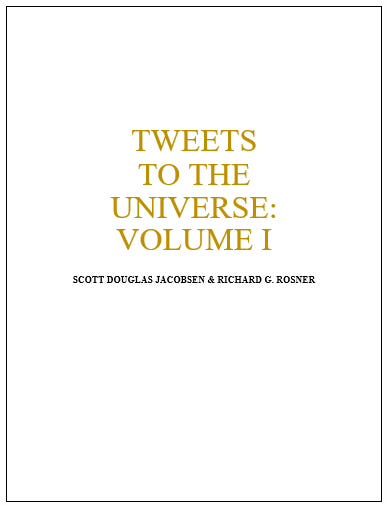
Contents
I. Dedications ……………………………………………………………………………………………………………… 3
II. Preface: Scott Douglas Jacobsen ………………………………………………………………………………… 4
III. Introduction: Rick G. Rosner……………………………………………………………………………………. 25
IV. Precedent: h/h’ = 1 + GM/[(R + (h/MC)]C^2 …………………………………………………………….. 35
V. Digital Physics ……………………………………………………………………………………………………….. 49
VI. Digital Physics to Informational Cosmology ……………………………………………………………… 58
VII. Informational Cosmology ………………………………………………………………………………………… 62
VIII. Appendix I: Preliminary Argument …………………………………………………………………………… 82
IX. Appendix II: Glossary …………………………………………………………………………………………….. 89
X. License and Copyright …………………………………………………………………………………………… 106
DedicationsTo three generations of women who support and tolerate me – my mom, Ruth, my wife, Carole, my daughter, Isabella.Rick
To the love in my life.Scott
Preface: Scott Douglas Jacobsen“Necessity is the mistress and guardian of Nature.”Leonardo da Vinci
“I love those who yearn for the impossible.”Johann Wolfgang von Goethe
“I believe that love of truth is the basis of all real virtue, and that virtues based upon lies can only do harm.”Bertrand Russell
“That so few now dare to be eccentric, marks the chief danger of the time.”John Stuart Mill
“When I was young I found out that the big toe always ends up making a hole in a sock. So I stopped wearing socks.”Albert Einstein
Honest enquiry necessitates auturgy, independent activity. Independent activity emerges from the discovery narratives in relation to the self, ourselves, and umpteen consanguinities extant with these and the world requires straightforward queries to enter into the storyline built for over two millennia in the Western tradition; frank questions necessitate the relinquishment of the normal self, the dulled identity, with the beginning of anxiety followed by excitement; an honest answer penetrates the transition between the normal self, its unknown future in abjuration, and its eventual relief followed by renewal and growth.
Since the origin of our species, our story, our cosmology, continually creates or constructs, dissolves or degenerates, and evolves or adaptively transforms, in time and place, and this occurred for multiplicities longer than the Sophists, Atomists, Pluralists, Eleatics, Ephesians, Pythagoreans, even far more deep into the human epic than the Milesians, as far in ‘pre-history’ as the dreamtime narratives of the Aboriginals around 40,000 BCE with slow, steady, and cross-cultural, jagged motions toward unifications and improved fidelity in representation of the Earth and heavens.
Pith ideas of the human backstory come from the improbable, even the implausible, but never impossible, except for the apparent rather than the actual, as far as I can ratiocinate about the matter for the important developments in the history of Eastern and Western philosophy, and natural philosophy or science, including the present unprecedented era with its proliferation of knowledge, skills, and talents, a time of excitement in technological innovation and scientific discovery, or the knowledge era of the Anthropocene epoch, which will transition into an intelligence phase based on command of the natural world through knowledge acquired in its previous period through discovery and mastery of the functional truths about the universe. All operational verities derived from the natural philosophic tradition in physics, chemistry, biology, psychology, economics, politics, and associated disciplines, and wrought to human significance within the frameworks provided by the ever-adaptive to human concerns disciplines of the arts and humanities, especially from the coherent clarity of philosophy; natural philosophy means science and remains contained in philosophy, but not vice versa.
To quote the inimitable Andre 3000 from Outkast in Ms. Jackson, “…forever Forever, forever ever, forever ever? Forever” never…
Knowing of Richard Gilligan Rosner, Rick G. Rosner, Rick Rosner, or Rick, came out of some of his moderate fame based on existence as a genius skylark exhibited throughout personal history such as forging documents to enter high school again and again, and again, and again – literal four times, for an opportunity at a better experience in high school, a ‘do-over’ to use the idiom, for a possibility of being a normal high school kid, which seems, in hindsight, like a fruitless endeavour, or an attempt, to exist as average by a man that is anything but, at least from my experience, and this transitioned into knowing about Rosner as a game show contestant on Who Wants to be a Millionaire?, as an interviewee with the acclaimed interviewer Errol Morris in the series First Person – an hour interview detailing him, as a professional comedy writer for Jimmy Kimmel at Jimmy Kimmel Live!, through more than thirty competitive high-range intelligence test performances with some of the highest scores ever achieved by an individual with inclusion of the Titan Test where one would suffice for some modest fame, as a member and editor for Noesis: The Journal of the Mega Society, and into knowing Rosner in an independent and collaborative professional relationship as an individual, as a person, as an interviewee in 2014 for In-Sight: Independent Interview-Based Journal, as a married man and father, and as an eventual friend, each instance, at least a little bit, presenting little tidbits of himself as an upstanding and intelligent person apart from common mis-conceptions about character and appearance of dumb behavior – a crummy disguise by a smart person with marginal reality to it; acting a fool does not a fool make, look closer, observe him.
Throughout these antics, the continued focal point remained the logical extrapolation of digital physics from Konrad Zuse (Rechnender Raum or “Calculating Space”), information theory from Claude E. Shannon (A Mathematical Theory of Communication), and digital philosophy from Edward Fredkin (Introduction to Digital Philosophy, On the Soul, Finite Nature, A New Cosmogony, and Digital Mechanics) for the origination and development of informational cosmology with tidbits given here and there by Rosner through minor and improbable publications and on the fringes of the internet, with this sporadic development and incorporation of information about the theoretical and mathematical, even metaphysical, bases of informational cosmology onto the internet over years and decades, without total compilation in one place – as if by caution or disorganization by him, seems like both to me.
As described in The Rick G. Rosner Interview [Academic]:
We discussed mathematics and physics, logic and metaphysics, consciousness and its subcategories, and these conceptualizations’ mutual interrelationships. In particular, refinement of digital physics into “informational cosmology.”
Furthermore, in informational cosmological nomenclature, your definition of consciousness divides into and emerges from two broad ideas: self-consistency and information processing. In brief review, we have identification of minds within universe with consciousness, universe with consciousness, and the interrelation of mind and universe based on isomorphic function and characteristics. What beyond this introductory realization of the equivalence? I observe multiple arenas of common discourse – let me explain.
From an informational cosmological foundation, the hyphenated term “self-consistency” and phrase “information processing” divide into further subcategorizations. These subcategories have constraints from definitions. “Self-consistency” and “information processing” contain various definitions because of differing interpretations, but technical and concrete definitions hold most import here.
As a general primer to “self-consistency” – which might have less decipherability than “information processing,” we can begin with this informational cosmology expression “self-consistency.” German mathematician and founder of set theory (fundamental theory for mathematics), Georg Ferdinand Ludwig Philipp Cantor, defined self-consistency as the inability to derive both the statement and negation of the statement at the same time. Cantor argued, if deriving the statement and its negation, the derivation would self-contradict. (One can transform this into more formal set theoretic language about elements contained in sets – or the language of mathematics, self-consistency holds great weight for mathematicians, and logic, see Law of Non-Contradiction below.) Self-consistency does have other theoretical universes of discourse in addition to multiple practical and applied venues of human venture: logic, set theory, mathematics, physics, computer science, and many others.
In logic, the Law of Identity (A equals A), Law of Non-Contradiction (A cannot equal not-A), and Law of the Excluded Middle (For all A: either A or not-A) all introduced – informally & implicitly by Plato in Theaetetus & The Republic and formally & explicitly by Aristotle in Metaphysics – in ancient Greece. Sometimes called “laws of thought.” These delineate facets of self-consistency expressed in the formalisms and vernacular of logic. For one similar vein, Gottfried Wilhelm von Leibniz derived Leibniz’ Law, x = y: if, and only if, x contains every property of y, and vice versa. Moreover, he derived sub-laws from Leibniz’ Law such as the Law of Reflexivity, Law of Symmetry, and Law of Transitivity. For one example, Law of Reflexivity, x = x: everything is equal to itself. This mirrors the Law of Identity of Athenian philosophers – Plato and Aristotle. Patterns – Platonic Forms and Ideas even – of concepts arise in repeated episodes of the historical timeline – groping towards some unitary definition.
In set theory, Austrian-born American logician, mathematician, and philosopher, Kurt Friedrich Gödel, had additional fame for formalization of St. Anselm’s Ontological Proof for the existence of God. In addition to this, Gödel published Über formal unentscheidbare Sätze der Principia Mathematica und verwandter Systeme or On Formally Undecidable Propositions of Principia Mathematica and Related Systems (1931). Tersely, an axiomatic system capable of describing natural numbers (e.g., 1, 2, 3…) held within it: 1) cannot be both consistent and complete, and 2) if consistent, the consistency of the axioms cannot be proven within the system. He, and modern specialists, call these two incompleteness theorems.
In mathematics, English logician, mathematician, philosopher, and founder of Boolean Algebra (foundational for digital electronics), George Boole, continued the ancient Grecians’ work in a facsimile of the earlier laws of thought with some extensions in mathematical language. I call them “Boolean Heresies” for fun. Boole laid these out in An Investigation of the Laws of Thought (1854). The primary extension from Aristotle became the extension of the three classical laws of thought into mathematical symbolisms, formalisms, and terminology. For one example, the ‘=’ or ‘equals sign’ signals synonymous meaning with the Law of Identity or the Law of Reflexivity between things. Labelled ‘A’ in the Law of Identity and ‘x’ in the Law of Reflexivity discussed earlier.
In physics, applied to time travel – the Novikov Self-Consistency Principle, “laws” of physics must remain self-consistent at a global level in the real universe to prohibit any paradoxes with respect to time travel. In this application, time-travel scenarios must disallow violation of universe’s global laws.
In computer science, at least in database management systems, the acronym ACID equates to principles for operation of database transactions. “ACID,” from Jim Gray (1981), means “Atomicity, Consistency, Isolation, and Durability” with the importance of “consistency” meaning “the transaction must obey legal laws.” In broad definitions provided by Gray (1981) about the “general model of transactions,” he states, “Transactions preserve the system consistency constraints – they obey the laws by transforming consistent states into new consistent states.” As noted, Boolean Algebraic (Boole) systems operable in computer science too.
One can see the pattern in numerous fields. Therefore, “self-consistent” or “self-consistency” within informational cosmology means “system without self-contradiction.”
“Information processing” will have an easier time of comprehension because of living in the computer age, digital age, or information age. American mathematician and cryptographer Claude Elwood Shannon’s article, A Mathematical Theory of Communication (1948), represented information theory connected to communication. A short paper, experts consider this article foundational to the field of information theory, which allowed many of them to decree Shannon the father of the information age. American scientist and mathematician, Warren Weaver, republished A Mathematical Theory of Communication (1948) and expanded on Shannon’s work in a coauthored book entitled The Mathematical Theory of Communication (1949). Specialists remember Weaver for pioneering work in machine translation. Shannon and Weaver laid the framework for information and communication theory up to the present day.
In it, if we take a human interpretive view of the work, he showed the degree of “noise” – entropy/disorder introduced into the message – entering between the “information source” (brain₁/mind₁) & “transmitter” (voice/speech) and the “receiver” (ears) & “destination” (second brain₂/mind₂). Noise enters between the transmitter and receiver to decrease the quality of the message from the information source to the destination.
For an everyday example, if you whisper from a mile away, your friend will have trouble understanding you – too much “noise” to prevent clear receiving and interpretation of the message; if you whisper next to your friend’s ear, the message will more likely have appropriate receiving, decoding, and arrival at the destination for your friend’s comprehension.
Not clear enough – think of a computer, how does it process information? It processes information according to input, process, and output. You type a symbol on the keyboard – input, the machine runs internal mechanics – process, and produces the appropriate (if functional) symbol on the monitor – output. Hence, the foundation of information theory in informational cosmology.
Input becomes any decipherable piece of data to the system. Process becomes the algorithm for managing the information. Output becomes the final product of input and process. Likewise, this applies to everything in informational cosmology at local and global scales.
In current vernacular, we ask, “What if the material of the universe equals input, process equals laws plus time, and output equals transformations of the material contents (e.g., particles, fields, forces, and so on) of the universe?”
In informational cosmological parlance, we ask, “What if bit units of universe equal input, process equals principles of existence plus time, and output equals transformations of bit units of universe?”
These reflect deep equivalences. As noted by 21-year-old Rick, all theories of grandeur and great import start with big equivalences. You shifted the perspective. Subsequent information processing equates to observed universe. Simply put, we need an armature by necessity, but do not observe the armature based on externality to universe.
Armature of universe equates to material framework or processor; universe equates to information processing or processing. We observe the information processing. We call this universe. We do not observe the material framework, but by necessity require processor based on isomorphic geometry between universe and individual localized minds.
Individual localized minds operate from brains, and therefore universe must have an equivalent of a “brain” – aforementioned armature. This deals with information and universe at the largest scales. In this, we have the rich derivation, i.e., refinement, of digital physics into informational cosmology.
Together, we have the targeted objectives of comprehensive conceptual organization, philosophical and scientific extrapolation, interrelationship incorporation, and dissemination of the ideas relevant to informational cosmology while working towards the deep pursuit of fundamental truths about the forces at work in and forms of the universe, and exterior to itself. Rosner formulated the grounds of informational cosmology on May 2, 1981. His 21st birthday. An extension of General and Special Relativity. Informational cosmology represents the culmination of about 30 years of spasmodic or erratic independent research, by Rosner, while distracted with stripping, bouncing, perfecting high school, roller-skating and waiting for tables, competitive intelligence test-taking, nude modelling, lawsuits, and comedy writing, in addition to extensive independent research with an undergraduate researcher, me, since August, 2014. Rosner worked on this theory while in pursuit of normality in high schools.
We have refined and incorporated necessary philosophical considerations into the mathematical enterprise. Rosner had knowledge and expertise unknown to me; I had expertise and knowledge unbeknownst to him. Our intellectual productions result from the collaborations and discussions relating the two. Most literary productions – from the modern and popular such as Oprah Winfrey to the old and obscure such as John Stuart Mill – appear to take the form of a monologue by the author to the, intended or non-intended, audience. Ancient Greek writing, some of the productions, appear to represent a dialogue between two or multiple fictitious, more often than not, characters or personalities.
A dialogue from the author to the, intended or non-intended, audience through the characters or personalities. An interview improves on philosophical dialogues – such as Plato’s written style, ask Charlie Rose, Larry King, James Lipton, Jimmy Fallon, Barbara Walters, Howard Stern, Oprah Winfrey, Jon Stewart, Peter Mansbridge, Ellen DeGeneres, David Letterman, or Tavis Smiley – for philosophical enquiry between idealized or fiction-built characters and transforms the thoughts of real people into an actual dialogue on topics of import to those people in reality rather than fiction. A dialogue from the author to the audience, intended or non-intended, through the real people for presentation of the tinctured premises, arguments, and their tentative conclusions. Interviewer and interviewee, in print, become characters such as those found in The Republic, but existent and non-Platonic rather than non-existent and Platonic. A rehabilitation amplified by modern electronics.
Gravitation, electromagnetism, weak nuclear interaction, and strong nuclear interaction. Informational cosmology amounts to a Grand Unified Theory and Theory of Everything. By definition, a Theory of Everything contains a Grand Unified Theory. Grand Unified Theories operate within the conceptual boundaries of electromagnetism, weak nuclear interaction, and strong nuclear interaction. Theories of Everything operate within the conceptual boundaries of gravitation, electromagnetism, weak nuclear interaction, and strong nuclear interaction. Theories of Everything exist as more comprehensive than Grand Unified Theories by these explicit and universal standards in the community of mainstream scientists – most. Informational cosmology classifies as a Theory of Everything with inclusion of the following: Quantum Gravity, Space Curvature and Standard Model of Cosmology, Electronuclear Force and Standard Model of Particle Physics, and Weak Interaction and Electromagnetism.
Each demarcates the functional descriptors of the universe without spiritual or mystical content contained in or implicated within them, and with technical and digital, or informational, contents and implications for them. Metaphysics does not exist within those contents, except in the implications of the set of cosmological architecture from which the universe exists as a sub-set.
Informational cosmology describes the reduction in Planck’s constant in proportion to the mass in your space-time locale:
h/h’ = 1 + GM/[(R + (h/MC)]C²
Rosner wore this on a t-shirt and flew this on an airplane banner. “h” equates to Planck’s constant. “h’” equates to modified Planck’s constant. “GM” equates to the standard gravitational parameter. “C” equates to the speed of light. “M” equates to the mass of the object. “R” equates to the radius of the massive object. “C²” equates to the speed of light times the speed of light.
In a modified statement with less mathematical symbolisms constructed from the previous mathematical statement:
Planck’s constant divided by modified Planck’s constant equates to one plus standard gravitational parameter divided by [(radius plus (Planck’s constant divided by mass times C)] times C squared.
Rosner’s first attempt to explain the expansion of space in the presence of mass with Planck’s constant as index of space. Novel phrases will come into the conversation for informational cosmology. Phrases such as “active proton centre” and “collapsed neutron matter outskirts” – and their associated derivatives – relate to the expansion of space in the presence of protons and collapse of space in the presence of neutrons, respectively. Protons activate galaxies, galactic groups, galactic clusters, galactic superclusters, and filaments and expand the space around them for the “active centre.” Neutrons represent the end result of burning, or activating, the proton-filled galaxies to the point of fuel exhaustion, neutron over proton dominance, for the collapse of space where the products move to the collapsed matter outskirts for long-term storage and possible re-activation in the active centre through infusion of protons into the neutron densities.
Informational cosmology builds from the general disciplines into itself, a hierarchical incorporation. Physics studies the motion of matter through space and time. Astronomy studies every non-terrestrial astronomical object and phenomena in the universe. Together, in the field of cosmology, physics and astronomy combine to study the large-scale structure with the precision of applied mathematics in the real world in relation to the motion of matter through space and time. General Relativity describes the convergence of space and time into space-time curvature and its operation in relation to the large-scale universe. Quantum mechanics studies the Planck length of the universe with the apparent simultaneity of phenomena with phenomena such as Wave-Particle Duality, Heisenberg Uncertainty, Non-Locality, Quantum Coherence, and many others.
Digital physics considers the motion of matter through space-time curvature emergent from quantum phenomena in correspondence with a general information processor. An information processor with self-simulation, self-observation, and self-containment (apology for the abundance of “self-” prefixes), except for the connection through emergence from the armature with the armature as the information processor. The universe exists as an open information processing system with extensive closure. Informational cosmology develops this idea farther into the realm of the external universe through implications of valid information processing, in accordance with cosmology, digital physics, and information theory, with conceptualizations such as net self-consistent information processing and an external material infrastructure for the information processor of the universe with the universe as its manifest operations.
Necessities for the mind requiring physical or material infrastructure, the nervous system, appears to mean the universe, as information processing in real-time (its time), requires a material framework, an armature or information processor aligned in structure with the brain. A similarity in form and function, but not utility and ubiquity. Consciousness appears non-mechanistic and non-mystical, but technical and informational, with repeated fractal phenomena incorporated for apparent continuity, diversity, and novelty in tendencies of form, function, and expression. Continuity in form; diversity in function; novelty in expression.
Minds’ dotted thoughts linked from each’s probable past and set of possible futures through continual re-instantiations, actualizations, of its information processing of reality. Same for the universe as a consciousness. Trees, rocks, waters, comets, and canyons exist as components for the consciousness of the universe, but not conscious components. As our minds remain more or less non-conscious with subsidiary components such as intra-cellular and extra-cellular junk, cholesterol, and cerebrospinal fluid for the central nervous system, the universe remains more or less non-conscious with trees, rocks, waters, comets, and canyons in itself.
Nature amounts to all that exists relevant to the contents and operation of the contents within the universe. Standard science conceives of the natural world as a physico-functional object in operation through whole number additions in time at its micro-most time scale, the Planck scale. Informational cosmology contains the totality of relevant physics to describe this aspect of nature. External to the universe the armature equates to the metaphysical because “meta-” means something higher or of a second-order kind and “-physical” means a material existence, which aligns the basic physicalist with the basic materialist, and this defines something outside the physical and material.
Consciousness, in informational cosmology, equates to a construct. A technical phenomenon constructed from pervasive self-consistent information processing; nothing spiritual or mystical. An armature, as an external-to-universe material object, means a higher-order material existence, and equates to both metaphysical and physical – dependent upon referent. Metaphysical in relation to the lower-order material existence of the universe; physical in relation to its higher-order material existence in the armature world. The universe, as a pervasive closed system with possible openness with the armature and armature world, connects to its physical aspects and its higher-order associated information processor, the armature. By definition, metaphysics instantiates in the physics of information cosmology by implication, and vice versa, with the ordering dependent upon the space-time in reference: universe, armature, or armature world.
The physico-functional definition around informational cosmology makes for an entire field of partially known information in the observed universe and unknown information in the non-observed sectors such as apparent T ≤ 300,000 years from apparent T = 0 years or external-to-observed universe information through the means of light, or photons, with possible perception through gravitational waves’ after-effects observed between apparent T ≤ 300,000 years from apparent T = 0 years.
A metaphysico-functional description of the universe, in another representation of information cosmology within different conceptual frames and neologisms, describes the observed and non-observed sections of the universe – as the universe – or active proton centre and collapsed neutron matter outskirts, and the respective necessitated outside physical infrastructure, which means a description of this material framework’s associated armature universe to an operational infinite. Informational cosmology refines methodological naturalism and the epistemological bases of science, extends the convergence of digital physics and cosmology, aims to recalibrate and extrapolate from General and Special Relativity, and conceives of an informational and technical conscious universe.
Insofar as informational cosmology operates from the core content or essence of nature, which derives from natural philosophical experiments – or questions to the universe in search of intelligible answers (as SETI searches for intelligible signals from advanced extraterrestrial civilizations with some form of electromagnetic communication a la Frank Drake in the Drake Equation within the Milky Way galaxy; science, in general, searches for intelligible answers from the universe), informational cosmology in its foundations within the universe because of our existence within it implicates the meaninglessness of the conscious cosmos in accordance with much of modern science, but not to individual minds in the universe, if they so choose to create meaning for themselves and others.
Even so, this leaves the possibility for meaning in the armature world for the armature from which the universe arises because the walls upon which we paint our bodies creates the mind and meaning for individuals, and collectives, inside of the universe and, therefore, the armature derives meaning from the armature world in which it exists too. Within these constraints of consideration, the universe exists as conscious and meaningless, but its armature does contain meaning because it will likely have targeted, legitimate objectives or goals in correspondence with the net self-consistent information processing observed in normal (relative to us) consciousness’ targeted objectives or goals in the universe in contrast, and similarity, with the armature world for the armature.
Consider: we do not claim the exchange of information in the cosmos as meaningful as a whole except in sub-systems such as ourselves in transaction with the rest of the universe, and the higher-order factorizations from them as containing meaning; therefore, the universe will not equate to the constructor of meaning with minor exceptions, but will equate, in one formulation, as an intermediary between the information-space of the armature and the relevant motion of the armature through space-time in the armature world. The universe amounts to the moment-to-moment information transfer akin to the brain; its information-space contains the higher-order factorization necessary for meaning.
Therefore, the armature, armature world, the universe, and minds internal to the universe, construct every associated information-space or mind-space for meaning in emergent net self-consistent information processing arrays or sub-arrays in transaction with the relevant information in its environment. All that exists, everything, contains a unified property with two valid derivatives with respect to meaning; the universe does not contain meaning, except in its implicational constructions’ creation of meaning such as human beings and their variegated narratives and meta-narratives, and the armature and armature world contain meaning through construction of the universe to derive the information-space or mind-space relevant to its existence and actualizations inside of the armature world.
Meaning means transaction, or attribution; persistence provides the bases for continual transactions relevant to a net self-consistent information processor and its net self-consistent information processing and, therefore, the foundation of each sound – as in valid premises and conclusion with the conclusion following logically from the premises and the conclusion being true – ethic in an informational cosmological ethic necessitates persistence and the consciousness’ imperative to continue into the indefinite future.
The foundry of existence begins with the tautological principles about the universe in its inability to not exist; everything cannot not exist; thus, all cannot not persist; furthermore, ethics follows from this with existence and its continuation, or persistence, as the philosophical, or metaphysical, bedrock for an absolute ethic grounded in the reality of necessitated persistence; wherein meaning for every consciousness derives from the functional infinitude of potential narratives and meta-narratives in an actual finite universe erected from the requisite ethic for continued persistence, which sums to necessitated existence and persistence and its associated generalized ethic related to implicated, and necessitated, respect for the narratives and meta-narratives of individual minds insofar as these do not interfere with the wellbeing and narrative of another mind, and vice versa: The Informational Golden Rule.
Galileo Galilei stated:
Philosophy is written in this grand book — I mean the universe — which stands continually open to our gaze, but it cannot be understood unless one first learns to comprehend the language in which it is written. It is written in the language of mathematics, and its characters are triangles, circles, and other geometric figures, without which it is humanly impossible to understand a single word of it; without these, one is wandering about in a dark labyrinth.
For those with literary leanings, with religious ritualism, with metaphoric minds, or swayed by symbolisms, The Word of the conscious universe would appear as the language of mathematics as metaphysics and physics, and the ability to interpret based on mathematical aptitude, or mathematical linguistic ability and talent, and the involvement of one’s consciousness with the universe dependent on one’s interest in and comprehension of the “grand book” of nature, the cosmos, the macrocosm from which our microcosms converge into a blip of awareness, with the privilege to know something about the mind which birthed us – though we do not know the status of its concern for its contents such as ourselves, which leaves us, at a minimum, better to not wander in the dark labyrinth of ignorance and to write out our narrative on the blank pages of the future – and, at any rate, to continue or to persist in as many narratives as possible limited by the informational and, therefore, definitional constraints of the universe.
Introduction: Rick G. Rosner
In mid April, 1981, I was sitting in the Libby Hall cafeteria at the University of Colorado, eating a bowl of cubes of red Jell-O. I was frequently in the cafeteria – it was all-you-can-eat, and I was usually trying to put on weight, thinking that being big and muscular would help me get a girlfriend. I’d just read an article about mechanisms of short-term memory versus mechanisms of long-term memory in the brain.
Chewing on Jell-O, I thought that the article was kinda BS. (It probably wasn’t BS, but I was not quite 21 and full of opinions.) You could explain short-term versus long-term memory with a kind of geometry. Things in long-term memory are accessible from a number of different angles – from a bunch of different associations or memory hooks – while things in short-term memory are accessible from only the context in which they happened (unless something establishes more hooks for that memory), so that memory is harder to retrieve, because that specific context is less likely to come up. It’s why dreams are hard to remember – the weirdly random context of the dream will likely never come up in your brain again (unless you make an effort to embed the dream in memory – in a waking context – right after awakening from it).
So, in a geometry of memory, long-term memories would be centrally located, accessible from many angles, while short-term memories would be at the periphery, accessible from only a very limited set of angles. Then I thought, “What if that geometry is the geometry of the universe?” I stopped chewing and froze with spoon in mid-air.
At about age ten, I’d decided that my job should be figuring out the universe. Smart and nerdy, I stayed in at recess, reading, whenever the teacher let me. A decade later, I was a half-assed physics major at CU, reading and thinking on my own and consistently falling asleep in class. At almost age 21, I’d made progress in de-nerdifying myself, getting contact lenses and being all weight-lifty. I was bar bouncing and was a couple weeks away from starting my career as a male stripper. My only decent insight beyond standard cosmology was thinking that nothingness maybe wasn’t the default state of existence – that even in total chaos, it’s unlikely that islands of order won’t show up somewhere.
And now this revelation, mid-Jell-O bite. The geometry of information in the mind and the geometry of the universe might be the same. This was a core insight – my ticket to figuring out stuff. I worked on the theory in between checking IDs in bars, while waiting to go onstage and get naked on Ladies’ Night, while doing volunteer work taking developmentally disabled people roller skating. The discomfort of squashing my flat Fred Flintstone feet into roller skates and the anxiety of dancing in sleazy strip clubs helped focus my thinking.
It became clear that the Big Bang and black holes didn’t work in a universe made of and defined by information. A self-defined universe can’t just pinch parts of itself off. It can build a pinch point, but that pinch won’t be a full-on event horizon – that’s the universe saying, “Well, this information has absolutely 100% nothing to do with the rest of my information – see ya!” And the Big Bang – that’s your pocket calculator blowing up before it can finish even one calculation.
I worked all these crap-but-fun jobs – stripper, bouncer, roller-skating waiter – feeling not very obligated to not make much progress in life, since I was (sometimes) doing my true job – figuring out the universe and how it processes information.
Lots of smart people think we live in a digital universe – a vast computer, processing bits. Which is fine, but what are the actual processing mechanisms of the universe? I think the universe processes information by aggregating, by locking together like fuzzy Legos, by clumping together in stars and galaxies.
Among the things I believe are:
- Much of the essential business of the universe is visible to us as the everyday phenomena of the universe.
- Proton-electrons are the little aggregation engines of the universe.
The standard model of particle physics contains 61 elementary particles. According to current theories of dark matter and dark energy, only four percent of the universe is visible matter that we see as planets, stars, and galaxies. But what if the function of all this stuff is to process and record information? Then it might be possible to think about the universe in simpler terms.
One interesting thing about the universe is that, over time, the matter in it forms associations and clumps together in ways that are hard to reverse. As matter clumps together, the universe becomes more precisely defined. The clumping creates and records information. And the most visible agents of clumping are five persistent particles – protons, electrons, neutrons, photons, and neutrinos. These particles can last for many billions of years. They’re all involved in hard-to-reverse (semi-permanent) changes in the universe.
Protons and neutrons aren’t elementary particles. They’re made of quarks. But even though protons and neutrons aren’t elementary, protons, neutrons, and electrons seem to be the universe’s basic aggregation engines. Electrons (loosely) lock into orbits around protons. Protons lock together (with some turning into neutrons) in atomic nuclei. Atoms lock together into molecules. Atoms and molecules come together in intricate forms of matter.
This doesn’t mean that the universe’s other particles aren’t essential. But, if they don’t create and store information, they might be considered supporting particles for those that do. Take, for instance, quarks, which, in sets of three, make up protons and neutrons, and gluons, which transmit the strong force that holds atomic nuclei together and which holds quarks together in protons and neutrons. Inside protons and neutrons, quarks and gluons are constantly exchanging forces, changing characteristics, and popping in and out of existence in 1/10^24 of a second. Throughout all this, a proton is very stable, with a lifespan of at least 10^34 years. So, does all the action going on within a proton have any impact on the (macro) information in the universe, or are quarks and gluons just part of the somehow necessary underlying mechanics of particles that do register long-term change?
Knowledge is relational – everything is defined in terms of everything else. Some philosophers (and brain researchers) like to ask, “How do we know red is red? How do we know that what we think of as red is what someone else thinks of as red?” We can pretty much assume that two people’s ideas of red (absent some deficit in perception) are pretty close based on their associative definitions of red – it’s seen on apples, stop signs, one end of the rainbow, and so on. Same for something like “up” – it’s associated with the sky, with the parts of trees and light poles farthest from the ground, with the direction opposite the gravitational force vector.
Try reversing your definition of “up.” Picture “up” as being in the direction of gravitation, with the ground being up, and trees and buildings forcing themselves down, towards the sky. It’s really tough to do. Everything you know, everything associated with “up,” makes you want to continue to understand up as up. (Though, once something is as deeply embedded in your awareness as red or up, it doesn’t usually trigger a cascade of associations. You’re like, “Yeah, that’s red,” or “That direction is up,” or, even more likely, you don’t even consciously note red or up – they’re just part of the subconscious structure of awareness.)
Like our understanding of the world, the universe is built from associations, some gravitational, some electromagnetic, some via the strong force, in atoms, planets, stars, solar systems, galaxies, super clusters … . I don’t think it’s unreasonable to suppose that these associations support meaning, the same way associations in our minds support meaning.
With regard to us and with regard to the universe, I think there are three related structures (well, three-and-a-half):
- The hardware – the brain and its connections
- The information contained in the brain as perceived via consciousness – how the various information and thought streams in your brain share content with and influence each other
- Information seen as an optimized map of itself, with its own apparent space and physics3½. The material world that we experience every day
Observing our minds and brains, we see structures one and two – the hardware and the perceived information. Observing the universe, we see the third structure – an information-space with a physics that seems to operate, via relativity and quantum mechanics, in an information-based way. And we live in the everyday material world (which is part of information-space but which is experienced by us via what seems like classical physics (and without access to meaning of the meaning of the information in information-space)). It’s not outrageous to think that the information in each of our minds could be seen as unfolding as an information-space. Nor is it outrageous to think that the information in the universe could have meaning beyond itself and that the information must be supported by hardware apart from the universe, the same way computers and brains are necessary for the existence of the information they contain.
In 1986, I went back to high school to think about the structure of the universe while crammed into those desk-chair combos. (I didn’t go back to creep on girls – that wouldn’t have been ethical.) High school senior by day, bouncer and not-great stripper by night.
To be an information processor (I thought as a fake high school senior), the universe has to recycle itself. There has to be a proton-neutron cycle. The first half of the cycle certainly exists. In stars, protons clump together into heavier nuclei, with some of the protons turning to neutrons. (Besides hydrogen, atomic nuclei are about half neutrons, with the neutron-proton ratio gradually creeping upwards as the size of nuclei grow (because protons repel each other, so you need more neutrons to keep a heavy nucleus from throwing off particles).) In nuclei formed from stellar fusion, the majority of neutrons started off as protons.
Then, when stars run out of easily available protons that generate heat through fusion, the stars collapse, which, for sufficiently massive stars, squashes most of the remaining protons (in nuclei) into neutrons, hence the name neutron star. Run-of-the-mill collapsed stars don’t put out much energy – they’ve run out of proton fuel.
So the universe looks like a one-way process – matter coalescing into clumps, protons fusing into neutrons, stars and their galaxies eventually going dark. This doesn’t look much like an information-processing universe – it looks like a universe that does one big, long calculation, and that’s it. Well, that’s a crappy calculator or computer or universe. You’d expect an information processor to process an ongoing stream of information – a calculator to keep calculating, a computer to keep computing, a mind to have more than one thought.
And so, the universe needs a cycle, to turn those neutrons (and locked-in protons) back into fusible protons. Sitting in journalism class or calculus, the back of my chair/desk being kicked by a football player with a Rockin Dio calculator, high school me thinks that old, burned-out galaxies (and the space which contains them) get shoved aside by young, fresh galaxies. Then, at some point, way, way later, the old galaxies can get reactivated by the curvature of space or a flood of neutrinos.
Neutrinos are emitted when a proton turns into a neutron. Neutrinos pass through a crazy amount of matter unscathed, which means a bunch of them should accumulate on the outskirts of the universe, where space might be tighter. Space being tighter on the outskirts would mean that not all of space expanded evenly from a single Big Bang. It would mean that the universe has an active center with somewhat fresh matter that looks expansive, while outside of this, you have collapsed, inactive matter. This matter could be reactivated, which might look like the enormous blackish holes at the center of galaxies spewing out a floor of particles. Perhaps some galaxies manage to stay fresh and in the active center for a very long time via their central blackish holes shooting out jets of matter for a very long time. If there is a neutron cycle, then the 13.8-billion-year age of the universe is only an apparent age, which is based on the amount of information in the universe, while its actual age is fantastically older. In a neutron-cycle universe, old, collapsed regions function as memory – as stored information to be recalled under appropriate circumstances.
Perhaps the universe has correlational instruments besides protons, but they seem to me to be the most obvious. Each proton seems to me like a little spatial dimension or a variable in an equation. Variables can correlate with other variables. (That’s what you want them to do – correlated variables condense information.) In information space, correlation is related to proximity – things that have much to do with each other are close to each other. When two protons are smashed very close to each other, they can fuse into a single nucleus, which, in a way, is saying that two variables are sufficiently correlated with each other that they can function as one. I suspect that each proton is a twist (or perhaps a knot) in space, with the twist putting stress on space (and also giving form to space) which is compensated for by an opposite electrical charge in the form of an electron. Protons and electrons (and supporting particles) are parts of little correlational engines.
After graduating from high school for the last time at age 27, I accidentally became a quiz show writer and then a TV comedy writer, contributing to more than 2,500 hours of programming on all the big networks. But I still thought about physics in between thinking up Kardashian jokes. Then, a year and a half ago, I was fired from a job on a late-night show I’d had for nearly 12 years. This was bad – it was a great job. But it was also good, because Scott Jacobsen was interviewing me for In-Sight Journal. With all sorts of time on my hands, I could go on at length about the theory. So here it is. There was no single Big Bang. Consciousness is a technical property of large-scale shared information. The universe is an information processor, and the information it processes is about something beyond itself.
Last updated May 3, 2025. These terms govern all In-Sight Publishing content—past, present, and future—and supersede any prior notices. In-Sight Publishing by Scott Douglas Jacobsen is licensed under a Creative Commons BY‑NC‑ND 4.0; © In-Sight Publishing by Scott Douglas Jacobsen 2012–Present. All trademarks, performances, databases & branding are owned by their rights holders; no use without permission. Unauthorized copying, modification, framing or public communication is prohibited. External links are not endorsed. Cookies & tracking require consent, and data processing complies with PIPEDA & GDPR; no data from children < 13 (COPPA). Content meets WCAG 2.1 AA under the Accessible Canada Act & is preserved in open archival formats with backups. Excerpts & links require full credit & hyperlink; limited quoting under fair-dealing & fair-use. All content is informational; no liability for errors or omissions: Feedback welcome, and verified errors corrected promptly. For permissions or DMCA notices, email: scott.jacobsen2025@gmail.com. Site use is governed by BC laws; content is “as‑is,” liability limited, users indemnify us; moral, performers’ & database sui generis rights reserved.


