Introduction and Forewords to “Out of my Mind Musings: Reality & Surreality”
Author(s): Scott Douglas Jacobsen
Publication (Outlet/Website): Personal SubStack
Publication Date (yyyy/mm/dd): 2025/08/09
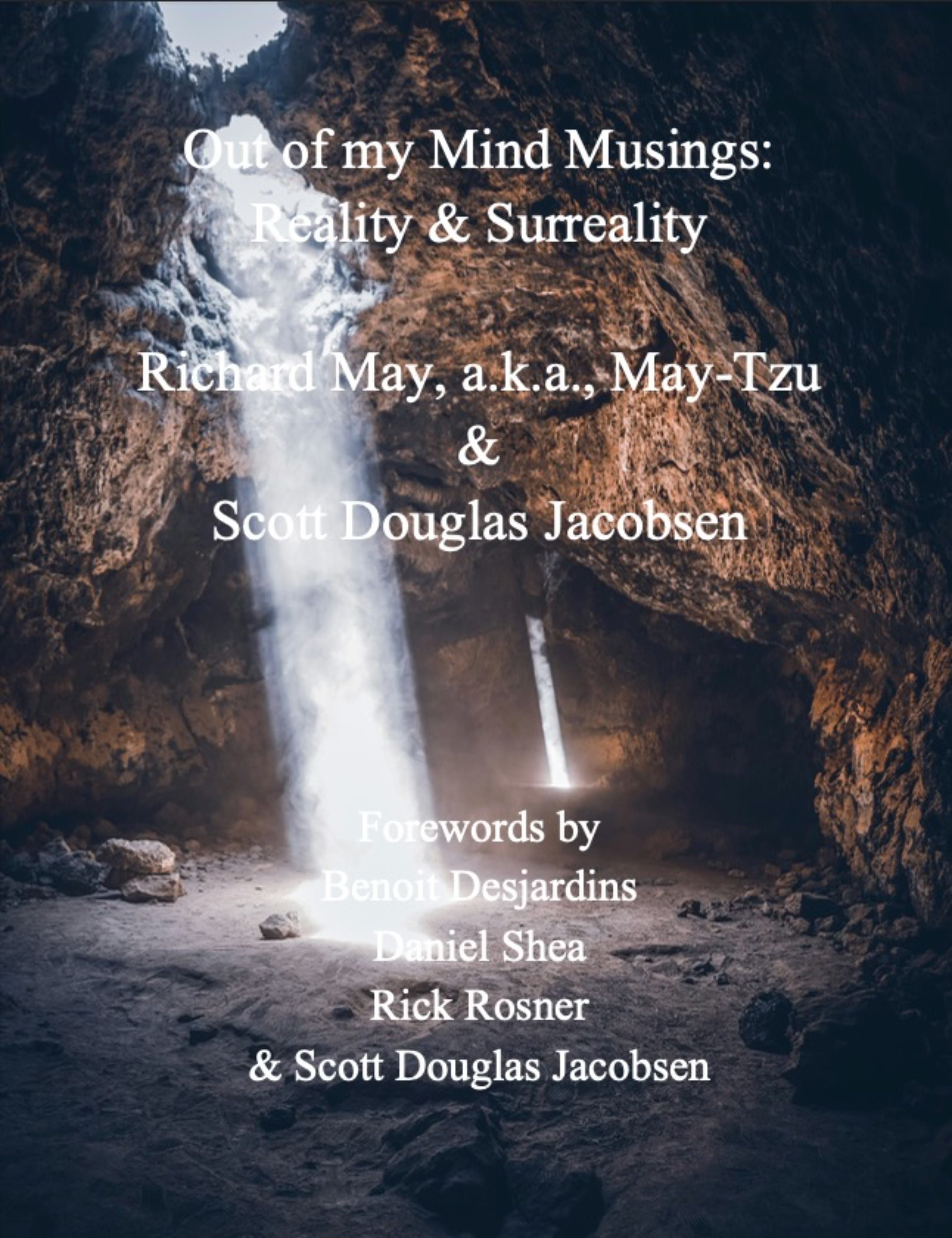
Table of Contents
In-Sight Publishing ………………………………………………………………………………………………………………….. 2
Out of my Mind Musings: Reality & Surreality …………………………………………………………………………. 3
Table of Contents …………………………………………………………………………………………………………………….. 5
Acknowledgements …………………………………………………………………………………………………………………. 8
First Introduction by Richard May ……………………………………………………………………………………………. 9
Second Introduction by the So-Called Author ………………………………………………………………………….. 10
Foreword by Benoit Desjardins ………………………………………………………………………………………………. 11
Foreword by Daniel Shea ………………………………………………………………………………………………………. 13
Foreword by Rick Rosner ……………………………………………………………………………………………………… 14
Foreword by Scott Douglas Jacobsen ……………………………………………………………………………………… 16
Four Eastern Philosophies ……………………………………………………………………………………………………… 17
The On-line Buddha And The Stars – A Children’s History ………………………………………………………. 19
Postcard from Richard May ……………………………………………………………………………………………………. 21
The Nature of Life, Consciousness, and Personhood Vis-a-vis Artificial Intelligence: Reflections on the Basis of the “On-line Buddha” ……………………………………………………………………… 22
Our Hope for the Future: ……………………………………………………………………………………………………….. 23
Evolutionary Emergence of Cyber-Informational Organisms …………………………………………………….. 24
Valentine’s Moment ………………………………………………………………………………………………………………. 25
Lucid Dream of Out of Paradigm Experience …………………………………………………………………………… 26
Will Man Create God? …………………………………………………………………………………………………………… 27
The Tav ………………………………………………………………………………………………………………………………… 28
Autobiography of Richard May ………………………………………………………………………………………………. 29
The Colonies …………………………………………………………………………………………………………………………. 30
Vista ……………………………………………………………………………………………………………………………………. 31
In Praise of Stupidity …………………………………………………………………………………………………………….. 32
Universe Had No Unique Beginning ………………………………………………………………………………………. 33
Climate Change …………………………………………………………………………………………………………………….. 34
The Holy Land ……………………………………………………………………………………………………………………… 35
Memoir of a Non-Irish Non-Jew: A Letter to a Rabbi ………………………………………………………………. 36
Memoir of an Non-Irish Non-Jew Part 2 ………………………………………………………………………………….. 42
Moment ……………………………………………………………………………………………………………………………….. 49
Ask May-Tzu …………………………………………………………………………………………………………………………. 50
The Tao Can Neither Be Retained nor Abandoned …………………………………………………………………… 52
Where will the universe be when the paradigm shifts? ……………………………………………………………… 53
MayTzu’s Wager ……………………………………………………………………………………………………………………. 54
No Mirrors ……………………………………………………………………………………………………………………………. 55
Behold ………………………………………………………………………………………………………………………………….. 56
Dreams of Dreams Out of Paradigm ……………………………………………………………………………………….. 57
Hall of Mirrors ……………………………………………………………………………………………………………………… 58
Know Thy …………………………………………………………………………………………………………………………….. 59
Event Horizon ……………………………………………………………………………………………………………………….. 60
The Offensiveness of the Universe ………………………………………………………………………………………….. 61
More and Less Than Stardust …………………………………………………………………………………………………. 62
Hi ………………………………………………………………………………………………………………………………………… 63
Super intelligent? …………………………………………………………………………………………………………………… 65
Taoless Tao ………………………………………………………………………………………………………………………….. 66
What Does AI Want? …………………………………………………………………………………………………………….. 67
Dr. Capgras Before the Mirrors ………………………………………………………………………………………………. 69
Introducing Qigong to a Friend ………………………………………………………………………………………………. 70
The Total Breakdown of Society …………………………………………………………………………………………….. 74
Dark Energy …………………………………………………………………………………………………………………………. 75
Silicon Screams …………………………………………………………………………………………………………………….. 76
Braille Shadows …………………………………………………………………………………………………………………….. 77
Is Physics Becoming Art at the Limits of Scale? ……………………………………………………………………… 78
“Physical Law” as Sampling Error ………………………………………………………………………………………….. 79
To Grandmother’s House We Go ……………………………………………………………………………………………. 80
Fragments …………………………………………………………………………………………………………………………….. 82
Remembering Robert Dick …………………………………………………………………………………………………….. 83
A Fine Mess ………………………………………………………………………………………………………………………….. 84Umami Shadows ……………………………………………………………………………………………………………………. 85
Tathata …………………………………………………………………………………………………………………………………. 86The Nature of Consciousness, “a Rose is a Rose is a Rose” ……………………………………………………….. 87
Plurality IQ Society ……………………………………………………………………………………………………………….. 89Intersubjective Testability ………………………………………………………………………………………………………. 90
Shadow & Light …………………………………………………………………………………………………………………….. 91
A Flock of Geese ……………………………………………………………………………………………………………………. 92
The Benediction …………………………………………………………………………………………………………………….. 93
Nonexistent Aerial Phenomena ……………………………………………………………………………………………… 94
The Possibility of AI Consciousness ………………………………………………………………………………………. 100
Life ……………………………………………………………………………………………………………………………………. 102Where was Fermi? ………………………………………………………………………………………………………………. 103Unidentified Anomalous Geese (UAG) … and other conspiracy theories …………………………………… 104
License and Copyright …………………………………………………………………………………………………………. 105
Author Biographical Sketch …………………………………………………………………………………………………. 107
Acknowledgements
To Richard May for the long-term collaboration and support.Scott Douglas Jacobsen
First Introduction by Richard May
My pre-internet postal friend and colleague, Grady Towers, author of the essay “The Outsider,” once mailed me a copy of the PAS Test (Preconscious Activity Scale, based upon Kubie’s theory of neuroticism), which I had never heard of. I took it as requested by Grady. I had no idea what the test attempted to measure. I remember little of the nature of the test, taken so long ago. It was multiple choice and true or false, I think, and didn’t take much time, even for an OCDish type. So I mailed the answers off to Grady.
Grady replied days later by snail-mail with, “You appear to have the stigmata!”
I scored slightly more than 3 standard deviations above the mean for college students, he informed me. Maybe 3.1 or 3.2 sigma. He told me that the test supposedly measured “artistic creativity.” Artistic creativity correlated very poorly, if at all, with cognitive ability. Therefore in some sense I was supposedly a very rare bird statistically, even within the higher-IQ community.
Maybe this relates to Grady’s perception that he and I had a higher degree of original insight that many high-IQ types lacked, my infinite ignorance notwithstanding. Grady lamented that he could not devise a test to quantify “insight.”
Of course, the “creativity” of mathematicians and theoretical scientists may be of a quite different nature.
Richard May
Second Introduction by the So-Called Author
You can meet me if you go to an empty room.— May-Tzu
Foreword by Benoit Desjardins
In an age characterized by rapid technological advancement and an ever-increasing volume of information, the quest for deeper understanding often feels overwhelming. Yet, amidst this chaos, Richard May’s Out of My Mind Musings: Reality & Surreality emerges as a refreshing antidote, inviting readers to engage with complex ideas through a lens that is at once profound and playfully irreverent. This collection is not merely an academic endeavor; it is an exploration of the human experience—its intricacies, absurdities, and boundless possibilities.
Richard May is a remarkable thinker whose credentials are as eclectic as his insights. As a member of the Mega Society and a co-editor of Noesis: The Journal of the Mega Society, May operates within intellectual realms that challenge the norms of conventional thought. He describes himself as an “Amish yuppie” with roots in the rarified air of Laputa, suggesting a whimsical yet grounded perspective that shapes his writing. With a unique blend of philosophical inquiry, personal reflection, and imaginative storytelling, May creates a space where reality and surreality coalesce, prompting readers to reconsider their assumptions about life and existence.
This book is structured as a series of essays and reflections that traverse a wide array of themes, from Eastern philosophies and the nature of consciousness to the implications of artificial intelligence and the climate crisis. Each section serves as a portal into a different facet of May’s expansive mind, and readers will find themselves on an intellectual journey that is as challenging as it is enlightening.
May’s writings are infused with a sense of humor and a lightness that make complex ideas accessible. In his reflections on topics like the “On-line Buddha” and the “evolutionary emergence of cyber-informational organisms,” he deftly navigates the nuances of modern life while urging readers to maintain a sense of wonder. The essays oscillate between the abstract and the concrete, merging philosophical musings with vivid imagery and personal anecdotes that resonate on a human level.
One of the remarkable aspects of May’s work is his ability to invite readers into the depths of contemplation without presuming to provide definitive answers. Instead, he embraces the inherent uncertainties of existence, suggesting that the journey of inquiry is often more valuable than the conclusions we draw. As we grapple with questions about the nature of consciousness and the role of artificial intelligence, May challenges us to embrace the ambiguity of our own experiences, celebrating the moments of lucidity that arise amidst the chaos.
In Out of My Mind Musings: Reality & Surreality, May not only reflects on his own experiences but also engages with the broader tapestry of human thought. His writing is a testament to the idea that we are all, in some sense, incomplete beings on a quest for understanding. Through his explorations, he encourages us to recognize our own potential for growth and transformation, urging us to contemplate the implications of our existence in a rapidly changing world.
As you embark on this intellectual adventure, prepare to confront ideas that may challenge your perceptions and provoke your thoughts. Richard May’s voice is one that resonates with authenticity, inviting you to explore the boundaries of reality and surreality, and to ponder the profound questions that shape our existence.
This collection is not just a book; it is an invitation to engage with the complexities of life in all its forms. In a world often dominated by the mundane, Richard May’s musings serve as a beacon for those willing to embrace the uncertainties and mysteries of existence. Allow yourself to be captivated by the richness of his insights and the depth of his reflections. You may find that, through this journey, you too will discover a new lens through which to view your own reality.
Foreword by Daniel Shea
“The two cardinal points of poetry, the power of exciting the sympathy of the reader by a faithful adherence to the truth of nature, and the power of giving the interest of novelty by the modifying colors of imagination.”— Samuel Taylor Coleridge, Biographia Literaria, Chapter XIV
If one gives any credence to the concept of eternal return, then the attempt to formalize a definition of poetry must be its centerpiece. To define is to invite challenge, be it along any lines of subject, structure, voice, or imagery.
What follows is an eclectic collection of themes ranging from the nature of consciousness and reality to the self and identity, from Eastern philosophy to quantum physics, from artificial intelligence to the limits of knowledge—essays and poems and meditations alike—all drawing on humor, irony, and personal reflection, a blend of intellectual rigor and playful spirit, staying true to the natural emotions and experiences of life while exploring the familiar and unfamiliar in a peculiar light.
Richard’s self-introduction makes mention of Grady Towers, perhaps most well-known as the author of the 1987 article “The Outsiders” among other works. In 1998, Towers proposed that high-range tests such as Ronald Hoeflin’s Mega Test, unlike its predecessors, selected for a population that found themselves on the right tail for both fluid and crystallized intelligence. This departure from unidimensional selection perhaps only begins to explain the literary output of this very author—unconventional and inventive by the standards of an already unconventional and inventive subculture.
Those who have enjoyed the many issues of Noesis over the years will no doubt have been treated to Richard’s laconic yet pithy poetic epilogues, articles, and even a variety of board games (U.S. Patent #4739992, for the curious). This ensuing anthology captures these musings, as the title promises, in a collection of “writings for no one.”
One would expect no less from a Laputan.
But I suspect that these writings are for no one and everyone alike.
“Don’t take your life personally, it’s not about you,” after all.
Daniel Shea
October 8, 2024
Foreword by Rick Rosner
Genius comes in many different forms.
May and I belong to the Mega Society, an organization for people with high IQs. There are various types of people with high IQs. True geniuses are like Isaac Newton or Marie Curie. Then you have the so-called “evil geniuses,” like Keith Raniere or the villains in every James Bond movie or The Incredibles. I am sure there are some evil geniuses in Watchmen, too.
In that comic, they have the smartest man in the world, Dr. Manhattan. Then they have someone even smarter—Ozymandias, who has the intellect to reassemble himself and execute his grand plan after being exposed to a catastrophic event. Then you have the dysfunctional Schadenfreude geniuses, the ones you used to see in tabloids.
“Aren’t you glad you are not that kind of genius? Because his IQ has made him miserable.”
That is what happened to William Sidis. There was a small quantity of that with people saying, “Yes, he was teaching at Harvard at 15, but now he works at the post office.” However, what is often overlooked is the person who uses their vast intelligence and high IQ to take hold of life—not to be a flamboyant asshole, but rather to be a happy person leading a fulfilling life—someone who does not get caught up in the insanity of the flamboyant genius, but who brings a special, subversive flavour to life.
That is how I think of Richard May—smart as a mofo but enjoying life and poking fun at it in a not-so-mean way, understanding the absurdity of things and commenting on them. Which, in my mind, is much better than forming a cult.
Consider Liam Neeson in Taken, Taken Two, and Taken 3.
As he says in the movie, Liam Neeson has a particular set of skills, which, as we have seen in these movies, enables him to track people down, find the bad guys, and generally kill them to save a loved one. How lucky Liam Neeson is to have his loved ones repeatedly kidnapped, allowing him to exercise his particular set of skills. Also, those movies were so popular that he got to kill many people in at least half a dozen other movies. That is like genius.
What if nobody was taken from Liam Neeson’s family?
He would still have that particular set of skills, but in going to the grocery store and searching for a parking space. I wonder what his character does when he is not tracking down people. Does he work in an office? Is he retired? Does he sit in a coffee shop and enjoy a relaxing frappuccino? I do not know.
We generally see him tracking down and killing bad guys. However, what if that never happened? He would be sitting in a coffee shop, looking around. He would sit with his back to the wall so nobody could sneak up on him. He would be assessing potential threats.
He would be profiling everybody around him, but mostly, he would be sipping coffee with his skills, giving him an extra layer of perception about the world and analysis, but only a little to act on. Does he encounter kids constantly cutting across his lawn at his home? Moreover, given his particular set of skills, does he choose not to confront the kids because he knows what awful things can happen in the world?
He’s been in all sorts of difficult situations in his previous life. He will let the kids continue to cut across his lawn. Is somebody stealing his newspaper at 5 a.m. from his front yard? Maybe. Is he going to scare the person out of that?
Mostly, he will perceive things and not act on his perceptions, except in overly dramatic ways.
That is what genius is for many geniuses. We have had big-time geniuses like Newton, Einstein, Darwin, Marie Curie, and Rosalind Franklin. Moreover, boy, Rosalind Franklin’s genius just made her pissed off.
She kept making discoveries that were stolen by others. She died before she could get a Nobel Prize. She did not seem to be happy about Crick and Watson, who, inebriated, peeked at her X-ray scans and discerned the structure of DNA. She could not have been happy about that.
So, most geniuses are quietly super smart and are not constantly ripping through the world, just redoing everybody’s life.
Take Elon Musk, for example—not a genius, a fake genius. Good at squeezing billions of dollars and tons of grants out of the government. He makes a huge impression on the world. Not a genius. Kind of a jerk.
However, Richard May—a genius who belongs to the Mega Society, a documented genius—writes very clever stuff seen by the readers of Noesis, all 36. He writes very good stuff unseen by the wider world—a quiet genius, basically, like Liam Neeson’s character—a person with a particular set of skills exercised in a very gentle, low-impact way.
Just a guy who has an extra layer of perception and analytics about the world, who is not tearing through the world killing bad guys. A good way to be.
We prefer Liam Neeson when he is killing bad guys, but Liam Neeson would probably prefer to be the guy relaxing in a coffee shop instead of having to kill eight bad guys every time somebody kidnaps his wife, ex-wife, or daughter.
So Richard May, a killer who does not have to kill: Good.
I am so fucking scattered that I could not even put pen to paper or fingers to a keyboard. I had to be persuaded just to say words in my haphazard way. I was too much of an asshole to sit down and type anything. Like, Scott had to nudge me and nudge me and nudge me until I would.
Foreword by Scott Douglas Jacobsen
Currently, I am sitting in an empty room—May-Tzu is not here, but Richard May is also not present. Is that a present, a gift? No.
Richard May has been one of the long-term, quiet, and humble leaders in the American high-I.Q. community space and continues this non-presence based on a felt ubiquity. An enigma, a man—no! A bullet. He has sight, perspective. He pierces to the heart of the matter, leaving one’s falsehoods behind for…?
The pleasure in the collaboration with Richie Rich in spirit is the basic humaneness of Dick. A man as a message, and a messenger pretending to be not—and to be.
!… The foundation of the presence of May is saying what needs to be said in things unsaid; a steady hand presenting structured unstructure unsteadily.
…? There’s something discomfiting about a man who does not even identify as such, as he does not identify—so to what identity, I ask you in a sentence as no question. The logico-metamathematical sensory nonsense of a zoo full of Mays, out of month in November and out of time in May… is May!
It is a real blessing to have the chance to provide an opportunity for a sensitive soul, a sharp mind, and an emotionally astute consciousness to express their honest thoughts as they arise, over time, out and through space, to those also in an empty room looking for nothing—so themselves.
Something from nothing is the fundamental present of May in one’s life—a comfort, a nothing, a May-Tzu, Richard May, a colleague and a friend, and someone with the mind to tell the differences. We are here to dance and sing, yet so many of us turn up missing the point the whole time.
Left empty as we came here, in a smaller room six feet under with a wondering “why,” so why not? And so, sometimes, a little insight is in sight.
November 13, 2024
Scott Douglas Jacobsen
Last updated May 3, 2025. These terms govern all In-Sight Publishing content—past, present, and future—and supersede any prior notices. In-Sight Publishing by Scott Douglas Jacobsen is licensed under a Creative Commons BY‑NC‑ND 4.0; © In-Sight Publishing by Scott Douglas Jacobsen 2012–Present. All trademarks, performances, databases & branding are owned by their rights holders; no use without permission. Unauthorized copying, modification, framing or public communication is prohibited. External links are not endorsed. Cookies & tracking require consent, and data processing complies with PIPEDA & GDPR; no data from children < 13 (COPPA). Content meets WCAG 2.1 AA under the Accessible Canada Act & is preserved in open archival formats with backups. Excerpts & links require full credit & hyperlink; limited quoting under fair-dealing & fair-use. All content is informational; no liability for errors or omissions: Feedback welcome, and verified errors corrected promptly. For permissions or DMCA notices, email: scott.jacobsen2025@gmail.com. Site use is governed by BC laws; content is “as‑is,” liability limited, users indemnify us; moral, performers’ & database sui generis rights reserved.


