Rick Rosner On, 8: Genius, Futility, Ukraine, Russia, Iran, and Political Mythology
Author(s): Scott Douglas Jacobsen
Publication (Outlet/Website): Personal SubStack
Publication Date (yyyy/mm/dd): 2026/07/01
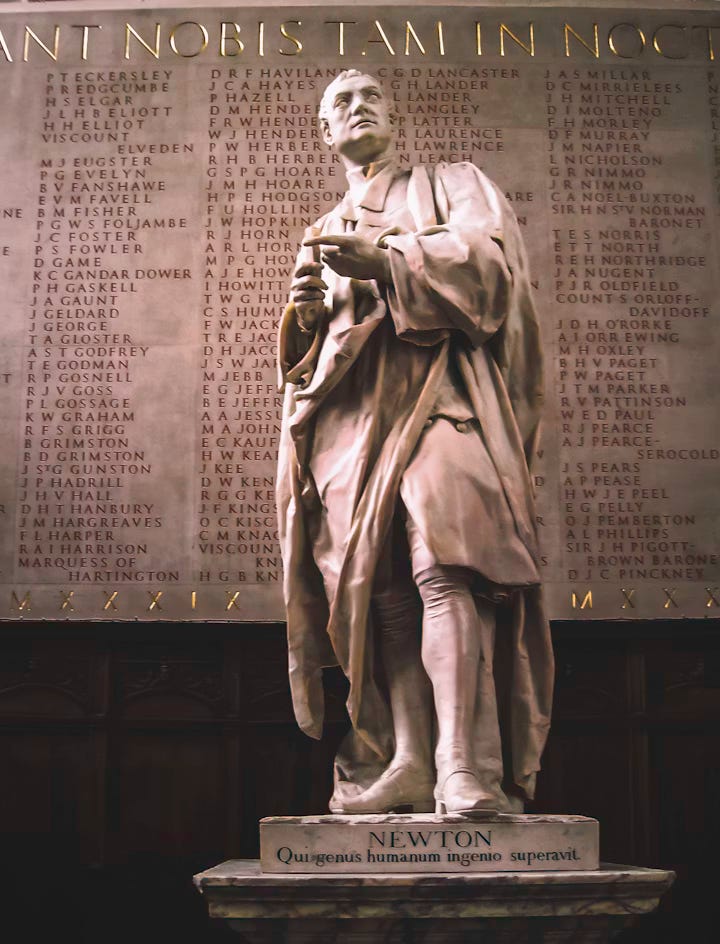
Scott Douglas Jacobsen and Rick Rosner examine why brilliant minds still drift into dubious or wasted pursuits, from Newton’s biblical prophecy to Einstein’s late unified-field work and Lorne Michaels’s post-SNL wilderness. The exchange turns to Russia’s war on Ukraine, Ukrainian asymmetric pressure, Putin’s controlled approval, Trump’s attraction to perceived winners, Iran, and right-wing media’s insulation of political failure. The result is skeptical, conversational, historically alert, darkly comic, and unusually unsentimental about genius and political mythology.
Scott Douglas Jacobsen: How many prominent people, your Oppenheimers, Einsteins, Newtons, have involved themselves in what, from the outside, looks like pointless nonsense? Newton, for example, spent serious time interpreting biblical prophecy and the end of history. How many very smart people have done some version of that?
Rick Rosner: I would say all of them. To avoid wasting time on bullshit, you would need perfect insight, and nobody has that. Einstein did most of his greatest theorizing by the time he was 36 or 40. At 26, in 1905, he had his miracle year: special relativity, Brownian motion, the photoelectric effect, and mass-energy equivalence. The Nobel Prize eventually came for the photoelectric effect, not relativity. Ten years later, at 36, in 1915, he completed his work on general relativity. Around 1916 and 1917, he worked on radiation, including stimulated emission, which laid the groundwork for lasers.
Then, from roughly 40 until his death at 76, he spent much of his time pursuing a unified field theory. He was deeply suspicious of standard quantum mechanics, especially the idea that uncertainty was not merely a limitation of knowledge but something built into the structure of reality. You could argue that he spent a large part of the last decades of his life on work that did not pay off as his earlier work did. An Einstein scholar might object, “No, he still produced useful ideas.” Fine. But it was not 1905 or 1915. I am sure you can find exceptional people who were lucky and brilliant enough to do groundbreaking work throughout their careers, but the odds are that most great minds have spent some serious time on nonsense.
I just saw a documentary on Lorne Michaels, who created Saturday Night Live in 1975. It is an excellent documentary.
By the fiftieth anniversary, he was still the executive producer and 80. But even he had five years in the wilderness. He left SNL in 1980, after the first five seasons. I do not know whether he was half-fired, half-exhausted, or half-ready to leave, but he was gone. The show got weaker, and NBC brought him back in 1985. So even Lorne Michaels had a wasted five years, or at least five years that did not become legendary.
Jacobsen: What did he do in the wilderness?
Rosner: He tried producing other shows, took time off, and rested, because that show is brutal for everybody, including, and maybe especially, him. The number of decisions per minute required to get that show through a production week is ridiculous: judgment calls, sketches, rewrites, performers, hosts, network concerns, personalities, timing, tone, everything. He supervises an absurd number of moving parts to make sure the show is the best version of itself it can be.
Do you have any more topics immediately coming to mind? How is it there? How has it been? Is Russia distracted?
Jacobsen: It is balmy and not bomby.
Rosner: It looks nice through your window. Is Putin distracted by what is happening in Crimea?
Jacobsen: Crimea, Moscow, St. Petersburg, Volgograd, and elsewhere. Ukraine’s return strikes are landing deeper inside Russia now, especially against energy infrastructure, military logistics, and industrial targets. They are hurting the economy, fuel supply, personnel, and the credibility of the Russian Federation. The Kremlin does not stand outside those costs forever.
Rosner: He is still not at immediate risk. His approval numbers have fallen by Russian standards, but they remain high, depending on the pollster and methodology. I do not feel as if he is at serious risk of losing his job. I am not sure how that would happen. But do you feel he is in a position where he would actually start considering peace? No way, right? Things would have to get much more dire for Russia. Or do you not even want to venture a guess?
Jacobsen: Russia has violated the basic principles of international humanitarian law and the Geneva Conventions in ways that are extensive and well-documented. They have used missiles, drones, artillery, glide bombs, cluster munitions, thermobaric weapons, and nearly every major category of conventional weapon available to them. Nuclear weapons remain the line they have not crossed.
The idea of Russia as the “second army in the world” was true in terms of size, inheritance, and stockpiles, but it was also a facade. Asymmetric warfare can counter even that. Ukraine has higher morale than Russia. The motivation, time investment, improvisation, and creativity are greater on the Ukrainian side because Ukrainians are defending their own country. That affects Russian soldiers, the Kremlin, Mr. Putin, and Russia’s allies.
Mr. Trump loves winners. Russia is larger, so he initially treated it as the likely winner and showed sympathy for Putin. Now Ukraine is winning or, at least, proving much harder to defeat than expected on multiple fronts. That has been noticed and finally acknowledged by Mr. Trump. Since he likes winners, he has begun saying more positive things about Mr. Zelensky and the Ukrainians.
Rosner: Interesting. There is a parallel in the United States. The U.S. has the world’s most powerful military, and yet it has been constrained by Iran. It is not the same as Ukraine and Russia, and it is not exactly asymmetric warfare in the classic sense, but Trump seems to have expected a quick, easy victory. He is not willing to do what it would take to fully take down Iran, because that would mean a ground war, probably with hundreds of thousands of troops, years of fighting, and tens of thousands of American casualties.
So you have two very powerful militaries being held off by opponents that are weaker in conventional terms, but not weak enough to roll over. Iran’s military is not tiny, but it did not have to commit its full force to complicate the American position. Trump was sold a fantasy by Netanyahu, or at least accepted one: that this would be easy.
There is another parallel. Putin’s approval remains high because he controls the media environment in Russia. Trump’s approval has not suffered as much as it might have because much of the American right-wing media universe is in the tank for him. A significant chunk of Americans will tell you, first, that the war is not really over, and second, that the United States has not lost anything. There is a lot they do not hear about on Fox.
I do not think Trump’s approval has been damaged by starting and then rapidly failing to end a war in the same way Biden’s approval was damaged by finally shutting down the Afghan war. The situation in Afghanistan caused Biden’s approval rating to fall sharply in 2021, and it never fully recovered. It became much easier to convince Americans that Biden had screwed up than to convince Americans that Trump had screwed up, because Trump has a captive right-wing media system protecting him.
All right. That is all I have.
Jacobsen: Thank you very much for the opportunity and your time, Rick.
Last updated May 3, 2025. These terms govern all In-Sight Publishing content—past, present, and future—and supersede any prior notices. In-Sight Publishing by Scott Douglas Jacobsen is licensed under a Creative Commons BY‑NC‑ND 4.0; © In-Sight Publishing by Scott Douglas Jacobsen 2012–Present. All trademarks, performances, databases & branding are owned by their rights holders; no use without permission. Unauthorized copying, modification, framing or public communication is prohibited. External links are not endorsed. Cookies & tracking require consent, and data processing complies with PIPEDA & GDPR; no data from children < 13 (COPPA). Content meets WCAG 2.1 AA under the Accessible Canada Act & is preserved in open archival formats with backups. Excerpts & links require full credit & hyperlink; limited quoting under fair-dealing & fair-use. All content is informational; no liability for errors or omissions: Feedback welcome, and verified errors corrected promptly. For permissions or DMCA notices, email: scott.jacobsen2025@gmail.com. Site use is governed by BC laws; content is “as‑is,” liability limited, users indemnify us; moral, performers’ & database sui generis rights reserved.


