Sviatoslav Yurash on War, Atheism, and Orthodox Christianity
Author(s): Scott Douglas Jacobsen
Publication (Outlet/Website): Vocal.Media
Publication Date (yyyy/mm/dd): 2026/10/29
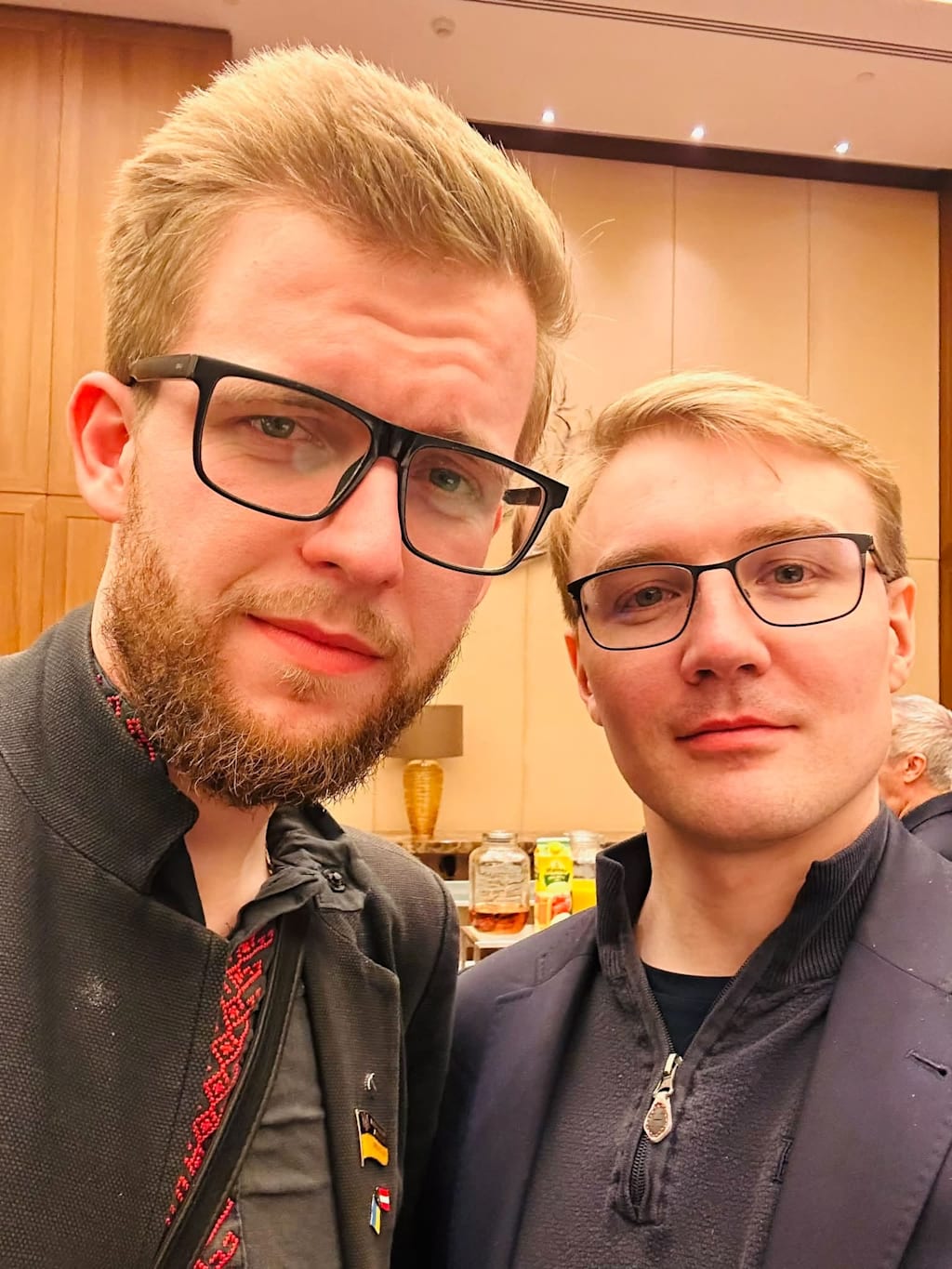
Scott Douglas Jacobsen interviews Sviatoslav Yurash about his path from studying in Kolkata to Euromaidan activism, war reporting, and Ukrainian parliamentary politics. Yurash discusses supporting Volodymyr Zelenskyy, rejecting militant atheism, embracing Orthodox Christianity, and finding meaning through faith, ancestry, family, and wartime experience, while criticizing Soviet communism and political leadership.
Sviatoslav Yurash is a Ukrainian parliamentarian born in Lviv in 1996. Elected to the Servant of the People party in 2019, he became the youngest member of the ninth Verkhovna Rada. He organized Euromaidan communications, worked with international media, served in Ukraine’s armed forces, and leads parliamentary work concerning Ukrainians living abroad.
Scott Douglas Jacobsen: Alright, so we’re here with Sviatoslav Yurash. He is the youngest member of parliament in Ukraine’s Verkhovna Rada. He entered at age 23. Can you take us a couple of steps back, before you even got into politics? Did you feel destined to do it, that it was the right thing to do, or did you transition into it later?
Sviatoslav Yurash: None of it. The truth is, I was in the midst of my studies in Kolkata, India, when Ukraine completely rejected the president, who decided to swerve away from what he had promised: the European path for Ukraine. And students who came out to protest against him were beaten up, and you had all the different generations coming together to show their disagreement with this approach to policymaking in Ukraine.
When I saw a million people on the streets of Kyiv, I knew my country’s destiny was being decided, and I couldn’t pretend I needed to follow the same educational steps before joining in any other practical reality. So I changed the plans that I had. My professor, Shantanu Chakrabarti, agreed, and I returned to Ukraine in 2013 to join the revolution, which gave me my first chance to help transform my country.
I led the International Centre of the Revolution, working with different media and embassies during the Maidan. I didn’t do that because of my skills, but because of many wonderful people with linguistic skills and a desire for the revolution. And I had the distinct honour of uniting them to try to explain and tell the world what Ukraine is and what our revolution is all about.
That was the start of it. And when you had the finale of the revolution, that is, when the president decided to drown Kyiv in blood, he was pushed to face the consequences and fled from those consequences, and the Russians invaded Ukraine.
And I saw that the maxims of my youth, that you cannot just take territory and change borders at will, no longer held. I swore that, whatever happened next, I would try to be there. Then events began unfolding in eastern Ukraine, in Donetsk, as they call it, the reserve capital of Ukraine and certainly the richest city in Ukraine. I accepted an offer from American journalists to join them to cover what was happening there.
I stayed there in 2014, leaving after the Malaysian airliner MH17 was shot down, covering that as my last story and returning to Kyiv. For the next five years, I did many things with many organizations, many people, and for many reasons. And the central instrument I had was information that I had a chance to understand through all those associations.
That information led me to a major disagreement with what was happening under the president elected after the revolution, Mr. Poroshenko. As election time neared, I knew I would join his opponents to show him he could not do what was done before, under the old rules of Ukrainian politics. The revolution did not want what was happening under his leadership.
When Zelenskyy announced, I reached out to friends in show business, and he and his team were open to ideas and people I could contribute. And I sort of just became one of the spokespeople, the Ukrainian-language spokesperson, in that sense, for his campaign efforts, clarifying the foreign policy agenda of the campaign as Western integration, the EU and NATO, and the institutions surrounding that.
And when he triumphantly won the presidential race, I didn’t decline the offer to continue to parliament. And in parliament, again, there was a triumphal victory. I became the youngest ever member of parliament, and elected the youngest ever prime minister; all of it led by the youngest ever president of Ukraine.
Jacobsen: What did Kolkata teach you?
Yurash: Kolkata taught me that the world is immensely interesting, and I can’t stay in the bubble of my European perspective. I need to see the world. That was my plan. After starting to study at a European university, my idea was to see the world.
In my youth, I had the illusion that Ukraine would take a boring, slow path into European and Western institutions. Of course, the governing parties would change. There was the Orange Party, then the Blue Party, then the Red Party, then the Green Party, but the direction would stay the same. And Ukraine would join the European Union.
During that time, as Ukraine went through the motions, I would have a chance to gain skills useful for my homeland. And I would return with those skills to a Ukraine that had either accomplished integration with the West or was still in the finishing stages of it.
But again, tell God your plans, and he’ll laugh at you. So all those ideas went away, and the revolution certainly started my life properly.
Jacobsen: Now, you spent time in an earlier part of life, an earlier chapter, in self-described terms, with a self-identified philosophy as a militant atheist. What was the path to that point?
Yurash: Well, that was the reality of growing up in Lviv, a religious city, in a family that was committed, in rebellion against Soviet atheistic beliefs, to trying to bring back what the Soviet Union was destroying. These are very fun. You’re a teenager, but as you go through the adventures of life, the truth is that the vacuum you are left with is quite unsatisfactory.
If you destroy those fundamentals that gave your ancestors the strength to get through the challenges of their lives and gave you the fundamental gift, the fundamental gift of life… Especially through the revolution and the early years of the war, that left me quite unsatisfied with the atheistic reality.
And then came the final act: using deconstructionism to deconstruct its own constructions and return to the foundation, which, for me, is Orthodox Christian reality.
Jacobsen: Was it about meaning, joy, and purpose in life, a reorientation of your life?
Yurash: Meaning is the word that certainly describes it best. The point is that life should have a purpose, direction, and meaning. You are not the first person to ask the question.
And it’s wonderful to see all these ancestors of yours who found that in all that God provided them, and in all that gave them the strength to get through the challenges of their centuries and give you the gift of life. So the least I can do is to try to understand them and follow in their footsteps.
Jacobsen: What does a sense of multi-multi-multi-generational time give you within Orthodox theology?
Yurash: Well, it’s not a question of a sense of multigenerational time. It’s about all these answers they had, which gave them the strength to face whatever challenges they faced.
Sadly, the Soviet Union’s paramount quest was to destroy the past, destroy history, and that led them to destroy the understanding that most of the children had. They were born in the ramshackle reality of what remained of the Soviet past. It gave them little chance to understand their ancestors.
But again, the institutions, Christian institutions, were those that stood firm and managed to survive all of that, which allowed them to give meaning to people even in the soulless and empty reality of communist Soviet delusion.
Jacobsen: What were the biggest delusions of the Soviets?
Yurash: The idea that they could take human nature and submit it to the dystopia of the paradise they thought they were creating through control, murder, and destruction. The delusion that they could fix human nature.
It led them to destroy and kill too many millions to count. Not just in the Soviet Union, mind you, but in every single communist nation that was attempted. And that deserves a Nuremberg trial of its own, as many much greater scholars and historians than I have any ambition to be have described in so much detail, to showcase how tragic and painful the Soviet attempt at utopia was.
Jacobsen: How does an Eastern Orthodox idea of a better life compare?
Yurash: Well, the Orthodox idea isn’t so much a question of a better life. It’s about the grounding it gives you, the realization that a much greater reality lies before you and above you.
And again, all these ancestors, who survived and went through the challenges of their centuries, praised and thanked the almighty God in that quest to survive and thrive. And they managed to do enough to create us.
Hence, the grounding Orthodoxy provides is certainly the answer to many of the questions every person asks in life, and me too. Discovering and understanding the value of not answering questions with arrogance or atheism has certainly helped one through the challenges of the years that passed.
Again, it’s, as always, the reality of a prodigal son who tries to rebel and realizes he needs to return to the foundation. The foundation. For me, that foundation is Orthodox Christianity. Hence, I stepped back into the life of the Almighty. And I couldn’t be more thankful because he has blessed me with the opportunity to do something better with my life than I could ever have imagined.
Jacobsen: What were some of your first marks of transition from a militant style of atheism, sort of an early twenty-first-century flavour of atheism, into Eastern Orthodoxy, as expressed primarily – I’m assuming – in Lviv and Kyiv?
Yurash: The conversations with my father, who went through the same motions in his day and who has built his life around submitting to the Almighty and respecting the past. But that’s only the first step.
And the questions that you have as you go through the revolution and the war, and you survive this, that, and the other, mean that you have to think and understand it through some prism. And to me, the prism, that foundation for my ancestors, is the natural prism to choose.
And as you use, every single day, all the words about destiny and the universe and everything else, they seem emptier than the foundational words that let generations survive to see another day. So when I searched for answers, I found them in that foundation, which helped all my ancestors, and it helped me, too.
Jacobsen: What passage of scripture means the most to you now?
Yurash: It’s not a question of which passage of scripture. I must say my wife is a biblical scholar, and Catholic school gave me plenty of passages all the time.
But again, it’s not about one passage or another passage. It’s about the weight that the biggest and most foundational book ever created, the Bible, provides to lead your life and answer the questions you face every single day.
So sadly, I can’t give you a one-zinger answer. It’s a public conversation we are having, and it’s a much bigger conversation we should have, not just in the twenty minutes we had. And again, I’ll be happy to call you back after the meeting that I should be attending right now.
Jacobsen: That would be great. I’ll talk to you soon. Thank you very much.
Yurash: Okay, till soon. Thank you very much.
Last updated May 3, 2025. These terms govern all In Sight Publishing content—past, present, and future—and supersede any prior notices. In Sight Publishing by Scott Douglas Jacobsen is licensed under a Creative Commons BY‑NC‑ND 4.0; © In Sight Publishing by Scott Douglas Jacobsen 2012–Present. All trademarks, performances, databases & branding are owned by their rights holders; no use without permission. Unauthorized copying, modification, framing or public communication is prohibited. External links are not endorsed. Cookies & tracking require consent, and data processing complies with PIPEDA & GDPR; no data from children < 13 (COPPA). Content meets WCAG 2.1 AA under the Accessible Canada Act & is preserved in open archival formats with backups. Excerpts & links require full credit & hyperlink; limited quoting under fair-dealing & fair-use. All content is informational; no liability for errors or omissions: Feedback welcome, and verified errors corrected promptly. For permissions or DMCA notices, email: scott.jacobsen2025@gmail.com. Site use is governed by BC laws; content is “as‑is,” liability limited, users indemnify us; moral, performers’ & database sui generis rights reserved.


