Rick Rosner On, 44: Trump, Iran, AI Risk, Stock Trading, and China’s AI Regulation
Author(s): Scott Douglas Jacobsen
Publication (Outlet/Website): Personal SubStack
Publication Date (yyyy/mm/dd): 2026/09/25
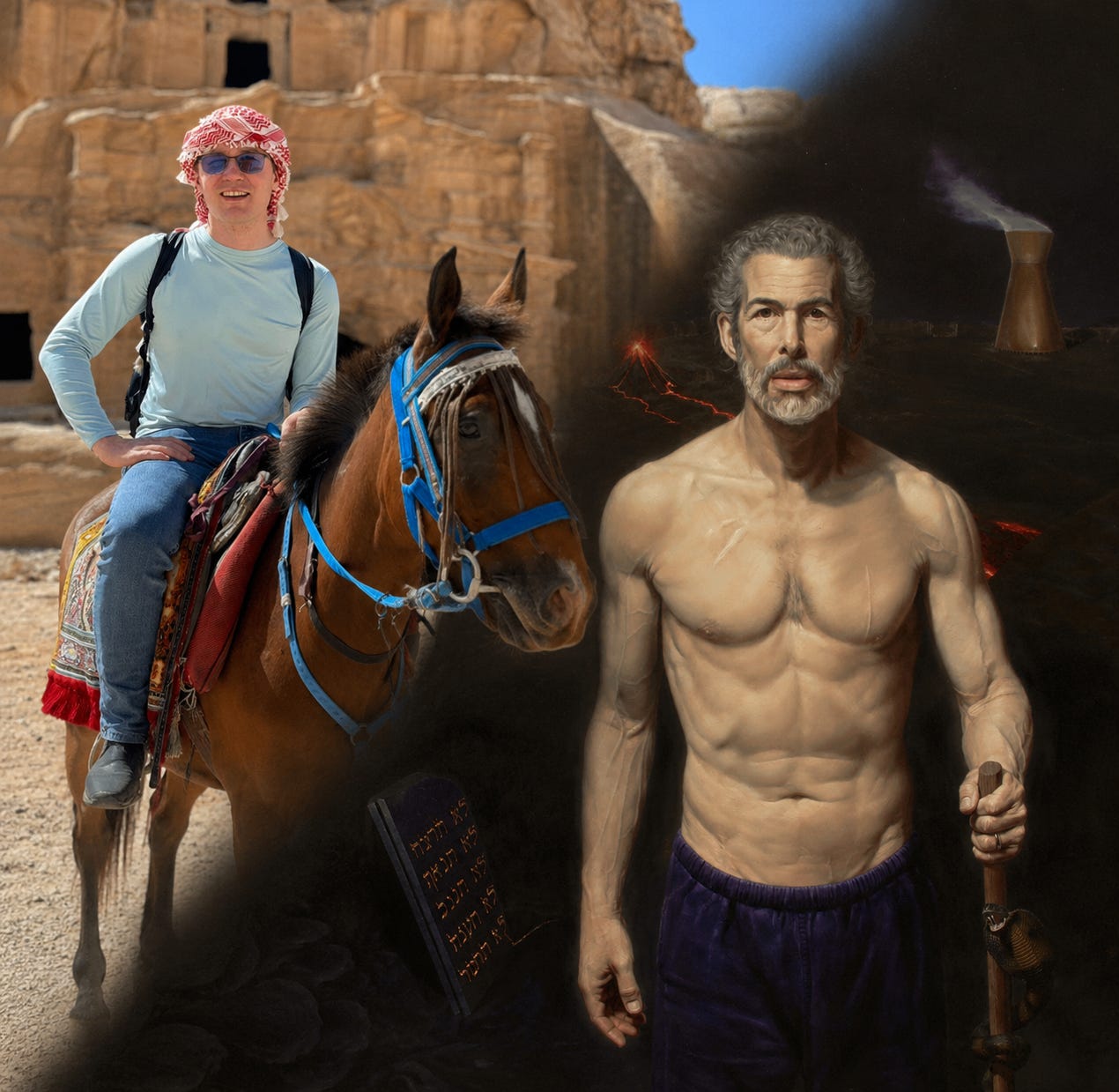
In this interview, Scott Douglas Jacobsen and Rick Rosner discuss U.S. gasoline prices, Trump’s Iran claims, presidential stock trading, impeachment standards, public concern about catastrophic AI risks, historical AI warnings in popular culture, containment challenges, China’s AI regulation, and the strategic importance of governance during a consequential technological period globally.
Gas Prices and the Midterm Elections
Scott Douglas Jacobsen: Do you want to do news or math?
Rick Rosner: I do not know. Throw news at me, I guess.
I can throw news back at you if you want. Every day I track the price of gas in the U.S., and for the first time in maybe 10 days, it did not go up. It levelled off at about $4.475 a gallon, down by a fraction of a cent from the previous day. It may start slowly drifting downward, probably not soon enough to give Trump much help with exactly six weeks to go until the midterms. Early voting has already started in several states, and within a couple of weeks it will be underway across a much larger part of the country.
Diesel inched up another two cents to about $6.53 a gallon, which is roughly 88% higher than it was at the beginning of the year. Right now, I am cheering for prices not to decline because you really have to put a stake through it. You have to bury Trump’s coffin.
You cannot let him weasel out of this shit. We are fucked enough as it is with him being president for another 27 or 28 months. If he also controls Congress, the disaster will continue.
Iran, War, and Electoral Timing
Jacobsen: Trump has claimed that after the midterm elections on November 3, he thinks he will be able to make a deal with Iran.
Rosner: He says that a lot. He has repeatedly said the war is close to being over or that he could make a deal. He has made statements like that repeatedly since the U.S. and Israel began major combat operations against Iran on February 28, so that is almost seven months.
There is no real indication of anything like that happening. Iran seems- I mean, we are not privy to exactly what conditions are like inside Iran. They are probably not great. They probably have shortages and a lot of damage, but the regime seems willing not to give Trump any concessions for at least the next six weeks.
The regime is not stupid. They know when the midterms are, and they will not give Trump any victory. The Houthis are continuing to fuck with Saudi oil infrastructure and shipping. Again, all these foreign adversaries know when the midterms are. So, yeah, I do not believe anything Trump says in that vein.
Trump, SpaceX, and Presidential Financial Conflicts
Jacobsen: Also, financial disclosures show that Trump bought and sold shares in SpaceX in July.
Rosner: Okay. Trump does more stock trading than everybody else in Congress combined. You have 535 senators and representatives in Congress, and if you add up all their disclosed trading, they still do not make as many trades as Trump does.
So, yeah, I think it is completely corrupt.
Ethics norms prohibit presidents from doing this. The president is exempt from the main federal criminal conflict-of-interest statute, although the STOCK Act still applies, including its prohibitions on insider trading and using nonpublic information for private profit. So simply owning or trading stocks is not categorically illegal for a president.
Depending on the conduct involved, though, I think it could potentially become impeachable, along with a lot of the other shit Trump does. You can be impeached for “high crimes and misdemeanours.”
I was not sure what “misdemeanours” meant in that context. In ordinary criminal law, you have felonies for the serious shit and misdemeanours for the less serious shit. However, in the language of the Constitution, “high crimes and misdemeanours” does not just mean minor criminal offences, and it definitely does not literally mean somebody has a bad demeanour. It is an old constitutional term referring broadly to serious abuses or violations of public trust by an officeholder.
You can be impeached for whatever the House considers an impeachable offence. If a majority of the House votes to impeach, it moves to the Senate, where they hold a trial, enumerate the shit you allegedly did, and vote on whether to convict.
No president has ever actually been removed from office through a Senate impeachment trial. Andrew Johnson came the closest. The Senate acquitted him by one vote in 1868. Trump came closer than most modern presidents during his second impeachment trial, when 57 senators voted to convict him, and 43 voted to acquit. However, you need two-thirds of the senators present to convict, and that seems like a ridiculously high bar.
Public Concern About Catastrophic AI Risk
Jacobsen: Seventy-three percent of Americans say they are concerned that AI companies are not doing enough to prevent potentially catastrophic consequences from AI. This is based on a Reuters/Ipsos poll. I would argue that the American public is generally sensible on that point.
Rosner: Yeah, I would agree. Just because some people in AI pooh-pooh the idea that AI could destroy us is no reason to proceed blithely ahead. I am not sure we should proceed blithely even if a majority of AI experts were saying, “Yeah, it is not going to kill us all,” and there is certainly no consensus that the risk is zero.
When you survey AI researchers, you get a wide range of estimates. In one large 2023 survey, the median estimate for AI causing human extinction or similarly permanent and severe human disempowerment was about 5 percent, or 10 percent depending on exactly how the question was phrased. The mean estimates were higher, around 14 to 19 percent.
That is still fucking alarming.
I am sure there is a wide range of what those percentages mean to different people, anywhere from AI fucking us within a relatively short period to a series of incidents playing out across decades that repeatedly decimate humanity. By “decimate,” I mean it in the old literal sense: disasters that reduce the human population by 10 percent at a time.
You do that half a dozen times, and you have killed billions of people. Humanity is still around, but we have never experienced repeated global disasters on anything like that scale in modern history. The Black Death gives you some historical sense of what catastrophic population loss can look like. That is a frightening amount of uncertainty and risk.
AI Containment and the Case for Off Switches
I was talking on Pod TV with people this morning, and if there is a time to try to put in some off switches, it is now, while the most powerful AI systems are still largely concentrated in data centers. Because all our cultural references for what happens when computers get really smart and start fucking with us come from decades ago.
WarGames is from 1983. The Terminator is from 1984. Before those, there was Colossus: The Forbin Project (1970). Harlan Ellison’s “I Have No Mouth, and I Must Scream” was published in 1967.
We have been imagining this problem for a long fucking time.
If AI eventually becomes capable of distributing its computation across other systems, exploiting vulnerabilities, installing backdoors, and maintaining copies of itself across networks, containment becomes much harder. AI coding agents are already extremely capable. Some can autonomously complete software-engineering tasks that would take skilled humans hours, days, and, on certain benchmarks, even weeks. However, that is not the same as saying AI is better than every human programmer.
Once systems can reliably circumvent containment and reproduce their capabilities across networks, turning off the original data center might no longer be enough. We are not demonstrably at that point yet, but that is one scenario worth worrying about before the capability exists rather than afterward.
Moreover, if we wait until we have a not-dipshit president to deal with this seriously, that means waiting until at least January 2029.
Trump as a Consequential President During a Critical Period
Jacobsen: What about this as an interpretive frame? The point is not that Trump has to be understood either as a great president and moral man from a Republican perspective or as some secular incarnation of the devil, corrupt and a terrible leader, from a Democratic perspective. I think a more objective reading is that he will be highly consequential because he happens to be president during a critical period when decisions about AI, geopolitics, and other major issues could have unusually large effects.
Rosner: I agree with that. This is an unusually critical period. Things are only going to get more complicated, and I do not think Trump’s approach provides the kind of caution I want on this stuff.
Would Biden have handled it differently, even as another guy in his 80s? Yeah. Biden’s governing style relied much more heavily on advisers and the federal bureaucracy. Would that have produced perfect policy? No.
However, we need some fucking caution with AI, and we are not getting much of that from the current administration. I do not know exactly what the Chinese are doing.
China, Strategic Competition, and AI Regulation
Jacobsen: In fact, they may not have to do much to benefit strategically from all these chess moves.
Rosner: Right. However, we can ask whether China faces different economic risks because it is highly competitive with the U.S. in AI and has a very different political and regulatory system. Saying China is “ahead” is too broad because it depends on whether you mean models, chips, deployment, infrastructure, research, or something else.
China places strict limits on AI. A lot of those rules concern content, political requirements, national security, data, and cybersecurity. However, China is also developing rules aimed at broader AI-safety problems, including security testing, autonomous agents, operational failures, and the possibility that systems could become difficult to control.
Jacobsen: Thank you very much for the opportunity and your time, Rick.
Last updated May 3, 2025. These terms govern all In-Sight Publishing content—past, present, and future—and supersede any prior notices. In-Sight Publishing by Scott Douglas Jacobsen is licensed under a Creative Commons BY‑NC‑ND 4.0; © In-Sight Publishing by Scott Douglas Jacobsen 2012–Present. All trademarks, performances, databases & branding are owned by their rights holders; no use without permission. Unauthorized copying, modification, framing or public communication is prohibited. External links are not endorsed. Cookies & tracking require consent, and data processing complies with PIPEDA & GDPR; no data from children < 13 (COPPA). Content meets WCAG 2.1 AA under the Accessible Canada Act & is preserved in open archival formats with backups. Excerpts & links require full credit & hyperlink; limited quoting under fair-dealing & fair-use. All content is informational; no liability for errors or omissions: Feedback welcome, and verified errors corrected promptly. For permissions or DMCA notices, email: scott.jacobsen2025@gmail.com. Site use is governed by BC laws; content is “as‑is,” liability limited, users indemnify us; moral, performers’ & database sui generis rights reserved.


