Rick Rosner On, 24: AI Mathematics, Brain-Computer Interfaces, and Human Understanding
Author(s): Scott Douglas Jacobsen
Publication (Outlet/Website): Personal SubStack
Publication Date (yyyy/mm/dd): 2026/08/11
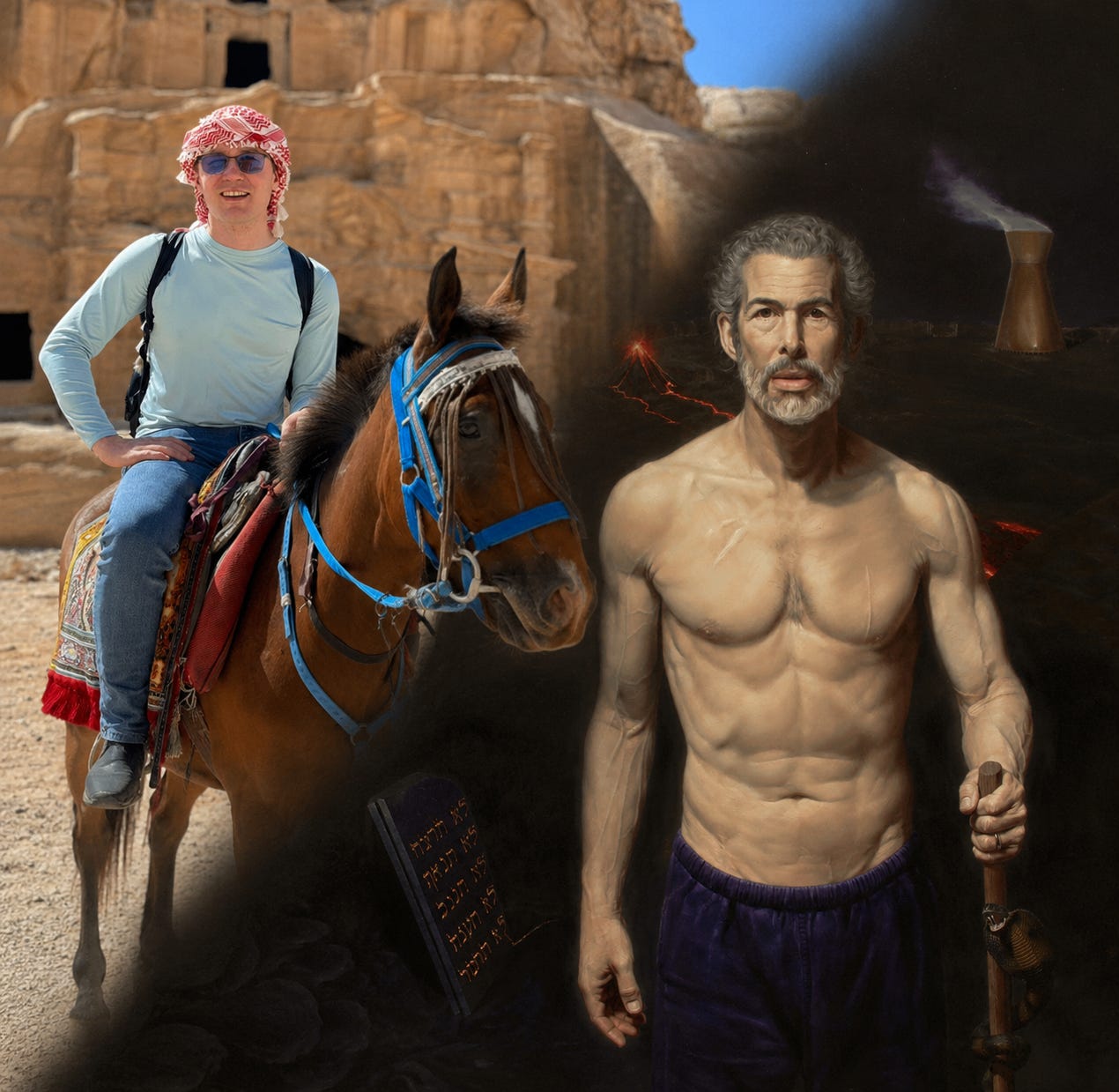
In this interview, Scott Douglas Jacobsen and Rick Rosner examine how artificial intelligence could transform mathematical discovery, eventually producing results beyond unaided human comprehension. They discuss agentic systems, machine-generated knowledge, epistemic opacity, Benjamin Franklin, brain-computer interfaces, and technologically augmented identity. Rosner also explores these themes through a fictional character integrated with machine computation, raising questions about consciousness, legal personhood, human rights, embodied experience, and whether humans may increasingly merge with artificial cognitive systems.
Scott Douglas Jacobsen: These mathematical applications of artificial intelligence systems, some genuinely sophisticated and some less so, will probably develop along a trajectory similar to AI-assisted coding. Coding has moved from autocomplete and code generation toward “vibe coding,” human-agent collaboration, and increasingly agentic systems that can carry out multi-step tasks with limited supervision. We’re also beginning to see systems in which multiple agents can work in parallel.
In coding, you can give a system a directive and some parameters in natural language, acting as the “programmer” in quotation marks, and have it perform substantial portions of the task. Current systems can already work autonomously for minutes or hours on some tasks. Longer autonomous operation remains an active area of development rather than a solved capability.
Mathematics will probably develop in a similar direction. If you’re talking about mathematical structures and discovery within those structures, there are some important implications. Newton had the basic principle right: knowledge builds on prior knowledge, captured in his famous remark about “standing on the shoulders of giants.”
Rick Rosner: Although I’ve read interpretations suggesting that quote might have been snarky. Newton was writing to Robert Hooke, with whom he had a difficult relationship. Some people interpret it as sarcasm, though that interpretation isn’t established. Newton could certainly be a fucking prick.
Jacobsen: He was famously combative and involved in bitter priority disputes. So I think there’s a reasonable argument one can make.
The argument has several steps. First, suppose we continue to see increasing capabilities in mathematical AI systems. Suppose those systems increasingly compete and coordinate with human mathematicians, solve original problems, and eventually solve long-standing problems that talented mathematicians have been unable to crack. And suppose improvements continue in computing resources, energy efficiency, algorithms, reasoning architectures, and the compression or specialization of mathematical capabilities.
Under those assumptions, it is plausible that AI systems could eventually outperform even highly talented human mathematicians across many forms of mathematical problem-solving. That remains a prediction, not an established endpoint.
Traditionally, a talented mathematician learns an existing field, builds on it, and then builds on what they have produced. They train other people, who do the same with the previous generation’s work. You get an iterative accumulation of mathematical knowledge, producing increasingly sophisticated layers.
Rosner: You call it human knowledge, but okay.
Jacobsen: We’re probably about to agree here. Historically, that knowledge was generated overwhelmingly by humans. Now it is increasingly being developed with assistance from artificial systems. It is conceivable that, in some domains, artificial systems could eventually become the primary producers of new mathematical results.
That creates another possibility. A system produces a solution, and the solution opens new problems, as mathematical solutions often do. The system then attacks those new problems, whose solutions generate still more problems. Not ad infinitum in any literal computational sense, but potentially through a very large number of successive iterations.
Eventually, we might reach a point where the problem is no longer asking these systems to speed up, but asking them to translate their results into forms human beings can understand. They might develop internal representations, algorithms, abstractions, or formal languages optimized for machine reasoning that are difficult for humans to interpret directly.
That would create a kind of epistemic opacity. It would not necessarily mean that the systems are literal black boxes in every technical sense. Their proofs or outputs might still be formally verifiable. But the conceptual route by which they reach those results could become increasingly difficult for humans to follow.
You could then have genuine mathematical knowledge that is formally accessible but cognitively inaccessible to most humans, including many specialists. Something analogous already exists within mathematics. Work at the research frontier can be opaque to almost everyone outside a narrow specialty, and sometimes even to mathematicians working in adjacent areas.
So that’s the stepwise argument.
Rosner: All right. It’s sometimes said that Benjamin Franklin was among the last people who could understand a substantial portion of the science of his time. I don’t know that the claim can literally be established. But since Franklin’s era, scientific knowledge has expanded and specialized so extensively that no individual could plausibly master all of modern science.
So we’re already in a situation somewhat like that. I’m working on a novel in which a character becomes increasingly enmeshed with machine computation. This individual has a mutation in his brain that makes it easier for him to interface with implants for the direct input of information, not through the conventional senses but directly into the brain.
You could call it an additional sense: the direct input of information. This character gets a lot of shit from people. He’s renowned for being really smart, not least because he’s linked to vast computational systems. And people say, “You’re not even fucking real. You’re really just a mouthpiece for some fucking AI. I don’t even believe that you are what you claim to be, which is a conscious, thinking being. I think you’re just a fucking puppet of AI.”
And the character is like, “Fuck you,” and tries to do various things to prove his authenticity. But gradually he has to admit that it’s kind of a moot question. He is deeply enmeshed with the system. Who he is consists not just of his biological brain but also of his relationship with machine computation.
I think that’s where things could go in a lot of fields. The unaided human brain may eventually be unable to understand a lot of the shit being done by AI. But in the future, if sufficiently advanced brain-computer interfaces become possible, we may be able to connect more directly with these systems. Current brain-computer interfaces are far more limited than that, so this is speculative.
One thing humans have is embodied agency and subjective experience. We can move around the world. We have sensations. We have feelings about what we experience. Current AI systems don’t experience and interact with the physical world in the same way humans do, and whether artificial systems could possess subjective experience remains an open philosophical and scientific question.
So we may eventually link ourselves much more closely to AI. To some extent, we might become dependent on the systems we’re linked to. Information could be fed into us through increasingly sophisticated interfaces. Our biological brains might have only a vague understanding of some of the underlying computation while remaining highly integrated with nonbiological systems.
If artificial systems ever develop something meaningfully analogous to subjective experience, an interface with human beings could raise even stranger questions. But we don’t currently know whether AI systems can have experiences or feelings at all.
There will also be legal arguments. It’ll probably go to court eventually. If a person becomes extensively technologically augmented, at what point, if any, does that affect the person’s legal identity? Does that person continue to control their assets? Are they still legally a human being, or does the law eventually need some new category? And if genuinely nonhuman artificial persons ever exist, what rights should they have?
So, yes, we’re going to go beyond individual human understanding, but humans may also transcend some of their current cognitive limitations in weird ways.
People sometimes say that octopuses have nine brains. That isn’t literally correct. An octopus has a central brain and a highly distributed nervous system, with large concentrations of neurons in its eight arms. Those arm nervous systems can perform substantial local processing and coordinate complex movements without every detail being centrally controlled.
That gives us an interesting analogy. An arm’s neural circuitry doesn’t need a complete representation of everything the animal is doing. The central nervous system and peripheral neural networks coordinate behavior, while substantial processing occurs locally within the arms.
We’re accustomed to being one biological brain in one body, with no deeply integrated external computation. That could change. And, yeah, it’ll be fucking creepy. It could also be extraordinarily useful or terrible, which seems to be the case with almost everything involving AI.
Jacobsen: Thank you very much for the opportunity and your time, Rick.
Last updated May 3, 2025. These terms govern all In-Sight Publishing content—past, present, and future—and supersede any prior notices. In-Sight Publishing by Scott Douglas Jacobsen is licensed under a Creative Commons BY‑NC‑ND 4.0; © In-Sight Publishing by Scott Douglas Jacobsen 2012–Present. All trademarks, performances, databases & branding are owned by their rights holders; no use without permission. Unauthorized copying, modification, framing or public communication is prohibited. External links are not endorsed. Cookies & tracking require consent, and data processing complies with PIPEDA & GDPR; no data from children < 13 (COPPA). Content meets WCAG 2.1 AA under the Accessible Canada Act & is preserved in open archival formats with backups. Excerpts & links require full credit & hyperlink; limited quoting under fair-dealing & fair-use. All content is informational; no liability for errors or omissions: Feedback welcome, and verified errors corrected promptly. For permissions or DMCA notices, email: scott.jacobsen2025@gmail.com. Site use is governed by BC laws; content is “as‑is,” liability limited, users indemnify us; moral, performers’ & database sui generis rights reserved.


